The Global Wine Market
School of Wine and Spirits Business
MSc Wine Business Programme
A presentation for our distinguished visitors from Universidad de Concepcion
2
THE WINE SECTOR'S CHALLENGE
The Wine Market – Lecture 1
6
OVERSUPPLY
The Wine Sector's challenge
12 juin 2014
Can't we just focus our passion
on educating a love of better
quality, higher priced wines?
Let's look at some figures…
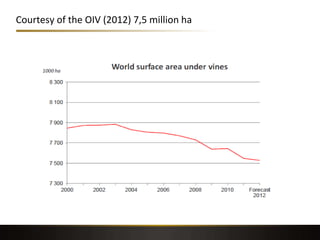
Courtesy of the OIV (2012) 7,5 million ha
9
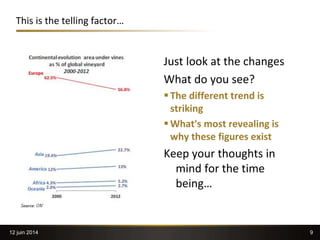
This is the telling factor…
Just look at the changes
What do you see?
 The different trend is
striking
 What's most revealing is
why these figures exist
Keep your thoughts in
mind for the time
being…
12 juin 2014
10
PRODUCTION FOCUS
Oversupply because of a…
12 juin 2014
11
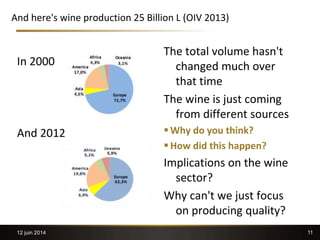
And here's wine production 25 Billion L (OIV 2013)
In 2000
And 2012
The total volume hasn't
changed much over
that time
The wine is just coming
from different sources
 Why do you think?
 How did this happen?
Implications on the wine
sector?
Why can't we just focus
on producing quality?
12 juin 2014
12
IT'S ALL ABOUT THE WINE…
Oversupply because…
12
13
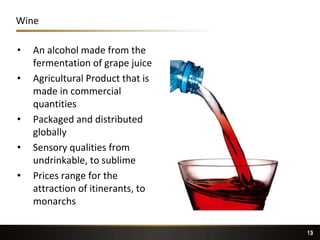
Wine
• An alcohol made from the
fermentation of grape juice
• Agricultural Product that is
made in commercial
quantities
• Packaged and distributed
globally
• Sensory qualities from
undrinkable, to sublime
• Prices range for the
attraction of itinerants, to
monarchs
13
14
What do we know about the French Wine Sector?
France produces the best
wine!
French wine consumers
are the most
knowledgeable about
wine!
People today are drinking
less, but more
expensive wines
Yes – Whether it's true or
not, it's what everyone
thinks (Ma 2008)
False – French are most
familiar with their own
region only (Wilson et al.
2007, 2009a,b)
False – Less, but better?
Yes. But less valuable as
well (Euromonitor 2013)
12
14
15
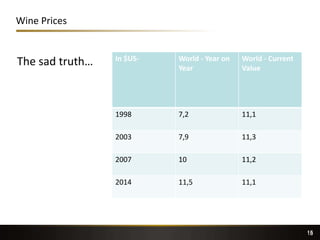
Wine Prices
The sad truth… In $US- World - Year on
Year
World - Current
Value
1998 7,2 11,1
2003 7,9 11,3
2007 10 11,2
2014 11,5 11,1
15
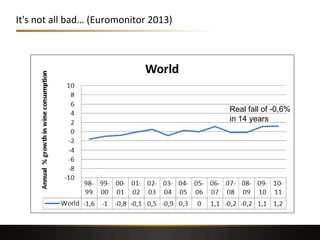
It's not all bad… (Euromonitor 2013)
Real fall of -0,6%
in 14 years
17
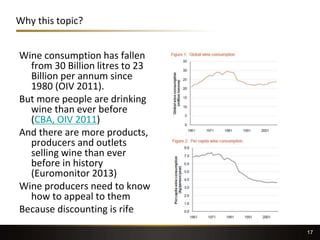
Why this topic?
Wine consumption has fallen
from 30 Billion litres to 23
Billion per annum since
1980 (OIV 2011).
But more people are drinking
wine than ever before
(CBA, OIV 2011)
And there are more products,
producers and outlets
selling wine than ever
before in history
(Euromonitor 2013)
Wine producers need to know
how to appeal to them
Because discounting is rife
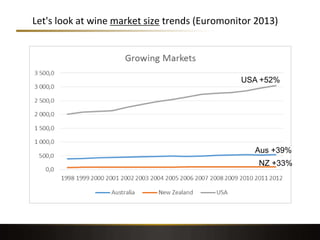
Let's look at wine market size trends (Euromonitor 2013)
18
USA +52%
Aus +39%
NZ +33%
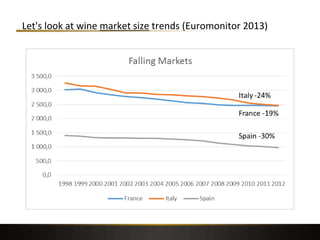
Let's look at wine market size trends (Euromonitor 2013)
19
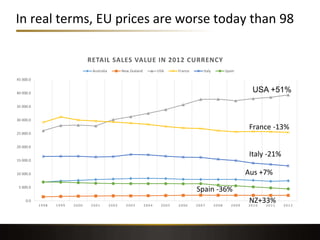
In real terms, EU prices are worse today than 98
0.0
5 000.0
10 000.0
15 000.0
20 000.0
25 000.0
30 000.0
35 000.0
40 000.0
45 000.0
1998 1999 2000 2001 2002 2003 2004 2005 2006 2007 2 0 0 8 2009 2010 2011 2012
RETAIL SALES VALUE IN 2012 CURRENCY
Australia New Zealand USA France Italy Spain
NZ+33%
Aus +7%
Italy -21%
Spain -36%
France -13%
USA +51%
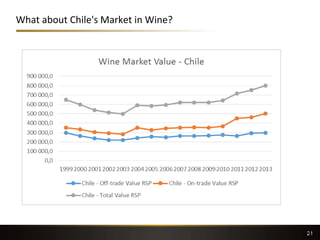
What about Chile's Market in Wine?
2112
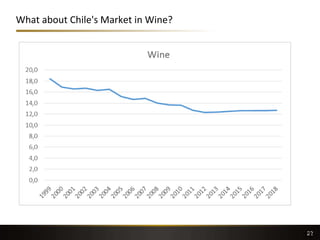
What about Chile's Market in Wine?
2212
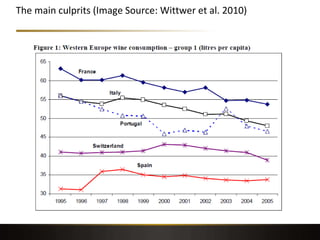
The main culprits (Image Source: Wittwer et al. 2010)
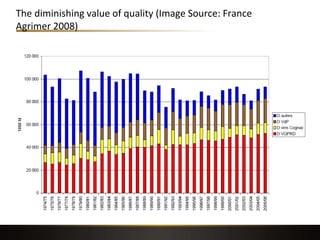
The diminishing value of quality (Image Source: France
Agrimer 2008)
The Challenge is…
That wine's offer is overly complex
The consumer is presented with more than 200 options in
almost every format in which wine is sought after as a
purchase
And that doesn't consider
 Sales formats
 Geographical restrictions, or….
Vintage changes
So how can a consumer find any wine they like?
26
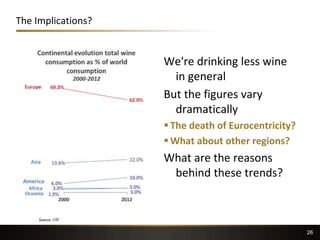
The Implications?
We're drinking less wine
in general
But the figures vary
dramatically
 The death of Eurocentricity?
 What about other regions?
What are the reasons
behind these trends?
27
FRAGMENTATION
The Wine Sector's challenge
12 juin 2014
28
PRODUCTION SECTOR
Fragmentation in the…
28
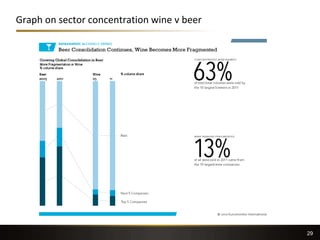
Graph on sector concentration wine v beer
29
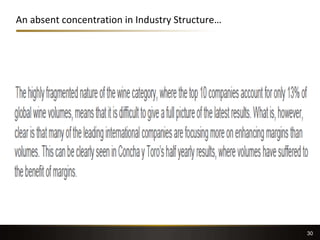
An absent concentration in Industry Structure…
30
31
OFFER
Fragmentation in the…
31
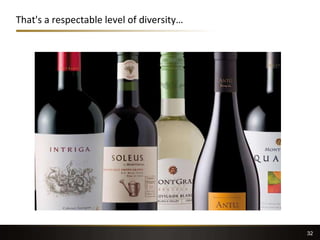
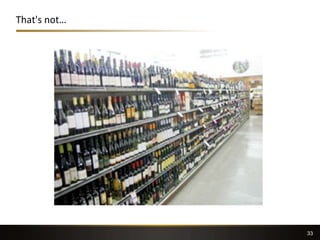
That's a respectable level of diversity…
32
That's not…
33
Isn't diversity a good thing?
1. Yes. Within reason
2. Balance choice with being overwhelmed
1. Consumers are intimidated by choice
2. Is it just that the offer is not clear to the consumer?
3. Wine producers not developing products in an area of latent need?
3. Sales media and buying formats
4. Communications media and mobility
5. Cultural creep
12 juin 2014
35
CONSUMER'S BEHAVIOUR
Fragmentation in the…
35
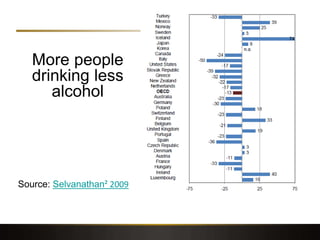
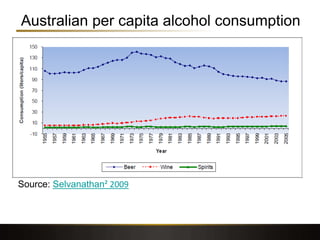
More people
drinking less
alcohol
Source: Selvanathan² 2009
Australian per capita alcohol consumption
Source: Selvanathan² 2009
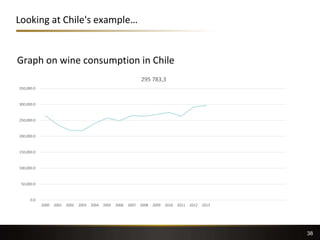
Looking at Chile's example…
38
Graph on wine consumption in Chile
0.0
50,000.0
100,000.0
150,000.0
200,000.0
250,000.0
300,000.0
350,000.0
2000 2001 2002 2003 2004 2005 2006 2007 2008 2009 2010 2011 2012 2013
295 783,3
39
OPPORTUNITIES
The Global Wine Market
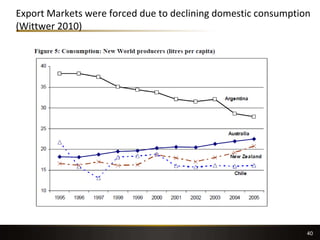
Export Markets were forced due to declining domestic consumption
(Wittwer 2010)
40
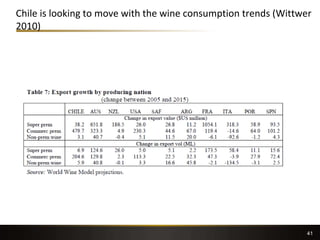
Chile is looking to move with the wine consumption trends (Wittwer
2010)
41
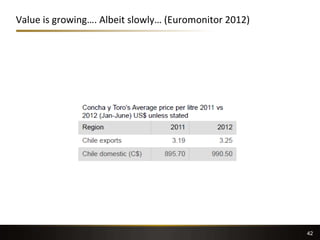
Value is growing…. Albeit slowly… (Euromonitor 2012)
42
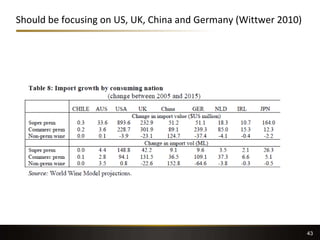
Should be focusing on US, UK, China and Germany (Wittwer 2010)
43
44
ON-PREMISE OPPORTUNITIES
The Global Wine Market
44
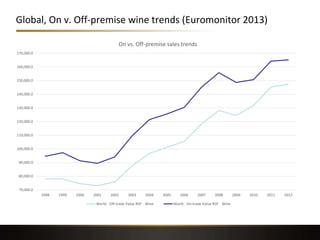
Global, On v. Off-premise wine trends (Euromonitor 2013)
70,000.0
80,000.0
90,000.0
100,000.0
110,000.0
120,000.0
130,000.0
140,000.0
150,000.0
160,000.0
170,000.0
1998 1999 2000 2001 2002 2003 2004 2005 2006 2007 2008 2009 2010 2011 2012
On vs. Off-premise sales trends
World - Off-trade Value RSP Wine World - On-trade Value RSP Wine
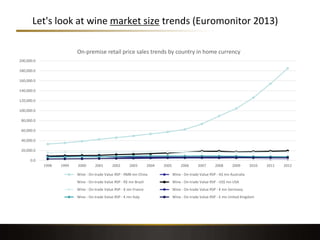
Let's look at wine market size trends (Euromonitor 2013)
46
0.0
20,000.0
40,000.0
60,000.0
80,000.0
100,000.0
120,000.0
140,000.0
160,000.0
180,000.0
200,000.0
1998 1999 2000 2001 2002 2003 2004 2005 2006 2007 2008 2009 2010 2011 2012
On-premise retail price sales trends by country in home currency
Wine - On-trade Value RSP - RMB mn China Wine - On-trade Value RSP - A$ mn Australia
Wine - On-trade Value RSP - R$ mn Brazil Wine - On-trade Value RSP - US$ mn USA
Wine - On-trade Value RSP - € mn France Wine - On-trade Value RSP - € mn Germany
Wine - On-trade Value RSP - € mn Italy Wine - On-trade Value RSP - £ mn United Kingdom
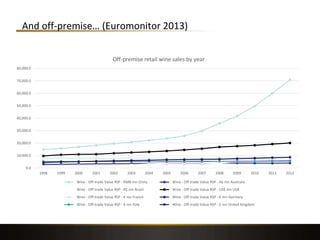
And off-premise… (Euromonitor 2013)
47
0.0
10,000.0
20,000.0
30,000.0
40,000.0
50,000.0
60,000.0
70,000.0
80,000.0
1998 1999 2000 2001 2002 2003 2004 2005 2006 2007 2008 2009 2010 2011 2012
Off-premise retail wine sales by year
Wine - Off-trade Value RSP - RMB mn China Wine - Off-trade Value RSP - A$ mn Australia
Wine - Off-trade Value RSP - R$ mn Brazil Wine - Off-trade Value RSP - US$ mn USA
Wine - Off-trade Value RSP - € mn France Wine - Off-trade Value RSP - € mn Germany
Wine - Off-trade Value RSP - € mn Italy Wine - Off-trade Value RSP - £ mn United Kingdom
On-premise is very lucrative
The US is the only major market where off-premise sales exceed
on-premise by retail value
But managing that channel is problematic
Wineries have to rely on their position in the mind of the trade,
and their consumers
The consumer now drinks wine in various outlets for various
reasons
Traditional consumption was with a meal
How many of those on-premise sales in China are matched to
food?
Wine needs to be priced by consumption motivation and
service!
49
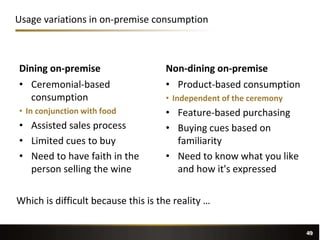
Dining on-premise
• Ceremonial-based
consumption
• In conjunction with food
• Assisted sales process
• Limited cues to buy
• Need to have faith in the
person selling the wine
Non-dining on-premise
• Product-based consumption
• Independent of the ceremony
• Feature-based purchasing
• Buying cues based on
familiarity
• Need to know what you like
and how it's expressed
Usage variations in on-premise consumption
49
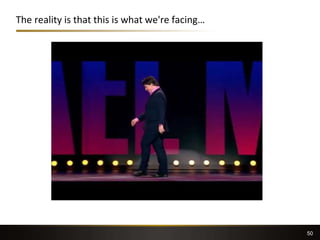
Which is difficult because this is the reality …
The reality is that this is what we're facing…
50
Communicate in the consumer's way!
The wine sector is in crisis, and producers blame
retailers and consumers instead of themselves
Off-premise requires volume, or producer-driven
value to be profitable
Consumers look for advice, recommendations,
and responses to help them buy wine
These are easily obtained through friends in the
real, and/or virtual world
51
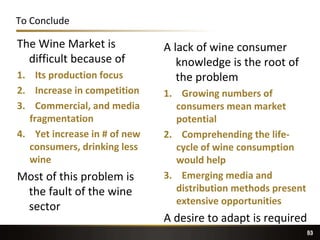
The consumer conundrum…
• Wine producers sell wine instead of attracting consumers
• Most modern wine businesses started with the wine, then
looked for a market
• Quality is now a sunk cost of doing wine business
• Alcohol consumption trends are heterogeneous, globally
• New media present an opportunity to escape the retail
discounting trap
• Change is inevitable, and must be embraced
• Adapt to the needs of each market, at the level where
economies of service can be made
52
53
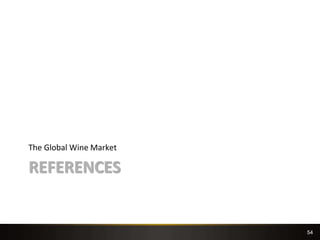
To Conclude
The Wine Market is
difficult because of
1. Its production focus
2. Increase in competition
3. Commercial, and media
fragmentation
4. Yet increase in # of new
consumers, drinking less
wine
Most of this problem is
the fault of the wine
sector
A lack of wine consumer
knowledge is the root of
the problem
1. Growing numbers of
consumers mean market
potential
2. Comprehending the life-
cycle of wine consumption
would help
3. Emerging media and
distribution methods present
extensive opportunities
A desire to adapt is required
53
54
REFERENCES
The Global Wine Market
References
Charters, S., & Pettigrew, S. (2008). Why Do People Drink Wine? A Consumer-Focused
Exploration. Journal of Food Products Marketing, 14(3), 13–32.
doi:10.1080/10454440801985894
Euromonitor. (2013). Euromonitor International - Statistics. Market sizes and
historic/forecasts. Retrieved February 17, 2013, from
http://www.portal.euromonitor.com/Portal/Pages/Statistics/Statistics.aspx
Gioacchino, P., Giuseppe, D. V., & Mario, D. (2012). Profitability of Wine Grape
Growing in the European Union: An Empirical Analysis. China-USA Business
Review, 11(6), 729–738.
Groves, R., Charters, S., & Reynolds, C. (2000). Imbibing, Inscribing, Integrating and
Imparting: A Taxonomy of Wine Consumption Practices. Journal of Wine Research,
11(3), 209–222. doi:10.1080/09571260020018676
Holbrook, M. B. (1996). Customer Value -- A Framework For Analysis and Research.
Advances in Consumer Research, 23(1), 138–142
References
Lockshin, L., Jarvis, W., d’ Hauteville, F., & Perrouty, J. (2006). Using simulations from
discrete choice experiments to measure consumer sensitivity to brand, region,
price, and awards in wine choice. Food Quality and Preference, 17(3-4), 166–178
Muñiz Jr., A. M., & Schau, H. J. (2011). How to inspire value-laden collaborative
consumer-generated content. Business Horizons, 54(3), 209–217.
doi:10.1016/j.bushor.2011.01.002
Piskorski, M. J. (2011). Social Strategies That Work. Harvard Business Review, 89(11),
116–122.
Quester, P. G., & Smart, J. (1996). Product Involvement in Consumer Wine Purchases:
Its Demographic Determinants and Influence on Consumer Choice. International
Journal of Wine Marketing, 8, 37–53.
Thach, L. (2009), “Wine 2.0—The Next Phase of Wine Marketing? Exploring US Winery
Adoption of Wine 2.0 Components,” Journal of Wine Research, Vol. 20 No.2 , pp.
143-157.
References
Wilson, D., & Quinton, S. (2012). Let’s talk about wine: Does Twitter have value?
International Journal of Wine Business Research, 24(4), 271–286.
doi:http://dx.doi.org/10.1108/17511061211280329
WineIntelligence. (2013a). Wine tourism – Australia’s model investment « Wine
Intelligence. Wine tourism – Australia’s model investment. Retrieved June 13,
2013, from http://www.wineintelligence.com/2013/04/11/wine-tourism-
%e2%80%93-australia%e2%80%99s-model-investment/
WineIntelligence. (2013b). What do Chinese wine consumers really think? « Wine
Intelligence. What do Chinese wine consumers really think? Retrieved June 13,
2013, from http://www.wineintelligence.com/2013/05/02/what-do-chinese-wine-
consumers-really-think/
Wittwer, G., 2010. The Global Wine Market in the decade to 2015 with a focus on
Australia and Chile (No. General Working Paper G-166). Centre of Policy Studies,
Monash University.

The global wine market

  • 1.
    The Global WineMarket School of Wine and Spirits Business MSc Wine Business Programme A presentation for our distinguished visitors from Universidad de Concepcion
  • 2.
    2 THE WINE SECTOR'SCHALLENGE The Wine Market – Lecture 1
  • 3.
    6 OVERSUPPLY The Wine Sector'schallenge 12 juin 2014
  • 4.
    Can't we justfocus our passion on educating a love of better quality, higher priced wines? Let's look at some figures…
  • 5.
    Courtesy of theOIV (2012) 7,5 million ha
  • 6.
    9 This is thetelling factor… Just look at the changes What do you see?  The different trend is striking  What's most revealing is why these figures exist Keep your thoughts in mind for the time being… 12 juin 2014
  • 7.
  • 8.
    11 And here's wineproduction 25 Billion L (OIV 2013) In 2000 And 2012 The total volume hasn't changed much over that time The wine is just coming from different sources  Why do you think?  How did this happen? Implications on the wine sector? Why can't we just focus on producing quality? 12 juin 2014
  • 9.
    12 IT'S ALL ABOUTTHE WINE… Oversupply because… 12
  • 10.
    13 Wine • An alcoholmade from the fermentation of grape juice • Agricultural Product that is made in commercial quantities • Packaged and distributed globally • Sensory qualities from undrinkable, to sublime • Prices range for the attraction of itinerants, to monarchs 13
  • 11.
    14 What do weknow about the French Wine Sector? France produces the best wine! French wine consumers are the most knowledgeable about wine! People today are drinking less, but more expensive wines Yes – Whether it's true or not, it's what everyone thinks (Ma 2008) False – French are most familiar with their own region only (Wilson et al. 2007, 2009a,b) False – Less, but better? Yes. But less valuable as well (Euromonitor 2013) 12 14
  • 12.
    15 Wine Prices The sadtruth… In $US- World - Year on Year World - Current Value 1998 7,2 11,1 2003 7,9 11,3 2007 10 11,2 2014 11,5 11,1 15
  • 13.
    It's not allbad… (Euromonitor 2013) Real fall of -0,6% in 14 years
  • 14.
    17 Why this topic? Wineconsumption has fallen from 30 Billion litres to 23 Billion per annum since 1980 (OIV 2011). But more people are drinking wine than ever before (CBA, OIV 2011) And there are more products, producers and outlets selling wine than ever before in history (Euromonitor 2013) Wine producers need to know how to appeal to them Because discounting is rife
  • 15.
    Let's look atwine market size trends (Euromonitor 2013) 18 USA +52% Aus +39% NZ +33%
  • 16.
    Let's look atwine market size trends (Euromonitor 2013) 19
  • 17.
    In real terms,EU prices are worse today than 98 0.0 5 000.0 10 000.0 15 000.0 20 000.0 25 000.0 30 000.0 35 000.0 40 000.0 45 000.0 1998 1999 2000 2001 2002 2003 2004 2005 2006 2007 2 0 0 8 2009 2010 2011 2012 RETAIL SALES VALUE IN 2012 CURRENCY Australia New Zealand USA France Italy Spain NZ+33% Aus +7% Italy -21% Spain -36% France -13% USA +51%
  • 18.
    What about Chile'sMarket in Wine? 2112
  • 19.
    What about Chile'sMarket in Wine? 2212
  • 20.
    The main culprits(Image Source: Wittwer et al. 2010)
  • 21.
    The diminishing valueof quality (Image Source: France Agrimer 2008)
  • 22.
    The Challenge is… Thatwine's offer is overly complex The consumer is presented with more than 200 options in almost every format in which wine is sought after as a purchase And that doesn't consider  Sales formats  Geographical restrictions, or…. Vintage changes So how can a consumer find any wine they like?
  • 23.
    26 The Implications? We're drinkingless wine in general But the figures vary dramatically  The death of Eurocentricity?  What about other regions? What are the reasons behind these trends?
  • 24.
    27 FRAGMENTATION The Wine Sector'schallenge 12 juin 2014
  • 25.
  • 26.
    Graph on sectorconcentration wine v beer 29
  • 27.
    An absent concentrationin Industry Structure… 30
  • 28.
  • 29.
    That's a respectablelevel of diversity… 32
  • 30.
  • 31.
    Isn't diversity agood thing? 1. Yes. Within reason 2. Balance choice with being overwhelmed 1. Consumers are intimidated by choice 2. Is it just that the offer is not clear to the consumer? 3. Wine producers not developing products in an area of latent need? 3. Sales media and buying formats 4. Communications media and mobility 5. Cultural creep 12 juin 2014
  • 32.
  • 33.
  • 34.
    Australian per capitaalcohol consumption Source: Selvanathan² 2009
  • 35.
    Looking at Chile'sexample… 38 Graph on wine consumption in Chile 0.0 50,000.0 100,000.0 150,000.0 200,000.0 250,000.0 300,000.0 350,000.0 2000 2001 2002 2003 2004 2005 2006 2007 2008 2009 2010 2011 2012 2013 295 783,3
  • 36.
  • 37.
    Export Markets wereforced due to declining domestic consumption (Wittwer 2010) 40
  • 38.
    Chile is lookingto move with the wine consumption trends (Wittwer 2010) 41
  • 39.
    Value is growing….Albeit slowly… (Euromonitor 2012) 42
  • 40.
    Should be focusingon US, UK, China and Germany (Wittwer 2010) 43
  • 41.
  • 42.
    Global, On v.Off-premise wine trends (Euromonitor 2013) 70,000.0 80,000.0 90,000.0 100,000.0 110,000.0 120,000.0 130,000.0 140,000.0 150,000.0 160,000.0 170,000.0 1998 1999 2000 2001 2002 2003 2004 2005 2006 2007 2008 2009 2010 2011 2012 On vs. Off-premise sales trends World - Off-trade Value RSP Wine World - On-trade Value RSP Wine
  • 43.
    Let's look atwine market size trends (Euromonitor 2013) 46 0.0 20,000.0 40,000.0 60,000.0 80,000.0 100,000.0 120,000.0 140,000.0 160,000.0 180,000.0 200,000.0 1998 1999 2000 2001 2002 2003 2004 2005 2006 2007 2008 2009 2010 2011 2012 On-premise retail price sales trends by country in home currency Wine - On-trade Value RSP - RMB mn China Wine - On-trade Value RSP - A$ mn Australia Wine - On-trade Value RSP - R$ mn Brazil Wine - On-trade Value RSP - US$ mn USA Wine - On-trade Value RSP - € mn France Wine - On-trade Value RSP - € mn Germany Wine - On-trade Value RSP - € mn Italy Wine - On-trade Value RSP - £ mn United Kingdom
  • 44.
    And off-premise… (Euromonitor2013) 47 0.0 10,000.0 20,000.0 30,000.0 40,000.0 50,000.0 60,000.0 70,000.0 80,000.0 1998 1999 2000 2001 2002 2003 2004 2005 2006 2007 2008 2009 2010 2011 2012 Off-premise retail wine sales by year Wine - Off-trade Value RSP - RMB mn China Wine - Off-trade Value RSP - A$ mn Australia Wine - Off-trade Value RSP - R$ mn Brazil Wine - Off-trade Value RSP - US$ mn USA Wine - Off-trade Value RSP - € mn France Wine - Off-trade Value RSP - € mn Germany Wine - Off-trade Value RSP - € mn Italy Wine - Off-trade Value RSP - £ mn United Kingdom
  • 45.
    On-premise is verylucrative The US is the only major market where off-premise sales exceed on-premise by retail value But managing that channel is problematic Wineries have to rely on their position in the mind of the trade, and their consumers The consumer now drinks wine in various outlets for various reasons Traditional consumption was with a meal How many of those on-premise sales in China are matched to food? Wine needs to be priced by consumption motivation and service!
  • 46.
    49 Dining on-premise • Ceremonial-based consumption •In conjunction with food • Assisted sales process • Limited cues to buy • Need to have faith in the person selling the wine Non-dining on-premise • Product-based consumption • Independent of the ceremony • Feature-based purchasing • Buying cues based on familiarity • Need to know what you like and how it's expressed Usage variations in on-premise consumption 49 Which is difficult because this is the reality …
  • 47.
    The reality isthat this is what we're facing… 50
  • 48.
    Communicate in theconsumer's way! The wine sector is in crisis, and producers blame retailers and consumers instead of themselves Off-premise requires volume, or producer-driven value to be profitable Consumers look for advice, recommendations, and responses to help them buy wine These are easily obtained through friends in the real, and/or virtual world 51
  • 49.
    The consumer conundrum… •Wine producers sell wine instead of attracting consumers • Most modern wine businesses started with the wine, then looked for a market • Quality is now a sunk cost of doing wine business • Alcohol consumption trends are heterogeneous, globally • New media present an opportunity to escape the retail discounting trap • Change is inevitable, and must be embraced • Adapt to the needs of each market, at the level where economies of service can be made 52
  • 50.
    53 To Conclude The WineMarket is difficult because of 1. Its production focus 2. Increase in competition 3. Commercial, and media fragmentation 4. Yet increase in # of new consumers, drinking less wine Most of this problem is the fault of the wine sector A lack of wine consumer knowledge is the root of the problem 1. Growing numbers of consumers mean market potential 2. Comprehending the life- cycle of wine consumption would help 3. Emerging media and distribution methods present extensive opportunities A desire to adapt is required 53
  • 51.
  • 52.
    References Charters, S., &Pettigrew, S. (2008). Why Do People Drink Wine? A Consumer-Focused Exploration. Journal of Food Products Marketing, 14(3), 13–32. doi:10.1080/10454440801985894 Euromonitor. (2013). Euromonitor International - Statistics. Market sizes and historic/forecasts. Retrieved February 17, 2013, from http://www.portal.euromonitor.com/Portal/Pages/Statistics/Statistics.aspx Gioacchino, P., Giuseppe, D. V., & Mario, D. (2012). Profitability of Wine Grape Growing in the European Union: An Empirical Analysis. China-USA Business Review, 11(6), 729–738. Groves, R., Charters, S., & Reynolds, C. (2000). Imbibing, Inscribing, Integrating and Imparting: A Taxonomy of Wine Consumption Practices. Journal of Wine Research, 11(3), 209–222. doi:10.1080/09571260020018676 Holbrook, M. B. (1996). Customer Value -- A Framework For Analysis and Research. Advances in Consumer Research, 23(1), 138–142
  • 53.
    References Lockshin, L., Jarvis,W., d’ Hauteville, F., & Perrouty, J. (2006). Using simulations from discrete choice experiments to measure consumer sensitivity to brand, region, price, and awards in wine choice. Food Quality and Preference, 17(3-4), 166–178 Muñiz Jr., A. M., & Schau, H. J. (2011). How to inspire value-laden collaborative consumer-generated content. Business Horizons, 54(3), 209–217. doi:10.1016/j.bushor.2011.01.002 Piskorski, M. J. (2011). Social Strategies That Work. Harvard Business Review, 89(11), 116–122. Quester, P. G., & Smart, J. (1996). Product Involvement in Consumer Wine Purchases: Its Demographic Determinants and Influence on Consumer Choice. International Journal of Wine Marketing, 8, 37–53. Thach, L. (2009), “Wine 2.0—The Next Phase of Wine Marketing? Exploring US Winery Adoption of Wine 2.0 Components,” Journal of Wine Research, Vol. 20 No.2 , pp. 143-157.
  • 54.
    References Wilson, D., &Quinton, S. (2012). Let’s talk about wine: Does Twitter have value? International Journal of Wine Business Research, 24(4), 271–286. doi:http://dx.doi.org/10.1108/17511061211280329 WineIntelligence. (2013a). Wine tourism – Australia’s model investment « Wine Intelligence. Wine tourism – Australia’s model investment. Retrieved June 13, 2013, from http://www.wineintelligence.com/2013/04/11/wine-tourism- %e2%80%93-australia%e2%80%99s-model-investment/ WineIntelligence. (2013b). What do Chinese wine consumers really think? « Wine Intelligence. What do Chinese wine consumers really think? Retrieved June 13, 2013, from http://www.wineintelligence.com/2013/05/02/what-do-chinese-wine- consumers-really-think/ Wittwer, G., 2010. The Global Wine Market in the decade to 2015 with a focus on Australia and Chile (No. General Working Paper G-166). Centre of Policy Studies, Monash University.

Editor's Notes

  • #38 Evolution of Wine production and consumption in Australia English colonial influences Refrigeration in the 70s 80s and Driving laws Mid-80s – European regulations and consolidation for wine 90s coincided with rampant increases in supply – 260 wine producers in mid-80s. 2600 today. From 30,000 ha in the early 80s to 150,000 today. With supply increases came innovation – the fruit bomb, of many flavours!