


GLOBAL SUSTAINABLE
DEVELOPMENT REPORT 2 23
TIMES OF CRISIS,
TIMES OF CHANGE
SCIENCE FOR ACCELERATING
TRANSFORMATIONS
TO SUSTAINABLE
DEVELOPMENT
CHAPTER
2
Introduction:
The importance of
sustainable transport
for the 2030 Agenda
and the Paris Agreement
TIMES OF CRISIS, TIMES OF CHANGE
SCIENCE FOR ACCELERATING TRANSFORMATIONS
TO SUSTAINABLE DEVELOPMENT
GLOBAL SUSTAINABLE
DEVELOPMENT REPORT 2 23
TIMES OF CRISIS, TIMES OF CHANGE: SCIENCE FOR ACCELERATING TRANSFORMATIONS TO SUSTAINABLE DEVELOPMENT
I
II
GLOBAL SUSTAINABLE DEVELOPMENT REPORT
NOTE
TIMES OF CRISIS, TIMES OF CHANGE: SCIENCE FOR ACCELERATING TRANSFORMATIONS TO SUSTAINABLE DEVELOPMENT
III
In the outcome document of the Rio+20 Conference, in 2012, entitled “The future we want”, and again in
“Transforming our world: the 2030 Agenda for Sustainable Development”, in 2015, United Nations Member
States decided that the High-Level Political Forum on Sustainable Development would be informed by the Global
Sustainable Development Report. In the Ministerial Declaration of the 2016 Forum, Member States decided that
the report would be produced quadrennially by an independent group of scientists appointed by the United Nations
Secretary-General and comprising 15 experts representing a variety of backgrounds, scientific disciplines and
institutions, with geographical and gender balance.
This report, Times of crisis, times of change: Science for accelerating transformations to sustainable development,
is the second quadrennial Global Sustainable Development Report prepared by an independent group of scientists.
The first report, The future is now: Science for achieving sustainable development, was published in 2019.
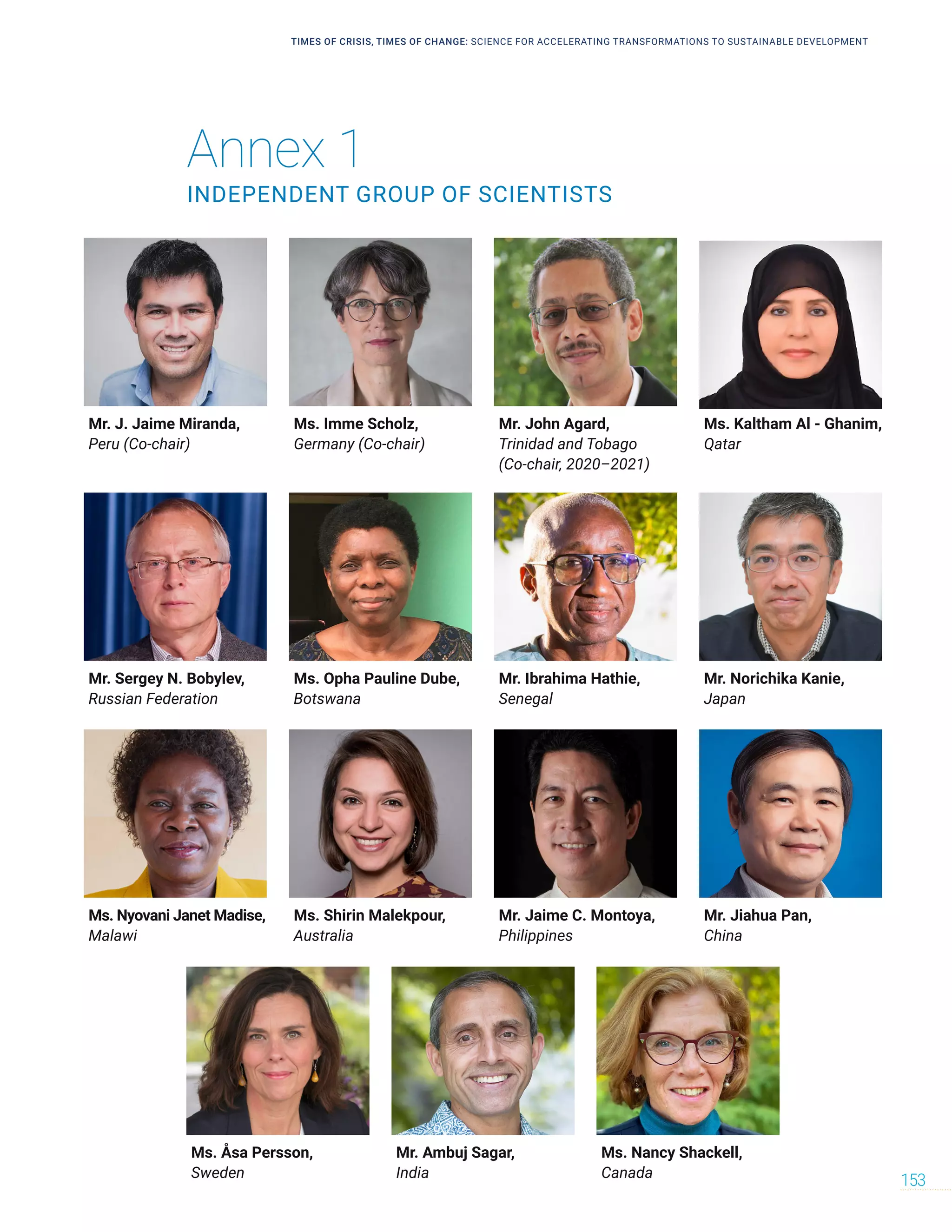
Independent Group of Scientists 2023
Co-chairs
• J. Jaime Miranda (Peru), CRONICAS Centre of Excellence in Chronic Diseases and School of Medicine,
Universidad Peruana Cayetano Heredia, Peru
• Imme Scholz (Germany), Heinrich Böll Foundation, Germany
Members
• John Agard (Trinidad and Tobago), Office of Research, Development and Knowledge Transfer, University
of the West Indies (UWI) St Augustine, Trinidad and Tobago
• Kaltham Al-Ghanim (Qatar), Social and Economic Survey Research Institute (SESRI), Qatar University, Qatar
• Sergey N. Bobylev (Russian Federation), Department of Environmental Economics, Lomonosov Moscow State
University, Russian Federation
• Opha Pauline Dube (Botswana), Department of Environmental Science, University of Botswana, Botswana
• Ibrahima Hathie (Senegal), Feed the Future Senegal Policy Systems Services, Senegal
• Norichika Kanie (Japan), Graduate School of Media and Governance, Keio University, Japan
• Nyovani Janet Madise (Malawi), African Institute for Development Policy (AFIDEP), Malawi
• Shirin Malekpour (Australia), Monash Sustainable Development Institute (MSDI), Monash University, Australia
• Jaime C. Montoya (The Philippines), College of Medicine, University of the Philippines; Philippine Council
for Health Research and Development, Department of Science and Technology; National Academy of Science
and Technology, The Philippines
• Jiahua Pan (China), Institute of Ecocivilization Studies; Chinese Academy of Social Sciences (CASS), China
• Åsa Persson (Sweden), Stockholm Environment Institute (SEI); Department of Thematic Studies,
Linköping University, Sweden
• Ambuj Sagar (India), School of Public Policy, Indian Institute of Technology (ITT) Delhi, India
• Nancy Shackell (Canada), Bedford Institute of Oceanography, Fisheries and Oceans Canada (DFO) Dalhousie
University, Canada
Recommended citation: Independent Group of Scientists appointed by the Secretary-General, Global Sustainable
Development Report 2023: Times of crisis, times of change: Science for accelerating transformations to sustainable
development, (United Nations, New York, 2023).
Design and graphics by Camilo J. Salomon
Copyright © 2023 United Nations
All rights reserved
United Nations publication issued by the Department of Economic and Social Affairs
Contents
GLOBAL SUSTAINABLE DEVELOPMENT REPORT
IV
TIMES OF CRISIS, TIMES OF CHANGE: SCIENCE FOR ACCELERATING TRANSFORMATIONS TO SUSTAINABLE DEVELOPMENT
V
Contents
Foreword XIII
Preface XV
Executive Summary XVII
Introduction XVII
Embracing transformations to achieve the Sustainable Development Goals XVII
Chapter 1: Halfway to 2030 XVIII
Chapter 2: Framing the future XX
Chapter 3: Pathways to achieve the Sustainable Development Goals XXI
Chapter 4: Accelerating transformations to the Sustainable Development Goals XXIV
Chapter 5: Transformations through science – and in science XXVI
Chapter 6: Calls to action XXVIII
Chapter 1: Half-way to 2030 – progress towards the Sustainable Development Goals 1
The big picture: stagnation in the face of multiple crises 1
Insufficient progress on the Sustainable Development Goals 9
Regional trends in the implementation of and progress towards the Sustainable 19
Development Goals
Fixed Goals for a world in flux 21
Chapter 2: Framing the future 23
Dynamic conditions shaping achievement of the Sustainable Development Goals 24
Greater awareness and uptake of the Sustainable Development Goals framework 29
Interlinkages between the Sustainable Development Goals and international spillovers 32
Framing a future of progress 37
Chapter 3: Pathways to achieve the Sustainable Development Goals 39
Global scenario projections for the Sustainable Development Goals 40
Key shifts and interventions to accelerate transformations 47
Chapter 4: Accelerating transformations to the Sustainable Development Goals 63
S-curve transformations 64
GLOBAL SUSTAINABLE DEVELOPMENT REPORT
VI
Phase 1 – Emergence of the new and destabilization of the old 70
Phase 2 – Acceleration of the new and breakdown of the old 77
Phase 3 – Stabilization of the new and phase out of the old 84
Chapter 5: Transformations through science—and in science 89
A multidisciplinary approach to multiple crises 90
Shining a brighter spotlight on the Sustainable Development Goals 93
The science-policy-society interface must be inclusive 94
Global imbalance in research and development 96
Sharing knowledge openly and equitably 98
Trust and integrity 99
Socially robust science can bridge the gap between policy commitment 101
and policy implementation
Chapter 6: Calls to action for transformations 103
Establish a transformation framework for accelerated action for the Sustainable 104
Development Goals by 2024
Build capacity for transformations 106
Push transformation by activating synergies in the six entry points 106
Improve critical underlying conditions for implementation of the Sustainable 109
Development Goals
Transform science for sustainable development 110
References 113
Appendix 1: Literature on interlinkages between Sustainable Development Goals 147
and summary of findings
Annex 1: Independent Group of Scientists 153
Annex 2: Regional consultations to inform the 2023 Global Sustainable 154
Development Report
Annex 3: Scientific review of the draft of the 2023 Global Sustainable 155
Development Report
Annex 4: Ministerial declaration of the 2016 high-level political forum on sustainable 158
development, convened under the auspices of the Economic and Social Council
Annex 5: Acknowledgments 166
TIMES OF CRISIS, TIMES OF CHANGE: SCIENCE FOR ACCELERATING TRANSFORMATIONS TO SUSTAINABLE DEVELOPMENT
VII
FIGURES
Figure 1-1: Current state of progress toward the Sustainable Development 3
Goals based on select targets
Figure 1-2: Number of state-based armed conflicts by region 6
Figure 1-3: World military expenditure 6
Figure 1-4: Prevalence of undernourishment 10
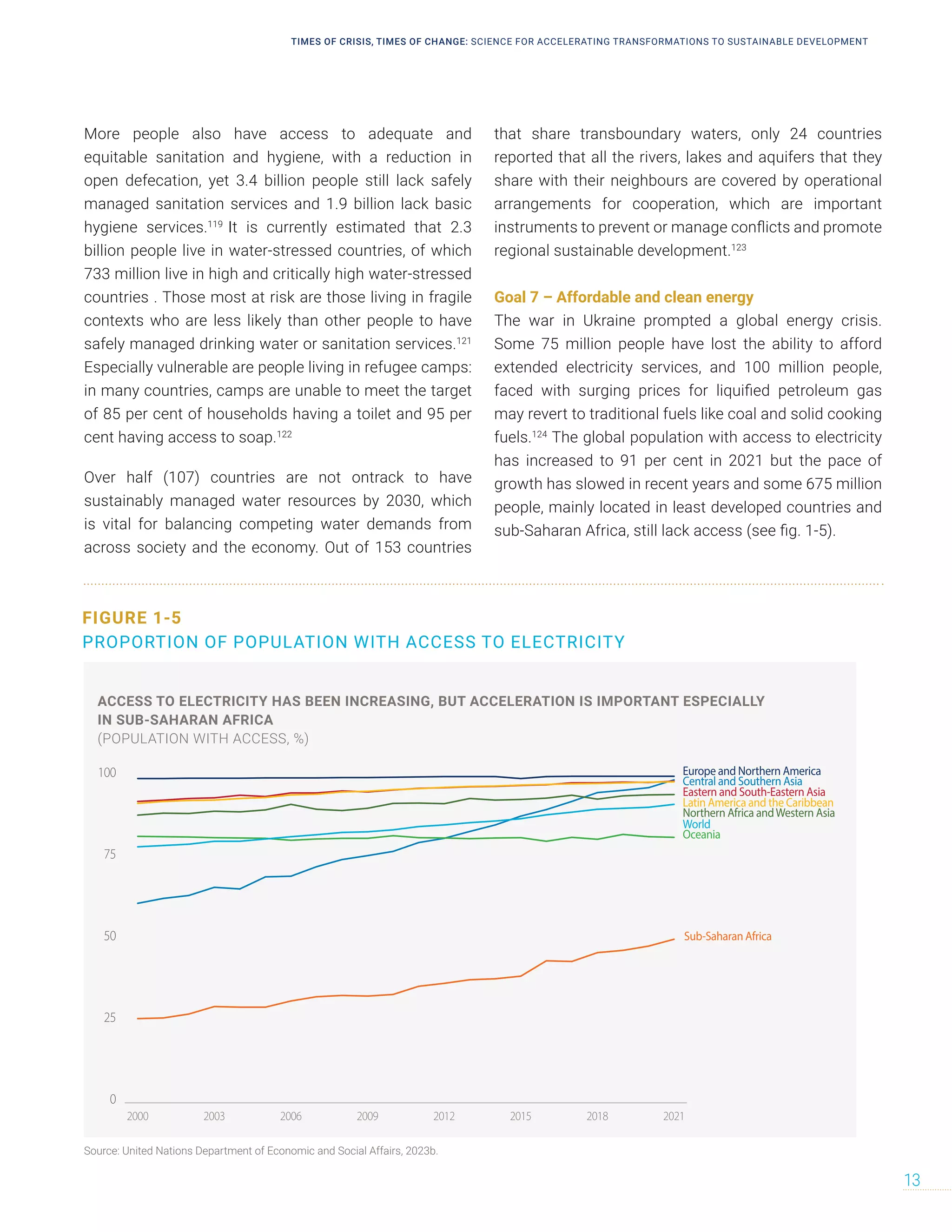
Figure 1-5: Proportion of population with access to electricity 13
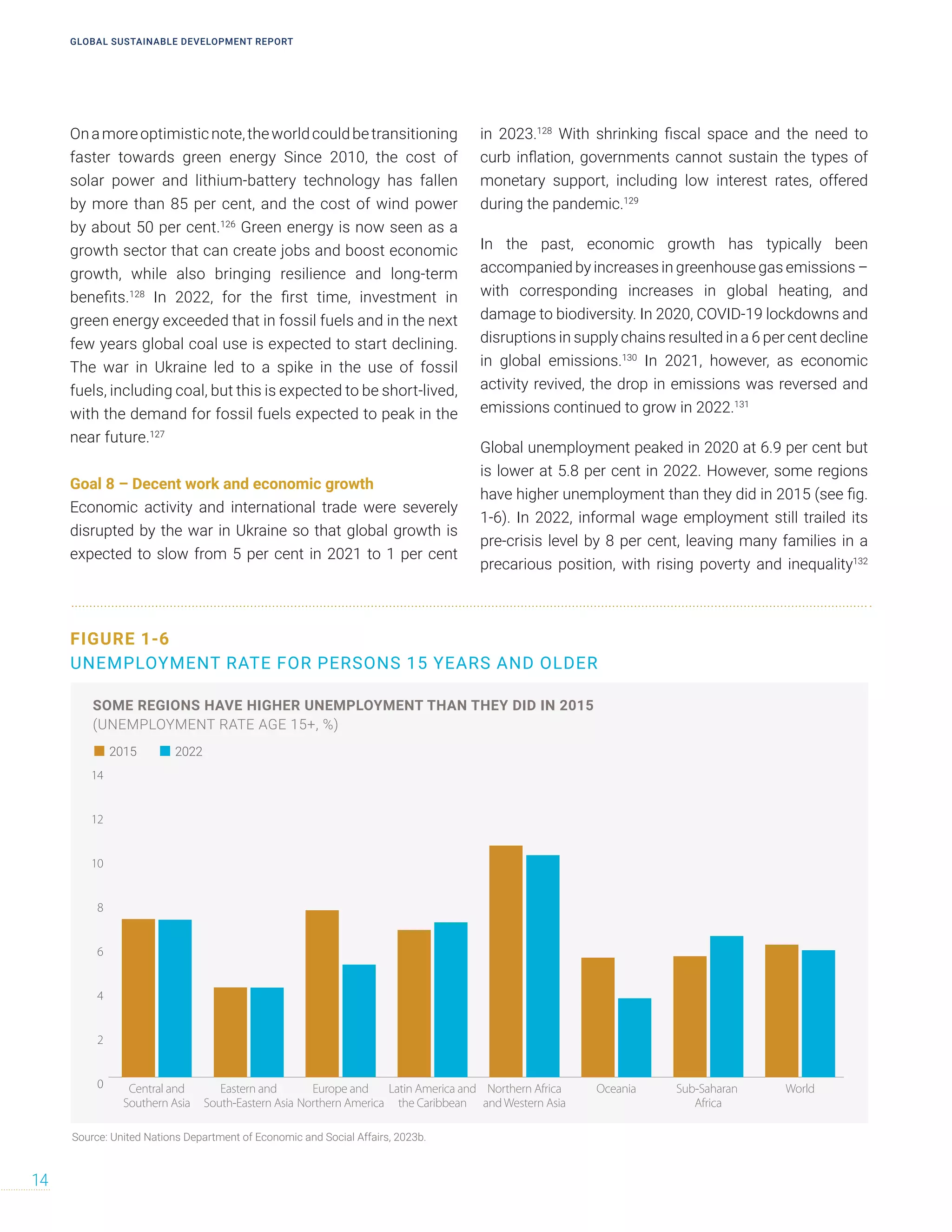
Figure 1-6: Unemployment rate for persons 15 years and older 14
Figure 2-1: Drivers of global declines in biodiversity 25
Figure 2-2: Projected world population by geographic region 26
Figure 2-3: Global income inequality, ratio of top 10 per cent to bottom 27
50 per cent, 1820-2020
Figure 2-4: Average annual rate of growth in wealth, 1995-2021 28
Figure 2-5: Googling “SDGs” over time, 2015-2023 29
Figure 2-6: Integration of the Sustainable Development Goals into key policy 30
processes, G20 and other countries
Figure 2-7: Number of partnerships registered by Sustainable Development Goal 31
Figure 2-8: Interlinkages between the Sustainable Development Goals create 34
synergies and trade-offs
Figure 2-9: Regional scores for the Sustainable Development Goal index 37
and the international spillover index, 2021
Figure 3-1: Progress towards the Sustainable Development Goals: the middle-of-the- 41
road pathway versus the high-ambition sustainable development pathway
Figure 3-2: Projected impact of COVID-19 on global progress towards Sustainable 42
Development Goal targets
Figure 3-3: Impact of COVID-19 on projections for people in poverty 43
Figure 3-4: Progress toward Sustainable Development Goal targets by 2030 44
assuming a global “SDG push” compared with a high-damage
COVID-19 scenario
Figure 3-5: Entry points and levers for transformation 45
GLOBAL SUSTAINABLE DEVELOPMENT REPORT
VIII
Figure 3-6: Human well-being and capabilities: key shifts, interventions 49
and impediments from the global scenario literature
Figure 3-7: Sustainable and just economies: key shifts, interventions 51
and impediments from the global scenario literature
Figure 3-8: Food systems and nutrition patterns: key shifts, interventions 53
and impediments from the global scenario literature
Figure 3-9: Energy decarbonization and universal access: key shifts, interventions 55
and impediments from the global scenario literature
Figure 3-10: Urban and peri-urban development: key shifts, interventions and 57
impediments from the global scenario literature
Figure 3-11: Global environmental commons: key shifts, interventions 59
and impediments from the global scenario literature
Figure 4.1: Three phases of transformation 65
Figure 4-2: S-curves in global vaccination coverage 66
Figure 4-3: Successful and unsuccessful transformation pathways 68
Figure 4-4: Multi-system transformations and interlinkages for the Sustainable 69
Development Goals
Figure 4-5: Financing gap for the Sustainable Development Goals 74
Figure 4-6: Rise of renewable energy, 2000-2021 76
Figure 5-1: Science production and decision-making 92
Figure 5-2: Number of academic publications including “SDG” 94
Figure 5-3: Authors of papers on climate change by continent and gender 96
Figure 5-4: Gross domestic expenditure on research and development 97
TIMES OF CRISIS, TIMES OF CHANGE: SCIENCE FOR ACCELERATING TRANSFORMATIONS TO SUSTAINABLE DEVELOPMENT
IX
BOXES
Box 1-1: Challenges of managing transboundary ocean resources 4
in an era of climate change
Box 1-2: Harnessing migration for the Sustainable Development Goals 4
Box 1-3: Attainment of the Sustainable Development Goals amid conflict: 8
the case of Yemen
Box 1-4: Poverty remains prevalent in Africa despite the forecast decline 9
Box 2-1: Synergies and trade-offs of the Sustainable Development Goals 33
linked to clean energy
Box 3-1: Scenario frameworks for global change 40
Box 3-2: Applying the entry points and levers framework in Curaçao and Germany 48
Box 4-1: The S-curves for electric vehicles 67
Box 4-2: Bouaké sustainable city project 70
Box 4-3: Tipping-points for healthy diets 71
Box 4-4: Fossil free Sweden: industry road maps identifying needed policy change 72
Box 4-5: Bridgetown initiative: making financial markets work for the Paris 73
Agreement and the Sustainable Development Goals
Box 4-6: Southern African solar thermal training and demonstration initiative 75
Box 4-7: The African youth SDGs summit 75
Box 4-8: Backyard farming in the Bahamas 76
Box 4-9: Universal social protection is boosted by crises 78
Box 4-10: Cross-ministry efforts in food systems 79
Box 4-11: Social protection enables just transitions to low-carbon economies 79
Box 4-12: Beyond GDP: measuring sustainable progress as a key accelerator 81
Box 4-13: Food security, and creating an enabling environment to finance 82
a sustainable ocean economy
Box 4-14: Artificial intelligence for the global goals 83
GLOBAL SUSTAINABLE DEVELOPMENT REPORT
X
Box 4-15: Corporations and foundations for the Sustainable Development Goals 83
Box 5-1: Indigenous and local knowledge research infrastructure 91
Box 5-2: The science-policy-society interface in Africa operates through 93
an ecosystem of institutions
Box 5-3: Research tools for the Sustainable Development Goals 95
Box 5-4: UNESCO framework for open science 99
XI
TIMES OF CRISIS, TIMES OF CHANGE: SCIENCE FOR ACCELERATING TRANSFORMATIONS TO SUSTAINABLE DEVELOPMENT
Foreword
GLOBAL SUSTAINABLE DEVELOPMENT REPORT
XII
GLOBAL SUSTAINABLE DEVELOPMENT REPORT
Foreword
TIMES OF CRISIS, TIMES OF CHANGE: SCIENCE FOR ACCELERATING TRANSFORMATIONS TO SUSTAINABLE DEVELOPMENT
XIII
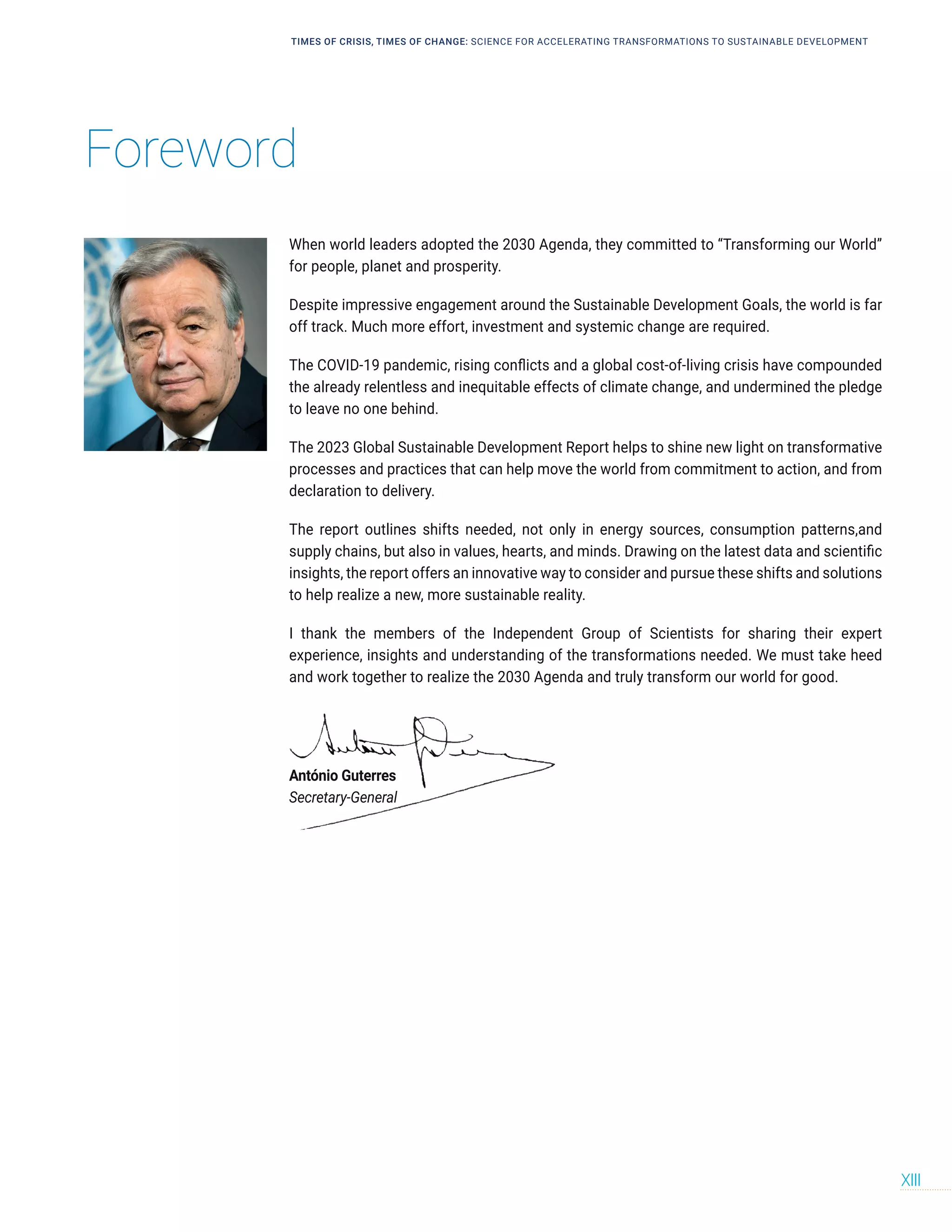
When world leaders adopted the 2030 Agenda, they committed to “Transforming our World”
for people, planet and prosperity.
Despite impressive engagement around the Sustainable Development Goals, the world is far
off track. Much more effort, investment and systemic change are required.
The COVID-19 pandemic, rising conflicts and a global cost-of-living crisis have compounded
the already relentless and inequitable effects of climate change, and undermined the pledge
to leave no one behind.
The 2023 Global Sustainable Development Report helps to shine new light on transformative
processes and practices that can help move the world from commitment to action, and from
declaration to delivery.
The report outlines shifts needed, not only in energy sources, consumption patterns,and
supply chains, but also in values, hearts, and minds. Drawing on the latest data and scientific
insights, the report offers an innovative way to consider and pursue these shifts and solutions
to help realize a new, more sustainable reality.
I thank the members of the Independent Group of Scientists for sharing their expert
experience, insights and understanding of the transformations needed. We must take heed
and work together to realize the 2030 Agenda and truly transform our world for good.
António Guterres
Secretary-General
Preface
GLOBAL SUSTAINABLE DEVELOPMENT REPORT
XIV
Preface
TIMES OF CRISIS, TIMES OF CHANGE: SCIENCE FOR ACCELERATING TRANSFORMATIONS TO SUSTAINABLE DEVELOPMENT
XV
The past three years have found the world bouncing from crisis to crisis, caught in an
increasingly challenging socioeconomic environment. While some of these crises could not
be avoided, others have been driven by our choice of path, or by a failure to act with urgency
to deliver on commitments made.
During the summer of 2023, the world experienced the highest temperatures ever recorded.
Extreme heat, wildfires, floods, and storms are impacting lives across the globe and the
world’s poorest and most vulnerable people have been the hardest hit.
Pandemic shutdowns revealed the fault lines in social protection and service delivery
across all countries, deepening existing divides and thrusting the vulnerable even
further behind. Livelihoods were overturned and well-being was compromised. While
there has been some recovery, it has been fragile and uneven. And the cascading
cost-of-living crisis driven by subsequent conflict and geopolitical divides has widened
the fissures.
We can have a better world and a better future. But only if we double down on efforts to achieve
the Sustainable Development Goals. By making the transformative changes enshrined in the
2030 Agenda we can weather the global shocks, build resilience, and emerge stronger.
This is no time to panic or lose hope. Instead, it is time to act, collectively, with a long-term
vision and focus.
The 2023 Global Sustainable Development Report highlights the significant contribution
of science, and evidence-based actions, to counter uncertainty and address global
challenges – the eradication of poverty, ending hunger, tackling climate change, reversing
biodiversity loss and reducing inequality, among others. It underscores that, together, we
have the knowledge to steer change toward a better future. Science that is multidisciplinary,
equitably and inclusively produced, openly shared, widely trusted and embraced, and
socially robust and relevant to society, provides the foundation for the transformations the
world needs.
As we enter into the second half of the journey towards the SDGs, world leaders are
reexamining their commitments and reimagining the possibilities. The 2023 Global
Sustainable Development Report serves as a reminder that the scientific community are key
allies in this collective responsibility.
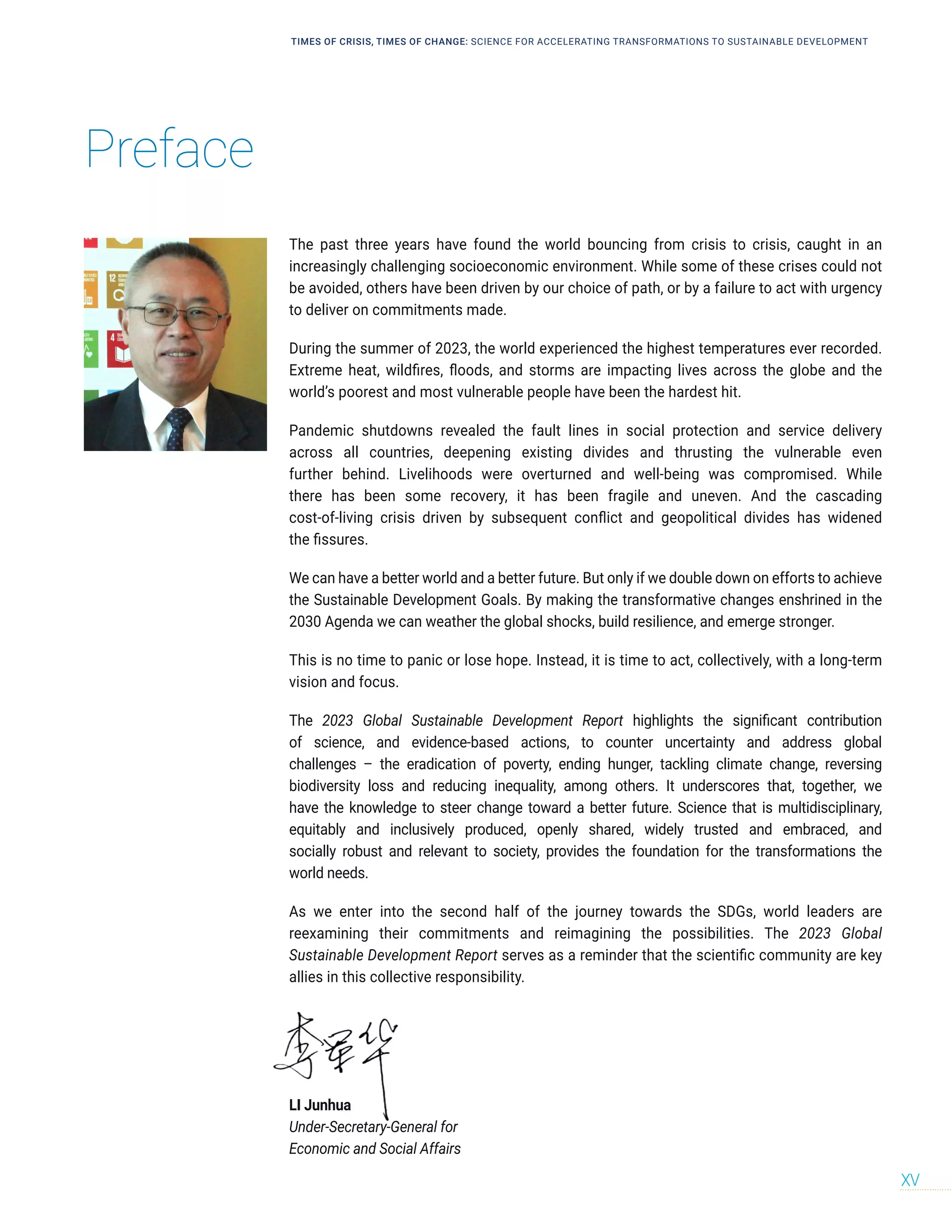
LI Junhua
Under-Secretary-General for
Economic and Social Affairs
Executive
summary
GLOBAL SUSTAINABLE DEVELOPMENT REPORT
XVI
TIMES OF CRISIS, TIMES OF CHANGE: SCIENCE FOR ACCELERATING TRANSFORMATIONS TO SUSTAINABLE DEVELOPMENT
XVII
INTRODUCTION
Transformations are possible, and inevitable. This
report is an invitation to embrace transformations with
the urgency needed to accelerate progress toward the
Sustainable Development Goals. Four years have passed
since the 2019 Global Sustainable Development Report
was published and even then, the world was not on track
to achieving the Sustainable Development Goals. Since
2019, challenges have multiplied and intensified. The
world has moved forward on some fronts, such as the
deployment of zero-carbon technologies as one of many
climate mitigation strategies. Progress has been halted
in many areas, partly as a consequence of a confluence
of crises – the ongoing pandemic, rising inflation and
the cost-of-living crisis, and planetary, environmental
and economic distress, along with regional and national
unrest, conflicts, and natural disasters. As a result,
overall progress towards the 2030 Agenda and the Goals
has been severely disrupted in the last three years, yet
every inch of progress matters and counts.
Strive not for one, but for all securities. The resilience
and well-being of planet, people, environment and
ecosystems are degraded. A better future does not rest
on one source of security, but on all necessary securities,
including geopolitical, energy, climate, water, food and
social security. Strategies to embrace transformations,
therefore, should be based on the principles of solidarity,
equity and well-being, in harmony with nature.
Working as a human collective, time and resources must
be used as judiciously and effectively as possible. The
world is changing at an accelerated rate. Halfway to 2030,
there is an ever-greater urgency to build momentum,
embracesolidarity,andspeedupprogressontheSDGs.To
do that, decision-makers need to use time and resources
—human, knowledge, financial, and institutional, among
others— as judiciously and effectively as possible, and
take a systematic and strategic approach to drive and
accelerate transformations.
EMBRACING TRANSFORMATIONS
TO ACHIEVE THE SUSTAINABLE
DEVELOPMENT GOALS
This report provides a synthesis of the key transformative
shifts needed across different entry points (human
well-being and capabilities, sustainable and just
economies, food systems and healthy nutrition, energy
decarbonization with universal access, urban and
peri-urban development, and global environmental
commons), as well as a framework for understanding
how those transformations may unfold over time.
It also presents practical examples and tools for
fostering leadership and enhancing human capacities
to engage with the acceleration mindset required to
achieve the SDGs – locally, nationally and globally. The
report synthesizes existing knowledge to cover three
overarching themes.
First, it highlights key transformations needed in
different sectors and provides examples of interventions
from the literature that has modelled different
scenarios for progress towards the Sustainable
Development Goals. It then provides a stylized model
to help unpack and understand the transformation
process over time and outline the roles of different
levers in facilitating various stages of transformation
through a systematic and structured approach. As
history has shown, transformations are inevitable, and
this report emphasizes that deliberate and desirable
transformations are possible – and indeed, necessary.
Second, through a series of examples, the 2023
Global Sustainable Development Report illustrates how
transformations were facilitated in the past and are
in recent times. This knowledge can incentivize and
support strategic decision-making by different societal
actors, both in terms of better conceptualizing and
framing the desired transformations in their context and
in the use of levers to enact transformations. The nature
Executive summary
GLOBAL SUSTAINABLE DEVELOPMENT REPORT
XVIII
and process of transformations towards the Goals will
vary from context to context. Each context requires
a critical appraisal, based on evidence of the most
strategic approach to transformation in that setting. This
must be implemented with a system of oversight and
feedback loops to continually monitor implementation
and progress, learn from experience, and make changes
as needed. This report is not prescriptive but rather
provides an illustrative framework that can underpin
strategic actions for accelerating transformation.
Finally, the report outlines how the knowledge enterprise
has to evolve to best serve transformation processes.
This will be achieved by both generating knowledge
from a broader spectrum of society and connecting
that knowledge to decision-making in a more robust
and inclusive manner. With all this, the Report is a tool
that can be used to tap the potential of key strategic
transformations for multiple Goals, acknowledging their
interlinkages.
The 2023 Global Sustainable Development Report has
six chapters. In chapter 1, the question “Where are
we now?” is raised and, reflecting on where the world
is at the halfway point to 2030, it highlights the need
for resilience and acceleration. Chapter 2 raises the
question “Where are we heading?” and frames the future,
from urgency to agency, reviewing new knowledge for
understanding the interlinkages between the Sustainable
Development Goals and international spillovers of
the Goals. Chapter 3 focuses on the question “What
needs to be done?”, reviewing scenario projections
for the Goals alongside key shifts and interventions to
accelerate transformations through the six entry points
introduced in the 2019 Global Sustainable Development
Report. Chapter 4 considers the question “How can it
be done?” with a framework that can guide strategic
action. It unpacks the dynamics in different phases of
transformations towards sustainable development, with
examples from historical and recent experience. Chapter
5 is about the unifying role of science, the importance
of knowledge from a broader spectrum of society, both
in the production of socially robust science, and in
connecting science to policymaking. Finally, Chapter 6 is
a call for action inviting a reflection on the steps ahead, to
accelerate transformative action, improve the underlying
conditions for transformation and use science to drive
the world forward.
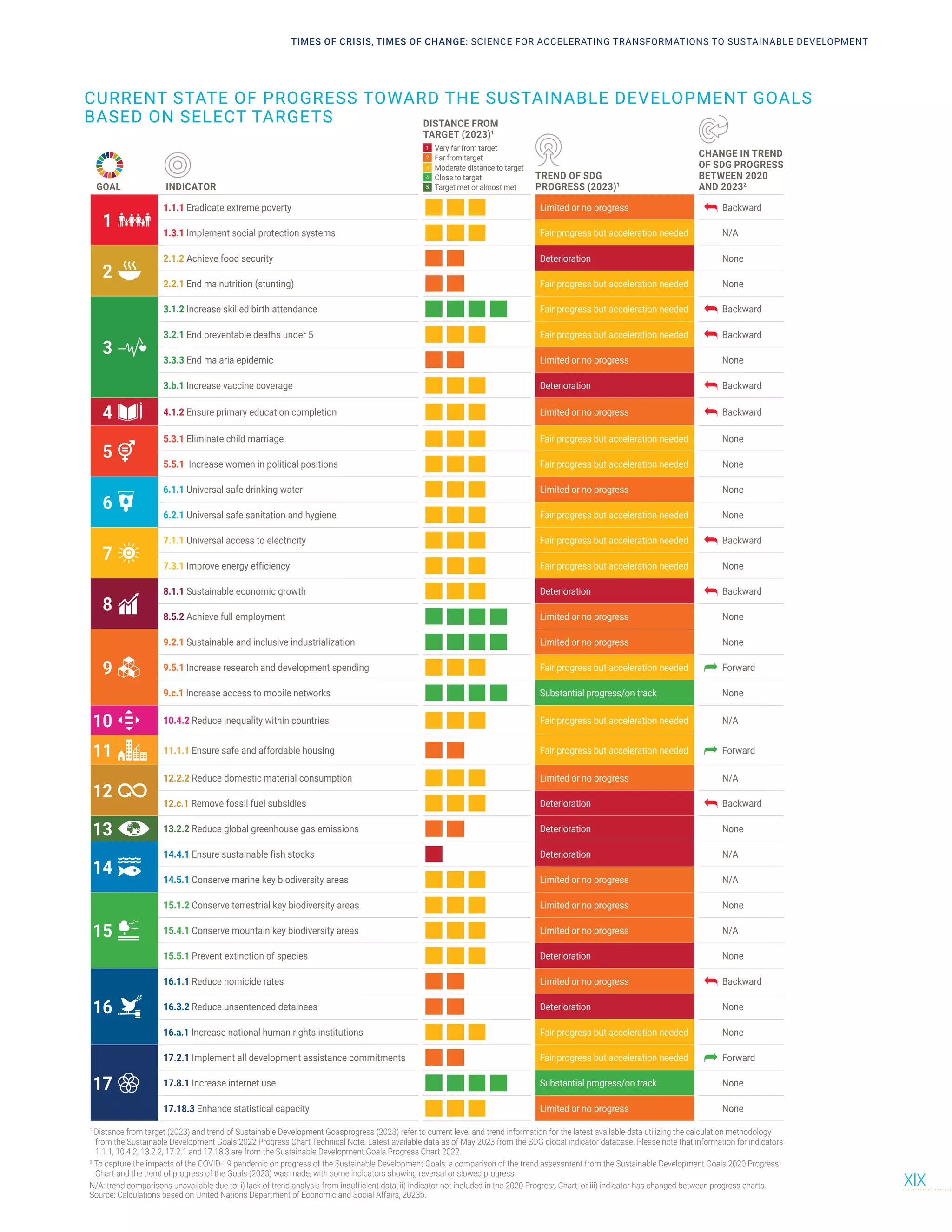
CHAPTER 1: HALFWAY TO 2030
At the halfway point of the 2030 Agenda for Sustainable
Development, the world is far off track as shown in the
figure which captures current status of the Sustainable
Development Goals. Without urgent course correction
and acceleration, humanity will face prolonged periods
of crisis and uncertainty – triggered by and reinforcing
poverty, inequality, hunger, disease, conflict and disaster.
At a global level, the “Leave no one behind” principle is at
significant risk.
In 2019, the previous Global Sustainable Development
Report found that for some targets the global community
was on track, but for many others the world would need
to quicken the pace.
In 2023, the situation is much more worrisome owing
to slow implementation and a confluence of crises. For
Goals in which progress was too slow in 2019, countries
have not accelerated enough, and for others, including
food security, climate action and protecting biodiversity,
the world is still moving in the wrong direction. In
addition, recent crises including the COVID-19 pandemic,
cost-of-living increases, armed conflict and natural
disasters have wiped out years of progress on some
Goals including eradication of extreme poverty. Progress
has slowed down on targets including ending preventable
deaths of children under 5, vaccine coverage and access
to energy.
These crises are not independent events; they are
intertwined through multiple environmental, economic
and social strands, each fuelling the other’s intensities.
Addressing interconnections was a starting point for
elaborating the 2030 Agenda. This Report shows how
these interconnections offer opportunities to act in an
integrated way to release positive synergies and achieve
the Sustainable Development Goals.
CURRENT STATE OF PROGRESS TOWARD THE SUSTAINABLE DEVELOPMENT GOALS
BASED ON SELECT TARGETS
TIMES OF CRISIS, TIMES OF CHANGE: SCIENCE FOR ACCELERATING TRANSFORMATIONS TO SUSTAINABLE DEVELOPMENT
XIX
GOAL INDICATOR
DISTANCE FROM
TARGET (2023)1
1 Very far from target
2 Far from target
3 Moderate distance to target
4 Close to target
5 Target met or almost met
TREND OF SDG
PROGRESS (2023)1
CHANGE IN TREND
OF SDG PROGRESS
BETWEEN 2020
AND 20232
1
1.1.1 Eradicate extreme poverty Limited or no progress Backward
1.3.1 Implement social protection systems Fair progress but acceleration needed N/A
2
2.1.2 Achieve food security Deterioration None
2.2.1 End malnutrition (stunting) Fair progress but acceleration needed None
3
3.1.2 Increase skilled birth attendance Fair progress but acceleration needed Backward
3.2.1 End preventable deaths under 5 Fair progress but acceleration needed Backward
3.3.3 End malaria epidemic Limited or no progress None
3.b.1 Increase vaccine coverage Deterioration Backward
4 4.1.2 Ensure primary education completion Limited or no progress Backward
5
5.3.1 Eliminate child marriage Fair progress but acceleration needed None
5.5.1 Increase women in political positions Fair progress but acceleration needed None
6
6.1.1 Universal safe drinking water Limited or no progress None
6.2.1 Universal safe sanitation and hygiene Fair progress but acceleration needed None
7
7.1.1 Universal access to electricity Fair progress but acceleration needed Backward
7.3.1 Improve energy efficiency Fair progress but acceleration needed None
8
8.1.1 Sustainable economic growth Deterioration Backward
8.5.2 Achieve full employment Limited or no progress None
9
9.2.1 Sustainable and inclusive industrialization Limited or no progress None
9.5.1 Increase research and development spending Fair progress but acceleration needed Forward
9.c.1 Increase access to mobile networks Substantial progress/on track None
10 10.4.2 Reduce inequality within countries Fair progress but acceleration needed N/A
11 11.1.1 Ensure safe and affordable housing Fair progress but acceleration needed Forward
12
12.2.2 Reduce domestic material consumption Limited or no progress N/A
12.c.1 Remove fossil fuel subsidies Deterioration Backward
13 13.2.2 Reduce global greenhouse gas emissions Deterioration None
14
14.4.1 Ensure sustainable fish stocks Deterioration N/A
14.5.1 Conserve marine key biodiversity areas Limited or no progress N/A
15
15.1.2 Conserve terrestrial key biodiversity areas Limited or no progress None
15.4.1 Conserve mountain key biodiversity areas Limited or no progress N/A
15.5.1 Prevent extinction of species Deterioration None
16
16.1.1 Reduce homicide rates Limited or no progress Backward
16.3.2 Reduce unsentenced detainees Deterioration None
16.a.1 Increase national human rights institutions Fair progress but acceleration needed None
17
17.2.1 Implement all development assistance commitments Fair progress but acceleration needed Forward
17.8.1 Increase internet use Substantial progress/on track None
17.18.3 Enhance statistical capacity Limited or no progress None
SNAPSHOT OF TRENDS IN SELECT TARGETS
1
Distance from target (2023) and trend of Sustainable Development Goasprogress (2023) refer to current level and trend information for the latest available data utilizing the calculation methodology
from the Sustainable Development Goals 2022 Progress Chart Technical Note. Latest available data as of May 2023 from the SDG global indicator database. Please note that information for indicators
1.1.1, 10.4.2, 13.2.2, 17.2.1 and 17.18.3 are from the Sustainable Development Goals Progress Chart 2022.
2
To capture the impacts of the COVID-19 pandemic on progress of the Sustainable Development Goals, a comparison of the trend assessment from the Sustainable Development Goals 2020 Progress
Chart and the trend of progress of the Goals (2023) was made, with some indicators showing reversal or slowed progress.
N/A: trend comparisons unavailable due to: i) lack of trend analysis from insufficient data; ii) indicator not included in the 2020 Progress Chart; or iii) indicator has changed between progress charts.
Source: Calculations based on United Nations Department of Economic and Social Affairs, 2023b.
GLOBAL SUSTAINABLE DEVELOPMENT REPORT
XX
The lingering drag of the COVID-19 pandemic
The COVID-19 pandemic is still having a profound impact
on progress toward the Goals. Beyond costing more
than 15 million lives globally, it has slowed, disrupted
or temporarily reversed progress across the Goals. The
pandemic resulted in losses of jobs, livelihoods, incomes
and remittances. In 2022, the total hours worked globally
remained 2 per cent below the pre-pandemic level.
The pandemic also exacerbated existing fault lines
of inequality. Some schooling went online, which was
useful to many children but of no help to families without
broadband Internet. Lockdowns did the greatest damage
to small and medium-sized enterprises and the many
women and temporary workers they employed.
Recovery from the pandemic has been uneven
and incomplete. Quickest to bounce back were the
high-income countries, which delivered more effective
relief and had higher rates of vaccination. In 2021, the
top 20 per cent in terms of global income distribution had
recovered about half their lost income, but the bottom
40 per cent had not done so.
Conflict, war and instability
Compounding the effects of the pandemic is the highest
level of State-based armed conflict since 1945. By
the end of 2020, around two billion people were living
in conflict-affected countries. In 2021, the number of
refugees and internally displaced persons was the
highest on record at 89 million, and, for the first time,
global military expenditure exceeded $2 trillion.
The war in Ukraine is causing immense suffering and
loss of life and triggering large movements of people
– while wreaking havoc in many parts of the global
economy and driving up inflation, with huge spikes in the
price of food and energy. Besides the large number of
military casualties, as of January 2023 approximately
7,000 civilians have been killed and more than 11,000
injured. There are more than 8.1 million refugees, most
of them women and children as well as 5.3 million people
internally displaced in Ukraine.
Conflict and unrest are barriers to progress towards
the Sustainable Development Goals in many countries
beyond the war in Ukraine, including in Afghanistan,
Ethiopia, Venezuela and the Sahel region of Africa among
others. Between March and May 2022, approximately
26.5 million people in the Sahel region faced a food and
nutrition crisis.
Inflation and the rising cost of living
Between June and September 2022, around 89 per
cent of the least developed countries, 93 per cent of
landlocked developing countries and 94 per cent of small
island developing States had food inflation above 5 per
cent. Worst affected were the poor who often responded
by skipping meals or purchasing less nutritious food –
short-term solutions that imperil family health and
damage the future prospects of children. Many countries
face debt levels at a 50-year high, constraining options
for investing in social protection that can help people
cope with rising costs.
CHAPTER 2: FRAMING THE FUTURE
The world is far off track on achieving the Sustainable
Development Goals at the halfway point on the 2030
Agenda. But it is possible to actively improve future
prospects for action and progress by 2030 and
beyond. Leveraging scientific knowledge, strengthening
governance for the Goals and unleashing the full potential
of the Sustainable Development Goals framework for
promoting sustainable development can make this
happen. SDG interlinkages, and international spillovers
and dependencies must be systematically considered.
Uptake and governance using the Goals has advanced
in the last four years across sectors and levels of
government, despite urgent crises, which indicates the
robustness and broad acceptance of the framework.
Yet, aspirations and commitments are not yet translating
into institutional change, action and implementation
at a scale visible in progress towards the Sustainable
Development Goals.
While many circumstances are making it more difficult
to attain the Goals, in some respects, the prospects
have improved. There is now a wealth of knowledge
and evidence related to the Goals. More people and
organizations have learned about the Goals and are thus
in a better position to put pressure on both governments
and companies to operate more sustainably.
A survey of 60 countries showed that by 2021, 75
per cent of governments had developed strategies
and action plans related to the Goals. Many local
governments have stepped up their efforts, by
developing voluntary local reviews or other strategies.
International organizations and institutions have widely
adopted the Goals and realigned their policy agendas.
The private sector is more engaged, through business
strategies aligned with the Goals, though there is the
risk of overclaiming and “SDG-washing”. Given the large
financing gaps in the Goals for developing countries,
innovative financing solutions have been developed, the
imbalance and injustice in the international financial
architecture are being called out, and there are strong
calls for its reform.
The Sustainable Development Goals framework has
enabled novel and more systemic perspectives for
decision-making on sustainable development, through
new insights and science-based tools for considering
interlinkages between the Goals. While some general
patterns of synergies and trade-offs can be observed,
the scientific literature points to the context dependence
of interlinkages. Local and national actors can therefore
gain a lot by using tools to identify positive and negative
interlinkages in their context, and by undertaking ex
ante policy impact assessments of the Goals.
The Sustainable Development Goals framework
allows for considering international dependencies
and spillovers between countries in their pursuit of
sustainable development. Creating an educated and
skilled workforce, for example, not only underpins
national development in the educating country, but
also, through temporary or permanent migration, spills
over to the destination economies and communities –
though this may be regretted by the educating country
as a brain drain. An example of a generally negative
spillover is carbon that is “embedded” in the production
of goods in one country that is subsequently exported
to another. Better understanding and quantification of
international spillovers is urgently needed to inform and
strengthen action for Goal 17.
CHAPTER 3: PATHWAYS TO
ACHIEVE THE SUSTAINABLE
DEVELOPMENT GOALS
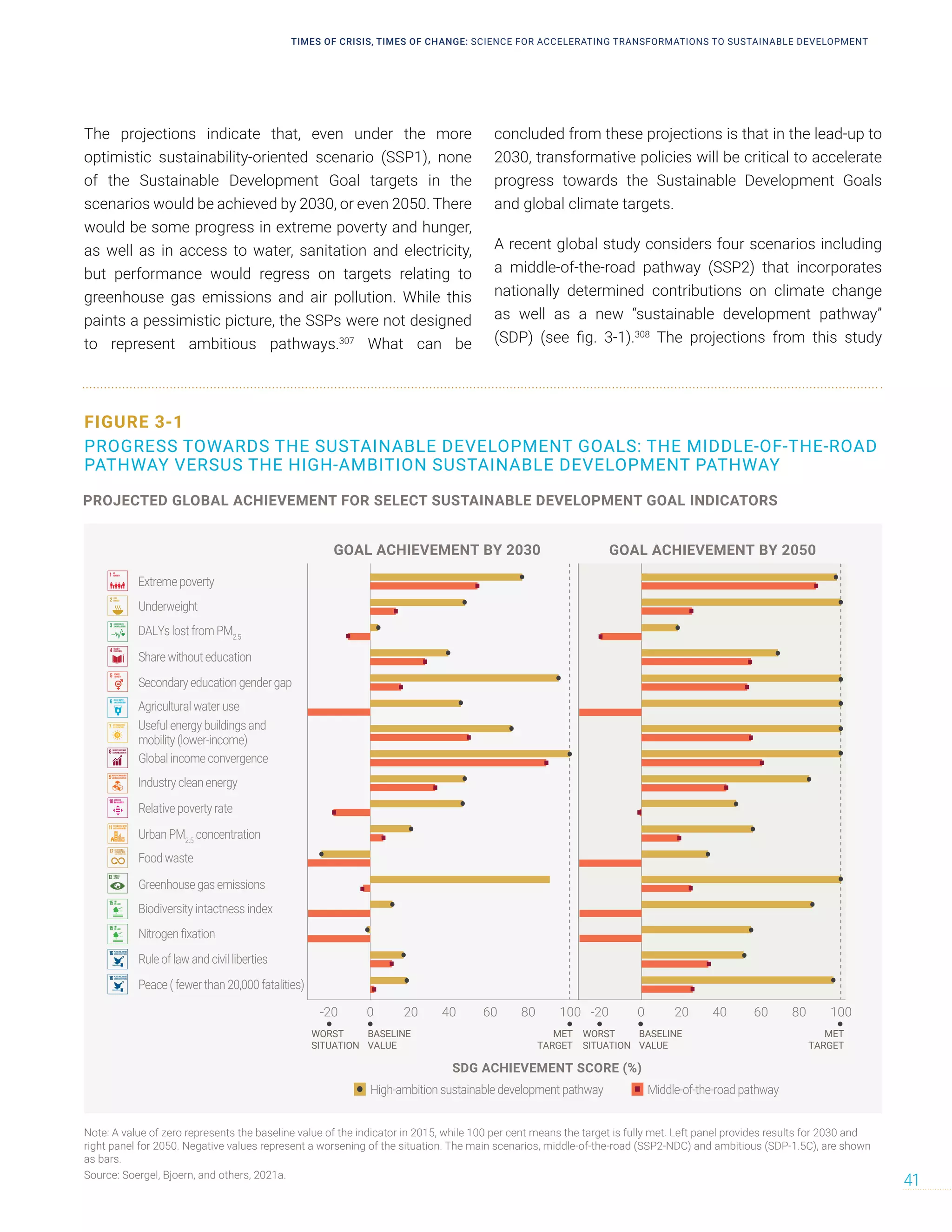
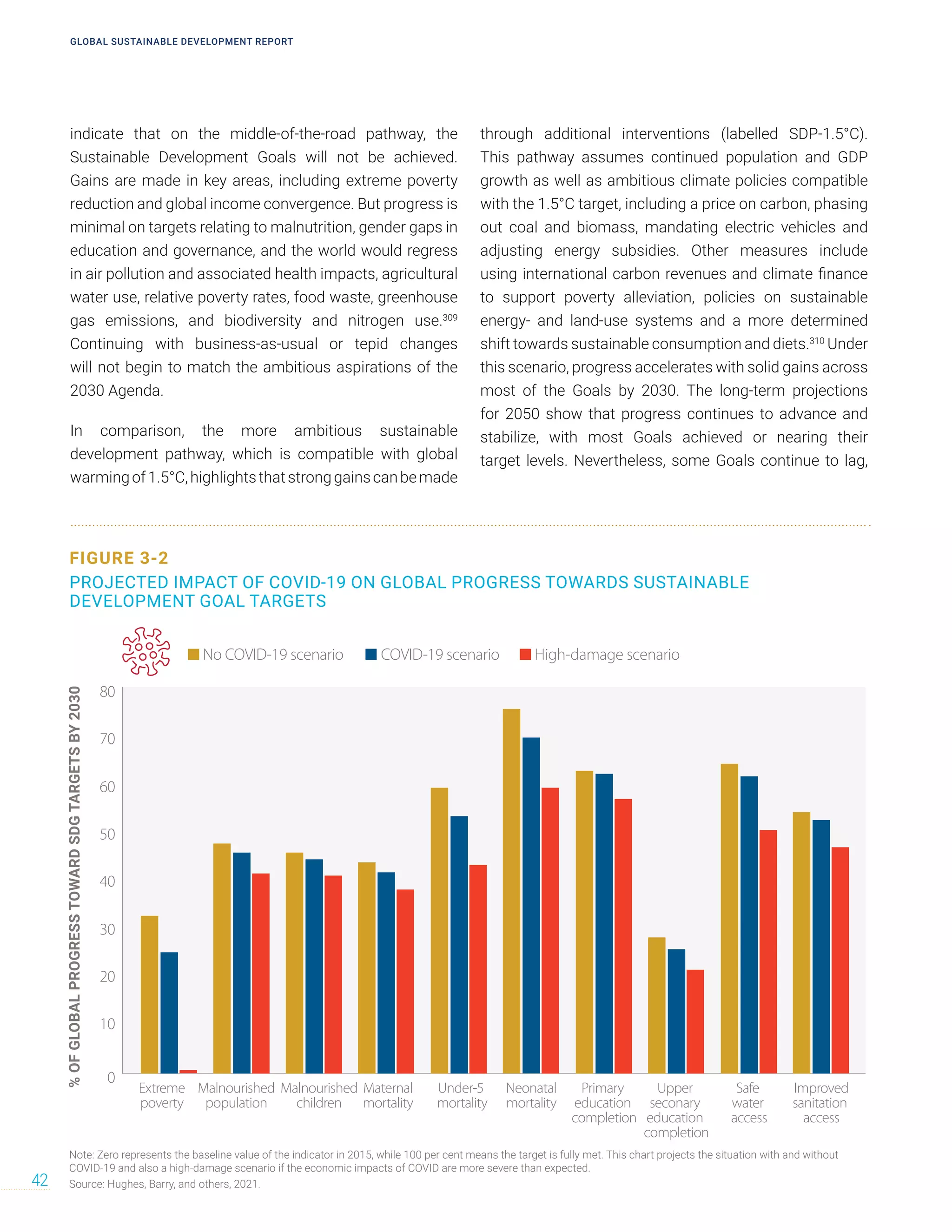
The Report reviews existing scenario projections of
progress towards the Sustainable Development Goals
along various pathways. Generally, these indicate that on
a business-as-usual pathway, the Goals will remain out
of reach by 2030, or even 2050. Gains would be made
in key areas including extreme poverty reduction and
global and national income convergence. But progress
would be minimal on targets relating to malnutrition and
governance. At the same time, the world would regress in
air pollution and associated health impacts, agricultural
water use, relative poverty rates, food waste, greenhouse
gas emissions, and biodiversity and nitrogen use.
But business need not continue as usual. More ambitious
sustainable development scenarios reveal that decisive
action can deliver strong gains on the Goals by 2030.
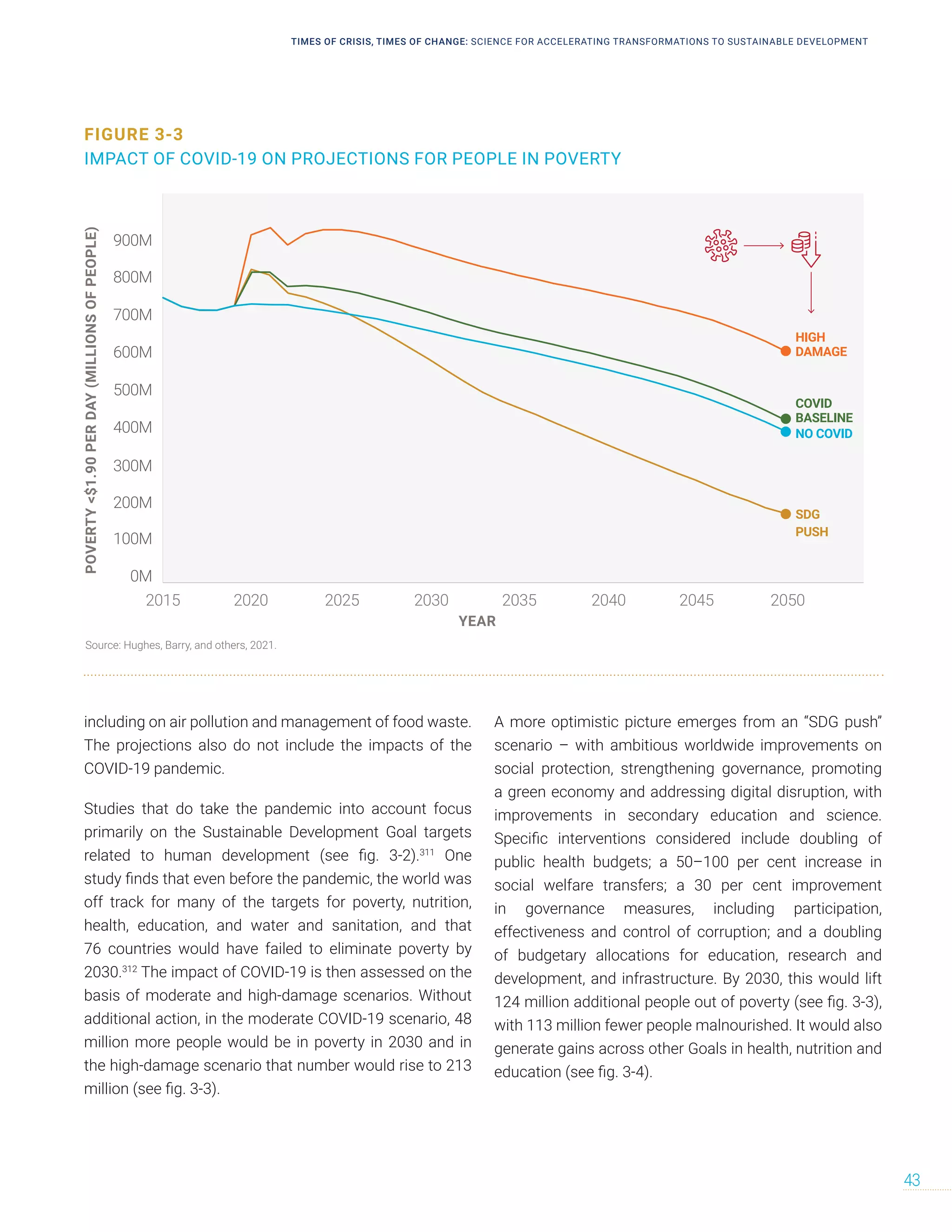
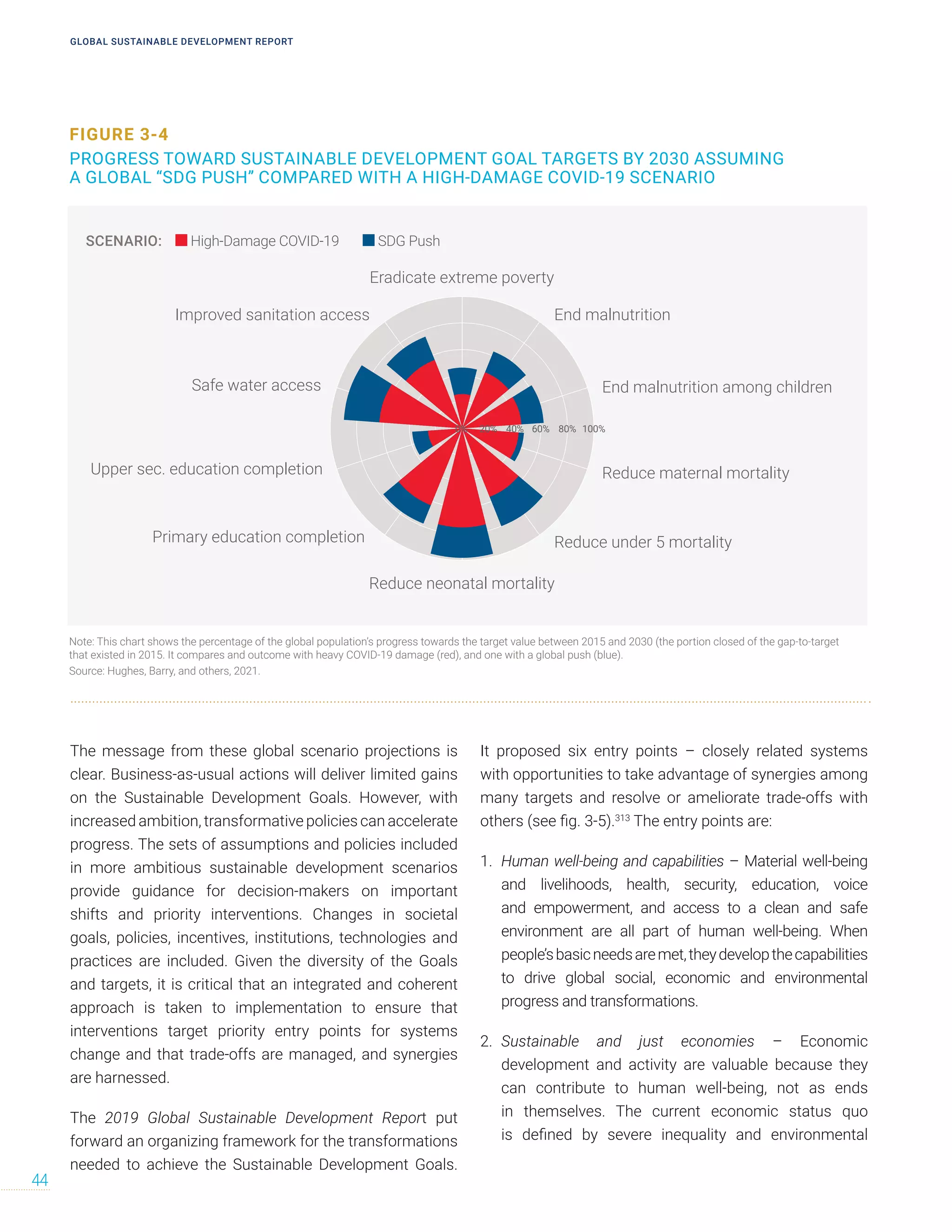
For example, an ambitious “SDG-push” scenario would
improve social protection, strengthen governance,
promote a green economy, and address digital disruption,
while improving secondary education and science. By
2030, this could lift 124 million additional people out of
poverty, with 113 million fewer people malnourished. It
would also generate gains across other Goals related to
health, nutrition and education. Nevertheless, there would
still be gaps, indicating the need for truly transformative
initiatives and game-changing interventions.
Entry points and levers for transformation
Increased ambition and transformative interventions are
needed to accelerate progress towards the Sustainable
Development Goals. Given the diversity of the Goals
and targets, an integrated and coherent approach to
implementation is needed.
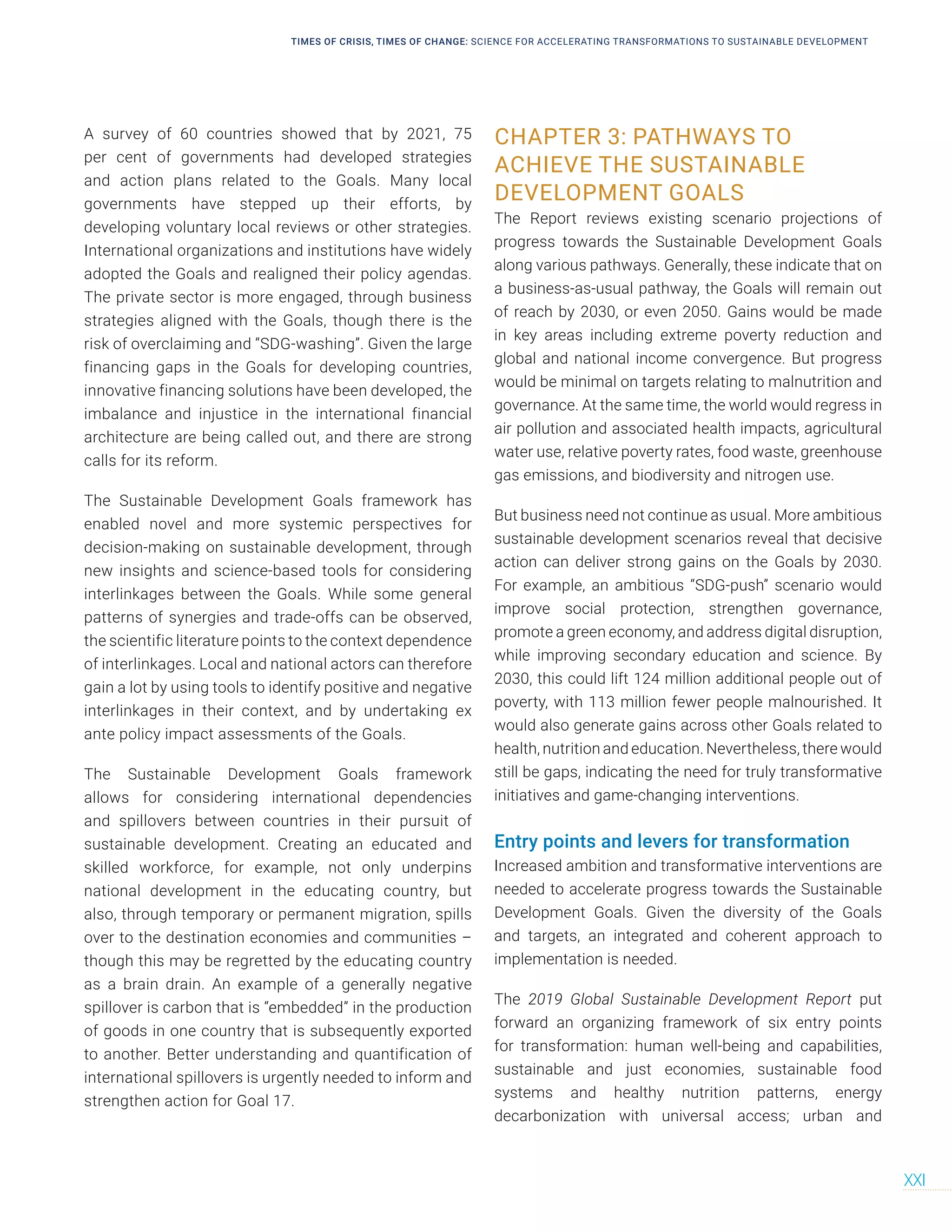
The 2019 Global Sustainable Development Report put
forward an organizing framework of six entry points
for transformation: human well-being and capabilities,
sustainable and just economies, sustainable food
systems and healthy nutrition patterns, energy
decarbonization with universal access; urban and
TIMES OF CRISIS, TIMES OF CHANGE: SCIENCE FOR ACCELERATING TRANSFORMATIONS TO SUSTAINABLE DEVELOPMENT
XXI
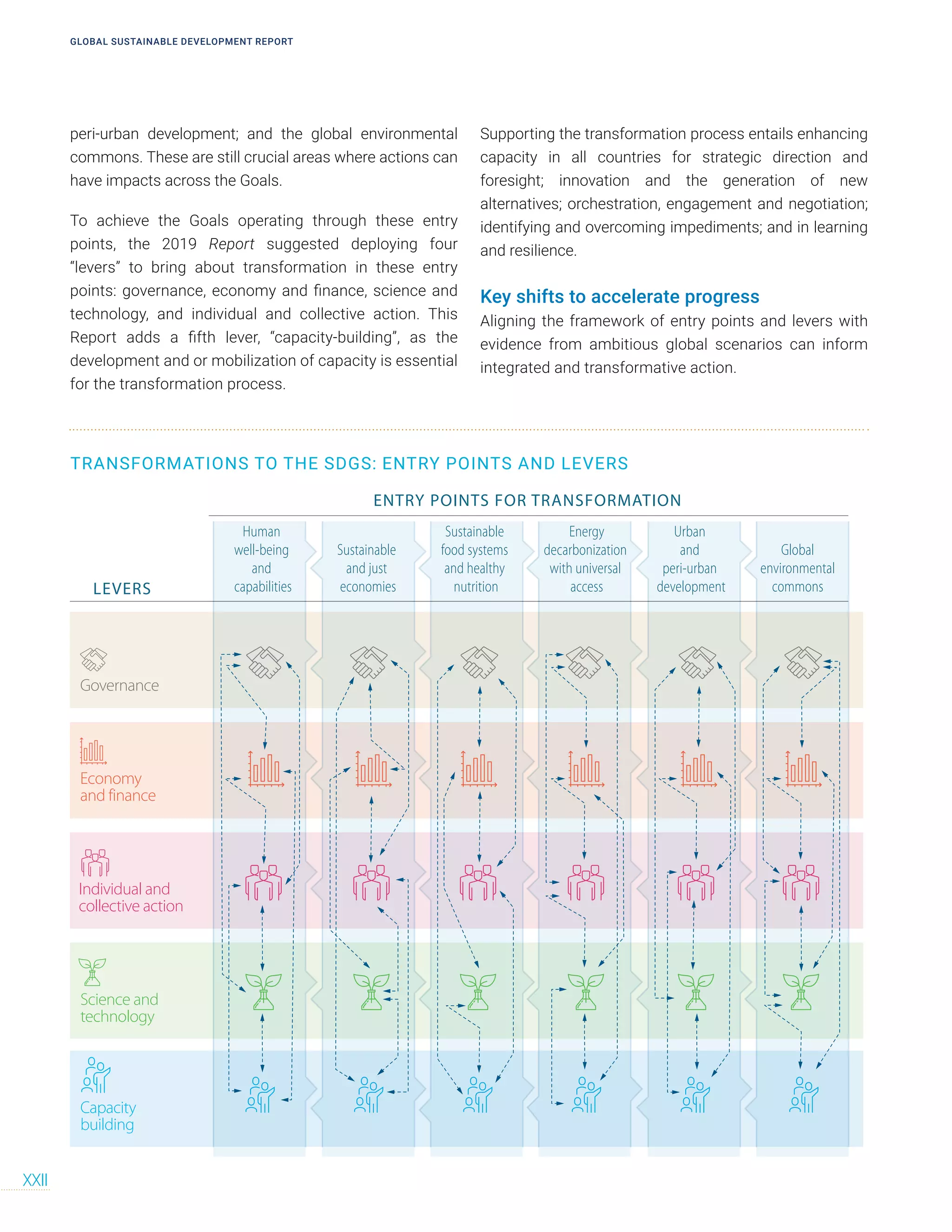
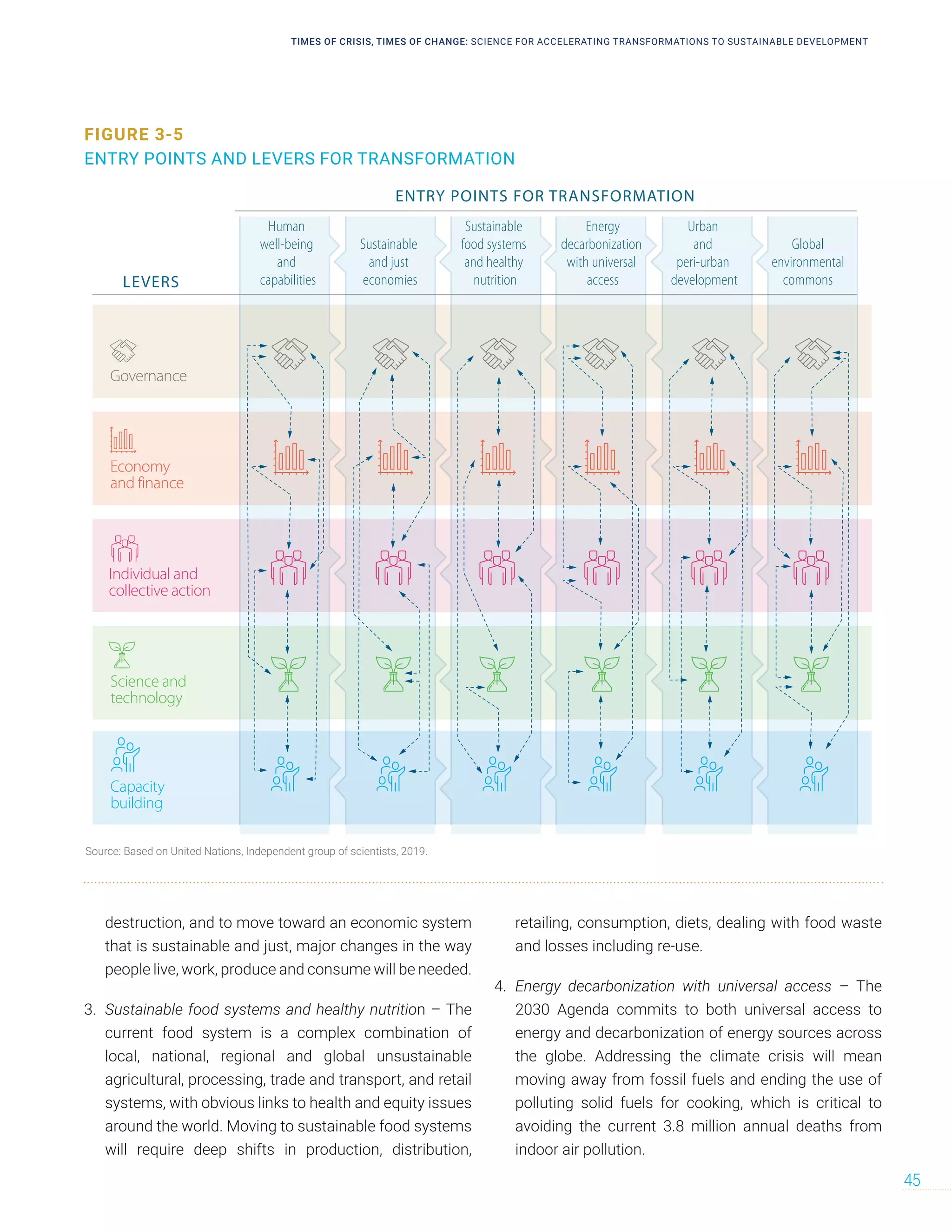
LEVERS
ENTRY POINTS FOR TRANSFORMATION
TRANSFORMATIONS TO THE SDGS: ENTRY POINTS AND LEVERS
Human
well-being
and
capabilities
Sustainable
and just
economies
Sustainable
food systems
and healthy
nutrition
Energy
decarbonization
with universal
access
Urban
and
peri-urban
development
Global
environmental
commons
Governance
Economy
and finance
Individual and
collective action
Science and
technology
Capacity
building
peri-urban development; and the global environmental
commons. These are still crucial areas where actions can
have impacts across the Goals.
To achieve the Goals operating through these entry
points, the 2019 Report suggested deploying four
“levers” to bring about transformation in these entry
points: governance, economy and finance, science and
technology, and individual and collective action. This
Report adds a fifth lever, “capacity-building”, as the
development and or mobilization of capacity is essential
for the transformation process.
Supporting the transformation process entails enhancing
capacity in all countries for strategic direction and
foresight; innovation and the generation of new
alternatives; orchestration, engagement and negotiation;
identifying and overcoming impediments; and in learning
and resilience.
Key shifts to accelerate progress
Aligning the framework of entry points and levers with
evidence from ambitious global scenarios can inform
integrated and transformative action.
TRANSFORMATIONS TO THE SDGS: ENTRY POINTS AND LEVERS
GLOBAL SUSTAINABLE DEVELOPMENT REPORT
XXII
The Report highlights important shifts needed across
each entry point to accelerate progress towards the
Sustainable Development Goals. It also provides
examples of how specific policy, finance, technology,
and behavioural changes could be combined to enable
the necessary transformations. Capacity-building to
effectively deploy these levers will also be critical.
Transformative shifts for each entry point from global
scenarios include:
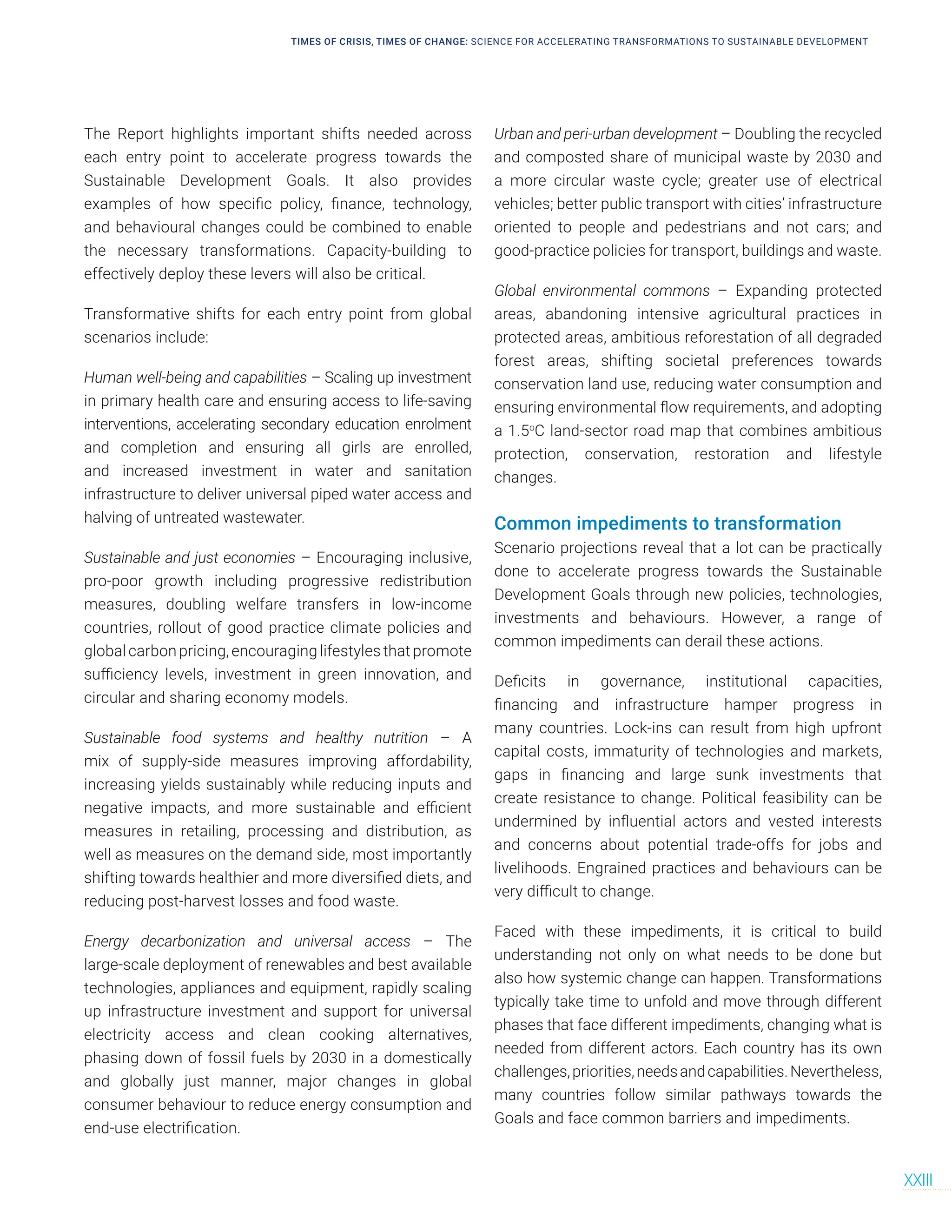
Human well-being and capabilities – Scaling up investment
in primary health care and ensuring access to life-saving
interventions, accelerating secondary education enrolment
and completion and ensuring all girls are enrolled,
and increased investment in water and sanitation
infrastructure to deliver universal piped water access and
halving of untreated wastewater.
Sustainable and just economies – Encouraging inclusive,
pro-poor growth including progressive redistribution
measures, doubling welfare transfers in low-income
countries, rollout of good practice climate policies and
global carbon pricing, encouraging lifestyles that promote
sufficiency levels, investment in green innovation, and
circular and sharing economy models.
Sustainable food systems and healthy nutrition – A
mix of supply-side measures improving affordability,
increasing yields sustainably while reducing inputs and
negative impacts, and more sustainable and efficient
measures in retailing, processing and distribution, as
well as measures on the demand side, most importantly
shifting towards healthier and more diversified diets, and
reducing post-harvest losses and food waste.
Energy decarbonization and universal access – The
large-scale deployment of renewables and best available
technologies, appliances and equipment, rapidly scaling
up infrastructure investment and support for universal
electricity access and clean cooking alternatives,
phasing down of fossil fuels by 2030 in a domestically
and globally just manner, major changes in global
consumer behaviour to reduce energy consumption and
end-use electrification.
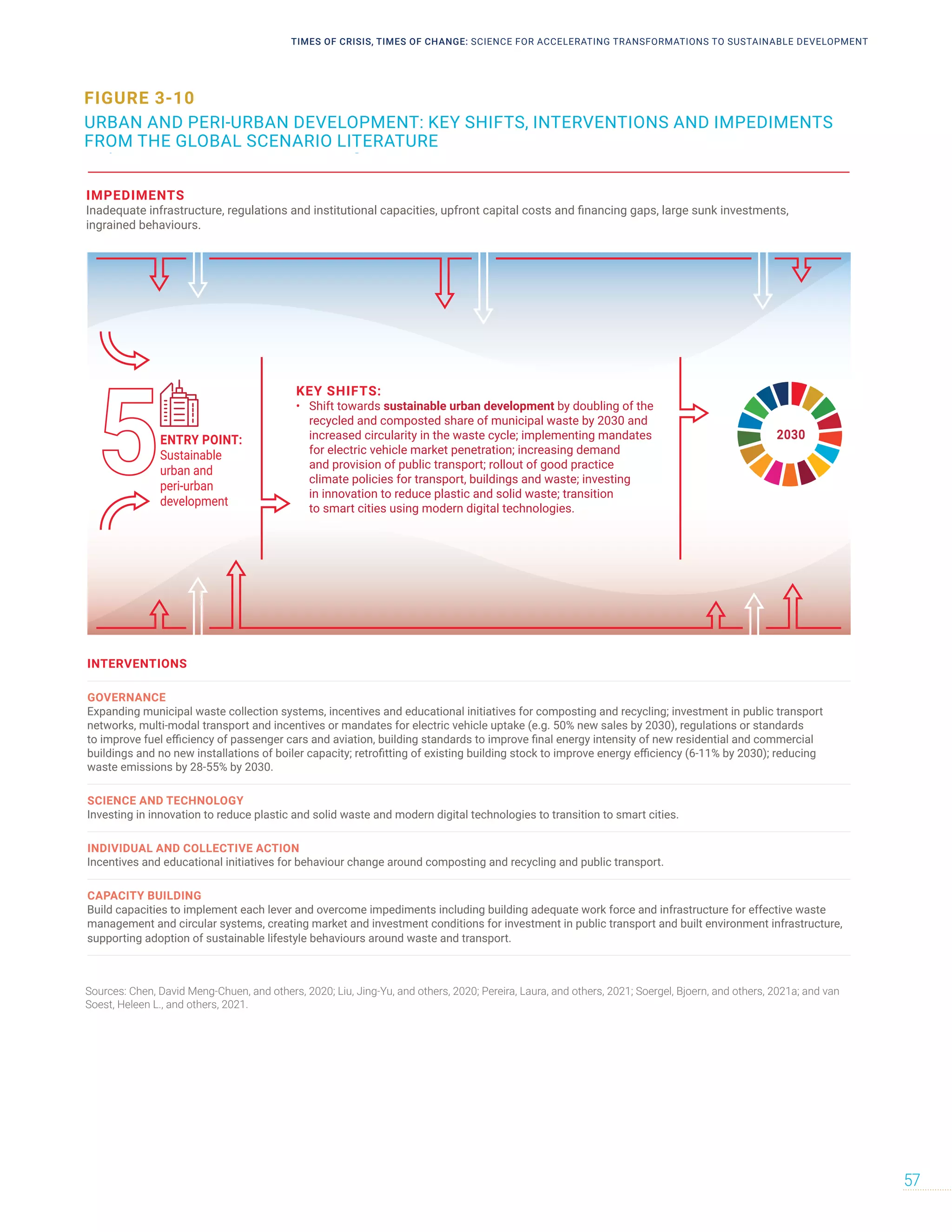
Urban and peri-urban development – Doubling the recycled
and composted share of municipal waste by 2030 and
a more circular waste cycle; greater use of electrical
vehicles; better public transport with cities’ infrastructure
oriented to people and pedestrians and not cars; and
good-practice policies for transport, buildings and waste.
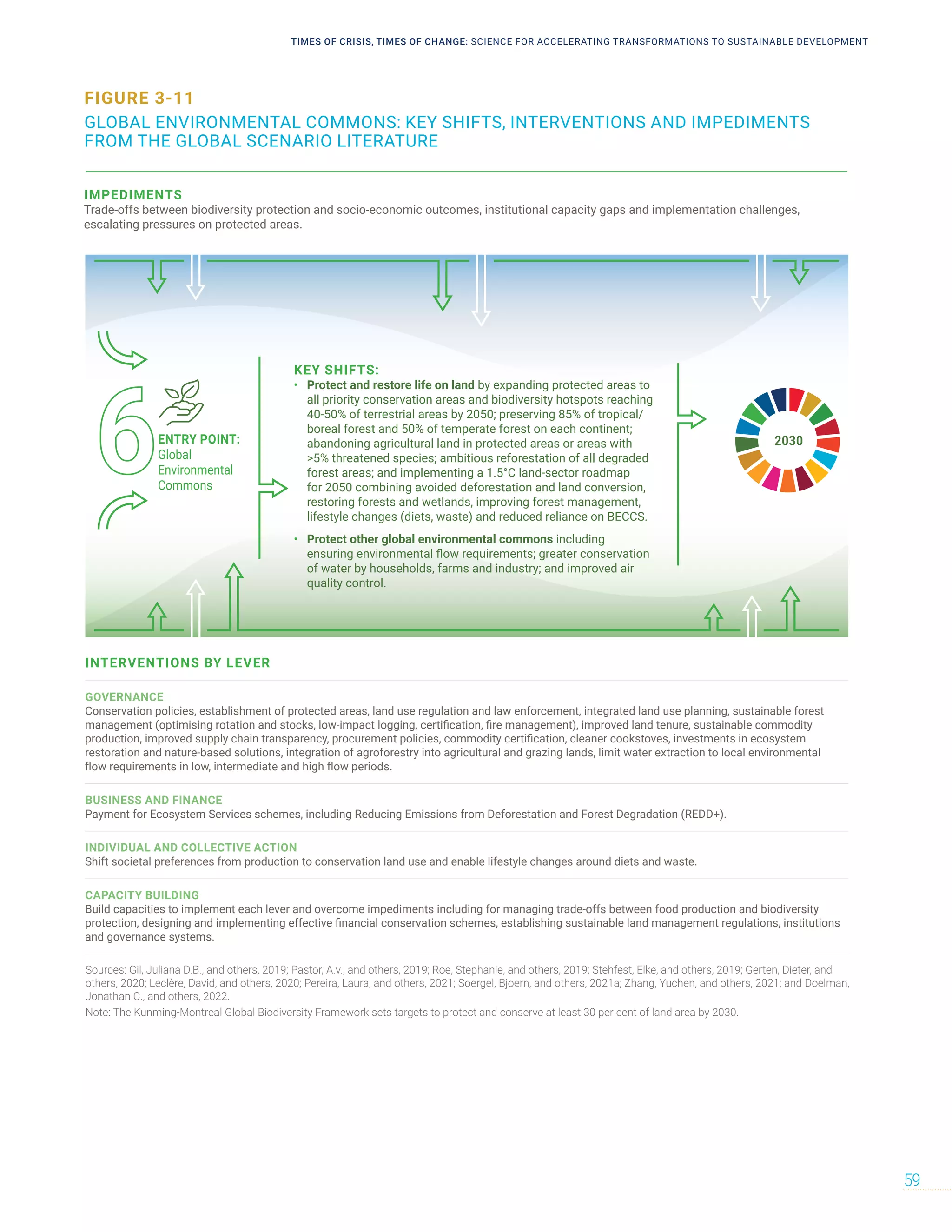
Global environmental commons – Expanding protected
areas, abandoning intensive agricultural practices in
protected areas, ambitious reforestation of all degraded
forest areas, shifting societal preferences towards
conservation land use, reducing water consumption and
ensuring environmental flow requirements, and adopting
a 1.5o
C land-sector road map that combines ambitious
protection, conservation, restoration and lifestyle
changes.
Common impediments to transformation
Scenario projections reveal that a lot can be practically
done to accelerate progress towards the Sustainable
Development Goals through new policies, technologies,
investments and behaviours. However, a range of
common impediments can derail these actions.
Deficits in governance, institutional capacities,
financing and infrastructure hamper progress in
many countries. Lock-ins can result from high upfront
capital costs, immaturity of technologies and markets,
gaps in financing and large sunk investments that
create resistance to change. Political feasibility can be
undermined by influential actors and vested interests
and concerns about potential trade-offs for jobs and
livelihoods. Engrained practices and behaviours can be
very difficult to change.
Faced with these impediments, it is critical to build
understanding not only on what needs to be done but
also how systemic change can happen. Transformations
typically take time to unfold and move through different
phases that face different impediments, changing what is
needed from different actors. Each country has its own
challenges,priorities,needsandcapabilities.Nevertheless,
many countries follow similar pathways towards the
Goals and face common barriers and impediments.
TIMES OF CRISIS, TIMES OF CHANGE: SCIENCE FOR ACCELERATING TRANSFORMATIONS TO SUSTAINABLE DEVELOPMENT
XXIII
CHAPTER 4: ACCELERATING
TRANSFORMATIONS
TO THE SUSTAINABLE
DEVELOPMENT GOALS
Transformation is inevitable, but its course, directions
and speed are not. Change can and must be
steered in positive directions by human determination.
Goals matter in this regard. Over the last 200 years,
human societies have produced many rapid and
profound transformations – in human rights, for
example, economic activity, health, technology and
living standards.
One major intervention was the Green Revolution, which
used high-yielding crops along with fertilizers and
irrigation to transform agricultural systems. However,
the Green Revolution also offers a cautionary tale. Crop
yields rose rapidly, food consumption increased and
undernutrition plummeted. But the Green Revolution
was often divisive, leaving many smallholders behind,
excluded by inequitable land distribution, poor tenancy
rights and lack of access to credit. Women farmers were
especially disadvantaged. Intensive, chemical-heavy
farming also affected soils, water, biodiversity
and nutrition. The Green Revolution illustrates the
importance of a whole-of-society approach, weighing
up positives and negatives to optimize human
well-being while safeguarding the planet.
S-curve nature of transformations
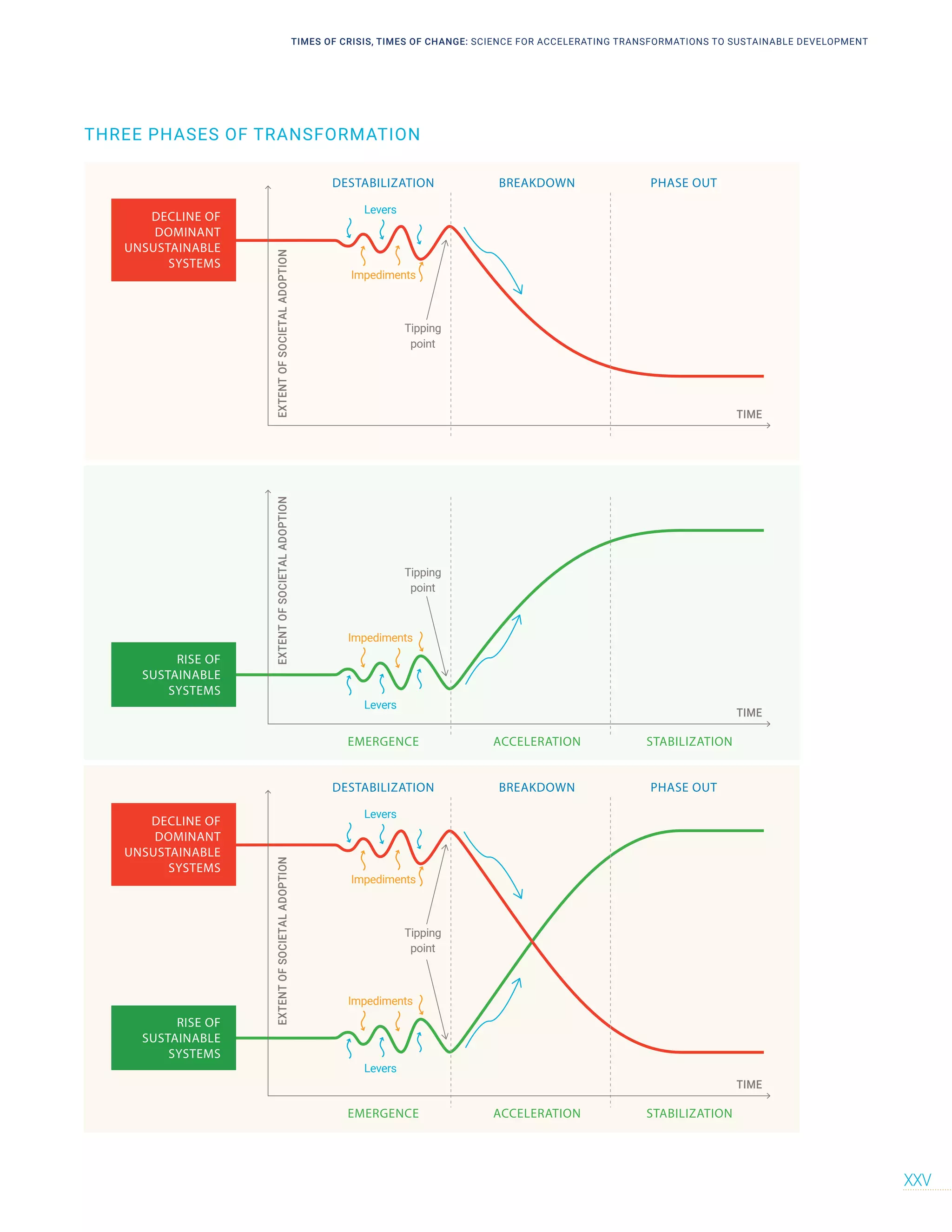
This Report provides a stylized model to help unpack
and understand the transformation process through a
systematic and structured approach, suggesting that a
successful transformation can be considered in three
phases – emergence, acceleration and stabilization –
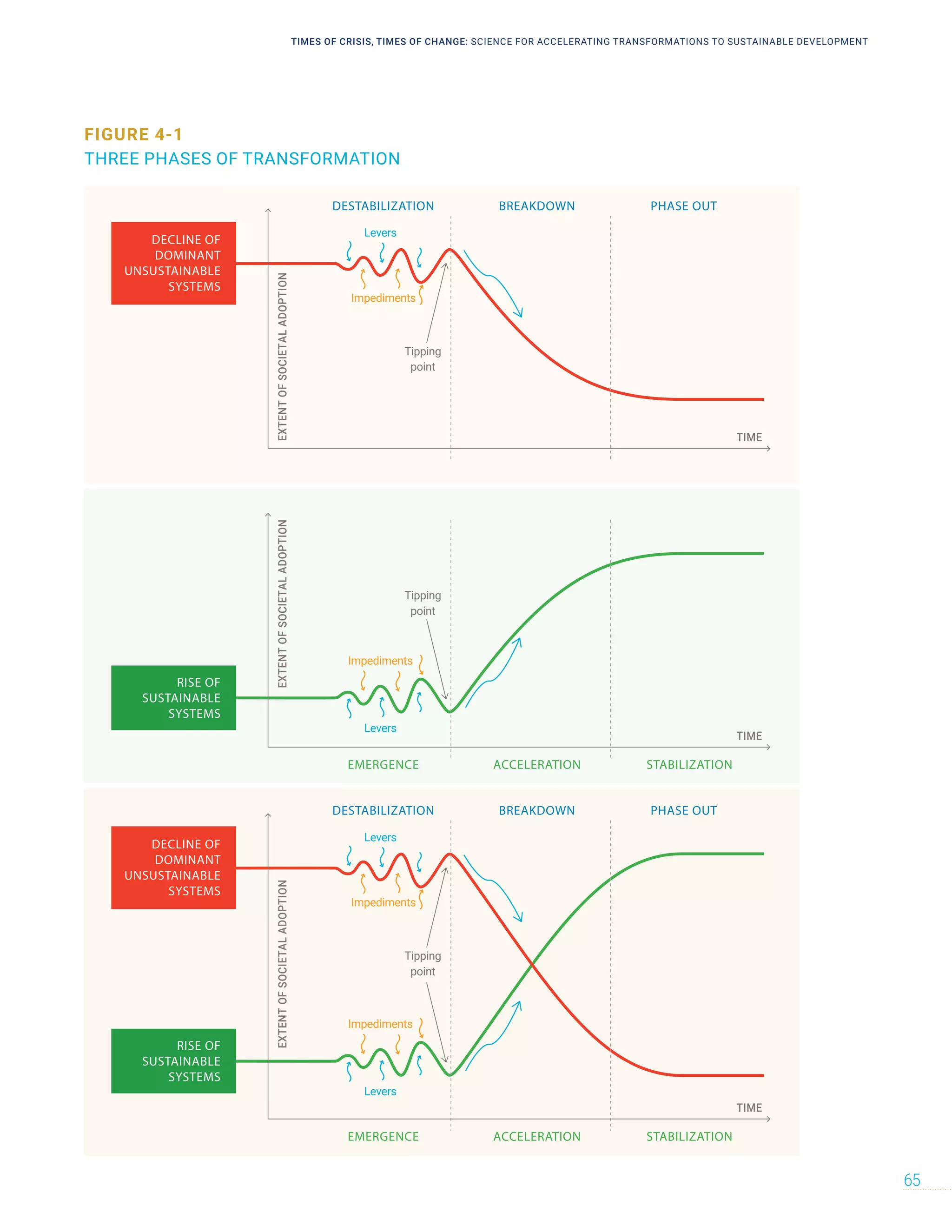
tracing an S-curve. During the first phase, emergence,
innovative ideas give rise to new technologies
and practices – often operated in niches through
experimentation and learning.The concept of innovation
in this Report includes technological, organizational,
institutional, behavioural and social innovations. If
successful, during the second phase, acceleration,
innovations expand and reach tipping points beyond
which they are widely shared and adopted, leading
to rapid, non-linear growth. Finally, in the third phase,
stabilization, these technologies and practices become
pervasive in daily life as the new normal.
S-curves work in both directions. Progress in one area
is typically mirrored by a decline in others, with three
corresponding phases: destabilization, breakdown and
phase-out. For example, the rise of renewable energy
systems or electrified transport is being matched by the
decline of fossil-fuel energy and internal combustion
vehicles. Ambitious public policies are crucial for
pushing innovation and change and for ensuring that
old and new structures do not coexist too long, in order
to harvest the benefits of transformation towards
sustainability as quickly as possible.
Along this trajectory, innovations evolve – typically
becoming cheaper and more effective as they are
embedded with other complementary institutions,
norms, technologies and infrastructure. Governments
can also accelerate progress through targeted
investments, policies and incentives that promote
innovation and adoption. These can effectively push
innovations across tipping points beyond which they
are rapidly adopted.
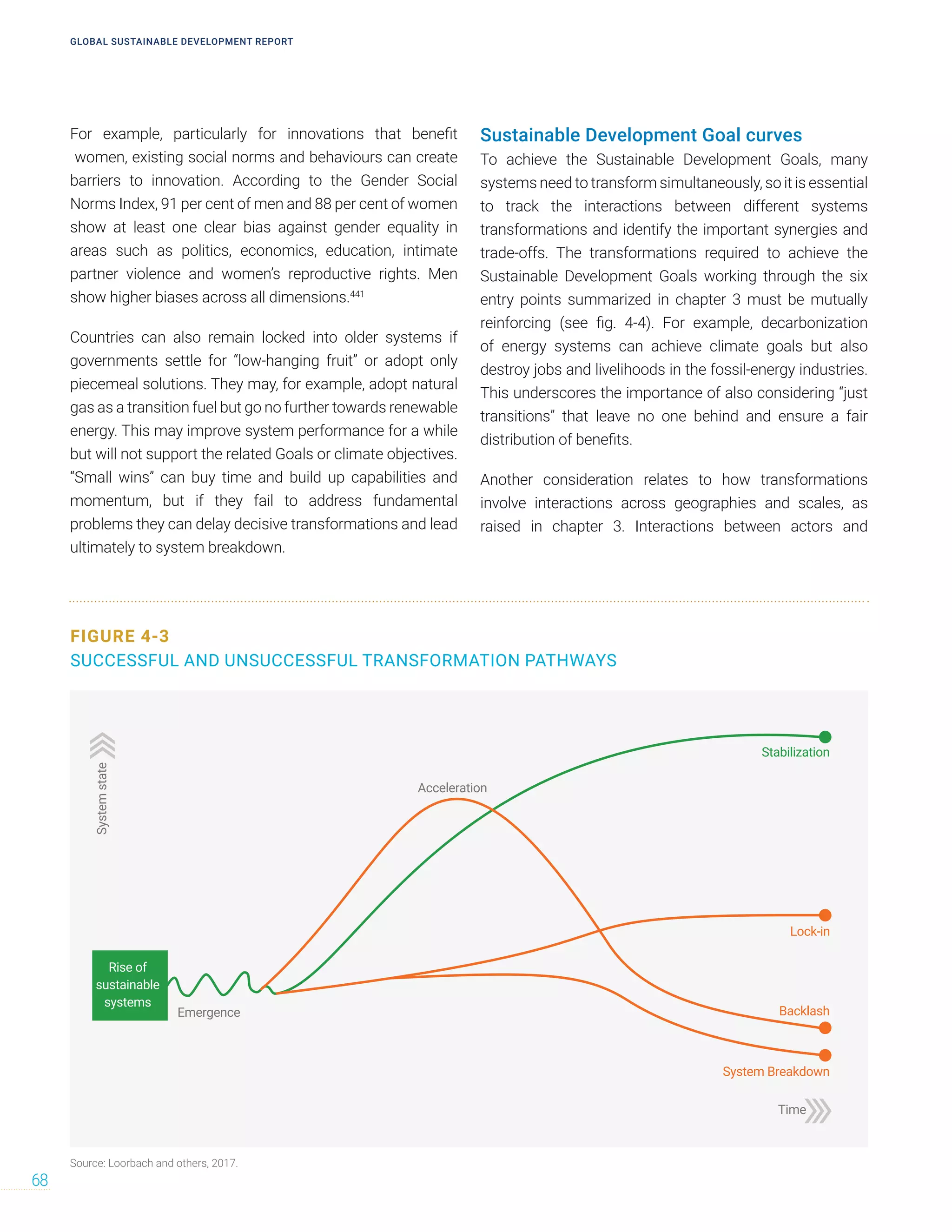
However, sustainable transitions can also fail or
veer off along undesirable pathways. This might, for
example, be the result of lock-ins to old technologies
and practices, political opposition or backlash from
vested interests or affected communities, stubborn
social norms and behaviours that are difficult to change
or gaps in human, financial and institutional capacities
or supporting infrastructure.
GLOBAL SUSTAINABLE DEVELOPMENT REPORT
XXIV
Impediments
Levers
DESTABILIZATION BREAKDOWN PHASE OUT
Tipping
point
DECLINE OF
DOMINANT
UNSUSTAINABLE
SYSTEMS
EXTENT
OF
SOCIETAL
ADOPTION
TIME
Levers
Impediments
EMERGENCE ACCELERATION STABILIZATION
Tipping
point
RISE OF
SUSTAINABLE
SYSTEMS
EXTENT
OF
SOCIETAL
ADOPTION
TIME
Impediments
Levers
Levers
Impediments
DESTABILIZATION BREAKDOWN PHASE OUT
EMERGENCE ACCELERATION STABILIZATION
Tipping
point
DECLINE OF
DOMINANT
UNSUSTAINABLE
SYSTEMS
RISE OF
SUSTAINABLE
SYSTEMS
EXTENT
OF
SOCIETAL
ADOPTION
TIME
PHASES OF TRANSITION
THREE PHASES OF TRANSFORMATION
TIMES OF CRISIS, TIMES OF CHANGE: SCIENCE FOR ACCELERATING TRANSFORMATIONS TO SUSTAINABLE DEVELOPMENT
XXV
Enabling transformations through
emergence, acceleration and stabilization
As transformations evolve across the S-curves, countries
can minimize impediments by creating supportive
technological, social and political conditions aligned
to the different phases. They can also work to build
trust and consensus, provide finance and safeguard
against undesirable consequences. This will require
bold leadership, a shared vision and direction, collective
effort using the levers in a coordinated way and
mutual accountability.
Emergence (destabilization) phase – In the emergence
(or destabilization) phase, deliberative processes to
collectively build common narratives, visions and missions
will be important. Governments, multilateral development
banks, private finance, philanthropists and others will
need to support innovation and the piloting, prototyping
and implementation of new knowledge. Governments
can also send clear market signals for investment
and adoption through credible long-term policies and
targets. Capacities are needed to innovate and generate
sustainable alternatives and provide informal and
protected spaces for innovation and dialogue.
Acceleration (breakdown) phase – Decisive action by
governments is often needed for transitions to cross
tipping points to the acceleration (or breakdown)
phase. Building on efforts in the emergence phase,
proactive and decisive governments can shape markets
by stimulating research and innovation, investing in
public infrastructure, setting targets, standardization
and regulating businesses. This can reorient economic
activities towards the Sustainable Development Goals.
Conflicts, tensions and political struggles are common
during acceleration, as different actors, interests and
coalitions seek to promote or delay the transition for
various reasons. These reasons may include perceived
trade-offs between competing Goals or negative
outcomes for local jobs and livelihoods. A coherent mix
of policies will be needed to ensure just transitions where
no one is left behind.
Individual and collective action through social movements
and coalitions, changing narratives and norms, maturing
technologies and crisis events can provide the critical
impetus needed for governments to take decisive
action to accelerate transitions. For governments facing
strong opposition, early interventions or “small wins” can
build political momentum for later more difficult and
transformative measures.
Stabilization (phase out) phase – During the stabilization
(or phaseout) phase, innovations can saturate markets
and achieve widespread dissemination and use,
becoming anchored in infrastructure, regulations, user
habits and standards. However, for stabilization to
take root, new institutions and infrastructure must be
resilient. Unless reforms are institutionalized, the whole
process may break down if leaders are unable to sustain
momentum or leave office. Sustaining momentum
requires a strong tax and revenue base, commitment
of ongoing human and financial resources, maintaining
political support, and building institutional capacities for
implementation.
Governments and the private sector can support a
managed decline and phase-out of unsustainable
technologies and practices. Unintended consequences,
such as job losses or the decline in regional industries
and economies, can be mitigated through government
support for affected workers such as compensation,
social safety nets, reskilling and training, and alternative
employment opportunities. These measures will help
to reduce resistance, increase public acceptance and
ensure a just transition with fair outcomes for all.
CHAPTER 5: TRANSFORMATIONS
THROUGH SCIENCE – AND
IN SCIENCE
Transformations to sustainable pathways should be
rooted in science. The scientific method, based on
observation and testing hypotheses, reduces uncertainty,
identifies tipping points, accelerates the uptake of
innovations and lays the foundations for the next
frontier of ideas. This Report argues for science that is
GLOBAL SUSTAINABLE DEVELOPMENT REPORT
XXVI
multidisciplinary, equitably and inclusively produced,
openly shared, widely trusted and embraced, and
“socially robust” and relevant to society.
A few decades ago, the science-policy interface primarily
involved experts in individual scientific disciplines –
usually in the Global North, and predominantly white
male. For sustainable development in the twenty-first
century, science-policy interactions will need to be
far more multidirectional and multidisciplinary – and
expanded to a science-policy-society interface.
It is clear, though, that the current platforms and
intermediariesarenotsufficient.Civilsocietyorganizations
(CSOs), non-governmental organizations (NGOs), think
tanks and other institutions can be powerful advocates
for change, and can promote accountability. While young
people and CSOs are starting to be included in the global
processes and platforms, they are still often excluded
from the actual decision making. Young people, those
who have the biggest stake in the future, are particularly
compelling messengers and leaders, and should be
further empowered.
Global imbalance in research and development
To be relevant to the Sustainable Development Goals,
more scientific activity should be conceived and
produced outside of high-income countries. Current
imbalances severely curtail the capacity of many low-
and middle-income countries to attain the Goals by
generating context-specific solutions in their region.
As well as making the production of science more
inclusive and geographically diverse, it is also crucial
to ensure that once science is produced, the resulting
knowledge is widely accessible. Public interest groups,
policymakers, industry and teachers should have free
access to the relevant publications, data and software.
This is especially important for issues related to the
Goals, and for research that has been publicly funded. In
the humanities, for example, the digitization of historical
documents across continents has allowed students and
citizens to gain first-hand understanding of key moments
in history – struggles for independence, human rights
movements and social progress that can be instructive
for current challenges.
Trust and integrity
A major hurdle for science is the speed of publication.
Producing unbiased, peer-reviewed information absorbs
time and money, giving some platforms, particularly
social media, a head start for promulgating false
information. Influencers and propagandists, with little or
no expertise, can nevertheless create compelling stories
and catchy headlines that appear factual and elicit strong
emotional responses. And, because of social media
algorithms, people rarely see posts that contradict their
own biases and preferences. This echo chamber effect
is having a profound impact on the political landscape,
with increased polarization and partisanship and lower
levels of trust in governments and science.
The world has responded to the proliferation of fake
news with comprehensive countermeasures. In 2022
around 400 teams of journalists and researchers in
105 countries were working on tackling political lies,
hoaxes and other forms of misinformation. To help
scientific health evidence keep pace with fake news
for COVID-19, the World Health Organization (WHO)
gathers real-time information on how people are talking
online about the pandemic and had released tips to
identify mis- and disinformation and is aiming to ensure
the top results on the pandemic are official science-
based sources.
Socially robust science
There is inevitably a time lag between the publication
of scientific evidence, public policy decisions and full
implementation of science-based recommendations.
Sometimes, the gap is created by a lack of political
will or lobbying and disinformation by vested interest
groups. Sometimes, action is simply impossible
because of political unrest and conflict, or the lack
of financial resources. Consider climate change, the
Intergovernmental Panel on Climate Change has reached
clear conclusions, but the world is still failing to reduce
the global carbon footprint.
TIMES OF CRISIS, TIMES OF CHANGE: SCIENCE FOR ACCELERATING TRANSFORMATIONS TO SUSTAINABLE DEVELOPMENT
XXVII
Achieving the Sustainable Development Goals requires
broader societal engagement with all aspects of science
and a greater democratization of knowledge – so
that people will be ready and willing to commit to the
transformations needed.
CHAPTER 6: CALLS TO ACTION
FOR TRANSFORMATION
Implementation of the Agenda 2030 requires the active
mobilization of political leadership and ambition, and
building societal support for policy shifts embracing
transformations through meaningful consultation with
stakeholders and effective participation.
Transformation is possible, and inevitable. To guide
policymakers in this process, the Report presents a
series of calls to action. First, it proposes that, at the
midpoint to the 2030 Agenda, the United Nations Member
States elaborate a shared transformation framework for
the Sustainable Development Goals that consists of
six elements:
i. national plans of action to counter negative trends
or stagnation in implementation of the Sustainable
Development Goals;
ii. local and industry-specific planning to feed into
national plans;
iii. initiatives through the Addis Ababa Action Agenda
or otherwise to increase fiscal space, including tax
reforms, debt restructuring and relief, and increased
engagement by international finance institutions
for implementation of the Sustainable Development
Goals;
iv. investment in data related to the Goals, science-based
tools and policy learning;
v. partnerships to strengthen the science-policy-society
interface; and,
vi. measures to improve accountability of governments
and other stakeholders.
Second, it recommends building capacity for
transformation at individual, institutional and network
levels, to strategize, innovate, manage conflicts, identify
and overcome impediments and cope with crises and
risks. Third, it puts forward key synergetic interventions
in each of the six entry-points for sustainability
transformation, to achieve coherence and equity, and
ensure that advances in human well-being are not made
at the expense of climate, biodiversity and ecosystems.
Fourth, it proposes five measures for improving the
fundamental conditions for implementation, namely
by investing in conflict prevention and resolution,
enhancing fiscal space, supporting marginalized groups,
taking advantage of the digital transformation and by
investing in gender equality. Finally, it recommends tools
for transforming science and approaches to ensure that
science, policy and society work together for a future
where people and nature can thrive as one.
This report bridges science and practice to provide
actionable knowledge, practical tools, and examples for
a variety of actors, from policymakers in United Nations
Member States to youth and community groups, from
financiers to other industry partners, from donor agencies
to philanthropies, and from academics to civil society
groups. The 2023 Global Sustainable Development
Report benefited from inputs received from experts
from a wide range of disciplines - natural scientists,
social scientists, policymakers, and practitioners - in
response to an open call for inputs, a scientific peer
review led by the International Science Council, as well
as region-specific inputs gathered through a series of
regional consultations held in Australia, China, Japan,
Malawi, Peru, Philippines, Qatar, and Senegal. Achieving
the SDGs is not only the work of governments, and the
contributions from multiple actors are essential indeed.
This report is for all stakeholders, with the recognition
that everyone will engage with these transformations
in some way, and for doing so effectively, everyone will
need strategies and tools.
GLOBAL SUSTAINABLE DEVELOPMENT REPORT
XXVIII
Copy
XXIX
TIMES OF CRISIS, TIMES OF CHANGE: SCIENCE FOR ACCELERATING TRANSFORMATIONS TO SUSTAINABLE DEVELOPMENT
Chapter
1
GLOBAL SUSTAINABLE DEVELOPMENT REPORT
In 2015, United Nations Member States agreed on the 2030 Agenda for
Sustainable Development and the 17 associated Sustainable Development
Goals – as a universal call for action to end poverty and protect the planet.
But today at the half-way point, the world is not on track to achieve the
Goals by 2030, and we are more off track than four years ago. This is a
warning signal that unless the world makes an urgent course correction
and initiates transformative change, we risk undermining advances made,
increasing vulnerability to future crises and cementing unsustainable
development pathways.
In 2015, the global community adopted a shared blueprint for people, planet,
peace,prosperityandpartnership,the2030AgendaforSustainableDevelopment,
and established an ambitious set of interlinked Sustainable Development Goals.
The Goals cover all regions of the world in all aspects of life and development – in
health, education, and the environment, peace, justice, security, and equality. They
aim to eliminate poverty and hunger, tackle diseases to ensure healthier societies
and well-being, empower women and girls and tackle the triple planetary crisis
of climate change, biodiversity loss and pollution.1,2
Achieving the Sustainable
Development Goals would be a monumental step forward but will demand
determination and effort from citizens in every country, shared responsibility of
governments and global solidarity.
THE BIG PICTURE: STAGNATION IN THE FACE
OF MULTIPLE CRISES
The 2019 Global Sustainable Development Report assessed progress towards
the Sustainable Development Goals. The indications were not encouraging.
That Report concluded that on the current trajectory the world was unlikely
to achieve the Goals by 2030. It found that for some targets the global
community was on track, such as those for child mortality and for primary
school enrolment. And to meet many other targets, the world would need to
CHAPTER
1
Half-way to 2030 –
progress towards
the Sustainable
Development Goals
1
TIMES OF CRISIS, TIMES OF CHANGE: SCIENCE FOR ACCELERATING TRANSFORMATIONS TO SUSTAINABLE DEVELOPMENT
quicken the pace – particularly for eradicating poverty and
hunger, reducing maternal mortality, increasing access
to drinking water and sanitation, and achieving gender
equality. More worrying still, in some respects the world
was slipping backwards – regressing on climate action
and biodiversity, for example, and on reducing inequality.
In 2023, halfway to 2030, the situation is much more dire.
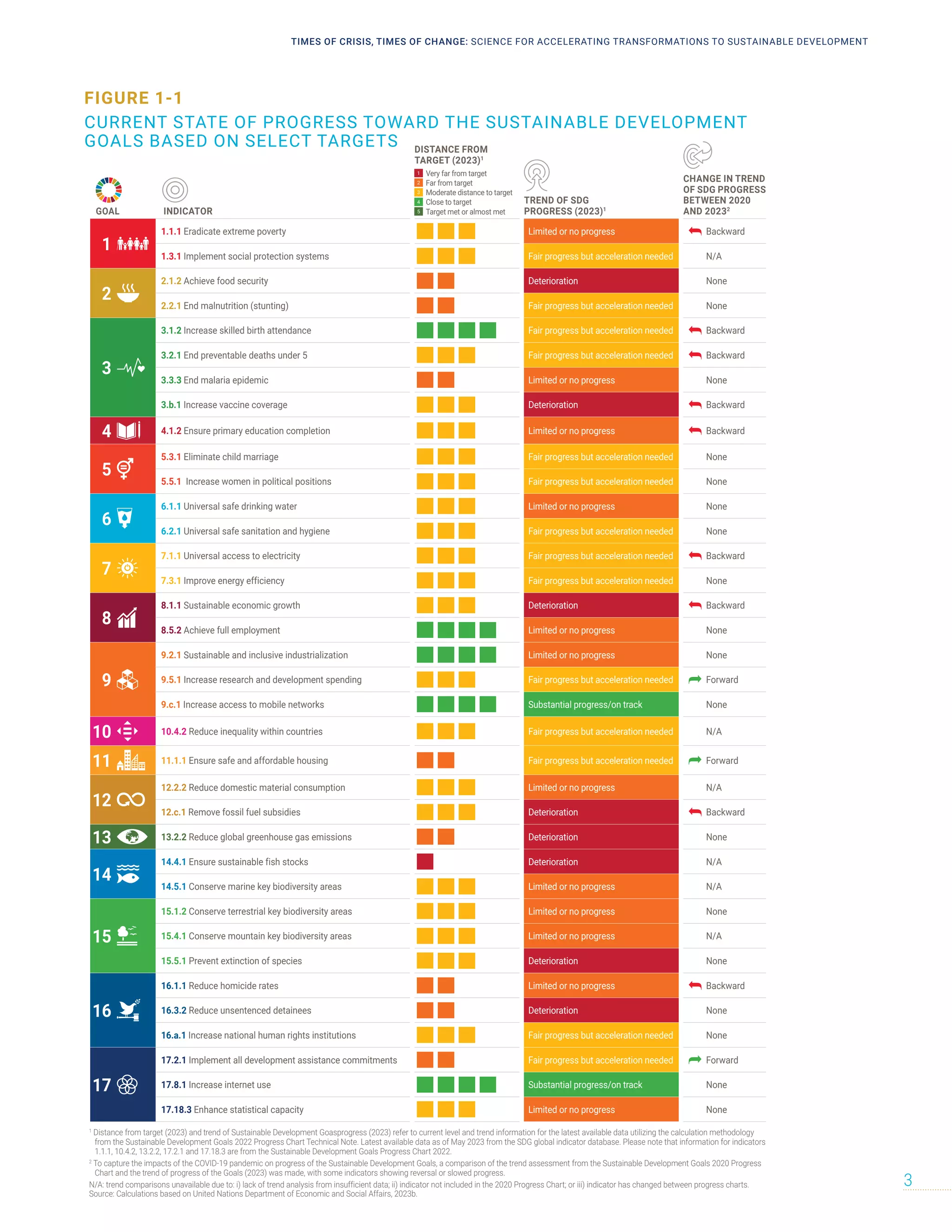
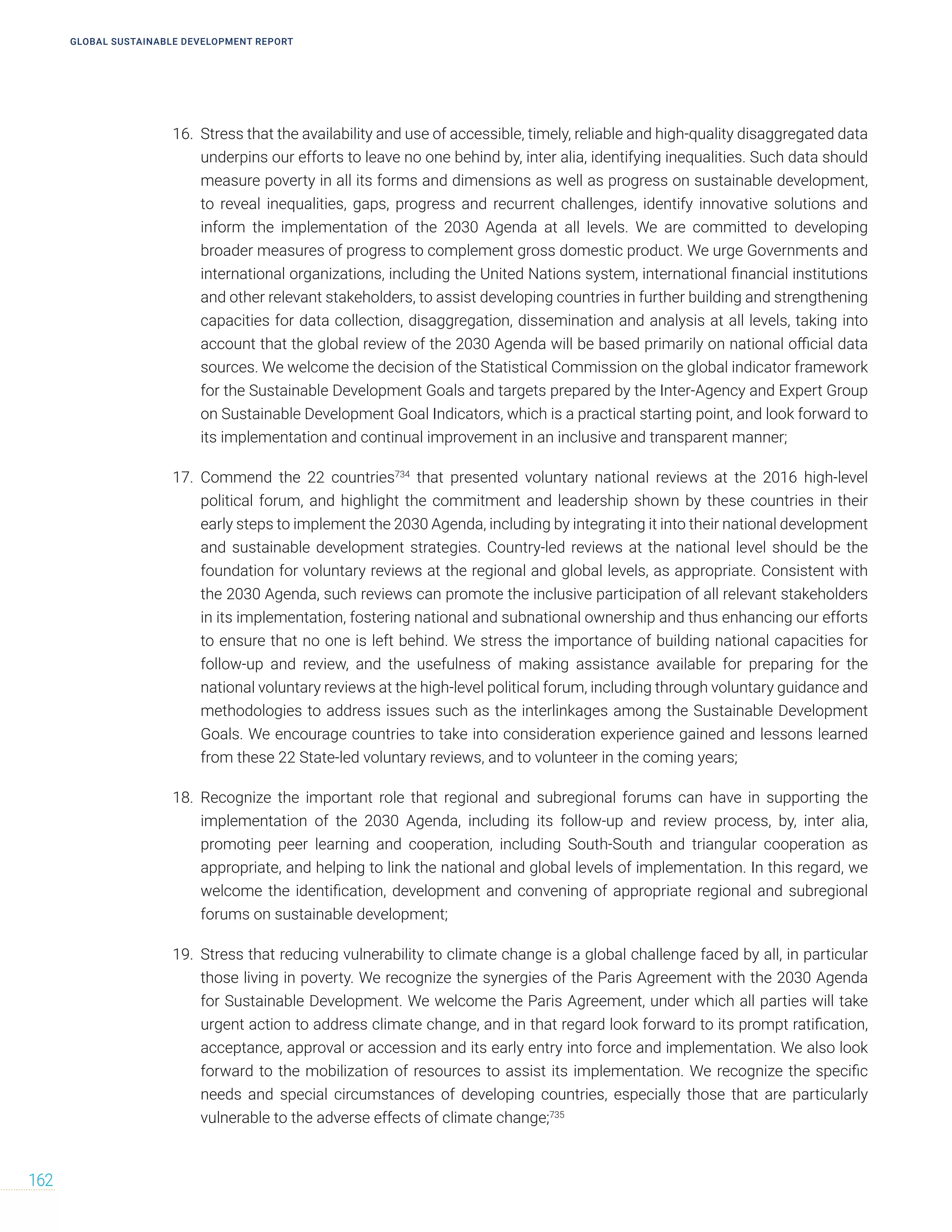
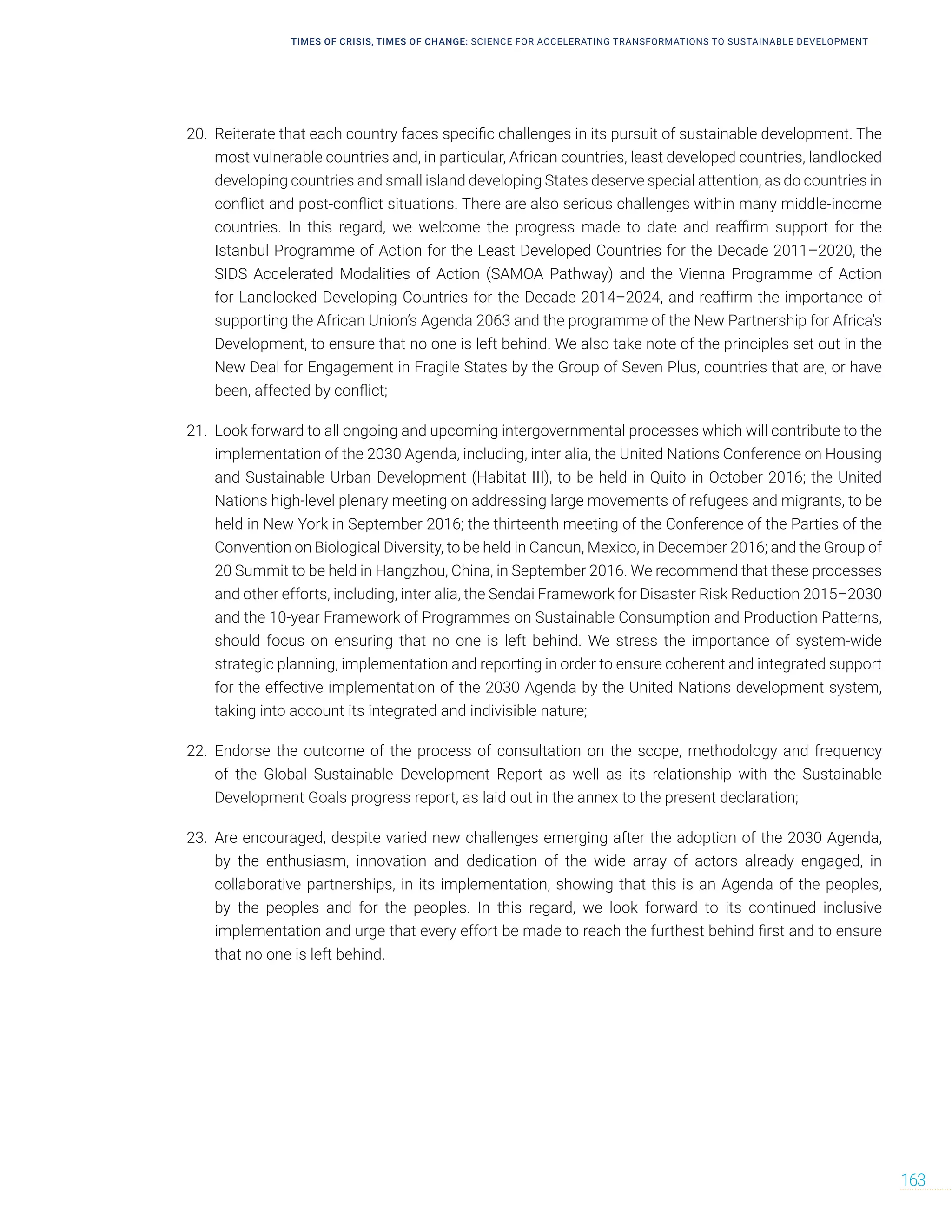
Figure 1-1, with an assessment of select targets with
sufficient data, shows that Sustainable Development
Goals targets close to being achieved are the exception
rather than the rule3
. As shown in the column Distance
from Target, the targets close to being achieved include
increasing skilled birth attendance (3.1.2), full employment
(8.5.2), raising industry’s value to GDP (9.2.1), access to
mobile networks (9.c.1) and access to Internet (17.8.1).
However, in many of these, progress is not fast enough, as
shown in the column Trend of SDG Progress.
Most other targets are either at a moderate distance
to the goal post or far from it as shown in the column
Distance from Target. Based on the targets for which we
have data available, particularly far from the reaching the
2030 ambitions are Goal 2, Goal 11, Goal 13, Goal 16 and
Goal 17.
To capture impacts of recent crises on progress towards
the Sustainable Development Goals, figure 1-1 also shows
a comparison of trends for each target, as assessed in
2020, with trends in 2023 (see column Change in Trend
of SDG Progress between 2020 and 2023). Targets that
were on track and remain on track are access to mobile
networks (9.c.1) and Internet access among individuals
(17.8.1).
The analysis shows a worsening trend across many
of the Goals between 2020 and 2023. The target on
ending extreme poverty (indicator 1.1.1), which saw
steady progress through 2018/2019, has been disrupted
by a multitude of recent crises. COVID-19 pushed tens
of millions into poverty. While poverty is again on the
decline, the recent spate of cost-of-living and climate
crises, among others, mean that poverty reduction is now
on a much slower path. On several other targets where
there was good progress in 2018/2019, the progress has
now slowed down. These include skilled birth attendance
(3.1.2), under-5 mortality rate (3.2.1), vaccine coverage
(3.b.1), primary education completion (4.1.2), access to
electricity (7.1.1), GDP growth (8.1.1), addressing fossil
fuel subsidies (12.c.1) and reducing homicide rates
(16.1.1).
For Goals where progress was too slow in 2019, in most
cases, countries have not accelerated enough. On some
targets, however, progress is now faster than it was in
2018/19 (indicated by Forward). These include increasing
research and development spending (9.5.1), safe and
affordable housing (11.1.1), and implementation of official
development assistance commitments (17.2.1).
Other targets were moving backward and continue to
regress, including achieving food security (2.1.2), reducing
global greenhouse gas emissions (13.2.2) and preventing
the extinction of species (15.5.1). Since 2015, the number
of people living in hunger and food insecurity is on the
rise. The situation is getting worse. On stunting, progress
had been made since 2015, though full impacts of the
pandemic on child nutrition may take years to manifest.4
Where progress has been halted or slowed down, it is
partly a consequence of a confluence of crises – the
ongoing pandemic, rising inflation and the cost-of-living
crisis, and planetary environmental and economic
distress, along with regional and national unrest, conflicts
and natural disasters. To have these crises overlap
so relentlessly might seem bad luck, but they are not
independent events. They are entwined through various
physical, economic and social strands, each fuelling
other’s intensities.5
For example, climate change fuelled
fluctuations in transboundary fish stocks is causing
international and regional tensions (see box 1-1). Climate
change is causing water stress and food insecurity,
altering marine, terrestrial and freshwater ecosystems,
harming biodiversity, destroying livelihoods and widening
inequalities. These worsening prospects in turn intensify
ideological extremism, fuelling tensions and conflict.
GLOBAL SUSTAINABLE DEVELOPMENT REPORT
2
FIGURE 1-1
CURRENT STATE OF PROGRESS TOWARD THE SUSTAINABLE DEVELOPMENT
GOALS BASED ON SELECT TARGETS
GOAL INDICATOR
DISTANCE FROM
TARGET (2023)1
1 Very far from target
2 Far from target
3 Moderate distance to target
4 Close to target
5 Target met or almost met
TREND OF SDG
PROGRESS (2023)1
CHANGE IN TREND
OF SDG PROGRESS
BETWEEN 2020
AND 20232
1
1.1.1 Eradicate extreme poverty Limited or no progress Backward
1.3.1 Implement social protection systems Fair progress but acceleration needed N/A
2
2.1.2 Achieve food security Deterioration None
2.2.1 End malnutrition (stunting) Fair progress but acceleration needed None
3
3.1.2 Increase skilled birth attendance Fair progress but acceleration needed Backward
3.2.1 End preventable deaths under 5 Fair progress but acceleration needed Backward
3.3.3 End malaria epidemic Limited or no progress None
3.b.1 Increase vaccine coverage Deterioration Backward
4 4.1.2 Ensure primary education completion Limited or no progress Backward
5
5.3.1 Eliminate child marriage Fair progress but acceleration needed None
5.5.1 Increase women in political positions Fair progress but acceleration needed None
6
6.1.1 Universal safe drinking water Limited or no progress None
6.2.1 Universal safe sanitation and hygiene Fair progress but acceleration needed None
7
7.1.1 Universal access to electricity Fair progress but acceleration needed Backward
7.3.1 Improve energy efficiency Fair progress but acceleration needed None
8
8.1.1 Sustainable economic growth Deterioration Backward
8.5.2 Achieve full employment Limited or no progress None
9
9.2.1 Sustainable and inclusive industrialization Limited or no progress None
9.5.1 Increase research and development spending Fair progress but acceleration needed Forward
9.c.1 Increase access to mobile networks Substantial progress/on track None
10 10.4.2 Reduce inequality within countries Fair progress but acceleration needed N/A
11 11.1.1 Ensure safe and affordable housing Fair progress but acceleration needed Forward
12
12.2.2 Reduce domestic material consumption Limited or no progress N/A
12.c.1 Remove fossil fuel subsidies Deterioration Backward
13 13.2.2 Reduce global greenhouse gas emissions Deterioration None
14
14.4.1 Ensure sustainable fish stocks Deterioration N/A
14.5.1 Conserve marine key biodiversity areas Limited or no progress N/A
15
15.1.2 Conserve terrestrial key biodiversity areas Limited or no progress None
15.4.1 Conserve mountain key biodiversity areas Limited or no progress N/A
15.5.1 Prevent extinction of species Deterioration None
16
16.1.1 Reduce homicide rates Limited or no progress Backward
16.3.2 Reduce unsentenced detainees Deterioration None
16.a.1 Increase national human rights institutions Fair progress but acceleration needed None
17
17.2.1 Implement all development assistance commitments Fair progress but acceleration needed Forward
17.8.1 Increase internet use Substantial progress/on track None
17.18.3 Enhance statistical capacity Limited or no progress None
SNAPSHOT OF TRENDS IN SELECT TARGETS
1
Distance from target (2023) and trend of Sustainable Development Goasprogress (2023) refer to current level and trend information for the latest available data utilizing the calculation methodology
from the Sustainable Development Goals 2022 Progress Chart Technical Note. Latest available data as of May 2023 from the SDG global indicator database. Please note that information for indicators
1.1.1, 10.4.2, 13.2.2, 17.2.1 and 17.18.3 are from the Sustainable Development Goals Progress Chart 2022.
2
To capture the impacts of the COVID-19 pandemic on progress of the Sustainable Development Goals, a comparison of the trend assessment from the Sustainable Development Goals 2020 Progress
Chart and the trend of progress of the Goals (2023) was made, with some indicators showing reversal or slowed progress.
N/A: trend comparisons unavailable due to: i) lack of trend analysis from insufficient data; ii) indicator not included in the 2020 Progress Chart; or iii) indicator has changed between progress charts.
Source: Calculations based on United Nations Department of Economic and Social Affairs, 2023b.
TIMES OF CRISIS, TIMES OF CHANGE: SCIENCE FOR ACCELERATING TRANSFORMATIONS TO SUSTAINABLE DEVELOPMENT
3
BOX 1-2
HARNESSING MIGRATION FOR THE SUSTAINABLE DEVELOPMENT GOALS
When well-governed, migration can contribute to alleviating poverty and inequality and advancing sustainable development.
With over 281 million estimated to be international migrants in mid-year 202013
, and 38 million newly internally displaced in
202114
, ensuring safe, orderly and regular migration can contribute to positive development outcomes at all levels.
For example, remittances are a critical source of financial support for families and communities. Remittances proved resilient
despite COVID-19, reaching $605 billion in 2021 and overtaking foreign direct investment and official development assistance
to low- and middle-income countries, excluding China15
–providing people with paths to improved livelihoods. Migrant workers in
essential sectors kept many economies afloat during the COVID-19 pandemic, including migrant workers in health-care sectors
who provided support at the frontline of the pandemic response in many countries.
There are examples across regions of initiatives to make migration work for sustainable development. In Serbia, Municipal
Youth Offices in three rural towns facilitate technical trainings for young people to learn skills that local businesses need,
and to directly connect the young people with education-to-employment pathways in local companies.16
In Morocco, a CSO
refers vulnerable women and children, including irregular migrants, to psycho-social support and local health-care services.17
In
Ecuador, municipal authorities have implemented an online marketplace, job banks and physical co-working spaces and provide
trainings for local companies on inclusive hiring practices.18
With the right enabling tools, migration can help fulfil the aspirations of those on the move and the societies they join, as well
as those who stay behind. To reduce inequalities in terms to access to travel and immigration processes, regular pathways for
migrants need to be reinforced and made safe, and accessible immigration channels need to be ensured.19
Strengthened data
and capacities to measure the implementation of migration aspects in the Sustainable Development Goals are also needed to
better understand mobile populations, whose data are often not included in official statistics.
At the same time, forced displacement is a human crisis that should be prevented from happening. States must take measures
to protect and assist their citizens who are displaced within their own countries as internally displace persons and to provide
asylum and protection to refugees when people are forced to cross borders.
BOX 1-1
CHALLENGES OF MANAGING TRANSBOUNDARY OCEAN RESOURCES IN AN ERA OF
CLIMATE CHANGE6
Indirect effects of climate shifts can be felt across borders through disruptions in supply chains, markets and the movement of
natural resources. Transboundary risks to the water, energy and food sectors have been projected as a result of extreme weather
and climate events.7
Globally, 633 (68 per cent) of assessed commercial marine stocks are estimated to be transboundary
resources.8
By 2030, it is predicted that about 23 per cent of transboundary stocks of marine fish and invertebrates will shift
due to climate change.9
Changes in species distribution across borders introduces challenges for biodiversity governance,10
with implications for security and stability.11
Further complications are introduced by a lack of sufficient data and institutional
mechanisms to accurately track these shifts.12
For example, in South Eastern Asia, there are transboundary concerns about fisheries and marine area management. Prior to
the establishment of exclusive economic zones, the shallower areas within archipelagic waters of what is now known as the
Coral Triangle were accessible to all South East Asian fishers. Each country had traditional fishing grounds, shaped by local
and indigenous knowledge, some of which extended outside boundaries of exclusive economic zones. The establishment of
exclusive economic zones resulted in overlapping claims and tensions among fishing communities in Southeast Asian nations.
There has also been a large number of illegal, unreported and unregulated fisheries, which contribute to the loss of biodiversity,
mismanagement and in some cases the deployment of military units to secure contested territorial claims. Climate change
can be expected to exacerbate existing tensions. Regional mechanisms for fisheries management could help alleviate these
challenges; for instance, the establishment of an Association of Southeast Asian Nations nations regional fisheries management
organization, focusing on shallow waters that host commercially important and exploited demersal species.
GLOBAL SUSTAINABLE DEVELOPMENT REPORT
4
On the other hand, the inter-connections between
economies and people, including those across national
borders could be exploited to release positive synergies
(box 1-2). Accelerating progress on the Sustainable
Development Goals in a holistic and integrated way
could help recover from these crises and reduce future
systemic risks.
This chapter examines the state of the Sustainable
Development Goals today, while chapter 2 assesses
future prospects for achieving the Goals.
The lingering drag of COVID-19
Around the globe, the COVID-19 pandemic is still having
a profound impact on the mental and physical health and
well-being of individuals, households and communities
worldwide. Beyond costing more than 15 million lives
globally, it has slowed, disrupted, or temporarily reversed
progress across the Sustainable Development Goals.20
The pandemic has at times shut down entire industries,
from travel and tourism to entertainment and retail, with
a loss of jobs, livelihoods, incomes and remittances. In
2022, because of the loss of jobs and many people leaving
the labour force, the total hours worked globally remained
2 per cent below the pre-pandemic level.21
The pandemic
also cast a large shadow over the lives and future
prospects of children, particularly through the closure of
schools, and added to women’s burden of care work22
.
Thepandemicexacerbatedexistingfaultlinesofinequality.
Much of schooling went online, which was useful, but
inferior to classroom interactions and socialization while
being of no use at all to families without access to devices
or broadband Internet – widening the gaps between
richer and poorer students.23
There was also an increase
in economic disparities. As economies shrank and many
services and goods dried up, the impacts were greatest
on small and medium enterprises and on the many
women and temporary workers they employ.24
During the
lockdowns, migrants who faced more restrictions and
had less access to relief measures were some of the most
affected workers.25
Recovery from the pandemic has been very uneven and
incomplete. Quickest to recover were the high-income
countrieswhogenerallyachievedhigherratesofvaccination
and could find more effective relief measures.26
In 2021, the
top 20 per cent in terms of global income distribution had
recovered about half their lost income, but the bottom 40
per cent had not recovered.27
The high-income countries
also resumed education more rapidly, bringing students
back into classrooms and enabling parents to get back
to work. By end of Feb 2022, 42 countries had opened
schools only partially and 6 countries still had schools
fully closed.28
This uneven recovery does not just affect
those countries that are slowest to recover. National
economies are now so interconnected through trade and
migration that delayed recoveries in any country reduces
the prospects for all.29
Informality and working poverty rose because of the
pandemic. The incomplete recovery implies an ongoing
shortage of better job opportunities, pushing workers into
jobs of lower quality.30
The pandemic also had detrimental environmental
impacts including through the heightened use of plastic
in medical use such as personal protective gear, and
through the postponement of vital global environmental
governance negotiations scheduled for 2020.31
Rising levels of conflict war and instability
The world is currently witnessing the highest level
of State-based armed conflicts seen since 1945. By
the end of 2020, around 2 billion people were living in
conflict-affected countries.32
In 2021, the number of
people who were forcibly displaced was the highest on
record, at 89.3 million with 27.1 million refugees and
53.2 million internally displaced people.33
There is also
a deeply concerning long-term trend of an increasing
number of armed state-based conflicts as well as
non-state conflicts34
(see fig. 1-2).
By 2030, up to two thirds of the world’s extreme poor
could live in settings characterized by fragility, conflict
and violence threatening efforts to end extreme poverty.
Conflicts also drive 80 per cent of all humanitarian
needs.35
Violent conflict not only disrupts human
development and causes insecurity, it also destroys
human-made and natural capital and diverts private
TIMES OF CRISIS, TIMES OF CHANGE: SCIENCE FOR ACCELERATING TRANSFORMATIONS TO SUSTAINABLE DEVELOPMENT
5
FIGURE 1-2
NUMBER OF STATE-BASED ARMED CONFLICTS BY REGION
FIGURE 1-3
WORLD MILITARY EXPENDITURE
NUMBER OF ARMED CONFLICTS BY REGION
40
50
60
70
10
0
20
30
1946 1951 1956 1961 1966 1971 1976 1981 1986 1991 1996 2001 2006 2011 2016 2021
YEAR
NUMBER
OF
CONFLICTS
Africa Americas Asia Europe Middle East
WORLD MILITARY EXPENDITURE
YEAR
MILITARY
EXPENDITURE
(CONSTANT
2020
$
BILLION)
0
500
1,000
1,500
2,000
2,500
‘21
‘20
‘19
‘18
‘17
‘16
‘15
‘14
‘13
‘12
‘11
‘10
‘09
‘08
‘07
‘06
‘05
‘04
‘03
‘02
‘01
‘00
‘99
‘98
‘97
‘96
‘95
‘94
‘93
‘92
‘91
‘90
Source: Davies, Shawn, Therese Pettersson and Magnus Öberg, 2022.
Source: Stockholm International Peace Research Institute, 2023.
GLOBAL SUSTAINABLE DEVELOPMENT REPORT
6
and public resources to spending on defence and
reconstruction. In 2021, for the first time, global military
expenditure exceeded $2 trillion36
(see fig. 1-3).
Conflict forces people to flee their homes, and 2021
was the deadliest year on record for migrants since
2017, with nearly 6,000 people dying as they fled
their countries through often dangerous routes.37
The
economic, health and social impacts of conflict and
forced migration are highly gendered, meaning that
women, men and sexual minorities face different risks
and experiences before, during and after migration.38
Sexual violence and exploitation and the risk of being
trafficked are all too common among women and
children fleeing war or persecution. Many humanitarian
aid workers and health professionals are not adequately
trained to identify these risks and provide services
and support.39
The war in Ukraine is causing immense suffering and
loss of life, as well as destruction to property, while also
giving rise to huge movements of people. Besides the
large number of military casualties, as of January 2023,
approximately 7,000 civilians were killed and more
than 11,000 injured40
. There are more than 8.1 million
refugees, most of them women and children, as well as
5.3 million internally displaced persons, creating one of
the largest refugee and internal displacement crises in
modern times.41
The war in Ukraine is wreaking havoc
on the global economy, leading to food and energy price
hikes and a potent cost of living crisis.42
Conflict and unrest have surged in many countries
creating tangible barriers to progress towards the
Sustainable Development Goals (box 1-3). In Ethiopia,
for example, in 2021, some 2.5 million people were
displaced owing to conflict. In Afghanistan, the number
of displaced people increased for the fifteenth straight
year. In Venezuela, the number of refugees is on the rise.
A number of other countries saw increases of between
100,000 and 500,000 internally displaced people in
2021, including the Democratic Republic of the Congo,
Nigeria, South Sudan, Sudan, the Syrian Arab Republic
and Yemen.43
Afghanistan is facing severe food insecurity throughout
the country and is home to millions of internally
displaced Afghans and those seeking refuge.44
Beyond
increased instability, gender equality in Afghanistan has
also been jeopardized with women facing exclusion
from public and political life, and restricted access
to education, humanitarian assistance, employment,
justice and health services.45
In the Sahel region of Africa progress across the
Sustainable Development Goals is being blocked by
the proliferation of armed groups in the region and
the collapse of the Libyan state.46,47
As of March 2023,
some 3.1 million Sahelians were internally displaced
by conflict.48
Similarly, between March and May 2022,
approximately 26.5 million people in the Sahel were in
crisis or worse with respect to food and nutrition.49
Inflation and the cost-of-living
Around the globe, people face a severe cost-of-living
crisis50
. The pandemic and subsequent recovery pushed
up prices for food and energy, which rose further as a
result of the war in Ukraine. As the war broke out, food
prices peaked in March 2022. Since then, they have
fallen somewhat but remain at historic highs51
. Many
countries are seeing domestic food inflation. Between
June and September of 2022, around 89 per cent of
least developed countries, 93 per cent of landlocked
developing countries and 94 per cent of small island
developing States had food inflation above 5 per cent,
with many experiencing inflation in the double digits.52
Worst affected by inflation are the poor, who spend a
significant amount of their budget on food and fuel.
Often, they respond by skipping meals or purchasing
cheaper and less nutritious food – short-term solutions
that can have long-term consequences for health
and future prospects, particularly of children.53
The
cost-of-living crisis is pushing an additional 78–141
million into poverty.54
Women and the urban poor are at
greatest risk of facing hunger and deprivation and need
urgent support.55
In response to high inflation, countries have put in place
measures including fuel and energy subsidies (about a
quarter of total measures), food and fertilizer subsidies,
TIMES OF CRISIS, TIMES OF CHANGE: SCIENCE FOR ACCELERATING TRANSFORMATIONS TO SUSTAINABLE DEVELOPMENT
7
cash transfers, labour market programmes and other
measures, with the capacity of countries to implement
such programmes varying significantly across the world.56
Increased spending on fuel subsidies can alleviate
household expenditure challenges, but with implications
for addressing the climate and biodiversity crises.
Central banks face the classic trade-off between controlling
prices and supporting growth. A number of countries have
responded to inflationary pressures by tightening monetary
policy. The United States Federal Reserve has increased
interest rates, which drove up the exchange rate of the
dollar with knock-on effects for other countries that have
to pay in dollars for fuel and other commodities. Around
the world other central banks are defending their currencies
from the rising dollar by also increasing their own interest
rates.60
All of which raises the spectre of an impending
global economic slowdown, with ominous implications
for the Sustainable Development Goals. Forecasts
for global growth in 2023 have been lowered to 1.7 per
cent, the third weakest growth in nearly three decades.61
BOX 1-3
ATTAINMENT OF THE SUSTAINABLE DEVELOPMENT GOALS AMID CONFLICT:
THE CASE OF YEMEN
In Yemen, since 2014 conflict has impacted food security, social and health services – reversing decades of development.57
Projections of attainment of the Sustainable Development Goals in Yemen have shown how conflict has impacted progress toward
Goal 1: No poverty; Goal 2: Zero hunger; Goal 6: Clean water and sanitation; Goal 8: Decent work and economic growth; and Goal 10:
Reduced inequalities. Scenarios indicate that if the conflict had ended in 2019, Yemen would have been 8 per cent closer to achieving
some Goals (compared with 2015) due to reduced poverty and malnutrition, along with greater economic growth; however, if conflict
continues throughout 2030, Yemen will face generational impacts of poverty, malnourishment, and socioeconomic setbacks.58
Layered on top of challenges to the Sustainable Development Goals from conflict, Yemen faced further setbacks due to
the COVID-19 pandemic. With a health-care system weakened from conflict, Yemen had three doctors and seven beds per 10,000
people when the pandemic hit. Only half of those health-care facilities were operational, two thirds of Yemenis lacked access to health
care, and drinking-water, sanitation and hygiene were inadequate – all barriers for Yemenis to stay safe during the pandemic.59
-100%
-80%
-60%
-40%
-20%
PROGRESS
IN 2015
SUSTAINABLE DEVELOPMENT GOAL ATTAINMENT
20%
40%
60%
80%
100%
2014 2016 2018
YEMEN IN 2019
2020 2022 2024 2026 2028 2030
No conflict
Conflict ends 2019
Water and sanitation
Targeting child malnutrition
Household consumption
Food distribution
Conflict 2030
SCENARIOS OF IMPACTS OF CONFLICT ON SDGS IN YEMEN
SCENARIOS OF IMPACTS OF CONFLICT ON SUSTAINABLE DEVELOPMENT GOALS IN YEMEN
GLOBAL SUSTAINABLE DEVELOPMENT REPORT
8
Policymakers keen to help the most vulnerable in their
countries are faced with tough choices as they operate
with limited fiscal space. The pandemic, and high inflation
may have pushed debt in developing countries to an
estimated 50-year high,62
and now the fiscal positions
of many countries are being further weakened by rising
interest rates and ballooning debt servicing costs. Almost
half of the least developed countries and more than one
in every three small island developing States and
landlocked developing counties are in debt distress or at
high risk.63
Others lack the resources to expand social
spending, such as through cash transfers, tax cuts or
other relief, which could help offset the impacts of
rising prices on businesses and households.
INSUFFICIENT PROGRESS
ON THE SUSTAINABLE
DEVELOPMENT GOALS
Slow progress towards the Sustainable Development Goals
has made many countries far more vulnerable during the
recent spate of crises. For example, high inequality, lack
of universal health care and inadequate social safety nets
left vulnerable groups even more exposed to the myriad
health, social and economic impacts of the COVID-19
pandemic, while unequal gender roles placed an enormous
burden on women. Similarly, many countries that had
made insufficient investments in agriculture, or efforts to
diversify their sources of energy, were highly dependent on
food and fuel imports from a handful of countries, including
Russia and Ukraine. Inadequate protection of forests and
trafficking of wildlife also increased the risk of zoonotic
diseases.
Some of the shocks are temporary. For example, economic
growth bounced back in 2021 and extreme poverty is
now falling again. However, even temporary reversals at
the national level can have lifelong impacts on individual
families and particularly on children who have lost a
breadwinner or a family member, or who never return to
school.64
Years of malnutrition or lost education create
setbacks that can last a lifetime.
The Secretary-General’s annual Sustainable Goals
Development Report analyses the most recent data.65
The following sections complement this assessment by
considering the impacts of crises on the Goals and set the
stage for subsequent chapters, which consider how the
Goals can and must be achieved. In the current context of
multiple and overlapping crises, scaling up and accelerating
the necessary actions has never been more urgent.
Goal 1 – No poverty
Any predictions that Goal 1 would be achieved by 2030 have
been upended. When the pandemic struck, there had been
steady progress on reducing global poverty even though
the no poverty target was not on track to be achieved.66
The
combined crises have pushed an additional 75–95 million
into extreme poverty.67
Roughly 575 million people will still
be in extreme poverty in 2030,68
with poverty particularly
entrenched in sub-Saharan Africa (see box 1-4).
BOX 1-4
POVERTY REMAINS PREVALENT
IN AFRICA DESPITE THE
FORECAST DECLINE
The COVID-19 pandemic marks a turning point in the
trajectory of global poverty reduction, halting three
decades of successful reduction of global poverty and
inequality. The war in Ukraine, multiple regional conflicts,
and climate shocks are compounding the situation.69
In this context, Africa is strongly affected. In 2022, around
460 million people on the continent were living below
the extreme poverty line of $1.90 a day. Nigeria and the
Democratic Republic of the Congo accounted, respectively,
for around 12 and 11 per cent of the global population in
extreme poverty. Other African countries with a large poor
population included Tanzania (4.3 per cent), Mozambique
(3.5 per cent) and Madagascar (2.8 per cent). Throughout
Africa, rural households face higher poverty levels. In 2022,
for instance, the extreme poverty rate reached about 50
per cent among Africa’s rural population, compared with
10 per cent in urban areas. The current levels of poverty on
the continent are forecast to decrease in the coming years,
with the number of inhabitants living below the extreme
poverty line falling to 411 million by 2027. However, Africa
would remain the poorest region compared with the rest
of the world.70
Informal economies, weak social protection systems
and less developed financial systems are aggravating
attributes in dealing with poverty and inequality. Africa’s
natural and human endowments present opportunities to
address the challenges it is facing. Addressing underlying
structural barriers to reducing poverty, including unequal
international financial structures, in the coming years
is vital.
TIMES OF CRISIS, TIMES OF CHANGE: SCIENCE FOR ACCELERATING TRANSFORMATIONS TO SUSTAINABLE DEVELOPMENT
9
People suffer from poverty not just in terms of low
income but in many other aspects of daily life. The
multidimensional poverty index accounts for deprivations
faced by households in health, education and standard
of living. Under these three broad dimensions, the index
tracks deprivations in ten indicators of human well-being.
In 2022, 1.2 billion people live in multidimensional poverty.
The health dimension accounts for 24.9 per cent of the
deprivations, the education dimension for 31.3 per cent
and the standard of living dimension for 43.8 per cent.
Most poor households are deprived in access to modern
fuels, while many deprivations link to housing, sanitation,
drinking water, school attendance and child mortality.
Early indications on the impacts of the pandemic globally
are striking, showing a significant worsening in all
10 deprivations among the poor, as listed in the index.71
In response to COVID-19 and its impacts on poverty,
governments across the world quickly ramped up social
protection, often through digital means. For example, in
Togo, the Government made quick and efficient digital
payments to 600,000 urban residents.72
However the
pandemic also exposed vast shortfalls in digital and
non-digital coverage with particular difficulties in reaching
informal workers, women and youth. In response to the
pandemic, around the world, cash transfers covered
on average just 46 per cent of recipients’ pre-pandemic
incomes.73
Goal 2 – Zero hunger
Between 2019 and 2020, globally, the proportion of people
living with hunger increased from 8.0 to 9.3 per cent, and
in 2021 to 9.8 per cent (see fig. 1-4).74
Hopes that food
security would quickly recover from the pandemic were
dashed. The hardest hit region was Africa, with hunger at
around 20 per cent in 2021. Since 2015, the prevalence of
hunger in Africa has increased by 4.4 percentage points.75
COVID-19 and the measures to contain it had a
disproportionate impact on women, especially rural
women, through reduced food production and distribution
capacities, decreased purchasing power and reduced
FIGURE 1-4
PREVALENCE OF UNDERNOURISHMENT
0
10
20
30
2021
2018
2015
2012
2009
2006
2003
2000
Central and Southern Asia
Eastern and South-Eastern Asia
Europe and Northern America
Oceania
Latin America and the Caribbean
Northern Africa andWestern Asia
Sub-Saharan Africa
World
HUNGER IS INCREASING IN MOST REGIONS
(% UNDERNOURISHED)
Source: United Nations Department of Economic and Social Affairs, 2023b.
GLOBAL SUSTAINABLE DEVELOPMENT REPORT
10
access to nutritious food.76
Women already face
greater constraints in accessing productive resources,
technologies, markets and social protection. The
pandemic also increased their workload and levels of
gender-based violence.77
Food supplies have been cut by the war in Ukraine. Russia
and Ukraine supply 12 per cent of the world’s traded
calories and are among the top five global exporters for
cereals and oilseeds, including wheat, barley, sunflowers
and maize.78
These two countries produce 73 per cent of
the world’s sunflower oil and 30 per cent of its wheat.79
The Global Report on Food Crises, published by the World
Food Programme (WFP), found that 53 countries were
dependent on imports, and 36 depended on imports from
Ukraine or Russian exports for more than 10 per cent of
their total wheat imports. For Somalia, the proportion
was over 90 per cent, for the Democratic Republic of
the Congo 60 per cent, and from Madagascar over
70 per cent.80
Food supplies have been further affected
by climate change through droughts and low rainfall and
by conflict.
Up to 205 million people were expected to face acute
food insecurity and be in need of urgent assistance, over
the period October 2022 to January 2023, including in
Afghanistan, Ethiopia, Nigeria, South Sudan, Somalia and
Yemen.81
Rising prices and difficult access to grains have
severely affected humanitarian aid to support refugees
and countries in conflict. WFP used to buy 50 per cent of
its wheat in Ukraine.
Globally, between 2000 and 2022 the prevalence of
stunting among children under five declined steadily from
33 to 22 per cent, though this could have slowed down
because of the pandemic.82
In 2022, 45 million children
(6.8 per cent) suffered from wasting. The prevalence of
anaemia in women of reproductive age continues to be
alarming, stagnant at around 30 per cent since 2000
and low and lower-middle income economies bear
the greatest burden of stunting, wasting, low birth weight
and anaemia.83
Goal 3 – Good health and well-being
The number of excess deaths attributable to the
pandemic, directly or indirectly, is around 15 million.84
Between, 2019 and 2021, global life expectancy, which
had been increasing, fell from 72.8 to 71.0 years.85
The
pandemic put health services under severe financial and
organizational strain and diverted resources from other
medical needs. In addition, during lockdowns patients
lost access to medical facilities, delaying treatment for
chronic conditions including HIV, non-communicable
diseases, and cancers.86,87,88,89
Deaths from tuberculosis
(TB) and malaria increased.90
Ongoing suffering has also
heavily impacted mental health in multiple ways.91
Prior to the COVID-19 pandemic, global health trends were
encouraging – with progress on reproductive, maternal
and child health, immunization coverage and treatment
of communicable diseases. But subsequently at least 50
per cent of countries reported disruption to services for
non-communicable diseases and over one third reported
disruptionsacrossmental,neurologicalandsubstance-use
services.92
At the current pace, many indicators, including
premature mortality due to non-communicable diseases,
the incidence of TB, malaria, and new HIV infections, will
not meet their SDG targets by 2030.93
The pandemic has also disrupted regular vaccination
schedules. Between 2019 and 2021, global infant vaccine
coverage for diphtheria-tetanus-pertussis (DPT3) dropped
from 86 to 81 per cent, with 25 million children under
one year old not receiving basic vaccines – the highest
number since 2009.94
As of 2022, 68 million children are
known to be un- or under-vaccinated.95
There are also significant health hazards from
environmental factors including pollution. Globally, there
are 6.7 million deaths each year from exposure to ambient
and household air pollution and 99 per cent of the world’s
population lives in places where air pollution exceeds
guideline limits set by the World Health Organization.96
Global public health continues to be threatened by these
health hazards.
Goal 4 – Quality education
The pandemic has been the largest disruptor of education
systems in history. Globally, at the peak of the crisis,
school closures affected over 90 per cent of students.97
By October 2021, schools had been at least partially
closed for 55 per cent of total days.98
As a result, more than
TIMES OF CRISIS, TIMES OF CHANGE: SCIENCE FOR ACCELERATING TRANSFORMATIONS TO SUSTAINABLE DEVELOPMENT
11
1 billion children are at risk of falling behind in their studies,
while over 100 million additional children will fall below
the minimum proficiency level for reading.99
The longer children are out of school, the less likely they
are to return; the same risk applies to students who had
no access to remote learning during lockdowns. UNESCO
estimates that half of all global learners do not have a
household computer, and 43 per cent have no household
Internet access – with the widest gaps in low-income
countries.100
Lost learning due to COVID-19 may affect
a generation of students: the World Bank estimates that,
over their working life, students currently in school stand
to lose a cumulative $17 trillion.101
The impacts have been greatest in low-income countries,
and for low-income households, as well as for women and
girls,personswithdisabilities,migrantsandrefugees.Even
before the COVID-19 pandemic, the world was off-track
for achieving quality education at all levels by 2030. Some
64 million children of primary school age were out of
school, as were 63 million adolescents of lower-secondary
age, and 132 million youth of upper-secondary age.102
One success for girls’ education is that the world is closer
to gender parity. At all three levels of education the gender
gap is less than one percentage point. The region furthest
from parity is sub-Saharan Africa. Overall, however the
largest gaps in access to education are not by sex but by
income and location.103
Goal 5 – Gender equality
COVID-19 generated new pressures on women and girls.
In 2020, women with children at home on average spent
31 hours per week on childcare – five hours more than
before the pandemic.104
When schools and preschools
closed during the COVID-19 pandemic, women shouldered
most of the childcare, and nearly 60 per cent of countries
took no steps to offset this increase in unpaid work.105
Due to the increasing pressures of unpaid care, more
than 2 million women left the workforce.106
Globally,
employment for women fell by 4.2 per cent compared with
3 per cent for men.107
Approximately 12 million women
experienced disruptions in birth control, resulting in
1.4 million unwanted pregnancies.108
In 2020, in many countries there were much higher call
volumes on emergency hotlines for violence against
women.109
One in four women reported increased
household conflict and intimate partner violence.110
The
United Nations Children’s Fund (UNICEF) estimates that
by 2030, due to COVID-19, around 10 million more girls
will be at risk of child marriage.111
Similarly, other harmful
practices such as female genital mutilation increased
during the pandemic as girls were kept home, away from
the protective environment of schools.112
Disruption
to services may lead to 2 million more cases of female
genital mutilation over the next decade.113
Globally, most frontline workers are women, who make up
about 70 per cent of health workers and first responders,
which puts them at continuous high risk of infection. But
they are less likely to be in charge: notably, in 2020 women
held only 24 per cent of seats on COVID-19 task forces.114
And while the proportion of seats held by women in
national parliaments and local governments has steadily
increased in recent years, in 2023, women held only
26.5 per cent of seats in lower and single chambers of
parliaments and 35.4 per cent in local government.115
In addition to impacts from the pandemic, women’s sexual
and reproductive health have been affected by legal
restrictions, recent social backlashes and vulnerabilities
experiencedthroughviolentconflictandclimatechange.116
Progress on the 2030 Agenda cannot be achieved if half
the human race is left behind. Advancing on Goal 5 can
untap huge potential and have multiplier effects across
the Sustainable Development Goals.
Goal 6 – Clean water and sanitation
Between 2000 and 2020, the proportion of the world’s
population that used safely managed drinking water
increased from 62 to 74 per cent – representing safer
water for 2 billion more people. Nevertheless, there are
vast inequalities between and within countries, and
2.2 billion people still do not use safely managed drinking
water.117
Progress is also threatened by climate change,
and by competing agricultural, ecological and financial
priorities, along with multiple threats to water quality.118
GLOBAL SUSTAINABLE DEVELOPMENT REPORT
12
More people also have access to adequate and
equitable sanitation and hygiene, with a reduction in
open defecation, yet 3.4 billion people still lack safely
managed sanitation services and 1.9 billion lack basic
hygiene services.119
It is currently estimated that 2.3
billion people live in water-stressed countries, of which
733 million live in high and critically high water-stressed
countries . Those most at risk are those living in fragile
contexts who are less likely than other people to have
safely managed drinking water or sanitation services.121
Especially vulnerable are people living in refugee camps:
in many countries, camps are unable to meet the target
of 85 per cent of households having a toilet and 95 per
cent having access to soap.122
Over half (107) countries are not ontrack to have
sustainably managed water resources by 2030, which
is vital for balancing competing water demands from
across society and the economy. Out of 153 countries
that share transboundary waters, only 24 countries
reported that all the rivers, lakes and aquifers that they
share with their neighbours are covered by operational
arrangements for cooperation, which are important
instruments to prevent or manage conflicts and promote
regional sustainable development.123
Goal 7 – Affordable and clean energy
The war in Ukraine prompted a global energy crisis.
Some 75 million people have lost the ability to afford
extended electricity services, and 100 million people,
faced with surging prices for liquified petroleum gas
may revert to traditional fuels like coal and solid cooking
fuels.124
The global population with access to electricity
has increased to 91 per cent in 2021 but the pace of
growth has slowed in recent years and some 675 million
people, mainly located in least developed countries and
sub-Saharan Africa, still lack access (see fig. 1-5).
FIGURE 1-5
PROPORTION OF POPULATION WITH ACCESS TO ELECTRICITY
0
25
50
75
100
2021
2018
2015
2012
2009
2006
2003
2000
Latin America and the Caribbean
Eastern and South-Eastern Asia
Europe and Northern America
World
Central and Southern Asia
Northern Africa andWestern Asia
Sub-Saharan Africa
Oceania
ACCESS TO ELECTRICITY HAS BEEN INCREASING, BUT ACCELERATION IS IMPORTANT ESPECIALLY
IN SUB-SAHARAN AFRICA
(POPULATION WITH ACCESS, %)
Source: United Nations Department of Economic and Social Affairs, 2023b.
TIMES OF CRISIS, TIMES OF CHANGE: SCIENCE FOR ACCELERATING TRANSFORMATIONS TO SUSTAINABLE DEVELOPMENT
13
Onamoreoptimisticnote,theworldcouldbetransitioning
faster towards green energy Since 2010, the cost of
solar power and lithium-battery technology has fallen
by more than 85 per cent, and the cost of wind power
by about 50 per cent.126
Green energy is now seen as a
growth sector that can create jobs and boost economic
growth, while also bringing resilience and long-term
benefits.128
In 2022, for the first time, investment in
green energy exceeded that in fossil fuels and in the next
few years global coal use is expected to start declining.
The war in Ukraine led to a spike in the use of fossil
fuels, including coal, but this is expected to be short-lived,
with the demand for fossil fuels expected to peak in the
near future.127
Goal 8 – Decent work and economic growth
Economic activity and international trade were severely
disrupted by the war in Ukraine so that global growth is
expected to slow from 5 per cent in 2021 to 1 per cent
in 2023.128
With shrinking fiscal space and the need to
curb inflation, governments cannot sustain the types of
monetary support, including low interest rates, offered
during the pandemic.129
In the past, economic growth has typically been
accompanied by increases in greenhouse gas emissions –
with corresponding increases in global heating, and
damage to biodiversity. In 2020, COVID-19 lockdowns and
disruptions in supply chains resulted in a 6 per cent decline
in global emissions.130
In 2021, however, as economic
activity revived, the drop in emissions was reversed and
emissions continued to grow in 2022.131
Global unemployment peaked in 2020 at 6.9 per cent but
is lower at 5.8 per cent in 2022. However, some regions
have higher unemployment than they did in 2015 (see fig.
1-6). In 2022, informal wage employment still trailed its
pre-crisis level by 8 per cent, leaving many families in a
precarious position, with rising poverty and inequality132
FIGURE 1-6
UNEMPLOYMENT RATE FOR PERSONS 15 YEARS AND OLDER
0
2
4
6
8
10
12
14
World
Sub-Saharan
Africa
Oceania
Northern Africa
andWestern Asia
Latin America and
the Caribbean
Europe and
Northern America
Eastern and
South-Eastern Asia
Central and
Southern Asia
2015 2022
SOME REGIONS HAVE HIGHER UNEMPLOYMENT THAN THEY DID IN 2015
(UNEMPLOYMENT RATE AGE 15+, %)
Source: United Nations Department of Economic and Social Affairs, 2023b.
GLOBAL SUSTAINABLE DEVELOPMENT REPORT
14
Most countries have not yet returned to the levels of
employment and hours worked seen before the outbreak
of the pandemic. Global employment is projected to
increase by 1 per cent in 2023, a significant deceleration
from the 2.3 per cent growth in 2022.133
In the years ahead, achieving the 2030 agenda will mean
decoupling economic growth from environmental damage
and ensuring that growth is also more inclusive. A green
transition can also be an opportunity for employment
and job creation in green sectors. Such a transition could
create a net 18 million jobs worldwide.134
Goal 9 – Industry, innovation and infrastructure
The pandemic affected almost one-in-three jobs in the
manufacturing industry, but impacts varied between
enterprise and industries. Production of essential
goods, including food, chemicals and paper, remained
robust, and there was higher demand for producers of
pharmaceuticals, medical equipment and computers.
Also, high-tech industries, including machinery and
electrical equipment bounced back rapidly after lockdown
restrictions were eased. On the other hand, manufacturing
small and medium-sized enterprises did not fare so well,
with labour-intensive industries such as apparel, furniture,
leather and others, reporting drops in sales.135
Generally,
countries with larger and stronger manufacturing systems
weathered the crises better.136
Innovation investments were resilient in the face of
the pandemic. Investment in global research and
development (R&D) grew at 3.3 percent, not falling, but
slowing from the 2019 record high rate of 6.1 percent.
Government R&D budgets grew. Corporate R&D spending
also grew substantially, driven by ICT sectors and also
biotechnologies, nanotechnology, new materials and other
areas that are transforming health, food, environment
and mobility. The biggest boom was in venture capital
which has also been very active in Latin America and the
Caribbean and in Africa.137
The pandemic moved many activities of daily life including
work, school, retail, banking and health online and caused
an unprecedented acceleration in digitalization of services.
Sixty-six per cent of the global population or 5.3 billion
people used the Internet in 2022, up from 54 per cent
in 2019. However, 2.7 billion people globally have yet to
access the Internet. They are missing out on vital services
provided digitally. Some groups, such as older persons
and persons with disabilities, are being left behind.138
Adequate and resilient infrastructure is a prerequisite for
all the Sustainable Development Goals and even before
the pandemic, infrastructure was far from adequate.
Some 1 billion people live more than a mile from a road
and 450 million live beyond range of a broadband signal.
With fiscal tightening and the end of low borrowing costs,
infrastructure updates and investments are likely to be
below what is needed.139
The war in Ukraine is expected
to continue to dampen the slow investment recovery
following the pandemic.140
Goal 10 – Reduced inequalities
COVID-19 magnified pre-existing inequalities including
health inequalities and inequalities in the capacity to cope
with crises. In terms of income inequality, the global Gini
coefficient increased by about 0.5 points, from 62 points
in 2019 to about 62.6 points in 2020.141
COVID-19 widened the gaps between low- and high-paid
workers. Lower-paid workers are less likely to have jobs
that can be done from home, and they and essential
workers tend to interact more with people – exposing
them to infection. Many service industries such as tourism
and restaurants, which have a high proportion of low-
paid workers, had to be suspended. These workers and
many others in the informal sector have little cover from
social protection.142
During the pandemic, wealthy individuals increased their
assets while the poor became poorer.143
The world’s
10 richest people doubled their incomes, while 99 per
cent of humanity became worse off.144
Between 2020
and 2021, the productivity gap between advanced and
developing countries widened further in real terms, from
17.5:1 to 18:1, the highest gap since 2005.145
Inequality
between countries is expected to rise as a result of
weak recoveries in emerging markets and developing
economies, further exacerbated by inflation.
TIMES OF CRISIS, TIMES OF CHANGE: SCIENCE FOR ACCELERATING TRANSFORMATIONS TO SUSTAINABLE DEVELOPMENT
15
Goal 11 – Sustainable cities and communities
More than half of the world’s population lives in cities and
by 2050 that proportion is expected to rise to two thirds.146
Between 2020 and 2021, 2.9 million people in slums and
informal settlements gained access to basic services.
However, many challenges remain for urban areas.147
Poverty rates are falling slower than in rural areas.148
Cities
account over 80 per cent of global GDP, and more than
70 per cent of global greenhouse gas emissions.149
During the COVID-19 pandemic, cities bore the brunt of
the impact, with economic downturns due to lockdowns,
while many people lacked safe water and sanitation or
green public spaces for exercising in – particularly those
in informal settlements and urban slums which faced
overcrowding and had limited socioeconomic support.150
Well-planned, compact cities can improve the
environment and people’s health and well-being. But
rapid and poorly planned urbanization can lead to deep
inequalities in housing, public transportation and access
to basic services. “Leaving no one behind” will require an
intensified focus on 1 billion slum dwellers.151
Goal 12 – Responsible consumption and production
Overconsumption – using too many natural resources
too quickly and inefficiently—has created a triple planetary
crisis – of climate change, biodiversity loss and pollution.
Between 2000 and 2019, material footprint consumption
per capita rose steadily and reached 95.1 billion
metric tons.152
While at the global level, production and
consumption will necessarily match, the data diverge at
the regional and national levels, with larger consumption
footprints in the Global North.
At the same time, the world generates very high levels
of waste. Globally, around 14 per cent of food is lost in
production processes and 17 per cent is lost in retail and
households.153
Other forms include improperly managed
electronic and chemical waste. On current trends, the
world will generate 3.40 billion tons of solid waste annually
by 2050.154
Unsustainable resource use has also been
bolstered by continuing fossil fuel subsidies.
Plastic pollution has risen exponentially in the last few
decades, to some 400 million tons per year, and is set to
double by 2040.155
The COVID-19 pandemic resulted in a
documented increase in demand for single-use plastics,
worsening the severe impacts on natural ecosystems and
human health.156
The fifth session of the United Nations
Environment Assembly adopted a historical resolution
to end plastic pollution and forge an international legally
binding agreement by 2024.157
Learning to live in balance with planet earth is at the core of
the 2030 Agenda. Without sustainable use of resources, it
will not be possible to limit damage to the climate, and land
and sea ecosystems. Research shows that up to 2015,
countries tended to transgress biophysical boundaries
at a faster rate than social thresholds were achieved,
suggesting a recurring pattern of environmentally
unsustainable social development gains.158
Goal 13 – Climate action
The world is already 1.1°C hotter than in preindustrial
times.159
The latest data from the IPCC show that global
average temperatures are estimated to breach 1.5°C by
the early 2030s.160
Given current pledges in nationally
determined contributions, warming is likely to be between
two and three degrees over preindustrial times by the end
of the century.161
Failure to achieve Goal 13 and ensure deep, rapid and
sustained reductions in greenhouse gas emissions
leads to dangerous climate change, for humans and all
living beings. The world is already seeing unprecedented
sequences of hurricanes, wildfires, floods and heat stress,
damaging agricultural production, fisheries, forests and
ecosystems that people the world over rely on. Global
warming beyond the 1.5 degrees target risks triggering
multiple tipping points in the climate system and causing
planetary instability.162
Climate change could force as
many as 216 million people to move within their
countries by 2050.163
The Intergovernmental Panel on
Climate Change projects a 200 per cent increase in
human displacement across Africa for 1.6°C of global
warming and an increase of 600 per cent for 2.6°C of
global warming.164
GLOBAL SUSTAINABLE DEVELOPMENT REPORT
16
In many countries, the COVID-19 economic stimulus
packages created opportunities to invest in more
sustainable and climate-resilient systems. Some
countries did apply part of their stimulus funds this
way, but overall, the results were more grey than green.165
Based ondata from the Organisation for Economic
Co-operation and Development (OECD), government
support that could damage the environment amounts to
more than $680 billion annually around the world, including
subsidies for fossil fuel production and for consumption
and environmentally harmful agricultural support. After
only two years, this environmentally harmful government
support already cancelled out the $1,090 billion of green
spending to be spent over multiple years.166
Combined with innovations in clean energy, sufficient
funding for scale-up and other efforts to decarbonize the
world’s economies, natural climate solutions offer some
of the best options in the response to climate change.167
Nature-based solutions often rely on the participation and
inclusion of local communities and Indigenous people and
can enhance their agency. Examples include investing in
green areas to reduce temperatures, improving water
quality and improving agricultural practices to ensure
food security.168
At the 2022 United Nations Climate Change Conference
(COP 27 ) climate talks in Egypt, the commitment to the
Paris goals was reaffirmed, and it was recognized that
limiting global warming to 1.5°C requires rapid, deep and
sustained reductions in global greenhouse gas emissions
of 43 per cent by 2030 relative to 2019 levels. COP27
resulted in the establishment of a loss and damage fund
to be financed by wealthy nations to help vulnerable
countries cope with climate change-induced disasters.
Without achieving Goal 13, it will be close to impossible to
achieve Agenda 2030. Limiting the human suffering from
a warming planet will require transformational change in
energy and economies.
Goal 14 – Life below water
Climate change, pollution, habitat destruction, public
sector subsidies for harmful ocean economic activity169
and overfishing still pose threats to the ocean and are
increasingly degrading the ocean’s ability to regulate the
climate and sustain livelihoods. Since 1970, there has
been a global-scale decline in 14 out of 18 categories that
measure the capacity of nature to “sustain contributions to
good quality of life”.170
In 1974, 10 per cent of stocks were
fished at “biologically unsustainable” levels; in 2019, that
proportion had increased to 35.4 per cent.171
Notably, that
rate of degradation has slowed over the last decade due
to diverse efforts. The majority of landings (82.5 per cent)
come from biologically sustainable assessed stocks.172
Global catches were reconstructed to include estimates
of illegal, unreported and unregulated catches from
1950 to 2010. Over that time period, the reconstructed
estimates were 53 per cent higher than recorded catches
but, importantly, the proportion of illegal, unreported and
unregulated catches peaked in the 1990s and has fallen.173
Discards have also declined from the 1990s are currently
estimated at 10–12 per cent of unreported.174
Despite improvements, there are still tremendous
challenges. Nations with low levels of wealth and
nutritional status that also depend on fisheries are
affected more by climate-change impacts on fished
species than by their own fishing practices, even as they
contribute least to climate change. Those nations are
inareaswherethereisahigherproportionoffishedspecies
atrisktoclimatechange.175
Severalareasarealsohotspots
for marine heatwaves,176
which may further imperil their
long-term food security. Small island developing States
are highly vulnerable and would benefit greatly from a
blue economy.
Funding allocations to Goal 14 globally remains lower
than for any of the other Goals.177
Indeed, four targets of
Goal 14, related to marine protection and management,
expired in 2020; the corresponding indicators show that
most nations have made very little progress, which can be
related to a lack of capacity, funding and commitment.178
Recently, written commitments to ocean sustainability
provide a reason for hope, including a recent World Trade
Organization agreement to reduce harmful fisheries
subsidies, the new Global Biodiversity Framework, the
30x30 pledge by member nations to protect 30 per cent
of land and sea by 2030 and, finally, the Agreement under
the United Nations Convention on the Law of the Sea on
TIMES OF CRISIS, TIMES OF CHANGE: SCIENCE FOR ACCELERATING TRANSFORMATIONS TO SUSTAINABLE DEVELOPMENT
17
the conservation and sustainable use of marine biological
diversity of areas beyond national jurisdiction to extend
the 30x30 pledge to the high seas, which are areas beyond
national jurisdiction. These global level commitments
to aligned Goals require the corresponding capacity and
funding for full monitoring and implementation.179
Goal 15 – Life on land
Species are becoming extinct at unprecedented rates.
Overharvesting of species, agricultural activities, logging
and deforestation for agriculture are causing irreversible
damage to the world’s biodiversity. On current trends,
between 1990 and 2030 the Red List Index of species
survival will drop from 0.82 to 0.70 or lower. Only 32 per
cent of countries are on track to achieve their national
biodiversity targets.180
The poorest and the most vulnerable have traditionally
relied on forests and small-scale fishing to supplement
other lines of income, especially when facing loss of jobs
and income related to the pandemic. Also, land use change
and degradation and resource-intensive consumption and
production open up new pathways for infectious diseases.
The pandemic recovery period and the COVID-19 recovery
plans and stimulus packages offered an opportunity to
change direction, but this has largely been missed. Five
Goal 15 targets were to be met by 2020 but have come
and gone with insufficient progress.
In a promising development though, the 2022 United
Nations Biodiversity Conference (COP 15) resulted in
a landmark biodiversity agreement that aims to avert
planetary disaster. The Kunming-Montreal Global
Biodiversity Framework includes 23 targets aimed at
reversing biodiversity loss by 2030, including a target to
protect 30 per cent of land and oceans by 2030 (30x30).
Other targets include cutting global food waste by half and
progressive phasing out or reforming by 2030 subsidies
that harm biodiversity by at least $500 billion per year,
while scaling up positive incentives for biodiversity
conservation and sustainable use.181
The Accelerator
Partnership was also launched at COP 15 to help
countries fast-track and upscale the implementation of
their National Biodiversity Strategies and Action Plans.182
The Convention on International Trade in Endangered
Species of Wild Fauna and Flora (COP 19) brought a
record number of species to be regulated by it, to ensure
that international trade in wildlife is sustainable, legal and
traceable and does not aggravate biodiversity loss.183
Goal 16 – Peace, justice and strong institutions
Progress on Goal 16 is threatened by rising levels
of conflict, war and instability. Progress across the
Sustainable Development Goals relies on peaceful and
inclusive societies with access to justice for all and
effective, accountable and inclusive institutions. These
are especially important during times of uncertainty and
crisis. Instead, when under strain they often deteriorate:
the COVID-19 pandemic, for example, exacerbated
existing socioeconomic insecurity and inequalities that
worsened violence and illicit activities – weakening rights
and protection systems, with severe repercussions for
marginalized people. The recovery from COVID-19 has
also been undermined in some cases by corruption in
the allocation of resources for emergency equipment and
health services.
Duringlockdownsthereislesschanceofdetectingviolence
and abuse including against youth, older persons, women
and the poor or of delivering assistance. Increases in
unemployment rates also increased trafficking in persons,
half of whom were trafficked for sexual exploitation or
forced labour.
Goal 16 should be seen as an enabler for other Goals –
it is an important condition for successful pathways
to sustainability.184
On the other hand the absence of
institutional capacity and continuing violent conflicts
in many parts of the world severely constrain the
achievement of the Sustainable Development Goals.185
Goal 17 – Partnerships for the Goals
Goal 17 is about strengthening the means of
implementation to achieve all of the Goals and targets
including with sufficient access to science and
technology, financial resources, fair and equitable trade,
and capacity for bringing about change. In the context of
multiple crises, partnerships are strained as resources
are redirected to crisis management and recovery efforts
GLOBAL SUSTAINABLE DEVELOPMENT REPORT
18
and protectionist policies may be appealing at home.
For example, since the pandemic, much foreign aid has
been directed towards immediate public health concerns.
Total official development assistance) as a percentage of
GNI reached 0.36 per cent in 2022 compared with 0.31
per cent in 2021, reflecting aid for Ukraine and increased
spending on refugees. But it still fell far short of the 0.7 per
cent target needed to support investments in longer-term
sustainable development.186
Foreign direct investment dropped to a point lower
than during the 2008 financial crisis in 2020 during the
pandemic, but has since recovered to pre-pandemic levels
with a large part of the recovery growth in renewable
energy and energy-efficiency investments.187
Remittance
flows registered a smaller decline due to COVID-19
than expected and recovered by 2021.188
Despite these
increases though, the scale of challenges to be addressed
are leaving many lower-income countries fiscally strained.
Equally as important to financial resources are partnerships
to build capacity and enable access to science and
technology innovations that can be applied to accelerate
progress towards the Sustainable Development Goals.
The importance of knowledge and science partnerships
was on full display during the pandemic with open sharing
of genome sequencing data, open-source designs for
personal protective equipment, preprint publishing of
research articles and data-sharing platforms. Knowledge
sharing enabled the development of COVID-19 vaccines
in record time. But then mechanisms for sharing
broke down – as of April 2023, 3 out of 4 people in
high-income countries had received at least one dose of a
COVID-19 vaccine while only 1 in 3 people in low-income
countries had received at least one shot.189
Goal 17 calls for cooperation on and access to science,
technology and innovation including through a global
technology facilitation mechanism. In the context of
multiple crises with impacts felt across the globe, strong
mechanisms for cooperation and knowledge partnerships
are all the more crucial. Creating synergies among
the expertise and resources in different regions and
institutions would allow for more efficient and equitable
attainment of the Sustainable Development Goals than
working in silos.190
REGIONAL TRENDS IN
THE IMPLEMENTATION
OF AND PROGRESS TOWARDS
THE SUSTAINABLE
DEVELOPMENT GOALS
Globally, there has been slow progress towards the
Sustainable Development Goals, but there have been
variations between global regions.
Europe – Europe is further away from attaining the 2030
Agenda today than it was a year ago, with a lower number
of targets that are on track to be achieved, though the
data do not reflect the impact of the war in Ukraine.191
Even before the war in Ukraine and the COVID-19
pandemic, Europe was facing a number of challenges
to sustainable development. Many countries had seen
rises in income inequality and were not making sufficient
progress on nutrition or sustainable food supplies. There
had been improvements in access to services, such
as drinking water and energy, but access to sanitation
was lagging, and water quality and water-use efficiency
require greater attention. On a positive note, Europe’s
green transition is well under way, with more renewable
energy and increases in energy efficiency. But to achieve
the Sustainable Development Goals by 2030, the pace of
the transition must quicken, with a drastic cut in fossil fuel
consumption. Infrastructure development for the green
transition should continue, with additional investments
and increased collaboration. The region also needs to
increase gender equality, for example in reducing gender
pay gaps, increasing the share of women in management
positions and reducing domestic violence.192
Asia and the Pacific – The region has progressed in some
areas including access to energy but has regressed
in others, notably climate action and responsible
consumption and production. With rapidly rising energy
demands, the region has struggled to accelerate the
transition to clean energy, and during 2020 and 2021,
there was increasing investment in coal production.193
COVID-19 caused major setbacks on poverty eradication,
particularly in South Asia. Additionally, 9.1 per cent of
Asia’s population faces hunger.194
With global climate
TIMES OF CRISIS, TIMES OF CHANGE: SCIENCE FOR ACCELERATING TRANSFORMATIONS TO SUSTAINABLE DEVELOPMENT
19
change exacerbated, the recent food and energy crises
intensified inflation, adversely affecting vulnerable groups
and resulting in severe socioeconomic consequences.
The need to transform the energy and food systems
in favour of a more inclusive, sustainable and resilient
recovery is therefore crucial in the region.195
Meanwhile,
conflicts are increasing energy costs, disrupting trade
and supply chains, and causing serious damage to
tourism. Moving forward will require greater investment
in sustainable and greener pathways to social and
economic development.
Africa – Prior to the pandemic, there had been some
progress in poverty reduction, maternal and child health,
access to electricity, and gender equality. Overall, however,
achievements of the Sustainable Development Goals
were too slow.196
In sub-Saharan Africa the rate of extreme
poverty is projected to continue rising through to 2030.
Many countries in the region are now deeper in debt,
further increasing economic vulnerability.197
Around 20
per cent of the region’s population faces hunger, 22 per
cent lack a basic drinking water service and 54 per cent
lack basic sanitation services, exacerbating inequalities
between urban and rural areas, wealth quintiles and
gender.198
Addressing this problem will require targeted
efforts and greater contributions of ODA. The effective
management of debt, as well as the reinforcement of
strong domestic institutions and the localization of
sustainable development, will be key to achieve Agenda
2030 in Africa.199
At the same time, Africa could use
COVID-19 recovery as a springboard to invest in human
capital and unlock the potential capacity of its young
population and build towards greener and more resilient
infrastructure and industry.200
Latin America and the Caribbean – This is the region
most heavily affected by the COVID-19 pandemic, a
consequence of its large informal sector and unequal
access to vaccines. The pandemic slowed economic
activity, especially tourism, and reduced inflows of
foreign direct investment. Particularly exposed were
workers in the informal sector who cannot rely on social
safety nets.201
Most students have lost more than a year
of classroom schooling. Women have suffered from
increases in gender-based violence and from the unequal
distribution of care work. The natural environment has
also suffered from illegal destruction of marine and
terrestrial biodiversity.202
Slow growth in the 10 years from
2014 to 2023 already contributed to the undermining
of many of the Sustainable Development Goals, putting
many of these targets off-track and in danger of not being
met. Both the economic slowdown and recent shocks are
exacerbating this issue.203
Economic progress continues
to be hindered by structural problems including inequality,
poverty and low investment and productivity.204
Western Asia – In the Arab region, the COVID-19
pandemic and weak access to vaccines exacerbated
existing structural barriers to achieving the Sustainable
Development Goals. Vulnerabilities were further
heightened by the war in Ukraine and associated food and
energy crises, high fuel prices and tighter restrictions on
access to finance.205
During the pandemic, the Arab region
was particularly affected by falling oil prices: in early
2020, the region lost nearly $11 billion in net oil revenues
and declining oil exports.206
With high dependence on
imports, there are concerns about food insecurity. Water
stress is a growing concern in the region, as many
countries are withdrawing all their renewable water
resources (100 per cent) or even rely on non-renewable
resources (up to 1,000 per cent) to meet their water needs,
that will eventually run dry.207
Countries in conflict have
seen disruptions in humanitarian aid, a major concern for
millions of refugees and internally displaced persons.208
This has led to increases in hunger, unemployment and
poverty. At the same time, these crises could motivate
governments to expand social protection, strengthen
cohesion and coordination among different parts of
government, and support green transformations of
industry and infrastructure. The private sector, together
with government, donors and other partners, can play a
key role in achieving the Sustainable Development Goals
by 2030.209
Countries in special situations – The countries most
vulnerable to the persistent and acute crises shaping
outcomes of the Sustainable Development Goals are the
least developed countries, landlocked developing countries,
and small island developing states. COVID-19 had deep
impacts in the least developed countries, owing to weak
GLOBAL SUSTAINABLE DEVELOPMENT REPORT
20
health systems, gaps in social safety nets, and insufficient
resources.210
Despite efforts of vaccine initiative COVAX
to ensure global access, recovery has been slowed by
lack of access to vaccines and vaccine hesitancy. With
the current food, energy and the cost-of-living crisis, the
risks of poverty and hunger in least developed countries
are intensifying. In landlocked developing countries,
progress towards the Sustainable Development Goals
has been hampered by broken supply chains and less
access to international markets. These countries are also
very exposed to climate change effects – to drought,
desertification, land degradation or the melting of glaciers.
During the pandemic, small island developing States
struggled with the sudden disappearance of tourism,
which caused serious drops in economic growth. In 2020,
the GDP of small island developing States dropped by 6.9
per cent compared with 4.8 per cent in other developing
countries.211
Countries struggle to address long-term
concerns over rising debt and vulnerabilities to climate
change, while also addressing immediate needs.
All these challenges are compounded by conflict.
Countries in special situations are more likely to be net
importers of energy and food supplies, increasing their
vulnerabilities to global price shocks.212
The cost of food
imports in least developed countries grew by 27 per cent
in 2020 and 2021.213
Due to the pandemic, global trade
fell by 9.6 per cent while in least developed countries
the loss was 12 per cent, resulting in further breaks in
supply chains. These issues are likely to be exacerbated
by transport and trade cost increases due to the conflict
in Ukraine.214
FIXED GOALS FOR A WORLD
IN FLUX
Multiple crises in recent years have meant that we are
far off track on meeting the Sustainable Development
Goals by 2030. Importantly, however, societies were on
unsustainable development trajectories before these
crises, indicating the need for transformative change.
Without renewed efforts and ambitious action, the
situation is dire. Particularly at risk are the Goals that
have consistently been moving in the wrong direction
like reducing hunger, curtailing global greenhouse gas
emissions, ending the deterioration of coastal, inland
and ground waters, and reversing the loss of biodiversity.
Countries will also need to pay special attention to
increasing poverty and hunger, as well as gender
inequality. For the second half of Agenda 2030 and in
light of the war in Ukraine, it is clear that progress, once
attained, is not guaranteed. Goals remain vulnerable to
further shocks, political or economic, or natural disasters
including pandemics. Thus, progress towards the Goals
has to focus on both resilience and acceleration.
TIMES OF CRISIS, TIMES OF CHANGE: SCIENCE FOR ACCELERATING TRANSFORMATIONS TO SUSTAINABLE DEVELOPMENT
21
Chapter
2
22
GLOBAL SUSTAINABLE DEVELOPMENT REPORT
Progress to date, at the halfway point of the 2030 Agenda, is far off track,
and projections show that the world will not achieve the Sustainable
Development Goals by 2030. However, the future is not a given, and there is
ample room for Member States of the United Nations, local governments,
business leaders and other actors to take action to prepare for and shape
the future – up to 2030 and beyond. This chapter looks forward at the
changing context for sustainable development at the halfway point of
the 2030 Agenda. It highlights important trends and conditions that will
deeply affect prospects for meeting the Goals. It reviews how action and
governance of the Sustainable Development Goals, while so far not showing
visible results on Goal achievement, is taking root and how the Goals offer
a robust and broadly supported framework for sustainable development.
Finally, it reviews new knowledge about sustainable pathways that the
Sustainable Development Goals framework has unlocked: understanding
interlinkages between goals, and international spillover effects.
In the Anthropocene age, humans have, for better or for worse, become
the dominant geological force on the planet. Human ingenuity, resolve and
commitment have enabled millions more people to live longer, healthier and more
fulfilling lives. But since the industrial revolution, economic and technological
progress has come at the cost of ecological destruction and an existential threat
from climate change.
To help policymakers and other actors move in the most productive ways, this
chapterlooksasthemedium-andlong-termcontextforachievingtheSustainable
Development Goals, and the extent to which governments and others have taken
up the Goals to establish the long-term context for action. It then examines the
latest science on how the Goals interlink, and what we know about international
spillovers related to the Goals. Although countries are at different stages of
development and have their own needs, priorities and challenges, universal
science-based tools can be adapted and applied to different contexts to address
common barriers and impediments and accelerate transformation towards the
Sustainable Development Goals.
CHAPTER
2
Framing the future
23
TIMES OF CRISIS, TIMES OF CHANGE: SCIENCE FOR ACCELERATING TRANSFORMATIONS TO SUSTAINABLE DEVELOPMENT
DYNAMIC CONDITIONS
SHAPING ACHIEVEMENT
OF THE SUSTAINABLE
DEVELOPMENT GOALS
While dealing with immediate crises, leaders and
stakeholders must at the same time consider medium-
and long-term developments and trends that are having
a systemic effect across the Sustainable Development
Goals and which, if unaddressed, could undermine
current and future progress. Those considered in the
following section are climate change, biodiversity and
nature loss, digitalization, demographic change and
inequality. Other significant influences include the state
of democracy and rule of law and dangers of social
disintegration, the development of artificial intelligence
and deep-learning technologies, along with changes
in consumption, production and globalization, and the
opportunities for financial and technical assistance.
Climate change
The global mean temperature in 2022 is currently estimated
to be about 1.15°C above the 1850–1900 pre-industrial
average and the world is on a trajectory toward two to
three degrees warming in the next century.215
Today’s
emission levels will leave young and future generations
with greatly diminished carbon budgets within which to
meet their own development goals.216
This trend means that the Sustainable Development
Goals will have to be achieved, and progress maintained,
in a significantly warmer world and with the prospect of
extensive loss and damage.217
All countries will need
to make changes, particularly those with very high
per capita emissions. All development must become
more climate-resilient and adaptation measures must
be significantly scaled up and enhanced to bridge the
current “adaptation gap”. Actors need to seek to avoid
“maladaptation”, and to address “loss and damage” due
to climate change. There are many limits to adaptation,
soft or hard.218
Soft limits are those in which no solutions
appear feasible, but might become available in the
future, in coastal floodplains, for example, and in places
exposed to extreme heat. Hard limits are reached
when adaptive actions are ineffective and there are no
additional options, as with the loss of coral reefs, coastal
wetlands, rainforests, polar and mountain ecosystems.219
Mitigation measures and low-carbon innovation must
also increasingly account for a changing climate, through
developing integrated approaches. Fortunately, there are
synergies and co-benefits for many Goals by taking action
on mitigation and adaptation, that can lead to “triple
wins” under carbon-neutral, climate-resilient development
pathways.220
With momentum for decarbonization, the climate transition
must be managed well to ensure that it is just, equitable
and orderly. Vulnerable groups must be protected and
economic diversification is needed to avoid disruption
and high exposure to “stranded assets”. Actively seeking
synergies and co-benefits with other Goals may serve to
build social acceptance for climate transition measures,
such as fossil fuel subsidy reform.
Biodiversity and nature loss
Over recent decades, increases in production and
consumption have been accompanied by a serious loss
of biodiversity and degradation of nature. Human
activities have altered 75 per cent of the world’s land
surface and 66 per cent of ocean areas. More than 85
per cent of wetlands have been lost. About 25 per cent of
all assessed plant and animal species, around 1 million,
face extinction, with amphibians particularly at risk
(see fig. 2 1).
This loss of biodiversity has huge implications not just for
the natural world but for human health and well-being.221
Genetic diversity enables crops and livestock to adapt to
changingenvironmentalconditionsandprovidesresilience
against diseases, pests and parasites. According to the
World Economic Forum, in 2019 nature supported around
half of global GDP, especially in construction, agriculture,
and the food and beverage industries. Unless countries
stop degrading nature, the achievement of any of the
Sustainable Development Goals will be short-lived. But
from integrated approaches like nature-based solutions,
action taken to protect and restore nature can have
multiple benefits across many Goals.222
GLOBAL SUSTAINABLE DEVELOPMENT REPORT
24
The digital transformation
Digitization is the process of converting analogue
information into a digital format so that it can be
electronically stored, processed, managed, and
transmitted – for example, the conversion of analogue
music to MP3 files. A related term, digitalization is
the process of using digital technology and data to
improve business processes, models and productivity.
Both digitization and digitalization feed into the broader
societal change that is “digital transformation” – a
new development paradigm that incorporated many
disruptive technologies including faster connectivity and
networks, artificial intelligence, the manipulation of big
data, and the Internet of things.223
The digital transformation has already brought profound
social benefits with opportunities to build more inclusive
societies. Digitization can make essential goods more
affordable and help diversify to cleaner energy production
and water supplies.224,225,226
Human beings can now
process and store massive amounts of information and
study and shop online. Digitalization enables different
groups to work together through low-cost communication
systems. Digital systems for the provision of government
services (e-government) allow users easy access to
social protection programmes and benefits such as
maternity care, child subsidies, pensions, and housing
and food allowances, and can enable dynamic responses
and service provision during crises like the COVID-19
pandemic.227
They can also target people living in poverty,
persons with disabilities, older individuals, immigrants,
women and youth.
FIGURE 2-1
DRIVERS OF GLOBAL DECLINES IN BIODIVERSITY
EXAMPLES OF DECLINES IN NATURE
DRIVERS
DIRECT DRIVERS
INDIRECT DRIVERS
Terrestrial
Freshwater
Marine
Land/sea use change
Direct exploitation
Climate change
Pollution
Invasive alien species
Others
0 20 40 60 80 100%
Demographic
and
sociocultural
Economic
and
technological
Institutions
and
governance
Conflicts
and
epidemics
SPECIES EXTINCTION RISK
BIOMASS AND SPECIES ABUNDANCE
ECOLOGICAL COMMUNITIES
Natural ecosystems have declined by
47 per cent on average, relative to their
earliest estimated states.
Approximately 25 per cent of species are
already threatened with extinction in most
animal and plant groups studied.
Biotic integrity—the abundance of naturally-
present species—has declined by 23 per cent
on average in terrestrial communities.*
The global biomass of wild mammals
has fallen by 82 per cent.* Indicators
of vertebrate abundance have declined
rapidly since 1970
72 per cent of indicators developed by
indigenous peoples and local communities
show ongoing deterioration of elements
of nature important to them
ECOSYSTEM EXTENT AND CONDITION
NATURE FOR INDIGENOUS PEOPLES AND
LOCAL COMMUNITIES
* Since prehistory
V
a
l
u
e
s
a
n
d
b
e
h
a
v
i
o
u
r
s
47%
25%
23%
82%
72%
Source: Intergovernmental Science-Policy Platform on Biodiversity and Ecosystem Services, 2019.
TIMES OF CRISIS, TIMES OF CHANGE: SCIENCE FOR ACCELERATING TRANSFORMATIONS TO SUSTAINABLE DEVELOPMENT
25
Moreover, digitization can improve the urban environment.
Policymakers and other stakeholders can gather data
to improve city management. And rather than using
cars, city dwellers can telecommute, saving energy and
reducing carbon emissions.228
They and people living in
peri-urban and rural areas can install smart energy-saving
home control systems. They can also improve access to
health care through teleconsultation services.229
Likewise,
digital technologies are useful for spatial planning. In the
ocean, for example, technologies such as remote sensing,
artificial intelligence and machine learning are already
providing valuable data for marine spatial planning. In
short, digitalization can help bring visibility to important
issues by making things measurable; it can help identify
where people are left behind and what types of resources
are needed.
However, the benefits of digital transformation to
communities and individuals have been uneven. Over
60 per cent of the world’s population is now online, but
fewer women than men have access, and access is much
higher in high-income than in low-income countries. In
least developed countries, fixed broadband has only
1.4 subscriptions per 100 inhabitants.230
As education,
work and public services move onto digital platforms,
divides in access to crucial services could deepen. In
addition, while the increasingly sophisticated and powerful
digital transformation provides new opportunities to reach
the Sustainable Development Goals, risks such as the
misuse of artificial intelligence to spread misinformation
or inaccuracies should be carefully addressed. Potential
legal and ethical issues around privacy, as well as data
collection and biases that tend to be built into machine
learning technologies, also require attention.231
Demographic change
Global population continues to grow, albeit at a slower
pace than in previous decades (see fig. 2-2). Since the
turn of the century, annual global population growth has
fallen from 1.3 to 1.0 per cent. In 2022, world population
reached the milestone of 8 billion; by 2030, that number is
set to reach 8.5 billion.
More than half of the world’s population is in just seven
countries: Brazil, China, India, Indonesia, Nigeria, Pakistan
and United States of America. By 2050, around half of
world population growth will come from nine countries –
the Democratic Republic of Congo, Egypt, Ethiopia, India,
Nigeria, Pakistan, the Philippines and United Republic of
Tanzania. By the end of 2023, India’s population will exceed
1.43 billion people, overtaking China as the most populous
country in the world. On the other hand, most countries
in Europe, North and South America and Eastern Asia
have annual population growth rates below 1 per cent, or
even declining.232
FIGURE 2-2
PROJECTED WORLD POPULATION BY GEOGRAPHIC REGION
6
8
0
2
4
10
1950 1970
1960 1980 1990 2000 2010 2020 2030 2040 2050
YEAR
IN
MILLIONS
WORLD POPULATION BY GEOGRAPHIC REGION
Africa Asia Latin America and the Caribbean Northern America Europe Oceania
Source: United Nations Department of Economic and Social Affairs, 2022a.
GLOBAL SUSTAINABLE DEVELOPMENT REPORT
26
In addition to considering population size, a long-term
perspective on action towards the Sustainable Development
Goals must consider population age structures, fertility
rates, ageing and rural-urban distributions, all of which
have important implications for the Goals. For example,
countries that reduce their fertility rates rapidly can benefit
from a “demographic dividend”, which is a temporary
economic phenomenon resulting from a favourable
age-structure of fewer young dependents relative to
people in the economically productive ages. If countries
take advantage of this temporary phase by investing in
the well-being and capabilities of their workforces, along
with economic reforms and increasing investment, this
can yield huge economic benefits.233,234,235,236
Another major demographic change is population aging.
Many East Asian countries, including China, Republic
of Korea and Singapore, and most countries in Europe,
now have fertility rates below the replacement level of
2.1. births per woman. At the same time, people are living
longer; the life expectancy at birth has increased by an
average of about five years since 1990. The outcome
is “ageing societies” with fewer workers supporting an
increasing population of older dependents – an imbalance
that makes it more difficult to finance social protection
and can dampen economic progress.
A third major demographic trend with implications for the
Sustainable Development Goals is urbanization. In this
case, the pattern differs between developing and developed
countries. Developing countries typically have lower levels
of urbanization, and their cities are still expanding with the
arrival of urban migrants but often without concomitant
expansion of housing and basic water and sanitation
services. The developed and emerging economies, on the
other hand, typically have high levels of urbanization, with
long-established cities that are relatively complete and
close to saturated, with wide coverage of infrastructure
and services. However, if they are to survive as liveable
spaces, well established cities must continuously renew
their built-up environments and boost the productivity of
their industries and services.237
Economic inequality
Inequality in the distribution of resources and
opportunities features in many aspects of human life but
the most commonly measured dimension is inequality in
income. Over the past two decades, income inequality has
FIGURE 2-3
GLOBAL INCOME INEQUALITY, RATIO OF TOP 10 PER CENT TO BOTTOM 50 PER CENT, 1820–2020
10
20
40
80
1820 1840 1860 1880 1900 1920 1940 1960 1980 2000 2020
Interpretation: Global inequality, as measured by the ratio T10/B50 between the average income of the top 10% and the average income of the bottom 50%, more
than doubled between 1820 and 1910, from less than 20 to about 40, and stabilized around 40 between 1910 and 2020. It is too early to say whether the decline
in global inequality observed since 2008 will continue. Sources and series: Chancel and Piketty (2021). See wid.world/longrunet
RATIO
OF
TOP
10%
AVERAGE
INCOME
TO
BOTTOM
50%
AVEGRAGE
INCOME
1820: average
income of the global
top 10% is 18x higher
than average income
of the bottom 50%
2020: average income
of the global top 10%
is 38x higher than
average income of
the bottom 50%
1910: average
income of the global
top 10% is 41x higher
than average income
of the bottom 50%
1980: average income ofthe global
top 10% is 53x higher than average
income of the bottom 50%
GLOBAL INCOME INEQUALITY: RATIO OF THE INCOME OF THE TOP 10% AND BOTTOM 50%, 1820-2020
Source: Chancel, Lucas, Piketty, Thomas, Saez, Emmanuel and Zucman, Gabriel, 2022.
TIMES OF CRISIS, TIMES OF CHANGE: SCIENCE FOR ACCELERATING TRANSFORMATIONS TO SUSTAINABLE DEVELOPMENT
27
increased within most countries while global inequalities
between countries have declined. Today, income
inequality is as high as it was at the start of the twentieth
century (see fig. 2-3). The richest 10 per cent of the global
population takes 52 per cent of global income, while the
poorest half earns 8.5 per cent of it.238
Recent shocks including the COVID-19 pandemic have
pushed inequality higher. The global Gini coefficient
increased by about 0.5 points from 2019 to 2020.239
Given
that many low-income countries are in fragile situations,
facing high inflation and debt distress, between country
inequality could begin to widen.
Less easy to measure, but potentially more impactful in
shaping life opportunities and outcomes for individuals
and groups, wealth inequality has been increasing
starkly in recent years (see fig. 2-4). The richest 1 per
cent globally captured nearly two thirds of all new wealth
worth $42 trillion created since 2020. This comes on top
of a decade of historic gains. The number and wealth
of billionaires has doubled over the last ten years.240
In addition, in some parts of the world private wealth is
increasing faster than public wealth with implications
for public spending on the implementation of the
Sustainable Development Goals or tackling crises
impacting the public at national or global levels
whether climate change or conflict or threats to
public health.241
Some groups are also faring much better than others. The
World Inequality Report 2022 estimates that women’s
share of total income from work (labour income) is
FIGURE 2-4
AVERAGE ANNUAL RATE OF GROWTH IN WEALTH, 1995–2021
0 10 20 30 40 50 60 70 80 90 99.9 99.99 99.999
8%
9%
7%
6%
5%
4%
3%
2%
1%
Interpretation: Growth rates among the poorest half of the population were between 3% and 4% per year, between 1995 and 2021. Since this group started from
very low wealth levels, its absolute levels of growth remained very low. The poorest half of the world population only captured 2.3% of overall wealth growth since
1995. The top 1% benefited from high growth rates (3% to 9% per year).This group captured 38% of total wealth growth between 1995 and 2021. Net household
wealth is equal to the sum of financial assets (e.g. equity or bonds) and non-financial assets (e.g. housing or land) owned by individuals, net of their debts.
Sources and series: wir2022.wid.world/methodology
PER
ADULT
ANNUAL
GROWTH
RATE
IN
WEALTH,
NET
OF
INFLATION
(%)
0.001% RICHEST
GLOBAL WEALTH GROUP
1% POOREST
The bottom 50% captured
2% of global wealth growth
The top 1%
captured 38%
of global
wealth growth
Richest 1/100 million
(Top 50)
Top 1/10 million
(Top 50)
Top 0.001%
AVERAGE ANNUAL WEALTH GROWTH RATE, 1995-2021
Source: Chancel, Lucas, Piketty, Thomas, Saez, Emmanuel and Zucman, Gabriel, 2022.
GLOBAL SUSTAINABLE DEVELOPMENT REPORT
28
around 35 per cent when it should be 50 per cent in a
gender-equal world, and has not changed in the past three
decades.242
On the other hand, girls and women bear the
brunt of unpaid care and domestic work, creating large
gender inequality for unpaid care work. Many of the
inequality indices rely on estimates from a limited number
of countries and/or modelled data. More high-quality
data are needed for better tracking of within-country and
gender inequalities.
Goal 10 aims to reduce inequalities within and between
countries. But inequality also has serious consequences
for the achievement of many of the other Goals. Unequal
societies tend to be less environmentally sustainable with
higher social tensions. There is also the danger of elite
capture of government that weakens public policies, as
well as the loss of public resources through tax evasion,
with wealth transferred out of the country to tax havens.
Considering that inequalities can generate unrest,
violence and conflict; there are also strong synergies to
be leveraged between reducing inequality and furthering
progress toward peaceful communities.
GREATER AWARENESS AND
UPTAKE OF THE SUSTAINABLE
DEVELOPMENT GOALS FRAMEWORK
While many conditions and circumstances are making
it more difficult to attain the Sustainable Development
Goals, in some respects, the prospects for achieving the
Goals have improved. More people and organizations
have learned about the Goals and support them. And
governments and other institutions are integrating the
Goals into existing legislation and frameworks.
Knowledge and awareness of the Sustainable
Development Goals
Over time, the public has become more aware of the
Sustainable Development Goals and are thus in a better
position to put pressure on governments and businesses
to support them and on companies to operate more
sustainably.243
One indicator of increasing awareness and
general interest in the Sustainable Development Goals
is the number of times they appear in Internet searches
(see fig. 2-5).
FIGURE 2-5
GOOGLING "SDGS" OVER TIME, 2015-2023
0
25
50
75
100
2023
2022
2021
2020
2019
2018
2017
2016
2015
INDEX
OF
SEARCHES
BY
MONTH
GOOGLING 'SDGS' – INTEREST OVER TIME, 2015-2023
Note: Interest over time represents Google searches for “SDGs” as a proportion of all searches. It does not show the absolute proportion, but rather the trend over
time as a percentage of the maximum achieved. For the Sustainable Development Goals, the maximum proportion was reached in March 2021 which is the value
set at 100. Thus since 2015 the interest by this measure has roughly quadrupled.
Source: Google Trends, available at https://trends.google.com/trends
TIMES OF CRISIS, TIMES OF CHANGE: SCIENCE FOR ACCELERATING TRANSFORMATIONS TO SUSTAINABLE DEVELOPMENT
29
Knowledge about the Sustainable Development Goals is
further demonstrated in opinion surveys, though as yet
there are no data for a time series. In 2019, one survey
of 27,000 people in 174 countries found that almost half
of respondents were aware of the Goals; respondents
considered the three most important to be Goal 13
(climate action), Goal 3 (health) and Goal 4 (education).244
In 2021, a survey of 20,000 respondents in 28 countries
found that the three priority Goals were Goal 2 (hunger),
Goal 1 (poverty) and Goal 3 (health), but when it came
to achieving the Goals, more than half of respondents
thought their governments were taking less than their
share of responsibility.245
In addition, as indicated in
chapter 4, there has been substantially more academic
research. Researchers, funders and academic institutions
are increasingly using the Sustainable Development
Goals to frame their research, teaching and societal
outreach strategies. The Sustainable Development Goals
framework has inspired much new science, and there is a
wealth of knowledge and evidence related to the Goals to
draw on.
Aspirations, commitments and partnerships
Likewise, broad support can be found when it comes to
aspirations and new initiatives from many actors. A recent
survey of 60 countries showed that by 2021, 75 per cent
of governments had developed strategies and action
plans, though this did not show levels of resources and
responsibilities for implementation (see fig. 2-6).246
G20
countries on average have been less ambitious than other
countries despite representing the majority of the world’s
population and income. The same survey indicated that
over half of the sample countries had official speeches
by the head of government mentioning the Sustainable
Development Goals. Another indicator of commitment
to the Goals is the setting of nationally adapted targets
as has happened in Denmark.247
or developing a national
level sustainable development act or law as the cases in
Canada or the Republic of Korea.248,249,250,251
Finally, some
countries and regions have integrated the Goals in their
high-level development strategies: China incorporated the
Goals in its thirteenth and fourteenth five-year plans and
2035 development targets,252
and the African Union has
linked the Goals with its Agenda 2063.253
FIGURE 2-6
INTEGRATION OF THE SUSTAINABLE DEVELOPMENT GOALS INTO KEY POLICY PROCESSES,
G20 AND OTHER COUNTRIES
G20 Other countries
High-level
statements
Strategy and
action plan
Budgeting
Monitoring
COVID-19
recovery plan
0 10 20 30 40 50 60 70 80 90
INTEGRATION OF SDGs INTO KEY POLICY PROCESSES, G20 COUNTRIES AND OTHER COUNTRIES
Source: Sachs, Jeffrey D., and others, 2022a.
GLOBAL SUSTAINABLE DEVELOPMENT REPORT
30
Local governments have been particularly active in
engaging with the Sustainable Development Goals.
Local governments have legal and fiscal responsibility
for a number of targets and can be more resilient and
politically sustainable with stakeholders recognizing
mutual interdependence and the value of shared
problem-solving.254
These include, for example, the Local
2030 Coalition, SDG Cities hosted by the United Nations
Human Settlements Programme (UN-Habitat), the OECD
Roundtable on Cities and Region so for the Sustainable
Development Goals, and the ICLEI Local Governments
for Sustainability network. The number of voluntary local
reviews has grown steadily.255
CSOs have also been
strengthening communities and voices and holding others
accountable.256
In addition there have been commitments
and pledges to the Goals from the private sector – as with
the Science Based Targets initiative bringing businesses’
emissions reduction targets in line with climate science,
further spurred on by the global net zero emission
objective and targets for other environmental goals. And
voluntary reporting environmental, social, governance
metrics has skyrocketed in recent years, rising from
35 per cent of firms in the S&P 500 releasing reports in
2010 to 86 per cent in 2021.257
Beyond promises by individual governments and
organizations, there have also been voluntary commitments
through new, multi-stakeholder partnerships. The
United Nations partnership platform has registered over
7,700 partnerships across the Sustainable Development
Goals, representing concrete measures for different
groups to work together to achieve the 2030 Agenda
(see fig. 2-7).258
Integration of the Sustainable Development
Goals into decision-making
Aspirations and commitments have to some, but limited
extent been translated into institutional mechanisms by
integrating the Sustainable Development Goals into existing
legislation and frameworks. By 2022, most countries in
a survey of 60 had a lead unit or agency responsible for
the Sustainable Development Goals, though less than
one third of these were at the centre of government.259
Only a few countries, such as Bangladesh, Denmark
and Germany, set national targets, per paragraph 55 of
the 2030 Agenda.260,261,262,263
A review of 137 voluntary
national reviews submitted between 2016 and 2019
collected self-reported Sustainable Development Goals
FIGURE 2-7
NUMBER OF PARTNERSHIPS REGISTERED BY SUSTAINABLE DEVELOPMENT GOAL
Percentage of voluntary national reviews connecting transport with different SDGs (2021)
1,356 1,304 1,219
1,708
1,537
1,744
989
1,791
967 918
1,171
1,493
2,003
2,788
1,234
989
2,072
NUMBER OF PARTNERSHIPS REGISTERED BY SUSTAINABLE DEVELOPMENT GOAL
Source: United Nations Department of Economic and Social Affairs, 2022h. Some partnerships involve more than 1 Goal.
TIMES OF CRISIS, TIMES OF CHANGE: SCIENCE FOR ACCELERATING TRANSFORMATIONS TO SUSTAINABLE DEVELOPMENT
31
scores on five criteria – political leadership, horizontal
coordination, vertical coordination, variable horizontal
accountability and societal participation and social
accountability. Only three countries had the highest score
across all criteria. Countries tended to perform best on
horizontal coordination by having more than two line
ministries represented in the Sustainable Development
Goals body, and on political leadership by having this
body led by the centre of government. Scores tended
to be low on vertical coordination and accountability.264
A review in Latin America showed that 10 countries
had created new institutional arrangements such as
commissions or councils, and 6 countries had reformed
existing institutions.265
There is substantial scope for integrating the Goals more
strongly and consistently in measurement and policy
impact assessments across sectors.266
For example,
the European Union’s Impact Assessment Guideline
and Toolbox refers to the Sustainable Development
Goals and their indicators for assessing the impact of
proposed legislation.267
It does take time for institutional
innovations to have effect though, and so far, there
is not strong evidence that the Goals have improved
policy coherence. Often governments are not providing
adequate mandates or resources, and lack the political
will to face difficult trade-offs or choices for long-term
sustainability and instead cherry-pick among Goals in line
with prior agendas.268
Similar weaknesses exist at the local and regional
government level, but there is some evidence of
innovation.269
Malmö in Sweden and several cities in
Japan for example, have formed administrative units
to integrate participatory policymaking for the Goals.270
Shimokawa city in Japan created a Shimokawa version
of the Goals, with a future-oriented policy package.271
And in Accra, Ghana, an investment fair was organized to
encourage private investments in the Goals.272
International organizations and institutions too have
widely adopted the Sustainable Development Goals and
aligned their policy agendas accordingly.273
For marine
plastic waste, for example, the United Nations framed this
as an issue not just for Goal 14 but also of Goal 12 and
aimed to involve the waste management community.274
Institutional changes have been more extensive and rapid
compared with the Millennium Development Goals, but
global sustainability governance is still quite fragmented,
with mandates, practices and resource allocation in
international organizations remaining fragmented in
some cases relative to the integrated nature of the Goals.275
The private sector has increased its engagement
through, for example, business strategies and business
sector targets and road maps, corporate sustainability
programmes, public-private partnerships, and impact-
investing that are aligned with the Goals.276
It is still difficult
to assess private sector contributions and to detect
“SDG-washing”, for example, through initiatives that have
little to no actual impact on the Goals.
A key feature of governance and institutions for the
Sustainable Development Goals is inclusiveness. In Brazil,
the National Commission for the Sustainable Development
Goals includes substantive participation from non-
State actors – similar to Finland’s National Commission.
However, while there have been efforts to instil the
“leave no-one behind” principle in governance, in practice
countries are still failing to target marginalized groups.277
Overall, awareness and uptake of the Sustainable
Development Goals as a guiding framework is taking root,
but not yet at the level that leads to visible results on goal
attainment. In the second half of Agenda 2030, actors
can integrate the Goals into their core decision-making
processes and institutions more and strengthen the
accountability for making progress.
INTERLINKAGES BETWEEN THE
SUSTAINABLE DEVELOPMENT
GOALS AND INTERNATIONAL
SPILLOVERS
Addressing challenges such as climate change,
biodiversity loss, and rising inequality requires balancing
environmental, social, and economic objectives. The
2030 Agenda offers a comprehensive framework to think
about these challenges in a systematic and integrated
way. Although the Sustainable Development Goals are
defined individually, their design clearly includes many
interlinkages and spillovers. Indeed, the 2030 Agenda
GLOBAL SUSTAINABLE DEVELOPMENT REPORT
32
statesthattheGoalsshouldbetreatedasanintegratedand
indivisible whole. Science has responded enthusiastically
in identifying, characterizing and quantifying these
interlinkages, with substantial progress since 2019. This
section reviews the most up-to-date science published
between 2019 and 2022 on how deeply interconnected
the Goals are, including through transborder connections,
and what this means for action on the Sustainable
Development Goals (for further detail, see Appendix 1).
The interlinkages between the Goals work in different
ways. Some interlinkages involve trade-offs, as when
carbon offsetting projects can threaten local livelihoods.
Others are synergistic, as when better education for
women, for example, improves child health (see box 2-1
for additional examples). Understanding interlinkages
between the Goals enables governments to prioritize and
leverage the impacts of Sustainable Development Goals
and targets that have strong synergistic or systemic
effects across all Goals. Knowledge about interlinkages
also makes it possible to account for and manage actions
to achieve the Goals and targets that may involve conflicts
and trade-offs, through compensatory measures.
Synergies and trade-offs between
the Sustainable Development Goals
The 2019 Global Sustainable Development Report
included an analysis of interlinkages between the
Sustainable Development Goals. The findings highlighted
that most Goals are synergistic, stressing that both social
and environmental Goals have systemic impacts that drive
overall progress towards the Sustainable Development
Goals. Since 2019, the literature on interlinkages between
the Goals has grown rapidly. Several studies reaffirm
that synergies outweigh trade-offs (see an illustrative
example in fig. 2-8). There is high and not yet fully tapped
potential for making simultaneous progress on multiple
Goals, through integrative policy planning and business
strategies. For example, progress on Goal 5 (gender
equality) is also linked to economic development. One
study in 2019 found that accelerating progress on gender
equality in Africa could boost African economies by
the equivalent of 10 per cent of their collective GDP by
2025.280
In the recent literature on interlinkages between
the Sustainable Development Goals, seven Goals come
across as particularly synergistic: Goal 1 (no poverty),
Goal 3 (good health and well-being), Goal 4 (quality
education), Goal 5 (gender equality), Goal 6 (clean water
and sanitation), Goal 7 (affordable and clean energy)
and Goal 17 (partnerships). These goals are repeatedly
associated with co-benefits or identified as drivers of
progress. Hence, strategic interventions targeting these
synergistic Goals could generate simultaneous progress
and important gains on several other Goals.
BOX 2.1
SYNERGIES AND TRADE-OFFS OF THE SUSTAINABLE DEVELOPMENT GOALS LINKED
TO CLEAN ENERGY
The interconnectedness of the Sustainable Development Goals can be used to boost progress in multiple areas. For example,
a study in the United Republic of Tanzania278
shows how investments in photovoltaics directly enable progress on Goal 7
(affordable and clean energy), but how such investments can indirectly support progress also on Goal 4 (quality education) as
students can spend more time on their studies with access to better quality light. Further, investments in photovoltaics could
reduce indoor air pollution, as it allows phasing out the use of solid fuels for cooking, enabling progress on Goal 3 (good health
and well-being). Hence, investing in solar energy ends up supporting progress on three Goals simultaneously.
On the other hand, some interlinkages between Goals are associated with trade-offs or conflicts. For example, large-scale
investments in renewable and clean energy are key to combating climate change. However, the transition to renewable and
clean energy technologies is largely reliant on critical minerals such as copper, lithium, cobalt and rare earth elements. If not
managed properly, efforts to meet the increasing demand for such critical minerals can lead to negative social and environmental
impacts. These negative impacts include significant greenhouse gas emissions from mining and processing, biodiversity loss,
water pollution, human rights violations and work-related fatalities and injuries.279
Hence, if these trade-offs are not carefully
managed, clean energy transitions could undermine progress on several Goals, including Goals 8 (decent work and economic
growth), 14 (life below water), and 15 (life on land).
TIMES OF CRISIS, TIMES OF CHANGE: SCIENCE FOR ACCELERATING TRANSFORMATIONS TO SUSTAINABLE DEVELOPMENT
33
FIGURE 2-8
INTERLINKAGES BETWEEN THE SUSTAINABLE DEVELOPMENT GOALS CREATE SYNERGIES
AND TRADE-OFFS
1
2
3
4
5
6
7
8
9
10
11
12
13
14
15
16
17
1
2
3
4
5
6
7
8
9
10
11
12
13
14
15
16
17
INTERLINKAGES WITHIN THE 17 SDGS, AND AMONG PAIRS OF SDGs
1
0.6
-0.6
-1
SYNERGIES
TRADE-0FFS
NO.
OF
DATA
5e5
4e5
3e5
2e5
1e5
SHARE IN (%)
0 50
25 75 100
Note: Results from an illustrative study of interlinkages between the Sustainable Development Goals. Note: Interactions within the 17 Goals (left) and among
136 pairs of Goals (right) based on data from 2018 (Department of Economic and Social Affairs, Statistics Division 2019). The shares of synergies (light blue),
non-classifieds (yellow), and trade-offs (orange) are represented by the colour bars. The number of data pairs of Sustainable Development Goal indicators is
depicted by the areas of the circle in the boxes. Here, 1e5, 2e5, 3e5, 4e5, and 5e5 are 100, 1,000, 10,000, 100,000, and 500,000, respectively.
Source: Anderson, C.C., Denich, M., Warchold, A. and others, 2022.
GLOBAL SUSTAINABLE DEVELOPMENT REPORT
34
There are also important trade-offs that must be actively
managed and accounted for in policy. For example,
business-as-usual strategies to promote targets
belonging to Goals 2 (zero hunger) and 8 (decent work
and economic growth) carry risks of undermining
progress towards the Sustainable Development Goals in
other areas. For instance, actions to meet Goal 2 might
generate competition and conflict for cultivated land and
intensiveagriculturalpracticescanleadtosoildegradation,
pollution, and biodiversity loss. Goal 8 promotes sustained
economic growth which can create negative impacts,
as when growth in economic activities leads to natural
resource exploitation exceeding sustainable limits.
Further, the literature on interlinkages between the
Sustainable Development Goals shows that Goals 14
(life below water) and 15 (life on land) seem to be most
negatively affected by progress in other areas.281
The
2030 Agenda builds the conflict between socioeconomic
and environmental Goals into the Sustainable
Development Goals but leaves it to policymakers to
resolve. Chapter 6 gives examples of actions that may
help manage the inherent trade-offs in the 2030 Agenda,
including suggestions to employ alternative measures
to GDP for measuring human progress and welfare,
and to promote multifunctional agriculture, scale up
agro-ecological practices, scale down resource use,
lower inequality, and develop integrated public-, business-,
and innovation-policy solutions.
Context specific variations in interlinkages
between the Sustainable Development Goals
The nature of connections between the Goals differs
between contexts and over time.282
Patterns of trade-offs
and synergies vary significantly by region, country
groupings and population groups. For example, poverty
reduction seems to generate compound positive
effects on the 2030 Agenda in low-income countries,
while integrated strategies that tackle climate change
and inequality are more decisive to overall progress
towards the Sustainable Development Goals in
high-income countries.283
On the whole, high-income countries appear to face
more trade-offs than low- and middle-income countries,
which could partly explain their slow rate in improving
progress towards the Sustainable Development Goals.284
Policymakers in high-income countries need to identify
mechanisms to identify and address trade-offs. For low-
and middle-income countries, a relatively high share of
synergies means that progress on one Goal is likely to have
co-benefits with others and a lower risk of undermining
progress in other areas.
The distribution of trade-offs and synergies also differs
betweenpopulationgroups.Forexample,synergiesappear
to be higher for female, younger and rural populations
for whom trade-offs are more negligible. In other words,
progress on an indicator for these groups will generally
foster progress for the group on other indicators. Women
and girls, youth and rural populations face disadvantages
in many contexts; removing barriers for these groups is
an important step to leveraging synergies in the 2030
Agenda, in line with the pledge to “leave no one behind”.285
The different patterns of trade-offs and synergies
across regions, income, and population groups call for
context-specific and disaggregated analysis to support
implementation of the Goals. Further, it warns against
global benchmarking and instead encourages goal-setting
that considers regional challenges and opportunities.286
Interventions must address interlinkages
between Sustainable Development Goals
A better understanding of patterns of synergies and
trade-offs can support strategic decision making and
promote game-changing interventions for the Sustainable
Development Goals. Here, the scientific community can
help by carrying out comparative analysis and creating
data repositories.
Overall, there must be a stronger focus on understanding
interlinkages in relation to specific policy proposals, to
complement scientific research on general patterns.
For example, the European Union’s Impact Assessment
Guideline and Toolbox refers to the Sustainable
Development Goals and their indicators as a framework
TIMES OF CRISIS, TIMES OF CHANGE: SCIENCE FOR ACCELERATING TRANSFORMATIONS TO SUSTAINABLE DEVELOPMENT
35
for ex ante assessing a new policy’s impact.287
There is
substantial scope for integrating the Goals more strongly
and consistently in existing and legally required impact
assessment procedures globally, including in policy
impact assessment, regulatory impact assessment, and
environmental, social and health impact assessments.288
Similarly, private sector decisions – both strategic and
operational – could take systematic consideration of
impacts across Goals.
The availability of tools and methods for integrated
analysis of the Goals and decision support has grown
in recent years, and the process of identifying and
evaluating positive and negative interlinkages can boost
learning and creativity.289
Researchers and policymakers
should be encouraged to work together to leverage
existing knowledge and tools and to design interventions
that maximize synergies, mitigate trade-offs, address
uncertainties and consider context-specific challenges
and opportunities.
International spillovers of the Sustainable
Development Goals
Most of the Goals and targets can have spillovers –
defined as any effect – intended or not – originated in
one country that crosses national borders through flows
of capital, goods and human and natural resources,
and that is able to affect positively or negatively the
sustainable development prospects of another country.’290
Analysis by OECD suggests that as many as 57 per cent
of all 169 targets have transboundary components.291
To accelerate progress on the Sustainable Development
Goals, countries cannot afford to generate negative and
costly impacts elsewhere. Failing to recognize positive
spillovers, however, leads to missed opportunities.
One long-evident spillover, for example, is from education.
Creating an educated and skilled workforce not only
underpins national development in the educating
country, but also, through temporary or permanent
migration, spills over to the destination economies and
communities – though this may be regretted by the
educating country as a brain drain.
An example of a generally negative spillover is “embedded
carbon”, which is carbon emitted for the production of
goods that can subsequently be exported.292
The five
BRICS countries – Brazil, the Russian Federation, India,
China and South Africa – for example, are net exporters
of embedded carbon, accounting for 13.5 per cent of total
emissions, while the OECD countries are net importers of
carbon – with 13 per cent of total emissions.293
In addition, there have been damaging spillovers from the
COVID-19 pandemic, which have disrupted global supply
chains and caused losses in tourism in low-income
countries.294
Thepandemicandits spillovers havesetback
overall implementation of the Sustainable Development
Goals, though the full impact on global sustainability is
still unfolding.
Transboundary impacts can be tracked using a “spillover
index” that considers direct cross-border flows of air and
water,andtheenvironmentalandsocialimpactsembodied
in trade, economy and finance, and security.295
A higher
score means that a country causes more positive and
fewer negative spillover effects. The related Sustainable
Development Goal index in figure 2-9 communicates
overall progress in the region on achieving the Goals with
a higher score indicating greater progress towards the
Goals. The figure indicates that although sub-Saharan
Africa has lower achievements on the Goals on average
than other regions, it is also the source of fewer negative
spillovers than other regions. For OECD the opposite is
true – countries on average have the highest Sustainable
Development Goal achievements, but also impose more
costs on other countries that are not internalized in
their national measures of progress towards the Goals.
On average, more negative spillovers are generated
by high-income countries, to the detriment of low-
income countries.
For identifying and analysing spillovers, promising
methods and examples of their applications include the
use of input-output analysis to assess transboundary
impacts of the European Unions’s food supply chain,296
the
use of a computable general equilibrium economic model
tounderstandthetransboundaryimpacts ofimplementing
GLOBAL SUSTAINABLE DEVELOPMENT REPORT
36
the Paris Agreement, a scoping study of the ability of the
SDG Synergies Tool to measure international spillovers,
and discussions on the relevance of life-cycle analysis
for assessing transboundary impacts in the context of Goal
12.297
The thinking about international spillovers can also
be supported by various conceptual frameworks.298
The need to tackle international spillovers is increasingly
recognized by policymakers. The European Union, for
example, is taking action to reduce negative environmental
and social impacts across supply chains299
and is also
presenting its first voluntary review, which covers the topic
of international spillovers. The voluntary national reviews
of Finland in 2020, Sweden in 2021 and the Netherlands
in 2022 recognized the importance of tracking and
addressing international spillovers.300
Consumption-based
CO2
emissions targets have been adopted at the city level,
as in Paris, Portland, Oregon and San Francisco.301
FRAMING A FUTURE
OF PROGRESS
While progress to date is not on track, this chapter showed
that actors from all sectors of society can intensify and
accelerate their efforts for sustainable development in
the second half of Agenda 2030. Recent science and
assessment show that our societies and economies
can expect major change, that has already been started
and to some extent locked- in – such as climate
change, biodiversity loss and demographic change. But
depending on how these trends and changing conditions
are tackled, there are also many wins across a broad
spectrum of the Goals. The Sustainable Development
Goal framework has not only inspired new knowledge and
ways of systematically identifying positive and negative
interlinkages. It has also led to a plethora of initiatives,
partnerships and commitments that can be intensified
and delivered upon in the second half of Agenda 2030.
FIGURE 2-9
REGIONAL SCORES FOR THE SUSTAINABLE DEVELOPMENT GOAL INDEX AND
THE INTERNATIONAL SPILLOVER INDEX, 2021
SDG INDEX AND INTERNATIONAL SPILLOVER INDEX BY REGION, 2021
0
10 20 30 40 50 60 70 80 90
100
OECD countries
Latin America and the Caribbean
Eastern Europe and Central Asia
Middle East and North Africa
East Asia and South Asia
Sub-Saharan Africa
WORST BEST
SDG Index 2021 International Spillover Index 2021
Note: A comparison between the regional average Sustainable Development Goal Index score, available at https://dashboards.sdgindex.org/rankings, and the
International Spillover Index score, available at https://dashboards.sdgindex.org/rankings/spillovers. The comparison illustrates how countries perceived to
perform well on the Sustainable Development Goals nationally are the same countries that hamper progress towards the Goals elsewhere.
Source: Sachs, Jeffrey D., and others, 2021a.
TIMES OF CRISIS, TIMES OF CHANGE: SCIENCE FOR ACCELERATING TRANSFORMATIONS TO SUSTAINABLE DEVELOPMENT
37
Chapter
3
38
GLOBAL SUSTAINABLE DEVELOPMENT REPORT
Business-as-usual will not deliver the Sustainable Development Goals by
2030oreven2050,yettheGoalsarethesurvivalkitbehindthetransformation
process that the planet needs. Global scenario projections reveal plausible
future pathways where rapid progress can be made towards the Goals.
Harnessing these opportunities will require an increased level of ambition,
transformative policies, and an integrated approach to organize and
coordinate efforts. Using a framework of entry points and levers, countries
can strategically embark on six systems transformations to achieve
the Goals. This chapter highlights important shifts and interventions that
could accelerate these transformations sourced from global scenario
projections. There are opportunities for rapid gains on the Goals by
leveraging new policies, technologies, investments and behaviours.
Approaches focus on reducing complexity, prioritizing interventions, and
giving practical guidance.
As efforts to achieve the Sustainable Development Goals intensify in the time
remaining to 2030, policymakers and all actors need practical guidance on what
can be done to accelerate progress. However, providing evidence on what works
for achieving each of the 17 Goals in every country’s context is not possible in
this report. There are many potential interventions and levers that can deliver
positive gains. However, each country has its own priorities and circumstances
and context is important.
One source of knowledge on important shifts and interventions that could
accelerate progress lies in the many scenario projections undertaken at various
scales. This chapter first shows what global scenario projections reveal about
accelerating progress towards the Goals and possible outcomes by 2030.
The framework of entry points and levers from the 2019 Global Sustainable
Development Report are then re-examined in light of these scenarios as spaces
for integrated and transformative action. Finally, decisive shifts and ambitious
interventions are outlined for each entry point that could be deployed by
governments and other actors to accelerate progress on the Goals.
CHAPTER
3
Pathways to achieve
the Sustainable
Development Goals
39
TIMES OF CRISIS, TIMES OF CHANGE: SCIENCE FOR ACCELERATING TRANSFORMATIONS TO SUSTAINABLE DEVELOPMENT
While this yields important insights on what can be
practically done to achieve the Goals, the solutions also
face a range of impediments which undermine their
feasibility and efficacy. These impediments will need to be
overcome to accelerate progress in the remaining years to
2030. It is therefore important to underpin these actions
with knowledge on how decisive changes can be enabled,
which is the focus of chapter 4.
GLOBAL SCENARIO PROJECTIONS
FOR THE SUSTAINABLE
DEVELOPMENT GOALS
Scenario projections have been used for several decades
to explore the implications of continuing on current
trajectories or shifting to alternative plausible futures. The
growing research interest in the Sustainable Development
Goals in recent years is also reflected in global scenario
modelling studies. These address critical questions
facing decision-makers: where is the world currently
heading, and what are the consequences of not achieving
the Goals? What pathways and interventions can shift the
outcomes in 2030 or in 2050 even?
Chapter 1 indicated that the world is not on track to
achieve the Goals. Those forecasts are based on a
continuation of recent trends, but they provide little
guidance on what can be done to accelerate progress.
Scenario projections on the other hand provide coherent
“plausible futures” conditional on certain assumptions or
on the implementation of certain policies and measures.
To date, most global scenario projections have not been
carried out specifically for the Sustainable Development
Goals but rather for climate change.302
The best-known
global scenarios are the five “shared socioeconomic
pathways" (SSPs) based on different narratives and
assumptions about how the future will unfold (see
box 3-1).303
This includes a “sustainability pathway”
(SSP1), which is generally most aligned with the SDGs,
and a “middle-of-the-road pathway” (SSP2), which
is used to represent the current trajectory. Each of
these pathways is supported by global projections
provided by a range of integrated assessment models,304
but they have only limited coverage of targets for 11 of the
17 Goals.305
BOX 3-1
SCENARIO FRAMEWORKS FOR GLOBAL CHANGE
Scenarios have been a key component of global change research for several decades and are used to explore how the future may
evolve under different conditions and how to achieve more desirable outcomes.
SSPs and the representative concentration pathway framework combines alternative socioeconomic developments and
atmospheric concentrations and associated climate change outcomes. The five SSPs include different assumptions for societal
factors, such as demographics, human development, economic growth, inequality, governance, technological change and policy
orientations. They are designed to span a range of outcomes for two key characteristics: the challenges that the underlying factors
present to adapting to climate change, and the challenges they present to mitigating climate change. These factors are described
in the pathway narratives developed for each SSP.
SSP1 - Sustainability – The world shifts gradually, but pervasively, towards a more sustainable path, emphasizing more inclusive
development that respects perceived environmental boundaries. Management of the global commons slowly improves, educational
and health investments accelerate a demographic transition, and a shift from economic growth towards a broader emphasis on
human well-being. Driven by an increasing commitment to achieving development Goals, inequality is reduced both across and
within countries. Consumption is oriented towards low material growth and lower intensity use of resources and energy.
SSP2 – Middle-of-the-road – The world follows a path in which social, economic and technological trends do not shift markedly
from historical patterns.
SSP3 - Regional rivalry – A resurgent nationalism, concerns about competitiveness and security, and regional conflicts push
countries to increasingly focus on domestic or, at most, regional issues.
SSP4 - Inequality – Highly unequal investments in human capital, combined with increasing disparities in economic opportunity
and political power, lead to increasing inequalities and stratification both across and within countries.
SSP5 - Fossil-fuelled development – This world places increasing faith in competitive markets, innovation and participatory
societies to produce rapid technological progress and development of human capital as the path to sustainable development.
GLOBAL SUSTAINABLE DEVELOPMENT REPORT
40
The projections indicate that, even under the more
optimistic sustainability-oriented scenario (SSP1), none
of the Sustainable Development Goal targets in the
scenarios would be achieved by 2030, or even 2050. There
would be some progress in extreme poverty and hunger,
as well as in access to water, sanitation and electricity,
but performance would regress on targets relating to
greenhouse gas emissions and air pollution. While this
paints a pessimistic picture, the SSPs were not designed
to represent ambitious pathways.307
What can be
concluded from these projections is that in the lead-up to
2030, transformative policies will be critical to accelerate
progress towards the Sustainable Development Goals
and global climate targets.
A recent global study considers four scenarios including
a middle-of-the-road pathway (SSP2) that incorporates
nationally determined contributions on climate change
as well as a new “sustainable development pathway”
(SDP) (see fig. 3-1).308
The projections from this study
FIGURE 3-1
PROGRESS TOWARDS THE SUSTAINABLE DEVELOPMENT GOALS: THE MIDDLE-OF-THE-ROAD
PATHWAY VERSUS THE HIGH-AMBITION SUSTAINABLE DEVELOPMENT PATHWAY
PROJECTED GLOBAL ACHIEVEMENT FOR SELECT SUSTAINABLE DEVELOPMENT GOAL INDICATORS
GOAL ACHIEVEMENT BY 2030 GOAL ACHIEVEMENT BY 2050
Extreme poverty
Underweight
DALYs lost from PM2.5
Share without education
Secondary education gender gap
Agricultural water use
Global income convergence
Useful energy buildings and
mobility (lower-income)
Industry clean energy
Relative poverty rate
Urban PM2.5
concentration
Food waste
Greenhouse gas emissions
Biodiversity intactness index
Nitrogen fixation
Rule of law and civil liberties
Peace ( fewer than 20,000 fatalities)
-20 0 20 40 60 80 100 -20 0 20 40 60 80 100
SDG ACHIEVEMENT SCORE (%)
MET
TARGET
WORST
SITUATION
BASELINE
VALUE
MET
TARGET
WORST
SITUATION
BASELINE
VALUE
High-ambition sustainable development pathway Middle-of-the-road pathway
Note: A value of zero represents the baseline value of the indicator in 2015, while 100 per cent means the target is fully met. Left panel provides results for 2030 and
right panel for 2050. Negative values represent a worsening of the situation. The main scenarios, middle-of-the-road (SSP2-NDC) and ambitious (SDP-1.5C), are shown
as bars.
Source: Soergel, Bjoern, and others, 2021a.
TIMES OF CRISIS, TIMES OF CHANGE: SCIENCE FOR ACCELERATING TRANSFORMATIONS TO SUSTAINABLE DEVELOPMENT
41
indicate that on the middle-of-the-road pathway, the
Sustainable Development Goals will not be achieved.
Gains are made in key areas, including extreme poverty
reduction and global income convergence. But progress is
minimal on targets relating to malnutrition, gender gaps in
education and governance, and the world would regress
in air pollution and associated health impacts, agricultural
water use, relative poverty rates, food waste, greenhouse
gas emissions, and biodiversity and nitrogen use.309
Continuing with business-as-usual or tepid changes
will not begin to match the ambitious aspirations of the
2030 Agenda.
In comparison, the more ambitious sustainable
development pathway, which is compatible with global
warmingof1.5°C,highlightsthatstronggainscanbemade
through additional interventions (labelled SDP-1.5°C).
This pathway assumes continued population and GDP
growth as well as ambitious climate policies compatible
with the 1.5°C target, including a price on carbon, phasing
out coal and biomass, mandating electric vehicles and
adjusting energy subsidies. Other measures include
using international carbon revenues and climate finance
to support poverty alleviation, policies on sustainable
energy- and land-use systems and a more determined
shift towards sustainable consumption and diets.310
Under
this scenario, progress accelerates with solid gains across
most of the Goals by 2030. The long-term projections
for 2050 show that progress continues to advance and
stabilize, with most Goals achieved or nearing their
target levels. Nevertheless, some Goals continue to lag,
FIGURE 3-2
PROJECTED IMPACT OF COVID-19 ON GLOBAL PROGRESS TOWARDS SUSTAINABLE
DEVELOPMENT GOAL TARGETS
PROJECTED IMPACT OF COVID-19 PANDEMIC ON GLOBAL PROGRESS TOWARDS SELECT SDG TARGETS
No COVID-19 scenario COVID-19 scenario High-damage scenario
%
OF
GLOBAL
PROGRESS
TOWARD
SDG
TARGETS
BY
2030
Extreme
poverty
Primary
education
completion
Upper
seconary
education
completion
Safe
water
access
Improved
sanitation
access
Neonatal
mortality
Under-5
mortality
Malnourished
children
Malnourished
population
Maternal
mortality
0
10
20
30
40
50
60
70
80
Note: Zero represents the baseline value of the indicator in 2015, while 100 per cent means the target is fully met. This chart projects the situation with and without
COVID-19 and also a high-damage scenario if the economic impacts of COVID are more severe than expected.
Source: Hughes, Barry, and others, 2021.
GLOBAL SUSTAINABLE DEVELOPMENT REPORT
42
including on air pollution and management of food waste.
The projections also do not include the impacts of the
COVID-19 pandemic.
Studies that do take the pandemic into account focus
primarily on the Sustainable Development Goal targets
related to human development (see fig. 3-2).311
One
study finds that even before the pandemic, the world was
off track for many of the targets for poverty, nutrition,
health, education, and water and sanitation, and that
76 countries would have failed to eliminate poverty by
2030.312
The impact of COVID-19 is then assessed on the
basis of moderate and high-damage scenarios. Without
additional action, in the moderate COVID-19 scenario, 48
million more people would be in poverty in 2030 and in
the high-damage scenario that number would rise to 213
million (see fig. 3-3).
A more optimistic picture emerges from an “SDG push”
scenario – with ambitious worldwide improvements on
social protection, strengthening governance, promoting
a green economy and addressing digital disruption, with
improvements in secondary education and science.
Specific interventions considered include doubling of
public health budgets; a 50–100 per cent increase in
social welfare transfers; a 30 per cent improvement
in governance measures, including participation,
effectiveness and control of corruption; and a doubling
of budgetary allocations for education, research and
development, and infrastructure. By 2030, this would lift
124 million additional people out of poverty (see fig. 3-3),
with 113 million fewer people malnourished. It would also
generate gains across other Goals in health, nutrition and
education (see fig. 3-4).
FIGURE 3-3
IMPACT OF COVID-19 ON PROJECTIONS FOR PEOPLE IN POVERTY
YEAR
0M
100M
200M
400M
500M
300M
600M
700M
800M
900M
2015 2020 2025 2040 2045
2030 2035 2050
POVERTY
<$1.90
PER
DAY
(MILLIONS
OF
PEOPLE)
SDG
PUSH
NO COVID
COVID
BASELINE
HIGH
DAMAGE
PROJECTED IMPACT OF COVID-19 PANDEMIC ON POVERTY RATES
Source: Hughes, Barry, and others, 2021.
TIMES OF CRISIS, TIMES OF CHANGE: SCIENCE FOR ACCELERATING TRANSFORMATIONS TO SUSTAINABLE DEVELOPMENT
43
The message from these global scenario projections is
clear. Business-as-usual actions will deliver limited gains
on the Sustainable Development Goals. However, with
increased ambition, transformative policies can accelerate
progress. The sets of assumptions and policies included
in more ambitious sustainable development scenarios
provide guidance for decision-makers on important
shifts and priority interventions. Changes in societal
goals, policies, incentives, institutions, technologies and
practices are included. Given the diversity of the Goals
and targets, it is critical that an integrated and coherent
approach is taken to implementation to ensure that
interventions target priority entry points for systems
change and that trade-offs are managed, and synergies
are harnessed.
The 2019 Global Sustainable Development Report put
forward an organizing framework for the transformations
needed to achieve the Sustainable Development Goals.
It proposed six entry points – closely related systems
with opportunities to take advantage of synergies among
many targets and resolve or ameliorate trade-offs with
others (see fig. 3-5).313
The entry points are:
1. Human well-being and capabilities – Material well-being
and livelihoods, health, security, education, voice
and empowerment, and access to a clean and safe
environment are all part of human well-being. When
people’sbasicneedsaremet,theydevelopthecapabilities
to drive global social, economic and environmental
progress and transformations.
2. Sustainable and just economies – Economic
development and activity are valuable because they
can contribute to human well-being, not as ends
in themselves. The current economic status quo
is defined by severe inequality and environmental
FIGURE 3-4
PROGRESS TOWARD SUSTAINABLE DEVELOPMENT GOAL TARGETS BY 2030 ASSUMING
A GLOBAL “SDG PUSH” COMPARED WITH A HIGH-DAMAGE COVID-19 SCENARIO
End malnutrition
Reduce under 5 mortality
End malnutrition among children
Reduce maternal mortality
Improved sanitation access
Primary education completion
Safe water access
Upper sec. education completion
Eradicate extreme poverty
Reduce neonatal mortality
High-Damage COVID-19
SCENARIO: SDG Push
0% 20% 40% 60% 80% 100%
Note: This chart shows the percentage of the global population’s progress towards the target value between 2015 and 2030 (the portion closed of the gap-to-target
that existed in 2015. It compares and outcome with heavy COVID-19 damage (red), and one with a global push (blue).
Source: Hughes, Barry, and others, 2021.
GLOBAL SUSTAINABLE DEVELOPMENT REPORT
44
destruction, and to move toward an economic system
that is sustainable and just, major changes in the way
people live, work, produce and consume will be needed.
3. Sustainable food systems and healthy nutrition – The
current food system is a complex combination of
local, national, regional and global unsustainable
agricultural, processing, trade and transport, and retail
systems, with obvious links to health and equity issues
around the world. Moving to sustainable food systems
will require deep shifts in production, distribution,
retailing, consumption, diets, dealing with food waste
and losses including re-use.
4. Energy decarbonization with universal access – The
2030 Agenda commits to both universal access to
energy and decarbonization of energy sources across
the globe. Addressing the climate crisis will mean
moving away from fossil fuels and ending the use of
polluting solid fuels for cooking, which is critical to
avoiding the current 3.8 million annual deaths from
indoor air pollution.
FIGURE 3-5
ENTRY POINTS AND LEVERS FOR TRANSFORMATION
LEVERS
ENTRY POINTS FOR TRANSFORMATION
TRANSFORMATIONS TO THE SDGS: ENTRY POINTS AND LEVERS
Human
well-being
and
capabilities
Sustainable
and just
economies
Sustainable
food systems
and healthy
nutrition
Energy
decarbonization
with universal
access
Urban
and
peri-urban
development
Global
environmental
commons
Governance
Economy
and finance
Individual and
collective action
Science and
technology
Capacity
building
Source: Based on United Nations, Independent group of scientists, 2019.
TIMES OF CRISIS, TIMES OF CHANGE: SCIENCE FOR ACCELERATING TRANSFORMATIONS TO SUSTAINABLE DEVELOPMENT
45
5. Urban and peri-urban development – Half of the world’s
population now lives in cities, and urbanization is
projected to grow. Equity, health, social well-being and
cohesion, and environmental sustainability have to be
prioritized in urban and peri-urban areas. It will also be
important to revitalize rural areas.
6. Global environmental commons – Achieving the
entire 2030 Agenda will depend on protecting shared
resources – atmosphere, hydrosphere, global oceans,
cryosphere, polar regions, forests, land, freshwater and
biodiversity.
To produce widespread transformative effects in these
entry points, the 2019 Report also suggested four levers
of transformation – governance, economy and finance,
science and technology, and individual and collective
action, to which this 2023 report adds a fifth lever,
capacity-building, which is of value in itself while also
supporting the other levers.314,315,316
The development
and or mobilization of capacity is essential for the
transformation process.
Governance – Governance provides the institutions
and the spaces for establishing an overall direction
of development, setting targets, coordinating actions,
providing regulations, creating specialized organizations
andenablingtheflowoffinanceatnationalandsubnational
levels. Parliaments and state audit offices should ensure
accountability for reporting on progress and learning from
failures. Formal government institutions also need to work
closely with the private sector, and civil society, providing
“safe arenas” for deliberation on policies and instruments
of transformation. Good governance enhances synergies
and identifies trade-offs and connections while building
engagement between politicians, civil society, businesses,
youth, labour, media, Indigenous Peoples and local
communities.317,318,319
Economy and Finance – Transformations will require
significant public and private investment. Global estimates
of additional annual investment needed to achieve the
Sustainable Development Goals range from $1.4 trillion
to $2.5 trillion.320,321,322
In low-income countries, annual
outlays related to education, health and infrastructure
would have to increase by 14 to 15 percentage points
of GDP.323,324
Achieving these levels would require an
increased global tax base and, specifically for low-
income countries, new forms of international support,
including debt relief and financial intermediation.325
At the same time, financial capital will need to be
redirected to more sustainable technologies, industries
and practices.326,327,328
Releasing the large sums needed
may mean reforming the financial system to discourage
short-term speculative investments and stimulate
long-term investment in the real economy.329
Science and technology – Advancing the Sustainable
Development Goals requires social and technological
innovation and feasible, cost-effective and scalable
technologies.330,331
This will mean investing in R&D and
shifting subsidies and incentives towards new sustainable
technologies and practices. When technologies reach
a tipping point in cost and market conditions, investors
can then scale finance throughout the transition.332
The
least developed countries need better access to mature
technologies as well as research and development
cooperation on technology development that meets
their own needs. Beyond technologies, more investment
in international cooperation is needed for research
and development that covers social, economic,
environmental, cultural and political aspects of
transformation. Scientific researchers can help public
understanding of complex and emerging sustainable
development, working with governments and others to
devise evidence-based solutions.
Individual and collective action – Large-scale societal
change is often achieved first in people’s hearts and
minds, through social organization and mobilization at
the grassroots level, and only afterwards enshrined in
legislation and economic policies.333
Major paradigm
shifts take time.334,335,336
But if a critical mass of people
adopt an innovation, practice, norm or behaviour,
along with collective action by social movements and
coalitions, this can be enough to draw in the rest of the
population.337
Behaviour change can be supported by
education,informationstrategiesandcampaigns,financial
incentives, regulatory processes and legislation.338
Capacity-building – The capacity needed to support
the transformation process to achieve the Sustainable
Development Goals is highly variegated: different Goals
require different transformations, which themselves
GLOBAL SUSTAINABLE DEVELOPMENT REPORT
46
might require different kinds of capacity; different stages
of transformation require different kinds of capacity;
and capacity needs vary greatly among countries. The
capacities needed for enabling and navigating transitions
are required principally in five areas:
• Strategic direction and foresight – Making decisions in
a complex and integrated world requires the capacity to
develop visions for long-term sustainable development
and to engage actors to create ownership over shared
goals; to strengthen the science-policy interface and
processes for producing, validating and disseminating
robust knowledge for the Sustainable Development
Goals; to better understand and respond to new
opportunities; and define strategies and steer action in
line with shared goals.
• Innovation and generation of new alternatives – This
requires the capacity to innovate, generate and select
suitable and sustainable alternatives; to scale and
replicate these solutions over time; and to provide
protected and informal spaces to nurture innovation.
• Orchestration, engagement and negotiation – Working
across silos and with all stakeholders is based on the
capacity to coordinate action across various actors,
sectors and scales; take a systems approach to
synergies and trade-offs; foster political willingness
and public awareness for change, including disruption
of unsustainable trajectories; and to recognize and
manage conflicts and create safe spaces for effective
engagement with all citizen and marginalized groups.
• Identifying and overcoming impediments – Shifting
away from business-as-usual approaches demands
the capacity to recognize unsustainable trajectories,
diagnose system lock-ins, and undesired effects,
and foster political willingness and public awareness
for change.
• Learning and resilience – Generating knowledge
about system dynamics and feedback will help
governments and other stakeholders build more
effective and resilient strategies. This involves
strengthening institutions and networks through
decentralization, increasing diversity and redundancy,
and monitoring and continuous learning.
The framework of entry points and levers provides a
systematic organizing framework for action on the
Sustainable Development Goals. Using the framework,
countries can embark on the priority systems
transformations needed to achieve greater progress
on the Goals, as seen in the cases of Curaçao and
Germany, for example (see box 3-2). All levers will need
to be deployed coherently to enable and accelerate
transformations across each of the six entry points,
resulting in a diverse mix of interventions. While
knowledge on important shifts and interventions is
advancing, greater synthesis and consolidation of
what works in different contexts is needed in formats
readily available to decision makers. The role of science
in supporting this endeavour is discussed further in
Chapter 5. It is also critical to complement this evidence
with an understanding of common impediments that
prevent progress and how governments and other actors
can overcome these.
KEY SHIFTS AND INTERVENTIONS TO
ACCELERATE TRANSFORMATIONS
Global scenario studies point to actions for stronger
gains on the Sustainable Development Goals by 2030.
This includes key shifts such as scaling up investment
in primary health care and social welfare in low-income
countries, dietary change or whole-of-economy carbon
pricing. Implementation will require more specific
interventions by countries utilizing a combination of
levers. Capacity-building to effectively deploy these
levers is also important but is not generally modelled
in global scenario projections. However, the studies
highlight that capacity gaps remain an important
impediment to achieving the Sustainable Development
Goals, and capacity-building for transformation is
addressed further in chapter 4.
Aligning evidence from scenarios with the entry-points
and levers can inform integrated and transformative
action. Some of the key shifts that show promise for
acceleration of the Goals from the scenarios in line with
each entry point are outlined here:
TIMES OF CRISIS, TIMES OF CHANGE: SCIENCE FOR ACCELERATING TRANSFORMATIONS TO SUSTAINABLE DEVELOPMENT
47
BOX 3-2
APPLYING THE ENTRY POINTS AND LEVERS FRAMEWORK IN CURAÇAO AND GERMANY
The entry points and levers presented in the 2019 Global Sustainable Development Report have been a basis for organizing
reviews of SDG progress and informing institutional arrangements and policy.
Curaçao used the six entry points as an organizing framework to review and report on progress on the Sustainable Development
Goals in their 2022 voluntary national review.339
This approach was taken to make the complex information about the Goals
more accessible to different stakeholders. The review includes an assessment of how the locally determined Sustainable
Development Goal road map with accelerators and drivers are linked to the entry points. It also considers successes in progress
towards the Goals through each entry point, as well as remaining challenges. The involvement of diverse stakeholder groups
through dialogues and networks for the six entry points are a key feature and show promise for applying levers in a cohesive
manner that allows for managing trade-offs and building synergies.
Germany has used the entry points and levers to guide policy. Germany’s sustainable development strategy is now guided by
six “transformative areas”: human well-being, capabilities and social justice; energy transition and climate protection; circular
economy; sustainable building and mobility transition; sustainable agricultural and food systems; pollutant-free environment.
These areas aim at providing a more integrated view on the Sustainable Development Goals for policies and also look at
synergies and conflicts between goals and targets.
In 2022, six fixed interdepartmental and inter-agency project teams (“transformation teams”) were established around these
areas plus one team focusing on international cooperation. The teams organize the meetings of the State Secretaries’
Committee for Sustainable Development on the respective topics, including the preparation of draft resolutions or reports (with
concrete goals and measures), and inform implementation measures. The German Sustainable Development Strategy 2021
also highlighted the following five levers: governance; social mobilization and participation; finance; research, innovation and
digitalization; and international responsibility and cooperation.
Entry point 1 – Human well-being and capabilities – Global
scenario projections suggest that current rates of
improvementwillnotachievetheSustainableDevelopment
Goals for health, education or water and sanitation
by 2030, particularly in sub-Saharan Africa and South
Asia.340,341
But transformative policymaking, scaled-up
investment, and the deployment of existing technologies
could deliver rapid gains if common impediments can be
overcome (see fig. 3-6).
• Health – Priority shifts towards the goal of healthier
societies include establishing universal health coverage
and ramping up investment in primary healthcare
in low- and low-middle-income countries on a core
set of interventions for preventative and outpatient
care,342
ensuring that every pregnant woman has
access to lifesaving interventions,343
and optimizing
health systems and scaling up community-based
initiatives.344
Additional investment requirements for
primary health care are estimated at $200 billion per
year in low- and low-middle-income countries through
2030, predominantly in sub-Saharan Africa and
South Asia.345
• Education – Priority shifts include accelerating
secondary enrolment and completion, ensuring all
girls and boys are enrolled in secondary education
so global mean years of schooling increases.346
Expanding access to tertiary education and increasing
girls’ participation in science, technology and
mathematical subjects.
• Water and sanitation – Key interventions include
universal piped water access and wastewater collection
and the capacity to treat at least half of all return flows
by 2030.347
This would require incremental investments
reaching $260 billion per year by 2030, largely in Africa
and Asia.348
Behaviour change to increase end-use
efficiency provides an opportunity to reduce these
additional investment requirements.349,350,351
Together,theseshiftscouldresultinacceleratedoutcomes
for the human development Goals, including averting 60.1
million deaths,352
saving the lives of 5 million neonates,353
increasing average life expectancy by 3.7 years354
and
achieving universal access to water and sanitation.355
GLOBAL SUSTAINABLE DEVELOPMENT REPORT
48
FIGURE 3-6
HUMAN WELL-BEING AND CAPABILITIES: KEY SHIFTS, INTERVENTIONS AND IMPEDIMENTS FROM
THE GLOBAL SCENARIO LITERATURE
2030
IMPEDIMENTS
Lack of adequate workforce, infrastructure and equipment; large financing gaps; weak governance and institutions and conflict.
HUMAN WELL-BEING AND CAPABILITIES: key shifts, example interventions
and common impediments sourced from the global scenario literature.
ENTRY POINT:
Human well-being
and capabilities
KEY SHIFTS:
• Scale-up investment in core primary health care interventions,
ensure that every pregnant woman and neonate has access
to lifesaving interventions, optimize existing health systems
and expand community-based health initiatives.
• Accelerate secondary education enrolment and completion rates,
ensure all girls are enrolled in secondary education by 2030,
expand tertiary education and education on sustainability issues.
• Increased investment in water and sanitation infrastructure,
particularly in SSA and South Asia; transition to universal piped
water access and halve untreated wastewater by 2030 (and halve
again by 2050).
INTERVENTIONS BY LEVER
GOVERNANCE
Health: policy and population-wide interventions (e.g. regulatory interventions, taxes, restrictions and bans, and behaviour change campaigns);
periodic outreach and schedulable services (e.g. vaccines, family planning, nutrition counselling and micronutrient supplementation); first-level
and above clinical services (e.g. disease treatment, counselling, and support for behaviour change). Optimising health systems to address staff
shortages, retrain workers, reinforce infrastructure and supplies, strengthen referral networks and expand services.
Education: eliminating school fees, improving local access to schools, increasing the number of years of compulsory schooling, and providing
food, stipends, and other resources for children at school.
BUSINESS AND FINANCE
Health: additional USD200 billion per year from 2020 to 2030 for core PHC in LMICs.
Water & Sanitation (W&S): reallocate financing away from conventional freshwater supply systems combined with massive ramp-up in investment
in efficiency and clean supply projects. Incremental investment in piped water access and water treatment reaches USD260 billion per year by 2030.
Greatest in Asia and Africa.
SCIENCE AND TECHNOLOGY
W&S: rapid expansion of desalination and wastewater recycling in water stressed regions.
INDIVIDUAL AND COLLECTIVE ACTION
W&S: additional 10% end-use efficiency improvement beyond baseline due to behaviour change.
CAPACITY BUILDING
Build capacities to implement each lever and to overcome impediments including building an adequate workforce that is well-resourced, available
where needed, and with accessible infrastructure and functioning equipment, addressing financing gaps for investment in health, education and water
and sanitation, strengthening governance and institutions, and resolving conflicts.
Sources: Parkinson, Simon, and others (2019); Stenberg, Karin, and others, 2019; Friedman, Joseph, and others, 2020; Paulson, Katherine R., and others, 2021; and
Allen, Cameron, and Malekpour, Shirin, 2023.
TIMES OF CRISIS, TIMES OF CHANGE: SCIENCE FOR ACCELERATING TRANSFORMATIONS TO SUSTAINABLE DEVELOPMENT
49
Entry point 2 – Sustainable and just economies –
Projected pathways that accelerate progress towards
poverty targets generally rely on a combination of
slower population growth, steady economic growth, and
progressive redistribution, particularly in low-income
countries.356
Transformative policy and revenue reforms
will also play a crucial role (see fig. 3-7). For example, in
the form of a universal cash transfer system with equal
per capita payments, or more progressive distribution
towards lower-income households.357
If countries are
able to achieve more equitable growth trajectories after
the COVID-19 pandemic, the average national Gini Index
could fall to or below 30 in developing regions by 2030
and the target of ending extreme poverty ($1.90/day)
could be largely met.358,359
Other opportunities for making economic activity more
sustainable are encouraging lifestyle changes away
from unsustainable goods and practices360
and boosting
innovation and research in green technologies, resource
efficiency, and circular and sharing economies.361
The
global rollout of national good practice climate policies
could accelerate progress over the period to 2030 and
pave the way for more a more comprehensive global
carbon-pricing scheme and see emissions decline in line
with a 1.5o
C target.362
Financing for progressive national redistribution could
come from reformed and more effective tax-based
revenue and from domestic carbon-pricing revenues,
with a portion of the revenues from developed countries
committed to financing global poverty reduction in
lagging countries.363
The recycling of revenues from
global carbon pricing would be more than adequate
for financing poverty reduction when supplemented by
international transfers from developed countries. This
would ameliorate potential trade-offs between climate
and poverty targets.364
50
GLOBAL SUSTAINABLE DEVELOPMENT REPORT
FIGURE 3-7
SUSTAINABLE AND JUST ECONOMIES: KEY SHIFTS, INTERVENTIONS AND IMPEDIMENTS
FROM THE GLOBAL SCENARIO LITERATURE
2030
IMPEDIMENTS
Institutional capacity gaps, political resistance, financing gaps and constraints, environmental-socioeconomic trade-offs, immature markets,
ingrained attitudes and behaviours.
SUSTAINABLE AND JUST ECONOMIES: key shifts, example interventions and common
impediments sourced from the global scenario literature.
ENTRY POINT:
Sustainable
and just economy
KEY SHIFTS:
• Accelerate a just economy transition through inclusive, pro-poor
growth including redistribution measures, particularly in LICs;
combine progressive redistribution with international climate
finance; double welfare transfers in LICs; a 1% per annum decline
in Gini index in all countries; promote gender equity.
• Accelerate a sustainable economy transition including through
a global carbon price preferably with higher prices in HICs;
a global rollout of good practice climate policies over the
short-term to 2030, with differentiated measures for HICs and
LMICs; encourage lifestyle changes towards ‘sufficiency’ levels
for decent living standards; boost investments and innovation
in green technologies, circular and sharing models to increase
resource efficiency, reduce waste, and accelerate a decline in
material intensity.
INTERVENTIONS BY LEVER
GOVERNANCE
Just Economy: policies for redistribution, income transfers, and redirecting public investments to focus on productive capacity and raising the incomes
of the poor, including universal cash transfers, universal insurance coverage, or instituting a basic income. Social transfer schemes can include equal
per capita payments or progressive redistribution inversely proportional to income.
Sustainable Economy: good practice climate policies including economy-wide measures such as differentiated carbon pricing through taxes or cap-
and-trade (Tier 1: USD40/tCO2
; Tier 2: USD25/tCO2
; and Tier 3: USD10/tCO2
by 2030) and reducing F-gas emissions by 2030 (HICs: -60%; LMICs: -38%).
Environmental policies and taxation to accelerate behaviour change, for example when applied to transport or energy. Governments can also create
markets for new innovations through regulations, tax exemptions, deployment subsidies and labelling.
BUSINESS AND FINANCE
Just Economy: recycling revenue raised from carbon taxes in all countries to households to alleviate poverty, with shortfalls in LICs to be met by
a portion of revenues raised in HICs and committed to a global fund. For example, 5% of energy-sector carbon revenues in industrialized countries
could provide USD100 billion/year (or 0.2% of GDP of donor countries). Addressing the absolute poverty gap (shortfall in income relative to the poverty
line) requires USD84 billion by 2030 compared to potential carbon tax revenues of USD436-1360. Greater concessional finance and debt relief for
developing countries to ensure scope for social spending.
Sustainable Economy: global carbon tax revenue potential of USD436-1360 billion by 2030 under different mitigation pathways. Rollout of good
practice climate policies would cost 0.02% in annual GDP growth to 2050.
SCIENCE AND TECHNOLOGY
Sustainable Economy: industry technology measures include carbon capture and storage (HICs 1.5% of total CO2
emissions by 2030), improving
final energy efficiency (HICs 11% and LMICs 6% by 2030); and reducing N2
O emissions. Support from state investment banks, public-private financing
facilities, and government science funding mechanisms for green innovations. Divestment in current business-as-usual practices and technologies
and increasing investment in R&D.
CAPACITY BUILDING
Build capacities to implement each lever and overcome impediments including building institutional capacities for navigating revenue collection
and redistribution, overcoming political resistance, managing environmental and economic trade-offs, designing and delivering carbon taxes to address
financing gaps, developing markets for sustainable innovations, and shifting ingrained unsustainable behaviors and attitudes.
Sources: Millward-Hopkins, Joel, and others, 2020; Moyer, Jonathan D., and Bohl, David K., 2019; Fujimori, Shinichiro, Hasegawa, Tomoko and Oshiro, Ken, 2020a;
Liu, Jing-Yu, and others, 2020; Schandl, Heinz, and others, 2020; Bjelle, Eivind Lekve, and others, 2021; Hoy, Christopher, and Sumner, Andy, 2021; Pereira, Laura, and
others, 2021; Soergel, Bjoern, and others, 2021a; Soergel, Bjoern, and others, 2021b; van Soest, Heleen L., and others, 2021; Lakner, Christoph, and others, 2022;
Moallemi, Enayat A., and others, 2022; and Moyer, Jonathan D., and others, 2022.
TIMES OF CRISIS, TIMES OF CHANGE: SCIENCE FOR ACCELERATING TRANSFORMATIONS TO SUSTAINABLE DEVELOPMENT
51
Entry point 3 – Food systems and healthy nutrition –
Food systems transformation depends on a mix
of supply-side measures, including making inputs
accessible and affordable for all; increasing yields
sustainably where agricultural productivity is low, while
reducing inputs of fertilizers and pesticides; making
water use and international trade more efficient; and
reducing negative impacts, especially on biodiversity
and climate, as well as more sustainable and efficient
measures in retailing, processing and distribution.
Measures on the demand side, most importantly include
shifting towards healthier and more diversified diets
(e.g. plant-based) with food produced in a sustainable
manner and reducing post-harvest losses and food
waste365
(see fig. 3-8). Large shifts are required, such
as 70 per cent improvement in fertilizer efficiency,366
32 per cent increase in yields,367
a doubling of agricultural
production with a 20 per cent increase in cropland,368
global reduction in meat consumption of around 40–
50 per cent,369
and a 50 per cent reduction in global food
waste by consumers and supply chains by 2050.370
Greater economic circularity and behavioural change371
can accelerate these shifts as well as a rapid uptake
of improved technologies especially in Africa, Asia and
Latin America.372
New R&D investments of around $4
billion per annum;373
increased trade liberalization374
and
public health, education and incentives are needed to
influence social norms towards healthy diets supported
by sustainable food systems and better food-waste
management.375
Scaling up 18 proven nutrition
interventions could accelerate progress on stunting and
wasting,376
while agricultural subsidies or food aid could
help reduce those at risk of hunger.377
Technological
options can reduce land-sector emissions targeting
enteric fermentation and manure management.378
52
GLOBAL SUSTAINABLE DEVELOPMENT REPORT
FIGURE 3-8
FOOD SYSTEMS AND NUTRITION PATTERNS: KEY SHIFTS, INTERVENTIONS AND
IMPEDIMENTS FROM THE GLOBAL SCENARIO LITERATURE
2030
IMPEDIMENTS
Institutional barriers, concentration of land ownership, weak governance, trade-offs between goals, behavioural and social norms around
consumption and diet.
SUSTAINABLE FOOD SYSTEMS AND HEALTHY NUTRITION: key shifts, example
interventions and common impediments sourced from the global scenario literature.
ENTRY POINT:
Sustainable food
systems and
healthy nutrition
KEY SHIFTS:
• Transition to sustainable food systems through a shift to
regenerative, ecological and multifunctional agriculture systems;
irrigation efficiency improvements and environmental flow
protection; large improvements in fertilizer efficiency and
agricultural productivity; global optimized redistribution of
agricultural land; reach maximum yields before allocating new
cropland; intensifying livestock systems, shift from grassland-based
to mixed systems, and improved animal management; enhanced
carbon sequestration and reduced methane emissions; and
improved management of soil carbon loss.
• Transition to healthy nutrition, diets and consumption practices
including halve consumption of meat in high-consumptive regions
or reduce global calories from meat by 43% by 2030; a global shift
to EAT-Lancet diet or 50% global population adopts plant-based
diets by 2050; a 50% reduction in global food waste; scale up
18 proven nutrition interventions; targeted food aid to address
rising food insecurity; and reduce malnourished population
to 4.9% by 2030.
INTERVENTIONS BY LEVER
GOVERNANCE
Sustainable Food Systems: policy reform and investment in enabling conditions including improved value chains, finance, extension, gender-responsive
policies and investments, social protection, water management, implementation of carbon payments and smart subsidies, and agroecological and
landscape approaches. Investing in education and social security can address lock-in effects of unskilled workers in agriculture.
Healthy nutrition/diets: investment in public health information and educational materials and guided food choices through incentives or disincentives,
including regulations. Proven nutrition interventions include cash transfers, various nutrition supplements for pregnant women, micronutrient supplements
for children under five, treatment of severe acute malnutrition for children, lipid-based nutrition supplements for children 6–23 months at risk of food
insecurity and/or poor growth, treatment of diarrhoea for children, nutrition education and interventions for reducing malaria. Agricultural subsidies
to address food price increases from mitigation (~0.32% GDP globally) or direct food aid provided to those at risk of hunger (0.01% GDP).
BUSINESS AND FINANCE
Sustainable Food Systems: agricultural R&D investments of USD4 billion per year have the potential to nearly end hunger by 2030 while a further
USD6.5 billion per year in technical climate-smart options can achieve GHG emissions reductions consistent with the 1.5°C pathway. Increased trade
liberalisation; abolishment of import tariffs and export subsidies on agricultural products.
Healthy nutrition/diets: investments to address stunting cost USD19.75 billion between 2019 and 2030. Investments to address wasting cost
USD275.97 billion between 2019 and 2030. Interventions to address anaemia cost USD16.98 billion between 2019 and 2030.
SCIENCE AND TECHNOLOGY
Sustainable Food Systems: a rapid uptake of improved technologies, especially in Africa, Asia and Latin America; investments in R&D, yield-
augmenting technologies, management improvements and irrigation technologies to reduce losses in conveyance and application; adoption
of new crop varieties; precision agriculture and automation, redesigning agricultural practices including intercropping and agroforestry. Mitigation
options include reducing enteric fermentation (e.g. changing animal diets, increasing fodder digestibility, feed supplements), manure management
(e.g. anaerobic digesters) and rice production (e.g. changes in water management regimes, soil amendments).
Healthy nutrition/diets: increasing R&D investments of USD4 billion per year above the baseline could reduce hunger incidence
to 5% globally by 2030.
INDIVIDUAL AND COLLECTIVE ACTION
Healthy nutrition/diets: influencing social norms around diet for younger population (ages 15-44).
CAPACITY BUILDING
Build capacities to implement each lever and overcome impediments including in shifting behaviou
ural and social norms associated with unsustainable
diets and consumption practices, building governance systems for sustainable land management and food distribution and for targeting food aid to
those at risk, managing trade-offs between food security and environmental goals, and supporting sustainable technology innovation and deployment.
Sources: Doelman, Jonathan C., and others, 2019; Eker, Sibel, Reese, Gerhard, and Obersteiner, Michael, 2019; Gil, Juliana D.B., and others, 2019; Moyer and Bohl,
2019; Pastor, A.V., and others, 2019; van Soest, Heleen, L., and others, 2019; Gerten, Dieter, and others, 2020; Leclère, David, and others, 2020; Moyer, Jonathan D., and
Hedden, Steve, 2020; Scott, Nick, and others, 2020; van Meijl, Hans, and others, 2020; Wang, Xiaoxi, and others, 2020; Pereira, Laura, and others, 2021; Soergel, Bjoern,
and others, 2021a; van Soest, Heleen L., and others, 2021; Zhang, Yuchen, and others, 2021; Doelman, Jonathan, and others, 2022; Moallemi, Enayat A., and others,
2022; and Rosegrant, Mark W., Sulser, Timothy B., and Wiebe, Keith, 2022.
TIMES OF CRISIS, TIMES OF CHANGE: SCIENCE FOR ACCELERATING TRANSFORMATIONS TO SUSTAINABLE DEVELOPMENT
53
Entry point 4 – Energy decarbonization with universal
access – Accelerating progress requires the large-scale
deployment of renewables and best available
technologies, appliances and equipment;379
rapidly
scaling up infrastructure investment and support
for universal electricity access and clean cooking
alternatives;380
phasing out coal generation and biomass
cookstoves by 2030;381
making major changes to global
consumer behaviour to reduce energy consumption;382
and fostering end-use electrification.383
Policy measures
include carbon pricing, energy efficiency regulations
and standards, mandatory renewable energy targets,
forced phase-out measures, and consumer incentives
and subsidies, particularly for low-income households384
(see fig. 3-9). Progress could also be accelerated through
investment in renewable and digital technologies,385
divestment from fossil fuels,386
recycling carbon
revenues to support clean energy387
and scaling up
investment in electricity infrastructure in Africa.388
Annual investment gaps for low-carbon energy and
energy efficiency to 2030 in line with a 1.5°C pathway
are estimated at $460 billion.389
54
GLOBAL SUSTAINABLE DEVELOPMENT REPORT
FIGURE 3-9
ENERGY DECARBONIZATION AND UNIVERSAL ACCESS: KEY SHIFTS, INTERVENTIONS
AND IMPEDIMENTS FROM THE GLOBAL SCENARIO LITERATURE
2030
IMPEDIMENTS
Weak institutions and markets and poor infrastructure, capital costs and financing gaps, sunk investments and vested interests, trade-offs
between goals, consumptive behaviours.
ENERGY DECARBONIZATION WITH UNIVERSAL ACCESS: key shifts, example
interventions and common impediments sourced from the global scenario literature.
ENTRY POINT:
E
En
ne
er
rg
gy
y
D
De
ec
ca
ar
rb
bo
on
ni
iz
za
at
ti
io
on
n
w
wi
it
th
h U
Un
ni
iv
ve
er
rs
sa
al
l
A
Ac
cc
ce
es
ss
s
KEY SHIFTS:
• Deliver universal energy access through rapidly scaling
up investment in energy infrastructure (particularly in SSA);
subsidize cleaner cooking alternatives and phase out biomass
cookstoves; and deliver energy requirements sufficient for decent
living standards.
• Deep decarbonization of the global energy, industry, buildings,
construction and transport systems; accelerated uptake in
renewable energy globally; phase-out of coal and traditional
biomass for cooking/heating; additional optimised bioenergy
production and scaling up of technologies to remove CO2
from
the atmosphere.
• Transition to sustainable energy consumption and demand
reduction through improvements in energy efficiency; major
changes in global consumer behaviour to reduce energy
consumption (e.g. radical reduction in energy consumption
to sufficiency levels for decent living standards); large-scale
deployment of best available energy efficient appliances
and equipment; and enabling end-use electrification.
INTERVENTIONS BY LEVER
GOVERNANCE
Access: subsidies to stimulate the adoption of cleaner cooking fuels/technologies (e.g. 50% subsidy on the retail price) or regulations to near-complete
phase out biomass cookstoves by 2030.
Decarbonization: carbon pricing of fossil fuel CO2
emissions and subsidies for renewables. Energy system policies for faster phase out of coal
(at least 90% capacity retired by 2030 in higher income countries) and near-complete phase out of traditional biomass by 2040, restrictions on nuclear
capacity additions and bioenergy potential, and faster phase out of fossil energy subsidies by 2030. Mandatory targets to increase share of renewables
in electricity generation (e.g. 1.4% point increase per year) and ban new installations of coal power plants by 2025 (HICs) or 2030 (LMICs).
Demand: introduction of a progressive carbon tax affecting energy demand; regulations to improve energy efficiency; incentives to improve dwelling energy
performance and change behaviour to reduce energy consumption; designing and enforcing national standards and labelling for household appliances and
efficient equipment; subsidies, appliance rebates and access to credit for lower income households to benefit from modern energy technologies.
BUSINESS AND FINANCE
Access: increase public and private investment in electricity infrastructure in Africa from 1% to 3% GDP per annum to 2030. The cost of providing universal
clean cooking access in SSA by 2030 is estimated at USD1.6 to 2.4 billion per year. Total investment for SSA to achieve SDG7 targets for universal access,
higher energy efficiency and increased renewables by 2030 is estimated at USD14-28 billion per annum on average.
Decarbonization: divestment from fossil fuel activities reaching more than 170 Billion USD per year by 2030 and used to partially fund USD910 billion per
year on efficiency and low-carbon resources. Recycling of carbon revenues whereby developed countries devote part of their revenues to an international
fund that supports clean energy and R&D in developing countries (USD50 billion per annum).
SCIENCE AND TECHNOLOGY
Decarbonization: public and private investment in innovation in renewable energy technologies; spatially optimised bioenergy with carbon capture
and storage.
Demand: promote digital technologies for energy use, transmission and monitoring and innovation in high quality housing with highly efficient facilities
for cooking, storing food and washing; low-energy lighting.
INDIVIDUAL AND COLLECTIVE ACTION
Demand: incentivize behaviour change to reduce energy consumption.
CAPACITY BUILDING
Build capacities to implement each lever and overcome impediments including for designing and implementing market conditions, incentives and
regulatory settings for investment in sustainable energy infrastructure and improving revenue collection, navigating political resistance from sunk
investments in capital stocks, managing trade-offs and competition between socioeconomic and environmental goals, building coalitions and
public support in favour of decarboniz
zation, and shifting towards sustainable consumption behaviours.
Sources: Millward-Hopkins, Joel, and others, 2020; Batinge, Benjamin, Musango, Josephine Kaviti, and Brent, Alan C., 2019; Campagnolo, Lorenza, and Davide,
Marinella, 2019; Parkinson, Simon, and others, 2019; Dagnachew, Anteneh G., and others, 2020a; Dagnachew, Anteneh G., and others, 2020b; Liu, Jing-Yu, and others,
2020; Millward-Hopkins, Joel, and others, 2020; Philippidis, George, and others, 2020; Pereira, Laura, and others, 2021; Poblete-Cazenave, Miguel, and others, 2021;
van Soest, Heleen L., and others, 2021; Warszawski, Lila, and others, 2021; Doelman, Jonathan, and others, 2022; and Moallemi, Enayat A., and others, 2022.
TIMES OF CRISIS, TIMES OF CHANGE: SCIENCE FOR ACCELERATING TRANSFORMATIONS TO SUSTAINABLE DEVELOPMENT
55
Entry point 5 – Urban and peri-urban development –
Important shifts include doubling the recycled and
composted share of municipal waste by 2030 and a more
circular waste cycle,390
more use of electric cars,391
better
public transport392
with cities’ infrastructure oriented to
people and pedestrians and not cars, and good-practice
policies for transport, buildings and waste.393
These shifts
would be enabled by investments in waste collection
systems,394
in public-transport networks and incentives,
educational initiatives for waste and transport behaviour
change, incentives for electric vehicles, vehicle efficiency
regulations, and stronger building standards395
(see fig.
3-10). It is also important to tackle the deprivations of
slum communities, including the lack of adequate and
safe housing conditions, clean water supply, sanitation
and secure land tenure. Sustainable transitions in food
and energy systems, human well-being and the economy
would also have strong synergies with sustainable urban
and peri-urban development.
56
GLOBAL SUSTAINABLE DEVELOPMENT REPORT
FIGURE 3-10
URBAN AND PERI-URBAN DEVELOPMENT: KEY SHIFTS, INTERVENTIONS AND IMPEDIMENTS
FROM THE GLOBAL SCENARIO LITERATURE
2030
IMPEDIMENTS
Inadequate infrastructure, regulations and institutional capacities, upfront capital costs and financing gaps, large sunk investments,
ingrained behaviours.
URBAN AND PERI-URBAN AREAS: key shifts, example interventions and common
impediments sourced from the global scenario literature.
ENTRY POINT:
Sustainable
urban and
peri-urban
development
KEY SHIFTS:
• Shift towards sustainable urban development by doubling of the
recycled and composted share of municipal waste by 2030 and
increased circularity in the waste cycle; implementing mandates
for electric vehicle market penetration; increasing demand
and provision of public transport; rollout of good practice
climate policies for transport, buildings and waste; investing
in innovation to reduce plastic and solid waste; transition
to smart cities using modern digital technologies.
INTERVENTIONS
GOVERNANCE
Expanding municipal waste collection systems, incentives and educational initiatives for composting and recycling; investment in public transport
networks, multi-modal transport and incentives or mandates for electric vehicle uptake (e.g. 50% new sales by 2030), regulations or standards
to improve fuel efficiency of passenger cars and aviation, building standards to improve final energy intensity of new residential and commercial
buildings and no new installations of boiler capacity; retrofitting of existing building stock to improve energy efficiency (6-11% by 2030); reducing
waste emissions by 28-55% by 2030.
SCIENCE AND TECHNOLOGY
Investing in innovation to reduce plastic and solid waste and modern digital technologies to transition to smart cities.
INDIVIDUAL AND COLLECTIVE ACTION
Incentives and educational initiatives for behaviour change around composting and recycling and public transport.
CAPACITY BUILDING
Build capacities to implement each lever and overcome impediments including building adequate work force and infrastructure for effective waste
management and circular systems, creating market and investment conditions for investment in public transport and built environment infrastructure,
supporting adoption of sustainable lifestyle behaviours around waste and transport.
Sources: Chen, David Meng-Chuen, and others, 2020; Liu, Jing-Yu, and others, 2020; Pereira, Laura, and others, 2021; Soergel, Bjoern, and others, 2021a; and van
Soest, Heleen L., and others, 2021.
TIMES OF CRISIS, TIMES OF CHANGE: SCIENCE FOR ACCELERATING TRANSFORMATIONS TO SUSTAINABLE DEVELOPMENT
57
Entry point 6 – Global environmental commons – A broad
range of shifts across land and water systems include
expanding protected areas to 40–50 per cent of terrestrial
areas by 2050,396
abandoning intensive agricultural
practices in protected areas,397
ambitious reforestation of
all degraded forest areas,398
and preserving 85 per cent
of tropical/boreal forest and 50 per cent of temperate
forest on each continent.399
Others could include shifting
societal preferences towards conservation land use,400
reducing water consumption and ensuring environmental
flow requirements401
and adopting a 1.5o
C land-sector
road map to 2050, combining ambitious protection,
conservation, restoration and lifestyle changes.402
A range of policies could support these shifts, including
protected areas and land regulations, integrated land-use
planning and sustainable forest management, securing
land tenure, payments for ecosystem restoration and
nature-based solutions403
(see fig. 3-11). If implemented
effectively, by 2050 these ambitious measures can
ensure that primary forest is fully conserved, terrestrial
biodiversity loss is halted with modest improvements in
biodiversity,404
and around 3–11 per cent of terrestrial
area is restored.405
However there are still notable gaps
in scenario projections, in particular relating to ocean
systems and life below water.
58
GLOBAL SUSTAINABLE DEVELOPMENT REPORT
FIGURE 3-11
GLOBAL ENVIRONMENTAL COMMONS: KEY SHIFTS, INTERVENTIONS AND IMPEDIMENTS
FROM THE GLOBAL SCENARIO LITERATURE
2030
IMPEDIMENTS
Trade-offs between biodiversity protection and socio-economic outcomes, institutional capacity gaps and implementation challenges,
escalating pressures on protected areas.
GLOBAL ENVIRONMENTAL COMMONS: key shifts, example interventions and common
impediments sourced from the global scenario literature.
ENTRY POINT:
Global
Environmental
Commons
KEY SHIFTS:
• Protect and restore life on land by expanding protected areas to
all priority conservation areas and biodiversity hotspots reaching
40-50% of terrestrial areas by 2050; preserving 85% of tropical/
boreal forest and 50% of temperate forest on each continent;
abandoning agricultural land in protected areas or areas with
>5% threatened species; ambitious reforestation of all degraded
forest areas; and implementing a 1.5°C land-sector roadmap
for 2050 combining avoided deforestation and land conversion,
restoring forests and wetlands, improving forest management,
lifestyle changes (diets, waste) and reduced reliance on BECCS.
• Protect other global environmental commons including
ensuring environmental flow requirements; greater conservation
of water by households, farms and industry; and improved air
quality control.
INTERVENTIONS BY LEVER
GOVERNANCE
Conservation policies, establishment of protected areas, land use regulation and law enforcement, integrated land use planning, sustainable forest
management (optimising rotation and stocks, low-impact logging, certification, fire management), improved land tenure, sustainable commodity
production, improved supply chain transparency, procurement policies, commodity certification, cleaner cookstoves, investments in ecosystem
restoration and nature-based solutions, integration of agroforestry into agricultural and grazing lands, limit water extraction to local environmental
flow requirements in low, intermediate and high flow periods.
BUSINESS AND FINANCE
Payment for Ecosystem Services schemes, including Reducing Emissions from Deforestation and Forest Degradation (REDD+).
INDIVIDUAL AND COLLECTIVE ACTION
Shift societal preferences from production to conservation land use and enable lifestyle changes around diets and waste.
CAPACITY BUILDING
Build capacities to implement each lever and overcome impediments including for managing trade-offs between food production and biodiversity
protection, designing and implementing effective financial conservation schemes, establishing sustainable land management regulations, institutions
and governance systems.
Sources: Gil, Juliana D.B., and others, 2019; Pastor, A.v., and others, 2019; Roe, Stephanie, and others, 2019; Stehfest, Elke, and others, 2019; Gerten, Dieter, and
others, 2020; Leclère, David, and others, 2020; Pereira, Laura, and others, 2021; Soergel, Bjoern, and others, 2021a; Zhang, Yuchen, and others, 2021; and Doelman,
Jonathan C., and others, 2022.
Note: The Kunming-Montreal Global Biodiversity Framework sets targets to protect and conserve at least 30 per cent of land area by 2030.
TIMES OF CRISIS, TIMES OF CHANGE: SCIENCE FOR ACCELERATING TRANSFORMATIONS TO SUSTAINABLE DEVELOPMENT
59
Scenario projections show that significant gains in
progress towards the Sustainable Development Goals can
be made with new policies, technologies, investments,
and behaviours. In some cases, the solutions may seem
obvious, such as the expansion of public health systems,
improving social transfer schemes, legislating carbon
pricing instruments, or incentivizing the rapid uptake of
sustainable technologies and practices. Governments
clearly have a central role to play in implementing
such measures.
However, the scenario studies also point to a range
of impediments that can hamper both the feasibility
and efficacy of these solutions. For example, deficits in
governance and institutional capacities for prioritizing
policies, mobilizing resources, delivering services and
coordinating efforts.406,407
Achievement of the Goals will
be severely constrained if institutional reforms do not
occur and violent conflicts continue.408
Sunk investments
in existing capital (e.g. food production and distribution
systems or fossil fuel-dependent infrastructure) as
well as perceived trade-offs between development
objectives (e.g. decarbonization, food security, and jobs
and livelihoods) may create resistance from vested
interests and undermine political feasibility of taking
action.409,410,411
The substantial upfront investments
associated with large-scale infrastructure and social
policy measures are also hampered by public and private
financing gaps, particularly where tax systems and
markets are underdeveloped.412, 413
Large-scale changes
will have to take place against engrained behaviours such
as those associated with vehicle use, waste burning or
dietary patterns.414,415,416
Faced with these impediments, it is critical to build
understanding not only on what needs to be done but also
on how systems change can happen. Transformations
typically take time to unfold and move through different
phases which face various impediments that change what
is needed from different actors. Common impediments
experienced at different phases of transformation and
solutions to overcome these are the subject of the next
chapter.
GLOBAL SUSTAINABLE DEVELOPMENT REPORT
60
61
TIMES OF CRISIS, TIMES OF CHANGE: SCIENCE FOR ACCELERATING TRANSFORMATIONS TO SUSTAINABLE DEVELOPMENT
Chapter
4
62
GLOBAL SUSTAINABLE DEVELOPMENT REPORT
A clear lesson from history is that transformation is inevitable. But change
can also be steered in positive directions by human determination. If
the governments and communities of the world are to create successful
transformations for the Sustainable Development Goals by 2030, they
must take bold and unprecedented action. They can do this by strategically
enabling promising solutions to move from emergence to acceleration to
stabilization – tracing an S-curve. This may appear to be more difficult at
a time of multiple and compounding crises, but these crises paired with
strategy that considers the interlinkages between the Goals can also clear
spaces for action that previously would have seemed overly ambitious or
extreme. Initiatives must be broad-based and inclusive, driven by a diverse
set of actors all across the world. Transformations will fail if they leave
people behind.
Over the last 200 years, human societies have steered many rapid and profound
transformations – in human rights, the economy, health, technology and living
standards.417
A fundamental achievement in the nineteenth century was an
expansion in many countries of education and social welfare, which accelerated
in the twentieth century after World War II, with many countries moving towards
universal health care and more comprehensive social security systems.418
In the 1970s, similar achievements spread to many developing countries, which
succeeded in improving health and in reducing poverty and hunger, but they
rarely achieved universal coverage. An important element of this was the Green
Revolution, which transformed farming systems, by using high-yielding crops
along with fertilizers and irrigation.419
But the Green Revolution also offers a
cautionary tale, illustrating both the benefits and the risks of a science-driven
transformation. From the 1970s, crop yields rose rapidly, consumption increased
and undernutrition plummeted. At the same time, however, the Green Revolution
left many smallholders behind, excluded by inequitable land distribution, poor
CHAPTER
4
Accelerating
transformations
to the Sustainable
Development Goals
63
TIMES OF CRISIS, TIMES OF CHANGE: SCIENCE FOR ACCELERATING TRANSFORMATIONS TO SUSTAINABLE DEVELOPMENT
tenancy rights and lack of access to credit.420
Women
farmers were especially disadvantaged. The intensive,
chemical-heavy farming approaches that dominated the
Green Revolution also affected soils, water, biodiversity
and nutrition.421
The Green Revolution is a reminder of the importance
of taking a whole-of-society approach that embraces
co-benefits and faces up to trade-offs and risks – weighing
up positives and negatives to optimize human well-being
while safeguarding the planet. All the more important in
an age of looming environmental catastrophe and high
interconnectedness.
Transformations should involve dynamic interactions
between science, business and government that amplify
and nurture grassroots energy. While the priorities inevitably
differ from country to country, there are some principles and
useful tools. This chapter contributes to this toolkit with a
stylized model that can help policymakers understand
the transformation process, and how levers need to work
together across different phases to identify game-changing
interventions for achieving the 2030 Agenda.
S-CURVE TRANSFORMATIONS
A successful transformation can be considered in three
phases – emergence, acceleration and stabilization – that
trace an S-curve (see fig. 4-1).422
The first, emergence
phase is when innovative ideas slowly give rise to new
technologiesandpracticesthatoperateinnichesandonthe
fringe, often through experimentation and learning. During
the acceleration phase, these innovations gain momentum
and reach tipping points beyond which they are widely
shared and adopted, leading to rapid, non-linear growth.
Finally, in the stabilization phase, these technologies and
practices become embedded in daily life as the new normal.
S-curves work in both directions. The rise in innovative
technologies and practices aligned with the Sustainable
Development Goals would be mirrored by a decline in
unsustainable technologies, institutions and practices.
This reverse S-curve has three corresponding phases:
destabilization, breakdown and phase-out.423
For example,
the rise of renewable energy systems or electrified
transport, is being matched by the decline of fossil-fuel
energy and internal combustion vehicles. Similarly, the
rise of sustainable agricultural systems and dietary
practices will be accompanied by a decline in conventional,
unsustainable agriculture and diets. Policymakers can
intervene along both of these curves – using different levers
to overcome impediments and support positive options
while also destabilizing and breaking down unsustainable
configurations.424
The S-curve is a familiar pattern in scientific research where
it may represent the life of a system,425
a social-ecological
transformation,426
or the diffusion of innovation.427
An
example of a science-based S-curve transformation
relevant for the Sustainable Development Goals is global
immunization, which was a key part of the “child survival
revolution” from the 1990s, as governments, international
organizations and others significantly boosted global
vaccination coverage (see fig. 4-2).
Diffusion of new innovations and practices is important
in transformations and can be seen as involving five
groups of people.428
First in are the “innovators”, who may
be motivated by the status and excitement that comes
with newer technologies or practices, whatever the price.
Next come the “early adopters”, who consider the costs
and weigh the advantages and disadvantages of the
innovations, followed by the “early majority” and “late
majority”, who are often influenced by social pressure.
Last are the “laggards”, who are less susceptible to social
pressuresandwhomayconsiderinnovationsunnecessary
and expensive or even competitive with other interests,
and only adopt them if there is no other option.429
Along this trajectory, the innovations themselves evolve,
typically becoming cheaper and more effective as they are
embedded with other complementary institutions, norms,
technologies and infrastructure (see box 4-1). Beyond a
tipping point, an innovation reaches a critical mass and
could become self-sustaining.430
It has been estimated
that having 20–30 per cent of a population engage
in an innovative activity can be sufficient to tip the
whole society.431
GLOBAL SUSTAINABLE DEVELOPMENT REPORT
64
Impediments
Levers
DESTABILIZATION BREAKDOWN PHASE OUT
Tipping
point
DECLINE OF
DOMINANT
UNSUSTAINABLE
SYSTEMS EXTENT
OF
SOCIETAL
ADOPTION
TIME
Levers
Impediments
EMERGENCE ACCELERATION STABILIZATION
Tipping
point
RISE OF
SUSTAINABLE
SYSTEMS
EXTENT
OF
SOCIETAL
ADOPTION
TIME
Impediments
Levers
Levers
Impediments
DESTABILIZATION BREAKDOWN PHASE OUT
EMERGENCE ACCELERATION STABILIZATION
Tipping
point
DECLINE OF
DOMINANT
UNSUSTAINABLE
SYSTEMS
RISE OF
SUSTAINABLE
SYSTEMS
EXTENT
OF
SOCIETAL
ADOPTION
TIME
PHASES OF TRANSITION
FIGURE 4-1
THREE PHASES OF TRANSFORMATION
TIMES OF CRISIS, TIMES OF CHANGE: SCIENCE FOR ACCELERATING TRANSFORMATIONS TO SUSTAINABLE DEVELOPMENT
65
Nevertheless, innovation can also fail or divert along
undesirable pathways (see fig. 4-3). This can happen,
for example, if innovations are not complemented with
necessary infrastructure, markets or supportive policies.432
For example, emerging technologies may find it hard to
compete with lower cost and high-performance incumbent
technologies, requiring policies and incentives to promote
their adoption.
Other sources of failure include lock-ins to old technologies
and practices, as a result of large sunk investments in
existing infrastructure, skills and industries that can create
vested interests opposed to change – as with decades of
investment in fossil-fuel based infrastructure. Such vested
interests may use their access to policy processes to resist
or water down policy changes that could accelerate the
uptake of new innovations.433
Or there can be backlashes as
people protest against lost livelihoods or perceived loss of
status when automation displaces them from their jobs. Or
there can be system breakdowns, as a result of continuing
conflict fuelled by strong coalitions of vested interests or
political corruption. In countries with ongoing conflicts, it
can be too dangerous even to send children to school.
Other impediments that undermine transitions include
critical gaps in human, financial and institutional
capacities and threats against peace and security;434
existing regulations, standards and incentives that favour
incumbent firms and interests and create an uneven playing
field for emerging sustainable alternatives;435
unanticipated
FIGURE 4-2
S-CURVES IN GLOBAL VACCINATION COVERAGE
0%
20%
40%
60%
80%
2021
2010
2000
1990
1980
Tuberculosis
Hepatitis B
0%
20%
40%
60%
80%
Haemophilus influenzae type B
0%
20%
40%
60%
80%
Inactivated Polio
0%
20%
40%
60%
80% Measles, first dose
0%
20%
40%
60%
80%
Pneumococcal
0%
20%
40%
60%
80%
Polio
0%
20%
40%
60%
80%
Rubella
0%
20%
40%
60%
80%
Rotavirus
0%
20%
40%
60%
80%
Yellow Fever
0%
20%
40%
60%
80% Diptheria/Tetanus/Pertussis
S-CURVES IN GLOBAL VACCINATION COVERAGE
SHARE OF 1-YEAR-OLDS WHO
HAVE BEEN IMMUNIZED AGAINST
A DISEASE OR A PATHOGEN
Haemophilus influenzae type B
Source: Vanderslott, Samantha, and others, 2013.
GLOBAL SUSTAINABLE DEVELOPMENT REPORT
66
or unmanaged trade-offs and spillover effects from other
actions; and behaviours and entrenched social norms
where lifestyles become organized around particular
technologies, practices and behaviours and are difficult
to change.440
For example, particularly for innovations that benefit
women, existing social norms and behaviours can create
barriers to innovation. According to the Gender Social
Norms Index, 91 per cent of men and 88 per cent of women
show at least one clear bias against gender equality in
areas such as politics, economics, education, intimate
partner violence and women’s reproductive rights. Men
show higher biases across all dimensions.
Countries can also remain locked into older systems if
governments settle for “low-hanging fruit” or adopt only
piecemeal solutions. They may, for example, adopt natural
gas as a transition fuel but go no further towards renewable
energy. This may improve system performance for a while
but will not support the related Goals or climate objectives.
“Small wins” can buy time and build up capabilities and
momentum, but if they fail to address fundamental
problems they can delay decisive transformations and lead
ultimately to system breakdown.
BOX 4-1
THE S-CURVES FOR ELECTRIC VEHICLES
In 2021, sales of battery electric vehicles reached around 6 per cent of new car sales.436
At the global scale, this places them
in the “early adopters” category. However, several countries, such as Norway and the Netherlands advanced rapidly along
the S-curve, moving into acceleration and towards stabilization. Key factors for potential adopters are the upfront costs and
availability of an adequate charging network.437
Governmental policy and tax incentives also helps acceleration.
However, this transition can also cause damage and trade-offs, and spillovers must be accounted for and managed. For
example, there are growing concerns about resource availability, labour rights and non-climate environmental impacts. There
are also the costs of critical minerals needed for lithium-ion batteries, though there are considerable opportunities for recycling
and for circular and closed-loop systems.438
SHARE OF BATTERY ELECTRIC VEHICLES IN NEW PASSENGER VEHICLES SALES
AND PROJECTED S-CURVES, BY 2020439
100%
90%
80%
70%
60%
50%
40%
30%
20%
10%
0%
2045
2040
2035
2030
2025
2020
2015
2010
16%
Laggards
34%
Late majority
34%
Early majority
13.5%
Early adopters
2.5%
Innovators
SHARE
OF
BEVS
IN
VEHICLE
SALES
(%)
Australia, 0.6%
USA, 1.3%
World, 3.1%
Norway, 51.6%
Netherlands, 20.2%
Sweden, 9.3%
TIMES OF CRISIS, TIMES OF CHANGE: SCIENCE FOR ACCELERATING TRANSFORMATIONS TO SUSTAINABLE DEVELOPMENT
67
For example, particularly for innovations that benefit
women, existing social norms and behaviours can create
barriers to innovation. According to the Gender Social
Norms Index, 91 per cent of men and 88 per cent of women
show at least one clear bias against gender equality in
areas such as politics, economics, education, intimate
partner violence and women’s reproductive rights. Men
show higher biases across all dimensions.441
Countries can also remain locked into older systems if
governments settle for “low-hanging fruit” or adopt only
piecemeal solutions. They may, for example, adopt natural
gas as a transition fuel but go no further towards renewable
energy. This may improve system performance for a while
but will not support the related Goals or climate objectives.
“Small wins” can buy time and build up capabilities and
momentum, but if they fail to address fundamental
problems they can delay decisive transformations and lead
ultimately to system breakdown.
Sustainable Development Goal curves
To achieve the Sustainable Development Goals, many
systems need to transform simultaneously, so it is essential
to track the interactions between different systems
transformations and identify the important synergies and
trade-offs. The transformations required to achieve the
Sustainable Development Goals working through the six
entry points summarized in chapter 3 must be mutually
reinforcing (see fig. 4-4). For example, decarbonization
of energy systems can achieve climate goals but also
destroy jobs and livelihoods in the fossil-energy industries.
This underscores the importance of also considering “just
transitions” that leave no one behind and ensure a fair
distribution of benefits.
Another consideration relates to how transformations
involve interactions across geographies and scales, as
raised in chapter 3. Interactions between actors and
FIGURE 4-3
SUCCESSFUL AND UNSUCCESSFUL TRANSFORMATION PATHWAYS
System
state
Time
Stabilization
Lock-in
Backlash
System Breakdown
Acceleration
Rise of
sustainable
systems
Emergence
Source: Loorbach and others, 2017.
GLOBAL SUSTAINABLE DEVELOPMENT REPORT
68
institutions from local to global levels allow for sharing
good practices and innovations and spreading ideas
across scales. For example, in response to slow progress
on climate action at national and global levels, cities have
shown local climate leadership, such as through the C40
Cities alliance.443
Positive spillovers can also be generated through
global technological innovation and dissemination. For
example, decades of investment in innovation and market
incentives for renewable technologies bring cost-effective
opportunities for universal energy access in low-income
countries (through “leapfrogging”) and could trigger
a global-scale acceleration in the energy transition.444
However, tensions and negative spillovers may also
occur, for example, where there are barriers to technology
diffusion, unequal sharing of benefits and opportunities,
conflicts between jurisdictions and actors, or where
desirable transitions to the Sustainable Development Goals
in some jurisdictions impede progress or create set-backs
in other jurisdictions.445
Calls for transformation do not come without challenges.
As figure 4-4 indicates and as discussed in chapter 3,
there are significant impediments to achievement of
the Sustainable Development Goals across entry points,
FIGURE 4-4
MULTI-SYSTEM TRANSFORMATIONS AND INTERLINKAGES FOR THE SUSTAINABLE
DEVELOPMENT GOALS
Sustainable
Development Goals
Human well-being
and capabilities
1.
Sustainable and
just economies
2.
Sustainable food systems
and healthy nutrition
3.
Energy decarbonization
with universal access
4.
Sustainable urban and
peri-urban development
5.
Global environmental
commons
6.
IMPEDIMENTS/LOCK-INS
ENABLING CONDITIONS
System interactions
(synergies/trade-offs)
TRANSFORMATIONS ARE INTERLINKED ACROSS SYSTEMS – COHERENT ACTIONS CAN GENERATE
SYNERGIES/MANAGE TRADE-OFFS
Source: Allen, Cameron, and others, 2023.
TIMES OF CRISIS, TIMES OF CHANGE: SCIENCE FOR ACCELERATING TRANSFORMATIONS TO SUSTAINABLE DEVELOPMENT
69
including the lock-in of existing patterns and social
and political backlash against change.446
Identifying
common impediments to transformation and creating
enabling conditions can underpin a strategic approach
for accelerating transformations towards the Goals.
The five transformation levers introduced in chapter
3 provide the means for various actors to create these
enabling conditions.
As transitions evolve across the S-curves, countries
can minimize impediments by creating supportive
technological, social and political conditions. They can
also work to build trust and consensus, provide the finance
and safeguard against undesirable consequences.447
This
will require bold leadership, a shared vision and direction,
collective effort using the levers in a coordinated way, and
mutual accountability. And even if leadership falters at
the national level, it can still forge ahead at the local level
(see box 4-2).448
The following sections unpack the different phases
of transformation for achievement of the Sustainable
Development Goals and describe the mutually reinforcing
use of the five levers – governance, economy and finance,
science and technology, individual and collective action,
and capacity-building.
PHASE 1 – EMERGENCE OF
THE NEW AND DESTABILIZATION
OF THE OLD
The COVID-19 pandemic; the wars and violent conflicts in
Ukraine, the Sahel and other regions; and the intensifying
impacts of climate change create severe shocks. But these
challenges can also trigger experimentation, innovation
and learning, which are common in the emergence phase
of transformations.
Climate change and food insecurity, for example, are
causing people to rethink their diets (see box 4-3). Partly
in response, food systems are likely to be transformed in
the next 10 years by a diverse pipeline of technologies
including consumer-ready artificial meat, intelligent
packaging and vertical agriculture.451
Congestion and pollution in cities is causing urban
managers to consider how they can improve the quality of
city life, and make it more sustainable with nature-based
solutions.452
The city of Barcelona, for example, has
installed a series of “superblocks” with areas closed to
motorized vehicles and preference given to pedestrians,
who can enjoy recreational areas, meeting places and
green spaces.453
In Bandung, Indonesia, in collaboration
with businesses and other stakeholders, the provincial
government is redesigning the street layouts to be more
liveable, and establishing social areas, where people can
sit and relax, with Wi-Fi-enabled benches for children to
do their homework and spaces for celebrating culture,
festivals and events.454
Similarly, the city of Chengdu in
China is creating a liveable “park city” aiming to reduce
the urban heat island effect by expanding green space,
building up ecological resilience, and providing for leisure
and physical exercise.”455
New technologies can also create new opportunities
for civic participation and digital engagement.456
For
example, in the city of Dar es Salaam in the United Republic
of Tanzania, university students and local residents
have worked on a community-based mapping project,
Ramani Huria, to create accurate maps of the city’s most
flood-prone areas. Data collected from participatory
mapping is digitized into OpenStreetMap and enhanced
BOX 4-2
BOUAKÉ SUSTAINABLE
CITY PROJECT
Bouaké is the second most populated city in Côte
d’Ivoire.449
The Bouaké Sustainable City project has a
budget of $2 billion over four years and is funded by the
city (20 per cent) and the European Union (80 per cent).
The project aims to integrate urban development in the
city by strengthening partnerships and resilience in the
face of climate change. It develops activities related
to participatory and inclusive governance, training
and awareness-raising, greening by the network, the
inclusion of youth (including 40 per cent girls) in the
green economy, as well as promoting urban greening,
mapping, and geographical information systems.450
GLOBAL SUSTAINABLE DEVELOPMENT REPORT
70
BOX 4-3
TIPPING-POINTS FOR HEALTHY DIETS457
The nutrition-related Sustainable Development Goals require healthier diets supported by sustainable food systems with less
consumption of ultra-processed foods and meats, and more of plant-based foods and whole staple crops.458
In 2019, the EAT-Lancet commission proposed a planetary health diet. The commission illustrated the proposal in which half of
the plate is filled with fruits and vegetables, and the other half primarily with whole grains, plant proteins such as beans, lentils,
pulses, and nuts, unsaturated plant oils, modest amounts of meat and dairy, and some added sugars and starchy vegetables.
The diet is flexitarian and allows for adaptation to dietary needs, personal preferences and cultural traditions. Vegetarian and
vegan diets are two healthy choices that fall within the planetary health diet.459
It has been estimated that a dietary tipping point may be reached in Europe, for instance, in 2030 once a quarter of the population
has adopted the planetary health diet. Momentum can be sustained, as shown in the figure, with a mix of well-sequenced
interventions including public procurement, national dietary guidelines, marketing regulations and public health campaigns.460
SEQUENCED INTERVENTIONS FOR HEALTHY DIETS PRODUCED BY SUSTAINABLE

FOOD SYSTEMS – REACHING THE TIPPING POINT
%
of
adoption
of
the
human
and
planetary
health
diet
Time
Consumer backlash
(negative experience, limits to freedom)
Performance
Price
Convenience
Incumbent lobbying
Farmer backlash
(livelihoods and transition costs)
2030
Large-scale tipping point
(the 5 conditions are met)
Small-scale tipping point
Public procurement  financial incentives
(to drive price and convenience conditions)
National Dietary Guidelines, Advertising  Marketing regulations  public
health campaigns to drive cultural norms and capability conditions
Carbon tax
Innovation
 investment
(to drive
performance
condition)
E
c
o
n
o
m
ies
o
f
s
c
ale
Inform
a
t
i
o
n
flo
w
s
by
d
o
i
n
g
Lea
r
n
i
n
g
e
x
p
e
rience
P
o
s
itive
Cultural norms
Capability
25%
Social contagion
Dampening forces Policy interventions
Unlocking of enabling condition Tipping point
Source: Food and Land Use Coalition, 2021.
TIMES OF CRISIS, TIMES OF CHANGE: SCIENCE FOR ACCELERATING TRANSFORMATIONS TO SUSTAINABLE DEVELOPMENT
71
with GIS analysis and aerial photos from drones to model
flood risk and improve planning for resilience.461
Similarly
the user generated accessibility application, Wheelog!,
provides an interactive map with accessibility information
for public and commercial facilities for persons with
mobility challenges including for wheelchair users.462
For each of the different entry points and systems
transformations, there have been many social and
governance innovations. In Canada, Germany, the
Kingdom of the Netherlands, and Switzerland, for example,
social innovation networks are addressing inequality by
experimenting with universal basic incomes. In Argentina
and Uruguay cooperative housing organizations are
supporting affordable, inclusive housing. In Chile, Hungary
and other countries the organization Via Campesina
is promoting social justice and dignity through family
farming.463
Another example is the Well-being Economy
Governments Partnership comprising Finland, Iceland,
New Zealand, Scotland and Wales which is pursuing the
transition to a well-being economy. New Zealand has
introduced a “well-being budget that distributes public
funding based on well-being considerations.464
Innovations like these are the product of many different
actors experimenting, learning and adapting. During the
emergence phase, the innovations may not immediately
disturb the status quo, but they can plant the seeds for
long-term transformations.
Levers and actors
To bring about transformation, actors must apply all
five levers – governance, economy and finance, science
and technology, individual and collective action and
capacity-building – and do so in a synergistic way.
Governance – The emergence phase should involve
deliberative processes and collective sense-making, as
governments and other stakeholders build common
narratives and visions, and explore alternative pathways
through scenario planning and modelling466
– as with
Agenda 2063 in the African Union,467
the European Green
Deal in the European Union,468
or the Green New Deal in the
United States.469
Such mission-oriented change requires
private and public actors and civil society to recognize
that development has not only a rate of change but also
a direction aligned with the Sustainable Development
Goals. The Fossil Free Sweden initiative is an example of
applying governance to align multiple levers to accelerate
the climate transition (see box 4-4).
Goal setting is an important global governance strategy,
which can emphasize the consequences of policy
choices and corporate strategies.470
For the private
sector, examples include the Science-Based Targets
initiative that aligns emission goals with climate science,
the RE100 initiative for 100 per cent renewable energy, and
actions among businesses to address the use of wasteful
packaging materials.471
BOX 4-4
FOSSIL FREE SWEDEN: INDUSTRY
ROAD MAPS IDENTIFYING NEEDED
POLICY CHANGE
Ahead of the Paris Agreement in 2015, the Fossil Free
Sweden initiative was started by the Government of
Sweden to mobilize companies, trade associations,
municipalities, regions and organizations and deliver
on the objective for Sweden to become one of the
first fossil-free nations in the world.472
Led by a small
secretariat operating outside of the Government
ministries, the initiative convened key actors and started
developing industry-led road maps. To date, 22 business
sectors have developed such road maps, including
sectors facing significant challenges in transitioning to
net zero emission: agriculture, aviation, heavy transport,
cement, steel, ski resorts, forestry, digital sector, food
and fast-moving consumer goods. The road maps have a
dual purpose; to present the sectors’ own commitments
and to identify and propose policy change. They seek to
outline a road map to net zero emissions, and are also
built on the assumption that business and industry need
remain competitive. In this way, the initiative has served
to internalize the net zero climate targets in industry and
business at large, to the extent that they develop their
own pathways and become active stewards. Further,
business and industry have proactively demanded policy
change and clear regulatory frameworks that support
implementation of their road maps. In this way, Fossil
Free Sweden can be seen as a governance innovation
that could potentially be replicated in other places and
with a view towards other societal objectives.473
GLOBAL SUSTAINABLE DEVELOPMENT REPORT
72
BOX 4-5
BRIDGETOWN INITIATIVE: MAKING
FINANCIAL MARKETS WORK FOR
THE PARIS AGREEMENT AND THE
SUSTINABLE DEVELOPMENT GOALS
While high-income countries borrow in the market at
rates of one to four per cent, lower-income countries,
which are perceived as riskier, are charged an
average of 15 per cent.483
In these circumstances
low-income countries find it difficult to fund the cost of
technological advances, infrastructure and investments
for the transformation to low carbon economies. In
2022, the Bridgetown initiative proposed a Climate
Mitigation Trust that would borrow on the international
capital markets and then lend for green investments
in developing countries. The aim is to draw on up to
$5 trillion of private finance.484
Bridgetown also calls on the World Bank and regional
development banks to take a new approach to risk
ratings, making more concessional lending available for
adaptation. Bridgetown also advocates for a tax on oil
companies to finance reconstruction following climate
disasters. To provide relief from crushing debt-servicing
payments it also calls for outstanding loan repayments
to be temporarily paused when a country undergoes
a climate disaster.485
In the emergence phase, effective monitoring and
analysis of progress can provide vital inputs. The 2030
Agenda encourages Member States to conduct voluntary
national reviews. As of May 2023, 189 countries had
submitted at least one voluntary national review, to a
total of 341 since 2015.474
Most reviews are conducted
by national governments, while some include reviews by
stakeholders. Voluntary national reviews would be more
useful if they took the form of evaluations and included
more inter-country peer review. In addition, by 2022 local
governments had submitted 120 subnational voluntary
local reviews, which allowed for new forms of data
collection with more participation and inclusion.475
Economy and finance – It has been estimated that
achieving the Sustainable Development Goals could
require additional annual investments of $1.4 trillion to
$2.5 trillion,476
though because of COVID-19 the cost
could now be $4.2 trillion.477
The gaps are certainly large
(see fig. 4-5), but they are equivalent to only 1.1 per cent
of the $379 trillion of total financial assets held by banks,
institutional investors and asset managers.478
To fill the gaps and give governments some space to
foster ideas in the emergence phase, innovative financing
mechanisms need to be used. These include Sustainable
Development Goal bonds, still very much a work in
progress, which can help developing countries access
international financial funds. Mexico issued Sustainable
Development Goal Sovereign Bonds in 2020 and 2021.479
Many countries are already dealing with crushing debt
repayments and interest. Barbados, Belize and Seychelles
have issued climate for debt swaps or blue bonds.480
Developed economies, international financial institutions
and multilateral development banks will need to support
reforms that enable highly indebted countries to avert
further worsening fiscal conditions.481
Governments, multilateral development banks, private
finance, philanthropists and others will need to support
the piloting, prototyping and commercialization of new
knowledge. In developing countries, private finance
is often prohibitively expensive so transformation will
rely more on public finance.482
Grants and concessional
finance are also needed to offset public debt and
debt-servicing costs, particularly in the poorest countries
which need comprehensive debt relief. Game-changing
visions for finance are also important. The Bridgetown
Initiative launched in advance of COP 27 includes five
specific proposals to make the global financial system
more responsive to the climate and development crises
(see box 4-5).486
While some investors are moving toward sustainable
investment by selecting environmental, social and
corporate governance indices,487
some other investors,
such as public pension funds, argue that they cannot move
in new directions because they have to follow regulations,
avoid risk and maximize returns to shareholders.488
In these cases, governments should alter the rules of
the game, sending clear market signals through new
regulations and providing credible long-term policies
and targets.489
For example, to encourage people to use
renewable energy or electric vehicles, governments can
introduce tax rebates, require electricity providers to offer
feed-in tariffs or provide purchase subsidies.490
TIMES OF CRISIS, TIMES OF CHANGE: SCIENCE FOR ACCELERATING TRANSFORMATIONS TO SUSTAINABLE DEVELOPMENT
73
FIGURE 4-5
FINANCING GAP FOR THE SUSTAINABLE DEVELOPMENT GOALS
3.9
US$
TRILLON
2.5
US$
TRILLON
907
US$
BILLON
63
US$
BILLON
Increase in
official development
finance
FINANCING GAP
2020
56%
increase
in the SDG
financing gap
in 2020
FINANCING GAP
PRE-COVID-19
COVID-19
SPENDING
689
US$
BILLON
143
US$
BILLON
5
US$
BILLON
Decrease in avaliable
government revenue
Decrease in
capital flows
Decrease in
remittances
THE SDG FINANCING GAP IN DEVELOPING COUNTRIES INCREASED BY AT LEAST 56% IN 2020
Source: Organisation for Economic Co-operation and Development, 2022b.
GLOBAL SUSTAINABLE DEVELOPMENT REPORT
74
Science and technology – Food, energy, transport, health
and urban systems are often driven by innovations
that come from academic, government and corporate
laboratories. In the quest for sustainable oceans, for
example, these institutions have contributed technologies
such as remote sensing, artificial intelligence, and
machine learning that provide valuable information for
marine spatial planning.491
Scientific research, if well-
communicated and accessible to those who need it,
can help to build awareness of critical challenges and
stimulate experimentation.
The science and technology lever can be “pushed” – for
example, through investments in universities and other
research institutions earmarked for research relevant
to the Sustainable Development Goals. Some award
schemes include financial and scaling support as a
prize, such as the case of the Earthshot Prize.492
But it
can also be “pulled” through interventions that create
demand, as with Japan’s Sunshine Project, the German
Renewable Energy Sources Act, and the Southern African
Solar Thermal Training and Demonstration Initiative (see
box 4-6).493
Individual and collective action – In the emergence phase
this can involve micro-level actions, such as individuals
changing consumption patterns, or meso-level actions,
such as workers’ cooperatives and community energy
projects, or through feminist movements, or political
lobbying such as the Fridays for the Future youth
movement (see box 4-7).494
Here, too, the current spate
of crises can spur new behaviours and patterns.
In 2019, protests in Chile against high inequality spread
to the rest of Latin America and were echoed in the
Middle East. There have also been social movements
for women’s equality, notably in Iran. If governments are
to encourage behaviour change, they have to address
structural barriers and social movements can be the
impetus.
Capacity-building – The emergence phase also requires
the capacity to innovate and generate sustainable
alternatives – and provide informal and protected spaces
for innovation and dialogue (see box 4-8).495
Certain
capacities may be required for effective governance and
BOX 4-6
SOUTHERN AFRICAN SOLAR
THERMAL TRAINING AND
DEMONSTRATION INITIATIVE
In the Southern African Development Community
region, 80 per cent of electricity is generated from
coal. The Southern African Solar Thermal Training
and Demonstration Initiative SOLTRAIN is a regional
initiative that supports countries in changing from a
largely fossil-energy supply system to a sustainable
supply structure based on renewable energy, particularly
on solar thermal.496
Key components include training and internships for
artisans and engineers on design and installation of
solar water heaters and advocacy for replacement of
electric geysers with solar water heaters. By the end of
September 2022, over 3,000 people had been trained in
110 courses and 320 solar thermal systems had been
installed.497
In order to support broad rollouts of solar thermal
systems in all six countries in the initiative, solar thermal
road maps and implementation plans were developed
in broad stakeholder processes in close cooperation
with ministries and governmental bodies. Social
institutions also provided funding to install solar water
heaters in their infrastructure. This initiative promotes
energy access, poverty alleviation, decarbonization
and inclusion.498
BOX 4-7
THE AFRICAN YOUTH SDGS SUMMIT
The United Nations high-level political forum on
sustainable development and its preparations and
related processes can provide a fruitful capacity-building
experience for people within and outside governments,
particularly when countries nurture inclusive approaches.
In 2022, Youth Advocates Ghana, in collaboration with
Talent Youth Association Ethiopia, the United Nations
Association of Ethiopia and the office of the United
Nations Resident Coordinator in Ethiopia, convened
an African Youth Summit in Addis Ababa.499
The
Summit included capacity-strengthening sessions for
40 youth groups, consultations with state institutions
and sessions on strategies that networks can adopt to
restructure their programmes and mobilize resources to
build back from COVID-19.500
TIMES OF CRISIS, TIMES OF CHANGE: SCIENCE FOR ACCELERATING TRANSFORMATIONS TO SUSTAINABLE DEVELOPMENT
75
policy implementation. For example, increasing capacity
in health technology assessment can help focus limited
government resources on essential and useful health
technologies and interventions that help speed up the
implementation of universal health care.501
Capacities
are also needed in setting strategic direction and
the use of foresight and scenario analysis methods.
Countries may also need to refine ideas, practices
and technologies and encourage people to switch to
new systems such as energy-efficient rapid transit
transportation systems and move to more sustainable
forms of consumption, or to contraception to empower
women to choose the size of their families.502
BOX 4-8
BACKYARD FARMING IN THE BAHAMAS
Launched in 2008, Project Backyard Farming
Bahamas is an effort to strengthen food security in
an import-dependent country and increase technical
knowledge in economically depressed communities.503
It has been spearheaded by women and girls who are
the primary food producers in homes and has led to
an increase in technical skills for rural communities.
In 2020, the country struggled with food-import and
supply-chain issues related to the COVID-19 pandemic.
The Government distributed 30,000 backyard kits, as
well as hydroponic kits to grow leafy greens and is
working to allocate 50,000 more in the near future.504
FIGURE 4-6
RISE OF RENEWABLE ENERGY, 2000-2021
0
500,000
1,000,000
1,500,000
2,000,000
2,500,000
3,000,000
3,500,000
Marine
2000
2001
2002
2003
2004
2005
2006
2007
2008
2009
2010
2011
2012
2013
2014
2015
2016
2017
2018
2019
2020
2021
Solar photovoltaic
Solar thermal Offshore wind energy Onshore wind energy Renewable hydropower
Geothermal Renewable municipal waste Liquid biofuels Biogas Solid biofuels
GLOBAL
INSTALLED
CAPACITY
(MW)
ACCELERATION OF RENEWABLE ENERGY, 2000-2021
Source: International Energy Agency, 2022b.
GLOBAL SUSTAINABLE DEVELOPMENT REPORT
76
PHASE 2 – ACCELERATION
OF THE NEW AND BREAKDOWN
OF THE OLD
After they emerge, innovations can eventually reach a
“tipping point” – with a rapid acceleration beyond which
it is hard to reverse.505
Tipping points can be difficult to
predict, but they often coincide with major societal shifts in
perspectives such as feelings about single-use plastic, or
when innovations suddenly become easier to use or more
socially desirable, as happened with the smartphone.506
They can also become cheaper as with renewable energy
through solar and wind installations and the development
of complementary technologies507
(see fig. 4-6).
Importantly, there are also negative tipping points, beyond
which it is impossible to diverge from a damaging or
dangerous trajectory. This is the case for a number of
environmental “points of no return,” including climate
change and biodiversity loss that are threatening
ecosystem collapse which will have negative implications
for many of the Sustainable Development Goals. But there
can also be social, economic and governance tipping
points when inflation, corruption and conflict lead to failed
states.508
There are many examples of technologies and
innovations accelerating. This was the case for cooking
stoves in China from the 1980s. The Ministry of
Agriculture sponsored the National Improved Stove
Program, which between 1982 and 1998, helped increase
penetration of improved stoves from less than 1 per cent
to 80 per cent.509
Another important example is that of
Sweden, which was able to phase in energy-efficient
lighting in commercial buildings in about nine years, using
a multi-pronged approach of standardization and quality
assurance, direct procurement, stakeholder involvement,
government subsidies and pilot demonstrations.510
Innovation can be given a sudden jolt by shocks or crises –
creating windows of opportunity for new technologies,
practices and norms. COVID-19, for example, has
accelerated the use of virtual meetings and more flexible
work practices around the world. In many developing
countries the pandemic spurred Governments to support
struggling workers and households by expanding
systems of social protection (see box 4-9). Powerful
actors may also add their support and influence new ways
of thinking, doing and acting, as has happened with the
electric car.
However, early success in innovative technologies
and practices does not directly translate to scale-up,
acceleration and wider societal adoption. During the
acceleration phase, progress can be slowed by high
financing costs, lower risk-reward profiles and inertia
in market design and business models.511
Capturing,
documenting, reviewing and evaluating, and then
situating learnings from early interventions is key to later
and ongoing success. Conflicts, tensions and political
struggles are also common in the acceleration phase,
as different actors, interests and coalitions may seek to
promote or delay the transition.
Levers and actors
During the acceleration phase transitions can be steered
by judicious use of the five levers.
Governance – Proactive and decisive governments can
shape markets, by stimulating research and innovation,
investing in public infrastructure, setting targets and
regulating businesses.512
This entails an interventionist
and deliberate Government, ideally reorienting economic
activities towards the Sustainable Development Goals.513
Early interventions are generally easier and can build a
foundation for later activities that are harder to implement
and are more controversial.
There can, however, be internal conflicts or trade-offs
within a Government. Political leaders must often balance
the goals of different ministries – as economic ministries
argue for boosting food consumption and car production,
for example, while health ministries worry about obesity
and air pollution.
In addition, there can be competing voices within
ministries – for agriculture, for example, where a more
widespread use of biomass for biofuels has increased
the risk of monocultures that compete with food
production.514
It is important to have horizontal policy
coordination across different portfolios and ministries to
ensure coherence, as well as across levels of government
TIMES OF CRISIS, TIMES OF CHANGE: SCIENCE FOR ACCELERATING TRANSFORMATIONS TO SUSTAINABLE DEVELOPMENT
77
(see box 4-10).527
For example, in Germany not only does
the Federal Chancellery have a coordination role, it is
also steering the policy process and providing important
inputs to relevant ministries.528
In Canada, the Federal
Sustainable Development Act has designated lead
departments and agencies for each of the 17 Goals.529
Acceleration is usually accompanied by breakdowns of
existing systems, which often causes distress for workers,
as has happened in manufacturing and coal mining
communities.530
Governments can ameliorate this by
investing in training for workers. In the Republic of Korea,
the 2021 Carbon Neutrality Act requires the Government
BOX 4-9
UNIVERSAL SOCIAL PROTECTION IS BOOSTED BY CRISES
Social protection is the set of policies and programmes designed to reduce and prevent poverty and vulnerability throughout
the life cycle. This includes health protection, along with benefits for children and families, maternity, unemployment and
employment injury, as well as for sickness, old age and disability. National social protection systems address some or all these
areas through a mix of contributory schemes, social insurance and non-contributory tax-financed benefits, including social
assistance.515
A century ago, few countries had social protection systems and by 2017, only 45 per cent of the global population were
effectively covered by at least one social protection benefit. The remaining 55 per cent – as many as 4 billion people – were
left unprotected.516
Goal 1.3 calls upon countries to implement nationally appropriate social protection mechanisms for all,
including floors. A “social protection floor” ensures that over the lifecycle all those in need can afford and have access to
essential health care and have income security at a nationally defined minimum level.
Many developing countries have a bifurcated system, with support going primarily to two groups. The first comprises workers in
the formal sector, who receive benefits corresponding to their contributions and those of their employers. The second comprises
people living in poverty who are targeted to receive tax-funded social assistance in the form of cash, vouchers or benefits
in-kind, such as school meals. They may also receive conditional cash transfers – payments conditional, for example, on their
children going to school or attending medical clinics. They may also earn wages from employment in public works programmes.
This can leave a “missing middle” of people who are not in poverty but earn modest incomes in the informal economy, or people
who form part of the emerging middle class yet are vulnerable to sudden shocks, such as a loss of employment or catastrophic
health expenditures.517
During the COVID-19 pandemic, governments acted quickly to protect their citizens. According to the World Bank, during the
pandemic, 203 countries increased their coverage. Around two thirds of expenditure was on social assistance,518
most in the
form of cash transfers, and in-kind and food transfers and the rest on labour market programmes and social insurance.519
In
2020–2021, social protection expenditure reached $3 trillion – 4.5 times higher than was spent in the 2008–2009 financial
crisis. However, more than 60 per cent of this total was in the United States.520
As with social protection generally, it proved difficult to reach informal workers. In Latin America these included people who
were not poor enough to qualify for cash transfers but also did not qualify for unemployment schemes based on public or
private insurance. Nevertheless, the lockdowns and economic downturn put them at high risk, and during the worst parts of the
pandemic many lost their livelihoods.521
In Africa, too, many informal workers were left out.522
In September 2022, to fight inflation and the cost-of-living crisis, governments announced or implemented a total of 609
additional social protection and related measures across 158 economies.523
Countries need to constantly improve and update
information systems on poor and vulnerable groups. To be more inclusive, data sets should go beyond the extreme poor and
include the next income brackets and vulnerable populations.524
The pandemic illuminated major blind spots in the labour market, including informal and self-employed workers, and highlighted
the need to rethink unemployment insurance, social assistance and other tools. It also encouraged new forms of financing, such
as the monotax in Argentina, Brazil and Uruguay and sin taxes in Mauritius, Panama, the Philippines and Tunisia.525
The current
cost-of-living crisis may also encourage other financing options, aligning taxation with the Sustainable Development Goals and
innovative earmarked taxes.526
GLOBAL SUSTAINABLE DEVELOPMENT REPORT
78
to address inequality that could arise in the societal
transition to carbon neutrality and provides for support to
populations vulnerable to both climate change and loss of
jobs related to climate action, and also stipulates support
for small enterprises and support for reemployment.537
Governments can also help ensure just transitions
by increasing social protection (see box 4-11). An
emerging approach is “adaptive social protection”,
which integrates social protection with disaster risk
reduction and strategies for climate change mitigation
and adaptation.538
Adaptive social protection can help
communities become more resilient and better able
to cope with shocks. This may be through payments
for environmental services, or for employment in
public works programmes to build disaster-resilient
infrastructure.539
Social protection can also help accelerate the attainment
of other Sustainable Development Goals. For example,
in the Philippines, coupling cash transfer programmes
to specific prerequisites such as utilizing of prenatal
care for pregnant women and immunization of children
between 0–5 years has helped increase the utilization of
such basic health services for the attainment of universal
health care.540
BOX 4-10
CROSS-MINISTRY EFFORTS IN FOOD SYSTEMS
Brazil – The school catering system dates back to the 1950s.531
Since 2009, however, the Government has radically changed
the system, through the National School Feeding Program which uses public procurement and works with various ministries
to simultaneously advance food security, education and rural development objectives.532
The Program offers a premium of
up to 30 per cent for certified organic and agro-ecological products. The programme also uses at least 30 per cent of its
budget to purchase from local family farmers, helping integrate them into markets for specific local foods and alternative trade
networks.533
The Program has proved successful at reducing child malnutrition, increasing access to healthy foods, improving
eating habits and reducing school absenteeism.
France – In 2001, France instituted a food policy that aims to ensure that the population has access, under conditions that are
economically acceptable to all, to safe, diverse food in sufficient quantity, of good taste and nutritional quality, and produced
under sustainable conditions.534
The second national food programme developed in 2014, advocates the establishment
of “territorial food projects” to bring together producers, processors, distributors, local authorities, civil society actors and
consumers.535
The management and coordination of the territorial food project system has been carried out within the General
Directorate of Food by a subdirectorate that relies on correspondents in the social ministries.536
From 2014 to 2020, 181 territorial food projects were created. France’s recovery and resilience plan following COVID-19
increased the number of projects to 332, reaching 45 million people, or about two thirds of the population.
BOX 4-11
SOCIAL PROTECTION ENABLES
JUST TRANSITIONS TO
LOW-CARBON ECONOMIES
Thetransitiontogreenenergyandlow-carboneconomies
requires the phasing out of fossil-fuel-based energy and
other high-emissions technologies, inevitably resulting
in losses of employment in these industries. It has been
estimated that between 2021 and 2030, in the United
States, 12,000 workers in the coal industry will lose their
jobs each year, and over the period 2031–2050 as oil
and gas use decrease, about 34,000 workers in these
industries will lose their jobs each year.541
These impacts can be cushioned by agile social-
protection systems. In countries that provide universal
social protection, workers supported by benefits,
including employment and health insurance, are in a
better position to find new lines of work. In South Africa in
2022, for example, a presidential commission presented
a Framework for a Just Transition, which recommended
income support for workers and communities impacted
by green transitions.542
One problem is that the benefits
from green transitions are not necessarily in the areas
that bear the brunt of industries that have been shut
down, as recognized by Chile in its Strategy for a
Just Energy Transition, and by the province of Alberta
in Canada.542
TIMES OF CRISIS, TIMES OF CHANGE: SCIENCE FOR ACCELERATING TRANSFORMATIONS TO SUSTAINABLE DEVELOPMENT
79
Effective mechanisms for Sustainable Development
Goal accountability are needed – at all levels and
in all sectors – to ensure that decision-makers are
answerable for results on transformation towards
the Goals. A 2020 survey of peoples’ perception of
government accountability on the Goals found perceived
accountability highest in Europe and in Asia and the
Pacific and lowest in the Middle East.544
The voluntary
national reviews provide one mechanism for regular
and inclusive reviews of national progress towards
the Goals.
Economy and finance – To accelerate progress, existing
financial mechanisms need to be improved in order to
deliver tangible results, within a well-aligned domestic
and international financial architecture. To support these
efforts the United Nations Development Programme
(UNDP) has integrated national financing frameworks
to strengthen the links between aspirations and the
financing strategy that aligns with the Sustainable
Development Goals. By 2022, 86 countries had designed
at least 250 reforms to mobilize and align both private
and public finance for sustainable development.545
Most countries have also been affected by the economic
fallout of the COVID-19 pandemic and the conflict in
Ukraine.546
In a fraught financial climate, governments are
finding it more difficult to generate sufficient domestic
revenue and there is increasing pressure on official
development assistance. With high inflation and high
interest rates, many are strained by debt-servicing costs.
At the same time, private capital flows to developing
countries have been increasingly volatile, credit-rating
agencies have downgraded their sovereign ratings and
many developing countries are finding it difficult to
access the international capital markets.547
It will take political leadership to shift resources to better
serve people and the planet and ensure that no one is left
behind. This will also mean re-evaluating what counts as
national success beyond traditional GDP yardsticks and
measuring the right things (see box 4-12).
Another important component is budgeting for the
Sustainable Development Goals – to assess needs
and allocations and track the public expenditure at
all levels of government.548
A survey of 60 countries
plus the European Union showed that only around a
third mentioned the Sustainable Development Goals
or related terms in their official budget documents,
and far fewer referred to the Goals as central pillars in
their COVID-19 economic recovery plans.549
In 2021, 35
countries reported integration of the Goals into national
development policy frameworks, and 25 into local plans
to align their budgets with the Goals.550
While these initiatives and financing instruments
can help, progress has been slow. For example, the
Integrated National Financing Framework initiative is
voluntary, and budgeting for the Goals is slowed by a
lack of capacity while private capital markets for
Sustainable Development Goal bonds have yet to be
fully explored.
Governments can stimulate the necessary investment
for Goals by shifting subsidies and incentives, which can
hasten critical tipping points for new technologies and
practices. For example, by shifting away from support
for the fossil fuel industry and redirecting subsidies
towards sustainable alternatives. Between 2015 and
2020, 34 countries reformed consumer subsidies, 14
increased fossil fuel taxation and 7 did both.551
Cutting
tax avoidance by multinational enterprises can also
provide much needed domestic revenue for public
investments in the Goals.
While public finance, venture capital and private equity
can be important during the emergence phase, banks
and institutional investors are important for the later
commercialization and diffusion stages,552
which should
also be supported by the Government. A survey of
investment and venture capital professions in Europe and
North America, for example, found that when choosing
whether to invest in renewables they considered the
most encouraging element to be the availability of
feed-in tariffs.553
To overcome system lock-ins, it may be necessary to
erode the financial resource base, legitimacy and political
support of unsustainable industries, technologies,
institutions and practices.554
Enterprises, too, need to
reassess their viability and prospects. For example,
GLOBAL SUSTAINABLE DEVELOPMENT REPORT
80
over 1,500 institutions worldwide have made fossil-fuel
divestment commitments,567
which is also seen as an
important positive tipping point for acceleration.568
For the private sector, supply chain management is
one way to accelerate action. Apple and Volvo’s call
on global supply chains to decarbonize by 2030 and
2050, respectively, are examples of utilizing convening
power to influence supply chains for implementation
of the Sustainable Development Goals.569
Certification
and standardization programmes are also important
devices for accelerating actions. International certificate
schemes such as the Forest Stewardship Council,
Marine Stewardship Council, Roundtable on Sustainable
Palm Oil help to change consumer behaviour as well as
to provide incentives for resource mobilization.570
Countries also need to expand their concept of capital.
Current economic accounting systems severely
undervalue natural capital (see box 4-13). In 1997,
ecosystems goods and services were valued, for the
first time, at $33 trillion per year, almost twice the then
global GDP.571
One initiative that takes this into account
uses “payments for ecosystem services” – rewarding
BOX 4-12
BEYOND GDP: MEASURING SUSTAINABLE PROGRESS AS A KEY ACCELERATOR
GDP is the market value of all the final goods and services produced and sold in a specific time period. This has become the
standard measure of a country’s progress but has many limitations and may be leaving out more than it captures. It does not, for
example, take into account the degradation and depletion of the environment. The activity of tearing down a forest, for example,
is likely to show up as GDP growth.555
Target 17.19 concerns building on existing initiatives to develop measurements of progress on sustainable development that
complement GDP. Many alternatives and complements to GDP have been proposed over the years, but none has displaced
GDP as the main indicator of progress.556
Perhaps the earliest alternative to GDP is Bhutan’s Gross National Happiness
Index. Proposed first in 1972 by the 4th
King of Bhutan, King Jigme Singye Wangchuck, it has supported policymaking in the
country.557
Also, the World Happiness Report, now in its eleventh year, is used to assess the progress of nations on a range of
indicators including well-being, which is subjective.558
Another alternative to GDP is the human development index, which evaluates a country’s progress in education, health and
income.559
With the rising intensity of the climate and biodiversity crises, the world needs metrics that capture nature and
planetary aspects, such as in the human development index, adjusted to planetary boundaries.560
Similarly, the United Nations
Environment Programme (UNEP) has proposed to consider inclusive wealth, and it reports on this every two years to track
progress on the sustainability of economy and well-being.561
Other measures include the social progress index, which is
calculated by the Social Progress Imperative group led by Michael Green562
and is influenced strongly by the ideas from Amartya
Sen, Douglass North and Joseph Stiglitz. The index is based on 12 components, from nutrition and basic medical care to access
to advanced education. The index has 60 indicators in total. In 2022, Denmark, Finland, Iceland, Norway and Switzerland were
in the top five of the social progress index, while the countries that improved the most included the Gambia, Sierra Leone, and
Uzbekistan. The Legatum Institute563
has been calculating the Legatum Prosperity Index to rank prospects of economic growth,
since 2007, using data from 12 pillars and 67 policy-focused elements.
The United Nations has introduced the System of Environment-Economic Accounting (SEEA) which includes a dashboard of
indicators that capture the health of the economy and the natural assets of a country. The SEEA Central Framework, adopted
in 2012, can help countries understand and track their greenhouse gas emissions, material consumption and productivity of
resource use.564
SEEA Ecosystem Accounting, adopted in 2021, measures the size and health of ecosystem assets.565
The United Nations Statistical Commission is in the process of revising the global System of National Accounts (SNA) by 2025.
Important considerations during this revision are measuring sustainability, and valuing nature and other aspects of the economy
that are not captured by GDP. The SNA is followed by all countries when measuring their economies. No country wants to adopt
a new yardstick of progress unless all the others do so. Sufficient momentum needs to be built to make sure all countries align
and make the shift.566
TIMES OF CRISIS, TIMES OF CHANGE: SCIENCE FOR ACCELERATING TRANSFORMATIONS TO SUSTAINABLE DEVELOPMENT
81
landowners for protecting their land to ensure clean
water, habitats for wildlife, or carbon storage in forests,
such as in cloud forest watersheds in Peru.572
There has
alsobeenprogressintheuseofenvironmentalaccounting
and natural capital valuation in frameworks such as
the System of Environmental-Economic Accounting,
which integrates economic and environmental data to
provide a more comprehensive and multipurpose view
of the interrelationships between the economy and
the environment.573
More generally, public financial institutions need to
recognize that nature must be an integral part of fiscal
policy, budgets, and investments, especially regarding
climate risks and adaptation plans. The OECD is currently
supporting efforts to create a national database for
ocean accounting.
Science and technology – As emerging science and
technologies mature and become more competitive,
they also become self-reinforcing through positive
feedback.583
As the transformation progresses and
users express their preferences, Governments can work
with industries on various types of standardization.
This might require them to invest in corresponding
infrastructure, such as charging points for electric
vehicles, and strengthening public transport systems.
In many cases, technologies diffuse through markets,
but in other cases, for example in agriculture, diffusion
can be facilitated through extension agents. All levers
can be applied together through partnerships to
align emerging science and technologies with
achievements towards the Sustainable Development
Goals (see box 4-14).
BOX 4-13
FOOD SECURITY, AND CREATING AN ENABLING ENVIRONMENT TO FINANCE
A SUSTAINABLE OCEAN ECONOMY
When the value of natural capital and assets are rarely included in economic indices of progress, what is the transformation
path forward? The ocean is a global commons that underlies culture and history through both its intrinsic value, as well as
its provision of coastal livelihoods. Globally, in 2020, around 58.5 million people were directly employed in the fisheries and
aquaculture sector, and an estimated 600 million people were dependent on fisheries for their livelihoods.574
Despite efforts,
anthropogenic threats to ocean health are deepening.575
An international research group have come up with a conceptual
framework towards creating an enabling environment to attract financial investment in sustainable activities. The goal is a
sustainable ocean economy.576
In the last decade, less than 1 per cent of the estimated $1.5 trillion economy577
was of philanthropic and official development
assistance origin.578
One of the major barriers to attracting investment in sustainability is that the majority of public sector
subsidies are directed to unsustainable activities, like oil and gas development. Public sector “capacity-enhancing” subsidization
of fisheries, which can lead to over-capacity, accounted for 63 per cent of $35.5 billion in public subsidies in 2018.579
Redirecting
public sector subsidies towards social equity, sustainability and food security would align public financing with Agenda 2030
goals. There are signs of progress. Since the early 2000s, the World Trade Organization (WTO) had been negotiating an
agreement to end subsidies for illegal, unreported and unregulated fishing and limit harmful “capacity-enhancing” subsidies
that lead to overfishing. An agreement was reached in July 2022. Progress is evident, but input is still necessary.580
What is a true valuation of the ocean’s ecosystems goods and services? The ocean provides food, regulates habitat and climate,
sequesters carbon, controls erosion and so much more. When goods and services are not factored into economic decisions,
their subsequent degradation increases our risk of failure, especially in an era of climate change. Ecosystem goods and services
can be evaluated and used in policy and planning.581
Admittedly, there is much work to be done but there has been progress
and the Global South is leading the way through a range of initiatives, including its prominent role on the High-Level Panel for
Sustainable Ocean Economy (The Ocean Panel).582
GLOBAL SUSTAINABLE DEVELOPMENT REPORT
82
Individual and collective action – Governments at all
levels can influence, incentivize and constrain actions and
behaviours.586
But conversely, individual and collective
action can also exert influence on policymaking, via
voting, advocacy and protest. Individuals and groups can
also motivate action by firms, through their consumption
choicesorasstockholders–particularlyonenvironmental,
social, and governance issues (see box 4-15).587
One
BOX 4-15
CORPORATIONS AND FOUNDATIONS FOR THE SUSTAINABLE DEVELOPMENT GOALS
Environmental, social and governance (ESG) was first mentioned in a 2004 report endorsed by 18 financial institutions from nine
countries and overseen by the United Nations Global Compact.588
Global sustainable investments reached over $$35 trillion in 2020,
up from $30.6 trillion in 2018 and $22.8 trillion in 2016,589
and environmental, social and governance assets are expected to exceed
$50 trillion by 2025, representing more than a third of the projected $140.5 trillion in global assets under management.590
Amidst an overall declining trust in institutions, people are looking to the private sector to fill that gap – holding CEOs and
businesses to a new standard of leadership. According to one survey, business has emerged as the most trusted institution
(61 per cent), followed by NGOs (59 per cent) and governments (52 per cent).591
There is increasing stakeholder support for
sustainability, and investors are engaging in conversations about long-term growth and investment decisions that integrate
environment, social and governance principles.
Multinational corporations with international partnerships and considerable financial capacity can drive socioeconomic
development through investments that improve living conditions.592
Corporate foundations­­
—rather than limiting their sphere
of activity to financial intermediations of corporate philanthropic funds­
—may actively contribute to the achievement of the
Sustainable Development Goals by acting as broker organizations in cross-sector collaborations for the Goals.593
Their potential
for supporting the Goals needs to be further explored in research and policy discussions.594
Two recent cases illustrate the potential. The Etisalat Corporation implemented science, technology, engineering and
mathematics (STEM) camps for girls and career-counselling session for students of secondary schools across the country,
aimed at sharing knowledge of tertiary education career opportunities. Results from a qualitative analysis based on interviews
of main stakeholders and actors involved indicate improvements in infrastructure and learning outputs (including teacher
training), technology and innovation among others.595
In 2022, the Bill  Melinda Gates Foundation, Open Society Foundations and the Rockefeller Foundation announced a new grant
fund aimed at innovative solutions and approaches that empower multilateral development banks to provide more financing
to developing and emerging economies.596
With an initial commitment of up to $5.25 million, the MDB Challenge Fund will help
accelerate financing with technical assistance to address potential barriers to leveraging shareholders’ capital contributions;
operational funding pilot programmes or parts of programmes to implement the G20 report’s recommendations and promote
reform initiatives of multilateral development banks for subsequent scaling; policy analysis to support policy changes necessary
to build on the G20 recommendations and institutionalize; and scale innovative solutions.597
BOX 4-14
ARTIFICIAL INTELLIGENCE FOR THE GLOBAL GOALS
Opportunities for leveraging artificial intelligence for attainment of the Sustainable Development Goals are unbounded and need
to be harnessed. Google has launched and initiative called AI for the Global Goals, which will bring together research, technology
and funding to accelerate progress towards the Goals. This commitment will include $25 million to support NGOs and social
enterprises working with artificial intelligence to accelerate progress towards the Goals.584
With the artificial intelligence capabilities and financial support from Google, grantees may be able to halve the time or cost
needed to achieve their goals. In addition to funding, Google will provide fellowships where teams of Google employees work
alongside organizations for up to six months.585
Importantly, projects will be open source so that other organizations can build
on the work.
AI lighthouse is another initiative with intelligence projects focused on the protection of the environment, climate, nature and
resources with approximately 100 million euros committed to date.
TIMES OF CRISIS, TIMES OF CHANGE: SCIENCE FOR ACCELERATING TRANSFORMATIONS TO SUSTAINABLE DEVELOPMENT
83
study found that shareholder proposals on environmental,
social, and governance reporting issues led to increases
in transparency and more integrated reporting.598
Capacity-building – The acceleration phase requires the
capacity to assess, situate and learn from experience,
and revise course accordingly. Important capacities
during acceleration include coordination across various
actors and resolving conflicts and trade-offs as they
arise, and in identifying and overcoming other common
impediments and system lock-ins. Since it is impossible
to predict how things will transpire, local learning
capacity is essential, as is the ability for, and openness
to, course correction. Activities can involve widespread
use of social messaging; standardization; establishing
voltage standards for electricity networks; developing a
business model that fits the local context, as with m-PESA
in Kenya;599
or mobilizing finance and organizational
capabilities to scale up manufacturing facilities, as has
recently been the case with solar photovoltaics.
PHASE 3 – STABILIZATION OF THE
NEW AND PHASE OUT OF THE OLD
In the stabilization phase, innovative practices and
technologies become the new normal. All the levers
and actors work together as innovations become
institutionalized, and anchored in infrastructure,
regulations, user habits, standards and technical
capabilities.600
It is during this phase that technologies
and practices are adopted by the remaining late majority
and laggards.601
For stabilization to take root, new institutions and
infrastructure must be resilient. Unless these reforms
are institutionalized, the whole process may break
down if leaders are unable to sustain momentum or
leave office. For example, for carbon pricing to have an
impact the policies would need to be stable. However,
such measure can be revoked. In Australia, Canada, and
France legislation has at different times been repealed
as a result of strong lobbying and political changes.602
Innovations can also fail because of the lack of a long-term
vision.603
This can be seen, for example, when severe
floods lead to fundamental reforms in flood management
but fail to lead to permanent shifts in land-use planning
and regulations.604
Stabilization also requires a complete or partial phase-out
of old dominant technologies, industries, practices
and institutions – for example, restricting or banning
carbon-intensive technologies, or power stations,
or placing controls on smoking.605
This can result in
intense political and economic conflict and struggles,
as witnessed for tobacco use, gun control or gambling.606
As noted earlier, in many countries electric vehicles have
reached the acceleration phase, but Shenzhen, China,
is moving to a stage of stabilization, having built the
infrastructure of charging stations and initiated a follow-up
cycle, with recycling of power batteries.607
The ability to
manage batteries throughout their lifecycle ensures that
electric vehicle transport remains in the stabilization
phase of the S-curve for years to come.608
Levers and actors
Governance –Phase-out is likely to accelerate unintended
consequences, such as job losses or the decline in regional
industries and economies, underscoring the need for a
just transition.609
The proposed reforms must be politically
feasible. Within electorates, the most promising allies
are the lower-middle classes, who have the economic
potential to contribute a meaningful amount of revenue
but are also likely to benefit directly.610
Governments can provide incentives for existing industries
and organizations that are willing to innovate and adapt to
the new sustainable alternatives.611
Governments should
support affected workers by providing compensation,
through redundancy payments, early-retirement benefits
or social safety nets. Or they can help with skills upgrading,
retraining,alternativeemployment,andregionalinnovation
or development policies.612
Thiswillhelpreduceresistance,increasepublicacceptance
and ensure a just transition with fair outcomes for all.613
In Germany, for example, policymakers are helping regions
that are suffering from the decline of lignite mining
GLOBAL SUSTAINABLE DEVELOPMENT REPORT
84
by providing financial compensation, establishing
innovation parks on energy efficiency, and supporting
new industries.614
Similarly, the rapid transition away from coal to natural gas
in the Netherlands did away with 75,000 mining-related
jobs, affecting more than 200,000 people.615
What made
the transition successful was that the Government
steered it strategically, implementing countermeasures
such as subsidies for new businesses, the relocation
of government industries from the capital to regions of
the country hardest-hit by the mine closures, retraining
programmes for miners, and offering shares in the state
mining company.616
Economy and finance – A strong tax base will be needed
to maintain equilibrium in the stabilization phase – which
will mean countering tax avoidance and abandoning
wasteful incentives and identifying unused tax
potential.617
Options include reducing tax exemptions,618
simplifying and unifying value-added tax rates,619
environmental or carbon taxes, increasing tax rates on the
income and assets of the wealthy,620
increasing property
taxes,621
and increasing taxes on tobacco and alcohol.622
Governments can also take measures to reduce transfer
mispricing that enables multinational enterprises to shift
taxable profits to subsidiaries in lower-tax jurisdictions.623
In low-income countries and middle-income countries,
such options have the potential to increase tax revenue by
1–2 per cent of GDP.624
Tax policies need to be well coordinated to avoid adding
to the tax burden of the poor through regressive measures
such as sales taxes.625
Any regressive effects can be
counterbalanced through transfers.626
One option is to
subsidize the social insurance contributions of those who
cannot afford to pay them fully.627
In low-income countries, private investment can also be
stimulated by improving governance and the business
climate, enhancing domestic revenue mobilization,
developing domestic financial markets and improving
economic and financial management.628
Science and technology – During the stabilization
phase, innovations begin to saturate markets and
achieve widespread dissemination and use, providing
a ready-made template that can be routinized and
optimized with the support of complementary policy
settings and standardization. Additional measures may
be needed to encourage adoption by late majority and
laggard segments of the population, who may adopt
an innovation only after it has been tried and tested by
the majority.629
If social, economic or capacity barriers
impede uptake for these groups, additional measures can
encourage adoption. For example, many countries have
announced dates to transition to bans on the sale of new
fossil-fuelled road transport vehicles, most progressively
Norway, by 2025.630
In this phase, entrepreneurs and established companies
can help to scale up sustainable business offerings as
well as to make key technologies, patents, and knowledge
available to others for replication and dissemination.631
This will help to phase out older and unsustainable
technologies and practices and enable the spread of
innovations and their adaptation to different contexts.
Government interventions and responsible lobbying
by sustainability pioneers, together with established
companies, often play a large and decisive role in this
phase, supporting a managed decline and phase-out of
unsustainable approaches.632
Individual and collective action – Reforms are more
likely to succeed if they have strong public support.
For the Montreal Protocol, which stopped the use of
chlorofluorocarbons (CFCs), discoveries in science and
technology were followed by individual and collective
action organized through civil society campaigning and
consumer pressure, which forced some companies to
remove CFCs even prior to government bans. Moreover,
civil society was engaged assembling a group of
engineers to develop a refrigerator that used a mix of
natural hydrocarbons instead of CFCs – and subsequently
founded a company to design and market them, which
ultimately revolutionized the domestic refrigeration sector,
with more than a billion in use today.633
TIMES OF CRISIS, TIMES OF CHANGE: SCIENCE FOR ACCELERATING TRANSFORMATIONS TO SUSTAINABLE DEVELOPMENT
85
Capacity-building – Institutionalization requires different
forms of capacity-building and relatively high levels of
financial and human resources, for example to invest in
legislative reforms and build new institutions to facilitate
implementation, regulation, enforcement and monitoring.
This often requires the allocation of sustainable, long-
term financing and human resources. Capacities are
also needed in building resilient and adaptive institutions
and strategies, including strengthening institutions and
networks through decentralization, increasing diversity
and redundancy, and monitoring and continuous learning.
All the phases and levers can be used more effectively
by embracing scientific advances and technological
innovation. How policymakers can work more closely with
scientists is the subject of the next chapter.
GLOBAL SUSTAINABLE DEVELOPMENT REPORT
86
87
TIMES OF CRISIS, TIMES OF CHANGE: SCIENCE FOR ACCELERATING TRANSFORMATIONS TO SUSTAINABLE DEVELOPMENT
Chapter
5
88
GLOBAL SUSTAINABLE DEVELOPMENT REPORT
The scientific method, based on observations and testing hypotheses,
can reduce uncertainty, identify tipping points, accelerate the uptake
of innovations and lay the foundations for the next frontier of ideas.634
Science also provides the evidence to help dismantle negative pathways or
paradigms that counter the rapid acceleration of new technologies and other
solutions. While the Internet has enabled instant sharing of information and
the prospect of open science, it has also opened the door for malicious
actors – and the simply uninformed – to present false information as factual.
In the age of multiple compounding global risks that lead to escalating social
vulnerability and increased inequality, the traditional process of production,
validation and dissemination of scientific knowledge is not sufficient to
result in meaningful processes of change. Transformations to sustainable
pathways must be rooted in “socially robust” science. Today more than ever,
scientists, policymakers and multiple social actors need to work closely
together at the science-policy-society interface to build trust, establish the
scientific base for progress towards the Sustainable Development Goals,
deliver findings and communicate these findings to society at large.
Socially robust science plays a central role in advancing human well-being
across the three phases of the transformation S-curve.635
Scientific evidence
can reduce uncertainty and identify tipping points, leading to further knowledge
to accelerate and complete each S-curve and provide the foundations for the
next one.636
While science does not directly provide general policy solutions,
it does provide testable, fundamental knowledge and evidence on which policy
should be based.
But how should science itself evolve to be able to respond to multiple
challenges? The production of scientific knowledge has to be responsive to the
context in which this knowledge is produced and used, which can help to ensure
that scientific knowledge is ”socially robust”, and that its production is seen by
society to be both transparent and participative.637
Socially robust knowledge
has three aspects.638
First, robustness is tested outside the laboratory, in a
world in which social, economic, cultural and political factors shape the
products and processes resulting from scientific and technological innovation.
CHAPTER
5
Transformations
through science—
and in science
89
TIMES OF CRISIS, TIMES OF CHANGE: SCIENCE FOR ACCELERATING TRANSFORMATIONS TO SUSTAINABLE DEVELOPMENT
Second, social robustness often involves an extended
group of experts, of real or symbolic users and of real
or “imagined” lay persons. Thus expertise spreads
throughout society and becomes socially distributed
expertise.639
Third, society is not just a recipient of
science but effectively an active partner participating in
the production of social knowledge. Issue-driven science
is common where “facts are uncertain, values in dispute,
stakes high and decisions urgent.”640
In such cases, the
condition under which science is applied is not “normal”
and decisions must be made where scientific inputs
are not “hard” but “soft”.641
In this “post-normal” science,
extended peer communities can play a role in maintaining
the quality and verification of knowledge.642
The process of production and validation of scientific
knowledge itself needs to evolve in order to produce
socially robust knowledge. Broader engagement of
society through all aspects of this process in a dynamic
and iterative manner, that is, a greater democratization of
knowledge and movement towards a regime of pluralistic
expertise, is key to science that is cognizant of, and
responsive to, societal needs.
The importance of science has been asserted in a
series of global conferences. In 1972, the United Nations
Conference on the Human Environment in Stockholm,
declared that Science and technology, as part of their
contribution to economic and social development, must
be applied to the identification, avoidance and control of
environmental risks and the solution of environmental
problems and for the common good of mankind.643
The
report recognized the value of using science and evidence
to address what came to be called “wicked” problems –
that have no clear formulations or definitive solutions.644
In 1992, in Agenda 21, the non-binding action plan adopted
at the United Nations Conference on Environment
and Development (Earth Summit) in Rio de Janeiro, it
was stated that one role of the sciences should be to
provide information to better enable formulation and
selection of environment and development policies in the
decision-making process.645
And in 2012 in the outcome
document of the subsequent Rio Conference, “The Future
We Want,” Governments again called for strengthening
the science-policy interface.646
Specifically, they mandated
the production of a Global Sustainable Development
Report, of which this current report is the latest. In these
reports science is defined broadly to include natural and
social sciences, the humanities, and knowledge generated
from local and indigenous communities (see box 5-1).
The 2019 Global Sustainable Development Report
asserted that “science lies at the heart of sustainable
development”, and offered recommendations for
mobilizing knowledge communities; promoting access
to science and data, especially in low-income countries;
investing in mission-oriented research; and scaling-up
technology transfer.647
This current chapter builds
on that Report and explores new relationships and
equilibriums – based on science that is multidisciplinary,
equitably and inclusively produced, openly shared, widely
trusted and embraced, and “socially robust” – relevant
to society.
The science for the transformations needed to achieve
the 2030 Agenda has been available for some time. The
question now is how society – including scientists – can
speak more convincingly to governments to inspire bold
and often difficult decisions and to encourage behaviour
change, in order to use the power of science and
technology as an effective lever for starting, accelerating
and stabilizing transformation.
A MULTIDISCIPLINARY APPROACH
TO MULTIPLE CRISES
A few decades ago, the “science-policy interface,” or
points of interaction between scientific knowledge and
the policymaking process, primarily involved experts in
individual scientific disciplines – usually from high-income
countries, who were predominantly white males in
mid- to late-career. These individuals spoke to career
policymakers, demographically similar people working
in government, economics, and law. This interface was
constructed as a four-stage policy formulation cycle:
agenda-setting, policy formulation, implementation, and
review. Within this largely linear sequence, policymakers
expressed their priorities to the science community
who responded with factual information and advice.648
Eventuallyan“epistemiccommunity”,whichisanetworkof
professionals with recognized expertise and competence
GLOBAL SUSTAINABLE DEVELOPMENT REPORT
90
in a particular domain and an authoritative claim to policy
relevant knowledge within that domain or issue-area, is
formed and drives action for problem-solving.657
These
communities include experts from various disciplines,
from policy and public administration, and other relevant
practitioners which jointly engage in problem-solving
knowledge production.
For achieving sustainable development in the twenty-first
century, however, epistemic communities need to reflect
the diversity of society, and their interactions will need
to be far more multi-directional and multi-disciplinary,
so they can effectively address complex and interlinked
challenges and goals. Using the rate of change in GDP
to measure economic performance is an example of a
product generated by a linear model of science-policy
interface, which isolates economic activity from its
interlinkages with nature, culture, gender, power relations
and the social fabric. Thus, meaningful measurements
of progress on sustainable development are required to
incorporate a wide range of issues and disciplines in a
simple and integrated manner (see box 3-11).
Effective science advice mechanisms will be needed for
evidence-based policymaking. Chief scientific advisers
have been appointed in some countries. These mechanisms
BOX 5-1
INDIGENOUS AND LOCAL KNOWLEDGE RESEARCH INFRASTRUCTURE
Indigenous and local knowledge, acquired through lived experience about a region or environment goes beyond conventional
scientific studies to incorporate a cultural element. The Secretary-General’s Our Common Agenda recognizes the importance of
meaningful participation in public affairs by groups traditionally marginalized,649
but their full recognition and participation is not
yet realized.
African Indigenous scientific and technological innovations were routinely ignored during and after colonialism, as has been
the contribution of technological innovations of enslaved Africans in the Americas. Recent examples of fusion of technology
with Indigenous and local knowledge in Africa demonstrate the creative, technological and scientific intellectual agents emerging
from the continent. African science, technology and innovation is emerging from a long process of multicultural knowledge
production.650
Capturing and sharing information within and among indigenous groups is complex, but the Indigenous Knowledge Research
Infrastructure is an example of success in this regard. The Infrastructure focuses on food systems, aiming to preserve Indigenous
knowledge, supporting input for policymakers, data creation and linkages with other data repositories. This should help protect
and exchange Indigenous knowledge and strengthen indigenous peoples’ livelihoods globally.651
Local and Indigenous knowledge in rural development and its contribution to food security can help in achieving the Sustainable
Development Goals. The Centre on Integrated Rural Development for Asia and the Pacific is a regional, intergovernmental
organization aimed at galvanizing and organizing knowledge for rural development in general and creating best practices for
integrated rural development policies.652
LocalandIndigenousknowledgeisfundamentaltoaddressclimatechangeandlossofbiodiversity.Indigenouscommunitiesdepend
on local biodiversity and ecosystems and are especially vulnerable to climate change impacts. Indeed, Indigenous communities
are custodians of many of the world’s most fragile and important ecosystems. They possess environmental knowledge that is
crucial to developing effective adaptation plans. Across the world, Indigenous peoples already manage many water-related risks in
a changing climate with traditional knowledge and solutions. They also have a human right to be involved in the decision-making
process for issues that affect them.653
The World Intellectual Property Organization has therefore identified the need to engage
Indigenous communities in the elaboration of climate action plans.654
When engaging with local and indigenous knowledge, it is
crucial to follow the principle of free, prior and informed consent, which entails culturally appropriate consultation. Traditional
knowledge which can be of archaeological and scientific value is the intellectual property of indigenous communities, who have
the right to negotiate the conditions of use of this information and withhold consent at any stage.655
Enforcing a “permission to
share” dialogue helps support indigenous self-governance and autonomy.
Over 100 countries have signed onto the commitment to free, prior and informed consent sponsored by the United Nations, but
many jurisdictions are failing to implement it. As part of the process, some countries do have programmes and departments to
support the protection and use of Indigenous knowledge as intellectual property. These include Canada’s Intellectual Property
Strategy, Australia’s Indigenous Knowledge IP Hub, and the Intellectual Property Office of the Philippines. However, few countries
have incorporated the protection of traditional knowledge into their laws.656
TIMES OF CRISIS, TIMES OF CHANGE: SCIENCE FOR ACCELERATING TRANSFORMATIONS TO SUSTAINABLE DEVELOPMENT
91
can be effective, but they need to be established in ways
that work within specific cultures, while also questioning
established institutional traditions so as to open new
avenues for transformation. Most methodologies and
strategies in the science-advice community use cultural
approachescloselyrelatedtotheirrootsinEnglish-speaking
countries. The relationship between culture, language
and the delivery of effective, locally applicable scientific
advice warrants further research.658
To that end, the
International Network of Governmental Science Advisors
will aim to gather evidence on how culture and language
should be taken into account to ensure the most effective
delivery and uptake of scientific advice. An inclusive
model of “science-policy-society interface” is required
(see fig. 5-1).659
The interface has to manage the challenges
of transdisciplinarity in order to effectively include
non-academic stakeholders in the process of knowledge
production660
for example in the Future Earth program.661
The international community has created platforms
through which scientists, policymakers, and knowledge
brokers can interact and capitalize on the latest
information. These include the Montreal Protocol for
the ozone layer (1987), the Intergovernmental Panel
on Climate Change (1988), and the Intergovernmental
Science-Policy Platform for Biodiversity and Ecosystem
Services (IPBES) (2012).662
FIGURE 5-1
SCIENCE PRODUCTION AND DECISION MAKING
GLOBAL
LEVEL
LOCAL
(NATIONAL OR
SUBNATIONAL)
LEVEL
DYNAMICS OF SCIENCE PRODUCTION AND POLICY DECISION-MAKING
Global hybrid
decisionmakers
and intermediaries
(e.g. global commissions
and technical units within
the global, regional
and country offices
of multilateral
organizations that
support member states)
Normative
guidance*
Technical
assistance**
Evidence-related
global public
goods***
Decision makers
Intermediaries
Producers
Global hybrid evidence
intermediaries
and producers
(e.g., Cochrane and
Intergovernmental
Panel on Climate
Change (IPCC)
working groups)
HYBRID
HYBRID
Local hybrid
decision makers
and intermediaries
(e.g. domestic
commissions, government
advisory bodies,
government science
advice, and government
evidence support)
Local hybrid evidence
intermediaries and
producers
(e.g. local
impact-oriented
units)
Decision makers
Intermediaries
Producers
HYBRID
HYBRID
Local evidence
intermediaries
(e.g., fact-checking
organizations, science
academies, think
tanks, and knowledge-
translation platforms)
* e.g. General Assembly resolutions and United Nations agency guidelines
** e.g. capacity to respond to questions with best evidence
*** e.g. Cochrane evidence syntheses and Intergovernmental Panel on Climate Change modeling
Source: Adapted from Global Commission on Evidence to Address Societal Challenges, 2022.663
GLOBAL SUSTAINABLE DEVELOPMENT REPORT
92
These global platforms are complemented by a wide
range of other knowledge intermediaries, including
universities, think tanks, and Indigenous and local
communities (see box 5-2). The International Network of
Governmental Science Advisors, with its African, Asian,
Latin American and Caribbean chapters, is a large and
growing network of government science advisers whose
mission it is to strengthen science-policy interfaces at
all levels of governance.664
The network brings together
policy practitioners, researchers and other experts to
promote the use of evidence in decision making, to
provide capacity building, and to generate knowledge
for strengthening science-policy interfaces. The findings
and recommendations of these platforms can be
communicated to the broader public through knowledge
brokers, knowledge translators, the media, science
editors, and fact-checkers.665
As society faces complex and urgent challenges
requiring the full involvement of all parts of society, it is
clear that the current platforms and intermediaries are
not sufficient. While children, young people, NGOs and
CSOs are starting to be included in global processes
and platforms, they are still often excluded from the
actual decision making. Children and young women and
men, those who have the biggest stake in the future, are
particularly compelling messengers and leaders; these
groups should be further empowered to participate in
policymaking and decision-making to implement the
Sustainable Development Goals. CSOs, NGOs, think tanks
and other institutions funded by public and/or private
sources or philanthropy, that specialize in specific sectors,
such as education, health, or climate change may be more
effective at engaging the public; they can be powerful
advocates for change.
SHINING A BRIGHTER
SPOTLIGHT ON THE SUSTAINABLE
DEVELOPMENT GOALS
The 2030 Agenda and its 17 Goals approach sustainable
development in a holistic, integrated manner. Taking
an integrated approach is the only way to stem the
compounding risks of climate change, disaster, pollution,
biodiversity loss and degraded ecosystems as well as their
socioeconomic impacts. Those compounding risks have
amplified social systemic risks, war, security, inequality,
financial instability and erosion of democracy. The
synchronicity of risks can and has motivated researchers,
funders and academic institutions to increasingly
frame their research, teaching and societal outreach
strategies around the Sustainable Development Goals;
they prioritize transdisciplinary research, co-creation,
and mission-oriented science, as with initiatives by
the Sustainable Development Solutions Network, the
International Science Council, and UNESCO.674
This is also
reflected by many more publications that mention the
Sustainable Development Goals (see fig. 5-2), a trend that
continues an upward trajectory.
BOX 5-2
THE SCIENCE-POLICY-SOCIETY
INTERFACE IN AFRICA OPERATES
THROUGH AN ECOSYSTEM
OF INSTITUTIONS
• INASP – An international development organization
with 30 years of experience working with a global
network of partners in Africa, Latin America and
Asia.666
• Southern Voice – An open platform for think-tanks
focusing on the Sustainable Development Goals and
disseminating evidence-based policy analysis by
researchers from the Global South.667
• The African Population and Health Research Centre –
Which focuses on population and health.668
• The African Centre for Evidence – At the University
of Johannesburg focuses on the Sustainable
Development Goals.669
• The Centre for Rapid Evidence Synthesis (ACRES) – At
the University of Makerere aims to support policy- and
decision-making with high quality, relevant and timely
evidence.670
• The African Institute for Development Policy (AFIDEP) –
A pan-African institute with a mission to institutionalize
the use of evidence among government decision
makers for sustainable development.671
• AKADEMIYA2063 – Provides policy research and
capacity strengthening support for the implementation
of the Comprehensive Africa Agriculture Development
Programme of the African Union.672
• Code for Africa – A citizen-based initiative focused on
civic technology and data journalism.673
TIMES OF CRISIS, TIMES OF CHANGE: SCIENCE FOR ACCELERATING TRANSFORMATIONS TO SUSTAINABLE DEVELOPMENT
93
This work has also generated science-based Sustainable
Development Goal tools – such as evidence databases,
data and monitoring frameworks, methods for assessing
interlinkagesbetweentheGoals,andmodelsandscenarios
for developing transformation pathways. In addition, there
are curated knowledge repositories on interventions to
achieve the Goals (see box 5-3), as well as academic and
professional training courses.675
As shown in Chapter
Two, attaining the Goals requires working across the
2030 Agenda to maximize positive interlinkages and
committing to partnerships across all sectors, including
academic partnerships and engagement with students,
women, children and youth.
As knowledge of and interest in the Sustainable
Development Goals has grown, and so has the availability
of tools and methods for integrated analysis and decision
support of the Goals. Box 5-3 gives examples of such tools
and their applications. These tools should be accessible
and relevant to policymakers and other practitioners so
they can systematically identify and evaluate positive and
negative interlinkages among the Goals, and strategically
inform their decision-making process.
THE SCIENCE-POLICY-SOCIETY
INTERFACE MUST BE INCLUSIVE
The Sustainable Development Goals require a
transdisciplinary approach that incorporates the
humanities, general social sciences, natural sciences,
Indigenous knowledge and the arts. Research questions
and initiatives related to the Goals should be co-created
with a range of actors, including children, young people,
local communities, civil society and academics from
across various disciplines. For meaningful change to
take place, it is important for scientists and policymakers
themselves to be diverse, in terms of gender, age,
demographic group, and ethnic and geographical diversity.
Philanthropies, often the generous sponsors of targeted
interventions—in health, or education, or environmental
FIGURE 5-2
NUMBER OF ACADEMIC PUBLICATIONS INCLUDING “SDG”
THERE IS A GROWING BODY OF EVIDENCE TO INFORM
IMPLEMENTATION OF THE SUSTAINABLE DEVELOPMENT GOALS
1,000
1,500
0
500
2,000
2,500
2012 2013 2014 2015 2016 2017 2018 2019 2020 2021
YEAR
NUMBER OF ACADEMIC PUBLICATIONS RELATED TO THE SUSTAINABLE DEVELOPMENT GOALS
Source: As reported in Scopus, 2012–2021.
GLOBAL SUSTAINABLE DEVELOPMENT REPORT
94
protection, for instance—could expand their portfolios to
support holistic and transdisciplinary research. As noted
above, academic institutions can also support this by
rewarding practitioner-scholars.
A particular concern is gender disparities in science and
research. Although in middle- and high-income countries
girls outperform boys in science in secondary school in all
subjects, only one third of the world’s scientific researchers
are women, though the pattern varies between global
regions.684
Women are notably underrepresented in
engineering,manufacturing, construction, andinformation
and communication technology programmes; in over two
thirds of countries, the percentage of women studying
engineering, manufacturing and construction or ICT is
below 25 per cent.685
These disparities play out in the
degree to which science addresses areas of concern for
women – for example, investment in research on women’s
health issues lags significantly behind spending on men’s
health concerns.686
In 2021, the website Carbon Brief analysed the gender
and affiliation country of the authors of 100 highly cited
climate-science papers from the previous five years (see
fig. 5-3).687
In addition to confirming gaps in publication
productivity between the high-income countries and the
BOX 5-3
RESEARCH TOOLS FOR THE SUSTAINABLE DEVELOPMENT GOALS
The scientific community provides platforms, tools and methods for integrated analysis of the Sustainable Development Goals.
Many are specifically designed to support decision-making. Examples include:
Social Systems Evidence – Developed by McMaster University Forum+ and Monash Sustainable Development Institute. This is a
comprehensive and continuously updated repository of syntheses of research evidence on each Goal. For example, policymakers
can find syntheses of studies of effects of training programmes on African smallholder farmers’ economic outcomes and
food security (Goal 2) or the effects of payment for environmental services schemes on deforestation and poverty in low- or
middle-income countries.676
SDG Synergies – This is a free online tool to facilitate strategic decision-making based on systems analysis. It can be used to
align different policy strategies. The tool is centred around a participatory scoring process, wherein interlinkages between pairs of
Goals are assessed and guided by the question. If progress is made on Goal X, how does this influence progress on Goal Y? SDG
Synergies has been used to support integrated implementation of the Goals in Mongolia, Sri Lanka and the European Union.677
Enabling SDGs – A free online tool for mapping, visualizing and analysing how Goal targets influence each other in specific contexts.
The output is a cross-impact matrix, presenting the interlinkages of interest and highlighting key synergies and critical trade-offs.678
SDG Interlinkages Analysis and Visualization Tool – A free online tool available since 2015. The user may select countries, Goals
and targets of interest and thereafter visualize the main interlinkages. The visualization of interlinkages is based on scientific
literature and available indicator data. The user may edit the interlinkages and explore and download data.679
The iSDG model – The Integrated Sustainable Development Goals (iSDG) model is designed to support strategic planning and
analyse the impacts of policy interventions. The model accounts for the dynamic interactions between all SDGs and shows the
best pathways for implementation. The iSDG model has been used to support decision-making in several countries, including
Australia, Nigeria and Senegal.680
SDG Climate Action Nexus – A free online tool for policymakers across departments and at different levels of government.
Specifically, it provides an understanding of trade-offs and synergies between climate action and targets. Examples of use include
analysis of the links between nationally determined contributions and the Sustainable Development Goals in Lebanon, Macedonia
and Georgia.681
NDC-SDG Connections – Presents knowledge and illustrates connections between the Sustainable Development Goals and the
Paris Agreement. The tool is free to use and allows the user to make global and regional comparisons. It was developed to identify
entry points for coherent climate and development policies.682
More tools and methods for coherent implementation of the Goals are available on the integration platform provided by the United
Nations Development Programme.683
TIMES OF CRISIS, TIMES OF CHANGE: SCIENCE FOR ACCELERATING TRANSFORMATIONS TO SUSTAINABLE DEVELOPMENT
95
low- and middle-income countries, this study highlighted
wide gender disparities. Less than one quarter of the
authors were women, and only 12 of the 100 papers
had women listed as the first author.688
Similar gender
disparities have been observed in other disciplines,
reflecting the obstacles that women continue to face in
establishing the networks and affiliations needed to lead
research projects.689
Addressing the gender imbalance in scholarship and
scientific research, and increasing inclusive research
more broadly, could bring new perspectives and insights
into science.690
Scaling up co-created research, especially,
could ensure that the findings and messages of this
research resonate across society in more meaningful and
durable ways, which could help to inspire commitment to
the kinds of transformations we need.
GLOBAL IMBALANCE IN
RESEARCH AND DEVELOPMENT
Between 2013 and 2018, the average gross domestic
expenditure on research and development (GERD) as a
percentage of the GDP was twice as high in high-income
countries than in upper-middle- and middle-income
countries, and six times higher than in lower middle- and
low-incomecountries(seefig.5-4).691
Onapercapitabasis,
GERD in high-income countries was seven times that of
upper-middle- and middle-income countries, and sixty-five
times that of lower middle- and low-income countries. Ten
countries account for 80 per cent of spending.692
Over the
period from 2013 to 2018, GERD as a percentage of GDP
decreased in low- and lower-middle-income countries.693
As a result, more than 70 per cent of the world’s population
are served by relatively small research and development
FIGURE 5-3
AUTHORS OF PAPERS ON CLIMATE CHANGE BY CONTINENT AND GENDER
Europe Africa
South America
Asia
North America Oceania
0
100
200
300
400
500
MEN WOMEN
AUTHORS OF PAPERS ON CLIMATE CHANGE BY CONTINENT AND GENDER
NUMBER
OF
AUTHORS
Note: The number of men (blue) and women (pink) authors in the top 100 most-cited climate science papers during 2016–2020.
Source: Tandon, Ayesha, 2021.
GLOBAL SUSTAINABLE DEVELOPMENT REPORT
96
(RD) systems.694
This has implications for developing
solutions that can advance context-specific SDG
implementation in low- and middle-income countries. This
also means that countries in the Global South may lack
the capacity to absorb or adapt technological advances
developed elsewhere. Consider the pay-off for earning a
PhD and then setting up research facilities in a low-income
country vis-à-vis research facilities and access to funding
in high-income countries; investments and opportunities
for research and capacity-building are generally fewer
than in high-income countries.
This imbalance severely curtails the capacity of many
low- and middle-income countries to embrace the
required transformations that are essential to attaining
the Sustainable Development Goals through (a)
participating in the international platforms that bring
together scientists, policymakers and knowledge brokers
to solve wicked problems, and (b) using the science
and technology lever effectively in the various stages
of the transformation process towards sustainability to
generate context-specific solutions in their region and
their national territories.
In addition, the largest research funding share comes
from the private sector. In 2020, in the United States,
for example, $517.4 billion in research investment came
from the private sector, $142.8 from the public sector,
$22.6 billion from higher education, and $25.1 billion from
non-profit organizations.695
FIGURE 5-4
GROSS DOMESTIC EXPENDITURE ON RESEARCH AND DEVELOPMENT (GERD)
2013 2014 2015 2017 2018
2016 2013 2014 2015 2017 2018
2016
2.5
2.0
1.5
1.5
0.5
0
1,250
1,000
770
500
250
0
High Upper middle Middle Lower middle Low
GROSS DOMESTIC EXPENDITURE ON RESEARCH AND DEVELOPMENT (GERD) IS CONCENTRATED
IN HIGH-INCOME COUNTRIES
GERD AS %GDP GERD PER CAPITA ($PPP)
Source: United Nations Educational, Scientific and Cultural Organization, 2023b.
TIMES OF CRISIS, TIMES OF CHANGE: SCIENCE FOR ACCELERATING TRANSFORMATIONS TO SUSTAINABLE DEVELOPMENT
97
An unbalanced global science system does not serve
the needs and interests of the whole planet. For some
subjects, scientists fail to take local conditions into
account and miss some important subjects. For
COVID-19, for instance, most of the research has taken
place in a limited number of countries, so there remain
many unknowns about the virus, including the reasons for
the lower-than-expected mortality rates due to COVID-19
in parts of Africa.
There have been severe inequalities around vaccine
production and distribution, such that high-income
countries had the first access to vaccines and were
administering boosters before residents of other
countries had received first or second doses.696
In
addition, COVID-19 has exacerbated inequities in RD
funding. Donors have used some overseas development
assistance RD funds for work on COVID-19 while other
research activities have slipped.697
In a global pandemic,
the large public research funders of the world would
be expected to direct resources towards strengthening
RD capacities in low-income countries, too, and not
leave this to development cooperation where resources
are already stretched.
In some cases, research and knowledge production
is not happening owing to a lack of capacity or other
structural inequalities. In other cases, there is actually
a thriving knowledge ecosystem, whether in a Global
South country or among people in vulnerable situations.
Local and Indigenous communities can be deep wells of
sustainable development expertise, which policymakers
need to incorporate into decision-making. In addition,
even in areas where the Global North dominates in terms
of technological innovation and research, countries in
the Global South may be at the forefront in applying this
technology – such as in renewable energy technologies,
battery production and electric vehicles.698
Implementation
of the Sustainable Development Goals across the world
will benefit from capacity-building in the Global South
through knowledge-sharing between South and North, as
well as South-South collaborations, based on equity and
mutual respect.699
SHARING KNOWLEDGE OPENLY
AND EQUITABLY
While making the production of science more inclusive
and geographically diverse, it is also crucial to ensure that
once science is produced, it is widely accessible. The open
science movement maintains that public interest groups,
policymakers, industry and teachers should have access
to all underlying scientific research including publications,
data and software (see box 5-4).700
Research outputs,
including metadata, should be freely accessible with no
borders – geographical, temporal, social or cultural. This
would serve to augment and expand the utilization of
science towards the attainment of the Goals.701
This is
especially important for issues and scientific research
that has been publicly funded and that should be treated
as a public good.
A shift to open science can change how research is
done, who is involved and how it is valued.702
This
should be understood as part of a broader relationship
between science and society – mobilizing knowledge to
influence public policy, the education system and public
understanding.703
Open science can boost global research collaboration.704
It enables scientists and others to use resources more
effectively, and boost rigour and reliability by sharing data
and software code and by using open tools.705
By enabling
contributions from many fields, new questions and areas
of inquiry can be opened. Research participation can also
be broadened, for example, by offering opportunities to
citizen scientists.
In some cases, private sector companies are embracing
“open innovation,” in which industry teams collaborate
with outside researchers and communities to address
common, well-articulated problems. Though of course
this new openness is balanced with the interest
in protecting intellectual property and revenues, it
nonetheless represents a promising trend for inclusive
knowledge production that could benefit implementation
of the Sustainable Development Goals.706
Crucial to open science are publicly accessible databases.
In the humanities, for example, the digitization of
historical documents across continents has allowed
GLOBAL SUSTAINABLE DEVELOPMENT REPORT
98
students and citizens to gain first-hand understanding of
key moments in history that can be instructive for current
challenges.707
In the physical sciences, open data and
collaboration in astrophysics are being used to explore
the origins of our universe. And the development of drugs
and vaccines have been sped up by public genomics
repositories such as GenBank – though it should be noted
that less than 2 per cent of the human genomes analysed
so far have been from Africa, even though that continent
has the greatest genetic diversity.708
While open access publishing is on the rise,709
only a
minority of publications offer open access, and some
charge authors an article processing fee, both of which
limit opportunities for many youth and lower-income
groups. Even on the Internet, much essential information
is behind paywalls in academic journals that require
subscriptions. A survey by the scientific publisher Springer
Nature found that approximately 40 per cent of readers
of its websites were non-academic, but around half of all
surveyed users said they were unable to access the full
text of subscription content.710
The same survey looking
at documents related to at least one Goal were four times
more likely to be downloaded if they were published under
an open licence and thus available to anyone.711
UNESCO has developed a framework for open science
that can help to guide further action in this direction
(see box 5-4).
Founded in 2017 in Australia, the Curtin Open Knowledge
Initiative collaborates with national and international
partners to create fresh insights into open and global
knowledge practices and measure the global status
and impact of scholarly communication, open access,
diversity and inclusion.712
It shows the number and
percentage of accessible outputs by region, subregion,
number of publications and open-access levels. Although
the initiative itself eschews rankings, it is noticeable that
the top 27 countries for openness in access are low-
and middle-income countries – until the appearance of
Greenland in twenty-eighth position.713
TRUST AND INTEGRITY
As the global community pushes for greater access
to knowledge, it also has a responsibility to ensure that
information is broadcast with integrity and responsibility.
To this effect, the Secretary-General, in his report Our
Common Agenda, states that “States, media outlets and
regulatory bodies should explore a global code of conduct
BOX 5-4
UNESCO FRAMEWORK FOR OPEN SCIENCE
In November 2021, UNESCO made seven recommendations for action on open science.714
1. A common understanding of open science.
2. Developing an enabling policy environment for open science.
3. Investing in relevant open science infrastructure and services.
4. Investing in human resources, training, digital literacy and capacity-building for open science.
5. Fostering a culture for open science and aligning incentives to the practice.
6. Promoting innovative approaches for open science at different stages of the scientific process.
7. Promoting international and multi-stakeholder cooperation in the context of open science, with a view to reducing digital,
technological and knowledge gaps
Member States are requested to: 1) develop appropriate monitoring frameworks; 2) share examples of good practices; and 3) develop
long-term strategies for efficient open science. This will serve to strengthen the nexus between science, policy and society and
increase transparency and accountability for inclusive and equitable solutions.
TIMES OF CRISIS, TIMES OF CHANGE: SCIENCE FOR ACCELERATING TRANSFORMATIONS TO SUSTAINABLE DEVELOPMENT
99
that promotes integrity in public information, facilitated
by the United Nations”.715
He further states that it is
time to better manage and regulate the digital commons
as a global public good.
A major hurdle for science is the speed of publication,
especially relative to other sources of knowledge including
journalism and social media. Producing unbiased,
peer-reviewed information absorbs time and money,
giving alternative outlets or false facts time to get a head
start. To help scientific health evidence keep pace with
fake news for COVID-19 for instance, the World Health
Organization (WHO) developed a social listening tool
called Early AI-supported Response with Social Listening.
It offers real time information about how people are talking
online about the pandemic.716
WHO also released a series
of tips to identify mis- and disinformation and is working
with digital companies and social media platforms to
ensure that when people search for COVID-19 related
information, the first results to appear are science-based
resources from official sources.717
Academic journals can also contribute to the
science-policy-society interface by communicating
scientific findings in a manner that is accessible and
engaging to policymakers and the broader public.
Frontiers Policy Labs, for example, is a publication that
stresses the importance of science being open, trusted
and accessible. The initiative has launched a series of
conversations to engage experts with policy leaders718
and has produced a number of science communication
training programmes.719
The world has responded to the proliferation of fake
news with comprehensive countermeasures. In June
2022, Duke University’s Reporter’s Lab estimated that
400 teams of journalists and researchers in 105 countries
were working on tackling political lies, hoaxes and other
forms of misinformation:720
• Africa – “Africa Check” is an independent, non-partisan
organization with teams in Kenya, Nigeria, Senegal and
South Africa, which assesses claims made in the public
arena using journalistic skills as well as sources drawn
from online tools, public sources, and experts. Another
network is “Africa Facts” specifically targeting COVID-19
with its #KeepTheFactsGoing programme.721
• United States – The Poynter Institute is home to the
International Fact-Checking Network, which promotes
excellence in fact-checking with more than 100
organizations worldwide through advocacy, training and
global events.722
• Canada – The “Check then Share” campaign reminds
people to fact-check information before sharing it on
social media, while providing shareable images and
videos.723
• Latin America – The Comprova consortium, led by
the Brazilian Association of Investigative Journalism;
a neutral and non-profit fact-checking organization,
Chequeado, in Argentina; Verificado Uruguay consisting
of 137 entities, and the Verificado consortium in Mexico,
with more than 90 partners, are all working to ensure
truth in journalism.724
These fact-checking initiatives face an uphill battle. The
speed and ease with which information travels has helped
the democratization of knowledge and amplified voices
and perspectives that may have been ignored in the past.
However, is also introduces new risks. Social media has
made the delivery of information extremely fragmented
and complex, now that anyone can produce and transmit
news.725
Influencers and propagandists, with little or
no expertise in the issue at hand, can create seemingly
compelling stories with catchy headlines that appear
factual and elicit a strong emotional response.
The algorithms that structure an individual’s social media
experience ensure that people rarely see posts that
contradict their expressed biases and preferences. Almost
any post that appears to have a scientific basis can go
viral, soliciting the trust of millions of people, especially if
it aligns with their existing views. Moreover, the sources of
disinformation are often obscured, which can trick search
engines into presenting them as credible news sites.
This “echo chamber” effect created by social media is
having a profound impact on the political landscape
in many countries, with increased polarization and
partisanship and a lower level of trust in governments.726
It can also stoke distrust in science. Scientists have
always relied on peer-reviewed journals and other
publications to check the veracity of data and information.
GLOBAL SUSTAINABLE DEVELOPMENT REPORT
100
Information without a scientific basis may be distorted
or fake – either malicious or mendacious – designed to
confuse or mislead. A recent survey of 140,000 people
in more than 140 countries found that only 54 per cent
of people had a medium level of trust in scientists, and
only 18 per cent had a high level. More than one third of
people in southern Africa and Latin America said science
helps very few people in their country.727
Two vital issues today illustrate the extent of distrust of
science: climate change and COVID-19 vaccinations.
In both cases, the science is clear and compelling, yet
sizable minorities of people express doubt. Regarding
climate change, the degree of trust varies widely from
region to region, with nearly 75 per cent of respondents in
South Asia reporting that they trusted climate scientists
a great deal or a lot, while in Western Europe, East Asia,
Eastern Europe and Northern America, the proportion
was around 50 per cent.728
On the COVID-19 vaccine, an
overabundance of often inaccurate information stoked
mistrust in the government and science,729
and resulted
in public resistance or hesitancy about vaccines and
other health measures. A recent study of 23,000 people
across 23 countries found that nearly 25 per cent of
respondents reported vaccine hesitancy.730
SOCIALLY ROBUST SCIENCE
CAN BRIDGE THE GAP BETWEEN
POLICY COMMITMENT AND
POLICY IMPLEMENTATION
Ensuring a strong and effective science-policy-society
interface does not automatically ensure transformation
towards the Sustainable Development Goals. There is
inevitably a time lag between the publication of scientific
evidence, public policy decisions and full implementation.
Sometimes, the gap between policy articulation and
action is created by political inertia resulting from a lack
of political will or lobbying and disinformation by vested
economic interest groups. For example, the damage to
health from adding lead to fuel was identified by science
in the 1920s but the practice stopped completely only in
2021. Similarly, though science has long established a
clear link between smoking and cancer, policy guidance
against smoking has taken a long time.731
Government pronouncements on the Sustainable
Development Goals are generally sincere, but progress
is limited by a lack of capacity, data limitations, existing
trade-offs between goals and policies, incomplete
understanding of economic or ecological processes or by
worry that a given action may be unsuccessful. Progress
may also be limited by the relatively short political cycles
of governments, with long-term sustainable development
solutions taking a back seat to short-term and less
ambitious measures that are more popular with the
electorate. For example, investments in early childhood
care and development reap multiple benefits for societies,
but their effects are often not seen for many years.
The financial investment in early childhood care and
development may not be considered an important election
issue as a result.732
In some cases, the problems are so
complex that even the formal scientific method based on
testing hypotheses does not always capture the reality of
the problem; increments in knowledge do not necessarily
reduce uncertainty.733
Formanycountries,actionfortheSustainableDevelopment
Goals can be impossible because of political unrest and
conflict and/or natural disasters. The scientific evidence
may be clear, but the way that it informs policy is influenced
by political and economic interests, and even stages in
the election cycles. Even when the weight of scientific
evidence may be overwhelming, the necessary actions
are fraught with political and technical complexities—as
is the case when a well-developed global process such
as the Intergovernmental Panel on Climate Change has
not resulted in full-scale transformation. Despite the
overwhelming scientific evidence that demonstrates the
immense risks of maintaining the status quo, we have not
fully addressed the global carbon footprint. We are not on
track to stay below 1.5o
C.
In order to be meaningful, science needs to be socially
robust, that is, relevant to society. This means that science
must be transparent, inclusive, and transdisciplinary –
produced in diverse contexts by a heterogeneous and
multidisciplinary groups engaging all possible actors
including youth. The nature of achieving the Sustainable
Development Goals embodies a broader engagement
of society with all aspects of science and a greater
democratization of knowledge so that people will be ready
and willing to commit to the transformations we all need.
TIMES OF CRISIS, TIMES OF CHANGE: SCIENCE FOR ACCELERATING TRANSFORMATIONS TO SUSTAINABLE DEVELOPMENT
101
Chapter
6
102
GLOBAL SUSTAINABLE DEVELOPMENT REPORT
Against the backdrop of the changes and shocks of the last few years, the
2030 Agenda for Sustainable Development remains a strong and valid agenda
for a desirable future – for people, planet, prosperity, peace, and partnership.
This report points to the science-driven transformations urgently needed
to enable progress toward the Sustainable Development Goals.
Atthehalfwaypointofthe2030Agenda,markedbymajorsetbacksexperienced
by humanity and the planet, all countries must renew their efforts to enable
transformations towards the Sustainable Development Goals. This means
identifying key interventions that have systemic effects across the Goals,
scaling up investment, mobilizing the knowledge of scientists, practitioners
and communities at all levels, and building the capacity needed in all countries
and institutions, all while enhancing policy learning and accountability and
closely monitoring the impacts of interventions.
There is evidence that Goals and targets matter in themselves. But experience
in the last eight years has also shown that implementation and compliance
are still weak. Today, halfway to 2030, collective action towards sustainable
development becomes one of the most important levers, if not the most
important, to actively embrace and meaningfully engage with transformations.
Using this lever effectively requires ambitious public policies to establish
adequate incentives for change, consultation with a wide range of stakeholders
and coalition building.
Equally important for the 2030 Agenda is to step up international cooperation
for the poorest and most vulnerable countries – to help them recover from
the pandemic, as well as from ongoing conflicts, inflation and the cost-of-living
crisis, and to build resilience to future shocks and climate risks. In the twenty-first
century, global solidarity and international cooperation are instrumental to
human security and to building an inclusive, equitable and peaceful world.
Fully achieving all Goals and targets in the remaining seven years will be
difficult, but every inch of progress matters. And this must be achieved
globally – leaving no country, society or person behind.
CHAPTER
6
Calls to action
for transformations
103
TIMES OF CRISIS, TIMES OF CHANGE: SCIENCE FOR ACCELERATING TRANSFORMATIONS TO SUSTAINABLE DEVELOPMENT
Incremental and fragmented change is not sufficient
and will not achieve the transformations that are
required. The only way forward is to transform how we
think, live, produce and consume in order to achieve a
new equilibrium that balances resilience, security and
well-being, and does so in harmony with nature. There
are efforts to develop measurements of progress on
sustainable development that complement GDP, but
they should be further enhanced on the basis of socially
robust science.
As indicated in the 2019 Global Sustainable Development
Report, the Sustainable Development Goals and their
targets can be approached through six entry points: (i)
human well-being and capabilities, (ii) sustainable and just
economies, (iii) food systems and nutrition patterns, (iv)
energy decarbonization with universal access, (v) urban and
peri-urban development, and (vi) the global environmental
commons. These entry points offer opportunities for
social and technological innovation and changes in human
behaviour that lead to transformative pathways.
The previous Global Sustainable Development Report also
identifiedfourmainleversthatneedtobedeployedinthese
entrypoints–governance,economyandfinance,individual
and collective action, and science and technology. This
report adds a fifth lever – capacity-building – since all
countries need the knowledge and skills to understand,
enable and navigate context-specific transformative
change. Supporting the transformation process entails
enhancing capacity in all countries for strategic direction
and foresight; innovation and the generation of new
alternatives; orchestration, engagement and negotiation;
identifying and overcoming impediments; and in learning
and resilience.
While these entry points are valuable globally, applying
them locally will require contextualized strategies and
actions. Countries and local governments will need to
develop their own strategies and implementation plans
in line with domestic priorities and practices. To do so
they need to understand how the Goals are interlinked,
how progress in one Goal supports progress in
others, and how to address trade-offs and maximize
synergies, while promoting social cohesion, equality and
participation at local, subnational, national, regional and
international levels.
These systemic changes need to increase harmony with
nature. Human livelihoods, culture and well-being depend
on biodiversity and the health of landscapes, ecosystems
andoceans.AchievementsintheSustainableDevelopment
Goals will be short-lived if they are accompanied by
overuse and degradation of the natural environment.
To guide policymakers as they engage with Sustainable
Development Goals, this chapter presents a series of
calls for action. First, that the United Nations Member
States establish a shared transformation framework
for the Sustainable Development Goals, to support
transformation processes globally and locally across
all the stages of transformation. Second, it provides
recommendations on how to build the capacity of State
and non-State stakeholders. Third, for each of the six
entry points there are game-changing interventions
that will tap into synergies and help manage trade-offs.
Fourth, given the changing contexts identified in chapters
1 and 2, there are proposed measures for improving the
fundamental conditions for implementation. Finally, there
are recommendations on how science, policy and society
can work together for a future where people and nature
can thrive as one.
ESTABLISH A TRANSFORMATION
FRAMEWORK FOR ACCELERATED
ACTION FOR THE SUSTAINABLE
DEVELOPMENT GOALS BY 2024
Business-as-usual approaches will not achieve the
Sustainable Development Goals by 2030 or even 2050.
To achieve progress locally, nationally and globally to
reach the Goals will require truly transformative action
with radically new efforts and approaches. This Report
recommends therefore that Member States agree on
a transformation framework for accelerated action
that blends local action with international cooperation
and reflecting local contexts, needs, aspirations and
capabilities. First action plans should be presented at
the high-level political forum in 2024.
GLOBAL SUSTAINABLE DEVELOPMENT REPORT
104
Six essential steps and elements for this transformation
framework would be needed to actively embrace
transformative change:
1. Develop national plans for transformative accelerated
action that are underpinned by strong scientific
evidence within a context of local and Indigenous
knowledge and meaningful public engagement. Plans
should pursue action where Sustainable Development
Goal indicators show stagnant or negative trends,
and they should use appropriate levers to implement
synergistic interventions that are truly transformative
in pushing progress across interlinked Goals. Negative
transboundary spillovers should be targeted and
reduced. Plans of action should clearly identify
impediments in each entry-point and at each phase
of transformation and take action to address these.
Individual and collective action levers should be
employed for inclusive, bottom-up decision-making
that engages all sectors, including all segments of the
population and subnational entities so that no one is
left behind. National plans should also include action
for international cooperation and, wherever possible,
link action on the Sustainable Development Goals with
the implementation of global commitments under
the Paris Agreement, the Kunming-Montreal Global
Biodiversity Framework and the Sendai Framework.
Developing national targets, as mentioned in paragraph
55 of the 2030 Agenda, is strongly recommended in
this regard.
2. Local governments, business and industry
associations, and institutional investors should
be encouraged to develop similar plans, and feed
into national plans. Many actors in these sectors
are innovating and experimenting with action on the
Sustainable Development Goals, and there is a need
to better share learning, jointly evaluate and recognize
successful steps.
3. Employ national and international economic and
financial levers to accelerate transformations towards
just and sustainable economies and infrastructures,
including incentives for behaviour change of
individuals and of corporate decision-making. Efforts
should strengthen the Addis Ababa Action Agenda
framework for aligning domestic and international
resource flows towards implementation of the
Sustainable Development Goals, and for increasing
fiscal space, that is, through increasing tax revenue
and official development assistance, combating illicit
financial flows, achieving debt relief and restructuring,
so that no country is left behind. Reforming financial,
tax and budgetary operations systems and moving
from silo-specific to interlinked, issue-based systems
will be crucial. Environmental, social, and governance
investments should be linked to the Goals using a
corresponding index. At the multilateral level, progress
is also needed in reforming the international financial
architecture.
4. Invest in data, science-based tools and policy learning
to improve policy planning and implementation. This
would include a focus on improving the quality of data
and developing a funded and credible plan for closing
the Sustainable Development Goal data gap globally
by 2030. Increasing investments for RD in low- and
middle-income countries is needed. Development of a
broader range of economic and non-economic metrics
is also needed that reflect the value of human life and
nature for monitoring progress in improving human
well-being, economic performance and the provision
of public goods.
5. Establish a new partnership for enhancing the
science-policy-society interface to increase the use
of science and scientific evidence and strengthen
trust in science and public information. Necessary
action includes stronger scientific advisory systems
for government departments, open science and
cross-border partnerships aligned with specific
Goals and entry-points, South-South partnerships
and capacity development in research, knowledge
translation, and evidence use.
6. Invest in improving accountability of governments
and other stakeholders on implementing the Goals at
the international, regional, national and sub-national
levels. Government action should be supervised
by parliaments. CSOs should hold governments
accountable while also making inputs into national
and local policy learning. Global implementation of
TIMES OF CRISIS, TIMES OF CHANGE: SCIENCE FOR ACCELERATING TRANSFORMATIONS TO SUSTAINABLE DEVELOPMENT
105
the transformation framework should be monitored by
the high-level political forum. Monitoring and reporting
should also include action at subnational levels and by
the corporate sector.
BUILD CAPACITY FOR
TRANSFORMATIONS
Strategic transformations for the Sustainable
Development Goals rely on a wide range of capacities
and skills at individual, institutional and network levels.
Therefore, national acceleration plans should invest in
the capacities to strategize, innovate, manage conflicts,
identify and overcome impediments and cope with crises
and risks. For this purpose, governments may need to
reorganize policymaking and public administration to
improve horizontal coordination, between departments,
and vertical coordination, across levels of government.
They will also need to integrate policies from multiple
fields and goals – for example, between agriculture,
environment, water, social and labour policies, in line with
the interlinked nature of the Goals. Such coordination will
allow for regulation and setting incentives that transform
decision-making and behaviour patterns in households
and in the private sector in a way that is coherent with
the Goals, and takes advantage of synergies and
minimizes trade-offs.
Specific measures for capacity-building include:
• Management for transformation – Develop capacity
of key stakeholders (policymakers, academics,
CEOs, CSOs) for driving and managing sustainability
transitions in a strategic and systematic manner,
including inter-ministerial collaborations with shared
vision for long-term goals.
• Foresight capacity – International organizations and
governments should strengthen foresight capacity to
develop visions for long-term sustainable development
to 2050 and beyond, and to better understand and
respond to external shocks and new opportunities for
transformation.
• Effective public engagement – Engage citizen groups,
youth, women’s groups, Indigenous communities,
marginalized groups, philanthropists and other groups
in the quest for transformative change towards
sustainability. Safe spaces for youth, people with
disabilities and marginalized groups may be needed for
effective engagement.
• Suitable knowledge production – Strengthen the process
of producing, validating and disseminating socially
robust scientific knowledge for the Goals and inclusion
of Indigenous knowledge into scientific processes.
• Strengthening the science-policy-society interface –
Establish platforms for interaction between academia,
think tanks, policymakers, practitioners and the public,
focused on key interventions. Reinforce public trust
in science by promoting learning models throughout
the education system that teach students and the
general public how to filter materials and recognize
misinformation.
• Negotiation and conflict resolution skills – Countries
should build the capacities needed for negotiations to
navigate the acceleration phase, conflict resolution,
mediation across scales, designing effective policy
mixes, overcoming system lock-ins, encouraging
horizontal and vertical coordination and orchestrating
various actors.
• Incorporate the Sustainable Development Goals in codes
of conduct and business strategies – Multinational
and large-scale companies should use their influence
within their supply chains to make their processes
and financial goals compatible with the Goals. Equally,
consumers should exert their individual and collective
voice to demand that the quality of the goods they buy
is closely aligned with multiple Goals, prioritizing the
interlinkages between Goals.
PUSH TRANSFORMATION
BY ACTIVATING SYNERGIES
IN THE SIX ENTRY POINTS
Putting the transformation framework to work requires
locally relevant, synergistic and integrated implementation
that breaks down the silos of public service and
policymaking. Drawing on global scenario studies and
other evidence, we recommend key interventions with
systemic effects for each entry point and across them.
GLOBAL SUSTAINABLE DEVELOPMENT REPORT
106
Entry point 1: Human well-being
and capabilities
• Universal social protection and universal health
coverage – To reduce inequalities within and between
societies, eradicate poverty and build resilience
to shocks, governments should establish national
systems for universal social protection and accelerate
the implementation of universal health coverage,
as established in the 2030 Agenda. Universal social
protectionneedstobeadaptive,toreachthoseleftbehind,
including those affected by emergencies and crises.
With universal social protection as a floor, governments
should consider further measures, to tackle rising
inequalities, such as progressive taxation, citizen funds
or universal basic incomes. Universal health coverage
should go hand in hand with empowering communities
to build healthy environments that promote physical,
mental and social well-being and the implementation of
the Goals.
• Education – Education builds engaged and informed
societies and capabilities for addressing the world’s
biggest challenges. It is crucial to keep the promise of
a minimum of 12 years of quality schooling for every
girl and boy in the world. Education systems need to
be transformed to ensure that everyone is equipped
with the knowledge and skills that enable innovation,
resilience and creativity. The promotion of STEM
education, particularly for women and girls, will be
valuable for advancing sustainability.
• Co-benefits – Policymakers should promote human
well-being as a co-benefit of other policies, and
this co-benefit reasoning should be formally and
systematically included in cost-benefit analyses and
impact assessments, in line with the inter-linkage ethos
of the Goals. Better insulation of houses, for example,
can benefit health and reduce CO2
emissions. Targeted
interventions to secure universal safe and efficient
water and sanitation services have benefits for human
health, reduce poverty and inequality, improve girls’
and women’s safety and promote environmental
health. Utilizing domestic capital and recovering the
costs of operations and maintenance from tariffs,
with due attention to equity, has positive economic
effects and empowers regulatory authorities.
Entry point 2: Sustainable
and just economies
• Economic policies – Key interventions should focus
on reducing structural inequalities, and promoting
pro-poor growth, gender equity and decent work as part
of whole-of-economy decarbonization and progressive
redistribution, funded through tax reforms for increased
revenue and the introduction of global carbon pricing.
Policies for resource efficiency, circular and sharing
economies are crucial.
• Renewable energy – International cooperation and
proactivepublicpoliciesshouldencouragemarketforces
to scale up renewable energy capacity, development
and deployment of energy storage technologies, and
rapid expansion of electric vehicles. Linkages with Goal
1 (no poverty) and Goal 10 (reduced inequalities) should
be used to harvest and amplify positive spillovers and
minimize negative social effects.
• Climate adaptation – Governments and the private
sector need to invest in adaptation to climate change,
for example, by climate-proofing public infrastructure
and systems of production and distribution, and by
promoting climate-smart agriculture.
• Implement just transition – Governments should ensure
just transitions by investing in a healthy economy, a
clean environment and fairness for those negatively
impacted. Unintended negative effects need to be
anticipated as early as possible. Measures can include
compensation, redundancy payments, early-retirement
benefits and social safety nets, as well as helping with
skills upgrading, retraining, alternative employment
and regional innovation or development policies.
Governments can also provide incentives for existing
industries and organizations that are willing to innovate
and adopt new sustainable alternatives.
Entry point 3: Sustainable food systems
and nutrition patterns
• Food security and nutrition – Address key food
systems, including fisheries and aquaculture, and their
challenges, to eliminate hunger and malnutrition, which
are especially prevalent in the Global South, and ensure
food security.
TIMES OF CRISIS, TIMES OF CHANGE: SCIENCE FOR ACCELERATING TRANSFORMATIONS TO SUSTAINABLE DEVELOPMENT
107
• Multifunctional agriculture and agro-ecology – Shift to
regenerative, ecological and multifunctional agriculture
systems that protect soil fertility and biodiversity,
including more efficient use of water and fertilizers,
reducing emissions and increasing the absorption
of greenhouse gases and adapting to the impacts
of climate change. Increase water-use efficiency in
agriculture through safe wastewater reuse and reducing
food loss and waste. Scale up agro-ecological practices,
improve the quality of connection to consumer markets,
strengthen agri-food processing by local entrepreneurs,
establish more open and inclusive governance and build
the capacity of food systems actors.
• Reform food production, promote healthier diets –
Develop the infrastructure and systems for producing
sufficient nutrient-rich and affordable staple foods,
reducing losses in processing, storage and transport.
Promote diverse and healthier diets, discourage
overconsumption of animal-based foods and sugars,
starting early in life, particularly in schools. Sustainable
food systems should crowd out products that have low
or no nutritional value. Reform public food procurement
along the chain of agricultural production, processing,
transport and consumption, making supply chains more
resilient, farming more productive and sustainable, and
diets healthier.
Entry point 4: Energy decarbonization with
universal access
• Accelerate decarbonization – Phase out fossil fuels in
a manner that is globally and domestically just, while
strengthening the transition to renewables by increasing
energy efficiency and encouraging behavioural change.
High-income countries should lead international
cooperation in eliminating fossil fuel subsidies,
promoting carbon pricing and limiting new exploration
and exploitation of reserves. Governments can design
pathways for a just transition based on evidence and
scenarios and equipped with necessary funding.
• Universal access to clean energy – Provide universal
and secure access to clean energy within and between
countries and support communities most impacted by
climate change. This includes access to electricity as
well as access to clean cooking fuels and technologies,
which are particularly essential for the health, well-being
and economic opportunities of women and girls.
• Transitions in African countries – Energy inequality
is especially large on the African continent, where
governments, regional organizations and development
partners should enable locally tailored energy transitions
tomeetlong-termdevelopmentobjectives.Thisincludes
increasing the use of renewables, decreasing fossil
fuels, using Indigenous and local knowledge, and skills
and institutions that can enable African policymakers,
the private sector, NGOs, CSOs and scientists to
work together for energy decarbonization with
universal access. Similar initiatives should be made
for other countries and regions strongly affected by
energy poverty.
• Climate justice – Greenhouse gas emissions should be
monitored for both production and consumption and
take into account each country’s level of development
and emissions by income group. In an effective global
climate regime, historically high emitters must take
the lead in reaching net zero, while transferring the
necessary technologies to low- and middle-income
countries and building their capabilities. The least
developed countries, for example, will need significant
emissions headroom but all countries should work
towards zero carbon transformations for multiple wins.
Entry point 5: Urban and peri-urban
development
• Green infrastructure for transformation – Renew
infrastructuretofavourcollectivetransportandpeople’s
mobility, energy conservation in buildings, circularity in
the waste cycle, protecting and expanding green areas
and taking advantage of digital technologies.
• Integrated planning – Cities should lead the way
in integrated planning for implementation of the
Sustainable Development Goals across all entry-points,
and in disaster risk reduction given the multiple risks –
includingclimatechange,pandemics,anddisplacement,
acknowledging the interlinkages between the Goals and
the role of living spaces to contribute towards the goal
of healthier societies.
GLOBAL SUSTAINABLE DEVELOPMENT REPORT
108
• International solidarity – Violent conflicts, climate
change impacts and governance deficiencies in rural
areas and regions are closely related and call for
greater solidarity from the international community
including, but not limited to, support to within-country
and international migrants.
Entry point 6: Global environmental commons
• Protected areas – Expand protected areas to at least
30 per cent of terrestrial and inland water areas,
and marine and coastal areas, especially those of
particular importance for biodiversity and ecosystem
functions and services, and restore at least 30 per cent
of degraded terrestrial, inland water, and marine and
coastal ecosystems. This should be done by respecting
the rights of Indigenous peoples and local communities,
regulating land use, adopting landscape-level
conservation planning, and promoting a progressive
shift in societal preferences and lifestyles. Recognise
the linkages between human and animal health, and
the environment.
• Cooperating for biodiversity protection – Governments
and organizations should urgently implement the
Kunming-Montreal Global Biodiversity Framework
and enable participation at all levels of government to
cooperate at transboundary, regional, and international
levels. CSOs and NGOs can make important
contributions and should be supported. Reversing
biodiversity loss will require action-oriented planning
and resource mobilization.
• United Nations – The General Assembly should
acknowledge the Framework and take it into account
when monitoring progress towards the Goals, and
cooperate with other conventions and international
organizations for ensuring harmony with nature on land
and in oceans.
• Better indicators – Governments, science and statistical
offices should jointly start using indicators that better
measure the capacity of economies and societies
to protect and promote human well-being in key
decision-making processes, while addressing planetary
well-being – to reflect the dimensions of social equality,
and the economic, social, cultural and ecological
functions of ecosystems and biodiversity.
IMPROVE CRITICAL
UNDERLYING CONDITIONS
FOR IMPLEMENTATION
OF THE SUSTAINABLE
DEVELOPMENT GOALS
Healthier and resilient societies are essential for
long-term sustainability. The past three years have shown
how vulnerable societies are to sudden shocks from
pandemics, conflicts, inflation and rising costs of living
when they lack provisions for solidarity and equity.
In addition to acute shocks, this Report assesses five
trends that have their own slow and persistent dynamics
and can lead to disruptions: climate change, rising
inequality, biodiversity loss, demographic change and
digitalization. These trends need to be countered and
shaped – by governments, multilateral institutions,
regional organizations, CSOs and development actors.
Specific actions include:
• Prevent and avoid violent conflict – Engage in conflict
resolution and support the reform of institutions
and governance to allow for active, inclusive and fair
participation in decision-making.
• Ensure the necessary fiscal space – Provide debt
relief from all major lenders to developing countries
and strengthen their capacities for taxation and fiscal
policy. Developed and developing countries should
reform international financial institutions, as well as
national and multilateral development banks, to focus
more strongly on the Goals and the provision of global
public goods.
• Focus on marginalized groups – Prioritize the
perspectives of communities and people experiencing
marginalization including women and girls, LGBTIQA+
people, persons with disabilities, children, youth, older
persons, migrants, refugees, internally displaced
persons and Indigenous peoples, to ensure meaningful
inclusion and strengthen their capacity to engage in
formal decision-making.
• Take advantage of the digital transformation – Maximize
the potential of digital transformation for financial
inclusion, close the digital divide and minimize any
TIMES OF CRISIS, TIMES OF CHANGE: SCIENCE FOR ACCELERATING TRANSFORMATIONS TO SUSTAINABLE DEVELOPMENT
109
damaging outcomes. Ensure open, free and secure
digital spaces while reducing disinformation and fake
news and contributing to a global code of conduct for
the integrity of public information.
• Ensure gender equality – Focus on achieving equality in
four areas:
• Legislation – Eliminate unequal practices leading to
gender-pay gaps, the underrepresentation of women
andgirlsinpositionsofleadership,andtheundervaluing
of women’s domestic and care work. Regional blocks
should strengthen commitments to gender equality
and review progress in implementation.
• Elimination of harmful practices – Strengthen national
and local leadership to implement laws banning
harmful practices such as female genital mutilation,
child marriages, rape and other forms of gender-based
violence and discrimination.
• Education – Commit financial resources to provide
12 years of compulsory and free education for every
child and strengthen programmes that encourage
girls and women in science and technology and
research leadership roles.
• Reproductive health – Provide comprehensive
information and improve access to affordable sexual
and reproductive health services.
TRANSFORM SCIENCE FOR
SUSTAINABLE DEVELOPMENT
Sustainable development pathways benefit most from
science that is multidisciplinary, equitable and inclusively
produced, openly shared, widely trusted and embraced,
and socially relevant and robust. Science and technology
can produce socially robust insights and innovation in an
atmosphere of diversity, ensuring participation of women
and girls, and all groups of society, as both creators and
users. Policymakers, public interest groups, industry and
teachers should have open access to the body of scientific
knowledge, including publications, data and software,
drawing the full benefits of science as a public good.
• Performance indicators – Governments should encourage
scientific institutions to adopt key performance
indicators that reward impact-oriented work and
inter- and transdisciplinary research on concepts,
approaches, tools, methods, and empirical processes
of implementation of the Goals.
• Empirical research – Funders and development partners
should invest in empirical research on implementation
of the Goals, including interlinkages and spillovers, as
well as in empirically measuring success, including
gender disaggregated impacts, to provide evidence for
improved implementation.
• Support for low-income countries – Strengthen their
capacities and institutions for research and academic
training and increase access to knowledge, fostering
South-to-South collaborations. Increased funding
for research systems should strive for equitable
partnerships as a key driver for the Goals.
• Open science – Develop an enabling policy environment,
as well as infrastructure and services, that promote
open science, global collaboration and open access to
publications, data, software and research outputs for
implementing the Goals.
• The Global Sustainable Development Report – Increase
humanandfinancialresourcesfortheGlobalSustainable
Development Report, to review and synthesize the
science required for successful implementation of the
Goals and help local governments and communities to
respond to global problems.
• Mechanisms for knowledge sharing – Establish strong
mechanisms for knowledge sharing to address global
challenges and ensure access to science-based
solutions. Strengthen cooperation on access to science,
technology and innovation including through the
technology facilitation mechanism.
GLOBAL SUSTAINABLE DEVELOPMENT REPORT
110
111
TIMES OF CRISIS, TIMES OF CHANGE: SCIENCE FOR ACCELERATING TRANSFORMATIONS TO SUSTAINABLE DEVELOPMENT
References
112
GLOBAL SUSTAINABLE DEVELOPMENT REPORT
References
TIMES OF CRISIS, TIMES OF CHANGE: SCIENCE FOR ACCELERATING TRANSFORMATIONS TO SUSTAINABLE DEVELOPMENT
113
AA.VV. 2018. Declaración de Panamá sobre Ciencia Abierta.
Abdoul-Azize, Hamidou Taffa and Rehab El Gamil. 2021. Social protection as a key tool in crisis management:
learnt lessons from the COVID-19 pandemic. Global Social Welfare, 8: 107-116.
Abrigo, Michael R.M., and others. 2022. Conditional Cash Transfers in Resource-poor Environments: Evidence
from the Philippine 4Ps. Philippine Institute for Development Studies.
Abubakar, I., and others 2018. The UCL-Lancet Commission on Migration and Health: the health of a world
on the move. Lancet, 392(10164): 2606-2654.
ACRES. The Center for Rapid Evidence Synthesis. Available at https://acres.or.ug/eg
African Centre for Evidence – University of Johannesburg. Available at www.uj.ac.za/faculties/humanities/research/
research-centres/africa-centre-for-evidence
African Institute for Development Policy (AFIDEP). 2023. The African Institute for Development Policy (AFIDEP),
AFIDEP. Available at www.afidep.org
African Population and Health Research Center (APHRC). 2023. African Population and Health Research Center.
Available at https://aphrc.org
African Union. 2023. Agenda 2063: The Africa We Want., The African Union Commission. Available at
https://au.int/en/agenda2063/overview
African Union. n.d. Linking Agenda 2063 and the SDGs. Available at https://au.int/agenda2063/sdgs
African Union, United Nations Economic Commission for Africa, African Development Bank and UNDP. 2022. 2022
Africa Sustainable Development Report.
Ahlgren, Ellinore, and others. 2022 The global education crisis – even more severe than previously estimated.
Washington, D.C., World Bank.
Ahmed, Nabil, and others. 2022. Inequality Kills: The unparalleled action needed to combat unprecedented inequality
in the wake of COVID-19. Oxfam International.
Akademiya2063. 2023. The Expertise We Need. The Africa We Want. Available at www.akademiya2063.org
Alexandratos, Nikos, and Jelle Bruinsma. 2012. World agriculture towards 2030/2050: the 2012 revision.
Allen, Cameron, Graciela Metternicht and Thomas Wiedmann. 2021. Priorities for science to support national
implementation of the sustainable development goals: a review of progress and gaps. Sustainable Development,
29(4): 635-652.
Allen, Cameron, and Malekpour, Shirin. 2023. Unlocking and accelerating transformations to the SDGs: a review
of existing knowledge. Sustain Sci, 18, 1939–1960. https://doi.org/10.1007/s11625-023-01342-z
Allen, Cameron, and others. 2023. Modelling six sustainable development transformations and their accelerators,
impediments, enablers, and interlinkages. Manuscript under review by Nature Communications, available at
https://doi.org/10.21203/rs.3.rs-2437723/v1
GLOBAL SUSTAINABLE DEVELOPMENT REPORT
114
Ali, Richard, and others. 2019. Governance and Security in the Sahel: Tackling Mobility, Demography and Climate
Change. Foundation for European Progressive Studies and Istituto Affari Internazionali.
Amano, Tatsuya, and others. 2023. The role of non-English-language science in informing national biodiversity
assessments. Nature sustainability: 1-10.
Anderson, Carl C., Denich, M., Warchold, A. and others. 2022. A systems model of target influence of the Goals
on the 2030 Agenda for Sustainable Development. Sustain Sci 17, 1459–1472.
Andriamahefazafy, M. and others. 2022. Sustainable development goal 14: To what degree have we achieved
the 2020 targets for our oceans? Ocean and Coastal Management, 227: 106273.
Andrijevic, Marina and others. 2020. Governance in socioeconomic pathways and its role for future adaptive
capacity. Nature Sustainability, 3(1): 35-41.
Animal Politico. 2023. Animal Politico. Available at www.animalpolitico.com
Apple 2022. Apple calls on global supply chain to decarbonize by 2030.
Armstrong McKay, David, and others. 2022. Exceeding 1.5°C global warming could trigger multiple climate tipping
points. Science, New York, 377: eabn7950.
Associação Brasileira de Jornalismo Investigativo. 2023. Associação Brasileira de Jornalismo Investigativo,
www.abraji.org.br
Attanasio, Orazio, Sarah Cattan and Costas Meghir. 2022. Early Childhood Development, Human Capital,
and Poverty. Annual Review of Economics, 14: 853-892.
Awasthi, Rajul, and Nihal Bayraktar. 2015. Can tax simplification help lower tax corruption? Eurasian Economic
Review, 5: 297-330.
Bahamas Ministry of Agriculture and Marine Resources. 2008. Backyard Farming in the Bahamas. Bahamas Ministry
of Agriculture and Marine Resources.
Bähler, Janik, Estefania Charvet and Sebastián Zambrano. 2021. Herramienta Metodológica: Transversalización
del Enfoque de Igualdad para la Movilidad Humana dentro de los Planes de Desarrollo y Ordenamiento Territorial
en el Ecuador. Quito, Ecuador, IOM Ecuador.
Bai, Xuemei, and others. 2016. Defining and advancing a systems approach for sustainable cities. Current Opinion
in Environmental Sustainability, 23: 69-78.
Bali Swain, Ranjula, and Ranganathan, Shyam. 2021. Modeling interlinkages between sustainable development
goals using network analysis. World Development, 138: 105136.
Barbier, Edward B., and Joanne C. Burgess. 2019. Sustainable development goal indicators: Analyzing trade-offs
and complementarities. World Development, 122: 295-305.
Barcelona City Council. 2018. The new Sant Antoni Superblock Regains 5,000 Square Metres for use by Local
Residents Barcelona, Barcelona City Council.
Barquet, Karina, and others. 2022. Exploring mechanisms for systemic thinking in decision-making through
three country applications of SDG Synergies. Sustainability Science, 17(4): 1557-1572.
Batinge, Benjamin, Musango, Josephine Kaviti, and Brent, Alan C. 2019. Perpetuating energy poverty:
Assessing roadmaps for universal energy access in unmet African electricity markets. Energy Research
and Social Science, 55: 1-13.
TIMES OF CRISIS, TIMES OF CHANGE: SCIENCE FOR ACCELERATING TRANSFORMATIONS TO SUSTAINABLE DEVELOPMENT
115
Beisheim, Marianne, and others. 2022. Global Governance. In: F. Biermann, T. Hickmann and C.-A. Sénit, eds. The
Political Impact of the Sustainable Development Goals: Transforming Governance Through Global Goals? pp. 22-58.
Cambridge, Cambridge University Press.
Bello, Ismail. 2020. Sustainable development goals (SDGs) for education in Nigeria: An examination of Etisalat
corporate social responsibility in Nigeria’s post-basic education sector. International Journal of Lifelong Education,
39(5-6): 562-575.
Benedek, Dora, and others. 2021. A Post-Pandemic Assessment of the Sustainable Development Goals. Washington,
D.C., International Monetary Fund.
Bettini, Giovanni, Giovanna Gioli and Romain Felli. 2020. Clouded skies: How digital technologies could reshape
“Loss and Damage” from climate change. Wiley Interdisciplinary Reviews: Climate Change, 11(4): e650.
Bezjak, Sonja and others. 2018. Open Science Training Handbook (1.0) [Computer software] Zenodo.
Bhutan National Happiness Index. 2023. Bhutan National Happiness Index. Available at
www.grossnationalhappiness.com
Biermann, Frank, Thomas Hickmann and Sénit, Carole-Anne. 2022. The Political Impact of the Sustainable
Development Goals: Transforming Governance Through Global Goals?, Cambridge University Press.
Biermann, Frank, Norichika Kanie and Rakhyun E.Kim. 2017. Global governance by goal-setting: the novel approach
of the UN Sustainable Development Goals Current Opinion in Environmental Sustainability, 26–27: 26-31.
Bill  Melinda Gates Foundation. 2022. Goalkeepers: Maternal Mortalit. Available at www.gatesfoundation.org/
goalkeepers/report/2020-report/progress-indicators/maternal-mortality
Bird, Chloe E. 2022. Underfunding of Research in Women’s Health Issues Is the Biggest Missed Opportunity
in Health Care. RAND Corporation.
Bjelle, Eivind Lekve, and others. 2021. Future changes in consumption: The income effect on greenhouse
gas emissions. Energy Economics, 95: 105114.
Bloomberg. 2021. ESG Assets Rising to $50 Trillion Will Reshape $140.5 Trillion of Global AUM by 2025,
Finds Bloomberg Intelligence.
Bogers, Maya, and others. 2022. The impact of the Sustainable Development Goals on a network of 276 international
organizations. Global Environmental Change, 76: 102567.
Bolton, Laura, and James Georgalakis. 2022. The Socioeconomic Impact of Covid-19 in Low- and Middle-Income
Countries, CORE Synthesis Report. Brighton, Institute of Development Studies.
Bowen, Thomas, and others. 2020. Adaptive social protection: building resilience to shocks. World Bank Publications.
Boyce, Daniel G., and others. 2022. A climate risk index for marine life. Nature Climate Change, 12(9): 854-862.
Breuer, Anita, Julia Leininger and Daniele Malerba. 2022. Governance mechanisms for coherent and effective
implementation of the 2030 Agenda: A Cross-National Comparison of Government SDG Bodies. In: A. Breuer, J.
Leininger and D. Malerba, eds. Governing the Interlinkages between the SDGs. London, Routledge.
Broadbent, Gail Helen, and others. 2022. Accelerating electric vehicle uptake: Modelling public policy options on
prices and infrastructure. Transportation Research Part A: Policy and Practice, 162: 155-174.
Brockmeyer, Anne, and others. 2021. Taxing property in developing countries: theory and evidence from Mexico.
GLOBAL SUSTAINABLE DEVELOPMENT REPORT
116
Brodie Rudolph,Tanya , and others. 2020. A transition to sustainable ocean governance. Nature communications,
11(1): 3600.
Brown, Marilyn A., and Benjamin Sovacool. 2011. China’s national improved stove program, 1983–1998. In: M. Press,
ed. Climate Change and Global Energy Security: Technology and Policy Options, pp. 292-301. Cambridge, Cambridge.
Bürer, Mary Jean, and Rolf Wüstenhagen. 2009. Which renewable energy policy is a venture capitalist’s best friend?
Empirical evidence from a survey of international cleantech investors. Energy policy, 37(12): 4997-5006.
Busso, Matias, and others. 2021. Social protection and informality in Latin America during the COVID-19 pandemic.
PloS one, 16(11): e0259050.
Butterworth, Peter, and others. 2022. Effect of lockdown on mental health in Australia: evidence from a natural
experiment analysing a longitudinal probability sample survey. Lancet Public Health, 7(5): e427-e436.
C40 Cities. 2023. A global network of mayors taking urgent action to confront the climate crisis and create a future
where everyone can thrive., C40 Cities. Available at www.c40.org
C40 Knowledge Hub. 2022 How to cut your city’s consumption-based emissions. C40 Knowledge Hub.
Campagnolo, Lorenza, and Davide, Marinella. 2019. Can the Paris deal boost SDGs achievement? An assessment
of climate mitigation co-benefits or side-effects on poverty and inequality. World Development, 122: 96-109.
Campaign for a Decade of Accountability. 2021. Global SDG Accountability Report: A snapshot on the state
of accountability for the 2030 Agenda. Available at www.sdgaccountability.org/report
Canada. 2017. Report to the House of Commons Standing Committee on Environment and Sustainable Development
on the Federal Sustainable Development Act.
Canada. 2023. Canada and the Sustainable Development Goals. Government of Canada.
Centola, Damon, and others. 2018. Experimental evidence for tipping points in social convention. Science, 360(6393):
1116-1119.
Centre on Integrated Rural Development for Asia and the Pacific (CIRDAP). 2023. CIRDAP at a glance. Available
at https://cirdap.org
Chambers, Josephine M., and others. 2021. Six modes of co-production for sustainability. Nature Sustainability,
4(11): 983-996.
Chancel, Lucas, Piketty, Thomas, Saez, Emmanuel and Zucman, Gabriel. 2022. World Inequality Report 2022.
World Inequality Lab.
Chanduvi, Jaime Saavedra, and others. 2022. Where Are We on Education Recovery?
Chauliac, Michel, and Serge Hercberg. 2012. Changing the food environment: the French experience Advances
in Nutrition, 3(4): 605S-610S. 10.3945/an.112.001941. PMID: 22798000; PMCID: PMC3649733
Chen, David Meng-Chuen, and others. 2020. The world’s growing municipal solid waste: trends and impacts.
Environmental Research Letters, 15(7): 074021.
Chequeado. 2023. Chequeado. Available at https://chequeado.com
Cheung, William W. L., and others. 2022. Rebuilding fish biomass for the world’s marine ecoregions under
climate change. Global Change Biology, 28(21): 6254-6267.
TIMES OF CRISIS, TIMES OF CHANGE: SCIENCE FOR ACCELERATING TRANSFORMATIONS TO SUSTAINABLE DEVELOPMENT
117
Chubin, Daryl, and Jane Maienschein. 2000. Staffing science policymaking. pp. 1501-1501. American Association
for the Advancement of Science.
Circle 8. 2023. The burning platform for a circular economy, Circle 8.IO. Available at https://circle8.io/harness-
ing-the-fourth-industrial-revolution-for-the-circular-economy
Cisneros-Montemayor, Andrés M., and others. 2022. A constructive critique of the World Trade Organization
draft agreement on harmful fisheries subsidies. Marine Policy, 135: 104872.
Cities Alliance. 2022. Accra SDGs Investment Fair 2022, Available at www.citiesalliance.org/newsroom/events/
accra-sdgs-investment-fair-2022
City of Malmö. 2021. Voluntary Local Review: City of Malmö.
Clement, Viviane, and others. 2021. Groundswell Part 2: Acting on Internal Climate Migration. World Bank,
Washington, D.C. Available at http://hdl.handle.net/36248/10986.
Coady, David, and others Shang. 2017. How large are global fossil fuel subsidies? World development,
91: 11-27.
Code for Africa. 2023. Our county – Our Responsibility! Available at https://medium.com/code-for-africa
Collste, David, Matteo Pedercini and Sarah E. Cornell. 2017. Policy coherence to achieve the SDGs: using integrated
simulation models to assess effective policies. Sustainability Science, 12(6): 921-931.
Committee on World Food Security: High Level Panel of Experts. 2020. Interim Issues Paper on the Impact
of COVID-19 on Food Security and Nutrition (FSN)
Conte, Sara. 2018. Making the Choice: Open Access vs. Traditional Journals. Aje.
Convention on Biological Diversity. 2022. COP 15: Nations adopt four goals, 23 targets for 2030 in landmark
agreement in Montreal, Convention on Biological Diversity.
Convention on International Trade in Endangered Species of Wild Fauna and Flora. 2022. Record number
of species to be regulated by CITES after COP 19.
Corade, Nathalie, and Marie Lemarié-Boutry. 2020. Les projets alimentaires de territoire : entre reconfiguration
des territoires et nouvelles relations villes/campagnes. Géographie, économie, société, 22(3): 373-397. 10.3166/
ges.2020.0013
Correlje, Aad, and Gert Verbong. 2004. The transition from coal to gas: radical change of the Dutch gas system.
System innovation and the transition to sustainability: theory, evidence and policy, 2004: 114-134.
Costanza, Robert, and others. 1997. The value of the world’s ecosystem services and natural capital. Nature,
387(6630): 253-260.
Creutzig, Felix, and others. 2018. Towards demand-side solutions for mitigating climate change. Nature Climate
Change, 8(4): 260-263.
Curtin Open Knowledge Initiative. 2023. Fresh insights into university performance. Available at
https://openknowledge.community
Dagnachew, Anteneh G., and others. 2020a. Scenario analysis for promoting clean cooking in Sub-Saharan Africa:
Costs and benefits. Energy, 192: 116641.
GLOBAL SUSTAINABLE DEVELOPMENT REPORT
118
Dagnachew, Anteneh G., and others. 2020b. Integrating energy access, efficiency and renewable energy policies
in sub-Saharan Africa: a model-based analysis. Environmental Research Letters.
Dahlström, Mats, Joacim Hansson and Ulrika Kjellman. 2012. ‘As We May Digitize’—Institutions and Documents
Reconfigured. LIBER Quarterly: The Journal of the Association of European Research Libraries, 21(3-4): 455-474.
Danish Government. 2021. Voluntary National Review 2021. Copenhagen, Denmark, Ministry of Finance.
Dasgupta, Purnamita, and others. 2018. Economic Growth, Human Development, and Welfare. In: IPSP, ed.
Rethinking Society for the 21st Century Report of the International Panel on Social Progress, pp. 141-186.
Cambridge, Cambridge University Press.
Davelaar, Danielle. 2021. Transformation for sustainability: a deep leverage points approach. Sustainability Science,
16(3): 727-747.
Davies, Shawn, Therese Pettersson and Magnus Öberg. 2022. Organized violence 1989–2021 and drone warfare.
U.C.D. Program. Uppsala.
Day, Adam, and Jessica Caus. 2019. Conflict Prevention in the Sahel: Emerging Practice Across the UN. United
Nations University, New York.
De Haan, J. Hans, and Jan Rotmans. 2011. Patterns in transitions: understanding complex chains of change.
Technological Forecasting and Social Change, 78(1): 90-102.
Denmark. 2017. Denmark’s implementation of the 2030 Agenda for Sustainable Development. Ministry of Finance,
Copenhagen.de Sanfeliú, Margarita Beneke, and others. 2020. The implementation process of the SDGs: Latin
America regional survey. Southern Voice.
Deuten, Sebastiaan, Jonatan J. Gómez Vilchez and Christian Thiel. 2020. Analysis and testing of electric car
incentive scenarios in the Netherlands and Norway. Technological Forecasting and Social Change, 151.
Deutsches Institut fur Entwicklungspolitik and German Development Institute and Stockholm Environment Institute
(SEI). 2023. NDC-SDG Connections. Available at https://klimalog.idos-research.de/ndc-sdg
Devereux, Stephen. 2021. Social protection responses to COVID-19 in Africa. Global social policy, 21(3): 421-447.
Dilekli, Naci, and Ignacio Cazcarro. 2019. Testing the SDG targets on water and sanitation using the world trade
model with a waste, wastewater, and recycling framework. Ecological Economics, 165: 106376.
Doctor Climate Change. 2022 Adaptation Limits: Soft and Hard.
Doelman, Jonathan C., and others. 2019. Making the Paris agreement climate targets consistent with food security
objectives. Global Food Security, 23: 93-103.
Doelman, Jonathan, and others. 2022. Quantifying synergies and trade-offs in the global water-land-food-climate
nexus using a multi-model scenario approach. Environmental Research Letters, 17: 045004.
Doss, Cheryl R. 1999. Twenty-Five Years of Research on Women Farmers in Africa: Lessons and Implications
for Agricultural Research Institutions; with an Annotated Bibliography. Mexico D.F., CIMMYT.
Ecker, Salome, George Gray Molina and Eduardo Ortiz-Juarez. 2022. Cost-of-living Crisis Update: Diverging Food
and Energy Prices, Diverging Policy Responses.
Eker, Sibel, Gerhard Rees, and Michael Obersteiner. 2019. Modelling the drivers of a widespread shift to sustainable
diets. Nature Sustainability, 2(8): 725-735.
TIMES OF CRISIS, TIMES OF CHANGE: SCIENCE FOR ACCELERATING TRANSFORMATIONS TO SUSTAINABLE DEVELOPMENT
119
Elmqvist, Thomas, and others. 2019. Sustainability and resilience for transformation in the urban century.
Nature Sustainability, 2(4): 267-273.
Engineering, National Academies of Sciences and Medicine (NASEM). 2018. Open Science by Design: Realizing
a Vision for 21st Century Research. Washington, D.C., The National Academies Press.
Entwistle, Abigail and Jack Murphy. 2021. Earthshot prize targets game-changing initiatives. Oryx, 55(2): 169-170.
Esho, Tammary, and others. 2022. The perceived effects of COVID-19 pandemic on female genital mutilation/cutting
and child or forced marriages in Kenya, Uganda, Ethiopia and Senegal. BMC Public Health, 22(1): 601.
European Commission. 2016. The Anti Tax Avoidance Package – Questions and Answers. European Commission.
__________. 2021. Better regulation: guidelines and toolbox.
__________. 2022. Corporate sustainability due diligence: Fostering sustainability in corporate governance and
management systems. Available at https://ec.europa.eu/info/business-economy-euro/doing-business-eu/corpo-
rate-sustainability-due-diligence_en
__________. 2023. A European Green Deal: Striving to be the first climate-neutral continent, European Commission.
Available at https://commission.europa.eu/strategy-and-policy/priorities-2019-2024/european-green-deal_en
European Environment Agency. 2022. Imagining sustainable futures for Europe. Copenhagen, European
Environment Agency.
EUROSTAT. 2022. SDG cross-cutting issues – spillover effects: Developing experimental indicators for estimating
spillover effects caused by consumption – a model-based approach.
Evenson, Robert E. and Douglas Gollin. 2003. Assessing the Impact of the Green Revolution, 1960 to 2000. Science,
300(5620): 758-762.
Everett, Sophia. 2003. The policy cycle: democratic process or rational paradigm revisited? Australian Journal of
Public Administration, 62(2): 65-70.
Fanning, Andrew L., and others. 2022. The social shortfall and ecological overshoot of nations. Nature Sustainability,
5(1): 26-36.
Food and Agriculture Organization of the United Nations (FAO). 2022. The State of World Fisheries and Aquaculture
2022: Towards Blue Transformation. Rome.
__________. 2019. The State of Food and Agriculture 2019. Moving forward on food loss and waste reduction. Rome.
__________. 2020. Gendered impacts of COVID-19 and equitable policy responses in agriculture, food security
and nutrition. Rome.
__________. 2016. Free Prior and Informed Consent An indigenous peoples’ right and a good practice for local
communities. Rome.
__________. 2015. FAO Policy on Indigenous and Tribal Peoples. Rome.
__________. 2021. Public food procurement for sustainable food systems and healthy diets. Rome.
www.researchgate.net/publication/357418282_Public_procurement_for_farming_system_diversification
__________. 2022b. The importance of Ukraine and the Russian Federation for Global Agricultural Markets and the risks
associated with the war in Ukraine. Rome.
GLOBAL SUSTAINABLE DEVELOPMENT REPORT
120
Food and Agriculture Organization of the United Nations (FAO), International Fund for Agricultural Development
(IFAD), United Nations Children’s Fund (UNICEF), United Nations World Food Programme (WFP) and World Health
Organization (WHO). 2022. The State of Food Security and Nutrition in the World 2022. Repurposing food and
agricultural policies to make healthy diets more affordable. Rome.
Fares, Jean, and others. 2006. World Development Report 2007: Development and the Next Generation.
Federal Sustainable Development Act (S.C. 2008, c. 33). 2008: G.o. Canada, 31 May 2021. Insert Offical Gazette.
Ferragina, Emanuele, Alessandro Arrigoni and Thees F. Spreckelsen. 2022. The rising invisible majority: bringing
society back into international political economy. Review of International Political Economy, 29(1): 114-151.
Fesenfeld, Lukas Paul, and others. 2020. Policy packaging can make food system transformation feasible.
Nature Food, 1(3): 173-182.
Finland, Prime Minister’s Office. 2020. Voluntary National Review 2020 Finalnd: Report on the Implementation
of the 2030 Agenda for Sustainable Development. Helsinki, Prime Minister’s Office.
First Draft. 2018. 24 Brazilian newsrooms unite to investigate election misinformation. First Draft.
Folke, Carl, and others. 2021. Our future in the Anthropocene biosphere. Ambio, 50(4): 834-869.
Food and Land Use Coalition. 2021. Accelerating the 10 Critical Transitions: Positive Tipping Points for Food
and Land Use Systems Transformation. Food and Land Use Coalition and University of Exeter Global Systems
Institute, United Kingdom.
Fossil Free Sweden. 2020. Roadmaps for fossil free competitiveness – Summaries 2018–2020. Available at
https://fossilfrittsverige.se/wp-content/uploads/2020/12/Sammanfattning_Webb_ENG_2020.pdf
Friedman, Joseph, and others. 2020. Measuring and forecasting progress towards the education-related SDG
targets. Nature, 580(7805):636-639. doi: 10.1038/s41586-020-2198-8.
Frischmann, Chad Jonathan, and others. 2022. The Global South is the climate movement’s unsung leader.
Nature Climate Change, 12(5): 410-412.
Fritz, Steffen, and others. 2019. Citizen science and the United Nations sustainable development goals.
Nature Sustainability, 2(10): 922-930.
Frontiers. 2023. Knowledge Hub. Frontiers Policy Labs: Rethinking the world with science, Available at Available
at https://policylabs.frontiersin.org/?utm_source=fwebutm_medium=fhpcutm_campaign=policy-labs
Fujimori, Shinichiro, Tomoko Hasegawa and Ken Oshiro. 2020a. An assessment of the potential of using carbon
tax revenue to tackle poverty. Environmental Research Letters, 15(11): 114063.
Fujimori, Shinichiro, and others. 2019. A multi-model assessment of food security implications of climate change
mitigation. Nature Sustainability, 2(5): 386-396.
Fujimori, Shinichiro, and others 2020b. Measuring the sustainable development implications of climate change
mitigation. Environmental Research Letters, 15(8): 085004.
Fukuda-Parr, Sakiko. 2016. From the Millennium Development Goals to the Sustainable Development Goals:
shifts in purpose, concept, and politics of global goal setting for development. Gender and Development, 24(1):
43-52.10.1080/13552074.2016.1145895.
Fukuda‐Parr, Sakiko and Desmond McNeill. 2019. Knowledge and politics in setting and measuring the SDGs:
Introduction to special issue. Global Policy, 10: 5-15.
TIMES OF CRISIS, TIMES OF CHANGE: SCIENCE FOR ACCELERATING TRANSFORMATIONS TO SUSTAINABLE DEVELOPMENT
121
Funtowicz, Silvio O. and Jerome R. Ravetz. 1993. Science for the post-normal age. Futures, 25(7): 739-755.
Future Earth. 2023. Future Earth, Future Earth. Available at https://futureearth.org
Gaieck, William, and others. 2020. Science policy for scientists: A simple task for great effect. Proceedings of the
National Academy of Sciences, 117(35): 20977-20981.
García, Jorge Luis, and others. 2017. The life-cycle benefits of an influential early childhood program.
Gaspar, Vitor, and others. 2019. Fiscal policy and development: Human, social, and physical investments for the SDGs.
International Monetary Fund.
Gaworecki, Mike. 2017. Cash for conservation: Do payments for ecosystem services work? Mongabay. Available at
https://news.mongabay.com/2017/10/cash-for-conservation-do-payments-for-ecosystem-services-work
Geddes, Anna, and Tobias S. Schmidt. 2020. Integrating finance into the multi-level perspective: Technology
niche-finance regime interactions and financial policy interventions. Research Policy, 49(6): 103985.
Geels, Frank W. 2019. Socio-technical transitions to sustainability: A review of criticisms and elaborations
of the Multi-Level Perspective. Current Opinion in Environmental Sustainability, 39: 187-201.
Geels, Frank W. and Johan Schot. 2007. Typology of sociotechnical transition pathways. Research policy,
36(3): 399-417.
Gehringer, Theresa. 2020. Corporate Foundations as Partnership Brokers in Supporting the United Nations’
Sustainable Development Goals (SDGs) Sustainability, 12(7820).
Gentilini, Ugo. 2022c. Cash Transfers in Pandemic Times: Evidence, Practices, and Implications from the Largest
Scale Up in History. Washington, D.C., World Bank.
Gentilini, Ugo, and others. 2022a. Social Protection and Jobs Responses to COVID-19: A Real-Time Review
of Country Measures Washington, D.C., World Bank.
Gentilini, Ugo, and others. 2022b. Tracking Global Social Protection Responses to Price Shocks. Washington, D.C.
International Bank for Reconstruction and Development / The World Bank.
Germany. 2021. German Sustainable Development Strategy 2021.
Gerten, Dieter, and others. 2020. Feeding ten billion people is possible within four terrestrial planetary boundaries.
Nature Sustainability, 3(3): 200-208.
Gibbons, Michael. 1999. Science’s new social contract with society. Nature, 402 (Suppl 6761): C81-C84.
Gil, Dario. 2023. Why IBM is no longer interested in breaking patent records – and how it plans to measure innovation
in the age of open source and quantum computing. Fortune.
Gil, Juliana D.B., and others. 2019. Reconciling global sustainability targets and local action for food production and
climate change mitigation. Global Environmental Change, 59: 101983.
Gilman, E., and others. 2020. Benchmarking global fisheries discards. Scientific Reports, 10(1): 14017.
Glauber, Joseph, and David Laborde. 2022 How will Russia’s invasion of Ukraine affect global food security? IFPRI.
Global Commission on Evidence to Address Societal Challenges. 2022. The Evidence Commission report: A wake-up
call and path forward for decisionmakers, evidence intermediaries, and impact-oriented evidence producers.
GLOBAL SUSTAINABLE DEVELOPMENT REPORT
122
Global SDG Integration. 2023. Integrated Solutions for Sustainable Development. Available at
https://sdgintegration.undp.org
Global Sustainable Investment Alliance. 2021. Global Sustainable Investment Review 2020. Available at
www.gsi-alliance.org/wp-content/uploads/2021/08/GSIR-20201.pdf
Gluckman, Peter. 2016. The science–policy interface. pp. 969–969. American Association for the Advancement
of Science.
Gluckman, Peter, and James Wilsdon. 2016. From paradox to principles: where next for scientific advice
to governments? Palgrave Communications, 2(1): 16077. 10.1057/palcomms.2016.77.
Goel, Raj Kumar and Vishnoi, Shweta. 2022. Urbanization and sustainable development for inclusiveness
using ICTs. Telecommunications Policy, 46(6): 102311.
Goldin, Ian; Muggah, Robert. 2020 COVID-19 is increasing multiple kinds of inequality. Here’s what we can
do about it. World Economic Forum.
Gomez-Trujillo, Ana Maria, and Maria Alejandra Gonzalez-Perez. 2021. Digital transformation as a strategy
to reach sustainability. Smart and Sustainable Built Environment.
Google. 2023. AI for the Global Goals. https://globalgoals.withgoogle.com/globalgoals
Google Trends, available at https://trends.google.com/trends
Government Pension Investment Fund. 2023. ESG, Government Pension Investment Fund. Available at
www.gpif.go.jp/en/investment/esg
Griscom, Bronson W., and others. 2017. Natural climate solutions. Proceedings of the National Academy
of Sciences, 114(44): 11645-11650.
Grubb, Michael, Paul Drummond and Nick Hughes. 2020. The shape and pace of change in the electricity transition:
Sectoral dynamics and indicators of progress.
Guan, Ting, and others. 2019. Public attitudes toward sustainable development goals: Evidence from five Chinese
cities. Sustainability, 11(20): 5793.
Guan, Yuru, and others. 2023. Burden of the global energy price crisis on households. Nature Energy, 8(3): 304-316.
Haas, Peter M. 1992. Introduction: Epistemic Communities and International Policy Coordination International
Organization, 46(1): 1-35. 10.1017/S0020818300001442
Halpern, Benjamin S., and others. 2019. Recent pace of change in human impact on the world’s ocean. Scientific
reports, 9(1): 11609.
Hammad, Maya, Fabianna Bacil and Fábio Veras Soares. 2021. Next Practices — Innovations in the COVID-19 social
protection responses and beyond. Available at https://ipcig.org/sites/default/files/pub/en/RR60_Next_Practices_
Innovations_in_the_COVID_19_IPC_UNDP.pdf
Hansen, Alicia. 2006. Are lottery taxes regressive? (and what does “regressive” mean anyway?), Tax Foundation.
Haukkala, Teresa. 2018. A struggle for change—The formation of a green-transition advocacy coalition in Finland.
Environmental Innovation and Societal Transitions, 27: 146-156.
Heckman, James J. 2017. Early childhood education: Quality and access pay off. Chicago: The Heckman Equation.
TIMES OF CRISIS, TIMES OF CHANGE: SCIENCE FOR ACCELERATING TRANSFORMATIONS TO SUSTAINABLE DEVELOPMENT
123
Hege, Elisabeth and Laura Brimont. 2018. Integrating SDGs into national budgetary planning.
Institut du développement durable et des relations internationales.
Helliwell, John F., and others. 2022. World Happiness Report.
Herrero, Mario, and others. 2020. Innovation can accelerate the transition towards a sustainable
food system. Nature Food, 1(5): 266-272.
Herrfahrdt-Pähle, Elke, and others. 2020. Sustainability transformations: socio-political shocks as opportunities
for governance transitions. Global Environmental Change, 63.
Higuera, Silvia. 2019. Uruguay joins the fight against misinformation and launches data verification platform
ahead of presidential elections, LatAm Journalism Review.
Hillis, S.D., and others. 2021. Global minimum estimates of children affected by COVID-19-associated
orphanhood and deaths of caregivers: a modelling study. Lancet, 398(10298): 391-402.
Hoekstra, R. 2020. Measuring the well-being economy: How to go beyond-GDP. Well-being Economy Alliance.
Homer-Dixon, Thomas, and Johan Rockström. 2022. What Happens When a Cascade of Crises Collide?
Hoy, Christopher, and Andy Sumner. 2021. The End of Global Poverty: Is the UN Sustainable Development Goal 1
(Still) Achievable? Global Policy, 12(4): 419-429.
Hug, Lucia, and others. 2019. National, regional, and global levels and trends in neonatal mortality between 1990
and 2017, with scenario-based projections to 2030: a systematic analysis. Lancet Global Health, 7(6): e710-e720.
Hughes, Barry, and others. 2021. Foundational Research Report: Pursuing the Sustainable Development Goals
in a World Reshaped by COVID-19. Denver, CO and New York, NY, Frederick S. Pardee Center for International
Futures and United Nations Development Programme.
IJsselmuiden, Carel, and others. 2021. RD—More Than Sharing Vaccines. A complete change is needed
in the approach to and funding of global preparedness. Think Global Health.
INASP Research and knowledge at the heart of development. 2023. We believe that locally generated knowledge
and solutions are key to solving local and global challenges. Available at www.inasp.info
Indigenous Knowledge Research Infrastructure. 2023. Indigenous Knowledge Research Infrastructure (IKRI):
A Tool to Support the Implementation of UN SDG’s and 2030 Agendas. Available at https://ikri.org
Institute for Global Environmental Strategies. 2021. SDG Interlinkages Analysis and Visualisation Tool (V4.0),
Institute for Global Environmental Strategies. Available at https://sdginterlinkages.iges.jp/index.html
Integrated and National Financing Framework Facility. 2022. Global Report: The state of integrated national financing
frameworks in 2022. Available at https://inff.org/assets/resource/state-of-inffs-2022_report.pdf
Intergovernmental Panel on Climate Change (IPCC). 2022a. Climate Change 2022: Mitigation of Climate Change.
__________. 2022b. Climate Change 2022: Impacts, Adaptation and Vulnerability. Contribution of Working Group II
to the Sixth Assessment Report of the Intergovernmental Panel on Climate Change. Cambridge and New York.
__________. 2022c. Climate Change 2022: Mitigation of Climate Change. Contribution of Working Group III to the Sixth
Assessment Report of the Intergovernmental Panel on Climate Change. Cambridge, United Kingdom, and New York,
Cambridge University Press.
GLOBAL SUSTAINABLE DEVELOPMENT REPORT
124
__________. 2022d. Summary for Policymakers.
__________. 2023. Synthesis Report of the IPCC Sixth Assessment Report.
__________. n.d. Global Warming of 1.5°C: Headline Statements from the Summary for Policymakers.
Intergovernmental Science-Policy Platform on Biodiversity and Ecosystem Services (IPBES). 2019. Global
assessment report on biodiversity and ecosystem services of the Intergovernmental Science-Policy Platform on
Biodiversity and Ecosystem Services. Bonn, Germany, IPBES Secretariat. https://doi.org/10.5281/zenodo.3831673.
__________. 2023. Intergovernmental Science-Policy Platform on Biodiversity and Ecosystem Services, Available
at https://ipbes.net
Internal Displacement Monitoring Centre (IDMC). 2022. GRID 2022: Children and youth in displacement.
International Energy Agency (IEA). 2020. Global EV Outlook 2020. Available at www.iea.org/reports/
global-ev-outlook-2020
__________. 2021a. Global Energy Review 2021. Paris.
__________. 2021b. The Role of Critical Minerals in Clean Energy Transitions [World Energy Outlook Special Report].
International Energy Agency.
__________ . 2022a. Global EV Outlook 2022: Securing supplies for an electric future. Available at https://iea.blob.core.
windows.net/assets/ad8fb04c-4f75-42fc-973a-6e54c8a4449a/GlobalElectricVehicleOutlook2022.pdf
__________. 2022b. World Energy Outlook 2022. Paris.
__________. 2022c. CO2 Emissions in 2022.
__________. 2023. Germany’s Renewables Energy Act.
International Labour Organization (ILO). 2017. World social protection report 2017-19: Universal social protection
to achieve the sustainable development goals. ILO.
__________. 2018. World Employment and Social Outlook 2018: Greening with Jobs.
__________. 2021a. Fewer women than men will regain employment during the COVID-19 recovery says ILO.
__________. 2021b. ILO Monitor: COVID-19 and the world of work. Eighth edition. Geneva.
__________. 2022. World Employment and Social Outlook: Trends 2022. Geneva, International Labour Office.
__________. 2023. World Employment and Social Outlook: Trends 2023. Geneva, International Labour Office.
International Monetary Fund (IMF). 2021. Macroeconomic Developments and Prospects in Low-Income Countries.
p. 47. Washington, D.C., International Monetary Fund.
International Organization for Migration (IOM). 2022. World Migration Report 2022. Geneva, International
Organization for Migration.
International Science Council (ISC). 2023. International Network for Governmental Science Advice. Available
at https://ingsa.org
International Telecommunication Union. 2022. Broadband Commission takes aim at closing the digital divide
by 2025. Geneva, ITU.
TIMES OF CRISIS, TIMES OF CHANGE: SCIENCE FOR ACCELERATING TRANSFORMATIONS TO SUSTAINABLE DEVELOPMENT
125
International Trade Union Confederation (ITUC). 2019. Economic and Social Policy Brief: The Role of Social
Protection in a Just Transition. Geneva, Switzerland, ITUC CSI IGB.
Ipsos. 2019. United Nations Sustainable Development Goals: Global attitudes towards its use and regulation.
Ipsos survey for the World Economic Forum. Paris, Ipsos.
__________. 2021. U.N. Sustainable Development Goals in 2021: Public Opinion on Priorities and Stakeholders’
Commitment. 28-Country Ipsos survey for the World Economic Forum. Paris, Ipsos.
Jacobs, Alan M., and R. Kent Weaver. 2015. When policies undo themselves: Self‐undermining feedback as a source
of policy change. Governance, 28(4): 441-457.
Jacox, M. G., and others. 2022. Global seasonal forecasts of marine heatwaves. Nature, 604(7906): 486-490.
Joint International Organization for Migration (IOM)-United Nations Development Programme (UNDP) Global
Programme on Making Migration Work for Sustainable Development. Our Programmes, Geneva, Switzerland.
Available at https://migration4development.org/en/about/our-programmes
Jonasson, M.E., and Reza Afshari. 2018. Historical documentation of lead toxicity prior to the 20th century in English
literature. Human and Experimental Toxicology, 37(8): 775-788. 10.1177/0960327117737146.
Kaiser, Kai, Caryn Bredenkamp and Roberto Iglesias. 2016. Sin tax reform in the Philippines: transforming public
finance, health, and governance for more inclusive development. World Bank Publications.
Kanger, Laur, and Johan Schot. 2019. Deep transitions: Theorizing the long-term patterns of socio-technical change.
Environmental Innovation and Societal Transitions, 32: 7-21.
Kanie, Norichika, and Frank Biermann. 2017. Governing through goals: Sustainable development goals as governance
innovation. Cambridge, MIT Press.
Karltorp, Kersti. 2016. Challenges in mobilising financial resources for renewable energy—The cases of biomass
gasification and offshore wind power. Environmental Innovation and Societal Transitions, 19: 96-110.
Kattel, Rainer, and others. 2018. The economics of change: Policy appraisal for missions, market shaping and public
purpose. UCL Institute for Innovation and Public Purpose.
Kaufman, Stefan, and others. 2021. Behaviour in sustainability transitions: A mixed methods literature review.
Environmental Innovation and Societal Transitions, 40: 586-608.
Kaza, Silpa, Yao, and others. 2018. What a waste 2.0: a global snapshot of solid waste management to 2050.
Washington, D.C., World Bank.
Kingdom of the Netherlands. 2022. Voluntary National Review on the Sustainable Development Goals.
Kivimaa, Paula, and others. 2019. Passing the baton: How intermediaries advance sustainability transitions
in different phases. Environmental Innovation and Societal Transitions, 31: 110-125.
Kivimaa, Paula, and Florian Kern. 2016. Creative destruction or mere niche support? Innovation policy mixes
for sustainability transitions. Research policy, 45(1): 205-217.
Klitkou, Antje, and others. 2015. The role of lock-in mechanisms in transition processes: The case of energy
for road transport. Environmental Innovation and Societal Transitions, 16: 22-37.
Koch, Richard. 2011. The 80/20 Principle: The Secret of Achieving More with Less: Updated 20th
anniversary edition
of the productivity and business classic. Hachette. United Kingdom.
GLOBAL SUSTAINABLE DEVELOPMENT REPORT
126
Kohler, Pia M. 2022. Science-Policy Interfaces: From Warnings to Solutions IISD.
Kolk, Ans, Arno Kourula and Niccolò Pisani. 2017. Multinational enterprises and the sustainable development goals:
what do we know and how to proceed? Transnational Corporations, 24(3): 9-32.
Kostetckaia, Mariia, and Markus Hametner. 2022. How Sustainable Development Goals interlinkages influence
European Union countries’ progress towards the 2030 Agenda. Sustainable Development.
Kotschy, Rainer, Patricio Suarez Urtaza and Uwe Sunde. 2020. The demographic dividend is more than an education
dividend. Proceedings of the National Academy of Sciences, 117(42): 25982-25984.
Kulkarni, Shridhar, and others. 2022. Investment needs to achieve SDGs: an overview. PLOS Sustainability and
Transformation, 1(7): e0000020.
Kurmanaev, Anatoly. 2022. How Belize Cut Its Debt by Fighting Global Warming. New York Times. Available
at www.nytimes.com/2022/11/07/world/americas/belize-coral-reef-preservation.html.
Kyle, Page, and others. 2021. Assessing the future of global energy-for-water. Environmental Research Letters,
16(2): 024031.
Laborde, David, Will Martin and Rob Vos. 2021. Impacts of COVID‐19 on global poverty, food security, and diets:
Insights from global model scenario analysis. Agricultural Economics, 52(3): 375-390.
Lakner, Christoph, and others. 2022. How much does reducing inequality matter for global poverty? The Journal
of Economic Inequality: 1-27.
Lancet Public Health. 2021. COVID-19 hindering progress against female genital mutilation. Lancet Public Health,
6(3): e136.
Laumann, Felix, and others. 2022. Complex interlinkages, key objectives, and nexuses among the Sustainable
Development Goals and climate change: a network analysis. Lancet Planetary Health, 6(5): e422-e430.
Lazarus, Jeffrey V., and others. 2022. Revisiting COVID-19 vaccine hesitancy around the world using data
from 23 countries in 2021. Nature communications, 13(1): 1-14.
Leal Filho, Walter, and others. 2022. Relevance of international partnerships in the implementation of the
UN Sustainable Development Goals. Nature Communications, 13(1): 613.
Leclère, David, and others. 2020. Bending the curve of terrestrial biodiversity needs an integrated strategy.
Nature, 585(7826): 551-556.
Lee, Sang-Hyop, and Mason, Andrew. 2019. Demographic dividends – Policies based on an understanding
of population dynamics will help countries achieve the SDGs. East-West Center.
Lenton, Timothy M., and others. 2022. Operationalising positive tipping points towards global sustainability.
Global Sustainability, 5.
Li, Mengnan, and others. 2020. How Shenzhen, China pioneered the widespread adoption of electric vehicles
in a major city: Implications for global implementation. Wiley Interdisciplinary Reviews: Energy and Environment,
9(4): e373.
Linnér, Björn-Ola, and Victoria Wibeck. 2021. Drivers of sustainability transformations: leverage points, contexts
and conjunctures. Sustainability science, 16(3): 889-900.
Liu, Jing-Yu, and others. 2020. The importance of socioeconomic conditions in mitigating climate change impacts
and achieving Sustainable Development Goals. Environmental Research Letters, 16(1): 014010.
Lobos Alva, Ivonne, Efraim Hernández and Mario Cárdenas. 2021. The Local2030 Coalition for the Decade of Action:
Accelerating progress on the Sustainable Development Goals at the local level. Stockholm, Sweden, Stockholm
Environment Institute.
Loorbach, Derk, Niki Frantzeskaki and Flor Avelino. 2017. Sustainability transitions research: transforming science
and practice for societal change. Annual Review of Environment and Resources, 42(1): 599-626.
Loorbach, Derk, Niki Frantzeskaki and Flor Avelino. 2017. Sustainability transitions research: transforming science
and practice for societal change. Annual Review of Environment and Resources, 42(1): 599-626.
Lootsma, Auke. n.d. COVID-19 Devastates Already Desperate Ravaged Yemen. Global SDG Integration.
Lusseau, David, and Francesca Mancini. 2019. Income-based variation in Sustainable Development Goal interaction
networks. Nature Sustainability, 2(3): 242-247.
Lustig, Nora. 2016. Fiscal policy, inequality and the poor in the developing world. Center for Global Development
Working Paper, (441).
Lutz, Wolfgang, and others. 2019. Education rather than age structure brings demographic dividend. Proceedings
of the National Academy of Sciences, 116(26): 12798-12803.
Malik, Arunima, and others. 2021. Making globalisation and trade work for people and planet: International spillovers
embodied in EU’s food supply chains.
Marescotti, Manuela, Flavia Loreto and Tara L. Spires-Jones. 2022. Gender representation in science publication:
Evidence from Brain Communications. Brain Communications, 4(3): fcac077.
Markard, Jochen, Frank W. Geels and Rob Raven. 2020. Challenges in the acceleration of sustainability transitions.
Environmental Research Letters, 15(8).
Markard, Jochen, Marco Suter and Karin Ingold. 2016. Socio-technical transitions and policy change–Advocacy
coalitions in Swiss energy policy. Environmental Innovation and Societal Transitions, 18: 215-237.
Markard, Jochen. 2018. The next phase of the energy transition and its implications for research and policy.
Nature Energy, 3(8): 628-633.
Mas, Ignacio and Dan Radcliffe. 2010. Mobile payments go viral: M-PESA in Kenya (English). World Bank.
Available at https://documents.worldbank.org/en/publication/documents-reports/documentdetail/6388514680482
59219/mobile-payments-go-viral-m-pesa-in-kenya.
Masood, Ehsan. 2022. Can an economics formula save the planet? Nature, 611.
Maureaud, Aurore, and others. 2021. Are we ready to track climate-driven shifts in marine species across
international boundaries? - A global survey of scientific bottom trawl data. Global Change Biology, 27(2): 220-236.
Mavhunga, Clapperton. 2017. What do science, technology, and innovation mean from Africa?, The MIT Press.
Mazzalai, Elena, Federica Turatto and Corrado De Vito. 2022. Gender Gap in Scientific Publications on COVID-19
in Italy During the First Wave of the Pandemic: An Observational Study. Frontiers in public health, 10.
Mazzucato, Mariana and Martha McPherson. 2018. The Green New Deal: A bold mission-oriented approach. UCL
Institute for Innovation and Public Purpose Working Paper IIPP PB, 4.
Mazzucato, Mariana and Caetano C.R. Penna. 2016. Beyond market failures: The market creating and shaping roles
of state investment banks. Journal of Economic Policy Reform, 19(4): 305-326.
Mazzucato, Mariana. 2015. Innovation, the State and Patient Capital. The Political Quarterly, 86: 98-118.
TIMES OF CRISIS, TIMES OF CHANGE: SCIENCE FOR ACCELERATING TRANSFORMATIONS TO SUSTAINABLE DEVELOPMENT
127
__________. 2018. Mission-oriented research and innovation in the European Union. Brussels, European Commission.
McAlpine, Alys, Mazeda Hossain and Cathy Zimmerman. 2016. Sex trafficking and sexual exploitation in settings
affected by armed conflicts in Africa, Asia and the Middle East: systematic review. BMC International Health and
Human Rights, 16(1): 34.
McCollum, David L., Zhou, Wenji, Bertram, Christoph, de Boer, Harmen-Sytze, Bosetti, Valentina, Busch, Sebastian,
Després, Jacques and others. 2018. Energy investment needs for fulfilling the Paris Agreement and achieving the
Sustainable Development Goals. Nature Energy, 3(7): 589-599.
MDB Challenge Fund. 2023. Request for Proposals: Multilateral Development Banks Challenge Fund, MDB Challenge
Fund. Available at https://mdbchallenge.com
Meadows, Donella H. 1999. Leverage points: Places to intervene in a system. Hartland: The Sustainability Institute.
Meadows, Donella H. 2008. Thinking in systems: A primer. Chelsea Green Publishing.
Mearns, Robin and Andrew Norton. 2010. The Social Dimensions of Climate Change: Equity and Vulnerability
in a Warming World. The World Bank.
Media Smarts. 2023. Check then share. Available at www.checkthenshare.ca
Mehrabi, Ninareh, and others. 2021. A Survey on Bias and Fairness in Machine Learning. ACM Comput. Surv.,
54(6): Article 115.
Meinck, Sabine, Julian Fraillon and Rolf Strietholt. 2022. The Impact of the COVID-19 Pandemic on Education:
International Evidence from the Responses to Educational Disruption Survey (REDS). International Association
for the Evaluation of Educational Achievement.
Mersky, Avi Chaim, and others. 2016. Effectiveness of incentives on electric vehicle adoption in Norway.
Transportation Research Part D: Transport and Environment, 46: 56-68.
Messerli, Peter, and others. 2019. Expansion of sustainability science needed for the SDGs. Nature sustainability,
2(10): 892-894.
Metella, Helen. 2020. Savvy social media campaign launches to combat misinformation about COVID-19.
University of Alberta
Milián, Iván Navarro and others. 2022. Alert 2022! Report on conflicts, human rights and peacebuilding.
Barcelona, Escola de Cultura de Pau.
Millennium Institute. 2023. ISDC Integrated Simulation Tool. Available at www.millennium-institute.org/isdg
Millward-Hopkins, Joel, and others. 2017. Uncovering blind spots in urban carbon management: the role of
consumption-based carbon accounting in Bristol, United Kingdom. Regional Environmental Change, 17(5):
1467-1478.
Millward-Hopkins, Joel, and others. 2020. Providing decent living with minimum energy: A global scenario.
Global Environmental Change, 65: 102168.
Ministry of Environment Commission on Sustainable Development. 2019. A Report on Korean-Sustainable
Development Goals (K-SDGs) 2019.
Moallemi, Enayat A., and others. 2022. Early systems change necessary for catalyzing long-term sustainability
in a post-2030 agenda. One Earth, 5(7): 792-811.
GLOBAL SUSTAINABLE DEVELOPMENT REPORT
128
Molina-Cañabate, Juan Pedro, and Raúl Magallón-Rosa. 2021. Desinformación y fact-checking en las elecciones
uruguayas de 2019. El caso de Verificado Uruguay. Perspectivas De La Comunicación. 14(1): 89–112.
Mondejar, Maria E., and others. 2021. Digitalization to achieve sustainable development goals: Steps towards
a Smart Green Planet. Science of the Total Environment, 794: 148539.
Moodley, Lohini, and others. 2019. The power of parity: Advancing women’s equality in Africa. McKinsey
and Company.
Moody, Oluwatobiloba. 2020. Climate action and sustainability: Indigenous peoples are part of the solution.
World Intellectual Property Organization.
Moore, Geoffrey A. 2014. Crossing the Chasm: Marketing and Selling Disruptive Products to Mainsteam Competitors.
New York: Harper Business.
Moore, Michele-Lee, Darcy Riddell and Dana Vocisano. 2015. Scaling out, scaling up, scaling deep: strategies
of non-profits in advancing systemic social innovation. Journal of Corporate Citizenship, (58): 67-84.
Moore, Michele-Lee, and others. 2014. Studying the complexity of change: toward an analytical framework
for understanding deliberate social-ecological transformations. Ecology and society, 19(4).
Moore, Mick, and Wilson Prichard. 2020. How Can Governments of Low-Income Countries Collect More Tax
Revenue? In: K. Hujo, ed. The Politics of Domestic Resource Mobilization for Social Development, pp. 109-138. Cham,
Springer International Publishing.
Morrison-Saunders, Angus, and others. 2020. Gearing up impact assessment as a vehicle for achieving
the UN sustainable development goals. Impact Assessment and Project Appraisal, 38(2): 113-117.
Moyer, Jonathan D., and others. 2022. How many people is the COVID-19 pandemic pushing into poverty?
A long-term forecast to 2050 with alternative scenarios. Plos One, 17(7): e0270846.
Moyer, Jonathan D., and Bohl, David K. 2019. Alternative pathways to human development: Assessing trade-offs
and synergies in achieving the Sustainable Development Goals. Futures, 105: 199-210.
Moyer, Jonathan D., and Steve Hedden. 2020. Are we on the right path to achieve the Sustainable Development
Goals? World Development, 127: 104749.
Musa, S. S., and others. 2021. COVID-19’s threat to the progress in the fight against female genital mutilation
in Africa. Public Health Pract (Oxf), 2: 100206.
Nafría, Ismael. 2018. Argentina’s Chequeado Becomes Global Leader in Fact-Checking Global Investigative
Journalisms Network.
Narang Suri, Shipra, Martino Miraglia and Andrea Ferrannini. 2021. Voluntary local reviews as drivers for SDG
localisation and sustainable human development. Journal of Human Development and Capabilities, 22(4): 725-736.
Nasiritousi, N., and Grimm, J. 2022. Governing toward decarbonization: The legitimacy of national
orchestration. Environmental Policy and Governance, 32(5), 411–425. Available at https://doi.org/10.1002/eet.1979
Newman, Nic. 2022. Overview and key findings of the 2022 digital news report Reuters Institute for the Study
of Journalism.
Nilsson, Måns, Vijge, and others. 2022. Interlinkages, integration and coherence. In: The Political Impact
of the Sustainable Development Goals: Transforming Governance Through Global Goals?, pp. 92-115. Cambridge
University Press.
TIMES OF CRISIS, TIMES OF CHANGE: SCIENCE FOR ACCELERATING TRANSFORMATIONS TO SUSTAINABLE DEVELOPMENT
129
Normann, Håkon Endresen. 2017. Policy networks in energy transitions: The cases of carbon capture and storage
and offshore wind in Norway. Technological Forecasting and Social Change, 118: 80-93.
Norton, Alice, and others. 2020. A living mapping review for COVID-19 funded research projects: nine-month update.
Wellcome Open Research, 5.
Nowotny, Helga. 2003. Democratising expertise and socially robust knowledge. Science and public policy,
30(3): 151-156.
Nykvist, Björn, and Aaron Maltais. 2022. Too risky – The role of finance as a driver of sustainability transitions.
Environmental Innovation and Societal Transitions, 42: 219-231.
O’Brien, Karen. 2018. Is the 1.5 C target possible? Exploring the three spheres of transformation. Current Opinion
in Environmental Sustainability, 31: 153-160.
Organization for Economic Co-operation and Development (OECD), Centre for Tax Policy and Administration. 2008.
SME Tax Compliance and Simplification. Paris.
Organization for Economic Co-operation and Development (OECD). 2019a. Measuring Distance to the SDG Targets
2019. Paris.
__________. 2019b. Recommendation of the Council on OECD Legal Instruments Policy Coherence for Sustainable
Development. Paris.
__________. 2020a. COVID-19 in Latin America and the Caribbean: Regional Socio-economic Implications and Policy
Priorities. OECD Publishing.
__________. 2020b. Global Outlook on Financing for Sustainable Development 2021: A new way to invest in people
and planet.
__________. 2021. Tackling the mental health impact of the COVID-19 crisis: An integrated, whole-of-society
response. Paris.
__________. 2022a. Assessing environmental impact of measures in the OECD Green Recovery Database. Paris.
__________. 2022b. Global Outlook on Financing for Sustainable Development 2023: No Sustainability Without Equity.
Available at www.oecd-ilibrary.org/content/publication/fcbe6ce9-en.
__________. 2022c. OECD/G20 Inclusive Framework on BEPS: Progress Report September 2021-September 2022.
Available at www.oecd.org/tax/beps/oecd-g20-inclusive-framework-on-beps-progress-report-september-2021-
september-2022.pdf
__________. 2022d. OECD Transfer Pricing Guidelines for Multinational Enterprises and Tax Administrations 2022. Paris.
__________. 2022e. OECD work in support of a sustainable ocean. OECD.
__________. 2022f. States of Fragility 2022. Paris.
Organization for Economic Co-operation and Development (OECD) and Joint Research Centre. 2021. Understanding
the Spillovers and Transboundary Impacts of Public Policies. Paris.
O’Neill, Brian C., and others. 2020. Achievements and needs for the climate change scenario framework.
Nature Climate Change, 10(12): 1074-1084.
O’Neill, Brian C., and others. 2017. The roads ahead: Narratives for shared socioeconomic pathways describing
world futures in the 21st century. Global Environmental Change, 42: 169-180.
GLOBAL SUSTAINABLE DEVELOPMENT REPORT
130
Okitasari, Mahesti and Richa Kandpal. 2022. Budgeting for the SDGs: Lessons from the 2021 Voluntary National
Reviews. United Nations University Institute for the Advanced Study of Sustainability.
Ordóñez Llanos, Andrea, and others. 2022. Implementation at Multiple Levels. In: F. Biermann, T. Hickmann and
C.-A. Sénit, eds. The Political Impact of the Sustainable Development Goals: Transforming Governance Through
Global Goals? Cambridge.
Organic Without Boundaries. 2019. How an Award-Winning Policy for Agroecology and Organic Production Improved
Lives in Brazil, Organic Without Boundaries.
Osborn, Catherine. 2022. The Barbadian Proposal Turning Heads at COP27: How Mia Mottley’s climate finance plan
went from symbol of moral outrage to serious possibility at the IMF. Foreign Policy. Available at https://foreignpolicy.
com/2022/11/11/cop27-un-climate-barbados-mottley-climate-finance-imf
Otto, Ilona M., and others. 2020. Social tipping dynamics for stabilizing Earth’s climate by 2050. Proceedings
of the National Academy of Sciences, 117(5): 2354-2365.
Oxfam International. 2023. Richest 1% bag nearly twice as much wealth as the rest of the world put together
over the past two years.
Pahl-Wostl, Claudia, and others. 2013. How multilevel societal learning processes facilitate transformative change:
a comparative case study analysis on flood management. Ecology and Society, 18(4).
Palacios-Abrantes, Juliano, and others. 2021. Timing and magnitude of climate driven range shifts in transboundary
fish stocks challenge their management. bioRxiv: 2021.08.26.456854.
Palacios-Abrantes, Juliano, and others. 2020. The transboundary nature of the world’s exploited marine species.
Scientific Reports, 10(1): 17668.
Pan American Health Organization. 2021. Understanding the infodemic and misinformation in the fight against
COVID-19. PAHO.
Pan, Jiahua. 2019. Reflections on Paradigm Shift in Urban System Reconstruction. Chinese Journal of Urban
and Environmental Studies, 07(02): 1950004.
Paris, Thelma R. 1998. The impact of technologies on women in Asian rice farming. In: P.L. Pingali and M. Hossain,
eds. Impact of rice research. Proceedings of the International Conference on the Impact of Rice Research, 3-5 Jun
1996, Bangkok, Thailand.
Parkhurst, Justin O. and Sudeepa Abeysinghe. 2016. What constitutes “good” evidence for public health and social
policymaking? From hierarchies to appropriateness. Social Epistemology, 30(5-6): 665-679.
Parkinson, Simon, and others. 2019. Balancing clean water-climate change mitigation trade-offs. Environmental
Research Letters, 14(1): 014009.
Partnership on Transparency in the Paris Agreement. 2023. SDG Climate Action Nexus tool (SCAN-tool). Available
at https://transparency-partnership.net/publications-tools/sdg-climate-action-nexus-tool-scan-tool
Pastor, A.V., and others. 2019. The global nexus of food–trade–water sustaining environmental flows by 2050.
Nature Sustainability, 2(6): 499-507.
Patrício Silva, Ana L., and others. 2021. Increased plastic pollution due to COVID-19 pandemic: Challenges
and recommendations. Chemical Engineering Journal, 405: 126683.
Patrinos, Harry Anthony, Vegas, Emiliana and Carter-Rau, Rohan. 2022. An Analysis of COVID-19 Student Learning
Loss. Policy Research Working Paper. Washington, D.C., World Bank.
TIMES OF CRISIS, TIMES OF CHANGE: SCIENCE FOR ACCELERATING TRANSFORMATIONS TO SUSTAINABLE DEVELOPMENT
131
Paulson, Katherine R., and others. 2021. Global, regional, and national progress towards Sustainable Development
Goal 3.2 for neonatal and child health: all-cause and cause-specific mortality findings from the Global Burden
of Disease Study 2019. Lancet, 398(10303): 870-905.
Pauly, Daniel and Dirk Zeller. 2016. Catch reconstructions reveal that global marine fisheries catches are higher
than reported and declining. Nature Communications, 7(1): 10244.
Pecl, Gretta, Araújo, and others. 2017. Biodiversity redistribution under climate change: Impacts on ecosystems
and human well-being. Science, 355.
Pel, Bonno, and others. 2020. Towards a theory of transformative social innovation: A relational framework and
12 propositions. Research Policy, 49(8): 104080.
Pereira, Laura, and others. 2021. Grounding global environmental assessments through bottom-up futures based
on local practices and perspectives. Sustainability Science, 16(6): 1907-1922.
Perez, Carlota. 2013. Unleashing a golden age after the financial collapse: Drawing lessons from history.
Environmental Innovation and Societal Transitions, 6: 9-23.
Persaud, Avinash. 2022. Breaking the Deadlock on Climate: The Bridgetown Initiative, (3).
Pew Research Center. 2022. Public Trust in Government: 1958–2022. Pew Research Center.
Pham-Truffert, Myriam, and others. 2020. Interactions among Sustainable Development Goals: Knowledge
for identifying multipliers and virtuous cycles. Sustainable Development, 28(5): 1236-1250.
Philippidis, George, and others. 2020. Snakes and ladders: World development pathways’ synergies and trade-offs
through the lens of the Sustainable Development Goals. Journal of Cleaner Production, 267: 122147.
Pingali, Prabhu L. 2012. Green Revolution: Impacts, limits, and the path ahead. Proceedings of the National Academy
of Sciences, 109: 12302–12308.
Pinheiro, Daniela. 2023. New voices, new tools: how Brazil’s media are emerging from the Bolsonaro shadow.
International Press Institute.
Plumer, Brad. 2022. War in Ukraine Likely to Speed, Not Slow, Shift to Clean Energy, I.E.A. Says. New York Times,
27 October 2022.
Poblete-Cazenave, Miguel, and others. 2021. Global scenarios of household access to modern energy services
under climate mitigation policy. Nature Energy, 6(8): 824-833.
Polzin, Friedemann. 2017. Mobilizing private finance for low-carbon innovation–A systematic review of barriers
and solutions. Renewable and Sustainable Energy Reviews, 77: 525-535.
Poynter. 2023. IFCN Poynter. About the International Fact-Checking Network, Available at
www.poynter.org/ifcn/about-ifcn
Presidential Climate Commission. 2022. A Framework for a Just Transition in South Africa. Available at
https://pccommissionflow.imgix.net/uploads/images/A-Just-Transition-Framework-for-South-Africa-2022.pdf
Puliti, Riccardo. 2022 The infrastructure of recovery. World Bank.
Rabe, Barry G. 2018. Can we price carbon? MIT Press.
Rabesandratana, Tania. 2019. These are the countries that trust scientists the most—and the least. Science.
GLOBAL SUSTAINABLE DEVELOPMENT REPORT
132
Randers, Jorgen, and others. 2019. Achieving the 17 Sustainable Development Goals within 9 planetary boundaries.
Global Sustainability, 2: e24.
Rapid Transition Alliance. 2019. Back from the brink: how the world rapidly sealed a deal to save the ozone layer. Rapid
Transition Alliance.
Ratha, Dilip, and others. 2022. Migration and Development Brief 36: A War in a Pandemic: Implications of the Russian
invasion of Ukraine and the COVID-19 crisis on Global Governance of Migration and Remittance Flows. Washington, D.C.,
KNOMAD-World Bank.
Raven, Rob, and others. 2016. Niche construction and empowerment through socio-political work. A meta-analysis
of six low-carbon technology cases. Environmental Innovation and Societal Transitions, 18: 164-180.
Raven, Rob, Johan Schot and Frans Berkhout. 2012. Space and scale in socio-technical transitions. Environmental
innovation and societal transitions, 4: 63-78.
Ravetz, I.R. 1999. What is post-normal science. Futures-the Journal of Forecasting Planning and Policy, 31(7): 647-654.
Re100 Climate Group. 2023. We are accelerating change towards zero carbon grids at scale, Re100 Climate Group.
Available at www.there100.org
Research Institute for Eco-civilization, Chinese Academy for Social Science and United Nations Development
Programme. 2022. Shenzhen Sustainable Development Report 2021. Available at www.undp.org/china/publications/
shenzhen-sustainable-development-report-2021
Riahi, Keywan, and others. 2017. The shared socioeconomic pathways and their energy, land use, and greenhouse
gas emissions implications: an overview. Global Environmental Change, 42: 153-168.
Rigolot, Cyrille. 2020. Transdisciplinarity as a discipline and a way of being: complementarities and creative tensions.
Humanities and social sciences communications, 7(1): 1-5.
Riva, Michele Augusto, and others. 2012. Lead poisoning: historical aspects of a paradigmatic “occupational and
environmental disease”. Safety and health at work, 3(1): 11-16.
Roberts, Cameron, and Frank W. Geels. 2019. Conditions for politically accelerated transitions: Historical institutionalism,
the multi-level perspective, and two historical case studies in transport and agriculture. Technological Forecasting
and Social Change, 140: 221-240.
Roberts, J.C.D. 2017. Discursive destabilisation of socio-technical regimes: negative storylines and the discursive
vulnerability of historical American railroads. Energy research and social science, 31: 86-99.
Rockefeller Foundation. 2022. Global Philanthropies Create New Multilateral Development Banks Challenge Fund
To Increase Investment in Developing Countries. The Rockefeller Foundation.
Roe, Stephanie, and others. 2019. Contribution of the land sector to a 1.5°C world. Nature Climate Change, 9(11):
817-828.
Rogers, Everett M., and others. 2005. Complex adaptive systems and the diffusion of innovations. The innovation journal:
the public sector innovation journal, 10(3): 1-26.
__________. 2003. Diffusion of Innovations. New York, Simon  Schuster.
Rogge, Karoline S. and Phil Johnstone. 2017. Exploring the role of phase-out policies for low-carbon energy transitions:
The case of the German Energiewende. Energy Research  Social Science, 33: 128-137.
Rosegrant, Mark W., Timothy B. Sulser and Keith Wiebe. 2022. Global investment gap in agricultural research
and innovation to meet Sustainable Development Goals for hunger and Paris Agreement climate change mitigation.
TIMES OF CRISIS, TIMES OF CHANGE: SCIENCE FOR ACCELERATING TRANSFORMATIONS TO SUSTAINABLE DEVELOPMENT
133
Rosenbloom, Daniel. 2018. Framing low-carbon pathways: A discursive analysis of contending storylines
surrounding the phase-out of coal-fired power in Ontario. Environmental Innovation and Societal Transitions, 27:
129-145.
Rotberg, Robert I. 2003. Failed States, Collapsed, Weak States: Causes and Indicators. In: R.I. Rotberg, ed. State
Failure and State Weakness in a Time of Terror. Washington, D.C., Brookings Institution Press.
Rotmans, Jan, René Kemp and Marjolein Van Asselt. 2001. More evolution than revolution: transition management in
public policy. foresight.
Rouen, Ethan, Kundal Sachdeva and Aaron Yoon. 2022. The Evolution of ESG Reports and the Role of Voluntary
Standards.
Sachs, Jeffrey D., and others. 2019. Six transformations to achieve the sustainable development goals. Nature
Sustainability, 2(9): 805-814.
__________. 2021. The Decade of Action for the Sustainable Development Goals: Sustainable Development Report
2021. Cambridge, Cambridge University Press.
__________. 2022a. Sustainable Development Report 2022: From Crisis to Sustainable Development: the SDGs as
Roadmap to 2030 and Beyond. Cambridge University Press, available at https://doi.org/10.1017/9781009210058.
__________. 2022b. SDG Index. Available at https://dashboards.sdgindex.org
Saha, Devashree and Jillian Neuberger. 2021. Steps to Aid US Fossil Fuel Workers in the Clean Energy Transition.
World Resources Institute. Available at www.wri.org/insights/steps-aid-us-fossil-fuel-workers-clean-energy-transi-
tion.
Saleh, Mariam. 2023. Extreme poverty as share of global population in Africa 2022, by country. Statista.
Sanchez, Lourdes, and others. 2020. Available at www.iisd.org/gsi/subsidy-watch-blog/53-ways-reform-fossil-fuel-
consumer-subsidies-and-pricing.
Sánchez, Santiago. 2019. New fact-checking collaboration launches in Uruguay. International Journalists’ Network.
Sánchez-Páramo, Caroline, and others. 2021. COVID-19 leaves a legacy of rising poverty and widening inequality,
World Bank.
Sangafowa Coulibaly, Brahima. 2022 Rebooting global cooperation is imperative to successfully navigate the
multitude of shocks facing the global economy. The Brookings Institution.
Schaal, Barbara. 2017. Informing policy with science. pp. 435-435. American Association for the Advancement of
Science.
Schaltegger, Stefan, Derk Loorbach and Jacob Hörisch. 2023. Managing entrepreneurial and corporate contributions
to sustainability transitions. pp. 891-902. Wiley Online Library.
Schandl, Heinz, and others. 2020. Shared socio-economic pathways and their implications for global materials use.
Resources, Conservation and Recycling, 160: 104866.
Schmidt, Tobias S. and Sewerin, Sebastian. 2017. Technology as a driver of climate and energy politics. Nature
Energy, 2(6): 1-3.
Scholz, Imme, Niels Keijzer and Carmen Richerzhagen. 2016. Promoting the Sustainable Development Goals in
Germany (No. 13/2016). Discussion Paper. Bonn, Germany, German Development Institute.
Scholz, Roland W. and Gerald Steiner. 2015. The real type and ideal type of transdisciplinary processes: part II – what
constraints and obstacles do we meet in practice? Sustainability Science, 10: 653-671.
GLOBAL SUSTAINABLE DEVELOPMENT REPORT
134
Schot, Johan and Frank W Geels. 2008. Strategic niche management and sustainable innovation journeys: theory,
findings, research agenda, and policy. Technology analysis and strategic management, 20(5): 537-554.
Science Based Targets. 2023. Ambitious Corporate Climate Action, Science Based Targets. Available at https://
sciencebasedtargets.org
Scopus, available at https://www.scopus.com/home.uri. 2012-2021.
Scott, Nick, and others. 2020. Ending malnutrition in all its forms requires scaling up proven nutrition interventions
and much more: a 129-country analysis. BMC Medicine, 18(1): 356.
Selby, Robert. 2020. How health technology assessment supports universal health coverage in Asia Pacific. Value
and Outcomes: Spotlight, 6(6).
Sen, Amartya, Joseph Stiglitz and Jean-Paul Fitoussi. 2010. Mis-measuring our lives: why GDP doesn’t add up?
Sénit, Carole-Anne, and others. 2022. Inclusiveness. In: C.-A. Sénit, F. Biermann and T. Hickmann, eds. The Political
Impact of the Sustainable Development Goals: Transforming Governance Through Global Goals?, pp. 116-139.
Cambridge, Cambridge University Press.
Serafeim, George. 2015. Integrated reporting and investor clientele. Journal of Applied Corporate Finance, 27(2):
34-51.
Sestino, Andrea, and others. 2020. Internet of Things and Big Data as enablers for business digitalization strategies.
Technovation, 98: 102173.
SDG Funders. n.d. Sustainable Development Goals: Life Below Water. Available at https://sdgfunders.org/sdgs/goal/
life-below-water/lang/en
SDG Synergies. 2023. SDG Synergies. Available at www.sdgsynergies.org
Shams, Mehnaz, Iftaykhairul Alam and Md Shahriar Mahbub. 2021. Plastic pollution during COVID-19: Plastic waste
directives and its long-term impact on the environment. Environmental Advances, 5: 100119.
Sharpe, Bill, and others. 2016. Three horizons: a pathways practice for transformation. Ecology and Society, 21(2).
Sharpe, Simon and Lenton, Timothy M.. 2021. Upward-scaling tipping cascades to meet climate goals: plausible
grounds for hope. Climate Policy, 21(4): 421-433.
Smith, Adrian and Raven, Rob. 2012. What is protective space? Reconsidering niches in transitions to sustainability.
Research policy, 41(6): 1025-1036.
Social Learning Group. 2001. Learning to Manage Global Environmental Risks - Vol. 1: A Comparative History of Social
Responses to Climate Change, Ozone Depletion, and Acid Rain. Boston, MIT Press.
Social Progress Imperative. 2023. Social Progress Imperative, Available at www.socialprogress.org
Social System Evidence. 2023. Social System Evidence: The world’s most comprehensive, free access point for
evidence about strengthening 20 government sectors and program areas, and achieving the Sustainable Development
Goals. Available at www.socialsystemsevidence.org
Soergel, Bjoern, and others. 2021a. A sustainable development pathway for climate action within the UN 2030
Agenda. Nature Climate Change, 11(8): 656-664.
Soergel, Bjoern, and others. 2021b. Combining ambitious climate policies with efforts to eradicate poverty. Nature
Communications, 12(1): 2342.
TIMES OF CRISIS, TIMES OF CHANGE: SCIENCE FOR ACCELERATING TRANSFORMATIONS TO SUSTAINABLE DEVELOPMENT
135
Soundcloud. 2023. Episode 1 #KeepTheFactsGoing: 5 steps to take before forwarding a message, Available at
https://soundcloud.com/africacheck/sets/keepthefactsgoing-media-literacy-series
Southern African Solar Thermal Training and Demonstration Initiative. 2023a. Southern African Solar Thermal
Training and Demonstration Initiative. Available at www.soltrain.org
Southern African Solar Thermal Training and Demonstration Initiative. 2023b. General Information. SOLTRAIN.
Southern Voice. 2023. Southern voice. Available at Available at http://southernvoice.org
Sovacool, Benjamin K. 2016. How long will it take? Conceptualizing the temporal dynamics of energy transitions.
Energy Research and Social Science, 13: 202-215.
Spencer, Thomas, and others. 2018. The 1.5 C target and coal sector transition: at the limits of societal feasibility.
Climate Policy, 18(3): 335-351.
Stadelmann-Steffen, Isabelle, and others. 2021. A framework for social tipping in climate change mitigation:
What we can learn about social tipping dynamics from the chlorofluorocarbons phase-out. Energy research
and social science, 82: 102307.
Stand.earth. Global Fossil Fuel Divestment Commitment Database. Stand.earth.
Statista. N.d. Gender equality in Europe – Statistics and Facts. Available at www.statista.com/topics/3719/
gender-equality-in-europe/#dossier-chapter4
Stehfest, Elke, and others. 2019. Key determinants of global land-use projections. Nature Communications,
10(1): 2166.
Stenberg, Karin, and others. 2019. Guide posts for investment in primary health care and projected resource needs
in 67 low-income and middle-income countries: a modelling study. Lancet Global Health, 7(11): e1500-e1510.
Stencel, Mark, and Erica Ryan. 2022. Fact-checkers extend their global reach with 391 outlets, but growth has slowed.
Duke Reporters Lab.
Stockholm International Peace Research Institute. 2023. Trends in World Military Expenditure, 2022. Stockholm
International Peace Research Institute Yearbook. SIPRI. Stockholm.
Struben, Jeroen, and John D. Sterman. 2008. Transition challenges for alternative fuel vehicle and transportation
systems. Environment and Planning B: Planning and Design, 35(6): 1070-1097.
Sumaila, U. Rashid, and others. 2019. Updated estimates and analysis of global fisheries subsidies. Marine Policy,
109: 103695.
Sumaila, U. Rashid, and others. 2021. Financing a sustainable ocean economy. Nature communications, 12(1): 3259.
Sumaila, U. Rashid, and others. 2019. Updated estimates and analysis of global fisheries subsidies. Marine Policy,
109: 103695.
Summan, Amit, and others. 2020. The potential global gains in health and revenue from increased taxation of
tobacco, alcohol and sugar-sweetened beverages: a modelling analysis. BMJ Global Health, 5(3): e002143.
Sustainable Development Solutions Network (SDSN). 2015. Investment Needs to Achieve the Sustainable
Development Goals: Understanding the Billions and Trillions. New York.
__________. 2020. Zero Carbon Action Plan. Available at www.unsdsn.org/Zero-Carbon-Action-Plan
Sweden. 2021. Voluntary National Review 2021 Sweden: Report on the implementation of the 2030 Agenda
for Sustainable Development, government offices of Sweden.
GLOBAL SUSTAINABLE DEVELOPMENT REPORT
136
System of Environmental Economic Accounting. 2023. System of Environmental Economic Accounting, United
Nations. Available at https://seea.un.org/content/homepage
Takahashi, Kiyoshi. 1989. Sunshine project in Japan – solar photovoltaic program. Solar Cells, 26(1): 87-96.
Takao, Tamaki. 2023. Effects of SDGs on Promoting Cooperation between Global Environmental Problem
Consultation Frameworks A Case Study of Discussions on Marine Plastic Litter Problems, International Relations
Vol208. The Japan Association of International Relations, January 2023, pp.92-107.
Tandon, Ayesha. 2021. Analysis: The lack of diversity in climate-science research. Carbon Brief, 2021(10).
Tavares, Marcia. 2022. A just green transition: concepts and practice so far. United Nations. Available at
www.un.org/development/desa/dpad/publication/un-desa-policy-brief-no-141-a-just-green-transition-concepts-and-
practice-so-far
Titley, Mark A., and others. 2021. Global inequities and political borders challenge nature conservation under
climate change. Proceedings of the National Academy of Sciences, 118(7): e2011204118.
Ugarte, Sergio, and others. 2017. SDGs Mean Business: How Credible Standards Can Help Companies Deliver
the 2030 Agenda. Gland, Switzerland: World Wide Fund For Nature. Available at http://awsassets. Panda.
Org/downloads/2017_wwf_sdgs.pdf
United Kingdom, Office of Tax Simplification. 2017. Value added tax: routes to simplification. Office of Tax
Simplification.
United Nations (UN). 1973. Report of the United Nations Conference on the Environment, Stockholm, 5-16 June 1972.
__________. 1993. Report of the United Nations Conference on Environment and Development, Rio de Janeiro,
3–14 June 1992.
__________. 2007. United Nations Declaration on the Rights of Indigenous Peoples.
__________. 2012. The Future We Want: Outcome document of the United Nations Conference on Sustainable
Development, Rio De Janeiro, 22-22 June 2012 United Nations.
__________. 2020. Policy Brief: Education during COVID-19 and beyond. New York.
__________. 2021. Our Common Agenda: Report of the Secretary-General. Available at www.un.org/en/content/
common-agenda-report
__________. 2022a. Global impact of the war in Ukraine: Billions of people face the greatest cost-of-living crisis
in a generation. New York, United Nations.
__________. 2022b. ‘War’s Greatest Cost Is Its Human Toll’, Secretary-General Reminds Peacebuilding Commission,
Warning of ‘Perilous Impunity’ Taking Hold. New York.
__________. 2022c. Global impact of war in Ukraine: Energy Crisis.
__________. 2022d. Report of the 4th African Youth SDGs Summit. Available at www.un.org/osaa/sites/www.un.org.
osaa/files/report_of_the_4th_african_youth_sdgs_summit_1.pdf
__________. 2023. Progress towards the Sustainable Development Goals: Towards a Rescue Plan for People and
Planet –- Report of the Secretary-General (Special Edition). New York.
United Nations Children’s Fund (UNICEF). 2021a. Levels and trends in child mortality United Nations Inter-Agency
Group For Child Mortality Estimation (UN IGME): Report 2021: Estimates developed by the UN Inter-agency Group
for Child Mortality Estimation. New York.
TIMES OF CRISIS, TIMES OF CHANGE: SCIENCE FOR ACCELERATING TRANSFORMATIONS TO SUSTAINABLE DEVELOPMENT
137
__________. 2021b. 10 million additional girls at risk of child marriage due to COVID-19.
United Nations Children’s Fund (UNICEF) and World Health Organization (WHO). 2022. Progress on drinking water,
sanitation and hygiene in Africa 2000-2020: Five years into the SDGs. New York.
United Nations Children’s Fund (UNICEF)-World Health Organization (WHO)-World Bank Group Joint Child
Malnutrition Estimates. 2021. Levels and trends in child malnutrition.
United Nations Conference on Trade and Development (UNCTAD). 2021. Facilitating access to opensource
technologies.
__________. 2022. World Investment Report 2022. New York, United Nations.
__________. 2023. Gender perspectives in science, technology and innovation. Available at https://unctad.org/topic/
science-technology-and-innovation/gender-perspective-of-sti
__________. 2023. Technology and innovation report 2023: Opening green windows. Technological opportunities
for a low-carbon world. Available at https://unctad.org/publication/technology-and-innovation-report-2023
United Nations Department of Economic and Social Affairs of the United Nations Secretariat (UNDESA). 2015.
Transforming our world: the 2030 Agenda for Sustainable Development. Available at https://sdgs.un.org/2030agenda
__________. 2018. Promoting Inclusion through Social Protection: Report on the World Social Situation 2018. Available
at www.un.org/development/desa/dspd/wp-content/uploads/sites/22/2018/06/rwss2018-full-advanced-copy.pdf
__________. 2020. International Migrant Stock.
__________. 2021. Policy Brief No. 106: Reducing poverty and inequality in rural areas: key to inclusive development.
__________. 2022a. Voluntary Local Reviews.
__________. 2022b. Regional Consultation for Latin America and the Caribbean.
__________. 2022c. 2022 Voluntary National Reviews Synthesis Report. Available at https://hlpf.un.org/vnrs
__________. 2022d. Moving Beyond GDP and Achieving Our Common Agenda with Natural Capital Accounting.
__________. 2022e. World Economic Situation and Prospects: November 2022 Briefing, No. 166.
__________. 2022f. Policy Brief No. 137: Ensuring SDG progress amid recurrent crises.
__________. 2022g. E-Government Survey 2022: The Future of Digital Government. New York.
__________. 2022h. The Partnership Platform, Available at https://sdgs.un.org/partnerships
__________. 2022i. The Sustainable Development Goals Report 2022 New York.
__________. 2023a. World Economic Situation and Prospects 2023. New York.
__________. 2023b. Global SDG Indicators Data Platform. Available at https://unstats.un.org/sdgs/dataportal
__________. n.d. Incorporation of SDGs in town planning – Development of the 2030 Vision of Shimokawa Town
in participatory way and incorporation of SDGs into the town’s master plan. Available at https://sdgs.un.org/
partnerships/incorporation-sdgs-town-planning-development-2030-vision-shimokawa-town-participatory
__________. Voluntary Local Reviews New York. Available at https://sdgs.un.org/topics/voluntary-local-reviews
United Nations Department of Economic and Social Affairs, Population Division. 2022a. World Population
Prospects 2022: Summary of Results. New York.
GLOBAL SUSTAINABLE DEVELOPMENT REPORT
138
__________. 2022b. 2022 Revision of World Population Prospect. New York. Available at https://population.un.org/wpp
United Nations Department of Economic and Social Affairs, Statistics Division. 2020. Goal 15 - Life on Land: Protect,
restore and promote sustainable use of terrestrial ecosystems, sustainably manage forests, combat desertification,
and halt and reverse land degradation and halt biodiversity loss. Available at https://unstats.un.org/sdgs/report/2020/
goal-15
United Nations Development Programme (UNDP). 2019. Assessing the Impact of War in Yemen on Achieving the
Sustainable Development Goals. Yemen.
__________. 2021. Second bond issuance of 1,250 million euros to achieve the Sustainable Development Goals
in Mexico. UNDP Latin America and the Caribbean. Available at www.undp.org/latin-america/press-releases/
second-bond-issuance-1250-million-euros-achieve-sustainable-development-goals-mexico
__________. 2022b. Planetary pressures–adjusted Human Development Index (PHDI). Available at https://hdr.undp.org/
planetary-pressures-adjusted-human-development-index#/indicies/PHDI
__________. 2022c. Global Dashboard for Vaccine Equity, Available at https://data.undp.org/vaccine-equity
__________. 2022d. Human Development Report 2021-22: Uncertain Times, Unsettled Lives: Shaping our Future
in a Transforming World.
United Nations Development Programme and Initiative, Oxford Poverty and Human Development. 2022. 2022 Global
Multidimensional Poverty Index (MPI).
United Nations Economic and Social Commission for Asia and the Pacific. 2022. Report of the Ninth Asia-Pacific
Forum on Sustainable Development. Bangkok.
United Nations Economic and Social Commission for Western Asia. 2023. Annual SDG Review 2023: The private
sector and the SDGs in the Arab region. Beirut, Lebanon, United Nations Economic and Social Commission for
Western Asia.
__________. 2020. Regional Emergency Response to Mitigate the Impact of COVID-19. Beirut.
United Nations Economic and Social Council. 2022a. Progress towards the Sustainable Development Goals: report
of the Secretary-General.
__________. 2022b. Report of the Arab Forum for Sustainable Development.
__________. 2023. Report on the Tenth Asia-Pacific Forum on Sustainable Development. Bangkok.
United Nations Economic Commission for Africa. 2022. Eighth session of the Africa Regional Forum on Sustainable
Development: summary, key messages and the Kigali Declaration on building forward better from the COVID-19 crisis
and accelerating delivery of sustainable development in Africa. Kigali.
__________. 2023. Experts call for renewed focus on sustainable development goals in Africa. Niamey, Niger.
United Nations Economic Commission for Europe. 2022. Report of the Regional Forum on Sustainable Development
for the Economic Commission for Europe region on its sixth session. Geneva.
__________. 2023. Growing Challenges for Sustainable Development: Can the UNECE Region Turn the Tide in 2023?
Geneva.
United Nations Economic Commission for Latin America and the Caribbean. 2021. The recovery paradox in Latin
America and the Caribbean Growth amid persisting structural problems: inequality, poverty and low investment
and productivity. Santiago.
TIMES OF CRISIS, TIMES OF CHANGE: SCIENCE FOR ACCELERATING TRANSFORMATIONS TO SUSTAINABLE DEVELOPMENT
139
United Nations Economic Commission for Latin America and the Caribbean. 2023. Halfway to 2030 in Latin America
and the Caribbean: progress and recommendations for acceleration. Santiago, Chile, United Nations.
United Nations Educational, Scientific and Cultural Organization (UNESCO). 2021a. 100 million more children under
the minimum reading proficiency level due to COVID-19 – UNESCO convenes world education ministers.
__________. 2021b. Global education monitoring report, 2021/2: non-state actors in education: who chooses?
Who loses? Paris.
__________. 2021c. UNESCO Recommendation on Open Science. Paris.
__________. 2022a. Global education monitoring report 2022: gender report: deepening the debate on those
still left behind. Paris.
__________. 2022b. Startling digital divides in distance learning emerge.
__________. 2023a. Argentina launches training project for journalists in the region on fact-checking
“socially sensitive” issues.
__________. 2023b. UNESCO Institute for Statistics. Available at https://uis.unesco.org
United Nations Environment Programme (UNEP). 2018. Inclusive Wealth Report 2018. Available
at www.unep.org/resources/inclusive-wealth-report-2018
__________. 2019. Global Environment Outlook – GEO-6: Healthy Planet, Healthy People. Nairobi.
__________. 2021a. UNEP Food Waste Index Report 2021. Nairobi.
__________. 2021b. Drowning in Plastics – Marine Litter and Plastic Waste Vital Graphics. Available
at www.unep.org/resources/report/drowning-plastics-marine-litter-and-plastic-waste-vital-graphics
__________. 2022a. New partnership aims to accelerate Global Biodiversity Framework implementation.
__________. 2022b. What you need to know about the plastic pollution resolution. Available
at www.unep.org/news-and-stories/story/what-you-need-know-about-plastic-pollution-resolution
__________. 2022c. Emissions Gap Report 2022. Nairobi.
United Nations Environment Programme, Ozone Secretariat. 2022. Learn about ozone. Available
at https://ozone.unep.org
United Nations High Commissioner for Refugees (UNHCR). 2021. Refugee data finder. Available
at www.unhcr.org/refugeestatistics/download/
__________. 2022a. Global Trends: Forced Displacement in 2021.
__________. 2022b. Decade of Sahel conflict leaves 2.5 million people displaced.
__________. 2023a. Coordination Platform for Forced Displacements in Sahel. Available at https://data.unhcr.org/en/
situations/sahelcrisis
__________. 2023b. Operational Data Portal: Ukraine Refugee Situation. Available at https://data.unhcr.org/en/
situations/ukraine
United Nations Human Settlements Programme (UN-Habitat). 2019. Proven Ways for Designing Happiness in the
Urban Context – A Case of West Java, Indionesia.
__________. 2021a. Annual Report 2021.
GLOBAL SUSTAINABLE DEVELOPMENT REPORT
140
__________. 2021b. Cities and Pandemics: Towards a more just, green and healthy future.
United Nations and Inter-agency Task Force on Financing for Development. 2022. Financing for Sustainable
Development Report 2022. Available at https://developmentfinance.un.org/fsdr2022United Nations Conference
on Trade and Development. 2014. World Investment Report 2014: Investing in the SDGs: An Action Plan. 2014.
New York and Geneva.
United Nations Global Compact. 2004. The Global Compact Leaders’ Summit 2004. Available
at https://unglobalcompact.org/library/255
__________. 2022. Reimagining the Agenda: Unlocking the Global Pathways to Resilience, Growth and Sustainability
for 2030.
United Nations, Independent Group of Scientists. 2019. Global Sustainable Development Report 2019: The Future
is Now – Science for Achieving Sustainable Development. New York.
United Nations Industrial Development Organization. 2021. Industrial Development Report 2022: The Future
of Industrialization in a Post-Pandemic World. Vienna.
United Nations, Inter-agency Task Force on Financing for Development. 2022. Financing for Sustainable
Development Report 2022: Bridging the Finance Divide. New York.
United Nations, Office of the High Commissioner for Human Rights. 2023. Ukraine: civilian casualty update
10 January 2023.
United Nations, Office of the High Representative for the Least Developed Countries, Landlocked Developing
Countries and Small Island Developing States. n.d. Young People’s Potential, the Key to Africa’s Sustainable
Development.
__________. 2022. Small Island Nations Share Lessons on Achieving Sustainable Development Amidst Global Crises.
Saint Johns, Antigua.
__________. 2021. State of the Least Developed Countries 2021: Building back better in response to COVID-19.
United Nations, Office of the Special Coordinator for Development in the Sahel and United Nations High
Commissioner for Refugees. 2022. Moving from Reaction to Action: Anticipating Vulnerability Hotspots in the
Sahel – A Synthesis Report from the Sahel Predictive Analytics Project in Support of the United Nations Integrated
Strategy for the Sahel.
United Nations Population Fund. 2021. One year into the pandemic, UNFPA estimates 12 million women have seen
contraceptive interruptions, leading to 1.4 million unintended pregnancies. Kathmandu, Nepal and New York.
United Nations Statistics Division. 2022. Goal 11 Sustainable Cities and Communities: Make Cities and Human
Settlements Inclusive, Resilient and Sustainable. Available at https://unstats.un.org/sdgs/report/2022/goal-11
United Nations Water. 2017. Summary Report Global workshop for integrated monitoring of Sustainable Development
Goal 6 on Water and Sanitation. The Hague.
__________. 2021. Summary Progress Update 2021 – SDG 6 – water and sanitation for all Geneva, Available
at www.sdg6data.org/en
UN-Women. 2021a. Progress on the Sustainable Development Goals: The Gender Snapshot 2021. New York.
__________. 2021b. Measuring the shadow pandemic: Violence against women during COVID-19. New York.
__________. 2021c. Women’s Rights in Afghanistan: Where are we now?, UN Women.
TIMES OF CRISIS, TIMES OF CHANGE: SCIENCE FOR ACCELERATING TRANSFORMATIONS TO SUSTAINABLE DEVELOPMENT
141
__________. 2021d. Women’s absence from COVID-19 task forces will perpetuate gender divide, says UNDP,
UN Women. New York.
__________. 2022a. Women’s rights in Afghanistan: one year after the Taliban take-over. UN Women.
__________. 2022b. Progress on the Sustainable Development Goals: The Gender Snapshot 2022. New York.
__________. 2022c. The COVID-19 pandemic has increased the care burden, but by how much?.
UN-Women and United Nations Development Programme (UNDP). 2022. Government Responses to COVID-19:
Lessons on gender equality for a world in turmoil.
Usui, Norio. 2011. Searching for Effective Poverty Interventions: Conditional Cash Transfer in the Philippines. Available
at www.adb.org/sites/default/files/publication/29110/cct-philippines.pdf
ValuES. 2023. Counting on Nature’s Benefits - ValuES: Methods for integrating ecosystem services into policy, planning,
and practice, Values. Available at http://aboutvalues.net
van de Meerendonk, Arthur. 2021. Financing. In: E. Schüring and M. Loewe, eds. Handbook on Social Protection
Systems, pp. 137-149. Edward Elgar Publishing.
van Driel, Melanie, and others. 2022. International organisations as ‘custodians’ of the sustainable development
goals? Fragmentation and coordination in sustainability governance. Global Policy.
van Meijl, Hans, and others. 2020. How food secure are the green, rocky and middle roads: food security effects
in different world development paths. Environmental Research Communications.
van Soest, Heleen L., and others. 2019. Analysing interactions among Sustainable Development Goals with
Integrated Assessment Models. Global Transitions, 1: 210-225.
van Soest, Heleen L., and others. 2021. Global roll-out of comprehensive policy measures may aid in bridging
emissions gap. Nature Communications, 12(1): 6419.
van Vuuren, Detlef P., and others. 2022. Defining a sustainable development target space for 2030 and 2050.
One Earth.
Van Zanten, Jan Anton and Rob Van Tulder. 2018. Multinational enterprises and the Sustainable Development Goals:
An institutional approach to corporate engagement. Journal of International Business Policy, 1: 208-233.
Vanderslott, Samantha, and others. 2013. Vaccination Published online at OurWorldInData.org. Available
at https://ourworldindata.org/vaccination.
Verificado. 2018. Quienes participan, Verificado. Available at https://verificado.mx/quienes-participan-verificado-2018
Victor, David G., Frank W. Geels and Simon Sharpe. 2019. Accelerating the low carbon transition. The Case
for Stronger, More Targeted and Coordinated International Action. Brookings Institution. Available
at www. brookings. edu/wp-content/uploads/2019/12/Coordinatedactionreport.pdf.
Vivid Economics and Finance for Biodiversity Initiative. 2021. Greenness of Stimulus Index.
Volvo. 2021. Joining the call to action to decarbonise shipping, Volvo. Available at www.volvocars.com/us/news/
sustainability/joining-the-call-to-action-to-decarbonise-shipping
Von Schiller, Armin 2021. Taxation and Social Protection. In: E. Schüring and M. Loewe, eds. Handbook on Social
Protection Systems. Cheltenham, Edward Elgar.
GLOBAL SUSTAINABLE DEVELOPMENT REPORT
142
Wang, Xiaoxi, and others. 2020. Beyond land-use intensity: Assessing future global crop productivity growth under
different socioeconomic pathways. Technological Forecasting and Social Change, 160: 120208.
Warchold, Anne, Prajal Pradhan and Jürgen P. Kropp. 2021. Variations in sustainable development goal interactions:
Population, regional, and income disaggregation. Sustainable Development, 29(2): 285-299.
Warszawski, Lila, and others. 2021. All options, not silver bullets, needed to limit global warming to 1.5°C: a scenario
appraisal. Environmental Research Letters.
West, Darrell M. 2022. RD for the public good: Ways to strengthen societal innovation in the United States. Brookings.
WheeLog. 2019. A world in which anyone can go anywhere: WheeLog! User-generated Accessibility Map App,
WheeLog. Available at https://wheelog.com/en
Whiting, Kate. 2020. 3 charts that show how attitudes to climate science vary around the world.
World Economic Forum.
Whyte, Kyle Powys. 2013. Justice forward: Tribes, climate adaptation and responsibility. In: Climate Change
and Indigenous Peoples in the United States: Impacts, Experiences and Actions, pp. 9-22. Springer.
World Health Organization (WHO). 2020. COVID-19 significantly impacts health services for noncommunicable diseases.
__________. 2021. Progress on household drinking water, sanitation and hygiene 2000–2020: five years into the SDGs.
__________. 2022a. Let’s flatten the infodemic curve.
__________. 2022b. Lead poisoning.
__________. 2022c. The impact of COVID-19 on mental health cannot be made light of.
__________. 2022d. World Health Statistics 2022.
__________. 2022e. WHO Coronavirus (COVID-19) Dashboard. World Health Organization.
__________. 2022f. Immunization coverage WHO, Available at www.who.int/news-room/fact-sheets/detail/
immunization-coverag
__________. 2023. Early AI-supported Response with Social Listening. COVID-19 related conversations online in 30 pilot
countries. Available at www.who-ears.com/#
World Health Organization (WHO), United Nations Children’s Fund (UNICEF) and World Bank. 2022. State of the
world’s drinking water: An urgent call to action to accelerate progress on ensuring safe drinking water for all. Geneva,
World Health Organization.
Wike, Richard and Janell Fetterolf. 2021. Global Public Opinion in an Era of Democratic Anxiety. Pew Research Center.
Willett, Walte, and others. 2019. Food in the Anthropocene: the EAT–Lancet Commission on healthy diets from
sustainable food systems.
Wirsching, Harald, and others. 2020. Open for all: exploring the reach of open access content to non-academic
audiences. Zenodo.
Wiser, Ryan, and others. 2021. Expert elicitation survey predicts 37% to 49% declines in wind energy costs by 2050.
Nature Energy, 6(5): 555-565.
Wong, Ryan and Jeroen van der Heijden. 2019. Avoidance of conflicts and trade‐offs: A challenge for the policy
integration of the United Nations Sustainable Development Goals. Sustainable Development, 27(5): 838-845.
TIMES OF CRISIS, TIMES OF CHANGE: SCIENCE FOR ACCELERATING TRANSFORMATIONS TO SUSTAINABLE DEVELOPMENT
143
Wonkam, A. 2021. Sequence three million genomes across Africa. Nature, 590(7845): 209-211. 10.1038/
d41586-021-00313-7
World Association of News Publishers Staff. 2018. Verificado 2018: Using collaborative journalism to fight
fake news in Mexico. World Association of News Publishers.
World Bank. 2021. Defying Predictions, Remittance Flows Remain Strong During COVID-19 Crisis. Washington, D.C.
__________. 2022a. Poverty and Shared Prosperity 2022: Correcting Course. The World Bank.
__________. 2022b. Fragility, Conflict and Violence Washington, D.C., Available at www.worldbank.org/en/topic/
fragilityconflictviolence/overview
__________. 2022c. Global Economic Prospects. Washington, D.C.
__________. 2023a. Food Security Update. Washington, D.C.
__________. 2023b. Global Economic Prospects. Washington, D.C.
World Economic Forum. 2022. Global Gender Gap Report 2022. Switzerland, World Economic Forum.
__________. 2023. The Global Risks Report 2023. Switzerland, World Economic Forum.
World Food Programme (WFP) and United Nations Food and Agriculture Organization (FAO). 2022. Hunger Hotspots.
FAO‑WFP early warnings on acute food insecurity: October 2022 to January 2023 Outlook. Rome.
World Food Programme (WFP). 2022. Global Report on Food Crises 2022.
World Intellectual Property Organization (WIPO). 2022. Global Innovation Index 2022. Switzerland.
World Meteorological Organization (WMO). 2022. WMO Provisional State of the Global Climate 2022. Geneva,
Switzerland, WMO.
Yadav, Prayag Lal, Seung Hun Han and Hohyun Kim. 2017. Manager’s dilemma: Stockholders’ and consumers’
responses to corporate environmental efforts. Sustainability, 9(7): 1108.
Yamane, Tomomi and Kaneko, Shinji. 2021. Impact of raising awareness of Sustainable Development Goals:
A survey experiment eliciting stakeholder preferences for corporate behavior. Journal of Cleaner Production,
285: 125291.
York, Abigail M., and others. 2021. Integrating institutional approaches and decision science to address
climate change: a multi-level collective action research agenda. Current Opinion in Environmental Sustainability,
52: 19-26.
Zhang, Yuchen, and others. 2021. Coordinated intensification to reconcile the ‘zero hunger’ and ‘life on land’
Sustainable Development Goals. Journal of Environmental Management, 284: 112032.
Zhao, Zhiqiang, and others. 2021. Synergies and tradeoffs among Sustainable Development Goals across
boundaries in a metacoupled world. Science of the Total Environment, 751: 141749.
Zina, Ousmane. 2017. Bouaké, the rebel city?. Afrique contemporaine, 263-264(3-4): 263-264.
GLOBAL SUSTAINABLE DEVELOPMENT REPORT
144
145
TIMES OF CRISIS, TIMES OF CHANGE: SCIENCE FOR ACCELERATING TRANSFORMATIONS TO SUSTAINABLE DEVELOPMENT
Appendix
1
146
GLOBAL SUSTAINABLE DEVELOPMENT REPORT
Appendix 1
LITERATURE ON INTERLINKAGES BETWEEN SUSTAINABLE
DEVELOPMENT GOALS AND SUMMARY OF FINDINGS
TRADE-OFFS IDENTIFIED IN THE FOLLOWING
PUBLICATIONS
SYNERGIES IDENTIFIED IN THE FOLLOWING
PUBLICATIONS
SDG 1 Kroll and others, 2019 Kroll and others, 2019
Dawes, 2020, 2022
Pham‐Truffert and others, 2020
Anderson and others, 2021
Hegre and others, 2020
Warchold and others, 2021
Wu, 2022
Barbier and Burgess, 2019
Cernev and Fenner, 2020
SDG 2 Pham‐Truffert and others, 2020
Miola and others, 2019
Boar and others, 2022
Warchold and others, 2021
Dawes, 2020, 2022
Hegre and others, 2020
Cernev and Fenner, 2020
Barbier and Burgess, 2019
Pham‐Truffert and others, 2020
TIMES OF CRISIS, TIMES OF CHANGE: SCIENCE FOR ACCELERATING TRANSFORMATIONS TO SUSTAINABLE DEVELOPMENT
147
The 2019 Global Sustainable Development Report presented an analysis of interlinkages between
Sustainable Development Goals. The authors conducted a review of 112 scientific articles and
65 global assessments with explicit reference to the Goals. The interlinkages between the Goals were
subsequently assessed using the seven-point scale developed by the International Science Council
(see https://council.science/wp-content/uploads/2017/05/SDGs-Guide-to-Interactions.pdf). Since 2019,
the literature on the interlinkages between the Goals has grown rapidly. The 2023 Global Sustainable
Development Report presents a synthesis of the literature published between 2019 and 2022. The
analysis is based on a review of (i) global and non-context-specific assessments, and (ii) assessments of
SDG interlinkages for different country-, income-, and population groups. Only publications that analyse
interlinkages between all 17 Goals were included in the review. In total, 4,997 publications were screened
for eligibility. The final sample consists of 52 publications. Many of these publications establish that
there are interlinkages between the Goals without providing further information about the nature of these
connections. However, the 2023 Report synthesis focuses specifically on the subset of publications that
clearly identify trade-offs and synergies between the Goals. The following table provides an overview of
the publications providing supporting evidence for trade-offs and synergies between the Goals.
Publications providing supporting evidence for trade-offs and synergies between
the Sustainable Development Goals
TRADE-OFFS IDENTIFIED IN THE FOLLOWING
PUBLICATIONS
SYNERGIES IDENTIFIED IN THE FOLLOWING
PUBLICATIONS
SDG 3 Pham‐Truffert and others, 2020
Warchold and others, 2021
Kroll and others, 2019
Dawes, 2020, 2022
Miola and others, 2019
Anderson and others, 2021
Hegre and others, 2020
Warchold and others, 2021
Wu, 2022
Asadikia and others, 2021
Barbier and Burgess, 2019
Kunčič, 2019
Cernev and Fenner, 2020
Pham‐Truffert and others, 2020
SDG 4 Anderson and others, 2021
Pham‐Truffert and others, 2020
Boar and others, 2022
Hegre and others, 2020
Warchold and others, 2021
Wu, 2022
Asadikia and others, 2021
Cernev and Fenner, 2020
Barbier and Burgess, 2019
SDG 5 Warchold and others, 2021
Pham‐Truffert and others, 2020
Miola and others, 2019
Anderson and others, 2021
Hegre and others, 2020
Warchold and others, 2021
Wu, 2022
Barbier and Burgess, 2019 Pham‐Truffert
and others, 2020
SDG 6 Pham‐Truffert and others, 2020 Pham‐Truffert and others, 2020
Anderson and others, 2021
Hegre and others, 2020
Warchold and others, 2021
Wu, 2022
Barbier and Burgess, 2019
SDG 7 Pham‐Truffert and others, 2020
Warchold and others, 2021
Kroll and others, 2019
Boar and others, 2022
Anderson and others, 2021
Hegre and others, 2020
Warchold and others, 2021
Wu, 2022
Asadikia and others, 2021
Barbier and Burgess, 2019
Dawes, 2022
Pham‐Truffert and others, 2020
SDG 8 Pham‐Truffert and others, 2020
Boar and others, 2022
Cernev and Fenner, 2020
Kroll and others, 2019
Hegre and others, 2020
Wu, 2022
Cernev and Fenner, 2020
Pham‐Truffert and others, 2020
GLOBAL SUSTAINABLE DEVELOPMENT REPORT
148
TIMES OF CRISIS, TIMES OF CHANGE: SCIENCE FOR ACCELERATING TRANSFORMATIONS TO SUSTAINABLE DEVELOPMENT
149
TRADE-OFFS IDENTIFIED IN THE FOLLOWING
PUBLICATIONS
SYNERGIES IDENTIFIED IN THE FOLLOWING
PUBLICATIONS
SDG 9 Kroll and others, 2019
Pham‐Truffert and others, 2020
Kroll and others, 2019
Miola and others, 2019
Wu, 2022
Pham‐Truffert and others, 2020
SDG 10 Pham‐Truffert and others, 2020
Anderson and others, 2021
Hegre and others, 2020
Lusseau and Mancini, 2019
Barbier and Burgess, 2019
Pham‐Truffert and others, 2020
SDG 11 Kroll and others, 2019
Anderson and others, 2021
Barbier and Burgess, 2019
Pham‐Truffert and others, 2020
Hegre and others, 2020
Pham‐Truffert and others, 2020
SDG 12 Boar and others, 2022
Anderson and others, 2021
Warchold and others, 2021
Wu, 2022
Kunčič, 2019
Lusseau and Mancini, 2019
Pham‐Truffert and others, 2020
Dawes, 2022
Pham‐Truffert and others, 2020
Cernev and Fenner, 2020
SDG 13 Kroll and others, 2019
Wu, 2022
Barbier and Burgess, 2019
Lusseau and Mancini, 2019
Randers and others, 2019
Pham‐Truffert and others, 2020
Cernev and Fenner, 2020
Pham‐Truffert and others, 2020
SDG 14 Kroll and others, 2019
Dawes, 2020, 2022
Pham‐Truffert and others, 2020
Wu, 2022
Barbier and Burgess, 2019
Randers and others, 2019
Pham‐Truffert and others, 2020
Cernev and Fenner, 2020
SDG 15 Dawes, 2020, 2022
Pham‐Truffert and others, 2020
Wu, 2022
Barbier and Burgess, 2019
Randers and others, 2019
Pham‐Truffert and others, 2020
Cernev and Fenner, 2020
SDG 16 Kroll and others, 2019
Anderson and others, 2021
Pham‐Truffert and others, 2020
Wu, 2022
Cernev and Fenner, 2020
SDG 17 Kroll and others, 2019
Warchold and others, 2021
Wu, 2022
Pham‐Truffert and others, 2020
Dawes, 2022
Pham‐Truffert and others, 2020
Anderson and others, 2021
Hegre and others, 2020
Cernev and Fenner, 2020
Barbier and Burgess, 2019
Warchold and others., 2021
References
Anderson, C.C., and others. 2021. A systems model of SDG target influence on the 2030 Agenda for Sustainable
Development. Sustainability Science. Available at https://doi.org/10.1007/s11625-021-01040-8
Asadikia, A., A. Rajabifard and M. Kalantari. 2021. Systematic prioritisation of SDGs: Machine learning approach.
World Development, 140, 105269. Available at https://doi.org/10.1016/j.worlddev.2020.105269
Barbier, E.B., and J.C. Burgess. 2019. Sustainable development goal indicators: Analyzing trade-offs and
complementarities. World Development, 122, 295–305. Available at https://doi.org/10.1016/j.worlddev.2019.05.026
Boar, A., E. Palau Pinyana and M. Oliveras-Villanueva. 2022. Alternatives to solve SDG trade-offs and to enforce SDG
synergies: A systematic literature review. Management of Environmental Quality: An International Journal, 33(2),
478–493. Available at https://doi.org/10.1108/MEQ-07-2021-0181
Cernev, T., and R. Fenner. 2020. The importance of achieving foundational Sustainable Development Goals
in reducing global risk. Futures, 115, 102492. Available at https://doi.org/10.1016/j.futures.2019.102492
Dawes, J.H.P. 2020. Are the Sustainable Development Goals self-consistent and mutually achievable?
Sustainable Development, 28(1), 101–117. Available at https://doi.org/10.1002/sd.1975
Dawes, J.H.P. 2022. SDG interlinkage networks: Analysis, robustness, sensitivities, and hierarchies.
World Development, 149, 105693. Available at https://doi.org/10.1016/j.worlddev.2021.105693.
Hegre, H., K. Petrova and N. von Uexkull. 2020. Synergies and Trade-Offs in Reaching the Sustainable Development
Goals. Sustainability, 12(20), 8729. Available at https://doi.org/10.3390/su12208729
Kroll, C., A. Warchold and P. Pradhan. 2019. Sustainable Development Goals (SDGs): Are we successful
in turning trade-offs into synergies? Palgrave Communications, 5(1), 1–11. Available at
https://doi.org/10.1057/s41599-019-0335-5
Kunčič, A. 2019. Prioritising the sustainable development goals using a network approach: SDG linkages
and groups. Teorija in Praksa, LVI, 21.
Lusseau, D., and F. Mancini. 2019. Income-based variation in Sustainable Development Goal interaction networks.
Nature Sustainability, 2(3), 242–247. Available at https://doi.org/10.1038/s41893-019-0231-4
Miola, A., S. Borchardt, F. Neher, and D. Buscaglia. 2019. Interlinkages and policy coherence for the sustainable
development goals implementation: an operational method to identify trade-offs and co-benefits in a systemic
way. Publications Office of the European Union. Available at https://data.europa.eu/doi/10.2760/472928
Pham‐Truffert, M., and others. 2020. Interactions among Sustainable Development Goals: Knowledge
for identifying multipliers and virtuous cycles. Sustainable Development, 28(5), 1236–1250. Available
at https://doi.org/10.1002/sd.2073
Randers, J., and others. 2019. Achieving the 17 Sustainable Development Goals within 9 planetary boundaries.
Global Sustainability, 2, e24. Available at https://doi.org/10.1017/sus.2019.22
Warchold, A., P. Pradhan and J.P. Kropp. 2021. Variations in sustainable development goal interactions:
Population, regional, and income disaggregation. Sustainable Development, 29(2), 285–299. Available
at https://doi.org/10.1002/sd.2145
Wu, X., and others. 2022. Decoupling of SDGs followed by re-coupling as sustainable development progresses.
Nature Sustainability, 5, 8. Available at https://doi.org/10.1038/s41893-022-00868-x
GLOBAL SUSTAINABLE DEVELOPMENT REPORT
150
151
TIMES OF CRISIS, TIMES OF CHANGE: SCIENCE FOR ACCELERATING TRANSFORMATIONS TO SUSTAINABLE DEVELOPMENT
Annexes
152
GLOBAL SUSTAINABLE DEVELOPMENT REPORT
Annex 1
INDEPENDENT GROUP OF SCIENTISTS
Mr. J. Jaime Miranda,
Peru (Co-chair)
Ms. Nyovani Janet Madise,
Malawi
Mr. Sergey N. Bobylev,
Russian Federation
Mr. John Agard,
Trinidad and Tobago
(Co-chair, 2020–2021)
Mr. Jaime C. Montoya,
Philippines
Mr. Ibrahima Hathie,
Senegal
Mr. Ambuj Sagar,
India
Ms. Imme Scholz,
Germany (Co-chair)
Ms. Shirin Malekpour,
Australia
Ms. Opha Pauline Dube,
Botswana
Ms. Åsa Persson,
Sweden
Ms. Kaltham Al - Ghanim,
Qatar
Mr. Jiahua Pan,
China
Mr. Norichika Kanie,
Japan
Ms. Nancy Shackell,
Canada
TIMES OF CRISIS, TIMES OF CHANGE: SCIENCE FOR ACCELERATING TRANSFORMATIONS TO SUSTAINABLE DEVELOPMENT
153
Annex 2
REGIONAL CONSULTATIONS TO INFORM THE 2023
GLOBAL SUSTAINABLE DEVELOPMENT REPORT
154
Together with partners, the United Nations Department of Economic and Social Affairs, Division for
Sustainable Development Goals organized a series of regional consultations to inform the 2023 Global
Sustainable Development Report. These consultations brought together experts from academia, civil
society and government officials, who participate in their individual capacity; the private sector; and
other stakeholders to share experiences and perspectives. Some examples and case studies from these
consultations have been incorporated in the current draft.
Locations of regional consultations
Latin America and the Caribbean, Lima, Peru (7–9 November 2022)
Africa, Dakar, Senegal (14–16 November 2022)
Asia and the Pacific, Manila, Philippines (28–30 November 2022)
Africa, Lilongwe, Malawi (30 November–2 December 2022)
Western Asia, Doha, Qatar (24–25 January 2023)
Additional consultations were held in virtual and hybrid form in Australia, China and Japan.
Financial support
Generous funding was provided by Deutsche Gesellschaft für Internationale Zusammenarbeit GmbH
on behalf of the German Federal Ministry for the Environment, Nature Conservation, Nuclear Safety
and Consumer Protection and GIZ on behalf of the German Federal Ministry for Economic Cooperation
and Development.
Supplemental funding was provided by the United Nations Office for Sustainable Development, Division
for Sustainable Development Goals (DSDG), Incheon, Republic of Korea.
Please see Annex 5 for a full listing of consultation participants.
Additional partners
African Institute for Development Policy
Chinese Academy of Social Sciences
Initiative Prospective Agricole et Rurale
Ministry of Science and Technology of the Philippines
Social and Economic Survey Research Institute, Qatar University
Universidad Peruana Cayetano Heredia
Annex 3
SCIENTIFIC REVIEW OF THE DRAFT OF THE 2023
GLOBAL SUSTAINABLE DEVELOPMENT REPORT
TIMES OF CRISIS, TIMES OF CHANGE: SCIENCE FOR ACCELERATING TRANSFORMATIONS TO SUSTAINABLE DEVELOPMENT
155
The scientific review of the draft 2023 Global Sustainable Development Report was led by the
International Science Council at the invitation of the Department of Economic and Social Affairs of
the United Nations. The review took place between 9 September and 2 October 2022 based on the
embargoed first-order draft of the Report shared by the Department with the Council on 7 September
2022. Comments from 104 reviewers were received during the review period. The Council set up a
multidisciplinary working group composed of 16 experts. The working group’s role was to support the
secretariat of the Council by advising on the review process, reviewing the full draft of the Report and
synthesizing the review comments from the large pool of reviewers. The review led to the production
of two outputs: a table compiling all the comments received from the large pool of reviewers and a
synthesis report by the working group that structured and summarized the main findings from the
review process, intended for the Independent Group of Scientists, the Department of Economic and
Social Affairs and any other institution or individual supporting the development of the 2023 Global
Sustainable Development Report.
The Department of Economic and Social Affairs and the International Science Council would like to
thank the following working group members:
Sherilee Harper (chair), School of Public Health, University of Alberta; Julius Atlhopheng, University of
Botswana; Tonni Agustiono Kurniawan, Xiamen University; Kathryn Bowen, Melbourne Climate Futures,
University of Melbourne; Susan Clayton, College of Wooster; Nicolas Duvoux, Université Paris 8, National
Council of the Anti-Poverty and Anti-Social Exclusion Policies; Caroline Gevaert, University of Twente;
Quentin Grafton, Crawford School of Public Policy, Australian National University; Gensuo Jia, Chinese
Academy of Sciences; Raphael Kaplinsky, Institute of Development Studies; Monica Kerretts-Makau,
Thunderbird’s Center for Excellence for Africa; Shunsuke Managi, Kyushu University; Michell Mycoo,
Department of Geomatics Engineering and Land Management, Faculty of Engineering, University of the
West Indies; Ramón Pichs-Madruga, Centre for World Economy Studies; Nico Schrijver, Leiden University;
Laura Zimmermann, University of Georgia.
The Department of Economic and Social Affairs and the International Science Council would like to
thank the following reviewers:
Wael Abdulmajeed, Iraqi Engineers Union, World Federation of Engineering Organizations; Muhammad
Abdur Rahaman, Center for People and Environ; Safiyyah Aboo; Olanike Adeyemo, University of
Ibadan; Tonni Agustiono Kurniawan, Xiamen University; Zakiya Al Azri, Ministry of Higher Education
Research and Innovation; Maryam Al Shidhani, Ministry of Higher Education, Research and Innovation;
Mais Aljunaidy, Future Earth; Joe Amadi-Echendu, University of Pretoria; David Anderson, University
of Aberdeen; Jones Arthur, Sunyani Technical University; Julius Atlhopheng, University of Botswana;
Christoph Bader, University of Bern, Centre for Development and Environment; Saulo Bahia, University
GLOBAL SUSTAINABLE DEVELOPMENT REPORT
156
of Bahia; Csaba Balazsi, ELKH Centre for Energy Research; Glenn Banks, Massey University; Vasco
Barbosa, Universidad de La Sabana; James Beeson, Burnet Institute; Peter Bragge, Monash Sustainable
Development Institute; Thomas Breu, University of Bern, Centre for Development and Environment;
Stefan Brunnhuber, World Academy of Arts and Science; Gordon Bubou, National Centre for Technology
Management; Thomas Burelli, University of Ottawa; Paul Burger, University of Basel, Department of
Sustainability Research; Elisabeth Bürgi Bonanomi, University of Bern, Centre for Development and
Environment; Mercedes Bustamante, University of Brasilia; Massimiliano Capezzali, World Federation
of Engineering Organizations; Aurelie Charles, University of Bath; Min Chen, Key Laboratory of
Virtual Geographic Environment, Chinese Ministry of Education, Nanjing Normal University; Alberto
D. Cimadamore, National Scientific and Technical Research Council of Argentina; Susan Clayton,
College of Wooster; Pierre Cornu, French National Institute for Agriculture, Food and Environment;
Noel Cressie, University of Wollongong; Alma Cristal Hernández-Mondragón, Center for Research
and Advanced Studies of the National Polytechnic Institute; Ranjan Datta, Mount Royal University;
Paola De Castro, Instituto Superiore di Sanità; Antonietta Di Giulio, University of Basel, Department of
Environmental Sciences, Program Man-Society-Environment; G K Dinesh, Indian Agricultural Research
Institute; Stephen Dovers, Fenner School of Environment and Society, Australian National University;
Nicolas Duvoux, Université Paris 8, National Council of Anti-Poverty and Anti-Social Exclusion Policies;
Sibel Eker, Radboud University, International Institute for Applied Systems Analysis; James Ephraim,
Comeph and Associates; Alessia Falsarone, University of Chicago; Maria Franca Brigatti, Accademia
Nazionale dei Lincei; Caroline Gevaert, University of Twente; Ke Gong, World Federation of Engineering
Organizations; Ignacio Gonzalez Castelao, World Federation of Engineering Organizations; Quentin
Grafton, Crawford School of Public Policy, Australian National University; Kancheepuram Gunalan, World
Federation of Engineering Organizations; Huadong Guo, International Research Center of Big Data for
Sustainable Development Goals; Tobias Haller, University of Bern, Institute of Social Anthropology; Qunli
Han, Integrated Research on Disaster Risk; Shizuka Hashimoto, University of Tokyo; Stephen Haslett,
Massey University; Hilary Inyang, Africa Institute of South Africa; John Irving; Abulgasem Issa, Libyan
Authority for Scientific Research; Saroj Jayasinghe, University of Colombo; Rumiana Jeleva, Institute of
Philosophy and Sociology, Bulgarian Academy of Sciences; Gensuo Jia, Chinese Academy of Sciences;
Carlos Joly, University of Campinas; Yasuko Kameyama, University of Tokyo; Marlene Kanga, World
Federation of Engineering Organizations; Raphael Kaplinsky, Institute of Development Studies; Monica
Kerretts-Makau, Thunderbird’s Center for Excellence for Africa; Bidur Khadka, Kathmandu Forestry
College; Eva Kiss, RCAES Geographical Institute; Frank Krysiak, University of Basel, Department of
Business and Economics; Muhammed Ladan, Nigerian Institute of Advanced Legal Studies; Ma Laurice
Jamero, Manila Observatory; Shunsuke Managi, Kyushu University; Augusta Maria Paci, Consiglio
Nazionale delle Ricerche; Motsi Matlakala, University of Johannesburg; Shelly Mona, Central University
of Technology; Michelle Mycoo, Department of Geomatics Engineering and Land Management, Faculty
of Engineering, University of the West Indies; Keiko Nakamura, Tokyo Medical and Dental University;
Joseph Nguta, University of Nairobi; David Onyango, Maseno University; Ketan Patel, Force for Good;
Ramón Pichs-Madruga, Centre for World Economy Studies; Ramesh Poluru, The INCLEN Trust
International; Rossitsa Rangelova, Economic Research Institute at the Bulgarian Academy of Sciences;
Thomas Reuter, World Academy of Arts and Science, University of Melbourne; Peter Richner, Swiss
Federal Laboratories for Materials Science and Technology, Department Engineering Sciences; Udoy
Saikia, Flinders University, College of Humanities, Arts and Social Sciences; Nicolaas Schrijver, Leiden
University; Karsten Schulz, University of Groningen; Nicolas Senn, Unisanté, University Centre for General
TIMES OF CRISIS, TIMES OF CHANGE: SCIENCE FOR ACCELERATING TRANSFORMATIONS TO SUSTAINABLE DEVELOPMENT
157
Medicine and Public Health; Bryant Serre, McGill University; Yoko Shimpuku, Hiroshima University;
Michael Stauffacher, ETH Zurich, Department of Environmental Systems Science; Jacqueline Stephens,
Flinders University; Mark Stoddart, Memorial University; Matthias Sulzer, Swiss Federal Laboratories
for Materials Science and Technology, Urban Energy System Lab; Shin-ichi Tanabe, Waseda University;
Einstein Tejada, Academia Nacional de Ciencias; Siaka TOURE, Académie des Sciences, des Arts, des
Cultures d'Afrique et de Diaporas, University of Cocody-Abidjan; John Troughton, Guntonia Investments,
Royal Society of New Zealand; Martin Van Veelen, World Federation of Engineering Organizations;
Bianca Vienni Baptista, ETH Zurich, Department of Environmental Systems Science; Veronika Wittmann,
Johannes Kepler University; B. Yashwansingh R. Surnam, University of Mauritius; Jane Yau, Leibniz
Institute for Research and Information in Education; Laura Zimmermann, University of Georgia.
The review process was coordinated by Anne-Sophie Stevance and Anda Popovici from the International
Science Council.
Annex 4
MINISTERIAL DECLARATION OF THE 2016 HIGH-LEVEL
POLITICAL FORUM ON SUSTAINABLE DEVELOPMENT,
CONVENED UNDER THE AUSPICES OF THE ECONOMIC
AND SOCIAL COUNCIL
(E/HLS/2016/1)
GLOBAL SUSTAINABLE DEVELOPMENT REPORT
158
We, the Ministers and high representatives, having met at United Nations Headquarters in New York,
1. Pledge that no one will be left behind in implementing the 2030 Agenda for Sustainable Development.
In this first high-level political forum for sustainable development to be convened following its historic
adoption, we underscore the need for its 17 Sustainable Development Goals and 169 targets to be
met for all nations and peoples and for all segments of society. We stress that the 2030 Agenda
is people-centred, universal and transformative and that its Goals and targets are integrated and
indivisible and balance the three dimensions of sustainable development – economic, social and
environmental. It is a plan of action for people, planet and prosperity that also seeks to strengthen
universal peace in larger freedom, to be implemented by all countries and stakeholders, acting in
collaborative partnership. We reaffirm all the principles recognized in the Agenda, and that eradicating
poverty in all its forms and dimensions, including extreme poverty, is the greatest global challenge
and an indispensable requirement for sustainable development;
2. Emphasize that the high-level political forum is called to provide political leadership, guidance and
recommendations for the implementation of sustainable development commitments, and that it has
a central role in overseeing a network of follow-up and review processes of the 2030 Agenda at
the global level, working coherently with the General Assembly, the Economic and Social Council
and other relevant organs and forums, in line with existing mandates. It will, inter alia, facilitate the
sharing of experiences and best practices and promote system-wide coherence and coordination
of sustainable development policies, considering that the 2030 Agenda is applicable to all, taking
into account different national realities, capacities and levels of development and respecting each
country’s policy space, and to be implemented consistent with the sovereign rights and obligations
of States under international law and with the Charter of the United Nations;
3. Welcome early efforts in implementing the 2030 Agenda at all levels, building on the achievements
of the Millennium Development Goals and seeking to address their unfinished business. We are
encouraged by these efforts and, in this first year of its implementation, look forward to further
progress in, inter alia, revitalizing and enhancing the Global Partnership for Sustainable Development,
aligning existing policies with the new global plan of action, increasing policy and system-wide
coherence and integration for achieving the Sustainable Development Goals and targets, addressing
existing and emerging challenges, enhancing national capacities for evidence-based and data-driven
TIMES OF CRISIS, TIMES OF CHANGE: SCIENCE FOR ACCELERATING TRANSFORMATIONS TO SUSTAINABLE DEVELOPMENT
159
decision-making, and favouring participatory, cooperative and enabling environments at all levels.
We take note with appreciation of the Secretary-General’s first annual progress report on the
Sustainable Development Goals;
4. Have considered the theme of the 2016 high-level political forum, “Ensuring that no one is left
behind”, and highlight in this regard that the dignity of the human person is fundamental, and that
we endeavour to reach the furthest behind and the most vulnerable first. To ensure that no one is
left behind, we are working to eradicate poverty and hunger and achieve sustainable development in
its three dimensions, inter alia, by promoting inclusive economic growth, protecting the environment
and promoting social inclusion in an integrated manner. We will ensure gender equality and women’s
and girls’ empowerment. We will also promote peaceful and inclusive societies, respect and promote
all human rights, and promote an equitable global economic system in which no country, people or
person is left behind, enabling decent work and productive livelihoods for all, while preserving the
planet for our children and future generations. We strive for a world of peace, free of fear and violence
and free from terrorism. We pledge to make such a world a reality;
5. Commit, in our endeavour to ensure that no one is left behind, to focusing our efforts where the
challenges are greatest, including by ensuring the inclusion and participation of those who are
furthest behind. We deem it of critical importance, in this regard, to protect and empower people who
are vulnerable. We recall that those whose needs are reflected in the 2030 Agenda include all children,
adolescents, youth, persons with disabilities, people living with HIV/AIDS, older persons, indigenous
peoples, refugees and internally displaced persons, migrants and peoples living in areas affected by
complex humanitarian emergencies, and peoples in areas affected by terrorism and conflict;
6. Emphasize that, to ensure that no one is left behind, we are committed to making real a world free
of poverty, hunger, disease, want and environmental degradation, where all life can thrive; a world
with universal literacy and with equitable and universal access to quality education at all levels and
to health care and social protection, where physical, mental and social well-being are assured, where
we reaffirm our commitments regarding the human right to safe drinking water and sanitation and
where there is improved hygiene, and where food is sufficient, safe, affordable and nutritious;
7. Recognize that sustainable development cannot be realized without peace and security, and that
peace and security will be at risk without sustainable development. The 2030 Agenda recognizes
the need to build peaceful, just and inclusive societies that provide equal access to justice and that
are based on respect for human rights, including the right to development, on effective rule of law
and good governance at all levels and on transparent, effective and accountable institutions. Factors
which give rise to violence, insecurity and injustice, such as inequality, corruption, poor governance
and illicit financial and arms flows, are addressed in the Agenda. We must redouble our efforts to
resolve or prevent conflict and to support post-conflict countries, including by ensuring that women
have a role in peacebuilding and State-building. We call for further effective measures and actions
to be taken, in conformity with international law, to remove the obstacles to the full realization of the
right of self-determination of peoples living under colonial and foreign occupation, which continue to
adversely affect their economic and social development as well as their environment;
GLOBAL SUSTAINABLE DEVELOPMENT REPORT
160
8. Emphasize that universal respect for human rights and human dignity, peace, justice, equality and
non-discrimination is central to our commitment to leaving no one behind. Our commitment also
includes respect for race, ethnicity and cultural diversity, and equal opportunity, permitting the
full realization of human potential and contributing to shared prosperity. We are committed to a
world that invests in its children and youth and in which every child grows up free from all forms
of violence and exploitation. We envision a world in which every woman and girl enjoys full gender
equality and all legal, social and economic barriers to their empowerment have been removed. We
will strive for a world where young women and young men are key agents of change, supported by
a culture of innovation, sustainability and inclusiveness, to enable a better future for themselves and
their communities; a just, equitable, tolerant, open, creative and socially inclusive world in which the
needs of the most vulnerable are met;
9. Also emphasize our commitment to making real a world in which every country enjoys sustained,
inclusive and sustainable economic growth and decent work for all, in which consumption and
productionpatternsandtheuseofallnaturalresourcesaresustainable;aworldinwhichdevelopment
is climate-sensitive and respects biodiversity, where we restore and conserve and sustainably use
all ecosystems and strengthen our cooperation to prevent environmental degradation and promote
resilience and disaster risk reduction; a world where human settlements and the application of
technology are inclusive, safe, resilient and sustainable and where there is universal access to safe,
affordable, reliable and sustainable transport and energy systems; a world in which humanity lives
in harmony with nature and in which wildlife and other living species are protected;
10. Stress that realizing gender equality and the empowerment of all women and girls will make a crucial
contribution to progress across all the Goals and targets. Women and girls should enjoy equal
access to quality education at all levels, health-care services, economic and natural resources and
civil and political participation as well as equal opportunities with men and boys for employment,
leadership and decision-making at all levels. We will work for a significant increase in investments
to close the gender gap and strengthen support for institutions in relation to gender equality and the
empowerment of all women and girls at the global, regional and national levels. We strive for a world
where all forms of discrimination and violence against women and girls will be eliminated, including
through the engagement of men and boys. The systematic mainstreaming of a gender perspective
into the implementation of the 2030 Agenda is crucial;
11. Welcome the numerous contributions made by the United Nations and other relevant
intergovernmental bodies and forums to the implementation of the 2030 Agenda, including the
General Assembly and the Economic and Social Council, the United Nations development system
and the United Nations specialized agencies. In the context of the high-level segment of the
Economic and Social Council, we welcome its annual work, including that of its functional and
regional commissions and segments, which has been guided by the theme “Implementing the
post-2015 development agenda: moving from commitments to results”. The Council is key in
supporting our efforts to ensure that no one is left behind by, inter alia, addressing existing and
emerging challenges, facilitating multi-stakeholder participation and promoting system-wide
coherence and coordination. We highlight the important contributions made by its forums on youth,
on partnerships and on development cooperation; its segments on operational activities, on
integration and on humanitarian affairs; its special meetings on inequality, on the El Niño phenomenon
TIMES OF CRISIS, TIMES OF CHANGE: SCIENCE FOR ACCELERATING TRANSFORMATIONS TO SUSTAINABLE DEVELOPMENT
161
and on the Zika virus; and its dialogue on the longer-term positioning of the United Nations
development system in the context of the 2030 Agenda, called to inform the upcoming quadrennial
comprehensive policy review, among other activities related to the implementation of the 2030
Agenda. We look forward to the contributions of the Council and other relevant intergovernmental
forums and bodies in the coming years, including on the thematic reviews of the 2030 Agenda;
12. Stress, in regard to the thematic discussion of the Council’s high-level segment on “Infrastructure
for sustainable development for all”, the attention given by the 2030 Agenda to building resilient
infrastructure and its particular connection with the promotion of inclusive and sustainable
industrialization and the fostering of innovation. We are committed to addressing infrastructure
gaps by, inter alia, improving investments and further building capacities within a coherent policy
framework, and consider this key for reducing inequalities within and among countries. We also
stress that infrastructure should be safe, accessible and people-centred, and promote economic
integration and connectivity, to ensure that no one is left behind;
13. Recognize that the scale and ambition of the 2030 Agenda require a revitalized and enhanced Global
Partnership for Sustainable Development to ensure its implementation, working in a spirit of global
solidarity, in particular with the poorest and with people who are vulnerable. We are fully committed
to this, and to moving from all commitments to results, working with all stakeholders. The provision
of means of implementation, particularly as outlined under Goal 17 and under each Sustainable
Development Goal, supported by the concrete policies and actions outlined in the Addis Ababa
Action Agenda of the Third International Conference on Financing for Development, which is an
integral part of the 2030 Agenda, is critical for achieving our ambitious goals and ensuring that no
one is left behind;
14. Welcome in this regard, inter alia, the holding of the inaugural forum on financing for development,
take note of its intergovernmentally agreed conclusions and recommendations, and look forward
to further advancement in the follow-up process. We also welcome the work of the United
Nations Inter-Agency Task Force. We further welcome the progress made in operationalizing the
three components of the Technology Facilitation Mechanism and the holding of the inaugural
multi-stakeholder forum on science, technology and innovation for the Sustainable Development
Goals, which is important, inter alia, to help facilitate the development, transfer and dissemination of
relevant technologies for the Sustainable Development Goals. We look forward to the establishment
of the online platform as part of the Mechanism. We also welcome the progress made in
operationalizing the technology bank for the least developed countries;
15. Highlight the importance of participatory and inclusive implementation, follow-up and review of
the 2030 Agenda at all levels. We acknowledge the primary responsibilities of Governments in this
regard. We also acknowledge the contribution of parliaments, subnational governments and all
other relevant stakeholders, including the private sector, civil society, academia and philanthropic
organizations. Their participation supports accountability to our citizens and enhances the
effectiveness of our action, fostering synergies, multi-stakeholder partnerships and international
cooperation, and the exchange of best practices and mutual learning. We welcome the participation
and contributions of major groups and other relevant stakeholders in the high-level political forum
and encourage their continued engagement in ensuring that no one is left behind;
GLOBAL SUSTAINABLE DEVELOPMENT REPORT
162
16. Stress that the availability and use of accessible, timely, reliable and high-quality disaggregated data
underpins our efforts to leave no one behind by, inter alia, identifying inequalities. Such data should
measure poverty in all its forms and dimensions as well as progress on sustainable development,
to reveal inequalities, gaps, progress and recurrent challenges, identify innovative solutions and
inform the implementation of the 2030 Agenda at all levels. We are committed to developing
broader measures of progress to complement gross domestic product. We urge Governments and
international organizations, including the United Nations system, international financial institutions
and other relevant stakeholders, to assist developing countries in further building and strengthening
capacities for data collection, disaggregation, dissemination and analysis at all levels, taking into
account that the global review of the 2030 Agenda will be based primarily on national official data
sources. We welcome the decision of the Statistical Commission on the global indicator framework
for the Sustainable Development Goals and targets prepared by the Inter-Agency and Expert Group
on Sustainable Development Goal Indicators, which is a practical starting point, and look forward to
its implementation and continual improvement in an inclusive and transparent manner;
17. Commend the 22 countries734
that presented voluntary national reviews at the 2016 high-level
political forum, and highlight the commitment and leadership shown by these countries in their
early steps to implement the 2030 Agenda, including by integrating it into their national development
and sustainable development strategies. Country-led reviews at the national level should be the
foundation for voluntary reviews at the regional and global levels, as appropriate. Consistent with
the 2030 Agenda, such reviews can promote the inclusive participation of all relevant stakeholders
in its implementation, fostering national and subnational ownership and thus enhancing our efforts
to ensure that no one is left behind. We stress the importance of building national capacities for
follow-up and review, and the usefulness of making assistance available for preparing for the
national voluntary reviews at the high-level political forum, including through voluntary guidance and
methodologies to address issues such as the interlinkages among the Sustainable Development
Goals. We encourage countries to take into consideration experience gained and lessons learned
from these 22 State-led voluntary reviews, and to volunteer in the coming years;
18. Recognize the important role that regional and subregional forums can have in supporting the
implementation of the 2030 Agenda, including its follow-up and review process, by, inter alia,
promoting peer learning and cooperation, including South-South and triangular cooperation as
appropriate, and helping to link the national and global levels of implementation. In this regard, we
welcome the identification, development and convening of appropriate regional and subregional
forums on sustainable development;
19. Stress that reducing vulnerability to climate change is a global challenge faced by all, in particular
those living in poverty. We recognize the synergies of the Paris Agreement with the 2030 Agenda
for Sustainable Development. We welcome the Paris Agreement, under which all parties will take
urgent action to address climate change, and in that regard look forward to its prompt ratification,
acceptance, approval or accession and its early entry into force and implementation. We also look
forward to the mobilization of resources to assist its implementation. We recognize the specific
needs and special circumstances of developing countries, especially those that are particularly
vulnerable to the adverse effects of climate change;735
TIMES OF CRISIS, TIMES OF CHANGE: SCIENCE FOR ACCELERATING TRANSFORMATIONS TO SUSTAINABLE DEVELOPMENT
163
20. Reiterate that each country faces specific challenges in its pursuit of sustainable development. The
most vulnerable countries and, in particular, African countries, least developed countries, landlocked
developing countries and small island developing States deserve special attention, as do countries in
conflict and post-conflict situations. There are also serious challenges within many middle-income
countries. In this regard, we welcome the progress made to date and reaffirm support for the
Istanbul Programme of Action for the Least Developed Countries for the Decade 2011–2020, the
SIDS Accelerated Modalities of Action (SAMOA Pathway) and the Vienna Programme of Action
for Landlocked Developing Countries for the Decade 2014–2024, and reaffirm the importance of
supporting the African Union’s Agenda 2063 and the programme of the New Partnership for Africa’s
Development, to ensure that no one is left behind. We also take note of the principles set out in the
New Deal for Engagement in Fragile States by the Group of Seven Plus, countries that are, or have
been, affected by conflict;
21. Look forward to all ongoing and upcoming intergovernmental processes which will contribute to the
implementation of the 2030 Agenda, including, inter alia, the United Nations Conference on Housing
and Sustainable Urban Development (Habitat III), to be held in Quito in October 2016; the United
Nations high-level plenary meeting on addressing large movements of refugees and migrants, to be
held in New York in September 2016; the thirteenth meeting of the Conference of the Parties of the
Convention on Biological Diversity, to be held in Cancun, Mexico, in December 2016; and the Group of
20 Summit to be held in Hangzhou, China, in September 2016. We recommend that these processes
and other efforts, including, inter alia, the Sendai Framework for Disaster Risk Reduction 2015–2030
and the 10-year Framework of Programmes on Sustainable Consumption and Production Patterns,
should focus on ensuring that no one is left behind. We stress the importance of system-wide
strategic planning, implementation and reporting in order to ensure coherent and integrated support
for the effective implementation of the 2030 Agenda by the United Nations development system,
taking into account its integrated and indivisible nature;
22. Endorse the outcome of the process of consultation on the scope, methodology and frequency
of the Global Sustainable Development Report as well as its relationship with the Sustainable
Development Goals progress report, as laid out in the annex to the present declaration;
23. Are encouraged, despite varied new challenges emerging after the adoption of the 2030 Agenda,
by the enthusiasm, innovation and dedication of the wide array of actors already engaged, in
collaborative partnerships, in its implementation, showing that this is an Agenda of the peoples,
by the peoples and for the peoples. In this regard, we look forward to its continued inclusive
implementation and urge that every effort be made to reach the furthest behind first and to ensure
that no one is left behind.
GLOBAL SUSTAINABLE DEVELOPMENT REPORT
164
Annex on Global Sustainable Development Report: scope, frequency,
methodology and relationship with the Sustainable Development Goals
progress report
We, the Ministers and high representatives, having met at United Nations Headquarters in New York,
Scope
Recalling paragraph 83 of the 2030 Agenda for Sustainable Development,
1. Stress that the Global Sustainable Development Report is one important component of the follow-up
and review process for the 2030 Agenda for Sustainable Development;
2. Also stress that the Global Sustainable Development Report will inform the high-level political forum,
and shall strengthen the science-policy interface and provide a strong evidence-based instrument
to support policymakers in promoting poverty eradication and sustainable development. It will
be available for a wide range of stakeholders, including business and civil society as well as the
wider public;
3. Resolve that the Report should incorporate scientific evidence in a multidisciplinary manner,
considering all three dimensions of sustainable development, in order to reflect the universal,
indivisible and integrated nature of the 2030 Agenda. With its universal scope, the Report should also
consider the regional dimension, as well as countries in special situations. The Report will provide
guidance on the state of global sustainable development from a scientific perspective, which will
help address the implementation of the 2030 Agenda, provide lessons learned, while focusing on
challenges, address new and emerging issues, and highlight emerging trends and actions. The Report
should also focus on an integrated approach and examine policy options with a view to sustaining
the balance between the three dimensions of sustainable development. These policy options should
be in line with the 2030 Agenda to inform its implementation;
Frequency
4. Resolve that a comprehensive, in-depth Report will be produced every four years to inform the
high-level political forum convened under the auspices of the General Assembly;
5. Also resolve that each year, in order to strengthen the science-policy interface at the high-level
political forum convened under the auspices of the Economic and Social Council, scientists who
work on the Report should be invited to provide scientific input into the discussion, including on the
theme of the forum;
Methodology
6. Stress that the main principles guiding the methodology of the Report should be objectivity,
independence, transparency, inclusiveness, diversity, scientific excellence and integrity, and policy
relevance. The Report represents the result of an ongoing dialogue among scientists in all relevant
fields on sustainable development worldwide, ensuring geographically balanced participation
and assessing existing assessments, including the relevant reports on sustainable development
from a variety of sources, including the United Nations system, as well as bringing together
dispersed information;
TIMES OF CRISIS, TIMES OF CHANGE: SCIENCE FOR ACCELERATING TRANSFORMATIONS TO SUSTAINABLE DEVELOPMENT
165
7. Request, therefore, the creation of an independent group of scientists to draft the quadrennial Global
Sustainable Development Report. The independent group of scientists is to comprise 15 experts
representing a variety of backgrounds, scientific disciplines and institutions, ensuring geographical
and gender balance. The group will be appointed for each Global Sustainable Development Report by
the Secretary-General in open, transparent and inclusive consultations with Member States, including
the possibility of taking nominations from Member States. The group will commence its work by
the end of 2016. It will be supported by a task team, co-chaired by one representative each of the
United Nations Secretariat, the United Nations Educational, Scientific and Cultural Organization, the
United Nations Environment Programme, the United Nations Development Programme, the United
Nations Conference on Trade and Development and the World Bank, with the logistical support of
the United Nations Secretariat. The task team will coordinate inputs from a network of existing
networks, representing the United Nations, the private sector, civil society and academia. Inputs can
also be posted onto the high-level political forum online platform annually;
Relationship with the Sustainable Development Goals progress report
8. Acknowledge the distinct but complementary nature of the Sustainable Development Goals progress
report and the Global Sustainable Development Report, both contributing to the high-level political
forum from different perspectives. The high-level political forum will be informed by the annual
Sustainable Development Goals progress report, which is to be prepared by the Secretary-General
in cooperation with the United Nations system, on the basis of the global indicator framework, data
produced by national statistical systems and information collected at the regional level. The Global
Sustainable Development Report will be more scientific and analytical, focused on the science-policy
interface, and will also inform the high-level political forum.
Annex 5
ACKNOWLEDGMENTS
GLOBAL SUSTAINABLE DEVELOPMENT REPORT
166
Many people contributed their time, expertise, experience, and dedication to make this report possible.
The United Nations Task Team, coordinated by the United Nations Department of Economic and Social
Affairs, provided substantive inputs and organizational support to the Independent Group of Scientists
(IGS) throughout the Group’s tenure. Colleagues from the IGS members’ institutions also provided crucial
support to the research and preparation of the report as well as to the outreach and dissemination
efforts. A call for inputs yielded valuable contributions from scholars and practitioners from around the
globe, and participants in the regional consultations also provided important insights. The IGS would like
to gratefully acknowledge the following organizations and individuals.
The United Nations task team, coordinated by the Department of Economic
and Social Affairs
Department of Economic and Social Affairs: Juwang Zhu, Shantanu Mukherjee, Lotta Tahtinen, Astra
Bonini, Stephanie Rambler, Shivani Nayyar, Lana Basneen Zaman, Nora Boudghène, Nyu Wang, Arthur
de la Cruz, as well as Riina Jussila, Richard Roehrl, Wei Liu, Joy Ning Hou, Suzannah Marshall, Alexis
Pellier, Aminah Taariq-Sidibe.
Assistance in finalizing the Report: Armin Plum, Camilo Salomon, Peter Stalker, Tawheeda Wahabzada,
Simona Zampino.
Publication support from the Department for General Assembly and Conference Management:
Kathryn Kuchenbrod
United Nations Conference on Trade and Development (UNCTAD): Chantal Line Carpentier, Olivier
Combe, Clovis Freire
United Nations Development Programme (UNDP): George Gray Molina, Mansour Ndiaye, Renata Rubian
United Nations Educational, Scientific and Cultural Organization (UNESCO): Wanlu Zhang, Ana Persic
United Nations Environment Programme (UNEP): Pierre Henri Boileau, Ludgarde Coppens
World Bank Group: Leora Klapper, Audrey Liounis
Additional contributors
Cameron Allen and Therese Bennich, as well as Ivonne Lobos Alva, Mengmei Chen, Kiyomi Ferguson,
Sunwoo Kang, Tarek Katramiz, Chifuniro Mankhwala, George Marbuah, Louisa Reeh, Fathieh Hussam
Saber, Ying Zhang.
TIMES OF CRISIS, TIMES OF CHANGE: SCIENCE FOR ACCELERATING TRANSFORMATIONS TO SUSTAINABLE DEVELOPMENT
167
Contributing networks
World Business Council for Sustainable Development
Consultations were undertaken to collect regional and cross-disciplinary perspectives in: Lima, Peru;
Dakar, Senegal; Manila, The Philippines; Lilongwe, Malawi; Doha, Qatar.
Financial and in-kind support for the regional and thematic consultations (and some additional activities)
was provided by the following entities: the United Nations Department of Economic and Social Affairs
(UN DESA), the Deutsche Gesellschaft für Internationale Zusammenarbeit (GIZ), the German Federal
Ministry for the Environment, Nature Conservation, Nuclear Safety and Consumer Protection (BMUV),
the Social and Economic Survey Research Institute (SESRI) at Qatar University, Initiative Prospective
Agricole et Rurale (IPAR), the International Climate Initiative (IKI) of Germany, the Department of Science
and Technology of the Philippines (DOST), the Universidad Peruana Cayetano Heredia, and the African
Institute for Development Policy (AFIDEP).
Participants in regional consultations
Regional consultation for Latin America and the Caribbean - Lima, Peru
Lorena Alcázar, Gabrielle Alves, Paola Arjona, Sergio Arredondo, Margarita Beneke de Sanfeliú, Adriana
Briceño López, Enrique Castañeda Saldaña, Henry Cisnero, Maria Vanesa D'Alessandre, Alberto de
Belaunde, Rosario del Pilar Diaz Garavito, João Vitor Domingues, Artie Dubrie, Mareike Eberz, Armando
Espino, Ana Isabel Faifilio Rodriguez, Kiesha Farnum, Igor Garafulic, Jorge Garicoche, Omar Herrera,
Berinda Janeth Herrera, Danielle Jean-Pierre Figueroa, Ivonne Lobos Alba, Curtis Wesley Mayers, Britney
McDonald, Mario Giovanni Molina Masferrer, Teresa Moll de Alba, Carmen Mollo, Valentina Muñoz
Rabanal, Edgar Pacheco , Soledad de los Angeles Quiroz Valenzuela, Adrian Gerardo Rodriguez Vargas,
Carolina Rojas, Allicia Camille Rolle, Teresa Ropert, Rocio Patricia Ruelas Fimbres, Karina Giselle Sinclair
Moreno, Javier Surasky, Rolando Alfonso Torres Prieto, Tania Vásquez, Maria Florencia, Bettina Woll de
Montenach, Paulina Zambrano.
Regional consultation for Africa - Dakar, Senegal
Julius Agbor, Mohamed Ali Azaiez, Brais Álvarez Pereira, Pierre Boileau, José Brito, Gnangon Georgette
Brou, Anne Cecile Coly, Madiagne Diallo, Boubacar Sidighi Diallo, Aissa Diarra, Mouhamadou Dosso,
Parfait Eloundou-Enyegue, Cheikh Mbacké Faye, Alice Ameyovi Goza, Randolph Hackman, Abdoutan
Harouna, Christophe Ishalenge Lwala, Mardo Djabir Issa, Jörg John, Manzama-Esso Kola, Amadou
GnagnaKonate,NandiniTanyaLallmon,JoelleLeudjou,EditaMagileviciute,JosephEliabsonManiragena,
Pascaline Mayone, Niang Mbaye, José Mokbondo, Kotomale Morel, Ababacar Ndao, Diurtionnel Ines
Ngouanom Kengne, Idrissa Ouedraogo, Yombi Ouedraogo, Hassan Radoine, Henri Rueff, Stephanie
Rupp, Marie-Andree Tall, Fréjus Thoto, Sédric Tiobo’o, Merlin Totinon, Armand Vignon, Sergyo Vutegha,
Rhaïchatou Walet Altanata, Soumaya Zaddem.
Regional consultation for Asia and the Pacific - Manila, The Philippines
Madelaine Alfelor, Rico Ancog, Marvin Kristian B. Arias, Kaveri Ashok, Jocelle E. Batapa-Sigue, Madhulika
Bhati, Arjun Kumar Bhattarai, Bhakta Bahadur Bishwakarma, Leah J. Buendia, Chol Bunnag, Maria
Minerva P. Calimag, Rajarshi Chakraborty, Song Chanponleu, Manisakhone Chittaphong, Anthony Shun
Fung Chiu, Amy Melissa Chua, Lourdes J. Cruz, Adeline T. De Castro, Portia Dugu, Pooja Dwivedi, Bianca
GLOBAL SUSTAINABLE DEVELOPMENT REPORT
168
Isabelle , Ronald Gareza, Robeliza Halip, Mohammed Helal Uddin, Joy Hernandez, Martina Herras,
Victoria Yvette Herrera, Ajay Kumar Jha, Ifrah Kamil, Towfiqul Islam Khan, Fahmida Khatun, Tonni
Agustiono Kurniawan, Win Win Kyu, Carlie Labaria, Sona Long, Maria Rosario Lopez, Maria Lourdes Deng
Palomares, Karen Lou S. Mabagos, Nur Fadzlina Mahamad Razi, Rebecca Malay, Dominique McCollum
Coy, Ronald Mendoza, Annie Namala, Subha Niranjan, Simon Hoiberg Olsen, Gomer Padong, Jesry
T. Palmares, Gay Jane Perez, Virasith Phomsouvanh, April Portera, Saba Raffay, Nacanieli Rika, Dilip
Kumar Sadaula, Nune Sakanyan, Edgardo M. Santos, Niharika Singh, Renato U. Solidum, Jr. , Sandino
Soliman, Kannikar Srithunyalucksana, Mitzi Jonelle Tan, Chi Laigo Vallido, San Vannakreth, Irina Velasco,
Cherdsak Virapat, Wilkins Win L. Wong, Julius Agbor.
Regional consultation for Africa - Lilongwe, Malawi
Charles M. Akol, Julius R. Atlhopheng, Joshua Oscar Atura, Elizabeth Banda, Jill Barasa, Pierre Henri
Boileau, Hopestone Chavula, Learnmore Chikwewo, Stephen Maxwell Kwame Donkor, Shadrack Mkole
Kamenya, Kofi Kankam, Monica Kerretts-Makau, Grace Kumchulesi, Freida M'Cormack, Nomanesi
Madikizela-Madiya, Kasapo Manda, Chakanetsa Mavhunga, Keikabile Mogodu, Shantanu Mukherjee,
Joseph Naguli, Kevin Nnanye Nwaigwe, Valentina Nyame, Brahim Ramdhane, Danford Sango, Jacqueline
Senyagwa, Ngwira Tabitha, Nazarius Mbona Tumwesigye, Innocent Zulu.
Regional consultation for Western Asia - Doha, Qatar
Talaat Abdel-Fattah Ahmed, Fotouh Al-Ragom, Mohammad Al-Saidi, Faisal Alfadl, Hareb Aljabri, Ruwa
M. Assi, Rasha Barakat, Tarek Ben Hassen, Abdelhadi Bennis, Yusuf Bicer, Logan Cochrane, Ludgarde
Coppens, Tatenda Jane Dzvarai, Rajae El Aouad, Nada H. S. El Bohi, Mariam Mohamed El Forgani, Nada
El-Agizy, Bachar El-Halabi, Hanan Farhat, Motasem Hamdan, Helmi Hamdi, May Hammoud, Jawad
Hasan, Laury Haytayan, Rana Hendy, Arab Hoballah, Nader Kabbani, Muammer Koc, Laurent Lambert,
Jenny Lawler, Sylvie Maalouf, Ebaidalla Mahjoub, Areej Masri, Jessica Obeid, Imen Saadaoui, Mona Said,
Sami Sayadi, Steven Wright, Esmat Zaidan, Waleed Zubari.
Contributors to call for inputs
An open call for inputs was issued from September 2021 to November 2021. The submissions from the
following are gratefully acknowledged:
Abdul Hamit, Ahmad Fauze, Universiti Teknologi MARA Sabah Branch, Kota Kinabalu Campus, Malaysia;
Abubakar, Hamza, NCE, Nigeria; Achime, Victor, Caleb University, Imota Nigeria, Nigeria; Mounyelle
Nkake, Manfred Claude, ASHIA International, Cameroon; Adler, Carolina, Mountain Research Initiative
(MRI), Switzerland; Adunreke, Samuel, Innovea Development Foundation, Nigeria; Aggarwal, Anubha,
Delhi Technological University, India; Ahmed, Nova, North South University, Bangladesh; Anuchin, Leonid,
Analytical Center for the Moscow City Government, Russian Federation; Balasubramanian, Pooja, The
German Institute of Development and Sustainability (IDOS), Germany; Basher, Mahmoud Abbas,
International Peace Forum for Creativity and Peaceful Coexistence, Egypt; Bhatt, Hitesh, USA; Bilsky,
Edgardo, United Cities and Local Governments (UCLG), Spain; Breu, Thomas, Centre for Development
and Environment (CDE), University of Bern, Switzerland; Brezhnev, Anton, TIARCENTER, Russian
Federation; Buckley, Patrick Joseph, John Paul II Communications, Jigsaw Group Community Interest
Company, Creative Europe Project, UK; Carlsen, Henrik, Stockholm Environment Institute, Sweden;
Casanova Colomé, Xavier, University College Dublin, Spain; Li, Gloria, Harvard University, USA; Castro
Nuñez, Rosa Belen, University Rey Juan Carlos, Spain; Chalil, Abdurahiman, Digital Bridge International
TIMES OF CRISIS, TIMES OF CHANGE: SCIENCE FOR ACCELERATING TRANSFORMATIONS TO SUSTAINABLE DEVELOPMENT
169
Education and Research, India; Chen, Min, China Three Gorges Corporation, China; Cui, Li, Beijing
International Studies University, China; Da, Wenbo, Power China Northwest Engineering Co., Ltd., China;
Davis, Brett, Monash University, Australia; Dawit-Dessay, Cliantha, International Women's Development
Agency, Australia; Dehari, Mitsutaka, Brand Mediators LLC, Japan; Deng, Wenjie, Golden Bee, China; Ede,
Bernice, The Pukiche Girl Child foundation, Nigeria; El Abed, Wassef, RUHNSFS, Qatar; Elegbede, Isa,
Saeio Global Ltd. and Brandenburg University of technology (BTU), Germany; Ellersiek, Annekathrin,
Science Platform Sustainability 2030, Sweden; Fernández Espinoza, Víctor Manuel,Enruédate, Mexico;
Flattau, Pamela, PsySiP Psychology of Science in Policy, USA; Gambelli, Stefano, Alba Chiara, Italy;
Bolarinwa, Oluwaseyi, Health Education, Nigeria; Gao, Xiuxiu, China National Engineering Research
Center for Human Settlements, China; Garba Ibrahim, Bashir, Air Force Institute of Technology, Nigeria;
Geddes, Ryan, AVI ONE Services, Canada; Gill, Joel, Geology for Global Development, UK; Giuberti, Edda,
Tripla Difesa Onlus, Italy; Gunder, Angela, Online Learning Consortium, USA; Guo, Lianghui, China
International Water  Electric Corp., China; Haas, Peter M., University of Massachusetts, Amherst, USA;
Hands, Mike, The Inga Foundation, UK; Hasegawa, Tomoko, Keidanren (Japan Business Federation),
Japan; Hassan, Nazar, UNESCO Cairo Regional Office, Egypt; Hickmann, Thomas, Utrecht University,
Germany; Hoang, Viet, University of Economics Ho Chi Minh City, Viet Nam; Hong, Jun, Yichang Municipal
Bureau of Ecology and Environment, China; Horiuchi, Satoshi, Global Health Innovative Technology Fund
(GHIT Fund), Japan; Huang Manxue (Joey), Shenzhen Techbology Univeristy, China; Huang, Zeliang,
Southwest Petroleum University, China; Huarsaya, Felicia, Empresa artesanal indigena Puno Peru, Peru;
Hussain Shah, Syed Ejaz, Literate Pakistan Program, Pakistan; Issa, Mohammad, Creativity Lab for
Empowerment and Innovation, State of Palestine; Janetschek Hannah, German Council for Sustainable
Development, Germany; Jia, Jin, Southwestern University of Finance and Economics, China; Jiang,
Meizhen, Xiamen Municipal Bureau of Natural Resources and Planning, China; Jiang, Weidong,
Qianjiangyuan, National Park Administration, China; Jiang, Yuxuan, UNDP (Suzhou) SDG Innovation Lab,
China; John, Anohar, TFINS, India; Jun, Jennifer, SIWI, Sweden; Kakine, Houssoube, Zonal, Chad; Kamara,
Vifalekou, Food protection and Safety Organizations, USA; Kaneda, Koichi, NTT DATA Corporation,
Japan; Khan, Mariam, Community Development Foundation, Pakistan; Kho, Carl Vincent, Padayun.Ko,
The Philippines; Kıymaz Bahçeci, Şehnaz, Women's Major Group, Germany; Kondo, Emi, Japan Airlines,
Japan; Kyriakopoulos, Kostas, Engineering Office Kyriakopoulos, Greece; Li, Changda, Institute of Marine
Ecology and Algae in Dongtou District, Wenzhou City, China; Li, Yushan, Institute of Ecocivilization
Studies, CASS, China; Liao, Maolin, Chengdu Academy of Social Sciences, China; Liu, Hongyong, School
of Civil Engineering and Geomatics, Southwest Petroleum University, China; Liu, Y, Deqen County
Kavalongji Alpine Medicinal Herbs Planting and Breeding Farmers’ Cooperative, China; Lockwood,
Elizabeth, CBM Global Disability Inclusion and Stakeholder Group of Persons with Disabilities, USA;
Loginova, Arina, Russian Federation; Mackey, Alexandra, Zoï Environment Network, Switzerland; Mapela,
Norman, ISIZIBA Community Based Organizations of South Africa, South Africa; Martínez Ortiz, Juan
Francisco, JFMO Servicios En Intermediación Pública, Asociación En Participación, Mexico; Matic,
Branislava, Jaroslav Cerni Water Institute, Serbia; Meissenheimer, Aubrey, Leseding, South Africa;
Meyerhoff, Felix, German Council for Sustainable Development, Germany; Mille, Raoul, INRAE - French
Permanent Mission, Italy; Mohamed, AbdulRazak, School of Planning and Architecture Vijayawada,
India; Mohd Rahami, Faizal Redzuan, Malaysia; A Usman, Muhammad, NCE, Nigeria; Moniruzzaman, Md,
PowerTransmission, Bangladesh; Mulkhan, Unang, SDGs Center at the University of Lampung, Indonesia;
Mustapha, Sulaiman, The Bounty Collegium, USA; Nasir Uddin, A M, ActionAid Bangladesh, Bangladesh;
Nicholson, Brad, MLA College, University of Plymouth, USA; Nishikido, Yoko, Impress Holdings, Inc.,
GLOBAL SUSTAINABLE DEVELOPMENT REPORT
170
Japan; Odeyemi, Christo, Kyoto University, Japan; Onwona-Hwesofour Asante, Kwaku, Agency for Health
and Food Security, Ghana; Onyee, Comfort, education guide, UK; Ottmann, Daniela, Bond University,
Australia; Ovcharova, Daria, Europe and Central Asia Comparative Education Society, Russian Federation;
Ozegovic, Mia, Abdulla Al Ghurair Foundation for Education, UAE; Paixao, Susana, Portuguese Society of
Environmental Health, Portugal; Pandya, Dhaval, Shree Someshwar Education Trust, India; Patricio, Luis,
London Poverty Research Centre, Canada; Pham-Truffert, Myriam, University of Zurich, Switzerland;
Pilon, Andre Francisco, University of Sao Paulo, International Academy of Science, Health and Ecology,
Brazil; Plaul, Jennifer, Global Young Academy, Germany; Plopenio, Joanaviva, Ateneo de Naga University,
The Philippines; Prathivadi Bhayankaram, Anand, University of Bradford, UK; Puschmann, Thomas,
Global Center for Sustainable Digital Finance, Stanford University and University of Zurich, Switzerland;
Qie, Yi, China Development Research Foundation, China; Ritchie, Mark, Global Minnesota, USA; Sencebe
Reilly, Ivonne, International Youth Ambassadors, USA; Sequeira, Jeanette, Global Forest Coalition,
Netherlands; Shimizu, Hitomi, Shimokawa Town, Japan; Simpson, Nicholas, African Climate and
Development Initiative, University of Cape Town, South Africa; Søvold, Lene, Norway; Sreeni, K R, payAgri
innovative solutions Pvt Ltd., India; Stepanenko Artem, Center for International Cooperation in Education
Development (CICED), Russian Federation; Stepanenko, Klim, Global Debates Club, Estonia; Strandby,
Kristina Helland, The Danish Institute for Human Rights; Denmark; Styers, David, Volunteer Groups
Alliance, USA; Sun, Xinzhang, The Administrative Centre for China's Agenda 21, China; Taajamaa, Ville,
City of Espoo, Finland; Takasaki, Yoshihisa, Sumitomo Chemical Co., Ltd., Japan; Tanaka, Jin, UNISC
International, Japan; Thiebaut, Renata, Alibaba Global Initiatives, China; Tratner, Alan, Green2Gold and
Environmental Education Group, USA; V K, Parvathy, Christ (Deemed to be University), Bangalore, India;
Val, Kay, Sustainable Energy Association (Ontario), Canada; Varadarajan, Damodharan, Xime, India;
Vignon, Armand, Maison de la Société Civile (MdSC), Benin; Vukovic, Stefan, Eurasian Diplomatic Center,
Serbia; Walsh, Patrick Paul, University College Dublin, Ireland; Walshe, Ray, Dublin City University, Ireland;
Wen, Chuanhao, Yunnan University, China; Wrangsten, Caroline, Joint Programming Initiative Urban
Europe, Sweden; Xia, Liang, Sustainable Development Division of the Beijing 2022 General Planning
Department, China; Xu, Wei, Elion Resources Group, China; Yamaguchi, Kentarou, Kanagawa Prefectural
Government, Japan; Yar'Adua, Asabe Shehu, Nigeria; Yu, Zhihong, China Sustainability Tribune, China;
Zeng, Yuan, Harbin Institute of Technology, Shenzhen, China; Zhang, Ying, CASS Thinktank for
Eco-civilization Studies, China; Zhao, Guangjie, Wuhan Branch of China Quality Certification Center,
China; Zhou, Shuang, C40 Cities China Representative Office, China; Zhou, Yu, Center for International
Knowledge on Development (CIKD), China; Zhu, Dan, China General Nuclear Power Group (CGN),
China; Zhu, Hui, WCCO, China; Zhu, Maya, Huawei, China; Zifu, Wang, LONGi Green Energy Technology
Co. Ltd., China.
171
TIMES OF CRISIS, TIMES OF CHANGE: SCIENCE FOR ACCELERATING TRANSFORMATIONS TO SUSTAINABLE DEVELOPMENT
Endnotes
172
GLOBAL SUSTAINABLE DEVELOPMENT REPORT
TIMES OF CRISIS, TIMES OF CHANGE: SCIENCE FOR ACCELERATING TRANSFORMATIONS TO SUSTAINABLE DEVELOPMENT
173
ENDNOTES
1
United Nations Department of Economic and Social Affairs, 2015.
2
It has been 35 years now since the ground-breaking Report of the World Commission on Environment and
Development, Our Common Future, was published under the leadership of Chair, Gro Harlem Brundtland. The
Report offered a global agenda for change calling for sustainable development that meets the needs of the
present without compromising the ability of future generations to meet their own needs.
3
United Nations, 2023b.
4
Although data availability for the Sustainable Development Goals indicators is improving, there is still a major
data gap globally. For 9 of the 17 Goals, only around half of the 193 countries or areas have internationally
comparable data since 2015. This data gap prevents effective and informed action, and novel partnerships and
data technologies – for example, philanthropic funding, citizen science, artificial intelligence - must be used in
the second half of Agenda 2030. See United Nations, 2023b.
5
United Nations Department of Economic and Social Affairs, 2022f.; Homer-Dixon, Thomas and Rockström,
Johan, 2022.
6
Example is based on inputs from the Asia-Pacific GSDR regional consultation.
7
Intergovernmental Panel on Climate Change, 2022d.
8
Palacios-Abrantes, Juliano, and othersm 2020.
9
Palacios-Abrantes, Juliano, and others, 2021.
10
Titley, Mark A., and others, 2021.
11
Pecl, Gretta, and others, 2017.
12
Maureaud, Aurore, and others. 2021; Palacios-Abrantes, Juliano and others, 2021.
13
United Nations, Department of Economic and Social Affairs, 2020.
14
Internal Displacement Monitoring Centre, 2022.
15
Ratha, Dilip, and others, 2022.
16
IOM and UNDP Joint Global Programme on Making Migration Work for Sustainable Development, n.d.
17
Ibid.
18
Bähler, Janik, Estefania Charvet and Sebastián Zambrano, 2021.
19
International Organization for Migration, 2022.
20
United Nations Department of Economic and Social Affairs, 2022i; World Health Organization, 2022a.
21
International Labour Organization, 2022.
22
Patrinos, Harry Anthony, Emiliana Vegas and Rohan Carter-Rau, 2022.
23
Meinck, Sabine, Julian Fraillon and Rolf Strietholt, 2022.
24
United Nations Industrial Development Organization, 2021.
25
Bolton, Laura, and James Georgalakis, 2022.
26
International Labour Organization, 2022.
27
Sánchez-Páramo, Caroline, and others, 2021.
28
Chanduvi, Jaime Saavedra, and others, 2022.
29
Sangafowa Coulibaly, Brahima, 2022.
30
International Labour Organization, 2023
31
Patrício Silva, Ana L., and others, 2021.
32
United Nations, 2022b.
33
United Nations High Commissioner for Refugees, 2022a.
34
Davies, Shawn, Therese Pettersson and Magnus Öberg, 2022; Milián, Iván Navarro, and others, 2022.
35
World Bank, 2022b.
GLOBAL SUSTAINABLE DEVELOPMENT REPORT
174
36
United Nations Department of Economic and Social Affairs, 2022f.
37
United Nations Economic and Social Council, 2022a.
38
Abubakar, I., and others, 2018.
39
McAlpine, Alys, Hossain, Mazeda and Zimmerman, Cathy, 2016.
40
Office of the United Nations High Commissioner for Human Rights, 2023.
41
United Nations High Commissioner for Refugees, 2023.
42
United Nations, 2023a.
43
United Nations High Commissioner for Refugees, 2022a. .
44
UN-Women, 2021c.
45
UN-Women, 2022a.
46
Day, Adam, and Jessica Caus, 2019.
47
Ali, Richard, Bâ, Youssouf, Bala, Saleh, Barana, Luca, Maga, Hamidou Issaka, Ntousas, Vassilis, Raineri,
Luca, Toure, Nana Alassane, Ursu, Anca-Elena and Venturi, Bernardo, 2019.
48
United Nations High Commissioner for Refugees, 2021; United Nations High Commissioner
for Refugees, 2022b.
49
Ibid
50
United Nations Department of Economic and Social Affairs, 2023a; World Economic Forum, 2023.
51
World Bank, 2023a.
52
United Nations Department of Economic and Social Affairs, 2022e.
53
United Nations, 2022c.
54
Guan, Yuru, and others, 2023.
55
World Economic Forum, 2022.
56
Ecker, Salome, George Gray Molina, and Eduardo Ortiz-Juarez, 2022.
57
United Nations Development Programme, 2019.
58
Ibid.
59
Lootsma, Auke, n.d
60
United Nations Department of Economic and Social Affairs, 2023a.
61
World Bank, 2023b.
62
Inter-agency Task Force on Financing for Development, 2022.
63
United Nations Department of Economic and Social Affairs, 2022e.
64
Hillis, S.D., and others, 2021.
65
United Nations Department of Economic and Social Affairs, 2022i.
66
World Bank, 2022a.
67
United Nations Department of Economic and Social Affairs, 2023a.
68
World Bank, 2022a; United Nations, 2023b.
69
African Union, United Nations Economic Commission for Africa, African Development Bank and United Nations
Development Programme, 2022.
70
Saleh, Mariam, 2023.
71
United Nations Development Programme and Initiative, Oxford Poverty and Human Development, 2022.
72
United Nations Department of Economic and Social Affairs, 2022b.
73
Gentilini, Ugo, 2022c.
74
FAO and others, 2022.
75
Ibid.
76
Committee on World Food Security: High Level Panel of Experts, 2020.
TIMES OF CRISIS, TIMES OF CHANGE: SCIENCE FOR ACCELERATING TRANSFORMATIONS TO SUSTAINABLE DEVELOPMENT
175
77
FAO, 2020.
78
Glauber, Joseph and David Laborde, 2022.
79
WFP, 2022.
80
FAO, 2022b.
81
WFP and FAO, 2022.
82
UNICEF-WHO-World Bank Group Joint Child Malnutrition Estimates, 2021.
83
United Nations, 2023b.
84
United Nations Department of Economic and Social Affairs, 2022i.
85
United Nations Department of Economic and Social Affairs, Population Division, 2022a.
86
Bill  Melinda Gates Foundation, 2022.
87
WHO, 2020.
88
WHO, 2022f.
89
UNICEF, 2021a.
90
United Nations, 2023b.
91
Butterworth, Peter, and others, 2022.; OECD, 2021.; WHO, 2022c.
92
WHO, 2022d.
93
Ibid.
94
WHO, 2022f.
95
United Nations, 2023b.
96
Guan, Yuru, and others, 2023.
97
United Nations, 2020.
98
UNESCO, 2021b.
99
UNESCO, 2021a.
100
UNESCO, 2022b.
101
Ahlgren, Ellinore, and others, 2022.
102
UNESCO, 2021b.
103
UNESCO, 2022a.
104
UN-Women, 2022c.
105
UN-Women and UNDP, 2022.
106
United Nations Economic and Social Council, 2022a.
107
ILO, 2021a.
108
United Nations Population Fund, 2021. One year into the pandemic, UNFPA estimates 12 million women have
seen contraceptive interruptions, leading to 1.4 million unintended pregnancies.
109
UN-Women, 2021a.
110
UN-Women, 2021b.
111
UNICEF, 2021b.
112
Esho, Tammary, Matanda, and others, 2022; Musa, S.S., and others, 2021.
113
Lancet Public Health, 2021.
114
UN-Women, 2021d.
115
United Nations Department of Economic and Social Affairs, 2023b.
116
UN-Women, 2022b.
117
United Nations Department of Economic and Social Affairs, 2023b.
118
Ibid.
119
United Nations Department of Economic and Social Affairs, 2022i.
GLOBAL SUSTAINABLE DEVELOPMENT REPORT
176
120
The level of water stress is defined as the freshwater withdrawal by all economic activities as a proportion of
available freshwater resources. When a territory withdraws 25 per cent or more of its renewable freshwater
resources it is said to be “water-stressed”. United Nations Water, 2021.
121
In 2021, OECD identified 57 fragile countries, including 13 classified as extremely fragile. The countries added
since 2020 are Benin, Timor-Leste and Turkmenistan. See OECD. 2022a.
122
WHO, 2021.
123
United Nations Water, 2021.
124
International Energy Agency, 2022b.
125
Ibid.
126
Wiser, Ryan, and others, 2021.
127
Plumer, Brad, 2022.
128
United Nations, 2023b.
129
World Bank, 2022c.
130
International Energy Agency, 2021a.
131
International Energy Agency, 2022c.
132
ILO, (022.
133
ILO, 2023.
134
ILO, 2018; ILO, 2023.
135
United Nations Industrial Development Organization, 2021.
136
Ibid.
137
World Intellectual Property Organization, 2022.
138
International Telecommunication Union, 2022.
139
Puliti, Riccardo, 2022.
140
World Bank, 2023b.
141
World Bank, 2022a.
142
Goldin, Ian, and Robert Muggah, 2020.
143
Chancel, Lucas, and others, 2022.
144
Ahmed, Nabil, and others, 2022.
145
ILO, 2021b.
146
UN-Habitat, 2021a.
147
Ibid.
148
United Nations Department of Economic and Social Affairs, 2021.
149
United Nations Department of Economic and Social Affairs, Statistics Division, 2022.
150
UN-Habitat, 2021a.; UN-Habitat, 2021b.
151
United Nations, Department of Economic and Social Affairs, Statistics Division, 2022.
152
United Nations Department of Economic and Social Affairs, 2022i.
153
FAO, 2019.; UNEP, 2021a.
154
Kaza, Silpa, and others, 2018.
155
UNEP, 2021b.
156
Patrício Silva, Ana L., and others, 2021; Shams, Mehnaz, Iftaykhairul Alam and Md ShahriaMahbub, 2021.
157
UNEP, 2022b.
158
Fanning, Andrew L., and others, 2022.
159
Intergovernmental Panel on Climate Change, 2023.
160
Ibid.
TIMES OF CRISIS, TIMES OF CHANGE: SCIENCE FOR ACCELERATING TRANSFORMATIONS TO SUSTAINABLE DEVELOPMENT
177
161
UNEP, 2022c.
162
Armstrong McKay, David, and others, 2022.
163
Clement, Viviane and others, 2021.
164
Intergovernmental Panel on Climate Change, 2022b.
165
Vivid Economics and Finance for Biodiversity Initiative, 2021.
166
OECD, 2022b.
167
Griscom, Bronson W., and others, 2017.
168
UNDP, 2022d; Whyte, Kyle Powys, 2013.
169
Sumaila, U. Rashid, and others, 2019.
170
Intergovernmental Science-Policy Platform on Biodiversity and Ecosystem Services, 2019.
171
FAO, 2022a.
172
Ibid.
173
Pauly, Daniel and Dirk Zeller, 2016.
174
Gilman, E., and others, 2020.
175
Boyce, Daniel G., and others, 2022.
176
Cheung, William W.L., and others, 2022; Jacox, M.G., and others, 2022.
177
SDG Funders (n.d.).
178
Andriamahefazafy, M., and others, 2022.
179
Cisneros-Montemayor, Andrés M., and others, 2022.
180
United Nations Department of Economic and Social Affairs, Statistics Division, 2020.
181
Convention on Biological Diversity, 2022.
182
UNEP, 2022a.
183
Convention on International Trade in Endangered Species of Wild Fauna and Flora, 2022.
184
O’Neill, Brian C., and others, 2020.
185
Soergel, Bjoern, and others, 2021a.
186
United Nations, 2023b.
187
United Nations Conference on Trade and Development, 2022.
188
World Bank, 2021.
189
UNDP, 2022c.
190
Leal Filho, Walter, and others, 2022.
191
United Nations Economic Commission for Europe, 2023.
192
Statista (n.d.); United Nations Economic Commission for Europe, 2022.
193
United Nations Economic and Social Commission for Asia and the Pacific, 2022.
194
FAO and others, 2022.
195
United Nations Economic and Social Council, 2023.
196
United Nations Economic Commission for Africa, 2022.
197
United Nations Department of Economic and Social Affairs, 2022f.
198
FAO and others, 2022; UNICEF and WHO, 2022.
199
United Nations Economic Commission for Africa, 2023.
200
In sub-Saharan Africa, nearly 70 per cent of the population is under 30 years old; United Nations Office of the
High Representative for the Least Developed Countries, Landlocked Developing Countries and Small Island
Developing States. n.d.
201
OECD, 2020a.
GLOBAL SUSTAINABLE DEVELOPMENT REPORT
178
202
Regional contribution on the implementation of the 2030 Agenda for Sustainable Development in Latin America
and the Caribbean
203
United Nations Economic Commission for Latin America and the Caribbean, 2023.
204
United Nations Economic Commission for Latin America and the Caribbean, 2021.
205
United Nations Economic and Social Council, 2022b.
206
United Nations Economic and Social Commission for Western Asia, 2020.
207
United Nations Water, 2021.
208
Ibid.
209
United Nations Economic and Social Commission for Western Asia, 2023.
210
United Nations Office of the High Representative for the Least Developed Countries, Landlocked Developing
Countries and Small Island Developing States, 2021.
211
United Nations Office of the High Representative for the Least Developed Countries, Landlocked Developing
Countries and Small Island Developing States, 2022.
212
United Nations Department of Economic and Social Affairs, 2022f.
213
United Nations, 2022a.
214
United Nations Department of Economic and Social Affairs, 2022f.
215
World Meteorological Association, 2022.
216
Intergovernmental Panel on Climate Change, 2022b.
217
Intergovernmental Panel on Climate Change, n.d.
218
Intergovernmental Panel on Climate Change, 2022b.
219
Doctor Climate Change, 2022.
220
Intergovernmental Panel on Climate Change, 2022b; Intergovernmental Panel on Climate Change, 2022c.
Threats to biodiversity and ecosystems will undermine progress towards 80 per cent of 44 assessed targets
under SDGs related to poverty, hunger, health, water, cities, climate, oceans and land.
221
Intergovernmental Science-Policy Platform on Biodiversity and Ecosystem Services, 2019.
222
Ibid.
223
Sestino, Andrea, and others, 2020.
224
Gomez-Trujillo, Ana Maria, and Maria Alejandra Gonzalez-Perez, 2021.
225
Bettini, Giovanni, Giovanna Gioli and Romain Felli, 2020.
226
Mondejar, Maria E., and others, 2021.
227
United Nations Department of Economic and Social Affairs, 2022a.
228
Goel, Raj Kumar, and Shweta Vishnoi, 2022.
229
UN-Habitat, 2020.
230
United Nations Economic and Social Council, 2022.
231
Mehrabi, Ninareh, and others, 2021.
232
United Nations Department of Economic and Social Affairs, Population Division, 2022a.
233
Fares, Jean, and others, 2006.
234
Lee, Sang-Hyop, and Andrew Mason, 2019.
235
Lutz, Wolfgang, and others, 2019.
236
Kotschy, Rainer, Patricio Suarez Urtaza and Uwe Sunde, 2020.
237
Pan, Jiahua, 2019.
238
Chancel, Lucas, and others, 2022.
239
World Bank, 2022a.
240
Oxfam International, 2023.
TIMES OF CRISIS, TIMES OF CHANGE: SCIENCE FOR ACCELERATING TRANSFORMATIONS TO SUSTAINABLE DEVELOPMENT
179
241
Chancel, Lucas, and others, 2022.
242
Ibid.
243
See for example Guan, Ting, and others, 2019; Yamane, Tomomi and Kaneko, Shinji, 2021.
244
Ipsos, 2019.
245
Ipsos, 2021.
246
Sachs, Jeffrey, and others, 2022a.
247
Denmark, 2017.
248
Canada, 2017.
249
Ibid.
250
Federal Sustainable Development Act (S.C. 2008, c. 33). 2008: G.o. Canada, 31 May 2021.
251
Ministry of Environment Commission on Sustainable Development, 2019.
252
China, 2021.
253
African Union, n.d.
254
Lobos Alva, Ivonne, Efraim Hernández and Mario Cárdenas, 2021.
255
United Nations Department of Economic and Social Affairs, 2022a.
256
Ordóñez Llanos, and others, 2022.
257
Rouen, Ethan, Kundal Sachdeva and Aaron Yoon, 2022.
258
United Nations Department of Economic and Social Affairs, 2022b.
259
Sachs, Jeffrey, and others, 2022a.
260
Denmark, 2021.
261
Scholz, Imme, Niels Keijzer and Carmen Richerzhagen, 2016.
262
Germany, 2021.
263
United Nations Water, 2017.
264
Breuer, Anita, Julia Leininger and Daniele Malerba, 2022.
265
de Sanfeliú, Margarita Beneke, and others, 2020.
266
Morrison-Saunders, Angus, and others, 2020.
267
European Commission, 2021.
268
Ordóñez Llanos, Andrea, and others, 2022; Nilsson, Måns, and others, 2022; Wong, Ryan, and Jeroen van der
Heijden, 2019.
269
Ordóñez Llanos, Andrea, and others, 2022.
270
City of Malmö, 2021.
271
United Nations Department of Economic and Social Affairs, n.d.
272
Cities Alliance, 2022.
273
Beisheim, Marianne, and others, 2022.
274
Takao, Tamaki, 2023.
275
Bogers, Maya, and others, 2022; van Driel, Melanie, and others, 2022.
276
Ordóñez Llanos, Andrea, and others, 2022.
277
Sénit, Carole-Anne, and others, 2022.
278
Collste, David, Matteo Pedercini and Sarah E. Cornell, 2017.
279
International Energy Agency, 2021b.
280
Moodley, Lohini, and others, 2019.
281
Barbier, Edward B., and Joanne C. Burgess, 2019; Pham-Truffert, Myriam, and others, 2020; Randers, Jorgen,
and others, 2019.
GLOBAL SUSTAINABLE DEVELOPMENT REPORT
180
282
Nilsson, Måns, and others, 2022.
283
Lusseau, David, and Francesca Mancini, 2019.
284
Kostetckaia, Mariia, and Markus Hametner., 2022.
285
Warchold, Anne, Prajal Pradhan and Jürgen P. Kropp., 2021.
286
Bali Swain, Ranjula, and Shyam Ranganathan, 2021; Laumann, Felix, and others, 2022.
287
European Commission, 2021.
288
Morrison-Saunders, Angus, and others, 2020.
289
Barquet, Karina, and others, 2022.
290
OECD, 2019b.
291
OECD, 2019a.
292
OECD, 2019b.
293
Compiled and calculated from OECD data. Available at https://stats.oecd.org/Index.aspx?DataSetCode=IO_
GHG_2019#; and World Bank data. Available at https://data.worldbank.org/indicator/BX.GSR.MRCH.CD].
294
OECD and Joint Research Centre, 2021.; Sachs, Jeffrey, and others, 2022b.
295
Sachs, Jeffrey, and others, 2022a.
296
Malik, Arunima, and others, 2021.
297
OECD and Joint Research Centre, 2021.
298
See, for example, the frameworks and spillover categories proposed by Zhao, Zhiqiang, and others, 2021.; OECD
and Joint Research Centre, 2021.
299
European Commission, 2022.
300
Finland, Prime Minister's Office, 2020.; Sweden, 2021.; Kingdom of the Netherlands, 2022.
301
C40 Knowledge Hub. 2022.
302
Intergovernmental Panel on Climate Change, 2022c.
303
O’Neill, B. C., and others, 2017.; Riahi, K., and others, 2017.
304
Riahi, K., and others, 2017.
305
van Vuuren, D.P., and others, 2022.
306
Riahi, K., and others, 2017.; O’Neill, B.C., and others, 2020.
307
O’Neill, B.C., and others, 2020.
308
Soergel, B., and others, 2021a.
309
Other studies have come to similarly conclusions. Moyer and Hedden (2020) focus on the ‘human development
targets’ within the SDGs: those for poverty, nutrition, health, education, and water and sanitation. By 2015,
43 per cent of countries had already reached target values, and that by 2030 it was estimated to increase
only to 53 per cent. The study highlights particular difficulties for access to safe sanitation, upper secondary
school completion, and underweight children. It also concluded that 28 countries would not achieve any of
these development related targets, mostly in Sub-Saharan Africa and South Asia. These projections do not
incorporate the impacts of COVID-19. Moyer, J. D. and S. Hedden, 2020.
310
Soergel, B., and others, 2021a.
311
Hughes, B., and others. 2020.; Laborde, D., W. Martin and R. Vos, 2021.
312
Hughes, B., and others, 2020.
313
Independent Group of Scientists appointed by the Secretary-General, 2019.
314
Linnér, B.-O. and V. Wibeck, 2021.
315
Meadows, D.H., 1999.
316
Davelaar, D., 2021.
317
Haukkala, T., 2018.
318
Loorbach, D., N. Frantzeskaki and F. Avelino, 2017.
TIMES OF CRISIS, TIMES OF CHANGE: SCIENCE FOR ACCELERATING TRANSFORMATIONS TO SUSTAINABLE DEVELOPMENT
181
319
Ferragina, E., A. Arrigoni and T. F. Spreckelsen, 2022.
320
Sustainable Development Solutions Network, 2015.
321
United Nations Conference on Trade and Development, 2014.
322
Kulkarni, S., and others, 2022.
323
Gaspar, V., and others, 2019.
324
Benedek, D., and others, 2021.
325
Sachs, J., and others, 2021.
326
Perez, C., 2013.
327
Geddes, A. and T.S. Schmidt, 2020.
328
Mazzucato, M. and M. McPherson, 2018.
329
Mazzucato, M., 2015.
330
Markard, J., M. Suter and K. Ingold, 2016.
331
Schmidt, T. S. and S. Sewerin, 2017.
332
Nykvist, B. and A. Maltais, 2022.
333
Sachs, J.D., and others, 2019.
334
Kanger, L. and J. Schot, 2019.
335
O’Brien, K., 2018.
336
Meadows, D.H., 2008.
337
Rogers, E.M., 2003.
338
Creutzig, F., and others, 2018.
339
Kingdom of the Netherlands, 2022.
340
Moyer, J. D. and D. K. Bohl, 2019.; Moyer, J.D. and S. Hedden, 2020.
341
Hug, L., and others, 2019.
342
Stenberg, K., and others, 2019.
343
Hug, Lucia, and others, 2019.
344
Paulson, K.R., and others, 2021.
345
Stenberg, K., and others, 2019.
346
Soergel, B., and others, 2021a; Moallemi, E. A., and others, 2022.
347
Parkinson, S., and others, 2019.; Kyle, P., and others, 2021.
348
Parkinson, S., and others, 2019.
349
Hug, Lucia, and others, 2019.
350
Stenberg, K., and others.
351
Dilekli, N. and I. Cazcarro, 2019.
352
Stenberg, K., and others, 2019.
353
Hug, Lucia, and others, 2019.
354
Stenberg, K., and others.
355
Dilekli, N. and I. Cazcarro, 2019.
356
Soergel, B., 2021a; Lakner, C., and others, 2022.
357
Soergel, B., and others, 2021b; Soergel, B., and others, 2021a.
358
Hoy, C. and A. Sumner, 2021.
359
van Soest, H. L., and others, 2021.
360
Liu, J.-Y., and others, 2020.
361
Pereira, L., and others, 2021; Moallemi, E.A., and others, 2022.
362
van Soest, H. L., and others, 2021.
GLOBAL SUSTAINABLE DEVELOPMENT REPORT
182
363
Campagnolo, L. and M. Davide, 2019; Fujimori, S., T. Hasegawa and K. Oshiro, 2020.; Soergel, B., and others,
2021b.
364
Fujimori, S., T. Hasegawa and K. Oshiro, 2020a; Soergel, B., and others, 2021b.
365
Doelman, J.C., and others, 2019; Gil, J.D. and others, 2019; Gerten, D., and others, 2020; Doelman, J.,
and others, 2022.
366
Doelman, J., and others2022.
367
Moyer, J. D. and D.K. Bohl, 2019.
368
Pastor, A.V., and others, 2019.
369
Roe, S., and others, 2019,.); Leclère, D., and others, 2020.
370
Gerten, D., and others, 2020.
371
Gil, J.D.B., and others, 2019.
372
Pastor, A.V., and other, 2019.
373
Rosegrant, M.W., T.B. Sulser and K. Wiebe, 2022.
374
van Meijl, H., and others, 2020.
375
Eker, S., G. Reese and M. Obersteiner, 2019.
376
Scott, N., and others, 2020.
377
Fujimori, S., and others, 2019.
378
van Soest, H. L., and others, 2021.
379
Ibid
380
Ibid.
381
Ibid.
382
Ibid.
383
Philippidis, G., and others , 2020.
384
Dagnachew, A.G., and others, 2020a.; Dagnachew, A.G., and others, 2020b.; Poblete-Cazenave, M., and others,
2021.; Soergel, B., and others, 2021a.
385
Moallemi, E.A., and others, 2022.
386
Parkinson, S., and others, 2019.
387
Campagnolo, L. and M. Davide, 2019.
388
Batinge, B., J. Kaviti Musango and A.C. Brent, 2019.
389
McCollum, D.L., and others, 2018.
390
Chen, D. M.-C., and others, 2020.
391
Soergel, B., and others, 2021a.
392
Liu, J.-Y., and others, 2020.
393
van Soest, H.L., and others, 2021.
394
Chen, D. M.-C., and others, 2020.
395
Soergel, B., and others, 2021a.; van Soest, H.L., and others, 2021.
396
Leclère, D., and others, 2020.; Soergel, B., and others, 2021a.; Doelman, J., and others, 2022.
397
Gerten, D., and others, 2020.
398
Gil, J.D.B., and others, 2019.
399
Gerten, D., and others, 2020.
400
Leclère, D., and others, 2020.
401
Pastor, A.V., and others, 2019.
402
Roe, S., and others, 2019.
403
Stehfest, E., and others, 201; Zhang, Y., and others, 2021.
TIMES OF CRISIS, TIMES OF CHANGE: SCIENCE FOR ACCELERATING TRANSFORMATIONS TO SUSTAINABLE DEVELOPMENT
183
404
Soergel, B., and others, 2021a.
405
Leclère, D., and others, 2020.
406
Andrijevic, M., and others, 2020.
407
Stenberg, K., and others, 2019.
408
Soergel, B., and others, 2021a.
409
Fujimori, S., and others, 2020b.
410
Soergel, B., and others, 2021a.
411
van Soest, H.L., and others, 2021.
412
Batinge, B., J. Kaviti Musango and A.C. Brent, 2019.
413
Stenberg, K., and others, 2019.
414
Millward-Hopkins, J., and others, 2020.
415
Chen, D. and others, 2020.
416
Doelman, J., and others, 2022.
417
Dasgupta and others, 2018; Kanger and Schot, 2019.
418
European Environment Agency, 2022.
419
Alexandratos and Bruinsma, 2012; Evenson and Gollin, 2003.
420
Pingali, 2012.
421
Doss, 1999; Paris, 1998.
422
Loorbach and others, 2017; Markard and others, 2020; Moore and others, 2014.
423
Davelaar, 2021; Elmqvist and others, 2019; Sharpe and others, 2016.
424
Herrfahrdt-Pähle and others, 2020.
425
Davelaar, 2021.
426
Folke and others, 2021; Herrfahrdt-Pähle and others, 2020.
427
Grubb and others, 2020; Rogers, 2003.
428
Rogers, 2003; Rogers and others, 2005.
429
Moore, 2014; Rogers, 2003.
430
Moore, 2014.
431
Centola and others, 2018; Koch, 2011.
432
De Haan and Rotmans, 2011; Geels and Schot, 2007; Struben and Sterman, 2008.
433
Klitkou and others, 2015; Normann, 2017.
434
Geels, 2019; Klitkou and others, 2015.
435
Coady and others, 2017.
436
International Energy Agency, 2022a.
437
Deuten and others, 2020; Mersky and others, 2016.
438
Intergovernmental Panel on Climate Change, 2022.
439
Broadbent and others, 2022.
440
Perez, 2013.
441
UNDP, 2022d.
442
Loorbach and others, 2017.
443
C40 Cities, 2023.
444
Sharpe and Lenton, 2021.
445
EUROSTAT, 2022.
446
Allen, C., and others, 2021
447
Herrero and others, 2020.
GLOBAL SUSTAINABLE DEVELOPMENT REPORT
184
448
Raven and others, 2012.
449
Zina, 2017.
450
https://sdgs.un.org/events/regional-consultations-africa-49028
451
Herrero and others, 2020.
452
Bai and others, 2016.
453
Barcelona City Council, 2018.
454
UN- Habitat, 2019.
455
http://cdbpw.chengdu.gov.cn/cdslyj/c110470/2021-01/05/content_e513a762297c44479475a8ca7b692fa3.
shtml; Pan, J. and Chen, S. (eds). Blueprint of Park City 2020. Social Science Literature Press. Beijing.
456
Fritz and others, 2019.
457
Figure from Food and Land Use Coalition, 2021.
458
Food and Land Use Coalition, 2021; Soergel and others, 2021a.
459
Willett and others, 2019.
460
Food and Land Use Coalition, 2021; Soergel and others, 2021a.
461
Mearns and Norton, 2010.
462
WheeLog, 2019.
463
Pel and others, 2020.
464
Hoekstra, 2020.
465
Rotmans and others, 2001.
466
Moore and others, 2014.
467
African Union, 2023.
468
European Commission, 2023.
469
Mazzucato and McPherson, 2018.
470
Biermann and others, 2017; Fukuda-Parr, 2016; Fukuda‐Parr and McNeill, 2019; Kanie and Biermann, 2017.
471
Circle 8, 2023; Re100 Climate Group, 2023; Science Based Targets, 2023.
472
Fossil Free Sweden, 2020
473
Nasiritousi, N., and J. Grimm, 2022.
474
United Nations Department of Economic and Social Affairs, 2022c.
475
Narang Suri and others, 2021; United Nations Department of Economic and Social Affairs, 2022a.
476
Kulkarni and others, 2022; Sustainable Development Solutions Network, 2015.
477
OECD, 2020b.
478
Ibid.
479
UNDP, 2021.
480
Kurmanaev, 2022.
481
OECD, 2022b.
482
Nykvist and Maltais, 2022; Polzin, 2017.
483
Ibid.
484
Ibid.
485
Osborn, 2022.
486
Persaud, 2022.
487
Government Pension Investment Fund (GPIF), 2023.
488
Bürer and Wüstenhagen, 2009; Mazzucato and Penna, 2016; Nykvist and Maltais, 2022; Polzin, 2017.
489
Bürer and Wüstenhagen, 2009; Karltorp, 2016; Nykvist and Maltais, 2022; Victor and others, 2019.
490
Geels, 2019.
TIMES OF CRISIS, TIMES OF CHANGE: SCIENCE FOR ACCELERATING TRANSFORMATIONS TO SUSTAINABLE DEVELOPMENT
185
491
Brodie Rudolph and others, 2020.
492
Entwistle and Murphy, 2021.
493
International Energy Agency, 2023; Takahashi, 1989.
494
Kaufman and others, 2021.
495
United Nations, 2022d.
496
Southern African Solar Thermal Training and Demonstration Initiative (SOLTRAIN), 2023a.
497
Southern African Solar Thermal Training and Demonstration Initiative (SOLTRAIN), 2023b.
498
Southern African Solar Thermal Training and Demonstration Initiative (SOLTRAIN), 2023a.
499
Ibid.
500
Raven and others, 2016; Smith and Raven, 2012.
501
Selby, 2020; Usui, 2011.
502
Schot and Geels, 2008.
503
Bahamas Ministry of Agriculture and Marine Resources, 2008.
504
United Nations Department of Economic and Social Affairs, 2022b.
505
Lenton and others, 2022; Otto and others, 2020; Sharpe and Lenton, 2021.
506
Food and Land Use Coalition, 2021; Lenton and others, 2022.
507
Sharpe and Lenton, 2021.
508
Rotberg, 2003.
509
Brown and Sovacool, 2011.
510
Sovacool, 2016.
511
Geddes and Schmidt, 2020; Sharpe and Lenton, 2021.
512
Markard and others, 2020; Mazzucato, 2018; Roberts and Geels, 2019.
513
Kattel and others, 2018; Mazzucato and McPherson, 2018.
514
Markard and others, 2020.
515
ILO, 2017.
516
Ibid.
517
Ibid.
518
Gentilini, 2022c.
519
Ibid.
520
Abdoul-Azize and El Gamil, 2021; Gentilini and others, 2022a.
521
Busso and others, 2021.
522
Devereux, 2021.
523
Gentilini and others, 2022b.
524
Busso and others, 2021.
525
Hammad and others, 2021; Kaiser and others, 2016.
526
Gentilini, 2022c.
527
Jacobs and Weaver, 2015; Markard and others, 2020.
528
German Federal Government, 2021; Scholz and others, 2016.
529
Government of Canada, 2023.
530
FAO, 2021.
531
Ibid.
532
Organic Without Boundaries, 2019.
533
Chauliac and Hercberg, 2012.
534
Corade and Lemarié-Boutry, 2020.
GLOBAL SUSTAINABLE DEVELOPMENT REPORT
186
535
Ibid.
536
Markard, 2018.
537
Tavares, 2022.
538
Bowen and others, 2020.
539
International Trade Union Confederation, 2019.
540
Abrigo and others, 2022.
541
Saha and Neuberger, 2021; Sustainable Development Solutions Network, 2020.
542
Presidential Climate Commission, 2022.
543
Tavares, 2022.
544
Campaign for a Decade of Accountability, 2021.
545
Integrated and National Financing Framework Facility, 2022.
546
United Nations and Inter-agency Task Force on Financing for Development, 2022.
547
OECD, 2022b.
548
Hege and Brimont, 2018.
549
Sachs and others, 2022a.
550
Okitasari and Kandpal, 2022.
551
Sanchez and others, 2020.
552
Karltorp, 2016; Nykvist and Maltais, 2022.
553
Bürer and Wüstenhagen, 2009.
554
Roberts, 2017; Rosenbloom, 2018.
555
Sachs and others, 2022a; Sen and others, 2010.
556
Ibid.
557
Bhutan National Happiness Index, 2023; Helliwell and others, 2022.
558
Ibid.
559
UNDP, 2022d.
560
UNDP, 2022b.
561
UNEP.
562
Social Progress Imperative, 2023.
563
https://li.com/
564
United Nations Department of Economic and Social Affairs, 2022d
565
United Nations Department of Economic and Social Affairs, 2022d.
566
Masood, 2022.
567
Stand.earth.
568
Otto and others, 2020.
569
Apple, 2022; Volvo, 2021.
570
Ugarte and others, 2017.
571
Costanza and others, 1997.
572
Gaworecki, 2017.
573
System of Environmental Economic Accounting (SEEA), 2023.
574
FAO, 2022a.
575
Halpern and others, 2019.
576
Sumaila and others, 2021.
577
OECD, 2022e.
TIMES OF CRISIS, TIMES OF CHANGE: SCIENCE FOR ACCELERATING TRANSFORMATIONS TO SUSTAINABLE DEVELOPMENT
187
578
Sumaila and others, 2021.
579
Sumaila and others, 2019.
580
Cisneros-Montemayor and others, 2022.
581
ValuES, 2023.
582
Frischmann and others, 2022.
583
Otto and others, 2020; Schmidt and Sewerin, 2017; Sharpe and Lenton, 2021.
584
Google, 2023.
585
Ibid.
586
York and others, 2021.
587
Yadav and others, 2017; York and others, 2021.
588
United Nations Global Compact, 2004.
589
Global Sustainable Investment Alliance, 2021.
590
Bloomberg, 2021.
591
United Nations Global Compact, 2022.
592
Gehringer, 2020; Kolk and others, 2017; Van Zanten and Van Tulder, 2018.
593
Gehringer, 2020.
594
Ibid.
595
Bello, 2020.
596
The Rockefeller Foundation, 2022.
597
MDB Challenge Fund, 2023; The Rockefeller Foundation, 2022.
598
Serafeim, 2015.
599
Mas and Radcliffe, 2010.
600
Geels, 2019.
601
Rogers, 2003.
602
Rabe, 2018.
603
Moore and others, 2015.
604
Pahl-Wostl and others, 2013.
605
Otto and others, 2020; Rogge and Johnstone, 2017; Stadelmann-Steffen and others, 2021.
606
Kivimaa and Kern, 2016.
607
Li and others, 2020.
608
Research Institute for Eco-civilization and others, 2022.
609
Kivimaa and Kern, 2016.
610
Von Schiller, 2021.
611
Kivimaa and others, 2019; Rogge and Johnstone, 2017.
612
Spencer and others, 2018.
613
European Environment Agency (EEA), 2022; Fesenfeld and others, 2020.
614
Markard and others, 2020.
615
Correlje and Verbong, 2004.
616
Sovacool, 2016.
617
OECD, 2022d.
618
European Commission, 2016.
619
Awasthi and Bayraktar, 2015; OECD Centre for Tax Policy and Administration; Office of Tax Simplification, United
Kingdom, 2017.
620
Chancel and others, 2022.
GLOBAL SUSTAINABLE DEVELOPMENT REPORT
188
621
Brockmeyer and others, 2021.
622
Summan and others, 2020.
623
OECD, 2022d.
624
Moore and Prichard, 2020.
625
Lustig, 2016; United Nations Department of Economic and Social Affairs, 2018.
626
Hansen, 2006.
627
van de Meerendonk, 2021.
628
International Monetary Fund, 2021.
629
Rogers, 2003.
630
International Energy Agency, 2020.
631
Schaltegger and others, 2023.
632
Ibid.
633
Rapid Transition Alliance, 2019.
634
Haas, 1992.
635
Funtowicz and Ravetz, 1993; Gluckman, 2016.
636
Haas, 1992.
637
Gibbons, 1999.
638
Nowotny, 2003.
639
Ibid.
640
Ravetz, 1999.
641
Ibid.
642
Ibid.
643
United Nations, 1973.
644
Kohler, 2022.
645
United Nations, 1993.
646
United Nations, 2012.
647
United Nations, 2021.
648
Mavhunga, 2017.
649
Indigenous Knowledge Research Infrastructure, 2023.
650
Centre on Integrated Rural Development for Asia and the Pacific (CIRDAP), 2023.
651
Moody, 2020.
652
Ibid.
653
United Nations, 2007.
654
FAO, 2016.
655
Independent Group of Scientists appointed by the Secretary-General, 2019.
656
Haas, 1992.
657
Ibid.
658
Amano and others, 2023.
659
Everett, 2003; Parkhurst and Abeysinghe, 2016; The Social Learning Group, 2001.
660
Rigolot, 2020; Scholz and Steiner, 2015.
661
Future Earth, 2023.
662
Intergovernmental Science-Policy Platform on Biodiversity and Ecosystem Services, 2023; The
Intergovernmental Panel on Climate Change, 2023; United Nations Environment Programme Ozone
Secretariat, 2022.
TIMES OF CRISIS, TIMES OF CHANGE: SCIENCE FOR ACCELERATING TRANSFORMATIONS TO SUSTAINABLE DEVELOPMENT
189
663
Global Commission on Evidence to Address Societal Challenges, 2022.
664
International Science Council, 2023.
665
Ibid.
666
INASP Research and knowledge at the heart of development, 2023.
667
Southern Voice, 2023.
668
African Population and Health Research Center (APHRC), 2023.
669
African Centre for Evidence - University of Johannesburg.
670
671
The African Institute for Development Policy (AFIDEP), 2023.
672
Akademiya2063, 2023.
673
Code for Africa, 2023.
674
Chambers and others, 2021; Messerli and others, 2019.
675
Allen and others, 2021.
676
Social System Evidence, 2023.
677
SDG Synergies, 2023.
678
https://knowsdgs.jrc.ec.europa.eu/enablingsdgs
679
Institute for Global Environmental Strategies, 2021.
680
Millennium Institute, 2023.
681
Partnership on Trasparency in the Paris Agreement, 2023.
682
Deutsches Institut fur Entwicklungspolitik and German Development Institute and Stockholm Environment
Institute, 2023.
683
Global SDG Integration, 2023.
684
UNESCO 2023b.
685
Ibid.
686
Bird, 2022.
687
Tandon, 2021.
688
Ibid.
689
Marescotti and others, 2022; Mazzalai and others, 2022.
690
United Nations Conference on Trade and Development, 2023.
691
UNESCO, 2023b.
692
Ibid.
693
Ibid.
694
Ibid.
695
West, 2022.
696
IJsselmuiden and others, 2021.
697
Norton and others, 2020.
698
Pan, J., M. Li and W. Lou and others, 2022. Beyond Net Zero: Sustainable China Industry Development Initiative.
APEC China Businiess Council. Beijing. pp. 34.
699
UNCTAD, 2023.
700
Wirsching and others, 2020.
701
UNESCO, 2021c.
702
Bezjak and others, 2018.
703
AA.VV., 2018.
704
National Academies of Sciences, Engineering and Medicine, 2018.
GLOBAL SUSTAINABLE DEVELOPMENT REPORT
190
705
UNCTAD, 2021.
706
Gil, 2023.
707
Dahlström and others, 2012.
708
Wonkam, 2021.
709
Conte, 2018.
710
Wirsching and others, 2020.
711
Ibid.
712
Curtin Open Knowledge Initiative (COKI), 2023.
713
Ibid.
714
UNESCO (2021c). UNESCO Recommendation on Open Science
715
United Nations, 2021.
716
World Health Organization. 2023.
717
World Health Organization, 2022a.
718
Frontiers, 2023.
719
Chubin and Maienschein, 2000; Gaieck and others, 2020; United Nations Conference on Trade and Development
(UNCTAD), 2021.
720
Stencel and Ryan, 2022.
721
Soundcloud, 2023.
722
Poynter, 2023.
723
Media Smarts, 2023; Metella, 2020.
724
Animal Politico, 2023; Associação Brasileira de Jornalismo Investigativo, 2023; Chequeado, 2023; First Draft,
2018; Higuera, 2019; Molina-Cañabate and Magallón-Rosa, 2021; Nafría, 2018; Pinheiro, 2023; Sánchez, 2019;
UNESCO, 2023a; Verificado, 2018; World Association of News Publishers Staff, 2018.
725
Newman, 2022.
726
Pew Research Center, 2022; Wike and Fetterolf, 2021.
727
Rabesandratana, 2019.
728
Whiting, 2020.
729
Pan American Health Organization, 2021.
730
Lazarus and others, 2022.
731
Jonasson and Afshari, 2018; Riva and others, 2012; WHO, 2022b.
732
Attanasio and others, 2022; García and others, 2017; Heckman, 2017.
733
Gluckman and Wilsdon, 2016.
734
China, Colombia, Egypt, Estonia, Finland, France, Georgia, Germany, Madagascar, Mexico, Montenegro,
Morocco, Norway, Philippines, Republic of Korea, Samoa, Sierra Leone, Switzerland, Togo, Turkey, Uganda
and Venezuela (Bolivarian Republic of).
735
As provided for in the United Nations Framework Convention on Climate Change.
191
CHAPTER
2
Introduction:
The importance of
sustainable transport
for the 2030 Agenda
and the Paris Agreement
Copyright © 2023 United Nations
All rights reserved
United Nations publication issued by the
Department of Economic and Social Affairs
Reprinted 2023
ISBN: 978-92-102941-4

The Global Sustainable Development Report 2023

  • 1.
    GLOBAL SUSTAINABLE DEVELOPMENT REPORT2 23 TIMES OF CRISIS, TIMES OF CHANGE SCIENCE FOR ACCELERATING TRANSFORMATIONS TO SUSTAINABLE DEVELOPMENT
  • 2.
    CHAPTER 2 Introduction: The importance of sustainabletransport for the 2030 Agenda and the Paris Agreement
  • 3.
    TIMES OF CRISIS,TIMES OF CHANGE SCIENCE FOR ACCELERATING TRANSFORMATIONS TO SUSTAINABLE DEVELOPMENT GLOBAL SUSTAINABLE DEVELOPMENT REPORT 2 23 TIMES OF CRISIS, TIMES OF CHANGE: SCIENCE FOR ACCELERATING TRANSFORMATIONS TO SUSTAINABLE DEVELOPMENT I
  • 4.
  • 5.
    NOTE TIMES OF CRISIS,TIMES OF CHANGE: SCIENCE FOR ACCELERATING TRANSFORMATIONS TO SUSTAINABLE DEVELOPMENT III In the outcome document of the Rio+20 Conference, in 2012, entitled “The future we want”, and again in “Transforming our world: the 2030 Agenda for Sustainable Development”, in 2015, United Nations Member States decided that the High-Level Political Forum on Sustainable Development would be informed by the Global Sustainable Development Report. In the Ministerial Declaration of the 2016 Forum, Member States decided that the report would be produced quadrennially by an independent group of scientists appointed by the United Nations Secretary-General and comprising 15 experts representing a variety of backgrounds, scientific disciplines and institutions, with geographical and gender balance. This report, Times of crisis, times of change: Science for accelerating transformations to sustainable development, is the second quadrennial Global Sustainable Development Report prepared by an independent group of scientists. The first report, The future is now: Science for achieving sustainable development, was published in 2019. Independent Group of Scientists 2023 Co-chairs • J. Jaime Miranda (Peru), CRONICAS Centre of Excellence in Chronic Diseases and School of Medicine, Universidad Peruana Cayetano Heredia, Peru • Imme Scholz (Germany), Heinrich Böll Foundation, Germany Members • John Agard (Trinidad and Tobago), Office of Research, Development and Knowledge Transfer, University of the West Indies (UWI) St Augustine, Trinidad and Tobago • Kaltham Al-Ghanim (Qatar), Social and Economic Survey Research Institute (SESRI), Qatar University, Qatar • Sergey N. Bobylev (Russian Federation), Department of Environmental Economics, Lomonosov Moscow State University, Russian Federation • Opha Pauline Dube (Botswana), Department of Environmental Science, University of Botswana, Botswana • Ibrahima Hathie (Senegal), Feed the Future Senegal Policy Systems Services, Senegal • Norichika Kanie (Japan), Graduate School of Media and Governance, Keio University, Japan • Nyovani Janet Madise (Malawi), African Institute for Development Policy (AFIDEP), Malawi • Shirin Malekpour (Australia), Monash Sustainable Development Institute (MSDI), Monash University, Australia • Jaime C. Montoya (The Philippines), College of Medicine, University of the Philippines; Philippine Council for Health Research and Development, Department of Science and Technology; National Academy of Science and Technology, The Philippines • Jiahua Pan (China), Institute of Ecocivilization Studies; Chinese Academy of Social Sciences (CASS), China • Åsa Persson (Sweden), Stockholm Environment Institute (SEI); Department of Thematic Studies, Linköping University, Sweden • Ambuj Sagar (India), School of Public Policy, Indian Institute of Technology (ITT) Delhi, India • Nancy Shackell (Canada), Bedford Institute of Oceanography, Fisheries and Oceans Canada (DFO) Dalhousie University, Canada Recommended citation: Independent Group of Scientists appointed by the Secretary-General, Global Sustainable Development Report 2023: Times of crisis, times of change: Science for accelerating transformations to sustainable development, (United Nations, New York, 2023). Design and graphics by Camilo J. Salomon Copyright © 2023 United Nations All rights reserved United Nations publication issued by the Department of Economic and Social Affairs
  • 6.
  • 7.
    TIMES OF CRISIS,TIMES OF CHANGE: SCIENCE FOR ACCELERATING TRANSFORMATIONS TO SUSTAINABLE DEVELOPMENT V Contents Foreword XIII Preface XV Executive Summary XVII Introduction XVII Embracing transformations to achieve the Sustainable Development Goals XVII Chapter 1: Halfway to 2030 XVIII Chapter 2: Framing the future XX Chapter 3: Pathways to achieve the Sustainable Development Goals XXI Chapter 4: Accelerating transformations to the Sustainable Development Goals XXIV Chapter 5: Transformations through science – and in science XXVI Chapter 6: Calls to action XXVIII Chapter 1: Half-way to 2030 – progress towards the Sustainable Development Goals 1 The big picture: stagnation in the face of multiple crises 1 Insufficient progress on the Sustainable Development Goals 9 Regional trends in the implementation of and progress towards the Sustainable 19 Development Goals Fixed Goals for a world in flux 21 Chapter 2: Framing the future 23 Dynamic conditions shaping achievement of the Sustainable Development Goals 24 Greater awareness and uptake of the Sustainable Development Goals framework 29 Interlinkages between the Sustainable Development Goals and international spillovers 32 Framing a future of progress 37 Chapter 3: Pathways to achieve the Sustainable Development Goals 39 Global scenario projections for the Sustainable Development Goals 40 Key shifts and interventions to accelerate transformations 47 Chapter 4: Accelerating transformations to the Sustainable Development Goals 63 S-curve transformations 64
  • 8.
    GLOBAL SUSTAINABLE DEVELOPMENTREPORT VI Phase 1 – Emergence of the new and destabilization of the old 70 Phase 2 – Acceleration of the new and breakdown of the old 77 Phase 3 – Stabilization of the new and phase out of the old 84 Chapter 5: Transformations through science—and in science 89 A multidisciplinary approach to multiple crises 90 Shining a brighter spotlight on the Sustainable Development Goals 93 The science-policy-society interface must be inclusive 94 Global imbalance in research and development 96 Sharing knowledge openly and equitably 98 Trust and integrity 99 Socially robust science can bridge the gap between policy commitment 101 and policy implementation Chapter 6: Calls to action for transformations 103 Establish a transformation framework for accelerated action for the Sustainable 104 Development Goals by 2024 Build capacity for transformations 106 Push transformation by activating synergies in the six entry points 106 Improve critical underlying conditions for implementation of the Sustainable 109 Development Goals Transform science for sustainable development 110 References 113 Appendix 1: Literature on interlinkages between Sustainable Development Goals 147 and summary of findings Annex 1: Independent Group of Scientists 153 Annex 2: Regional consultations to inform the 2023 Global Sustainable 154 Development Report Annex 3: Scientific review of the draft of the 2023 Global Sustainable 155 Development Report Annex 4: Ministerial declaration of the 2016 high-level political forum on sustainable 158 development, convened under the auspices of the Economic and Social Council Annex 5: Acknowledgments 166
  • 9.
    TIMES OF CRISIS,TIMES OF CHANGE: SCIENCE FOR ACCELERATING TRANSFORMATIONS TO SUSTAINABLE DEVELOPMENT VII FIGURES Figure 1-1: Current state of progress toward the Sustainable Development 3 Goals based on select targets Figure 1-2: Number of state-based armed conflicts by region 6 Figure 1-3: World military expenditure 6 Figure 1-4: Prevalence of undernourishment 10 Figure 1-5: Proportion of population with access to electricity 13 Figure 1-6: Unemployment rate for persons 15 years and older 14 Figure 2-1: Drivers of global declines in biodiversity 25 Figure 2-2: Projected world population by geographic region 26 Figure 2-3: Global income inequality, ratio of top 10 per cent to bottom 27 50 per cent, 1820-2020 Figure 2-4: Average annual rate of growth in wealth, 1995-2021 28 Figure 2-5: Googling “SDGs” over time, 2015-2023 29 Figure 2-6: Integration of the Sustainable Development Goals into key policy 30 processes, G20 and other countries Figure 2-7: Number of partnerships registered by Sustainable Development Goal 31 Figure 2-8: Interlinkages between the Sustainable Development Goals create 34 synergies and trade-offs Figure 2-9: Regional scores for the Sustainable Development Goal index 37 and the international spillover index, 2021 Figure 3-1: Progress towards the Sustainable Development Goals: the middle-of-the- 41 road pathway versus the high-ambition sustainable development pathway Figure 3-2: Projected impact of COVID-19 on global progress towards Sustainable 42 Development Goal targets Figure 3-3: Impact of COVID-19 on projections for people in poverty 43 Figure 3-4: Progress toward Sustainable Development Goal targets by 2030 44 assuming a global “SDG push” compared with a high-damage COVID-19 scenario Figure 3-5: Entry points and levers for transformation 45
  • 10.
    GLOBAL SUSTAINABLE DEVELOPMENTREPORT VIII Figure 3-6: Human well-being and capabilities: key shifts, interventions 49 and impediments from the global scenario literature Figure 3-7: Sustainable and just economies: key shifts, interventions 51 and impediments from the global scenario literature Figure 3-8: Food systems and nutrition patterns: key shifts, interventions 53 and impediments from the global scenario literature Figure 3-9: Energy decarbonization and universal access: key shifts, interventions 55 and impediments from the global scenario literature Figure 3-10: Urban and peri-urban development: key shifts, interventions and 57 impediments from the global scenario literature Figure 3-11: Global environmental commons: key shifts, interventions 59 and impediments from the global scenario literature Figure 4.1: Three phases of transformation 65 Figure 4-2: S-curves in global vaccination coverage 66 Figure 4-3: Successful and unsuccessful transformation pathways 68 Figure 4-4: Multi-system transformations and interlinkages for the Sustainable 69 Development Goals Figure 4-5: Financing gap for the Sustainable Development Goals 74 Figure 4-6: Rise of renewable energy, 2000-2021 76 Figure 5-1: Science production and decision-making 92 Figure 5-2: Number of academic publications including “SDG” 94 Figure 5-3: Authors of papers on climate change by continent and gender 96 Figure 5-4: Gross domestic expenditure on research and development 97
  • 11.
    TIMES OF CRISIS,TIMES OF CHANGE: SCIENCE FOR ACCELERATING TRANSFORMATIONS TO SUSTAINABLE DEVELOPMENT IX BOXES Box 1-1: Challenges of managing transboundary ocean resources 4 in an era of climate change Box 1-2: Harnessing migration for the Sustainable Development Goals 4 Box 1-3: Attainment of the Sustainable Development Goals amid conflict: 8 the case of Yemen Box 1-4: Poverty remains prevalent in Africa despite the forecast decline 9 Box 2-1: Synergies and trade-offs of the Sustainable Development Goals 33 linked to clean energy Box 3-1: Scenario frameworks for global change 40 Box 3-2: Applying the entry points and levers framework in Curaçao and Germany 48 Box 4-1: The S-curves for electric vehicles 67 Box 4-2: Bouaké sustainable city project 70 Box 4-3: Tipping-points for healthy diets 71 Box 4-4: Fossil free Sweden: industry road maps identifying needed policy change 72 Box 4-5: Bridgetown initiative: making financial markets work for the Paris 73 Agreement and the Sustainable Development Goals Box 4-6: Southern African solar thermal training and demonstration initiative 75 Box 4-7: The African youth SDGs summit 75 Box 4-8: Backyard farming in the Bahamas 76 Box 4-9: Universal social protection is boosted by crises 78 Box 4-10: Cross-ministry efforts in food systems 79 Box 4-11: Social protection enables just transitions to low-carbon economies 79 Box 4-12: Beyond GDP: measuring sustainable progress as a key accelerator 81 Box 4-13: Food security, and creating an enabling environment to finance 82 a sustainable ocean economy Box 4-14: Artificial intelligence for the global goals 83
  • 12.
    GLOBAL SUSTAINABLE DEVELOPMENTREPORT X Box 4-15: Corporations and foundations for the Sustainable Development Goals 83 Box 5-1: Indigenous and local knowledge research infrastructure 91 Box 5-2: The science-policy-society interface in Africa operates through 93 an ecosystem of institutions Box 5-3: Research tools for the Sustainable Development Goals 95 Box 5-4: UNESCO framework for open science 99
  • 13.
    XI TIMES OF CRISIS,TIMES OF CHANGE: SCIENCE FOR ACCELERATING TRANSFORMATIONS TO SUSTAINABLE DEVELOPMENT
  • 14.
    Foreword GLOBAL SUSTAINABLE DEVELOPMENTREPORT XII GLOBAL SUSTAINABLE DEVELOPMENT REPORT
  • 15.
    Foreword TIMES OF CRISIS,TIMES OF CHANGE: SCIENCE FOR ACCELERATING TRANSFORMATIONS TO SUSTAINABLE DEVELOPMENT XIII When world leaders adopted the 2030 Agenda, they committed to “Transforming our World” for people, planet and prosperity. Despite impressive engagement around the Sustainable Development Goals, the world is far off track. Much more effort, investment and systemic change are required. The COVID-19 pandemic, rising conflicts and a global cost-of-living crisis have compounded the already relentless and inequitable effects of climate change, and undermined the pledge to leave no one behind. The 2023 Global Sustainable Development Report helps to shine new light on transformative processes and practices that can help move the world from commitment to action, and from declaration to delivery. The report outlines shifts needed, not only in energy sources, consumption patterns,and supply chains, but also in values, hearts, and minds. Drawing on the latest data and scientific insights, the report offers an innovative way to consider and pursue these shifts and solutions to help realize a new, more sustainable reality. I thank the members of the Independent Group of Scientists for sharing their expert experience, insights and understanding of the transformations needed. We must take heed and work together to realize the 2030 Agenda and truly transform our world for good. António Guterres Secretary-General
  • 16.
  • 17.
    Preface TIMES OF CRISIS,TIMES OF CHANGE: SCIENCE FOR ACCELERATING TRANSFORMATIONS TO SUSTAINABLE DEVELOPMENT XV The past three years have found the world bouncing from crisis to crisis, caught in an increasingly challenging socioeconomic environment. While some of these crises could not be avoided, others have been driven by our choice of path, or by a failure to act with urgency to deliver on commitments made. During the summer of 2023, the world experienced the highest temperatures ever recorded. Extreme heat, wildfires, floods, and storms are impacting lives across the globe and the world’s poorest and most vulnerable people have been the hardest hit. Pandemic shutdowns revealed the fault lines in social protection and service delivery across all countries, deepening existing divides and thrusting the vulnerable even further behind. Livelihoods were overturned and well-being was compromised. While there has been some recovery, it has been fragile and uneven. And the cascading cost-of-living crisis driven by subsequent conflict and geopolitical divides has widened the fissures. We can have a better world and a better future. But only if we double down on efforts to achieve the Sustainable Development Goals. By making the transformative changes enshrined in the 2030 Agenda we can weather the global shocks, build resilience, and emerge stronger. This is no time to panic or lose hope. Instead, it is time to act, collectively, with a long-term vision and focus. The 2023 Global Sustainable Development Report highlights the significant contribution of science, and evidence-based actions, to counter uncertainty and address global challenges – the eradication of poverty, ending hunger, tackling climate change, reversing biodiversity loss and reducing inequality, among others. It underscores that, together, we have the knowledge to steer change toward a better future. Science that is multidisciplinary, equitably and inclusively produced, openly shared, widely trusted and embraced, and socially robust and relevant to society, provides the foundation for the transformations the world needs. As we enter into the second half of the journey towards the SDGs, world leaders are reexamining their commitments and reimagining the possibilities. The 2023 Global Sustainable Development Report serves as a reminder that the scientific community are key allies in this collective responsibility. LI Junhua Under-Secretary-General for Economic and Social Affairs
  • 18.
  • 19.
    TIMES OF CRISIS,TIMES OF CHANGE: SCIENCE FOR ACCELERATING TRANSFORMATIONS TO SUSTAINABLE DEVELOPMENT XVII INTRODUCTION Transformations are possible, and inevitable. This report is an invitation to embrace transformations with the urgency needed to accelerate progress toward the Sustainable Development Goals. Four years have passed since the 2019 Global Sustainable Development Report was published and even then, the world was not on track to achieving the Sustainable Development Goals. Since 2019, challenges have multiplied and intensified. The world has moved forward on some fronts, such as the deployment of zero-carbon technologies as one of many climate mitigation strategies. Progress has been halted in many areas, partly as a consequence of a confluence of crises – the ongoing pandemic, rising inflation and the cost-of-living crisis, and planetary, environmental and economic distress, along with regional and national unrest, conflicts, and natural disasters. As a result, overall progress towards the 2030 Agenda and the Goals has been severely disrupted in the last three years, yet every inch of progress matters and counts. Strive not for one, but for all securities. The resilience and well-being of planet, people, environment and ecosystems are degraded. A better future does not rest on one source of security, but on all necessary securities, including geopolitical, energy, climate, water, food and social security. Strategies to embrace transformations, therefore, should be based on the principles of solidarity, equity and well-being, in harmony with nature. Working as a human collective, time and resources must be used as judiciously and effectively as possible. The world is changing at an accelerated rate. Halfway to 2030, there is an ever-greater urgency to build momentum, embracesolidarity,andspeedupprogressontheSDGs.To do that, decision-makers need to use time and resources —human, knowledge, financial, and institutional, among others— as judiciously and effectively as possible, and take a systematic and strategic approach to drive and accelerate transformations. EMBRACING TRANSFORMATIONS TO ACHIEVE THE SUSTAINABLE DEVELOPMENT GOALS This report provides a synthesis of the key transformative shifts needed across different entry points (human well-being and capabilities, sustainable and just economies, food systems and healthy nutrition, energy decarbonization with universal access, urban and peri-urban development, and global environmental commons), as well as a framework for understanding how those transformations may unfold over time. It also presents practical examples and tools for fostering leadership and enhancing human capacities to engage with the acceleration mindset required to achieve the SDGs – locally, nationally and globally. The report synthesizes existing knowledge to cover three overarching themes. First, it highlights key transformations needed in different sectors and provides examples of interventions from the literature that has modelled different scenarios for progress towards the Sustainable Development Goals. It then provides a stylized model to help unpack and understand the transformation process over time and outline the roles of different levers in facilitating various stages of transformation through a systematic and structured approach. As history has shown, transformations are inevitable, and this report emphasizes that deliberate and desirable transformations are possible – and indeed, necessary. Second, through a series of examples, the 2023 Global Sustainable Development Report illustrates how transformations were facilitated in the past and are in recent times. This knowledge can incentivize and support strategic decision-making by different societal actors, both in terms of better conceptualizing and framing the desired transformations in their context and in the use of levers to enact transformations. The nature Executive summary
  • 20.
    GLOBAL SUSTAINABLE DEVELOPMENTREPORT XVIII and process of transformations towards the Goals will vary from context to context. Each context requires a critical appraisal, based on evidence of the most strategic approach to transformation in that setting. This must be implemented with a system of oversight and feedback loops to continually monitor implementation and progress, learn from experience, and make changes as needed. This report is not prescriptive but rather provides an illustrative framework that can underpin strategic actions for accelerating transformation. Finally, the report outlines how the knowledge enterprise has to evolve to best serve transformation processes. This will be achieved by both generating knowledge from a broader spectrum of society and connecting that knowledge to decision-making in a more robust and inclusive manner. With all this, the Report is a tool that can be used to tap the potential of key strategic transformations for multiple Goals, acknowledging their interlinkages. The 2023 Global Sustainable Development Report has six chapters. In chapter 1, the question “Where are we now?” is raised and, reflecting on where the world is at the halfway point to 2030, it highlights the need for resilience and acceleration. Chapter 2 raises the question “Where are we heading?” and frames the future, from urgency to agency, reviewing new knowledge for understanding the interlinkages between the Sustainable Development Goals and international spillovers of the Goals. Chapter 3 focuses on the question “What needs to be done?”, reviewing scenario projections for the Goals alongside key shifts and interventions to accelerate transformations through the six entry points introduced in the 2019 Global Sustainable Development Report. Chapter 4 considers the question “How can it be done?” with a framework that can guide strategic action. It unpacks the dynamics in different phases of transformations towards sustainable development, with examples from historical and recent experience. Chapter 5 is about the unifying role of science, the importance of knowledge from a broader spectrum of society, both in the production of socially robust science, and in connecting science to policymaking. Finally, Chapter 6 is a call for action inviting a reflection on the steps ahead, to accelerate transformative action, improve the underlying conditions for transformation and use science to drive the world forward. CHAPTER 1: HALFWAY TO 2030 At the halfway point of the 2030 Agenda for Sustainable Development, the world is far off track as shown in the figure which captures current status of the Sustainable Development Goals. Without urgent course correction and acceleration, humanity will face prolonged periods of crisis and uncertainty – triggered by and reinforcing poverty, inequality, hunger, disease, conflict and disaster. At a global level, the “Leave no one behind” principle is at significant risk. In 2019, the previous Global Sustainable Development Report found that for some targets the global community was on track, but for many others the world would need to quicken the pace. In 2023, the situation is much more worrisome owing to slow implementation and a confluence of crises. For Goals in which progress was too slow in 2019, countries have not accelerated enough, and for others, including food security, climate action and protecting biodiversity, the world is still moving in the wrong direction. In addition, recent crises including the COVID-19 pandemic, cost-of-living increases, armed conflict and natural disasters have wiped out years of progress on some Goals including eradication of extreme poverty. Progress has slowed down on targets including ending preventable deaths of children under 5, vaccine coverage and access to energy. These crises are not independent events; they are intertwined through multiple environmental, economic and social strands, each fuelling the other’s intensities. Addressing interconnections was a starting point for elaborating the 2030 Agenda. This Report shows how these interconnections offer opportunities to act in an integrated way to release positive synergies and achieve the Sustainable Development Goals.
  • 21.
    CURRENT STATE OFPROGRESS TOWARD THE SUSTAINABLE DEVELOPMENT GOALS BASED ON SELECT TARGETS TIMES OF CRISIS, TIMES OF CHANGE: SCIENCE FOR ACCELERATING TRANSFORMATIONS TO SUSTAINABLE DEVELOPMENT XIX GOAL INDICATOR DISTANCE FROM TARGET (2023)1 1 Very far from target 2 Far from target 3 Moderate distance to target 4 Close to target 5 Target met or almost met TREND OF SDG PROGRESS (2023)1 CHANGE IN TREND OF SDG PROGRESS BETWEEN 2020 AND 20232 1 1.1.1 Eradicate extreme poverty Limited or no progress Backward 1.3.1 Implement social protection systems Fair progress but acceleration needed N/A 2 2.1.2 Achieve food security Deterioration None 2.2.1 End malnutrition (stunting) Fair progress but acceleration needed None 3 3.1.2 Increase skilled birth attendance Fair progress but acceleration needed Backward 3.2.1 End preventable deaths under 5 Fair progress but acceleration needed Backward 3.3.3 End malaria epidemic Limited or no progress None 3.b.1 Increase vaccine coverage Deterioration Backward 4 4.1.2 Ensure primary education completion Limited or no progress Backward 5 5.3.1 Eliminate child marriage Fair progress but acceleration needed None 5.5.1 Increase women in political positions Fair progress but acceleration needed None 6 6.1.1 Universal safe drinking water Limited or no progress None 6.2.1 Universal safe sanitation and hygiene Fair progress but acceleration needed None 7 7.1.1 Universal access to electricity Fair progress but acceleration needed Backward 7.3.1 Improve energy efficiency Fair progress but acceleration needed None 8 8.1.1 Sustainable economic growth Deterioration Backward 8.5.2 Achieve full employment Limited or no progress None 9 9.2.1 Sustainable and inclusive industrialization Limited or no progress None 9.5.1 Increase research and development spending Fair progress but acceleration needed Forward 9.c.1 Increase access to mobile networks Substantial progress/on track None 10 10.4.2 Reduce inequality within countries Fair progress but acceleration needed N/A 11 11.1.1 Ensure safe and affordable housing Fair progress but acceleration needed Forward 12 12.2.2 Reduce domestic material consumption Limited or no progress N/A 12.c.1 Remove fossil fuel subsidies Deterioration Backward 13 13.2.2 Reduce global greenhouse gas emissions Deterioration None 14 14.4.1 Ensure sustainable fish stocks Deterioration N/A 14.5.1 Conserve marine key biodiversity areas Limited or no progress N/A 15 15.1.2 Conserve terrestrial key biodiversity areas Limited or no progress None 15.4.1 Conserve mountain key biodiversity areas Limited or no progress N/A 15.5.1 Prevent extinction of species Deterioration None 16 16.1.1 Reduce homicide rates Limited or no progress Backward 16.3.2 Reduce unsentenced detainees Deterioration None 16.a.1 Increase national human rights institutions Fair progress but acceleration needed None 17 17.2.1 Implement all development assistance commitments Fair progress but acceleration needed Forward 17.8.1 Increase internet use Substantial progress/on track None 17.18.3 Enhance statistical capacity Limited or no progress None SNAPSHOT OF TRENDS IN SELECT TARGETS 1 Distance from target (2023) and trend of Sustainable Development Goasprogress (2023) refer to current level and trend information for the latest available data utilizing the calculation methodology from the Sustainable Development Goals 2022 Progress Chart Technical Note. Latest available data as of May 2023 from the SDG global indicator database. Please note that information for indicators 1.1.1, 10.4.2, 13.2.2, 17.2.1 and 17.18.3 are from the Sustainable Development Goals Progress Chart 2022. 2 To capture the impacts of the COVID-19 pandemic on progress of the Sustainable Development Goals, a comparison of the trend assessment from the Sustainable Development Goals 2020 Progress Chart and the trend of progress of the Goals (2023) was made, with some indicators showing reversal or slowed progress. N/A: trend comparisons unavailable due to: i) lack of trend analysis from insufficient data; ii) indicator not included in the 2020 Progress Chart; or iii) indicator has changed between progress charts. Source: Calculations based on United Nations Department of Economic and Social Affairs, 2023b.
  • 22.
    GLOBAL SUSTAINABLE DEVELOPMENTREPORT XX The lingering drag of the COVID-19 pandemic The COVID-19 pandemic is still having a profound impact on progress toward the Goals. Beyond costing more than 15 million lives globally, it has slowed, disrupted or temporarily reversed progress across the Goals. The pandemic resulted in losses of jobs, livelihoods, incomes and remittances. In 2022, the total hours worked globally remained 2 per cent below the pre-pandemic level. The pandemic also exacerbated existing fault lines of inequality. Some schooling went online, which was useful to many children but of no help to families without broadband Internet. Lockdowns did the greatest damage to small and medium-sized enterprises and the many women and temporary workers they employed. Recovery from the pandemic has been uneven and incomplete. Quickest to bounce back were the high-income countries, which delivered more effective relief and had higher rates of vaccination. In 2021, the top 20 per cent in terms of global income distribution had recovered about half their lost income, but the bottom 40 per cent had not done so. Conflict, war and instability Compounding the effects of the pandemic is the highest level of State-based armed conflict since 1945. By the end of 2020, around two billion people were living in conflict-affected countries. In 2021, the number of refugees and internally displaced persons was the highest on record at 89 million, and, for the first time, global military expenditure exceeded $2 trillion. The war in Ukraine is causing immense suffering and loss of life and triggering large movements of people – while wreaking havoc in many parts of the global economy and driving up inflation, with huge spikes in the price of food and energy. Besides the large number of military casualties, as of January 2023 approximately 7,000 civilians have been killed and more than 11,000 injured. There are more than 8.1 million refugees, most of them women and children as well as 5.3 million people internally displaced in Ukraine. Conflict and unrest are barriers to progress towards the Sustainable Development Goals in many countries beyond the war in Ukraine, including in Afghanistan, Ethiopia, Venezuela and the Sahel region of Africa among others. Between March and May 2022, approximately 26.5 million people in the Sahel region faced a food and nutrition crisis. Inflation and the rising cost of living Between June and September 2022, around 89 per cent of the least developed countries, 93 per cent of landlocked developing countries and 94 per cent of small island developing States had food inflation above 5 per cent. Worst affected were the poor who often responded by skipping meals or purchasing less nutritious food – short-term solutions that imperil family health and damage the future prospects of children. Many countries face debt levels at a 50-year high, constraining options for investing in social protection that can help people cope with rising costs. CHAPTER 2: FRAMING THE FUTURE The world is far off track on achieving the Sustainable Development Goals at the halfway point on the 2030 Agenda. But it is possible to actively improve future prospects for action and progress by 2030 and beyond. Leveraging scientific knowledge, strengthening governance for the Goals and unleashing the full potential of the Sustainable Development Goals framework for promoting sustainable development can make this happen. SDG interlinkages, and international spillovers and dependencies must be systematically considered. Uptake and governance using the Goals has advanced in the last four years across sectors and levels of government, despite urgent crises, which indicates the robustness and broad acceptance of the framework. Yet, aspirations and commitments are not yet translating into institutional change, action and implementation at a scale visible in progress towards the Sustainable Development Goals. While many circumstances are making it more difficult to attain the Goals, in some respects, the prospects have improved. There is now a wealth of knowledge and evidence related to the Goals. More people and organizations have learned about the Goals and are thus in a better position to put pressure on both governments and companies to operate more sustainably.
  • 23.
    A survey of60 countries showed that by 2021, 75 per cent of governments had developed strategies and action plans related to the Goals. Many local governments have stepped up their efforts, by developing voluntary local reviews or other strategies. International organizations and institutions have widely adopted the Goals and realigned their policy agendas. The private sector is more engaged, through business strategies aligned with the Goals, though there is the risk of overclaiming and “SDG-washing”. Given the large financing gaps in the Goals for developing countries, innovative financing solutions have been developed, the imbalance and injustice in the international financial architecture are being called out, and there are strong calls for its reform. The Sustainable Development Goals framework has enabled novel and more systemic perspectives for decision-making on sustainable development, through new insights and science-based tools for considering interlinkages between the Goals. While some general patterns of synergies and trade-offs can be observed, the scientific literature points to the context dependence of interlinkages. Local and national actors can therefore gain a lot by using tools to identify positive and negative interlinkages in their context, and by undertaking ex ante policy impact assessments of the Goals. The Sustainable Development Goals framework allows for considering international dependencies and spillovers between countries in their pursuit of sustainable development. Creating an educated and skilled workforce, for example, not only underpins national development in the educating country, but also, through temporary or permanent migration, spills over to the destination economies and communities – though this may be regretted by the educating country as a brain drain. An example of a generally negative spillover is carbon that is “embedded” in the production of goods in one country that is subsequently exported to another. Better understanding and quantification of international spillovers is urgently needed to inform and strengthen action for Goal 17. CHAPTER 3: PATHWAYS TO ACHIEVE THE SUSTAINABLE DEVELOPMENT GOALS The Report reviews existing scenario projections of progress towards the Sustainable Development Goals along various pathways. Generally, these indicate that on a business-as-usual pathway, the Goals will remain out of reach by 2030, or even 2050. Gains would be made in key areas including extreme poverty reduction and global and national income convergence. But progress would be minimal on targets relating to malnutrition and governance. At the same time, the world would regress in air pollution and associated health impacts, agricultural water use, relative poverty rates, food waste, greenhouse gas emissions, and biodiversity and nitrogen use. But business need not continue as usual. More ambitious sustainable development scenarios reveal that decisive action can deliver strong gains on the Goals by 2030. For example, an ambitious “SDG-push” scenario would improve social protection, strengthen governance, promote a green economy, and address digital disruption, while improving secondary education and science. By 2030, this could lift 124 million additional people out of poverty, with 113 million fewer people malnourished. It would also generate gains across other Goals related to health, nutrition and education. Nevertheless, there would still be gaps, indicating the need for truly transformative initiatives and game-changing interventions. Entry points and levers for transformation Increased ambition and transformative interventions are needed to accelerate progress towards the Sustainable Development Goals. Given the diversity of the Goals and targets, an integrated and coherent approach to implementation is needed. The 2019 Global Sustainable Development Report put forward an organizing framework of six entry points for transformation: human well-being and capabilities, sustainable and just economies, sustainable food systems and healthy nutrition patterns, energy decarbonization with universal access; urban and TIMES OF CRISIS, TIMES OF CHANGE: SCIENCE FOR ACCELERATING TRANSFORMATIONS TO SUSTAINABLE DEVELOPMENT XXI
  • 24.
    LEVERS ENTRY POINTS FORTRANSFORMATION TRANSFORMATIONS TO THE SDGS: ENTRY POINTS AND LEVERS Human well-being and capabilities Sustainable and just economies Sustainable food systems and healthy nutrition Energy decarbonization with universal access Urban and peri-urban development Global environmental commons Governance Economy and finance Individual and collective action Science and technology Capacity building peri-urban development; and the global environmental commons. These are still crucial areas where actions can have impacts across the Goals. To achieve the Goals operating through these entry points, the 2019 Report suggested deploying four “levers” to bring about transformation in these entry points: governance, economy and finance, science and technology, and individual and collective action. This Report adds a fifth lever, “capacity-building”, as the development and or mobilization of capacity is essential for the transformation process. Supporting the transformation process entails enhancing capacity in all countries for strategic direction and foresight; innovation and the generation of new alternatives; orchestration, engagement and negotiation; identifying and overcoming impediments; and in learning and resilience. Key shifts to accelerate progress Aligning the framework of entry points and levers with evidence from ambitious global scenarios can inform integrated and transformative action. TRANSFORMATIONS TO THE SDGS: ENTRY POINTS AND LEVERS GLOBAL SUSTAINABLE DEVELOPMENT REPORT XXII
  • 25.
    The Report highlightsimportant shifts needed across each entry point to accelerate progress towards the Sustainable Development Goals. It also provides examples of how specific policy, finance, technology, and behavioural changes could be combined to enable the necessary transformations. Capacity-building to effectively deploy these levers will also be critical. Transformative shifts for each entry point from global scenarios include: Human well-being and capabilities – Scaling up investment in primary health care and ensuring access to life-saving interventions, accelerating secondary education enrolment and completion and ensuring all girls are enrolled, and increased investment in water and sanitation infrastructure to deliver universal piped water access and halving of untreated wastewater. Sustainable and just economies – Encouraging inclusive, pro-poor growth including progressive redistribution measures, doubling welfare transfers in low-income countries, rollout of good practice climate policies and global carbon pricing, encouraging lifestyles that promote sufficiency levels, investment in green innovation, and circular and sharing economy models. Sustainable food systems and healthy nutrition – A mix of supply-side measures improving affordability, increasing yields sustainably while reducing inputs and negative impacts, and more sustainable and efficient measures in retailing, processing and distribution, as well as measures on the demand side, most importantly shifting towards healthier and more diversified diets, and reducing post-harvest losses and food waste. Energy decarbonization and universal access – The large-scale deployment of renewables and best available technologies, appliances and equipment, rapidly scaling up infrastructure investment and support for universal electricity access and clean cooking alternatives, phasing down of fossil fuels by 2030 in a domestically and globally just manner, major changes in global consumer behaviour to reduce energy consumption and end-use electrification. Urban and peri-urban development – Doubling the recycled and composted share of municipal waste by 2030 and a more circular waste cycle; greater use of electrical vehicles; better public transport with cities’ infrastructure oriented to people and pedestrians and not cars; and good-practice policies for transport, buildings and waste. Global environmental commons – Expanding protected areas, abandoning intensive agricultural practices in protected areas, ambitious reforestation of all degraded forest areas, shifting societal preferences towards conservation land use, reducing water consumption and ensuring environmental flow requirements, and adopting a 1.5o C land-sector road map that combines ambitious protection, conservation, restoration and lifestyle changes. Common impediments to transformation Scenario projections reveal that a lot can be practically done to accelerate progress towards the Sustainable Development Goals through new policies, technologies, investments and behaviours. However, a range of common impediments can derail these actions. Deficits in governance, institutional capacities, financing and infrastructure hamper progress in many countries. Lock-ins can result from high upfront capital costs, immaturity of technologies and markets, gaps in financing and large sunk investments that create resistance to change. Political feasibility can be undermined by influential actors and vested interests and concerns about potential trade-offs for jobs and livelihoods. Engrained practices and behaviours can be very difficult to change. Faced with these impediments, it is critical to build understanding not only on what needs to be done but also how systemic change can happen. Transformations typically take time to unfold and move through different phases that face different impediments, changing what is needed from different actors. Each country has its own challenges,priorities,needsandcapabilities.Nevertheless, many countries follow similar pathways towards the Goals and face common barriers and impediments. TIMES OF CRISIS, TIMES OF CHANGE: SCIENCE FOR ACCELERATING TRANSFORMATIONS TO SUSTAINABLE DEVELOPMENT XXIII
  • 26.
    CHAPTER 4: ACCELERATING TRANSFORMATIONS TOTHE SUSTAINABLE DEVELOPMENT GOALS Transformation is inevitable, but its course, directions and speed are not. Change can and must be steered in positive directions by human determination. Goals matter in this regard. Over the last 200 years, human societies have produced many rapid and profound transformations – in human rights, for example, economic activity, health, technology and living standards. One major intervention was the Green Revolution, which used high-yielding crops along with fertilizers and irrigation to transform agricultural systems. However, the Green Revolution also offers a cautionary tale. Crop yields rose rapidly, food consumption increased and undernutrition plummeted. But the Green Revolution was often divisive, leaving many smallholders behind, excluded by inequitable land distribution, poor tenancy rights and lack of access to credit. Women farmers were especially disadvantaged. Intensive, chemical-heavy farming also affected soils, water, biodiversity and nutrition. The Green Revolution illustrates the importance of a whole-of-society approach, weighing up positives and negatives to optimize human well-being while safeguarding the planet. S-curve nature of transformations This Report provides a stylized model to help unpack and understand the transformation process through a systematic and structured approach, suggesting that a successful transformation can be considered in three phases – emergence, acceleration and stabilization – tracing an S-curve. During the first phase, emergence, innovative ideas give rise to new technologies and practices – often operated in niches through experimentation and learning.The concept of innovation in this Report includes technological, organizational, institutional, behavioural and social innovations. If successful, during the second phase, acceleration, innovations expand and reach tipping points beyond which they are widely shared and adopted, leading to rapid, non-linear growth. Finally, in the third phase, stabilization, these technologies and practices become pervasive in daily life as the new normal. S-curves work in both directions. Progress in one area is typically mirrored by a decline in others, with three corresponding phases: destabilization, breakdown and phase-out. For example, the rise of renewable energy systems or electrified transport is being matched by the decline of fossil-fuel energy and internal combustion vehicles. Ambitious public policies are crucial for pushing innovation and change and for ensuring that old and new structures do not coexist too long, in order to harvest the benefits of transformation towards sustainability as quickly as possible. Along this trajectory, innovations evolve – typically becoming cheaper and more effective as they are embedded with other complementary institutions, norms, technologies and infrastructure. Governments can also accelerate progress through targeted investments, policies and incentives that promote innovation and adoption. These can effectively push innovations across tipping points beyond which they are rapidly adopted. However, sustainable transitions can also fail or veer off along undesirable pathways. This might, for example, be the result of lock-ins to old technologies and practices, political opposition or backlash from vested interests or affected communities, stubborn social norms and behaviours that are difficult to change or gaps in human, financial and institutional capacities or supporting infrastructure. GLOBAL SUSTAINABLE DEVELOPMENT REPORT XXIV
  • 27.
    Impediments Levers DESTABILIZATION BREAKDOWN PHASEOUT Tipping point DECLINE OF DOMINANT UNSUSTAINABLE SYSTEMS EXTENT OF SOCIETAL ADOPTION TIME Levers Impediments EMERGENCE ACCELERATION STABILIZATION Tipping point RISE OF SUSTAINABLE SYSTEMS EXTENT OF SOCIETAL ADOPTION TIME Impediments Levers Levers Impediments DESTABILIZATION BREAKDOWN PHASE OUT EMERGENCE ACCELERATION STABILIZATION Tipping point DECLINE OF DOMINANT UNSUSTAINABLE SYSTEMS RISE OF SUSTAINABLE SYSTEMS EXTENT OF SOCIETAL ADOPTION TIME PHASES OF TRANSITION THREE PHASES OF TRANSFORMATION TIMES OF CRISIS, TIMES OF CHANGE: SCIENCE FOR ACCELERATING TRANSFORMATIONS TO SUSTAINABLE DEVELOPMENT XXV
  • 28.
    Enabling transformations through emergence,acceleration and stabilization As transformations evolve across the S-curves, countries can minimize impediments by creating supportive technological, social and political conditions aligned to the different phases. They can also work to build trust and consensus, provide finance and safeguard against undesirable consequences. This will require bold leadership, a shared vision and direction, collective effort using the levers in a coordinated way and mutual accountability. Emergence (destabilization) phase – In the emergence (or destabilization) phase, deliberative processes to collectively build common narratives, visions and missions will be important. Governments, multilateral development banks, private finance, philanthropists and others will need to support innovation and the piloting, prototyping and implementation of new knowledge. Governments can also send clear market signals for investment and adoption through credible long-term policies and targets. Capacities are needed to innovate and generate sustainable alternatives and provide informal and protected spaces for innovation and dialogue. Acceleration (breakdown) phase – Decisive action by governments is often needed for transitions to cross tipping points to the acceleration (or breakdown) phase. Building on efforts in the emergence phase, proactive and decisive governments can shape markets by stimulating research and innovation, investing in public infrastructure, setting targets, standardization and regulating businesses. This can reorient economic activities towards the Sustainable Development Goals. Conflicts, tensions and political struggles are common during acceleration, as different actors, interests and coalitions seek to promote or delay the transition for various reasons. These reasons may include perceived trade-offs between competing Goals or negative outcomes for local jobs and livelihoods. A coherent mix of policies will be needed to ensure just transitions where no one is left behind. Individual and collective action through social movements and coalitions, changing narratives and norms, maturing technologies and crisis events can provide the critical impetus needed for governments to take decisive action to accelerate transitions. For governments facing strong opposition, early interventions or “small wins” can build political momentum for later more difficult and transformative measures. Stabilization (phase out) phase – During the stabilization (or phaseout) phase, innovations can saturate markets and achieve widespread dissemination and use, becoming anchored in infrastructure, regulations, user habits and standards. However, for stabilization to take root, new institutions and infrastructure must be resilient. Unless reforms are institutionalized, the whole process may break down if leaders are unable to sustain momentum or leave office. Sustaining momentum requires a strong tax and revenue base, commitment of ongoing human and financial resources, maintaining political support, and building institutional capacities for implementation. Governments and the private sector can support a managed decline and phase-out of unsustainable technologies and practices. Unintended consequences, such as job losses or the decline in regional industries and economies, can be mitigated through government support for affected workers such as compensation, social safety nets, reskilling and training, and alternative employment opportunities. These measures will help to reduce resistance, increase public acceptance and ensure a just transition with fair outcomes for all. CHAPTER 5: TRANSFORMATIONS THROUGH SCIENCE – AND IN SCIENCE Transformations to sustainable pathways should be rooted in science. The scientific method, based on observation and testing hypotheses, reduces uncertainty, identifies tipping points, accelerates the uptake of innovations and lays the foundations for the next frontier of ideas. This Report argues for science that is GLOBAL SUSTAINABLE DEVELOPMENT REPORT XXVI
  • 29.
    multidisciplinary, equitably andinclusively produced, openly shared, widely trusted and embraced, and “socially robust” and relevant to society. A few decades ago, the science-policy interface primarily involved experts in individual scientific disciplines – usually in the Global North, and predominantly white male. For sustainable development in the twenty-first century, science-policy interactions will need to be far more multidirectional and multidisciplinary – and expanded to a science-policy-society interface. It is clear, though, that the current platforms and intermediariesarenotsufficient.Civilsocietyorganizations (CSOs), non-governmental organizations (NGOs), think tanks and other institutions can be powerful advocates for change, and can promote accountability. While young people and CSOs are starting to be included in the global processes and platforms, they are still often excluded from the actual decision making. Young people, those who have the biggest stake in the future, are particularly compelling messengers and leaders, and should be further empowered. Global imbalance in research and development To be relevant to the Sustainable Development Goals, more scientific activity should be conceived and produced outside of high-income countries. Current imbalances severely curtail the capacity of many low- and middle-income countries to attain the Goals by generating context-specific solutions in their region. As well as making the production of science more inclusive and geographically diverse, it is also crucial to ensure that once science is produced, the resulting knowledge is widely accessible. Public interest groups, policymakers, industry and teachers should have free access to the relevant publications, data and software. This is especially important for issues related to the Goals, and for research that has been publicly funded. In the humanities, for example, the digitization of historical documents across continents has allowed students and citizens to gain first-hand understanding of key moments in history – struggles for independence, human rights movements and social progress that can be instructive for current challenges. Trust and integrity A major hurdle for science is the speed of publication. Producing unbiased, peer-reviewed information absorbs time and money, giving some platforms, particularly social media, a head start for promulgating false information. Influencers and propagandists, with little or no expertise, can nevertheless create compelling stories and catchy headlines that appear factual and elicit strong emotional responses. And, because of social media algorithms, people rarely see posts that contradict their own biases and preferences. This echo chamber effect is having a profound impact on the political landscape, with increased polarization and partisanship and lower levels of trust in governments and science. The world has responded to the proliferation of fake news with comprehensive countermeasures. In 2022 around 400 teams of journalists and researchers in 105 countries were working on tackling political lies, hoaxes and other forms of misinformation. To help scientific health evidence keep pace with fake news for COVID-19, the World Health Organization (WHO) gathers real-time information on how people are talking online about the pandemic and had released tips to identify mis- and disinformation and is aiming to ensure the top results on the pandemic are official science- based sources. Socially robust science There is inevitably a time lag between the publication of scientific evidence, public policy decisions and full implementation of science-based recommendations. Sometimes, the gap is created by a lack of political will or lobbying and disinformation by vested interest groups. Sometimes, action is simply impossible because of political unrest and conflict, or the lack of financial resources. Consider climate change, the Intergovernmental Panel on Climate Change has reached clear conclusions, but the world is still failing to reduce the global carbon footprint. TIMES OF CRISIS, TIMES OF CHANGE: SCIENCE FOR ACCELERATING TRANSFORMATIONS TO SUSTAINABLE DEVELOPMENT XXVII
  • 30.
    Achieving the SustainableDevelopment Goals requires broader societal engagement with all aspects of science and a greater democratization of knowledge – so that people will be ready and willing to commit to the transformations needed. CHAPTER 6: CALLS TO ACTION FOR TRANSFORMATION Implementation of the Agenda 2030 requires the active mobilization of political leadership and ambition, and building societal support for policy shifts embracing transformations through meaningful consultation with stakeholders and effective participation. Transformation is possible, and inevitable. To guide policymakers in this process, the Report presents a series of calls to action. First, it proposes that, at the midpoint to the 2030 Agenda, the United Nations Member States elaborate a shared transformation framework for the Sustainable Development Goals that consists of six elements: i. national plans of action to counter negative trends or stagnation in implementation of the Sustainable Development Goals; ii. local and industry-specific planning to feed into national plans; iii. initiatives through the Addis Ababa Action Agenda or otherwise to increase fiscal space, including tax reforms, debt restructuring and relief, and increased engagement by international finance institutions for implementation of the Sustainable Development Goals; iv. investment in data related to the Goals, science-based tools and policy learning; v. partnerships to strengthen the science-policy-society interface; and, vi. measures to improve accountability of governments and other stakeholders. Second, it recommends building capacity for transformation at individual, institutional and network levels, to strategize, innovate, manage conflicts, identify and overcome impediments and cope with crises and risks. Third, it puts forward key synergetic interventions in each of the six entry-points for sustainability transformation, to achieve coherence and equity, and ensure that advances in human well-being are not made at the expense of climate, biodiversity and ecosystems. Fourth, it proposes five measures for improving the fundamental conditions for implementation, namely by investing in conflict prevention and resolution, enhancing fiscal space, supporting marginalized groups, taking advantage of the digital transformation and by investing in gender equality. Finally, it recommends tools for transforming science and approaches to ensure that science, policy and society work together for a future where people and nature can thrive as one. This report bridges science and practice to provide actionable knowledge, practical tools, and examples for a variety of actors, from policymakers in United Nations Member States to youth and community groups, from financiers to other industry partners, from donor agencies to philanthropies, and from academics to civil society groups. The 2023 Global Sustainable Development Report benefited from inputs received from experts from a wide range of disciplines - natural scientists, social scientists, policymakers, and practitioners - in response to an open call for inputs, a scientific peer review led by the International Science Council, as well as region-specific inputs gathered through a series of regional consultations held in Australia, China, Japan, Malawi, Peru, Philippines, Qatar, and Senegal. Achieving the SDGs is not only the work of governments, and the contributions from multiple actors are essential indeed. This report is for all stakeholders, with the recognition that everyone will engage with these transformations in some way, and for doing so effectively, everyone will need strategies and tools. GLOBAL SUSTAINABLE DEVELOPMENT REPORT XXVIII
  • 31.
    Copy XXIX TIMES OF CRISIS,TIMES OF CHANGE: SCIENCE FOR ACCELERATING TRANSFORMATIONS TO SUSTAINABLE DEVELOPMENT
  • 32.
  • 33.
    In 2015, UnitedNations Member States agreed on the 2030 Agenda for Sustainable Development and the 17 associated Sustainable Development Goals – as a universal call for action to end poverty and protect the planet. But today at the half-way point, the world is not on track to achieve the Goals by 2030, and we are more off track than four years ago. This is a warning signal that unless the world makes an urgent course correction and initiates transformative change, we risk undermining advances made, increasing vulnerability to future crises and cementing unsustainable development pathways. In 2015, the global community adopted a shared blueprint for people, planet, peace,prosperityandpartnership,the2030AgendaforSustainableDevelopment, and established an ambitious set of interlinked Sustainable Development Goals. The Goals cover all regions of the world in all aspects of life and development – in health, education, and the environment, peace, justice, security, and equality. They aim to eliminate poverty and hunger, tackle diseases to ensure healthier societies and well-being, empower women and girls and tackle the triple planetary crisis of climate change, biodiversity loss and pollution.1,2 Achieving the Sustainable Development Goals would be a monumental step forward but will demand determination and effort from citizens in every country, shared responsibility of governments and global solidarity. THE BIG PICTURE: STAGNATION IN THE FACE OF MULTIPLE CRISES The 2019 Global Sustainable Development Report assessed progress towards the Sustainable Development Goals. The indications were not encouraging. That Report concluded that on the current trajectory the world was unlikely to achieve the Goals by 2030. It found that for some targets the global community was on track, such as those for child mortality and for primary school enrolment. And to meet many other targets, the world would need to CHAPTER 1 Half-way to 2030 – progress towards the Sustainable Development Goals 1 TIMES OF CRISIS, TIMES OF CHANGE: SCIENCE FOR ACCELERATING TRANSFORMATIONS TO SUSTAINABLE DEVELOPMENT
  • 34.
    quicken the pace– particularly for eradicating poverty and hunger, reducing maternal mortality, increasing access to drinking water and sanitation, and achieving gender equality. More worrying still, in some respects the world was slipping backwards – regressing on climate action and biodiversity, for example, and on reducing inequality. In 2023, halfway to 2030, the situation is much more dire. Figure 1-1, with an assessment of select targets with sufficient data, shows that Sustainable Development Goals targets close to being achieved are the exception rather than the rule3 . As shown in the column Distance from Target, the targets close to being achieved include increasing skilled birth attendance (3.1.2), full employment (8.5.2), raising industry’s value to GDP (9.2.1), access to mobile networks (9.c.1) and access to Internet (17.8.1). However, in many of these, progress is not fast enough, as shown in the column Trend of SDG Progress. Most other targets are either at a moderate distance to the goal post or far from it as shown in the column Distance from Target. Based on the targets for which we have data available, particularly far from the reaching the 2030 ambitions are Goal 2, Goal 11, Goal 13, Goal 16 and Goal 17. To capture impacts of recent crises on progress towards the Sustainable Development Goals, figure 1-1 also shows a comparison of trends for each target, as assessed in 2020, with trends in 2023 (see column Change in Trend of SDG Progress between 2020 and 2023). Targets that were on track and remain on track are access to mobile networks (9.c.1) and Internet access among individuals (17.8.1). The analysis shows a worsening trend across many of the Goals between 2020 and 2023. The target on ending extreme poverty (indicator 1.1.1), which saw steady progress through 2018/2019, has been disrupted by a multitude of recent crises. COVID-19 pushed tens of millions into poverty. While poverty is again on the decline, the recent spate of cost-of-living and climate crises, among others, mean that poverty reduction is now on a much slower path. On several other targets where there was good progress in 2018/2019, the progress has now slowed down. These include skilled birth attendance (3.1.2), under-5 mortality rate (3.2.1), vaccine coverage (3.b.1), primary education completion (4.1.2), access to electricity (7.1.1), GDP growth (8.1.1), addressing fossil fuel subsidies (12.c.1) and reducing homicide rates (16.1.1). For Goals where progress was too slow in 2019, in most cases, countries have not accelerated enough. On some targets, however, progress is now faster than it was in 2018/19 (indicated by Forward). These include increasing research and development spending (9.5.1), safe and affordable housing (11.1.1), and implementation of official development assistance commitments (17.2.1). Other targets were moving backward and continue to regress, including achieving food security (2.1.2), reducing global greenhouse gas emissions (13.2.2) and preventing the extinction of species (15.5.1). Since 2015, the number of people living in hunger and food insecurity is on the rise. The situation is getting worse. On stunting, progress had been made since 2015, though full impacts of the pandemic on child nutrition may take years to manifest.4 Where progress has been halted or slowed down, it is partly a consequence of a confluence of crises – the ongoing pandemic, rising inflation and the cost-of-living crisis, and planetary environmental and economic distress, along with regional and national unrest, conflicts and natural disasters. To have these crises overlap so relentlessly might seem bad luck, but they are not independent events. They are entwined through various physical, economic and social strands, each fuelling other’s intensities.5 For example, climate change fuelled fluctuations in transboundary fish stocks is causing international and regional tensions (see box 1-1). Climate change is causing water stress and food insecurity, altering marine, terrestrial and freshwater ecosystems, harming biodiversity, destroying livelihoods and widening inequalities. These worsening prospects in turn intensify ideological extremism, fuelling tensions and conflict. GLOBAL SUSTAINABLE DEVELOPMENT REPORT 2
  • 35.
    FIGURE 1-1 CURRENT STATEOF PROGRESS TOWARD THE SUSTAINABLE DEVELOPMENT GOALS BASED ON SELECT TARGETS GOAL INDICATOR DISTANCE FROM TARGET (2023)1 1 Very far from target 2 Far from target 3 Moderate distance to target 4 Close to target 5 Target met or almost met TREND OF SDG PROGRESS (2023)1 CHANGE IN TREND OF SDG PROGRESS BETWEEN 2020 AND 20232 1 1.1.1 Eradicate extreme poverty Limited or no progress Backward 1.3.1 Implement social protection systems Fair progress but acceleration needed N/A 2 2.1.2 Achieve food security Deterioration None 2.2.1 End malnutrition (stunting) Fair progress but acceleration needed None 3 3.1.2 Increase skilled birth attendance Fair progress but acceleration needed Backward 3.2.1 End preventable deaths under 5 Fair progress but acceleration needed Backward 3.3.3 End malaria epidemic Limited or no progress None 3.b.1 Increase vaccine coverage Deterioration Backward 4 4.1.2 Ensure primary education completion Limited or no progress Backward 5 5.3.1 Eliminate child marriage Fair progress but acceleration needed None 5.5.1 Increase women in political positions Fair progress but acceleration needed None 6 6.1.1 Universal safe drinking water Limited or no progress None 6.2.1 Universal safe sanitation and hygiene Fair progress but acceleration needed None 7 7.1.1 Universal access to electricity Fair progress but acceleration needed Backward 7.3.1 Improve energy efficiency Fair progress but acceleration needed None 8 8.1.1 Sustainable economic growth Deterioration Backward 8.5.2 Achieve full employment Limited or no progress None 9 9.2.1 Sustainable and inclusive industrialization Limited or no progress None 9.5.1 Increase research and development spending Fair progress but acceleration needed Forward 9.c.1 Increase access to mobile networks Substantial progress/on track None 10 10.4.2 Reduce inequality within countries Fair progress but acceleration needed N/A 11 11.1.1 Ensure safe and affordable housing Fair progress but acceleration needed Forward 12 12.2.2 Reduce domestic material consumption Limited or no progress N/A 12.c.1 Remove fossil fuel subsidies Deterioration Backward 13 13.2.2 Reduce global greenhouse gas emissions Deterioration None 14 14.4.1 Ensure sustainable fish stocks Deterioration N/A 14.5.1 Conserve marine key biodiversity areas Limited or no progress N/A 15 15.1.2 Conserve terrestrial key biodiversity areas Limited or no progress None 15.4.1 Conserve mountain key biodiversity areas Limited or no progress N/A 15.5.1 Prevent extinction of species Deterioration None 16 16.1.1 Reduce homicide rates Limited or no progress Backward 16.3.2 Reduce unsentenced detainees Deterioration None 16.a.1 Increase national human rights institutions Fair progress but acceleration needed None 17 17.2.1 Implement all development assistance commitments Fair progress but acceleration needed Forward 17.8.1 Increase internet use Substantial progress/on track None 17.18.3 Enhance statistical capacity Limited or no progress None SNAPSHOT OF TRENDS IN SELECT TARGETS 1 Distance from target (2023) and trend of Sustainable Development Goasprogress (2023) refer to current level and trend information for the latest available data utilizing the calculation methodology from the Sustainable Development Goals 2022 Progress Chart Technical Note. Latest available data as of May 2023 from the SDG global indicator database. Please note that information for indicators 1.1.1, 10.4.2, 13.2.2, 17.2.1 and 17.18.3 are from the Sustainable Development Goals Progress Chart 2022. 2 To capture the impacts of the COVID-19 pandemic on progress of the Sustainable Development Goals, a comparison of the trend assessment from the Sustainable Development Goals 2020 Progress Chart and the trend of progress of the Goals (2023) was made, with some indicators showing reversal or slowed progress. N/A: trend comparisons unavailable due to: i) lack of trend analysis from insufficient data; ii) indicator not included in the 2020 Progress Chart; or iii) indicator has changed between progress charts. Source: Calculations based on United Nations Department of Economic and Social Affairs, 2023b. TIMES OF CRISIS, TIMES OF CHANGE: SCIENCE FOR ACCELERATING TRANSFORMATIONS TO SUSTAINABLE DEVELOPMENT 3
  • 36.
    BOX 1-2 HARNESSING MIGRATIONFOR THE SUSTAINABLE DEVELOPMENT GOALS When well-governed, migration can contribute to alleviating poverty and inequality and advancing sustainable development. With over 281 million estimated to be international migrants in mid-year 202013 , and 38 million newly internally displaced in 202114 , ensuring safe, orderly and regular migration can contribute to positive development outcomes at all levels. For example, remittances are a critical source of financial support for families and communities. Remittances proved resilient despite COVID-19, reaching $605 billion in 2021 and overtaking foreign direct investment and official development assistance to low- and middle-income countries, excluding China15 –providing people with paths to improved livelihoods. Migrant workers in essential sectors kept many economies afloat during the COVID-19 pandemic, including migrant workers in health-care sectors who provided support at the frontline of the pandemic response in many countries. There are examples across regions of initiatives to make migration work for sustainable development. In Serbia, Municipal Youth Offices in three rural towns facilitate technical trainings for young people to learn skills that local businesses need, and to directly connect the young people with education-to-employment pathways in local companies.16 In Morocco, a CSO refers vulnerable women and children, including irregular migrants, to psycho-social support and local health-care services.17 In Ecuador, municipal authorities have implemented an online marketplace, job banks and physical co-working spaces and provide trainings for local companies on inclusive hiring practices.18 With the right enabling tools, migration can help fulfil the aspirations of those on the move and the societies they join, as well as those who stay behind. To reduce inequalities in terms to access to travel and immigration processes, regular pathways for migrants need to be reinforced and made safe, and accessible immigration channels need to be ensured.19 Strengthened data and capacities to measure the implementation of migration aspects in the Sustainable Development Goals are also needed to better understand mobile populations, whose data are often not included in official statistics. At the same time, forced displacement is a human crisis that should be prevented from happening. States must take measures to protect and assist their citizens who are displaced within their own countries as internally displace persons and to provide asylum and protection to refugees when people are forced to cross borders. BOX 1-1 CHALLENGES OF MANAGING TRANSBOUNDARY OCEAN RESOURCES IN AN ERA OF CLIMATE CHANGE6 Indirect effects of climate shifts can be felt across borders through disruptions in supply chains, markets and the movement of natural resources. Transboundary risks to the water, energy and food sectors have been projected as a result of extreme weather and climate events.7 Globally, 633 (68 per cent) of assessed commercial marine stocks are estimated to be transboundary resources.8 By 2030, it is predicted that about 23 per cent of transboundary stocks of marine fish and invertebrates will shift due to climate change.9 Changes in species distribution across borders introduces challenges for biodiversity governance,10 with implications for security and stability.11 Further complications are introduced by a lack of sufficient data and institutional mechanisms to accurately track these shifts.12 For example, in South Eastern Asia, there are transboundary concerns about fisheries and marine area management. Prior to the establishment of exclusive economic zones, the shallower areas within archipelagic waters of what is now known as the Coral Triangle were accessible to all South East Asian fishers. Each country had traditional fishing grounds, shaped by local and indigenous knowledge, some of which extended outside boundaries of exclusive economic zones. The establishment of exclusive economic zones resulted in overlapping claims and tensions among fishing communities in Southeast Asian nations. There has also been a large number of illegal, unreported and unregulated fisheries, which contribute to the loss of biodiversity, mismanagement and in some cases the deployment of military units to secure contested territorial claims. Climate change can be expected to exacerbate existing tensions. Regional mechanisms for fisheries management could help alleviate these challenges; for instance, the establishment of an Association of Southeast Asian Nations nations regional fisheries management organization, focusing on shallow waters that host commercially important and exploited demersal species. GLOBAL SUSTAINABLE DEVELOPMENT REPORT 4
  • 37.
    On the otherhand, the inter-connections between economies and people, including those across national borders could be exploited to release positive synergies (box 1-2). Accelerating progress on the Sustainable Development Goals in a holistic and integrated way could help recover from these crises and reduce future systemic risks. This chapter examines the state of the Sustainable Development Goals today, while chapter 2 assesses future prospects for achieving the Goals. The lingering drag of COVID-19 Around the globe, the COVID-19 pandemic is still having a profound impact on the mental and physical health and well-being of individuals, households and communities worldwide. Beyond costing more than 15 million lives globally, it has slowed, disrupted, or temporarily reversed progress across the Sustainable Development Goals.20 The pandemic has at times shut down entire industries, from travel and tourism to entertainment and retail, with a loss of jobs, livelihoods, incomes and remittances. In 2022, because of the loss of jobs and many people leaving the labour force, the total hours worked globally remained 2 per cent below the pre-pandemic level.21 The pandemic also cast a large shadow over the lives and future prospects of children, particularly through the closure of schools, and added to women’s burden of care work22 . Thepandemicexacerbatedexistingfaultlinesofinequality. Much of schooling went online, which was useful, but inferior to classroom interactions and socialization while being of no use at all to families without access to devices or broadband Internet – widening the gaps between richer and poorer students.23 There was also an increase in economic disparities. As economies shrank and many services and goods dried up, the impacts were greatest on small and medium enterprises and on the many women and temporary workers they employ.24 During the lockdowns, migrants who faced more restrictions and had less access to relief measures were some of the most affected workers.25 Recovery from the pandemic has been very uneven and incomplete. Quickest to recover were the high-income countrieswhogenerallyachievedhigherratesofvaccination and could find more effective relief measures.26 In 2021, the top 20 per cent in terms of global income distribution had recovered about half their lost income, but the bottom 40 per cent had not recovered.27 The high-income countries also resumed education more rapidly, bringing students back into classrooms and enabling parents to get back to work. By end of Feb 2022, 42 countries had opened schools only partially and 6 countries still had schools fully closed.28 This uneven recovery does not just affect those countries that are slowest to recover. National economies are now so interconnected through trade and migration that delayed recoveries in any country reduces the prospects for all.29 Informality and working poverty rose because of the pandemic. The incomplete recovery implies an ongoing shortage of better job opportunities, pushing workers into jobs of lower quality.30 The pandemic also had detrimental environmental impacts including through the heightened use of plastic in medical use such as personal protective gear, and through the postponement of vital global environmental governance negotiations scheduled for 2020.31 Rising levels of conflict war and instability The world is currently witnessing the highest level of State-based armed conflicts seen since 1945. By the end of 2020, around 2 billion people were living in conflict-affected countries.32 In 2021, the number of people who were forcibly displaced was the highest on record, at 89.3 million with 27.1 million refugees and 53.2 million internally displaced people.33 There is also a deeply concerning long-term trend of an increasing number of armed state-based conflicts as well as non-state conflicts34 (see fig. 1-2). By 2030, up to two thirds of the world’s extreme poor could live in settings characterized by fragility, conflict and violence threatening efforts to end extreme poverty. Conflicts also drive 80 per cent of all humanitarian needs.35 Violent conflict not only disrupts human development and causes insecurity, it also destroys human-made and natural capital and diverts private TIMES OF CRISIS, TIMES OF CHANGE: SCIENCE FOR ACCELERATING TRANSFORMATIONS TO SUSTAINABLE DEVELOPMENT 5
  • 38.
    FIGURE 1-2 NUMBER OFSTATE-BASED ARMED CONFLICTS BY REGION FIGURE 1-3 WORLD MILITARY EXPENDITURE NUMBER OF ARMED CONFLICTS BY REGION 40 50 60 70 10 0 20 30 1946 1951 1956 1961 1966 1971 1976 1981 1986 1991 1996 2001 2006 2011 2016 2021 YEAR NUMBER OF CONFLICTS Africa Americas Asia Europe Middle East WORLD MILITARY EXPENDITURE YEAR MILITARY EXPENDITURE (CONSTANT 2020 $ BILLION) 0 500 1,000 1,500 2,000 2,500 ‘21 ‘20 ‘19 ‘18 ‘17 ‘16 ‘15 ‘14 ‘13 ‘12 ‘11 ‘10 ‘09 ‘08 ‘07 ‘06 ‘05 ‘04 ‘03 ‘02 ‘01 ‘00 ‘99 ‘98 ‘97 ‘96 ‘95 ‘94 ‘93 ‘92 ‘91 ‘90 Source: Davies, Shawn, Therese Pettersson and Magnus Öberg, 2022. Source: Stockholm International Peace Research Institute, 2023. GLOBAL SUSTAINABLE DEVELOPMENT REPORT 6
  • 39.
    and public resourcesto spending on defence and reconstruction. In 2021, for the first time, global military expenditure exceeded $2 trillion36 (see fig. 1-3). Conflict forces people to flee their homes, and 2021 was the deadliest year on record for migrants since 2017, with nearly 6,000 people dying as they fled their countries through often dangerous routes.37 The economic, health and social impacts of conflict and forced migration are highly gendered, meaning that women, men and sexual minorities face different risks and experiences before, during and after migration.38 Sexual violence and exploitation and the risk of being trafficked are all too common among women and children fleeing war or persecution. Many humanitarian aid workers and health professionals are not adequately trained to identify these risks and provide services and support.39 The war in Ukraine is causing immense suffering and loss of life, as well as destruction to property, while also giving rise to huge movements of people. Besides the large number of military casualties, as of January 2023, approximately 7,000 civilians were killed and more than 11,000 injured40 . There are more than 8.1 million refugees, most of them women and children, as well as 5.3 million internally displaced persons, creating one of the largest refugee and internal displacement crises in modern times.41 The war in Ukraine is wreaking havoc on the global economy, leading to food and energy price hikes and a potent cost of living crisis.42 Conflict and unrest have surged in many countries creating tangible barriers to progress towards the Sustainable Development Goals (box 1-3). In Ethiopia, for example, in 2021, some 2.5 million people were displaced owing to conflict. In Afghanistan, the number of displaced people increased for the fifteenth straight year. In Venezuela, the number of refugees is on the rise. A number of other countries saw increases of between 100,000 and 500,000 internally displaced people in 2021, including the Democratic Republic of the Congo, Nigeria, South Sudan, Sudan, the Syrian Arab Republic and Yemen.43 Afghanistan is facing severe food insecurity throughout the country and is home to millions of internally displaced Afghans and those seeking refuge.44 Beyond increased instability, gender equality in Afghanistan has also been jeopardized with women facing exclusion from public and political life, and restricted access to education, humanitarian assistance, employment, justice and health services.45 In the Sahel region of Africa progress across the Sustainable Development Goals is being blocked by the proliferation of armed groups in the region and the collapse of the Libyan state.46,47 As of March 2023, some 3.1 million Sahelians were internally displaced by conflict.48 Similarly, between March and May 2022, approximately 26.5 million people in the Sahel were in crisis or worse with respect to food and nutrition.49 Inflation and the cost-of-living Around the globe, people face a severe cost-of-living crisis50 . The pandemic and subsequent recovery pushed up prices for food and energy, which rose further as a result of the war in Ukraine. As the war broke out, food prices peaked in March 2022. Since then, they have fallen somewhat but remain at historic highs51 . Many countries are seeing domestic food inflation. Between June and September of 2022, around 89 per cent of least developed countries, 93 per cent of landlocked developing countries and 94 per cent of small island developing States had food inflation above 5 per cent, with many experiencing inflation in the double digits.52 Worst affected by inflation are the poor, who spend a significant amount of their budget on food and fuel. Often, they respond by skipping meals or purchasing cheaper and less nutritious food – short-term solutions that can have long-term consequences for health and future prospects, particularly of children.53 The cost-of-living crisis is pushing an additional 78–141 million into poverty.54 Women and the urban poor are at greatest risk of facing hunger and deprivation and need urgent support.55 In response to high inflation, countries have put in place measures including fuel and energy subsidies (about a quarter of total measures), food and fertilizer subsidies, TIMES OF CRISIS, TIMES OF CHANGE: SCIENCE FOR ACCELERATING TRANSFORMATIONS TO SUSTAINABLE DEVELOPMENT 7
  • 40.
    cash transfers, labourmarket programmes and other measures, with the capacity of countries to implement such programmes varying significantly across the world.56 Increased spending on fuel subsidies can alleviate household expenditure challenges, but with implications for addressing the climate and biodiversity crises. Central banks face the classic trade-off between controlling prices and supporting growth. A number of countries have responded to inflationary pressures by tightening monetary policy. The United States Federal Reserve has increased interest rates, which drove up the exchange rate of the dollar with knock-on effects for other countries that have to pay in dollars for fuel and other commodities. Around the world other central banks are defending their currencies from the rising dollar by also increasing their own interest rates.60 All of which raises the spectre of an impending global economic slowdown, with ominous implications for the Sustainable Development Goals. Forecasts for global growth in 2023 have been lowered to 1.7 per cent, the third weakest growth in nearly three decades.61 BOX 1-3 ATTAINMENT OF THE SUSTAINABLE DEVELOPMENT GOALS AMID CONFLICT: THE CASE OF YEMEN In Yemen, since 2014 conflict has impacted food security, social and health services – reversing decades of development.57 Projections of attainment of the Sustainable Development Goals in Yemen have shown how conflict has impacted progress toward Goal 1: No poverty; Goal 2: Zero hunger; Goal 6: Clean water and sanitation; Goal 8: Decent work and economic growth; and Goal 10: Reduced inequalities. Scenarios indicate that if the conflict had ended in 2019, Yemen would have been 8 per cent closer to achieving some Goals (compared with 2015) due to reduced poverty and malnutrition, along with greater economic growth; however, if conflict continues throughout 2030, Yemen will face generational impacts of poverty, malnourishment, and socioeconomic setbacks.58 Layered on top of challenges to the Sustainable Development Goals from conflict, Yemen faced further setbacks due to the COVID-19 pandemic. With a health-care system weakened from conflict, Yemen had three doctors and seven beds per 10,000 people when the pandemic hit. Only half of those health-care facilities were operational, two thirds of Yemenis lacked access to health care, and drinking-water, sanitation and hygiene were inadequate – all barriers for Yemenis to stay safe during the pandemic.59 -100% -80% -60% -40% -20% PROGRESS IN 2015 SUSTAINABLE DEVELOPMENT GOAL ATTAINMENT 20% 40% 60% 80% 100% 2014 2016 2018 YEMEN IN 2019 2020 2022 2024 2026 2028 2030 No conflict Conflict ends 2019 Water and sanitation Targeting child malnutrition Household consumption Food distribution Conflict 2030 SCENARIOS OF IMPACTS OF CONFLICT ON SDGS IN YEMEN SCENARIOS OF IMPACTS OF CONFLICT ON SUSTAINABLE DEVELOPMENT GOALS IN YEMEN GLOBAL SUSTAINABLE DEVELOPMENT REPORT 8
  • 41.
    Policymakers keen tohelp the most vulnerable in their countries are faced with tough choices as they operate with limited fiscal space. The pandemic, and high inflation may have pushed debt in developing countries to an estimated 50-year high,62 and now the fiscal positions of many countries are being further weakened by rising interest rates and ballooning debt servicing costs. Almost half of the least developed countries and more than one in every three small island developing States and landlocked developing counties are in debt distress or at high risk.63 Others lack the resources to expand social spending, such as through cash transfers, tax cuts or other relief, which could help offset the impacts of rising prices on businesses and households. INSUFFICIENT PROGRESS ON THE SUSTAINABLE DEVELOPMENT GOALS Slow progress towards the Sustainable Development Goals has made many countries far more vulnerable during the recent spate of crises. For example, high inequality, lack of universal health care and inadequate social safety nets left vulnerable groups even more exposed to the myriad health, social and economic impacts of the COVID-19 pandemic, while unequal gender roles placed an enormous burden on women. Similarly, many countries that had made insufficient investments in agriculture, or efforts to diversify their sources of energy, were highly dependent on food and fuel imports from a handful of countries, including Russia and Ukraine. Inadequate protection of forests and trafficking of wildlife also increased the risk of zoonotic diseases. Some of the shocks are temporary. For example, economic growth bounced back in 2021 and extreme poverty is now falling again. However, even temporary reversals at the national level can have lifelong impacts on individual families and particularly on children who have lost a breadwinner or a family member, or who never return to school.64 Years of malnutrition or lost education create setbacks that can last a lifetime. The Secretary-General’s annual Sustainable Goals Development Report analyses the most recent data.65 The following sections complement this assessment by considering the impacts of crises on the Goals and set the stage for subsequent chapters, which consider how the Goals can and must be achieved. In the current context of multiple and overlapping crises, scaling up and accelerating the necessary actions has never been more urgent. Goal 1 – No poverty Any predictions that Goal 1 would be achieved by 2030 have been upended. When the pandemic struck, there had been steady progress on reducing global poverty even though the no poverty target was not on track to be achieved.66 The combined crises have pushed an additional 75–95 million into extreme poverty.67 Roughly 575 million people will still be in extreme poverty in 2030,68 with poverty particularly entrenched in sub-Saharan Africa (see box 1-4). BOX 1-4 POVERTY REMAINS PREVALENT IN AFRICA DESPITE THE FORECAST DECLINE The COVID-19 pandemic marks a turning point in the trajectory of global poverty reduction, halting three decades of successful reduction of global poverty and inequality. The war in Ukraine, multiple regional conflicts, and climate shocks are compounding the situation.69 In this context, Africa is strongly affected. In 2022, around 460 million people on the continent were living below the extreme poverty line of $1.90 a day. Nigeria and the Democratic Republic of the Congo accounted, respectively, for around 12 and 11 per cent of the global population in extreme poverty. Other African countries with a large poor population included Tanzania (4.3 per cent), Mozambique (3.5 per cent) and Madagascar (2.8 per cent). Throughout Africa, rural households face higher poverty levels. In 2022, for instance, the extreme poverty rate reached about 50 per cent among Africa’s rural population, compared with 10 per cent in urban areas. The current levels of poverty on the continent are forecast to decrease in the coming years, with the number of inhabitants living below the extreme poverty line falling to 411 million by 2027. However, Africa would remain the poorest region compared with the rest of the world.70 Informal economies, weak social protection systems and less developed financial systems are aggravating attributes in dealing with poverty and inequality. Africa’s natural and human endowments present opportunities to address the challenges it is facing. Addressing underlying structural barriers to reducing poverty, including unequal international financial structures, in the coming years is vital. TIMES OF CRISIS, TIMES OF CHANGE: SCIENCE FOR ACCELERATING TRANSFORMATIONS TO SUSTAINABLE DEVELOPMENT 9
  • 42.
    People suffer frompoverty not just in terms of low income but in many other aspects of daily life. The multidimensional poverty index accounts for deprivations faced by households in health, education and standard of living. Under these three broad dimensions, the index tracks deprivations in ten indicators of human well-being. In 2022, 1.2 billion people live in multidimensional poverty. The health dimension accounts for 24.9 per cent of the deprivations, the education dimension for 31.3 per cent and the standard of living dimension for 43.8 per cent. Most poor households are deprived in access to modern fuels, while many deprivations link to housing, sanitation, drinking water, school attendance and child mortality. Early indications on the impacts of the pandemic globally are striking, showing a significant worsening in all 10 deprivations among the poor, as listed in the index.71 In response to COVID-19 and its impacts on poverty, governments across the world quickly ramped up social protection, often through digital means. For example, in Togo, the Government made quick and efficient digital payments to 600,000 urban residents.72 However the pandemic also exposed vast shortfalls in digital and non-digital coverage with particular difficulties in reaching informal workers, women and youth. In response to the pandemic, around the world, cash transfers covered on average just 46 per cent of recipients’ pre-pandemic incomes.73 Goal 2 – Zero hunger Between 2019 and 2020, globally, the proportion of people living with hunger increased from 8.0 to 9.3 per cent, and in 2021 to 9.8 per cent (see fig. 1-4).74 Hopes that food security would quickly recover from the pandemic were dashed. The hardest hit region was Africa, with hunger at around 20 per cent in 2021. Since 2015, the prevalence of hunger in Africa has increased by 4.4 percentage points.75 COVID-19 and the measures to contain it had a disproportionate impact on women, especially rural women, through reduced food production and distribution capacities, decreased purchasing power and reduced FIGURE 1-4 PREVALENCE OF UNDERNOURISHMENT 0 10 20 30 2021 2018 2015 2012 2009 2006 2003 2000 Central and Southern Asia Eastern and South-Eastern Asia Europe and Northern America Oceania Latin America and the Caribbean Northern Africa andWestern Asia Sub-Saharan Africa World HUNGER IS INCREASING IN MOST REGIONS (% UNDERNOURISHED) Source: United Nations Department of Economic and Social Affairs, 2023b. GLOBAL SUSTAINABLE DEVELOPMENT REPORT 10
  • 43.
    access to nutritiousfood.76 Women already face greater constraints in accessing productive resources, technologies, markets and social protection. The pandemic also increased their workload and levels of gender-based violence.77 Food supplies have been cut by the war in Ukraine. Russia and Ukraine supply 12 per cent of the world’s traded calories and are among the top five global exporters for cereals and oilseeds, including wheat, barley, sunflowers and maize.78 These two countries produce 73 per cent of the world’s sunflower oil and 30 per cent of its wheat.79 The Global Report on Food Crises, published by the World Food Programme (WFP), found that 53 countries were dependent on imports, and 36 depended on imports from Ukraine or Russian exports for more than 10 per cent of their total wheat imports. For Somalia, the proportion was over 90 per cent, for the Democratic Republic of the Congo 60 per cent, and from Madagascar over 70 per cent.80 Food supplies have been further affected by climate change through droughts and low rainfall and by conflict. Up to 205 million people were expected to face acute food insecurity and be in need of urgent assistance, over the period October 2022 to January 2023, including in Afghanistan, Ethiopia, Nigeria, South Sudan, Somalia and Yemen.81 Rising prices and difficult access to grains have severely affected humanitarian aid to support refugees and countries in conflict. WFP used to buy 50 per cent of its wheat in Ukraine. Globally, between 2000 and 2022 the prevalence of stunting among children under five declined steadily from 33 to 22 per cent, though this could have slowed down because of the pandemic.82 In 2022, 45 million children (6.8 per cent) suffered from wasting. The prevalence of anaemia in women of reproductive age continues to be alarming, stagnant at around 30 per cent since 2000 and low and lower-middle income economies bear the greatest burden of stunting, wasting, low birth weight and anaemia.83 Goal 3 – Good health and well-being The number of excess deaths attributable to the pandemic, directly or indirectly, is around 15 million.84 Between, 2019 and 2021, global life expectancy, which had been increasing, fell from 72.8 to 71.0 years.85 The pandemic put health services under severe financial and organizational strain and diverted resources from other medical needs. In addition, during lockdowns patients lost access to medical facilities, delaying treatment for chronic conditions including HIV, non-communicable diseases, and cancers.86,87,88,89 Deaths from tuberculosis (TB) and malaria increased.90 Ongoing suffering has also heavily impacted mental health in multiple ways.91 Prior to the COVID-19 pandemic, global health trends were encouraging – with progress on reproductive, maternal and child health, immunization coverage and treatment of communicable diseases. But subsequently at least 50 per cent of countries reported disruption to services for non-communicable diseases and over one third reported disruptionsacrossmental,neurologicalandsubstance-use services.92 At the current pace, many indicators, including premature mortality due to non-communicable diseases, the incidence of TB, malaria, and new HIV infections, will not meet their SDG targets by 2030.93 The pandemic has also disrupted regular vaccination schedules. Between 2019 and 2021, global infant vaccine coverage for diphtheria-tetanus-pertussis (DPT3) dropped from 86 to 81 per cent, with 25 million children under one year old not receiving basic vaccines – the highest number since 2009.94 As of 2022, 68 million children are known to be un- or under-vaccinated.95 There are also significant health hazards from environmental factors including pollution. Globally, there are 6.7 million deaths each year from exposure to ambient and household air pollution and 99 per cent of the world’s population lives in places where air pollution exceeds guideline limits set by the World Health Organization.96 Global public health continues to be threatened by these health hazards. Goal 4 – Quality education The pandemic has been the largest disruptor of education systems in history. Globally, at the peak of the crisis, school closures affected over 90 per cent of students.97 By October 2021, schools had been at least partially closed for 55 per cent of total days.98 As a result, more than TIMES OF CRISIS, TIMES OF CHANGE: SCIENCE FOR ACCELERATING TRANSFORMATIONS TO SUSTAINABLE DEVELOPMENT 11
  • 44.
    1 billion childrenare at risk of falling behind in their studies, while over 100 million additional children will fall below the minimum proficiency level for reading.99 The longer children are out of school, the less likely they are to return; the same risk applies to students who had no access to remote learning during lockdowns. UNESCO estimates that half of all global learners do not have a household computer, and 43 per cent have no household Internet access – with the widest gaps in low-income countries.100 Lost learning due to COVID-19 may affect a generation of students: the World Bank estimates that, over their working life, students currently in school stand to lose a cumulative $17 trillion.101 The impacts have been greatest in low-income countries, and for low-income households, as well as for women and girls,personswithdisabilities,migrantsandrefugees.Even before the COVID-19 pandemic, the world was off-track for achieving quality education at all levels by 2030. Some 64 million children of primary school age were out of school, as were 63 million adolescents of lower-secondary age, and 132 million youth of upper-secondary age.102 One success for girls’ education is that the world is closer to gender parity. At all three levels of education the gender gap is less than one percentage point. The region furthest from parity is sub-Saharan Africa. Overall, however the largest gaps in access to education are not by sex but by income and location.103 Goal 5 – Gender equality COVID-19 generated new pressures on women and girls. In 2020, women with children at home on average spent 31 hours per week on childcare – five hours more than before the pandemic.104 When schools and preschools closed during the COVID-19 pandemic, women shouldered most of the childcare, and nearly 60 per cent of countries took no steps to offset this increase in unpaid work.105 Due to the increasing pressures of unpaid care, more than 2 million women left the workforce.106 Globally, employment for women fell by 4.2 per cent compared with 3 per cent for men.107 Approximately 12 million women experienced disruptions in birth control, resulting in 1.4 million unwanted pregnancies.108 In 2020, in many countries there were much higher call volumes on emergency hotlines for violence against women.109 One in four women reported increased household conflict and intimate partner violence.110 The United Nations Children’s Fund (UNICEF) estimates that by 2030, due to COVID-19, around 10 million more girls will be at risk of child marriage.111 Similarly, other harmful practices such as female genital mutilation increased during the pandemic as girls were kept home, away from the protective environment of schools.112 Disruption to services may lead to 2 million more cases of female genital mutilation over the next decade.113 Globally, most frontline workers are women, who make up about 70 per cent of health workers and first responders, which puts them at continuous high risk of infection. But they are less likely to be in charge: notably, in 2020 women held only 24 per cent of seats on COVID-19 task forces.114 And while the proportion of seats held by women in national parliaments and local governments has steadily increased in recent years, in 2023, women held only 26.5 per cent of seats in lower and single chambers of parliaments and 35.4 per cent in local government.115 In addition to impacts from the pandemic, women’s sexual and reproductive health have been affected by legal restrictions, recent social backlashes and vulnerabilities experiencedthroughviolentconflictandclimatechange.116 Progress on the 2030 Agenda cannot be achieved if half the human race is left behind. Advancing on Goal 5 can untap huge potential and have multiplier effects across the Sustainable Development Goals. Goal 6 – Clean water and sanitation Between 2000 and 2020, the proportion of the world’s population that used safely managed drinking water increased from 62 to 74 per cent – representing safer water for 2 billion more people. Nevertheless, there are vast inequalities between and within countries, and 2.2 billion people still do not use safely managed drinking water.117 Progress is also threatened by climate change, and by competing agricultural, ecological and financial priorities, along with multiple threats to water quality.118 GLOBAL SUSTAINABLE DEVELOPMENT REPORT 12
  • 45.
    More people alsohave access to adequate and equitable sanitation and hygiene, with a reduction in open defecation, yet 3.4 billion people still lack safely managed sanitation services and 1.9 billion lack basic hygiene services.119 It is currently estimated that 2.3 billion people live in water-stressed countries, of which 733 million live in high and critically high water-stressed countries . Those most at risk are those living in fragile contexts who are less likely than other people to have safely managed drinking water or sanitation services.121 Especially vulnerable are people living in refugee camps: in many countries, camps are unable to meet the target of 85 per cent of households having a toilet and 95 per cent having access to soap.122 Over half (107) countries are not ontrack to have sustainably managed water resources by 2030, which is vital for balancing competing water demands from across society and the economy. Out of 153 countries that share transboundary waters, only 24 countries reported that all the rivers, lakes and aquifers that they share with their neighbours are covered by operational arrangements for cooperation, which are important instruments to prevent or manage conflicts and promote regional sustainable development.123 Goal 7 – Affordable and clean energy The war in Ukraine prompted a global energy crisis. Some 75 million people have lost the ability to afford extended electricity services, and 100 million people, faced with surging prices for liquified petroleum gas may revert to traditional fuels like coal and solid cooking fuels.124 The global population with access to electricity has increased to 91 per cent in 2021 but the pace of growth has slowed in recent years and some 675 million people, mainly located in least developed countries and sub-Saharan Africa, still lack access (see fig. 1-5). FIGURE 1-5 PROPORTION OF POPULATION WITH ACCESS TO ELECTRICITY 0 25 50 75 100 2021 2018 2015 2012 2009 2006 2003 2000 Latin America and the Caribbean Eastern and South-Eastern Asia Europe and Northern America World Central and Southern Asia Northern Africa andWestern Asia Sub-Saharan Africa Oceania ACCESS TO ELECTRICITY HAS BEEN INCREASING, BUT ACCELERATION IS IMPORTANT ESPECIALLY IN SUB-SAHARAN AFRICA (POPULATION WITH ACCESS, %) Source: United Nations Department of Economic and Social Affairs, 2023b. TIMES OF CRISIS, TIMES OF CHANGE: SCIENCE FOR ACCELERATING TRANSFORMATIONS TO SUSTAINABLE DEVELOPMENT 13
  • 46.
    Onamoreoptimisticnote,theworldcouldbetransitioning faster towards greenenergy Since 2010, the cost of solar power and lithium-battery technology has fallen by more than 85 per cent, and the cost of wind power by about 50 per cent.126 Green energy is now seen as a growth sector that can create jobs and boost economic growth, while also bringing resilience and long-term benefits.128 In 2022, for the first time, investment in green energy exceeded that in fossil fuels and in the next few years global coal use is expected to start declining. The war in Ukraine led to a spike in the use of fossil fuels, including coal, but this is expected to be short-lived, with the demand for fossil fuels expected to peak in the near future.127 Goal 8 – Decent work and economic growth Economic activity and international trade were severely disrupted by the war in Ukraine so that global growth is expected to slow from 5 per cent in 2021 to 1 per cent in 2023.128 With shrinking fiscal space and the need to curb inflation, governments cannot sustain the types of monetary support, including low interest rates, offered during the pandemic.129 In the past, economic growth has typically been accompanied by increases in greenhouse gas emissions – with corresponding increases in global heating, and damage to biodiversity. In 2020, COVID-19 lockdowns and disruptions in supply chains resulted in a 6 per cent decline in global emissions.130 In 2021, however, as economic activity revived, the drop in emissions was reversed and emissions continued to grow in 2022.131 Global unemployment peaked in 2020 at 6.9 per cent but is lower at 5.8 per cent in 2022. However, some regions have higher unemployment than they did in 2015 (see fig. 1-6). In 2022, informal wage employment still trailed its pre-crisis level by 8 per cent, leaving many families in a precarious position, with rising poverty and inequality132 FIGURE 1-6 UNEMPLOYMENT RATE FOR PERSONS 15 YEARS AND OLDER 0 2 4 6 8 10 12 14 World Sub-Saharan Africa Oceania Northern Africa andWestern Asia Latin America and the Caribbean Europe and Northern America Eastern and South-Eastern Asia Central and Southern Asia 2015 2022 SOME REGIONS HAVE HIGHER UNEMPLOYMENT THAN THEY DID IN 2015 (UNEMPLOYMENT RATE AGE 15+, %) Source: United Nations Department of Economic and Social Affairs, 2023b. GLOBAL SUSTAINABLE DEVELOPMENT REPORT 14
  • 47.
    Most countries havenot yet returned to the levels of employment and hours worked seen before the outbreak of the pandemic. Global employment is projected to increase by 1 per cent in 2023, a significant deceleration from the 2.3 per cent growth in 2022.133 In the years ahead, achieving the 2030 agenda will mean decoupling economic growth from environmental damage and ensuring that growth is also more inclusive. A green transition can also be an opportunity for employment and job creation in green sectors. Such a transition could create a net 18 million jobs worldwide.134 Goal 9 – Industry, innovation and infrastructure The pandemic affected almost one-in-three jobs in the manufacturing industry, but impacts varied between enterprise and industries. Production of essential goods, including food, chemicals and paper, remained robust, and there was higher demand for producers of pharmaceuticals, medical equipment and computers. Also, high-tech industries, including machinery and electrical equipment bounced back rapidly after lockdown restrictions were eased. On the other hand, manufacturing small and medium-sized enterprises did not fare so well, with labour-intensive industries such as apparel, furniture, leather and others, reporting drops in sales.135 Generally, countries with larger and stronger manufacturing systems weathered the crises better.136 Innovation investments were resilient in the face of the pandemic. Investment in global research and development (R&D) grew at 3.3 percent, not falling, but slowing from the 2019 record high rate of 6.1 percent. Government R&D budgets grew. Corporate R&D spending also grew substantially, driven by ICT sectors and also biotechnologies, nanotechnology, new materials and other areas that are transforming health, food, environment and mobility. The biggest boom was in venture capital which has also been very active in Latin America and the Caribbean and in Africa.137 The pandemic moved many activities of daily life including work, school, retail, banking and health online and caused an unprecedented acceleration in digitalization of services. Sixty-six per cent of the global population or 5.3 billion people used the Internet in 2022, up from 54 per cent in 2019. However, 2.7 billion people globally have yet to access the Internet. They are missing out on vital services provided digitally. Some groups, such as older persons and persons with disabilities, are being left behind.138 Adequate and resilient infrastructure is a prerequisite for all the Sustainable Development Goals and even before the pandemic, infrastructure was far from adequate. Some 1 billion people live more than a mile from a road and 450 million live beyond range of a broadband signal. With fiscal tightening and the end of low borrowing costs, infrastructure updates and investments are likely to be below what is needed.139 The war in Ukraine is expected to continue to dampen the slow investment recovery following the pandemic.140 Goal 10 – Reduced inequalities COVID-19 magnified pre-existing inequalities including health inequalities and inequalities in the capacity to cope with crises. In terms of income inequality, the global Gini coefficient increased by about 0.5 points, from 62 points in 2019 to about 62.6 points in 2020.141 COVID-19 widened the gaps between low- and high-paid workers. Lower-paid workers are less likely to have jobs that can be done from home, and they and essential workers tend to interact more with people – exposing them to infection. Many service industries such as tourism and restaurants, which have a high proportion of low- paid workers, had to be suspended. These workers and many others in the informal sector have little cover from social protection.142 During the pandemic, wealthy individuals increased their assets while the poor became poorer.143 The world’s 10 richest people doubled their incomes, while 99 per cent of humanity became worse off.144 Between 2020 and 2021, the productivity gap between advanced and developing countries widened further in real terms, from 17.5:1 to 18:1, the highest gap since 2005.145 Inequality between countries is expected to rise as a result of weak recoveries in emerging markets and developing economies, further exacerbated by inflation. TIMES OF CRISIS, TIMES OF CHANGE: SCIENCE FOR ACCELERATING TRANSFORMATIONS TO SUSTAINABLE DEVELOPMENT 15
  • 48.
    Goal 11 –Sustainable cities and communities More than half of the world’s population lives in cities and by 2050 that proportion is expected to rise to two thirds.146 Between 2020 and 2021, 2.9 million people in slums and informal settlements gained access to basic services. However, many challenges remain for urban areas.147 Poverty rates are falling slower than in rural areas.148 Cities account over 80 per cent of global GDP, and more than 70 per cent of global greenhouse gas emissions.149 During the COVID-19 pandemic, cities bore the brunt of the impact, with economic downturns due to lockdowns, while many people lacked safe water and sanitation or green public spaces for exercising in – particularly those in informal settlements and urban slums which faced overcrowding and had limited socioeconomic support.150 Well-planned, compact cities can improve the environment and people’s health and well-being. But rapid and poorly planned urbanization can lead to deep inequalities in housing, public transportation and access to basic services. “Leaving no one behind” will require an intensified focus on 1 billion slum dwellers.151 Goal 12 – Responsible consumption and production Overconsumption – using too many natural resources too quickly and inefficiently—has created a triple planetary crisis – of climate change, biodiversity loss and pollution. Between 2000 and 2019, material footprint consumption per capita rose steadily and reached 95.1 billion metric tons.152 While at the global level, production and consumption will necessarily match, the data diverge at the regional and national levels, with larger consumption footprints in the Global North. At the same time, the world generates very high levels of waste. Globally, around 14 per cent of food is lost in production processes and 17 per cent is lost in retail and households.153 Other forms include improperly managed electronic and chemical waste. On current trends, the world will generate 3.40 billion tons of solid waste annually by 2050.154 Unsustainable resource use has also been bolstered by continuing fossil fuel subsidies. Plastic pollution has risen exponentially in the last few decades, to some 400 million tons per year, and is set to double by 2040.155 The COVID-19 pandemic resulted in a documented increase in demand for single-use plastics, worsening the severe impacts on natural ecosystems and human health.156 The fifth session of the United Nations Environment Assembly adopted a historical resolution to end plastic pollution and forge an international legally binding agreement by 2024.157 Learning to live in balance with planet earth is at the core of the 2030 Agenda. Without sustainable use of resources, it will not be possible to limit damage to the climate, and land and sea ecosystems. Research shows that up to 2015, countries tended to transgress biophysical boundaries at a faster rate than social thresholds were achieved, suggesting a recurring pattern of environmentally unsustainable social development gains.158 Goal 13 – Climate action The world is already 1.1°C hotter than in preindustrial times.159 The latest data from the IPCC show that global average temperatures are estimated to breach 1.5°C by the early 2030s.160 Given current pledges in nationally determined contributions, warming is likely to be between two and three degrees over preindustrial times by the end of the century.161 Failure to achieve Goal 13 and ensure deep, rapid and sustained reductions in greenhouse gas emissions leads to dangerous climate change, for humans and all living beings. The world is already seeing unprecedented sequences of hurricanes, wildfires, floods and heat stress, damaging agricultural production, fisheries, forests and ecosystems that people the world over rely on. Global warming beyond the 1.5 degrees target risks triggering multiple tipping points in the climate system and causing planetary instability.162 Climate change could force as many as 216 million people to move within their countries by 2050.163 The Intergovernmental Panel on Climate Change projects a 200 per cent increase in human displacement across Africa for 1.6°C of global warming and an increase of 600 per cent for 2.6°C of global warming.164 GLOBAL SUSTAINABLE DEVELOPMENT REPORT 16
  • 49.
    In many countries,the COVID-19 economic stimulus packages created opportunities to invest in more sustainable and climate-resilient systems. Some countries did apply part of their stimulus funds this way, but overall, the results were more grey than green.165 Based ondata from the Organisation for Economic Co-operation and Development (OECD), government support that could damage the environment amounts to more than $680 billion annually around the world, including subsidies for fossil fuel production and for consumption and environmentally harmful agricultural support. After only two years, this environmentally harmful government support already cancelled out the $1,090 billion of green spending to be spent over multiple years.166 Combined with innovations in clean energy, sufficient funding for scale-up and other efforts to decarbonize the world’s economies, natural climate solutions offer some of the best options in the response to climate change.167 Nature-based solutions often rely on the participation and inclusion of local communities and Indigenous people and can enhance their agency. Examples include investing in green areas to reduce temperatures, improving water quality and improving agricultural practices to ensure food security.168 At the 2022 United Nations Climate Change Conference (COP 27 ) climate talks in Egypt, the commitment to the Paris goals was reaffirmed, and it was recognized that limiting global warming to 1.5°C requires rapid, deep and sustained reductions in global greenhouse gas emissions of 43 per cent by 2030 relative to 2019 levels. COP27 resulted in the establishment of a loss and damage fund to be financed by wealthy nations to help vulnerable countries cope with climate change-induced disasters. Without achieving Goal 13, it will be close to impossible to achieve Agenda 2030. Limiting the human suffering from a warming planet will require transformational change in energy and economies. Goal 14 – Life below water Climate change, pollution, habitat destruction, public sector subsidies for harmful ocean economic activity169 and overfishing still pose threats to the ocean and are increasingly degrading the ocean’s ability to regulate the climate and sustain livelihoods. Since 1970, there has been a global-scale decline in 14 out of 18 categories that measure the capacity of nature to “sustain contributions to good quality of life”.170 In 1974, 10 per cent of stocks were fished at “biologically unsustainable” levels; in 2019, that proportion had increased to 35.4 per cent.171 Notably, that rate of degradation has slowed over the last decade due to diverse efforts. The majority of landings (82.5 per cent) come from biologically sustainable assessed stocks.172 Global catches were reconstructed to include estimates of illegal, unreported and unregulated catches from 1950 to 2010. Over that time period, the reconstructed estimates were 53 per cent higher than recorded catches but, importantly, the proportion of illegal, unreported and unregulated catches peaked in the 1990s and has fallen.173 Discards have also declined from the 1990s are currently estimated at 10–12 per cent of unreported.174 Despite improvements, there are still tremendous challenges. Nations with low levels of wealth and nutritional status that also depend on fisheries are affected more by climate-change impacts on fished species than by their own fishing practices, even as they contribute least to climate change. Those nations are inareaswherethereisahigherproportionoffishedspecies atrisktoclimatechange.175 Severalareasarealsohotspots for marine heatwaves,176 which may further imperil their long-term food security. Small island developing States are highly vulnerable and would benefit greatly from a blue economy. Funding allocations to Goal 14 globally remains lower than for any of the other Goals.177 Indeed, four targets of Goal 14, related to marine protection and management, expired in 2020; the corresponding indicators show that most nations have made very little progress, which can be related to a lack of capacity, funding and commitment.178 Recently, written commitments to ocean sustainability provide a reason for hope, including a recent World Trade Organization agreement to reduce harmful fisheries subsidies, the new Global Biodiversity Framework, the 30x30 pledge by member nations to protect 30 per cent of land and sea by 2030 and, finally, the Agreement under the United Nations Convention on the Law of the Sea on TIMES OF CRISIS, TIMES OF CHANGE: SCIENCE FOR ACCELERATING TRANSFORMATIONS TO SUSTAINABLE DEVELOPMENT 17
  • 50.
    the conservation andsustainable use of marine biological diversity of areas beyond national jurisdiction to extend the 30x30 pledge to the high seas, which are areas beyond national jurisdiction. These global level commitments to aligned Goals require the corresponding capacity and funding for full monitoring and implementation.179 Goal 15 – Life on land Species are becoming extinct at unprecedented rates. Overharvesting of species, agricultural activities, logging and deforestation for agriculture are causing irreversible damage to the world’s biodiversity. On current trends, between 1990 and 2030 the Red List Index of species survival will drop from 0.82 to 0.70 or lower. Only 32 per cent of countries are on track to achieve their national biodiversity targets.180 The poorest and the most vulnerable have traditionally relied on forests and small-scale fishing to supplement other lines of income, especially when facing loss of jobs and income related to the pandemic. Also, land use change and degradation and resource-intensive consumption and production open up new pathways for infectious diseases. The pandemic recovery period and the COVID-19 recovery plans and stimulus packages offered an opportunity to change direction, but this has largely been missed. Five Goal 15 targets were to be met by 2020 but have come and gone with insufficient progress. In a promising development though, the 2022 United Nations Biodiversity Conference (COP 15) resulted in a landmark biodiversity agreement that aims to avert planetary disaster. The Kunming-Montreal Global Biodiversity Framework includes 23 targets aimed at reversing biodiversity loss by 2030, including a target to protect 30 per cent of land and oceans by 2030 (30x30). Other targets include cutting global food waste by half and progressive phasing out or reforming by 2030 subsidies that harm biodiversity by at least $500 billion per year, while scaling up positive incentives for biodiversity conservation and sustainable use.181 The Accelerator Partnership was also launched at COP 15 to help countries fast-track and upscale the implementation of their National Biodiversity Strategies and Action Plans.182 The Convention on International Trade in Endangered Species of Wild Fauna and Flora (COP 19) brought a record number of species to be regulated by it, to ensure that international trade in wildlife is sustainable, legal and traceable and does not aggravate biodiversity loss.183 Goal 16 – Peace, justice and strong institutions Progress on Goal 16 is threatened by rising levels of conflict, war and instability. Progress across the Sustainable Development Goals relies on peaceful and inclusive societies with access to justice for all and effective, accountable and inclusive institutions. These are especially important during times of uncertainty and crisis. Instead, when under strain they often deteriorate: the COVID-19 pandemic, for example, exacerbated existing socioeconomic insecurity and inequalities that worsened violence and illicit activities – weakening rights and protection systems, with severe repercussions for marginalized people. The recovery from COVID-19 has also been undermined in some cases by corruption in the allocation of resources for emergency equipment and health services. Duringlockdownsthereislesschanceofdetectingviolence and abuse including against youth, older persons, women and the poor or of delivering assistance. Increases in unemployment rates also increased trafficking in persons, half of whom were trafficked for sexual exploitation or forced labour. Goal 16 should be seen as an enabler for other Goals – it is an important condition for successful pathways to sustainability.184 On the other hand the absence of institutional capacity and continuing violent conflicts in many parts of the world severely constrain the achievement of the Sustainable Development Goals.185 Goal 17 – Partnerships for the Goals Goal 17 is about strengthening the means of implementation to achieve all of the Goals and targets including with sufficient access to science and technology, financial resources, fair and equitable trade, and capacity for bringing about change. In the context of multiple crises, partnerships are strained as resources are redirected to crisis management and recovery efforts GLOBAL SUSTAINABLE DEVELOPMENT REPORT 18
  • 51.
    and protectionist policiesmay be appealing at home. For example, since the pandemic, much foreign aid has been directed towards immediate public health concerns. Total official development assistance) as a percentage of GNI reached 0.36 per cent in 2022 compared with 0.31 per cent in 2021, reflecting aid for Ukraine and increased spending on refugees. But it still fell far short of the 0.7 per cent target needed to support investments in longer-term sustainable development.186 Foreign direct investment dropped to a point lower than during the 2008 financial crisis in 2020 during the pandemic, but has since recovered to pre-pandemic levels with a large part of the recovery growth in renewable energy and energy-efficiency investments.187 Remittance flows registered a smaller decline due to COVID-19 than expected and recovered by 2021.188 Despite these increases though, the scale of challenges to be addressed are leaving many lower-income countries fiscally strained. Equally as important to financial resources are partnerships to build capacity and enable access to science and technology innovations that can be applied to accelerate progress towards the Sustainable Development Goals. The importance of knowledge and science partnerships was on full display during the pandemic with open sharing of genome sequencing data, open-source designs for personal protective equipment, preprint publishing of research articles and data-sharing platforms. Knowledge sharing enabled the development of COVID-19 vaccines in record time. But then mechanisms for sharing broke down – as of April 2023, 3 out of 4 people in high-income countries had received at least one dose of a COVID-19 vaccine while only 1 in 3 people in low-income countries had received at least one shot.189 Goal 17 calls for cooperation on and access to science, technology and innovation including through a global technology facilitation mechanism. In the context of multiple crises with impacts felt across the globe, strong mechanisms for cooperation and knowledge partnerships are all the more crucial. Creating synergies among the expertise and resources in different regions and institutions would allow for more efficient and equitable attainment of the Sustainable Development Goals than working in silos.190 REGIONAL TRENDS IN THE IMPLEMENTATION OF AND PROGRESS TOWARDS THE SUSTAINABLE DEVELOPMENT GOALS Globally, there has been slow progress towards the Sustainable Development Goals, but there have been variations between global regions. Europe – Europe is further away from attaining the 2030 Agenda today than it was a year ago, with a lower number of targets that are on track to be achieved, though the data do not reflect the impact of the war in Ukraine.191 Even before the war in Ukraine and the COVID-19 pandemic, Europe was facing a number of challenges to sustainable development. Many countries had seen rises in income inequality and were not making sufficient progress on nutrition or sustainable food supplies. There had been improvements in access to services, such as drinking water and energy, but access to sanitation was lagging, and water quality and water-use efficiency require greater attention. On a positive note, Europe’s green transition is well under way, with more renewable energy and increases in energy efficiency. But to achieve the Sustainable Development Goals by 2030, the pace of the transition must quicken, with a drastic cut in fossil fuel consumption. Infrastructure development for the green transition should continue, with additional investments and increased collaboration. The region also needs to increase gender equality, for example in reducing gender pay gaps, increasing the share of women in management positions and reducing domestic violence.192 Asia and the Pacific – The region has progressed in some areas including access to energy but has regressed in others, notably climate action and responsible consumption and production. With rapidly rising energy demands, the region has struggled to accelerate the transition to clean energy, and during 2020 and 2021, there was increasing investment in coal production.193 COVID-19 caused major setbacks on poverty eradication, particularly in South Asia. Additionally, 9.1 per cent of Asia’s population faces hunger.194 With global climate TIMES OF CRISIS, TIMES OF CHANGE: SCIENCE FOR ACCELERATING TRANSFORMATIONS TO SUSTAINABLE DEVELOPMENT 19
  • 52.
    change exacerbated, therecent food and energy crises intensified inflation, adversely affecting vulnerable groups and resulting in severe socioeconomic consequences. The need to transform the energy and food systems in favour of a more inclusive, sustainable and resilient recovery is therefore crucial in the region.195 Meanwhile, conflicts are increasing energy costs, disrupting trade and supply chains, and causing serious damage to tourism. Moving forward will require greater investment in sustainable and greener pathways to social and economic development. Africa – Prior to the pandemic, there had been some progress in poverty reduction, maternal and child health, access to electricity, and gender equality. Overall, however, achievements of the Sustainable Development Goals were too slow.196 In sub-Saharan Africa the rate of extreme poverty is projected to continue rising through to 2030. Many countries in the region are now deeper in debt, further increasing economic vulnerability.197 Around 20 per cent of the region’s population faces hunger, 22 per cent lack a basic drinking water service and 54 per cent lack basic sanitation services, exacerbating inequalities between urban and rural areas, wealth quintiles and gender.198 Addressing this problem will require targeted efforts and greater contributions of ODA. The effective management of debt, as well as the reinforcement of strong domestic institutions and the localization of sustainable development, will be key to achieve Agenda 2030 in Africa.199 At the same time, Africa could use COVID-19 recovery as a springboard to invest in human capital and unlock the potential capacity of its young population and build towards greener and more resilient infrastructure and industry.200 Latin America and the Caribbean – This is the region most heavily affected by the COVID-19 pandemic, a consequence of its large informal sector and unequal access to vaccines. The pandemic slowed economic activity, especially tourism, and reduced inflows of foreign direct investment. Particularly exposed were workers in the informal sector who cannot rely on social safety nets.201 Most students have lost more than a year of classroom schooling. Women have suffered from increases in gender-based violence and from the unequal distribution of care work. The natural environment has also suffered from illegal destruction of marine and terrestrial biodiversity.202 Slow growth in the 10 years from 2014 to 2023 already contributed to the undermining of many of the Sustainable Development Goals, putting many of these targets off-track and in danger of not being met. Both the economic slowdown and recent shocks are exacerbating this issue.203 Economic progress continues to be hindered by structural problems including inequality, poverty and low investment and productivity.204 Western Asia – In the Arab region, the COVID-19 pandemic and weak access to vaccines exacerbated existing structural barriers to achieving the Sustainable Development Goals. Vulnerabilities were further heightened by the war in Ukraine and associated food and energy crises, high fuel prices and tighter restrictions on access to finance.205 During the pandemic, the Arab region was particularly affected by falling oil prices: in early 2020, the region lost nearly $11 billion in net oil revenues and declining oil exports.206 With high dependence on imports, there are concerns about food insecurity. Water stress is a growing concern in the region, as many countries are withdrawing all their renewable water resources (100 per cent) or even rely on non-renewable resources (up to 1,000 per cent) to meet their water needs, that will eventually run dry.207 Countries in conflict have seen disruptions in humanitarian aid, a major concern for millions of refugees and internally displaced persons.208 This has led to increases in hunger, unemployment and poverty. At the same time, these crises could motivate governments to expand social protection, strengthen cohesion and coordination among different parts of government, and support green transformations of industry and infrastructure. The private sector, together with government, donors and other partners, can play a key role in achieving the Sustainable Development Goals by 2030.209 Countries in special situations – The countries most vulnerable to the persistent and acute crises shaping outcomes of the Sustainable Development Goals are the least developed countries, landlocked developing countries, and small island developing states. COVID-19 had deep impacts in the least developed countries, owing to weak GLOBAL SUSTAINABLE DEVELOPMENT REPORT 20
  • 53.
    health systems, gapsin social safety nets, and insufficient resources.210 Despite efforts of vaccine initiative COVAX to ensure global access, recovery has been slowed by lack of access to vaccines and vaccine hesitancy. With the current food, energy and the cost-of-living crisis, the risks of poverty and hunger in least developed countries are intensifying. In landlocked developing countries, progress towards the Sustainable Development Goals has been hampered by broken supply chains and less access to international markets. These countries are also very exposed to climate change effects – to drought, desertification, land degradation or the melting of glaciers. During the pandemic, small island developing States struggled with the sudden disappearance of tourism, which caused serious drops in economic growth. In 2020, the GDP of small island developing States dropped by 6.9 per cent compared with 4.8 per cent in other developing countries.211 Countries struggle to address long-term concerns over rising debt and vulnerabilities to climate change, while also addressing immediate needs. All these challenges are compounded by conflict. Countries in special situations are more likely to be net importers of energy and food supplies, increasing their vulnerabilities to global price shocks.212 The cost of food imports in least developed countries grew by 27 per cent in 2020 and 2021.213 Due to the pandemic, global trade fell by 9.6 per cent while in least developed countries the loss was 12 per cent, resulting in further breaks in supply chains. These issues are likely to be exacerbated by transport and trade cost increases due to the conflict in Ukraine.214 FIXED GOALS FOR A WORLD IN FLUX Multiple crises in recent years have meant that we are far off track on meeting the Sustainable Development Goals by 2030. Importantly, however, societies were on unsustainable development trajectories before these crises, indicating the need for transformative change. Without renewed efforts and ambitious action, the situation is dire. Particularly at risk are the Goals that have consistently been moving in the wrong direction like reducing hunger, curtailing global greenhouse gas emissions, ending the deterioration of coastal, inland and ground waters, and reversing the loss of biodiversity. Countries will also need to pay special attention to increasing poverty and hunger, as well as gender inequality. For the second half of Agenda 2030 and in light of the war in Ukraine, it is clear that progress, once attained, is not guaranteed. Goals remain vulnerable to further shocks, political or economic, or natural disasters including pandemics. Thus, progress towards the Goals has to focus on both resilience and acceleration. TIMES OF CRISIS, TIMES OF CHANGE: SCIENCE FOR ACCELERATING TRANSFORMATIONS TO SUSTAINABLE DEVELOPMENT 21
  • 54.
  • 55.
    Progress to date,at the halfway point of the 2030 Agenda, is far off track, and projections show that the world will not achieve the Sustainable Development Goals by 2030. However, the future is not a given, and there is ample room for Member States of the United Nations, local governments, business leaders and other actors to take action to prepare for and shape the future – up to 2030 and beyond. This chapter looks forward at the changing context for sustainable development at the halfway point of the 2030 Agenda. It highlights important trends and conditions that will deeply affect prospects for meeting the Goals. It reviews how action and governance of the Sustainable Development Goals, while so far not showing visible results on Goal achievement, is taking root and how the Goals offer a robust and broadly supported framework for sustainable development. Finally, it reviews new knowledge about sustainable pathways that the Sustainable Development Goals framework has unlocked: understanding interlinkages between goals, and international spillover effects. In the Anthropocene age, humans have, for better or for worse, become the dominant geological force on the planet. Human ingenuity, resolve and commitment have enabled millions more people to live longer, healthier and more fulfilling lives. But since the industrial revolution, economic and technological progress has come at the cost of ecological destruction and an existential threat from climate change. To help policymakers and other actors move in the most productive ways, this chapterlooksasthemedium-andlong-termcontextforachievingtheSustainable Development Goals, and the extent to which governments and others have taken up the Goals to establish the long-term context for action. It then examines the latest science on how the Goals interlink, and what we know about international spillovers related to the Goals. Although countries are at different stages of development and have their own needs, priorities and challenges, universal science-based tools can be adapted and applied to different contexts to address common barriers and impediments and accelerate transformation towards the Sustainable Development Goals. CHAPTER 2 Framing the future 23 TIMES OF CRISIS, TIMES OF CHANGE: SCIENCE FOR ACCELERATING TRANSFORMATIONS TO SUSTAINABLE DEVELOPMENT
  • 56.
    DYNAMIC CONDITIONS SHAPING ACHIEVEMENT OFTHE SUSTAINABLE DEVELOPMENT GOALS While dealing with immediate crises, leaders and stakeholders must at the same time consider medium- and long-term developments and trends that are having a systemic effect across the Sustainable Development Goals and which, if unaddressed, could undermine current and future progress. Those considered in the following section are climate change, biodiversity and nature loss, digitalization, demographic change and inequality. Other significant influences include the state of democracy and rule of law and dangers of social disintegration, the development of artificial intelligence and deep-learning technologies, along with changes in consumption, production and globalization, and the opportunities for financial and technical assistance. Climate change The global mean temperature in 2022 is currently estimated to be about 1.15°C above the 1850–1900 pre-industrial average and the world is on a trajectory toward two to three degrees warming in the next century.215 Today’s emission levels will leave young and future generations with greatly diminished carbon budgets within which to meet their own development goals.216 This trend means that the Sustainable Development Goals will have to be achieved, and progress maintained, in a significantly warmer world and with the prospect of extensive loss and damage.217 All countries will need to make changes, particularly those with very high per capita emissions. All development must become more climate-resilient and adaptation measures must be significantly scaled up and enhanced to bridge the current “adaptation gap”. Actors need to seek to avoid “maladaptation”, and to address “loss and damage” due to climate change. There are many limits to adaptation, soft or hard.218 Soft limits are those in which no solutions appear feasible, but might become available in the future, in coastal floodplains, for example, and in places exposed to extreme heat. Hard limits are reached when adaptive actions are ineffective and there are no additional options, as with the loss of coral reefs, coastal wetlands, rainforests, polar and mountain ecosystems.219 Mitigation measures and low-carbon innovation must also increasingly account for a changing climate, through developing integrated approaches. Fortunately, there are synergies and co-benefits for many Goals by taking action on mitigation and adaptation, that can lead to “triple wins” under carbon-neutral, climate-resilient development pathways.220 With momentum for decarbonization, the climate transition must be managed well to ensure that it is just, equitable and orderly. Vulnerable groups must be protected and economic diversification is needed to avoid disruption and high exposure to “stranded assets”. Actively seeking synergies and co-benefits with other Goals may serve to build social acceptance for climate transition measures, such as fossil fuel subsidy reform. Biodiversity and nature loss Over recent decades, increases in production and consumption have been accompanied by a serious loss of biodiversity and degradation of nature. Human activities have altered 75 per cent of the world’s land surface and 66 per cent of ocean areas. More than 85 per cent of wetlands have been lost. About 25 per cent of all assessed plant and animal species, around 1 million, face extinction, with amphibians particularly at risk (see fig. 2 1). This loss of biodiversity has huge implications not just for the natural world but for human health and well-being.221 Genetic diversity enables crops and livestock to adapt to changingenvironmentalconditionsandprovidesresilience against diseases, pests and parasites. According to the World Economic Forum, in 2019 nature supported around half of global GDP, especially in construction, agriculture, and the food and beverage industries. Unless countries stop degrading nature, the achievement of any of the Sustainable Development Goals will be short-lived. But from integrated approaches like nature-based solutions, action taken to protect and restore nature can have multiple benefits across many Goals.222 GLOBAL SUSTAINABLE DEVELOPMENT REPORT 24
  • 57.
    The digital transformation Digitizationis the process of converting analogue information into a digital format so that it can be electronically stored, processed, managed, and transmitted – for example, the conversion of analogue music to MP3 files. A related term, digitalization is the process of using digital technology and data to improve business processes, models and productivity. Both digitization and digitalization feed into the broader societal change that is “digital transformation” – a new development paradigm that incorporated many disruptive technologies including faster connectivity and networks, artificial intelligence, the manipulation of big data, and the Internet of things.223 The digital transformation has already brought profound social benefits with opportunities to build more inclusive societies. Digitization can make essential goods more affordable and help diversify to cleaner energy production and water supplies.224,225,226 Human beings can now process and store massive amounts of information and study and shop online. Digitalization enables different groups to work together through low-cost communication systems. Digital systems for the provision of government services (e-government) allow users easy access to social protection programmes and benefits such as maternity care, child subsidies, pensions, and housing and food allowances, and can enable dynamic responses and service provision during crises like the COVID-19 pandemic.227 They can also target people living in poverty, persons with disabilities, older individuals, immigrants, women and youth. FIGURE 2-1 DRIVERS OF GLOBAL DECLINES IN BIODIVERSITY DRIVERS OF GLOBAL DECLINES IN BIODIVERSITY EXAMPLES OF DECLINES IN NATURE DRIVERS DIRECT DRIVERS INDIRECT DRIVERS Terrestrial Freshwater Marine Land/sea use change Direct exploitation Climate change Pollution Invasive alien species Others 0 20 40 60 80 100% Demographic and sociocultural Economic and technological Institutions and governance Conflicts and epidemics SPECIES EXTINCTION RISK BIOMASS AND SPECIES ABUNDANCE ECOLOGICAL COMMUNITIES Natural ecosystems have declined by 47 per cent on average, relative to their earliest estimated states. Approximately 25 per cent of species are already threatened with extinction in most animal and plant groups studied. Biotic integrity—the abundance of naturally- present species—has declined by 23 per cent on average in terrestrial communities.* The global biomass of wild mammals has fallen by 82 per cent.* Indicators of vertebrate abundance have declined rapidly since 1970 72 per cent of indicators developed by indigenous peoples and local communities show ongoing deterioration of elements of nature important to them ECOSYSTEM EXTENT AND CONDITION NATURE FOR INDIGENOUS PEOPLES AND LOCAL COMMUNITIES * Since prehistory V a l u e s a n d b e h a v i o u r s 47% 25% 23% 82% 72% Source: Intergovernmental Science-Policy Platform on Biodiversity and Ecosystem Services, 2019. TIMES OF CRISIS, TIMES OF CHANGE: SCIENCE FOR ACCELERATING TRANSFORMATIONS TO SUSTAINABLE DEVELOPMENT 25
  • 58.
    Moreover, digitization canimprove the urban environment. Policymakers and other stakeholders can gather data to improve city management. And rather than using cars, city dwellers can telecommute, saving energy and reducing carbon emissions.228 They and people living in peri-urban and rural areas can install smart energy-saving home control systems. They can also improve access to health care through teleconsultation services.229 Likewise, digital technologies are useful for spatial planning. In the ocean, for example, technologies such as remote sensing, artificial intelligence and machine learning are already providing valuable data for marine spatial planning. In short, digitalization can help bring visibility to important issues by making things measurable; it can help identify where people are left behind and what types of resources are needed. However, the benefits of digital transformation to communities and individuals have been uneven. Over 60 per cent of the world’s population is now online, but fewer women than men have access, and access is much higher in high-income than in low-income countries. In least developed countries, fixed broadband has only 1.4 subscriptions per 100 inhabitants.230 As education, work and public services move onto digital platforms, divides in access to crucial services could deepen. In addition, while the increasingly sophisticated and powerful digital transformation provides new opportunities to reach the Sustainable Development Goals, risks such as the misuse of artificial intelligence to spread misinformation or inaccuracies should be carefully addressed. Potential legal and ethical issues around privacy, as well as data collection and biases that tend to be built into machine learning technologies, also require attention.231 Demographic change Global population continues to grow, albeit at a slower pace than in previous decades (see fig. 2-2). Since the turn of the century, annual global population growth has fallen from 1.3 to 1.0 per cent. In 2022, world population reached the milestone of 8 billion; by 2030, that number is set to reach 8.5 billion. More than half of the world’s population is in just seven countries: Brazil, China, India, Indonesia, Nigeria, Pakistan and United States of America. By 2050, around half of world population growth will come from nine countries – the Democratic Republic of Congo, Egypt, Ethiopia, India, Nigeria, Pakistan, the Philippines and United Republic of Tanzania. By the end of 2023, India’s population will exceed 1.43 billion people, overtaking China as the most populous country in the world. On the other hand, most countries in Europe, North and South America and Eastern Asia have annual population growth rates below 1 per cent, or even declining.232 FIGURE 2-2 PROJECTED WORLD POPULATION BY GEOGRAPHIC REGION 6 8 0 2 4 10 1950 1970 1960 1980 1990 2000 2010 2020 2030 2040 2050 YEAR IN MILLIONS WORLD POPULATION BY GEOGRAPHIC REGION Africa Asia Latin America and the Caribbean Northern America Europe Oceania Source: United Nations Department of Economic and Social Affairs, 2022a. GLOBAL SUSTAINABLE DEVELOPMENT REPORT 26
  • 59.
    In addition toconsidering population size, a long-term perspective on action towards the Sustainable Development Goals must consider population age structures, fertility rates, ageing and rural-urban distributions, all of which have important implications for the Goals. For example, countries that reduce their fertility rates rapidly can benefit from a “demographic dividend”, which is a temporary economic phenomenon resulting from a favourable age-structure of fewer young dependents relative to people in the economically productive ages. If countries take advantage of this temporary phase by investing in the well-being and capabilities of their workforces, along with economic reforms and increasing investment, this can yield huge economic benefits.233,234,235,236 Another major demographic change is population aging. Many East Asian countries, including China, Republic of Korea and Singapore, and most countries in Europe, now have fertility rates below the replacement level of 2.1. births per woman. At the same time, people are living longer; the life expectancy at birth has increased by an average of about five years since 1990. The outcome is “ageing societies” with fewer workers supporting an increasing population of older dependents – an imbalance that makes it more difficult to finance social protection and can dampen economic progress. A third major demographic trend with implications for the Sustainable Development Goals is urbanization. In this case, the pattern differs between developing and developed countries. Developing countries typically have lower levels of urbanization, and their cities are still expanding with the arrival of urban migrants but often without concomitant expansion of housing and basic water and sanitation services. The developed and emerging economies, on the other hand, typically have high levels of urbanization, with long-established cities that are relatively complete and close to saturated, with wide coverage of infrastructure and services. However, if they are to survive as liveable spaces, well established cities must continuously renew their built-up environments and boost the productivity of their industries and services.237 Economic inequality Inequality in the distribution of resources and opportunities features in many aspects of human life but the most commonly measured dimension is inequality in income. Over the past two decades, income inequality has FIGURE 2-3 GLOBAL INCOME INEQUALITY, RATIO OF TOP 10 PER CENT TO BOTTOM 50 PER CENT, 1820–2020 10 20 40 80 1820 1840 1860 1880 1900 1920 1940 1960 1980 2000 2020 Interpretation: Global inequality, as measured by the ratio T10/B50 between the average income of the top 10% and the average income of the bottom 50%, more than doubled between 1820 and 1910, from less than 20 to about 40, and stabilized around 40 between 1910 and 2020. It is too early to say whether the decline in global inequality observed since 2008 will continue. Sources and series: Chancel and Piketty (2021). See wid.world/longrunet RATIO OF TOP 10% AVERAGE INCOME TO BOTTOM 50% AVEGRAGE INCOME 1820: average income of the global top 10% is 18x higher than average income of the bottom 50% 2020: average income of the global top 10% is 38x higher than average income of the bottom 50% 1910: average income of the global top 10% is 41x higher than average income of the bottom 50% 1980: average income ofthe global top 10% is 53x higher than average income of the bottom 50% GLOBAL INCOME INEQUALITY: RATIO OF THE INCOME OF THE TOP 10% AND BOTTOM 50%, 1820-2020 Source: Chancel, Lucas, Piketty, Thomas, Saez, Emmanuel and Zucman, Gabriel, 2022. TIMES OF CRISIS, TIMES OF CHANGE: SCIENCE FOR ACCELERATING TRANSFORMATIONS TO SUSTAINABLE DEVELOPMENT 27
  • 60.
    increased within mostcountries while global inequalities between countries have declined. Today, income inequality is as high as it was at the start of the twentieth century (see fig. 2-3). The richest 10 per cent of the global population takes 52 per cent of global income, while the poorest half earns 8.5 per cent of it.238 Recent shocks including the COVID-19 pandemic have pushed inequality higher. The global Gini coefficient increased by about 0.5 points from 2019 to 2020.239 Given that many low-income countries are in fragile situations, facing high inflation and debt distress, between country inequality could begin to widen. Less easy to measure, but potentially more impactful in shaping life opportunities and outcomes for individuals and groups, wealth inequality has been increasing starkly in recent years (see fig. 2-4). The richest 1 per cent globally captured nearly two thirds of all new wealth worth $42 trillion created since 2020. This comes on top of a decade of historic gains. The number and wealth of billionaires has doubled over the last ten years.240 In addition, in some parts of the world private wealth is increasing faster than public wealth with implications for public spending on the implementation of the Sustainable Development Goals or tackling crises impacting the public at national or global levels whether climate change or conflict or threats to public health.241 Some groups are also faring much better than others. The World Inequality Report 2022 estimates that women’s share of total income from work (labour income) is FIGURE 2-4 AVERAGE ANNUAL RATE OF GROWTH IN WEALTH, 1995–2021 0 10 20 30 40 50 60 70 80 90 99.9 99.99 99.999 8% 9% 7% 6% 5% 4% 3% 2% 1% Interpretation: Growth rates among the poorest half of the population were between 3% and 4% per year, between 1995 and 2021. Since this group started from very low wealth levels, its absolute levels of growth remained very low. The poorest half of the world population only captured 2.3% of overall wealth growth since 1995. The top 1% benefited from high growth rates (3% to 9% per year).This group captured 38% of total wealth growth between 1995 and 2021. Net household wealth is equal to the sum of financial assets (e.g. equity or bonds) and non-financial assets (e.g. housing or land) owned by individuals, net of their debts. Sources and series: wir2022.wid.world/methodology PER ADULT ANNUAL GROWTH RATE IN WEALTH, NET OF INFLATION (%) 0.001% RICHEST GLOBAL WEALTH GROUP 1% POOREST The bottom 50% captured 2% of global wealth growth The top 1% captured 38% of global wealth growth Richest 1/100 million (Top 50) Top 1/10 million (Top 50) Top 0.001% AVERAGE ANNUAL WEALTH GROWTH RATE, 1995-2021 Source: Chancel, Lucas, Piketty, Thomas, Saez, Emmanuel and Zucman, Gabriel, 2022. GLOBAL SUSTAINABLE DEVELOPMENT REPORT 28
  • 61.
    around 35 percent when it should be 50 per cent in a gender-equal world, and has not changed in the past three decades.242 On the other hand, girls and women bear the brunt of unpaid care and domestic work, creating large gender inequality for unpaid care work. Many of the inequality indices rely on estimates from a limited number of countries and/or modelled data. More high-quality data are needed for better tracking of within-country and gender inequalities. Goal 10 aims to reduce inequalities within and between countries. But inequality also has serious consequences for the achievement of many of the other Goals. Unequal societies tend to be less environmentally sustainable with higher social tensions. There is also the danger of elite capture of government that weakens public policies, as well as the loss of public resources through tax evasion, with wealth transferred out of the country to tax havens. Considering that inequalities can generate unrest, violence and conflict; there are also strong synergies to be leveraged between reducing inequality and furthering progress toward peaceful communities. GREATER AWARENESS AND UPTAKE OF THE SUSTAINABLE DEVELOPMENT GOALS FRAMEWORK While many conditions and circumstances are making it more difficult to attain the Sustainable Development Goals, in some respects, the prospects for achieving the Goals have improved. More people and organizations have learned about the Goals and support them. And governments and other institutions are integrating the Goals into existing legislation and frameworks. Knowledge and awareness of the Sustainable Development Goals Over time, the public has become more aware of the Sustainable Development Goals and are thus in a better position to put pressure on governments and businesses to support them and on companies to operate more sustainably.243 One indicator of increasing awareness and general interest in the Sustainable Development Goals is the number of times they appear in Internet searches (see fig. 2-5). FIGURE 2-5 GOOGLING "SDGS" OVER TIME, 2015-2023 0 25 50 75 100 2023 2022 2021 2020 2019 2018 2017 2016 2015 INDEX OF SEARCHES BY MONTH GOOGLING 'SDGS' – INTEREST OVER TIME, 2015-2023 Note: Interest over time represents Google searches for “SDGs” as a proportion of all searches. It does not show the absolute proportion, but rather the trend over time as a percentage of the maximum achieved. For the Sustainable Development Goals, the maximum proportion was reached in March 2021 which is the value set at 100. Thus since 2015 the interest by this measure has roughly quadrupled. Source: Google Trends, available at https://trends.google.com/trends TIMES OF CRISIS, TIMES OF CHANGE: SCIENCE FOR ACCELERATING TRANSFORMATIONS TO SUSTAINABLE DEVELOPMENT 29
  • 62.
    Knowledge about theSustainable Development Goals is further demonstrated in opinion surveys, though as yet there are no data for a time series. In 2019, one survey of 27,000 people in 174 countries found that almost half of respondents were aware of the Goals; respondents considered the three most important to be Goal 13 (climate action), Goal 3 (health) and Goal 4 (education).244 In 2021, a survey of 20,000 respondents in 28 countries found that the three priority Goals were Goal 2 (hunger), Goal 1 (poverty) and Goal 3 (health), but when it came to achieving the Goals, more than half of respondents thought their governments were taking less than their share of responsibility.245 In addition, as indicated in chapter 4, there has been substantially more academic research. Researchers, funders and academic institutions are increasingly using the Sustainable Development Goals to frame their research, teaching and societal outreach strategies. The Sustainable Development Goals framework has inspired much new science, and there is a wealth of knowledge and evidence related to the Goals to draw on. Aspirations, commitments and partnerships Likewise, broad support can be found when it comes to aspirations and new initiatives from many actors. A recent survey of 60 countries showed that by 2021, 75 per cent of governments had developed strategies and action plans, though this did not show levels of resources and responsibilities for implementation (see fig. 2-6).246 G20 countries on average have been less ambitious than other countries despite representing the majority of the world’s population and income. The same survey indicated that over half of the sample countries had official speeches by the head of government mentioning the Sustainable Development Goals. Another indicator of commitment to the Goals is the setting of nationally adapted targets as has happened in Denmark.247 or developing a national level sustainable development act or law as the cases in Canada or the Republic of Korea.248,249,250,251 Finally, some countries and regions have integrated the Goals in their high-level development strategies: China incorporated the Goals in its thirteenth and fourteenth five-year plans and 2035 development targets,252 and the African Union has linked the Goals with its Agenda 2063.253 FIGURE 2-6 INTEGRATION OF THE SUSTAINABLE DEVELOPMENT GOALS INTO KEY POLICY PROCESSES, G20 AND OTHER COUNTRIES G20 Other countries High-level statements Strategy and action plan Budgeting Monitoring COVID-19 recovery plan 0 10 20 30 40 50 60 70 80 90 INTEGRATION OF SDGs INTO KEY POLICY PROCESSES, G20 COUNTRIES AND OTHER COUNTRIES Source: Sachs, Jeffrey D., and others, 2022a. GLOBAL SUSTAINABLE DEVELOPMENT REPORT 30
  • 63.
    Local governments havebeen particularly active in engaging with the Sustainable Development Goals. Local governments have legal and fiscal responsibility for a number of targets and can be more resilient and politically sustainable with stakeholders recognizing mutual interdependence and the value of shared problem-solving.254 These include, for example, the Local 2030 Coalition, SDG Cities hosted by the United Nations Human Settlements Programme (UN-Habitat), the OECD Roundtable on Cities and Region so for the Sustainable Development Goals, and the ICLEI Local Governments for Sustainability network. The number of voluntary local reviews has grown steadily.255 CSOs have also been strengthening communities and voices and holding others accountable.256 In addition there have been commitments and pledges to the Goals from the private sector – as with the Science Based Targets initiative bringing businesses’ emissions reduction targets in line with climate science, further spurred on by the global net zero emission objective and targets for other environmental goals. And voluntary reporting environmental, social, governance metrics has skyrocketed in recent years, rising from 35 per cent of firms in the S&P 500 releasing reports in 2010 to 86 per cent in 2021.257 Beyond promises by individual governments and organizations, there have also been voluntary commitments through new, multi-stakeholder partnerships. The United Nations partnership platform has registered over 7,700 partnerships across the Sustainable Development Goals, representing concrete measures for different groups to work together to achieve the 2030 Agenda (see fig. 2-7).258 Integration of the Sustainable Development Goals into decision-making Aspirations and commitments have to some, but limited extent been translated into institutional mechanisms by integrating the Sustainable Development Goals into existing legislation and frameworks. By 2022, most countries in a survey of 60 had a lead unit or agency responsible for the Sustainable Development Goals, though less than one third of these were at the centre of government.259 Only a few countries, such as Bangladesh, Denmark and Germany, set national targets, per paragraph 55 of the 2030 Agenda.260,261,262,263 A review of 137 voluntary national reviews submitted between 2016 and 2019 collected self-reported Sustainable Development Goals FIGURE 2-7 NUMBER OF PARTNERSHIPS REGISTERED BY SUSTAINABLE DEVELOPMENT GOAL Percentage of voluntary national reviews connecting transport with different SDGs (2021) 1,356 1,304 1,219 1,708 1,537 1,744 989 1,791 967 918 1,171 1,493 2,003 2,788 1,234 989 2,072 NUMBER OF PARTNERSHIPS REGISTERED BY SUSTAINABLE DEVELOPMENT GOAL Source: United Nations Department of Economic and Social Affairs, 2022h. Some partnerships involve more than 1 Goal. TIMES OF CRISIS, TIMES OF CHANGE: SCIENCE FOR ACCELERATING TRANSFORMATIONS TO SUSTAINABLE DEVELOPMENT 31
  • 64.
    scores on fivecriteria – political leadership, horizontal coordination, vertical coordination, variable horizontal accountability and societal participation and social accountability. Only three countries had the highest score across all criteria. Countries tended to perform best on horizontal coordination by having more than two line ministries represented in the Sustainable Development Goals body, and on political leadership by having this body led by the centre of government. Scores tended to be low on vertical coordination and accountability.264 A review in Latin America showed that 10 countries had created new institutional arrangements such as commissions or councils, and 6 countries had reformed existing institutions.265 There is substantial scope for integrating the Goals more strongly and consistently in measurement and policy impact assessments across sectors.266 For example, the European Union’s Impact Assessment Guideline and Toolbox refers to the Sustainable Development Goals and their indicators for assessing the impact of proposed legislation.267 It does take time for institutional innovations to have effect though, and so far, there is not strong evidence that the Goals have improved policy coherence. Often governments are not providing adequate mandates or resources, and lack the political will to face difficult trade-offs or choices for long-term sustainability and instead cherry-pick among Goals in line with prior agendas.268 Similar weaknesses exist at the local and regional government level, but there is some evidence of innovation.269 Malmö in Sweden and several cities in Japan for example, have formed administrative units to integrate participatory policymaking for the Goals.270 Shimokawa city in Japan created a Shimokawa version of the Goals, with a future-oriented policy package.271 And in Accra, Ghana, an investment fair was organized to encourage private investments in the Goals.272 International organizations and institutions too have widely adopted the Sustainable Development Goals and aligned their policy agendas accordingly.273 For marine plastic waste, for example, the United Nations framed this as an issue not just for Goal 14 but also of Goal 12 and aimed to involve the waste management community.274 Institutional changes have been more extensive and rapid compared with the Millennium Development Goals, but global sustainability governance is still quite fragmented, with mandates, practices and resource allocation in international organizations remaining fragmented in some cases relative to the integrated nature of the Goals.275 The private sector has increased its engagement through, for example, business strategies and business sector targets and road maps, corporate sustainability programmes, public-private partnerships, and impact- investing that are aligned with the Goals.276 It is still difficult to assess private sector contributions and to detect “SDG-washing”, for example, through initiatives that have little to no actual impact on the Goals. A key feature of governance and institutions for the Sustainable Development Goals is inclusiveness. In Brazil, the National Commission for the Sustainable Development Goals includes substantive participation from non- State actors – similar to Finland’s National Commission. However, while there have been efforts to instil the “leave no-one behind” principle in governance, in practice countries are still failing to target marginalized groups.277 Overall, awareness and uptake of the Sustainable Development Goals as a guiding framework is taking root, but not yet at the level that leads to visible results on goal attainment. In the second half of Agenda 2030, actors can integrate the Goals into their core decision-making processes and institutions more and strengthen the accountability for making progress. INTERLINKAGES BETWEEN THE SUSTAINABLE DEVELOPMENT GOALS AND INTERNATIONAL SPILLOVERS Addressing challenges such as climate change, biodiversity loss, and rising inequality requires balancing environmental, social, and economic objectives. The 2030 Agenda offers a comprehensive framework to think about these challenges in a systematic and integrated way. Although the Sustainable Development Goals are defined individually, their design clearly includes many interlinkages and spillovers. Indeed, the 2030 Agenda GLOBAL SUSTAINABLE DEVELOPMENT REPORT 32
  • 65.
    statesthattheGoalsshouldbetreatedasanintegratedand indivisible whole. Sciencehas responded enthusiastically in identifying, characterizing and quantifying these interlinkages, with substantial progress since 2019. This section reviews the most up-to-date science published between 2019 and 2022 on how deeply interconnected the Goals are, including through transborder connections, and what this means for action on the Sustainable Development Goals (for further detail, see Appendix 1). The interlinkages between the Goals work in different ways. Some interlinkages involve trade-offs, as when carbon offsetting projects can threaten local livelihoods. Others are synergistic, as when better education for women, for example, improves child health (see box 2-1 for additional examples). Understanding interlinkages between the Goals enables governments to prioritize and leverage the impacts of Sustainable Development Goals and targets that have strong synergistic or systemic effects across all Goals. Knowledge about interlinkages also makes it possible to account for and manage actions to achieve the Goals and targets that may involve conflicts and trade-offs, through compensatory measures. Synergies and trade-offs between the Sustainable Development Goals The 2019 Global Sustainable Development Report included an analysis of interlinkages between the Sustainable Development Goals. The findings highlighted that most Goals are synergistic, stressing that both social and environmental Goals have systemic impacts that drive overall progress towards the Sustainable Development Goals. Since 2019, the literature on interlinkages between the Goals has grown rapidly. Several studies reaffirm that synergies outweigh trade-offs (see an illustrative example in fig. 2-8). There is high and not yet fully tapped potential for making simultaneous progress on multiple Goals, through integrative policy planning and business strategies. For example, progress on Goal 5 (gender equality) is also linked to economic development. One study in 2019 found that accelerating progress on gender equality in Africa could boost African economies by the equivalent of 10 per cent of their collective GDP by 2025.280 In the recent literature on interlinkages between the Sustainable Development Goals, seven Goals come across as particularly synergistic: Goal 1 (no poverty), Goal 3 (good health and well-being), Goal 4 (quality education), Goal 5 (gender equality), Goal 6 (clean water and sanitation), Goal 7 (affordable and clean energy) and Goal 17 (partnerships). These goals are repeatedly associated with co-benefits or identified as drivers of progress. Hence, strategic interventions targeting these synergistic Goals could generate simultaneous progress and important gains on several other Goals. BOX 2.1 SYNERGIES AND TRADE-OFFS OF THE SUSTAINABLE DEVELOPMENT GOALS LINKED TO CLEAN ENERGY The interconnectedness of the Sustainable Development Goals can be used to boost progress in multiple areas. For example, a study in the United Republic of Tanzania278 shows how investments in photovoltaics directly enable progress on Goal 7 (affordable and clean energy), but how such investments can indirectly support progress also on Goal 4 (quality education) as students can spend more time on their studies with access to better quality light. Further, investments in photovoltaics could reduce indoor air pollution, as it allows phasing out the use of solid fuels for cooking, enabling progress on Goal 3 (good health and well-being). Hence, investing in solar energy ends up supporting progress on three Goals simultaneously. On the other hand, some interlinkages between Goals are associated with trade-offs or conflicts. For example, large-scale investments in renewable and clean energy are key to combating climate change. However, the transition to renewable and clean energy technologies is largely reliant on critical minerals such as copper, lithium, cobalt and rare earth elements. If not managed properly, efforts to meet the increasing demand for such critical minerals can lead to negative social and environmental impacts. These negative impacts include significant greenhouse gas emissions from mining and processing, biodiversity loss, water pollution, human rights violations and work-related fatalities and injuries.279 Hence, if these trade-offs are not carefully managed, clean energy transitions could undermine progress on several Goals, including Goals 8 (decent work and economic growth), 14 (life below water), and 15 (life on land). TIMES OF CRISIS, TIMES OF CHANGE: SCIENCE FOR ACCELERATING TRANSFORMATIONS TO SUSTAINABLE DEVELOPMENT 33
  • 66.
    FIGURE 2-8 INTERLINKAGES BETWEENTHE SUSTAINABLE DEVELOPMENT GOALS CREATE SYNERGIES AND TRADE-OFFS 1 2 3 4 5 6 7 8 9 10 11 12 13 14 15 16 17 1 2 3 4 5 6 7 8 9 10 11 12 13 14 15 16 17 INTERLINKAGES WITHIN THE 17 SDGS, AND AMONG PAIRS OF SDGs 1 0.6 -0.6 -1 SYNERGIES TRADE-0FFS NO. OF DATA 5e5 4e5 3e5 2e5 1e5 SHARE IN (%) 0 50 25 75 100 Note: Results from an illustrative study of interlinkages between the Sustainable Development Goals. Note: Interactions within the 17 Goals (left) and among 136 pairs of Goals (right) based on data from 2018 (Department of Economic and Social Affairs, Statistics Division 2019). The shares of synergies (light blue), non-classifieds (yellow), and trade-offs (orange) are represented by the colour bars. The number of data pairs of Sustainable Development Goal indicators is depicted by the areas of the circle in the boxes. Here, 1e5, 2e5, 3e5, 4e5, and 5e5 are 100, 1,000, 10,000, 100,000, and 500,000, respectively. Source: Anderson, C.C., Denich, M., Warchold, A. and others, 2022. GLOBAL SUSTAINABLE DEVELOPMENT REPORT 34
  • 67.
    There are alsoimportant trade-offs that must be actively managed and accounted for in policy. For example, business-as-usual strategies to promote targets belonging to Goals 2 (zero hunger) and 8 (decent work and economic growth) carry risks of undermining progress towards the Sustainable Development Goals in other areas. For instance, actions to meet Goal 2 might generate competition and conflict for cultivated land and intensiveagriculturalpracticescanleadtosoildegradation, pollution, and biodiversity loss. Goal 8 promotes sustained economic growth which can create negative impacts, as when growth in economic activities leads to natural resource exploitation exceeding sustainable limits. Further, the literature on interlinkages between the Sustainable Development Goals shows that Goals 14 (life below water) and 15 (life on land) seem to be most negatively affected by progress in other areas.281 The 2030 Agenda builds the conflict between socioeconomic and environmental Goals into the Sustainable Development Goals but leaves it to policymakers to resolve. Chapter 6 gives examples of actions that may help manage the inherent trade-offs in the 2030 Agenda, including suggestions to employ alternative measures to GDP for measuring human progress and welfare, and to promote multifunctional agriculture, scale up agro-ecological practices, scale down resource use, lower inequality, and develop integrated public-, business-, and innovation-policy solutions. Context specific variations in interlinkages between the Sustainable Development Goals The nature of connections between the Goals differs between contexts and over time.282 Patterns of trade-offs and synergies vary significantly by region, country groupings and population groups. For example, poverty reduction seems to generate compound positive effects on the 2030 Agenda in low-income countries, while integrated strategies that tackle climate change and inequality are more decisive to overall progress towards the Sustainable Development Goals in high-income countries.283 On the whole, high-income countries appear to face more trade-offs than low- and middle-income countries, which could partly explain their slow rate in improving progress towards the Sustainable Development Goals.284 Policymakers in high-income countries need to identify mechanisms to identify and address trade-offs. For low- and middle-income countries, a relatively high share of synergies means that progress on one Goal is likely to have co-benefits with others and a lower risk of undermining progress in other areas. The distribution of trade-offs and synergies also differs betweenpopulationgroups.Forexample,synergiesappear to be higher for female, younger and rural populations for whom trade-offs are more negligible. In other words, progress on an indicator for these groups will generally foster progress for the group on other indicators. Women and girls, youth and rural populations face disadvantages in many contexts; removing barriers for these groups is an important step to leveraging synergies in the 2030 Agenda, in line with the pledge to “leave no one behind”.285 The different patterns of trade-offs and synergies across regions, income, and population groups call for context-specific and disaggregated analysis to support implementation of the Goals. Further, it warns against global benchmarking and instead encourages goal-setting that considers regional challenges and opportunities.286 Interventions must address interlinkages between Sustainable Development Goals A better understanding of patterns of synergies and trade-offs can support strategic decision making and promote game-changing interventions for the Sustainable Development Goals. Here, the scientific community can help by carrying out comparative analysis and creating data repositories. Overall, there must be a stronger focus on understanding interlinkages in relation to specific policy proposals, to complement scientific research on general patterns. For example, the European Union’s Impact Assessment Guideline and Toolbox refers to the Sustainable Development Goals and their indicators as a framework TIMES OF CRISIS, TIMES OF CHANGE: SCIENCE FOR ACCELERATING TRANSFORMATIONS TO SUSTAINABLE DEVELOPMENT 35
  • 68.
    for ex anteassessing a new policy’s impact.287 There is substantial scope for integrating the Goals more strongly and consistently in existing and legally required impact assessment procedures globally, including in policy impact assessment, regulatory impact assessment, and environmental, social and health impact assessments.288 Similarly, private sector decisions – both strategic and operational – could take systematic consideration of impacts across Goals. The availability of tools and methods for integrated analysis of the Goals and decision support has grown in recent years, and the process of identifying and evaluating positive and negative interlinkages can boost learning and creativity.289 Researchers and policymakers should be encouraged to work together to leverage existing knowledge and tools and to design interventions that maximize synergies, mitigate trade-offs, address uncertainties and consider context-specific challenges and opportunities. International spillovers of the Sustainable Development Goals Most of the Goals and targets can have spillovers – defined as any effect – intended or not – originated in one country that crosses national borders through flows of capital, goods and human and natural resources, and that is able to affect positively or negatively the sustainable development prospects of another country.’290 Analysis by OECD suggests that as many as 57 per cent of all 169 targets have transboundary components.291 To accelerate progress on the Sustainable Development Goals, countries cannot afford to generate negative and costly impacts elsewhere. Failing to recognize positive spillovers, however, leads to missed opportunities. One long-evident spillover, for example, is from education. Creating an educated and skilled workforce not only underpins national development in the educating country, but also, through temporary or permanent migration, spills over to the destination economies and communities – though this may be regretted by the educating country as a brain drain. An example of a generally negative spillover is “embedded carbon”, which is carbon emitted for the production of goods that can subsequently be exported.292 The five BRICS countries – Brazil, the Russian Federation, India, China and South Africa – for example, are net exporters of embedded carbon, accounting for 13.5 per cent of total emissions, while the OECD countries are net importers of carbon – with 13 per cent of total emissions.293 In addition, there have been damaging spillovers from the COVID-19 pandemic, which have disrupted global supply chains and caused losses in tourism in low-income countries.294 Thepandemicandits spillovers havesetback overall implementation of the Sustainable Development Goals, though the full impact on global sustainability is still unfolding. Transboundary impacts can be tracked using a “spillover index” that considers direct cross-border flows of air and water,andtheenvironmentalandsocialimpactsembodied in trade, economy and finance, and security.295 A higher score means that a country causes more positive and fewer negative spillover effects. The related Sustainable Development Goal index in figure 2-9 communicates overall progress in the region on achieving the Goals with a higher score indicating greater progress towards the Goals. The figure indicates that although sub-Saharan Africa has lower achievements on the Goals on average than other regions, it is also the source of fewer negative spillovers than other regions. For OECD the opposite is true – countries on average have the highest Sustainable Development Goal achievements, but also impose more costs on other countries that are not internalized in their national measures of progress towards the Goals. On average, more negative spillovers are generated by high-income countries, to the detriment of low- income countries. For identifying and analysing spillovers, promising methods and examples of their applications include the use of input-output analysis to assess transboundary impacts of the European Unions’s food supply chain,296 the use of a computable general equilibrium economic model tounderstandthetransboundaryimpacts ofimplementing GLOBAL SUSTAINABLE DEVELOPMENT REPORT 36
  • 69.
    the Paris Agreement,a scoping study of the ability of the SDG Synergies Tool to measure international spillovers, and discussions on the relevance of life-cycle analysis for assessing transboundary impacts in the context of Goal 12.297 The thinking about international spillovers can also be supported by various conceptual frameworks.298 The need to tackle international spillovers is increasingly recognized by policymakers. The European Union, for example, is taking action to reduce negative environmental and social impacts across supply chains299 and is also presenting its first voluntary review, which covers the topic of international spillovers. The voluntary national reviews of Finland in 2020, Sweden in 2021 and the Netherlands in 2022 recognized the importance of tracking and addressing international spillovers.300 Consumption-based CO2 emissions targets have been adopted at the city level, as in Paris, Portland, Oregon and San Francisco.301 FRAMING A FUTURE OF PROGRESS While progress to date is not on track, this chapter showed that actors from all sectors of society can intensify and accelerate their efforts for sustainable development in the second half of Agenda 2030. Recent science and assessment show that our societies and economies can expect major change, that has already been started and to some extent locked- in – such as climate change, biodiversity loss and demographic change. But depending on how these trends and changing conditions are tackled, there are also many wins across a broad spectrum of the Goals. The Sustainable Development Goal framework has not only inspired new knowledge and ways of systematically identifying positive and negative interlinkages. It has also led to a plethora of initiatives, partnerships and commitments that can be intensified and delivered upon in the second half of Agenda 2030. FIGURE 2-9 REGIONAL SCORES FOR THE SUSTAINABLE DEVELOPMENT GOAL INDEX AND THE INTERNATIONAL SPILLOVER INDEX, 2021 SDG INDEX AND INTERNATIONAL SPILLOVER INDEX BY REGION, 2021 0 10 20 30 40 50 60 70 80 90 100 OECD countries Latin America and the Caribbean Eastern Europe and Central Asia Middle East and North Africa East Asia and South Asia Sub-Saharan Africa WORST BEST SDG Index 2021 International Spillover Index 2021 Note: A comparison between the regional average Sustainable Development Goal Index score, available at https://dashboards.sdgindex.org/rankings, and the International Spillover Index score, available at https://dashboards.sdgindex.org/rankings/spillovers. The comparison illustrates how countries perceived to perform well on the Sustainable Development Goals nationally are the same countries that hamper progress towards the Goals elsewhere. Source: Sachs, Jeffrey D., and others, 2021a. TIMES OF CRISIS, TIMES OF CHANGE: SCIENCE FOR ACCELERATING TRANSFORMATIONS TO SUSTAINABLE DEVELOPMENT 37
  • 70.
  • 71.
    Business-as-usual will notdeliver the Sustainable Development Goals by 2030oreven2050,yettheGoalsarethesurvivalkitbehindthetransformation process that the planet needs. Global scenario projections reveal plausible future pathways where rapid progress can be made towards the Goals. Harnessing these opportunities will require an increased level of ambition, transformative policies, and an integrated approach to organize and coordinate efforts. Using a framework of entry points and levers, countries can strategically embark on six systems transformations to achieve the Goals. This chapter highlights important shifts and interventions that could accelerate these transformations sourced from global scenario projections. There are opportunities for rapid gains on the Goals by leveraging new policies, technologies, investments and behaviours. Approaches focus on reducing complexity, prioritizing interventions, and giving practical guidance. As efforts to achieve the Sustainable Development Goals intensify in the time remaining to 2030, policymakers and all actors need practical guidance on what can be done to accelerate progress. However, providing evidence on what works for achieving each of the 17 Goals in every country’s context is not possible in this report. There are many potential interventions and levers that can deliver positive gains. However, each country has its own priorities and circumstances and context is important. One source of knowledge on important shifts and interventions that could accelerate progress lies in the many scenario projections undertaken at various scales. This chapter first shows what global scenario projections reveal about accelerating progress towards the Goals and possible outcomes by 2030. The framework of entry points and levers from the 2019 Global Sustainable Development Report are then re-examined in light of these scenarios as spaces for integrated and transformative action. Finally, decisive shifts and ambitious interventions are outlined for each entry point that could be deployed by governments and other actors to accelerate progress on the Goals. CHAPTER 3 Pathways to achieve the Sustainable Development Goals 39 TIMES OF CRISIS, TIMES OF CHANGE: SCIENCE FOR ACCELERATING TRANSFORMATIONS TO SUSTAINABLE DEVELOPMENT
  • 72.
    While this yieldsimportant insights on what can be practically done to achieve the Goals, the solutions also face a range of impediments which undermine their feasibility and efficacy. These impediments will need to be overcome to accelerate progress in the remaining years to 2030. It is therefore important to underpin these actions with knowledge on how decisive changes can be enabled, which is the focus of chapter 4. GLOBAL SCENARIO PROJECTIONS FOR THE SUSTAINABLE DEVELOPMENT GOALS Scenario projections have been used for several decades to explore the implications of continuing on current trajectories or shifting to alternative plausible futures. The growing research interest in the Sustainable Development Goals in recent years is also reflected in global scenario modelling studies. These address critical questions facing decision-makers: where is the world currently heading, and what are the consequences of not achieving the Goals? What pathways and interventions can shift the outcomes in 2030 or in 2050 even? Chapter 1 indicated that the world is not on track to achieve the Goals. Those forecasts are based on a continuation of recent trends, but they provide little guidance on what can be done to accelerate progress. Scenario projections on the other hand provide coherent “plausible futures” conditional on certain assumptions or on the implementation of certain policies and measures. To date, most global scenario projections have not been carried out specifically for the Sustainable Development Goals but rather for climate change.302 The best-known global scenarios are the five “shared socioeconomic pathways" (SSPs) based on different narratives and assumptions about how the future will unfold (see box 3-1).303 This includes a “sustainability pathway” (SSP1), which is generally most aligned with the SDGs, and a “middle-of-the-road pathway” (SSP2), which is used to represent the current trajectory. Each of these pathways is supported by global projections provided by a range of integrated assessment models,304 but they have only limited coverage of targets for 11 of the 17 Goals.305 BOX 3-1 SCENARIO FRAMEWORKS FOR GLOBAL CHANGE Scenarios have been a key component of global change research for several decades and are used to explore how the future may evolve under different conditions and how to achieve more desirable outcomes. SSPs and the representative concentration pathway framework combines alternative socioeconomic developments and atmospheric concentrations and associated climate change outcomes. The five SSPs include different assumptions for societal factors, such as demographics, human development, economic growth, inequality, governance, technological change and policy orientations. They are designed to span a range of outcomes for two key characteristics: the challenges that the underlying factors present to adapting to climate change, and the challenges they present to mitigating climate change. These factors are described in the pathway narratives developed for each SSP. SSP1 - Sustainability – The world shifts gradually, but pervasively, towards a more sustainable path, emphasizing more inclusive development that respects perceived environmental boundaries. Management of the global commons slowly improves, educational and health investments accelerate a demographic transition, and a shift from economic growth towards a broader emphasis on human well-being. Driven by an increasing commitment to achieving development Goals, inequality is reduced both across and within countries. Consumption is oriented towards low material growth and lower intensity use of resources and energy. SSP2 – Middle-of-the-road – The world follows a path in which social, economic and technological trends do not shift markedly from historical patterns. SSP3 - Regional rivalry – A resurgent nationalism, concerns about competitiveness and security, and regional conflicts push countries to increasingly focus on domestic or, at most, regional issues. SSP4 - Inequality – Highly unequal investments in human capital, combined with increasing disparities in economic opportunity and political power, lead to increasing inequalities and stratification both across and within countries. SSP5 - Fossil-fuelled development – This world places increasing faith in competitive markets, innovation and participatory societies to produce rapid technological progress and development of human capital as the path to sustainable development. GLOBAL SUSTAINABLE DEVELOPMENT REPORT 40
  • 73.
    The projections indicatethat, even under the more optimistic sustainability-oriented scenario (SSP1), none of the Sustainable Development Goal targets in the scenarios would be achieved by 2030, or even 2050. There would be some progress in extreme poverty and hunger, as well as in access to water, sanitation and electricity, but performance would regress on targets relating to greenhouse gas emissions and air pollution. While this paints a pessimistic picture, the SSPs were not designed to represent ambitious pathways.307 What can be concluded from these projections is that in the lead-up to 2030, transformative policies will be critical to accelerate progress towards the Sustainable Development Goals and global climate targets. A recent global study considers four scenarios including a middle-of-the-road pathway (SSP2) that incorporates nationally determined contributions on climate change as well as a new “sustainable development pathway” (SDP) (see fig. 3-1).308 The projections from this study FIGURE 3-1 PROGRESS TOWARDS THE SUSTAINABLE DEVELOPMENT GOALS: THE MIDDLE-OF-THE-ROAD PATHWAY VERSUS THE HIGH-AMBITION SUSTAINABLE DEVELOPMENT PATHWAY PROJECTED GLOBAL ACHIEVEMENT FOR SELECT SUSTAINABLE DEVELOPMENT GOAL INDICATORS GOAL ACHIEVEMENT BY 2030 GOAL ACHIEVEMENT BY 2050 Extreme poverty Underweight DALYs lost from PM2.5 Share without education Secondary education gender gap Agricultural water use Global income convergence Useful energy buildings and mobility (lower-income) Industry clean energy Relative poverty rate Urban PM2.5 concentration Food waste Greenhouse gas emissions Biodiversity intactness index Nitrogen fixation Rule of law and civil liberties Peace ( fewer than 20,000 fatalities) -20 0 20 40 60 80 100 -20 0 20 40 60 80 100 SDG ACHIEVEMENT SCORE (%) MET TARGET WORST SITUATION BASELINE VALUE MET TARGET WORST SITUATION BASELINE VALUE High-ambition sustainable development pathway Middle-of-the-road pathway Note: A value of zero represents the baseline value of the indicator in 2015, while 100 per cent means the target is fully met. Left panel provides results for 2030 and right panel for 2050. Negative values represent a worsening of the situation. The main scenarios, middle-of-the-road (SSP2-NDC) and ambitious (SDP-1.5C), are shown as bars. Source: Soergel, Bjoern, and others, 2021a. TIMES OF CRISIS, TIMES OF CHANGE: SCIENCE FOR ACCELERATING TRANSFORMATIONS TO SUSTAINABLE DEVELOPMENT 41
  • 74.
    indicate that onthe middle-of-the-road pathway, the Sustainable Development Goals will not be achieved. Gains are made in key areas, including extreme poverty reduction and global income convergence. But progress is minimal on targets relating to malnutrition, gender gaps in education and governance, and the world would regress in air pollution and associated health impacts, agricultural water use, relative poverty rates, food waste, greenhouse gas emissions, and biodiversity and nitrogen use.309 Continuing with business-as-usual or tepid changes will not begin to match the ambitious aspirations of the 2030 Agenda. In comparison, the more ambitious sustainable development pathway, which is compatible with global warmingof1.5°C,highlightsthatstronggainscanbemade through additional interventions (labelled SDP-1.5°C). This pathway assumes continued population and GDP growth as well as ambitious climate policies compatible with the 1.5°C target, including a price on carbon, phasing out coal and biomass, mandating electric vehicles and adjusting energy subsidies. Other measures include using international carbon revenues and climate finance to support poverty alleviation, policies on sustainable energy- and land-use systems and a more determined shift towards sustainable consumption and diets.310 Under this scenario, progress accelerates with solid gains across most of the Goals by 2030. The long-term projections for 2050 show that progress continues to advance and stabilize, with most Goals achieved or nearing their target levels. Nevertheless, some Goals continue to lag, FIGURE 3-2 PROJECTED IMPACT OF COVID-19 ON GLOBAL PROGRESS TOWARDS SUSTAINABLE DEVELOPMENT GOAL TARGETS PROJECTED IMPACT OF COVID-19 PANDEMIC ON GLOBAL PROGRESS TOWARDS SELECT SDG TARGETS No COVID-19 scenario COVID-19 scenario High-damage scenario % OF GLOBAL PROGRESS TOWARD SDG TARGETS BY 2030 Extreme poverty Primary education completion Upper seconary education completion Safe water access Improved sanitation access Neonatal mortality Under-5 mortality Malnourished children Malnourished population Maternal mortality 0 10 20 30 40 50 60 70 80 Note: Zero represents the baseline value of the indicator in 2015, while 100 per cent means the target is fully met. This chart projects the situation with and without COVID-19 and also a high-damage scenario if the economic impacts of COVID are more severe than expected. Source: Hughes, Barry, and others, 2021. GLOBAL SUSTAINABLE DEVELOPMENT REPORT 42
  • 75.
    including on airpollution and management of food waste. The projections also do not include the impacts of the COVID-19 pandemic. Studies that do take the pandemic into account focus primarily on the Sustainable Development Goal targets related to human development (see fig. 3-2).311 One study finds that even before the pandemic, the world was off track for many of the targets for poverty, nutrition, health, education, and water and sanitation, and that 76 countries would have failed to eliminate poverty by 2030.312 The impact of COVID-19 is then assessed on the basis of moderate and high-damage scenarios. Without additional action, in the moderate COVID-19 scenario, 48 million more people would be in poverty in 2030 and in the high-damage scenario that number would rise to 213 million (see fig. 3-3). A more optimistic picture emerges from an “SDG push” scenario – with ambitious worldwide improvements on social protection, strengthening governance, promoting a green economy and addressing digital disruption, with improvements in secondary education and science. Specific interventions considered include doubling of public health budgets; a 50–100 per cent increase in social welfare transfers; a 30 per cent improvement in governance measures, including participation, effectiveness and control of corruption; and a doubling of budgetary allocations for education, research and development, and infrastructure. By 2030, this would lift 124 million additional people out of poverty (see fig. 3-3), with 113 million fewer people malnourished. It would also generate gains across other Goals in health, nutrition and education (see fig. 3-4). FIGURE 3-3 IMPACT OF COVID-19 ON PROJECTIONS FOR PEOPLE IN POVERTY YEAR 0M 100M 200M 400M 500M 300M 600M 700M 800M 900M 2015 2020 2025 2040 2045 2030 2035 2050 POVERTY <$1.90 PER DAY (MILLIONS OF PEOPLE) SDG PUSH NO COVID COVID BASELINE HIGH DAMAGE PROJECTED IMPACT OF COVID-19 PANDEMIC ON POVERTY RATES Source: Hughes, Barry, and others, 2021. TIMES OF CRISIS, TIMES OF CHANGE: SCIENCE FOR ACCELERATING TRANSFORMATIONS TO SUSTAINABLE DEVELOPMENT 43
  • 76.
    The message fromthese global scenario projections is clear. Business-as-usual actions will deliver limited gains on the Sustainable Development Goals. However, with increased ambition, transformative policies can accelerate progress. The sets of assumptions and policies included in more ambitious sustainable development scenarios provide guidance for decision-makers on important shifts and priority interventions. Changes in societal goals, policies, incentives, institutions, technologies and practices are included. Given the diversity of the Goals and targets, it is critical that an integrated and coherent approach is taken to implementation to ensure that interventions target priority entry points for systems change and that trade-offs are managed, and synergies are harnessed. The 2019 Global Sustainable Development Report put forward an organizing framework for the transformations needed to achieve the Sustainable Development Goals. It proposed six entry points – closely related systems with opportunities to take advantage of synergies among many targets and resolve or ameliorate trade-offs with others (see fig. 3-5).313 The entry points are: 1. Human well-being and capabilities – Material well-being and livelihoods, health, security, education, voice and empowerment, and access to a clean and safe environment are all part of human well-being. When people’sbasicneedsaremet,theydevelopthecapabilities to drive global social, economic and environmental progress and transformations. 2. Sustainable and just economies – Economic development and activity are valuable because they can contribute to human well-being, not as ends in themselves. The current economic status quo is defined by severe inequality and environmental FIGURE 3-4 PROGRESS TOWARD SUSTAINABLE DEVELOPMENT GOAL TARGETS BY 2030 ASSUMING A GLOBAL “SDG PUSH” COMPARED WITH A HIGH-DAMAGE COVID-19 SCENARIO End malnutrition Reduce under 5 mortality End malnutrition among children Reduce maternal mortality Improved sanitation access Primary education completion Safe water access Upper sec. education completion Eradicate extreme poverty Reduce neonatal mortality High-Damage COVID-19 SCENARIO: SDG Push 0% 20% 40% 60% 80% 100% Note: This chart shows the percentage of the global population’s progress towards the target value between 2015 and 2030 (the portion closed of the gap-to-target that existed in 2015. It compares and outcome with heavy COVID-19 damage (red), and one with a global push (blue). Source: Hughes, Barry, and others, 2021. GLOBAL SUSTAINABLE DEVELOPMENT REPORT 44
  • 77.
    destruction, and tomove toward an economic system that is sustainable and just, major changes in the way people live, work, produce and consume will be needed. 3. Sustainable food systems and healthy nutrition – The current food system is a complex combination of local, national, regional and global unsustainable agricultural, processing, trade and transport, and retail systems, with obvious links to health and equity issues around the world. Moving to sustainable food systems will require deep shifts in production, distribution, retailing, consumption, diets, dealing with food waste and losses including re-use. 4. Energy decarbonization with universal access – The 2030 Agenda commits to both universal access to energy and decarbonization of energy sources across the globe. Addressing the climate crisis will mean moving away from fossil fuels and ending the use of polluting solid fuels for cooking, which is critical to avoiding the current 3.8 million annual deaths from indoor air pollution. FIGURE 3-5 ENTRY POINTS AND LEVERS FOR TRANSFORMATION LEVERS ENTRY POINTS FOR TRANSFORMATION TRANSFORMATIONS TO THE SDGS: ENTRY POINTS AND LEVERS Human well-being and capabilities Sustainable and just economies Sustainable food systems and healthy nutrition Energy decarbonization with universal access Urban and peri-urban development Global environmental commons Governance Economy and finance Individual and collective action Science and technology Capacity building Source: Based on United Nations, Independent group of scientists, 2019. TIMES OF CRISIS, TIMES OF CHANGE: SCIENCE FOR ACCELERATING TRANSFORMATIONS TO SUSTAINABLE DEVELOPMENT 45
  • 78.
    5. Urban andperi-urban development – Half of the world’s population now lives in cities, and urbanization is projected to grow. Equity, health, social well-being and cohesion, and environmental sustainability have to be prioritized in urban and peri-urban areas. It will also be important to revitalize rural areas. 6. Global environmental commons – Achieving the entire 2030 Agenda will depend on protecting shared resources – atmosphere, hydrosphere, global oceans, cryosphere, polar regions, forests, land, freshwater and biodiversity. To produce widespread transformative effects in these entry points, the 2019 Report also suggested four levers of transformation – governance, economy and finance, science and technology, and individual and collective action, to which this 2023 report adds a fifth lever, capacity-building, which is of value in itself while also supporting the other levers.314,315,316 The development and or mobilization of capacity is essential for the transformation process. Governance – Governance provides the institutions and the spaces for establishing an overall direction of development, setting targets, coordinating actions, providing regulations, creating specialized organizations andenablingtheflowoffinanceatnationalandsubnational levels. Parliaments and state audit offices should ensure accountability for reporting on progress and learning from failures. Formal government institutions also need to work closely with the private sector, and civil society, providing “safe arenas” for deliberation on policies and instruments of transformation. Good governance enhances synergies and identifies trade-offs and connections while building engagement between politicians, civil society, businesses, youth, labour, media, Indigenous Peoples and local communities.317,318,319 Economy and Finance – Transformations will require significant public and private investment. Global estimates of additional annual investment needed to achieve the Sustainable Development Goals range from $1.4 trillion to $2.5 trillion.320,321,322 In low-income countries, annual outlays related to education, health and infrastructure would have to increase by 14 to 15 percentage points of GDP.323,324 Achieving these levels would require an increased global tax base and, specifically for low- income countries, new forms of international support, including debt relief and financial intermediation.325 At the same time, financial capital will need to be redirected to more sustainable technologies, industries and practices.326,327,328 Releasing the large sums needed may mean reforming the financial system to discourage short-term speculative investments and stimulate long-term investment in the real economy.329 Science and technology – Advancing the Sustainable Development Goals requires social and technological innovation and feasible, cost-effective and scalable technologies.330,331 This will mean investing in R&D and shifting subsidies and incentives towards new sustainable technologies and practices. When technologies reach a tipping point in cost and market conditions, investors can then scale finance throughout the transition.332 The least developed countries need better access to mature technologies as well as research and development cooperation on technology development that meets their own needs. Beyond technologies, more investment in international cooperation is needed for research and development that covers social, economic, environmental, cultural and political aspects of transformation. Scientific researchers can help public understanding of complex and emerging sustainable development, working with governments and others to devise evidence-based solutions. Individual and collective action – Large-scale societal change is often achieved first in people’s hearts and minds, through social organization and mobilization at the grassroots level, and only afterwards enshrined in legislation and economic policies.333 Major paradigm shifts take time.334,335,336 But if a critical mass of people adopt an innovation, practice, norm or behaviour, along with collective action by social movements and coalitions, this can be enough to draw in the rest of the population.337 Behaviour change can be supported by education,informationstrategiesandcampaigns,financial incentives, regulatory processes and legislation.338 Capacity-building – The capacity needed to support the transformation process to achieve the Sustainable Development Goals is highly variegated: different Goals require different transformations, which themselves GLOBAL SUSTAINABLE DEVELOPMENT REPORT 46
  • 79.
    might require differentkinds of capacity; different stages of transformation require different kinds of capacity; and capacity needs vary greatly among countries. The capacities needed for enabling and navigating transitions are required principally in five areas: • Strategic direction and foresight – Making decisions in a complex and integrated world requires the capacity to develop visions for long-term sustainable development and to engage actors to create ownership over shared goals; to strengthen the science-policy interface and processes for producing, validating and disseminating robust knowledge for the Sustainable Development Goals; to better understand and respond to new opportunities; and define strategies and steer action in line with shared goals. • Innovation and generation of new alternatives – This requires the capacity to innovate, generate and select suitable and sustainable alternatives; to scale and replicate these solutions over time; and to provide protected and informal spaces to nurture innovation. • Orchestration, engagement and negotiation – Working across silos and with all stakeholders is based on the capacity to coordinate action across various actors, sectors and scales; take a systems approach to synergies and trade-offs; foster political willingness and public awareness for change, including disruption of unsustainable trajectories; and to recognize and manage conflicts and create safe spaces for effective engagement with all citizen and marginalized groups. • Identifying and overcoming impediments – Shifting away from business-as-usual approaches demands the capacity to recognize unsustainable trajectories, diagnose system lock-ins, and undesired effects, and foster political willingness and public awareness for change. • Learning and resilience – Generating knowledge about system dynamics and feedback will help governments and other stakeholders build more effective and resilient strategies. This involves strengthening institutions and networks through decentralization, increasing diversity and redundancy, and monitoring and continuous learning. The framework of entry points and levers provides a systematic organizing framework for action on the Sustainable Development Goals. Using the framework, countries can embark on the priority systems transformations needed to achieve greater progress on the Goals, as seen in the cases of Curaçao and Germany, for example (see box 3-2). All levers will need to be deployed coherently to enable and accelerate transformations across each of the six entry points, resulting in a diverse mix of interventions. While knowledge on important shifts and interventions is advancing, greater synthesis and consolidation of what works in different contexts is needed in formats readily available to decision makers. The role of science in supporting this endeavour is discussed further in Chapter 5. It is also critical to complement this evidence with an understanding of common impediments that prevent progress and how governments and other actors can overcome these. KEY SHIFTS AND INTERVENTIONS TO ACCELERATE TRANSFORMATIONS Global scenario studies point to actions for stronger gains on the Sustainable Development Goals by 2030. This includes key shifts such as scaling up investment in primary health care and social welfare in low-income countries, dietary change or whole-of-economy carbon pricing. Implementation will require more specific interventions by countries utilizing a combination of levers. Capacity-building to effectively deploy these levers is also important but is not generally modelled in global scenario projections. However, the studies highlight that capacity gaps remain an important impediment to achieving the Sustainable Development Goals, and capacity-building for transformation is addressed further in chapter 4. Aligning evidence from scenarios with the entry-points and levers can inform integrated and transformative action. Some of the key shifts that show promise for acceleration of the Goals from the scenarios in line with each entry point are outlined here: TIMES OF CRISIS, TIMES OF CHANGE: SCIENCE FOR ACCELERATING TRANSFORMATIONS TO SUSTAINABLE DEVELOPMENT 47
  • 80.
    BOX 3-2 APPLYING THEENTRY POINTS AND LEVERS FRAMEWORK IN CURAÇAO AND GERMANY The entry points and levers presented in the 2019 Global Sustainable Development Report have been a basis for organizing reviews of SDG progress and informing institutional arrangements and policy. Curaçao used the six entry points as an organizing framework to review and report on progress on the Sustainable Development Goals in their 2022 voluntary national review.339 This approach was taken to make the complex information about the Goals more accessible to different stakeholders. The review includes an assessment of how the locally determined Sustainable Development Goal road map with accelerators and drivers are linked to the entry points. It also considers successes in progress towards the Goals through each entry point, as well as remaining challenges. The involvement of diverse stakeholder groups through dialogues and networks for the six entry points are a key feature and show promise for applying levers in a cohesive manner that allows for managing trade-offs and building synergies. Germany has used the entry points and levers to guide policy. Germany’s sustainable development strategy is now guided by six “transformative areas”: human well-being, capabilities and social justice; energy transition and climate protection; circular economy; sustainable building and mobility transition; sustainable agricultural and food systems; pollutant-free environment. These areas aim at providing a more integrated view on the Sustainable Development Goals for policies and also look at synergies and conflicts between goals and targets. In 2022, six fixed interdepartmental and inter-agency project teams (“transformation teams”) were established around these areas plus one team focusing on international cooperation. The teams organize the meetings of the State Secretaries’ Committee for Sustainable Development on the respective topics, including the preparation of draft resolutions or reports (with concrete goals and measures), and inform implementation measures. The German Sustainable Development Strategy 2021 also highlighted the following five levers: governance; social mobilization and participation; finance; research, innovation and digitalization; and international responsibility and cooperation. Entry point 1 – Human well-being and capabilities – Global scenario projections suggest that current rates of improvementwillnotachievetheSustainableDevelopment Goals for health, education or water and sanitation by 2030, particularly in sub-Saharan Africa and South Asia.340,341 But transformative policymaking, scaled-up investment, and the deployment of existing technologies could deliver rapid gains if common impediments can be overcome (see fig. 3-6). • Health – Priority shifts towards the goal of healthier societies include establishing universal health coverage and ramping up investment in primary healthcare in low- and low-middle-income countries on a core set of interventions for preventative and outpatient care,342 ensuring that every pregnant woman has access to lifesaving interventions,343 and optimizing health systems and scaling up community-based initiatives.344 Additional investment requirements for primary health care are estimated at $200 billion per year in low- and low-middle-income countries through 2030, predominantly in sub-Saharan Africa and South Asia.345 • Education – Priority shifts include accelerating secondary enrolment and completion, ensuring all girls and boys are enrolled in secondary education so global mean years of schooling increases.346 Expanding access to tertiary education and increasing girls’ participation in science, technology and mathematical subjects. • Water and sanitation – Key interventions include universal piped water access and wastewater collection and the capacity to treat at least half of all return flows by 2030.347 This would require incremental investments reaching $260 billion per year by 2030, largely in Africa and Asia.348 Behaviour change to increase end-use efficiency provides an opportunity to reduce these additional investment requirements.349,350,351 Together,theseshiftscouldresultinacceleratedoutcomes for the human development Goals, including averting 60.1 million deaths,352 saving the lives of 5 million neonates,353 increasing average life expectancy by 3.7 years354 and achieving universal access to water and sanitation.355 GLOBAL SUSTAINABLE DEVELOPMENT REPORT 48
  • 81.
    FIGURE 3-6 HUMAN WELL-BEINGAND CAPABILITIES: KEY SHIFTS, INTERVENTIONS AND IMPEDIMENTS FROM THE GLOBAL SCENARIO LITERATURE 2030 IMPEDIMENTS Lack of adequate workforce, infrastructure and equipment; large financing gaps; weak governance and institutions and conflict. HUMAN WELL-BEING AND CAPABILITIES: key shifts, example interventions and common impediments sourced from the global scenario literature. ENTRY POINT: Human well-being and capabilities KEY SHIFTS: • Scale-up investment in core primary health care interventions, ensure that every pregnant woman and neonate has access to lifesaving interventions, optimize existing health systems and expand community-based health initiatives. • Accelerate secondary education enrolment and completion rates, ensure all girls are enrolled in secondary education by 2030, expand tertiary education and education on sustainability issues. • Increased investment in water and sanitation infrastructure, particularly in SSA and South Asia; transition to universal piped water access and halve untreated wastewater by 2030 (and halve again by 2050). INTERVENTIONS BY LEVER GOVERNANCE Health: policy and population-wide interventions (e.g. regulatory interventions, taxes, restrictions and bans, and behaviour change campaigns); periodic outreach and schedulable services (e.g. vaccines, family planning, nutrition counselling and micronutrient supplementation); first-level and above clinical services (e.g. disease treatment, counselling, and support for behaviour change). Optimising health systems to address staff shortages, retrain workers, reinforce infrastructure and supplies, strengthen referral networks and expand services. Education: eliminating school fees, improving local access to schools, increasing the number of years of compulsory schooling, and providing food, stipends, and other resources for children at school. BUSINESS AND FINANCE Health: additional USD200 billion per year from 2020 to 2030 for core PHC in LMICs. Water & Sanitation (W&S): reallocate financing away from conventional freshwater supply systems combined with massive ramp-up in investment in efficiency and clean supply projects. Incremental investment in piped water access and water treatment reaches USD260 billion per year by 2030. Greatest in Asia and Africa. SCIENCE AND TECHNOLOGY W&S: rapid expansion of desalination and wastewater recycling in water stressed regions. INDIVIDUAL AND COLLECTIVE ACTION W&S: additional 10% end-use efficiency improvement beyond baseline due to behaviour change. CAPACITY BUILDING Build capacities to implement each lever and to overcome impediments including building an adequate workforce that is well-resourced, available where needed, and with accessible infrastructure and functioning equipment, addressing financing gaps for investment in health, education and water and sanitation, strengthening governance and institutions, and resolving conflicts. Sources: Parkinson, Simon, and others (2019); Stenberg, Karin, and others, 2019; Friedman, Joseph, and others, 2020; Paulson, Katherine R., and others, 2021; and Allen, Cameron, and Malekpour, Shirin, 2023. TIMES OF CRISIS, TIMES OF CHANGE: SCIENCE FOR ACCELERATING TRANSFORMATIONS TO SUSTAINABLE DEVELOPMENT 49
  • 82.
    Entry point 2– Sustainable and just economies – Projected pathways that accelerate progress towards poverty targets generally rely on a combination of slower population growth, steady economic growth, and progressive redistribution, particularly in low-income countries.356 Transformative policy and revenue reforms will also play a crucial role (see fig. 3-7). For example, in the form of a universal cash transfer system with equal per capita payments, or more progressive distribution towards lower-income households.357 If countries are able to achieve more equitable growth trajectories after the COVID-19 pandemic, the average national Gini Index could fall to or below 30 in developing regions by 2030 and the target of ending extreme poverty ($1.90/day) could be largely met.358,359 Other opportunities for making economic activity more sustainable are encouraging lifestyle changes away from unsustainable goods and practices360 and boosting innovation and research in green technologies, resource efficiency, and circular and sharing economies.361 The global rollout of national good practice climate policies could accelerate progress over the period to 2030 and pave the way for more a more comprehensive global carbon-pricing scheme and see emissions decline in line with a 1.5o C target.362 Financing for progressive national redistribution could come from reformed and more effective tax-based revenue and from domestic carbon-pricing revenues, with a portion of the revenues from developed countries committed to financing global poverty reduction in lagging countries.363 The recycling of revenues from global carbon pricing would be more than adequate for financing poverty reduction when supplemented by international transfers from developed countries. This would ameliorate potential trade-offs between climate and poverty targets.364 50 GLOBAL SUSTAINABLE DEVELOPMENT REPORT
  • 83.
    FIGURE 3-7 SUSTAINABLE ANDJUST ECONOMIES: KEY SHIFTS, INTERVENTIONS AND IMPEDIMENTS FROM THE GLOBAL SCENARIO LITERATURE 2030 IMPEDIMENTS Institutional capacity gaps, political resistance, financing gaps and constraints, environmental-socioeconomic trade-offs, immature markets, ingrained attitudes and behaviours. SUSTAINABLE AND JUST ECONOMIES: key shifts, example interventions and common impediments sourced from the global scenario literature. ENTRY POINT: Sustainable and just economy KEY SHIFTS: • Accelerate a just economy transition through inclusive, pro-poor growth including redistribution measures, particularly in LICs; combine progressive redistribution with international climate finance; double welfare transfers in LICs; a 1% per annum decline in Gini index in all countries; promote gender equity. • Accelerate a sustainable economy transition including through a global carbon price preferably with higher prices in HICs; a global rollout of good practice climate policies over the short-term to 2030, with differentiated measures for HICs and LMICs; encourage lifestyle changes towards ‘sufficiency’ levels for decent living standards; boost investments and innovation in green technologies, circular and sharing models to increase resource efficiency, reduce waste, and accelerate a decline in material intensity. INTERVENTIONS BY LEVER GOVERNANCE Just Economy: policies for redistribution, income transfers, and redirecting public investments to focus on productive capacity and raising the incomes of the poor, including universal cash transfers, universal insurance coverage, or instituting a basic income. Social transfer schemes can include equal per capita payments or progressive redistribution inversely proportional to income. Sustainable Economy: good practice climate policies including economy-wide measures such as differentiated carbon pricing through taxes or cap- and-trade (Tier 1: USD40/tCO2 ; Tier 2: USD25/tCO2 ; and Tier 3: USD10/tCO2 by 2030) and reducing F-gas emissions by 2030 (HICs: -60%; LMICs: -38%). Environmental policies and taxation to accelerate behaviour change, for example when applied to transport or energy. Governments can also create markets for new innovations through regulations, tax exemptions, deployment subsidies and labelling. BUSINESS AND FINANCE Just Economy: recycling revenue raised from carbon taxes in all countries to households to alleviate poverty, with shortfalls in LICs to be met by a portion of revenues raised in HICs and committed to a global fund. For example, 5% of energy-sector carbon revenues in industrialized countries could provide USD100 billion/year (or 0.2% of GDP of donor countries). Addressing the absolute poverty gap (shortfall in income relative to the poverty line) requires USD84 billion by 2030 compared to potential carbon tax revenues of USD436-1360. Greater concessional finance and debt relief for developing countries to ensure scope for social spending. Sustainable Economy: global carbon tax revenue potential of USD436-1360 billion by 2030 under different mitigation pathways. Rollout of good practice climate policies would cost 0.02% in annual GDP growth to 2050. SCIENCE AND TECHNOLOGY Sustainable Economy: industry technology measures include carbon capture and storage (HICs 1.5% of total CO2 emissions by 2030), improving final energy efficiency (HICs 11% and LMICs 6% by 2030); and reducing N2 O emissions. Support from state investment banks, public-private financing facilities, and government science funding mechanisms for green innovations. Divestment in current business-as-usual practices and technologies and increasing investment in R&D. CAPACITY BUILDING Build capacities to implement each lever and overcome impediments including building institutional capacities for navigating revenue collection and redistribution, overcoming political resistance, managing environmental and economic trade-offs, designing and delivering carbon taxes to address financing gaps, developing markets for sustainable innovations, and shifting ingrained unsustainable behaviors and attitudes. Sources: Millward-Hopkins, Joel, and others, 2020; Moyer, Jonathan D., and Bohl, David K., 2019; Fujimori, Shinichiro, Hasegawa, Tomoko and Oshiro, Ken, 2020a; Liu, Jing-Yu, and others, 2020; Schandl, Heinz, and others, 2020; Bjelle, Eivind Lekve, and others, 2021; Hoy, Christopher, and Sumner, Andy, 2021; Pereira, Laura, and others, 2021; Soergel, Bjoern, and others, 2021a; Soergel, Bjoern, and others, 2021b; van Soest, Heleen L., and others, 2021; Lakner, Christoph, and others, 2022; Moallemi, Enayat A., and others, 2022; and Moyer, Jonathan D., and others, 2022. TIMES OF CRISIS, TIMES OF CHANGE: SCIENCE FOR ACCELERATING TRANSFORMATIONS TO SUSTAINABLE DEVELOPMENT 51
  • 84.
    Entry point 3– Food systems and healthy nutrition – Food systems transformation depends on a mix of supply-side measures, including making inputs accessible and affordable for all; increasing yields sustainably where agricultural productivity is low, while reducing inputs of fertilizers and pesticides; making water use and international trade more efficient; and reducing negative impacts, especially on biodiversity and climate, as well as more sustainable and efficient measures in retailing, processing and distribution. Measures on the demand side, most importantly include shifting towards healthier and more diversified diets (e.g. plant-based) with food produced in a sustainable manner and reducing post-harvest losses and food waste365 (see fig. 3-8). Large shifts are required, such as 70 per cent improvement in fertilizer efficiency,366 32 per cent increase in yields,367 a doubling of agricultural production with a 20 per cent increase in cropland,368 global reduction in meat consumption of around 40– 50 per cent,369 and a 50 per cent reduction in global food waste by consumers and supply chains by 2050.370 Greater economic circularity and behavioural change371 can accelerate these shifts as well as a rapid uptake of improved technologies especially in Africa, Asia and Latin America.372 New R&D investments of around $4 billion per annum;373 increased trade liberalization374 and public health, education and incentives are needed to influence social norms towards healthy diets supported by sustainable food systems and better food-waste management.375 Scaling up 18 proven nutrition interventions could accelerate progress on stunting and wasting,376 while agricultural subsidies or food aid could help reduce those at risk of hunger.377 Technological options can reduce land-sector emissions targeting enteric fermentation and manure management.378 52 GLOBAL SUSTAINABLE DEVELOPMENT REPORT
  • 85.
    FIGURE 3-8 FOOD SYSTEMSAND NUTRITION PATTERNS: KEY SHIFTS, INTERVENTIONS AND IMPEDIMENTS FROM THE GLOBAL SCENARIO LITERATURE 2030 IMPEDIMENTS Institutional barriers, concentration of land ownership, weak governance, trade-offs between goals, behavioural and social norms around consumption and diet. SUSTAINABLE FOOD SYSTEMS AND HEALTHY NUTRITION: key shifts, example interventions and common impediments sourced from the global scenario literature. ENTRY POINT: Sustainable food systems and healthy nutrition KEY SHIFTS: • Transition to sustainable food systems through a shift to regenerative, ecological and multifunctional agriculture systems; irrigation efficiency improvements and environmental flow protection; large improvements in fertilizer efficiency and agricultural productivity; global optimized redistribution of agricultural land; reach maximum yields before allocating new cropland; intensifying livestock systems, shift from grassland-based to mixed systems, and improved animal management; enhanced carbon sequestration and reduced methane emissions; and improved management of soil carbon loss. • Transition to healthy nutrition, diets and consumption practices including halve consumption of meat in high-consumptive regions or reduce global calories from meat by 43% by 2030; a global shift to EAT-Lancet diet or 50% global population adopts plant-based diets by 2050; a 50% reduction in global food waste; scale up 18 proven nutrition interventions; targeted food aid to address rising food insecurity; and reduce malnourished population to 4.9% by 2030. INTERVENTIONS BY LEVER GOVERNANCE Sustainable Food Systems: policy reform and investment in enabling conditions including improved value chains, finance, extension, gender-responsive policies and investments, social protection, water management, implementation of carbon payments and smart subsidies, and agroecological and landscape approaches. Investing in education and social security can address lock-in effects of unskilled workers in agriculture. Healthy nutrition/diets: investment in public health information and educational materials and guided food choices through incentives or disincentives, including regulations. Proven nutrition interventions include cash transfers, various nutrition supplements for pregnant women, micronutrient supplements for children under five, treatment of severe acute malnutrition for children, lipid-based nutrition supplements for children 6–23 months at risk of food insecurity and/or poor growth, treatment of diarrhoea for children, nutrition education and interventions for reducing malaria. Agricultural subsidies to address food price increases from mitigation (~0.32% GDP globally) or direct food aid provided to those at risk of hunger (0.01% GDP). BUSINESS AND FINANCE Sustainable Food Systems: agricultural R&D investments of USD4 billion per year have the potential to nearly end hunger by 2030 while a further USD6.5 billion per year in technical climate-smart options can achieve GHG emissions reductions consistent with the 1.5°C pathway. Increased trade liberalisation; abolishment of import tariffs and export subsidies on agricultural products. Healthy nutrition/diets: investments to address stunting cost USD19.75 billion between 2019 and 2030. Investments to address wasting cost USD275.97 billion between 2019 and 2030. Interventions to address anaemia cost USD16.98 billion between 2019 and 2030. SCIENCE AND TECHNOLOGY Sustainable Food Systems: a rapid uptake of improved technologies, especially in Africa, Asia and Latin America; investments in R&D, yield- augmenting technologies, management improvements and irrigation technologies to reduce losses in conveyance and application; adoption of new crop varieties; precision agriculture and automation, redesigning agricultural practices including intercropping and agroforestry. Mitigation options include reducing enteric fermentation (e.g. changing animal diets, increasing fodder digestibility, feed supplements), manure management (e.g. anaerobic digesters) and rice production (e.g. changes in water management regimes, soil amendments). Healthy nutrition/diets: increasing R&D investments of USD4 billion per year above the baseline could reduce hunger incidence to 5% globally by 2030. INDIVIDUAL AND COLLECTIVE ACTION Healthy nutrition/diets: influencing social norms around diet for younger population (ages 15-44). CAPACITY BUILDING Build capacities to implement each lever and overcome impediments including in shifting behaviou ural and social norms associated with unsustainable diets and consumption practices, building governance systems for sustainable land management and food distribution and for targeting food aid to those at risk, managing trade-offs between food security and environmental goals, and supporting sustainable technology innovation and deployment. Sources: Doelman, Jonathan C., and others, 2019; Eker, Sibel, Reese, Gerhard, and Obersteiner, Michael, 2019; Gil, Juliana D.B., and others, 2019; Moyer and Bohl, 2019; Pastor, A.V., and others, 2019; van Soest, Heleen, L., and others, 2019; Gerten, Dieter, and others, 2020; Leclère, David, and others, 2020; Moyer, Jonathan D., and Hedden, Steve, 2020; Scott, Nick, and others, 2020; van Meijl, Hans, and others, 2020; Wang, Xiaoxi, and others, 2020; Pereira, Laura, and others, 2021; Soergel, Bjoern, and others, 2021a; van Soest, Heleen L., and others, 2021; Zhang, Yuchen, and others, 2021; Doelman, Jonathan, and others, 2022; Moallemi, Enayat A., and others, 2022; and Rosegrant, Mark W., Sulser, Timothy B., and Wiebe, Keith, 2022. TIMES OF CRISIS, TIMES OF CHANGE: SCIENCE FOR ACCELERATING TRANSFORMATIONS TO SUSTAINABLE DEVELOPMENT 53
  • 86.
    Entry point 4– Energy decarbonization with universal access – Accelerating progress requires the large-scale deployment of renewables and best available technologies, appliances and equipment;379 rapidly scaling up infrastructure investment and support for universal electricity access and clean cooking alternatives;380 phasing out coal generation and biomass cookstoves by 2030;381 making major changes to global consumer behaviour to reduce energy consumption;382 and fostering end-use electrification.383 Policy measures include carbon pricing, energy efficiency regulations and standards, mandatory renewable energy targets, forced phase-out measures, and consumer incentives and subsidies, particularly for low-income households384 (see fig. 3-9). Progress could also be accelerated through investment in renewable and digital technologies,385 divestment from fossil fuels,386 recycling carbon revenues to support clean energy387 and scaling up investment in electricity infrastructure in Africa.388 Annual investment gaps for low-carbon energy and energy efficiency to 2030 in line with a 1.5°C pathway are estimated at $460 billion.389 54 GLOBAL SUSTAINABLE DEVELOPMENT REPORT
  • 87.
    FIGURE 3-9 ENERGY DECARBONIZATIONAND UNIVERSAL ACCESS: KEY SHIFTS, INTERVENTIONS AND IMPEDIMENTS FROM THE GLOBAL SCENARIO LITERATURE 2030 IMPEDIMENTS Weak institutions and markets and poor infrastructure, capital costs and financing gaps, sunk investments and vested interests, trade-offs between goals, consumptive behaviours. ENERGY DECARBONIZATION WITH UNIVERSAL ACCESS: key shifts, example interventions and common impediments sourced from the global scenario literature. ENTRY POINT: E En ne er rg gy y D De ec ca ar rb bo on ni iz za at ti io on n w wi it th h U Un ni iv ve er rs sa al l A Ac cc ce es ss s KEY SHIFTS: • Deliver universal energy access through rapidly scaling up investment in energy infrastructure (particularly in SSA); subsidize cleaner cooking alternatives and phase out biomass cookstoves; and deliver energy requirements sufficient for decent living standards. • Deep decarbonization of the global energy, industry, buildings, construction and transport systems; accelerated uptake in renewable energy globally; phase-out of coal and traditional biomass for cooking/heating; additional optimised bioenergy production and scaling up of technologies to remove CO2 from the atmosphere. • Transition to sustainable energy consumption and demand reduction through improvements in energy efficiency; major changes in global consumer behaviour to reduce energy consumption (e.g. radical reduction in energy consumption to sufficiency levels for decent living standards); large-scale deployment of best available energy efficient appliances and equipment; and enabling end-use electrification. INTERVENTIONS BY LEVER GOVERNANCE Access: subsidies to stimulate the adoption of cleaner cooking fuels/technologies (e.g. 50% subsidy on the retail price) or regulations to near-complete phase out biomass cookstoves by 2030. Decarbonization: carbon pricing of fossil fuel CO2 emissions and subsidies for renewables. Energy system policies for faster phase out of coal (at least 90% capacity retired by 2030 in higher income countries) and near-complete phase out of traditional biomass by 2040, restrictions on nuclear capacity additions and bioenergy potential, and faster phase out of fossil energy subsidies by 2030. Mandatory targets to increase share of renewables in electricity generation (e.g. 1.4% point increase per year) and ban new installations of coal power plants by 2025 (HICs) or 2030 (LMICs). Demand: introduction of a progressive carbon tax affecting energy demand; regulations to improve energy efficiency; incentives to improve dwelling energy performance and change behaviour to reduce energy consumption; designing and enforcing national standards and labelling for household appliances and efficient equipment; subsidies, appliance rebates and access to credit for lower income households to benefit from modern energy technologies. BUSINESS AND FINANCE Access: increase public and private investment in electricity infrastructure in Africa from 1% to 3% GDP per annum to 2030. The cost of providing universal clean cooking access in SSA by 2030 is estimated at USD1.6 to 2.4 billion per year. Total investment for SSA to achieve SDG7 targets for universal access, higher energy efficiency and increased renewables by 2030 is estimated at USD14-28 billion per annum on average. Decarbonization: divestment from fossil fuel activities reaching more than 170 Billion USD per year by 2030 and used to partially fund USD910 billion per year on efficiency and low-carbon resources. Recycling of carbon revenues whereby developed countries devote part of their revenues to an international fund that supports clean energy and R&D in developing countries (USD50 billion per annum). SCIENCE AND TECHNOLOGY Decarbonization: public and private investment in innovation in renewable energy technologies; spatially optimised bioenergy with carbon capture and storage. Demand: promote digital technologies for energy use, transmission and monitoring and innovation in high quality housing with highly efficient facilities for cooking, storing food and washing; low-energy lighting. INDIVIDUAL AND COLLECTIVE ACTION Demand: incentivize behaviour change to reduce energy consumption. CAPACITY BUILDING Build capacities to implement each lever and overcome impediments including for designing and implementing market conditions, incentives and regulatory settings for investment in sustainable energy infrastructure and improving revenue collection, navigating political resistance from sunk investments in capital stocks, managing trade-offs and competition between socioeconomic and environmental goals, building coalitions and public support in favour of decarboniz zation, and shifting towards sustainable consumption behaviours. Sources: Millward-Hopkins, Joel, and others, 2020; Batinge, Benjamin, Musango, Josephine Kaviti, and Brent, Alan C., 2019; Campagnolo, Lorenza, and Davide, Marinella, 2019; Parkinson, Simon, and others, 2019; Dagnachew, Anteneh G., and others, 2020a; Dagnachew, Anteneh G., and others, 2020b; Liu, Jing-Yu, and others, 2020; Millward-Hopkins, Joel, and others, 2020; Philippidis, George, and others, 2020; Pereira, Laura, and others, 2021; Poblete-Cazenave, Miguel, and others, 2021; van Soest, Heleen L., and others, 2021; Warszawski, Lila, and others, 2021; Doelman, Jonathan, and others, 2022; and Moallemi, Enayat A., and others, 2022. TIMES OF CRISIS, TIMES OF CHANGE: SCIENCE FOR ACCELERATING TRANSFORMATIONS TO SUSTAINABLE DEVELOPMENT 55
  • 88.
    Entry point 5– Urban and peri-urban development – Important shifts include doubling the recycled and composted share of municipal waste by 2030 and a more circular waste cycle,390 more use of electric cars,391 better public transport392 with cities’ infrastructure oriented to people and pedestrians and not cars, and good-practice policies for transport, buildings and waste.393 These shifts would be enabled by investments in waste collection systems,394 in public-transport networks and incentives, educational initiatives for waste and transport behaviour change, incentives for electric vehicles, vehicle efficiency regulations, and stronger building standards395 (see fig. 3-10). It is also important to tackle the deprivations of slum communities, including the lack of adequate and safe housing conditions, clean water supply, sanitation and secure land tenure. Sustainable transitions in food and energy systems, human well-being and the economy would also have strong synergies with sustainable urban and peri-urban development. 56 GLOBAL SUSTAINABLE DEVELOPMENT REPORT
  • 89.
    FIGURE 3-10 URBAN ANDPERI-URBAN DEVELOPMENT: KEY SHIFTS, INTERVENTIONS AND IMPEDIMENTS FROM THE GLOBAL SCENARIO LITERATURE 2030 IMPEDIMENTS Inadequate infrastructure, regulations and institutional capacities, upfront capital costs and financing gaps, large sunk investments, ingrained behaviours. URBAN AND PERI-URBAN AREAS: key shifts, example interventions and common impediments sourced from the global scenario literature. ENTRY POINT: Sustainable urban and peri-urban development KEY SHIFTS: • Shift towards sustainable urban development by doubling of the recycled and composted share of municipal waste by 2030 and increased circularity in the waste cycle; implementing mandates for electric vehicle market penetration; increasing demand and provision of public transport; rollout of good practice climate policies for transport, buildings and waste; investing in innovation to reduce plastic and solid waste; transition to smart cities using modern digital technologies. INTERVENTIONS GOVERNANCE Expanding municipal waste collection systems, incentives and educational initiatives for composting and recycling; investment in public transport networks, multi-modal transport and incentives or mandates for electric vehicle uptake (e.g. 50% new sales by 2030), regulations or standards to improve fuel efficiency of passenger cars and aviation, building standards to improve final energy intensity of new residential and commercial buildings and no new installations of boiler capacity; retrofitting of existing building stock to improve energy efficiency (6-11% by 2030); reducing waste emissions by 28-55% by 2030. SCIENCE AND TECHNOLOGY Investing in innovation to reduce plastic and solid waste and modern digital technologies to transition to smart cities. INDIVIDUAL AND COLLECTIVE ACTION Incentives and educational initiatives for behaviour change around composting and recycling and public transport. CAPACITY BUILDING Build capacities to implement each lever and overcome impediments including building adequate work force and infrastructure for effective waste management and circular systems, creating market and investment conditions for investment in public transport and built environment infrastructure, supporting adoption of sustainable lifestyle behaviours around waste and transport. Sources: Chen, David Meng-Chuen, and others, 2020; Liu, Jing-Yu, and others, 2020; Pereira, Laura, and others, 2021; Soergel, Bjoern, and others, 2021a; and van Soest, Heleen L., and others, 2021. TIMES OF CRISIS, TIMES OF CHANGE: SCIENCE FOR ACCELERATING TRANSFORMATIONS TO SUSTAINABLE DEVELOPMENT 57
  • 90.
    Entry point 6– Global environmental commons – A broad range of shifts across land and water systems include expanding protected areas to 40–50 per cent of terrestrial areas by 2050,396 abandoning intensive agricultural practices in protected areas,397 ambitious reforestation of all degraded forest areas,398 and preserving 85 per cent of tropical/boreal forest and 50 per cent of temperate forest on each continent.399 Others could include shifting societal preferences towards conservation land use,400 reducing water consumption and ensuring environmental flow requirements401 and adopting a 1.5o C land-sector road map to 2050, combining ambitious protection, conservation, restoration and lifestyle changes.402 A range of policies could support these shifts, including protected areas and land regulations, integrated land-use planning and sustainable forest management, securing land tenure, payments for ecosystem restoration and nature-based solutions403 (see fig. 3-11). If implemented effectively, by 2050 these ambitious measures can ensure that primary forest is fully conserved, terrestrial biodiversity loss is halted with modest improvements in biodiversity,404 and around 3–11 per cent of terrestrial area is restored.405 However there are still notable gaps in scenario projections, in particular relating to ocean systems and life below water. 58 GLOBAL SUSTAINABLE DEVELOPMENT REPORT
  • 91.
    FIGURE 3-11 GLOBAL ENVIRONMENTALCOMMONS: KEY SHIFTS, INTERVENTIONS AND IMPEDIMENTS FROM THE GLOBAL SCENARIO LITERATURE 2030 IMPEDIMENTS Trade-offs between biodiversity protection and socio-economic outcomes, institutional capacity gaps and implementation challenges, escalating pressures on protected areas. GLOBAL ENVIRONMENTAL COMMONS: key shifts, example interventions and common impediments sourced from the global scenario literature. ENTRY POINT: Global Environmental Commons KEY SHIFTS: • Protect and restore life on land by expanding protected areas to all priority conservation areas and biodiversity hotspots reaching 40-50% of terrestrial areas by 2050; preserving 85% of tropical/ boreal forest and 50% of temperate forest on each continent; abandoning agricultural land in protected areas or areas with >5% threatened species; ambitious reforestation of all degraded forest areas; and implementing a 1.5°C land-sector roadmap for 2050 combining avoided deforestation and land conversion, restoring forests and wetlands, improving forest management, lifestyle changes (diets, waste) and reduced reliance on BECCS. • Protect other global environmental commons including ensuring environmental flow requirements; greater conservation of water by households, farms and industry; and improved air quality control. INTERVENTIONS BY LEVER GOVERNANCE Conservation policies, establishment of protected areas, land use regulation and law enforcement, integrated land use planning, sustainable forest management (optimising rotation and stocks, low-impact logging, certification, fire management), improved land tenure, sustainable commodity production, improved supply chain transparency, procurement policies, commodity certification, cleaner cookstoves, investments in ecosystem restoration and nature-based solutions, integration of agroforestry into agricultural and grazing lands, limit water extraction to local environmental flow requirements in low, intermediate and high flow periods. BUSINESS AND FINANCE Payment for Ecosystem Services schemes, including Reducing Emissions from Deforestation and Forest Degradation (REDD+). INDIVIDUAL AND COLLECTIVE ACTION Shift societal preferences from production to conservation land use and enable lifestyle changes around diets and waste. CAPACITY BUILDING Build capacities to implement each lever and overcome impediments including for managing trade-offs between food production and biodiversity protection, designing and implementing effective financial conservation schemes, establishing sustainable land management regulations, institutions and governance systems. Sources: Gil, Juliana D.B., and others, 2019; Pastor, A.v., and others, 2019; Roe, Stephanie, and others, 2019; Stehfest, Elke, and others, 2019; Gerten, Dieter, and others, 2020; Leclère, David, and others, 2020; Pereira, Laura, and others, 2021; Soergel, Bjoern, and others, 2021a; Zhang, Yuchen, and others, 2021; and Doelman, Jonathan C., and others, 2022. Note: The Kunming-Montreal Global Biodiversity Framework sets targets to protect and conserve at least 30 per cent of land area by 2030. TIMES OF CRISIS, TIMES OF CHANGE: SCIENCE FOR ACCELERATING TRANSFORMATIONS TO SUSTAINABLE DEVELOPMENT 59
  • 92.
    Scenario projections showthat significant gains in progress towards the Sustainable Development Goals can be made with new policies, technologies, investments, and behaviours. In some cases, the solutions may seem obvious, such as the expansion of public health systems, improving social transfer schemes, legislating carbon pricing instruments, or incentivizing the rapid uptake of sustainable technologies and practices. Governments clearly have a central role to play in implementing such measures. However, the scenario studies also point to a range of impediments that can hamper both the feasibility and efficacy of these solutions. For example, deficits in governance and institutional capacities for prioritizing policies, mobilizing resources, delivering services and coordinating efforts.406,407 Achievement of the Goals will be severely constrained if institutional reforms do not occur and violent conflicts continue.408 Sunk investments in existing capital (e.g. food production and distribution systems or fossil fuel-dependent infrastructure) as well as perceived trade-offs between development objectives (e.g. decarbonization, food security, and jobs and livelihoods) may create resistance from vested interests and undermine political feasibility of taking action.409,410,411 The substantial upfront investments associated with large-scale infrastructure and social policy measures are also hampered by public and private financing gaps, particularly where tax systems and markets are underdeveloped.412, 413 Large-scale changes will have to take place against engrained behaviours such as those associated with vehicle use, waste burning or dietary patterns.414,415,416 Faced with these impediments, it is critical to build understanding not only on what needs to be done but also on how systems change can happen. Transformations typically take time to unfold and move through different phases which face various impediments that change what is needed from different actors. Common impediments experienced at different phases of transformation and solutions to overcome these are the subject of the next chapter. GLOBAL SUSTAINABLE DEVELOPMENT REPORT 60
  • 93.
    61 TIMES OF CRISIS,TIMES OF CHANGE: SCIENCE FOR ACCELERATING TRANSFORMATIONS TO SUSTAINABLE DEVELOPMENT
  • 94.
  • 95.
    A clear lessonfrom history is that transformation is inevitable. But change can also be steered in positive directions by human determination. If the governments and communities of the world are to create successful transformations for the Sustainable Development Goals by 2030, they must take bold and unprecedented action. They can do this by strategically enabling promising solutions to move from emergence to acceleration to stabilization – tracing an S-curve. This may appear to be more difficult at a time of multiple and compounding crises, but these crises paired with strategy that considers the interlinkages between the Goals can also clear spaces for action that previously would have seemed overly ambitious or extreme. Initiatives must be broad-based and inclusive, driven by a diverse set of actors all across the world. Transformations will fail if they leave people behind. Over the last 200 years, human societies have steered many rapid and profound transformations – in human rights, the economy, health, technology and living standards.417 A fundamental achievement in the nineteenth century was an expansion in many countries of education and social welfare, which accelerated in the twentieth century after World War II, with many countries moving towards universal health care and more comprehensive social security systems.418 In the 1970s, similar achievements spread to many developing countries, which succeeded in improving health and in reducing poverty and hunger, but they rarely achieved universal coverage. An important element of this was the Green Revolution, which transformed farming systems, by using high-yielding crops along with fertilizers and irrigation.419 But the Green Revolution also offers a cautionary tale, illustrating both the benefits and the risks of a science-driven transformation. From the 1970s, crop yields rose rapidly, consumption increased and undernutrition plummeted. At the same time, however, the Green Revolution left many smallholders behind, excluded by inequitable land distribution, poor CHAPTER 4 Accelerating transformations to the Sustainable Development Goals 63 TIMES OF CRISIS, TIMES OF CHANGE: SCIENCE FOR ACCELERATING TRANSFORMATIONS TO SUSTAINABLE DEVELOPMENT
  • 96.
    tenancy rights andlack of access to credit.420 Women farmers were especially disadvantaged. The intensive, chemical-heavy farming approaches that dominated the Green Revolution also affected soils, water, biodiversity and nutrition.421 The Green Revolution is a reminder of the importance of taking a whole-of-society approach that embraces co-benefits and faces up to trade-offs and risks – weighing up positives and negatives to optimize human well-being while safeguarding the planet. All the more important in an age of looming environmental catastrophe and high interconnectedness. Transformations should involve dynamic interactions between science, business and government that amplify and nurture grassroots energy. While the priorities inevitably differ from country to country, there are some principles and useful tools. This chapter contributes to this toolkit with a stylized model that can help policymakers understand the transformation process, and how levers need to work together across different phases to identify game-changing interventions for achieving the 2030 Agenda. S-CURVE TRANSFORMATIONS A successful transformation can be considered in three phases – emergence, acceleration and stabilization – that trace an S-curve (see fig. 4-1).422 The first, emergence phase is when innovative ideas slowly give rise to new technologiesandpracticesthatoperateinnichesandonthe fringe, often through experimentation and learning. During the acceleration phase, these innovations gain momentum and reach tipping points beyond which they are widely shared and adopted, leading to rapid, non-linear growth. Finally, in the stabilization phase, these technologies and practices become embedded in daily life as the new normal. S-curves work in both directions. The rise in innovative technologies and practices aligned with the Sustainable Development Goals would be mirrored by a decline in unsustainable technologies, institutions and practices. This reverse S-curve has three corresponding phases: destabilization, breakdown and phase-out.423 For example, the rise of renewable energy systems or electrified transport, is being matched by the decline of fossil-fuel energy and internal combustion vehicles. Similarly, the rise of sustainable agricultural systems and dietary practices will be accompanied by a decline in conventional, unsustainable agriculture and diets. Policymakers can intervene along both of these curves – using different levers to overcome impediments and support positive options while also destabilizing and breaking down unsustainable configurations.424 The S-curve is a familiar pattern in scientific research where it may represent the life of a system,425 a social-ecological transformation,426 or the diffusion of innovation.427 An example of a science-based S-curve transformation relevant for the Sustainable Development Goals is global immunization, which was a key part of the “child survival revolution” from the 1990s, as governments, international organizations and others significantly boosted global vaccination coverage (see fig. 4-2). Diffusion of new innovations and practices is important in transformations and can be seen as involving five groups of people.428 First in are the “innovators”, who may be motivated by the status and excitement that comes with newer technologies or practices, whatever the price. Next come the “early adopters”, who consider the costs and weigh the advantages and disadvantages of the innovations, followed by the “early majority” and “late majority”, who are often influenced by social pressure. Last are the “laggards”, who are less susceptible to social pressuresandwhomayconsiderinnovationsunnecessary and expensive or even competitive with other interests, and only adopt them if there is no other option.429 Along this trajectory, the innovations themselves evolve, typically becoming cheaper and more effective as they are embedded with other complementary institutions, norms, technologies and infrastructure (see box 4-1). Beyond a tipping point, an innovation reaches a critical mass and could become self-sustaining.430 It has been estimated that having 20–30 per cent of a population engage in an innovative activity can be sufficient to tip the whole society.431 GLOBAL SUSTAINABLE DEVELOPMENT REPORT 64
  • 97.
    Impediments Levers DESTABILIZATION BREAKDOWN PHASEOUT Tipping point DECLINE OF DOMINANT UNSUSTAINABLE SYSTEMS EXTENT OF SOCIETAL ADOPTION TIME Levers Impediments EMERGENCE ACCELERATION STABILIZATION Tipping point RISE OF SUSTAINABLE SYSTEMS EXTENT OF SOCIETAL ADOPTION TIME Impediments Levers Levers Impediments DESTABILIZATION BREAKDOWN PHASE OUT EMERGENCE ACCELERATION STABILIZATION Tipping point DECLINE OF DOMINANT UNSUSTAINABLE SYSTEMS RISE OF SUSTAINABLE SYSTEMS EXTENT OF SOCIETAL ADOPTION TIME PHASES OF TRANSITION FIGURE 4-1 THREE PHASES OF TRANSFORMATION TIMES OF CRISIS, TIMES OF CHANGE: SCIENCE FOR ACCELERATING TRANSFORMATIONS TO SUSTAINABLE DEVELOPMENT 65
  • 98.
    Nevertheless, innovation canalso fail or divert along undesirable pathways (see fig. 4-3). This can happen, for example, if innovations are not complemented with necessary infrastructure, markets or supportive policies.432 For example, emerging technologies may find it hard to compete with lower cost and high-performance incumbent technologies, requiring policies and incentives to promote their adoption. Other sources of failure include lock-ins to old technologies and practices, as a result of large sunk investments in existing infrastructure, skills and industries that can create vested interests opposed to change – as with decades of investment in fossil-fuel based infrastructure. Such vested interests may use their access to policy processes to resist or water down policy changes that could accelerate the uptake of new innovations.433 Or there can be backlashes as people protest against lost livelihoods or perceived loss of status when automation displaces them from their jobs. Or there can be system breakdowns, as a result of continuing conflict fuelled by strong coalitions of vested interests or political corruption. In countries with ongoing conflicts, it can be too dangerous even to send children to school. Other impediments that undermine transitions include critical gaps in human, financial and institutional capacities and threats against peace and security;434 existing regulations, standards and incentives that favour incumbent firms and interests and create an uneven playing field for emerging sustainable alternatives;435 unanticipated FIGURE 4-2 S-CURVES IN GLOBAL VACCINATION COVERAGE 0% 20% 40% 60% 80% 2021 2010 2000 1990 1980 Tuberculosis Hepatitis B 0% 20% 40% 60% 80% Haemophilus influenzae type B 0% 20% 40% 60% 80% Inactivated Polio 0% 20% 40% 60% 80% Measles, first dose 0% 20% 40% 60% 80% Pneumococcal 0% 20% 40% 60% 80% Polio 0% 20% 40% 60% 80% Rubella 0% 20% 40% 60% 80% Rotavirus 0% 20% 40% 60% 80% Yellow Fever 0% 20% 40% 60% 80% Diptheria/Tetanus/Pertussis S-CURVES IN GLOBAL VACCINATION COVERAGE SHARE OF 1-YEAR-OLDS WHO HAVE BEEN IMMUNIZED AGAINST A DISEASE OR A PATHOGEN Haemophilus influenzae type B Source: Vanderslott, Samantha, and others, 2013. GLOBAL SUSTAINABLE DEVELOPMENT REPORT 66
  • 99.
    or unmanaged trade-offsand spillover effects from other actions; and behaviours and entrenched social norms where lifestyles become organized around particular technologies, practices and behaviours and are difficult to change.440 For example, particularly for innovations that benefit women, existing social norms and behaviours can create barriers to innovation. According to the Gender Social Norms Index, 91 per cent of men and 88 per cent of women show at least one clear bias against gender equality in areas such as politics, economics, education, intimate partner violence and women’s reproductive rights. Men show higher biases across all dimensions. Countries can also remain locked into older systems if governments settle for “low-hanging fruit” or adopt only piecemeal solutions. They may, for example, adopt natural gas as a transition fuel but go no further towards renewable energy. This may improve system performance for a while but will not support the related Goals or climate objectives. “Small wins” can buy time and build up capabilities and momentum, but if they fail to address fundamental problems they can delay decisive transformations and lead ultimately to system breakdown. BOX 4-1 THE S-CURVES FOR ELECTRIC VEHICLES In 2021, sales of battery electric vehicles reached around 6 per cent of new car sales.436 At the global scale, this places them in the “early adopters” category. However, several countries, such as Norway and the Netherlands advanced rapidly along the S-curve, moving into acceleration and towards stabilization. Key factors for potential adopters are the upfront costs and availability of an adequate charging network.437 Governmental policy and tax incentives also helps acceleration. However, this transition can also cause damage and trade-offs, and spillovers must be accounted for and managed. For example, there are growing concerns about resource availability, labour rights and non-climate environmental impacts. There are also the costs of critical minerals needed for lithium-ion batteries, though there are considerable opportunities for recycling and for circular and closed-loop systems.438 SHARE OF BATTERY ELECTRIC VEHICLES IN NEW PASSENGER VEHICLES SALES AND PROJECTED S-CURVES, BY 2020439 100% 90% 80% 70% 60% 50% 40% 30% 20% 10% 0% 2045 2040 2035 2030 2025 2020 2015 2010 16% Laggards 34% Late majority 34% Early majority 13.5% Early adopters 2.5% Innovators SHARE OF BEVS IN VEHICLE SALES (%) Australia, 0.6% USA, 1.3% World, 3.1% Norway, 51.6% Netherlands, 20.2% Sweden, 9.3% TIMES OF CRISIS, TIMES OF CHANGE: SCIENCE FOR ACCELERATING TRANSFORMATIONS TO SUSTAINABLE DEVELOPMENT 67
  • 100.
    For example, particularlyfor innovations that benefit women, existing social norms and behaviours can create barriers to innovation. According to the Gender Social Norms Index, 91 per cent of men and 88 per cent of women show at least one clear bias against gender equality in areas such as politics, economics, education, intimate partner violence and women’s reproductive rights. Men show higher biases across all dimensions.441 Countries can also remain locked into older systems if governments settle for “low-hanging fruit” or adopt only piecemeal solutions. They may, for example, adopt natural gas as a transition fuel but go no further towards renewable energy. This may improve system performance for a while but will not support the related Goals or climate objectives. “Small wins” can buy time and build up capabilities and momentum, but if they fail to address fundamental problems they can delay decisive transformations and lead ultimately to system breakdown. Sustainable Development Goal curves To achieve the Sustainable Development Goals, many systems need to transform simultaneously, so it is essential to track the interactions between different systems transformations and identify the important synergies and trade-offs. The transformations required to achieve the Sustainable Development Goals working through the six entry points summarized in chapter 3 must be mutually reinforcing (see fig. 4-4). For example, decarbonization of energy systems can achieve climate goals but also destroy jobs and livelihoods in the fossil-energy industries. This underscores the importance of also considering “just transitions” that leave no one behind and ensure a fair distribution of benefits. Another consideration relates to how transformations involve interactions across geographies and scales, as raised in chapter 3. Interactions between actors and FIGURE 4-3 SUCCESSFUL AND UNSUCCESSFUL TRANSFORMATION PATHWAYS System state Time Stabilization Lock-in Backlash System Breakdown Acceleration Rise of sustainable systems Emergence Source: Loorbach and others, 2017. GLOBAL SUSTAINABLE DEVELOPMENT REPORT 68
  • 101.
    institutions from localto global levels allow for sharing good practices and innovations and spreading ideas across scales. For example, in response to slow progress on climate action at national and global levels, cities have shown local climate leadership, such as through the C40 Cities alliance.443 Positive spillovers can also be generated through global technological innovation and dissemination. For example, decades of investment in innovation and market incentives for renewable technologies bring cost-effective opportunities for universal energy access in low-income countries (through “leapfrogging”) and could trigger a global-scale acceleration in the energy transition.444 However, tensions and negative spillovers may also occur, for example, where there are barriers to technology diffusion, unequal sharing of benefits and opportunities, conflicts between jurisdictions and actors, or where desirable transitions to the Sustainable Development Goals in some jurisdictions impede progress or create set-backs in other jurisdictions.445 Calls for transformation do not come without challenges. As figure 4-4 indicates and as discussed in chapter 3, there are significant impediments to achievement of the Sustainable Development Goals across entry points, FIGURE 4-4 MULTI-SYSTEM TRANSFORMATIONS AND INTERLINKAGES FOR THE SUSTAINABLE DEVELOPMENT GOALS Sustainable Development Goals Human well-being and capabilities 1. Sustainable and just economies 2. Sustainable food systems and healthy nutrition 3. Energy decarbonization with universal access 4. Sustainable urban and peri-urban development 5. Global environmental commons 6. IMPEDIMENTS/LOCK-INS ENABLING CONDITIONS System interactions (synergies/trade-offs) TRANSFORMATIONS ARE INTERLINKED ACROSS SYSTEMS – COHERENT ACTIONS CAN GENERATE SYNERGIES/MANAGE TRADE-OFFS Source: Allen, Cameron, and others, 2023. TIMES OF CRISIS, TIMES OF CHANGE: SCIENCE FOR ACCELERATING TRANSFORMATIONS TO SUSTAINABLE DEVELOPMENT 69
  • 102.
    including the lock-inof existing patterns and social and political backlash against change.446 Identifying common impediments to transformation and creating enabling conditions can underpin a strategic approach for accelerating transformations towards the Goals. The five transformation levers introduced in chapter 3 provide the means for various actors to create these enabling conditions. As transitions evolve across the S-curves, countries can minimize impediments by creating supportive technological, social and political conditions. They can also work to build trust and consensus, provide the finance and safeguard against undesirable consequences.447 This will require bold leadership, a shared vision and direction, collective effort using the levers in a coordinated way, and mutual accountability. And even if leadership falters at the national level, it can still forge ahead at the local level (see box 4-2).448 The following sections unpack the different phases of transformation for achievement of the Sustainable Development Goals and describe the mutually reinforcing use of the five levers – governance, economy and finance, science and technology, individual and collective action, and capacity-building. PHASE 1 – EMERGENCE OF THE NEW AND DESTABILIZATION OF THE OLD The COVID-19 pandemic; the wars and violent conflicts in Ukraine, the Sahel and other regions; and the intensifying impacts of climate change create severe shocks. But these challenges can also trigger experimentation, innovation and learning, which are common in the emergence phase of transformations. Climate change and food insecurity, for example, are causing people to rethink their diets (see box 4-3). Partly in response, food systems are likely to be transformed in the next 10 years by a diverse pipeline of technologies including consumer-ready artificial meat, intelligent packaging and vertical agriculture.451 Congestion and pollution in cities is causing urban managers to consider how they can improve the quality of city life, and make it more sustainable with nature-based solutions.452 The city of Barcelona, for example, has installed a series of “superblocks” with areas closed to motorized vehicles and preference given to pedestrians, who can enjoy recreational areas, meeting places and green spaces.453 In Bandung, Indonesia, in collaboration with businesses and other stakeholders, the provincial government is redesigning the street layouts to be more liveable, and establishing social areas, where people can sit and relax, with Wi-Fi-enabled benches for children to do their homework and spaces for celebrating culture, festivals and events.454 Similarly, the city of Chengdu in China is creating a liveable “park city” aiming to reduce the urban heat island effect by expanding green space, building up ecological resilience, and providing for leisure and physical exercise.”455 New technologies can also create new opportunities for civic participation and digital engagement.456 For example, in the city of Dar es Salaam in the United Republic of Tanzania, university students and local residents have worked on a community-based mapping project, Ramani Huria, to create accurate maps of the city’s most flood-prone areas. Data collected from participatory mapping is digitized into OpenStreetMap and enhanced BOX 4-2 BOUAKÉ SUSTAINABLE CITY PROJECT Bouaké is the second most populated city in Côte d’Ivoire.449 The Bouaké Sustainable City project has a budget of $2 billion over four years and is funded by the city (20 per cent) and the European Union (80 per cent). The project aims to integrate urban development in the city by strengthening partnerships and resilience in the face of climate change. It develops activities related to participatory and inclusive governance, training and awareness-raising, greening by the network, the inclusion of youth (including 40 per cent girls) in the green economy, as well as promoting urban greening, mapping, and geographical information systems.450 GLOBAL SUSTAINABLE DEVELOPMENT REPORT 70
  • 103.
    BOX 4-3 TIPPING-POINTS FORHEALTHY DIETS457 The nutrition-related Sustainable Development Goals require healthier diets supported by sustainable food systems with less consumption of ultra-processed foods and meats, and more of plant-based foods and whole staple crops.458 In 2019, the EAT-Lancet commission proposed a planetary health diet. The commission illustrated the proposal in which half of the plate is filled with fruits and vegetables, and the other half primarily with whole grains, plant proteins such as beans, lentils, pulses, and nuts, unsaturated plant oils, modest amounts of meat and dairy, and some added sugars and starchy vegetables. The diet is flexitarian and allows for adaptation to dietary needs, personal preferences and cultural traditions. Vegetarian and vegan diets are two healthy choices that fall within the planetary health diet.459 It has been estimated that a dietary tipping point may be reached in Europe, for instance, in 2030 once a quarter of the population has adopted the planetary health diet. Momentum can be sustained, as shown in the figure, with a mix of well-sequenced interventions including public procurement, national dietary guidelines, marketing regulations and public health campaigns.460 SEQUENCED INTERVENTIONS FOR HEALTHY DIETS PRODUCED BY SUSTAINABLE FOOD SYSTEMS – REACHING THE TIPPING POINT % of adoption of the human and planetary health diet Time Consumer backlash (negative experience, limits to freedom) Performance Price Convenience Incumbent lobbying Farmer backlash (livelihoods and transition costs) 2030 Large-scale tipping point (the 5 conditions are met) Small-scale tipping point Public procurement financial incentives (to drive price and convenience conditions) National Dietary Guidelines, Advertising Marketing regulations public health campaigns to drive cultural norms and capability conditions Carbon tax Innovation investment (to drive performance condition) E c o n o m ies o f s c ale Inform a t i o n flo w s by d o i n g Lea r n i n g e x p e rience P o s itive Cultural norms Capability 25% Social contagion Dampening forces Policy interventions Unlocking of enabling condition Tipping point Source: Food and Land Use Coalition, 2021. TIMES OF CRISIS, TIMES OF CHANGE: SCIENCE FOR ACCELERATING TRANSFORMATIONS TO SUSTAINABLE DEVELOPMENT 71
  • 104.
    with GIS analysisand aerial photos from drones to model flood risk and improve planning for resilience.461 Similarly the user generated accessibility application, Wheelog!, provides an interactive map with accessibility information for public and commercial facilities for persons with mobility challenges including for wheelchair users.462 For each of the different entry points and systems transformations, there have been many social and governance innovations. In Canada, Germany, the Kingdom of the Netherlands, and Switzerland, for example, social innovation networks are addressing inequality by experimenting with universal basic incomes. In Argentina and Uruguay cooperative housing organizations are supporting affordable, inclusive housing. In Chile, Hungary and other countries the organization Via Campesina is promoting social justice and dignity through family farming.463 Another example is the Well-being Economy Governments Partnership comprising Finland, Iceland, New Zealand, Scotland and Wales which is pursuing the transition to a well-being economy. New Zealand has introduced a “well-being budget that distributes public funding based on well-being considerations.464 Innovations like these are the product of many different actors experimenting, learning and adapting. During the emergence phase, the innovations may not immediately disturb the status quo, but they can plant the seeds for long-term transformations. Levers and actors To bring about transformation, actors must apply all five levers – governance, economy and finance, science and technology, individual and collective action and capacity-building – and do so in a synergistic way. Governance – The emergence phase should involve deliberative processes and collective sense-making, as governments and other stakeholders build common narratives and visions, and explore alternative pathways through scenario planning and modelling466 – as with Agenda 2063 in the African Union,467 the European Green Deal in the European Union,468 or the Green New Deal in the United States.469 Such mission-oriented change requires private and public actors and civil society to recognize that development has not only a rate of change but also a direction aligned with the Sustainable Development Goals. The Fossil Free Sweden initiative is an example of applying governance to align multiple levers to accelerate the climate transition (see box 4-4). Goal setting is an important global governance strategy, which can emphasize the consequences of policy choices and corporate strategies.470 For the private sector, examples include the Science-Based Targets initiative that aligns emission goals with climate science, the RE100 initiative for 100 per cent renewable energy, and actions among businesses to address the use of wasteful packaging materials.471 BOX 4-4 FOSSIL FREE SWEDEN: INDUSTRY ROAD MAPS IDENTIFYING NEEDED POLICY CHANGE Ahead of the Paris Agreement in 2015, the Fossil Free Sweden initiative was started by the Government of Sweden to mobilize companies, trade associations, municipalities, regions and organizations and deliver on the objective for Sweden to become one of the first fossil-free nations in the world.472 Led by a small secretariat operating outside of the Government ministries, the initiative convened key actors and started developing industry-led road maps. To date, 22 business sectors have developed such road maps, including sectors facing significant challenges in transitioning to net zero emission: agriculture, aviation, heavy transport, cement, steel, ski resorts, forestry, digital sector, food and fast-moving consumer goods. The road maps have a dual purpose; to present the sectors’ own commitments and to identify and propose policy change. They seek to outline a road map to net zero emissions, and are also built on the assumption that business and industry need remain competitive. In this way, the initiative has served to internalize the net zero climate targets in industry and business at large, to the extent that they develop their own pathways and become active stewards. Further, business and industry have proactively demanded policy change and clear regulatory frameworks that support implementation of their road maps. In this way, Fossil Free Sweden can be seen as a governance innovation that could potentially be replicated in other places and with a view towards other societal objectives.473 GLOBAL SUSTAINABLE DEVELOPMENT REPORT 72
  • 105.
    BOX 4-5 BRIDGETOWN INITIATIVE:MAKING FINANCIAL MARKETS WORK FOR THE PARIS AGREEMENT AND THE SUSTINABLE DEVELOPMENT GOALS While high-income countries borrow in the market at rates of one to four per cent, lower-income countries, which are perceived as riskier, are charged an average of 15 per cent.483 In these circumstances low-income countries find it difficult to fund the cost of technological advances, infrastructure and investments for the transformation to low carbon economies. In 2022, the Bridgetown initiative proposed a Climate Mitigation Trust that would borrow on the international capital markets and then lend for green investments in developing countries. The aim is to draw on up to $5 trillion of private finance.484 Bridgetown also calls on the World Bank and regional development banks to take a new approach to risk ratings, making more concessional lending available for adaptation. Bridgetown also advocates for a tax on oil companies to finance reconstruction following climate disasters. To provide relief from crushing debt-servicing payments it also calls for outstanding loan repayments to be temporarily paused when a country undergoes a climate disaster.485 In the emergence phase, effective monitoring and analysis of progress can provide vital inputs. The 2030 Agenda encourages Member States to conduct voluntary national reviews. As of May 2023, 189 countries had submitted at least one voluntary national review, to a total of 341 since 2015.474 Most reviews are conducted by national governments, while some include reviews by stakeholders. Voluntary national reviews would be more useful if they took the form of evaluations and included more inter-country peer review. In addition, by 2022 local governments had submitted 120 subnational voluntary local reviews, which allowed for new forms of data collection with more participation and inclusion.475 Economy and finance – It has been estimated that achieving the Sustainable Development Goals could require additional annual investments of $1.4 trillion to $2.5 trillion,476 though because of COVID-19 the cost could now be $4.2 trillion.477 The gaps are certainly large (see fig. 4-5), but they are equivalent to only 1.1 per cent of the $379 trillion of total financial assets held by banks, institutional investors and asset managers.478 To fill the gaps and give governments some space to foster ideas in the emergence phase, innovative financing mechanisms need to be used. These include Sustainable Development Goal bonds, still very much a work in progress, which can help developing countries access international financial funds. Mexico issued Sustainable Development Goal Sovereign Bonds in 2020 and 2021.479 Many countries are already dealing with crushing debt repayments and interest. Barbados, Belize and Seychelles have issued climate for debt swaps or blue bonds.480 Developed economies, international financial institutions and multilateral development banks will need to support reforms that enable highly indebted countries to avert further worsening fiscal conditions.481 Governments, multilateral development banks, private finance, philanthropists and others will need to support the piloting, prototyping and commercialization of new knowledge. In developing countries, private finance is often prohibitively expensive so transformation will rely more on public finance.482 Grants and concessional finance are also needed to offset public debt and debt-servicing costs, particularly in the poorest countries which need comprehensive debt relief. Game-changing visions for finance are also important. The Bridgetown Initiative launched in advance of COP 27 includes five specific proposals to make the global financial system more responsive to the climate and development crises (see box 4-5).486 While some investors are moving toward sustainable investment by selecting environmental, social and corporate governance indices,487 some other investors, such as public pension funds, argue that they cannot move in new directions because they have to follow regulations, avoid risk and maximize returns to shareholders.488 In these cases, governments should alter the rules of the game, sending clear market signals through new regulations and providing credible long-term policies and targets.489 For example, to encourage people to use renewable energy or electric vehicles, governments can introduce tax rebates, require electricity providers to offer feed-in tariffs or provide purchase subsidies.490 TIMES OF CRISIS, TIMES OF CHANGE: SCIENCE FOR ACCELERATING TRANSFORMATIONS TO SUSTAINABLE DEVELOPMENT 73
  • 106.
    FIGURE 4-5 FINANCING GAPFOR THE SUSTAINABLE DEVELOPMENT GOALS 3.9 US$ TRILLON 2.5 US$ TRILLON 907 US$ BILLON 63 US$ BILLON Increase in official development finance FINANCING GAP 2020 56% increase in the SDG financing gap in 2020 FINANCING GAP PRE-COVID-19 COVID-19 SPENDING 689 US$ BILLON 143 US$ BILLON 5 US$ BILLON Decrease in avaliable government revenue Decrease in capital flows Decrease in remittances THE SDG FINANCING GAP IN DEVELOPING COUNTRIES INCREASED BY AT LEAST 56% IN 2020 Source: Organisation for Economic Co-operation and Development, 2022b. GLOBAL SUSTAINABLE DEVELOPMENT REPORT 74
  • 107.
    Science and technology– Food, energy, transport, health and urban systems are often driven by innovations that come from academic, government and corporate laboratories. In the quest for sustainable oceans, for example, these institutions have contributed technologies such as remote sensing, artificial intelligence, and machine learning that provide valuable information for marine spatial planning.491 Scientific research, if well- communicated and accessible to those who need it, can help to build awareness of critical challenges and stimulate experimentation. The science and technology lever can be “pushed” – for example, through investments in universities and other research institutions earmarked for research relevant to the Sustainable Development Goals. Some award schemes include financial and scaling support as a prize, such as the case of the Earthshot Prize.492 But it can also be “pulled” through interventions that create demand, as with Japan’s Sunshine Project, the German Renewable Energy Sources Act, and the Southern African Solar Thermal Training and Demonstration Initiative (see box 4-6).493 Individual and collective action – In the emergence phase this can involve micro-level actions, such as individuals changing consumption patterns, or meso-level actions, such as workers’ cooperatives and community energy projects, or through feminist movements, or political lobbying such as the Fridays for the Future youth movement (see box 4-7).494 Here, too, the current spate of crises can spur new behaviours and patterns. In 2019, protests in Chile against high inequality spread to the rest of Latin America and were echoed in the Middle East. There have also been social movements for women’s equality, notably in Iran. If governments are to encourage behaviour change, they have to address structural barriers and social movements can be the impetus. Capacity-building – The emergence phase also requires the capacity to innovate and generate sustainable alternatives – and provide informal and protected spaces for innovation and dialogue (see box 4-8).495 Certain capacities may be required for effective governance and BOX 4-6 SOUTHERN AFRICAN SOLAR THERMAL TRAINING AND DEMONSTRATION INITIATIVE In the Southern African Development Community region, 80 per cent of electricity is generated from coal. The Southern African Solar Thermal Training and Demonstration Initiative SOLTRAIN is a regional initiative that supports countries in changing from a largely fossil-energy supply system to a sustainable supply structure based on renewable energy, particularly on solar thermal.496 Key components include training and internships for artisans and engineers on design and installation of solar water heaters and advocacy for replacement of electric geysers with solar water heaters. By the end of September 2022, over 3,000 people had been trained in 110 courses and 320 solar thermal systems had been installed.497 In order to support broad rollouts of solar thermal systems in all six countries in the initiative, solar thermal road maps and implementation plans were developed in broad stakeholder processes in close cooperation with ministries and governmental bodies. Social institutions also provided funding to install solar water heaters in their infrastructure. This initiative promotes energy access, poverty alleviation, decarbonization and inclusion.498 BOX 4-7 THE AFRICAN YOUTH SDGS SUMMIT The United Nations high-level political forum on sustainable development and its preparations and related processes can provide a fruitful capacity-building experience for people within and outside governments, particularly when countries nurture inclusive approaches. In 2022, Youth Advocates Ghana, in collaboration with Talent Youth Association Ethiopia, the United Nations Association of Ethiopia and the office of the United Nations Resident Coordinator in Ethiopia, convened an African Youth Summit in Addis Ababa.499 The Summit included capacity-strengthening sessions for 40 youth groups, consultations with state institutions and sessions on strategies that networks can adopt to restructure their programmes and mobilize resources to build back from COVID-19.500 TIMES OF CRISIS, TIMES OF CHANGE: SCIENCE FOR ACCELERATING TRANSFORMATIONS TO SUSTAINABLE DEVELOPMENT 75
  • 108.
    policy implementation. Forexample, increasing capacity in health technology assessment can help focus limited government resources on essential and useful health technologies and interventions that help speed up the implementation of universal health care.501 Capacities are also needed in setting strategic direction and the use of foresight and scenario analysis methods. Countries may also need to refine ideas, practices and technologies and encourage people to switch to new systems such as energy-efficient rapid transit transportation systems and move to more sustainable forms of consumption, or to contraception to empower women to choose the size of their families.502 BOX 4-8 BACKYARD FARMING IN THE BAHAMAS Launched in 2008, Project Backyard Farming Bahamas is an effort to strengthen food security in an import-dependent country and increase technical knowledge in economically depressed communities.503 It has been spearheaded by women and girls who are the primary food producers in homes and has led to an increase in technical skills for rural communities. In 2020, the country struggled with food-import and supply-chain issues related to the COVID-19 pandemic. The Government distributed 30,000 backyard kits, as well as hydroponic kits to grow leafy greens and is working to allocate 50,000 more in the near future.504 FIGURE 4-6 RISE OF RENEWABLE ENERGY, 2000-2021 0 500,000 1,000,000 1,500,000 2,000,000 2,500,000 3,000,000 3,500,000 Marine 2000 2001 2002 2003 2004 2005 2006 2007 2008 2009 2010 2011 2012 2013 2014 2015 2016 2017 2018 2019 2020 2021 Solar photovoltaic Solar thermal Offshore wind energy Onshore wind energy Renewable hydropower Geothermal Renewable municipal waste Liquid biofuels Biogas Solid biofuels GLOBAL INSTALLED CAPACITY (MW) ACCELERATION OF RENEWABLE ENERGY, 2000-2021 Source: International Energy Agency, 2022b. GLOBAL SUSTAINABLE DEVELOPMENT REPORT 76
  • 109.
    PHASE 2 –ACCELERATION OF THE NEW AND BREAKDOWN OF THE OLD After they emerge, innovations can eventually reach a “tipping point” – with a rapid acceleration beyond which it is hard to reverse.505 Tipping points can be difficult to predict, but they often coincide with major societal shifts in perspectives such as feelings about single-use plastic, or when innovations suddenly become easier to use or more socially desirable, as happened with the smartphone.506 They can also become cheaper as with renewable energy through solar and wind installations and the development of complementary technologies507 (see fig. 4-6). Importantly, there are also negative tipping points, beyond which it is impossible to diverge from a damaging or dangerous trajectory. This is the case for a number of environmental “points of no return,” including climate change and biodiversity loss that are threatening ecosystem collapse which will have negative implications for many of the Sustainable Development Goals. But there can also be social, economic and governance tipping points when inflation, corruption and conflict lead to failed states.508 There are many examples of technologies and innovations accelerating. This was the case for cooking stoves in China from the 1980s. The Ministry of Agriculture sponsored the National Improved Stove Program, which between 1982 and 1998, helped increase penetration of improved stoves from less than 1 per cent to 80 per cent.509 Another important example is that of Sweden, which was able to phase in energy-efficient lighting in commercial buildings in about nine years, using a multi-pronged approach of standardization and quality assurance, direct procurement, stakeholder involvement, government subsidies and pilot demonstrations.510 Innovation can be given a sudden jolt by shocks or crises – creating windows of opportunity for new technologies, practices and norms. COVID-19, for example, has accelerated the use of virtual meetings and more flexible work practices around the world. In many developing countries the pandemic spurred Governments to support struggling workers and households by expanding systems of social protection (see box 4-9). Powerful actors may also add their support and influence new ways of thinking, doing and acting, as has happened with the electric car. However, early success in innovative technologies and practices does not directly translate to scale-up, acceleration and wider societal adoption. During the acceleration phase, progress can be slowed by high financing costs, lower risk-reward profiles and inertia in market design and business models.511 Capturing, documenting, reviewing and evaluating, and then situating learnings from early interventions is key to later and ongoing success. Conflicts, tensions and political struggles are also common in the acceleration phase, as different actors, interests and coalitions may seek to promote or delay the transition. Levers and actors During the acceleration phase transitions can be steered by judicious use of the five levers. Governance – Proactive and decisive governments can shape markets, by stimulating research and innovation, investing in public infrastructure, setting targets and regulating businesses.512 This entails an interventionist and deliberate Government, ideally reorienting economic activities towards the Sustainable Development Goals.513 Early interventions are generally easier and can build a foundation for later activities that are harder to implement and are more controversial. There can, however, be internal conflicts or trade-offs within a Government. Political leaders must often balance the goals of different ministries – as economic ministries argue for boosting food consumption and car production, for example, while health ministries worry about obesity and air pollution. In addition, there can be competing voices within ministries – for agriculture, for example, where a more widespread use of biomass for biofuels has increased the risk of monocultures that compete with food production.514 It is important to have horizontal policy coordination across different portfolios and ministries to ensure coherence, as well as across levels of government TIMES OF CRISIS, TIMES OF CHANGE: SCIENCE FOR ACCELERATING TRANSFORMATIONS TO SUSTAINABLE DEVELOPMENT 77
  • 110.
    (see box 4-10).527 Forexample, in Germany not only does the Federal Chancellery have a coordination role, it is also steering the policy process and providing important inputs to relevant ministries.528 In Canada, the Federal Sustainable Development Act has designated lead departments and agencies for each of the 17 Goals.529 Acceleration is usually accompanied by breakdowns of existing systems, which often causes distress for workers, as has happened in manufacturing and coal mining communities.530 Governments can ameliorate this by investing in training for workers. In the Republic of Korea, the 2021 Carbon Neutrality Act requires the Government BOX 4-9 UNIVERSAL SOCIAL PROTECTION IS BOOSTED BY CRISES Social protection is the set of policies and programmes designed to reduce and prevent poverty and vulnerability throughout the life cycle. This includes health protection, along with benefits for children and families, maternity, unemployment and employment injury, as well as for sickness, old age and disability. National social protection systems address some or all these areas through a mix of contributory schemes, social insurance and non-contributory tax-financed benefits, including social assistance.515 A century ago, few countries had social protection systems and by 2017, only 45 per cent of the global population were effectively covered by at least one social protection benefit. The remaining 55 per cent – as many as 4 billion people – were left unprotected.516 Goal 1.3 calls upon countries to implement nationally appropriate social protection mechanisms for all, including floors. A “social protection floor” ensures that over the lifecycle all those in need can afford and have access to essential health care and have income security at a nationally defined minimum level. Many developing countries have a bifurcated system, with support going primarily to two groups. The first comprises workers in the formal sector, who receive benefits corresponding to their contributions and those of their employers. The second comprises people living in poverty who are targeted to receive tax-funded social assistance in the form of cash, vouchers or benefits in-kind, such as school meals. They may also receive conditional cash transfers – payments conditional, for example, on their children going to school or attending medical clinics. They may also earn wages from employment in public works programmes. This can leave a “missing middle” of people who are not in poverty but earn modest incomes in the informal economy, or people who form part of the emerging middle class yet are vulnerable to sudden shocks, such as a loss of employment or catastrophic health expenditures.517 During the COVID-19 pandemic, governments acted quickly to protect their citizens. According to the World Bank, during the pandemic, 203 countries increased their coverage. Around two thirds of expenditure was on social assistance,518 most in the form of cash transfers, and in-kind and food transfers and the rest on labour market programmes and social insurance.519 In 2020–2021, social protection expenditure reached $3 trillion – 4.5 times higher than was spent in the 2008–2009 financial crisis. However, more than 60 per cent of this total was in the United States.520 As with social protection generally, it proved difficult to reach informal workers. In Latin America these included people who were not poor enough to qualify for cash transfers but also did not qualify for unemployment schemes based on public or private insurance. Nevertheless, the lockdowns and economic downturn put them at high risk, and during the worst parts of the pandemic many lost their livelihoods.521 In Africa, too, many informal workers were left out.522 In September 2022, to fight inflation and the cost-of-living crisis, governments announced or implemented a total of 609 additional social protection and related measures across 158 economies.523 Countries need to constantly improve and update information systems on poor and vulnerable groups. To be more inclusive, data sets should go beyond the extreme poor and include the next income brackets and vulnerable populations.524 The pandemic illuminated major blind spots in the labour market, including informal and self-employed workers, and highlighted the need to rethink unemployment insurance, social assistance and other tools. It also encouraged new forms of financing, such as the monotax in Argentina, Brazil and Uruguay and sin taxes in Mauritius, Panama, the Philippines and Tunisia.525 The current cost-of-living crisis may also encourage other financing options, aligning taxation with the Sustainable Development Goals and innovative earmarked taxes.526 GLOBAL SUSTAINABLE DEVELOPMENT REPORT 78
  • 111.
    to address inequalitythat could arise in the societal transition to carbon neutrality and provides for support to populations vulnerable to both climate change and loss of jobs related to climate action, and also stipulates support for small enterprises and support for reemployment.537 Governments can also help ensure just transitions by increasing social protection (see box 4-11). An emerging approach is “adaptive social protection”, which integrates social protection with disaster risk reduction and strategies for climate change mitigation and adaptation.538 Adaptive social protection can help communities become more resilient and better able to cope with shocks. This may be through payments for environmental services, or for employment in public works programmes to build disaster-resilient infrastructure.539 Social protection can also help accelerate the attainment of other Sustainable Development Goals. For example, in the Philippines, coupling cash transfer programmes to specific prerequisites such as utilizing of prenatal care for pregnant women and immunization of children between 0–5 years has helped increase the utilization of such basic health services for the attainment of universal health care.540 BOX 4-10 CROSS-MINISTRY EFFORTS IN FOOD SYSTEMS Brazil – The school catering system dates back to the 1950s.531 Since 2009, however, the Government has radically changed the system, through the National School Feeding Program which uses public procurement and works with various ministries to simultaneously advance food security, education and rural development objectives.532 The Program offers a premium of up to 30 per cent for certified organic and agro-ecological products. The programme also uses at least 30 per cent of its budget to purchase from local family farmers, helping integrate them into markets for specific local foods and alternative trade networks.533 The Program has proved successful at reducing child malnutrition, increasing access to healthy foods, improving eating habits and reducing school absenteeism. France – In 2001, France instituted a food policy that aims to ensure that the population has access, under conditions that are economically acceptable to all, to safe, diverse food in sufficient quantity, of good taste and nutritional quality, and produced under sustainable conditions.534 The second national food programme developed in 2014, advocates the establishment of “territorial food projects” to bring together producers, processors, distributors, local authorities, civil society actors and consumers.535 The management and coordination of the territorial food project system has been carried out within the General Directorate of Food by a subdirectorate that relies on correspondents in the social ministries.536 From 2014 to 2020, 181 territorial food projects were created. France’s recovery and resilience plan following COVID-19 increased the number of projects to 332, reaching 45 million people, or about two thirds of the population. BOX 4-11 SOCIAL PROTECTION ENABLES JUST TRANSITIONS TO LOW-CARBON ECONOMIES Thetransitiontogreenenergyandlow-carboneconomies requires the phasing out of fossil-fuel-based energy and other high-emissions technologies, inevitably resulting in losses of employment in these industries. It has been estimated that between 2021 and 2030, in the United States, 12,000 workers in the coal industry will lose their jobs each year, and over the period 2031–2050 as oil and gas use decrease, about 34,000 workers in these industries will lose their jobs each year.541 These impacts can be cushioned by agile social- protection systems. In countries that provide universal social protection, workers supported by benefits, including employment and health insurance, are in a better position to find new lines of work. In South Africa in 2022, for example, a presidential commission presented a Framework for a Just Transition, which recommended income support for workers and communities impacted by green transitions.542 One problem is that the benefits from green transitions are not necessarily in the areas that bear the brunt of industries that have been shut down, as recognized by Chile in its Strategy for a Just Energy Transition, and by the province of Alberta in Canada.542 TIMES OF CRISIS, TIMES OF CHANGE: SCIENCE FOR ACCELERATING TRANSFORMATIONS TO SUSTAINABLE DEVELOPMENT 79
  • 112.
    Effective mechanisms forSustainable Development Goal accountability are needed – at all levels and in all sectors – to ensure that decision-makers are answerable for results on transformation towards the Goals. A 2020 survey of peoples’ perception of government accountability on the Goals found perceived accountability highest in Europe and in Asia and the Pacific and lowest in the Middle East.544 The voluntary national reviews provide one mechanism for regular and inclusive reviews of national progress towards the Goals. Economy and finance – To accelerate progress, existing financial mechanisms need to be improved in order to deliver tangible results, within a well-aligned domestic and international financial architecture. To support these efforts the United Nations Development Programme (UNDP) has integrated national financing frameworks to strengthen the links between aspirations and the financing strategy that aligns with the Sustainable Development Goals. By 2022, 86 countries had designed at least 250 reforms to mobilize and align both private and public finance for sustainable development.545 Most countries have also been affected by the economic fallout of the COVID-19 pandemic and the conflict in Ukraine.546 In a fraught financial climate, governments are finding it more difficult to generate sufficient domestic revenue and there is increasing pressure on official development assistance. With high inflation and high interest rates, many are strained by debt-servicing costs. At the same time, private capital flows to developing countries have been increasingly volatile, credit-rating agencies have downgraded their sovereign ratings and many developing countries are finding it difficult to access the international capital markets.547 It will take political leadership to shift resources to better serve people and the planet and ensure that no one is left behind. This will also mean re-evaluating what counts as national success beyond traditional GDP yardsticks and measuring the right things (see box 4-12). Another important component is budgeting for the Sustainable Development Goals – to assess needs and allocations and track the public expenditure at all levels of government.548 A survey of 60 countries plus the European Union showed that only around a third mentioned the Sustainable Development Goals or related terms in their official budget documents, and far fewer referred to the Goals as central pillars in their COVID-19 economic recovery plans.549 In 2021, 35 countries reported integration of the Goals into national development policy frameworks, and 25 into local plans to align their budgets with the Goals.550 While these initiatives and financing instruments can help, progress has been slow. For example, the Integrated National Financing Framework initiative is voluntary, and budgeting for the Goals is slowed by a lack of capacity while private capital markets for Sustainable Development Goal bonds have yet to be fully explored. Governments can stimulate the necessary investment for Goals by shifting subsidies and incentives, which can hasten critical tipping points for new technologies and practices. For example, by shifting away from support for the fossil fuel industry and redirecting subsidies towards sustainable alternatives. Between 2015 and 2020, 34 countries reformed consumer subsidies, 14 increased fossil fuel taxation and 7 did both.551 Cutting tax avoidance by multinational enterprises can also provide much needed domestic revenue for public investments in the Goals. While public finance, venture capital and private equity can be important during the emergence phase, banks and institutional investors are important for the later commercialization and diffusion stages,552 which should also be supported by the Government. A survey of investment and venture capital professions in Europe and North America, for example, found that when choosing whether to invest in renewables they considered the most encouraging element to be the availability of feed-in tariffs.553 To overcome system lock-ins, it may be necessary to erode the financial resource base, legitimacy and political support of unsustainable industries, technologies, institutions and practices.554 Enterprises, too, need to reassess their viability and prospects. For example, GLOBAL SUSTAINABLE DEVELOPMENT REPORT 80
  • 113.
    over 1,500 institutionsworldwide have made fossil-fuel divestment commitments,567 which is also seen as an important positive tipping point for acceleration.568 For the private sector, supply chain management is one way to accelerate action. Apple and Volvo’s call on global supply chains to decarbonize by 2030 and 2050, respectively, are examples of utilizing convening power to influence supply chains for implementation of the Sustainable Development Goals.569 Certification and standardization programmes are also important devices for accelerating actions. International certificate schemes such as the Forest Stewardship Council, Marine Stewardship Council, Roundtable on Sustainable Palm Oil help to change consumer behaviour as well as to provide incentives for resource mobilization.570 Countries also need to expand their concept of capital. Current economic accounting systems severely undervalue natural capital (see box 4-13). In 1997, ecosystems goods and services were valued, for the first time, at $33 trillion per year, almost twice the then global GDP.571 One initiative that takes this into account uses “payments for ecosystem services” – rewarding BOX 4-12 BEYOND GDP: MEASURING SUSTAINABLE PROGRESS AS A KEY ACCELERATOR GDP is the market value of all the final goods and services produced and sold in a specific time period. This has become the standard measure of a country’s progress but has many limitations and may be leaving out more than it captures. It does not, for example, take into account the degradation and depletion of the environment. The activity of tearing down a forest, for example, is likely to show up as GDP growth.555 Target 17.19 concerns building on existing initiatives to develop measurements of progress on sustainable development that complement GDP. Many alternatives and complements to GDP have been proposed over the years, but none has displaced GDP as the main indicator of progress.556 Perhaps the earliest alternative to GDP is Bhutan’s Gross National Happiness Index. Proposed first in 1972 by the 4th King of Bhutan, King Jigme Singye Wangchuck, it has supported policymaking in the country.557 Also, the World Happiness Report, now in its eleventh year, is used to assess the progress of nations on a range of indicators including well-being, which is subjective.558 Another alternative to GDP is the human development index, which evaluates a country’s progress in education, health and income.559 With the rising intensity of the climate and biodiversity crises, the world needs metrics that capture nature and planetary aspects, such as in the human development index, adjusted to planetary boundaries.560 Similarly, the United Nations Environment Programme (UNEP) has proposed to consider inclusive wealth, and it reports on this every two years to track progress on the sustainability of economy and well-being.561 Other measures include the social progress index, which is calculated by the Social Progress Imperative group led by Michael Green562 and is influenced strongly by the ideas from Amartya Sen, Douglass North and Joseph Stiglitz. The index is based on 12 components, from nutrition and basic medical care to access to advanced education. The index has 60 indicators in total. In 2022, Denmark, Finland, Iceland, Norway and Switzerland were in the top five of the social progress index, while the countries that improved the most included the Gambia, Sierra Leone, and Uzbekistan. The Legatum Institute563 has been calculating the Legatum Prosperity Index to rank prospects of economic growth, since 2007, using data from 12 pillars and 67 policy-focused elements. The United Nations has introduced the System of Environment-Economic Accounting (SEEA) which includes a dashboard of indicators that capture the health of the economy and the natural assets of a country. The SEEA Central Framework, adopted in 2012, can help countries understand and track their greenhouse gas emissions, material consumption and productivity of resource use.564 SEEA Ecosystem Accounting, adopted in 2021, measures the size and health of ecosystem assets.565 The United Nations Statistical Commission is in the process of revising the global System of National Accounts (SNA) by 2025. Important considerations during this revision are measuring sustainability, and valuing nature and other aspects of the economy that are not captured by GDP. The SNA is followed by all countries when measuring their economies. No country wants to adopt a new yardstick of progress unless all the others do so. Sufficient momentum needs to be built to make sure all countries align and make the shift.566 TIMES OF CRISIS, TIMES OF CHANGE: SCIENCE FOR ACCELERATING TRANSFORMATIONS TO SUSTAINABLE DEVELOPMENT 81
  • 114.
    landowners for protectingtheir land to ensure clean water, habitats for wildlife, or carbon storage in forests, such as in cloud forest watersheds in Peru.572 There has alsobeenprogressintheuseofenvironmentalaccounting and natural capital valuation in frameworks such as the System of Environmental-Economic Accounting, which integrates economic and environmental data to provide a more comprehensive and multipurpose view of the interrelationships between the economy and the environment.573 More generally, public financial institutions need to recognize that nature must be an integral part of fiscal policy, budgets, and investments, especially regarding climate risks and adaptation plans. The OECD is currently supporting efforts to create a national database for ocean accounting. Science and technology – As emerging science and technologies mature and become more competitive, they also become self-reinforcing through positive feedback.583 As the transformation progresses and users express their preferences, Governments can work with industries on various types of standardization. This might require them to invest in corresponding infrastructure, such as charging points for electric vehicles, and strengthening public transport systems. In many cases, technologies diffuse through markets, but in other cases, for example in agriculture, diffusion can be facilitated through extension agents. All levers can be applied together through partnerships to align emerging science and technologies with achievements towards the Sustainable Development Goals (see box 4-14). BOX 4-13 FOOD SECURITY, AND CREATING AN ENABLING ENVIRONMENT TO FINANCE A SUSTAINABLE OCEAN ECONOMY When the value of natural capital and assets are rarely included in economic indices of progress, what is the transformation path forward? The ocean is a global commons that underlies culture and history through both its intrinsic value, as well as its provision of coastal livelihoods. Globally, in 2020, around 58.5 million people were directly employed in the fisheries and aquaculture sector, and an estimated 600 million people were dependent on fisheries for their livelihoods.574 Despite efforts, anthropogenic threats to ocean health are deepening.575 An international research group have come up with a conceptual framework towards creating an enabling environment to attract financial investment in sustainable activities. The goal is a sustainable ocean economy.576 In the last decade, less than 1 per cent of the estimated $1.5 trillion economy577 was of philanthropic and official development assistance origin.578 One of the major barriers to attracting investment in sustainability is that the majority of public sector subsidies are directed to unsustainable activities, like oil and gas development. Public sector “capacity-enhancing” subsidization of fisheries, which can lead to over-capacity, accounted for 63 per cent of $35.5 billion in public subsidies in 2018.579 Redirecting public sector subsidies towards social equity, sustainability and food security would align public financing with Agenda 2030 goals. There are signs of progress. Since the early 2000s, the World Trade Organization (WTO) had been negotiating an agreement to end subsidies for illegal, unreported and unregulated fishing and limit harmful “capacity-enhancing” subsidies that lead to overfishing. An agreement was reached in July 2022. Progress is evident, but input is still necessary.580 What is a true valuation of the ocean’s ecosystems goods and services? The ocean provides food, regulates habitat and climate, sequesters carbon, controls erosion and so much more. When goods and services are not factored into economic decisions, their subsequent degradation increases our risk of failure, especially in an era of climate change. Ecosystem goods and services can be evaluated and used in policy and planning.581 Admittedly, there is much work to be done but there has been progress and the Global South is leading the way through a range of initiatives, including its prominent role on the High-Level Panel for Sustainable Ocean Economy (The Ocean Panel).582 GLOBAL SUSTAINABLE DEVELOPMENT REPORT 82
  • 115.
    Individual and collectiveaction – Governments at all levels can influence, incentivize and constrain actions and behaviours.586 But conversely, individual and collective action can also exert influence on policymaking, via voting, advocacy and protest. Individuals and groups can also motivate action by firms, through their consumption choicesorasstockholders–particularlyonenvironmental, social, and governance issues (see box 4-15).587 One BOX 4-15 CORPORATIONS AND FOUNDATIONS FOR THE SUSTAINABLE DEVELOPMENT GOALS Environmental, social and governance (ESG) was first mentioned in a 2004 report endorsed by 18 financial institutions from nine countries and overseen by the United Nations Global Compact.588 Global sustainable investments reached over $$35 trillion in 2020, up from $30.6 trillion in 2018 and $22.8 trillion in 2016,589 and environmental, social and governance assets are expected to exceed $50 trillion by 2025, representing more than a third of the projected $140.5 trillion in global assets under management.590 Amidst an overall declining trust in institutions, people are looking to the private sector to fill that gap – holding CEOs and businesses to a new standard of leadership. According to one survey, business has emerged as the most trusted institution (61 per cent), followed by NGOs (59 per cent) and governments (52 per cent).591 There is increasing stakeholder support for sustainability, and investors are engaging in conversations about long-term growth and investment decisions that integrate environment, social and governance principles. Multinational corporations with international partnerships and considerable financial capacity can drive socioeconomic development through investments that improve living conditions.592 Corporate foundations­­ —rather than limiting their sphere of activity to financial intermediations of corporate philanthropic funds­ —may actively contribute to the achievement of the Sustainable Development Goals by acting as broker organizations in cross-sector collaborations for the Goals.593 Their potential for supporting the Goals needs to be further explored in research and policy discussions.594 Two recent cases illustrate the potential. The Etisalat Corporation implemented science, technology, engineering and mathematics (STEM) camps for girls and career-counselling session for students of secondary schools across the country, aimed at sharing knowledge of tertiary education career opportunities. Results from a qualitative analysis based on interviews of main stakeholders and actors involved indicate improvements in infrastructure and learning outputs (including teacher training), technology and innovation among others.595 In 2022, the Bill Melinda Gates Foundation, Open Society Foundations and the Rockefeller Foundation announced a new grant fund aimed at innovative solutions and approaches that empower multilateral development banks to provide more financing to developing and emerging economies.596 With an initial commitment of up to $5.25 million, the MDB Challenge Fund will help accelerate financing with technical assistance to address potential barriers to leveraging shareholders’ capital contributions; operational funding pilot programmes or parts of programmes to implement the G20 report’s recommendations and promote reform initiatives of multilateral development banks for subsequent scaling; policy analysis to support policy changes necessary to build on the G20 recommendations and institutionalize; and scale innovative solutions.597 BOX 4-14 ARTIFICIAL INTELLIGENCE FOR THE GLOBAL GOALS Opportunities for leveraging artificial intelligence for attainment of the Sustainable Development Goals are unbounded and need to be harnessed. Google has launched and initiative called AI for the Global Goals, which will bring together research, technology and funding to accelerate progress towards the Goals. This commitment will include $25 million to support NGOs and social enterprises working with artificial intelligence to accelerate progress towards the Goals.584 With the artificial intelligence capabilities and financial support from Google, grantees may be able to halve the time or cost needed to achieve their goals. In addition to funding, Google will provide fellowships where teams of Google employees work alongside organizations for up to six months.585 Importantly, projects will be open source so that other organizations can build on the work. AI lighthouse is another initiative with intelligence projects focused on the protection of the environment, climate, nature and resources with approximately 100 million euros committed to date. TIMES OF CRISIS, TIMES OF CHANGE: SCIENCE FOR ACCELERATING TRANSFORMATIONS TO SUSTAINABLE DEVELOPMENT 83
  • 116.
    study found thatshareholder proposals on environmental, social, and governance reporting issues led to increases in transparency and more integrated reporting.598 Capacity-building – The acceleration phase requires the capacity to assess, situate and learn from experience, and revise course accordingly. Important capacities during acceleration include coordination across various actors and resolving conflicts and trade-offs as they arise, and in identifying and overcoming other common impediments and system lock-ins. Since it is impossible to predict how things will transpire, local learning capacity is essential, as is the ability for, and openness to, course correction. Activities can involve widespread use of social messaging; standardization; establishing voltage standards for electricity networks; developing a business model that fits the local context, as with m-PESA in Kenya;599 or mobilizing finance and organizational capabilities to scale up manufacturing facilities, as has recently been the case with solar photovoltaics. PHASE 3 – STABILIZATION OF THE NEW AND PHASE OUT OF THE OLD In the stabilization phase, innovative practices and technologies become the new normal. All the levers and actors work together as innovations become institutionalized, and anchored in infrastructure, regulations, user habits, standards and technical capabilities.600 It is during this phase that technologies and practices are adopted by the remaining late majority and laggards.601 For stabilization to take root, new institutions and infrastructure must be resilient. Unless these reforms are institutionalized, the whole process may break down if leaders are unable to sustain momentum or leave office. For example, for carbon pricing to have an impact the policies would need to be stable. However, such measure can be revoked. In Australia, Canada, and France legislation has at different times been repealed as a result of strong lobbying and political changes.602 Innovations can also fail because of the lack of a long-term vision.603 This can be seen, for example, when severe floods lead to fundamental reforms in flood management but fail to lead to permanent shifts in land-use planning and regulations.604 Stabilization also requires a complete or partial phase-out of old dominant technologies, industries, practices and institutions – for example, restricting or banning carbon-intensive technologies, or power stations, or placing controls on smoking.605 This can result in intense political and economic conflict and struggles, as witnessed for tobacco use, gun control or gambling.606 As noted earlier, in many countries electric vehicles have reached the acceleration phase, but Shenzhen, China, is moving to a stage of stabilization, having built the infrastructure of charging stations and initiated a follow-up cycle, with recycling of power batteries.607 The ability to manage batteries throughout their lifecycle ensures that electric vehicle transport remains in the stabilization phase of the S-curve for years to come.608 Levers and actors Governance –Phase-out is likely to accelerate unintended consequences, such as job losses or the decline in regional industries and economies, underscoring the need for a just transition.609 The proposed reforms must be politically feasible. Within electorates, the most promising allies are the lower-middle classes, who have the economic potential to contribute a meaningful amount of revenue but are also likely to benefit directly.610 Governments can provide incentives for existing industries and organizations that are willing to innovate and adapt to the new sustainable alternatives.611 Governments should support affected workers by providing compensation, through redundancy payments, early-retirement benefits or social safety nets. Or they can help with skills upgrading, retraining,alternativeemployment,andregionalinnovation or development policies.612 Thiswillhelpreduceresistance,increasepublicacceptance and ensure a just transition with fair outcomes for all.613 In Germany, for example, policymakers are helping regions that are suffering from the decline of lignite mining GLOBAL SUSTAINABLE DEVELOPMENT REPORT 84
  • 117.
    by providing financialcompensation, establishing innovation parks on energy efficiency, and supporting new industries.614 Similarly, the rapid transition away from coal to natural gas in the Netherlands did away with 75,000 mining-related jobs, affecting more than 200,000 people.615 What made the transition successful was that the Government steered it strategically, implementing countermeasures such as subsidies for new businesses, the relocation of government industries from the capital to regions of the country hardest-hit by the mine closures, retraining programmes for miners, and offering shares in the state mining company.616 Economy and finance – A strong tax base will be needed to maintain equilibrium in the stabilization phase – which will mean countering tax avoidance and abandoning wasteful incentives and identifying unused tax potential.617 Options include reducing tax exemptions,618 simplifying and unifying value-added tax rates,619 environmental or carbon taxes, increasing tax rates on the income and assets of the wealthy,620 increasing property taxes,621 and increasing taxes on tobacco and alcohol.622 Governments can also take measures to reduce transfer mispricing that enables multinational enterprises to shift taxable profits to subsidiaries in lower-tax jurisdictions.623 In low-income countries and middle-income countries, such options have the potential to increase tax revenue by 1–2 per cent of GDP.624 Tax policies need to be well coordinated to avoid adding to the tax burden of the poor through regressive measures such as sales taxes.625 Any regressive effects can be counterbalanced through transfers.626 One option is to subsidize the social insurance contributions of those who cannot afford to pay them fully.627 In low-income countries, private investment can also be stimulated by improving governance and the business climate, enhancing domestic revenue mobilization, developing domestic financial markets and improving economic and financial management.628 Science and technology – During the stabilization phase, innovations begin to saturate markets and achieve widespread dissemination and use, providing a ready-made template that can be routinized and optimized with the support of complementary policy settings and standardization. Additional measures may be needed to encourage adoption by late majority and laggard segments of the population, who may adopt an innovation only after it has been tried and tested by the majority.629 If social, economic or capacity barriers impede uptake for these groups, additional measures can encourage adoption. For example, many countries have announced dates to transition to bans on the sale of new fossil-fuelled road transport vehicles, most progressively Norway, by 2025.630 In this phase, entrepreneurs and established companies can help to scale up sustainable business offerings as well as to make key technologies, patents, and knowledge available to others for replication and dissemination.631 This will help to phase out older and unsustainable technologies and practices and enable the spread of innovations and their adaptation to different contexts. Government interventions and responsible lobbying by sustainability pioneers, together with established companies, often play a large and decisive role in this phase, supporting a managed decline and phase-out of unsustainable approaches.632 Individual and collective action – Reforms are more likely to succeed if they have strong public support. For the Montreal Protocol, which stopped the use of chlorofluorocarbons (CFCs), discoveries in science and technology were followed by individual and collective action organized through civil society campaigning and consumer pressure, which forced some companies to remove CFCs even prior to government bans. Moreover, civil society was engaged assembling a group of engineers to develop a refrigerator that used a mix of natural hydrocarbons instead of CFCs – and subsequently founded a company to design and market them, which ultimately revolutionized the domestic refrigeration sector, with more than a billion in use today.633 TIMES OF CRISIS, TIMES OF CHANGE: SCIENCE FOR ACCELERATING TRANSFORMATIONS TO SUSTAINABLE DEVELOPMENT 85
  • 118.
    Capacity-building – Institutionalizationrequires different forms of capacity-building and relatively high levels of financial and human resources, for example to invest in legislative reforms and build new institutions to facilitate implementation, regulation, enforcement and monitoring. This often requires the allocation of sustainable, long- term financing and human resources. Capacities are also needed in building resilient and adaptive institutions and strategies, including strengthening institutions and networks through decentralization, increasing diversity and redundancy, and monitoring and continuous learning. All the phases and levers can be used more effectively by embracing scientific advances and technological innovation. How policymakers can work more closely with scientists is the subject of the next chapter. GLOBAL SUSTAINABLE DEVELOPMENT REPORT 86
  • 119.
    87 TIMES OF CRISIS,TIMES OF CHANGE: SCIENCE FOR ACCELERATING TRANSFORMATIONS TO SUSTAINABLE DEVELOPMENT
  • 120.
  • 121.
    The scientific method,based on observations and testing hypotheses, can reduce uncertainty, identify tipping points, accelerate the uptake of innovations and lay the foundations for the next frontier of ideas.634 Science also provides the evidence to help dismantle negative pathways or paradigms that counter the rapid acceleration of new technologies and other solutions. While the Internet has enabled instant sharing of information and the prospect of open science, it has also opened the door for malicious actors – and the simply uninformed – to present false information as factual. In the age of multiple compounding global risks that lead to escalating social vulnerability and increased inequality, the traditional process of production, validation and dissemination of scientific knowledge is not sufficient to result in meaningful processes of change. Transformations to sustainable pathways must be rooted in “socially robust” science. Today more than ever, scientists, policymakers and multiple social actors need to work closely together at the science-policy-society interface to build trust, establish the scientific base for progress towards the Sustainable Development Goals, deliver findings and communicate these findings to society at large. Socially robust science plays a central role in advancing human well-being across the three phases of the transformation S-curve.635 Scientific evidence can reduce uncertainty and identify tipping points, leading to further knowledge to accelerate and complete each S-curve and provide the foundations for the next one.636 While science does not directly provide general policy solutions, it does provide testable, fundamental knowledge and evidence on which policy should be based. But how should science itself evolve to be able to respond to multiple challenges? The production of scientific knowledge has to be responsive to the context in which this knowledge is produced and used, which can help to ensure that scientific knowledge is ”socially robust”, and that its production is seen by society to be both transparent and participative.637 Socially robust knowledge has three aspects.638 First, robustness is tested outside the laboratory, in a world in which social, economic, cultural and political factors shape the products and processes resulting from scientific and technological innovation. CHAPTER 5 Transformations through science— and in science 89 TIMES OF CRISIS, TIMES OF CHANGE: SCIENCE FOR ACCELERATING TRANSFORMATIONS TO SUSTAINABLE DEVELOPMENT
  • 122.
    Second, social robustnessoften involves an extended group of experts, of real or symbolic users and of real or “imagined” lay persons. Thus expertise spreads throughout society and becomes socially distributed expertise.639 Third, society is not just a recipient of science but effectively an active partner participating in the production of social knowledge. Issue-driven science is common where “facts are uncertain, values in dispute, stakes high and decisions urgent.”640 In such cases, the condition under which science is applied is not “normal” and decisions must be made where scientific inputs are not “hard” but “soft”.641 In this “post-normal” science, extended peer communities can play a role in maintaining the quality and verification of knowledge.642 The process of production and validation of scientific knowledge itself needs to evolve in order to produce socially robust knowledge. Broader engagement of society through all aspects of this process in a dynamic and iterative manner, that is, a greater democratization of knowledge and movement towards a regime of pluralistic expertise, is key to science that is cognizant of, and responsive to, societal needs. The importance of science has been asserted in a series of global conferences. In 1972, the United Nations Conference on the Human Environment in Stockholm, declared that Science and technology, as part of their contribution to economic and social development, must be applied to the identification, avoidance and control of environmental risks and the solution of environmental problems and for the common good of mankind.643 The report recognized the value of using science and evidence to address what came to be called “wicked” problems – that have no clear formulations or definitive solutions.644 In 1992, in Agenda 21, the non-binding action plan adopted at the United Nations Conference on Environment and Development (Earth Summit) in Rio de Janeiro, it was stated that one role of the sciences should be to provide information to better enable formulation and selection of environment and development policies in the decision-making process.645 And in 2012 in the outcome document of the subsequent Rio Conference, “The Future We Want,” Governments again called for strengthening the science-policy interface.646 Specifically, they mandated the production of a Global Sustainable Development Report, of which this current report is the latest. In these reports science is defined broadly to include natural and social sciences, the humanities, and knowledge generated from local and indigenous communities (see box 5-1). The 2019 Global Sustainable Development Report asserted that “science lies at the heart of sustainable development”, and offered recommendations for mobilizing knowledge communities; promoting access to science and data, especially in low-income countries; investing in mission-oriented research; and scaling-up technology transfer.647 This current chapter builds on that Report and explores new relationships and equilibriums – based on science that is multidisciplinary, equitably and inclusively produced, openly shared, widely trusted and embraced, and “socially robust” – relevant to society. The science for the transformations needed to achieve the 2030 Agenda has been available for some time. The question now is how society – including scientists – can speak more convincingly to governments to inspire bold and often difficult decisions and to encourage behaviour change, in order to use the power of science and technology as an effective lever for starting, accelerating and stabilizing transformation. A MULTIDISCIPLINARY APPROACH TO MULTIPLE CRISES A few decades ago, the “science-policy interface,” or points of interaction between scientific knowledge and the policymaking process, primarily involved experts in individual scientific disciplines – usually from high-income countries, who were predominantly white males in mid- to late-career. These individuals spoke to career policymakers, demographically similar people working in government, economics, and law. This interface was constructed as a four-stage policy formulation cycle: agenda-setting, policy formulation, implementation, and review. Within this largely linear sequence, policymakers expressed their priorities to the science community who responded with factual information and advice.648 Eventuallyan“epistemiccommunity”,whichisanetworkof professionals with recognized expertise and competence GLOBAL SUSTAINABLE DEVELOPMENT REPORT 90
  • 123.
    in a particulardomain and an authoritative claim to policy relevant knowledge within that domain or issue-area, is formed and drives action for problem-solving.657 These communities include experts from various disciplines, from policy and public administration, and other relevant practitioners which jointly engage in problem-solving knowledge production. For achieving sustainable development in the twenty-first century, however, epistemic communities need to reflect the diversity of society, and their interactions will need to be far more multi-directional and multi-disciplinary, so they can effectively address complex and interlinked challenges and goals. Using the rate of change in GDP to measure economic performance is an example of a product generated by a linear model of science-policy interface, which isolates economic activity from its interlinkages with nature, culture, gender, power relations and the social fabric. Thus, meaningful measurements of progress on sustainable development are required to incorporate a wide range of issues and disciplines in a simple and integrated manner (see box 3-11). Effective science advice mechanisms will be needed for evidence-based policymaking. Chief scientific advisers have been appointed in some countries. These mechanisms BOX 5-1 INDIGENOUS AND LOCAL KNOWLEDGE RESEARCH INFRASTRUCTURE Indigenous and local knowledge, acquired through lived experience about a region or environment goes beyond conventional scientific studies to incorporate a cultural element. The Secretary-General’s Our Common Agenda recognizes the importance of meaningful participation in public affairs by groups traditionally marginalized,649 but their full recognition and participation is not yet realized. African Indigenous scientific and technological innovations were routinely ignored during and after colonialism, as has been the contribution of technological innovations of enslaved Africans in the Americas. Recent examples of fusion of technology with Indigenous and local knowledge in Africa demonstrate the creative, technological and scientific intellectual agents emerging from the continent. African science, technology and innovation is emerging from a long process of multicultural knowledge production.650 Capturing and sharing information within and among indigenous groups is complex, but the Indigenous Knowledge Research Infrastructure is an example of success in this regard. The Infrastructure focuses on food systems, aiming to preserve Indigenous knowledge, supporting input for policymakers, data creation and linkages with other data repositories. This should help protect and exchange Indigenous knowledge and strengthen indigenous peoples’ livelihoods globally.651 Local and Indigenous knowledge in rural development and its contribution to food security can help in achieving the Sustainable Development Goals. The Centre on Integrated Rural Development for Asia and the Pacific is a regional, intergovernmental organization aimed at galvanizing and organizing knowledge for rural development in general and creating best practices for integrated rural development policies.652 LocalandIndigenousknowledgeisfundamentaltoaddressclimatechangeandlossofbiodiversity.Indigenouscommunitiesdepend on local biodiversity and ecosystems and are especially vulnerable to climate change impacts. Indeed, Indigenous communities are custodians of many of the world’s most fragile and important ecosystems. They possess environmental knowledge that is crucial to developing effective adaptation plans. Across the world, Indigenous peoples already manage many water-related risks in a changing climate with traditional knowledge and solutions. They also have a human right to be involved in the decision-making process for issues that affect them.653 The World Intellectual Property Organization has therefore identified the need to engage Indigenous communities in the elaboration of climate action plans.654 When engaging with local and indigenous knowledge, it is crucial to follow the principle of free, prior and informed consent, which entails culturally appropriate consultation. Traditional knowledge which can be of archaeological and scientific value is the intellectual property of indigenous communities, who have the right to negotiate the conditions of use of this information and withhold consent at any stage.655 Enforcing a “permission to share” dialogue helps support indigenous self-governance and autonomy. Over 100 countries have signed onto the commitment to free, prior and informed consent sponsored by the United Nations, but many jurisdictions are failing to implement it. As part of the process, some countries do have programmes and departments to support the protection and use of Indigenous knowledge as intellectual property. These include Canada’s Intellectual Property Strategy, Australia’s Indigenous Knowledge IP Hub, and the Intellectual Property Office of the Philippines. However, few countries have incorporated the protection of traditional knowledge into their laws.656 TIMES OF CRISIS, TIMES OF CHANGE: SCIENCE FOR ACCELERATING TRANSFORMATIONS TO SUSTAINABLE DEVELOPMENT 91
  • 124.
    can be effective,but they need to be established in ways that work within specific cultures, while also questioning established institutional traditions so as to open new avenues for transformation. Most methodologies and strategies in the science-advice community use cultural approachescloselyrelatedtotheirrootsinEnglish-speaking countries. The relationship between culture, language and the delivery of effective, locally applicable scientific advice warrants further research.658 To that end, the International Network of Governmental Science Advisors will aim to gather evidence on how culture and language should be taken into account to ensure the most effective delivery and uptake of scientific advice. An inclusive model of “science-policy-society interface” is required (see fig. 5-1).659 The interface has to manage the challenges of transdisciplinarity in order to effectively include non-academic stakeholders in the process of knowledge production660 for example in the Future Earth program.661 The international community has created platforms through which scientists, policymakers, and knowledge brokers can interact and capitalize on the latest information. These include the Montreal Protocol for the ozone layer (1987), the Intergovernmental Panel on Climate Change (1988), and the Intergovernmental Science-Policy Platform for Biodiversity and Ecosystem Services (IPBES) (2012).662 FIGURE 5-1 SCIENCE PRODUCTION AND DECISION MAKING GLOBAL LEVEL LOCAL (NATIONAL OR SUBNATIONAL) LEVEL DYNAMICS OF SCIENCE PRODUCTION AND POLICY DECISION-MAKING Global hybrid decisionmakers and intermediaries (e.g. global commissions and technical units within the global, regional and country offices of multilateral organizations that support member states) Normative guidance* Technical assistance** Evidence-related global public goods*** Decision makers Intermediaries Producers Global hybrid evidence intermediaries and producers (e.g., Cochrane and Intergovernmental Panel on Climate Change (IPCC) working groups) HYBRID HYBRID Local hybrid decision makers and intermediaries (e.g. domestic commissions, government advisory bodies, government science advice, and government evidence support) Local hybrid evidence intermediaries and producers (e.g. local impact-oriented units) Decision makers Intermediaries Producers HYBRID HYBRID Local evidence intermediaries (e.g., fact-checking organizations, science academies, think tanks, and knowledge- translation platforms) * e.g. General Assembly resolutions and United Nations agency guidelines ** e.g. capacity to respond to questions with best evidence *** e.g. Cochrane evidence syntheses and Intergovernmental Panel on Climate Change modeling Source: Adapted from Global Commission on Evidence to Address Societal Challenges, 2022.663 GLOBAL SUSTAINABLE DEVELOPMENT REPORT 92
  • 125.
    These global platformsare complemented by a wide range of other knowledge intermediaries, including universities, think tanks, and Indigenous and local communities (see box 5-2). The International Network of Governmental Science Advisors, with its African, Asian, Latin American and Caribbean chapters, is a large and growing network of government science advisers whose mission it is to strengthen science-policy interfaces at all levels of governance.664 The network brings together policy practitioners, researchers and other experts to promote the use of evidence in decision making, to provide capacity building, and to generate knowledge for strengthening science-policy interfaces. The findings and recommendations of these platforms can be communicated to the broader public through knowledge brokers, knowledge translators, the media, science editors, and fact-checkers.665 As society faces complex and urgent challenges requiring the full involvement of all parts of society, it is clear that the current platforms and intermediaries are not sufficient. While children, young people, NGOs and CSOs are starting to be included in global processes and platforms, they are still often excluded from the actual decision making. Children and young women and men, those who have the biggest stake in the future, are particularly compelling messengers and leaders; these groups should be further empowered to participate in policymaking and decision-making to implement the Sustainable Development Goals. CSOs, NGOs, think tanks and other institutions funded by public and/or private sources or philanthropy, that specialize in specific sectors, such as education, health, or climate change may be more effective at engaging the public; they can be powerful advocates for change. SHINING A BRIGHTER SPOTLIGHT ON THE SUSTAINABLE DEVELOPMENT GOALS The 2030 Agenda and its 17 Goals approach sustainable development in a holistic, integrated manner. Taking an integrated approach is the only way to stem the compounding risks of climate change, disaster, pollution, biodiversity loss and degraded ecosystems as well as their socioeconomic impacts. Those compounding risks have amplified social systemic risks, war, security, inequality, financial instability and erosion of democracy. The synchronicity of risks can and has motivated researchers, funders and academic institutions to increasingly frame their research, teaching and societal outreach strategies around the Sustainable Development Goals; they prioritize transdisciplinary research, co-creation, and mission-oriented science, as with initiatives by the Sustainable Development Solutions Network, the International Science Council, and UNESCO.674 This is also reflected by many more publications that mention the Sustainable Development Goals (see fig. 5-2), a trend that continues an upward trajectory. BOX 5-2 THE SCIENCE-POLICY-SOCIETY INTERFACE IN AFRICA OPERATES THROUGH AN ECOSYSTEM OF INSTITUTIONS • INASP – An international development organization with 30 years of experience working with a global network of partners in Africa, Latin America and Asia.666 • Southern Voice – An open platform for think-tanks focusing on the Sustainable Development Goals and disseminating evidence-based policy analysis by researchers from the Global South.667 • The African Population and Health Research Centre – Which focuses on population and health.668 • The African Centre for Evidence – At the University of Johannesburg focuses on the Sustainable Development Goals.669 • The Centre for Rapid Evidence Synthesis (ACRES) – At the University of Makerere aims to support policy- and decision-making with high quality, relevant and timely evidence.670 • The African Institute for Development Policy (AFIDEP) – A pan-African institute with a mission to institutionalize the use of evidence among government decision makers for sustainable development.671 • AKADEMIYA2063 – Provides policy research and capacity strengthening support for the implementation of the Comprehensive Africa Agriculture Development Programme of the African Union.672 • Code for Africa – A citizen-based initiative focused on civic technology and data journalism.673 TIMES OF CRISIS, TIMES OF CHANGE: SCIENCE FOR ACCELERATING TRANSFORMATIONS TO SUSTAINABLE DEVELOPMENT 93
  • 126.
    This work hasalso generated science-based Sustainable Development Goal tools – such as evidence databases, data and monitoring frameworks, methods for assessing interlinkagesbetweentheGoals,andmodelsandscenarios for developing transformation pathways. In addition, there are curated knowledge repositories on interventions to achieve the Goals (see box 5-3), as well as academic and professional training courses.675 As shown in Chapter Two, attaining the Goals requires working across the 2030 Agenda to maximize positive interlinkages and committing to partnerships across all sectors, including academic partnerships and engagement with students, women, children and youth. As knowledge of and interest in the Sustainable Development Goals has grown, and so has the availability of tools and methods for integrated analysis and decision support of the Goals. Box 5-3 gives examples of such tools and their applications. These tools should be accessible and relevant to policymakers and other practitioners so they can systematically identify and evaluate positive and negative interlinkages among the Goals, and strategically inform their decision-making process. THE SCIENCE-POLICY-SOCIETY INTERFACE MUST BE INCLUSIVE The Sustainable Development Goals require a transdisciplinary approach that incorporates the humanities, general social sciences, natural sciences, Indigenous knowledge and the arts. Research questions and initiatives related to the Goals should be co-created with a range of actors, including children, young people, local communities, civil society and academics from across various disciplines. For meaningful change to take place, it is important for scientists and policymakers themselves to be diverse, in terms of gender, age, demographic group, and ethnic and geographical diversity. Philanthropies, often the generous sponsors of targeted interventions—in health, or education, or environmental FIGURE 5-2 NUMBER OF ACADEMIC PUBLICATIONS INCLUDING “SDG” THERE IS A GROWING BODY OF EVIDENCE TO INFORM IMPLEMENTATION OF THE SUSTAINABLE DEVELOPMENT GOALS 1,000 1,500 0 500 2,000 2,500 2012 2013 2014 2015 2016 2017 2018 2019 2020 2021 YEAR NUMBER OF ACADEMIC PUBLICATIONS RELATED TO THE SUSTAINABLE DEVELOPMENT GOALS Source: As reported in Scopus, 2012–2021. GLOBAL SUSTAINABLE DEVELOPMENT REPORT 94
  • 127.
    protection, for instance—couldexpand their portfolios to support holistic and transdisciplinary research. As noted above, academic institutions can also support this by rewarding practitioner-scholars. A particular concern is gender disparities in science and research. Although in middle- and high-income countries girls outperform boys in science in secondary school in all subjects, only one third of the world’s scientific researchers are women, though the pattern varies between global regions.684 Women are notably underrepresented in engineering,manufacturing, construction, andinformation and communication technology programmes; in over two thirds of countries, the percentage of women studying engineering, manufacturing and construction or ICT is below 25 per cent.685 These disparities play out in the degree to which science addresses areas of concern for women – for example, investment in research on women’s health issues lags significantly behind spending on men’s health concerns.686 In 2021, the website Carbon Brief analysed the gender and affiliation country of the authors of 100 highly cited climate-science papers from the previous five years (see fig. 5-3).687 In addition to confirming gaps in publication productivity between the high-income countries and the BOX 5-3 RESEARCH TOOLS FOR THE SUSTAINABLE DEVELOPMENT GOALS The scientific community provides platforms, tools and methods for integrated analysis of the Sustainable Development Goals. Many are specifically designed to support decision-making. Examples include: Social Systems Evidence – Developed by McMaster University Forum+ and Monash Sustainable Development Institute. This is a comprehensive and continuously updated repository of syntheses of research evidence on each Goal. For example, policymakers can find syntheses of studies of effects of training programmes on African smallholder farmers’ economic outcomes and food security (Goal 2) or the effects of payment for environmental services schemes on deforestation and poverty in low- or middle-income countries.676 SDG Synergies – This is a free online tool to facilitate strategic decision-making based on systems analysis. It can be used to align different policy strategies. The tool is centred around a participatory scoring process, wherein interlinkages between pairs of Goals are assessed and guided by the question. If progress is made on Goal X, how does this influence progress on Goal Y? SDG Synergies has been used to support integrated implementation of the Goals in Mongolia, Sri Lanka and the European Union.677 Enabling SDGs – A free online tool for mapping, visualizing and analysing how Goal targets influence each other in specific contexts. The output is a cross-impact matrix, presenting the interlinkages of interest and highlighting key synergies and critical trade-offs.678 SDG Interlinkages Analysis and Visualization Tool – A free online tool available since 2015. The user may select countries, Goals and targets of interest and thereafter visualize the main interlinkages. The visualization of interlinkages is based on scientific literature and available indicator data. The user may edit the interlinkages and explore and download data.679 The iSDG model – The Integrated Sustainable Development Goals (iSDG) model is designed to support strategic planning and analyse the impacts of policy interventions. The model accounts for the dynamic interactions between all SDGs and shows the best pathways for implementation. The iSDG model has been used to support decision-making in several countries, including Australia, Nigeria and Senegal.680 SDG Climate Action Nexus – A free online tool for policymakers across departments and at different levels of government. Specifically, it provides an understanding of trade-offs and synergies between climate action and targets. Examples of use include analysis of the links between nationally determined contributions and the Sustainable Development Goals in Lebanon, Macedonia and Georgia.681 NDC-SDG Connections – Presents knowledge and illustrates connections between the Sustainable Development Goals and the Paris Agreement. The tool is free to use and allows the user to make global and regional comparisons. It was developed to identify entry points for coherent climate and development policies.682 More tools and methods for coherent implementation of the Goals are available on the integration platform provided by the United Nations Development Programme.683 TIMES OF CRISIS, TIMES OF CHANGE: SCIENCE FOR ACCELERATING TRANSFORMATIONS TO SUSTAINABLE DEVELOPMENT 95
  • 128.
    low- and middle-incomecountries, this study highlighted wide gender disparities. Less than one quarter of the authors were women, and only 12 of the 100 papers had women listed as the first author.688 Similar gender disparities have been observed in other disciplines, reflecting the obstacles that women continue to face in establishing the networks and affiliations needed to lead research projects.689 Addressing the gender imbalance in scholarship and scientific research, and increasing inclusive research more broadly, could bring new perspectives and insights into science.690 Scaling up co-created research, especially, could ensure that the findings and messages of this research resonate across society in more meaningful and durable ways, which could help to inspire commitment to the kinds of transformations we need. GLOBAL IMBALANCE IN RESEARCH AND DEVELOPMENT Between 2013 and 2018, the average gross domestic expenditure on research and development (GERD) as a percentage of the GDP was twice as high in high-income countries than in upper-middle- and middle-income countries, and six times higher than in lower middle- and low-incomecountries(seefig.5-4).691 Onapercapitabasis, GERD in high-income countries was seven times that of upper-middle- and middle-income countries, and sixty-five times that of lower middle- and low-income countries. Ten countries account for 80 per cent of spending.692 Over the period from 2013 to 2018, GERD as a percentage of GDP decreased in low- and lower-middle-income countries.693 As a result, more than 70 per cent of the world’s population are served by relatively small research and development FIGURE 5-3 AUTHORS OF PAPERS ON CLIMATE CHANGE BY CONTINENT AND GENDER Europe Africa South America Asia North America Oceania 0 100 200 300 400 500 MEN WOMEN AUTHORS OF PAPERS ON CLIMATE CHANGE BY CONTINENT AND GENDER NUMBER OF AUTHORS Note: The number of men (blue) and women (pink) authors in the top 100 most-cited climate science papers during 2016–2020. Source: Tandon, Ayesha, 2021. GLOBAL SUSTAINABLE DEVELOPMENT REPORT 96
  • 129.
    (RD) systems.694 This hasimplications for developing solutions that can advance context-specific SDG implementation in low- and middle-income countries. This also means that countries in the Global South may lack the capacity to absorb or adapt technological advances developed elsewhere. Consider the pay-off for earning a PhD and then setting up research facilities in a low-income country vis-à-vis research facilities and access to funding in high-income countries; investments and opportunities for research and capacity-building are generally fewer than in high-income countries. This imbalance severely curtails the capacity of many low- and middle-income countries to embrace the required transformations that are essential to attaining the Sustainable Development Goals through (a) participating in the international platforms that bring together scientists, policymakers and knowledge brokers to solve wicked problems, and (b) using the science and technology lever effectively in the various stages of the transformation process towards sustainability to generate context-specific solutions in their region and their national territories. In addition, the largest research funding share comes from the private sector. In 2020, in the United States, for example, $517.4 billion in research investment came from the private sector, $142.8 from the public sector, $22.6 billion from higher education, and $25.1 billion from non-profit organizations.695 FIGURE 5-4 GROSS DOMESTIC EXPENDITURE ON RESEARCH AND DEVELOPMENT (GERD) 2013 2014 2015 2017 2018 2016 2013 2014 2015 2017 2018 2016 2.5 2.0 1.5 1.5 0.5 0 1,250 1,000 770 500 250 0 High Upper middle Middle Lower middle Low GROSS DOMESTIC EXPENDITURE ON RESEARCH AND DEVELOPMENT (GERD) IS CONCENTRATED IN HIGH-INCOME COUNTRIES GERD AS %GDP GERD PER CAPITA ($PPP) Source: United Nations Educational, Scientific and Cultural Organization, 2023b. TIMES OF CRISIS, TIMES OF CHANGE: SCIENCE FOR ACCELERATING TRANSFORMATIONS TO SUSTAINABLE DEVELOPMENT 97
  • 130.
    An unbalanced globalscience system does not serve the needs and interests of the whole planet. For some subjects, scientists fail to take local conditions into account and miss some important subjects. For COVID-19, for instance, most of the research has taken place in a limited number of countries, so there remain many unknowns about the virus, including the reasons for the lower-than-expected mortality rates due to COVID-19 in parts of Africa. There have been severe inequalities around vaccine production and distribution, such that high-income countries had the first access to vaccines and were administering boosters before residents of other countries had received first or second doses.696 In addition, COVID-19 has exacerbated inequities in RD funding. Donors have used some overseas development assistance RD funds for work on COVID-19 while other research activities have slipped.697 In a global pandemic, the large public research funders of the world would be expected to direct resources towards strengthening RD capacities in low-income countries, too, and not leave this to development cooperation where resources are already stretched. In some cases, research and knowledge production is not happening owing to a lack of capacity or other structural inequalities. In other cases, there is actually a thriving knowledge ecosystem, whether in a Global South country or among people in vulnerable situations. Local and Indigenous communities can be deep wells of sustainable development expertise, which policymakers need to incorporate into decision-making. In addition, even in areas where the Global North dominates in terms of technological innovation and research, countries in the Global South may be at the forefront in applying this technology – such as in renewable energy technologies, battery production and electric vehicles.698 Implementation of the Sustainable Development Goals across the world will benefit from capacity-building in the Global South through knowledge-sharing between South and North, as well as South-South collaborations, based on equity and mutual respect.699 SHARING KNOWLEDGE OPENLY AND EQUITABLY While making the production of science more inclusive and geographically diverse, it is also crucial to ensure that once science is produced, it is widely accessible. The open science movement maintains that public interest groups, policymakers, industry and teachers should have access to all underlying scientific research including publications, data and software (see box 5-4).700 Research outputs, including metadata, should be freely accessible with no borders – geographical, temporal, social or cultural. This would serve to augment and expand the utilization of science towards the attainment of the Goals.701 This is especially important for issues and scientific research that has been publicly funded and that should be treated as a public good. A shift to open science can change how research is done, who is involved and how it is valued.702 This should be understood as part of a broader relationship between science and society – mobilizing knowledge to influence public policy, the education system and public understanding.703 Open science can boost global research collaboration.704 It enables scientists and others to use resources more effectively, and boost rigour and reliability by sharing data and software code and by using open tools.705 By enabling contributions from many fields, new questions and areas of inquiry can be opened. Research participation can also be broadened, for example, by offering opportunities to citizen scientists. In some cases, private sector companies are embracing “open innovation,” in which industry teams collaborate with outside researchers and communities to address common, well-articulated problems. Though of course this new openness is balanced with the interest in protecting intellectual property and revenues, it nonetheless represents a promising trend for inclusive knowledge production that could benefit implementation of the Sustainable Development Goals.706 Crucial to open science are publicly accessible databases. In the humanities, for example, the digitization of historical documents across continents has allowed GLOBAL SUSTAINABLE DEVELOPMENT REPORT 98
  • 131.
    students and citizensto gain first-hand understanding of key moments in history that can be instructive for current challenges.707 In the physical sciences, open data and collaboration in astrophysics are being used to explore the origins of our universe. And the development of drugs and vaccines have been sped up by public genomics repositories such as GenBank – though it should be noted that less than 2 per cent of the human genomes analysed so far have been from Africa, even though that continent has the greatest genetic diversity.708 While open access publishing is on the rise,709 only a minority of publications offer open access, and some charge authors an article processing fee, both of which limit opportunities for many youth and lower-income groups. Even on the Internet, much essential information is behind paywalls in academic journals that require subscriptions. A survey by the scientific publisher Springer Nature found that approximately 40 per cent of readers of its websites were non-academic, but around half of all surveyed users said they were unable to access the full text of subscription content.710 The same survey looking at documents related to at least one Goal were four times more likely to be downloaded if they were published under an open licence and thus available to anyone.711 UNESCO has developed a framework for open science that can help to guide further action in this direction (see box 5-4). Founded in 2017 in Australia, the Curtin Open Knowledge Initiative collaborates with national and international partners to create fresh insights into open and global knowledge practices and measure the global status and impact of scholarly communication, open access, diversity and inclusion.712 It shows the number and percentage of accessible outputs by region, subregion, number of publications and open-access levels. Although the initiative itself eschews rankings, it is noticeable that the top 27 countries for openness in access are low- and middle-income countries – until the appearance of Greenland in twenty-eighth position.713 TRUST AND INTEGRITY As the global community pushes for greater access to knowledge, it also has a responsibility to ensure that information is broadcast with integrity and responsibility. To this effect, the Secretary-General, in his report Our Common Agenda, states that “States, media outlets and regulatory bodies should explore a global code of conduct BOX 5-4 UNESCO FRAMEWORK FOR OPEN SCIENCE In November 2021, UNESCO made seven recommendations for action on open science.714 1. A common understanding of open science. 2. Developing an enabling policy environment for open science. 3. Investing in relevant open science infrastructure and services. 4. Investing in human resources, training, digital literacy and capacity-building for open science. 5. Fostering a culture for open science and aligning incentives to the practice. 6. Promoting innovative approaches for open science at different stages of the scientific process. 7. Promoting international and multi-stakeholder cooperation in the context of open science, with a view to reducing digital, technological and knowledge gaps Member States are requested to: 1) develop appropriate monitoring frameworks; 2) share examples of good practices; and 3) develop long-term strategies for efficient open science. This will serve to strengthen the nexus between science, policy and society and increase transparency and accountability for inclusive and equitable solutions. TIMES OF CRISIS, TIMES OF CHANGE: SCIENCE FOR ACCELERATING TRANSFORMATIONS TO SUSTAINABLE DEVELOPMENT 99
  • 132.
    that promotes integrityin public information, facilitated by the United Nations”.715 He further states that it is time to better manage and regulate the digital commons as a global public good. A major hurdle for science is the speed of publication, especially relative to other sources of knowledge including journalism and social media. Producing unbiased, peer-reviewed information absorbs time and money, giving alternative outlets or false facts time to get a head start. To help scientific health evidence keep pace with fake news for COVID-19 for instance, the World Health Organization (WHO) developed a social listening tool called Early AI-supported Response with Social Listening. It offers real time information about how people are talking online about the pandemic.716 WHO also released a series of tips to identify mis- and disinformation and is working with digital companies and social media platforms to ensure that when people search for COVID-19 related information, the first results to appear are science-based resources from official sources.717 Academic journals can also contribute to the science-policy-society interface by communicating scientific findings in a manner that is accessible and engaging to policymakers and the broader public. Frontiers Policy Labs, for example, is a publication that stresses the importance of science being open, trusted and accessible. The initiative has launched a series of conversations to engage experts with policy leaders718 and has produced a number of science communication training programmes.719 The world has responded to the proliferation of fake news with comprehensive countermeasures. In June 2022, Duke University’s Reporter’s Lab estimated that 400 teams of journalists and researchers in 105 countries were working on tackling political lies, hoaxes and other forms of misinformation:720 • Africa – “Africa Check” is an independent, non-partisan organization with teams in Kenya, Nigeria, Senegal and South Africa, which assesses claims made in the public arena using journalistic skills as well as sources drawn from online tools, public sources, and experts. Another network is “Africa Facts” specifically targeting COVID-19 with its #KeepTheFactsGoing programme.721 • United States – The Poynter Institute is home to the International Fact-Checking Network, which promotes excellence in fact-checking with more than 100 organizations worldwide through advocacy, training and global events.722 • Canada – The “Check then Share” campaign reminds people to fact-check information before sharing it on social media, while providing shareable images and videos.723 • Latin America – The Comprova consortium, led by the Brazilian Association of Investigative Journalism; a neutral and non-profit fact-checking organization, Chequeado, in Argentina; Verificado Uruguay consisting of 137 entities, and the Verificado consortium in Mexico, with more than 90 partners, are all working to ensure truth in journalism.724 These fact-checking initiatives face an uphill battle. The speed and ease with which information travels has helped the democratization of knowledge and amplified voices and perspectives that may have been ignored in the past. However, is also introduces new risks. Social media has made the delivery of information extremely fragmented and complex, now that anyone can produce and transmit news.725 Influencers and propagandists, with little or no expertise in the issue at hand, can create seemingly compelling stories with catchy headlines that appear factual and elicit a strong emotional response. The algorithms that structure an individual’s social media experience ensure that people rarely see posts that contradict their expressed biases and preferences. Almost any post that appears to have a scientific basis can go viral, soliciting the trust of millions of people, especially if it aligns with their existing views. Moreover, the sources of disinformation are often obscured, which can trick search engines into presenting them as credible news sites. This “echo chamber” effect created by social media is having a profound impact on the political landscape in many countries, with increased polarization and partisanship and a lower level of trust in governments.726 It can also stoke distrust in science. Scientists have always relied on peer-reviewed journals and other publications to check the veracity of data and information. GLOBAL SUSTAINABLE DEVELOPMENT REPORT 100
  • 133.
    Information without ascientific basis may be distorted or fake – either malicious or mendacious – designed to confuse or mislead. A recent survey of 140,000 people in more than 140 countries found that only 54 per cent of people had a medium level of trust in scientists, and only 18 per cent had a high level. More than one third of people in southern Africa and Latin America said science helps very few people in their country.727 Two vital issues today illustrate the extent of distrust of science: climate change and COVID-19 vaccinations. In both cases, the science is clear and compelling, yet sizable minorities of people express doubt. Regarding climate change, the degree of trust varies widely from region to region, with nearly 75 per cent of respondents in South Asia reporting that they trusted climate scientists a great deal or a lot, while in Western Europe, East Asia, Eastern Europe and Northern America, the proportion was around 50 per cent.728 On the COVID-19 vaccine, an overabundance of often inaccurate information stoked mistrust in the government and science,729 and resulted in public resistance or hesitancy about vaccines and other health measures. A recent study of 23,000 people across 23 countries found that nearly 25 per cent of respondents reported vaccine hesitancy.730 SOCIALLY ROBUST SCIENCE CAN BRIDGE THE GAP BETWEEN POLICY COMMITMENT AND POLICY IMPLEMENTATION Ensuring a strong and effective science-policy-society interface does not automatically ensure transformation towards the Sustainable Development Goals. There is inevitably a time lag between the publication of scientific evidence, public policy decisions and full implementation. Sometimes, the gap between policy articulation and action is created by political inertia resulting from a lack of political will or lobbying and disinformation by vested economic interest groups. For example, the damage to health from adding lead to fuel was identified by science in the 1920s but the practice stopped completely only in 2021. Similarly, though science has long established a clear link between smoking and cancer, policy guidance against smoking has taken a long time.731 Government pronouncements on the Sustainable Development Goals are generally sincere, but progress is limited by a lack of capacity, data limitations, existing trade-offs between goals and policies, incomplete understanding of economic or ecological processes or by worry that a given action may be unsuccessful. Progress may also be limited by the relatively short political cycles of governments, with long-term sustainable development solutions taking a back seat to short-term and less ambitious measures that are more popular with the electorate. For example, investments in early childhood care and development reap multiple benefits for societies, but their effects are often not seen for many years. The financial investment in early childhood care and development may not be considered an important election issue as a result.732 In some cases, the problems are so complex that even the formal scientific method based on testing hypotheses does not always capture the reality of the problem; increments in knowledge do not necessarily reduce uncertainty.733 Formanycountries,actionfortheSustainableDevelopment Goals can be impossible because of political unrest and conflict and/or natural disasters. The scientific evidence may be clear, but the way that it informs policy is influenced by political and economic interests, and even stages in the election cycles. Even when the weight of scientific evidence may be overwhelming, the necessary actions are fraught with political and technical complexities—as is the case when a well-developed global process such as the Intergovernmental Panel on Climate Change has not resulted in full-scale transformation. Despite the overwhelming scientific evidence that demonstrates the immense risks of maintaining the status quo, we have not fully addressed the global carbon footprint. We are not on track to stay below 1.5o C. In order to be meaningful, science needs to be socially robust, that is, relevant to society. This means that science must be transparent, inclusive, and transdisciplinary – produced in diverse contexts by a heterogeneous and multidisciplinary groups engaging all possible actors including youth. The nature of achieving the Sustainable Development Goals embodies a broader engagement of society with all aspects of science and a greater democratization of knowledge so that people will be ready and willing to commit to the transformations we all need. TIMES OF CRISIS, TIMES OF CHANGE: SCIENCE FOR ACCELERATING TRANSFORMATIONS TO SUSTAINABLE DEVELOPMENT 101
  • 134.
  • 135.
    Against the backdropof the changes and shocks of the last few years, the 2030 Agenda for Sustainable Development remains a strong and valid agenda for a desirable future – for people, planet, prosperity, peace, and partnership. This report points to the science-driven transformations urgently needed to enable progress toward the Sustainable Development Goals. Atthehalfwaypointofthe2030Agenda,markedbymajorsetbacksexperienced by humanity and the planet, all countries must renew their efforts to enable transformations towards the Sustainable Development Goals. This means identifying key interventions that have systemic effects across the Goals, scaling up investment, mobilizing the knowledge of scientists, practitioners and communities at all levels, and building the capacity needed in all countries and institutions, all while enhancing policy learning and accountability and closely monitoring the impacts of interventions. There is evidence that Goals and targets matter in themselves. But experience in the last eight years has also shown that implementation and compliance are still weak. Today, halfway to 2030, collective action towards sustainable development becomes one of the most important levers, if not the most important, to actively embrace and meaningfully engage with transformations. Using this lever effectively requires ambitious public policies to establish adequate incentives for change, consultation with a wide range of stakeholders and coalition building. Equally important for the 2030 Agenda is to step up international cooperation for the poorest and most vulnerable countries – to help them recover from the pandemic, as well as from ongoing conflicts, inflation and the cost-of-living crisis, and to build resilience to future shocks and climate risks. In the twenty-first century, global solidarity and international cooperation are instrumental to human security and to building an inclusive, equitable and peaceful world. Fully achieving all Goals and targets in the remaining seven years will be difficult, but every inch of progress matters. And this must be achieved globally – leaving no country, society or person behind. CHAPTER 6 Calls to action for transformations 103 TIMES OF CRISIS, TIMES OF CHANGE: SCIENCE FOR ACCELERATING TRANSFORMATIONS TO SUSTAINABLE DEVELOPMENT
  • 136.
    Incremental and fragmentedchange is not sufficient and will not achieve the transformations that are required. The only way forward is to transform how we think, live, produce and consume in order to achieve a new equilibrium that balances resilience, security and well-being, and does so in harmony with nature. There are efforts to develop measurements of progress on sustainable development that complement GDP, but they should be further enhanced on the basis of socially robust science. As indicated in the 2019 Global Sustainable Development Report, the Sustainable Development Goals and their targets can be approached through six entry points: (i) human well-being and capabilities, (ii) sustainable and just economies, (iii) food systems and nutrition patterns, (iv) energy decarbonization with universal access, (v) urban and peri-urban development, and (vi) the global environmental commons. These entry points offer opportunities for social and technological innovation and changes in human behaviour that lead to transformative pathways. The previous Global Sustainable Development Report also identifiedfourmainleversthatneedtobedeployedinthese entrypoints–governance,economyandfinance,individual and collective action, and science and technology. This report adds a fifth lever – capacity-building – since all countries need the knowledge and skills to understand, enable and navigate context-specific transformative change. Supporting the transformation process entails enhancing capacity in all countries for strategic direction and foresight; innovation and the generation of new alternatives; orchestration, engagement and negotiation; identifying and overcoming impediments; and in learning and resilience. While these entry points are valuable globally, applying them locally will require contextualized strategies and actions. Countries and local governments will need to develop their own strategies and implementation plans in line with domestic priorities and practices. To do so they need to understand how the Goals are interlinked, how progress in one Goal supports progress in others, and how to address trade-offs and maximize synergies, while promoting social cohesion, equality and participation at local, subnational, national, regional and international levels. These systemic changes need to increase harmony with nature. Human livelihoods, culture and well-being depend on biodiversity and the health of landscapes, ecosystems andoceans.AchievementsintheSustainableDevelopment Goals will be short-lived if they are accompanied by overuse and degradation of the natural environment. To guide policymakers as they engage with Sustainable Development Goals, this chapter presents a series of calls for action. First, that the United Nations Member States establish a shared transformation framework for the Sustainable Development Goals, to support transformation processes globally and locally across all the stages of transformation. Second, it provides recommendations on how to build the capacity of State and non-State stakeholders. Third, for each of the six entry points there are game-changing interventions that will tap into synergies and help manage trade-offs. Fourth, given the changing contexts identified in chapters 1 and 2, there are proposed measures for improving the fundamental conditions for implementation. Finally, there are recommendations on how science, policy and society can work together for a future where people and nature can thrive as one. ESTABLISH A TRANSFORMATION FRAMEWORK FOR ACCELERATED ACTION FOR THE SUSTAINABLE DEVELOPMENT GOALS BY 2024 Business-as-usual approaches will not achieve the Sustainable Development Goals by 2030 or even 2050. To achieve progress locally, nationally and globally to reach the Goals will require truly transformative action with radically new efforts and approaches. This Report recommends therefore that Member States agree on a transformation framework for accelerated action that blends local action with international cooperation and reflecting local contexts, needs, aspirations and capabilities. First action plans should be presented at the high-level political forum in 2024. GLOBAL SUSTAINABLE DEVELOPMENT REPORT 104
  • 137.
    Six essential stepsand elements for this transformation framework would be needed to actively embrace transformative change: 1. Develop national plans for transformative accelerated action that are underpinned by strong scientific evidence within a context of local and Indigenous knowledge and meaningful public engagement. Plans should pursue action where Sustainable Development Goal indicators show stagnant or negative trends, and they should use appropriate levers to implement synergistic interventions that are truly transformative in pushing progress across interlinked Goals. Negative transboundary spillovers should be targeted and reduced. Plans of action should clearly identify impediments in each entry-point and at each phase of transformation and take action to address these. Individual and collective action levers should be employed for inclusive, bottom-up decision-making that engages all sectors, including all segments of the population and subnational entities so that no one is left behind. National plans should also include action for international cooperation and, wherever possible, link action on the Sustainable Development Goals with the implementation of global commitments under the Paris Agreement, the Kunming-Montreal Global Biodiversity Framework and the Sendai Framework. Developing national targets, as mentioned in paragraph 55 of the 2030 Agenda, is strongly recommended in this regard. 2. Local governments, business and industry associations, and institutional investors should be encouraged to develop similar plans, and feed into national plans. Many actors in these sectors are innovating and experimenting with action on the Sustainable Development Goals, and there is a need to better share learning, jointly evaluate and recognize successful steps. 3. Employ national and international economic and financial levers to accelerate transformations towards just and sustainable economies and infrastructures, including incentives for behaviour change of individuals and of corporate decision-making. Efforts should strengthen the Addis Ababa Action Agenda framework for aligning domestic and international resource flows towards implementation of the Sustainable Development Goals, and for increasing fiscal space, that is, through increasing tax revenue and official development assistance, combating illicit financial flows, achieving debt relief and restructuring, so that no country is left behind. Reforming financial, tax and budgetary operations systems and moving from silo-specific to interlinked, issue-based systems will be crucial. Environmental, social, and governance investments should be linked to the Goals using a corresponding index. At the multilateral level, progress is also needed in reforming the international financial architecture. 4. Invest in data, science-based tools and policy learning to improve policy planning and implementation. This would include a focus on improving the quality of data and developing a funded and credible plan for closing the Sustainable Development Goal data gap globally by 2030. Increasing investments for RD in low- and middle-income countries is needed. Development of a broader range of economic and non-economic metrics is also needed that reflect the value of human life and nature for monitoring progress in improving human well-being, economic performance and the provision of public goods. 5. Establish a new partnership for enhancing the science-policy-society interface to increase the use of science and scientific evidence and strengthen trust in science and public information. Necessary action includes stronger scientific advisory systems for government departments, open science and cross-border partnerships aligned with specific Goals and entry-points, South-South partnerships and capacity development in research, knowledge translation, and evidence use. 6. Invest in improving accountability of governments and other stakeholders on implementing the Goals at the international, regional, national and sub-national levels. Government action should be supervised by parliaments. CSOs should hold governments accountable while also making inputs into national and local policy learning. Global implementation of TIMES OF CRISIS, TIMES OF CHANGE: SCIENCE FOR ACCELERATING TRANSFORMATIONS TO SUSTAINABLE DEVELOPMENT 105
  • 138.
    the transformation frameworkshould be monitored by the high-level political forum. Monitoring and reporting should also include action at subnational levels and by the corporate sector. BUILD CAPACITY FOR TRANSFORMATIONS Strategic transformations for the Sustainable Development Goals rely on a wide range of capacities and skills at individual, institutional and network levels. Therefore, national acceleration plans should invest in the capacities to strategize, innovate, manage conflicts, identify and overcome impediments and cope with crises and risks. For this purpose, governments may need to reorganize policymaking and public administration to improve horizontal coordination, between departments, and vertical coordination, across levels of government. They will also need to integrate policies from multiple fields and goals – for example, between agriculture, environment, water, social and labour policies, in line with the interlinked nature of the Goals. Such coordination will allow for regulation and setting incentives that transform decision-making and behaviour patterns in households and in the private sector in a way that is coherent with the Goals, and takes advantage of synergies and minimizes trade-offs. Specific measures for capacity-building include: • Management for transformation – Develop capacity of key stakeholders (policymakers, academics, CEOs, CSOs) for driving and managing sustainability transitions in a strategic and systematic manner, including inter-ministerial collaborations with shared vision for long-term goals. • Foresight capacity – International organizations and governments should strengthen foresight capacity to develop visions for long-term sustainable development to 2050 and beyond, and to better understand and respond to external shocks and new opportunities for transformation. • Effective public engagement – Engage citizen groups, youth, women’s groups, Indigenous communities, marginalized groups, philanthropists and other groups in the quest for transformative change towards sustainability. Safe spaces for youth, people with disabilities and marginalized groups may be needed for effective engagement. • Suitable knowledge production – Strengthen the process of producing, validating and disseminating socially robust scientific knowledge for the Goals and inclusion of Indigenous knowledge into scientific processes. • Strengthening the science-policy-society interface – Establish platforms for interaction between academia, think tanks, policymakers, practitioners and the public, focused on key interventions. Reinforce public trust in science by promoting learning models throughout the education system that teach students and the general public how to filter materials and recognize misinformation. • Negotiation and conflict resolution skills – Countries should build the capacities needed for negotiations to navigate the acceleration phase, conflict resolution, mediation across scales, designing effective policy mixes, overcoming system lock-ins, encouraging horizontal and vertical coordination and orchestrating various actors. • Incorporate the Sustainable Development Goals in codes of conduct and business strategies – Multinational and large-scale companies should use their influence within their supply chains to make their processes and financial goals compatible with the Goals. Equally, consumers should exert their individual and collective voice to demand that the quality of the goods they buy is closely aligned with multiple Goals, prioritizing the interlinkages between Goals. PUSH TRANSFORMATION BY ACTIVATING SYNERGIES IN THE SIX ENTRY POINTS Putting the transformation framework to work requires locally relevant, synergistic and integrated implementation that breaks down the silos of public service and policymaking. Drawing on global scenario studies and other evidence, we recommend key interventions with systemic effects for each entry point and across them. GLOBAL SUSTAINABLE DEVELOPMENT REPORT 106
  • 139.
    Entry point 1:Human well-being and capabilities • Universal social protection and universal health coverage – To reduce inequalities within and between societies, eradicate poverty and build resilience to shocks, governments should establish national systems for universal social protection and accelerate the implementation of universal health coverage, as established in the 2030 Agenda. Universal social protectionneedstobeadaptive,toreachthoseleftbehind, including those affected by emergencies and crises. With universal social protection as a floor, governments should consider further measures, to tackle rising inequalities, such as progressive taxation, citizen funds or universal basic incomes. Universal health coverage should go hand in hand with empowering communities to build healthy environments that promote physical, mental and social well-being and the implementation of the Goals. • Education – Education builds engaged and informed societies and capabilities for addressing the world’s biggest challenges. It is crucial to keep the promise of a minimum of 12 years of quality schooling for every girl and boy in the world. Education systems need to be transformed to ensure that everyone is equipped with the knowledge and skills that enable innovation, resilience and creativity. The promotion of STEM education, particularly for women and girls, will be valuable for advancing sustainability. • Co-benefits – Policymakers should promote human well-being as a co-benefit of other policies, and this co-benefit reasoning should be formally and systematically included in cost-benefit analyses and impact assessments, in line with the inter-linkage ethos of the Goals. Better insulation of houses, for example, can benefit health and reduce CO2 emissions. Targeted interventions to secure universal safe and efficient water and sanitation services have benefits for human health, reduce poverty and inequality, improve girls’ and women’s safety and promote environmental health. Utilizing domestic capital and recovering the costs of operations and maintenance from tariffs, with due attention to equity, has positive economic effects and empowers regulatory authorities. Entry point 2: Sustainable and just economies • Economic policies – Key interventions should focus on reducing structural inequalities, and promoting pro-poor growth, gender equity and decent work as part of whole-of-economy decarbonization and progressive redistribution, funded through tax reforms for increased revenue and the introduction of global carbon pricing. Policies for resource efficiency, circular and sharing economies are crucial. • Renewable energy – International cooperation and proactivepublicpoliciesshouldencouragemarketforces to scale up renewable energy capacity, development and deployment of energy storage technologies, and rapid expansion of electric vehicles. Linkages with Goal 1 (no poverty) and Goal 10 (reduced inequalities) should be used to harvest and amplify positive spillovers and minimize negative social effects. • Climate adaptation – Governments and the private sector need to invest in adaptation to climate change, for example, by climate-proofing public infrastructure and systems of production and distribution, and by promoting climate-smart agriculture. • Implement just transition – Governments should ensure just transitions by investing in a healthy economy, a clean environment and fairness for those negatively impacted. Unintended negative effects need to be anticipated as early as possible. Measures can include compensation, redundancy payments, early-retirement benefits and social safety nets, as well as helping with skills upgrading, retraining, alternative employment and regional innovation or development policies. Governments can also provide incentives for existing industries and organizations that are willing to innovate and adopt new sustainable alternatives. Entry point 3: Sustainable food systems and nutrition patterns • Food security and nutrition – Address key food systems, including fisheries and aquaculture, and their challenges, to eliminate hunger and malnutrition, which are especially prevalent in the Global South, and ensure food security. TIMES OF CRISIS, TIMES OF CHANGE: SCIENCE FOR ACCELERATING TRANSFORMATIONS TO SUSTAINABLE DEVELOPMENT 107
  • 140.
    • Multifunctional agricultureand agro-ecology – Shift to regenerative, ecological and multifunctional agriculture systems that protect soil fertility and biodiversity, including more efficient use of water and fertilizers, reducing emissions and increasing the absorption of greenhouse gases and adapting to the impacts of climate change. Increase water-use efficiency in agriculture through safe wastewater reuse and reducing food loss and waste. Scale up agro-ecological practices, improve the quality of connection to consumer markets, strengthen agri-food processing by local entrepreneurs, establish more open and inclusive governance and build the capacity of food systems actors. • Reform food production, promote healthier diets – Develop the infrastructure and systems for producing sufficient nutrient-rich and affordable staple foods, reducing losses in processing, storage and transport. Promote diverse and healthier diets, discourage overconsumption of animal-based foods and sugars, starting early in life, particularly in schools. Sustainable food systems should crowd out products that have low or no nutritional value. Reform public food procurement along the chain of agricultural production, processing, transport and consumption, making supply chains more resilient, farming more productive and sustainable, and diets healthier. Entry point 4: Energy decarbonization with universal access • Accelerate decarbonization – Phase out fossil fuels in a manner that is globally and domestically just, while strengthening the transition to renewables by increasing energy efficiency and encouraging behavioural change. High-income countries should lead international cooperation in eliminating fossil fuel subsidies, promoting carbon pricing and limiting new exploration and exploitation of reserves. Governments can design pathways for a just transition based on evidence and scenarios and equipped with necessary funding. • Universal access to clean energy – Provide universal and secure access to clean energy within and between countries and support communities most impacted by climate change. This includes access to electricity as well as access to clean cooking fuels and technologies, which are particularly essential for the health, well-being and economic opportunities of women and girls. • Transitions in African countries – Energy inequality is especially large on the African continent, where governments, regional organizations and development partners should enable locally tailored energy transitions tomeetlong-termdevelopmentobjectives.Thisincludes increasing the use of renewables, decreasing fossil fuels, using Indigenous and local knowledge, and skills and institutions that can enable African policymakers, the private sector, NGOs, CSOs and scientists to work together for energy decarbonization with universal access. Similar initiatives should be made for other countries and regions strongly affected by energy poverty. • Climate justice – Greenhouse gas emissions should be monitored for both production and consumption and take into account each country’s level of development and emissions by income group. In an effective global climate regime, historically high emitters must take the lead in reaching net zero, while transferring the necessary technologies to low- and middle-income countries and building their capabilities. The least developed countries, for example, will need significant emissions headroom but all countries should work towards zero carbon transformations for multiple wins. Entry point 5: Urban and peri-urban development • Green infrastructure for transformation – Renew infrastructuretofavourcollectivetransportandpeople’s mobility, energy conservation in buildings, circularity in the waste cycle, protecting and expanding green areas and taking advantage of digital technologies. • Integrated planning – Cities should lead the way in integrated planning for implementation of the Sustainable Development Goals across all entry-points, and in disaster risk reduction given the multiple risks – includingclimatechange,pandemics,anddisplacement, acknowledging the interlinkages between the Goals and the role of living spaces to contribute towards the goal of healthier societies. GLOBAL SUSTAINABLE DEVELOPMENT REPORT 108
  • 141.
    • International solidarity– Violent conflicts, climate change impacts and governance deficiencies in rural areas and regions are closely related and call for greater solidarity from the international community including, but not limited to, support to within-country and international migrants. Entry point 6: Global environmental commons • Protected areas – Expand protected areas to at least 30 per cent of terrestrial and inland water areas, and marine and coastal areas, especially those of particular importance for biodiversity and ecosystem functions and services, and restore at least 30 per cent of degraded terrestrial, inland water, and marine and coastal ecosystems. This should be done by respecting the rights of Indigenous peoples and local communities, regulating land use, adopting landscape-level conservation planning, and promoting a progressive shift in societal preferences and lifestyles. Recognise the linkages between human and animal health, and the environment. • Cooperating for biodiversity protection – Governments and organizations should urgently implement the Kunming-Montreal Global Biodiversity Framework and enable participation at all levels of government to cooperate at transboundary, regional, and international levels. CSOs and NGOs can make important contributions and should be supported. Reversing biodiversity loss will require action-oriented planning and resource mobilization. • United Nations – The General Assembly should acknowledge the Framework and take it into account when monitoring progress towards the Goals, and cooperate with other conventions and international organizations for ensuring harmony with nature on land and in oceans. • Better indicators – Governments, science and statistical offices should jointly start using indicators that better measure the capacity of economies and societies to protect and promote human well-being in key decision-making processes, while addressing planetary well-being – to reflect the dimensions of social equality, and the economic, social, cultural and ecological functions of ecosystems and biodiversity. IMPROVE CRITICAL UNDERLYING CONDITIONS FOR IMPLEMENTATION OF THE SUSTAINABLE DEVELOPMENT GOALS Healthier and resilient societies are essential for long-term sustainability. The past three years have shown how vulnerable societies are to sudden shocks from pandemics, conflicts, inflation and rising costs of living when they lack provisions for solidarity and equity. In addition to acute shocks, this Report assesses five trends that have their own slow and persistent dynamics and can lead to disruptions: climate change, rising inequality, biodiversity loss, demographic change and digitalization. These trends need to be countered and shaped – by governments, multilateral institutions, regional organizations, CSOs and development actors. Specific actions include: • Prevent and avoid violent conflict – Engage in conflict resolution and support the reform of institutions and governance to allow for active, inclusive and fair participation in decision-making. • Ensure the necessary fiscal space – Provide debt relief from all major lenders to developing countries and strengthen their capacities for taxation and fiscal policy. Developed and developing countries should reform international financial institutions, as well as national and multilateral development banks, to focus more strongly on the Goals and the provision of global public goods. • Focus on marginalized groups – Prioritize the perspectives of communities and people experiencing marginalization including women and girls, LGBTIQA+ people, persons with disabilities, children, youth, older persons, migrants, refugees, internally displaced persons and Indigenous peoples, to ensure meaningful inclusion and strengthen their capacity to engage in formal decision-making. • Take advantage of the digital transformation – Maximize the potential of digital transformation for financial inclusion, close the digital divide and minimize any TIMES OF CRISIS, TIMES OF CHANGE: SCIENCE FOR ACCELERATING TRANSFORMATIONS TO SUSTAINABLE DEVELOPMENT 109
  • 142.
    damaging outcomes. Ensureopen, free and secure digital spaces while reducing disinformation and fake news and contributing to a global code of conduct for the integrity of public information. • Ensure gender equality – Focus on achieving equality in four areas: • Legislation – Eliminate unequal practices leading to gender-pay gaps, the underrepresentation of women andgirlsinpositionsofleadership,andtheundervaluing of women’s domestic and care work. Regional blocks should strengthen commitments to gender equality and review progress in implementation. • Elimination of harmful practices – Strengthen national and local leadership to implement laws banning harmful practices such as female genital mutilation, child marriages, rape and other forms of gender-based violence and discrimination. • Education – Commit financial resources to provide 12 years of compulsory and free education for every child and strengthen programmes that encourage girls and women in science and technology and research leadership roles. • Reproductive health – Provide comprehensive information and improve access to affordable sexual and reproductive health services. TRANSFORM SCIENCE FOR SUSTAINABLE DEVELOPMENT Sustainable development pathways benefit most from science that is multidisciplinary, equitable and inclusively produced, openly shared, widely trusted and embraced, and socially relevant and robust. Science and technology can produce socially robust insights and innovation in an atmosphere of diversity, ensuring participation of women and girls, and all groups of society, as both creators and users. Policymakers, public interest groups, industry and teachers should have open access to the body of scientific knowledge, including publications, data and software, drawing the full benefits of science as a public good. • Performance indicators – Governments should encourage scientific institutions to adopt key performance indicators that reward impact-oriented work and inter- and transdisciplinary research on concepts, approaches, tools, methods, and empirical processes of implementation of the Goals. • Empirical research – Funders and development partners should invest in empirical research on implementation of the Goals, including interlinkages and spillovers, as well as in empirically measuring success, including gender disaggregated impacts, to provide evidence for improved implementation. • Support for low-income countries – Strengthen their capacities and institutions for research and academic training and increase access to knowledge, fostering South-to-South collaborations. Increased funding for research systems should strive for equitable partnerships as a key driver for the Goals. • Open science – Develop an enabling policy environment, as well as infrastructure and services, that promote open science, global collaboration and open access to publications, data, software and research outputs for implementing the Goals. • The Global Sustainable Development Report – Increase humanandfinancialresourcesfortheGlobalSustainable Development Report, to review and synthesize the science required for successful implementation of the Goals and help local governments and communities to respond to global problems. • Mechanisms for knowledge sharing – Establish strong mechanisms for knowledge sharing to address global challenges and ensure access to science-based solutions. Strengthen cooperation on access to science, technology and innovation including through the technology facilitation mechanism. GLOBAL SUSTAINABLE DEVELOPMENT REPORT 110
  • 143.
    111 TIMES OF CRISIS,TIMES OF CHANGE: SCIENCE FOR ACCELERATING TRANSFORMATIONS TO SUSTAINABLE DEVELOPMENT
  • 144.
  • 145.
    References TIMES OF CRISIS,TIMES OF CHANGE: SCIENCE FOR ACCELERATING TRANSFORMATIONS TO SUSTAINABLE DEVELOPMENT 113 AA.VV. 2018. Declaración de Panamá sobre Ciencia Abierta. Abdoul-Azize, Hamidou Taffa and Rehab El Gamil. 2021. Social protection as a key tool in crisis management: learnt lessons from the COVID-19 pandemic. Global Social Welfare, 8: 107-116. Abrigo, Michael R.M., and others. 2022. Conditional Cash Transfers in Resource-poor Environments: Evidence from the Philippine 4Ps. Philippine Institute for Development Studies. Abubakar, I., and others 2018. The UCL-Lancet Commission on Migration and Health: the health of a world on the move. Lancet, 392(10164): 2606-2654. ACRES. The Center for Rapid Evidence Synthesis. Available at https://acres.or.ug/eg African Centre for Evidence – University of Johannesburg. Available at www.uj.ac.za/faculties/humanities/research/ research-centres/africa-centre-for-evidence African Institute for Development Policy (AFIDEP). 2023. The African Institute for Development Policy (AFIDEP), AFIDEP. Available at www.afidep.org African Population and Health Research Center (APHRC). 2023. African Population and Health Research Center. Available at https://aphrc.org African Union. 2023. Agenda 2063: The Africa We Want., The African Union Commission. Available at https://au.int/en/agenda2063/overview African Union. n.d. Linking Agenda 2063 and the SDGs. Available at https://au.int/agenda2063/sdgs African Union, United Nations Economic Commission for Africa, African Development Bank and UNDP. 2022. 2022 Africa Sustainable Development Report. Ahlgren, Ellinore, and others. 2022 The global education crisis – even more severe than previously estimated. Washington, D.C., World Bank. Ahmed, Nabil, and others. 2022. Inequality Kills: The unparalleled action needed to combat unprecedented inequality in the wake of COVID-19. Oxfam International. Akademiya2063. 2023. The Expertise We Need. The Africa We Want. Available at www.akademiya2063.org Alexandratos, Nikos, and Jelle Bruinsma. 2012. World agriculture towards 2030/2050: the 2012 revision. Allen, Cameron, Graciela Metternicht and Thomas Wiedmann. 2021. Priorities for science to support national implementation of the sustainable development goals: a review of progress and gaps. Sustainable Development, 29(4): 635-652. Allen, Cameron, and Malekpour, Shirin. 2023. Unlocking and accelerating transformations to the SDGs: a review of existing knowledge. Sustain Sci, 18, 1939–1960. https://doi.org/10.1007/s11625-023-01342-z Allen, Cameron, and others. 2023. Modelling six sustainable development transformations and their accelerators, impediments, enablers, and interlinkages. Manuscript under review by Nature Communications, available at https://doi.org/10.21203/rs.3.rs-2437723/v1
  • 146.
    GLOBAL SUSTAINABLE DEVELOPMENTREPORT 114 Ali, Richard, and others. 2019. Governance and Security in the Sahel: Tackling Mobility, Demography and Climate Change. Foundation for European Progressive Studies and Istituto Affari Internazionali. Amano, Tatsuya, and others. 2023. The role of non-English-language science in informing national biodiversity assessments. Nature sustainability: 1-10. Anderson, Carl C., Denich, M., Warchold, A. and others. 2022. A systems model of target influence of the Goals on the 2030 Agenda for Sustainable Development. Sustain Sci 17, 1459–1472. Andriamahefazafy, M. and others. 2022. Sustainable development goal 14: To what degree have we achieved the 2020 targets for our oceans? Ocean and Coastal Management, 227: 106273. Andrijevic, Marina and others. 2020. Governance in socioeconomic pathways and its role for future adaptive capacity. Nature Sustainability, 3(1): 35-41. Animal Politico. 2023. Animal Politico. Available at www.animalpolitico.com Apple 2022. Apple calls on global supply chain to decarbonize by 2030. Armstrong McKay, David, and others. 2022. Exceeding 1.5°C global warming could trigger multiple climate tipping points. Science, New York, 377: eabn7950. Associação Brasileira de Jornalismo Investigativo. 2023. Associação Brasileira de Jornalismo Investigativo, www.abraji.org.br Attanasio, Orazio, Sarah Cattan and Costas Meghir. 2022. Early Childhood Development, Human Capital, and Poverty. Annual Review of Economics, 14: 853-892. Awasthi, Rajul, and Nihal Bayraktar. 2015. Can tax simplification help lower tax corruption? Eurasian Economic Review, 5: 297-330. Bahamas Ministry of Agriculture and Marine Resources. 2008. Backyard Farming in the Bahamas. Bahamas Ministry of Agriculture and Marine Resources. Bähler, Janik, Estefania Charvet and Sebastián Zambrano. 2021. Herramienta Metodológica: Transversalización del Enfoque de Igualdad para la Movilidad Humana dentro de los Planes de Desarrollo y Ordenamiento Territorial en el Ecuador. Quito, Ecuador, IOM Ecuador. Bai, Xuemei, and others. 2016. Defining and advancing a systems approach for sustainable cities. Current Opinion in Environmental Sustainability, 23: 69-78. Bali Swain, Ranjula, and Ranganathan, Shyam. 2021. Modeling interlinkages between sustainable development goals using network analysis. World Development, 138: 105136. Barbier, Edward B., and Joanne C. Burgess. 2019. Sustainable development goal indicators: Analyzing trade-offs and complementarities. World Development, 122: 295-305. Barcelona City Council. 2018. The new Sant Antoni Superblock Regains 5,000 Square Metres for use by Local Residents Barcelona, Barcelona City Council. Barquet, Karina, and others. 2022. Exploring mechanisms for systemic thinking in decision-making through three country applications of SDG Synergies. Sustainability Science, 17(4): 1557-1572. Batinge, Benjamin, Musango, Josephine Kaviti, and Brent, Alan C. 2019. Perpetuating energy poverty: Assessing roadmaps for universal energy access in unmet African electricity markets. Energy Research and Social Science, 55: 1-13.
  • 147.
    TIMES OF CRISIS,TIMES OF CHANGE: SCIENCE FOR ACCELERATING TRANSFORMATIONS TO SUSTAINABLE DEVELOPMENT 115 Beisheim, Marianne, and others. 2022. Global Governance. In: F. Biermann, T. Hickmann and C.-A. Sénit, eds. The Political Impact of the Sustainable Development Goals: Transforming Governance Through Global Goals? pp. 22-58. Cambridge, Cambridge University Press. Bello, Ismail. 2020. Sustainable development goals (SDGs) for education in Nigeria: An examination of Etisalat corporate social responsibility in Nigeria’s post-basic education sector. International Journal of Lifelong Education, 39(5-6): 562-575. Benedek, Dora, and others. 2021. A Post-Pandemic Assessment of the Sustainable Development Goals. Washington, D.C., International Monetary Fund. Bettini, Giovanni, Giovanna Gioli and Romain Felli. 2020. Clouded skies: How digital technologies could reshape “Loss and Damage” from climate change. Wiley Interdisciplinary Reviews: Climate Change, 11(4): e650. Bezjak, Sonja and others. 2018. Open Science Training Handbook (1.0) [Computer software] Zenodo. Bhutan National Happiness Index. 2023. Bhutan National Happiness Index. Available at www.grossnationalhappiness.com Biermann, Frank, Thomas Hickmann and Sénit, Carole-Anne. 2022. The Political Impact of the Sustainable Development Goals: Transforming Governance Through Global Goals?, Cambridge University Press. Biermann, Frank, Norichika Kanie and Rakhyun E.Kim. 2017. Global governance by goal-setting: the novel approach of the UN Sustainable Development Goals Current Opinion in Environmental Sustainability, 26–27: 26-31. Bill Melinda Gates Foundation. 2022. Goalkeepers: Maternal Mortalit. Available at www.gatesfoundation.org/ goalkeepers/report/2020-report/progress-indicators/maternal-mortality Bird, Chloe E. 2022. Underfunding of Research in Women’s Health Issues Is the Biggest Missed Opportunity in Health Care. RAND Corporation. Bjelle, Eivind Lekve, and others. 2021. Future changes in consumption: The income effect on greenhouse gas emissions. Energy Economics, 95: 105114. Bloomberg. 2021. ESG Assets Rising to $50 Trillion Will Reshape $140.5 Trillion of Global AUM by 2025, Finds Bloomberg Intelligence. Bogers, Maya, and others. 2022. The impact of the Sustainable Development Goals on a network of 276 international organizations. Global Environmental Change, 76: 102567. Bolton, Laura, and James Georgalakis. 2022. The Socioeconomic Impact of Covid-19 in Low- and Middle-Income Countries, CORE Synthesis Report. Brighton, Institute of Development Studies. Bowen, Thomas, and others. 2020. Adaptive social protection: building resilience to shocks. World Bank Publications. Boyce, Daniel G., and others. 2022. A climate risk index for marine life. Nature Climate Change, 12(9): 854-862. Breuer, Anita, Julia Leininger and Daniele Malerba. 2022. Governance mechanisms for coherent and effective implementation of the 2030 Agenda: A Cross-National Comparison of Government SDG Bodies. In: A. Breuer, J. Leininger and D. Malerba, eds. Governing the Interlinkages between the SDGs. London, Routledge. Broadbent, Gail Helen, and others. 2022. Accelerating electric vehicle uptake: Modelling public policy options on prices and infrastructure. Transportation Research Part A: Policy and Practice, 162: 155-174. Brockmeyer, Anne, and others. 2021. Taxing property in developing countries: theory and evidence from Mexico.
  • 148.
    GLOBAL SUSTAINABLE DEVELOPMENTREPORT 116 Brodie Rudolph,Tanya , and others. 2020. A transition to sustainable ocean governance. Nature communications, 11(1): 3600. Brown, Marilyn A., and Benjamin Sovacool. 2011. China’s national improved stove program, 1983–1998. In: M. Press, ed. Climate Change and Global Energy Security: Technology and Policy Options, pp. 292-301. Cambridge, Cambridge. Bürer, Mary Jean, and Rolf Wüstenhagen. 2009. Which renewable energy policy is a venture capitalist’s best friend? Empirical evidence from a survey of international cleantech investors. Energy policy, 37(12): 4997-5006. Busso, Matias, and others. 2021. Social protection and informality in Latin America during the COVID-19 pandemic. PloS one, 16(11): e0259050. Butterworth, Peter, and others. 2022. Effect of lockdown on mental health in Australia: evidence from a natural experiment analysing a longitudinal probability sample survey. Lancet Public Health, 7(5): e427-e436. C40 Cities. 2023. A global network of mayors taking urgent action to confront the climate crisis and create a future where everyone can thrive., C40 Cities. Available at www.c40.org C40 Knowledge Hub. 2022 How to cut your city’s consumption-based emissions. C40 Knowledge Hub. Campagnolo, Lorenza, and Davide, Marinella. 2019. Can the Paris deal boost SDGs achievement? An assessment of climate mitigation co-benefits or side-effects on poverty and inequality. World Development, 122: 96-109. Campaign for a Decade of Accountability. 2021. Global SDG Accountability Report: A snapshot on the state of accountability for the 2030 Agenda. Available at www.sdgaccountability.org/report Canada. 2017. Report to the House of Commons Standing Committee on Environment and Sustainable Development on the Federal Sustainable Development Act. Canada. 2023. Canada and the Sustainable Development Goals. Government of Canada. Centola, Damon, and others. 2018. Experimental evidence for tipping points in social convention. Science, 360(6393): 1116-1119. Centre on Integrated Rural Development for Asia and the Pacific (CIRDAP). 2023. CIRDAP at a glance. Available at https://cirdap.org Chambers, Josephine M., and others. 2021. Six modes of co-production for sustainability. Nature Sustainability, 4(11): 983-996. Chancel, Lucas, Piketty, Thomas, Saez, Emmanuel and Zucman, Gabriel. 2022. World Inequality Report 2022. World Inequality Lab. Chanduvi, Jaime Saavedra, and others. 2022. Where Are We on Education Recovery? Chauliac, Michel, and Serge Hercberg. 2012. Changing the food environment: the French experience Advances in Nutrition, 3(4): 605S-610S. 10.3945/an.112.001941. PMID: 22798000; PMCID: PMC3649733 Chen, David Meng-Chuen, and others. 2020. The world’s growing municipal solid waste: trends and impacts. Environmental Research Letters, 15(7): 074021. Chequeado. 2023. Chequeado. Available at https://chequeado.com Cheung, William W. L., and others. 2022. Rebuilding fish biomass for the world’s marine ecoregions under climate change. Global Change Biology, 28(21): 6254-6267.
  • 149.
    TIMES OF CRISIS,TIMES OF CHANGE: SCIENCE FOR ACCELERATING TRANSFORMATIONS TO SUSTAINABLE DEVELOPMENT 117 Chubin, Daryl, and Jane Maienschein. 2000. Staffing science policymaking. pp. 1501-1501. American Association for the Advancement of Science. Circle 8. 2023. The burning platform for a circular economy, Circle 8.IO. Available at https://circle8.io/harness- ing-the-fourth-industrial-revolution-for-the-circular-economy Cisneros-Montemayor, Andrés M., and others. 2022. A constructive critique of the World Trade Organization draft agreement on harmful fisheries subsidies. Marine Policy, 135: 104872. Cities Alliance. 2022. Accra SDGs Investment Fair 2022, Available at www.citiesalliance.org/newsroom/events/ accra-sdgs-investment-fair-2022 City of Malmö. 2021. Voluntary Local Review: City of Malmö. Clement, Viviane, and others. 2021. Groundswell Part 2: Acting on Internal Climate Migration. World Bank, Washington, D.C. Available at http://hdl.handle.net/36248/10986. Coady, David, and others Shang. 2017. How large are global fossil fuel subsidies? World development, 91: 11-27. Code for Africa. 2023. Our county – Our Responsibility! Available at https://medium.com/code-for-africa Collste, David, Matteo Pedercini and Sarah E. Cornell. 2017. Policy coherence to achieve the SDGs: using integrated simulation models to assess effective policies. Sustainability Science, 12(6): 921-931. Committee on World Food Security: High Level Panel of Experts. 2020. Interim Issues Paper on the Impact of COVID-19 on Food Security and Nutrition (FSN) Conte, Sara. 2018. Making the Choice: Open Access vs. Traditional Journals. Aje. Convention on Biological Diversity. 2022. COP 15: Nations adopt four goals, 23 targets for 2030 in landmark agreement in Montreal, Convention on Biological Diversity. Convention on International Trade in Endangered Species of Wild Fauna and Flora. 2022. Record number of species to be regulated by CITES after COP 19. Corade, Nathalie, and Marie Lemarié-Boutry. 2020. Les projets alimentaires de territoire : entre reconfiguration des territoires et nouvelles relations villes/campagnes. Géographie, économie, société, 22(3): 373-397. 10.3166/ ges.2020.0013 Correlje, Aad, and Gert Verbong. 2004. The transition from coal to gas: radical change of the Dutch gas system. System innovation and the transition to sustainability: theory, evidence and policy, 2004: 114-134. Costanza, Robert, and others. 1997. The value of the world’s ecosystem services and natural capital. Nature, 387(6630): 253-260. Creutzig, Felix, and others. 2018. Towards demand-side solutions for mitigating climate change. Nature Climate Change, 8(4): 260-263. Curtin Open Knowledge Initiative. 2023. Fresh insights into university performance. Available at https://openknowledge.community Dagnachew, Anteneh G., and others. 2020a. Scenario analysis for promoting clean cooking in Sub-Saharan Africa: Costs and benefits. Energy, 192: 116641.
  • 150.
    GLOBAL SUSTAINABLE DEVELOPMENTREPORT 118 Dagnachew, Anteneh G., and others. 2020b. Integrating energy access, efficiency and renewable energy policies in sub-Saharan Africa: a model-based analysis. Environmental Research Letters. Dahlström, Mats, Joacim Hansson and Ulrika Kjellman. 2012. ‘As We May Digitize’—Institutions and Documents Reconfigured. LIBER Quarterly: The Journal of the Association of European Research Libraries, 21(3-4): 455-474. Danish Government. 2021. Voluntary National Review 2021. Copenhagen, Denmark, Ministry of Finance. Dasgupta, Purnamita, and others. 2018. Economic Growth, Human Development, and Welfare. In: IPSP, ed. Rethinking Society for the 21st Century Report of the International Panel on Social Progress, pp. 141-186. Cambridge, Cambridge University Press. Davelaar, Danielle. 2021. Transformation for sustainability: a deep leverage points approach. Sustainability Science, 16(3): 727-747. Davies, Shawn, Therese Pettersson and Magnus Öberg. 2022. Organized violence 1989–2021 and drone warfare. U.C.D. Program. Uppsala. Day, Adam, and Jessica Caus. 2019. Conflict Prevention in the Sahel: Emerging Practice Across the UN. United Nations University, New York. De Haan, J. Hans, and Jan Rotmans. 2011. Patterns in transitions: understanding complex chains of change. Technological Forecasting and Social Change, 78(1): 90-102. Denmark. 2017. Denmark’s implementation of the 2030 Agenda for Sustainable Development. Ministry of Finance, Copenhagen.de Sanfeliú, Margarita Beneke, and others. 2020. The implementation process of the SDGs: Latin America regional survey. Southern Voice. Deuten, Sebastiaan, Jonatan J. Gómez Vilchez and Christian Thiel. 2020. Analysis and testing of electric car incentive scenarios in the Netherlands and Norway. Technological Forecasting and Social Change, 151. Deutsches Institut fur Entwicklungspolitik and German Development Institute and Stockholm Environment Institute (SEI). 2023. NDC-SDG Connections. Available at https://klimalog.idos-research.de/ndc-sdg Devereux, Stephen. 2021. Social protection responses to COVID-19 in Africa. Global social policy, 21(3): 421-447. Dilekli, Naci, and Ignacio Cazcarro. 2019. Testing the SDG targets on water and sanitation using the world trade model with a waste, wastewater, and recycling framework. Ecological Economics, 165: 106376. Doctor Climate Change. 2022 Adaptation Limits: Soft and Hard. Doelman, Jonathan C., and others. 2019. Making the Paris agreement climate targets consistent with food security objectives. Global Food Security, 23: 93-103. Doelman, Jonathan, and others. 2022. Quantifying synergies and trade-offs in the global water-land-food-climate nexus using a multi-model scenario approach. Environmental Research Letters, 17: 045004. Doss, Cheryl R. 1999. Twenty-Five Years of Research on Women Farmers in Africa: Lessons and Implications for Agricultural Research Institutions; with an Annotated Bibliography. Mexico D.F., CIMMYT. Ecker, Salome, George Gray Molina and Eduardo Ortiz-Juarez. 2022. Cost-of-living Crisis Update: Diverging Food and Energy Prices, Diverging Policy Responses. Eker, Sibel, Gerhard Rees, and Michael Obersteiner. 2019. Modelling the drivers of a widespread shift to sustainable diets. Nature Sustainability, 2(8): 725-735.
  • 151.
    TIMES OF CRISIS,TIMES OF CHANGE: SCIENCE FOR ACCELERATING TRANSFORMATIONS TO SUSTAINABLE DEVELOPMENT 119 Elmqvist, Thomas, and others. 2019. Sustainability and resilience for transformation in the urban century. Nature Sustainability, 2(4): 267-273. Engineering, National Academies of Sciences and Medicine (NASEM). 2018. Open Science by Design: Realizing a Vision for 21st Century Research. Washington, D.C., The National Academies Press. Entwistle, Abigail and Jack Murphy. 2021. Earthshot prize targets game-changing initiatives. Oryx, 55(2): 169-170. Esho, Tammary, and others. 2022. The perceived effects of COVID-19 pandemic on female genital mutilation/cutting and child or forced marriages in Kenya, Uganda, Ethiopia and Senegal. BMC Public Health, 22(1): 601. European Commission. 2016. The Anti Tax Avoidance Package – Questions and Answers. European Commission. __________. 2021. Better regulation: guidelines and toolbox. __________. 2022. Corporate sustainability due diligence: Fostering sustainability in corporate governance and management systems. Available at https://ec.europa.eu/info/business-economy-euro/doing-business-eu/corpo- rate-sustainability-due-diligence_en __________. 2023. A European Green Deal: Striving to be the first climate-neutral continent, European Commission. Available at https://commission.europa.eu/strategy-and-policy/priorities-2019-2024/european-green-deal_en European Environment Agency. 2022. Imagining sustainable futures for Europe. Copenhagen, European Environment Agency. EUROSTAT. 2022. SDG cross-cutting issues – spillover effects: Developing experimental indicators for estimating spillover effects caused by consumption – a model-based approach. Evenson, Robert E. and Douglas Gollin. 2003. Assessing the Impact of the Green Revolution, 1960 to 2000. Science, 300(5620): 758-762. Everett, Sophia. 2003. The policy cycle: democratic process or rational paradigm revisited? Australian Journal of Public Administration, 62(2): 65-70. Fanning, Andrew L., and others. 2022. The social shortfall and ecological overshoot of nations. Nature Sustainability, 5(1): 26-36. Food and Agriculture Organization of the United Nations (FAO). 2022. The State of World Fisheries and Aquaculture 2022: Towards Blue Transformation. Rome. __________. 2019. The State of Food and Agriculture 2019. Moving forward on food loss and waste reduction. Rome. __________. 2020. Gendered impacts of COVID-19 and equitable policy responses in agriculture, food security and nutrition. Rome. __________. 2016. Free Prior and Informed Consent An indigenous peoples’ right and a good practice for local communities. Rome. __________. 2015. FAO Policy on Indigenous and Tribal Peoples. Rome. __________. 2021. Public food procurement for sustainable food systems and healthy diets. Rome. www.researchgate.net/publication/357418282_Public_procurement_for_farming_system_diversification __________. 2022b. The importance of Ukraine and the Russian Federation for Global Agricultural Markets and the risks associated with the war in Ukraine. Rome.
  • 152.
    GLOBAL SUSTAINABLE DEVELOPMENTREPORT 120 Food and Agriculture Organization of the United Nations (FAO), International Fund for Agricultural Development (IFAD), United Nations Children’s Fund (UNICEF), United Nations World Food Programme (WFP) and World Health Organization (WHO). 2022. The State of Food Security and Nutrition in the World 2022. Repurposing food and agricultural policies to make healthy diets more affordable. Rome. Fares, Jean, and others. 2006. World Development Report 2007: Development and the Next Generation. Federal Sustainable Development Act (S.C. 2008, c. 33). 2008: G.o. Canada, 31 May 2021. Insert Offical Gazette. Ferragina, Emanuele, Alessandro Arrigoni and Thees F. Spreckelsen. 2022. The rising invisible majority: bringing society back into international political economy. Review of International Political Economy, 29(1): 114-151. Fesenfeld, Lukas Paul, and others. 2020. Policy packaging can make food system transformation feasible. Nature Food, 1(3): 173-182. Finland, Prime Minister’s Office. 2020. Voluntary National Review 2020 Finalnd: Report on the Implementation of the 2030 Agenda for Sustainable Development. Helsinki, Prime Minister’s Office. First Draft. 2018. 24 Brazilian newsrooms unite to investigate election misinformation. First Draft. Folke, Carl, and others. 2021. Our future in the Anthropocene biosphere. Ambio, 50(4): 834-869. Food and Land Use Coalition. 2021. Accelerating the 10 Critical Transitions: Positive Tipping Points for Food and Land Use Systems Transformation. Food and Land Use Coalition and University of Exeter Global Systems Institute, United Kingdom. Fossil Free Sweden. 2020. Roadmaps for fossil free competitiveness – Summaries 2018–2020. Available at https://fossilfrittsverige.se/wp-content/uploads/2020/12/Sammanfattning_Webb_ENG_2020.pdf Friedman, Joseph, and others. 2020. Measuring and forecasting progress towards the education-related SDG targets. Nature, 580(7805):636-639. doi: 10.1038/s41586-020-2198-8. Frischmann, Chad Jonathan, and others. 2022. The Global South is the climate movement’s unsung leader. Nature Climate Change, 12(5): 410-412. Fritz, Steffen, and others. 2019. Citizen science and the United Nations sustainable development goals. Nature Sustainability, 2(10): 922-930. Frontiers. 2023. Knowledge Hub. Frontiers Policy Labs: Rethinking the world with science, Available at Available at https://policylabs.frontiersin.org/?utm_source=fwebutm_medium=fhpcutm_campaign=policy-labs Fujimori, Shinichiro, Tomoko Hasegawa and Ken Oshiro. 2020a. An assessment of the potential of using carbon tax revenue to tackle poverty. Environmental Research Letters, 15(11): 114063. Fujimori, Shinichiro, and others. 2019. A multi-model assessment of food security implications of climate change mitigation. Nature Sustainability, 2(5): 386-396. Fujimori, Shinichiro, and others 2020b. Measuring the sustainable development implications of climate change mitigation. Environmental Research Letters, 15(8): 085004. Fukuda-Parr, Sakiko. 2016. From the Millennium Development Goals to the Sustainable Development Goals: shifts in purpose, concept, and politics of global goal setting for development. Gender and Development, 24(1): 43-52.10.1080/13552074.2016.1145895. Fukuda‐Parr, Sakiko and Desmond McNeill. 2019. Knowledge and politics in setting and measuring the SDGs: Introduction to special issue. Global Policy, 10: 5-15.
  • 153.
    TIMES OF CRISIS,TIMES OF CHANGE: SCIENCE FOR ACCELERATING TRANSFORMATIONS TO SUSTAINABLE DEVELOPMENT 121 Funtowicz, Silvio O. and Jerome R. Ravetz. 1993. Science for the post-normal age. Futures, 25(7): 739-755. Future Earth. 2023. Future Earth, Future Earth. Available at https://futureearth.org Gaieck, William, and others. 2020. Science policy for scientists: A simple task for great effect. Proceedings of the National Academy of Sciences, 117(35): 20977-20981. García, Jorge Luis, and others. 2017. The life-cycle benefits of an influential early childhood program. Gaspar, Vitor, and others. 2019. Fiscal policy and development: Human, social, and physical investments for the SDGs. International Monetary Fund. Gaworecki, Mike. 2017. Cash for conservation: Do payments for ecosystem services work? Mongabay. Available at https://news.mongabay.com/2017/10/cash-for-conservation-do-payments-for-ecosystem-services-work Geddes, Anna, and Tobias S. Schmidt. 2020. Integrating finance into the multi-level perspective: Technology niche-finance regime interactions and financial policy interventions. Research Policy, 49(6): 103985. Geels, Frank W. 2019. Socio-technical transitions to sustainability: A review of criticisms and elaborations of the Multi-Level Perspective. Current Opinion in Environmental Sustainability, 39: 187-201. Geels, Frank W. and Johan Schot. 2007. Typology of sociotechnical transition pathways. Research policy, 36(3): 399-417. Gehringer, Theresa. 2020. Corporate Foundations as Partnership Brokers in Supporting the United Nations’ Sustainable Development Goals (SDGs) Sustainability, 12(7820). Gentilini, Ugo. 2022c. Cash Transfers in Pandemic Times: Evidence, Practices, and Implications from the Largest Scale Up in History. Washington, D.C., World Bank. Gentilini, Ugo, and others. 2022a. Social Protection and Jobs Responses to COVID-19: A Real-Time Review of Country Measures Washington, D.C., World Bank. Gentilini, Ugo, and others. 2022b. Tracking Global Social Protection Responses to Price Shocks. Washington, D.C. International Bank for Reconstruction and Development / The World Bank. Germany. 2021. German Sustainable Development Strategy 2021. Gerten, Dieter, and others. 2020. Feeding ten billion people is possible within four terrestrial planetary boundaries. Nature Sustainability, 3(3): 200-208. Gibbons, Michael. 1999. Science’s new social contract with society. Nature, 402 (Suppl 6761): C81-C84. Gil, Dario. 2023. Why IBM is no longer interested in breaking patent records – and how it plans to measure innovation in the age of open source and quantum computing. Fortune. Gil, Juliana D.B., and others. 2019. Reconciling global sustainability targets and local action for food production and climate change mitigation. Global Environmental Change, 59: 101983. Gilman, E., and others. 2020. Benchmarking global fisheries discards. Scientific Reports, 10(1): 14017. Glauber, Joseph, and David Laborde. 2022 How will Russia’s invasion of Ukraine affect global food security? IFPRI. Global Commission on Evidence to Address Societal Challenges. 2022. The Evidence Commission report: A wake-up call and path forward for decisionmakers, evidence intermediaries, and impact-oriented evidence producers.
  • 154.
    GLOBAL SUSTAINABLE DEVELOPMENTREPORT 122 Global SDG Integration. 2023. Integrated Solutions for Sustainable Development. Available at https://sdgintegration.undp.org Global Sustainable Investment Alliance. 2021. Global Sustainable Investment Review 2020. Available at www.gsi-alliance.org/wp-content/uploads/2021/08/GSIR-20201.pdf Gluckman, Peter. 2016. The science–policy interface. pp. 969–969. American Association for the Advancement of Science. Gluckman, Peter, and James Wilsdon. 2016. From paradox to principles: where next for scientific advice to governments? Palgrave Communications, 2(1): 16077. 10.1057/palcomms.2016.77. Goel, Raj Kumar and Vishnoi, Shweta. 2022. Urbanization and sustainable development for inclusiveness using ICTs. Telecommunications Policy, 46(6): 102311. Goldin, Ian; Muggah, Robert. 2020 COVID-19 is increasing multiple kinds of inequality. Here’s what we can do about it. World Economic Forum. Gomez-Trujillo, Ana Maria, and Maria Alejandra Gonzalez-Perez. 2021. Digital transformation as a strategy to reach sustainability. Smart and Sustainable Built Environment. Google. 2023. AI for the Global Goals. https://globalgoals.withgoogle.com/globalgoals Google Trends, available at https://trends.google.com/trends Government Pension Investment Fund. 2023. ESG, Government Pension Investment Fund. Available at www.gpif.go.jp/en/investment/esg Griscom, Bronson W., and others. 2017. Natural climate solutions. Proceedings of the National Academy of Sciences, 114(44): 11645-11650. Grubb, Michael, Paul Drummond and Nick Hughes. 2020. The shape and pace of change in the electricity transition: Sectoral dynamics and indicators of progress. Guan, Ting, and others. 2019. Public attitudes toward sustainable development goals: Evidence from five Chinese cities. Sustainability, 11(20): 5793. Guan, Yuru, and others. 2023. Burden of the global energy price crisis on households. Nature Energy, 8(3): 304-316. Haas, Peter M. 1992. Introduction: Epistemic Communities and International Policy Coordination International Organization, 46(1): 1-35. 10.1017/S0020818300001442 Halpern, Benjamin S., and others. 2019. Recent pace of change in human impact on the world’s ocean. Scientific reports, 9(1): 11609. Hammad, Maya, Fabianna Bacil and Fábio Veras Soares. 2021. Next Practices — Innovations in the COVID-19 social protection responses and beyond. Available at https://ipcig.org/sites/default/files/pub/en/RR60_Next_Practices_ Innovations_in_the_COVID_19_IPC_UNDP.pdf Hansen, Alicia. 2006. Are lottery taxes regressive? (and what does “regressive” mean anyway?), Tax Foundation. Haukkala, Teresa. 2018. A struggle for change—The formation of a green-transition advocacy coalition in Finland. Environmental Innovation and Societal Transitions, 27: 146-156. Heckman, James J. 2017. Early childhood education: Quality and access pay off. Chicago: The Heckman Equation.
  • 155.
    TIMES OF CRISIS,TIMES OF CHANGE: SCIENCE FOR ACCELERATING TRANSFORMATIONS TO SUSTAINABLE DEVELOPMENT 123 Hege, Elisabeth and Laura Brimont. 2018. Integrating SDGs into national budgetary planning. Institut du développement durable et des relations internationales. Helliwell, John F., and others. 2022. World Happiness Report. Herrero, Mario, and others. 2020. Innovation can accelerate the transition towards a sustainable food system. Nature Food, 1(5): 266-272. Herrfahrdt-Pähle, Elke, and others. 2020. Sustainability transformations: socio-political shocks as opportunities for governance transitions. Global Environmental Change, 63. Higuera, Silvia. 2019. Uruguay joins the fight against misinformation and launches data verification platform ahead of presidential elections, LatAm Journalism Review. Hillis, S.D., and others. 2021. Global minimum estimates of children affected by COVID-19-associated orphanhood and deaths of caregivers: a modelling study. Lancet, 398(10298): 391-402. Hoekstra, R. 2020. Measuring the well-being economy: How to go beyond-GDP. Well-being Economy Alliance. Homer-Dixon, Thomas, and Johan Rockström. 2022. What Happens When a Cascade of Crises Collide? Hoy, Christopher, and Andy Sumner. 2021. The End of Global Poverty: Is the UN Sustainable Development Goal 1 (Still) Achievable? Global Policy, 12(4): 419-429. Hug, Lucia, and others. 2019. National, regional, and global levels and trends in neonatal mortality between 1990 and 2017, with scenario-based projections to 2030: a systematic analysis. Lancet Global Health, 7(6): e710-e720. Hughes, Barry, and others. 2021. Foundational Research Report: Pursuing the Sustainable Development Goals in a World Reshaped by COVID-19. Denver, CO and New York, NY, Frederick S. Pardee Center for International Futures and United Nations Development Programme. IJsselmuiden, Carel, and others. 2021. RD—More Than Sharing Vaccines. A complete change is needed in the approach to and funding of global preparedness. Think Global Health. INASP Research and knowledge at the heart of development. 2023. We believe that locally generated knowledge and solutions are key to solving local and global challenges. Available at www.inasp.info Indigenous Knowledge Research Infrastructure. 2023. Indigenous Knowledge Research Infrastructure (IKRI): A Tool to Support the Implementation of UN SDG’s and 2030 Agendas. Available at https://ikri.org Institute for Global Environmental Strategies. 2021. SDG Interlinkages Analysis and Visualisation Tool (V4.0), Institute for Global Environmental Strategies. Available at https://sdginterlinkages.iges.jp/index.html Integrated and National Financing Framework Facility. 2022. Global Report: The state of integrated national financing frameworks in 2022. Available at https://inff.org/assets/resource/state-of-inffs-2022_report.pdf Intergovernmental Panel on Climate Change (IPCC). 2022a. Climate Change 2022: Mitigation of Climate Change. __________. 2022b. Climate Change 2022: Impacts, Adaptation and Vulnerability. Contribution of Working Group II to the Sixth Assessment Report of the Intergovernmental Panel on Climate Change. Cambridge and New York. __________. 2022c. Climate Change 2022: Mitigation of Climate Change. Contribution of Working Group III to the Sixth Assessment Report of the Intergovernmental Panel on Climate Change. Cambridge, United Kingdom, and New York, Cambridge University Press.
  • 156.
    GLOBAL SUSTAINABLE DEVELOPMENTREPORT 124 __________. 2022d. Summary for Policymakers. __________. 2023. Synthesis Report of the IPCC Sixth Assessment Report. __________. n.d. Global Warming of 1.5°C: Headline Statements from the Summary for Policymakers. Intergovernmental Science-Policy Platform on Biodiversity and Ecosystem Services (IPBES). 2019. Global assessment report on biodiversity and ecosystem services of the Intergovernmental Science-Policy Platform on Biodiversity and Ecosystem Services. Bonn, Germany, IPBES Secretariat. https://doi.org/10.5281/zenodo.3831673. __________. 2023. Intergovernmental Science-Policy Platform on Biodiversity and Ecosystem Services, Available at https://ipbes.net Internal Displacement Monitoring Centre (IDMC). 2022. GRID 2022: Children and youth in displacement. International Energy Agency (IEA). 2020. Global EV Outlook 2020. Available at www.iea.org/reports/ global-ev-outlook-2020 __________. 2021a. Global Energy Review 2021. Paris. __________. 2021b. The Role of Critical Minerals in Clean Energy Transitions [World Energy Outlook Special Report]. International Energy Agency. __________ . 2022a. Global EV Outlook 2022: Securing supplies for an electric future. Available at https://iea.blob.core. windows.net/assets/ad8fb04c-4f75-42fc-973a-6e54c8a4449a/GlobalElectricVehicleOutlook2022.pdf __________. 2022b. World Energy Outlook 2022. Paris. __________. 2022c. CO2 Emissions in 2022. __________. 2023. Germany’s Renewables Energy Act. International Labour Organization (ILO). 2017. World social protection report 2017-19: Universal social protection to achieve the sustainable development goals. ILO. __________. 2018. World Employment and Social Outlook 2018: Greening with Jobs. __________. 2021a. Fewer women than men will regain employment during the COVID-19 recovery says ILO. __________. 2021b. ILO Monitor: COVID-19 and the world of work. Eighth edition. Geneva. __________. 2022. World Employment and Social Outlook: Trends 2022. Geneva, International Labour Office. __________. 2023. World Employment and Social Outlook: Trends 2023. Geneva, International Labour Office. International Monetary Fund (IMF). 2021. Macroeconomic Developments and Prospects in Low-Income Countries. p. 47. Washington, D.C., International Monetary Fund. International Organization for Migration (IOM). 2022. World Migration Report 2022. Geneva, International Organization for Migration. International Science Council (ISC). 2023. International Network for Governmental Science Advice. Available at https://ingsa.org International Telecommunication Union. 2022. Broadband Commission takes aim at closing the digital divide by 2025. Geneva, ITU.
  • 157.
    TIMES OF CRISIS,TIMES OF CHANGE: SCIENCE FOR ACCELERATING TRANSFORMATIONS TO SUSTAINABLE DEVELOPMENT 125 International Trade Union Confederation (ITUC). 2019. Economic and Social Policy Brief: The Role of Social Protection in a Just Transition. Geneva, Switzerland, ITUC CSI IGB. Ipsos. 2019. United Nations Sustainable Development Goals: Global attitudes towards its use and regulation. Ipsos survey for the World Economic Forum. Paris, Ipsos. __________. 2021. U.N. Sustainable Development Goals in 2021: Public Opinion on Priorities and Stakeholders’ Commitment. 28-Country Ipsos survey for the World Economic Forum. Paris, Ipsos. Jacobs, Alan M., and R. Kent Weaver. 2015. When policies undo themselves: Self‐undermining feedback as a source of policy change. Governance, 28(4): 441-457. Jacox, M. G., and others. 2022. Global seasonal forecasts of marine heatwaves. Nature, 604(7906): 486-490. Joint International Organization for Migration (IOM)-United Nations Development Programme (UNDP) Global Programme on Making Migration Work for Sustainable Development. Our Programmes, Geneva, Switzerland. Available at https://migration4development.org/en/about/our-programmes Jonasson, M.E., and Reza Afshari. 2018. Historical documentation of lead toxicity prior to the 20th century in English literature. Human and Experimental Toxicology, 37(8): 775-788. 10.1177/0960327117737146. Kaiser, Kai, Caryn Bredenkamp and Roberto Iglesias. 2016. Sin tax reform in the Philippines: transforming public finance, health, and governance for more inclusive development. World Bank Publications. Kanger, Laur, and Johan Schot. 2019. Deep transitions: Theorizing the long-term patterns of socio-technical change. Environmental Innovation and Societal Transitions, 32: 7-21. Kanie, Norichika, and Frank Biermann. 2017. Governing through goals: Sustainable development goals as governance innovation. Cambridge, MIT Press. Karltorp, Kersti. 2016. Challenges in mobilising financial resources for renewable energy—The cases of biomass gasification and offshore wind power. Environmental Innovation and Societal Transitions, 19: 96-110. Kattel, Rainer, and others. 2018. The economics of change: Policy appraisal for missions, market shaping and public purpose. UCL Institute for Innovation and Public Purpose. Kaufman, Stefan, and others. 2021. Behaviour in sustainability transitions: A mixed methods literature review. Environmental Innovation and Societal Transitions, 40: 586-608. Kaza, Silpa, Yao, and others. 2018. What a waste 2.0: a global snapshot of solid waste management to 2050. Washington, D.C., World Bank. Kingdom of the Netherlands. 2022. Voluntary National Review on the Sustainable Development Goals. Kivimaa, Paula, and others. 2019. Passing the baton: How intermediaries advance sustainability transitions in different phases. Environmental Innovation and Societal Transitions, 31: 110-125. Kivimaa, Paula, and Florian Kern. 2016. Creative destruction or mere niche support? Innovation policy mixes for sustainability transitions. Research policy, 45(1): 205-217. Klitkou, Antje, and others. 2015. The role of lock-in mechanisms in transition processes: The case of energy for road transport. Environmental Innovation and Societal Transitions, 16: 22-37. Koch, Richard. 2011. The 80/20 Principle: The Secret of Achieving More with Less: Updated 20th anniversary edition of the productivity and business classic. Hachette. United Kingdom.
  • 158.
    GLOBAL SUSTAINABLE DEVELOPMENTREPORT 126 Kohler, Pia M. 2022. Science-Policy Interfaces: From Warnings to Solutions IISD. Kolk, Ans, Arno Kourula and Niccolò Pisani. 2017. Multinational enterprises and the sustainable development goals: what do we know and how to proceed? Transnational Corporations, 24(3): 9-32. Kostetckaia, Mariia, and Markus Hametner. 2022. How Sustainable Development Goals interlinkages influence European Union countries’ progress towards the 2030 Agenda. Sustainable Development. Kotschy, Rainer, Patricio Suarez Urtaza and Uwe Sunde. 2020. The demographic dividend is more than an education dividend. Proceedings of the National Academy of Sciences, 117(42): 25982-25984. Kulkarni, Shridhar, and others. 2022. Investment needs to achieve SDGs: an overview. PLOS Sustainability and Transformation, 1(7): e0000020. Kurmanaev, Anatoly. 2022. How Belize Cut Its Debt by Fighting Global Warming. New York Times. Available at www.nytimes.com/2022/11/07/world/americas/belize-coral-reef-preservation.html. Kyle, Page, and others. 2021. Assessing the future of global energy-for-water. Environmental Research Letters, 16(2): 024031. Laborde, David, Will Martin and Rob Vos. 2021. Impacts of COVID‐19 on global poverty, food security, and diets: Insights from global model scenario analysis. Agricultural Economics, 52(3): 375-390. Lakner, Christoph, and others. 2022. How much does reducing inequality matter for global poverty? The Journal of Economic Inequality: 1-27. Lancet Public Health. 2021. COVID-19 hindering progress against female genital mutilation. Lancet Public Health, 6(3): e136. Laumann, Felix, and others. 2022. Complex interlinkages, key objectives, and nexuses among the Sustainable Development Goals and climate change: a network analysis. Lancet Planetary Health, 6(5): e422-e430. Lazarus, Jeffrey V., and others. 2022. Revisiting COVID-19 vaccine hesitancy around the world using data from 23 countries in 2021. Nature communications, 13(1): 1-14. Leal Filho, Walter, and others. 2022. Relevance of international partnerships in the implementation of the UN Sustainable Development Goals. Nature Communications, 13(1): 613. Leclère, David, and others. 2020. Bending the curve of terrestrial biodiversity needs an integrated strategy. Nature, 585(7826): 551-556. Lee, Sang-Hyop, and Mason, Andrew. 2019. Demographic dividends – Policies based on an understanding of population dynamics will help countries achieve the SDGs. East-West Center. Lenton, Timothy M., and others. 2022. Operationalising positive tipping points towards global sustainability. Global Sustainability, 5. Li, Mengnan, and others. 2020. How Shenzhen, China pioneered the widespread adoption of electric vehicles in a major city: Implications for global implementation. Wiley Interdisciplinary Reviews: Energy and Environment, 9(4): e373. Linnér, Björn-Ola, and Victoria Wibeck. 2021. Drivers of sustainability transformations: leverage points, contexts and conjunctures. Sustainability science, 16(3): 889-900. Liu, Jing-Yu, and others. 2020. The importance of socioeconomic conditions in mitigating climate change impacts and achieving Sustainable Development Goals. Environmental Research Letters, 16(1): 014010.
  • 159.
    Lobos Alva, Ivonne,Efraim Hernández and Mario Cárdenas. 2021. The Local2030 Coalition for the Decade of Action: Accelerating progress on the Sustainable Development Goals at the local level. Stockholm, Sweden, Stockholm Environment Institute. Loorbach, Derk, Niki Frantzeskaki and Flor Avelino. 2017. Sustainability transitions research: transforming science and practice for societal change. Annual Review of Environment and Resources, 42(1): 599-626. Loorbach, Derk, Niki Frantzeskaki and Flor Avelino. 2017. Sustainability transitions research: transforming science and practice for societal change. Annual Review of Environment and Resources, 42(1): 599-626. Lootsma, Auke. n.d. COVID-19 Devastates Already Desperate Ravaged Yemen. Global SDG Integration. Lusseau, David, and Francesca Mancini. 2019. Income-based variation in Sustainable Development Goal interaction networks. Nature Sustainability, 2(3): 242-247. Lustig, Nora. 2016. Fiscal policy, inequality and the poor in the developing world. Center for Global Development Working Paper, (441). Lutz, Wolfgang, and others. 2019. Education rather than age structure brings demographic dividend. Proceedings of the National Academy of Sciences, 116(26): 12798-12803. Malik, Arunima, and others. 2021. Making globalisation and trade work for people and planet: International spillovers embodied in EU’s food supply chains. Marescotti, Manuela, Flavia Loreto and Tara L. Spires-Jones. 2022. Gender representation in science publication: Evidence from Brain Communications. Brain Communications, 4(3): fcac077. Markard, Jochen, Frank W. Geels and Rob Raven. 2020. Challenges in the acceleration of sustainability transitions. Environmental Research Letters, 15(8). Markard, Jochen, Marco Suter and Karin Ingold. 2016. Socio-technical transitions and policy change–Advocacy coalitions in Swiss energy policy. Environmental Innovation and Societal Transitions, 18: 215-237. Markard, Jochen. 2018. The next phase of the energy transition and its implications for research and policy. Nature Energy, 3(8): 628-633. Mas, Ignacio and Dan Radcliffe. 2010. Mobile payments go viral: M-PESA in Kenya (English). World Bank. Available at https://documents.worldbank.org/en/publication/documents-reports/documentdetail/6388514680482 59219/mobile-payments-go-viral-m-pesa-in-kenya. Masood, Ehsan. 2022. Can an economics formula save the planet? Nature, 611. Maureaud, Aurore, and others. 2021. Are we ready to track climate-driven shifts in marine species across international boundaries? - A global survey of scientific bottom trawl data. Global Change Biology, 27(2): 220-236. Mavhunga, Clapperton. 2017. What do science, technology, and innovation mean from Africa?, The MIT Press. Mazzalai, Elena, Federica Turatto and Corrado De Vito. 2022. Gender Gap in Scientific Publications on COVID-19 in Italy During the First Wave of the Pandemic: An Observational Study. Frontiers in public health, 10. Mazzucato, Mariana and Martha McPherson. 2018. The Green New Deal: A bold mission-oriented approach. UCL Institute for Innovation and Public Purpose Working Paper IIPP PB, 4. Mazzucato, Mariana and Caetano C.R. Penna. 2016. Beyond market failures: The market creating and shaping roles of state investment banks. Journal of Economic Policy Reform, 19(4): 305-326. Mazzucato, Mariana. 2015. Innovation, the State and Patient Capital. The Political Quarterly, 86: 98-118. TIMES OF CRISIS, TIMES OF CHANGE: SCIENCE FOR ACCELERATING TRANSFORMATIONS TO SUSTAINABLE DEVELOPMENT 127
  • 160.
    __________. 2018. Mission-orientedresearch and innovation in the European Union. Brussels, European Commission. McAlpine, Alys, Mazeda Hossain and Cathy Zimmerman. 2016. Sex trafficking and sexual exploitation in settings affected by armed conflicts in Africa, Asia and the Middle East: systematic review. BMC International Health and Human Rights, 16(1): 34. McCollum, David L., Zhou, Wenji, Bertram, Christoph, de Boer, Harmen-Sytze, Bosetti, Valentina, Busch, Sebastian, Després, Jacques and others. 2018. Energy investment needs for fulfilling the Paris Agreement and achieving the Sustainable Development Goals. Nature Energy, 3(7): 589-599. MDB Challenge Fund. 2023. Request for Proposals: Multilateral Development Banks Challenge Fund, MDB Challenge Fund. Available at https://mdbchallenge.com Meadows, Donella H. 1999. Leverage points: Places to intervene in a system. Hartland: The Sustainability Institute. Meadows, Donella H. 2008. Thinking in systems: A primer. Chelsea Green Publishing. Mearns, Robin and Andrew Norton. 2010. The Social Dimensions of Climate Change: Equity and Vulnerability in a Warming World. The World Bank. Media Smarts. 2023. Check then share. Available at www.checkthenshare.ca Mehrabi, Ninareh, and others. 2021. A Survey on Bias and Fairness in Machine Learning. ACM Comput. Surv., 54(6): Article 115. Meinck, Sabine, Julian Fraillon and Rolf Strietholt. 2022. The Impact of the COVID-19 Pandemic on Education: International Evidence from the Responses to Educational Disruption Survey (REDS). International Association for the Evaluation of Educational Achievement. Mersky, Avi Chaim, and others. 2016. Effectiveness of incentives on electric vehicle adoption in Norway. Transportation Research Part D: Transport and Environment, 46: 56-68. Messerli, Peter, and others. 2019. Expansion of sustainability science needed for the SDGs. Nature sustainability, 2(10): 892-894. Metella, Helen. 2020. Savvy social media campaign launches to combat misinformation about COVID-19. University of Alberta Milián, Iván Navarro and others. 2022. Alert 2022! Report on conflicts, human rights and peacebuilding. Barcelona, Escola de Cultura de Pau. Millennium Institute. 2023. ISDC Integrated Simulation Tool. Available at www.millennium-institute.org/isdg Millward-Hopkins, Joel, and others. 2017. Uncovering blind spots in urban carbon management: the role of consumption-based carbon accounting in Bristol, United Kingdom. Regional Environmental Change, 17(5): 1467-1478. Millward-Hopkins, Joel, and others. 2020. Providing decent living with minimum energy: A global scenario. Global Environmental Change, 65: 102168. Ministry of Environment Commission on Sustainable Development. 2019. A Report on Korean-Sustainable Development Goals (K-SDGs) 2019. Moallemi, Enayat A., and others. 2022. Early systems change necessary for catalyzing long-term sustainability in a post-2030 agenda. One Earth, 5(7): 792-811. GLOBAL SUSTAINABLE DEVELOPMENT REPORT 128
  • 161.
    Molina-Cañabate, Juan Pedro,and Raúl Magallón-Rosa. 2021. Desinformación y fact-checking en las elecciones uruguayas de 2019. El caso de Verificado Uruguay. Perspectivas De La Comunicación. 14(1): 89–112. Mondejar, Maria E., and others. 2021. Digitalization to achieve sustainable development goals: Steps towards a Smart Green Planet. Science of the Total Environment, 794: 148539. Moodley, Lohini, and others. 2019. The power of parity: Advancing women’s equality in Africa. McKinsey and Company. Moody, Oluwatobiloba. 2020. Climate action and sustainability: Indigenous peoples are part of the solution. World Intellectual Property Organization. Moore, Geoffrey A. 2014. Crossing the Chasm: Marketing and Selling Disruptive Products to Mainsteam Competitors. New York: Harper Business. Moore, Michele-Lee, Darcy Riddell and Dana Vocisano. 2015. Scaling out, scaling up, scaling deep: strategies of non-profits in advancing systemic social innovation. Journal of Corporate Citizenship, (58): 67-84. Moore, Michele-Lee, and others. 2014. Studying the complexity of change: toward an analytical framework for understanding deliberate social-ecological transformations. Ecology and society, 19(4). Moore, Mick, and Wilson Prichard. 2020. How Can Governments of Low-Income Countries Collect More Tax Revenue? In: K. Hujo, ed. The Politics of Domestic Resource Mobilization for Social Development, pp. 109-138. Cham, Springer International Publishing. Morrison-Saunders, Angus, and others. 2020. Gearing up impact assessment as a vehicle for achieving the UN sustainable development goals. Impact Assessment and Project Appraisal, 38(2): 113-117. Moyer, Jonathan D., and others. 2022. How many people is the COVID-19 pandemic pushing into poverty? A long-term forecast to 2050 with alternative scenarios. Plos One, 17(7): e0270846. Moyer, Jonathan D., and Bohl, David K. 2019. Alternative pathways to human development: Assessing trade-offs and synergies in achieving the Sustainable Development Goals. Futures, 105: 199-210. Moyer, Jonathan D., and Steve Hedden. 2020. Are we on the right path to achieve the Sustainable Development Goals? World Development, 127: 104749. Musa, S. S., and others. 2021. COVID-19’s threat to the progress in the fight against female genital mutilation in Africa. Public Health Pract (Oxf), 2: 100206. Nafría, Ismael. 2018. Argentina’s Chequeado Becomes Global Leader in Fact-Checking Global Investigative Journalisms Network. Narang Suri, Shipra, Martino Miraglia and Andrea Ferrannini. 2021. Voluntary local reviews as drivers for SDG localisation and sustainable human development. Journal of Human Development and Capabilities, 22(4): 725-736. Nasiritousi, N., and Grimm, J. 2022. Governing toward decarbonization: The legitimacy of national orchestration. Environmental Policy and Governance, 32(5), 411–425. Available at https://doi.org/10.1002/eet.1979 Newman, Nic. 2022. Overview and key findings of the 2022 digital news report Reuters Institute for the Study of Journalism. Nilsson, Måns, Vijge, and others. 2022. Interlinkages, integration and coherence. In: The Political Impact of the Sustainable Development Goals: Transforming Governance Through Global Goals?, pp. 92-115. Cambridge University Press. TIMES OF CRISIS, TIMES OF CHANGE: SCIENCE FOR ACCELERATING TRANSFORMATIONS TO SUSTAINABLE DEVELOPMENT 129
  • 162.
    Normann, Håkon Endresen.2017. Policy networks in energy transitions: The cases of carbon capture and storage and offshore wind in Norway. Technological Forecasting and Social Change, 118: 80-93. Norton, Alice, and others. 2020. A living mapping review for COVID-19 funded research projects: nine-month update. Wellcome Open Research, 5. Nowotny, Helga. 2003. Democratising expertise and socially robust knowledge. Science and public policy, 30(3): 151-156. Nykvist, Björn, and Aaron Maltais. 2022. Too risky – The role of finance as a driver of sustainability transitions. Environmental Innovation and Societal Transitions, 42: 219-231. O’Brien, Karen. 2018. Is the 1.5 C target possible? Exploring the three spheres of transformation. Current Opinion in Environmental Sustainability, 31: 153-160. Organization for Economic Co-operation and Development (OECD), Centre for Tax Policy and Administration. 2008. SME Tax Compliance and Simplification. Paris. Organization for Economic Co-operation and Development (OECD). 2019a. Measuring Distance to the SDG Targets 2019. Paris. __________. 2019b. Recommendation of the Council on OECD Legal Instruments Policy Coherence for Sustainable Development. Paris. __________. 2020a. COVID-19 in Latin America and the Caribbean: Regional Socio-economic Implications and Policy Priorities. OECD Publishing. __________. 2020b. Global Outlook on Financing for Sustainable Development 2021: A new way to invest in people and planet. __________. 2021. Tackling the mental health impact of the COVID-19 crisis: An integrated, whole-of-society response. Paris. __________. 2022a. Assessing environmental impact of measures in the OECD Green Recovery Database. Paris. __________. 2022b. Global Outlook on Financing for Sustainable Development 2023: No Sustainability Without Equity. Available at www.oecd-ilibrary.org/content/publication/fcbe6ce9-en. __________. 2022c. OECD/G20 Inclusive Framework on BEPS: Progress Report September 2021-September 2022. Available at www.oecd.org/tax/beps/oecd-g20-inclusive-framework-on-beps-progress-report-september-2021- september-2022.pdf __________. 2022d. OECD Transfer Pricing Guidelines for Multinational Enterprises and Tax Administrations 2022. Paris. __________. 2022e. OECD work in support of a sustainable ocean. OECD. __________. 2022f. States of Fragility 2022. Paris. Organization for Economic Co-operation and Development (OECD) and Joint Research Centre. 2021. Understanding the Spillovers and Transboundary Impacts of Public Policies. Paris. O’Neill, Brian C., and others. 2020. Achievements and needs for the climate change scenario framework. Nature Climate Change, 10(12): 1074-1084. O’Neill, Brian C., and others. 2017. The roads ahead: Narratives for shared socioeconomic pathways describing world futures in the 21st century. Global Environmental Change, 42: 169-180. GLOBAL SUSTAINABLE DEVELOPMENT REPORT 130
  • 163.
    Okitasari, Mahesti andRicha Kandpal. 2022. Budgeting for the SDGs: Lessons from the 2021 Voluntary National Reviews. United Nations University Institute for the Advanced Study of Sustainability. Ordóñez Llanos, Andrea, and others. 2022. Implementation at Multiple Levels. In: F. Biermann, T. Hickmann and C.-A. Sénit, eds. The Political Impact of the Sustainable Development Goals: Transforming Governance Through Global Goals? Cambridge. Organic Without Boundaries. 2019. How an Award-Winning Policy for Agroecology and Organic Production Improved Lives in Brazil, Organic Without Boundaries. Osborn, Catherine. 2022. The Barbadian Proposal Turning Heads at COP27: How Mia Mottley’s climate finance plan went from symbol of moral outrage to serious possibility at the IMF. Foreign Policy. Available at https://foreignpolicy. com/2022/11/11/cop27-un-climate-barbados-mottley-climate-finance-imf Otto, Ilona M., and others. 2020. Social tipping dynamics for stabilizing Earth’s climate by 2050. Proceedings of the National Academy of Sciences, 117(5): 2354-2365. Oxfam International. 2023. Richest 1% bag nearly twice as much wealth as the rest of the world put together over the past two years. Pahl-Wostl, Claudia, and others. 2013. How multilevel societal learning processes facilitate transformative change: a comparative case study analysis on flood management. Ecology and Society, 18(4). Palacios-Abrantes, Juliano, and others. 2021. Timing and magnitude of climate driven range shifts in transboundary fish stocks challenge their management. bioRxiv: 2021.08.26.456854. Palacios-Abrantes, Juliano, and others. 2020. The transboundary nature of the world’s exploited marine species. Scientific Reports, 10(1): 17668. Pan American Health Organization. 2021. Understanding the infodemic and misinformation in the fight against COVID-19. PAHO. Pan, Jiahua. 2019. Reflections on Paradigm Shift in Urban System Reconstruction. Chinese Journal of Urban and Environmental Studies, 07(02): 1950004. Paris, Thelma R. 1998. The impact of technologies on women in Asian rice farming. In: P.L. Pingali and M. Hossain, eds. Impact of rice research. Proceedings of the International Conference on the Impact of Rice Research, 3-5 Jun 1996, Bangkok, Thailand. Parkhurst, Justin O. and Sudeepa Abeysinghe. 2016. What constitutes “good” evidence for public health and social policymaking? From hierarchies to appropriateness. Social Epistemology, 30(5-6): 665-679. Parkinson, Simon, and others. 2019. Balancing clean water-climate change mitigation trade-offs. Environmental Research Letters, 14(1): 014009. Partnership on Transparency in the Paris Agreement. 2023. SDG Climate Action Nexus tool (SCAN-tool). Available at https://transparency-partnership.net/publications-tools/sdg-climate-action-nexus-tool-scan-tool Pastor, A.V., and others. 2019. The global nexus of food–trade–water sustaining environmental flows by 2050. Nature Sustainability, 2(6): 499-507. Patrício Silva, Ana L., and others. 2021. Increased plastic pollution due to COVID-19 pandemic: Challenges and recommendations. Chemical Engineering Journal, 405: 126683. Patrinos, Harry Anthony, Vegas, Emiliana and Carter-Rau, Rohan. 2022. An Analysis of COVID-19 Student Learning Loss. Policy Research Working Paper. Washington, D.C., World Bank. TIMES OF CRISIS, TIMES OF CHANGE: SCIENCE FOR ACCELERATING TRANSFORMATIONS TO SUSTAINABLE DEVELOPMENT 131
  • 164.
    Paulson, Katherine R.,and others. 2021. Global, regional, and national progress towards Sustainable Development Goal 3.2 for neonatal and child health: all-cause and cause-specific mortality findings from the Global Burden of Disease Study 2019. Lancet, 398(10303): 870-905. Pauly, Daniel and Dirk Zeller. 2016. Catch reconstructions reveal that global marine fisheries catches are higher than reported and declining. Nature Communications, 7(1): 10244. Pecl, Gretta, Araújo, and others. 2017. Biodiversity redistribution under climate change: Impacts on ecosystems and human well-being. Science, 355. Pel, Bonno, and others. 2020. Towards a theory of transformative social innovation: A relational framework and 12 propositions. Research Policy, 49(8): 104080. Pereira, Laura, and others. 2021. Grounding global environmental assessments through bottom-up futures based on local practices and perspectives. Sustainability Science, 16(6): 1907-1922. Perez, Carlota. 2013. Unleashing a golden age after the financial collapse: Drawing lessons from history. Environmental Innovation and Societal Transitions, 6: 9-23. Persaud, Avinash. 2022. Breaking the Deadlock on Climate: The Bridgetown Initiative, (3). Pew Research Center. 2022. Public Trust in Government: 1958–2022. Pew Research Center. Pham-Truffert, Myriam, and others. 2020. Interactions among Sustainable Development Goals: Knowledge for identifying multipliers and virtuous cycles. Sustainable Development, 28(5): 1236-1250. Philippidis, George, and others. 2020. Snakes and ladders: World development pathways’ synergies and trade-offs through the lens of the Sustainable Development Goals. Journal of Cleaner Production, 267: 122147. Pingali, Prabhu L. 2012. Green Revolution: Impacts, limits, and the path ahead. Proceedings of the National Academy of Sciences, 109: 12302–12308. Pinheiro, Daniela. 2023. New voices, new tools: how Brazil’s media are emerging from the Bolsonaro shadow. International Press Institute. Plumer, Brad. 2022. War in Ukraine Likely to Speed, Not Slow, Shift to Clean Energy, I.E.A. Says. New York Times, 27 October 2022. Poblete-Cazenave, Miguel, and others. 2021. Global scenarios of household access to modern energy services under climate mitigation policy. Nature Energy, 6(8): 824-833. Polzin, Friedemann. 2017. Mobilizing private finance for low-carbon innovation–A systematic review of barriers and solutions. Renewable and Sustainable Energy Reviews, 77: 525-535. Poynter. 2023. IFCN Poynter. About the International Fact-Checking Network, Available at www.poynter.org/ifcn/about-ifcn Presidential Climate Commission. 2022. A Framework for a Just Transition in South Africa. Available at https://pccommissionflow.imgix.net/uploads/images/A-Just-Transition-Framework-for-South-Africa-2022.pdf Puliti, Riccardo. 2022 The infrastructure of recovery. World Bank. Rabe, Barry G. 2018. Can we price carbon? MIT Press. Rabesandratana, Tania. 2019. These are the countries that trust scientists the most—and the least. Science. GLOBAL SUSTAINABLE DEVELOPMENT REPORT 132
  • 165.
    Randers, Jorgen, andothers. 2019. Achieving the 17 Sustainable Development Goals within 9 planetary boundaries. Global Sustainability, 2: e24. Rapid Transition Alliance. 2019. Back from the brink: how the world rapidly sealed a deal to save the ozone layer. Rapid Transition Alliance. Ratha, Dilip, and others. 2022. Migration and Development Brief 36: A War in a Pandemic: Implications of the Russian invasion of Ukraine and the COVID-19 crisis on Global Governance of Migration and Remittance Flows. Washington, D.C., KNOMAD-World Bank. Raven, Rob, and others. 2016. Niche construction and empowerment through socio-political work. A meta-analysis of six low-carbon technology cases. Environmental Innovation and Societal Transitions, 18: 164-180. Raven, Rob, Johan Schot and Frans Berkhout. 2012. Space and scale in socio-technical transitions. Environmental innovation and societal transitions, 4: 63-78. Ravetz, I.R. 1999. What is post-normal science. Futures-the Journal of Forecasting Planning and Policy, 31(7): 647-654. Re100 Climate Group. 2023. We are accelerating change towards zero carbon grids at scale, Re100 Climate Group. Available at www.there100.org Research Institute for Eco-civilization, Chinese Academy for Social Science and United Nations Development Programme. 2022. Shenzhen Sustainable Development Report 2021. Available at www.undp.org/china/publications/ shenzhen-sustainable-development-report-2021 Riahi, Keywan, and others. 2017. The shared socioeconomic pathways and their energy, land use, and greenhouse gas emissions implications: an overview. Global Environmental Change, 42: 153-168. Rigolot, Cyrille. 2020. Transdisciplinarity as a discipline and a way of being: complementarities and creative tensions. Humanities and social sciences communications, 7(1): 1-5. Riva, Michele Augusto, and others. 2012. Lead poisoning: historical aspects of a paradigmatic “occupational and environmental disease”. Safety and health at work, 3(1): 11-16. Roberts, Cameron, and Frank W. Geels. 2019. Conditions for politically accelerated transitions: Historical institutionalism, the multi-level perspective, and two historical case studies in transport and agriculture. Technological Forecasting and Social Change, 140: 221-240. Roberts, J.C.D. 2017. Discursive destabilisation of socio-technical regimes: negative storylines and the discursive vulnerability of historical American railroads. Energy research and social science, 31: 86-99. Rockefeller Foundation. 2022. Global Philanthropies Create New Multilateral Development Banks Challenge Fund To Increase Investment in Developing Countries. The Rockefeller Foundation. Roe, Stephanie, and others. 2019. Contribution of the land sector to a 1.5°C world. Nature Climate Change, 9(11): 817-828. Rogers, Everett M., and others. 2005. Complex adaptive systems and the diffusion of innovations. The innovation journal: the public sector innovation journal, 10(3): 1-26. __________. 2003. Diffusion of Innovations. New York, Simon Schuster. Rogge, Karoline S. and Phil Johnstone. 2017. Exploring the role of phase-out policies for low-carbon energy transitions: The case of the German Energiewende. Energy Research Social Science, 33: 128-137. Rosegrant, Mark W., Timothy B. Sulser and Keith Wiebe. 2022. Global investment gap in agricultural research and innovation to meet Sustainable Development Goals for hunger and Paris Agreement climate change mitigation. TIMES OF CRISIS, TIMES OF CHANGE: SCIENCE FOR ACCELERATING TRANSFORMATIONS TO SUSTAINABLE DEVELOPMENT 133
  • 166.
    Rosenbloom, Daniel. 2018.Framing low-carbon pathways: A discursive analysis of contending storylines surrounding the phase-out of coal-fired power in Ontario. Environmental Innovation and Societal Transitions, 27: 129-145. Rotberg, Robert I. 2003. Failed States, Collapsed, Weak States: Causes and Indicators. In: R.I. Rotberg, ed. State Failure and State Weakness in a Time of Terror. Washington, D.C., Brookings Institution Press. Rotmans, Jan, René Kemp and Marjolein Van Asselt. 2001. More evolution than revolution: transition management in public policy. foresight. Rouen, Ethan, Kundal Sachdeva and Aaron Yoon. 2022. The Evolution of ESG Reports and the Role of Voluntary Standards. Sachs, Jeffrey D., and others. 2019. Six transformations to achieve the sustainable development goals. Nature Sustainability, 2(9): 805-814. __________. 2021. The Decade of Action for the Sustainable Development Goals: Sustainable Development Report 2021. Cambridge, Cambridge University Press. __________. 2022a. Sustainable Development Report 2022: From Crisis to Sustainable Development: the SDGs as Roadmap to 2030 and Beyond. Cambridge University Press, available at https://doi.org/10.1017/9781009210058. __________. 2022b. SDG Index. Available at https://dashboards.sdgindex.org Saha, Devashree and Jillian Neuberger. 2021. Steps to Aid US Fossil Fuel Workers in the Clean Energy Transition. World Resources Institute. Available at www.wri.org/insights/steps-aid-us-fossil-fuel-workers-clean-energy-transi- tion. Saleh, Mariam. 2023. Extreme poverty as share of global population in Africa 2022, by country. Statista. Sanchez, Lourdes, and others. 2020. Available at www.iisd.org/gsi/subsidy-watch-blog/53-ways-reform-fossil-fuel- consumer-subsidies-and-pricing. Sánchez, Santiago. 2019. New fact-checking collaboration launches in Uruguay. International Journalists’ Network. Sánchez-Páramo, Caroline, and others. 2021. COVID-19 leaves a legacy of rising poverty and widening inequality, World Bank. Sangafowa Coulibaly, Brahima. 2022 Rebooting global cooperation is imperative to successfully navigate the multitude of shocks facing the global economy. The Brookings Institution. Schaal, Barbara. 2017. Informing policy with science. pp. 435-435. American Association for the Advancement of Science. Schaltegger, Stefan, Derk Loorbach and Jacob Hörisch. 2023. Managing entrepreneurial and corporate contributions to sustainability transitions. pp. 891-902. Wiley Online Library. Schandl, Heinz, and others. 2020. Shared socio-economic pathways and their implications for global materials use. Resources, Conservation and Recycling, 160: 104866. Schmidt, Tobias S. and Sewerin, Sebastian. 2017. Technology as a driver of climate and energy politics. Nature Energy, 2(6): 1-3. Scholz, Imme, Niels Keijzer and Carmen Richerzhagen. 2016. Promoting the Sustainable Development Goals in Germany (No. 13/2016). Discussion Paper. Bonn, Germany, German Development Institute. Scholz, Roland W. and Gerald Steiner. 2015. The real type and ideal type of transdisciplinary processes: part II – what constraints and obstacles do we meet in practice? Sustainability Science, 10: 653-671. GLOBAL SUSTAINABLE DEVELOPMENT REPORT 134
  • 167.
    Schot, Johan andFrank W Geels. 2008. Strategic niche management and sustainable innovation journeys: theory, findings, research agenda, and policy. Technology analysis and strategic management, 20(5): 537-554. Science Based Targets. 2023. Ambitious Corporate Climate Action, Science Based Targets. Available at https:// sciencebasedtargets.org Scopus, available at https://www.scopus.com/home.uri. 2012-2021. Scott, Nick, and others. 2020. Ending malnutrition in all its forms requires scaling up proven nutrition interventions and much more: a 129-country analysis. BMC Medicine, 18(1): 356. Selby, Robert. 2020. How health technology assessment supports universal health coverage in Asia Pacific. Value and Outcomes: Spotlight, 6(6). Sen, Amartya, Joseph Stiglitz and Jean-Paul Fitoussi. 2010. Mis-measuring our lives: why GDP doesn’t add up? Sénit, Carole-Anne, and others. 2022. Inclusiveness. In: C.-A. Sénit, F. Biermann and T. Hickmann, eds. The Political Impact of the Sustainable Development Goals: Transforming Governance Through Global Goals?, pp. 116-139. Cambridge, Cambridge University Press. Serafeim, George. 2015. Integrated reporting and investor clientele. Journal of Applied Corporate Finance, 27(2): 34-51. Sestino, Andrea, and others. 2020. Internet of Things and Big Data as enablers for business digitalization strategies. Technovation, 98: 102173. SDG Funders. n.d. Sustainable Development Goals: Life Below Water. Available at https://sdgfunders.org/sdgs/goal/ life-below-water/lang/en SDG Synergies. 2023. SDG Synergies. Available at www.sdgsynergies.org Shams, Mehnaz, Iftaykhairul Alam and Md Shahriar Mahbub. 2021. Plastic pollution during COVID-19: Plastic waste directives and its long-term impact on the environment. Environmental Advances, 5: 100119. Sharpe, Bill, and others. 2016. Three horizons: a pathways practice for transformation. Ecology and Society, 21(2). Sharpe, Simon and Lenton, Timothy M.. 2021. Upward-scaling tipping cascades to meet climate goals: plausible grounds for hope. Climate Policy, 21(4): 421-433. Smith, Adrian and Raven, Rob. 2012. What is protective space? Reconsidering niches in transitions to sustainability. Research policy, 41(6): 1025-1036. Social Learning Group. 2001. Learning to Manage Global Environmental Risks - Vol. 1: A Comparative History of Social Responses to Climate Change, Ozone Depletion, and Acid Rain. Boston, MIT Press. Social Progress Imperative. 2023. Social Progress Imperative, Available at www.socialprogress.org Social System Evidence. 2023. Social System Evidence: The world’s most comprehensive, free access point for evidence about strengthening 20 government sectors and program areas, and achieving the Sustainable Development Goals. Available at www.socialsystemsevidence.org Soergel, Bjoern, and others. 2021a. A sustainable development pathway for climate action within the UN 2030 Agenda. Nature Climate Change, 11(8): 656-664. Soergel, Bjoern, and others. 2021b. Combining ambitious climate policies with efforts to eradicate poverty. Nature Communications, 12(1): 2342. TIMES OF CRISIS, TIMES OF CHANGE: SCIENCE FOR ACCELERATING TRANSFORMATIONS TO SUSTAINABLE DEVELOPMENT 135
  • 168.
    Soundcloud. 2023. Episode1 #KeepTheFactsGoing: 5 steps to take before forwarding a message, Available at https://soundcloud.com/africacheck/sets/keepthefactsgoing-media-literacy-series Southern African Solar Thermal Training and Demonstration Initiative. 2023a. Southern African Solar Thermal Training and Demonstration Initiative. Available at www.soltrain.org Southern African Solar Thermal Training and Demonstration Initiative. 2023b. General Information. SOLTRAIN. Southern Voice. 2023. Southern voice. Available at Available at http://southernvoice.org Sovacool, Benjamin K. 2016. How long will it take? Conceptualizing the temporal dynamics of energy transitions. Energy Research and Social Science, 13: 202-215. Spencer, Thomas, and others. 2018. The 1.5 C target and coal sector transition: at the limits of societal feasibility. Climate Policy, 18(3): 335-351. Stadelmann-Steffen, Isabelle, and others. 2021. A framework for social tipping in climate change mitigation: What we can learn about social tipping dynamics from the chlorofluorocarbons phase-out. Energy research and social science, 82: 102307. Stand.earth. Global Fossil Fuel Divestment Commitment Database. Stand.earth. Statista. N.d. Gender equality in Europe – Statistics and Facts. Available at www.statista.com/topics/3719/ gender-equality-in-europe/#dossier-chapter4 Stehfest, Elke, and others. 2019. Key determinants of global land-use projections. Nature Communications, 10(1): 2166. Stenberg, Karin, and others. 2019. Guide posts for investment in primary health care and projected resource needs in 67 low-income and middle-income countries: a modelling study. Lancet Global Health, 7(11): e1500-e1510. Stencel, Mark, and Erica Ryan. 2022. Fact-checkers extend their global reach with 391 outlets, but growth has slowed. Duke Reporters Lab. Stockholm International Peace Research Institute. 2023. Trends in World Military Expenditure, 2022. Stockholm International Peace Research Institute Yearbook. SIPRI. Stockholm. Struben, Jeroen, and John D. Sterman. 2008. Transition challenges for alternative fuel vehicle and transportation systems. Environment and Planning B: Planning and Design, 35(6): 1070-1097. Sumaila, U. Rashid, and others. 2019. Updated estimates and analysis of global fisheries subsidies. Marine Policy, 109: 103695. Sumaila, U. Rashid, and others. 2021. Financing a sustainable ocean economy. Nature communications, 12(1): 3259. Sumaila, U. Rashid, and others. 2019. Updated estimates and analysis of global fisheries subsidies. Marine Policy, 109: 103695. Summan, Amit, and others. 2020. The potential global gains in health and revenue from increased taxation of tobacco, alcohol and sugar-sweetened beverages: a modelling analysis. BMJ Global Health, 5(3): e002143. Sustainable Development Solutions Network (SDSN). 2015. Investment Needs to Achieve the Sustainable Development Goals: Understanding the Billions and Trillions. New York. __________. 2020. Zero Carbon Action Plan. Available at www.unsdsn.org/Zero-Carbon-Action-Plan Sweden. 2021. Voluntary National Review 2021 Sweden: Report on the implementation of the 2030 Agenda for Sustainable Development, government offices of Sweden. GLOBAL SUSTAINABLE DEVELOPMENT REPORT 136
  • 169.
    System of EnvironmentalEconomic Accounting. 2023. System of Environmental Economic Accounting, United Nations. Available at https://seea.un.org/content/homepage Takahashi, Kiyoshi. 1989. Sunshine project in Japan – solar photovoltaic program. Solar Cells, 26(1): 87-96. Takao, Tamaki. 2023. Effects of SDGs on Promoting Cooperation between Global Environmental Problem Consultation Frameworks A Case Study of Discussions on Marine Plastic Litter Problems, International Relations Vol208. The Japan Association of International Relations, January 2023, pp.92-107. Tandon, Ayesha. 2021. Analysis: The lack of diversity in climate-science research. Carbon Brief, 2021(10). Tavares, Marcia. 2022. A just green transition: concepts and practice so far. United Nations. Available at www.un.org/development/desa/dpad/publication/un-desa-policy-brief-no-141-a-just-green-transition-concepts-and- practice-so-far Titley, Mark A., and others. 2021. Global inequities and political borders challenge nature conservation under climate change. Proceedings of the National Academy of Sciences, 118(7): e2011204118. Ugarte, Sergio, and others. 2017. SDGs Mean Business: How Credible Standards Can Help Companies Deliver the 2030 Agenda. Gland, Switzerland: World Wide Fund For Nature. Available at http://awsassets. Panda. Org/downloads/2017_wwf_sdgs.pdf United Kingdom, Office of Tax Simplification. 2017. Value added tax: routes to simplification. Office of Tax Simplification. United Nations (UN). 1973. Report of the United Nations Conference on the Environment, Stockholm, 5-16 June 1972. __________. 1993. Report of the United Nations Conference on Environment and Development, Rio de Janeiro, 3–14 June 1992. __________. 2007. United Nations Declaration on the Rights of Indigenous Peoples. __________. 2012. The Future We Want: Outcome document of the United Nations Conference on Sustainable Development, Rio De Janeiro, 22-22 June 2012 United Nations. __________. 2020. Policy Brief: Education during COVID-19 and beyond. New York. __________. 2021. Our Common Agenda: Report of the Secretary-General. Available at www.un.org/en/content/ common-agenda-report __________. 2022a. Global impact of the war in Ukraine: Billions of people face the greatest cost-of-living crisis in a generation. New York, United Nations. __________. 2022b. ‘War’s Greatest Cost Is Its Human Toll’, Secretary-General Reminds Peacebuilding Commission, Warning of ‘Perilous Impunity’ Taking Hold. New York. __________. 2022c. Global impact of war in Ukraine: Energy Crisis. __________. 2022d. Report of the 4th African Youth SDGs Summit. Available at www.un.org/osaa/sites/www.un.org. osaa/files/report_of_the_4th_african_youth_sdgs_summit_1.pdf __________. 2023. Progress towards the Sustainable Development Goals: Towards a Rescue Plan for People and Planet –- Report of the Secretary-General (Special Edition). New York. United Nations Children’s Fund (UNICEF). 2021a. Levels and trends in child mortality United Nations Inter-Agency Group For Child Mortality Estimation (UN IGME): Report 2021: Estimates developed by the UN Inter-agency Group for Child Mortality Estimation. New York. TIMES OF CRISIS, TIMES OF CHANGE: SCIENCE FOR ACCELERATING TRANSFORMATIONS TO SUSTAINABLE DEVELOPMENT 137
  • 170.
    __________. 2021b. 10million additional girls at risk of child marriage due to COVID-19. United Nations Children’s Fund (UNICEF) and World Health Organization (WHO). 2022. Progress on drinking water, sanitation and hygiene in Africa 2000-2020: Five years into the SDGs. New York. United Nations Children’s Fund (UNICEF)-World Health Organization (WHO)-World Bank Group Joint Child Malnutrition Estimates. 2021. Levels and trends in child malnutrition. United Nations Conference on Trade and Development (UNCTAD). 2021. Facilitating access to opensource technologies. __________. 2022. World Investment Report 2022. New York, United Nations. __________. 2023. Gender perspectives in science, technology and innovation. Available at https://unctad.org/topic/ science-technology-and-innovation/gender-perspective-of-sti __________. 2023. Technology and innovation report 2023: Opening green windows. Technological opportunities for a low-carbon world. Available at https://unctad.org/publication/technology-and-innovation-report-2023 United Nations Department of Economic and Social Affairs of the United Nations Secretariat (UNDESA). 2015. Transforming our world: the 2030 Agenda for Sustainable Development. Available at https://sdgs.un.org/2030agenda __________. 2018. Promoting Inclusion through Social Protection: Report on the World Social Situation 2018. Available at www.un.org/development/desa/dspd/wp-content/uploads/sites/22/2018/06/rwss2018-full-advanced-copy.pdf __________. 2020. International Migrant Stock. __________. 2021. Policy Brief No. 106: Reducing poverty and inequality in rural areas: key to inclusive development. __________. 2022a. Voluntary Local Reviews. __________. 2022b. Regional Consultation for Latin America and the Caribbean. __________. 2022c. 2022 Voluntary National Reviews Synthesis Report. Available at https://hlpf.un.org/vnrs __________. 2022d. Moving Beyond GDP and Achieving Our Common Agenda with Natural Capital Accounting. __________. 2022e. World Economic Situation and Prospects: November 2022 Briefing, No. 166. __________. 2022f. Policy Brief No. 137: Ensuring SDG progress amid recurrent crises. __________. 2022g. E-Government Survey 2022: The Future of Digital Government. New York. __________. 2022h. The Partnership Platform, Available at https://sdgs.un.org/partnerships __________. 2022i. The Sustainable Development Goals Report 2022 New York. __________. 2023a. World Economic Situation and Prospects 2023. New York. __________. 2023b. Global SDG Indicators Data Platform. Available at https://unstats.un.org/sdgs/dataportal __________. n.d. Incorporation of SDGs in town planning – Development of the 2030 Vision of Shimokawa Town in participatory way and incorporation of SDGs into the town’s master plan. Available at https://sdgs.un.org/ partnerships/incorporation-sdgs-town-planning-development-2030-vision-shimokawa-town-participatory __________. Voluntary Local Reviews New York. Available at https://sdgs.un.org/topics/voluntary-local-reviews United Nations Department of Economic and Social Affairs, Population Division. 2022a. World Population Prospects 2022: Summary of Results. New York. GLOBAL SUSTAINABLE DEVELOPMENT REPORT 138
  • 171.
    __________. 2022b. 2022Revision of World Population Prospect. New York. Available at https://population.un.org/wpp United Nations Department of Economic and Social Affairs, Statistics Division. 2020. Goal 15 - Life on Land: Protect, restore and promote sustainable use of terrestrial ecosystems, sustainably manage forests, combat desertification, and halt and reverse land degradation and halt biodiversity loss. Available at https://unstats.un.org/sdgs/report/2020/ goal-15 United Nations Development Programme (UNDP). 2019. Assessing the Impact of War in Yemen on Achieving the Sustainable Development Goals. Yemen. __________. 2021. Second bond issuance of 1,250 million euros to achieve the Sustainable Development Goals in Mexico. UNDP Latin America and the Caribbean. Available at www.undp.org/latin-america/press-releases/ second-bond-issuance-1250-million-euros-achieve-sustainable-development-goals-mexico __________. 2022b. Planetary pressures–adjusted Human Development Index (PHDI). Available at https://hdr.undp.org/ planetary-pressures-adjusted-human-development-index#/indicies/PHDI __________. 2022c. Global Dashboard for Vaccine Equity, Available at https://data.undp.org/vaccine-equity __________. 2022d. Human Development Report 2021-22: Uncertain Times, Unsettled Lives: Shaping our Future in a Transforming World. United Nations Development Programme and Initiative, Oxford Poverty and Human Development. 2022. 2022 Global Multidimensional Poverty Index (MPI). United Nations Economic and Social Commission for Asia and the Pacific. 2022. Report of the Ninth Asia-Pacific Forum on Sustainable Development. Bangkok. United Nations Economic and Social Commission for Western Asia. 2023. Annual SDG Review 2023: The private sector and the SDGs in the Arab region. Beirut, Lebanon, United Nations Economic and Social Commission for Western Asia. __________. 2020. Regional Emergency Response to Mitigate the Impact of COVID-19. Beirut. United Nations Economic and Social Council. 2022a. Progress towards the Sustainable Development Goals: report of the Secretary-General. __________. 2022b. Report of the Arab Forum for Sustainable Development. __________. 2023. Report on the Tenth Asia-Pacific Forum on Sustainable Development. Bangkok. United Nations Economic Commission for Africa. 2022. Eighth session of the Africa Regional Forum on Sustainable Development: summary, key messages and the Kigali Declaration on building forward better from the COVID-19 crisis and accelerating delivery of sustainable development in Africa. Kigali. __________. 2023. Experts call for renewed focus on sustainable development goals in Africa. Niamey, Niger. United Nations Economic Commission for Europe. 2022. Report of the Regional Forum on Sustainable Development for the Economic Commission for Europe region on its sixth session. Geneva. __________. 2023. Growing Challenges for Sustainable Development: Can the UNECE Region Turn the Tide in 2023? Geneva. United Nations Economic Commission for Latin America and the Caribbean. 2021. The recovery paradox in Latin America and the Caribbean Growth amid persisting structural problems: inequality, poverty and low investment and productivity. Santiago. TIMES OF CRISIS, TIMES OF CHANGE: SCIENCE FOR ACCELERATING TRANSFORMATIONS TO SUSTAINABLE DEVELOPMENT 139
  • 172.
    United Nations EconomicCommission for Latin America and the Caribbean. 2023. Halfway to 2030 in Latin America and the Caribbean: progress and recommendations for acceleration. Santiago, Chile, United Nations. United Nations Educational, Scientific and Cultural Organization (UNESCO). 2021a. 100 million more children under the minimum reading proficiency level due to COVID-19 – UNESCO convenes world education ministers. __________. 2021b. Global education monitoring report, 2021/2: non-state actors in education: who chooses? Who loses? Paris. __________. 2021c. UNESCO Recommendation on Open Science. Paris. __________. 2022a. Global education monitoring report 2022: gender report: deepening the debate on those still left behind. Paris. __________. 2022b. Startling digital divides in distance learning emerge. __________. 2023a. Argentina launches training project for journalists in the region on fact-checking “socially sensitive” issues. __________. 2023b. UNESCO Institute for Statistics. Available at https://uis.unesco.org United Nations Environment Programme (UNEP). 2018. Inclusive Wealth Report 2018. Available at www.unep.org/resources/inclusive-wealth-report-2018 __________. 2019. Global Environment Outlook – GEO-6: Healthy Planet, Healthy People. Nairobi. __________. 2021a. UNEP Food Waste Index Report 2021. Nairobi. __________. 2021b. Drowning in Plastics – Marine Litter and Plastic Waste Vital Graphics. Available at www.unep.org/resources/report/drowning-plastics-marine-litter-and-plastic-waste-vital-graphics __________. 2022a. New partnership aims to accelerate Global Biodiversity Framework implementation. __________. 2022b. What you need to know about the plastic pollution resolution. Available at www.unep.org/news-and-stories/story/what-you-need-know-about-plastic-pollution-resolution __________. 2022c. Emissions Gap Report 2022. Nairobi. United Nations Environment Programme, Ozone Secretariat. 2022. Learn about ozone. Available at https://ozone.unep.org United Nations High Commissioner for Refugees (UNHCR). 2021. Refugee data finder. Available at www.unhcr.org/refugeestatistics/download/ __________. 2022a. Global Trends: Forced Displacement in 2021. __________. 2022b. Decade of Sahel conflict leaves 2.5 million people displaced. __________. 2023a. Coordination Platform for Forced Displacements in Sahel. Available at https://data.unhcr.org/en/ situations/sahelcrisis __________. 2023b. Operational Data Portal: Ukraine Refugee Situation. Available at https://data.unhcr.org/en/ situations/ukraine United Nations Human Settlements Programme (UN-Habitat). 2019. Proven Ways for Designing Happiness in the Urban Context – A Case of West Java, Indionesia. __________. 2021a. Annual Report 2021. GLOBAL SUSTAINABLE DEVELOPMENT REPORT 140
  • 173.
    __________. 2021b. Citiesand Pandemics: Towards a more just, green and healthy future. United Nations and Inter-agency Task Force on Financing for Development. 2022. Financing for Sustainable Development Report 2022. Available at https://developmentfinance.un.org/fsdr2022United Nations Conference on Trade and Development. 2014. World Investment Report 2014: Investing in the SDGs: An Action Plan. 2014. New York and Geneva. United Nations Global Compact. 2004. The Global Compact Leaders’ Summit 2004. Available at https://unglobalcompact.org/library/255 __________. 2022. Reimagining the Agenda: Unlocking the Global Pathways to Resilience, Growth and Sustainability for 2030. United Nations, Independent Group of Scientists. 2019. Global Sustainable Development Report 2019: The Future is Now – Science for Achieving Sustainable Development. New York. United Nations Industrial Development Organization. 2021. Industrial Development Report 2022: The Future of Industrialization in a Post-Pandemic World. Vienna. United Nations, Inter-agency Task Force on Financing for Development. 2022. Financing for Sustainable Development Report 2022: Bridging the Finance Divide. New York. United Nations, Office of the High Commissioner for Human Rights. 2023. Ukraine: civilian casualty update 10 January 2023. United Nations, Office of the High Representative for the Least Developed Countries, Landlocked Developing Countries and Small Island Developing States. n.d. Young People’s Potential, the Key to Africa’s Sustainable Development. __________. 2022. Small Island Nations Share Lessons on Achieving Sustainable Development Amidst Global Crises. Saint Johns, Antigua. __________. 2021. State of the Least Developed Countries 2021: Building back better in response to COVID-19. United Nations, Office of the Special Coordinator for Development in the Sahel and United Nations High Commissioner for Refugees. 2022. Moving from Reaction to Action: Anticipating Vulnerability Hotspots in the Sahel – A Synthesis Report from the Sahel Predictive Analytics Project in Support of the United Nations Integrated Strategy for the Sahel. United Nations Population Fund. 2021. One year into the pandemic, UNFPA estimates 12 million women have seen contraceptive interruptions, leading to 1.4 million unintended pregnancies. Kathmandu, Nepal and New York. United Nations Statistics Division. 2022. Goal 11 Sustainable Cities and Communities: Make Cities and Human Settlements Inclusive, Resilient and Sustainable. Available at https://unstats.un.org/sdgs/report/2022/goal-11 United Nations Water. 2017. Summary Report Global workshop for integrated monitoring of Sustainable Development Goal 6 on Water and Sanitation. The Hague. __________. 2021. Summary Progress Update 2021 – SDG 6 – water and sanitation for all Geneva, Available at www.sdg6data.org/en UN-Women. 2021a. Progress on the Sustainable Development Goals: The Gender Snapshot 2021. New York. __________. 2021b. Measuring the shadow pandemic: Violence against women during COVID-19. New York. __________. 2021c. Women’s Rights in Afghanistan: Where are we now?, UN Women. TIMES OF CRISIS, TIMES OF CHANGE: SCIENCE FOR ACCELERATING TRANSFORMATIONS TO SUSTAINABLE DEVELOPMENT 141
  • 174.
    __________. 2021d. Women’sabsence from COVID-19 task forces will perpetuate gender divide, says UNDP, UN Women. New York. __________. 2022a. Women’s rights in Afghanistan: one year after the Taliban take-over. UN Women. __________. 2022b. Progress on the Sustainable Development Goals: The Gender Snapshot 2022. New York. __________. 2022c. The COVID-19 pandemic has increased the care burden, but by how much?. UN-Women and United Nations Development Programme (UNDP). 2022. Government Responses to COVID-19: Lessons on gender equality for a world in turmoil. Usui, Norio. 2011. Searching for Effective Poverty Interventions: Conditional Cash Transfer in the Philippines. Available at www.adb.org/sites/default/files/publication/29110/cct-philippines.pdf ValuES. 2023. Counting on Nature’s Benefits - ValuES: Methods for integrating ecosystem services into policy, planning, and practice, Values. Available at http://aboutvalues.net van de Meerendonk, Arthur. 2021. Financing. In: E. Schüring and M. Loewe, eds. Handbook on Social Protection Systems, pp. 137-149. Edward Elgar Publishing. van Driel, Melanie, and others. 2022. International organisations as ‘custodians’ of the sustainable development goals? Fragmentation and coordination in sustainability governance. Global Policy. van Meijl, Hans, and others. 2020. How food secure are the green, rocky and middle roads: food security effects in different world development paths. Environmental Research Communications. van Soest, Heleen L., and others. 2019. Analysing interactions among Sustainable Development Goals with Integrated Assessment Models. Global Transitions, 1: 210-225. van Soest, Heleen L., and others. 2021. Global roll-out of comprehensive policy measures may aid in bridging emissions gap. Nature Communications, 12(1): 6419. van Vuuren, Detlef P., and others. 2022. Defining a sustainable development target space for 2030 and 2050. One Earth. Van Zanten, Jan Anton and Rob Van Tulder. 2018. Multinational enterprises and the Sustainable Development Goals: An institutional approach to corporate engagement. Journal of International Business Policy, 1: 208-233. Vanderslott, Samantha, and others. 2013. Vaccination Published online at OurWorldInData.org. Available at https://ourworldindata.org/vaccination. Verificado. 2018. Quienes participan, Verificado. Available at https://verificado.mx/quienes-participan-verificado-2018 Victor, David G., Frank W. Geels and Simon Sharpe. 2019. Accelerating the low carbon transition. The Case for Stronger, More Targeted and Coordinated International Action. Brookings Institution. Available at www. brookings. edu/wp-content/uploads/2019/12/Coordinatedactionreport.pdf. Vivid Economics and Finance for Biodiversity Initiative. 2021. Greenness of Stimulus Index. Volvo. 2021. Joining the call to action to decarbonise shipping, Volvo. Available at www.volvocars.com/us/news/ sustainability/joining-the-call-to-action-to-decarbonise-shipping Von Schiller, Armin 2021. Taxation and Social Protection. In: E. Schüring and M. Loewe, eds. Handbook on Social Protection Systems. Cheltenham, Edward Elgar. GLOBAL SUSTAINABLE DEVELOPMENT REPORT 142
  • 175.
    Wang, Xiaoxi, andothers. 2020. Beyond land-use intensity: Assessing future global crop productivity growth under different socioeconomic pathways. Technological Forecasting and Social Change, 160: 120208. Warchold, Anne, Prajal Pradhan and Jürgen P. Kropp. 2021. Variations in sustainable development goal interactions: Population, regional, and income disaggregation. Sustainable Development, 29(2): 285-299. Warszawski, Lila, and others. 2021. All options, not silver bullets, needed to limit global warming to 1.5°C: a scenario appraisal. Environmental Research Letters. West, Darrell M. 2022. RD for the public good: Ways to strengthen societal innovation in the United States. Brookings. WheeLog. 2019. A world in which anyone can go anywhere: WheeLog! User-generated Accessibility Map App, WheeLog. Available at https://wheelog.com/en Whiting, Kate. 2020. 3 charts that show how attitudes to climate science vary around the world. World Economic Forum. Whyte, Kyle Powys. 2013. Justice forward: Tribes, climate adaptation and responsibility. In: Climate Change and Indigenous Peoples in the United States: Impacts, Experiences and Actions, pp. 9-22. Springer. World Health Organization (WHO). 2020. COVID-19 significantly impacts health services for noncommunicable diseases. __________. 2021. Progress on household drinking water, sanitation and hygiene 2000–2020: five years into the SDGs. __________. 2022a. Let’s flatten the infodemic curve. __________. 2022b. Lead poisoning. __________. 2022c. The impact of COVID-19 on mental health cannot be made light of. __________. 2022d. World Health Statistics 2022. __________. 2022e. WHO Coronavirus (COVID-19) Dashboard. World Health Organization. __________. 2022f. Immunization coverage WHO, Available at www.who.int/news-room/fact-sheets/detail/ immunization-coverag __________. 2023. Early AI-supported Response with Social Listening. COVID-19 related conversations online in 30 pilot countries. Available at www.who-ears.com/# World Health Organization (WHO), United Nations Children’s Fund (UNICEF) and World Bank. 2022. State of the world’s drinking water: An urgent call to action to accelerate progress on ensuring safe drinking water for all. Geneva, World Health Organization. Wike, Richard and Janell Fetterolf. 2021. Global Public Opinion in an Era of Democratic Anxiety. Pew Research Center. Willett, Walte, and others. 2019. Food in the Anthropocene: the EAT–Lancet Commission on healthy diets from sustainable food systems. Wirsching, Harald, and others. 2020. Open for all: exploring the reach of open access content to non-academic audiences. Zenodo. Wiser, Ryan, and others. 2021. Expert elicitation survey predicts 37% to 49% declines in wind energy costs by 2050. Nature Energy, 6(5): 555-565. Wong, Ryan and Jeroen van der Heijden. 2019. Avoidance of conflicts and trade‐offs: A challenge for the policy integration of the United Nations Sustainable Development Goals. Sustainable Development, 27(5): 838-845. TIMES OF CRISIS, TIMES OF CHANGE: SCIENCE FOR ACCELERATING TRANSFORMATIONS TO SUSTAINABLE DEVELOPMENT 143
  • 176.
    Wonkam, A. 2021.Sequence three million genomes across Africa. Nature, 590(7845): 209-211. 10.1038/ d41586-021-00313-7 World Association of News Publishers Staff. 2018. Verificado 2018: Using collaborative journalism to fight fake news in Mexico. World Association of News Publishers. World Bank. 2021. Defying Predictions, Remittance Flows Remain Strong During COVID-19 Crisis. Washington, D.C. __________. 2022a. Poverty and Shared Prosperity 2022: Correcting Course. The World Bank. __________. 2022b. Fragility, Conflict and Violence Washington, D.C., Available at www.worldbank.org/en/topic/ fragilityconflictviolence/overview __________. 2022c. Global Economic Prospects. Washington, D.C. __________. 2023a. Food Security Update. Washington, D.C. __________. 2023b. Global Economic Prospects. Washington, D.C. World Economic Forum. 2022. Global Gender Gap Report 2022. Switzerland, World Economic Forum. __________. 2023. The Global Risks Report 2023. Switzerland, World Economic Forum. World Food Programme (WFP) and United Nations Food and Agriculture Organization (FAO). 2022. Hunger Hotspots. FAO‑WFP early warnings on acute food insecurity: October 2022 to January 2023 Outlook. Rome. World Food Programme (WFP). 2022. Global Report on Food Crises 2022. World Intellectual Property Organization (WIPO). 2022. Global Innovation Index 2022. Switzerland. World Meteorological Organization (WMO). 2022. WMO Provisional State of the Global Climate 2022. Geneva, Switzerland, WMO. Yadav, Prayag Lal, Seung Hun Han and Hohyun Kim. 2017. Manager’s dilemma: Stockholders’ and consumers’ responses to corporate environmental efforts. Sustainability, 9(7): 1108. Yamane, Tomomi and Kaneko, Shinji. 2021. Impact of raising awareness of Sustainable Development Goals: A survey experiment eliciting stakeholder preferences for corporate behavior. Journal of Cleaner Production, 285: 125291. York, Abigail M., and others. 2021. Integrating institutional approaches and decision science to address climate change: a multi-level collective action research agenda. Current Opinion in Environmental Sustainability, 52: 19-26. Zhang, Yuchen, and others. 2021. Coordinated intensification to reconcile the ‘zero hunger’ and ‘life on land’ Sustainable Development Goals. Journal of Environmental Management, 284: 112032. Zhao, Zhiqiang, and others. 2021. Synergies and tradeoffs among Sustainable Development Goals across boundaries in a metacoupled world. Science of the Total Environment, 751: 141749. Zina, Ousmane. 2017. Bouaké, the rebel city?. Afrique contemporaine, 263-264(3-4): 263-264. GLOBAL SUSTAINABLE DEVELOPMENT REPORT 144
  • 177.
    145 TIMES OF CRISIS,TIMES OF CHANGE: SCIENCE FOR ACCELERATING TRANSFORMATIONS TO SUSTAINABLE DEVELOPMENT
  • 178.
  • 179.
    Appendix 1 LITERATURE ONINTERLINKAGES BETWEEN SUSTAINABLE DEVELOPMENT GOALS AND SUMMARY OF FINDINGS TRADE-OFFS IDENTIFIED IN THE FOLLOWING PUBLICATIONS SYNERGIES IDENTIFIED IN THE FOLLOWING PUBLICATIONS SDG 1 Kroll and others, 2019 Kroll and others, 2019 Dawes, 2020, 2022 Pham‐Truffert and others, 2020 Anderson and others, 2021 Hegre and others, 2020 Warchold and others, 2021 Wu, 2022 Barbier and Burgess, 2019 Cernev and Fenner, 2020 SDG 2 Pham‐Truffert and others, 2020 Miola and others, 2019 Boar and others, 2022 Warchold and others, 2021 Dawes, 2020, 2022 Hegre and others, 2020 Cernev and Fenner, 2020 Barbier and Burgess, 2019 Pham‐Truffert and others, 2020 TIMES OF CRISIS, TIMES OF CHANGE: SCIENCE FOR ACCELERATING TRANSFORMATIONS TO SUSTAINABLE DEVELOPMENT 147 The 2019 Global Sustainable Development Report presented an analysis of interlinkages between Sustainable Development Goals. The authors conducted a review of 112 scientific articles and 65 global assessments with explicit reference to the Goals. The interlinkages between the Goals were subsequently assessed using the seven-point scale developed by the International Science Council (see https://council.science/wp-content/uploads/2017/05/SDGs-Guide-to-Interactions.pdf). Since 2019, the literature on the interlinkages between the Goals has grown rapidly. The 2023 Global Sustainable Development Report presents a synthesis of the literature published between 2019 and 2022. The analysis is based on a review of (i) global and non-context-specific assessments, and (ii) assessments of SDG interlinkages for different country-, income-, and population groups. Only publications that analyse interlinkages between all 17 Goals were included in the review. In total, 4,997 publications were screened for eligibility. The final sample consists of 52 publications. Many of these publications establish that there are interlinkages between the Goals without providing further information about the nature of these connections. However, the 2023 Report synthesis focuses specifically on the subset of publications that clearly identify trade-offs and synergies between the Goals. The following table provides an overview of the publications providing supporting evidence for trade-offs and synergies between the Goals. Publications providing supporting evidence for trade-offs and synergies between the Sustainable Development Goals
  • 180.
    TRADE-OFFS IDENTIFIED INTHE FOLLOWING PUBLICATIONS SYNERGIES IDENTIFIED IN THE FOLLOWING PUBLICATIONS SDG 3 Pham‐Truffert and others, 2020 Warchold and others, 2021 Kroll and others, 2019 Kroll and others, 2019 Dawes, 2020, 2022 Miola and others, 2019 Anderson and others, 2021 Hegre and others, 2020 Warchold and others, 2021 Wu, 2022 Asadikia and others, 2021 Barbier and Burgess, 2019 Kunčič, 2019 Cernev and Fenner, 2020 Pham‐Truffert and others, 2020 SDG 4 Anderson and others, 2021 Pham‐Truffert and others, 2020 Pham‐Truffert and others, 2020 Boar and others, 2022 Hegre and others, 2020 Warchold and others, 2021 Wu, 2022 Asadikia and others, 2021 Cernev and Fenner, 2020 Barbier and Burgess, 2019 SDG 5 Warchold and others, 2021 Pham‐Truffert and others, 2020 Miola and others, 2019 Anderson and others, 2021 Hegre and others, 2020 Warchold and others, 2021 Wu, 2022 Barbier and Burgess, 2019 Pham‐Truffert and others, 2020 SDG 6 Pham‐Truffert and others, 2020 Pham‐Truffert and others, 2020 Anderson and others, 2021 Hegre and others, 2020 Warchold and others, 2021 Wu, 2022 Barbier and Burgess, 2019 SDG 7 Pham‐Truffert and others, 2020 Warchold and others, 2021 Kroll and others, 2019 Kroll and others, 2019 Boar and others, 2022 Anderson and others, 2021 Hegre and others, 2020 Warchold and others, 2021 Wu, 2022 Asadikia and others, 2021 Barbier and Burgess, 2019 Dawes, 2022 Pham‐Truffert and others, 2020 SDG 8 Pham‐Truffert and others, 2020 Boar and others, 2022 Cernev and Fenner, 2020 Kroll and others, 2019 Hegre and others, 2020 Wu, 2022 Cernev and Fenner, 2020 Pham‐Truffert and others, 2020 GLOBAL SUSTAINABLE DEVELOPMENT REPORT 148
  • 181.
    TIMES OF CRISIS,TIMES OF CHANGE: SCIENCE FOR ACCELERATING TRANSFORMATIONS TO SUSTAINABLE DEVELOPMENT 149 TRADE-OFFS IDENTIFIED IN THE FOLLOWING PUBLICATIONS SYNERGIES IDENTIFIED IN THE FOLLOWING PUBLICATIONS SDG 9 Kroll and others, 2019 Pham‐Truffert and others, 2020 Kroll and others, 2019 Miola and others, 2019 Wu, 2022 Pham‐Truffert and others, 2020 SDG 10 Pham‐Truffert and others, 2020 Anderson and others, 2021 Hegre and others, 2020 Lusseau and Mancini, 2019 Barbier and Burgess, 2019 Pham‐Truffert and others, 2020 SDG 11 Kroll and others, 2019 Anderson and others, 2021 Barbier and Burgess, 2019 Pham‐Truffert and others, 2020 Hegre and others, 2020 Pham‐Truffert and others, 2020 SDG 12 Boar and others, 2022 Anderson and others, 2021 Warchold and others, 2021 Wu, 2022 Kunčič, 2019 Lusseau and Mancini, 2019 Pham‐Truffert and others, 2020 Dawes, 2022 Pham‐Truffert and others, 2020 Cernev and Fenner, 2020 SDG 13 Kroll and others, 2019 Wu, 2022 Barbier and Burgess, 2019 Lusseau and Mancini, 2019 Randers and others, 2019 Pham‐Truffert and others, 2020 Cernev and Fenner, 2020 Pham‐Truffert and others, 2020 SDG 14 Kroll and others, 2019 Dawes, 2020, 2022 Pham‐Truffert and others, 2020 Wu, 2022 Barbier and Burgess, 2019 Randers and others, 2019 Pham‐Truffert and others, 2020 Cernev and Fenner, 2020 SDG 15 Dawes, 2020, 2022 Pham‐Truffert and others, 2020 Wu, 2022 Barbier and Burgess, 2019 Randers and others, 2019 Pham‐Truffert and others, 2020 Cernev and Fenner, 2020 SDG 16 Kroll and others, 2019 Anderson and others, 2021 Pham‐Truffert and others, 2020 Pham‐Truffert and others, 2020 Wu, 2022 Cernev and Fenner, 2020 SDG 17 Kroll and others, 2019 Warchold and others, 2021 Wu, 2022 Pham‐Truffert and others, 2020 Dawes, 2022 Pham‐Truffert and others, 2020 Anderson and others, 2021 Hegre and others, 2020 Cernev and Fenner, 2020 Barbier and Burgess, 2019 Warchold and others., 2021
  • 182.
    References Anderson, C.C., andothers. 2021. A systems model of SDG target influence on the 2030 Agenda for Sustainable Development. Sustainability Science. Available at https://doi.org/10.1007/s11625-021-01040-8 Asadikia, A., A. Rajabifard and M. Kalantari. 2021. Systematic prioritisation of SDGs: Machine learning approach. World Development, 140, 105269. Available at https://doi.org/10.1016/j.worlddev.2020.105269 Barbier, E.B., and J.C. Burgess. 2019. Sustainable development goal indicators: Analyzing trade-offs and complementarities. World Development, 122, 295–305. Available at https://doi.org/10.1016/j.worlddev.2019.05.026 Boar, A., E. Palau Pinyana and M. Oliveras-Villanueva. 2022. Alternatives to solve SDG trade-offs and to enforce SDG synergies: A systematic literature review. Management of Environmental Quality: An International Journal, 33(2), 478–493. Available at https://doi.org/10.1108/MEQ-07-2021-0181 Cernev, T., and R. Fenner. 2020. The importance of achieving foundational Sustainable Development Goals in reducing global risk. Futures, 115, 102492. Available at https://doi.org/10.1016/j.futures.2019.102492 Dawes, J.H.P. 2020. Are the Sustainable Development Goals self-consistent and mutually achievable? Sustainable Development, 28(1), 101–117. Available at https://doi.org/10.1002/sd.1975 Dawes, J.H.P. 2022. SDG interlinkage networks: Analysis, robustness, sensitivities, and hierarchies. World Development, 149, 105693. Available at https://doi.org/10.1016/j.worlddev.2021.105693. Hegre, H., K. Petrova and N. von Uexkull. 2020. Synergies and Trade-Offs in Reaching the Sustainable Development Goals. Sustainability, 12(20), 8729. Available at https://doi.org/10.3390/su12208729 Kroll, C., A. Warchold and P. Pradhan. 2019. Sustainable Development Goals (SDGs): Are we successful in turning trade-offs into synergies? Palgrave Communications, 5(1), 1–11. Available at https://doi.org/10.1057/s41599-019-0335-5 Kunčič, A. 2019. Prioritising the sustainable development goals using a network approach: SDG linkages and groups. Teorija in Praksa, LVI, 21. Lusseau, D., and F. Mancini. 2019. Income-based variation in Sustainable Development Goal interaction networks. Nature Sustainability, 2(3), 242–247. Available at https://doi.org/10.1038/s41893-019-0231-4 Miola, A., S. Borchardt, F. Neher, and D. Buscaglia. 2019. Interlinkages and policy coherence for the sustainable development goals implementation: an operational method to identify trade-offs and co-benefits in a systemic way. Publications Office of the European Union. Available at https://data.europa.eu/doi/10.2760/472928 Pham‐Truffert, M., and others. 2020. Interactions among Sustainable Development Goals: Knowledge for identifying multipliers and virtuous cycles. Sustainable Development, 28(5), 1236–1250. Available at https://doi.org/10.1002/sd.2073 Randers, J., and others. 2019. Achieving the 17 Sustainable Development Goals within 9 planetary boundaries. Global Sustainability, 2, e24. Available at https://doi.org/10.1017/sus.2019.22 Warchold, A., P. Pradhan and J.P. Kropp. 2021. Variations in sustainable development goal interactions: Population, regional, and income disaggregation. Sustainable Development, 29(2), 285–299. Available at https://doi.org/10.1002/sd.2145 Wu, X., and others. 2022. Decoupling of SDGs followed by re-coupling as sustainable development progresses. Nature Sustainability, 5, 8. Available at https://doi.org/10.1038/s41893-022-00868-x GLOBAL SUSTAINABLE DEVELOPMENT REPORT 150
  • 183.
    151 TIMES OF CRISIS,TIMES OF CHANGE: SCIENCE FOR ACCELERATING TRANSFORMATIONS TO SUSTAINABLE DEVELOPMENT
  • 184.
  • 185.
    Annex 1 INDEPENDENT GROUPOF SCIENTISTS Mr. J. Jaime Miranda, Peru (Co-chair) Ms. Nyovani Janet Madise, Malawi Mr. Sergey N. Bobylev, Russian Federation Mr. John Agard, Trinidad and Tobago (Co-chair, 2020–2021) Mr. Jaime C. Montoya, Philippines Mr. Ibrahima Hathie, Senegal Mr. Ambuj Sagar, India Ms. Imme Scholz, Germany (Co-chair) Ms. Shirin Malekpour, Australia Ms. Opha Pauline Dube, Botswana Ms. Åsa Persson, Sweden Ms. Kaltham Al - Ghanim, Qatar Mr. Jiahua Pan, China Mr. Norichika Kanie, Japan Ms. Nancy Shackell, Canada TIMES OF CRISIS, TIMES OF CHANGE: SCIENCE FOR ACCELERATING TRANSFORMATIONS TO SUSTAINABLE DEVELOPMENT 153
  • 186.
    Annex 2 REGIONAL CONSULTATIONSTO INFORM THE 2023 GLOBAL SUSTAINABLE DEVELOPMENT REPORT GLOBAL SUSTAINABLE DEVELOPMENT REPORT 154 Together with partners, the United Nations Department of Economic and Social Affairs, Division for Sustainable Development Goals organized a series of regional consultations to inform the 2023 Global Sustainable Development Report. These consultations brought together experts from academia, civil society and government officials, who participate in their individual capacity; the private sector; and other stakeholders to share experiences and perspectives. Some examples and case studies from these consultations have been incorporated in the current draft. Locations of regional consultations Latin America and the Caribbean, Lima, Peru (7–9 November 2022) Africa, Dakar, Senegal (14–16 November 2022) Asia and the Pacific, Manila, Philippines (28–30 November 2022) Africa, Lilongwe, Malawi (30 November–2 December 2022) Western Asia, Doha, Qatar (24–25 January 2023) Additional consultations were held in virtual and hybrid form in Australia, China and Japan. Financial support Generous funding was provided by Deutsche Gesellschaft für Internationale Zusammenarbeit GmbH on behalf of the German Federal Ministry for the Environment, Nature Conservation, Nuclear Safety and Consumer Protection and GIZ on behalf of the German Federal Ministry for Economic Cooperation and Development. Supplemental funding was provided by the United Nations Office for Sustainable Development, Division for Sustainable Development Goals (DSDG), Incheon, Republic of Korea. Please see Annex 5 for a full listing of consultation participants. Additional partners African Institute for Development Policy Chinese Academy of Social Sciences Initiative Prospective Agricole et Rurale Ministry of Science and Technology of the Philippines Social and Economic Survey Research Institute, Qatar University Universidad Peruana Cayetano Heredia
  • 187.
    Annex 3 SCIENTIFIC REVIEWOF THE DRAFT OF THE 2023 GLOBAL SUSTAINABLE DEVELOPMENT REPORT TIMES OF CRISIS, TIMES OF CHANGE: SCIENCE FOR ACCELERATING TRANSFORMATIONS TO SUSTAINABLE DEVELOPMENT 155 The scientific review of the draft 2023 Global Sustainable Development Report was led by the International Science Council at the invitation of the Department of Economic and Social Affairs of the United Nations. The review took place between 9 September and 2 October 2022 based on the embargoed first-order draft of the Report shared by the Department with the Council on 7 September 2022. Comments from 104 reviewers were received during the review period. The Council set up a multidisciplinary working group composed of 16 experts. The working group’s role was to support the secretariat of the Council by advising on the review process, reviewing the full draft of the Report and synthesizing the review comments from the large pool of reviewers. The review led to the production of two outputs: a table compiling all the comments received from the large pool of reviewers and a synthesis report by the working group that structured and summarized the main findings from the review process, intended for the Independent Group of Scientists, the Department of Economic and Social Affairs and any other institution or individual supporting the development of the 2023 Global Sustainable Development Report. The Department of Economic and Social Affairs and the International Science Council would like to thank the following working group members: Sherilee Harper (chair), School of Public Health, University of Alberta; Julius Atlhopheng, University of Botswana; Tonni Agustiono Kurniawan, Xiamen University; Kathryn Bowen, Melbourne Climate Futures, University of Melbourne; Susan Clayton, College of Wooster; Nicolas Duvoux, Université Paris 8, National Council of the Anti-Poverty and Anti-Social Exclusion Policies; Caroline Gevaert, University of Twente; Quentin Grafton, Crawford School of Public Policy, Australian National University; Gensuo Jia, Chinese Academy of Sciences; Raphael Kaplinsky, Institute of Development Studies; Monica Kerretts-Makau, Thunderbird’s Center for Excellence for Africa; Shunsuke Managi, Kyushu University; Michell Mycoo, Department of Geomatics Engineering and Land Management, Faculty of Engineering, University of the West Indies; Ramón Pichs-Madruga, Centre for World Economy Studies; Nico Schrijver, Leiden University; Laura Zimmermann, University of Georgia. The Department of Economic and Social Affairs and the International Science Council would like to thank the following reviewers: Wael Abdulmajeed, Iraqi Engineers Union, World Federation of Engineering Organizations; Muhammad Abdur Rahaman, Center for People and Environ; Safiyyah Aboo; Olanike Adeyemo, University of Ibadan; Tonni Agustiono Kurniawan, Xiamen University; Zakiya Al Azri, Ministry of Higher Education Research and Innovation; Maryam Al Shidhani, Ministry of Higher Education, Research and Innovation; Mais Aljunaidy, Future Earth; Joe Amadi-Echendu, University of Pretoria; David Anderson, University of Aberdeen; Jones Arthur, Sunyani Technical University; Julius Atlhopheng, University of Botswana; Christoph Bader, University of Bern, Centre for Development and Environment; Saulo Bahia, University
  • 188.
    GLOBAL SUSTAINABLE DEVELOPMENTREPORT 156 of Bahia; Csaba Balazsi, ELKH Centre for Energy Research; Glenn Banks, Massey University; Vasco Barbosa, Universidad de La Sabana; James Beeson, Burnet Institute; Peter Bragge, Monash Sustainable Development Institute; Thomas Breu, University of Bern, Centre for Development and Environment; Stefan Brunnhuber, World Academy of Arts and Science; Gordon Bubou, National Centre for Technology Management; Thomas Burelli, University of Ottawa; Paul Burger, University of Basel, Department of Sustainability Research; Elisabeth Bürgi Bonanomi, University of Bern, Centre for Development and Environment; Mercedes Bustamante, University of Brasilia; Massimiliano Capezzali, World Federation of Engineering Organizations; Aurelie Charles, University of Bath; Min Chen, Key Laboratory of Virtual Geographic Environment, Chinese Ministry of Education, Nanjing Normal University; Alberto D. Cimadamore, National Scientific and Technical Research Council of Argentina; Susan Clayton, College of Wooster; Pierre Cornu, French National Institute for Agriculture, Food and Environment; Noel Cressie, University of Wollongong; Alma Cristal Hernández-Mondragón, Center for Research and Advanced Studies of the National Polytechnic Institute; Ranjan Datta, Mount Royal University; Paola De Castro, Instituto Superiore di Sanità; Antonietta Di Giulio, University of Basel, Department of Environmental Sciences, Program Man-Society-Environment; G K Dinesh, Indian Agricultural Research Institute; Stephen Dovers, Fenner School of Environment and Society, Australian National University; Nicolas Duvoux, Université Paris 8, National Council of Anti-Poverty and Anti-Social Exclusion Policies; Sibel Eker, Radboud University, International Institute for Applied Systems Analysis; James Ephraim, Comeph and Associates; Alessia Falsarone, University of Chicago; Maria Franca Brigatti, Accademia Nazionale dei Lincei; Caroline Gevaert, University of Twente; Ke Gong, World Federation of Engineering Organizations; Ignacio Gonzalez Castelao, World Federation of Engineering Organizations; Quentin Grafton, Crawford School of Public Policy, Australian National University; Kancheepuram Gunalan, World Federation of Engineering Organizations; Huadong Guo, International Research Center of Big Data for Sustainable Development Goals; Tobias Haller, University of Bern, Institute of Social Anthropology; Qunli Han, Integrated Research on Disaster Risk; Shizuka Hashimoto, University of Tokyo; Stephen Haslett, Massey University; Hilary Inyang, Africa Institute of South Africa; John Irving; Abulgasem Issa, Libyan Authority for Scientific Research; Saroj Jayasinghe, University of Colombo; Rumiana Jeleva, Institute of Philosophy and Sociology, Bulgarian Academy of Sciences; Gensuo Jia, Chinese Academy of Sciences; Carlos Joly, University of Campinas; Yasuko Kameyama, University of Tokyo; Marlene Kanga, World Federation of Engineering Organizations; Raphael Kaplinsky, Institute of Development Studies; Monica Kerretts-Makau, Thunderbird’s Center for Excellence for Africa; Bidur Khadka, Kathmandu Forestry College; Eva Kiss, RCAES Geographical Institute; Frank Krysiak, University of Basel, Department of Business and Economics; Muhammed Ladan, Nigerian Institute of Advanced Legal Studies; Ma Laurice Jamero, Manila Observatory; Shunsuke Managi, Kyushu University; Augusta Maria Paci, Consiglio Nazionale delle Ricerche; Motsi Matlakala, University of Johannesburg; Shelly Mona, Central University of Technology; Michelle Mycoo, Department of Geomatics Engineering and Land Management, Faculty of Engineering, University of the West Indies; Keiko Nakamura, Tokyo Medical and Dental University; Joseph Nguta, University of Nairobi; David Onyango, Maseno University; Ketan Patel, Force for Good; Ramón Pichs-Madruga, Centre for World Economy Studies; Ramesh Poluru, The INCLEN Trust International; Rossitsa Rangelova, Economic Research Institute at the Bulgarian Academy of Sciences; Thomas Reuter, World Academy of Arts and Science, University of Melbourne; Peter Richner, Swiss Federal Laboratories for Materials Science and Technology, Department Engineering Sciences; Udoy Saikia, Flinders University, College of Humanities, Arts and Social Sciences; Nicolaas Schrijver, Leiden University; Karsten Schulz, University of Groningen; Nicolas Senn, Unisanté, University Centre for General
  • 189.
    TIMES OF CRISIS,TIMES OF CHANGE: SCIENCE FOR ACCELERATING TRANSFORMATIONS TO SUSTAINABLE DEVELOPMENT 157 Medicine and Public Health; Bryant Serre, McGill University; Yoko Shimpuku, Hiroshima University; Michael Stauffacher, ETH Zurich, Department of Environmental Systems Science; Jacqueline Stephens, Flinders University; Mark Stoddart, Memorial University; Matthias Sulzer, Swiss Federal Laboratories for Materials Science and Technology, Urban Energy System Lab; Shin-ichi Tanabe, Waseda University; Einstein Tejada, Academia Nacional de Ciencias; Siaka TOURE, Académie des Sciences, des Arts, des Cultures d'Afrique et de Diaporas, University of Cocody-Abidjan; John Troughton, Guntonia Investments, Royal Society of New Zealand; Martin Van Veelen, World Federation of Engineering Organizations; Bianca Vienni Baptista, ETH Zurich, Department of Environmental Systems Science; Veronika Wittmann, Johannes Kepler University; B. Yashwansingh R. Surnam, University of Mauritius; Jane Yau, Leibniz Institute for Research and Information in Education; Laura Zimmermann, University of Georgia. The review process was coordinated by Anne-Sophie Stevance and Anda Popovici from the International Science Council.
  • 190.
    Annex 4 MINISTERIAL DECLARATIONOF THE 2016 HIGH-LEVEL POLITICAL FORUM ON SUSTAINABLE DEVELOPMENT, CONVENED UNDER THE AUSPICES OF THE ECONOMIC AND SOCIAL COUNCIL (E/HLS/2016/1) GLOBAL SUSTAINABLE DEVELOPMENT REPORT 158 We, the Ministers and high representatives, having met at United Nations Headquarters in New York, 1. Pledge that no one will be left behind in implementing the 2030 Agenda for Sustainable Development. In this first high-level political forum for sustainable development to be convened following its historic adoption, we underscore the need for its 17 Sustainable Development Goals and 169 targets to be met for all nations and peoples and for all segments of society. We stress that the 2030 Agenda is people-centred, universal and transformative and that its Goals and targets are integrated and indivisible and balance the three dimensions of sustainable development – economic, social and environmental. It is a plan of action for people, planet and prosperity that also seeks to strengthen universal peace in larger freedom, to be implemented by all countries and stakeholders, acting in collaborative partnership. We reaffirm all the principles recognized in the Agenda, and that eradicating poverty in all its forms and dimensions, including extreme poverty, is the greatest global challenge and an indispensable requirement for sustainable development; 2. Emphasize that the high-level political forum is called to provide political leadership, guidance and recommendations for the implementation of sustainable development commitments, and that it has a central role in overseeing a network of follow-up and review processes of the 2030 Agenda at the global level, working coherently with the General Assembly, the Economic and Social Council and other relevant organs and forums, in line with existing mandates. It will, inter alia, facilitate the sharing of experiences and best practices and promote system-wide coherence and coordination of sustainable development policies, considering that the 2030 Agenda is applicable to all, taking into account different national realities, capacities and levels of development and respecting each country’s policy space, and to be implemented consistent with the sovereign rights and obligations of States under international law and with the Charter of the United Nations; 3. Welcome early efforts in implementing the 2030 Agenda at all levels, building on the achievements of the Millennium Development Goals and seeking to address their unfinished business. We are encouraged by these efforts and, in this first year of its implementation, look forward to further progress in, inter alia, revitalizing and enhancing the Global Partnership for Sustainable Development, aligning existing policies with the new global plan of action, increasing policy and system-wide coherence and integration for achieving the Sustainable Development Goals and targets, addressing existing and emerging challenges, enhancing national capacities for evidence-based and data-driven
  • 191.
    TIMES OF CRISIS,TIMES OF CHANGE: SCIENCE FOR ACCELERATING TRANSFORMATIONS TO SUSTAINABLE DEVELOPMENT 159 decision-making, and favouring participatory, cooperative and enabling environments at all levels. We take note with appreciation of the Secretary-General’s first annual progress report on the Sustainable Development Goals; 4. Have considered the theme of the 2016 high-level political forum, “Ensuring that no one is left behind”, and highlight in this regard that the dignity of the human person is fundamental, and that we endeavour to reach the furthest behind and the most vulnerable first. To ensure that no one is left behind, we are working to eradicate poverty and hunger and achieve sustainable development in its three dimensions, inter alia, by promoting inclusive economic growth, protecting the environment and promoting social inclusion in an integrated manner. We will ensure gender equality and women’s and girls’ empowerment. We will also promote peaceful and inclusive societies, respect and promote all human rights, and promote an equitable global economic system in which no country, people or person is left behind, enabling decent work and productive livelihoods for all, while preserving the planet for our children and future generations. We strive for a world of peace, free of fear and violence and free from terrorism. We pledge to make such a world a reality; 5. Commit, in our endeavour to ensure that no one is left behind, to focusing our efforts where the challenges are greatest, including by ensuring the inclusion and participation of those who are furthest behind. We deem it of critical importance, in this regard, to protect and empower people who are vulnerable. We recall that those whose needs are reflected in the 2030 Agenda include all children, adolescents, youth, persons with disabilities, people living with HIV/AIDS, older persons, indigenous peoples, refugees and internally displaced persons, migrants and peoples living in areas affected by complex humanitarian emergencies, and peoples in areas affected by terrorism and conflict; 6. Emphasize that, to ensure that no one is left behind, we are committed to making real a world free of poverty, hunger, disease, want and environmental degradation, where all life can thrive; a world with universal literacy and with equitable and universal access to quality education at all levels and to health care and social protection, where physical, mental and social well-being are assured, where we reaffirm our commitments regarding the human right to safe drinking water and sanitation and where there is improved hygiene, and where food is sufficient, safe, affordable and nutritious; 7. Recognize that sustainable development cannot be realized without peace and security, and that peace and security will be at risk without sustainable development. The 2030 Agenda recognizes the need to build peaceful, just and inclusive societies that provide equal access to justice and that are based on respect for human rights, including the right to development, on effective rule of law and good governance at all levels and on transparent, effective and accountable institutions. Factors which give rise to violence, insecurity and injustice, such as inequality, corruption, poor governance and illicit financial and arms flows, are addressed in the Agenda. We must redouble our efforts to resolve or prevent conflict and to support post-conflict countries, including by ensuring that women have a role in peacebuilding and State-building. We call for further effective measures and actions to be taken, in conformity with international law, to remove the obstacles to the full realization of the right of self-determination of peoples living under colonial and foreign occupation, which continue to adversely affect their economic and social development as well as their environment;
  • 192.
    GLOBAL SUSTAINABLE DEVELOPMENTREPORT 160 8. Emphasize that universal respect for human rights and human dignity, peace, justice, equality and non-discrimination is central to our commitment to leaving no one behind. Our commitment also includes respect for race, ethnicity and cultural diversity, and equal opportunity, permitting the full realization of human potential and contributing to shared prosperity. We are committed to a world that invests in its children and youth and in which every child grows up free from all forms of violence and exploitation. We envision a world in which every woman and girl enjoys full gender equality and all legal, social and economic barriers to their empowerment have been removed. We will strive for a world where young women and young men are key agents of change, supported by a culture of innovation, sustainability and inclusiveness, to enable a better future for themselves and their communities; a just, equitable, tolerant, open, creative and socially inclusive world in which the needs of the most vulnerable are met; 9. Also emphasize our commitment to making real a world in which every country enjoys sustained, inclusive and sustainable economic growth and decent work for all, in which consumption and productionpatternsandtheuseofallnaturalresourcesaresustainable;aworldinwhichdevelopment is climate-sensitive and respects biodiversity, where we restore and conserve and sustainably use all ecosystems and strengthen our cooperation to prevent environmental degradation and promote resilience and disaster risk reduction; a world where human settlements and the application of technology are inclusive, safe, resilient and sustainable and where there is universal access to safe, affordable, reliable and sustainable transport and energy systems; a world in which humanity lives in harmony with nature and in which wildlife and other living species are protected; 10. Stress that realizing gender equality and the empowerment of all women and girls will make a crucial contribution to progress across all the Goals and targets. Women and girls should enjoy equal access to quality education at all levels, health-care services, economic and natural resources and civil and political participation as well as equal opportunities with men and boys for employment, leadership and decision-making at all levels. We will work for a significant increase in investments to close the gender gap and strengthen support for institutions in relation to gender equality and the empowerment of all women and girls at the global, regional and national levels. We strive for a world where all forms of discrimination and violence against women and girls will be eliminated, including through the engagement of men and boys. The systematic mainstreaming of a gender perspective into the implementation of the 2030 Agenda is crucial; 11. Welcome the numerous contributions made by the United Nations and other relevant intergovernmental bodies and forums to the implementation of the 2030 Agenda, including the General Assembly and the Economic and Social Council, the United Nations development system and the United Nations specialized agencies. In the context of the high-level segment of the Economic and Social Council, we welcome its annual work, including that of its functional and regional commissions and segments, which has been guided by the theme “Implementing the post-2015 development agenda: moving from commitments to results”. The Council is key in supporting our efforts to ensure that no one is left behind by, inter alia, addressing existing and emerging challenges, facilitating multi-stakeholder participation and promoting system-wide coherence and coordination. We highlight the important contributions made by its forums on youth, on partnerships and on development cooperation; its segments on operational activities, on integration and on humanitarian affairs; its special meetings on inequality, on the El Niño phenomenon
  • 193.
    TIMES OF CRISIS,TIMES OF CHANGE: SCIENCE FOR ACCELERATING TRANSFORMATIONS TO SUSTAINABLE DEVELOPMENT 161 and on the Zika virus; and its dialogue on the longer-term positioning of the United Nations development system in the context of the 2030 Agenda, called to inform the upcoming quadrennial comprehensive policy review, among other activities related to the implementation of the 2030 Agenda. We look forward to the contributions of the Council and other relevant intergovernmental forums and bodies in the coming years, including on the thematic reviews of the 2030 Agenda; 12. Stress, in regard to the thematic discussion of the Council’s high-level segment on “Infrastructure for sustainable development for all”, the attention given by the 2030 Agenda to building resilient infrastructure and its particular connection with the promotion of inclusive and sustainable industrialization and the fostering of innovation. We are committed to addressing infrastructure gaps by, inter alia, improving investments and further building capacities within a coherent policy framework, and consider this key for reducing inequalities within and among countries. We also stress that infrastructure should be safe, accessible and people-centred, and promote economic integration and connectivity, to ensure that no one is left behind; 13. Recognize that the scale and ambition of the 2030 Agenda require a revitalized and enhanced Global Partnership for Sustainable Development to ensure its implementation, working in a spirit of global solidarity, in particular with the poorest and with people who are vulnerable. We are fully committed to this, and to moving from all commitments to results, working with all stakeholders. The provision of means of implementation, particularly as outlined under Goal 17 and under each Sustainable Development Goal, supported by the concrete policies and actions outlined in the Addis Ababa Action Agenda of the Third International Conference on Financing for Development, which is an integral part of the 2030 Agenda, is critical for achieving our ambitious goals and ensuring that no one is left behind; 14. Welcome in this regard, inter alia, the holding of the inaugural forum on financing for development, take note of its intergovernmentally agreed conclusions and recommendations, and look forward to further advancement in the follow-up process. We also welcome the work of the United Nations Inter-Agency Task Force. We further welcome the progress made in operationalizing the three components of the Technology Facilitation Mechanism and the holding of the inaugural multi-stakeholder forum on science, technology and innovation for the Sustainable Development Goals, which is important, inter alia, to help facilitate the development, transfer and dissemination of relevant technologies for the Sustainable Development Goals. We look forward to the establishment of the online platform as part of the Mechanism. We also welcome the progress made in operationalizing the technology bank for the least developed countries; 15. Highlight the importance of participatory and inclusive implementation, follow-up and review of the 2030 Agenda at all levels. We acknowledge the primary responsibilities of Governments in this regard. We also acknowledge the contribution of parliaments, subnational governments and all other relevant stakeholders, including the private sector, civil society, academia and philanthropic organizations. Their participation supports accountability to our citizens and enhances the effectiveness of our action, fostering synergies, multi-stakeholder partnerships and international cooperation, and the exchange of best practices and mutual learning. We welcome the participation and contributions of major groups and other relevant stakeholders in the high-level political forum and encourage their continued engagement in ensuring that no one is left behind;
  • 194.
    GLOBAL SUSTAINABLE DEVELOPMENTREPORT 162 16. Stress that the availability and use of accessible, timely, reliable and high-quality disaggregated data underpins our efforts to leave no one behind by, inter alia, identifying inequalities. Such data should measure poverty in all its forms and dimensions as well as progress on sustainable development, to reveal inequalities, gaps, progress and recurrent challenges, identify innovative solutions and inform the implementation of the 2030 Agenda at all levels. We are committed to developing broader measures of progress to complement gross domestic product. We urge Governments and international organizations, including the United Nations system, international financial institutions and other relevant stakeholders, to assist developing countries in further building and strengthening capacities for data collection, disaggregation, dissemination and analysis at all levels, taking into account that the global review of the 2030 Agenda will be based primarily on national official data sources. We welcome the decision of the Statistical Commission on the global indicator framework for the Sustainable Development Goals and targets prepared by the Inter-Agency and Expert Group on Sustainable Development Goal Indicators, which is a practical starting point, and look forward to its implementation and continual improvement in an inclusive and transparent manner; 17. Commend the 22 countries734 that presented voluntary national reviews at the 2016 high-level political forum, and highlight the commitment and leadership shown by these countries in their early steps to implement the 2030 Agenda, including by integrating it into their national development and sustainable development strategies. Country-led reviews at the national level should be the foundation for voluntary reviews at the regional and global levels, as appropriate. Consistent with the 2030 Agenda, such reviews can promote the inclusive participation of all relevant stakeholders in its implementation, fostering national and subnational ownership and thus enhancing our efforts to ensure that no one is left behind. We stress the importance of building national capacities for follow-up and review, and the usefulness of making assistance available for preparing for the national voluntary reviews at the high-level political forum, including through voluntary guidance and methodologies to address issues such as the interlinkages among the Sustainable Development Goals. We encourage countries to take into consideration experience gained and lessons learned from these 22 State-led voluntary reviews, and to volunteer in the coming years; 18. Recognize the important role that regional and subregional forums can have in supporting the implementation of the 2030 Agenda, including its follow-up and review process, by, inter alia, promoting peer learning and cooperation, including South-South and triangular cooperation as appropriate, and helping to link the national and global levels of implementation. In this regard, we welcome the identification, development and convening of appropriate regional and subregional forums on sustainable development; 19. Stress that reducing vulnerability to climate change is a global challenge faced by all, in particular those living in poverty. We recognize the synergies of the Paris Agreement with the 2030 Agenda for Sustainable Development. We welcome the Paris Agreement, under which all parties will take urgent action to address climate change, and in that regard look forward to its prompt ratification, acceptance, approval or accession and its early entry into force and implementation. We also look forward to the mobilization of resources to assist its implementation. We recognize the specific needs and special circumstances of developing countries, especially those that are particularly vulnerable to the adverse effects of climate change;735
  • 195.
    TIMES OF CRISIS,TIMES OF CHANGE: SCIENCE FOR ACCELERATING TRANSFORMATIONS TO SUSTAINABLE DEVELOPMENT 163 20. Reiterate that each country faces specific challenges in its pursuit of sustainable development. The most vulnerable countries and, in particular, African countries, least developed countries, landlocked developing countries and small island developing States deserve special attention, as do countries in conflict and post-conflict situations. There are also serious challenges within many middle-income countries. In this regard, we welcome the progress made to date and reaffirm support for the Istanbul Programme of Action for the Least Developed Countries for the Decade 2011–2020, the SIDS Accelerated Modalities of Action (SAMOA Pathway) and the Vienna Programme of Action for Landlocked Developing Countries for the Decade 2014–2024, and reaffirm the importance of supporting the African Union’s Agenda 2063 and the programme of the New Partnership for Africa’s Development, to ensure that no one is left behind. We also take note of the principles set out in the New Deal for Engagement in Fragile States by the Group of Seven Plus, countries that are, or have been, affected by conflict; 21. Look forward to all ongoing and upcoming intergovernmental processes which will contribute to the implementation of the 2030 Agenda, including, inter alia, the United Nations Conference on Housing and Sustainable Urban Development (Habitat III), to be held in Quito in October 2016; the United Nations high-level plenary meeting on addressing large movements of refugees and migrants, to be held in New York in September 2016; the thirteenth meeting of the Conference of the Parties of the Convention on Biological Diversity, to be held in Cancun, Mexico, in December 2016; and the Group of 20 Summit to be held in Hangzhou, China, in September 2016. We recommend that these processes and other efforts, including, inter alia, the Sendai Framework for Disaster Risk Reduction 2015–2030 and the 10-year Framework of Programmes on Sustainable Consumption and Production Patterns, should focus on ensuring that no one is left behind. We stress the importance of system-wide strategic planning, implementation and reporting in order to ensure coherent and integrated support for the effective implementation of the 2030 Agenda by the United Nations development system, taking into account its integrated and indivisible nature; 22. Endorse the outcome of the process of consultation on the scope, methodology and frequency of the Global Sustainable Development Report as well as its relationship with the Sustainable Development Goals progress report, as laid out in the annex to the present declaration; 23. Are encouraged, despite varied new challenges emerging after the adoption of the 2030 Agenda, by the enthusiasm, innovation and dedication of the wide array of actors already engaged, in collaborative partnerships, in its implementation, showing that this is an Agenda of the peoples, by the peoples and for the peoples. In this regard, we look forward to its continued inclusive implementation and urge that every effort be made to reach the furthest behind first and to ensure that no one is left behind.
  • 196.
    GLOBAL SUSTAINABLE DEVELOPMENTREPORT 164 Annex on Global Sustainable Development Report: scope, frequency, methodology and relationship with the Sustainable Development Goals progress report We, the Ministers and high representatives, having met at United Nations Headquarters in New York, Scope Recalling paragraph 83 of the 2030 Agenda for Sustainable Development, 1. Stress that the Global Sustainable Development Report is one important component of the follow-up and review process for the 2030 Agenda for Sustainable Development; 2. Also stress that the Global Sustainable Development Report will inform the high-level political forum, and shall strengthen the science-policy interface and provide a strong evidence-based instrument to support policymakers in promoting poverty eradication and sustainable development. It will be available for a wide range of stakeholders, including business and civil society as well as the wider public; 3. Resolve that the Report should incorporate scientific evidence in a multidisciplinary manner, considering all three dimensions of sustainable development, in order to reflect the universal, indivisible and integrated nature of the 2030 Agenda. With its universal scope, the Report should also consider the regional dimension, as well as countries in special situations. The Report will provide guidance on the state of global sustainable development from a scientific perspective, which will help address the implementation of the 2030 Agenda, provide lessons learned, while focusing on challenges, address new and emerging issues, and highlight emerging trends and actions. The Report should also focus on an integrated approach and examine policy options with a view to sustaining the balance between the three dimensions of sustainable development. These policy options should be in line with the 2030 Agenda to inform its implementation; Frequency 4. Resolve that a comprehensive, in-depth Report will be produced every four years to inform the high-level political forum convened under the auspices of the General Assembly; 5. Also resolve that each year, in order to strengthen the science-policy interface at the high-level political forum convened under the auspices of the Economic and Social Council, scientists who work on the Report should be invited to provide scientific input into the discussion, including on the theme of the forum; Methodology 6. Stress that the main principles guiding the methodology of the Report should be objectivity, independence, transparency, inclusiveness, diversity, scientific excellence and integrity, and policy relevance. The Report represents the result of an ongoing dialogue among scientists in all relevant fields on sustainable development worldwide, ensuring geographically balanced participation and assessing existing assessments, including the relevant reports on sustainable development from a variety of sources, including the United Nations system, as well as bringing together dispersed information;
  • 197.
    TIMES OF CRISIS,TIMES OF CHANGE: SCIENCE FOR ACCELERATING TRANSFORMATIONS TO SUSTAINABLE DEVELOPMENT 165 7. Request, therefore, the creation of an independent group of scientists to draft the quadrennial Global Sustainable Development Report. The independent group of scientists is to comprise 15 experts representing a variety of backgrounds, scientific disciplines and institutions, ensuring geographical and gender balance. The group will be appointed for each Global Sustainable Development Report by the Secretary-General in open, transparent and inclusive consultations with Member States, including the possibility of taking nominations from Member States. The group will commence its work by the end of 2016. It will be supported by a task team, co-chaired by one representative each of the United Nations Secretariat, the United Nations Educational, Scientific and Cultural Organization, the United Nations Environment Programme, the United Nations Development Programme, the United Nations Conference on Trade and Development and the World Bank, with the logistical support of the United Nations Secretariat. The task team will coordinate inputs from a network of existing networks, representing the United Nations, the private sector, civil society and academia. Inputs can also be posted onto the high-level political forum online platform annually; Relationship with the Sustainable Development Goals progress report 8. Acknowledge the distinct but complementary nature of the Sustainable Development Goals progress report and the Global Sustainable Development Report, both contributing to the high-level political forum from different perspectives. The high-level political forum will be informed by the annual Sustainable Development Goals progress report, which is to be prepared by the Secretary-General in cooperation with the United Nations system, on the basis of the global indicator framework, data produced by national statistical systems and information collected at the regional level. The Global Sustainable Development Report will be more scientific and analytical, focused on the science-policy interface, and will also inform the high-level political forum.
  • 198.
    Annex 5 ACKNOWLEDGMENTS GLOBAL SUSTAINABLEDEVELOPMENT REPORT 166 Many people contributed their time, expertise, experience, and dedication to make this report possible. The United Nations Task Team, coordinated by the United Nations Department of Economic and Social Affairs, provided substantive inputs and organizational support to the Independent Group of Scientists (IGS) throughout the Group’s tenure. Colleagues from the IGS members’ institutions also provided crucial support to the research and preparation of the report as well as to the outreach and dissemination efforts. A call for inputs yielded valuable contributions from scholars and practitioners from around the globe, and participants in the regional consultations also provided important insights. The IGS would like to gratefully acknowledge the following organizations and individuals. The United Nations task team, coordinated by the Department of Economic and Social Affairs Department of Economic and Social Affairs: Juwang Zhu, Shantanu Mukherjee, Lotta Tahtinen, Astra Bonini, Stephanie Rambler, Shivani Nayyar, Lana Basneen Zaman, Nora Boudghène, Nyu Wang, Arthur de la Cruz, as well as Riina Jussila, Richard Roehrl, Wei Liu, Joy Ning Hou, Suzannah Marshall, Alexis Pellier, Aminah Taariq-Sidibe. Assistance in finalizing the Report: Armin Plum, Camilo Salomon, Peter Stalker, Tawheeda Wahabzada, Simona Zampino. Publication support from the Department for General Assembly and Conference Management: Kathryn Kuchenbrod United Nations Conference on Trade and Development (UNCTAD): Chantal Line Carpentier, Olivier Combe, Clovis Freire United Nations Development Programme (UNDP): George Gray Molina, Mansour Ndiaye, Renata Rubian United Nations Educational, Scientific and Cultural Organization (UNESCO): Wanlu Zhang, Ana Persic United Nations Environment Programme (UNEP): Pierre Henri Boileau, Ludgarde Coppens World Bank Group: Leora Klapper, Audrey Liounis Additional contributors Cameron Allen and Therese Bennich, as well as Ivonne Lobos Alva, Mengmei Chen, Kiyomi Ferguson, Sunwoo Kang, Tarek Katramiz, Chifuniro Mankhwala, George Marbuah, Louisa Reeh, Fathieh Hussam Saber, Ying Zhang.
  • 199.
    TIMES OF CRISIS,TIMES OF CHANGE: SCIENCE FOR ACCELERATING TRANSFORMATIONS TO SUSTAINABLE DEVELOPMENT 167 Contributing networks World Business Council for Sustainable Development Consultations were undertaken to collect regional and cross-disciplinary perspectives in: Lima, Peru; Dakar, Senegal; Manila, The Philippines; Lilongwe, Malawi; Doha, Qatar. Financial and in-kind support for the regional and thematic consultations (and some additional activities) was provided by the following entities: the United Nations Department of Economic and Social Affairs (UN DESA), the Deutsche Gesellschaft für Internationale Zusammenarbeit (GIZ), the German Federal Ministry for the Environment, Nature Conservation, Nuclear Safety and Consumer Protection (BMUV), the Social and Economic Survey Research Institute (SESRI) at Qatar University, Initiative Prospective Agricole et Rurale (IPAR), the International Climate Initiative (IKI) of Germany, the Department of Science and Technology of the Philippines (DOST), the Universidad Peruana Cayetano Heredia, and the African Institute for Development Policy (AFIDEP). Participants in regional consultations Regional consultation for Latin America and the Caribbean - Lima, Peru Lorena Alcázar, Gabrielle Alves, Paola Arjona, Sergio Arredondo, Margarita Beneke de Sanfeliú, Adriana Briceño López, Enrique Castañeda Saldaña, Henry Cisnero, Maria Vanesa D'Alessandre, Alberto de Belaunde, Rosario del Pilar Diaz Garavito, João Vitor Domingues, Artie Dubrie, Mareike Eberz, Armando Espino, Ana Isabel Faifilio Rodriguez, Kiesha Farnum, Igor Garafulic, Jorge Garicoche, Omar Herrera, Berinda Janeth Herrera, Danielle Jean-Pierre Figueroa, Ivonne Lobos Alba, Curtis Wesley Mayers, Britney McDonald, Mario Giovanni Molina Masferrer, Teresa Moll de Alba, Carmen Mollo, Valentina Muñoz Rabanal, Edgar Pacheco , Soledad de los Angeles Quiroz Valenzuela, Adrian Gerardo Rodriguez Vargas, Carolina Rojas, Allicia Camille Rolle, Teresa Ropert, Rocio Patricia Ruelas Fimbres, Karina Giselle Sinclair Moreno, Javier Surasky, Rolando Alfonso Torres Prieto, Tania Vásquez, Maria Florencia, Bettina Woll de Montenach, Paulina Zambrano. Regional consultation for Africa - Dakar, Senegal Julius Agbor, Mohamed Ali Azaiez, Brais Álvarez Pereira, Pierre Boileau, José Brito, Gnangon Georgette Brou, Anne Cecile Coly, Madiagne Diallo, Boubacar Sidighi Diallo, Aissa Diarra, Mouhamadou Dosso, Parfait Eloundou-Enyegue, Cheikh Mbacké Faye, Alice Ameyovi Goza, Randolph Hackman, Abdoutan Harouna, Christophe Ishalenge Lwala, Mardo Djabir Issa, Jörg John, Manzama-Esso Kola, Amadou GnagnaKonate,NandiniTanyaLallmon,JoelleLeudjou,EditaMagileviciute,JosephEliabsonManiragena, Pascaline Mayone, Niang Mbaye, José Mokbondo, Kotomale Morel, Ababacar Ndao, Diurtionnel Ines Ngouanom Kengne, Idrissa Ouedraogo, Yombi Ouedraogo, Hassan Radoine, Henri Rueff, Stephanie Rupp, Marie-Andree Tall, Fréjus Thoto, Sédric Tiobo’o, Merlin Totinon, Armand Vignon, Sergyo Vutegha, Rhaïchatou Walet Altanata, Soumaya Zaddem. Regional consultation for Asia and the Pacific - Manila, The Philippines Madelaine Alfelor, Rico Ancog, Marvin Kristian B. Arias, Kaveri Ashok, Jocelle E. Batapa-Sigue, Madhulika Bhati, Arjun Kumar Bhattarai, Bhakta Bahadur Bishwakarma, Leah J. Buendia, Chol Bunnag, Maria Minerva P. Calimag, Rajarshi Chakraborty, Song Chanponleu, Manisakhone Chittaphong, Anthony Shun Fung Chiu, Amy Melissa Chua, Lourdes J. Cruz, Adeline T. De Castro, Portia Dugu, Pooja Dwivedi, Bianca
  • 200.
    GLOBAL SUSTAINABLE DEVELOPMENTREPORT 168 Isabelle , Ronald Gareza, Robeliza Halip, Mohammed Helal Uddin, Joy Hernandez, Martina Herras, Victoria Yvette Herrera, Ajay Kumar Jha, Ifrah Kamil, Towfiqul Islam Khan, Fahmida Khatun, Tonni Agustiono Kurniawan, Win Win Kyu, Carlie Labaria, Sona Long, Maria Rosario Lopez, Maria Lourdes Deng Palomares, Karen Lou S. Mabagos, Nur Fadzlina Mahamad Razi, Rebecca Malay, Dominique McCollum Coy, Ronald Mendoza, Annie Namala, Subha Niranjan, Simon Hoiberg Olsen, Gomer Padong, Jesry T. Palmares, Gay Jane Perez, Virasith Phomsouvanh, April Portera, Saba Raffay, Nacanieli Rika, Dilip Kumar Sadaula, Nune Sakanyan, Edgardo M. Santos, Niharika Singh, Renato U. Solidum, Jr. , Sandino Soliman, Kannikar Srithunyalucksana, Mitzi Jonelle Tan, Chi Laigo Vallido, San Vannakreth, Irina Velasco, Cherdsak Virapat, Wilkins Win L. Wong, Julius Agbor. Regional consultation for Africa - Lilongwe, Malawi Charles M. Akol, Julius R. Atlhopheng, Joshua Oscar Atura, Elizabeth Banda, Jill Barasa, Pierre Henri Boileau, Hopestone Chavula, Learnmore Chikwewo, Stephen Maxwell Kwame Donkor, Shadrack Mkole Kamenya, Kofi Kankam, Monica Kerretts-Makau, Grace Kumchulesi, Freida M'Cormack, Nomanesi Madikizela-Madiya, Kasapo Manda, Chakanetsa Mavhunga, Keikabile Mogodu, Shantanu Mukherjee, Joseph Naguli, Kevin Nnanye Nwaigwe, Valentina Nyame, Brahim Ramdhane, Danford Sango, Jacqueline Senyagwa, Ngwira Tabitha, Nazarius Mbona Tumwesigye, Innocent Zulu. Regional consultation for Western Asia - Doha, Qatar Talaat Abdel-Fattah Ahmed, Fotouh Al-Ragom, Mohammad Al-Saidi, Faisal Alfadl, Hareb Aljabri, Ruwa M. Assi, Rasha Barakat, Tarek Ben Hassen, Abdelhadi Bennis, Yusuf Bicer, Logan Cochrane, Ludgarde Coppens, Tatenda Jane Dzvarai, Rajae El Aouad, Nada H. S. El Bohi, Mariam Mohamed El Forgani, Nada El-Agizy, Bachar El-Halabi, Hanan Farhat, Motasem Hamdan, Helmi Hamdi, May Hammoud, Jawad Hasan, Laury Haytayan, Rana Hendy, Arab Hoballah, Nader Kabbani, Muammer Koc, Laurent Lambert, Jenny Lawler, Sylvie Maalouf, Ebaidalla Mahjoub, Areej Masri, Jessica Obeid, Imen Saadaoui, Mona Said, Sami Sayadi, Steven Wright, Esmat Zaidan, Waleed Zubari. Contributors to call for inputs An open call for inputs was issued from September 2021 to November 2021. The submissions from the following are gratefully acknowledged: Abdul Hamit, Ahmad Fauze, Universiti Teknologi MARA Sabah Branch, Kota Kinabalu Campus, Malaysia; Abubakar, Hamza, NCE, Nigeria; Achime, Victor, Caleb University, Imota Nigeria, Nigeria; Mounyelle Nkake, Manfred Claude, ASHIA International, Cameroon; Adler, Carolina, Mountain Research Initiative (MRI), Switzerland; Adunreke, Samuel, Innovea Development Foundation, Nigeria; Aggarwal, Anubha, Delhi Technological University, India; Ahmed, Nova, North South University, Bangladesh; Anuchin, Leonid, Analytical Center for the Moscow City Government, Russian Federation; Balasubramanian, Pooja, The German Institute of Development and Sustainability (IDOS), Germany; Basher, Mahmoud Abbas, International Peace Forum for Creativity and Peaceful Coexistence, Egypt; Bhatt, Hitesh, USA; Bilsky, Edgardo, United Cities and Local Governments (UCLG), Spain; Breu, Thomas, Centre for Development and Environment (CDE), University of Bern, Switzerland; Brezhnev, Anton, TIARCENTER, Russian Federation; Buckley, Patrick Joseph, John Paul II Communications, Jigsaw Group Community Interest Company, Creative Europe Project, UK; Carlsen, Henrik, Stockholm Environment Institute, Sweden; Casanova Colomé, Xavier, University College Dublin, Spain; Li, Gloria, Harvard University, USA; Castro Nuñez, Rosa Belen, University Rey Juan Carlos, Spain; Chalil, Abdurahiman, Digital Bridge International
  • 201.
    TIMES OF CRISIS,TIMES OF CHANGE: SCIENCE FOR ACCELERATING TRANSFORMATIONS TO SUSTAINABLE DEVELOPMENT 169 Education and Research, India; Chen, Min, China Three Gorges Corporation, China; Cui, Li, Beijing International Studies University, China; Da, Wenbo, Power China Northwest Engineering Co., Ltd., China; Davis, Brett, Monash University, Australia; Dawit-Dessay, Cliantha, International Women's Development Agency, Australia; Dehari, Mitsutaka, Brand Mediators LLC, Japan; Deng, Wenjie, Golden Bee, China; Ede, Bernice, The Pukiche Girl Child foundation, Nigeria; El Abed, Wassef, RUHNSFS, Qatar; Elegbede, Isa, Saeio Global Ltd. and Brandenburg University of technology (BTU), Germany; Ellersiek, Annekathrin, Science Platform Sustainability 2030, Sweden; Fernández Espinoza, Víctor Manuel,Enruédate, Mexico; Flattau, Pamela, PsySiP Psychology of Science in Policy, USA; Gambelli, Stefano, Alba Chiara, Italy; Bolarinwa, Oluwaseyi, Health Education, Nigeria; Gao, Xiuxiu, China National Engineering Research Center for Human Settlements, China; Garba Ibrahim, Bashir, Air Force Institute of Technology, Nigeria; Geddes, Ryan, AVI ONE Services, Canada; Gill, Joel, Geology for Global Development, UK; Giuberti, Edda, Tripla Difesa Onlus, Italy; Gunder, Angela, Online Learning Consortium, USA; Guo, Lianghui, China International Water Electric Corp., China; Haas, Peter M., University of Massachusetts, Amherst, USA; Hands, Mike, The Inga Foundation, UK; Hasegawa, Tomoko, Keidanren (Japan Business Federation), Japan; Hassan, Nazar, UNESCO Cairo Regional Office, Egypt; Hickmann, Thomas, Utrecht University, Germany; Hoang, Viet, University of Economics Ho Chi Minh City, Viet Nam; Hong, Jun, Yichang Municipal Bureau of Ecology and Environment, China; Horiuchi, Satoshi, Global Health Innovative Technology Fund (GHIT Fund), Japan; Huang Manxue (Joey), Shenzhen Techbology Univeristy, China; Huang, Zeliang, Southwest Petroleum University, China; Huarsaya, Felicia, Empresa artesanal indigena Puno Peru, Peru; Hussain Shah, Syed Ejaz, Literate Pakistan Program, Pakistan; Issa, Mohammad, Creativity Lab for Empowerment and Innovation, State of Palestine; Janetschek Hannah, German Council for Sustainable Development, Germany; Jia, Jin, Southwestern University of Finance and Economics, China; Jiang, Meizhen, Xiamen Municipal Bureau of Natural Resources and Planning, China; Jiang, Weidong, Qianjiangyuan, National Park Administration, China; Jiang, Yuxuan, UNDP (Suzhou) SDG Innovation Lab, China; John, Anohar, TFINS, India; Jun, Jennifer, SIWI, Sweden; Kakine, Houssoube, Zonal, Chad; Kamara, Vifalekou, Food protection and Safety Organizations, USA; Kaneda, Koichi, NTT DATA Corporation, Japan; Khan, Mariam, Community Development Foundation, Pakistan; Kho, Carl Vincent, Padayun.Ko, The Philippines; Kıymaz Bahçeci, Şehnaz, Women's Major Group, Germany; Kondo, Emi, Japan Airlines, Japan; Kyriakopoulos, Kostas, Engineering Office Kyriakopoulos, Greece; Li, Changda, Institute of Marine Ecology and Algae in Dongtou District, Wenzhou City, China; Li, Yushan, Institute of Ecocivilization Studies, CASS, China; Liao, Maolin, Chengdu Academy of Social Sciences, China; Liu, Hongyong, School of Civil Engineering and Geomatics, Southwest Petroleum University, China; Liu, Y, Deqen County Kavalongji Alpine Medicinal Herbs Planting and Breeding Farmers’ Cooperative, China; Lockwood, Elizabeth, CBM Global Disability Inclusion and Stakeholder Group of Persons with Disabilities, USA; Loginova, Arina, Russian Federation; Mackey, Alexandra, Zoï Environment Network, Switzerland; Mapela, Norman, ISIZIBA Community Based Organizations of South Africa, South Africa; Martínez Ortiz, Juan Francisco, JFMO Servicios En Intermediación Pública, Asociación En Participación, Mexico; Matic, Branislava, Jaroslav Cerni Water Institute, Serbia; Meissenheimer, Aubrey, Leseding, South Africa; Meyerhoff, Felix, German Council for Sustainable Development, Germany; Mille, Raoul, INRAE - French Permanent Mission, Italy; Mohamed, AbdulRazak, School of Planning and Architecture Vijayawada, India; Mohd Rahami, Faizal Redzuan, Malaysia; A Usman, Muhammad, NCE, Nigeria; Moniruzzaman, Md, PowerTransmission, Bangladesh; Mulkhan, Unang, SDGs Center at the University of Lampung, Indonesia; Mustapha, Sulaiman, The Bounty Collegium, USA; Nasir Uddin, A M, ActionAid Bangladesh, Bangladesh; Nicholson, Brad, MLA College, University of Plymouth, USA; Nishikido, Yoko, Impress Holdings, Inc.,
  • 202.
    GLOBAL SUSTAINABLE DEVELOPMENTREPORT 170 Japan; Odeyemi, Christo, Kyoto University, Japan; Onwona-Hwesofour Asante, Kwaku, Agency for Health and Food Security, Ghana; Onyee, Comfort, education guide, UK; Ottmann, Daniela, Bond University, Australia; Ovcharova, Daria, Europe and Central Asia Comparative Education Society, Russian Federation; Ozegovic, Mia, Abdulla Al Ghurair Foundation for Education, UAE; Paixao, Susana, Portuguese Society of Environmental Health, Portugal; Pandya, Dhaval, Shree Someshwar Education Trust, India; Patricio, Luis, London Poverty Research Centre, Canada; Pham-Truffert, Myriam, University of Zurich, Switzerland; Pilon, Andre Francisco, University of Sao Paulo, International Academy of Science, Health and Ecology, Brazil; Plaul, Jennifer, Global Young Academy, Germany; Plopenio, Joanaviva, Ateneo de Naga University, The Philippines; Prathivadi Bhayankaram, Anand, University of Bradford, UK; Puschmann, Thomas, Global Center for Sustainable Digital Finance, Stanford University and University of Zurich, Switzerland; Qie, Yi, China Development Research Foundation, China; Ritchie, Mark, Global Minnesota, USA; Sencebe Reilly, Ivonne, International Youth Ambassadors, USA; Sequeira, Jeanette, Global Forest Coalition, Netherlands; Shimizu, Hitomi, Shimokawa Town, Japan; Simpson, Nicholas, African Climate and Development Initiative, University of Cape Town, South Africa; Søvold, Lene, Norway; Sreeni, K R, payAgri innovative solutions Pvt Ltd., India; Stepanenko Artem, Center for International Cooperation in Education Development (CICED), Russian Federation; Stepanenko, Klim, Global Debates Club, Estonia; Strandby, Kristina Helland, The Danish Institute for Human Rights; Denmark; Styers, David, Volunteer Groups Alliance, USA; Sun, Xinzhang, The Administrative Centre for China's Agenda 21, China; Taajamaa, Ville, City of Espoo, Finland; Takasaki, Yoshihisa, Sumitomo Chemical Co., Ltd., Japan; Tanaka, Jin, UNISC International, Japan; Thiebaut, Renata, Alibaba Global Initiatives, China; Tratner, Alan, Green2Gold and Environmental Education Group, USA; V K, Parvathy, Christ (Deemed to be University), Bangalore, India; Val, Kay, Sustainable Energy Association (Ontario), Canada; Varadarajan, Damodharan, Xime, India; Vignon, Armand, Maison de la Société Civile (MdSC), Benin; Vukovic, Stefan, Eurasian Diplomatic Center, Serbia; Walsh, Patrick Paul, University College Dublin, Ireland; Walshe, Ray, Dublin City University, Ireland; Wen, Chuanhao, Yunnan University, China; Wrangsten, Caroline, Joint Programming Initiative Urban Europe, Sweden; Xia, Liang, Sustainable Development Division of the Beijing 2022 General Planning Department, China; Xu, Wei, Elion Resources Group, China; Yamaguchi, Kentarou, Kanagawa Prefectural Government, Japan; Yar'Adua, Asabe Shehu, Nigeria; Yu, Zhihong, China Sustainability Tribune, China; Zeng, Yuan, Harbin Institute of Technology, Shenzhen, China; Zhang, Ying, CASS Thinktank for Eco-civilization Studies, China; Zhao, Guangjie, Wuhan Branch of China Quality Certification Center, China; Zhou, Shuang, C40 Cities China Representative Office, China; Zhou, Yu, Center for International Knowledge on Development (CIKD), China; Zhu, Dan, China General Nuclear Power Group (CGN), China; Zhu, Hui, WCCO, China; Zhu, Maya, Huawei, China; Zifu, Wang, LONGi Green Energy Technology Co. Ltd., China.
  • 203.
    171 TIMES OF CRISIS,TIMES OF CHANGE: SCIENCE FOR ACCELERATING TRANSFORMATIONS TO SUSTAINABLE DEVELOPMENT
  • 204.
  • 205.
    TIMES OF CRISIS,TIMES OF CHANGE: SCIENCE FOR ACCELERATING TRANSFORMATIONS TO SUSTAINABLE DEVELOPMENT 173 ENDNOTES 1 United Nations Department of Economic and Social Affairs, 2015. 2 It has been 35 years now since the ground-breaking Report of the World Commission on Environment and Development, Our Common Future, was published under the leadership of Chair, Gro Harlem Brundtland. The Report offered a global agenda for change calling for sustainable development that meets the needs of the present without compromising the ability of future generations to meet their own needs. 3 United Nations, 2023b. 4 Although data availability for the Sustainable Development Goals indicators is improving, there is still a major data gap globally. For 9 of the 17 Goals, only around half of the 193 countries or areas have internationally comparable data since 2015. This data gap prevents effective and informed action, and novel partnerships and data technologies – for example, philanthropic funding, citizen science, artificial intelligence - must be used in the second half of Agenda 2030. See United Nations, 2023b. 5 United Nations Department of Economic and Social Affairs, 2022f.; Homer-Dixon, Thomas and Rockström, Johan, 2022. 6 Example is based on inputs from the Asia-Pacific GSDR regional consultation. 7 Intergovernmental Panel on Climate Change, 2022d. 8 Palacios-Abrantes, Juliano, and othersm 2020. 9 Palacios-Abrantes, Juliano, and others, 2021. 10 Titley, Mark A., and others, 2021. 11 Pecl, Gretta, and others, 2017. 12 Maureaud, Aurore, and others. 2021; Palacios-Abrantes, Juliano and others, 2021. 13 United Nations, Department of Economic and Social Affairs, 2020. 14 Internal Displacement Monitoring Centre, 2022. 15 Ratha, Dilip, and others, 2022. 16 IOM and UNDP Joint Global Programme on Making Migration Work for Sustainable Development, n.d. 17 Ibid. 18 Bähler, Janik, Estefania Charvet and Sebastián Zambrano, 2021. 19 International Organization for Migration, 2022. 20 United Nations Department of Economic and Social Affairs, 2022i; World Health Organization, 2022a. 21 International Labour Organization, 2022. 22 Patrinos, Harry Anthony, Emiliana Vegas and Rohan Carter-Rau, 2022. 23 Meinck, Sabine, Julian Fraillon and Rolf Strietholt, 2022. 24 United Nations Industrial Development Organization, 2021. 25 Bolton, Laura, and James Georgalakis, 2022. 26 International Labour Organization, 2022. 27 Sánchez-Páramo, Caroline, and others, 2021. 28 Chanduvi, Jaime Saavedra, and others, 2022. 29 Sangafowa Coulibaly, Brahima, 2022. 30 International Labour Organization, 2023 31 Patrício Silva, Ana L., and others, 2021. 32 United Nations, 2022b. 33 United Nations High Commissioner for Refugees, 2022a. 34 Davies, Shawn, Therese Pettersson and Magnus Öberg, 2022; Milián, Iván Navarro, and others, 2022. 35 World Bank, 2022b.
  • 206.
    GLOBAL SUSTAINABLE DEVELOPMENTREPORT 174 36 United Nations Department of Economic and Social Affairs, 2022f. 37 United Nations Economic and Social Council, 2022a. 38 Abubakar, I., and others, 2018. 39 McAlpine, Alys, Hossain, Mazeda and Zimmerman, Cathy, 2016. 40 Office of the United Nations High Commissioner for Human Rights, 2023. 41 United Nations High Commissioner for Refugees, 2023. 42 United Nations, 2023a. 43 United Nations High Commissioner for Refugees, 2022a. . 44 UN-Women, 2021c. 45 UN-Women, 2022a. 46 Day, Adam, and Jessica Caus, 2019. 47 Ali, Richard, Bâ, Youssouf, Bala, Saleh, Barana, Luca, Maga, Hamidou Issaka, Ntousas, Vassilis, Raineri, Luca, Toure, Nana Alassane, Ursu, Anca-Elena and Venturi, Bernardo, 2019. 48 United Nations High Commissioner for Refugees, 2021; United Nations High Commissioner for Refugees, 2022b. 49 Ibid 50 United Nations Department of Economic and Social Affairs, 2023a; World Economic Forum, 2023. 51 World Bank, 2023a. 52 United Nations Department of Economic and Social Affairs, 2022e. 53 United Nations, 2022c. 54 Guan, Yuru, and others, 2023. 55 World Economic Forum, 2022. 56 Ecker, Salome, George Gray Molina, and Eduardo Ortiz-Juarez, 2022. 57 United Nations Development Programme, 2019. 58 Ibid. 59 Lootsma, Auke, n.d 60 United Nations Department of Economic and Social Affairs, 2023a. 61 World Bank, 2023b. 62 Inter-agency Task Force on Financing for Development, 2022. 63 United Nations Department of Economic and Social Affairs, 2022e. 64 Hillis, S.D., and others, 2021. 65 United Nations Department of Economic and Social Affairs, 2022i. 66 World Bank, 2022a. 67 United Nations Department of Economic and Social Affairs, 2023a. 68 World Bank, 2022a; United Nations, 2023b. 69 African Union, United Nations Economic Commission for Africa, African Development Bank and United Nations Development Programme, 2022. 70 Saleh, Mariam, 2023. 71 United Nations Development Programme and Initiative, Oxford Poverty and Human Development, 2022. 72 United Nations Department of Economic and Social Affairs, 2022b. 73 Gentilini, Ugo, 2022c. 74 FAO and others, 2022. 75 Ibid. 76 Committee on World Food Security: High Level Panel of Experts, 2020.
  • 207.
    TIMES OF CRISIS,TIMES OF CHANGE: SCIENCE FOR ACCELERATING TRANSFORMATIONS TO SUSTAINABLE DEVELOPMENT 175 77 FAO, 2020. 78 Glauber, Joseph and David Laborde, 2022. 79 WFP, 2022. 80 FAO, 2022b. 81 WFP and FAO, 2022. 82 UNICEF-WHO-World Bank Group Joint Child Malnutrition Estimates, 2021. 83 United Nations, 2023b. 84 United Nations Department of Economic and Social Affairs, 2022i. 85 United Nations Department of Economic and Social Affairs, Population Division, 2022a. 86 Bill Melinda Gates Foundation, 2022. 87 WHO, 2020. 88 WHO, 2022f. 89 UNICEF, 2021a. 90 United Nations, 2023b. 91 Butterworth, Peter, and others, 2022.; OECD, 2021.; WHO, 2022c. 92 WHO, 2022d. 93 Ibid. 94 WHO, 2022f. 95 United Nations, 2023b. 96 Guan, Yuru, and others, 2023. 97 United Nations, 2020. 98 UNESCO, 2021b. 99 UNESCO, 2021a. 100 UNESCO, 2022b. 101 Ahlgren, Ellinore, and others, 2022. 102 UNESCO, 2021b. 103 UNESCO, 2022a. 104 UN-Women, 2022c. 105 UN-Women and UNDP, 2022. 106 United Nations Economic and Social Council, 2022a. 107 ILO, 2021a. 108 United Nations Population Fund, 2021. One year into the pandemic, UNFPA estimates 12 million women have seen contraceptive interruptions, leading to 1.4 million unintended pregnancies. 109 UN-Women, 2021a. 110 UN-Women, 2021b. 111 UNICEF, 2021b. 112 Esho, Tammary, Matanda, and others, 2022; Musa, S.S., and others, 2021. 113 Lancet Public Health, 2021. 114 UN-Women, 2021d. 115 United Nations Department of Economic and Social Affairs, 2023b. 116 UN-Women, 2022b. 117 United Nations Department of Economic and Social Affairs, 2023b. 118 Ibid. 119 United Nations Department of Economic and Social Affairs, 2022i.
  • 208.
    GLOBAL SUSTAINABLE DEVELOPMENTREPORT 176 120 The level of water stress is defined as the freshwater withdrawal by all economic activities as a proportion of available freshwater resources. When a territory withdraws 25 per cent or more of its renewable freshwater resources it is said to be “water-stressed”. United Nations Water, 2021. 121 In 2021, OECD identified 57 fragile countries, including 13 classified as extremely fragile. The countries added since 2020 are Benin, Timor-Leste and Turkmenistan. See OECD. 2022a. 122 WHO, 2021. 123 United Nations Water, 2021. 124 International Energy Agency, 2022b. 125 Ibid. 126 Wiser, Ryan, and others, 2021. 127 Plumer, Brad, 2022. 128 United Nations, 2023b. 129 World Bank, 2022c. 130 International Energy Agency, 2021a. 131 International Energy Agency, 2022c. 132 ILO, (022. 133 ILO, 2023. 134 ILO, 2018; ILO, 2023. 135 United Nations Industrial Development Organization, 2021. 136 Ibid. 137 World Intellectual Property Organization, 2022. 138 International Telecommunication Union, 2022. 139 Puliti, Riccardo, 2022. 140 World Bank, 2023b. 141 World Bank, 2022a. 142 Goldin, Ian, and Robert Muggah, 2020. 143 Chancel, Lucas, and others, 2022. 144 Ahmed, Nabil, and others, 2022. 145 ILO, 2021b. 146 UN-Habitat, 2021a. 147 Ibid. 148 United Nations Department of Economic and Social Affairs, 2021. 149 United Nations Department of Economic and Social Affairs, Statistics Division, 2022. 150 UN-Habitat, 2021a.; UN-Habitat, 2021b. 151 United Nations, Department of Economic and Social Affairs, Statistics Division, 2022. 152 United Nations Department of Economic and Social Affairs, 2022i. 153 FAO, 2019.; UNEP, 2021a. 154 Kaza, Silpa, and others, 2018. 155 UNEP, 2021b. 156 Patrício Silva, Ana L., and others, 2021; Shams, Mehnaz, Iftaykhairul Alam and Md ShahriaMahbub, 2021. 157 UNEP, 2022b. 158 Fanning, Andrew L., and others, 2022. 159 Intergovernmental Panel on Climate Change, 2023. 160 Ibid.
  • 209.
    TIMES OF CRISIS,TIMES OF CHANGE: SCIENCE FOR ACCELERATING TRANSFORMATIONS TO SUSTAINABLE DEVELOPMENT 177 161 UNEP, 2022c. 162 Armstrong McKay, David, and others, 2022. 163 Clement, Viviane and others, 2021. 164 Intergovernmental Panel on Climate Change, 2022b. 165 Vivid Economics and Finance for Biodiversity Initiative, 2021. 166 OECD, 2022b. 167 Griscom, Bronson W., and others, 2017. 168 UNDP, 2022d; Whyte, Kyle Powys, 2013. 169 Sumaila, U. Rashid, and others, 2019. 170 Intergovernmental Science-Policy Platform on Biodiversity and Ecosystem Services, 2019. 171 FAO, 2022a. 172 Ibid. 173 Pauly, Daniel and Dirk Zeller, 2016. 174 Gilman, E., and others, 2020. 175 Boyce, Daniel G., and others, 2022. 176 Cheung, William W.L., and others, 2022; Jacox, M.G., and others, 2022. 177 SDG Funders (n.d.). 178 Andriamahefazafy, M., and others, 2022. 179 Cisneros-Montemayor, Andrés M., and others, 2022. 180 United Nations Department of Economic and Social Affairs, Statistics Division, 2020. 181 Convention on Biological Diversity, 2022. 182 UNEP, 2022a. 183 Convention on International Trade in Endangered Species of Wild Fauna and Flora, 2022. 184 O’Neill, Brian C., and others, 2020. 185 Soergel, Bjoern, and others, 2021a. 186 United Nations, 2023b. 187 United Nations Conference on Trade and Development, 2022. 188 World Bank, 2021. 189 UNDP, 2022c. 190 Leal Filho, Walter, and others, 2022. 191 United Nations Economic Commission for Europe, 2023. 192 Statista (n.d.); United Nations Economic Commission for Europe, 2022. 193 United Nations Economic and Social Commission for Asia and the Pacific, 2022. 194 FAO and others, 2022. 195 United Nations Economic and Social Council, 2023. 196 United Nations Economic Commission for Africa, 2022. 197 United Nations Department of Economic and Social Affairs, 2022f. 198 FAO and others, 2022; UNICEF and WHO, 2022. 199 United Nations Economic Commission for Africa, 2023. 200 In sub-Saharan Africa, nearly 70 per cent of the population is under 30 years old; United Nations Office of the High Representative for the Least Developed Countries, Landlocked Developing Countries and Small Island Developing States. n.d. 201 OECD, 2020a.
  • 210.
    GLOBAL SUSTAINABLE DEVELOPMENTREPORT 178 202 Regional contribution on the implementation of the 2030 Agenda for Sustainable Development in Latin America and the Caribbean 203 United Nations Economic Commission for Latin America and the Caribbean, 2023. 204 United Nations Economic Commission for Latin America and the Caribbean, 2021. 205 United Nations Economic and Social Council, 2022b. 206 United Nations Economic and Social Commission for Western Asia, 2020. 207 United Nations Water, 2021. 208 Ibid. 209 United Nations Economic and Social Commission for Western Asia, 2023. 210 United Nations Office of the High Representative for the Least Developed Countries, Landlocked Developing Countries and Small Island Developing States, 2021. 211 United Nations Office of the High Representative for the Least Developed Countries, Landlocked Developing Countries and Small Island Developing States, 2022. 212 United Nations Department of Economic and Social Affairs, 2022f. 213 United Nations, 2022a. 214 United Nations Department of Economic and Social Affairs, 2022f. 215 World Meteorological Association, 2022. 216 Intergovernmental Panel on Climate Change, 2022b. 217 Intergovernmental Panel on Climate Change, n.d. 218 Intergovernmental Panel on Climate Change, 2022b. 219 Doctor Climate Change, 2022. 220 Intergovernmental Panel on Climate Change, 2022b; Intergovernmental Panel on Climate Change, 2022c. Threats to biodiversity and ecosystems will undermine progress towards 80 per cent of 44 assessed targets under SDGs related to poverty, hunger, health, water, cities, climate, oceans and land. 221 Intergovernmental Science-Policy Platform on Biodiversity and Ecosystem Services, 2019. 222 Ibid. 223 Sestino, Andrea, and others, 2020. 224 Gomez-Trujillo, Ana Maria, and Maria Alejandra Gonzalez-Perez, 2021. 225 Bettini, Giovanni, Giovanna Gioli and Romain Felli, 2020. 226 Mondejar, Maria E., and others, 2021. 227 United Nations Department of Economic and Social Affairs, 2022a. 228 Goel, Raj Kumar, and Shweta Vishnoi, 2022. 229 UN-Habitat, 2020. 230 United Nations Economic and Social Council, 2022. 231 Mehrabi, Ninareh, and others, 2021. 232 United Nations Department of Economic and Social Affairs, Population Division, 2022a. 233 Fares, Jean, and others, 2006. 234 Lee, Sang-Hyop, and Andrew Mason, 2019. 235 Lutz, Wolfgang, and others, 2019. 236 Kotschy, Rainer, Patricio Suarez Urtaza and Uwe Sunde, 2020. 237 Pan, Jiahua, 2019. 238 Chancel, Lucas, and others, 2022. 239 World Bank, 2022a. 240 Oxfam International, 2023.
  • 211.
    TIMES OF CRISIS,TIMES OF CHANGE: SCIENCE FOR ACCELERATING TRANSFORMATIONS TO SUSTAINABLE DEVELOPMENT 179 241 Chancel, Lucas, and others, 2022. 242 Ibid. 243 See for example Guan, Ting, and others, 2019; Yamane, Tomomi and Kaneko, Shinji, 2021. 244 Ipsos, 2019. 245 Ipsos, 2021. 246 Sachs, Jeffrey, and others, 2022a. 247 Denmark, 2017. 248 Canada, 2017. 249 Ibid. 250 Federal Sustainable Development Act (S.C. 2008, c. 33). 2008: G.o. Canada, 31 May 2021. 251 Ministry of Environment Commission on Sustainable Development, 2019. 252 China, 2021. 253 African Union, n.d. 254 Lobos Alva, Ivonne, Efraim Hernández and Mario Cárdenas, 2021. 255 United Nations Department of Economic and Social Affairs, 2022a. 256 Ordóñez Llanos, and others, 2022. 257 Rouen, Ethan, Kundal Sachdeva and Aaron Yoon, 2022. 258 United Nations Department of Economic and Social Affairs, 2022b. 259 Sachs, Jeffrey, and others, 2022a. 260 Denmark, 2021. 261 Scholz, Imme, Niels Keijzer and Carmen Richerzhagen, 2016. 262 Germany, 2021. 263 United Nations Water, 2017. 264 Breuer, Anita, Julia Leininger and Daniele Malerba, 2022. 265 de Sanfeliú, Margarita Beneke, and others, 2020. 266 Morrison-Saunders, Angus, and others, 2020. 267 European Commission, 2021. 268 Ordóñez Llanos, Andrea, and others, 2022; Nilsson, Måns, and others, 2022; Wong, Ryan, and Jeroen van der Heijden, 2019. 269 Ordóñez Llanos, Andrea, and others, 2022. 270 City of Malmö, 2021. 271 United Nations Department of Economic and Social Affairs, n.d. 272 Cities Alliance, 2022. 273 Beisheim, Marianne, and others, 2022. 274 Takao, Tamaki, 2023. 275 Bogers, Maya, and others, 2022; van Driel, Melanie, and others, 2022. 276 Ordóñez Llanos, Andrea, and others, 2022. 277 Sénit, Carole-Anne, and others, 2022. 278 Collste, David, Matteo Pedercini and Sarah E. Cornell, 2017. 279 International Energy Agency, 2021b. 280 Moodley, Lohini, and others, 2019. 281 Barbier, Edward B., and Joanne C. Burgess, 2019; Pham-Truffert, Myriam, and others, 2020; Randers, Jorgen, and others, 2019.
  • 212.
    GLOBAL SUSTAINABLE DEVELOPMENTREPORT 180 282 Nilsson, Måns, and others, 2022. 283 Lusseau, David, and Francesca Mancini, 2019. 284 Kostetckaia, Mariia, and Markus Hametner., 2022. 285 Warchold, Anne, Prajal Pradhan and Jürgen P. Kropp., 2021. 286 Bali Swain, Ranjula, and Shyam Ranganathan, 2021; Laumann, Felix, and others, 2022. 287 European Commission, 2021. 288 Morrison-Saunders, Angus, and others, 2020. 289 Barquet, Karina, and others, 2022. 290 OECD, 2019b. 291 OECD, 2019a. 292 OECD, 2019b. 293 Compiled and calculated from OECD data. Available at https://stats.oecd.org/Index.aspx?DataSetCode=IO_ GHG_2019#; and World Bank data. Available at https://data.worldbank.org/indicator/BX.GSR.MRCH.CD]. 294 OECD and Joint Research Centre, 2021.; Sachs, Jeffrey, and others, 2022b. 295 Sachs, Jeffrey, and others, 2022a. 296 Malik, Arunima, and others, 2021. 297 OECD and Joint Research Centre, 2021. 298 See, for example, the frameworks and spillover categories proposed by Zhao, Zhiqiang, and others, 2021.; OECD and Joint Research Centre, 2021. 299 European Commission, 2022. 300 Finland, Prime Minister's Office, 2020.; Sweden, 2021.; Kingdom of the Netherlands, 2022. 301 C40 Knowledge Hub. 2022. 302 Intergovernmental Panel on Climate Change, 2022c. 303 O’Neill, B. C., and others, 2017.; Riahi, K., and others, 2017. 304 Riahi, K., and others, 2017. 305 van Vuuren, D.P., and others, 2022. 306 Riahi, K., and others, 2017.; O’Neill, B.C., and others, 2020. 307 O’Neill, B.C., and others, 2020. 308 Soergel, B., and others, 2021a. 309 Other studies have come to similarly conclusions. Moyer and Hedden (2020) focus on the ‘human development targets’ within the SDGs: those for poverty, nutrition, health, education, and water and sanitation. By 2015, 43 per cent of countries had already reached target values, and that by 2030 it was estimated to increase only to 53 per cent. The study highlights particular difficulties for access to safe sanitation, upper secondary school completion, and underweight children. It also concluded that 28 countries would not achieve any of these development related targets, mostly in Sub-Saharan Africa and South Asia. These projections do not incorporate the impacts of COVID-19. Moyer, J. D. and S. Hedden, 2020. 310 Soergel, B., and others, 2021a. 311 Hughes, B., and others. 2020.; Laborde, D., W. Martin and R. Vos, 2021. 312 Hughes, B., and others, 2020. 313 Independent Group of Scientists appointed by the Secretary-General, 2019. 314 Linnér, B.-O. and V. Wibeck, 2021. 315 Meadows, D.H., 1999. 316 Davelaar, D., 2021. 317 Haukkala, T., 2018. 318 Loorbach, D., N. Frantzeskaki and F. Avelino, 2017.
  • 213.
    TIMES OF CRISIS,TIMES OF CHANGE: SCIENCE FOR ACCELERATING TRANSFORMATIONS TO SUSTAINABLE DEVELOPMENT 181 319 Ferragina, E., A. Arrigoni and T. F. Spreckelsen, 2022. 320 Sustainable Development Solutions Network, 2015. 321 United Nations Conference on Trade and Development, 2014. 322 Kulkarni, S., and others, 2022. 323 Gaspar, V., and others, 2019. 324 Benedek, D., and others, 2021. 325 Sachs, J., and others, 2021. 326 Perez, C., 2013. 327 Geddes, A. and T.S. Schmidt, 2020. 328 Mazzucato, M. and M. McPherson, 2018. 329 Mazzucato, M., 2015. 330 Markard, J., M. Suter and K. Ingold, 2016. 331 Schmidt, T. S. and S. Sewerin, 2017. 332 Nykvist, B. and A. Maltais, 2022. 333 Sachs, J.D., and others, 2019. 334 Kanger, L. and J. Schot, 2019. 335 O’Brien, K., 2018. 336 Meadows, D.H., 2008. 337 Rogers, E.M., 2003. 338 Creutzig, F., and others, 2018. 339 Kingdom of the Netherlands, 2022. 340 Moyer, J. D. and D. K. Bohl, 2019.; Moyer, J.D. and S. Hedden, 2020. 341 Hug, L., and others, 2019. 342 Stenberg, K., and others, 2019. 343 Hug, Lucia, and others, 2019. 344 Paulson, K.R., and others, 2021. 345 Stenberg, K., and others, 2019. 346 Soergel, B., and others, 2021a; Moallemi, E. A., and others, 2022. 347 Parkinson, S., and others, 2019.; Kyle, P., and others, 2021. 348 Parkinson, S., and others, 2019. 349 Hug, Lucia, and others, 2019. 350 Stenberg, K., and others. 351 Dilekli, N. and I. Cazcarro, 2019. 352 Stenberg, K., and others, 2019. 353 Hug, Lucia, and others, 2019. 354 Stenberg, K., and others. 355 Dilekli, N. and I. Cazcarro, 2019. 356 Soergel, B., 2021a; Lakner, C., and others, 2022. 357 Soergel, B., and others, 2021b; Soergel, B., and others, 2021a. 358 Hoy, C. and A. Sumner, 2021. 359 van Soest, H. L., and others, 2021. 360 Liu, J.-Y., and others, 2020. 361 Pereira, L., and others, 2021; Moallemi, E.A., and others, 2022. 362 van Soest, H. L., and others, 2021.
  • 214.
    GLOBAL SUSTAINABLE DEVELOPMENTREPORT 182 363 Campagnolo, L. and M. Davide, 2019; Fujimori, S., T. Hasegawa and K. Oshiro, 2020.; Soergel, B., and others, 2021b. 364 Fujimori, S., T. Hasegawa and K. Oshiro, 2020a; Soergel, B., and others, 2021b. 365 Doelman, J.C., and others, 2019; Gil, J.D. and others, 2019; Gerten, D., and others, 2020; Doelman, J., and others, 2022. 366 Doelman, J., and others2022. 367 Moyer, J. D. and D.K. Bohl, 2019. 368 Pastor, A.V., and others, 2019. 369 Roe, S., and others, 2019,.); Leclère, D., and others, 2020. 370 Gerten, D., and others, 2020. 371 Gil, J.D.B., and others, 2019. 372 Pastor, A.V., and other, 2019. 373 Rosegrant, M.W., T.B. Sulser and K. Wiebe, 2022. 374 van Meijl, H., and others, 2020. 375 Eker, S., G. Reese and M. Obersteiner, 2019. 376 Scott, N., and others, 2020. 377 Fujimori, S., and others, 2019. 378 van Soest, H. L., and others, 2021. 379 Ibid 380 Ibid. 381 Ibid. 382 Ibid. 383 Philippidis, G., and others , 2020. 384 Dagnachew, A.G., and others, 2020a.; Dagnachew, A.G., and others, 2020b.; Poblete-Cazenave, M., and others, 2021.; Soergel, B., and others, 2021a. 385 Moallemi, E.A., and others, 2022. 386 Parkinson, S., and others, 2019. 387 Campagnolo, L. and M. Davide, 2019. 388 Batinge, B., J. Kaviti Musango and A.C. Brent, 2019. 389 McCollum, D.L., and others, 2018. 390 Chen, D. M.-C., and others, 2020. 391 Soergel, B., and others, 2021a. 392 Liu, J.-Y., and others, 2020. 393 van Soest, H.L., and others, 2021. 394 Chen, D. M.-C., and others, 2020. 395 Soergel, B., and others, 2021a.; van Soest, H.L., and others, 2021. 396 Leclère, D., and others, 2020.; Soergel, B., and others, 2021a.; Doelman, J., and others, 2022. 397 Gerten, D., and others, 2020. 398 Gil, J.D.B., and others, 2019. 399 Gerten, D., and others, 2020. 400 Leclère, D., and others, 2020. 401 Pastor, A.V., and others, 2019. 402 Roe, S., and others, 2019. 403 Stehfest, E., and others, 201; Zhang, Y., and others, 2021.
  • 215.
    TIMES OF CRISIS,TIMES OF CHANGE: SCIENCE FOR ACCELERATING TRANSFORMATIONS TO SUSTAINABLE DEVELOPMENT 183 404 Soergel, B., and others, 2021a. 405 Leclère, D., and others, 2020. 406 Andrijevic, M., and others, 2020. 407 Stenberg, K., and others, 2019. 408 Soergel, B., and others, 2021a. 409 Fujimori, S., and others, 2020b. 410 Soergel, B., and others, 2021a. 411 van Soest, H.L., and others, 2021. 412 Batinge, B., J. Kaviti Musango and A.C. Brent, 2019. 413 Stenberg, K., and others, 2019. 414 Millward-Hopkins, J., and others, 2020. 415 Chen, D. and others, 2020. 416 Doelman, J., and others, 2022. 417 Dasgupta and others, 2018; Kanger and Schot, 2019. 418 European Environment Agency, 2022. 419 Alexandratos and Bruinsma, 2012; Evenson and Gollin, 2003. 420 Pingali, 2012. 421 Doss, 1999; Paris, 1998. 422 Loorbach and others, 2017; Markard and others, 2020; Moore and others, 2014. 423 Davelaar, 2021; Elmqvist and others, 2019; Sharpe and others, 2016. 424 Herrfahrdt-Pähle and others, 2020. 425 Davelaar, 2021. 426 Folke and others, 2021; Herrfahrdt-Pähle and others, 2020. 427 Grubb and others, 2020; Rogers, 2003. 428 Rogers, 2003; Rogers and others, 2005. 429 Moore, 2014; Rogers, 2003. 430 Moore, 2014. 431 Centola and others, 2018; Koch, 2011. 432 De Haan and Rotmans, 2011; Geels and Schot, 2007; Struben and Sterman, 2008. 433 Klitkou and others, 2015; Normann, 2017. 434 Geels, 2019; Klitkou and others, 2015. 435 Coady and others, 2017. 436 International Energy Agency, 2022a. 437 Deuten and others, 2020; Mersky and others, 2016. 438 Intergovernmental Panel on Climate Change, 2022. 439 Broadbent and others, 2022. 440 Perez, 2013. 441 UNDP, 2022d. 442 Loorbach and others, 2017. 443 C40 Cities, 2023. 444 Sharpe and Lenton, 2021. 445 EUROSTAT, 2022. 446 Allen, C., and others, 2021 447 Herrero and others, 2020.
  • 216.
    GLOBAL SUSTAINABLE DEVELOPMENTREPORT 184 448 Raven and others, 2012. 449 Zina, 2017. 450 https://sdgs.un.org/events/regional-consultations-africa-49028 451 Herrero and others, 2020. 452 Bai and others, 2016. 453 Barcelona City Council, 2018. 454 UN- Habitat, 2019. 455 http://cdbpw.chengdu.gov.cn/cdslyj/c110470/2021-01/05/content_e513a762297c44479475a8ca7b692fa3. shtml; Pan, J. and Chen, S. (eds). Blueprint of Park City 2020. Social Science Literature Press. Beijing. 456 Fritz and others, 2019. 457 Figure from Food and Land Use Coalition, 2021. 458 Food and Land Use Coalition, 2021; Soergel and others, 2021a. 459 Willett and others, 2019. 460 Food and Land Use Coalition, 2021; Soergel and others, 2021a. 461 Mearns and Norton, 2010. 462 WheeLog, 2019. 463 Pel and others, 2020. 464 Hoekstra, 2020. 465 Rotmans and others, 2001. 466 Moore and others, 2014. 467 African Union, 2023. 468 European Commission, 2023. 469 Mazzucato and McPherson, 2018. 470 Biermann and others, 2017; Fukuda-Parr, 2016; Fukuda‐Parr and McNeill, 2019; Kanie and Biermann, 2017. 471 Circle 8, 2023; Re100 Climate Group, 2023; Science Based Targets, 2023. 472 Fossil Free Sweden, 2020 473 Nasiritousi, N., and J. Grimm, 2022. 474 United Nations Department of Economic and Social Affairs, 2022c. 475 Narang Suri and others, 2021; United Nations Department of Economic and Social Affairs, 2022a. 476 Kulkarni and others, 2022; Sustainable Development Solutions Network, 2015. 477 OECD, 2020b. 478 Ibid. 479 UNDP, 2021. 480 Kurmanaev, 2022. 481 OECD, 2022b. 482 Nykvist and Maltais, 2022; Polzin, 2017. 483 Ibid. 484 Ibid. 485 Osborn, 2022. 486 Persaud, 2022. 487 Government Pension Investment Fund (GPIF), 2023. 488 Bürer and Wüstenhagen, 2009; Mazzucato and Penna, 2016; Nykvist and Maltais, 2022; Polzin, 2017. 489 Bürer and Wüstenhagen, 2009; Karltorp, 2016; Nykvist and Maltais, 2022; Victor and others, 2019. 490 Geels, 2019.
  • 217.
    TIMES OF CRISIS,TIMES OF CHANGE: SCIENCE FOR ACCELERATING TRANSFORMATIONS TO SUSTAINABLE DEVELOPMENT 185 491 Brodie Rudolph and others, 2020. 492 Entwistle and Murphy, 2021. 493 International Energy Agency, 2023; Takahashi, 1989. 494 Kaufman and others, 2021. 495 United Nations, 2022d. 496 Southern African Solar Thermal Training and Demonstration Initiative (SOLTRAIN), 2023a. 497 Southern African Solar Thermal Training and Demonstration Initiative (SOLTRAIN), 2023b. 498 Southern African Solar Thermal Training and Demonstration Initiative (SOLTRAIN), 2023a. 499 Ibid. 500 Raven and others, 2016; Smith and Raven, 2012. 501 Selby, 2020; Usui, 2011. 502 Schot and Geels, 2008. 503 Bahamas Ministry of Agriculture and Marine Resources, 2008. 504 United Nations Department of Economic and Social Affairs, 2022b. 505 Lenton and others, 2022; Otto and others, 2020; Sharpe and Lenton, 2021. 506 Food and Land Use Coalition, 2021; Lenton and others, 2022. 507 Sharpe and Lenton, 2021. 508 Rotberg, 2003. 509 Brown and Sovacool, 2011. 510 Sovacool, 2016. 511 Geddes and Schmidt, 2020; Sharpe and Lenton, 2021. 512 Markard and others, 2020; Mazzucato, 2018; Roberts and Geels, 2019. 513 Kattel and others, 2018; Mazzucato and McPherson, 2018. 514 Markard and others, 2020. 515 ILO, 2017. 516 Ibid. 517 Ibid. 518 Gentilini, 2022c. 519 Ibid. 520 Abdoul-Azize and El Gamil, 2021; Gentilini and others, 2022a. 521 Busso and others, 2021. 522 Devereux, 2021. 523 Gentilini and others, 2022b. 524 Busso and others, 2021. 525 Hammad and others, 2021; Kaiser and others, 2016. 526 Gentilini, 2022c. 527 Jacobs and Weaver, 2015; Markard and others, 2020. 528 German Federal Government, 2021; Scholz and others, 2016. 529 Government of Canada, 2023. 530 FAO, 2021. 531 Ibid. 532 Organic Without Boundaries, 2019. 533 Chauliac and Hercberg, 2012. 534 Corade and Lemarié-Boutry, 2020.
  • 218.
    GLOBAL SUSTAINABLE DEVELOPMENTREPORT 186 535 Ibid. 536 Markard, 2018. 537 Tavares, 2022. 538 Bowen and others, 2020. 539 International Trade Union Confederation, 2019. 540 Abrigo and others, 2022. 541 Saha and Neuberger, 2021; Sustainable Development Solutions Network, 2020. 542 Presidential Climate Commission, 2022. 543 Tavares, 2022. 544 Campaign for a Decade of Accountability, 2021. 545 Integrated and National Financing Framework Facility, 2022. 546 United Nations and Inter-agency Task Force on Financing for Development, 2022. 547 OECD, 2022b. 548 Hege and Brimont, 2018. 549 Sachs and others, 2022a. 550 Okitasari and Kandpal, 2022. 551 Sanchez and others, 2020. 552 Karltorp, 2016; Nykvist and Maltais, 2022. 553 Bürer and Wüstenhagen, 2009. 554 Roberts, 2017; Rosenbloom, 2018. 555 Sachs and others, 2022a; Sen and others, 2010. 556 Ibid. 557 Bhutan National Happiness Index, 2023; Helliwell and others, 2022. 558 Ibid. 559 UNDP, 2022d. 560 UNDP, 2022b. 561 UNEP. 562 Social Progress Imperative, 2023. 563 https://li.com/ 564 United Nations Department of Economic and Social Affairs, 2022d 565 United Nations Department of Economic and Social Affairs, 2022d. 566 Masood, 2022. 567 Stand.earth. 568 Otto and others, 2020. 569 Apple, 2022; Volvo, 2021. 570 Ugarte and others, 2017. 571 Costanza and others, 1997. 572 Gaworecki, 2017. 573 System of Environmental Economic Accounting (SEEA), 2023. 574 FAO, 2022a. 575 Halpern and others, 2019. 576 Sumaila and others, 2021. 577 OECD, 2022e.
  • 219.
    TIMES OF CRISIS,TIMES OF CHANGE: SCIENCE FOR ACCELERATING TRANSFORMATIONS TO SUSTAINABLE DEVELOPMENT 187 578 Sumaila and others, 2021. 579 Sumaila and others, 2019. 580 Cisneros-Montemayor and others, 2022. 581 ValuES, 2023. 582 Frischmann and others, 2022. 583 Otto and others, 2020; Schmidt and Sewerin, 2017; Sharpe and Lenton, 2021. 584 Google, 2023. 585 Ibid. 586 York and others, 2021. 587 Yadav and others, 2017; York and others, 2021. 588 United Nations Global Compact, 2004. 589 Global Sustainable Investment Alliance, 2021. 590 Bloomberg, 2021. 591 United Nations Global Compact, 2022. 592 Gehringer, 2020; Kolk and others, 2017; Van Zanten and Van Tulder, 2018. 593 Gehringer, 2020. 594 Ibid. 595 Bello, 2020. 596 The Rockefeller Foundation, 2022. 597 MDB Challenge Fund, 2023; The Rockefeller Foundation, 2022. 598 Serafeim, 2015. 599 Mas and Radcliffe, 2010. 600 Geels, 2019. 601 Rogers, 2003. 602 Rabe, 2018. 603 Moore and others, 2015. 604 Pahl-Wostl and others, 2013. 605 Otto and others, 2020; Rogge and Johnstone, 2017; Stadelmann-Steffen and others, 2021. 606 Kivimaa and Kern, 2016. 607 Li and others, 2020. 608 Research Institute for Eco-civilization and others, 2022. 609 Kivimaa and Kern, 2016. 610 Von Schiller, 2021. 611 Kivimaa and others, 2019; Rogge and Johnstone, 2017. 612 Spencer and others, 2018. 613 European Environment Agency (EEA), 2022; Fesenfeld and others, 2020. 614 Markard and others, 2020. 615 Correlje and Verbong, 2004. 616 Sovacool, 2016. 617 OECD, 2022d. 618 European Commission, 2016. 619 Awasthi and Bayraktar, 2015; OECD Centre for Tax Policy and Administration; Office of Tax Simplification, United Kingdom, 2017. 620 Chancel and others, 2022.
  • 220.
    GLOBAL SUSTAINABLE DEVELOPMENTREPORT 188 621 Brockmeyer and others, 2021. 622 Summan and others, 2020. 623 OECD, 2022d. 624 Moore and Prichard, 2020. 625 Lustig, 2016; United Nations Department of Economic and Social Affairs, 2018. 626 Hansen, 2006. 627 van de Meerendonk, 2021. 628 International Monetary Fund, 2021. 629 Rogers, 2003. 630 International Energy Agency, 2020. 631 Schaltegger and others, 2023. 632 Ibid. 633 Rapid Transition Alliance, 2019. 634 Haas, 1992. 635 Funtowicz and Ravetz, 1993; Gluckman, 2016. 636 Haas, 1992. 637 Gibbons, 1999. 638 Nowotny, 2003. 639 Ibid. 640 Ravetz, 1999. 641 Ibid. 642 Ibid. 643 United Nations, 1973. 644 Kohler, 2022. 645 United Nations, 1993. 646 United Nations, 2012. 647 United Nations, 2021. 648 Mavhunga, 2017. 649 Indigenous Knowledge Research Infrastructure, 2023. 650 Centre on Integrated Rural Development for Asia and the Pacific (CIRDAP), 2023. 651 Moody, 2020. 652 Ibid. 653 United Nations, 2007. 654 FAO, 2016. 655 Independent Group of Scientists appointed by the Secretary-General, 2019. 656 Haas, 1992. 657 Ibid. 658 Amano and others, 2023. 659 Everett, 2003; Parkhurst and Abeysinghe, 2016; The Social Learning Group, 2001. 660 Rigolot, 2020; Scholz and Steiner, 2015. 661 Future Earth, 2023. 662 Intergovernmental Science-Policy Platform on Biodiversity and Ecosystem Services, 2023; The Intergovernmental Panel on Climate Change, 2023; United Nations Environment Programme Ozone Secretariat, 2022.
  • 221.
    TIMES OF CRISIS,TIMES OF CHANGE: SCIENCE FOR ACCELERATING TRANSFORMATIONS TO SUSTAINABLE DEVELOPMENT 189 663 Global Commission on Evidence to Address Societal Challenges, 2022. 664 International Science Council, 2023. 665 Ibid. 666 INASP Research and knowledge at the heart of development, 2023. 667 Southern Voice, 2023. 668 African Population and Health Research Center (APHRC), 2023. 669 African Centre for Evidence - University of Johannesburg. 670 671 The African Institute for Development Policy (AFIDEP), 2023. 672 Akademiya2063, 2023. 673 Code for Africa, 2023. 674 Chambers and others, 2021; Messerli and others, 2019. 675 Allen and others, 2021. 676 Social System Evidence, 2023. 677 SDG Synergies, 2023. 678 https://knowsdgs.jrc.ec.europa.eu/enablingsdgs 679 Institute for Global Environmental Strategies, 2021. 680 Millennium Institute, 2023. 681 Partnership on Trasparency in the Paris Agreement, 2023. 682 Deutsches Institut fur Entwicklungspolitik and German Development Institute and Stockholm Environment Institute, 2023. 683 Global SDG Integration, 2023. 684 UNESCO 2023b. 685 Ibid. 686 Bird, 2022. 687 Tandon, 2021. 688 Ibid. 689 Marescotti and others, 2022; Mazzalai and others, 2022. 690 United Nations Conference on Trade and Development, 2023. 691 UNESCO, 2023b. 692 Ibid. 693 Ibid. 694 Ibid. 695 West, 2022. 696 IJsselmuiden and others, 2021. 697 Norton and others, 2020. 698 Pan, J., M. Li and W. Lou and others, 2022. Beyond Net Zero: Sustainable China Industry Development Initiative. APEC China Businiess Council. Beijing. pp. 34. 699 UNCTAD, 2023. 700 Wirsching and others, 2020. 701 UNESCO, 2021c. 702 Bezjak and others, 2018. 703 AA.VV., 2018. 704 National Academies of Sciences, Engineering and Medicine, 2018.
  • 222.
    GLOBAL SUSTAINABLE DEVELOPMENTREPORT 190 705 UNCTAD, 2021. 706 Gil, 2023. 707 Dahlström and others, 2012. 708 Wonkam, 2021. 709 Conte, 2018. 710 Wirsching and others, 2020. 711 Ibid. 712 Curtin Open Knowledge Initiative (COKI), 2023. 713 Ibid. 714 UNESCO (2021c). UNESCO Recommendation on Open Science 715 United Nations, 2021. 716 World Health Organization. 2023. 717 World Health Organization, 2022a. 718 Frontiers, 2023. 719 Chubin and Maienschein, 2000; Gaieck and others, 2020; United Nations Conference on Trade and Development (UNCTAD), 2021. 720 Stencel and Ryan, 2022. 721 Soundcloud, 2023. 722 Poynter, 2023. 723 Media Smarts, 2023; Metella, 2020. 724 Animal Politico, 2023; Associação Brasileira de Jornalismo Investigativo, 2023; Chequeado, 2023; First Draft, 2018; Higuera, 2019; Molina-Cañabate and Magallón-Rosa, 2021; Nafría, 2018; Pinheiro, 2023; Sánchez, 2019; UNESCO, 2023a; Verificado, 2018; World Association of News Publishers Staff, 2018. 725 Newman, 2022. 726 Pew Research Center, 2022; Wike and Fetterolf, 2021. 727 Rabesandratana, 2019. 728 Whiting, 2020. 729 Pan American Health Organization, 2021. 730 Lazarus and others, 2022. 731 Jonasson and Afshari, 2018; Riva and others, 2012; WHO, 2022b. 732 Attanasio and others, 2022; García and others, 2017; Heckman, 2017. 733 Gluckman and Wilsdon, 2016. 734 China, Colombia, Egypt, Estonia, Finland, France, Georgia, Germany, Madagascar, Mexico, Montenegro, Morocco, Norway, Philippines, Republic of Korea, Samoa, Sierra Leone, Switzerland, Togo, Turkey, Uganda and Venezuela (Bolivarian Republic of). 735 As provided for in the United Nations Framework Convention on Climate Change.
  • 223.
  • 224.
    CHAPTER 2 Introduction: The importance of sustainabletransport for the 2030 Agenda and the Paris Agreement Copyright © 2023 United Nations All rights reserved United Nations publication issued by the Department of Economic and Social Affairs Reprinted 2023 ISBN: 978-92-102941-4