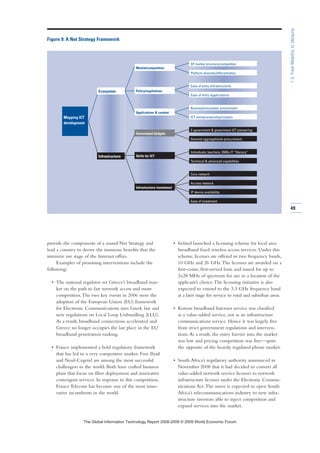
The Global Information
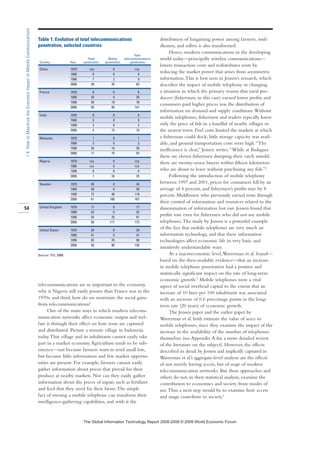
Technology Report 2008–2009
Mobility in a Networked World
Soumitra Dutta, INSEAD
Irene Mia, World Economic Forum
Editors
7KH *OREDO ,QIRUPDWLRQ 7HFKQRORJ 5HSRUW  ‹  :RUOG (FRQRPLF )RUXP
World Economic Forum
Geneva
Copyright © 2009
by the World Economic Forum and INSEAD
All rights reserved. No part of this publication
can be reproduced, stored in a retrieval sys-
tem, or transmitted, in any form or by any
means, electronic, mechanical, photocopying,
or otherwise without the prior permission of
the World Economic Forum.
ISBN-13: 978-92-95044-19-7
ISBN-10: 92-95044-19-3
This book is printed on paper suitable for
recycling and made from fully managed and
sustained forest sources.
Printed and bound in Switzerland by
SRO-Kundig, Geneva.
The Global Information Technology Report 2008–2009
is a special project within the framework of the
Global Competitiveness Network. It is the result of
a collaboration between the World Economic Forum
and INSEAD.
Professor Klaus Schwab,
Executive Chairman, World Economic Forum
EDITORS
Soumitra Dutta, Roland Berger Professor
of Business and Technology and Dean of
External Relations, INSEAD
Irene Mia, Director and Senior Economist,
World Economic Forum
GLOBAL COMPETITIVENESS NETWORK
Fiona Paua, Senior Director,
Head of Strategic Insight Teams
Jennifer Blanke, Director, Senior Economist,
Head of the Global Competitiveness Network
Ciara Browne, Senior Community Manager
Agustina Ciocia, Community Manager
Margareta Drzeniek Hanouz, Director and
Senior Economist
Thierry Geiger, Economist, Global Leadership Fellow
Pearl Samandari, Team Coordinator
Eva Trujillo Herrera, Research Assistant
INFORMATION TECHNOLOGY AND
TELECOMMUNICATIONS INDUSTRIES TEAM
Alan Marcus, Head of IT and
Telecommunications Industries
Michelle Barrett, Team Coordinator
Sandra Bétemps, Senior Team Coordinator
Joanna Gordon, Global Leadership Fellow
Silvia von Gunten, Senior Advisor
William Hoffman, Associate Director
Nicholas Kim, Global Leadership Fellow
Anne Neville, Global Leadership Fellow
Rico Oyola, Global Leadership Fellow
A special thank you to Hope Steele for her
superb editing work and Ha Nguyen for her
excellent graphic design and layout.
The terms country and nation as used in this
report do not in all cases refer to a territorial
entity that is a state as understood by inter-
national law and practice. The terms cover
well-defined, geographically self-contained
economic areas that may not be states but
for which statistical data are maintained on a
separate and independent basis.
7KH *OREDO ,QIRUPDWLRQ 7HFKQRORJ 5HSRUW  ‹  :RUOG (FRQRPLF )RUXP
Contents
Preface................................................................................v
Klaus Schwab (World Economic Forum)
Foreword ..........................................................................vii
John Chambers (Cisco Systems, Inc.)
Executive Summary ............................................................ix
Soumitra Dutta (INSEAD) and Irene Mia
(World Economic Forum)
The Networked Readiness Index Rankings .........................xv
Part 1: The Networked Readiness Landscape
in 2008–09 and Mobility...........................................1
1.1 Gauging the Networked Readiness of Nations:
Findings from the Networked Readiness Index
2008–2009.....................................................................3
Irene Mia (World Economic Forum), Soumitra Dutta
(INSEAD), and Thierry Geiger (World Economic Forum)
1.2 Mobile Telephony: A Critical Enabler of Networked
Readiness?.................................................................27
Thierry Geiger and Irene Mia (World Economic Forum)
1.3 From Mobility to Ubiquity: Ensuring the Power
and Promise of Internet Connectivity... for Anyone,
Anywhere, Anytime.....................................................37
Robert Pepper, Enrique J. Rueda-Sabater, Brian C.
Boeggeman, and John Garrity (Cisco Systems, Inc.)
1.4 How to Maximize the Economic Impact of Mobile
Communications: The Four Waves...............................53
Leonard Waverman (Haskayne School of Business, London
Business School, and LECG) and Kalyan Dasgupta (LECG)
1.5 Unshackled: How Regulation Can Amplify Mobile
Service Benefits in Emerging Markets.........................63
Scott Beardsley, Luis Enriquez, Mehmet Güvendi,
Miguel Lucas, Oleg Timchenko, Sergio Sandoval, and
Ashish Sharma (McKinsey  Company, Inc.)
1.6 Reality Mining of Mobile Communications:
Toward a New Deal on Data........................................75
Alex Pentland (Massachusetts Institute of Technology)
1.7 Global Mobility of Talents: What Will Make People
Move, Stay, or Leave in 2015 and Beyond? ...................81
Vijayakumar Ivaturi (Wipro), Bruno Lanvin (INSEAD,
eLab), and Hrishi Mohan (Wipro)
1.8 RD and Innovation in the ICT Sector: Toward
Globalization and Collaboration...................................95
Graham Vickery and Sacha Wunsch-Vincent (OECD)
Part 2: ICT as a Bridge to Increased Growth and
Competitiveness: Selected Case Studies ...............111
2.1 How Outsourcing Can Help Mobilize Talents
Globally: Egypt’s Success Story..................................113
Nagwa El Shenawy (Ministry of Communications
and Information Technology, Egypt) and Bruno Lanvin
(INSEAD, eLab)
2.2 IT Korea: Past, Present, and Future.............................123
Jae Kyu Lee (Korea Advanced Institute of Science
and Technology), Choonmo Ahn (Electronics and
Telecommunications Research Institute, Korea) and
Kihoon Sung (Electronics and Telecommunications
Research Institute, Korea)
2.3 Will the 2014 Soccer World Cup Help
Bridge the Social Gap through the Promotion
of ICT and E-government in Brazil?.............................133
Darcilene Magalhães (Minas Gerais State Agency
for IT Development, Brazil), Peter Knight (Telemática
e Desenvolvimento Ltda., Brazil), and Eduardo
Moreira da Costa (The Brazilian Innovation Agency)
Part 3: Country/Economy Profiles ..........................145
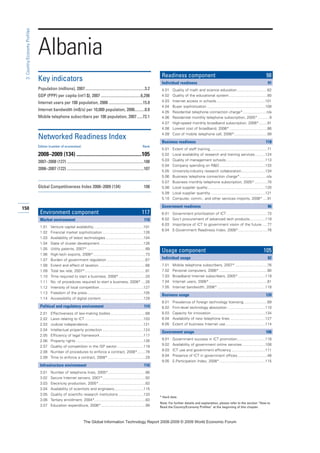
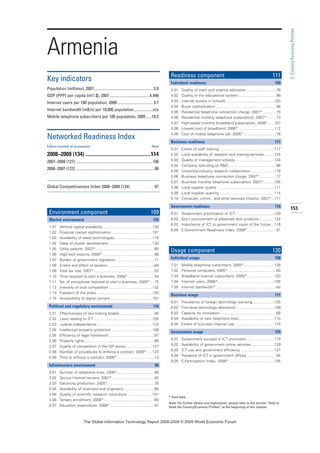
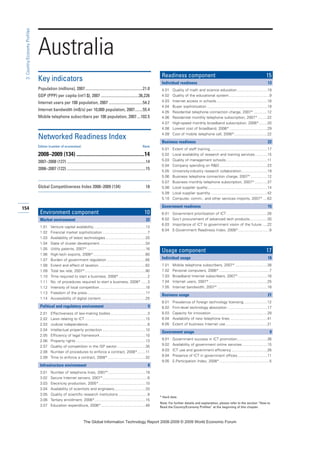
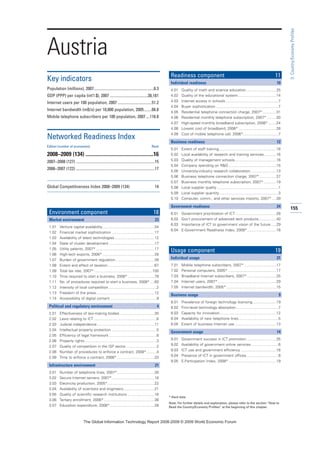
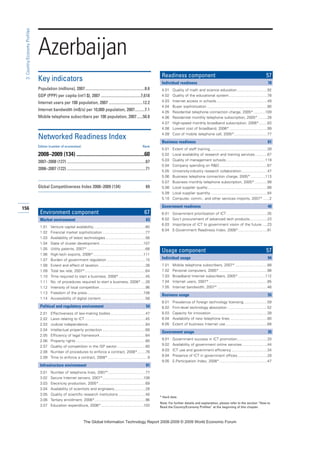
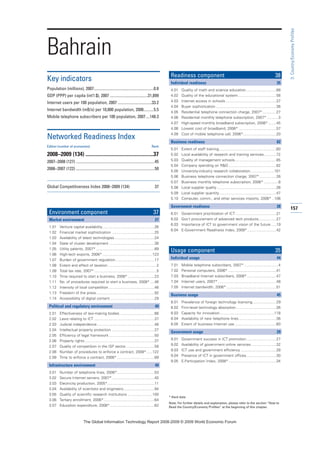
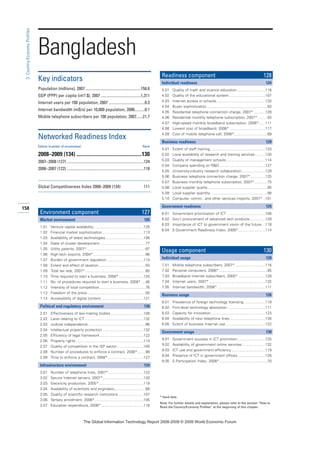
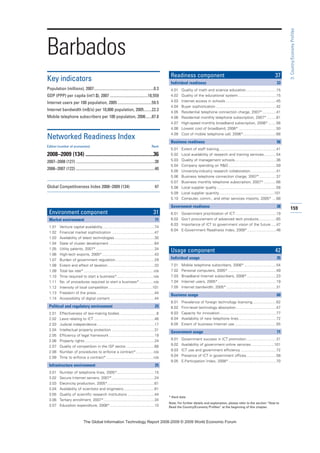
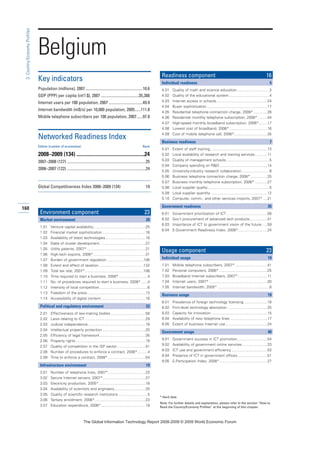
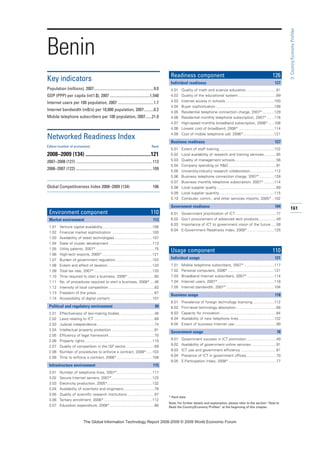
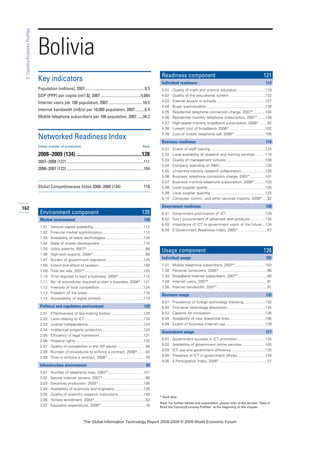
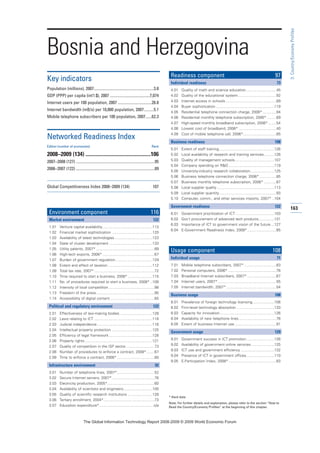
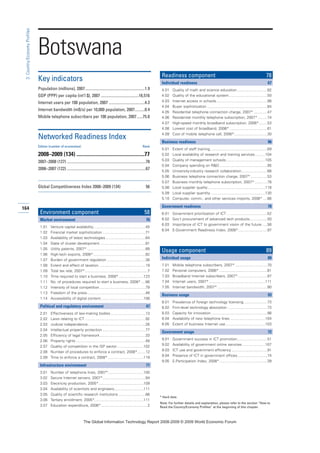
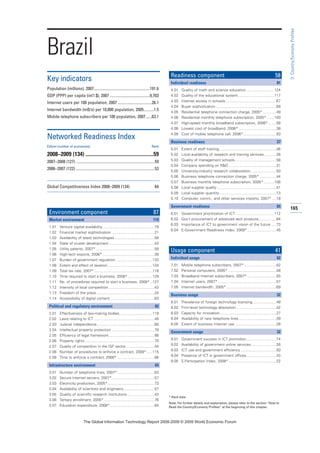
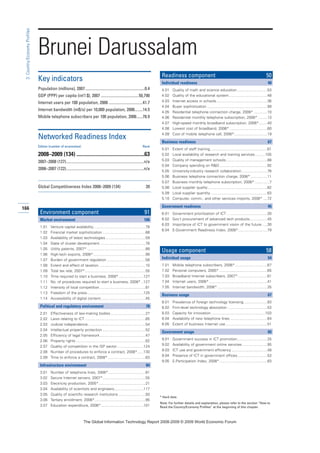
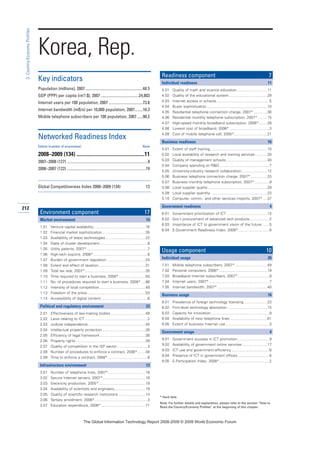
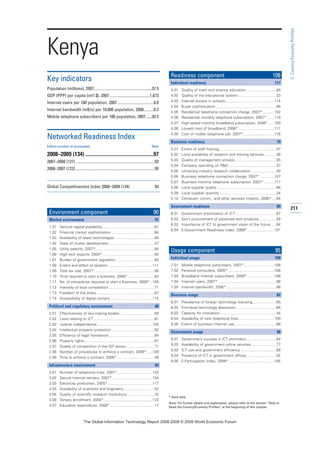
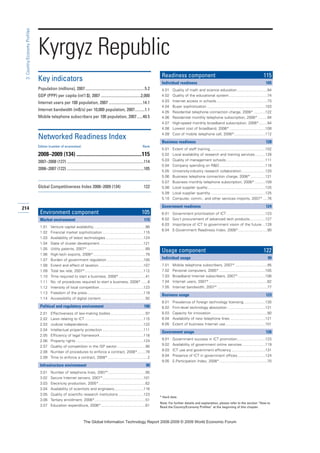
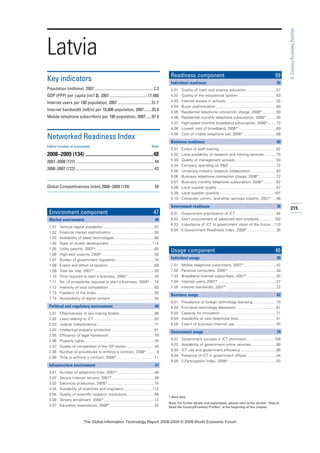
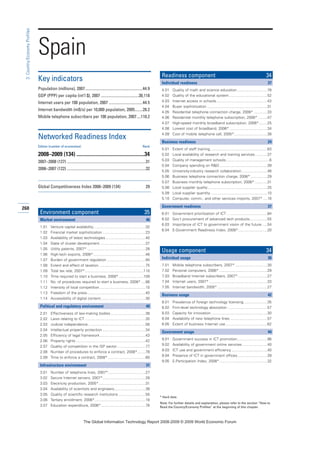
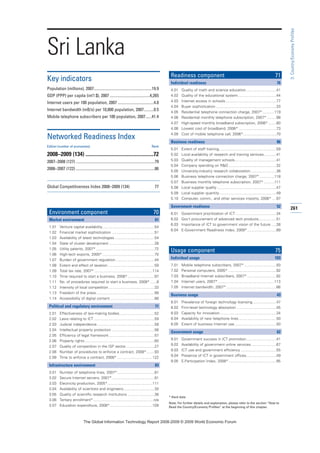
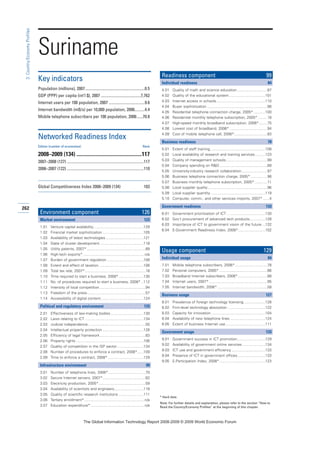
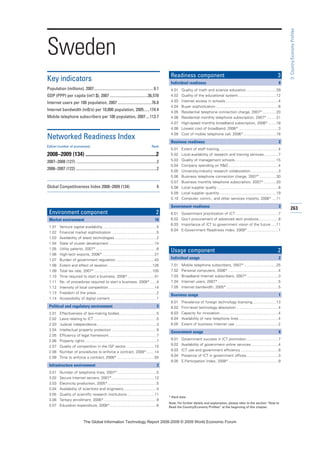
How to Read the Country/Economy Profiles.............................147
List of Countries/Economies......................................................149
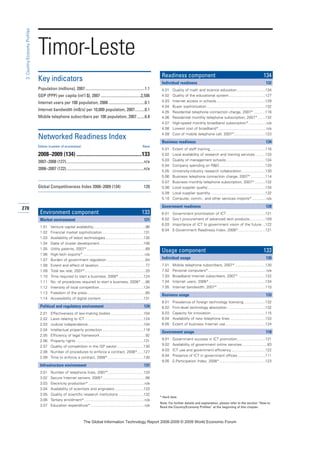
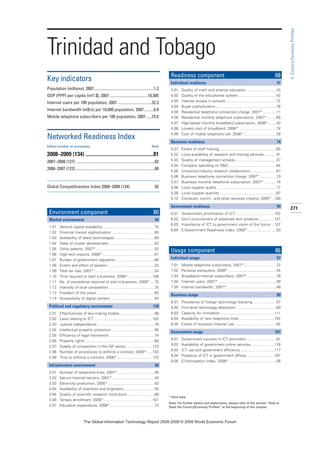
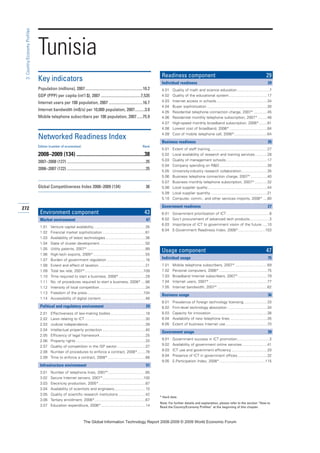
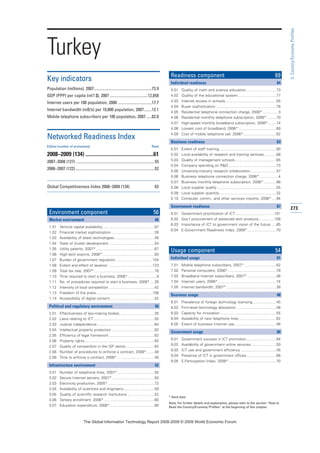
Country/Economy Profiles..........................................................150
Part 4: Data Tables...............................................285
How to Read the Data Tables ....................................................287
Index of Data Tables...................................................................289
Data Tables.................................................................................291
Technical Notes and Sources............................................371
About the Authors .............................................................375
List of Partner Institutes ....................................................381
Acknowledgment..............................................................387
iii
7KH *OREDO ,QIRUPDWLRQ 7HFKQRORJ 5HSRUW  ‹  :RUOG (FRQRPLF )RUXP
v
Information and communication technologies (ICT)
is increasingly moving to the core of national competi-
tiveness strategies around the world, thanks to its
revolutionary power as a critical enabler of growth,
development, and modernization. Recent economic
history has shown that, as developed countries approach
the technological frontier, ICT is crucial for them to
continue innovating in their processes and products
and to maintain their competitive advantage. Equally
importantly, ICT has proven instrumental for enabling
developing and middle-income economies to leapfrog
to higher stages of development and fostering economic
and social transformation.
All over the world, ICT has empowered individuals
with unprecedented access to information and knowl-
edge, with important consequences in terms of providing
education and access to markets, of doing business, and
of social interactions, among others. Moreover, by
increasing productivity and therefore economic growth
in developing countries, ICT can play a formidable role
in reducing poverty and improving living conditions
and opportunities for the poor.
In these challenging times of global economic
crisis, the extraordinary capacity of ICT to drive growth
and innovation should not be overlooked, since it can
play a critical role not only in facilitating countries’
recovery but also in sustaining national competitiveness
in the medium to long term.At the World Economic
Forum, we are strong believers in the link between
economic growth and ICT readiness, a link that should
be further emphasized in the face of the current severe
economic downturn and calls for budget cuts.
The Global Information Technology Report (GITR)
series, produced by the Forum in partnership with
INSEAD and published annually since 2001, has
contributed to raising awareness of the importance of
ICT diffusion for overall competitiveness.The broad
methodological framework of the Networked Readiness
Index (NRI), featured in the Report series, identifies the
enabling factors that permit countries to fully benefit
from ICT advances, stressing the key responsibility of all
social actors—individuals, businesses, and governments.
The NRI has proven a unique tool for policymakers and
all relevant stakeholders, allowing them to follow the
progress of their country over time and vis-à-vis relevant
comparators, and providing a neutral and authoritative
platform for public-private dialogue and for designing
national policies and strategies that aim toward
enhanced networked readiness and competitiveness.
The Global Information Technology Report 2008–2009,
the eighth edition in the series, presents the latest find-
ings of the NRI, providing an updated picture of the
state of networked readiness in the world. Under the
general theme of mobility, the Report notably highlights
the remarkable role of mobile telephony—possibly the
most revolutionary ICT—in economic growth, and
once again showcases success stories of countries able to
leverage ICT for increased competitiveness.
Continuing our effort to expand the coverage of
the Report, a record number of 134 economies, account-
ing for over 98 percent of the world’s GDP, has been
included this year.Also featured in the Report is a com-
prehensive data section containing detailed profiles for
each economy covered and data tables with global rank-
ings for nearly 70 indicators.A number of essays and
case studies on mobility and best practices in networked
readiness complement the Report.
We would like to express our gratitude to the
respected academics and industry experts who con-
tributed outstanding chapters to this Report, casting light
on important aspects of mobility and ICT and high-
lighting best policies and practices in ICT diffusion and
leverage.We especially wish to thank the editors of the
Report, Soumitra Dutta at INSEAD and Irene Mia at the
World Economic Forum, for their leadership and long-
lasting dedication to the project.Appreciation also goes
to Fiona Paua, who heads the Strategic Insight Teams,
and the other members of the Global Competitiveness
Network: Jennifer Blanke, Ciara Browne,Agustina Ciocia,
Margareta Drzeniek Hanouz,Thierry Geiger, Pearl
Samandari, and Eva Trujillo Herrera. Last but not least,
we would like to convey our sincere gratitude to our
network of 150 Partner Institutes around the world and
to all the business executives who participated in our
Executive Opinion Survey, without whose valuable
input and support the production of this Report would
not have been possible.
Preface
Preface
KLAUS SCHWAB
Executive Chairman, World Economic Forum
7KH *OREDO ,QIRUPDWLRQ 7HFKQRORJ 5HSRUW  ‹  :RUOG (FRQRPLF )RUXP
vii
The current global recession has affected business in
nearly every industry and geographical region; it is also
having a deep and wide impact on societies around the
world.Taking decisive action to reprioritize during any
slowdown is a key focus for companies and countries,
and we are all in the process of taking the necessary
measures that will enable us to adjust to today’s reality. It
is fundamental, however, that we do not allow short-term
challenges to distract us from planning for longer-term
opportunities to achieve sustainable growth.
I believe that we are faced with a unique opportu-
nity to nurture global economic prosperity, and ubiqui-
tous broadband access is a key part of the solution.
By investing in the development and acceleration of a
global broadband infrastructure, we can provide Internet
access for all of the world’s citizens.This means we
can create jobs, provide better access to health care
and education, connect small business owners to new
customers, and in some countries create a middle class
that will raise the standard of living and national GDP.
There is plenty of work to do in providing access.
For example, while 77 out of every 100 Canadian resi-
dents uses the Internet, there are only 16 out of 100
users in Panama, according to 2007 ITU data and analy-
sis.The number of broadband subscribers of the same
two countries is in equal contrast; while 28 of every 100
Canadian residents have broadband subscriptions, there
is only 1 broadband subscriber per 100 in Panama.
Equally important is the opportunity for countries
that are considered advanced when compared to other
countries from around the world. For example, Korea,
Rep., considered the leader in broadband penetration,
only has 29 broadband subscribers per 100 residents,
according to ITU data.
Achieving ubiquitous broadband access is in the
best interest of citizens, businesses, and governments
alike. However, we will succeed in this effort only
through a collaborative partnership—businesses working
alongside health-care providers, educators, governments,
and nongovernmental organizations. Only by providing
the means for people everywhere to access broadband—
from the most remote villages to the densest urban
centers—will we have the potential to experience a
truly connected global economy.
Broadband provides unprecedented opportunities
for people to communicate with others, access informa-
tion, improve education and health care, enter new
markets, expand the reach of businesses, and so much
more. Imagine how different the world—and the world
economy—would be if we could extend connectivity to
all corners of the globe. Broadband literally transforms
the way we live, work, play, and learn.
And when we talk about broadband, we are really
talking about mobile broadband, enabled by a global
wireless infrastructure built on an Internet Protocol net-
work platform. Mobility represents the only way for the
world to achieve ubiquitous broadband access, allowing
the power of the network to scale beyond the limits of
traditional hard-wired environments.
Prior to the emergence of the global economic
crisis, the world was gaining momentum toward the
next phase of the Internet, built on a network platform
and fueled by productivity-enhancing collaboration
tools and networked applications. Despite the current
financial setbacks, we are still collectively poised to reap
the benefits of this next phase, enabled by a worldwide
mobile broadband network infrastructure.
With this in mind, I believe that the most important
step government and business leaders in both developed
and developing nations can take to encourage economic
growth and global prosperity is to concentrate—collec-
tively, collaboratively—on longer-term opportunities
such as universal broadband access.
Let’s rise to the challenge, and in doing so, raise the
quality of life—and our economic prosperity for gener-
ations to come. Now is the time to invest in ubiquitous
broadband and empower all of the world’s citizens to
participate in the human network.
Cisco is pleased to sponsor The Global Information
Technology Report 2008–2009, including the Networked
Readiness Index.We hope that these will provide
important insight into how we can use mobility to
help address the immense challenges and opportunities
ahead.
Foreword
Foreword
JOHN CHAMBERS
Chairman and CEO, Cisco Systems, Inc.
7KH *OREDO ,QIRUPDWLRQ 7HFKQRORJ 5HSRUW  ‹  :RUOG (FRQRPLF )RUXP
ix
ExecutiveSummary
Information and communication technologies (ICT) has
proven to be a key enabler of socioeconomic progress
and development, enhancing productivity and therefore
economic growth, reducing poverty and improving liv-
ing standards in many ways. ICT is increasingly revolu-
tionizing production processes, access to markets, and
information sources together with social interactions.
ICT also has an impact on government efficiency,
fostering transparency and better communication and
services with and to citizens.
Among these new technologies, mobile telephony
takes a special place in view of its exceptional diffusion
in the last decade or so and its strong social and economic
impact. In particular, mobile telephony has proven
instrumental in raising prosperity and reducing poverty
in developing countries, where it has boomed in recent
years—thanks also to a number of facilitating factors,
including an infrastructure fairly easy to deploy, a market
generally open to new entrants, and the decreasing costs
of mobile handsets and communication per minute,
among others.
The Global Information Technology Report series,
launched in 2001 and published annually since, has gone
hand in hand with the ICT revolution and evolution for
eight years now, contributing to raising public and private
awareness of the many benefits associated with fully
leveraging ICT in everyday life, in business practices,
and in a government’s activities and interactions with its
citizens.The Report has stressed the importance of ICT
in national competitiveness and development strategies
and has provided a very useful tool for decision makers
and civil society alike to monitor national progress as
well as examples of best practices and policies to
increase networked readiness.
The Global Information Technology Report 2008–2009
appears at a difficult time for the global economic system,
which seems to be plunging deeper and deeper into the
serious recession that began with the subprime housing
crisis in the United States and then spread to most
countries in the world.Against such a daunting eco-
nomic outlook, it is important to reaffirm the crucial
role of ICT for general competitiveness and progress
and the importance of continuing to invest in ICT
infrastructure and related services, as well as, more
broadly, in innovation.We hope that the Report and the
Networked Readiness Index (NRI) 2008–2009 will
further strengthen the case for ICT by highlighting the
strong correlation between ICT readiness and economic
growth and showcasing success stories of countries that
have used ICT to leapfrog stages of development or,
more generally, to enhance their competitiveness.
The Report is the eighth of a series and is the result
of a well-established partnership between the World
Economic Forum (the Forum) and INSEAD, aimed at
advancing knowledge of networked readiness and of its
principal drivers.
The Report is composed of four thematic parts. Part
1 features the findings of the Networked Readiness
Index for 2008–09, as well as a number of remarkable
essays examining different topics related to mobility and
ICT.Among these topics are mobile telephony and its
impact on economic growth and networked readiness,
Internet ubiquity, mobile reality mining, and mobility
of talents and research and development (RD) flows.
Part 2 provides insight into best practices and
policies in networked readiness and competitiveness,
focusing on specific country case studies.The countries
selected this year are Egypt, Korea, Rep. (Korea), and
Brazil, for, respectively, best practices as an outsourcing
destination, general ICT strategy to promote national
competitiveness, and the use of e-government services
and ICT to alleviate economic and social problems.
Part 3 includes detailed profiles for each of the
134 economies covered in this year’s Report, offering a
comprehensive snapshot of each economy’s current
networked readiness landscape and allowing for interna-
tional and historical comparison on specific variables or
components of the NRI. Part 4 features detailed data
tables for each of the 68 variables composing the NRI
this year, with rankings for the 134 economies covered,
and technical notes and sources.
Part 1: The Networked Readiness Landscape in
2008–09 and Mobility
This part presents the latest findings of the NRI,
sketching a comprehensive picture of the networked
readiness landscape of the world in 2008–09.A number
of deep-dive analyses focusing on different aspects related
to mobility, ICT, and innovation are also included, as
follows: (1) mobile telephony and its impact on networked
readiness; (2) the shift from mobility to ubiquity, thanks
to universal Internet connectivity; (3) how to maximize
the economic impact of mobile communications;
Executive Summary
SOUMITRA DUTTA, INSEAD
IRENE MIA, World Economic Forum
7KH *OREDO ,QIRUPDWLRQ 7HFKQRORJ 5HSRUW  ‹  :RUOG (FRQRPLF )RUXP
(4) best practices in regulation that can amplify mobile
service benefits in emerging markets; (5) reality mining
of mobile communications; (6) global mobility of talent;
and (7) mobility of international flows in ICT RD.
The Networked Readiness Index
Chapter 1.1,“Gauging the Networked Readiness of
Nations: Findings from the Networked Readiness Index
2008–2009,” presents the latest NRI findings.The NRI
was developed by INSEAD in 2002 as a part of an
ongoing joint research project with the Forum, and is
the main methodological tool featured in the Report to
assess countries’ preparedness to leverage ICT advances
for increased competitiveness and development. It builds
on a mixture of hard data collected by well-respected
international organizations, such as the International
Telecommunication Union (ITU), the United Nations,
and the World Bank, and survey data from the Executive
Opinion Survey, conducted annually by the Forum in
each of the economies covered by the Report. The NRI
2008–2009 covers a record number of 134 economies
(up from 127 in last year’s edition) from both the
developed and developing world, accounting for over
98 percent of world GDP.The Networked Readiness
Framework, underpinning the NRI and stable since
2002, measures:
• the presence of an ICT-conducive environment, by
taking into consideration a number of features of
the broad business environment, some regulatory
aspects, and the soft and hard infrastructure for
ICT;
• the degree of preparation needed to use ICT for
the three main national stakeholders—individuals,
the business sector, and the government; and
• the actual use of ICT by the above three
stakeholders.
The NRI rankings for 2008–09 feature Denmark as
the most networked economy in the world for the third
consecutive year, the culmination of an upward trend
observed since 2003.The other Nordic countries also
continue to teach the world best practices on how to
leverage ICT for increased competitiveness, with
Sweden, Finland, Iceland, and Norway at 2nd, 6th, 7th,
and 8th position, respectively.Among the top 20, the
United States continues to deliver a convincing per-
formance in networked readiness, climbing one position
to an outstanding 3rd place, followed by Singapore (4th)
and Switzerland (5th). Five other economies from the
Asia and Pacific region place in the top 20 this year:
Korea (11th), Hong Kong (12th),Taiwan (13th),
Australia (14th), and Japan (17th).
With regard to the largest Asian emerging markets,
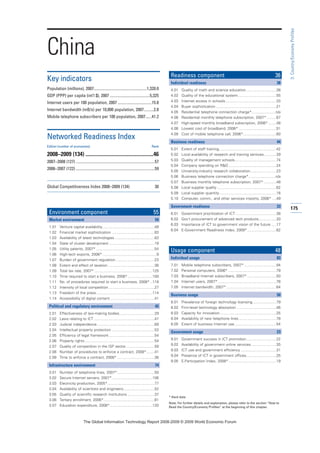
China leapfrogs 11 positions to 46th, overtaking India
(which is down four positions at 54th) and the rest of
the BRIC countries for the first time.
The assessment of Latin America and the Caribbean
is more mixed in nature, with only six economies in the
top half of the rankings, namely Barbados (36th), Chile
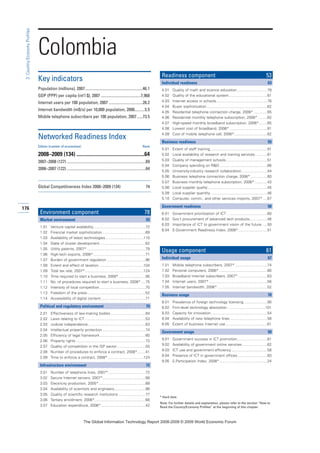
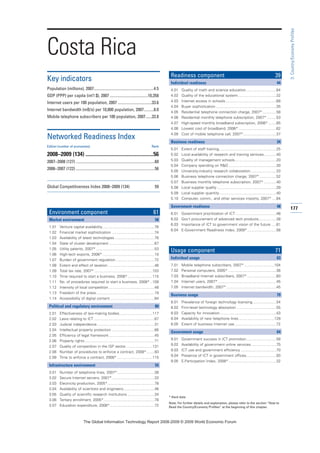
(39th), Puerto Rico (42nd), Jamaica (53rd), Costa Rica
(56th), and Brazil (59th). Chile loses five positions and
the leadership in the region for the first time since the
inception of this Index. Mexico and Argentina are both
losing ground, positioning themselves at 67th and 87th,
respectively.
Despite some positive trends, sub-Saharan Africa
continues to lag behind the rest of the world by a signif-
icant margin, with only two economies (Mauritius and
South Africa, at 51st and 52nd place, respectively) in the
top half of the NRI, while 18 rank below 100th place.
In Northern Africa,Tunisia (38th) leads the way
again, with a large and widening gap. Egypt, Morocco,
and Algeria are down at 76th, 86th, and 109th,
respectively.
By contrast, the Middle East further improves its
networked readiness, with all countries but one appear-
ing in the top half of the NRI rankings, namely Israel
(25th), the United Arab Emirates (27th), Qatar (29th),
Bahrain (37th), Saudi Arabia (40th), Jordan (44th),
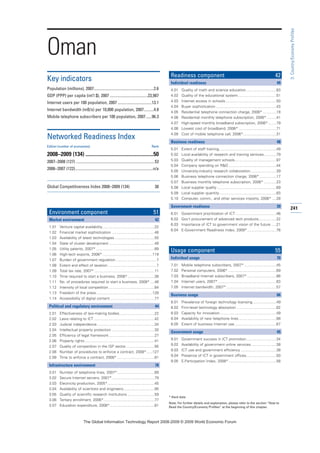
Oman (50th), and Kuwait (57th).
Similar to last year, a trend analysis of the eight-year
time-series of the NRI is included in the chapter, with
the aim of identifying the countries and regions that
have proven particularly dynamic in leveraging ICT
and have advanced the most in the NRI rankings over
the years.
Mobile telephony and networked readiness
Mobile telephony has emerged as one of the most
important and widespread forms of ICT in recent
decades, with a significant impact on economic growth
and poverty reduction.
In particular, mobile communications penetration
has boomed in the developing world, compensating for
an often underdeveloped and flawed fixed telephony
infrastructure and offering a promising tool to lift more
and more people out of poverty and improve market
efficiency.This is good news in view of reducing the
digital and economic divide existing between high-
and low-income countries.
In their paper “Mobile Telephony:A Critical
Enabler of Networked Readiness?”Thierry Geiger and
Irene Mia (both at the World Economic Forum) explore
the connections among mobile telephony, economic
growth and development, and countries’ networked
readiness, as captured by the NRI.The authors’ original
assumption is that mobile readiness should have a strong
impact on overall networked readiness and therefore on
sustained economic growth and development.The
analysis performed in the chapter shows that this suppo-
sition is certainly true, but only to a certain extent.
x
ExecutiveSummary
7KH *OREDO ,QIRUPDWLRQ 7HFKQRORJ 5HSRUW  ‹  :RUOG (FRQRPLF )RUXP
While the latest data as well as historical data demon-
strate that only a handful of countries with low mobile
telephony penetration rates achieve above average net-
worked readiness levels, Geiger and Mia noticed that
high mobile telephony penetration is not inevitably
synonymous with high networked readiness.They also
observe that the relation between mobile telephony
usage and GDP per capita is clearly positive, but is about
three times stronger in low- and lower-middle-income
countries.This finding bodes well for poor countries’
capacity to reduce poverty levels and improve competi-
tiveness and prosperity, considering the booming mobile
phone penetration rates they have registered in recent
years.
From mobility to ubiquitous connectivity
High-speed networks have become part of the basic
infrastructure of any country and one of the foundations
of the knowledge economy. For many countries they
also offer a unique, cost-effective opportunity to
enhance their competitiveness and rise above physical or
geographical constraints. Beyond mobility of telecom-
munications, ubiquitous Internet access offers connec-
tivity that follows users seamlessly as they move from
place to place and device to device.
In their chapter “From Mobility to Ubiquity:
Ensuring the Power and Promise of Internet
Connectivity… for Anyone,Anywhere,Anytime,”
authors Robert Pepper, Enrique J. Rueda-Sabater,
Brian C. Boeggeman, and John Garrity (all at Cisco
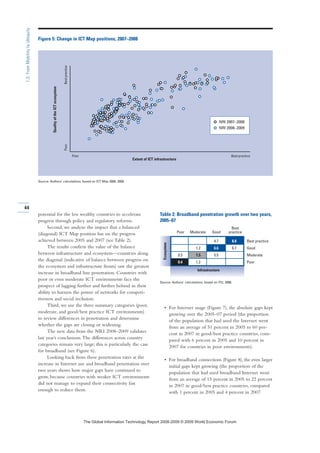
Systems, Inc.) propose: (1) a typology of Internet stages
and an ICT Map to place countries’ ICT development
in perspective and provide a basis for charting a course
forward, (2) a framework for assessing and improving
connectivity and the use of networks, and (3) a review
of the key drivers toward the goal of Internet ubiquity.
The stages and ICT Map highlight the importance of
balancing infrastructure investments with improvements
in the ecosystem (notably ICT policies and market reg-
ulation).This is confirmed, the authors say, by evidence
that connectivity is not determined solely by income
levels—making it possible for lower-income countries
to leapfrog in ICT development.
A framework built around six keystones is suggested
by the authors to benefit from the opportunity that net-
work connectivity offers.These comprise: a competitive
market structure that balances investment incentives and
efficient service, policies and regulations that support
technology adoption (including convergence around
IP), entrepreneurship around applications and content,
the use of government ICT budgets to “prime the
pump” and
pioneer ICT adoption, skill development, and extensive
investment (public and private) in infrastructure.This
framework, they argue, can be used to build the founda-
tions from which to progress toward the goal of Internet
ubiquity—with all its implications for collaboration and
Web 2.0 productivity and inclusiveness.This requires
ensuring, in particular, the wide availability of a core
network, spectrum availability and other means to allow
a diverse system of “capillaries” extending to “the last
mile” to emerge, and the proliferation of Internet-
enabled devices that meet the needs of users.
Maximizing the economic impact of mobile communications
Although there is no magic bullet solution for economic
development, mobile telecommunications has indeed
had a positive disruptive impact on life in many devel-
oping economies, especially in rural areas. In their chap-
ter “How to Maximize the Economic Impact of Mobile
Communications:The Four Waves,” Leonard Waverman
(Haskayne School of Business, London Business School,
and LECG) and Kalyan Dasgupta (LECG) identify four
stages of development of an information society, which
they define as the “four waves” of communications tech-
nology, namely (1) simple access, (2) universal service,
(3) usage, and (4) provision of complementary skills and
assets.According to them, only when a country has
evolved through all four waves is it able to make the
fullest use of technology.The authors observe that the
literature and the policy debate have so far essentially
concentrated on the first two waves; also there is a lack
of data availability for the other two.They believe the
development of additional research on the last two
waves is of paramount importance for understanding the
role of usage and complementary capital in governing
gains from ICT in a developing country context.This
could provide policymakers with a robust assessment of
the policies that will maximize the returns from ICT
investment. Indeed, the developing world has seen only
a glimpse of the potential economic and social value of
investment in mobile telecommunications networks so
far. In particular,Waverman and Dasgupta believe that
setting the right taxation and the licensing process play
crucial roles in ensuring adequate investment and
enhancing consumer benefits in the mobile sector,
as does defining the appropriate role of government
intervention and regulation in the current challenging
economic environment.They also remark that 3G or
wireless mobile telephony could have a particularly
important impact in the developing world since these
technologies may represent the most cost-effective way
to bring broadband or even Internet access to the mass-
es. Developing countries are likely to enjoy, argue the
authors, the benefit of adopting 3G+ technology at a
time when devices and applications enhancing the
mobile broadband experience are entering a mature
developmental phase; therefore one can expect relatively
rapid diffusion of 3G technology in the developing
world.
xi
ExecutiveSummary
7KH *OREDO ,QIRUPDWLRQ 7HFKQRORJ 5HSRUW  ‹  :RUOG (FRQRPLF )RUXP
Regulation and its impact on mobile service benefits in
emerging markets
Mobile communications play a key role in developing
economies, crucially facilitating economic growth and
development.At the same time, emerging markets are
home to 75 percent of the world’s subscribers today and
hold an important position in the mobile industry’s
agenda because of their strong potential going forward.
However, succeeding in these markets often requires
different and innovative approaches tailored to the
specificities of those markets.After discussing the
benefits of mobile services in emerging markets,
“Unshackled: How Regulation Can Amplify Mobile
Service Benefits in Emerging Markets,” by Scott
Beardsley, Luis Enriquez, Mehmet Güvendi, Miguel
Lucas, Oleg Timchenko, Sergio Sandoval, and Ashish
Sharma (all at McKinsey  Company, Inc.), highlights a
broader set of policy considerations that policymakers
and industry players should consider and address togeth-
er in view of enhancing ubiquity and the benefits of
mobile service when regulating the latter in developing
economies.Among these considerations are:
1. ensuring sufficient but not excessive competition
—in a capital-intensive industry, where large
upfront investments are necessary, competition
among a few players may have better results
than hyper-competition among many;
2. avoiding direct price controls—low prices
typically retard industry returns and overall
growth in the medium to long term, hampering
investment levels and translating into poor
customer service;
3. attaching strict rollout and coverage require-
ments to mobile licenses, in order to prevent
new players from investing in rich niche areas
and neglecting more low-income and remote
areas; and
4. effectively managing spectrum allocation and
pricing, given that spectrum management has
risen significantly in importance in emerging
markets, and spectrum policies will play a
major role in delivering telecommunication
services to users.
The authors believe these policy issues, if well
tackled, can create a fertile environment in which the
mobile industry can thrive, generating a high public
value for the developing world and its people.
Reality mining of mobile communications
Humanity has the beginnings of a new nervous system
—a digital one derived from mobile telephone networks
and already nearly 4 billion people strong. In his chapter
“Reality Mining of Mobile Communications:Toward a
New Deal on Data,” MIT professor Alex Pentland
focuses on the consequences in terms of data gathering
of the fact we live nowadays in digital networks and
leave digital breadcrumbs of our daily activities all the
time. He explains that computational models based on
these digital “people data,” using a process called reality
mining, allow us to create a startlingly comprehensive
picture of our lives and to predict human social behavior
with a power that was barely conceivable just a few
years ago. Pentland believes that this new “God’s eye”
view of humanity will present unprecedented opportu-
nities for profitable commerce and effective government
but also may endanger our personal freedom.To harness
the good and avoid the evil, he calls for a “New Deal”
about how personal data can be gathered and used.
This deal should be based on ownership as a minimal
requirement, complemented by a commitment to
adopt policies encouraging the combination of massive
amounts of anonymous data to promote the Common
Good.
Global mobility of talent
In today’s world, some 200 million people live and work
outside their country of origin. OECD countries alone
host some 75 million migrants. Broader access to trans-
portation and ICT-enabled new forms of production
combined with disparities in income and labor markets
are some of the factors behind the growing global mar-
ket for migrant workers, both short term and less so. In
“Global Mobility of Talents:What Will Make People
Move, Stay, or Leave in 2015 and Beyond?”Vijayakumar
Ivaturi (Wipro), Bruno Lanvin (INSEAD, eLab), and
Hrishi Mohan (Wipro) attempt to make some sense of
the emerging mobile talent geography, casting light on
how the different mobility drivers are likely to combine,
compound, or offset each other in the future; what the
main directions of labor flows will be; and how the “war
for talents” is going to be waged, among other issues.
Taking into account longer-term trends and recent
changes in the way companies and individuals operate,
the authors explore some avenues that may help define
new dimensions of talent mobility, as well as some of
the most urgent issues to be addressed by decision mak-
ers with respect to the skills required to sustain national
competitiveness. In particular, a simple model (the
Global Talent Pyramid Model, or GTPM) is presented,
according to which the ability of a country to attract
talents internationally is determined by three main fac-
tors: the attractiveness of the national ecosystem vis-à-vis
local and foreign talent, the existence of a critical mass
in the “national talent pool” (stock and flow), and the
overall efficiency/quality of the economy and society.
The authors believe that mobility, whether virtual
or physical, will be a central factor in our collective
efforts to establish an equitable, multicultural, open,
innovative, and sustainable globalization.They point to
xii
ExecutiveSummary
7KH *OREDO ,QIRUPDWLRQ 7HFKQRORJ 5HSRUW  ‹  :RUOG (FRQRPLF )RUXP
the need to become fully aware of the potential benefits
of collective action to encourage and allow such mobility
on a global scale, and to the opportunity offered by the
current crisis to take such action.
International flows in RD in ICT
“RD and Innovation in the ICT Sector:Toward
Globalization and Collaboration,” by GrahamVickery
and Sacha Wunsch-Vincent (both at the OECD), deals
with recent developments in increasingly globalized
ICT RD and innovation.The authors relate how
global structures of RD, science performance, and
innovation are undergoing an important change whose
main dimensions are the absolute growth of RD and
innovation-related activities; the rise of the BRIC
economies in scientific and technological fields; the
significant globalization of RD; the greater performance
of RD in the services sector; and a growing focus on
non-technological innovation, enhanced international-
ization, and mobility of highly skilled people; and
increased internationalized patenting.According to
Vickery and Wunsch-Vincent, a number of factors
underpin these trends, namely the increasingly knowl-
edge-driven nature of innovation; the quickly changing
organization of research that is driven by information
technologies, collaboration, and the sharing of knowl-
edge; and changes in markets, the competition environ-
ment, and technology.
Part 2: ICT as a Bridge to Increased Growth and
Competitiveness: Selected Case Studies
This part showcases some best practices and policies in
networked readiness and competitiveness, relating the
experiences of three countries—Egypt, Korea, and
Brazil—in becoming a successful outsourcing destination;
in adopting a general ICT strategy fostering national
competitiveness; and in using world-class e-government
practices and ICT (and soccer) to bridge social and
economic inequalities.
Egypt’s success story in outsourcing
In the current globalization wave, some developing
countries, have emerged as major outsourcing destina-
tions, greatly benefiting from the related opportunities.
In their chapter “How Outsourcing Can Help Mobilize
Talents Globally: Egypt’s Success Story,” Nagwa El
Shenawy (Ministry of Communications and
Information Technology, Egypt) and Bruno Lanvin
(INSEAD, eLab) focus on Egypt’s successful experience
as an emerging outsourcing gateway in the Middle East
and relate the carefully built business environment strat-
egy and the sustainable and ongoing technological
development and skills upgrading programs that enabled
Egypt’s transformation in this area. Indeed, an aggressive
national plan was set, including specialized ICT-training
programs and the creation of business hubs such as the
SmartVillage and Maadi Investment Park, while
investor-tailored incentive packages were introduced.
The authors argue that Egypt has the potential to
be one of the top five business process outsourcing des-
tinations within the next 10 years, thanks to competitive
advantages such as its low costs, competitive labor pool,
stable macroeconomic environment, strategic geographi-
cal location, strong government focus, good telecommu-
nications infrastructure, and improving business environ-
ment.They highlight, as a main takeaway from Egypt’s
experience, the importance of investing
in relevant human resources, ensuring an overall infra-
structure supply with world-class connectivity levels
and creating a well-funded investment agency with
an adequate regulatory authority working on a public-
private partnership basis.
However, Egypt also faces a number of challenges
going forward, among which are its intellectual property
rights and security risks, the challenge of marketing the
country as a late entrant, and labor pool bottlenecks at
the middle management and middle level, not to men-
tion global inflationary trends.
The past, present, and future of IT Korea
Korea has become one of the leading IT nations of the
21st century; it has achieved rapid economic growth
owing to the successful development of the IT industry
and its applications.The reasons for Korea’s amazing
economic growth have been analyzed in terms of its
proactive acceptance of technology, value-adding devel-
opment with enhanced performance, and quick transi-
tion through industrial structuring.“IT Korea: Past,
Present, and Future,” by Jae Kyu Lee (Korea Advanced
Institute of Science and Technology) and Choonmo
Ahn and Kihoon Sung (both at the Electronics and
Telecommunications Research Institute, Korea), identifies
and reviews four phases in Korean IT industry evolution,
explaining how the IT industry is related to the elec-
tronics industry and how important it is for technology
leadership to attain global IT business leadership.The
authors regard as especially crucial the government’s
proactive role in propagating new standard platforms
of telecommunications. Korea has overcome various
challenges over time, including financial crises and oil
shocks.The Korean IT industry has critically contributed
in tackling the above by discovering new answers to
demanding pressures.The authors point to the fact that
Korea is currently faced with the effect of the financial
crisis sweeping the world as well as with a slowdown in
the growth of the IT industry.They argue that the role
of proactive IT development becomes necessary again as
the new growth engine, and describe the New IT
Strategy as aiming to overcome today’s challenges.
xiii
ExecutiveSummary
7KH *OREDO ,QIRUPDWLRQ 7HFKQRORJ 5HSRUW  ‹  :RUOG (FRQRPLF )RUXP
Brazil: E-government, ICT, and the World Cup to bridge
the social divide
ICT-wise, Brazil is a country of many contrasts where
one of the most elaborate electronic voting systems in
the world and a remarkable online tax return operation
coexist with poor broadband penetration and computer
illiteracy in many parts of the country, especially among
the poor.This reflects entrenched inequalities in the
distribution of income, wealth, and access to education
and health services, among many other issues.These
inequalities not only threaten social cohesion and
undermine public safety, they also cut economic
competitiveness.
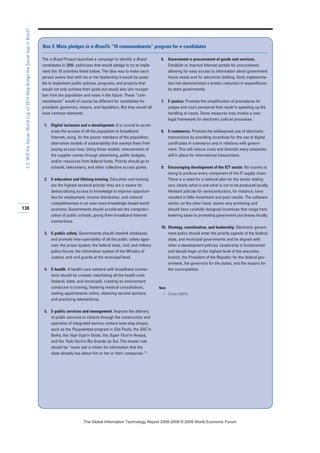
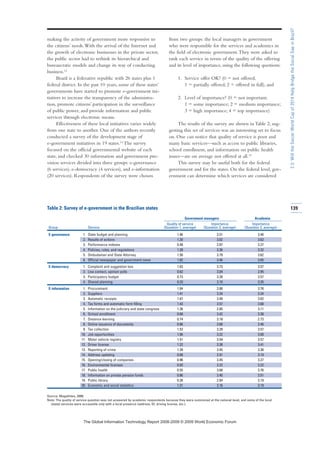
In their chapter “Will the 2014 Soccer World Cup
Help Bridge the Social Gap through the Promotion of
ICT and E-government in Brazil?” authors Darcilene
Magalhães (Minas Gerais State Agency for IT
Development, Brazil), Peter Knight (Telemática e
Desenvolvimento Ltda., Brazil), and Eduardo Moreira
da Costa (The Brazilian Innovation Agency) provide a
thoughtful account of the progress made in e-government
and ICT diffusion in the last couple of decades in
Brazil, as well as the pending challenges that must still
be tackled. In particular, two major projects hold the
potential to help the government bridge the digital and
socioeconomic gap in the country, fostering growth and
prosperity for all Brazilians: the e-Brasil Project and the
2014-Bis Program.The former, begun in 2004, pro-
motes a broad agenda of public policies aimed at build-
ing a more equitable and competitive country through
intensive use of ICT and seeks to raise general awareness
about the advantages of a coherent e-development
strategy. By 2008, the e-Brasil Project had created a Web
portal promoting the e-Brasil vision and published three
books, notably featuring a list of policy recommendations
and the “10 commandments” program—a concise sum-
mary of these recommendations—for e-Brasil candidates.
An initial assessment of the Project’s results is mostly
positive, with visible progress at the political level,
especially in important states such as São Paulo, Rio
de Janeiro, Ceará, and Minas Gerais.
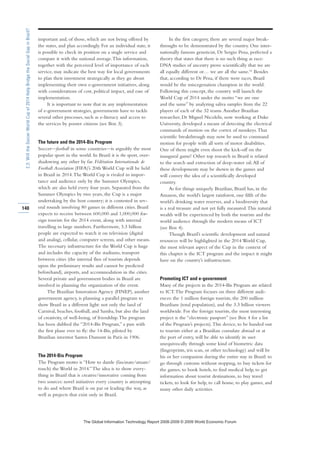
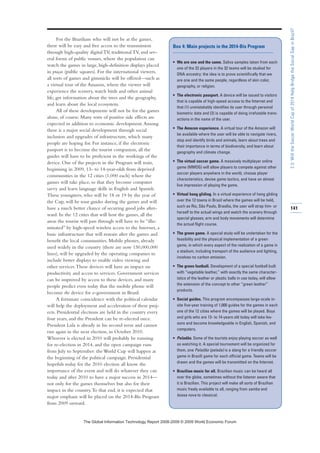
The 2014-Bis Program, which is expected to gain
speed this year, intends to create a stronger country
brand, showcasing unique Brazilian developments in
terms of technology, scope, approach, and social impact,
in parallel to the preparation of the World Cup 2014,
which will be hosted by Brazil.
Parts 3 and 4: Country/Economy Profiles and Data
Presentation
Parts 3 and 4 present detailed profiles for each of the
134 economies covered this year in the Report and data
tables for each of the 68 variables composing the NRI,
with global rankings. Each part is preceded by a descrip-
tion of how to interpret the data provided.Technical
notes and sources, included at the end of Part 4, provide
additional details and information on the definitions and
sources of the specific hard data variables included in
the Report.
xiv
ExecutiveSummary
7KH *OREDO ,QIRUPDWLRQ 7HFKQRORJ 5HSRUW  ‹  :RUOG (FRQRPLF )RUXP
The Networked Readiness
Index Rankings
7KH *OREDO ,QIRUPDWLRQ 7HFKQRORJ 5HSRUW  ‹  :RUOG (FRQRPLF )RUXP
xvii
TheNetworkedReadinessIndexRankings
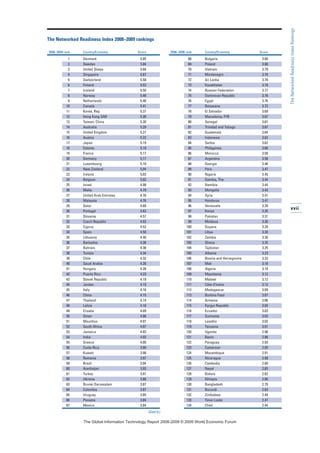
The Networked Readiness Index 2008–2009 rankings
2008–2009 rank Country/Economy Score
1 Denmark 5.85
2 Sweden 5.84
3 United States 5.68
4 Singapore 5.67
5 Switzerland 5.58
6 Finland 5.53
7 Iceland 5.50
8 Norway 5.49
9 Netherlands 5.48
10 Canada 5.41
11 Korea, Rep. 5.37
12 Hong Kong SAR 5.30
13 Taiwan, China 5.30
14 Australia 5.29
15 United Kingdom 5.27
16 Austria 5.22
17 Japan 5.19
18 Estonia 5.19
19 France 5.17
20 Germany 5.17
21 Luxembourg 5.10
22 New Zealand 5.04
23 Ireland 5.03
24 Belgium 5.02
25 Israel 4.98
26 Malta 4.79
27 United Arab Emirates 4.76
28 Malaysia 4.76
29 Qatar 4.68
30 Portugal 4.63
31 Slovenia 4.57
32 Czech Republic 4.53
33 Cyprus 4.52
34 Spain 4.50
35 Lithuania 4.40
36 Barbados 4.38
37 Bahrain 4.38
38 Tunisia 4.34
39 Chile 4.32
40 Saudi Arabia 4.28
41 Hungary 4.28
42 Puerto Rico 4.23
43 Slovak Republic 4.19
44 Jordan 4.19
45 Italy 4.16
46 China 4.15
47 Thailand 4.14
48 Latvia 4.10
49 Croatia 4.09
50 Oman 4.08
51 Mauritius 4.07
52 South Africa 4.07
53 Jamaica 4.03
54 India 4.03
55 Greece 4.00
56 Costa Rica 3.99
57 Kuwait 3.98
58 Romania 3.97
59 Brazil 3.94
60 Azerbaijan 3.93
61 Turkey 3.91
62 Ukraine 3.88
63 Brunei Darussalam 3.87
64 Colombia 3.87
65 Uruguay 3.85
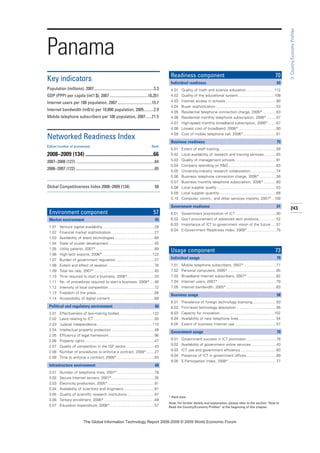
66 Panama 3.84
67 Mexico 3.84
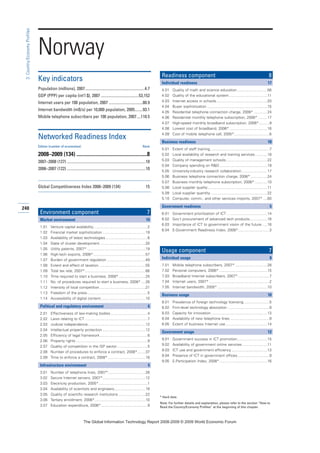
(Cont’d.)
2008–2009 rank Country/Economy Score
68 Bulgaria 3.80
69 Poland 3.80
70 Vietnam 3.79
71 Montenegro 3.79
72 Sri Lanka 3.79
73 Kazakhstan 3.79
74 Russian Federation 3.77
75 Dominican Republic 3.76
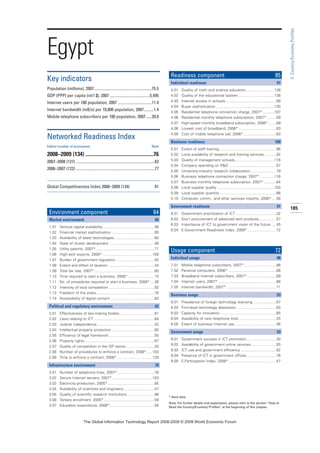
76 Egypt 3.76
77 Botswana 3.72
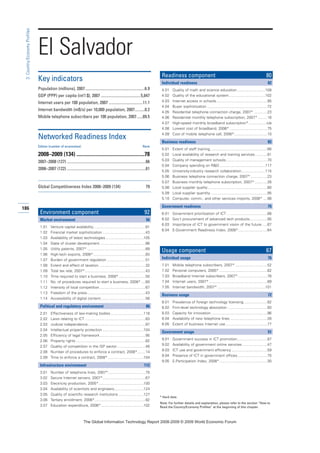
78 El Salvador 3.69
79 Macedonia, FYR 3.67
80 Senegal 3.67
81 Trinidad and Tobago 3.67
82 Guatemala 3.64
83 Indonesia 3.62
84 Serbia 3.62
85 Philippines 3.60
86 Morocco 3.59
87 Argentina 3.58
88 Georgia 3.48
89 Peru 3.47
90 Nigeria 3.45
91 Gambia, The 3.44
92 Namibia 3.44
93 Mongolia 3.43
94 Syria 3.41
95 Honduras 3.41
96 Venezuela 3.39
97 Kenya 3.35
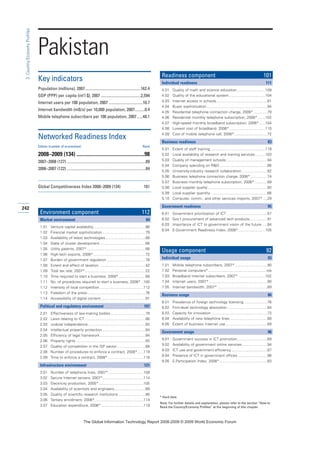
98 Pakistan 3.31
99 Moldova 3.30
100 Guyana 3.29
101 Libya 3.28
102 Zambia 3.26
103 Ghana 3.25
104 Tajikistan 3.25
105 Albania 3.23
106 Bosnia and Herzegovina 3.23
107 Mali 3.18
108 Algeria 3.14
109 Mauritania 3.12
110 Malawi 3.12
111 Côte d’Ivoire 3.12
112 Madagascar 3.09
113 Burkina Faso 3.07
114 Armenia 3.06
115 Kyrgyz Republic 3.04
116 Ecuador 3.03
117 Suriname 3.03
118 Lesotho 3.02
119 Tanzania 3.01
120 Uganda 2.98
121 Benin 2.96
122 Paraguay 2.93
123 Cameroon 2.93
124 Mozambique 2.91
125 Nicaragua 2.90
126 Cambodia 2.89
127 Nepal 2.85
128 Bolivia 2.82
129 Ethiopia 2.80
130 Bangladesh 2.70
131 Burundi 2.63
132 Zimbabwe 2.49
133 Timor-Leste 2.47
134 Chad 2.44
7KH *OREDO ,QIRUPDWLRQ 7HFKQRORJ 5HSRUW  ‹  :RUOG (FRQRPLF )RUXP
Part 1
The Networked Readiness
Landscape in 2008–09 and Mobility
7KH *OREDO ,QIRUPDWLRQ 7HFKQRORJ 5HSRUW  ‹  :RUOG (FRQRPLF )RUXP
CHAPTER 1.1
Gauging the Networked
Readiness of Nations: Findings
from the Networked Readiness
Index 2008–2009
IRENE MIA, World Economic Forum
SOUMITRA DUTTA, INSEAD
THIERRY GEIGER, World Economic Forum
As this eighth edition of The Global Information
Technology Report (GITR) goes to press in early 2009,
economies around the world are reeling from the
impact of the global economic crisis.What started out as
a subprime housing crisis in the United States has
snowballed into a global contagion that is driving a
large number of developed economies into recession
and significantly retarding the rapid growth rates seen
over the last years in emerging markets. Government
leaders around the world are rethinking their approaches
to the regulation of financial markets and are busy craft-
ing packages to prevent other sectors of their economies
from being impacted adversely by the recessionary con-
tagion.The focus worldwide is on stabilizing the global
economy and on jumpstarting growth.
The information and communication technologies
(ICT) industry is not immune to the crisis. IDC, an IT
consultancy, has predicted that global technology spend-
ing will grow by 2.9 percent year-on-year in 2009,
lower than the previously forecasted 4.9 percent.1
Leading technology firms are also feeling the crisis.At
the time of writing, Intel had slashed its fourth quarter
revenue forecast by more than US$1 billion. However,
the news is not all bleak for the technology space.While
the US economy is expected to shrink in 2009, tech-
nology spending in the United States is forecasted to
grow by 0.9 percent (as compared with the previously
forecasted 4.2 percent). Despite slowdowns in sales in
many technology products, the sales of global mobile
phones are expected to grow by 6 percent in 2009,
according to forecasts by Gartner Inc. (as compared with
previous forecasts of 16 percent growth),2
and the popu-
larity of social networking sites is growing steadily.
When the financial crisis hit hard in September 2008,
LinkedIn’s membership shot up by 25 percent in
a single month, to 28 million.As the economic crisis
deepened, the site’s sign-ups were clocking at the
amazing rate of one new member every second.
There are two underlying reasons why the technol-
ogy sector, while suffering because of the overall eco-
nomic challenges, is showing such signs of resilience.
One is that technology is evolving continuously and,
despite economic uncertainty over the coming years,
progress in most areas of ICT capabilities continues at a
blistering pace. For example, the price of personal com-
puters is falling rapidly and the emergence of a whole
new class of laptops, priced as low as US$100 to
US$300 is enabling large segments of the population of
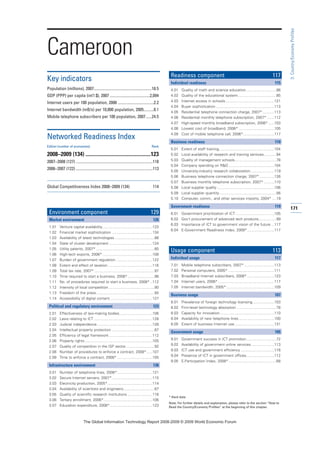
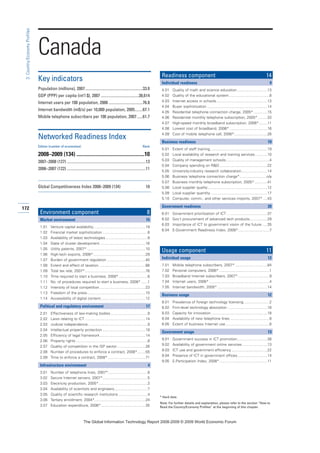
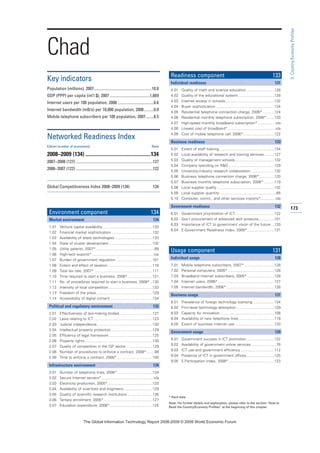
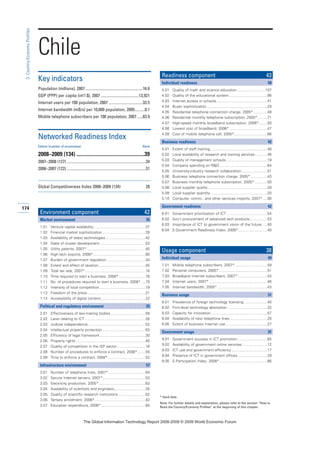
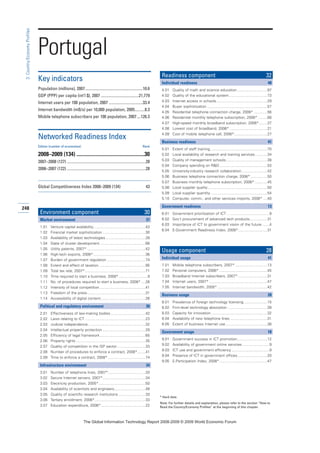
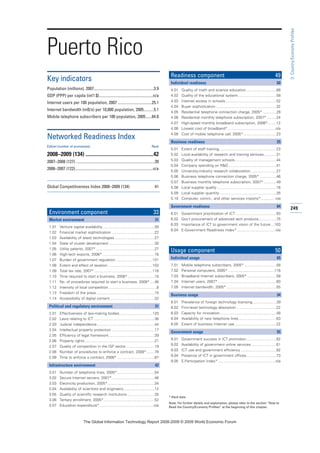
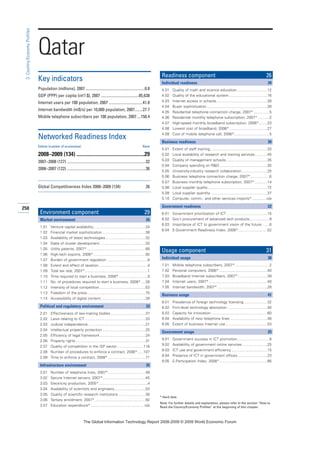
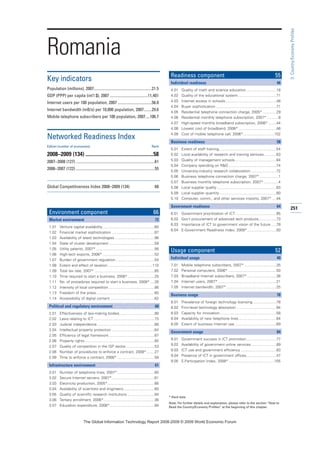
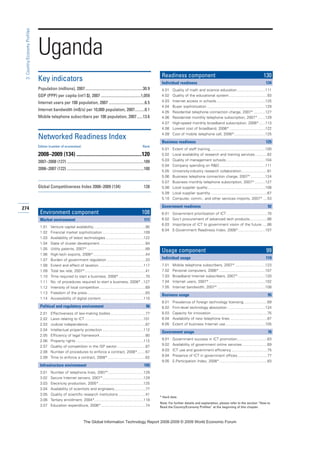
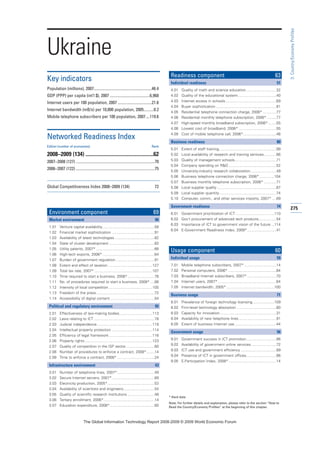
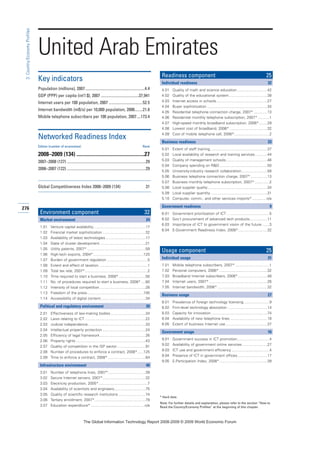
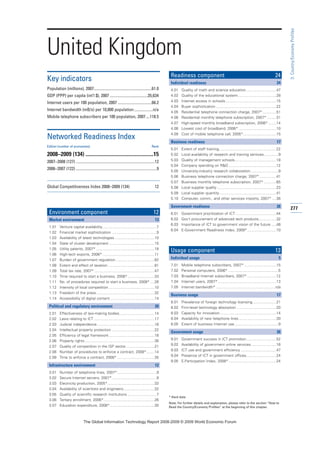
emerging countries to now get access to affordable
computing. Software capabilities are improving steadily,
and they account to a large degree for the growth in
popularity of social networking platforms and other
Web 2.0 services.
The second reason is related to the fact that both
public- and private-sector leaders now fully accept the
important role of ICT in stimulating growth and
enabling the development of economies by significantly
3
1.1:GaugingtheNetworkedReadinessofNations
7KH *OREDO ,QIRUPDWLRQ 7HFKQRORJ 5HSRUW  ‹  :RUOG (FRQRPLF )RUXP
increasing productivity across sectors and industries.
Many economies have been able to leverage the
extraordinary power of ICT as a driver of change, mod-
ernization, and competitiveness (see Figure 1). Previous
editions of the GITR have featured detailed case studies
on how countries such as Korea, Singapore, Israel,
Finland, and Estonia have made important advances in
their global competitiveness by positioning ICT at the
heart of their national innovation and development
strategies. Even in emerging markets in Africa, Latin
America, and Asia, access to ICT has boosted informa-
tion availability, transformed social interactions, and con-
tributed to poverty reduction and improving the life of
everyday citizens.
Innovation and technological readiness have fea-
tured prominently in the World Economic Forum (the
Forum)’s three-decade-long research work as important
competitiveness enablers for countries at all levels of
development. In particular, the Forum has embarked, in
partnership with INSEAD since 2002, in a research
project aimed at assessing the impact of innovation—
notably ICT—on national growth and development,
using, as its main methodology tool, the Networked
Readiness Index (NRI).The findings of the NRI have
been included in the GITR series, published annually
since 2001 and covering this year a record number of
134 economies worldwide, representing over 98 percent
of global GDP.The NRI establishes an international
framework where the factors enabling economies to
leverage ICT for increased competitiveness are clearly
identified and against which countries can benchmark
their performances over time and with respect to one
another.3 Over the years, the Report has become a highly
respected platform for private-public dialogue on the
best policies and actions to further ICT readiness, con-
tributing to raising general awareness on the key role of
innovation and ICT prowess for national competitiveness
and sustained growth.
Coming in the midst of global contagion and a
world mired in a major slowdown, the Report stands as
a reminder for leaders in both the public and private
sectors not to lose focus on an important enabler of
growth and competitiveness—ICT.The next months,
or perhaps the next couple of years, are going to be
challenging for both developed and developing
economies. Many traditional policies and approaches
will be questioned and challenged. However, ICT will
continue to provide opportunities for innovation and
productivity improvements. Economies that will continue
to invest wisely in these new opportunities will be the
ones not only able to weather the current storm best,
but to come out the strongest when the downturn
subsides.
The remainder of this chapter presents the findings
of the NRI for 2008–09 by region, with a particular
focus on the top ranked economies, together with the
underlying Networked Readiness Framework and
methodology used in this year’s edition.
4
1.1:GaugingtheNetworkedReadinessofNations
1 2 3 4 5 6 7
4
6
8
10
12
Figure 1: Networked readiness and GDP per capita, 2007
Source: World Economic Forum; IMF, 2008.
NRI 2008–2009 score
LogofGDP(PPP)percapita
y = 1.27x + 3.99
R2 = 0.71
7KH *OREDO ,QIRUPDWLRQ 7HFKQRORJ 5HSRUW  ‹  :RUOG (FRQRPLF )RUXP
The Networked Readiness Index 2008–2009:
The framework and the methodology
The NRI 2008–2009 rests on the theoretical framework
introduced in the 2002–03 edition and developed by
INSEAD.4
The Networked Readiness Framework
assesses the extent to which different economies benefit
from the latest ICT advances, based on three main
principles, as follows:
1. Environment as crucial enabler of networked
readiness. An ICT-conducive environment is a
key prerequisite for national stakeholders in a
given country to leverage ICT for enhanced
growth. In this sense, an effort should be made
by the government and any other relevant actors
to put in place the appropriate market, regulato-
ry, and ICT environment.
2. A multi-stakeholder effort is required. Although
the government has a natural leadership role to
play when it comes to establishing an ICT- and
innovation-friendly environment and to putting
ICT penetration at the center of the national
agenda, a multi-stakeholder effort—involving
the government, the business sector and civil
society—is required to achieve ICT prowess.
The recent development history of countries as
diverse as Korea, Israel, Estonia, and Singapore
shows that a farsighted government with a clear
vision coupled with active engagement of the
private sector can be very powerful. In all these
countries, an effective multi-stakeholder effort
led to leapfrogging stages of development, to a
structural transformation of the economy, and to
increased growth prospects.
3. ICT readiness facilitates ICT usage. A society
whose stakeholders are better prepared and
show a greater interest toward ICT advances
will be likely to use it more effectively and
extensively.That is, government, business, and
individual readiness is reflected in higher ICT
use, as confirmed by the strong correlation
between the readiness and usage subindexes of
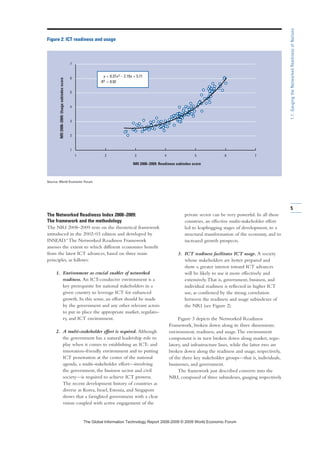
the NRI (see Figure 2).
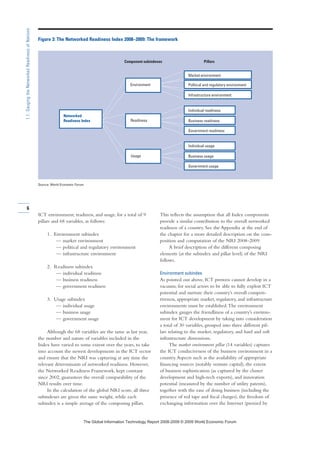
Figure 3 depicts the Networked Readiness
Framework, broken down along its three dimensions:
environment, readiness, and usage.The environment
component is in turn broken down along market, regu-
latory, and infrastructure lines, while the latter two are
broken down along the readiness and usage, respectively,
of the three key stakeholder groups—that is, individuals,
businesses, and government.
The framework just described converts into the
NRI, composed of three subindexes, gauging respectively
5
1.1:GaugingtheNetworkedReadinessofNations
1 2 3 4 5 6 7
1
2
3
4
5
6
7
Figure 2: ICT readiness and usage
Source: World Economic Forum.
NRI 2008–2009: Readiness subindex score
NRI2008–2009:Usagesubindexscore
y = 0.37x2 – 2.19x + 5.71
R2 = 0.92
7KH *OREDO ,QIRUPDWLRQ 7HFKQRORJ 5HSRUW  ‹  :RUOG (FRQRPLF )RUXP
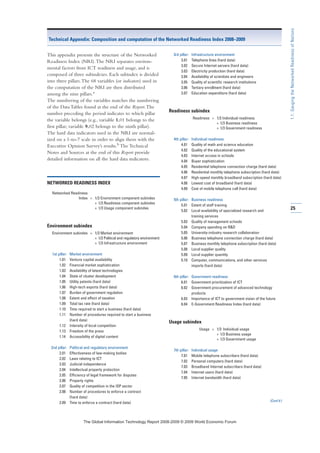
ICT environment, readiness, and usage, for a total of 9
pillars and 68 variables, as follows:
1. Environment subindex
— market environment
— political and regulatory environment
— infrastructure environment
2. Readiness subindex
— individual readiness
— business readiness
— government readiness
3. Usage subindex
— individual usage
— business usage
— government usage
Although the 68 variables are the same as last year,
the number and nature of variables included in the
Index have varied to some extent over the years, to take
into account the newest developments in the ICT sector
and ensure that the NRI was capturing at any time the
relevant determinants of networked readiness. However,
the Networked Readiness Framework, kept constant
since 2002, guarantees the overall comparability of the
NRI results over time.
In the calculation of the global NRI score, all three
subindexes are given the same weight, while each
subindex is a simple average of the composing pillars.
This reflects the assumption that all Index components
provide a similar contribution to the overall networked
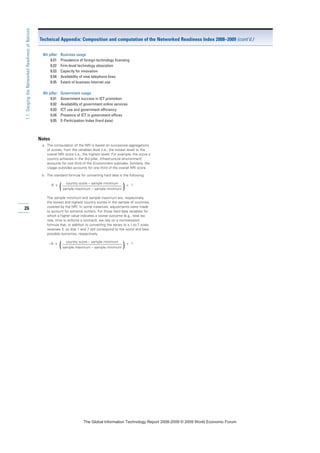
readiness of a country. See the Appendix at the end of
the chapter for a more detailed description on the com-
position and computation of the NRI 2008–2009.
A brief description of the different composing
elements (at the subindex and pillar level) of the NRI
follows.
Environment subindex
As pointed out above, ICT prowess cannot develop in a
vacuum; for social actors to be able to fully exploit ICT
potential and nurture their country’s overall competi-
tiveness, appropriate market, regulatory, and infrastructure
environments must be established.The environment
subindex gauges the friendliness of a country’s environ-
ment for ICT development by taking into consideration
a total of 30 variables, grouped into three different pil-
lars relating to the market, regulatory, and hard and soft
infrastructure dimensions.
The market environment pillar (14 variables) captures
the ICT conduciveness of the business environment in a
country.Aspects such as the availability of appropriate
financing sources (notably venture capital), the extent
of business sophistication (as captured by the cluster
development and high-tech exports), and innovation
potential (measured by the number of utility patents),
together with the ease of doing business (including the
presence of red tape and fiscal charges), the freedom of
exchanging information over the Internet (proxied by
6
1.1:GaugingtheNetworkedReadinessofNations
Networked
Readiness Index
Environment
Business readinessReadiness
Usage
Individual readiness
Infrastructure environment
Government readiness
Business usage
Individual usage
Government usage
Political and regulatory environment
Market environment
Component subindexes Pillars
Figure 3: The Networked Readiness Index 2008–2009: The framework
Source: World Economic Forum.
7KH *OREDO ,QIRUPDWLRQ 7HFKQRORJ 5HSRUW  ‹  :RUOG (FRQRPLF )RUXP
the freedom of the press), and the accessibility of digital
content are taken into account.
The political and regulatory environment pillar (9 vari-
ables) examines the quality of the national legal frame-
work with particular regard to ICT development. In this
sense, general elements having to do with the protection
afforded to property rights, independence of the judiciary,
and efficiency of the law-making process are taken into
account, as well as ICT-specific aspects such as the devel-
opment of ICT laws and the extent to which intellectual
property—key to generating innovation—is protected.
The infrastructure environment pillar (7 variables)
measures the extent to which national infrastructure
encourages ICT development and diffusion. Infrastructure,
in our definition, includes both hard elements—such as
the number of telephone lines and secure Internet
servers, and electricity production—as well as softer
ones related to the quality of the human resources in a
given country.With regard to the latter, quantitative
measures, such as tertiary enrollment rates and education
expenditures, are combined with a qualitative assessment
of the scientific research institutions and the availability
of scientists and engineers.
Readiness subindex
The second underpinning of the Networked Readiness
Framework relates to the extent to which a country’s
main stakeholders are interested and prepared to use
technology—notably ICT—in their daily activities.
Accordingly, the readiness subindex, with a total of 23
variables, measures elements of individual and business
readiness, including the existence of appropriate human
skills for using ICT and the affordability of ICT, as well
as government readiness, reflected notably in the latter’s
prioritization of ICT in the national agenda.
In this sense, the individual readiness pillar (9 variables)
measures citizens’ preparedness to use ICT through a
range of variables, including the quality of the educational
system (with a focus on math and science education),
the availability of Internet access in schools, residential
telephone connection charges, broadband and telephone
subscription charges, and the cost of mobile telephone
calls.
The business readiness pillar (10 variables) examines
the extent to which companies are disposed and ready
to incorporate ICT in their operations and processes,
taking into account particularly the quality of on-the-
job training, spending on RD, the collaboration
between academia and industry (central to generating
applied innovation and to nurturing cluster creation and
development), the quantity and quality of suppliers in
the economy, and the affordability of ICT for business.
The government readiness pillar (4 variables), in turn,
attempts to capture government’s vision and prioritiza-
tion of ICT in the national agenda and competitiveness
strategy, including the extent to which public procurement
of high-tech products is used as a tool to promote effi-
ciency and innovation.
Usage subindex
The last component of the NRI gauges the actual usage
of ICT by a country’s main stakeholders, with a particu-
lar focus on the impact of ICT in terms of efficiency
and productivity gains.
The individual usage pillar (5 variables) measures
ICT penetration and diffusion at the individual level,
through the number of mobile telephone and broad-
band Internet subscribers, Internet users and personal
computers (PCs) and Internet bandwidth.
The business usage pillar (5 variables) assesses the
degree to which businesses generate and absorb tech-
nology, looking at variables such as the prevalence of
foreign technology licensing and the capacity for inno-
vation, together with the availability and usage of fixed
telephone lines for business and Internet use by busi-
nesses in their daily transactions and operations.
Finally, the government usage pillar (5 variables) ana-
lyzes the implementation of the vision captured by the
government readiness pillar described above. In this
sense, government’s success in promoting ICT penetra-
tion and the development and quality of e-government
services are assessed, as well as the government’s own
ICT usage and the extent to which this has led to
productivity and efficiency gains.
As one can see from the description above, the
NRI and its composing subindexes, pillars and variables
offer an extremely useful and detailed instrument for
policy makers, allowing them to identify areas of weak-
ness which need to be addressed in view of improving
national networked readiness.
Computation methodology and data
In line with the methodology used in the previous edi-
tions of the Report and in the Forum’s competitiveness
work, the NRI 2008–2009 is composed of a mixture of
hard and survey data capturing both quantitative and
qualitative determinants of a country’s networked readi-
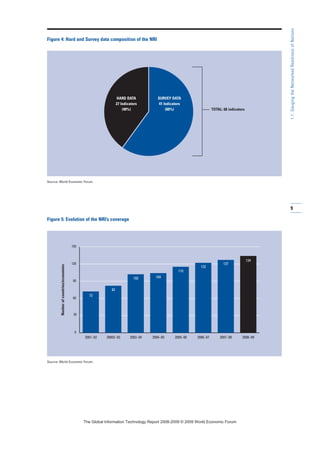
ness. In this regard, as shown in Figure 4, 27 out of the
68 composing variables are hard, quantitative data,
collected from international organizations such as the
International Telecommunication Union (ITU), the
United Nations, and the World Bank. Internationally
collected and validated data ensure data comparability
across countries.
The remaining 41 variables gauge dimensions that
are more qualitative in nature or for which there are
no hard data available for a large number of countries
but that are nonetheless crucial in capturing national
networked readiness.These data come from the
Executive Opinion Survey (the Survey), which the
Forum administered to over 12,000 business leaders
across 134 economies in 2008 (see Box 1 for details
about the Survey methodology). Examples include
7
1.1:GaugingtheNetworkedReadinessofNations
7KH *OREDO ,QIRUPDWLRQ 7HFKQRORJ 5HSRUW  ‹  :RUOG (FRQRPLF )RUXP
dimensions relating to the transparency of the legal
framework, the quality of education, together with the
government’s vision for ICT and the extent to which
this is prioritized in the national agenda. For all these
dimensions, since no hard data are available, the Survey
represents an invaluable source of information and
insight.
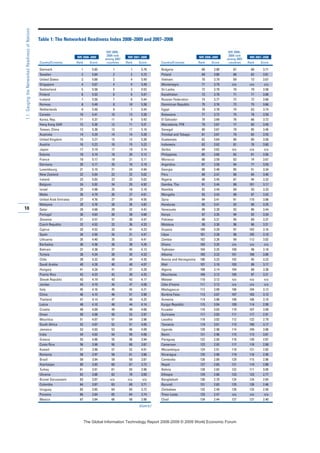
The inclusion of new countries in the NRI every
year is driven by the Survey coverage and the hard data
availability. Figure 5 shows the evolution of the NRI
and the Survey’s coverage from the GITR series’ incep-
tion.The Report features a record number of seven new
economies this year, namely Brunei Darussalam, Côte
d’Ivoire, Ghana, Malawi, Montenegro, Serbia, and
Timor-Leste.The latter three could not have been
included in the Report until this year, despite having been
covered by the Survey for a number of years, for lack of
a sufficient number of hard data.
As mentioned earlier, variables included in the
NRI may experience some variation from year to year,
given the dynamism of the ICT sector and the need to
update the NRI accordingly.5
For this reason, some
time-sensitive variables included in past editions that
have not been recently updated by relevant international
institutions may need to be dropped by the NRI
structure and calculation on any given year.The NRI
2008–2009 represents an exception to the above trend,
since it includes the same variables used in the 2007–08
computation, updated with the most recent data.
The NRI 2008–2009 rankings
This section will highlight the main findings of the
NRI 2008–2009, with a particular emphasis on the top
10 performing countries as well as selected economies
in the following regions: Europe, Latin America and the
Caribbean,Asia and the Pacific, Middle East and North
Africa (MENA), and sub-Saharan Africa.6
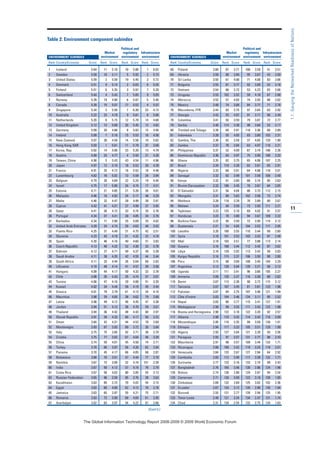
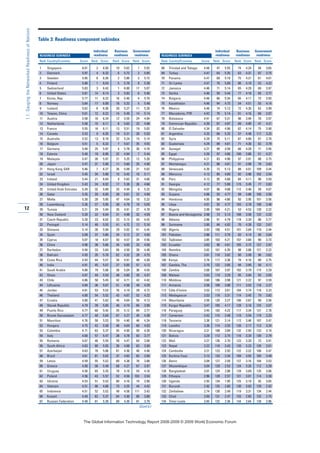
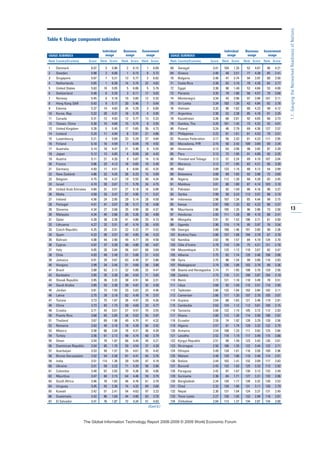
Table 1 displays the NRI rankings and scores for
2008–09 with 2007–08 comparisons, while Tables 2, 3,
and 4 show the rankings and scores for the three
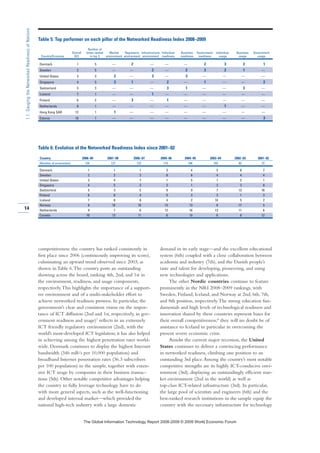
subindexes and nine pillars composing the NRI.Tables
5 and 6, in turn, provide a more detailed analysis on the
most networked economies in the world.
Top 10
As Table 1 shows, Denmark and Sweden continue to be
assessed as the world’s most networked economies for
the third consecutive year.The two countries’ ICT
pre-eminence rests on similar bases, notably an early and
continuous focus on education and innovation as well
as a prominent place given to ICT penetration and
diffusion in the national agenda as an enabler of general
competitiveness.
The rankings of 2008–09 confirm Denmark’s
superior capacity to leverage ICT for overall national
8
1.1:GaugingtheNetworkedReadinessofNations
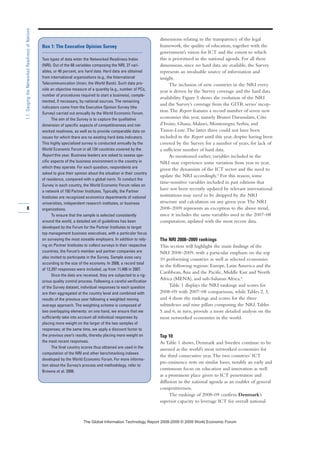
Box 1: The Executive Opinion Survey
Two types of data enter the Networked Readiness Index
(NRI). Out of the 68 variables composing the NRI, 27 vari-
ables, or 40 percent, are hard data. Hard data are obtained
from international organizations (e.g., the International
Telecommunication Union, the World Bank). Such data pro-
vide an objective measure of a quantity (e.g., number of PCs,
number of procedures required to start a business), comple-
mented, if necessary, by national sources. The remaining
indicators come from the Executive Opinion Survey (the
Survey) carried out annually by the World Economic Forum.
The aim of the Survey is to capture the qualitative
dimension of specific aspects of competitiveness and net-
worked readiness, as well as to provide comparable data on
issues for which there are no existing hard data indicators.
This highly specialized survey is conducted annually by the
World Economic Forum in all 134 countries covered by the
Report this year. Business leaders are asked to assess spe-
cific aspects of the business environment in the country in
which they operate. For each question, respondents are
asked to give their opinion about the situation in their country
of residence, compared with a global norm. To conduct the
Survey in each country, the World Economic Forum relies on
a network of 150 Partner Institutes. Typically, the Partner
Institutes are recognized economics departments of national
universities, independent research institutes, or business
organizations.
To ensure that the sample is selected consistently
around the world, a detailed set of guidelines has been
developed by the Forum for the Partner Institutes to target
top management business executives, with a particular focus
on surveying the most sizeable employers. In addition to rely-
ing on Partner Institutes to collect surveys in their respective
countries, the Forum’s member and partner companies are
also invited to participate in the Survey. Sample sizes vary
according to the size of the economy. In 2008, a record total
of 12,297 responses were included, up from 11,406 in 2007.
Once the data are received, they are subjected to a rig-
orous quality control process. Following a careful verification
of the Survey dataset, individual responses to each question
are then aggregated at the country level and combined with
results of the previous year following a weighted moving
average approach. The weighting scheme is composed of
two overlapping elements: on one hand, we ensure that we
sufficiently take into account all individual responses by
placing more weight on the larger of the two samples of
responses; at the same time, we apply a discount factor to
the previous year’s results, thereby placing more weight on
the most recent responses.
The final country scores thus obtained are used in the
computation of the NRI and other benchmarking indexes
developed by the World Economic Forum. For more informa-
tion about the Survey’s process and methodology, refer to
Browne et al. 2008.
7KH *OREDO ,QIRUPDWLRQ 7HFKQRORJ 5HSRUW  ‹  :RUOG (FRQRPLF )RUXP
9
1.1:GaugingtheNetworkedReadinessofNations
Figure 4: Hard and Survey data composition of the NRI
Source: World Economic Forum.
TOTAL: 68 indicators
SURVEY DATA
41 Indicators
(60%)
HARD DATA
27 Indicators
(40%)
0
30
60
90
120
150
2001–02 20002–03 2003–04 2004–05 2005–06 2006–07 2007–08 2008–09
72
82
102 104
115
122
127
134
Figure 5: Evolution of the NRI’s coverage
Source: World Economic Forum.
Nunberofcountries/economies
7KH *OREDO ,QIRUPDWLRQ 7HFKQRORJ 5HSRUW  ‹  :RUOG (FRQRPLF )RUXP
10
1.1:GaugingtheNetworkedReadinessofNations
NRI 2008–
2009 rank
among 2007
Country/Economy Rank Score countries Rank Score
Denmark 1 5.85 1 1 5.78
Sweden 2 5.84 2 2 5.72
United States 3 5.68 3 4 5.49
Singapore 4 5.67 4 5 5.49
Switzerland 5 5.58 5 3 5.53
Finland 6 5.53 6 6 5.47
Iceland 7 5.50 7 8 5.44
Norway 8 5.49 8 10 5.38
Netherlands 9 5.48 9 7 5.44
Canada 10 5.41 10 13 5.30
Korea, Rep. 11 5.37 11 9 5.43
Hong Kong SAR 12 5.30 12 11 5.31
Taiwan, China 13 5.30 13 17 5.18
Australia 14 5.29 14 14 5.28
United Kingdom 15 5.27 15 12 5.30
Austria 16 5.22 16 15 5.22
Japan 17 5.19 17 19 5.14
Estonia 18 5.19 18 20 5.12
France 19 5.17 19 21 5.11
Germany 20 5.17 20 16 5.19
Luxembourg 21 5.10 21 24 4.94
New Zealand 22 5.04 22 22 5.02
Ireland 23 5.03 23 23 5.02
Belgium 24 5.02 24 25 4.92
Israel 25 4.98 25 18 5.18
Malta 26 4.79 26 27 4.61
United Arab Emirates 27 4.76 27 29 4.55
Malaysia 28 4.76 28 26 4.82
Qatar 29 4.68 29 32 4.42
Portugal 30 4.63 30 28 4.60
Slovenia 31 4.57 31 30 4.47
Czech Republic 32 4.53 32 36 4.33
Cyprus 33 4.52 33 41 4.23
Spain 34 4.50 34 31 4.47
Lithuania 35 4.40 35 33 4.41
Barbados 36 4.38 36 38 4.26
Bahrain 37 4.38 37 45 4.13
Tunisia 38 4.34 38 35 4.33
Chile 39 4.32 39 34 4.35
Saudi Arabia 40 4.28 40 48 4.07
Hungary 41 4.28 41 37 4.28
Puerto Rico 42 4.23 42 39 4.25
Slovak Republic 43 4.19 43 43 4.17
Jordan 44 4.19 44 47 4.08
Italy 45 4.16 45 42 4.21
China 46 4.15 46 57 3.90
Thailand 47 4.14 47 40 4.25
Latvia 48 4.10 48 44 4.14
Croatia 49 4.09 49 49 4.06
Oman 50 4.08 50 53 3.97
Mauritius 51 4.07 51 54 3.96
South Africa 52 4.07 52 51 4.05
Jamaica 53 4.03 53 46 4.09
India 54 4.03 54 50 4.06
Greece 55 4.00 55 56 3.94
Costa Rica 56 3.99 56 60 3.87
Kuwait 57 3.98 57 52 4.01
Romania 58 3.97 58 61 3.86
Brazil 59 3.94 59 59 3.87
Azerbaijan 60 3.93 60 67 3.72
Turkey 61 3.91 61 55 3.96
Ukraine 62 3.88 62 70 3.69
Brunei Darussalam 63 3.87 n/a n/a n/a
Colombia 64 3.87 63 69 3.71
Uruguay 65 3.85 64 65 3.72
Panama 66 3.84 65 64 3.74
Mexico 67 3.84 66 58 3.90
(Cont’d.)
NRI 2008–
2009 rank
among 2007
Country/Economy Rank Score countries Rank Score
Bulgaria 68 3.80 67 68 3.71
Poland 69 3.80 68 62 3.81
Vietnam 70 3.79 69 73 3.67
Montenegro 71 3.79 n/a n/a n/a
Sri Lanka 72 3.79 70 79 3.58
Kazakhstan 73 3.79 71 71 3.68
Russian Federation 74 3.77 72 72 3.68
Dominican Republic 75 3.76 73 75 3.66
Egypt 76 3.76 74 63 3.74
Botswana 77 3.72 75 78 3.59
El Salvador 78 3.69 76 66 3.72
Macedonia, FYR 79 3.67 77 83 3.49
Senegal 80 3.67 78 85 3.46
Trinidad and Tobago 81 3.67 79 82 3.55
Guatemala 82 3.64 80 80 3.58
Indonesia 83 3.62 81 76 3.60
Serbia 84 3.62 n/a n/a n/a
Philippines 85 3.60 82 81 3.56
Morocco 86 3.59 83 74 3.67
Argentina 87 3.58 84 77 3.59
Georgia 88 3.48 85 91 3.34
Peru 89 3.47 86 84 3.46
Nigeria 90 3.45 87 94 3.32
Gambia, The 91 3.44 88 101 3.17
Namibia 92 3.44 89 93 3.33
Mongolia 93 3.43 90 87 3.43
Syria 94 3.41 91 110 3.06
Honduras 95 3.41 92 90 3.35
Venezuela 96 3.39 93 86 3.44
Kenya 97 3.35 94 92 3.34
Pakistan 98 3.31 95 89 3.37
Moldova 99 3.30 96 96 3.21
Guyana 100 3.29 97 102 3.16
Libya 101 3.28 98 105 3.10
Zambia 102 3.26 99 112 3.02
Ghana 103 3.25 n/a n/a n/a
Tajikistan 104 3.25 100 98 3.18
Albania 105 3.23 101 108 3.06
Bosnia and Herzegovina 106 3.23 102 95 3.22
Mali 107 3.18 103 99 3.17
Algeria 108 3.14 104 88 3.38
Mauritania 109 3.12 105 97 3.21
Malawi 110 3.12 n/a n/a n/a
Côte d’Ivoire 111 3.12 n/a n/a n/a
Madagascar 112 3.09 106 104 3.12
Burkina Faso 113 3.07 107 103 3.12
Armenia 114 3.06 108 106 3.10
Kyrgyz Republic 115 3.04 109 114 2.99
Ecuador 116 3.03 110 107 3.09
Suriname 117 3.03 111 117 2.91
Lesotho 118 3.02 112 122 2.79
Tanzania 119 3.01 113 100 3.17
Uganda 120 2.98 114 109 3.06
Benin 121 2.96 115 113 3.01
Paraguay 122 2.93 116 120 2.87
Cameroon 123 2.93 117 118 2.89
Mozambique 124 2.91 118 121 2.82
Nicaragua 125 2.90 119 116 2.95
Cambodia 126 2.89 120 115 2.96
Nepal 127 2.85 121 119 2.88
Bolivia 128 2.82 122 111 3.05
Ethiopia 129 2.80 123 123 2.77
Bangladesh 130 2.70 124 124 2.65
Burundi 131 2.63 125 126 2.46
Zimbabwe 132 2.49 126 125 2.50
Timor-Leste 133 2.47 n/a n/a n/a
Chad 134 2.44 127 127 2.40
Table 1: The Networked Readiness Index 2008–2009 and 2007–2008
NRI 2008–2009 NRI 2007–2008 NRI 2008–2009 NRI 2007–2008
7KH *OREDO ,QIRUPDWLRQ 7HFKQRORJ 5HSRUW  ‹  :RUOG (FRQRPLF )RUXP
11
1.1:GaugingtheNetworkedReadinessofNations
ENVIRONMENT SUBINDEX
Rank Country/Economy Score Rank Score Rank Score Rank Score
1 Iceland 5.64 11 5.10 10 5.80 1 6.02
2 Sweden 5.59 10 5.11 5 5.92 2 5.73
3 United States 5.59 2 5.59 19 5.45 3 5.72
4 Denmark 5.51 9 5.14 2 6.03 6 5.35
5 Finland 5.51 6 5.35 3 5.97 7 5.20
6 Switzerland 5.44 4 5.43 7 5.85 9 5.05
7 Norway 5.39 19 4.90 6 5.87 5 5.40
8 Canada 5.39 15 5.07 17 5.52 4 5.57
9 Singapore 5.34 3 5.58 1 6.30 23 4.13
10 Australia 5.22 22 4.79 9 5.81 8 5.06
11 Netherlands 5.20 8 5.15 12 5.78 14 4.68
12 United Kingdom 5.12 13 5.09 20 5.45 12 4.82
13 Germany 5.09 20 4.88 8 5.83 15 4.56
14 Ireland 5.09 7 5.16 15 5.53 16 4.56
15 New Zealand 5.07 30 4.59 14 5.58 10 5.02
16 Hong Kong SAR 5.03 1 5.61 11 5.79 37 3.68
17 Korea, Rep. 5.02 14 5.08 23 5.20 13 4.79
18 Austria 4.99 23 4.77 4 5.93 21 4.28
19 Taiwan, China 4.98 5 5.43 43 4.54 11 4.96
20 Japan 4.97 12 5.10 18 5.52 20 4.29
21 France 4.91 25 4.72 16 5.53 18 4.48
22 Luxembourg 4.82 16 5.02 13 5.59 29 3.84
23 Belgium 4.79 28 4.69 22 5.24 19 4.44
24 Israel 4.75 17 5.00 34 4.74 17 4.51
25 Estonia 4.71 21 4.85 21 5.26 26 4.01
26 Malaysia 4.46 18 4.92 24 5.17 48 3.29
27 Malta 4.46 32 4.47 28 4.99 28 3.91
28 Cyprus 4.42 41 4.31 27 4.99 27 3.95
29 Qatar 4.41 26 4.72 33 4.74 35 3.76
30 Portugal 4.34 37 4.41 30 4.85 34 3.76
31 Barbados 4.34 71 3.90 25 5.09 25 4.02
32 United Arab Emirates 4.29 24 4.74 39 4.62 40 3.52
33 Puerto Rico 4.25 31 4.49 31 4.75 42 3.51
34 Slovenia 4.23 43 4.19 51 4.32 22 4.18
35 Spain 4.20 46 4.16 40 4.60 31 3.83
36 Czech Republic 4.13 40 4.32 52 4.30 33 3.78
37 Bahrain 4.12 27 4.71 49 4.37 49 3.28
38 Saudi Arabia 4.11 38 4.35 42 4.55 44 3.44
39 South Africa 4.11 33 4.44 26 5.04 69 2.83
40 Lithuania 4.10 48 4.14 41 4.57 39 3.58
41 Hungary 4.09 44 4.17 50 4.33 32 3.78
42 Chile 4.08 35 4.43 35 4.74 57 3.07
43 Tunisia 4.08 47 4.16 29 4.88 51 3.20
44 Kuwait 4.02 34 4.44 58 4.19 45 3.44
45 Greece 4.01 79 3.79 61 4.13 24 4.10
46 Mauritius 3.98 29 4.65 38 4.62 79 2.68
47 Latvia 3.98 49 4.12 46 4.45 47 3.36
48 Jordan 3.94 51 4.12 36 4.70 59 3.01
49 Thailand 3.94 36 4.42 48 4.43 60 2.97
50 Slovak Republic 3.91 39 4.33 60 4.17 50 3.23
51 Oman 3.84 42 4.31 44 4.52 78 2.69
52 Montenegro 3.83 67 3.93 89 3.72 30 3.84
53 Italy 3.75 75 3.85 92 3.71 36 3.70
54 Croatia 3.75 77 3.82 67 4.04 46 3.39
55 China 3.74 59 4.01 45 4.50 74 2.71
56 Turkey 3.70 66 3.97 56 4.20 62 2.94
57 Panama 3.70 45 4.17 66 4.05 68 2.87
58 Botswana 3.68 70 3.91 47 4.44 77 2.70
59 Namibia 3.67 73 3.89 32 4.74 101 2.39
60 India 3.67 50 4.12 57 4.19 76 2.70
61 Costa Rica 3.67 58 4.02 80 3.85 55 3.13
62 Russian Federation 3.65 96 3.58 85 3.76 38 3.63
63 Kazakhstan 3.63 85 3.73 70 4.02 54 3.15
64 Egypt 3.63 60 4.00 62 4.12 70 2.78
65 Jamaica 3.63 65 3.97 55 4.21 75 2.71
66 Romania 3.63 72 3.90 68 4.04 61 2.95
67 Azerbaijan 3.62 63 3.97 54 4.22 81 2.66
(Cont’d.)
ENVIRONMENT SUBINDEX
Rank Country/Economy Score Rank Score Rank Score Rank Score
68 Poland 3.60 87 3.71 100 3.59 41 3.51
69 Ukraine 3.59 90 3.60 95 3.67 43 3.50
70 Sri Lanka 3.55 61 4.00 71 4.00 83 2.66
71 Bulgaria 3.55 81 3.77 93 3.69 52 3.18
72 Vietnam 3.54 86 3.72 53 4.23 82 2.66
73 Uruguay 3.53 102 3.52 59 4.18 67 2.88
74 Morocco 3.53 57 4.03 74 3.93 88 2.62
75 Mexico 3.48 74 3.88 84 3.77 71 2.78
76 Macedonia, FYR 3.44 83 3.75 97 3.64 63 2.92
77 Georgia 3.42 53 4.07 91 3.71 96 2.49
78 Colombia 3.41 93 3.59 79 3.87 72 2.77
79 Serbia 3.40 114 3.38 98 3.64 53 3.17
80 Trinidad and Tobago 3.39 69 3.91 118 3.36 66 2.89
81 Indonesia 3.39 55 4.05 83 3.80 103 2.31
82 Gambia, The 3.38 92 3.59 37 4.65 129 1.90
83 Zambia 3.37 76 3.84 63 4.07 110 2.21
84 Philippines 3.37 52 4.09 87 3.74 106 2.26
85 Dominican Republic 3.36 64 3.97 75 3.90 108 2.22
86 Ghana 3.35 82 3.75 65 4.06 107 2.25
87 Brazil 3.34 119 3.28 82 3.81 65 2.91
88 Nigeria 3.33 68 3.91 64 4.06 118 2.01
89 Senegal 3.32 62 3.99 101 3.59 100 2.40
90 Kenya 3.32 91 3.60 88 3.74 85 2.63
91 Brunei Darussalam 3.32 106 3.45 78 3.87 84 2.65
92 El Salvador 3.31 56 4.04 86 3.75 112 2.15
93 Mongolia 3.31 89 3.63 102 3.56 73 2.74
94 Moldova 3.28 118 3.29 76 3.89 80 2.67
95 Malawi 3.24 94 3.59 73 3.93 111 2.21
96 Tajikistan 3.23 125 3.10 69 4.02 91 2.57
97 Honduras 3.23 78 3.80 94 3.67 109 2.22
98 Burkina Faso 3.22 95 3.59 72 3.95 114 2.12
99 Guatemala 3.21 54 4.05 104 3.52 117 2.05
100 Lesotho 3.20 100 3.55 110 3.44 89 2.60
101 Syria 3.18 101 3.53 103 3.53 97 2.48
102 Mali 3.18 103 3.51 77 3.88 113 2.14
103 Guyana 3.16 108 3.44 112 3.42 87 2.62
104 Libya 3.16 129 3.02 113 3.42 58 3.03
105 Kyrgyz Republic 3.16 115 3.37 106 3.50 90 2.60
106 Peru 3.15 88 3.69 108 3.45 104 2.29
107 Argentina 3.12 128 3.04 120 3.21 56 3.12
108 Uganda 3.11 111 3.41 96 3.66 105 2.27
109 Armenia 3.09 120 3.27 116 3.39 86 2.62
110 Benin 3.07 113 3.38 90 3.72 115 2.12
111 Tanzania 3.07 107 3.45 81 3.81 123 1.96
112 Pakistan 3.07 84 3.75 107 3.46 121 1.99
113 Côte d’Ivoire 3.03 104 3.46 124 3.11 95 2.52
114 Nepal 3.03 80 3.77 115 3.41 127 1.91
115 Madagascar 2.99 99 3.55 111 3.43 122 1.98
116 Bosnia and Herzegovina 2.98 122 3.18 122 3.20 92 2.57
117 Albania 2.98 110 3.42 114 3.42 116 2.09
118 Mozambique 2.95 116 3.35 99 3.59 128 1.91
119 Ethiopia 2.94 117 3.33 105 3.51 120 1.99
120 Algeria 2.93 127 3.04 121 3.20 93 2.56
121 Paraguay 2.93 97 3.57 131 2.77 98 2.43
122 Mauritania 2.91 98 3.57 109 3.44 133 1.71
123 Nicaragua 2.89 109 3.42 119 3.24 119 2.01
124 Venezuela 2.84 133 2.67 127 2.94 64 2.92
125 Cambodia 2.83 112 3.40 117 3.38 132 1.71
126 Suriname 2.77 123 3.16 133 2.74 99 2.43
127 Bangladesh 2.76 105 3.46 130 2.86 124 1.96
128 Bolivia 2.74 130 2.80 129 2.87 94 2.54
129 Cameroon 2.71 126 3.09 123 3.19 130 1.85
130 Zimbabwe 2.69 132 2.69 125 3.02 102 2.36
131 Ecuador 2.67 124 3.12 126 2.96 126 1.94
132 Burundi 2.55 131 2.77 128 2.94 125 1.95
133 Timor-Leste 2.48 121 3.24 134 2.47 131 1.74
134 Chad 2.31 134 2.54 132 2.75 134 1.63
Table 2: Environment component subindex
Market
environment
Political and
regulatory
environment
Infrastructure
environment
Market
environment
Political and
regulatory
environment
Infrastructure
environment
7KH *OREDO ,QIRUPDWLRQ 7HFKQRORJ 5HSRUW  ‹  :RUOG (FRQRPLF )RUXP
12
1.1:GaugingtheNetworkedReadinessofNations
READINESS SUBINDEX
Rank Country/Economy Score Rank Score Rank Score Rank Score
1 Singapore 6.01 2 6.50 10 5.62 1 5.92
2 Denmark 5.97 4 6.32 6 5.72 2 5.85
3 Sweden 5.95 8 6.26 2 5.86 3 5.72
4 Finland 5.90 1 6.54 5 5.78 8 5.38
5 Switzerland 5.83 3 6.43 1 6.00 17 5.07
6 United States 5.81 14 6.14 3 5.83 6 5.46
7 Korea, Rep. 5.77 11 6.22 16 5.40 4 5.70
8 Norway 5.64 17 6.09 18 5.33 5 5.49
9 Iceland 5.62 6 6.30 20 5.27 11 5.28
10 Taiwan, China 5.61 12 6.22 14 5.49 14 5.14
11 Austria 5.58 10 6.24 12 5.55 24 4.94
12 Netherlands 5.58 15 6.11 8 5.63 23 4.98
13 France 5.55 16 6.11 13 5.51 19 5.03
14 Canada 5.53 9 6.26 19 5.31 20 5.03
15 Australia 5.52 13 6.18 22 5.24 15 5.14
16 Belgium 5.51 5 6.32 7 5.67 35 4.55
17 Germany 5.48 25 5.97 4 5.78 30 4.70
18 Estonia 5.48 19 6.06 32 4.94 7 5.44
19 Malaysia 5.47 26 5.97 21 5.25 12 5.20
20 Japan 5.47 31 5.90 11 5.60 25 4.90
21 Hong Kong SAR 5.46 7 6.27 26 5.09 21 5.02
22 Israel 5.45 34 5.80 15 5.42 16 5.11
23 Ireland 5.44 21 6.04 9 5.63 31 4.66
24 United Kingdom 5.43 24 6.02 17 5.38 26 4.88
25 United Arab Emirates 5.39 32 5.89 33 4.94 9 5.33
26 Qatar 5.35 20 6.05 30 5.01 22 4.99
27 Malta 5.30 28 5.95 47 4.64 10 5.32
28 Luxembourg 5.26 27 5.95 39 4.78 18 5.05
29 Tunisia 5.21 29 5.94 35 4.91 27 4.78
30 New Zealand 5.20 22 6.04 31 4.98 32 4.59
31 Czech Republic 5.20 23 6.02 23 5.15 43 4.42
32 Portugal 5.14 48 5.55 41 4.72 13 5.16
33 Slovenia 5.14 30 5.94 29 5.02 41 4.45
34 Spain 5.09 37 5.66 24 5.12 37 4.50
35 Cyprus 5.07 18 6.07 50 4.57 34 4.56
36 China 4.96 38 5.66 44 4.65 33 4.58
37 Barbados 4.94 33 5.84 56 4.50 38 4.48
38 Bahrain 4.93 35 5.70 62 4.32 28 4.75
39 Costa Rica 4.93 44 5.57 34 4.91 48 4.30
40 India 4.91 45 5.57 27 5.05 57 4.12
41 Saudi Arabia 4.88 79 5.06 28 5.04 36 4.55
42 Oman 4.87 49 5.54 48 4.60 39 4.47
43 Chile 4.86 58 5.45 42 4.71 42 4.42
44 Lithuania 4.84 36 5.67 51 4.56 49 4.29
45 Jordan 4.81 53 5.52 76 4.19 29 4.72
46 Thailand 4.80 54 5.52 43 4.67 53 4.22
47 Croatia 4.80 41 5.62 45 4.64 56 4.13
48 Slovak Republic 4.79 39 5.65 40 4.74 66 3.98
49 Puerto Rico 4.77 60 5.42 25 5.12 84 3.77
50 Brunei Darussalam 4.77 40 5.64 67 4.27 45 4.38
51 Mauritius 4.76 50 5.53 59 4.40 46 4.34
52 Hungary 4.75 42 5.58 46 4.64 60 4.03
53 Colombia 4.71 63 5.37 55 4.50 50 4.28
54 Italy 4.68 57 5.47 38 4.78 83 3.77
55 Romania 4.67 46 5.55 58 4.47 64 3.99
56 South Africa 4.63 80 5.02 36 4.88 63 3.99
57 Azerbaijan 4.63 78 5.06 61 4.36 40 4.46
58 Brazil 4.61 81 5.02 37 4.83 65 3.98
59 Latvia 4.59 55 5.52 60 4.38 76 3.88
60 Greece 4.58 56 5.49 68 4.27 67 3.97
61 Uruguay 4.56 65 5.35 78 4.18 54 4.16
62 Poland 4.56 43 5.57 52 4.56 103 3.54
63 Ukraine 4.53 51 5.52 80 4.16 74 3.90
64 Vietnam 4.51 86 4.88 73 4.25 44 4.42
65 Indonesia 4.51 52 5.52 49 4.58 111 3.43
66 Kuwait 4.49 62 5.37 64 4.30 80 3.80
67 Russian Federation 4.48 61 5.39 69 4.26 81 3.79
(Cont’d.)
READINESS SUBINDEX
Rank Country/Economy Score Rank Score Rank Score Rank Score
68 Trinidad and Tobago 4.48 47 5.55 74 4.24 94 3.65
69 Turkey 4.47 64 5.35 63 4.31 87 3.75
70 Panama 4.47 69 5.19 75 4.21 61 4.01
71 Sri Lanka 4.47 76 5.09 86 4.10 52 4.22
72 Jamaica 4.46 71 5.14 65 4.29 69 3.97
73 Serbia 4.46 59 5.44 77 4.18 85 3.77
74 Bulgaria 4.46 66 5.34 85 4.11 72 3.93
75 Kazakhstan 4.46 94 4.73 54 4.51 55 4.14
76 Mexico 4.46 74 5.12 72 4.26 62 3.99
77 Macedonia, FYR 4.42 70 5.14 81 4.16 68 3.97
78 Botswana 4.41 67 5.31 96 3.94 70 3.97
79 Dominican Republic 4.39 87 4.87 89 4.00 47 4.31
80 El Salvador 4.34 82 4.99 82 4.14 75 3.90
81 Argentina 4.33 68 5.25 57 4.48 117 3.25
82 Syria 4.29 75 5.11 87 4.06 91 3.70
83 Guatemala 4.29 89 4.81 71 4.26 82 3.79
84 Senegal 4.27 99 4.59 66 4.28 71 3.95
85 Egypt 4.26 97 4.66 100 3.86 51 4.27
86 Philippines 4.21 83 4.98 97 3.91 88 3.75
87 Montenegro 4.21 88 4.81 91 3.98 78 3.83
88 Venezuela 4.20 72 5.13 88 4.01 109 3.44
89 Morocco 4.13 85 4.89 92 3.96 102 3.54
90 Peru 4.13 95 4.68 84 4.11 98 3.59
91 Georgia 4.12 77 5.08 115 3.45 77 3.83
92 Mongolia 4.07 96 4.68 112 3.46 59 4.07
93 Guyana 4.06 93 4.77 99 3.86 100 3.56
94 Honduras 4.05 98 4.66 93 3.95 101 3.56
95 Libya 4.01 92 4.77 103 3.78 108 3.46
96 Nigeria 3.99 104 4.21 53 4.53 120 3.22
97 Bosnia and Herzegovina 3.98 73 5.13 108 3.58 122 3.22
98 Albania 3.96 91 4.79 118 3.34 86 3.77
99 Suriname 3.95 84 4.92 70 4.26 133 2.67
100 Algeria 3.93 100 4.51 101 3.84 110 3.44
101 Pakistan 3.86 111 3.79 83 4.14 95 3.64
102 Tajikistan 3.85 103 4.21 107 3.60 90 3.73
103 Ecuador 3.83 90 4.81 105 3.72 127 2.97
104 Namibia 3.82 101 4.35 98 3.88 121 3.22
105 Ghana 3.81 110 3.82 90 3.99 96 3.62
106 Kenya 3.76 117 3.36 79 4.16 89 3.75
107 Gambia, The 3.70 122 3.05 94 3.95 58 4.11
108 Zambia 3.68 107 3.97 102 3.79 115 3.29
109 Malawi 3.63 119 3.29 95 3.94 93 3.65
110 Moldova 3.60 106 3.98 121 3.22 97 3.59
111 Armenia 3.56 109 3.88 111 3.52 116 3.27
112 Côte d’Ivoire 3.53 113 3.61 104 3.74 118 3.23
113 Madagascar 3.53 118 3.31 114 3.45 79 3.82
114 Mauritania 3.50 120 3.27 106 3.67 99 3.56
115 Kyrgyz Republic 3.47 105 4.17 128 3.16 124 3.07
116 Paraguay 3.45 102 4.23 117 3.34 131 2.78
117 Cameroon 3.42 115 3.48 110 3.54 119 3.23
118 Tanzania 3.36 121 3.14 113 3.46 107 3.47
119 Lesotho 3.36 114 3.55 126 3.17 113 3.34
120 Nicaragua 3.31 108 3.89 132 2.93 123 3.10
121 Bolivia 3.29 112 3.75 116 3.34 130 2.79
122 Mali 3.27 126 2.70 123 3.20 73 3.91
123 Nepal 3.22 116 3.43 120 3.23 126 3.01
124 Cambodia 3.21 123 2.93 122 3.22 106 3.47
125 Burkina Faso 3.13 133 2.34 109 3.55 105 3.49
126 Benin 3.09 127 2.58 127 3.16 104 3.53
127 Mozambique 3.04 129 2.53 124 3.20 112 3.39
128 Bangladesh 3.01 124 2.88 129 3.09 125 3.06
129 Ethiopia 2.96 128 2.57 131 3.01 114 3.30
130 Uganda 2.93 134 1.95 125 3.19 92 3.65
131 Burundi 2.92 125 2.80 130 3.03 129 2.92
132 Zimbabwe 2.74 130 2.49 119 3.31 134 2.44
133 Chad 2.69 131 2.47 133 2.85 132 2.75
134 Timor-Leste 2.65 132 2.36 134 2.64 128 2.96
Table 3: Readiness component subindex
Individual
readiness
Business
readiness
Government
readiness
Individual
readiness
Business
readiness
Government
readiness
7KH *OREDO ,QIRUPDWLRQ 7HFKQRORJ 5HSRUW  ‹  :RUOG (FRQRPLF )RUXP
13
1.1:GaugingtheNetworkedReadinessofNations
USAGE SUBINDEX
Rank Country/Economy Score Rank Score Rank Score Rank Score
1 Denmark 6.07 3 5.96 2 6.15 1 6.09
2 Sweden 5.98 2 6.06 1 6.15 6 5.72
3 Singapore 5.67 7 5.21 13 5.77 2 6.02
4 Netherlands 5.65 1 6.39 14 5.74 22 4.82
5 United States 5.63 10 5.05 5 6.06 5 5.79
6 Switzerland 5.48 6 5.29 3 6.11 17 5.02
7 Norway 5.45 8 5.18 10 5.85 12 5.33
8 Hong Kong SAR 5.42 9 5.17 20 5.46 7 5.64
9 Estonia 5.37 14 4.83 24 5.29 3 6.00
10 Korea, Rep. 5.32 20 4.31 16 5.70 4 5.95
11 Canada 5.31 12 4.93 12 5.77 13 5.23
12 Taiwan, China 5.30 15 4.60 15 5.74 8 5.55
13 United Kingdom 5.28 5 5.45 17 5.65 26 4.73
14 Iceland 5.24 11 4.94 8 5.91 21 4.86
15 Luxembourg 5.21 4 5.69 23 5.29 27 4.64
16 Finland 5.18 16 4.59 7 6.04 19 4.92
17 Australia 5.14 18 4.47 21 5.40 9 5.55
18 Japan 5.12 13 4.85 4 6.09 34 4.43
19 Austria 5.11 21 4.26 9 5.87 14 5.18
20 France 5.06 23 4.13 18 5.65 10 5.40
21 Germany 4.93 17 4.51 6 6.04 43 4.25
22 New Zealand 4.86 22 4.25 26 5.23 15 5.09
23 Belgium 4.75 19 4.37 19 5.55 40 4.34
24 Israel 4.74 28 3.67 11 5.78 24 4.75
25 United Arab Emirates 4.60 31 3.57 27 5.18 16 5.06
26 Malta 4.59 33 3.47 37 4.95 11 5.37
27 Ireland 4.56 24 3.95 29 5.14 28 4.59
28 Portugal 4.41 41 3.07 28 5.17 18 4.98
29 Slovenia 4.34 27 3.68 35 4.98 38 4.37
30 Malaysia 4.34 45 2.86 25 5.26 20 4.89
31 Qatar 4.28 38 3.26 41 4.86 25 4.73
32 Lithuania 4.27 32 3.51 47 4.74 30 4.55
33 Czech Republic 4.25 25 3.91 22 5.32 77 3.53
34 Spain 4.22 30 3.57 42 4.85 44 4.23
35 Bahrain 4.08 44 2.90 45 4.77 29 4.58
36 Cyprus 4.07 37 3.28 40 4.86 49 4.07
37 Italy 4.05 26 3.84 56 4.61 68 3.69
38 Chile 4.03 49 2.49 31 5.06 31 4.53
39 Jamaica 4.01 29 3.67 63 4.49 57 3.86
40 Hungary 3.99 34 3.44 51 4.69 58 3.86
41 Brazil 3.88 62 2.12 32 5.06 32 4.47
42 Barbados 3.85 35 3.38 60 4.54 71 3.65
43 Slovak Republic 3.85 36 3.33 38 4.91 94 3.31
44 Saudi Arabia 3.85 53 2.38 39 4.87 42 4.30
45 Jordan 3.81 73 1.93 33 5.02 33 4.46
46 Latvia 3.75 39 3.18 62 4.49 74 3.57
47 Tunisia 3.73 75 1.87 36 4.97 39 4.36
48 China 3.73 83 1.73 50 4.69 23 4.77
49 Croatia 3.71 42 3.01 57 4.57 75 3.55
50 Puerto Rico 3.68 65 2.05 34 5.02 55 3.97
51 Thailand 3.67 69 1.98 49 4.70 41 4.32
52 Romania 3.62 40 3.16 78 4.28 84 3.42
53 Mexico 3.58 66 2.04 76 4.31 36 4.39
54 Turkey 3.56 61 2.13 48 4.74 60 3.79
55 Oman 3.54 70 1.97 66 4.44 45 4.21
56 Dominican Republic 3.54 85 1.70 59 4.54 37 4.38
57 Azerbaijan 3.53 94 1.57 55 4.61 35 4.42
58 Brunei Darussalam 3.52 54 2.38 67 4.41 65 3.76
59 India 3.51 114 1.26 30 5.09 47 4.19
60 Ukraine 3.51 59 2.22 71 4.35 56 3.96
61 Colombia 3.48 67 2.03 70 4.36 50 4.06
62 Mauritius 3.47 60 2.15 64 4.46 59 3.79
63 South Africa 3.46 78 1.83 46 4.76 61 3.79
64 Uruguay 3.45 55 2.36 74 4.32 69 3.68
65 Kuwait 3.42 51 2.41 54 4.63 97 3.23
66 Guatemala 3.42 86 1.69 44 4.80 63 3.78
67 El Salvador 3.41 76 1.87 72 4.34 51 4.03
(Cont’d.)
USAGE SUBINDEX
Rank Country/Economy Score Rank Score Rank Score Rank Score
68 Senegal 3.41 104 1.35 52 4.67 46 4.21
69 Greece 3.40 48 2.51 77 4.28 85 3.41
70 Bulgaria 3.40 47 2.74 94 3.97 80 3.50
71 Costa Rica 3.38 63 2.10 79 4.26 64 3.77
72 Egypt 3.38 98 1.49 53 4.64 53 4.00
73 Panama 3.35 79 1.80 58 4.57 70 3.68
74 Montenegro 3.34 43 2.96 97 3.94 101 3.11
75 Sri Lanka 3.34 103 1.39 43 4.84 62 3.78
76 Vietnam 3.33 90 1.62 80 4.23 48 4.12
77 Argentina 3.30 52 2.38 85 4.18 91 3.35
78 Kazakhstan 3.26 68 2.01 92 4.05 66 3.73
79 Gambia, The 3.25 101 1.42 73 4.32 52 4.01
80 Poland 3.24 46 2.79 69 4.36 127 2.57
81 Philippines 3.22 91 1.61 61 4.53 79 3.51
82 Russian Federation 3.17 56 2.33 81 4.23 111 2.95
83 Macedonia, FYR 3.15 50 2.42 109 3.69 93 3.34
84 Venezuela 3.13 64 2.08 98 3.92 87 3.39
85 Peru 3.13 72 1.95 91 4.09 92 3.35
86 Trinidad and Tobago 3.13 57 2.24 89 4.10 107 3.04
87 Morocco 3.12 77 1.85 83 4.21 95 3.30
88 Mali 3.09 123 1.15 88 4.12 54 3.99
89 Botswana 3.08 89 1.65 93 3.98 72 3.60
90 Nigeria 3.04 112 1.28 68 4.39 83 3.45
91 Moldova 3.01 80 1.80 87 4.14 103 3.10
92 Pakistan 3.01 93 1.59 86 4.16 96 3.27
93 Serbia 2.99 58 2.23 113 3.57 98 3.19
94 Indonesia 2.98 107 1.34 65 4.44 99 3.15
95 Kenya 2.97 109 1.33 82 4.23 88 3.37
96 Mauritania 2.96 105 1.35 96 3.96 73 3.58
97 Honduras 2.93 111 1.28 90 4.10 86 3.41
98 Mongolia 2.91 97 1.52 106 3.71 81 3.50
99 Uganda 2.90 119 1.19 95 3.97 76 3.54
100 Georgia 2.89 100 1.46 101 3.85 90 3.36
101 Burkina Faso 2.86 127 1.08 104 3.79 67 3.70
102 Namibia 2.82 95 1.57 84 4.19 124 2.70
103 Côte d’Ivoire 2.79 110 1.29 75 4.31 121 2.76
104 Mozambique 2.75 125 1.12 110 3.67 82 3.47
105 Albania 2.75 82 1.74 120 3.46 106 3.06
106 Syria 2.75 96 1.54 99 3.89 116 2.83
107 Madagascar 2.74 126 1.08 103 3.79 89 3.36
108 Bosnia and Herzegovina 2.74 71 1.95 108 3.70 129 2.56
109 Zambia 2.73 116 1.21 100 3.87 104 3.10
110 Benin 2.72 121 1.16 118 3.49 78 3.51
111 Libya 2.68 92 1.59 115 3.51 110 2.95
112 Tajikistan 2.66 132 1.04 102 3.84 102 3.11
113 Cameroon 2.66 117 1.20 107 3.70 105 3.07
114 Guyana 2.64 88 1.65 121 3.46 119 2.81
115 Cambodia 2.63 124 1.12 112 3.61 100 3.15
116 Tanzania 2.60 122 1.15 105 3.72 112 2.93
117 Ghana 2.60 115 1.26 114 3.56 108 2.97
118 Ecuador 2.59 74 1.92 128 3.29 128 2.56
119 Algeria 2.57 81 1.74 129 3.22 122 2.75
120 Armenia 2.54 108 1.33 111 3.63 125 2.66
121 Lesotho 2.52 118 1.19 117 3.49 115 2.86
122 Kyrgyz Republic 2.51 99 1.49 123 3.43 126 2.61
123 Nicaragua 2.50 106 1.35 122 3.44 123 2.71
124 Ethiopia 2.49 134 1.01 116 3.50 109 2.96
125 Malawi 2.48 129 1.06 119 3.46 114 2.91
126 Bolivia 2.44 102 1.41 132 3.09 117 2.83
127 Burundi 2.43 133 1.03 125 3.33 113 2.92
128 Paraguay 2.42 87 1.67 130 3.12 132 2.49
129 Suriname 2.36 84 1.71 127 3.31 133 2.06
130 Bangladesh 2.34 120 1.17 126 3.32 130 2.53
131 Chad 2.32 128 1.06 131 3.11 120 2.79
132 Nepal 2.30 131 1.04 124 3.37 131 2.49
133 Timor-Leste 2.27 130 1.05 133 2.94 118 2.81
134 Zimbabwe 2.04 113 1.27 134 2.87 134 2.00
Table 4: Usage component subindex
Individual
usage
Business
usage
Government
usage
Individual
usage
Business
usage
Government
usage
7KH *OREDO ,QIRUPDWLRQ 7HFKQRORJ 5HSRUW  ‹  :RUOG (FRQRPLF )RUXP
competitiveness: the country has ranked consistently in
first place since 2006 (continuously improving its score),
culminating an upward trend observed since 2003, as
shown in Table 6.The country posts an outstanding
showing across the board, ranking 4th, 2nd, and 1st in
the environment, readiness, and usage components,
respectively.This highlights the importance of a support-
ive environment and of a multi-stakeholder effort to
achieve networked readiness prowess. In particular, the
government’s clear and consistent vision on the impor-
tance of ICT diffusion (2nd and 1st, respectively, in gov-
ernment readiness and usage)7 reflects in an extremely
ICT friendly regulatory environment (2nd), with the
world’s most-developed ICT legislation; it has also helped
in achieving among the highest penetration rates world-
wide. Denmark continues to display the highest Internet
bandwidth (346 mB/s per 10,000 population) and
broadband Internet penetration rates (36.3 subscribers
per 100 population) in the sample, together with exten-
sive ICT usage by companies in their business transac-
tions (5th). Other notable competitive advantages helping
the country to fully leverage technology have to do
with more general aspects, such as the well-functioning
and developed internal market—which provided the
national high-tech industry with a large domestic
demand in its early stage—and the excellent educational
system (6th) coupled with a close collaboration between
academia and industry (7th), and the Danish people’s
taste and talent for developing, pioneering, and using
new technologies and applications.
The other Nordic countries continue to feature
prominently in the NRI 2008–2009 rankings, with
Sweden, Finland, Iceland, and Norway at 2nd, 6th, 7th,
and 8th position, respectively.The strong education fun-
damentals and high levels of technological readiness and
innovation shared by these countries represent bases for
their overall competitiveness;8 they will no doubt be of
assistance to Iceland in particular in overcoming the
present severe economic crisis.
Amidst the current major recession, the United
States continues to deliver a convincing performance
in networked readiness, climbing one position to an
outstanding 3rd place.Among the country’s most notable
competitive strengths are its highly ICT-conducive envi-
ronment (3rd), displaying an outstandingly efficient mar-
ket environment (2nd in the world) as well as
top-class ICT-related infrastructure (3rd). In particular,
the large pool of scientists and engineers (6th) and the
best-ranked research institutions in the sample equip the
country with the necessary infrastructure for technology
14
1.1:GaugingtheNetworkedReadinessofNations
Table 5: Top performer on each pillar of the Networked Readiness Index 2008–2009
Number of
Overall times ranked Market Regulatory Infrastructure Individual Business Government Individual Business Government
Country/Economy GCI in top 3 environment environment environment readiness readiness readiness usage usage usage
Denmark 1 5 — 2 — — — 2 3 2 1
Sweden 2 5 — — 2 — 2 3 2 1 —
United States 3 3 2 — 3 — 3 — — — —
Singapore 4 5 3 1 — 2 — 1 — — 2
Switzerland 5 3 — — — 3 1 — — 3 —
Iceland 7 1 — — 1 — — — — — —
Finland 6 2 — 3 — 1 — — — — —
Netherlands 9 1 — — — — — — 1 — —
Hong Kong SAR 12 1 1 — — — — — — — —
Estonia 18 1 — — — — — — — — 3
Table 6: Evolution of the Networked Readiness Index since 2001–02
Country 2008–09 2007–08 2006–07 2005–06 2004–05 2003–04 2002–03 2001–02
(Number of economies) 134 127 122 115 104 102 82 72
Denmark 1 1 1 3 4 5 8 7
Sweden 2 2 2 8 6 4 4 4
United States 3 4 7 1 5 1 2 1
Singapore 4 5 3 2 1 2 3 8
Switzerland 5 3 5 9 9 7 13 16
Finland 6 6 4 5 3 3 1 3
Iceland 7 8 8 4 2 10 5 2
Norway 8 10 10 13 13 8 17 5
Netherlands 9 7 6 12 16 13 11 6
Canada 10 13 11 6 10 6 6 12
7KH *OREDO ,QIRUPDWLRQ 7HFKQRORJ 5HSRUW  ‹  :RUOG (FRQRPLF )RUXP
absorption and development.This, coupled with well-
developed clusters (2nd), results in an extremely ICT-
ready (3rd and 5th, respectively, for business readiness
and usage) and innovative business sector, heavily
exporting high-tech products (12th, with 21 percent of
total exports) to the international market.The country
remains one of the world’s main innovation powerhous-
es, as highlighted by its 2nd position for the number of
utility patents (263.7 per million population).
On a less positive note, the relatively mediocre
rankings registered for the burden of government regu-
lation (50th) and tax rate (68th, 42.3 percent of total
profits), among others, point to the presence of red tape
and inefficiencies in the country’s business environment.
The quality of the general regulatory framework, at
19th, is another area of concern, notably with regard to
the effectiveness of law making (33rd), the efficiency of
the legal framework to settle disputes (28th), the protec-
tion of property rights (26th), and the independence of
the judiciary (23rd).
Singapore leads Asia once again in networked
readiness at 4th place, one position up from last year,
thanks to important strengths such as the world’s most
ICT-conducive market and regulatory environment and
exceptional levels of government readiness (1st in the
sample) and usage (2nd). Singapore’s astonishing growth
into a vibrant high-tech economy in the space of a few
decades has much to do with the government’s savvy
promotion of ICT readiness as a key element of its
competitiveness strategy, coupled with a continued focus
on education and innovation and important private-
public partnerships.9
Switzerland is still among the top-ranked economies
in the world, but drops two places to 5th.The country’s
success rests on its extremely ICT-supportive market
environment (4th) as well as top-notch educational sys-
tem, especially for math and science (5th), and research
institutions (2nd), resulting in a high degree of innova-
tion (6th for the number of utility patents, at 137.1 per
million population) and a very networked civil society.
In this respect, Switzerland is quite an unusual case
within the most successful countries in the sample: the
country’s ICT excellence seems to be the result of the
interest and usage of the business sector and ordinary
citizens rather than of a precise government vision and
strategy.The country displays the highest and third-best
levels of business and individual readiness, respectively,
out of the 134 countries covered, coupled with wide-
spread usage (6th and 3rd for individual and business
usage, respectively), while the government lags behind,
at a rather disappointing 17th place for both its ICT
readiness and usage.
The Netherlands is down two positions at 9th,
although improving its NRI score slightly.The country
continues to post a very robust performance, driven by
impressive levels of ICT usage (4th), particularly by
individuals (1st).The fairly low marks obtained by the
government for its readiness (23rd) and usage (22nd)
point to the weak prioritization of ICT in the national
agenda and to the need for a more active government
role in leveraging ICT for overall growth.
Improving three positions from last year, Canada
re-enters the top 10, at 10th place, for the first time since
2005–06.The country’s networked readiness is particularly
boosted by an excellent ICT infrastructure (4th), a con-
ducive market environment (15th), and widespread ICT
usage (11th) by all social actors (12th, 12th, and 13th for
individual, business, and government usage, respectively).
Tables 5 and 6 provide some additional insight into
the most successful economies in leveraging ICT this
year, by looking at the top three performers in each of
the nine pillars composing the NRI, and at the evolu-
tion of the top 10 economies since 2001–02.
Table 5 highlights a number of features:
1. Denmark, Sweden, and Singapore are the countries
appearing in the top three positions most frequently
(i.e., in five pillars out of nine), followed by
Switzerland and the United States, which each
appear three times within the top three.
2. Singapore is once again the only country to rank
1st in more than one pillar, topping the political
and regulatory environment pillar and the govern-
ment readiness pillar.Top-ranked Denmark leads
only in one pillar (government usage).
3. Finland, Iceland, the Netherlands, Sweden,
Switzerland, and the United States each rank 1st in
one pillar. Finland and the Netherlands are home of
the highest individual readiness and usage, respec-
tively. In particular, the Netherlands displays among
the highest penetration rates in the world for PCs
(2nd), broadband Internet subscribers (4th), and
Internet users (1st). Iceland has the most ICT-
friendly infrastructure in the world as assessed by
the NRI, with outstanding marks in most of the
hard infrastructure components, notably the number
of telephone lines (4th), secure Internet servers
(1st), and electricity production (2nd). Switzerland
and Sweden, in turn, top the league for the readi-
ness and usage, respectively, of their business sectors.
Switzerland ranks among the best in the world
for on-the-job training, industry-academia collabo-
ration, and company spending in RD, among oth-
ers, while Swedish businesses appear among the
most innovative in the world (4th for capacity of
innovation and firm level technology absorption)
and are using the Internet extensively in their trans-
actions (2nd). Last, the United States can count on
one of the most ICT-conducive market environ-
ments in the world, as noted above.
15
1.1:GaugingtheNetworkedReadinessofNations
7KH *OREDO ,QIRUPDWLRQ 7HFKQRORJ 5HSRUW  ‹  :RUOG (FRQRPLF )RUXP
4. Hong Kong (12th overall) and Estonia (18th) are
the only two economies outside the top 10 to
appear within the top three of one pillar. Hong
Kong tops the market environment pillar, thanks to
its volume of high-tech exports, which account for
50 percent of total exports (2nd), the low burden of
taxation (3rd) and bureaucracy (2nd), the sophistica-
tion of its financial market (2nd), and its extensive
domestic competition (7th).As for Estonia, it ranks
3rd on government usage.The government gets top
marks for the availability of online services (1st
worldwide), ICT-driven efficiency (2nd), the pres-
ence of ICT in its offices (2nd), and its successes in
promoting ICT (5th).
Completing the analysis conducted above, Box 2 relates
the main findings of an across-time analysis aimed at
identifying the regions and countries that have pro-
gressed the most in the eight years since the NRI’s
inception.
16
1.1:GaugingtheNetworkedReadinessofNations
Table A provides the results of an analysis of country perform-
ance based on decile rankings. Like a percentile ranking, a
decile ranking attributes ranks relative to the number of coun-
tries in the sample.1 This allows us to compare countries’ per-
formances across time in the presence of varying sample sizes.
In effect, one has to take into account the fact that the country
coverage has increased ever since the first edition of the
Report and, as a result, for a country to be ranked 50th among
75 countries is not the same as being ranked 50th out of 134.
The Middle East stands out as the region having benefited
the most from ICT advances over the last eight years, register-
ing a 3.5 decile rank improvement, an extra 0.5 from 2007. The
regions of the Commonwealth of Independent States (CIS) and
Mongolia and Developing Asia follow, with a 2 and 1.5 decile
rank improvement, respectively. The Middle East, in particular,
has seen a stellar upsurge in penetration rates in recent years,
with a 600 percent increase in the number of Internet users
from 2002 to 2007, the largest in the world. Also ICT is increas-
ingly seen by many countries in the region, notably the Gulf
countries, as an essential tool (both as a target sector and
infrastructure) to promote a structural transformation in the pro-
duction and export sector toward more value-added goods and
to modernize their societies.
For this reason, the United Arab Emirates has embarked
on a number of multibillion dollar technology-based projects,
notably the Dubai Media City, Dubai Internet City, and
Knowledge Village, with the aim of creating innovation clusters.
Qatar, in turn, made ICT the focal point of its economic, political,
and social modernization process, creating in 2004 ictQatar as
both regulator and ICT champion in the country.2 Other, less
wealthy economies in the region, such as Jordan and Egypt
(respectively progressing 3 and 2 decile ranks during the period
under consideration), have proven quite successful in leverag-
ing ICT to improve economic efficiency and service provision,
particularly in education. Egypt has also recently turned into an
important ICT outsourcing center, thanks to a savvy government
strategy in promoting an FDI-friendly environment, as explained
in Chapter 2.1 of this Report.
In the CIS and Mongolia region, Ukraine and Russia
have proven particularly dynamic over the period,
progressing 4 and 3 decile ranks, respectively. Both countries
have been fairly successful in leveraging their well-educated
workforces and in dramatically improving ICT penetration rates.
In Developing Asia, China and India have realized impres-
sive upward movements across decile ranks (five and three
places, respectively) from 2001. This does not come as a sur-
prise, given that they have established themselves as major
players in the international ICT markets in recent times, with
India emerging as a prime ICT service exporter and China as
the biggest exporter of ICT goods in the world.
In the Western hemisphere region, which comprises the
Latin American and Caribbean countries, Jamaica is the coun-
try that has improved the most over the period of inclusion.
Ranked in the 8th decile in 2001–02, it climbed the NRI ranking
steadily to reach the 4th decile in 2006–07 and has maintained
this position ever since.
On a more negative note, Africa continues to stagnate in
networked readiness, dropping 0.5 in decile rank over the
2001–08 period. Despite the spectacular advances in ICT pene-
tration—notably mobile telephony—realized in the last decade
or so, and the great untapped potential of its domestic market,
the region is not closing the digital divide with respect to other
more networked areas of the world, which are progressing
much faster. Nevertheless, 11 countries in the region have pro-
gressed in decile ranks since their first inclusion in the NRI, with
Mauritius and Nigeria at the forefront (both 3 decile ranks up).
The decile ranking approach presents one caveat: coun-
tries that were included after the first edition of the NRI in 2001
are, in majority, from the developing world, in particular Africa.
Admittedly, their performance in general has been worse than
that of incumbent countries. This means that it is enough for an
incumbent country to maintain its rank to automatically
progress in the decile ranking. However, examples abound in
our analysis of incumbent countries losing ground to incoming
countries and, consequently, stagnating or even dropping in
terms of decile ranking. Argentina and Tanzania have both lost
two decile ranks since 2001–02, Venezuela and Poland have lost
one decile rank, Zimbabwe has remained in the 10th decile
since the beginning. Two such examples are Italy and Greece.
These two EU members have not managed to progress a single
Box 2: Evolution of the NRI: Focus on the most and least dynamic countries and regions
7KH *OREDO ,QIRUPDWLRQ 7HFKQRORJ 5HSRUW  ‹  :RUOG (FRQRPLF )RUXP
17
1.1:GaugingtheNetworkedReadinessofNations
First inclusion NRI 2008–2009 Decile
Country Region* Edition Rank Decile Rank Decile diff.
Albania CEE 05–06 106 10 105 8 2
Algeria AF 03–04 87 9 108 9 —
Argentina WH 01–02 32 5 87 7 –2
Armenia CIS 05–06 86 8 114 9 –1
Australia AE 01–02 14 2 14 2 —
Austria AE 01–02 9 2 16 2 —
Azerbaijan CIS 05–06 73 7 60 5 2
Bahrain ME 04–05 33 4 37 3 1
Bangladesh DA 01–02 73 10 130 10 —
Barbados WH 06–07 40 4 36 3 1
Belgium AE 01–02 18 3 24 2 1
Benin AF 05–06 108 10 121 10 —
Bolivia WH 01–02 67 9 128 10 –1
BosniaandHerzegovina CEE 04–05 89 9 106 8 1
Botswana AF 02–03 44 6 77 6 —
Brazil WH 01–02 38 6 59 5 1
Bulgaria CEE 01–02 53 8 68 6 2
Burkina Faso AF 06–07 99 9 113 9 —
Burundi AF 06–07 121 10 131 10 —
Cambodia DA 05–06 104 10 126 10 —
Cameroon AF 03–04 83 9 123 10 –1
Canada AE 01–02 12 2 10 1 1
Chad AF 03–04 102 10 134 10 —
Chile WH 01–02 34 5 39 3 2
China DA 01–02 64 9 46 4 5
Colombia WH 01–02 57 8 64 5 3
Costa Rica WH 01–02 45 6 56 5 1
Croatia CEE 02–03 48 6 49 4 2
Cyprus AE 04–05 37 4 33 3 1
Czech Republic CEE 01–02 28 4 32 3 1
Denmark AE 01–02 7 1 1 1 —
Dominican Republic WH 01–02 47 7 75 6 1
Ecuador WH 01–02 71 10 116 9 1
Egypt ME 01–02 60 8 76 6 2
El Salvador WH 01–02 55 8 78 6 2
Estonia CEE 01–02 23 4 18 2 2
Ethiopia AF 03–04 101 10 129 10 —
Finland AE 01–02 3 1 6 1 —
France AE 01–02 24 4 19 2 2
Gambia, The AF 03–04 82 9 91 7 2
Georgia CIS 04–05 91 9 88 7 2
Germany AE 01–02 17 3 20 2 1
Ghana AF 03–04 74 8 103 8 —
Greece AE 01–02 31 5 55 5 —
Guatemala WH 01–02 68 10 82 7 3
Guyana WH 05–06 111 10 100 8 2
Honduras WH 01–02 72 10 95 8 2
Hong Kong SAR AE 01–02 13 2 12 1 1
Hungary CEE 01–02 30 4 41 4 —
Iceland AE 01–02 2 1 7 1 —
India DA 01–02 54 8 54 5 3
Indonesia DA 01–02 59 8 83 7 1
Ireland AE 01–02 19 3 23 2 1
Israel AE 01–02 22 3 25 2 1
Italy AE 01–02 25 4 45 4 —
Jamaica WH 01–02 56 8 53 4 4
Japan AE 01–02 21 3 17 2 1
Jordan ME 01–02 49 7 44 4 3
Kazakhstan CIS 05–06 60 6 73 6 —
Kenya AF 03–04 84 9 97 8 1
Korea, Rep. AE 01–02 20 3 11 1 2
Kuwait ME 05–06 46 4 57 5 –1
Kyrgyz Republic CIS 05–06 103 9 115 9 —
Latvia CEE 01–02 39 6 48 4 2
Lesotho AF 06–07 116 10 118 9 1
Lithuania CEE 01–02 42 6 35 3 3
Luxembourg AE 02–03 27 4 21 2 2
Macedonia, FYR CEE 03–04 75 8 79 6 2
Madagascar AF 03–04 92 10 112 9 1
First inclusion NRI 2008–2009 Decile
Country Region* Edition Rank Decile Rank Decile diff.
Malawi AF 04–05 93 9 110 9 —
Malaysia DA 01–02 36 5 28 3 2
Mali AF 03–04 96 10 107 8 2
Malta CEE 03–04 27 3 26 2 1
Mauritania AF 06–07 87 8 109 9 –1
Mauritius AF 01–02 51 7 51 4 3
Mexico WH 01–02 44 6 67 5 1
Moldova CIS 05–06 94 9 99 8 1
Mongolia CIS 05–06 92 8 93 7 1
Morocco AF 02–03 52 7 86 7 —
Mozambique AF 03–04 97 10 124 10 —
Namibia AF 02–03 53 7 92 7 —
Nepal DA 06–07 108 9 127 10 –1
Netherlands AE 01–02 6 1 9 1 —
New Zealand AE 01–02 11 2 22 2 —
Nicaragua WH 01–02 69 10 125 10 —
Nigeria AF 01–02 75 10 90 7 3
Norway AE 01–02 5 1 8 1 —
Pakistan DA 03–04 76 8 98 8 —
Panama WH 01–02 48 7 66 5 2
Paraguay WH 01–02 63 9 122 10 –1
Peru WH 01–02 52 7 89 7 —
Philippines DA 01–02 58 8 85 7 1
Poland CEE 01–02 35 5 69 6 –1
Portugal AE 01–02 27 4 30 3 1
Qatar ME 05–06 39 4 29 3 1
Romania CEE 01–02 65 9 58 5 4
Russian Federation CIS 01–02 61 9 74 6 3
Senegal AF 03–04 81 8 80 6 2
Singapore AE 01–02 8 2 4 1 1
Slovak Republic CEE 01–02 33 5 43 4 1
Slovenia AE 01–02 29 4 31 3 1
South Africa AF 01–02 40 6 52 4 2
Spain AE 01–02 26 4 34 3 1
Sri Lanka DA 01–02 62 9 72 6 3
Suriname WH 06–07 110 10 117 9 1
Sweden AE 01–02 4 1 2 1 —
Switzerland AE 01–02 16 3 5 1 2
Taiwan, China AE 01–02 15 2 13 1 1
Tajikistan CIS 05–06 93 9 104 8 1
Tanzania AF 03–04 71 7 119 9 –2
Thailand DA 01–02 43 6 47 4 2
Trinidad and Tobago WH 01–02 46 7 81 7 —
Tunisia AF 02–03 34 5 38 3 2
Turkey CEE 01–02 41 6 61 5 1
Uganda AF 03–04 80 8 120 9 –1
Ukraine CIS 01–02 66 9 62 5 4
United Arab Emirates ME 04–05 23 3 27 3 —
United Kingdom AE 01–02 10 2 15 2 —
United States AE 01–02 1 1 3 1 —
Uruguay WH 01–02 37 5 65 5 —
Venezuela WH 01–02 50 7 96 8 –1
Vietnam DA 01–02 74 10 70 6 4
Zambia AF 03–04 85 9 102 8 1
Zimbabwe AF 01–02 70 10 132 10 —
REGIONS (MEDIANS)
Advanced Economies AE 01–02 14.5 2 15.5 2 –
Africa AF 01–02 60.5 8.5 109 9 –0.5
CentralandEasternEurope CEE 01–02 37 5.5 58 5 0.5
CIS and Mongolia CIS 01–02 63.5 9 90.5 7 2
Developing Asia DA 01–02 59 8 77.5 6.5 1.5
Middle East ME 01–02 54.5 7.5 47 4 3.5
Western Hemisphere WH 01–02 51 7 79.5 6.5 0.5
Note: See text for details. Countries added in, or after, the 2007–2008 edition
are not reported but are included in the calculation of the regional medians.
* Regional abbreviations: Advanced Economies (AE); Africa (AF); Central
and Eastern Europe (CEE); CIS and Mongolia (CIS); Middle East (ME);
Western Hemisphere (WH).
Table A: Evolution in decile rankings since first inclusion
7KH *OREDO ,QIRUPDWLRQ 7HFKQRORJ 5HSRUW  ‹  :RUOG (FRQRPLF )RUXP
Europe
Europe, as region, continues to occupy a relevant posi-
tion in the global networked map drawn by the NRI
rankings.Twelve out of the top 20 performers are from
the region, with Denmark and Sweden showing the way
to the rest of the world in networked readiness, followed
by Switzerland (5th), Finland (6th), Iceland (7th),
Norway (8h), the Netherlands (9th), the United
Kingdom (15th),Austria (16th), Estonia (18th), France
(19th), and Germany (20th).
The Nordic countries are surely the networked
readiness champions in the region as well as globally,
having consistently ranked in the top 10 for the past
eight years, as indicated in Table 6.These countries seem
to be fully benefiting from ICT advances, as shown by
their extraordinary penetration and diffusion rates and
their sophisticated business sectors, successfully export-
ing high-tech products to international markets.The
Nordic recipe for networked success owes much to a
transparent and business-friendly legal framework, well-
functioning markets, top-notch educational and research
systems, and a widespread culture of innovation both in
the public and private sectors, among others.Also,
Nordic policymakers have early understood the impor-
tance of ICT as a competitiveness enabler and have con-
stantly promoted its use and diffusion in their national
agendas over time, involving the private sector in a
shared vision of ICT excellence.
Turning our attention to the EU15 economies,10
the appraisal is more varied. Similarly to the NRI find-
ings in previous editions of the Report, there exists a
divide among countries such as Denmark, Sweden,
Finland, Norway, the Netherlands, the United Kingdom,
Austria, France, Germany, Ireland (23rd), and Belgium
(24th), which seem to be leveraging ICT in their eco-
nomic, political, and social systems, and others such as
Greece (55th) and, to a lesser extent, Italy (45th),
which lag behind in networked readiness.While Greece
remains stable with respect to 2007 and shows a slight
improvement in score (from 3.94 to 4.00), Italy contin-
ues the downward trend that began last year, dropping
another three places. Important flaws preventing the
country to fully leverage ICT are the weak market
(75th) and regulatory (92nd) environments and the low
priority given to ICT diffusion in the government
agenda, as highlighted by the disappointing 83rd place
for government readiness.
Among EU newcomers (the EU accession 12),11
Estonia (18th) and, to a lesser extent, Slovenia (31st),
the Czech Republic (32nd), Lithuania (35th) have
successfully used ICT as a lever for the structural trans-
formation and modernization of their economies and
societies after the fall of the Berlin Wall. In Estonia, in
particular, ICT diffusion eased and facilitated the transi-
tion from a planned economy to an extremely competi-
tive market economy in less than 20 years, thanks to a
visionary leadership and the government’s continuous
prioritization of innovation and universal ICT access as
a tool for improved growth and competitiveness.12
Estonia continues this year its march to the top of the
rankings, gaining two positions from 2007, showing that
small can be beautiful when coupled with the right
ICT- and competitiveness-friendly policies and with a
vision of a fully networked society.
On the other side of the spectrum, Bulgaria (68th)
and Poland (69th) continue to trail behind.While
Bulgaria’s rank is essentially unchanged from last year,
with a small score improvement (from 3.71 to 3.80),
Poland is losing further ground with respect to the most
networked among the EU accession 12 countries.
Poland has not tackled perennial weaknesses in its net-
worked readiness landscape, such as the poor market and
regulatory environment (ranked 87th and 100th, respec-
tively) and the marginal importance given by the gov-
ernment to ICT in its national agenda
(103rd and 127th for government readiness and usage,
respectively).
Turkey drops six places from 2007, positioning
itself at 61st, with a fairly homogeneous showing across
the different pillars composing the NRI.While the
environment appears to be quite ICT friendly (56th),
especially in its regulatory dimensions (56th), significant
room for improvement remains in the readiness
18
1.1:GaugingtheNetworkedReadinessofNations
decile rank since the first edition of the NRI despite the near-
ly twofold increase in country coverage. Italy appears in the
4th decile in both editions (it was ranked 25th in 2001–02 and
45th in 2008–09), while Greece appears in the 5th decile (31st
in 2001–02 and 55th in 2008–09). This means that these two
nations have been overtaken by many incumbent and newly
included economies.
Notes
1 For each edition of the NRI, the overall ranking was divided into
10 segments—or deciles—each with an equal count of ranks.
The 1st and 10th deciles comprise the economies that rank the
highest and the lowest, respectively. The 1st decile includes
ranks 1 to 6 in the 2001–02 edition, and ranks 1 to 13 in
2008–09. Similarly, the 10th decile includes ranks 68 to 75 in
2001–02 and ranks 121 to 134 in 2008–09. Based on this
approach, the 50th rank corresponds to the 7th decile in
2001–02 and to the 4th decile in 2008–09. A similar analysis
was conducted last year (see Mia and Dutta 2008).
2 See Al-Jaber and Dutta 2008.
Box 2: Evolution of the NRI: Focus on the most and
least dynamic countries and regions (cont’d.)
7KH *OREDO ,QIRUPDWLRQ 7HFKQRORJ 5HSRUW  ‹  :RUOG (FRQRPLF )RUXP
subindex (69th), in particular with respect to ICT acces-
sibility, the quality of education, and the government’s
vision and e-leadership in ICT diffusion, among others.
In particular,Turkey’s government readiness, at 87th,
receives the lowest mark across the nine pillars.
Russia is fairly stable at 74th, with a minor score
improvement (from 3.68 to 3.77) from 2007.The coun-
try can count on important competitive advantages for
leveraging ICT, such as the quality of educational and
research systems together with fairly innovative firms
(45th for innovation capacity) that invest significantly in
RD (46th). On the other hand, significant flaws
remain to be addressed in the unsatisfactory quality of
the market (96th) and regulatory (85th) environments, as
well as the scarce ICT focus in the government’s agenda
and competitiveness strategy, reflected by below par
marks for government readiness and usage (81st and
111th, respectively).
Asia and the Pacific
Behind 4th-ranked Singapore, five other Asia and Pacific
region’s economies place in the top 20 this year, as fol-
lows: Korea (11th), Hong Kong (12th),Taiwan (13th),
Australia (14th), and Japan (17th). By contrast, the region
is also home to some of the least ICT-ready economies
in the world with four countries—Cambodia (126th),
Nepal (127th), Bangladesh (130th), and Timor-Leste
(133rd)—featuring in the bottom 10 of the rankings.
Following a 10-place jump last year, Korea is fairly
stable at a remarkable 11th position.The Korean gov-
ernment continues to show the way as a major catalyst
of ICT diffusion and innovation (4th for both government
readiness and usage).The latter have been a cornerstone
of the government’s development strategy followed in
the last couple of decades and have resulted, among
others, in high-quality educational and research systems,
producing a large number of scientists and engineers
(19th) and leading research institutions (14th).This,
coupled with a sophisticated business sector, has trans-
formed the country into one of the world’s innovation
powerhouses, registering 129.7 utility patents per million
population in 2007 (7th worldwide) and massively
exporting high-tech products to the international mar-
kets (28 percent of its total exports, 8th). Chapter 2.2 of
this Report provides an account of Korea’s rise to one of
the most important high-tech global players in the space
of two decades or so.
Hong Kong (12th) is down two places, with an
essentially unchanged performance with respect to last
year. Major strengths continue to be found in its very
business friendly market environment (first worldwide)
characterized by low taxes, strong competition, and a
well-developed financial sector. Individual readiness
(7th) is excellent, thanks to the affordability of ICT and
the high quality of the educational system, while the
government leads the way when it comes to ICT usage
(7th). On a less positive note, the infrastructure environ-
ment (37th) constitutes the main area for improvement,
notably the availability of scientists and engineers (67th)
and tertiary education enrollment (63rd).
Just after Hong Kong, Taiwan moves up four
positions to 13th rank.Taiwan’s impressive networked
readiness is reflected in the economy ranking 15th or
higher in eight of the nine pillars composing the NRI,
confirming the success of the development strategy
followed by the government in the last three decades
(14th and 8th for government readiness and usage,
respectively). In particular,Taiwan benefits from a very
ICT-conducive market environment (5th), displaying the
highest number of utility patents per million population
(266.9), the fifth-largest high-tech exports (44.6 percent)
worldwide, and extensive ICT penetration rates across
the three main stakeholders.
Very much like Korea,Taiwan is a compelling text-
book example of a resource-poor, mainly rural economy
transformed into a high-tech powerhouse in the space
of a few decades, thanks to a savvy government’s strate-
gy and vision based on the importance of education,
innovation, and ICT diffusion.13 On a more negative
note,Taiwan gets fairly low marks in the political and
regulatory environment category (43rd), mainly due to
the perceived inefficiency of the lawmaking bodies
(96th), mediocre judicial independence (49th), and
widespread red tape as reflected in Taiwan’s 119th rank
for the number of procedures to start a business.
At 14th, Australia delivers a performance in line
with the previous three editions, which saw the country
rank 15th, 15th, and 14th, respectively. Remarkably, the
country ranks no lower than 22nd in any of the nine
dimensions of the NRI.The infrastructure environment
(8th), the political and legal framework (9th), and the
government’s zeal at using ICT (9th) constitute
Australia’s main strengths.
Japan is up two notches at 17th, thanks to a small
score improvement from 5.14 to 5.19. Japan boasts
undeniable prowess at leveraging ICT and innovating, as
reflected by the level of business readiness (11th) and
usage (4th), individual usage (13th), and the number of
per capita utility patents (3rd). However, ICT readiness
remains impaired by several regulatory, administrative,
and infrastructural shortcomings. Furthermore, the rat-
ing of government readiness (25th) and usage (34th) has
plummeted, the result of a sharp fall in the measures of
prioritization, promotion, and procurement of ICT.
New Zealand retains its 22nd rank.The country
possesses excellent infrastructure (10th) as well as a very
ICT-friendly political and regulatory environment
(14th). New Zealand’s comparatively low rank of 32nd
in government readiness is mainly due to low prioritiza-
tion and procurement of ICT by the government.
Malaysia drops two ranks to what remains a satis-
factory 28th place. Its performance deteriorates across
the entire NRI: Malaysia ranks the same or lower than
19
1.1:GaugingtheNetworkedReadinessofNations
7KH *OREDO ,QIRUPDWLRQ 7HFKQRORJ 5HSRUW  ‹  :RUOG (FRQRPLF )RUXP
last year in all the nine categories and in 56 of the 68
indicators of the Index, although the government is well
assessed for its ICT readiness (12th) and for its ICT
usage (20th). Malaysia does better than many advanced
economies in several indicators pertaining to business
readiness, in particular spending on RD (18th).
Infrastructure (48th) and individual usage (45th), where
low IT penetration rates drive performance down, con-
stitute the two categories with the largest room for
improvement.
Leapfrogging 11 positions, China ranks 46th this
year, overtaking India and the rest of the BRIC
economies for the first time.Although the improvement
is generalized, it is especially remarkable in the readiness
component of the NRI, in which China jumps from
54th to 36th position: individual readiness is soaring
(38th, up 21 places), while business (44th, up 14 places)
and government (33rd, up nine places) readiness display
significant progress.There is a sense in the business com-
munity that ICT now constitutes much more of a pri-
ority for the government (38th, a 36-place surge) and a
key aspect of its competitiveness strategy. ICT usage by
the government is increasing too, translating into more
services and efficiency.Yet, major challenges remain to
be addressed. Mobile telephony (94th), PCs (79th), and
Internet (78th) are spreading but not as rapidly as in
many other countries and remain very low (83rd, down
three places, for individual usage), while the market
environment (59th) and infrastructure (74th) represent
major impediments to further ICT diffusion.
Pursuing its downward slide in the ranking,
Thailand plunges a further seven positions to 47th.
Behind this negative trend is the continuous worsening
of the country’s performance in all the government-
related indicators.
India is down four positions this year, at 54th, as a
result of a very mixed performance. On one hand,
India’s business readiness (27th) remains impressive,
thanks to high-quality management schools (12th), sig-
nificant corporate spending on RD (29th), and a
broad base of suppliers.This results in high ICT usage
by businesses (30th), with a fairly strong capacity not
only to adopt new technologies (26th) but also to inno-
vate (35th). On the other hand, like China, India ranks a
low 114th in the individual usage category because of a
very spotty ICT penetration. Notably, and despite a
twofold increase, there are fewer than three PCs and
only seven Internet users for every 100 inhabitants, cor-
responding to 94th and 99th place, respectively.The
quality of the infrastructure environment is poorly rated
(76th), despite India’s ranking 3rd worldwide for the
availability of scientists and engineers and 27th for the
quality of its research institutions.
Covered for the first time, Brunei Darussalam
enters the NRI ranking at 63rd.
At 60th, up seven ranks, Azerbaijan reinforces its
dominance within the CIS, thanks to progress made in
several indicators in the environment component and to
the government’s efforts to prioritize, promote, and use
ICT.Within the CIS, the country precedes Kazakhstan
(73rd, down two) and Russia (74th; see the Europe
section for further details).
Up three ranks, Vietnam (70th) confirms last year’s
improvement; by contrast, Indonesia and Pakistan, two
of the largest Asian economies, display a worrying trend.
In just two years, Indonesia has lost 21 places and now
ranks 83rd. Over the same period, Pakistan has
dropped 14 ranks and now places 98th, getting danger-
ously close to the 100 mark.
Latin America and the Caribbean
The NRI 2008–2009 sketches a rather mixed picture
of the Latin American and the Caribbean networked
readiness landscape.Although a number of countries are
improving their scores and ranks, the region does not
seem to be benefiting from ICT to its full potential.Ten
countries from the region feature in the top half of the
rankings, namely Barbados (36th), Chile (39th), Puerto
Rico (42nd), Jamaica (53rd), Costa Rica (56th), Brazil
(59th), followed by Colombia, Uruguay, Panama, and
Mexico (ranked 64th to 67th, respectively).
Two places up from last year, tiny Barbados posi-
tions itself at 36th, with a significant score improvement
(from 4.26 to 4.38), overcoming Chile as the most
networked country in Latin America and the Caribbean
for the first time since the NRI’s inception. Barbados’
networked readiness rests on a rather ICT-conducive
environment (31st), especially in its regulatory and
infrastructure dimensions (25th in both), and on an out-
standing disposition and ICT usage by the individuals
(33rd and 35th, respectively, for individual readiness and
usage).Among the three stakeholders, individuals play a
leading role in leveraging ICT advances.The relative
degree of government readiness (38th) has failed so far
to translate into high levels of usage, although govern-
ment usage is one of the items showing the largest
improvement from 2007 (rising from 87th to its current
rank of 71st).
Chile, at 39th, loses five positions as well as its
networked readiness prominence in the region.The fact
that the country’s score is stable (4.32 vs. 4.35 in 2007)
underlines the importance of constant progress in ICT
diffusion and usage for a country to maintain its com-
petitive edge in the rankings. Chile displays a rather
evenly robust performance across all the Index’s compo-
nents, with an especially ICT-conducive market (35th)
and regulatory (35th) environments coupled with a
strong prioritization of ICT penetration by the govern-
ment (42nd and 31st for government readiness and
usage), as reflected also by the very early adoption—
with respect to regional standards—and successful
implementation of a comprehensive digital agenda.14
Among the main outcomes, one can mention the
20
1.1:GaugingtheNetworkedReadinessofNations
7KH *OREDO ,QIRUPDWLRQ 7HFKQRORJ 5HSRUW  ‹  :RUOG (FRQRPLF )RUXP
world-class e-government services (12th), mirrored by
extensive business Internet usage (27th).The country’s
main relative weakness has to do, as in previous years,
with the quality of the educational system, especially for
math and science (107th) and, to a lesser extent, of
research institutions (62nd) and the collaboration
between academia and industry (51st).The upgrading of
educational and research systems should be a priority in
the national competitiveness strategy in the years ahead.
Two other Caribbean economies, Puerto Rico
(42nd) and Jamaica (53rd), continue to post a remark-
able showing, even if both seem to be losing some
ground with respect to last year (three and seven places,
respectively).
On a more positive note, Costa Rica (56th) and
Colombia (64th) are progressing four and five places,
respectively, in the ranking, mainly because of a signifi-
cant improvement in the readiness component from last
year: from 48th to 39th and from 64th to 53rd, respec-
tively. In particular, both countries get significantly better
marks for individual readiness (Costa Rica moved from
52nd to 44th, and Colombia from 74th to 63rd) and
government readiness (from 66th to 48th for Costa
Rica, and from 57th to 50th for Colombia).
Brazil is unchanged at 59th, with a small score
improvement (from 3.87 to 3.94).The country’s net-
worked readiness is mainly driven by high levels of usage
especially by businesses (32nd) and the government
(32nd). Indeed, Brazil is one of the regional and world
leaders in e-government services (26th), and the
Internet is widely used by businesses in their daily trans-
actions (28th). Chapter 2.3 of this Report provides a
thoughtful account of successful Brazilian e-government
practices and ICT strategy as a tool to reduce the
important social and economic divide affecting the
country. On a less positive note, Brazil’s market (119th)
and regulatory (82nd) environments continue to show
important flaws in terms of business and ICT friendliness;
the soft infrastructure needs to be upgraded, and general
education and training standards lag behind.This has
negative implications on citizens’ readiness to use ICT
(81st) and contributes to fairly low levels of individual
usage (62nd).
The other regional giant, Mexico, is down nine
positions from 2007 at 67th and now trails Uruguay
(65th) and Panama (66th). Mexico shows a deterioration
across all nine pillars.The country presents important
strengths for leveraging ICT, notably a fairly strong
focus on ICT penetration in the government agenda
(62nd in government readiness), which translates into
high levels of government usage (36th). However, the
country suffers from most of the same weaknesses high-
lighted for Brazil: that is, an overregulated market envi-
ronment, a poor-quality educational system, and low
RD investment, coupled with rather low ICT readi-
ness and usage by both individuals (74th and 66th,
respectively) and the business sector (72nd and 76th,
respectively).
Despite a score virtually unchanged (3.58),
Argentina (87th) is down 10 positions.The country
continues to display serious flaws in the market (128th)
and regulatory (120th) environments and a perceived
lack of ICT prioritization in the government’s national
agenda (117th and 91st for government readiness and
usage, respectively).These challenges will need to be
addressed in the coming years for Argentina to fully
exploit ICT advances for increased competitiveness.
Peru (89th), Honduras (95th), and Venezuela
(96th) follow, while Ecuador (116th), Paraguay
(122nd), Nicaragua (125th), and Bolivia (128th)
continue to stagnate at the bottom of the rankings,
lagging behind the rest of the region and most of the
world in networked readiness. Overregulated markets,
poor educational and research standards, and high ICT-
access costs are some of the obstacles preventing these
countries from leveraging more ICT in their national
competitiveness strategies.
Sub-Saharan Africa and Middle East and Northern
Africa (MENA)
Despite some positive trends, sub-Saharan Africa con-
tinues to lag behind the rest of the world by a significant
margin, as highlighted by the trend analysis discussed
above.Among the 26 countries of the region, only two
make it into the top half of the NRI, while 18 rank
below the 100th mark.
At 51st, three positions up from 2007, Mauritius
overtakes South Africa as the most ICT-ready economy
in the region. Mauritius’ networked readiness is boosted
by an excellent market environment (29th), characterized
by little red tape and low and non-distortive taxes (8th
and 12th for the extent and effect of taxation and total
tax rate, respectively), among others.
South Africa is stable at 52nd.The country’s
satisfactory performance continues to rest on the ICT
and business friendly regulatory (26th) and market
environments (33rd).While the business sector appears
quite disposed to use ICT (36th) and to be leveraging
its latest advances (46th), major weaknesses remain in
individual readiness (80th), due to a mediocre assessment
of the quality of educational system and high ICT
access costs.This partly explains South Africa’s low ICT
penetration rates and, therefore, its poor showing in the
overall individual usage pillar (78th).
Progressing one rank, Botswana comes in 77th
overall and 3rd in sub-Saharan Africa.The country posts
a major improvement in its environment component
(moving seven places up to 58th), mainly because of
progress made in the infrastructure pillar (from 93rd
to 77th). However, the very low levels of usage by
individuals (89th) and businesses (93rd), linked to poor
21
1.1:GaugingtheNetworkedReadinessofNations
7KH *OREDO ,QIRUPDWLRQ 7HFKQRORJ 5HSRUW  ‹  :RUOG (FRQRPLF )RUXP
individual and business readiness (67th and 96th, respec-
tively) remain areas of particular concern.
For its second appearance, Senegal ranks 80th this
year, up five ranks. Sub-Saharan Africa’s largest country,
Nigeria (90th), regains some of the ground lost last
year. Despite posting the same score as last year, Kenya
loses five places to come in at 97th. Still below rank
100, Zambia progresses 10 places at 102nd. Entering
just below is Ghana, at 103rd, clustering together with
the other two African newcomers: Malawi (110th) and
Côte d’Ivoire (111th).Among the other countries of
the region, only Lesotho does not lose further ground,
lagging, however, at the bottom of the global rankings
(118th, up four).
Despite a small drop, Tunisia (38th) continues to
lead the way on the continent.And the gap with respect
to the rest of Northern Africa is large and widening.
The country’s successful performance reflects the gov-
ernment’s strong emphasis on ICT diffusion (27th and
39th for government readiness and usage, respectively)
and rests on a business-friendly regulatory environment
(29th) and a fairly good preparation of the three main
national stakeholders to use ICT (29th for the readiness
component).
The picture for the rest of the region is rather neg-
ative this year, with all countries losing some ground in
networked readiness with the exception of Libya (up
four positions to 101st). Egypt drops 13 ranks to 76th,15
and Morocco loses 12 to 86th.The case of Algeria is
even more worrying, with the country plummeting
from 88th to 108th.
By contrast, the Middle East region continues to
improve its networked readiness, with all countries but
one appearing in the top half of the NRI ranking.At
25th, Israel remains the leader in the region, although
by a tiny margin.A member of the top 20 from 2001 to
2007 consecutively, the country drops seven places this
year, as a result of a poorer assessment in the area of
individual readiness (34th) and individual usage (28th).
Both the market environment (17th) and the political
and regulatory framework (34th) deteriorate significant-
ly.This does not put into question the fundamentals of
Israel’s prowess in networked readiness and innovation,
confirmed by its impressive 5th position in the world
for the number of utility patents (154.3 in 2007), cou-
pled with its 24th position for high-tech exports (12.7
percent of total exports). Indeed, Israel’s recent develop-
ment history is another inspiring example of a small,
resource-poor country turned into a global high-tech
player in less than 30 years, thanks to a government’s
coherent vision and strategy in this area.16
The United Arab Emirates (UAE) is up two
positions at 27th, almost closing the gap with Israel.As
already mentioned in the historical trend analysis above,
the government’s push for ICT diffusion and usage has
been impressive in recent years, as reflected by the
country’s 9th and 16th position in the government
readiness and usage categories, respectively.The country
realizes its largest improvement from 2007 in the envi-
ronment component, going up seven places to 32nd in
this dimension.The business environment is assessed as
being quite ICT conducive (24th), with an impressive
1st and 2nd place for the extent and effect of taxation
and for total tax rate, respectively, and little red tape (5th
for the burden of government regulation).The challenge
for the country in increasing its innovation potential in
the years to come has to do with the quality of its high-
er educational and research system, which is assessed as
being fairly poor and does not seem to provide local
businesses with a sufficiently large qualified labor pool
(75th for the availability of scientists and engineers).
At 29th, Qatar continues its rise to the top of the
rankings, with a cumulated seven-place improvement
since 2006, the year of its first inclusion.The country
makes significant progress in all three NRI components
with gains of 14, two, and three positions in environment
(29th), readiness (26th), and usage (31st), respectively.
Also on a steep upward trend, Bahrain soars eight
ranks to 37th for a total gain of 13 ranks since its first
NRI appearance in 2006.As for the United Arab
Emirates and Qatar, the most significant improvements
are observed in the environment component (from 50th
to 37th this year).
Thanks to progress made across the board, Saudi
Arabia (40th) improves by eight positions with respect
to its inaugural rank last year.While it places 45th or
higher in seven other categories of the NRI, Saudi
Arabia’s situation presents serious shortcomings in terms
of individual readiness (79th), notably the quality of the
educational system, especially for math and science
(85th).As a result, individual usage still remains limited
(53rd).While Jordan (44th, up three) and Oman (50th,
also up three) are on the rise, Kuwait (57th) drops five
places. Much lower in the rankings, Syria realizes an
outstanding 16-place jump to 94th rank as the result of
a remarkable strengthening of individual and business
readiness.
Conclusions
Networked readiness has proven to be an important ele-
ment in the development and competitiveness strategy
of many countries.The successful development stories
highlighted in this chapter show that a consistent focus
in the national agenda on educational excellence,
innovation, and extensive ICT access is instrumental for
both developed countries, to maintain their competitive
edge, and developing economies, to leapfrog to higher
stages of development and facilitate the structural trans-
formation of their economies and societies.
In the current severe economic downturn, policy-
makers and civil society should not forget the power of
innovation, and ICT in particular, as enabler of econom-
ic growth and modernization. Public and private invest-
22
1.1:GaugingtheNetworkedReadinessofNations
7KH *OREDO ,QIRUPDWLRQ 7HFKQRORJ 5HSRUW  ‹  :RUOG (FRQRPLF )RUXP
ment in RD and in ICT infrastructure should not be
sacrificed for the sake of budget cuts, since these are not
only key for reinforcing national capacity to recover in
the short term, but also to sustaining the innovation and
growth potential of an economy in the longer term.
We hope the Networked Readiness Framework,
the NRI benchmarking exercise, and the insightful
papers included in this Report will help to raise aware-
ness on the issue, by showcasing best policies and success
stories and to underscore the link between economic
growth and networked readiness also in times of global
economic crisis.
Notes
1 See ceBIT Australia 2008a.
2 CeBIT Australia 2008b.
3 With a caveat: the NRI used in the first 2001–2002 edition of the
Report is not strictly comparable with the one developed by
INSEAD in 2002 and used since then as the main methodological
framework in the GITR series. For more information on the
2001–02 theoretical framework, see Kirkman et al. 2002.
4 For further details on the Networked Readiness framework and
its theoretical conception, see Dutta 2003.
5 Until 2005–06, NRI variables were selected using factor analytical
techniques from a larger set of possible variables. Although this
was a technically rigorous approach, it reduced the ability to easily
explain the underlying logic for including specific variables and to
make strict comparisons over time. As a consequence, starting
from the 2006–07 edition, expert opinion has played a predomi-
nant role in selecting the variables, obviously with the benefit of
previous experience in identifying appropriate variables for com-
puting the NRI, thus aligning the NRI’s to the Forum’s general
competitiveness methodology. Also the treatment of missing vari-
ables has changed: whereas until 2005–06, those were estimated
using analytical techniques such as regression and clustering,
beginning in 2006–07 they are indicated with “n/a” and not taken
into consideration in the calculation of the specific pillar to which
they belong. Moreover, the scale used to compute the NRI and its
composing variables has been aligned to the Forum’s (increasing)
1–7 scale, changing with respect to the scale used previously for
a couple of years (i.e., positive and negative scores around a stan-
dardized mean of 0). For more detailed information on the old
computation methodology and the changes introduced in
2006–07, see Dutta and Jain 2006 and Mia and Dutta 2007.
6 No specific reference is made to North America as a region in this
chapter, since the performances of the United States and Canada
are detailed in the top 10 section, while Mexico is included, for
analysis purposes, in the Latin America and the Caribbean sec-
tion.
7 An important element of the government’s ICT prioritization was
the liberalization of the telecommunications sector in 1996, well
ahead of most fellow members of the European Union. This also
contributed to the development of a world-class local high-tech
industry, whose exports accounted in 2006 for 20 percent of total
exports, earning Denmark 24th place in this dimension of the
Index.
8 See Sala-i-Martin et al. 2008.
9 For a more detailed analysis of Singapore’s ICT success story, see
Ng et al. 2008.
10 Included in the EU15 are the countries that joined the European
Union before the last two accession rounds in 2004 and 2007,
namely Austria, Belgium, Denmark, Finland, France, Germany,
Greece, Ireland, Italy, Luxembourg, the Netherlands, Portugal,
Spain, Sweden, and the United Kingdom.
11 The 12 EU accession countries are Bulgaria, the Czech Republic,
Cyprus, Estonia, Hungary, Latvia, Lithuania, Malta, Poland,
Romania, Slovak Republic, and Slovenia.
12 For a more in-depth review of Estonia’s ICT development story,
see Dutta 2007.
13 See Dahl and Lopez-Claros 2006.
14 For a full account of Chile’s ICT strategy, see Alvarez Voullième et
al. 2005.
15 In Egypt’s case, the dramatic fall in ranking does not correspond
to a fall in the absolute performance of the country, but rather to
the fact that other countries have progressed more rapidly.
Indeed, Egypt even improves its score slightly from 2007 (3.76
compared with 3.74 last year).
16 See Lopez-Claros and Mia 2006 for more details on Israel’s suc-
cess story.
References
Al-Jaber H. and S. Dutta. 2008. Qatar: Leveraging Technology to Create
a Knowledge-Based Economy in the Middle East. The Global
Information Technology Report 2007–2008: Fostering Innovation
through Networked Readiness. Hampshire: Palgrave McMillan.
133–44.
Alvarez Voullième, C., C. Capdevila de la Cerda, F. Flores Labra, A.
Foxley Rioseco and A. Navarro Haeussler. 2005. “Information and
Communication Technologies in Chile: Past Efforts, Future
Challenges.” The Global Information Technology Report
2005–2006: Leveraging ICT for Development. Hampshire:
Palgrave Macmillan. 71–88.
Browne, C., R. Bryden, M. Delgado and T. Geiger. 2008.”The Executive
Opinion Survey: Capturing the Voice of the Business
Community.” The Global Competitiveness Report 2008–2009.
Geneva: World Economic Forum. 67–77.
CeBIT Australia. 2008a.”IDC Slashes 2009 Forecasts.” November 14.
Available at http://www.gocebit.com.au/?q=news/idc-slashes-
2009-forecasts.
CeBIT Australia. 2008b. “Mobile Sales Crash as GFC Bites.” November
28. Available at http://www.gocebit.com.au/?q=news/mobile-
sales-crash-gfc-bites.
Dahl, A. and A. Lopez-Claros. 2006. “The Impact of Information and
Communication Technologies on the Economic Competitiveness
and Social Development of Taiwan.” The Global Information
Technology Report 2005–2006: Leveraging ICT for Development.
Hampshire: Palgrave Macmillan. 107–18.
Dutta, S. and A. Jain. 2006. “Networked Readiness and the
Benchmarking of ICT Competitiveness.” The Global Information
Technology Report 2005–2006: Leveraging ICT for Development.
Hampshire: Palgrave Macmillan. 3–24.
Dutta, S. and I. Mia, eds. 2008. The Global Information Technology
Report 2007–2008: Fostering Innovation through Networked
Readiness. Hampshire: Palgrave McMillan.
Dutta, S. 2007. “Estonia: A Sustainable Success in Networked
Readiness?” The Global Information Technology Report
2006–2007: Connecting to the Networked Economy. Hampshire:
Palgrave McMillan. 81–90.
Dutta, S., A. de Meyer, A. Jain, and G. Richter. 2006. The Information
Society in an Enlarged Europe. Berlin: Springer-Verlag.
Dutta, S., B. Lanvin, and F. Paua, eds. 2003. The Global Information
Technology Report 2002–2003: Readiness for the Networked
World. New York: Oxford University Press
Dutta, S. and A. Jain. 2003. “The Networked Readiness of Nations.”
The Global Information Technology Report 2002–2003: Readiness
for the Networked World. New York: Oxford University Press.
2–25.
Haacker M. 2007. “Access to Communications Services in Sub-Saharan
Africa.” The Global Information Technology Report 2006–2007:
Connecting to the Networked Economy. Hampshire: Palgrave
McMillan. 91–106.
International Monetary Fund (IMF). 2008. World Economic Outlook
Database. October. Washington, DC: International Monetary Fund.
23
1.1:GaugingtheNetworkedReadinessofNations
7KH *OREDO ,QIRUPDWLRQ 7HFKQRORJ 5HSRUW  ‹  :RUOG (FRQRPLF )RUXP
Kirkman, G., P. Cornelius, J. Sachs, and K. Schwab, eds. 2002. The
Global Information Technology Report 2001–2002: Readiness for
the Networked World. New York: Oxford University Press.
Kusakabe M. and P. Moffatt. 2004. Information and Communication
Technology, Policy Reform and Rural Communication
Infrastructure. London: European Bank of Reconstruction and
Development.
Lopez-Claros, A. and I. Mia. 2006. “Israel: Factor in the Emergence of
an ICT Powerhouse.” The Global Information Technology Report
2005–2006: Leveraging ICT for Development. Hampshire:
Palgrave Macmillan. 89–105.
Lopez-Claros, A., L. Altinger, J. Blanke, M. Drzeniek, and I. Mia. 2006
“Assessing Latin American Competitiveness: Challenges and
Opportunities.” The Latin America Competitiveness Review 2006.
Geneva: World Economic Forum. 1–36.
Mia, I. and S. Dutta. 2007. “Connecting the World to the Networked
Economy: A Progress Report Based on the Findings of the
Networked Readiness Index 2006–2007.” The Global Information
Technology Report 2006–2007: Connecting to the Networked
Economy. Hampshire: Palgrave McMillan. 3–21.
Mia, I. and S. Dutta. 2008. “Assessing the State of the World’s
Networked Readiness: Insight of the Networked Readiness Index
2007-2008.“ The Global Information Technology Report
2007–2008: Fostering Innovation through Networked Readiness.
Hampshire: Palgrave McMillan. 3–22.
Ng, C. K., L. L. Ong , T. Tang, and S. Dutta. 2008. “Singapore: Building
an Intelligent Nation with ICT”. The Global Information Technology
Report 2007–2008: Fostering Innovation through Networked
Readiness. Hampshire: Palgrave McMillan. 121-132.
OECD (Organisation of Economic Co-operation and Development).
2005. Good Practice Paper on ICTs for Economic Growth and
Poverty Reduction. Paris: OECD
Sala-i-Martin X., J. Blanke, M. Drneziek Hanouz, T. Geiger, I. Mia, and F.
Paua. 2008. “The Global Competitiveness Index: Prioritizing the
Economic Policy Agenda.” The Global Competitiveness Report
2008–2009. Geneva: World Economic Forum. 3–41.
Trajtenberg, M. 2006. “Innovation Policy for Development: An
Overview.” Foerder Institute for Economic Research, WP 6-06,
July.
24
1.1:GaugingtheNetworkedReadinessofNations
7KH *OREDO ,QIRUPDWLRQ 7HFKQRORJ 5HSRUW  ‹  :RUOG (FRQRPLF )RUXP
25
1.1:GaugingtheNetworkedReadinessofNations
This appendix presents the structure of the Networked
Readiness Index (NRI).The NRI separates environ-
mental factors from ICT readiness and usage, and is
composed of three subindexes. Each subindex is divided
into three pillars.The 68 variables (or indicators) used in
the computation of the NRI are then distributed
among the nine pillars.a
The numbering of the variables matches the numbering
of the Data Tables found at the end of the Report.The
number preceding the period indicates to which pillar
the variable belongs (e.g., variable 1.01 belongs to the
first pillar; variable 9.02 belongs to the ninth pillar).
The hard data indicators used in the NRI are normal-
ized on a 1-to-7 scale in order to align them with the
Executive Opinion Survey’s results.b The Technical
Notes and Sources at the end of this Report provide
detailed information on all the hard data indicators.
NETWORKED READINESS INDEX
Networked Readiness
Index = 1/3 Environment component subindex
+ 1/3 Readiness component subindex
+ 1/3 Usage component subindex
Environment subindex
Environment subindex = 1/3 Market environment
+ 1/3 Political and regulatory environment
+ 1/3 Infrastructure environment
1st pillar: Market environment
1.01 Venture capital availability
1.02 Financial market sophistication
1.03 Availability of latest technologies
1.04 State of cluster development
1.05 Utility patents (hard data)
1.06 High-tech exports (hard data)
1.07 Burden of government regulation
1.08 Extent and effect of taxation
1.09 Total tax rate (hard data)
1.10 Time required to start a business (hard data)
1.11 Number of procedures required to start a business
(hard data)
1.12 Intensity of local competition
1.13 Freedom of the press
1.14 Accessibility of digital content
2nd pillar: Political and regulatory environment
2.01 Effectiveness of law-making bodies
2.02 Laws relating to ICT
2.03 Judicial independence
2.04 Intellectual property protection
2.05 Efficiency of legal framework for disputes
2.06 Property rights
2.07 Quality of competition in the ISP sector
2.08 Number of procedures to enforce a contract
(hard data)
2.09 Time to enforce a contract (hard data)
3rd pillar: Infrastructure environment
3.01 Telephone lines (hard data)
3.02 Secure Internet servers (hard data)
3.03 Electricity production (hard data)
3.04 Availability of scientists and engineers
3.05 Quality of scientific research institutions
3.06 Tertiary enrollment (hard data)
3.07 Education expenditure (hard data)
Readiness subindex
Readiness = 1/3 Individual readiness
+ 1/3 Business readiness
+ 1/3 Government readiness
4th pillar: Individual readiness
4.01 Quality of math and science education
4.02 Quality of the educational system
4.03 Internet access in schools
4.04 Buyer sophistication
4.05 Residential telephone connection charge (hard data)
4.06 Residential monthly telephone subscription (hard data)
4.07 High-speed monthly broadband subscription (hard data)
4.08 Lowest cost of broadband (hard data)
4.09 Cost of mobile telephone call (hard data)
5th pillar: Business readiness
5.01 Extent of staff training
5.02 Local availability of specialized research and
training services
5.03 Quality of management schools
5.04 Company spending on RD
5.05 University-industry research collaboration
5.06 Business telephone connection charge (hard data)
5.07 Business monthly telephone subscription (hard data)
5.08 Local supplier quality
5.09 Local supplier quantity
5.10 Computer, communications, and other services
imports (hard data)
6th pillar: Government readiness
6.01 Government prioritization of ICT
6.02 Government procurement of advanced technology
products
6.03 Importance of ICT to government vision of the future
6.04 E-Government Readiness Index (hard data)
Usage subindex
Usage = 1/3 Individual usage
+ 1/3 Business usage
+ 1/3 Government usage
7th pillar: Individual usage
7.01 Mobile telephone subscribers (hard data)
7.02 Personal computers (hard data)
7.03 Broadband Internet subscribers (hard data)
7.04 Internet users (hard data)
7.05 Internet bandwidth (hard data)
(Cont’d.)
Technical Appendix: Composition and computation of the Networked Readiness Index 2008–2009
7KH *OREDO ,QIRUPDWLRQ 7HFKQRORJ 5HSRUW  ‹  :RUOG (FRQRPLF )RUXP
26
1.1:GaugingtheNetworkedReadinessofNations
8th pillar: Business usage
8.01 Prevalence of foreign technology licensing
8.02 Firm-level technology absorption
8.03 Capacity for innovation
8.04 Availability of new telephone lines
8.05 Extent of business Internet use
9th pillar: Government usage
9.01 Government success in ICT promotion
9.02 Availability of government online services
9.03 ICT use and government efficiency
9.04 Presence of ICT in government offices
9.05 E-Participation Index (hard data)
Notes
a The computation of the NRI is based on successive aggregations
of scores, from the variables level (i.e., the lowest level) to the
overall NRI score (i.e., the highest level). For example, the score a
country achieves in the 3rd pillar, Infrastructure environment,
accounts for one third of the Environment subindex. Similarly, the
Usage subindex accounts for one third of the overall NRI score.
b The standard formula for converting hard data is the following:
6 x
country score – sample minimum
+ 1
(sample maximum – sample minimum )
The sample minimum and sample maximum are, respectively,
the lowest and highest country scores in the sample of countries
covered by the NRI. In some instances, adjustments were made
to account for extreme outliers. For those hard data variables for
which a higher value indicates a worse outcome (e.g., total tax
rate, time to enforce a contract), we rely on a normalization
formula that, in addition to converting the series to a 1-to-7 scale,
reverses it, so that 1 and 7 still correspond to the worst and best
possible outcomes, respectively:
– 6 x
country score – sample minimum
+ 1
(sample maximum – sample minimum )
Technical Appendix: Composition and computation of the Networked Readiness Index 2008–2009 (cont’d.)
7KH *OREDO ,QIRUPDWLRQ 7HFKQRORJ 5HSRUW  ‹  :RUOG (FRQRPLF )RUXP
CHAPTER 1.2
Mobile Telephony: A Critical
Enabler of Networked
Readiness?
THIERRY GEIGER, World Economic Forum
IRENE MIA, World Economic Forum
Mobile telephony occupies a special place among the
various information and communication technologies
(ICT) that have emerged in recent decades, in terms of
both its stellar diffusion and its impact on economic
growth and poverty reduction.
In particular, mobile communications penetration
has boomed in developing countries, helping them to
compensate for an often underdeveloped and flawed
fixed telephony infrastructure and offering a promising
tool to increasingly lift their citizens out of poverty and
improve the efficiency of their markets and economies.
The total number of mobile telephone subscribers in
the developing world is more than twice that of
advanced economies.1
This, as pointed out by Kalil,2
can
be explained by a number of factors, including the rela-
tive ease of deploying mobile infrastructure versus land-
line phones; a more liberal regulation of mobile service
provision in most countries, favoring competition; the
decreasing cost of mobile handsets; and the possibility of
sharing phones and buying pre-paid cards.
The above trend bodes well for reducing the digital
and economic divide between developing and devel-
oped economies, given the extensive body of literature
and the evidence pointing to the economic and social
benefits of mobile telephony.
In line with the theme of mobility, this chapter
aims to further explore the connection between mobile
telephony and economic growth and development, as
well as identify the impact, if any, of mobile technolo-
gies on countries’ networked readiness, as
captured by the Networked Readiness Index (NRI)
featured in this Report. Does mobile penetration, used
here as a proxy for “mobile readiness,” affect general
networked readiness and, if so, does it do so equally for
all countries, regardless of their development level?
After a brief overview of the evolution of mobile
penetration in recent years, the chapter will focus on
mobile telephony and its impact on GDP and net-
worked readiness.
Mobile penetration across the world: A remarkable
success story of our day
There is no doubt that mobile telephony has been not
only among the most revolutionary technologies of the
last couple of decades, but also among the most adopted
and rapidly spreading in the developed and developing
world.A comparison with Internet diffusion is quite
telling.Although often the Internet is mentioned among
the fastest-growing technologies worldwide, a glance at
Figure 1 shows that Internet penetration has indeed
expanded over the last 20 years, but not as fast as mobile
telephony. Using ITU data, we estimate that the number
of mobile telephone users increased from 11.1 million
in 1990 to 3.2 billion in 2007.The number of Internet
users went from 2.6 million to 1.2 billion over the same
period.
27
1.2:MobileTelephony
7KH *OREDO ,QIRUPDWLRQ 7HFKQRORJ 5HSRUW  ‹  :RUOG (FRQRPLF )RUXP
Figures 2 to 4 complement Figure 1, providing
more detailed information on the growth of mobile
telephony penetration across the world and by income
group.3 These figures also illustrate how the growth has
been particularly impressive in low-income countries.
Figure 2 describes the evolution in absolute mobile
telephony penetration by income group. It shows
notably that the group of low-income countries has
increased the most: between 1995 and 2006, the number
of subscribers grew by an average 90 percent annually,
compared with an annual average of 26 percent and 36
percent for OECD and non-OECD high-income
countries, respectively.This is a very positive trend,
although these data should be taken with some precau-
tion: low-income countries started from a much lower
penetration basis than high-income ones and, as shown
in Figure 3, the story told by population-weighted aver-
age penetration rates is rather less rosy, with a penetra-
tion still limited to 18 percent of the population in low-
income countries in 2007 versus 107 percent and 114
percent for OECD and non-OECD high-income
countries, respectively.4
Another way to gauge the growing importance of
mobile telephony globally is to analyze the share of
mobile subscribers in total telephone subscribers since
1990.As Figure 4 illustrates, not only has this share risen
globally from 2.1 percent in 1990 to 77.3 percent in
2007, but, quite predictably, the most marked rise has
come from low-income countries, where it has gone
from 0 percent in 1990 to 86.3 percent in 2007.
This is partly explained by the fact that mobile
technology has allowed many developing countries to
leapfrog the lack of fixed infrastructure and thus provide
access to telephony services to a much larger portion of
their citizens.
Mobile technology’s relative simplicity for being
deployed and used, together with its versatility and the
diminishing costs of both handsets and calls, have been
some of the key enablers in its impressive diffusion.
In terms of versatility, even without considering the
most advanced—and expensive—mobile applications
being constantly developed and adopted in the rich part
of the world, there are plenty of examples that illustrate
how mobile phones can facilitate business and enable
access to markets and to services, not to mention social
life.According to the United Nations Conference on
Trade and Development (UNCTAD), for example,
mobile phones have become the most widely used form
of ICT by African businesses to deal with their clients
and providers.5
More generally, m-commerce is becom-
ing an important modality of selling and buying goods
in the developing world, which is also facilitated by
banking and payment via mobile phones.
Regarding costs, Figure 5 shows the evolution in
mobile call costs in basis points (hundredths of percent-
age points) of GDP per capita since 1995. Despite large
fluctuations, partly attributable to data availability issues,
telephony costs have been declining not only for devel-
oped countries but also for low-income ones.This trend
is reinforced and complemented by a dramatic reduction
28
1.2:MobileTelephony
0
500
1,000
1,500
2,000
2,500
3,000
3,500
0
10
20
30
40
50
2007*20062005200420032002200120001999199819971996199519941993199219911990
Figure 1: Mobile telephony penetration and Internet usage, 1990–2007
Source: Authors' calculations, based on ITU, 2008.
*Preliminary data
Users(millions)
Usersper100population
■ Total mobile telephone subscribers
■ Total Internet users
Population-weighted mobile telephony penetration
Population-weighted Internet penetration
7KH *OREDO ,QIRUPDWLRQ 7HFKQRORJ 5HSRUW  ‹  :RUOG (FRQRPLF )RUXP
29
1.2:MobileTelephony
0
50
100
150
200
0
30
60
90
120
150
200620052004200320022001200019991998199719961995
Figure 2: Growth of mobile telephony penetration rate, 1995–2006
Source: Authors' calculations, based on ITU, 2008.
Percent
Millions
Low income
Lower middle income
Upper middle income
High income: Non-OECD
High income: OECD
Mobile
subscribers
in low-income
countries
0
20
40
60
80
100
120
200720062005200420032002200120001999199819971996199519941993199219911990
Figure 3: Population-weighted average mobile penetration rate, 1990–2007
Source: Authors' calculations, based on ITU, 2008.
Mobilesubscribersper100population
Low income
High income: OECD
Lower middle income
Upper middle income
High income: Non-OECD
7KH *OREDO ,QIRUPDWLRQ 7HFKQRORJ 5HSRUW  ‹  :RUOG (FRQRPLF )RUXP
in the cost of handsets, which have come down to as
little as US$15 in some developing countries.
The costs for the poorest segment of the population
in developing countries could be further reduced with
some relatively simple changes in billing practices. For
instance, Barrantes et al. found that access to mobile
services would be greatly expanded in Latin America if
the mobile phone operators would allow billing practices
per second or “mini-recharges” of the pre-paid cards.6
Mobile technology: Impact on GDP growth and
countries’ networked readiness
There is extensive literature and much evidence about
the economic and social benefits associated with mobile
telephony. In particular, a number of studies have
demonstrated the positive impact of mobile penetration
on economic growth and development,7 which also has
an important bearing on poverty reduction and on
bridging the digital divide.
This impact on economic growth takes a variety
of forms, which can be grouped into a number of sub-
categories.These include:
• Improvement of market and business efficiency. The
introduction and usage of mobile telephony can
provide economic operators with better access to
the goods markets and information they need to
manage their business more effectively.This is even
more the case for industries and sectors intensive in
information.
On a similar note, mobile phones can be used
to send personalized job listings to job seekers, thus
improving the functioning of labor markets.
• Larger access to financial services. Mobile banking and
mobile payments represent a cheap alternative for
the poor in developing countries to gain access to
the formal financial market and consequently to
credit, insurance, and money transfers. In particular,
mobile telephony facilitates remittances to develop-
ing countries, making them easier and cheaper.This
has a special relevance for growth, since remittances
nowadays represent more than double the amount
of foreign aid to the developing world and are
therefore among the most important sources of
finance in many countries.8
• Job creation. Investment in mobile network infra-
structure and related services directly and indirectly
generates employment opportunities.
• More efficient provision of health-care services. Mobile
phones have proven to be a very helpful
complement in the collection of health data, and
they are key for better health-care provision and the
treatment of patients (for instance, in reminding
patients via short message service (SMS) of the
medication they need to take).
30
1.2:MobileTelephony
0
20
40
60
80
100
200720062005200420032002200120001999199819971996199519941993199219911990
Figure 4: Share of mobile subscribers in total telephone subscribers, 1990–2007
Source: Authors’ calculations, based on ITU, 2008.
Percent
Low income
High income: OECD
Lower middle income
Upper middle income
High income: Non-OECD
7KH *OREDO ,QIRUPDWLRQ 7HFKQRORJ 5HSRUW  ‹  :RUOG (FRQRPLF )RUXP
These illustrations seem to suggest that mobile
telephony and its applications have a greater impact in
the developing world, where their deployment can yield
enormous productivity gains. For advanced economies,
which are approaching the technological frontier, such
gains will necessarily be smaller. Enhanced productivity,
in turn, is a major source of economic growth and,
hence, increased prosperity.The relationship between
mobile telephony usage and economic prosperity should
therefore be stronger for the least-developed countries.
Figure 6 plots mobile telephony penetration, which
we use as a proxy of mobile readiness, against the log of
GDP per capita (valued at purchasing power parity) to
explore whether the above hypothesis is correct.
As can be seen from the figure, the relation
between mobile penetration and GDP per capita is a
positive one.A simple regression of GDP per capita on
penetration rates yields a high R2
of 0.76.9
Yet as wealth
increases, the relation gets looser. It totally breaks down
for advanced economies.When considering only the 88
developing countries that belong to the low-income or
middle-income groups, the R2 is 0.70. For the 44 high-
income countries, the R2 is almost zero (0.03).10
These findings appear to corroborate the fact that
mobile penetration is particularly relevant for develop-
ing countries as an enabler of increased growth, while it
becomes less crucial as a country evolves to higher
stages of development.
Mobile telephony and networked readiness
After having explored how mobile telephony contributes
to economic growth, the relationship between mobile
telephony and networked readiness is examined—that
is, countries’ capacity to leverage ICT for development.
To what extent do the spillovers generated by the usage
of mobile telephony translate into enhanced networked
readiness as captured by the NRI?
One straightforward way to analyze the relation
between mobile telephony diffusion and the NRI is to
simply compute the correlation between the 2007
mobile telephony penetration rates for the 134 coun-
tries covered in this Report and their respective scores on
the NRI 2008–2009.11 This generates an R2 of 0.75,
since countries with high mobile penetration rates tend
to score well in the NRI, although the high correlation
does not necessarily entail a causality link at this stage.
Furthermore, the basic scatter plot presented in
Figure 7 reveals the existence of a “glass ceiling” in
terms of networked readiness (Y-axis) around the middle
score of 4.0. Only countries with penetration rates
higher than the median rate of 73.2 mobile subscribers
per 100 population seem to break through this ceiling.
There are very few exceptions. Out of 134 countries,
only five (4 percent) combine an NRI score above the
middle score and a penetration rate below the average
rate.Among these, Canada is in a league of its own.The
country ranks 10th in the NRI, with just 61.7 mobile
subscribers per 100 population, largely below the medi-
an rate.The other four countries are located either at
31
1.2:MobileTelephony
0.00
0.05
0.10
0.15
0.20
200620052004200320022001200019991998199719961995
Figure 5: Mobile call cost as a share (basis points) of GDP per capita, 1995–2006
Source: Authors’ calculations, based on ITU, 2008.
Note: A call is a three-minute call during peak period. Country groups’ average costs are weighted by country population.
Basispoints
Low income
High income: OECD
Lower middle income
Upper middle income
High income: Non-OECD
7KH *OREDO ,QIRUPDWLRQ 7HFKQRORJ 5HSRUW  ‹  :RUOG (FRQRPLF )RUXP
32
1.2:MobileTelephony
100
1,000
10,000
100,000
0 20 40 60 80 100 120 140 160 180 200
Figure 6: GDP per capita and mobile penetration rate, 2007
Source: ITU, 2008; IMF, 2008.
Note: Montenegro and Puerto Rico not included due to limited data availability.
Mobile subscribers per 100 population
LogofGDP(PPP)percapita
Low income
Lower middle income
Upper middle income
High income: Non-OECD
High income: OECD
0 20 40 60 80 100 120 140 160 180
1
2
3
4
5
6
7
India
Canada
Tunisia
MEDIAN
III IV
I II
Mauritius
China
Figure 7: Mobile penetration and networked readiness, 2007
Source: World Economic Forum; ITU, 2008.
Mobile subscribers per 100 population, 2007
NRI2008–2009score
7KH *OREDO ,QIRUPDWLRQ 7HFKQRORJ 5HSRUW  ‹  :RUOG (FRQRPLF )RUXP
the very bottom of panel I, such as India (with an NRI
score of 4.02 and 20 subscribers per 100 population)
and China (4.15 and 41), or at the very right of the
panel, such as Mauritius (4.07 and 74) and Tunisia (4.34
and 76).
We also carried out a similar analysis with historical
data.We compared NRI scores from six of the eight
editions of the NRI, including the earliest and the latest,
and the mobile penetration rates for the corresponding
years.12
This represents 638 pairs of scores and penetra-
tion rates. In order to deal with the increase in penetra-
tion rates, for each year we convert penetration rates
into percentile rankings. For each year a percentile rank
of 0, 100, and 50 corresponds to the lowest, highest, and
median penetration rate, respectively, within the sample
of countries for that year.This way we can overlay on
one single chart the results of several editions.
The same transformation is not necessary for the
NRI scores.The NRI overall score is an average of rela-
tive scores.13
Hard data indicators are normalized so that
the best- and worst-performing countries in the sample
receive a relative score of 7 and 1, respectively.14 The
absolute scores of the other countries are rescaled linear-
ly so that the distances between them remain propor-
tional.The normalization is redone every year and con-
siders only the value of the current year.This is why
NRI scores do not increase from year to year even if the
underlying indicators’ values do.They always range
between 1 and 7.
The results are represented in Figure 8, which looks
very similar to Figure 7. North of the 4.0 value on the
Y-axis and east to the median rate on the X-axis, the
northwest quadrant (Panel I) appears very scarcely pop-
ulated.As a matter of fact, out of the 638 considered
data points, only 20, or 3 percent, belong to that panel.
This is a remarkable result considering that, over this
eight-year period, mobile telephony diffusion increased,
depending on the region, anywhere from 2 to 40 times.
All countries, including the least advanced, have seen
mobile telephony usage grow dramatically.Yet the ceil-
ing has not disappeared. Only a handful of countries
have managed to move from Panel III to Panel I over
the past eight years—that is, to overperform in the NRI
with a mobile penetration below the median rate.These
are China, India, Jamaica, Mauritius, and Thailand. Four
other countries—Canada, Italy, Netherlands, and
Barbados—continue to overperform in the NRI with
respect to their mobile penetration despite falling
behind in terms of mobile telephone usage. Finally,
Puerto Rico and Tunisia have remained in Panel I since
their first inclusion.
Out of the 20 combinations inside Panel I, the
biggest outlier is Canada—both in 2007–2008 (43rd
percentile for mobile penetration rate and NRI score of
5.29) and in 2008–2009, as discussed above.All the
other cases are relatively close to the frontier with the
other quadrants.
Although a low mobile penetration rate (i.e., below
the median rate) seems to virtually disqualify a country
0 50 100
1
2
3
4
5
6
7
III IV
I II
Figure 8: Mobile telephony and networked readiness over time
Source: World Economic Forum; ITU, 2008.
Mobile telephony penetration rate (percentile)
NRI2008–2009score
2001–2002
2002–2003
2003–2004
2006–2007
2007–2008
2008–2009
33
1.2:MobileTelephony
7KH *OREDO ,QIRUPDWLRQ 7HFKQRORJ 5HSRUW  ‹  :RUOG (FRQRPLF )RUXP
from reaching the top positions in the NRI rankings,
the converse is not true. High mobile telephony diffu-
sion does not necessarily lead to a high level of net-
worked readiness. Returning to the NRI 2008–2009
results and 2007 penetration rates (displayed in Figure
7), we see that 18 of the 67 countries with penetration
rates above the median rate score 4.0 or lower in the
NRI.15
The same pattern holds true when one takes
into consideration the results from all editions of the
Report (reference is made to Figure 8). Out of the 307
combinations with a penetration rate above the median
(Panels II and IV), 78, or 25 percent, have an NRI score
lower than 4.0.
Another interesting observation is that, although
clearly positive, the relationship between mobile teleph-
ony usage and networked readiness gets looser as usage
increases.This can be clearly seen in Figures 7 and 8,
and the correlation coefficients provide further evi-
dence. Considering only the points inside Panel III in
Figure 7, the correlation between the two series is 0.58.
For points inside Panel II, the correlation is only 0.13.
Again, this observation continues to apply when consid-
ering the historical data. Correlation for the sample of
points inside Panel III (311 points) of Figure 8 is 0.60
while it drops to 0.20 for the 229 points inside Panel II.
Conclusion
Building on the overall theme of this Report and
previous studies on the impact of mobile telephony
on economic growth, this chapter is an attempt to pro-
vide some clarity on the relationship and interrelations
existing between mobile telephony diffusion and the
capacity of countries to use ICT to improve their
competitiveness, as measured by the NRI. One would
logically expect that mobile readiness has a strong
impact on overall networked readiness of countries and
therefore on sustained economic growth and develop-
ment. Our analysis shows that this supposition is true,
but only to a certain extent.While the latest data as well
as historical data demonstrate that only a handful of
countries with low mobile telephony penetration rates
achieve above-average networked readiness levels, we
found that high mobile telephony penetration is not
inevitably synonymous with high networked readiness.
Mobile telephony usage, therefore, appears to be a
necessary but not sufficient condition of enhanced
networked readiness.We also observed that the relation
between mobile telephony usage and GDP per capita is
clearly positive, but is about three times as strong among
low- and lower-middle-income countries.This suggests
that the booming mobile phone penetration rates
observed in poor countries in recent years can indeed
help them reduce poverty and foster economic
performance.
Notes
1 According to ITU data, in 2007 there were some 2.4 billion sub-
scribers in the developing world (low-income, lower-middle-
income, and upper-middle-income countries) as opposed to 920
million in high-income countries.
2 See Kalil 2008.
3 In this chapter, we use the World Bank’s “World by Income”
country classification (as of December 2008). The classification is
based on 2006 gross national income (in US dollars) per capita.
The four income groups are defined as follows: Low income:
$905 and less; lower middle income: $906–$3,595; upper middle
income: $3,596–$11,115; high income: $11,116 and more.
4 Population-weighted average penetration rates are calculated
using estimates based on 164 countries for which 2007 data
were available.
5 UNCTAD 2007.
6 Barrantes et al. 2007.
7 For a review of the literature in question, see De Silva and
Zainudeen 2007 and Chapter 1.4 of this Report.
8 See Kalil 2008, p. 10.
9 Only the countries covered in this Report were considered.
Though covered, Puerto Rico and Montenegro were not included
because of the unavailability of PPP estimates for these countries.
GDP data are from 2007 for all countries. Mobile telephony data
are from 2007 for 119 countries, from 2006 for 10 countries, and
from 2005 for 3 countries.
10 Admittedly, the number of observations affects the coefficient of
determination, yet it cannot alone account for this huge difference.
11 Mobile telephony penetration, measured by the number of mobile
telephone subscribers per 100 population, is one of the 68 indica-
tors entering the NRI, but that by itself is not enough to draw any
conclusion as to the nature of the relationship. Given the very
small implicit weight of each indicator—mobile telephony penetra-
tion accounts for 1.2 percent of the overall score—this is unlikely
to cause an endogeneity problem that would make the analysis
spurious.
12 We included in the analysis the 2001–2002, 2002–2003,
2003–2004, 2006–2007, 2007–2008, and 2008–2009 editions of
the NRI. The 2004–2005 and 2005–2006 editions use a different
methodology for score computation and the results are not on the
traditional 1-to-7 scale. For the 2001–2002 edition, we used pene-
tration rates from 2000; for 2002–2003, we used 2001, and so on.
13 Unlike percentile ranking, which is an ordinal measure (only the
order of the values of the underlying data matters), the normaliza-
tion of the hard data yields a cardinal measure (both the order and
the value of the underlying data matter).
14 The general normalization formula is:
6 x
country score – sample minimum
+ 1
(sample maximum – sample minimum )
15 Yet only the upper right corner of quadrant IV in Figure 7 is popu-
lated, meaning that no country with above-median penetration
rates appears in the bottom tier—a score less than 3—of the NRI
ranking.
References
Barrantes R., A. Agüero, H. Galperin, and A. Molinari. 2007.
Asequibilidad de los Servicios de Telefonía Móvil en América
Latina. Report. Diálogo Regional sobre Sociedad de la Información
(DIRSI).
Dasgupta S., S. Lall, and D. Wheeler. 2001. “Policy Reform, Economic
Growth and the Digital Divide: An Econometric Analysis.” Policy
Research Working Paper No. 2567. Washington, DC: The World
Bank.
Deloitte. 2007. Global Mobile Tax Review 2006–2007. London and
Dublin: GSMA. Available at http://www.gsmworld.com/
documents/tax_review_06_07.pdf.
34
1.2:MobileTelephony
7KH *OREDO ,QIRUPDWLRQ 7HFKQRORJ 5HSRUW  ‹  :RUOG (FRQRPLF )RUXP
De Silva, H. and A. Zainudeen. 2007. “Poverty Reduction through
Telecom Access at the ‘Bottom of the Pyramid.’“ Paper presented
at the Centre for Poverty Analysis Annual Symposium on Poverty
Research in Sri Lanka , December 6–7, Colombo.
Galperin, H. and J. Mariscal. 2007. Mobile Opportunities: Poverty and
Telephony Access in Latin America and the Caribbean. Report,
November. Diálogo Regional sobre Sociedad de la Información
(DIRSI).
IMF (International Monetary Fund). 2008. World Economic Outlook
Database, October. Washington, DC: International Monetary Fund.
ITU (International Telecommunication Union). 2008. World
Telecommunication/ICT Indicators 2008 (CD-Rom). September.
Geneva: ITU.
Kalil T. 2008. Harnessing the Mobile Revolution. Berkeley: University of
California, The New Policy Institute.
Kauffman, R. J. and A. A. Techatassanasoontorn. 2005. “Is There a
Global Digital Divide for Digital Wireless Phone Technologies?”
Journal of the Association for Information Systems 6 (12):
338–80.
UNCTAD (United Nations Conference on Trade and Development).
2007. Information Economy Report 2007–2008: Science and
Technology for Development: The New Paradigm of ICT. New
York and Geneva: United Nations.
Waverman, L. 2009. The Connectivity Scorecard. Study commissioned
by Nokia Siemens Networks. Available at http://www.connectivity
scorecard.org/.
35
1.2:MobileTelephony
7KH *OREDO ,QIRUPDWLRQ 7HFKQRORJ 5HSRUW  ‹  :RUOG (FRQRPLF )RUXP
CHAPTER 1.3
From Mobility to Ubiquity:
Ensuring the Power and
Promise of Internet
Connectivity… for Anyone,
Anywhere, Anytime
ROBERT PEPPER, Cisco Systems, Inc.
ENRIQUE J. RUEDA-SABATER, Cisco Systems, Inc.
BRIAN C. BOEGGEMAN, Cisco Systems, Inc.
JOHN GARRITY, Cisco Systems, Inc.
A decade ago, few could have predicted that the start of
2009 would see one-and-a-half billion Internet users
around the world.And only the sharpest prognosticator
might have foreseen that more than half of the world’s
population would own a mobile phone and 80 percent
would live within range of a cellular network.
If telephones are now nearly ubiquitous, how
quickly can we expect the Internet to span the globe?
What can be learned from the remarkable mobile phone
success story to help countries pave the way for broad,
affordable, portable, and transparent ubiquitous Internet
service for businesses and citizens? And, most important-
ly, what policies and models can governments use to
help their countries get there?
The goal may be simple but it is ambitious: Internet
ubiquity offers connectivity to people wherever they are,
whenever they want to access the network, with the
device of their choosing. Ubiquity features safe, reliable,
and continuous high-speed connectivity.Above and
beyond Internet availability, ubiquity means that the
Internet follows users seamlessly rather than users
searching for it as they move about during the day from
place to place, device to device. It may sound too good
to be true, but this advanced state of technological
development is not an unreachable utopia. It can be
built, but it will require a solid technical, regulatory, and
market foundation.The closer countries get to this goal,
the more they will reap the benefits, both in terms of
economic productivity and personal welfare.
Advanced and emerging countries have reached the
Internet through different paths. Personal computers
(PCs) were widespread in advanced countries well
before broadband became available. In emerging nations,
many people have had their first Internet experience in
cybercafés, Internet kiosks, or community centers.
Increasingly, all countries are seeing a range of devices
and an array of fixed and wireless lines for their Internet
connectivity—and these are quickly going broadband.
In many countries, however, it is not realistic to
expect that everyone will have a connection to the
Internet. Indeed, shared-access Internet facilities will
remain the only viable approach for quite some time
for a large portion of the world’s population. But the
“stretch” goal of ubiquitous access is worthy if countries
wish to tap the potential that the Internet offers in
terms of productivity and standards of living.
But how can we build on current progress to move
toward ubiquity? When it comes to Internet access,
we know that broadband offers much more than teleph-
ony ever did—in terms of breadth of information;
interactivity across media; economic opportunities; and
access to education, health care, and government services.
Harnessing the potential that networks and the Internet
have to offer is as much about creating the right policy
and institutional environment as it is about adopting the
right technology and investing in related infrastructure.
37
1.3:FromMobilitytoUbiquity
7KH *OREDO ,QIRUPDWLRQ 7HFKQRORJ 5HSRUW  ‹  :RUOG (FRQRPLF )RUXP
As we end the first decade of the 21st century, it is
clear that high-speed networks must be considered an
integral part of the basic infrastructure of any country.
Indeed, broadband networks are the infrastructure
foundation of the knowledge economy.And for many
countries these networks offer a unique, cost-effective
opportunity to enhance their competitiveness and rise
above physical or geographical constraints.We have
already seen in advanced economies—and even remark-
ably more so in emerging economies—how connectivity
empowers citizens, improves productivity, generates jobs,
enables education, and improves health care.We also
believe that we are about to witness broadband networks
powering an economic recovery.
In this chapter we propose to do three things. First,
we put into perspective the different stages of Internet
connectivity for countries and their progress in fostering
the broad ICT foundations (or lack thereof) behind
that connectivity.We do this by proposing a typology
of stages and classifying countries accordingly, and by
revisiting and updating the ICT Development Map
(ICT Map) presented in The Global Information
Technology Report 2007–2008.1
Second, we look at the key ingredients of successful
efforts to advance ICT development and Internet
connectivity—what we will call the keystones of a Net
Strategy. These represent a framework around which it
is possible to assess strengths and weaknesses and to
identify priorities for action for governments and
private actors alike.
Finally, we consider the more specific factors—
beyond the solid foundation that the Net Strategy
framework proposes—to take countries from broad and
accessible connectivity to that end-state goal of Internet
ubiquity.
A definition of the stages and underlying factors of
Internet progress
We begin with a model that tracks a country’s progress
along five stages of Internet connectivity, each one get-
ting progressively closer to the stage that can serve as
launching pad for Internet ubiquity. Each stage reflects a
different breadth and depth of connectivity.The model
revolves around key thresholds, marking the progression
that countries have followed and pointing to what they
can look forward to, depending on their stage (see
Figure 1).
The stages focus specifically on Internet penetration
but do not limit themselves to one dimension. Instead
we show the progression from occasional or rare
Internet access to familiarization with the use of the
Internet to widespread connectivity and, finally to more
regular, intensive use of Internet-based services.The
thresholds are based on 2007 data from ITU consistent
with those used in the Networked Readiness Index
(NRI) featured in this Report—they escalate as we move
up the stages: from Internet usage to Internet connec-
tions and finally to broadband connectivity.
38
1.3:FromMobilitytoUbiquity
Proto-Internet
Familiarization
Early days
Extensive use
Intensive use
Ubiquity
Figure 1: The five stages to Internet ubiquity
7KH *OREDO ,QIRUPDWLRQ 7HFKQRORJ 5HSRUW  ‹  :RUOG (FRQRPLF )RUXP
As we will elaborate below in connection with the
ICT Map, it should be noted that progress along the
stages does reflect income levels but is not solely deter-
mined by them.There are examples of countries that,
through strategic improvements in their ICT ecosystem
and infrastructure, have managed to move further in
connectivity than richer countries.
We classify into these stages a total of 157 countries
(see Appendix A for a list of these countries and how it
compares with the list of countries included in the NRI
2008–2009)—essentially the whole world, except for
countries with very small populations or for which data
are not available.
Proto-Internet. A country is considered to be in
this stage when less than 5 percent of its population has
had experience with the Internet.We find 45 countries
in this stage, with a total population of about 800
million.These countries are typically low-income, rural
economies (only 35 percent of the population on aver-
age lives in urban areas), with Internet connectivity
largely available only to larger businesses, universities,
the government, and small elite groups in the cities. In
these countries, less than 1 in 20 people had experi-
enced the Internet by 2007. Examples include populous
countries such as Bangladesh and Ethiopia and smaller
ones such as Cameroon, Nicaragua, and Tajikistan.
Early days. In the next stage, countries have sig-
nificantly higher Internet usage rates (between 5 percent
—or slightly less but growing fast—and 15 percent), but
the large majority of the population has yet to experience
the Internet directly.We find 32 countries at this stage—
including major ones in Asia (India, Indonesia, and
Pakistan) and Africa (Egypt, Nigeria, and South Africa),
together with smaller countries (such as Albania, Bolivia,
Senegal, and Sri Lanka)—with a combined total popula-
tion of about 2.2 billion people.These are generally
countries with significant urban populations (about half
of their population lives in cities, on average), and
Internet use averages conceal major differences between
urban and rural areas. Many people in these countries
use the Internet through shared-access connections
(cybercafés or community centers), so that the number
of Internet users is a multiple of about five times the
number of Internet connections in the country.
Familiarization. In this stage we include countries
with at least 15 percent Internet use, but switch the
upper boundary to focus on household connections,
with an upper boundary that is equivalent to about
one-quarter of all households having their own connec-
tions.We find 39 countries in this stage, with an average
of 28 percent of the population having used the
Internet.These numbers are fueled by high urbanization
rates (two-thirds of the people live in urban areas).
There are 2.2 billion people who live in countries at
this stage, which are wide-ranging in income levels and
characteristics—from Brazil and China to Chile, Poland,
Thailand,Tunisia, and Turkey.At this stage, virtually all
businesses (beyond micro-enterprises) have Internet
connections, as do many urban households.
Familiarization with the Internet breeds high expecta-
tions, and the pent-up demand for online services and
greater connectivity is a considerable factor behind
Internet momentum (see Box 1 for a summary of a
study of Internet use in emerging market cities).
Extensive use. The next stage—indicative of
extensive Internet connectivity—is largely a transitional
stage. Here we find 18 countries—with total population
of about 400 million—where at least one-quarter of all
households are connected to the Internet (and nearly
half of the population, on average, are Internet users),
but broadband is not yet prevalent.While earlier stages
comprise only emerging economies, the countries at
this stage are a mix of emerging (Czech Republic,
Malaysia, and Russia, for instance) and advanced ones
(Italy, Portugal, and Spain).
Intensive use. Finally, in the intensive use stage we
find 23 countries—with about 850 million population
in total—where half or more of the households (plus all
businesses and institutions) have broadband connections.
These are advanced economies in which, on average,
two-thirds of the population uses the Internet.
E-commerce, e-government services, business collabora-
tion, and social networking, among others, are pervasive
and have become an integral part of the social fabric
and economy. Countries with a strong ICT foundation
have reached this stage and derive many benefits from it.
The best-practice examples for our Net Strategy come
from this group and include countries such as Finland,
Korea, Rep. (Korea), and the United States.This stage is
the launching pad for ubiquity.
Ubiquity. We are still exploring the metrics that
we will need in the future to determine if and when
countries have moved to the stage of ubiquitous
Internet.We do not believe any country has yet come
close, but developments in technology, regulation, and
business models are paving the way for some countries
to make fast progress in this direction. Ubiquity is not
about 100 percent connectivity; rather it is about the
ability to connect everywhere at anytime by a majority
of citizens.This stage of ubiquity un-tethers the user
from device or connection and instead envisages a world
in which the Internet connection follows the user rather
than the user seeking the connection.
The stages identified above help us get a clearer
picture of the critical mass thresholds needed to accelerate
network connectivity, but they are not meant to provide
a diagnostic of a country’s ICT development. For that
we defer to the ICT Development Map we introduced
in The Global Information Technology Report 2007–2008 to
explore the interaction among ICT infrastructure,
ecosystem coordinates, and technology adoption.
39
1.3:FromMobilitytoUbiquity
7KH *OREDO ,QIRUPDWLRQ 7HFKQRORJ 5HSRUW  ‹  :RUOG (FRQRPLF )RUXP
40
1.3:FromMobilitytoUbiquity
Citizens and businesses located in the cities of major emerging
economies are not only quite familiar with the Internet but,
as they become more exposed to it, they develop high expecta-
tions for future access to online services—commercial and
governmental alike. While some key factors of ICT adoption
are under the primary influence of central governments, other
factors come under the purview of municipal or metropolitan
governments, and these entities can make a significant
difference. Both central and local government broadband
strategies are necessary to take advantage of the opportunity
that Internet Protocol (IP) networks offer and to extend the
advantages of the early stages of Web 2.0.
Because of population density, connectivity spreads faster
in cities and, hence, early indications of demand (present and
future) for online services can be observed. Cities therefore are
excellent proving grounds for online service deployment and
can provide central governments with clear indications of what
the rest of the country’s population might want—and potentially
expect—in this area.
Using cities to spearhead ICT development is not just
about providing urban dwellers with the benefits of connectivity.
It is also an effective approach for creating strong hubs of
connectivity and commercial viability and thus extending the
reach of networks across the country, laying the groundwork
for national ubiquity.
Awareness of the Internet and of its benefits is virtually
universal in cities across the world, according to the “Cities
Net Opportunities” study by Cisco—based on a survey by
Illuminas Global in four cities each in Argentina, Brazil, Mexico,
Poland, Russia, and South Africa. The survey found that
businesses have seen the Internet improve sales, customer
satisfaction, and productivity; while citizens generally believe
that Internet access improves people’s lives.
In six of these cities (in Brazil, Mexico, and Russia),
Cisco was able to conduct a follow-up survey in late 2008.
Comparison of the two surveys (Figure A) found very
lively dynamics at play: the proportion of regular Internet users
(people moving from familiarization to extensive—and even
intensive—use of the Internet) in the sample grew from 44
percent to 51 percent within the span of just one year.
The survey also found the following:
1. Citizens’ “thirst” for online services regardless of their
experience using the Internet:
—Those that already use online services expect to
continue using and potentially expanding their use,
and many consider these online services to be worth
paying for.
—Those not currently using the Internet and those who
do so infrequently expect to use online services in
the future nearly to the same degree as regular users.
—Citizens show particular interest in (and willingness
to pay for) new value-added services such as
education or health care.
2. Virtually all businesses already use the Internet, but
they see major potential for expanding their use of the
Internet for all kinds of e-commerce.
3. There is a clear desire from citizens and businesses for
more active involvement by the government to promote
Internet access and use. The overwhelming majority of
businesses and citizens think government should have a
role in making access to the Internet easier (Figure B).
(Cont’d.)
Box 1: Cities as spearheads for online service use1
Figure A: Citizens: Internet use in urban areas (percent)
Source: Rueda-Sabater and Lamus, 2008.
Figure B: Expectations of government’s role
Businesses’ expectations (percent)
Citizens’ expectations (percent)
Source: Rueda-Sabater and Lamus, 2008.
0
20
40
60
80
100
2007 2008
44
15
41
1
51
11
37
1
■ Use Internet regularly
■ Use Internet, not
regularly
■ Heard of Internet,
never used
■ Never heard of the
Internet
Should make it easier
for people to access
the Internet
Should increase
investment in Internet
infrastructure for city
0 25 50 75 100
80
76
Should make it easier
to access the Internet
0 25 50 75 100
77
7KH *OREDO ,QIRUPDWLRQ 7HFKQRORJ 5HSRUW  ‹  :RUOG (FRQRPLF )RUXP
• ICT ecosystem refers to institutional factors that
underpin entrepreneurial creativity and competitive
dynamics for service provision.These factors are
hard to measure but include the legal and regulato-
ry framework around ICT deployment and the
ease of doing business in general.
• ICT infrastructure and capacity refers to assets, such
as networks and other infrastructure, as well as the
existence of skills to use and manage the hardware
effectively.
In last year’s Report, we used these two dimensions
to develop a cartographic model and map countries on
the basis of their ICT development—providing a per-
spective on their current situation and illustrating how
to chart a course forward that balances both dimensions.
This ICT Development Map relied solely on indicators
that were part of the NRI; it did not explicitly consider
income levels. Income levels play a role in ICT adoption
(see Figure 2), but so do a number of the factors reflect-
ed in the ICT Map coordinates. Simple correlation
analysis confirms that our ecosystem rating, in particular,
is much less influenced by income than is the infrastruc-
ture rating (see Appendix A).
4. Concerning e-government, most businesses—and a
large majority of citizens—feel that the government
should do more to provide information and services
online.
5. As for barriers to greater use of the Internet, citizens
and businesses rank skills as the top obstacle. Other
major factors are accessibility and cost.
6. People in households with their own connection
access the Internet more frequently than those who
use shared-access facilities such as a cybercafé.
This shows that having a PC at home seems to be a
key factor in increasing the frequency and use of the
Internet, also considering citizens do not feel that
access via mobile phones could satisfy their
connectivity needs.
Note
1 This box draws on Rueda-Sabater and Lamus 2008.
Box 1: Cities as spearheads for online service use1
(cont’d.)
0 10,000 20,000 30,000 40,000 50,000 60,000
0
5
10
15
20
25
30
35
40
Figure 2: Broadband penetration and per capita income levels, 2007
Source: ITU, 2008; IMF, 2008.
Broadbandsubscribersper100inhabitants
Nominal GDP per capita
41
1.3:FromMobilitytoUbiquity
7KH *OREDO ,QIRUPDWLRQ 7HFKQRORJ 5HSRUW  ‹  :RUOG (FRQRPLF )RUXP
This is a phenomenon that can be observed both in
emerging and advanced markets:
• Russia’s income level, for instance, is similar to that
of Chile, but its broadband penetration is less than
half. Similarly withVenezuela and Romania (the
former has slightly higher income but the latter has
more than twice the broadband penetration). Figure
3—showing a “slice” of the scatter plot—provides
further illustration of how non-income factors
(differences in ecosystem and infrastructure) can be
significant enough to account for major disparities
in ICT adoption even after income levels have been
factored in (see Appendix A for statistical validation
of this significance).
• Among advanced economies, similarly,Austria has a
slightly higher income level than Belgium, but the
latter had broadband penetration of 26 percent (in
2007) compared to 19 percent for Austria. Ireland
and Switzerland also had similar income levels, but
broadband penetration (at 32 percent) was almost
twice as high in Switzerland than in Ireland.
The indicators behind each ecosystem and infra-
structure are combined to produce the two coordinates
that allow us to classify each country along the two
axes. Figure 4 indicates how the indicators are combined
to generate measures for the ecosystem and infrastruc-
ture dimensions.
To analyze the implications of positions in the ICT
Map, we break each axis into four simple categories.
The thresholds for the four categories reflect logical
breaks in the distribution of countries along each axis
rather than evenly spread groupings.These thresholds
are unavoidably arbitrary; they are designed simply as a
sorting device that is then validated by the differences
in Internet penetration across countries in the different
categories.
Revisiting the ICT Development Map with infor-
mation from the NRI 2008–2009, we can look at how
the 127 economies for which data are available are
spread through the relevant areas of the ICT Map.3 We
find 50 countries still in the “poor” category (including
most of the countries included this year for the first time
in the NRl), a slight increase (to 33) in the number
of countries in good/best practice territory, and 44
countries in between (see Table 1).
The period between 2005 and 2007 was a time
of significant expansion of Internet use around the
world (possibly a key inflection point in that regard).
We offer three views of the dynamics of ICT adoption:
First, we depict ICT Map positions using the data
included in the NRI 2007–2008 (black dots) compared
with those (blue dots) based on data in the NRI
2008–2009 (Figure 5).
The mapping of one year’s changes suggest very
little progress on the ecosystem front.This points to a
missed opportunity (given that ecosystem improvements
are not resource-intensive) and underscores the untapped
42
1.3:FromMobilitytoUbiquity
7,000 8,000 9,000 10,000 11,000 12,000
0
3
6
9
12
15
Romania
Uruguay
Gabon
Venezuela
Botswana
Turkey
Poland
Latvia
Mexico
Russian Federation
Equatorial Guinea
Lithuania
Croatia
Libya
Chile
Figure 3: Broadband penetration levels in countries with similar income, 2007
Source: ITU, 2008; IMF, 2008.
Broadbandsubscribersper100inhabitants
Nominal GDP per capita
7KH *OREDO ,QIRUPDWLRQ 7HFKQRORJ 5HSRUW  ‹  :RUOG (FRQRPLF )RUXP
43
1.3:FromMobilitytoUbiquity
Table 1: Distribution of countries in the ICT Map
Figure 4: ICT Development Map Framework
1 World Bank 2009; 2 2-year average, World Economic Forum, Executive Opinion Survey, 2007, 2008; 3 ITU 2008.
Number of procedures to start a business, 20081
Number of procedures to enforce a contract, 20081
Efficiency of legal framework for disputes, 2007, 20082
Quality of competition in the ISP sector, 2007, 20082
Intensity of local competition, 2007, 20082
Capacity for innovation, 2007, 20082
Laws relating to ICT, 2007, 20082
Burden of government regulation, 2007, 20082
Internet bandwidth, 2007 or more recent year available3
Personal computers, 2006 or most recent year available3
Mobile telephone subscribers, 2007 or most recent year available3
Telephone lines, 2007 or most recent year available3
Electricity production, 2005 or most recent year available1
Availability of scientists and engineers, 2007, 20082
Local availability of specialized research and training
services, 2007, 20082
Quality of math and science education, 2007, 20082
35%
45%
20%
50%
50%
100%
33%
33%
33%
33%
33%
33%
20%
20%
35%
25%
Poor Moderate Good Best practice
3 13 Best practice
1 11 13 4 Good
20 21 12 Moderate
17 10 2 Poor
Infrastructure
Ecosystem
Ecosystem
Infrastructure
Mapping
key ICT
development
dimensions
Business climate
ICT market competition
ICT policies/regulations
International access
Domestic networks
Skills for ICT
33%
33%
33%
35%
35%
30%
7KH *OREDO ,QIRUPDWLRQ 7HFKQRORJ 5HSRUW  ‹  :RUOG (FRQRPLF )RUXP
potential for the less wealthy countries to accelerate
progress through policy and regulatory reforms.
Second, we analyze the impact that a balanced
(diagonal) ICT Map position has on the progress
achieved between 2005 and 2007 (see Table 2).
The results confirm the value of the balance
between infrastructure and ecosystem—countries along
the diagonal (indicative of balance between progress on
the ecosystem and infrastructure fronts) saw the greatest
increase in broadband line penetration. Countries with
poor or even moderate ICT environments face the
prospect of lagging further and further behind in their
ability to harness the power of networks for competi-
tiveness and social inclusion.
Third, we use the three summary categories (poor,
moderate, and good/best practice ICT environments)
to review differences in penetration and determine
whether the gaps are closing or widening.
The new data from the NRI 2008–2009 validates
last year’s conclusions.The differences across country
categories remain very large; this is particularly the case
for broadband (see Figure 6).
Looking back from these penetration rates at the
increase in Internet use and broadband penetration over
two years shows how major gaps have continued to
grow, because countries with weaker ICT environments
did not manage to expand their connectivity fast
enough to reduce them.
• For Internet usage (Figure 7), the absolute gaps kept
growing over the 2005–07 period (the proportion
of the population that had used the Internet went
from an average of 51 percent in 2005 to 60 per-
cent in 2007 in good/best practice countries, com-
pared with 6 percent in 2005 and 10 percent in
2007 for countries in poor environments).
• For broadband connections (Figure 8), the even larger
initial gaps kept growing (the proportion of the
population that had used broadband Internet went
from an average of 15 percent in 2005 to 22 percent
in 2007 in good/best practice countries, compared
with 1 percent in 2005 and 4 percent in 2007
44
1.3:FromMobilitytoUbiquity
Poor
Poor
Best practice
Bestpractice
Figure 5: Change in ICT Map positions, 2007–2008
Source: Authors’ calculations, based on ICT Map 2008, 2009.
QualityoftheICTecosystem
Extent of ICT infrastructure
NRI 2007–2008
NRI 2008–2009
Best
Poor Moderate Good practice
4.7 8.8 Best practice
1.2 6.6 6.7 Good
0.3 1.5 5.5 Moderate
0.4 1.2 Poor
Infrastructure
Source: Authors' calculations, based on ITU, 2008.
Table 2: Broadband penetration growth over two years,
2005–07
Ecosystem
7KH *OREDO ,QIRUPDWLRQ 7HFKQRORJ 5HSRUW  ‹  :RUOG (FRQRPLF )RUXP
Figure 6: Internet penetration by summary categories, 2007
Source: Authors' calculations, based on ITU, 2008.
Good/best practice 33 60 28 22
Moderate 44 24 8 4
Poor 50 10 2 1
45
1.3:FromMobilitytoUbiquity
0
2
4
6
8
10
ModeratePoor Good/
best practice
Figure 7: Increase in Internet penetration, 2005–07
Source: Authors' calculations, based on ITU, 2008.
0
2
4
6
8
10
ModeratePoor Good/
best practice
Figure 8: Increase in broadband penetration, 2005–07
Source: Authors' calculations, based on ITU, 2008.
Percentagepointincrease
Internet users Broadband users
Number of
countries
Internet
users
Internet
subscribers
Broadband
subscribers
Category Average (per 100 inhabitants)
7KH *OREDO ,QIRUPDWLRQ 7HFKQRORJ 5HSRUW  ‹  :RUOG (FRQRPLF )RUXP
for countries in moderate environments—while
countries in poor environments remained below 1
percent penetration throughout the 2005–07 period).
The momentum that countries build as they move
through the Internet stages appears to be a powerful
force. It has proven particularly difficult for countries
with poor infrastructure and/or ecosystems to accelerate
the rate of Internet penetration compared with that rate
in other countries.While the relative growth, of course,
is much higher for countries in the “poor” category,
actual progress toward the critical mass of users and sub-
scriptions is what represents key thresholds. In that
respect, the gap has grown rather than shrunk in the
two-year period.
Using ICT to reach economic and social objectives
As governments, businesses, and community leaders
consider possible paths to improved connectivity with
the ultimate goal of universal, ubiquitous connectivity,
they will find it useful to think in terms of two major
objectives: economic growth and social inclusion.The
paths to these two goals overlap to some extent, but
there are also separate avenues to pursue depending on
the relative importance of each goal in a country.
• Economic growth. Potential benefits include
productivity gains (e.g., through reduced transaction
costs; scalability; and fast, reliable information flows)
and enhanced innovation (through online collabo-
ration tools and new ways to market goods and
services).These are the same ICT productivity gains
that have benefited developed economies over the
last two decades and are accelerating their impact as
they extend from large enterprises to smaller busi-
nesses, government, and nonprofit organizations.
• Social inclusion. This refers to the potential that
improved access to networks offer people and com-
munities across the world to education resources,
health service providers, government assistance, and
market information.This improved access works
together with the networks’ potential for empower-
ing individuals to exercise their rights as citizens
and become active participants in political processes
and social dynamics.
The early stages of the Web 2.0 era of technology-
empowered collaboration and knowledge development
create unprecedented opportunities for both developed
and developing economies. If leveraged correctly, an
ambitious network connectivity strategy may very well
represent the best hope of economic transformation,
particularly at this time of global economic downturn.
A strong foundation for ICT development with bal-
anced ecosystem and infrastructure is crucial to reach
the intensive Internet use stage, as a launching pad to
Internet ubiquity.
A framework for action
The diagnostic models (ICT Map and Internet stages)
that we have designed provide a good basis for provid-
ing perspective to a country’s starting position and
charting a course for progress.
Building on these models, and drawing from the
fast-developing best practices of leading countries
(including those of government policy and actions),
we have identified six key action areas for an effective
Net Strategy to improve ICT adoption (broadband in
particular).These are consistent with the analytical logic
of the ICT Map—with the addition of a more explicit
role for government expenditure—and provide the basic
structure of our framework for identifying priorities and
establishing avenues for action.
These keystones for a Net Strategy represent a
foundation in which each of the components needs to
be solid and all six reinforce each other’s effect.To reach
the intensive use stage, countries need to ensure robust-
ness in all six keystones.Areas where remedial action is
needed will depend on the stage at which a country
finds itself and on the strengths and weaknesses of its
ICT environment.
The six keystones can be characterized through a
series of questions and by examining lessons from best
practice, as follows.
1. Market/Competition. Are the number of players,
their technology platforms, and their market shares such
that they foster competition (i.e., service innovation and
responsiveness to potential demand)?
Simply put, monopolies innovate less and invest less
than service providers in a competitive market. Best
practice countries have found various ways to promote
diversity in platform technologies and service provision,
expanding the reach of networks, promoting usage, and
ensuring affordability. But there is no blueprint that can
be applied to all countries.
Countries ranking high in the NRI tend to have
the healthiest competitive environments, where
the needs and investment already made by incumbent
players were taken into consideration while still provid-
ing incentives for newcomers. Competition does not
work if regulation becomes confiscatory for incumbents
or prohibitive for competitors.
Competition in the service provider market—
broadly defined—also plays a vital role in ensuring a
broad reach of networks, consumer choice, and efficient
response to emerging demand. Needless to say, there is
also a delicate balance here, as regulatory frameworks
must also be mindful of the impact on incentives for
service providers to invest.And diversity among tech-
nology platforms is a good indication of the potential
for market dynamics that surround connectivity. In any
46
1.3:FromMobilitytoUbiquity
7KH *OREDO ,QIRUPDWLRQ 7HFKQRORJ 5HSRUW  ‹  :RUOG (FRQRPLF )RUXP
case, the goal is for markets, not regulators or incum-
bents, to select service and business models.
2. Policies and regulations. Has the institutional
framework evolved from the traditional fixed telephony-
based model to one that enables convergence around
Internet Protocol (IP) and permits entry and efficient
use of tangible and intangible assets?
Regulations, both ICT specific and more generic,
can have the unintended effect of discouraging innovation
around the development and deployment of applications.
Outdated regulation can generate barriers and constrain
access to existing assets while inhibiting opportunities
for reducing entry costs and technology promotion.
Much of the thinking in the regulatory arena is still
hampered by the legacy of the telephone industry and
the regulatory environment that has historically sur-
rounded it. In virtually every country around the globe,
the traditional telephone industry was organized around
five central concepts: the primary service is voice; the
minute is the best metric for billing, regulation, and
measurement; the location of the user is important;
pricing is sensitive to the duration of the call; and pricing
is sensitive to the distance between callers.These condi-
tions, along with the heavy capital expenditures needed
to deploy a telephone network, led to a heavily regulated
marketplace and, hence, to generally monopolistic
environments.
None of these conditions apply to broadband use.
Distance, duration, and location are moot, making the
billing increment of a minute of little value.Voice is but
one application in a plethora of applications available to
the end user. Incumbent telephone companies are joined
by providers from the ICT world, where competition
can be fierce, innovation occurs at a rapid pace, and
precipitous drops in price are an everyday occurrence.
The only similarity between the telephone and
broadband markets is the capital expenditures needed to
create the foundational network. Fixed broadband net-
works still require digging ditches and hanging wires,
and these civil-engineering costs can be penciled in at a
fairly constant rate. But even this similarity is fading as a
result of the advent of high-speed wireless technologies,
which promise to drastically reduce capital costs for
access networks and expand the range of options avail-
able to any location or community.
Countries that have made great strides in broadband
connectivity have evolved from a regulatory framework
designed for a telecommunications monopoly to recog-
nizing IP convergence and treating networks as critical
infrastructure.The old telecommunications regulation
was focused on voice and reflected a very different cost
structure in the industry.Well-intentioned but myopic
regulations based on that model can have perverse
effects—favoring monopolies, inhibiting innovation, and
keeping prices unnecessarily high. In many countries,
Voice over IP (VoIP), for example, is still illegal—hence
depriving businesses and citizens of the benefits of a
very cost effective technology.
3.Applications and content. Are the business envi-
ronment and innovation culture such that demand and
ICT entrepreneurship drive application development?
IP networks, by their nature, are best utilized when
the ICT sector in a country consists of fluid structures
—and clusters of innovation on content and applications.
Users will obviously value broadband access more if
they can go online to access government, education, and
health-care services, or access potential jobs and sources
of income.
Often the most effective intervention is an indirect
one: promoting an environment in which ICT-related
entrepreneurship can thrive and meet the demands for
content and applications by local businesses and individ-
uals. In addition, governments can promote demand by
sponsoring the development of applications that meet
the very real needs of the people with regard, for
instance, to public services.
A business environment that facilitates business
startups, operations, and conflict resolution is crucial
for entrepreneurship and can have a disproportionately
positive effect on the ICT sector.An active ICT sector
is of paramount importance to accelerate technology
adoption.
4. Government budgets. Are e-government practices
contributing to both operational efficiency and citizen
interaction online and is government procurement used
to promote national ICT development?
Governments are very large buyers of ICT services
and, hence, current government expenditure on ICT
can also play a role by aggregating demand, acting as
an “anchor tenant,” promoting competition and/or
“priming the pump” for a wide array of ICT services.
Ambitious public online services and advanced use of
ICT in government operations generates value and
citizen satisfaction.
Strategic use of the government procurement can
accelerate the commercial viability of services, promote
competition and entrepreneurship in the sector, and
create an opportunity for promising ICT business
models to take off.
5. Skills for IT. Are the skill levels of ICT users
(including those of school teachers) supporting the use
of the Internet by businesses and individuals, and are
specialist ICT skills developing in line with technology
and potential?
Best practice countries have a solid base of ICT
technical skills and a good level in broader science and
math education.The range of interventions to improve
ICT-relevant skills goes from sharply focused training
and certification to pipelines of university graduates in
engineering and information technology fields.
Specialized education and research programs can play a
major role over the longer term in contributing to the
47
1.3:FromMobilitytoUbiquity
7KH *OREDO ,QIRUPDWLRQ 7HFKQRORJ 5HSRUW  ‹  :RUOG (FRQRPLF )RUXP
ICT sector growth—both in adding value and in pro-
moting efficiency.
Building basic ICT-user skills is, however, another
hurdle many countries have to overcome.
An effective strategy must ensure that a lack of first-
level ICT user skills are not preventing individuals and
businesses from making the most of the opportunities
technology has to offer. Programs designed to increase
computer skills—and confidence—of older teachers
can, for instance, offer a very high, immediate pay-off.
6. Infrastructure investment. Are there ICT infra-
structure bottlenecks that affect critically the breadth,
depth, and speed of ICT adoption?
Strategic investment (similar to that in trunk roads
or interstate highways) may be required to establish a
national foundation on which private investments and
local initiatives can build. Often, this investment is best
addressed through public-private partnerships.A number
of different strands of private investment are worth
highlighting and the incentives and disincentives
affecting them well worth examining.
• Private investment by businesses in networks and
service development is critical and has underpinned
the development of networks and the growth of
connectivity in many countries.
• Core networks should be seen as basic infrastructure.
Depending on the starting situation, this may entail
greenfield development, expansion, or upgrades.
Public and private sectors have complementary
roles to play, with government involvement mainly
focused on filling gaps.
• In some circumstances, because of low density or
difficult geography, government may have to take
a more active role in ensuring investment in a
broadband core network. For example, governments
can make the rights of way they control available to
core network operators.Additionally, since generally
about two-thirds of the construction cost of
core backbone networks is in civil engineering,
governments can dramatically reduce the costs by
providing empty ducts when they construct roads
or maintaining highways and other infrastructure.
• At the other end of connectivity stand ICT
devices—which represent an investment of sorts
by individual users.There is a strong correlation
between PC penetration and broadband use.The
sequence in emerging markets is markedly different
than that in advanced economies, where universal
connectivity could be reached quickly because of
the large PC pool already in use. In many emerging
countries, device availability can be a critical bottle-
neck for connectivity.
Countries need to consider wide-ranging formulas
for ensuring commercially viable and socially minded
access to the Internet.Tariffs and taxes on PCs and con-
straints on the emergence of other Internet-ready
devices can represent hurdles to the spread of connec-
tivity.As appropriate, promotional programs can help
facilitate access to devices for disadvantaged segments of
the population.
Finally, a powerful though indirect effect, constraints
on foreign investment or rigidities in the financial system
can have a disproportionately negative effect on the ICT
sector, placing a country at a competitive disadvantage.
Best practice examples
Experience from various parts of the world suggests
measures and strategies that governments can take,
including through public-private partnerships, to address
bottlenecks and promote progress in connectivity. Key
lessons from these experiences include:
• Focus on market failures. To accelerate adoption
(rather than artificially create it) government actions
should be designed to address market failures and
bridge temporary gaps in demand or supply, as well
as to create a dynamic of sustainable investment.
• Coordinate infrastructure design and implementation. It is
much cheaper to lay cables alongside roads as they
are being built than to return later, dig a ditch, and
lay cables. Even if roads are being built with no net-
work on the horizon, they can be designed with
empty ducts beneath or easily assessable trenches so
cable and fiber can be added later at a fraction of
the cost. Infrastructure process coordination is an
excellent alternative for municipal and regional
governments, since there is no need for a federal
decree to make coordination happen.
• Sequencing. Governments can greatly improve cost
effectiveness by considering the importance of
effect sequence. For instance, many lower-stage
countries would do well to focus on improving
their PC-to-citizen ratio as they develop and exe-
cute investment programs for broadband expansion.
To envisage the range of possible interventions in
the formulation of a Net Strategy, we need now to go
into another level of detail beyond our six keystones and
consider 14 action areas or levers to which governments
—depending on their specific circumstances—can resort
(Figure 9).
Going into the details in each of the 14 areas
shown on the right side of Figure 9 is beyond the scope
of this chapter, but under each of these headings
a number of promising practices are taking shape.
Matching the assessment of bottlenecks in the 14 inter-
vention areas with a catalog of best practices can quickly
48
1.3:FromMobilitytoUbiquity
7KH *OREDO ,QIRUPDWLRQ 7HFKQRORJ 5HSRUW  ‹  :RUOG (FRQRPLF )RUXP
provide the components of a sound Net Strategy and
lead a country to derive the immense benefits that the
intensive use stage of the Internet offers.
Examples of promising interventions include the
following:
• The national regulator set Greece’s broadband mar-
ket on the path to fair network access and more
competition.The two key events in 2006 were the
adoption of the European Union (EU) framework
for Electronic Communications into Greek law and
new regulations on Local Loop Unbundling (LLU).
As a result, broadband connections accelerated and
Greece no longer occupies the last place in the EU
broadband penetration ranking.
• France implemented a bold regulatory framework
that has led to a very competitive market. Free Ilyad
and Neuf-Cegetel are among the most successful
challengers in the world. Both have crafted business
plans that focus on fiber deployment and innovative
convergent services. In response to this competition,
France Telecom has become one of the most inno-
vative incumbents in the world.
• Ireland launched a licensing scheme for local area
broadband fixed wireless access services. Under this
scheme, licenses are offered in two frequency bands,
10 GHz and 26 GHz.The licenses are awarded on a
first-come, first-served basis and issued for up to
2x28 MHz of spectrum for use in a location of the
applicant’s choice.The licensing initiative is also
expected to extend to the 3.5 GHz frequency band
at a later stage for service to rural and suburban areas.
• Korean broadband Internet service was classified
as a value-added service, not as an infrastructure
communications service. Hence it was largely free
from strict government regulations and interven-
tions.As a result, the entry barrier into the market
was low and pricing competition was free—quite
the opposite of the heavily regulated phone market.
• South Africa’s regulatory authority announced in
November 2008 that it had decided to convert all
value-added network service licenses to network
infrastructure licenses under the Electronic Commu-
nications Act.The move is expected to open South
Africa’s telecommunications industry to new infra-
structure investors able to inject competition and
expand services into the market.
49
1.3:FromMobilitytoUbiquity
Figure 9: A Net Strategy Framework
Ecosystem
Infrastructure
Mapping ICT
development
SP market structure/competition
Platform diversity/differentiation
Ease of entry (infrastructure)
Ease of entry (applications)
Business/innovation environment
ICT entrepreneurship/clusters
E-government  government ICT pioneering
Demand aggregation/e-procurement
Individuals, teachers, SMEs IT “literacy”
Technical  advanced capabilities
Core network
Access network
IP device availability
Ease of investment
Market/competition
Policy/regulations
Applications  content
Government budgets
Skills for ICT
Infrastructure investment
7KH *OREDO ,QIRUPDWLRQ 7HFKQRORJ 5HSRUW  ‹  :RUOG (FRQRPLF )RUXP
Beyond the intensive use stage: Ubiquity
Ubiquity, everywhere and personal, is predicated on
three things: the wide availability of a core network that
takes fixed broadband as far as feasible; a diverse system
of “capillaries,” including wireless broadband that
extends the core to “the last mile”; and a variety and
abundance of Internet-enabled devices that meet the
income, literacy, business, and personal needs of users.
For countries that are at or close to the intensive
use stage, there are a number of factors to consider in
developing a plan of action toward ubiquity.
Core network. Access to ubiquitous wireless
networks assumes that broadband core fiber optic
networks can reach every part of the country.The core
network or backbone can also be thought of as the
arteries and veins that handle the heavy flow of traffic,
while wireless and other capillary systems provide access
beyond the core and create the network’s outer reaches.
An important role of the government is to ensure that
high-speed robust core backbone networks are available
across their country to enable the availability of broad-
band everywhere. In many cases, a clear and predictable
regulatory environment will attract private capital to
build core broadband networks, if these are not already
done; in others, public investment in the basic layer
may be required to generate the externalities that core
networks offer.
Spectrum. Wireless spectrum is, in many coun-
tries, an untapped asset.There are many policy enablers
available to spread wireless broadband, but none is more
effective than making radio spectrum available over large
geographic areas.The good news is that the migration
from analog to digital television’s broadcast is opening
up a broad swath of the radio spectrum that is ideal
for wireless broadband networks.Virtually all govern-
ments control radio spectrum within their borders and
therefore can license to broadband providers reclaimed
spectrum, at wavelengths that are particularly well suited
to deliver the signal over the topography of many
emerging countries.
Good spectrum policy can do the same thing for
broadband that it did for mobile telephony—leapfrog
fixed networks and extend service to large swath of
underserved and un-served areas and people.
Finally, spectrum policy to enable the expansion of
wireless broadband will lead to new capabilities, such as
mobility, that are simply unavailable on fixed networks
and open the door for competition to fixed network
broadband—driving investment, service innovation,
lower prices, and, as a result, greater adoption.
Not all spectrum are created equal: spectrum at
lower frequencies travel further with the same amount
of energy and do not require line of sight.That is why
emphasis on the 700 to 800 megahertz bands—which
travel at long distances at lower power—as part of what
the ITU calls the International Mobile Telecommunications
Bands,4
and on technologies such as WiMAX offers
great potential for widespread broadband and ubiquitous
Internet.
In order for wireless broadband to become a reality
and have the impact that mobile telephony has enjoyed,
multiple large swaths of spectrum (of 20 MHz or prefer-
ably 30 MHz each) need to be dedicated to wireless
broadband. Migrating analog TV spectrum to digital
broadband service offers an important “digital dividend.”
The United States has already acted, with the recent
auction of 700 MHz spectrum; other countries are
moving in the same direction, with the European Union
(EU) planning a 2010–12 rollout. Some countries, such
as Chile and India, have never used these 700 MHz
band for television and therefore can move even faster
to deploy these frequencies for wireless broadband.
Finally, to properly service the “last mile,” countries
will have to open up spectrum to build ultra-broadband,
high-speed, symmetric, robust, intelligent networks.This
strategy will promote whole new classes of applications,
including high-resolution virtual meetings, such as
telepresence systems; more effective and robust remote
medical treatment; new forms of entertainment and
multiplayer games; and visual and video-based educa-
tional opportunities—a particularly important advance
for rural and agricultural uses. In countries with many
languages and cultural groups, video, visual, and audio
communications enabled by wireless broadband can be
used to overcome literacy gaps and language
barriers to provide education, health care, and govern-
ment services as well as to expand social interaction.
Devices. Ubiquity and personalization also require
a range of highly functional devices, including low-cost,
robust, and easy-to-use ones. Laptops, of course, are the
penultimate take-along Internet device, but for a great
percentage of the world’s population, laptops are still
unaffordable. Mobile phones, in theory, are Internet
devices, but aside from texting, they provide very limited
connectivity.A wide range of new “smart” phones quali-
fy as true Internet devices, but these are costly and have
limitations. Other devices, such as the many variations
emerging under the generic term of netbooks, offer
promise, but accelerating their proliferation will be key.
Although the market is already providing more
functional, smart, low-cost devices, public-private
partnerships, nongovernmental organizations, and gov-
ernments can help promote the widespread adoption of
these devices to low-income and other disadvantaged
populations. Countries ranging from Egypt to Saudi
Arabia and Korea are easing or facilitating the adoption
of PCs among low-income groups. Many schools in the
intensive use stage countries have developed school cur-
ricula that rely on PCs and other Internet-enabled
devices, and ensuring that these opportunities are open
to all is a critical goal.
50
1.3:FromMobilitytoUbiquity
7KH *OREDO ,QIRUPDWLRQ 7HFKQRORJ 5HSRUW  ‹  :RUOG (FRQRPLF )RUXP
Conclusion
A new era has dawned as Internet use crosses critical-
mass thresholds across the world and technology
expands the range of connectivity options. Broadband
networks offer productivity increases for businesses,
greater inclusion and opportunity to individuals, and
the potential for a competitiveness leap-forward for
countries that seize the moment.
Mobile telephony is a great example on how
emerging countries have leapfrogged more developed
countries, and wireless broadband offers similar poten-
tial. No one ever believed that telephone service could
reach the level of ubiquity that it has since its inception.
Ubiquitous, high-speed Internet connectivity opens the
door to the enormous potential of Internet-enabled
pervasive communication and multifaceted collaboration.
The world is getting smaller.Telephones and
Internet-connected computers started that process, and
now ubiquitous broadband will explode the potential
for connectivity, bringing us all closer together and
changing the nature of our interactions in ways we are
just beginning to imagine.
Notes
1 See Morrison et al. 2008.
2 It is noteworthy that the thresholds between the moderate and
good categories are more significant than those between poor
and moderate and, particularly, between good and best practice.
3 ITU 2007a.
References
Bhavnani, A., R. Won-Wai Chiu, S. Janakiram, and P. Silarszky. 2008.
“The Role of Mobile Phones in Sustainable Rural Poverty
Reduction.” Working Paper of the Global ICT (GITC) department,
June. Washington DC: World Bank. Available at http://www.web4
dev.org/images/2/2d/The_Role_of_Mobile_Phones_in_Sustainable_
Rural_Poverty_Reduction_June_2008.pdf.
Morrison, E., R. Pepper, and E. Rueda-Sabater. 2008. “The Emerging
Nexus: Now Is the Time to Plot a Balanced Course that Delivers
on the Promise of ICT.” The Global Information Technology
Report 2007–2008: Fostering Innovation through Networked
Readiness. Hampshire: Palgrave Macmillan. 23–37.
IMF (International Monetary Fund). 2008. World Economic Outlook
Database. October. Washington, DC: International Monetary Fund.
Internet World Stats. 2009. Internet Usage Statistics. Available at
http://www.internetworldstats.com/stats.htm (January 1, 2009,
update).
ITU (International Telecommunication Union). 2007a. Guidance on the
Regulatory Framework for National Spectrum Management.
Report. Available at http://www.itu.int/publ/R-REP-SM.2093-
2007/en.
———. 2007b. “ITU World Radiocommunication Conference Concludes
after Four Weeks: International Treaty Sets Future Course for
Wireless.” Press release, September 16. Available at
http://www.itu.int/newsroom/press_releases/2007/36.html.
———. 2008. World Telecommunication/ICT Indicators, September.
ITU. Available at http://www.itu.int/ITU-D/ICTEYE/Indicators/
WTI_Technotes.pdf.
Rueda-Sabater, E. and F. Lamus. 2008. Cities Net Opportunities 2008:
Emerging Markets. Cisco. Available at http://newsroom.cisco.com/
dlls/2008/ekits/Cities_Net_Opportunities.pdf.
Wellenius, B. and I. Neto. 2008. “Managing the Radio Spectrum:
Framework for Reform in Developing Countries.” Policy Research
Working Paper No. WPS 4549. Washington, DC: World Bank.
51
1.3:FromMobilitytoUbiquity
7KH *OREDO ,QIRUPDWLRQ 7HFKQRORJ 5HSRUW  ‹  :RUOG (FRQRPLF )RUXP
Broadband definition. The source for broadband data
is the International Telecommunication Union (ITU),
which defines broadband as 256 kb/s or higher
(http://www.itu.int/ITU-D/ICTEYE/Indicators/
WTI_Technotes.pdf).This definition is under scrutiny
and likely to be revised in the future—to at least 1 mb/s.
Countries included in the five stages to ubiquity.
The 157 countries generally overlap with the 134
economies included in the NRI this year, with the
following exceptions (driven by data availability or
size—we used a floor of 300,000 people for the stages):
6 economies are included in the NRI but not in the
stages (Barbados, Burundi,The Gambia, Mongolia,
Montenegro, and Puerto Rico) and 29 countries are
included in the stages but not in the NRI (Afghanistan,
Angola, Belarus, Belize, Bhutan, CapeVerde, Central
African Republic, Comoros, Democratic Republic of
Congo, Djibouti, Equatorial Guinea, Eritrea, Fiji,
Gabon, Guinea, Haiti, Lao People’s Democratic
Republic, Lebanon, Liberia, Maldives, Myanmar, Niger,
Republic of Congo, Rwanda, Solomon Islands,
Swaziland, Bahamas,Togo, and Uzbekistan).
Household penetration ratios. The subscriber
data, again as reported by the ITU, are in terms of sub-
scriptions per 100 inhabitants and, thus, combine quite
different magnitudes: the numerator shows total number
of lines, accounts, or subscriptions and the denominator
shows the total population.This ignores the fact that a
significant number of the lines/accounts/subscriptions
are used by businesses and that household sizes vary
across countries. For the purposes of the stages, we have
found it more meaningful to consider businesses and
households separately.When referring to household
penetration in this chapter, we are relying on a conver-
sion of Internet and broadband subscriber ratios. Our
estimates are based on the model:
Household Penetration = Total Lines – Total Businesses
Total Households
We get the estimates with two simple steps: (1) using
average household sizes to estimate number of house-
holds per country that serves as denominator; and (2)
deducting from the numerator an estimate of business
subscriptions (based on extrapolation of business regis-
tration data and on the evidence from the city research,
mentioned in the chapter, that all urban businesses
above the micro size tend to have connections).
Explaining variation in broadband penetration—
beyond income. Regression analysis of the GDP per
capita 2007 (nominal, from the IMF) for 127 countries
(those for which we were able to estimate ecosystem
and infrastructure ratings from the NRI components)
underscores the role that income plays (including
through its effect on infrastructure).As we expand the
model specification, the analysis also clearly shows that
ecosystem factors are very significant determinants of
broadband penetration, adding 12 percentage points
in explanatory value; the gap between ecosystem and
infrastructure ratings (indicative of distance from the
balanced “diagonal”) is similarly significant, adding a
further 6 percentage points of explanatory value; and,
finally, urbanization rates are also a significant explanato-
ry factor (see Table A).
52
1.3:FromMobilitytoUbiquity
Appendix A: Definitions and Technical Notes
Explanatory (independent) variables (all significant at 97.5% level)
Income Ecosystem Balance gap Urbanization
(per capita GDP, (authors’ rating based (difference in ecosystem, (share of urban population
Dependent variable nominal) on NRI components) infrastructure percentiles) in country’s total) R2 (%)
Broadband penetration (% of population) X 65
X X 77
X X X 83
X X X 79
Table A: Factors in broadband penetration
7KH *OREDO ,QIRUPDWLRQ 7HFKQRORJ 5HSRUW  ‹  :RUOG (FRQRPLF )RUXP
CHAPTER 1.4
How to Maximize the
Economic Impact of Mobile
Communications:
The Four Waves
LEONARD WAVERMAN, Haskayne School of Business, London
Business School, and LECG
KALYAN DASGUPTA, LECG
Ever since man hunted the mastodon, the ability to
communicate over ever-expanding distances has been a
key element of human success and advancement. But
the modes of communication available and the power of
the telecommunication technologies that people utilize
have increased dramatically in the last 150 years with the
advent of telegraph, telephone service, and now wireless
(mobile) networked telecommunication services offering
applications such as email and Internet access, and the
ability to ignore geographical limitations in the organi-
zation of economic and social interaction. Further,
progress in telecommunications has been neither linear
nor even.The pace of development and innovation has
increased in the last 25 years, resulting in an increasingly
boundary-less world. Many of these developments have
become an integral part of our daily lives—wireless
telephony, Internet usage, and email—and yet just 15
years ago, these were “early stage” technologies, at least
from a consumer perspective.
The first submarine telephone cable was laid in
1956, just 52 years ago.TAT–1, the joint venture of the
UK government and ATT—a project that was worth
£120 million—was one of the three engineering marvels
of the 1950s (the other two were Sputnik and the
TransCanada Gas Pipeline).TAT–1 had a capacity of 83
simultaneous voice signals. Prior to TAT-1, international
calls from NewYork to London were wireless! (The
calls were made via radio waves bounced off the
stratosphere.) In 1970, according to the International
Telecommunication Union (ITU), there were just 8
telephone lines per 100 inhabitants in France, a number
that rose to 30 by 1980, and, with the advent of mobile
telephones, 141 lines (fixed and mobile) per 100 inhabi-
tants by 2006 (see Table 1).Today we take relatively
affordable and reliable long-distance services and near-
universal mobile and fixed telephony for granted in the
developed world. Yet these examples demonstrate just
how recent the modern telecommunications environ-
ment is, even in an affluent country such as France.
In the developing world, the modern telecommuni-
cations environment has largely been created by mobile
telephony. Malaysia went from having 1 fixed telephone
line per 100 inhabitants to 9 fixed lines per 100 inhabi-
tants in 1990, to 92 lines per 100 in 2006, with a mobile
penetration rate of 75 per 100. Even more tellingly,
Nigeria achieved a teledensity of 25 lines per 100
inhabitants in 2006; 24 of these are mobile telephones.
As a result of mobile telephony, teledensity in Nigeria
today is at levels similar to that of France in the late
1970s, a remarkable achievement.As Mo Ibrahim, the
founder of Celtel, has written,“Fixed lines can never
connect Africa: less than 1% [of the population] in
Sub Sahara Africa [were connected] 100 years after
development of the phone.”1
Three questions immediately come to mind: first,
what has been the impact of the significant increase in
teledensity on economic output and welfare; second, if
53
1.4:HowtoMaximizetheEconomicImpactofMobileCommunications
7KH *OREDO ,QIRUPDWLRQ 7HFKQRORJ 5HSRUW  ‹  :RUOG (FRQRPLF )RUXP
telecommunications are so important to the economy,
why is Nigeria still vastly poorer than France was in the
1970s; and third, how do we maximize the social gains
from telecommunications?
One of the main ways in which modern telecom-
munication networks affect economic output and wel-
fare is through their effect on how rents are captured
and distributed. Picture a remote village in Indonesia
today.That village and its inhabitants cannot easily take
part in a market economy.Agriculture tends to be sub-
sistence—not because farmers want to tend small lots,
but because little information and few market opportu-
nities are present. For example, farmers cannot easily
gather information about prices that prevail for their
produce at nearby markets. Nor can they easily gather
information about the prices of inputs such as fertilizer
and feed that they need for their farms.The simple
fact of owning a mobile telephone can transform their
intelligence-gathering capabilities, and with it the
distribution of bargaining power among farmers, mid-
dlemen, and sellers is also transformed.
Hence, modern communications in the developing
world today—principally wireless communications—
lowers transaction costs and redistributes rents by
reducing the market power that arises from asymmetric
information.This is best seen in Jensen’s research, which
describes the impact of mobile telephony in changing
a situation in which the primary reason that rural pro-
ducers (fishermen, in this case) earned lower profits and
consumers paid higher prices was the distribution of
information on demand and supply conditions.Without
mobile telephones, fishermen and traders typically knew
only the price of fish in a handful of nearby villages or
the nearest town. Fuel costs limited the markets at which
a fisherman could dock; little storage capacity was avail-
able, and ground transportation costs were high.“The
inefficiency is clear,” Jensen writes.“While at Badagara
there are eleven fishermen dumping their catch unsold,
there are twenty-seven buyers within fifteen kilometers
who are about to leave without purchasing any fish.”2
Following the introduction of mobile telephony
between 1997 and 2001, prices for consumers fell by an
average of 4 percent, and fishermen’s profits rose by 8
percent. Middlemen who previously earned rents through
their control of information and resources related to the
dissemination of information lost out. Jensen found that
profits rose even for fishermen who did not use mobile
telephones.The study by Jensen is a powerful example
of the fact that mobile telephones are very much an
information technology, and that these information
technologies affect economic life in very basic and
intuitively understandable ways.
At a macroeconomic level,Waverman et al. found—
based on the then-available evidence—that an increase
in mobile telephone penetration had a positive and
statistically significant impact on the rate of long-term
economic growth.3 Mobile telephones were a vital
aspect of social overhead capital to the extent that an
increase of 10 lines per 100 inhabitants was associated
with an increase of 0.6 percentage points in the long-
term rate (20 years) of economic growth.
The Jensen paper and the earlier paper by
Waverman et al. both estimate the value of access to
mobile telephones, since they examine the impact of the
increase in the availability of the number of telephones
themselves (see Appendix A for a more detailed review
of the literature on the subject). However, the effects
described in detail by Jensen and implicitly captured in
Waverman et al.’s aggregate-level analysis are the effects
of not merely having access, but of usage of modern
telecommunication networks. But these approaches and
others do not, in their statistical analysis, examine the
contribution to economics and society from modes of
use.Thus a next step would be to examine how access
and usage contribute to society.4
54
1.4:HowtoMaximizetheEconomicImpactofMobileCommunications
Table 1: Evolution of total telecommunications
penetration, selected countries
Total
Fixed Mobile telecommunications
Country Year penetration penetration penetration
China 1970 n/a 0 n/a
1980 0 0 0
1998 7 2 9
2006 28 35 63
France 1970 8 0 8
1980 30 0 30
1998 58 19 78
2006 56 85 141
India 1970 0 0 0
1980 0 0 0
1998 2 0 2
2006 4 15 18
Malaysia 1970 1 0 1
1980 3 0 3
1998 20 10 30
2006 17 75 92
Nigeria 1970 n/a 0 n/a
1980 n/a 0 n/a
1998 0 0 0
2006 1 24 25
Sweden 1970 45 0 45
1980 58 0 58
1998 72 46 119
2006 61 106 167
United Kingdom 1970 17 0 17
1980 32 0 32
1998 55 25 81
2006 56 117 173
United States 1970 34 0 34
1980 41 0 41
1998 65 25 90
2006 56 80 136
Source: ITU, 2008.
7KH *OREDO ,QIRUPDWLRQ 7HFKQRORJ 5HSRUW  ‹  :RUOG (FRQRPLF )RUXP
The existing research does, nevertheless, at some
level answer the questions surrounding the value to
society from modern telecommunication networks.
However, one needs also to consider (1) whether factors
such as taxation, regulation, social customs, and the like
enhance or moderate the value that individual societies
derive from investment in modern telecommunication
networks, chiefly mobile networks in developing nations;
(2) to what extent investment in mobile telecommuni-
cation networks requires complementary investment in
education, other basic infrastructures, and the like; and
(3), to drive productivity growth beyond the huge
effects of simple access, how do these complementary
investments in assets and skills boost the “bang for the
buck” that mobile investment might provide?
Answering these questions will explain both why
Nigeria today is poorer than France in the 1970s despite
having similar teledensity levels, and also what Nigeria
might need to do to boost the impressive strides that
the mobile telecommunications sector has made in that
country. Literacy rates in France in the 1970s were far
higher than they are in Nigeria today, roads were better,
and health care was better. Clearly the simple addition
of more mobile telephones cannot in itself cure the
deep-rooted problems that countries such as Nigeria
face.There is no magic bullet solution for economic
development, but mobile telecommunications has
indeed a “positive disruptive” impact on life in many
developing economies, especially in rural areas, where
the mere availability of information poses a significant
challenge to established ways of doing things. Further,
the mobile telecommunications sector provides a signifi-
cant example of an industry that has survived, thrived,
and proliferated even in the seemingly most unpromis-
ing environments.
The four waves of communications
Indeed, one might argue that there are roughly four
stages of development of an information society, which
one might call the four waves of communication technologies:
• simple access,
• universal service,
• usage, and
• provision of complementary skills and assets.
Simple access: a telephone in a village, for example,
provides huge social and economic benefits.As shown
by the example of Jensen above,5 the ability to make or
take a call diminishes the asymmetry of information
control.The literature generally illustrates the enormous
benefits of access. One line per village might well then
have huge social payoffs.
Universal service was and is the policy driver for
much of North America and Western European
telecommunications policy. Because the technology at
that time was fixed lines, a connection to every house-
hold provided universal service. Policy was devoted to
ensuring that each household had access to the telephone
system. Mobile telephones change the notion of univer-
sal access from one telephone per household to one
telephone per person.
Usage, as discussed above, is the means through
which the productivity and economic benefits of com-
munication networks are manifested. Usage of mobile
telephones is affected by the cost of calls (here taxes are
important as an obstacle to usage) as well as by institu-
tional arrangements such as the sharing of costs between
the calling and receiving party. If (as the econometric
research on fixed-line telephony suggests),6
demand for
calls or usage is significantly more elastic than demand
for access, then high levels of taxation on mobile tele-
phones might lead to significant “deadweight loss” (loss
of welfare) as well as reduce the potential growth and
productivity benefits derived from the infrastructure in
place.
Insufficient attention has been paid to the impact of
institutional arrangements. Penetration appears to be
somewhat lower in some “receiving-party-pays” coun-
tries (countries where the receiving party is charged for
receiving a call on a mobile telephone) than in “calling-
party-pays” countries (where the receiving party makes
no contribution to the costs of the call). Penetration of
mobile telephones also appears to be lower in countries
that utilize multiple standards (Global System for
Mobile communications, or GSM; Code Division
Multiple Access, or CDMA; etc.) relative to countries
that utilize just the GSM standard. Crucially, however,
the same is certainly not true for data on minutes of
use—usage is higher in countries with multiple stan-
dards as well as in countries where the receiving party
pays part of the costs of a call. Increased competition
emanating from the institutions may be the answer;
more research is needed.
Finally, complementary skills and assets refers to the
concept that productivity growth today emanates not
just from simple access, universal service, and usage, but
also from what one might term the “quality of usage”
or “smart usage.” Using firm-level data allows one to
address some quite targeted hypotheses regarding, for
example, the impact of particular technologies, manage-
rial practices, and public policies on firms productivity,
output, and efficiency, while being able to control for
the other characteristics of firms that also effect produc-
tivity, output, and efficiency.
Although we are aware of no specific research on
the productivity impact of mobile telephones conducted
at the firm level, there is a significant body of literature
that looks at the impact of information and communi-
cation technologies (ICT) on firms.The findings from
this literature are deeply informative: papers by several
noted authors, including Brynjolfsson and Hitt,7 suggest
that the payoff to firms from investing in ICT is highest
55
1.4:HowtoMaximizetheEconomicImpactofMobileCommunications
7KH *OREDO ,QIRUPDWLRQ 7HFKQRORJ 5HSRUW  ‹  :RUOG (FRQRPLF )RUXP
when firms have the freedom and willingness to reor-
ganize themselves around the ICT that is in place.
Other research finds that the impact from investment
in ICT may not materialize unless and until there is a
significant amount of investment in “complementary
capital”—such as worker training, for example.
The findings from this literature are relevant to any
future research agenda for studying the economic impact
of mobile telephones—which are the most widely
diffused form of ICT hardware in most developing
nations. One would expect that the impacts of mobile
telephony, or ICT more generally, are highest in nations
that have a cultural and regulatory climate that wel-
comes change, and where firms and individuals are most
free to reorganize their work habits to make optimal use
of technology.While it may seem obvious and intuitive
that this is the case, the reality is that the literature on
mobile communications and telecommunications gener-
ally has not, to date, looked in sufficient detail at factors
beyond penetration.
We suggest that only when a country has evolved
through all four waves described above is it able to
make the fullest use of technology.The literature and
policy debate that we have experienced has to date con-
centrated essentially on the first two waves. In part, this
emphasis is an artifact of data availability.To truly study
the impact of usage and complementary capital in a
manner similar to the research that has been conducted
for the impact of ICT in developed economies, one
would have to collect detailed firm-level and consumer-
level data, which requires a patient and costly research
program. However, some initial studies of consumer-
level demand patterns are being conducted for countries
such as South Africa.8
Clearly, the development of such
research should be of paramount importance, as only
when we understand the role of usage and complemen-
tary capital in governing gains from ICT in a developing-
country context can we provide policymakers with a
truly robust assessment of the policies that will enable
them to maximize the returns from ICT investment.
We have used these concepts to produce a new
method to measure the “connectedness” of countries.
This Connectivity Scorecard adds to the literature, in a way
similar to that of the Networked Readiness Index in
this Report, by providing novel ways to incorporate
infrastructure, access, and usage into measures of com-
munication systems importance.9
The remainder of this chapter provides some recent
estimates of the welfare loss from high mobile taxation
in developing nations.We then conclude by drawing
some lessons from the literature that might be used to
evaluate arguments regarding the appropriate role of
government intervention and regulation in the current
challenging economic environment.
Finally, it is worth mentioning that 3G or wireless
mobile telephony could have a particularly important
impact in the developing world. 3G and other modes of
broadband wireless access may represent the most cost-
effective way to bring broadband or even Internet access
to the masses. Further enabling the introduction of
mobile broadband is likely to stimulate inter-platform
competition in the broadband market in these countries,
with the main different platforms likely to be public
switched telephone network (PSTN) for digital sub-
scriber line (DSL) access, fixed wireless (technologies
such as WiMax), and wireless (3G and 4G technologies).
Developing countries are likely to enjoy the benefit of
adopting 3G+ technology at a time when devices and
applications relevant to enhancing the mobile broadband
experience are entering a mature developmental phase;
thus one can expect relatively rapid diffusion of 3G
technology in these emerging markets.
Some policy considerations
Despite the fact that many governments and mobile
network operators are in total agreement regarding the
growth benefits of mobile telephony, several aspects of
government policy in developing countries actually
affect the mobile sector in adverse ways.Two areas of
policymaking where governments in developing nations
(particularly) would be well served by taking a broad
view of the mobile telecommunications sector as a
potential catalyst for growth, rather than as a ready
revenue source, are taxation and licensing. Below, we
discuss these policy aspects briefly.
Consequences of asymmetric taxation on mobile usage
The GSM Association has prepared several papers docu-
menting the incidence of taxation on the mobile sector.
In some countries, such as Turkey, taxes represent as
much as 44 percent of the cost of owning and operating
a mobile telephone.The impact of taxation on usage
(e.g., the taxes that some countries levy as a proportion
of a subscribers’ bill that includes usage and line rental
charges) might be particularly significant.
Although there is little detailed econometric
research on the issue, it is likely that the price elasticity
of demand for “calls” or “minutes” is at least somewhat
higher than the price elasticity of demand for “access”
(or owning a telephone).Thus, taxes are likely to be a
bigger barrier to utilization of mobile telephones than
they are to ownership of a mobile telephone.
Hausman provides a relatively simple method for
evaluating consumer welfare gains from introducing
mobile telecommunications and for assessing the dead-
weight loss caused by taxation of mobile telecommuni-
cations.10
Hausman’s papers suggest that the deadweight
loss is likely to be significant when (1) demand is
relatively elastic and (2) when an industry has relatively
high fixed costs and relatively low marginal costs
(i.e., gross margins are high).
Using sensible values for elasticity and gross margins,
we recently calculated that the annual deadweight loss
56
1.4:HowtoMaximizetheEconomicImpactofMobileCommunications
7KH *OREDO ,QIRUPDWLRQ 7HFKQRORJ 5HSRUW  ‹  :RUOG (FRQRPLF )RUXP
caused by mobile telecommunication taxation on the
usage of mobile telephones in Turkey was over US$2
billion, or more than 60 cents for every dollar raised in
tax revenues.11
By contrast, the typical deadweight loss
from general taxation is around 20 to 30 cents per dollar
of tax raised.That is,Turkey would raise economic wel-
fare and economic growth by shifting taxes from mobile
use to other goods and services.
The mobile sector provides an attractive target for
exchequers in developing nations—mobile operator rev-
enues are relatively easy to record, and most operators
are large companies that happen to be good corporate
citizens.Absolutely no economic theory of commodity
taxation supports the notion that mobile telephones
should bear an especially high tax burden. Mobile tele-
phone usage is not a “sin” that merits a sin tax, it does
not have negative externalities meriting a Pigouvian tax
designed to reduce usage of mobile telephones (perhaps
the opposite can be argued to be desirable), and mobile
telephones are not what economists would describe as
complements to leisure. Mobile telephones are not a
luxury good, and high mobile telephone taxation may
particularly discourage usage by less affluent sections of
society whose ability-to-pay is relatively low.Thus high
mobile telephone taxation is iniquitous and regressive in
its nature.
There is another impact of taxation besides the
efficiency or static welfare losses described above.
Taxation may dampen investment and entry in the
mobile telecommunications sector. Given the likely high
social rates of return on telecommunications investment,
lower investment is likely to translate into lower eco-
nomic growth. Further, given that the “broadband for
the masses” may largely be a mobile-driven story in at
least some developing markets, and that entry by mobile
or wireless broadband operators into the broadband
space has a key role to play in providing sufficient
investment and competitive incentives for other players
in the broadband sector (fixed PSTN, and fixed wire-
less), one may have reason to believe that the economic
impact of mobile taxation may affect large swathes of
the economy in an adverse fashion.
Licensing and auctions policy
Besides taxation, it may also be tempting for governments
to use licensing policy solely as a means to raise revenues
or (worse) to orchestrate industry outcomes and favor
particular players, technologies, or market outcomes over
others.Although we believe that auctions are certainly
the theoretically preferred way to allocate valuable spec-
trum in most circumstances, there are a variety of other
considerations that licensing policy ought to take into
account:
• Frequent revisions and lack of clarity in the licens-
ing process sow uncertainty and confusion in the
minds of industry players. In particular, uncertainties
may make it harder to attract international capital
to the table; at the margins, international capital
may be migrated to other, more attractive and more
certain environments. In the current challenging
economic environment, capital is no longer plenti-
ful and marginal differences will assume especial
importance.Thus the rules of the game have to be
made clear and transparent, and they need to be fair
rules.
• Although economists would prefer auctions over
taxation as a means to raise government revenues
(as taxation is more distorting), the valid goal of
raising revenues should not become the only goal
of the auction, or indeed the raison d’être for licens-
ing policy. Recently there have been growing calls
for regulators in the United Kingdom and else-
where in Europe to consider “speed for spectrum”
swaps—that is, to give away spectrum in return for
commitments by successful licensees to commit to
invest in faster broadband access networks.12
While
we continue to think that the market-oriented reg-
ulatory approach that has emerged in Europe and
North America over the last 20 years remains the
best way to promote efficient investment and that
within such an approach auctions will remain
important, the auction process should take into
account not just revenues and competition policy
concerns (preventing collusion and market manipu-
lation), but also long-term economic development
goals.There may not necessarily be tradeoffs
involved between these different goals (indeed, the
primary designer of the UK auctions, Professor
Klemperer, would insist that there are no tradeoffs
involved), but to the extent that there are tradeoffs,
licensing policy should take them into account.13
• Today, if cash-strapped operators are forced to
delay their investment in actual network assets, or,
alternatively, if successful licensees have the luxury
of limited competition that allows them to wait
until the private benefits from network rollout are
maximized, then there could be a significant loss in
consumer welfare.14
Delaying licensing or spectrum
availability to take into account the possibility that
handset prices and thus ownership costs for con-
sumers may fall may also not constitute sensible
policy. For example, even at today’s prices a signifi-
cant segment of consumers in India and similar
developing nations is willing to pay for advanced
wireless services (i.e., there is a significant consumer
surplus from introducing services today). If services
to such consumers are held up by government or
regulators for two years, say, then the entire con-
sumer surplus that could have been realized over
these two years is lost.
57
1.4:HowtoMaximizetheEconomicImpactofMobileCommunications
7KH *OREDO ,QIRUPDWLRQ 7HFKQRORJ 5HSRUW  ‹  :RUOG (FRQRPLF )RUXP
• Unlike Europe, the developing countries have the
benefit of introducing 3G technologies at a time
when the demand for such technologies, and the
applications and devices that enhance the value
of 3G networks, are significantly well developed.
This is one more reason to believe that it is in
national regulators’ interest to make it attractive for
operators to invest in actual physical network assets
sooner rather than later.The long-lived and durable
nature of these telecommunications assets is likely
to generate significant consumer and business bene-
fits well into the future, and the higher economic
growth that results should be factored against the
short-term boost to government finances from auc-
tions designed only to maximize revenues.15 We are
not condemning auctions—they are the mechanism
of choice; however, their design should not have
governmental revenues as their sole objective.
Conclusion
We do not pretend that mobile telecommunications
or ICT is a magic remedy for economic development,
or that the financing of government activities in such
challenging times as the present credit crisis is at all a
simple task. However, we stress the crucial importance
of investment in socially valuable infrastructure such as
mobile telecommunication networks, and thus the value
of policies that enable such investment to be
made efficiently and on a timely basis.
The discussion above addressed some simple points:
• the massive and entirely unforeseen success of
telecommunications and, in the last decade, of
mobile telecommunications in the developing
world;
• the positive impact on economic growth and
welfare of the initial wave of network rollout
in the developing world;
• the still inchoate nature of the research on mobile
telecommunications and their impact on economic
growth, particularly with respect to the distinctions
that we draw between access on the one hand and
usage and complementary capital on the other; and
• the role of taxation and the licensing process in
ensuring adequate investment and consumer
benefits in the mobile sector.
We think that the world, particularly the developing
world, has seen only a glimpse of the potential economic
and social value from investment in mobile telecommu-
nication networks. However, until there is further
research on the key areas of usage and complementary
investment, we are still lacking a true understanding of
how the benefits from mobile network investment can
be maximized.We are also lacking an understanding of
which policy and monitoring targets should be cho-
sen—for example, in many countries the penetration
rates of mobile telephones are incorrectly measured and
overstated because of the incidence of multiple sub-
scriber identity module (SIM) cards among pre-paid
customers. On top of this, penetration may not translate
into higher usage if market or regulatory factors cause
prices to be higher than they might otherwise be. In
such circumstances, it may not be adequate to monitor
merely penetration rates as a measure of telecommuni-
cations development.
Additionally, the early development of 3G mobile
networks may have significant potential in the develop-
ing world.As was the case with the first wave of 2G
mobile network deployment, those who argue that the
demand for mobile broadband and what they deem as
“high-end” services is limited may be underestimating
the thirst for technology in the developing world as
well as the demonstrated ingenuity of consumers and
businesses in the developing world to put technology
to good use.Again, the relative infirmity of fixed-line
networks could make 3G mobile broadband (and its
successors) the best path forward for making mass-market
consumer broadband a reality in many developing
nations. It would thus be unfortunate if government
policies on taxation and licensing interfered with the
timely development of 3G networks.
Notes
1 Ibraham 2005.
2 Jensen 2007, pp. 882–83.
3 See Waverman et al. 2005.
4 For instance, we are not aware of studies that capture the differ-
ential impact of mobile telecommunications or even fixed lines in
countries where usage levels are high relative to where usage
levels are low. For instance, the United States has a much lower
reported mobile penetration rate than Italy, but much higher min-
utes of use (even when one considers just outgoing minutes). In
which country does mobile telephony have a larger economic
impact? These sorts of questions in fact assume that it has an
even greater importance in developing nations. Similarly, there are
few data and little systematic analysis on the impact of usage of
mobile data services, although this is a function of the relative
newness of such services.
5 Jenson 2007.
6 See Perl 1983 and Taylor 1994.
7 See Brynjolfsson and Hitt 2000.
8 See Gasmi et al. 2008, for example.
9 The Connectivity Scorecard is an index that looks at ICT usage
and infrastructure, and links it to the prosperity of 25 countries.
See Waverman 2009.
10 See Hausman 1997, 2000.
11 Waverman 2008.
58
1.4:HowtoMaximizetheEconomicImpactofMobileCommunications
7KH *OREDO ,QIRUPDWLRQ 7HFKQRORJ 5HSRUW  ‹  :RUOG (FRQRPLF )RUXP
12 See, for example, Bailey 2009. One catalyst for the recent propos-
als for a “public sector” type approach to licensing appears to be
the UK government’s newfound willingness to reconsider the idea
of significant public intervention in developing next-generation
broadband.
13 As an example, too low a reserve price might encourage collu-
sion. However, in the current instance of the Indian spectrum auc-
tion, too high a reserve price might drive away potential interna-
tional bidders. Further, there have been complaints that the licens-
ing process already favors established domestic players. In such
cases, one must take into account the actual likelihood of collu-
sion as well as the nature of the players that may or not be affect-
ed by how the reserve price is set. The fact that capital is very
scarce at the moment may also be worth considering in setting
auction terms (i.e., look at the ability to pay of different parties).
Finally, the fact that parties may not actually have a realistic idea
of the real value of their spectrum (as appears to have been the
case with some past 3G spectrum auctions) means that they may
end up paying “too much” for spectrum. While one might say
that this payment is sunk, and will thus not affect their future
investment decisions, in practice the cost of capital could be
affected by the perception that firms have paid too much for
spectrum. Pindyck (2004) provides a good discussion of how one
should properly think of “sunk” costs.
14 Here one must take into account the fact that operators are typi-
cally unable to capture all the benefit from their investment in
socially valuable infrastructure such as telecommunication net-
works, and that there may be a difference in the privately optimal
level and timing of investment and the socially optimal investment
schedule.
15 One might argue, again, that the short-term boost to government
finances looms large in any net present value type of calculation.
Further, the government could re-invest the revenues raised in
other sectors and activities. However, against this argument one
must consider the finding of DeLong and Summers 1991 that
suggests that investment in equipment, machinery, and infrastruc-
ture yields especially high returns for society, but also that the
returns are highest where the investment is market-conforming
(i.e., privately made) rather than market-replacing (government-led).
References
Bailey, D. 2009. “Carter Urged to Consider ‘Frequency for Fibre’
Swap.” PC Magazine, January 19. Available at http://www.pcmag.
co.uk/computing/news/2234219/nesta-proposes-frequency-fibre.
Barro, R. 1991. “Economic Growth in a Cross-Section of Countries.”
Quarterly Journal of Economics 106 (2): 407–34.
Brynjolfsson, E. and L. M. Hitt. 2000. “Beyond Computation:
Information Technology, Organisational Transformation, and
Business Practices.” Journal of Economic Perspectives 14 (4):
23–48.
DeLong, J. B. and L. Summers. 1991. “Equipment Investment and
Economic Growth.” Quarterly Journal of Economics 106 (2):
445–502.
Gasmi, F., M. Ivaldi, and L. Recuero Virto. 2008. “An Empirical Analysis
of Cellular Demand in South Africa.” Mimeo.
Hausman, J. A. 1997. “Valuation and the Effect of Regulation on New
Services in Telecommunications.” Brookings Papers on Economic
Activity: Microeconomics. Available at http://econ-
www.mit.edu/files/1024.
Hausman, J. A. 2000 “Efficiency Effects on the US Economy from
Wireless Taxation.” National Tax Journal 53 (September): 733–42.
Ibraham, M. 2005. “Celtel: An African Success Story.” PowerPoint
Presentation at London Business School, April.
ITU (International Telecommunication Union). 2008. World
Telecommunication/ICT Indicators, September. ITU. Available at
http://www.itu.int/ITU-D/ICTEYE/Indicators/WTI_Technotes.pdf.
Jensen, R. 2007. “The Digital Provide: Information (Technology), Market
Performance, and Welfare in the South Indian Fisheries Sector.”
Quarterly Journal of Economics 122 (3): 879–924.
Perl, L. J. 1983. Residential Demand for Telephone Service 1983. White
Plains, NY: National Economic Research Associates.
Pindyck. R. S. 2004. “Mandatory Unbundling and Irreversible
Investment in Telecom Networks,” NBER Working Paper No.
10287. Cambridge, MA: National Bureau of Economic Research.
Röller, L.-H. and L. Waverman. 2001. “Telecommunications
Infrastructure and Economic Development: A Simultaneous
Approach.” American Economic Review 91 (4): 909–23.
Taylor, L. D. 1994. Telecommunications Demand in Theory and Practice.
Boston: Kluwer Academic Publishers.
Waverman, L., M. Meschi, and M. Fuss. 2005. “The Impact of
Telecoms on Economic Growth in Developing Countries, Africa:
The Impact of Mobile Phones.” Vodaphone Policy Paper Series 2,
March.
Waverman, L. 2008. “The Economics of Taxing Mobile Phone Usage in
Turkey.” LECG, Mimeo.
Waverman, L. 2009. The Connectivity Scorecard. Study commissioned
by Nokia Siemens Networks. Available at http://www.connectivity
scorecard.org.
59
1.4:HowtoMaximizetheEconomicImpactofMobileCommunications
7KH *OREDO ,QIRUPDWLRQ 7HFKQRORJ 5HSRUW  ‹  :RUOG (FRQRPLF )RUXP
Waverman L., M. Meschi, and M. Fuss. 2005.
“The Impact of Telecoms on Economic Growth in
Developing Countries, Africa:The Impact of Mobile
Phones.” Vodafone Policy Paper Series 2, March.
• Waverman et al. employed two different approaches
to estimate the impact of the rollout of mobile tele-
phones on economic growth—the annual
production function (APF) approach following the
work of Röller and Waverman and the endogenous
technical change (ETC) approach similar to the
work of Barro.1
• Barro provided the more robust and sensible
estimates of the impact of mobile telephony on
economic growth. Data on 92 countries—high
income and low income, from 1980 to 2003—
were used and Waverman et al. tested whether
the introduction and rollout of mobile telephone
networks added to growth.
• The finding was that mobile telephony had a posi-
tive and significant impact on economic growth,
and this impact was twice as large in developing
countries as in developed countries.This result con-
curs with intuition, since developed economies by
and large had fully articulated fixed-line networks
in 1996, while developing countries had little
telecommunication infrastructure of any kind.2
• The growth dividend of increasing mobile tele-
phone penetration in developing countries was
estimated to be substantial.All else equal, the
Philippines (with a penetration rate of 27 percent
in 2003) might enjoy annual average per capita
income growth of as much as 1 percent higher than
Indonesia (with a penetration rate of 8.7 percent
in 2003) owing solely to the greater diffusion of
mobile telephones, were this gap in mobile penetra-
tion to be sustained for some time. Overall, the
Waverman et al. paper found that the long-term
average growth rate of a developing country could
be boosted by 0.59 percentage points per annum
for every 10 mobile telephones per 100 inhabitants
added.
• However, the Waverman et al. paper explored the
impact of mobile telephones at a time when the
development of mobile telephone networks was
still very much in progress in the developing world.
Further, the paper (in common with the approach
utilized by Röller and Waverman) used the mobile
penetration rate as an embodiment of the diffusion
of the telecommunication capital stock through the
wider economy. It would be a potentially
fruitful exercise for governments, operators, and
professionals alike in the development field to
examine whether a longer time-series of data,
combined with an attempt to incorporate more
explicit measures of usage (i.e., to look at not just
diffusion but also utilization of the telecommunica-
tion capital stock) would yield results that are simi-
lar or provide other relevant insights regarding the
growth effect of mobile telecommunications.
Jensen, R. 2007. “The Digital Provide: Information
(Technology), Market Performance, and Welfare in
the South Indian Fisheries Sector.” Quarterly Journal
of Economics 122 (3): 879–924.
• Jensen provided the first microeconomic study that
looked at the impact of mobile telecommunications
on the distribution of information in a rural,
developing-economy setting; further, unlike the
numerous case studies that preceded his effort,
Jensen uses rigorous economic techniques to
quantify the impact of mobile telecommunications
on the relative well-being of different actors
(fishermen, consumers, and middlemen or agents)
in the rural economy.
• Jensen finds that the introduction of mobile
telecommunications had a significant impact on
the fishing economy in rural Kerala, India.The
main effect that he describes is the redistribution
of information, which enables significant gains in
what economists would term allocative efficiency.
Simply put, mobile telephones enabled fishermen
to determine where there was demand that matched
their supply, and at what price they could sell their
produce. Mobile telephones greatly reduced the
role of human “market-makers” such as middlemen,
and reduced the rents available to these middlemen.
Interestingly, the introduction of mobile telecom-
munications resulted in a reduction in the disper-
sion of prices for the fishermen’s produce.
• As discussed previously, Jensen found that fishermen
increased their profits by 8 percent, whereas con-
sumers on average paid 4 percent less for their fish
(a staple of the diet in Kerala).
• Jensen’s findings do not mention the term GDP
anywhere. But they provide truly robust evidence
to support the findings of Waverman et al. In the
developing world, mobile telephones have a “market-
making” effect—that is, they have the effect of
transforming an inefficient, restricted market char-
acterized by huge asymmetries in the distribution
60
1.4:HowtoMaximizetheEconomicImpactofMobileCommunications
Appendix A: Details of previous studies
7KH *OREDO ,QIRUPDWLRQ 7HFKQRORJ 5HSRUW  ‹  :RUOG (FRQRPLF )RUXP
of information into something resembling the
efficient well-functioning markets in which one can
expect the classical results of welfare and general
equilibrium economics to hold.Thus there is a
fundamental and transformative impact of mobile
telephones on the very nature of the economy
under consideration; in the developing world,
mobile telephones are truly a disruptive technology,
but this disruption is beneficial since it shakes out
the inefficiencies and limited opportunities associated
with economies in which communication is
difficult and information is asymmetric. In the
developed world, while mobile telephones may
help markets to function better, the effect is funda-
mentally an incremental or augmentative one,
rather than a transformative one.
Notes
1 See Röller and Waverman 2001 and Barro 1991.
2 The addition of mobile networks had significant value-added in the
developed world, reflecting not just the mobility value of the new
technology but also the inclusion of disenfranchised consumers
through pay-as-you-go plans that were not available for the fixed-
line network.
Appendix A: Details of previous studies (cont’d.)
61
1.4:HowtoMaximizetheEconomicImpactofMobileCommunications
7KH *OREDO ,QIRUPDWLRQ 7HFKQRORJ 5HSRUW  ‹  :RUOG (FRQRPLF )RUXP
CHAPTER 1.5
Unshackled: How Regulation
Can Amplify Mobile Service
Benefits in Emerging Markets
SCOTT BEARDSLEY, McKinsey  Company, Inc., Belgium
LUIS ENRIQUEZ, McKinsey  Company, Inc., Belgium
MEHMET GÜVENDI, McKinsey  Company, Inc., Turkey
MIGUEL LUCAS, McKinsey  Company, Inc., Portugal
OLEG TIMCHENKO, McKinsey  Company, Inc., Russia
SERGIO SANDOVAL, McKinsey  Company, Inc., Belgium
ASHISH SHARMA, McKinsey  Company, Inc., Singapore
Over the past 20 years, mobile communications have
become an indispensable part of life for billions of users
worldwide.About 2.9 billion people currently enjoy
mobile service, with an additional 700 thousand signing
up each day.As usage has swelled, the mobile phone
itself has evolved beyond voice communication alone,
allowing consumers to read news, listen to music, search
for nearby restaurants, take photos, and make payments.
Not surprisingly, the mobile segment of the industry
has quickly overshadowed fixed-line communications,
accounting for 55 percent of the global industry’s
US$2 trillion annual revenues in 2008 (Figure 1).
Mobile communications play a central role in
emerging markets, acting as a crucial enabler of economic
growth and development. Given the inadequate fixed-
line phone infrastructure most of these countries endure,
mobile service offers millions a unique opportunity
to stay in touch easily with their families, friends, and
business partners. For example, in Indonesia, only 10
people in 100 have fixed-line phone service, while 52
percent of the population owns a mobile phone. Beyond
staying connected, mobile service allows people to
access other services they could not use before—such
as micro-payments. For instance,Vodafone runs a very
successful mobile money transfer operation in Kenya
that has attracted over 5 million customers since its
launch in March 2007.1
The company has also partnered
with an international payment provider to offer cross-
border money transfers in addition to domestic payments.
Emerging markets hold an important position on
the mobile industry’s agenda as well, because of their
strong potential.They contain 75 percent of the world’s
subscribers today, and—given the difference in growth
rates between emerging and mature markets (i.e., 11.8
percent versus 3.3 percent per year, respectively, in
2008)—this number will grow to 79 percent by 2015.
These subscriber-heavy markets also hold some of the
industry’s best players: Ukrainian operator Kyivstar, a
part of the Telenor group, generated a 62 percent
EBITDA (earnings before interest, taxes, depreciation
and amortization) margin in the third quarter of 2008,2
and Russian mobile operators have traditionally enjoyed
margins that approach 50 percent (the global average for
the industry is about 45 percent).3
But succeeding in these markets requires different
and innovative approaches from those needed for devel-
oped economies. Emerging markets thrive on unique
services such as the micro-payment plans mentioned
earlier;“torch phones” that feature multiple LED lights
for users who live in areas with little or no regular
electricity service; multiple phone books for users who
63
1.5:Unshackled
The authors wish to thank Evgeny Timko of McKinsey and Company for
researching the facts supporting the findings of this chapter. The views
expressed in this chapter correspond to those of the authors and not
those of McKinsey  Company.
7KH *OREDO ,QIRUPDWLRQ 7HFKQRORJ 5HSRUW  ‹  :RUOG (FRQRPLF )RUXP
share their handsets with family members; or solar
device chargers for use in sunny Africa (see Box 1).
The enormous societal and economic benefits
mobile service can bring to emerging markets extend
well beyond the industry’s direct contribution to a
country’s GDP, although that in itself is not small.To
capture the full potential that wireless service offers,
governments and industry players must focus on making
the widest possible slice of society “mobile.” Many mar-
kets fail to meet this challenge.Those that do, such as
China or the Philippines, typically enjoy mobile pene-
tration rates far greater than those seen in peer countries
by focusing on high coverage rates (which coincide
with penetration) and low user prices, and they make
sure both outcomes are sustainable.
To capture the economic benefits wireless can bring
while also ensuring that the poorest members of society
can use this service, regulators and operators must work
together to lower the cost of ownership, making mobile
phones affordable to all.They also need to extend cover-
age beyond cities to rural areas, where many millions of
potential users await. In this chapter, we will attempt to
quantify the benefits of mobile services in emerging
markets, discuss reasons why some nations fail to achieve
these benefits, and suggest several regulatory areas where
policymakers and industry players can work together to
unlock the value of the mobile industry in emerging
markets.
The many benefits of going mobile
The mobile industry often accounts for 2 percent to 3
percent of an emerging market’s GDP, with a range that
extends from 1.4 percent in Russia to 5.3 percent in
Jordan (Figure 2). However, the indirect contribution of
the mobile industry to the economy can range several
times higher than this observable GDP effect, because it
includes GDP contributions from other companies in
the wireless sector, such as handset manufacturers and
retailers, content providers, and equipment manufacturers,
as well as what we call the “end-user surplus.”This sur-
plus includes not only direct productivity gains related
to the use of mobile communications, but also indirect
consumer benefits such as a peace of mind, security, and
access to family.
For example, take the case of a taxi driver who
shares his cab with another driver in alternating 12-hour
shifts. Buying a mobile phone improves his productivity
because he now receives six or seven calls per month
from regular passengers, which saves him from spending
about four hours a week seeking passengers. He uses his
mobile phone to contact other taxi drivers if, for exam-
ple, he needs to ask directions to unfamiliar destinations.
This person also uses his phone to stay in touch with his
family and friends, and his employer benefits as well: the
company now provides an instant lost-and-found service
to passengers.
For this taxi driver, the benefits of going wireless
take two forms, which together we call the end-user
surplus. The first involves greater productivity.4
McKinsey
64
1.5:Unshackled
2,308 2,666 2,923Unique mobile phone users
(millions)
+7%
1.98
1.87
37
39
10
35
2008**
55
2006
10
Fixed communications
5351
Other*
10
2007
1.73
Mobile communications
Figure 1: Mobile telecommunications revenue growth (US dollars, trillions)
Source: Dataquest Insight, June 2008.
*Other includes infrastructure, enterprise networking, and communications.
**Estimates.
7KH *OREDO ,QIRUPDWLRQ 7HFKQRORJ 5HSRUW  ‹  :RUOG (FRQRPLF )RUXP
65
1.5:Unshackled
Jordan
Morocco
South Africa
Nigeria
Egypt
Pakistan
China
Ukraine
Philippines
Argentina
Brazil
India
Czech Republic
Poland
Saudi Arabia
Peru
Russian Federation
5.26
3.48
3.38
3.29
2.50
2.33
2.23
2.18
2.18
2.04
2.00
1.92
1.88
1.84
1.51
1.44
1.41
Figure 2: Contribution of mobile telecommunications services to GDP, 2008 (percent)
Source: Pyramid Research, 2008d.
The mobile telecommunications industry has provided many
innovations that are used with great success in emerging mar-
kets. Some of these are listed here:
• M-Pesa is a mobile money service offered by Safaricom in
Kenya; it offers savings, domestic money transfers, airtime
purchases, and limited bill pay of such services as satellite
television or insurance plans.
— Users: About 40 percent of all Safaricom customers
signed for M-Pesa service (over 4 million of about 10.2
million total subscribers).
— Agents: There are more than 5,000 M-Pesa agents.
Service is also being expanded to enable card-free with-
drawals through ATMs.
— Area: The service currently works in Kenya, with pilot
programs testing money transfer service between Kenya
and the United Kingdom (in cooperation with Western
Union).
• CellBazaar is a service from Grameenphone in
Bangladesh that allows subscribers to buy or sell over
their mobile phone (i.e., short message service–based e-
auction system, though CellBazaar also offers an online
platform)
— Users: CellBazaar has more than 1 million users.
• Solar panels are falling in price, allowing low-income sub-
scribers in rural areas with erratic power supply use them
to charge their mobile phones.
• The Village Phone program launched by Grameen telecom
enables poor rural subscribers to own a phone and turn it
into a profit-making venture; the subscriber can buy, on
credit, a simple mobile phone with very cheap billing rates
to provide paid services to the people in the adjoining area.
— Users: There are over 270,000 Village Phone Operators in
50,000 villages.
— Area: Bangladesh, Uganda, Rwanda.
• Torch phones are designed for people living with limited
access to electricity.
• Multiple phone books that open on a single handset were
initially intended for rural India, where a single handset is
typically shared by two or more families.
• “Call Me” service provided by Vodacom in South Africa
allows subscribers to send up to five messages per day,
free of charge, requesting a call back from the receiver.
Source: M-PESA: http://www.safaricom.co.ke; CellBazaar: http://www.cell
bazaar.com; Solar panels: Receiver magazine #20 | Emerging markets,
June 2008, http://www.receiver.vodafone.com/20-africas-grassroots;
The Village Phone: http://www.grameenfoundation.org; Torch phones:
Receiver magazine #20 | Emerging markets, June 2008,
http://www.receiver.vodafone.com/20-africas-grassroots; Multiple phone
books: http://www.domain-b.com/companies/companies_n/Nokia/
20080402_multiple_phone_books.html; Call Me: www.vodacom.com.
Box 1: Successful innovations in mobile telecommunications from emerging markets
3.7x
Average: 2.40
7KH *OREDO ,QIRUPDWLRQ 7HFKQRORJ 5HSRUW  ‹  :RUOG (FRQRPLF )RUXP
66
1.5:Unshackled
Figure 3: Economic value of mobile telecommunications industry for enterprise and end users in China, 2005
3a: Economic value and productivity growth
Source: ILO, 2008; China Statistics Bureau, 2005; McKinsey analysis.
3b: Composition of high-mobility workers (percent)
$34 billion
Economic
value for
enterprise
end users
~0
Economic value from
accessibility in areas
without fixed-line
connectivity
$34 billion
Economic value from
productivity improve-
ment in areas with
fixed-line connectivity
$33 billion
Economic
value for
high-mobility
users
$560 billion
Output of
high-mobility
workers with
mobile
6 percent
Average
productivity
improvement
(percent)
$620 billion
Output of
high-mobility
workers
100 million
Number of
high-mobility
workers
$6,160
GDP
contribution
per
high-mobility
worker
90 percent
Mobile phone
penetration
among
high-mobility
workers
$1 billion
Economic
value for
low-mobility
users
+
x
x
x
+
Total workers: 410 million
Low mobility: 75
High mobility: 25
Total high-mobility workers: 101 million
2.8: Social services
5.2: Business/finance
professionals
13.2: Direct customer service
13.6: Sales-related
14.2: Other professionals
(legal, education, librarian,
design, media, entertainment,
health care, etc.)
29.2: Transportation-
related
21.8: Management
occupations
7KH *OREDO ,QIRUPDWLRQ 7HFKQRORJ 5HSRUW  ‹  :RUOG (FRQRPLF )RUXP
calculated that the economic value to enterprise
end-users in China is around US$34 billion, with a
productivity increase of around 6 percent being one
of the key levers (Figure 3).
To estimate the second, less tangible benefit—
exemplified when workers contact their family and
friends with mobile units, we used historical average
revenue per user (ARPU) as an indicator of user will-
ingness to pay.This consumer portion of end-user surplus
equals ARPU at the time a customer subscribes to wire-
less services minus today’s ARPU, and assumes the user’s
willingness to pay does not change over time.Thus, a
Mumbai mobile subscriber who purchased the service
in 2000 for, say, 300 rupees a month but now pays only
250 rupees a month (because of competition and other
factors) has gained a surplus of 50 rupees a month.
Admittedly, any estimate of intangible benefits will
be a rough calculation, but this one relies on actual
data—the amount customers have demonstrated they
will pay. In fact, we consider our estimate to be conser-
vative, since many users would pay higher rates if neces-
sary. Moreover, as technology, network coverage, and
network quality improve over time, this form of surplus
should increase.
These factors massively amplify the economic
impact of the mobile industry—in China alone, in 2005
it generated approximately US$100 billion, or nearly 5
percent of the GDP of that country. Of this, only a
quarter reflected the direct contribution the mobile
industry made to GDP; half came from related industries;
and the final 25 percent came in the form of the
consumer’s surplus. Other countries we examined
displayed similar levels of total economic impact—from
3.2 percent in India to 3.8 percent in the Philippines
(see Figure 4).
The economic impact of the wireless industry as a
percentage of GDP varies from country to country, as
Figure 4 also shows.This impact, for example, is higher
in the Philippines, a country with high service penetra-
tion and a high degree of service innovation, than in
other countries such as India, where penetration and
quality of service are known to be low.The next section
of this chapter describes how the economics of the
industry plays a crucial role in explaining these differences.
Hurdles to high ownership levels and low prices
Achieving the maximum potential societal benefits the
mobile industry can offer requires emerging market oper-
ators and government regulators to work together to
significantly increase penetration rates in these countries.
However, increasing penetration rates is challenging.
Figure 5 shows mobile penetration has a strong correla-
tion with economic development. Despite this, even
within countries that have achieved similar development
levels, penetration rates vary significantly, and this is
especially true among the poorest countries. For example,
mobile penetration rates in Bangladesh, Pakistan, Peru,
and Egypt range from 15 percent to 20 percent, while
Jordan, the Philippines, and Colombia enjoy rates in
Penetration of unique
subscribers (percent)
4928 60
Nominal GDP (US$ billions) 3,2801,171 144
4.7
India
5.8
7.4
1.1
1.7
3.6
1.7
1.9 1.6
1.9 2.2 2.2
Indirect impact from
other wireless sectors
Direct impact from
operators
Philippines
End-user surplus*
China
Total value as multiple
of direct impact times
~4.53.2–4.5 ~3.8
Figure 4: Economic impact of mobile telecommunications industry in India, China, and the Philippines, 2007
(percent of GDP)
Source: ITU, 2008; EIU, 2008; IHS Global Insight, 2008; Yankee Group Global Forecast 2007; IDC, 2007; McKinsey analysis.
* Rough low-bound estimation using historical ARPU, inflation adjusted.
Source of wireless impact
• The total wireless economic
impact is far larger than
usually thought
— Operator GDP contribution
is only ~1/3 of the total
value
— China’s high indirect
impact (~40 percent) is
due to high net exports
— Wireless impact in end
user surplus is high
• Penetration is the major
driver for different wireless
development
67
1.5:Unshackled
7KH *OREDO ,QIRUPDWLRQ 7HFKQRORJ 5HSRUW  ‹  :RUOG (FRQRPLF )RUXP
excess of 60 percent, even though both groups of coun-
tries have GDP per capita (PPP) levels of US$3,000 to
US$5,000.
Emerging countries that have achieved high mobile
penetration rates tend to get a number of things right,
such as high coverage levels and low minimum cost of
ownership (MCO). Doing this, as Figure 6 illustrates,
depends on managing several key factors.Achieving the
right network coverage levels requires managing ade-
quately several regulatory levers such as rollout obliga-
tions, the ability to share network costs, taxes, spectrum
prices, and licensing costs.Additionally it also requires
favorable but not excessive returns on capital for
investors, which in turn result from factors such as the
cost of operations, growth prospects, and competitive
intensity.
Similarly, minimizing the total cost of ownership of
mobile requires lowering the upfront cost of becoming
a mobile subscriber.This is represented by the amount it
costs a subscriber to purchase a handset and activate a
subscriber identity mobile (SIM) card (amortized over
the life of the handset) and bringing down the ongoing
cost of remaining an active subscriber, which in turn
depends on the ongoing competitive intensity of the
industry. Regulation again plays an important role in this
last factor, because levers such as licensing, along with
retail and wholesale prices, are key determinants of the
MCO.
Coverage
Many observers assume that mobile coverage equates
with the number of operators a market holds. In other
words, they assume that as the number of mobile opera-
tors increases, the percentage of the population covered
will also grow, since competition will result in lower
prices and more affordable service. However, a number
of examples demonstrate that the reverse can be true.
Despite the large number of operators (eight) in India,
for example, population coverage in that country lags
significantly behind Jordan, with four operators; China,
with three operators; and the Philippines, with three.
One possible reason for this counter-intuitive
finding is that many smaller mobile operators focus on
the more profitable urban areas and lack the resources
and/or interest to roll service out to rural areas, where
the majority of people reside and where the social ben-
efits of mobile connectivity are as high, or potentially
higher, than in well-served urban areas. Furthermore,
as more operators enter the market and competition
intensifies, the utilization levels and profitability of many
carriers drop, hindering their ability to invest in the
network to expand further.
The examples of India and the Philippines provide
a compelling contrast. Both India and the Philippines
are geographically diverse and have largely the same
income levels (US$2,600 and US$3,400 GDP per capita
PPP, respectively). However, the Philippines, with three
operators having an average EBITDA margin of about
66 percent, enjoys universal network coverage (roughly
99 percent) and mobile penetration of 60 percent. India,
68
1.5:Unshackled
Penetrationofuniquesubscribers(percent)
Real GDP per capita, PPP adjusted, base year 2000
Multipleof3
Brazil
Canada
China
Colombia
Czech Republic Denmark
Egypt
Finland
France
GermanyGreece
Hong Kong SAR
India
Indonesia
Israel
Italy Japan
Korea,
Rep.
Malaysia
New Zealand
Pakistan
Paraguay
Jordan
Peru
Philippines
PolandRussia
Singapore
South Africa
Taiwan,
China
Thailand
Ukraine
United StatesUnited Kingdom
Vietnam
Algeria
15,00010,0005,000 30,00025,000 40,00035,00020,0000
90
80
70
60
50
40
30
20
10
0
Argentina Australia
45,000
Developing
countries
Developed
countries
Emerging
economies
Figure 5: Mobile penetration rates vs. income level, selected countries, 2008
Source: WICS; EIU, 2008.
• There is a strong correlation between GDP/capita (PPP)
and penetration, while large variance exists, especially
for developing countries
• Strong uptake for developing countries as extra income
in this category has larger penetration implication
7KH *OREDO ,QIRUPDWLRQ 7HFKQRORJ 5HSRUW  ‹  :RUOG (FRQRPLF )RUXP
Figure 6: Key levers that affect penetration rates, 2007
Source: GSMA, 2007b; prepaid plans of major operators; McKinsey analysis.
Note: Minimum cost of ownership (MCO) is calculated in dollars per month.
Key observations
• Penetration is highly
correlated to MCO and
coverage
• India has much potential
in reducing MCO and
improving coverage
— Low MCO plan
introduced end
of 2005 rapidly
increased
penetration
— Too many players
hinder network
scale needed to
drive coverage and
lower MCO
• China can further
increase penetration
— Calling party pays
(CPP) could help
boost penetration,
although adequate
interconnection
regime is required
— Need moderate
number of licenses
in upcoming 3G
Key regulatory
levers
• Universal
service obliga-
tion/subsidy
• Industry struc-
ture/licensing
• Openness to FDI
Key regulatory
levers
• Industry struc-
ture/licensing
• Interconnection
• Retail price
regulation
on the other hand, with 37 percent network coverage
and 28 percent mobile penetration, is a market where
even the best operators rarely exceed EBITDA margins
of 40 percent.While city dwellers in India enjoy perhaps
the lowest mobile rates in the world (in the range of
US$2 cents/minute) because of the fierce competition
among the eight major operators, coverage expansion
has only recently begun for the vast but underserved
rural market.
Regulators in many countries attach rollout obliga-
tions to the licensees in an effort to circumvent the ten-
dency of the industry to focus on only a few high-income
catchments. For such obligations to work in practice,
operators must be well capitalized, with the financial
resources needed to undertake required investments.
They should also have sufficient reputation at risk to
compel them to adhere to the commitments made at
the time of entry. In addition, the presence of viable
alternative competitive players, which would push ahead
with similar expansion plans, provide a strong incentive
for players to undertake such investments—even at the
cost of upfront losses.This in turn highlights the impor-
tance of an open but healthy industry structure, with
strong, well-capitalized players, as well as relatively liberal
foreign direct investment (FDI) regulations to attract the
best global capital as well as robust industry operators.
Minimum cost of ownership
From the customer perspective, the main force behind
rapid mobile service uptake involves the MCO, which
itself is driven by upfront costs (e.g., handset purchase
and activation charges) and ongoing expenses, or the
minimum charges required to remain as an active
subscriber. For low-end subscribers in particular, the
upfront cost—even though a one-time charge—may
represent a significant entry barrier.
The cheapest available prepaid plan can provide a
good proxy of minimum ongoing expenses, on the
assumption that many low-income users cannot afford,
or are not eligible for, postpaid subscriptions.
In a rational market, operators would base their
lowest subscription plans on their operating expenses
(OPEX).Typically, for emerging market operators, the
main OPEX items relate to interconnection costs, network
operating expenses (e.g., maintenance, rentals, utilities,
and personnel), depreciation, sales and marketing, and cus-
tomer acquisitions, as well as license and spectrum charges.
69
1.5:Unshackled
China
India
Philippines
49 28
60
Penetration
(percent)
China
India
Philippines
42
11
53
Accumulated
invested capital
per capita (US$)
China
India
Philippines
1.32 1.95 1.28
Total MCO
China
India
Philippines
90
0 0
Coverage by
population
(percent)Cost/benefit
of owning
mobile phone
End user
willingness
to pay
Capital efficiency
to enhance pop-
ulation coverage
China
India
Philippines
0.42
1.95 1.28
Upfront MCO
China
India
Philippines
30
9999
Coverage by pop-
ulation (percent)
7KH *OREDO ,QIRUPDWLRQ 7HFKQRORJ 5HSRUW  ‹  :RUOG (FRQRPLF )RUXP
For at least four of the five major items listed above
(interconnection, network, customer acquisition, and
license and spectrum charges), the industry structure
and various government regulations play crucial if not
decisive roles. Comparing a typical Indian operator with
one in the Philippines, we find that license and spectrum
charges in India amount to a noticeable 11 percent,
compared to 3 percent for a proxy operator in the
Philippines, marked as it is by the access deficit charge
(paid to the fixed-line incumbent operator) as well as
revenue share fees, which vary by the viability of the
operating area.
On balance, a clear and negative correlation appears
to exist between a market’s MCO and its mobile pene-
tration level. Pakistan, with a lower MCO of US$1.13
per month, enjoys a significantly higher mobile penetra-
tion rate than India, (i.e., 49 percent versus 28 percent,
respectively), where MCO is closer to US$1.95 per
month.
Getting the MCO elements “right” can have a
significant impact on overall penetration, boosting the
public value of putting phones in as many hands as
possible. Our analysis of an Indian case study revealed a
potential increase in subscribers of about 20 million by
2010, driven by a drop in MCO of 25 percent (i.e.,
from US$8 to US$6 per month).
Policy and industry implications for emerging markets
To unlock all of the benefits the mobile industry can
generate in emerging markets, governments and regula-
tors need to establish a coherent set of regulatory policies
that actively increase coverage levels while reducing the
minimum cost of ownership.A broader industry compact
should accompany this set of policies, allowing providers
to participate and collaborate with regulators in order to
achieve the ultimate goals of developing the mobile
industry and the overall economy of the country.
Any industry stakeholder in an emerging market
should consider the following broader set of policy con-
siderations when deciding how to increase the econom-
ic and social benefits the mobile industry generates in
their respective country:
• Ensure sufficient but not excessive competi-
tion. In a capital-intensive industry, where large
upfront investments are necessary, competition
among a few players may have better results (i.e., in
terms of coverage, penetration, and service quality)
than hyper-competition among many. Clearly, any
market needs a minimum number of players to
guarantee adequate competition, but opening the
market indiscriminately to many competitors may
create the wrong incentives and reduce investments
in new geographical areas, thereby reducing coverage
and focusing competition in high-income areas.
Reduced margins and duplicated infrastructure will
further hinder efforts to extend coverage and serve
low-income customers. Instead, markets need to
allow for a sufficient number of players with mini-
mum economic size. India offers a good example of
how too many competitors in a single market can
lead to suboptimal coverage and low-quality service.
• Avoid direct price controls. Low prices typically
retard industry returns and overall growth in the
medium to long term, hampering investment levels
and translating into poor customer service.
Regulators should avoid mandating across-the-
board lower prices as they attempt to lower the
minimum cost of ownership and encourage higher
mobile penetration. Such moves can backfire
because mandating lower average prices will reduce
operator profitability and constrain companies from
taking the appropriate steps to increase penetration.
Instead, regulators can lower the MCO by design-
ing a system under which the calling party pays,
supported by an appropriate interconnection
regime that provides incentives to operators who
price their services efficiently.
• Attach strict rollout and coverage require-
ments to mobile licenses. Increasing numbers of
emerging market regulators mandate network roll-
out and coverage obligations when they issue new
mobile licenses, in order to prevent new players
from investing in rich niche areas and neglecting
more low-income and remote areas. In fact, almost
all of the new licenses issued in emerging markets
over the past two years have stipulated some type of
rollout and coverage requirement.
One innovative way in which regulators can
facilitate network rollouts and increase coverage
focuses on allowing network sharing among opera-
tors.This approach, extremely common in devel-
oped countries such as Australia, Germany, Sweden,
and the United Kingdom can and should play a
greater role in emerging markets. India is one of
the few developing countries that has been an early
adopter of this approach, which reduces capital
investment costs and increases network rollout and
geographic coverage.As Figure 7 shows, India
issued several successful measures to implement net-
work sharing.The first allows providers to spin off
their passive network infrastructure in order to offer
it to other providers in the market.This new passive
network company receives good access to govern-
ment subsidies in order to continue expanding its
network. Furthermore, in April 2008 regulators
allowed active network sharing.
However, given that infrastructure sharing
allows operators to reduce their capital costs signifi-
cantly, this is a lever that ought to be exercised with
care and in selected areas, as the recovery of capital
70
1.5:Unshackled
7KH *OREDO ,QIRUPDWLRQ 7HFKQRORJ 5HSRUW  ‹  :RUOG (FRQRPLF )RUXP
costs is one of the main levers of price competition
in this industry of high fixed costs and minimal
variable costs.
• Effectively manage spectrum allocation and
pricing. Spectrum management has risen signifi-
cantly in importance in emerging markets, and spec-
trum policies will play a major role in delivering
telecommunication services to users.The number of
spectrum licenses granted and the fees attached will
have a great impact in the industry.Take India,
where mobile operators struggle to obtain addition-
al spectrum allocations in order to carry calls crisply
and reliably. Indian operators claim the nation faces
a “spectrum crunch”—in November 2007, for
example, Sunil Mittal, Chairman of Bharti Airtel,
described the country’s spectrum situation as one of
“extreme anguish” caused by the “pitiful” amounts
of spectrum granted to operators.As one journalist
noted,“Airtel was supposed to receive an additional
spectrum allocation after it passed 1.6 million sub-
scribers. It now has over 3.6 million and it is still
waiting.”5
This situation is taking a toll in terms of
the number of calls dropped per subscriber and the
patchy reception they get.
The role of spectrum management policy
becomes even more important when one thinks in
terms of economic development implications.As
noted above, the number of mobile subscribers
exceeds the number of fixed-line users in many
emerging countries. Because of the relatively poor
development of fixed infrastructure in these markets,
71
1.5:Unshackled
Figure 7: Infrastructure sharing in India: Benefits in coverage and cost
Source: ITU World Telecommunication Indicators, 2007; GSMA, 2007b.
Joint network rollout at shared cost
• Several of India’s major operators spun off
their passive infrastructure into separate
“tower companies” in 2007
• Indus Towers, for example, is a partnership
of three operators in charge of 70,000 towers
in 16 regions and has full responsibility of
further rollout in those areas
• Indus Towers and Bharti Infratel provide site
and mast services to all GSM operators on a
nondiscriminatory basis
• 30–40 percent of towers are shared in India
Increased coverage in high-cost remote
areas boosted by USOF subsidies
• First phase in 2007: Department of Telecom
identified 8,000 rural-area sites as eligible
for subsidies from USOF (coverage for 48
million households)
• Second phase in 2008: subsidies for 11,000
sites (coverage for 50 million households)
• Tower companies and mobile operators
competed fiercely over USOF subsidies
Attracting financial and foreign investors
• Bharti Infratel sold a stake worth US$1 billion
to a group of international firms in December
2007. In May 2008, a private equity firm invested
a further US$250 million in the company
• Reliance communications sold a 5 percent
stake in its tower unit in July 2007 for
US$350 million
• WTTIL is in talks with external investors on
selling up to a 49 percent stake
Passive network sharing
subsidized in April 2007
• Site and mast sharing
• Subsidizing rural area
coverage from the Universal
Service Obligation Fund
(USOF) for shared towers
Active network sharing
allowed April 2008
• Antennas
• Feeder cable
• Node B
• Radio access network
(RAN)
• Transmission system
Geographic coverage: 40%
Mobile penetration: 28%
7KH *OREDO ,QIRUPDWLRQ 7HFKQRORJ 5HSRUW  ‹  :RUOG (FRQRPLF )RUXP
questions arise regarding how broadband service
will develop and hence how these countries can
benefit from the productivity gains broadband
offers. Rural and poor areas accentuate this phe-
nomenon, since providing broadband services there
will undoubtedly rely much more on wireless
provision rather than on fixed access.
As wireless broadband technology develops and
wireless applications and services expand, the main
focus of spectrum management in developing
countries will turn to accommodating technology
and service flexibility. By adopting such flexibility,
policymakers will allow operators to choose the
most efficient and economically sound technologies
needed to provide services to end customers.
To promote flexibility, a number of countries
are already moving toward establishing technology-
and service-neutral licensing and spectrum manage-
ment policies. Sri Lanka provides a good example
of how a developing country realized the importance
of spectrum policy and began an ambitious
“refarming” process in order to create a regulatory
environment that encourages industry investment
and economic growth (see Box 2).6
• Avoid high levels of taxation. Levying taxes on
the mobile telecommunications sector has attracted
government attention in emerging markets for two
main reasons. First, the mobile sector has achieved
strong growth in these nations in the past decade,
and second, the operators’ efficient billing systems
facilitate the collection of government receipts.
However, mobile-specific taxes reduce demand for
services, lowering penetration levels. Experience in
sub-Saharan Africa clearly illustrates this point: a
recent study shows that if governments withdrew
most industry-specific taxes and instead imposed
only value-added taxes (VAT), tax revenues from
the mobile industry would actually increase 3 per-
cent by 2012 and average mobile penetration would
expand by roughly 8 percent, from 33 percent
to 41 percent. 7
This represents a significant loss in
terms of economic growth, since an increase in
mobile penetration of 10 percent in a typical devel-
oping country boosts GDP growth by about 0.6
percentage points.8
Clearly, emerging markets should not impose
excessive tax burdens on their mobile industries or
they will hinder the penetration of these services
and the public value they can create.
This chapter illustrates just a few of the measures
emerging in the market that policymakers and stake-
holders in the mobile services industry should consider
when deciding how to apply regulation to increase the
ubiquity of mobile service. Bear in mind that no silver
bullet exists to increase coverage or reduce the mini-
mum cost of ownership in the industry.These ideas can,
however, create a fertile environment where the industry
can flourish, delivering high levels of public value as it
provides developing nations and their citizens the full
benefits of mobility in the 21st century.
72
1.5:Unshackled
Box 2: Refarming for success in Sri Lanka
Spectrum management policies in Sri Lanka were virtually
nonexistent in the 1990s, when regulators generally bundled
spectrum with operating licenses. Up to 1996, regulators
allocated spectrum on a first-come/first-served basis in the
band sought by operators. Telecommunications providers
paid no upfront fee for the allocated spectrum band, but
instead faced an annual charge for use of the radio frequen-
cy. This policy resulted in a situation where too many differ-
ent telecommunications companies applied for spectrum
at different points in time using a variety of technologies for
both wireless local loop (WLL) and mobile applications.
Regulators had not taken into account factors such
as equity and efficiency in spectrum allocation, and the
technologies used by providers to provide mobile services
varied considerably, ranging from Global System for Mobile
services (GSM) to Code Division Multiple Access (CDMA).
The move toward a more technology- and service-neutral
spectrum policy was mainly triggered by a desire to treat all
providers equitably, the urging of mobile providers to shift to
GSM technology, and the need to use CDMA as a low-cost
solution for fixed wireless access in rural areas.
Although the Telecommunication Regulatory
Commission of Sri Lanka (TRCSL) was constrained to some
extent by existing allocations and defense considerations, it
issued more spectrum space. The regulator also recognized
the problem of scattering spectrum and attempted to stream-
line allocations while it cleared capacity in the 1800–1900
megahertz range. It did so by embarking on a thorough
industry consultation process that involved difficult negotia-
tions with stakeholders in the industry, which included
different compensation schemes for spectrum refarming.
Decisive action by the TRCSL resulted in the fair
allocation of spectrum to incumbent and new operators
alike, and helped the rapid proliferation of wireless technolo-
gies, proving that a forward-looking approach to spectrum
management can help to increase the penetration of mobile
services and mobility in general in developing countries.
Source: Jain, 2007; Ovum Consulting 2007.
7KH *OREDO ,QIRUPDWLRQ 7HFKQRORJ 5HSRUW  ‹  :RUOG (FRQRPLF )RUXP
Notes
1 itnewsafrica 2009.
2 Telnor 2008, p. 4
3 Telegeography 2008.
4 McKinsey  Company 2006.
5 The Economist 2007b.
6 Refarming involves the reassignment of spectrum to services that
provide greater economic or societal benefits.
7 GSMA 2007a.
8 Vodaphone 2005.
References
Castonguay, A. 2007. “Global Consumer Forecast.” Yankee Group,
April.
China Statistics Bureau. 2005. China Statistical Yearbook 2005.
Dataquest Insight: Global Telecommunications Market Take, June 2008,
Gartner, Inc.
The Economist. 2007a. “To Do with the Price of Fish: Mobile Phones
and Economic Growth.” May 10.
———. 2007b. “Full-Spectrum Dominance: Telecoms in India.”
November 29.
———. 2007c. “Talk Is Cheap: India Leads the World in Mobile-Phone
Subscriber Growth.” December 7.
EIU (Economist Intelligence Unit). 2008. EIU ViewsWire database.
Accessed December 2008.
GSMA. 2007a. “Taxation and the Growth of Mobile Services in
Sub-Saharan Africa.” Frontier Economics Ltd.: London. Available
at http://gsmworld.com/documents/gsma_tax_report.pdf.
———. 2007b. Mobile Infolink Market Data Summary. Database.
IDC (International Data Corporation). 2007. Worldwide
Telecommunications Black Book.
IHS Global Insight. 2008. World Markets Telecoms. Available at
http://www.globalinsight.com/ProductsServices/ProductDetail
830.htm.
ILO (International Labour Organization). 2008. Job Database.
itnewsafrica.com. 2009. “Safaricom’s M-PESA Service Wins Global
Award.” February 19. Available at http://www.itnewsafrica.com/
?p=2263.
ITU (International Telecommunication Union). 2008. World
Telecommunication/ICT Indicators Database.
Jain , R. 2007. Spectrum Refarming in Sri Lanka: Lessons for Policy
Makers and Regulators. Indian Institute of Management, October.
Available at http://www.iimahd.ernet.in/publications/data/
2007-10-01Jain.pdf.
McKinsey  Company, Inc. 2006. “Wireless Unbound: The Surprising
Economic Value and Untapped Potential of the Mobile Phone.”
December. Available at http://mckinsey.com/clientservice/
telecommunications/WirelsUnbnd.pdf,
National Bureau of Statistics of China. 2005. China Statistical Yearbook
2005.
Ovum Consulting. 2007. UMTS900: Benefits and Issues: A Summary
Report to GSMA, February. Available at http://www.gsmworld.com/
documents/umts900_exec_sum.pdf.
Pyramid Research. 2007. Central and Eastern Europe Mobile Forecast
Pack. December.
———. 2008a. Africa and Middle East Mobile Forecast Pack.
December.
———. 2008b. Asia Mobile Forecast Pack. December.
———. 2008c. Latin America Mobile Forecast Pack. December.
———. 2008d. Pyramid Research Database 2008.
Telegeography. 2008. GlobalComms Online Database. December.
Telnor. 2008. Q3 2008 Interim Report January–September 2008.
Available at http://www.telenor.com/en/resources/images/
3q08_v1_tcm28-34654.pdf.
Vodaphone. 2005. “Africa: The Impact of Mobile Phones.”
Vodaphone Policy Paper Series No. 3. March. Available at
http://www.vodafone.com/etc/medialib/attachments/cr_
downloads.Par.78351.File.tmp/GPP_SIM_paper_3.pdf.
WICS (World Cellular Information Service). Available at
http://www.wcisdata.com/.
World Trade Organization. “Highlights of the Basic Telecommunication
Commitments and Exemptions.” Available at http://www.wto.org/
english/tratop_e/serv_e/telecom_e/telecom_highlights_commit_
exempt_e.htm.
Yankee Group. 2007. Yankee Group Global Forecast. April.
73
1.5:Unshackled
7KH *OREDO ,QIRUPDWLRQ 7HFKQRORJ 5HSRUW  ‹  :RUOG (FRQRPLF )RUXP
CHAPTER 1.6
Reality Mining of Mobile
Communications: Toward a
New Deal on Data
ALEX PENTLAND, Massachusetts Institute of Technology (MIT)
Within just a few years “people data” will be 90% of
the world’s collective data.
—Jeff Nick, CTO of EMC, personal communication
We have enough water, enough food, enough money;
we have enough of everything except the ability to
agree and move forward.
—Abdul Kalam, former President of India,
personal communication
Around the world, many of us live our lives in digital
networks.We wake up in the morning, check our email,
make a quick phone call, commute to work, and buy
lunch. Many of these transactions leave digital bread-
crumbs—tiny records of our daily experiences.1 Reality
mining, which pulls together these crumbs using statistical
analysis and machine learning methods, offers increasingly
extensive information about our lives, both individually
and collectively.This technology’s potential to transform
our understanding of ourselves, our organizations, and
our society is the reason that MIT’s Technology Review
recently identified reality mining as one of “10
Emerging Technologies That Will Change the World.”2
An emerging—and truly global—nervous system
The ability to understand the patterns of human life by
analyzing the digital traces that we leave behind will
transform poor nations even more than rich nations.
Ten years ago, half of humanity had never made a phone
call and only 20 percent had regular access to commu-
nications.Today almost 4 billion people have a mobile
telephone, and because remanufactured mobile phones
cost US$10 in the developing world and incoming
messages are free, almost every stratum of society is now
connected.3 For the first time, the majority of humanity
is linked and has a voice.
The most important changes may come, however,
from the fact that these same mobile phones can be used
for reality mining.Their reality mining functionality is
mostly latent at this point, but already these devices are
being used to measure population flows into cities and
slums, to map the movement of populations during
emergencies, to identify neighborhoods where social
services are inadequate (see Figure 4), and to manage
automobile traffic congestion (see Figure 1).
The reality mining functionality of mobile phone
networks is what governments in countries such as India
are using to track terrorists, and they claim that the vast
75
1.6:RealityMiningofMobileCommunications
This article builds on papers co-authored with David Lazer at the J. F.
Kennedy School of Government at Harvard University and with my cur-
rent and former students, as well as on continual interactions and con-
versations with my colleagues at Sense Networks and at the MIT
Media Laboratory.
7KH *OREDO ,QIRUPDWLRQ 7HFKQRORJ 5HSRUW  ‹  :RUOG (FRQRPLF )RUXP
majority of captured terrorists have been identified
through mobile phone transactions.The ability of
mobile phone networks to identify unusual patterns of
movement and communication are also how public
health officials and disaster relief teams are scanning for
outbreaks of diseases such as severe acute respiratory
syndrome (SARS) and emergencies such as tidal waves.
It seems that the human race suddenly has the
beginnings of a working nervous system. Like some
world-spanning living organism, automobile traffic sys-
tems, security sensors, and especially mobile telephone
networks are all becoming intelligent, reactive systems
with sensors serving as their eyes and ears. Moreover,
the evolution of this nervous system will continue at a
quickening speed because of the exponential progress in
computing and communication technologies as well as
basic economics. Networks will become faster, devices
will have more sensors, and techniques for modeling
human behavior will become more accurate and
detailed.
From individuals to societies
To date, the vast majority of research on the human
condition has relied on single-shot, self-report data on
relationships: a yearly census, public polls, focus groups,
and the like. Reality mining offers a remarkable, second-
by-second picture of group interactions over extended
periods of time, providing dynamic structural and content
information.
Perhaps the simplest example of reality mining is
the analysis of automobile traffic congestion by using
the global positioning system (GPS) data collected from
the mobile telephones carried by the automobile drivers.
These data provide minute-by-minute updates on traffic
flow, allowing for more accurate predictions of driving
time. Congestion patterns can be predicted days in
advance, and traffic jams detected hours before they
become serious, as illustrated by the “congestion map”
of city streets shown in Figure 1.
Similar to using reality mining to understand traffic
within a city, we can also use reality mining of mobile
phone GPS data, call logs, and email records to better
understand the “traffic” within an organization.Analysis
of these digital traces allows a detailed picture of face-
to-face, voice, and digital communication patterns.
These patterns, in turn, allow us a new level of insight
into the problems of industry and government, including
building customer relationships, resource management,
transportation, and public health. Figures 2 and 3 show
two recent but very different applications of reality
mining of people data.
Figure 2 shows the pattern of face-to-face and
email communication within a German bank.The
thickness of the top arcs (in black) shows the amount of
face-to-face communication, while the thickness of the
bottom arcs (in blue) shows the amount of email com-
munication. In our studies of many different types of
companies, we have found that the tradeoff between
face-to-face and email communication is a critical
76
1.6:RealityMiningofMobileCommunications
Figure 1: Traffic congestion predicted using mobile phone GPS data
Source: Dong, 2006.
–84.14 –84.12 –84.10 –84.08
9.98
9.97
9.96
9.95
9.94
9.93
60
50
40
30
20
10
0
Latitude
Longitude
7KH *OREDO ,QIRUPDWLRQ 7HFKQRORJ 5HSRUW  ‹  :RUOG (FRQRPLF )RUXP
predictor of both productivity and job satisfaction. In
fact, variations in these patterns can account for more
than 30 percent of the differences in productivity
between different parts of the same company! Patterns
of change within these communication networks are also
a critical predictor of creative productivity, accounting
for up to 40 percent of differences in creative output.4
Figure 3 shows a plot of regional communication
diversity and the corresponding index of deprivation, a
socioeconomic status measurement that is a combina-
tion of metrics such as average income levels, access to
health care, and education.These data, drawn from town
councils across the United Kingdom, show that it is
possible to use patterns of communication to identify
“information ghettos” that have serious social problems.
This capability can allow government services to be far
more responsive to citizen needs than is possible by
using census or survey data.
In short, reality mining is beginning to provide the
capacity to collect and analyze data about people with a
breadth and depth that was previously inconceivable.
Current work using reality mining techniques is under-
way in a variety of applications. For example, reality
mining studies of voice, communications, and mobility
patterns have already demonstrated the ability to screen
for depression, infer quality-of-life metrics, and develop
financial indexes for individual neighborhoods.5
Beyond demographics
Advertising, commercial development, and government
services all currently rely on demographic data to guide
them. Such data can quickly become out of date and, of
course, good demographic data simply do not exist in
many parts of the world. More importantly, however,
we have found that demographics are a relatively poor
predictor of behavior, and behavior is what we really
need to understand in order to reach the right people.
The fact that mobile phones have GPS means that
we can leap beyond demographics directly to measuring
behavior.Where do people eat? Work? Hang out? How
does word of mouth spread? Analysis of travel patterns
using mobile phone GPS data, for instance, allows dis-
covery of the independent subgroups within a city.
Figure 4a shows movement patterns with popular “hang
outs” coded by the different subgroups that populate
these destinations, where the subgroups are defined by
both their demographics and, more importantly, by their
behaviors. Figure 4b shows that the mixing between
these different behavior groups is surprisingly small.
Knowledge of the “hang outs” of different subgroups
and the mixing among groups can provide great
improvements in advertising, commercial development,
public education, and policy interventions.
77
1.6:RealityMiningofMobileCommunications
Figure 2: Patterns of communication within departments of a bank
Source: Pentland, 2008.
Manager Development Sales Support Customer Service
7KH *OREDO ,QIRUPDWLRQ 7HFKQRORJ 5HSRUW  ‹  :RUOG (FRQRPLF )RUXP
78
1.6:RealityMiningofMobileCommunications
0 10 20 30 40 50 60
0.75
0.80
0.85
0.90
0.95
Figure 3: Communication patterns vs. deprivation
Source: Eagle, 2009.
Regional deprivation (low to high)
Regionalcommunicationdiversity
Figure 4: Reality mining of data from GPS mobile phones
4a: Patterns of human movement in San Francisco 4b: Limited mixing among people with different
behavior patterns
Source: Sense Networks, 2008. Source: Sense Networks, 2008.
7KH *OREDO ,QIRUPDWLRQ 7HFKQRORJ 5HSRUW  ‹  :RUOG (FRQRPLF )RUXP
Usefulness for society
Reality mining of behavior data is just beginning.
For instance, the correlation of behavior data with
medication data from millions of people could make
drug therapies more effective and help medical profes-
sionals detect drug interactions more quickly. If behavior
data were correlated with medical conditions, the data
could illuminate the etiology and preconditions of
disease far more powerfully than is possible today and,
further, serve as an early warning system for epidemic
diseases such as SARS. Comparing the medical data
with genomic and protonomic data from different
population samples could provide a powerful method
for understanding complex gene and environment
interactions.
For society, the hope is that we can use this new
in-depth understanding of individual behavior to
increase the efficiency and responsiveness of industries
and governments. For individuals, the attraction is the
possibility of a world where everything is arranged for
your convenience—your health checkup is magically
scheduled just as you begin to get sick, the bus comes
just as you get to the bus stop, and there is never a line
of waiting people at city hall.
Data ownership and privacy
Perhaps the greatest challenge posed by this new ability
to sense the pulse of humanity is creating a “new deal”
around questions of privacy and data ownership. Many
of the network data that are available today are freely
offered because the entities that control the data have
difficulty extracting value from them.As we develop
new analytical methods, however, this will change.
Moreover, not all people who want access to the data do
so for altruistic motives, and it is important to consider
how to keep the individuals who generate this informa-
tion safe.Advances in analysis of network data must be
approached in tandem with understanding how to cre-
ate value for the producers and owners of the data while
at the same time protecting the public good. Clearly, our
notions of privacy and ownership of data need to evolve
in order to adapt to these new challenges.
This raises another important question: how do we
design institutions to manage the new types of privacy
issues that will emerge with these new reality mining
capabilities? Digital traces of people are ubiquitously
preserved within our private and public organizations—
location patterns, financial transactions, public trans-
portation, phone and Internet communications, and so
on. Certainly new types of regulatory institutions are
required to deal with this information, but what form
should they take?
Companies will have a key role in this new deal for
privacy and ownership. One suggestion is that there is
an incentive system, one that gives added value to the
users. Market mechanisms appear to be a particularly
interesting avenue of exploration, since they may allow
people to give up their data for monetary or service
rewards. Ideally, this would be put into place in order to
gain approval from the majority of the population to use
data collected from their digital interactions.
Other important considerations revolve around data
anonymity.The use of anonymous data should be
enforced, and analysis at the group level should be pre-
ferred over that at the individual level. Robust models
of collaboration and data sharing need to be developed;
guarding both the privacy of consumers as well as cor-
porations’ legitimate competitive interests are vital here.
What must be avoided is either the retreat into
secrecy, so that these data become the exclusive domain
of private companies and remain inaccessible to the
Common Good, or the development of a “big brother”
model, with government using the data but denying the
public the ability to investigate or critique its conclusions.
Neither scenario will serve the long-term public interest
in having a transparent and efficient government.
The new deal on data
The first step toward open information markets is to
give people ownership of their data.The simplest
approach to defining what it means to “own your own
data” is to go back to Old English Common Law for
the three basic tenets of ownership, which are the rights
of possession, use, and disposal:
1. You have a right to possess your data. Companies
should adopt the role of a Swiss bank account for
your data.You open an account (anonymously,
if possible), and you can remove your data
whenever you’d like.
2. You, the data owner, must have full control over
the use of your data. If you’re not happy with
the way a company uses your data, you can
remove it.All of it. Everything must be opt-in,
and not only clearly explained in plain language,
but with regular reminders that you have the
option to opt out.
3. You have a right to dispose or distribute your
data. If you want to destroy it or remove it
and redeploy it elsewhere, it is your call.
Ownership seems to be the minimal guideline for
the “new deal on data.”There needs to be one more
principle, however—which is to adopt policies that
encourage the combination of massive amounts of
anonymous data to promote the Common Good.
Aggregate and anonymous location data can dramatically
improve society. Patterns of how people move around
can be used for early identification of infectious disease
outbreaks, protection of the environment, and public
79
1.6:RealityMiningofMobileCommunications
7KH *OREDO ,QIRUPDWLRQ 7HFKQRORJ 5HSRUW  ‹  :RUOG (FRQRPLF )RUXP
safety. It can also help us measure the effectiveness of
various government programs, and improve the trans-
parency and accountability of government and nonprofit
organizations.
Conclusions
Revolutionary new measurement tools provided by
mobile telephones and other digital infrastructures are
providing us with a God’s eye view of ourselves. For the
first time, we can precisely map the behavior of large
numbers of people as they go about their daily lives.
These distributed sensor networks have given us a
new, powerful way to understand and manage human
groups, corporations, and entire societies.As these new
abilities become refined by the use of more sophisticat-
ed statistical models and sensor capabilities, we could
well see the creation of a quantitative, predictive science
of human organizations and human society.At the same
time, these new tools have the potential to make George
Orwell’s vision of an all-controlling state into a reality.
What we do with this new power may turn out to be
either our salvation or our destruction.
Notes
1 See http://www.bbc.co.uk/britainfromabove/stories/visualisations/
index.shtml for amazing videos of the time evolution of automo-
biles, airplanes, telephone calls, and shipping activity patterns.
2 Technology Review 2008.
3 Eagle 2009.
4 Pentland 2008.
5 Pentland 2008.
References
Dong, W. 2006. “Influence Modeling of Complex Stochastic
Processes.” July. Master’s Thesis in Media Arts and Sciences.
Available at http://hd.media.mit.edu.
Eagle, N. 2009 (in preparation). “Mobile Phones as Social Sensors.”
The Handbook of Emergent Technologies in Social Research.
New York: Oxford University Press.
Pentland, A. 2008. Honest Signals: How They Shape our World.
Cambridge, MA: MIT Press.
Sense Networks. 2008. “Technology tab” at http://www.sense
networks.com.
Technology Review. 2008. “10 Emerging Technologies That Will
Change the World.” Available at http://www.technology
review.com/article/13060/.
80
1.6:RealityMiningofMobileCommunications
7KH *OREDO ,QIRUPDWLRQ 7HFKQRORJ 5HSRUW  ‹  :RUOG (FRQRPLF )RUXP
CHAPTER 1.7
Global Mobility of Talents:
What Will Make People Move,
Stay, or Leave in 2015 and
Beyond?
VIJAYAKUMAR IVATURI, Wipro
BRUNO LANVIN, INSEAD, eLab
HRISHI MOHAN, Wipro
It is estimated that, around the world, some 200 million
people currently live and work outside of their country
of origin.The OECD countries alone host some 75
million migrants (persons having adopted a residence
outside of the country where they were born). Broader
access to transportation combined with disparities in
income and labor markets have contributed to create a
growing global market for migrant workers, who stay
outside their country of origin for a limited time.This
time is generally linked to the nature and duration of
their work contract.
As shown in Figure 1, however, the world of migra-
tions and labor movements is far from even.A number
of countries (such as the United States) continue to
attract a significant proportion of people seeking resi-
dence outside of their countries of origin. Some smaller
or less-populated countries, while hosting a compara-
tively smaller number of foreign-born individuals, face
unprecedented situations whereby the proportion of
migrants is particularly high compared with their home-
born populations (22.4 percent in Canada, 25 percent in
Switzerland, and 27.7 percent in Australia). On the labor
front, fast-growing countries have attracted a number of
migrant workers in sectors such as construction or
domestic services. In many cases, such movements have
been compounded by significant in-flows of highly
skilled foreign workers (“expats”) providing services as
consultants or managers in local or international busi-
nesses, and sometimes in government.A country such as
Qatar, for example, has a population of about 1 million,
of whom only 20 percent were born in Qatar.
For a growing number of skills and talents, a global
labor market has emerged.The international mobility of
workers has grown accordingly. However, over the last
few decades, accelerated growth in large economies such
as those of India and China has radically altered the
landscape of resulting labor movements.
Information technology (IT), on the other hand,
has allowed new forms of production to take place
through the use of telepresence, teleworking, virtual
teams, and shared information and knowledge resources.
Increasing concerns about the environment and the
“carbon footprint” of any business decision have con-
tributed to a growing preference for moving bits and
bytes rather than atoms and humans across borders.
How are those different drivers likely to combine,
compound, or offset each other in the future? What will
be the main directions of labor flows? How is the “war
for talents” going to be waged, and who is likely to win
it? These are some of the questions that this chapter tries
to address.
Through the consideration of longer-term trends
and the analysis of recent changes in the way companies
and individuals buy, produce, and sell, some avenues will
be identified that may help define new dimensions of
81
1.7:GlobalMobilityofTalents
7KH *OREDO ,QIRUPDWLRQ 7HFKQRORJ 5HSRUW  ‹  :RUOG (FRQRPLF )RUXP
talent mobility. Other avenues will identify some of the
most urgent issues to be faced by business and govern-
ments regarding the skills that their competitiveness (or
survival) may require in the years to come.
Moving beyond the “brain drain vs. brain gain”
controversy
Traditionally, migration flows have been regarded as
composed of three major streams: labor migration,
refugee migrations (economic or political), and rural-
urban migration. More recently, the issue of “environ-
mental refugee” has been added to this panoply, in view
of the dramatic situation faced by countries such as the
Maldives that are threatened by the rise of sea level.
Mobility has affected production factors in an
uneven fashion.Among the production factors to be
mobilized and combined, some are tangible (land, raw
materials, capital) while others are intangible (technolo-
gy, ideas, creativity, innovation, entrepreneurship). For
several centuries, labor has been considered to be part
of the first category: most of the workers who crossed
international borders exported their physical strengths
or manual abilities rather than their intellectual talents.
This can largely explain why available literature is quite
abundant on the mobility of tangible factors of produc-
tion, while analyses of the global circulation of ideas
and talents remain relatively scarce.
In this latter domain, much of the debate has
focused on trying to determine whether the collective
benefits of moving intangible factors of production
internationally could justify the undeniable damage
caused to the countries (mostly developing countries)
that, intentionally or not, let their best-educated and
most creative citizens move abroad.The so-called “brain
gain vs. brain drain” controversy remained a recurrent
theme of development economics until recently.
In the course of the last few decades, several signifi-
cant changes have altered both the nature and the focus
of this debate. One of them has been the success of
emigrated elites in their countries of adoption (a case
in point being that of the Indian diaspora in the US
SiliconValley), which has generated significant spillover
effects in their respective countries of origin.1
Another
82
1.7:GlobalMobilityofTalents
International flows
of workers
31
USA
(14.5%)
8
GER
(12.5%)
5
Canada
(22.4%)
4
UK
(9.4%)
3
Australia
(27.7%)
2
ITA
(4.1%)
1
CH
(25.1%)
1
NL
(11.2%)
5
France
(11.7%)
Mexico
8
UK
3.5 GER
3.3
ITA
2.4
POL
2
Turkey
2
CHI
2
IND
2
PHI
2
RUS
1.7
Total number of
foreign-born
residents (millions)
(% of population)
HOST COUNTRY
Total number (millions)
of people born there
adopting residence
elsewhere
COUNTRY
OF ORIGIN
2
Spain
(5.5%)
Figure 1: Migration and labor movements in 2007
Source: Authors, based on OECD and Manpower.
Note: Country names are as follows: POL = Poland; RUS = Russia; CHI = China; PHI = Philippines; IND = India; GER = Germany; CH = Switzerland; NL = Netherlands;
ITA = Italy; UK = the United Kingdom; and USA = the United States.
7KH *OREDO ,QIRUPDWLRQ 7HFKQRORJ 5HSRUW  ‹  :RUOG (FRQRPLF )RUXP
change has been the advent of outsourcing (with its
variations from near-shoring to global sourcing), which
has allowed some developing countries to compete
globally while retaining talents at home.
Such phenomena, however, are still too recent to
have generated a full re-balancing of the literature about
labor mobility. Data remain scarce and often lack inter-
national comparability.The size and direction of interna-
tional movements of highly skilled individuals are still
under-documented and under-measured.
Yet, some trends can be identified on how, where,
and why talents cross borders.To try and identify such
trends, we will adopt in the rest of this chapter the fol-
lowing working definitions:
1. In order to build an initial measurable proxy for
international mobile talents, we will focus on
scientific and research and development (RD)
staff, IT professionals, and academics (scholars
and students).
2. Our concept of mobility focuses on “movements
resulting from opportunities, ecosystem strengths,
and/or incentives created to encourage such
movements.”This working definition will enable
us to make a methodological distinction between
talent mobility (which is multi-directional) and
migration (which is uni-directional—that is,
with no intent or possibility of returning to
one’s country of origin).
What makes talent move across borders: A simple
model
The 20th century has seen a progressive re-balancing
between the “push factors” of migration (diseases,
poverty, and conflicts) and the “pull factors” of labor
movements (better wages and better opportunities to
acquire new skills or develop a business). Over the last
few decades, however, international labor mobility has
been greatly facilitated and encouraged by factors such
as the following:
• Significant differences in earning potentials
for similar skill sets. Classic examples are those
of Indian software developers (Indian salaries being
a fraction of those paid in the United States or
Western Europe).This has also applied to profes-
sionals trained in Eastern Europe (whose wages are
far below those of their western counterparts).
• Ecosystem attractiveness. One of the major
non-monetary reasons for talents to move outside
their country of origin is the presence of an ecosys-
tem that provides an enabling environment for
professional growth and self-development. For
example, RD professionals may wish to go abroad
in search of better laboratories, a more stimulating
research environment, more peer-to-peer interaction,
higher funding, or better relationships between
universities and business.
• Interdependence among capital, competence,
and talent flows. Available evidence shows a
strong correlation between growth opportunities
on one hand and the ability to attract both capital
and talent on the other.
• Increasingly important roles of governments.
When it comes to attracting or retaining talents,
governments have a key role to play in designing
and implementing proper fiscal and immigration
policies; more and more, they tend to do this in
accordance with the relative shortage (or relatively
high costs) of the skills required by the enterprises
of their respective countries. For example, in the
United States, a special class of visas (H1) is being
granted to IT professionals: a large proportion of
the beneficiaries of such visas come from India’s IT
industry.
Based on this first list of explanatory factors and build-
ing on a selected set of variables mostly included in the
Networked Readiness Index (NRI) presented in this
Report, a simple model—the Global Talent Pyramid
Model (GTPM)—has been constructed (Figure 2). In
this model, the ability of a country to attract talents
internationally is determined by three main factors,
namely:
1. attractiveness of the national ecosystem vis-à-vis
local and foreign talent,
2. the existence of a critical mass in the “national
talent pool” (stock and flow), and
3. overall efficiency/quality of the economy and
society.
In order to get a first approximation of those three
pillars, a certain number of existing variables has been
selected for which sufficient international coverage was
already available. Figure 3 summarizes the attribution of
such variables to each of the three pillars of GTPM.2
The resulting model suggests that, in building its
own talent pyramid, each particular country will
benefit from specific advantages and encounter unique
challenges. For example, in Europe as a whole or in
Japan, the issue of e-skills (i.e., skills for the knowledge
society) has started to attract priority attention: a number
of companies, and also a growing number of govern-
ments, are increasingly worried about Europe’s inability
to produce the number of programmers, analysts, and
83
1.7:GlobalMobilityofTalents
7KH *OREDO ,QIRUPDWLRQ 7HFKQRORJ 5HSRUW  ‹  :RUOG (FRQRPLF )RUXP
84
1.7:GlobalMobilityofTalents
Figure 2: The Global Talent Pyramid Model (GTPM)
Figure 3: The Global Talent Pyramid variables
Source: UNCTAD, various years; UNDP, 2007; UNESCO, 2007; UNESCO Institute for Statistics; The World Bank Group, 2008; The World Bank, Governance Indicators;
World Economic Forum, Executive Opinion Survey 2007, 2008.
Talent usage
Attractiveness of the national ecosystem vis-à-vis local
and foreign talent
Talent availability
Existence of a critical mass in the national talent pool
Quantity
Quality
Environment variables
Overall efficiency/quality of the economy and society
Global
Talent
Pyramid
Talent
usage
Talent availability
Environment variables
Talent driver
• Efficiency
• Market
• Capital
• Openness
• Quality
• Quantity
• Economy
• Society
Indicator/variable
• Time required to start a business
• Venture capital availability
• FDI inflows as percent of GDP
• Networked Readiness Index
• Gross tertiary enrollment
• Human Development Index
• Rule of law
• Control of corruption
• Availability of scientists
and engineers
• Quality of scientific
research institutions
• Quality of math and
science education
• Quality of the educational
system
• Local availability of
specialized research
and training services
• University-industry
research collaboration
• Total expenditure on
RD as a percentage
of GDP
7KH *OREDO ,QIRUPDWLRQ 7HFKQRORJ 5HSRUW  ‹  :RUOG (FRQRPLF )RUXP
software architects that its industries will need in com-
ing years.3
However, this inability may be the tip of a much
larger iceberg.The lack of engineers has recently
become a major concern in countries such as Germany
and the Czech Republic, as it has already been for some
time in Japan. Some of those countries may be looking
to places such as India to obtain the talents they need;
however, the expected rates of growth of the Indian
economy (even once this growth has been discounted
by the effects of the current crisis) are such that it is
likely that Indian scientists and engineers will have less
reason to leave their own countries in the future than
they have had in the past. One consequence of the
GTPM is, hence, that the talent pool available in a
country such as India is likely to increase, while its
international mobility will decrease.
In countries less equipped with the ability to produce
enough scientists and engineers (such as China, Spain,
Italy, or smaller European economies—see Figure 4),
local companies are likely to continue paying a premium
to attract necessary talent, and to pressure their respec-
tive governments to improve dimensions at the bottom
of the Global Talent Pyramid (environment), as well as
at the top (e.g., by attracting more presence by foreign
companies, or by enhancing outsourcing capabilities
through better IT infrastructure). In some countries,
especially in Western Europe, stimulating the production
of larger numbers of scientists and engineers will require
addressing social and cultural factors at the root of the
significant decrease in the attractiveness of such careers
for younger people witnessed in recent times, especially
among female students.
Another factor likely to affect the ability of various
countries to produce the talents required by their own
development strategies will stem directly from the degree
of investment they have made in the past decades in
their respective educational systems.Tertiary enrollment
in this respect is not the only variable to consider.The
quality of education in mathematics and science will
also likely have an increasingly important impact on the
value that a particular society can provide for itself, as
the expansion and improvement of global information
networks create more opportunities to share such value.
In this area, countries such as Singapore will con-
tinue to benefit from a comparative advantage built
relentlessly over the years, while India and China seem
to be quickly moving up that same ladder. Relatively
low scores should be of particular concern in countries
such as Italy, Spain, or Portugal, and to some extent the
United States (see Figure 5).
By and large, such partial indicators point to issues
shared by many economies around the world. It is clear,
for example, that in coming years the availability of tal-
ented knowledge workers will not grow as quickly as the
global demand for their skills. In such a situation, mobility
will be key for narrowing the existing gap between supply
and demand. Such mobility will be both physical (e.g.,
through temporary or permanent migrations) and virtual
1 2 3 4 5 6 7
Figure 4: Availability of scientists and engineers, selected countries
Source: World Economic Forum, Executive Opinion Survey 2007, 2008.
Rank Countries Score
4 India 5.92
7 France 5.68
12 United States 5.60
16 Germany 5.44
45 Spain 4.71
49 Italy 4.59
67 Estonia 4.33
77 China 4.16
81 Luxembourg 4.06
91 Slovenia 3.85
102 Latvia 3.61
Score (variable 4.03 in the NRI)
85
1.7:GlobalMobilityofTalents
7KH *OREDO ,QIRUPDWLRQ 7HFKQRORJ 5HSRUW  ‹  :RUOG (FRQRPLF )RUXP
(through a more intense usage of information networks,
telepresence facilities, and virtual teams across networks).
In such a context, some fundamental dimensions of
the world economy—such as geography or demography
—will take on a renewed importance.As an example,
the next section will focus on the different situations of
two countries with marked differences in those two
respects: India and Singapore.
Age pyramid vs. talent pyramid: The examples of India
and Singapore
Applied to India and Singapore, key GTPM variables
display sharp differences. For example, Singapore has a
strong advantage over India in terms of its business envi-
ronment: it takes almost 10 times longer to enforce a
contract in India than in Singapore; similarly, the time to
start a business is less than a week in Singapore, versus a
month or so in India. India, however, is ahead of
Singapore for its number of scientists and engineers
available, and education expenditure (see Table 1).
Such differences in variables take on a different
meaning when considered against the longer-term
background of demographics. Current data and projec-
tions to 2025 point to almost symmetrical situations
between the two countries, with a marked aging of
Singapore’s population, while India’s population is only
starting to “narrow at the base” and will still display an
age pyramid with a majority of the population below 45
years of age (see Figures 6 and 7).
Combining talent data and demographic information,
one can identify some striking challenges and questions
regarding talent availability in those two countries:
1. By the year 2025, India’s population will be
largely concentrated in the age group of 20–50;
combined with its current high level of education
86
1.7:GlobalMobilityofTalents
1 2 3 4 5 6 7
Figure 5: Quality of math and science education, selected countries
Source: World Economic Forum, Executive Opinion Survey 2007, 2008.
Rank Countries Score
1 Singapore 6.34
2 Belgium 6.29
6 France 5.71
11 India 5.38
14 Netherlands 5.27
43 United States 4.54
55 China 4.38
57 Italy 4.27
66 Spain 3.93
89 Portugal 3.43
Score (variable 4.01 in the NRI)
Table 1: Some key GTPM variables for India and
Singapore
NRI India Singapore
Variable variable value value
Time required to start a business (days)* 1.10 30 4
Time to enforce a contract (days)* 2.09 1,420 150
Venture capital availability 1.01 3.97 4.45
Availability of scientists and engineers 3.04 5.67 5.03
Quality of scientific research institutions 3.05 4.84 5.63
Quality of math and science education 4.01 5.16 6.32
Quality of the educational system 4.02 4.27 6.17
Local availability of specialized research and
training services 5.02 4.66 5.40
University-industry research collaboration 5.05 3.60 5.47
Education expenditure as a percentage
of GNI* 3.07 3.95 2.48
Tertiary education enrollment* 3.06 11.85 55.90
Source: NRI 2008–2009.
*Hard data.
7KH *OREDO ,QIRUPDWLRQ 7HFKQRORJ 5HSRUW  ‹  :RUOG (FRQRPLF )RUXP
87
1.7:GlobalMobilityofTalents
300 250 200 150 100 50 0 0 50 100 150 200 250 300
80+
75–79
70–74
65–69
60–64
55–59
50–54
45–49
40–44
35–39
30–34
25–29
20–24
15–19
10–14
5–9
0–4
Figure 6: Singapore’s age pyramids
6a: 2008
300 250 200 150 100 50 0 0 50 100 150 200 250 300
80+
75–79
70–74
65–69
60–64
55–59
50–54
45–49
40–44
35–39
30–34
25–29
20–24
15–19
10–14
5–9
0–4
Source: US Census Bureau, International Database, available at http://www.census.gov/ipc/www/idb/pyramids.html.
Population (thousands)
6b: 2025
■ Male
■ Female
■ Male
■ Female
7KH *OREDO ,QIRUPDWLRQ 7HFKQRORJ 5HSRUW  ‹  :RUOG (FRQRPLF )RUXP
88
1.7:GlobalMobilityofTalents
70 60 50 40 30 20 10 0 0 10 20 30 40 50 60 70
80+
75–79
70–74
65–69
60–64
55–59
50–54
45–49
40–44
35–39
30–34
25–29
20–24
15–19
10–14
5–9
0–4
Figure 7: India’s age pyramids
7a: 2008
70 60 50 40 30 20 10 0 0 10 20 30 40 50 60 70
80+
75–79
70–74
65–69
60–64
55–59
50–54
45–49
40–44
35–39
30–34
25–29
20–24
15–19
10–14
5–9
0–4
Source: US Census Bureau, International Database, available at http://www.census.gov/ipc/www/idb/pyramids.html.
Population (millions)
7b: 2025
■ Male
■ Female
■ Male
■ Female
7KH *OREDO ,QIRUPDWLRQ 7HFKQRORJ 5HSRUW  ‹  :RUOG (FRQRPLF )RUXP
expenditure, this will translate into a very large
talent pool in India.Will India be in a position
to leverage the growth and competitiveness
potential of such a large talent pool? Assuming
that the country maintains its current rate of
growth, improvements in the business environ-
ment may become a crucial condition to
achieve this goal.
2. The same demographic data indicate that India
may still enjoy a surplus of talented workers in
some areas, such as IT. However, it remains to be
seen whether such a surplus will continue to
benefit Australia, Canada, the United States, and
Western Europe, as is the case today. If the needs
of India’s economy continue to grow at today’s
pace, and if other Asian economies (such as
Singapore) continue to exhibit a structural
deficit in the area of talent, one can envisage
that Indian talented workers will move progres-
sively closer to home, and possibly stay home.
3. Current values of some key GTPM variables
(such as university-industry research collabora-
tion, time needed to start a business, and the
quality of scientific research institutions, for
example) seem to indicate that, in the near
future, India’s talent pool will be more effective-
ly utilized in neighboring Asian countries (and
possibly in the Middle East) than in India itself.
This should lead to the emergence of a regional
India-based nebula (e.g., in IT services) rather
than to a set of large Indian companies with
headquarters in India.
4. In such regional nebula, advantage will be made
of combining areas of national excellence. For
example, it is likely that—in exchange for direct
access to the large and fast-growing Indian
market—Singapore could provide capital and
infrastructure from its companies and universi-
ties for the development of high-end research
activities. In return, talented Indian citizens
could provide complex IT services at a
competitive cost.
5. Similar cross-border ventures could be developed
within Asia and with other regions of the world.
In some sectors (aerospace and nuclear industries,
for example), India could provide talent to
international private ventures, based on volume
and high-end RD.
Such observations point to significant shifts in the
ways in which talented workers will flow within Asia in
the coming years. Some other studies confirm that similar
changes will also affect the global picture (see Box 1).
Box 1: Global distribution of talent and major shifts
ahead
The trends discussed above (e.g., in demography) and poli-
cies (e.g., in education) will clearly generate regional oppor-
tunities. However, and more importantly, some of the talent-
related data available indicate that some of the most striking
differences among countries may trigger rapid adjustments,
reinforced by the increasing global mobility of talents.
For example, the Global Talent Index (GTI), developed
by Heidrick  Struggles with the Economist Intelligence Unit,
assesses the talent situation of individual countries by com-
bining seven main variables: demographics, quality of com-
pulsory education systems, quality of universities and busi-
ness schools, quality of the environment to nurture talent,
mobility and relative openness of the labor market, trends in
foreign direct investment, and proclivity to attract talent.
Based on this approach, the following conclusions emerge:
• While the United States will maintain its position as the
world’s leading country for nurturing and developing tal-
ented workers over the next five years, it will face
increasing competition from the United Kingdom, which
will rise to second place by 2012.
• Asia-Pacific countries will offer tough competition to the
United States and Europe in attracting and nurturing tal-
ented workers.
• When it comes to talented workers, BRIC countries
appear less homogenous than in other areas. While China
and India rank among the top 10 talent hotspots world-
wide, Russia is expected to fall from 6th to 11th place by
2012, with Brazil slipping from 18th to 19th.
• Asia is well positioned to move ahead in the talent rank-
ings: apart from India, other countries are expected to
continue to feature at the top of such rankings, or to
improve by 2012, such as Malaysia (remaining in 12th
place), Korea, Rep. (improving from 15th to 13th), or Japan
(from 16th to 14th).
• The same study points out that China is set to exploit its
natural demographic advantage by significantly improving
its compulsory education system and developing a much
better environment for producing and nurturing talent. This
will enable the country to build on its manufacturing base
and attract increasing numbers of foreign-owned busi-
nesses.
• Despite the strong performance of the United States over-
all, its labor market is still likely to become less open and
flexible over the next five years amidst fears of terrorism.
Under such hypothesis, the United States would rank 9th
worldwide on the GTI— only one rank ahead of China.
Source: Heidrick  Struggles/Economist Intelligence Unit, 2007.
89
1.7:GlobalMobilityofTalents
7KH *OREDO ,QIRUPDWLRQ 7HFKQRORJ 5HSRUW  ‹  :RUOG (FRQRPLF )RUXP
A few conclusions and six priority actions to fight the
upcoming talent crunch
From the analysis and examples provided in this chapter,
several conclusions emerge:
• Different countries have different talent endowments
linked to their demography; educational system; and
ability/will to attract, retain, or export talented
workers.While many industrialized countries will
face serious “talent crunches” in the coming years
(particularly in areas such as e-skills and scientific
and engineering professions), several large emerging
countries (such as India and China) will themselves
be increasingly faced with a talent shortage at
home, brought about by their fast economic
growth.These countries will need to develop
appropriate national talent pools. Further explo-
ration (and quantification) of the proposed GTPM
should help identify the specific advantages and
weaknesses of national economies and draw a
“world map of talents.” Such an exercise would
likely help anticipate main flows and forces in the
increasingly fluid world of mobile talents.
• Physical mobility is a double-edged sword in this
respect.Associated with migration, it may mean
brain drain. Linked with temporary labor move-
ments, it may mean exports, acquisition of foreign
knowledge and culture, and establishment of busi-
ness and personal links across borders, all of which
are potentially beneficial for the country of origin.
• IT and the emergence of global networks are radi-
cally changing the mobility equation by introduc-
ing new ways to combine talents across national
borders. In the recent past, outsourcing (especially
business process outsourcing) has been one of the
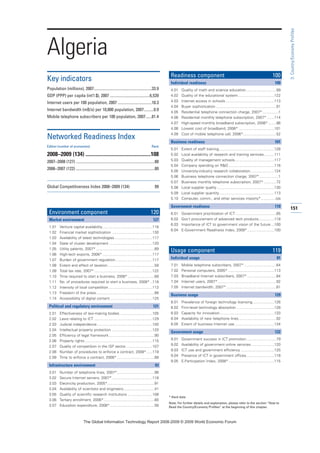
main beneficiaries of this phenomenon, as well as
all sectors in which virtual teams can be organized
for the production, maintenance, marketing, sales, or
distribution of complex products and services.
• Virtual mobility has become a key element in the
development of exporters of IT services (e.g.,
India), and in that of importers of foreign expertise
(e.g., fast-growing economies in the Gulf area). In
both cases, large multinational groups have been
among the fastest growing users of the resulting
new opportunities arising around cross-cultural
and cross-national virtual teams.
• With the advent of new capacities to obtain and
share information (either physical, such as ubiqui-
tous broadband, or of a more qualitative nature,
such as in the context of Web 2.0/social networks),
new business models and new modus operandi are
emerging. Many examples are found in the realm of
collaborative and open innovation.
• Many of these trends will be reinforced by the
readjustments made necessary by the current global
economic crisis. Others may be hindered or limited
by some of the measures that business and govern-
ments will take as a result of the same crisis.
These conclusions point to some serious tensions
and difficulties regarding the ways and means by which
national economies will compete for globally mobile
talent pools in the near future.They also call for some
immediate actions.The following list identifies six possi-
ble areas for action, under three major headings.
Reducing barriers to the mobility of people and information
Considering the slow pace at which demographic con-
straints (and, to some extent, educational system con-
straints) can be altered, physical and virtual mobility
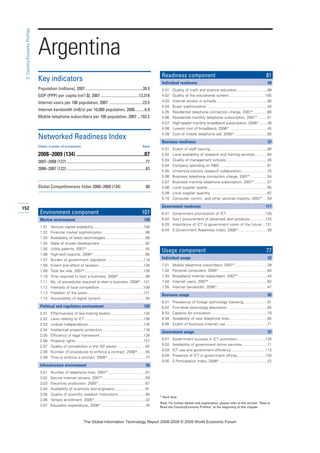
must be encouraged as a key instrument to ease some of
the most serious inadequacies in terms of global supply
and demand for talents. Physical mobility should not be
hampered by restrictive visa and immigration policies,
and virtual mobility should not be limited by uneven-
ness in global connectivity.At the global level, one of
the most detrimental effects of a persistent digital divide
between rich and poor countries would be to limit the
world’s ability to benefit from the possible combinations
of talents across cultures and geographical borders. In
the case of poorer countries, such a divide would con-
tribute to the resilience of the negative effects of physi-
cal migrations (brain drain).
Action 1: In deciding on visa and immigration
issues and policies, governments in industrialized coun-
tries should take full account of the cost of limiting the
global mobility of talented workers; more open policies
are likely to benefit all economies.
Action 2: Developing broadband infrastructure
worldwide (especially in developing countries and
regions such as sub-Saharan Africa) should be consid-
ered a priority for the coming decade.This will allow
more virtual mobility of talents and benefit developing
countries in at least two ways: (1) by better integrating
them in global production processes while offering a
productive outlet to local talents, and (2) by counterbal-
ancing the negative effects (brain drain) of physical
mobility. For advanced and fast-growing economies,
bridging the digital divide is key to benefitting from the
innovative ideas, designs, and services that still lie under-
used across the global talent pool.
90
1.7:GlobalMobilityofTalents
7KH *OREDO ,QIRUPDWLRQ 7HFKQRORJ 5HSRUW  ‹  :RUOG (FRQRPLF )RUXP
Upgrading the protection of workers and intellectual
property
In a more fluid world of physical mobility, the current
major economic crisis is likely to increase the willingness
of low-skilled workers to offer their labor worldwide.
This may well lead to a global weakening of their
individual and collective bargaining power.Although
pressures on wages may be temporary and properly
addressed by market forces, other forces may require
legal and regulatory safeguards. Specific efforts will need
to be deployed—in particular, to avoid the emergence
and the spreading of irreversible restrictions to workers’
rights and protections. Similarly, if virtual mobility is
developing quickly across virtual collaboration networks,
intellectual property rights will require specific protection
to ensure that innovators worldwide are duly recognized
and their efforts properly rewarded.The current
approach to intellectual property regimes needs to be
upgraded to fully reflect the new realities of our global
networked economy.
Action 3: Governments need to agree to interna-
tional standards regarding the rights, working conditions,
and living environment of migrant workers. Conventions
already in existence (e.g., those in the purview of the
International Labour Organization) should be reinforced
and reaffirmed in order to avoid further
deterioration in times of crisis.
Action 4: Intellectual property regimes should be
revisited, taking into account the rapid development of
collaborative and open innovation networks.
Education, education, education
As our societies and economies evolve toward more
knowledge-centric activities and structures, education is
playing an ever more central role as a source of compar-
ative advantage and an engine of social equity and
inclusion.The current situation points to some growing
gaps between the needs of our “knowledge ambitions”
and our ability to generate the skills and talents needed
to support it. In industrialized countries, diminished
interest for mathematics and science (especially among
girls) is a growing concern. On the other hand, the
rapid pace of technological change accelerates the
process of knowledge obsolescence in an increasing
number of areas, creating unprecedented challenges for
teachers and educators in the formal educational system.
Action 5: Governments, business, and educational
institutions (at primary, secondary, and tertiary levels)
need to join forces to change the image of scientific and
engineering careers among young people; curricula must
be developed and harmonized to improve the quality
and quantity of e-skilled and science-skilled workers and
managers, both in the IT and non-IT sectors.
Action 6: Fuller advantage and use need to be
made of the opportunities created by IT and networks
in the areas of distance learning and life-long education.
Governments, business, and educators have a common
mission and interest in making fuller use of existing
instruments not only as a tool to continuously upgrade
workers’ skills, but also as a tool to stimulate upward
social and career mobility and to fight inequality and
exclusion.
Whether it is physical or virtual, mobility will be a
key factor in our collective efforts to bring about an
equitable, multicultural, open, innovative, and sustainable
kind of globalization.To do so, however, we need to (1)
become fully aware of the potential benefits of taking
collective action to encourage and allow such mobility
on a global scale, and (2) consider the current crisis as
an opportunity (and an incentive) to take such action,
rather than an excuse to procrastinate.
Notes
1 For example, it has now become common for analysts and
observers to describe a world in which Indian and Chinese nation-
als, after completing higher degree education in California and
becoming successful Silicon Valley entrepreneurs, become a
bridge between American and Asian markets.
2 For details on the definitions and sources of the variables included
in the GTPM, please refer to Appendix A and the Technical Notes
and Sources section at the end of this Report.
3 The area of e-skills has been one in which the European
Commission has been particularly active in the recent past. See,
in particular, the outcome of the recent European e-Skills 2008
Conference in Thessaloniki, October 9–10; information available at
http://eskills.cedefop.europa.eu/conference2008/. On the same
subject, also see Lanvin and Passman 2008.
References
Arabian Business. 2008. ”A Rupee Reprieve for Gulf Recruitment
Crisis?” 9 (44): 19.
Cedefop (European Centre for the Development of Vocational Training).
2008. European e-Skills 2008 Conference: Implementing a Long
Term E-Skills Strategy in Europe. Thessaloniki, October 9–10.
Cheese, P., R. J. Thomas, and E. Craig, E. 2008. The Talent Powered
Organization: Strategies for Globalization, Talent Management and
High Performance. Philadelphia: Kogan Page.
Coe, D. T. 2007. “Globalisation and Labour Markets: Policy Issues
Arising from the Emergence of China and India.” OECD Social
Employment and Migration Working Paper No. 63. Paris: OECD.
———. 2008. “Jobs on Another Shore.” Finance and Development 45
(1, March). Washington, DC: International Monetary Fund.
Fraser, M. and Dutta, S. 2008. Throwing Sheep in the Boardroom.
Chichester: John Wiley and Sons.
Giridharadas, A. 2007. “Outsourcing Works So Well, India Is Sending
Jobs Overseas.” The New York Times, October 6: 5.
Hartung, R. 2008. “It’s Talent Fusion At Work.” NewsToday, Singapore.
August 9–10: 36.
Heidrick  Struggles/Economist Intelligence Unit. 2007. Global Talent
Index 2007–2012. Available at http://www.weknowglobaltalent.
com/gti/window/gti.
Institute of International Education. 2008. “Open Doors: Report
on International Educational Exchange.” Available at
http://opendoors.iienetwork.org.
Kirkegaard, J. F. 2007. The Accelerating Decline in America’s
High-Skilled Workforce: Implications for Immigration Policies.
Washington, DC: Peterson Institute for International Economics.
91
1.7:GlobalMobilityofTalents
7KH *OREDO ,QIRUPDWLRQ 7HFKQRORJ 5HSRUW  ‹  :RUOG (FRQRPLF )RUXP
Lanvin, B. 2008. ”E-Skills, Competitiveness and Employability:
Knowledge Societies’ Next Frontier.” White Paper. Available at
http://www.insead.edu/elab/eskills.
Lanvin, B. and P. Passman. 2008. “Building E-skills for the Information
Age.” Global Information Technology Report 2007–2008:
Fostering Innovation through Networked Readiness. Hampshire:
Palgrave Macmillan. 77–90.
Le Monde. 2008. “L’atlas des migrations: Les routes de l’humanité.”
Special Issue, November.
Manning, P. 2005. Migration in World History. Themes in World History.
New York: Routledge.
Manpower. 2008.”The Borderless Workforce: 2008.” White Paper.
Available at http://www.elanit.com/imm/pdf/NEW_080624_
BorderlessWkforce_WhitePaper_A4_FINAL.pdf.
Mattioli, D. 2008. “More Americans Vault Overseas to Search for
Jobs.” The Wall Street Journal, October 14: 32.
McKeown, A. 2004. ”Global Migration, 1846–1940.” Journal of World
History 15 (2) 155–89.
OECD (Organisation for Economic Co-operation and Development).
2008. The Global Competition for Talent: Mobility of the Highly
Skilled. Paris: OECD.
Premji, A. 2008. “Le travail du prochain président américain ne va pas
être facile, je n’aimerais pas être à sa place.” Interview given to
Annie Khan, Le Monde, September 21–22.
Ready, D. A., L. A. Hill, and J. A. Conger.2008. “Winning the Race for
Talent in Emerging Markets.” Harvard Business Review 86 (11):
62–70.
Solimano, A., ed. 2008. The International Mobility of Talent: Types,
Causes and Development Impact. New York: UNU-WIDER
Studies in Development Economics, Oxford University Press.
Tapscott, D. 2008. Grown Up Digital: How the Net Generation Is
Changing your World. New York: McGraw Hill.
UNCTAD (United Nations Conference on Trade and Development).
Various years. World Investment Report. Available at
http://www.unctad.org/Templates/Page.asp?intItemID=1485
lang=1.
UNDP (United Nations Development Programme). 2007. Human
Development Report 2007/2008. Houndsmills, Basingstoke,
Hampshire: Palgrave Macmillan. Available at
http://hdr.undp.org/en/reports/global/hdr2007-2008/.
UNESCO (United Nations Educational, Scientific and Cultural
Organization). 2007. Education for All Global Monitoring Report
2008—Education for All by 2015: Will We Make It? Paris:
UNESCO.
UNESCO Institute for Statistics. Available at http://www.uis.unesco.org/
ev.php?URL_ID=2867URL_DO=DO_TOPICURL_SECTION
=201.
Veloo, R. 2008. “Our Talent Blindspot.” NewsToday, Singapore, August
9–10: 10.
Wagstyl, S., J. Cienski, K. Eddy, and T. Escritt. 2008. “Gone West:
Why Eastern Europe Is Labouring under an Abundance of Jobs.”
Financial Times, January 17: 9.
World Bank Group. 2008. Doing Business 2009. Washington, DC: World
Bank. Available at http://www.doingbusiness.org/.
World Bank, Governance Indicators. Available at http://web.worldbank.
org/WBSITE/EXTERNAL/WBI/EXTWBIGOVANTCOR/0,,menuPK:17
40542~pagePK:64168427~piPK:64168435~theSitePK:1740530,00
.html.
92
1.7:GlobalMobilityofTalents
7KH *OREDO ,QIRUPDWLRQ 7HFKQRORJ 5HSRUW  ‹  :RUOG (FRQRPLF )RUXP
Appendix A: GTPM variable descriptions and sources
Time required to start a business, 2008
Duration of all procedures required to register a firm.
Source: The World Bank Group, Doing Business 2009. Available at
http://www.doingbusiness.org/.
Time to enforce a contract, 2008
Number of days required to resolve a dispute
Source: The World Bank Group, Doing Business 2009. Available at
http://www.doingbusiness.org/.
Venture capital availability, 2007, 2008
This is based on the average score on a 1–7 scale of a
large sample group in a particular country responding to
the question of whether entrepreneurs with innovative
but risky projects can generally find venture capital in
their country (1 = not true, 7 = true).
Source: World Economic Forum, Executive Opinion Survey 2007, 2008.
FDI Inflows as percent of GDP, 2001–05 (average)
Inflows of FDI in the reporting economy comprise cap-
ital provided (either directly or through other related
enterprises) by a foreign direct investor to an enterprise
resident in the economy.
Source: UNCTAD, World Investment Report. Available at
http://www.unctad.org/Templates/Page.asp?intItemID=1485lang=1.
Networked Readiness Index 2008-2009
Source: World Economic Forum, The Global Information and Technology
Report 2008–2009.
Availability of scientists and engineers, 2007, 2008
This is based on the average score on a 1–7 scale of a
large sample group in a particular country responding to
the question of whether scientists and engineers are
available in their country (1 = nonexistent or rare,
7 = widely available).
Source: World Economic Forum, Executive Opinion Survey 2007, 2008.
Quality of scientific research institutions, 2007, 2008
This is based on the average score on a 1–7 scale of a
large sample group in a particular country responding to
the question of whether scientific research institutions in
their country are (1 = nonexistent, 7 = the best in their
fields internationally)
Source: World Economic Forum, Executive Opinion Survey 2007, 2008.
Quality of math and science education, 2007, 2008
This is based on the average score on a 1–7 scale of a
large sample group in a particular country responding to
the question of whether the math and science education
available in their country’s schools (1 = lag far behind
most other countries’ schools, 7 = are among the best in
the world).
Source: World Economic Forum, Executive Opinion Survey 2007, 2008.
Quality of the educational system, 2007, 2008
This is based on the average score on a 1–7 scale of a
large sample group in a particular country responding to
the question of whether the education system in their
country (1 = does not meet the needs of a competitive
economy, 7 = meets the needs of a competitive economy).
Source: World Economic Forum, Executive Opinion Survey 2007, 2008.
Local availability of specialized research and training serv-
ices, 2007, 2008
This is based on the average score on a 1–7 scale of a
large sample group in a particular country responding to
the question of whether specialized research and training
services are (1 = not available, 7 = available from
world-class institutions).
Source: World Economic Forum, Executive Opinion Survey 2007, 2008.
University-industry research collaboration, 2007, 2008
This is based on the average score on a 1–7 scale of a
large sample group in a particular country responding
to the question of whether, in its RD activity, business
collaboration with local universities in their country
is (1 = minimal or nonexistent, 7 = intensive and
outgoing).
Source: World Economic Forum, Executive Opinion Survey 2007, 2008.
Total expenditure for RD as percent of GDP, 2006
Included are fundamental and applied research and
experimental development work leading to new
devices, products, and processes.
Source: UNESCO Institute for Statistics. Available at
http://www.uis.unesco.org/ev.php?URL_ID=2867URL_DO=DO_TOPICURL_
SECTION=201.
Tertiary education enrollment, 2006 or most recent year
available
The reported value corresponds to the total enrollment
in tertiary education expressed as a percentage of the
population of the five-year age group following on from
the secondary school-leaving age. Note that the gross
enrollment rate (GER) can exceed 100 percent due to
early or late entry and/or grade repetition.
According to UNESCO, tertiary education is
composed of two stages.The first stage of tertiary edu-
cation, ISCED level 5, includes level 5A, composed of
largely theoretically based programs intended to provide
sufficient qualifications for gaining entry to advanced
research programs and professions with high skill require-
ments; and level 5B, where programs are generally more
practical, technical, and/or occupationally specific.The
second stage, ISCED level 6, comprises programs devot-
ed to advanced study and original research, leading to
the award of an advanced research qualification.
Source: UNESCO, Institute for Statistics (retrieved January 12, 2008); UNESCO,
Education for All Global Monitoring Report 2008—Education for All by 2015:
Will We Make It?
93
1.7:GlobalMobilityofTalents
7KH *OREDO ,QIRUPDWLRQ 7HFKQRORJ 5HSRUW  ‹  :RUOG (FRQRPLF )RUXP
Education expenditure, 2006 or most recent year available
This variable refers to public current operating expendi-
tures in education, including wages and salaries and
excluding capital investments in buildings and equipment.
Source: The World Bank, World Development Indicators Online Database
(retrieved November 4, 2008).
Human Development Index (HDI), 2007
The HDI provides information on the human develop-
ment aspect of economic growth.The HDI is based on
three indicators: longevity, as measured by life expectan-
cy at birth; educational attainment, as measured by a
combination of adult literacy rate and the combined
gross primary, secondary, and tertiary enrollment ratio;
and standard of living, as measured by GDP per capita
(purchasing power parity in US dollars).
Source: UNDP Human Development Report 2007/2008, Table 1. Available at
http://hdr.undp.org/en/reports/global/hdr2007-2008/.
Rule of law, 2006
This indicator includes several indicators that measure
the extent to which agents have confidence in and abide
by the rules of society.These include perceptions of the
incidence of both violent and nonviolent crime, the
effectiveness and predictability of the judiciary, and the
enforceability of contracts.
Source: The World Bank, Governance Indicators. Available at
http://web.worldbank.org/WBSITE/EXTERNAL/WBI/EXTWBIGOVANTCOR/
0,,menuPK:1740542~pagePK:64168427~piPK:64168435~theSitePK:1740530,00.
html.
Control of corruption, 2006
This indicator corresponds to “graft” measures of cor-
ruption—notably, corruption measured by the frequency
of “additional payments to get things done” and the
effects of corruption on the business environment.
Source: The World Bank, Governance Indicators. Available at
http://web.worldbank.org/WBSITE/EXTERNAL/WBI/EXTWBIGOVANTCOR/
0,,menuPK:1740542~pagePK:64168427~piPK:64168435~theSitePK:1740530,00.
html.
94
1.7:GlobalMobilityofTalents
Appendix A: GTPM variable descriptions and sources (cont’d.)
7KH *OREDO ,QIRUPDWLRQ 7HFKQRORJ 5HSRUW  ‹  :RUOG (FRQRPLF )RUXP
CHAPTER 1.8
RD and Innovation in the ICT
Sector: Toward Globalization
and Collaboration
GRAHAM VICKERY, OECD
SACHA WUNSCH-VINCENT, OECD
This chapter analyzes recent developments in increasingly
globalized information and communication technologies
(ICT) research and development (RD) and innovation.1
Global structures of RD, science performance,
invention, and innovation are in transition.2 The main
dimensions of change are the absolute growth of RD
and innovation-related activities; the rise of the BRIC
economies in scientific and technological fields;3
significant globalization of RD; more performance
of RD in the services sector; and a growing focus on
non-technological innovation, enhanced international-
ization and mobility of highly skilled people, and
increased internationalized patenting.
Among the main elements underpinning these
developments have been the increasingly knowledge-
driven nature of innovation; the quickly changing
organization of research, driven by information tech-
nologies, collaboration, and the sharing of knowledge;
and changes in markets, the competition environment,
and technology. Firms are also embracing “open”
innovation approaches and actively cooperating with
external actors.
The next sections cover this trend toward more
international and collaborative ICT RD.
Globalized RD agenda in ICT
While ICT-related research challenges and priorities are
evolving, an increasingly globalized ICT RD agenda is
emerging with eight broad priorities (Figure 1).
Some of the research topics listed in Figure 1 have
been in the ICT RD agenda for some time, especially
those clustered around the physical foundations of com-
puting, computing systems, and software engineering.
Optical and quantum computing, robotics, and artificial
intelligence also remain important for addressing long-
term challenges. In practice, RD in a given area has
led to the emergence of new topics: for example, the
rapidity with which semiconductors are being miniatur-
ized has made nanotechnology research part of core
ICT RD; mounting demand for high-speed broadband
is driving research into all-optical networks and optical
computing. Progress in biotechnology, nanotechnology,
cognitive sciences, and interdisciplinary research fosters
synergy and convergence and opens up new research
areas.
ICT RD and innovation also increasingly intend
to address pressing socioeconomic challenges, which are
now international in scope and reach—for example, cli-
mate change, health care, and aging societies (Figure 2).
95
1.8:RDandInnovationintheICTSector
The authors wish to thank Cristina Serra-Vallejo, statistician at the
OECD, and Arthur Mickoleit, consultant to the OECD, who contributed
to this chapter.
7KH *OREDO ,QIRUPDWLRQ 7HFKQRORJ 5HSRUW  ‹  :RUOG (FRQRPLF )RUXP
Figure 1: ICT RD priorities (clusters of topics and subtopics)
Source: OECD.
96
1.8:RDandInnovationintheICTSector
• Miniaturization of complementary metal–oxide–semiconductor (CMOS)
technology, use of nanotechnology
• Beyond CMOS: Optical and quantum computing, spintronics
• Flexible electronics for increased applicability of computing devices
• High-end computing and storage (upscaling)
• Embedded systems, systems-on-a-chip, systems-in-package (downscaling)
• Robotics, autonomous computing systems
• Converging research agendas of ICT, nanotechnologies, biotechnologies, and
other scientific disciplines
• ICT imitating natural information processing
• ICT enabling scientific research
• Wired and wireless broadband technologies
• Next-generation networks, mobile ad-hoc networks
• Radio frequency identification (RFID) in sensor-based networks,
Internet of Things
• Network reliability, quality of service
• Software development paradigms, artificial intelligence
• Use of ICT to increase productivity of software engineering
• Management of large and heterogeneous data sources
• Natural language processing
• Data mining in complex sources, multimedia content extraction, semantic web
• Content digitization, digital preservation and access
• Participative web and networked collaboration
• Customized and context-oriented information
• Productivity gains through improved user interfaces
• ICT accessibility and usability
• Interaction with all human senses
• Augmented, immersive, and virtual realities
• Security of computing systems, networks, applications, and services
• Security of critical information systems
• Data integrity, confidentiality, and issues of privacy
• Internet crime, cyberterror
Physical foundations of computing
Computing systems and architectures
Converging technologies and
scientific disciplines
Network infrastructures
Software engineering and
data management
Digital content technologies
Human-technology interfaces
ICT and Internet security and safety
7KH *OREDO ,QIRUPDWLRQ 7HFKQRORJ 5HSRUW  ‹  :RUOG (FRQRPLF )RUXP
ICT sector RD expenditures in the Organisation for
Economic Co-operation and Development (OECD)
In light of the above challenging research agenda, the
ICT sector undertakes large investments in RD and is
very innovative. In terms of RD expenditures, patents,
and venture capital investment, it exceeds other industries
by a large margin. ICT is the most important of the five
sectors that dominate business-sector RD (Figure 3).
In 2005, the OECD 21 ICT goods and services sector
spent about two and a half times as much on RD
(US$130 billion) as the automotive sector and more
than triple the pharmaceutical sector.4
In 2005, the year of the latest available official data,
ICT manufacturing RD accounted for more than a
quarter of total manufacturing business RD expendi-
ture in most OECD countries. It accounted for more
than half in Finland and Korea, Rep. (Korea)(63 percent
and 57 percent, respectively), and more than 30 percent
in the United States (39 percent),Australia (32 percent
in 2002–03), Canada (39 percent in 2005), Japan (36
percent in 2005), and Ireland (34 percent).
The decline in RD in the ICT goods sector since
2001 (constant terms) has been partly balanced by an
increase in ICT services, which have grown very rapidly
since the 1990s.These services surpassed the chemical
sector in 2001 and almost reached the level of expendi-
ture in the pharmaceutical sector.There has been a very
significant growth in the share of services in computer
and related activities (largely software and IT services):
21 percent in 2005, up from 9 percent in 1993.
The United States still accounts for 40 percent of
all OECD RD expenditures in ICT manufacturing
and services.The European Union (EU) 15 accounts for
a little under a quarter of the total, Japan for 22 percent,
and Korea for 9 percent, with the larger OECD members
making up the bulk of the remainder in 2005.5
Figure 2: Examples of ICT RD as solutions to pressing global socioeconomic challenges
Source: OECD.
Health care
• Health-care management, patient files, health
databases, clinical information systems
• Telemedicine, remote health monitoring,
drug delivery using RFID and biosensors
• Detection of adverse health events, early
warning systems
• Remote surgery using haptic interfaces,
virtualization, and advanced network tech-
nologies
• Data mining in medical images
• Bioinformatics and biomedical computing
• Collaborative networking and grid comput-
ing in medical research, simulated surgeries
Independent living and
social inclusion
• Accessibility of ICT solutions for the young,
the elderly, impaired users
• Improved usability through advanced
software and hardware interfaces—for
example, natural language control,
brain-computer interfaces
• Mobile monitoring, detection of adverse
health events through sensor-based and
wearable computing
• Smart home technologies to assist elderly
and chronically ill patients
• Adapted online services to assist
administrative tasks
Environmental challenges
• Energy-efficient ICT for data centers and
Internet infrastructures
• ICT for energy-intensive industries
• Digitization and digital delivery of goods
and services
• Pollution monitoring using adaptive sensor
networks
• Improved product design for recyclability
• Tracking waste streams using sensors
• Environmental information systems for
decision makers, businesses, citizens
Emergency and disaster
management
• Remote, sensor-based detection systems
connected to geo-spatial information
systems
• Mobile ad-hoc networks for immediate
disaster relief
• Interoperability of observation and
monitoring systems
• Holistic warning systems integrating
disaster-specific solutions
Transport and mobility
• Traffic monitoring and control systems
• Personalized traffic information
• Driver assistance systems using sensors,
embedded systems, and augmented reality
technologies
• Software optimization for freight route
planning
• Sensor and satellite-based navigation and
positioning systems
• Adaptive safety systems using RFID
• Teleworking solutions
Defense
• Command-and-control systems
• Real-time language translation
• Surveillance robots, such as unmanned
armored vehicles (UAVs)
• Augmented reality systems to assist
decision making in theaters
• Sensor-based threat detection—for
example, biochemical substances
• Electronic warfare—for example, radio
frequency jamming
• Combat simulations using immersive
virtual reality technologies
• Mobile ad-hoc networks in theaters
97
1.8:RDandInnovationintheICTSector
7KH *OREDO ,QIRUPDWLRQ 7HFKQRORJ 5HSRUW  ‹  :RUOG (FRQRPLF )RUXP
In ICT manufacturing, Finland, Korea, Japan,
Sweden, and the United States have higher than average
shares of RD expenditure in GDP. Finland and Korea
have increased their shares since 1997, and estimates for
2006 show a further pick-up for Korea.As a share of
GDP, Denmark, Finland, Ireland, and Sweden have the
greatest specialization in ICT services RD (Figure 4).
Expenditure on software RD has risen most rap-
idly of all parts of the ICT sector. Data on business RD
in computer and related services for 2006 show that the
United States leads by a large margin (US$30.5 billion),
roughly 15 times that of Israel (US$2.1 billion), Japan
(US$2 billion), the United Kingdom (US$2 billion), and
Germany (US$1.9 billion).The same applies to business
RD in software consultancy and supply: the United
States (US$17 billion) carries out around 10 times more
RD than Germany (US$1.8 billion), followed by
Korea and France (US$0.9 billion each).
Also, the global distribution of RD is changing,
and some non-OECD economies are becoming impor-
tant ICT RD spenders. Sectoral spending data are
hard to produce in a way that allows direct comparison,
however, for these countries at the aggregate level.
RD spending of top ICT firms
The RD spending of the top ICT firms has grown
consistently over the last decade and held up well during
the years following 2001, reaching US$151 billion in
2006 and expanding in 2007.The question is how ICT
firms will react to the current economic downturn, with
recession forecasted to last OECD-wide until 2010: that
is, they may either significantly reduce their RD
spending or decide to maintain this spending to preserve
their competitiveness in the medium to long term.
Currently, RD expenditures of the top ICT firms
are significantly higher than those of RD-intensive
firms in the chemicals, pharmaceuticals, or automotive
sectors.6
In 2006, the top 100 ICT RD-performing
firms (ranked by absolute RD expenditures in 2006)
spent an average of 6.7 percent of revenues on RD.
And, as will be explained later, these RD expenditures
are increasingly spread internationally.
The bulk of ICT RD of the top 250 ICT firms is
conducted by US (43 percent) and Japanese (26 percent)
firms, followed by firms from Germany (11 percent),
Korea (8 percent), and other European countries. Firms
from Chinese Taipei,7 in particular, have overtaken firms
from Canada and the United Kingdom in their RD
spending. Despite rapid growth, Chinese ICT firms still
have a relatively small share of the RD expenditures of
the top 250 ICT firms.
Korean firms have caught up to firms from other
advanced OECD countries. Despite initial high starting
levels, German and US firms have also significantly
stepped up their RD spending. Japan had a slight
increase and France a slight decrease. Canada has also
seen a drop, owing to spending declines by Nortel
Networks and Celestica. In terms of growth in RD
spending 2000–06, firms from Chinese Taipei and China
are leading, albeit from low levels (Figure 5).
98
1.8:RDandInnovationintheICTSector
0
30
60
90
120
150
1993 1994 1996 1997 1998 1999 2000 2001 2002 2003 2004 20051995
ICT total
ICT manufacturing1
Motor vehicles
Pharmaceuticals
ICT services2
Chemicals
Research and
development sector3
Figure 3: Growth of the largest RD-spending sectors in the OECD 21 area, 1993–2005
Source: OECD estimates based on ANBERD and RDS databases, June 2008.
1. Office, accounting and computing machinery (ISIC 30); Radio, TV and communication equipment (ISIC 32); Medical, precision and optical instruments (ISIC 33).
2. Telecommunications (ISIC 642) and in some cases ISIC 64; Computer and related services (ISIC 72).
3. Research and development (ISIC 73): Research and experimental development on natural sciences and engineering and on social sciences and humanities.
PPP$(billions,constant2000prices)
7KH *OREDO ,QIRUPDWLRQ 7HFKQRORJ 5HSRUW  ‹  :RUOG (FRQRPLF )RUXP
99
1.8:RDandInnovationintheICTSector
0.0
0.3
0.6
0.9
1.2
1.5
Figure 4: Business RD expenditure for ICT goods and services, 1997 and 2005
4a: Selected ICT manufacturing industries
4b: Selected ICT services industries
Source: OECD estimates based on ANBERD and RDS databases, June 2008. See also OECD, 2007.
Note: Research and development (ISIC 73): Research and experimental development on natural sciences and engineering and on social sciences and humanities.
Source: OECD estimates based on ANBERD and RDS databases, June 2008. See also OECD, 2007.
Note: When data for class 642 (Telecommunications) are unavailable, division 64 (Post and telecommunications) is used. Class 642 has the major share of divi-
sion 64 RD expenditure; for example, in the United States, class 642 accounts for 97–98 percent of the RD in division 64.
Finland
Korea,Rep.
Japan
Sweden
UnitedStates
Germany
Netherlands
France
Ireland
Canada
Denmark
Belgium
UnitedKingdom
Norway
Italy
Australia
CzechRepublic
Portugal
Spain
Greece
Poland
PercentofGDP
1997 ■ 2005
0.0
0.1
0.2
0.3
0.4
Denmark
Finland
Ireland
Sweden
UnitedKingdom
UnitedStates
Canada
Norway
France
Belgium
Korea,Rep.(1998)
Australia
CzechRepublic
Spain
Germany
Japan
Italy
Greece
Netherlands
Portugal
Poland
PercentofGDP
1997 ■ 2005
7KH *OREDO ,QIRUPDWLRQ 7HFKQRORJ 5HSRUW  ‹  :RUOG (FRQRPLF )RUXP
Other than China and India, ICT companies from
OECD enhanced engagement countries (Brazil,
Indonesia, and South Africa) and OECD accession
countries (Chile, Estonia, Israel, Russia, and Slovenia) are
not in the top RD spending group.8
In some cases,
this may be due to lack of reporting (e.g., some Israeli
and Russian ICT firms potentially qualify for inclusion,
but no data are available). In most cases, however, RD
expenditures or revenues of these countries’ ICT firms
are not high enough.
For the top 100 RD-spending ICT firms, the
largest shares are in electronics (33 percent), IT equipment
(19 percent), communications equipment (17 percent),
and semiconductor firms (14 percent).Telecommuni-
cations firms have progressively reduced their RD
expenditures and made up only about 5 percent of the
top 100 total in 2006.9 The largest growth of RD
expenditures over the period 2000–06 was in sectors
with lower initial shares: Internet, software, and semi-
conductor firms.
Top ICT RD spenders by firm
Microsoft, Samsung, IBM, and Intel lead the list of ICT
firms ranked by RD expenditure (Table 1). In 2007,
Samsung overtook IBM in reported RD spending.The
first three firms were also top RD spenders across all
industries in 2006, just behind Toyota Motor (US$7.7
billion), Pfizer (US$7.6 billion), and Ford Motor Corp.
(US$7.2 billion) in the automotive and pharmaceutical
sectors.
In terms of growth in RD spending, the leaders
are Google (114 percent, Internet firm), SanDisk (91
percent, IT equipment), Research in Motion (63 per-
cent, communication equipment), Lenovo (54 percent,
IT equipment) and Nvidia (42 percent, electronics and
components) (all compound annual growth rate (CAGR),
in current US dollar terms), followed by a group of
Internet, service, and software firms despite their smaller
number in the overall top 250 (Table 2). China and
India each have one firm in the top 10 in terms of
growth.
Non-OECD firms are over-represented in terms of
RD growth, in part because of their low starting level.
Apart from Lenovo (China) and Infosys (India), which
are in the top 10, there are a significant number of IT,
electronic equipment, and semiconductor firms from
Chinese Taipei (Lite-on Technology,AU Optronics,
Taiwan Semiconductor, Benq/Qisda) and communication
equipment firms from China (Huawei, ZTE) among the
top 50.10
Semiconductor and hardware firms (communication
and IT equipment, electronics) are the most intensive in
terms of RD expenditures per employee. Broadcom
(semiconductors) leads with US$213,000 per employee,
followed by Qualcomm (communications equipment),
Nvidia (electronics and components), and SanDisk (IT
equipment). Software firms such as Electronic Arts,
Microsoft,Adobe Systems, and Intuit are also RD
leaders. US ICT firms dominate the top 50, with
notable exceptions such as Nintendo (Japan),Advantest
100
1.8:RDandInnovationintheICTSector
–50 0 50 100 150 200 250 300 350
Figure 5: Growth of RD expenditures of top ICT firms, 2000–06 (current terms, percent)
Source: OECD Information Technology Outlook database.
Chinese Taipei
China
Korea, Rep.
Germany
United States
Japan
France
Canada
Percent
7KH *OREDO ,QIRUPDWLRQ 7HFKQRORJ 5HSRUW  ‹  :RUOG (FRQRPLF )RUXP
(Japan),ASM Lithography (the Netherlands), Samsung
(Korea), LG Electronics (Korea), Qimonda (Germany),
Nortel Networks (Canada), Nokia (Finland), and
Ericsson (Sweden). Few other European or Japanese
firms are among the top 50.
Trends in RD intensity
RD expenditure as a share of sales revenues is another
measure of RD intensity. Semiconductor firms lead by
this measure (Figure 6).The top 10 firms in this ranking
spent between one-fifth and one-third of their revenues
on RD.
On average, in 2006, semiconductor and software
firms were the most RD-intensive, with average RD
spending equivalent to around 15 percent of revenues.
Semiconductor firms had a strong increase in RD
intensity between 2000 and 2006, while IT equipment,
services, and telecommunication firms have seen an
overall decrease.
IT equipment firms such as Apple, Dell, and
Hewlett Packard are often seen as leading innovators,
but with RD intensity below 5 percent they are at the
lower end of the top 100 ranking of this variable.Apple’s
very strong revenue growth, coupled with slower
increases in RD, have led to declining RD intensities
in recent years (3.3 percent in 2007), even though the
company is well known for product innovations, leading
design and strong branding. Other IT equipment firms
with strong consumer product operations from Chinese
Taipei and China such as Benq/Qisda, Lenovo,ASUStek,
and Acer are also at the lower end of the ranking in
RD intensity, but they tend to innovate most in
process technology and supply arrangements. Internet
firms such as Amazon and Expedia have stronger RD
intensities (over 5 percent), but they are still far from
other US Internet firms such as Google (13 percent) or
Yahoo! (16 percent).
Firms from the United States dominate the list of
the most RD intensive. Only one Japanese firm—
Advantest (IT equipment)—has been in this top 50 for
some years, and some other Japanese companies (e.g.,
Rohm, Pioneer, Omron,Yokogawa Electric) have
oscillated between 50th and 60th place.There are two
Chinese communications equipment firms (ZTE and
Huawei) in the top 50 most RD-intensive ICT firms,
sharing leading positions with firms such as Juniper
101
1.8:RDandInnovationintheICTSector
Table 1: Top ICT RD spenders: Absolute expenditure, 2006 and 2007 (US dollars, millions)
Rank Company Country Industry RD 2006 RD 2007
1 Microsoft United States Software 6,584 7,121
2 Siemens Germany Electronics  components 6,312 n/a
3 Samsung Korea, Rep. Electronics  components 6,004 6,451
4 IBM United States IT equipment 6,107 6,153
5 Intel United States Semiconductors 5,873 5,700
6 Nokia1 Finland Communication equipment 4,896 n/a
7 Matsushita (Panasonic) Japan Electronics  components 4,854 4,909
8 Sony Japan Electronics  components 4,675 4,619
9 Cisco United States Communication equipment 4,067 4,499
10 Motorola United States Communication equipment 4,106 4,429
Source: OECD Information Technology Outlook database.
1. From 2007, Nokia consolidates financial information for Nokia Siemens Networks, a joint venture between Nokia and Siemens. Nokia’s reported 2007 RD
expenditure of US$7.730 million is therefore not comparable to earlier expenditures.
Table 2: Top ICT RD spenders: Expenditure growth, 2000–07 (CAGR, based on current US dollars)
Rank Company Country Industry Growth (%) 2000–07
1 Google United States Internet 113.5
2 SanDisk United States IT equipment 91.2
3 Research in Motion Canada Communication equipment 63.1
4 Lenovo China IT equipment 54.0
5 Nvidia United States Electronics  components 42.2
6 Infosys India Services 39.5
7 Yahoo! United States Internet 38.5
8 eBay United States Internet 35.2
9 Symantec/Veritas United States Software 34.6
10 Jabil Circuit United States Electronics  components 33.6
Source: OECD Information Technology Outlook database.
7KH *OREDO ,QIRUPDWLRQ 7HFKQRORJ 5HSRUW  ‹  :RUOG (FRQRPLF )RUXP
Networks,Tellabs, Qualcomm, Motorola,Avaya, and
Cisco (all from the United States); Nortel Networks,
Research in Motion (both from Canada); Ericsson
(Sweden);Alcatel-Lucent (France); and Nokia (Finland).
ICT-related RD in other industries
ICT-related RD is increasingly crucial to technologi-
cal advances and innovation in non-ICT sectors and
products.These include space, defense, infrastructure
(e.g., power grids), automobiles, automation, robots,
logistics, aviation, health care, environment monitoring,
and toys.
A large share of the RD in non-ICT industries—
about one-quarter of economy-wide total ICT RD—
leads to ICT products. Moreover, in some non-ICT
sectors, expenditures on RD that result in ICT products
are a large share of total RD expenditures.11 Data for
European countries show that in the Czech Republic,
around 25 percent of ICT RD in 2006 was performed
in non-ICT industries. In Denmark, close to 20 percent
of business ICT RD in 2005 was conducted in non-
ICT industries, and in Norway, around 25 percent of
ICT RD was performed outside the ICT sector in 2006.
Within the Asia-Pacific region, in 2006 Japan spent
US$5.5 billion on ICT-related RD activities outside
the ICT industry, or 24 percent of economy-wide ICT
RD spending (Figure 7).The biggest share was in
transport equipment, which is dominated by the country’s
carmakers and suppliers, and in electrical and general
machinery manufacturing. In Australia, non-ICT-
industries were responsible for over 60 percent of all
ICT RD expenditure in 2005–06. Finance and insur-
ance represented 34 percent, largely owing to in-house
RD of large Australian banks.
Software development plays a particularly important
role in ICT RD expenditures of non-ICT industries,
notably in finance and publishing, but also in manufac-
turing (e.g., machinery). For example, in the United
States in 2005, about 30 percent of software was devel-
oped by non-ICT industries—in the chemical, finance
and insurance, automotive, and real estate sectors; in
other manufacturing activities; and in service activities
such as newspapers and architecture.
Trends in the organization of an increasingly
globalized ICT RD
The ICT sector is RD-intensive but is also innovative
in terms of how it organizes RD. It has benefited from
partnerships with public research and employed a mix of
internal and external as well as national and internation-
al RD strategies.While all have been used for many
years, the organization of RD has been changing: col-
laboration and internationalization of RD are seen as
major sources of innovation for the industry, and there
are signs that they are increasing.
In recent years OECD countries have substantially
raised their overall public funding for RD.12
Data on
government budget appropriations or outlays for RD
(GBAORD) show that between 2000 and 2006, gov-
102
1.8:RDandInnovationintheICTSector
0 5 10 15
Figure 6: Average RD intensity of top ICT firms by sector, 2000 and 2006
Source: OECD Information Technology Outlook database.
Semiconductor
Software
Communications equipment
Internet
Electronics  components
IT equipment
Services
Telecommunications
Sales revenues (percent)
■ 2006 ■ 2000
7KH *OREDO ,QIRUPDWLRQ 7HFKQRORJ 5HSRUW  ‹  :RUOG (FRQRPLF )RUXP
ernment RD budgets in the OECD area expanded by
6.8 percent annually, faster than GDP, although with
considerable differences among countries. Because of
the complex interactions among research, development,
and innovation, the ICT sector has always relied heavily
on publicly funded RD and on partnerships involving
government, public-sector research organizations,
industry, and universities for long-term basic scientific
research. ICT firms are often part of regionally concen-
trated clusters or set up labs close to universities to
benefit from spillovers of public ICT-related RD.The
relative importance of access to public research results
increases in times of falling company budgets for basic
research.
Globalization of ICT RD
The internationalization of RD is not a new phenom-
enon, but it is occurring at a much faster pace today.
Moreover, it is spreading more widely—to emerging
economies as well. In most OECD countries, the share
of foreign affiliates in industry RD is growing as for-
eign firms acquire local RD-performing firms (e.g.,
through mergers and acquisitions) or establish new sub-
sidiaries.Along with the pharmaceutical, biotechnology,
chemical, health, and automotive sectors, the ICT indus-
try has considerable foreign RD investment. ICT
firms and public research organizations have increasingly
internationalized their activities and are establishing
RD laboratories in, or links with, foreign locations,
including in non-OECD countries.The ICT sector thus
follows the trend of globalizing RD activities as multi-
national enterprises more and more aim at exploiting
globally available knowledge and skills.13
Yet the available data that are produced with long
time lags show that most ICT firms still conduct the
majority of their RD in their home country. In 2005,
around 12 percent of business ICT RD in the OECD
was under foreign control, and most international RD
relationships were among affiliated companies rather
than between domestic and foreign-owned ICT firms
or laboratories. Moreover, the RD intensity of affiliates
abroad is generally far lower than RD intensity in the
home country.The need for secrecy, the strong network
effects, the search for spillovers, and the high costs of
dispersed RD centers favor concentrating RD activ-
ities in a few places.
Outside the home country, ICT-related RD
investments are generally within the OECD area, with
Japanese and European ICT firms mostly establishing
RD centers in the United States, and US ICT firms
mainly establishing centers in Europe and increasingly in
Asia (see Box 1). Japan and Korea attract comparatively
little foreign ICT RD.
More recent data, however, would show the rapid
increase in internationalization that has occurred since
2005. Globalized business ICT RD networks now
involve leading firms such as Cisco, HP, IBM, Nokia,
Motorola,Toshiba, NEC, Microsoft, and Google, which
are likely to have between five and ten global ICT
research centers.A quarter of Samsung’s workforce
103
1.8:RDandInnovationintheICTSector
ICT industry: 76%
Transportation equipment: 6%
General machinery: 5%
Electrical machinery
equipment and supplies: 5%
Other manufacturing: 3%
Chemical products: 2% Services: 2%
Iron and metal products: 1%
Figure 7: Japanese ICT RD expenditures, in ICT and non-ICT sectors, 2006
Source: Japanese Statistics Bureau, 2007.
7KH *OREDO ,QIRUPDWLRQ 7HFKQRORJ 5HSRUW  ‹  :RUOG (FRQRPLF )RUXP
(36,000 employees) is involved in RD with facilities in
Korea, India, China, Russia, the United States, and
Japan. Global innovation networks also increasingly
involve smaller firms.14
The internationalization of ICT RD more and
more entails establishing ICT RD centers in emerging
economies.The sector is one of the first to have trans-
formed these into fully fledged elements of globalized
research networks. Despite internationalization, RD
activities remain tightly clustered, as in previous national
examples.15
Only a few non-OECD locations are
increasingly involved on a larger scale: China (Shanghai
and Beijing), Israel (Haifa), India (Bangalore and Delhi),
Russia (Moscow and St. Petersburg), and, to a lesser
extent, cities in Chinese Taipei, Malaysia, and Singapore.
Affiliates under foreign control continue to devote
a smaller share of turnover to RD than do national
firms. However, in contrast to a few years ago when for-
eign RD, particularly in developing countries, mainly
reflected an investment requirement or the mere need
to adapt product for the local market, some foreign
research activities now complement headquarter
research activities. For example, Hewlett Packard’s data
mining in Russia, IBM’s research on speech technolo-
gies in India and embedded systems in China, and
Intel/Yahoo!’s software or search technologies in Israel
all draw on the local talent pool of domestic firms and
research organizations. In addition, ICT firms from
emerging markets (e.g., Huawei,Tata) increasingly have
their own globalized innovation networks.
Collaborative RD and “open innovation” on an
international scale
The terms collaborative RD and open innovation are more
and more used to characterize new forms of RD and
innovation that rely less on traditional in-house RD
and more on collaborating on research and innovation
with universities, public laboratories, other firms, and
other knowledge sources. Major incentives include cost
and risk reduction (especially for pre-competitive RD)
and possibilities of entering new markets with jointly
developed technologies.16
Such collaboration is increas-
ingly international and spans across various ICT sectors
and adjacent industries (e.g., biotechnology).
Externally organized RD activities of the ICT
business sector have mainly taken the following forms:
• partnerships, framework agreements, or RD
contracts with universities, RD laboratories, and
research institutes, often with a focus on longer-
term RD (including the creation of joint
laboratories or high-technology zones by ICT
firms on university campuses);17
• the involvement of PhD and postdoctoral
researchers in the work of company RD labs;
• RD partnerships, industrial technology alliances,
and consortia of ICT firms (some focused on
upstream research and some on product co-
development); and
• prospecting for new ideas from individuals and
startups with promising research (including through
venture capital, incubation and acquisitions, and
new participative web strategies).
These trends have strengthened with the greater
internationalization of collaboration and the development
of global innovation networks. ICT RD has become
more modular and increasingly takes place outside the
OECD region.The internationalization of RD in
general is also driven by the growing use of ICT as the
basic international science and technology infrastructure
(e.g., broadband research networks), by programs that
encourage international research collaboration (e.g., the
EU’s Seventh Framework Programme (FP7) focuses on
cooperation with entities from Asian countries) and by
104
1.8:RDandInnovationintheICTSector
Box 1: RD activities of US affiliates
US-based non-bank multinational enterprises (MNEs) have
more than doubled the value of their overseas RD activities
through their foreign affiliates since the mid-1990s, to
US$28.3 billion in 2005 or around 15 percent of total RD
expenditures of US MNEs (home and abroad).1 In 2005,
seven countries—the United Kingdom, Germany, Canada,
France, Japan, and, more recently, Singapore and China—
accounted for two-thirds of total RD performed by US for-
eign affiliates. The share of RD in computers and electronic
products is about 20 percent of total US MNE RD abroad—
a share that has fallen slightly—but the share of ICT services
has increased to around 5 percent of total overseas RD.
RD performed abroad by majority-owned foreign
affiliates of US parent companies, 2002 and 2005
(current US$ millions)
Industry/sector 2002 2005
All industries 21,063 28,316
Manufacturing 18,736 24,036
Computers and electronic products 4,975 5,376
Non-manufacturing
Information services and data processing services 24 657
Computer systems design and related services 447 n/a
Source: National Science Board, 2008; Bureau of Economic Analysis,
2007.
Note: Data for Computer systems design and related services for 2005
are suppressed for reasons of confidentiality.
1. BEA 2007, Table 3.6.
7KH *OREDO ,QIRUPDWLRQ 7HFKQRORJ 5HSRUW  ‹  :RUOG (FRQRPLF )RUXP
specialized organizations (e.g., the International Techno-
logy Roadmap for Semiconductors). Long-standing public
research organizations (Fraunhofer ICT institutes in
Germany, Battelle in the United States,VTT in Finland,
or TNO in the Netherlands) also increasingly form global
research alliances or public-corporate RD consortia.
At the firm level,Asia is becoming the target for
new collaboration, both within Asia (e.g., co-development
of optical storage media by Samsung and Toshiba) and
between OECD ICT firms and Asian partners. Chinese
and Indian firms in particular have become strategic
research partners for OECD ICT firms (e.g., Siemens
and China’s Huawei; Ericsson and China’s Datang
Telecom on alternative 3G network protocols;Agilent
and China’s Chengdu Qianfeng on communication test
equipment; Microsoft and India’s Infosys on enterprise
resource planning software;Yahoo! and India’s Tata on
cloud computing). OECD ICT firms also collaborate
with Asian universities (e.g., Philips with China’s Zhejiang
University, US Xybernaut with Beijing University of
Aeronautics for software solutions).A few alliances are
also forming between Indian and Chinese ICT firms
(mainly in the area of software and ICT services) and
between Russian and Chinese ICT firms (e.g., Russia’s
Sitronics and ZTE for global navigation satellite systems).
Besides the new collaboration with Asia at the firm
level, RD partnerships and alliances have encompassed
different ICT subsectors, often with links to universities.
Semiconductors and microelectronics pioneered such
collaboration in the ICT sector in the 1970s. Recent
examples include (1) the Reliable Adaptive Distributed
Systems Laboratory (RAD Lab) at the University of
Berkeley, which is supported by Google, Sun
Microsystems, Microsoft, Siemens, Oracle, Cisco and
others; (2) RESERVOIR, a research initiative led by
IBM in the field of cloud computing, with support from
the EU FP7, involving ICT firms from the United States
(e.g., Sun Microsystems), the European Union (e.g.,
SAP,Telefonica), and European universities; (3) Microsoft’s
and Intel’s joint funding of academic research into soft-
ware development for parallel computing, business intel-
ligence, and radio-frequency identification (RFID); and
(4) the joint laboratory for large-scale computer network
research formed by the Chinese companies Baidu and
Huawei. Collaboration between ICT firms on horizontal
topics such as the environment is also more and more
common (e.g., the StEP initiative for e-waste).
ICT RD is also becoming more interdisciplinary,
with more research involving nanotechnology, biotech-
nology, and ICT firms. Such collaboration has not been
widely publicized (e.g., Sun Microsystems and SimBioSys
for pharmaceuticals; the BioIT Alliance, co-founded
by Microsoft, HP, Sun Microsystems, and pharmaceutical
and biotechnology companies; Google’s investment in
23andMe, a company providing personalized genome
analysis).
Finally, a growing number of research partnerships
have formed around open standards or common tech-
nology platforms.The Open Handset Alliance (formerly
Google Android) engages in developing an open source
mobile platform: its over 30 members include Google,
Broadcom, Intel, China Mobile, KDDI, and Samsung.
Further examples of joint handset development platforms
include the LiMo Foundation (whose founding members
are Motorola, NEC, NTT DoCoMo, Orange, Panasonic,
Samsung, andVodafone) and the joint venture Symbian,
which was taken over by Nokia in December 2008 to
develop it as a nonprofit organization with many part-
ners in bases in Europe, Korea, Japan, the United States,
China, and India. Open source software development
and the rising co-development of application interfaces
and services are also leading to collaboration and exter-
nally focused ICT RD.The Eclipse Foundation is an
open source platform supported by IBM that creates
development environments—for example, for enterprise
software.Yahoo! partners with the Apache Software
Foundation on the development of Hadoop, an open
source project for distributed computing and data-
intensive applications that is being used for commercial
purposes by Amazon Web Services, as well as for research
into distributed computing byYahoo! in collaboration
with Computational Research Laboratories (India),
IBM, and Google.
In sum, ICT companies increasingly use in-house
RD and their knowledge base (including their intel-
lectual property portfolios) to build more and more
complex global innovation networks, to shape global
standards, to develop platform strategies, and to access
globalizing markets for knowledge workers.18
According to Innovation Surveys, the ICT sector is
one of the most collaborative sectors after the energy
and chemical industries.19 Among innovative ICT firms
in four EU countries, about 34 percent engage in some
type of collaboration for innovation (versus 24 percent
of all firms), and 13 percent of ICT firms cooperate
with universities and public research organizations (ver-
sus 8.5 percent of all firms).
In spite of these examples, there are few comparable
data on expenditures or on the impact of RD collabo-
ration and alliances. Some of the available data suggest
that ICT firms and institutions have a large array of
cooperative activities, particularly of an exploratory
nature, but that the competitive dynamics of the industry
mean that most development and innovation close to
market is still often tightly held within firms.The organ-
ization of joint RD projects continues to raise poten-
tial difficulties relating to the sharing of research results
and the protection of strategic company information.
Internationalization of ICT-related patents
The number of ICT-related patents grew significantly
from the mid 1990s to 2005, when some 50,500 inter-
national ICT-related patent applications were filed under
105
1.8:RDandInnovationintheICTSector
7KH *OREDO ,QIRUPDWLRQ 7HFKQRORJ 5HSRUW  ‹  :RUOG (FRQRPLF )RUXP
the Patent Co-operation Treaty (PCT) with an average
increase of 16 percent a year (CAGR) over 1995–2005.20
From 2000 to 2004, ICT was the third fastest growing
technical field among PCT international applications
(an increase of 28 percent), behind medical (up 32.2
percent) and audiovisual technology (up 28.3 percent).
The United States, Europe, and Japan continue to
lead in terms of total PCT applications (Figure 8).The
number of ICT-related patents grew considerably in
Korea and in China, with 2,308 and 2,099 international
patents, respectively, in 2005; Chinese ICT patents more
than doubled between 2004 and 2005. Resident ICT
patent filings in the home country have grown particu-
larly significantly in Korea and China.The main drivers
are Samsung (Korea), LG Electronics (Korea), Huawei
(China), Electronics and Telecommunications Research
Institute (Korea), ZTE (China), and NHN (Korea).
ICT-related patents represent on average 35 percent
of total PCT filings, and the share of ICT patents has
been rising in almost all countries since the late 1990s
(Figure 9).The shares are higher in some countries
owing to the focus on ICT inventions in Finland (59
percent of all national PCT filings), Singapore (56 per-
cent), the Netherlands (48 percent), Korea (44 percent),
and Japan (41 percent).The proportion of ICT patents
in total Chinese filings tripled in a decade, from 17.3
percent in 1996–98 to 50.3 percent in 2002–05. India,
Russia, South Africa, Brazil, Chile, and other OECD-
enhanced engagement or accession countries are lower,
with Israel as the exception.The United States (35
percent of all ICT-related patents), Japan (18 percent),
and Germany (8 percent) lead in ICT-related patenting
under the PCT and together make up well over half of
ICT patent filings. Korea stands sixth, just before China,
which is ahead of many other OECD economies.
Patent data also reveal that ICT patents are more
internationalized than patents of other sectors: 17.5 per-
cent of all ICT patents granted between 2001 and 2003
involve cross-border ownership.21 Non-OECD coun-
tries such as China, India, Brazil, and Russia still show a
high level of foreign ownership in ICT-related patents.
Patent data also confirm the growing role of non-ICT
industries in ICT RD and innovation. In Europe, for
example, the automotive sector accounted for 4 percent
of total software patents.22
Clustering on international level is also evident
when looking at patent data.Table 3 shows the regional
clusters with the greatest intensity of ICT patenting.
Next to other regions in the OECD, Japan, the United
States, and Korea take up the first spots. China and Israel
are now also represented in this ranking.
ICT firms occupy the top positions with respect to
patents granted or applications for patents. Patent grants
result from applications a few years earlier and are more
a retrospective than prospective indicator.As shown in
Table 4, 18 ICT firms are among the first 20 firms with
patents granted by the United States Patent and
Trademark Office (USPTO).
106
1.8:RDandInnovationintheICTSector
0
5,000
10,000
15,000
20,000
United StatesEU27JapanGermanyBRIICSKorea, Rep.ChinaFranceUnited KingdomIsrael
Figure 8: ICT-related patents filed under the PCT, by country, 1994–2005
Source: OECD, Patent database, June 2008.
Note: BRIICS stands for Brazil, Russia, India, Indonesia, China, and South Africa, all of which are OECD accession or enhanced engagement countries.
Numberofpatents
■ 1995 ■ 2000 ■ 2005
7KH *OREDO ,QIRUPDWLRQ 7HFKQRORJ 5HSRUW  ‹  :RUOG (FRQRPLF )RUXP
107
1.8:RDandInnovationintheICTSector
0 10 20 30 40 50 60
Turkey
Mexico
Slovenia
Brazil
Czech Republic
India
Spain
Italy
South Africa
Belgium
Poland
New Zealand
Switzerland
Denmark
Hungary
Germany
Austria
Norway
Russian Federation
Australia
EU27
France
United Kingdom
Sweden
United States
Canada
Chinese Taipei
Ireland
Israel
Japan
Korea, Rep.
Netherlands
China
Singapore
Finland
Figure 9: Revealed technology advantage of countries in ICT, 2003–05
Source: OECD, Patent and REGPAT Databases, June 2008; EPO Worldwide Statistical Patent Database, October 2007.
Note: Patent counts are based on the priority date and the inventor’s country of residence, and use fractional counts on PCT filings at international phase
(European Patent Office, or EPO, designations). The figure shows the share of ICT in the country’s patents relative to the share of ICT in total patents, by country.
Only countries/economies with more than 250 patents over the period are included in the graph.
Percent
Table 3: Top 15 regions in ICT-related patents, 2003–05
Share (%)
Region1 Country ICT patents of total
Tokyo Japan 9,382 6.8
San Jose–San Francisco–Oakland United States 8,576 6.2
New York-Newark-Bridgeport United States 4,420 3.2
Capital region (Seoul–Incheon–Gyeonggi-do) Korea, Rep. 4,412 3.2
Noord-Brabant Netherlands 3,801 2.8
Boston–Worcester–Manchester United States 3,579 2.6
Kanagawa Japan 3,390 2.5
San Diego–Carlsbad–San Marcos United States 2,788 2.0
Osaka Japan 2,701 2.0
Los Angeles–Long Beach–Riverside United States 2,687 2.0
Île de France France 2,424 1.8
Oberbayern Germany 2,295 1.7
Shenzhen–Guangdong China 2,033 1.5
Seattle–Tacoma–Olympia United States 1,998 1.5
Israel Israel 1,974 1.4
Source: OECD, Patent and REGPAT Databases, June 2008 (see also OECD, 2008f); EPO Worldwide Statistical Patent Database, October 2007.
Note: Patent counts are based on the priority date and the inventor’s country/region of residence, and they use fractional counts of PCT filings at international
phase (EPO designations).
1. The regional breakdown is presented at EU’s Nomenclature of Units for Territorial Statistics (NUTS) level 2, except for Japan (NUTS 3), the United Kingdom
(NUTS 1), and the United States (TL 3). In this breakdown, smaller countries such as Denmark and Israel are treated as regions.
7KH *OREDO ,QIRUPDWLRQ 7HFKQRORJ 5HSRUW  ‹  :RUOG (FRQRPLF )RUXP
Table 4: ICT firms among the top 20 patenting firms, 2007
Number
Rank Firm Country of patents
1 IBM United States 3,125
2 Samsung Korea, Rep. 2,723
3 Canon Inc Japan 1,983
4 Matsushita Electric Industrial Japan 1,910
5 Intel United States 1,864
6 Microsoft United States 1,637
7 Toshiba Japan 1,519
8 Micron Technology United States 1,476
9 Hewlett Packard United States 1,466
10 Sony Japan 1,454
11 Hitachi Japan 1,381
12 Fujitsu Japan 1,293
13 Seiko Epson Japan 1,205
15 Infineon Tech AG Germany 847
17 Texas Instruments United States 749
18 Ricoh Japan 727
19 Siemens Germany 698
20 LG Electronics Korea, Rep. 682
Source: USPTO, 2008.
Note: The USPTO does not publish patent applications but patents granted.
Figures show the total number of patents granted to these firms, in all
industries, and not only ICT-related patents
The majority of the top 20 patent applicants in
Europe, Japan, and under the PCT are ICT firms: 13
out of 20 in Europe, 14 out of 20 in Japan, and 16 out
of 20 under the PCT.23
No ICT firm from outside the
OECD region or from OECD accession/enhanced
engagement countries is in the top 20 firms granted
patents in the United States or among the top 20 appli-
cants at the European Patent Office (EPO) or the Japan
Patent Office (JPO).The picture is different for applica-
tions under the PCT.Whereas Huawei occupies slot
number 93 at the EPO (1,365 applications in 2007,
according to Eurostat 2007), it is in fourth position for
PCT patent applications.
Patent applications rose by 41 percent from 2006 to
2007 at the Chinese patent office (SIPO), owing in
large part to ICT applications (mainly for communica-
tions equipment). Huawei, with 1,544 applications,
ranked first in 2007. Four out of ten patent applications
came from foreign entities, with firms from Chinese
Taipei among the top ten applicants. Samsung was the
leader in foreign patent applications in China. Matsushita
Electric Industrial, Philips, and IBM were also among
the leaders.
Strong growth in ICT sector patenting is first and
foremost a result of high RD expenditures and the
innovative nature of the ICT sector. It also reflects the
trend toward more patenting, new ICT subsectors,
patenting by non-OECD ICT firms, and the rise of
new forms of patenting—for example, of software or
business methods in certain OECD countries.
Additional drivers are strategies to take out multitudes
of patents (so-called patent thickets) or to bring tech-
nologies to market; interest in licensing technologies,
including by firms specializing in patenting; the desire to
ward off patent disputes; and the building of a domestic
technology base to avoid paying royalties.
The ICT sector has also played a leading role in
post-RD alliances, product innovation, and other
innovation related to intellectual property. ICT firms
have long been, and are increasingly, engaged in strategies
involving, for example, technology cross-licensing
(including to competitors), the creation of patent pools
(e.g., the MPEG-2 patent pool), patent clearinghouses,
and the granting of patents to wide communities of
users (e.g., IBM).These commercial exchanges of
intellectual property allow for combining patented tech-
nologies from various sources into new products, for
potentially avoiding patent disputes, and for facilitating
product innovation at lower costs.
However, the overall impact of increased patenting
and of new intellectual property alliances on innovation
and the patent system remains unclear. Patent data need
to be complemented by research that seeks to establish
better patent quality indicators and links with the
measurement of innovation.
Conclusion
The ICT industry leads in RD expenditures, employ-
ment, and patents; the software and semiconductor
sectors are particularly RD-intensive.The share of
ICT RD conducted in non-ICT industries is also
high (about one-quarter of total ICT RD), and in
some non-ICT sectors, ICT RD spending (especially
software-related) accounts for a large share of total
RD.The United States and Japan still have a large
lead in terms of ICT firms’ RD expenditures and of
ICT firms that spend the most. Korea has caught up
impressively in this area.Although some other OECD
and non-OECD countries also have relatively high levels
of ICT RD spending, ICT RD expenditures from
non-OECD ICT firms (especially from China and India,
but also other emerging economies) are still compara-
tively low. However, new ICT firms from non-OECD
countries are emerging rapidly, are increasingly RD-
intensive, and are rapidly forging new partnerships with
OECD ICT firms and research organizations.
The organization of RD in the ICT sector con-
tinues to evolve, in particular around new kinds of col-
laboration involving emerging ICT subsectors or com-
mon standards and technology platforms.The sector’s
research activities are increasingly international, although
ICT firms commonly form global RD networks with
a limited number of RD centers located in only a few
locations. Moreover, the reliance on long-term ICT-
related public RD and public-private collaboration
continues to be important for the ICT sector.There has
been a striking growth in the number of ICT patents
from the OECD region (in particular from Korea) but
108
1.8:RDandInnovationintheICTSector
7KH *OREDO ,QIRUPDWLRQ 7HFKQRORJ 5HSRUW  ‹  :RUOG (FRQRPLF )RUXP
also from non-OECD ICT firms (e.g., some Chinese
firms).The impacts of this patent increase—that is,
whether this increase spurs or deters innovation—merit
more study.
Notes
1 OECD work on ICT RD and innovation is conducted in the
recently published OECD Information Technology Outlook 2008
and in the context of the OECD Innovation Strategy
(www.oecd.org/innovation/strategy). The topics of globalization of
RD activities and open innovation are elaborated in more detail
in OECD 2008a, b, c, and d. The OECD develops the guidelines
for international measurement of RD, innovation, and patents.
See OECD 2002, 2006, 2008e.
2 OECD 2008a.
3 The BRICS countries are Brazil, Russia, India, China, and South
Africa.
4 The OECD 21 countries are Austria, Australia, Belgium, Canada,
the Czech Republic, Denmark, Finland, France, Germany, Greece,
Ireland, Italy, Japan, Korea, the Netherlands, Norway, Poland,
Portugal, Spain, the United Kingdom, and the United States.
5 The EU15 countries are Austria, Belgium, Denmark, Finland,
France, Germany, Greece, Ireland, Italy, Luxembourg,
Netherlands, Portugal, Spain, Sweden, and the United Kingdom.
6 See also Jaruzelski and Dehoff 2007.
7 In compliance with the policies of the authors’ institution, this
chapter exceptionally employs OECD’s terminology for Taiwan,
China.
8 In May 2007, OECD countries agreed to invite Chile, Estonia,
Israel, Russia, and Slovenia to open discussions for membership
in the Organisation and offered enhanced engagement, with a
view to possible membership, to Brazil, China, India, Indonesia,
and South Africa. The approval of “road maps” in December 2008
marks the start of accession talks with Chile, Estonia, Israel,
Russia, and Slovenia. See http://www.oecd.org/document/33/
0,3343,en_2649_34487_38603809_1_1_1_1,00.html.
9 OECD 2009.
10 See OECD 2006.
11 Not considered is ICT research that leads to non-ICT products that
can also be identified in product-field data.
12 OECD 2008a.
13 Wunsch-Vincent 2000; OECD 2008a, 2008c.
14 Ernst 2008.
15 In the United States, for example, 70 percent of the RD per-
formed by all domestic and foreign computer and electronic firms
in 2005 took place in four locations: Cambridge and Route 128 in
Massachusetts; the Silicon Hills of Austin, Texas; Champaign
County in Illinois; and Silicon Valley in California.
16 Freeman and Soete 2007.
17 Examples of partnerships with universities include Oracle and the
European Organisation for Nuclear Research (CERN) for grid-
computing technologies; Microsoft, Nokia, Hitachi, and Toshiba
with research centers at the University of Cambridge; and Fujitsu
with the Universities of Tokyo and Cambridge on quantum
technologies.
18 Ernst 2008; Dedrick and Kraemer 2008.
19 OECD, based on the Fourth European Community Innovation
Survey (CIS4).
20 See OECD 2008c.
21 OECD 2008c.
22 Hall et al. 2006.
23 See OECD 2008e for methodology.
References
BEA (Bureau of Economic Analysis). 2007. “Operations of U.S.
Multinational Companies in 2005,” by R. Mataloni. Survey of
Current Business. US Department of Commerce. Available at
http://www.bea.gov/scb/pdf/2007/11%20November/1107_
mnc.pdf.
Dedrick, J. and K. L. Kramer. 2008. “Globalization of Innovation: The
Personal Computing Industry.” 2008 Industry Studies Conference
Paper. Available at http://ssrn.com/abstract=1125025.
Ernst, D. 2008. “The New Geography of Innovation and U.S.
Comparative Competitiveness.” Presentation at the 83rd Western
Economic Association International Conference, Honolulu, July 2.
Freeman, C. and L. Soete. 2007. “Developing Science, Technology and
Innovation Indicators: What We Can Learn from the Past.”
Maastricht Economic and Social Research and Training Centre on
Innovation and Technology, UNU-MERIT Working Paper No.
2007-001. Available at www.merit.unu.edu/publications/wppdf/
2007/wp2007-001.pdf.
Hall, B. H., G. Thoma, and S. Torrisi. 2006. “The Market Value of
Patents and RD: Evidence from European Firms.” NBER
Working Paper No. 13426. Cambridge, MA: National Bureau of
Economic Research.
Japanese Statistics Bureau. Various years. “Report on the Survey of
Research and Development.” Ministry of Internal Affairs and
Communications.
Jaruzelski, B. and K. Dehoff. 2007. “The Customer Connection: The
Global Innovation 1000.” Strategy+Business 49. Booz Allen
Hamilton. Available at http://www.strategy-business.com/
resiliencereport/resilience/rr00053
National Science Board. 2008. Science and Engineering Indicators 2008.
Arlington, VA: National Science Foundation.
OECD (Organisation for Economic Co-operation and Development).
2002. Frascati Manual. Proposed Standard Practice for Surveys on
Research and Experimental Development. Paris: Directorate for
Science, Technology and Industry, OECD.
———. 2006. OECD Information Technology Outlook 2006. Paris:
OECD. Available at www.oecd.org/sti/ito.
———. 2007. Compendium of Patent Statistics 2007. Paris: Directorate
for Science, Technology and Industry, OECD. Available at
www.oecd.org/sti/ipr-statistics.
———. 2008a. OECD Science, Technology and Industry Outlook 2008.
Paris: Directorate for Science, Technology and Industry, OECD.
Available at www.oecd.org/sti/outlook.
———. 2008b. “Open Innovation in Global Networks.” Paris:
Directorate for Science, Technology and Industry, OECD.
———. 2008c. “The Internationalisation of Business RD: Evidence,
Impacts and Implications.” Paris: Directorate for Science,
Technology and Industry, OECD.
———. 2008d. OECD Information Technology Outlook 2008. Paris:
Directorate for Science, Technology and Industry, OECD. Available
at www.oecd.org/sti/ito.
———. 2008e. OECD Patent Manual 2008. Paris: Directorate for
Science, Technology and Industry, OECD.
———. 2008f. OECD Compendium of Patent Statistics 2008. Paris:
Directorate for Science, Technology and Industry, OECD.
———. 2009, forthcoming. OECD Communications Outlook 2009.
Paris: Directorate for Science, Technology and Industry, OECD.
OECD and Eurostat. 2005. Oslo Manual: Guidelines for Collecting and
Interpreting Innovation Data. A joint publication of OECD and
Eurostat, 3rd edition. Paris: OECD.
United States Patent and Trademark Office (USPTO). 2008. “Report on
Patenting by Organizations 2007.” Available at www.uspto.gov/
web/offices/ac/ido/oeip/taf/topo_07.htm.
Wunsch-Vincent, S. 2000. “Should Policy-Makers Attract Foreign RD?
Understanding and Reacting to Industrial RD Globalisation.”
Thesis. Maastricht Economic Research Institute on Innovation and
Technology (MERIT). July 2000.
109
1.8:RDandInnovationintheICTSector
7KH *OREDO ,QIRUPDWLRQ 7HFKQRORJ 5HSRUW  ‹  :RUOG (FRQRPLF )RUXP
Part 2
ICT as a Bridge to Increased
Growth and Competitiveness:
Selected Case Studies
7KH *OREDO ,QIRUPDWLRQ 7HFKQRORJ 5HSRUW  ‹  :RUOG (FRQRPLF )RUXP
CHAPTER 2.1
How Outsourcing Can Help
Mobilize Talents Globally:
Egypt’s Success Story
NAGWA EL SHENAWI, Ministry of Communications and
Information Technology (MCIT), Egypt
BRUNO LANVIN, INSEAD, eLab
Egypt’s strategy is based on the development of out-
sourcing capability with the objective of competing
efficiently worldwide and maximizing the revenues
generated by the investments in this industry.
—Dr. Tarek Kamel, Minister of Communications
and Information Technology, Egypt
Under the current wave of globalization, a variety of
new forms of international trade has emerged, accompa-
nied by profound changes in the ways in which talents
can be mobilized and combined across national borders.
Outsourcing has become one major component of this
new landscape, and Egypt one of its champions.
The outsourcing market continues to grow.With
some estimates placing the value of the total worldwide
outsourcing market, including information technology
outsourcing (ITO) and business process outsourcing
(BPO), at almost US$300 billion at the end of 2007—
an increase of about 19 percent over the previous year—
service providers and their enterprise customers are
seeking new regions where low-cost, high-quality work
can be done.
From the point of view of emerging economies,
outsourcing represents an innovative way of benefitting
from globalization while offering international businesses
new ways of mobilizing talents worldwide, and at the
best price. Over the last 20 years or so, countries such as
India, China, and other Asian economies have significant-
ly benefited from the outsourcing wave. Progressively,
several middle-income countries in Europe (Hungary
and Poland, for example), Latin America (Mexico and
Brazil, for instance) and the Middle East (Egypt, the
United Arab Emirates, and Jordan, in particular) also
became outsourcing hubs.
The evidence shows that outsourcing has entered a
new phase, whereby emerging countries are no longer
just offering lower-cost labor to accomplish unsophisti-
cated tasks (the “airline stubs” syndrome). Instead, through
outsourcing, they can create jobs of growing quality and
sophistication, with significant positive spillovers on
their respective national processes of economic growth,
technological development, and skills upgrading.
In this new context, the experience of Egypt is
remarkable. Many observers see this 80 million person
economy as the emerging gateway for outsourcing in
the Middle East.This emergence, however, did not hap-
pen by chance.1 The purpose of this chapter is to show
113
2.1:HowOutsourcingCanHelpMobilizeTalentsGlobally
This chapter benefitted from valuable input from Maie Ashraf, Manager
of Studies Unit, Information Center, Egyptian Ministry of Communications
and Information Technology (MCIT); Eman El Shewy, Economic Analyst
at the Economic Analysis Section, Information Center, MCIT; Heba
Youssef, Manager of the Economic Analysis Unit, Information Center,
MCIT; Martin Shehzad Kralik, Director, INSEAD eLab in Abu Dhabi;
Amin Kaireldin, Advisor and Board Member of Egypt’s Information
Technology Industry Development Agency (ITIDA); and Mohamed
Abusedera, Project Manager, ITIDA.
7KH *OREDO ,QIRUPDWLRQ 7HFKQRORJ 5HSRUW  ‹  :RUOG (FRQRPLF )RUXP
how Egypt’s success in the area of outsourcing has been
the result of a carefully built strategy to create the prop-
er environment for business and generate the required
spirit of mutual trust and partnership.
Building a network of trust and partnership with global
business
Egypt’s road to success in outsourcing started with a
limited number of small steps. One pioneering experi-
ence was developed with IBM.The company started its
presence in Egypt with a small application development
center, which was an early precursor of outsourcing. It
picked up momentum in the late 1990s, when the IT
outsourcing pace began to speed up.The first project
undertaken by IBM in Egypt was to “Arabize” some IT
projects; this was followed by software development
projects.
By the end of the 1980s, the Information Decision
Support Centre (IDSC) of the Egyptian Cabinet was
established with the aim of introducing information
communication technologies (ICT) within the Egyptian
government and leveraging it for the country’s socioe-
conomic development. Later on (by the end of the
1990s), President Mubarak announced the launching of
a national program for ICT in Egypt along with the
establishment of a new Ministry of Communications
and Information Technology (MCIT) headed by Dr
Ahmed Nazif, who later became Egypt’s Prime Minister.
In 2004, the Egyptian government, represented by the
MCIT, realized the importance of establishing by law a
specialized entity, the Information Technology Industry
Development Agency (ITIDA),2
which would shoulder
the major role of developing Egypt’s IT industry
through the implementation of special programs tailored
to attract foreign direct investment (FDI) to Egypt.The
targets were private investors, private companies, and
multinational corporations (MNCs), with a particular
focus on BPO activities.This renewed focus on BPO,
call centers, and technical support centers was very suc-
cessful: from 2004 to 2008, the total volume of Egypt’s
offshore industry grew from US$100–150 million to
US$700 million.
In recent years, seizing a larger share of the global
outsourcing market has become a priority objective for
the Egyptian government. Several key measures have
been implemented to achieve this goal, with immediate
results: in 2007, Egypt was ranked 13th as an outsourc-
ing destination, according to the A.T. Kearney Global
Services Location Index.3
This puts Egypt ahead of
delivery locations in Eastern Europe such as the Czech
Republic, Hungary, and Poland, as well as other African
locations such as South Africa and Tunisia.
A closer look at the ingredients of Egypt’s current
outsourcing strategy and initiatives
A more detailed analysis of Egypt’s strategy vis-à-vis the
BPO market offers important lessons with regard to
how a country can become a regional leader in out-
sourcing while maximizing the resulting benefits within
its own national economy.Among the key components
of this strategy, Egypt’s national vision and framework
and its national strategy deserve particular attention, as
well as some of the key initiatives they allowed and
supported.
National vision and framework
The Egyptian national vision is mainly focused on
attracting more FDI, especially in BPO activities, in
view of its positive spillover on employment rates.This
is carried out through a comprehensive framework that
aims to attract more MNCs that are interested in BPO,
encouraging technology and know-how transfer and
building qualified human capital that would meet inter-
national standards while being cost-competitive.
National strategy
The national strategy established for the development
of the BPO market in Egypt is defined by the ITIDA’s
strategy grid, which includes the following pillars:
• Ensure that all requirements (human resources,
infrastructure, legislative matters, etc.) are ready and
available.This was a prerequisite for promoting
Egypt as a BPO destination.
• Enhance the volume and quality of the local talent
pool, particularly through the training of 4,500
university students (this is expected to scale up to
40,000 students within three years) with a view of
enhancing their skills in order to make them able
to contribute to the BPO segment.
• Promote Egypt as a BPO destination using the
services of a world-class public relations company.
• Offer ready-made incentive packages tailored to
suit all investors in accordance with the numbers
of positions to be deployed in Egypt, training and
telecommunications costs, and so on.
• Encourage local companies to cooperate with
foreign investors.
• Provide single-window clearance, thanks to full
cooperation from relevant governmental agencies
and authorities.
114
2.1:HowOutsourcingCanHelpMobilizeTalentsGlobally
7KH *OREDO ,QIRUPDWLRQ 7HFKQRORJ 5HSRUW  ‹  :RUOG (FRQRPLF )RUXP
Key initiatives
Egypt has been undertaking many initiatives with the
objective of creating an attractive and conducive busi-
ness environment for multinational organizations.The
government announced the development of a new
delivery business hub, called Maadi Investment Park,
which is specifically aimed at attracting BPO compa-
nies.This hub will be centrally located in Cairo and eas-
ily accessible by public transportation. Moreover, a UK-
based company (SpinVox) has signed a deal to establish a
business center in Alexandria, while several other lead-
ing MNCs are also actively considering Alexandria as a
business hub.
MCIT also took a number of initiatives focusing
on the development of the necessary high-quality
human capital needed to drive forward the IT and BPO
industries:
• Talent building: The National Telecom Institute
(NTI), the Information Technology Institute (ITI),
and the E-Learning Competence Center (e-LCC)
are providing specialized ICT training programs.
An internationally competitive IT industry requires
a strong pool of local talents. Over the next four
years, MCIT will focus on the enhancement of
specialized technical skills as well as on programs
that provide participants with additional soft and
business skills. MCIT will also transform the basic
ICT literacy programs into certification programs
and will provide academic programs to develop
managerial and business skills for practitioners in
the ICT sector.
• Developing research: MCIT championed the
establishment of the Nile University, a high-tech,
nonprofit research and development institution
specialized in engineering technology and business
administration.The university’s Executive
Development Program, designed in collaboration
with the Egyptian Foundation for Technology
Education Development (EFTED), offers general
management training courses for middle- to senior-
level managers working in both private- and pub-
lic-sector companies in the Middle East region.
• Providing strategic training: The Software
Engineering Competence Center (SECC) is pro-
viding Capability Maturity Model (CMM) and
Capability Maturity Model Integrated (CMMI)
services to local software companies, offering tech-
nical and financial support to help them achieve
level 2 and 3 CMMI accreditation. Project staff
members provide consulting advice, training, pre-
appraisal, and formal appraisal services.The project’s
goal is to train software engineers on software stan-
dards application as part of the system development
life cycle. It also aims at offering training on data
collection and analysis, strategic planning, and busi-
ness models.The SECC, in partnership with the
Customer Operations Performance Center (COPC),
is also involved in providing technical and financial
support to Egypt’s contact center industry to help it
compete at the world level.
• Developing basic BPO skills: A pilot university
project has been launched to train 5,000 students
on basic BPO skills.This course is being offered to
final year students in Cairo University,Ain Shams
University, and Alexandria University. MCIT has
roped in the leading BPO partners, such as IBM,
Infosys, and Firstsource, to be the content develop-
ers and to train the trainers and delivery partners in
this important talent-enablement program.The aspi-
ration of MCIT is to scale this program to 20,000
students in the next two to three years and, in par-
allel, launch a finishing school program also scaling
up to 20,000 students by 2011–12.
• Adding partnerships: One of the initiatives
hosted by ITIDA is implemented by McKinsey 
Company. Known as the Talent Pool Initiative, or
“Edu-Egypt,” its main goal is to enhance the supply
of talent pool within universities and train 4,500
students in the next academic semester. It is expect-
ed to scale up to 40,000 students within the next
three years.This will work for both the outsourcing
and the captive industry in BPO service lines.This
program is being designed and customized for
Egypt by Indian BPO service providers (IBM
Daksh, Infosys BPO, and Firstsource) and will cover
English language and voice training (including
grammar, accent, mother tongue influence neutral-
ization, comprehension, and writing), soft skills and
presentation skills, customer servicing, culture sensi-
tivity, analytical and reasoning skills, and basic personal
computer and data skills.
Sources of Egypt’s advantage and success in BPO
The following ingredients deserve particular attention
in the context of Egypt’s goal to be among the top five
BPO destinations within the next 10 years: attractive
costs, a competitive pool of human resources, a stable
macroeconomic environment, strategic geographical
locations, government support, telecommunications
infrastructure, and an improved business environment.
Attractive cost of operation
Egypt’s cost competitiveness is not only sustainable
but also expected to improve.This is primarily due to
the low cost of human resources, telecommunications,
and infrastructure (see Figure 1). It is possible to hire
115
2.1:HowOutsourcingCanHelpMobilizeTalentsGlobally
7KH *OREDO ,QIRUPDWLRQ 7HFKQRORJ 5HSRUW  ‹  :RUOG (FRQRPLF )RUXP
116
2.1:HowOutsourcingCanHelpMobilizeTalentsGlobally
220
239
120
184 180
India Bulgaria Morocco Philippines Egypt
0.09
0.07
0.10
0.08
0.03
India Bulgaria Morocco Philippines Egypt
6,000
18,000
18,500
3,500 3,500
India Bulgaria Morocco Philippines Egypt
0.26
0.39
0.95
0.01
0.10
India Bulgaria Morocco Philippines Egypt
VoIP
allowed
for B2B
applications
Figure 1: Egypt’s cost advantage in ICT
1a: Real estate cost 1b: Electricity cost (commercial)
1c: Internet usage charges 1d: Telecommunications cost
Source: McKinsey Global Institute, 2008b. Source: McKinsey Global Institute, 2008b.
US$ per kWh, 2007Annual US$ per square mile, 2007
Monthly cost of 2-megabit leased line to the United States Total cost of 2-minute outbound call to the United States
7KH *OREDO ,QIRUPDWLRQ 7HFKQRORJ 5HSRUW  ‹  :RUOG (FRQRPLF )RUXP
high-quality BPO agents in Cairo for US$225 to
US$250 per month, whereas for other established and
emerging countries—such as the Philippines and India
—the figure is about twice as high. Real estate, electric-
ity, and telecommunications costs are also competitive.
A strong focus on human resources
Egypt’s large population (close to 80 million) is also
young, with an average age of 24 (see Figure 2).This
constitutes a strong advantage in a world in which talent
needs to be built (or upgraded) at a rapid pace. Egypt is
rich in talented, skilled workers who are eager to work
and value multilingual abilities. Egypt has also been able
to build on its familiarity with Western culture and its
long-established international educational institutions
(English, French, and German high schools and
universities).4
Moreover, around 330,000 students graduate annu-
ally from universities in Egypt; hence the total number
of multilingual and therefore suitable talent pool willing
to work in the BPO industry in Cairo is estimated to be
at least 24,000. Combined with its solid base of IT and
technical skills, this provides Egypt with a strong critical
mass of talents available to the global BPO industry (see
Figure 3).Together with an advantageous geographical
position (Egypt is at the crossroads of Europe, the
Middle East, and Africa, and is in a favorable time zone
for working with Europe-based companies), such ele-
ments have helped Egypt to make attractive value
propositions to the global BPO industry.
Leveraging Egypt’s stable macroeconomic environment
With an average growth rate of 7 to 8 percent a year, a
fairly stable currency, and strong financial and credit
markets, Egypt has been an attractive business and
investment destination over the last decade.This has
been reinforced by the government’s policy of allocating
a substantial portion of public investment to the devel-
opment and improvement of infrastructure, especially
telecommunications.
Figure 4 shows the evolution of total investment
from 2003 to 2007.
The Egyptian government has leveraged its advan-
tages by offering incentive packages to both local and
foreign investors.The government works in partnership
with every investor to customize an incentive package
that caters to the specific investor’s needs. Such packages
include tax exemptions and reductions for ICT indus-
tries, reduced land prices to investors in the ICT sector,
and eased export and import regulations.
A special focus on offering world-class telecommunications
infrastructure and services
Efforts made by Egypt over the last decade have allowed
significant improvements that have benefitted its BPO
strategy. Currently, Egypt enjoys high-quality network
facilities that are built around a world-class infrastructure,
including 10 gb/s optical fiber and 2.5 gb/s rings, deliv-
ering services over a public switched telephone network
(PSTN). Mobile and packet-based networks spread across
the country. Internet and telephone penetration have
increased significantly as a result (see Figures 5 and 6).
117
2.1:HowOutsourcingCanHelpMobilizeTalentsGlobally
Source: McKinsey Global Institute 2008b. Source: UNFPA, 2007.
Jordan
Egypt
Tunisia
Morocco
Turkey
India
Philippines
Romania
Poland
Hungary
Bulgaria
United Arab Emirates
Brazil
6.0
76.9
10.3
32.4
75.2
1,135.6
85.9
21.5
38.5
10.0
7.6
4.8
191.3
Jordan
Egypt
Tunisia
Morocco
Turkey
India
Philippines
Romania
Poland
Hungary
Bulgaria
United Arab Emirates
Brazil
48
45
45
43
43
42
41
39
37
36
35
35
30
+
Figure 2: Egypt’s population
2a: Population 15–39 years old, percent (2007) 2b: Population size, millions (2007)
7KH *OREDO ,QIRUPDWLRQ 7HFKQRORJ 5HSRUW  ‹  :RUOG (FRQRPLF )RUXP
118
2.1:HowOutsourcingCanHelpMobilizeTalentsGlobally
English
French
German
Spanish
Italian
~19,000–20,500
2,800–3,000
1,500–1,700
700–1,050
350–550
24,000–27,000
Total suitable
talent pool
Commerce 63
Education 44
Arts 43
Law 28
Arabic studies 27
Engineering 17
Sciences  tech 14
Medicine 8
Other ~86
Large
commerce,
sciences  tech,
and engineering
talent pool
~330
Figure 3: Egypt’s talent pool
3a: Annual number of graduating students (thousands) 3b: Total suitable and willing talent pool (number of
graduates)
Source: McKinsey Global Institute, 2008b.
Note: The figures above refer to the greater Cairo metropolitan area alone, not the entire country.
0
5
10
15
20
25
30
2003 2004 2005 2006 2007
13
15
18
21
28
22%
US$(billions)
Figure 4: Total investment evolution, 2003–07
Source: McKinsey Global Institute, 2008a.
7KH *OREDO ,QIRUPDWLRQ 7HFKQRORJ 5HSRUW  ‹  :RUOG (FRQRPLF )RUXP
119
2.1:HowOutsourcingCanHelpMobilizeTalentsGlobally
0
3
6
9
12
15
2002 2004 2006 March 20082000 2001 2003 2005 2007
2.53
5.57
8.25
12.30
1.01 1.52
4.37
7.15
11.65
1.70
3.90
6.00
9.17
0.65
1.00
3.00
5.10
8.62
Figure 5: Internet users and penetration
Source: Ministry of Communications and Information Technology, Egypt.
■ Internet users (millions)
Internet penetration (percent)
0
10
20
30
40
50
Oct–Dec 2006 Jan–Mar 2007 Apr–Jun 2007 Jul–Sep 2007 Oct–Dec 2007
14.86 14.94 14.94 14.98 15.14
24.76
27.86
32.32
35.86
40.62
Percent
Figure 6: Mobile and fixed telephony diffusion rates
Source: Ministry of Communications and Information Technology, Egypt.
■ Mobile
■ Fixed
7KH *OREDO ,QIRUPDWLRQ 7HFKQRORJ 5HSRUW  ‹  :RUOG (FRQRPLF )RUXP
Special projects have been launched to showcase
the new business capabilities that such infrastructure
makes possible. For example, Egypt’s first Contact
Center Park in Maadi should help the country to bene-
fit from the strategic advantages described earlier.The
SmartVillage Business Park, located outside Cairo, has
attracted a number of global IT players thanks to its
state-of-the-art infrastructure.Additional business parks
are planned in Alexandria, Damietta, and New Cairo.
Providing a business-friendly environment
One of the main pillars of the business environment that
has helped Egypt to attract outsourcing companies is its
set of labor laws and regulations. Reforms of the Egyptian
labor laws in 2003 created a very powerful, flexible
workforce and removed many of the previous impedi-
ments to recruiting staff. Reforms have focused on
creating a balance between employees’ and employers’
rights. Specifically, the reforms have addressed areas such
as the employer’s right to fire an employee under relevant
conditions.The reforms also regulated the employee’s
right to strike peacefully according to a set of controls
and procedures.
Since 2004, the Egyptian government has been
consistently working to increase the attractiveness of
Egypt’s business environment. Hence an antitrust law
and a unified tax law have been promulgated.The latter
increased the transparency of the Egyptian tax system
and reduced corporate and personal taxes by half (see
Box 1).
The attractiveness of Egypt’s business environment
has been further enhanced by the government’s incentive
packages offered to investors, mentioned earlier. Besides
tax exemptions, land price reductions, and easing of reg-
ulations, these packages include training programs for
professionals in the ICT industry who are intended to
be recruited by investors, and the assignment of a gov-
ernment official to facilitate investors’ interaction with
government organizations.
Egypt’s current and future challenges as a BPO
champion
Thanks to the combination of structural advantages and
government policies described above, Egypt has become
one of the main success stories in the outsourcing scene
of the last few years. However, in the current context
of financial crisis and modified international economic
relations, Egypt has to prepare for unprecedented
challenges to maintain its position as a successful BPO
destination.
Current and future challenges include, for example,
intellectual property rights and security risks. Moreover,
Egypt cannot afford to relax its efforts to promote itself
as a BPO destination: on the international outsourcing
scene, compared with pioneers such as China and India,
it is still viewed as a relatively new player.The country
must also improve access to finance and micro-financing
for small- and medium-size enterprises.
In terms of human resources, Egypt’s challenges
include the lack of “middle-level graduates” (i.e., those
who have achieved a level somewhere between that of
university graduates and technical institute graduates).
Such profiles are in high demand among outsourcing
companies, especially those offering IT and engineering
services.This shortage leads to hiring university graduates
to perform less-skilled jobs that, in turn, de-motivates
them and causes both a fast turnover and suboptimal use
of financial resources and talents.
Overcoming potential middle management bottle-
necks is another challenge that needs to be tackled.
Egyptian middle managers lack the skills to run different
processes and businesses. In that context, the efforts
already deployed by the Egyptian government to encour-
age MNCs in transferring the know-how and the
managerial skills required will need to be pursued.
In the rapid development of its outsourcing activities,
Egypt has benefitted from the existence of a vibrant and
abundant fabric of small- and medium-sized enterprises.
This is now creating an additional challenge, as many of
those small players have relied on their own set of norms,
standards, and practices. Now faced with the rigors of
international competition, such standards and practices
need to be harmonized and brought in line with inter-
national benchmarks.
120
2.1:HowOutsourcingCanHelpMobilizeTalentsGlobally
Box 1: Egypt’s main reforms
Tax reforms (initiated in 2005)
• Highest personal tax rate cut from 32 percent to
20 percent
• Corporate tax rate cut from 42 percent to 20 percent
• Streamlined collection procedures adopted
Customs reforms (initiated in 1991)
• Tariffs reduced from an average of 14.6 percent to
6.2 percent
• Tariff bands simplified and reduced from 27 to 6
• Streamlined customs procedures adopted
Financial sector reforms (initiated in 1991)
• Banking sector consolidated and restructured
• Privatization of public banks initiated
• Supervisory role of autonomous Central Bank
strengthened
• Anti–money laundering regulations brought in line
with international standards instated (2002)
7KH *OREDO ,QIRUPDWLRQ 7HFKQRORJ 5HSRUW  ‹  :RUOG (FRQRPLF )RUXP
Last but not least, Egypt’s ability to move from a
monopoly-based telecommunications environment to a
competitive market for telecommunication services will
be a litmus test for many foreign investors contemplating
an increase in their activities in the country, especially in
the BPO sector.
Conclusions
Egypt’s efforts to build itself as a first-class competitor in
the area of outsourcing have led to measurable success.
They also offer a basis for further efforts and ambitions
in this area.
The way in which Egypt has chosen to pursue this
path can be a source of inspiration and reference for
other emerging economies.A central characteristic of
Egypt’s strategy has been to focus on a few “natural”
strengths (its young population, high level of education,
and the availability of a language-proficient and interna-
tionally open talent pool), and to combine those with
(1) a series of targeted government measures (especially
on the regulatory side) and (2) a selected use of external
expertise (especially in the early stages of the process).
Moreover, Egypt has put a critical emphasis on the
merits of communicating about its outsourcing strategy
and achievements, be it externally (to attract additional
outsourcing partners from abroad) or internally (to
encourage more Egyptian private businesses to be
involved). Public-private partnerships have played a cen-
tral role in building mutual respect among the various
players involved and in feeding an appetite for further
collaboration (see Box 2).
In the emerging global knowledge economy, the
relative mobility of factors is changing as rapidly as their
relative prices. In such a maelstrom of changes, out-
sourcing—and BPO in particular—is assuming different
forms, directions, and volumes.Whether the current
crisis leads companies to focus on cost reductions or
on new strategies to conquer markets, BPO is bound
to attract increasing interest worldwide.As the size of
the outsourcing market increases, however, early and
new contenders such as Egypt should expect increased
competition.
For all outsourcing host countries, current or
prospective, moving to (or staying at) the top of the list
of BPO destinations will require a constant adaptation
of national and corporate strategies as well as increased
agility in responding to unexpected changes in relative
factor prices. Central to such agility will be efforts to
always maintain a high level of responsiveness in terms
of the skills and human resources required.As e-skills
(i.e., skills for the knowledge economy) continue to be
further defined and identified across the world, national
outsourcing strategies will remain a laboratory where
inputs from governments and businesses will continue to
be combined and shaped to provide innovative
approaches and environments (see Box 3). In turbulent
times even more than in quieter periods, innovative
thinking and strategies will be required.There are rea-
sons to think that Egypt will live up to the challenge.
121
2.1:HowOutsourcingCanHelpMobilizeTalentsGlobally
Box 2: Seven lessons learned from Egypt’s
outsourcing experience
Among the lessons that other countries may wish to adapt
from Egypt’s success in outsourcing, the following are partic-
ularly clear:
1. Investment in the talent pool to enhance suitability is
vital to ensure the long-term viability of the country’s
service delivery strategy. Similarly, it is crucial to
ensure overall supply in terms of infrastructure and
have connectivity at world-class levels and ahead of
the demand curve.
2. Creation of a well-funded investment agency with ade-
quate regulatory authority is critical. Egypt’s ITIDA is an
example of how a public-private partnership can work
effectively in this domain.
3. A promotion campaign is essential after making sure
that all requirements are already in place. It is only pru-
dent to launch a marketing campaign for a location only
when supply in terms of talent pool and infrastructure is
ready. Documented examples of successful outsourcing
ventures are the best marketers for a location.
4. Getting key decision makers, such as ministers, signed
off and committed to an explicit target is a strong signal
of overall commitment and is viewed very positively by
investors.
5. There is a clear need to focus on fair, transparent poli-
cies and international regulatory laws such as employ-
ment laws, data security, and intellectual property laws.
6. International expertise and consultancy firms should be
used in launching and implementing the early phase of
the strategy so as to bring into the country the much-
needed know-how and to open different opportunities.
7. Many high-impact programs—such as the incentive
packages to encourage BPO foreign investors—must
be in place to accelerate the growth of the industry;
these should go hand in hand with programs to encour-
age local companies.
7KH *OREDO ,QIRUPDWLRQ 7HFKQRORJ 5HSRUW  ‹  :RUOG (FRQRPLF )RUXP
Note
1 For example, Egypt won the first place for the best outsourcing
provider for the year 2008 from the National British Society for
Outsourcing Services.
2 The Information Technology Industry Development Agency (ITIDA)
is a governmental entity affiliated with the Ministry of
Communications and Information Technology. It is responsible for
growing and developing Egypt's position as a leading global out-
sourcing location by attracting foreign direct investments to the
industry and maximizing the exports of IT services and applica-
tions.
3 A. T. Kearney 2007.
4 Traditionally, Egyptians have been noted for their neutral accent in
Arabic; moreover, the Egyptian Arabic dialect is commonly under-
stood among Arab speaking countries.
References
A. T. Kearney. 2007. “Offshoring for Long-Term Advantage.” The 2007
A.T. Kearney Global Services Location Index. Available at
http://www.atkearney.com/main.taf?p=5,3,1,185.
Marson, T. and M. Blodgett. 2007a. “Is the Future Bright for
Outsourcing IT Services to Egypt?” Yankee Group Report, May.
Boston: Yankee Group Research, Inc.
———. 2007b. “Outsourcing in Africa: Can the Promise Overcome the
Hurdles?” Yankee Group Report, January. Boston: Yankee Group
Research, Inc.
———. 2008. “Can Middle Eastern Countries Fulfill the ‘Eastern’
Promise?” Yankee Group Report, July. Boston: Yankee Group
Research, Inc.
McKinsey Global Institute. 2008a, “Destination Egypt: Introducing the
Egypt Delivery Opportunity.” June. McKinsey  Company, Inc.,
San Francisco.
———. 2008b. “Destination Egypt: Value Proposition.” July. McKinsey
 Company, Inc., San Francisco.
MCIT (Ministry of Communications and Information Technology).
“Egypt: The Investor’s Smart Choice.” Available at
http://www.mcit.gov.eg/Investors_Guide.aspx.
UNFPA (United Nations Population Fund). 2007. State of World
Population 2007: Unleashing the Potential of Urban Growth.
Available at http://www.unfpa.org/swp/2007/english/print/
introduction.html.
122
2.1:HowOutsourcingCanHelpMobilizeTalentsGlobally
Orange Business Services
The MSC (Major Service Centre), established in Cairo, is the
largest service center that Orange operates globally. Its physi-
cal security meets the highest standards required by Orange’s
global clients, and it provides many different services—such
as solution designs, service delivery management, and online
support and design implementations. It operates 24 hours a day,
7 days a week, and has a highly resilient network architecture.
It provides service for a large array of technical functions for
Orange’s global multinational clients. The MSC currently
employs more than 1,500 highly qualified and trained staff in the
23 languages supported by the company. The largest support
teams are those that employ Arabic, English, French, German,
Italian, and Spanish.
Orange Corporation has chosen Egypt for its qualified and
low-cost talent pool and its ability to comply with technical and
language requirements. Moreover, the government incentive
package offered by the Egyptian government includes:
• reduced international circuit charges,
• relocation costs from downtown Cairo to the Smart
Village, and
• reduced cost of staff training.
Oracle Global Support Center (GSC)
Oracle GSC is located in Cairo within the Smart Village. It
employs over 400 world-class engineers to support over 100,000
customers in 140 countries worldwide. In 1999, Oracle group
headquarters in the United States began investigating whether
Egypt could make a good outsourcing destination and verified
that the country’s labor productivity and the quality of its infra-
structure were no less than they are in any other part of the
world. It was opened in June 2005 with 20 engineers in its
application product support division; currently, Egypt GSC is
the fastest-growing center for Oracle around the globe. It
started by importing its entire consultancy from abroad. Today,
Oracle’s Egypt GSC is satisfying all its human resources needs
from Egypt.
Oracle has chosen the Egyptian market because of its
time-zone affinity with Europe, its cost competitive environment,
and the large highly skilled labor pool with multilingual skills:
Arabic, English, French, German, Italian, and Spanish.
Moreover, the excellent government support (including educa-
tion programs for working Egyptian professionals) and an
advanced telecommunications infrastructure are important
advantages.
Xceed Contact Center
Xceed is one of the companies established in late 2001 to act
as the IT arm for Telecom Egypt, the incumbent operator. Today
Xceed is the largest and most sophisticated contact center in
the southern Mediterranean region, offering BOP and inbound
and outbound integrated customer contact solutions.
Arabic, English, French, Italian, Spanish, Greek,
Portuguese, and Hebrew are languages currently supported
by Xceed for its clients worldwide; it also has a capacity of
1,600 Web-enabled workstations.
Box 3: Three examples of successful outsourcing strategies in Egypt
7KH *OREDO ,QIRUPDWLRQ 7HFKQRORJ 5HSRUW  ‹  :RUOG (FRQRPLF )RUXP
CHAPTER 2.2
IT Korea: Past, Present,
and Future
JAE KYU LEE, Korea Advanced Institute of Science and Technology
CHOONMO AHN, Electronics and Telecommunications
Research Institute, Korea
KIHOON SUNG, Electronics and Telecommunications
Research Institute, Korea
Half a century after the Korean War, Korea, Rep.
(Korea) has become one of the leading information
technology (IT) nations of the 21st century. Korea has
achieved rapid economic growth by focusing on the
electronics industry. It has grown to be an economic
power by revitalizing the IT industry, whose remarkable
leadership began at the turn of the 21st century. Many
have analyzed the reasons for Korea’s amazing economic
growth, looking at its proactive acceptance of technolo-
gy, value-added development with enhanced perform-
ance, and quick transition through industrial structuring.
Now Korea is facing the financial crisis that is currently
sweeping the world, along with a slowdown in the
growth of the IT industry, so the proactive development
of new IT-enabled growth engines is essential.
This chapter provides an account of the four devel-
opment phases of the history of the Korean IT industry
and the progress of related policies.We start by review-
ing the first phase (which lasted until 1980), looking at
how Korea has achieved economic growth on the basis
of the electronics industry.We then describe the second
phase (early 1980–90) and consider how the electronics
industry evolved into the IT industry and the third
phase (early 1990–2000), looking at the growth and
consolidation of IT in Korea. Next, we focus on the
fourth phase, in which Korea’s global IT leadership was
established with the IT839 Policy. Finally, we introduce
Korea’s vision of the New IT Initiative, which seeks a
new momentum for the future of the industry as an
engine of economic growth.
Phase I: The electronics industry in its infancy
As early as the 1920s, Korea operated telecommunica-
tions networks that included the wired telephone line
that connected Seoul and Incheon; it had also launched
the first radio broadcasting station, Gyeongseong
Station. During the Korean War, which broke out in
1950, most of the country’s industrial infrastructure was
destroyed and Korea’s electronics industry was left para-
lyzed. Forty-three percent of its industrial facilities and
41 percent of its power-generating facilities were
ruined.About half of the nation’s mining facilities,
which provided most of the energy at that time, were
also destroyed.The power shortages were the biggest
hardship for Korea in those days.The power supply
dropped to just 20 percent of its pre-war level immedi-
ately after the war, making it impossible to produce
home appliances in the domestic market.The power
shortage continued until the Korea Electric Power
Corporation was established in 1961.
123
2.2:ITKorea:Past,Present,andFuture
We are grateful to Dr Moonki Choi, President of the Electronics and
Telecommunications Research Institute, and Dr Changhee Hyun,
Executive Director at the Electronics and Telecommunications Research
Institute, for their support and comments.
7KH *OREDO ,QIRUPDWLRQ 7HFKQRORJ 5HSRUW  ‹  :RUOG (FRQRPLF )RUXP
Electronics after the Korean War (late 1950s)
The desire to develop vacuum tubes (devices used to
modify electric signals, which were crucial for the
development of electronic technology), grew when US
and Japanese vacuum tube products were introduced to
the Korean market. Goldstar (now LG Electronics) start-
ed to produce Korea’s first radios one year after its
establishment in 1959. It was the start of Korea’s elec-
tronics industry.
As the volume of commercial capital from foreign
aid expanded during the process of economic develop-
ment, conglomerates such as Samsung Electronics, LG
Electronics, and Hyundai emerged.The proportion of
the manufacturing sector devoted to electronics
increased, mainly because of the successful industrializa-
tion of these conglomerates during the eight years after
the war, when they registered an annual growth rate of
10.8 percent. Electric and telecommunications infra-
structure had recovered to its pre-war level by the early
1960s.
The rise of the electronics industry (1960s)
After General Jung Hee Park seized power in 1961,
Korea’s real economic development took off.The gov-
ernment recognized that the electronics and IT indus-
tries were promising and began to actively promote
their development.To fulfill its goal of developing the
two industries, the government pushed electric power
and telephones as the priority infrastructure of the
national modernization policy that focused on (1) the
construction of the infrastructure industry, (2) the pro-
motion of exports, and (3) the renovation of state-man-
aged businesses.
At that time, Korea’s electric power and telecom-
munications industries were promoted by the Electric
Power Bureau within the Ministry of Commerce and
the Electric Power and the Telecommunication Bureau
within the Ministry of Postal Services, respectively.The
former led the electronics industry by introducing sever-
al regulations, such as the Electricity Business Act, while
the latter attempted to create demand for telecommuni-
cations services.
The government announced its first Five-Year
Economic Development Plan in February 1962.A
notable aspect of this plan is the measure that increased
foreign capital inflows.The government allowed an
unlimited inflow of foreign capital to promote the elec-
tronics industry and opened the way for governmental
support.To enhance research and development (RD)
capability, the first national research institute, the Korea
Institute for Science and Technology (KIST), was estab-
lished in 1966; this institute performed the role of pro-
viding a talent pool to the IT industry.The division of
electronics and telecommunications in KIST became an
independent institution, the Electronics and
Telecommunications Research Institute (ETRI), which
laid the foundations for the domestic production of
electronic products.Although the establishment of KIST
was based on US assistance in return for sending Korean
troops toVietnam, it consequently helped the advance-
ment of Korea’s science and technology.As the fruit of
these efforts, LG Electronics introduced Korea’s first
black-and-white television, the modelVD-191, which
captured 10 percent of the domestic market only five
months after its launch.
The Age of Exports (early 1970s)
Around the beginning of the 1970s, owing to the Act
on the Development and Creation of Industrial
Complex for Export, enacted in 1964, specialized indus-
trial complexes were established.These included govern-
ment-owned industrial complexes, free export zones,
local government-owned industrial complexes, and civil
industrial complexes, all of which contributed to the
emergence of the Age of Exports.
Since the adoption of the Act for Promotion of
Industry Complex Development in 1973, the develop-
ment of industrial complexes has matured and the Kumi
Industrial Complex and the Masan Free Export Zone
have become the Mecca of the electronics industry in
Korea. In the 1970s, Korea started to build large indus-
trial complexes across the nation.The Korea Electronics
Export Association, established in 1970, contributed to
building up a single export channel of electronic prod-
ucts, exploring the overseas market more aggressively.
Owing to the efforts made by the industry and govern-
ment, the value of electronics exports increased from a
mere US$50,000 in 1962 to US$1 billion in 1976.
On a related note, the Korea Advanced Institute of
Science and Technology (KAIST) was created in 1973
to become one of the world’s leading research universi-
ties. Over the years, KAIST has supplied quality Masters
and PhD graduates who have become the foundational
human resources for the sustainable growth of IT tech-
nology and industry.
Oil shocks and the development of the electronic
switching system (late 1970s)
After the first oil crisis in 1973, the Korean electronics
industry began to focus on the development of promis-
ing products with large growth potential. In 1976, the
Korea International Trade Association commissioned
Arthur D. Little (ADL), a consultancy, to do a study on
the long-term outlook of Korea’s electronics industry.
ADL suggested focusing on 24 items, including the
color TV, video cassette recorder (VCR), Private Branch
eXchanger (PBX), and computer and peripheral
devices.The move toward manufacturing these promis-
ing items was made on the basis of this report.
The first color TV was successfully developed in
1974; exports reached 110,000 units in 1977.Three
manufacturers (Korea National, Samsung Electronics,
and LG Electronics), who were already producing home
appliances, were ready to produce color TVs.These
124
2.2:ITKorea:Past,Present,andFuture
7KH *OREDO ,QIRUPDWLRQ 7HFKQRORJ 5HSRUW  ‹  :RUOG (FRQRPLF )RUXP
companies began to compete for their mass production,
thus cultivating the capability of quality enhancement.
After the successful development of the color TV,
national attention shifted to the development of the
electronic switching system, which was planned by
KIST in 1976.Also ETRI was created in 1977. ETRI
contracted foreign partners for technical cooperation,
and launched the production of the electronic switching
system. However, the second oil shock in 1978 caused
the export-led electronics industry to face another diffi-
cult period of negative growth, as a result of the new
protectionism and import regulations imposed by devel-
oped countries.
Phase II: The emergence of the IT industry
After its somewhat erratic beginning mentioned above,
the electronics industry developed further and consoli-
dated.Also an IT industry truly emerged and began to
grow quickly.
The electronics industry’s transformation (early 1980s)
The government started color TV broadcasting in
December 1980, ushering in the era of this medium.As
a variety of sports turned professional in the early 1980s,
people came to derive more entertainment from color
TV and demand skyrocketed.This spurred the develop-
ment of other related electronics industries. Color TV
made a significant contribution to the domestic produc-
tion and export ofVCRs because it enabled video
viewing. Content, including adult movies, was produced
in large quantities, and the videotape market grew
vibrantly, thus popularizing theVCR.
The IT industry comes into its own (late 1980s)
In the 1980s, Korea’s IT industry truly emerged.The
Korea Electric and Telecommunications Corporation
(current KT) and Korea Data Telecommunication (cur-
rent LG Dacom Corporation) were established in 1981
and 1982, respectively. ETRI succeeded in the domestic
development of the electronic switching system TDX-1
in 1984. By 1987, the number of wired telephones
exceeded 10 million; RD in the telecommunications
field progressed greatly after the Seoul Olympics, which
were held in 1988. In this period, the local development
of personal computers (PCs), which gave strong
momentum to the IT industry, really took off.The PC
industry—which really got off the ground when
Samsung Electronics developed an 8-bit PC, the SPC-
1000, in December 1982—saw an enormous growth in
production from 1983 to 1988, increasing from 17,000
PC units to 205,000.
After the 1988 Olympics, the happy era of the Age
of the Three Lows (low interest rates, low oil prices, and
low dollar value) was over, and profitability worsened
rapidly amidst the global competition.Thus the electron-
ics industry was forced to change its strategy, moving
from an emphasis on stable growth with low-cost pro-
duction to high value added creation through high-
investment production systems. Korea’s position as one
of the world’s leading IT countries was established in
this period, and the electronics industry began to
expand its business to incorporate the production of
semiconductors and mobile telecommunications.
Phase III: Growth of the IT industry
The next phase of the evolution of the IT industry
involved the globalization of enterprises as well as many
technological advances.
Initial development (early 1990s)
TDX-10, a time-division switching system that has
been called the “pioneer” of Korea’s telecommunications
industry, was developed by ETRI with purely local
technology in 1991.This resulted in an import substitu-
tion effect worth 300 billion Korean won (about US$300
million) earned every year after 1992; the TDX-10
provided the basis for various applied products, such as
the pager and code division multiple access (CDMA)
products.
The IT industry’s growth was closely associated
with the spread of telecommunication services.After a
long debate, CDMA was adopted over time division
multiple access (TDMA) as the general standard. KCS-1,
Korea’s first prototype of the CDMA system, was pro-
duced in 1993 after a contract with US Qualcomm
for the joint development of the CDMA digital cellular
system; as a result, the world’s first CDMA digital
mobile phone service was commercialized in 1996.
In the 1990s, Samsung Electronics and LG
Electronics, which by then had grown into global con-
glomerates, became the core of Korea’s IT development.
Samsung Electronics became the world’s leader in the
home appliance business in the early 1990s, overwhelm-
ing Motorola (which had dominated Korea’s mobile
phone market for 10 years), and made Anycall a world-
famous brand. Developing the world’s first 64MB
DRAM in 1992, Samsung Electronics also became a
global leader in the DRAM semiconductor field. LG
Electronics also started investing massively overseas,
growing quickly into a global player.
The blossoming of the mobile telecommunications industry
(late 1990s)
By passing the Framework Act on Informationalization
Promotion and laying out the plans for a high-speed
information network in 1995, the Korean government
revealed its strong intention of fostering the IT industry.
As the mobile telecommunications industry diversified
into the personal communication services (PCS), cord-
less telephone generation 2 (CT-2), and wireless data
services in 1997, the number of mobile telecommunica-
tions subscribers soared, reaching 22.68 million at the
125
2.2:ITKorea:Past,Present,andFuture
7KH *OREDO ,QIRUPDWLRQ 7HFKQRORJ 5HSRUW  ‹  :RUOG (FRQRPLF )RUXP
126
2.2:ITKorea:Past,Present,andFuture
end of 1997.The increased export of mobile phones
led to the expansion of related industries. SK Telecom,
KTF, and LG Telcom became important players in
mobile services.
With the foreign exchange crisis of November
1997, however, both domestic and overseas markets
instantly shrank, causing negative growth.A great num-
ber of businesses went bankrupt as a result of the fall in
the value of the Korean won and the rise in interest
rates.The electronics industry was not immune to this
crisis; it experienced a long series of bankruptcies and
anticipated difficult times ahead.
The government introduced a number of initia-
tives—such as those encouraging foreign capital loans,
providing elastic tax rates, and offering an extension of
trade liberalization measures—to overcome the crisis.
The electronics industry underwent restructuring and
improved its management system by pushing ahead with
big deals in the semiconductor and home appliance
markets, two sectors where excessive investment had
been made. Fortunately, the IT industry encountered a
new boost in the worldwide dot-com boom.The
exports of the information and telecommunication
technologies (ICT) sector have since increased dramati-
cally. It is widely recognized that the IT industry at this
time was the biggest contributor to Korea in terms of
overcoming the financial crisis, and that IT products had
become Korea’s main export after 2000.
Broadband Internet and e-commerce
Broadband has spread enormously in Korea, thereby
facilitating massive Internet diffusion.The use of asym-
metric digital subscriber lines (ADSL) on the traditional
fixed telephone lines outpaced the use of cable modems.
The International Telecommunication Union (ITU)
ascribed this result partly to demand conditions in
Korea. More than 90 percent of Korean households live
within 4 kilometers of a local exchange. Most offices
and half of the households are in apartment complexes.
With short distances from the switching stations, signal
decay—which is the main disadvantage of ADSL tech-
nology—could be avoided.1
Since 2001, Korea has been
consistently ranked among the countries with the high-
est broadband penetration.
Through broadband Internet, e-commerce has
spread widely.The penetration of electronic marketing is
about 15 percent of the retail market, the usage of
Internet banking has exceeded the volume of service of
branch offices, and Internet stock trading occupies about
60 percent of transactions.The comprehensive cases of
e-commerce and e-business developed in Korea are
published in the by Lee et al. case collection.2 The cases
included the global business process (Samsung SDI),3
integration of ERP and eSCM (Volvo Construction
Equipment Korea),4
supply chain evolution (POSCO),5
electronic procurement (iMarketKorea),6 customer
relationship management (SK Telecom),7
knowledge
management (LG CNS),8
relationship-based online
community (Cyworld.com;9 NHN),10 smart-chip
based mobile banking (KB Bank),11 online brokerage
(Kiwoom.com),12
and online auction (Internet
Auction Co.).13
Phase IV: Global IT leadership
Korea has seen tremendous success in its IT industry,
establishing itself as a global player in the international
markets. Moreover, this success has had an important
impact on the country’s economic growth and
competitiveness.
The IT industry’s contribution to the national economy
By contributing to economic growth and export expan-
sion, the IT industry played an important role in Korea’s
achieving a per capita income of US$20,000 and over-
coming the financial crisis of the late 1990s. It stabilized
the macroeconomic environment through economic
growth, job creation, improving the trade balance, and
price reductions, as summarized in Table 1.
Table 1: Contribution of the IT industry, 1997–2007
Area Impact
Economic growth • The real value-added of the IT industry
grew by 18.2 percent per year on average
between 1997 and 2007.
• The IT industry accounted for 1.7 percent
of the 4.4 percent annual average GDP
growth between 1997 and 2007.
• The IT industry accounted for 16.9 percent
of real GDP in 2007.
Job creation • Jobs in the IT industry increased by
4.2 percent between 1997 and 2006 (the
average of all industries was 1.15 percent
in the same period).
• The IT industry accounted for 16.6 percent
of jobs created across all industries
between 1997 and 2006.
Export • The IT industry accounted for 33.5 percent
of all exports in 2007.
• The accumulated surplus by the IT industry
during the 1997–July 2007 period was
$329.7 billion.
Price drop • The IT consumer price was down by 6.10
percent (3.31 percent up for the entire
economy) during the 1997–2007 period.
• The IT producer price was down by 5.71
percent (2.78 percent up for the entire
economy) during the 1997–2007 period.
Source: Korean Information Society Development Institute, 2007.
7KH *OREDO ,QIRUPDWLRQ 7HFKQRORJ 5HSRUW  ‹  :RUOG (FRQRPLF )RUXP
The complementary relationship between the IT
device manufacturing industry and the IT service infra-
structure resulted in high growth for the industry. IT
manufacturing evolved into a world player, with products
supported by cutting-edge technology and manufactur-
ing productivity.Thirteen products—including semicon-
ductors, cellular phones, and liquid crystal displays
(LCDs)—accounted for more than US$1 billion in
exports in 2007.The IT device field is an exceptional
manufacturing sector that has maintained a high growth
rate of over 10 percent every year since 2000.The IT
service infrastructure was able to maintain a virtuous
circle within the IT manufacturing industry owing to
the spread of broadcasting and telecommunications
services. Some 93 percent of the entire population
(43.49 million people) were using mobile phones, and
more than 95 percent of households were using high-
speed Internet as of 2007. In addition, the percentage of
households subscribing to paid channels such as satellite
broadcasting had reached 78.6 percent, while the rate of
subscription to new services such as digital multimedia
broadcasting (DMB) and Internet protocol TV (IPTV)
was increasing steadily.
The applications of the IT industry spread to
both the private and public sectors.As IT was being
used more and more in a variety of fields, including
e-commerce, finance, education and medical services,
the potential market growth of the supporting software
industry burgeoned. IT services became a routine part
of people’s daily lives and government services, as well as
essential to the industries summarized in Table 2.
Although the system integration business is very com-
petitive, the software package industry has not achieved
a global competitiveness level, partly because of language
and cultural barriers.
IT industry policy: IT839
In the early 2000s, with the collapse of the dot-com
bubble and the slowdown in IT sector growth, the
Korean IT industry had to find new opportunities.The
growth strategy for IT service infrastructure and IT
manufacturing evolved in stages, as noted in Table 3.
For infrastructure, the vision of e-Korea (which involved
ADSL-based broadband Internet) evolved to become
u-Korea (ubiquitous broadband mobile Internet), and
IT manufacturing evolved correspondingly.
In 2003, the Korean government began to seek a
new momentum that would drive the growth of the
country for the next 10 years.To this end, the Ministry
of Information and Communication (MIC) has estab-
lished the IT839 project as a major item on the national
agenda (see Figure 1). IT839 aims to establish a virtuous
127
2.2:ITKorea:Past,Present,andFuture
Table 2: Growth of the IT service fields
Industry Growth
E-commerce market size 113 trillion Korean won in 2001............................................➤ 516 trillion Korean won in 2007
Internet banking 10.92 million customers in 2001............................................➤ 42.39 million customers in 2007
Online stock trading (%) 857 trillion Korean won in 2001 (46.7 percent of total).....➤ 1,388 trillion Korean won in 2006 (54.4 percent of total)
Source: Korean Information Society Development Institute, 2007.
Table 3: Stages of IT policy evolution
IT SERVICE INFRASTRUCTURE IT MANUFACTURING
Cyber e-Korea Broadband
Category Korea 21 Vision 2006 IT Korea 2007 u-Korea IT 839 u-IT 839
Period 1999~2002 2002~06 2003~07 2006~present 2004~06 2006~present
Characteristics • IT industry promotion by building applications • Integrate IT industry by associating services, infrastructure
• Government-led, capital investment centric and devices with one another
Results • Built the world’s best IT infrastructure • Secured globally cutting-edge IT technologies
• Started new services such as DMB and WiBro • Led international standards: T-DMB as the European standard
• Created a secure digital environment (July 2005), and WiBro as the ITU 3G standard (October 2007)
Limitations • IT is mainly used for entertainment and games • Limited convergence of IT and traditional industries
• Insufficient integration with traditional industries • Supply-centered; market demand not fully reflected
that could maximize the benefits of IT • Poor implementation because of the conflicts between
• Inconsistent policies because of frequent ministries
changes of plans
Source: Korean Information Society Development Institute, 2007.
7KH *OREDO ,QIRUPDWLRQ 7HFKQRORJ 5HSRUW  ‹  :RUOG (FRQRPLF )RUXP
Figure 1: The IT839 project
Source: Korean Ministry of Knowledge Economy.
circle structure by harmonizing eight new services,
including wireless broadband (WiBro) and DMB; three
cutting-edge infrastructure items (broadband conver-
gence network (BcN), ubiquitous sensor network
(USN), and Internet protocol version 6 (IPv6); and nine
new growth engines (new-generation mobile telecom-
munications, digital TV, telematics; and so on).To imple-
ment the RD projects of IT839, the government
adopted the merit-based project manager system and
restructured the organization of ETRI, which was the
primary technology developer.
IT839 has achieved the following goals: (1) effec-
tively branding IT839 in order to create wide support
from the public, (2) synergizing the value chain of the
IT industry, and (3) forecasting the impact of industry
policy and enhancing the accountability of project
managers.
Through these projects, Korea enhanced its capacity
to be more adaptive to the demand trend of the global
market. Since the successful implementation of IT839,
Korea has upgraded its IT stance and gone from being a
technology-absorbing country to being a technology-
leading country, reducing the gap in this area with the
United States and strengthening the basis of global col-
laboration.The applications are mainly developed for
entertainment and games, however, and integration with
traditional manufacturing and service industries is not
yet sufficient.
The future of IT
An overall slowdown in the IT industry has been
recently observed around the world as demand has
reached the saturation point.The IT device industry, in
particular, has experienced a more serious slowdown
than IT services, and has reached a watershed, and can
no longer follow its export-centered policy. Because
China,Taiwan, and India are emerging as strong players
in this sector, in addition to the United States and Japan,
Korea’s position has been further weakened.As a new
type of demand is emerging because of the aging of
Korea’s population, among other factors, a new form of
IT industry has become necessary.
A new strategy for the IT industry
Korea’s new administration merged MIC with the
Ministry of Knowledge Economy (MKE), established
the Korea Communications Commission (KCC) in
2008, and proposed a “New IT Strategy.”This strategy
reflects the facts that (1) the source of growth should be
found outside—for example, in integration with manu-
facturing and services—rather than inside the IT indus-
try in order to sustain the latter’s growth potential; and
that (2) IT should be actively used to address social
problems, proceeding with green IT to help environ-
mental sustainability and providing new products to
assist the country’s aging society, for example. By seeking
new IT niches sooner than other countries, Korea may
be able to be the first mover for new future markets.
The MKE announced that it will develop the IT
128
2.2:ITKorea:Past,Present,andFuture
Introducing and
promoting eight services
1. WiBro service
2. DMB (terrestrial/satellite)
3. Home network service
4. Telematics service
5. RFID-based service
6. W-CDMA service
7. Terrestrial D-TV
8. Internet telephony (VoIP)
Building three
infrastructures
1. BcN
2. U-sensor network
3. IPv6
Development of nine
IT new growth engines
1. NG mobile communications
2. Digital TV
3. Home network
4. IT SoC
5. Next-generation PC
6. Embedded SW
7. Digital contents
8. Telematics
9. Intelligent service robot
7KH *OREDO ,QIRUPDWLRQ 7HFKQRORJ 5HSRUW  ‹  :RUOG (FRQRPLF )RUXP
Figure 2: Three major areas and goals in the New IT Strategy
Source: Korean Ministry of Knowledge Economy.
industry with a differentiated strategy by extending its
scope of integration according to the notions put forth
by the New IT Strategy.
Characteristics of the New IT Strategy
The ultimate goal of the New IT Strategy is to improve
the industrial structure and address social problems by
applying IT. It differs strategically from previous policies
by providing for:
• transition from quantitative expansion to qualitative
improvement of the traditional industry;
• expansion from IT to other industries;
• transition from imitation strategy to market leader
strategy;
• transition from government/conglomerate-centered
policy to private sector-centered policy with gov-
ernment support; and
• deregulation and demand creation.
The government is planning to implement the
New IT Strategy in three main areas by integrating pre-
viously separate industrial fields to carry out the policies
stated above.The details are as follows (see Figure 2).
1. Converging IT with major industries
— Promote the fusion of IT with major indus-
tries and strengthen the basis of the fusion.
— Promote IT use in traditional industries by
improving productivity and renovating the
industry structure.
— Enhance the productivity of the service
industry using IT.
— Use software as a catalyst for inter-industry
fusion, and develop the software for all
industries.
2. Solving economic and social problems by using IT
— Green IT: Enhance the energy efficient and
environmentally friendly characteristics of
IT products and establish the medium- and
long-term policy to implement this.
— Light-emitting diode (LED) industry: Enhance
the competitive power of the LED lighting
industry and upgrade it to become the
world’s third largest producer.To this end,
support pilot energy-saving projects.
— IT combined medical devices: Upgrade the
medical device makers to become the
world’s fifth largest makers by combining
the devices with IT.
— u-Life: Make life safer and more convenient
by deploying IT applications more
effectively.
129
2.2:ITKorea:Past,Present,andFuture
Convergence
IT
• Foster 10 IT fusion businesses of $100 billion scale by 2012
• Contribute to the growth of manufacturing industries by 2 percent
• Contribute to the productivity improvement of all the industries
• Improve energy efficiency of IT products by 20 percent by 2012
• Global No.3 LED industry, No.5 IT fused medical equipment industry
• Provide the ground for the development of safe and convenient u-Life industry
• $200 billion of IT export and secure technical competitiveness by 2012
• Diversify items of IT exports (items of $1 billion: 13 ➞ 20)
• Foster 1,000 IT businesses of $40 million annual sales and global software companies
Advancing
IT
Problem
solver IT
Product IT fusion
Process IT fusion
IT-based services
Embedded SW
Green IT
LED industry
Health bio+IT
Life+IT
Network wireless
communications
Semiconductor
display
IT parts and
software industry
3 Strategic fields Goals
7KH *OREDO ,QIRUPDWLRQ 7HFKQRORJ 5HSRUW  ‹  :RUOG (FRQRPLF )RUXP
3. Advancing IT products
— Semiconductors: Foster the development of
system semiconductor devices on the robust
basis of memory devices, and nurture small-
and medium-sized enterprises (SMEs) in
the equipment and materials industries.
— Display: Maintain the leading edge in
display devices and improve thin and
flexible display technology power.
— Wireless communication equipment: Spread the
mobile phone success of large companies
overseas and to SMEs.
— Broadcasting communication service and network:
Construct a productive circulation system
composed of devices and services and
support their exportation.
— IT parts: Strengthen the competitive powers
of IT parts of high potential.
— Software industry: Cultivate software compa-
nies that have globally competitive power.
The investment plan for the New IT Strategy
industries is shown in Table 4; future prospects of the IT
industry after the plan’s implementation are depicted in
Figure 3.
The Korean government plans to modify the
organization and provide support to the industry, in
order to accomplish the goals of the New IT Strategy
by 2012: US$200 billion in exports and US$300 billion
in domestic production; to cultivate at least 10 IT
fusion industries whose market sizes are larger than
US$1 billion; and nurture 1,000 IT companies whose
sales are at least US$40 million and 10 global software
companies.The government’s plan included the follow-
ing policy items:
• Enact the “Act for the Promotion of Information
Communication Industries” (tentative name).
• Reduce the RD funding obligation of the wired
communications service providers by 0.1 percent
per year (and the dominant providers’ obligation by
0.15 percent) to zero in 5 years.
• Integrate the overseas marketing and center for IT
to KOTRA, and organize a dedicated team.
• Invest US$230 million to train 20,000 IT workers
by 2012.
• Strengthen intellectual property rights and the abili-
ty to respond to the patent attacks from overseas
companies.
Lessons from the Korean IT experience
Korea has become a world leader in IT hardware and
telecommunications.The key factors that contributed to
make this happen are:
1. The boundary between the IT hardware and
electronics industries has become blurred, par-
ticularly with respect to memory chips, display-
ers, and mobile phones.Thus the strong elec-
tronics industry, led by Samsung Electronics and
LG Electronics, provided the foundation for the
IT device industry. Hence we can say that a
strong electronics industry is a key enabler of
the IT hardware industry.
2. To become an ICT global leader, leadership in
technology is a must. Samsung Electronics and
LG Electronics have committed to become the
leaders in memory chip, display, and mobile
phone technologies.They compete in both the
domestic and global markets. In the telecommu-
nications industry, SK Telecom has risen to the
challenge and succeeded in being the first to
develop CDMA commercial technology, thus
becoming the leader in CDMA-based telecom-
munications service business.
3. The proactive role of government policy in the
telecommunications industry was crucial in
propagating new standard platforms such as
ADSL for the Internet and CDMA for mobile
phones.
130
2.2:ITKorea:Past,Present,andFuture
Table 4: Investment plan for the New IT Strategy’s
industries
2008 budget
(Korean won,
CLASSIFICATION millions)
Fusing IT with • Fusion of industrial technologiesa
87.5
other industries • IT utilization (including non-RD) 25.5
• Software and computingb 157.5
IT solution for • LED (including non-RD) 35.8
socioeconomic • Medical equipment (including non-RD) 50.6
problems • Green IT (including non-RD) 2.5
• u-Life 8.1
IT advancement • Semiconductor 101.8
• Display 32.0
• Mobile communicationsc 52.4
• Network (BcN, etc.) 54.0
• IT parts (sensor, fused parts, etc.) 80.2
TOTAL 687.9
Source: Korean Ministry of Knowledge Economy.
a Non-RD included in IT utilization, LED, medical equipment, and Green IT.
b The fusion of industrial technologies, software, and computing is in accor-
dance with the 14 Major Source Technologies defined by the Ministry of
Knowledge Economy (in addition to the separately defined IT parts).
c The development of broadcasting and communication technologies will be
driven jointly with the Broadcasting and Communications Committee, and
provide the basis for market launching.
7KH *OREDO ,QIRUPDWLRQ 7HFKQRORJ 5HSRUW  ‹  :RUOG (FRQRPLF )RUXP
Figure 3: Future prospects of the IT industry after the implementation of the New IT Strategy
Source: Korean Ministry of Knowledge Economy.
4. As the policy of IT839 has shown, the integrat-
ed development of IT services, infrastructure,
and devices creates synergies and is essential
along the industry’s value chain.
5. Developing the global marketing force of large
corporations, such as Samsung Electronics and
LG Electronics, provided the main business driv-
ers for global IT business.These firms could lead
the cluster of IT manufacturing business.
6. In their quest for world-class IT excellence,
Korean IT corporations had to overcome many
different challenges, including financial crises
and oil shocks, and had to discover new answers
every time.
7. Korea was not successful in the software package
business. Software exports from non–English-
speaking countries seem difficult because of the
language barrier. However, the software industry
is regarded as an important sector for the devel-
opment of knowledge-intensive employment.
8. Korea is now facing an IT slowdown.To over-
come the current challenge, the country is
investigating new opportunities by integrating
IT with traditional industries, both in product
and process innovation.
Conclusion
Korea relies heavily on exports, of which IT-related
products account for one third.14
Considering this high
dependency and the huge potential of IT, it is quite rea-
sonable to focus national development efforts on the IT
industries.The current global recession poses both chal-
lenges and opportunities for Korean IT companies.To
cope with the challenges, the primary concern is to
secure the competitive edge of the major players.This
will be achieved more effectively by focusing on tech-
nology development rather than on cost.This approach
is quite different from the strategy adopted during the
1980s and 1990s, which depended primarily on cost
reduction.
The New IT Strategy will determine the future of
the IT industry in Korea.While the IT839 strategy of
the early 2000s was aimed at the development of the
overall IT industries by strengthening collaboration
among services, infrastructure, and devices, the New IT
Strategy aims at the creation of new demand by inte-
grating IT with traditional industries, thus benefiting
both.The strategy also converts government initiation to
private-sector initiation. However, some aspects of the
New IT Strategy remain the same as before: upgrade
the technology, lead the global standard, and educate
highly qualified workers.
During the Korean War, General MacArthur said,
“It will take at least 100 years to rebuild this country.”
But Korea succeeded in becoming one of the 13 largest
economies in the world in less than half a century.This
131
2.2:ITKorea:Past,Present,andFuture
2007 2012 2017
267
386
514
IT production
(Korean won, billions)
2007 2012 2017
132
200
260
IT exports
(US$, billions)
2007 2012 2017
765
911
1,065
IT jobs
(thousands)
2007 2012 2017
18
23
29
IT businesses
(thousands)
1998 20082003
IT fusion
IT utilization
IT industry
Growth at 10%
Rise to
7% above
Annual average
4.9% expected
7KH *OREDO ,QIRUPDWLRQ 7HFKQRORJ 5HSRUW  ‹  :RUOG (FRQRPLF )RUXP
phenomenal effort may justly be termed the “Miracle
on the Han River.” One more take-off with IT will
transform Korea into a truly advanced economy. Many
are watching Korea to see how it will utilize its oppor-
tunity and potential amidst the daunting global eco-
nomic outlook and the slowing growth rate of the IT
industry.
Notes
1 Jeon and Bae 2007.
2 Lee et al. 2007d.
3 Lee et al. 2007b.
4 Lee and Park 2007.
5 Kim and Cho 2007.
6 Lee and Lee 2007.
7 Park 2007.
8 Lee et al. 2007c.
9 Kwon and Lee 2007.
10 Lee et al. 2007a.
11 Chung and Cho 2007.
12 Min et al. 2007.
13 Yoo et al. 2007.
14 OECD 2006.
References
The Bank of Korea. Available at http://www.bok.or.kr/.
Chung, Y. and J.-S. Cho. 2007. “The First Smart Chip-based Mobile
Banking Service: KBmobile of KB Bank.” In Premier E-Business
Cases from Asia: Problem-Solution-Challenge-Impact Approach,
ed. J. K. Lee, B. G. K. Siew, and V. Sethi. Singapore: Pearson
Prentice Hall. 316–34.
Etnews. 2005. Corporation Digital Korea. Available at
http://www.etnews.co.kr/.
Goldman Sachs. 2005. Global Economics Paper No.134.
IITA (Institute of Information and Technology Advancement). Available at
http://www.iita.re.kr/.
Jeon, H. and S. Bae. 2007. “The World’s Highest Broadband
Penetration with ADSL: Korea.” In Premier E-Business Cases
from Asia: Problem-Solution-Challenge-Impact Approach, ed. J. K.
Lee, B. G. K. Siew, and V. Sethi. Singapore: Pearson Prentice Hall.
283–315.
Kim, K.-C. and D.-S. Cho. 2007. “The POSCO Way of Digital Supply
Chain Revolution.” In Premier E-Business Cases from Asia:
Problem-Solution-Challenge-Impact Approach, ed. J. K. Lee, B. G.
K. Siew, and V. Sethi. Singapore: Pearson Prentice Hall. 68–103.
KISDI (Korean Information Society Development Institute). 2007.
Strategy for the Development of IT Industry.
Korea National Statistical Office. Available at http://www.nso.go.kr/.
Kwon, S. B. and K. J. Lee. 2007. “The First Successful Relationship-
Based Online Community: Cyworld.com.” In Premier E-Business
Cases from Asia: Problem-Solution-Challenge-Impact Approach,
ed. J. K. Lee, B. G. K. Siew, and V. Sethi. Singapore: Pearson
Prentice Hall..220–40.
Lee, Z. and D.-S.Lee. 2007. “Transition from a Buyer’s Agent to a
Procurement Service Provider in B2B: iMarketKorea.” In Premier
E-Business Cases from Asia: Problem-Solution-Challenge-Impact
Approach, ed. J. K. Lee, B. G. K. Siew, and V. Sethi. Singapore:
Pearson Prentice Hall. 127–54.
Lee, J. K. and J. H. Park. 2007. “Combining ERP and eSCM for
Purchasing Innovation: Volvo Construction Equipment Korea.” In
Premier E-Business Cases from Asia: Problem-Solution-Challenge-
Impact Approach, ed. J. K. Lee, B. G. K. Siew, and V. Sethi.
Singapore: Pearson Prentice Hall. 41–67.
Lee, S. E., Y. S. Jang, and B. T. Lee. 2007a. “Challenging Global
Internet Titans: NHN Corp.” In Premier E-Business Cases from
Asia: Problem-Solution-Challenge-Impact Approach, ed. J. K. Lee,
B. G. K. Siew, and V. Sethi. Singapore: Pearson Prentice Hall.
258–82.
Lee, J. K., J. Kang, J. H. Park, and J. S. Kim. 2007b. “Real-time
Performance Assessment and Risk Prevention for Global
Business Process: Samsung SDI.” In Premier E-Business Cases
from Asia: Problem-Solution-Challenge-Impact Approach, ed. J. K.
Lee, B. G. K. Siew, and V. Sethi. Singapore: Pearson Prentice
Hall.1–24.
Lee, J. K., J. Kang, J. H. Park, and K. Park. 2007c. “Excellence of
Knowledge Management Comes Only When Combined with
Corporate Culture: LG CNS.” In Premier E-Business Cases from
Asia: Problem-Solution-Challenge-Impact Approach, ed. J. K. Lee,
B. G. K. Siew, and V. Sethi. Singapore: Pearson Prentice Hall.
189–219.
Lee, J. K., B. G. K. Siew, and V. Sethi, eds. 2007d. Premier e-Business
Cases from Asia: Problem-Solution-Challenge-Impact Approach.
Singapore: Pearson Prentice Hall.
Min, D., Y. M. Nam, D. W. Roh, S. G. Park, and D. H. Choi. 2007.
“Profitable Purely Online Brokerage: Kiwoom.com.” In Premier E-
Business Cases from Asia: Problem-Solution-Challenge-Impact
Approach, ed. J. K. Lee, B. G. K. Siew, and V. Sethi. Singapore:
Pearson Prentice Hall. 358–90.
MKE (Ministry of Knowledge Economy). Available at
http://www.mke.go.kr.
MKE (Ministry of Knowledge Economy). 2008. New IT Strategy: IT
Industry Is the Hope of Korean Economy. July 11.
OECD (Organisation for Economic Co-operation and Development).
2006. IT Outlook 2006. Paris: OECD Information Communication
Committee.
Park, J. 2007. “Customer Relationship Management at SK Telecom:
Towards Mobile Personalization.” In Premier E-Business Cases
from Asia: Problem-Solution-Challenge-Impact Approach, ed. J. K.
Lee, B. G. K. Siew, and V. Sethi. Singapore: Pearson Prentice Hall.
175–88.
Yoo, J. S., H. Kim, K. I. Park, and B. T. Lee. 2007. “Customer Protection
Strategy in the Online Auction: Internet Auction Co., Ltd.” In
Premier E-Business Cases from Asia: Problem-Solution-Challenge-
Impact Approach, ed. J. K. Lee, B. G. K. Siew, and V. Sethi.
Singapore: Pearson Prentice Hall. 391–407.
132
2.2:ITKorea:Past,Present,andFuture
7KH *OREDO ,QIRUPDWLRQ 7HFKQRORJ 5HSRUW  ‹  :RUOG (FRQRPLF )RUXP
CHAPTER 2.3
Will the Soccer World Cup of
2014 Help Bridge the Social
Gap through the Promotion of
ICT and E-government in
Brazil?
DARCILENE MAGALHÃES, Minas Gerais State Agency for IT
Development, Brazil
PETER KNIGHT, Telemática e Desenvolvimento Ltda., Brazil
EDUARDO MOREIRA DA COSTA, The Brazilian Innovation Agency
The development of e-government in Brazil and the full
use of information and communication technologies
(ICT) by the population mirror the social divide that
taints society: one of the most elaborate electronic voting
systems in the world and a remarkable online tax return
operation coexist with poor broadband penetration and
computer illiteracy in many parts of the country, espe-
cially among the poor. Progress is being made, though.
Two major projects in particular are capturing hearts
and minds and may help bridge the social gap with ICT
and e-government: the e-Brasil Project, which promotes
a broad agenda of public policies aimed at building a
more equitable and more competitive country through
intensive use of ICT, and the 2014-Bis Program, which
intends to dazzle the world with developments in the
country that are unique in terms of technology, scope,
approach, and social impact.
The last 25 years of ICT in Brazil
In 1984, Brazil was living under the military government
of General João Baptista de Oliveira Figueiredo. It was a
time of high and variable inflation, high unemployment,
debt crises, heavy state involvement in the economy, and
a slow, carefully managed transition toward a civilian
president elected indirectly by Congress in January 1985.
In October of 1984, during the twilight of the
military regime, Congress passed the so-called National
Information Technology Policy, also known as the
Informatics Law (Lei 7.232 Política Nacional de
Informática), reserving the national information tech-
nology (IT) market for Brazilian firms for the following
eight years.The Informatics Law had the support of
some nationalist military officers, linked to the Brazilian
national intelligence service and working in the Special
Secretariat for Informatics (Secretaria Especial de
Informática, or SEI), under the National Security Council.
These military officers had formed an unusual alliance
with left-leaning intellectuals and an influential lobby
composed of several associations linked to the IT sector
(ABICOMP, defending the interests of Brazilian com-
puter-makers; SBC, representing university professors of
IT and related fields; and APPD, an unofficial union of
computer technicians).
In 1983 there were about 54 Brazilian computer
manufacturers, of which only 11 had existed prior to
1974; 25 were created after 1978.1 These companies
mainly produced “clones” of Sinclair,TRS, and Apple
computers. Most firms used copied software and opera-
tional systems. Peripherals had more local content, since
adaptations had to be made in software and keyboards
for the introduction of Portuguese language and special
graphic signs. Many local companies started producing
printers, modems, terminals, and videos.
In Brazil, the word informática—usually translated as
information technology—defines a broad, albeit vague,
sector comprised of industries manufacturing products
133
2.3:WilltheSoccerWorldCupof2014HelpBridgetheSocialGapinBrazil?
7KH *OREDO ,QIRUPDWLRQ 7HFKQRORJ 5HSRUW  ‹  :RUOG (FRQRPLF )RUXP
that embody digital components.The Informatics Law
was applied to computers, scientific instrumentation,
electronic telecommunications, terminals, peripheral
equipment, and software, but in practice it could cover
any high-technology industry.
The law and the SEI were the subject of much
debate from the start.With the transition to civilian
governments, the power of the alliance that supported
them was reduced. Domestic and international opposi-
tion to the existing policy mounted,2
with growing
evidence of better performance by the IT industries in
other emerging economies (e.g., Korea, Rep. (Korea),
Taiwan) using different means to promote their IT sec-
tors.3
A new Informatics Law (Lei 8248) was approved by
Congress in October 1991, during the government of
Fernando Collor, the first president directly elected by
Brazilian citizens since the end of the military regime.
In addition to changing in the previous Informatics
Law, the Collor government adopted a number of other
measures to liberalize international trade.
The new Informatics Law changed the definition of
Brazilian company in order to attract foreign capital, and
created new fiscal incentives. But the “market reserve”
policy was maintained and expired as per the previous
law, in October 1992. Under the new law, the SEI was
replaced by the Secretariat for Information Technology
and Automation Policy (SEPIN), an entity within the
normal government structure.The market reserve policy,
although criticized by many people, had the effect of
establishing the infrastructure for education at all levels
in the country: technical courses became available
everywhere, hundreds of undergraduate computer sci-
ence courses were inaugurated in all major universities,
and a sophisticated network of laboratories and graduate
programs in computer science was established. Large
numbers of IT professionals became available for the
growing industry and for the new IT programs that suc-
ceeded the old policy.
It was also in 1992 that the National Research
Network (now the National Research and Teaching
Network, or RNP) was established with support from
the Ministry of Science and Technology (much along
the lines of the National Science Foundation’s support
for Internet development in the United States).Along
with the RNP, the Ministry created a program to pro-
mote Brazilian software development and exports
(Softex) under the National Council of Scientific and
Technological Development (CNPq), and promoted the
development and online publishing of the first websites
of federal government agencies.
Access to the Internet was limited to the govern-
ment and academic users through the RNP until 1995,
when it became available to the private sector. Growth
was slow at first, with several government institutions
trying to control the Internet.Telecommunications was
then a monopoly controlled by the state company
TELEBRÁS. Both TELEBRÁS and its long-distance
subsidiary EMBRATEL wanted to control the new
service. It took courage from the then Minister of
Communications, Sérgio Motta, not only to open the
new service to the private sector but to explicitly pro-
hibit the two state companies and their subsidiaries from
entering the new business.
The development of the information society in
Brazil was the subject of a pioneering effort by the same
Ministry of Science and Technology from 1999 to 2000.
A team coordinated from that Ministry produced a
report known as the Livro Verde (Green Book) in the
year 2000.4
Then, in 2004, the subject of e-government
in Brazil was treated in a ground-breaking way in
E-gov.br – a próxima revolução brasileira (E.gov.br – The
Next Brazilian Revolution).5 Contributions by 44
specialists documented and analyzed Brazil’s achievements
in building an information society and conducting a
wide range of e-government activities in education,
health, public safety, justice, elections, legislation, and
public administration. Brazil’s major regions and the
federal, state, and local governments were covered.
Shortly after this publication, another book appeared,
E-government – o governo eletrônico no Brasil (E-government
– Electronic Government in Brazil), with contributions
by 30 specialists.6
The major boost to e-development in Brazil came
from the judiciary: the establishment of full electronic
voting in 2000.A very sophisticated system was imple-
mented and has been in operation since then (see Box
1).That system gave a particular boost to the Brazilian
IT and software industry, especially after the internation-
al exposure of the subject during the disastrous display
of incompetence by the state of Florida in the United
States during the 2000 US presidential elections.
Another major e-government achievement was the
system for income tax returns.The banking systems
were very elaborate in Brazil because of the rampant
inflation up to 1994 (interest had to be credited to indi-
vidual accounts on a daily basis). In view of the above,
the government developed a system that initially accept-
ed declarations on disks and then was updated to accept
online declarations on the Internet (see Box 2).
Brazil in numbers
Brazil has a population of around 200 million, of which
85 percent live in the cities. Most of the population is
concentrated in the metropolitan areas of state capitals—
mega cities such as São Paulo, Rio de Janeiro, Salvador,
and Belo Horizonte. GDP per capita is around
US$7,000, and has been recently growing at an annual
rate of 4 percent.7 International trade amounted to
US$300 billion in 2007, with a positive balance of
US$30 billion. Half the country’s exports are now man-
ufactures.8
The trade surplus allowed the country to
amass US$188 billion in foreign reserves up to 2008 and
helped the government face the turbulent waters of the
134
2.3:WilltheSoccerWorldCupof2014HelpBridgetheSocialGapinBrazil?
7KH *OREDO ,QIRUPDWLRQ 7HFKQRORJ 5HSRUW  ‹  :RUOG (FRQRPLF )RUXP
recent economic turmoil in a much better position than
it has in previous crises.9
In the last 50 years, the economy has changed
quickly from agricultural to industrial and to services-
based.The services sector now accounts for two-thirds
of the country’s GDP and is still growing in proportion
to agriculture and industry.
After the privatization of the state telecommunica-
tions companies in 1999, the basic IT infrastructure grew
rapidly.The country has over 150 million mobile lines
in 2009; that number is still growing at the incredible
rate of 1,300,000 a month (as of January 2009), despite
the economic downturn occasioned by the global
economic crisis.Although the number of computers
has increased dramatically, aided by government credit
programs and (until the last quarter of 2008) favorable
exchange rate developments, access to the Internet is
growing at a slower pace. Only 20 percent of the house-
holds have access to the Internet today, of which half are
high-speed broadband connections. But there are large
differences in household Internet access by both region
and income class, as revealed by 2007 data from the
National Household Sample Survey (Table 1).
Households are grouped into three classes of income:
those earning more than 20 times the monthly mini-
mum wage, those earning between 10 and 20 times the
monthly minimum wage, and those earning less than 10
times the monthly minimum wage.
Another important survey, from the Brazilian
Network Information Center, provides a broader look
at Internet use by the urban population.10
Together the
two surveys reveal the principal factors associated with
Internet use in Brazil: geographic location, income,
social class, education, age, and—to a lesser extent—
gender.Therefore, in designing digital inclusion policies,
these differences need to be taken into account.
The Brazilian Network Information Center survey
also provides a wealth of other interesting data on
Internet use by both individuals and businesses in Brazil.
135
2.3:WilltheSoccerWorldCupof2014HelpBridgetheSocialGapinBrazil?
Box 1: Brazil’s electronic voting system
Brazil’s Supreme Electoral Court (TSE) supervises 27
Regional Electoral Courts that in turn run elections in Brazil’s
2,886 electoral zones. In 1986, the TSE initiated a process that
led to entirely electronic elections throughout Brazil in the
2000 municipal elections. Since that year, all Brazil’s federal,
state, and municipal elections have been conducted on elec-
tronic voting machines, with the full results of elections
becoming available on the same day the elections were held.
In the last municipal elections in October 2008, the electorate
numbered almost 129 million, voting at 400,558 voting sites.
The sophisticated system, which provides for many controls
to prevent fraud, has not resulted in any serious questioning
of its security and validity by any of the country’s major politi-
cal parties. No fraud has been detected in the 12 years since
its introduction. Nevertheless, there have been improve-
ments to the ballot boxes in each election: in 2008, for the
first time booths with biometric identification (using electron-
ic fingerprint readers) were tested in three municipalities.
The TSE’s objective is to extend this system throughout the
country by 2018.
Source: TSE, available at www.tse.gov.br/internet/eleicoes/
votoeletronico/sumario.htm; Camarão, 2004.
Box 2: Brazil’s electronic tax filing system for
personal income tax
Almost all personal income tax declarations in Brazil are filed
online. Even in 2003, 95.6 percent of declarations were filed
electronically, either online or on a disk. In 2007, 23.9 million
declarations for the calendar year 2007, or 98.8 percent of
the total, were filed over the Internet, using a program avail-
able for download from the federal tax agency (Secretaria de
Receita Federal) at www.receita.fazenda.gov.br/principal/
Informacoes/InfoDeclara/declaraPF.htm. In 2007, the latest
year for which household computer and Internet statistics
are available from the National Household Sample Survey,
there were 11.4 million homes with computers with access to
the Internet and 15 million with a computer. Assuming 15 mil-
lion homes had a computer with an Internet connection in
2008, as many as 62.8 percent of the declarations filed over
the Internet could have been filed from homes. Many returns
may have been filed over the Internet by professional tax
preparers, at workplaces, or from public Internet access
points.
Source: For declarations filed in 2003, Receita Federal, 2007; for declara-
tions filed in 2008, www.receita.fazenda.gov.br/AutomaticoSRFsinot/
2008/04/30/2008_04_30_21_36_05_137597168.html; and for households
with computers having an Internet connection in 2007,
http://www.sidra.ibge.gov.br/pnad/pnadpb.asp, calculations
for Table 2387.
Table 1: Households with Internet access by level of
income, 2007
Households with
an Internet connection (percent)
 20 times 10–20 times  10 times
monthly monthly monthly
Number Total min. min. min.
Region (thousands) Percent wage wage wage
Brazil 56,344 100.0 20.2 83.0 68.7 14.1
Southeast 25,151 44.6 18.9 85.2 72.4 19.9
South 8,879 15.8 16.9 83.2 67.3 17.8
Central-West 4, 163 7.4 12.1 83.6 66.0 10.8
Northeast 14,252 25.3 5.4 76.6 62.0 5.9
North 3,900 6.9 4.4 70.0 50.9 5.2
Source: IBGE, 2008, Table 2.387.
Households
7KH *OREDO ,QIRUPDWLRQ 7HFKQRORJ 5HSRUW  ‹  :RUOG (FRQRPLF )RUXP
One of the most striking trends is the important and
rapidly growing role of public access points, especially
those operated as private-sector businesses, called lan
houses or cybercafés. In 2007, almost half of all reasonably
frequent Internet users patronized these establishments;
more than had access to the Internet at any other loca-
tion, with the percentage being significantly higher for
the poorest regions, the Northeast and North.These
usage patterns also provide useful input for the design of
digital inclusion policies.
The rollout of digital television broadcasts began in
São Paulo in December 2007 and is scheduled to reach
the capitals of all Brazil’s states by the end of 2009.
Beginning in 2013, no new conventional (analogical)
channels will be authorized; at the end of June 2016,
analogical transmissions will be completely phased out.
Limited interactivity is already possible with one-way
transmissions.
Digital TV should stimulate developments (already
underway) and the use of powerful new tools for
education (t-learning), interaction with governments
(t-government), commerce (t-commerce), and banking
(t-banking). Given the high cost of telephony and both
satellite and cable TV in Brazil, the availability of free or
low-cost wireless Internet is likely to be critical in
developing interactive applications.
It remains to be seen what incentives for the
development of such new applications will be provided
by government policies and the market. Furthermore,
there are issues concerning business models that need to
be solved if private broadcasters, which command the
largest TV audiences, are to make heavy use of the
potential for two-way interactivity.
Main obstacles to IT use in Brazil
There are a number of obstacles to a wider IT diffusion
in Brazil, as follows.
Education and training
Although the personal computer (PC) is pervasive today
in every office in Brazil and around the world, we tend
to forget that this has not always been the case.The
IBM PC was launched in 1981, so the one-computer-
per-desk landscape has been with us for only the last 20
years or so.That means the generation that graduated in
and before the 1980s may not be computer-savvy and,
in many cases, not even computer-literate. Many people
of that generation hold government positions today and
they may not promote—in some cases even resist—the
adoption of new, unfamiliar technologies.
The government raised salaries and contracted,
through highly competitive admission programs, hundreds
of thousands of new employees.These are well-educated
and bright young people who will help change the ways
government is practiced. However, the government
needs to start large training programs for existing
executives who hold the responsibility of managing
government programs today. One possibility would be
direct incentives, such as government financing of home
computers and Internet connections.
“Petty power”
We all know the type:“Mr Souza” is the only guy in
the government office who knows how to fill in the
blanks in that particular paper-form 37-B. He is very
important because of this.Then one day the new guys
arrive and start to plan a move toward the Internet by
which all the information that applies to using form
37-B will be online.What does “Mr Souza” do? He
boycotts the change, obviously, since this threatens his
powerful position in the office.
This is no stretch of the imagination, it happens
often! And cases such as “Mr Souza’s” are not the only
problems.The Internet switches command from the tool
builder to the user of the tool—in other words, from
the computer people in the government office to the
citizens. Employees in computer support groups are
sometimes major hindrances to change.And they may
be particularly dangerous, since they are the ones who
have to implement many of the changes.There is always
a reaction against change, particularly in government.
Things tend to be left as they are, even when many
people think the way they are does not make sense.
Once again the solution is training, but one should
also involve the legacy employees directly, from the
beginning, and share decisions and action plans with
them. Both “Mr Souza” and the computer specialists
must feel they are integral parts of the process of change.
Cultural change
Even a couple of centuries after becoming a federation
of independent republics, Brazil still seems to see its
governments as the royal family.This phenomenon has
many historical explanations, but what is important here
is the effect that feeling has on the actual government
members and officials.They are separated from the pop-
ulation and they often seem to think they are in fact
royals upon whom some deity laid the mantle and trans-
ferred power to govern the people. Even discounting
exaggeration, many government officials do think they
do not have an obligation to serve the people who pay
their salaries.They may even think that they are doing a
favor to the citizens! This absurd mindset prevails in
many aspects of government and must be tackled head
on in order to implement successful e-government ini-
tiatives in Brazil and in many countries around the world.
The e-Brasil Project
Brazil has lacked a unifying vision of its development
objectives.The country suffers from deep-seated social
problems rooted in a highly unequal distribution of
income, wealth, and access to education and health
136
2.3:WilltheSoccerWorldCupof2014HelpBridgetheSocialGapinBrazil?
7KH *OREDO ,QIRUPDWLRQ 7HFKQRORJ 5HSRUW  ‹  :RUOG (FRQRPLF )RUXP
services, among many other issues.These inequalities not
only threaten social cohesion and undermine public
safety, they also cut economic competitiveness. How can
Brazil, with large contingents of functional illiterates,
compete with countries such as Korea and China,
which are building electronic lifelong learning systems
for their labor forces?
Public frustration with crime, corruption, unrespon-
sive political institutions, tortoise-like judicial systems,
and lack of economic opportunities is widespread.
Throughout 2008 there was still no real consensus on
development strategies among key elites or the public at
large.The federal and state elections of 2006 provided
an opportunity to discuss these problems and promote a
national debate on how to accelerate socioeconomic
development, improve competitiveness, and induce
much-needed massive investments—from domestic and
international sources.To a certain extent this happened,
but in general the necessary debate was derailed by
political scandals that captured headlines and dominated
national attention.With a discussion centered on long-
term projects by the government teams that took office
in January 2007, and now that the municipal elections
of October 2008 are over, there are many opportunities
to raise critical development questions and propose new
solutions in a systematic manner.
There is a need for a new development vision with
a mobilizing power similar to the one that inspired late
Brazilian President Juscelino Kubitschek’s campaign slo-
gan in the “Fifty years of progress in five” and his Plan
of Goals (Plano de Metas) for his government (1956–61).
Building the automobile industry, a national highway
network, and a new capital, Brasília, in the nation’s
heartland together were central to Kubitschek’s vision.
JK, as he was known, remains one of Brazil’s most
popular presidents.
Innovative governments—such as those of Canada,
China, Finland, Ireland, Korea, and Singapore—have
shown that ICT can help accelerate economic and
social development. Countries in South Asia, with India
and Sri Lanka in the lead, have begun formulating
national e-development strategies and attracting financing
for their implementation from the World Bank and
other international and domestic sources of funding.
Definition and scope
The e-Brasil Project seeks to raise awareness first of
politicians and then of the population at large about the
advantages of a coherent e-development strategy.This
will help build a more equitable society and a more
competitive economy—goals widely accepted in Brazil.
The Project team reviewed international and Brazilian
experience and produced recommendations for public
policies to achieve these twin goals.
The Project, built on pioneering efforts such as
the Green Book of 2000 and the publications on
e-government in 2004, is a collective effort by a
network of over 61 Brazilian and international practi-
tioners and specialists with diverse institutional and
political affiliations supported by an advisory council.
They are united by the conviction that, with an intensive
use of ICT, it is possible for Brazil to overcome the
obstacles that prevent it from being a developed first-
world country.These obstacles are most notably its highly
unequal distribution of income, wealth, and knowledge
as well as factors such as corruption and excessive
bureaucracy.
Main programs and current state
By 2008, the e-Brasil Project had published three books,
two of them before the state and federal elections of
October 2006, and the last and by far the most complete
in September of 2007.11
The last two books include
chapters on the e-Brasil Project of policy recommenda-
tions and the “10 commandments” program—a concise
summary of these recommendations—for e-Brasil
candidates (see Box 3).
An interactive, bilingual (Portuguese and English)
Web portal promoting the e-Brasil vision and policy
program and offering links to institutions of the
Brazilian ICT sector was established in 2006.12
The por-
tal is part of a broader strategic communication cam-
paign that seeks to raise general awareness, through the
electronic and print media, on ICT opportunities.
What have been the results of the e-Brasil Project
through 2008? Progress has been visible at the political
level, especially in important states such as São Paulo,
Rio de Janeiro, Ceará, and Minas Gerais.At least two
states,Acre and the Federal District, have initiated pro-
grams to make broadband Internet available to their res-
idents free of charge while enhancing their e-government
offerings.A nationwide movement to create more digi-
tal towns and cities is developing. In the municipal elec-
tions of 2008, candidates for mayor in many municípios,
including the largest in the country, São Paulo and
Rio de Janeiro, called for adoption of some of the key
e-Brasil policies, such as free or low-cost Internet
connectivity for their populations.
At the federal level there have been important
initiatives to expand computer ownership and public
telecenters in all the country’s 5,564 municípios, to bring
broadband Internet and computers to all the nation’s
schools, and to support the rollout of interactive digital
television with a huge development potential for educa-
tion, health, e-government, and e-commerce applica-
tions as well as entertainment and information.These
programs are expected to accelerate in 2009.
E-government at the state level
The widespread use of ICT has been affecting the state
governments for a number of years. However, it has only
been in the past few years that they have accepted the
concept that ICT could be used not only for their
internal benefit but also for the benefit of society,
137
2.3:WilltheSoccerWorldCupof2014HelpBridgetheSocialGapinBrazil?
7KH *OREDO ,QIRUPDWLRQ 7HFKQRORJ 5HSRUW  ‹  :RUOG (FRQRPLF )RUXP
138
2.3:WilltheSoccerWorldCupof2014HelpBridgetheSocialGapinBrazil?
The e-Brasil Project launched a campaign to identify e-Brasil
candidates in 2006: politicians that would pledge to try to imple-
ment the 10 activities listed below. The idea was to make each
person aware that with his or her leadership it would be possi-
ble to implement public policies, programs, and projects that
would not only achieve their goals but would also win recogni-
tion from the population and votes in the future. These “com-
mandments” would of course be different for candidates for
president, governors, mayors, and legislators. But they would all
have common elements.
1. Digital inclusion and e-development. It is crucial to accel-
erate the access of all the population to broadband
Internet, using, for the poorer members of the population,
alternative models of sustainability that exempt them from
paying access fees. Using these models, remuneration of
the supplier comes through advertising, public budgets,
and/or resources from federal funds. Priority should go to
schools, telecenters, and other collective access points.
2. E-education and lifelong training. Education and training
are the highest sectoral priority: they are a means for
democratizing access to knowledge to improve opportuni-
ties for employment, income distribution, and national
competitiveness in an ever-more knowledge-based world
economy. Governments should accelerate the computeri-
zation of public schools, giving them broadband Internet
connections.
3. E-public safety. Governments should interlink databases
and promote inter-operability of all the public safety agen-
cies: the prison system; the federal state, civil, and military
police forces; the information system of the Ministry of
Justice; and civil guards at the municipal level.
4. E-health. A health-care network with broadband connec-
tions should be created, interlinking all the health units
(federal, state, and municipal), creating an environment
conducive to training, fostering medical consultations,
making appointments online, obtaining second opinions,
and practicing telemedicine.
5. E-public services and management. Improve the delivery
of public services to citizens through the construction and
operation of integrated service centers (one-stop shops),
such as the Poupatempo program in São Paulo, the SAC in
Bahia, the Vapt Vupt in Goiás, the Super Fácil in Amapá,
and the Tudo Fácil in Rio Grande do Sul. The master rule
should be “never ask a citizen for information that the
state already has about him or her or their companies.”1
6. Government e-procurement of goods and services.
Establish or improve Internet portals for procurement,
allowing for easy access to information about government
future needs and for electronic bidding. Early implementa-
tion has demonstrated a drastic reduction in expenditures
by state governments.
7. E-justice. Promote the simplification of procedures for
judges and court personnel that result in speeding up the
handling of cases. Some measures may involve a new
legal framework for electronic judicial processes.
8. E-commerce. Promote the widespread use of electronic
transactions by providing incentives for the use of digital
certificates in commerce and in relations with govern-
ment. This will reduce costs and diminish many obstacles
still in place for international transactions.
9. Encouraging development of the ICT sector. No country is
trying to produce every component of the IT supply chain.
There is a need for a national plan for the sector stating
very clearly what is and what is not to be produced locally.
Hesitant policies for semiconductors, for instance, have
resulted in little investment and poor results. The software
sector, on the other hand, seems very promising and
should have carefully designed incentives that range from
lowering taxes to promoting government purchases locally.
10. Strategy, coordination, and leadership. Electronic govern-
ment policy should enter the priority agenda of the federal,
state, and municipal governments and be aligned with
other e-development policies. Leadership is fundamental
and should begin at the highest level of the executive
branch, the President of the Republic for the federal gov-
ernment, the governors for the states, and the mayors for
the municipalities.
Note
1 Costa 2007b.
Box 3: Main pledges in e-Brasil’s “10 commandments” program for e-candidates
7KH *OREDO ,QIRUPDWLRQ 7HFKQRORJ 5HSRUW  ‹  :RUOG (FRQRPLF )RUXP
making the activity of government more responsive to
the citizens’ needs.With the arrival of the Internet and
the growth of electronic businesses in the private sector,
the public sector had to rethink its hierarchical and
bureaucratic models and change its way of conducting
business.13
Brazil is a federative republic with 26 states plus 1
federal district. In the past 10 years, some of these states’
governments have started to promote e-government ini-
tiatives to increase the transparency of the administra-
tion, promote citizens’ participation in the surveillance
of public power, and provide information and public
services through electronic means.
Effectiveness of these local initiatives varies widely
from one state to another. One of the authors recently
conducted a survey of the development stage of
e-government initiatives in 19 states.14
The survey
focused on the official governmental website of each
state, and checked 30 information and government pro-
vision services divided into three groups: e-governance
(6 services), e-democracy (4 services), and e-information
(20 services). Respondents of the survey were chosen
from two groups: the local managers in government
who were responsible for the services and academics in
the field of electronic government.They were asked to
rank each service in terms of the quality of the offering
and its level of importance, using the following questions:
1. Service offer OK? (0 = not offered;
1 = partially offered; 2 = offered in full), and
2. Level of importance? (0 = not important;
1 = some importance; 2 = medium importance;
3 = high importance; 4 = top importance)
The results of the survey are shown in Table 2, sug-
gesting this set of services was an interesting set to focus
on. One can notice that quality of service is poor and
many basic services—such as access to public libraries,
school enrollment, and information on public health
issues—are on average not offered at all.15
This survey may be useful both for the federal
government and for the states. On the federal level, gov-
ernment can determine which services are considered
Table 2: Survey of e-government in the Brazilian states
Government managers Academia
Quality of service Importance Importance
Group Service (Question 1, average) (Question 2, average) (Question 2, average)
E-governance 1. State budget and planning 1.46 3.51 3.46
2. Results of actions 1.30 3.62 3.62
3. Performance indexes 0.48 2.87 3.27
4. Policies, rules, and regulations 1.39 3.36 3.32
5. Ombudsman and State Attorney 1.50 3.79 3.62
6. Official newspaper and government news 1.82 3.46 3.05
E-democracy 1. Complaint and suggestion box 1.63 3.73 3.57
2. Live contact, opinion polls 0.62 3.04 2.95
3. Participatory budget 0.73 3.28 3.57
4. Shared planning 0.33 3.10 3.35
E-information 1. Procurement 1.84 3.88 3.76
2. Suppliers 1.41 3.34 3.24
3. Automatic receipts 1.67 3.48 3.62
4. Tax forms and automatic form filling 1.43 3.57 3.68
5. Information on the judiciary and state congress 1.38 2.85 3.11
6. School enrollment 0.68 3.42 3.38
7. Distance learning 0.74 3.18 2.73
8. Online issuance of documents 0.86 3.68 3.46
9. Tax collection 1.52 3.29 3.57
10. Job opportunities 1.06 3.22 3.00
11. Motor vehicle registry 1.51 3.54 3.57
12. Driver license 1.22 3.38 3.41
13. Reporting of crime 1.39 3.45 3.38
14. Address updating 0.68 2.91 3.19
15. Opening/closing of companies 0.96 3.45 3.27
16. Environmental licenses 0.93 3.22 3.22
17. Public health 0.55 3.68 3.76
18. Information on private pension funds 0.86 3.40 3.51
19. Public library 0.26 2.84 3.19
20. Economic and social statistics 1.31 3.16 3.19
Source: Magalhães, 2008.
Note: The quality of service question was not answered by academic respondents because they were summoned at the national level, and some of the local
(state) services were accessible only with a local presence (address, ID, driving license, etc.).
139
2.3:WilltheSoccerWorldCupof2014HelpBridgetheSocialGapinBrazil?
7KH *OREDO ,QIRUPDWLRQ 7HFKQRORJ 5HSRUW  ‹  :RUOG (FRQRPLF )RUXP
important and, of those, which are not being offered by
the states, and plan accordingly. For an individual state, it
is possible to check its position on a single service and
compare it with the national average.This information,
together with the perceived level of importance of each
service, may indicate the best way for local governments
to plan their investment strategically as they go about
implementing their own e-government initiatives, along
with considerations of cost, political impact, and ease of
implementation.
It is important to note that in any implementation
of e-government strategies, governments have to tackle
several other processes, such as e-literacy and access to
the services by poorer citizens (see Box 3).
The future and the 2014-Bis Program
Soccer—football in some countries—is arguably the most
popular sport in the world. In Brazil it is the sport, over-
shadowing any other by far. Fédération Internationale de
Football Association (FIFA)’s 20th World Cup will be held
in Brazil in 2014.The World Cup is rivaled in impor-
tance and audience only by the Summer Olympics,
which are also held every four years. Separated from the
Summer Olympics by two years, the Cup is a major
undertaking by the host country; it is contested in sev-
eral rounds involving 80 games in different cities. Brazil
expects to receive between 600,000 and 1,000,000 for-
eign tourists for the 2014 event, along with internal
travelling in large numbers. Furthermore, 3.3 billion
people are expected to watch it on television (digital
and analog), cellular, computer screens, and other means.
The necessary infrastructure for the World Cup is huge
and includes the capacity of the stadiums, transport
between cities (the internal flux of tourists depends
upon the preliminary results and cannot be predicted
beforehand), airports, and accommodation in the cities.
Several private and government bodies in Brazil are
involved in planning the organization of the event.
The Brazilian Innovation Agency (FINEP), another
government agency, is planning a parallel program to
show Brazil in a different light: not only the land of
Carnival, beaches, football, and Samba, but also the land
of creativity, of well-being, of friendship.The program
has been dubbed the “2014-Bis Program,” a pun with
the first plane ever to fly: the 14-Bis, piloted by
Brazilian inventor Santos Dumont in Paris in 1906.
The 2014-Bis Program
The Program motto is “How to dazzle (fascinate/amaze/
touch) the World in 2014.”The idea is to show every-
thing in Brazil that is creative/innovative coming from
two sources: novel initiatives every country is attempting
to do and where Brazil is on par or leading the way, as
well as projects that exist only in Brazil.
In the first category, there are several major break-
throughs to be demonstrated by the country. One inter-
nationally famous geneticist, Dr Sergio Pena, perfected a
theory that states that there is no such thing as race:
DNA studies of ancestry prove scientifically that we are
all equally different or… we are all the same.16
Besides
that, according to Dr Pena, if there were races, Brazil
would be the miscegenation champion in the world.
Following this concept, the country will launch the
World Cup of 2014 under the motto “we are one
and the same” by analyzing saliva samples from the 22
players of each of the 32 teams.Another Brazilian
researcher, Dr Miguel Nicolelis, now working at Duke
University, developed a means of detecting the electrical
commands of motion on the cortex of monkeys.That
scientific breakthrough may now be used to command
motion for people with all sorts of motor disabilities.
One of them might even shoot the kick-off on the
inaugural game! Other top research in Brazil is related
to the search and extraction of deep-water oil.All of
these developments may be shown in the games and
will convey the idea of a scientifically developed
country.
As for things uniquely Brazilian, Brazil has, in the
Amazon, the world’s largest rainforest, one fifth of the
world’s drinking water reserves, and a biodiversity that
is a real treasure and not yet fully measured.This natural
wealth will be experienced by both the tourists and the
world audience through the modern means of ICT
(see Box 4).
Though Brazil’s scientific development and natural
resources will be highlighted in the 2014 World Cup,
the most relevant aspect of the Cup in the context of
this chapter is the ICT program and the impact it might
have on the country’s infrastructure.
Promoting ICT and e-government
Many of the projects in the 2014-Bis Program are related
to ICT.The Program focuses on three different audi-
ences: the 1 million foreign tourists, the 200 million
Brazilians (total population), and the 3.3 billion viewers
worldwide. For the foreign tourists, the most interesting
project is the “electronic passport” (see Box 4 for a list
of the Program’s projects).This device, to be handed out
to tourists either at a Brazilian consulate abroad or at
the port of entry, will be able to identify its user
unequivocally through some kind of biometric data
(fingerprints, iris scan, or other technology) and will be
his or her companion during the entire stay in Brazil: to
go through customs without stopping, to buy tickets for
the games, to book hotels, to find medical help, to get
information about tourist destinations, to buy travel
tickets, to look for help, to call home, to play games, and
many other daily activities.
140
2.3:WilltheSoccerWorldCupof2014HelpBridgetheSocialGapinBrazil?
7KH *OREDO ,QIRUPDWLRQ 7HFKQRORJ 5HSRUW  ‹  :RUOG (FRQRPLF )RUXP
For the Brazilians who will not be at the games,
there will be easy and free access to the transmission
through high-quality digital TV, traditional TV, and sev-
eral forms of public venues, where the population can
watch the games in large, high-definition displays placed
in praças (public squares). For the international viewers,
all sorts of games and gimmicks will be offered—such as
a virtual tour of the Amazon, where the viewer will
experience the scenery, watch birds and other animal
life, get information about the trees and the geography,
and learn about the local ecosystem.
All of these developments will not be for the games
alone, of course. Many sorts of positive side effects are
expected in addition to economic development.Among
these is a major social development through social
inclusion and upgrades of infrastructure, which many
people are hoping for. For instance, if the electronic
passport is to become the tourist companion, all the
guides will have to be proficient in the workings of the
device. One of the projects in the Program will train,
beginning in 2009, 13- to 14-year-olds from deprived
communities in the 12 cities (1,000 each) where the
games will take place, so that they become computer
savvy and learn language skills in English and Spanish.
These youngsters, who will be 18 or 19 by the year of
the Cup, will be tour guides during the games and will
have a much better chance of securing good jobs after-
ward. In the 12 cities that will host the games, all the
areas the tourist will pass through will have to be “illu-
minated” by high-speed wireless access to the Internet, a
basic infrastructure that will remain after the games and
benefit the local communities. Mobile phones, already
used widely in the country (there are now 150,000,000
lines), will be upgraded by the operating companies to
include better displays to enable video viewing and
other services.These devices will have an impact on
productivity and access to services. Government services
can be improved by access to these devices, and many
people predict even today that the mobile phone will
become the device for e-government in Brazil.
A fortunate coincidence with the political calendar
will help the deployment and acceleration of these proj-
ects. Presidential elections are held in the country every
four years, and the President can be re-elected once.
President Lula is already in his second term and cannot
run again in the next election, in October 2010.
Whoever is elected in 2010 will probably be running
for re-election in 2014, and the open campaign runs
from July to September: the World Cup will happen at
the beginning of the political campaign. Presidential
hopefuls today for the 2010 election all know the
importance of the event and will do whatever they can
today and after 2010 to have a major success in 2014—
not only for the games themselves but also for their
impact in the country.To that end, it is expected that
major emphasis will be placed on the 2014-Bis Program
from 2009 onward.
141
2.3:WilltheSoccerWorldCupof2014HelpBridgetheSocialGapinBrazil?
Box 4: Main projects in the 2014-Bis Program
• We are one and the same. Saliva samples taken from each
one of the 22 players in the 32 teams will be studied for
DNA ancestry: the idea is to prove scientifically that we
are one and the same people, regardless of skin color,
geography, or religion.
• The electronic passport. A device will be issued to visitors
that is capable of high-speed access to the Internet and
that (1) unmistakably identifies its user through personal
biometric data and (2) is capable of doing irrefutable trans-
actions in the name of the user.
• The Amazon experience. A virtual tour of the Amazon will
be available where the user will be able to navigate rivers,
stop and identify birds and animals, learn about trees and
their importance in terms of biodiversity, and learn about
geography and climate change.
• The virtual soccer game. A massively multiplayer online
game (MMOG) will allow players to compete against other
soccer players anywhere in the world, choose player
characteristics, devise game tactics, and have an almost
live impression of playing the game.
• Virtual hang gliding. In a virtual experience of hang gliding
over the 12 towns in Brazil where the games will be held,
such as Rio, São Paulo, Brasília, the user will strap him- or
herself to the actual wings and watch the scenery through
special glasses; arm and body movements will determine
the actual flight course.
• The green game. A special study will be undertaken for the
feasibility and the physical implementation of a green
game, in which every aspect of the realization of a game in
a stadium, including transport of the audience and lighting,
involves no carbon emission.
• The green football. Development of a special football built
with “vegetable leather,” with exactly the same character-
istics of the leather or plastic balls in use today, will allow
the extension of the concept to other “green leather”
products.
• Social guides. This program encompasses large-scale in-
site five-year training of 1,000 guides for the games in each
one of the 12 cities where the games will be played. Boys
and girls who are 13- to 14-years old today will take les-
sons and become knowledgeable in English, Spanish, and
computers.
• Peladão. Some of the tourists enjoy playing soccer as well
as watching it. A special tournament will be organized for
them, one Peladão (pelada) is a slang for a friendly soccer
game in Brazil) game for each official game. Teams will be
drawn and the games will be transmitted on the Internet.
• Brazilian music for all. Brazilian music can be heard all
over the globe, sometimes without the listener aware that
it is Brazilian. This project will make all sorts of Brazilian
music freely available to all, ranging from samba and
bossa nova to classical.
7KH *OREDO ,QIRUPDWLRQ 7HFKQRORJ 5HSRUW  ‹  :RUOG (FRQRPLF )RUXP
Conclusions
The achievements, challenges, and programs discussed
above are bound to have a number of important impacts
on people and human resources as well as on social and
economic issues affecting Brazil’s society.
People
As a result of growing globalization and expansion of
the private sector, ICT issues in government go increas-
ingly beyond execution in the direction of regulation
and policymaking.This requires even more sophisticated
competences in ICT and process management, for
which executives have to master additional areas, such as
development economics, standardization, and interna-
tional relations. In particular, ICT executives have to be
able to interact with and influence partners from the
private sector and other governments and supranational
institutions that tend to be highly competent, and they
will have to deal with complex issues in diversified envi-
ronments.
Thus a crucial area for the future of Brazil’s
e-development is the training of future e-leaders, who
ideally combine a good knowledge of public administra-
tion, economics, political science, and ICT. Unfortunately,
the Brazilian educational system, like that of many other
countries, has been slow in adapting its curricula and
approaches to develop the well-prepared, network-savvy
leaders needed to realize the full potential of the ICT
revolution.The existing programs still favor traditional
disciplinary “silos,” leaving it mostly to the individuals to
develop these new competences.
Building on Brazil’s experience and that of other
countries, the e-Brasil Project and the Fundação Dom
Cabral seek to join forces with other institutions in the
BRIC economies to develop an international Executive
Masters in Public Administration program for future
e-leaders and a central academic institution (perhaps a
consortium) in Europe or North America.17 It is possi-
ble that other groupings, such as South Africa and the
Arab countries, may also be included.This is envisaged
as a one-year to 18-month program for promising civil
servants in subnational and national governments and
private-sector representatives (initially 25 from each
country), selected in national competitions.
The program would be kicked off with a one-week
seminar in a partnering institution in Europe or North
America, possibly jointly with the World Bank Institute.
The participants would then return to their countries
and pursue a blended (web-based and face-to-face)
learning program and conduct their research in-country.
The program would take candidates from either the
public administrator stream or the ICT specialist stream
and give them interdisciplinary training in both fields.
At the end of the program, there would be a competi-
tion to select the best theses, which would be presented
by their authors at a final seminar in the central loca-
tion, with all participants present as well as the incoming
cohort for the next program cycle. Funding for the pro-
gram would come from participating country sources,
ICT multinationals, foundations, the World Bank, and
other international development agency–
supported projects in the field.
Impact on Brazilian society
The Internet and all the related ICT may bring about
an opportunity to tackle long-standing problems in
Brazilian society. For instance, providing good education
in remote parts of the country was previously almost
impossible.With the Internet, there is a fighting chance
to achieve it. Control of the Amazon forest: it is now
possible, even considering the huge geographical area
involved. Good quality medicine to rural areas: this is
now possible. For this reason, we claim that there should
be no reference to a “digital divide”: the expression
conveys the wrong idea that something bad happened
because of the Internet, as if everything was well before
and suddenly the Internet came about and caused a
problem. Nothing is further from the truth.We believe
the focus should be on digital inclusion of the entire
population and the intensive use of ICT to accelerate
Brazil’s socioeconomic development.
The e-Brasil Project, which has been pushing the
concept for almost four years, and the 2014-Bis
Program, which is now starting, both point to a wealth
of real possibilities to promote e-development.An ener-
getic and inspired leadership; strategic communication
through all the mass media, but especially television and
the Internet; and catching the imagination of Brazil’s
highly creative population are the key.
Brazilians are certain Brazil will come out top in
2014. But in the unlikely event that Brazil does not win
the title in the 2014 World Cup, at least we can all go
back home and say proudly that the 2014-Bis Program
was worth the effort, for all its originally unintended con-
sequences for the country.
Notes
1 Schwartzman 1985.
2 Garcia and Roselino 2009.
3 Luizo 1996.
4 Takahashi 2000.
5 Chahin et al. 2004.
6 Ferrer and Santos 2004.
7 IMF 2008.
8 See Brazil at a glance, available at
http://devdata.worldbank.org/AAG/bra_aag.pdf.
9 IMF 2008.
10 CETIC.BR 2008.
11 See Knight 2006; Knight and Fernandes 2006; and Knight et al.
2007.
12 See www.e-brasil.org.br.
13 Costa 2001.
142
2.3:WilltheSoccerWorldCupof2014HelpBridgetheSocialGapinBrazil?
7KH *OREDO ,QIRUPDWLRQ 7HFKQRORJ 5HSRUW  ‹  :RUOG (FRQRPLF )RUXP
14 Magalhães 2008.
15 Costa 2007b.
16 Parra 2003.
17 Costa 2007a.
References
Almeida, M. O. 2002. “Governo Eletrônico no Brasil.” VII Congreso
Internacional del CLAD sobre la Reforma del Estado y de la
Administración Pública, Lisbon. October 8–11. Available at
www.clad.org.ve/fulltext/0043815.pdf.
Bawer, L. G. 1984. “New Law Affects Brazil’s Big ‘Informatics’
Market.” Business America, December 10. Available at
http://findarticles.com/p/articles/mi_m1052/is_/ai_3555146.
Brooke, J. 1990. “Brazil Backing Computer Imports.” The New York
Times, 9 July. Available at http://query.nytimes.com/gst/fullpage.
html?res=9C0CE0D61F38F93AA35754C0A966958260.
Camarão, P. 2004. “e-Eleições”. In E-gov.br – a próxima revolução
brasileira, ed. A. Chahin, M. A. Cunha, P. T. Knight, and S. L. Pinto.
São Paulo: Prentice Hall/Financial Times. 204–16.
CETIC.BR (Brazilian Network Information Center). 2008. Survey on the
Use of Information and Communication Technologies in Brazil: ICT
Households and ICT Enterprises 2007. Brazilian Internet Steering
Committee. Available at www.cetic.br/tic/2007/indicadores-
cgibr-2007.pdf.
Chahin. A., M. A. Cunha, P. T. Knight, and S. L. Pinto, eds. 2004.
E-gov.br – a próxima revolução brasileira. São Paulo: Prentice
Hall/Financial Times. 2004. Excerpts available in Portuguese and
English at www.tedbr.com/projetos/e-dem.br/e-dem.br.htm.
Costa, E. 2001. Global E-commerce Strategies for Small Businesses.
Cambridge, MA: MIT Press.
———. 2004. “Classificação de serviços de governo eletrônico.” In
E-government – o governo eletrônico no Brasil, ed. F. Ferrer and
P. Santos. São Paulo: Saraiva. 25–31.
———. 2007a. “Formação de e-lideranças no BRIC para promover a
sociedade em rede.” In e-desenvolvimento no Brasil e no mundo,
ed. P. Knight and M. A. Cunha. São Paulo: Yendis. 318–30.
———. 2007b. “Qualidade de serviço em governo eletrônico.” In
Tecnologia da inoformação e da comunicação, ed. F. Oliveira.
Rio de Janeiro: Pearson. 211–23.
Cunha, M. A, and D. Scalet. 2004. “O projeto e-Paraná: governo
eletrônico do Paraná.” In E-gov.br: a próxima revolução brasileira,
ed. A. Chahin M. A. Cunha, P. T. Knight, and S. L. Pinto. São
Paulo: Prentice Hall. 305–15.
e-Brasil Portal do e-desenvolvimento. Available at http://www.e-brasil.
org.br/portal/idx.
European Commission, Directorate General for Information Society and
Media. 2006. “A reorganização das retaguardas administrativas de
governo para a melhoria dos serviços públicos eletrônicos.”
Revista do Serviço Público Brasília 57, January/March.
Ferrer, F. and P. Santos. 2004. e-Government: o governo eletrônico no
Brasil. São Paulo: Saraiva.
Garcia, R. and J. E. Roselino. 2009. “Critical Evaluation of the Results of
the ‘Informatics Law’ and Its Reflexes on the Electronics Complex”.
Available at http://web.abo.fi/fc/eunip/fp/Garcia-Roselino.pdf.
IBGE (Instituto Brasileiro de Geografia e Estatística). 2008. Pesquisa
Nacional por Amostra de Domicílios, 2007. Rio de Janeiro: IBGE.
Tables may be prepared by consulting www.sidra.ibge.gov.br/
pnad/pnadpb.asp.
IMF (International Monetary Fund). 2008. World Economic Outlook
Database, April. Washington, DC: International Monetary Fund.
Knight, P. 2006. Rumo ao e-Brasil. Rio de Janeiro: Garamond. Available
at www.e-brasil.org.br/portal/defmod_brasil.aspx?p=15n=33.
Knight, P. and C. C. C. Fernandes. 2006. e-Brasil: Um programa para
acelerar o desenvolvimento socioeconômico aproveitando a
convergência digital. São Caetano do Sul, SP: Yendis. Full
Portuguese text in pdf format and extracts in English available
at www.e-brasil.org.br/portal/defmod_brasil.aspx?p=13n=19.
Knight, P., C. C. C. Fernandes, and M. A. Cunha, eds. 2007.
e-Desenvolvimento no Brasil e no mundo: subsídios e Programa
e-Brasil. São Caetano do Sul. SP: Yendis. Parts of the book,
including the first two chapters (the second being a summary of
the other 38 chapters) are available (in Portuguese) at
http://www.e-brasil.org.br/portal/defmod_brasil.aspx?p=42n=87.
Luzio, E. 1996. The Microcomputer Industry in Brazil: The Case of a
Protected High-Technology Industry. New York: Praeger.
Magalhães, D. 2008. ”A Aplicação das Tecnologias da Informação e
da Comunicação – TICs, na Gestão Pública: um estudo sobre o
governo eletrônico no Brasil.” MSc Dissertation, Escola de
Governo da Fundação João Pinheiro.
Mattos, A. C. 1988. ”Reserva de Mercado de Informática: Estado
da Arte.” Available at http://www.amattos.eng.br/Public/
RES-MERC.HTM.
Parra, F.C, R. C. Amado, J. R. Lambertucci, J. Rocha, C. M. Antunes,
and S. D. J. Pena. 2003 “Color and Genomic Ancestry in
Brazilians.” Proceedings of the National Academy of Sciences
of the United States of America 100:177–82.
Receita Federal. 2007. Consolidação da Declaração do Imposto de
Renda das Pessoas Físicas – 2003. Estatísticas Tributárias 12.
Brasília: Receita Federal, January. Available at www.receita.
fazenda.gov.br/Publico/estudotributarios/estatisticas/Consolida
Dirpf2003.pdf (accessed October 21, 2008).
Schwartzman, S. 1985. “High Technology vs. Self-Reliance: Brazil
Enters the Computer Age.” Paper prepared for the MIT
Symposium The Computer Question in Brazil, Cambridge, MA,
April 16. Available at www.schwartzman.org.br/simon/
comput.htm.
Takahashi. T., ed. 2000. Sociedade da Informação no Brasil: Livro Verde.
Brasília. Ministério da Ciência e Tecnologia. Available at
www.mct.gov.br/index.php/content/view/18878.html.
Torres, N. 2006. Avaliação de Websites e Indicadores de e-Gov em
Municípios Brasileiros – Relatório Final. São Paulo. 2006. Available
at www.sumaq.org/egov/img/publicaciones/5.pdf.
Wilson, E. 2004. The Information Revolution and Developing Countries.
Cambridge, MA: MIT Press.
143
2.3:WilltheSoccerWorldCupof2014HelpBridgetheSocialGapinBrazil?
7KH *OREDO ,QIRUPDWLRQ 7HFKQRORJ 5HSRUW  ‹  :RUOG (FRQRPLF )RUXP
Part 3
Country/Economy Profiles
7KH *OREDO ,QIRUPDWLRQ 7HFKQRORJ 5HSRUW  ‹  :RUOG (FRQRPLF )RUXP
147
HowtoReadtheCountry/EconomyProfiles
The following pages present the profiles of the 134
economies covered by The Global Information Technology
Report 2008–2009. They provide a picture of the level
of ICT development of an economy by grouping infor-
mation under the following sections:
Key indicators: population in million of inhabitants,
gross domestic product (GDP) valued at purchasing
power parity (PPP) per capita, Internet users per
100 population, Internet bandwidth measured in
megabytes per second (mB/s) per 10,000 popula-
tion, and mobile telephone subscribers per 100
population.1
Overall Networked Readiness Index (NRI)
ranking for 2008–2009, which gives insight into
overall ICT readiness; one can compare this ranking
with those of the NRI 2006–2007 and NRI
2007–2008 if the economy was covered in those
editions.Also shown is the economy’s ranking on
the World Economic Forum’s Global
Competitiveness Index 2008–2009.2
Detailed ranking for the three component
subindexes, the nine pillars, and the 68 variables
of the NRI.The numbering of the variables
matches the numbering of the Data Tables found at
the end of the Report, which provide descriptions,
rankings, and scores for all the variables. For hard
data indicators (identified by *), the year of the
value used to calculate the rank appears next to
the title.The section “Technical Notes and Sources”
at the end of the Report provides further details on
each indicator, including its definition, method of
computation, and full sources. For Survey variables,
the rank shown is derived from the results of the
2007 and 2008 editions of the World Economic
Forum’s Executive Opinion Survey. Note that
for the sake of readability, the years of Survey data
points were omitted. For more information on the
framework and computation of the NRI, as well as
on the Executive Opinion Survey, please refer to
Chapter 1.1.
* Hard data
Note: For further details and explanation, please refer to the section “How to
Read the Country/Economy Profiles” at the beginning of this chapter.
Albania
Key indicators
Population (millions), 2007............................................................3.2
GDP (PPP) per capita (int’l $), 2007 ........................................6,298
Internet users per 100 population, 2006 ..................................15.0
Internet bandwidth (mB/s) per 10,000 population, 2006..........0.0
Mobile telephone subscribers per 100 population, 2007......72.1
Networked Readiness Index
Edition (number of economies) Rank
2008–2009 (134) .................................................105
2007–2008 (127) .............................................................................108
2006–2007 (122) .............................................................................107
Global Competitiveness Index 2008–2009 (134) 108
Environment component 117
Market environment 110
1.01 Venture capital availability................................................101
1.02 Financial market sophistication .......................................126
1.03 Availability of latest technologies ....................................104
1.04 State of cluster development..........................................126
1.05 Utility patents, 2007* ........................................................89
1.06 High-tech exports, 2006*..................................................73
1.07 Burden of government regulation .....................................67
1.08 Extent and effect of taxation.............................................68
1.09 Total tax rate, 2007*..........................................................91
1.10 Time required to start a business, 2008*..........................20
1.11 No. of procedures required to start a business, 2008* ....26
1.12 Intensity of local competition ..........................................127
1.13 Freedom of the press......................................................105
1.14 Accessibility of digital content.........................................129
Political and regulatory environment 114
2.01 Effectiveness of law-making bodies..................................68
2.02 Laws relating to ICT ........................................................103
2.03 Judicial independence .....................................................121
2.04 Intellectual property protection .......................................124
2.05 Efficiency of legal framework..........................................117
2.06 Property rights.................................................................126
2.07 Quality of competition in the ISP sector .........................119
2.08 Number of procedures to enforce a contract, 2008*........78
2.09 Time to enforce a contract, 2008* ....................................29
Infrastructure environment 116
3.01 Number of telephone lines, 2005*....................................86
3.02 Secure Internet servers, 2007*.........................................92
3.03 Electricity production, 2005*.............................................83
3.04 Availability of scientists and engineers............................115
3.05 Quality of scientific research institutions ........................133
3.06 Tertiary enrollment, 2004*.................................................83
3.07 Education expenditure, 2006*...........................................99
Readiness component 98
Individual readiness 91
4.01 Quality of math and science education.............................62
4.02 Quality of the educational system.....................................80
4.03 Internet access in schools...............................................101
4.04 Buyer sophistication ........................................................109
4.05 Residential telephone connection charge*.......................n/a
4.06 Residential monthly telephone subscription, 2005* ...........9
4.07 High-speed monthly broadband subscription, 2006*........91
4.08 Lowest cost of broadband, 2006* ....................................86
4.09 Cost of mobile telephone call, 2006*................................99
Business readiness 118
5.01 Extent of staff training.......................................................71
5.02 Local availability of research and training services..........124
5.03 Quality of management schools......................................113
5.04 Company spending on RD............................................133
5.05 University-industry research collaboration.......................134
5.06 Business telephone connection charge*..........................n/a
5.07 Business monthly telephone subscription, 2005* ............70
5.08 Local supplier quality.......................................................120
5.09 Local supplier quantity.....................................................121
5.10 Computer, comm., and other services imports, 2006* ....91
Government readiness 86
6.01 Government prioritization of ICT .......................................73
6.02 Gov’t procurement of advanced tech products...............119
6.03 Importance of ICT to government vision of the future .....77
6.04 E-Government Readiness Index, 2008*............................78
Usage component 105
Individual usage 82
7.01 Mobile telephone subscribers, 2007*...............................76
7.02 Personal computers, 2006* ..............................................90
7.03 Broadband Internet subscribers, 2005* ..........................119
7.04 Internet users, 2006*........................................................81
7.05 Internet bandwidth, 2006*..............................................118
Business usage 120
8.01 Prevalence of foreign technology licensing.......................89
8.02 Firm-level technology absorption ....................................110
8.03 Capacity for innovation....................................................134
8.04 Availability of new telephone lines..................................127
8.05 Extent of business Internet use......................................114
Government usage 106
9.01 Government success in ICT promotion...........................118
9.02 Availability of government online services ......................108
9.03 ICT use and government efficiency ................................111
9.04 Presence of ICT in government offices.............................48
9.05 E-Participation Index, 2008*............................................115
How to Read the Country/Economy Profiles
Notes
1 The source for population is the World Bank’s World Development
Indicators Online Database (retrieved November 4, 2008) and
Republic of China (Taiwan)’s National Statistics (retrieved January
12, 2009). GDP figures are from the International Monetary
Fund’s World Economic Outlook Database (October 2008 edition).
Data on Internet users, Internet bandwidth, and mobile telephony
are from the International Telecommunication Union’s World
Telecommunication/ICT Indicators 2008 (September 2008 update)
and from national sources.
2 See World Economic Forum. 2008. The Global Competitiveness
Report 2008–2009. Geneva: World Economic Forum.
7KH *OREDO ,QIRUPDWLRQ 7HFKQRORJ 5HSRUW  ‹  :RUOG (FRQRPLF )RUXP
149
ListofCountries/Economies
List of Countries/Economies
Country/Economy Page
Albania 150
Algeria 151
Argentina 152
Armenia 153
Australia 154
Austria 155
Azerbaijan 156
Bahrain 157
Bangladesh 158
Barbados 159
Belgium 160
Benin 161
Bolivia 162
Bosnia and Herzegovina 163
Botswana 164
Brazil 165
Brunei Darussalam 166
Bulgaria 167
Burkina Faso 168
Burundi 169
Cambodia 170
Cameroon 171
Canada 172
Chad 173
Chile 174
China 175
Colombia 176
Costa Rica 177
Côte d’Ivoire 178
Croatia 179
Cyprus 180
Czech Republic 181
Denmark 182
Dominican Republic 183
Ecuador 184
Egypt 185
El Salvador 186
Estonia 187
Ethiopia 188
Finland 189
France 190
Gambia, The 191
Georgia 192
Germany 193
Ghana 194
Country/Economy Page
Greece 195
Guatemala 196
Guyana 197
Honduras 198
Hong Kong SAR 199
Hungary 200
Iceland 201
India 202
Indonesia 203
Ireland 204
Israel 205
Italy 206
Jamaica 207
Japan 208
Jordan 209
Kazakhstan 210
Kenya 211
Korea, Rep. 212
Kuwait 213
Kyrgyz Republic 214
Latvia 215
Lesotho 216
Libya 217
Lithuania 218
Luxembourg 219
Macedonia, FYR 220
Madagascar 221
Malawi 222
Malaysia 223
Mali 224
Malta 225
Mauritania 226
Mauritius 227
Mexico 228
Moldova 229
Mongolia 230
Montenegro 231
Morocco 232
Mozambique 233
Namibia 234
Nepal 235
Netherlands 236
New Zealand 237
Nicaragua 238
Nigeria 239
Country/Economy Page
Norway 240
Oman 241
Pakistan 242
Panama 243
Paraguay 244
Peru 245
Philippines 246
Poland 247
Portugal 248
Puerto Rico 249
Qatar 250
Romania 251
Russian Federation 252
Saudi Arabia 253
Senegal 254
Serbia 255
Singapore 256
Slovak Republic 257
Slovenia 258
South Africa 259
Spain 260
Sri Lanka 261
Suriname 262
Sweden 263
Switzerland 264
Syria 265
Taiwan, China 266
Tajikistan 267
Tanzania 268
Thailand 269
Timor-Leste 270
Trinidad and Tobago 271
Tunisia 272
Turkey 273
Uganda 274
Ukraine 275
United Arab Emirates 276
United Kingdom 277
United States 278
Uruguay 279
Venezuela 280
Vietnam 281
Zambia 282
Zimbabwe 283
7KH *OREDO ,QIRUPDWLRQ 7HFKQRORJ 5HSRUW  ‹  :RUOG (FRQRPLF )RUXP
150
3:Country/EconomyProfiles
* Hard data
Note: For further details and explanation, please refer to the section “How to
Read the Country/Economy Profiles” at the beginning of this chapter.
Albania
Key indicators
Population (millions), 2007............................................................3.2
GDP (PPP) per capita (int’l $), 2007 ........................................6,298
Internet users per 100 population, 2006 ..................................15.0
Internet bandwidth (mB/s) per 10,000 population, 2006..........0.0
Mobile telephone subscribers per 100 population, 2007......72.1
Networked Readiness Index
Edition (number of economies) Rank
2008–2009 (134) .................................................105
2007–2008 (127) .............................................................................108
2006–2007 (122) .............................................................................107
Global Competitiveness Index 2008–2009 (134) 108
Environment component 117
Market environment 110
1.01 Venture capital availability................................................101
1.02 Financial market sophistication .......................................126
1.03 Availability of latest technologies ....................................104
1.04 State of cluster development..........................................126
1.05 Utility patents, 2007* ........................................................89
1.06 High-tech exports, 2006*..................................................73
1.07 Burden of government regulation .....................................67
1.08 Extent and effect of taxation.............................................68
1.09 Total tax rate, 2007*..........................................................91
1.10 Time required to start a business, 2008*..........................20
1.11 No. of procedures required to start a business, 2008* ....26
1.12 Intensity of local competition ..........................................127
1.13 Freedom of the press......................................................105
1.14 Accessibility of digital content.........................................129
Political and regulatory environment 114
2.01 Effectiveness of law-making bodies..................................68
2.02 Laws relating to ICT ........................................................103
2.03 Judicial independence .....................................................121
2.04 Intellectual property protection .......................................124
2.05 Efficiency of legal framework..........................................117
2.06 Property rights.................................................................126
2.07 Quality of competition in the ISP sector .........................119
2.08 Number of procedures to enforce a contract, 2008*........78
2.09 Time to enforce a contract, 2008* ....................................29
Infrastructure environment 116
3.01 Number of telephone lines, 2005*....................................86
3.02 Secure Internet servers, 2007*.........................................92
3.03 Electricity production, 2005*.............................................83
3.04 Availability of scientists and engineers............................115
3.05 Quality of scientific research institutions ........................133
3.06 Tertiary enrollment, 2004*.................................................83
3.07 Education expenditure, 2006*...........................................99
Readiness component 98
Individual readiness 91
4.01 Quality of math and science education.............................62
4.02 Quality of the educational system.....................................80
4.03 Internet access in schools...............................................101
4.04 Buyer sophistication ........................................................109
4.05 Residential telephone connection charge*.......................n/a
4.06 Residential monthly telephone subscription, 2005* ...........9
4.07 High-speed monthly broadband subscription, 2006*........91
4.08 Lowest cost of broadband, 2006* ....................................86
4.09 Cost of mobile telephone call, 2006*................................99
Business readiness 118
5.01 Extent of staff training.......................................................71
5.02 Local availability of research and training services..........124
5.03 Quality of management schools......................................113
5.04 Company spending on RD............................................133
5.05 University-industry research collaboration.......................134
5.06 Business telephone connection charge*..........................n/a
5.07 Business monthly telephone subscription, 2005* ............70
5.08 Local supplier quality.......................................................120
5.09 Local supplier quantity.....................................................121
5.10 Computer, comm., and other services imports, 2006* ....91
Government readiness 86
6.01 Government prioritization of ICT .......................................73
6.02 Gov’t procurement of advanced tech products...............119
6.03 Importance of ICT to government vision of the future .....77
6.04 E-Government Readiness Index, 2008*............................78
Usage component 105
Individual usage 82
7.01 Mobile telephone subscribers, 2007*...............................76
7.02 Personal computers, 2006* ..............................................90
7.03 Broadband Internet subscribers, 2005* ..........................119
7.04 Internet users, 2006*........................................................81
7.05 Internet bandwidth, 2006*..............................................118
Business usage 120
8.01 Prevalence of foreign technology licensing.......................89
8.02 Firm-level technology absorption ....................................110
8.03 Capacity for innovation....................................................134
8.04 Availability of new telephone lines..................................127
8.05 Extent of business Internet use......................................114
Government usage 106
9.01 Government success in ICT promotion...........................118
9.02 Availability of government online services ......................108
9.03 ICT use and government efficiency ................................111
9.04 Presence of ICT in government offices.............................48
9.05 E-Participation Index, 2008*............................................115
7KH *OREDO ,QIRUPDWLRQ 7HFKQRORJ 5HSRUW  ‹  :RUOG (FRQRPLF )RUXP
151
3:Country/EconomyProfiles
* Hard data
Note: For further details and explanation, please refer to the section “How to
Read the Country/Economy Profiles” at the beginning of this chapter.
Algeria
Key indicators
Population (millions), 2007..........................................................33.9
GDP (PPP) per capita (int’l $), 2007 ........................................6,539
Internet users per 100 population, 2007 ..................................10.3
Internet bandwidth (mB/s) per 10,000 population, 2007..........0.9
Mobile telephone subscribers per 100 population, 2007......81.4
Networked Readiness Index
Edition (number of economies) Rank
2008–2009 (134) .................................................108
2007–2008 (127) ...............................................................................88
2006–2007 (122) ...............................................................................80
Global Competitiveness Index 2008–2009 (134) 99
Environment component 120
Market environment 127
1.01 Venture capital availability................................................118
1.02 Financial market sophistication .......................................130
1.03 Availability of latest technologies ....................................117
1.04 State of cluster development..........................................120
1.05 Utility patents, 2007* ........................................................89
1.06 High-tech exports, 2006*................................................117
1.07 Burden of government regulation ...................................117
1.08 Extent and effect of taxation.............................................58
1.09 Total tax rate, 2007*........................................................122
1.10 Time required to start a business, 2008*..........................68
1.11 No. of procedures required to start a business, 2008* ..118
1.12 Intensity of local competition ..........................................113
1.13 Freedom of the press........................................................88
1.14 Accessibility of digital content.........................................125
Political and regulatory environment 121
2.01 Effectiveness of law-making bodies................................105
2.02 Laws relating to ICT ........................................................129
2.03 Judicial independence .....................................................100
2.04 Intellectual property protection .......................................120
2.05 Efficiency of legal framework............................................90
2.06 Property rights.................................................................115
2.07 Quality of competition in the ISP sector .........................107
2.08 Number of procedures to enforce a contract, 2008*......119
2.09 Time to enforce a contract, 2008* ....................................88
Infrastructure environment 93
3.01 Number of telephone lines, 2007*....................................96
3.02 Secure Internet servers, 2007*.......................................118
3.03 Electricity production, 2005*.............................................91
3.04 Availability of scientists and engineers..............................41
3.05 Quality of scientific research institutions ........................108
3.06 Tertiary enrollment, 2006*.................................................80
3.07 Education expenditure, 2006*...........................................56
Readiness component 100
Individual readiness 100
4.01 Quality of math and science education.............................99
4.02 Quality of the educational system...................................122
4.03 Internet access in schools...............................................113
4.04 Buyer sophistication ..........................................................91
4.05 Residential telephone connection charge, 2007* ...............1
4.06 Residential monthly telephone subscription, 2007* .......114
4.07 High-speed monthly broadband subscription, 2006*........96
4.08 Lowest cost of broadband, 2006* ..................................101
4.09 Cost of mobile telephone call, 2006*................................52
Business readiness 101
5.01 Extent of staff training.....................................................128
5.02 Local availability of research and training services..........111
5.03 Quality of management schools......................................117
5.04 Company spending on RD............................................116
5.05 University-industry research collaboration.......................124
5.06 Business telephone connection charge, 2007* ..................1
5.07 Business monthly telephone subscription, 2007* ............72
5.08 Local supplier quality.......................................................130
5.09 Local supplier quantity.....................................................113
5.10 Computer, comm., and other services imports*..............n/a
Government readiness 110
6.01 Government prioritization of ICT .......................................85
6.02 Gov’t procurement of advanced tech products...............118
6.03 Importance of ICT to government vision of the future ...100
6.04 E-Government Readiness Index, 2008*..........................100
Usage component 119
Individual usage 81
7.01 Mobile telephone subscribers, 2007*...............................64
7.02 Personal computers, 2005* ............................................113
7.03 Broadband Internet subscribers, 2007* ............................84
7.04 Internet users, 2007*........................................................92
7.05 Internet bandwidth, 2007*................................................81
Business usage 129
8.01 Prevalence of foreign technology licensing.....................126
8.02 Firm-level technology absorption ....................................128
8.03 Capacity for innovation....................................................133
8.04 Availability of new telephone lines....................................92
8.05 Extent of business Internet use......................................134
Government usage 122
9.01 Government success in ICT promotion.............................79
9.02 Availability of government online services ......................120
9.03 ICT use and government efficiency ................................125
9.04 Presence of ICT in government offices...........................118
9.05 E-Participation Index, 2008*............................................115
7KH *OREDO ,QIRUPDWLRQ 7HFKQRORJ 5HSRUW  ‹  :RUOG (FRQRPLF )RUXP
152
3:Country/EconomyProfiles
* Hard data
Note: For further details and explanation, please refer to the section “How to
Read the Country/Economy Profiles” at the beginning of this chapter.
Argentina
Key indicators
Population (millions), 2007..........................................................39.5
GDP (PPP) per capita (int’l $), 2007 ......................................13,318
Internet users per 100 population, 2007 ..................................23.5
Internet bandwidth (mB/s) per 10,000 population, 2006..........6.9
Mobile telephone subscribers per 100 population, 2007....102.2
Networked Readiness Index
Edition (number of economies) Rank
2008–2009 (134) ...................................................87
2007–2008 (127) ...............................................................................77
2006–2007 (122) ...............................................................................63
Global Competitiveness Index 2008–2009 (134) 88
Environment component 107
Market environment 128
1.01 Venture capital availability................................................108
1.02 Financial market sophistication .........................................88
1.03 Availability of latest technologies ......................................99
1.04 State of cluster development............................................82
1.05 Utility patents, 2007* ........................................................45
1.06 High-tech exports, 2006*..................................................66
1.07 Burden of government regulation ...................................119
1.08 Extent and effect of taxation...........................................130
1.09 Total tax rate, 2007*........................................................128
1.10 Time required to start a business, 2008*..........................89
1.11 No. of procedures required to start a business, 2008* ..121
1.12 Intensity of local competition ..........................................109
1.13 Freedom of the press......................................................121
1.14 Accessibility of digital content...........................................55
Political and regulatory environment 120
2.01 Effectiveness of law-making bodies................................132
2.02 Laws relating to ICT ........................................................106
2.03 Judicial independence .....................................................125
2.04 Intellectual property protection .......................................116
2.05 Efficiency of legal framework..........................................126
2.06 Property rights.................................................................127
2.07 Quality of competition in the ISP sector ...........................82
2.08 Number of procedures to enforce a contract, 2008*........55
2.09 Time to enforce a contract, 2008* ....................................77
Infrastructure environment 56
3.01 Number of telephone lines, 2007*....................................57
3.02 Secure Internet servers, 2007*.........................................59
3.03 Electricity production, 2005*.............................................67
3.04 Availability of scientists and engineers..............................81
3.05 Quality of scientific research institutions ..........................90
3.06 Tertiary enrollment, 2005*.................................................22
3.07 Education expenditure, 2006*...........................................76
Readiness component 81
Individual readiness 68
4.01 Quality of math and science education.............................98
4.02 Quality of the educational system...................................105
4.03 Internet access in schools.................................................90
4.04 Buyer sophistication ..........................................................48
4.05 Residential telephone connection charge, 2007* .............60
4.06 Residential monthly telephone subscription, 2007* .........51
4.07 High-speed monthly broadband subscription, 2006*........38
4.08 Lowest cost of broadband, 2006* ....................................45
4.09 Cost of mobile telephone call, 2006*................................56
Business readiness 57
5.01 Extent of staff training.......................................................86
5.02 Local availability of research and training services............60
5.03 Quality of management schools........................................26
5.04 Company spending on RD..............................................81
5.05 University-industry research collaboration.........................75
5.06 Business telephone connection charge, 2007* ................54
5.07 Business monthly telephone subscription, 2007* ............57
5.08 Local supplier quality.........................................................65
5.09 Local supplier quantity.......................................................62
5.10 Computer, comm., and other services imports, 2007* ....59
Government readiness 117
6.01 Government prioritization of ICT .....................................128
6.02 Gov’t procurement of advanced tech products...............123
6.03 Importance of ICT to government vision of the future ...131
6.04 E-Government Readiness Index, 2008*............................39
Usage component 77
Individual usage 52
7.01 Mobile telephone subscribers, 2007*...............................39
7.02 Personal computers, 2005* ..............................................64
7.03 Broadband Internet subscribers, 2007* ............................44
7.04 Internet users, 2007*........................................................62
7.05 Internet bandwidth, 2006*................................................47
Business usage 85
8.01 Prevalence of foreign technology licensing.......................91
8.02 Firm-level technology absorption ......................................83
8.03 Capacity for innovation......................................................79
8.04 Availability of new telephone lines....................................85
8.05 Extent of business Internet use........................................71
Government usage 91
9.01 Government success in ICT promotion...........................128
9.02 Availability of government online services ........................71
9.03 ICT use and government efficiency ................................113
9.04 Presence of ICT in government offices...........................120
9.05 E-Participation Index, 2008*..............................................22
7KH *OREDO ,QIRUPDWLRQ 7HFKQRORJ 5HSRUW  ‹  :RUOG (FRQRPLF )RUXP
153
3:Country/EconomyProfiles
* Hard data
Note: For further details and explanation, please refer to the section “How to
Read the Country/Economy Profiles” at the beginning of this chapter.
Armenia
Key indicators
Population (millions), 2007............................................................3.0
GDP (PPP) per capita (int’l $), 2007 ........................................4,946
Internet users per 100 population, 2006 ....................................5.7
Internet bandwidth (mB/s) per 10,000 population...................n/a
Mobile telephone subscribers per 100 population, 2005......10.5
Networked Readiness Index
Edition (number of economies) Rank
2008–2009 (134) .................................................114
2007–2008 (127) .............................................................................106
2006–2007 (122) ...............................................................................96
Global Competitiveness Index 2008–2009 (134) 97
Environment component 109
Market environment 120
1.01 Venture capital availability................................................130
1.02 Financial market sophistication .......................................107
1.03 Availability of latest technologies ....................................116
1.04 State of cluster development..........................................130
1.05 Utility patents, 2007* ........................................................65
1.06 High-tech exports, 2006*..................................................88
1.07 Burden of government regulation .....................................71
1.08 Extent and effect of taxation.............................................84
1.09 Total tax rate, 2007*..........................................................52
1.10 Time required to start a business, 2008*..........................54
1.11 No. of procedures required to start a business, 2008* ....75
1.12 Intensity of local competition ..........................................132
1.13 Freedom of the press......................................................130
1.14 Accessibility of digital content.........................................101
Political and regulatory environment 116
2.01 Effectiveness of law-making bodies..................................95
2.02 Laws relating to ICT ........................................................105
2.03 Judicial independence .....................................................123
2.04 Intellectual property protection .......................................108
2.05 Efficiency of legal framework............................................97
2.06 Property rights...................................................................69
2.07 Quality of competition in the ISP sector .........................127
2.08 Number of procedures to enforce a contract, 2008*......123
2.09 Time to enforce a contract, 2008* ....................................13
Infrastructure environment 86
3.01 Number of telephone lines, 2005*....................................66
3.02 Secure Internet servers, 2007*.........................................83
3.03 Electricity production, 2005*.............................................76
3.04 Availability of scientists and engineers..............................80
3.05 Quality of scientific research institutions ........................101
3.06 Tertiary enrollment, 2006*.................................................65
3.07 Education expenditure, 2006*...........................................97
Readiness component 111
Individual readiness 109
4.01 Quality of math and science education.............................76
4.02 Quality of the educational system.....................................98
4.03 Internet access in schools...............................................103
4.04 Buyer sophistication ..........................................................88
4.05 Residential telephone connection charge, 2007* .............75
4.06 Residential monthly telephone subscription, 2007* .........73
4.07 High-speed monthly broadband subscription, 2006*......107
4.08 Lowest cost of broadband, 2006* ..................................112
4.09 Cost of mobile telephone call, 2005*................................76
Business readiness 111
5.01 Extent of staff training.....................................................117
5.02 Local availability of research and training services..........125
5.03 Quality of management schools......................................124
5.04 Company spending on RD..............................................96
5.05 University-industry research collaboration.......................116
5.06 Business telephone connection charge, 2007* ................77
5.07 Business monthly telephone subscription, 2007* ..........105
5.08 Local supplier quality.......................................................111
5.09 Local supplier quantity.....................................................114
5.10 Computer, comm., and other services imports, 2007* ..111
Government readiness 116
6.01 Government prioritization of ICT .....................................120
6.02 Gov’t procurement of advanced tech products...............122
6.03 Importance of ICT to government vision of the future ...116
6.04 E-Government Readiness Index, 2008*............................91
Usage component 120
Individual usage 108
7.01 Mobile telephone subscribers, 2005*.............................126
7.02 Personal computers, 2005* ..............................................60
7.03 Broadband Internet subscribers, 2005* ..........................103
7.04 Internet users, 2006*......................................................105
7.05 Internet bandwidth* .........................................................n/a
Business usage 111
8.01 Prevalence of foreign technology licensing.....................125
8.02 Firm-level technology absorption ....................................109
8.03 Capacity for innovation......................................................68
8.04 Availability of new telephone lines..................................110
8.05 Extent of business Internet use......................................116
Government usage 125
9.01 Government success in ICT promotion...........................119
9.02 Availability of government online services ......................129
9.03 ICT use and government efficiency ................................127
9.04 Presence of ICT in government offices.............................94
9.05 E-Participation Index, 2008*............................................105
7KH *OREDO ,QIRUPDWLRQ 7HFKQRORJ 5HSRUW  ‹  :RUOG (FRQRPLF )RUXP
154
3:Country/EconomyProfiles
* Hard data
Note: For further details and explanation, please refer to the section “How to
Read the Country/Economy Profiles” at the beginning of this chapter.
Australia
Key indicators
Population (millions), 2007..........................................................21.0
GDP (PPP) per capita (int’l $), 2007 ......................................36,226
Internet users per 100 population, 2007 ..................................54.2
Internet bandwidth (mB/s) per 10,000 population, 2007........55.4
Mobile telephone subscribers per 100 population, 2007....102.5
Networked Readiness Index
Edition (number of economies) Rank
2008–2009 (134) ...................................................14
2007–2008 (127) ...............................................................................14
2006–2007 (122) ...............................................................................15
Global Competitiveness Index 2008–2009 (134) 18
Environment component 10
Market environment 22
1.01 Venture capital availability..................................................13
1.02 Financial market sophistication ...........................................7
1.03 Availability of latest technologies ......................................20
1.04 State of cluster development............................................34
1.05 Utility patents, 2007* ........................................................16
1.06 High-tech exports, 2006*..................................................60
1.07 Burden of government regulation .....................................85
1.08 Extent and effect of taxation.............................................62
1.09 Total tax rate, 2007*..........................................................90
1.10 Time required to start a business, 2008*............................2
1.11 No. of procedures required to start a business, 2008* ......3
1.12 Intensity of local competition ............................................18
1.13 Freedom of the press........................................................17
1.14 Accessibility of digital content...........................................25
Political and regulatory environment 9
2.01 Effectiveness of law-making bodies....................................3
2.02 Laws relating to ICT ..........................................................15
2.03 Judicial independence .........................................................8
2.04 Intellectual property protection .........................................10
2.05 Efficiency of legal framework............................................10
2.06 Property rights...................................................................13
2.07 Quality of competition in the ISP sector ...........................35
2.08 Number of procedures to enforce a contract, 2008*........11
2.09 Time to enforce a contract, 2008* ....................................32
Infrastructure environment 8
3.01 Number of telephone lines, 2007*....................................19
3.02 Secure Internet servers, 2007*...........................................6
3.03 Electricity production, 2005*.............................................10
3.04 Availability of scientists and engineers..............................33
3.05 Quality of scientific research institutions ............................8
3.06 Tertiary enrollment, 2006*.................................................15
3.07 Education expenditure, 2006*...........................................48
Readiness component 15
Individual readiness 13
4.01 Quality of math and science education.............................19
4.02 Quality of the educational system.......................................9
4.03 Internet access in schools.................................................18
4.04 Buyer sophistication ..........................................................19
4.05 Residential telephone connection charge, 2007* .............12
4.06 Residential monthly telephone subscription, 2007* .........22
4.07 High-speed monthly broadband subscription, 2006*........20
4.08 Lowest cost of broadband, 2006* ....................................29
4.09 Cost of mobile telephone call, 2006*................................22
Business readiness 22
5.01 Extent of staff training.......................................................17
5.02 Local availability of research and training services............15
5.03 Quality of management schools........................................11
5.04 Company spending on RD..............................................23
5.05 University-industry research collaboration.........................19
5.06 Business telephone connection charge, 2007* ................12
5.07 Business monthly telephone subscription, 2007* ............37
5.08 Local supplier quality.........................................................14
5.09 Local supplier quantity.......................................................42
5.10 Computer, comm., and other services imports, 2007* ....63
Government readiness 15
6.01 Government prioritization of ICT .......................................26
6.02 Gov’t procurement of advanced tech products.................30
6.03 Importance of ICT to government vision of the future .....22
6.04 E-Government Readiness Index, 2008*..............................8
Usage component 17
Individual usage 18
7.01 Mobile telephone subscribers, 2007*...............................38
7.02 Personal computers, 2006* ................................................7
7.03 Broadband Internet subscribers, 2007* ............................16
7.04 Internet users, 2007*........................................................25
7.05 Internet bandwidth, 2007*................................................18
Business usage 21
8.01 Prevalence of foreign technology licensing.......................12
8.02 Firm-level technology absorption ......................................17
8.03 Capacity for innovation......................................................29
8.04 Availability of new telephone lines....................................41
8.05 Extent of business Internet use........................................21
Government usage 9
9.01 Government success in ICT promotion.............................36
9.02 Availability of government online services ........................15
9.03 ICT use and government efficiency ..................................26
9.04 Presence of ICT in government offices.............................11
9.05 E-Participation Index, 2008*................................................5
7KH *OREDO ,QIRUPDWLRQ 7HFKQRORJ 5HSRUW  ‹  :RUOG (FRQRPLF )RUXP
155
3:Country/EconomyProfiles
* Hard data
Note: For further details and explanation, please refer to the section “How to
Read the Country/Economy Profiles” at the beginning of this chapter.
Austria
Key indicators
Population (millions), 2007............................................................8.3
GDP (PPP) per capita (int’l $), 2007 ......................................38,181
Internet users per 100 population, 2007 ..................................51.2
Internet bandwidth (mB/s) per 10,000 population, 2005........66.8
Mobile telephone subscribers per 100 population, 2007....116.8
Networked Readiness Index
Edition (number of economies) Rank
2008–2009 (134) ...................................................16
2007–2008 (127) ...............................................................................15
2006–2007 (122) ...............................................................................17
Global Competitiveness Index 2008–2009 (134) 14
Environment component 18
Market environment 23
1.01 Venture capital availability..................................................34
1.02 Financial market sophistication .........................................17
1.03 Availability of latest technologies ......................................12
1.04 State of cluster development............................................17
1.05 Utility patents, 2007* ........................................................17
1.06 High-tech exports, 2006*..................................................28
1.07 Burden of government regulation .....................................39
1.08 Extent and effect of taxation.............................................67
1.09 Total tax rate, 2007*........................................................100
1.10 Time required to start a business, 2008*..........................79
1.11 No. of procedures required to start a business, 2008* ....60
1.12 Intensity of local competition ..............................................2
1.13 Freedom of the press........................................................12
1.14 Accessibility of digital content.............................................9
Political and regulatory environment 4
2.01 Effectiveness of law-making bodies..................................30
2.02 Laws relating to ICT ............................................................6
2.03 Judicial independence .......................................................11
2.04 Intellectual property protection ...........................................5
2.05 Efficiency of legal framework..............................................8
2.06 Property rights.....................................................................3
2.07 Quality of competition in the ISP sector .............................2
2.08 Number of procedures to enforce a contract, 2008*..........4
2.09 Time to enforce a contract, 2008* ....................................33
Infrastructure environment 21
3.01 Number of telephone lines, 2007*....................................30
3.02 Secure Internet servers, 2007*.........................................18
3.03 Electricity production, 2005*.............................................23
3.04 Availability of scientists and engineers..............................21
3.05 Quality of scientific research institutions ..........................18
3.06 Tertiary enrollment, 2006*.................................................38
3.07 Education expenditure, 2006*...........................................28
Readiness component 11
Individual readiness 10
4.01 Quality of math and science education.............................25
4.02 Quality of the educational system.....................................14
4.03 Internet access in schools...................................................7
4.04 Buyer sophistication ............................................................7
4.05 Residential telephone connection charge, 2007* .............31
4.06 Residential monthly telephone subscription, 2007* .........30
4.07 High-speed monthly broadband subscription, 2006*........24
4.08 Lowest cost of broadband, 2006* ....................................26
4.09 Cost of mobile telephone call, 2006*..................................7
Business readiness 12
5.01 Extent of staff training.......................................................18
5.02 Local availability of research and training services............16
5.03 Quality of management schools........................................16
5.04 Company spending on RD..............................................15
5.05 University-industry research collaboration.........................13
5.06 Business telephone connection charge, 2007* ................27
5.07 Business monthly telephone subscription, 2007* ............19
5.08 Local supplier quality...........................................................1
5.09 Local supplier quantity.........................................................3
5.10 Computer, comm., and other services imports, 2007* ....39
Government readiness 24
6.01 Government prioritization of ICT .......................................28
6.02 Gov’t procurement of advanced tech products.................40
6.03 Importance of ICT to government vision of the future .....29
6.04 E-Government Readiness Index, 2008*............................16
Usage component 19
Individual usage 21
7.01 Mobile telephone subscribers, 2007*...............................17
7.02 Personal computers, 2005* ..............................................17
7.03 Broadband Internet subscribers, 2007* ............................25
7.04 Internet users, 2007*........................................................29
7.05 Internet bandwidth, 2005*................................................15
Business usage 9
8.01 Prevalence of foreign technology licensing.......................19
8.02 Firm-level technology absorption ........................................7
8.03 Capacity for innovation......................................................12
8.04 Availability of new telephone lines......................................5
8.05 Extent of business Internet use........................................13
Government usage 14
9.01 Government success in ICT promotion.............................35
9.02 Availability of government online services ..........................6
9.03 ICT use and government efficiency ..................................16
9.04 Presence of ICT in government offices...............................8
9.05 E-Participation Index, 2008*..............................................19
7KH *OREDO ,QIRUPDWLRQ 7HFKQRORJ 5HSRUW  ‹  :RUOG (FRQRPLF )RUXP
156
3:Country/EconomyProfiles
* Hard data
Note: For further details and explanation, please refer to the section “How to
Read the Country/Economy Profiles” at the beginning of this chapter.
Azerbaijan
Key indicators
Population (millions), 2007............................................................8.6
GDP (PPP) per capita (int’l $), 2007 ........................................7,618
Internet users per 100 population, 2007 ..................................12.2
Internet bandwidth (mB/s) per 10,000 population, 2007..........7.1
Mobile telephone subscribers per 100 population, 2007......50.8
Networked Readiness Index
Edition (number of economies) Rank
2008–2009 (134) ...................................................60
2007–2008 (127) ...............................................................................67
2006–2007 (122) ...............................................................................71
Global Competitiveness Index 2008–2009 (134) 69
Environment component 67
Market environment 63
1.01 Venture capital availability..................................................60
1.02 Financial market sophistication .........................................77
1.03 Availability of latest technologies ......................................56
1.04 State of cluster development..........................................107
1.05 Utility patents, 2007* ........................................................68
1.06 High-tech exports, 2006*................................................111
1.07 Burden of government regulation .....................................15
1.08 Extent and effect of taxation.............................................38
1.09 Total tax rate, 2007*..........................................................64
1.10 Time required to start a business, 2008*..........................45
1.11 No. of procedures required to start a business, 2008* ....26
1.12 Intensity of local competition ............................................96
1.13 Freedom of the press......................................................108
1.14 Accessibility of digital content...........................................58
Political and regulatory environment 54
2.01 Effectiveness of law-making bodies..................................47
2.02 Laws relating to ICT ..........................................................45
2.03 Judicial independence .......................................................84
2.04 Intellectual property protection .........................................69
2.05 Efficiency of legal framework............................................64
2.06 Property rights...................................................................80
2.07 Quality of competition in the ISP sector ...........................60
2.08 Number of procedures to enforce a contract, 2008*........78
2.09 Time to enforce a contract, 2008* ......................................9
Infrastructure environment 81
3.01 Number of telephone lines, 2007*....................................77
3.02 Secure Internet servers, 2007*.......................................108
3.03 Electricity production, 2005*.............................................69
3.04 Availability of scientists and engineers..............................28
3.05 Quality of scientific research institutions ..........................40
3.06 Tertiary enrollment, 2006*.................................................96
3.07 Education expenditure, 2006*.........................................103
Readiness component 57
Individual readiness 78
4.01 Quality of math and science education.............................92
4.02 Quality of the educational system.....................................78
4.03 Internet access in schools.................................................49
4.04 Buyer sophistication ..........................................................90
4.05 Residential telephone connection charge, 2005* ...........109
4.06 Residential monthly telephone subscription, 2005* .........28
4.07 High-speed monthly broadband subscription, 2006*........83
4.08 Lowest cost of broadband, 2006* ....................................99
4.09 Cost of mobile telephone call, 2005*................................77
Business readiness 61
5.01 Extent of staff training.......................................................39
5.02 Local availability of research and training services............67
5.03 Quality of management schools......................................119
5.04 Company spending on RD..............................................67
5.05 University-industry research collaboration.........................47
5.06 Business telephone connection charge, 2005* ..............113
5.07 Business monthly telephone subscription, 2005* ............99
5.08 Local supplier quality.........................................................88
5.09 Local supplier quantity.......................................................84
5.10 Computer, comm., and other services imports, 2007* ......2
Government readiness 40
6.01 Government prioritization of ICT .......................................35
6.02 Gov’t procurement of advanced tech products.................23
6.03 Importance of ICT to government vision of the future .....23
6.04 E-Government Readiness Index, 2008*............................81
Usage component 57
Individual usage 94
7.01 Mobile telephone subscribers, 2007*...............................88
7.02 Personal computers, 2005* ..............................................98
7.03 Broadband Internet subscribers, 2005* ..........................112
7.04 Internet users, 2007*........................................................85
7.05 Internet bandwidth, 2007*................................................46
Business usage 55
8.01 Prevalence of foreign technology licensing.......................59
8.02 Firm-level technology absorption ......................................52
8.03 Capacity for innovation......................................................39
8.04 Availability of new telephone lines....................................80
8.05 Extent of business Internet use........................................68
Government usage 35
9.01 Government success in ICT promotion.............................20
9.02 Availability of government online services ........................44
9.03 ICT use and government efficiency ..................................34
9.04 Presence of ICT in government offices.............................28
9.05 E-Participation Index, 2008*..............................................47
7KH *OREDO ,QIRUPDWLRQ 7HFKQRORJ 5HSRUW  ‹  :RUOG (FRQRPLF )RUXP
157
3:Country/EconomyProfiles
* Hard data
Note: For further details and explanation, please refer to the section “How to
Read the Country/Economy Profiles” at the beginning of this chapter.
Bahrain
Key indicators
Population (millions), 2007............................................................0.8
GDP (PPP) per capita (int’l $), 2007 ......................................31,899
Internet users per 100 population, 2007 ..................................33.2
Internet bandwidth (mB/s) per 10,000 population, 2006..........5.5
Mobile telephone subscribers per 100 population, 2007....148.3
Networked Readiness Index
Edition (number of economies) Rank
2008–2009 (134) ...................................................37
2007–2008 (127) ...............................................................................45
2006–2007 (122) ...............................................................................50
Global Competitiveness Index 2008–2009 (134) 37
Environment component 37
Market environment 27
1.01 Venture capital availability..................................................26
1.02 Financial market sophistication .........................................20
1.03 Availability of latest technologies ......................................24
1.04 State of cluster development............................................38
1.05 Utility patents, 2007* ........................................................89
1.06 High-tech exports, 2006*................................................123
1.07 Burden of government regulation .....................................17
1.08 Extent and effect of taxation...............................................2
1.09 Total tax rate, 2007*............................................................5
1.10 Time required to start a business, 2008*..........................23
1.11 No. of procedures required to start a business, 2008* ....46
1.12 Intensity of local competition ............................................46
1.13 Freedom of the press........................................................92
1.14 Accessibility of digital content...........................................29
Political and regulatory environment 49
2.01 Effectiveness of law-making bodies..................................66
2.02 Laws relating to ICT ..........................................................37
2.03 Judicial independence .......................................................48
2.04 Intellectual property protection .........................................27
2.05 Efficiency of legal framework............................................50
2.06 Property rights...................................................................37
2.07 Quality of competition in the ISP sector ...........................58
2.08 Number of procedures to enforce a contract, 2008*......122
2.09 Time to enforce a contract, 2008* ....................................89
Infrastructure environment 49
3.01 Number of telephone lines, 2006*....................................53
3.02 Secure Internet servers, 2007*.........................................40
3.03 Electricity production, 2005*.............................................11
3.04 Availability of scientists and engineers..............................94
3.05 Quality of scientific research institutions ........................100
3.06 Tertiary enrollment, 2006*.................................................64
3.07 Education expenditure, 2006*...........................................62
Readiness component 38
Individual readiness 35
4.01 Quality of math and science education.............................68
4.02 Quality of the educational system.....................................56
4.03 Internet access in schools.................................................37
4.04 Buyer sophistication ..........................................................36
4.05 Residential telephone connection charge, 2007* .............27
4.06 Residential monthly telephone subscription, 2007* ...........3
4.07 High-speed monthly broadband subscription, 2006*........45
4.08 Lowest cost of broadband, 2006* ....................................57
4.09 Cost of mobile telephone call, 2006*................................20
Business readiness 62
5.01 Extent of staff training.......................................................60
5.02 Local availability of research and training services............72
5.03 Quality of management schools........................................85
5.04 Company spending on RD..............................................82
5.05 University-industry research collaboration.......................101
5.06 Business telephone connection charge, 2007* ................26
5.07 Business monthly telephone subscription, 2006* ..............8
5.08 Local supplier quality.........................................................38
5.09 Local supplier quantity.......................................................47
5.10 Computer, comm., and other services imports, 2006* ..106
Government readiness 28
6.01 Government prioritization of ICT .......................................21
6.02 Gov’t procurement of advanced tech products.................27
6.03 Importance of ICT to government vision of the future .....19
6.04 E-Government Readiness Index, 2008*............................42
Usage component 35
Individual usage 44
7.01 Mobile telephone subscribers, 2007*.................................4
7.02 Personal computers, 2006* ..............................................41
7.03 Broadband Internet subscribers, 2006* ............................47
7.04 Internet users, 2007*........................................................48
7.05 Internet bandwidth, 2006*................................................51
Business usage 45
8.01 Prevalence of foreign technology licensing.......................29
8.02 Firm-level technology absorption ......................................36
8.03 Capacity for innovation....................................................118
8.04 Availability of new telephone lines....................................36
8.05 Extent of business Internet use........................................60
Government usage 29
9.01 Government success in ICT promotion.............................27
9.02 Availability of government online services ........................32
9.03 ICT use and government efficiency ..................................28
9.04 Presence of ICT in government offices.............................30
9.05 E-Participation Index, 2008*..............................................34
7KH *OREDO ,QIRUPDWLRQ 7HFKQRORJ 5HSRUW  ‹  :RUOG (FRQRPLF )RUXP
158
3:Country/EconomyProfiles
* Hard data
Note: For further details and explanation, please refer to the section “How to
Read the Country/Economy Profiles” at the beginning of this chapter.
Bangladesh
Key indicators
Population (millions), 2007........................................................158.6
GDP (PPP) per capita (int’l $), 2007 ........................................1,311
Internet users per 100 population, 2007 ....................................0.3
Internet bandwidth (mB/s) per 10,000 population, 2006..........0.1
Mobile telephone subscribers per 100 population, 2007......21.7
Networked Readiness Index
Edition (number of economies) Rank
2008–2009 (134) .................................................130
2007–2008 (127) .............................................................................124
2006–2007 (122) .............................................................................118
Global Competitiveness Index 2008–2009 (134) 111
Environment component 127
Market environment 105
1.01 Venture capital availability................................................125
1.02 Financial market sophistication .......................................113
1.03 Availability of latest technologies ....................................106
1.04 State of cluster development............................................77
1.05 Utility patents, 2007* ........................................................87
1.06 High-tech exports, 2004*..................................................96
1.07 Burden of government regulation ...................................114
1.08 Extent and effect of taxation.............................................50
1.09 Total tax rate, 2007*..........................................................60
1.10 Time required to start a business, 2008*........................120
1.11 No. of procedures required to start a business, 2008* ....46
1.12 Intensity of local competition ............................................76
1.13 Freedom of the press........................................................50
1.14 Accessibility of digital content.........................................121
Political and regulatory environment 130
2.01 Effectiveness of law-making bodies................................108
2.02 Laws relating to ICT ........................................................132
2.03 Judicial independence .......................................................96
2.04 Intellectual property protection .......................................132
2.05 Efficiency of legal framework..........................................122
2.06 Property rights.................................................................114
2.07 Quality of competition in the ISP sector .........................100
2.08 Number of procedures to enforce a contract, 2008*........98
2.09 Time to enforce a contract, 2008* ..................................127
Infrastructure environment 124
3.01 Number of telephone lines, 2007*..................................123
3.02 Secure Internet servers, 2007*.......................................130
3.03 Electricity production, 2005*...........................................119
3.04 Availability of scientists and engineers..............................66
3.05 Quality of scientific research institutions ........................107
3.06 Tertiary enrollment, 2006*...............................................105
3.07 Education expenditure, 2006*.........................................118
Readiness component 128
Individual readiness 124
4.01 Quality of math and science education...........................118
4.02 Quality of the educational system...................................107
4.03 Internet access in schools...............................................133
4.04 Buyer sophistication ..........................................................93
4.05 Residential telephone connection charge, 2007* ...........128
4.06 Residential monthly telephone subscription, 2007* .........93
4.07 High-speed monthly broadband subscription, 2006*......111
4.08 Lowest cost of broadband, 2006* ..................................117
4.09 Cost of mobile telephone call, 2006*................................89
Business readiness 129
5.01 Extent of staff training.....................................................133
5.02 Local availability of research and training services..........130
5.03 Quality of management schools......................................114
5.04 Company spending on RD............................................127
5.05 University-industry research collaboration.......................129
5.06 Business telephone connection charge, 2007* ..............125
5.07 Business monthly telephone subscription, 2007* ............75
5.08 Local supplier quality.........................................................95
5.09 Local supplier quantity.......................................................98
5.10 Computer, comm., and other services imports, 2007* ..101
Government readiness 125
6.01 Government prioritization of ICT .....................................106
6.02 Gov’t procurement of advanced tech products...............129
6.03 Importance of ICT to government vision of the future ...118
6.04 E-Government Readiness Index, 2008*..........................114
Usage component 130
Individual usage 120
7.01 Mobile telephone subscribers, 2007*.............................116
7.02 Personal computers, 2006* ..............................................95
7.03 Broadband Internet subscribers, 2005* ..........................128
7.04 Internet users, 2007*......................................................132
7.05 Internet bandwidth, 2006*..............................................111
Business usage 126
8.01 Prevalence of foreign technology licensing.....................119
8.02 Firm-level technology absorption ....................................111
8.03 Capacity for innovation....................................................123
8.04 Availability of new telephone lines..................................130
8.05 Extent of business Internet use......................................122
Government usage 130
9.01 Government success in ICT promotion...........................125
9.02 Availability of government online services ......................132
9.03 ICT use and government efficiency ................................119
9.04 Presence of ICT in government offices...........................126
9.05 E-Participation Index, 2008*..............................................70
7KH *OREDO ,QIRUPDWLRQ 7HFKQRORJ 5HSRUW  ‹  :RUOG (FRQRPLF )RUXP
159
3:Country/EconomyProfiles
* Hard data
Note: For further details and explanation, please refer to the section “How to
Read the Country/Economy Profiles” at the beginning of this chapter.
Barbados
Key indicators
Population (millions), 2007............................................................0.3
GDP (PPP) per capita (int’l $), 2007 ......................................18,559
Internet users per 100 population, 2005 ..................................59.5
Internet bandwidth (mB/s) per 10,000 population, 2005........22.3
Mobile telephone subscribers per 100 population, 2006......87.8
Networked Readiness Index
Edition (number of economies) Rank
2008–2009 (134) ...................................................36
2007–2008 (127) ...............................................................................38
2006–2007 (122) ...............................................................................40
Global Competitiveness Index 2008–2009 (134) 47
Environment component 31
Market environment 71
1.01 Venture capital availability..................................................74
1.02 Financial market sophistication .........................................47
1.03 Availability of latest technologies ......................................30
1.04 State of cluster development............................................64
1.05 Utility patents, 2007* ........................................................34
1.06 High-tech exports, 2005*..................................................43
1.07 Burden of government regulation .....................................29
1.08 Extent and effect of taxation.............................................33
1.09 Total tax rate* ...................................................................n/a
1.10 Time required to start a business*...................................n/a
1.11 No. of procedures required to start a business*..............n/a
1.12 Intensity of local competition ..........................................101
1.13 Freedom of the press........................................................44
1.14 Accessibility of digital content...........................................44
Political and regulatory environment 25
2.01 Effectiveness of law-making bodies....................................6
2.02 Laws relating to ICT ..........................................................46
2.03 Judicial independence .......................................................17
2.04 Intellectual property protection .........................................31
2.05 Efficiency of legal framework............................................19
2.06 Property rights...................................................................24
2.07 Quality of competition in the ISP sector ...........................66
2.08 Number of procedures to enforce a contract*.................n/a
2.09 Time to enforce a contract* .............................................n/a
Infrastructure environment 25
3.01 Number of telephone lines, 2005*....................................15
3.02 Secure Internet servers, 2007*.........................................24
3.03 Electricity production, 2005*.............................................61
3.04 Availability of scientists and engineers..............................61
3.05 Quality of scientific research institutions ..........................44
3.06 Tertiary enrollment, 2007*.................................................34
3.07 Education expenditure, 2006*...........................................10
Readiness component 37
Individual readiness 33
4.01 Quality of math and science education.............................15
4.02 Quality of the educational system.....................................15
4.03 Internet access in schools.................................................45
4.04 Buyer sophistication ..........................................................42
4.05 Residential telephone connection charge, 2007* .............41
4.06 Residential monthly telephone subscription, 2007* .........81
4.07 High-speed monthly broadband subscription, 2006*........56
4.08 Lowest cost of broadband, 2006* ....................................50
4.09 Cost of mobile telephone call, 2006*................................66
Business readiness 56
5.01 Extent of staff training.......................................................41
5.02 Local availability of research and training services............54
5.03 Quality of management schools........................................36
5.04 Company spending on RD..............................................59
5.05 University-industry research collaboration.........................41
5.06 Business telephone connection charge, 2007* ................37
5.07 Business monthly telephone subscription, 2007* ............66
5.08 Local supplier quality.........................................................58
5.09 Local supplier quantity.....................................................101
5.10 Computer, comm., and other services imports, 2005* ....88
Government readiness 38
6.01 Government prioritization of ICT .......................................19
6.02 Gov’t procurement of advanced tech products.................65
6.03 Importance of ICT to government vision of the future .....47
6.04 E-Government Readiness Index, 2008*............................46
Usage component 42
Individual usage 35
7.01 Mobile telephone subscribers, 2006*...............................54
7.02 Personal computers, 2005* ..............................................49
7.03 Broadband Internet subscribers, 2006* ............................23
7.04 Internet users, 2005*........................................................19
7.05 Internet bandwidth, 2005*................................................31
Business usage 60
8.01 Prevalence of foreign technology licensing.......................62
8.02 Firm-level technology absorption ......................................47
8.03 Capacity for innovation......................................................77
8.04 Availability of new telephone lines....................................72
8.05 Extent of business Internet use........................................55
Government usage 71
9.01 Government success in ICT promotion.............................31
9.02 Availability of government online services ......................101
9.03 ICT use and government efficiency ..................................72
9.04 Presence of ICT in government offices.............................58
9.05 E-Participation Index, 2008*..............................................70
7KH *OREDO ,QIRUPDWLRQ 7HFKQRORJ 5HSRUW  ‹  :RUOG (FRQRPLF )RUXP
160
3:Country/EconomyProfiles
* Hard data
Note: For further details and explanation, please refer to the section “How to
Read the Country/Economy Profiles” at the beginning of this chapter.
Belgium
Key indicators
Population (millions), 2007..........................................................10.6
GDP (PPP) per capita (int’l $), 2007 ......................................35,388
Internet users per 100 population, 2007 ..................................49.9
Internet bandwidth (mB/s) per 10,000 population, 2005......111.8
Mobile telephone subscribers per 100 population, 2007......97.8
Networked Readiness Index
Edition (number of economies) Rank
2008–2009 (134) ...................................................24
2007–2008 (127) ...............................................................................25
2006–2007 (122) ...............................................................................24
Global Competitiveness Index 2008–2009 (134) 19
Environment component 23
Market environment 28
1.01 Venture capital availability..................................................25
1.02 Financial market sophistication .........................................16
1.03 Availability of latest technologies ......................................18
1.04 State of cluster development............................................27
1.05 Utility patents, 2007* ........................................................21
1.06 High-tech exports, 2006*..................................................31
1.07 Burden of government regulation ...................................106
1.08 Extent and effect of taxation...........................................132
1.09 Total tax rate, 2007*........................................................106
1.10 Time required to start a business, 2008*............................4
1.11 No. of procedures required to start a business, 2008* ......4
1.12 Intensity of local competition ..............................................6
1.13 Freedom of the press........................................................13
1.14 Accessibility of digital content...........................................18
Political and regulatory environment 22
2.01 Effectiveness of law-making bodies..................................58
2.02 Laws relating to ICT ..........................................................29
2.03 Judicial independence .......................................................19
2.04 Intellectual property protection .........................................20
2.05 Efficiency of legal framework............................................35
2.06 Property rights...................................................................19
2.07 Quality of competition in the ISP sector ...........................41
2.08 Number of procedures to enforce a contract, 2008*..........4
2.09 Time to enforce a contract, 2008* ....................................54
Infrastructure environment 19
3.01 Number of telephone lines, 2007*....................................23
3.02 Secure Internet servers, 2007*.........................................27
3.03 Electricity production, 2005*.............................................18
3.04 Availability of scientists and engineers..............................20
3.05 Quality of scientific research institutions ............................5
3.06 Tertiary enrollment, 2006*.................................................23
3.07 Education expenditure, 2006*...........................................19
Readiness component 16
Individual readiness 5
4.01 Quality of math and science education...............................3
4.02 Quality of the educational system.......................................4
4.03 Internet access in schools.................................................24
4.04 Buyer sophistication ..........................................................17
4.05 Residential telephone connection charge, 2006* .............26
4.06 Residential monthly telephone subscription, 2006* .........44
4.07 High-speed monthly broadband subscription, 2006*........17
4.08 Lowest cost of broadband, 2006* ....................................16
4.09 Cost of mobile telephone call, 2006*................................35
Business readiness 7
5.01 Extent of staff training.......................................................13
5.02 Local availability of research and training services............11
5.03 Quality of management schools..........................................5
5.04 Company spending on RD..............................................14
5.05 University-industry research collaboration...........................8
5.06 Business telephone connection charge, 2006* ................25
5.07 Business monthly telephone subscription, 2006* ............27
5.08 Local supplier quality...........................................................5
5.09 Local supplier quantity.......................................................12
5.10 Computer, comm., and other services imports, 2007* ....21
Government readiness 35
6.01 Government prioritization of ICT .......................................58
6.02 Gov’t procurement of advanced tech products.................41
6.03 Importance of ICT to government vision of the future .....59
6.04 E-Government Readiness Index, 2008*............................24
Usage component 23
Individual usage 19
7.01 Mobile telephone subscribers, 2007*...............................41
7.02 Personal computers, 2006* ..............................................25
7.03 Broadband Internet subscribers, 2007* ............................11
7.04 Internet users, 2007*........................................................30
7.05 Internet bandwidth, 2005*..................................................8
Business usage 19
8.01 Prevalence of foreign technology licensing.......................18
8.02 Firm-level technology absorption ......................................25
8.03 Capacity for innovation......................................................15
8.04 Availability of new telephone lines....................................17
8.05 Extent of business Internet use........................................24
Government usage 40
9.01 Government success in ICT promotion.............................54
9.02 Availability of government online services ........................33
9.03 ICT use and government efficiency ..................................53
9.04 Presence of ICT in government offices.............................51
9.05 E-Participation Index, 2008*..............................................27
7KH *OREDO ,QIRUPDWLRQ 7HFKQRORJ 5HSRUW  ‹  :RUOG (FRQRPLF )RUXP
161
3:Country/EconomyProfiles
* Hard data
Note: For further details and explanation, please refer to the section “How to
Read the Country/Economy Profiles” at the beginning of this chapter.
Benin
Key indicators
Population (millions), 2007............................................................9.0
GDP (PPP) per capita (int’l $), 2007 ........................................1,548
Internet users per 100 population, 2007 ....................................1.7
Internet bandwidth (mB/s) per 10,000 population, 2007..........0.2
Mobile telephone subscribers per 100 population, 2007......21.0
Networked Readiness Index
Edition (number of economies) Rank
2008–2009 (134) .................................................121
2007–2008 (127) .............................................................................113
2006–2007 (122) .............................................................................109
Global Competitiveness Index 2008–2009 (134) 106
Environment component 110
Market environment 113
1.01 Venture capital availability................................................106
1.02 Financial market sophistication .......................................100
1.03 Availability of latest technologies ....................................107
1.04 State of cluster development..........................................113
1.05 Utility patents, 2007* ........................................................75
1.06 High-tech exports, 2005*................................................121
1.07 Burden of government regulation ...................................103
1.08 Extent and effect of taxation...........................................120
1.09 Total tax rate, 2007*........................................................120
1.10 Time required to start a business, 2008*..........................85
1.11 No. of procedures required to start a business, 2008* ....46
1.12 Intensity of local competition ............................................82
1.13 Freedom of the press........................................................67
1.14 Accessibility of digital content.........................................107
Political and regulatory environment 90
2.01 Effectiveness of law-making bodies..................................46
2.02 Laws relating to ICT ..........................................................88
2.03 Judicial independence .......................................................74
2.04 Intellectual property protection .........................................91
2.05 Efficiency of legal framework............................................70
2.06 Property rights.................................................................110
2.07 Quality of competition in the ISP sector ...........................69
2.08 Number of procedures to enforce a contract, 2008*......103
2.09 Time to enforce a contract, 2008* ..................................108
Infrastructure environment 115
3.01 Number of telephone lines, 2007*..................................117
3.02 Secure Internet servers, 2007*.......................................125
3.03 Electricity production, 2005*...........................................132
3.04 Availability of scientists and engineers..............................78
3.05 Quality of scientific research institutions ..........................97
3.06 Tertiary enrollment, 2006*...............................................112
3.07 Education expenditure, 2006*...........................................86
Readiness component 126
Individual readiness 127
4.01 Quality of math and science education.............................61
4.02 Quality of the educational system.....................................89
4.03 Internet access in schools...............................................100
4.04 Buyer sophistication ........................................................108
4.05 Residential telephone connection charge, 2007* ...........129
4.06 Residential monthly telephone subscription, 2007* .......116
4.07 High-speed monthly broadband subscription, 2006*......108
4.08 Lowest cost of broadband, 2006* ..................................114
4.09 Cost of mobile telephone call, 2006*..............................121
Business readiness 127
5.01 Extent of staff training.....................................................122
5.02 Local availability of research and training services............85
5.03 Quality of management schools........................................56
5.04 Company spending on RD..............................................91
5.05 University-industry research collaboration.......................112
5.06 Business telephone connection charge, 2007* ..............128
5.07 Business monthly telephone subscription, 2007* ..........114
5.08 Local supplier quality.........................................................89
5.09 Local supplier quantity.....................................................115
5.10 Computer, comm., and other services imports, 2005* ..102
Government readiness 104
6.01 Government prioritization of ICT .......................................77
6.02 Gov’t procurement of advanced tech products.................49
6.03 Importance of ICT to government vision of the future .....58
6.04 E-Government Readiness Index, 2008*..........................125
Usage component 110
Individual usage 121
7.01 Mobile telephone subscribers, 2007*.............................117
7.02 Personal computers, 2006* ............................................121
7.03 Broadband Internet subscribers, 2007* ..........................114
7.04 Internet users, 2007*......................................................118
7.05 Internet bandwidth, 2007*..............................................104
Business usage 118
8.01 Prevalence of foreign technology licensing.....................112
8.02 Firm-level technology absorption ......................................88
8.03 Capacity for innovation......................................................84
8.04 Availability of new telephone lines..................................132
8.05 Extent of business Internet use........................................99
Government usage 78
9.01 Government success in ICT promotion.............................49
9.02 Availability of government online services ........................91
9.03 ICT use and government efficiency ..................................81
9.04 Presence of ICT in government offices.............................70
9.05 E-Participation Index, 2008*..............................................77
7KH *OREDO ,QIRUPDWLRQ 7HFKQRORJ 5HSRUW  ‹  :RUOG (FRQRPLF )RUXP
162
3:Country/EconomyProfiles
* Hard data
Note: For further details and explanation, please refer to the section “How to
Read the Country/Economy Profiles” at the beginning of this chapter.
Bolivia
Key indicators
Population (millions), 2007............................................................9.5
GDP (PPP) per capita (int’l $), 2007 ........................................4,084
Internet users per 100 population, 2007 ..................................10.5
Internet bandwidth (mB/s) per 10,000 population, 2007..........0.4
Mobile telephone subscribers per 100 population, 2007......34.2
Networked Readiness Index
Edition (number of economies) Rank
2008–2009 (134) .................................................128
2007–2008 (127) .............................................................................111
2006–2007 (122) .............................................................................104
Global Competitiveness Index 2008–2009 (134) 118
Environment component 128
Market environment 130
1.01 Venture capital availability................................................112
1.02 Financial market sophistication .......................................112
1.03 Availability of latest technologies ....................................134
1.04 State of cluster development..........................................115
1.05 Utility patents, 2007* ........................................................89
1.06 High-tech exports, 2006*..................................................90
1.07 Burden of government regulation ...................................125
1.08 Extent and effect of taxation...........................................109
1.09 Total tax rate, 2007*........................................................123
1.10 Time required to start a business, 2008*........................112
1.11 No. of procedures required to start a business, 2008* ..121
1.12 Intensity of local competition ..........................................124
1.13 Freedom of the press......................................................116
1.14 Accessibility of digital content.........................................114
Political and regulatory environment 129
2.01 Effectiveness of law-making bodies................................129
2.02 Laws relating to ICT ........................................................133
2.03 Judicial independence .....................................................124
2.04 Intellectual property protection .......................................134
2.05 Efficiency of legal framework..........................................131
2.06 Property rights.................................................................132
2.07 Quality of competition in the ISP sector ...........................98
2.08 Number of procedures to enforce a contract, 2008*........93
2.09 Time to enforce a contract, 2008* ....................................78
Infrastructure environment 94
3.01 Number of telephone lines, 2007*..................................101
3.02 Secure Internet servers, 2007*.........................................86
3.03 Electricity production, 2005*...........................................108
3.04 Availability of scientists and engineers............................128
3.05 Quality of scientific research institutions ........................130
3.06 Tertiary enrollment, 2004*.................................................53
3.07 Education expenditure, 2006*...........................................16
Readiness component 121
Individual readiness 112
4.01 Quality of math and science education...........................119
4.02 Quality of the educational system...................................132
4.03 Internet access in schools...............................................127
4.04 Buyer sophistication ........................................................128
4.05 Residential telephone connection charge, 2007* ...........104
4.06 Residential monthly telephone subscription, 2007* .......128
4.07 High-speed monthly broadband subscription, 2006*........92
4.08 Lowest cost of broadband, 2006* ..................................102
4.09 Cost of mobile telephone call, 2006*..............................106
Business readiness 116
5.01 Extent of staff training.....................................................124
5.02 Local availability of research and training services..........118
5.03 Quality of management schools......................................108
5.04 Company spending on RD............................................130
5.05 University-industry research collaboration.......................126
5.06 Business telephone connection charge, 2007* ..............101
5.07 Business monthly telephone subscription, 2006* ..........103
5.08 Local supplier quality.......................................................128
5.09 Local supplier quantity.....................................................133
5.10 Computer, comm., and other services imports, 2006* ....92
Government readiness 130
6.01 Government prioritization of ICT .....................................129
6.02 Gov’t procurement of advanced tech products...............134
6.03 Importance of ICT to government vision of the future ...134
6.04 E-Government Readiness Index, 2008*............................67
Usage component 126
Individual usage 102
7.01 Mobile telephone subscribers, 2007*.............................103
7.02 Personal computers, 2005* ..............................................96
7.03 Broadband Internet subscribers, 2007* ............................90
7.04 Internet users, 2007*........................................................91
7.05 Internet bandwidth, 2007*................................................91
Business usage 132
8.01 Prevalence of foreign technology licensing.....................133
8.02 Firm-level technology absorption ....................................134
8.03 Capacity for innovation....................................................128
8.04 Availability of new telephone lines..................................106
8.05 Extent of business Internet use......................................129
Government usage 117
9.01 Government success in ICT promotion...........................134
9.02 Availability of government online services ......................100
9.03 ICT use and government efficiency ................................130
9.04 Presence of ICT in government offices...........................134
9.05 E-Participation Index, 2008*..............................................27
7KH *OREDO ,QIRUPDWLRQ 7HFKQRORJ 5HSRUW  ‹  :RUOG (FRQRPLF )RUXP
163
3:Country/EconomyProfiles
* Hard data
Note: For further details and explanation, please refer to the section “How to
Read the Country/Economy Profiles” at the beginning of this chapter.
Bosnia and Herzegovina
Key indicators
Population (millions), 2007............................................................3.8
GDP (PPP) per capita (int’l $), 2007 ........................................7,074
Internet users per 100 population, 2007 ..................................26.8
Internet bandwidth (mB/s) per 10,000 population, 2007..........5.1
Mobile telephone subscribers per 100 population, 2007......62.3
Networked Readiness Index
Edition (number of economies) Rank
2008–2009 (134) .................................................106
2007–2008 (127) ...............................................................................95
2006–2007 (122) ...............................................................................89
Global Competitiveness Index 2008–2009 (134) 107
Environment component 116
Market environment 122
1.01 Venture capital availability................................................113
1.02 Financial market sophistication .......................................120
1.03 Availability of latest technologies ....................................123
1.04 State of cluster development..........................................133
1.05 Utility patents, 2007* ........................................................89
1.06 High-tech exports, 2006*..................................................67
1.07 Burden of government regulation ...................................129
1.08 Extent and effect of taxation...........................................112
1.09 Total tax rate, 2007*..........................................................72
1.10 Time required to start a business, 2008*........................115
1.11 No. of procedures required to start a business, 2008* ..108
1.12 Intensity of local competition ............................................98
1.13 Freedom of the press........................................................90
1.14 Accessibility of digital content...........................................65
Political and regulatory environment 122
2.01 Effectiveness of law-making bodies................................128
2.02 Laws relating to ICT ........................................................118
2.03 Judicial independence .....................................................116
2.04 Intellectual property protection .......................................125
2.05 Efficiency of legal framework..........................................128
2.06 Property rights.................................................................121
2.07 Quality of competition in the ISP sector ...........................73
2.08 Number of procedures to enforce a contract, 2008*........67
2.09 Time to enforce a contract, 2008* ....................................80
Infrastructure environment 92
3.01 Number of telephone lines, 2007*....................................52
3.02 Secure Internet servers, 2007*.........................................76
3.03 Electricity production, 2005*.............................................60
3.04 Availability of scientists and engineers............................100
3.05 Quality of scientific research institutions ........................128
3.06 Tertiary enrollment, 2004*.................................................73
3.07 Education expenditure*....................................................n/a
Readiness component 97
Individual readiness 73
4.01 Quality of math and science education.............................45
4.02 Quality of the educational system.....................................92
4.03 Internet access in schools.................................................89
4.04 Buyer sophistication ........................................................119
4.05 Residential telephone connection charge, 2006* .............94
4.06 Residential monthly telephone subscription, 2006* .........69
4.07 High-speed monthly broadband subscription, 2006*........54
4.08 Lowest cost of broadband, 2006* ....................................40
4.09 Cost of mobile telephone call, 2006*................................85
Business readiness 108
5.01 Extent of staff training.....................................................126
5.02 Local availability of research and training services..........126
5.03 Quality of management schools......................................107
5.04 Company spending on RD............................................119
5.05 University-industry research collaboration.......................125
5.06 Business telephone connection charge, 2006* ................85
5.07 Business monthly telephone subscription, 2006* ............87
5.08 Local supplier quality.......................................................113
5.09 Local supplier quantity.......................................................93
5.10 Computer, comm., and other services imports, 2007* ..104
Government readiness 122
6.01 Government prioritization of ICT .....................................103
6.02 Gov’t procurement of advanced tech products...............131
6.03 Importance of ICT to government vision of the future ...127
6.04 E-Government Readiness Index, 2008*............................85
Usage component 108
Individual usage 71
7.01 Mobile telephone subscribers, 2007*...............................83
7.02 Personal computers, 2006* ..............................................76
7.03 Broadband Internet subscribers, 2007* ............................67
7.04 Internet users, 2007*........................................................55
7.05 Internet bandwidth, 2007*................................................54
Business usage 108
8.01 Prevalence of foreign technology licensing.....................106
8.02 Firm-level technology absorption ....................................133
8.03 Capacity for innovation....................................................126
8.04 Availability of new telephone lines....................................76
8.05 Extent of business Internet use........................................91
Government usage 129
9.01 Government success in ICT promotion...........................126
9.02 Availability of government online services ......................125
9.03 ICT use and government efficiency ................................132
9.04 Presence of ICT in government offices...........................110
9.05 E-Participation Index, 2008*..............................................83
7KH *OREDO ,QIRUPDWLRQ 7HFKQRORJ 5HSRUW  ‹  :RUOG (FRQRPLF )RUXP
164
3:Country/EconomyProfiles
* Hard data
Note: For further details and explanation, please refer to the section “How to
Read the Country/Economy Profiles” at the beginning of this chapter.
Botswana
Key indicators
Population (millions), 2007............................................................1.9
GDP (PPP) per capita (int’l $), 2007 ......................................16,516
Internet users per 100 population, 2007 ....................................4.3
Internet bandwidth (mB/s) per 10,000 population, 2007..........0.4
Mobile telephone subscribers per 100 population, 2007......75.8
Networked Readiness Index
Edition (number of economies) Rank
2008–2009 (134) ...................................................77
2007–2008 (127) ...............................................................................78
2006–2007 (122) ...............................................................................67
Global Competitiveness Index 2008–2009 (134) 56
Environment component 58
Market environment 70
1.01 Venture capital availability..................................................45
1.02 Financial market sophistication .........................................71
1.03 Availability of latest technologies ......................................64
1.04 State of cluster development............................................81
1.05 Utility patents, 2007* ........................................................89
1.06 High-tech exports, 2006*..................................................82
1.07 Burden of government regulation .....................................38
1.08 Extent and effect of taxation.............................................19
1.09 Total tax rate, 2007*............................................................7
1.10 Time required to start a business, 2008*........................123
1.11 No. of procedures required to start a business, 2008* ....86
1.12 Intensity of local competition ............................................79
1.13 Freedom of the press........................................................46
1.14 Accessibility of digital content.........................................108
Political and regulatory environment 47
2.01 Effectiveness of law-making bodies..................................13
2.02 Laws relating to ICT ..........................................................92
2.03 Judicial independence .......................................................26
2.04 Intellectual property protection .........................................77
2.05 Efficiency of legal framework............................................33
2.06 Property rights...................................................................48
2.07 Quality of competition in the ISP sector .........................102
2.08 Number of procedures to enforce a contract, 2008*........12
2.09 Time to enforce a contract, 2008* ..................................119
Infrastructure environment 77
3.01 Number of telephone lines, 2007*..................................100
3.02 Secure Internet servers, 2007*.........................................94
3.03 Electricity production, 2005*...........................................109
3.04 Availability of scientists and engineers............................111
3.05 Quality of scientific research institutions ..........................66
3.06 Tertiary enrollment, 2005*...............................................111
3.07 Education expenditure, 2006*.............................................2
Readiness component 78
Individual readiness 67
4.01 Quality of math and science education.............................82
4.02 Quality of the educational system.....................................50
4.03 Internet access in schools.................................................98
4.04 Buyer sophistication ..........................................................84
4.05 Residential telephone connection charge, 2007* .............47
4.06 Residential monthly telephone subscription, 2007* .........74
4.07 High-speed monthly broadband subscription, 2006*........53
4.08 Lowest cost of broadband, 2006* ....................................61
4.09 Cost of mobile telephone call, 2006*................................30
Business readiness 96
5.01 Extent of staff training.......................................................69
5.02 Local availability of research and training services..........104
5.03 Quality of management schools......................................105
5.04 Company spending on RD..............................................95
5.05 University-industry research collaboration.........................66
5.06 Business telephone connection charge, 2007* ................53
5.07 Business monthly telephone subscription, 2007* ............78
5.08 Local supplier quality.......................................................118
5.09 Local supplier quantity.....................................................130
5.10 Computer, comm., and other services imports, 2006* ....66
Government readiness 70
6.01 Government prioritization of ICT .......................................52
6.02 Gov’t procurement of advanced tech products.................50
6.03 Importance of ICT to government vision of the future .....56
6.04 E-Government Readiness Index, 2008*............................97
Usage component 89
Individual usage 89
7.01 Mobile telephone subscribers, 2007*...............................70
7.02 Personal computers, 2006* ..............................................81
7.03 Broadband Internet subscribers, 2007* ............................97
7.04 Internet users, 2007*......................................................111
7.05 Internet bandwidth, 2007*................................................90
Business usage 93
8.01 Prevalence of foreign technology licensing.......................73
8.02 Firm-level technology absorption ......................................73
8.03 Capacity for innovation......................................................98
8.04 Availability of new telephone lines..................................104
8.05 Extent of business Internet use......................................103
Government usage 72
9.01 Government success in ICT promotion.............................51
9.02 Availability of government online services ......................107
9.03 ICT use and government efficiency ..................................91
9.04 Presence of ICT in government offices.............................74
9.05 E-Participation Index, 2008*..............................................39
7KH *OREDO ,QIRUPDWLRQ 7HFKQRORJ 5HSRUW  ‹  :RUOG (FRQRPLF )RUXP
165
3:Country/EconomyProfiles
* Hard data
Note: For further details and explanation, please refer to the section “How to
Read the Country/Economy Profiles” at the beginning of this chapter.
Brazil
Key indicators
Population (millions), 2007........................................................191.6
GDP (PPP) per capita (int’l $), 2007 ........................................9,703
Internet users per 100 population, 2007 ..................................26.1
Internet bandwidth (mB/s) per 10,000 population, 2005..........1.5
Mobile telephone subscribers per 100 population, 2007......63.1
Networked Readiness Index
Edition (number of economies) Rank
2008–2009 (134) ...................................................59
2007–2008 (127) ...............................................................................59
2006–2007 (122) ...............................................................................53
Global Competitiveness Index 2008–2009 (134) 64
Environment component 87
Market environment 119
1.01 Venture capital availability..................................................79
1.02 Financial market sophistication .........................................21
1.03 Availability of latest technologies ......................................58
1.04 State of cluster development............................................43
1.05 Utility patents, 2007* ........................................................58
1.06 High-tech exports, 2006*..................................................39
1.07 Burden of government regulation ...................................133
1.08 Extent and effect of taxation...........................................134
1.09 Total tax rate, 2007*........................................................118
1.10 Time required to start a business, 2008*........................129
1.11 No. of procedures required to start a business, 2008* ..127
1.12 Intensity of local competition ............................................43
1.13 Freedom of the press........................................................34
1.14 Accessibility of digital content...........................................63
Political and regulatory environment 82
2.01 Effectiveness of law-making bodies................................119
2.02 Laws relating to ICT ..........................................................49
2.03 Judicial independence .......................................................68
2.04 Intellectual property protection .........................................79
2.05 Efficiency of legal framework............................................98
2.06 Property rights...................................................................70
2.07 Quality of competition in the ISP sector ...........................44
2.08 Number of procedures to enforce a contract, 2008*......115
2.09 Time to enforce a contract, 2008* ....................................86
Infrastructure environment 65
3.01 Number of telephone lines, 2007*....................................63
3.02 Secure Internet servers, 2007*.........................................57
3.03 Electricity production, 2005*.............................................73
3.04 Availability of scientists and engineers..............................57
3.05 Quality of scientific research institutions ..........................43
3.06 Tertiary enrollment, 2005*.................................................76
3.07 Education expenditure, 2006*...........................................64
Readiness component 58
Individual readiness 81
4.01 Quality of math and science education...........................124
4.02 Quality of the educational system...................................117
4.03 Internet access in schools.................................................67
4.04 Buyer sophistication ..........................................................69
4.05 Residential telephone connection charge, 2005* .............49
4.06 Residential monthly telephone subscription, 2005* .......100
4.07 High-speed monthly broadband subscription, 2006*........58
4.08 Lowest cost of broadband, 2006* ....................................38
4.09 Cost of mobile telephone call, 2006*................................93
Business readiness 37
5.01 Extent of staff training.......................................................46
5.02 Local availability of research and training services............26
5.03 Quality of management schools........................................58
5.04 Company spending on RD..............................................31
5.05 University-industry research collaboration.........................50
5.06 Business telephone connection charge, 2005* ................44
5.07 Business monthly telephone subscription, 2005* ..........106
5.08 Local supplier quality.........................................................41
5.09 Local supplier quantity.......................................................13
5.10 Computer, comm., and other services imports, 2007* ....18
Government readiness 65
6.01 Government prioritization of ICT .....................................112
6.02 Gov’t procurement of advanced tech products.................84
6.03 Importance of ICT to government vision of the future .....73
6.04 E-Government Readiness Index, 2008*............................45
Usage component 41
Individual usage 62
7.01 Mobile telephone subscribers, 2007*...............................82
7.02 Personal computers, 2005* ..............................................48
7.03 Broadband Internet subscribers, 2007* ............................55
7.04 Internet users, 2007*........................................................57
7.05 Internet bandwidth, 2005*................................................69
Business usage 32
8.01 Prevalence of foreign technology licensing.......................48
8.02 Firm-level technology absorption ......................................42
8.03 Capacity for innovation......................................................27
8.04 Availability of new telephone lines....................................39
8.05 Extent of business Internet use........................................28
Government usage 32
9.01 Government success in ICT promotion.............................74
9.02 Availability of government online services ........................26
9.03 ICT use and government efficiency ..................................50
9.04 Presence of ICT in government offices.............................43
9.05 E-Participation Index, 2008*..............................................22
7KH *OREDO ,QIRUPDWLRQ 7HFKQRORJ 5HSRUW  ‹  :RUOG (FRQRPLF )RUXP
166
3:Country/EconomyProfiles
* Hard data
Note: For further details and explanation, please refer to the section “How to
Read the Country/Economy Profiles” at the beginning of this chapter.
Brunei Darussalam
Key indicators
Population (millions), 2007............................................................0.4
GDP (PPP) per capita (int’l $), 2007 ......................................50,790
Internet users per 100 population, 2006 ..................................41.7
Internet bandwidth (mB/s) per 10,000 population, 2006........14.5
Mobile telephone subscribers per 100 population, 2006......78.9
Networked Readiness Index
Edition (number of economies) Rank
2008–2009 (134) ...................................................63
2007–2008 (127)..............................................................................n/a
2006–2007 (122)..............................................................................n/a
Global Competitiveness Index 2008–2009 (134) 39
Environment component 91
Market environment 106
1.01 Venture capital availability..................................................78
1.02 Financial market sophistication .........................................68
1.03 Availability of latest technologies ......................................59
1.04 State of cluster development............................................78
1.05 Utility patents, 2007* ........................................................89
1.06 High-tech exports, 2006*..................................................99
1.07 Burden of government regulation .....................................58
1.08 Extent and effect of taxation.............................................10
1.09 Total tax rate, 2007*..........................................................55
1.10 Time required to start a business, 2008*........................127
1.11 No. of procedures required to start a business, 2008* ..127
1.12 Intensity of local competition ............................................81
1.13 Freedom of the press......................................................125
1.14 Accessibility of digital content...........................................45
Political and regulatory environment 78
2.01 Effectiveness of law-making bodies..................................27
2.02 Laws relating to ICT ..........................................................85
2.03 Judicial independence .......................................................54
2.04 Intellectual property protection .........................................52
2.05 Efficiency of legal framework............................................47
2.06 Property rights...................................................................62
2.07 Quality of competition in the ISP sector .........................124
2.08 Number of procedures to enforce a contract, 2008*......130
2.09 Time to enforce a contract, 2008* ....................................63
Infrastructure environment 84
3.01 Number of telephone lines, 2006*....................................61
3.02 Secure Internet servers, 2007*.........................................55
3.03 Electricity production, 2005*.............................................21
3.04 Availability of scientists and engineers............................117
3.05 Quality of scientific research institutions ..........................93
3.06 Tertiary enrollment, 2006*.................................................95
3.07 Education expenditure, 2006*.........................................101
Readiness component 50
Individual readiness 40
4.01 Quality of math and science education.............................53
4.02 Quality of the educational system.....................................48
4.03 Internet access in schools.................................................36
4.04 Buyer sophistication ..........................................................99
4.05 Residential telephone connection charge, 2006* .............10
4.06 Residential monthly telephone subscription, 2006* .........13
4.07 High-speed monthly broadband subscription, 2006*........40
4.08 Lowest cost of broadband, 2006* ....................................60
4.09 Cost of mobile telephone call, 2006*................................19
Business readiness 67
5.01 Extent of staff training.......................................................61
5.02 Local availability of research and training services..........105
5.03 Quality of management schools........................................88
5.04 Company spending on RD..............................................92
5.05 University-industry research collaboration.........................76
5.06 Business telephone connection charge, 2006* ................11
5.07 Business monthly telephone subscription, 2006* ..............7
5.08 Local supplier quality.........................................................82
5.09 Local supplier quantity.......................................................63
5.10 Computer, comm., and other services imports, 2006* ....72
Government readiness 45
6.01 Government prioritization of ICT .......................................30
6.02 Gov’t procurement of advanced tech products.................45
6.03 Importance of ICT to government vision of the future .....30
6.04 E-Government Readiness Index, 2008*............................79
Usage component 58
Individual usage 54
7.01 Mobile telephone subscribers, 2006*...............................67
7.02 Personal computers, 2005* ..............................................65
7.03 Broadband Internet subscribers, 2007* ............................61
7.04 Internet users, 2006*........................................................41
7.05 Internet bandwidth, 2006*................................................35
Business usage 67
8.01 Prevalence of foreign technology licensing.......................83
8.02 Firm-level technology absorption ......................................53
8.03 Capacity for innovation....................................................103
8.04 Availability of new telephone lines....................................64
8.05 Extent of business Internet use........................................51
Government usage 65
9.01 Government success in ICT promotion.............................25
9.02 Availability of government online services ........................95
9.03 ICT use and government efficiency ..................................48
9.04 Presence of ICT in government offices.............................53
9.05 E-Participation Index, 2008*..............................................83
7KH *OREDO ,QIRUPDWLRQ 7HFKQRORJ 5HSRUW  ‹  :RUOG (FRQRPLF )RUXP
167
3:Country/EconomyProfiles
* Hard data
Note: For further details and explanation, please refer to the section “How to
Read the Country/Economy Profiles” at the beginning of this chapter.
Bulgaria
Key indicators
Population (millions), 2007............................................................7.6
GDP (PPP) per capita (int’l $), 2007 ......................................11,311
Internet users per 100 population, 2007 ..................................24.9
Internet bandwidth (mB/s) per 10,000 population, 2006........34.1
Mobile telephone subscribers per 100 population, 2007....129.6
Networked Readiness Index
Edition (number of economies) Rank
2008–2009 (134) ...................................................68
2007–2008 (127) ...............................................................................68
2006–2007 (122) ...............................................................................72
Global Competitiveness Index 2008–2009 (134) 76
Environment component 71
Market environment 81
1.01 Venture capital availability..................................................66
1.02 Financial market sophistication .......................................102
1.03 Availability of latest technologies ....................................103
1.04 State of cluster development............................................99
1.05 Utility patents, 2007* ........................................................51
1.06 High-tech exports, 2006*..................................................56
1.07 Burden of government regulation .....................................84
1.08 Extent and effect of taxation.............................................79
1.09 Total tax rate, 2007*..........................................................43
1.10 Time required to start a business, 2008*........................110
1.11 No. of procedures required to start a business, 2008* ......8
1.12 Intensity of local competition ............................................66
1.13 Freedom of the press........................................................95
1.14 Accessibility of digital content...........................................59
Political and regulatory environment 93
2.01 Effectiveness of law-making bodies................................102
2.02 Laws relating to ICT ..........................................................44
2.03 Judicial independence .....................................................110
2.04 Intellectual property protection .......................................103
2.05 Efficiency of legal framework..........................................119
2.06 Property rights...................................................................97
2.07 Quality of competition in the ISP sector ...........................67
2.08 Number of procedures to enforce a contract, 2008*........78
2.09 Time to enforce a contract, 2008* ....................................67
Infrastructure environment 52
3.01 Number of telephone lines, 2007*....................................42
3.02 Secure Internet servers, 2007*.........................................58
3.03 Electricity production, 2005*.............................................39
3.04 Availability of scientists and engineers..............................93
3.05 Quality of scientific research institutions ..........................75
3.06 Tertiary enrollment, 2006*.................................................47
3.07 Education expenditure, 2006*...........................................66
Readiness component 74
Individual readiness 66
4.01 Quality of math and science education.............................51
4.02 Quality of the educational system.....................................81
4.03 Internet access in schools.................................................53
4.04 Buyer sophistication ..........................................................87
4.05 Residential telephone connection charge, 2006* .............73
4.06 Residential monthly telephone subscription, 2006* .........83
4.07 High-speed monthly broadband subscription, 2006*........57
4.08 Lowest cost of broadband, 2006* ....................................53
4.09 Cost of mobile telephone call, 2006*................................87
Business readiness 85
5.01 Extent of staff training.....................................................118
5.02 Local availability of research and training services............70
5.03 Quality of management schools........................................93
5.04 Company spending on RD............................................101
5.05 University-industry research collaboration.........................92
5.06 Business telephone connection charge, 2006* ................68
5.07 Business monthly telephone subscription, 2006* ............79
5.08 Local supplier quality.........................................................78
5.09 Local supplier quantity.......................................................61
5.10 Computer, comm., and other services imports, 2007* ....74
Government readiness 72
6.01 Government prioritization of ICT .....................................115
6.02 Gov’t procurement of advanced tech products.................82
6.03 Importance of ICT to government vision of the future .....91
6.04 E-Government Readiness Index, 2008*............................43
Usage component 70
Individual usage 47
7.01 Mobile telephone subscribers, 2007*.................................8
7.02 Personal computers, 2004* ..............................................77
7.03 Broadband Internet subscribers, 2007* ............................42
7.04 Internet users, 2007*........................................................61
7.05 Internet bandwidth, 2006*................................................23
Business usage 94
8.01 Prevalence of foreign technology licensing.....................110
8.02 Firm-level technology absorption ....................................114
8.03 Capacity for innovation......................................................80
8.04 Availability of new telephone lines....................................82
8.05 Extent of business Internet use........................................81
Government usage 80
9.01 Government success in ICT promotion...........................110
9.02 Availability of government online services ........................52
9.03 ICT use and government efficiency ..................................95
9.04 Presence of ICT in government offices.............................52
9.05 E-Participation Index, 2008*............................................105
7KH *OREDO ,QIRUPDWLRQ 7HFKQRORJ 5HSRUW  ‹  :RUOG (FRQRPLF )RUXP
168
3:Country/EconomyProfiles
* Hard data
Note: For further details and explanation, please refer to the section “How to
Read the Country/Economy Profiles” at the beginning of this chapter.
Burkina Faso
Key indicators
Population (millions), 2007..........................................................14.8
GDP (PPP) per capita (int’l $), 2007 ........................................1,206
Internet users per 100 population, 2006 ....................................0.6
Internet bandwidth (mB/s) per 10,000 population, 2006..........0.2
Mobile telephone subscribers per 100 population, 2007......10.9
Networked Readiness Index
Edition (number of economies) Rank
2008–2009 (134) .................................................113
2007–2008 (127) .............................................................................103
2006–2007 (122) ...............................................................................99
Global Competitiveness Index 2008–2009 (134) 127
Environment component 98
Market environment 95
1.01 Venture capital availability................................................132
1.02 Financial market sophistication .......................................101
1.03 Availability of latest technologies ....................................115
1.04 State of cluster development..........................................119
1.05 Utility patents, 2007* ........................................................89
1.06 High-tech exports, 2004*..................................................75
1.07 Burden of government regulation .....................................42
1.08 Extent and effect of taxation.............................................82
1.09 Total tax rate, 2007*..........................................................73
1.10 Time required to start a business, 2008*..........................45
1.11 No. of procedures required to start a business, 2008* ....16
1.12 Intensity of local competition ..........................................102
1.13 Freedom of the press........................................................81
1.14 Accessibility of digital content.........................................111
Political and regulatory environment 72
2.01 Effectiveness of law-making bodies..................................55
2.02 Laws relating to ICT ........................................................100
2.03 Judicial independence .......................................................89
2.04 Intellectual property protection .........................................68
2.05 Efficiency of legal framework............................................75
2.06 Property rights...................................................................72
2.07 Quality of competition in the ISP sector ...........................96
2.08 Number of procedures to enforce a contract, 2008*........63
2.09 Time to enforce a contract, 2008* ....................................44
Infrastructure environment 114
3.01 Number of telephone lines, 2006*..................................125
3.02 Secure Internet servers, 2007*.......................................124
3.03 Electricity production, 2005*...........................................130
3.04 Availability of scientists and engineers............................113
3.05 Quality of scientific research institutions ..........................76
3.06 Tertiary enrollment, 2006*...............................................123
3.07 Education expenditure, 2006*...........................................53
Readiness component 125
Individual readiness 133
4.01 Quality of math and science education.............................89
4.02 Quality of the educational system...................................113
4.03 Internet access in schools...............................................124
4.04 Buyer sophistication ........................................................106
4.05 Residential telephone connection charge, 2007* ...........118
4.06 Residential monthly telephone subscription, 2007* .......122
4.07 High-speed monthly broadband subscription, 2006*......109
4.08 Lowest cost of broadband, 2006* ..................................115
4.09 Cost of mobile telephone call, 2006*..............................127
Business readiness 109
5.01 Extent of staff training.....................................................125
5.02 Local availability of research and training services............80
5.03 Quality of management schools........................................79
5.04 Company spending on RD............................................110
5.05 University-industry research collaboration.......................108
5.06 Business telephone connection charge, 2007* ..............117
5.07 Business monthly telephone subscription, 2007* ..........120
5.08 Local supplier quality.........................................................76
5.09 Local supplier quantity.......................................................71
5.10 Computer, comm., and other services imports*..............n/a
Government readiness 105
6.01 Government prioritization of ICT .......................................76
6.02 Gov’t procurement of advanced tech products.................47
6.03 Importance of ICT to government vision of the future .....60
6.04 E-Government Readiness Index, 2008*..........................130
Usage component 101
Individual usage 127
7.01 Mobile telephone subscribers, 2007*.............................125
7.02 Personal computers, 2006* ............................................119
7.03 Broadband Internet subscribers, 2006* ..........................116
7.04 Internet users, 2006*......................................................128
7.05 Internet bandwidth, 2006*..............................................107
Business usage 104
8.01 Prevalence of foreign technology licensing.....................122
8.02 Firm-level technology absorption ......................................99
8.03 Capacity for innovation......................................................62
8.04 Availability of new telephone lines....................................95
8.05 Extent of business Internet use......................................120
Government usage 67
9.01 Government success in ICT promotion.............................44
9.02 Availability of government online services ........................92
9.03 ICT use and government efficiency ..................................56
9.04 Presence of ICT in government offices.............................79
9.05 E-Participation Index, 2008*..............................................58
7KH *OREDO ,QIRUPDWLRQ 7HFKQRORJ 5HSRUW  ‹  :RUOG (FRQRPLF )RUXP
169
3:Country/EconomyProfiles
* Hard data
Note: For further details and explanation, please refer to the section “How to
Read the Country/Economy Profiles” at the beginning of this chapter.
Burundi
Key indicators
Population (millions), 2007............................................................8.5
GDP (PPP) per capita (int’l $), 2007 ...........................................372
Internet users per 100 population, 2006 ....................................0.8
Internet bandwidth (mB/s) per 10,000 population, 2005..........0.0
Mobile telephone subscribers per 100 population, 2007........2.9
Networked Readiness Index
Edition (number of economies) Rank
2008–2009 (134) .................................................131
2007–2008 (127) .............................................................................126
2006–2007 (122) .............................................................................121
Global Competitiveness Index 2008–2009 (134) 132
Environment component 132
Market environment 131
1.01 Venture capital availability................................................109
1.02 Financial market sophistication .......................................129
1.03 Availability of latest technologies ....................................132
1.04 State of cluster development..........................................131
1.05 Utility patents, 2007* ........................................................89
1.06 High-tech exports, 2005*..................................................94
1.07 Burden of government regulation .....................................75
1.08 Extent and effect of taxation...........................................115
1.09 Total tax rate, 2007*........................................................129
1.10 Time required to start a business, 2008*........................106
1.11 No. of procedures required to start a business, 2008* ..100
1.12 Intensity of local competition ..........................................119
1.13 Freedom of the press......................................................115
1.14 Accessibility of digital content.........................................126
Political and regulatory environment 128
2.01 Effectiveness of law-making bodies................................121
2.02 Laws relating to ICT ........................................................109
2.03 Judicial independence .....................................................127
2.04 Intellectual property protection .......................................126
2.05 Efficiency of legal framework..........................................123
2.06 Property rights.................................................................128
2.07 Quality of competition in the ISP sector .........................110
2.08 Number of procedures to enforce a contract, 2008*......109
2.09 Time to enforce a contract, 2008* ..................................110
Infrastructure environment 125
3.01 Number of telephone lines, 2006*..................................130
3.02 Secure Internet servers, 2007*.......................................119
3.03 Electricity production, 2005*...........................................131
3.04 Availability of scientists and engineers............................134
3.05 Quality of scientific research institutions ........................105
3.06 Tertiary enrollment, 2006*...............................................124
3.07 Education expenditure, 2006*...........................................39
Readiness component 131
Individual readiness 125
4.01 Quality of math and science education.............................70
4.02 Quality of the educational system...................................123
4.03 Internet access in schools...............................................131
4.04 Buyer sophistication ........................................................133
4.05 Residential telephone connection charge, 2006* ...........115
4.06 Residential monthly telephone subscription, 2006* .......101
4.07 High-speed monthly broadband subscription* .................n/a
4.08 Lowest cost of broadband, 2006* ..................................123
4.09 Cost of mobile telephone call, 2006*..............................130
Business readiness 130
5.01 Extent of staff training.....................................................131
5.02 Local availability of research and training services..........113
5.03 Quality of management schools......................................103
5.04 Company spending on RD............................................109
5.05 University-industry research collaboration.......................110
5.06 Business telephone connection charge, 2006* ..............127
5.07 Business monthly telephone subscription, 2006* ............88
5.08 Local supplier quality.......................................................119
5.09 Local supplier quantity.....................................................110
5.10 Computer, comm., and other services imports, 2006* ..116
Government readiness 129
6.01 Government prioritization of ICT .....................................126
6.02 Gov’t procurement of advanced tech products.................79
6.03 Importance of ICT to government vision of the future ...115
6.04 E-Government Readiness Index, 2008*..........................128
Usage component 127
Individual usage 133
7.01 Mobile telephone subscribers, 2007*.............................133
7.02 Personal computers, 2006* ............................................117
7.03 Broadband Internet subscribers, 2005* ..........................128
7.04 Internet users, 2006*......................................................126
7.05 Internet bandwidth, 2005*..............................................127
Business usage 125
8.01 Prevalence of foreign technology licensing.....................124
8.02 Firm-level technology absorption ....................................113
8.03 Capacity for innovation....................................................114
8.04 Availability of new telephone lines..................................131
8.05 Extent of business Internet use......................................115
Government usage 113
9.01 Government success in ICT promotion...........................101
9.02 Availability of government online services ........................85
9.03 ICT use and government efficiency ................................107
9.04 Presence of ICT in government offices...........................127
9.05 E-Participation Index, 2008*............................................105
7KH *OREDO ,QIRUPDWLRQ 7HFKQRORJ 5HSRUW  ‹  :RUOG (FRQRPLF )RUXP
170
3:Country/EconomyProfiles
* Hard data
Note: For further details and explanation, please refer to the section “How to
Read the Country/Economy Profiles” at the beginning of this chapter.
Cambodia
Key indicators
Population (millions), 2007..........................................................14.4
GDP (PPP) per capita (int’l $), 2007 ........................................1,818
Internet users per 100 population, 2007 ....................................0.5
Internet bandwidth (mB/s) per 10,000 population, 2007..........0.2
Mobile telephone subscribers per 100 population, 2007......17.9
Networked Readiness Index
Edition (number of economies) Rank
2008–2009 (134) .................................................126
2007–2008 (127) .............................................................................115
2006–2007 (122) .............................................................................106
Global Competitiveness Index 2008–2009 (134) 109
Environment component 125
Market environment 112
1.01 Venture capital availability..................................................95
1.02 Financial market sophistication .......................................114
1.03 Availability of latest technologies ....................................109
1.04 State of cluster development............................................60
1.05 Utility patents, 2007* ........................................................89
1.06 High-tech exports, 2004*................................................102
1.07 Burden of government regulation .....................................87
1.08 Extent and effect of taxation.............................................44
1.09 Total tax rate, 2007*..........................................................13
1.10 Time required to start a business, 2008*........................125
1.11 No. of procedures required to start a business, 2008* ....75
1.12 Intensity of local competition ..........................................118
1.13 Freedom of the press......................................................112
1.14 Accessibility of digital content...........................................98
Political and regulatory environment 117
2.01 Effectiveness of law-making bodies..................................80
2.02 Laws relating to ICT ........................................................122
2.03 Judicial independence .....................................................118
2.04 Intellectual property protection .......................................110
2.05 Efficiency of legal framework............................................91
2.06 Property rights.................................................................118
2.07 Quality of competition in the ISP sector .........................121
2.08 Number of procedures to enforce a contract, 2008*......109
2.09 Time to enforce a contract, 2008* ....................................34
Infrastructure environment 132
3.01 Number of telephone lines, 2007*..................................132
3.02 Secure Internet servers, 2007*.......................................112
3.03 Electricity production, 2005*...........................................127
3.04 Availability of scientists and engineers............................126
3.05 Quality of scientific research institutions ........................120
3.06 Tertiary enrollment, 2006*...............................................113
3.07 Education expenditure, 2006*.........................................121
Readiness component 124
Individual readiness 123
4.01 Quality of math and science education...........................122
4.02 Quality of the educational system...................................112
4.03 Internet access in schools...............................................107
4.04 Buyer sophistication ..........................................................65
4.05 Residential telephone connection charge, 2007* ...........117
4.06 Residential monthly telephone subscription, 2007* .......123
4.07 High-speed monthly broadband subscription, 2006*......105
4.08 Lowest cost of broadband, 2006* ..................................113
4.09 Cost of mobile telephone call, 2005*................................98
Business readiness 122
5.01 Extent of staff training.....................................................107
5.02 Local availability of research and training services..........115
5.03 Quality of management schools......................................123
5.04 Company spending on RD..............................................75
5.05 University-industry research collaboration.......................106
5.06 Business telephone connection charge, 2007* ..............115
5.07 Business monthly telephone subscription, 2007* ..........122
5.08 Local supplier quality.......................................................117
5.09 Local supplier quantity.....................................................126
5.10 Computer, comm., and other services imports, 2007* ....79
Government readiness 106
6.01 Government prioritization of ICT .......................................99
6.02 Gov’t procurement of advanced tech products.................85
6.03 Importance of ICT to government vision of the future .....92
6.04 E-Government Readiness Index, 2008*..........................110
Usage component 115
Individual usage 124
7.01 Mobile telephone subscribers, 2007*.............................121
7.02 Personal computers, 2006* ............................................125
7.03 Broadband Internet subscribers, 2007* ..........................105
7.04 Internet users, 2007*......................................................130
7.05 Internet bandwidth, 2007*..............................................102
Business usage 112
8.01 Prevalence of foreign technology licensing.....................108
8.02 Firm-level technology absorption ....................................106
8.03 Capacity for innovation....................................................107
8.04 Availability of new telephone lines..................................120
8.05 Extent of business Internet use......................................108
Government usage 100
9.01 Government success in ICT promotion.............................98
9.02 Availability of government online services ......................122
9.03 ICT use and government efficiency ..................................71
9.04 Presence of ICT in government offices...........................119
9.05 E-Participation Index, 2008*..............................................53
7KH *OREDO ,QIRUPDWLRQ 7HFKQRORJ 5HSRUW  ‹  :RUOG (FRQRPLF )RUXP
171
3:Country/EconomyProfiles
* Hard data
Note: For further details and explanation, please refer to the section “How to
Read the Country/Economy Profiles” at the beginning of this chapter.
Cameroon
Key indicators
Population (millions), 2007..........................................................18.5
GDP (PPP) per capita (int’l $), 2007 ........................................2,094
Internet users per 100 population, 2006 ....................................2.2
Internet bandwidth (mB/s) per 10,000 population, 2005..........0.1
Mobile telephone subscribers per 100 population, 2007......24.5
Networked Readiness Index
Edition (number of economies) Rank
2008–2009 (134) .................................................123
2007–2008 (127) .............................................................................118
2006–2007 (122) .............................................................................113
Global Competitiveness Index 2008–2009 (134) 114
Environment component 129
Market environment 126
1.01 Venture capital availability................................................123
1.02 Financial market sophistication .......................................134
1.03 Availability of latest technologies ......................................86
1.04 State of cluster development..........................................124
1.05 Utility patents, 2007* ........................................................80
1.06 High-tech exports, 2006*................................................108
1.07 Burden of government regulation ...................................122
1.08 Extent and effect of taxation...........................................116
1.09 Total tax rate, 2007*..........................................................97
1.10 Time required to start a business, 2008*..........................96
1.11 No. of procedures required to start a business, 2008* ..112
1.12 Intensity of local competition ............................................90
1.13 Freedom of the press........................................................94
1.14 Accessibility of digital content.........................................127
Political and regulatory environment 123
2.01 Effectiveness of law-making bodies................................106
2.02 Laws relating to ICT ........................................................128
2.03 Judicial independence .....................................................126
2.04 Intellectual property protection .........................................87
2.05 Efficiency of legal framework..........................................112
2.06 Property rights.................................................................105
2.07 Quality of competition in the ISP sector ...........................92
2.08 Number of procedures to enforce a contract, 2008*......107
2.09 Time to enforce a contract, 2008* ..................................105
Infrastructure environment 130
3.01 Number of telephone lines, 2006*..................................121
3.02 Secure Internet servers, 2007*.......................................115
3.03 Electricity production, 2005*...........................................114
3.04 Availability of scientists and engineers..............................87
3.05 Quality of scientific research institutions ........................116
3.06 Tertiary enrollment, 2006*...............................................106
3.07 Education expenditure, 2006*.........................................123
Readiness component 117
Individual readiness 115
4.01 Quality of math and science education.............................86
4.02 Quality of the educational system.....................................85
4.03 Internet access in schools...............................................121
4.04 Buyer sophistication ........................................................113
4.05 Residential telephone connection charge, 2007* ...........113
4.06 Residential monthly telephone subscription, 2007* .......112
4.07 High-speed monthly broadband subscription, 2006*......103
4.08 Lowest cost of broadband, 2006* ..................................105
4.09 Cost of mobile telephone call, 2006*..............................117
Business readiness 110
5.01 Extent of staff training.....................................................104
5.02 Local availability of research and training services............94
5.03 Quality of management schools........................................78
5.04 Company spending on RD............................................104
5.05 University-industry research collaboration.......................119
5.06 Business telephone connection charge, 2007* ..............126
5.07 Business monthly telephone subscription, 2007* ..........110
5.08 Local supplier quality.......................................................106
5.09 Local supplier quantity.......................................................56
5.10 Computer, comm., and other services imports, 2004* ....19
Government readiness 119
6.01 Government prioritization of ICT .....................................105
6.02 Gov’t procurement of advanced tech products.................99
6.03 Importance of ICT to government vision of the future ...117
6.04 E-Government Readiness Index, 2008*..........................117
Usage component 113
Individual usage 117
7.01 Mobile telephone subscribers, 2007*.............................113
7.02 Personal computers, 2005* ............................................111
7.03 Broadband Internet subscribers, 2006* ..........................123
7.04 Internet users, 2006*......................................................117
7.05 Internet bandwidth, 2005*..............................................109
Business usage 107
8.01 Prevalence of foreign technology licensing.....................103
8.02 Firm-level technology absorption ......................................78
8.03 Capacity for innovation....................................................110
8.04 Availability of new telephone lines..................................100
8.05 Extent of business Internet use......................................131
Government usage 105
9.01 Government success in ICT promotion.............................72
9.02 Availability of government online services ......................113
9.03 ICT use and government efficiency ................................116
9.04 Presence of ICT in government offices...........................112
9.05 E-Participation Index, 2008*..............................................68
7KH *OREDO ,QIRUPDWLRQ 7HFKQRORJ 5HSRUW  ‹  :RUOG (FRQRPLF )RUXP
172
3:Country/EconomyProfiles
* Hard data
Note: For further details and explanation, please refer to the section “How to
Read the Country/Economy Profiles” at the beginning of this chapter.
Canada
Key indicators
Population (millions), 2007..........................................................33.0
GDP (PPP) per capita (int’l $), 2007 ......................................38,614
Internet users per 100 population, 2006 ..................................76.8
Internet bandwidth (mB/s) per 10,000 population, 2005........67.1
Mobile telephone subscribers per 100 population, 2007......61.7
Networked Readiness Index
Edition (number of economies) Rank
2008–2009 (134) ...................................................10
2007–2008 (127) ...............................................................................13
2006–2007 (122) ...............................................................................11
Global Competitiveness Index 2008–2009 (134) 10
Environment component 8
Market environment 15
1.01 Venture capital availability..................................................19
1.02 Financial market sophistication ...........................................6
1.03 Availability of latest technologies ........................................9
1.04 State of cluster development............................................16
1.05 Utility patents, 2007* ........................................................10
1.06 High-tech exports, 2006*..................................................29
1.07 Burden of government regulation .....................................40
1.08 Extent and effect of taxation.............................................88
1.09 Total tax rate, 2007*..........................................................76
1.10 Time required to start a business, 2008*............................6
1.11 No. of procedures required to start a business, 2008* ......1
1.12 Intensity of local competition ............................................23
1.13 Freedom of the press........................................................10
1.14 Accessibility of digital content...........................................12
Political and regulatory environment 17
2.01 Effectiveness of law-making bodies....................................9
2.02 Laws relating to ICT ..........................................................14
2.03 Judicial independence .........................................................9
2.04 Intellectual property protection .........................................19
2.05 Efficiency of legal framework............................................14
2.06 Property rights.....................................................................8
2.07 Quality of competition in the ISP sector ...........................26
2.08 Number of procedures to enforce a contract, 2008*........55
2.09 Time to enforce a contract, 2008* ....................................71
Infrastructure environment 4
3.01 Number of telephone lines, 2007*......................................8
3.02 Secure Internet servers, 2007*...........................................5
3.03 Electricity production, 2005*...............................................3
3.04 Availability of scientists and engineers................................7
3.05 Quality of scientific research institutions ............................4
3.06 Tertiary enrollment, 2004*.................................................24
3.07 Education expenditure, 2006*...........................................35
Readiness component 14
Individual readiness 9
4.01 Quality of math and science education.............................13
4.02 Quality of the educational system.......................................8
4.03 Internet access in schools.................................................13
4.04 Buyer sophistication ..........................................................14
4.05 Residential telephone connection charge, 2005* .............15
4.06 Residential monthly telephone subscription, 2005* .........33
4.07 High-speed monthly broadband subscription, 2006*........11
4.08 Lowest cost of broadband, 2006* ....................................16
4.09 Cost of mobile telephone call, 2006*................................26
Business readiness 19
5.01 Extent of staff training.......................................................19
5.02 Local availability of research and training services............10
5.03 Quality of management schools..........................................4
5.04 Company spending on RD..............................................22
5.05 University-industry research collaboration.........................14
5.06 Business telephone connection charge*..........................n/a
5.07 Business monthly telephone subscription, 2005* ............41
5.08 Local supplier quality.........................................................12
5.09 Local supplier quantity.......................................................17
5.10 Computer, comm., and other services imports, 2007* ....43
Government readiness 20
6.01 Government prioritization of ICT .......................................37
6.02 Gov’t procurement of advanced tech products.................29
6.03 Importance of ICT to government vision of the future .....35
6.04 E-Government Readiness Index, 2008*..............................7
Usage component 11
Individual usage 12
7.01 Mobile telephone subscribers, 2007*...............................84
7.02 Personal computers, 2006* ................................................1
7.03 Broadband Internet subscribers, 2007* ..............................9
7.04 Internet users, 2006*..........................................................4
7.05 Internet bandwidth, 2005*................................................14
Business usage 12
8.01 Prevalence of foreign technology licensing.........................2
8.02 Firm-level technology absorption ......................................18
8.03 Capacity for innovation......................................................18
8.04 Availability of new telephone lines......................................8
8.05 Extent of business Internet use..........................................8
Government usage 13
9.01 Government success in ICT promotion.............................38
9.02 Availability of government online services ........................13
9.03 ICT use and government efficiency ..................................22
9.04 Presence of ICT in government offices.............................14
9.05 E-Participation Index, 2008*..............................................11
7KH *OREDO ,QIRUPDWLRQ 7HFKQRORJ 5HSRUW  ‹  :RUOG (FRQRPLF )RUXP
173
3:Country/EconomyProfiles
* Hard data
Note: For further details and explanation, please refer to the section “How to
Read the Country/Economy Profiles” at the beginning of this chapter.
Chad
Key indicators
Population (millions), 2007..........................................................10.8
GDP (PPP) per capita (int’l $), 2007 ........................................1,669
Internet users per 100 population, 2006 ....................................0.6
Internet bandwidth (mB/s) per 10,000 population, 2006..........0.0
Mobile telephone subscribers per 100 population, 2007........8.5
Networked Readiness Index
Edition (number of economies) Rank
2008–2009 (134) .................................................134
2007–2008 (127) .............................................................................127
2006–2007 (122) .............................................................................122
Global Competitiveness Index 2008–2009 (134) 134
Environment component 134
Market environment 134
1.01 Venture capital availability................................................133
1.02 Financial market sophistication .......................................132
1.03 Availability of latest technologies ....................................133
1.04 State of cluster development..........................................132
1.05 Utility patents, 2007* ........................................................89
1.06 High-tech exports* ...........................................................n/a
1.07 Burden of government regulation ...................................101
1.08 Extent and effect of taxation...........................................118
1.09 Total tax rate, 2007*........................................................111
1.10 Time required to start a business, 2008*........................121
1.11 No. of procedures required to start a business, 2008* ..130
1.12 Intensity of local competition ..........................................133
1.13 Freedom of the press......................................................129
1.14 Accessibility of digital content.........................................134
Political and regulatory environment 132
2.01 Effectiveness of law-making bodies................................127
2.02 Laws relating to ICT ........................................................123
2.03 Judicial independence .....................................................130
2.04 Intellectual property protection .......................................129
2.05 Efficiency of legal framework..........................................125
2.06 Property rights.................................................................130
2.07 Quality of competition in the ISP sector .........................129
2.08 Number of procedures to enforce a contract, 2008*........98
2.09 Time to enforce a contract, 2008* ..................................100
Infrastructure environment 134
3.01 Number of telephone lines, 2006*..................................134
3.02 Secure Internet servers*..................................................n/a
3.03 Electricity production, 2005*...........................................133
3.04 Availability of scientists and engineers............................129
3.05 Quality of scientific research institutions ........................126
3.06 Tertiary enrollment, 2005*...............................................127
3.07 Education expenditure, 2006*.........................................125
Readiness component 133
Individual readiness 131
4.01 Quality of math and science education...........................126
4.02 Quality of the educational system...................................128
4.03 Internet access in schools...............................................132
4.04 Buyer sophistication ........................................................134
4.05 Residential telephone connection charge, 2006* ...........124
4.06 Residential monthly telephone subscription, 2006* .......120
4.07 High-speed monthly broadband subscription* .................n/a
4.08 Lowest cost of broadband*..............................................n/a
4.09 Cost of mobile telephone call, 2006*..............................122
Business readiness 133
5.01 Extent of staff training.....................................................134
5.02 Local availability of research and training services..........127
5.03 Quality of management schools......................................132
5.04 Company spending on RD............................................129
5.05 University-industry research collaboration.......................132
5.06 Business telephone connection charge, 2006* ..............120
5.07 Business monthly telephone subscription, 2006* ..........119
5.08 Local supplier quality.......................................................132
5.09 Local supplier quantity.......................................................85
5.10 Computer, comm., and other services imports*..............n/a
Government readiness 132
6.01 Government prioritization of ICT .....................................122
6.02 Gov’t procurement of advanced tech products...............101
6.03 Importance of ICT to government vision of the future ...120
6.04 E-Government Readiness Index, 2008*..........................131
Usage component 131
Individual usage 128
7.01 Mobile telephone subscribers, 2007*.............................128
7.02 Personal computers, 2005* ............................................128
7.03 Broadband Internet subscribers, 2005* ..........................128
7.04 Internet users, 2006*......................................................127
7.05 Internet bandwidth, 2006*..............................................126
Business usage 131
8.01 Prevalence of foreign technology licensing.....................134
8.02 Firm-level technology absorption ....................................129
8.03 Capacity for innovation....................................................108
8.04 Availability of new telephone lines..................................118
8.05 Extent of business Internet use......................................133
Government usage 120
9.01 Government success in ICT promotion...........................122
9.02 Availability of government online services ........................76
9.03 ICT use and government efficiency ................................112
9.04 Presence of ICT in government offices...........................125
9.05 E-Participation Index, 2008*............................................123
7KH *OREDO ,QIRUPDWLRQ 7HFKQRORJ 5HSRUW  ‹  :RUOG (FRQRPLF )RUXP
174
3:Country/EconomyProfiles
* Hard data
Note: For further details and explanation, please refer to the section “How to
Read the Country/Economy Profiles” at the beginning of this chapter.
Chile
Key indicators
Population (millions), 2007..........................................................16.6
GDP (PPP) per capita (int’l $), 2007 ......................................13,921
Internet users per 100 population, 2007 ..................................33.5
Internet bandwidth (mB/s) per 10,000 population, 2005..........8.1
Mobile telephone subscribers per 100 population, 2007......83.9
Networked Readiness Index
Edition (number of economies) Rank
2008–2009 (134) ...................................................39
2007–2008 (127) ...............................................................................34
2006–2007 (122) ...............................................................................31
Global Competitiveness Index 2008–2009 (134) 28
Environment component 42
Market environment 35
1.01 Venture capital availability..................................................37
1.02 Financial market sophistication .........................................26
1.03 Availability of latest technologies ......................................42
1.04 State of cluster development............................................53
1.05 Utility patents, 2007* ........................................................40
1.06 High-tech exports, 2006*..................................................80
1.07 Burden of government regulation .....................................34
1.08 Extent and effect of taxation.............................................45
1.09 Total tax rate, 2007*..........................................................16
1.10 Time required to start a business, 2008*..........................76
1.11 No. of procedures required to start a business, 2008* ....75
1.12 Intensity of local competition ............................................19
1.13 Freedom of the press........................................................21
1.14 Accessibility of digital content...........................................22
Political and regulatory environment 35
2.01 Effectiveness of law-making bodies..................................59
2.02 Laws relating to ICT ..........................................................26
2.03 Judicial independence .......................................................52
2.04 Intellectual property protection .........................................63
2.05 Efficiency of legal framework............................................30
2.06 Property rights...................................................................40
2.07 Quality of competition in the ISP sector ...........................16
2.08 Number of procedures to enforce a contract, 2008*........55
2.09 Time to enforce a contract, 2008* ....................................52
Infrastructure environment 57
3.01 Number of telephone lines, 2007*....................................64
3.02 Secure Internet servers, 2007*.........................................53
3.03 Electricity production, 2005*.............................................63
3.04 Availability of scientists and engineers..............................35
3.05 Quality of scientific research institutions ..........................62
3.06 Tertiary enrollment, 2006*.................................................42
3.07 Education expenditure, 2006*...........................................84
Readiness component 43
Individual readiness 58
4.01 Quality of math and science education...........................107
4.02 Quality of the educational system.....................................86
4.03 Internet access in schools.................................................41
4.04 Buyer sophistication ..........................................................29
4.05 Residential telephone connection charge, 2005* .............48
4.06 Residential monthly telephone subscription, 2005* .........71
4.07 High-speed monthly broadband subscription, 2006*........50
4.08 Lowest cost of broadband, 2006* ....................................47
4.09 Cost of mobile telephone call, 2005*................................86
Business readiness 42
5.01 Extent of staff training.......................................................48
5.02 Local availability of research and training services............46
5.03 Quality of management schools........................................19
5.04 Company spending on RD..............................................64
5.05 University-industry research collaboration.........................51
5.06 Business telephone connection charge, 2005* ................43
5.07 Business monthly telephone subscription, 2005* ............50
5.08 Local supplier quality.........................................................28
5.09 Local supplier quantity.......................................................20
5.10 Computer, comm., and other services imports, 2007* ....90
Government readiness 42
6.01 Government prioritization of ICT .......................................54
6.02 Gov’t procurement of advanced tech products.................53
6.03 Importance of ICT to government vision of the future .....40
6.04 E-Government Readiness Index, 2008*............................40
Usage component 38
Individual usage 49
7.01 Mobile telephone subscribers, 2007*...............................59
7.02 Personal computers, 2005* ..............................................51
7.03 Broadband Internet subscribers, 2007* ............................43
7.04 Internet users, 2007*........................................................46
7.05 Internet bandwidth, 2005*................................................43
Business usage 31
8.01 Prevalence of foreign technology licensing.......................40
8.02 Firm-level technology absorption ......................................33
8.03 Capacity for innovation......................................................57
8.04 Availability of new telephone lines....................................20
8.05 Extent of business Internet use........................................27
Government usage 31
9.01 Government success in ICT promotion.............................65
9.02 Availability of government online services ........................12
9.03 ICT use and government efficiency ..................................17
9.04 Presence of ICT in government offices.............................29
9.05 E-Participation Index, 2008*..............................................66
7KH *OREDO ,QIRUPDWLRQ 7HFKQRORJ 5HSRUW  ‹  :RUOG (FRQRPLF )RUXP
175
3:Country/EconomyProfiles
* Hard data
Note: For further details and explanation, please refer to the section “How to
Read the Country/Economy Profiles” at the beginning of this chapter.
China
Key indicators
Population (millions), 2007.....................................................1,320.0
GDP (PPP) per capita (int’l $), 2007 ........................................5,325
Internet users per 100 population, 2007 ..................................15.8
Internet bandwidth (mB/s) per 10,000 population, 2007..........2.8
Mobile telephone subscribers per 100 population, 2007......41.2
Networked Readiness Index
Edition (number of economies) Rank
2008–2009 (134) ...................................................46
2007–2008 (127) ...............................................................................57
2006–2007 (122) ...............................................................................59
Global Competitiveness Index 2008–2009 (134) 30
Environment component 55
Market environment 59
1.01 Venture capital availability..................................................49
1.02 Financial market sophistication .........................................83
1.03 Availability of latest technologies ......................................83
1.04 State of cluster development............................................19
1.05 Utility patents, 2007* ........................................................54
1.06 High-tech exports, 2006*....................................................9
1.07 Burden of government regulation .....................................23
1.08 Extent and effect of taxation.............................................36
1.09 Total tax rate, 2007*........................................................125
1.10 Time required to start a business, 2008*........................100
1.11 No. of procedures required to start a business, 2008* ..118
1.12 Intensity of local competition ............................................27
1.13 Freedom of the press......................................................114
1.14 Accessibility of digital content...........................................41
Political and regulatory environment 45
2.01 Effectiveness of law-making bodies..................................29
2.02 Laws relating to ICT ..........................................................47
2.03 Judicial independence .......................................................69
2.04 Intellectual property protection .........................................53
2.05 Efficiency of legal framework............................................54
2.06 Property rights...................................................................54
2.07 Quality of competition in the ISP sector ...........................59
2.08 Number of procedures to enforce a contract, 2008*........41
2.09 Time to enforce a contract, 2008* ....................................36
Infrastructure environment 74
3.01 Number of telephone lines, 2007*....................................50
3.02 Secure Internet servers, 2007*.......................................106
3.03 Electricity production, 2005*.............................................77
3.04 Availability of scientists and engineers..............................52
3.05 Quality of scientific research institutions ..........................37
3.06 Tertiary enrollment, 2006*.................................................81
3.07 Education expenditure, 2006*.........................................120
Readiness component 36
Individual readiness 38
4.01 Quality of math and science education.............................38
4.02 Quality of the educational system.....................................55
4.03 Internet access in schools.................................................33
4.04 Buyer sophistication ..........................................................21
4.05 Residential telephone connection charge*.......................n/a
4.06 Residential monthly telephone subscription, 2007* .........67
4.07 High-speed monthly broadband subscription, 2006*........48
4.08 Lowest cost of broadband, 2006* ....................................51
4.09 Cost of mobile telephone call, 2006*................................60
Business readiness 44
5.01 Extent of staff training.......................................................42
5.02 Local availability of research and training services............39
5.03 Quality of management schools........................................74
5.04 Company spending on RD..............................................24
5.05 University-industry research collaboration.........................23
5.06 Business telephone connection charge*..........................n/a
5.07 Business monthly telephone subscription, 2007* ............48
5.08 Local supplier quality.........................................................62
5.09 Local supplier quantity.......................................................18
5.10 Computer, comm., and other services imports, 2006* ....49
Government readiness 33
6.01 Government prioritization of ICT .......................................38
6.02 Gov’t procurement of advanced tech products.................20
6.03 Importance of ICT to government vision of the future .....17
6.04 E-Government Readiness Index, 2008*............................62
Usage component 48
Individual usage 83
7.01 Mobile telephone subscribers, 2007*...............................94
7.02 Personal computers, 2006* ..............................................79
7.03 Broadband Internet subscribers, 2007* ............................50
7.04 Internet users, 2007*........................................................78
7.05 Internet bandwidth, 2007*................................................64
Business usage 50
8.01 Prevalence of foreign technology licensing.......................79
8.02 Firm-level technology absorption ......................................46
8.03 Capacity for innovation......................................................25
8.04 Availability of new telephone lines....................................78
8.05 Extent of business Internet use........................................54
Government usage 23
9.01 Government success in ICT promotion.............................22
9.02 Availability of government online services ........................35
9.03 ICT use and government efficiency ..................................31
9.04 Presence of ICT in government offices.............................25
9.05 E-Participation Index, 2008*..............................................19
7KH *OREDO ,QIRUPDWLRQ 7HFKQRORJ 5HSRUW  ‹  :RUOG (FRQRPLF )RUXP
176
3:Country/EconomyProfiles
* Hard data
Note: For further details and explanation, please refer to the section “How to
Read the Country/Economy Profiles” at the beginning of this chapter.
Colombia
Key indicators
Population (millions), 2007..........................................................46.1
GDP (PPP) per capita (int’l $), 2007 ........................................7,968
Internet users per 100 population, 2007 ..................................26.2
Internet bandwidth (mB/s) per 10,000 population, 2006..........5.5
Mobile telephone subscribers per 100 population, 2007......73.5
Networked Readiness Index
Edition (number of economies) Rank
2008–2009 (134) ...................................................64
2007–2008 (127) ...............................................................................69
2006–2007 (122) ...............................................................................64
Global Competitiveness Index 2008–2009 (134) 74
Environment component 78
Market environment 93
1.01 Venture capital availability..................................................72
1.02 Financial market sophistication .........................................69
1.03 Availability of latest technologies ....................................110
1.04 State of cluster development............................................62
1.05 Utility patents, 2007* ........................................................79
1.06 High-tech exports, 2006*..................................................71
1.07 Burden of government regulation .....................................96
1.08 Extent and effect of taxation...........................................104
1.09 Total tax rate, 2007*........................................................124
1.10 Time required to start a business, 2008*..........................95
1.11 No. of procedures required to start a business, 2008* ....75
1.12 Intensity of local competition ............................................70
1.13 Freedom of the press........................................................52
1.14 Accessibility of digital content...........................................71
Political and regulatory environment 79
2.01 Effectiveness of law-making bodies..................................84
2.02 Laws relating to ICT ..........................................................53
2.03 Judicial independence .......................................................63
2.04 Intellectual property protection .........................................74
2.05 Efficiency of legal framework............................................60
2.06 Property rights...................................................................73
2.07 Quality of competition in the ISP sector ...........................55
2.08 Number of procedures to enforce a contract, 2008*........41
2.09 Time to enforce a contract, 2008* ..................................124
Infrastructure environment 72
3.01 Number of telephone lines, 2007*....................................72
3.02 Secure Internet servers, 2007*.........................................68
3.03 Electricity production, 2005*.............................................89
3.04 Availability of scientists and engineers..............................88
3.05 Quality of scientific research institutions ..........................77
3.06 Tertiary enrollment, 2006*.................................................68
3.07 Education expenditure, 2006*...........................................42
Readiness component 53
Individual readiness 63
4.01 Quality of math and science education.............................79
4.02 Quality of the educational system.....................................61
4.03 Internet access in schools.................................................78
4.04 Buyer sophistication ..........................................................62
4.05 Residential telephone connection charge, 2006* .............65
4.06 Residential monthly telephone subscription, 2006* .........62
4.07 High-speed monthly broadband subscription, 2006*........65
4.08 Lowest cost of broadband, 2006* ....................................81
4.09 Cost of mobile telephone call, 2006*................................62
Business readiness 55
5.01 Extent of staff training.......................................................91
5.02 Local availability of research and training services............61
5.03 Quality of management schools........................................51
5.04 Company spending on RD..............................................66
5.05 University-industry research collaboration.........................44
5.06 Business telephone connection charge, 2006* ................60
5.07 Business monthly telephone subscription, 2006* ............43
5.08 Local supplier quality.........................................................45
5.09 Local supplier quantity.......................................................46
5.10 Computer, comm., and other services imports, 2007* ....67
Government readiness 50
6.01 Government prioritization of ICT .......................................60
6.02 Gov’t procurement of advanced tech products.................46
6.03 Importance of ICT to government vision of the future .....50
6.04 E-Government Readiness Index, 2008*............................51
Usage component 61
Individual usage 67
7.01 Mobile telephone subscribers, 2007*...............................74
7.02 Personal computers, 2006* ..............................................80
7.03 Broadband Internet subscribers, 2007* ............................63
7.04 Internet users, 2007*........................................................56
7.05 Internet bandwidth, 2006*................................................52
Business usage 70
8.01 Prevalence of foreign technology licensing.......................90
8.02 Firm-level technology absorption ....................................101
8.03 Capacity for innovation......................................................54
8.04 Availability of new telephone lines....................................58
8.05 Extent of business Internet use........................................61
Government usage 50
9.01 Government success in ICT promotion.............................61
9.02 Availability of government online services ........................62
9.03 ICT use and government efficiency ..................................58
9.04 Presence of ICT in government offices.............................83
9.05 E-Participation Index, 2008*..............................................24
7KH *OREDO ,QIRUPDWLRQ 7HFKQRORJ 5HSRUW  ‹  :RUOG (FRQRPLF )RUXP
177
3:Country/EconomyProfiles
* Hard data
Note: For further details and explanation, please refer to the section “How to
Read the Country/Economy Profiles” at the beginning of this chapter.
Costa Rica
Key indicators
Population (millions), 2007............................................................4.5
GDP (PPP) per capita (int’l $), 2007 ......................................10,358
Internet users per 100 population, 2007 ..................................33.6
Internet bandwidth (mB/s) per 10,000 population, 2007..........8.0
Mobile telephone subscribers per 100 population, 2007......33.8
Networked Readiness Index
Edition (number of economies) Rank
2008–2009 (134) ...................................................56
2007–2008 (127) ...............................................................................60
2006–2007 (122) ...............................................................................56
Global Competitiveness Index 2008–2009 (134) 59
Environment component 61
Market environment 58
1.01 Venture capital availability..................................................76
1.02 Financial market sophistication .........................................74
1.03 Availability of latest technologies ......................................76
1.04 State of cluster development............................................67
1.05 Utility patents, 2007* ........................................................53
1.06 High-tech exports, 2006*..................................................10
1.07 Burden of government regulation .....................................72
1.08 Extent and effect of taxation.............................................46
1.09 Total tax rate, 2007*........................................................103
1.10 Time required to start a business, 2008*........................115
1.11 No. of procedures required to start a business, 2008* ..108
1.12 Intensity of local competition ............................................48
1.13 Freedom of the press........................................................19
1.14 Accessibility of digital content...........................................84
Political and regulatory environment 80
2.01 Effectiveness of law-making bodies................................117
2.02 Laws relating to ICT ..........................................................67
2.03 Judicial independence .......................................................31
2.04 Intellectual property protection .........................................66
2.05 Efficiency of legal framework............................................45
2.06 Property rights...................................................................71
2.07 Quality of competition in the ISP sector .........................131
2.08 Number of procedures to enforce a contract, 2008*........93
2.09 Time to enforce a contract, 2008* ..................................115
Infrastructure environment 55
3.01 Number of telephone lines, 2007*....................................38
3.02 Secure Internet servers, 2007*.........................................33
3.03 Electricity production, 2005*.............................................78
3.04 Availability of scientists and engineers..............................46
3.05 Quality of scientific research institutions ..........................34
3.06 Tertiary enrollment, 2005*.................................................78
3.07 Education expenditure, 2006*...........................................72
Readiness component 39
Individual readiness 44
4.01 Quality of math and science education.............................64
4.02 Quality of the educational system.....................................32
4.03 Internet access in schools.................................................68
4.04 Buyer sophistication ..........................................................35
4.05 Residential telephone connection charge, 2007* .............58
4.06 Residential monthly telephone subscription, 2007* .........53
4.07 High-speed monthly broadband subscription, 2006*........85
4.08 Lowest cost of broadband, 2006* ....................................62
4.09 Cost of mobile telephone call, 2007*................................37
Business readiness 34
5.01 Extent of staff training.......................................................25
5.02 Local availability of research and training services............40
5.03 Quality of management schools........................................20
5.04 Company spending on RD..............................................30
5.05 University-industry research collaboration.........................33
5.06 Business telephone connection charge, 2007* ................52
5.07 Business monthly telephone subscription, 2007* ............40
5.08 Local supplier quality.........................................................39
5.09 Local supplier quantity.......................................................40
5.10 Computer, comm., and other services imports, 2007* ....64
Government readiness 48
6.01 Government prioritization of ICT .......................................48
6.02 Gov’t procurement of advanced tech products.................38
6.03 Importance of ICT to government vision of the future .....61
6.04 E-Government Readiness Index, 2008*............................56
Usage component 71
Individual usage 63
7.01 Mobile telephone subscribers, 2007*.............................104
7.02 Personal computers, 2005* ..............................................36
7.03 Broadband Internet subscribers, 2007* ............................60
7.04 Internet users, 2007*........................................................45
7.05 Internet bandwidth, 2007*................................................45
Business usage 79
8.01 Prevalence of foreign technology licensing.......................54
8.02 Firm-level technology absorption ......................................55
8.03 Capacity for innovation......................................................43
8.04 Availability of new telephone lines..................................128
8.05 Extent of business Internet use........................................72
Government usage 64
9.01 Government success in ICT promotion.............................58
9.02 Availability of government online services ........................75
9.03 ICT use and government efficiency ..................................70
9.04 Presence of ICT in government offices.............................93
9.05 E-Participation Index, 2008*..............................................32
7KH *OREDO ,QIRUPDWLRQ 7HFKQRORJ 5HSRUW  ‹  :RUOG (FRQRPLF )RUXP
178
3:Country/EconomyProfiles
* Hard data
Note: For further details and explanation, please refer to the section “How to
Read the Country/Economy Profiles” at the beginning of this chapter.
Côte d’Ivoire
Key indicators
Population (millions), 2007..........................................................19.3
GDP (PPP) per capita (int’l $), 2007 ........................................1,737
Internet users per 100 population, 2006 ....................................1.6
Internet bandwidth (mB/s) per 10,000 population, 2006..........0.2
Mobile telephone subscribers per 100 population, 2007......36.6
Networked Readiness Index
Edition (number of economies) Rank
2008–2009 (134) .................................................111
2007–2008 (127)..............................................................................n/a
2006–2007 (122)..............................................................................n/a
Global Competitiveness Index 2008–2009 (134) 110
Environment component 113
Market environment 104
1.01 Venture capital availability................................................134
1.02 Financial market sophistication .........................................97
1.03 Availability of latest technologies ......................................73
1.04 State of cluster development............................................74
1.05 Utility patents, 2007* ........................................................89
1.06 High-tech exports, 2006*..................................................38
1.07 Burden of government regulation ...................................111
1.08 Extent and effect of taxation.............................................85
1.09 Total tax rate, 2007*..........................................................76
1.10 Time required to start a business, 2008*........................100
1.11 No. of procedures required to start a business, 2008* ....86
1.12 Intensity of local competition ............................................83
1.13 Freedom of the press......................................................109
1.14 Accessibility of digital content.........................................109
Political and regulatory environment 124
2.01 Effectiveness of law-making bodies................................123
2.02 Laws relating to ICT ........................................................130
2.03 Judicial independence .....................................................132
2.04 Intellectual property protection .......................................131
2.05 Efficiency of legal framework..........................................132
2.06 Property rights.................................................................113
2.07 Quality of competition in the ISP sector ...........................54
2.08 Number of procedures to enforce a contract, 2008*........37
2.09 Time to enforce a contract, 2008* ..................................102
Infrastructure environment 95
3.01 Number of telephone lines, 2006*..................................115
3.02 Secure Internet servers, 2007*.......................................109
3.03 Electricity production, 2005*...........................................113
3.04 Availability of scientists and engineers..............................27
3.05 Quality of scientific research institutions ........................104
3.06 Tertiary enrollment*..........................................................n/a
3.07 Education expenditure, 2006*...........................................49
Readiness component 112
Individual readiness 113
4.01 Quality of math and science education.............................71
4.02 Quality of the educational system...................................106
4.03 Internet access in schools...............................................108
4.04 Buyer sophistication ........................................................118
4.05 Residential telephone connection charge, 2007* .............87
4.06 Residential monthly telephone subscription, 2007* .......127
4.07 High-speed monthly broadband subscription, 2006*........97
4.08 Lowest cost of broadband, 2006* ....................................97
4.09 Cost of mobile telephone call, 2006*..............................128
Business readiness 104
5.01 Extent of staff training.......................................................68
5.02 Local availability of research and training services............84
5.03 Quality of management schools........................................62
5.04 Company spending on RD............................................113
5.05 University-industry research collaboration.......................127
5.06 Business telephone connection charge, 2007* ................80
5.07 Business monthly telephone subscription, 2007* ..........126
5.08 Local supplier quality.........................................................70
5.09 Local supplier quantity.......................................................82
5.10 Computer, comm., and other services imports, 2007* ....65
Government readiness 118
6.01 Government prioritization of ICT .......................................71
6.02 Gov’t procurement of advanced tech products.................80
6.03 Importance of ICT to government vision of the future ...111
6.04 E-Government Readiness Index, 2008*..........................127
Usage component 103
Individual usage 110
7.01 Mobile telephone subscribers, 2007*.............................101
7.02 Personal computers, 2005* ............................................106
7.03 Broadband Internet subscribers, 2006* ..........................107
7.04 Internet users, 2006*......................................................119
7.05 Internet bandwidth, 2006*..............................................105
Business usage 75
8.01 Prevalence of foreign technology licensing.......................74
8.02 Firm-level technology absorption ......................................41
8.03 Capacity for innovation....................................................122
8.04 Availability of new telephone lines....................................43
8.05 Extent of business Internet use......................................104
Government usage 121
9.01 Government success in ICT promotion.............................68
9.02 Availability of government online services ......................128
9.03 ICT use and government efficiency ................................126
9.04 Presence of ICT in government offices...........................123
9.05 E-Participation Index, 2008*..............................................83
7KH *OREDO ,QIRUPDWLRQ 7HFKQRORJ 5HSRUW  ‹  :RUOG (FRQRPLF )RUXP
179
3:Country/EconomyProfiles
* Hard data
Note: For further details and explanation, please refer to the section “How to
Read the Country/Economy Profiles” at the beginning of this chapter.
Croatia
Key indicators
Population (millions), 2007............................................................4.4
GDP (PPP) per capita (int’l $), 2007 ......................................15,532
Internet users per 100 population, 2007 ..................................43.8
Internet bandwidth (mB/s) per 10,000 population, 2006........25.3
Mobile telephone subscribers per 100 population, 2007....110.5
Networked Readiness Index
Edition (number of economies) Rank
2008–2009 (134) ...................................................49
2007–2008 (127) ...............................................................................49
2006–2007 (122) ...............................................................................46
Global Competitiveness Index 2008–2009 (134) 61
Environment component 54
Market environment 77
1.01 Venture capital availability..................................................83
1.02 Financial market sophistication .........................................65
1.03 Availability of latest technologies ......................................70
1.04 State of cluster development..........................................114
1.05 Utility patents, 2007* ........................................................35
1.06 High-tech exports, 2006*..................................................37
1.07 Burden of government regulation ...................................107
1.08 Extent and effect of taxation.............................................97
1.09 Total tax rate, 2007*..........................................................31
1.10 Time required to start a business, 2008*........................100
1.11 No. of procedures required to start a business, 2008* ....60
1.12 Intensity of local competition ............................................68
1.13 Freedom of the press........................................................96
1.14 Accessibility of digital content...........................................51
Political and regulatory environment 67
2.01 Effectiveness of law-making bodies..................................54
2.02 Laws relating to ICT ..........................................................51
2.03 Judicial independence .......................................................94
2.04 Intellectual property protection .........................................58
2.05 Efficiency of legal framework............................................88
2.06 Property rights...................................................................84
2.07 Quality of competition in the ISP sector ...........................48
2.08 Number of procedures to enforce a contract, 2008*........67
2.09 Time to enforce a contract, 2008* ....................................66
Infrastructure environment 46
3.01 Number of telephone lines, 2007*....................................31
3.02 Secure Internet servers, 2007*.........................................36
3.03 Electricity production, 2005*.............................................65
3.04 Availability of scientists and engineers..............................58
3.05 Quality of scientific research institutions ..........................50
3.06 Tertiary enrollment, 2006*.................................................50
3.07 Education expenditure, 2006*...........................................54
Readiness component 47
Individual readiness 41
4.01 Quality of math and science education.............................30
4.02 Quality of the educational system.....................................66
4.03 Internet access in schools.................................................46
4.04 Buyer sophistication ..........................................................82
4.05 Residential telephone connection charge, 2007* .............68
4.06 Residential monthly telephone subscription, 2007* ...........4
4.07 High-speed monthly broadband subscription, 2006*........47
4.08 Lowest cost of broadband, 2006* ....................................41
4.09 Cost of mobile telephone call, 2006*................................51
Business readiness 45
5.01 Extent of staff training.......................................................64
5.02 Local availability of research and training services............47
5.03 Quality of management schools........................................77
5.04 Company spending on RD..............................................45
5.05 University-industry research collaboration.........................43
5.06 Business telephone connection charge, 2007* ................63
5.07 Business monthly telephone subscription, 2007* ............53
5.08 Local supplier quality.........................................................73
5.09 Local supplier quantity.......................................................90
5.10 Computer, comm., and other services imports, 2007* ....13
Government readiness 56
6.01 Government prioritization of ICT .......................................72
6.02 Gov’t procurement of advanced tech products.................69
6.03 Importance of ICT to government vision of the future .....70
6.04 E-Government Readiness Index, 2008*............................47
Usage component 49
Individual usage 42
7.01 Mobile telephone subscribers, 2007*...............................27
7.02 Personal computers, 2006* ..............................................38
7.03 Broadband Internet subscribers, 2007* ............................38
7.04 Internet users, 2007*........................................................35
7.05 Internet bandwidth, 2006*................................................29
Business usage 57
8.01 Prevalence of foreign technology licensing.......................56
8.02 Firm-level technology absorption ....................................100
8.03 Capacity for innovation......................................................42
8.04 Availability of new telephone lines....................................37
8.05 Extent of business Internet use........................................66
Government usage 75
9.01 Government success in ICT promotion.............................73
9.02 Availability of government online services ........................82
9.03 ICT use and government efficiency ..................................85
9.04 Presence of ICT in government offices.............................54
9.05 E-Participation Index, 2008*..............................................70
7KH *OREDO ,QIRUPDWLRQ 7HFKQRORJ 5HSRUW  ‹  :RUOG (FRQRPLF )RUXP
180
3:Country/EconomyProfiles
* Hard data
Note: For further details and explanation, please refer to the section “How to
Read the Country/Economy Profiles” at the beginning of this chapter.
Cyprus
Key indicators
Population (millions), 2007............................................................0.8
GDP (PPP) per capita (int’l $), 2007 ......................................27,171
Internet users per 100 population, 2007 ..................................44.5
Internet bandwidth (mB/s) per 10,000 population, 2005..........5.4
Mobile telephone subscribers per 100 population, 2007....115.6
Networked Readiness Index
Edition (number of economies) Rank
2008–2009 (134) ...................................................33
2007–2008 (127) ...............................................................................41
2006–2007 (122) ...............................................................................43
Global Competitiveness Index 2008–2009 (134) 40
Environment component 28
Market environment 41
1.01 Venture capital availability..................................................30
1.02 Financial market sophistication .........................................36
1.03 Availability of latest technologies ......................................35
1.04 State of cluster development............................................29
1.05 Utility patents, 2007* ........................................................32
1.06 High-tech exports, 2006*..................................................48
1.07 Burden of government regulation .....................................21
1.08 Extent and effect of taxation.............................................14
1.09 Total tax rate* ...................................................................n/a
1.10 Time required to start a business*...................................n/a
1.11 No. of procedures required to start a business*..............n/a
1.12 Intensity of local competition ............................................26
1.13 Freedom of the press........................................................27
1.14 Accessibility of digital content...........................................47
Political and regulatory environment 27
2.01 Effectiveness of law-making bodies..................................19
2.02 Laws relating to ICT ..........................................................40
2.03 Judicial independence .......................................................24
2.04 Intellectual property protection .........................................35
2.05 Efficiency of legal framework............................................23
2.06 Property rights...................................................................29
2.07 Quality of competition in the ISP sector ...........................30
2.08 Number of procedures to enforce a contract*.................n/a
2.09 Time to enforce a contract* .............................................n/a
Infrastructure environment 27
3.01 Number of telephone lines, 2007*....................................21
3.02 Secure Internet servers, 2007*.........................................20
3.03 Electricity production, 2005*.............................................38
3.04 Availability of scientists and engineers..............................23
3.05 Quality of scientific research institutions ..........................63
3.06 Tertiary enrollment, 2006*.................................................62
3.07 Education expenditure, 2006*...........................................21
Readiness component 35
Individual readiness 18
4.01 Quality of math and science education.............................10
4.02 Quality of the educational system.....................................10
4.03 Internet access in schools.................................................38
4.04 Buyer sophistication ..........................................................26
4.05 Residential telephone connection charge, 2007* .............43
4.06 Residential monthly telephone subscription, 2007* .........54
4.07 High-speed monthly broadband subscription, 2006*........36
4.08 Lowest cost of broadband, 2006* ....................................36
4.09 Cost of mobile telephone call, 2006*................................11
Business readiness 50
5.01 Extent of staff training.......................................................56
5.02 Local availability of research and training services............49
5.03 Quality of management schools........................................42
5.04 Company spending on RD..............................................49
5.05 University-industry research collaboration.........................59
5.06 Business telephone connection charge, 2007* ................38
5.07 Business monthly telephone subscription, 2007* ............38
5.08 Local supplier quality.........................................................42
5.09 Local supplier quantity.......................................................60
5.10 Computer, comm., and other services imports, 2007* ....86
Government readiness 34
6.01 Government prioritization of ICT .......................................45
6.02 Gov’t procurement of advanced tech products.................36
6.03 Importance of ICT to government vision of the future .....42
6.04 E-Government Readiness Index, 2008*............................35
Usage component 36
Individual usage 37
7.01 Mobile telephone subscribers, 2007*...............................18
7.02 Personal computers, 2006* ..............................................27
7.03 Broadband Internet subscribers, 2007* ............................35
7.04 Internet users, 2007*........................................................34
7.05 Internet bandwidth, 2005*................................................53
Business usage 40
8.01 Prevalence of foreign technology licensing.......................43
8.02 Firm-level technology absorption ......................................50
8.03 Capacity for innovation......................................................51
8.04 Availability of new telephone lines....................................33
8.05 Extent of business Internet use........................................42
Government usage 49
9.01 Government success in ICT promotion.............................42
9.02 Availability of government online services ........................31
9.03 ICT use and government efficiency ..................................39
9.04 Presence of ICT in government offices.............................46
9.05 E-Participation Index, 2008*..............................................83
7KH *OREDO ,QIRUPDWLRQ 7HFKQRORJ 5HSRUW  ‹  :RUOG (FRQRPLF )RUXP
181
3:Country/EconomyProfiles
* Hard data
Note: For further details and explanation, please refer to the section “How to
Read the Country/Economy Profiles” at the beginning of this chapter.
Czech Republic
Key indicators
Population (millions), 2007..........................................................10.3
GDP (PPP) per capita (int’l $), 2007 ......................................24,229
Internet users per 100 population, 2007 ..................................43.2
Internet bandwidth (mB/s) per 10,000 population...................n/a
Mobile telephone subscribers per 100 population, 2007....128.4
Networked Readiness Index
Edition (number of economies) Rank
2008–2009 (134) ...................................................32
2007–2008 (127) ...............................................................................36
2006–2007 (122) ...............................................................................34
Global Competitiveness Index 2008–2009 (134) 33
Environment component 36
Market environment 40
1.01 Venture capital availability..................................................68
1.02 Financial market sophistication .........................................49
1.03 Availability of latest technologies ......................................49
1.04 State of cluster development............................................35
1.05 Utility patents, 2007* ........................................................33
1.06 High-tech exports, 2006*..................................................26
1.07 Burden of government regulation ...................................115
1.08 Extent and effect of taxation.............................................61
1.09 Total tax rate, 2007*..........................................................86
1.10 Time required to start a business, 2008*..........................41
1.11 No. of procedures required to start a business, 2008* ....60
1.12 Intensity of local competition ............................................13
1.13 Freedom of the press........................................................39
1.14 Accessibility of digital content...........................................21
Political and regulatory environment 52
2.01 Effectiveness of law-making bodies..................................91
2.02 Laws relating to ICT ..........................................................39
2.03 Judicial independence .......................................................61
2.04 Intellectual property protection .........................................51
2.05 Efficiency of legal framework............................................86
2.06 Property rights...................................................................63
2.07 Quality of competition in the ISP sector ...........................50
2.08 Number of procedures to enforce a contract, 2008*..........9
2.09 Time to enforce a contract, 2008* ..................................107
Infrastructure environment 33
3.01 Number of telephone lines, 2006*....................................47
3.02 Secure Internet servers, 2007*.........................................31
3.03 Electricity production, 2005*.............................................20
3.04 Availability of scientists and engineers..............................11
3.05 Quality of scientific research institutions ..........................26
3.06 Tertiary enrollment, 2006*.................................................39
3.07 Education expenditure, 2006*...........................................67
Readiness component 31
Individual readiness 23
4.01 Quality of math and science education...............................8
4.02 Quality of the educational system.....................................26
4.03 Internet access in schools.................................................19
4.04 Buyer sophistication ..........................................................41
4.05 Residential telephone connection charge, 2007* ...............2
4.06 Residential monthly telephone subscription, 2006* .........75
4.07 High-speed monthly broadband subscription, 2006*........42
4.08 Lowest cost of broadband, 2006* ....................................30
4.09 Cost of mobile telephone call, 2006*................................33
Business readiness 23
5.01 Extent of staff training.......................................................28
5.02 Local availability of research and training services............23
5.03 Quality of management schools........................................34
5.04 Company spending on RD..............................................26
5.05 University-industry research collaboration.........................26
5.06 Business telephone connection charge, 2007* ..................3
5.07 Business monthly telephone subscription, 2006* ............68
5.08 Local supplier quality.........................................................21
5.09 Local supplier quantity.........................................................8
5.10 Computer, comm., and other services imports, 2006* ....22
Government readiness 43
6.01 Government prioritization of ICT .......................................61
6.02 Gov’t procurement of advanced tech products.................35
6.03 Importance of ICT to government vision of the future .....96
6.04 E-Government Readiness Index, 2008*............................25
Usage component 33
Individual usage 25
7.01 Mobile telephone subscribers, 2007*...............................11
7.02 Personal computers, 2005* ..............................................33
7.03 Broadband Internet subscribers, 2007* ............................30
7.04 Internet users, 2007*........................................................37
7.05 Internet bandwidth* .........................................................n/a
Business usage 22
8.01 Prevalence of foreign technology licensing.......................37
8.02 Firm-level technology absorption ......................................38
8.03 Capacity for innovation......................................................24
8.04 Availability of new telephone lines....................................27
8.05 Extent of business Internet use........................................19
Government usage 77
9.01 Government success in ICT promotion...........................108
9.02 Availability of government online services ........................78
9.03 ICT use and government efficiency ..................................90
9.04 Presence of ICT in government offices.............................59
9.05 E-Participation Index, 2008*..............................................58
7KH *OREDO ,QIRUPDWLRQ 7HFKQRORJ 5HSRUW  ‹  :RUOG (FRQRPLF )RUXP
182
3:Country/EconomyProfiles
* Hard data
Note: For further details and explanation, please refer to the section “How to
Read the Country/Economy Profiles” at the beginning of this chapter.
Denmark
Key indicators
Population (millions), 2007............................................................5.5
GDP (PPP) per capita (int’l $), 2007 ......................................37,265
Internet users per 100 population, 2007 ..................................64.3
Internet bandwidth (mB/s) per 10,000 population, 2006......346.0
Mobile telephone subscribers per 100 population, 2007....114.7
Networked Readiness Index
Edition (number of economies) Rank
2008–2009 (134) .....................................................1
2007–2008 (127) .................................................................................1
2006–2007 (122) .................................................................................1
Global Competitiveness Index 2008–2009 (134) 3
Environment component 4
Market environment 9
1.01 Venture capital availability....................................................9
1.02 Financial market sophistication .........................................11
1.03 Availability of latest technologies ........................................4
1.04 State of cluster development............................................11
1.05 Utility patents, 2007* ........................................................14
1.06 High-tech exports, 2006*..................................................25
1.07 Burden of government regulation .....................................25
1.08 Extent and effect of taxation...........................................124
1.09 Total tax rate, 2007*..........................................................24
1.10 Time required to start a business, 2008*............................9
1.11 No. of procedures required to start a business, 2008* ......8
1.12 Intensity of local competition ............................................25
1.13 Freedom of the press..........................................................1
1.14 Accessibility of digital content.............................................5
Political and regulatory environment 2
2.01 Effectiveness of law-making bodies....................................2
2.02 Laws relating to ICT ............................................................1
2.03 Judicial independence .........................................................5
2.04 Intellectual property protection ...........................................3
2.05 Efficiency of legal framework..............................................1
2.06 Property rights.....................................................................2
2.07 Quality of competition in the ISP sector ...........................14
2.08 Number of procedures to enforce a contract, 2008*........41
2.09 Time to enforce a contract, 2008* ....................................27
Infrastructure environment 6
3.01 Number of telephone lines, 2007*....................................14
3.02 Secure Internet servers, 2007*...........................................7
3.03 Electricity production, 2005*.............................................30
3.04 Availability of scientists and engineers..............................13
3.05 Quality of scientific research institutions ..........................12
3.06 Tertiary enrollment, 2006*...................................................7
3.07 Education expenditure, 2006*.............................................4
Readiness component 2
Individual readiness 4
4.01 Quality of math and science education.............................20
4.02 Quality of the educational system.......................................6
4.03 Internet access in schools...................................................6
4.04 Buyer sophistication ............................................................8
4.05 Residential telephone connection charge, 2005* .............37
4.06 Residential monthly telephone subscription, 2005* .........26
4.07 High-speed monthly broadband subscription, 2006*........15
4.08 Lowest cost of broadband, 2006* ....................................22
4.09 Cost of mobile telephone call, 2006*..................................3
Business readiness 6
5.01 Extent of staff training.........................................................1
5.02 Local availability of research and training services..............6
5.03 Quality of management schools..........................................8
5.04 Company spending on RD................................................6
5.05 University-industry research collaboration...........................7
5.06 Business telephone connection charge, 2005* ................34
5.07 Business monthly telephone subscription, 2005* ............16
5.08 Local supplier quality...........................................................9
5.09 Local supplier quantity.......................................................15
5.10 Computer, comm., and other services imports, 2004* ....41
Government readiness 2
6.01 Government prioritization of ICT .........................................3
6.02 Gov’t procurement of advanced tech products.................10
6.03 Importance of ICT to government vision of the future .......7
6.04 E-Government Readiness Index, 2008*..............................2
Usage component 1
Individual usage 3
7.01 Mobile telephone subscribers, 2007*...............................23
7.02 Personal computers, 2006* ................................................8
7.03 Broadband Internet subscribers, 2007* ..............................1
7.04 Internet users, 2007*........................................................16
7.05 Internet bandwidth, 2006*..................................................1
Business usage 2
8.01 Prevalence of foreign technology licensing.........................1
8.02 Firm-level technology absorption ........................................6
8.03 Capacity for innovation........................................................7
8.04 Availability of new telephone lines......................................3
8.05 Extent of business Internet use..........................................5
Government usage 1
9.01 Government success in ICT promotion...............................6
9.02 Availability of government online services ..........................3
9.03 ICT use and government efficiency ....................................3
9.04 Presence of ICT in government offices...............................4
9.05 E-Participation Index, 2008*................................................3
7KH *OREDO ,QIRUPDWLRQ 7HFKQRORJ 5HSRUW  ‹  :RUOG (FRQRPLF )RUXP
183
3:Country/EconomyProfiles
* Hard data
Note: For further details and explanation, please refer to the section “How to
Read the Country/Economy Profiles” at the beginning of this chapter.
Dominican Republic
Key indicators
Population (millions), 2007............................................................9.8
GDP (PPP) per capita (int’l $), 2007 ........................................8,116
Internet users per 100 population, 2007 ..................................17.2
Internet bandwidth (mB/s) per 10,000 population, 2007..........1.5
Mobile telephone subscribers per 100 population, 2007......56.5
Networked Readiness Index
Edition (number of economies) Rank
2008–2009 (134) ...................................................75
2007–2008 (127) ...............................................................................75
2006–2007 (122) ...............................................................................66
Global Competitiveness Index 2008–2009 (134) 98
Environment component 85
Market environment 64
1.01 Venture capital availability..................................................93
1.02 Financial market sophistication .........................................85
1.03 Availability of latest technologies ......................................87
1.04 State of cluster development............................................85
1.05 Utility patents, 2007* ........................................................76
1.06 High-tech exports* ...........................................................n/a
1.07 Burden of government regulation .....................................93
1.08 Extent and effect of taxation...........................................125
1.09 Total tax rate, 2007*..........................................................49
1.10 Time required to start a business, 2008*..........................57
1.11 No. of procedures required to start a business, 2008* ....60
1.12 Intensity of local competition ............................................87
1.13 Freedom of the press........................................................68
1.14 Accessibility of digital content...........................................35
Political and regulatory environment 75
2.01 Effectiveness of law-making bodies................................110
2.02 Laws relating to ICT ..........................................................58
2.03 Judicial independence .....................................................103
2.04 Intellectual property protection .........................................73
2.05 Efficiency of legal framework..........................................120
2.06 Property rights...................................................................90
2.07 Quality of competition in the ISP sector ...........................40
2.08 Number of procedures to enforce a contract, 2008*........41
2.09 Time to enforce a contract, 2008* ....................................46
Infrastructure environment 108
3.01 Number of telephone lines, 2007*....................................94
3.02 Secure Internet servers, 2007*.........................................63
3.03 Electricity production, 2005*.............................................86
3.04 Availability of scientists and engineers............................107
3.05 Quality of scientific research institutions ........................124
3.06 Tertiary enrollment, 2004*.................................................61
3.07 Education expenditure, 2006*.........................................117
Readiness component 79
Individual readiness 87
4.01 Quality of math and science education...........................131
4.02 Quality of the educational system...................................131
4.03 Internet access in schools.................................................83
4.04 Buyer sophistication ..........................................................79
4.05 Residential telephone connection charge, 2006* .............61
4.06 Residential monthly telephone subscription, 2006* .......103
4.07 High-speed monthly broadband subscription, 2006*........62
4.08 Lowest cost of broadband, 2006* ....................................66
4.09 Cost of mobile telephone call, 2006*................................73
Business readiness 89
5.01 Extent of staff training.......................................................78
5.02 Local availability of research and training services............89
5.03 Quality of management schools......................................100
5.04 Company spending on RD............................................100
5.05 University-industry research collaboration.........................95
5.06 Business telephone connection charge, 2006* ................69
5.07 Business monthly telephone subscription, 2006* ............82
5.08 Local supplier quality.........................................................75
5.09 Local supplier quantity.......................................................57
5.10 Computer, comm., and other services imports, 2007* ..114
Government readiness 47
6.01 Government prioritization of ICT .......................................29
6.02 Gov’t procurement of advanced tech products.................72
6.03 Importance of ICT to government vision of the future .....37
6.04 E-Government Readiness Index, 2008*............................65
Usage component 56
Individual usage 85
7.01 Mobile telephone subscribers, 2007*...............................86
7.02 Personal computers, 2005* ..............................................97
7.03 Broadband Internet subscribers, 2007* ............................71
7.04 Internet users, 2007*........................................................76
7.05 Internet bandwidth, 2007*................................................66
Business usage 59
8.01 Prevalence of foreign technology licensing.......................58
8.02 Firm-level technology absorption ......................................62
8.03 Capacity for innovation......................................................91
8.04 Availability of new telephone lines....................................32
8.05 Extent of business Internet use........................................76
Government usage 37
9.01 Government success in ICT promotion.............................43
9.02 Availability of government online services ........................29
9.03 ICT use and government efficiency ..................................27
9.04 Presence of ICT in government offices.............................60
9.05 E-Participation Index, 2008*..............................................36
7KH *OREDO ,QIRUPDWLRQ 7HFKQRORJ 5HSRUW  ‹  :RUOG (FRQRPLF )RUXP
184
3:Country/EconomyProfiles
* Hard data
Note: For further details and explanation, please refer to the section “How to
Read the Country/Economy Profiles” at the beginning of this chapter.
Ecuador
Key indicators
Population (millions), 2007..........................................................13.3
GDP (PPP) per capita (int’l $), 2007 ........................................7,242
Internet users per 100 population, 2006 ..................................11.5
Internet bandwidth (mB/s) per 10,000 population, 2006..........2.2
Mobile telephone subscribers per 100 population, 2007......75.6
Networked Readiness Index
Edition (number of economies) Rank
2008–2009 (134) .................................................116
2007–2008 (127) .............................................................................107
2006–2007 (122) ...............................................................................97
Global Competitiveness Index 2008–2009 (134) 104
Environment component 131
Market environment 124
1.01 Venture capital availability................................................131
1.02 Financial market sophistication .........................................98
1.03 Availability of latest technologies ....................................131
1.04 State of cluster development..........................................109
1.05 Utility patents, 2007* ........................................................62
1.06 High-tech exports, 2006*..................................................78
1.07 Burden of government regulation ...................................110
1.08 Extent and effect of taxation.............................................92
1.09 Total tax rate, 2007*..........................................................43
1.10 Time required to start a business, 2008*........................117
1.11 No. of procedures required to start a business, 2008* ..118
1.12 Intensity of local competition ..........................................125
1.13 Freedom of the press........................................................84
1.14 Accessibility of digital content.........................................116
Political and regulatory environment 126
2.01 Effectiveness of law-making bodies................................133
2.02 Laws relating to ICT ........................................................114
2.03 Judicial independence .....................................................129
2.04 Intellectual property protection .......................................123
2.05 Efficiency of legal framework..........................................129
2.06 Property rights.................................................................125
2.07 Quality of competition in the ISP sector .........................126
2.08 Number of procedures to enforce a contract, 2008*........78
2.09 Time to enforce a contract, 2008* ....................................76
Infrastructure environment 126
3.01 Number of telephone lines, 2007*....................................82
3.02 Secure Internet servers, 2007*.........................................71
3.03 Electricity production, 2005*.............................................92
3.04 Availability of scientists and engineers............................125
3.05 Quality of scientific research institutions ........................129
3.06 Tertiary enrollment, 2008*.................................................93
3.07 Education expenditure, 2006*.........................................124
Readiness component 103
Individual readiness 90
4.01 Quality of math and science education...........................116
4.02 Quality of the educational system...................................125
4.03 Internet access in schools...............................................111
4.04 Buyer sophistication ........................................................115
4.05 Residential telephone connection charge, 2007* .............85
4.06 Residential monthly telephone subscription, 2007* .........85
4.07 High-speed monthly broadband subscription, 2006*........70
4.08 Lowest cost of broadband, 2006* ....................................88
4.09 Cost of mobile telephone call, 2006*................................78
Business readiness 105
5.01 Extent of staff training.....................................................120
5.02 Local availability of research and training services..........110
5.03 Quality of management schools......................................109
5.04 Company spending on RD............................................125
5.05 University-industry research collaboration.......................122
5.06 Business telephone connection charge, 2007* ................78
5.07 Business monthly telephone subscription, 2007* ............91
5.08 Local supplier quality.......................................................101
5.09 Local supplier quantity.....................................................111
5.10 Computer, comm., and other services imports, 2006* ....78
Government readiness 127
6.01 Government prioritization of ICT .....................................131
6.02 Gov’t procurement of advanced tech products...............126
6.03 Importance of ICT to government vision of the future ...129
6.04 E-Government Readiness Index, 2008*............................69
Usage component 118
Individual usage 74
7.01 Mobile telephone subscribers, 2007*...............................71
7.02 Personal computers, 2006* ..............................................57
7.03 Broadband Internet subscribers, 2007* ............................66
7.04 Internet users, 2006*........................................................87
7.05 Internet bandwidth, 2006*................................................65
Business usage 128
8.01 Prevalence of foreign technology licensing.....................123
8.02 Firm-level technology absorption ....................................125
8.03 Capacity for innovation....................................................116
8.04 Availability of new telephone lines..................................125
8.05 Extent of business Internet use......................................118
Government usage 128
9.01 Government success in ICT promotion...........................132
9.02 Availability of government online services ........................99
9.03 ICT use and government efficiency ................................128
9.04 Presence of ICT in government offices...........................129
9.05 E-Participation Index, 2008*..............................................77
7KH *OREDO ,QIRUPDWLRQ 7HFKQRORJ 5HSRUW  ‹  :RUOG (FRQRPLF )RUXP
185
3:Country/EconomyProfiles
* Hard data
Note: For further details and explanation, please refer to the section “How to
Read the Country/Economy Profiles” at the beginning of this chapter.
Egypt
Key indicators
Population (millions), 2007..........................................................75.5
GDP (PPP) per capita (int’l $), 2007 ........................................5,495
Internet users per 100 population, 2007 ..................................11.4
Internet bandwidth (mB/s) per 10,000 population, 2007..........1.4
Mobile telephone subscribers per 100 population, 2007......39.8
Networked Readiness Index
Edition (number of economies) Rank
2008–2009 (134) ...................................................76
2007–2008 (127) ...............................................................................63
2006–2007 (122) ...............................................................................77
Global Competitiveness Index 2008–2009 (134) 81
Environment component 64
Market environment 60
1.01 Venture capital availability..................................................46
1.02 Financial market sophistication .........................................95
1.03 Availability of latest technologies ......................................60
1.04 State of cluster development............................................46
1.05 Utility patents, 2007* ........................................................71
1.06 High-tech exports, 2006*................................................109
1.07 Burden of government regulation .....................................55
1.08 Extent and effect of taxation.............................................34
1.09 Total tax rate, 2007*..........................................................80
1.10 Time required to start a business, 2008*..........................15
1.11 No. of procedures required to start a business, 2008* ....26
1.12 Intensity of local competition ............................................92
1.13 Freedom of the press........................................................78
1.14 Accessibility of digital content...........................................83
Political and regulatory environment 62
2.01 Effectiveness of law-making bodies..................................81
2.02 Laws relating to ICT ..........................................................64
2.03 Judicial independence .......................................................42
2.04 Intellectual property protection .........................................60
2.05 Efficiency of legal framework............................................55
2.06 Property rights...................................................................67
2.07 Quality of competition in the ISP sector ...........................20
2.08 Number of procedures to enforce a contract, 2008*......103
2.09 Time to enforce a contract, 2008* ..................................120
Infrastructure environment 70
3.01 Number of telephone lines, 2007*....................................76
3.02 Secure Internet servers, 2007*.......................................103
3.03 Electricity production, 2005*.............................................85
3.04 Availability of scientists and engineers..............................47
3.05 Quality of scientific research institutions ..........................96
3.06 Tertiary enrollment, 2005*.................................................59
3.07 Education expenditure, 2006*...........................................59
Readiness component 85
Individual readiness 97
4.01 Quality of math and science education...........................128
4.02 Quality of the educational system...................................126
4.03 Internet access in schools.................................................99
4.04 Buyer sophistication ........................................................130
4.05 Residential telephone connection charge, 2007* ...........107
4.06 Residential monthly telephone subscription, 2007* .........59
4.07 High-speed monthly broadband subscription, 2006*........89
4.08 Lowest cost of broadband, 2006* ....................................83
4.09 Cost of mobile telephone call, 2006*................................63
Business readiness 100
5.01 Extent of staff training.......................................................96
5.02 Local availability of research and training services............92
5.03 Quality of management schools......................................116
5.04 Company spending on RD..............................................57
5.05 University-industry research collaboration.........................79
5.06 Business telephone connection charge, 2007* ..............116
5.07 Business monthly telephone subscription, 2007* ............64
5.08 Local supplier quality.......................................................103
5.09 Local supplier quantity.......................................................86
5.10 Computer, comm., and other services imports, 2006* ....58
Government readiness 51
6.01 Government prioritization of ICT .......................................32
6.02 Gov’t procurement of advanced tech products.................57
6.03 Importance of ICT to government vision of the future .....45
6.04 E-Government Readiness Index, 2008*............................72
Usage component 72
Individual usage 98
7.01 Mobile telephone subscribers, 2007*...............................96
7.02 Personal computers, 2006* ..............................................88
7.03 Broadband Internet subscribers, 2007* ............................89
7.04 Internet users, 2007*........................................................88
7.05 Internet bandwidth, 2007*................................................71
Business usage 53
8.01 Prevalence of foreign technology licensing.......................67
8.02 Firm-level technology absorption ......................................63
8.03 Capacity for innovation......................................................85
8.04 Availability of new telephone lines....................................25
8.05 Extent of business Internet use........................................36
Government usage 53
9.01 Government success in ICT promotion.............................30
9.02 Availability of government online services ........................55
9.03 ICT use and government efficiency ..................................62
9.04 Presence of ICT in government offices.............................76
9.05 E-Participation Index, 2008*..............................................47
7KH *OREDO ,QIRUPDWLRQ 7HFKQRORJ 5HSRUW  ‹  :RUOG (FRQRPLF )RUXP
186
3:Country/EconomyProfiles
* Hard data
Note: For further details and explanation, please refer to the section “How to
Read the Country/Economy Profiles” at the beginning of this chapter.
El Salvador
Key indicators
Population (millions), 2007............................................................6.9
GDP (PPP) per capita (int’l $), 2007 ........................................5,847
Internet users per 100 population, 2007 ..................................11.1
Internet bandwidth (mB/s) per 10,000 population, 2007..........0.2
Mobile telephone subscribers per 100 population, 2007......89.5
Networked Readiness Index
Edition (number of economies) Rank
2008–2009 (134) ...................................................78
2007–2008 (127) ...............................................................................66
2006–2007 (122) ...............................................................................61
Global Competitiveness Index 2008–2009 (134) 79
Environment component 92
Market environment 56
1.01 Venture capital availability..................................................81
1.02 Financial market sophistication .........................................43
1.03 Availability of latest technologies ....................................105
1.04 State of cluster development............................................86
1.05 Utility patents, 2007* ........................................................89
1.06 High-tech exports, 2006*..................................................83
1.07 Burden of government regulation .....................................51
1.08 Extent and effect of taxation.............................................32
1.09 Total tax rate, 2007*..........................................................43
1.10 Time required to start a business, 2008*..........................50
1.11 No. of procedures required to start a business, 2008* ....60
1.12 Intensity of local competition ............................................67
1.13 Freedom of the press........................................................43
1.14 Accessibility of digital content...........................................56
Political and regulatory environment 86
2.01 Effectiveness of law-making bodies................................118
2.02 Laws relating to ICT ..........................................................83
2.03 Judicial independence .......................................................97
2.04 Intellectual property protection .......................................104
2.05 Efficiency of legal framework............................................95
2.06 Property rights...................................................................82
2.07 Quality of competition in the ISP sector ...........................46
2.08 Number of procedures to enforce a contract, 2008*........14
2.09 Time to enforce a contract, 2008* ..................................104
Infrastructure environment 112
3.01 Number of telephone lines, 2007*....................................75
3.02 Secure Internet servers, 2007*.........................................67
3.03 Electricity production, 2005*...........................................100
3.04 Availability of scientists and engineers............................124
3.05 Quality of scientific research institutions ........................127
3.06 Tertiary enrollment, 2006*.................................................82
3.07 Education expenditure, 2006*.........................................102
Readiness component 80
Individual readiness 82
4.01 Quality of math and science education...........................108
4.02 Quality of the educational system...................................102
4.03 Internet access in schools.................................................95
4.04 Buyer sophistication ..........................................................72
4.05 Residential telephone connection charge, 2007* .............23
4.06 Residential monthly telephone subscription, 2007* .........16
4.07 High-speed monthly broadband subscription* .................n/a
4.08 Lowest cost of broadband, 2006* ....................................75
4.09 Cost of mobile telephone call, 2006*................................10
Business readiness 82
5.01 Extent of staff training.......................................................66
5.02 Local availability of research and training services............81
5.03 Quality of management schools........................................70
5.04 Company spending on RD............................................117
5.05 University-industry research collaboration.......................115
5.06 Business telephone connection charge, 2007* ................23
5.07 Business monthly telephone subscription, 2007* ............26
5.08 Local supplier quality.........................................................80
5.09 Local supplier quantity.......................................................95
5.10 Computer, comm., and other services imports, 2006* ....98
Government readiness 75
6.01 Government prioritization of ICT .......................................88
6.02 Gov’t procurement of advanced tech products.................95
6.03 Importance of ICT to government vision of the future .....67
6.04 E-Government Readiness Index, 2008*............................64
Usage component 67
Individual usage 76
7.01 Mobile telephone subscribers, 2007*...............................52
7.02 Personal computers, 2005* ..............................................82
7.03 Broadband Internet subscribers, 2007* ............................76
7.04 Internet users, 2007*........................................................89
7.05 Internet bandwidth, 2007*..............................................101
Business usage 72
8.01 Prevalence of foreign technology licensing.......................82
8.02 Firm-level technology absorption ......................................93
8.03 Capacity for innovation......................................................96
8.04 Availability of new telephone lines....................................26
8.05 Extent of business Internet use........................................77
Government usage 51
9.01 Government success in ICT promotion.............................87
9.02 Availability of government online services ........................47
9.03 ICT use and government efficiency ..................................59
9.04 Presence of ICT in government offices.............................75
9.05 E-Participation Index, 2008*..............................................30
7KH *OREDO ,QIRUPDWLRQ 7HFKQRORJ 5HSRUW  ‹  :RUOG (FRQRPLF )RUXP
187
3:Country/EconomyProfiles
* Hard data
Note: For further details and explanation, please refer to the section “How to
Read the Country/Economy Profiles” at the beginning of this chapter.
Estonia
Key indicators
Population (millions), 2007............................................................1.3
GDP (PPP) per capita (int’l $), 2007 ......................................20,584
Internet users per 100 population, 2007 ..................................58.4
Internet bandwidth (mB/s) per 10,000 population, 2007......119.8
Mobile telephone subscribers per 100 population, 2007....148.4
Networked Readiness Index
Edition (number of economies) Rank
2008–2009 (134) ...................................................18
2007–2008 (127) ...............................................................................20
2006–2007 (122) ...............................................................................20
Global Competitiveness Index 2008–2009 (134) 32
Environment component 25
Market environment 21
1.01 Venture capital availability..................................................15
1.02 Financial market sophistication .........................................25
1.03 Availability of latest technologies ......................................21
1.04 State of cluster development............................................75
1.05 Utility patents, 2007* ........................................................30
1.06 High-tech exports, 2006*..................................................32
1.07 Burden of government regulation .....................................10
1.08 Extent and effect of taxation.............................................13
1.09 Total tax rate, 2007*..........................................................86
1.10 Time required to start a business, 2008*..........................15
1.11 No. of procedures required to start a business, 2008* ....16
1.12 Intensity of local competition ............................................22
1.13 Freedom of the press........................................................28
1.14 Accessibility of digital content.............................................2
Political and regulatory environment 21
2.01 Effectiveness of law-making bodies..................................39
2.02 Laws relating to ICT ............................................................4
2.03 Judicial independence .......................................................27
2.04 Intellectual property protection .........................................32
2.05 Efficiency of legal framework............................................31
2.06 Property rights...................................................................28
2.07 Quality of competition in the ISP sector .............................1
2.08 Number of procedures to enforce a contract, 2008*........55
2.09 Time to enforce a contract, 2008* ....................................41
Infrastructure environment 26
3.01 Number of telephone lines, 2007*....................................34
3.02 Secure Internet servers, 2007*.........................................26
3.03 Electricity production, 2005*.............................................25
3.04 Availability of scientists and engineers..............................74
3.05 Quality of scientific research institutions ..........................25
3.06 Tertiary enrollment, 2006*.................................................21
3.07 Education expenditure, 2006*...........................................40
Readiness component 18
Individual readiness 19
4.01 Quality of math and science education.............................14
4.02 Quality of the educational system.....................................30
4.03 Internet access in schools...................................................2
4.04 Buyer sophistication ..........................................................56
4.05 Residential telephone connection charge, 2007* .............46
4.06 Residential monthly telephone subscription, 2007* .........40
4.07 High-speed monthly broadband subscription, 2006*........33
4.08 Lowest cost of broadband, 2006* ....................................42
4.09 Cost of mobile telephone call, 2006*................................17
Business readiness 32
5.01 Extent of staff training.......................................................35
5.02 Local availability of research and training services............21
5.03 Quality of management schools........................................32
5.04 Company spending on RD..............................................40
5.05 University-industry research collaboration.........................29
5.06 Business telephone connection charge, 2007* ................42
5.07 Business monthly telephone subscription, 2007* ............36
5.08 Local supplier quality.........................................................35
5.09 Local supplier quantity.......................................................70
5.10 Computer, comm., and other services imports, 2007* ....46
Government readiness 7
6.01 Government prioritization of ICT .........................................4
6.02 Gov’t procurement of advanced tech products.................18
6.03 Importance of ICT to government vision of the future .......8
6.04 E-Government Readiness Index, 2008*............................13
Usage component 9
Individual usage 14
7.01 Mobile telephone subscribers, 2007*.................................3
7.02 Personal computers, 2006* ..............................................22
7.03 Broadband Internet subscribers, 2007* ............................22
7.04 Internet users, 2007*........................................................20
7.05 Internet bandwidth, 2007*..................................................7
Business usage 24
8.01 Prevalence of foreign technology licensing.......................52
8.02 Firm-level technology absorption ......................................30
8.03 Capacity for innovation......................................................40
8.04 Availability of new telephone lines....................................23
8.05 Extent of business Internet use..........................................4
Government usage 3
9.01 Government success in ICT promotion...............................5
9.02 Availability of government online services ..........................1
9.03 ICT use and government efficiency ....................................2
9.04 Presence of ICT in government offices...............................2
9.05 E-Participation Index, 2008*................................................8
7KH *OREDO ,QIRUPDWLRQ 7HFKQRORJ 5HSRUW  ‹  :RUOG (FRQRPLF )RUXP
188
3:Country/EconomyProfiles
* Hard data
Note: For further details and explanation, please refer to the section “How to
Read the Country/Economy Profiles” at the beginning of this chapter.
Ethiopia
Key indicators
Population (millions), 2007..........................................................79.1
GDP (PPP) per capita (int’l $), 2007 ...........................................807
Internet users per 100 population, 2007 ....................................0.4
Internet bandwidth (mB/s) per 10,000 population, 2006..........0.0
Mobile telephone subscribers per 100 population, 2007........1.5
Networked Readiness Index
Edition (number of economies) Rank
2008–2009 (134) .................................................129
2007–2008 (127) .............................................................................123
2006–2007 (122) .............................................................................119
Global Competitiveness Index 2008–2009 (134) 121
Environment component 119
Market environment 117
1.01 Venture capital availability................................................117
1.02 Financial market sophistication .......................................127
1.03 Availability of latest technologies ....................................127
1.04 State of cluster development............................................90
1.05 Utility patents, 2007* ........................................................86
1.06 High-tech exports, 2006*................................................104
1.07 Burden of government regulation .....................................26
1.08 Extent and effect of taxation.............................................54
1.09 Total tax rate, 2007*..........................................................26
1.10 Time required to start a business, 2008*..........................45
1.11 No. of procedures required to start a business, 2008* ....46
1.12 Intensity of local competition ..........................................126
1.13 Freedom of the press......................................................133
1.14 Accessibility of digital content.........................................132
Political and regulatory environment 105
2.01 Effectiveness of law-making bodies..................................87
2.02 Laws relating to ICT ........................................................120
2.03 Judicial independence .......................................................98
2.04 Intellectual property protection .........................................81
2.05 Efficiency of legal framework............................................77
2.06 Property rights...................................................................78
2.07 Quality of competition in the ISP sector .........................132
2.08 Number of procedures to enforce a contract, 2008*........78
2.09 Time to enforce a contract, 2008* ....................................95
Infrastructure environment 120
3.01 Number of telephone lines, 2007*..................................120
3.02 Secure Internet servers, 2007*.......................................131
3.03 Electricity production, 2005*...........................................129
3.04 Availability of scientists and engineers............................122
3.05 Quality of scientific research institutions ........................102
3.06 Tertiary enrollment, 2007*...............................................121
3.07 Education expenditure, 2006*...........................................75
Readiness component 129
Individual readiness 128
4.01 Quality of math and science education...........................104
4.02 Quality of the educational system.....................................88
4.03 Internet access in schools...............................................118
4.04 Buyer sophistication ........................................................125
4.05 Residential telephone connection charge, 2006* ...........126
4.06 Residential monthly telephone subscription, 2006* .......107
4.07 High-speed monthly broadband subscription, 2006*......114
4.08 Lowest cost of broadband, 2006* ..................................121
4.09 Cost of mobile telephone call, 2006*..............................118
Business readiness 131
5.01 Extent of staff training.....................................................127
5.02 Local availability of research and training services..........114
5.03 Quality of management schools......................................115
5.04 Company spending on RD............................................128
5.05 University-industry research collaboration.......................105
5.06 Business telephone connection charge, 2006* ..............123
5.07 Business monthly telephone subscription, 2006* ..........118
5.08 Local supplier quality.......................................................124
5.09 Local supplier quantity.....................................................124
5.10 Computer, comm., and other services imports, 2006* ....50
Government readiness 114
6.01 Government prioritization of ICT .....................................107
6.02 Gov’t procurement of advanced tech products.................71
6.03 Importance of ICT to government vision of the future .....81
6.04 E-Government Readiness Index, 2008*..........................126
Usage component 124
Individual usage 134
7.01 Mobile telephone subscribers, 2007*.............................134
7.02 Personal computers, 2006* ............................................122
7.03 Broadband Internet subscribers, 2007* ..........................127
7.04 Internet users, 2007*......................................................131
7.05 Internet bandwidth, 2006*..............................................123
Business usage 116
8.01 Prevalence of foreign technology licensing.....................111
8.02 Firm-level technology absorption ....................................127
8.03 Capacity for innovation....................................................106
8.04 Availability of new telephone lines..................................112
8.05 Extent of business Internet use......................................117
Government usage 109
9.01 Government success in ICT promotion...........................106
9.02 Availability of government online services ......................105
9.03 ICT use and government efficiency ................................100
9.04 Presence of ICT in government offices...........................101
9.05 E-Participation Index, 2008*............................................123
7KH *OREDO ,QIRUPDWLRQ 7HFKQRORJ 5HSRUW  ‹  :RUOG (FRQRPLF )RUXP
189
3:Country/EconomyProfiles
* Hard data
Note: For further details and explanation, please refer to the section “How to
Read the Country/Economy Profiles” at the beginning of this chapter.
Finland
Key indicators
Population (millions), 2007............................................................5.3
GDP (PPP) per capita (int’l $), 2007 ......................................35,349
Internet users per 100 population, 2007 ..................................68.2
Internet bandwidth (mB/s) per 10,000 population, 2005........43.1
Mobile telephone subscribers per 100 population, 2007....115.2
Networked Readiness Index
Edition (number of economies) Rank
2008–2009 (134) .....................................................6
2007–2008 (127) .................................................................................6
2006–2007 (122) .................................................................................4
Global Competitiveness Index 2008–2009 (134) 6
Environment component 5
Market environment 6
1.01 Venture capital availability....................................................4
1.02 Financial market sophistication .........................................18
1.03 Availability of latest technologies ........................................3
1.04 State of cluster development..............................................6
1.05 Utility patents, 2007* ..........................................................4
1.06 High-tech exports, 2006*..................................................17
1.07 Burden of government regulation .....................................12
1.08 Extent and effect of taxation...........................................114
1.09 Total tax rate, 2007*..........................................................84
1.10 Time required to start a business, 2008*..........................38
1.11 No. of procedures required to start a business, 2008* ......4
1.12 Intensity of local competition ............................................16
1.13 Freedom of the press..........................................................6
1.14 Accessibility of digital content.............................................4
Political and regulatory environment 3
2.01 Effectiveness of law-making bodies....................................7
2.02 Laws relating to ICT ............................................................8
2.03 Judicial independence .........................................................2
2.04 Intellectual property protection ...........................................4
2.05 Efficiency of legal framework..............................................5
2.06 Property rights.....................................................................5
2.07 Quality of competition in the ISP sector ...........................11
2.08 Number of procedures to enforce a contract, 2008*........31
2.09 Time to enforce a contract, 2008* ......................................8
Infrastructure environment 7
3.01 Number of telephone lines, 2007*....................................35
3.02 Secure Internet servers, 2007*.........................................15
3.03 Electricity production, 2005*...............................................9
3.04 Availability of scientists and engineers................................1
3.05 Quality of scientific research institutions ............................9
3.06 Tertiary enrollment, 2006*...................................................2
3.07 Education expenditure, 2006*...........................................18
Readiness component 4
Individual readiness 1
4.01 Quality of math and science education...............................1
4.02 Quality of the educational system.......................................1
4.03 Internet access in schools...................................................1
4.04 Buyer sophistication ..........................................................11
4.05 Residential telephone connection charge, 2006* .............35
4.06 Residential monthly telephone subscription, 2006* .........23
4.07 High-speed monthly broadband subscription, 2006*........27
4.08 Lowest cost of broadband, 2006* ......................................3
4.09 Cost of mobile telephone call, 2006*..................................8
Business readiness 5
5.01 Extent of staff training.......................................................11
5.02 Local availability of research and training services..............4
5.03 Quality of management schools..........................................9
5.04 Company spending on RD................................................9
5.05 University-industry research collaboration...........................4
5.06 Business telephone connection charge, 2006* ................32
5.07 Business monthly telephone subscription, 2006* ............13
5.08 Local supplier quality.........................................................13
5.09 Local supplier quantity.......................................................24
5.10 Computer, comm., and other services imports, 2007* ......9
Government readiness 8
6.01 Government prioritization of ICT .......................................11
6.02 Gov’t procurement of advanced tech products...................7
6.03 Importance of ICT to government vision of the future .....13
6.04 E-Government Readiness Index, 2008*............................15
Usage component 16
Individual usage 16
7.01 Mobile telephone subscribers, 2007*...............................20
7.02 Personal computers, 2005* ..............................................23
7.03 Broadband Internet subscribers, 2007* ..............................6
7.04 Internet users, 2007*........................................................11
7.05 Internet bandwidth, 2005*................................................20
Business usage 7
8.01 Prevalence of foreign technology licensing.........................8
8.02 Firm-level technology absorption ........................................8
8.03 Capacity for innovation........................................................5
8.04 Availability of new telephone lines......................................2
8.05 Extent of business Internet use........................................10
Government usage 19
9.01 Government success in ICT promotion.............................16
9.02 Availability of government online services ........................18
9.03 ICT use and government efficiency ..................................14
9.04 Presence of ICT in government offices.............................13
9.05 E-Participation Index, 2008*..............................................43
7KH *OREDO ,QIRUPDWLRQ 7HFKQRORJ 5HSRUW  ‹  :RUOG (FRQRPLF )RUXP
190
3:Country/EconomyProfiles
* Hard data
Note: For further details and explanation, please refer to the section “How to
Read the Country/Economy Profiles” at the beginning of this chapter.
France
Key indicators
Population (millions), 2007..........................................................61.7
GDP (PPP) per capita (int’l $), 2007 ......................................33,509
Internet users per 100 population, 2006 ..................................49.6
Internet bandwidth (mB/s) per 10,000 population, 2006........32.9
Mobile telephone subscribers per 100 population, 2007......89.8
Networked Readiness Index
Edition (number of economies) Rank
2008–2009 (134) ...................................................19
2007–2008 (127) ...............................................................................21
2006–2007 (122) ...............................................................................23
Global Competitiveness Index 2008–2009 (134) 16
Environment component 21
Market environment 25
1.01 Venture capital availability..................................................31
1.02 Financial market sophistication .........................................15
1.03 Availability of latest technologies ......................................11
1.04 State of cluster development............................................23
1.05 Utility patents, 2007* ........................................................20
1.06 High-tech exports, 2006*..................................................20
1.07 Burden of government regulation ...................................126
1.08 Extent and effect of taxation.............................................99
1.09 Total tax rate, 2007*........................................................117
1.10 Time required to start a business, 2008*..........................15
1.11 No. of procedures required to start a business, 2008* ....16
1.12 Intensity of local competition ............................................12
1.13 Freedom of the press........................................................22
1.14 Accessibility of digital content...........................................19
Political and regulatory environment 16
2.01 Effectiveness of law-making bodies..................................23
2.02 Laws relating to ICT ..........................................................16
2.03 Judicial independence .......................................................29
2.04 Intellectual property protection ...........................................7
2.05 Efficiency of legal framework............................................16
2.06 Property rights...................................................................18
2.07 Quality of competition in the ISP sector ...........................28
2.08 Number of procedures to enforce a contract, 2008*........14
2.09 Time to enforce a contract, 2008* ....................................22
Infrastructure environment 18
3.01 Number of telephone lines, 2007*......................................7
3.02 Secure Internet servers, 2007*.........................................29
3.03 Electricity production, 2005*.............................................14
3.04 Availability of scientists and engineers................................5
3.05 Quality of scientific research institutions ..........................16
3.06 Tertiary enrollment, 2006*.................................................30
3.07 Education expenditure, 2006*...........................................34
Readiness component 13
Individual readiness 16
4.01 Quality of math and science education...............................4
4.02 Quality of the educational system.....................................20
4.03 Internet access in schools.................................................31
4.04 Buyer sophistication ..........................................................18
4.05 Residential telephone connection charge, 2006* .............19
4.06 Residential monthly telephone subscription, 2006* .........37
4.07 High-speed monthly broadband subscription, 2006*........10
4.08 Lowest cost of broadband, 2006* ......................................3
4.09 Cost of mobile telephone call, 2006*................................41
Business readiness 13
5.01 Extent of staff training.......................................................24
5.02 Local availability of research and training services..............8
5.03 Quality of management schools..........................................1
5.04 Company spending on RD..............................................13
5.05 University-industry research collaboration.........................32
5.06 Business telephone connection charge, 2006* ................18
5.07 Business monthly telephone subscription, 2006* ............25
5.08 Local supplier quality.........................................................10
5.09 Local supplier quantity.........................................................7
5.10 Computer, comm., and other services imports, 2007* ....30
Government readiness 19
6.01 Government prioritization of ICT .......................................47
6.02 Gov’t procurement of advanced tech products.................19
6.03 Importance of ICT to government vision of the future .....32
6.04 E-Government Readiness Index, 2008*..............................9
Usage component 20
Individual usage 23
7.01 Mobile telephone subscribers, 2007*...............................51
7.02 Personal computers, 2006* ..............................................13
7.03 Broadband Internet subscribers, 2007* ............................13
7.04 Internet users, 2006*........................................................31
7.05 Internet bandwidth, 2006*................................................24
Business usage 18
8.01 Prevalence of foreign technology licensing.......................28
8.02 Firm-level technology absorption ......................................23
8.03 Capacity for innovation........................................................8
8.04 Availability of new telephone lines....................................12
8.05 Extent of business Internet use........................................23
Government usage 10
9.01 Government success in ICT promotion.............................29
9.02 Availability of government online services ........................22
9.03 ICT use and government efficiency ..................................21
9.04 Presence of ICT in government offices.............................37
9.05 E-Participation Index, 2008*................................................3
7KH *OREDO ,QIRUPDWLRQ 7HFKQRORJ 5HSRUW  ‹  :RUOG (FRQRPLF )RUXP
191
3:Country/EconomyProfiles
* Hard data
Note: For further details and explanation, please refer to the section “How to
Read the Country/Economy Profiles” at the beginning of this chapter.
Gambia, The
Key indicators
Population (millions), 2007............................................................1.7
GDP (PPP) per capita (int’l $), 2007 ........................................1,318
Internet users per 100 population, 2007 ....................................5.9
Internet bandwidth (mB/s) per 10,000 population, 2007..........0.4
Mobile telephone subscribers per 100 population, 2007......46.6
Networked Readiness Index
Edition (number of economies) Rank
2008–2009 (134) ...................................................91
2007–2008 (127) .............................................................................101
2006–2007 (122)..............................................................................n/a
Global Competitiveness Index 2008–2009 (134) 87
Environment component 82
Market environment 92
1.01 Venture capital availability..................................................80
1.02 Financial market sophistication .........................................81
1.03 Availability of latest technologies ......................................74
1.04 State of cluster development............................................57
1.05 Utility patents, 2007* ........................................................89
1.06 High-tech exports, 2006*................................................118
1.07 Burden of government regulation .......................................4
1.08 Extent and effect of taxation.............................................35
1.09 Total tax rate, 2007*........................................................130
1.10 Time required to start a business, 2008*..........................76
1.11 No. of procedures required to start a business, 2008* ....60
1.12 Intensity of local competition ............................................85
1.13 Freedom of the press......................................................111
1.14 Accessibility of digital content...........................................87
Political and regulatory environment 37
2.01 Effectiveness of law-making bodies..................................31
2.02 Laws relating to ICT ..........................................................75
2.03 Judicial independence .......................................................46
2.04 Intellectual property protection .........................................49
2.05 Efficiency of legal framework............................................40
2.06 Property rights...................................................................56
2.07 Quality of competition in the ISP sector ...........................39
2.08 Number of procedures to enforce a contract, 2008*........31
2.09 Time to enforce a contract, 2008* ....................................43
Infrastructure environment 129
3.01 Number of telephone lines, 2007*..................................104
3.02 Secure Internet servers, 2007*.........................................95
3.03 Electricity production, 2005*...........................................121
3.04 Availability of scientists and engineers............................119
3.05 Quality of scientific research institutions ..........................71
3.06 Tertiary enrollment, 2004*...............................................128
3.07 Education expenditure, 2006*.........................................116
Readiness component 107
Individual readiness 122
4.01 Quality of math and science education.............................95
4.02 Quality of the educational system.....................................34
4.03 Internet access in schools.................................................94
4.04 Buyer sophistication ........................................................101
4.05 Residential telephone connection charge*.......................n/a
4.06 Residential monthly telephone subscription*...................n/a
4.07 High-speed monthly broadband subscription, 2006*......101
4.08 Lowest cost of broadband, 2006* ..................................109
4.09 Cost of mobile telephone call*.........................................n/a
Business readiness 94
5.01 Extent of staff training.......................................................53
5.02 Local availability of research and training services............93
5.03 Quality of management schools........................................66
5.04 Company spending on RD............................................112
5.05 University-industry research collaboration.........................87
5.06 Business telephone connection charge*..........................n/a
5.07 Business monthly telephone subscription*......................n/a
5.08 Local supplier quality.........................................................74
5.09 Local supplier quantity.......................................................88
5.10 Computer, comm., and other services imports, 2006* ....10
Government readiness 58
6.01 Government prioritization of ICT .......................................16
6.02 Gov’t procurement of advanced tech products.................39
6.03 Importance of ICT to government vision of the future .....20
6.04 E-Government Readiness Index, 2008*..........................123
Usage component 79
Individual usage 101
7.01 Mobile telephone subscribers, 2007*...............................91
7.02 Personal computers, 2006* ............................................102
7.03 Broadband Internet subscribers, 2005* ..........................121
7.04 Internet users, 2007*......................................................104
7.05 Internet bandwidth, 2007*................................................92
Business usage 73
8.01 Prevalence of foreign technology licensing.......................72
8.02 Firm-level technology absorption ......................................67
8.03 Capacity for innovation......................................................82
8.04 Availability of new telephone lines....................................75
8.05 Extent of business Internet use........................................78
Government usage 52
9.01 Government success in ICT promotion.............................14
9.02 Availability of government online services ........................66
9.03 ICT use and government efficiency ..................................32
9.04 Presence of ICT in government offices.............................36
9.05 E-Participation Index, 2008*............................................115
7KH *OREDO ,QIRUPDWLRQ 7HFKQRORJ 5HSRUW  ‹  :RUOG (FRQRPLF )RUXP
192
3:Country/EconomyProfiles
* Hard data
Note: For further details and explanation, please refer to the section “How to
Read the Country/Economy Profiles” at the beginning of this chapter.
Georgia
Key indicators
Population (millions), 2007............................................................4.4
GDP (PPP) per capita (int’l $), 2007 ........................................4,694
Internet users per 100 population, 2007 ....................................8.2
Internet bandwidth (mB/s) per 10,000 population, 2005..........0.1
Mobile telephone subscribers per 100 population, 2006......38.4
Networked Readiness Index
Edition (number of economies) Rank
2008–2009 (134) ...................................................88
2007–2008 (127) ...............................................................................91
2006–2007 (122) ...............................................................................93
Global Competitiveness Index 2008–2009 (134) 90
Environment component 77
Market environment 53
1.01 Venture capital availability..................................................88
1.02 Financial market sophistication .........................................94
1.03 Availability of latest technologies ......................................89
1.04 State of cluster development............................................91
1.05 Utility patents, 2007* ........................................................44
1.06 High-tech exports, 2006*..................................................47
1.07 Burden of government regulation .......................................6
1.08 Extent and effect of taxation.............................................24
1.09 Total tax rate, 2007*..........................................................57
1.10 Time required to start a business, 2008*............................3
1.11 No. of procedures required to start a business, 2008* ......4
1.12 Intensity of local competition ..........................................114
1.13 Freedom of the press........................................................97
1.14 Accessibility of digital content...........................................85
Political and regulatory environment 91
2.01 Effectiveness of law-making bodies..................................65
2.02 Laws relating to ICT ..........................................................94
2.03 Judicial independence .....................................................112
2.04 Intellectual property protection .......................................106
2.05 Efficiency of legal framework..........................................100
2.06 Property rights.................................................................109
2.07 Quality of competition in the ISP sector .........................111
2.08 Number of procedures to enforce a contract, 2008*........55
2.09 Time to enforce a contract, 2008* ....................................13
Infrastructure environment 96
3.01 Number of telephone lines, 2006*....................................84
3.02 Secure Internet servers, 2007*.........................................66
3.03 Electricity production, 2005*.............................................84
3.04 Availability of scientists and engineers..............................84
3.05 Quality of scientific research institutions ........................113
3.06 Tertiary enrollment, 2006*.................................................56
3.07 Education expenditure, 2006*.........................................104
Readiness component 91
Individual readiness 77
4.01 Quality of math and science education.............................75
4.02 Quality of the educational system.....................................83
4.03 Internet access in schools.................................................61
4.04 Buyer sophistication ..........................................................86
4.05 Residential telephone connection charge, 2005* ...........108
4.06 Residential monthly telephone subscription, 2005* .........82
4.07 High-speed monthly broadband subscription, 2006*........64
4.08 Lowest cost of broadband, 2006* ....................................72
4.09 Cost of mobile telephone call, 2005*................................94
Business readiness 115
5.01 Extent of staff training.......................................................73
5.02 Local availability of research and training services..........117
5.03 Quality of management schools......................................110
5.04 Company spending on RD............................................121
5.05 University-industry research collaboration.......................109
5.06 Business telephone connection charge, 2005* ..............103
5.07 Business monthly telephone subscription, 2005* ............93
5.08 Local supplier quality.......................................................131
5.09 Local supplier quantity.....................................................131
5.10 Computer, comm., and other services imports, 2007* ..113
Government readiness 77
6.01 Government prioritization of ICT .......................................69
6.02 Gov’t procurement of advanced tech products.................93
6.03 Importance of ICT to government vision of the future .....93
6.04 E-Government Readiness Index, 2008*............................82
Usage component 100
Individual usage 100
7.01 Mobile telephone subscribers, 2006*...............................98
7.02 Personal computers, 2005* ..............................................83
7.03 Broadband Internet subscribers, 2007* ............................81
7.04 Internet users, 2007*........................................................96
7.05 Internet bandwidth, 2005*..............................................113
Business usage 101
8.01 Prevalence of foreign technology licensing.......................99
8.02 Firm-level technology absorption ....................................108
8.03 Capacity for innovation......................................................97
8.04 Availability of new telephone lines....................................94
8.05 Extent of business Internet use........................................98
Government usage 90
9.01 Government success in ICT promotion.............................89
9.02 Availability of government online services ........................93
9.03 ICT use and government efficiency ..................................76
9.04 Presence of ICT in government offices.............................64
9.05 E-Participation Index, 2008*............................................105
7KH *OREDO ,QIRUPDWLRQ 7HFKQRORJ 5HSRUW  ‹  :RUOG (FRQRPLF )RUXP
193
3:Country/EconomyProfiles
* Hard data
Note: For further details and explanation, please refer to the section “How to
Read the Country/Economy Profiles” at the beginning of this chapter.
Germany
Key indicators
Population (millions), 2007..........................................................82.3
GDP (PPP) per capita (int’l $), 2007 ......................................34,212
Internet users per 100 population, 2007 ..................................51.5
Internet bandwidth (mB/s) per 10,000 population, 2005........68.5
Mobile telephone subscribers per 100 population, 2007....117.6
Networked Readiness Index
Edition (number of economies) Rank
2008–2009 (134) ...................................................20
2007–2008 (127) ...............................................................................16
2006–2007 (122) ...............................................................................16
Global Competitiveness Index 2008–2009 (134) 7
Environment component 13
Market environment 20
1.01 Venture capital availability..................................................33
1.02 Financial market sophistication .........................................14
1.03 Availability of latest technologies ........................................8
1.04 State of cluster development............................................10
1.05 Utility patents, 2007* ..........................................................9
1.06 High-tech exports, 2006*..................................................23
1.07 Burden of government regulation .....................................77
1.08 Extent and effect of taxation...........................................105
1.09 Total tax rate, 2007*..........................................................91
1.10 Time required to start a business, 2008*..........................54
1.11 No. of procedures required to start a business, 2008* ....75
1.12 Intensity of local competition ..............................................1
1.13 Freedom of the press..........................................................4
1.14 Accessibility of digital content...........................................15
Political and regulatory environment 8
2.01 Effectiveness of law-making bodies..................................26
2.02 Laws relating to ICT ..........................................................13
2.03 Judicial independence .........................................................4
2.04 Intellectual property protection ...........................................6
2.05 Efficiency of legal framework..............................................4
2.06 Property rights.....................................................................6
2.07 Quality of competition in the ISP sector .............................7
2.08 Number of procedures to enforce a contract, 2008*........14
2.09 Time to enforce a contract, 2008* ....................................31
Infrastructure environment 15
3.01 Number of telephone lines, 2007*......................................2
3.02 Secure Internet servers, 2007*.........................................17
3.03 Electricity production, 2005*.............................................27
3.04 Availability of scientists and engineers..............................26
3.05 Quality of scientific research institutions ............................6
3.06 Tertiary enrollment, 2006*.................................................44
3.07 Education expenditure, 2006*...........................................52
Readiness component 17
Individual readiness 25
4.01 Quality of math and science education.............................44
4.02 Quality of the educational system.....................................23
4.03 Internet access in schools.................................................30
4.04 Buyer sophistication ..........................................................16
4.05 Residential telephone connection charge, 2006* .............25
4.06 Residential monthly telephone subscription, 2006* .........42
4.07 High-speed monthly broadband subscription, 2006*..........7
4.08 Lowest cost of broadband, 2006* ....................................10
4.09 Cost of mobile telephone call, 2006*................................45
Business readiness 4
5.01 Extent of staff training.......................................................12
5.02 Local availability of research and training services..............5
5.03 Quality of management schools........................................21
5.04 Company spending on RD................................................5
5.05 University-industry research collaboration...........................6
5.06 Business telephone connection charge, 2006* ................22
5.07 Business monthly telephone subscription, 2006* ............24
5.08 Local supplier quality...........................................................2
5.09 Local supplier quantity.........................................................2
5.10 Computer, comm., and other services imports, 2006* ....34
Government readiness 30
6.01 Government prioritization of ICT .......................................49
6.02 Gov’t procurement of advanced tech products.................34
6.03 Importance of ICT to government vision of the future .....52
6.04 E-Government Readiness Index, 2008*............................22
Usage component 21
Individual usage 17
7.01 Mobile telephone subscribers, 2007*...............................16
7.02 Personal computers, 2006* ..............................................14
7.03 Broadband Internet subscribers, 2007* ............................15
7.04 Internet users, 2007*........................................................28
7.05 Internet bandwidth, 2005*................................................13
Business usage 6
8.01 Prevalence of foreign technology licensing.......................17
8.02 Firm-level technology absorption ......................................12
8.03 Capacity for innovation........................................................1
8.04 Availability of new telephone lines....................................14
8.05 Extent of business Internet use..........................................6
Government usage 43
9.01 Government success in ICT promotion.............................47
9.02 Availability of government online services ........................39
9.03 ICT use and government efficiency ..................................36
9.04 Presence of ICT in government offices.............................22
9.05 E-Participation Index, 2008*..............................................68
7KH *OREDO ,QIRUPDWLRQ 7HFKQRORJ 5HSRUW  ‹  :RUOG (FRQRPLF )RUXP
194
3:Country/EconomyProfiles
* Hard data
Note: For further details and explanation, please refer to the section “How to
Read the Country/Economy Profiles” at the beginning of this chapter.
Ghana
Key indicators
Population (millions), 2007..........................................................23.5
GDP (PPP) per capita (int’l $), 2007 ........................................1,426
Internet users per 100 population, 2007 ....................................2.8
Internet bandwidth (mB/s) per 10,000 population, 2006..........0.2
Mobile telephone subscribers per 100 population, 2007......32.4
Networked Readiness Index
Edition (number of economies) Rank
2008–2009 (134) .................................................103
2007–2008 (127)..............................................................................n/a
2006–2007 (122)..............................................................................n/a
Global Competitiveness Index 2008–2009 (134) 102
Environment component 86
Market environment 82
1.01 Venture capital availability................................................119
1.02 Financial market sophistication .........................................82
1.03 Availability of latest technologies ....................................101
1.04 State of cluster development..........................................101
1.05 Utility patents, 2007* ........................................................82
1.06 High-tech exports, 2006*................................................116
1.07 Burden of government regulation .....................................70
1.08 Extent and effect of taxation.............................................51
1.09 Total tax rate, 2007*..........................................................32
1.10 Time required to start a business, 2008*..........................91
1.11 No. of procedures required to start a business, 2008* ....75
1.12 Intensity of local competition ............................................61
1.13 Freedom of the press........................................................16
1.14 Accessibility of digital content.........................................103
Political and regulatory environment 65
2.01 Effectiveness of law-making bodies..................................32
2.02 Laws relating to ICT ........................................................113
2.03 Judicial independence .......................................................70
2.04 Intellectual property protection .........................................80
2.05 Efficiency of legal framework............................................44
2.06 Property rights...................................................................74
2.07 Quality of competition in the ISP sector .........................117
2.08 Number of procedures to enforce a contract, 2008*........55
2.09 Time to enforce a contract, 2008* ....................................53
Infrastructure environment 107
3.01 Number of telephone lines, 2007*..................................114
3.02 Secure Internet servers, 2007*.......................................113
3.03 Electricity production, 2005*...........................................112
3.04 Availability of scientists and engineers..............................99
3.05 Quality of scientific research institutions ..........................70
3.06 Tertiary enrollment, 2007*...............................................108
3.07 Education expenditure, 2006*...........................................47
Readiness component 105
Individual readiness 110
4.01 Quality of math and science education...........................105
4.02 Quality of the educational system.....................................75
4.03 Internet access in schools...............................................109
4.04 Buyer sophistication ........................................................124
4.05 Residential telephone connection charge, 2007* ...........121
4.06 Residential monthly telephone subscription, 2007* .......105
4.07 High-speed monthly broadband subscription, 2006*........99
4.08 Lowest cost of broadband, 2006* ..................................107
4.09 Cost of mobile telephone call, 2006*..............................111
Business readiness 90
5.01 Extent of staff training.....................................................103
5.02 Local availability of research and training services..........101
5.03 Quality of management schools........................................76
5.04 Company spending on RD............................................134
5.05 University-industry research collaboration.......................121
5.06 Business telephone connection charge, 2007* ................10
5.07 Business monthly telephone subscription, 2007* ..............1
5.08 Local supplier quality.......................................................104
5.09 Local supplier quantity.....................................................105
5.10 Computer, comm., and other services imports, 2006* ....83
Government readiness 96
6.01 Government prioritization of ICT .......................................42
6.02 Gov’t procurement of advanced tech products...............115
6.03 Importance of ICT to government vision of the future .....69
6.04 E-Government Readiness Index, 2008*..........................112
Usage component 117
Individual usage 115
7.01 Mobile telephone subscribers, 2007*.............................107
7.02 Personal computers, 2005* ............................................120
7.03 Broadband Internet subscribers, 2007* ..........................104
7.04 Internet users, 2007*......................................................115
7.05 Internet bandwidth, 2006*................................................97
Business usage 114
8.01 Prevalence of foreign technology licensing.....................104
8.02 Firm-level technology absorption ....................................107
8.03 Capacity for innovation....................................................130
8.04 Availability of new telephone lines..................................116
8.05 Extent of business Internet use......................................100
Government usage 108
9.01 Government success in ICT promotion.............................85
9.02 Availability of government online services ......................130
9.03 ICT use and government efficiency ................................115
9.04 Presence of ICT in government offices...........................100
9.05 E-Participation Index, 2008*..............................................58
7KH *OREDO ,QIRUPDWLRQ 7HFKQRORJ 5HSRUW  ‹  :RUOG (FRQRPLF )RUXP
195
3:Country/EconomyProfiles
* Hard data
Note: For further details and explanation, please refer to the section “How to
Read the Country/Economy Profiles” at the beginning of this chapter.
Greece
Key indicators
Population (millions), 2007..........................................................11.2
GDP (PPP) per capita (int’l $), 2007 ......................................29,146
Internet users per 100 population, 2007 ..................................22.8
Internet bandwidth (mB/s) per 10,000 population, 2005..........5.9
Mobile telephone subscribers per 100 population, 2007....110.3
Networked Readiness Index
Edition (number of economies) Rank
2008–2009 (134) ...................................................55
2007–2008 (127) ...............................................................................56
2006–2007 (122) ...............................................................................48
Global Competitiveness Index 2008–2009 (134) 67
Environment component 45
Market environment 79
1.01 Venture capital availability..................................................71
1.02 Financial market sophistication .........................................52
1.03 Availability of latest technologies ......................................62
1.04 State of cluster development............................................88
1.05 Utility patents, 2007* ........................................................38
1.06 High-tech exports, 2006*..................................................42
1.07 Burden of government regulation ...................................116
1.08 Extent and effect of taxation.............................................72
1.09 Total tax rate, 2007*..........................................................82
1.10 Time required to start a business, 2008*..........................57
1.11 No. of procedures required to start a business, 2008* ..121
1.12 Intensity of local competition ............................................52
1.13 Freedom of the press........................................................26
1.14 Accessibility of digital content...........................................96
Political and regulatory environment 61
2.01 Effectiveness of law-making bodies..................................53
2.02 Laws relating to ICT ..........................................................76
2.03 Judicial independence .......................................................62
2.04 Intellectual property protection .........................................44
2.05 Efficiency of legal framework............................................71
2.06 Property rights...................................................................51
2.07 Quality of competition in the ISP sector ...........................61
2.08 Number of procedures to enforce a contract, 2008*........78
2.09 Time to enforce a contract, 2008* ..................................106
Infrastructure environment 24
3.01 Number of telephone lines, 2007*....................................10
3.02 Secure Internet servers, 2007*.........................................42
3.03 Electricity production, 2005*.............................................42
3.04 Availability of scientists and engineers..............................17
3.05 Quality of scientific research institutions ..........................73
3.06 Tertiary enrollment, 2006*...................................................1
3.07 Education expenditure, 2006*...........................................92
Readiness component 60
Individual readiness 56
4.01 Quality of math and science education.............................49
4.02 Quality of the educational system.....................................82
4.03 Internet access in schools.................................................75
4.04 Buyer sophistication ..........................................................51
4.05 Residential telephone connection charge, 2006* .............16
4.06 Residential monthly telephone subscription, 2006* .........50
4.07 High-speed monthly broadband subscription, 2006*........35
4.08 Lowest cost of broadband, 2006* ....................................44
4.09 Cost of mobile telephone call, 2006*................................47
Business readiness 68
5.01 Extent of staff training.......................................................81
5.02 Local availability of research and training services............87
5.03 Quality of management schools........................................80
5.04 Company spending on RD..............................................85
5.05 University-industry research collaboration.........................90
5.06 Business telephone connection charge, 2006* ................15
5.07 Business monthly telephone subscription, 2006* ............34
5.08 Local supplier quality.........................................................61
5.09 Local supplier quantity.......................................................75
5.10 Computer, comm., and other services imports, 2006* ....89
Government readiness 67
6.01 Government prioritization of ICT .......................................74
6.02 Gov’t procurement of advanced tech products...............103
6.03 Importance of ICT to government vision of the future .....97
6.04 E-Government Readiness Index, 2008*............................44
Usage component 69
Individual usage 48
7.01 Mobile telephone subscribers, 2007*...............................29
7.02 Personal computers, 2006* ..............................................62
7.03 Broadband Internet subscribers, 2007* ............................37
7.04 Internet users, 2007*........................................................63
7.05 Internet bandwidth, 2005*................................................49
Business usage 77
8.01 Prevalence of foreign technology licensing.......................46
8.02 Firm-level technology absorption ......................................90
8.03 Capacity for innovation......................................................89
8.04 Availability of new telephone lines....................................59
8.05 Extent of business Internet use........................................97
Government usage 85
9.01 Government success in ICT promotion.............................90
9.02 Availability of government online services ........................70
9.03 ICT use and government efficiency ..................................77
9.04 Presence of ICT in government offices.............................88
9.05 E-Participation Index, 2008*..............................................83
7KH *OREDO ,QIRUPDWLRQ 7HFKQRORJ 5HSRUW  ‹  :RUOG (FRQRPLF )RUXP
196
3:Country/EconomyProfiles
* Hard data
Note: For further details and explanation, please refer to the section “How to
Read the Country/Economy Profiles” at the beginning of this chapter.
Guatemala
Key indicators
Population (millions), 2007..........................................................13.3
GDP (PPP) per capita (int’l $), 2007 ........................................4,702
Internet users per 100 population, 2006 ..................................10.2
Internet bandwidth (mB/s) per 10,000 population, 2005..........0.6
Mobile telephone subscribers per 100 population, 2007......76.0
Networked Readiness Index
Edition (number of economies) Rank
2008–2009 (134) ...................................................82
2007–2008 (127) ...............................................................................80
2006–2007 (122) ...............................................................................79
Global Competitiveness Index 2008–2009 (134) 84
Environment component 99
Market environment 54
1.01 Venture capital availability..................................................75
1.02 Financial market sophistication .........................................73
1.03 Availability of latest technologies ......................................72
1.04 State of cluster development............................................61
1.05 Utility patents, 2007* ........................................................89
1.06 High-tech exports, 2006*..................................................85
1.07 Burden of government regulation .....................................32
1.08 Extent and effect of taxation.............................................40
1.09 Total tax rate, 2007*..........................................................51
1.10 Time required to start a business, 2008*..........................71
1.11 No. of procedures required to start a business, 2008* ..100
1.12 Intensity of local competition ............................................55
1.13 Freedom of the press........................................................30
1.14 Accessibility of digital content...........................................31
Political and regulatory environment 104
2.01 Effectiveness of law-making bodies................................126
2.02 Laws relating to ICT ..........................................................80
2.03 Judicial independence .......................................................90
2.04 Intellectual property protection .......................................109
2.05 Efficiency of legal framework............................................99
2.06 Property rights...................................................................87
2.07 Quality of competition in the ISP sector ...........................17
2.08 Number of procedures to enforce a contract, 2008*........27
2.09 Time to enforce a contract, 2008* ..................................128
Infrastructure environment 117
3.01 Number of telephone lines, 2006*....................................88
3.02 Secure Internet servers, 2007*.........................................72
3.03 Electricity production, 2005*...........................................106
3.04 Availability of scientists and engineers..............................90
3.05 Quality of scientific research institutions ........................103
3.06 Tertiary enrollment, 2006*...............................................104
3.07 Education expenditure, 2006*.........................................122
Readiness component 83
Individual readiness 89
4.01 Quality of math and science education...........................120
4.02 Quality of the educational system...................................118
4.03 Internet access in schools.................................................93
4.04 Buyer sophistication ..........................................................59
4.05 Residential telephone connection charge, 2006* ...........101
4.06 Residential monthly telephone subscription, 2006* .........95
4.07 High-speed monthly broadband subscription, 2006*........84
4.08 Lowest cost of broadband, 2006* ....................................91
4.09 Cost of mobile telephone call, 2006*................................75
Business readiness 71
5.01 Extent of staff training.......................................................55
5.02 Local availability of research and training services............48
5.03 Quality of management schools........................................47
5.04 Company spending on RD..............................................60
5.05 University-industry research collaboration.........................52
5.06 Business telephone connection charge, 2006* ................97
5.07 Business monthly telephone subscription, 2006* ............76
5.08 Local supplier quality.........................................................43
5.09 Local supplier quantity.......................................................45
5.10 Computer, comm., and other services imports, 2006* ..115
Government readiness 82
6.01 Government prioritization of ICT .....................................100
6.02 Gov’t procurement of advanced tech products.................68
6.03 Importance of ICT to government vision of the future .....75
6.04 E-Government Readiness Index, 2008*............................87
Usage component 66
Individual usage 86
7.01 Mobile telephone subscribers, 2007*...............................68
7.02 Personal computers, 2005* ............................................101
7.03 Broadband Internet subscribers, 2005* ............................96
7.04 Internet users, 2006*........................................................93
7.05 Internet bandwidth, 2005*................................................83
Business usage 44
8.01 Prevalence of foreign technology licensing.......................66
8.02 Firm-level technology absorption ......................................51
8.03 Capacity for innovation......................................................65
8.04 Availability of new telephone lines....................................22
8.05 Extent of business Internet use........................................32
Government usage 63
9.01 Government success in ICT promotion.............................81
9.02 Availability of government online services ........................37
9.03 ICT use and government efficiency ..................................42
9.04 Presence of ICT in government offices.............................71
9.05 E-Participation Index, 2008*............................................105
7KH *OREDO ,QIRUPDWLRQ 7HFKQRORJ 5HSRUW  ‹  :RUOG (FRQRPLF )RUXP
197
3:Country/EconomyProfiles
* Hard data
Note: For further details and explanation, please refer to the section “How to
Read the Country/Economy Profiles” at the beginning of this chapter.
Guyana
Key indicators
Population (millions), 2007............................................................0.7
GDP (PPP) per capita (int’l $), 2007 ........................................3,841
Internet users per 100 population, 2007 ..................................25.7
Internet bandwidth (mB/s) per 10,000 population, 2005..........0.5
Mobile telephone subscribers per 100 population, 2005......37.5
Networked Readiness Index
Edition (number of economies) Rank
2008–2009 (134) .................................................100
2007–2008 (127) .............................................................................102
2006–2007 (122) ...............................................................................98
Global Competitiveness Index 2008–2009 (134) 115
Environment component 103
Market environment 108
1.01 Venture capital availability................................................114
1.02 Financial market sophistication .......................................117
1.03 Availability of latest technologies ....................................108
1.04 State of cluster development..........................................105
1.05 Utility patents, 2007* ........................................................89
1.06 High-tech exports, 2006*................................................114
1.07 Burden of government regulation .....................................53
1.08 Extent and effect of taxation...........................................122
1.09 Total tax rate, 2007*..........................................................59
1.10 Time required to start a business, 2008*........................100
1.11 No. of procedures required to start a business, 2008* ....60
1.12 Intensity of local competition ............................................88
1.13 Freedom of the press........................................................91
1.14 Accessibility of digital content.........................................104
Political and regulatory environment 112
2.01 Effectiveness of law-making bodies..................................85
2.02 Laws relating to ICT ........................................................125
2.03 Judicial independence .....................................................108
2.04 Intellectual property protection .......................................130
2.05 Efficiency of legal framework..........................................121
2.06 Property rights.................................................................104
2.07 Quality of competition in the ISP sector ...........................83
2.08 Number of procedures to enforce a contract, 2008*........55
2.09 Time to enforce a contract, 2008* ....................................75
Infrastructure environment 87
3.01 Number of telephone lines, 2005*....................................79
3.02 Secure Internet servers, 2007*.........................................90
3.03 Electricity production, 2005*.............................................90
3.04 Availability of scientists and engineers............................130
3.05 Quality of scientific research institutions ........................115
3.06 Tertiary enrollment, 2006*...............................................100
3.07 Education expenditure, 2006*.............................................3
Readiness component 93
Individual readiness 93
4.01 Quality of math and science education.............................94
4.02 Quality of the educational system.....................................67
4.03 Internet access in schools...............................................112
4.04 Buyer sophistication ........................................................114
4.05 Residential telephone connection charge, 2007* .............17
4.06 Residential monthly telephone subscription, 2007* .........84
4.07 High-speed monthly broadband subscription* .................n/a
4.08 Lowest cost of broadband, 2006* ....................................90
4.09 Cost of mobile telephone call, 2006*..............................101
Business readiness 99
5.01 Extent of staff training.......................................................82
5.02 Local availability of research and training services..........120
5.03 Quality of management schools......................................106
5.04 Company spending on RD..............................................90
5.05 University-industry research collaboration.......................118
5.06 Business telephone connection charge, 2007* ................66
5.07 Business monthly telephone subscription, 2007* ..........104
5.08 Local supplier quality.........................................................92
5.09 Local supplier quantity.....................................................109
5.10 Computer, comm., and other services imports, 2006* ....61
Government readiness 100
6.01 Government prioritization of ICT .......................................81
6.02 Gov’t procurement of advanced tech products...............114
6.03 Importance of ICT to government vision of the future ...108
6.04 E-Government Readiness Index, 2008*............................86
Usage component 114
Individual usage 88
7.01 Mobile telephone subscribers, 2005*.............................100
7.02 Personal computers, 2005* ..............................................89
7.03 Broadband Internet subscribers, 2005* ............................95
7.04 Internet users, 2007*........................................................58
7.05 Internet bandwidth, 2005*................................................88
Business usage 121
8.01 Prevalence of foreign technology licensing.....................129
8.02 Firm-level technology absorption ....................................115
8.03 Capacity for innovation....................................................100
8.04 Availability of new telephone lines..................................129
8.05 Extent of business Internet use........................................82
Government usage 119
9.01 Government success in ICT promotion.............................88
9.02 Availability of government online services ......................126
9.03 ICT use and government efficiency ................................121
9.04 Presence of ICT in government offices...........................103
9.05 E-Participation Index, 2008*..............................................95
7KH *OREDO ,QIRUPDWLRQ 7HFKQRORJ 5HSRUW  ‹  :RUOG (FRQRPLF )RUXP
198
3:Country/EconomyProfiles
* Hard data
Note: For further details and explanation, please refer to the section “How to
Read the Country/Economy Profiles” at the beginning of this chapter.
Honduras
Key indicators
Population (millions), 2007............................................................7.1
GDP (PPP) per capita (int’l $), 2007 ........................................4,085
Internet users per 100 population, 2006 ....................................4.7
Internet bandwidth (mB/s) per 10,000 population, 2005..........0.1
Mobile telephone subscribers per 100 population, 2006......30.4
Networked Readiness Index
Edition (number of economies) Rank
2008–2009 (134) ...................................................95
2007–2008 (127) ...............................................................................90
2006–2007 (122) ...............................................................................94
Global Competitiveness Index 2008–2009 (134) 82
Environment component 97
Market environment 78
1.01 Venture capital availability..................................................63
1.02 Financial market sophistication .........................................76
1.03 Availability of latest technologies ....................................102
1.04 State of cluster development............................................72
1.05 Utility patents, 2007* ........................................................73
1.06 High-tech exports, 2006*................................................106
1.07 Burden of government regulation .....................................20
1.08 Extent and effect of taxation.............................................41
1.09 Total tax rate, 2007*..........................................................89
1.10 Time required to start a business, 2008*..........................61
1.11 No. of procedures required to start a business, 2008* ..112
1.12 Intensity of local competition ............................................93
1.13 Freedom of the press........................................................36
1.14 Accessibility of digital content...........................................78
Political and regulatory environment 94
2.01 Effectiveness of law-making bodies..................................83
2.02 Laws relating to ICT ..........................................................89
2.03 Judicial independence .......................................................91
2.04 Intellectual property protection .........................................71
2.05 Efficiency of legal framework............................................76
2.06 Property rights...................................................................77
2.07 Quality of competition in the ISP sector ...........................42
2.08 Number of procedures to enforce a contract, 2008*......115
2.09 Time to enforce a contract, 2008* ..................................117
Infrastructure environment 109
3.01 Number of telephone lines, 2006*....................................91
3.02 Secure Internet servers, 2007*.........................................81
3.03 Electricity production, 2005*.............................................96
3.04 Availability of scientists and engineers............................106
3.05 Quality of scientific research institutions ........................122
3.06 Tertiary enrollment, 2004*.................................................88
3.07 Education expenditure, 2006*...........................................88
Readiness component 94
Individual readiness 98
4.01 Quality of math and science education...........................117
4.02 Quality of the educational system...................................116
4.03 Internet access in schools.................................................92
4.04 Buyer sophistication ..........................................................70
4.05 Residential telephone connection charge, 2006* .............84
4.06 Residential monthly telephone subscription, 2006* .........78
4.07 High-speed monthly broadband subscription* .................n/a
4.08 Lowest cost of broadband, 2006* ....................................93
4.09 Cost of mobile telephone call, 2006*..............................103
Business readiness 93
5.01 Extent of staff training.......................................................77
5.02 Local availability of research and training services............83
5.03 Quality of management schools......................................101
5.04 Company spending on RD..............................................94
5.05 University-industry research collaboration.......................104
5.06 Business telephone connection charge, 2006* ................94
5.07 Business monthly telephone subscription, 2006* ............92
5.08 Local supplier quality.........................................................84
5.09 Local supplier quantity.......................................................92
5.10 Computer, comm., and other services imports, 2006* ....77
Government readiness 101
6.01 Government prioritization of ICT .....................................114
6.02 Gov’t procurement of advanced tech products.................77
6.03 Importance of ICT to government vision of the future ...104
6.04 E-Government Readiness Index, 2008*............................93
Usage component 97
Individual usage 111
7.01 Mobile telephone subscribers, 2006*.............................109
7.02 Personal computers, 2006* ............................................104
7.03 Broadband Internet subscribers, 2005* ..........................128
7.04 Internet users, 2006*......................................................108
7.05 Internet bandwidth, 2005*..............................................114
Business usage 90
8.01 Prevalence of foreign technology licensing.......................86
8.02 Firm-level technology absorption ......................................95
8.03 Capacity for innovation......................................................93
8.04 Availability of new telephone lines..................................103
8.05 Extent of business Internet use........................................49
Government usage 86
9.01 Government success in ICT promotion...........................105
9.02 Availability of government online services ........................79
9.03 ICT use and government efficiency ..................................94
9.04 Presence of ICT in government offices...........................105
9.05 E-Participation Index, 2008*..............................................43
7KH *OREDO ,QIRUPDWLRQ 7HFKQRORJ 5HSRUW  ‹  :RUOG (FRQRPLF )RUXP
199
3:Country/EconomyProfiles
* Hard data
Note: For further details and explanation, please refer to the section “How to
Read the Country/Economy Profiles” at the beginning of this chapter.
Hong Kong SAR
Key indicators
Population (millions), 2007............................................................6.9
GDP (PPP) per capita (int’l $), 2007 ......................................42,124
Internet users per 100 population, 2007 ..................................55.0
Internet bandwidth (mB/s) per 10,000 population, 2007......132.9
Mobile telephone subscribers per 100 population, 2007....146.4
Networked Readiness Index
Edition (number of economies) Rank
2008–2009 (134) ...................................................12
2007–2008 (127) ...............................................................................11
2006–2007 (122) ...............................................................................12
Global Competitiveness Index 2008–2009 (134) 11
Environment component 16
Market environment 1
1.01 Venture capital availability....................................................6
1.02 Financial market sophistication ...........................................2
1.03 Availability of latest technologies ......................................19
1.04 State of cluster development..............................................7
1.05 Utility patents, 2007* ........................................................22
1.06 High-tech exports, 2006*....................................................2
1.07 Burden of government regulation .......................................2
1.08 Extent and effect of taxation...............................................3
1.09 Total tax rate, 2007*..........................................................14
1.10 Time required to start a business, 2008*..........................29
1.11 No. of procedures required to start a business, 2008* ....16
1.12 Intensity of local competition ..............................................7
1.13 Freedom of the press........................................................47
1.14 Accessibility of digital content...........................................16
Political and regulatory environment 11
2.01 Effectiveness of law-making bodies..................................40
2.02 Laws relating to ICT ..........................................................12
2.03 Judicial independence .......................................................13
2.04 Intellectual property protection .........................................21
2.05 Efficiency of legal framework............................................11
2.06 Property rights...................................................................12
2.07 Quality of competition in the ISP sector .............................8
2.08 Number of procedures to enforce a contract, 2008*..........3
2.09 Time to enforce a contract, 2008* ......................................4
Infrastructure environment 37
3.01 Number of telephone lines, 2007*....................................11
3.02 Secure Internet servers, 2007*.........................................23
3.03 Electricity production, 2005*.............................................40
3.04 Availability of scientists and engineers..............................67
3.05 Quality of scientific research institutions ..........................29
3.06 Tertiary enrollment, 2006*.................................................63
3.07 Education expenditure, 2006*...........................................91
Readiness component 21
Individual readiness 7
4.01 Quality of math and science education...............................6
4.02 Quality of the educational system.....................................22
4.03 Internet access in schools.................................................10
4.04 Buyer sophistication ............................................................4
4.05 Residential telephone connection charge, 2007* .............21
4.06 Residential monthly telephone subscription, 2007* .........34
4.07 High-speed monthly broadband subscription, 2006*........26
4.08 Lowest cost of broadband, 2006* ....................................16
4.09 Cost of mobile telephone call, 2006*..................................1
Business readiness 26
5.01 Extent of staff training.......................................................29
5.02 Local availability of research and training services............25
5.03 Quality of management schools........................................28
5.04 Company spending on RD..............................................25
5.05 University-industry research collaboration.........................22
5.06 Business telephone connection charge, 2007* ................20
5.07 Business monthly telephone subscription, 2007* ............30
5.08 Local supplier quality.........................................................17
5.09 Local supplier quantity.......................................................14
5.10 Computer, comm., and other services imports, 2006* ....71
Government readiness 21
6.01 Government prioritization of ICT .......................................20
6.02 Gov’t procurement of advanced tech products.................17
6.03 Importance of ICT to government vision of the future .....14
6.04 E-Government Readiness Index*.....................................n/a
Usage component 8
Individual usage 9
7.01 Mobile telephone subscribers, 2007*.................................5
7.02 Personal computers, 2006* ..............................................16
7.03 Broadband Internet subscribers, 2007* ............................10
7.04 Internet users, 2007*........................................................23
7.05 Internet bandwidth, 2007*..................................................6
Business usage 20
8.01 Prevalence of foreign technology licensing.......................25
8.02 Firm-level technology absorption ......................................16
8.03 Capacity for innovation......................................................33
8.04 Availability of new telephone lines....................................10
8.05 Extent of business Internet use........................................20
Government usage 7
9.01 Government success in ICT promotion.............................19
9.02 Availability of government online services ..........................8
9.03 ICT use and government efficiency ....................................7
9.04 Presence of ICT in government offices.............................10
9.05 E-Participation Index* .......................................................n/a
7KH *OREDO ,QIRUPDWLRQ 7HFKQRORJ 5HSRUW  ‹  :RUOG (FRQRPLF )RUXP
200
3:Country/EconomyProfiles
* Hard data
Note: For further details and explanation, please refer to the section “How to
Read the Country/Economy Profiles” at the beginning of this chapter.
Hungary
Key indicators
Population (millions), 2007..........................................................10.1
GDP (PPP) per capita (int’l $), 2007 ......................................19,020
Internet users per 100 population, 2007 ..................................41.9
Internet bandwidth (mB/s) per 10,000 population, 2007........39.9
Mobile telephone subscribers per 100 population, 2007....110.0
Networked Readiness Index
Edition (number of economies) Rank
2008–2009 (134) ...................................................41
2007–2008 (127) ...............................................................................37
2006–2007 (122) ...............................................................................33
Global Competitiveness Index 2008–2009 (134) 62
Environment component 41
Market environment 44
1.01 Venture capital availability..................................................82
1.02 Financial market sophistication .........................................59
1.03 Availability of latest technologies ......................................65
1.04 State of cluster development............................................51
1.05 Utility patents, 2007* ........................................................31
1.06 High-tech exports, 2006*..................................................15
1.07 Burden of government regulation ...................................128
1.08 Extent and effect of taxation...........................................133
1.09 Total tax rate, 2007*........................................................105
1.10 Time required to start a business, 2008*............................6
1.11 No. of procedures required to start a business, 2008* ......8
1.12 Intensity of local competition ............................................38
1.13 Freedom of the press........................................................64
1.14 Accessibility of digital content...........................................38
Political and regulatory environment 50
2.01 Effectiveness of law-making bodies................................103
2.02 Laws relating to ICT ..........................................................56
2.03 Judicial independence .......................................................55
2.04 Intellectual property protection .........................................45
2.05 Efficiency of legal framework............................................81
2.06 Property rights...................................................................46
2.07 Quality of competition in the ISP sector ...........................88
2.08 Number of procedures to enforce a contract, 2008*........37
2.09 Time to enforce a contract, 2008* ....................................23
Infrastructure environment 32
3.01 Number of telephone lines, 2007*....................................37
3.02 Secure Internet servers, 2007*.........................................39
3.03 Electricity production, 2005*.............................................56
3.04 Availability of scientists and engineers..............................49
3.05 Quality of scientific research institutions ..........................24
3.06 Tertiary enrollment, 2006*.................................................17
3.07 Education expenditure, 2006*...........................................26
Readiness component 52
Individual readiness 42
4.01 Quality of math and science education.............................36
4.02 Quality of the educational system.....................................87
4.03 Internet access in schools.................................................26
4.04 Buyer sophistication ..........................................................95
4.05 Residential telephone connection charge, 2006* .............78
4.06 Residential monthly telephone subscription, 2007* .........61
4.07 High-speed monthly broadband subscription, 2006*........41
4.08 Lowest cost of broadband, 2006* ....................................35
4.09 Cost of mobile telephone call, 2006*................................50
Business readiness 46
5.01 Extent of staff training.....................................................101
5.02 Local availability of research and training services............73
5.03 Quality of management schools........................................73
5.04 Company spending on RD..............................................83
5.05 University-industry research collaboration.........................30
5.06 Business telephone connection charge, 2006* ................75
5.07 Business monthly telephone subscription, 2007* ............42
5.08 Local supplier quality.........................................................63
5.09 Local supplier quantity.......................................................76
5.10 Computer, comm., and other services imports, 2006* ......7
Government readiness 60
6.01 Government prioritization of ICT .......................................98
6.02 Gov’t procurement of advanced tech products...............116
6.03 Importance of ICT to government vision of the future .....83
6.04 E-Government Readiness Index, 2008*............................30
Usage component 40
Individual usage 34
7.01 Mobile telephone subscribers, 2007*...............................31
7.02 Personal computers, 2006* ..............................................31
7.03 Broadband Internet subscribers, 2007* ............................33
7.04 Internet users, 2007*........................................................39
7.05 Internet bandwidth, 2007*................................................21
Business usage 51
8.01 Prevalence of foreign technology licensing.......................61
8.02 Firm-level technology absorption ......................................68
8.03 Capacity for innovation......................................................46
8.04 Availability of new telephone lines....................................28
8.05 Extent of business Internet use........................................59
Government usage 58
9.01 Government success in ICT promotion...........................112
9.02 Availability of government online services ........................42
9.03 ICT use and government efficiency ..................................64
9.04 Presence of ICT in government offices.............................45
9.05 E-Participation Index, 2008*..............................................58
7KH *OREDO ,QIRUPDWLRQ 7HFKQRORJ 5HSRUW  ‹  :RUOG (FRQRPLF )RUXP
201
3:Country/EconomyProfiles
* Hard data
Note: For further details and explanation, please refer to the section “How to
Read the Country/Economy Profiles” at the beginning of this chapter.
Iceland
Key indicators
Population (millions), 2007............................................................0.3
GDP (PPP) per capita (int’l $), 2007 ......................................39,168
Internet users per 100 population, 2007 ..................................67.2
Internet bandwidth (mB/s) per 10,000 population, 2007........73.1
Mobile telephone subscribers per 100 population, 2007....115.4
Networked Readiness Index
Edition (number of economies) Rank
2008–2009 (134) .....................................................7
2007–2008 (127) .................................................................................8
2006–2007 (122) .................................................................................8
Global Competitiveness Index 2008–2009 (134) 20
Environment component 1
Market environment 11
1.01 Venture capital availability..................................................21
1.02 Financial market sophistication .........................................28
1.03 Availability of latest technologies ........................................1
1.04 State of cluster development............................................44
1.05 Utility patents, 2007* ........................................................15
1.06 High-tech exports, 2006*..................................................33
1.07 Burden of government regulation .......................................3
1.08 Extent and effect of taxation.............................................11
1.09 Total tax rate, 2007*..........................................................17
1.10 Time required to start a business, 2008*............................6
1.11 No. of procedures required to start a business, 2008* ....16
1.12 Intensity of local competition ............................................57
1.13 Freedom of the press........................................................11
1.14 Accessibility of digital content.............................................8
Political and regulatory environment 10
2.01 Effectiveness of law-making bodies..................................10
2.02 Laws relating to ICT ..........................................................11
2.03 Judicial independence .......................................................14
2.04 Intellectual property protection ...........................................8
2.05 Efficiency of legal framework............................................13
2.06 Property rights...................................................................10
2.07 Quality of competition in the ISP sector ...........................18
2.08 Number of procedures to enforce a contract, 2008*..........7
2.09 Time to enforce a contract, 2008* ....................................30
Infrastructure environment 1
3.01 Number of telephone lines, 2007*......................................4
3.02 Secure Internet servers, 2007*...........................................1
3.03 Electricity production, 2005*...............................................2
3.04 Availability of scientists and engineers..............................15
3.05 Quality of scientific research institutions ..........................23
3.06 Tertiary enrollment, 2006*.................................................13
3.07 Education expenditure, 2006*.............................................5
Readiness component 9
Individual readiness 6
4.01 Quality of math and science education.............................26
4.02 Quality of the educational system.......................................5
4.03 Internet access in schools...................................................3
4.04 Buyer sophistication ..........................................................24
4.05 Residential telephone connection charge, 2007* ...............6
4.06 Residential monthly telephone subscription, 2007* .........20
4.07 High-speed monthly broadband subscription, 2006*........22
4.08 Lowest cost of broadband, 2006* ....................................13
4.09 Cost of mobile telephone call, 2006*..................................9
Business readiness 20
5.01 Extent of staff training.........................................................9
5.02 Local availability of research and training services............17
5.03 Quality of management schools........................................13
5.04 Company spending on RD..............................................17
5.05 University-industry research collaboration.........................15
5.06 Business telephone connection charge, 2007* ..................7
5.07 Business monthly telephone subscription, 2007* ............17
5.08 Local supplier quality.........................................................19
5.09 Local supplier quantity.......................................................48
5.10 Computer, comm., and other services imports, 2007* ....75
Government readiness 11
6.01 Government prioritization of ICT .........................................6
6.02 Gov’t procurement of advanced tech products.................13
6.03 Importance of ICT to government vision of the future .....12
6.04 E-Government Readiness Index, 2008*............................21
Usage component 14
Individual usage 11
7.01 Mobile telephone subscribers, 2007*...............................19
7.02 Personal computers, 2006* ..............................................21
7.03 Broadband Internet subscribers, 2007* ..............................2
7.04 Internet users, 2007*........................................................12
7.05 Internet bandwidth, 2007*................................................12
Business usage 8
8.01 Prevalence of foreign technology licensing.........................3
8.02 Firm-level technology absorption ........................................1
8.03 Capacity for innovation......................................................17
8.04 Availability of new telephone lines......................................7
8.05 Extent of business Internet use........................................16
Government usage 21
9.01 Government success in ICT promotion.............................11
9.02 Availability of government online services ..........................7
9.03 ICT use and government efficiency ..................................10
9.04 Presence of ICT in government offices...............................7
9.05 E-Participation Index, 2008*..............................................95
7KH *OREDO ,QIRUPDWLRQ 7HFKQRORJ 5HSRUW  ‹  :RUOG (FRQRPLF )RUXP
202
3:Country/EconomyProfiles
* Hard data
Note: For further details and explanation, please refer to the section “How to
Read the Country/Economy Profiles” at the beginning of this chapter.
India
Key indicators
Population (millions), 2007.....................................................1,123.3
GDP (PPP) per capita (int’l $), 2007 ........................................2,563
Internet users per 100 population, 2007 ....................................6.9
Internet bandwidth (mB/s) per 10,000 population, 2006..........0.2
Mobile telephone subscribers per 100 population, 2007......20.0
Networked Readiness Index
Edition (number of economies) Rank
2008–2009 (134) ...................................................54
2007–2008 (127) ...............................................................................50
2006–2007 (122) ...............................................................................44
Global Competitiveness Index 2008–2009 (134) 50
Environment component 60
Market environment 50
1.01 Venture capital availability..................................................27
1.02 Financial market sophistication .........................................33
1.03 Availability of latest technologies ......................................43
1.04 State of cluster development............................................24
1.05 Utility patents, 2007* ........................................................57
1.06 High-tech exports, 2005*..................................................54
1.07 Burden of government regulation .....................................90
1.08 Extent and effect of taxation.............................................28
1.09 Total tax rate, 2007*........................................................119
1.10 Time required to start a business, 2008*..........................83
1.11 No. of procedures required to start a business, 2008* ..112
1.12 Intensity of local competition ............................................11
1.13 Freedom of the press........................................................23
1.14 Accessibility of digital content...........................................61
Political and regulatory environment 57
2.01 Effectiveness of law-making bodies..................................25
2.02 Laws relating to ICT ..........................................................38
2.03 Judicial independence .......................................................43
2.04 Intellectual property protection .........................................57
2.05 Efficiency of legal framework............................................42
2.06 Property rights...................................................................52
2.07 Quality of competition in the ISP sector ...........................23
2.08 Number of procedures to enforce a contract, 2008*......117
2.09 Time to enforce a contract, 2008* ..................................126
Infrastructure environment 76
3.01 Number of telephone lines, 2007*..................................108
3.02 Secure Internet servers, 2007*.........................................99
3.03 Electricity production, 2005*...........................................104
3.04 Availability of scientists and engineers................................3
3.05 Quality of scientific research institutions ..........................27
3.06 Tertiary enrollment, 2006*.................................................98
3.07 Education expenditure, 2006*...........................................77
Readiness component 40
Individual readiness 45
4.01 Quality of math and science education.............................17
4.02 Quality of the educational system.....................................37
4.03 Internet access in schools.................................................60
4.04 Buyer sophistication ..........................................................38
4.05 Residential telephone connection charge, 2007* .............64
4.06 Residential monthly telephone subscription, 2007* .........99
4.07 High-speed monthly broadband subscription, 2006*........68
4.08 Lowest cost of broadband, 2006* ....................................85
4.09 Cost of mobile telephone call, 2006*................................74
Business readiness 27
5.01 Extent of staff training.......................................................34
5.02 Local availability of research and training services............32
5.03 Quality of management schools........................................12
5.04 Company spending on RD..............................................29
5.05 University-industry research collaboration.........................45
5.06 Business telephone connection charge, 2007* ................57
5.07 Business monthly telephone subscription, 2007* ............83
5.08 Local supplier quality.........................................................37
5.09 Local supplier quantity.........................................................4
5.10 Computer, comm., and other services imports, 2006* ....23
Government readiness 57
6.01 Government prioritization of ICT .......................................24
6.02 Gov’t procurement of advanced tech products.................88
6.03 Importance of ICT to government vision of the future .....33
6.04 E-Government Readiness Index, 2008*............................94
Usage component 59
Individual usage 114
7.01 Mobile telephone subscribers, 2007*.............................120
7.02 Personal computers, 2006* ..............................................94
7.03 Broadband Internet subscribers, 2007* ............................94
7.04 Internet users, 2007*........................................................99
7.05 Internet bandwidth, 2006*................................................96
Business usage 30
8.01 Prevalence of foreign technology licensing.......................30
8.02 Firm-level technology absorption ......................................26
8.03 Capacity for innovation......................................................35
8.04 Availability of new telephone lines....................................38
8.05 Extent of business Internet use........................................41
Government usage 47
9.01 Government success in ICT promotion.............................23
9.02 Availability of government online services ........................49
9.03 ICT use and government efficiency ..................................33
9.04 Presence of ICT in government offices.............................67
9.05 E-Participation Index, 2008*..............................................47
7KH *OREDO ,QIRUPDWLRQ 7HFKQRORJ 5HSRUW  ‹  :RUOG (FRQRPLF )RUXP
203
3:Country/EconomyProfiles
* Hard data
Note: For further details and explanation, please refer to the section “How to
Read the Country/Economy Profiles” at the beginning of this chapter.
Indonesia
Key indicators
Population (millions), 2007........................................................225.6
GDP (PPP) per capita (int’l $), 2007 ........................................3,728
Internet users per 100 population, 2007 ....................................5.6
Internet bandwidth (mB/s) per 10,000 population, 2007..........0.5
Mobile telephone subscribers per 100 population, 2007......35.3
Networked Readiness Index
Edition (number of economies) Rank
2008–2009 (134) ...................................................83
2007–2008 (127) ...............................................................................76
2006–2007 (122) ...............................................................................62
Global Competitiveness Index 2008–2009 (134) 55
Environment component 81
Market environment 55
1.01 Venture capital availability..................................................41
1.02 Financial market sophistication .........................................72
1.03 Availability of latest technologies ......................................61
1.04 State of cluster development............................................18
1.05 Utility patents, 2007* ........................................................85
1.06 High-tech exports, 2006*..................................................41
1.07 Burden of government regulation .....................................45
1.08 Extent and effect of taxation.............................................16
1.09 Total tax rate, 2007*..........................................................54
1.10 Time required to start a business, 2008*........................122
1.11 No. of procedures required to start a business, 2008* ..100
1.12 Intensity of local competition ............................................44
1.13 Freedom of the press........................................................63
1.14 Accessibility of digital content...........................................69
Political and regulatory environment 83
2.01 Effectiveness of law-making bodies..................................75
2.02 Laws relating to ICT ..........................................................71
2.03 Judicial independence .......................................................80
2.04 Intellectual property protection .......................................102
2.05 Efficiency of legal framework............................................66
2.06 Property rights.................................................................117
2.07 Quality of competition in the ISP sector ...........................78
2.08 Number of procedures to enforce a contract, 2008*........78
2.09 Time to enforce a contract, 2008* ....................................71
Infrastructure environment 103
3.01 Number of telephone lines, 2007*....................................97
3.02 Secure Internet servers, 2007*.......................................105
3.03 Electricity production, 2005*...........................................107
3.04 Availability of scientists and engineers..............................31
3.05 Quality of scientific research institutions ..........................39
3.06 Tertiary enrollment, 2006*.................................................90
3.07 Education expenditure, 2006*.........................................126
Readiness component 65
Individual readiness 52
4.01 Quality of math and science education.............................46
4.02 Quality of the educational system.....................................39
4.03 Internet access in schools.................................................58
4.04 Buyer sophistication ..........................................................25
4.05 Residential telephone connection charge, 2005* .............89
4.06 Residential monthly telephone subscription, 2005* .........96
4.07 High-speed monthly broadband subscription, 2006*........72
4.08 Lowest cost of broadband, 2006* ....................................79
4.09 Cost of mobile telephone call, 2005*................................58
Business readiness 49
5.01 Extent of staff training.......................................................31
5.02 Local availability of research and training services............43
5.03 Quality of management schools........................................48
5.04 Company spending on RD..............................................34
5.05 University-industry research collaboration.........................54
5.06 Business telephone connection charge, 2005* ................91
5.07 Business monthly telephone subscription, 2005* ............97
5.08 Local supplier quality.........................................................57
5.09 Local supplier quantity.......................................................50
5.10 Computer, comm., and other services imports, 2007* ....35
Government readiness 111
6.01 Government prioritization of ICT .....................................124
6.02 Gov’t procurement of advanced tech products.................87
6.03 Importance of ICT to government vision of the future ...106
6.04 E-Government Readiness Index, 2008*............................92
Usage component 94
Individual usage 107
7.01 Mobile telephone subscribers, 2007*.............................102
7.02 Personal computers, 2006* ............................................103
7.03 Broadband Internet subscribers, 2007* ..........................101
7.04 Internet users, 2007*......................................................106
7.05 Internet bandwidth, 2007*................................................85
Business usage 65
8.01 Prevalence of foreign technology licensing.......................36
8.02 Firm-level technology absorption ......................................65
8.03 Capacity for innovation......................................................53
8.04 Availability of new telephone lines..................................101
8.05 Extent of business Internet use........................................73
Government usage 99
9.01 Government success in ICT promotion.............................99
9.02 Availability of government online services ........................73
9.03 ICT use and government efficiency ................................108
9.04 Presence of ICT in government offices.............................98
9.05 E-Participation Index, 2008*............................................105
7KH *OREDO ,QIRUPDWLRQ 7HFKQRORJ 5HSRUW  ‹  :RUOG (FRQRPLF )RUXP
204
3:Country/EconomyProfiles
* Hard data
Note: For further details and explanation, please refer to the section “How to
Read the Country/Economy Profiles” at the beginning of this chapter.
Ireland
Key indicators
Population (millions), 2007............................................................4.4
GDP (PPP) per capita (int’l $), 2007 ......................................43,414
Internet users per 100 population, 2007 ..................................39.7
Internet bandwidth (mB/s) per 10,000 population, 2005........59.3
Mobile telephone subscribers per 100 population, 2007....114.9
Networked Readiness Index
Edition (number of economies) Rank
2008–2009 (134) ...................................................23
2007–2008 (127) ...............................................................................23
2006–2007 (122) ...............................................................................21
Global Competitiveness Index 2008–2009 (134) 22
Environment component 14
Market environment 7
1.01 Venture capital availability..................................................11
1.02 Financial market sophistication .........................................13
1.03 Availability of latest technologies ......................................33
1.04 State of cluster development............................................26
1.05 Utility patents, 2007* ........................................................23
1.06 High-tech exports, 2006*....................................................7
1.07 Burden of government regulation .....................................61
1.08 Extent and effect of taxation.............................................18
1.09 Total tax rate, 2007*..........................................................21
1.10 Time required to start a business, 2008*..........................33
1.11 No. of procedures required to start a business, 2008* ......8
1.12 Intensity of local competition ............................................39
1.13 Freedom of the press........................................................14
1.14 Accessibility of digital content...........................................43
Political and regulatory environment 15
2.01 Effectiveness of law-making bodies..................................20
2.02 Laws relating to ICT ..........................................................27
2.03 Judicial independence .......................................................10
2.04 Intellectual property protection .........................................16
2.05 Efficiency of legal framework............................................22
2.06 Property rights...................................................................11
2.07 Quality of competition in the ISP sector ...........................79
2.08 Number of procedures to enforce a contract, 2008*..........1
2.09 Time to enforce a contract, 2008* ....................................60
Infrastructure environment 16
3.01 Number of telephone lines, 2007*....................................17
3.02 Secure Internet servers, 2007*.........................................14
3.03 Electricity production, 2005*.............................................35
3.04 Availability of scientists and engineers..............................14
3.05 Quality of scientific research institutions ..........................17
3.06 Tertiary enrollment, 2006*.................................................27
3.07 Education expenditure, 2006*...........................................33
Readiness component 23
Individual readiness 21
4.01 Quality of math and science education.............................23
4.02 Quality of the educational system.......................................7
4.03 Internet access in schools.................................................44
4.04 Buyer sophistication ..........................................................20
4.05 Residential telephone connection charge, 2006* .............34
4.06 Residential monthly telephone subscription, 2006* .........46
4.07 High-speed monthly broadband subscription, 2006*........16
4.08 Lowest cost of broadband, 2006* ....................................23
4.09 Cost of mobile telephone call, 2006*................................24
Business readiness 9
5.01 Extent of staff training.......................................................21
5.02 Local availability of research and training services............22
5.03 Quality of management schools........................................14
5.04 Company spending on RD..............................................20
5.05 University-industry research collaboration.........................16
5.06 Business telephone connection charge, 2006* ................31
5.07 Business monthly telephone subscription, 2006* ............28
5.08 Local supplier quality.........................................................18
5.09 Local supplier quantity.......................................................33
5.10 Computer, comm., and other services imports, 2007* ......1
Government readiness 31
6.01 Government prioritization of ICT .......................................68
6.02 Gov’t procurement of advanced tech products.................43
6.03 Importance of ICT to government vision of the future .....46
6.04 E-Government Readiness Index, 2008*............................19
Usage component 27
Individual usage 24
7.01 Mobile telephone subscribers, 2007*...............................21
7.02 Personal computers, 2006* ..............................................18
7.03 Broadband Internet subscribers, 2007* ............................29
7.04 Internet users, 2007*........................................................42
7.05 Internet bandwidth, 2005*................................................16
Business usage 29
8.01 Prevalence of foreign technology licensing.......................26
8.02 Firm-level technology absorption ......................................29
8.03 Capacity for innovation......................................................26
8.04 Availability of new telephone lines....................................60
8.05 Extent of business Internet use........................................31
Government usage 28
9.01 Government success in ICT promotion.............................66
9.02 Availability of government online services ........................14
9.03 ICT use and government efficiency ..................................25
9.04 Presence of ICT in government offices.............................26
9.05 E-Participation Index, 2008*..............................................47
7KH *OREDO ,QIRUPDWLRQ 7HFKQRORJ 5HSRUW  ‹  :RUOG (FRQRPLF )RUXP
205
3:Country/EconomyProfiles
* Hard data
Note: For further details and explanation, please refer to the section “How to
Read the Country/Economy Profiles” at the beginning of this chapter.
Israel
Key indicators
Population (millions), 2007............................................................7.2
GDP (PPP) per capita (int’l $), 2007 ......................................27,147
Internet users per 100 population, 2007 ..................................28.9
Internet bandwidth (mB/s) per 10,000 population, 2005........24.6
Mobile telephone subscribers per 100 population, 2007....128.5
Networked Readiness Index
Edition (number of economies) Rank
2008–2009 (134) ...................................................25
2007–2008 (127) ...............................................................................18
2006–2007 (122) ...............................................................................18
Global Competitiveness Index 2008–2009 (134) 23
Environment component 24
Market environment 17
1.01 Venture capital availability....................................................8
1.02 Financial market sophistication .........................................24
1.03 Availability of latest technologies ......................................16
1.04 State of cluster development............................................32
1.05 Utility patents, 2007* ..........................................................5
1.06 High-tech exports, 2006*..................................................24
1.07 Burden of government regulation .....................................36
1.08 Extent and effect of taxation.............................................78
1.09 Total tax rate, 2007*..........................................................36
1.10 Time required to start a business, 2008*..........................91
1.11 No. of procedures required to start a business, 2008* ....16
1.12 Intensity of local competition ............................................32
1.13 Freedom of the press..........................................................8
1.14 Accessibility of digital content...........................................24
Political and regulatory environment 34
2.01 Effectiveness of law-making bodies..................................51
2.02 Laws relating to ICT ..........................................................31
2.03 Judicial independence .......................................................20
2.04 Intellectual property protection .........................................39
2.05 Efficiency of legal framework............................................48
2.06 Property rights...................................................................49
2.07 Quality of competition in the ISP sector ...........................13
2.08 Number of procedures to enforce a contract, 2008*........48
2.09 Time to enforce a contract, 2008* ..................................116
Infrastructure environment 17
3.01 Number of telephone lines, 2006*....................................24
3.02 Secure Internet servers, 2007*.........................................25
3.03 Electricity production, 2005*.............................................29
3.04 Availability of scientists and engineers................................9
3.05 Quality of scientific research institutions ............................3
3.06 Tertiary enrollment, 2006*.................................................28
3.07 Education expenditure, 2006*...........................................13
Readiness component 22
Individual readiness 34
4.01 Quality of math and science education.............................66
4.02 Quality of the educational system.....................................45
4.03 Internet access in schools.................................................23
4.04 Buyer sophistication ..........................................................37
4.05 Residential telephone connection charge, 2006* .............32
4.06 Residential monthly telephone subscription, 2006* .........29
4.07 High-speed monthly broadband subscription, 2006*........31
4.08 Lowest cost of broadband, 2006* ....................................31
4.09 Cost of mobile telephone call, 2006*................................32
Business readiness 15
5.01 Extent of staff training.......................................................32
5.02 Local availability of research and training services............14
5.03 Quality of management schools........................................24
5.04 Company spending on RD................................................8
5.05 University-industry research collaboration.........................18
5.06 Business telephone connection charge, 2006* ................28
5.07 Business monthly telephone subscription, 2006* ............18
5.08 Local supplier quality.........................................................27
5.09 Local supplier quantity.......................................................53
5.10 Computer, comm., and other services imports, 2007* ....14
Government readiness 16
6.01 Government prioritization of ICT .......................................22
6.02 Gov’t procurement of advanced tech products...................5
6.03 Importance of ICT to government vision of the future .....39
6.04 E-Government Readiness Index, 2008*............................17
Usage component 24
Individual usage 28
7.01 Mobile telephone subscribers, 2007*...............................10
7.02 Personal computers*........................................................n/a
7.03 Broadband Internet subscribers, 2007* ............................19
7.04 Internet users, 2007*........................................................52
7.05 Internet bandwidth, 2005*................................................30
Business usage 11
8.01 Prevalence of foreign technology licensing.......................20
8.02 Firm-level technology absorption ......................................11
8.03 Capacity for innovation......................................................10
8.04 Availability of new telephone lines....................................16
8.05 Extent of business Internet use........................................17
Government usage 24
9.01 Government success in ICT promotion.............................28
9.02 Availability of government online services ........................19
9.03 ICT use and government efficiency ..................................24
9.04 Presence of ICT in government offices.............................27
9.05 E-Participation Index, 2008*..............................................36
7KH *OREDO ,QIRUPDWLRQ 7HFKQRORJ 5HSRUW  ‹  :RUOG (FRQRPLF )RUXP
206
3:Country/EconomyProfiles
* Hard data
Note: For further details and explanation, please refer to the section “How to
Read the Country/Economy Profiles” at the beginning of this chapter.
Italy
Key indicators
Population (millions), 2007..........................................................59.4
GDP (PPP) per capita (int’l $), 2007 ......................................30,365
Internet users per 100 population, 2007 ..................................54.4
Internet bandwidth (mB/s) per 10,000 population, 2006........20.6
Mobile telephone subscribers per 100 population, 2006....135.1
Networked Readiness Index
Edition (number of economies) Rank
2008–2009 (134) ...................................................45
2007–2008 (127) ...............................................................................42
2006–2007 (122) ...............................................................................38
Global Competitiveness Index 2008–2009 (134) 49
Environment component 53
Market environment 75
1.01 Venture capital availability..................................................87
1.02 Financial market sophistication .........................................70
1.03 Availability of latest technologies ......................................63
1.04 State of cluster development..............................................4
1.05 Utility patents, 2007* ........................................................25
1.06 High-tech exports, 2006*..................................................40
1.07 Burden of government regulation ...................................130
1.08 Extent and effect of taxation...........................................129
1.09 Total tax rate, 2007*........................................................121
1.10 Time required to start a business, 2008*..........................25
1.11 No. of procedures required to start a business, 2008* ....26
1.12 Intensity of local competition ..........................................104
1.13 Freedom of the press........................................................86
1.14 Accessibility of digital content...........................................70
Political and regulatory environment 92
2.01 Effectiveness of law-making bodies................................107
2.02 Laws relating to ICT ..........................................................52
2.03 Judicial independence .......................................................78
2.04 Intellectual property protection .........................................42
2.05 Efficiency of legal framework..........................................114
2.06 Property rights...................................................................59
2.07 Quality of competition in the ISP sector ...........................64
2.08 Number of procedures to enforce a contract, 2008*........98
2.09 Time to enforce a contract, 2008* ..................................121
Infrastructure environment 36
3.01 Number of telephone lines, 2006*....................................20
3.02 Secure Internet servers, 2007*.........................................37
3.03 Electricity production, 2005*.............................................46
3.04 Availability of scientists and engineers..............................45
3.05 Quality of scientific research institutions ..........................99
3.06 Tertiary enrollment, 2006*.................................................19
3.07 Education expenditure, 2006*...........................................55
Readiness component 54
Individual readiness 57
4.01 Quality of math and science education.............................69
4.02 Quality of the educational system.....................................84
4.03 Internet access in schools.................................................65
4.04 Buyer sophistication ..........................................................40
4.05 Residential telephone connection charge, 2006* .............54
4.06 Residential monthly telephone subscription, 2006* .........49
4.07 High-speed monthly broadband subscription, 2006*........13
4.08 Lowest cost of broadband, 2006* ......................................3
4.09 Cost of mobile telephone call, 2006*................................53
Business readiness 38
5.01 Extent of staff training.....................................................109
5.02 Local availability of research and training services............35
5.03 Quality of management schools........................................61
5.04 Company spending on RD..............................................51
5.05 University-industry research collaboration.........................77
5.06 Business telephone connection charge, 2006* ................48
5.07 Business monthly telephone subscription, 2006* ............47
5.08 Local supplier quality.........................................................26
5.09 Local supplier quantity.......................................................27
5.10 Computer, comm., and other services imports, 2007* ....12
Government readiness 83
6.01 Government prioritization of ICT .....................................125
6.02 Gov’t procurement of advanced tech products...............117
6.03 Importance of ICT to government vision of the future ...109
6.04 E-Government Readiness Index, 2008*............................27
Usage component 37
Individual usage 26
7.01 Mobile telephone subscribers, 2006*.................................7
7.02 Personal computers, 2005* ..............................................28
7.03 Broadband Internet subscribers, 2007* ............................26
7.04 Internet users, 2007*........................................................24
7.05 Internet bandwidth, 2006*................................................34
Business usage 56
8.01 Prevalence of foreign technology licensing.......................51
8.02 Firm-level technology absorption ......................................76
8.03 Capacity for innovation......................................................22
8.04 Availability of new telephone lines....................................83
8.05 Extent of business Internet use........................................83
Government usage 68
9.01 Government success in ICT promotion...........................113
9.02 Availability of government online services ........................68
9.03 ICT use and government efficiency ..................................30
9.04 Presence of ICT in government offices.............................84
9.05 E-Participation Index, 2008*..............................................53
7KH *OREDO ,QIRUPDWLRQ 7HFKQRORJ 5HSRUW  ‹  :RUOG (FRQRPLF )RUXP
207
3:Country/EconomyProfiles
* Hard data
Note: For further details and explanation, please refer to the section “How to
Read the Country/Economy Profiles” at the beginning of this chapter.
Jamaica
Key indicators
Population (millions), 2007............................................................2.7
GDP (PPP) per capita (int’l $), 2007 ........................................7,688
Internet users per 100 population, 2007 ..................................55.3
Internet bandwidth (mB/s) per 10,000 population, 2006......191.6
Mobile telephone subscribers per 100 population, 2006......93.7
Networked Readiness Index
Edition (number of economies) Rank
2008–2009 (134) ...................................................53
2007–2008 (127) ...............................................................................46
2006–2007 (122) ...............................................................................45
Global Competitiveness Index 2008–2009 (134) 86
Environment component 65
Market environment 65
1.01 Venture capital availability................................................104
1.02 Financial market sophistication .........................................40
1.03 Availability of latest technologies ......................................44
1.04 State of cluster development............................................94
1.05 Utility patents, 2007* ........................................................63
1.06 High-tech exports, 2006*................................................112
1.07 Burden of government regulation ...................................120
1.08 Extent and effect of taxation...........................................121
1.09 Total tax rate, 2007*..........................................................96
1.10 Time required to start a business, 2008*..........................20
1.11 No. of procedures required to start a business, 2008* ....26
1.12 Intensity of local competition ............................................51
1.13 Freedom of the press........................................................37
1.14 Accessibility of digital content...........................................52
Political and regulatory environment 55
2.01 Effectiveness of law-making bodies..................................72
2.02 Laws relating to ICT ..........................................................68
2.03 Judicial independence .......................................................51
2.04 Intellectual property protection .........................................67
2.05 Efficiency of legal framework............................................85
2.06 Property rights...................................................................53
2.07 Quality of competition in the ISP sector ...........................47
2.08 Number of procedures to enforce a contract, 2008*........48
2.09 Time to enforce a contract, 2008* ....................................92
Infrastructure environment 75
3.01 Number of telephone lines, 2006*....................................83
3.02 Secure Internet servers, 2007*.........................................54
3.03 Electricity production, 2005*.............................................64
3.04 Availability of scientists and engineers..............................97
3.05 Quality of scientific research institutions ..........................38
3.06 Tertiary enrollment, 2003*.................................................84
3.07 Education expenditure, 2006*...........................................51
Readiness component 72
Individual readiness 71
4.01 Quality of math and science education...........................115
4.02 Quality of the educational system.....................................99
4.03 Internet access in schools.................................................82
4.04 Buyer sophistication ..........................................................66
4.05 Residential telephone connection charge, 2006* .............30
4.06 Residential monthly telephone subscription, 2006* .........87
4.07 High-speed monthly broadband subscription, 2006*........59
4.08 Lowest cost of broadband, 2006* ....................................67
4.09 Cost of mobile telephone call, 2006*................................67
Business readiness 65
5.01 Extent of staff training.......................................................85
5.02 Local availability of research and training services............57
5.03 Quality of management schools........................................64
5.04 Company spending on RD..............................................58
5.05 University-industry research collaboration.........................55
5.06 Business telephone connection charge, 2006* ................35
5.07 Business monthly telephone subscription, 2005* ..........108
5.08 Local supplier quality.........................................................79
5.09 Local supplier quantity.......................................................99
5.10 Computer, comm., and other services imports, 2006* ....52
Government readiness 69
6.01 Government prioritization of ICT .......................................55
6.02 Gov’t procurement of advanced tech products...............102
6.03 Importance of ICT to government vision of the future .....63
6.04 E-Government Readiness Index, 2008*............................77
Usage component 39
Individual usage 29
7.01 Mobile telephone subscribers, 2006*...............................47
7.02 Personal computers, 2005* ..............................................71
7.03 Broadband Internet subscribers, 2006* ............................59
7.04 Internet users, 2007*........................................................22
7.05 Internet bandwidth, 2006*..................................................4
Business usage 63
8.01 Prevalence of foreign technology licensing.......................63
8.02 Firm-level technology absorption ......................................59
8.03 Capacity for innovation......................................................81
8.04 Availability of new telephone lines....................................81
8.05 Extent of business Internet use........................................40
Government usage 57
9.01 Government success in ICT promotion.............................60
9.02 Availability of government online services ........................45
9.03 ICT use and government efficiency ..................................52
9.04 Presence of ICT in government offices.............................61
9.05 E-Participation Index, 2008*..............................................77
7KH *OREDO ,QIRUPDWLRQ 7HFKQRORJ 5HSRUW  ‹  :RUOG (FRQRPLF )RUXP
208
3:Country/EconomyProfiles
* Hard data
Note: For further details and explanation, please refer to the section “How to
Read the Country/Economy Profiles” at the beginning of this chapter.
Japan
Key indicators
Population (millions), 2007........................................................127.8
GDP (PPP) per capita (int’l $), 2007 ......................................33,596
Internet users per 100 population, 2007 ..................................68.9
Internet bandwidth (mB/s) per 10,000 population...................n/a
Mobile telephone subscribers per 100 population, 2007......83.9
Networked Readiness Index
Edition (number of economies) Rank
2008–2009 (134) ...................................................17
2007–2008 (127) ...............................................................................19
2006–2007 (122) ...............................................................................14
Global Competitiveness Index 2008–2009 (134) 9
Environment component 20
Market environment 12
1.01 Venture capital availability..................................................48
1.02 Financial market sophistication .........................................48
1.03 Availability of latest technologies ......................................13
1.04 State of cluster development..............................................5
1.05 Utility patents, 2007* ..........................................................3
1.06 High-tech exports, 2006*..................................................14
1.07 Burden of government regulation .......................................9
1.08 Extent and effect of taxation.............................................93
1.09 Total tax rate, 2007*........................................................102
1.10 Time required to start a business, 2008*..........................66
1.11 No. of procedures required to start a business, 2008* ....60
1.12 Intensity of local competition ..............................................9
1.13 Freedom of the press........................................................35
1.14 Accessibility of digital content...........................................17
Political and regulatory environment 18
2.01 Effectiveness of law-making bodies..................................24
2.02 Laws relating to ICT ..........................................................32
2.03 Judicial independence .......................................................25
2.04 Intellectual property protection .........................................14
2.05 Efficiency of legal framework............................................17
2.06 Property rights...................................................................15
2.07 Quality of competition in the ISP sector .............................4
2.08 Number of procedures to enforce a contract, 2008*........14
2.09 Time to enforce a contract, 2008* ....................................20
Infrastructure environment 20
3.01 Number of telephone lines, 2007*....................................32
3.02 Secure Internet servers, 2007*.........................................19
3.03 Electricity production, 2005*.............................................17
3.04 Availability of scientists and engineers................................2
3.05 Quality of scientific research institutions ..........................15
3.06 Tertiary enrollment, 2006*.................................................29
3.07 Education expenditure, 2006*...........................................96
Readiness component 20
Individual readiness 31
4.01 Quality of math and science education.............................33
4.02 Quality of the educational system.....................................31
4.03 Internet access in schools.................................................25
4.04 Buyer sophistication ............................................................2
4.05 Residential telephone connection charge, 2006* .............67
4.06 Residential monthly telephone subscription, 2006* .........27
4.07 High-speed monthly broadband subscription, 2006*..........6
4.08 Lowest cost of broadband, 2006* ......................................1
4.09 Cost of mobile telephone call*.........................................n/a
Business readiness 11
5.01 Extent of staff training.........................................................5
5.02 Local availability of research and training services............12
5.03 Quality of management schools........................................82
5.04 Company spending on RD................................................2
5.05 University-industry research collaboration.........................21
5.06 Business telephone connection charge, 2006* ................62
5.07 Business monthly telephone subscription, 2006* ............33
5.08 Local supplier quality...........................................................4
5.09 Local supplier quantity.........................................................1
5.10 Computer, comm., and other services imports, 2007* ....20
Government readiness 25
6.01 Government prioritization of ICT .......................................41
6.02 Gov’t procurement of advanced tech products.................42
6.03 Importance of ICT to government vision of the future .....31
6.04 E-Government Readiness Index, 2008*............................11
Usage component 18
Individual usage 13
7.01 Mobile telephone subscribers, 2007*...............................60
7.02 Personal computers, 2006* ..............................................10
7.03 Broadband Internet subscribers, 2007* ............................18
7.04 Internet users, 2007*........................................................10
7.05 Internet bandwidth* .........................................................n/a
Business usage 4
8.01 Prevalence of foreign technology licensing.........................7
8.02 Firm-level technology absorption ........................................2
8.03 Capacity for innovation........................................................2
8.04 Availability of new telephone lines....................................11
8.05 Extent of business Internet use........................................11
Government usage 34
9.01 Government success in ICT promotion.............................59
9.02 Availability of government online services ........................51
9.03 ICT use and government efficiency ..................................78
9.04 Presence of ICT in government offices.............................35
9.05 E-Participation Index, 2008*..............................................11
7KH *OREDO ,QIRUPDWLRQ 7HFKQRORJ 5HSRUW  ‹  :RUOG (FRQRPLF )RUXP
209
3:Country/EconomyProfiles
* Hard data
Note: For further details and explanation, please refer to the section “How to
Read the Country/Economy Profiles” at the beginning of this chapter.
Jordan
Key indicators
Population (millions), 2007............................................................5.7
GDP (PPP) per capita (int’l $), 2007 ........................................4,906
Internet users per 100 population, 2007 ..................................19.0
Internet bandwidth (mB/s) per 10,000 population, 2005..........0.5
Mobile telephone subscribers per 100 population, 2007......80.5
Networked Readiness Index
Edition (number of economies) Rank
2008–2009 (134) ...................................................44
2007–2008 (127) ...............................................................................47
2006–2007 (122) ...............................................................................57
Global Competitiveness Index 2008–2009 (134) 48
Environment component 48
Market environment 51
1.01 Venture capital availability..................................................51
1.02 Financial market sophistication .........................................58
1.03 Availability of latest technologies ......................................31
1.04 State of cluster development............................................41
1.05 Utility patents, 2007* ........................................................64
1.06 High-tech exports, 2006*..................................................81
1.07 Burden of government regulation .....................................18
1.08 Extent and effect of taxation.............................................80
1.09 Total tax rate, 2007*..........................................................26
1.10 Time required to start a business, 2008*..........................38
1.11 No. of procedures required to start a business, 2008* ....86
1.12 Intensity of local competition ............................................24
1.13 Freedom of the press......................................................110
1.14 Accessibility of digital content...........................................46
Political and regulatory environment 36
2.01 Effectiveness of law-making bodies..................................64
2.02 Laws relating to ICT ..........................................................54
2.03 Judicial independence .......................................................41
2.04 Intellectual property protection .........................................36
2.05 Efficiency of legal framework............................................29
2.06 Property rights...................................................................23
2.07 Quality of competition in the ISP sector ...........................22
2.08 Number of procedures to enforce a contract, 2008*........78
2.09 Time to enforce a contract, 2008* ....................................94
Infrastructure environment 59
3.01 Number of telephone lines, 2007*....................................90
3.02 Secure Internet servers, 2007*.........................................77
3.03 Electricity production, 2005*.............................................82
3.04 Availability of scientists and engineers..............................39
3.05 Quality of scientific research institutions ..........................51
3.06 Tertiary enrollment, 2006*.................................................55
3.07 Education expenditure, 2006*...........................................23
Readiness component 45
Individual readiness 53
4.01 Quality of math and science education.............................37
4.02 Quality of the educational system.....................................27
4.03 Internet access in schools.................................................51
4.04 Buyer sophistication ..........................................................83
4.05 Residential telephone connection charge, 2007* .............82
4.06 Residential monthly telephone subscription, 2007* .........92
4.07 High-speed monthly broadband subscription, 2006*........46
4.08 Lowest cost of broadband, 2006* ....................................48
4.09 Cost of mobile telephone call, 2006*................................81
Business readiness 76
5.01 Extent of staff training.......................................................50
5.02 Local availability of research and training services............53
5.03 Quality of management schools........................................45
5.04 Company spending on RD..............................................79
5.05 University-industry research collaboration.........................60
5.06 Business telephone connection charge, 2007* ................86
5.07 Business monthly telephone subscription, 2007* ..........107
5.08 Local supplier quality.........................................................56
5.09 Local supplier quantity.......................................................30
5.10 Computer, comm., and other services imports, 2006* ..110
Government readiness 29
6.01 Government prioritization of ICT .......................................17
6.02 Gov’t procurement of advanced tech products.................33
6.03 Importance of ICT to government vision of the future .....18
6.04 E-Government Readiness Index, 2008*............................49
Usage component 45
Individual usage 73
7.01 Mobile telephone subscribers, 2007*...............................65
7.02 Personal computers, 2006* ..............................................74
7.03 Broadband Internet subscribers, 2007* ............................72
7.04 Internet users, 2007*........................................................72
7.05 Internet bandwidth, 2005*................................................84
Business usage 33
8.01 Prevalence of foreign technology licensing.......................31
8.02 Firm-level technology absorption ......................................35
8.03 Capacity for innovation......................................................66
8.04 Availability of new telephone lines....................................19
8.05 Extent of business Internet use........................................39
Government usage 33
9.01 Government success in ICT promotion.............................18
9.02 Availability of government online services ........................90
9.03 ICT use and government efficiency ..................................29
9.04 Presence of ICT in government offices.............................40
9.05 E-Participation Index, 2008*..............................................15
7KH *OREDO ,QIRUPDWLRQ 7HFKQRORJ 5HSRUW  ‹  :RUOG (FRQRPLF )RUXP
210
3:Country/EconomyProfiles
* Hard data
Note: For further details and explanation, please refer to the section “How to
Read the Country/Economy Profiles” at the beginning of this chapter.
Kazakhstan
Key indicators
Population (millions), 2007..........................................................15.5
GDP (PPP) per capita (int’l $), 2007 ......................................10,837
Internet users per 100 population, 2007 ..................................12.3
Internet bandwidth (mB/s) per 10,000 population, 2007..........1.3
Mobile telephone subscribers per 100 population, 2007......81.6
Networked Readiness Index
Edition (number of economies) Rank
2008–2009 (134) ...................................................73
2007–2008 (127) ...............................................................................71
2006–2007 (122) ...............................................................................73
Global Competitiveness Index 2008–2009 (134) 66
Environment component 63
Market environment 85
1.01 Venture capital availability..................................................55
1.02 Financial market sophistication .........................................86
1.03 Availability of latest technologies ......................................93
1.04 State of cluster development............................................80
1.05 Utility patents, 2007* ........................................................74
1.06 High-tech exports, 2006*..................................................63
1.07 Burden of government regulation .....................................79
1.08 Extent and effect of taxation.............................................83
1.09 Total tax rate, 2007*..........................................................50
1.10 Time required to start a business, 2008*..........................63
1.11 No. of procedures required to start a business, 2008* ....60
1.12 Intensity of local competition ............................................97
1.13 Freedom of the press......................................................119
1.14 Accessibility of digital content...........................................72
Political and regulatory environment 70
2.01 Effectiveness of law-making bodies..................................48
2.02 Laws relating to ICT ..........................................................57
2.03 Judicial independence .....................................................102
2.04 Intellectual property protection .........................................75
2.05 Efficiency of legal framework............................................67
2.06 Property rights...................................................................95
2.07 Quality of competition in the ISP sector .........................113
2.08 Number of procedures to enforce a contract, 2008*........67
2.09 Time to enforce a contract, 2008* ......................................6
Infrastructure environment 54
3.01 Number of telephone lines, 2007*....................................62
3.02 Secure Internet servers, 2007*.........................................97
3.03 Electricity production, 2005*.............................................49
3.04 Availability of scientists and engineers..............................83
3.05 Quality of scientific research institutions ..........................58
3.06 Tertiary enrollment, 2006*.................................................35
3.07 Education expenditure, 2006*...........................................58
Readiness component 75
Individual readiness 94
4.01 Quality of math and science education.............................80
4.02 Quality of the educational system.....................................68
4.03 Internet access in schools.................................................54
4.04 Buyer sophistication ..........................................................75
4.05 Residential telephone connection charge, 2007* .............83
4.06 Residential monthly telephone subscription, 2007* .........11
4.07 High-speed monthly broadband subscription, 2006*......102
4.08 Lowest cost of broadband, 2006* ....................................98
4.09 Cost of mobile telephone call, 2007*................................55
Business readiness 54
5.01 Extent of staff training.......................................................92
5.02 Local availability of research and training services............82
5.03 Quality of management schools........................................98
5.04 Company spending on RD..............................................62
5.05 University-industry research collaboration.........................64
5.06 Business telephone connection charge, 2007* ................83
5.07 Business monthly telephone subscription, 2007* ............52
5.08 Local supplier quality.........................................................98
5.09 Local supplier quantity.....................................................103
5.10 Computer, comm., and other services imports, 2007* ......5
Government readiness 55
6.01 Government prioritization of ICT .......................................66
6.02 Gov’t procurement of advanced tech products.................59
6.03 Importance of ICT to government vision of the future .....43
6.04 E-Government Readiness Index, 2008*............................73
Usage component 78
Individual usage 68
7.01 Mobile telephone subscribers, 2007*...............................63
7.02 Personal computers*........................................................n/a
7.03 Broadband Internet subscribers, 2007* ............................64
7.04 Internet users, 2007*........................................................84
7.05 Internet bandwidth, 2007*................................................73
Business usage 92
8.01 Prevalence of foreign technology licensing.....................101
8.02 Firm-level technology absorption ......................................85
8.03 Capacity for innovation......................................................50
8.04 Availability of new telephone lines....................................99
8.05 Extent of business Internet use........................................87
Government usage 66
9.01 Government success in ICT promotion.............................56
9.02 Availability of government online services ........................56
9.03 ICT use and government efficiency ..................................65
9.04 Presence of ICT in government offices.............................68
9.05 E-Participation Index, 2008*..............................................83
7KH *OREDO ,QIRUPDWLRQ 7HFKQRORJ 5HSRUW  ‹  :RUOG (FRQRPLF )RUXP
212
3:Country/EconomyProfiles
* Hard data
Note: For further details and explanation, please refer to the section “How to
Read the Country/Economy Profiles” at the beginning of this chapter.
Korea, Rep.
Key indicators
Population (millions), 2007..........................................................48.5
GDP (PPP) per capita (int’l $), 2007 ......................................24,803
Internet users per 100 population, 2007 ..................................73.8
Internet bandwidth (mB/s) per 10,000 population, 2007........10.3
Mobile telephone subscribers per 100 population, 2007......90.2
Networked Readiness Index
Edition (number of economies) Rank
2008–2009 (134) ...................................................11
2007–2008 (127) .................................................................................9
2006–2007 (122) ...............................................................................19
Global Competitiveness Index 2008–2009 (134) 13
Environment component 17
Market environment 14
1.01 Venture capital availability..................................................16
1.02 Financial market sophistication .........................................35
1.03 Availability of latest technologies ......................................22
1.04 State of cluster development..............................................8
1.05 Utility patents, 2007* ..........................................................7
1.06 High-tech exports, 2006*....................................................8
1.07 Burden of government regulation .....................................24
1.08 Extent and effect of taxation.............................................31
1.09 Total tax rate, 2007*..........................................................35
1.10 Time required to start a business, 2008*..........................50
1.11 No. of procedures required to start a business, 2008* ....86
1.12 Intensity of local competition ............................................49
1.13 Freedom of the press........................................................53
1.14 Accessibility of digital content.............................................6
Political and regulatory environment 23
2.01 Effectiveness of law-making bodies..................................49
2.02 Laws relating to ICT ............................................................2
2.03 Judicial independence .......................................................45
2.04 Intellectual property protection .........................................26
2.05 Efficiency of legal framework............................................38
2.06 Property rights...................................................................39
2.07 Quality of competition in the ISP sector .............................3
2.08 Number of procedures to enforce a contract, 2008*........48
2.09 Time to enforce a contract, 2008* ......................................6
Infrastructure environment 13
3.01 Number of telephone lines, 2007*....................................16
3.02 Secure Internet servers, 2007*.........................................16
3.03 Electricity production, 2005*.............................................19
3.04 Availability of scientists and engineers..............................19
3.05 Quality of scientific research institutions ..........................14
3.06 Tertiary enrollment, 2006*...................................................3
3.07 Education expenditure, 2006*...........................................71
Readiness component 7
Individual readiness 11
4.01 Quality of math and science education.............................11
4.02 Quality of the educational system.....................................29
4.03 Internet access in schools...................................................5
4.04 Buyer sophistication ..........................................................10
4.05 Residential telephone connection charge, 2007* .............36
4.06 Residential monthly telephone subscription, 2007* .........15
4.07 High-speed monthly broadband subscription, 2006*........28
4.08 Lowest cost of broadband, 2006* ......................................3
4.09 Cost of mobile telephone call, 2005*................................21
Business readiness 16
5.01 Extent of staff training.......................................................10
5.02 Local availability of research and training services............20
5.03 Quality of management schools........................................30
5.04 Company spending on RD................................................7
5.05 University-industry research collaboration.........................12
5.06 Business telephone connection charge, 2007* ................33
5.07 Business monthly telephone subscription, 2007* ..............9
5.08 Local supplier quality.........................................................29
5.09 Local supplier quantity.......................................................23
5.10 Computer, comm., and other services imports, 2007* ....37
Government readiness 4
6.01 Government prioritization of ICT .......................................13
6.02 Gov’t procurement of advanced tech products...................2
6.03 Importance of ICT to government vision of the future .......5
6.04 E-Government Readiness Index, 2008*..............................6
Usage component 10
Individual usage 20
7.01 Mobile telephone subscribers, 2007*...............................49
7.02 Personal computers, 2006* ..............................................19
7.03 Broadband Internet subscribers, 2007* ..............................8
7.04 Internet users, 2007*..........................................................7
7.05 Internet bandwidth, 2007*................................................40
Business usage 16
8.01 Prevalence of foreign technology licensing.......................23
8.02 Firm-level technology absorption ......................................15
8.03 Capacity for innovation........................................................9
8.04 Availability of new telephone lines....................................61
8.05 Extent of business Internet use..........................................3
Government usage 4
9.01 Government success in ICT promotion...............................9
9.02 Availability of government online services ........................17
9.03 ICT use and government efficiency ....................................6
9.04 Presence of ICT in government offices...............................6
9.05 E-Participation Index, 2008*................................................2
7KH *OREDO ,QIRUPDWLRQ 7HFKQRORJ 5HSRUW  ‹  :RUOG (FRQRPLF )RUXP
213
3:Country/EconomyProfiles
* Hard data
Note: For further details and explanation, please refer to the section “How to
Read the Country/Economy Profiles” at the beginning of this chapter.
Kuwait
Key indicators
Population (millions), 2007............................................................2.7
GDP (PPP) per capita (int’l $), 2007 ......................................39,344
Internet users per 100 population, 2007 ..................................31.6
Internet bandwidth (mB/s) per 10,000 population, 2005..........3.3
Mobile telephone subscribers per 100 population, 2007......97.3
Networked Readiness Index
Edition (number of economies) Rank
2008–2009 (134) ...................................................57
2007–2008 (127) ...............................................................................52
2006–2007 (122) ...............................................................................54
Global Competitiveness Index 2008–2009 (134) 35
Environment component 44
Market environment 34
1.01 Venture capital availability..................................................36
1.02 Financial market sophistication .........................................50
1.03 Availability of latest technologies ......................................38
1.04 State of cluster development............................................42
1.05 Utility patents, 2007* ........................................................37
1.06 High-tech exports* ...........................................................n/a
1.07 Burden of government regulation ...................................113
1.08 Extent and effect of taxation...............................................6
1.09 Total tax rate, 2007*............................................................2
1.10 Time required to start a business, 2008*..........................93
1.11 No. of procedures required to start a business, 2008* ..112
1.12 Intensity of local competition ............................................54
1.13 Freedom of the press........................................................59
1.14 Accessibility of digital content...........................................75
Political and regulatory environment 58
2.01 Effectiveness of law-making bodies..................................60
2.02 Laws relating to ICT ..........................................................99
2.03 Judicial independence .......................................................36
2.04 Intellectual property protection .........................................62
2.05 Efficiency of legal framework............................................36
2.06 Property rights...................................................................27
2.07 Quality of competition in the ISP sector ...........................65
2.08 Number of procedures to enforce a contract, 2008*......125
2.09 Time to enforce a contract, 2008* ....................................70
Infrastructure environment 45
3.01 Number of telephone lines, 2006*....................................67
3.02 Secure Internet servers, 2007*.........................................44
3.03 Electricity production, 2005*...............................................6
3.04 Availability of scientists and engineers..............................62
3.05 Quality of scientific research institutions ..........................54
3.06 Tertiary enrollment, 2006*.................................................87
3.07 Education expenditure, 2006*...........................................68
Readiness component 66
Individual readiness 62
4.01 Quality of math and science education.............................93
4.02 Quality of the educational system.....................................94
4.03 Internet access in schools.................................................64
4.04 Buyer sophistication ..........................................................68
4.05 Residential telephone connection charge, 2006* .............40
4.06 Residential monthly telephone subscription, 2006* .........14
4.07 High-speed monthly broadband subscription, 2006*........49
4.08 Lowest cost of broadband, 2006* ....................................49
4.09 Cost of mobile telephone call, 2006*................................14
Business readiness 64
5.01 Extent of staff training.......................................................57
5.02 Local availability of research and training services............64
5.03 Quality of management schools........................................89
5.04 Company spending on RD..............................................93
5.05 University-industry research collaboration.........................73
5.06 Business telephone connection charge, 2006* ................58
5.07 Business monthly telephone subscription, 2006* ............35
5.08 Local supplier quality.........................................................30
5.09 Local supplier quantity.........................................................9
5.10 Computer, comm., and other services imports, 2006* ..119
Government readiness 80
6.01 Government prioritization of ICT .......................................96
6.02 Gov’t procurement of advanced tech products.................98
6.03 Importance of ICT to government vision of the future ...102
6.04 E-Government Readiness Index, 2008*............................55
Usage component 65
Individual usage 51
7.01 Mobile telephone subscribers, 2007*...............................43
7.02 Personal computers, 2005* ..............................................37
7.03 Broadband Internet subscribers, 2005* ............................83
7.04 Internet users, 2007*........................................................50
7.05 Internet bandwidth, 2005*................................................61
Business usage 54
8.01 Prevalence of foreign technology licensing.......................41
8.02 Firm-level technology absorption ......................................28
8.03 Capacity for innovation......................................................94
8.04 Availability of new telephone lines....................................70
8.05 Extent of business Internet use........................................63
Government usage 97
9.01 Government success in ICT promotion.............................93
9.02 Availability of government online services ........................97
9.03 ICT use and government efficiency ..................................93
9.04 Presence of ICT in government offices.............................81
9.05 E-Participation Index, 2008*..............................................95
7KH *OREDO ,QIRUPDWLRQ 7HFKQRORJ 5HSRUW  ‹  :RUOG (FRQRPLF )RUXP
211
3:Country/EconomyProfiles
* Hard data
Note: For further details and explanation, please refer to the section “How to
Read the Country/Economy Profiles” at the beginning of this chapter.
Kenya
Key indicators
Population (millions), 2007..........................................................37.5
GDP (PPP) per capita (int’l $), 2007 ........................................1,673
Internet users per 100 population, 2007 ....................................8.0
Internet bandwidth (mB/s) per 10,000 population, 2006..........0.2
Mobile telephone subscribers per 100 population, 2007......30.5
Networked Readiness Index
Edition (number of economies) Rank
2008–2009 (134) ...................................................97
2007–2008 (127) ...............................................................................92
2006–2007 (122) ...............................................................................95
Global Competitiveness Index 2008–2009 (134) 93
Environment component 90
Market environment 91
1.01 Venture capital availability..................................................61
1.02 Financial market sophistication .........................................64
1.03 Availability of latest technologies ......................................84
1.04 State of cluster development............................................47
1.05 Utility patents, 2007* ........................................................84
1.06 High-tech exports, 2004*..................................................84
1.07 Burden of government regulation .....................................60
1.08 Extent and effect of taxation...........................................111
1.09 Total tax rate, 2007*..........................................................95
1.10 Time required to start a business, 2008*..........................83
1.11 No. of procedures required to start a business, 2008* ..108
1.12 Intensity of local competition ............................................71
1.13 Freedom of the press........................................................87
1.14 Accessibility of digital content.........................................115
Political and regulatory environment 88
2.01 Effectiveness of law-making bodies..................................69
2.02 Laws relating to ICT ..........................................................81
2.03 Judicial independence .....................................................105
2.04 Intellectual property protection .........................................92
2.05 Efficiency of legal framework............................................84
2.06 Property rights...................................................................81
2.07 Quality of competition in the ISP sector ...........................71
2.08 Number of procedures to enforce a contract, 2008*......109
2.09 Time to enforce a contract, 2008* ....................................48
Infrastructure environment 85
3.01 Number of telephone lines, 2007*..................................124
3.02 Secure Internet servers, 2007*.......................................104
3.03 Electricity production, 2005*...........................................117
3.04 Availability of scientists and engineers..............................42
3.05 Quality of scientific research institutions ..........................32
3.06 Tertiary enrollment, 2004*...............................................122
3.07 Education expenditure, 2006*...........................................17
Readiness component 106
Individual readiness 117
4.01 Quality of math and science education.............................65
4.02 Quality of the educational system.....................................33
4.03 Internet access in schools...............................................114
4.04 Buyer sophistication ..........................................................96
4.05 Residential telephone connection charge, 2007* ...........102
4.06 Residential monthly telephone subscription, 2007* .......119
4.07 High-speed monthly broadband subscription, 2006*......100
4.08 Lowest cost of broadband, 2006* ..................................111
4.09 Cost of mobile telephone call, 2007*..............................116
Business readiness 79
5.01 Extent of staff training.......................................................47
5.02 Local availability of research and training services............36
5.03 Quality of management schools........................................55
5.04 Company spending on RD..............................................37
5.05 University-industry research collaboration.........................40
5.06 Business telephone connection charge, 2007* ..............107
5.07 Business monthly telephone subscription, 2007* ..........117
5.08 Local supplier quality.........................................................66
5.09 Local supplier quantity.......................................................34
5.10 Computer, comm., and other services imports, 2006* ....84
Government readiness 89
6.01 Government prioritization of ICT .......................................87
6.02 Gov’t procurement of advanced tech products.................56
6.03 Importance of ICT to government vision of the future .....64
6.04 E-Government Readiness Index, 2008*..........................101
Usage component 95
Individual usage 109
7.01 Mobile telephone subscribers, 2007*.............................108
7.02 Personal computers, 2005* ............................................108
7.03 Broadband Internet subscribers, 2006* ..........................108
7.04 Internet users, 2007*........................................................98
7.05 Internet bandwidth, 2006*................................................98
Business usage 82
8.01 Prevalence of foreign technology licensing.......................65
8.02 Firm-level technology absorption ......................................66
8.03 Capacity for innovation......................................................44
8.04 Availability of new telephone lines..................................109
8.05 Extent of business Internet use........................................88
Government usage 88
9.01 Government success in ICT promotion.............................64
9.02 Availability of government online services ........................77
9.03 ICT use and government efficiency ..................................66
9.04 Presence of ICT in government offices.............................92
9.05 E-Participation Index, 2008*............................................105
7KH *OREDO ,QIRUPDWLRQ 7HFKQRORJ 5HSRUW  ‹  :RUOG (FRQRPLF )RUXP
214
3:Country/EconomyProfiles
* Hard data
Note: For further details and explanation, please refer to the section “How to
Read the Country/Economy Profiles” at the beginning of this chapter.
Kyrgyz Republic
Key indicators
Population (millions), 2007............................................................5.2
GDP (PPP) per capita (int’l $), 2007 ........................................2,000
Internet users per 100 population, 2007 ..................................14.1
Internet bandwidth (mB/s) per 10,000 population, 2007..........1.1
Mobile telephone subscribers per 100 population, 2007......40.5
Networked Readiness Index
Edition (number of economies) Rank
2008–2009 (134) .................................................115
2007–2008 (127) .............................................................................114
2006–2007 (122) .............................................................................105
Global Competitiveness Index 2008–2009 (134) 122
Environment component 105
Market environment 115
1.01 Venture capital availability..................................................98
1.02 Financial market sophistication .......................................115
1.03 Availability of latest technologies ....................................124
1.04 State of cluster development..........................................121
1.05 Utility patents, 2007* ........................................................89
1.06 High-tech exports, 2006*..................................................79
1.07 Burden of government regulation ...................................100
1.08 Extent and effect of taxation...........................................107
1.09 Total tax rate, 2007*........................................................112
1.10 Time required to start a business, 2008*..........................41
1.11 No. of procedures required to start a business, 2008* ......8
1.12 Intensity of local competition ..........................................123
1.13 Freedom of the press......................................................118
1.14 Accessibility of digital content...........................................92
Political and regulatory environment 106
2.01 Effectiveness of law-making bodies..................................97
2.02 Laws relating to ICT ........................................................115
2.03 Judicial independence .....................................................122
2.04 Intellectual property protection .......................................111
2.05 Efficiency of legal framework..........................................118
2.06 Property rights.................................................................124
2.07 Quality of competition in the ISP sector ...........................90
2.08 Number of procedures to enforce a contract, 2008*........78
2.09 Time to enforce a contract, 2008* ......................................2
Infrastructure environment 90
3.01 Number of telephone lines, 2007*....................................95
3.02 Secure Internet servers, 2007*.......................................101
3.03 Electricity production, 2005*.............................................62
3.04 Availability of scientists and engineers............................116
3.05 Quality of scientific research institutions ........................123
3.06 Tertiary enrollment, 2006*.................................................51
3.07 Education expenditure, 2006*...........................................61
Readiness component 115
Individual readiness 105
4.01 Quality of math and science education.............................84
4.02 Quality of the educational system.....................................74
4.03 Internet access in schools.................................................73
4.04 Buyer sophistication ........................................................103
4.05 Residential telephone connection charge, 2006* ...........122
4.06 Residential monthly telephone subscription, 2006* .........94
4.07 High-speed monthly broadband subscription, 2006*........94
4.08 Lowest cost of broadband, 2006* ..................................108
4.09 Cost of mobile telephone call, 2006*..............................112
Business readiness 128
5.01 Extent of staff training.....................................................102
5.02 Local availability of research and training services..........128
5.03 Quality of management schools......................................111
5.04 Company spending on RD............................................118
5.05 University-industry research collaboration.......................120
5.06 Business telephone connection charge, 2006* ..............121
5.07 Business monthly telephone subscription, 2006* ..........109
5.08 Local supplier quality.......................................................125
5.09 Local supplier quantity.....................................................125
5.10 Computer, comm., and other services imports, 2007* ....76
Government readiness 124
6.01 Government prioritization of ICT .....................................123
6.02 Gov’t procurement of advanced tech products...............127
6.03 Importance of ICT to government vision of the future ...128
6.04 E-Government Readiness Index, 2008*............................90
Usage component 122
Individual usage 99
7.01 Mobile telephone subscribers, 2007*...............................95
7.02 Personal computers, 2005* ............................................105
7.03 Broadband Internet subscribers, 2007* ..........................106
7.04 Internet users, 2007*........................................................82
7.05 Internet bandwidth, 2007*................................................77
Business usage 123
8.01 Prevalence of foreign technology licensing.....................130
8.02 Firm-level technology absorption ....................................121
8.03 Capacity for innovation......................................................90
8.04 Availability of new telephone lines..................................121
8.05 Extent of business Internet use......................................101
Government usage 126
9.01 Government success in ICT promotion...........................123
9.02 Availability of government online services ......................119
9.03 ICT use and government efficiency ................................131
9.04 Presence of ICT in government offices...........................124
9.05 E-Participation Index, 2008*..............................................70
7KH *OREDO ,QIRUPDWLRQ 7HFKQRORJ 5HSRUW  ‹  :RUOG (FRQRPLF )RUXP
215
3:Country/EconomyProfiles
* Hard data
Note: For further details and explanation, please refer to the section “How to
Read the Country/Economy Profiles” at the beginning of this chapter.
Latvia
Key indicators
Population (millions), 2007............................................................2.3
GDP (PPP) per capita (int’l $), 2007 ......................................17,488
Internet users per 100 population, 2007 ..................................51.7
Internet bandwidth (mB/s) per 10,000 population, 2007........35.4
Mobile telephone subscribers per 100 population, 2007......97.4
Networked Readiness Index
Edition (number of economies) Rank
2008–2009 (134) ...................................................48
2007–2008 (127) ...............................................................................44
2006–2007 (122) ...............................................................................42
Global Competitiveness Index 2008–2009 (134) 54
Environment component 47
Market environment 49
1.01 Venture capital availability..................................................57
1.02 Financial market sophistication .........................................55
1.03 Availability of latest technologies ......................................66
1.04 State of cluster development..........................................112
1.05 Utility patents, 2007* ........................................................60
1.06 High-tech exports, 2006*..................................................50
1.07 Burden of government regulation .....................................76
1.08 Extent and effect of taxation.............................................69
1.09 Total tax rate, 2007*..........................................................33
1.10 Time required to start a business, 2008*..........................45
1.11 No. of procedures required to start a business, 2008* ....16
1.12 Intensity of local competition ............................................63
1.13 Freedom of the press........................................................58
1.14 Accessibility of digital content...........................................50
Political and regulatory environment 46
2.01 Effectiveness of law-making bodies..................................86
2.02 Laws relating to ICT ..........................................................63
2.03 Judicial independence .......................................................71
2.04 Intellectual property protection .........................................61
2.05 Efficiency of legal framework............................................79
2.06 Property rights...................................................................45
2.07 Quality of competition in the ISP sector ...........................49
2.08 Number of procedures to enforce a contract, 2008*..........9
2.09 Time to enforce a contract, 2008* ....................................11
Infrastructure environment 47
3.01 Number of telephone lines, 2007*....................................46
3.02 Secure Internet servers, 2007*.........................................38
3.03 Electricity production, 2005*.............................................74
3.04 Availability of scientists and engineers............................112
3.05 Quality of scientific research institutions ..........................88
3.06 Tertiary enrollment, 2006*.................................................12
3.07 Education expenditure, 2006*...........................................25
Readiness component 59
Individual readiness 55
4.01 Quality of math and science education.............................57
4.02 Quality of the educational system.....................................63
4.03 Internet access in schools.................................................32
4.04 Buyer sophistication ..........................................................80
4.05 Residential telephone connection charge, 2006* .............59
4.06 Residential monthly telephone subscription, 2006* .........55
4.07 High-speed monthly broadband subscription, 2006*........73
4.08 Lowest cost of broadband, 2006* ....................................69
4.09 Cost of mobile telephone call, 2006*................................88
Business readiness 60
5.01 Extent of staff training.......................................................62
5.02 Local availability of research and training services............75
5.03 Quality of management schools........................................50
5.04 Company spending on RD..............................................72
5.05 University-industry research collaboration.........................83
5.06 Business telephone connection charge, 2006* ................72
5.07 Business monthly telephone subscription, 2006* ............62
5.08 Local supplier quality.........................................................67
5.09 Local supplier quantity.....................................................107
5.10 Computer, comm., and other services imports, 2007* ....48
Government readiness 76
6.01 Government prioritization of ICT .......................................94
6.02 Gov’t procurement of advanced tech products...............100
6.03 Importance of ICT to government vision of the future ...110
6.04 E-Government Readiness Index, 2008*............................36
Usage component 46
Individual usage 39
7.01 Mobile telephone subscribers, 2007*...............................42
7.02 Personal computers, 2006* ..............................................30
7.03 Broadband Internet subscribers, 2007* ............................45
7.04 Internet users, 2007*........................................................27
7.05 Internet bandwidth, 2007*................................................22
Business usage 62
8.01 Prevalence of foreign technology licensing.......................70
8.02 Firm-level technology absorption ......................................81
8.03 Capacity for innovation......................................................71
8.04 Availability of new telephone lines....................................51
8.05 Extent of business Internet use........................................45
Government usage 74
9.01 Government success in ICT promotion...........................109
9.02 Availability of government online services ........................86
9.03 ICT use and government efficiency ..................................96
9.04 Presence of ICT in government offices.............................44
9.05 E-Participation Index, 2008*..............................................53
7KH *OREDO ,QIRUPDWLRQ 7HFKQRORJ 5HSRUW  ‹  :RUOG (FRQRPLF )RUXP
216
3:Country/EconomyProfiles
* Hard data
Note: For further details and explanation, please refer to the section “How to
Read the Country/Economy Profiles” at the beginning of this chapter.
Lesotho
Key indicators
Population (millions), 2007............................................................2.0
GDP (PPP) per capita (int’l $), 2007 ........................................1,286
Internet users per 100 population, 2007 ....................................3.5
Internet bandwidth (mB/s) per 10,000 population, 2005..........0.0
Mobile telephone subscribers per 100 population, 2007......22.7
Networked Readiness Index
Edition (number of economies) Rank
2008–2009 (134) .................................................118
2007–2008 (127) .............................................................................122
2006–2007 (122) .............................................................................116
Global Competitiveness Index 2008–2009 (134) 123
Environment component 100
Market environment 100
1.01 Venture capital availability..................................................91
1.02 Financial market sophistication .......................................110
1.03 Availability of latest technologies ....................................111
1.04 State of cluster development............................................98
1.05 Utility patents, 2007* ........................................................89
1.06 High-tech exports* ...........................................................n/a
1.07 Burden of government regulation .....................................73
1.08 Extent and effect of taxation...........................................102
1.09 Total tax rate, 2007*............................................................8
1.10 Time required to start a business, 2008*........................100
1.11 No. of procedures required to start a business, 2008* ....46
1.12 Intensity of local competition ..........................................120
1.13 Freedom of the press......................................................128
1.14 Accessibility of digital content.........................................133
Political and regulatory environment 110
2.01 Effectiveness of law-making bodies................................100
2.02 Laws relating to ICT ..........................................................98
2.03 Judicial independence .......................................................95
2.04 Intellectual property protection .........................................86
2.05 Efficiency of legal framework..........................................105
2.06 Property rights.................................................................120
2.07 Quality of competition in the ISP sector .........................105
2.08 Number of procedures to enforce a contract, 2008*........98
2.09 Time to enforce a contract, 2008* ....................................96
Infrastructure environment 89
3.01 Number of telephone lines, 2006*..................................110
3.02 Secure Internet servers, 2007*.......................................110
3.03 Electricity production, 2005*...........................................116
3.04 Availability of scientists and engineers..............................96
3.05 Quality of scientific research institutions ........................117
3.06 Tertiary enrollment, 2006*...............................................116
3.07 Education expenditure, 2006*.............................................1
Readiness component 119
Individual readiness 114
4.01 Quality of math and science education...........................106
4.02 Quality of the educational system.....................................79
4.03 Internet access in schools...............................................106
4.04 Buyer sophistication ..........................................................89
4.05 Residential telephone connection charge, 2007* ...........111
4.06 Residential monthly telephone subscription, 2007* .......126
4.07 High-speed monthly broadband subscription* .................n/a
4.08 Lowest cost of broadband*..............................................n/a
4.09 Cost of mobile telephone call, 2005*..............................110
Business readiness 126
5.01 Extent of staff training.......................................................75
5.02 Local availability of research and training services..........109
5.03 Quality of management schools......................................112
5.04 Company spending on RD..............................................56
5.05 University-industry research collaboration.........................98
5.06 Business telephone connection charge, 2007* ..............108
5.07 Business monthly telephone subscription, 2007* ..........125
5.08 Local supplier quality.......................................................127
5.09 Local supplier quantity.....................................................134
5.10 Computer, comm., and other services imports, 2006* ..118
Government readiness 113
6.01 Government prioritization of ICT .....................................118
6.02 Gov’t procurement of advanced tech products.................81
6.03 Importance of ICT to government vision of the future ...123
6.04 E-Government Readiness Index, 2008*............................95
Usage component 121
Individual usage 118
7.01 Mobile telephone subscribers, 2007*.............................114
7.02 Personal computers, 2005* ............................................126
7.03 Broadband Internet subscribers, 2005* ..........................124
7.04 Internet users, 2007*......................................................114
7.05 Internet bandwidth, 2005*..............................................122
Business usage 117
8.01 Prevalence of foreign technology licensing..
The global information technology report 2008 9

The global information technology report 2008 9

  • 1.
    The Global Information TechnologyReport 2008–2009 Mobility in a Networked World Soumitra Dutta, INSEAD Irene Mia, World Economic Forum Editors 7KH *OREDO ,QIRUPDWLRQ 7HFKQRORJ 5HSRUW ‹ :RUOG (FRQRPLF )RUXP
  • 2.
    World Economic Forum Geneva Copyright© 2009 by the World Economic Forum and INSEAD All rights reserved. No part of this publication can be reproduced, stored in a retrieval sys- tem, or transmitted, in any form or by any means, electronic, mechanical, photocopying, or otherwise without the prior permission of the World Economic Forum. ISBN-13: 978-92-95044-19-7 ISBN-10: 92-95044-19-3 This book is printed on paper suitable for recycling and made from fully managed and sustained forest sources. Printed and bound in Switzerland by SRO-Kundig, Geneva. The Global Information Technology Report 2008–2009 is a special project within the framework of the Global Competitiveness Network. It is the result of a collaboration between the World Economic Forum and INSEAD. Professor Klaus Schwab, Executive Chairman, World Economic Forum EDITORS Soumitra Dutta, Roland Berger Professor of Business and Technology and Dean of External Relations, INSEAD Irene Mia, Director and Senior Economist, World Economic Forum GLOBAL COMPETITIVENESS NETWORK Fiona Paua, Senior Director, Head of Strategic Insight Teams Jennifer Blanke, Director, Senior Economist, Head of the Global Competitiveness Network Ciara Browne, Senior Community Manager Agustina Ciocia, Community Manager Margareta Drzeniek Hanouz, Director and Senior Economist Thierry Geiger, Economist, Global Leadership Fellow Pearl Samandari, Team Coordinator Eva Trujillo Herrera, Research Assistant INFORMATION TECHNOLOGY AND TELECOMMUNICATIONS INDUSTRIES TEAM Alan Marcus, Head of IT and Telecommunications Industries Michelle Barrett, Team Coordinator Sandra Bétemps, Senior Team Coordinator Joanna Gordon, Global Leadership Fellow Silvia von Gunten, Senior Advisor William Hoffman, Associate Director Nicholas Kim, Global Leadership Fellow Anne Neville, Global Leadership Fellow Rico Oyola, Global Leadership Fellow A special thank you to Hope Steele for her superb editing work and Ha Nguyen for her excellent graphic design and layout. The terms country and nation as used in this report do not in all cases refer to a territorial entity that is a state as understood by inter- national law and practice. The terms cover well-defined, geographically self-contained economic areas that may not be states but for which statistical data are maintained on a separate and independent basis. 7KH *OREDO ,QIRUPDWLRQ 7HFKQRORJ 5HSRUW ‹ :RUOG (FRQRPLF )RUXP
  • 3.
    Contents Preface................................................................................v Klaus Schwab (WorldEconomic Forum) Foreword ..........................................................................vii John Chambers (Cisco Systems, Inc.) Executive Summary ............................................................ix Soumitra Dutta (INSEAD) and Irene Mia (World Economic Forum) The Networked Readiness Index Rankings .........................xv Part 1: The Networked Readiness Landscape in 2008–09 and Mobility...........................................1 1.1 Gauging the Networked Readiness of Nations: Findings from the Networked Readiness Index 2008–2009.....................................................................3 Irene Mia (World Economic Forum), Soumitra Dutta (INSEAD), and Thierry Geiger (World Economic Forum) 1.2 Mobile Telephony: A Critical Enabler of Networked Readiness?.................................................................27 Thierry Geiger and Irene Mia (World Economic Forum) 1.3 From Mobility to Ubiquity: Ensuring the Power and Promise of Internet Connectivity... for Anyone, Anywhere, Anytime.....................................................37 Robert Pepper, Enrique J. Rueda-Sabater, Brian C. Boeggeman, and John Garrity (Cisco Systems, Inc.) 1.4 How to Maximize the Economic Impact of Mobile Communications: The Four Waves...............................53 Leonard Waverman (Haskayne School of Business, London Business School, and LECG) and Kalyan Dasgupta (LECG) 1.5 Unshackled: How Regulation Can Amplify Mobile Service Benefits in Emerging Markets.........................63 Scott Beardsley, Luis Enriquez, Mehmet Güvendi, Miguel Lucas, Oleg Timchenko, Sergio Sandoval, and Ashish Sharma (McKinsey Company, Inc.) 1.6 Reality Mining of Mobile Communications: Toward a New Deal on Data........................................75 Alex Pentland (Massachusetts Institute of Technology) 1.7 Global Mobility of Talents: What Will Make People Move, Stay, or Leave in 2015 and Beyond? ...................81 Vijayakumar Ivaturi (Wipro), Bruno Lanvin (INSEAD, eLab), and Hrishi Mohan (Wipro) 1.8 RD and Innovation in the ICT Sector: Toward Globalization and Collaboration...................................95 Graham Vickery and Sacha Wunsch-Vincent (OECD) Part 2: ICT as a Bridge to Increased Growth and Competitiveness: Selected Case Studies ...............111 2.1 How Outsourcing Can Help Mobilize Talents Globally: Egypt’s Success Story..................................113 Nagwa El Shenawy (Ministry of Communications and Information Technology, Egypt) and Bruno Lanvin (INSEAD, eLab) 2.2 IT Korea: Past, Present, and Future.............................123 Jae Kyu Lee (Korea Advanced Institute of Science and Technology), Choonmo Ahn (Electronics and Telecommunications Research Institute, Korea) and Kihoon Sung (Electronics and Telecommunications Research Institute, Korea) 2.3 Will the 2014 Soccer World Cup Help Bridge the Social Gap through the Promotion of ICT and E-government in Brazil?.............................133 Darcilene Magalhães (Minas Gerais State Agency for IT Development, Brazil), Peter Knight (Telemática e Desenvolvimento Ltda., Brazil), and Eduardo Moreira da Costa (The Brazilian Innovation Agency) Part 3: Country/Economy Profiles ..........................145 How to Read the Country/Economy Profiles.............................147 List of Countries/Economies......................................................149 Country/Economy Profiles..........................................................150 Part 4: Data Tables...............................................285 How to Read the Data Tables ....................................................287 Index of Data Tables...................................................................289 Data Tables.................................................................................291 Technical Notes and Sources............................................371 About the Authors .............................................................375 List of Partner Institutes ....................................................381 Acknowledgment..............................................................387 iii 7KH *OREDO ,QIRUPDWLRQ 7HFKQRORJ 5HSRUW ‹ :RUOG (FRQRPLF )RUXP
  • 4.
    7KH *OREDO ,QIRUPDWLRQ7HFKQRORJ 5HSRUW ‹ :RUOG (FRQRPLF )RUXP
  • 5.
    v Information and communicationtechnologies (ICT) is increasingly moving to the core of national competi- tiveness strategies around the world, thanks to its revolutionary power as a critical enabler of growth, development, and modernization. Recent economic history has shown that, as developed countries approach the technological frontier, ICT is crucial for them to continue innovating in their processes and products and to maintain their competitive advantage. Equally importantly, ICT has proven instrumental for enabling developing and middle-income economies to leapfrog to higher stages of development and fostering economic and social transformation. All over the world, ICT has empowered individuals with unprecedented access to information and knowl- edge, with important consequences in terms of providing education and access to markets, of doing business, and of social interactions, among others. Moreover, by increasing productivity and therefore economic growth in developing countries, ICT can play a formidable role in reducing poverty and improving living conditions and opportunities for the poor. In these challenging times of global economic crisis, the extraordinary capacity of ICT to drive growth and innovation should not be overlooked, since it can play a critical role not only in facilitating countries’ recovery but also in sustaining national competitiveness in the medium to long term.At the World Economic Forum, we are strong believers in the link between economic growth and ICT readiness, a link that should be further emphasized in the face of the current severe economic downturn and calls for budget cuts. The Global Information Technology Report (GITR) series, produced by the Forum in partnership with INSEAD and published annually since 2001, has contributed to raising awareness of the importance of ICT diffusion for overall competitiveness.The broad methodological framework of the Networked Readiness Index (NRI), featured in the Report series, identifies the enabling factors that permit countries to fully benefit from ICT advances, stressing the key responsibility of all social actors—individuals, businesses, and governments. The NRI has proven a unique tool for policymakers and all relevant stakeholders, allowing them to follow the progress of their country over time and vis-à-vis relevant comparators, and providing a neutral and authoritative platform for public-private dialogue and for designing national policies and strategies that aim toward enhanced networked readiness and competitiveness. The Global Information Technology Report 2008–2009, the eighth edition in the series, presents the latest find- ings of the NRI, providing an updated picture of the state of networked readiness in the world. Under the general theme of mobility, the Report notably highlights the remarkable role of mobile telephony—possibly the most revolutionary ICT—in economic growth, and once again showcases success stories of countries able to leverage ICT for increased competitiveness. Continuing our effort to expand the coverage of the Report, a record number of 134 economies, account- ing for over 98 percent of the world’s GDP, has been included this year.Also featured in the Report is a com- prehensive data section containing detailed profiles for each economy covered and data tables with global rank- ings for nearly 70 indicators.A number of essays and case studies on mobility and best practices in networked readiness complement the Report. We would like to express our gratitude to the respected academics and industry experts who con- tributed outstanding chapters to this Report, casting light on important aspects of mobility and ICT and high- lighting best policies and practices in ICT diffusion and leverage.We especially wish to thank the editors of the Report, Soumitra Dutta at INSEAD and Irene Mia at the World Economic Forum, for their leadership and long- lasting dedication to the project.Appreciation also goes to Fiona Paua, who heads the Strategic Insight Teams, and the other members of the Global Competitiveness Network: Jennifer Blanke, Ciara Browne,Agustina Ciocia, Margareta Drzeniek Hanouz,Thierry Geiger, Pearl Samandari, and Eva Trujillo Herrera. Last but not least, we would like to convey our sincere gratitude to our network of 150 Partner Institutes around the world and to all the business executives who participated in our Executive Opinion Survey, without whose valuable input and support the production of this Report would not have been possible. Preface Preface KLAUS SCHWAB Executive Chairman, World Economic Forum 7KH *OREDO ,QIRUPDWLRQ 7HFKQRORJ 5HSRUW ‹ :RUOG (FRQRPLF )RUXP
  • 6.
    7KH *OREDO ,QIRUPDWLRQ7HFKQRORJ 5HSRUW ‹ :RUOG (FRQRPLF )RUXP
  • 7.
    vii The current globalrecession has affected business in nearly every industry and geographical region; it is also having a deep and wide impact on societies around the world.Taking decisive action to reprioritize during any slowdown is a key focus for companies and countries, and we are all in the process of taking the necessary measures that will enable us to adjust to today’s reality. It is fundamental, however, that we do not allow short-term challenges to distract us from planning for longer-term opportunities to achieve sustainable growth. I believe that we are faced with a unique opportu- nity to nurture global economic prosperity, and ubiqui- tous broadband access is a key part of the solution. By investing in the development and acceleration of a global broadband infrastructure, we can provide Internet access for all of the world’s citizens.This means we can create jobs, provide better access to health care and education, connect small business owners to new customers, and in some countries create a middle class that will raise the standard of living and national GDP. There is plenty of work to do in providing access. For example, while 77 out of every 100 Canadian resi- dents uses the Internet, there are only 16 out of 100 users in Panama, according to 2007 ITU data and analy- sis.The number of broadband subscribers of the same two countries is in equal contrast; while 28 of every 100 Canadian residents have broadband subscriptions, there is only 1 broadband subscriber per 100 in Panama. Equally important is the opportunity for countries that are considered advanced when compared to other countries from around the world. For example, Korea, Rep., considered the leader in broadband penetration, only has 29 broadband subscribers per 100 residents, according to ITU data. Achieving ubiquitous broadband access is in the best interest of citizens, businesses, and governments alike. However, we will succeed in this effort only through a collaborative partnership—businesses working alongside health-care providers, educators, governments, and nongovernmental organizations. Only by providing the means for people everywhere to access broadband— from the most remote villages to the densest urban centers—will we have the potential to experience a truly connected global economy. Broadband provides unprecedented opportunities for people to communicate with others, access informa- tion, improve education and health care, enter new markets, expand the reach of businesses, and so much more. Imagine how different the world—and the world economy—would be if we could extend connectivity to all corners of the globe. Broadband literally transforms the way we live, work, play, and learn. And when we talk about broadband, we are really talking about mobile broadband, enabled by a global wireless infrastructure built on an Internet Protocol net- work platform. Mobility represents the only way for the world to achieve ubiquitous broadband access, allowing the power of the network to scale beyond the limits of traditional hard-wired environments. Prior to the emergence of the global economic crisis, the world was gaining momentum toward the next phase of the Internet, built on a network platform and fueled by productivity-enhancing collaboration tools and networked applications. Despite the current financial setbacks, we are still collectively poised to reap the benefits of this next phase, enabled by a worldwide mobile broadband network infrastructure. With this in mind, I believe that the most important step government and business leaders in both developed and developing nations can take to encourage economic growth and global prosperity is to concentrate—collec- tively, collaboratively—on longer-term opportunities such as universal broadband access. Let’s rise to the challenge, and in doing so, raise the quality of life—and our economic prosperity for gener- ations to come. Now is the time to invest in ubiquitous broadband and empower all of the world’s citizens to participate in the human network. Cisco is pleased to sponsor The Global Information Technology Report 2008–2009, including the Networked Readiness Index.We hope that these will provide important insight into how we can use mobility to help address the immense challenges and opportunities ahead. Foreword Foreword JOHN CHAMBERS Chairman and CEO, Cisco Systems, Inc. 7KH *OREDO ,QIRUPDWLRQ 7HFKQRORJ 5HSRUW ‹ :RUOG (FRQRPLF )RUXP
  • 8.
    7KH *OREDO ,QIRUPDWLRQ7HFKQRORJ 5HSRUW ‹ :RUOG (FRQRPLF )RUXP
  • 9.
    ix ExecutiveSummary Information and communicationtechnologies (ICT) has proven to be a key enabler of socioeconomic progress and development, enhancing productivity and therefore economic growth, reducing poverty and improving liv- ing standards in many ways. ICT is increasingly revolu- tionizing production processes, access to markets, and information sources together with social interactions. ICT also has an impact on government efficiency, fostering transparency and better communication and services with and to citizens. Among these new technologies, mobile telephony takes a special place in view of its exceptional diffusion in the last decade or so and its strong social and economic impact. In particular, mobile telephony has proven instrumental in raising prosperity and reducing poverty in developing countries, where it has boomed in recent years—thanks also to a number of facilitating factors, including an infrastructure fairly easy to deploy, a market generally open to new entrants, and the decreasing costs of mobile handsets and communication per minute, among others. The Global Information Technology Report series, launched in 2001 and published annually since, has gone hand in hand with the ICT revolution and evolution for eight years now, contributing to raising public and private awareness of the many benefits associated with fully leveraging ICT in everyday life, in business practices, and in a government’s activities and interactions with its citizens.The Report has stressed the importance of ICT in national competitiveness and development strategies and has provided a very useful tool for decision makers and civil society alike to monitor national progress as well as examples of best practices and policies to increase networked readiness. The Global Information Technology Report 2008–2009 appears at a difficult time for the global economic system, which seems to be plunging deeper and deeper into the serious recession that began with the subprime housing crisis in the United States and then spread to most countries in the world.Against such a daunting eco- nomic outlook, it is important to reaffirm the crucial role of ICT for general competitiveness and progress and the importance of continuing to invest in ICT infrastructure and related services, as well as, more broadly, in innovation.We hope that the Report and the Networked Readiness Index (NRI) 2008–2009 will further strengthen the case for ICT by highlighting the strong correlation between ICT readiness and economic growth and showcasing success stories of countries that have used ICT to leapfrog stages of development or, more generally, to enhance their competitiveness. The Report is the eighth of a series and is the result of a well-established partnership between the World Economic Forum (the Forum) and INSEAD, aimed at advancing knowledge of networked readiness and of its principal drivers. The Report is composed of four thematic parts. Part 1 features the findings of the Networked Readiness Index for 2008–09, as well as a number of remarkable essays examining different topics related to mobility and ICT.Among these topics are mobile telephony and its impact on economic growth and networked readiness, Internet ubiquity, mobile reality mining, and mobility of talents and research and development (RD) flows. Part 2 provides insight into best practices and policies in networked readiness and competitiveness, focusing on specific country case studies.The countries selected this year are Egypt, Korea, Rep. (Korea), and Brazil, for, respectively, best practices as an outsourcing destination, general ICT strategy to promote national competitiveness, and the use of e-government services and ICT to alleviate economic and social problems. Part 3 includes detailed profiles for each of the 134 economies covered in this year’s Report, offering a comprehensive snapshot of each economy’s current networked readiness landscape and allowing for interna- tional and historical comparison on specific variables or components of the NRI. Part 4 features detailed data tables for each of the 68 variables composing the NRI this year, with rankings for the 134 economies covered, and technical notes and sources. Part 1: The Networked Readiness Landscape in 2008–09 and Mobility This part presents the latest findings of the NRI, sketching a comprehensive picture of the networked readiness landscape of the world in 2008–09.A number of deep-dive analyses focusing on different aspects related to mobility, ICT, and innovation are also included, as follows: (1) mobile telephony and its impact on networked readiness; (2) the shift from mobility to ubiquity, thanks to universal Internet connectivity; (3) how to maximize the economic impact of mobile communications; Executive Summary SOUMITRA DUTTA, INSEAD IRENE MIA, World Economic Forum 7KH *OREDO ,QIRUPDWLRQ 7HFKQRORJ 5HSRUW ‹ :RUOG (FRQRPLF )RUXP
  • 10.
    (4) best practicesin regulation that can amplify mobile service benefits in emerging markets; (5) reality mining of mobile communications; (6) global mobility of talent; and (7) mobility of international flows in ICT RD. The Networked Readiness Index Chapter 1.1,“Gauging the Networked Readiness of Nations: Findings from the Networked Readiness Index 2008–2009,” presents the latest NRI findings.The NRI was developed by INSEAD in 2002 as a part of an ongoing joint research project with the Forum, and is the main methodological tool featured in the Report to assess countries’ preparedness to leverage ICT advances for increased competitiveness and development. It builds on a mixture of hard data collected by well-respected international organizations, such as the International Telecommunication Union (ITU), the United Nations, and the World Bank, and survey data from the Executive Opinion Survey, conducted annually by the Forum in each of the economies covered by the Report. The NRI 2008–2009 covers a record number of 134 economies (up from 127 in last year’s edition) from both the developed and developing world, accounting for over 98 percent of world GDP.The Networked Readiness Framework, underpinning the NRI and stable since 2002, measures: • the presence of an ICT-conducive environment, by taking into consideration a number of features of the broad business environment, some regulatory aspects, and the soft and hard infrastructure for ICT; • the degree of preparation needed to use ICT for the three main national stakeholders—individuals, the business sector, and the government; and • the actual use of ICT by the above three stakeholders. The NRI rankings for 2008–09 feature Denmark as the most networked economy in the world for the third consecutive year, the culmination of an upward trend observed since 2003.The other Nordic countries also continue to teach the world best practices on how to leverage ICT for increased competitiveness, with Sweden, Finland, Iceland, and Norway at 2nd, 6th, 7th, and 8th position, respectively.Among the top 20, the United States continues to deliver a convincing per- formance in networked readiness, climbing one position to an outstanding 3rd place, followed by Singapore (4th) and Switzerland (5th). Five other economies from the Asia and Pacific region place in the top 20 this year: Korea (11th), Hong Kong (12th),Taiwan (13th), Australia (14th), and Japan (17th). With regard to the largest Asian emerging markets, China leapfrogs 11 positions to 46th, overtaking India (which is down four positions at 54th) and the rest of the BRIC countries for the first time. The assessment of Latin America and the Caribbean is more mixed in nature, with only six economies in the top half of the rankings, namely Barbados (36th), Chile (39th), Puerto Rico (42nd), Jamaica (53rd), Costa Rica (56th), and Brazil (59th). Chile loses five positions and the leadership in the region for the first time since the inception of this Index. Mexico and Argentina are both losing ground, positioning themselves at 67th and 87th, respectively. Despite some positive trends, sub-Saharan Africa continues to lag behind the rest of the world by a signif- icant margin, with only two economies (Mauritius and South Africa, at 51st and 52nd place, respectively) in the top half of the NRI, while 18 rank below 100th place. In Northern Africa,Tunisia (38th) leads the way again, with a large and widening gap. Egypt, Morocco, and Algeria are down at 76th, 86th, and 109th, respectively. By contrast, the Middle East further improves its networked readiness, with all countries but one appear- ing in the top half of the NRI rankings, namely Israel (25th), the United Arab Emirates (27th), Qatar (29th), Bahrain (37th), Saudi Arabia (40th), Jordan (44th), Oman (50th), and Kuwait (57th). Similar to last year, a trend analysis of the eight-year time-series of the NRI is included in the chapter, with the aim of identifying the countries and regions that have proven particularly dynamic in leveraging ICT and have advanced the most in the NRI rankings over the years. Mobile telephony and networked readiness Mobile telephony has emerged as one of the most important and widespread forms of ICT in recent decades, with a significant impact on economic growth and poverty reduction. In particular, mobile communications penetration has boomed in the developing world, compensating for an often underdeveloped and flawed fixed telephony infrastructure and offering a promising tool to lift more and more people out of poverty and improve market efficiency.This is good news in view of reducing the digital and economic divide existing between high- and low-income countries. In their paper “Mobile Telephony:A Critical Enabler of Networked Readiness?”Thierry Geiger and Irene Mia (both at the World Economic Forum) explore the connections among mobile telephony, economic growth and development, and countries’ networked readiness, as captured by the NRI.The authors’ original assumption is that mobile readiness should have a strong impact on overall networked readiness and therefore on sustained economic growth and development.The analysis performed in the chapter shows that this suppo- sition is certainly true, but only to a certain extent. x ExecutiveSummary 7KH *OREDO ,QIRUPDWLRQ 7HFKQRORJ 5HSRUW ‹ :RUOG (FRQRPLF )RUXP
  • 11.
    While the latestdata as well as historical data demon- strate that only a handful of countries with low mobile telephony penetration rates achieve above average net- worked readiness levels, Geiger and Mia noticed that high mobile telephony penetration is not inevitably synonymous with high networked readiness.They also observe that the relation between mobile telephony usage and GDP per capita is clearly positive, but is about three times stronger in low- and lower-middle-income countries.This finding bodes well for poor countries’ capacity to reduce poverty levels and improve competi- tiveness and prosperity, considering the booming mobile phone penetration rates they have registered in recent years. From mobility to ubiquitous connectivity High-speed networks have become part of the basic infrastructure of any country and one of the foundations of the knowledge economy. For many countries they also offer a unique, cost-effective opportunity to enhance their competitiveness and rise above physical or geographical constraints. Beyond mobility of telecom- munications, ubiquitous Internet access offers connec- tivity that follows users seamlessly as they move from place to place and device to device. In their chapter “From Mobility to Ubiquity: Ensuring the Power and Promise of Internet Connectivity… for Anyone,Anywhere,Anytime,” authors Robert Pepper, Enrique J. Rueda-Sabater, Brian C. Boeggeman, and John Garrity (all at Cisco Systems, Inc.) propose: (1) a typology of Internet stages and an ICT Map to place countries’ ICT development in perspective and provide a basis for charting a course forward, (2) a framework for assessing and improving connectivity and the use of networks, and (3) a review of the key drivers toward the goal of Internet ubiquity. The stages and ICT Map highlight the importance of balancing infrastructure investments with improvements in the ecosystem (notably ICT policies and market reg- ulation).This is confirmed, the authors say, by evidence that connectivity is not determined solely by income levels—making it possible for lower-income countries to leapfrog in ICT development. A framework built around six keystones is suggested by the authors to benefit from the opportunity that net- work connectivity offers.These comprise: a competitive market structure that balances investment incentives and efficient service, policies and regulations that support technology adoption (including convergence around IP), entrepreneurship around applications and content, the use of government ICT budgets to “prime the pump” and pioneer ICT adoption, skill development, and extensive investment (public and private) in infrastructure.This framework, they argue, can be used to build the founda- tions from which to progress toward the goal of Internet ubiquity—with all its implications for collaboration and Web 2.0 productivity and inclusiveness.This requires ensuring, in particular, the wide availability of a core network, spectrum availability and other means to allow a diverse system of “capillaries” extending to “the last mile” to emerge, and the proliferation of Internet- enabled devices that meet the needs of users. Maximizing the economic impact of mobile communications Although there is no magic bullet solution for economic development, mobile telecommunications has indeed had a positive disruptive impact on life in many devel- oping economies, especially in rural areas. In their chap- ter “How to Maximize the Economic Impact of Mobile Communications:The Four Waves,” Leonard Waverman (Haskayne School of Business, London Business School, and LECG) and Kalyan Dasgupta (LECG) identify four stages of development of an information society, which they define as the “four waves” of communications tech- nology, namely (1) simple access, (2) universal service, (3) usage, and (4) provision of complementary skills and assets.According to them, only when a country has evolved through all four waves is it able to make the fullest use of technology.The authors observe that the literature and the policy debate have so far essentially concentrated on the first two waves; also there is a lack of data availability for the other two.They believe the development of additional research on the last two waves is of paramount importance for understanding the role of usage and complementary capital in governing gains from ICT in a developing country context.This could provide policymakers with a robust assessment of the policies that will maximize the returns from ICT investment. Indeed, the developing world has seen only a glimpse of the potential economic and social value of investment in mobile telecommunications networks so far. In particular,Waverman and Dasgupta believe that setting the right taxation and the licensing process play crucial roles in ensuring adequate investment and enhancing consumer benefits in the mobile sector, as does defining the appropriate role of government intervention and regulation in the current challenging economic environment.They also remark that 3G or wireless mobile telephony could have a particularly important impact in the developing world since these technologies may represent the most cost-effective way to bring broadband or even Internet access to the mass- es. Developing countries are likely to enjoy, argue the authors, the benefit of adopting 3G+ technology at a time when devices and applications enhancing the mobile broadband experience are entering a mature developmental phase; therefore one can expect relatively rapid diffusion of 3G technology in the developing world. xi ExecutiveSummary 7KH *OREDO ,QIRUPDWLRQ 7HFKQRORJ 5HSRUW ‹ :RUOG (FRQRPLF )RUXP
  • 12.
    Regulation and itsimpact on mobile service benefits in emerging markets Mobile communications play a key role in developing economies, crucially facilitating economic growth and development.At the same time, emerging markets are home to 75 percent of the world’s subscribers today and hold an important position in the mobile industry’s agenda because of their strong potential going forward. However, succeeding in these markets often requires different and innovative approaches tailored to the specificities of those markets.After discussing the benefits of mobile services in emerging markets, “Unshackled: How Regulation Can Amplify Mobile Service Benefits in Emerging Markets,” by Scott Beardsley, Luis Enriquez, Mehmet Güvendi, Miguel Lucas, Oleg Timchenko, Sergio Sandoval, and Ashish Sharma (all at McKinsey Company, Inc.), highlights a broader set of policy considerations that policymakers and industry players should consider and address togeth- er in view of enhancing ubiquity and the benefits of mobile service when regulating the latter in developing economies.Among these considerations are: 1. ensuring sufficient but not excessive competition —in a capital-intensive industry, where large upfront investments are necessary, competition among a few players may have better results than hyper-competition among many; 2. avoiding direct price controls—low prices typically retard industry returns and overall growth in the medium to long term, hampering investment levels and translating into poor customer service; 3. attaching strict rollout and coverage require- ments to mobile licenses, in order to prevent new players from investing in rich niche areas and neglecting more low-income and remote areas; and 4. effectively managing spectrum allocation and pricing, given that spectrum management has risen significantly in importance in emerging markets, and spectrum policies will play a major role in delivering telecommunication services to users. The authors believe these policy issues, if well tackled, can create a fertile environment in which the mobile industry can thrive, generating a high public value for the developing world and its people. Reality mining of mobile communications Humanity has the beginnings of a new nervous system —a digital one derived from mobile telephone networks and already nearly 4 billion people strong. In his chapter “Reality Mining of Mobile Communications:Toward a New Deal on Data,” MIT professor Alex Pentland focuses on the consequences in terms of data gathering of the fact we live nowadays in digital networks and leave digital breadcrumbs of our daily activities all the time. He explains that computational models based on these digital “people data,” using a process called reality mining, allow us to create a startlingly comprehensive picture of our lives and to predict human social behavior with a power that was barely conceivable just a few years ago. Pentland believes that this new “God’s eye” view of humanity will present unprecedented opportu- nities for profitable commerce and effective government but also may endanger our personal freedom.To harness the good and avoid the evil, he calls for a “New Deal” about how personal data can be gathered and used. This deal should be based on ownership as a minimal requirement, complemented by a commitment to adopt policies encouraging the combination of massive amounts of anonymous data to promote the Common Good. Global mobility of talent In today’s world, some 200 million people live and work outside their country of origin. OECD countries alone host some 75 million migrants. Broader access to trans- portation and ICT-enabled new forms of production combined with disparities in income and labor markets are some of the factors behind the growing global mar- ket for migrant workers, both short term and less so. In “Global Mobility of Talents:What Will Make People Move, Stay, or Leave in 2015 and Beyond?”Vijayakumar Ivaturi (Wipro), Bruno Lanvin (INSEAD, eLab), and Hrishi Mohan (Wipro) attempt to make some sense of the emerging mobile talent geography, casting light on how the different mobility drivers are likely to combine, compound, or offset each other in the future; what the main directions of labor flows will be; and how the “war for talents” is going to be waged, among other issues. Taking into account longer-term trends and recent changes in the way companies and individuals operate, the authors explore some avenues that may help define new dimensions of talent mobility, as well as some of the most urgent issues to be addressed by decision mak- ers with respect to the skills required to sustain national competitiveness. In particular, a simple model (the Global Talent Pyramid Model, or GTPM) is presented, according to which the ability of a country to attract talents internationally is determined by three main fac- tors: the attractiveness of the national ecosystem vis-à-vis local and foreign talent, the existence of a critical mass in the “national talent pool” (stock and flow), and the overall efficiency/quality of the economy and society. The authors believe that mobility, whether virtual or physical, will be a central factor in our collective efforts to establish an equitable, multicultural, open, innovative, and sustainable globalization.They point to xii ExecutiveSummary 7KH *OREDO ,QIRUPDWLRQ 7HFKQRORJ 5HSRUW ‹ :RUOG (FRQRPLF )RUXP
  • 13.
    the need tobecome fully aware of the potential benefits of collective action to encourage and allow such mobility on a global scale, and to the opportunity offered by the current crisis to take such action. International flows in RD in ICT “RD and Innovation in the ICT Sector:Toward Globalization and Collaboration,” by GrahamVickery and Sacha Wunsch-Vincent (both at the OECD), deals with recent developments in increasingly globalized ICT RD and innovation.The authors relate how global structures of RD, science performance, and innovation are undergoing an important change whose main dimensions are the absolute growth of RD and innovation-related activities; the rise of the BRIC economies in scientific and technological fields; the significant globalization of RD; the greater performance of RD in the services sector; and a growing focus on non-technological innovation, enhanced international- ization, and mobility of highly skilled people; and increased internationalized patenting.According to Vickery and Wunsch-Vincent, a number of factors underpin these trends, namely the increasingly knowl- edge-driven nature of innovation; the quickly changing organization of research that is driven by information technologies, collaboration, and the sharing of knowl- edge; and changes in markets, the competition environ- ment, and technology. Part 2: ICT as a Bridge to Increased Growth and Competitiveness: Selected Case Studies This part showcases some best practices and policies in networked readiness and competitiveness, relating the experiences of three countries—Egypt, Korea, and Brazil—in becoming a successful outsourcing destination; in adopting a general ICT strategy fostering national competitiveness; and in using world-class e-government practices and ICT (and soccer) to bridge social and economic inequalities. Egypt’s success story in outsourcing In the current globalization wave, some developing countries, have emerged as major outsourcing destina- tions, greatly benefiting from the related opportunities. In their chapter “How Outsourcing Can Help Mobilize Talents Globally: Egypt’s Success Story,” Nagwa El Shenawy (Ministry of Communications and Information Technology, Egypt) and Bruno Lanvin (INSEAD, eLab) focus on Egypt’s successful experience as an emerging outsourcing gateway in the Middle East and relate the carefully built business environment strat- egy and the sustainable and ongoing technological development and skills upgrading programs that enabled Egypt’s transformation in this area. Indeed, an aggressive national plan was set, including specialized ICT-training programs and the creation of business hubs such as the SmartVillage and Maadi Investment Park, while investor-tailored incentive packages were introduced. The authors argue that Egypt has the potential to be one of the top five business process outsourcing des- tinations within the next 10 years, thanks to competitive advantages such as its low costs, competitive labor pool, stable macroeconomic environment, strategic geographi- cal location, strong government focus, good telecommu- nications infrastructure, and improving business environ- ment.They highlight, as a main takeaway from Egypt’s experience, the importance of investing in relevant human resources, ensuring an overall infra- structure supply with world-class connectivity levels and creating a well-funded investment agency with an adequate regulatory authority working on a public- private partnership basis. However, Egypt also faces a number of challenges going forward, among which are its intellectual property rights and security risks, the challenge of marketing the country as a late entrant, and labor pool bottlenecks at the middle management and middle level, not to men- tion global inflationary trends. The past, present, and future of IT Korea Korea has become one of the leading IT nations of the 21st century; it has achieved rapid economic growth owing to the successful development of the IT industry and its applications.The reasons for Korea’s amazing economic growth have been analyzed in terms of its proactive acceptance of technology, value-adding devel- opment with enhanced performance, and quick transi- tion through industrial structuring.“IT Korea: Past, Present, and Future,” by Jae Kyu Lee (Korea Advanced Institute of Science and Technology) and Choonmo Ahn and Kihoon Sung (both at the Electronics and Telecommunications Research Institute, Korea), identifies and reviews four phases in Korean IT industry evolution, explaining how the IT industry is related to the elec- tronics industry and how important it is for technology leadership to attain global IT business leadership.The authors regard as especially crucial the government’s proactive role in propagating new standard platforms of telecommunications. Korea has overcome various challenges over time, including financial crises and oil shocks.The Korean IT industry has critically contributed in tackling the above by discovering new answers to demanding pressures.The authors point to the fact that Korea is currently faced with the effect of the financial crisis sweeping the world as well as with a slowdown in the growth of the IT industry.They argue that the role of proactive IT development becomes necessary again as the new growth engine, and describe the New IT Strategy as aiming to overcome today’s challenges. xiii ExecutiveSummary 7KH *OREDO ,QIRUPDWLRQ 7HFKQRORJ 5HSRUW ‹ :RUOG (FRQRPLF )RUXP
  • 14.
    Brazil: E-government, ICT,and the World Cup to bridge the social divide ICT-wise, Brazil is a country of many contrasts where one of the most elaborate electronic voting systems in the world and a remarkable online tax return operation coexist with poor broadband penetration and computer illiteracy in many parts of the country, especially among the poor.This reflects entrenched inequalities in the distribution of income, wealth, and access to education and health services, among many other issues.These inequalities not only threaten social cohesion and undermine public safety, they also cut economic competitiveness. In their chapter “Will the 2014 Soccer World Cup Help Bridge the Social Gap through the Promotion of ICT and E-government in Brazil?” authors Darcilene Magalhães (Minas Gerais State Agency for IT Development, Brazil), Peter Knight (Telemática e Desenvolvimento Ltda., Brazil), and Eduardo Moreira da Costa (The Brazilian Innovation Agency) provide a thoughtful account of the progress made in e-government and ICT diffusion in the last couple of decades in Brazil, as well as the pending challenges that must still be tackled. In particular, two major projects hold the potential to help the government bridge the digital and socioeconomic gap in the country, fostering growth and prosperity for all Brazilians: the e-Brasil Project and the 2014-Bis Program.The former, begun in 2004, pro- motes a broad agenda of public policies aimed at build- ing a more equitable and competitive country through intensive use of ICT and seeks to raise general awareness about the advantages of a coherent e-development strategy. By 2008, the e-Brasil Project had created a Web portal promoting the e-Brasil vision and published three books, notably featuring a list of policy recommendations and the “10 commandments” program—a concise sum- mary of these recommendations—for e-Brasil candidates. An initial assessment of the Project’s results is mostly positive, with visible progress at the political level, especially in important states such as São Paulo, Rio de Janeiro, Ceará, and Minas Gerais. The 2014-Bis Program, which is expected to gain speed this year, intends to create a stronger country brand, showcasing unique Brazilian developments in terms of technology, scope, approach, and social impact, in parallel to the preparation of the World Cup 2014, which will be hosted by Brazil. Parts 3 and 4: Country/Economy Profiles and Data Presentation Parts 3 and 4 present detailed profiles for each of the 134 economies covered this year in the Report and data tables for each of the 68 variables composing the NRI, with global rankings. Each part is preceded by a descrip- tion of how to interpret the data provided.Technical notes and sources, included at the end of Part 4, provide additional details and information on the definitions and sources of the specific hard data variables included in the Report. xiv ExecutiveSummary 7KH *OREDO ,QIRUPDWLRQ 7HFKQRORJ 5HSRUW ‹ :RUOG (FRQRPLF )RUXP
  • 15.
    The Networked Readiness IndexRankings 7KH *OREDO ,QIRUPDWLRQ 7HFKQRORJ 5HSRUW ‹ :RUOG (FRQRPLF )RUXP
  • 16.
    7KH *OREDO ,QIRUPDWLRQ7HFKQRORJ 5HSRUW ‹ :RUOG (FRQRPLF )RUXP
  • 17.
    xvii TheNetworkedReadinessIndexRankings The Networked ReadinessIndex 2008–2009 rankings 2008–2009 rank Country/Economy Score 1 Denmark 5.85 2 Sweden 5.84 3 United States 5.68 4 Singapore 5.67 5 Switzerland 5.58 6 Finland 5.53 7 Iceland 5.50 8 Norway 5.49 9 Netherlands 5.48 10 Canada 5.41 11 Korea, Rep. 5.37 12 Hong Kong SAR 5.30 13 Taiwan, China 5.30 14 Australia 5.29 15 United Kingdom 5.27 16 Austria 5.22 17 Japan 5.19 18 Estonia 5.19 19 France 5.17 20 Germany 5.17 21 Luxembourg 5.10 22 New Zealand 5.04 23 Ireland 5.03 24 Belgium 5.02 25 Israel 4.98 26 Malta 4.79 27 United Arab Emirates 4.76 28 Malaysia 4.76 29 Qatar 4.68 30 Portugal 4.63 31 Slovenia 4.57 32 Czech Republic 4.53 33 Cyprus 4.52 34 Spain 4.50 35 Lithuania 4.40 36 Barbados 4.38 37 Bahrain 4.38 38 Tunisia 4.34 39 Chile 4.32 40 Saudi Arabia 4.28 41 Hungary 4.28 42 Puerto Rico 4.23 43 Slovak Republic 4.19 44 Jordan 4.19 45 Italy 4.16 46 China 4.15 47 Thailand 4.14 48 Latvia 4.10 49 Croatia 4.09 50 Oman 4.08 51 Mauritius 4.07 52 South Africa 4.07 53 Jamaica 4.03 54 India 4.03 55 Greece 4.00 56 Costa Rica 3.99 57 Kuwait 3.98 58 Romania 3.97 59 Brazil 3.94 60 Azerbaijan 3.93 61 Turkey 3.91 62 Ukraine 3.88 63 Brunei Darussalam 3.87 64 Colombia 3.87 65 Uruguay 3.85 66 Panama 3.84 67 Mexico 3.84 (Cont’d.) 2008–2009 rank Country/Economy Score 68 Bulgaria 3.80 69 Poland 3.80 70 Vietnam 3.79 71 Montenegro 3.79 72 Sri Lanka 3.79 73 Kazakhstan 3.79 74 Russian Federation 3.77 75 Dominican Republic 3.76 76 Egypt 3.76 77 Botswana 3.72 78 El Salvador 3.69 79 Macedonia, FYR 3.67 80 Senegal 3.67 81 Trinidad and Tobago 3.67 82 Guatemala 3.64 83 Indonesia 3.62 84 Serbia 3.62 85 Philippines 3.60 86 Morocco 3.59 87 Argentina 3.58 88 Georgia 3.48 89 Peru 3.47 90 Nigeria 3.45 91 Gambia, The 3.44 92 Namibia 3.44 93 Mongolia 3.43 94 Syria 3.41 95 Honduras 3.41 96 Venezuela 3.39 97 Kenya 3.35 98 Pakistan 3.31 99 Moldova 3.30 100 Guyana 3.29 101 Libya 3.28 102 Zambia 3.26 103 Ghana 3.25 104 Tajikistan 3.25 105 Albania 3.23 106 Bosnia and Herzegovina 3.23 107 Mali 3.18 108 Algeria 3.14 109 Mauritania 3.12 110 Malawi 3.12 111 Côte d’Ivoire 3.12 112 Madagascar 3.09 113 Burkina Faso 3.07 114 Armenia 3.06 115 Kyrgyz Republic 3.04 116 Ecuador 3.03 117 Suriname 3.03 118 Lesotho 3.02 119 Tanzania 3.01 120 Uganda 2.98 121 Benin 2.96 122 Paraguay 2.93 123 Cameroon 2.93 124 Mozambique 2.91 125 Nicaragua 2.90 126 Cambodia 2.89 127 Nepal 2.85 128 Bolivia 2.82 129 Ethiopia 2.80 130 Bangladesh 2.70 131 Burundi 2.63 132 Zimbabwe 2.49 133 Timor-Leste 2.47 134 Chad 2.44 7KH *OREDO ,QIRUPDWLRQ 7HFKQRORJ 5HSRUW ‹ :RUOG (FRQRPLF )RUXP
  • 18.
    7KH *OREDO ,QIRUPDWLRQ7HFKQRORJ 5HSRUW ‹ :RUOG (FRQRPLF )RUXP
  • 19.
    Part 1 The NetworkedReadiness Landscape in 2008–09 and Mobility 7KH *OREDO ,QIRUPDWLRQ 7HFKQRORJ 5HSRUW ‹ :RUOG (FRQRPLF )RUXP
  • 20.
    7KH *OREDO ,QIRUPDWLRQ7HFKQRORJ 5HSRUW ‹ :RUOG (FRQRPLF )RUXP
  • 21.
    CHAPTER 1.1 Gauging theNetworked Readiness of Nations: Findings from the Networked Readiness Index 2008–2009 IRENE MIA, World Economic Forum SOUMITRA DUTTA, INSEAD THIERRY GEIGER, World Economic Forum As this eighth edition of The Global Information Technology Report (GITR) goes to press in early 2009, economies around the world are reeling from the impact of the global economic crisis.What started out as a subprime housing crisis in the United States has snowballed into a global contagion that is driving a large number of developed economies into recession and significantly retarding the rapid growth rates seen over the last years in emerging markets. Government leaders around the world are rethinking their approaches to the regulation of financial markets and are busy craft- ing packages to prevent other sectors of their economies from being impacted adversely by the recessionary con- tagion.The focus worldwide is on stabilizing the global economy and on jumpstarting growth. The information and communication technologies (ICT) industry is not immune to the crisis. IDC, an IT consultancy, has predicted that global technology spend- ing will grow by 2.9 percent year-on-year in 2009, lower than the previously forecasted 4.9 percent.1 Leading technology firms are also feeling the crisis.At the time of writing, Intel had slashed its fourth quarter revenue forecast by more than US$1 billion. However, the news is not all bleak for the technology space.While the US economy is expected to shrink in 2009, tech- nology spending in the United States is forecasted to grow by 0.9 percent (as compared with the previously forecasted 4.2 percent). Despite slowdowns in sales in many technology products, the sales of global mobile phones are expected to grow by 6 percent in 2009, according to forecasts by Gartner Inc. (as compared with previous forecasts of 16 percent growth),2 and the popu- larity of social networking sites is growing steadily. When the financial crisis hit hard in September 2008, LinkedIn’s membership shot up by 25 percent in a single month, to 28 million.As the economic crisis deepened, the site’s sign-ups were clocking at the amazing rate of one new member every second. There are two underlying reasons why the technol- ogy sector, while suffering because of the overall eco- nomic challenges, is showing such signs of resilience. One is that technology is evolving continuously and, despite economic uncertainty over the coming years, progress in most areas of ICT capabilities continues at a blistering pace. For example, the price of personal com- puters is falling rapidly and the emergence of a whole new class of laptops, priced as low as US$100 to US$300 is enabling large segments of the population of emerging countries to now get access to affordable computing. Software capabilities are improving steadily, and they account to a large degree for the growth in popularity of social networking platforms and other Web 2.0 services. The second reason is related to the fact that both public- and private-sector leaders now fully accept the important role of ICT in stimulating growth and enabling the development of economies by significantly 3 1.1:GaugingtheNetworkedReadinessofNations 7KH *OREDO ,QIRUPDWLRQ 7HFKQRORJ 5HSRUW ‹ :RUOG (FRQRPLF )RUXP
  • 22.
    increasing productivity acrosssectors and industries. Many economies have been able to leverage the extraordinary power of ICT as a driver of change, mod- ernization, and competitiveness (see Figure 1). Previous editions of the GITR have featured detailed case studies on how countries such as Korea, Singapore, Israel, Finland, and Estonia have made important advances in their global competitiveness by positioning ICT at the heart of their national innovation and development strategies. Even in emerging markets in Africa, Latin America, and Asia, access to ICT has boosted informa- tion availability, transformed social interactions, and con- tributed to poverty reduction and improving the life of everyday citizens. Innovation and technological readiness have fea- tured prominently in the World Economic Forum (the Forum)’s three-decade-long research work as important competitiveness enablers for countries at all levels of development. In particular, the Forum has embarked, in partnership with INSEAD since 2002, in a research project aimed at assessing the impact of innovation— notably ICT—on national growth and development, using, as its main methodology tool, the Networked Readiness Index (NRI).The findings of the NRI have been included in the GITR series, published annually since 2001 and covering this year a record number of 134 economies worldwide, representing over 98 percent of global GDP.The NRI establishes an international framework where the factors enabling economies to leverage ICT for increased competitiveness are clearly identified and against which countries can benchmark their performances over time and with respect to one another.3 Over the years, the Report has become a highly respected platform for private-public dialogue on the best policies and actions to further ICT readiness, con- tributing to raising general awareness on the key role of innovation and ICT prowess for national competitiveness and sustained growth. Coming in the midst of global contagion and a world mired in a major slowdown, the Report stands as a reminder for leaders in both the public and private sectors not to lose focus on an important enabler of growth and competitiveness—ICT.The next months, or perhaps the next couple of years, are going to be challenging for both developed and developing economies. Many traditional policies and approaches will be questioned and challenged. However, ICT will continue to provide opportunities for innovation and productivity improvements. Economies that will continue to invest wisely in these new opportunities will be the ones not only able to weather the current storm best, but to come out the strongest when the downturn subsides. The remainder of this chapter presents the findings of the NRI for 2008–09 by region, with a particular focus on the top ranked economies, together with the underlying Networked Readiness Framework and methodology used in this year’s edition. 4 1.1:GaugingtheNetworkedReadinessofNations 1 2 3 4 5 6 7 4 6 8 10 12 Figure 1: Networked readiness and GDP per capita, 2007 Source: World Economic Forum; IMF, 2008. NRI 2008–2009 score LogofGDP(PPP)percapita y = 1.27x + 3.99 R2 = 0.71 7KH *OREDO ,QIRUPDWLRQ 7HFKQRORJ 5HSRUW ‹ :RUOG (FRQRPLF )RUXP
  • 23.
    The Networked ReadinessIndex 2008–2009: The framework and the methodology The NRI 2008–2009 rests on the theoretical framework introduced in the 2002–03 edition and developed by INSEAD.4 The Networked Readiness Framework assesses the extent to which different economies benefit from the latest ICT advances, based on three main principles, as follows: 1. Environment as crucial enabler of networked readiness. An ICT-conducive environment is a key prerequisite for national stakeholders in a given country to leverage ICT for enhanced growth. In this sense, an effort should be made by the government and any other relevant actors to put in place the appropriate market, regulato- ry, and ICT environment. 2. A multi-stakeholder effort is required. Although the government has a natural leadership role to play when it comes to establishing an ICT- and innovation-friendly environment and to putting ICT penetration at the center of the national agenda, a multi-stakeholder effort—involving the government, the business sector and civil society—is required to achieve ICT prowess. The recent development history of countries as diverse as Korea, Israel, Estonia, and Singapore shows that a farsighted government with a clear vision coupled with active engagement of the private sector can be very powerful. In all these countries, an effective multi-stakeholder effort led to leapfrogging stages of development, to a structural transformation of the economy, and to increased growth prospects. 3. ICT readiness facilitates ICT usage. A society whose stakeholders are better prepared and show a greater interest toward ICT advances will be likely to use it more effectively and extensively.That is, government, business, and individual readiness is reflected in higher ICT use, as confirmed by the strong correlation between the readiness and usage subindexes of the NRI (see Figure 2). Figure 3 depicts the Networked Readiness Framework, broken down along its three dimensions: environment, readiness, and usage.The environment component is in turn broken down along market, regu- latory, and infrastructure lines, while the latter two are broken down along the readiness and usage, respectively, of the three key stakeholder groups—that is, individuals, businesses, and government. The framework just described converts into the NRI, composed of three subindexes, gauging respectively 5 1.1:GaugingtheNetworkedReadinessofNations 1 2 3 4 5 6 7 1 2 3 4 5 6 7 Figure 2: ICT readiness and usage Source: World Economic Forum. NRI 2008–2009: Readiness subindex score NRI2008–2009:Usagesubindexscore y = 0.37x2 – 2.19x + 5.71 R2 = 0.92 7KH *OREDO ,QIRUPDWLRQ 7HFKQRORJ 5HSRUW ‹ :RUOG (FRQRPLF )RUXP
  • 24.
    ICT environment, readiness,and usage, for a total of 9 pillars and 68 variables, as follows: 1. Environment subindex — market environment — political and regulatory environment — infrastructure environment 2. Readiness subindex — individual readiness — business readiness — government readiness 3. Usage subindex — individual usage — business usage — government usage Although the 68 variables are the same as last year, the number and nature of variables included in the Index have varied to some extent over the years, to take into account the newest developments in the ICT sector and ensure that the NRI was capturing at any time the relevant determinants of networked readiness. However, the Networked Readiness Framework, kept constant since 2002, guarantees the overall comparability of the NRI results over time. In the calculation of the global NRI score, all three subindexes are given the same weight, while each subindex is a simple average of the composing pillars. This reflects the assumption that all Index components provide a similar contribution to the overall networked readiness of a country. See the Appendix at the end of the chapter for a more detailed description on the com- position and computation of the NRI 2008–2009. A brief description of the different composing elements (at the subindex and pillar level) of the NRI follows. Environment subindex As pointed out above, ICT prowess cannot develop in a vacuum; for social actors to be able to fully exploit ICT potential and nurture their country’s overall competi- tiveness, appropriate market, regulatory, and infrastructure environments must be established.The environment subindex gauges the friendliness of a country’s environ- ment for ICT development by taking into consideration a total of 30 variables, grouped into three different pil- lars relating to the market, regulatory, and hard and soft infrastructure dimensions. The market environment pillar (14 variables) captures the ICT conduciveness of the business environment in a country.Aspects such as the availability of appropriate financing sources (notably venture capital), the extent of business sophistication (as captured by the cluster development and high-tech exports), and innovation potential (measured by the number of utility patents), together with the ease of doing business (including the presence of red tape and fiscal charges), the freedom of exchanging information over the Internet (proxied by 6 1.1:GaugingtheNetworkedReadinessofNations Networked Readiness Index Environment Business readinessReadiness Usage Individual readiness Infrastructure environment Government readiness Business usage Individual usage Government usage Political and regulatory environment Market environment Component subindexes Pillars Figure 3: The Networked Readiness Index 2008–2009: The framework Source: World Economic Forum. 7KH *OREDO ,QIRUPDWLRQ 7HFKQRORJ 5HSRUW ‹ :RUOG (FRQRPLF )RUXP
  • 25.
    the freedom ofthe press), and the accessibility of digital content are taken into account. The political and regulatory environment pillar (9 vari- ables) examines the quality of the national legal frame- work with particular regard to ICT development. In this sense, general elements having to do with the protection afforded to property rights, independence of the judiciary, and efficiency of the law-making process are taken into account, as well as ICT-specific aspects such as the devel- opment of ICT laws and the extent to which intellectual property—key to generating innovation—is protected. The infrastructure environment pillar (7 variables) measures the extent to which national infrastructure encourages ICT development and diffusion. Infrastructure, in our definition, includes both hard elements—such as the number of telephone lines and secure Internet servers, and electricity production—as well as softer ones related to the quality of the human resources in a given country.With regard to the latter, quantitative measures, such as tertiary enrollment rates and education expenditures, are combined with a qualitative assessment of the scientific research institutions and the availability of scientists and engineers. Readiness subindex The second underpinning of the Networked Readiness Framework relates to the extent to which a country’s main stakeholders are interested and prepared to use technology—notably ICT—in their daily activities. Accordingly, the readiness subindex, with a total of 23 variables, measures elements of individual and business readiness, including the existence of appropriate human skills for using ICT and the affordability of ICT, as well as government readiness, reflected notably in the latter’s prioritization of ICT in the national agenda. In this sense, the individual readiness pillar (9 variables) measures citizens’ preparedness to use ICT through a range of variables, including the quality of the educational system (with a focus on math and science education), the availability of Internet access in schools, residential telephone connection charges, broadband and telephone subscription charges, and the cost of mobile telephone calls. The business readiness pillar (10 variables) examines the extent to which companies are disposed and ready to incorporate ICT in their operations and processes, taking into account particularly the quality of on-the- job training, spending on RD, the collaboration between academia and industry (central to generating applied innovation and to nurturing cluster creation and development), the quantity and quality of suppliers in the economy, and the affordability of ICT for business. The government readiness pillar (4 variables), in turn, attempts to capture government’s vision and prioritiza- tion of ICT in the national agenda and competitiveness strategy, including the extent to which public procurement of high-tech products is used as a tool to promote effi- ciency and innovation. Usage subindex The last component of the NRI gauges the actual usage of ICT by a country’s main stakeholders, with a particu- lar focus on the impact of ICT in terms of efficiency and productivity gains. The individual usage pillar (5 variables) measures ICT penetration and diffusion at the individual level, through the number of mobile telephone and broad- band Internet subscribers, Internet users and personal computers (PCs) and Internet bandwidth. The business usage pillar (5 variables) assesses the degree to which businesses generate and absorb tech- nology, looking at variables such as the prevalence of foreign technology licensing and the capacity for inno- vation, together with the availability and usage of fixed telephone lines for business and Internet use by busi- nesses in their daily transactions and operations. Finally, the government usage pillar (5 variables) ana- lyzes the implementation of the vision captured by the government readiness pillar described above. In this sense, government’s success in promoting ICT penetra- tion and the development and quality of e-government services are assessed, as well as the government’s own ICT usage and the extent to which this has led to productivity and efficiency gains. As one can see from the description above, the NRI and its composing subindexes, pillars and variables offer an extremely useful and detailed instrument for policy makers, allowing them to identify areas of weak- ness which need to be addressed in view of improving national networked readiness. Computation methodology and data In line with the methodology used in the previous edi- tions of the Report and in the Forum’s competitiveness work, the NRI 2008–2009 is composed of a mixture of hard and survey data capturing both quantitative and qualitative determinants of a country’s networked readi- ness. In this regard, as shown in Figure 4, 27 out of the 68 composing variables are hard, quantitative data, collected from international organizations such as the International Telecommunication Union (ITU), the United Nations, and the World Bank. Internationally collected and validated data ensure data comparability across countries. The remaining 41 variables gauge dimensions that are more qualitative in nature or for which there are no hard data available for a large number of countries but that are nonetheless crucial in capturing national networked readiness.These data come from the Executive Opinion Survey (the Survey), which the Forum administered to over 12,000 business leaders across 134 economies in 2008 (see Box 1 for details about the Survey methodology). Examples include 7 1.1:GaugingtheNetworkedReadinessofNations 7KH *OREDO ,QIRUPDWLRQ 7HFKQRORJ 5HSRUW ‹ :RUOG (FRQRPLF )RUXP
  • 26.
    dimensions relating tothe transparency of the legal framework, the quality of education, together with the government’s vision for ICT and the extent to which this is prioritized in the national agenda. For all these dimensions, since no hard data are available, the Survey represents an invaluable source of information and insight. The inclusion of new countries in the NRI every year is driven by the Survey coverage and the hard data availability. Figure 5 shows the evolution of the NRI and the Survey’s coverage from the GITR series’ incep- tion.The Report features a record number of seven new economies this year, namely Brunei Darussalam, Côte d’Ivoire, Ghana, Malawi, Montenegro, Serbia, and Timor-Leste.The latter three could not have been included in the Report until this year, despite having been covered by the Survey for a number of years, for lack of a sufficient number of hard data. As mentioned earlier, variables included in the NRI may experience some variation from year to year, given the dynamism of the ICT sector and the need to update the NRI accordingly.5 For this reason, some time-sensitive variables included in past editions that have not been recently updated by relevant international institutions may need to be dropped by the NRI structure and calculation on any given year.The NRI 2008–2009 represents an exception to the above trend, since it includes the same variables used in the 2007–08 computation, updated with the most recent data. The NRI 2008–2009 rankings This section will highlight the main findings of the NRI 2008–2009, with a particular emphasis on the top 10 performing countries as well as selected economies in the following regions: Europe, Latin America and the Caribbean,Asia and the Pacific, Middle East and North Africa (MENA), and sub-Saharan Africa.6 Table 1 displays the NRI rankings and scores for 2008–09 with 2007–08 comparisons, while Tables 2, 3, and 4 show the rankings and scores for the three subindexes and nine pillars composing the NRI.Tables 5 and 6, in turn, provide a more detailed analysis on the most networked economies in the world. Top 10 As Table 1 shows, Denmark and Sweden continue to be assessed as the world’s most networked economies for the third consecutive year.The two countries’ ICT pre-eminence rests on similar bases, notably an early and continuous focus on education and innovation as well as a prominent place given to ICT penetration and diffusion in the national agenda as an enabler of general competitiveness. The rankings of 2008–09 confirm Denmark’s superior capacity to leverage ICT for overall national 8 1.1:GaugingtheNetworkedReadinessofNations Box 1: The Executive Opinion Survey Two types of data enter the Networked Readiness Index (NRI). Out of the 68 variables composing the NRI, 27 vari- ables, or 40 percent, are hard data. Hard data are obtained from international organizations (e.g., the International Telecommunication Union, the World Bank). Such data pro- vide an objective measure of a quantity (e.g., number of PCs, number of procedures required to start a business), comple- mented, if necessary, by national sources. The remaining indicators come from the Executive Opinion Survey (the Survey) carried out annually by the World Economic Forum. The aim of the Survey is to capture the qualitative dimension of specific aspects of competitiveness and net- worked readiness, as well as to provide comparable data on issues for which there are no existing hard data indicators. This highly specialized survey is conducted annually by the World Economic Forum in all 134 countries covered by the Report this year. Business leaders are asked to assess spe- cific aspects of the business environment in the country in which they operate. For each question, respondents are asked to give their opinion about the situation in their country of residence, compared with a global norm. To conduct the Survey in each country, the World Economic Forum relies on a network of 150 Partner Institutes. Typically, the Partner Institutes are recognized economics departments of national universities, independent research institutes, or business organizations. To ensure that the sample is selected consistently around the world, a detailed set of guidelines has been developed by the Forum for the Partner Institutes to target top management business executives, with a particular focus on surveying the most sizeable employers. In addition to rely- ing on Partner Institutes to collect surveys in their respective countries, the Forum’s member and partner companies are also invited to participate in the Survey. Sample sizes vary according to the size of the economy. In 2008, a record total of 12,297 responses were included, up from 11,406 in 2007. Once the data are received, they are subjected to a rig- orous quality control process. Following a careful verification of the Survey dataset, individual responses to each question are then aggregated at the country level and combined with results of the previous year following a weighted moving average approach. The weighting scheme is composed of two overlapping elements: on one hand, we ensure that we sufficiently take into account all individual responses by placing more weight on the larger of the two samples of responses; at the same time, we apply a discount factor to the previous year’s results, thereby placing more weight on the most recent responses. The final country scores thus obtained are used in the computation of the NRI and other benchmarking indexes developed by the World Economic Forum. For more informa- tion about the Survey’s process and methodology, refer to Browne et al. 2008. 7KH *OREDO ,QIRUPDWLRQ 7HFKQRORJ 5HSRUW ‹ :RUOG (FRQRPLF )RUXP
  • 27.
    9 1.1:GaugingtheNetworkedReadinessofNations Figure 4: Hardand Survey data composition of the NRI Source: World Economic Forum. TOTAL: 68 indicators SURVEY DATA 41 Indicators (60%) HARD DATA 27 Indicators (40%) 0 30 60 90 120 150 2001–02 20002–03 2003–04 2004–05 2005–06 2006–07 2007–08 2008–09 72 82 102 104 115 122 127 134 Figure 5: Evolution of the NRI’s coverage Source: World Economic Forum. Nunberofcountries/economies 7KH *OREDO ,QIRUPDWLRQ 7HFKQRORJ 5HSRUW ‹ :RUOG (FRQRPLF )RUXP
  • 28.
    10 1.1:GaugingtheNetworkedReadinessofNations NRI 2008– 2009 rank among2007 Country/Economy Rank Score countries Rank Score Denmark 1 5.85 1 1 5.78 Sweden 2 5.84 2 2 5.72 United States 3 5.68 3 4 5.49 Singapore 4 5.67 4 5 5.49 Switzerland 5 5.58 5 3 5.53 Finland 6 5.53 6 6 5.47 Iceland 7 5.50 7 8 5.44 Norway 8 5.49 8 10 5.38 Netherlands 9 5.48 9 7 5.44 Canada 10 5.41 10 13 5.30 Korea, Rep. 11 5.37 11 9 5.43 Hong Kong SAR 12 5.30 12 11 5.31 Taiwan, China 13 5.30 13 17 5.18 Australia 14 5.29 14 14 5.28 United Kingdom 15 5.27 15 12 5.30 Austria 16 5.22 16 15 5.22 Japan 17 5.19 17 19 5.14 Estonia 18 5.19 18 20 5.12 France 19 5.17 19 21 5.11 Germany 20 5.17 20 16 5.19 Luxembourg 21 5.10 21 24 4.94 New Zealand 22 5.04 22 22 5.02 Ireland 23 5.03 23 23 5.02 Belgium 24 5.02 24 25 4.92 Israel 25 4.98 25 18 5.18 Malta 26 4.79 26 27 4.61 United Arab Emirates 27 4.76 27 29 4.55 Malaysia 28 4.76 28 26 4.82 Qatar 29 4.68 29 32 4.42 Portugal 30 4.63 30 28 4.60 Slovenia 31 4.57 31 30 4.47 Czech Republic 32 4.53 32 36 4.33 Cyprus 33 4.52 33 41 4.23 Spain 34 4.50 34 31 4.47 Lithuania 35 4.40 35 33 4.41 Barbados 36 4.38 36 38 4.26 Bahrain 37 4.38 37 45 4.13 Tunisia 38 4.34 38 35 4.33 Chile 39 4.32 39 34 4.35 Saudi Arabia 40 4.28 40 48 4.07 Hungary 41 4.28 41 37 4.28 Puerto Rico 42 4.23 42 39 4.25 Slovak Republic 43 4.19 43 43 4.17 Jordan 44 4.19 44 47 4.08 Italy 45 4.16 45 42 4.21 China 46 4.15 46 57 3.90 Thailand 47 4.14 47 40 4.25 Latvia 48 4.10 48 44 4.14 Croatia 49 4.09 49 49 4.06 Oman 50 4.08 50 53 3.97 Mauritius 51 4.07 51 54 3.96 South Africa 52 4.07 52 51 4.05 Jamaica 53 4.03 53 46 4.09 India 54 4.03 54 50 4.06 Greece 55 4.00 55 56 3.94 Costa Rica 56 3.99 56 60 3.87 Kuwait 57 3.98 57 52 4.01 Romania 58 3.97 58 61 3.86 Brazil 59 3.94 59 59 3.87 Azerbaijan 60 3.93 60 67 3.72 Turkey 61 3.91 61 55 3.96 Ukraine 62 3.88 62 70 3.69 Brunei Darussalam 63 3.87 n/a n/a n/a Colombia 64 3.87 63 69 3.71 Uruguay 65 3.85 64 65 3.72 Panama 66 3.84 65 64 3.74 Mexico 67 3.84 66 58 3.90 (Cont’d.) NRI 2008– 2009 rank among 2007 Country/Economy Rank Score countries Rank Score Bulgaria 68 3.80 67 68 3.71 Poland 69 3.80 68 62 3.81 Vietnam 70 3.79 69 73 3.67 Montenegro 71 3.79 n/a n/a n/a Sri Lanka 72 3.79 70 79 3.58 Kazakhstan 73 3.79 71 71 3.68 Russian Federation 74 3.77 72 72 3.68 Dominican Republic 75 3.76 73 75 3.66 Egypt 76 3.76 74 63 3.74 Botswana 77 3.72 75 78 3.59 El Salvador 78 3.69 76 66 3.72 Macedonia, FYR 79 3.67 77 83 3.49 Senegal 80 3.67 78 85 3.46 Trinidad and Tobago 81 3.67 79 82 3.55 Guatemala 82 3.64 80 80 3.58 Indonesia 83 3.62 81 76 3.60 Serbia 84 3.62 n/a n/a n/a Philippines 85 3.60 82 81 3.56 Morocco 86 3.59 83 74 3.67 Argentina 87 3.58 84 77 3.59 Georgia 88 3.48 85 91 3.34 Peru 89 3.47 86 84 3.46 Nigeria 90 3.45 87 94 3.32 Gambia, The 91 3.44 88 101 3.17 Namibia 92 3.44 89 93 3.33 Mongolia 93 3.43 90 87 3.43 Syria 94 3.41 91 110 3.06 Honduras 95 3.41 92 90 3.35 Venezuela 96 3.39 93 86 3.44 Kenya 97 3.35 94 92 3.34 Pakistan 98 3.31 95 89 3.37 Moldova 99 3.30 96 96 3.21 Guyana 100 3.29 97 102 3.16 Libya 101 3.28 98 105 3.10 Zambia 102 3.26 99 112 3.02 Ghana 103 3.25 n/a n/a n/a Tajikistan 104 3.25 100 98 3.18 Albania 105 3.23 101 108 3.06 Bosnia and Herzegovina 106 3.23 102 95 3.22 Mali 107 3.18 103 99 3.17 Algeria 108 3.14 104 88 3.38 Mauritania 109 3.12 105 97 3.21 Malawi 110 3.12 n/a n/a n/a Côte d’Ivoire 111 3.12 n/a n/a n/a Madagascar 112 3.09 106 104 3.12 Burkina Faso 113 3.07 107 103 3.12 Armenia 114 3.06 108 106 3.10 Kyrgyz Republic 115 3.04 109 114 2.99 Ecuador 116 3.03 110 107 3.09 Suriname 117 3.03 111 117 2.91 Lesotho 118 3.02 112 122 2.79 Tanzania 119 3.01 113 100 3.17 Uganda 120 2.98 114 109 3.06 Benin 121 2.96 115 113 3.01 Paraguay 122 2.93 116 120 2.87 Cameroon 123 2.93 117 118 2.89 Mozambique 124 2.91 118 121 2.82 Nicaragua 125 2.90 119 116 2.95 Cambodia 126 2.89 120 115 2.96 Nepal 127 2.85 121 119 2.88 Bolivia 128 2.82 122 111 3.05 Ethiopia 129 2.80 123 123 2.77 Bangladesh 130 2.70 124 124 2.65 Burundi 131 2.63 125 126 2.46 Zimbabwe 132 2.49 126 125 2.50 Timor-Leste 133 2.47 n/a n/a n/a Chad 134 2.44 127 127 2.40 Table 1: The Networked Readiness Index 2008–2009 and 2007–2008 NRI 2008–2009 NRI 2007–2008 NRI 2008–2009 NRI 2007–2008 7KH *OREDO ,QIRUPDWLRQ 7HFKQRORJ 5HSRUW ‹ :RUOG (FRQRPLF )RUXP
  • 29.
    11 1.1:GaugingtheNetworkedReadinessofNations ENVIRONMENT SUBINDEX Rank Country/EconomyScore Rank Score Rank Score Rank Score 1 Iceland 5.64 11 5.10 10 5.80 1 6.02 2 Sweden 5.59 10 5.11 5 5.92 2 5.73 3 United States 5.59 2 5.59 19 5.45 3 5.72 4 Denmark 5.51 9 5.14 2 6.03 6 5.35 5 Finland 5.51 6 5.35 3 5.97 7 5.20 6 Switzerland 5.44 4 5.43 7 5.85 9 5.05 7 Norway 5.39 19 4.90 6 5.87 5 5.40 8 Canada 5.39 15 5.07 17 5.52 4 5.57 9 Singapore 5.34 3 5.58 1 6.30 23 4.13 10 Australia 5.22 22 4.79 9 5.81 8 5.06 11 Netherlands 5.20 8 5.15 12 5.78 14 4.68 12 United Kingdom 5.12 13 5.09 20 5.45 12 4.82 13 Germany 5.09 20 4.88 8 5.83 15 4.56 14 Ireland 5.09 7 5.16 15 5.53 16 4.56 15 New Zealand 5.07 30 4.59 14 5.58 10 5.02 16 Hong Kong SAR 5.03 1 5.61 11 5.79 37 3.68 17 Korea, Rep. 5.02 14 5.08 23 5.20 13 4.79 18 Austria 4.99 23 4.77 4 5.93 21 4.28 19 Taiwan, China 4.98 5 5.43 43 4.54 11 4.96 20 Japan 4.97 12 5.10 18 5.52 20 4.29 21 France 4.91 25 4.72 16 5.53 18 4.48 22 Luxembourg 4.82 16 5.02 13 5.59 29 3.84 23 Belgium 4.79 28 4.69 22 5.24 19 4.44 24 Israel 4.75 17 5.00 34 4.74 17 4.51 25 Estonia 4.71 21 4.85 21 5.26 26 4.01 26 Malaysia 4.46 18 4.92 24 5.17 48 3.29 27 Malta 4.46 32 4.47 28 4.99 28 3.91 28 Cyprus 4.42 41 4.31 27 4.99 27 3.95 29 Qatar 4.41 26 4.72 33 4.74 35 3.76 30 Portugal 4.34 37 4.41 30 4.85 34 3.76 31 Barbados 4.34 71 3.90 25 5.09 25 4.02 32 United Arab Emirates 4.29 24 4.74 39 4.62 40 3.52 33 Puerto Rico 4.25 31 4.49 31 4.75 42 3.51 34 Slovenia 4.23 43 4.19 51 4.32 22 4.18 35 Spain 4.20 46 4.16 40 4.60 31 3.83 36 Czech Republic 4.13 40 4.32 52 4.30 33 3.78 37 Bahrain 4.12 27 4.71 49 4.37 49 3.28 38 Saudi Arabia 4.11 38 4.35 42 4.55 44 3.44 39 South Africa 4.11 33 4.44 26 5.04 69 2.83 40 Lithuania 4.10 48 4.14 41 4.57 39 3.58 41 Hungary 4.09 44 4.17 50 4.33 32 3.78 42 Chile 4.08 35 4.43 35 4.74 57 3.07 43 Tunisia 4.08 47 4.16 29 4.88 51 3.20 44 Kuwait 4.02 34 4.44 58 4.19 45 3.44 45 Greece 4.01 79 3.79 61 4.13 24 4.10 46 Mauritius 3.98 29 4.65 38 4.62 79 2.68 47 Latvia 3.98 49 4.12 46 4.45 47 3.36 48 Jordan 3.94 51 4.12 36 4.70 59 3.01 49 Thailand 3.94 36 4.42 48 4.43 60 2.97 50 Slovak Republic 3.91 39 4.33 60 4.17 50 3.23 51 Oman 3.84 42 4.31 44 4.52 78 2.69 52 Montenegro 3.83 67 3.93 89 3.72 30 3.84 53 Italy 3.75 75 3.85 92 3.71 36 3.70 54 Croatia 3.75 77 3.82 67 4.04 46 3.39 55 China 3.74 59 4.01 45 4.50 74 2.71 56 Turkey 3.70 66 3.97 56 4.20 62 2.94 57 Panama 3.70 45 4.17 66 4.05 68 2.87 58 Botswana 3.68 70 3.91 47 4.44 77 2.70 59 Namibia 3.67 73 3.89 32 4.74 101 2.39 60 India 3.67 50 4.12 57 4.19 76 2.70 61 Costa Rica 3.67 58 4.02 80 3.85 55 3.13 62 Russian Federation 3.65 96 3.58 85 3.76 38 3.63 63 Kazakhstan 3.63 85 3.73 70 4.02 54 3.15 64 Egypt 3.63 60 4.00 62 4.12 70 2.78 65 Jamaica 3.63 65 3.97 55 4.21 75 2.71 66 Romania 3.63 72 3.90 68 4.04 61 2.95 67 Azerbaijan 3.62 63 3.97 54 4.22 81 2.66 (Cont’d.) ENVIRONMENT SUBINDEX Rank Country/Economy Score Rank Score Rank Score Rank Score 68 Poland 3.60 87 3.71 100 3.59 41 3.51 69 Ukraine 3.59 90 3.60 95 3.67 43 3.50 70 Sri Lanka 3.55 61 4.00 71 4.00 83 2.66 71 Bulgaria 3.55 81 3.77 93 3.69 52 3.18 72 Vietnam 3.54 86 3.72 53 4.23 82 2.66 73 Uruguay 3.53 102 3.52 59 4.18 67 2.88 74 Morocco 3.53 57 4.03 74 3.93 88 2.62 75 Mexico 3.48 74 3.88 84 3.77 71 2.78 76 Macedonia, FYR 3.44 83 3.75 97 3.64 63 2.92 77 Georgia 3.42 53 4.07 91 3.71 96 2.49 78 Colombia 3.41 93 3.59 79 3.87 72 2.77 79 Serbia 3.40 114 3.38 98 3.64 53 3.17 80 Trinidad and Tobago 3.39 69 3.91 118 3.36 66 2.89 81 Indonesia 3.39 55 4.05 83 3.80 103 2.31 82 Gambia, The 3.38 92 3.59 37 4.65 129 1.90 83 Zambia 3.37 76 3.84 63 4.07 110 2.21 84 Philippines 3.37 52 4.09 87 3.74 106 2.26 85 Dominican Republic 3.36 64 3.97 75 3.90 108 2.22 86 Ghana 3.35 82 3.75 65 4.06 107 2.25 87 Brazil 3.34 119 3.28 82 3.81 65 2.91 88 Nigeria 3.33 68 3.91 64 4.06 118 2.01 89 Senegal 3.32 62 3.99 101 3.59 100 2.40 90 Kenya 3.32 91 3.60 88 3.74 85 2.63 91 Brunei Darussalam 3.32 106 3.45 78 3.87 84 2.65 92 El Salvador 3.31 56 4.04 86 3.75 112 2.15 93 Mongolia 3.31 89 3.63 102 3.56 73 2.74 94 Moldova 3.28 118 3.29 76 3.89 80 2.67 95 Malawi 3.24 94 3.59 73 3.93 111 2.21 96 Tajikistan 3.23 125 3.10 69 4.02 91 2.57 97 Honduras 3.23 78 3.80 94 3.67 109 2.22 98 Burkina Faso 3.22 95 3.59 72 3.95 114 2.12 99 Guatemala 3.21 54 4.05 104 3.52 117 2.05 100 Lesotho 3.20 100 3.55 110 3.44 89 2.60 101 Syria 3.18 101 3.53 103 3.53 97 2.48 102 Mali 3.18 103 3.51 77 3.88 113 2.14 103 Guyana 3.16 108 3.44 112 3.42 87 2.62 104 Libya 3.16 129 3.02 113 3.42 58 3.03 105 Kyrgyz Republic 3.16 115 3.37 106 3.50 90 2.60 106 Peru 3.15 88 3.69 108 3.45 104 2.29 107 Argentina 3.12 128 3.04 120 3.21 56 3.12 108 Uganda 3.11 111 3.41 96 3.66 105 2.27 109 Armenia 3.09 120 3.27 116 3.39 86 2.62 110 Benin 3.07 113 3.38 90 3.72 115 2.12 111 Tanzania 3.07 107 3.45 81 3.81 123 1.96 112 Pakistan 3.07 84 3.75 107 3.46 121 1.99 113 Côte d’Ivoire 3.03 104 3.46 124 3.11 95 2.52 114 Nepal 3.03 80 3.77 115 3.41 127 1.91 115 Madagascar 2.99 99 3.55 111 3.43 122 1.98 116 Bosnia and Herzegovina 2.98 122 3.18 122 3.20 92 2.57 117 Albania 2.98 110 3.42 114 3.42 116 2.09 118 Mozambique 2.95 116 3.35 99 3.59 128 1.91 119 Ethiopia 2.94 117 3.33 105 3.51 120 1.99 120 Algeria 2.93 127 3.04 121 3.20 93 2.56 121 Paraguay 2.93 97 3.57 131 2.77 98 2.43 122 Mauritania 2.91 98 3.57 109 3.44 133 1.71 123 Nicaragua 2.89 109 3.42 119 3.24 119 2.01 124 Venezuela 2.84 133 2.67 127 2.94 64 2.92 125 Cambodia 2.83 112 3.40 117 3.38 132 1.71 126 Suriname 2.77 123 3.16 133 2.74 99 2.43 127 Bangladesh 2.76 105 3.46 130 2.86 124 1.96 128 Bolivia 2.74 130 2.80 129 2.87 94 2.54 129 Cameroon 2.71 126 3.09 123 3.19 130 1.85 130 Zimbabwe 2.69 132 2.69 125 3.02 102 2.36 131 Ecuador 2.67 124 3.12 126 2.96 126 1.94 132 Burundi 2.55 131 2.77 128 2.94 125 1.95 133 Timor-Leste 2.48 121 3.24 134 2.47 131 1.74 134 Chad 2.31 134 2.54 132 2.75 134 1.63 Table 2: Environment component subindex Market environment Political and regulatory environment Infrastructure environment Market environment Political and regulatory environment Infrastructure environment 7KH *OREDO ,QIRUPDWLRQ 7HFKQRORJ 5HSRUW ‹ :RUOG (FRQRPLF )RUXP
  • 30.
    12 1.1:GaugingtheNetworkedReadinessofNations READINESS SUBINDEX Rank Country/EconomyScore Rank Score Rank Score Rank Score 1 Singapore 6.01 2 6.50 10 5.62 1 5.92 2 Denmark 5.97 4 6.32 6 5.72 2 5.85 3 Sweden 5.95 8 6.26 2 5.86 3 5.72 4 Finland 5.90 1 6.54 5 5.78 8 5.38 5 Switzerland 5.83 3 6.43 1 6.00 17 5.07 6 United States 5.81 14 6.14 3 5.83 6 5.46 7 Korea, Rep. 5.77 11 6.22 16 5.40 4 5.70 8 Norway 5.64 17 6.09 18 5.33 5 5.49 9 Iceland 5.62 6 6.30 20 5.27 11 5.28 10 Taiwan, China 5.61 12 6.22 14 5.49 14 5.14 11 Austria 5.58 10 6.24 12 5.55 24 4.94 12 Netherlands 5.58 15 6.11 8 5.63 23 4.98 13 France 5.55 16 6.11 13 5.51 19 5.03 14 Canada 5.53 9 6.26 19 5.31 20 5.03 15 Australia 5.52 13 6.18 22 5.24 15 5.14 16 Belgium 5.51 5 6.32 7 5.67 35 4.55 17 Germany 5.48 25 5.97 4 5.78 30 4.70 18 Estonia 5.48 19 6.06 32 4.94 7 5.44 19 Malaysia 5.47 26 5.97 21 5.25 12 5.20 20 Japan 5.47 31 5.90 11 5.60 25 4.90 21 Hong Kong SAR 5.46 7 6.27 26 5.09 21 5.02 22 Israel 5.45 34 5.80 15 5.42 16 5.11 23 Ireland 5.44 21 6.04 9 5.63 31 4.66 24 United Kingdom 5.43 24 6.02 17 5.38 26 4.88 25 United Arab Emirates 5.39 32 5.89 33 4.94 9 5.33 26 Qatar 5.35 20 6.05 30 5.01 22 4.99 27 Malta 5.30 28 5.95 47 4.64 10 5.32 28 Luxembourg 5.26 27 5.95 39 4.78 18 5.05 29 Tunisia 5.21 29 5.94 35 4.91 27 4.78 30 New Zealand 5.20 22 6.04 31 4.98 32 4.59 31 Czech Republic 5.20 23 6.02 23 5.15 43 4.42 32 Portugal 5.14 48 5.55 41 4.72 13 5.16 33 Slovenia 5.14 30 5.94 29 5.02 41 4.45 34 Spain 5.09 37 5.66 24 5.12 37 4.50 35 Cyprus 5.07 18 6.07 50 4.57 34 4.56 36 China 4.96 38 5.66 44 4.65 33 4.58 37 Barbados 4.94 33 5.84 56 4.50 38 4.48 38 Bahrain 4.93 35 5.70 62 4.32 28 4.75 39 Costa Rica 4.93 44 5.57 34 4.91 48 4.30 40 India 4.91 45 5.57 27 5.05 57 4.12 41 Saudi Arabia 4.88 79 5.06 28 5.04 36 4.55 42 Oman 4.87 49 5.54 48 4.60 39 4.47 43 Chile 4.86 58 5.45 42 4.71 42 4.42 44 Lithuania 4.84 36 5.67 51 4.56 49 4.29 45 Jordan 4.81 53 5.52 76 4.19 29 4.72 46 Thailand 4.80 54 5.52 43 4.67 53 4.22 47 Croatia 4.80 41 5.62 45 4.64 56 4.13 48 Slovak Republic 4.79 39 5.65 40 4.74 66 3.98 49 Puerto Rico 4.77 60 5.42 25 5.12 84 3.77 50 Brunei Darussalam 4.77 40 5.64 67 4.27 45 4.38 51 Mauritius 4.76 50 5.53 59 4.40 46 4.34 52 Hungary 4.75 42 5.58 46 4.64 60 4.03 53 Colombia 4.71 63 5.37 55 4.50 50 4.28 54 Italy 4.68 57 5.47 38 4.78 83 3.77 55 Romania 4.67 46 5.55 58 4.47 64 3.99 56 South Africa 4.63 80 5.02 36 4.88 63 3.99 57 Azerbaijan 4.63 78 5.06 61 4.36 40 4.46 58 Brazil 4.61 81 5.02 37 4.83 65 3.98 59 Latvia 4.59 55 5.52 60 4.38 76 3.88 60 Greece 4.58 56 5.49 68 4.27 67 3.97 61 Uruguay 4.56 65 5.35 78 4.18 54 4.16 62 Poland 4.56 43 5.57 52 4.56 103 3.54 63 Ukraine 4.53 51 5.52 80 4.16 74 3.90 64 Vietnam 4.51 86 4.88 73 4.25 44 4.42 65 Indonesia 4.51 52 5.52 49 4.58 111 3.43 66 Kuwait 4.49 62 5.37 64 4.30 80 3.80 67 Russian Federation 4.48 61 5.39 69 4.26 81 3.79 (Cont’d.) READINESS SUBINDEX Rank Country/Economy Score Rank Score Rank Score Rank Score 68 Trinidad and Tobago 4.48 47 5.55 74 4.24 94 3.65 69 Turkey 4.47 64 5.35 63 4.31 87 3.75 70 Panama 4.47 69 5.19 75 4.21 61 4.01 71 Sri Lanka 4.47 76 5.09 86 4.10 52 4.22 72 Jamaica 4.46 71 5.14 65 4.29 69 3.97 73 Serbia 4.46 59 5.44 77 4.18 85 3.77 74 Bulgaria 4.46 66 5.34 85 4.11 72 3.93 75 Kazakhstan 4.46 94 4.73 54 4.51 55 4.14 76 Mexico 4.46 74 5.12 72 4.26 62 3.99 77 Macedonia, FYR 4.42 70 5.14 81 4.16 68 3.97 78 Botswana 4.41 67 5.31 96 3.94 70 3.97 79 Dominican Republic 4.39 87 4.87 89 4.00 47 4.31 80 El Salvador 4.34 82 4.99 82 4.14 75 3.90 81 Argentina 4.33 68 5.25 57 4.48 117 3.25 82 Syria 4.29 75 5.11 87 4.06 91 3.70 83 Guatemala 4.29 89 4.81 71 4.26 82 3.79 84 Senegal 4.27 99 4.59 66 4.28 71 3.95 85 Egypt 4.26 97 4.66 100 3.86 51 4.27 86 Philippines 4.21 83 4.98 97 3.91 88 3.75 87 Montenegro 4.21 88 4.81 91 3.98 78 3.83 88 Venezuela 4.20 72 5.13 88 4.01 109 3.44 89 Morocco 4.13 85 4.89 92 3.96 102 3.54 90 Peru 4.13 95 4.68 84 4.11 98 3.59 91 Georgia 4.12 77 5.08 115 3.45 77 3.83 92 Mongolia 4.07 96 4.68 112 3.46 59 4.07 93 Guyana 4.06 93 4.77 99 3.86 100 3.56 94 Honduras 4.05 98 4.66 93 3.95 101 3.56 95 Libya 4.01 92 4.77 103 3.78 108 3.46 96 Nigeria 3.99 104 4.21 53 4.53 120 3.22 97 Bosnia and Herzegovina 3.98 73 5.13 108 3.58 122 3.22 98 Albania 3.96 91 4.79 118 3.34 86 3.77 99 Suriname 3.95 84 4.92 70 4.26 133 2.67 100 Algeria 3.93 100 4.51 101 3.84 110 3.44 101 Pakistan 3.86 111 3.79 83 4.14 95 3.64 102 Tajikistan 3.85 103 4.21 107 3.60 90 3.73 103 Ecuador 3.83 90 4.81 105 3.72 127 2.97 104 Namibia 3.82 101 4.35 98 3.88 121 3.22 105 Ghana 3.81 110 3.82 90 3.99 96 3.62 106 Kenya 3.76 117 3.36 79 4.16 89 3.75 107 Gambia, The 3.70 122 3.05 94 3.95 58 4.11 108 Zambia 3.68 107 3.97 102 3.79 115 3.29 109 Malawi 3.63 119 3.29 95 3.94 93 3.65 110 Moldova 3.60 106 3.98 121 3.22 97 3.59 111 Armenia 3.56 109 3.88 111 3.52 116 3.27 112 Côte d’Ivoire 3.53 113 3.61 104 3.74 118 3.23 113 Madagascar 3.53 118 3.31 114 3.45 79 3.82 114 Mauritania 3.50 120 3.27 106 3.67 99 3.56 115 Kyrgyz Republic 3.47 105 4.17 128 3.16 124 3.07 116 Paraguay 3.45 102 4.23 117 3.34 131 2.78 117 Cameroon 3.42 115 3.48 110 3.54 119 3.23 118 Tanzania 3.36 121 3.14 113 3.46 107 3.47 119 Lesotho 3.36 114 3.55 126 3.17 113 3.34 120 Nicaragua 3.31 108 3.89 132 2.93 123 3.10 121 Bolivia 3.29 112 3.75 116 3.34 130 2.79 122 Mali 3.27 126 2.70 123 3.20 73 3.91 123 Nepal 3.22 116 3.43 120 3.23 126 3.01 124 Cambodia 3.21 123 2.93 122 3.22 106 3.47 125 Burkina Faso 3.13 133 2.34 109 3.55 105 3.49 126 Benin 3.09 127 2.58 127 3.16 104 3.53 127 Mozambique 3.04 129 2.53 124 3.20 112 3.39 128 Bangladesh 3.01 124 2.88 129 3.09 125 3.06 129 Ethiopia 2.96 128 2.57 131 3.01 114 3.30 130 Uganda 2.93 134 1.95 125 3.19 92 3.65 131 Burundi 2.92 125 2.80 130 3.03 129 2.92 132 Zimbabwe 2.74 130 2.49 119 3.31 134 2.44 133 Chad 2.69 131 2.47 133 2.85 132 2.75 134 Timor-Leste 2.65 132 2.36 134 2.64 128 2.96 Table 3: Readiness component subindex Individual readiness Business readiness Government readiness Individual readiness Business readiness Government readiness 7KH *OREDO ,QIRUPDWLRQ 7HFKQRORJ 5HSRUW ‹ :RUOG (FRQRPLF )RUXP
  • 31.
    13 1.1:GaugingtheNetworkedReadinessofNations USAGE SUBINDEX Rank Country/EconomyScore Rank Score Rank Score Rank Score 1 Denmark 6.07 3 5.96 2 6.15 1 6.09 2 Sweden 5.98 2 6.06 1 6.15 6 5.72 3 Singapore 5.67 7 5.21 13 5.77 2 6.02 4 Netherlands 5.65 1 6.39 14 5.74 22 4.82 5 United States 5.63 10 5.05 5 6.06 5 5.79 6 Switzerland 5.48 6 5.29 3 6.11 17 5.02 7 Norway 5.45 8 5.18 10 5.85 12 5.33 8 Hong Kong SAR 5.42 9 5.17 20 5.46 7 5.64 9 Estonia 5.37 14 4.83 24 5.29 3 6.00 10 Korea, Rep. 5.32 20 4.31 16 5.70 4 5.95 11 Canada 5.31 12 4.93 12 5.77 13 5.23 12 Taiwan, China 5.30 15 4.60 15 5.74 8 5.55 13 United Kingdom 5.28 5 5.45 17 5.65 26 4.73 14 Iceland 5.24 11 4.94 8 5.91 21 4.86 15 Luxembourg 5.21 4 5.69 23 5.29 27 4.64 16 Finland 5.18 16 4.59 7 6.04 19 4.92 17 Australia 5.14 18 4.47 21 5.40 9 5.55 18 Japan 5.12 13 4.85 4 6.09 34 4.43 19 Austria 5.11 21 4.26 9 5.87 14 5.18 20 France 5.06 23 4.13 18 5.65 10 5.40 21 Germany 4.93 17 4.51 6 6.04 43 4.25 22 New Zealand 4.86 22 4.25 26 5.23 15 5.09 23 Belgium 4.75 19 4.37 19 5.55 40 4.34 24 Israel 4.74 28 3.67 11 5.78 24 4.75 25 United Arab Emirates 4.60 31 3.57 27 5.18 16 5.06 26 Malta 4.59 33 3.47 37 4.95 11 5.37 27 Ireland 4.56 24 3.95 29 5.14 28 4.59 28 Portugal 4.41 41 3.07 28 5.17 18 4.98 29 Slovenia 4.34 27 3.68 35 4.98 38 4.37 30 Malaysia 4.34 45 2.86 25 5.26 20 4.89 31 Qatar 4.28 38 3.26 41 4.86 25 4.73 32 Lithuania 4.27 32 3.51 47 4.74 30 4.55 33 Czech Republic 4.25 25 3.91 22 5.32 77 3.53 34 Spain 4.22 30 3.57 42 4.85 44 4.23 35 Bahrain 4.08 44 2.90 45 4.77 29 4.58 36 Cyprus 4.07 37 3.28 40 4.86 49 4.07 37 Italy 4.05 26 3.84 56 4.61 68 3.69 38 Chile 4.03 49 2.49 31 5.06 31 4.53 39 Jamaica 4.01 29 3.67 63 4.49 57 3.86 40 Hungary 3.99 34 3.44 51 4.69 58 3.86 41 Brazil 3.88 62 2.12 32 5.06 32 4.47 42 Barbados 3.85 35 3.38 60 4.54 71 3.65 43 Slovak Republic 3.85 36 3.33 38 4.91 94 3.31 44 Saudi Arabia 3.85 53 2.38 39 4.87 42 4.30 45 Jordan 3.81 73 1.93 33 5.02 33 4.46 46 Latvia 3.75 39 3.18 62 4.49 74 3.57 47 Tunisia 3.73 75 1.87 36 4.97 39 4.36 48 China 3.73 83 1.73 50 4.69 23 4.77 49 Croatia 3.71 42 3.01 57 4.57 75 3.55 50 Puerto Rico 3.68 65 2.05 34 5.02 55 3.97 51 Thailand 3.67 69 1.98 49 4.70 41 4.32 52 Romania 3.62 40 3.16 78 4.28 84 3.42 53 Mexico 3.58 66 2.04 76 4.31 36 4.39 54 Turkey 3.56 61 2.13 48 4.74 60 3.79 55 Oman 3.54 70 1.97 66 4.44 45 4.21 56 Dominican Republic 3.54 85 1.70 59 4.54 37 4.38 57 Azerbaijan 3.53 94 1.57 55 4.61 35 4.42 58 Brunei Darussalam 3.52 54 2.38 67 4.41 65 3.76 59 India 3.51 114 1.26 30 5.09 47 4.19 60 Ukraine 3.51 59 2.22 71 4.35 56 3.96 61 Colombia 3.48 67 2.03 70 4.36 50 4.06 62 Mauritius 3.47 60 2.15 64 4.46 59 3.79 63 South Africa 3.46 78 1.83 46 4.76 61 3.79 64 Uruguay 3.45 55 2.36 74 4.32 69 3.68 65 Kuwait 3.42 51 2.41 54 4.63 97 3.23 66 Guatemala 3.42 86 1.69 44 4.80 63 3.78 67 El Salvador 3.41 76 1.87 72 4.34 51 4.03 (Cont’d.) USAGE SUBINDEX Rank Country/Economy Score Rank Score Rank Score Rank Score 68 Senegal 3.41 104 1.35 52 4.67 46 4.21 69 Greece 3.40 48 2.51 77 4.28 85 3.41 70 Bulgaria 3.40 47 2.74 94 3.97 80 3.50 71 Costa Rica 3.38 63 2.10 79 4.26 64 3.77 72 Egypt 3.38 98 1.49 53 4.64 53 4.00 73 Panama 3.35 79 1.80 58 4.57 70 3.68 74 Montenegro 3.34 43 2.96 97 3.94 101 3.11 75 Sri Lanka 3.34 103 1.39 43 4.84 62 3.78 76 Vietnam 3.33 90 1.62 80 4.23 48 4.12 77 Argentina 3.30 52 2.38 85 4.18 91 3.35 78 Kazakhstan 3.26 68 2.01 92 4.05 66 3.73 79 Gambia, The 3.25 101 1.42 73 4.32 52 4.01 80 Poland 3.24 46 2.79 69 4.36 127 2.57 81 Philippines 3.22 91 1.61 61 4.53 79 3.51 82 Russian Federation 3.17 56 2.33 81 4.23 111 2.95 83 Macedonia, FYR 3.15 50 2.42 109 3.69 93 3.34 84 Venezuela 3.13 64 2.08 98 3.92 87 3.39 85 Peru 3.13 72 1.95 91 4.09 92 3.35 86 Trinidad and Tobago 3.13 57 2.24 89 4.10 107 3.04 87 Morocco 3.12 77 1.85 83 4.21 95 3.30 88 Mali 3.09 123 1.15 88 4.12 54 3.99 89 Botswana 3.08 89 1.65 93 3.98 72 3.60 90 Nigeria 3.04 112 1.28 68 4.39 83 3.45 91 Moldova 3.01 80 1.80 87 4.14 103 3.10 92 Pakistan 3.01 93 1.59 86 4.16 96 3.27 93 Serbia 2.99 58 2.23 113 3.57 98 3.19 94 Indonesia 2.98 107 1.34 65 4.44 99 3.15 95 Kenya 2.97 109 1.33 82 4.23 88 3.37 96 Mauritania 2.96 105 1.35 96 3.96 73 3.58 97 Honduras 2.93 111 1.28 90 4.10 86 3.41 98 Mongolia 2.91 97 1.52 106 3.71 81 3.50 99 Uganda 2.90 119 1.19 95 3.97 76 3.54 100 Georgia 2.89 100 1.46 101 3.85 90 3.36 101 Burkina Faso 2.86 127 1.08 104 3.79 67 3.70 102 Namibia 2.82 95 1.57 84 4.19 124 2.70 103 Côte d’Ivoire 2.79 110 1.29 75 4.31 121 2.76 104 Mozambique 2.75 125 1.12 110 3.67 82 3.47 105 Albania 2.75 82 1.74 120 3.46 106 3.06 106 Syria 2.75 96 1.54 99 3.89 116 2.83 107 Madagascar 2.74 126 1.08 103 3.79 89 3.36 108 Bosnia and Herzegovina 2.74 71 1.95 108 3.70 129 2.56 109 Zambia 2.73 116 1.21 100 3.87 104 3.10 110 Benin 2.72 121 1.16 118 3.49 78 3.51 111 Libya 2.68 92 1.59 115 3.51 110 2.95 112 Tajikistan 2.66 132 1.04 102 3.84 102 3.11 113 Cameroon 2.66 117 1.20 107 3.70 105 3.07 114 Guyana 2.64 88 1.65 121 3.46 119 2.81 115 Cambodia 2.63 124 1.12 112 3.61 100 3.15 116 Tanzania 2.60 122 1.15 105 3.72 112 2.93 117 Ghana 2.60 115 1.26 114 3.56 108 2.97 118 Ecuador 2.59 74 1.92 128 3.29 128 2.56 119 Algeria 2.57 81 1.74 129 3.22 122 2.75 120 Armenia 2.54 108 1.33 111 3.63 125 2.66 121 Lesotho 2.52 118 1.19 117 3.49 115 2.86 122 Kyrgyz Republic 2.51 99 1.49 123 3.43 126 2.61 123 Nicaragua 2.50 106 1.35 122 3.44 123 2.71 124 Ethiopia 2.49 134 1.01 116 3.50 109 2.96 125 Malawi 2.48 129 1.06 119 3.46 114 2.91 126 Bolivia 2.44 102 1.41 132 3.09 117 2.83 127 Burundi 2.43 133 1.03 125 3.33 113 2.92 128 Paraguay 2.42 87 1.67 130 3.12 132 2.49 129 Suriname 2.36 84 1.71 127 3.31 133 2.06 130 Bangladesh 2.34 120 1.17 126 3.32 130 2.53 131 Chad 2.32 128 1.06 131 3.11 120 2.79 132 Nepal 2.30 131 1.04 124 3.37 131 2.49 133 Timor-Leste 2.27 130 1.05 133 2.94 118 2.81 134 Zimbabwe 2.04 113 1.27 134 2.87 134 2.00 Table 4: Usage component subindex Individual usage Business usage Government usage Individual usage Business usage Government usage 7KH *OREDO ,QIRUPDWLRQ 7HFKQRORJ 5HSRUW ‹ :RUOG (FRQRPLF )RUXP
  • 32.
    competitiveness: the countryhas ranked consistently in first place since 2006 (continuously improving its score), culminating an upward trend observed since 2003, as shown in Table 6.The country posts an outstanding showing across the board, ranking 4th, 2nd, and 1st in the environment, readiness, and usage components, respectively.This highlights the importance of a support- ive environment and of a multi-stakeholder effort to achieve networked readiness prowess. In particular, the government’s clear and consistent vision on the impor- tance of ICT diffusion (2nd and 1st, respectively, in gov- ernment readiness and usage)7 reflects in an extremely ICT friendly regulatory environment (2nd), with the world’s most-developed ICT legislation; it has also helped in achieving among the highest penetration rates world- wide. Denmark continues to display the highest Internet bandwidth (346 mB/s per 10,000 population) and broadband Internet penetration rates (36.3 subscribers per 100 population) in the sample, together with exten- sive ICT usage by companies in their business transac- tions (5th). Other notable competitive advantages helping the country to fully leverage technology have to do with more general aspects, such as the well-functioning and developed internal market—which provided the national high-tech industry with a large domestic demand in its early stage—and the excellent educational system (6th) coupled with a close collaboration between academia and industry (7th), and the Danish people’s taste and talent for developing, pioneering, and using new technologies and applications. The other Nordic countries continue to feature prominently in the NRI 2008–2009 rankings, with Sweden, Finland, Iceland, and Norway at 2nd, 6th, 7th, and 8th position, respectively.The strong education fun- damentals and high levels of technological readiness and innovation shared by these countries represent bases for their overall competitiveness;8 they will no doubt be of assistance to Iceland in particular in overcoming the present severe economic crisis. Amidst the current major recession, the United States continues to deliver a convincing performance in networked readiness, climbing one position to an outstanding 3rd place.Among the country’s most notable competitive strengths are its highly ICT-conducive envi- ronment (3rd), displaying an outstandingly efficient mar- ket environment (2nd in the world) as well as top-class ICT-related infrastructure (3rd). In particular, the large pool of scientists and engineers (6th) and the best-ranked research institutions in the sample equip the country with the necessary infrastructure for technology 14 1.1:GaugingtheNetworkedReadinessofNations Table 5: Top performer on each pillar of the Networked Readiness Index 2008–2009 Number of Overall times ranked Market Regulatory Infrastructure Individual Business Government Individual Business Government Country/Economy GCI in top 3 environment environment environment readiness readiness readiness usage usage usage Denmark 1 5 — 2 — — — 2 3 2 1 Sweden 2 5 — — 2 — 2 3 2 1 — United States 3 3 2 — 3 — 3 — — — — Singapore 4 5 3 1 — 2 — 1 — — 2 Switzerland 5 3 — — — 3 1 — — 3 — Iceland 7 1 — — 1 — — — — — — Finland 6 2 — 3 — 1 — — — — — Netherlands 9 1 — — — — — — 1 — — Hong Kong SAR 12 1 1 — — — — — — — — Estonia 18 1 — — — — — — — — 3 Table 6: Evolution of the Networked Readiness Index since 2001–02 Country 2008–09 2007–08 2006–07 2005–06 2004–05 2003–04 2002–03 2001–02 (Number of economies) 134 127 122 115 104 102 82 72 Denmark 1 1 1 3 4 5 8 7 Sweden 2 2 2 8 6 4 4 4 United States 3 4 7 1 5 1 2 1 Singapore 4 5 3 2 1 2 3 8 Switzerland 5 3 5 9 9 7 13 16 Finland 6 6 4 5 3 3 1 3 Iceland 7 8 8 4 2 10 5 2 Norway 8 10 10 13 13 8 17 5 Netherlands 9 7 6 12 16 13 11 6 Canada 10 13 11 6 10 6 6 12 7KH *OREDO ,QIRUPDWLRQ 7HFKQRORJ 5HSRUW ‹ :RUOG (FRQRPLF )RUXP
  • 33.
    absorption and development.This,coupled with well- developed clusters (2nd), results in an extremely ICT- ready (3rd and 5th, respectively, for business readiness and usage) and innovative business sector, heavily exporting high-tech products (12th, with 21 percent of total exports) to the international market.The country remains one of the world’s main innovation powerhous- es, as highlighted by its 2nd position for the number of utility patents (263.7 per million population). On a less positive note, the relatively mediocre rankings registered for the burden of government regu- lation (50th) and tax rate (68th, 42.3 percent of total profits), among others, point to the presence of red tape and inefficiencies in the country’s business environment. The quality of the general regulatory framework, at 19th, is another area of concern, notably with regard to the effectiveness of law making (33rd), the efficiency of the legal framework to settle disputes (28th), the protec- tion of property rights (26th), and the independence of the judiciary (23rd). Singapore leads Asia once again in networked readiness at 4th place, one position up from last year, thanks to important strengths such as the world’s most ICT-conducive market and regulatory environment and exceptional levels of government readiness (1st in the sample) and usage (2nd). Singapore’s astonishing growth into a vibrant high-tech economy in the space of a few decades has much to do with the government’s savvy promotion of ICT readiness as a key element of its competitiveness strategy, coupled with a continued focus on education and innovation and important private- public partnerships.9 Switzerland is still among the top-ranked economies in the world, but drops two places to 5th.The country’s success rests on its extremely ICT-supportive market environment (4th) as well as top-notch educational sys- tem, especially for math and science (5th), and research institutions (2nd), resulting in a high degree of innova- tion (6th for the number of utility patents, at 137.1 per million population) and a very networked civil society. In this respect, Switzerland is quite an unusual case within the most successful countries in the sample: the country’s ICT excellence seems to be the result of the interest and usage of the business sector and ordinary citizens rather than of a precise government vision and strategy.The country displays the highest and third-best levels of business and individual readiness, respectively, out of the 134 countries covered, coupled with wide- spread usage (6th and 3rd for individual and business usage, respectively), while the government lags behind, at a rather disappointing 17th place for both its ICT readiness and usage. The Netherlands is down two positions at 9th, although improving its NRI score slightly.The country continues to post a very robust performance, driven by impressive levels of ICT usage (4th), particularly by individuals (1st).The fairly low marks obtained by the government for its readiness (23rd) and usage (22nd) point to the weak prioritization of ICT in the national agenda and to the need for a more active government role in leveraging ICT for overall growth. Improving three positions from last year, Canada re-enters the top 10, at 10th place, for the first time since 2005–06.The country’s networked readiness is particularly boosted by an excellent ICT infrastructure (4th), a con- ducive market environment (15th), and widespread ICT usage (11th) by all social actors (12th, 12th, and 13th for individual, business, and government usage, respectively). Tables 5 and 6 provide some additional insight into the most successful economies in leveraging ICT this year, by looking at the top three performers in each of the nine pillars composing the NRI, and at the evolu- tion of the top 10 economies since 2001–02. Table 5 highlights a number of features: 1. Denmark, Sweden, and Singapore are the countries appearing in the top three positions most frequently (i.e., in five pillars out of nine), followed by Switzerland and the United States, which each appear three times within the top three. 2. Singapore is once again the only country to rank 1st in more than one pillar, topping the political and regulatory environment pillar and the govern- ment readiness pillar.Top-ranked Denmark leads only in one pillar (government usage). 3. Finland, Iceland, the Netherlands, Sweden, Switzerland, and the United States each rank 1st in one pillar. Finland and the Netherlands are home of the highest individual readiness and usage, respec- tively. In particular, the Netherlands displays among the highest penetration rates in the world for PCs (2nd), broadband Internet subscribers (4th), and Internet users (1st). Iceland has the most ICT- friendly infrastructure in the world as assessed by the NRI, with outstanding marks in most of the hard infrastructure components, notably the number of telephone lines (4th), secure Internet servers (1st), and electricity production (2nd). Switzerland and Sweden, in turn, top the league for the readi- ness and usage, respectively, of their business sectors. Switzerland ranks among the best in the world for on-the-job training, industry-academia collabo- ration, and company spending in RD, among oth- ers, while Swedish businesses appear among the most innovative in the world (4th for capacity of innovation and firm level technology absorption) and are using the Internet extensively in their trans- actions (2nd). Last, the United States can count on one of the most ICT-conducive market environ- ments in the world, as noted above. 15 1.1:GaugingtheNetworkedReadinessofNations 7KH *OREDO ,QIRUPDWLRQ 7HFKQRORJ 5HSRUW ‹ :RUOG (FRQRPLF )RUXP
  • 34.
    4. Hong Kong(12th overall) and Estonia (18th) are the only two economies outside the top 10 to appear within the top three of one pillar. Hong Kong tops the market environment pillar, thanks to its volume of high-tech exports, which account for 50 percent of total exports (2nd), the low burden of taxation (3rd) and bureaucracy (2nd), the sophistica- tion of its financial market (2nd), and its extensive domestic competition (7th).As for Estonia, it ranks 3rd on government usage.The government gets top marks for the availability of online services (1st worldwide), ICT-driven efficiency (2nd), the pres- ence of ICT in its offices (2nd), and its successes in promoting ICT (5th). Completing the analysis conducted above, Box 2 relates the main findings of an across-time analysis aimed at identifying the regions and countries that have pro- gressed the most in the eight years since the NRI’s inception. 16 1.1:GaugingtheNetworkedReadinessofNations Table A provides the results of an analysis of country perform- ance based on decile rankings. Like a percentile ranking, a decile ranking attributes ranks relative to the number of coun- tries in the sample.1 This allows us to compare countries’ per- formances across time in the presence of varying sample sizes. In effect, one has to take into account the fact that the country coverage has increased ever since the first edition of the Report and, as a result, for a country to be ranked 50th among 75 countries is not the same as being ranked 50th out of 134. The Middle East stands out as the region having benefited the most from ICT advances over the last eight years, register- ing a 3.5 decile rank improvement, an extra 0.5 from 2007. The regions of the Commonwealth of Independent States (CIS) and Mongolia and Developing Asia follow, with a 2 and 1.5 decile rank improvement, respectively. The Middle East, in particular, has seen a stellar upsurge in penetration rates in recent years, with a 600 percent increase in the number of Internet users from 2002 to 2007, the largest in the world. Also ICT is increas- ingly seen by many countries in the region, notably the Gulf countries, as an essential tool (both as a target sector and infrastructure) to promote a structural transformation in the pro- duction and export sector toward more value-added goods and to modernize their societies. For this reason, the United Arab Emirates has embarked on a number of multibillion dollar technology-based projects, notably the Dubai Media City, Dubai Internet City, and Knowledge Village, with the aim of creating innovation clusters. Qatar, in turn, made ICT the focal point of its economic, political, and social modernization process, creating in 2004 ictQatar as both regulator and ICT champion in the country.2 Other, less wealthy economies in the region, such as Jordan and Egypt (respectively progressing 3 and 2 decile ranks during the period under consideration), have proven quite successful in leverag- ing ICT to improve economic efficiency and service provision, particularly in education. Egypt has also recently turned into an important ICT outsourcing center, thanks to a savvy government strategy in promoting an FDI-friendly environment, as explained in Chapter 2.1 of this Report. In the CIS and Mongolia region, Ukraine and Russia have proven particularly dynamic over the period, progressing 4 and 3 decile ranks, respectively. Both countries have been fairly successful in leveraging their well-educated workforces and in dramatically improving ICT penetration rates. In Developing Asia, China and India have realized impres- sive upward movements across decile ranks (five and three places, respectively) from 2001. This does not come as a sur- prise, given that they have established themselves as major players in the international ICT markets in recent times, with India emerging as a prime ICT service exporter and China as the biggest exporter of ICT goods in the world. In the Western hemisphere region, which comprises the Latin American and Caribbean countries, Jamaica is the coun- try that has improved the most over the period of inclusion. Ranked in the 8th decile in 2001–02, it climbed the NRI ranking steadily to reach the 4th decile in 2006–07 and has maintained this position ever since. On a more negative note, Africa continues to stagnate in networked readiness, dropping 0.5 in decile rank over the 2001–08 period. Despite the spectacular advances in ICT pene- tration—notably mobile telephony—realized in the last decade or so, and the great untapped potential of its domestic market, the region is not closing the digital divide with respect to other more networked areas of the world, which are progressing much faster. Nevertheless, 11 countries in the region have pro- gressed in decile ranks since their first inclusion in the NRI, with Mauritius and Nigeria at the forefront (both 3 decile ranks up). The decile ranking approach presents one caveat: coun- tries that were included after the first edition of the NRI in 2001 are, in majority, from the developing world, in particular Africa. Admittedly, their performance in general has been worse than that of incumbent countries. This means that it is enough for an incumbent country to maintain its rank to automatically progress in the decile ranking. However, examples abound in our analysis of incumbent countries losing ground to incoming countries and, consequently, stagnating or even dropping in terms of decile ranking. Argentina and Tanzania have both lost two decile ranks since 2001–02, Venezuela and Poland have lost one decile rank, Zimbabwe has remained in the 10th decile since the beginning. Two such examples are Italy and Greece. These two EU members have not managed to progress a single Box 2: Evolution of the NRI: Focus on the most and least dynamic countries and regions 7KH *OREDO ,QIRUPDWLRQ 7HFKQRORJ 5HSRUW ‹ :RUOG (FRQRPLF )RUXP
  • 35.
    17 1.1:GaugingtheNetworkedReadinessofNations First inclusion NRI2008–2009 Decile Country Region* Edition Rank Decile Rank Decile diff. Albania CEE 05–06 106 10 105 8 2 Algeria AF 03–04 87 9 108 9 — Argentina WH 01–02 32 5 87 7 –2 Armenia CIS 05–06 86 8 114 9 –1 Australia AE 01–02 14 2 14 2 — Austria AE 01–02 9 2 16 2 — Azerbaijan CIS 05–06 73 7 60 5 2 Bahrain ME 04–05 33 4 37 3 1 Bangladesh DA 01–02 73 10 130 10 — Barbados WH 06–07 40 4 36 3 1 Belgium AE 01–02 18 3 24 2 1 Benin AF 05–06 108 10 121 10 — Bolivia WH 01–02 67 9 128 10 –1 BosniaandHerzegovina CEE 04–05 89 9 106 8 1 Botswana AF 02–03 44 6 77 6 — Brazil WH 01–02 38 6 59 5 1 Bulgaria CEE 01–02 53 8 68 6 2 Burkina Faso AF 06–07 99 9 113 9 — Burundi AF 06–07 121 10 131 10 — Cambodia DA 05–06 104 10 126 10 — Cameroon AF 03–04 83 9 123 10 –1 Canada AE 01–02 12 2 10 1 1 Chad AF 03–04 102 10 134 10 — Chile WH 01–02 34 5 39 3 2 China DA 01–02 64 9 46 4 5 Colombia WH 01–02 57 8 64 5 3 Costa Rica WH 01–02 45 6 56 5 1 Croatia CEE 02–03 48 6 49 4 2 Cyprus AE 04–05 37 4 33 3 1 Czech Republic CEE 01–02 28 4 32 3 1 Denmark AE 01–02 7 1 1 1 — Dominican Republic WH 01–02 47 7 75 6 1 Ecuador WH 01–02 71 10 116 9 1 Egypt ME 01–02 60 8 76 6 2 El Salvador WH 01–02 55 8 78 6 2 Estonia CEE 01–02 23 4 18 2 2 Ethiopia AF 03–04 101 10 129 10 — Finland AE 01–02 3 1 6 1 — France AE 01–02 24 4 19 2 2 Gambia, The AF 03–04 82 9 91 7 2 Georgia CIS 04–05 91 9 88 7 2 Germany AE 01–02 17 3 20 2 1 Ghana AF 03–04 74 8 103 8 — Greece AE 01–02 31 5 55 5 — Guatemala WH 01–02 68 10 82 7 3 Guyana WH 05–06 111 10 100 8 2 Honduras WH 01–02 72 10 95 8 2 Hong Kong SAR AE 01–02 13 2 12 1 1 Hungary CEE 01–02 30 4 41 4 — Iceland AE 01–02 2 1 7 1 — India DA 01–02 54 8 54 5 3 Indonesia DA 01–02 59 8 83 7 1 Ireland AE 01–02 19 3 23 2 1 Israel AE 01–02 22 3 25 2 1 Italy AE 01–02 25 4 45 4 — Jamaica WH 01–02 56 8 53 4 4 Japan AE 01–02 21 3 17 2 1 Jordan ME 01–02 49 7 44 4 3 Kazakhstan CIS 05–06 60 6 73 6 — Kenya AF 03–04 84 9 97 8 1 Korea, Rep. AE 01–02 20 3 11 1 2 Kuwait ME 05–06 46 4 57 5 –1 Kyrgyz Republic CIS 05–06 103 9 115 9 — Latvia CEE 01–02 39 6 48 4 2 Lesotho AF 06–07 116 10 118 9 1 Lithuania CEE 01–02 42 6 35 3 3 Luxembourg AE 02–03 27 4 21 2 2 Macedonia, FYR CEE 03–04 75 8 79 6 2 Madagascar AF 03–04 92 10 112 9 1 First inclusion NRI 2008–2009 Decile Country Region* Edition Rank Decile Rank Decile diff. Malawi AF 04–05 93 9 110 9 — Malaysia DA 01–02 36 5 28 3 2 Mali AF 03–04 96 10 107 8 2 Malta CEE 03–04 27 3 26 2 1 Mauritania AF 06–07 87 8 109 9 –1 Mauritius AF 01–02 51 7 51 4 3 Mexico WH 01–02 44 6 67 5 1 Moldova CIS 05–06 94 9 99 8 1 Mongolia CIS 05–06 92 8 93 7 1 Morocco AF 02–03 52 7 86 7 — Mozambique AF 03–04 97 10 124 10 — Namibia AF 02–03 53 7 92 7 — Nepal DA 06–07 108 9 127 10 –1 Netherlands AE 01–02 6 1 9 1 — New Zealand AE 01–02 11 2 22 2 — Nicaragua WH 01–02 69 10 125 10 — Nigeria AF 01–02 75 10 90 7 3 Norway AE 01–02 5 1 8 1 — Pakistan DA 03–04 76 8 98 8 — Panama WH 01–02 48 7 66 5 2 Paraguay WH 01–02 63 9 122 10 –1 Peru WH 01–02 52 7 89 7 — Philippines DA 01–02 58 8 85 7 1 Poland CEE 01–02 35 5 69 6 –1 Portugal AE 01–02 27 4 30 3 1 Qatar ME 05–06 39 4 29 3 1 Romania CEE 01–02 65 9 58 5 4 Russian Federation CIS 01–02 61 9 74 6 3 Senegal AF 03–04 81 8 80 6 2 Singapore AE 01–02 8 2 4 1 1 Slovak Republic CEE 01–02 33 5 43 4 1 Slovenia AE 01–02 29 4 31 3 1 South Africa AF 01–02 40 6 52 4 2 Spain AE 01–02 26 4 34 3 1 Sri Lanka DA 01–02 62 9 72 6 3 Suriname WH 06–07 110 10 117 9 1 Sweden AE 01–02 4 1 2 1 — Switzerland AE 01–02 16 3 5 1 2 Taiwan, China AE 01–02 15 2 13 1 1 Tajikistan CIS 05–06 93 9 104 8 1 Tanzania AF 03–04 71 7 119 9 –2 Thailand DA 01–02 43 6 47 4 2 Trinidad and Tobago WH 01–02 46 7 81 7 — Tunisia AF 02–03 34 5 38 3 2 Turkey CEE 01–02 41 6 61 5 1 Uganda AF 03–04 80 8 120 9 –1 Ukraine CIS 01–02 66 9 62 5 4 United Arab Emirates ME 04–05 23 3 27 3 — United Kingdom AE 01–02 10 2 15 2 — United States AE 01–02 1 1 3 1 — Uruguay WH 01–02 37 5 65 5 — Venezuela WH 01–02 50 7 96 8 –1 Vietnam DA 01–02 74 10 70 6 4 Zambia AF 03–04 85 9 102 8 1 Zimbabwe AF 01–02 70 10 132 10 — REGIONS (MEDIANS) Advanced Economies AE 01–02 14.5 2 15.5 2 – Africa AF 01–02 60.5 8.5 109 9 –0.5 CentralandEasternEurope CEE 01–02 37 5.5 58 5 0.5 CIS and Mongolia CIS 01–02 63.5 9 90.5 7 2 Developing Asia DA 01–02 59 8 77.5 6.5 1.5 Middle East ME 01–02 54.5 7.5 47 4 3.5 Western Hemisphere WH 01–02 51 7 79.5 6.5 0.5 Note: See text for details. Countries added in, or after, the 2007–2008 edition are not reported but are included in the calculation of the regional medians. * Regional abbreviations: Advanced Economies (AE); Africa (AF); Central and Eastern Europe (CEE); CIS and Mongolia (CIS); Middle East (ME); Western Hemisphere (WH). Table A: Evolution in decile rankings since first inclusion 7KH *OREDO ,QIRUPDWLRQ 7HFKQRORJ 5HSRUW ‹ :RUOG (FRQRPLF )RUXP
  • 36.
    Europe Europe, as region,continues to occupy a relevant posi- tion in the global networked map drawn by the NRI rankings.Twelve out of the top 20 performers are from the region, with Denmark and Sweden showing the way to the rest of the world in networked readiness, followed by Switzerland (5th), Finland (6th), Iceland (7th), Norway (8h), the Netherlands (9th), the United Kingdom (15th),Austria (16th), Estonia (18th), France (19th), and Germany (20th). The Nordic countries are surely the networked readiness champions in the region as well as globally, having consistently ranked in the top 10 for the past eight years, as indicated in Table 6.These countries seem to be fully benefiting from ICT advances, as shown by their extraordinary penetration and diffusion rates and their sophisticated business sectors, successfully export- ing high-tech products to international markets.The Nordic recipe for networked success owes much to a transparent and business-friendly legal framework, well- functioning markets, top-notch educational and research systems, and a widespread culture of innovation both in the public and private sectors, among others.Also, Nordic policymakers have early understood the impor- tance of ICT as a competitiveness enabler and have con- stantly promoted its use and diffusion in their national agendas over time, involving the private sector in a shared vision of ICT excellence. Turning our attention to the EU15 economies,10 the appraisal is more varied. Similarly to the NRI find- ings in previous editions of the Report, there exists a divide among countries such as Denmark, Sweden, Finland, Norway, the Netherlands, the United Kingdom, Austria, France, Germany, Ireland (23rd), and Belgium (24th), which seem to be leveraging ICT in their eco- nomic, political, and social systems, and others such as Greece (55th) and, to a lesser extent, Italy (45th), which lag behind in networked readiness.While Greece remains stable with respect to 2007 and shows a slight improvement in score (from 3.94 to 4.00), Italy contin- ues the downward trend that began last year, dropping another three places. Important flaws preventing the country to fully leverage ICT are the weak market (75th) and regulatory (92nd) environments and the low priority given to ICT diffusion in the government agenda, as highlighted by the disappointing 83rd place for government readiness. Among EU newcomers (the EU accession 12),11 Estonia (18th) and, to a lesser extent, Slovenia (31st), the Czech Republic (32nd), Lithuania (35th) have successfully used ICT as a lever for the structural trans- formation and modernization of their economies and societies after the fall of the Berlin Wall. In Estonia, in particular, ICT diffusion eased and facilitated the transi- tion from a planned economy to an extremely competi- tive market economy in less than 20 years, thanks to a visionary leadership and the government’s continuous prioritization of innovation and universal ICT access as a tool for improved growth and competitiveness.12 Estonia continues this year its march to the top of the rankings, gaining two positions from 2007, showing that small can be beautiful when coupled with the right ICT- and competitiveness-friendly policies and with a vision of a fully networked society. On the other side of the spectrum, Bulgaria (68th) and Poland (69th) continue to trail behind.While Bulgaria’s rank is essentially unchanged from last year, with a small score improvement (from 3.71 to 3.80), Poland is losing further ground with respect to the most networked among the EU accession 12 countries. Poland has not tackled perennial weaknesses in its net- worked readiness landscape, such as the poor market and regulatory environment (ranked 87th and 100th, respec- tively) and the marginal importance given by the gov- ernment to ICT in its national agenda (103rd and 127th for government readiness and usage, respectively). Turkey drops six places from 2007, positioning itself at 61st, with a fairly homogeneous showing across the different pillars composing the NRI.While the environment appears to be quite ICT friendly (56th), especially in its regulatory dimensions (56th), significant room for improvement remains in the readiness 18 1.1:GaugingtheNetworkedReadinessofNations decile rank since the first edition of the NRI despite the near- ly twofold increase in country coverage. Italy appears in the 4th decile in both editions (it was ranked 25th in 2001–02 and 45th in 2008–09), while Greece appears in the 5th decile (31st in 2001–02 and 55th in 2008–09). This means that these two nations have been overtaken by many incumbent and newly included economies. Notes 1 For each edition of the NRI, the overall ranking was divided into 10 segments—or deciles—each with an equal count of ranks. The 1st and 10th deciles comprise the economies that rank the highest and the lowest, respectively. The 1st decile includes ranks 1 to 6 in the 2001–02 edition, and ranks 1 to 13 in 2008–09. Similarly, the 10th decile includes ranks 68 to 75 in 2001–02 and ranks 121 to 134 in 2008–09. Based on this approach, the 50th rank corresponds to the 7th decile in 2001–02 and to the 4th decile in 2008–09. A similar analysis was conducted last year (see Mia and Dutta 2008). 2 See Al-Jaber and Dutta 2008. Box 2: Evolution of the NRI: Focus on the most and least dynamic countries and regions (cont’d.) 7KH *OREDO ,QIRUPDWLRQ 7HFKQRORJ 5HSRUW ‹ :RUOG (FRQRPLF )RUXP
  • 37.
    subindex (69th), inparticular with respect to ICT acces- sibility, the quality of education, and the government’s vision and e-leadership in ICT diffusion, among others. In particular,Turkey’s government readiness, at 87th, receives the lowest mark across the nine pillars. Russia is fairly stable at 74th, with a minor score improvement (from 3.68 to 3.77) from 2007.The coun- try can count on important competitive advantages for leveraging ICT, such as the quality of educational and research systems together with fairly innovative firms (45th for innovation capacity) that invest significantly in RD (46th). On the other hand, significant flaws remain to be addressed in the unsatisfactory quality of the market (96th) and regulatory (85th) environments, as well as the scarce ICT focus in the government’s agenda and competitiveness strategy, reflected by below par marks for government readiness and usage (81st and 111th, respectively). Asia and the Pacific Behind 4th-ranked Singapore, five other Asia and Pacific region’s economies place in the top 20 this year, as fol- lows: Korea (11th), Hong Kong (12th),Taiwan (13th), Australia (14th), and Japan (17th). By contrast, the region is also home to some of the least ICT-ready economies in the world with four countries—Cambodia (126th), Nepal (127th), Bangladesh (130th), and Timor-Leste (133rd)—featuring in the bottom 10 of the rankings. Following a 10-place jump last year, Korea is fairly stable at a remarkable 11th position.The Korean gov- ernment continues to show the way as a major catalyst of ICT diffusion and innovation (4th for both government readiness and usage).The latter have been a cornerstone of the government’s development strategy followed in the last couple of decades and have resulted, among others, in high-quality educational and research systems, producing a large number of scientists and engineers (19th) and leading research institutions (14th).This, coupled with a sophisticated business sector, has trans- formed the country into one of the world’s innovation powerhouses, registering 129.7 utility patents per million population in 2007 (7th worldwide) and massively exporting high-tech products to the international mar- kets (28 percent of its total exports, 8th). Chapter 2.2 of this Report provides an account of Korea’s rise to one of the most important high-tech global players in the space of two decades or so. Hong Kong (12th) is down two places, with an essentially unchanged performance with respect to last year. Major strengths continue to be found in its very business friendly market environment (first worldwide) characterized by low taxes, strong competition, and a well-developed financial sector. Individual readiness (7th) is excellent, thanks to the affordability of ICT and the high quality of the educational system, while the government leads the way when it comes to ICT usage (7th). On a less positive note, the infrastructure environ- ment (37th) constitutes the main area for improvement, notably the availability of scientists and engineers (67th) and tertiary education enrollment (63rd). Just after Hong Kong, Taiwan moves up four positions to 13th rank.Taiwan’s impressive networked readiness is reflected in the economy ranking 15th or higher in eight of the nine pillars composing the NRI, confirming the success of the development strategy followed by the government in the last three decades (14th and 8th for government readiness and usage, respectively). In particular,Taiwan benefits from a very ICT-conducive market environment (5th), displaying the highest number of utility patents per million population (266.9), the fifth-largest high-tech exports (44.6 percent) worldwide, and extensive ICT penetration rates across the three main stakeholders. Very much like Korea,Taiwan is a compelling text- book example of a resource-poor, mainly rural economy transformed into a high-tech powerhouse in the space of a few decades, thanks to a savvy government’s strate- gy and vision based on the importance of education, innovation, and ICT diffusion.13 On a more negative note,Taiwan gets fairly low marks in the political and regulatory environment category (43rd), mainly due to the perceived inefficiency of the lawmaking bodies (96th), mediocre judicial independence (49th), and widespread red tape as reflected in Taiwan’s 119th rank for the number of procedures to start a business. At 14th, Australia delivers a performance in line with the previous three editions, which saw the country rank 15th, 15th, and 14th, respectively. Remarkably, the country ranks no lower than 22nd in any of the nine dimensions of the NRI.The infrastructure environment (8th), the political and legal framework (9th), and the government’s zeal at using ICT (9th) constitute Australia’s main strengths. Japan is up two notches at 17th, thanks to a small score improvement from 5.14 to 5.19. Japan boasts undeniable prowess at leveraging ICT and innovating, as reflected by the level of business readiness (11th) and usage (4th), individual usage (13th), and the number of per capita utility patents (3rd). However, ICT readiness remains impaired by several regulatory, administrative, and infrastructural shortcomings. Furthermore, the rat- ing of government readiness (25th) and usage (34th) has plummeted, the result of a sharp fall in the measures of prioritization, promotion, and procurement of ICT. New Zealand retains its 22nd rank.The country possesses excellent infrastructure (10th) as well as a very ICT-friendly political and regulatory environment (14th). New Zealand’s comparatively low rank of 32nd in government readiness is mainly due to low prioritiza- tion and procurement of ICT by the government. Malaysia drops two ranks to what remains a satis- factory 28th place. Its performance deteriorates across the entire NRI: Malaysia ranks the same or lower than 19 1.1:GaugingtheNetworkedReadinessofNations 7KH *OREDO ,QIRUPDWLRQ 7HFKQRORJ 5HSRUW ‹ :RUOG (FRQRPLF )RUXP
  • 38.
    last year inall the nine categories and in 56 of the 68 indicators of the Index, although the government is well assessed for its ICT readiness (12th) and for its ICT usage (20th). Malaysia does better than many advanced economies in several indicators pertaining to business readiness, in particular spending on RD (18th). Infrastructure (48th) and individual usage (45th), where low IT penetration rates drive performance down, con- stitute the two categories with the largest room for improvement. Leapfrogging 11 positions, China ranks 46th this year, overtaking India and the rest of the BRIC economies for the first time.Although the improvement is generalized, it is especially remarkable in the readiness component of the NRI, in which China jumps from 54th to 36th position: individual readiness is soaring (38th, up 21 places), while business (44th, up 14 places) and government (33rd, up nine places) readiness display significant progress.There is a sense in the business com- munity that ICT now constitutes much more of a pri- ority for the government (38th, a 36-place surge) and a key aspect of its competitiveness strategy. ICT usage by the government is increasing too, translating into more services and efficiency.Yet, major challenges remain to be addressed. Mobile telephony (94th), PCs (79th), and Internet (78th) are spreading but not as rapidly as in many other countries and remain very low (83rd, down three places, for individual usage), while the market environment (59th) and infrastructure (74th) represent major impediments to further ICT diffusion. Pursuing its downward slide in the ranking, Thailand plunges a further seven positions to 47th. Behind this negative trend is the continuous worsening of the country’s performance in all the government- related indicators. India is down four positions this year, at 54th, as a result of a very mixed performance. On one hand, India’s business readiness (27th) remains impressive, thanks to high-quality management schools (12th), sig- nificant corporate spending on RD (29th), and a broad base of suppliers.This results in high ICT usage by businesses (30th), with a fairly strong capacity not only to adopt new technologies (26th) but also to inno- vate (35th). On the other hand, like China, India ranks a low 114th in the individual usage category because of a very spotty ICT penetration. Notably, and despite a twofold increase, there are fewer than three PCs and only seven Internet users for every 100 inhabitants, cor- responding to 94th and 99th place, respectively.The quality of the infrastructure environment is poorly rated (76th), despite India’s ranking 3rd worldwide for the availability of scientists and engineers and 27th for the quality of its research institutions. Covered for the first time, Brunei Darussalam enters the NRI ranking at 63rd. At 60th, up seven ranks, Azerbaijan reinforces its dominance within the CIS, thanks to progress made in several indicators in the environment component and to the government’s efforts to prioritize, promote, and use ICT.Within the CIS, the country precedes Kazakhstan (73rd, down two) and Russia (74th; see the Europe section for further details). Up three ranks, Vietnam (70th) confirms last year’s improvement; by contrast, Indonesia and Pakistan, two of the largest Asian economies, display a worrying trend. In just two years, Indonesia has lost 21 places and now ranks 83rd. Over the same period, Pakistan has dropped 14 ranks and now places 98th, getting danger- ously close to the 100 mark. Latin America and the Caribbean The NRI 2008–2009 sketches a rather mixed picture of the Latin American and the Caribbean networked readiness landscape.Although a number of countries are improving their scores and ranks, the region does not seem to be benefiting from ICT to its full potential.Ten countries from the region feature in the top half of the rankings, namely Barbados (36th), Chile (39th), Puerto Rico (42nd), Jamaica (53rd), Costa Rica (56th), Brazil (59th), followed by Colombia, Uruguay, Panama, and Mexico (ranked 64th to 67th, respectively). Two places up from last year, tiny Barbados posi- tions itself at 36th, with a significant score improvement (from 4.26 to 4.38), overcoming Chile as the most networked country in Latin America and the Caribbean for the first time since the NRI’s inception. Barbados’ networked readiness rests on a rather ICT-conducive environment (31st), especially in its regulatory and infrastructure dimensions (25th in both), and on an out- standing disposition and ICT usage by the individuals (33rd and 35th, respectively, for individual readiness and usage).Among the three stakeholders, individuals play a leading role in leveraging ICT advances.The relative degree of government readiness (38th) has failed so far to translate into high levels of usage, although govern- ment usage is one of the items showing the largest improvement from 2007 (rising from 87th to its current rank of 71st). Chile, at 39th, loses five positions as well as its networked readiness prominence in the region.The fact that the country’s score is stable (4.32 vs. 4.35 in 2007) underlines the importance of constant progress in ICT diffusion and usage for a country to maintain its com- petitive edge in the rankings. Chile displays a rather evenly robust performance across all the Index’s compo- nents, with an especially ICT-conducive market (35th) and regulatory (35th) environments coupled with a strong prioritization of ICT penetration by the govern- ment (42nd and 31st for government readiness and usage), as reflected also by the very early adoption— with respect to regional standards—and successful implementation of a comprehensive digital agenda.14 Among the main outcomes, one can mention the 20 1.1:GaugingtheNetworkedReadinessofNations 7KH *OREDO ,QIRUPDWLRQ 7HFKQRORJ 5HSRUW ‹ :RUOG (FRQRPLF )RUXP
  • 39.
    world-class e-government services(12th), mirrored by extensive business Internet usage (27th).The country’s main relative weakness has to do, as in previous years, with the quality of the educational system, especially for math and science (107th) and, to a lesser extent, of research institutions (62nd) and the collaboration between academia and industry (51st).The upgrading of educational and research systems should be a priority in the national competitiveness strategy in the years ahead. Two other Caribbean economies, Puerto Rico (42nd) and Jamaica (53rd), continue to post a remark- able showing, even if both seem to be losing some ground with respect to last year (three and seven places, respectively). On a more positive note, Costa Rica (56th) and Colombia (64th) are progressing four and five places, respectively, in the ranking, mainly because of a signifi- cant improvement in the readiness component from last year: from 48th to 39th and from 64th to 53rd, respec- tively. In particular, both countries get significantly better marks for individual readiness (Costa Rica moved from 52nd to 44th, and Colombia from 74th to 63rd) and government readiness (from 66th to 48th for Costa Rica, and from 57th to 50th for Colombia). Brazil is unchanged at 59th, with a small score improvement (from 3.87 to 3.94).The country’s net- worked readiness is mainly driven by high levels of usage especially by businesses (32nd) and the government (32nd). Indeed, Brazil is one of the regional and world leaders in e-government services (26th), and the Internet is widely used by businesses in their daily trans- actions (28th). Chapter 2.3 of this Report provides a thoughtful account of successful Brazilian e-government practices and ICT strategy as a tool to reduce the important social and economic divide affecting the country. On a less positive note, Brazil’s market (119th) and regulatory (82nd) environments continue to show important flaws in terms of business and ICT friendliness; the soft infrastructure needs to be upgraded, and general education and training standards lag behind.This has negative implications on citizens’ readiness to use ICT (81st) and contributes to fairly low levels of individual usage (62nd). The other regional giant, Mexico, is down nine positions from 2007 at 67th and now trails Uruguay (65th) and Panama (66th). Mexico shows a deterioration across all nine pillars.The country presents important strengths for leveraging ICT, notably a fairly strong focus on ICT penetration in the government agenda (62nd in government readiness), which translates into high levels of government usage (36th). However, the country suffers from most of the same weaknesses high- lighted for Brazil: that is, an overregulated market envi- ronment, a poor-quality educational system, and low RD investment, coupled with rather low ICT readi- ness and usage by both individuals (74th and 66th, respectively) and the business sector (72nd and 76th, respectively). Despite a score virtually unchanged (3.58), Argentina (87th) is down 10 positions.The country continues to display serious flaws in the market (128th) and regulatory (120th) environments and a perceived lack of ICT prioritization in the government’s national agenda (117th and 91st for government readiness and usage, respectively).These challenges will need to be addressed in the coming years for Argentina to fully exploit ICT advances for increased competitiveness. Peru (89th), Honduras (95th), and Venezuela (96th) follow, while Ecuador (116th), Paraguay (122nd), Nicaragua (125th), and Bolivia (128th) continue to stagnate at the bottom of the rankings, lagging behind the rest of the region and most of the world in networked readiness. Overregulated markets, poor educational and research standards, and high ICT- access costs are some of the obstacles preventing these countries from leveraging more ICT in their national competitiveness strategies. Sub-Saharan Africa and Middle East and Northern Africa (MENA) Despite some positive trends, sub-Saharan Africa con- tinues to lag behind the rest of the world by a significant margin, as highlighted by the trend analysis discussed above.Among the 26 countries of the region, only two make it into the top half of the NRI, while 18 rank below the 100th mark. At 51st, three positions up from 2007, Mauritius overtakes South Africa as the most ICT-ready economy in the region. Mauritius’ networked readiness is boosted by an excellent market environment (29th), characterized by little red tape and low and non-distortive taxes (8th and 12th for the extent and effect of taxation and total tax rate, respectively), among others. South Africa is stable at 52nd.The country’s satisfactory performance continues to rest on the ICT and business friendly regulatory (26th) and market environments (33rd).While the business sector appears quite disposed to use ICT (36th) and to be leveraging its latest advances (46th), major weaknesses remain in individual readiness (80th), due to a mediocre assessment of the quality of educational system and high ICT access costs.This partly explains South Africa’s low ICT penetration rates and, therefore, its poor showing in the overall individual usage pillar (78th). Progressing one rank, Botswana comes in 77th overall and 3rd in sub-Saharan Africa.The country posts a major improvement in its environment component (moving seven places up to 58th), mainly because of progress made in the infrastructure pillar (from 93rd to 77th). However, the very low levels of usage by individuals (89th) and businesses (93rd), linked to poor 21 1.1:GaugingtheNetworkedReadinessofNations 7KH *OREDO ,QIRUPDWLRQ 7HFKQRORJ 5HSRUW ‹ :RUOG (FRQRPLF )RUXP
  • 40.
    individual and businessreadiness (67th and 96th, respec- tively) remain areas of particular concern. For its second appearance, Senegal ranks 80th this year, up five ranks. Sub-Saharan Africa’s largest country, Nigeria (90th), regains some of the ground lost last year. Despite posting the same score as last year, Kenya loses five places to come in at 97th. Still below rank 100, Zambia progresses 10 places at 102nd. Entering just below is Ghana, at 103rd, clustering together with the other two African newcomers: Malawi (110th) and Côte d’Ivoire (111th).Among the other countries of the region, only Lesotho does not lose further ground, lagging, however, at the bottom of the global rankings (118th, up four). Despite a small drop, Tunisia (38th) continues to lead the way on the continent.And the gap with respect to the rest of Northern Africa is large and widening. The country’s successful performance reflects the gov- ernment’s strong emphasis on ICT diffusion (27th and 39th for government readiness and usage, respectively) and rests on a business-friendly regulatory environment (29th) and a fairly good preparation of the three main national stakeholders to use ICT (29th for the readiness component). The picture for the rest of the region is rather neg- ative this year, with all countries losing some ground in networked readiness with the exception of Libya (up four positions to 101st). Egypt drops 13 ranks to 76th,15 and Morocco loses 12 to 86th.The case of Algeria is even more worrying, with the country plummeting from 88th to 108th. By contrast, the Middle East region continues to improve its networked readiness, with all countries but one appearing in the top half of the NRI ranking.At 25th, Israel remains the leader in the region, although by a tiny margin.A member of the top 20 from 2001 to 2007 consecutively, the country drops seven places this year, as a result of a poorer assessment in the area of individual readiness (34th) and individual usage (28th). Both the market environment (17th) and the political and regulatory framework (34th) deteriorate significant- ly.This does not put into question the fundamentals of Israel’s prowess in networked readiness and innovation, confirmed by its impressive 5th position in the world for the number of utility patents (154.3 in 2007), cou- pled with its 24th position for high-tech exports (12.7 percent of total exports). Indeed, Israel’s recent develop- ment history is another inspiring example of a small, resource-poor country turned into a global high-tech player in less than 30 years, thanks to a government’s coherent vision and strategy in this area.16 The United Arab Emirates (UAE) is up two positions at 27th, almost closing the gap with Israel.As already mentioned in the historical trend analysis above, the government’s push for ICT diffusion and usage has been impressive in recent years, as reflected by the country’s 9th and 16th position in the government readiness and usage categories, respectively.The country realizes its largest improvement from 2007 in the envi- ronment component, going up seven places to 32nd in this dimension.The business environment is assessed as being quite ICT conducive (24th), with an impressive 1st and 2nd place for the extent and effect of taxation and for total tax rate, respectively, and little red tape (5th for the burden of government regulation).The challenge for the country in increasing its innovation potential in the years to come has to do with the quality of its high- er educational and research system, which is assessed as being fairly poor and does not seem to provide local businesses with a sufficiently large qualified labor pool (75th for the availability of scientists and engineers). At 29th, Qatar continues its rise to the top of the rankings, with a cumulated seven-place improvement since 2006, the year of its first inclusion.The country makes significant progress in all three NRI components with gains of 14, two, and three positions in environment (29th), readiness (26th), and usage (31st), respectively. Also on a steep upward trend, Bahrain soars eight ranks to 37th for a total gain of 13 ranks since its first NRI appearance in 2006.As for the United Arab Emirates and Qatar, the most significant improvements are observed in the environment component (from 50th to 37th this year). Thanks to progress made across the board, Saudi Arabia (40th) improves by eight positions with respect to its inaugural rank last year.While it places 45th or higher in seven other categories of the NRI, Saudi Arabia’s situation presents serious shortcomings in terms of individual readiness (79th), notably the quality of the educational system, especially for math and science (85th).As a result, individual usage still remains limited (53rd).While Jordan (44th, up three) and Oman (50th, also up three) are on the rise, Kuwait (57th) drops five places. Much lower in the rankings, Syria realizes an outstanding 16-place jump to 94th rank as the result of a remarkable strengthening of individual and business readiness. Conclusions Networked readiness has proven to be an important ele- ment in the development and competitiveness strategy of many countries.The successful development stories highlighted in this chapter show that a consistent focus in the national agenda on educational excellence, innovation, and extensive ICT access is instrumental for both developed countries, to maintain their competitive edge, and developing economies, to leapfrog to higher stages of development and facilitate the structural trans- formation of their economies and societies. In the current severe economic downturn, policy- makers and civil society should not forget the power of innovation, and ICT in particular, as enabler of econom- ic growth and modernization. Public and private invest- 22 1.1:GaugingtheNetworkedReadinessofNations 7KH *OREDO ,QIRUPDWLRQ 7HFKQRORJ 5HSRUW ‹ :RUOG (FRQRPLF )RUXP
  • 41.
    ment in RDand in ICT infrastructure should not be sacrificed for the sake of budget cuts, since these are not only key for reinforcing national capacity to recover in the short term, but also to sustaining the innovation and growth potential of an economy in the longer term. We hope the Networked Readiness Framework, the NRI benchmarking exercise, and the insightful papers included in this Report will help to raise aware- ness on the issue, by showcasing best policies and success stories and to underscore the link between economic growth and networked readiness also in times of global economic crisis. Notes 1 See ceBIT Australia 2008a. 2 CeBIT Australia 2008b. 3 With a caveat: the NRI used in the first 2001–2002 edition of the Report is not strictly comparable with the one developed by INSEAD in 2002 and used since then as the main methodological framework in the GITR series. For more information on the 2001–02 theoretical framework, see Kirkman et al. 2002. 4 For further details on the Networked Readiness framework and its theoretical conception, see Dutta 2003. 5 Until 2005–06, NRI variables were selected using factor analytical techniques from a larger set of possible variables. Although this was a technically rigorous approach, it reduced the ability to easily explain the underlying logic for including specific variables and to make strict comparisons over time. As a consequence, starting from the 2006–07 edition, expert opinion has played a predomi- nant role in selecting the variables, obviously with the benefit of previous experience in identifying appropriate variables for com- puting the NRI, thus aligning the NRI’s to the Forum’s general competitiveness methodology. Also the treatment of missing vari- ables has changed: whereas until 2005–06, those were estimated using analytical techniques such as regression and clustering, beginning in 2006–07 they are indicated with “n/a” and not taken into consideration in the calculation of the specific pillar to which they belong. Moreover, the scale used to compute the NRI and its composing variables has been aligned to the Forum’s (increasing) 1–7 scale, changing with respect to the scale used previously for a couple of years (i.e., positive and negative scores around a stan- dardized mean of 0). For more detailed information on the old computation methodology and the changes introduced in 2006–07, see Dutta and Jain 2006 and Mia and Dutta 2007. 6 No specific reference is made to North America as a region in this chapter, since the performances of the United States and Canada are detailed in the top 10 section, while Mexico is included, for analysis purposes, in the Latin America and the Caribbean sec- tion. 7 An important element of the government’s ICT prioritization was the liberalization of the telecommunications sector in 1996, well ahead of most fellow members of the European Union. This also contributed to the development of a world-class local high-tech industry, whose exports accounted in 2006 for 20 percent of total exports, earning Denmark 24th place in this dimension of the Index. 8 See Sala-i-Martin et al. 2008. 9 For a more detailed analysis of Singapore’s ICT success story, see Ng et al. 2008. 10 Included in the EU15 are the countries that joined the European Union before the last two accession rounds in 2004 and 2007, namely Austria, Belgium, Denmark, Finland, France, Germany, Greece, Ireland, Italy, Luxembourg, the Netherlands, Portugal, Spain, Sweden, and the United Kingdom. 11 The 12 EU accession countries are Bulgaria, the Czech Republic, Cyprus, Estonia, Hungary, Latvia, Lithuania, Malta, Poland, Romania, Slovak Republic, and Slovenia. 12 For a more in-depth review of Estonia’s ICT development story, see Dutta 2007. 13 See Dahl and Lopez-Claros 2006. 14 For a full account of Chile’s ICT strategy, see Alvarez Voullième et al. 2005. 15 In Egypt’s case, the dramatic fall in ranking does not correspond to a fall in the absolute performance of the country, but rather to the fact that other countries have progressed more rapidly. Indeed, Egypt even improves its score slightly from 2007 (3.76 compared with 3.74 last year). 16 See Lopez-Claros and Mia 2006 for more details on Israel’s suc- cess story. References Al-Jaber H. and S. Dutta. 2008. Qatar: Leveraging Technology to Create a Knowledge-Based Economy in the Middle East. The Global Information Technology Report 2007–2008: Fostering Innovation through Networked Readiness. Hampshire: Palgrave McMillan. 133–44. Alvarez Voullième, C., C. Capdevila de la Cerda, F. Flores Labra, A. Foxley Rioseco and A. Navarro Haeussler. 2005. “Information and Communication Technologies in Chile: Past Efforts, Future Challenges.” The Global Information Technology Report 2005–2006: Leveraging ICT for Development. Hampshire: Palgrave Macmillan. 71–88. Browne, C., R. Bryden, M. Delgado and T. Geiger. 2008.”The Executive Opinion Survey: Capturing the Voice of the Business Community.” The Global Competitiveness Report 2008–2009. Geneva: World Economic Forum. 67–77. CeBIT Australia. 2008a.”IDC Slashes 2009 Forecasts.” November 14. Available at http://www.gocebit.com.au/?q=news/idc-slashes- 2009-forecasts. CeBIT Australia. 2008b. “Mobile Sales Crash as GFC Bites.” November 28. Available at http://www.gocebit.com.au/?q=news/mobile- sales-crash-gfc-bites. Dahl, A. and A. Lopez-Claros. 2006. “The Impact of Information and Communication Technologies on the Economic Competitiveness and Social Development of Taiwan.” The Global Information Technology Report 2005–2006: Leveraging ICT for Development. Hampshire: Palgrave Macmillan. 107–18. Dutta, S. and A. Jain. 2006. “Networked Readiness and the Benchmarking of ICT Competitiveness.” The Global Information Technology Report 2005–2006: Leveraging ICT for Development. Hampshire: Palgrave Macmillan. 3–24. Dutta, S. and I. Mia, eds. 2008. The Global Information Technology Report 2007–2008: Fostering Innovation through Networked Readiness. Hampshire: Palgrave McMillan. Dutta, S. 2007. “Estonia: A Sustainable Success in Networked Readiness?” The Global Information Technology Report 2006–2007: Connecting to the Networked Economy. Hampshire: Palgrave McMillan. 81–90. Dutta, S., A. de Meyer, A. Jain, and G. Richter. 2006. The Information Society in an Enlarged Europe. Berlin: Springer-Verlag. Dutta, S., B. Lanvin, and F. Paua, eds. 2003. The Global Information Technology Report 2002–2003: Readiness for the Networked World. New York: Oxford University Press Dutta, S. and A. Jain. 2003. “The Networked Readiness of Nations.” The Global Information Technology Report 2002–2003: Readiness for the Networked World. New York: Oxford University Press. 2–25. Haacker M. 2007. “Access to Communications Services in Sub-Saharan Africa.” The Global Information Technology Report 2006–2007: Connecting to the Networked Economy. Hampshire: Palgrave McMillan. 91–106. International Monetary Fund (IMF). 2008. World Economic Outlook Database. October. Washington, DC: International Monetary Fund. 23 1.1:GaugingtheNetworkedReadinessofNations 7KH *OREDO ,QIRUPDWLRQ 7HFKQRORJ 5HSRUW ‹ :RUOG (FRQRPLF )RUXP
  • 42.
    Kirkman, G., P.Cornelius, J. Sachs, and K. Schwab, eds. 2002. The Global Information Technology Report 2001–2002: Readiness for the Networked World. New York: Oxford University Press. Kusakabe M. and P. Moffatt. 2004. Information and Communication Technology, Policy Reform and Rural Communication Infrastructure. London: European Bank of Reconstruction and Development. Lopez-Claros, A. and I. Mia. 2006. “Israel: Factor in the Emergence of an ICT Powerhouse.” The Global Information Technology Report 2005–2006: Leveraging ICT for Development. Hampshire: Palgrave Macmillan. 89–105. Lopez-Claros, A., L. Altinger, J. Blanke, M. Drzeniek, and I. Mia. 2006 “Assessing Latin American Competitiveness: Challenges and Opportunities.” The Latin America Competitiveness Review 2006. Geneva: World Economic Forum. 1–36. Mia, I. and S. Dutta. 2007. “Connecting the World to the Networked Economy: A Progress Report Based on the Findings of the Networked Readiness Index 2006–2007.” The Global Information Technology Report 2006–2007: Connecting to the Networked Economy. Hampshire: Palgrave McMillan. 3–21. Mia, I. and S. Dutta. 2008. “Assessing the State of the World’s Networked Readiness: Insight of the Networked Readiness Index 2007-2008.“ The Global Information Technology Report 2007–2008: Fostering Innovation through Networked Readiness. Hampshire: Palgrave McMillan. 3–22. Ng, C. K., L. L. Ong , T. Tang, and S. Dutta. 2008. “Singapore: Building an Intelligent Nation with ICT”. The Global Information Technology Report 2007–2008: Fostering Innovation through Networked Readiness. Hampshire: Palgrave McMillan. 121-132. OECD (Organisation of Economic Co-operation and Development). 2005. Good Practice Paper on ICTs for Economic Growth and Poverty Reduction. Paris: OECD Sala-i-Martin X., J. Blanke, M. Drneziek Hanouz, T. Geiger, I. Mia, and F. Paua. 2008. “The Global Competitiveness Index: Prioritizing the Economic Policy Agenda.” The Global Competitiveness Report 2008–2009. Geneva: World Economic Forum. 3–41. Trajtenberg, M. 2006. “Innovation Policy for Development: An Overview.” Foerder Institute for Economic Research, WP 6-06, July. 24 1.1:GaugingtheNetworkedReadinessofNations 7KH *OREDO ,QIRUPDWLRQ 7HFKQRORJ 5HSRUW ‹ :RUOG (FRQRPLF )RUXP
  • 43.
    25 1.1:GaugingtheNetworkedReadinessofNations This appendix presentsthe structure of the Networked Readiness Index (NRI).The NRI separates environ- mental factors from ICT readiness and usage, and is composed of three subindexes. Each subindex is divided into three pillars.The 68 variables (or indicators) used in the computation of the NRI are then distributed among the nine pillars.a The numbering of the variables matches the numbering of the Data Tables found at the end of the Report.The number preceding the period indicates to which pillar the variable belongs (e.g., variable 1.01 belongs to the first pillar; variable 9.02 belongs to the ninth pillar). The hard data indicators used in the NRI are normal- ized on a 1-to-7 scale in order to align them with the Executive Opinion Survey’s results.b The Technical Notes and Sources at the end of this Report provide detailed information on all the hard data indicators. NETWORKED READINESS INDEX Networked Readiness Index = 1/3 Environment component subindex + 1/3 Readiness component subindex + 1/3 Usage component subindex Environment subindex Environment subindex = 1/3 Market environment + 1/3 Political and regulatory environment + 1/3 Infrastructure environment 1st pillar: Market environment 1.01 Venture capital availability 1.02 Financial market sophistication 1.03 Availability of latest technologies 1.04 State of cluster development 1.05 Utility patents (hard data) 1.06 High-tech exports (hard data) 1.07 Burden of government regulation 1.08 Extent and effect of taxation 1.09 Total tax rate (hard data) 1.10 Time required to start a business (hard data) 1.11 Number of procedures required to start a business (hard data) 1.12 Intensity of local competition 1.13 Freedom of the press 1.14 Accessibility of digital content 2nd pillar: Political and regulatory environment 2.01 Effectiveness of law-making bodies 2.02 Laws relating to ICT 2.03 Judicial independence 2.04 Intellectual property protection 2.05 Efficiency of legal framework for disputes 2.06 Property rights 2.07 Quality of competition in the ISP sector 2.08 Number of procedures to enforce a contract (hard data) 2.09 Time to enforce a contract (hard data) 3rd pillar: Infrastructure environment 3.01 Telephone lines (hard data) 3.02 Secure Internet servers (hard data) 3.03 Electricity production (hard data) 3.04 Availability of scientists and engineers 3.05 Quality of scientific research institutions 3.06 Tertiary enrollment (hard data) 3.07 Education expenditure (hard data) Readiness subindex Readiness = 1/3 Individual readiness + 1/3 Business readiness + 1/3 Government readiness 4th pillar: Individual readiness 4.01 Quality of math and science education 4.02 Quality of the educational system 4.03 Internet access in schools 4.04 Buyer sophistication 4.05 Residential telephone connection charge (hard data) 4.06 Residential monthly telephone subscription (hard data) 4.07 High-speed monthly broadband subscription (hard data) 4.08 Lowest cost of broadband (hard data) 4.09 Cost of mobile telephone call (hard data) 5th pillar: Business readiness 5.01 Extent of staff training 5.02 Local availability of specialized research and training services 5.03 Quality of management schools 5.04 Company spending on RD 5.05 University-industry research collaboration 5.06 Business telephone connection charge (hard data) 5.07 Business monthly telephone subscription (hard data) 5.08 Local supplier quality 5.09 Local supplier quantity 5.10 Computer, communications, and other services imports (hard data) 6th pillar: Government readiness 6.01 Government prioritization of ICT 6.02 Government procurement of advanced technology products 6.03 Importance of ICT to government vision of the future 6.04 E-Government Readiness Index (hard data) Usage subindex Usage = 1/3 Individual usage + 1/3 Business usage + 1/3 Government usage 7th pillar: Individual usage 7.01 Mobile telephone subscribers (hard data) 7.02 Personal computers (hard data) 7.03 Broadband Internet subscribers (hard data) 7.04 Internet users (hard data) 7.05 Internet bandwidth (hard data) (Cont’d.) Technical Appendix: Composition and computation of the Networked Readiness Index 2008–2009 7KH *OREDO ,QIRUPDWLRQ 7HFKQRORJ 5HSRUW ‹ :RUOG (FRQRPLF )RUXP
  • 44.
    26 1.1:GaugingtheNetworkedReadinessofNations 8th pillar: Businessusage 8.01 Prevalence of foreign technology licensing 8.02 Firm-level technology absorption 8.03 Capacity for innovation 8.04 Availability of new telephone lines 8.05 Extent of business Internet use 9th pillar: Government usage 9.01 Government success in ICT promotion 9.02 Availability of government online services 9.03 ICT use and government efficiency 9.04 Presence of ICT in government offices 9.05 E-Participation Index (hard data) Notes a The computation of the NRI is based on successive aggregations of scores, from the variables level (i.e., the lowest level) to the overall NRI score (i.e., the highest level). For example, the score a country achieves in the 3rd pillar, Infrastructure environment, accounts for one third of the Environment subindex. Similarly, the Usage subindex accounts for one third of the overall NRI score. b The standard formula for converting hard data is the following: 6 x country score – sample minimum + 1 (sample maximum – sample minimum ) The sample minimum and sample maximum are, respectively, the lowest and highest country scores in the sample of countries covered by the NRI. In some instances, adjustments were made to account for extreme outliers. For those hard data variables for which a higher value indicates a worse outcome (e.g., total tax rate, time to enforce a contract), we rely on a normalization formula that, in addition to converting the series to a 1-to-7 scale, reverses it, so that 1 and 7 still correspond to the worst and best possible outcomes, respectively: – 6 x country score – sample minimum + 1 (sample maximum – sample minimum ) Technical Appendix: Composition and computation of the Networked Readiness Index 2008–2009 (cont’d.) 7KH *OREDO ,QIRUPDWLRQ 7HFKQRORJ 5HSRUW ‹ :RUOG (FRQRPLF )RUXP
  • 45.
    CHAPTER 1.2 Mobile Telephony:A Critical Enabler of Networked Readiness? THIERRY GEIGER, World Economic Forum IRENE MIA, World Economic Forum Mobile telephony occupies a special place among the various information and communication technologies (ICT) that have emerged in recent decades, in terms of both its stellar diffusion and its impact on economic growth and poverty reduction. In particular, mobile communications penetration has boomed in developing countries, helping them to compensate for an often underdeveloped and flawed fixed telephony infrastructure and offering a promising tool to increasingly lift their citizens out of poverty and improve the efficiency of their markets and economies. The total number of mobile telephone subscribers in the developing world is more than twice that of advanced economies.1 This, as pointed out by Kalil,2 can be explained by a number of factors, including the rela- tive ease of deploying mobile infrastructure versus land- line phones; a more liberal regulation of mobile service provision in most countries, favoring competition; the decreasing cost of mobile handsets; and the possibility of sharing phones and buying pre-paid cards. The above trend bodes well for reducing the digital and economic divide between developing and devel- oped economies, given the extensive body of literature and the evidence pointing to the economic and social benefits of mobile telephony. In line with the theme of mobility, this chapter aims to further explore the connection between mobile telephony and economic growth and development, as well as identify the impact, if any, of mobile technolo- gies on countries’ networked readiness, as captured by the Networked Readiness Index (NRI) featured in this Report. Does mobile penetration, used here as a proxy for “mobile readiness,” affect general networked readiness and, if so, does it do so equally for all countries, regardless of their development level? After a brief overview of the evolution of mobile penetration in recent years, the chapter will focus on mobile telephony and its impact on GDP and net- worked readiness. Mobile penetration across the world: A remarkable success story of our day There is no doubt that mobile telephony has been not only among the most revolutionary technologies of the last couple of decades, but also among the most adopted and rapidly spreading in the developed and developing world.A comparison with Internet diffusion is quite telling.Although often the Internet is mentioned among the fastest-growing technologies worldwide, a glance at Figure 1 shows that Internet penetration has indeed expanded over the last 20 years, but not as fast as mobile telephony. Using ITU data, we estimate that the number of mobile telephone users increased from 11.1 million in 1990 to 3.2 billion in 2007.The number of Internet users went from 2.6 million to 1.2 billion over the same period. 27 1.2:MobileTelephony 7KH *OREDO ,QIRUPDWLRQ 7HFKQRORJ 5HSRUW ‹ :RUOG (FRQRPLF )RUXP
  • 46.
    Figures 2 to4 complement Figure 1, providing more detailed information on the growth of mobile telephony penetration across the world and by income group.3 These figures also illustrate how the growth has been particularly impressive in low-income countries. Figure 2 describes the evolution in absolute mobile telephony penetration by income group. It shows notably that the group of low-income countries has increased the most: between 1995 and 2006, the number of subscribers grew by an average 90 percent annually, compared with an annual average of 26 percent and 36 percent for OECD and non-OECD high-income countries, respectively.This is a very positive trend, although these data should be taken with some precau- tion: low-income countries started from a much lower penetration basis than high-income ones and, as shown in Figure 3, the story told by population-weighted aver- age penetration rates is rather less rosy, with a penetra- tion still limited to 18 percent of the population in low- income countries in 2007 versus 107 percent and 114 percent for OECD and non-OECD high-income countries, respectively.4 Another way to gauge the growing importance of mobile telephony globally is to analyze the share of mobile subscribers in total telephone subscribers since 1990.As Figure 4 illustrates, not only has this share risen globally from 2.1 percent in 1990 to 77.3 percent in 2007, but, quite predictably, the most marked rise has come from low-income countries, where it has gone from 0 percent in 1990 to 86.3 percent in 2007. This is partly explained by the fact that mobile technology has allowed many developing countries to leapfrog the lack of fixed infrastructure and thus provide access to telephony services to a much larger portion of their citizens. Mobile technology’s relative simplicity for being deployed and used, together with its versatility and the diminishing costs of both handsets and calls, have been some of the key enablers in its impressive diffusion. In terms of versatility, even without considering the most advanced—and expensive—mobile applications being constantly developed and adopted in the rich part of the world, there are plenty of examples that illustrate how mobile phones can facilitate business and enable access to markets and to services, not to mention social life.According to the United Nations Conference on Trade and Development (UNCTAD), for example, mobile phones have become the most widely used form of ICT by African businesses to deal with their clients and providers.5 More generally, m-commerce is becom- ing an important modality of selling and buying goods in the developing world, which is also facilitated by banking and payment via mobile phones. Regarding costs, Figure 5 shows the evolution in mobile call costs in basis points (hundredths of percent- age points) of GDP per capita since 1995. Despite large fluctuations, partly attributable to data availability issues, telephony costs have been declining not only for devel- oped countries but also for low-income ones.This trend is reinforced and complemented by a dramatic reduction 28 1.2:MobileTelephony 0 500 1,000 1,500 2,000 2,500 3,000 3,500 0 10 20 30 40 50 2007*20062005200420032002200120001999199819971996199519941993199219911990 Figure 1: Mobile telephony penetration and Internet usage, 1990–2007 Source: Authors' calculations, based on ITU, 2008. *Preliminary data Users(millions) Usersper100population ■ Total mobile telephone subscribers ■ Total Internet users Population-weighted mobile telephony penetration Population-weighted Internet penetration 7KH *OREDO ,QIRUPDWLRQ 7HFKQRORJ 5HSRUW ‹ :RUOG (FRQRPLF )RUXP
  • 47.
    29 1.2:MobileTelephony 0 50 100 150 200 0 30 60 90 120 150 200620052004200320022001200019991998199719961995 Figure 2: Growthof mobile telephony penetration rate, 1995–2006 Source: Authors' calculations, based on ITU, 2008. Percent Millions Low income Lower middle income Upper middle income High income: Non-OECD High income: OECD Mobile subscribers in low-income countries 0 20 40 60 80 100 120 200720062005200420032002200120001999199819971996199519941993199219911990 Figure 3: Population-weighted average mobile penetration rate, 1990–2007 Source: Authors' calculations, based on ITU, 2008. Mobilesubscribersper100population Low income High income: OECD Lower middle income Upper middle income High income: Non-OECD 7KH *OREDO ,QIRUPDWLRQ 7HFKQRORJ 5HSRUW ‹ :RUOG (FRQRPLF )RUXP
  • 48.
    in the costof handsets, which have come down to as little as US$15 in some developing countries. The costs for the poorest segment of the population in developing countries could be further reduced with some relatively simple changes in billing practices. For instance, Barrantes et al. found that access to mobile services would be greatly expanded in Latin America if the mobile phone operators would allow billing practices per second or “mini-recharges” of the pre-paid cards.6 Mobile technology: Impact on GDP growth and countries’ networked readiness There is extensive literature and much evidence about the economic and social benefits associated with mobile telephony. In particular, a number of studies have demonstrated the positive impact of mobile penetration on economic growth and development,7 which also has an important bearing on poverty reduction and on bridging the digital divide. This impact on economic growth takes a variety of forms, which can be grouped into a number of sub- categories.These include: • Improvement of market and business efficiency. The introduction and usage of mobile telephony can provide economic operators with better access to the goods markets and information they need to manage their business more effectively.This is even more the case for industries and sectors intensive in information. On a similar note, mobile phones can be used to send personalized job listings to job seekers, thus improving the functioning of labor markets. • Larger access to financial services. Mobile banking and mobile payments represent a cheap alternative for the poor in developing countries to gain access to the formal financial market and consequently to credit, insurance, and money transfers. In particular, mobile telephony facilitates remittances to develop- ing countries, making them easier and cheaper.This has a special relevance for growth, since remittances nowadays represent more than double the amount of foreign aid to the developing world and are therefore among the most important sources of finance in many countries.8 • Job creation. Investment in mobile network infra- structure and related services directly and indirectly generates employment opportunities. • More efficient provision of health-care services. Mobile phones have proven to be a very helpful complement in the collection of health data, and they are key for better health-care provision and the treatment of patients (for instance, in reminding patients via short message service (SMS) of the medication they need to take). 30 1.2:MobileTelephony 0 20 40 60 80 100 200720062005200420032002200120001999199819971996199519941993199219911990 Figure 4: Share of mobile subscribers in total telephone subscribers, 1990–2007 Source: Authors’ calculations, based on ITU, 2008. Percent Low income High income: OECD Lower middle income Upper middle income High income: Non-OECD 7KH *OREDO ,QIRUPDWLRQ 7HFKQRORJ 5HSRUW ‹ :RUOG (FRQRPLF )RUXP
  • 49.
    These illustrations seemto suggest that mobile telephony and its applications have a greater impact in the developing world, where their deployment can yield enormous productivity gains. For advanced economies, which are approaching the technological frontier, such gains will necessarily be smaller. Enhanced productivity, in turn, is a major source of economic growth and, hence, increased prosperity.The relationship between mobile telephony usage and economic prosperity should therefore be stronger for the least-developed countries. Figure 6 plots mobile telephony penetration, which we use as a proxy of mobile readiness, against the log of GDP per capita (valued at purchasing power parity) to explore whether the above hypothesis is correct. As can be seen from the figure, the relation between mobile penetration and GDP per capita is a positive one.A simple regression of GDP per capita on penetration rates yields a high R2 of 0.76.9 Yet as wealth increases, the relation gets looser. It totally breaks down for advanced economies.When considering only the 88 developing countries that belong to the low-income or middle-income groups, the R2 is 0.70. For the 44 high- income countries, the R2 is almost zero (0.03).10 These findings appear to corroborate the fact that mobile penetration is particularly relevant for develop- ing countries as an enabler of increased growth, while it becomes less crucial as a country evolves to higher stages of development. Mobile telephony and networked readiness After having explored how mobile telephony contributes to economic growth, the relationship between mobile telephony and networked readiness is examined—that is, countries’ capacity to leverage ICT for development. To what extent do the spillovers generated by the usage of mobile telephony translate into enhanced networked readiness as captured by the NRI? One straightforward way to analyze the relation between mobile telephony diffusion and the NRI is to simply compute the correlation between the 2007 mobile telephony penetration rates for the 134 coun- tries covered in this Report and their respective scores on the NRI 2008–2009.11 This generates an R2 of 0.75, since countries with high mobile penetration rates tend to score well in the NRI, although the high correlation does not necessarily entail a causality link at this stage. Furthermore, the basic scatter plot presented in Figure 7 reveals the existence of a “glass ceiling” in terms of networked readiness (Y-axis) around the middle score of 4.0. Only countries with penetration rates higher than the median rate of 73.2 mobile subscribers per 100 population seem to break through this ceiling. There are very few exceptions. Out of 134 countries, only five (4 percent) combine an NRI score above the middle score and a penetration rate below the average rate.Among these, Canada is in a league of its own.The country ranks 10th in the NRI, with just 61.7 mobile subscribers per 100 population, largely below the medi- an rate.The other four countries are located either at 31 1.2:MobileTelephony 0.00 0.05 0.10 0.15 0.20 200620052004200320022001200019991998199719961995 Figure 5: Mobile call cost as a share (basis points) of GDP per capita, 1995–2006 Source: Authors’ calculations, based on ITU, 2008. Note: A call is a three-minute call during peak period. Country groups’ average costs are weighted by country population. Basispoints Low income High income: OECD Lower middle income Upper middle income High income: Non-OECD 7KH *OREDO ,QIRUPDWLRQ 7HFKQRORJ 5HSRUW ‹ :RUOG (FRQRPLF )RUXP
  • 50.
    32 1.2:MobileTelephony 100 1,000 10,000 100,000 0 20 4060 80 100 120 140 160 180 200 Figure 6: GDP per capita and mobile penetration rate, 2007 Source: ITU, 2008; IMF, 2008. Note: Montenegro and Puerto Rico not included due to limited data availability. Mobile subscribers per 100 population LogofGDP(PPP)percapita Low income Lower middle income Upper middle income High income: Non-OECD High income: OECD 0 20 40 60 80 100 120 140 160 180 1 2 3 4 5 6 7 India Canada Tunisia MEDIAN III IV I II Mauritius China Figure 7: Mobile penetration and networked readiness, 2007 Source: World Economic Forum; ITU, 2008. Mobile subscribers per 100 population, 2007 NRI2008–2009score 7KH *OREDO ,QIRUPDWLRQ 7HFKQRORJ 5HSRUW ‹ :RUOG (FRQRPLF )RUXP
  • 51.
    the very bottomof panel I, such as India (with an NRI score of 4.02 and 20 subscribers per 100 population) and China (4.15 and 41), or at the very right of the panel, such as Mauritius (4.07 and 74) and Tunisia (4.34 and 76). We also carried out a similar analysis with historical data.We compared NRI scores from six of the eight editions of the NRI, including the earliest and the latest, and the mobile penetration rates for the corresponding years.12 This represents 638 pairs of scores and penetra- tion rates. In order to deal with the increase in penetra- tion rates, for each year we convert penetration rates into percentile rankings. For each year a percentile rank of 0, 100, and 50 corresponds to the lowest, highest, and median penetration rate, respectively, within the sample of countries for that year.This way we can overlay on one single chart the results of several editions. The same transformation is not necessary for the NRI scores.The NRI overall score is an average of rela- tive scores.13 Hard data indicators are normalized so that the best- and worst-performing countries in the sample receive a relative score of 7 and 1, respectively.14 The absolute scores of the other countries are rescaled linear- ly so that the distances between them remain propor- tional.The normalization is redone every year and con- siders only the value of the current year.This is why NRI scores do not increase from year to year even if the underlying indicators’ values do.They always range between 1 and 7. The results are represented in Figure 8, which looks very similar to Figure 7. North of the 4.0 value on the Y-axis and east to the median rate on the X-axis, the northwest quadrant (Panel I) appears very scarcely pop- ulated.As a matter of fact, out of the 638 considered data points, only 20, or 3 percent, belong to that panel. This is a remarkable result considering that, over this eight-year period, mobile telephony diffusion increased, depending on the region, anywhere from 2 to 40 times. All countries, including the least advanced, have seen mobile telephony usage grow dramatically.Yet the ceil- ing has not disappeared. Only a handful of countries have managed to move from Panel III to Panel I over the past eight years—that is, to overperform in the NRI with a mobile penetration below the median rate.These are China, India, Jamaica, Mauritius, and Thailand. Four other countries—Canada, Italy, Netherlands, and Barbados—continue to overperform in the NRI with respect to their mobile penetration despite falling behind in terms of mobile telephone usage. Finally, Puerto Rico and Tunisia have remained in Panel I since their first inclusion. Out of the 20 combinations inside Panel I, the biggest outlier is Canada—both in 2007–2008 (43rd percentile for mobile penetration rate and NRI score of 5.29) and in 2008–2009, as discussed above.All the other cases are relatively close to the frontier with the other quadrants. Although a low mobile penetration rate (i.e., below the median rate) seems to virtually disqualify a country 0 50 100 1 2 3 4 5 6 7 III IV I II Figure 8: Mobile telephony and networked readiness over time Source: World Economic Forum; ITU, 2008. Mobile telephony penetration rate (percentile) NRI2008–2009score 2001–2002 2002–2003 2003–2004 2006–2007 2007–2008 2008–2009 33 1.2:MobileTelephony 7KH *OREDO ,QIRUPDWLRQ 7HFKQRORJ 5HSRUW ‹ :RUOG (FRQRPLF )RUXP
  • 52.
    from reaching thetop positions in the NRI rankings, the converse is not true. High mobile telephony diffu- sion does not necessarily lead to a high level of net- worked readiness. Returning to the NRI 2008–2009 results and 2007 penetration rates (displayed in Figure 7), we see that 18 of the 67 countries with penetration rates above the median rate score 4.0 or lower in the NRI.15 The same pattern holds true when one takes into consideration the results from all editions of the Report (reference is made to Figure 8). Out of the 307 combinations with a penetration rate above the median (Panels II and IV), 78, or 25 percent, have an NRI score lower than 4.0. Another interesting observation is that, although clearly positive, the relationship between mobile teleph- ony usage and networked readiness gets looser as usage increases.This can be clearly seen in Figures 7 and 8, and the correlation coefficients provide further evi- dence. Considering only the points inside Panel III in Figure 7, the correlation between the two series is 0.58. For points inside Panel II, the correlation is only 0.13. Again, this observation continues to apply when consid- ering the historical data. Correlation for the sample of points inside Panel III (311 points) of Figure 8 is 0.60 while it drops to 0.20 for the 229 points inside Panel II. Conclusion Building on the overall theme of this Report and previous studies on the impact of mobile telephony on economic growth, this chapter is an attempt to pro- vide some clarity on the relationship and interrelations existing between mobile telephony diffusion and the capacity of countries to use ICT to improve their competitiveness, as measured by the NRI. One would logically expect that mobile readiness has a strong impact on overall networked readiness of countries and therefore on sustained economic growth and develop- ment. Our analysis shows that this supposition is true, but only to a certain extent.While the latest data as well as historical data demonstrate that only a handful of countries with low mobile telephony penetration rates achieve above-average networked readiness levels, we found that high mobile telephony penetration is not inevitably synonymous with high networked readiness. Mobile telephony usage, therefore, appears to be a necessary but not sufficient condition of enhanced networked readiness.We also observed that the relation between mobile telephony usage and GDP per capita is clearly positive, but is about three times as strong among low- and lower-middle-income countries.This suggests that the booming mobile phone penetration rates observed in poor countries in recent years can indeed help them reduce poverty and foster economic performance. Notes 1 According to ITU data, in 2007 there were some 2.4 billion sub- scribers in the developing world (low-income, lower-middle- income, and upper-middle-income countries) as opposed to 920 million in high-income countries. 2 See Kalil 2008. 3 In this chapter, we use the World Bank’s “World by Income” country classification (as of December 2008). The classification is based on 2006 gross national income (in US dollars) per capita. The four income groups are defined as follows: Low income: $905 and less; lower middle income: $906–$3,595; upper middle income: $3,596–$11,115; high income: $11,116 and more. 4 Population-weighted average penetration rates are calculated using estimates based on 164 countries for which 2007 data were available. 5 UNCTAD 2007. 6 Barrantes et al. 2007. 7 For a review of the literature in question, see De Silva and Zainudeen 2007 and Chapter 1.4 of this Report. 8 See Kalil 2008, p. 10. 9 Only the countries covered in this Report were considered. Though covered, Puerto Rico and Montenegro were not included because of the unavailability of PPP estimates for these countries. GDP data are from 2007 for all countries. Mobile telephony data are from 2007 for 119 countries, from 2006 for 10 countries, and from 2005 for 3 countries. 10 Admittedly, the number of observations affects the coefficient of determination, yet it cannot alone account for this huge difference. 11 Mobile telephony penetration, measured by the number of mobile telephone subscribers per 100 population, is one of the 68 indica- tors entering the NRI, but that by itself is not enough to draw any conclusion as to the nature of the relationship. Given the very small implicit weight of each indicator—mobile telephony penetra- tion accounts for 1.2 percent of the overall score—this is unlikely to cause an endogeneity problem that would make the analysis spurious. 12 We included in the analysis the 2001–2002, 2002–2003, 2003–2004, 2006–2007, 2007–2008, and 2008–2009 editions of the NRI. The 2004–2005 and 2005–2006 editions use a different methodology for score computation and the results are not on the traditional 1-to-7 scale. For the 2001–2002 edition, we used pene- tration rates from 2000; for 2002–2003, we used 2001, and so on. 13 Unlike percentile ranking, which is an ordinal measure (only the order of the values of the underlying data matters), the normaliza- tion of the hard data yields a cardinal measure (both the order and the value of the underlying data matter). 14 The general normalization formula is: 6 x country score – sample minimum + 1 (sample maximum – sample minimum ) 15 Yet only the upper right corner of quadrant IV in Figure 7 is popu- lated, meaning that no country with above-median penetration rates appears in the bottom tier—a score less than 3—of the NRI ranking. References Barrantes R., A. Agüero, H. Galperin, and A. Molinari. 2007. Asequibilidad de los Servicios de Telefonía Móvil en América Latina. Report. Diálogo Regional sobre Sociedad de la Información (DIRSI). Dasgupta S., S. Lall, and D. Wheeler. 2001. “Policy Reform, Economic Growth and the Digital Divide: An Econometric Analysis.” Policy Research Working Paper No. 2567. Washington, DC: The World Bank. Deloitte. 2007. Global Mobile Tax Review 2006–2007. London and Dublin: GSMA. Available at http://www.gsmworld.com/ documents/tax_review_06_07.pdf. 34 1.2:MobileTelephony 7KH *OREDO ,QIRUPDWLRQ 7HFKQRORJ 5HSRUW ‹ :RUOG (FRQRPLF )RUXP
  • 53.
    De Silva, H.and A. Zainudeen. 2007. “Poverty Reduction through Telecom Access at the ‘Bottom of the Pyramid.’“ Paper presented at the Centre for Poverty Analysis Annual Symposium on Poverty Research in Sri Lanka , December 6–7, Colombo. Galperin, H. and J. Mariscal. 2007. Mobile Opportunities: Poverty and Telephony Access in Latin America and the Caribbean. Report, November. Diálogo Regional sobre Sociedad de la Información (DIRSI). IMF (International Monetary Fund). 2008. World Economic Outlook Database, October. Washington, DC: International Monetary Fund. ITU (International Telecommunication Union). 2008. World Telecommunication/ICT Indicators 2008 (CD-Rom). September. Geneva: ITU. Kalil T. 2008. Harnessing the Mobile Revolution. Berkeley: University of California, The New Policy Institute. Kauffman, R. J. and A. A. Techatassanasoontorn. 2005. “Is There a Global Digital Divide for Digital Wireless Phone Technologies?” Journal of the Association for Information Systems 6 (12): 338–80. UNCTAD (United Nations Conference on Trade and Development). 2007. Information Economy Report 2007–2008: Science and Technology for Development: The New Paradigm of ICT. New York and Geneva: United Nations. Waverman, L. 2009. The Connectivity Scorecard. Study commissioned by Nokia Siemens Networks. Available at http://www.connectivity scorecard.org/. 35 1.2:MobileTelephony 7KH *OREDO ,QIRUPDWLRQ 7HFKQRORJ 5HSRUW ‹ :RUOG (FRQRPLF )RUXP
  • 54.
    7KH *OREDO ,QIRUPDWLRQ7HFKQRORJ 5HSRUW ‹ :RUOG (FRQRPLF )RUXP
  • 55.
    CHAPTER 1.3 From Mobilityto Ubiquity: Ensuring the Power and Promise of Internet Connectivity… for Anyone, Anywhere, Anytime ROBERT PEPPER, Cisco Systems, Inc. ENRIQUE J. RUEDA-SABATER, Cisco Systems, Inc. BRIAN C. BOEGGEMAN, Cisco Systems, Inc. JOHN GARRITY, Cisco Systems, Inc. A decade ago, few could have predicted that the start of 2009 would see one-and-a-half billion Internet users around the world.And only the sharpest prognosticator might have foreseen that more than half of the world’s population would own a mobile phone and 80 percent would live within range of a cellular network. If telephones are now nearly ubiquitous, how quickly can we expect the Internet to span the globe? What can be learned from the remarkable mobile phone success story to help countries pave the way for broad, affordable, portable, and transparent ubiquitous Internet service for businesses and citizens? And, most important- ly, what policies and models can governments use to help their countries get there? The goal may be simple but it is ambitious: Internet ubiquity offers connectivity to people wherever they are, whenever they want to access the network, with the device of their choosing. Ubiquity features safe, reliable, and continuous high-speed connectivity.Above and beyond Internet availability, ubiquity means that the Internet follows users seamlessly rather than users searching for it as they move about during the day from place to place, device to device. It may sound too good to be true, but this advanced state of technological development is not an unreachable utopia. It can be built, but it will require a solid technical, regulatory, and market foundation.The closer countries get to this goal, the more they will reap the benefits, both in terms of economic productivity and personal welfare. Advanced and emerging countries have reached the Internet through different paths. Personal computers (PCs) were widespread in advanced countries well before broadband became available. In emerging nations, many people have had their first Internet experience in cybercafés, Internet kiosks, or community centers. Increasingly, all countries are seeing a range of devices and an array of fixed and wireless lines for their Internet connectivity—and these are quickly going broadband. In many countries, however, it is not realistic to expect that everyone will have a connection to the Internet. Indeed, shared-access Internet facilities will remain the only viable approach for quite some time for a large portion of the world’s population. But the “stretch” goal of ubiquitous access is worthy if countries wish to tap the potential that the Internet offers in terms of productivity and standards of living. But how can we build on current progress to move toward ubiquity? When it comes to Internet access, we know that broadband offers much more than teleph- ony ever did—in terms of breadth of information; interactivity across media; economic opportunities; and access to education, health care, and government services. Harnessing the potential that networks and the Internet have to offer is as much about creating the right policy and institutional environment as it is about adopting the right technology and investing in related infrastructure. 37 1.3:FromMobilitytoUbiquity 7KH *OREDO ,QIRUPDWLRQ 7HFKQRORJ 5HSRUW ‹ :RUOG (FRQRPLF )RUXP
  • 56.
    As we endthe first decade of the 21st century, it is clear that high-speed networks must be considered an integral part of the basic infrastructure of any country. Indeed, broadband networks are the infrastructure foundation of the knowledge economy.And for many countries these networks offer a unique, cost-effective opportunity to enhance their competitiveness and rise above physical or geographical constraints.We have already seen in advanced economies—and even remark- ably more so in emerging economies—how connectivity empowers citizens, improves productivity, generates jobs, enables education, and improves health care.We also believe that we are about to witness broadband networks powering an economic recovery. In this chapter we propose to do three things. First, we put into perspective the different stages of Internet connectivity for countries and their progress in fostering the broad ICT foundations (or lack thereof) behind that connectivity.We do this by proposing a typology of stages and classifying countries accordingly, and by revisiting and updating the ICT Development Map (ICT Map) presented in The Global Information Technology Report 2007–2008.1 Second, we look at the key ingredients of successful efforts to advance ICT development and Internet connectivity—what we will call the keystones of a Net Strategy. These represent a framework around which it is possible to assess strengths and weaknesses and to identify priorities for action for governments and private actors alike. Finally, we consider the more specific factors— beyond the solid foundation that the Net Strategy framework proposes—to take countries from broad and accessible connectivity to that end-state goal of Internet ubiquity. A definition of the stages and underlying factors of Internet progress We begin with a model that tracks a country’s progress along five stages of Internet connectivity, each one get- ting progressively closer to the stage that can serve as launching pad for Internet ubiquity. Each stage reflects a different breadth and depth of connectivity.The model revolves around key thresholds, marking the progression that countries have followed and pointing to what they can look forward to, depending on their stage (see Figure 1). The stages focus specifically on Internet penetration but do not limit themselves to one dimension. Instead we show the progression from occasional or rare Internet access to familiarization with the use of the Internet to widespread connectivity and, finally to more regular, intensive use of Internet-based services.The thresholds are based on 2007 data from ITU consistent with those used in the Networked Readiness Index (NRI) featured in this Report—they escalate as we move up the stages: from Internet usage to Internet connec- tions and finally to broadband connectivity. 38 1.3:FromMobilitytoUbiquity Proto-Internet Familiarization Early days Extensive use Intensive use Ubiquity Figure 1: The five stages to Internet ubiquity 7KH *OREDO ,QIRUPDWLRQ 7HFKQRORJ 5HSRUW ‹ :RUOG (FRQRPLF )RUXP
  • 57.
    As we willelaborate below in connection with the ICT Map, it should be noted that progress along the stages does reflect income levels but is not solely deter- mined by them.There are examples of countries that, through strategic improvements in their ICT ecosystem and infrastructure, have managed to move further in connectivity than richer countries. We classify into these stages a total of 157 countries (see Appendix A for a list of these countries and how it compares with the list of countries included in the NRI 2008–2009)—essentially the whole world, except for countries with very small populations or for which data are not available. Proto-Internet. A country is considered to be in this stage when less than 5 percent of its population has had experience with the Internet.We find 45 countries in this stage, with a total population of about 800 million.These countries are typically low-income, rural economies (only 35 percent of the population on aver- age lives in urban areas), with Internet connectivity largely available only to larger businesses, universities, the government, and small elite groups in the cities. In these countries, less than 1 in 20 people had experi- enced the Internet by 2007. Examples include populous countries such as Bangladesh and Ethiopia and smaller ones such as Cameroon, Nicaragua, and Tajikistan. Early days. In the next stage, countries have sig- nificantly higher Internet usage rates (between 5 percent —or slightly less but growing fast—and 15 percent), but the large majority of the population has yet to experience the Internet directly.We find 32 countries at this stage— including major ones in Asia (India, Indonesia, and Pakistan) and Africa (Egypt, Nigeria, and South Africa), together with smaller countries (such as Albania, Bolivia, Senegal, and Sri Lanka)—with a combined total popula- tion of about 2.2 billion people.These are generally countries with significant urban populations (about half of their population lives in cities, on average), and Internet use averages conceal major differences between urban and rural areas. Many people in these countries use the Internet through shared-access connections (cybercafés or community centers), so that the number of Internet users is a multiple of about five times the number of Internet connections in the country. Familiarization. In this stage we include countries with at least 15 percent Internet use, but switch the upper boundary to focus on household connections, with an upper boundary that is equivalent to about one-quarter of all households having their own connec- tions.We find 39 countries in this stage, with an average of 28 percent of the population having used the Internet.These numbers are fueled by high urbanization rates (two-thirds of the people live in urban areas). There are 2.2 billion people who live in countries at this stage, which are wide-ranging in income levels and characteristics—from Brazil and China to Chile, Poland, Thailand,Tunisia, and Turkey.At this stage, virtually all businesses (beyond micro-enterprises) have Internet connections, as do many urban households. Familiarization with the Internet breeds high expecta- tions, and the pent-up demand for online services and greater connectivity is a considerable factor behind Internet momentum (see Box 1 for a summary of a study of Internet use in emerging market cities). Extensive use. The next stage—indicative of extensive Internet connectivity—is largely a transitional stage. Here we find 18 countries—with total population of about 400 million—where at least one-quarter of all households are connected to the Internet (and nearly half of the population, on average, are Internet users), but broadband is not yet prevalent.While earlier stages comprise only emerging economies, the countries at this stage are a mix of emerging (Czech Republic, Malaysia, and Russia, for instance) and advanced ones (Italy, Portugal, and Spain). Intensive use. Finally, in the intensive use stage we find 23 countries—with about 850 million population in total—where half or more of the households (plus all businesses and institutions) have broadband connections. These are advanced economies in which, on average, two-thirds of the population uses the Internet. E-commerce, e-government services, business collabora- tion, and social networking, among others, are pervasive and have become an integral part of the social fabric and economy. Countries with a strong ICT foundation have reached this stage and derive many benefits from it. The best-practice examples for our Net Strategy come from this group and include countries such as Finland, Korea, Rep. (Korea), and the United States.This stage is the launching pad for ubiquity. Ubiquity. We are still exploring the metrics that we will need in the future to determine if and when countries have moved to the stage of ubiquitous Internet.We do not believe any country has yet come close, but developments in technology, regulation, and business models are paving the way for some countries to make fast progress in this direction. Ubiquity is not about 100 percent connectivity; rather it is about the ability to connect everywhere at anytime by a majority of citizens.This stage of ubiquity un-tethers the user from device or connection and instead envisages a world in which the Internet connection follows the user rather than the user seeking the connection. The stages identified above help us get a clearer picture of the critical mass thresholds needed to accelerate network connectivity, but they are not meant to provide a diagnostic of a country’s ICT development. For that we defer to the ICT Development Map we introduced in The Global Information Technology Report 2007–2008 to explore the interaction among ICT infrastructure, ecosystem coordinates, and technology adoption. 39 1.3:FromMobilitytoUbiquity 7KH *OREDO ,QIRUPDWLRQ 7HFKQRORJ 5HSRUW ‹ :RUOG (FRQRPLF )RUXP
  • 58.
    40 1.3:FromMobilitytoUbiquity Citizens and businesseslocated in the cities of major emerging economies are not only quite familiar with the Internet but, as they become more exposed to it, they develop high expecta- tions for future access to online services—commercial and governmental alike. While some key factors of ICT adoption are under the primary influence of central governments, other factors come under the purview of municipal or metropolitan governments, and these entities can make a significant difference. Both central and local government broadband strategies are necessary to take advantage of the opportunity that Internet Protocol (IP) networks offer and to extend the advantages of the early stages of Web 2.0. Because of population density, connectivity spreads faster in cities and, hence, early indications of demand (present and future) for online services can be observed. Cities therefore are excellent proving grounds for online service deployment and can provide central governments with clear indications of what the rest of the country’s population might want—and potentially expect—in this area. Using cities to spearhead ICT development is not just about providing urban dwellers with the benefits of connectivity. It is also an effective approach for creating strong hubs of connectivity and commercial viability and thus extending the reach of networks across the country, laying the groundwork for national ubiquity. Awareness of the Internet and of its benefits is virtually universal in cities across the world, according to the “Cities Net Opportunities” study by Cisco—based on a survey by Illuminas Global in four cities each in Argentina, Brazil, Mexico, Poland, Russia, and South Africa. The survey found that businesses have seen the Internet improve sales, customer satisfaction, and productivity; while citizens generally believe that Internet access improves people’s lives. In six of these cities (in Brazil, Mexico, and Russia), Cisco was able to conduct a follow-up survey in late 2008. Comparison of the two surveys (Figure A) found very lively dynamics at play: the proportion of regular Internet users (people moving from familiarization to extensive—and even intensive—use of the Internet) in the sample grew from 44 percent to 51 percent within the span of just one year. The survey also found the following: 1. Citizens’ “thirst” for online services regardless of their experience using the Internet: —Those that already use online services expect to continue using and potentially expanding their use, and many consider these online services to be worth paying for. —Those not currently using the Internet and those who do so infrequently expect to use online services in the future nearly to the same degree as regular users. —Citizens show particular interest in (and willingness to pay for) new value-added services such as education or health care. 2. Virtually all businesses already use the Internet, but they see major potential for expanding their use of the Internet for all kinds of e-commerce. 3. There is a clear desire from citizens and businesses for more active involvement by the government to promote Internet access and use. The overwhelming majority of businesses and citizens think government should have a role in making access to the Internet easier (Figure B). (Cont’d.) Box 1: Cities as spearheads for online service use1 Figure A: Citizens: Internet use in urban areas (percent) Source: Rueda-Sabater and Lamus, 2008. Figure B: Expectations of government’s role Businesses’ expectations (percent) Citizens’ expectations (percent) Source: Rueda-Sabater and Lamus, 2008. 0 20 40 60 80 100 2007 2008 44 15 41 1 51 11 37 1 ■ Use Internet regularly ■ Use Internet, not regularly ■ Heard of Internet, never used ■ Never heard of the Internet Should make it easier for people to access the Internet Should increase investment in Internet infrastructure for city 0 25 50 75 100 80 76 Should make it easier to access the Internet 0 25 50 75 100 77 7KH *OREDO ,QIRUPDWLRQ 7HFKQRORJ 5HSRUW ‹ :RUOG (FRQRPLF )RUXP
  • 59.
    • ICT ecosystemrefers to institutional factors that underpin entrepreneurial creativity and competitive dynamics for service provision.These factors are hard to measure but include the legal and regulato- ry framework around ICT deployment and the ease of doing business in general. • ICT infrastructure and capacity refers to assets, such as networks and other infrastructure, as well as the existence of skills to use and manage the hardware effectively. In last year’s Report, we used these two dimensions to develop a cartographic model and map countries on the basis of their ICT development—providing a per- spective on their current situation and illustrating how to chart a course forward that balances both dimensions. This ICT Development Map relied solely on indicators that were part of the NRI; it did not explicitly consider income levels. Income levels play a role in ICT adoption (see Figure 2), but so do a number of the factors reflect- ed in the ICT Map coordinates. Simple correlation analysis confirms that our ecosystem rating, in particular, is much less influenced by income than is the infrastruc- ture rating (see Appendix A). 4. Concerning e-government, most businesses—and a large majority of citizens—feel that the government should do more to provide information and services online. 5. As for barriers to greater use of the Internet, citizens and businesses rank skills as the top obstacle. Other major factors are accessibility and cost. 6. People in households with their own connection access the Internet more frequently than those who use shared-access facilities such as a cybercafé. This shows that having a PC at home seems to be a key factor in increasing the frequency and use of the Internet, also considering citizens do not feel that access via mobile phones could satisfy their connectivity needs. Note 1 This box draws on Rueda-Sabater and Lamus 2008. Box 1: Cities as spearheads for online service use1 (cont’d.) 0 10,000 20,000 30,000 40,000 50,000 60,000 0 5 10 15 20 25 30 35 40 Figure 2: Broadband penetration and per capita income levels, 2007 Source: ITU, 2008; IMF, 2008. Broadbandsubscribersper100inhabitants Nominal GDP per capita 41 1.3:FromMobilitytoUbiquity 7KH *OREDO ,QIRUPDWLRQ 7HFKQRORJ 5HSRUW ‹ :RUOG (FRQRPLF )RUXP
  • 60.
    This is aphenomenon that can be observed both in emerging and advanced markets: • Russia’s income level, for instance, is similar to that of Chile, but its broadband penetration is less than half. Similarly withVenezuela and Romania (the former has slightly higher income but the latter has more than twice the broadband penetration). Figure 3—showing a “slice” of the scatter plot—provides further illustration of how non-income factors (differences in ecosystem and infrastructure) can be significant enough to account for major disparities in ICT adoption even after income levels have been factored in (see Appendix A for statistical validation of this significance). • Among advanced economies, similarly,Austria has a slightly higher income level than Belgium, but the latter had broadband penetration of 26 percent (in 2007) compared to 19 percent for Austria. Ireland and Switzerland also had similar income levels, but broadband penetration (at 32 percent) was almost twice as high in Switzerland than in Ireland. The indicators behind each ecosystem and infra- structure are combined to produce the two coordinates that allow us to classify each country along the two axes. Figure 4 indicates how the indicators are combined to generate measures for the ecosystem and infrastruc- ture dimensions. To analyze the implications of positions in the ICT Map, we break each axis into four simple categories. The thresholds for the four categories reflect logical breaks in the distribution of countries along each axis rather than evenly spread groupings.These thresholds are unavoidably arbitrary; they are designed simply as a sorting device that is then validated by the differences in Internet penetration across countries in the different categories. Revisiting the ICT Development Map with infor- mation from the NRI 2008–2009, we can look at how the 127 economies for which data are available are spread through the relevant areas of the ICT Map.3 We find 50 countries still in the “poor” category (including most of the countries included this year for the first time in the NRl), a slight increase (to 33) in the number of countries in good/best practice territory, and 44 countries in between (see Table 1). The period between 2005 and 2007 was a time of significant expansion of Internet use around the world (possibly a key inflection point in that regard). We offer three views of the dynamics of ICT adoption: First, we depict ICT Map positions using the data included in the NRI 2007–2008 (black dots) compared with those (blue dots) based on data in the NRI 2008–2009 (Figure 5). The mapping of one year’s changes suggest very little progress on the ecosystem front.This points to a missed opportunity (given that ecosystem improvements are not resource-intensive) and underscores the untapped 42 1.3:FromMobilitytoUbiquity 7,000 8,000 9,000 10,000 11,000 12,000 0 3 6 9 12 15 Romania Uruguay Gabon Venezuela Botswana Turkey Poland Latvia Mexico Russian Federation Equatorial Guinea Lithuania Croatia Libya Chile Figure 3: Broadband penetration levels in countries with similar income, 2007 Source: ITU, 2008; IMF, 2008. Broadbandsubscribersper100inhabitants Nominal GDP per capita 7KH *OREDO ,QIRUPDWLRQ 7HFKQRORJ 5HSRUW ‹ :RUOG (FRQRPLF )RUXP
  • 61.
    43 1.3:FromMobilitytoUbiquity Table 1: Distributionof countries in the ICT Map Figure 4: ICT Development Map Framework 1 World Bank 2009; 2 2-year average, World Economic Forum, Executive Opinion Survey, 2007, 2008; 3 ITU 2008. Number of procedures to start a business, 20081 Number of procedures to enforce a contract, 20081 Efficiency of legal framework for disputes, 2007, 20082 Quality of competition in the ISP sector, 2007, 20082 Intensity of local competition, 2007, 20082 Capacity for innovation, 2007, 20082 Laws relating to ICT, 2007, 20082 Burden of government regulation, 2007, 20082 Internet bandwidth, 2007 or more recent year available3 Personal computers, 2006 or most recent year available3 Mobile telephone subscribers, 2007 or most recent year available3 Telephone lines, 2007 or most recent year available3 Electricity production, 2005 or most recent year available1 Availability of scientists and engineers, 2007, 20082 Local availability of specialized research and training services, 2007, 20082 Quality of math and science education, 2007, 20082 35% 45% 20% 50% 50% 100% 33% 33% 33% 33% 33% 33% 20% 20% 35% 25% Poor Moderate Good Best practice 3 13 Best practice 1 11 13 4 Good 20 21 12 Moderate 17 10 2 Poor Infrastructure Ecosystem Ecosystem Infrastructure Mapping key ICT development dimensions Business climate ICT market competition ICT policies/regulations International access Domestic networks Skills for ICT 33% 33% 33% 35% 35% 30% 7KH *OREDO ,QIRUPDWLRQ 7HFKQRORJ 5HSRUW ‹ :RUOG (FRQRPLF )RUXP
  • 62.
    potential for theless wealthy countries to accelerate progress through policy and regulatory reforms. Second, we analyze the impact that a balanced (diagonal) ICT Map position has on the progress achieved between 2005 and 2007 (see Table 2). The results confirm the value of the balance between infrastructure and ecosystem—countries along the diagonal (indicative of balance between progress on the ecosystem and infrastructure fronts) saw the greatest increase in broadband line penetration. Countries with poor or even moderate ICT environments face the prospect of lagging further and further behind in their ability to harness the power of networks for competi- tiveness and social inclusion. Third, we use the three summary categories (poor, moderate, and good/best practice ICT environments) to review differences in penetration and determine whether the gaps are closing or widening. The new data from the NRI 2008–2009 validates last year’s conclusions.The differences across country categories remain very large; this is particularly the case for broadband (see Figure 6). Looking back from these penetration rates at the increase in Internet use and broadband penetration over two years shows how major gaps have continued to grow, because countries with weaker ICT environments did not manage to expand their connectivity fast enough to reduce them. • For Internet usage (Figure 7), the absolute gaps kept growing over the 2005–07 period (the proportion of the population that had used the Internet went from an average of 51 percent in 2005 to 60 per- cent in 2007 in good/best practice countries, com- pared with 6 percent in 2005 and 10 percent in 2007 for countries in poor environments). • For broadband connections (Figure 8), the even larger initial gaps kept growing (the proportion of the population that had used broadband Internet went from an average of 15 percent in 2005 to 22 percent in 2007 in good/best practice countries, compared with 1 percent in 2005 and 4 percent in 2007 44 1.3:FromMobilitytoUbiquity Poor Poor Best practice Bestpractice Figure 5: Change in ICT Map positions, 2007–2008 Source: Authors’ calculations, based on ICT Map 2008, 2009. QualityoftheICTecosystem Extent of ICT infrastructure NRI 2007–2008 NRI 2008–2009 Best Poor Moderate Good practice 4.7 8.8 Best practice 1.2 6.6 6.7 Good 0.3 1.5 5.5 Moderate 0.4 1.2 Poor Infrastructure Source: Authors' calculations, based on ITU, 2008. Table 2: Broadband penetration growth over two years, 2005–07 Ecosystem 7KH *OREDO ,QIRUPDWLRQ 7HFKQRORJ 5HSRUW ‹ :RUOG (FRQRPLF )RUXP
  • 63.
    Figure 6: Internetpenetration by summary categories, 2007 Source: Authors' calculations, based on ITU, 2008. Good/best practice 33 60 28 22 Moderate 44 24 8 4 Poor 50 10 2 1 45 1.3:FromMobilitytoUbiquity 0 2 4 6 8 10 ModeratePoor Good/ best practice Figure 7: Increase in Internet penetration, 2005–07 Source: Authors' calculations, based on ITU, 2008. 0 2 4 6 8 10 ModeratePoor Good/ best practice Figure 8: Increase in broadband penetration, 2005–07 Source: Authors' calculations, based on ITU, 2008. Percentagepointincrease Percentagepointincrease Internet users Broadband users Number of countries Internet users Internet subscribers Broadband subscribers Category Average (per 100 inhabitants) 7KH *OREDO ,QIRUPDWLRQ 7HFKQRORJ 5HSRUW ‹ :RUOG (FRQRPLF )RUXP
  • 64.
    for countries inmoderate environments—while countries in poor environments remained below 1 percent penetration throughout the 2005–07 period). The momentum that countries build as they move through the Internet stages appears to be a powerful force. It has proven particularly difficult for countries with poor infrastructure and/or ecosystems to accelerate the rate of Internet penetration compared with that rate in other countries.While the relative growth, of course, is much higher for countries in the “poor” category, actual progress toward the critical mass of users and sub- scriptions is what represents key thresholds. In that respect, the gap has grown rather than shrunk in the two-year period. Using ICT to reach economic and social objectives As governments, businesses, and community leaders consider possible paths to improved connectivity with the ultimate goal of universal, ubiquitous connectivity, they will find it useful to think in terms of two major objectives: economic growth and social inclusion.The paths to these two goals overlap to some extent, but there are also separate avenues to pursue depending on the relative importance of each goal in a country. • Economic growth. Potential benefits include productivity gains (e.g., through reduced transaction costs; scalability; and fast, reliable information flows) and enhanced innovation (through online collabo- ration tools and new ways to market goods and services).These are the same ICT productivity gains that have benefited developed economies over the last two decades and are accelerating their impact as they extend from large enterprises to smaller busi- nesses, government, and nonprofit organizations. • Social inclusion. This refers to the potential that improved access to networks offer people and com- munities across the world to education resources, health service providers, government assistance, and market information.This improved access works together with the networks’ potential for empower- ing individuals to exercise their rights as citizens and become active participants in political processes and social dynamics. The early stages of the Web 2.0 era of technology- empowered collaboration and knowledge development create unprecedented opportunities for both developed and developing economies. If leveraged correctly, an ambitious network connectivity strategy may very well represent the best hope of economic transformation, particularly at this time of global economic downturn. A strong foundation for ICT development with bal- anced ecosystem and infrastructure is crucial to reach the intensive Internet use stage, as a launching pad to Internet ubiquity. A framework for action The diagnostic models (ICT Map and Internet stages) that we have designed provide a good basis for provid- ing perspective to a country’s starting position and charting a course for progress. Building on these models, and drawing from the fast-developing best practices of leading countries (including those of government policy and actions), we have identified six key action areas for an effective Net Strategy to improve ICT adoption (broadband in particular).These are consistent with the analytical logic of the ICT Map—with the addition of a more explicit role for government expenditure—and provide the basic structure of our framework for identifying priorities and establishing avenues for action. These keystones for a Net Strategy represent a foundation in which each of the components needs to be solid and all six reinforce each other’s effect.To reach the intensive use stage, countries need to ensure robust- ness in all six keystones.Areas where remedial action is needed will depend on the stage at which a country finds itself and on the strengths and weaknesses of its ICT environment. The six keystones can be characterized through a series of questions and by examining lessons from best practice, as follows. 1. Market/Competition. Are the number of players, their technology platforms, and their market shares such that they foster competition (i.e., service innovation and responsiveness to potential demand)? Simply put, monopolies innovate less and invest less than service providers in a competitive market. Best practice countries have found various ways to promote diversity in platform technologies and service provision, expanding the reach of networks, promoting usage, and ensuring affordability. But there is no blueprint that can be applied to all countries. Countries ranking high in the NRI tend to have the healthiest competitive environments, where the needs and investment already made by incumbent players were taken into consideration while still provid- ing incentives for newcomers. Competition does not work if regulation becomes confiscatory for incumbents or prohibitive for competitors. Competition in the service provider market— broadly defined—also plays a vital role in ensuring a broad reach of networks, consumer choice, and efficient response to emerging demand. Needless to say, there is also a delicate balance here, as regulatory frameworks must also be mindful of the impact on incentives for service providers to invest.And diversity among tech- nology platforms is a good indication of the potential for market dynamics that surround connectivity. In any 46 1.3:FromMobilitytoUbiquity 7KH *OREDO ,QIRUPDWLRQ 7HFKQRORJ 5HSRUW ‹ :RUOG (FRQRPLF )RUXP
  • 65.
    case, the goalis for markets, not regulators or incum- bents, to select service and business models. 2. Policies and regulations. Has the institutional framework evolved from the traditional fixed telephony- based model to one that enables convergence around Internet Protocol (IP) and permits entry and efficient use of tangible and intangible assets? Regulations, both ICT specific and more generic, can have the unintended effect of discouraging innovation around the development and deployment of applications. Outdated regulation can generate barriers and constrain access to existing assets while inhibiting opportunities for reducing entry costs and technology promotion. Much of the thinking in the regulatory arena is still hampered by the legacy of the telephone industry and the regulatory environment that has historically sur- rounded it. In virtually every country around the globe, the traditional telephone industry was organized around five central concepts: the primary service is voice; the minute is the best metric for billing, regulation, and measurement; the location of the user is important; pricing is sensitive to the duration of the call; and pricing is sensitive to the distance between callers.These condi- tions, along with the heavy capital expenditures needed to deploy a telephone network, led to a heavily regulated marketplace and, hence, to generally monopolistic environments. None of these conditions apply to broadband use. Distance, duration, and location are moot, making the billing increment of a minute of little value.Voice is but one application in a plethora of applications available to the end user. Incumbent telephone companies are joined by providers from the ICT world, where competition can be fierce, innovation occurs at a rapid pace, and precipitous drops in price are an everyday occurrence. The only similarity between the telephone and broadband markets is the capital expenditures needed to create the foundational network. Fixed broadband net- works still require digging ditches and hanging wires, and these civil-engineering costs can be penciled in at a fairly constant rate. But even this similarity is fading as a result of the advent of high-speed wireless technologies, which promise to drastically reduce capital costs for access networks and expand the range of options avail- able to any location or community. Countries that have made great strides in broadband connectivity have evolved from a regulatory framework designed for a telecommunications monopoly to recog- nizing IP convergence and treating networks as critical infrastructure.The old telecommunications regulation was focused on voice and reflected a very different cost structure in the industry.Well-intentioned but myopic regulations based on that model can have perverse effects—favoring monopolies, inhibiting innovation, and keeping prices unnecessarily high. In many countries, Voice over IP (VoIP), for example, is still illegal—hence depriving businesses and citizens of the benefits of a very cost effective technology. 3.Applications and content. Are the business envi- ronment and innovation culture such that demand and ICT entrepreneurship drive application development? IP networks, by their nature, are best utilized when the ICT sector in a country consists of fluid structures —and clusters of innovation on content and applications. Users will obviously value broadband access more if they can go online to access government, education, and health-care services, or access potential jobs and sources of income. Often the most effective intervention is an indirect one: promoting an environment in which ICT-related entrepreneurship can thrive and meet the demands for content and applications by local businesses and individ- uals. In addition, governments can promote demand by sponsoring the development of applications that meet the very real needs of the people with regard, for instance, to public services. A business environment that facilitates business startups, operations, and conflict resolution is crucial for entrepreneurship and can have a disproportionately positive effect on the ICT sector.An active ICT sector is of paramount importance to accelerate technology adoption. 4. Government budgets. Are e-government practices contributing to both operational efficiency and citizen interaction online and is government procurement used to promote national ICT development? Governments are very large buyers of ICT services and, hence, current government expenditure on ICT can also play a role by aggregating demand, acting as an “anchor tenant,” promoting competition and/or “priming the pump” for a wide array of ICT services. Ambitious public online services and advanced use of ICT in government operations generates value and citizen satisfaction. Strategic use of the government procurement can accelerate the commercial viability of services, promote competition and entrepreneurship in the sector, and create an opportunity for promising ICT business models to take off. 5. Skills for IT. Are the skill levels of ICT users (including those of school teachers) supporting the use of the Internet by businesses and individuals, and are specialist ICT skills developing in line with technology and potential? Best practice countries have a solid base of ICT technical skills and a good level in broader science and math education.The range of interventions to improve ICT-relevant skills goes from sharply focused training and certification to pipelines of university graduates in engineering and information technology fields. Specialized education and research programs can play a major role over the longer term in contributing to the 47 1.3:FromMobilitytoUbiquity 7KH *OREDO ,QIRUPDWLRQ 7HFKQRORJ 5HSRUW ‹ :RUOG (FRQRPLF )RUXP
  • 66.
    ICT sector growth—bothin adding value and in pro- moting efficiency. Building basic ICT-user skills is, however, another hurdle many countries have to overcome. An effective strategy must ensure that a lack of first- level ICT user skills are not preventing individuals and businesses from making the most of the opportunities technology has to offer. Programs designed to increase computer skills—and confidence—of older teachers can, for instance, offer a very high, immediate pay-off. 6. Infrastructure investment. Are there ICT infra- structure bottlenecks that affect critically the breadth, depth, and speed of ICT adoption? Strategic investment (similar to that in trunk roads or interstate highways) may be required to establish a national foundation on which private investments and local initiatives can build. Often, this investment is best addressed through public-private partnerships.A number of different strands of private investment are worth highlighting and the incentives and disincentives affecting them well worth examining. • Private investment by businesses in networks and service development is critical and has underpinned the development of networks and the growth of connectivity in many countries. • Core networks should be seen as basic infrastructure. Depending on the starting situation, this may entail greenfield development, expansion, or upgrades. Public and private sectors have complementary roles to play, with government involvement mainly focused on filling gaps. • In some circumstances, because of low density or difficult geography, government may have to take a more active role in ensuring investment in a broadband core network. For example, governments can make the rights of way they control available to core network operators.Additionally, since generally about two-thirds of the construction cost of core backbone networks is in civil engineering, governments can dramatically reduce the costs by providing empty ducts when they construct roads or maintaining highways and other infrastructure. • At the other end of connectivity stand ICT devices—which represent an investment of sorts by individual users.There is a strong correlation between PC penetration and broadband use.The sequence in emerging markets is markedly different than that in advanced economies, where universal connectivity could be reached quickly because of the large PC pool already in use. In many emerging countries, device availability can be a critical bottle- neck for connectivity. Countries need to consider wide-ranging formulas for ensuring commercially viable and socially minded access to the Internet.Tariffs and taxes on PCs and con- straints on the emergence of other Internet-ready devices can represent hurdles to the spread of connec- tivity.As appropriate, promotional programs can help facilitate access to devices for disadvantaged segments of the population. Finally, a powerful though indirect effect, constraints on foreign investment or rigidities in the financial system can have a disproportionately negative effect on the ICT sector, placing a country at a competitive disadvantage. Best practice examples Experience from various parts of the world suggests measures and strategies that governments can take, including through public-private partnerships, to address bottlenecks and promote progress in connectivity. Key lessons from these experiences include: • Focus on market failures. To accelerate adoption (rather than artificially create it) government actions should be designed to address market failures and bridge temporary gaps in demand or supply, as well as to create a dynamic of sustainable investment. • Coordinate infrastructure design and implementation. It is much cheaper to lay cables alongside roads as they are being built than to return later, dig a ditch, and lay cables. Even if roads are being built with no net- work on the horizon, they can be designed with empty ducts beneath or easily assessable trenches so cable and fiber can be added later at a fraction of the cost. Infrastructure process coordination is an excellent alternative for municipal and regional governments, since there is no need for a federal decree to make coordination happen. • Sequencing. Governments can greatly improve cost effectiveness by considering the importance of effect sequence. For instance, many lower-stage countries would do well to focus on improving their PC-to-citizen ratio as they develop and exe- cute investment programs for broadband expansion. To envisage the range of possible interventions in the formulation of a Net Strategy, we need now to go into another level of detail beyond our six keystones and consider 14 action areas or levers to which governments —depending on their specific circumstances—can resort (Figure 9). Going into the details in each of the 14 areas shown on the right side of Figure 9 is beyond the scope of this chapter, but under each of these headings a number of promising practices are taking shape. Matching the assessment of bottlenecks in the 14 inter- vention areas with a catalog of best practices can quickly 48 1.3:FromMobilitytoUbiquity 7KH *OREDO ,QIRUPDWLRQ 7HFKQRORJ 5HSRUW ‹ :RUOG (FRQRPLF )RUXP
  • 67.
    provide the componentsof a sound Net Strategy and lead a country to derive the immense benefits that the intensive use stage of the Internet offers. Examples of promising interventions include the following: • The national regulator set Greece’s broadband mar- ket on the path to fair network access and more competition.The two key events in 2006 were the adoption of the European Union (EU) framework for Electronic Communications into Greek law and new regulations on Local Loop Unbundling (LLU). As a result, broadband connections accelerated and Greece no longer occupies the last place in the EU broadband penetration ranking. • France implemented a bold regulatory framework that has led to a very competitive market. Free Ilyad and Neuf-Cegetel are among the most successful challengers in the world. Both have crafted business plans that focus on fiber deployment and innovative convergent services. In response to this competition, France Telecom has become one of the most inno- vative incumbents in the world. • Ireland launched a licensing scheme for local area broadband fixed wireless access services. Under this scheme, licenses are offered in two frequency bands, 10 GHz and 26 GHz.The licenses are awarded on a first-come, first-served basis and issued for up to 2x28 MHz of spectrum for use in a location of the applicant’s choice.The licensing initiative is also expected to extend to the 3.5 GHz frequency band at a later stage for service to rural and suburban areas. • Korean broadband Internet service was classified as a value-added service, not as an infrastructure communications service. Hence it was largely free from strict government regulations and interven- tions.As a result, the entry barrier into the market was low and pricing competition was free—quite the opposite of the heavily regulated phone market. • South Africa’s regulatory authority announced in November 2008 that it had decided to convert all value-added network service licenses to network infrastructure licenses under the Electronic Commu- nications Act.The move is expected to open South Africa’s telecommunications industry to new infra- structure investors able to inject competition and expand services into the market. 49 1.3:FromMobilitytoUbiquity Figure 9: A Net Strategy Framework Ecosystem Infrastructure Mapping ICT development SP market structure/competition Platform diversity/differentiation Ease of entry (infrastructure) Ease of entry (applications) Business/innovation environment ICT entrepreneurship/clusters E-government government ICT pioneering Demand aggregation/e-procurement Individuals, teachers, SMEs IT “literacy” Technical advanced capabilities Core network Access network IP device availability Ease of investment Market/competition Policy/regulations Applications content Government budgets Skills for ICT Infrastructure investment 7KH *OREDO ,QIRUPDWLRQ 7HFKQRORJ 5HSRUW ‹ :RUOG (FRQRPLF )RUXP
  • 68.
    Beyond the intensiveuse stage: Ubiquity Ubiquity, everywhere and personal, is predicated on three things: the wide availability of a core network that takes fixed broadband as far as feasible; a diverse system of “capillaries,” including wireless broadband that extends the core to “the last mile”; and a variety and abundance of Internet-enabled devices that meet the income, literacy, business, and personal needs of users. For countries that are at or close to the intensive use stage, there are a number of factors to consider in developing a plan of action toward ubiquity. Core network. Access to ubiquitous wireless networks assumes that broadband core fiber optic networks can reach every part of the country.The core network or backbone can also be thought of as the arteries and veins that handle the heavy flow of traffic, while wireless and other capillary systems provide access beyond the core and create the network’s outer reaches. An important role of the government is to ensure that high-speed robust core backbone networks are available across their country to enable the availability of broad- band everywhere. In many cases, a clear and predictable regulatory environment will attract private capital to build core broadband networks, if these are not already done; in others, public investment in the basic layer may be required to generate the externalities that core networks offer. Spectrum. Wireless spectrum is, in many coun- tries, an untapped asset.There are many policy enablers available to spread wireless broadband, but none is more effective than making radio spectrum available over large geographic areas.The good news is that the migration from analog to digital television’s broadcast is opening up a broad swath of the radio spectrum that is ideal for wireless broadband networks.Virtually all govern- ments control radio spectrum within their borders and therefore can license to broadband providers reclaimed spectrum, at wavelengths that are particularly well suited to deliver the signal over the topography of many emerging countries. Good spectrum policy can do the same thing for broadband that it did for mobile telephony—leapfrog fixed networks and extend service to large swath of underserved and un-served areas and people. Finally, spectrum policy to enable the expansion of wireless broadband will lead to new capabilities, such as mobility, that are simply unavailable on fixed networks and open the door for competition to fixed network broadband—driving investment, service innovation, lower prices, and, as a result, greater adoption. Not all spectrum are created equal: spectrum at lower frequencies travel further with the same amount of energy and do not require line of sight.That is why emphasis on the 700 to 800 megahertz bands—which travel at long distances at lower power—as part of what the ITU calls the International Mobile Telecommunications Bands,4 and on technologies such as WiMAX offers great potential for widespread broadband and ubiquitous Internet. In order for wireless broadband to become a reality and have the impact that mobile telephony has enjoyed, multiple large swaths of spectrum (of 20 MHz or prefer- ably 30 MHz each) need to be dedicated to wireless broadband. Migrating analog TV spectrum to digital broadband service offers an important “digital dividend.” The United States has already acted, with the recent auction of 700 MHz spectrum; other countries are moving in the same direction, with the European Union (EU) planning a 2010–12 rollout. Some countries, such as Chile and India, have never used these 700 MHz band for television and therefore can move even faster to deploy these frequencies for wireless broadband. Finally, to properly service the “last mile,” countries will have to open up spectrum to build ultra-broadband, high-speed, symmetric, robust, intelligent networks.This strategy will promote whole new classes of applications, including high-resolution virtual meetings, such as telepresence systems; more effective and robust remote medical treatment; new forms of entertainment and multiplayer games; and visual and video-based educa- tional opportunities—a particularly important advance for rural and agricultural uses. In countries with many languages and cultural groups, video, visual, and audio communications enabled by wireless broadband can be used to overcome literacy gaps and language barriers to provide education, health care, and govern- ment services as well as to expand social interaction. Devices. Ubiquity and personalization also require a range of highly functional devices, including low-cost, robust, and easy-to-use ones. Laptops, of course, are the penultimate take-along Internet device, but for a great percentage of the world’s population, laptops are still unaffordable. Mobile phones, in theory, are Internet devices, but aside from texting, they provide very limited connectivity.A wide range of new “smart” phones quali- fy as true Internet devices, but these are costly and have limitations. Other devices, such as the many variations emerging under the generic term of netbooks, offer promise, but accelerating their proliferation will be key. Although the market is already providing more functional, smart, low-cost devices, public-private partnerships, nongovernmental organizations, and gov- ernments can help promote the widespread adoption of these devices to low-income and other disadvantaged populations. Countries ranging from Egypt to Saudi Arabia and Korea are easing or facilitating the adoption of PCs among low-income groups. Many schools in the intensive use stage countries have developed school cur- ricula that rely on PCs and other Internet-enabled devices, and ensuring that these opportunities are open to all is a critical goal. 50 1.3:FromMobilitytoUbiquity 7KH *OREDO ,QIRUPDWLRQ 7HFKQRORJ 5HSRUW ‹ :RUOG (FRQRPLF )RUXP
  • 69.
    Conclusion A new erahas dawned as Internet use crosses critical- mass thresholds across the world and technology expands the range of connectivity options. Broadband networks offer productivity increases for businesses, greater inclusion and opportunity to individuals, and the potential for a competitiveness leap-forward for countries that seize the moment. Mobile telephony is a great example on how emerging countries have leapfrogged more developed countries, and wireless broadband offers similar poten- tial. No one ever believed that telephone service could reach the level of ubiquity that it has since its inception. Ubiquitous, high-speed Internet connectivity opens the door to the enormous potential of Internet-enabled pervasive communication and multifaceted collaboration. The world is getting smaller.Telephones and Internet-connected computers started that process, and now ubiquitous broadband will explode the potential for connectivity, bringing us all closer together and changing the nature of our interactions in ways we are just beginning to imagine. Notes 1 See Morrison et al. 2008. 2 It is noteworthy that the thresholds between the moderate and good categories are more significant than those between poor and moderate and, particularly, between good and best practice. 3 ITU 2007a. References Bhavnani, A., R. Won-Wai Chiu, S. Janakiram, and P. Silarszky. 2008. “The Role of Mobile Phones in Sustainable Rural Poverty Reduction.” Working Paper of the Global ICT (GITC) department, June. Washington DC: World Bank. Available at http://www.web4 dev.org/images/2/2d/The_Role_of_Mobile_Phones_in_Sustainable_ Rural_Poverty_Reduction_June_2008.pdf. Morrison, E., R. Pepper, and E. Rueda-Sabater. 2008. “The Emerging Nexus: Now Is the Time to Plot a Balanced Course that Delivers on the Promise of ICT.” The Global Information Technology Report 2007–2008: Fostering Innovation through Networked Readiness. Hampshire: Palgrave Macmillan. 23–37. IMF (International Monetary Fund). 2008. World Economic Outlook Database. October. Washington, DC: International Monetary Fund. Internet World Stats. 2009. Internet Usage Statistics. Available at http://www.internetworldstats.com/stats.htm (January 1, 2009, update). ITU (International Telecommunication Union). 2007a. Guidance on the Regulatory Framework for National Spectrum Management. Report. Available at http://www.itu.int/publ/R-REP-SM.2093- 2007/en. ———. 2007b. “ITU World Radiocommunication Conference Concludes after Four Weeks: International Treaty Sets Future Course for Wireless.” Press release, September 16. Available at http://www.itu.int/newsroom/press_releases/2007/36.html. ———. 2008. World Telecommunication/ICT Indicators, September. ITU. Available at http://www.itu.int/ITU-D/ICTEYE/Indicators/ WTI_Technotes.pdf. Rueda-Sabater, E. and F. Lamus. 2008. Cities Net Opportunities 2008: Emerging Markets. Cisco. Available at http://newsroom.cisco.com/ dlls/2008/ekits/Cities_Net_Opportunities.pdf. Wellenius, B. and I. Neto. 2008. “Managing the Radio Spectrum: Framework for Reform in Developing Countries.” Policy Research Working Paper No. WPS 4549. Washington, DC: World Bank. 51 1.3:FromMobilitytoUbiquity 7KH *OREDO ,QIRUPDWLRQ 7HFKQRORJ 5HSRUW ‹ :RUOG (FRQRPLF )RUXP
  • 70.
    Broadband definition. Thesource for broadband data is the International Telecommunication Union (ITU), which defines broadband as 256 kb/s or higher (http://www.itu.int/ITU-D/ICTEYE/Indicators/ WTI_Technotes.pdf).This definition is under scrutiny and likely to be revised in the future—to at least 1 mb/s. Countries included in the five stages to ubiquity. The 157 countries generally overlap with the 134 economies included in the NRI this year, with the following exceptions (driven by data availability or size—we used a floor of 300,000 people for the stages): 6 economies are included in the NRI but not in the stages (Barbados, Burundi,The Gambia, Mongolia, Montenegro, and Puerto Rico) and 29 countries are included in the stages but not in the NRI (Afghanistan, Angola, Belarus, Belize, Bhutan, CapeVerde, Central African Republic, Comoros, Democratic Republic of Congo, Djibouti, Equatorial Guinea, Eritrea, Fiji, Gabon, Guinea, Haiti, Lao People’s Democratic Republic, Lebanon, Liberia, Maldives, Myanmar, Niger, Republic of Congo, Rwanda, Solomon Islands, Swaziland, Bahamas,Togo, and Uzbekistan). Household penetration ratios. The subscriber data, again as reported by the ITU, are in terms of sub- scriptions per 100 inhabitants and, thus, combine quite different magnitudes: the numerator shows total number of lines, accounts, or subscriptions and the denominator shows the total population.This ignores the fact that a significant number of the lines/accounts/subscriptions are used by businesses and that household sizes vary across countries. For the purposes of the stages, we have found it more meaningful to consider businesses and households separately.When referring to household penetration in this chapter, we are relying on a conver- sion of Internet and broadband subscriber ratios. Our estimates are based on the model: Household Penetration = Total Lines – Total Businesses Total Households We get the estimates with two simple steps: (1) using average household sizes to estimate number of house- holds per country that serves as denominator; and (2) deducting from the numerator an estimate of business subscriptions (based on extrapolation of business regis- tration data and on the evidence from the city research, mentioned in the chapter, that all urban businesses above the micro size tend to have connections). Explaining variation in broadband penetration— beyond income. Regression analysis of the GDP per capita 2007 (nominal, from the IMF) for 127 countries (those for which we were able to estimate ecosystem and infrastructure ratings from the NRI components) underscores the role that income plays (including through its effect on infrastructure).As we expand the model specification, the analysis also clearly shows that ecosystem factors are very significant determinants of broadband penetration, adding 12 percentage points in explanatory value; the gap between ecosystem and infrastructure ratings (indicative of distance from the balanced “diagonal”) is similarly significant, adding a further 6 percentage points of explanatory value; and, finally, urbanization rates are also a significant explanato- ry factor (see Table A). 52 1.3:FromMobilitytoUbiquity Appendix A: Definitions and Technical Notes Explanatory (independent) variables (all significant at 97.5% level) Income Ecosystem Balance gap Urbanization (per capita GDP, (authors’ rating based (difference in ecosystem, (share of urban population Dependent variable nominal) on NRI components) infrastructure percentiles) in country’s total) R2 (%) Broadband penetration (% of population) X 65 X X 77 X X X 83 X X X 79 Table A: Factors in broadband penetration 7KH *OREDO ,QIRUPDWLRQ 7HFKQRORJ 5HSRUW ‹ :RUOG (FRQRPLF )RUXP
  • 71.
    CHAPTER 1.4 How toMaximize the Economic Impact of Mobile Communications: The Four Waves LEONARD WAVERMAN, Haskayne School of Business, London Business School, and LECG KALYAN DASGUPTA, LECG Ever since man hunted the mastodon, the ability to communicate over ever-expanding distances has been a key element of human success and advancement. But the modes of communication available and the power of the telecommunication technologies that people utilize have increased dramatically in the last 150 years with the advent of telegraph, telephone service, and now wireless (mobile) networked telecommunication services offering applications such as email and Internet access, and the ability to ignore geographical limitations in the organi- zation of economic and social interaction. Further, progress in telecommunications has been neither linear nor even.The pace of development and innovation has increased in the last 25 years, resulting in an increasingly boundary-less world. Many of these developments have become an integral part of our daily lives—wireless telephony, Internet usage, and email—and yet just 15 years ago, these were “early stage” technologies, at least from a consumer perspective. The first submarine telephone cable was laid in 1956, just 52 years ago.TAT–1, the joint venture of the UK government and ATT—a project that was worth £120 million—was one of the three engineering marvels of the 1950s (the other two were Sputnik and the TransCanada Gas Pipeline).TAT–1 had a capacity of 83 simultaneous voice signals. Prior to TAT-1, international calls from NewYork to London were wireless! (The calls were made via radio waves bounced off the stratosphere.) In 1970, according to the International Telecommunication Union (ITU), there were just 8 telephone lines per 100 inhabitants in France, a number that rose to 30 by 1980, and, with the advent of mobile telephones, 141 lines (fixed and mobile) per 100 inhabi- tants by 2006 (see Table 1).Today we take relatively affordable and reliable long-distance services and near- universal mobile and fixed telephony for granted in the developed world. Yet these examples demonstrate just how recent the modern telecommunications environ- ment is, even in an affluent country such as France. In the developing world, the modern telecommuni- cations environment has largely been created by mobile telephony. Malaysia went from having 1 fixed telephone line per 100 inhabitants to 9 fixed lines per 100 inhabi- tants in 1990, to 92 lines per 100 in 2006, with a mobile penetration rate of 75 per 100. Even more tellingly, Nigeria achieved a teledensity of 25 lines per 100 inhabitants in 2006; 24 of these are mobile telephones. As a result of mobile telephony, teledensity in Nigeria today is at levels similar to that of France in the late 1970s, a remarkable achievement.As Mo Ibrahim, the founder of Celtel, has written,“Fixed lines can never connect Africa: less than 1% [of the population] in Sub Sahara Africa [were connected] 100 years after development of the phone.”1 Three questions immediately come to mind: first, what has been the impact of the significant increase in teledensity on economic output and welfare; second, if 53 1.4:HowtoMaximizetheEconomicImpactofMobileCommunications 7KH *OREDO ,QIRUPDWLRQ 7HFKQRORJ 5HSRUW ‹ :RUOG (FRQRPLF )RUXP
  • 72.
    telecommunications are soimportant to the economy, why is Nigeria still vastly poorer than France was in the 1970s; and third, how do we maximize the social gains from telecommunications? One of the main ways in which modern telecom- munication networks affect economic output and wel- fare is through their effect on how rents are captured and distributed. Picture a remote village in Indonesia today.That village and its inhabitants cannot easily take part in a market economy.Agriculture tends to be sub- sistence—not because farmers want to tend small lots, but because little information and few market opportu- nities are present. For example, farmers cannot easily gather information about prices that prevail for their produce at nearby markets. Nor can they easily gather information about the prices of inputs such as fertilizer and feed that they need for their farms.The simple fact of owning a mobile telephone can transform their intelligence-gathering capabilities, and with it the distribution of bargaining power among farmers, mid- dlemen, and sellers is also transformed. Hence, modern communications in the developing world today—principally wireless communications— lowers transaction costs and redistributes rents by reducing the market power that arises from asymmetric information.This is best seen in Jensen’s research, which describes the impact of mobile telephony in changing a situation in which the primary reason that rural pro- ducers (fishermen, in this case) earned lower profits and consumers paid higher prices was the distribution of information on demand and supply conditions.Without mobile telephones, fishermen and traders typically knew only the price of fish in a handful of nearby villages or the nearest town. Fuel costs limited the markets at which a fisherman could dock; little storage capacity was avail- able, and ground transportation costs were high.“The inefficiency is clear,” Jensen writes.“While at Badagara there are eleven fishermen dumping their catch unsold, there are twenty-seven buyers within fifteen kilometers who are about to leave without purchasing any fish.”2 Following the introduction of mobile telephony between 1997 and 2001, prices for consumers fell by an average of 4 percent, and fishermen’s profits rose by 8 percent. Middlemen who previously earned rents through their control of information and resources related to the dissemination of information lost out. Jensen found that profits rose even for fishermen who did not use mobile telephones.The study by Jensen is a powerful example of the fact that mobile telephones are very much an information technology, and that these information technologies affect economic life in very basic and intuitively understandable ways. At a macroeconomic level,Waverman et al. found— based on the then-available evidence—that an increase in mobile telephone penetration had a positive and statistically significant impact on the rate of long-term economic growth.3 Mobile telephones were a vital aspect of social overhead capital to the extent that an increase of 10 lines per 100 inhabitants was associated with an increase of 0.6 percentage points in the long- term rate (20 years) of economic growth. The Jensen paper and the earlier paper by Waverman et al. both estimate the value of access to mobile telephones, since they examine the impact of the increase in the availability of the number of telephones themselves (see Appendix A for a more detailed review of the literature on the subject). However, the effects described in detail by Jensen and implicitly captured in Waverman et al.’s aggregate-level analysis are the effects of not merely having access, but of usage of modern telecommunication networks. But these approaches and others do not, in their statistical analysis, examine the contribution to economics and society from modes of use.Thus a next step would be to examine how access and usage contribute to society.4 54 1.4:HowtoMaximizetheEconomicImpactofMobileCommunications Table 1: Evolution of total telecommunications penetration, selected countries Total Fixed Mobile telecommunications Country Year penetration penetration penetration China 1970 n/a 0 n/a 1980 0 0 0 1998 7 2 9 2006 28 35 63 France 1970 8 0 8 1980 30 0 30 1998 58 19 78 2006 56 85 141 India 1970 0 0 0 1980 0 0 0 1998 2 0 2 2006 4 15 18 Malaysia 1970 1 0 1 1980 3 0 3 1998 20 10 30 2006 17 75 92 Nigeria 1970 n/a 0 n/a 1980 n/a 0 n/a 1998 0 0 0 2006 1 24 25 Sweden 1970 45 0 45 1980 58 0 58 1998 72 46 119 2006 61 106 167 United Kingdom 1970 17 0 17 1980 32 0 32 1998 55 25 81 2006 56 117 173 United States 1970 34 0 34 1980 41 0 41 1998 65 25 90 2006 56 80 136 Source: ITU, 2008. 7KH *OREDO ,QIRUPDWLRQ 7HFKQRORJ 5HSRUW ‹ :RUOG (FRQRPLF )RUXP
  • 73.
    The existing researchdoes, nevertheless, at some level answer the questions surrounding the value to society from modern telecommunication networks. However, one needs also to consider (1) whether factors such as taxation, regulation, social customs, and the like enhance or moderate the value that individual societies derive from investment in modern telecommunication networks, chiefly mobile networks in developing nations; (2) to what extent investment in mobile telecommuni- cation networks requires complementary investment in education, other basic infrastructures, and the like; and (3), to drive productivity growth beyond the huge effects of simple access, how do these complementary investments in assets and skills boost the “bang for the buck” that mobile investment might provide? Answering these questions will explain both why Nigeria today is poorer than France in the 1970s despite having similar teledensity levels, and also what Nigeria might need to do to boost the impressive strides that the mobile telecommunications sector has made in that country. Literacy rates in France in the 1970s were far higher than they are in Nigeria today, roads were better, and health care was better. Clearly the simple addition of more mobile telephones cannot in itself cure the deep-rooted problems that countries such as Nigeria face.There is no magic bullet solution for economic development, but mobile telecommunications has indeed a “positive disruptive” impact on life in many developing economies, especially in rural areas, where the mere availability of information poses a significant challenge to established ways of doing things. Further, the mobile telecommunications sector provides a signifi- cant example of an industry that has survived, thrived, and proliferated even in the seemingly most unpromis- ing environments. The four waves of communications Indeed, one might argue that there are roughly four stages of development of an information society, which one might call the four waves of communication technologies: • simple access, • universal service, • usage, and • provision of complementary skills and assets. Simple access: a telephone in a village, for example, provides huge social and economic benefits.As shown by the example of Jensen above,5 the ability to make or take a call diminishes the asymmetry of information control.The literature generally illustrates the enormous benefits of access. One line per village might well then have huge social payoffs. Universal service was and is the policy driver for much of North America and Western European telecommunications policy. Because the technology at that time was fixed lines, a connection to every house- hold provided universal service. Policy was devoted to ensuring that each household had access to the telephone system. Mobile telephones change the notion of univer- sal access from one telephone per household to one telephone per person. Usage, as discussed above, is the means through which the productivity and economic benefits of com- munication networks are manifested. Usage of mobile telephones is affected by the cost of calls (here taxes are important as an obstacle to usage) as well as by institu- tional arrangements such as the sharing of costs between the calling and receiving party. If (as the econometric research on fixed-line telephony suggests),6 demand for calls or usage is significantly more elastic than demand for access, then high levels of taxation on mobile tele- phones might lead to significant “deadweight loss” (loss of welfare) as well as reduce the potential growth and productivity benefits derived from the infrastructure in place. Insufficient attention has been paid to the impact of institutional arrangements. Penetration appears to be somewhat lower in some “receiving-party-pays” coun- tries (countries where the receiving party is charged for receiving a call on a mobile telephone) than in “calling- party-pays” countries (where the receiving party makes no contribution to the costs of the call). Penetration of mobile telephones also appears to be lower in countries that utilize multiple standards (Global System for Mobile communications, or GSM; Code Division Multiple Access, or CDMA; etc.) relative to countries that utilize just the GSM standard. Crucially, however, the same is certainly not true for data on minutes of use—usage is higher in countries with multiple stan- dards as well as in countries where the receiving party pays part of the costs of a call. Increased competition emanating from the institutions may be the answer; more research is needed. Finally, complementary skills and assets refers to the concept that productivity growth today emanates not just from simple access, universal service, and usage, but also from what one might term the “quality of usage” or “smart usage.” Using firm-level data allows one to address some quite targeted hypotheses regarding, for example, the impact of particular technologies, manage- rial practices, and public policies on firms productivity, output, and efficiency, while being able to control for the other characteristics of firms that also effect produc- tivity, output, and efficiency. Although we are aware of no specific research on the productivity impact of mobile telephones conducted at the firm level, there is a significant body of literature that looks at the impact of information and communi- cation technologies (ICT) on firms.The findings from this literature are deeply informative: papers by several noted authors, including Brynjolfsson and Hitt,7 suggest that the payoff to firms from investing in ICT is highest 55 1.4:HowtoMaximizetheEconomicImpactofMobileCommunications 7KH *OREDO ,QIRUPDWLRQ 7HFKQRORJ 5HSRUW ‹ :RUOG (FRQRPLF )RUXP
  • 74.
    when firms havethe freedom and willingness to reor- ganize themselves around the ICT that is in place. Other research finds that the impact from investment in ICT may not materialize unless and until there is a significant amount of investment in “complementary capital”—such as worker training, for example. The findings from this literature are relevant to any future research agenda for studying the economic impact of mobile telephones—which are the most widely diffused form of ICT hardware in most developing nations. One would expect that the impacts of mobile telephony, or ICT more generally, are highest in nations that have a cultural and regulatory climate that wel- comes change, and where firms and individuals are most free to reorganize their work habits to make optimal use of technology.While it may seem obvious and intuitive that this is the case, the reality is that the literature on mobile communications and telecommunications gener- ally has not, to date, looked in sufficient detail at factors beyond penetration. We suggest that only when a country has evolved through all four waves described above is it able to make the fullest use of technology.The literature and policy debate that we have experienced has to date con- centrated essentially on the first two waves. In part, this emphasis is an artifact of data availability.To truly study the impact of usage and complementary capital in a manner similar to the research that has been conducted for the impact of ICT in developed economies, one would have to collect detailed firm-level and consumer- level data, which requires a patient and costly research program. However, some initial studies of consumer- level demand patterns are being conducted for countries such as South Africa.8 Clearly, the development of such research should be of paramount importance, as only when we understand the role of usage and complemen- tary capital in governing gains from ICT in a developing- country context can we provide policymakers with a truly robust assessment of the policies that will enable them to maximize the returns from ICT investment. We have used these concepts to produce a new method to measure the “connectedness” of countries. This Connectivity Scorecard adds to the literature, in a way similar to that of the Networked Readiness Index in this Report, by providing novel ways to incorporate infrastructure, access, and usage into measures of com- munication systems importance.9 The remainder of this chapter provides some recent estimates of the welfare loss from high mobile taxation in developing nations.We then conclude by drawing some lessons from the literature that might be used to evaluate arguments regarding the appropriate role of government intervention and regulation in the current challenging economic environment. Finally, it is worth mentioning that 3G or wireless mobile telephony could have a particularly important impact in the developing world. 3G and other modes of broadband wireless access may represent the most cost- effective way to bring broadband or even Internet access to the masses. Further enabling the introduction of mobile broadband is likely to stimulate inter-platform competition in the broadband market in these countries, with the main different platforms likely to be public switched telephone network (PSTN) for digital sub- scriber line (DSL) access, fixed wireless (technologies such as WiMax), and wireless (3G and 4G technologies). Developing countries are likely to enjoy the benefit of adopting 3G+ technology at a time when devices and applications relevant to enhancing the mobile broadband experience are entering a mature developmental phase; thus one can expect relatively rapid diffusion of 3G technology in these emerging markets. Some policy considerations Despite the fact that many governments and mobile network operators are in total agreement regarding the growth benefits of mobile telephony, several aspects of government policy in developing countries actually affect the mobile sector in adverse ways.Two areas of policymaking where governments in developing nations (particularly) would be well served by taking a broad view of the mobile telecommunications sector as a potential catalyst for growth, rather than as a ready revenue source, are taxation and licensing. Below, we discuss these policy aspects briefly. Consequences of asymmetric taxation on mobile usage The GSM Association has prepared several papers docu- menting the incidence of taxation on the mobile sector. In some countries, such as Turkey, taxes represent as much as 44 percent of the cost of owning and operating a mobile telephone.The impact of taxation on usage (e.g., the taxes that some countries levy as a proportion of a subscribers’ bill that includes usage and line rental charges) might be particularly significant. Although there is little detailed econometric research on the issue, it is likely that the price elasticity of demand for “calls” or “minutes” is at least somewhat higher than the price elasticity of demand for “access” (or owning a telephone).Thus, taxes are likely to be a bigger barrier to utilization of mobile telephones than they are to ownership of a mobile telephone. Hausman provides a relatively simple method for evaluating consumer welfare gains from introducing mobile telecommunications and for assessing the dead- weight loss caused by taxation of mobile telecommuni- cations.10 Hausman’s papers suggest that the deadweight loss is likely to be significant when (1) demand is relatively elastic and (2) when an industry has relatively high fixed costs and relatively low marginal costs (i.e., gross margins are high). Using sensible values for elasticity and gross margins, we recently calculated that the annual deadweight loss 56 1.4:HowtoMaximizetheEconomicImpactofMobileCommunications 7KH *OREDO ,QIRUPDWLRQ 7HFKQRORJ 5HSRUW ‹ :RUOG (FRQRPLF )RUXP
  • 75.
    caused by mobiletelecommunication taxation on the usage of mobile telephones in Turkey was over US$2 billion, or more than 60 cents for every dollar raised in tax revenues.11 By contrast, the typical deadweight loss from general taxation is around 20 to 30 cents per dollar of tax raised.That is,Turkey would raise economic wel- fare and economic growth by shifting taxes from mobile use to other goods and services. The mobile sector provides an attractive target for exchequers in developing nations—mobile operator rev- enues are relatively easy to record, and most operators are large companies that happen to be good corporate citizens.Absolutely no economic theory of commodity taxation supports the notion that mobile telephones should bear an especially high tax burden. Mobile tele- phone usage is not a “sin” that merits a sin tax, it does not have negative externalities meriting a Pigouvian tax designed to reduce usage of mobile telephones (perhaps the opposite can be argued to be desirable), and mobile telephones are not what economists would describe as complements to leisure. Mobile telephones are not a luxury good, and high mobile telephone taxation may particularly discourage usage by less affluent sections of society whose ability-to-pay is relatively low.Thus high mobile telephone taxation is iniquitous and regressive in its nature. There is another impact of taxation besides the efficiency or static welfare losses described above. Taxation may dampen investment and entry in the mobile telecommunications sector. Given the likely high social rates of return on telecommunications investment, lower investment is likely to translate into lower eco- nomic growth. Further, given that the “broadband for the masses” may largely be a mobile-driven story in at least some developing markets, and that entry by mobile or wireless broadband operators into the broadband space has a key role to play in providing sufficient investment and competitive incentives for other players in the broadband sector (fixed PSTN, and fixed wire- less), one may have reason to believe that the economic impact of mobile taxation may affect large swathes of the economy in an adverse fashion. Licensing and auctions policy Besides taxation, it may also be tempting for governments to use licensing policy solely as a means to raise revenues or (worse) to orchestrate industry outcomes and favor particular players, technologies, or market outcomes over others.Although we believe that auctions are certainly the theoretically preferred way to allocate valuable spec- trum in most circumstances, there are a variety of other considerations that licensing policy ought to take into account: • Frequent revisions and lack of clarity in the licens- ing process sow uncertainty and confusion in the minds of industry players. In particular, uncertainties may make it harder to attract international capital to the table; at the margins, international capital may be migrated to other, more attractive and more certain environments. In the current challenging economic environment, capital is no longer plenti- ful and marginal differences will assume especial importance.Thus the rules of the game have to be made clear and transparent, and they need to be fair rules. • Although economists would prefer auctions over taxation as a means to raise government revenues (as taxation is more distorting), the valid goal of raising revenues should not become the only goal of the auction, or indeed the raison d’être for licens- ing policy. Recently there have been growing calls for regulators in the United Kingdom and else- where in Europe to consider “speed for spectrum” swaps—that is, to give away spectrum in return for commitments by successful licensees to commit to invest in faster broadband access networks.12 While we continue to think that the market-oriented reg- ulatory approach that has emerged in Europe and North America over the last 20 years remains the best way to promote efficient investment and that within such an approach auctions will remain important, the auction process should take into account not just revenues and competition policy concerns (preventing collusion and market manipu- lation), but also long-term economic development goals.There may not necessarily be tradeoffs involved between these different goals (indeed, the primary designer of the UK auctions, Professor Klemperer, would insist that there are no tradeoffs involved), but to the extent that there are tradeoffs, licensing policy should take them into account.13 • Today, if cash-strapped operators are forced to delay their investment in actual network assets, or, alternatively, if successful licensees have the luxury of limited competition that allows them to wait until the private benefits from network rollout are maximized, then there could be a significant loss in consumer welfare.14 Delaying licensing or spectrum availability to take into account the possibility that handset prices and thus ownership costs for con- sumers may fall may also not constitute sensible policy. For example, even at today’s prices a signifi- cant segment of consumers in India and similar developing nations is willing to pay for advanced wireless services (i.e., there is a significant consumer surplus from introducing services today). If services to such consumers are held up by government or regulators for two years, say, then the entire con- sumer surplus that could have been realized over these two years is lost. 57 1.4:HowtoMaximizetheEconomicImpactofMobileCommunications 7KH *OREDO ,QIRUPDWLRQ 7HFKQRORJ 5HSRUW ‹ :RUOG (FRQRPLF )RUXP
  • 76.
    • Unlike Europe,the developing countries have the benefit of introducing 3G technologies at a time when the demand for such technologies, and the applications and devices that enhance the value of 3G networks, are significantly well developed. This is one more reason to believe that it is in national regulators’ interest to make it attractive for operators to invest in actual physical network assets sooner rather than later.The long-lived and durable nature of these telecommunications assets is likely to generate significant consumer and business bene- fits well into the future, and the higher economic growth that results should be factored against the short-term boost to government finances from auc- tions designed only to maximize revenues.15 We are not condemning auctions—they are the mechanism of choice; however, their design should not have governmental revenues as their sole objective. Conclusion We do not pretend that mobile telecommunications or ICT is a magic remedy for economic development, or that the financing of government activities in such challenging times as the present credit crisis is at all a simple task. However, we stress the crucial importance of investment in socially valuable infrastructure such as mobile telecommunication networks, and thus the value of policies that enable such investment to be made efficiently and on a timely basis. The discussion above addressed some simple points: • the massive and entirely unforeseen success of telecommunications and, in the last decade, of mobile telecommunications in the developing world; • the positive impact on economic growth and welfare of the initial wave of network rollout in the developing world; • the still inchoate nature of the research on mobile telecommunications and their impact on economic growth, particularly with respect to the distinctions that we draw between access on the one hand and usage and complementary capital on the other; and • the role of taxation and the licensing process in ensuring adequate investment and consumer benefits in the mobile sector. We think that the world, particularly the developing world, has seen only a glimpse of the potential economic and social value from investment in mobile telecommu- nication networks. However, until there is further research on the key areas of usage and complementary investment, we are still lacking a true understanding of how the benefits from mobile network investment can be maximized.We are also lacking an understanding of which policy and monitoring targets should be cho- sen—for example, in many countries the penetration rates of mobile telephones are incorrectly measured and overstated because of the incidence of multiple sub- scriber identity module (SIM) cards among pre-paid customers. On top of this, penetration may not translate into higher usage if market or regulatory factors cause prices to be higher than they might otherwise be. In such circumstances, it may not be adequate to monitor merely penetration rates as a measure of telecommuni- cations development. Additionally, the early development of 3G mobile networks may have significant potential in the develop- ing world.As was the case with the first wave of 2G mobile network deployment, those who argue that the demand for mobile broadband and what they deem as “high-end” services is limited may be underestimating the thirst for technology in the developing world as well as the demonstrated ingenuity of consumers and businesses in the developing world to put technology to good use.Again, the relative infirmity of fixed-line networks could make 3G mobile broadband (and its successors) the best path forward for making mass-market consumer broadband a reality in many developing nations. It would thus be unfortunate if government policies on taxation and licensing interfered with the timely development of 3G networks. Notes 1 Ibraham 2005. 2 Jensen 2007, pp. 882–83. 3 See Waverman et al. 2005. 4 For instance, we are not aware of studies that capture the differ- ential impact of mobile telecommunications or even fixed lines in countries where usage levels are high relative to where usage levels are low. For instance, the United States has a much lower reported mobile penetration rate than Italy, but much higher min- utes of use (even when one considers just outgoing minutes). In which country does mobile telephony have a larger economic impact? These sorts of questions in fact assume that it has an even greater importance in developing nations. Similarly, there are few data and little systematic analysis on the impact of usage of mobile data services, although this is a function of the relative newness of such services. 5 Jenson 2007. 6 See Perl 1983 and Taylor 1994. 7 See Brynjolfsson and Hitt 2000. 8 See Gasmi et al. 2008, for example. 9 The Connectivity Scorecard is an index that looks at ICT usage and infrastructure, and links it to the prosperity of 25 countries. See Waverman 2009. 10 See Hausman 1997, 2000. 11 Waverman 2008. 58 1.4:HowtoMaximizetheEconomicImpactofMobileCommunications 7KH *OREDO ,QIRUPDWLRQ 7HFKQRORJ 5HSRUW ‹ :RUOG (FRQRPLF )RUXP
  • 77.
    12 See, forexample, Bailey 2009. One catalyst for the recent propos- als for a “public sector” type approach to licensing appears to be the UK government’s newfound willingness to reconsider the idea of significant public intervention in developing next-generation broadband. 13 As an example, too low a reserve price might encourage collu- sion. However, in the current instance of the Indian spectrum auc- tion, too high a reserve price might drive away potential interna- tional bidders. Further, there have been complaints that the licens- ing process already favors established domestic players. In such cases, one must take into account the actual likelihood of collu- sion as well as the nature of the players that may or not be affect- ed by how the reserve price is set. The fact that capital is very scarce at the moment may also be worth considering in setting auction terms (i.e., look at the ability to pay of different parties). Finally, the fact that parties may not actually have a realistic idea of the real value of their spectrum (as appears to have been the case with some past 3G spectrum auctions) means that they may end up paying “too much” for spectrum. While one might say that this payment is sunk, and will thus not affect their future investment decisions, in practice the cost of capital could be affected by the perception that firms have paid too much for spectrum. Pindyck (2004) provides a good discussion of how one should properly think of “sunk” costs. 14 Here one must take into account the fact that operators are typi- cally unable to capture all the benefit from their investment in socially valuable infrastructure such as telecommunication net- works, and that there may be a difference in the privately optimal level and timing of investment and the socially optimal investment schedule. 15 One might argue, again, that the short-term boost to government finances looms large in any net present value type of calculation. Further, the government could re-invest the revenues raised in other sectors and activities. However, against this argument one must consider the finding of DeLong and Summers 1991 that suggests that investment in equipment, machinery, and infrastruc- ture yields especially high returns for society, but also that the returns are highest where the investment is market-conforming (i.e., privately made) rather than market-replacing (government-led). References Bailey, D. 2009. “Carter Urged to Consider ‘Frequency for Fibre’ Swap.” PC Magazine, January 19. Available at http://www.pcmag. co.uk/computing/news/2234219/nesta-proposes-frequency-fibre. Barro, R. 1991. “Economic Growth in a Cross-Section of Countries.” Quarterly Journal of Economics 106 (2): 407–34. Brynjolfsson, E. and L. M. Hitt. 2000. “Beyond Computation: Information Technology, Organisational Transformation, and Business Practices.” Journal of Economic Perspectives 14 (4): 23–48. DeLong, J. B. and L. Summers. 1991. “Equipment Investment and Economic Growth.” Quarterly Journal of Economics 106 (2): 445–502. Gasmi, F., M. Ivaldi, and L. Recuero Virto. 2008. “An Empirical Analysis of Cellular Demand in South Africa.” Mimeo. Hausman, J. A. 1997. “Valuation and the Effect of Regulation on New Services in Telecommunications.” Brookings Papers on Economic Activity: Microeconomics. Available at http://econ- www.mit.edu/files/1024. Hausman, J. A. 2000 “Efficiency Effects on the US Economy from Wireless Taxation.” National Tax Journal 53 (September): 733–42. Ibraham, M. 2005. “Celtel: An African Success Story.” PowerPoint Presentation at London Business School, April. ITU (International Telecommunication Union). 2008. World Telecommunication/ICT Indicators, September. ITU. Available at http://www.itu.int/ITU-D/ICTEYE/Indicators/WTI_Technotes.pdf. Jensen, R. 2007. “The Digital Provide: Information (Technology), Market Performance, and Welfare in the South Indian Fisheries Sector.” Quarterly Journal of Economics 122 (3): 879–924. Perl, L. J. 1983. Residential Demand for Telephone Service 1983. White Plains, NY: National Economic Research Associates. Pindyck. R. S. 2004. “Mandatory Unbundling and Irreversible Investment in Telecom Networks,” NBER Working Paper No. 10287. Cambridge, MA: National Bureau of Economic Research. Röller, L.-H. and L. Waverman. 2001. “Telecommunications Infrastructure and Economic Development: A Simultaneous Approach.” American Economic Review 91 (4): 909–23. Taylor, L. D. 1994. Telecommunications Demand in Theory and Practice. Boston: Kluwer Academic Publishers. Waverman, L., M. Meschi, and M. Fuss. 2005. “The Impact of Telecoms on Economic Growth in Developing Countries, Africa: The Impact of Mobile Phones.” Vodaphone Policy Paper Series 2, March. Waverman, L. 2008. “The Economics of Taxing Mobile Phone Usage in Turkey.” LECG, Mimeo. Waverman, L. 2009. The Connectivity Scorecard. Study commissioned by Nokia Siemens Networks. Available at http://www.connectivity scorecard.org. 59 1.4:HowtoMaximizetheEconomicImpactofMobileCommunications 7KH *OREDO ,QIRUPDWLRQ 7HFKQRORJ 5HSRUW ‹ :RUOG (FRQRPLF )RUXP
  • 78.
    Waverman L., M.Meschi, and M. Fuss. 2005. “The Impact of Telecoms on Economic Growth in Developing Countries, Africa:The Impact of Mobile Phones.” Vodafone Policy Paper Series 2, March. • Waverman et al. employed two different approaches to estimate the impact of the rollout of mobile tele- phones on economic growth—the annual production function (APF) approach following the work of Röller and Waverman and the endogenous technical change (ETC) approach similar to the work of Barro.1 • Barro provided the more robust and sensible estimates of the impact of mobile telephony on economic growth. Data on 92 countries—high income and low income, from 1980 to 2003— were used and Waverman et al. tested whether the introduction and rollout of mobile telephone networks added to growth. • The finding was that mobile telephony had a posi- tive and significant impact on economic growth, and this impact was twice as large in developing countries as in developed countries.This result con- curs with intuition, since developed economies by and large had fully articulated fixed-line networks in 1996, while developing countries had little telecommunication infrastructure of any kind.2 • The growth dividend of increasing mobile tele- phone penetration in developing countries was estimated to be substantial.All else equal, the Philippines (with a penetration rate of 27 percent in 2003) might enjoy annual average per capita income growth of as much as 1 percent higher than Indonesia (with a penetration rate of 8.7 percent in 2003) owing solely to the greater diffusion of mobile telephones, were this gap in mobile penetra- tion to be sustained for some time. Overall, the Waverman et al. paper found that the long-term average growth rate of a developing country could be boosted by 0.59 percentage points per annum for every 10 mobile telephones per 100 inhabitants added. • However, the Waverman et al. paper explored the impact of mobile telephones at a time when the development of mobile telephone networks was still very much in progress in the developing world. Further, the paper (in common with the approach utilized by Röller and Waverman) used the mobile penetration rate as an embodiment of the diffusion of the telecommunication capital stock through the wider economy. It would be a potentially fruitful exercise for governments, operators, and professionals alike in the development field to examine whether a longer time-series of data, combined with an attempt to incorporate more explicit measures of usage (i.e., to look at not just diffusion but also utilization of the telecommunica- tion capital stock) would yield results that are simi- lar or provide other relevant insights regarding the growth effect of mobile telecommunications. Jensen, R. 2007. “The Digital Provide: Information (Technology), Market Performance, and Welfare in the South Indian Fisheries Sector.” Quarterly Journal of Economics 122 (3): 879–924. • Jensen provided the first microeconomic study that looked at the impact of mobile telecommunications on the distribution of information in a rural, developing-economy setting; further, unlike the numerous case studies that preceded his effort, Jensen uses rigorous economic techniques to quantify the impact of mobile telecommunications on the relative well-being of different actors (fishermen, consumers, and middlemen or agents) in the rural economy. • Jensen finds that the introduction of mobile telecommunications had a significant impact on the fishing economy in rural Kerala, India.The main effect that he describes is the redistribution of information, which enables significant gains in what economists would term allocative efficiency. Simply put, mobile telephones enabled fishermen to determine where there was demand that matched their supply, and at what price they could sell their produce. Mobile telephones greatly reduced the role of human “market-makers” such as middlemen, and reduced the rents available to these middlemen. Interestingly, the introduction of mobile telecom- munications resulted in a reduction in the disper- sion of prices for the fishermen’s produce. • As discussed previously, Jensen found that fishermen increased their profits by 8 percent, whereas con- sumers on average paid 4 percent less for their fish (a staple of the diet in Kerala). • Jensen’s findings do not mention the term GDP anywhere. But they provide truly robust evidence to support the findings of Waverman et al. In the developing world, mobile telephones have a “market- making” effect—that is, they have the effect of transforming an inefficient, restricted market char- acterized by huge asymmetries in the distribution 60 1.4:HowtoMaximizetheEconomicImpactofMobileCommunications Appendix A: Details of previous studies 7KH *OREDO ,QIRUPDWLRQ 7HFKQRORJ 5HSRUW ‹ :RUOG (FRQRPLF )RUXP
  • 79.
    of information intosomething resembling the efficient well-functioning markets in which one can expect the classical results of welfare and general equilibrium economics to hold.Thus there is a fundamental and transformative impact of mobile telephones on the very nature of the economy under consideration; in the developing world, mobile telephones are truly a disruptive technology, but this disruption is beneficial since it shakes out the inefficiencies and limited opportunities associated with economies in which communication is difficult and information is asymmetric. In the developed world, while mobile telephones may help markets to function better, the effect is funda- mentally an incremental or augmentative one, rather than a transformative one. Notes 1 See Röller and Waverman 2001 and Barro 1991. 2 The addition of mobile networks had significant value-added in the developed world, reflecting not just the mobility value of the new technology but also the inclusion of disenfranchised consumers through pay-as-you-go plans that were not available for the fixed- line network. Appendix A: Details of previous studies (cont’d.) 61 1.4:HowtoMaximizetheEconomicImpactofMobileCommunications 7KH *OREDO ,QIRUPDWLRQ 7HFKQRORJ 5HSRUW ‹ :RUOG (FRQRPLF )RUXP
  • 80.
    7KH *OREDO ,QIRUPDWLRQ7HFKQRORJ 5HSRUW ‹ :RUOG (FRQRPLF )RUXP
  • 81.
    CHAPTER 1.5 Unshackled: HowRegulation Can Amplify Mobile Service Benefits in Emerging Markets SCOTT BEARDSLEY, McKinsey Company, Inc., Belgium LUIS ENRIQUEZ, McKinsey Company, Inc., Belgium MEHMET GÜVENDI, McKinsey Company, Inc., Turkey MIGUEL LUCAS, McKinsey Company, Inc., Portugal OLEG TIMCHENKO, McKinsey Company, Inc., Russia SERGIO SANDOVAL, McKinsey Company, Inc., Belgium ASHISH SHARMA, McKinsey Company, Inc., Singapore Over the past 20 years, mobile communications have become an indispensable part of life for billions of users worldwide.About 2.9 billion people currently enjoy mobile service, with an additional 700 thousand signing up each day.As usage has swelled, the mobile phone itself has evolved beyond voice communication alone, allowing consumers to read news, listen to music, search for nearby restaurants, take photos, and make payments. Not surprisingly, the mobile segment of the industry has quickly overshadowed fixed-line communications, accounting for 55 percent of the global industry’s US$2 trillion annual revenues in 2008 (Figure 1). Mobile communications play a central role in emerging markets, acting as a crucial enabler of economic growth and development. Given the inadequate fixed- line phone infrastructure most of these countries endure, mobile service offers millions a unique opportunity to stay in touch easily with their families, friends, and business partners. For example, in Indonesia, only 10 people in 100 have fixed-line phone service, while 52 percent of the population owns a mobile phone. Beyond staying connected, mobile service allows people to access other services they could not use before—such as micro-payments. For instance,Vodafone runs a very successful mobile money transfer operation in Kenya that has attracted over 5 million customers since its launch in March 2007.1 The company has also partnered with an international payment provider to offer cross- border money transfers in addition to domestic payments. Emerging markets hold an important position on the mobile industry’s agenda as well, because of their strong potential.They contain 75 percent of the world’s subscribers today, and—given the difference in growth rates between emerging and mature markets (i.e., 11.8 percent versus 3.3 percent per year, respectively, in 2008)—this number will grow to 79 percent by 2015. These subscriber-heavy markets also hold some of the industry’s best players: Ukrainian operator Kyivstar, a part of the Telenor group, generated a 62 percent EBITDA (earnings before interest, taxes, depreciation and amortization) margin in the third quarter of 2008,2 and Russian mobile operators have traditionally enjoyed margins that approach 50 percent (the global average for the industry is about 45 percent).3 But succeeding in these markets requires different and innovative approaches from those needed for devel- oped economies. Emerging markets thrive on unique services such as the micro-payment plans mentioned earlier;“torch phones” that feature multiple LED lights for users who live in areas with little or no regular electricity service; multiple phone books for users who 63 1.5:Unshackled The authors wish to thank Evgeny Timko of McKinsey and Company for researching the facts supporting the findings of this chapter. The views expressed in this chapter correspond to those of the authors and not those of McKinsey Company. 7KH *OREDO ,QIRUPDWLRQ 7HFKQRORJ 5HSRUW ‹ :RUOG (FRQRPLF )RUXP
  • 82.
    share their handsetswith family members; or solar device chargers for use in sunny Africa (see Box 1). The enormous societal and economic benefits mobile service can bring to emerging markets extend well beyond the industry’s direct contribution to a country’s GDP, although that in itself is not small.To capture the full potential that wireless service offers, governments and industry players must focus on making the widest possible slice of society “mobile.” Many mar- kets fail to meet this challenge.Those that do, such as China or the Philippines, typically enjoy mobile pene- tration rates far greater than those seen in peer countries by focusing on high coverage rates (which coincide with penetration) and low user prices, and they make sure both outcomes are sustainable. To capture the economic benefits wireless can bring while also ensuring that the poorest members of society can use this service, regulators and operators must work together to lower the cost of ownership, making mobile phones affordable to all.They also need to extend cover- age beyond cities to rural areas, where many millions of potential users await. In this chapter, we will attempt to quantify the benefits of mobile services in emerging markets, discuss reasons why some nations fail to achieve these benefits, and suggest several regulatory areas where policymakers and industry players can work together to unlock the value of the mobile industry in emerging markets. The many benefits of going mobile The mobile industry often accounts for 2 percent to 3 percent of an emerging market’s GDP, with a range that extends from 1.4 percent in Russia to 5.3 percent in Jordan (Figure 2). However, the indirect contribution of the mobile industry to the economy can range several times higher than this observable GDP effect, because it includes GDP contributions from other companies in the wireless sector, such as handset manufacturers and retailers, content providers, and equipment manufacturers, as well as what we call the “end-user surplus.”This sur- plus includes not only direct productivity gains related to the use of mobile communications, but also indirect consumer benefits such as a peace of mind, security, and access to family. For example, take the case of a taxi driver who shares his cab with another driver in alternating 12-hour shifts. Buying a mobile phone improves his productivity because he now receives six or seven calls per month from regular passengers, which saves him from spending about four hours a week seeking passengers. He uses his mobile phone to contact other taxi drivers if, for exam- ple, he needs to ask directions to unfamiliar destinations. This person also uses his phone to stay in touch with his family and friends, and his employer benefits as well: the company now provides an instant lost-and-found service to passengers. For this taxi driver, the benefits of going wireless take two forms, which together we call the end-user surplus. The first involves greater productivity.4 McKinsey 64 1.5:Unshackled 2,308 2,666 2,923Unique mobile phone users (millions) +7% 1.98 1.87 37 39 10 35 2008** 55 2006 10 Fixed communications 5351 Other* 10 2007 1.73 Mobile communications Figure 1: Mobile telecommunications revenue growth (US dollars, trillions) Source: Dataquest Insight, June 2008. *Other includes infrastructure, enterprise networking, and communications. **Estimates. 7KH *OREDO ,QIRUPDWLRQ 7HFKQRORJ 5HSRUW ‹ :RUOG (FRQRPLF )RUXP
  • 83.
    65 1.5:Unshackled Jordan Morocco South Africa Nigeria Egypt Pakistan China Ukraine Philippines Argentina Brazil India Czech Republic Poland SaudiArabia Peru Russian Federation 5.26 3.48 3.38 3.29 2.50 2.33 2.23 2.18 2.18 2.04 2.00 1.92 1.88 1.84 1.51 1.44 1.41 Figure 2: Contribution of mobile telecommunications services to GDP, 2008 (percent) Source: Pyramid Research, 2008d. The mobile telecommunications industry has provided many innovations that are used with great success in emerging mar- kets. Some of these are listed here: • M-Pesa is a mobile money service offered by Safaricom in Kenya; it offers savings, domestic money transfers, airtime purchases, and limited bill pay of such services as satellite television or insurance plans. — Users: About 40 percent of all Safaricom customers signed for M-Pesa service (over 4 million of about 10.2 million total subscribers). — Agents: There are more than 5,000 M-Pesa agents. Service is also being expanded to enable card-free with- drawals through ATMs. — Area: The service currently works in Kenya, with pilot programs testing money transfer service between Kenya and the United Kingdom (in cooperation with Western Union). • CellBazaar is a service from Grameenphone in Bangladesh that allows subscribers to buy or sell over their mobile phone (i.e., short message service–based e- auction system, though CellBazaar also offers an online platform) — Users: CellBazaar has more than 1 million users. • Solar panels are falling in price, allowing low-income sub- scribers in rural areas with erratic power supply use them to charge their mobile phones. • The Village Phone program launched by Grameen telecom enables poor rural subscribers to own a phone and turn it into a profit-making venture; the subscriber can buy, on credit, a simple mobile phone with very cheap billing rates to provide paid services to the people in the adjoining area. — Users: There are over 270,000 Village Phone Operators in 50,000 villages. — Area: Bangladesh, Uganda, Rwanda. • Torch phones are designed for people living with limited access to electricity. • Multiple phone books that open on a single handset were initially intended for rural India, where a single handset is typically shared by two or more families. • “Call Me” service provided by Vodacom in South Africa allows subscribers to send up to five messages per day, free of charge, requesting a call back from the receiver. Source: M-PESA: http://www.safaricom.co.ke; CellBazaar: http://www.cell bazaar.com; Solar panels: Receiver magazine #20 | Emerging markets, June 2008, http://www.receiver.vodafone.com/20-africas-grassroots; The Village Phone: http://www.grameenfoundation.org; Torch phones: Receiver magazine #20 | Emerging markets, June 2008, http://www.receiver.vodafone.com/20-africas-grassroots; Multiple phone books: http://www.domain-b.com/companies/companies_n/Nokia/ 20080402_multiple_phone_books.html; Call Me: www.vodacom.com. Box 1: Successful innovations in mobile telecommunications from emerging markets 3.7x Average: 2.40 7KH *OREDO ,QIRUPDWLRQ 7HFKQRORJ 5HSRUW ‹ :RUOG (FRQRPLF )RUXP
  • 84.
    66 1.5:Unshackled Figure 3: Economicvalue of mobile telecommunications industry for enterprise and end users in China, 2005 3a: Economic value and productivity growth Source: ILO, 2008; China Statistics Bureau, 2005; McKinsey analysis. Source: ILO, 2008; China Statistics Bureau, 2005; McKinsey analysis. 3b: Composition of high-mobility workers (percent) $34 billion Economic value for enterprise end users ~0 Economic value from accessibility in areas without fixed-line connectivity $34 billion Economic value from productivity improve- ment in areas with fixed-line connectivity $33 billion Economic value for high-mobility users $560 billion Output of high-mobility workers with mobile 6 percent Average productivity improvement (percent) $620 billion Output of high-mobility workers 100 million Number of high-mobility workers $6,160 GDP contribution per high-mobility worker 90 percent Mobile phone penetration among high-mobility workers $1 billion Economic value for low-mobility users + x x x + Total workers: 410 million Low mobility: 75 High mobility: 25 Total high-mobility workers: 101 million 2.8: Social services 5.2: Business/finance professionals 13.2: Direct customer service 13.6: Sales-related 14.2: Other professionals (legal, education, librarian, design, media, entertainment, health care, etc.) 29.2: Transportation- related 21.8: Management occupations 7KH *OREDO ,QIRUPDWLRQ 7HFKQRORJ 5HSRUW ‹ :RUOG (FRQRPLF )RUXP
  • 85.
    calculated that theeconomic value to enterprise end-users in China is around US$34 billion, with a productivity increase of around 6 percent being one of the key levers (Figure 3). To estimate the second, less tangible benefit— exemplified when workers contact their family and friends with mobile units, we used historical average revenue per user (ARPU) as an indicator of user will- ingness to pay.This consumer portion of end-user surplus equals ARPU at the time a customer subscribes to wire- less services minus today’s ARPU, and assumes the user’s willingness to pay does not change over time.Thus, a Mumbai mobile subscriber who purchased the service in 2000 for, say, 300 rupees a month but now pays only 250 rupees a month (because of competition and other factors) has gained a surplus of 50 rupees a month. Admittedly, any estimate of intangible benefits will be a rough calculation, but this one relies on actual data—the amount customers have demonstrated they will pay. In fact, we consider our estimate to be conser- vative, since many users would pay higher rates if neces- sary. Moreover, as technology, network coverage, and network quality improve over time, this form of surplus should increase. These factors massively amplify the economic impact of the mobile industry—in China alone, in 2005 it generated approximately US$100 billion, or nearly 5 percent of the GDP of that country. Of this, only a quarter reflected the direct contribution the mobile industry made to GDP; half came from related industries; and the final 25 percent came in the form of the consumer’s surplus. Other countries we examined displayed similar levels of total economic impact—from 3.2 percent in India to 3.8 percent in the Philippines (see Figure 4). The economic impact of the wireless industry as a percentage of GDP varies from country to country, as Figure 4 also shows.This impact, for example, is higher in the Philippines, a country with high service penetra- tion and a high degree of service innovation, than in other countries such as India, where penetration and quality of service are known to be low.The next section of this chapter describes how the economics of the industry plays a crucial role in explaining these differences. Hurdles to high ownership levels and low prices Achieving the maximum potential societal benefits the mobile industry can offer requires emerging market oper- ators and government regulators to work together to significantly increase penetration rates in these countries. However, increasing penetration rates is challenging. Figure 5 shows mobile penetration has a strong correla- tion with economic development. Despite this, even within countries that have achieved similar development levels, penetration rates vary significantly, and this is especially true among the poorest countries. For example, mobile penetration rates in Bangladesh, Pakistan, Peru, and Egypt range from 15 percent to 20 percent, while Jordan, the Philippines, and Colombia enjoy rates in Penetration of unique subscribers (percent) 4928 60 Nominal GDP (US$ billions) 3,2801,171 144 4.7 India 5.8 7.4 1.1 1.7 3.6 1.7 1.9 1.6 1.9 2.2 2.2 Indirect impact from other wireless sectors Direct impact from operators Philippines End-user surplus* China Total value as multiple of direct impact times ~4.53.2–4.5 ~3.8 Figure 4: Economic impact of mobile telecommunications industry in India, China, and the Philippines, 2007 (percent of GDP) Source: ITU, 2008; EIU, 2008; IHS Global Insight, 2008; Yankee Group Global Forecast 2007; IDC, 2007; McKinsey analysis. * Rough low-bound estimation using historical ARPU, inflation adjusted. Source of wireless impact • The total wireless economic impact is far larger than usually thought — Operator GDP contribution is only ~1/3 of the total value — China’s high indirect impact (~40 percent) is due to high net exports — Wireless impact in end user surplus is high • Penetration is the major driver for different wireless development 67 1.5:Unshackled 7KH *OREDO ,QIRUPDWLRQ 7HFKQRORJ 5HSRUW ‹ :RUOG (FRQRPLF )RUXP
  • 86.
    excess of 60percent, even though both groups of coun- tries have GDP per capita (PPP) levels of US$3,000 to US$5,000. Emerging countries that have achieved high mobile penetration rates tend to get a number of things right, such as high coverage levels and low minimum cost of ownership (MCO). Doing this, as Figure 6 illustrates, depends on managing several key factors.Achieving the right network coverage levels requires managing ade- quately several regulatory levers such as rollout obliga- tions, the ability to share network costs, taxes, spectrum prices, and licensing costs.Additionally it also requires favorable but not excessive returns on capital for investors, which in turn result from factors such as the cost of operations, growth prospects, and competitive intensity. Similarly, minimizing the total cost of ownership of mobile requires lowering the upfront cost of becoming a mobile subscriber.This is represented by the amount it costs a subscriber to purchase a handset and activate a subscriber identity mobile (SIM) card (amortized over the life of the handset) and bringing down the ongoing cost of remaining an active subscriber, which in turn depends on the ongoing competitive intensity of the industry. Regulation again plays an important role in this last factor, because levers such as licensing, along with retail and wholesale prices, are key determinants of the MCO. Coverage Many observers assume that mobile coverage equates with the number of operators a market holds. In other words, they assume that as the number of mobile opera- tors increases, the percentage of the population covered will also grow, since competition will result in lower prices and more affordable service. However, a number of examples demonstrate that the reverse can be true. Despite the large number of operators (eight) in India, for example, population coverage in that country lags significantly behind Jordan, with four operators; China, with three operators; and the Philippines, with three. One possible reason for this counter-intuitive finding is that many smaller mobile operators focus on the more profitable urban areas and lack the resources and/or interest to roll service out to rural areas, where the majority of people reside and where the social ben- efits of mobile connectivity are as high, or potentially higher, than in well-served urban areas. Furthermore, as more operators enter the market and competition intensifies, the utilization levels and profitability of many carriers drop, hindering their ability to invest in the network to expand further. The examples of India and the Philippines provide a compelling contrast. Both India and the Philippines are geographically diverse and have largely the same income levels (US$2,600 and US$3,400 GDP per capita PPP, respectively). However, the Philippines, with three operators having an average EBITDA margin of about 66 percent, enjoys universal network coverage (roughly 99 percent) and mobile penetration of 60 percent. India, 68 1.5:Unshackled Penetrationofuniquesubscribers(percent) Real GDP per capita, PPP adjusted, base year 2000 Multipleof3 Brazil Canada China Colombia Czech Republic Denmark Egypt Finland France GermanyGreece Hong Kong SAR India Indonesia Israel Italy Japan Korea, Rep. Malaysia New Zealand Pakistan Paraguay Jordan Peru Philippines PolandRussia Singapore South Africa Taiwan, China Thailand Ukraine United StatesUnited Kingdom Vietnam Algeria 15,00010,0005,000 30,00025,000 40,00035,00020,0000 90 80 70 60 50 40 30 20 10 0 Argentina Australia 45,000 Developing countries Developed countries Emerging economies Figure 5: Mobile penetration rates vs. income level, selected countries, 2008 Source: WICS; EIU, 2008. • There is a strong correlation between GDP/capita (PPP) and penetration, while large variance exists, especially for developing countries • Strong uptake for developing countries as extra income in this category has larger penetration implication 7KH *OREDO ,QIRUPDWLRQ 7HFKQRORJ 5HSRUW ‹ :RUOG (FRQRPLF )RUXP
  • 87.
    Figure 6: Keylevers that affect penetration rates, 2007 Source: GSMA, 2007b; prepaid plans of major operators; McKinsey analysis. Note: Minimum cost of ownership (MCO) is calculated in dollars per month. Key observations • Penetration is highly correlated to MCO and coverage • India has much potential in reducing MCO and improving coverage — Low MCO plan introduced end of 2005 rapidly increased penetration — Too many players hinder network scale needed to drive coverage and lower MCO • China can further increase penetration — Calling party pays (CPP) could help boost penetration, although adequate interconnection regime is required — Need moderate number of licenses in upcoming 3G Key regulatory levers • Universal service obliga- tion/subsidy • Industry struc- ture/licensing • Openness to FDI Key regulatory levers • Industry struc- ture/licensing • Interconnection • Retail price regulation on the other hand, with 37 percent network coverage and 28 percent mobile penetration, is a market where even the best operators rarely exceed EBITDA margins of 40 percent.While city dwellers in India enjoy perhaps the lowest mobile rates in the world (in the range of US$2 cents/minute) because of the fierce competition among the eight major operators, coverage expansion has only recently begun for the vast but underserved rural market. Regulators in many countries attach rollout obliga- tions to the licensees in an effort to circumvent the ten- dency of the industry to focus on only a few high-income catchments. For such obligations to work in practice, operators must be well capitalized, with the financial resources needed to undertake required investments. They should also have sufficient reputation at risk to compel them to adhere to the commitments made at the time of entry. In addition, the presence of viable alternative competitive players, which would push ahead with similar expansion plans, provide a strong incentive for players to undertake such investments—even at the cost of upfront losses.This in turn highlights the impor- tance of an open but healthy industry structure, with strong, well-capitalized players, as well as relatively liberal foreign direct investment (FDI) regulations to attract the best global capital as well as robust industry operators. Minimum cost of ownership From the customer perspective, the main force behind rapid mobile service uptake involves the MCO, which itself is driven by upfront costs (e.g., handset purchase and activation charges) and ongoing expenses, or the minimum charges required to remain as an active subscriber. For low-end subscribers in particular, the upfront cost—even though a one-time charge—may represent a significant entry barrier. The cheapest available prepaid plan can provide a good proxy of minimum ongoing expenses, on the assumption that many low-income users cannot afford, or are not eligible for, postpaid subscriptions. In a rational market, operators would base their lowest subscription plans on their operating expenses (OPEX).Typically, for emerging market operators, the main OPEX items relate to interconnection costs, network operating expenses (e.g., maintenance, rentals, utilities, and personnel), depreciation, sales and marketing, and cus- tomer acquisitions, as well as license and spectrum charges. 69 1.5:Unshackled China India Philippines 49 28 60 Penetration (percent) China India Philippines 42 11 53 Accumulated invested capital per capita (US$) China India Philippines 1.32 1.95 1.28 Total MCO China India Philippines 90 0 0 Coverage by population (percent)Cost/benefit of owning mobile phone End user willingness to pay Capital efficiency to enhance pop- ulation coverage China India Philippines 0.42 1.95 1.28 Upfront MCO China India Philippines 30 9999 Coverage by pop- ulation (percent) 7KH *OREDO ,QIRUPDWLRQ 7HFKQRORJ 5HSRUW ‹ :RUOG (FRQRPLF )RUXP
  • 88.
    For at leastfour of the five major items listed above (interconnection, network, customer acquisition, and license and spectrum charges), the industry structure and various government regulations play crucial if not decisive roles. Comparing a typical Indian operator with one in the Philippines, we find that license and spectrum charges in India amount to a noticeable 11 percent, compared to 3 percent for a proxy operator in the Philippines, marked as it is by the access deficit charge (paid to the fixed-line incumbent operator) as well as revenue share fees, which vary by the viability of the operating area. On balance, a clear and negative correlation appears to exist between a market’s MCO and its mobile pene- tration level. Pakistan, with a lower MCO of US$1.13 per month, enjoys a significantly higher mobile penetra- tion rate than India, (i.e., 49 percent versus 28 percent, respectively), where MCO is closer to US$1.95 per month. Getting the MCO elements “right” can have a significant impact on overall penetration, boosting the public value of putting phones in as many hands as possible. Our analysis of an Indian case study revealed a potential increase in subscribers of about 20 million by 2010, driven by a drop in MCO of 25 percent (i.e., from US$8 to US$6 per month). Policy and industry implications for emerging markets To unlock all of the benefits the mobile industry can generate in emerging markets, governments and regula- tors need to establish a coherent set of regulatory policies that actively increase coverage levels while reducing the minimum cost of ownership.A broader industry compact should accompany this set of policies, allowing providers to participate and collaborate with regulators in order to achieve the ultimate goals of developing the mobile industry and the overall economy of the country. Any industry stakeholder in an emerging market should consider the following broader set of policy con- siderations when deciding how to increase the econom- ic and social benefits the mobile industry generates in their respective country: • Ensure sufficient but not excessive competi- tion. In a capital-intensive industry, where large upfront investments are necessary, competition among a few players may have better results (i.e., in terms of coverage, penetration, and service quality) than hyper-competition among many. Clearly, any market needs a minimum number of players to guarantee adequate competition, but opening the market indiscriminately to many competitors may create the wrong incentives and reduce investments in new geographical areas, thereby reducing coverage and focusing competition in high-income areas. Reduced margins and duplicated infrastructure will further hinder efforts to extend coverage and serve low-income customers. Instead, markets need to allow for a sufficient number of players with mini- mum economic size. India offers a good example of how too many competitors in a single market can lead to suboptimal coverage and low-quality service. • Avoid direct price controls. Low prices typically retard industry returns and overall growth in the medium to long term, hampering investment levels and translating into poor customer service. Regulators should avoid mandating across-the- board lower prices as they attempt to lower the minimum cost of ownership and encourage higher mobile penetration. Such moves can backfire because mandating lower average prices will reduce operator profitability and constrain companies from taking the appropriate steps to increase penetration. Instead, regulators can lower the MCO by design- ing a system under which the calling party pays, supported by an appropriate interconnection regime that provides incentives to operators who price their services efficiently. • Attach strict rollout and coverage require- ments to mobile licenses. Increasing numbers of emerging market regulators mandate network roll- out and coverage obligations when they issue new mobile licenses, in order to prevent new players from investing in rich niche areas and neglecting more low-income and remote areas. In fact, almost all of the new licenses issued in emerging markets over the past two years have stipulated some type of rollout and coverage requirement. One innovative way in which regulators can facilitate network rollouts and increase coverage focuses on allowing network sharing among opera- tors.This approach, extremely common in devel- oped countries such as Australia, Germany, Sweden, and the United Kingdom can and should play a greater role in emerging markets. India is one of the few developing countries that has been an early adopter of this approach, which reduces capital investment costs and increases network rollout and geographic coverage.As Figure 7 shows, India issued several successful measures to implement net- work sharing.The first allows providers to spin off their passive network infrastructure in order to offer it to other providers in the market.This new passive network company receives good access to govern- ment subsidies in order to continue expanding its network. Furthermore, in April 2008 regulators allowed active network sharing. However, given that infrastructure sharing allows operators to reduce their capital costs signifi- cantly, this is a lever that ought to be exercised with care and in selected areas, as the recovery of capital 70 1.5:Unshackled 7KH *OREDO ,QIRUPDWLRQ 7HFKQRORJ 5HSRUW ‹ :RUOG (FRQRPLF )RUXP
  • 89.
    costs is oneof the main levers of price competition in this industry of high fixed costs and minimal variable costs. • Effectively manage spectrum allocation and pricing. Spectrum management has risen signifi- cantly in importance in emerging markets, and spec- trum policies will play a major role in delivering telecommunication services to users.The number of spectrum licenses granted and the fees attached will have a great impact in the industry.Take India, where mobile operators struggle to obtain addition- al spectrum allocations in order to carry calls crisply and reliably. Indian operators claim the nation faces a “spectrum crunch”—in November 2007, for example, Sunil Mittal, Chairman of Bharti Airtel, described the country’s spectrum situation as one of “extreme anguish” caused by the “pitiful” amounts of spectrum granted to operators.As one journalist noted,“Airtel was supposed to receive an additional spectrum allocation after it passed 1.6 million sub- scribers. It now has over 3.6 million and it is still waiting.”5 This situation is taking a toll in terms of the number of calls dropped per subscriber and the patchy reception they get. The role of spectrum management policy becomes even more important when one thinks in terms of economic development implications.As noted above, the number of mobile subscribers exceeds the number of fixed-line users in many emerging countries. Because of the relatively poor development of fixed infrastructure in these markets, 71 1.5:Unshackled Figure 7: Infrastructure sharing in India: Benefits in coverage and cost Source: ITU World Telecommunication Indicators, 2007; GSMA, 2007b. Joint network rollout at shared cost • Several of India’s major operators spun off their passive infrastructure into separate “tower companies” in 2007 • Indus Towers, for example, is a partnership of three operators in charge of 70,000 towers in 16 regions and has full responsibility of further rollout in those areas • Indus Towers and Bharti Infratel provide site and mast services to all GSM operators on a nondiscriminatory basis • 30–40 percent of towers are shared in India Increased coverage in high-cost remote areas boosted by USOF subsidies • First phase in 2007: Department of Telecom identified 8,000 rural-area sites as eligible for subsidies from USOF (coverage for 48 million households) • Second phase in 2008: subsidies for 11,000 sites (coverage for 50 million households) • Tower companies and mobile operators competed fiercely over USOF subsidies Attracting financial and foreign investors • Bharti Infratel sold a stake worth US$1 billion to a group of international firms in December 2007. In May 2008, a private equity firm invested a further US$250 million in the company • Reliance communications sold a 5 percent stake in its tower unit in July 2007 for US$350 million • WTTIL is in talks with external investors on selling up to a 49 percent stake Passive network sharing subsidized in April 2007 • Site and mast sharing • Subsidizing rural area coverage from the Universal Service Obligation Fund (USOF) for shared towers Active network sharing allowed April 2008 • Antennas • Feeder cable • Node B • Radio access network (RAN) • Transmission system Geographic coverage: 40% Mobile penetration: 28% 7KH *OREDO ,QIRUPDWLRQ 7HFKQRORJ 5HSRUW ‹ :RUOG (FRQRPLF )RUXP
  • 90.
    questions arise regardinghow broadband service will develop and hence how these countries can benefit from the productivity gains broadband offers. Rural and poor areas accentuate this phe- nomenon, since providing broadband services there will undoubtedly rely much more on wireless provision rather than on fixed access. As wireless broadband technology develops and wireless applications and services expand, the main focus of spectrum management in developing countries will turn to accommodating technology and service flexibility. By adopting such flexibility, policymakers will allow operators to choose the most efficient and economically sound technologies needed to provide services to end customers. To promote flexibility, a number of countries are already moving toward establishing technology- and service-neutral licensing and spectrum manage- ment policies. Sri Lanka provides a good example of how a developing country realized the importance of spectrum policy and began an ambitious “refarming” process in order to create a regulatory environment that encourages industry investment and economic growth (see Box 2).6 • Avoid high levels of taxation. Levying taxes on the mobile telecommunications sector has attracted government attention in emerging markets for two main reasons. First, the mobile sector has achieved strong growth in these nations in the past decade, and second, the operators’ efficient billing systems facilitate the collection of government receipts. However, mobile-specific taxes reduce demand for services, lowering penetration levels. Experience in sub-Saharan Africa clearly illustrates this point: a recent study shows that if governments withdrew most industry-specific taxes and instead imposed only value-added taxes (VAT), tax revenues from the mobile industry would actually increase 3 per- cent by 2012 and average mobile penetration would expand by roughly 8 percent, from 33 percent to 41 percent. 7 This represents a significant loss in terms of economic growth, since an increase in mobile penetration of 10 percent in a typical devel- oping country boosts GDP growth by about 0.6 percentage points.8 Clearly, emerging markets should not impose excessive tax burdens on their mobile industries or they will hinder the penetration of these services and the public value they can create. This chapter illustrates just a few of the measures emerging in the market that policymakers and stake- holders in the mobile services industry should consider when deciding how to apply regulation to increase the ubiquity of mobile service. Bear in mind that no silver bullet exists to increase coverage or reduce the mini- mum cost of ownership in the industry.These ideas can, however, create a fertile environment where the industry can flourish, delivering high levels of public value as it provides developing nations and their citizens the full benefits of mobility in the 21st century. 72 1.5:Unshackled Box 2: Refarming for success in Sri Lanka Spectrum management policies in Sri Lanka were virtually nonexistent in the 1990s, when regulators generally bundled spectrum with operating licenses. Up to 1996, regulators allocated spectrum on a first-come/first-served basis in the band sought by operators. Telecommunications providers paid no upfront fee for the allocated spectrum band, but instead faced an annual charge for use of the radio frequen- cy. This policy resulted in a situation where too many differ- ent telecommunications companies applied for spectrum at different points in time using a variety of technologies for both wireless local loop (WLL) and mobile applications. Regulators had not taken into account factors such as equity and efficiency in spectrum allocation, and the technologies used by providers to provide mobile services varied considerably, ranging from Global System for Mobile services (GSM) to Code Division Multiple Access (CDMA). The move toward a more technology- and service-neutral spectrum policy was mainly triggered by a desire to treat all providers equitably, the urging of mobile providers to shift to GSM technology, and the need to use CDMA as a low-cost solution for fixed wireless access in rural areas. Although the Telecommunication Regulatory Commission of Sri Lanka (TRCSL) was constrained to some extent by existing allocations and defense considerations, it issued more spectrum space. The regulator also recognized the problem of scattering spectrum and attempted to stream- line allocations while it cleared capacity in the 1800–1900 megahertz range. It did so by embarking on a thorough industry consultation process that involved difficult negotia- tions with stakeholders in the industry, which included different compensation schemes for spectrum refarming. Decisive action by the TRCSL resulted in the fair allocation of spectrum to incumbent and new operators alike, and helped the rapid proliferation of wireless technolo- gies, proving that a forward-looking approach to spectrum management can help to increase the penetration of mobile services and mobility in general in developing countries. Source: Jain, 2007; Ovum Consulting 2007. 7KH *OREDO ,QIRUPDWLRQ 7HFKQRORJ 5HSRUW ‹ :RUOG (FRQRPLF )RUXP
  • 91.
    Notes 1 itnewsafrica 2009. 2Telnor 2008, p. 4 3 Telegeography 2008. 4 McKinsey Company 2006. 5 The Economist 2007b. 6 Refarming involves the reassignment of spectrum to services that provide greater economic or societal benefits. 7 GSMA 2007a. 8 Vodaphone 2005. References Castonguay, A. 2007. “Global Consumer Forecast.” Yankee Group, April. China Statistics Bureau. 2005. China Statistical Yearbook 2005. Dataquest Insight: Global Telecommunications Market Take, June 2008, Gartner, Inc. The Economist. 2007a. “To Do with the Price of Fish: Mobile Phones and Economic Growth.” May 10. ———. 2007b. “Full-Spectrum Dominance: Telecoms in India.” November 29. ———. 2007c. “Talk Is Cheap: India Leads the World in Mobile-Phone Subscriber Growth.” December 7. EIU (Economist Intelligence Unit). 2008. EIU ViewsWire database. Accessed December 2008. GSMA. 2007a. “Taxation and the Growth of Mobile Services in Sub-Saharan Africa.” Frontier Economics Ltd.: London. Available at http://gsmworld.com/documents/gsma_tax_report.pdf. ———. 2007b. Mobile Infolink Market Data Summary. Database. IDC (International Data Corporation). 2007. Worldwide Telecommunications Black Book. IHS Global Insight. 2008. World Markets Telecoms. Available at http://www.globalinsight.com/ProductsServices/ProductDetail 830.htm. ILO (International Labour Organization). 2008. Job Database. itnewsafrica.com. 2009. “Safaricom’s M-PESA Service Wins Global Award.” February 19. Available at http://www.itnewsafrica.com/ ?p=2263. ITU (International Telecommunication Union). 2008. World Telecommunication/ICT Indicators Database. Jain , R. 2007. Spectrum Refarming in Sri Lanka: Lessons for Policy Makers and Regulators. Indian Institute of Management, October. Available at http://www.iimahd.ernet.in/publications/data/ 2007-10-01Jain.pdf. McKinsey Company, Inc. 2006. “Wireless Unbound: The Surprising Economic Value and Untapped Potential of the Mobile Phone.” December. Available at http://mckinsey.com/clientservice/ telecommunications/WirelsUnbnd.pdf, National Bureau of Statistics of China. 2005. China Statistical Yearbook 2005. Ovum Consulting. 2007. UMTS900: Benefits and Issues: A Summary Report to GSMA, February. Available at http://www.gsmworld.com/ documents/umts900_exec_sum.pdf. Pyramid Research. 2007. Central and Eastern Europe Mobile Forecast Pack. December. ———. 2008a. Africa and Middle East Mobile Forecast Pack. December. ———. 2008b. Asia Mobile Forecast Pack. December. ———. 2008c. Latin America Mobile Forecast Pack. December. ———. 2008d. Pyramid Research Database 2008. Telegeography. 2008. GlobalComms Online Database. December. Telnor. 2008. Q3 2008 Interim Report January–September 2008. Available at http://www.telenor.com/en/resources/images/ 3q08_v1_tcm28-34654.pdf. Vodaphone. 2005. “Africa: The Impact of Mobile Phones.” Vodaphone Policy Paper Series No. 3. March. Available at http://www.vodafone.com/etc/medialib/attachments/cr_ downloads.Par.78351.File.tmp/GPP_SIM_paper_3.pdf. WICS (World Cellular Information Service). Available at http://www.wcisdata.com/. World Trade Organization. “Highlights of the Basic Telecommunication Commitments and Exemptions.” Available at http://www.wto.org/ english/tratop_e/serv_e/telecom_e/telecom_highlights_commit_ exempt_e.htm. Yankee Group. 2007. Yankee Group Global Forecast. April. 73 1.5:Unshackled 7KH *OREDO ,QIRUPDWLRQ 7HFKQRORJ 5HSRUW ‹ :RUOG (FRQRPLF )RUXP
  • 92.
    7KH *OREDO ,QIRUPDWLRQ7HFKQRORJ 5HSRUW ‹ :RUOG (FRQRPLF )RUXP
  • 93.
    CHAPTER 1.6 Reality Miningof Mobile Communications: Toward a New Deal on Data ALEX PENTLAND, Massachusetts Institute of Technology (MIT) Within just a few years “people data” will be 90% of the world’s collective data. —Jeff Nick, CTO of EMC, personal communication We have enough water, enough food, enough money; we have enough of everything except the ability to agree and move forward. —Abdul Kalam, former President of India, personal communication Around the world, many of us live our lives in digital networks.We wake up in the morning, check our email, make a quick phone call, commute to work, and buy lunch. Many of these transactions leave digital bread- crumbs—tiny records of our daily experiences.1 Reality mining, which pulls together these crumbs using statistical analysis and machine learning methods, offers increasingly extensive information about our lives, both individually and collectively.This technology’s potential to transform our understanding of ourselves, our organizations, and our society is the reason that MIT’s Technology Review recently identified reality mining as one of “10 Emerging Technologies That Will Change the World.”2 An emerging—and truly global—nervous system The ability to understand the patterns of human life by analyzing the digital traces that we leave behind will transform poor nations even more than rich nations. Ten years ago, half of humanity had never made a phone call and only 20 percent had regular access to commu- nications.Today almost 4 billion people have a mobile telephone, and because remanufactured mobile phones cost US$10 in the developing world and incoming messages are free, almost every stratum of society is now connected.3 For the first time, the majority of humanity is linked and has a voice. The most important changes may come, however, from the fact that these same mobile phones can be used for reality mining.Their reality mining functionality is mostly latent at this point, but already these devices are being used to measure population flows into cities and slums, to map the movement of populations during emergencies, to identify neighborhoods where social services are inadequate (see Figure 4), and to manage automobile traffic congestion (see Figure 1). The reality mining functionality of mobile phone networks is what governments in countries such as India are using to track terrorists, and they claim that the vast 75 1.6:RealityMiningofMobileCommunications This article builds on papers co-authored with David Lazer at the J. F. Kennedy School of Government at Harvard University and with my cur- rent and former students, as well as on continual interactions and con- versations with my colleagues at Sense Networks and at the MIT Media Laboratory. 7KH *OREDO ,QIRUPDWLRQ 7HFKQRORJ 5HSRUW ‹ :RUOG (FRQRPLF )RUXP
  • 94.
    majority of capturedterrorists have been identified through mobile phone transactions.The ability of mobile phone networks to identify unusual patterns of movement and communication are also how public health officials and disaster relief teams are scanning for outbreaks of diseases such as severe acute respiratory syndrome (SARS) and emergencies such as tidal waves. It seems that the human race suddenly has the beginnings of a working nervous system. Like some world-spanning living organism, automobile traffic sys- tems, security sensors, and especially mobile telephone networks are all becoming intelligent, reactive systems with sensors serving as their eyes and ears. Moreover, the evolution of this nervous system will continue at a quickening speed because of the exponential progress in computing and communication technologies as well as basic economics. Networks will become faster, devices will have more sensors, and techniques for modeling human behavior will become more accurate and detailed. From individuals to societies To date, the vast majority of research on the human condition has relied on single-shot, self-report data on relationships: a yearly census, public polls, focus groups, and the like. Reality mining offers a remarkable, second- by-second picture of group interactions over extended periods of time, providing dynamic structural and content information. Perhaps the simplest example of reality mining is the analysis of automobile traffic congestion by using the global positioning system (GPS) data collected from the mobile telephones carried by the automobile drivers. These data provide minute-by-minute updates on traffic flow, allowing for more accurate predictions of driving time. Congestion patterns can be predicted days in advance, and traffic jams detected hours before they become serious, as illustrated by the “congestion map” of city streets shown in Figure 1. Similar to using reality mining to understand traffic within a city, we can also use reality mining of mobile phone GPS data, call logs, and email records to better understand the “traffic” within an organization.Analysis of these digital traces allows a detailed picture of face- to-face, voice, and digital communication patterns. These patterns, in turn, allow us a new level of insight into the problems of industry and government, including building customer relationships, resource management, transportation, and public health. Figures 2 and 3 show two recent but very different applications of reality mining of people data. Figure 2 shows the pattern of face-to-face and email communication within a German bank.The thickness of the top arcs (in black) shows the amount of face-to-face communication, while the thickness of the bottom arcs (in blue) shows the amount of email com- munication. In our studies of many different types of companies, we have found that the tradeoff between face-to-face and email communication is a critical 76 1.6:RealityMiningofMobileCommunications Figure 1: Traffic congestion predicted using mobile phone GPS data Source: Dong, 2006. –84.14 –84.12 –84.10 –84.08 9.98 9.97 9.96 9.95 9.94 9.93 60 50 40 30 20 10 0 Latitude Longitude 7KH *OREDO ,QIRUPDWLRQ 7HFKQRORJ 5HSRUW ‹ :RUOG (FRQRPLF )RUXP
  • 95.
    predictor of bothproductivity and job satisfaction. In fact, variations in these patterns can account for more than 30 percent of the differences in productivity between different parts of the same company! Patterns of change within these communication networks are also a critical predictor of creative productivity, accounting for up to 40 percent of differences in creative output.4 Figure 3 shows a plot of regional communication diversity and the corresponding index of deprivation, a socioeconomic status measurement that is a combina- tion of metrics such as average income levels, access to health care, and education.These data, drawn from town councils across the United Kingdom, show that it is possible to use patterns of communication to identify “information ghettos” that have serious social problems. This capability can allow government services to be far more responsive to citizen needs than is possible by using census or survey data. In short, reality mining is beginning to provide the capacity to collect and analyze data about people with a breadth and depth that was previously inconceivable. Current work using reality mining techniques is under- way in a variety of applications. For example, reality mining studies of voice, communications, and mobility patterns have already demonstrated the ability to screen for depression, infer quality-of-life metrics, and develop financial indexes for individual neighborhoods.5 Beyond demographics Advertising, commercial development, and government services all currently rely on demographic data to guide them. Such data can quickly become out of date and, of course, good demographic data simply do not exist in many parts of the world. More importantly, however, we have found that demographics are a relatively poor predictor of behavior, and behavior is what we really need to understand in order to reach the right people. The fact that mobile phones have GPS means that we can leap beyond demographics directly to measuring behavior.Where do people eat? Work? Hang out? How does word of mouth spread? Analysis of travel patterns using mobile phone GPS data, for instance, allows dis- covery of the independent subgroups within a city. Figure 4a shows movement patterns with popular “hang outs” coded by the different subgroups that populate these destinations, where the subgroups are defined by both their demographics and, more importantly, by their behaviors. Figure 4b shows that the mixing between these different behavior groups is surprisingly small. Knowledge of the “hang outs” of different subgroups and the mixing among groups can provide great improvements in advertising, commercial development, public education, and policy interventions. 77 1.6:RealityMiningofMobileCommunications Figure 2: Patterns of communication within departments of a bank Source: Pentland, 2008. Manager Development Sales Support Customer Service 7KH *OREDO ,QIRUPDWLRQ 7HFKQRORJ 5HSRUW ‹ :RUOG (FRQRPLF )RUXP
  • 96.
    78 1.6:RealityMiningofMobileCommunications 0 10 2030 40 50 60 0.75 0.80 0.85 0.90 0.95 Figure 3: Communication patterns vs. deprivation Source: Eagle, 2009. Regional deprivation (low to high) Regionalcommunicationdiversity Figure 4: Reality mining of data from GPS mobile phones 4a: Patterns of human movement in San Francisco 4b: Limited mixing among people with different behavior patterns Source: Sense Networks, 2008. Source: Sense Networks, 2008. 7KH *OREDO ,QIRUPDWLRQ 7HFKQRORJ 5HSRUW ‹ :RUOG (FRQRPLF )RUXP
  • 97.
    Usefulness for society Realitymining of behavior data is just beginning. For instance, the correlation of behavior data with medication data from millions of people could make drug therapies more effective and help medical profes- sionals detect drug interactions more quickly. If behavior data were correlated with medical conditions, the data could illuminate the etiology and preconditions of disease far more powerfully than is possible today and, further, serve as an early warning system for epidemic diseases such as SARS. Comparing the medical data with genomic and protonomic data from different population samples could provide a powerful method for understanding complex gene and environment interactions. For society, the hope is that we can use this new in-depth understanding of individual behavior to increase the efficiency and responsiveness of industries and governments. For individuals, the attraction is the possibility of a world where everything is arranged for your convenience—your health checkup is magically scheduled just as you begin to get sick, the bus comes just as you get to the bus stop, and there is never a line of waiting people at city hall. Data ownership and privacy Perhaps the greatest challenge posed by this new ability to sense the pulse of humanity is creating a “new deal” around questions of privacy and data ownership. Many of the network data that are available today are freely offered because the entities that control the data have difficulty extracting value from them.As we develop new analytical methods, however, this will change. Moreover, not all people who want access to the data do so for altruistic motives, and it is important to consider how to keep the individuals who generate this informa- tion safe.Advances in analysis of network data must be approached in tandem with understanding how to cre- ate value for the producers and owners of the data while at the same time protecting the public good. Clearly, our notions of privacy and ownership of data need to evolve in order to adapt to these new challenges. This raises another important question: how do we design institutions to manage the new types of privacy issues that will emerge with these new reality mining capabilities? Digital traces of people are ubiquitously preserved within our private and public organizations— location patterns, financial transactions, public trans- portation, phone and Internet communications, and so on. Certainly new types of regulatory institutions are required to deal with this information, but what form should they take? Companies will have a key role in this new deal for privacy and ownership. One suggestion is that there is an incentive system, one that gives added value to the users. Market mechanisms appear to be a particularly interesting avenue of exploration, since they may allow people to give up their data for monetary or service rewards. Ideally, this would be put into place in order to gain approval from the majority of the population to use data collected from their digital interactions. Other important considerations revolve around data anonymity.The use of anonymous data should be enforced, and analysis at the group level should be pre- ferred over that at the individual level. Robust models of collaboration and data sharing need to be developed; guarding both the privacy of consumers as well as cor- porations’ legitimate competitive interests are vital here. What must be avoided is either the retreat into secrecy, so that these data become the exclusive domain of private companies and remain inaccessible to the Common Good, or the development of a “big brother” model, with government using the data but denying the public the ability to investigate or critique its conclusions. Neither scenario will serve the long-term public interest in having a transparent and efficient government. The new deal on data The first step toward open information markets is to give people ownership of their data.The simplest approach to defining what it means to “own your own data” is to go back to Old English Common Law for the three basic tenets of ownership, which are the rights of possession, use, and disposal: 1. You have a right to possess your data. Companies should adopt the role of a Swiss bank account for your data.You open an account (anonymously, if possible), and you can remove your data whenever you’d like. 2. You, the data owner, must have full control over the use of your data. If you’re not happy with the way a company uses your data, you can remove it.All of it. Everything must be opt-in, and not only clearly explained in plain language, but with regular reminders that you have the option to opt out. 3. You have a right to dispose or distribute your data. If you want to destroy it or remove it and redeploy it elsewhere, it is your call. Ownership seems to be the minimal guideline for the “new deal on data.”There needs to be one more principle, however—which is to adopt policies that encourage the combination of massive amounts of anonymous data to promote the Common Good. Aggregate and anonymous location data can dramatically improve society. Patterns of how people move around can be used for early identification of infectious disease outbreaks, protection of the environment, and public 79 1.6:RealityMiningofMobileCommunications 7KH *OREDO ,QIRUPDWLRQ 7HFKQRORJ 5HSRUW ‹ :RUOG (FRQRPLF )RUXP
  • 98.
    safety. It canalso help us measure the effectiveness of various government programs, and improve the trans- parency and accountability of government and nonprofit organizations. Conclusions Revolutionary new measurement tools provided by mobile telephones and other digital infrastructures are providing us with a God’s eye view of ourselves. For the first time, we can precisely map the behavior of large numbers of people as they go about their daily lives. These distributed sensor networks have given us a new, powerful way to understand and manage human groups, corporations, and entire societies.As these new abilities become refined by the use of more sophisticat- ed statistical models and sensor capabilities, we could well see the creation of a quantitative, predictive science of human organizations and human society.At the same time, these new tools have the potential to make George Orwell’s vision of an all-controlling state into a reality. What we do with this new power may turn out to be either our salvation or our destruction. Notes 1 See http://www.bbc.co.uk/britainfromabove/stories/visualisations/ index.shtml for amazing videos of the time evolution of automo- biles, airplanes, telephone calls, and shipping activity patterns. 2 Technology Review 2008. 3 Eagle 2009. 4 Pentland 2008. 5 Pentland 2008. References Dong, W. 2006. “Influence Modeling of Complex Stochastic Processes.” July. Master’s Thesis in Media Arts and Sciences. Available at http://hd.media.mit.edu. Eagle, N. 2009 (in preparation). “Mobile Phones as Social Sensors.” The Handbook of Emergent Technologies in Social Research. New York: Oxford University Press. Pentland, A. 2008. Honest Signals: How They Shape our World. Cambridge, MA: MIT Press. Sense Networks. 2008. “Technology tab” at http://www.sense networks.com. Technology Review. 2008. “10 Emerging Technologies That Will Change the World.” Available at http://www.technology review.com/article/13060/. 80 1.6:RealityMiningofMobileCommunications 7KH *OREDO ,QIRUPDWLRQ 7HFKQRORJ 5HSRUW ‹ :RUOG (FRQRPLF )RUXP
  • 99.
    CHAPTER 1.7 Global Mobilityof Talents: What Will Make People Move, Stay, or Leave in 2015 and Beyond? VIJAYAKUMAR IVATURI, Wipro BRUNO LANVIN, INSEAD, eLab HRISHI MOHAN, Wipro It is estimated that, around the world, some 200 million people currently live and work outside of their country of origin.The OECD countries alone host some 75 million migrants (persons having adopted a residence outside of the country where they were born). Broader access to transportation combined with disparities in income and labor markets have contributed to create a growing global market for migrant workers, who stay outside their country of origin for a limited time.This time is generally linked to the nature and duration of their work contract. As shown in Figure 1, however, the world of migra- tions and labor movements is far from even.A number of countries (such as the United States) continue to attract a significant proportion of people seeking resi- dence outside of their countries of origin. Some smaller or less-populated countries, while hosting a compara- tively smaller number of foreign-born individuals, face unprecedented situations whereby the proportion of migrants is particularly high compared with their home- born populations (22.4 percent in Canada, 25 percent in Switzerland, and 27.7 percent in Australia). On the labor front, fast-growing countries have attracted a number of migrant workers in sectors such as construction or domestic services. In many cases, such movements have been compounded by significant in-flows of highly skilled foreign workers (“expats”) providing services as consultants or managers in local or international busi- nesses, and sometimes in government.A country such as Qatar, for example, has a population of about 1 million, of whom only 20 percent were born in Qatar. For a growing number of skills and talents, a global labor market has emerged.The international mobility of workers has grown accordingly. However, over the last few decades, accelerated growth in large economies such as those of India and China has radically altered the landscape of resulting labor movements. Information technology (IT), on the other hand, has allowed new forms of production to take place through the use of telepresence, teleworking, virtual teams, and shared information and knowledge resources. Increasing concerns about the environment and the “carbon footprint” of any business decision have con- tributed to a growing preference for moving bits and bytes rather than atoms and humans across borders. How are those different drivers likely to combine, compound, or offset each other in the future? What will be the main directions of labor flows? How is the “war for talents” going to be waged, and who is likely to win it? These are some of the questions that this chapter tries to address. Through the consideration of longer-term trends and the analysis of recent changes in the way companies and individuals buy, produce, and sell, some avenues will be identified that may help define new dimensions of 81 1.7:GlobalMobilityofTalents 7KH *OREDO ,QIRUPDWLRQ 7HFKQRORJ 5HSRUW ‹ :RUOG (FRQRPLF )RUXP
  • 100.
    talent mobility. Otheravenues will identify some of the most urgent issues to be faced by business and govern- ments regarding the skills that their competitiveness (or survival) may require in the years to come. Moving beyond the “brain drain vs. brain gain” controversy Traditionally, migration flows have been regarded as composed of three major streams: labor migration, refugee migrations (economic or political), and rural- urban migration. More recently, the issue of “environ- mental refugee” has been added to this panoply, in view of the dramatic situation faced by countries such as the Maldives that are threatened by the rise of sea level. Mobility has affected production factors in an uneven fashion.Among the production factors to be mobilized and combined, some are tangible (land, raw materials, capital) while others are intangible (technolo- gy, ideas, creativity, innovation, entrepreneurship). For several centuries, labor has been considered to be part of the first category: most of the workers who crossed international borders exported their physical strengths or manual abilities rather than their intellectual talents. This can largely explain why available literature is quite abundant on the mobility of tangible factors of produc- tion, while analyses of the global circulation of ideas and talents remain relatively scarce. In this latter domain, much of the debate has focused on trying to determine whether the collective benefits of moving intangible factors of production internationally could justify the undeniable damage caused to the countries (mostly developing countries) that, intentionally or not, let their best-educated and most creative citizens move abroad.The so-called “brain gain vs. brain drain” controversy remained a recurrent theme of development economics until recently. In the course of the last few decades, several signifi- cant changes have altered both the nature and the focus of this debate. One of them has been the success of emigrated elites in their countries of adoption (a case in point being that of the Indian diaspora in the US SiliconValley), which has generated significant spillover effects in their respective countries of origin.1 Another 82 1.7:GlobalMobilityofTalents International flows of workers 31 USA (14.5%) 8 GER (12.5%) 5 Canada (22.4%) 4 UK (9.4%) 3 Australia (27.7%) 2 ITA (4.1%) 1 CH (25.1%) 1 NL (11.2%) 5 France (11.7%) Mexico 8 UK 3.5 GER 3.3 ITA 2.4 POL 2 Turkey 2 CHI 2 IND 2 PHI 2 RUS 1.7 Total number of foreign-born residents (millions) (% of population) HOST COUNTRY Total number (millions) of people born there adopting residence elsewhere COUNTRY OF ORIGIN 2 Spain (5.5%) Figure 1: Migration and labor movements in 2007 Source: Authors, based on OECD and Manpower. Note: Country names are as follows: POL = Poland; RUS = Russia; CHI = China; PHI = Philippines; IND = India; GER = Germany; CH = Switzerland; NL = Netherlands; ITA = Italy; UK = the United Kingdom; and USA = the United States. 7KH *OREDO ,QIRUPDWLRQ 7HFKQRORJ 5HSRUW ‹ :RUOG (FRQRPLF )RUXP
  • 101.
    change has beenthe advent of outsourcing (with its variations from near-shoring to global sourcing), which has allowed some developing countries to compete globally while retaining talents at home. Such phenomena, however, are still too recent to have generated a full re-balancing of the literature about labor mobility. Data remain scarce and often lack inter- national comparability.The size and direction of interna- tional movements of highly skilled individuals are still under-documented and under-measured. Yet, some trends can be identified on how, where, and why talents cross borders.To try and identify such trends, we will adopt in the rest of this chapter the fol- lowing working definitions: 1. In order to build an initial measurable proxy for international mobile talents, we will focus on scientific and research and development (RD) staff, IT professionals, and academics (scholars and students). 2. Our concept of mobility focuses on “movements resulting from opportunities, ecosystem strengths, and/or incentives created to encourage such movements.”This working definition will enable us to make a methodological distinction between talent mobility (which is multi-directional) and migration (which is uni-directional—that is, with no intent or possibility of returning to one’s country of origin). What makes talent move across borders: A simple model The 20th century has seen a progressive re-balancing between the “push factors” of migration (diseases, poverty, and conflicts) and the “pull factors” of labor movements (better wages and better opportunities to acquire new skills or develop a business). Over the last few decades, however, international labor mobility has been greatly facilitated and encouraged by factors such as the following: • Significant differences in earning potentials for similar skill sets. Classic examples are those of Indian software developers (Indian salaries being a fraction of those paid in the United States or Western Europe).This has also applied to profes- sionals trained in Eastern Europe (whose wages are far below those of their western counterparts). • Ecosystem attractiveness. One of the major non-monetary reasons for talents to move outside their country of origin is the presence of an ecosys- tem that provides an enabling environment for professional growth and self-development. For example, RD professionals may wish to go abroad in search of better laboratories, a more stimulating research environment, more peer-to-peer interaction, higher funding, or better relationships between universities and business. • Interdependence among capital, competence, and talent flows. Available evidence shows a strong correlation between growth opportunities on one hand and the ability to attract both capital and talent on the other. • Increasingly important roles of governments. When it comes to attracting or retaining talents, governments have a key role to play in designing and implementing proper fiscal and immigration policies; more and more, they tend to do this in accordance with the relative shortage (or relatively high costs) of the skills required by the enterprises of their respective countries. For example, in the United States, a special class of visas (H1) is being granted to IT professionals: a large proportion of the beneficiaries of such visas come from India’s IT industry. Based on this first list of explanatory factors and build- ing on a selected set of variables mostly included in the Networked Readiness Index (NRI) presented in this Report, a simple model—the Global Talent Pyramid Model (GTPM)—has been constructed (Figure 2). In this model, the ability of a country to attract talents internationally is determined by three main factors, namely: 1. attractiveness of the national ecosystem vis-à-vis local and foreign talent, 2. the existence of a critical mass in the “national talent pool” (stock and flow), and 3. overall efficiency/quality of the economy and society. In order to get a first approximation of those three pillars, a certain number of existing variables has been selected for which sufficient international coverage was already available. Figure 3 summarizes the attribution of such variables to each of the three pillars of GTPM.2 The resulting model suggests that, in building its own talent pyramid, each particular country will benefit from specific advantages and encounter unique challenges. For example, in Europe as a whole or in Japan, the issue of e-skills (i.e., skills for the knowledge society) has started to attract priority attention: a number of companies, and also a growing number of govern- ments, are increasingly worried about Europe’s inability to produce the number of programmers, analysts, and 83 1.7:GlobalMobilityofTalents 7KH *OREDO ,QIRUPDWLRQ 7HFKQRORJ 5HSRUW ‹ :RUOG (FRQRPLF )RUXP
  • 102.
    84 1.7:GlobalMobilityofTalents Figure 2: TheGlobal Talent Pyramid Model (GTPM) Figure 3: The Global Talent Pyramid variables Source: UNCTAD, various years; UNDP, 2007; UNESCO, 2007; UNESCO Institute for Statistics; The World Bank Group, 2008; The World Bank, Governance Indicators; World Economic Forum, Executive Opinion Survey 2007, 2008. Talent usage Attractiveness of the national ecosystem vis-à-vis local and foreign talent Talent availability Existence of a critical mass in the national talent pool Quantity Quality Environment variables Overall efficiency/quality of the economy and society Global Talent Pyramid Talent usage Talent availability Environment variables Talent driver • Efficiency • Market • Capital • Openness • Quality • Quantity • Economy • Society Indicator/variable • Time required to start a business • Venture capital availability • FDI inflows as percent of GDP • Networked Readiness Index • Gross tertiary enrollment • Human Development Index • Rule of law • Control of corruption • Availability of scientists and engineers • Quality of scientific research institutions • Quality of math and science education • Quality of the educational system • Local availability of specialized research and training services • University-industry research collaboration • Total expenditure on RD as a percentage of GDP 7KH *OREDO ,QIRUPDWLRQ 7HFKQRORJ 5HSRUW ‹ :RUOG (FRQRPLF )RUXP
  • 103.
    software architects thatits industries will need in com- ing years.3 However, this inability may be the tip of a much larger iceberg.The lack of engineers has recently become a major concern in countries such as Germany and the Czech Republic, as it has already been for some time in Japan. Some of those countries may be looking to places such as India to obtain the talents they need; however, the expected rates of growth of the Indian economy (even once this growth has been discounted by the effects of the current crisis) are such that it is likely that Indian scientists and engineers will have less reason to leave their own countries in the future than they have had in the past. One consequence of the GTPM is, hence, that the talent pool available in a country such as India is likely to increase, while its international mobility will decrease. In countries less equipped with the ability to produce enough scientists and engineers (such as China, Spain, Italy, or smaller European economies—see Figure 4), local companies are likely to continue paying a premium to attract necessary talent, and to pressure their respec- tive governments to improve dimensions at the bottom of the Global Talent Pyramid (environment), as well as at the top (e.g., by attracting more presence by foreign companies, or by enhancing outsourcing capabilities through better IT infrastructure). In some countries, especially in Western Europe, stimulating the production of larger numbers of scientists and engineers will require addressing social and cultural factors at the root of the significant decrease in the attractiveness of such careers for younger people witnessed in recent times, especially among female students. Another factor likely to affect the ability of various countries to produce the talents required by their own development strategies will stem directly from the degree of investment they have made in the past decades in their respective educational systems.Tertiary enrollment in this respect is not the only variable to consider.The quality of education in mathematics and science will also likely have an increasingly important impact on the value that a particular society can provide for itself, as the expansion and improvement of global information networks create more opportunities to share such value. In this area, countries such as Singapore will con- tinue to benefit from a comparative advantage built relentlessly over the years, while India and China seem to be quickly moving up that same ladder. Relatively low scores should be of particular concern in countries such as Italy, Spain, or Portugal, and to some extent the United States (see Figure 5). By and large, such partial indicators point to issues shared by many economies around the world. It is clear, for example, that in coming years the availability of tal- ented knowledge workers will not grow as quickly as the global demand for their skills. In such a situation, mobility will be key for narrowing the existing gap between supply and demand. Such mobility will be both physical (e.g., through temporary or permanent migrations) and virtual 1 2 3 4 5 6 7 Figure 4: Availability of scientists and engineers, selected countries Source: World Economic Forum, Executive Opinion Survey 2007, 2008. Rank Countries Score 4 India 5.92 7 France 5.68 12 United States 5.60 16 Germany 5.44 45 Spain 4.71 49 Italy 4.59 67 Estonia 4.33 77 China 4.16 81 Luxembourg 4.06 91 Slovenia 3.85 102 Latvia 3.61 Score (variable 4.03 in the NRI) 85 1.7:GlobalMobilityofTalents 7KH *OREDO ,QIRUPDWLRQ 7HFKQRORJ 5HSRUW ‹ :RUOG (FRQRPLF )RUXP
  • 104.
    (through a moreintense usage of information networks, telepresence facilities, and virtual teams across networks). In such a context, some fundamental dimensions of the world economy—such as geography or demography —will take on a renewed importance.As an example, the next section will focus on the different situations of two countries with marked differences in those two respects: India and Singapore. Age pyramid vs. talent pyramid: The examples of India and Singapore Applied to India and Singapore, key GTPM variables display sharp differences. For example, Singapore has a strong advantage over India in terms of its business envi- ronment: it takes almost 10 times longer to enforce a contract in India than in Singapore; similarly, the time to start a business is less than a week in Singapore, versus a month or so in India. India, however, is ahead of Singapore for its number of scientists and engineers available, and education expenditure (see Table 1). Such differences in variables take on a different meaning when considered against the longer-term background of demographics. Current data and projec- tions to 2025 point to almost symmetrical situations between the two countries, with a marked aging of Singapore’s population, while India’s population is only starting to “narrow at the base” and will still display an age pyramid with a majority of the population below 45 years of age (see Figures 6 and 7). Combining talent data and demographic information, one can identify some striking challenges and questions regarding talent availability in those two countries: 1. By the year 2025, India’s population will be largely concentrated in the age group of 20–50; combined with its current high level of education 86 1.7:GlobalMobilityofTalents 1 2 3 4 5 6 7 Figure 5: Quality of math and science education, selected countries Source: World Economic Forum, Executive Opinion Survey 2007, 2008. Rank Countries Score 1 Singapore 6.34 2 Belgium 6.29 6 France 5.71 11 India 5.38 14 Netherlands 5.27 43 United States 4.54 55 China 4.38 57 Italy 4.27 66 Spain 3.93 89 Portugal 3.43 Score (variable 4.01 in the NRI) Table 1: Some key GTPM variables for India and Singapore NRI India Singapore Variable variable value value Time required to start a business (days)* 1.10 30 4 Time to enforce a contract (days)* 2.09 1,420 150 Venture capital availability 1.01 3.97 4.45 Availability of scientists and engineers 3.04 5.67 5.03 Quality of scientific research institutions 3.05 4.84 5.63 Quality of math and science education 4.01 5.16 6.32 Quality of the educational system 4.02 4.27 6.17 Local availability of specialized research and training services 5.02 4.66 5.40 University-industry research collaboration 5.05 3.60 5.47 Education expenditure as a percentage of GNI* 3.07 3.95 2.48 Tertiary education enrollment* 3.06 11.85 55.90 Source: NRI 2008–2009. *Hard data. 7KH *OREDO ,QIRUPDWLRQ 7HFKQRORJ 5HSRUW ‹ :RUOG (FRQRPLF )RUXP
  • 105.
    87 1.7:GlobalMobilityofTalents 300 250 200150 100 50 0 0 50 100 150 200 250 300 80+ 75–79 70–74 65–69 60–64 55–59 50–54 45–49 40–44 35–39 30–34 25–29 20–24 15–19 10–14 5–9 0–4 Figure 6: Singapore’s age pyramids 6a: 2008 300 250 200 150 100 50 0 0 50 100 150 200 250 300 80+ 75–79 70–74 65–69 60–64 55–59 50–54 45–49 40–44 35–39 30–34 25–29 20–24 15–19 10–14 5–9 0–4 Source: US Census Bureau, International Database, available at http://www.census.gov/ipc/www/idb/pyramids.html. Source: US Census Bureau, International Database, available at http://www.census.gov/ipc/www/idb/pyramids.html. Population (thousands) Population (thousands) 6b: 2025 ■ Male ■ Female ■ Male ■ Female 7KH *OREDO ,QIRUPDWLRQ 7HFKQRORJ 5HSRUW ‹ :RUOG (FRQRPLF )RUXP
  • 106.
    88 1.7:GlobalMobilityofTalents 70 60 5040 30 20 10 0 0 10 20 30 40 50 60 70 80+ 75–79 70–74 65–69 60–64 55–59 50–54 45–49 40–44 35–39 30–34 25–29 20–24 15–19 10–14 5–9 0–4 Figure 7: India’s age pyramids 7a: 2008 70 60 50 40 30 20 10 0 0 10 20 30 40 50 60 70 80+ 75–79 70–74 65–69 60–64 55–59 50–54 45–49 40–44 35–39 30–34 25–29 20–24 15–19 10–14 5–9 0–4 Source: US Census Bureau, International Database, available at http://www.census.gov/ipc/www/idb/pyramids.html. Source: US Census Bureau, International Database, available at http://www.census.gov/ipc/www/idb/pyramids.html. Population (millions) Population (millions) 7b: 2025 ■ Male ■ Female ■ Male ■ Female 7KH *OREDO ,QIRUPDWLRQ 7HFKQRORJ 5HSRUW ‹ :RUOG (FRQRPLF )RUXP
  • 107.
    expenditure, this willtranslate into a very large talent pool in India.Will India be in a position to leverage the growth and competitiveness potential of such a large talent pool? Assuming that the country maintains its current rate of growth, improvements in the business environ- ment may become a crucial condition to achieve this goal. 2. The same demographic data indicate that India may still enjoy a surplus of talented workers in some areas, such as IT. However, it remains to be seen whether such a surplus will continue to benefit Australia, Canada, the United States, and Western Europe, as is the case today. If the needs of India’s economy continue to grow at today’s pace, and if other Asian economies (such as Singapore) continue to exhibit a structural deficit in the area of talent, one can envisage that Indian talented workers will move progres- sively closer to home, and possibly stay home. 3. Current values of some key GTPM variables (such as university-industry research collabora- tion, time needed to start a business, and the quality of scientific research institutions, for example) seem to indicate that, in the near future, India’s talent pool will be more effective- ly utilized in neighboring Asian countries (and possibly in the Middle East) than in India itself. This should lead to the emergence of a regional India-based nebula (e.g., in IT services) rather than to a set of large Indian companies with headquarters in India. 4. In such regional nebula, advantage will be made of combining areas of national excellence. For example, it is likely that—in exchange for direct access to the large and fast-growing Indian market—Singapore could provide capital and infrastructure from its companies and universi- ties for the development of high-end research activities. In return, talented Indian citizens could provide complex IT services at a competitive cost. 5. Similar cross-border ventures could be developed within Asia and with other regions of the world. In some sectors (aerospace and nuclear industries, for example), India could provide talent to international private ventures, based on volume and high-end RD. Such observations point to significant shifts in the ways in which talented workers will flow within Asia in the coming years. Some other studies confirm that similar changes will also affect the global picture (see Box 1). Box 1: Global distribution of talent and major shifts ahead The trends discussed above (e.g., in demography) and poli- cies (e.g., in education) will clearly generate regional oppor- tunities. However, and more importantly, some of the talent- related data available indicate that some of the most striking differences among countries may trigger rapid adjustments, reinforced by the increasing global mobility of talents. For example, the Global Talent Index (GTI), developed by Heidrick Struggles with the Economist Intelligence Unit, assesses the talent situation of individual countries by com- bining seven main variables: demographics, quality of com- pulsory education systems, quality of universities and busi- ness schools, quality of the environment to nurture talent, mobility and relative openness of the labor market, trends in foreign direct investment, and proclivity to attract talent. Based on this approach, the following conclusions emerge: • While the United States will maintain its position as the world’s leading country for nurturing and developing tal- ented workers over the next five years, it will face increasing competition from the United Kingdom, which will rise to second place by 2012. • Asia-Pacific countries will offer tough competition to the United States and Europe in attracting and nurturing tal- ented workers. • When it comes to talented workers, BRIC countries appear less homogenous than in other areas. While China and India rank among the top 10 talent hotspots world- wide, Russia is expected to fall from 6th to 11th place by 2012, with Brazil slipping from 18th to 19th. • Asia is well positioned to move ahead in the talent rank- ings: apart from India, other countries are expected to continue to feature at the top of such rankings, or to improve by 2012, such as Malaysia (remaining in 12th place), Korea, Rep. (improving from 15th to 13th), or Japan (from 16th to 14th). • The same study points out that China is set to exploit its natural demographic advantage by significantly improving its compulsory education system and developing a much better environment for producing and nurturing talent. This will enable the country to build on its manufacturing base and attract increasing numbers of foreign-owned busi- nesses. • Despite the strong performance of the United States over- all, its labor market is still likely to become less open and flexible over the next five years amidst fears of terrorism. Under such hypothesis, the United States would rank 9th worldwide on the GTI— only one rank ahead of China. Source: Heidrick Struggles/Economist Intelligence Unit, 2007. 89 1.7:GlobalMobilityofTalents 7KH *OREDO ,QIRUPDWLRQ 7HFKQRORJ 5HSRUW ‹ :RUOG (FRQRPLF )RUXP
  • 108.
    A few conclusionsand six priority actions to fight the upcoming talent crunch From the analysis and examples provided in this chapter, several conclusions emerge: • Different countries have different talent endowments linked to their demography; educational system; and ability/will to attract, retain, or export talented workers.While many industrialized countries will face serious “talent crunches” in the coming years (particularly in areas such as e-skills and scientific and engineering professions), several large emerging countries (such as India and China) will themselves be increasingly faced with a talent shortage at home, brought about by their fast economic growth.These countries will need to develop appropriate national talent pools. Further explo- ration (and quantification) of the proposed GTPM should help identify the specific advantages and weaknesses of national economies and draw a “world map of talents.” Such an exercise would likely help anticipate main flows and forces in the increasingly fluid world of mobile talents. • Physical mobility is a double-edged sword in this respect.Associated with migration, it may mean brain drain. Linked with temporary labor move- ments, it may mean exports, acquisition of foreign knowledge and culture, and establishment of busi- ness and personal links across borders, all of which are potentially beneficial for the country of origin. • IT and the emergence of global networks are radi- cally changing the mobility equation by introduc- ing new ways to combine talents across national borders. In the recent past, outsourcing (especially business process outsourcing) has been one of the main beneficiaries of this phenomenon, as well as all sectors in which virtual teams can be organized for the production, maintenance, marketing, sales, or distribution of complex products and services. • Virtual mobility has become a key element in the development of exporters of IT services (e.g., India), and in that of importers of foreign expertise (e.g., fast-growing economies in the Gulf area). In both cases, large multinational groups have been among the fastest growing users of the resulting new opportunities arising around cross-cultural and cross-national virtual teams. • With the advent of new capacities to obtain and share information (either physical, such as ubiqui- tous broadband, or of a more qualitative nature, such as in the context of Web 2.0/social networks), new business models and new modus operandi are emerging. Many examples are found in the realm of collaborative and open innovation. • Many of these trends will be reinforced by the readjustments made necessary by the current global economic crisis. Others may be hindered or limited by some of the measures that business and govern- ments will take as a result of the same crisis. These conclusions point to some serious tensions and difficulties regarding the ways and means by which national economies will compete for globally mobile talent pools in the near future.They also call for some immediate actions.The following list identifies six possi- ble areas for action, under three major headings. Reducing barriers to the mobility of people and information Considering the slow pace at which demographic con- straints (and, to some extent, educational system con- straints) can be altered, physical and virtual mobility must be encouraged as a key instrument to ease some of the most serious inadequacies in terms of global supply and demand for talents. Physical mobility should not be hampered by restrictive visa and immigration policies, and virtual mobility should not be limited by uneven- ness in global connectivity.At the global level, one of the most detrimental effects of a persistent digital divide between rich and poor countries would be to limit the world’s ability to benefit from the possible combinations of talents across cultures and geographical borders. In the case of poorer countries, such a divide would con- tribute to the resilience of the negative effects of physi- cal migrations (brain drain). Action 1: In deciding on visa and immigration issues and policies, governments in industrialized coun- tries should take full account of the cost of limiting the global mobility of talented workers; more open policies are likely to benefit all economies. Action 2: Developing broadband infrastructure worldwide (especially in developing countries and regions such as sub-Saharan Africa) should be consid- ered a priority for the coming decade.This will allow more virtual mobility of talents and benefit developing countries in at least two ways: (1) by better integrating them in global production processes while offering a productive outlet to local talents, and (2) by counterbal- ancing the negative effects (brain drain) of physical mobility. For advanced and fast-growing economies, bridging the digital divide is key to benefitting from the innovative ideas, designs, and services that still lie under- used across the global talent pool. 90 1.7:GlobalMobilityofTalents 7KH *OREDO ,QIRUPDWLRQ 7HFKQRORJ 5HSRUW ‹ :RUOG (FRQRPLF )RUXP
  • 109.
    Upgrading the protectionof workers and intellectual property In a more fluid world of physical mobility, the current major economic crisis is likely to increase the willingness of low-skilled workers to offer their labor worldwide. This may well lead to a global weakening of their individual and collective bargaining power.Although pressures on wages may be temporary and properly addressed by market forces, other forces may require legal and regulatory safeguards. Specific efforts will need to be deployed—in particular, to avoid the emergence and the spreading of irreversible restrictions to workers’ rights and protections. Similarly, if virtual mobility is developing quickly across virtual collaboration networks, intellectual property rights will require specific protection to ensure that innovators worldwide are duly recognized and their efforts properly rewarded.The current approach to intellectual property regimes needs to be upgraded to fully reflect the new realities of our global networked economy. Action 3: Governments need to agree to interna- tional standards regarding the rights, working conditions, and living environment of migrant workers. Conventions already in existence (e.g., those in the purview of the International Labour Organization) should be reinforced and reaffirmed in order to avoid further deterioration in times of crisis. Action 4: Intellectual property regimes should be revisited, taking into account the rapid development of collaborative and open innovation networks. Education, education, education As our societies and economies evolve toward more knowledge-centric activities and structures, education is playing an ever more central role as a source of compar- ative advantage and an engine of social equity and inclusion.The current situation points to some growing gaps between the needs of our “knowledge ambitions” and our ability to generate the skills and talents needed to support it. In industrialized countries, diminished interest for mathematics and science (especially among girls) is a growing concern. On the other hand, the rapid pace of technological change accelerates the process of knowledge obsolescence in an increasing number of areas, creating unprecedented challenges for teachers and educators in the formal educational system. Action 5: Governments, business, and educational institutions (at primary, secondary, and tertiary levels) need to join forces to change the image of scientific and engineering careers among young people; curricula must be developed and harmonized to improve the quality and quantity of e-skilled and science-skilled workers and managers, both in the IT and non-IT sectors. Action 6: Fuller advantage and use need to be made of the opportunities created by IT and networks in the areas of distance learning and life-long education. Governments, business, and educators have a common mission and interest in making fuller use of existing instruments not only as a tool to continuously upgrade workers’ skills, but also as a tool to stimulate upward social and career mobility and to fight inequality and exclusion. Whether it is physical or virtual, mobility will be a key factor in our collective efforts to bring about an equitable, multicultural, open, innovative, and sustainable kind of globalization.To do so, however, we need to (1) become fully aware of the potential benefits of taking collective action to encourage and allow such mobility on a global scale, and (2) consider the current crisis as an opportunity (and an incentive) to take such action, rather than an excuse to procrastinate. Notes 1 For example, it has now become common for analysts and observers to describe a world in which Indian and Chinese nation- als, after completing higher degree education in California and becoming successful Silicon Valley entrepreneurs, become a bridge between American and Asian markets. 2 For details on the definitions and sources of the variables included in the GTPM, please refer to Appendix A and the Technical Notes and Sources section at the end of this Report. 3 The area of e-skills has been one in which the European Commission has been particularly active in the recent past. See, in particular, the outcome of the recent European e-Skills 2008 Conference in Thessaloniki, October 9–10; information available at http://eskills.cedefop.europa.eu/conference2008/. On the same subject, also see Lanvin and Passman 2008. References Arabian Business. 2008. ”A Rupee Reprieve for Gulf Recruitment Crisis?” 9 (44): 19. Cedefop (European Centre for the Development of Vocational Training). 2008. European e-Skills 2008 Conference: Implementing a Long Term E-Skills Strategy in Europe. Thessaloniki, October 9–10. Cheese, P., R. J. Thomas, and E. Craig, E. 2008. The Talent Powered Organization: Strategies for Globalization, Talent Management and High Performance. Philadelphia: Kogan Page. Coe, D. T. 2007. “Globalisation and Labour Markets: Policy Issues Arising from the Emergence of China and India.” OECD Social Employment and Migration Working Paper No. 63. Paris: OECD. ———. 2008. “Jobs on Another Shore.” Finance and Development 45 (1, March). Washington, DC: International Monetary Fund. Fraser, M. and Dutta, S. 2008. Throwing Sheep in the Boardroom. Chichester: John Wiley and Sons. Giridharadas, A. 2007. “Outsourcing Works So Well, India Is Sending Jobs Overseas.” The New York Times, October 6: 5. Hartung, R. 2008. “It’s Talent Fusion At Work.” NewsToday, Singapore. August 9–10: 36. Heidrick Struggles/Economist Intelligence Unit. 2007. Global Talent Index 2007–2012. Available at http://www.weknowglobaltalent. com/gti/window/gti. Institute of International Education. 2008. “Open Doors: Report on International Educational Exchange.” Available at http://opendoors.iienetwork.org. Kirkegaard, J. F. 2007. The Accelerating Decline in America’s High-Skilled Workforce: Implications for Immigration Policies. Washington, DC: Peterson Institute for International Economics. 91 1.7:GlobalMobilityofTalents 7KH *OREDO ,QIRUPDWLRQ 7HFKQRORJ 5HSRUW ‹ :RUOG (FRQRPLF )RUXP
  • 110.
    Lanvin, B. 2008.”E-Skills, Competitiveness and Employability: Knowledge Societies’ Next Frontier.” White Paper. Available at http://www.insead.edu/elab/eskills. Lanvin, B. and P. Passman. 2008. “Building E-skills for the Information Age.” Global Information Technology Report 2007–2008: Fostering Innovation through Networked Readiness. Hampshire: Palgrave Macmillan. 77–90. Le Monde. 2008. “L’atlas des migrations: Les routes de l’humanité.” Special Issue, November. Manning, P. 2005. Migration in World History. Themes in World History. New York: Routledge. Manpower. 2008.”The Borderless Workforce: 2008.” White Paper. Available at http://www.elanit.com/imm/pdf/NEW_080624_ BorderlessWkforce_WhitePaper_A4_FINAL.pdf. Mattioli, D. 2008. “More Americans Vault Overseas to Search for Jobs.” The Wall Street Journal, October 14: 32. McKeown, A. 2004. ”Global Migration, 1846–1940.” Journal of World History 15 (2) 155–89. OECD (Organisation for Economic Co-operation and Development). 2008. The Global Competition for Talent: Mobility of the Highly Skilled. Paris: OECD. Premji, A. 2008. “Le travail du prochain président américain ne va pas être facile, je n’aimerais pas être à sa place.” Interview given to Annie Khan, Le Monde, September 21–22. Ready, D. A., L. A. Hill, and J. A. Conger.2008. “Winning the Race for Talent in Emerging Markets.” Harvard Business Review 86 (11): 62–70. Solimano, A., ed. 2008. The International Mobility of Talent: Types, Causes and Development Impact. New York: UNU-WIDER Studies in Development Economics, Oxford University Press. Tapscott, D. 2008. Grown Up Digital: How the Net Generation Is Changing your World. New York: McGraw Hill. UNCTAD (United Nations Conference on Trade and Development). Various years. World Investment Report. Available at http://www.unctad.org/Templates/Page.asp?intItemID=1485 lang=1. UNDP (United Nations Development Programme). 2007. Human Development Report 2007/2008. Houndsmills, Basingstoke, Hampshire: Palgrave Macmillan. Available at http://hdr.undp.org/en/reports/global/hdr2007-2008/. UNESCO (United Nations Educational, Scientific and Cultural Organization). 2007. Education for All Global Monitoring Report 2008—Education for All by 2015: Will We Make It? Paris: UNESCO. UNESCO Institute for Statistics. Available at http://www.uis.unesco.org/ ev.php?URL_ID=2867URL_DO=DO_TOPICURL_SECTION =201. Veloo, R. 2008. “Our Talent Blindspot.” NewsToday, Singapore, August 9–10: 10. Wagstyl, S., J. Cienski, K. Eddy, and T. Escritt. 2008. “Gone West: Why Eastern Europe Is Labouring under an Abundance of Jobs.” Financial Times, January 17: 9. World Bank Group. 2008. Doing Business 2009. Washington, DC: World Bank. Available at http://www.doingbusiness.org/. World Bank, Governance Indicators. Available at http://web.worldbank. org/WBSITE/EXTERNAL/WBI/EXTWBIGOVANTCOR/0,,menuPK:17 40542~pagePK:64168427~piPK:64168435~theSitePK:1740530,00 .html. 92 1.7:GlobalMobilityofTalents 7KH *OREDO ,QIRUPDWLRQ 7HFKQRORJ 5HSRUW ‹ :RUOG (FRQRPLF )RUXP
  • 111.
    Appendix A: GTPMvariable descriptions and sources Time required to start a business, 2008 Duration of all procedures required to register a firm. Source: The World Bank Group, Doing Business 2009. Available at http://www.doingbusiness.org/. Time to enforce a contract, 2008 Number of days required to resolve a dispute Source: The World Bank Group, Doing Business 2009. Available at http://www.doingbusiness.org/. Venture capital availability, 2007, 2008 This is based on the average score on a 1–7 scale of a large sample group in a particular country responding to the question of whether entrepreneurs with innovative but risky projects can generally find venture capital in their country (1 = not true, 7 = true). Source: World Economic Forum, Executive Opinion Survey 2007, 2008. FDI Inflows as percent of GDP, 2001–05 (average) Inflows of FDI in the reporting economy comprise cap- ital provided (either directly or through other related enterprises) by a foreign direct investor to an enterprise resident in the economy. Source: UNCTAD, World Investment Report. Available at http://www.unctad.org/Templates/Page.asp?intItemID=1485lang=1. Networked Readiness Index 2008-2009 Source: World Economic Forum, The Global Information and Technology Report 2008–2009. Availability of scientists and engineers, 2007, 2008 This is based on the average score on a 1–7 scale of a large sample group in a particular country responding to the question of whether scientists and engineers are available in their country (1 = nonexistent or rare, 7 = widely available). Source: World Economic Forum, Executive Opinion Survey 2007, 2008. Quality of scientific research institutions, 2007, 2008 This is based on the average score on a 1–7 scale of a large sample group in a particular country responding to the question of whether scientific research institutions in their country are (1 = nonexistent, 7 = the best in their fields internationally) Source: World Economic Forum, Executive Opinion Survey 2007, 2008. Quality of math and science education, 2007, 2008 This is based on the average score on a 1–7 scale of a large sample group in a particular country responding to the question of whether the math and science education available in their country’s schools (1 = lag far behind most other countries’ schools, 7 = are among the best in the world). Source: World Economic Forum, Executive Opinion Survey 2007, 2008. Quality of the educational system, 2007, 2008 This is based on the average score on a 1–7 scale of a large sample group in a particular country responding to the question of whether the education system in their country (1 = does not meet the needs of a competitive economy, 7 = meets the needs of a competitive economy). Source: World Economic Forum, Executive Opinion Survey 2007, 2008. Local availability of specialized research and training serv- ices, 2007, 2008 This is based on the average score on a 1–7 scale of a large sample group in a particular country responding to the question of whether specialized research and training services are (1 = not available, 7 = available from world-class institutions). Source: World Economic Forum, Executive Opinion Survey 2007, 2008. University-industry research collaboration, 2007, 2008 This is based on the average score on a 1–7 scale of a large sample group in a particular country responding to the question of whether, in its RD activity, business collaboration with local universities in their country is (1 = minimal or nonexistent, 7 = intensive and outgoing). Source: World Economic Forum, Executive Opinion Survey 2007, 2008. Total expenditure for RD as percent of GDP, 2006 Included are fundamental and applied research and experimental development work leading to new devices, products, and processes. Source: UNESCO Institute for Statistics. Available at http://www.uis.unesco.org/ev.php?URL_ID=2867URL_DO=DO_TOPICURL_ SECTION=201. Tertiary education enrollment, 2006 or most recent year available The reported value corresponds to the total enrollment in tertiary education expressed as a percentage of the population of the five-year age group following on from the secondary school-leaving age. Note that the gross enrollment rate (GER) can exceed 100 percent due to early or late entry and/or grade repetition. According to UNESCO, tertiary education is composed of two stages.The first stage of tertiary edu- cation, ISCED level 5, includes level 5A, composed of largely theoretically based programs intended to provide sufficient qualifications for gaining entry to advanced research programs and professions with high skill require- ments; and level 5B, where programs are generally more practical, technical, and/or occupationally specific.The second stage, ISCED level 6, comprises programs devot- ed to advanced study and original research, leading to the award of an advanced research qualification. Source: UNESCO, Institute for Statistics (retrieved January 12, 2008); UNESCO, Education for All Global Monitoring Report 2008—Education for All by 2015: Will We Make It? 93 1.7:GlobalMobilityofTalents 7KH *OREDO ,QIRUPDWLRQ 7HFKQRORJ 5HSRUW ‹ :RUOG (FRQRPLF )RUXP
  • 112.
    Education expenditure, 2006or most recent year available This variable refers to public current operating expendi- tures in education, including wages and salaries and excluding capital investments in buildings and equipment. Source: The World Bank, World Development Indicators Online Database (retrieved November 4, 2008). Human Development Index (HDI), 2007 The HDI provides information on the human develop- ment aspect of economic growth.The HDI is based on three indicators: longevity, as measured by life expectan- cy at birth; educational attainment, as measured by a combination of adult literacy rate and the combined gross primary, secondary, and tertiary enrollment ratio; and standard of living, as measured by GDP per capita (purchasing power parity in US dollars). Source: UNDP Human Development Report 2007/2008, Table 1. Available at http://hdr.undp.org/en/reports/global/hdr2007-2008/. Rule of law, 2006 This indicator includes several indicators that measure the extent to which agents have confidence in and abide by the rules of society.These include perceptions of the incidence of both violent and nonviolent crime, the effectiveness and predictability of the judiciary, and the enforceability of contracts. Source: The World Bank, Governance Indicators. Available at http://web.worldbank.org/WBSITE/EXTERNAL/WBI/EXTWBIGOVANTCOR/ 0,,menuPK:1740542~pagePK:64168427~piPK:64168435~theSitePK:1740530,00. html. Control of corruption, 2006 This indicator corresponds to “graft” measures of cor- ruption—notably, corruption measured by the frequency of “additional payments to get things done” and the effects of corruption on the business environment. Source: The World Bank, Governance Indicators. Available at http://web.worldbank.org/WBSITE/EXTERNAL/WBI/EXTWBIGOVANTCOR/ 0,,menuPK:1740542~pagePK:64168427~piPK:64168435~theSitePK:1740530,00. html. 94 1.7:GlobalMobilityofTalents Appendix A: GTPM variable descriptions and sources (cont’d.) 7KH *OREDO ,QIRUPDWLRQ 7HFKQRORJ 5HSRUW ‹ :RUOG (FRQRPLF )RUXP
  • 113.
    CHAPTER 1.8 RD andInnovation in the ICT Sector: Toward Globalization and Collaboration GRAHAM VICKERY, OECD SACHA WUNSCH-VINCENT, OECD This chapter analyzes recent developments in increasingly globalized information and communication technologies (ICT) research and development (RD) and innovation.1 Global structures of RD, science performance, invention, and innovation are in transition.2 The main dimensions of change are the absolute growth of RD and innovation-related activities; the rise of the BRIC economies in scientific and technological fields;3 significant globalization of RD; more performance of RD in the services sector; and a growing focus on non-technological innovation, enhanced international- ization and mobility of highly skilled people, and increased internationalized patenting. Among the main elements underpinning these developments have been the increasingly knowledge- driven nature of innovation; the quickly changing organization of research, driven by information tech- nologies, collaboration, and the sharing of knowledge; and changes in markets, the competition environment, and technology. Firms are also embracing “open” innovation approaches and actively cooperating with external actors. The next sections cover this trend toward more international and collaborative ICT RD. Globalized RD agenda in ICT While ICT-related research challenges and priorities are evolving, an increasingly globalized ICT RD agenda is emerging with eight broad priorities (Figure 1). Some of the research topics listed in Figure 1 have been in the ICT RD agenda for some time, especially those clustered around the physical foundations of com- puting, computing systems, and software engineering. Optical and quantum computing, robotics, and artificial intelligence also remain important for addressing long- term challenges. In practice, RD in a given area has led to the emergence of new topics: for example, the rapidity with which semiconductors are being miniatur- ized has made nanotechnology research part of core ICT RD; mounting demand for high-speed broadband is driving research into all-optical networks and optical computing. Progress in biotechnology, nanotechnology, cognitive sciences, and interdisciplinary research fosters synergy and convergence and opens up new research areas. ICT RD and innovation also increasingly intend to address pressing socioeconomic challenges, which are now international in scope and reach—for example, cli- mate change, health care, and aging societies (Figure 2). 95 1.8:RDandInnovationintheICTSector The authors wish to thank Cristina Serra-Vallejo, statistician at the OECD, and Arthur Mickoleit, consultant to the OECD, who contributed to this chapter. 7KH *OREDO ,QIRUPDWLRQ 7HFKQRORJ 5HSRUW ‹ :RUOG (FRQRPLF )RUXP
  • 114.
    Figure 1: ICTRD priorities (clusters of topics and subtopics) Source: OECD. 96 1.8:RDandInnovationintheICTSector • Miniaturization of complementary metal–oxide–semiconductor (CMOS) technology, use of nanotechnology • Beyond CMOS: Optical and quantum computing, spintronics • Flexible electronics for increased applicability of computing devices • High-end computing and storage (upscaling) • Embedded systems, systems-on-a-chip, systems-in-package (downscaling) • Robotics, autonomous computing systems • Converging research agendas of ICT, nanotechnologies, biotechnologies, and other scientific disciplines • ICT imitating natural information processing • ICT enabling scientific research • Wired and wireless broadband technologies • Next-generation networks, mobile ad-hoc networks • Radio frequency identification (RFID) in sensor-based networks, Internet of Things • Network reliability, quality of service • Software development paradigms, artificial intelligence • Use of ICT to increase productivity of software engineering • Management of large and heterogeneous data sources • Natural language processing • Data mining in complex sources, multimedia content extraction, semantic web • Content digitization, digital preservation and access • Participative web and networked collaboration • Customized and context-oriented information • Productivity gains through improved user interfaces • ICT accessibility and usability • Interaction with all human senses • Augmented, immersive, and virtual realities • Security of computing systems, networks, applications, and services • Security of critical information systems • Data integrity, confidentiality, and issues of privacy • Internet crime, cyberterror Physical foundations of computing Computing systems and architectures Converging technologies and scientific disciplines Network infrastructures Software engineering and data management Digital content technologies Human-technology interfaces ICT and Internet security and safety 7KH *OREDO ,QIRUPDWLRQ 7HFKQRORJ 5HSRUW ‹ :RUOG (FRQRPLF )RUXP
  • 115.
    ICT sector RDexpenditures in the Organisation for Economic Co-operation and Development (OECD) In light of the above challenging research agenda, the ICT sector undertakes large investments in RD and is very innovative. In terms of RD expenditures, patents, and venture capital investment, it exceeds other industries by a large margin. ICT is the most important of the five sectors that dominate business-sector RD (Figure 3). In 2005, the OECD 21 ICT goods and services sector spent about two and a half times as much on RD (US$130 billion) as the automotive sector and more than triple the pharmaceutical sector.4 In 2005, the year of the latest available official data, ICT manufacturing RD accounted for more than a quarter of total manufacturing business RD expendi- ture in most OECD countries. It accounted for more than half in Finland and Korea, Rep. (Korea)(63 percent and 57 percent, respectively), and more than 30 percent in the United States (39 percent),Australia (32 percent in 2002–03), Canada (39 percent in 2005), Japan (36 percent in 2005), and Ireland (34 percent). The decline in RD in the ICT goods sector since 2001 (constant terms) has been partly balanced by an increase in ICT services, which have grown very rapidly since the 1990s.These services surpassed the chemical sector in 2001 and almost reached the level of expendi- ture in the pharmaceutical sector.There has been a very significant growth in the share of services in computer and related activities (largely software and IT services): 21 percent in 2005, up from 9 percent in 1993. The United States still accounts for 40 percent of all OECD RD expenditures in ICT manufacturing and services.The European Union (EU) 15 accounts for a little under a quarter of the total, Japan for 22 percent, and Korea for 9 percent, with the larger OECD members making up the bulk of the remainder in 2005.5 Figure 2: Examples of ICT RD as solutions to pressing global socioeconomic challenges Source: OECD. Health care • Health-care management, patient files, health databases, clinical information systems • Telemedicine, remote health monitoring, drug delivery using RFID and biosensors • Detection of adverse health events, early warning systems • Remote surgery using haptic interfaces, virtualization, and advanced network tech- nologies • Data mining in medical images • Bioinformatics and biomedical computing • Collaborative networking and grid comput- ing in medical research, simulated surgeries Independent living and social inclusion • Accessibility of ICT solutions for the young, the elderly, impaired users • Improved usability through advanced software and hardware interfaces—for example, natural language control, brain-computer interfaces • Mobile monitoring, detection of adverse health events through sensor-based and wearable computing • Smart home technologies to assist elderly and chronically ill patients • Adapted online services to assist administrative tasks Environmental challenges • Energy-efficient ICT for data centers and Internet infrastructures • ICT for energy-intensive industries • Digitization and digital delivery of goods and services • Pollution monitoring using adaptive sensor networks • Improved product design for recyclability • Tracking waste streams using sensors • Environmental information systems for decision makers, businesses, citizens Emergency and disaster management • Remote, sensor-based detection systems connected to geo-spatial information systems • Mobile ad-hoc networks for immediate disaster relief • Interoperability of observation and monitoring systems • Holistic warning systems integrating disaster-specific solutions Transport and mobility • Traffic monitoring and control systems • Personalized traffic information • Driver assistance systems using sensors, embedded systems, and augmented reality technologies • Software optimization for freight route planning • Sensor and satellite-based navigation and positioning systems • Adaptive safety systems using RFID • Teleworking solutions Defense • Command-and-control systems • Real-time language translation • Surveillance robots, such as unmanned armored vehicles (UAVs) • Augmented reality systems to assist decision making in theaters • Sensor-based threat detection—for example, biochemical substances • Electronic warfare—for example, radio frequency jamming • Combat simulations using immersive virtual reality technologies • Mobile ad-hoc networks in theaters 97 1.8:RDandInnovationintheICTSector 7KH *OREDO ,QIRUPDWLRQ 7HFKQRORJ 5HSRUW ‹ :RUOG (FRQRPLF )RUXP
  • 116.
    In ICT manufacturing,Finland, Korea, Japan, Sweden, and the United States have higher than average shares of RD expenditure in GDP. Finland and Korea have increased their shares since 1997, and estimates for 2006 show a further pick-up for Korea.As a share of GDP, Denmark, Finland, Ireland, and Sweden have the greatest specialization in ICT services RD (Figure 4). Expenditure on software RD has risen most rap- idly of all parts of the ICT sector. Data on business RD in computer and related services for 2006 show that the United States leads by a large margin (US$30.5 billion), roughly 15 times that of Israel (US$2.1 billion), Japan (US$2 billion), the United Kingdom (US$2 billion), and Germany (US$1.9 billion).The same applies to business RD in software consultancy and supply: the United States (US$17 billion) carries out around 10 times more RD than Germany (US$1.8 billion), followed by Korea and France (US$0.9 billion each). Also, the global distribution of RD is changing, and some non-OECD economies are becoming impor- tant ICT RD spenders. Sectoral spending data are hard to produce in a way that allows direct comparison, however, for these countries at the aggregate level. RD spending of top ICT firms The RD spending of the top ICT firms has grown consistently over the last decade and held up well during the years following 2001, reaching US$151 billion in 2006 and expanding in 2007.The question is how ICT firms will react to the current economic downturn, with recession forecasted to last OECD-wide until 2010: that is, they may either significantly reduce their RD spending or decide to maintain this spending to preserve their competitiveness in the medium to long term. Currently, RD expenditures of the top ICT firms are significantly higher than those of RD-intensive firms in the chemicals, pharmaceuticals, or automotive sectors.6 In 2006, the top 100 ICT RD-performing firms (ranked by absolute RD expenditures in 2006) spent an average of 6.7 percent of revenues on RD. And, as will be explained later, these RD expenditures are increasingly spread internationally. The bulk of ICT RD of the top 250 ICT firms is conducted by US (43 percent) and Japanese (26 percent) firms, followed by firms from Germany (11 percent), Korea (8 percent), and other European countries. Firms from Chinese Taipei,7 in particular, have overtaken firms from Canada and the United Kingdom in their RD spending. Despite rapid growth, Chinese ICT firms still have a relatively small share of the RD expenditures of the top 250 ICT firms. Korean firms have caught up to firms from other advanced OECD countries. Despite initial high starting levels, German and US firms have also significantly stepped up their RD spending. Japan had a slight increase and France a slight decrease. Canada has also seen a drop, owing to spending declines by Nortel Networks and Celestica. In terms of growth in RD spending 2000–06, firms from Chinese Taipei and China are leading, albeit from low levels (Figure 5). 98 1.8:RDandInnovationintheICTSector 0 30 60 90 120 150 1993 1994 1996 1997 1998 1999 2000 2001 2002 2003 2004 20051995 ICT total ICT manufacturing1 Motor vehicles Pharmaceuticals ICT services2 Chemicals Research and development sector3 Figure 3: Growth of the largest RD-spending sectors in the OECD 21 area, 1993–2005 Source: OECD estimates based on ANBERD and RDS databases, June 2008. 1. Office, accounting and computing machinery (ISIC 30); Radio, TV and communication equipment (ISIC 32); Medical, precision and optical instruments (ISIC 33). 2. Telecommunications (ISIC 642) and in some cases ISIC 64; Computer and related services (ISIC 72). 3. Research and development (ISIC 73): Research and experimental development on natural sciences and engineering and on social sciences and humanities. PPP$(billions,constant2000prices) 7KH *OREDO ,QIRUPDWLRQ 7HFKQRORJ 5HSRUW ‹ :RUOG (FRQRPLF )RUXP
  • 117.
    99 1.8:RDandInnovationintheICTSector 0.0 0.3 0.6 0.9 1.2 1.5 Figure 4: BusinessRD expenditure for ICT goods and services, 1997 and 2005 4a: Selected ICT manufacturing industries 4b: Selected ICT services industries Source: OECD estimates based on ANBERD and RDS databases, June 2008. See also OECD, 2007. Note: Research and development (ISIC 73): Research and experimental development on natural sciences and engineering and on social sciences and humanities. Source: OECD estimates based on ANBERD and RDS databases, June 2008. See also OECD, 2007. Note: When data for class 642 (Telecommunications) are unavailable, division 64 (Post and telecommunications) is used. Class 642 has the major share of divi- sion 64 RD expenditure; for example, in the United States, class 642 accounts for 97–98 percent of the RD in division 64. Finland Korea,Rep. Japan Sweden UnitedStates Germany Netherlands France Ireland Canada Denmark Belgium UnitedKingdom Norway Italy Australia CzechRepublic Portugal Spain Greece Poland PercentofGDP 1997 ■ 2005 0.0 0.1 0.2 0.3 0.4 Denmark Finland Ireland Sweden UnitedKingdom UnitedStates Canada Norway France Belgium Korea,Rep.(1998) Australia CzechRepublic Spain Germany Japan Italy Greece Netherlands Portugal Poland PercentofGDP 1997 ■ 2005 7KH *OREDO ,QIRUPDWLRQ 7HFKQRORJ 5HSRUW ‹ :RUOG (FRQRPLF )RUXP
  • 118.
    Other than Chinaand India, ICT companies from OECD enhanced engagement countries (Brazil, Indonesia, and South Africa) and OECD accession countries (Chile, Estonia, Israel, Russia, and Slovenia) are not in the top RD spending group.8 In some cases, this may be due to lack of reporting (e.g., some Israeli and Russian ICT firms potentially qualify for inclusion, but no data are available). In most cases, however, RD expenditures or revenues of these countries’ ICT firms are not high enough. For the top 100 RD-spending ICT firms, the largest shares are in electronics (33 percent), IT equipment (19 percent), communications equipment (17 percent), and semiconductor firms (14 percent).Telecommuni- cations firms have progressively reduced their RD expenditures and made up only about 5 percent of the top 100 total in 2006.9 The largest growth of RD expenditures over the period 2000–06 was in sectors with lower initial shares: Internet, software, and semi- conductor firms. Top ICT RD spenders by firm Microsoft, Samsung, IBM, and Intel lead the list of ICT firms ranked by RD expenditure (Table 1). In 2007, Samsung overtook IBM in reported RD spending.The first three firms were also top RD spenders across all industries in 2006, just behind Toyota Motor (US$7.7 billion), Pfizer (US$7.6 billion), and Ford Motor Corp. (US$7.2 billion) in the automotive and pharmaceutical sectors. In terms of growth in RD spending, the leaders are Google (114 percent, Internet firm), SanDisk (91 percent, IT equipment), Research in Motion (63 per- cent, communication equipment), Lenovo (54 percent, IT equipment) and Nvidia (42 percent, electronics and components) (all compound annual growth rate (CAGR), in current US dollar terms), followed by a group of Internet, service, and software firms despite their smaller number in the overall top 250 (Table 2). China and India each have one firm in the top 10 in terms of growth. Non-OECD firms are over-represented in terms of RD growth, in part because of their low starting level. Apart from Lenovo (China) and Infosys (India), which are in the top 10, there are a significant number of IT, electronic equipment, and semiconductor firms from Chinese Taipei (Lite-on Technology,AU Optronics, Taiwan Semiconductor, Benq/Qisda) and communication equipment firms from China (Huawei, ZTE) among the top 50.10 Semiconductor and hardware firms (communication and IT equipment, electronics) are the most intensive in terms of RD expenditures per employee. Broadcom (semiconductors) leads with US$213,000 per employee, followed by Qualcomm (communications equipment), Nvidia (electronics and components), and SanDisk (IT equipment). Software firms such as Electronic Arts, Microsoft,Adobe Systems, and Intuit are also RD leaders. US ICT firms dominate the top 50, with notable exceptions such as Nintendo (Japan),Advantest 100 1.8:RDandInnovationintheICTSector –50 0 50 100 150 200 250 300 350 Figure 5: Growth of RD expenditures of top ICT firms, 2000–06 (current terms, percent) Source: OECD Information Technology Outlook database. Chinese Taipei China Korea, Rep. Germany United States Japan France Canada Percent 7KH *OREDO ,QIRUPDWLRQ 7HFKQRORJ 5HSRUW ‹ :RUOG (FRQRPLF )RUXP
  • 119.
    (Japan),ASM Lithography (theNetherlands), Samsung (Korea), LG Electronics (Korea), Qimonda (Germany), Nortel Networks (Canada), Nokia (Finland), and Ericsson (Sweden). Few other European or Japanese firms are among the top 50. Trends in RD intensity RD expenditure as a share of sales revenues is another measure of RD intensity. Semiconductor firms lead by this measure (Figure 6).The top 10 firms in this ranking spent between one-fifth and one-third of their revenues on RD. On average, in 2006, semiconductor and software firms were the most RD-intensive, with average RD spending equivalent to around 15 percent of revenues. Semiconductor firms had a strong increase in RD intensity between 2000 and 2006, while IT equipment, services, and telecommunication firms have seen an overall decrease. IT equipment firms such as Apple, Dell, and Hewlett Packard are often seen as leading innovators, but with RD intensity below 5 percent they are at the lower end of the top 100 ranking of this variable.Apple’s very strong revenue growth, coupled with slower increases in RD, have led to declining RD intensities in recent years (3.3 percent in 2007), even though the company is well known for product innovations, leading design and strong branding. Other IT equipment firms with strong consumer product operations from Chinese Taipei and China such as Benq/Qisda, Lenovo,ASUStek, and Acer are also at the lower end of the ranking in RD intensity, but they tend to innovate most in process technology and supply arrangements. Internet firms such as Amazon and Expedia have stronger RD intensities (over 5 percent), but they are still far from other US Internet firms such as Google (13 percent) or Yahoo! (16 percent). Firms from the United States dominate the list of the most RD intensive. Only one Japanese firm— Advantest (IT equipment)—has been in this top 50 for some years, and some other Japanese companies (e.g., Rohm, Pioneer, Omron,Yokogawa Electric) have oscillated between 50th and 60th place.There are two Chinese communications equipment firms (ZTE and Huawei) in the top 50 most RD-intensive ICT firms, sharing leading positions with firms such as Juniper 101 1.8:RDandInnovationintheICTSector Table 1: Top ICT RD spenders: Absolute expenditure, 2006 and 2007 (US dollars, millions) Rank Company Country Industry RD 2006 RD 2007 1 Microsoft United States Software 6,584 7,121 2 Siemens Germany Electronics components 6,312 n/a 3 Samsung Korea, Rep. Electronics components 6,004 6,451 4 IBM United States IT equipment 6,107 6,153 5 Intel United States Semiconductors 5,873 5,700 6 Nokia1 Finland Communication equipment 4,896 n/a 7 Matsushita (Panasonic) Japan Electronics components 4,854 4,909 8 Sony Japan Electronics components 4,675 4,619 9 Cisco United States Communication equipment 4,067 4,499 10 Motorola United States Communication equipment 4,106 4,429 Source: OECD Information Technology Outlook database. 1. From 2007, Nokia consolidates financial information for Nokia Siemens Networks, a joint venture between Nokia and Siemens. Nokia’s reported 2007 RD expenditure of US$7.730 million is therefore not comparable to earlier expenditures. Table 2: Top ICT RD spenders: Expenditure growth, 2000–07 (CAGR, based on current US dollars) Rank Company Country Industry Growth (%) 2000–07 1 Google United States Internet 113.5 2 SanDisk United States IT equipment 91.2 3 Research in Motion Canada Communication equipment 63.1 4 Lenovo China IT equipment 54.0 5 Nvidia United States Electronics components 42.2 6 Infosys India Services 39.5 7 Yahoo! United States Internet 38.5 8 eBay United States Internet 35.2 9 Symantec/Veritas United States Software 34.6 10 Jabil Circuit United States Electronics components 33.6 Source: OECD Information Technology Outlook database. 7KH *OREDO ,QIRUPDWLRQ 7HFKQRORJ 5HSRUW ‹ :RUOG (FRQRPLF )RUXP
  • 120.
    Networks,Tellabs, Qualcomm, Motorola,Avaya,and Cisco (all from the United States); Nortel Networks, Research in Motion (both from Canada); Ericsson (Sweden);Alcatel-Lucent (France); and Nokia (Finland). ICT-related RD in other industries ICT-related RD is increasingly crucial to technologi- cal advances and innovation in non-ICT sectors and products.These include space, defense, infrastructure (e.g., power grids), automobiles, automation, robots, logistics, aviation, health care, environment monitoring, and toys. A large share of the RD in non-ICT industries— about one-quarter of economy-wide total ICT RD— leads to ICT products. Moreover, in some non-ICT sectors, expenditures on RD that result in ICT products are a large share of total RD expenditures.11 Data for European countries show that in the Czech Republic, around 25 percent of ICT RD in 2006 was performed in non-ICT industries. In Denmark, close to 20 percent of business ICT RD in 2005 was conducted in non- ICT industries, and in Norway, around 25 percent of ICT RD was performed outside the ICT sector in 2006. Within the Asia-Pacific region, in 2006 Japan spent US$5.5 billion on ICT-related RD activities outside the ICT industry, or 24 percent of economy-wide ICT RD spending (Figure 7).The biggest share was in transport equipment, which is dominated by the country’s carmakers and suppliers, and in electrical and general machinery manufacturing. In Australia, non-ICT- industries were responsible for over 60 percent of all ICT RD expenditure in 2005–06. Finance and insur- ance represented 34 percent, largely owing to in-house RD of large Australian banks. Software development plays a particularly important role in ICT RD expenditures of non-ICT industries, notably in finance and publishing, but also in manufac- turing (e.g., machinery). For example, in the United States in 2005, about 30 percent of software was devel- oped by non-ICT industries—in the chemical, finance and insurance, automotive, and real estate sectors; in other manufacturing activities; and in service activities such as newspapers and architecture. Trends in the organization of an increasingly globalized ICT RD The ICT sector is RD-intensive but is also innovative in terms of how it organizes RD. It has benefited from partnerships with public research and employed a mix of internal and external as well as national and internation- al RD strategies.While all have been used for many years, the organization of RD has been changing: col- laboration and internationalization of RD are seen as major sources of innovation for the industry, and there are signs that they are increasing. In recent years OECD countries have substantially raised their overall public funding for RD.12 Data on government budget appropriations or outlays for RD (GBAORD) show that between 2000 and 2006, gov- 102 1.8:RDandInnovationintheICTSector 0 5 10 15 Figure 6: Average RD intensity of top ICT firms by sector, 2000 and 2006 Source: OECD Information Technology Outlook database. Semiconductor Software Communications equipment Internet Electronics components IT equipment Services Telecommunications Sales revenues (percent) ■ 2006 ■ 2000 7KH *OREDO ,QIRUPDWLRQ 7HFKQRORJ 5HSRUW ‹ :RUOG (FRQRPLF )RUXP
  • 121.
    ernment RD budgetsin the OECD area expanded by 6.8 percent annually, faster than GDP, although with considerable differences among countries. Because of the complex interactions among research, development, and innovation, the ICT sector has always relied heavily on publicly funded RD and on partnerships involving government, public-sector research organizations, industry, and universities for long-term basic scientific research. ICT firms are often part of regionally concen- trated clusters or set up labs close to universities to benefit from spillovers of public ICT-related RD.The relative importance of access to public research results increases in times of falling company budgets for basic research. Globalization of ICT RD The internationalization of RD is not a new phenom- enon, but it is occurring at a much faster pace today. Moreover, it is spreading more widely—to emerging economies as well. In most OECD countries, the share of foreign affiliates in industry RD is growing as for- eign firms acquire local RD-performing firms (e.g., through mergers and acquisitions) or establish new sub- sidiaries.Along with the pharmaceutical, biotechnology, chemical, health, and automotive sectors, the ICT indus- try has considerable foreign RD investment. ICT firms and public research organizations have increasingly internationalized their activities and are establishing RD laboratories in, or links with, foreign locations, including in non-OECD countries.The ICT sector thus follows the trend of globalizing RD activities as multi- national enterprises more and more aim at exploiting globally available knowledge and skills.13 Yet the available data that are produced with long time lags show that most ICT firms still conduct the majority of their RD in their home country. In 2005, around 12 percent of business ICT RD in the OECD was under foreign control, and most international RD relationships were among affiliated companies rather than between domestic and foreign-owned ICT firms or laboratories. Moreover, the RD intensity of affiliates abroad is generally far lower than RD intensity in the home country.The need for secrecy, the strong network effects, the search for spillovers, and the high costs of dispersed RD centers favor concentrating RD activ- ities in a few places. Outside the home country, ICT-related RD investments are generally within the OECD area, with Japanese and European ICT firms mostly establishing RD centers in the United States, and US ICT firms mainly establishing centers in Europe and increasingly in Asia (see Box 1). Japan and Korea attract comparatively little foreign ICT RD. More recent data, however, would show the rapid increase in internationalization that has occurred since 2005. Globalized business ICT RD networks now involve leading firms such as Cisco, HP, IBM, Nokia, Motorola,Toshiba, NEC, Microsoft, and Google, which are likely to have between five and ten global ICT research centers.A quarter of Samsung’s workforce 103 1.8:RDandInnovationintheICTSector ICT industry: 76% Transportation equipment: 6% General machinery: 5% Electrical machinery equipment and supplies: 5% Other manufacturing: 3% Chemical products: 2% Services: 2% Iron and metal products: 1% Figure 7: Japanese ICT RD expenditures, in ICT and non-ICT sectors, 2006 Source: Japanese Statistics Bureau, 2007. 7KH *OREDO ,QIRUPDWLRQ 7HFKQRORJ 5HSRUW ‹ :RUOG (FRQRPLF )RUXP
  • 122.
    (36,000 employees) isinvolved in RD with facilities in Korea, India, China, Russia, the United States, and Japan. Global innovation networks also increasingly involve smaller firms.14 The internationalization of ICT RD more and more entails establishing ICT RD centers in emerging economies.The sector is one of the first to have trans- formed these into fully fledged elements of globalized research networks. Despite internationalization, RD activities remain tightly clustered, as in previous national examples.15 Only a few non-OECD locations are increasingly involved on a larger scale: China (Shanghai and Beijing), Israel (Haifa), India (Bangalore and Delhi), Russia (Moscow and St. Petersburg), and, to a lesser extent, cities in Chinese Taipei, Malaysia, and Singapore. Affiliates under foreign control continue to devote a smaller share of turnover to RD than do national firms. However, in contrast to a few years ago when for- eign RD, particularly in developing countries, mainly reflected an investment requirement or the mere need to adapt product for the local market, some foreign research activities now complement headquarter research activities. For example, Hewlett Packard’s data mining in Russia, IBM’s research on speech technolo- gies in India and embedded systems in China, and Intel/Yahoo!’s software or search technologies in Israel all draw on the local talent pool of domestic firms and research organizations. In addition, ICT firms from emerging markets (e.g., Huawei,Tata) increasingly have their own globalized innovation networks. Collaborative RD and “open innovation” on an international scale The terms collaborative RD and open innovation are more and more used to characterize new forms of RD and innovation that rely less on traditional in-house RD and more on collaborating on research and innovation with universities, public laboratories, other firms, and other knowledge sources. Major incentives include cost and risk reduction (especially for pre-competitive RD) and possibilities of entering new markets with jointly developed technologies.16 Such collaboration is increas- ingly international and spans across various ICT sectors and adjacent industries (e.g., biotechnology). Externally organized RD activities of the ICT business sector have mainly taken the following forms: • partnerships, framework agreements, or RD contracts with universities, RD laboratories, and research institutes, often with a focus on longer- term RD (including the creation of joint laboratories or high-technology zones by ICT firms on university campuses);17 • the involvement of PhD and postdoctoral researchers in the work of company RD labs; • RD partnerships, industrial technology alliances, and consortia of ICT firms (some focused on upstream research and some on product co- development); and • prospecting for new ideas from individuals and startups with promising research (including through venture capital, incubation and acquisitions, and new participative web strategies). These trends have strengthened with the greater internationalization of collaboration and the development of global innovation networks. ICT RD has become more modular and increasingly takes place outside the OECD region.The internationalization of RD in general is also driven by the growing use of ICT as the basic international science and technology infrastructure (e.g., broadband research networks), by programs that encourage international research collaboration (e.g., the EU’s Seventh Framework Programme (FP7) focuses on cooperation with entities from Asian countries) and by 104 1.8:RDandInnovationintheICTSector Box 1: RD activities of US affiliates US-based non-bank multinational enterprises (MNEs) have more than doubled the value of their overseas RD activities through their foreign affiliates since the mid-1990s, to US$28.3 billion in 2005 or around 15 percent of total RD expenditures of US MNEs (home and abroad).1 In 2005, seven countries—the United Kingdom, Germany, Canada, France, Japan, and, more recently, Singapore and China— accounted for two-thirds of total RD performed by US for- eign affiliates. The share of RD in computers and electronic products is about 20 percent of total US MNE RD abroad— a share that has fallen slightly—but the share of ICT services has increased to around 5 percent of total overseas RD. RD performed abroad by majority-owned foreign affiliates of US parent companies, 2002 and 2005 (current US$ millions) Industry/sector 2002 2005 All industries 21,063 28,316 Manufacturing 18,736 24,036 Computers and electronic products 4,975 5,376 Non-manufacturing Information services and data processing services 24 657 Computer systems design and related services 447 n/a Source: National Science Board, 2008; Bureau of Economic Analysis, 2007. Note: Data for Computer systems design and related services for 2005 are suppressed for reasons of confidentiality. 1. BEA 2007, Table 3.6. 7KH *OREDO ,QIRUPDWLRQ 7HFKQRORJ 5HSRUW ‹ :RUOG (FRQRPLF )RUXP
  • 123.
    specialized organizations (e.g.,the International Techno- logy Roadmap for Semiconductors). Long-standing public research organizations (Fraunhofer ICT institutes in Germany, Battelle in the United States,VTT in Finland, or TNO in the Netherlands) also increasingly form global research alliances or public-corporate RD consortia. At the firm level,Asia is becoming the target for new collaboration, both within Asia (e.g., co-development of optical storage media by Samsung and Toshiba) and between OECD ICT firms and Asian partners. Chinese and Indian firms in particular have become strategic research partners for OECD ICT firms (e.g., Siemens and China’s Huawei; Ericsson and China’s Datang Telecom on alternative 3G network protocols;Agilent and China’s Chengdu Qianfeng on communication test equipment; Microsoft and India’s Infosys on enterprise resource planning software;Yahoo! and India’s Tata on cloud computing). OECD ICT firms also collaborate with Asian universities (e.g., Philips with China’s Zhejiang University, US Xybernaut with Beijing University of Aeronautics for software solutions).A few alliances are also forming between Indian and Chinese ICT firms (mainly in the area of software and ICT services) and between Russian and Chinese ICT firms (e.g., Russia’s Sitronics and ZTE for global navigation satellite systems). Besides the new collaboration with Asia at the firm level, RD partnerships and alliances have encompassed different ICT subsectors, often with links to universities. Semiconductors and microelectronics pioneered such collaboration in the ICT sector in the 1970s. Recent examples include (1) the Reliable Adaptive Distributed Systems Laboratory (RAD Lab) at the University of Berkeley, which is supported by Google, Sun Microsystems, Microsoft, Siemens, Oracle, Cisco and others; (2) RESERVOIR, a research initiative led by IBM in the field of cloud computing, with support from the EU FP7, involving ICT firms from the United States (e.g., Sun Microsystems), the European Union (e.g., SAP,Telefonica), and European universities; (3) Microsoft’s and Intel’s joint funding of academic research into soft- ware development for parallel computing, business intel- ligence, and radio-frequency identification (RFID); and (4) the joint laboratory for large-scale computer network research formed by the Chinese companies Baidu and Huawei. Collaboration between ICT firms on horizontal topics such as the environment is also more and more common (e.g., the StEP initiative for e-waste). ICT RD is also becoming more interdisciplinary, with more research involving nanotechnology, biotech- nology, and ICT firms. Such collaboration has not been widely publicized (e.g., Sun Microsystems and SimBioSys for pharmaceuticals; the BioIT Alliance, co-founded by Microsoft, HP, Sun Microsystems, and pharmaceutical and biotechnology companies; Google’s investment in 23andMe, a company providing personalized genome analysis). Finally, a growing number of research partnerships have formed around open standards or common tech- nology platforms.The Open Handset Alliance (formerly Google Android) engages in developing an open source mobile platform: its over 30 members include Google, Broadcom, Intel, China Mobile, KDDI, and Samsung. Further examples of joint handset development platforms include the LiMo Foundation (whose founding members are Motorola, NEC, NTT DoCoMo, Orange, Panasonic, Samsung, andVodafone) and the joint venture Symbian, which was taken over by Nokia in December 2008 to develop it as a nonprofit organization with many part- ners in bases in Europe, Korea, Japan, the United States, China, and India. Open source software development and the rising co-development of application interfaces and services are also leading to collaboration and exter- nally focused ICT RD.The Eclipse Foundation is an open source platform supported by IBM that creates development environments—for example, for enterprise software.Yahoo! partners with the Apache Software Foundation on the development of Hadoop, an open source project for distributed computing and data- intensive applications that is being used for commercial purposes by Amazon Web Services, as well as for research into distributed computing byYahoo! in collaboration with Computational Research Laboratories (India), IBM, and Google. In sum, ICT companies increasingly use in-house RD and their knowledge base (including their intel- lectual property portfolios) to build more and more complex global innovation networks, to shape global standards, to develop platform strategies, and to access globalizing markets for knowledge workers.18 According to Innovation Surveys, the ICT sector is one of the most collaborative sectors after the energy and chemical industries.19 Among innovative ICT firms in four EU countries, about 34 percent engage in some type of collaboration for innovation (versus 24 percent of all firms), and 13 percent of ICT firms cooperate with universities and public research organizations (ver- sus 8.5 percent of all firms). In spite of these examples, there are few comparable data on expenditures or on the impact of RD collabo- ration and alliances. Some of the available data suggest that ICT firms and institutions have a large array of cooperative activities, particularly of an exploratory nature, but that the competitive dynamics of the industry mean that most development and innovation close to market is still often tightly held within firms.The organ- ization of joint RD projects continues to raise poten- tial difficulties relating to the sharing of research results and the protection of strategic company information. Internationalization of ICT-related patents The number of ICT-related patents grew significantly from the mid 1990s to 2005, when some 50,500 inter- national ICT-related patent applications were filed under 105 1.8:RDandInnovationintheICTSector 7KH *OREDO ,QIRUPDWLRQ 7HFKQRORJ 5HSRUW ‹ :RUOG (FRQRPLF )RUXP
  • 124.
    the Patent Co-operationTreaty (PCT) with an average increase of 16 percent a year (CAGR) over 1995–2005.20 From 2000 to 2004, ICT was the third fastest growing technical field among PCT international applications (an increase of 28 percent), behind medical (up 32.2 percent) and audiovisual technology (up 28.3 percent). The United States, Europe, and Japan continue to lead in terms of total PCT applications (Figure 8).The number of ICT-related patents grew considerably in Korea and in China, with 2,308 and 2,099 international patents, respectively, in 2005; Chinese ICT patents more than doubled between 2004 and 2005. Resident ICT patent filings in the home country have grown particu- larly significantly in Korea and China.The main drivers are Samsung (Korea), LG Electronics (Korea), Huawei (China), Electronics and Telecommunications Research Institute (Korea), ZTE (China), and NHN (Korea). ICT-related patents represent on average 35 percent of total PCT filings, and the share of ICT patents has been rising in almost all countries since the late 1990s (Figure 9).The shares are higher in some countries owing to the focus on ICT inventions in Finland (59 percent of all national PCT filings), Singapore (56 per- cent), the Netherlands (48 percent), Korea (44 percent), and Japan (41 percent).The proportion of ICT patents in total Chinese filings tripled in a decade, from 17.3 percent in 1996–98 to 50.3 percent in 2002–05. India, Russia, South Africa, Brazil, Chile, and other OECD- enhanced engagement or accession countries are lower, with Israel as the exception.The United States (35 percent of all ICT-related patents), Japan (18 percent), and Germany (8 percent) lead in ICT-related patenting under the PCT and together make up well over half of ICT patent filings. Korea stands sixth, just before China, which is ahead of many other OECD economies. Patent data also reveal that ICT patents are more internationalized than patents of other sectors: 17.5 per- cent of all ICT patents granted between 2001 and 2003 involve cross-border ownership.21 Non-OECD coun- tries such as China, India, Brazil, and Russia still show a high level of foreign ownership in ICT-related patents. Patent data also confirm the growing role of non-ICT industries in ICT RD and innovation. In Europe, for example, the automotive sector accounted for 4 percent of total software patents.22 Clustering on international level is also evident when looking at patent data.Table 3 shows the regional clusters with the greatest intensity of ICT patenting. Next to other regions in the OECD, Japan, the United States, and Korea take up the first spots. China and Israel are now also represented in this ranking. ICT firms occupy the top positions with respect to patents granted or applications for patents. Patent grants result from applications a few years earlier and are more a retrospective than prospective indicator.As shown in Table 4, 18 ICT firms are among the first 20 firms with patents granted by the United States Patent and Trademark Office (USPTO). 106 1.8:RDandInnovationintheICTSector 0 5,000 10,000 15,000 20,000 United StatesEU27JapanGermanyBRIICSKorea, Rep.ChinaFranceUnited KingdomIsrael Figure 8: ICT-related patents filed under the PCT, by country, 1994–2005 Source: OECD, Patent database, June 2008. Note: BRIICS stands for Brazil, Russia, India, Indonesia, China, and South Africa, all of which are OECD accession or enhanced engagement countries. Numberofpatents ■ 1995 ■ 2000 ■ 2005 7KH *OREDO ,QIRUPDWLRQ 7HFKQRORJ 5HSRUW ‹ :RUOG (FRQRPLF )RUXP
  • 125.
    107 1.8:RDandInnovationintheICTSector 0 10 2030 40 50 60 Turkey Mexico Slovenia Brazil Czech Republic India Spain Italy South Africa Belgium Poland New Zealand Switzerland Denmark Hungary Germany Austria Norway Russian Federation Australia EU27 France United Kingdom Sweden United States Canada Chinese Taipei Ireland Israel Japan Korea, Rep. Netherlands China Singapore Finland Figure 9: Revealed technology advantage of countries in ICT, 2003–05 Source: OECD, Patent and REGPAT Databases, June 2008; EPO Worldwide Statistical Patent Database, October 2007. Note: Patent counts are based on the priority date and the inventor’s country of residence, and use fractional counts on PCT filings at international phase (European Patent Office, or EPO, designations). The figure shows the share of ICT in the country’s patents relative to the share of ICT in total patents, by country. Only countries/economies with more than 250 patents over the period are included in the graph. Percent Table 3: Top 15 regions in ICT-related patents, 2003–05 Share (%) Region1 Country ICT patents of total Tokyo Japan 9,382 6.8 San Jose–San Francisco–Oakland United States 8,576 6.2 New York-Newark-Bridgeport United States 4,420 3.2 Capital region (Seoul–Incheon–Gyeonggi-do) Korea, Rep. 4,412 3.2 Noord-Brabant Netherlands 3,801 2.8 Boston–Worcester–Manchester United States 3,579 2.6 Kanagawa Japan 3,390 2.5 San Diego–Carlsbad–San Marcos United States 2,788 2.0 Osaka Japan 2,701 2.0 Los Angeles–Long Beach–Riverside United States 2,687 2.0 Île de France France 2,424 1.8 Oberbayern Germany 2,295 1.7 Shenzhen–Guangdong China 2,033 1.5 Seattle–Tacoma–Olympia United States 1,998 1.5 Israel Israel 1,974 1.4 Source: OECD, Patent and REGPAT Databases, June 2008 (see also OECD, 2008f); EPO Worldwide Statistical Patent Database, October 2007. Note: Patent counts are based on the priority date and the inventor’s country/region of residence, and they use fractional counts of PCT filings at international phase (EPO designations). 1. The regional breakdown is presented at EU’s Nomenclature of Units for Territorial Statistics (NUTS) level 2, except for Japan (NUTS 3), the United Kingdom (NUTS 1), and the United States (TL 3). In this breakdown, smaller countries such as Denmark and Israel are treated as regions. 7KH *OREDO ,QIRUPDWLRQ 7HFKQRORJ 5HSRUW ‹ :RUOG (FRQRPLF )RUXP
  • 126.
    Table 4: ICTfirms among the top 20 patenting firms, 2007 Number Rank Firm Country of patents 1 IBM United States 3,125 2 Samsung Korea, Rep. 2,723 3 Canon Inc Japan 1,983 4 Matsushita Electric Industrial Japan 1,910 5 Intel United States 1,864 6 Microsoft United States 1,637 7 Toshiba Japan 1,519 8 Micron Technology United States 1,476 9 Hewlett Packard United States 1,466 10 Sony Japan 1,454 11 Hitachi Japan 1,381 12 Fujitsu Japan 1,293 13 Seiko Epson Japan 1,205 15 Infineon Tech AG Germany 847 17 Texas Instruments United States 749 18 Ricoh Japan 727 19 Siemens Germany 698 20 LG Electronics Korea, Rep. 682 Source: USPTO, 2008. Note: The USPTO does not publish patent applications but patents granted. Figures show the total number of patents granted to these firms, in all industries, and not only ICT-related patents The majority of the top 20 patent applicants in Europe, Japan, and under the PCT are ICT firms: 13 out of 20 in Europe, 14 out of 20 in Japan, and 16 out of 20 under the PCT.23 No ICT firm from outside the OECD region or from OECD accession/enhanced engagement countries is in the top 20 firms granted patents in the United States or among the top 20 appli- cants at the European Patent Office (EPO) or the Japan Patent Office (JPO).The picture is different for applica- tions under the PCT.Whereas Huawei occupies slot number 93 at the EPO (1,365 applications in 2007, according to Eurostat 2007), it is in fourth position for PCT patent applications. Patent applications rose by 41 percent from 2006 to 2007 at the Chinese patent office (SIPO), owing in large part to ICT applications (mainly for communica- tions equipment). Huawei, with 1,544 applications, ranked first in 2007. Four out of ten patent applications came from foreign entities, with firms from Chinese Taipei among the top ten applicants. Samsung was the leader in foreign patent applications in China. Matsushita Electric Industrial, Philips, and IBM were also among the leaders. Strong growth in ICT sector patenting is first and foremost a result of high RD expenditures and the innovative nature of the ICT sector. It also reflects the trend toward more patenting, new ICT subsectors, patenting by non-OECD ICT firms, and the rise of new forms of patenting—for example, of software or business methods in certain OECD countries. Additional drivers are strategies to take out multitudes of patents (so-called patent thickets) or to bring tech- nologies to market; interest in licensing technologies, including by firms specializing in patenting; the desire to ward off patent disputes; and the building of a domestic technology base to avoid paying royalties. The ICT sector has also played a leading role in post-RD alliances, product innovation, and other innovation related to intellectual property. ICT firms have long been, and are increasingly, engaged in strategies involving, for example, technology cross-licensing (including to competitors), the creation of patent pools (e.g., the MPEG-2 patent pool), patent clearinghouses, and the granting of patents to wide communities of users (e.g., IBM).These commercial exchanges of intellectual property allow for combining patented tech- nologies from various sources into new products, for potentially avoiding patent disputes, and for facilitating product innovation at lower costs. However, the overall impact of increased patenting and of new intellectual property alliances on innovation and the patent system remains unclear. Patent data need to be complemented by research that seeks to establish better patent quality indicators and links with the measurement of innovation. Conclusion The ICT industry leads in RD expenditures, employ- ment, and patents; the software and semiconductor sectors are particularly RD-intensive.The share of ICT RD conducted in non-ICT industries is also high (about one-quarter of total ICT RD), and in some non-ICT sectors, ICT RD spending (especially software-related) accounts for a large share of total RD.The United States and Japan still have a large lead in terms of ICT firms’ RD expenditures and of ICT firms that spend the most. Korea has caught up impressively in this area.Although some other OECD and non-OECD countries also have relatively high levels of ICT RD spending, ICT RD expenditures from non-OECD ICT firms (especially from China and India, but also other emerging economies) are still compara- tively low. However, new ICT firms from non-OECD countries are emerging rapidly, are increasingly RD- intensive, and are rapidly forging new partnerships with OECD ICT firms and research organizations. The organization of RD in the ICT sector con- tinues to evolve, in particular around new kinds of col- laboration involving emerging ICT subsectors or com- mon standards and technology platforms.The sector’s research activities are increasingly international, although ICT firms commonly form global RD networks with a limited number of RD centers located in only a few locations. Moreover, the reliance on long-term ICT- related public RD and public-private collaboration continues to be important for the ICT sector.There has been a striking growth in the number of ICT patents from the OECD region (in particular from Korea) but 108 1.8:RDandInnovationintheICTSector 7KH *OREDO ,QIRUPDWLRQ 7HFKQRORJ 5HSRUW ‹ :RUOG (FRQRPLF )RUXP
  • 127.
    also from non-OECDICT firms (e.g., some Chinese firms).The impacts of this patent increase—that is, whether this increase spurs or deters innovation—merit more study. Notes 1 OECD work on ICT RD and innovation is conducted in the recently published OECD Information Technology Outlook 2008 and in the context of the OECD Innovation Strategy (www.oecd.org/innovation/strategy). The topics of globalization of RD activities and open innovation are elaborated in more detail in OECD 2008a, b, c, and d. The OECD develops the guidelines for international measurement of RD, innovation, and patents. See OECD 2002, 2006, 2008e. 2 OECD 2008a. 3 The BRICS countries are Brazil, Russia, India, China, and South Africa. 4 The OECD 21 countries are Austria, Australia, Belgium, Canada, the Czech Republic, Denmark, Finland, France, Germany, Greece, Ireland, Italy, Japan, Korea, the Netherlands, Norway, Poland, Portugal, Spain, the United Kingdom, and the United States. 5 The EU15 countries are Austria, Belgium, Denmark, Finland, France, Germany, Greece, Ireland, Italy, Luxembourg, Netherlands, Portugal, Spain, Sweden, and the United Kingdom. 6 See also Jaruzelski and Dehoff 2007. 7 In compliance with the policies of the authors’ institution, this chapter exceptionally employs OECD’s terminology for Taiwan, China. 8 In May 2007, OECD countries agreed to invite Chile, Estonia, Israel, Russia, and Slovenia to open discussions for membership in the Organisation and offered enhanced engagement, with a view to possible membership, to Brazil, China, India, Indonesia, and South Africa. The approval of “road maps” in December 2008 marks the start of accession talks with Chile, Estonia, Israel, Russia, and Slovenia. See http://www.oecd.org/document/33/ 0,3343,en_2649_34487_38603809_1_1_1_1,00.html. 9 OECD 2009. 10 See OECD 2006. 11 Not considered is ICT research that leads to non-ICT products that can also be identified in product-field data. 12 OECD 2008a. 13 Wunsch-Vincent 2000; OECD 2008a, 2008c. 14 Ernst 2008. 15 In the United States, for example, 70 percent of the RD per- formed by all domestic and foreign computer and electronic firms in 2005 took place in four locations: Cambridge and Route 128 in Massachusetts; the Silicon Hills of Austin, Texas; Champaign County in Illinois; and Silicon Valley in California. 16 Freeman and Soete 2007. 17 Examples of partnerships with universities include Oracle and the European Organisation for Nuclear Research (CERN) for grid- computing technologies; Microsoft, Nokia, Hitachi, and Toshiba with research centers at the University of Cambridge; and Fujitsu with the Universities of Tokyo and Cambridge on quantum technologies. 18 Ernst 2008; Dedrick and Kraemer 2008. 19 OECD, based on the Fourth European Community Innovation Survey (CIS4). 20 See OECD 2008c. 21 OECD 2008c. 22 Hall et al. 2006. 23 See OECD 2008e for methodology. References BEA (Bureau of Economic Analysis). 2007. “Operations of U.S. Multinational Companies in 2005,” by R. Mataloni. Survey of Current Business. US Department of Commerce. Available at http://www.bea.gov/scb/pdf/2007/11%20November/1107_ mnc.pdf. Dedrick, J. and K. L. Kramer. 2008. “Globalization of Innovation: The Personal Computing Industry.” 2008 Industry Studies Conference Paper. Available at http://ssrn.com/abstract=1125025. Ernst, D. 2008. “The New Geography of Innovation and U.S. Comparative Competitiveness.” Presentation at the 83rd Western Economic Association International Conference, Honolulu, July 2. Freeman, C. and L. Soete. 2007. “Developing Science, Technology and Innovation Indicators: What We Can Learn from the Past.” Maastricht Economic and Social Research and Training Centre on Innovation and Technology, UNU-MERIT Working Paper No. 2007-001. Available at www.merit.unu.edu/publications/wppdf/ 2007/wp2007-001.pdf. Hall, B. H., G. Thoma, and S. Torrisi. 2006. “The Market Value of Patents and RD: Evidence from European Firms.” NBER Working Paper No. 13426. Cambridge, MA: National Bureau of Economic Research. Japanese Statistics Bureau. Various years. “Report on the Survey of Research and Development.” Ministry of Internal Affairs and Communications. Jaruzelski, B. and K. Dehoff. 2007. “The Customer Connection: The Global Innovation 1000.” Strategy+Business 49. Booz Allen Hamilton. Available at http://www.strategy-business.com/ resiliencereport/resilience/rr00053 National Science Board. 2008. Science and Engineering Indicators 2008. Arlington, VA: National Science Foundation. OECD (Organisation for Economic Co-operation and Development). 2002. Frascati Manual. Proposed Standard Practice for Surveys on Research and Experimental Development. Paris: Directorate for Science, Technology and Industry, OECD. ———. 2006. OECD Information Technology Outlook 2006. Paris: OECD. Available at www.oecd.org/sti/ito. ———. 2007. Compendium of Patent Statistics 2007. Paris: Directorate for Science, Technology and Industry, OECD. Available at www.oecd.org/sti/ipr-statistics. ———. 2008a. OECD Science, Technology and Industry Outlook 2008. Paris: Directorate for Science, Technology and Industry, OECD. Available at www.oecd.org/sti/outlook. ———. 2008b. “Open Innovation in Global Networks.” Paris: Directorate for Science, Technology and Industry, OECD. ———. 2008c. “The Internationalisation of Business RD: Evidence, Impacts and Implications.” Paris: Directorate for Science, Technology and Industry, OECD. ———. 2008d. OECD Information Technology Outlook 2008. Paris: Directorate for Science, Technology and Industry, OECD. Available at www.oecd.org/sti/ito. ———. 2008e. OECD Patent Manual 2008. Paris: Directorate for Science, Technology and Industry, OECD. ———. 2008f. OECD Compendium of Patent Statistics 2008. Paris: Directorate for Science, Technology and Industry, OECD. ———. 2009, forthcoming. OECD Communications Outlook 2009. Paris: Directorate for Science, Technology and Industry, OECD. OECD and Eurostat. 2005. Oslo Manual: Guidelines for Collecting and Interpreting Innovation Data. A joint publication of OECD and Eurostat, 3rd edition. Paris: OECD. United States Patent and Trademark Office (USPTO). 2008. “Report on Patenting by Organizations 2007.” Available at www.uspto.gov/ web/offices/ac/ido/oeip/taf/topo_07.htm. Wunsch-Vincent, S. 2000. “Should Policy-Makers Attract Foreign RD? Understanding and Reacting to Industrial RD Globalisation.” Thesis. Maastricht Economic Research Institute on Innovation and Technology (MERIT). July 2000. 109 1.8:RDandInnovationintheICTSector 7KH *OREDO ,QIRUPDWLRQ 7HFKQRORJ 5HSRUW ‹ :RUOG (FRQRPLF )RUXP
  • 128.
    7KH *OREDO ,QIRUPDWLRQ7HFKQRORJ 5HSRUW ‹ :RUOG (FRQRPLF )RUXP
  • 129.
    Part 2 ICT asa Bridge to Increased Growth and Competitiveness: Selected Case Studies 7KH *OREDO ,QIRUPDWLRQ 7HFKQRORJ 5HSRUW ‹ :RUOG (FRQRPLF )RUXP
  • 130.
    7KH *OREDO ,QIRUPDWLRQ7HFKQRORJ 5HSRUW ‹ :RUOG (FRQRPLF )RUXP
  • 131.
    CHAPTER 2.1 How OutsourcingCan Help Mobilize Talents Globally: Egypt’s Success Story NAGWA EL SHENAWI, Ministry of Communications and Information Technology (MCIT), Egypt BRUNO LANVIN, INSEAD, eLab Egypt’s strategy is based on the development of out- sourcing capability with the objective of competing efficiently worldwide and maximizing the revenues generated by the investments in this industry. —Dr. Tarek Kamel, Minister of Communications and Information Technology, Egypt Under the current wave of globalization, a variety of new forms of international trade has emerged, accompa- nied by profound changes in the ways in which talents can be mobilized and combined across national borders. Outsourcing has become one major component of this new landscape, and Egypt one of its champions. The outsourcing market continues to grow.With some estimates placing the value of the total worldwide outsourcing market, including information technology outsourcing (ITO) and business process outsourcing (BPO), at almost US$300 billion at the end of 2007— an increase of about 19 percent over the previous year— service providers and their enterprise customers are seeking new regions where low-cost, high-quality work can be done. From the point of view of emerging economies, outsourcing represents an innovative way of benefitting from globalization while offering international businesses new ways of mobilizing talents worldwide, and at the best price. Over the last 20 years or so, countries such as India, China, and other Asian economies have significant- ly benefited from the outsourcing wave. Progressively, several middle-income countries in Europe (Hungary and Poland, for example), Latin America (Mexico and Brazil, for instance) and the Middle East (Egypt, the United Arab Emirates, and Jordan, in particular) also became outsourcing hubs. The evidence shows that outsourcing has entered a new phase, whereby emerging countries are no longer just offering lower-cost labor to accomplish unsophisti- cated tasks (the “airline stubs” syndrome). Instead, through outsourcing, they can create jobs of growing quality and sophistication, with significant positive spillovers on their respective national processes of economic growth, technological development, and skills upgrading. In this new context, the experience of Egypt is remarkable. Many observers see this 80 million person economy as the emerging gateway for outsourcing in the Middle East.This emergence, however, did not hap- pen by chance.1 The purpose of this chapter is to show 113 2.1:HowOutsourcingCanHelpMobilizeTalentsGlobally This chapter benefitted from valuable input from Maie Ashraf, Manager of Studies Unit, Information Center, Egyptian Ministry of Communications and Information Technology (MCIT); Eman El Shewy, Economic Analyst at the Economic Analysis Section, Information Center, MCIT; Heba Youssef, Manager of the Economic Analysis Unit, Information Center, MCIT; Martin Shehzad Kralik, Director, INSEAD eLab in Abu Dhabi; Amin Kaireldin, Advisor and Board Member of Egypt’s Information Technology Industry Development Agency (ITIDA); and Mohamed Abusedera, Project Manager, ITIDA. 7KH *OREDO ,QIRUPDWLRQ 7HFKQRORJ 5HSRUW ‹ :RUOG (FRQRPLF )RUXP
  • 132.
    how Egypt’s successin the area of outsourcing has been the result of a carefully built strategy to create the prop- er environment for business and generate the required spirit of mutual trust and partnership. Building a network of trust and partnership with global business Egypt’s road to success in outsourcing started with a limited number of small steps. One pioneering experi- ence was developed with IBM.The company started its presence in Egypt with a small application development center, which was an early precursor of outsourcing. It picked up momentum in the late 1990s, when the IT outsourcing pace began to speed up.The first project undertaken by IBM in Egypt was to “Arabize” some IT projects; this was followed by software development projects. By the end of the 1980s, the Information Decision Support Centre (IDSC) of the Egyptian Cabinet was established with the aim of introducing information communication technologies (ICT) within the Egyptian government and leveraging it for the country’s socioe- conomic development. Later on (by the end of the 1990s), President Mubarak announced the launching of a national program for ICT in Egypt along with the establishment of a new Ministry of Communications and Information Technology (MCIT) headed by Dr Ahmed Nazif, who later became Egypt’s Prime Minister. In 2004, the Egyptian government, represented by the MCIT, realized the importance of establishing by law a specialized entity, the Information Technology Industry Development Agency (ITIDA),2 which would shoulder the major role of developing Egypt’s IT industry through the implementation of special programs tailored to attract foreign direct investment (FDI) to Egypt.The targets were private investors, private companies, and multinational corporations (MNCs), with a particular focus on BPO activities.This renewed focus on BPO, call centers, and technical support centers was very suc- cessful: from 2004 to 2008, the total volume of Egypt’s offshore industry grew from US$100–150 million to US$700 million. In recent years, seizing a larger share of the global outsourcing market has become a priority objective for the Egyptian government. Several key measures have been implemented to achieve this goal, with immediate results: in 2007, Egypt was ranked 13th as an outsourc- ing destination, according to the A.T. Kearney Global Services Location Index.3 This puts Egypt ahead of delivery locations in Eastern Europe such as the Czech Republic, Hungary, and Poland, as well as other African locations such as South Africa and Tunisia. A closer look at the ingredients of Egypt’s current outsourcing strategy and initiatives A more detailed analysis of Egypt’s strategy vis-à-vis the BPO market offers important lessons with regard to how a country can become a regional leader in out- sourcing while maximizing the resulting benefits within its own national economy.Among the key components of this strategy, Egypt’s national vision and framework and its national strategy deserve particular attention, as well as some of the key initiatives they allowed and supported. National vision and framework The Egyptian national vision is mainly focused on attracting more FDI, especially in BPO activities, in view of its positive spillover on employment rates.This is carried out through a comprehensive framework that aims to attract more MNCs that are interested in BPO, encouraging technology and know-how transfer and building qualified human capital that would meet inter- national standards while being cost-competitive. National strategy The national strategy established for the development of the BPO market in Egypt is defined by the ITIDA’s strategy grid, which includes the following pillars: • Ensure that all requirements (human resources, infrastructure, legislative matters, etc.) are ready and available.This was a prerequisite for promoting Egypt as a BPO destination. • Enhance the volume and quality of the local talent pool, particularly through the training of 4,500 university students (this is expected to scale up to 40,000 students within three years) with a view of enhancing their skills in order to make them able to contribute to the BPO segment. • Promote Egypt as a BPO destination using the services of a world-class public relations company. • Offer ready-made incentive packages tailored to suit all investors in accordance with the numbers of positions to be deployed in Egypt, training and telecommunications costs, and so on. • Encourage local companies to cooperate with foreign investors. • Provide single-window clearance, thanks to full cooperation from relevant governmental agencies and authorities. 114 2.1:HowOutsourcingCanHelpMobilizeTalentsGlobally 7KH *OREDO ,QIRUPDWLRQ 7HFKQRORJ 5HSRUW ‹ :RUOG (FRQRPLF )RUXP
  • 133.
    Key initiatives Egypt hasbeen undertaking many initiatives with the objective of creating an attractive and conducive busi- ness environment for multinational organizations.The government announced the development of a new delivery business hub, called Maadi Investment Park, which is specifically aimed at attracting BPO compa- nies.This hub will be centrally located in Cairo and eas- ily accessible by public transportation. Moreover, a UK- based company (SpinVox) has signed a deal to establish a business center in Alexandria, while several other lead- ing MNCs are also actively considering Alexandria as a business hub. MCIT also took a number of initiatives focusing on the development of the necessary high-quality human capital needed to drive forward the IT and BPO industries: • Talent building: The National Telecom Institute (NTI), the Information Technology Institute (ITI), and the E-Learning Competence Center (e-LCC) are providing specialized ICT training programs. An internationally competitive IT industry requires a strong pool of local talents. Over the next four years, MCIT will focus on the enhancement of specialized technical skills as well as on programs that provide participants with additional soft and business skills. MCIT will also transform the basic ICT literacy programs into certification programs and will provide academic programs to develop managerial and business skills for practitioners in the ICT sector. • Developing research: MCIT championed the establishment of the Nile University, a high-tech, nonprofit research and development institution specialized in engineering technology and business administration.The university’s Executive Development Program, designed in collaboration with the Egyptian Foundation for Technology Education Development (EFTED), offers general management training courses for middle- to senior- level managers working in both private- and pub- lic-sector companies in the Middle East region. • Providing strategic training: The Software Engineering Competence Center (SECC) is pro- viding Capability Maturity Model (CMM) and Capability Maturity Model Integrated (CMMI) services to local software companies, offering tech- nical and financial support to help them achieve level 2 and 3 CMMI accreditation. Project staff members provide consulting advice, training, pre- appraisal, and formal appraisal services.The project’s goal is to train software engineers on software stan- dards application as part of the system development life cycle. It also aims at offering training on data collection and analysis, strategic planning, and busi- ness models.The SECC, in partnership with the Customer Operations Performance Center (COPC), is also involved in providing technical and financial support to Egypt’s contact center industry to help it compete at the world level. • Developing basic BPO skills: A pilot university project has been launched to train 5,000 students on basic BPO skills.This course is being offered to final year students in Cairo University,Ain Shams University, and Alexandria University. MCIT has roped in the leading BPO partners, such as IBM, Infosys, and Firstsource, to be the content develop- ers and to train the trainers and delivery partners in this important talent-enablement program.The aspi- ration of MCIT is to scale this program to 20,000 students in the next two to three years and, in par- allel, launch a finishing school program also scaling up to 20,000 students by 2011–12. • Adding partnerships: One of the initiatives hosted by ITIDA is implemented by McKinsey Company. Known as the Talent Pool Initiative, or “Edu-Egypt,” its main goal is to enhance the supply of talent pool within universities and train 4,500 students in the next academic semester. It is expect- ed to scale up to 40,000 students within the next three years.This will work for both the outsourcing and the captive industry in BPO service lines.This program is being designed and customized for Egypt by Indian BPO service providers (IBM Daksh, Infosys BPO, and Firstsource) and will cover English language and voice training (including grammar, accent, mother tongue influence neutral- ization, comprehension, and writing), soft skills and presentation skills, customer servicing, culture sensi- tivity, analytical and reasoning skills, and basic personal computer and data skills. Sources of Egypt’s advantage and success in BPO The following ingredients deserve particular attention in the context of Egypt’s goal to be among the top five BPO destinations within the next 10 years: attractive costs, a competitive pool of human resources, a stable macroeconomic environment, strategic geographical locations, government support, telecommunications infrastructure, and an improved business environment. Attractive cost of operation Egypt’s cost competitiveness is not only sustainable but also expected to improve.This is primarily due to the low cost of human resources, telecommunications, and infrastructure (see Figure 1). It is possible to hire 115 2.1:HowOutsourcingCanHelpMobilizeTalentsGlobally 7KH *OREDO ,QIRUPDWLRQ 7HFKQRORJ 5HSRUW ‹ :RUOG (FRQRPLF )RUXP
  • 134.
    116 2.1:HowOutsourcingCanHelpMobilizeTalentsGlobally 220 239 120 184 180 India BulgariaMorocco Philippines Egypt 0.09 0.07 0.10 0.08 0.03 India Bulgaria Morocco Philippines Egypt 6,000 18,000 18,500 3,500 3,500 India Bulgaria Morocco Philippines Egypt 0.26 0.39 0.95 0.01 0.10 India Bulgaria Morocco Philippines Egypt VoIP allowed for B2B applications Figure 1: Egypt’s cost advantage in ICT 1a: Real estate cost 1b: Electricity cost (commercial) 1c: Internet usage charges 1d: Telecommunications cost Source: McKinsey Global Institute, 2008b. Source: McKinsey Global Institute, 2008b. Source: McKinsey Global Institute, 2008b. Source: McKinsey Global Institute, 2008b. US$ per kWh, 2007Annual US$ per square mile, 2007 Monthly cost of 2-megabit leased line to the United States Total cost of 2-minute outbound call to the United States 7KH *OREDO ,QIRUPDWLRQ 7HFKQRORJ 5HSRUW ‹ :RUOG (FRQRPLF )RUXP
  • 135.
    high-quality BPO agentsin Cairo for US$225 to US$250 per month, whereas for other established and emerging countries—such as the Philippines and India —the figure is about twice as high. Real estate, electric- ity, and telecommunications costs are also competitive. A strong focus on human resources Egypt’s large population (close to 80 million) is also young, with an average age of 24 (see Figure 2).This constitutes a strong advantage in a world in which talent needs to be built (or upgraded) at a rapid pace. Egypt is rich in talented, skilled workers who are eager to work and value multilingual abilities. Egypt has also been able to build on its familiarity with Western culture and its long-established international educational institutions (English, French, and German high schools and universities).4 Moreover, around 330,000 students graduate annu- ally from universities in Egypt; hence the total number of multilingual and therefore suitable talent pool willing to work in the BPO industry in Cairo is estimated to be at least 24,000. Combined with its solid base of IT and technical skills, this provides Egypt with a strong critical mass of talents available to the global BPO industry (see Figure 3).Together with an advantageous geographical position (Egypt is at the crossroads of Europe, the Middle East, and Africa, and is in a favorable time zone for working with Europe-based companies), such ele- ments have helped Egypt to make attractive value propositions to the global BPO industry. Leveraging Egypt’s stable macroeconomic environment With an average growth rate of 7 to 8 percent a year, a fairly stable currency, and strong financial and credit markets, Egypt has been an attractive business and investment destination over the last decade.This has been reinforced by the government’s policy of allocating a substantial portion of public investment to the devel- opment and improvement of infrastructure, especially telecommunications. Figure 4 shows the evolution of total investment from 2003 to 2007. The Egyptian government has leveraged its advan- tages by offering incentive packages to both local and foreign investors.The government works in partnership with every investor to customize an incentive package that caters to the specific investor’s needs. Such packages include tax exemptions and reductions for ICT indus- tries, reduced land prices to investors in the ICT sector, and eased export and import regulations. A special focus on offering world-class telecommunications infrastructure and services Efforts made by Egypt over the last decade have allowed significant improvements that have benefitted its BPO strategy. Currently, Egypt enjoys high-quality network facilities that are built around a world-class infrastructure, including 10 gb/s optical fiber and 2.5 gb/s rings, deliv- ering services over a public switched telephone network (PSTN). Mobile and packet-based networks spread across the country. Internet and telephone penetration have increased significantly as a result (see Figures 5 and 6). 117 2.1:HowOutsourcingCanHelpMobilizeTalentsGlobally Source: McKinsey Global Institute 2008b. Source: UNFPA, 2007. Jordan Egypt Tunisia Morocco Turkey India Philippines Romania Poland Hungary Bulgaria United Arab Emirates Brazil 6.0 76.9 10.3 32.4 75.2 1,135.6 85.9 21.5 38.5 10.0 7.6 4.8 191.3 Jordan Egypt Tunisia Morocco Turkey India Philippines Romania Poland Hungary Bulgaria United Arab Emirates Brazil 48 45 45 43 43 42 41 39 37 36 35 35 30 + Figure 2: Egypt’s population 2a: Population 15–39 years old, percent (2007) 2b: Population size, millions (2007) 7KH *OREDO ,QIRUPDWLRQ 7HFKQRORJ 5HSRUW ‹ :RUOG (FRQRPLF )RUXP
  • 136.
    118 2.1:HowOutsourcingCanHelpMobilizeTalentsGlobally English French German Spanish Italian ~19,000–20,500 2,800–3,000 1,500–1,700 700–1,050 350–550 24,000–27,000 Total suitable talent pool Commerce63 Education 44 Arts 43 Law 28 Arabic studies 27 Engineering 17 Sciences tech 14 Medicine 8 Other ~86 Large commerce, sciences tech, and engineering talent pool ~330 Figure 3: Egypt’s talent pool 3a: Annual number of graduating students (thousands) 3b: Total suitable and willing talent pool (number of graduates) Source: McKinsey Global Institute, 2008b. Note: The figures above refer to the greater Cairo metropolitan area alone, not the entire country. 0 5 10 15 20 25 30 2003 2004 2005 2006 2007 13 15 18 21 28 22% US$(billions) Figure 4: Total investment evolution, 2003–07 Source: McKinsey Global Institute, 2008a. 7KH *OREDO ,QIRUPDWLRQ 7HFKQRORJ 5HSRUW ‹ :RUOG (FRQRPLF )RUXP
  • 137.
    119 2.1:HowOutsourcingCanHelpMobilizeTalentsGlobally 0 3 6 9 12 15 2002 2004 2006March 20082000 2001 2003 2005 2007 2.53 5.57 8.25 12.30 1.01 1.52 4.37 7.15 11.65 1.70 3.90 6.00 9.17 0.65 1.00 3.00 5.10 8.62 Figure 5: Internet users and penetration Source: Ministry of Communications and Information Technology, Egypt. ■ Internet users (millions) Internet penetration (percent) 0 10 20 30 40 50 Oct–Dec 2006 Jan–Mar 2007 Apr–Jun 2007 Jul–Sep 2007 Oct–Dec 2007 14.86 14.94 14.94 14.98 15.14 24.76 27.86 32.32 35.86 40.62 Percent Figure 6: Mobile and fixed telephony diffusion rates Source: Ministry of Communications and Information Technology, Egypt. ■ Mobile ■ Fixed 7KH *OREDO ,QIRUPDWLRQ 7HFKQRORJ 5HSRUW ‹ :RUOG (FRQRPLF )RUXP
  • 138.
    Special projects havebeen launched to showcase the new business capabilities that such infrastructure makes possible. For example, Egypt’s first Contact Center Park in Maadi should help the country to bene- fit from the strategic advantages described earlier.The SmartVillage Business Park, located outside Cairo, has attracted a number of global IT players thanks to its state-of-the-art infrastructure.Additional business parks are planned in Alexandria, Damietta, and New Cairo. Providing a business-friendly environment One of the main pillars of the business environment that has helped Egypt to attract outsourcing companies is its set of labor laws and regulations. Reforms of the Egyptian labor laws in 2003 created a very powerful, flexible workforce and removed many of the previous impedi- ments to recruiting staff. Reforms have focused on creating a balance between employees’ and employers’ rights. Specifically, the reforms have addressed areas such as the employer’s right to fire an employee under relevant conditions.The reforms also regulated the employee’s right to strike peacefully according to a set of controls and procedures. Since 2004, the Egyptian government has been consistently working to increase the attractiveness of Egypt’s business environment. Hence an antitrust law and a unified tax law have been promulgated.The latter increased the transparency of the Egyptian tax system and reduced corporate and personal taxes by half (see Box 1). The attractiveness of Egypt’s business environment has been further enhanced by the government’s incentive packages offered to investors, mentioned earlier. Besides tax exemptions, land price reductions, and easing of reg- ulations, these packages include training programs for professionals in the ICT industry who are intended to be recruited by investors, and the assignment of a gov- ernment official to facilitate investors’ interaction with government organizations. Egypt’s current and future challenges as a BPO champion Thanks to the combination of structural advantages and government policies described above, Egypt has become one of the main success stories in the outsourcing scene of the last few years. However, in the current context of financial crisis and modified international economic relations, Egypt has to prepare for unprecedented challenges to maintain its position as a successful BPO destination. Current and future challenges include, for example, intellectual property rights and security risks. Moreover, Egypt cannot afford to relax its efforts to promote itself as a BPO destination: on the international outsourcing scene, compared with pioneers such as China and India, it is still viewed as a relatively new player.The country must also improve access to finance and micro-financing for small- and medium-size enterprises. In terms of human resources, Egypt’s challenges include the lack of “middle-level graduates” (i.e., those who have achieved a level somewhere between that of university graduates and technical institute graduates). Such profiles are in high demand among outsourcing companies, especially those offering IT and engineering services.This shortage leads to hiring university graduates to perform less-skilled jobs that, in turn, de-motivates them and causes both a fast turnover and suboptimal use of financial resources and talents. Overcoming potential middle management bottle- necks is another challenge that needs to be tackled. Egyptian middle managers lack the skills to run different processes and businesses. In that context, the efforts already deployed by the Egyptian government to encour- age MNCs in transferring the know-how and the managerial skills required will need to be pursued. In the rapid development of its outsourcing activities, Egypt has benefitted from the existence of a vibrant and abundant fabric of small- and medium-sized enterprises. This is now creating an additional challenge, as many of those small players have relied on their own set of norms, standards, and practices. Now faced with the rigors of international competition, such standards and practices need to be harmonized and brought in line with inter- national benchmarks. 120 2.1:HowOutsourcingCanHelpMobilizeTalentsGlobally Box 1: Egypt’s main reforms Tax reforms (initiated in 2005) • Highest personal tax rate cut from 32 percent to 20 percent • Corporate tax rate cut from 42 percent to 20 percent • Streamlined collection procedures adopted Customs reforms (initiated in 1991) • Tariffs reduced from an average of 14.6 percent to 6.2 percent • Tariff bands simplified and reduced from 27 to 6 • Streamlined customs procedures adopted Financial sector reforms (initiated in 1991) • Banking sector consolidated and restructured • Privatization of public banks initiated • Supervisory role of autonomous Central Bank strengthened • Anti–money laundering regulations brought in line with international standards instated (2002) 7KH *OREDO ,QIRUPDWLRQ 7HFKQRORJ 5HSRUW ‹ :RUOG (FRQRPLF )RUXP
  • 139.
    Last but notleast, Egypt’s ability to move from a monopoly-based telecommunications environment to a competitive market for telecommunication services will be a litmus test for many foreign investors contemplating an increase in their activities in the country, especially in the BPO sector. Conclusions Egypt’s efforts to build itself as a first-class competitor in the area of outsourcing have led to measurable success. They also offer a basis for further efforts and ambitions in this area. The way in which Egypt has chosen to pursue this path can be a source of inspiration and reference for other emerging economies.A central characteristic of Egypt’s strategy has been to focus on a few “natural” strengths (its young population, high level of education, and the availability of a language-proficient and interna- tionally open talent pool), and to combine those with (1) a series of targeted government measures (especially on the regulatory side) and (2) a selected use of external expertise (especially in the early stages of the process). Moreover, Egypt has put a critical emphasis on the merits of communicating about its outsourcing strategy and achievements, be it externally (to attract additional outsourcing partners from abroad) or internally (to encourage more Egyptian private businesses to be involved). Public-private partnerships have played a cen- tral role in building mutual respect among the various players involved and in feeding an appetite for further collaboration (see Box 2). In the emerging global knowledge economy, the relative mobility of factors is changing as rapidly as their relative prices. In such a maelstrom of changes, out- sourcing—and BPO in particular—is assuming different forms, directions, and volumes.Whether the current crisis leads companies to focus on cost reductions or on new strategies to conquer markets, BPO is bound to attract increasing interest worldwide.As the size of the outsourcing market increases, however, early and new contenders such as Egypt should expect increased competition. For all outsourcing host countries, current or prospective, moving to (or staying at) the top of the list of BPO destinations will require a constant adaptation of national and corporate strategies as well as increased agility in responding to unexpected changes in relative factor prices. Central to such agility will be efforts to always maintain a high level of responsiveness in terms of the skills and human resources required.As e-skills (i.e., skills for the knowledge economy) continue to be further defined and identified across the world, national outsourcing strategies will remain a laboratory where inputs from governments and businesses will continue to be combined and shaped to provide innovative approaches and environments (see Box 3). In turbulent times even more than in quieter periods, innovative thinking and strategies will be required.There are rea- sons to think that Egypt will live up to the challenge. 121 2.1:HowOutsourcingCanHelpMobilizeTalentsGlobally Box 2: Seven lessons learned from Egypt’s outsourcing experience Among the lessons that other countries may wish to adapt from Egypt’s success in outsourcing, the following are partic- ularly clear: 1. Investment in the talent pool to enhance suitability is vital to ensure the long-term viability of the country’s service delivery strategy. Similarly, it is crucial to ensure overall supply in terms of infrastructure and have connectivity at world-class levels and ahead of the demand curve. 2. Creation of a well-funded investment agency with ade- quate regulatory authority is critical. Egypt’s ITIDA is an example of how a public-private partnership can work effectively in this domain. 3. A promotion campaign is essential after making sure that all requirements are already in place. It is only pru- dent to launch a marketing campaign for a location only when supply in terms of talent pool and infrastructure is ready. Documented examples of successful outsourcing ventures are the best marketers for a location. 4. Getting key decision makers, such as ministers, signed off and committed to an explicit target is a strong signal of overall commitment and is viewed very positively by investors. 5. There is a clear need to focus on fair, transparent poli- cies and international regulatory laws such as employ- ment laws, data security, and intellectual property laws. 6. International expertise and consultancy firms should be used in launching and implementing the early phase of the strategy so as to bring into the country the much- needed know-how and to open different opportunities. 7. Many high-impact programs—such as the incentive packages to encourage BPO foreign investors—must be in place to accelerate the growth of the industry; these should go hand in hand with programs to encour- age local companies. 7KH *OREDO ,QIRUPDWLRQ 7HFKQRORJ 5HSRUW ‹ :RUOG (FRQRPLF )RUXP
  • 140.
    Note 1 For example,Egypt won the first place for the best outsourcing provider for the year 2008 from the National British Society for Outsourcing Services. 2 The Information Technology Industry Development Agency (ITIDA) is a governmental entity affiliated with the Ministry of Communications and Information Technology. It is responsible for growing and developing Egypt's position as a leading global out- sourcing location by attracting foreign direct investments to the industry and maximizing the exports of IT services and applica- tions. 3 A. T. Kearney 2007. 4 Traditionally, Egyptians have been noted for their neutral accent in Arabic; moreover, the Egyptian Arabic dialect is commonly under- stood among Arab speaking countries. References A. T. Kearney. 2007. “Offshoring for Long-Term Advantage.” The 2007 A.T. Kearney Global Services Location Index. Available at http://www.atkearney.com/main.taf?p=5,3,1,185. Marson, T. and M. Blodgett. 2007a. “Is the Future Bright for Outsourcing IT Services to Egypt?” Yankee Group Report, May. Boston: Yankee Group Research, Inc. ———. 2007b. “Outsourcing in Africa: Can the Promise Overcome the Hurdles?” Yankee Group Report, January. Boston: Yankee Group Research, Inc. ———. 2008. “Can Middle Eastern Countries Fulfill the ‘Eastern’ Promise?” Yankee Group Report, July. Boston: Yankee Group Research, Inc. McKinsey Global Institute. 2008a, “Destination Egypt: Introducing the Egypt Delivery Opportunity.” June. McKinsey Company, Inc., San Francisco. ———. 2008b. “Destination Egypt: Value Proposition.” July. McKinsey Company, Inc., San Francisco. MCIT (Ministry of Communications and Information Technology). “Egypt: The Investor’s Smart Choice.” Available at http://www.mcit.gov.eg/Investors_Guide.aspx. UNFPA (United Nations Population Fund). 2007. State of World Population 2007: Unleashing the Potential of Urban Growth. Available at http://www.unfpa.org/swp/2007/english/print/ introduction.html. 122 2.1:HowOutsourcingCanHelpMobilizeTalentsGlobally Orange Business Services The MSC (Major Service Centre), established in Cairo, is the largest service center that Orange operates globally. Its physi- cal security meets the highest standards required by Orange’s global clients, and it provides many different services—such as solution designs, service delivery management, and online support and design implementations. It operates 24 hours a day, 7 days a week, and has a highly resilient network architecture. It provides service for a large array of technical functions for Orange’s global multinational clients. The MSC currently employs more than 1,500 highly qualified and trained staff in the 23 languages supported by the company. The largest support teams are those that employ Arabic, English, French, German, Italian, and Spanish. Orange Corporation has chosen Egypt for its qualified and low-cost talent pool and its ability to comply with technical and language requirements. Moreover, the government incentive package offered by the Egyptian government includes: • reduced international circuit charges, • relocation costs from downtown Cairo to the Smart Village, and • reduced cost of staff training. Oracle Global Support Center (GSC) Oracle GSC is located in Cairo within the Smart Village. It employs over 400 world-class engineers to support over 100,000 customers in 140 countries worldwide. In 1999, Oracle group headquarters in the United States began investigating whether Egypt could make a good outsourcing destination and verified that the country’s labor productivity and the quality of its infra- structure were no less than they are in any other part of the world. It was opened in June 2005 with 20 engineers in its application product support division; currently, Egypt GSC is the fastest-growing center for Oracle around the globe. It started by importing its entire consultancy from abroad. Today, Oracle’s Egypt GSC is satisfying all its human resources needs from Egypt. Oracle has chosen the Egyptian market because of its time-zone affinity with Europe, its cost competitive environment, and the large highly skilled labor pool with multilingual skills: Arabic, English, French, German, Italian, and Spanish. Moreover, the excellent government support (including educa- tion programs for working Egyptian professionals) and an advanced telecommunications infrastructure are important advantages. Xceed Contact Center Xceed is one of the companies established in late 2001 to act as the IT arm for Telecom Egypt, the incumbent operator. Today Xceed is the largest and most sophisticated contact center in the southern Mediterranean region, offering BOP and inbound and outbound integrated customer contact solutions. Arabic, English, French, Italian, Spanish, Greek, Portuguese, and Hebrew are languages currently supported by Xceed for its clients worldwide; it also has a capacity of 1,600 Web-enabled workstations. Box 3: Three examples of successful outsourcing strategies in Egypt 7KH *OREDO ,QIRUPDWLRQ 7HFKQRORJ 5HSRUW ‹ :RUOG (FRQRPLF )RUXP
  • 141.
    CHAPTER 2.2 IT Korea:Past, Present, and Future JAE KYU LEE, Korea Advanced Institute of Science and Technology CHOONMO AHN, Electronics and Telecommunications Research Institute, Korea KIHOON SUNG, Electronics and Telecommunications Research Institute, Korea Half a century after the Korean War, Korea, Rep. (Korea) has become one of the leading information technology (IT) nations of the 21st century. Korea has achieved rapid economic growth by focusing on the electronics industry. It has grown to be an economic power by revitalizing the IT industry, whose remarkable leadership began at the turn of the 21st century. Many have analyzed the reasons for Korea’s amazing economic growth, looking at its proactive acceptance of technolo- gy, value-added development with enhanced perform- ance, and quick transition through industrial structuring. Now Korea is facing the financial crisis that is currently sweeping the world, along with a slowdown in the growth of the IT industry, so the proactive development of new IT-enabled growth engines is essential. This chapter provides an account of the four devel- opment phases of the history of the Korean IT industry and the progress of related policies.We start by review- ing the first phase (which lasted until 1980), looking at how Korea has achieved economic growth on the basis of the electronics industry.We then describe the second phase (early 1980–90) and consider how the electronics industry evolved into the IT industry and the third phase (early 1990–2000), looking at the growth and consolidation of IT in Korea. Next, we focus on the fourth phase, in which Korea’s global IT leadership was established with the IT839 Policy. Finally, we introduce Korea’s vision of the New IT Initiative, which seeks a new momentum for the future of the industry as an engine of economic growth. Phase I: The electronics industry in its infancy As early as the 1920s, Korea operated telecommunica- tions networks that included the wired telephone line that connected Seoul and Incheon; it had also launched the first radio broadcasting station, Gyeongseong Station. During the Korean War, which broke out in 1950, most of the country’s industrial infrastructure was destroyed and Korea’s electronics industry was left para- lyzed. Forty-three percent of its industrial facilities and 41 percent of its power-generating facilities were ruined.About half of the nation’s mining facilities, which provided most of the energy at that time, were also destroyed.The power shortages were the biggest hardship for Korea in those days.The power supply dropped to just 20 percent of its pre-war level immedi- ately after the war, making it impossible to produce home appliances in the domestic market.The power shortage continued until the Korea Electric Power Corporation was established in 1961. 123 2.2:ITKorea:Past,Present,andFuture We are grateful to Dr Moonki Choi, President of the Electronics and Telecommunications Research Institute, and Dr Changhee Hyun, Executive Director at the Electronics and Telecommunications Research Institute, for their support and comments. 7KH *OREDO ,QIRUPDWLRQ 7HFKQRORJ 5HSRUW ‹ :RUOG (FRQRPLF )RUXP
  • 142.
    Electronics after theKorean War (late 1950s) The desire to develop vacuum tubes (devices used to modify electric signals, which were crucial for the development of electronic technology), grew when US and Japanese vacuum tube products were introduced to the Korean market. Goldstar (now LG Electronics) start- ed to produce Korea’s first radios one year after its establishment in 1959. It was the start of Korea’s elec- tronics industry. As the volume of commercial capital from foreign aid expanded during the process of economic develop- ment, conglomerates such as Samsung Electronics, LG Electronics, and Hyundai emerged.The proportion of the manufacturing sector devoted to electronics increased, mainly because of the successful industrializa- tion of these conglomerates during the eight years after the war, when they registered an annual growth rate of 10.8 percent. Electric and telecommunications infra- structure had recovered to its pre-war level by the early 1960s. The rise of the electronics industry (1960s) After General Jung Hee Park seized power in 1961, Korea’s real economic development took off.The gov- ernment recognized that the electronics and IT indus- tries were promising and began to actively promote their development.To fulfill its goal of developing the two industries, the government pushed electric power and telephones as the priority infrastructure of the national modernization policy that focused on (1) the construction of the infrastructure industry, (2) the pro- motion of exports, and (3) the renovation of state-man- aged businesses. At that time, Korea’s electric power and telecom- munications industries were promoted by the Electric Power Bureau within the Ministry of Commerce and the Electric Power and the Telecommunication Bureau within the Ministry of Postal Services, respectively.The former led the electronics industry by introducing sever- al regulations, such as the Electricity Business Act, while the latter attempted to create demand for telecommuni- cations services. The government announced its first Five-Year Economic Development Plan in February 1962.A notable aspect of this plan is the measure that increased foreign capital inflows.The government allowed an unlimited inflow of foreign capital to promote the elec- tronics industry and opened the way for governmental support.To enhance research and development (RD) capability, the first national research institute, the Korea Institute for Science and Technology (KIST), was estab- lished in 1966; this institute performed the role of pro- viding a talent pool to the IT industry.The division of electronics and telecommunications in KIST became an independent institution, the Electronics and Telecommunications Research Institute (ETRI), which laid the foundations for the domestic production of electronic products.Although the establishment of KIST was based on US assistance in return for sending Korean troops toVietnam, it consequently helped the advance- ment of Korea’s science and technology.As the fruit of these efforts, LG Electronics introduced Korea’s first black-and-white television, the modelVD-191, which captured 10 percent of the domestic market only five months after its launch. The Age of Exports (early 1970s) Around the beginning of the 1970s, owing to the Act on the Development and Creation of Industrial Complex for Export, enacted in 1964, specialized indus- trial complexes were established.These included govern- ment-owned industrial complexes, free export zones, local government-owned industrial complexes, and civil industrial complexes, all of which contributed to the emergence of the Age of Exports. Since the adoption of the Act for Promotion of Industry Complex Development in 1973, the develop- ment of industrial complexes has matured and the Kumi Industrial Complex and the Masan Free Export Zone have become the Mecca of the electronics industry in Korea. In the 1970s, Korea started to build large indus- trial complexes across the nation.The Korea Electronics Export Association, established in 1970, contributed to building up a single export channel of electronic prod- ucts, exploring the overseas market more aggressively. Owing to the efforts made by the industry and govern- ment, the value of electronics exports increased from a mere US$50,000 in 1962 to US$1 billion in 1976. On a related note, the Korea Advanced Institute of Science and Technology (KAIST) was created in 1973 to become one of the world’s leading research universi- ties. Over the years, KAIST has supplied quality Masters and PhD graduates who have become the foundational human resources for the sustainable growth of IT tech- nology and industry. Oil shocks and the development of the electronic switching system (late 1970s) After the first oil crisis in 1973, the Korean electronics industry began to focus on the development of promis- ing products with large growth potential. In 1976, the Korea International Trade Association commissioned Arthur D. Little (ADL), a consultancy, to do a study on the long-term outlook of Korea’s electronics industry. ADL suggested focusing on 24 items, including the color TV, video cassette recorder (VCR), Private Branch eXchanger (PBX), and computer and peripheral devices.The move toward manufacturing these promis- ing items was made on the basis of this report. The first color TV was successfully developed in 1974; exports reached 110,000 units in 1977.Three manufacturers (Korea National, Samsung Electronics, and LG Electronics), who were already producing home appliances, were ready to produce color TVs.These 124 2.2:ITKorea:Past,Present,andFuture 7KH *OREDO ,QIRUPDWLRQ 7HFKQRORJ 5HSRUW ‹ :RUOG (FRQRPLF )RUXP
  • 143.
    companies began tocompete for their mass production, thus cultivating the capability of quality enhancement. After the successful development of the color TV, national attention shifted to the development of the electronic switching system, which was planned by KIST in 1976.Also ETRI was created in 1977. ETRI contracted foreign partners for technical cooperation, and launched the production of the electronic switching system. However, the second oil shock in 1978 caused the export-led electronics industry to face another diffi- cult period of negative growth, as a result of the new protectionism and import regulations imposed by devel- oped countries. Phase II: The emergence of the IT industry After its somewhat erratic beginning mentioned above, the electronics industry developed further and consoli- dated.Also an IT industry truly emerged and began to grow quickly. The electronics industry’s transformation (early 1980s) The government started color TV broadcasting in December 1980, ushering in the era of this medium.As a variety of sports turned professional in the early 1980s, people came to derive more entertainment from color TV and demand skyrocketed.This spurred the develop- ment of other related electronics industries. Color TV made a significant contribution to the domestic produc- tion and export ofVCRs because it enabled video viewing. Content, including adult movies, was produced in large quantities, and the videotape market grew vibrantly, thus popularizing theVCR. The IT industry comes into its own (late 1980s) In the 1980s, Korea’s IT industry truly emerged.The Korea Electric and Telecommunications Corporation (current KT) and Korea Data Telecommunication (cur- rent LG Dacom Corporation) were established in 1981 and 1982, respectively. ETRI succeeded in the domestic development of the electronic switching system TDX-1 in 1984. By 1987, the number of wired telephones exceeded 10 million; RD in the telecommunications field progressed greatly after the Seoul Olympics, which were held in 1988. In this period, the local development of personal computers (PCs), which gave strong momentum to the IT industry, really took off.The PC industry—which really got off the ground when Samsung Electronics developed an 8-bit PC, the SPC- 1000, in December 1982—saw an enormous growth in production from 1983 to 1988, increasing from 17,000 PC units to 205,000. After the 1988 Olympics, the happy era of the Age of the Three Lows (low interest rates, low oil prices, and low dollar value) was over, and profitability worsened rapidly amidst the global competition.Thus the electron- ics industry was forced to change its strategy, moving from an emphasis on stable growth with low-cost pro- duction to high value added creation through high- investment production systems. Korea’s position as one of the world’s leading IT countries was established in this period, and the electronics industry began to expand its business to incorporate the production of semiconductors and mobile telecommunications. Phase III: Growth of the IT industry The next phase of the evolution of the IT industry involved the globalization of enterprises as well as many technological advances. Initial development (early 1990s) TDX-10, a time-division switching system that has been called the “pioneer” of Korea’s telecommunications industry, was developed by ETRI with purely local technology in 1991.This resulted in an import substitu- tion effect worth 300 billion Korean won (about US$300 million) earned every year after 1992; the TDX-10 provided the basis for various applied products, such as the pager and code division multiple access (CDMA) products. The IT industry’s growth was closely associated with the spread of telecommunication services.After a long debate, CDMA was adopted over time division multiple access (TDMA) as the general standard. KCS-1, Korea’s first prototype of the CDMA system, was pro- duced in 1993 after a contract with US Qualcomm for the joint development of the CDMA digital cellular system; as a result, the world’s first CDMA digital mobile phone service was commercialized in 1996. In the 1990s, Samsung Electronics and LG Electronics, which by then had grown into global con- glomerates, became the core of Korea’s IT development. Samsung Electronics became the world’s leader in the home appliance business in the early 1990s, overwhelm- ing Motorola (which had dominated Korea’s mobile phone market for 10 years), and made Anycall a world- famous brand. Developing the world’s first 64MB DRAM in 1992, Samsung Electronics also became a global leader in the DRAM semiconductor field. LG Electronics also started investing massively overseas, growing quickly into a global player. The blossoming of the mobile telecommunications industry (late 1990s) By passing the Framework Act on Informationalization Promotion and laying out the plans for a high-speed information network in 1995, the Korean government revealed its strong intention of fostering the IT industry. As the mobile telecommunications industry diversified into the personal communication services (PCS), cord- less telephone generation 2 (CT-2), and wireless data services in 1997, the number of mobile telecommunica- tions subscribers soared, reaching 22.68 million at the 125 2.2:ITKorea:Past,Present,andFuture 7KH *OREDO ,QIRUPDWLRQ 7HFKQRORJ 5HSRUW ‹ :RUOG (FRQRPLF )RUXP
  • 144.
    126 2.2:ITKorea:Past,Present,andFuture end of 1997.Theincreased export of mobile phones led to the expansion of related industries. SK Telecom, KTF, and LG Telcom became important players in mobile services. With the foreign exchange crisis of November 1997, however, both domestic and overseas markets instantly shrank, causing negative growth.A great num- ber of businesses went bankrupt as a result of the fall in the value of the Korean won and the rise in interest rates.The electronics industry was not immune to this crisis; it experienced a long series of bankruptcies and anticipated difficult times ahead. The government introduced a number of initia- tives—such as those encouraging foreign capital loans, providing elastic tax rates, and offering an extension of trade liberalization measures—to overcome the crisis. The electronics industry underwent restructuring and improved its management system by pushing ahead with big deals in the semiconductor and home appliance markets, two sectors where excessive investment had been made. Fortunately, the IT industry encountered a new boost in the worldwide dot-com boom.The exports of the information and telecommunication technologies (ICT) sector have since increased dramati- cally. It is widely recognized that the IT industry at this time was the biggest contributor to Korea in terms of overcoming the financial crisis, and that IT products had become Korea’s main export after 2000. Broadband Internet and e-commerce Broadband has spread enormously in Korea, thereby facilitating massive Internet diffusion.The use of asym- metric digital subscriber lines (ADSL) on the traditional fixed telephone lines outpaced the use of cable modems. The International Telecommunication Union (ITU) ascribed this result partly to demand conditions in Korea. More than 90 percent of Korean households live within 4 kilometers of a local exchange. Most offices and half of the households are in apartment complexes. With short distances from the switching stations, signal decay—which is the main disadvantage of ADSL tech- nology—could be avoided.1 Since 2001, Korea has been consistently ranked among the countries with the high- est broadband penetration. Through broadband Internet, e-commerce has spread widely.The penetration of electronic marketing is about 15 percent of the retail market, the usage of Internet banking has exceeded the volume of service of branch offices, and Internet stock trading occupies about 60 percent of transactions.The comprehensive cases of e-commerce and e-business developed in Korea are published in the by Lee et al. case collection.2 The cases included the global business process (Samsung SDI),3 integration of ERP and eSCM (Volvo Construction Equipment Korea),4 supply chain evolution (POSCO),5 electronic procurement (iMarketKorea),6 customer relationship management (SK Telecom),7 knowledge management (LG CNS),8 relationship-based online community (Cyworld.com;9 NHN),10 smart-chip based mobile banking (KB Bank),11 online brokerage (Kiwoom.com),12 and online auction (Internet Auction Co.).13 Phase IV: Global IT leadership Korea has seen tremendous success in its IT industry, establishing itself as a global player in the international markets. Moreover, this success has had an important impact on the country’s economic growth and competitiveness. The IT industry’s contribution to the national economy By contributing to economic growth and export expan- sion, the IT industry played an important role in Korea’s achieving a per capita income of US$20,000 and over- coming the financial crisis of the late 1990s. It stabilized the macroeconomic environment through economic growth, job creation, improving the trade balance, and price reductions, as summarized in Table 1. Table 1: Contribution of the IT industry, 1997–2007 Area Impact Economic growth • The real value-added of the IT industry grew by 18.2 percent per year on average between 1997 and 2007. • The IT industry accounted for 1.7 percent of the 4.4 percent annual average GDP growth between 1997 and 2007. • The IT industry accounted for 16.9 percent of real GDP in 2007. Job creation • Jobs in the IT industry increased by 4.2 percent between 1997 and 2006 (the average of all industries was 1.15 percent in the same period). • The IT industry accounted for 16.6 percent of jobs created across all industries between 1997 and 2006. Export • The IT industry accounted for 33.5 percent of all exports in 2007. • The accumulated surplus by the IT industry during the 1997–July 2007 period was $329.7 billion. Price drop • The IT consumer price was down by 6.10 percent (3.31 percent up for the entire economy) during the 1997–2007 period. • The IT producer price was down by 5.71 percent (2.78 percent up for the entire economy) during the 1997–2007 period. Source: Korean Information Society Development Institute, 2007. 7KH *OREDO ,QIRUPDWLRQ 7HFKQRORJ 5HSRUW ‹ :RUOG (FRQRPLF )RUXP
  • 145.
    The complementary relationshipbetween the IT device manufacturing industry and the IT service infra- structure resulted in high growth for the industry. IT manufacturing evolved into a world player, with products supported by cutting-edge technology and manufactur- ing productivity.Thirteen products—including semicon- ductors, cellular phones, and liquid crystal displays (LCDs)—accounted for more than US$1 billion in exports in 2007.The IT device field is an exceptional manufacturing sector that has maintained a high growth rate of over 10 percent every year since 2000.The IT service infrastructure was able to maintain a virtuous circle within the IT manufacturing industry owing to the spread of broadcasting and telecommunications services. Some 93 percent of the entire population (43.49 million people) were using mobile phones, and more than 95 percent of households were using high- speed Internet as of 2007. In addition, the percentage of households subscribing to paid channels such as satellite broadcasting had reached 78.6 percent, while the rate of subscription to new services such as digital multimedia broadcasting (DMB) and Internet protocol TV (IPTV) was increasing steadily. The applications of the IT industry spread to both the private and public sectors.As IT was being used more and more in a variety of fields, including e-commerce, finance, education and medical services, the potential market growth of the supporting software industry burgeoned. IT services became a routine part of people’s daily lives and government services, as well as essential to the industries summarized in Table 2. Although the system integration business is very com- petitive, the software package industry has not achieved a global competitiveness level, partly because of language and cultural barriers. IT industry policy: IT839 In the early 2000s, with the collapse of the dot-com bubble and the slowdown in IT sector growth, the Korean IT industry had to find new opportunities.The growth strategy for IT service infrastructure and IT manufacturing evolved in stages, as noted in Table 3. For infrastructure, the vision of e-Korea (which involved ADSL-based broadband Internet) evolved to become u-Korea (ubiquitous broadband mobile Internet), and IT manufacturing evolved correspondingly. In 2003, the Korean government began to seek a new momentum that would drive the growth of the country for the next 10 years.To this end, the Ministry of Information and Communication (MIC) has estab- lished the IT839 project as a major item on the national agenda (see Figure 1). IT839 aims to establish a virtuous 127 2.2:ITKorea:Past,Present,andFuture Table 2: Growth of the IT service fields Industry Growth E-commerce market size 113 trillion Korean won in 2001............................................➤ 516 trillion Korean won in 2007 Internet banking 10.92 million customers in 2001............................................➤ 42.39 million customers in 2007 Online stock trading (%) 857 trillion Korean won in 2001 (46.7 percent of total).....➤ 1,388 trillion Korean won in 2006 (54.4 percent of total) Source: Korean Information Society Development Institute, 2007. Table 3: Stages of IT policy evolution IT SERVICE INFRASTRUCTURE IT MANUFACTURING Cyber e-Korea Broadband Category Korea 21 Vision 2006 IT Korea 2007 u-Korea IT 839 u-IT 839 Period 1999~2002 2002~06 2003~07 2006~present 2004~06 2006~present Characteristics • IT industry promotion by building applications • Integrate IT industry by associating services, infrastructure • Government-led, capital investment centric and devices with one another Results • Built the world’s best IT infrastructure • Secured globally cutting-edge IT technologies • Started new services such as DMB and WiBro • Led international standards: T-DMB as the European standard • Created a secure digital environment (July 2005), and WiBro as the ITU 3G standard (October 2007) Limitations • IT is mainly used for entertainment and games • Limited convergence of IT and traditional industries • Insufficient integration with traditional industries • Supply-centered; market demand not fully reflected that could maximize the benefits of IT • Poor implementation because of the conflicts between • Inconsistent policies because of frequent ministries changes of plans Source: Korean Information Society Development Institute, 2007. 7KH *OREDO ,QIRUPDWLRQ 7HFKQRORJ 5HSRUW ‹ :RUOG (FRQRPLF )RUXP
  • 146.
    Figure 1: TheIT839 project Source: Korean Ministry of Knowledge Economy. circle structure by harmonizing eight new services, including wireless broadband (WiBro) and DMB; three cutting-edge infrastructure items (broadband conver- gence network (BcN), ubiquitous sensor network (USN), and Internet protocol version 6 (IPv6); and nine new growth engines (new-generation mobile telecom- munications, digital TV, telematics; and so on).To imple- ment the RD projects of IT839, the government adopted the merit-based project manager system and restructured the organization of ETRI, which was the primary technology developer. IT839 has achieved the following goals: (1) effec- tively branding IT839 in order to create wide support from the public, (2) synergizing the value chain of the IT industry, and (3) forecasting the impact of industry policy and enhancing the accountability of project managers. Through these projects, Korea enhanced its capacity to be more adaptive to the demand trend of the global market. Since the successful implementation of IT839, Korea has upgraded its IT stance and gone from being a technology-absorbing country to being a technology- leading country, reducing the gap in this area with the United States and strengthening the basis of global col- laboration.The applications are mainly developed for entertainment and games, however, and integration with traditional manufacturing and service industries is not yet sufficient. The future of IT An overall slowdown in the IT industry has been recently observed around the world as demand has reached the saturation point.The IT device industry, in particular, has experienced a more serious slowdown than IT services, and has reached a watershed, and can no longer follow its export-centered policy. Because China,Taiwan, and India are emerging as strong players in this sector, in addition to the United States and Japan, Korea’s position has been further weakened.As a new type of demand is emerging because of the aging of Korea’s population, among other factors, a new form of IT industry has become necessary. A new strategy for the IT industry Korea’s new administration merged MIC with the Ministry of Knowledge Economy (MKE), established the Korea Communications Commission (KCC) in 2008, and proposed a “New IT Strategy.”This strategy reflects the facts that (1) the source of growth should be found outside—for example, in integration with manu- facturing and services—rather than inside the IT indus- try in order to sustain the latter’s growth potential; and that (2) IT should be actively used to address social problems, proceeding with green IT to help environ- mental sustainability and providing new products to assist the country’s aging society, for example. By seeking new IT niches sooner than other countries, Korea may be able to be the first mover for new future markets. The MKE announced that it will develop the IT 128 2.2:ITKorea:Past,Present,andFuture Introducing and promoting eight services 1. WiBro service 2. DMB (terrestrial/satellite) 3. Home network service 4. Telematics service 5. RFID-based service 6. W-CDMA service 7. Terrestrial D-TV 8. Internet telephony (VoIP) Building three infrastructures 1. BcN 2. U-sensor network 3. IPv6 Development of nine IT new growth engines 1. NG mobile communications 2. Digital TV 3. Home network 4. IT SoC 5. Next-generation PC 6. Embedded SW 7. Digital contents 8. Telematics 9. Intelligent service robot 7KH *OREDO ,QIRUPDWLRQ 7HFKQRORJ 5HSRUW ‹ :RUOG (FRQRPLF )RUXP
  • 147.
    Figure 2: Threemajor areas and goals in the New IT Strategy Source: Korean Ministry of Knowledge Economy. industry with a differentiated strategy by extending its scope of integration according to the notions put forth by the New IT Strategy. Characteristics of the New IT Strategy The ultimate goal of the New IT Strategy is to improve the industrial structure and address social problems by applying IT. It differs strategically from previous policies by providing for: • transition from quantitative expansion to qualitative improvement of the traditional industry; • expansion from IT to other industries; • transition from imitation strategy to market leader strategy; • transition from government/conglomerate-centered policy to private sector-centered policy with gov- ernment support; and • deregulation and demand creation. The government is planning to implement the New IT Strategy in three main areas by integrating pre- viously separate industrial fields to carry out the policies stated above.The details are as follows (see Figure 2). 1. Converging IT with major industries — Promote the fusion of IT with major indus- tries and strengthen the basis of the fusion. — Promote IT use in traditional industries by improving productivity and renovating the industry structure. — Enhance the productivity of the service industry using IT. — Use software as a catalyst for inter-industry fusion, and develop the software for all industries. 2. Solving economic and social problems by using IT — Green IT: Enhance the energy efficient and environmentally friendly characteristics of IT products and establish the medium- and long-term policy to implement this. — Light-emitting diode (LED) industry: Enhance the competitive power of the LED lighting industry and upgrade it to become the world’s third largest producer.To this end, support pilot energy-saving projects. — IT combined medical devices: Upgrade the medical device makers to become the world’s fifth largest makers by combining the devices with IT. — u-Life: Make life safer and more convenient by deploying IT applications more effectively. 129 2.2:ITKorea:Past,Present,andFuture Convergence IT • Foster 10 IT fusion businesses of $100 billion scale by 2012 • Contribute to the growth of manufacturing industries by 2 percent • Contribute to the productivity improvement of all the industries • Improve energy efficiency of IT products by 20 percent by 2012 • Global No.3 LED industry, No.5 IT fused medical equipment industry • Provide the ground for the development of safe and convenient u-Life industry • $200 billion of IT export and secure technical competitiveness by 2012 • Diversify items of IT exports (items of $1 billion: 13 ➞ 20) • Foster 1,000 IT businesses of $40 million annual sales and global software companies Advancing IT Problem solver IT Product IT fusion Process IT fusion IT-based services Embedded SW Green IT LED industry Health bio+IT Life+IT Network wireless communications Semiconductor display IT parts and software industry 3 Strategic fields Goals 7KH *OREDO ,QIRUPDWLRQ 7HFKQRORJ 5HSRUW ‹ :RUOG (FRQRPLF )RUXP
  • 148.
    3. Advancing ITproducts — Semiconductors: Foster the development of system semiconductor devices on the robust basis of memory devices, and nurture small- and medium-sized enterprises (SMEs) in the equipment and materials industries. — Display: Maintain the leading edge in display devices and improve thin and flexible display technology power. — Wireless communication equipment: Spread the mobile phone success of large companies overseas and to SMEs. — Broadcasting communication service and network: Construct a productive circulation system composed of devices and services and support their exportation. — IT parts: Strengthen the competitive powers of IT parts of high potential. — Software industry: Cultivate software compa- nies that have globally competitive power. The investment plan for the New IT Strategy industries is shown in Table 4; future prospects of the IT industry after the plan’s implementation are depicted in Figure 3. The Korean government plans to modify the organization and provide support to the industry, in order to accomplish the goals of the New IT Strategy by 2012: US$200 billion in exports and US$300 billion in domestic production; to cultivate at least 10 IT fusion industries whose market sizes are larger than US$1 billion; and nurture 1,000 IT companies whose sales are at least US$40 million and 10 global software companies.The government’s plan included the follow- ing policy items: • Enact the “Act for the Promotion of Information Communication Industries” (tentative name). • Reduce the RD funding obligation of the wired communications service providers by 0.1 percent per year (and the dominant providers’ obligation by 0.15 percent) to zero in 5 years. • Integrate the overseas marketing and center for IT to KOTRA, and organize a dedicated team. • Invest US$230 million to train 20,000 IT workers by 2012. • Strengthen intellectual property rights and the abili- ty to respond to the patent attacks from overseas companies. Lessons from the Korean IT experience Korea has become a world leader in IT hardware and telecommunications.The key factors that contributed to make this happen are: 1. The boundary between the IT hardware and electronics industries has become blurred, par- ticularly with respect to memory chips, display- ers, and mobile phones.Thus the strong elec- tronics industry, led by Samsung Electronics and LG Electronics, provided the foundation for the IT device industry. Hence we can say that a strong electronics industry is a key enabler of the IT hardware industry. 2. To become an ICT global leader, leadership in technology is a must. Samsung Electronics and LG Electronics have committed to become the leaders in memory chip, display, and mobile phone technologies.They compete in both the domestic and global markets. In the telecommu- nications industry, SK Telecom has risen to the challenge and succeeded in being the first to develop CDMA commercial technology, thus becoming the leader in CDMA-based telecom- munications service business. 3. The proactive role of government policy in the telecommunications industry was crucial in propagating new standard platforms such as ADSL for the Internet and CDMA for mobile phones. 130 2.2:ITKorea:Past,Present,andFuture Table 4: Investment plan for the New IT Strategy’s industries 2008 budget (Korean won, CLASSIFICATION millions) Fusing IT with • Fusion of industrial technologiesa 87.5 other industries • IT utilization (including non-RD) 25.5 • Software and computingb 157.5 IT solution for • LED (including non-RD) 35.8 socioeconomic • Medical equipment (including non-RD) 50.6 problems • Green IT (including non-RD) 2.5 • u-Life 8.1 IT advancement • Semiconductor 101.8 • Display 32.0 • Mobile communicationsc 52.4 • Network (BcN, etc.) 54.0 • IT parts (sensor, fused parts, etc.) 80.2 TOTAL 687.9 Source: Korean Ministry of Knowledge Economy. a Non-RD included in IT utilization, LED, medical equipment, and Green IT. b The fusion of industrial technologies, software, and computing is in accor- dance with the 14 Major Source Technologies defined by the Ministry of Knowledge Economy (in addition to the separately defined IT parts). c The development of broadcasting and communication technologies will be driven jointly with the Broadcasting and Communications Committee, and provide the basis for market launching. 7KH *OREDO ,QIRUPDWLRQ 7HFKQRORJ 5HSRUW ‹ :RUOG (FRQRPLF )RUXP
  • 149.
    Figure 3: Futureprospects of the IT industry after the implementation of the New IT Strategy Source: Korean Ministry of Knowledge Economy. 4. As the policy of IT839 has shown, the integrat- ed development of IT services, infrastructure, and devices creates synergies and is essential along the industry’s value chain. 5. Developing the global marketing force of large corporations, such as Samsung Electronics and LG Electronics, provided the main business driv- ers for global IT business.These firms could lead the cluster of IT manufacturing business. 6. In their quest for world-class IT excellence, Korean IT corporations had to overcome many different challenges, including financial crises and oil shocks, and had to discover new answers every time. 7. Korea was not successful in the software package business. Software exports from non–English- speaking countries seem difficult because of the language barrier. However, the software industry is regarded as an important sector for the devel- opment of knowledge-intensive employment. 8. Korea is now facing an IT slowdown.To over- come the current challenge, the country is investigating new opportunities by integrating IT with traditional industries, both in product and process innovation. Conclusion Korea relies heavily on exports, of which IT-related products account for one third.14 Considering this high dependency and the huge potential of IT, it is quite rea- sonable to focus national development efforts on the IT industries.The current global recession poses both chal- lenges and opportunities for Korean IT companies.To cope with the challenges, the primary concern is to secure the competitive edge of the major players.This will be achieved more effectively by focusing on tech- nology development rather than on cost.This approach is quite different from the strategy adopted during the 1980s and 1990s, which depended primarily on cost reduction. The New IT Strategy will determine the future of the IT industry in Korea.While the IT839 strategy of the early 2000s was aimed at the development of the overall IT industries by strengthening collaboration among services, infrastructure, and devices, the New IT Strategy aims at the creation of new demand by inte- grating IT with traditional industries, thus benefiting both.The strategy also converts government initiation to private-sector initiation. However, some aspects of the New IT Strategy remain the same as before: upgrade the technology, lead the global standard, and educate highly qualified workers. During the Korean War, General MacArthur said, “It will take at least 100 years to rebuild this country.” But Korea succeeded in becoming one of the 13 largest economies in the world in less than half a century.This 131 2.2:ITKorea:Past,Present,andFuture 2007 2012 2017 267 386 514 IT production (Korean won, billions) 2007 2012 2017 132 200 260 IT exports (US$, billions) 2007 2012 2017 765 911 1,065 IT jobs (thousands) 2007 2012 2017 18 23 29 IT businesses (thousands) 1998 20082003 IT fusion IT utilization IT industry Growth at 10% Rise to 7% above Annual average 4.9% expected 7KH *OREDO ,QIRUPDWLRQ 7HFKQRORJ 5HSRUW ‹ :RUOG (FRQRPLF )RUXP
  • 150.
    phenomenal effort mayjustly be termed the “Miracle on the Han River.” One more take-off with IT will transform Korea into a truly advanced economy. Many are watching Korea to see how it will utilize its oppor- tunity and potential amidst the daunting global eco- nomic outlook and the slowing growth rate of the IT industry. Notes 1 Jeon and Bae 2007. 2 Lee et al. 2007d. 3 Lee et al. 2007b. 4 Lee and Park 2007. 5 Kim and Cho 2007. 6 Lee and Lee 2007. 7 Park 2007. 8 Lee et al. 2007c. 9 Kwon and Lee 2007. 10 Lee et al. 2007a. 11 Chung and Cho 2007. 12 Min et al. 2007. 13 Yoo et al. 2007. 14 OECD 2006. References The Bank of Korea. Available at http://www.bok.or.kr/. Chung, Y. and J.-S. Cho. 2007. “The First Smart Chip-based Mobile Banking Service: KBmobile of KB Bank.” In Premier E-Business Cases from Asia: Problem-Solution-Challenge-Impact Approach, ed. J. K. Lee, B. G. K. Siew, and V. Sethi. Singapore: Pearson Prentice Hall. 316–34. Etnews. 2005. Corporation Digital Korea. Available at http://www.etnews.co.kr/. Goldman Sachs. 2005. Global Economics Paper No.134. IITA (Institute of Information and Technology Advancement). Available at http://www.iita.re.kr/. Jeon, H. and S. Bae. 2007. “The World’s Highest Broadband Penetration with ADSL: Korea.” In Premier E-Business Cases from Asia: Problem-Solution-Challenge-Impact Approach, ed. J. K. Lee, B. G. K. Siew, and V. Sethi. Singapore: Pearson Prentice Hall. 283–315. Kim, K.-C. and D.-S. Cho. 2007. “The POSCO Way of Digital Supply Chain Revolution.” In Premier E-Business Cases from Asia: Problem-Solution-Challenge-Impact Approach, ed. J. K. Lee, B. G. K. Siew, and V. Sethi. Singapore: Pearson Prentice Hall. 68–103. KISDI (Korean Information Society Development Institute). 2007. Strategy for the Development of IT Industry. Korea National Statistical Office. Available at http://www.nso.go.kr/. Kwon, S. B. and K. J. Lee. 2007. “The First Successful Relationship- Based Online Community: Cyworld.com.” In Premier E-Business Cases from Asia: Problem-Solution-Challenge-Impact Approach, ed. J. K. Lee, B. G. K. Siew, and V. Sethi. Singapore: Pearson Prentice Hall..220–40. Lee, Z. and D.-S.Lee. 2007. “Transition from a Buyer’s Agent to a Procurement Service Provider in B2B: iMarketKorea.” In Premier E-Business Cases from Asia: Problem-Solution-Challenge-Impact Approach, ed. J. K. Lee, B. G. K. Siew, and V. Sethi. Singapore: Pearson Prentice Hall. 127–54. Lee, J. K. and J. H. Park. 2007. “Combining ERP and eSCM for Purchasing Innovation: Volvo Construction Equipment Korea.” In Premier E-Business Cases from Asia: Problem-Solution-Challenge- Impact Approach, ed. J. K. Lee, B. G. K. Siew, and V. Sethi. Singapore: Pearson Prentice Hall. 41–67. Lee, S. E., Y. S. Jang, and B. T. Lee. 2007a. “Challenging Global Internet Titans: NHN Corp.” In Premier E-Business Cases from Asia: Problem-Solution-Challenge-Impact Approach, ed. J. K. Lee, B. G. K. Siew, and V. Sethi. Singapore: Pearson Prentice Hall. 258–82. Lee, J. K., J. Kang, J. H. Park, and J. S. Kim. 2007b. “Real-time Performance Assessment and Risk Prevention for Global Business Process: Samsung SDI.” In Premier E-Business Cases from Asia: Problem-Solution-Challenge-Impact Approach, ed. J. K. Lee, B. G. K. Siew, and V. Sethi. Singapore: Pearson Prentice Hall.1–24. Lee, J. K., J. Kang, J. H. Park, and K. Park. 2007c. “Excellence of Knowledge Management Comes Only When Combined with Corporate Culture: LG CNS.” In Premier E-Business Cases from Asia: Problem-Solution-Challenge-Impact Approach, ed. J. K. Lee, B. G. K. Siew, and V. Sethi. Singapore: Pearson Prentice Hall. 189–219. Lee, J. K., B. G. K. Siew, and V. Sethi, eds. 2007d. Premier e-Business Cases from Asia: Problem-Solution-Challenge-Impact Approach. Singapore: Pearson Prentice Hall. Min, D., Y. M. Nam, D. W. Roh, S. G. Park, and D. H. Choi. 2007. “Profitable Purely Online Brokerage: Kiwoom.com.” In Premier E- Business Cases from Asia: Problem-Solution-Challenge-Impact Approach, ed. J. K. Lee, B. G. K. Siew, and V. Sethi. Singapore: Pearson Prentice Hall. 358–90. MKE (Ministry of Knowledge Economy). Available at http://www.mke.go.kr. MKE (Ministry of Knowledge Economy). 2008. New IT Strategy: IT Industry Is the Hope of Korean Economy. July 11. OECD (Organisation for Economic Co-operation and Development). 2006. IT Outlook 2006. Paris: OECD Information Communication Committee. Park, J. 2007. “Customer Relationship Management at SK Telecom: Towards Mobile Personalization.” In Premier E-Business Cases from Asia: Problem-Solution-Challenge-Impact Approach, ed. J. K. Lee, B. G. K. Siew, and V. Sethi. Singapore: Pearson Prentice Hall. 175–88. Yoo, J. S., H. Kim, K. I. Park, and B. T. Lee. 2007. “Customer Protection Strategy in the Online Auction: Internet Auction Co., Ltd.” In Premier E-Business Cases from Asia: Problem-Solution-Challenge- Impact Approach, ed. J. K. Lee, B. G. K. Siew, and V. Sethi. Singapore: Pearson Prentice Hall. 391–407. 132 2.2:ITKorea:Past,Present,andFuture 7KH *OREDO ,QIRUPDWLRQ 7HFKQRORJ 5HSRUW ‹ :RUOG (FRQRPLF )RUXP
  • 151.
    CHAPTER 2.3 Will theSoccer World Cup of 2014 Help Bridge the Social Gap through the Promotion of ICT and E-government in Brazil? DARCILENE MAGALHÃES, Minas Gerais State Agency for IT Development, Brazil PETER KNIGHT, Telemática e Desenvolvimento Ltda., Brazil EDUARDO MOREIRA DA COSTA, The Brazilian Innovation Agency The development of e-government in Brazil and the full use of information and communication technologies (ICT) by the population mirror the social divide that taints society: one of the most elaborate electronic voting systems in the world and a remarkable online tax return operation coexist with poor broadband penetration and computer illiteracy in many parts of the country, espe- cially among the poor. Progress is being made, though. Two major projects in particular are capturing hearts and minds and may help bridge the social gap with ICT and e-government: the e-Brasil Project, which promotes a broad agenda of public policies aimed at building a more equitable and more competitive country through intensive use of ICT, and the 2014-Bis Program, which intends to dazzle the world with developments in the country that are unique in terms of technology, scope, approach, and social impact. The last 25 years of ICT in Brazil In 1984, Brazil was living under the military government of General João Baptista de Oliveira Figueiredo. It was a time of high and variable inflation, high unemployment, debt crises, heavy state involvement in the economy, and a slow, carefully managed transition toward a civilian president elected indirectly by Congress in January 1985. In October of 1984, during the twilight of the military regime, Congress passed the so-called National Information Technology Policy, also known as the Informatics Law (Lei 7.232 Política Nacional de Informática), reserving the national information tech- nology (IT) market for Brazilian firms for the following eight years.The Informatics Law had the support of some nationalist military officers, linked to the Brazilian national intelligence service and working in the Special Secretariat for Informatics (Secretaria Especial de Informática, or SEI), under the National Security Council. These military officers had formed an unusual alliance with left-leaning intellectuals and an influential lobby composed of several associations linked to the IT sector (ABICOMP, defending the interests of Brazilian com- puter-makers; SBC, representing university professors of IT and related fields; and APPD, an unofficial union of computer technicians). In 1983 there were about 54 Brazilian computer manufacturers, of which only 11 had existed prior to 1974; 25 were created after 1978.1 These companies mainly produced “clones” of Sinclair,TRS, and Apple computers. Most firms used copied software and opera- tional systems. Peripherals had more local content, since adaptations had to be made in software and keyboards for the introduction of Portuguese language and special graphic signs. Many local companies started producing printers, modems, terminals, and videos. In Brazil, the word informática—usually translated as information technology—defines a broad, albeit vague, sector comprised of industries manufacturing products 133 2.3:WilltheSoccerWorldCupof2014HelpBridgetheSocialGapinBrazil? 7KH *OREDO ,QIRUPDWLRQ 7HFKQRORJ 5HSRUW ‹ :RUOG (FRQRPLF )RUXP
  • 152.
    that embody digitalcomponents.The Informatics Law was applied to computers, scientific instrumentation, electronic telecommunications, terminals, peripheral equipment, and software, but in practice it could cover any high-technology industry. The law and the SEI were the subject of much debate from the start.With the transition to civilian governments, the power of the alliance that supported them was reduced. Domestic and international opposi- tion to the existing policy mounted,2 with growing evidence of better performance by the IT industries in other emerging economies (e.g., Korea, Rep. (Korea), Taiwan) using different means to promote their IT sec- tors.3 A new Informatics Law (Lei 8248) was approved by Congress in October 1991, during the government of Fernando Collor, the first president directly elected by Brazilian citizens since the end of the military regime. In addition to changing in the previous Informatics Law, the Collor government adopted a number of other measures to liberalize international trade. The new Informatics Law changed the definition of Brazilian company in order to attract foreign capital, and created new fiscal incentives. But the “market reserve” policy was maintained and expired as per the previous law, in October 1992. Under the new law, the SEI was replaced by the Secretariat for Information Technology and Automation Policy (SEPIN), an entity within the normal government structure.The market reserve policy, although criticized by many people, had the effect of establishing the infrastructure for education at all levels in the country: technical courses became available everywhere, hundreds of undergraduate computer sci- ence courses were inaugurated in all major universities, and a sophisticated network of laboratories and graduate programs in computer science was established. Large numbers of IT professionals became available for the growing industry and for the new IT programs that suc- ceeded the old policy. It was also in 1992 that the National Research Network (now the National Research and Teaching Network, or RNP) was established with support from the Ministry of Science and Technology (much along the lines of the National Science Foundation’s support for Internet development in the United States).Along with the RNP, the Ministry created a program to pro- mote Brazilian software development and exports (Softex) under the National Council of Scientific and Technological Development (CNPq), and promoted the development and online publishing of the first websites of federal government agencies. Access to the Internet was limited to the govern- ment and academic users through the RNP until 1995, when it became available to the private sector. Growth was slow at first, with several government institutions trying to control the Internet.Telecommunications was then a monopoly controlled by the state company TELEBRÁS. Both TELEBRÁS and its long-distance subsidiary EMBRATEL wanted to control the new service. It took courage from the then Minister of Communications, Sérgio Motta, not only to open the new service to the private sector but to explicitly pro- hibit the two state companies and their subsidiaries from entering the new business. The development of the information society in Brazil was the subject of a pioneering effort by the same Ministry of Science and Technology from 1999 to 2000. A team coordinated from that Ministry produced a report known as the Livro Verde (Green Book) in the year 2000.4 Then, in 2004, the subject of e-government in Brazil was treated in a ground-breaking way in E-gov.br – a próxima revolução brasileira (E.gov.br – The Next Brazilian Revolution).5 Contributions by 44 specialists documented and analyzed Brazil’s achievements in building an information society and conducting a wide range of e-government activities in education, health, public safety, justice, elections, legislation, and public administration. Brazil’s major regions and the federal, state, and local governments were covered. Shortly after this publication, another book appeared, E-government – o governo eletrônico no Brasil (E-government – Electronic Government in Brazil), with contributions by 30 specialists.6 The major boost to e-development in Brazil came from the judiciary: the establishment of full electronic voting in 2000.A very sophisticated system was imple- mented and has been in operation since then (see Box 1).That system gave a particular boost to the Brazilian IT and software industry, especially after the internation- al exposure of the subject during the disastrous display of incompetence by the state of Florida in the United States during the 2000 US presidential elections. Another major e-government achievement was the system for income tax returns.The banking systems were very elaborate in Brazil because of the rampant inflation up to 1994 (interest had to be credited to indi- vidual accounts on a daily basis). In view of the above, the government developed a system that initially accept- ed declarations on disks and then was updated to accept online declarations on the Internet (see Box 2). Brazil in numbers Brazil has a population of around 200 million, of which 85 percent live in the cities. Most of the population is concentrated in the metropolitan areas of state capitals— mega cities such as São Paulo, Rio de Janeiro, Salvador, and Belo Horizonte. GDP per capita is around US$7,000, and has been recently growing at an annual rate of 4 percent.7 International trade amounted to US$300 billion in 2007, with a positive balance of US$30 billion. Half the country’s exports are now man- ufactures.8 The trade surplus allowed the country to amass US$188 billion in foreign reserves up to 2008 and helped the government face the turbulent waters of the 134 2.3:WilltheSoccerWorldCupof2014HelpBridgetheSocialGapinBrazil? 7KH *OREDO ,QIRUPDWLRQ 7HFKQRORJ 5HSRUW ‹ :RUOG (FRQRPLF )RUXP
  • 153.
    recent economic turmoilin a much better position than it has in previous crises.9 In the last 50 years, the economy has changed quickly from agricultural to industrial and to services- based.The services sector now accounts for two-thirds of the country’s GDP and is still growing in proportion to agriculture and industry. After the privatization of the state telecommunica- tions companies in 1999, the basic IT infrastructure grew rapidly.The country has over 150 million mobile lines in 2009; that number is still growing at the incredible rate of 1,300,000 a month (as of January 2009), despite the economic downturn occasioned by the global economic crisis.Although the number of computers has increased dramatically, aided by government credit programs and (until the last quarter of 2008) favorable exchange rate developments, access to the Internet is growing at a slower pace. Only 20 percent of the house- holds have access to the Internet today, of which half are high-speed broadband connections. But there are large differences in household Internet access by both region and income class, as revealed by 2007 data from the National Household Sample Survey (Table 1). Households are grouped into three classes of income: those earning more than 20 times the monthly mini- mum wage, those earning between 10 and 20 times the monthly minimum wage, and those earning less than 10 times the monthly minimum wage. Another important survey, from the Brazilian Network Information Center, provides a broader look at Internet use by the urban population.10 Together the two surveys reveal the principal factors associated with Internet use in Brazil: geographic location, income, social class, education, age, and—to a lesser extent— gender.Therefore, in designing digital inclusion policies, these differences need to be taken into account. The Brazilian Network Information Center survey also provides a wealth of other interesting data on Internet use by both individuals and businesses in Brazil. 135 2.3:WilltheSoccerWorldCupof2014HelpBridgetheSocialGapinBrazil? Box 1: Brazil’s electronic voting system Brazil’s Supreme Electoral Court (TSE) supervises 27 Regional Electoral Courts that in turn run elections in Brazil’s 2,886 electoral zones. In 1986, the TSE initiated a process that led to entirely electronic elections throughout Brazil in the 2000 municipal elections. Since that year, all Brazil’s federal, state, and municipal elections have been conducted on elec- tronic voting machines, with the full results of elections becoming available on the same day the elections were held. In the last municipal elections in October 2008, the electorate numbered almost 129 million, voting at 400,558 voting sites. The sophisticated system, which provides for many controls to prevent fraud, has not resulted in any serious questioning of its security and validity by any of the country’s major politi- cal parties. No fraud has been detected in the 12 years since its introduction. Nevertheless, there have been improve- ments to the ballot boxes in each election: in 2008, for the first time booths with biometric identification (using electron- ic fingerprint readers) were tested in three municipalities. The TSE’s objective is to extend this system throughout the country by 2018. Source: TSE, available at www.tse.gov.br/internet/eleicoes/ votoeletronico/sumario.htm; Camarão, 2004. Box 2: Brazil’s electronic tax filing system for personal income tax Almost all personal income tax declarations in Brazil are filed online. Even in 2003, 95.6 percent of declarations were filed electronically, either online or on a disk. In 2007, 23.9 million declarations for the calendar year 2007, or 98.8 percent of the total, were filed over the Internet, using a program avail- able for download from the federal tax agency (Secretaria de Receita Federal) at www.receita.fazenda.gov.br/principal/ Informacoes/InfoDeclara/declaraPF.htm. In 2007, the latest year for which household computer and Internet statistics are available from the National Household Sample Survey, there were 11.4 million homes with computers with access to the Internet and 15 million with a computer. Assuming 15 mil- lion homes had a computer with an Internet connection in 2008, as many as 62.8 percent of the declarations filed over the Internet could have been filed from homes. Many returns may have been filed over the Internet by professional tax preparers, at workplaces, or from public Internet access points. Source: For declarations filed in 2003, Receita Federal, 2007; for declara- tions filed in 2008, www.receita.fazenda.gov.br/AutomaticoSRFsinot/ 2008/04/30/2008_04_30_21_36_05_137597168.html; and for households with computers having an Internet connection in 2007, http://www.sidra.ibge.gov.br/pnad/pnadpb.asp, calculations for Table 2387. Table 1: Households with Internet access by level of income, 2007 Households with an Internet connection (percent) 20 times 10–20 times 10 times monthly monthly monthly Number Total min. min. min. Region (thousands) Percent wage wage wage Brazil 56,344 100.0 20.2 83.0 68.7 14.1 Southeast 25,151 44.6 18.9 85.2 72.4 19.9 South 8,879 15.8 16.9 83.2 67.3 17.8 Central-West 4, 163 7.4 12.1 83.6 66.0 10.8 Northeast 14,252 25.3 5.4 76.6 62.0 5.9 North 3,900 6.9 4.4 70.0 50.9 5.2 Source: IBGE, 2008, Table 2.387. Households 7KH *OREDO ,QIRUPDWLRQ 7HFKQRORJ 5HSRUW ‹ :RUOG (FRQRPLF )RUXP
  • 154.
    One of themost striking trends is the important and rapidly growing role of public access points, especially those operated as private-sector businesses, called lan houses or cybercafés. In 2007, almost half of all reasonably frequent Internet users patronized these establishments; more than had access to the Internet at any other loca- tion, with the percentage being significantly higher for the poorest regions, the Northeast and North.These usage patterns also provide useful input for the design of digital inclusion policies. The rollout of digital television broadcasts began in São Paulo in December 2007 and is scheduled to reach the capitals of all Brazil’s states by the end of 2009. Beginning in 2013, no new conventional (analogical) channels will be authorized; at the end of June 2016, analogical transmissions will be completely phased out. Limited interactivity is already possible with one-way transmissions. Digital TV should stimulate developments (already underway) and the use of powerful new tools for education (t-learning), interaction with governments (t-government), commerce (t-commerce), and banking (t-banking). Given the high cost of telephony and both satellite and cable TV in Brazil, the availability of free or low-cost wireless Internet is likely to be critical in developing interactive applications. It remains to be seen what incentives for the development of such new applications will be provided by government policies and the market. Furthermore, there are issues concerning business models that need to be solved if private broadcasters, which command the largest TV audiences, are to make heavy use of the potential for two-way interactivity. Main obstacles to IT use in Brazil There are a number of obstacles to a wider IT diffusion in Brazil, as follows. Education and training Although the personal computer (PC) is pervasive today in every office in Brazil and around the world, we tend to forget that this has not always been the case.The IBM PC was launched in 1981, so the one-computer- per-desk landscape has been with us for only the last 20 years or so.That means the generation that graduated in and before the 1980s may not be computer-savvy and, in many cases, not even computer-literate. Many people of that generation hold government positions today and they may not promote—in some cases even resist—the adoption of new, unfamiliar technologies. The government raised salaries and contracted, through highly competitive admission programs, hundreds of thousands of new employees.These are well-educated and bright young people who will help change the ways government is practiced. However, the government needs to start large training programs for existing executives who hold the responsibility of managing government programs today. One possibility would be direct incentives, such as government financing of home computers and Internet connections. “Petty power” We all know the type:“Mr Souza” is the only guy in the government office who knows how to fill in the blanks in that particular paper-form 37-B. He is very important because of this.Then one day the new guys arrive and start to plan a move toward the Internet by which all the information that applies to using form 37-B will be online.What does “Mr Souza” do? He boycotts the change, obviously, since this threatens his powerful position in the office. This is no stretch of the imagination, it happens often! And cases such as “Mr Souza’s” are not the only problems.The Internet switches command from the tool builder to the user of the tool—in other words, from the computer people in the government office to the citizens. Employees in computer support groups are sometimes major hindrances to change.And they may be particularly dangerous, since they are the ones who have to implement many of the changes.There is always a reaction against change, particularly in government. Things tend to be left as they are, even when many people think the way they are does not make sense. Once again the solution is training, but one should also involve the legacy employees directly, from the beginning, and share decisions and action plans with them. Both “Mr Souza” and the computer specialists must feel they are integral parts of the process of change. Cultural change Even a couple of centuries after becoming a federation of independent republics, Brazil still seems to see its governments as the royal family.This phenomenon has many historical explanations, but what is important here is the effect that feeling has on the actual government members and officials.They are separated from the pop- ulation and they often seem to think they are in fact royals upon whom some deity laid the mantle and trans- ferred power to govern the people. Even discounting exaggeration, many government officials do think they do not have an obligation to serve the people who pay their salaries.They may even think that they are doing a favor to the citizens! This absurd mindset prevails in many aspects of government and must be tackled head on in order to implement successful e-government ini- tiatives in Brazil and in many countries around the world. The e-Brasil Project Brazil has lacked a unifying vision of its development objectives.The country suffers from deep-seated social problems rooted in a highly unequal distribution of income, wealth, and access to education and health 136 2.3:WilltheSoccerWorldCupof2014HelpBridgetheSocialGapinBrazil? 7KH *OREDO ,QIRUPDWLRQ 7HFKQRORJ 5HSRUW ‹ :RUOG (FRQRPLF )RUXP
  • 155.
    services, among manyother issues.These inequalities not only threaten social cohesion and undermine public safety, they also cut economic competitiveness. How can Brazil, with large contingents of functional illiterates, compete with countries such as Korea and China, which are building electronic lifelong learning systems for their labor forces? Public frustration with crime, corruption, unrespon- sive political institutions, tortoise-like judicial systems, and lack of economic opportunities is widespread. Throughout 2008 there was still no real consensus on development strategies among key elites or the public at large.The federal and state elections of 2006 provided an opportunity to discuss these problems and promote a national debate on how to accelerate socioeconomic development, improve competitiveness, and induce much-needed massive investments—from domestic and international sources.To a certain extent this happened, but in general the necessary debate was derailed by political scandals that captured headlines and dominated national attention.With a discussion centered on long- term projects by the government teams that took office in January 2007, and now that the municipal elections of October 2008 are over, there are many opportunities to raise critical development questions and propose new solutions in a systematic manner. There is a need for a new development vision with a mobilizing power similar to the one that inspired late Brazilian President Juscelino Kubitschek’s campaign slo- gan in the “Fifty years of progress in five” and his Plan of Goals (Plano de Metas) for his government (1956–61). Building the automobile industry, a national highway network, and a new capital, Brasília, in the nation’s heartland together were central to Kubitschek’s vision. JK, as he was known, remains one of Brazil’s most popular presidents. Innovative governments—such as those of Canada, China, Finland, Ireland, Korea, and Singapore—have shown that ICT can help accelerate economic and social development. Countries in South Asia, with India and Sri Lanka in the lead, have begun formulating national e-development strategies and attracting financing for their implementation from the World Bank and other international and domestic sources of funding. Definition and scope The e-Brasil Project seeks to raise awareness first of politicians and then of the population at large about the advantages of a coherent e-development strategy.This will help build a more equitable society and a more competitive economy—goals widely accepted in Brazil. The Project team reviewed international and Brazilian experience and produced recommendations for public policies to achieve these twin goals. The Project, built on pioneering efforts such as the Green Book of 2000 and the publications on e-government in 2004, is a collective effort by a network of over 61 Brazilian and international practi- tioners and specialists with diverse institutional and political affiliations supported by an advisory council. They are united by the conviction that, with an intensive use of ICT, it is possible for Brazil to overcome the obstacles that prevent it from being a developed first- world country.These obstacles are most notably its highly unequal distribution of income, wealth, and knowledge as well as factors such as corruption and excessive bureaucracy. Main programs and current state By 2008, the e-Brasil Project had published three books, two of them before the state and federal elections of October 2006, and the last and by far the most complete in September of 2007.11 The last two books include chapters on the e-Brasil Project of policy recommenda- tions and the “10 commandments” program—a concise summary of these recommendations—for e-Brasil candidates (see Box 3). An interactive, bilingual (Portuguese and English) Web portal promoting the e-Brasil vision and policy program and offering links to institutions of the Brazilian ICT sector was established in 2006.12 The por- tal is part of a broader strategic communication cam- paign that seeks to raise general awareness, through the electronic and print media, on ICT opportunities. What have been the results of the e-Brasil Project through 2008? Progress has been visible at the political level, especially in important states such as São Paulo, Rio de Janeiro, Ceará, and Minas Gerais.At least two states,Acre and the Federal District, have initiated pro- grams to make broadband Internet available to their res- idents free of charge while enhancing their e-government offerings.A nationwide movement to create more digi- tal towns and cities is developing. In the municipal elec- tions of 2008, candidates for mayor in many municípios, including the largest in the country, São Paulo and Rio de Janeiro, called for adoption of some of the key e-Brasil policies, such as free or low-cost Internet connectivity for their populations. At the federal level there have been important initiatives to expand computer ownership and public telecenters in all the country’s 5,564 municípios, to bring broadband Internet and computers to all the nation’s schools, and to support the rollout of interactive digital television with a huge development potential for educa- tion, health, e-government, and e-commerce applica- tions as well as entertainment and information.These programs are expected to accelerate in 2009. E-government at the state level The widespread use of ICT has been affecting the state governments for a number of years. However, it has only been in the past few years that they have accepted the concept that ICT could be used not only for their internal benefit but also for the benefit of society, 137 2.3:WilltheSoccerWorldCupof2014HelpBridgetheSocialGapinBrazil? 7KH *OREDO ,QIRUPDWLRQ 7HFKQRORJ 5HSRUW ‹ :RUOG (FRQRPLF )RUXP
  • 156.
    138 2.3:WilltheSoccerWorldCupof2014HelpBridgetheSocialGapinBrazil? The e-Brasil Projectlaunched a campaign to identify e-Brasil candidates in 2006: politicians that would pledge to try to imple- ment the 10 activities listed below. The idea was to make each person aware that with his or her leadership it would be possi- ble to implement public policies, programs, and projects that would not only achieve their goals but would also win recogni- tion from the population and votes in the future. These “com- mandments” would of course be different for candidates for president, governors, mayors, and legislators. But they would all have common elements. 1. Digital inclusion and e-development. It is crucial to accel- erate the access of all the population to broadband Internet, using, for the poorer members of the population, alternative models of sustainability that exempt them from paying access fees. Using these models, remuneration of the supplier comes through advertising, public budgets, and/or resources from federal funds. Priority should go to schools, telecenters, and other collective access points. 2. E-education and lifelong training. Education and training are the highest sectoral priority: they are a means for democratizing access to knowledge to improve opportuni- ties for employment, income distribution, and national competitiveness in an ever-more knowledge-based world economy. Governments should accelerate the computeri- zation of public schools, giving them broadband Internet connections. 3. E-public safety. Governments should interlink databases and promote inter-operability of all the public safety agen- cies: the prison system; the federal state, civil, and military police forces; the information system of the Ministry of Justice; and civil guards at the municipal level. 4. E-health. A health-care network with broadband connec- tions should be created, interlinking all the health units (federal, state, and municipal), creating an environment conducive to training, fostering medical consultations, making appointments online, obtaining second opinions, and practicing telemedicine. 5. E-public services and management. Improve the delivery of public services to citizens through the construction and operation of integrated service centers (one-stop shops), such as the Poupatempo program in São Paulo, the SAC in Bahia, the Vapt Vupt in Goiás, the Super Fácil in Amapá, and the Tudo Fácil in Rio Grande do Sul. The master rule should be “never ask a citizen for information that the state already has about him or her or their companies.”1 6. Government e-procurement of goods and services. Establish or improve Internet portals for procurement, allowing for easy access to information about government future needs and for electronic bidding. Early implementa- tion has demonstrated a drastic reduction in expenditures by state governments. 7. E-justice. Promote the simplification of procedures for judges and court personnel that result in speeding up the handling of cases. Some measures may involve a new legal framework for electronic judicial processes. 8. E-commerce. Promote the widespread use of electronic transactions by providing incentives for the use of digital certificates in commerce and in relations with govern- ment. This will reduce costs and diminish many obstacles still in place for international transactions. 9. Encouraging development of the ICT sector. No country is trying to produce every component of the IT supply chain. There is a need for a national plan for the sector stating very clearly what is and what is not to be produced locally. Hesitant policies for semiconductors, for instance, have resulted in little investment and poor results. The software sector, on the other hand, seems very promising and should have carefully designed incentives that range from lowering taxes to promoting government purchases locally. 10. Strategy, coordination, and leadership. Electronic govern- ment policy should enter the priority agenda of the federal, state, and municipal governments and be aligned with other e-development policies. Leadership is fundamental and should begin at the highest level of the executive branch, the President of the Republic for the federal gov- ernment, the governors for the states, and the mayors for the municipalities. Note 1 Costa 2007b. Box 3: Main pledges in e-Brasil’s “10 commandments” program for e-candidates 7KH *OREDO ,QIRUPDWLRQ 7HFKQRORJ 5HSRUW ‹ :RUOG (FRQRPLF )RUXP
  • 157.
    making the activityof government more responsive to the citizens’ needs.With the arrival of the Internet and the growth of electronic businesses in the private sector, the public sector had to rethink its hierarchical and bureaucratic models and change its way of conducting business.13 Brazil is a federative republic with 26 states plus 1 federal district. In the past 10 years, some of these states’ governments have started to promote e-government ini- tiatives to increase the transparency of the administra- tion, promote citizens’ participation in the surveillance of public power, and provide information and public services through electronic means. Effectiveness of these local initiatives varies widely from one state to another. One of the authors recently conducted a survey of the development stage of e-government initiatives in 19 states.14 The survey focused on the official governmental website of each state, and checked 30 information and government pro- vision services divided into three groups: e-governance (6 services), e-democracy (4 services), and e-information (20 services). Respondents of the survey were chosen from two groups: the local managers in government who were responsible for the services and academics in the field of electronic government.They were asked to rank each service in terms of the quality of the offering and its level of importance, using the following questions: 1. Service offer OK? (0 = not offered; 1 = partially offered; 2 = offered in full), and 2. Level of importance? (0 = not important; 1 = some importance; 2 = medium importance; 3 = high importance; 4 = top importance) The results of the survey are shown in Table 2, sug- gesting this set of services was an interesting set to focus on. One can notice that quality of service is poor and many basic services—such as access to public libraries, school enrollment, and information on public health issues—are on average not offered at all.15 This survey may be useful both for the federal government and for the states. On the federal level, gov- ernment can determine which services are considered Table 2: Survey of e-government in the Brazilian states Government managers Academia Quality of service Importance Importance Group Service (Question 1, average) (Question 2, average) (Question 2, average) E-governance 1. State budget and planning 1.46 3.51 3.46 2. Results of actions 1.30 3.62 3.62 3. Performance indexes 0.48 2.87 3.27 4. Policies, rules, and regulations 1.39 3.36 3.32 5. Ombudsman and State Attorney 1.50 3.79 3.62 6. Official newspaper and government news 1.82 3.46 3.05 E-democracy 1. Complaint and suggestion box 1.63 3.73 3.57 2. Live contact, opinion polls 0.62 3.04 2.95 3. Participatory budget 0.73 3.28 3.57 4. Shared planning 0.33 3.10 3.35 E-information 1. Procurement 1.84 3.88 3.76 2. Suppliers 1.41 3.34 3.24 3. Automatic receipts 1.67 3.48 3.62 4. Tax forms and automatic form filling 1.43 3.57 3.68 5. Information on the judiciary and state congress 1.38 2.85 3.11 6. School enrollment 0.68 3.42 3.38 7. Distance learning 0.74 3.18 2.73 8. Online issuance of documents 0.86 3.68 3.46 9. Tax collection 1.52 3.29 3.57 10. Job opportunities 1.06 3.22 3.00 11. Motor vehicle registry 1.51 3.54 3.57 12. Driver license 1.22 3.38 3.41 13. Reporting of crime 1.39 3.45 3.38 14. Address updating 0.68 2.91 3.19 15. Opening/closing of companies 0.96 3.45 3.27 16. Environmental licenses 0.93 3.22 3.22 17. Public health 0.55 3.68 3.76 18. Information on private pension funds 0.86 3.40 3.51 19. Public library 0.26 2.84 3.19 20. Economic and social statistics 1.31 3.16 3.19 Source: Magalhães, 2008. Note: The quality of service question was not answered by academic respondents because they were summoned at the national level, and some of the local (state) services were accessible only with a local presence (address, ID, driving license, etc.). 139 2.3:WilltheSoccerWorldCupof2014HelpBridgetheSocialGapinBrazil? 7KH *OREDO ,QIRUPDWLRQ 7HFKQRORJ 5HSRUW ‹ :RUOG (FRQRPLF )RUXP
  • 158.
    important and, ofthose, which are not being offered by the states, and plan accordingly. For an individual state, it is possible to check its position on a single service and compare it with the national average.This information, together with the perceived level of importance of each service, may indicate the best way for local governments to plan their investment strategically as they go about implementing their own e-government initiatives, along with considerations of cost, political impact, and ease of implementation. It is important to note that in any implementation of e-government strategies, governments have to tackle several other processes, such as e-literacy and access to the services by poorer citizens (see Box 3). The future and the 2014-Bis Program Soccer—football in some countries—is arguably the most popular sport in the world. In Brazil it is the sport, over- shadowing any other by far. Fédération Internationale de Football Association (FIFA)’s 20th World Cup will be held in Brazil in 2014.The World Cup is rivaled in impor- tance and audience only by the Summer Olympics, which are also held every four years. Separated from the Summer Olympics by two years, the Cup is a major undertaking by the host country; it is contested in sev- eral rounds involving 80 games in different cities. Brazil expects to receive between 600,000 and 1,000,000 for- eign tourists for the 2014 event, along with internal travelling in large numbers. Furthermore, 3.3 billion people are expected to watch it on television (digital and analog), cellular, computer screens, and other means. The necessary infrastructure for the World Cup is huge and includes the capacity of the stadiums, transport between cities (the internal flux of tourists depends upon the preliminary results and cannot be predicted beforehand), airports, and accommodation in the cities. Several private and government bodies in Brazil are involved in planning the organization of the event. The Brazilian Innovation Agency (FINEP), another government agency, is planning a parallel program to show Brazil in a different light: not only the land of Carnival, beaches, football, and Samba, but also the land of creativity, of well-being, of friendship.The program has been dubbed the “2014-Bis Program,” a pun with the first plane ever to fly: the 14-Bis, piloted by Brazilian inventor Santos Dumont in Paris in 1906. The 2014-Bis Program The Program motto is “How to dazzle (fascinate/amaze/ touch) the World in 2014.”The idea is to show every- thing in Brazil that is creative/innovative coming from two sources: novel initiatives every country is attempting to do and where Brazil is on par or leading the way, as well as projects that exist only in Brazil. In the first category, there are several major break- throughs to be demonstrated by the country. One inter- nationally famous geneticist, Dr Sergio Pena, perfected a theory that states that there is no such thing as race: DNA studies of ancestry prove scientifically that we are all equally different or… we are all the same.16 Besides that, according to Dr Pena, if there were races, Brazil would be the miscegenation champion in the world. Following this concept, the country will launch the World Cup of 2014 under the motto “we are one and the same” by analyzing saliva samples from the 22 players of each of the 32 teams.Another Brazilian researcher, Dr Miguel Nicolelis, now working at Duke University, developed a means of detecting the electrical commands of motion on the cortex of monkeys.That scientific breakthrough may now be used to command motion for people with all sorts of motor disabilities. One of them might even shoot the kick-off on the inaugural game! Other top research in Brazil is related to the search and extraction of deep-water oil.All of these developments may be shown in the games and will convey the idea of a scientifically developed country. As for things uniquely Brazilian, Brazil has, in the Amazon, the world’s largest rainforest, one fifth of the world’s drinking water reserves, and a biodiversity that is a real treasure and not yet fully measured.This natural wealth will be experienced by both the tourists and the world audience through the modern means of ICT (see Box 4). Though Brazil’s scientific development and natural resources will be highlighted in the 2014 World Cup, the most relevant aspect of the Cup in the context of this chapter is the ICT program and the impact it might have on the country’s infrastructure. Promoting ICT and e-government Many of the projects in the 2014-Bis Program are related to ICT.The Program focuses on three different audi- ences: the 1 million foreign tourists, the 200 million Brazilians (total population), and the 3.3 billion viewers worldwide. For the foreign tourists, the most interesting project is the “electronic passport” (see Box 4 for a list of the Program’s projects).This device, to be handed out to tourists either at a Brazilian consulate abroad or at the port of entry, will be able to identify its user unequivocally through some kind of biometric data (fingerprints, iris scan, or other technology) and will be his or her companion during the entire stay in Brazil: to go through customs without stopping, to buy tickets for the games, to book hotels, to find medical help, to get information about tourist destinations, to buy travel tickets, to look for help, to call home, to play games, and many other daily activities. 140 2.3:WilltheSoccerWorldCupof2014HelpBridgetheSocialGapinBrazil? 7KH *OREDO ,QIRUPDWLRQ 7HFKQRORJ 5HSRUW ‹ :RUOG (FRQRPLF )RUXP
  • 159.
    For the Brazilianswho will not be at the games, there will be easy and free access to the transmission through high-quality digital TV, traditional TV, and sev- eral forms of public venues, where the population can watch the games in large, high-definition displays placed in praças (public squares). For the international viewers, all sorts of games and gimmicks will be offered—such as a virtual tour of the Amazon, where the viewer will experience the scenery, watch birds and other animal life, get information about the trees and the geography, and learn about the local ecosystem. All of these developments will not be for the games alone, of course. Many sorts of positive side effects are expected in addition to economic development.Among these is a major social development through social inclusion and upgrades of infrastructure, which many people are hoping for. For instance, if the electronic passport is to become the tourist companion, all the guides will have to be proficient in the workings of the device. One of the projects in the Program will train, beginning in 2009, 13- to 14-year-olds from deprived communities in the 12 cities (1,000 each) where the games will take place, so that they become computer savvy and learn language skills in English and Spanish. These youngsters, who will be 18 or 19 by the year of the Cup, will be tour guides during the games and will have a much better chance of securing good jobs after- ward. In the 12 cities that will host the games, all the areas the tourist will pass through will have to be “illu- minated” by high-speed wireless access to the Internet, a basic infrastructure that will remain after the games and benefit the local communities. Mobile phones, already used widely in the country (there are now 150,000,000 lines), will be upgraded by the operating companies to include better displays to enable video viewing and other services.These devices will have an impact on productivity and access to services. Government services can be improved by access to these devices, and many people predict even today that the mobile phone will become the device for e-government in Brazil. A fortunate coincidence with the political calendar will help the deployment and acceleration of these proj- ects. Presidential elections are held in the country every four years, and the President can be re-elected once. President Lula is already in his second term and cannot run again in the next election, in October 2010. Whoever is elected in 2010 will probably be running for re-election in 2014, and the open campaign runs from July to September: the World Cup will happen at the beginning of the political campaign. Presidential hopefuls today for the 2010 election all know the importance of the event and will do whatever they can today and after 2010 to have a major success in 2014— not only for the games themselves but also for their impact in the country.To that end, it is expected that major emphasis will be placed on the 2014-Bis Program from 2009 onward. 141 2.3:WilltheSoccerWorldCupof2014HelpBridgetheSocialGapinBrazil? Box 4: Main projects in the 2014-Bis Program • We are one and the same. Saliva samples taken from each one of the 22 players in the 32 teams will be studied for DNA ancestry: the idea is to prove scientifically that we are one and the same people, regardless of skin color, geography, or religion. • The electronic passport. A device will be issued to visitors that is capable of high-speed access to the Internet and that (1) unmistakably identifies its user through personal biometric data and (2) is capable of doing irrefutable trans- actions in the name of the user. • The Amazon experience. A virtual tour of the Amazon will be available where the user will be able to navigate rivers, stop and identify birds and animals, learn about trees and their importance in terms of biodiversity, and learn about geography and climate change. • The virtual soccer game. A massively multiplayer online game (MMOG) will allow players to compete against other soccer players anywhere in the world, choose player characteristics, devise game tactics, and have an almost live impression of playing the game. • Virtual hang gliding. In a virtual experience of hang gliding over the 12 towns in Brazil where the games will be held, such as Rio, São Paulo, Brasília, the user will strap him- or herself to the actual wings and watch the scenery through special glasses; arm and body movements will determine the actual flight course. • The green game. A special study will be undertaken for the feasibility and the physical implementation of a green game, in which every aspect of the realization of a game in a stadium, including transport of the audience and lighting, involves no carbon emission. • The green football. Development of a special football built with “vegetable leather,” with exactly the same character- istics of the leather or plastic balls in use today, will allow the extension of the concept to other “green leather” products. • Social guides. This program encompasses large-scale in- site five-year training of 1,000 guides for the games in each one of the 12 cities where the games will be played. Boys and girls who are 13- to 14-years old today will take les- sons and become knowledgeable in English, Spanish, and computers. • Peladão. Some of the tourists enjoy playing soccer as well as watching it. A special tournament will be organized for them, one Peladão (pelada) is a slang for a friendly soccer game in Brazil) game for each official game. Teams will be drawn and the games will be transmitted on the Internet. • Brazilian music for all. Brazilian music can be heard all over the globe, sometimes without the listener aware that it is Brazilian. This project will make all sorts of Brazilian music freely available to all, ranging from samba and bossa nova to classical. 7KH *OREDO ,QIRUPDWLRQ 7HFKQRORJ 5HSRUW ‹ :RUOG (FRQRPLF )RUXP
  • 160.
    Conclusions The achievements, challenges,and programs discussed above are bound to have a number of important impacts on people and human resources as well as on social and economic issues affecting Brazil’s society. People As a result of growing globalization and expansion of the private sector, ICT issues in government go increas- ingly beyond execution in the direction of regulation and policymaking.This requires even more sophisticated competences in ICT and process management, for which executives have to master additional areas, such as development economics, standardization, and interna- tional relations. In particular, ICT executives have to be able to interact with and influence partners from the private sector and other governments and supranational institutions that tend to be highly competent, and they will have to deal with complex issues in diversified envi- ronments. Thus a crucial area for the future of Brazil’s e-development is the training of future e-leaders, who ideally combine a good knowledge of public administra- tion, economics, political science, and ICT. Unfortunately, the Brazilian educational system, like that of many other countries, has been slow in adapting its curricula and approaches to develop the well-prepared, network-savvy leaders needed to realize the full potential of the ICT revolution.The existing programs still favor traditional disciplinary “silos,” leaving it mostly to the individuals to develop these new competences. Building on Brazil’s experience and that of other countries, the e-Brasil Project and the Fundação Dom Cabral seek to join forces with other institutions in the BRIC economies to develop an international Executive Masters in Public Administration program for future e-leaders and a central academic institution (perhaps a consortium) in Europe or North America.17 It is possi- ble that other groupings, such as South Africa and the Arab countries, may also be included.This is envisaged as a one-year to 18-month program for promising civil servants in subnational and national governments and private-sector representatives (initially 25 from each country), selected in national competitions. The program would be kicked off with a one-week seminar in a partnering institution in Europe or North America, possibly jointly with the World Bank Institute. The participants would then return to their countries and pursue a blended (web-based and face-to-face) learning program and conduct their research in-country. The program would take candidates from either the public administrator stream or the ICT specialist stream and give them interdisciplinary training in both fields. At the end of the program, there would be a competi- tion to select the best theses, which would be presented by their authors at a final seminar in the central loca- tion, with all participants present as well as the incoming cohort for the next program cycle. Funding for the pro- gram would come from participating country sources, ICT multinationals, foundations, the World Bank, and other international development agency– supported projects in the field. Impact on Brazilian society The Internet and all the related ICT may bring about an opportunity to tackle long-standing problems in Brazilian society. For instance, providing good education in remote parts of the country was previously almost impossible.With the Internet, there is a fighting chance to achieve it. Control of the Amazon forest: it is now possible, even considering the huge geographical area involved. Good quality medicine to rural areas: this is now possible. For this reason, we claim that there should be no reference to a “digital divide”: the expression conveys the wrong idea that something bad happened because of the Internet, as if everything was well before and suddenly the Internet came about and caused a problem. Nothing is further from the truth.We believe the focus should be on digital inclusion of the entire population and the intensive use of ICT to accelerate Brazil’s socioeconomic development. The e-Brasil Project, which has been pushing the concept for almost four years, and the 2014-Bis Program, which is now starting, both point to a wealth of real possibilities to promote e-development.An ener- getic and inspired leadership; strategic communication through all the mass media, but especially television and the Internet; and catching the imagination of Brazil’s highly creative population are the key. Brazilians are certain Brazil will come out top in 2014. But in the unlikely event that Brazil does not win the title in the 2014 World Cup, at least we can all go back home and say proudly that the 2014-Bis Program was worth the effort, for all its originally unintended con- sequences for the country. Notes 1 Schwartzman 1985. 2 Garcia and Roselino 2009. 3 Luizo 1996. 4 Takahashi 2000. 5 Chahin et al. 2004. 6 Ferrer and Santos 2004. 7 IMF 2008. 8 See Brazil at a glance, available at http://devdata.worldbank.org/AAG/bra_aag.pdf. 9 IMF 2008. 10 CETIC.BR 2008. 11 See Knight 2006; Knight and Fernandes 2006; and Knight et al. 2007. 12 See www.e-brasil.org.br. 13 Costa 2001. 142 2.3:WilltheSoccerWorldCupof2014HelpBridgetheSocialGapinBrazil? 7KH *OREDO ,QIRUPDWLRQ 7HFKQRORJ 5HSRUW ‹ :RUOG (FRQRPLF )RUXP
  • 161.
    14 Magalhães 2008. 15Costa 2007b. 16 Parra 2003. 17 Costa 2007a. References Almeida, M. O. 2002. “Governo Eletrônico no Brasil.” VII Congreso Internacional del CLAD sobre la Reforma del Estado y de la Administración Pública, Lisbon. October 8–11. Available at www.clad.org.ve/fulltext/0043815.pdf. Bawer, L. G. 1984. “New Law Affects Brazil’s Big ‘Informatics’ Market.” Business America, December 10. Available at http://findarticles.com/p/articles/mi_m1052/is_/ai_3555146. Brooke, J. 1990. “Brazil Backing Computer Imports.” The New York Times, 9 July. Available at http://query.nytimes.com/gst/fullpage. html?res=9C0CE0D61F38F93AA35754C0A966958260. Camarão, P. 2004. “e-Eleições”. In E-gov.br – a próxima revolução brasileira, ed. A. Chahin, M. A. Cunha, P. T. Knight, and S. L. Pinto. São Paulo: Prentice Hall/Financial Times. 204–16. CETIC.BR (Brazilian Network Information Center). 2008. Survey on the Use of Information and Communication Technologies in Brazil: ICT Households and ICT Enterprises 2007. Brazilian Internet Steering Committee. Available at www.cetic.br/tic/2007/indicadores- cgibr-2007.pdf. Chahin. A., M. A. Cunha, P. T. Knight, and S. L. Pinto, eds. 2004. E-gov.br – a próxima revolução brasileira. São Paulo: Prentice Hall/Financial Times. 2004. Excerpts available in Portuguese and English at www.tedbr.com/projetos/e-dem.br/e-dem.br.htm. Costa, E. 2001. Global E-commerce Strategies for Small Businesses. Cambridge, MA: MIT Press. ———. 2004. “Classificação de serviços de governo eletrônico.” In E-government – o governo eletrônico no Brasil, ed. F. Ferrer and P. Santos. São Paulo: Saraiva. 25–31. ———. 2007a. “Formação de e-lideranças no BRIC para promover a sociedade em rede.” In e-desenvolvimento no Brasil e no mundo, ed. P. Knight and M. A. Cunha. São Paulo: Yendis. 318–30. ———. 2007b. “Qualidade de serviço em governo eletrônico.” In Tecnologia da inoformação e da comunicação, ed. F. Oliveira. Rio de Janeiro: Pearson. 211–23. Cunha, M. A, and D. Scalet. 2004. “O projeto e-Paraná: governo eletrônico do Paraná.” In E-gov.br: a próxima revolução brasileira, ed. A. Chahin M. A. Cunha, P. T. Knight, and S. L. Pinto. São Paulo: Prentice Hall. 305–15. e-Brasil Portal do e-desenvolvimento. Available at http://www.e-brasil. org.br/portal/idx. European Commission, Directorate General for Information Society and Media. 2006. “A reorganização das retaguardas administrativas de governo para a melhoria dos serviços públicos eletrônicos.” Revista do Serviço Público Brasília 57, January/March. Ferrer, F. and P. Santos. 2004. e-Government: o governo eletrônico no Brasil. São Paulo: Saraiva. Garcia, R. and J. E. Roselino. 2009. “Critical Evaluation of the Results of the ‘Informatics Law’ and Its Reflexes on the Electronics Complex”. Available at http://web.abo.fi/fc/eunip/fp/Garcia-Roselino.pdf. IBGE (Instituto Brasileiro de Geografia e Estatística). 2008. Pesquisa Nacional por Amostra de Domicílios, 2007. Rio de Janeiro: IBGE. Tables may be prepared by consulting www.sidra.ibge.gov.br/ pnad/pnadpb.asp. IMF (International Monetary Fund). 2008. World Economic Outlook Database, April. Washington, DC: International Monetary Fund. Knight, P. 2006. Rumo ao e-Brasil. Rio de Janeiro: Garamond. Available at www.e-brasil.org.br/portal/defmod_brasil.aspx?p=15n=33. Knight, P. and C. C. C. Fernandes. 2006. e-Brasil: Um programa para acelerar o desenvolvimento socioeconômico aproveitando a convergência digital. São Caetano do Sul, SP: Yendis. Full Portuguese text in pdf format and extracts in English available at www.e-brasil.org.br/portal/defmod_brasil.aspx?p=13n=19. Knight, P., C. C. C. Fernandes, and M. A. Cunha, eds. 2007. e-Desenvolvimento no Brasil e no mundo: subsídios e Programa e-Brasil. São Caetano do Sul. SP: Yendis. Parts of the book, including the first two chapters (the second being a summary of the other 38 chapters) are available (in Portuguese) at http://www.e-brasil.org.br/portal/defmod_brasil.aspx?p=42n=87. Luzio, E. 1996. The Microcomputer Industry in Brazil: The Case of a Protected High-Technology Industry. New York: Praeger. Magalhães, D. 2008. ”A Aplicação das Tecnologias da Informação e da Comunicação – TICs, na Gestão Pública: um estudo sobre o governo eletrônico no Brasil.” MSc Dissertation, Escola de Governo da Fundação João Pinheiro. Mattos, A. C. 1988. ”Reserva de Mercado de Informática: Estado da Arte.” Available at http://www.amattos.eng.br/Public/ RES-MERC.HTM. Parra, F.C, R. C. Amado, J. R. Lambertucci, J. Rocha, C. M. Antunes, and S. D. J. Pena. 2003 “Color and Genomic Ancestry in Brazilians.” Proceedings of the National Academy of Sciences of the United States of America 100:177–82. Receita Federal. 2007. Consolidação da Declaração do Imposto de Renda das Pessoas Físicas – 2003. Estatísticas Tributárias 12. Brasília: Receita Federal, January. Available at www.receita. fazenda.gov.br/Publico/estudotributarios/estatisticas/Consolida Dirpf2003.pdf (accessed October 21, 2008). Schwartzman, S. 1985. “High Technology vs. Self-Reliance: Brazil Enters the Computer Age.” Paper prepared for the MIT Symposium The Computer Question in Brazil, Cambridge, MA, April 16. Available at www.schwartzman.org.br/simon/ comput.htm. Takahashi. T., ed. 2000. Sociedade da Informação no Brasil: Livro Verde. Brasília. Ministério da Ciência e Tecnologia. Available at www.mct.gov.br/index.php/content/view/18878.html. Torres, N. 2006. Avaliação de Websites e Indicadores de e-Gov em Municípios Brasileiros – Relatório Final. São Paulo. 2006. Available at www.sumaq.org/egov/img/publicaciones/5.pdf. Wilson, E. 2004. The Information Revolution and Developing Countries. Cambridge, MA: MIT Press. 143 2.3:WilltheSoccerWorldCupof2014HelpBridgetheSocialGapinBrazil? 7KH *OREDO ,QIRUPDWLRQ 7HFKQRORJ 5HSRUW ‹ :RUOG (FRQRPLF )RUXP
  • 162.
    7KH *OREDO ,QIRUPDWLRQ7HFKQRORJ 5HSRUW ‹ :RUOG (FRQRPLF )RUXP
  • 163.
    Part 3 Country/Economy Profiles 7KH*OREDO ,QIRUPDWLRQ 7HFKQRORJ 5HSRUW ‹ :RUOG (FRQRPLF )RUXP
  • 164.
    7KH *OREDO ,QIRUPDWLRQ7HFKQRORJ 5HSRUW ‹ :RUOG (FRQRPLF )RUXP
  • 165.
    147 HowtoReadtheCountry/EconomyProfiles The following pagespresent the profiles of the 134 economies covered by The Global Information Technology Report 2008–2009. They provide a picture of the level of ICT development of an economy by grouping infor- mation under the following sections: Key indicators: population in million of inhabitants, gross domestic product (GDP) valued at purchasing power parity (PPP) per capita, Internet users per 100 population, Internet bandwidth measured in megabytes per second (mB/s) per 10,000 popula- tion, and mobile telephone subscribers per 100 population.1 Overall Networked Readiness Index (NRI) ranking for 2008–2009, which gives insight into overall ICT readiness; one can compare this ranking with those of the NRI 2006–2007 and NRI 2007–2008 if the economy was covered in those editions.Also shown is the economy’s ranking on the World Economic Forum’s Global Competitiveness Index 2008–2009.2 Detailed ranking for the three component subindexes, the nine pillars, and the 68 variables of the NRI.The numbering of the variables matches the numbering of the Data Tables found at the end of the Report, which provide descriptions, rankings, and scores for all the variables. For hard data indicators (identified by *), the year of the value used to calculate the rank appears next to the title.The section “Technical Notes and Sources” at the end of the Report provides further details on each indicator, including its definition, method of computation, and full sources. For Survey variables, the rank shown is derived from the results of the 2007 and 2008 editions of the World Economic Forum’s Executive Opinion Survey. Note that for the sake of readability, the years of Survey data points were omitted. For more information on the framework and computation of the NRI, as well as on the Executive Opinion Survey, please refer to Chapter 1.1. * Hard data Note: For further details and explanation, please refer to the section “How to Read the Country/Economy Profiles” at the beginning of this chapter. Albania Key indicators Population (millions), 2007............................................................3.2 GDP (PPP) per capita (int’l $), 2007 ........................................6,298 Internet users per 100 population, 2006 ..................................15.0 Internet bandwidth (mB/s) per 10,000 population, 2006..........0.0 Mobile telephone subscribers per 100 population, 2007......72.1 Networked Readiness Index Edition (number of economies) Rank 2008–2009 (134) .................................................105 2007–2008 (127) .............................................................................108 2006–2007 (122) .............................................................................107 Global Competitiveness Index 2008–2009 (134) 108 Environment component 117 Market environment 110 1.01 Venture capital availability................................................101 1.02 Financial market sophistication .......................................126 1.03 Availability of latest technologies ....................................104 1.04 State of cluster development..........................................126 1.05 Utility patents, 2007* ........................................................89 1.06 High-tech exports, 2006*..................................................73 1.07 Burden of government regulation .....................................67 1.08 Extent and effect of taxation.............................................68 1.09 Total tax rate, 2007*..........................................................91 1.10 Time required to start a business, 2008*..........................20 1.11 No. of procedures required to start a business, 2008* ....26 1.12 Intensity of local competition ..........................................127 1.13 Freedom of the press......................................................105 1.14 Accessibility of digital content.........................................129 Political and regulatory environment 114 2.01 Effectiveness of law-making bodies..................................68 2.02 Laws relating to ICT ........................................................103 2.03 Judicial independence .....................................................121 2.04 Intellectual property protection .......................................124 2.05 Efficiency of legal framework..........................................117 2.06 Property rights.................................................................126 2.07 Quality of competition in the ISP sector .........................119 2.08 Number of procedures to enforce a contract, 2008*........78 2.09 Time to enforce a contract, 2008* ....................................29 Infrastructure environment 116 3.01 Number of telephone lines, 2005*....................................86 3.02 Secure Internet servers, 2007*.........................................92 3.03 Electricity production, 2005*.............................................83 3.04 Availability of scientists and engineers............................115 3.05 Quality of scientific research institutions ........................133 3.06 Tertiary enrollment, 2004*.................................................83 3.07 Education expenditure, 2006*...........................................99 Readiness component 98 Individual readiness 91 4.01 Quality of math and science education.............................62 4.02 Quality of the educational system.....................................80 4.03 Internet access in schools...............................................101 4.04 Buyer sophistication ........................................................109 4.05 Residential telephone connection charge*.......................n/a 4.06 Residential monthly telephone subscription, 2005* ...........9 4.07 High-speed monthly broadband subscription, 2006*........91 4.08 Lowest cost of broadband, 2006* ....................................86 4.09 Cost of mobile telephone call, 2006*................................99 Business readiness 118 5.01 Extent of staff training.......................................................71 5.02 Local availability of research and training services..........124 5.03 Quality of management schools......................................113 5.04 Company spending on RD............................................133 5.05 University-industry research collaboration.......................134 5.06 Business telephone connection charge*..........................n/a 5.07 Business monthly telephone subscription, 2005* ............70 5.08 Local supplier quality.......................................................120 5.09 Local supplier quantity.....................................................121 5.10 Computer, comm., and other services imports, 2006* ....91 Government readiness 86 6.01 Government prioritization of ICT .......................................73 6.02 Gov’t procurement of advanced tech products...............119 6.03 Importance of ICT to government vision of the future .....77 6.04 E-Government Readiness Index, 2008*............................78 Usage component 105 Individual usage 82 7.01 Mobile telephone subscribers, 2007*...............................76 7.02 Personal computers, 2006* ..............................................90 7.03 Broadband Internet subscribers, 2005* ..........................119 7.04 Internet users, 2006*........................................................81 7.05 Internet bandwidth, 2006*..............................................118 Business usage 120 8.01 Prevalence of foreign technology licensing.......................89 8.02 Firm-level technology absorption ....................................110 8.03 Capacity for innovation....................................................134 8.04 Availability of new telephone lines..................................127 8.05 Extent of business Internet use......................................114 Government usage 106 9.01 Government success in ICT promotion...........................118 9.02 Availability of government online services ......................108 9.03 ICT use and government efficiency ................................111 9.04 Presence of ICT in government offices.............................48 9.05 E-Participation Index, 2008*............................................115 How to Read the Country/Economy Profiles Notes 1 The source for population is the World Bank’s World Development Indicators Online Database (retrieved November 4, 2008) and Republic of China (Taiwan)’s National Statistics (retrieved January 12, 2009). GDP figures are from the International Monetary Fund’s World Economic Outlook Database (October 2008 edition). Data on Internet users, Internet bandwidth, and mobile telephony are from the International Telecommunication Union’s World Telecommunication/ICT Indicators 2008 (September 2008 update) and from national sources. 2 See World Economic Forum. 2008. The Global Competitiveness Report 2008–2009. Geneva: World Economic Forum. 7KH *OREDO ,QIRUPDWLRQ 7HFKQRORJ 5HSRUW ‹ :RUOG (FRQRPLF )RUXP
  • 166.
    7KH *OREDO ,QIRUPDWLRQ7HFKQRORJ 5HSRUW ‹ :RUOG (FRQRPLF )RUXP
  • 167.
    149 ListofCountries/Economies List of Countries/Economies Country/EconomyPage Albania 150 Algeria 151 Argentina 152 Armenia 153 Australia 154 Austria 155 Azerbaijan 156 Bahrain 157 Bangladesh 158 Barbados 159 Belgium 160 Benin 161 Bolivia 162 Bosnia and Herzegovina 163 Botswana 164 Brazil 165 Brunei Darussalam 166 Bulgaria 167 Burkina Faso 168 Burundi 169 Cambodia 170 Cameroon 171 Canada 172 Chad 173 Chile 174 China 175 Colombia 176 Costa Rica 177 Côte d’Ivoire 178 Croatia 179 Cyprus 180 Czech Republic 181 Denmark 182 Dominican Republic 183 Ecuador 184 Egypt 185 El Salvador 186 Estonia 187 Ethiopia 188 Finland 189 France 190 Gambia, The 191 Georgia 192 Germany 193 Ghana 194 Country/Economy Page Greece 195 Guatemala 196 Guyana 197 Honduras 198 Hong Kong SAR 199 Hungary 200 Iceland 201 India 202 Indonesia 203 Ireland 204 Israel 205 Italy 206 Jamaica 207 Japan 208 Jordan 209 Kazakhstan 210 Kenya 211 Korea, Rep. 212 Kuwait 213 Kyrgyz Republic 214 Latvia 215 Lesotho 216 Libya 217 Lithuania 218 Luxembourg 219 Macedonia, FYR 220 Madagascar 221 Malawi 222 Malaysia 223 Mali 224 Malta 225 Mauritania 226 Mauritius 227 Mexico 228 Moldova 229 Mongolia 230 Montenegro 231 Morocco 232 Mozambique 233 Namibia 234 Nepal 235 Netherlands 236 New Zealand 237 Nicaragua 238 Nigeria 239 Country/Economy Page Norway 240 Oman 241 Pakistan 242 Panama 243 Paraguay 244 Peru 245 Philippines 246 Poland 247 Portugal 248 Puerto Rico 249 Qatar 250 Romania 251 Russian Federation 252 Saudi Arabia 253 Senegal 254 Serbia 255 Singapore 256 Slovak Republic 257 Slovenia 258 South Africa 259 Spain 260 Sri Lanka 261 Suriname 262 Sweden 263 Switzerland 264 Syria 265 Taiwan, China 266 Tajikistan 267 Tanzania 268 Thailand 269 Timor-Leste 270 Trinidad and Tobago 271 Tunisia 272 Turkey 273 Uganda 274 Ukraine 275 United Arab Emirates 276 United Kingdom 277 United States 278 Uruguay 279 Venezuela 280 Vietnam 281 Zambia 282 Zimbabwe 283 7KH *OREDO ,QIRUPDWLRQ 7HFKQRORJ 5HSRUW ‹ :RUOG (FRQRPLF )RUXP
  • 168.
    150 3:Country/EconomyProfiles * Hard data Note:For further details and explanation, please refer to the section “How to Read the Country/Economy Profiles” at the beginning of this chapter. Albania Key indicators Population (millions), 2007............................................................3.2 GDP (PPP) per capita (int’l $), 2007 ........................................6,298 Internet users per 100 population, 2006 ..................................15.0 Internet bandwidth (mB/s) per 10,000 population, 2006..........0.0 Mobile telephone subscribers per 100 population, 2007......72.1 Networked Readiness Index Edition (number of economies) Rank 2008–2009 (134) .................................................105 2007–2008 (127) .............................................................................108 2006–2007 (122) .............................................................................107 Global Competitiveness Index 2008–2009 (134) 108 Environment component 117 Market environment 110 1.01 Venture capital availability................................................101 1.02 Financial market sophistication .......................................126 1.03 Availability of latest technologies ....................................104 1.04 State of cluster development..........................................126 1.05 Utility patents, 2007* ........................................................89 1.06 High-tech exports, 2006*..................................................73 1.07 Burden of government regulation .....................................67 1.08 Extent and effect of taxation.............................................68 1.09 Total tax rate, 2007*..........................................................91 1.10 Time required to start a business, 2008*..........................20 1.11 No. of procedures required to start a business, 2008* ....26 1.12 Intensity of local competition ..........................................127 1.13 Freedom of the press......................................................105 1.14 Accessibility of digital content.........................................129 Political and regulatory environment 114 2.01 Effectiveness of law-making bodies..................................68 2.02 Laws relating to ICT ........................................................103 2.03 Judicial independence .....................................................121 2.04 Intellectual property protection .......................................124 2.05 Efficiency of legal framework..........................................117 2.06 Property rights.................................................................126 2.07 Quality of competition in the ISP sector .........................119 2.08 Number of procedures to enforce a contract, 2008*........78 2.09 Time to enforce a contract, 2008* ....................................29 Infrastructure environment 116 3.01 Number of telephone lines, 2005*....................................86 3.02 Secure Internet servers, 2007*.........................................92 3.03 Electricity production, 2005*.............................................83 3.04 Availability of scientists and engineers............................115 3.05 Quality of scientific research institutions ........................133 3.06 Tertiary enrollment, 2004*.................................................83 3.07 Education expenditure, 2006*...........................................99 Readiness component 98 Individual readiness 91 4.01 Quality of math and science education.............................62 4.02 Quality of the educational system.....................................80 4.03 Internet access in schools...............................................101 4.04 Buyer sophistication ........................................................109 4.05 Residential telephone connection charge*.......................n/a 4.06 Residential monthly telephone subscription, 2005* ...........9 4.07 High-speed monthly broadband subscription, 2006*........91 4.08 Lowest cost of broadband, 2006* ....................................86 4.09 Cost of mobile telephone call, 2006*................................99 Business readiness 118 5.01 Extent of staff training.......................................................71 5.02 Local availability of research and training services..........124 5.03 Quality of management schools......................................113 5.04 Company spending on RD............................................133 5.05 University-industry research collaboration.......................134 5.06 Business telephone connection charge*..........................n/a 5.07 Business monthly telephone subscription, 2005* ............70 5.08 Local supplier quality.......................................................120 5.09 Local supplier quantity.....................................................121 5.10 Computer, comm., and other services imports, 2006* ....91 Government readiness 86 6.01 Government prioritization of ICT .......................................73 6.02 Gov’t procurement of advanced tech products...............119 6.03 Importance of ICT to government vision of the future .....77 6.04 E-Government Readiness Index, 2008*............................78 Usage component 105 Individual usage 82 7.01 Mobile telephone subscribers, 2007*...............................76 7.02 Personal computers, 2006* ..............................................90 7.03 Broadband Internet subscribers, 2005* ..........................119 7.04 Internet users, 2006*........................................................81 7.05 Internet bandwidth, 2006*..............................................118 Business usage 120 8.01 Prevalence of foreign technology licensing.......................89 8.02 Firm-level technology absorption ....................................110 8.03 Capacity for innovation....................................................134 8.04 Availability of new telephone lines..................................127 8.05 Extent of business Internet use......................................114 Government usage 106 9.01 Government success in ICT promotion...........................118 9.02 Availability of government online services ......................108 9.03 ICT use and government efficiency ................................111 9.04 Presence of ICT in government offices.............................48 9.05 E-Participation Index, 2008*............................................115 7KH *OREDO ,QIRUPDWLRQ 7HFKQRORJ 5HSRUW ‹ :RUOG (FRQRPLF )RUXP
  • 169.
    151 3:Country/EconomyProfiles * Hard data Note:For further details and explanation, please refer to the section “How to Read the Country/Economy Profiles” at the beginning of this chapter. Algeria Key indicators Population (millions), 2007..........................................................33.9 GDP (PPP) per capita (int’l $), 2007 ........................................6,539 Internet users per 100 population, 2007 ..................................10.3 Internet bandwidth (mB/s) per 10,000 population, 2007..........0.9 Mobile telephone subscribers per 100 population, 2007......81.4 Networked Readiness Index Edition (number of economies) Rank 2008–2009 (134) .................................................108 2007–2008 (127) ...............................................................................88 2006–2007 (122) ...............................................................................80 Global Competitiveness Index 2008–2009 (134) 99 Environment component 120 Market environment 127 1.01 Venture capital availability................................................118 1.02 Financial market sophistication .......................................130 1.03 Availability of latest technologies ....................................117 1.04 State of cluster development..........................................120 1.05 Utility patents, 2007* ........................................................89 1.06 High-tech exports, 2006*................................................117 1.07 Burden of government regulation ...................................117 1.08 Extent and effect of taxation.............................................58 1.09 Total tax rate, 2007*........................................................122 1.10 Time required to start a business, 2008*..........................68 1.11 No. of procedures required to start a business, 2008* ..118 1.12 Intensity of local competition ..........................................113 1.13 Freedom of the press........................................................88 1.14 Accessibility of digital content.........................................125 Political and regulatory environment 121 2.01 Effectiveness of law-making bodies................................105 2.02 Laws relating to ICT ........................................................129 2.03 Judicial independence .....................................................100 2.04 Intellectual property protection .......................................120 2.05 Efficiency of legal framework............................................90 2.06 Property rights.................................................................115 2.07 Quality of competition in the ISP sector .........................107 2.08 Number of procedures to enforce a contract, 2008*......119 2.09 Time to enforce a contract, 2008* ....................................88 Infrastructure environment 93 3.01 Number of telephone lines, 2007*....................................96 3.02 Secure Internet servers, 2007*.......................................118 3.03 Electricity production, 2005*.............................................91 3.04 Availability of scientists and engineers..............................41 3.05 Quality of scientific research institutions ........................108 3.06 Tertiary enrollment, 2006*.................................................80 3.07 Education expenditure, 2006*...........................................56 Readiness component 100 Individual readiness 100 4.01 Quality of math and science education.............................99 4.02 Quality of the educational system...................................122 4.03 Internet access in schools...............................................113 4.04 Buyer sophistication ..........................................................91 4.05 Residential telephone connection charge, 2007* ...............1 4.06 Residential monthly telephone subscription, 2007* .......114 4.07 High-speed monthly broadband subscription, 2006*........96 4.08 Lowest cost of broadband, 2006* ..................................101 4.09 Cost of mobile telephone call, 2006*................................52 Business readiness 101 5.01 Extent of staff training.....................................................128 5.02 Local availability of research and training services..........111 5.03 Quality of management schools......................................117 5.04 Company spending on RD............................................116 5.05 University-industry research collaboration.......................124 5.06 Business telephone connection charge, 2007* ..................1 5.07 Business monthly telephone subscription, 2007* ............72 5.08 Local supplier quality.......................................................130 5.09 Local supplier quantity.....................................................113 5.10 Computer, comm., and other services imports*..............n/a Government readiness 110 6.01 Government prioritization of ICT .......................................85 6.02 Gov’t procurement of advanced tech products...............118 6.03 Importance of ICT to government vision of the future ...100 6.04 E-Government Readiness Index, 2008*..........................100 Usage component 119 Individual usage 81 7.01 Mobile telephone subscribers, 2007*...............................64 7.02 Personal computers, 2005* ............................................113 7.03 Broadband Internet subscribers, 2007* ............................84 7.04 Internet users, 2007*........................................................92 7.05 Internet bandwidth, 2007*................................................81 Business usage 129 8.01 Prevalence of foreign technology licensing.....................126 8.02 Firm-level technology absorption ....................................128 8.03 Capacity for innovation....................................................133 8.04 Availability of new telephone lines....................................92 8.05 Extent of business Internet use......................................134 Government usage 122 9.01 Government success in ICT promotion.............................79 9.02 Availability of government online services ......................120 9.03 ICT use and government efficiency ................................125 9.04 Presence of ICT in government offices...........................118 9.05 E-Participation Index, 2008*............................................115 7KH *OREDO ,QIRUPDWLRQ 7HFKQRORJ 5HSRUW ‹ :RUOG (FRQRPLF )RUXP
  • 170.
    152 3:Country/EconomyProfiles * Hard data Note:For further details and explanation, please refer to the section “How to Read the Country/Economy Profiles” at the beginning of this chapter. Argentina Key indicators Population (millions), 2007..........................................................39.5 GDP (PPP) per capita (int’l $), 2007 ......................................13,318 Internet users per 100 population, 2007 ..................................23.5 Internet bandwidth (mB/s) per 10,000 population, 2006..........6.9 Mobile telephone subscribers per 100 population, 2007....102.2 Networked Readiness Index Edition (number of economies) Rank 2008–2009 (134) ...................................................87 2007–2008 (127) ...............................................................................77 2006–2007 (122) ...............................................................................63 Global Competitiveness Index 2008–2009 (134) 88 Environment component 107 Market environment 128 1.01 Venture capital availability................................................108 1.02 Financial market sophistication .........................................88 1.03 Availability of latest technologies ......................................99 1.04 State of cluster development............................................82 1.05 Utility patents, 2007* ........................................................45 1.06 High-tech exports, 2006*..................................................66 1.07 Burden of government regulation ...................................119 1.08 Extent and effect of taxation...........................................130 1.09 Total tax rate, 2007*........................................................128 1.10 Time required to start a business, 2008*..........................89 1.11 No. of procedures required to start a business, 2008* ..121 1.12 Intensity of local competition ..........................................109 1.13 Freedom of the press......................................................121 1.14 Accessibility of digital content...........................................55 Political and regulatory environment 120 2.01 Effectiveness of law-making bodies................................132 2.02 Laws relating to ICT ........................................................106 2.03 Judicial independence .....................................................125 2.04 Intellectual property protection .......................................116 2.05 Efficiency of legal framework..........................................126 2.06 Property rights.................................................................127 2.07 Quality of competition in the ISP sector ...........................82 2.08 Number of procedures to enforce a contract, 2008*........55 2.09 Time to enforce a contract, 2008* ....................................77 Infrastructure environment 56 3.01 Number of telephone lines, 2007*....................................57 3.02 Secure Internet servers, 2007*.........................................59 3.03 Electricity production, 2005*.............................................67 3.04 Availability of scientists and engineers..............................81 3.05 Quality of scientific research institutions ..........................90 3.06 Tertiary enrollment, 2005*.................................................22 3.07 Education expenditure, 2006*...........................................76 Readiness component 81 Individual readiness 68 4.01 Quality of math and science education.............................98 4.02 Quality of the educational system...................................105 4.03 Internet access in schools.................................................90 4.04 Buyer sophistication ..........................................................48 4.05 Residential telephone connection charge, 2007* .............60 4.06 Residential monthly telephone subscription, 2007* .........51 4.07 High-speed monthly broadband subscription, 2006*........38 4.08 Lowest cost of broadband, 2006* ....................................45 4.09 Cost of mobile telephone call, 2006*................................56 Business readiness 57 5.01 Extent of staff training.......................................................86 5.02 Local availability of research and training services............60 5.03 Quality of management schools........................................26 5.04 Company spending on RD..............................................81 5.05 University-industry research collaboration.........................75 5.06 Business telephone connection charge, 2007* ................54 5.07 Business monthly telephone subscription, 2007* ............57 5.08 Local supplier quality.........................................................65 5.09 Local supplier quantity.......................................................62 5.10 Computer, comm., and other services imports, 2007* ....59 Government readiness 117 6.01 Government prioritization of ICT .....................................128 6.02 Gov’t procurement of advanced tech products...............123 6.03 Importance of ICT to government vision of the future ...131 6.04 E-Government Readiness Index, 2008*............................39 Usage component 77 Individual usage 52 7.01 Mobile telephone subscribers, 2007*...............................39 7.02 Personal computers, 2005* ..............................................64 7.03 Broadband Internet subscribers, 2007* ............................44 7.04 Internet users, 2007*........................................................62 7.05 Internet bandwidth, 2006*................................................47 Business usage 85 8.01 Prevalence of foreign technology licensing.......................91 8.02 Firm-level technology absorption ......................................83 8.03 Capacity for innovation......................................................79 8.04 Availability of new telephone lines....................................85 8.05 Extent of business Internet use........................................71 Government usage 91 9.01 Government success in ICT promotion...........................128 9.02 Availability of government online services ........................71 9.03 ICT use and government efficiency ................................113 9.04 Presence of ICT in government offices...........................120 9.05 E-Participation Index, 2008*..............................................22 7KH *OREDO ,QIRUPDWLRQ 7HFKQRORJ 5HSRUW ‹ :RUOG (FRQRPLF )RUXP
  • 171.
    153 3:Country/EconomyProfiles * Hard data Note:For further details and explanation, please refer to the section “How to Read the Country/Economy Profiles” at the beginning of this chapter. Armenia Key indicators Population (millions), 2007............................................................3.0 GDP (PPP) per capita (int’l $), 2007 ........................................4,946 Internet users per 100 population, 2006 ....................................5.7 Internet bandwidth (mB/s) per 10,000 population...................n/a Mobile telephone subscribers per 100 population, 2005......10.5 Networked Readiness Index Edition (number of economies) Rank 2008–2009 (134) .................................................114 2007–2008 (127) .............................................................................106 2006–2007 (122) ...............................................................................96 Global Competitiveness Index 2008–2009 (134) 97 Environment component 109 Market environment 120 1.01 Venture capital availability................................................130 1.02 Financial market sophistication .......................................107 1.03 Availability of latest technologies ....................................116 1.04 State of cluster development..........................................130 1.05 Utility patents, 2007* ........................................................65 1.06 High-tech exports, 2006*..................................................88 1.07 Burden of government regulation .....................................71 1.08 Extent and effect of taxation.............................................84 1.09 Total tax rate, 2007*..........................................................52 1.10 Time required to start a business, 2008*..........................54 1.11 No. of procedures required to start a business, 2008* ....75 1.12 Intensity of local competition ..........................................132 1.13 Freedom of the press......................................................130 1.14 Accessibility of digital content.........................................101 Political and regulatory environment 116 2.01 Effectiveness of law-making bodies..................................95 2.02 Laws relating to ICT ........................................................105 2.03 Judicial independence .....................................................123 2.04 Intellectual property protection .......................................108 2.05 Efficiency of legal framework............................................97 2.06 Property rights...................................................................69 2.07 Quality of competition in the ISP sector .........................127 2.08 Number of procedures to enforce a contract, 2008*......123 2.09 Time to enforce a contract, 2008* ....................................13 Infrastructure environment 86 3.01 Number of telephone lines, 2005*....................................66 3.02 Secure Internet servers, 2007*.........................................83 3.03 Electricity production, 2005*.............................................76 3.04 Availability of scientists and engineers..............................80 3.05 Quality of scientific research institutions ........................101 3.06 Tertiary enrollment, 2006*.................................................65 3.07 Education expenditure, 2006*...........................................97 Readiness component 111 Individual readiness 109 4.01 Quality of math and science education.............................76 4.02 Quality of the educational system.....................................98 4.03 Internet access in schools...............................................103 4.04 Buyer sophistication ..........................................................88 4.05 Residential telephone connection charge, 2007* .............75 4.06 Residential monthly telephone subscription, 2007* .........73 4.07 High-speed monthly broadband subscription, 2006*......107 4.08 Lowest cost of broadband, 2006* ..................................112 4.09 Cost of mobile telephone call, 2005*................................76 Business readiness 111 5.01 Extent of staff training.....................................................117 5.02 Local availability of research and training services..........125 5.03 Quality of management schools......................................124 5.04 Company spending on RD..............................................96 5.05 University-industry research collaboration.......................116 5.06 Business telephone connection charge, 2007* ................77 5.07 Business monthly telephone subscription, 2007* ..........105 5.08 Local supplier quality.......................................................111 5.09 Local supplier quantity.....................................................114 5.10 Computer, comm., and other services imports, 2007* ..111 Government readiness 116 6.01 Government prioritization of ICT .....................................120 6.02 Gov’t procurement of advanced tech products...............122 6.03 Importance of ICT to government vision of the future ...116 6.04 E-Government Readiness Index, 2008*............................91 Usage component 120 Individual usage 108 7.01 Mobile telephone subscribers, 2005*.............................126 7.02 Personal computers, 2005* ..............................................60 7.03 Broadband Internet subscribers, 2005* ..........................103 7.04 Internet users, 2006*......................................................105 7.05 Internet bandwidth* .........................................................n/a Business usage 111 8.01 Prevalence of foreign technology licensing.....................125 8.02 Firm-level technology absorption ....................................109 8.03 Capacity for innovation......................................................68 8.04 Availability of new telephone lines..................................110 8.05 Extent of business Internet use......................................116 Government usage 125 9.01 Government success in ICT promotion...........................119 9.02 Availability of government online services ......................129 9.03 ICT use and government efficiency ................................127 9.04 Presence of ICT in government offices.............................94 9.05 E-Participation Index, 2008*............................................105 7KH *OREDO ,QIRUPDWLRQ 7HFKQRORJ 5HSRUW ‹ :RUOG (FRQRPLF )RUXP
  • 172.
    154 3:Country/EconomyProfiles * Hard data Note:For further details and explanation, please refer to the section “How to Read the Country/Economy Profiles” at the beginning of this chapter. Australia Key indicators Population (millions), 2007..........................................................21.0 GDP (PPP) per capita (int’l $), 2007 ......................................36,226 Internet users per 100 population, 2007 ..................................54.2 Internet bandwidth (mB/s) per 10,000 population, 2007........55.4 Mobile telephone subscribers per 100 population, 2007....102.5 Networked Readiness Index Edition (number of economies) Rank 2008–2009 (134) ...................................................14 2007–2008 (127) ...............................................................................14 2006–2007 (122) ...............................................................................15 Global Competitiveness Index 2008–2009 (134) 18 Environment component 10 Market environment 22 1.01 Venture capital availability..................................................13 1.02 Financial market sophistication ...........................................7 1.03 Availability of latest technologies ......................................20 1.04 State of cluster development............................................34 1.05 Utility patents, 2007* ........................................................16 1.06 High-tech exports, 2006*..................................................60 1.07 Burden of government regulation .....................................85 1.08 Extent and effect of taxation.............................................62 1.09 Total tax rate, 2007*..........................................................90 1.10 Time required to start a business, 2008*............................2 1.11 No. of procedures required to start a business, 2008* ......3 1.12 Intensity of local competition ............................................18 1.13 Freedom of the press........................................................17 1.14 Accessibility of digital content...........................................25 Political and regulatory environment 9 2.01 Effectiveness of law-making bodies....................................3 2.02 Laws relating to ICT ..........................................................15 2.03 Judicial independence .........................................................8 2.04 Intellectual property protection .........................................10 2.05 Efficiency of legal framework............................................10 2.06 Property rights...................................................................13 2.07 Quality of competition in the ISP sector ...........................35 2.08 Number of procedures to enforce a contract, 2008*........11 2.09 Time to enforce a contract, 2008* ....................................32 Infrastructure environment 8 3.01 Number of telephone lines, 2007*....................................19 3.02 Secure Internet servers, 2007*...........................................6 3.03 Electricity production, 2005*.............................................10 3.04 Availability of scientists and engineers..............................33 3.05 Quality of scientific research institutions ............................8 3.06 Tertiary enrollment, 2006*.................................................15 3.07 Education expenditure, 2006*...........................................48 Readiness component 15 Individual readiness 13 4.01 Quality of math and science education.............................19 4.02 Quality of the educational system.......................................9 4.03 Internet access in schools.................................................18 4.04 Buyer sophistication ..........................................................19 4.05 Residential telephone connection charge, 2007* .............12 4.06 Residential monthly telephone subscription, 2007* .........22 4.07 High-speed monthly broadband subscription, 2006*........20 4.08 Lowest cost of broadband, 2006* ....................................29 4.09 Cost of mobile telephone call, 2006*................................22 Business readiness 22 5.01 Extent of staff training.......................................................17 5.02 Local availability of research and training services............15 5.03 Quality of management schools........................................11 5.04 Company spending on RD..............................................23 5.05 University-industry research collaboration.........................19 5.06 Business telephone connection charge, 2007* ................12 5.07 Business monthly telephone subscription, 2007* ............37 5.08 Local supplier quality.........................................................14 5.09 Local supplier quantity.......................................................42 5.10 Computer, comm., and other services imports, 2007* ....63 Government readiness 15 6.01 Government prioritization of ICT .......................................26 6.02 Gov’t procurement of advanced tech products.................30 6.03 Importance of ICT to government vision of the future .....22 6.04 E-Government Readiness Index, 2008*..............................8 Usage component 17 Individual usage 18 7.01 Mobile telephone subscribers, 2007*...............................38 7.02 Personal computers, 2006* ................................................7 7.03 Broadband Internet subscribers, 2007* ............................16 7.04 Internet users, 2007*........................................................25 7.05 Internet bandwidth, 2007*................................................18 Business usage 21 8.01 Prevalence of foreign technology licensing.......................12 8.02 Firm-level technology absorption ......................................17 8.03 Capacity for innovation......................................................29 8.04 Availability of new telephone lines....................................41 8.05 Extent of business Internet use........................................21 Government usage 9 9.01 Government success in ICT promotion.............................36 9.02 Availability of government online services ........................15 9.03 ICT use and government efficiency ..................................26 9.04 Presence of ICT in government offices.............................11 9.05 E-Participation Index, 2008*................................................5 7KH *OREDO ,QIRUPDWLRQ 7HFKQRORJ 5HSRUW ‹ :RUOG (FRQRPLF )RUXP
  • 173.
    155 3:Country/EconomyProfiles * Hard data Note:For further details and explanation, please refer to the section “How to Read the Country/Economy Profiles” at the beginning of this chapter. Austria Key indicators Population (millions), 2007............................................................8.3 GDP (PPP) per capita (int’l $), 2007 ......................................38,181 Internet users per 100 population, 2007 ..................................51.2 Internet bandwidth (mB/s) per 10,000 population, 2005........66.8 Mobile telephone subscribers per 100 population, 2007....116.8 Networked Readiness Index Edition (number of economies) Rank 2008–2009 (134) ...................................................16 2007–2008 (127) ...............................................................................15 2006–2007 (122) ...............................................................................17 Global Competitiveness Index 2008–2009 (134) 14 Environment component 18 Market environment 23 1.01 Venture capital availability..................................................34 1.02 Financial market sophistication .........................................17 1.03 Availability of latest technologies ......................................12 1.04 State of cluster development............................................17 1.05 Utility patents, 2007* ........................................................17 1.06 High-tech exports, 2006*..................................................28 1.07 Burden of government regulation .....................................39 1.08 Extent and effect of taxation.............................................67 1.09 Total tax rate, 2007*........................................................100 1.10 Time required to start a business, 2008*..........................79 1.11 No. of procedures required to start a business, 2008* ....60 1.12 Intensity of local competition ..............................................2 1.13 Freedom of the press........................................................12 1.14 Accessibility of digital content.............................................9 Political and regulatory environment 4 2.01 Effectiveness of law-making bodies..................................30 2.02 Laws relating to ICT ............................................................6 2.03 Judicial independence .......................................................11 2.04 Intellectual property protection ...........................................5 2.05 Efficiency of legal framework..............................................8 2.06 Property rights.....................................................................3 2.07 Quality of competition in the ISP sector .............................2 2.08 Number of procedures to enforce a contract, 2008*..........4 2.09 Time to enforce a contract, 2008* ....................................33 Infrastructure environment 21 3.01 Number of telephone lines, 2007*....................................30 3.02 Secure Internet servers, 2007*.........................................18 3.03 Electricity production, 2005*.............................................23 3.04 Availability of scientists and engineers..............................21 3.05 Quality of scientific research institutions ..........................18 3.06 Tertiary enrollment, 2006*.................................................38 3.07 Education expenditure, 2006*...........................................28 Readiness component 11 Individual readiness 10 4.01 Quality of math and science education.............................25 4.02 Quality of the educational system.....................................14 4.03 Internet access in schools...................................................7 4.04 Buyer sophistication ............................................................7 4.05 Residential telephone connection charge, 2007* .............31 4.06 Residential monthly telephone subscription, 2007* .........30 4.07 High-speed monthly broadband subscription, 2006*........24 4.08 Lowest cost of broadband, 2006* ....................................26 4.09 Cost of mobile telephone call, 2006*..................................7 Business readiness 12 5.01 Extent of staff training.......................................................18 5.02 Local availability of research and training services............16 5.03 Quality of management schools........................................16 5.04 Company spending on RD..............................................15 5.05 University-industry research collaboration.........................13 5.06 Business telephone connection charge, 2007* ................27 5.07 Business monthly telephone subscription, 2007* ............19 5.08 Local supplier quality...........................................................1 5.09 Local supplier quantity.........................................................3 5.10 Computer, comm., and other services imports, 2007* ....39 Government readiness 24 6.01 Government prioritization of ICT .......................................28 6.02 Gov’t procurement of advanced tech products.................40 6.03 Importance of ICT to government vision of the future .....29 6.04 E-Government Readiness Index, 2008*............................16 Usage component 19 Individual usage 21 7.01 Mobile telephone subscribers, 2007*...............................17 7.02 Personal computers, 2005* ..............................................17 7.03 Broadband Internet subscribers, 2007* ............................25 7.04 Internet users, 2007*........................................................29 7.05 Internet bandwidth, 2005*................................................15 Business usage 9 8.01 Prevalence of foreign technology licensing.......................19 8.02 Firm-level technology absorption ........................................7 8.03 Capacity for innovation......................................................12 8.04 Availability of new telephone lines......................................5 8.05 Extent of business Internet use........................................13 Government usage 14 9.01 Government success in ICT promotion.............................35 9.02 Availability of government online services ..........................6 9.03 ICT use and government efficiency ..................................16 9.04 Presence of ICT in government offices...............................8 9.05 E-Participation Index, 2008*..............................................19 7KH *OREDO ,QIRUPDWLRQ 7HFKQRORJ 5HSRUW ‹ :RUOG (FRQRPLF )RUXP
  • 174.
    156 3:Country/EconomyProfiles * Hard data Note:For further details and explanation, please refer to the section “How to Read the Country/Economy Profiles” at the beginning of this chapter. Azerbaijan Key indicators Population (millions), 2007............................................................8.6 GDP (PPP) per capita (int’l $), 2007 ........................................7,618 Internet users per 100 population, 2007 ..................................12.2 Internet bandwidth (mB/s) per 10,000 population, 2007..........7.1 Mobile telephone subscribers per 100 population, 2007......50.8 Networked Readiness Index Edition (number of economies) Rank 2008–2009 (134) ...................................................60 2007–2008 (127) ...............................................................................67 2006–2007 (122) ...............................................................................71 Global Competitiveness Index 2008–2009 (134) 69 Environment component 67 Market environment 63 1.01 Venture capital availability..................................................60 1.02 Financial market sophistication .........................................77 1.03 Availability of latest technologies ......................................56 1.04 State of cluster development..........................................107 1.05 Utility patents, 2007* ........................................................68 1.06 High-tech exports, 2006*................................................111 1.07 Burden of government regulation .....................................15 1.08 Extent and effect of taxation.............................................38 1.09 Total tax rate, 2007*..........................................................64 1.10 Time required to start a business, 2008*..........................45 1.11 No. of procedures required to start a business, 2008* ....26 1.12 Intensity of local competition ............................................96 1.13 Freedom of the press......................................................108 1.14 Accessibility of digital content...........................................58 Political and regulatory environment 54 2.01 Effectiveness of law-making bodies..................................47 2.02 Laws relating to ICT ..........................................................45 2.03 Judicial independence .......................................................84 2.04 Intellectual property protection .........................................69 2.05 Efficiency of legal framework............................................64 2.06 Property rights...................................................................80 2.07 Quality of competition in the ISP sector ...........................60 2.08 Number of procedures to enforce a contract, 2008*........78 2.09 Time to enforce a contract, 2008* ......................................9 Infrastructure environment 81 3.01 Number of telephone lines, 2007*....................................77 3.02 Secure Internet servers, 2007*.......................................108 3.03 Electricity production, 2005*.............................................69 3.04 Availability of scientists and engineers..............................28 3.05 Quality of scientific research institutions ..........................40 3.06 Tertiary enrollment, 2006*.................................................96 3.07 Education expenditure, 2006*.........................................103 Readiness component 57 Individual readiness 78 4.01 Quality of math and science education.............................92 4.02 Quality of the educational system.....................................78 4.03 Internet access in schools.................................................49 4.04 Buyer sophistication ..........................................................90 4.05 Residential telephone connection charge, 2005* ...........109 4.06 Residential monthly telephone subscription, 2005* .........28 4.07 High-speed monthly broadband subscription, 2006*........83 4.08 Lowest cost of broadband, 2006* ....................................99 4.09 Cost of mobile telephone call, 2005*................................77 Business readiness 61 5.01 Extent of staff training.......................................................39 5.02 Local availability of research and training services............67 5.03 Quality of management schools......................................119 5.04 Company spending on RD..............................................67 5.05 University-industry research collaboration.........................47 5.06 Business telephone connection charge, 2005* ..............113 5.07 Business monthly telephone subscription, 2005* ............99 5.08 Local supplier quality.........................................................88 5.09 Local supplier quantity.......................................................84 5.10 Computer, comm., and other services imports, 2007* ......2 Government readiness 40 6.01 Government prioritization of ICT .......................................35 6.02 Gov’t procurement of advanced tech products.................23 6.03 Importance of ICT to government vision of the future .....23 6.04 E-Government Readiness Index, 2008*............................81 Usage component 57 Individual usage 94 7.01 Mobile telephone subscribers, 2007*...............................88 7.02 Personal computers, 2005* ..............................................98 7.03 Broadband Internet subscribers, 2005* ..........................112 7.04 Internet users, 2007*........................................................85 7.05 Internet bandwidth, 2007*................................................46 Business usage 55 8.01 Prevalence of foreign technology licensing.......................59 8.02 Firm-level technology absorption ......................................52 8.03 Capacity for innovation......................................................39 8.04 Availability of new telephone lines....................................80 8.05 Extent of business Internet use........................................68 Government usage 35 9.01 Government success in ICT promotion.............................20 9.02 Availability of government online services ........................44 9.03 ICT use and government efficiency ..................................34 9.04 Presence of ICT in government offices.............................28 9.05 E-Participation Index, 2008*..............................................47 7KH *OREDO ,QIRUPDWLRQ 7HFKQRORJ 5HSRUW ‹ :RUOG (FRQRPLF )RUXP
  • 175.
    157 3:Country/EconomyProfiles * Hard data Note:For further details and explanation, please refer to the section “How to Read the Country/Economy Profiles” at the beginning of this chapter. Bahrain Key indicators Population (millions), 2007............................................................0.8 GDP (PPP) per capita (int’l $), 2007 ......................................31,899 Internet users per 100 population, 2007 ..................................33.2 Internet bandwidth (mB/s) per 10,000 population, 2006..........5.5 Mobile telephone subscribers per 100 population, 2007....148.3 Networked Readiness Index Edition (number of economies) Rank 2008–2009 (134) ...................................................37 2007–2008 (127) ...............................................................................45 2006–2007 (122) ...............................................................................50 Global Competitiveness Index 2008–2009 (134) 37 Environment component 37 Market environment 27 1.01 Venture capital availability..................................................26 1.02 Financial market sophistication .........................................20 1.03 Availability of latest technologies ......................................24 1.04 State of cluster development............................................38 1.05 Utility patents, 2007* ........................................................89 1.06 High-tech exports, 2006*................................................123 1.07 Burden of government regulation .....................................17 1.08 Extent and effect of taxation...............................................2 1.09 Total tax rate, 2007*............................................................5 1.10 Time required to start a business, 2008*..........................23 1.11 No. of procedures required to start a business, 2008* ....46 1.12 Intensity of local competition ............................................46 1.13 Freedom of the press........................................................92 1.14 Accessibility of digital content...........................................29 Political and regulatory environment 49 2.01 Effectiveness of law-making bodies..................................66 2.02 Laws relating to ICT ..........................................................37 2.03 Judicial independence .......................................................48 2.04 Intellectual property protection .........................................27 2.05 Efficiency of legal framework............................................50 2.06 Property rights...................................................................37 2.07 Quality of competition in the ISP sector ...........................58 2.08 Number of procedures to enforce a contract, 2008*......122 2.09 Time to enforce a contract, 2008* ....................................89 Infrastructure environment 49 3.01 Number of telephone lines, 2006*....................................53 3.02 Secure Internet servers, 2007*.........................................40 3.03 Electricity production, 2005*.............................................11 3.04 Availability of scientists and engineers..............................94 3.05 Quality of scientific research institutions ........................100 3.06 Tertiary enrollment, 2006*.................................................64 3.07 Education expenditure, 2006*...........................................62 Readiness component 38 Individual readiness 35 4.01 Quality of math and science education.............................68 4.02 Quality of the educational system.....................................56 4.03 Internet access in schools.................................................37 4.04 Buyer sophistication ..........................................................36 4.05 Residential telephone connection charge, 2007* .............27 4.06 Residential monthly telephone subscription, 2007* ...........3 4.07 High-speed monthly broadband subscription, 2006*........45 4.08 Lowest cost of broadband, 2006* ....................................57 4.09 Cost of mobile telephone call, 2006*................................20 Business readiness 62 5.01 Extent of staff training.......................................................60 5.02 Local availability of research and training services............72 5.03 Quality of management schools........................................85 5.04 Company spending on RD..............................................82 5.05 University-industry research collaboration.......................101 5.06 Business telephone connection charge, 2007* ................26 5.07 Business monthly telephone subscription, 2006* ..............8 5.08 Local supplier quality.........................................................38 5.09 Local supplier quantity.......................................................47 5.10 Computer, comm., and other services imports, 2006* ..106 Government readiness 28 6.01 Government prioritization of ICT .......................................21 6.02 Gov’t procurement of advanced tech products.................27 6.03 Importance of ICT to government vision of the future .....19 6.04 E-Government Readiness Index, 2008*............................42 Usage component 35 Individual usage 44 7.01 Mobile telephone subscribers, 2007*.................................4 7.02 Personal computers, 2006* ..............................................41 7.03 Broadband Internet subscribers, 2006* ............................47 7.04 Internet users, 2007*........................................................48 7.05 Internet bandwidth, 2006*................................................51 Business usage 45 8.01 Prevalence of foreign technology licensing.......................29 8.02 Firm-level technology absorption ......................................36 8.03 Capacity for innovation....................................................118 8.04 Availability of new telephone lines....................................36 8.05 Extent of business Internet use........................................60 Government usage 29 9.01 Government success in ICT promotion.............................27 9.02 Availability of government online services ........................32 9.03 ICT use and government efficiency ..................................28 9.04 Presence of ICT in government offices.............................30 9.05 E-Participation Index, 2008*..............................................34 7KH *OREDO ,QIRUPDWLRQ 7HFKQRORJ 5HSRUW ‹ :RUOG (FRQRPLF )RUXP
  • 176.
    158 3:Country/EconomyProfiles * Hard data Note:For further details and explanation, please refer to the section “How to Read the Country/Economy Profiles” at the beginning of this chapter. Bangladesh Key indicators Population (millions), 2007........................................................158.6 GDP (PPP) per capita (int’l $), 2007 ........................................1,311 Internet users per 100 population, 2007 ....................................0.3 Internet bandwidth (mB/s) per 10,000 population, 2006..........0.1 Mobile telephone subscribers per 100 population, 2007......21.7 Networked Readiness Index Edition (number of economies) Rank 2008–2009 (134) .................................................130 2007–2008 (127) .............................................................................124 2006–2007 (122) .............................................................................118 Global Competitiveness Index 2008–2009 (134) 111 Environment component 127 Market environment 105 1.01 Venture capital availability................................................125 1.02 Financial market sophistication .......................................113 1.03 Availability of latest technologies ....................................106 1.04 State of cluster development............................................77 1.05 Utility patents, 2007* ........................................................87 1.06 High-tech exports, 2004*..................................................96 1.07 Burden of government regulation ...................................114 1.08 Extent and effect of taxation.............................................50 1.09 Total tax rate, 2007*..........................................................60 1.10 Time required to start a business, 2008*........................120 1.11 No. of procedures required to start a business, 2008* ....46 1.12 Intensity of local competition ............................................76 1.13 Freedom of the press........................................................50 1.14 Accessibility of digital content.........................................121 Political and regulatory environment 130 2.01 Effectiveness of law-making bodies................................108 2.02 Laws relating to ICT ........................................................132 2.03 Judicial independence .......................................................96 2.04 Intellectual property protection .......................................132 2.05 Efficiency of legal framework..........................................122 2.06 Property rights.................................................................114 2.07 Quality of competition in the ISP sector .........................100 2.08 Number of procedures to enforce a contract, 2008*........98 2.09 Time to enforce a contract, 2008* ..................................127 Infrastructure environment 124 3.01 Number of telephone lines, 2007*..................................123 3.02 Secure Internet servers, 2007*.......................................130 3.03 Electricity production, 2005*...........................................119 3.04 Availability of scientists and engineers..............................66 3.05 Quality of scientific research institutions ........................107 3.06 Tertiary enrollment, 2006*...............................................105 3.07 Education expenditure, 2006*.........................................118 Readiness component 128 Individual readiness 124 4.01 Quality of math and science education...........................118 4.02 Quality of the educational system...................................107 4.03 Internet access in schools...............................................133 4.04 Buyer sophistication ..........................................................93 4.05 Residential telephone connection charge, 2007* ...........128 4.06 Residential monthly telephone subscription, 2007* .........93 4.07 High-speed monthly broadband subscription, 2006*......111 4.08 Lowest cost of broadband, 2006* ..................................117 4.09 Cost of mobile telephone call, 2006*................................89 Business readiness 129 5.01 Extent of staff training.....................................................133 5.02 Local availability of research and training services..........130 5.03 Quality of management schools......................................114 5.04 Company spending on RD............................................127 5.05 University-industry research collaboration.......................129 5.06 Business telephone connection charge, 2007* ..............125 5.07 Business monthly telephone subscription, 2007* ............75 5.08 Local supplier quality.........................................................95 5.09 Local supplier quantity.......................................................98 5.10 Computer, comm., and other services imports, 2007* ..101 Government readiness 125 6.01 Government prioritization of ICT .....................................106 6.02 Gov’t procurement of advanced tech products...............129 6.03 Importance of ICT to government vision of the future ...118 6.04 E-Government Readiness Index, 2008*..........................114 Usage component 130 Individual usage 120 7.01 Mobile telephone subscribers, 2007*.............................116 7.02 Personal computers, 2006* ..............................................95 7.03 Broadband Internet subscribers, 2005* ..........................128 7.04 Internet users, 2007*......................................................132 7.05 Internet bandwidth, 2006*..............................................111 Business usage 126 8.01 Prevalence of foreign technology licensing.....................119 8.02 Firm-level technology absorption ....................................111 8.03 Capacity for innovation....................................................123 8.04 Availability of new telephone lines..................................130 8.05 Extent of business Internet use......................................122 Government usage 130 9.01 Government success in ICT promotion...........................125 9.02 Availability of government online services ......................132 9.03 ICT use and government efficiency ................................119 9.04 Presence of ICT in government offices...........................126 9.05 E-Participation Index, 2008*..............................................70 7KH *OREDO ,QIRUPDWLRQ 7HFKQRORJ 5HSRUW ‹ :RUOG (FRQRPLF )RUXP
  • 177.
    159 3:Country/EconomyProfiles * Hard data Note:For further details and explanation, please refer to the section “How to Read the Country/Economy Profiles” at the beginning of this chapter. Barbados Key indicators Population (millions), 2007............................................................0.3 GDP (PPP) per capita (int’l $), 2007 ......................................18,559 Internet users per 100 population, 2005 ..................................59.5 Internet bandwidth (mB/s) per 10,000 population, 2005........22.3 Mobile telephone subscribers per 100 population, 2006......87.8 Networked Readiness Index Edition (number of economies) Rank 2008–2009 (134) ...................................................36 2007–2008 (127) ...............................................................................38 2006–2007 (122) ...............................................................................40 Global Competitiveness Index 2008–2009 (134) 47 Environment component 31 Market environment 71 1.01 Venture capital availability..................................................74 1.02 Financial market sophistication .........................................47 1.03 Availability of latest technologies ......................................30 1.04 State of cluster development............................................64 1.05 Utility patents, 2007* ........................................................34 1.06 High-tech exports, 2005*..................................................43 1.07 Burden of government regulation .....................................29 1.08 Extent and effect of taxation.............................................33 1.09 Total tax rate* ...................................................................n/a 1.10 Time required to start a business*...................................n/a 1.11 No. of procedures required to start a business*..............n/a 1.12 Intensity of local competition ..........................................101 1.13 Freedom of the press........................................................44 1.14 Accessibility of digital content...........................................44 Political and regulatory environment 25 2.01 Effectiveness of law-making bodies....................................6 2.02 Laws relating to ICT ..........................................................46 2.03 Judicial independence .......................................................17 2.04 Intellectual property protection .........................................31 2.05 Efficiency of legal framework............................................19 2.06 Property rights...................................................................24 2.07 Quality of competition in the ISP sector ...........................66 2.08 Number of procedures to enforce a contract*.................n/a 2.09 Time to enforce a contract* .............................................n/a Infrastructure environment 25 3.01 Number of telephone lines, 2005*....................................15 3.02 Secure Internet servers, 2007*.........................................24 3.03 Electricity production, 2005*.............................................61 3.04 Availability of scientists and engineers..............................61 3.05 Quality of scientific research institutions ..........................44 3.06 Tertiary enrollment, 2007*.................................................34 3.07 Education expenditure, 2006*...........................................10 Readiness component 37 Individual readiness 33 4.01 Quality of math and science education.............................15 4.02 Quality of the educational system.....................................15 4.03 Internet access in schools.................................................45 4.04 Buyer sophistication ..........................................................42 4.05 Residential telephone connection charge, 2007* .............41 4.06 Residential monthly telephone subscription, 2007* .........81 4.07 High-speed monthly broadband subscription, 2006*........56 4.08 Lowest cost of broadband, 2006* ....................................50 4.09 Cost of mobile telephone call, 2006*................................66 Business readiness 56 5.01 Extent of staff training.......................................................41 5.02 Local availability of research and training services............54 5.03 Quality of management schools........................................36 5.04 Company spending on RD..............................................59 5.05 University-industry research collaboration.........................41 5.06 Business telephone connection charge, 2007* ................37 5.07 Business monthly telephone subscription, 2007* ............66 5.08 Local supplier quality.........................................................58 5.09 Local supplier quantity.....................................................101 5.10 Computer, comm., and other services imports, 2005* ....88 Government readiness 38 6.01 Government prioritization of ICT .......................................19 6.02 Gov’t procurement of advanced tech products.................65 6.03 Importance of ICT to government vision of the future .....47 6.04 E-Government Readiness Index, 2008*............................46 Usage component 42 Individual usage 35 7.01 Mobile telephone subscribers, 2006*...............................54 7.02 Personal computers, 2005* ..............................................49 7.03 Broadband Internet subscribers, 2006* ............................23 7.04 Internet users, 2005*........................................................19 7.05 Internet bandwidth, 2005*................................................31 Business usage 60 8.01 Prevalence of foreign technology licensing.......................62 8.02 Firm-level technology absorption ......................................47 8.03 Capacity for innovation......................................................77 8.04 Availability of new telephone lines....................................72 8.05 Extent of business Internet use........................................55 Government usage 71 9.01 Government success in ICT promotion.............................31 9.02 Availability of government online services ......................101 9.03 ICT use and government efficiency ..................................72 9.04 Presence of ICT in government offices.............................58 9.05 E-Participation Index, 2008*..............................................70 7KH *OREDO ,QIRUPDWLRQ 7HFKQRORJ 5HSRUW ‹ :RUOG (FRQRPLF )RUXP
  • 178.
    160 3:Country/EconomyProfiles * Hard data Note:For further details and explanation, please refer to the section “How to Read the Country/Economy Profiles” at the beginning of this chapter. Belgium Key indicators Population (millions), 2007..........................................................10.6 GDP (PPP) per capita (int’l $), 2007 ......................................35,388 Internet users per 100 population, 2007 ..................................49.9 Internet bandwidth (mB/s) per 10,000 population, 2005......111.8 Mobile telephone subscribers per 100 population, 2007......97.8 Networked Readiness Index Edition (number of economies) Rank 2008–2009 (134) ...................................................24 2007–2008 (127) ...............................................................................25 2006–2007 (122) ...............................................................................24 Global Competitiveness Index 2008–2009 (134) 19 Environment component 23 Market environment 28 1.01 Venture capital availability..................................................25 1.02 Financial market sophistication .........................................16 1.03 Availability of latest technologies ......................................18 1.04 State of cluster development............................................27 1.05 Utility patents, 2007* ........................................................21 1.06 High-tech exports, 2006*..................................................31 1.07 Burden of government regulation ...................................106 1.08 Extent and effect of taxation...........................................132 1.09 Total tax rate, 2007*........................................................106 1.10 Time required to start a business, 2008*............................4 1.11 No. of procedures required to start a business, 2008* ......4 1.12 Intensity of local competition ..............................................6 1.13 Freedom of the press........................................................13 1.14 Accessibility of digital content...........................................18 Political and regulatory environment 22 2.01 Effectiveness of law-making bodies..................................58 2.02 Laws relating to ICT ..........................................................29 2.03 Judicial independence .......................................................19 2.04 Intellectual property protection .........................................20 2.05 Efficiency of legal framework............................................35 2.06 Property rights...................................................................19 2.07 Quality of competition in the ISP sector ...........................41 2.08 Number of procedures to enforce a contract, 2008*..........4 2.09 Time to enforce a contract, 2008* ....................................54 Infrastructure environment 19 3.01 Number of telephone lines, 2007*....................................23 3.02 Secure Internet servers, 2007*.........................................27 3.03 Electricity production, 2005*.............................................18 3.04 Availability of scientists and engineers..............................20 3.05 Quality of scientific research institutions ............................5 3.06 Tertiary enrollment, 2006*.................................................23 3.07 Education expenditure, 2006*...........................................19 Readiness component 16 Individual readiness 5 4.01 Quality of math and science education...............................3 4.02 Quality of the educational system.......................................4 4.03 Internet access in schools.................................................24 4.04 Buyer sophistication ..........................................................17 4.05 Residential telephone connection charge, 2006* .............26 4.06 Residential monthly telephone subscription, 2006* .........44 4.07 High-speed monthly broadband subscription, 2006*........17 4.08 Lowest cost of broadband, 2006* ....................................16 4.09 Cost of mobile telephone call, 2006*................................35 Business readiness 7 5.01 Extent of staff training.......................................................13 5.02 Local availability of research and training services............11 5.03 Quality of management schools..........................................5 5.04 Company spending on RD..............................................14 5.05 University-industry research collaboration...........................8 5.06 Business telephone connection charge, 2006* ................25 5.07 Business monthly telephone subscription, 2006* ............27 5.08 Local supplier quality...........................................................5 5.09 Local supplier quantity.......................................................12 5.10 Computer, comm., and other services imports, 2007* ....21 Government readiness 35 6.01 Government prioritization of ICT .......................................58 6.02 Gov’t procurement of advanced tech products.................41 6.03 Importance of ICT to government vision of the future .....59 6.04 E-Government Readiness Index, 2008*............................24 Usage component 23 Individual usage 19 7.01 Mobile telephone subscribers, 2007*...............................41 7.02 Personal computers, 2006* ..............................................25 7.03 Broadband Internet subscribers, 2007* ............................11 7.04 Internet users, 2007*........................................................30 7.05 Internet bandwidth, 2005*..................................................8 Business usage 19 8.01 Prevalence of foreign technology licensing.......................18 8.02 Firm-level technology absorption ......................................25 8.03 Capacity for innovation......................................................15 8.04 Availability of new telephone lines....................................17 8.05 Extent of business Internet use........................................24 Government usage 40 9.01 Government success in ICT promotion.............................54 9.02 Availability of government online services ........................33 9.03 ICT use and government efficiency ..................................53 9.04 Presence of ICT in government offices.............................51 9.05 E-Participation Index, 2008*..............................................27 7KH *OREDO ,QIRUPDWLRQ 7HFKQRORJ 5HSRUW ‹ :RUOG (FRQRPLF )RUXP
  • 179.
    161 3:Country/EconomyProfiles * Hard data Note:For further details and explanation, please refer to the section “How to Read the Country/Economy Profiles” at the beginning of this chapter. Benin Key indicators Population (millions), 2007............................................................9.0 GDP (PPP) per capita (int’l $), 2007 ........................................1,548 Internet users per 100 population, 2007 ....................................1.7 Internet bandwidth (mB/s) per 10,000 population, 2007..........0.2 Mobile telephone subscribers per 100 population, 2007......21.0 Networked Readiness Index Edition (number of economies) Rank 2008–2009 (134) .................................................121 2007–2008 (127) .............................................................................113 2006–2007 (122) .............................................................................109 Global Competitiveness Index 2008–2009 (134) 106 Environment component 110 Market environment 113 1.01 Venture capital availability................................................106 1.02 Financial market sophistication .......................................100 1.03 Availability of latest technologies ....................................107 1.04 State of cluster development..........................................113 1.05 Utility patents, 2007* ........................................................75 1.06 High-tech exports, 2005*................................................121 1.07 Burden of government regulation ...................................103 1.08 Extent and effect of taxation...........................................120 1.09 Total tax rate, 2007*........................................................120 1.10 Time required to start a business, 2008*..........................85 1.11 No. of procedures required to start a business, 2008* ....46 1.12 Intensity of local competition ............................................82 1.13 Freedom of the press........................................................67 1.14 Accessibility of digital content.........................................107 Political and regulatory environment 90 2.01 Effectiveness of law-making bodies..................................46 2.02 Laws relating to ICT ..........................................................88 2.03 Judicial independence .......................................................74 2.04 Intellectual property protection .........................................91 2.05 Efficiency of legal framework............................................70 2.06 Property rights.................................................................110 2.07 Quality of competition in the ISP sector ...........................69 2.08 Number of procedures to enforce a contract, 2008*......103 2.09 Time to enforce a contract, 2008* ..................................108 Infrastructure environment 115 3.01 Number of telephone lines, 2007*..................................117 3.02 Secure Internet servers, 2007*.......................................125 3.03 Electricity production, 2005*...........................................132 3.04 Availability of scientists and engineers..............................78 3.05 Quality of scientific research institutions ..........................97 3.06 Tertiary enrollment, 2006*...............................................112 3.07 Education expenditure, 2006*...........................................86 Readiness component 126 Individual readiness 127 4.01 Quality of math and science education.............................61 4.02 Quality of the educational system.....................................89 4.03 Internet access in schools...............................................100 4.04 Buyer sophistication ........................................................108 4.05 Residential telephone connection charge, 2007* ...........129 4.06 Residential monthly telephone subscription, 2007* .......116 4.07 High-speed monthly broadband subscription, 2006*......108 4.08 Lowest cost of broadband, 2006* ..................................114 4.09 Cost of mobile telephone call, 2006*..............................121 Business readiness 127 5.01 Extent of staff training.....................................................122 5.02 Local availability of research and training services............85 5.03 Quality of management schools........................................56 5.04 Company spending on RD..............................................91 5.05 University-industry research collaboration.......................112 5.06 Business telephone connection charge, 2007* ..............128 5.07 Business monthly telephone subscription, 2007* ..........114 5.08 Local supplier quality.........................................................89 5.09 Local supplier quantity.....................................................115 5.10 Computer, comm., and other services imports, 2005* ..102 Government readiness 104 6.01 Government prioritization of ICT .......................................77 6.02 Gov’t procurement of advanced tech products.................49 6.03 Importance of ICT to government vision of the future .....58 6.04 E-Government Readiness Index, 2008*..........................125 Usage component 110 Individual usage 121 7.01 Mobile telephone subscribers, 2007*.............................117 7.02 Personal computers, 2006* ............................................121 7.03 Broadband Internet subscribers, 2007* ..........................114 7.04 Internet users, 2007*......................................................118 7.05 Internet bandwidth, 2007*..............................................104 Business usage 118 8.01 Prevalence of foreign technology licensing.....................112 8.02 Firm-level technology absorption ......................................88 8.03 Capacity for innovation......................................................84 8.04 Availability of new telephone lines..................................132 8.05 Extent of business Internet use........................................99 Government usage 78 9.01 Government success in ICT promotion.............................49 9.02 Availability of government online services ........................91 9.03 ICT use and government efficiency ..................................81 9.04 Presence of ICT in government offices.............................70 9.05 E-Participation Index, 2008*..............................................77 7KH *OREDO ,QIRUPDWLRQ 7HFKQRORJ 5HSRUW ‹ :RUOG (FRQRPLF )RUXP
  • 180.
    162 3:Country/EconomyProfiles * Hard data Note:For further details and explanation, please refer to the section “How to Read the Country/Economy Profiles” at the beginning of this chapter. Bolivia Key indicators Population (millions), 2007............................................................9.5 GDP (PPP) per capita (int’l $), 2007 ........................................4,084 Internet users per 100 population, 2007 ..................................10.5 Internet bandwidth (mB/s) per 10,000 population, 2007..........0.4 Mobile telephone subscribers per 100 population, 2007......34.2 Networked Readiness Index Edition (number of economies) Rank 2008–2009 (134) .................................................128 2007–2008 (127) .............................................................................111 2006–2007 (122) .............................................................................104 Global Competitiveness Index 2008–2009 (134) 118 Environment component 128 Market environment 130 1.01 Venture capital availability................................................112 1.02 Financial market sophistication .......................................112 1.03 Availability of latest technologies ....................................134 1.04 State of cluster development..........................................115 1.05 Utility patents, 2007* ........................................................89 1.06 High-tech exports, 2006*..................................................90 1.07 Burden of government regulation ...................................125 1.08 Extent and effect of taxation...........................................109 1.09 Total tax rate, 2007*........................................................123 1.10 Time required to start a business, 2008*........................112 1.11 No. of procedures required to start a business, 2008* ..121 1.12 Intensity of local competition ..........................................124 1.13 Freedom of the press......................................................116 1.14 Accessibility of digital content.........................................114 Political and regulatory environment 129 2.01 Effectiveness of law-making bodies................................129 2.02 Laws relating to ICT ........................................................133 2.03 Judicial independence .....................................................124 2.04 Intellectual property protection .......................................134 2.05 Efficiency of legal framework..........................................131 2.06 Property rights.................................................................132 2.07 Quality of competition in the ISP sector ...........................98 2.08 Number of procedures to enforce a contract, 2008*........93 2.09 Time to enforce a contract, 2008* ....................................78 Infrastructure environment 94 3.01 Number of telephone lines, 2007*..................................101 3.02 Secure Internet servers, 2007*.........................................86 3.03 Electricity production, 2005*...........................................108 3.04 Availability of scientists and engineers............................128 3.05 Quality of scientific research institutions ........................130 3.06 Tertiary enrollment, 2004*.................................................53 3.07 Education expenditure, 2006*...........................................16 Readiness component 121 Individual readiness 112 4.01 Quality of math and science education...........................119 4.02 Quality of the educational system...................................132 4.03 Internet access in schools...............................................127 4.04 Buyer sophistication ........................................................128 4.05 Residential telephone connection charge, 2007* ...........104 4.06 Residential monthly telephone subscription, 2007* .......128 4.07 High-speed monthly broadband subscription, 2006*........92 4.08 Lowest cost of broadband, 2006* ..................................102 4.09 Cost of mobile telephone call, 2006*..............................106 Business readiness 116 5.01 Extent of staff training.....................................................124 5.02 Local availability of research and training services..........118 5.03 Quality of management schools......................................108 5.04 Company spending on RD............................................130 5.05 University-industry research collaboration.......................126 5.06 Business telephone connection charge, 2007* ..............101 5.07 Business monthly telephone subscription, 2006* ..........103 5.08 Local supplier quality.......................................................128 5.09 Local supplier quantity.....................................................133 5.10 Computer, comm., and other services imports, 2006* ....92 Government readiness 130 6.01 Government prioritization of ICT .....................................129 6.02 Gov’t procurement of advanced tech products...............134 6.03 Importance of ICT to government vision of the future ...134 6.04 E-Government Readiness Index, 2008*............................67 Usage component 126 Individual usage 102 7.01 Mobile telephone subscribers, 2007*.............................103 7.02 Personal computers, 2005* ..............................................96 7.03 Broadband Internet subscribers, 2007* ............................90 7.04 Internet users, 2007*........................................................91 7.05 Internet bandwidth, 2007*................................................91 Business usage 132 8.01 Prevalence of foreign technology licensing.....................133 8.02 Firm-level technology absorption ....................................134 8.03 Capacity for innovation....................................................128 8.04 Availability of new telephone lines..................................106 8.05 Extent of business Internet use......................................129 Government usage 117 9.01 Government success in ICT promotion...........................134 9.02 Availability of government online services ......................100 9.03 ICT use and government efficiency ................................130 9.04 Presence of ICT in government offices...........................134 9.05 E-Participation Index, 2008*..............................................27 7KH *OREDO ,QIRUPDWLRQ 7HFKQRORJ 5HSRUW ‹ :RUOG (FRQRPLF )RUXP
  • 181.
    163 3:Country/EconomyProfiles * Hard data Note:For further details and explanation, please refer to the section “How to Read the Country/Economy Profiles” at the beginning of this chapter. Bosnia and Herzegovina Key indicators Population (millions), 2007............................................................3.8 GDP (PPP) per capita (int’l $), 2007 ........................................7,074 Internet users per 100 population, 2007 ..................................26.8 Internet bandwidth (mB/s) per 10,000 population, 2007..........5.1 Mobile telephone subscribers per 100 population, 2007......62.3 Networked Readiness Index Edition (number of economies) Rank 2008–2009 (134) .................................................106 2007–2008 (127) ...............................................................................95 2006–2007 (122) ...............................................................................89 Global Competitiveness Index 2008–2009 (134) 107 Environment component 116 Market environment 122 1.01 Venture capital availability................................................113 1.02 Financial market sophistication .......................................120 1.03 Availability of latest technologies ....................................123 1.04 State of cluster development..........................................133 1.05 Utility patents, 2007* ........................................................89 1.06 High-tech exports, 2006*..................................................67 1.07 Burden of government regulation ...................................129 1.08 Extent and effect of taxation...........................................112 1.09 Total tax rate, 2007*..........................................................72 1.10 Time required to start a business, 2008*........................115 1.11 No. of procedures required to start a business, 2008* ..108 1.12 Intensity of local competition ............................................98 1.13 Freedom of the press........................................................90 1.14 Accessibility of digital content...........................................65 Political and regulatory environment 122 2.01 Effectiveness of law-making bodies................................128 2.02 Laws relating to ICT ........................................................118 2.03 Judicial independence .....................................................116 2.04 Intellectual property protection .......................................125 2.05 Efficiency of legal framework..........................................128 2.06 Property rights.................................................................121 2.07 Quality of competition in the ISP sector ...........................73 2.08 Number of procedures to enforce a contract, 2008*........67 2.09 Time to enforce a contract, 2008* ....................................80 Infrastructure environment 92 3.01 Number of telephone lines, 2007*....................................52 3.02 Secure Internet servers, 2007*.........................................76 3.03 Electricity production, 2005*.............................................60 3.04 Availability of scientists and engineers............................100 3.05 Quality of scientific research institutions ........................128 3.06 Tertiary enrollment, 2004*.................................................73 3.07 Education expenditure*....................................................n/a Readiness component 97 Individual readiness 73 4.01 Quality of math and science education.............................45 4.02 Quality of the educational system.....................................92 4.03 Internet access in schools.................................................89 4.04 Buyer sophistication ........................................................119 4.05 Residential telephone connection charge, 2006* .............94 4.06 Residential monthly telephone subscription, 2006* .........69 4.07 High-speed monthly broadband subscription, 2006*........54 4.08 Lowest cost of broadband, 2006* ....................................40 4.09 Cost of mobile telephone call, 2006*................................85 Business readiness 108 5.01 Extent of staff training.....................................................126 5.02 Local availability of research and training services..........126 5.03 Quality of management schools......................................107 5.04 Company spending on RD............................................119 5.05 University-industry research collaboration.......................125 5.06 Business telephone connection charge, 2006* ................85 5.07 Business monthly telephone subscription, 2006* ............87 5.08 Local supplier quality.......................................................113 5.09 Local supplier quantity.......................................................93 5.10 Computer, comm., and other services imports, 2007* ..104 Government readiness 122 6.01 Government prioritization of ICT .....................................103 6.02 Gov’t procurement of advanced tech products...............131 6.03 Importance of ICT to government vision of the future ...127 6.04 E-Government Readiness Index, 2008*............................85 Usage component 108 Individual usage 71 7.01 Mobile telephone subscribers, 2007*...............................83 7.02 Personal computers, 2006* ..............................................76 7.03 Broadband Internet subscribers, 2007* ............................67 7.04 Internet users, 2007*........................................................55 7.05 Internet bandwidth, 2007*................................................54 Business usage 108 8.01 Prevalence of foreign technology licensing.....................106 8.02 Firm-level technology absorption ....................................133 8.03 Capacity for innovation....................................................126 8.04 Availability of new telephone lines....................................76 8.05 Extent of business Internet use........................................91 Government usage 129 9.01 Government success in ICT promotion...........................126 9.02 Availability of government online services ......................125 9.03 ICT use and government efficiency ................................132 9.04 Presence of ICT in government offices...........................110 9.05 E-Participation Index, 2008*..............................................83 7KH *OREDO ,QIRUPDWLRQ 7HFKQRORJ 5HSRUW ‹ :RUOG (FRQRPLF )RUXP
  • 182.
    164 3:Country/EconomyProfiles * Hard data Note:For further details and explanation, please refer to the section “How to Read the Country/Economy Profiles” at the beginning of this chapter. Botswana Key indicators Population (millions), 2007............................................................1.9 GDP (PPP) per capita (int’l $), 2007 ......................................16,516 Internet users per 100 population, 2007 ....................................4.3 Internet bandwidth (mB/s) per 10,000 population, 2007..........0.4 Mobile telephone subscribers per 100 population, 2007......75.8 Networked Readiness Index Edition (number of economies) Rank 2008–2009 (134) ...................................................77 2007–2008 (127) ...............................................................................78 2006–2007 (122) ...............................................................................67 Global Competitiveness Index 2008–2009 (134) 56 Environment component 58 Market environment 70 1.01 Venture capital availability..................................................45 1.02 Financial market sophistication .........................................71 1.03 Availability of latest technologies ......................................64 1.04 State of cluster development............................................81 1.05 Utility patents, 2007* ........................................................89 1.06 High-tech exports, 2006*..................................................82 1.07 Burden of government regulation .....................................38 1.08 Extent and effect of taxation.............................................19 1.09 Total tax rate, 2007*............................................................7 1.10 Time required to start a business, 2008*........................123 1.11 No. of procedures required to start a business, 2008* ....86 1.12 Intensity of local competition ............................................79 1.13 Freedom of the press........................................................46 1.14 Accessibility of digital content.........................................108 Political and regulatory environment 47 2.01 Effectiveness of law-making bodies..................................13 2.02 Laws relating to ICT ..........................................................92 2.03 Judicial independence .......................................................26 2.04 Intellectual property protection .........................................77 2.05 Efficiency of legal framework............................................33 2.06 Property rights...................................................................48 2.07 Quality of competition in the ISP sector .........................102 2.08 Number of procedures to enforce a contract, 2008*........12 2.09 Time to enforce a contract, 2008* ..................................119 Infrastructure environment 77 3.01 Number of telephone lines, 2007*..................................100 3.02 Secure Internet servers, 2007*.........................................94 3.03 Electricity production, 2005*...........................................109 3.04 Availability of scientists and engineers............................111 3.05 Quality of scientific research institutions ..........................66 3.06 Tertiary enrollment, 2005*...............................................111 3.07 Education expenditure, 2006*.............................................2 Readiness component 78 Individual readiness 67 4.01 Quality of math and science education.............................82 4.02 Quality of the educational system.....................................50 4.03 Internet access in schools.................................................98 4.04 Buyer sophistication ..........................................................84 4.05 Residential telephone connection charge, 2007* .............47 4.06 Residential monthly telephone subscription, 2007* .........74 4.07 High-speed monthly broadband subscription, 2006*........53 4.08 Lowest cost of broadband, 2006* ....................................61 4.09 Cost of mobile telephone call, 2006*................................30 Business readiness 96 5.01 Extent of staff training.......................................................69 5.02 Local availability of research and training services..........104 5.03 Quality of management schools......................................105 5.04 Company spending on RD..............................................95 5.05 University-industry research collaboration.........................66 5.06 Business telephone connection charge, 2007* ................53 5.07 Business monthly telephone subscription, 2007* ............78 5.08 Local supplier quality.......................................................118 5.09 Local supplier quantity.....................................................130 5.10 Computer, comm., and other services imports, 2006* ....66 Government readiness 70 6.01 Government prioritization of ICT .......................................52 6.02 Gov’t procurement of advanced tech products.................50 6.03 Importance of ICT to government vision of the future .....56 6.04 E-Government Readiness Index, 2008*............................97 Usage component 89 Individual usage 89 7.01 Mobile telephone subscribers, 2007*...............................70 7.02 Personal computers, 2006* ..............................................81 7.03 Broadband Internet subscribers, 2007* ............................97 7.04 Internet users, 2007*......................................................111 7.05 Internet bandwidth, 2007*................................................90 Business usage 93 8.01 Prevalence of foreign technology licensing.......................73 8.02 Firm-level technology absorption ......................................73 8.03 Capacity for innovation......................................................98 8.04 Availability of new telephone lines..................................104 8.05 Extent of business Internet use......................................103 Government usage 72 9.01 Government success in ICT promotion.............................51 9.02 Availability of government online services ......................107 9.03 ICT use and government efficiency ..................................91 9.04 Presence of ICT in government offices.............................74 9.05 E-Participation Index, 2008*..............................................39 7KH *OREDO ,QIRUPDWLRQ 7HFKQRORJ 5HSRUW ‹ :RUOG (FRQRPLF )RUXP
  • 183.
    165 3:Country/EconomyProfiles * Hard data Note:For further details and explanation, please refer to the section “How to Read the Country/Economy Profiles” at the beginning of this chapter. Brazil Key indicators Population (millions), 2007........................................................191.6 GDP (PPP) per capita (int’l $), 2007 ........................................9,703 Internet users per 100 population, 2007 ..................................26.1 Internet bandwidth (mB/s) per 10,000 population, 2005..........1.5 Mobile telephone subscribers per 100 population, 2007......63.1 Networked Readiness Index Edition (number of economies) Rank 2008–2009 (134) ...................................................59 2007–2008 (127) ...............................................................................59 2006–2007 (122) ...............................................................................53 Global Competitiveness Index 2008–2009 (134) 64 Environment component 87 Market environment 119 1.01 Venture capital availability..................................................79 1.02 Financial market sophistication .........................................21 1.03 Availability of latest technologies ......................................58 1.04 State of cluster development............................................43 1.05 Utility patents, 2007* ........................................................58 1.06 High-tech exports, 2006*..................................................39 1.07 Burden of government regulation ...................................133 1.08 Extent and effect of taxation...........................................134 1.09 Total tax rate, 2007*........................................................118 1.10 Time required to start a business, 2008*........................129 1.11 No. of procedures required to start a business, 2008* ..127 1.12 Intensity of local competition ............................................43 1.13 Freedom of the press........................................................34 1.14 Accessibility of digital content...........................................63 Political and regulatory environment 82 2.01 Effectiveness of law-making bodies................................119 2.02 Laws relating to ICT ..........................................................49 2.03 Judicial independence .......................................................68 2.04 Intellectual property protection .........................................79 2.05 Efficiency of legal framework............................................98 2.06 Property rights...................................................................70 2.07 Quality of competition in the ISP sector ...........................44 2.08 Number of procedures to enforce a contract, 2008*......115 2.09 Time to enforce a contract, 2008* ....................................86 Infrastructure environment 65 3.01 Number of telephone lines, 2007*....................................63 3.02 Secure Internet servers, 2007*.........................................57 3.03 Electricity production, 2005*.............................................73 3.04 Availability of scientists and engineers..............................57 3.05 Quality of scientific research institutions ..........................43 3.06 Tertiary enrollment, 2005*.................................................76 3.07 Education expenditure, 2006*...........................................64 Readiness component 58 Individual readiness 81 4.01 Quality of math and science education...........................124 4.02 Quality of the educational system...................................117 4.03 Internet access in schools.................................................67 4.04 Buyer sophistication ..........................................................69 4.05 Residential telephone connection charge, 2005* .............49 4.06 Residential monthly telephone subscription, 2005* .......100 4.07 High-speed monthly broadband subscription, 2006*........58 4.08 Lowest cost of broadband, 2006* ....................................38 4.09 Cost of mobile telephone call, 2006*................................93 Business readiness 37 5.01 Extent of staff training.......................................................46 5.02 Local availability of research and training services............26 5.03 Quality of management schools........................................58 5.04 Company spending on RD..............................................31 5.05 University-industry research collaboration.........................50 5.06 Business telephone connection charge, 2005* ................44 5.07 Business monthly telephone subscription, 2005* ..........106 5.08 Local supplier quality.........................................................41 5.09 Local supplier quantity.......................................................13 5.10 Computer, comm., and other services imports, 2007* ....18 Government readiness 65 6.01 Government prioritization of ICT .....................................112 6.02 Gov’t procurement of advanced tech products.................84 6.03 Importance of ICT to government vision of the future .....73 6.04 E-Government Readiness Index, 2008*............................45 Usage component 41 Individual usage 62 7.01 Mobile telephone subscribers, 2007*...............................82 7.02 Personal computers, 2005* ..............................................48 7.03 Broadband Internet subscribers, 2007* ............................55 7.04 Internet users, 2007*........................................................57 7.05 Internet bandwidth, 2005*................................................69 Business usage 32 8.01 Prevalence of foreign technology licensing.......................48 8.02 Firm-level technology absorption ......................................42 8.03 Capacity for innovation......................................................27 8.04 Availability of new telephone lines....................................39 8.05 Extent of business Internet use........................................28 Government usage 32 9.01 Government success in ICT promotion.............................74 9.02 Availability of government online services ........................26 9.03 ICT use and government efficiency ..................................50 9.04 Presence of ICT in government offices.............................43 9.05 E-Participation Index, 2008*..............................................22 7KH *OREDO ,QIRUPDWLRQ 7HFKQRORJ 5HSRUW ‹ :RUOG (FRQRPLF )RUXP
  • 184.
    166 3:Country/EconomyProfiles * Hard data Note:For further details and explanation, please refer to the section “How to Read the Country/Economy Profiles” at the beginning of this chapter. Brunei Darussalam Key indicators Population (millions), 2007............................................................0.4 GDP (PPP) per capita (int’l $), 2007 ......................................50,790 Internet users per 100 population, 2006 ..................................41.7 Internet bandwidth (mB/s) per 10,000 population, 2006........14.5 Mobile telephone subscribers per 100 population, 2006......78.9 Networked Readiness Index Edition (number of economies) Rank 2008–2009 (134) ...................................................63 2007–2008 (127)..............................................................................n/a 2006–2007 (122)..............................................................................n/a Global Competitiveness Index 2008–2009 (134) 39 Environment component 91 Market environment 106 1.01 Venture capital availability..................................................78 1.02 Financial market sophistication .........................................68 1.03 Availability of latest technologies ......................................59 1.04 State of cluster development............................................78 1.05 Utility patents, 2007* ........................................................89 1.06 High-tech exports, 2006*..................................................99 1.07 Burden of government regulation .....................................58 1.08 Extent and effect of taxation.............................................10 1.09 Total tax rate, 2007*..........................................................55 1.10 Time required to start a business, 2008*........................127 1.11 No. of procedures required to start a business, 2008* ..127 1.12 Intensity of local competition ............................................81 1.13 Freedom of the press......................................................125 1.14 Accessibility of digital content...........................................45 Political and regulatory environment 78 2.01 Effectiveness of law-making bodies..................................27 2.02 Laws relating to ICT ..........................................................85 2.03 Judicial independence .......................................................54 2.04 Intellectual property protection .........................................52 2.05 Efficiency of legal framework............................................47 2.06 Property rights...................................................................62 2.07 Quality of competition in the ISP sector .........................124 2.08 Number of procedures to enforce a contract, 2008*......130 2.09 Time to enforce a contract, 2008* ....................................63 Infrastructure environment 84 3.01 Number of telephone lines, 2006*....................................61 3.02 Secure Internet servers, 2007*.........................................55 3.03 Electricity production, 2005*.............................................21 3.04 Availability of scientists and engineers............................117 3.05 Quality of scientific research institutions ..........................93 3.06 Tertiary enrollment, 2006*.................................................95 3.07 Education expenditure, 2006*.........................................101 Readiness component 50 Individual readiness 40 4.01 Quality of math and science education.............................53 4.02 Quality of the educational system.....................................48 4.03 Internet access in schools.................................................36 4.04 Buyer sophistication ..........................................................99 4.05 Residential telephone connection charge, 2006* .............10 4.06 Residential monthly telephone subscription, 2006* .........13 4.07 High-speed monthly broadband subscription, 2006*........40 4.08 Lowest cost of broadband, 2006* ....................................60 4.09 Cost of mobile telephone call, 2006*................................19 Business readiness 67 5.01 Extent of staff training.......................................................61 5.02 Local availability of research and training services..........105 5.03 Quality of management schools........................................88 5.04 Company spending on RD..............................................92 5.05 University-industry research collaboration.........................76 5.06 Business telephone connection charge, 2006* ................11 5.07 Business monthly telephone subscription, 2006* ..............7 5.08 Local supplier quality.........................................................82 5.09 Local supplier quantity.......................................................63 5.10 Computer, comm., and other services imports, 2006* ....72 Government readiness 45 6.01 Government prioritization of ICT .......................................30 6.02 Gov’t procurement of advanced tech products.................45 6.03 Importance of ICT to government vision of the future .....30 6.04 E-Government Readiness Index, 2008*............................79 Usage component 58 Individual usage 54 7.01 Mobile telephone subscribers, 2006*...............................67 7.02 Personal computers, 2005* ..............................................65 7.03 Broadband Internet subscribers, 2007* ............................61 7.04 Internet users, 2006*........................................................41 7.05 Internet bandwidth, 2006*................................................35 Business usage 67 8.01 Prevalence of foreign technology licensing.......................83 8.02 Firm-level technology absorption ......................................53 8.03 Capacity for innovation....................................................103 8.04 Availability of new telephone lines....................................64 8.05 Extent of business Internet use........................................51 Government usage 65 9.01 Government success in ICT promotion.............................25 9.02 Availability of government online services ........................95 9.03 ICT use and government efficiency ..................................48 9.04 Presence of ICT in government offices.............................53 9.05 E-Participation Index, 2008*..............................................83 7KH *OREDO ,QIRUPDWLRQ 7HFKQRORJ 5HSRUW ‹ :RUOG (FRQRPLF )RUXP
  • 185.
    167 3:Country/EconomyProfiles * Hard data Note:For further details and explanation, please refer to the section “How to Read the Country/Economy Profiles” at the beginning of this chapter. Bulgaria Key indicators Population (millions), 2007............................................................7.6 GDP (PPP) per capita (int’l $), 2007 ......................................11,311 Internet users per 100 population, 2007 ..................................24.9 Internet bandwidth (mB/s) per 10,000 population, 2006........34.1 Mobile telephone subscribers per 100 population, 2007....129.6 Networked Readiness Index Edition (number of economies) Rank 2008–2009 (134) ...................................................68 2007–2008 (127) ...............................................................................68 2006–2007 (122) ...............................................................................72 Global Competitiveness Index 2008–2009 (134) 76 Environment component 71 Market environment 81 1.01 Venture capital availability..................................................66 1.02 Financial market sophistication .......................................102 1.03 Availability of latest technologies ....................................103 1.04 State of cluster development............................................99 1.05 Utility patents, 2007* ........................................................51 1.06 High-tech exports, 2006*..................................................56 1.07 Burden of government regulation .....................................84 1.08 Extent and effect of taxation.............................................79 1.09 Total tax rate, 2007*..........................................................43 1.10 Time required to start a business, 2008*........................110 1.11 No. of procedures required to start a business, 2008* ......8 1.12 Intensity of local competition ............................................66 1.13 Freedom of the press........................................................95 1.14 Accessibility of digital content...........................................59 Political and regulatory environment 93 2.01 Effectiveness of law-making bodies................................102 2.02 Laws relating to ICT ..........................................................44 2.03 Judicial independence .....................................................110 2.04 Intellectual property protection .......................................103 2.05 Efficiency of legal framework..........................................119 2.06 Property rights...................................................................97 2.07 Quality of competition in the ISP sector ...........................67 2.08 Number of procedures to enforce a contract, 2008*........78 2.09 Time to enforce a contract, 2008* ....................................67 Infrastructure environment 52 3.01 Number of telephone lines, 2007*....................................42 3.02 Secure Internet servers, 2007*.........................................58 3.03 Electricity production, 2005*.............................................39 3.04 Availability of scientists and engineers..............................93 3.05 Quality of scientific research institutions ..........................75 3.06 Tertiary enrollment, 2006*.................................................47 3.07 Education expenditure, 2006*...........................................66 Readiness component 74 Individual readiness 66 4.01 Quality of math and science education.............................51 4.02 Quality of the educational system.....................................81 4.03 Internet access in schools.................................................53 4.04 Buyer sophistication ..........................................................87 4.05 Residential telephone connection charge, 2006* .............73 4.06 Residential monthly telephone subscription, 2006* .........83 4.07 High-speed monthly broadband subscription, 2006*........57 4.08 Lowest cost of broadband, 2006* ....................................53 4.09 Cost of mobile telephone call, 2006*................................87 Business readiness 85 5.01 Extent of staff training.....................................................118 5.02 Local availability of research and training services............70 5.03 Quality of management schools........................................93 5.04 Company spending on RD............................................101 5.05 University-industry research collaboration.........................92 5.06 Business telephone connection charge, 2006* ................68 5.07 Business monthly telephone subscription, 2006* ............79 5.08 Local supplier quality.........................................................78 5.09 Local supplier quantity.......................................................61 5.10 Computer, comm., and other services imports, 2007* ....74 Government readiness 72 6.01 Government prioritization of ICT .....................................115 6.02 Gov’t procurement of advanced tech products.................82 6.03 Importance of ICT to government vision of the future .....91 6.04 E-Government Readiness Index, 2008*............................43 Usage component 70 Individual usage 47 7.01 Mobile telephone subscribers, 2007*.................................8 7.02 Personal computers, 2004* ..............................................77 7.03 Broadband Internet subscribers, 2007* ............................42 7.04 Internet users, 2007*........................................................61 7.05 Internet bandwidth, 2006*................................................23 Business usage 94 8.01 Prevalence of foreign technology licensing.....................110 8.02 Firm-level technology absorption ....................................114 8.03 Capacity for innovation......................................................80 8.04 Availability of new telephone lines....................................82 8.05 Extent of business Internet use........................................81 Government usage 80 9.01 Government success in ICT promotion...........................110 9.02 Availability of government online services ........................52 9.03 ICT use and government efficiency ..................................95 9.04 Presence of ICT in government offices.............................52 9.05 E-Participation Index, 2008*............................................105 7KH *OREDO ,QIRUPDWLRQ 7HFKQRORJ 5HSRUW ‹ :RUOG (FRQRPLF )RUXP
  • 186.
    168 3:Country/EconomyProfiles * Hard data Note:For further details and explanation, please refer to the section “How to Read the Country/Economy Profiles” at the beginning of this chapter. Burkina Faso Key indicators Population (millions), 2007..........................................................14.8 GDP (PPP) per capita (int’l $), 2007 ........................................1,206 Internet users per 100 population, 2006 ....................................0.6 Internet bandwidth (mB/s) per 10,000 population, 2006..........0.2 Mobile telephone subscribers per 100 population, 2007......10.9 Networked Readiness Index Edition (number of economies) Rank 2008–2009 (134) .................................................113 2007–2008 (127) .............................................................................103 2006–2007 (122) ...............................................................................99 Global Competitiveness Index 2008–2009 (134) 127 Environment component 98 Market environment 95 1.01 Venture capital availability................................................132 1.02 Financial market sophistication .......................................101 1.03 Availability of latest technologies ....................................115 1.04 State of cluster development..........................................119 1.05 Utility patents, 2007* ........................................................89 1.06 High-tech exports, 2004*..................................................75 1.07 Burden of government regulation .....................................42 1.08 Extent and effect of taxation.............................................82 1.09 Total tax rate, 2007*..........................................................73 1.10 Time required to start a business, 2008*..........................45 1.11 No. of procedures required to start a business, 2008* ....16 1.12 Intensity of local competition ..........................................102 1.13 Freedom of the press........................................................81 1.14 Accessibility of digital content.........................................111 Political and regulatory environment 72 2.01 Effectiveness of law-making bodies..................................55 2.02 Laws relating to ICT ........................................................100 2.03 Judicial independence .......................................................89 2.04 Intellectual property protection .........................................68 2.05 Efficiency of legal framework............................................75 2.06 Property rights...................................................................72 2.07 Quality of competition in the ISP sector ...........................96 2.08 Number of procedures to enforce a contract, 2008*........63 2.09 Time to enforce a contract, 2008* ....................................44 Infrastructure environment 114 3.01 Number of telephone lines, 2006*..................................125 3.02 Secure Internet servers, 2007*.......................................124 3.03 Electricity production, 2005*...........................................130 3.04 Availability of scientists and engineers............................113 3.05 Quality of scientific research institutions ..........................76 3.06 Tertiary enrollment, 2006*...............................................123 3.07 Education expenditure, 2006*...........................................53 Readiness component 125 Individual readiness 133 4.01 Quality of math and science education.............................89 4.02 Quality of the educational system...................................113 4.03 Internet access in schools...............................................124 4.04 Buyer sophistication ........................................................106 4.05 Residential telephone connection charge, 2007* ...........118 4.06 Residential monthly telephone subscription, 2007* .......122 4.07 High-speed monthly broadband subscription, 2006*......109 4.08 Lowest cost of broadband, 2006* ..................................115 4.09 Cost of mobile telephone call, 2006*..............................127 Business readiness 109 5.01 Extent of staff training.....................................................125 5.02 Local availability of research and training services............80 5.03 Quality of management schools........................................79 5.04 Company spending on RD............................................110 5.05 University-industry research collaboration.......................108 5.06 Business telephone connection charge, 2007* ..............117 5.07 Business monthly telephone subscription, 2007* ..........120 5.08 Local supplier quality.........................................................76 5.09 Local supplier quantity.......................................................71 5.10 Computer, comm., and other services imports*..............n/a Government readiness 105 6.01 Government prioritization of ICT .......................................76 6.02 Gov’t procurement of advanced tech products.................47 6.03 Importance of ICT to government vision of the future .....60 6.04 E-Government Readiness Index, 2008*..........................130 Usage component 101 Individual usage 127 7.01 Mobile telephone subscribers, 2007*.............................125 7.02 Personal computers, 2006* ............................................119 7.03 Broadband Internet subscribers, 2006* ..........................116 7.04 Internet users, 2006*......................................................128 7.05 Internet bandwidth, 2006*..............................................107 Business usage 104 8.01 Prevalence of foreign technology licensing.....................122 8.02 Firm-level technology absorption ......................................99 8.03 Capacity for innovation......................................................62 8.04 Availability of new telephone lines....................................95 8.05 Extent of business Internet use......................................120 Government usage 67 9.01 Government success in ICT promotion.............................44 9.02 Availability of government online services ........................92 9.03 ICT use and government efficiency ..................................56 9.04 Presence of ICT in government offices.............................79 9.05 E-Participation Index, 2008*..............................................58 7KH *OREDO ,QIRUPDWLRQ 7HFKQRORJ 5HSRUW ‹ :RUOG (FRQRPLF )RUXP
  • 187.
    169 3:Country/EconomyProfiles * Hard data Note:For further details and explanation, please refer to the section “How to Read the Country/Economy Profiles” at the beginning of this chapter. Burundi Key indicators Population (millions), 2007............................................................8.5 GDP (PPP) per capita (int’l $), 2007 ...........................................372 Internet users per 100 population, 2006 ....................................0.8 Internet bandwidth (mB/s) per 10,000 population, 2005..........0.0 Mobile telephone subscribers per 100 population, 2007........2.9 Networked Readiness Index Edition (number of economies) Rank 2008–2009 (134) .................................................131 2007–2008 (127) .............................................................................126 2006–2007 (122) .............................................................................121 Global Competitiveness Index 2008–2009 (134) 132 Environment component 132 Market environment 131 1.01 Venture capital availability................................................109 1.02 Financial market sophistication .......................................129 1.03 Availability of latest technologies ....................................132 1.04 State of cluster development..........................................131 1.05 Utility patents, 2007* ........................................................89 1.06 High-tech exports, 2005*..................................................94 1.07 Burden of government regulation .....................................75 1.08 Extent and effect of taxation...........................................115 1.09 Total tax rate, 2007*........................................................129 1.10 Time required to start a business, 2008*........................106 1.11 No. of procedures required to start a business, 2008* ..100 1.12 Intensity of local competition ..........................................119 1.13 Freedom of the press......................................................115 1.14 Accessibility of digital content.........................................126 Political and regulatory environment 128 2.01 Effectiveness of law-making bodies................................121 2.02 Laws relating to ICT ........................................................109 2.03 Judicial independence .....................................................127 2.04 Intellectual property protection .......................................126 2.05 Efficiency of legal framework..........................................123 2.06 Property rights.................................................................128 2.07 Quality of competition in the ISP sector .........................110 2.08 Number of procedures to enforce a contract, 2008*......109 2.09 Time to enforce a contract, 2008* ..................................110 Infrastructure environment 125 3.01 Number of telephone lines, 2006*..................................130 3.02 Secure Internet servers, 2007*.......................................119 3.03 Electricity production, 2005*...........................................131 3.04 Availability of scientists and engineers............................134 3.05 Quality of scientific research institutions ........................105 3.06 Tertiary enrollment, 2006*...............................................124 3.07 Education expenditure, 2006*...........................................39 Readiness component 131 Individual readiness 125 4.01 Quality of math and science education.............................70 4.02 Quality of the educational system...................................123 4.03 Internet access in schools...............................................131 4.04 Buyer sophistication ........................................................133 4.05 Residential telephone connection charge, 2006* ...........115 4.06 Residential monthly telephone subscription, 2006* .......101 4.07 High-speed monthly broadband subscription* .................n/a 4.08 Lowest cost of broadband, 2006* ..................................123 4.09 Cost of mobile telephone call, 2006*..............................130 Business readiness 130 5.01 Extent of staff training.....................................................131 5.02 Local availability of research and training services..........113 5.03 Quality of management schools......................................103 5.04 Company spending on RD............................................109 5.05 University-industry research collaboration.......................110 5.06 Business telephone connection charge, 2006* ..............127 5.07 Business monthly telephone subscription, 2006* ............88 5.08 Local supplier quality.......................................................119 5.09 Local supplier quantity.....................................................110 5.10 Computer, comm., and other services imports, 2006* ..116 Government readiness 129 6.01 Government prioritization of ICT .....................................126 6.02 Gov’t procurement of advanced tech products.................79 6.03 Importance of ICT to government vision of the future ...115 6.04 E-Government Readiness Index, 2008*..........................128 Usage component 127 Individual usage 133 7.01 Mobile telephone subscribers, 2007*.............................133 7.02 Personal computers, 2006* ............................................117 7.03 Broadband Internet subscribers, 2005* ..........................128 7.04 Internet users, 2006*......................................................126 7.05 Internet bandwidth, 2005*..............................................127 Business usage 125 8.01 Prevalence of foreign technology licensing.....................124 8.02 Firm-level technology absorption ....................................113 8.03 Capacity for innovation....................................................114 8.04 Availability of new telephone lines..................................131 8.05 Extent of business Internet use......................................115 Government usage 113 9.01 Government success in ICT promotion...........................101 9.02 Availability of government online services ........................85 9.03 ICT use and government efficiency ................................107 9.04 Presence of ICT in government offices...........................127 9.05 E-Participation Index, 2008*............................................105 7KH *OREDO ,QIRUPDWLRQ 7HFKQRORJ 5HSRUW ‹ :RUOG (FRQRPLF )RUXP
  • 188.
    170 3:Country/EconomyProfiles * Hard data Note:For further details and explanation, please refer to the section “How to Read the Country/Economy Profiles” at the beginning of this chapter. Cambodia Key indicators Population (millions), 2007..........................................................14.4 GDP (PPP) per capita (int’l $), 2007 ........................................1,818 Internet users per 100 population, 2007 ....................................0.5 Internet bandwidth (mB/s) per 10,000 population, 2007..........0.2 Mobile telephone subscribers per 100 population, 2007......17.9 Networked Readiness Index Edition (number of economies) Rank 2008–2009 (134) .................................................126 2007–2008 (127) .............................................................................115 2006–2007 (122) .............................................................................106 Global Competitiveness Index 2008–2009 (134) 109 Environment component 125 Market environment 112 1.01 Venture capital availability..................................................95 1.02 Financial market sophistication .......................................114 1.03 Availability of latest technologies ....................................109 1.04 State of cluster development............................................60 1.05 Utility patents, 2007* ........................................................89 1.06 High-tech exports, 2004*................................................102 1.07 Burden of government regulation .....................................87 1.08 Extent and effect of taxation.............................................44 1.09 Total tax rate, 2007*..........................................................13 1.10 Time required to start a business, 2008*........................125 1.11 No. of procedures required to start a business, 2008* ....75 1.12 Intensity of local competition ..........................................118 1.13 Freedom of the press......................................................112 1.14 Accessibility of digital content...........................................98 Political and regulatory environment 117 2.01 Effectiveness of law-making bodies..................................80 2.02 Laws relating to ICT ........................................................122 2.03 Judicial independence .....................................................118 2.04 Intellectual property protection .......................................110 2.05 Efficiency of legal framework............................................91 2.06 Property rights.................................................................118 2.07 Quality of competition in the ISP sector .........................121 2.08 Number of procedures to enforce a contract, 2008*......109 2.09 Time to enforce a contract, 2008* ....................................34 Infrastructure environment 132 3.01 Number of telephone lines, 2007*..................................132 3.02 Secure Internet servers, 2007*.......................................112 3.03 Electricity production, 2005*...........................................127 3.04 Availability of scientists and engineers............................126 3.05 Quality of scientific research institutions ........................120 3.06 Tertiary enrollment, 2006*...............................................113 3.07 Education expenditure, 2006*.........................................121 Readiness component 124 Individual readiness 123 4.01 Quality of math and science education...........................122 4.02 Quality of the educational system...................................112 4.03 Internet access in schools...............................................107 4.04 Buyer sophistication ..........................................................65 4.05 Residential telephone connection charge, 2007* ...........117 4.06 Residential monthly telephone subscription, 2007* .......123 4.07 High-speed monthly broadband subscription, 2006*......105 4.08 Lowest cost of broadband, 2006* ..................................113 4.09 Cost of mobile telephone call, 2005*................................98 Business readiness 122 5.01 Extent of staff training.....................................................107 5.02 Local availability of research and training services..........115 5.03 Quality of management schools......................................123 5.04 Company spending on RD..............................................75 5.05 University-industry research collaboration.......................106 5.06 Business telephone connection charge, 2007* ..............115 5.07 Business monthly telephone subscription, 2007* ..........122 5.08 Local supplier quality.......................................................117 5.09 Local supplier quantity.....................................................126 5.10 Computer, comm., and other services imports, 2007* ....79 Government readiness 106 6.01 Government prioritization of ICT .......................................99 6.02 Gov’t procurement of advanced tech products.................85 6.03 Importance of ICT to government vision of the future .....92 6.04 E-Government Readiness Index, 2008*..........................110 Usage component 115 Individual usage 124 7.01 Mobile telephone subscribers, 2007*.............................121 7.02 Personal computers, 2006* ............................................125 7.03 Broadband Internet subscribers, 2007* ..........................105 7.04 Internet users, 2007*......................................................130 7.05 Internet bandwidth, 2007*..............................................102 Business usage 112 8.01 Prevalence of foreign technology licensing.....................108 8.02 Firm-level technology absorption ....................................106 8.03 Capacity for innovation....................................................107 8.04 Availability of new telephone lines..................................120 8.05 Extent of business Internet use......................................108 Government usage 100 9.01 Government success in ICT promotion.............................98 9.02 Availability of government online services ......................122 9.03 ICT use and government efficiency ..................................71 9.04 Presence of ICT in government offices...........................119 9.05 E-Participation Index, 2008*..............................................53 7KH *OREDO ,QIRUPDWLRQ 7HFKQRORJ 5HSRUW ‹ :RUOG (FRQRPLF )RUXP
  • 189.
    171 3:Country/EconomyProfiles * Hard data Note:For further details and explanation, please refer to the section “How to Read the Country/Economy Profiles” at the beginning of this chapter. Cameroon Key indicators Population (millions), 2007..........................................................18.5 GDP (PPP) per capita (int’l $), 2007 ........................................2,094 Internet users per 100 population, 2006 ....................................2.2 Internet bandwidth (mB/s) per 10,000 population, 2005..........0.1 Mobile telephone subscribers per 100 population, 2007......24.5 Networked Readiness Index Edition (number of economies) Rank 2008–2009 (134) .................................................123 2007–2008 (127) .............................................................................118 2006–2007 (122) .............................................................................113 Global Competitiveness Index 2008–2009 (134) 114 Environment component 129 Market environment 126 1.01 Venture capital availability................................................123 1.02 Financial market sophistication .......................................134 1.03 Availability of latest technologies ......................................86 1.04 State of cluster development..........................................124 1.05 Utility patents, 2007* ........................................................80 1.06 High-tech exports, 2006*................................................108 1.07 Burden of government regulation ...................................122 1.08 Extent and effect of taxation...........................................116 1.09 Total tax rate, 2007*..........................................................97 1.10 Time required to start a business, 2008*..........................96 1.11 No. of procedures required to start a business, 2008* ..112 1.12 Intensity of local competition ............................................90 1.13 Freedom of the press........................................................94 1.14 Accessibility of digital content.........................................127 Political and regulatory environment 123 2.01 Effectiveness of law-making bodies................................106 2.02 Laws relating to ICT ........................................................128 2.03 Judicial independence .....................................................126 2.04 Intellectual property protection .........................................87 2.05 Efficiency of legal framework..........................................112 2.06 Property rights.................................................................105 2.07 Quality of competition in the ISP sector ...........................92 2.08 Number of procedures to enforce a contract, 2008*......107 2.09 Time to enforce a contract, 2008* ..................................105 Infrastructure environment 130 3.01 Number of telephone lines, 2006*..................................121 3.02 Secure Internet servers, 2007*.......................................115 3.03 Electricity production, 2005*...........................................114 3.04 Availability of scientists and engineers..............................87 3.05 Quality of scientific research institutions ........................116 3.06 Tertiary enrollment, 2006*...............................................106 3.07 Education expenditure, 2006*.........................................123 Readiness component 117 Individual readiness 115 4.01 Quality of math and science education.............................86 4.02 Quality of the educational system.....................................85 4.03 Internet access in schools...............................................121 4.04 Buyer sophistication ........................................................113 4.05 Residential telephone connection charge, 2007* ...........113 4.06 Residential monthly telephone subscription, 2007* .......112 4.07 High-speed monthly broadband subscription, 2006*......103 4.08 Lowest cost of broadband, 2006* ..................................105 4.09 Cost of mobile telephone call, 2006*..............................117 Business readiness 110 5.01 Extent of staff training.....................................................104 5.02 Local availability of research and training services............94 5.03 Quality of management schools........................................78 5.04 Company spending on RD............................................104 5.05 University-industry research collaboration.......................119 5.06 Business telephone connection charge, 2007* ..............126 5.07 Business monthly telephone subscription, 2007* ..........110 5.08 Local supplier quality.......................................................106 5.09 Local supplier quantity.......................................................56 5.10 Computer, comm., and other services imports, 2004* ....19 Government readiness 119 6.01 Government prioritization of ICT .....................................105 6.02 Gov’t procurement of advanced tech products.................99 6.03 Importance of ICT to government vision of the future ...117 6.04 E-Government Readiness Index, 2008*..........................117 Usage component 113 Individual usage 117 7.01 Mobile telephone subscribers, 2007*.............................113 7.02 Personal computers, 2005* ............................................111 7.03 Broadband Internet subscribers, 2006* ..........................123 7.04 Internet users, 2006*......................................................117 7.05 Internet bandwidth, 2005*..............................................109 Business usage 107 8.01 Prevalence of foreign technology licensing.....................103 8.02 Firm-level technology absorption ......................................78 8.03 Capacity for innovation....................................................110 8.04 Availability of new telephone lines..................................100 8.05 Extent of business Internet use......................................131 Government usage 105 9.01 Government success in ICT promotion.............................72 9.02 Availability of government online services ......................113 9.03 ICT use and government efficiency ................................116 9.04 Presence of ICT in government offices...........................112 9.05 E-Participation Index, 2008*..............................................68 7KH *OREDO ,QIRUPDWLRQ 7HFKQRORJ 5HSRUW ‹ :RUOG (FRQRPLF )RUXP
  • 190.
    172 3:Country/EconomyProfiles * Hard data Note:For further details and explanation, please refer to the section “How to Read the Country/Economy Profiles” at the beginning of this chapter. Canada Key indicators Population (millions), 2007..........................................................33.0 GDP (PPP) per capita (int’l $), 2007 ......................................38,614 Internet users per 100 population, 2006 ..................................76.8 Internet bandwidth (mB/s) per 10,000 population, 2005........67.1 Mobile telephone subscribers per 100 population, 2007......61.7 Networked Readiness Index Edition (number of economies) Rank 2008–2009 (134) ...................................................10 2007–2008 (127) ...............................................................................13 2006–2007 (122) ...............................................................................11 Global Competitiveness Index 2008–2009 (134) 10 Environment component 8 Market environment 15 1.01 Venture capital availability..................................................19 1.02 Financial market sophistication ...........................................6 1.03 Availability of latest technologies ........................................9 1.04 State of cluster development............................................16 1.05 Utility patents, 2007* ........................................................10 1.06 High-tech exports, 2006*..................................................29 1.07 Burden of government regulation .....................................40 1.08 Extent and effect of taxation.............................................88 1.09 Total tax rate, 2007*..........................................................76 1.10 Time required to start a business, 2008*............................6 1.11 No. of procedures required to start a business, 2008* ......1 1.12 Intensity of local competition ............................................23 1.13 Freedom of the press........................................................10 1.14 Accessibility of digital content...........................................12 Political and regulatory environment 17 2.01 Effectiveness of law-making bodies....................................9 2.02 Laws relating to ICT ..........................................................14 2.03 Judicial independence .........................................................9 2.04 Intellectual property protection .........................................19 2.05 Efficiency of legal framework............................................14 2.06 Property rights.....................................................................8 2.07 Quality of competition in the ISP sector ...........................26 2.08 Number of procedures to enforce a contract, 2008*........55 2.09 Time to enforce a contract, 2008* ....................................71 Infrastructure environment 4 3.01 Number of telephone lines, 2007*......................................8 3.02 Secure Internet servers, 2007*...........................................5 3.03 Electricity production, 2005*...............................................3 3.04 Availability of scientists and engineers................................7 3.05 Quality of scientific research institutions ............................4 3.06 Tertiary enrollment, 2004*.................................................24 3.07 Education expenditure, 2006*...........................................35 Readiness component 14 Individual readiness 9 4.01 Quality of math and science education.............................13 4.02 Quality of the educational system.......................................8 4.03 Internet access in schools.................................................13 4.04 Buyer sophistication ..........................................................14 4.05 Residential telephone connection charge, 2005* .............15 4.06 Residential monthly telephone subscription, 2005* .........33 4.07 High-speed monthly broadband subscription, 2006*........11 4.08 Lowest cost of broadband, 2006* ....................................16 4.09 Cost of mobile telephone call, 2006*................................26 Business readiness 19 5.01 Extent of staff training.......................................................19 5.02 Local availability of research and training services............10 5.03 Quality of management schools..........................................4 5.04 Company spending on RD..............................................22 5.05 University-industry research collaboration.........................14 5.06 Business telephone connection charge*..........................n/a 5.07 Business monthly telephone subscription, 2005* ............41 5.08 Local supplier quality.........................................................12 5.09 Local supplier quantity.......................................................17 5.10 Computer, comm., and other services imports, 2007* ....43 Government readiness 20 6.01 Government prioritization of ICT .......................................37 6.02 Gov’t procurement of advanced tech products.................29 6.03 Importance of ICT to government vision of the future .....35 6.04 E-Government Readiness Index, 2008*..............................7 Usage component 11 Individual usage 12 7.01 Mobile telephone subscribers, 2007*...............................84 7.02 Personal computers, 2006* ................................................1 7.03 Broadband Internet subscribers, 2007* ..............................9 7.04 Internet users, 2006*..........................................................4 7.05 Internet bandwidth, 2005*................................................14 Business usage 12 8.01 Prevalence of foreign technology licensing.........................2 8.02 Firm-level technology absorption ......................................18 8.03 Capacity for innovation......................................................18 8.04 Availability of new telephone lines......................................8 8.05 Extent of business Internet use..........................................8 Government usage 13 9.01 Government success in ICT promotion.............................38 9.02 Availability of government online services ........................13 9.03 ICT use and government efficiency ..................................22 9.04 Presence of ICT in government offices.............................14 9.05 E-Participation Index, 2008*..............................................11 7KH *OREDO ,QIRUPDWLRQ 7HFKQRORJ 5HSRUW ‹ :RUOG (FRQRPLF )RUXP
  • 191.
    173 3:Country/EconomyProfiles * Hard data Note:For further details and explanation, please refer to the section “How to Read the Country/Economy Profiles” at the beginning of this chapter. Chad Key indicators Population (millions), 2007..........................................................10.8 GDP (PPP) per capita (int’l $), 2007 ........................................1,669 Internet users per 100 population, 2006 ....................................0.6 Internet bandwidth (mB/s) per 10,000 population, 2006..........0.0 Mobile telephone subscribers per 100 population, 2007........8.5 Networked Readiness Index Edition (number of economies) Rank 2008–2009 (134) .................................................134 2007–2008 (127) .............................................................................127 2006–2007 (122) .............................................................................122 Global Competitiveness Index 2008–2009 (134) 134 Environment component 134 Market environment 134 1.01 Venture capital availability................................................133 1.02 Financial market sophistication .......................................132 1.03 Availability of latest technologies ....................................133 1.04 State of cluster development..........................................132 1.05 Utility patents, 2007* ........................................................89 1.06 High-tech exports* ...........................................................n/a 1.07 Burden of government regulation ...................................101 1.08 Extent and effect of taxation...........................................118 1.09 Total tax rate, 2007*........................................................111 1.10 Time required to start a business, 2008*........................121 1.11 No. of procedures required to start a business, 2008* ..130 1.12 Intensity of local competition ..........................................133 1.13 Freedom of the press......................................................129 1.14 Accessibility of digital content.........................................134 Political and regulatory environment 132 2.01 Effectiveness of law-making bodies................................127 2.02 Laws relating to ICT ........................................................123 2.03 Judicial independence .....................................................130 2.04 Intellectual property protection .......................................129 2.05 Efficiency of legal framework..........................................125 2.06 Property rights.................................................................130 2.07 Quality of competition in the ISP sector .........................129 2.08 Number of procedures to enforce a contract, 2008*........98 2.09 Time to enforce a contract, 2008* ..................................100 Infrastructure environment 134 3.01 Number of telephone lines, 2006*..................................134 3.02 Secure Internet servers*..................................................n/a 3.03 Electricity production, 2005*...........................................133 3.04 Availability of scientists and engineers............................129 3.05 Quality of scientific research institutions ........................126 3.06 Tertiary enrollment, 2005*...............................................127 3.07 Education expenditure, 2006*.........................................125 Readiness component 133 Individual readiness 131 4.01 Quality of math and science education...........................126 4.02 Quality of the educational system...................................128 4.03 Internet access in schools...............................................132 4.04 Buyer sophistication ........................................................134 4.05 Residential telephone connection charge, 2006* ...........124 4.06 Residential monthly telephone subscription, 2006* .......120 4.07 High-speed monthly broadband subscription* .................n/a 4.08 Lowest cost of broadband*..............................................n/a 4.09 Cost of mobile telephone call, 2006*..............................122 Business readiness 133 5.01 Extent of staff training.....................................................134 5.02 Local availability of research and training services..........127 5.03 Quality of management schools......................................132 5.04 Company spending on RD............................................129 5.05 University-industry research collaboration.......................132 5.06 Business telephone connection charge, 2006* ..............120 5.07 Business monthly telephone subscription, 2006* ..........119 5.08 Local supplier quality.......................................................132 5.09 Local supplier quantity.......................................................85 5.10 Computer, comm., and other services imports*..............n/a Government readiness 132 6.01 Government prioritization of ICT .....................................122 6.02 Gov’t procurement of advanced tech products...............101 6.03 Importance of ICT to government vision of the future ...120 6.04 E-Government Readiness Index, 2008*..........................131 Usage component 131 Individual usage 128 7.01 Mobile telephone subscribers, 2007*.............................128 7.02 Personal computers, 2005* ............................................128 7.03 Broadband Internet subscribers, 2005* ..........................128 7.04 Internet users, 2006*......................................................127 7.05 Internet bandwidth, 2006*..............................................126 Business usage 131 8.01 Prevalence of foreign technology licensing.....................134 8.02 Firm-level technology absorption ....................................129 8.03 Capacity for innovation....................................................108 8.04 Availability of new telephone lines..................................118 8.05 Extent of business Internet use......................................133 Government usage 120 9.01 Government success in ICT promotion...........................122 9.02 Availability of government online services ........................76 9.03 ICT use and government efficiency ................................112 9.04 Presence of ICT in government offices...........................125 9.05 E-Participation Index, 2008*............................................123 7KH *OREDO ,QIRUPDWLRQ 7HFKQRORJ 5HSRUW ‹ :RUOG (FRQRPLF )RUXP
  • 192.
    174 3:Country/EconomyProfiles * Hard data Note:For further details and explanation, please refer to the section “How to Read the Country/Economy Profiles” at the beginning of this chapter. Chile Key indicators Population (millions), 2007..........................................................16.6 GDP (PPP) per capita (int’l $), 2007 ......................................13,921 Internet users per 100 population, 2007 ..................................33.5 Internet bandwidth (mB/s) per 10,000 population, 2005..........8.1 Mobile telephone subscribers per 100 population, 2007......83.9 Networked Readiness Index Edition (number of economies) Rank 2008–2009 (134) ...................................................39 2007–2008 (127) ...............................................................................34 2006–2007 (122) ...............................................................................31 Global Competitiveness Index 2008–2009 (134) 28 Environment component 42 Market environment 35 1.01 Venture capital availability..................................................37 1.02 Financial market sophistication .........................................26 1.03 Availability of latest technologies ......................................42 1.04 State of cluster development............................................53 1.05 Utility patents, 2007* ........................................................40 1.06 High-tech exports, 2006*..................................................80 1.07 Burden of government regulation .....................................34 1.08 Extent and effect of taxation.............................................45 1.09 Total tax rate, 2007*..........................................................16 1.10 Time required to start a business, 2008*..........................76 1.11 No. of procedures required to start a business, 2008* ....75 1.12 Intensity of local competition ............................................19 1.13 Freedom of the press........................................................21 1.14 Accessibility of digital content...........................................22 Political and regulatory environment 35 2.01 Effectiveness of law-making bodies..................................59 2.02 Laws relating to ICT ..........................................................26 2.03 Judicial independence .......................................................52 2.04 Intellectual property protection .........................................63 2.05 Efficiency of legal framework............................................30 2.06 Property rights...................................................................40 2.07 Quality of competition in the ISP sector ...........................16 2.08 Number of procedures to enforce a contract, 2008*........55 2.09 Time to enforce a contract, 2008* ....................................52 Infrastructure environment 57 3.01 Number of telephone lines, 2007*....................................64 3.02 Secure Internet servers, 2007*.........................................53 3.03 Electricity production, 2005*.............................................63 3.04 Availability of scientists and engineers..............................35 3.05 Quality of scientific research institutions ..........................62 3.06 Tertiary enrollment, 2006*.................................................42 3.07 Education expenditure, 2006*...........................................84 Readiness component 43 Individual readiness 58 4.01 Quality of math and science education...........................107 4.02 Quality of the educational system.....................................86 4.03 Internet access in schools.................................................41 4.04 Buyer sophistication ..........................................................29 4.05 Residential telephone connection charge, 2005* .............48 4.06 Residential monthly telephone subscription, 2005* .........71 4.07 High-speed monthly broadband subscription, 2006*........50 4.08 Lowest cost of broadband, 2006* ....................................47 4.09 Cost of mobile telephone call, 2005*................................86 Business readiness 42 5.01 Extent of staff training.......................................................48 5.02 Local availability of research and training services............46 5.03 Quality of management schools........................................19 5.04 Company spending on RD..............................................64 5.05 University-industry research collaboration.........................51 5.06 Business telephone connection charge, 2005* ................43 5.07 Business monthly telephone subscription, 2005* ............50 5.08 Local supplier quality.........................................................28 5.09 Local supplier quantity.......................................................20 5.10 Computer, comm., and other services imports, 2007* ....90 Government readiness 42 6.01 Government prioritization of ICT .......................................54 6.02 Gov’t procurement of advanced tech products.................53 6.03 Importance of ICT to government vision of the future .....40 6.04 E-Government Readiness Index, 2008*............................40 Usage component 38 Individual usage 49 7.01 Mobile telephone subscribers, 2007*...............................59 7.02 Personal computers, 2005* ..............................................51 7.03 Broadband Internet subscribers, 2007* ............................43 7.04 Internet users, 2007*........................................................46 7.05 Internet bandwidth, 2005*................................................43 Business usage 31 8.01 Prevalence of foreign technology licensing.......................40 8.02 Firm-level technology absorption ......................................33 8.03 Capacity for innovation......................................................57 8.04 Availability of new telephone lines....................................20 8.05 Extent of business Internet use........................................27 Government usage 31 9.01 Government success in ICT promotion.............................65 9.02 Availability of government online services ........................12 9.03 ICT use and government efficiency ..................................17 9.04 Presence of ICT in government offices.............................29 9.05 E-Participation Index, 2008*..............................................66 7KH *OREDO ,QIRUPDWLRQ 7HFKQRORJ 5HSRUW ‹ :RUOG (FRQRPLF )RUXP
  • 193.
    175 3:Country/EconomyProfiles * Hard data Note:For further details and explanation, please refer to the section “How to Read the Country/Economy Profiles” at the beginning of this chapter. China Key indicators Population (millions), 2007.....................................................1,320.0 GDP (PPP) per capita (int’l $), 2007 ........................................5,325 Internet users per 100 population, 2007 ..................................15.8 Internet bandwidth (mB/s) per 10,000 population, 2007..........2.8 Mobile telephone subscribers per 100 population, 2007......41.2 Networked Readiness Index Edition (number of economies) Rank 2008–2009 (134) ...................................................46 2007–2008 (127) ...............................................................................57 2006–2007 (122) ...............................................................................59 Global Competitiveness Index 2008–2009 (134) 30 Environment component 55 Market environment 59 1.01 Venture capital availability..................................................49 1.02 Financial market sophistication .........................................83 1.03 Availability of latest technologies ......................................83 1.04 State of cluster development............................................19 1.05 Utility patents, 2007* ........................................................54 1.06 High-tech exports, 2006*....................................................9 1.07 Burden of government regulation .....................................23 1.08 Extent and effect of taxation.............................................36 1.09 Total tax rate, 2007*........................................................125 1.10 Time required to start a business, 2008*........................100 1.11 No. of procedures required to start a business, 2008* ..118 1.12 Intensity of local competition ............................................27 1.13 Freedom of the press......................................................114 1.14 Accessibility of digital content...........................................41 Political and regulatory environment 45 2.01 Effectiveness of law-making bodies..................................29 2.02 Laws relating to ICT ..........................................................47 2.03 Judicial independence .......................................................69 2.04 Intellectual property protection .........................................53 2.05 Efficiency of legal framework............................................54 2.06 Property rights...................................................................54 2.07 Quality of competition in the ISP sector ...........................59 2.08 Number of procedures to enforce a contract, 2008*........41 2.09 Time to enforce a contract, 2008* ....................................36 Infrastructure environment 74 3.01 Number of telephone lines, 2007*....................................50 3.02 Secure Internet servers, 2007*.......................................106 3.03 Electricity production, 2005*.............................................77 3.04 Availability of scientists and engineers..............................52 3.05 Quality of scientific research institutions ..........................37 3.06 Tertiary enrollment, 2006*.................................................81 3.07 Education expenditure, 2006*.........................................120 Readiness component 36 Individual readiness 38 4.01 Quality of math and science education.............................38 4.02 Quality of the educational system.....................................55 4.03 Internet access in schools.................................................33 4.04 Buyer sophistication ..........................................................21 4.05 Residential telephone connection charge*.......................n/a 4.06 Residential monthly telephone subscription, 2007* .........67 4.07 High-speed monthly broadband subscription, 2006*........48 4.08 Lowest cost of broadband, 2006* ....................................51 4.09 Cost of mobile telephone call, 2006*................................60 Business readiness 44 5.01 Extent of staff training.......................................................42 5.02 Local availability of research and training services............39 5.03 Quality of management schools........................................74 5.04 Company spending on RD..............................................24 5.05 University-industry research collaboration.........................23 5.06 Business telephone connection charge*..........................n/a 5.07 Business monthly telephone subscription, 2007* ............48 5.08 Local supplier quality.........................................................62 5.09 Local supplier quantity.......................................................18 5.10 Computer, comm., and other services imports, 2006* ....49 Government readiness 33 6.01 Government prioritization of ICT .......................................38 6.02 Gov’t procurement of advanced tech products.................20 6.03 Importance of ICT to government vision of the future .....17 6.04 E-Government Readiness Index, 2008*............................62 Usage component 48 Individual usage 83 7.01 Mobile telephone subscribers, 2007*...............................94 7.02 Personal computers, 2006* ..............................................79 7.03 Broadband Internet subscribers, 2007* ............................50 7.04 Internet users, 2007*........................................................78 7.05 Internet bandwidth, 2007*................................................64 Business usage 50 8.01 Prevalence of foreign technology licensing.......................79 8.02 Firm-level technology absorption ......................................46 8.03 Capacity for innovation......................................................25 8.04 Availability of new telephone lines....................................78 8.05 Extent of business Internet use........................................54 Government usage 23 9.01 Government success in ICT promotion.............................22 9.02 Availability of government online services ........................35 9.03 ICT use and government efficiency ..................................31 9.04 Presence of ICT in government offices.............................25 9.05 E-Participation Index, 2008*..............................................19 7KH *OREDO ,QIRUPDWLRQ 7HFKQRORJ 5HSRUW ‹ :RUOG (FRQRPLF )RUXP
  • 194.
    176 3:Country/EconomyProfiles * Hard data Note:For further details and explanation, please refer to the section “How to Read the Country/Economy Profiles” at the beginning of this chapter. Colombia Key indicators Population (millions), 2007..........................................................46.1 GDP (PPP) per capita (int’l $), 2007 ........................................7,968 Internet users per 100 population, 2007 ..................................26.2 Internet bandwidth (mB/s) per 10,000 population, 2006..........5.5 Mobile telephone subscribers per 100 population, 2007......73.5 Networked Readiness Index Edition (number of economies) Rank 2008–2009 (134) ...................................................64 2007–2008 (127) ...............................................................................69 2006–2007 (122) ...............................................................................64 Global Competitiveness Index 2008–2009 (134) 74 Environment component 78 Market environment 93 1.01 Venture capital availability..................................................72 1.02 Financial market sophistication .........................................69 1.03 Availability of latest technologies ....................................110 1.04 State of cluster development............................................62 1.05 Utility patents, 2007* ........................................................79 1.06 High-tech exports, 2006*..................................................71 1.07 Burden of government regulation .....................................96 1.08 Extent and effect of taxation...........................................104 1.09 Total tax rate, 2007*........................................................124 1.10 Time required to start a business, 2008*..........................95 1.11 No. of procedures required to start a business, 2008* ....75 1.12 Intensity of local competition ............................................70 1.13 Freedom of the press........................................................52 1.14 Accessibility of digital content...........................................71 Political and regulatory environment 79 2.01 Effectiveness of law-making bodies..................................84 2.02 Laws relating to ICT ..........................................................53 2.03 Judicial independence .......................................................63 2.04 Intellectual property protection .........................................74 2.05 Efficiency of legal framework............................................60 2.06 Property rights...................................................................73 2.07 Quality of competition in the ISP sector ...........................55 2.08 Number of procedures to enforce a contract, 2008*........41 2.09 Time to enforce a contract, 2008* ..................................124 Infrastructure environment 72 3.01 Number of telephone lines, 2007*....................................72 3.02 Secure Internet servers, 2007*.........................................68 3.03 Electricity production, 2005*.............................................89 3.04 Availability of scientists and engineers..............................88 3.05 Quality of scientific research institutions ..........................77 3.06 Tertiary enrollment, 2006*.................................................68 3.07 Education expenditure, 2006*...........................................42 Readiness component 53 Individual readiness 63 4.01 Quality of math and science education.............................79 4.02 Quality of the educational system.....................................61 4.03 Internet access in schools.................................................78 4.04 Buyer sophistication ..........................................................62 4.05 Residential telephone connection charge, 2006* .............65 4.06 Residential monthly telephone subscription, 2006* .........62 4.07 High-speed monthly broadband subscription, 2006*........65 4.08 Lowest cost of broadband, 2006* ....................................81 4.09 Cost of mobile telephone call, 2006*................................62 Business readiness 55 5.01 Extent of staff training.......................................................91 5.02 Local availability of research and training services............61 5.03 Quality of management schools........................................51 5.04 Company spending on RD..............................................66 5.05 University-industry research collaboration.........................44 5.06 Business telephone connection charge, 2006* ................60 5.07 Business monthly telephone subscription, 2006* ............43 5.08 Local supplier quality.........................................................45 5.09 Local supplier quantity.......................................................46 5.10 Computer, comm., and other services imports, 2007* ....67 Government readiness 50 6.01 Government prioritization of ICT .......................................60 6.02 Gov’t procurement of advanced tech products.................46 6.03 Importance of ICT to government vision of the future .....50 6.04 E-Government Readiness Index, 2008*............................51 Usage component 61 Individual usage 67 7.01 Mobile telephone subscribers, 2007*...............................74 7.02 Personal computers, 2006* ..............................................80 7.03 Broadband Internet subscribers, 2007* ............................63 7.04 Internet users, 2007*........................................................56 7.05 Internet bandwidth, 2006*................................................52 Business usage 70 8.01 Prevalence of foreign technology licensing.......................90 8.02 Firm-level technology absorption ....................................101 8.03 Capacity for innovation......................................................54 8.04 Availability of new telephone lines....................................58 8.05 Extent of business Internet use........................................61 Government usage 50 9.01 Government success in ICT promotion.............................61 9.02 Availability of government online services ........................62 9.03 ICT use and government efficiency ..................................58 9.04 Presence of ICT in government offices.............................83 9.05 E-Participation Index, 2008*..............................................24 7KH *OREDO ,QIRUPDWLRQ 7HFKQRORJ 5HSRUW ‹ :RUOG (FRQRPLF )RUXP
  • 195.
    177 3:Country/EconomyProfiles * Hard data Note:For further details and explanation, please refer to the section “How to Read the Country/Economy Profiles” at the beginning of this chapter. Costa Rica Key indicators Population (millions), 2007............................................................4.5 GDP (PPP) per capita (int’l $), 2007 ......................................10,358 Internet users per 100 population, 2007 ..................................33.6 Internet bandwidth (mB/s) per 10,000 population, 2007..........8.0 Mobile telephone subscribers per 100 population, 2007......33.8 Networked Readiness Index Edition (number of economies) Rank 2008–2009 (134) ...................................................56 2007–2008 (127) ...............................................................................60 2006–2007 (122) ...............................................................................56 Global Competitiveness Index 2008–2009 (134) 59 Environment component 61 Market environment 58 1.01 Venture capital availability..................................................76 1.02 Financial market sophistication .........................................74 1.03 Availability of latest technologies ......................................76 1.04 State of cluster development............................................67 1.05 Utility patents, 2007* ........................................................53 1.06 High-tech exports, 2006*..................................................10 1.07 Burden of government regulation .....................................72 1.08 Extent and effect of taxation.............................................46 1.09 Total tax rate, 2007*........................................................103 1.10 Time required to start a business, 2008*........................115 1.11 No. of procedures required to start a business, 2008* ..108 1.12 Intensity of local competition ............................................48 1.13 Freedom of the press........................................................19 1.14 Accessibility of digital content...........................................84 Political and regulatory environment 80 2.01 Effectiveness of law-making bodies................................117 2.02 Laws relating to ICT ..........................................................67 2.03 Judicial independence .......................................................31 2.04 Intellectual property protection .........................................66 2.05 Efficiency of legal framework............................................45 2.06 Property rights...................................................................71 2.07 Quality of competition in the ISP sector .........................131 2.08 Number of procedures to enforce a contract, 2008*........93 2.09 Time to enforce a contract, 2008* ..................................115 Infrastructure environment 55 3.01 Number of telephone lines, 2007*....................................38 3.02 Secure Internet servers, 2007*.........................................33 3.03 Electricity production, 2005*.............................................78 3.04 Availability of scientists and engineers..............................46 3.05 Quality of scientific research institutions ..........................34 3.06 Tertiary enrollment, 2005*.................................................78 3.07 Education expenditure, 2006*...........................................72 Readiness component 39 Individual readiness 44 4.01 Quality of math and science education.............................64 4.02 Quality of the educational system.....................................32 4.03 Internet access in schools.................................................68 4.04 Buyer sophistication ..........................................................35 4.05 Residential telephone connection charge, 2007* .............58 4.06 Residential monthly telephone subscription, 2007* .........53 4.07 High-speed monthly broadband subscription, 2006*........85 4.08 Lowest cost of broadband, 2006* ....................................62 4.09 Cost of mobile telephone call, 2007*................................37 Business readiness 34 5.01 Extent of staff training.......................................................25 5.02 Local availability of research and training services............40 5.03 Quality of management schools........................................20 5.04 Company spending on RD..............................................30 5.05 University-industry research collaboration.........................33 5.06 Business telephone connection charge, 2007* ................52 5.07 Business monthly telephone subscription, 2007* ............40 5.08 Local supplier quality.........................................................39 5.09 Local supplier quantity.......................................................40 5.10 Computer, comm., and other services imports, 2007* ....64 Government readiness 48 6.01 Government prioritization of ICT .......................................48 6.02 Gov’t procurement of advanced tech products.................38 6.03 Importance of ICT to government vision of the future .....61 6.04 E-Government Readiness Index, 2008*............................56 Usage component 71 Individual usage 63 7.01 Mobile telephone subscribers, 2007*.............................104 7.02 Personal computers, 2005* ..............................................36 7.03 Broadband Internet subscribers, 2007* ............................60 7.04 Internet users, 2007*........................................................45 7.05 Internet bandwidth, 2007*................................................45 Business usage 79 8.01 Prevalence of foreign technology licensing.......................54 8.02 Firm-level technology absorption ......................................55 8.03 Capacity for innovation......................................................43 8.04 Availability of new telephone lines..................................128 8.05 Extent of business Internet use........................................72 Government usage 64 9.01 Government success in ICT promotion.............................58 9.02 Availability of government online services ........................75 9.03 ICT use and government efficiency ..................................70 9.04 Presence of ICT in government offices.............................93 9.05 E-Participation Index, 2008*..............................................32 7KH *OREDO ,QIRUPDWLRQ 7HFKQRORJ 5HSRUW ‹ :RUOG (FRQRPLF )RUXP
  • 196.
    178 3:Country/EconomyProfiles * Hard data Note:For further details and explanation, please refer to the section “How to Read the Country/Economy Profiles” at the beginning of this chapter. Côte d’Ivoire Key indicators Population (millions), 2007..........................................................19.3 GDP (PPP) per capita (int’l $), 2007 ........................................1,737 Internet users per 100 population, 2006 ....................................1.6 Internet bandwidth (mB/s) per 10,000 population, 2006..........0.2 Mobile telephone subscribers per 100 population, 2007......36.6 Networked Readiness Index Edition (number of economies) Rank 2008–2009 (134) .................................................111 2007–2008 (127)..............................................................................n/a 2006–2007 (122)..............................................................................n/a Global Competitiveness Index 2008–2009 (134) 110 Environment component 113 Market environment 104 1.01 Venture capital availability................................................134 1.02 Financial market sophistication .........................................97 1.03 Availability of latest technologies ......................................73 1.04 State of cluster development............................................74 1.05 Utility patents, 2007* ........................................................89 1.06 High-tech exports, 2006*..................................................38 1.07 Burden of government regulation ...................................111 1.08 Extent and effect of taxation.............................................85 1.09 Total tax rate, 2007*..........................................................76 1.10 Time required to start a business, 2008*........................100 1.11 No. of procedures required to start a business, 2008* ....86 1.12 Intensity of local competition ............................................83 1.13 Freedom of the press......................................................109 1.14 Accessibility of digital content.........................................109 Political and regulatory environment 124 2.01 Effectiveness of law-making bodies................................123 2.02 Laws relating to ICT ........................................................130 2.03 Judicial independence .....................................................132 2.04 Intellectual property protection .......................................131 2.05 Efficiency of legal framework..........................................132 2.06 Property rights.................................................................113 2.07 Quality of competition in the ISP sector ...........................54 2.08 Number of procedures to enforce a contract, 2008*........37 2.09 Time to enforce a contract, 2008* ..................................102 Infrastructure environment 95 3.01 Number of telephone lines, 2006*..................................115 3.02 Secure Internet servers, 2007*.......................................109 3.03 Electricity production, 2005*...........................................113 3.04 Availability of scientists and engineers..............................27 3.05 Quality of scientific research institutions ........................104 3.06 Tertiary enrollment*..........................................................n/a 3.07 Education expenditure, 2006*...........................................49 Readiness component 112 Individual readiness 113 4.01 Quality of math and science education.............................71 4.02 Quality of the educational system...................................106 4.03 Internet access in schools...............................................108 4.04 Buyer sophistication ........................................................118 4.05 Residential telephone connection charge, 2007* .............87 4.06 Residential monthly telephone subscription, 2007* .......127 4.07 High-speed monthly broadband subscription, 2006*........97 4.08 Lowest cost of broadband, 2006* ....................................97 4.09 Cost of mobile telephone call, 2006*..............................128 Business readiness 104 5.01 Extent of staff training.......................................................68 5.02 Local availability of research and training services............84 5.03 Quality of management schools........................................62 5.04 Company spending on RD............................................113 5.05 University-industry research collaboration.......................127 5.06 Business telephone connection charge, 2007* ................80 5.07 Business monthly telephone subscription, 2007* ..........126 5.08 Local supplier quality.........................................................70 5.09 Local supplier quantity.......................................................82 5.10 Computer, comm., and other services imports, 2007* ....65 Government readiness 118 6.01 Government prioritization of ICT .......................................71 6.02 Gov’t procurement of advanced tech products.................80 6.03 Importance of ICT to government vision of the future ...111 6.04 E-Government Readiness Index, 2008*..........................127 Usage component 103 Individual usage 110 7.01 Mobile telephone subscribers, 2007*.............................101 7.02 Personal computers, 2005* ............................................106 7.03 Broadband Internet subscribers, 2006* ..........................107 7.04 Internet users, 2006*......................................................119 7.05 Internet bandwidth, 2006*..............................................105 Business usage 75 8.01 Prevalence of foreign technology licensing.......................74 8.02 Firm-level technology absorption ......................................41 8.03 Capacity for innovation....................................................122 8.04 Availability of new telephone lines....................................43 8.05 Extent of business Internet use......................................104 Government usage 121 9.01 Government success in ICT promotion.............................68 9.02 Availability of government online services ......................128 9.03 ICT use and government efficiency ................................126 9.04 Presence of ICT in government offices...........................123 9.05 E-Participation Index, 2008*..............................................83 7KH *OREDO ,QIRUPDWLRQ 7HFKQRORJ 5HSRUW ‹ :RUOG (FRQRPLF )RUXP
  • 197.
    179 3:Country/EconomyProfiles * Hard data Note:For further details and explanation, please refer to the section “How to Read the Country/Economy Profiles” at the beginning of this chapter. Croatia Key indicators Population (millions), 2007............................................................4.4 GDP (PPP) per capita (int’l $), 2007 ......................................15,532 Internet users per 100 population, 2007 ..................................43.8 Internet bandwidth (mB/s) per 10,000 population, 2006........25.3 Mobile telephone subscribers per 100 population, 2007....110.5 Networked Readiness Index Edition (number of economies) Rank 2008–2009 (134) ...................................................49 2007–2008 (127) ...............................................................................49 2006–2007 (122) ...............................................................................46 Global Competitiveness Index 2008–2009 (134) 61 Environment component 54 Market environment 77 1.01 Venture capital availability..................................................83 1.02 Financial market sophistication .........................................65 1.03 Availability of latest technologies ......................................70 1.04 State of cluster development..........................................114 1.05 Utility patents, 2007* ........................................................35 1.06 High-tech exports, 2006*..................................................37 1.07 Burden of government regulation ...................................107 1.08 Extent and effect of taxation.............................................97 1.09 Total tax rate, 2007*..........................................................31 1.10 Time required to start a business, 2008*........................100 1.11 No. of procedures required to start a business, 2008* ....60 1.12 Intensity of local competition ............................................68 1.13 Freedom of the press........................................................96 1.14 Accessibility of digital content...........................................51 Political and regulatory environment 67 2.01 Effectiveness of law-making bodies..................................54 2.02 Laws relating to ICT ..........................................................51 2.03 Judicial independence .......................................................94 2.04 Intellectual property protection .........................................58 2.05 Efficiency of legal framework............................................88 2.06 Property rights...................................................................84 2.07 Quality of competition in the ISP sector ...........................48 2.08 Number of procedures to enforce a contract, 2008*........67 2.09 Time to enforce a contract, 2008* ....................................66 Infrastructure environment 46 3.01 Number of telephone lines, 2007*....................................31 3.02 Secure Internet servers, 2007*.........................................36 3.03 Electricity production, 2005*.............................................65 3.04 Availability of scientists and engineers..............................58 3.05 Quality of scientific research institutions ..........................50 3.06 Tertiary enrollment, 2006*.................................................50 3.07 Education expenditure, 2006*...........................................54 Readiness component 47 Individual readiness 41 4.01 Quality of math and science education.............................30 4.02 Quality of the educational system.....................................66 4.03 Internet access in schools.................................................46 4.04 Buyer sophistication ..........................................................82 4.05 Residential telephone connection charge, 2007* .............68 4.06 Residential monthly telephone subscription, 2007* ...........4 4.07 High-speed monthly broadband subscription, 2006*........47 4.08 Lowest cost of broadband, 2006* ....................................41 4.09 Cost of mobile telephone call, 2006*................................51 Business readiness 45 5.01 Extent of staff training.......................................................64 5.02 Local availability of research and training services............47 5.03 Quality of management schools........................................77 5.04 Company spending on RD..............................................45 5.05 University-industry research collaboration.........................43 5.06 Business telephone connection charge, 2007* ................63 5.07 Business monthly telephone subscription, 2007* ............53 5.08 Local supplier quality.........................................................73 5.09 Local supplier quantity.......................................................90 5.10 Computer, comm., and other services imports, 2007* ....13 Government readiness 56 6.01 Government prioritization of ICT .......................................72 6.02 Gov’t procurement of advanced tech products.................69 6.03 Importance of ICT to government vision of the future .....70 6.04 E-Government Readiness Index, 2008*............................47 Usage component 49 Individual usage 42 7.01 Mobile telephone subscribers, 2007*...............................27 7.02 Personal computers, 2006* ..............................................38 7.03 Broadband Internet subscribers, 2007* ............................38 7.04 Internet users, 2007*........................................................35 7.05 Internet bandwidth, 2006*................................................29 Business usage 57 8.01 Prevalence of foreign technology licensing.......................56 8.02 Firm-level technology absorption ....................................100 8.03 Capacity for innovation......................................................42 8.04 Availability of new telephone lines....................................37 8.05 Extent of business Internet use........................................66 Government usage 75 9.01 Government success in ICT promotion.............................73 9.02 Availability of government online services ........................82 9.03 ICT use and government efficiency ..................................85 9.04 Presence of ICT in government offices.............................54 9.05 E-Participation Index, 2008*..............................................70 7KH *OREDO ,QIRUPDWLRQ 7HFKQRORJ 5HSRUW ‹ :RUOG (FRQRPLF )RUXP
  • 198.
    180 3:Country/EconomyProfiles * Hard data Note:For further details and explanation, please refer to the section “How to Read the Country/Economy Profiles” at the beginning of this chapter. Cyprus Key indicators Population (millions), 2007............................................................0.8 GDP (PPP) per capita (int’l $), 2007 ......................................27,171 Internet users per 100 population, 2007 ..................................44.5 Internet bandwidth (mB/s) per 10,000 population, 2005..........5.4 Mobile telephone subscribers per 100 population, 2007....115.6 Networked Readiness Index Edition (number of economies) Rank 2008–2009 (134) ...................................................33 2007–2008 (127) ...............................................................................41 2006–2007 (122) ...............................................................................43 Global Competitiveness Index 2008–2009 (134) 40 Environment component 28 Market environment 41 1.01 Venture capital availability..................................................30 1.02 Financial market sophistication .........................................36 1.03 Availability of latest technologies ......................................35 1.04 State of cluster development............................................29 1.05 Utility patents, 2007* ........................................................32 1.06 High-tech exports, 2006*..................................................48 1.07 Burden of government regulation .....................................21 1.08 Extent and effect of taxation.............................................14 1.09 Total tax rate* ...................................................................n/a 1.10 Time required to start a business*...................................n/a 1.11 No. of procedures required to start a business*..............n/a 1.12 Intensity of local competition ............................................26 1.13 Freedom of the press........................................................27 1.14 Accessibility of digital content...........................................47 Political and regulatory environment 27 2.01 Effectiveness of law-making bodies..................................19 2.02 Laws relating to ICT ..........................................................40 2.03 Judicial independence .......................................................24 2.04 Intellectual property protection .........................................35 2.05 Efficiency of legal framework............................................23 2.06 Property rights...................................................................29 2.07 Quality of competition in the ISP sector ...........................30 2.08 Number of procedures to enforce a contract*.................n/a 2.09 Time to enforce a contract* .............................................n/a Infrastructure environment 27 3.01 Number of telephone lines, 2007*....................................21 3.02 Secure Internet servers, 2007*.........................................20 3.03 Electricity production, 2005*.............................................38 3.04 Availability of scientists and engineers..............................23 3.05 Quality of scientific research institutions ..........................63 3.06 Tertiary enrollment, 2006*.................................................62 3.07 Education expenditure, 2006*...........................................21 Readiness component 35 Individual readiness 18 4.01 Quality of math and science education.............................10 4.02 Quality of the educational system.....................................10 4.03 Internet access in schools.................................................38 4.04 Buyer sophistication ..........................................................26 4.05 Residential telephone connection charge, 2007* .............43 4.06 Residential monthly telephone subscription, 2007* .........54 4.07 High-speed monthly broadband subscription, 2006*........36 4.08 Lowest cost of broadband, 2006* ....................................36 4.09 Cost of mobile telephone call, 2006*................................11 Business readiness 50 5.01 Extent of staff training.......................................................56 5.02 Local availability of research and training services............49 5.03 Quality of management schools........................................42 5.04 Company spending on RD..............................................49 5.05 University-industry research collaboration.........................59 5.06 Business telephone connection charge, 2007* ................38 5.07 Business monthly telephone subscription, 2007* ............38 5.08 Local supplier quality.........................................................42 5.09 Local supplier quantity.......................................................60 5.10 Computer, comm., and other services imports, 2007* ....86 Government readiness 34 6.01 Government prioritization of ICT .......................................45 6.02 Gov’t procurement of advanced tech products.................36 6.03 Importance of ICT to government vision of the future .....42 6.04 E-Government Readiness Index, 2008*............................35 Usage component 36 Individual usage 37 7.01 Mobile telephone subscribers, 2007*...............................18 7.02 Personal computers, 2006* ..............................................27 7.03 Broadband Internet subscribers, 2007* ............................35 7.04 Internet users, 2007*........................................................34 7.05 Internet bandwidth, 2005*................................................53 Business usage 40 8.01 Prevalence of foreign technology licensing.......................43 8.02 Firm-level technology absorption ......................................50 8.03 Capacity for innovation......................................................51 8.04 Availability of new telephone lines....................................33 8.05 Extent of business Internet use........................................42 Government usage 49 9.01 Government success in ICT promotion.............................42 9.02 Availability of government online services ........................31 9.03 ICT use and government efficiency ..................................39 9.04 Presence of ICT in government offices.............................46 9.05 E-Participation Index, 2008*..............................................83 7KH *OREDO ,QIRUPDWLRQ 7HFKQRORJ 5HSRUW ‹ :RUOG (FRQRPLF )RUXP
  • 199.
    181 3:Country/EconomyProfiles * Hard data Note:For further details and explanation, please refer to the section “How to Read the Country/Economy Profiles” at the beginning of this chapter. Czech Republic Key indicators Population (millions), 2007..........................................................10.3 GDP (PPP) per capita (int’l $), 2007 ......................................24,229 Internet users per 100 population, 2007 ..................................43.2 Internet bandwidth (mB/s) per 10,000 population...................n/a Mobile telephone subscribers per 100 population, 2007....128.4 Networked Readiness Index Edition (number of economies) Rank 2008–2009 (134) ...................................................32 2007–2008 (127) ...............................................................................36 2006–2007 (122) ...............................................................................34 Global Competitiveness Index 2008–2009 (134) 33 Environment component 36 Market environment 40 1.01 Venture capital availability..................................................68 1.02 Financial market sophistication .........................................49 1.03 Availability of latest technologies ......................................49 1.04 State of cluster development............................................35 1.05 Utility patents, 2007* ........................................................33 1.06 High-tech exports, 2006*..................................................26 1.07 Burden of government regulation ...................................115 1.08 Extent and effect of taxation.............................................61 1.09 Total tax rate, 2007*..........................................................86 1.10 Time required to start a business, 2008*..........................41 1.11 No. of procedures required to start a business, 2008* ....60 1.12 Intensity of local competition ............................................13 1.13 Freedom of the press........................................................39 1.14 Accessibility of digital content...........................................21 Political and regulatory environment 52 2.01 Effectiveness of law-making bodies..................................91 2.02 Laws relating to ICT ..........................................................39 2.03 Judicial independence .......................................................61 2.04 Intellectual property protection .........................................51 2.05 Efficiency of legal framework............................................86 2.06 Property rights...................................................................63 2.07 Quality of competition in the ISP sector ...........................50 2.08 Number of procedures to enforce a contract, 2008*..........9 2.09 Time to enforce a contract, 2008* ..................................107 Infrastructure environment 33 3.01 Number of telephone lines, 2006*....................................47 3.02 Secure Internet servers, 2007*.........................................31 3.03 Electricity production, 2005*.............................................20 3.04 Availability of scientists and engineers..............................11 3.05 Quality of scientific research institutions ..........................26 3.06 Tertiary enrollment, 2006*.................................................39 3.07 Education expenditure, 2006*...........................................67 Readiness component 31 Individual readiness 23 4.01 Quality of math and science education...............................8 4.02 Quality of the educational system.....................................26 4.03 Internet access in schools.................................................19 4.04 Buyer sophistication ..........................................................41 4.05 Residential telephone connection charge, 2007* ...............2 4.06 Residential monthly telephone subscription, 2006* .........75 4.07 High-speed monthly broadband subscription, 2006*........42 4.08 Lowest cost of broadband, 2006* ....................................30 4.09 Cost of mobile telephone call, 2006*................................33 Business readiness 23 5.01 Extent of staff training.......................................................28 5.02 Local availability of research and training services............23 5.03 Quality of management schools........................................34 5.04 Company spending on RD..............................................26 5.05 University-industry research collaboration.........................26 5.06 Business telephone connection charge, 2007* ..................3 5.07 Business monthly telephone subscription, 2006* ............68 5.08 Local supplier quality.........................................................21 5.09 Local supplier quantity.........................................................8 5.10 Computer, comm., and other services imports, 2006* ....22 Government readiness 43 6.01 Government prioritization of ICT .......................................61 6.02 Gov’t procurement of advanced tech products.................35 6.03 Importance of ICT to government vision of the future .....96 6.04 E-Government Readiness Index, 2008*............................25 Usage component 33 Individual usage 25 7.01 Mobile telephone subscribers, 2007*...............................11 7.02 Personal computers, 2005* ..............................................33 7.03 Broadband Internet subscribers, 2007* ............................30 7.04 Internet users, 2007*........................................................37 7.05 Internet bandwidth* .........................................................n/a Business usage 22 8.01 Prevalence of foreign technology licensing.......................37 8.02 Firm-level technology absorption ......................................38 8.03 Capacity for innovation......................................................24 8.04 Availability of new telephone lines....................................27 8.05 Extent of business Internet use........................................19 Government usage 77 9.01 Government success in ICT promotion...........................108 9.02 Availability of government online services ........................78 9.03 ICT use and government efficiency ..................................90 9.04 Presence of ICT in government offices.............................59 9.05 E-Participation Index, 2008*..............................................58 7KH *OREDO ,QIRUPDWLRQ 7HFKQRORJ 5HSRUW ‹ :RUOG (FRQRPLF )RUXP
  • 200.
    182 3:Country/EconomyProfiles * Hard data Note:For further details and explanation, please refer to the section “How to Read the Country/Economy Profiles” at the beginning of this chapter. Denmark Key indicators Population (millions), 2007............................................................5.5 GDP (PPP) per capita (int’l $), 2007 ......................................37,265 Internet users per 100 population, 2007 ..................................64.3 Internet bandwidth (mB/s) per 10,000 population, 2006......346.0 Mobile telephone subscribers per 100 population, 2007....114.7 Networked Readiness Index Edition (number of economies) Rank 2008–2009 (134) .....................................................1 2007–2008 (127) .................................................................................1 2006–2007 (122) .................................................................................1 Global Competitiveness Index 2008–2009 (134) 3 Environment component 4 Market environment 9 1.01 Venture capital availability....................................................9 1.02 Financial market sophistication .........................................11 1.03 Availability of latest technologies ........................................4 1.04 State of cluster development............................................11 1.05 Utility patents, 2007* ........................................................14 1.06 High-tech exports, 2006*..................................................25 1.07 Burden of government regulation .....................................25 1.08 Extent and effect of taxation...........................................124 1.09 Total tax rate, 2007*..........................................................24 1.10 Time required to start a business, 2008*............................9 1.11 No. of procedures required to start a business, 2008* ......8 1.12 Intensity of local competition ............................................25 1.13 Freedom of the press..........................................................1 1.14 Accessibility of digital content.............................................5 Political and regulatory environment 2 2.01 Effectiveness of law-making bodies....................................2 2.02 Laws relating to ICT ............................................................1 2.03 Judicial independence .........................................................5 2.04 Intellectual property protection ...........................................3 2.05 Efficiency of legal framework..............................................1 2.06 Property rights.....................................................................2 2.07 Quality of competition in the ISP sector ...........................14 2.08 Number of procedures to enforce a contract, 2008*........41 2.09 Time to enforce a contract, 2008* ....................................27 Infrastructure environment 6 3.01 Number of telephone lines, 2007*....................................14 3.02 Secure Internet servers, 2007*...........................................7 3.03 Electricity production, 2005*.............................................30 3.04 Availability of scientists and engineers..............................13 3.05 Quality of scientific research institutions ..........................12 3.06 Tertiary enrollment, 2006*...................................................7 3.07 Education expenditure, 2006*.............................................4 Readiness component 2 Individual readiness 4 4.01 Quality of math and science education.............................20 4.02 Quality of the educational system.......................................6 4.03 Internet access in schools...................................................6 4.04 Buyer sophistication ............................................................8 4.05 Residential telephone connection charge, 2005* .............37 4.06 Residential monthly telephone subscription, 2005* .........26 4.07 High-speed monthly broadband subscription, 2006*........15 4.08 Lowest cost of broadband, 2006* ....................................22 4.09 Cost of mobile telephone call, 2006*..................................3 Business readiness 6 5.01 Extent of staff training.........................................................1 5.02 Local availability of research and training services..............6 5.03 Quality of management schools..........................................8 5.04 Company spending on RD................................................6 5.05 University-industry research collaboration...........................7 5.06 Business telephone connection charge, 2005* ................34 5.07 Business monthly telephone subscription, 2005* ............16 5.08 Local supplier quality...........................................................9 5.09 Local supplier quantity.......................................................15 5.10 Computer, comm., and other services imports, 2004* ....41 Government readiness 2 6.01 Government prioritization of ICT .........................................3 6.02 Gov’t procurement of advanced tech products.................10 6.03 Importance of ICT to government vision of the future .......7 6.04 E-Government Readiness Index, 2008*..............................2 Usage component 1 Individual usage 3 7.01 Mobile telephone subscribers, 2007*...............................23 7.02 Personal computers, 2006* ................................................8 7.03 Broadband Internet subscribers, 2007* ..............................1 7.04 Internet users, 2007*........................................................16 7.05 Internet bandwidth, 2006*..................................................1 Business usage 2 8.01 Prevalence of foreign technology licensing.........................1 8.02 Firm-level technology absorption ........................................6 8.03 Capacity for innovation........................................................7 8.04 Availability of new telephone lines......................................3 8.05 Extent of business Internet use..........................................5 Government usage 1 9.01 Government success in ICT promotion...............................6 9.02 Availability of government online services ..........................3 9.03 ICT use and government efficiency ....................................3 9.04 Presence of ICT in government offices...............................4 9.05 E-Participation Index, 2008*................................................3 7KH *OREDO ,QIRUPDWLRQ 7HFKQRORJ 5HSRUW ‹ :RUOG (FRQRPLF )RUXP
  • 201.
    183 3:Country/EconomyProfiles * Hard data Note:For further details and explanation, please refer to the section “How to Read the Country/Economy Profiles” at the beginning of this chapter. Dominican Republic Key indicators Population (millions), 2007............................................................9.8 GDP (PPP) per capita (int’l $), 2007 ........................................8,116 Internet users per 100 population, 2007 ..................................17.2 Internet bandwidth (mB/s) per 10,000 population, 2007..........1.5 Mobile telephone subscribers per 100 population, 2007......56.5 Networked Readiness Index Edition (number of economies) Rank 2008–2009 (134) ...................................................75 2007–2008 (127) ...............................................................................75 2006–2007 (122) ...............................................................................66 Global Competitiveness Index 2008–2009 (134) 98 Environment component 85 Market environment 64 1.01 Venture capital availability..................................................93 1.02 Financial market sophistication .........................................85 1.03 Availability of latest technologies ......................................87 1.04 State of cluster development............................................85 1.05 Utility patents, 2007* ........................................................76 1.06 High-tech exports* ...........................................................n/a 1.07 Burden of government regulation .....................................93 1.08 Extent and effect of taxation...........................................125 1.09 Total tax rate, 2007*..........................................................49 1.10 Time required to start a business, 2008*..........................57 1.11 No. of procedures required to start a business, 2008* ....60 1.12 Intensity of local competition ............................................87 1.13 Freedom of the press........................................................68 1.14 Accessibility of digital content...........................................35 Political and regulatory environment 75 2.01 Effectiveness of law-making bodies................................110 2.02 Laws relating to ICT ..........................................................58 2.03 Judicial independence .....................................................103 2.04 Intellectual property protection .........................................73 2.05 Efficiency of legal framework..........................................120 2.06 Property rights...................................................................90 2.07 Quality of competition in the ISP sector ...........................40 2.08 Number of procedures to enforce a contract, 2008*........41 2.09 Time to enforce a contract, 2008* ....................................46 Infrastructure environment 108 3.01 Number of telephone lines, 2007*....................................94 3.02 Secure Internet servers, 2007*.........................................63 3.03 Electricity production, 2005*.............................................86 3.04 Availability of scientists and engineers............................107 3.05 Quality of scientific research institutions ........................124 3.06 Tertiary enrollment, 2004*.................................................61 3.07 Education expenditure, 2006*.........................................117 Readiness component 79 Individual readiness 87 4.01 Quality of math and science education...........................131 4.02 Quality of the educational system...................................131 4.03 Internet access in schools.................................................83 4.04 Buyer sophistication ..........................................................79 4.05 Residential telephone connection charge, 2006* .............61 4.06 Residential monthly telephone subscription, 2006* .......103 4.07 High-speed monthly broadband subscription, 2006*........62 4.08 Lowest cost of broadband, 2006* ....................................66 4.09 Cost of mobile telephone call, 2006*................................73 Business readiness 89 5.01 Extent of staff training.......................................................78 5.02 Local availability of research and training services............89 5.03 Quality of management schools......................................100 5.04 Company spending on RD............................................100 5.05 University-industry research collaboration.........................95 5.06 Business telephone connection charge, 2006* ................69 5.07 Business monthly telephone subscription, 2006* ............82 5.08 Local supplier quality.........................................................75 5.09 Local supplier quantity.......................................................57 5.10 Computer, comm., and other services imports, 2007* ..114 Government readiness 47 6.01 Government prioritization of ICT .......................................29 6.02 Gov’t procurement of advanced tech products.................72 6.03 Importance of ICT to government vision of the future .....37 6.04 E-Government Readiness Index, 2008*............................65 Usage component 56 Individual usage 85 7.01 Mobile telephone subscribers, 2007*...............................86 7.02 Personal computers, 2005* ..............................................97 7.03 Broadband Internet subscribers, 2007* ............................71 7.04 Internet users, 2007*........................................................76 7.05 Internet bandwidth, 2007*................................................66 Business usage 59 8.01 Prevalence of foreign technology licensing.......................58 8.02 Firm-level technology absorption ......................................62 8.03 Capacity for innovation......................................................91 8.04 Availability of new telephone lines....................................32 8.05 Extent of business Internet use........................................76 Government usage 37 9.01 Government success in ICT promotion.............................43 9.02 Availability of government online services ........................29 9.03 ICT use and government efficiency ..................................27 9.04 Presence of ICT in government offices.............................60 9.05 E-Participation Index, 2008*..............................................36 7KH *OREDO ,QIRUPDWLRQ 7HFKQRORJ 5HSRUW ‹ :RUOG (FRQRPLF )RUXP
  • 202.
    184 3:Country/EconomyProfiles * Hard data Note:For further details and explanation, please refer to the section “How to Read the Country/Economy Profiles” at the beginning of this chapter. Ecuador Key indicators Population (millions), 2007..........................................................13.3 GDP (PPP) per capita (int’l $), 2007 ........................................7,242 Internet users per 100 population, 2006 ..................................11.5 Internet bandwidth (mB/s) per 10,000 population, 2006..........2.2 Mobile telephone subscribers per 100 population, 2007......75.6 Networked Readiness Index Edition (number of economies) Rank 2008–2009 (134) .................................................116 2007–2008 (127) .............................................................................107 2006–2007 (122) ...............................................................................97 Global Competitiveness Index 2008–2009 (134) 104 Environment component 131 Market environment 124 1.01 Venture capital availability................................................131 1.02 Financial market sophistication .........................................98 1.03 Availability of latest technologies ....................................131 1.04 State of cluster development..........................................109 1.05 Utility patents, 2007* ........................................................62 1.06 High-tech exports, 2006*..................................................78 1.07 Burden of government regulation ...................................110 1.08 Extent and effect of taxation.............................................92 1.09 Total tax rate, 2007*..........................................................43 1.10 Time required to start a business, 2008*........................117 1.11 No. of procedures required to start a business, 2008* ..118 1.12 Intensity of local competition ..........................................125 1.13 Freedom of the press........................................................84 1.14 Accessibility of digital content.........................................116 Political and regulatory environment 126 2.01 Effectiveness of law-making bodies................................133 2.02 Laws relating to ICT ........................................................114 2.03 Judicial independence .....................................................129 2.04 Intellectual property protection .......................................123 2.05 Efficiency of legal framework..........................................129 2.06 Property rights.................................................................125 2.07 Quality of competition in the ISP sector .........................126 2.08 Number of procedures to enforce a contract, 2008*........78 2.09 Time to enforce a contract, 2008* ....................................76 Infrastructure environment 126 3.01 Number of telephone lines, 2007*....................................82 3.02 Secure Internet servers, 2007*.........................................71 3.03 Electricity production, 2005*.............................................92 3.04 Availability of scientists and engineers............................125 3.05 Quality of scientific research institutions ........................129 3.06 Tertiary enrollment, 2008*.................................................93 3.07 Education expenditure, 2006*.........................................124 Readiness component 103 Individual readiness 90 4.01 Quality of math and science education...........................116 4.02 Quality of the educational system...................................125 4.03 Internet access in schools...............................................111 4.04 Buyer sophistication ........................................................115 4.05 Residential telephone connection charge, 2007* .............85 4.06 Residential monthly telephone subscription, 2007* .........85 4.07 High-speed monthly broadband subscription, 2006*........70 4.08 Lowest cost of broadband, 2006* ....................................88 4.09 Cost of mobile telephone call, 2006*................................78 Business readiness 105 5.01 Extent of staff training.....................................................120 5.02 Local availability of research and training services..........110 5.03 Quality of management schools......................................109 5.04 Company spending on RD............................................125 5.05 University-industry research collaboration.......................122 5.06 Business telephone connection charge, 2007* ................78 5.07 Business monthly telephone subscription, 2007* ............91 5.08 Local supplier quality.......................................................101 5.09 Local supplier quantity.....................................................111 5.10 Computer, comm., and other services imports, 2006* ....78 Government readiness 127 6.01 Government prioritization of ICT .....................................131 6.02 Gov’t procurement of advanced tech products...............126 6.03 Importance of ICT to government vision of the future ...129 6.04 E-Government Readiness Index, 2008*............................69 Usage component 118 Individual usage 74 7.01 Mobile telephone subscribers, 2007*...............................71 7.02 Personal computers, 2006* ..............................................57 7.03 Broadband Internet subscribers, 2007* ............................66 7.04 Internet users, 2006*........................................................87 7.05 Internet bandwidth, 2006*................................................65 Business usage 128 8.01 Prevalence of foreign technology licensing.....................123 8.02 Firm-level technology absorption ....................................125 8.03 Capacity for innovation....................................................116 8.04 Availability of new telephone lines..................................125 8.05 Extent of business Internet use......................................118 Government usage 128 9.01 Government success in ICT promotion...........................132 9.02 Availability of government online services ........................99 9.03 ICT use and government efficiency ................................128 9.04 Presence of ICT in government offices...........................129 9.05 E-Participation Index, 2008*..............................................77 7KH *OREDO ,QIRUPDWLRQ 7HFKQRORJ 5HSRUW ‹ :RUOG (FRQRPLF )RUXP
  • 203.
    185 3:Country/EconomyProfiles * Hard data Note:For further details and explanation, please refer to the section “How to Read the Country/Economy Profiles” at the beginning of this chapter. Egypt Key indicators Population (millions), 2007..........................................................75.5 GDP (PPP) per capita (int’l $), 2007 ........................................5,495 Internet users per 100 population, 2007 ..................................11.4 Internet bandwidth (mB/s) per 10,000 population, 2007..........1.4 Mobile telephone subscribers per 100 population, 2007......39.8 Networked Readiness Index Edition (number of economies) Rank 2008–2009 (134) ...................................................76 2007–2008 (127) ...............................................................................63 2006–2007 (122) ...............................................................................77 Global Competitiveness Index 2008–2009 (134) 81 Environment component 64 Market environment 60 1.01 Venture capital availability..................................................46 1.02 Financial market sophistication .........................................95 1.03 Availability of latest technologies ......................................60 1.04 State of cluster development............................................46 1.05 Utility patents, 2007* ........................................................71 1.06 High-tech exports, 2006*................................................109 1.07 Burden of government regulation .....................................55 1.08 Extent and effect of taxation.............................................34 1.09 Total tax rate, 2007*..........................................................80 1.10 Time required to start a business, 2008*..........................15 1.11 No. of procedures required to start a business, 2008* ....26 1.12 Intensity of local competition ............................................92 1.13 Freedom of the press........................................................78 1.14 Accessibility of digital content...........................................83 Political and regulatory environment 62 2.01 Effectiveness of law-making bodies..................................81 2.02 Laws relating to ICT ..........................................................64 2.03 Judicial independence .......................................................42 2.04 Intellectual property protection .........................................60 2.05 Efficiency of legal framework............................................55 2.06 Property rights...................................................................67 2.07 Quality of competition in the ISP sector ...........................20 2.08 Number of procedures to enforce a contract, 2008*......103 2.09 Time to enforce a contract, 2008* ..................................120 Infrastructure environment 70 3.01 Number of telephone lines, 2007*....................................76 3.02 Secure Internet servers, 2007*.......................................103 3.03 Electricity production, 2005*.............................................85 3.04 Availability of scientists and engineers..............................47 3.05 Quality of scientific research institutions ..........................96 3.06 Tertiary enrollment, 2005*.................................................59 3.07 Education expenditure, 2006*...........................................59 Readiness component 85 Individual readiness 97 4.01 Quality of math and science education...........................128 4.02 Quality of the educational system...................................126 4.03 Internet access in schools.................................................99 4.04 Buyer sophistication ........................................................130 4.05 Residential telephone connection charge, 2007* ...........107 4.06 Residential monthly telephone subscription, 2007* .........59 4.07 High-speed monthly broadband subscription, 2006*........89 4.08 Lowest cost of broadband, 2006* ....................................83 4.09 Cost of mobile telephone call, 2006*................................63 Business readiness 100 5.01 Extent of staff training.......................................................96 5.02 Local availability of research and training services............92 5.03 Quality of management schools......................................116 5.04 Company spending on RD..............................................57 5.05 University-industry research collaboration.........................79 5.06 Business telephone connection charge, 2007* ..............116 5.07 Business monthly telephone subscription, 2007* ............64 5.08 Local supplier quality.......................................................103 5.09 Local supplier quantity.......................................................86 5.10 Computer, comm., and other services imports, 2006* ....58 Government readiness 51 6.01 Government prioritization of ICT .......................................32 6.02 Gov’t procurement of advanced tech products.................57 6.03 Importance of ICT to government vision of the future .....45 6.04 E-Government Readiness Index, 2008*............................72 Usage component 72 Individual usage 98 7.01 Mobile telephone subscribers, 2007*...............................96 7.02 Personal computers, 2006* ..............................................88 7.03 Broadband Internet subscribers, 2007* ............................89 7.04 Internet users, 2007*........................................................88 7.05 Internet bandwidth, 2007*................................................71 Business usage 53 8.01 Prevalence of foreign technology licensing.......................67 8.02 Firm-level technology absorption ......................................63 8.03 Capacity for innovation......................................................85 8.04 Availability of new telephone lines....................................25 8.05 Extent of business Internet use........................................36 Government usage 53 9.01 Government success in ICT promotion.............................30 9.02 Availability of government online services ........................55 9.03 ICT use and government efficiency ..................................62 9.04 Presence of ICT in government offices.............................76 9.05 E-Participation Index, 2008*..............................................47 7KH *OREDO ,QIRUPDWLRQ 7HFKQRORJ 5HSRUW ‹ :RUOG (FRQRPLF )RUXP
  • 204.
    186 3:Country/EconomyProfiles * Hard data Note:For further details and explanation, please refer to the section “How to Read the Country/Economy Profiles” at the beginning of this chapter. El Salvador Key indicators Population (millions), 2007............................................................6.9 GDP (PPP) per capita (int’l $), 2007 ........................................5,847 Internet users per 100 population, 2007 ..................................11.1 Internet bandwidth (mB/s) per 10,000 population, 2007..........0.2 Mobile telephone subscribers per 100 population, 2007......89.5 Networked Readiness Index Edition (number of economies) Rank 2008–2009 (134) ...................................................78 2007–2008 (127) ...............................................................................66 2006–2007 (122) ...............................................................................61 Global Competitiveness Index 2008–2009 (134) 79 Environment component 92 Market environment 56 1.01 Venture capital availability..................................................81 1.02 Financial market sophistication .........................................43 1.03 Availability of latest technologies ....................................105 1.04 State of cluster development............................................86 1.05 Utility patents, 2007* ........................................................89 1.06 High-tech exports, 2006*..................................................83 1.07 Burden of government regulation .....................................51 1.08 Extent and effect of taxation.............................................32 1.09 Total tax rate, 2007*..........................................................43 1.10 Time required to start a business, 2008*..........................50 1.11 No. of procedures required to start a business, 2008* ....60 1.12 Intensity of local competition ............................................67 1.13 Freedom of the press........................................................43 1.14 Accessibility of digital content...........................................56 Political and regulatory environment 86 2.01 Effectiveness of law-making bodies................................118 2.02 Laws relating to ICT ..........................................................83 2.03 Judicial independence .......................................................97 2.04 Intellectual property protection .......................................104 2.05 Efficiency of legal framework............................................95 2.06 Property rights...................................................................82 2.07 Quality of competition in the ISP sector ...........................46 2.08 Number of procedures to enforce a contract, 2008*........14 2.09 Time to enforce a contract, 2008* ..................................104 Infrastructure environment 112 3.01 Number of telephone lines, 2007*....................................75 3.02 Secure Internet servers, 2007*.........................................67 3.03 Electricity production, 2005*...........................................100 3.04 Availability of scientists and engineers............................124 3.05 Quality of scientific research institutions ........................127 3.06 Tertiary enrollment, 2006*.................................................82 3.07 Education expenditure, 2006*.........................................102 Readiness component 80 Individual readiness 82 4.01 Quality of math and science education...........................108 4.02 Quality of the educational system...................................102 4.03 Internet access in schools.................................................95 4.04 Buyer sophistication ..........................................................72 4.05 Residential telephone connection charge, 2007* .............23 4.06 Residential monthly telephone subscription, 2007* .........16 4.07 High-speed monthly broadband subscription* .................n/a 4.08 Lowest cost of broadband, 2006* ....................................75 4.09 Cost of mobile telephone call, 2006*................................10 Business readiness 82 5.01 Extent of staff training.......................................................66 5.02 Local availability of research and training services............81 5.03 Quality of management schools........................................70 5.04 Company spending on RD............................................117 5.05 University-industry research collaboration.......................115 5.06 Business telephone connection charge, 2007* ................23 5.07 Business monthly telephone subscription, 2007* ............26 5.08 Local supplier quality.........................................................80 5.09 Local supplier quantity.......................................................95 5.10 Computer, comm., and other services imports, 2006* ....98 Government readiness 75 6.01 Government prioritization of ICT .......................................88 6.02 Gov’t procurement of advanced tech products.................95 6.03 Importance of ICT to government vision of the future .....67 6.04 E-Government Readiness Index, 2008*............................64 Usage component 67 Individual usage 76 7.01 Mobile telephone subscribers, 2007*...............................52 7.02 Personal computers, 2005* ..............................................82 7.03 Broadband Internet subscribers, 2007* ............................76 7.04 Internet users, 2007*........................................................89 7.05 Internet bandwidth, 2007*..............................................101 Business usage 72 8.01 Prevalence of foreign technology licensing.......................82 8.02 Firm-level technology absorption ......................................93 8.03 Capacity for innovation......................................................96 8.04 Availability of new telephone lines....................................26 8.05 Extent of business Internet use........................................77 Government usage 51 9.01 Government success in ICT promotion.............................87 9.02 Availability of government online services ........................47 9.03 ICT use and government efficiency ..................................59 9.04 Presence of ICT in government offices.............................75 9.05 E-Participation Index, 2008*..............................................30 7KH *OREDO ,QIRUPDWLRQ 7HFKQRORJ 5HSRUW ‹ :RUOG (FRQRPLF )RUXP
  • 205.
    187 3:Country/EconomyProfiles * Hard data Note:For further details and explanation, please refer to the section “How to Read the Country/Economy Profiles” at the beginning of this chapter. Estonia Key indicators Population (millions), 2007............................................................1.3 GDP (PPP) per capita (int’l $), 2007 ......................................20,584 Internet users per 100 population, 2007 ..................................58.4 Internet bandwidth (mB/s) per 10,000 population, 2007......119.8 Mobile telephone subscribers per 100 population, 2007....148.4 Networked Readiness Index Edition (number of economies) Rank 2008–2009 (134) ...................................................18 2007–2008 (127) ...............................................................................20 2006–2007 (122) ...............................................................................20 Global Competitiveness Index 2008–2009 (134) 32 Environment component 25 Market environment 21 1.01 Venture capital availability..................................................15 1.02 Financial market sophistication .........................................25 1.03 Availability of latest technologies ......................................21 1.04 State of cluster development............................................75 1.05 Utility patents, 2007* ........................................................30 1.06 High-tech exports, 2006*..................................................32 1.07 Burden of government regulation .....................................10 1.08 Extent and effect of taxation.............................................13 1.09 Total tax rate, 2007*..........................................................86 1.10 Time required to start a business, 2008*..........................15 1.11 No. of procedures required to start a business, 2008* ....16 1.12 Intensity of local competition ............................................22 1.13 Freedom of the press........................................................28 1.14 Accessibility of digital content.............................................2 Political and regulatory environment 21 2.01 Effectiveness of law-making bodies..................................39 2.02 Laws relating to ICT ............................................................4 2.03 Judicial independence .......................................................27 2.04 Intellectual property protection .........................................32 2.05 Efficiency of legal framework............................................31 2.06 Property rights...................................................................28 2.07 Quality of competition in the ISP sector .............................1 2.08 Number of procedures to enforce a contract, 2008*........55 2.09 Time to enforce a contract, 2008* ....................................41 Infrastructure environment 26 3.01 Number of telephone lines, 2007*....................................34 3.02 Secure Internet servers, 2007*.........................................26 3.03 Electricity production, 2005*.............................................25 3.04 Availability of scientists and engineers..............................74 3.05 Quality of scientific research institutions ..........................25 3.06 Tertiary enrollment, 2006*.................................................21 3.07 Education expenditure, 2006*...........................................40 Readiness component 18 Individual readiness 19 4.01 Quality of math and science education.............................14 4.02 Quality of the educational system.....................................30 4.03 Internet access in schools...................................................2 4.04 Buyer sophistication ..........................................................56 4.05 Residential telephone connection charge, 2007* .............46 4.06 Residential monthly telephone subscription, 2007* .........40 4.07 High-speed monthly broadband subscription, 2006*........33 4.08 Lowest cost of broadband, 2006* ....................................42 4.09 Cost of mobile telephone call, 2006*................................17 Business readiness 32 5.01 Extent of staff training.......................................................35 5.02 Local availability of research and training services............21 5.03 Quality of management schools........................................32 5.04 Company spending on RD..............................................40 5.05 University-industry research collaboration.........................29 5.06 Business telephone connection charge, 2007* ................42 5.07 Business monthly telephone subscription, 2007* ............36 5.08 Local supplier quality.........................................................35 5.09 Local supplier quantity.......................................................70 5.10 Computer, comm., and other services imports, 2007* ....46 Government readiness 7 6.01 Government prioritization of ICT .........................................4 6.02 Gov’t procurement of advanced tech products.................18 6.03 Importance of ICT to government vision of the future .......8 6.04 E-Government Readiness Index, 2008*............................13 Usage component 9 Individual usage 14 7.01 Mobile telephone subscribers, 2007*.................................3 7.02 Personal computers, 2006* ..............................................22 7.03 Broadband Internet subscribers, 2007* ............................22 7.04 Internet users, 2007*........................................................20 7.05 Internet bandwidth, 2007*..................................................7 Business usage 24 8.01 Prevalence of foreign technology licensing.......................52 8.02 Firm-level technology absorption ......................................30 8.03 Capacity for innovation......................................................40 8.04 Availability of new telephone lines....................................23 8.05 Extent of business Internet use..........................................4 Government usage 3 9.01 Government success in ICT promotion...............................5 9.02 Availability of government online services ..........................1 9.03 ICT use and government efficiency ....................................2 9.04 Presence of ICT in government offices...............................2 9.05 E-Participation Index, 2008*................................................8 7KH *OREDO ,QIRUPDWLRQ 7HFKQRORJ 5HSRUW ‹ :RUOG (FRQRPLF )RUXP
  • 206.
    188 3:Country/EconomyProfiles * Hard data Note:For further details and explanation, please refer to the section “How to Read the Country/Economy Profiles” at the beginning of this chapter. Ethiopia Key indicators Population (millions), 2007..........................................................79.1 GDP (PPP) per capita (int’l $), 2007 ...........................................807 Internet users per 100 population, 2007 ....................................0.4 Internet bandwidth (mB/s) per 10,000 population, 2006..........0.0 Mobile telephone subscribers per 100 population, 2007........1.5 Networked Readiness Index Edition (number of economies) Rank 2008–2009 (134) .................................................129 2007–2008 (127) .............................................................................123 2006–2007 (122) .............................................................................119 Global Competitiveness Index 2008–2009 (134) 121 Environment component 119 Market environment 117 1.01 Venture capital availability................................................117 1.02 Financial market sophistication .......................................127 1.03 Availability of latest technologies ....................................127 1.04 State of cluster development............................................90 1.05 Utility patents, 2007* ........................................................86 1.06 High-tech exports, 2006*................................................104 1.07 Burden of government regulation .....................................26 1.08 Extent and effect of taxation.............................................54 1.09 Total tax rate, 2007*..........................................................26 1.10 Time required to start a business, 2008*..........................45 1.11 No. of procedures required to start a business, 2008* ....46 1.12 Intensity of local competition ..........................................126 1.13 Freedom of the press......................................................133 1.14 Accessibility of digital content.........................................132 Political and regulatory environment 105 2.01 Effectiveness of law-making bodies..................................87 2.02 Laws relating to ICT ........................................................120 2.03 Judicial independence .......................................................98 2.04 Intellectual property protection .........................................81 2.05 Efficiency of legal framework............................................77 2.06 Property rights...................................................................78 2.07 Quality of competition in the ISP sector .........................132 2.08 Number of procedures to enforce a contract, 2008*........78 2.09 Time to enforce a contract, 2008* ....................................95 Infrastructure environment 120 3.01 Number of telephone lines, 2007*..................................120 3.02 Secure Internet servers, 2007*.......................................131 3.03 Electricity production, 2005*...........................................129 3.04 Availability of scientists and engineers............................122 3.05 Quality of scientific research institutions ........................102 3.06 Tertiary enrollment, 2007*...............................................121 3.07 Education expenditure, 2006*...........................................75 Readiness component 129 Individual readiness 128 4.01 Quality of math and science education...........................104 4.02 Quality of the educational system.....................................88 4.03 Internet access in schools...............................................118 4.04 Buyer sophistication ........................................................125 4.05 Residential telephone connection charge, 2006* ...........126 4.06 Residential monthly telephone subscription, 2006* .......107 4.07 High-speed monthly broadband subscription, 2006*......114 4.08 Lowest cost of broadband, 2006* ..................................121 4.09 Cost of mobile telephone call, 2006*..............................118 Business readiness 131 5.01 Extent of staff training.....................................................127 5.02 Local availability of research and training services..........114 5.03 Quality of management schools......................................115 5.04 Company spending on RD............................................128 5.05 University-industry research collaboration.......................105 5.06 Business telephone connection charge, 2006* ..............123 5.07 Business monthly telephone subscription, 2006* ..........118 5.08 Local supplier quality.......................................................124 5.09 Local supplier quantity.....................................................124 5.10 Computer, comm., and other services imports, 2006* ....50 Government readiness 114 6.01 Government prioritization of ICT .....................................107 6.02 Gov’t procurement of advanced tech products.................71 6.03 Importance of ICT to government vision of the future .....81 6.04 E-Government Readiness Index, 2008*..........................126 Usage component 124 Individual usage 134 7.01 Mobile telephone subscribers, 2007*.............................134 7.02 Personal computers, 2006* ............................................122 7.03 Broadband Internet subscribers, 2007* ..........................127 7.04 Internet users, 2007*......................................................131 7.05 Internet bandwidth, 2006*..............................................123 Business usage 116 8.01 Prevalence of foreign technology licensing.....................111 8.02 Firm-level technology absorption ....................................127 8.03 Capacity for innovation....................................................106 8.04 Availability of new telephone lines..................................112 8.05 Extent of business Internet use......................................117 Government usage 109 9.01 Government success in ICT promotion...........................106 9.02 Availability of government online services ......................105 9.03 ICT use and government efficiency ................................100 9.04 Presence of ICT in government offices...........................101 9.05 E-Participation Index, 2008*............................................123 7KH *OREDO ,QIRUPDWLRQ 7HFKQRORJ 5HSRUW ‹ :RUOG (FRQRPLF )RUXP
  • 207.
    189 3:Country/EconomyProfiles * Hard data Note:For further details and explanation, please refer to the section “How to Read the Country/Economy Profiles” at the beginning of this chapter. Finland Key indicators Population (millions), 2007............................................................5.3 GDP (PPP) per capita (int’l $), 2007 ......................................35,349 Internet users per 100 population, 2007 ..................................68.2 Internet bandwidth (mB/s) per 10,000 population, 2005........43.1 Mobile telephone subscribers per 100 population, 2007....115.2 Networked Readiness Index Edition (number of economies) Rank 2008–2009 (134) .....................................................6 2007–2008 (127) .................................................................................6 2006–2007 (122) .................................................................................4 Global Competitiveness Index 2008–2009 (134) 6 Environment component 5 Market environment 6 1.01 Venture capital availability....................................................4 1.02 Financial market sophistication .........................................18 1.03 Availability of latest technologies ........................................3 1.04 State of cluster development..............................................6 1.05 Utility patents, 2007* ..........................................................4 1.06 High-tech exports, 2006*..................................................17 1.07 Burden of government regulation .....................................12 1.08 Extent and effect of taxation...........................................114 1.09 Total tax rate, 2007*..........................................................84 1.10 Time required to start a business, 2008*..........................38 1.11 No. of procedures required to start a business, 2008* ......4 1.12 Intensity of local competition ............................................16 1.13 Freedom of the press..........................................................6 1.14 Accessibility of digital content.............................................4 Political and regulatory environment 3 2.01 Effectiveness of law-making bodies....................................7 2.02 Laws relating to ICT ............................................................8 2.03 Judicial independence .........................................................2 2.04 Intellectual property protection ...........................................4 2.05 Efficiency of legal framework..............................................5 2.06 Property rights.....................................................................5 2.07 Quality of competition in the ISP sector ...........................11 2.08 Number of procedures to enforce a contract, 2008*........31 2.09 Time to enforce a contract, 2008* ......................................8 Infrastructure environment 7 3.01 Number of telephone lines, 2007*....................................35 3.02 Secure Internet servers, 2007*.........................................15 3.03 Electricity production, 2005*...............................................9 3.04 Availability of scientists and engineers................................1 3.05 Quality of scientific research institutions ............................9 3.06 Tertiary enrollment, 2006*...................................................2 3.07 Education expenditure, 2006*...........................................18 Readiness component 4 Individual readiness 1 4.01 Quality of math and science education...............................1 4.02 Quality of the educational system.......................................1 4.03 Internet access in schools...................................................1 4.04 Buyer sophistication ..........................................................11 4.05 Residential telephone connection charge, 2006* .............35 4.06 Residential monthly telephone subscription, 2006* .........23 4.07 High-speed monthly broadband subscription, 2006*........27 4.08 Lowest cost of broadband, 2006* ......................................3 4.09 Cost of mobile telephone call, 2006*..................................8 Business readiness 5 5.01 Extent of staff training.......................................................11 5.02 Local availability of research and training services..............4 5.03 Quality of management schools..........................................9 5.04 Company spending on RD................................................9 5.05 University-industry research collaboration...........................4 5.06 Business telephone connection charge, 2006* ................32 5.07 Business monthly telephone subscription, 2006* ............13 5.08 Local supplier quality.........................................................13 5.09 Local supplier quantity.......................................................24 5.10 Computer, comm., and other services imports, 2007* ......9 Government readiness 8 6.01 Government prioritization of ICT .......................................11 6.02 Gov’t procurement of advanced tech products...................7 6.03 Importance of ICT to government vision of the future .....13 6.04 E-Government Readiness Index, 2008*............................15 Usage component 16 Individual usage 16 7.01 Mobile telephone subscribers, 2007*...............................20 7.02 Personal computers, 2005* ..............................................23 7.03 Broadband Internet subscribers, 2007* ..............................6 7.04 Internet users, 2007*........................................................11 7.05 Internet bandwidth, 2005*................................................20 Business usage 7 8.01 Prevalence of foreign technology licensing.........................8 8.02 Firm-level technology absorption ........................................8 8.03 Capacity for innovation........................................................5 8.04 Availability of new telephone lines......................................2 8.05 Extent of business Internet use........................................10 Government usage 19 9.01 Government success in ICT promotion.............................16 9.02 Availability of government online services ........................18 9.03 ICT use and government efficiency ..................................14 9.04 Presence of ICT in government offices.............................13 9.05 E-Participation Index, 2008*..............................................43 7KH *OREDO ,QIRUPDWLRQ 7HFKQRORJ 5HSRUW ‹ :RUOG (FRQRPLF )RUXP
  • 208.
    190 3:Country/EconomyProfiles * Hard data Note:For further details and explanation, please refer to the section “How to Read the Country/Economy Profiles” at the beginning of this chapter. France Key indicators Population (millions), 2007..........................................................61.7 GDP (PPP) per capita (int’l $), 2007 ......................................33,509 Internet users per 100 population, 2006 ..................................49.6 Internet bandwidth (mB/s) per 10,000 population, 2006........32.9 Mobile telephone subscribers per 100 population, 2007......89.8 Networked Readiness Index Edition (number of economies) Rank 2008–2009 (134) ...................................................19 2007–2008 (127) ...............................................................................21 2006–2007 (122) ...............................................................................23 Global Competitiveness Index 2008–2009 (134) 16 Environment component 21 Market environment 25 1.01 Venture capital availability..................................................31 1.02 Financial market sophistication .........................................15 1.03 Availability of latest technologies ......................................11 1.04 State of cluster development............................................23 1.05 Utility patents, 2007* ........................................................20 1.06 High-tech exports, 2006*..................................................20 1.07 Burden of government regulation ...................................126 1.08 Extent and effect of taxation.............................................99 1.09 Total tax rate, 2007*........................................................117 1.10 Time required to start a business, 2008*..........................15 1.11 No. of procedures required to start a business, 2008* ....16 1.12 Intensity of local competition ............................................12 1.13 Freedom of the press........................................................22 1.14 Accessibility of digital content...........................................19 Political and regulatory environment 16 2.01 Effectiveness of law-making bodies..................................23 2.02 Laws relating to ICT ..........................................................16 2.03 Judicial independence .......................................................29 2.04 Intellectual property protection ...........................................7 2.05 Efficiency of legal framework............................................16 2.06 Property rights...................................................................18 2.07 Quality of competition in the ISP sector ...........................28 2.08 Number of procedures to enforce a contract, 2008*........14 2.09 Time to enforce a contract, 2008* ....................................22 Infrastructure environment 18 3.01 Number of telephone lines, 2007*......................................7 3.02 Secure Internet servers, 2007*.........................................29 3.03 Electricity production, 2005*.............................................14 3.04 Availability of scientists and engineers................................5 3.05 Quality of scientific research institutions ..........................16 3.06 Tertiary enrollment, 2006*.................................................30 3.07 Education expenditure, 2006*...........................................34 Readiness component 13 Individual readiness 16 4.01 Quality of math and science education...............................4 4.02 Quality of the educational system.....................................20 4.03 Internet access in schools.................................................31 4.04 Buyer sophistication ..........................................................18 4.05 Residential telephone connection charge, 2006* .............19 4.06 Residential monthly telephone subscription, 2006* .........37 4.07 High-speed monthly broadband subscription, 2006*........10 4.08 Lowest cost of broadband, 2006* ......................................3 4.09 Cost of mobile telephone call, 2006*................................41 Business readiness 13 5.01 Extent of staff training.......................................................24 5.02 Local availability of research and training services..............8 5.03 Quality of management schools..........................................1 5.04 Company spending on RD..............................................13 5.05 University-industry research collaboration.........................32 5.06 Business telephone connection charge, 2006* ................18 5.07 Business monthly telephone subscription, 2006* ............25 5.08 Local supplier quality.........................................................10 5.09 Local supplier quantity.........................................................7 5.10 Computer, comm., and other services imports, 2007* ....30 Government readiness 19 6.01 Government prioritization of ICT .......................................47 6.02 Gov’t procurement of advanced tech products.................19 6.03 Importance of ICT to government vision of the future .....32 6.04 E-Government Readiness Index, 2008*..............................9 Usage component 20 Individual usage 23 7.01 Mobile telephone subscribers, 2007*...............................51 7.02 Personal computers, 2006* ..............................................13 7.03 Broadband Internet subscribers, 2007* ............................13 7.04 Internet users, 2006*........................................................31 7.05 Internet bandwidth, 2006*................................................24 Business usage 18 8.01 Prevalence of foreign technology licensing.......................28 8.02 Firm-level technology absorption ......................................23 8.03 Capacity for innovation........................................................8 8.04 Availability of new telephone lines....................................12 8.05 Extent of business Internet use........................................23 Government usage 10 9.01 Government success in ICT promotion.............................29 9.02 Availability of government online services ........................22 9.03 ICT use and government efficiency ..................................21 9.04 Presence of ICT in government offices.............................37 9.05 E-Participation Index, 2008*................................................3 7KH *OREDO ,QIRUPDWLRQ 7HFKQRORJ 5HSRUW ‹ :RUOG (FRQRPLF )RUXP
  • 209.
    191 3:Country/EconomyProfiles * Hard data Note:For further details and explanation, please refer to the section “How to Read the Country/Economy Profiles” at the beginning of this chapter. Gambia, The Key indicators Population (millions), 2007............................................................1.7 GDP (PPP) per capita (int’l $), 2007 ........................................1,318 Internet users per 100 population, 2007 ....................................5.9 Internet bandwidth (mB/s) per 10,000 population, 2007..........0.4 Mobile telephone subscribers per 100 population, 2007......46.6 Networked Readiness Index Edition (number of economies) Rank 2008–2009 (134) ...................................................91 2007–2008 (127) .............................................................................101 2006–2007 (122)..............................................................................n/a Global Competitiveness Index 2008–2009 (134) 87 Environment component 82 Market environment 92 1.01 Venture capital availability..................................................80 1.02 Financial market sophistication .........................................81 1.03 Availability of latest technologies ......................................74 1.04 State of cluster development............................................57 1.05 Utility patents, 2007* ........................................................89 1.06 High-tech exports, 2006*................................................118 1.07 Burden of government regulation .......................................4 1.08 Extent and effect of taxation.............................................35 1.09 Total tax rate, 2007*........................................................130 1.10 Time required to start a business, 2008*..........................76 1.11 No. of procedures required to start a business, 2008* ....60 1.12 Intensity of local competition ............................................85 1.13 Freedom of the press......................................................111 1.14 Accessibility of digital content...........................................87 Political and regulatory environment 37 2.01 Effectiveness of law-making bodies..................................31 2.02 Laws relating to ICT ..........................................................75 2.03 Judicial independence .......................................................46 2.04 Intellectual property protection .........................................49 2.05 Efficiency of legal framework............................................40 2.06 Property rights...................................................................56 2.07 Quality of competition in the ISP sector ...........................39 2.08 Number of procedures to enforce a contract, 2008*........31 2.09 Time to enforce a contract, 2008* ....................................43 Infrastructure environment 129 3.01 Number of telephone lines, 2007*..................................104 3.02 Secure Internet servers, 2007*.........................................95 3.03 Electricity production, 2005*...........................................121 3.04 Availability of scientists and engineers............................119 3.05 Quality of scientific research institutions ..........................71 3.06 Tertiary enrollment, 2004*...............................................128 3.07 Education expenditure, 2006*.........................................116 Readiness component 107 Individual readiness 122 4.01 Quality of math and science education.............................95 4.02 Quality of the educational system.....................................34 4.03 Internet access in schools.................................................94 4.04 Buyer sophistication ........................................................101 4.05 Residential telephone connection charge*.......................n/a 4.06 Residential monthly telephone subscription*...................n/a 4.07 High-speed monthly broadband subscription, 2006*......101 4.08 Lowest cost of broadband, 2006* ..................................109 4.09 Cost of mobile telephone call*.........................................n/a Business readiness 94 5.01 Extent of staff training.......................................................53 5.02 Local availability of research and training services............93 5.03 Quality of management schools........................................66 5.04 Company spending on RD............................................112 5.05 University-industry research collaboration.........................87 5.06 Business telephone connection charge*..........................n/a 5.07 Business monthly telephone subscription*......................n/a 5.08 Local supplier quality.........................................................74 5.09 Local supplier quantity.......................................................88 5.10 Computer, comm., and other services imports, 2006* ....10 Government readiness 58 6.01 Government prioritization of ICT .......................................16 6.02 Gov’t procurement of advanced tech products.................39 6.03 Importance of ICT to government vision of the future .....20 6.04 E-Government Readiness Index, 2008*..........................123 Usage component 79 Individual usage 101 7.01 Mobile telephone subscribers, 2007*...............................91 7.02 Personal computers, 2006* ............................................102 7.03 Broadband Internet subscribers, 2005* ..........................121 7.04 Internet users, 2007*......................................................104 7.05 Internet bandwidth, 2007*................................................92 Business usage 73 8.01 Prevalence of foreign technology licensing.......................72 8.02 Firm-level technology absorption ......................................67 8.03 Capacity for innovation......................................................82 8.04 Availability of new telephone lines....................................75 8.05 Extent of business Internet use........................................78 Government usage 52 9.01 Government success in ICT promotion.............................14 9.02 Availability of government online services ........................66 9.03 ICT use and government efficiency ..................................32 9.04 Presence of ICT in government offices.............................36 9.05 E-Participation Index, 2008*............................................115 7KH *OREDO ,QIRUPDWLRQ 7HFKQRORJ 5HSRUW ‹ :RUOG (FRQRPLF )RUXP
  • 210.
    192 3:Country/EconomyProfiles * Hard data Note:For further details and explanation, please refer to the section “How to Read the Country/Economy Profiles” at the beginning of this chapter. Georgia Key indicators Population (millions), 2007............................................................4.4 GDP (PPP) per capita (int’l $), 2007 ........................................4,694 Internet users per 100 population, 2007 ....................................8.2 Internet bandwidth (mB/s) per 10,000 population, 2005..........0.1 Mobile telephone subscribers per 100 population, 2006......38.4 Networked Readiness Index Edition (number of economies) Rank 2008–2009 (134) ...................................................88 2007–2008 (127) ...............................................................................91 2006–2007 (122) ...............................................................................93 Global Competitiveness Index 2008–2009 (134) 90 Environment component 77 Market environment 53 1.01 Venture capital availability..................................................88 1.02 Financial market sophistication .........................................94 1.03 Availability of latest technologies ......................................89 1.04 State of cluster development............................................91 1.05 Utility patents, 2007* ........................................................44 1.06 High-tech exports, 2006*..................................................47 1.07 Burden of government regulation .......................................6 1.08 Extent and effect of taxation.............................................24 1.09 Total tax rate, 2007*..........................................................57 1.10 Time required to start a business, 2008*............................3 1.11 No. of procedures required to start a business, 2008* ......4 1.12 Intensity of local competition ..........................................114 1.13 Freedom of the press........................................................97 1.14 Accessibility of digital content...........................................85 Political and regulatory environment 91 2.01 Effectiveness of law-making bodies..................................65 2.02 Laws relating to ICT ..........................................................94 2.03 Judicial independence .....................................................112 2.04 Intellectual property protection .......................................106 2.05 Efficiency of legal framework..........................................100 2.06 Property rights.................................................................109 2.07 Quality of competition in the ISP sector .........................111 2.08 Number of procedures to enforce a contract, 2008*........55 2.09 Time to enforce a contract, 2008* ....................................13 Infrastructure environment 96 3.01 Number of telephone lines, 2006*....................................84 3.02 Secure Internet servers, 2007*.........................................66 3.03 Electricity production, 2005*.............................................84 3.04 Availability of scientists and engineers..............................84 3.05 Quality of scientific research institutions ........................113 3.06 Tertiary enrollment, 2006*.................................................56 3.07 Education expenditure, 2006*.........................................104 Readiness component 91 Individual readiness 77 4.01 Quality of math and science education.............................75 4.02 Quality of the educational system.....................................83 4.03 Internet access in schools.................................................61 4.04 Buyer sophistication ..........................................................86 4.05 Residential telephone connection charge, 2005* ...........108 4.06 Residential monthly telephone subscription, 2005* .........82 4.07 High-speed monthly broadband subscription, 2006*........64 4.08 Lowest cost of broadband, 2006* ....................................72 4.09 Cost of mobile telephone call, 2005*................................94 Business readiness 115 5.01 Extent of staff training.......................................................73 5.02 Local availability of research and training services..........117 5.03 Quality of management schools......................................110 5.04 Company spending on RD............................................121 5.05 University-industry research collaboration.......................109 5.06 Business telephone connection charge, 2005* ..............103 5.07 Business monthly telephone subscription, 2005* ............93 5.08 Local supplier quality.......................................................131 5.09 Local supplier quantity.....................................................131 5.10 Computer, comm., and other services imports, 2007* ..113 Government readiness 77 6.01 Government prioritization of ICT .......................................69 6.02 Gov’t procurement of advanced tech products.................93 6.03 Importance of ICT to government vision of the future .....93 6.04 E-Government Readiness Index, 2008*............................82 Usage component 100 Individual usage 100 7.01 Mobile telephone subscribers, 2006*...............................98 7.02 Personal computers, 2005* ..............................................83 7.03 Broadband Internet subscribers, 2007* ............................81 7.04 Internet users, 2007*........................................................96 7.05 Internet bandwidth, 2005*..............................................113 Business usage 101 8.01 Prevalence of foreign technology licensing.......................99 8.02 Firm-level technology absorption ....................................108 8.03 Capacity for innovation......................................................97 8.04 Availability of new telephone lines....................................94 8.05 Extent of business Internet use........................................98 Government usage 90 9.01 Government success in ICT promotion.............................89 9.02 Availability of government online services ........................93 9.03 ICT use and government efficiency ..................................76 9.04 Presence of ICT in government offices.............................64 9.05 E-Participation Index, 2008*............................................105 7KH *OREDO ,QIRUPDWLRQ 7HFKQRORJ 5HSRUW ‹ :RUOG (FRQRPLF )RUXP
  • 211.
    193 3:Country/EconomyProfiles * Hard data Note:For further details and explanation, please refer to the section “How to Read the Country/Economy Profiles” at the beginning of this chapter. Germany Key indicators Population (millions), 2007..........................................................82.3 GDP (PPP) per capita (int’l $), 2007 ......................................34,212 Internet users per 100 population, 2007 ..................................51.5 Internet bandwidth (mB/s) per 10,000 population, 2005........68.5 Mobile telephone subscribers per 100 population, 2007....117.6 Networked Readiness Index Edition (number of economies) Rank 2008–2009 (134) ...................................................20 2007–2008 (127) ...............................................................................16 2006–2007 (122) ...............................................................................16 Global Competitiveness Index 2008–2009 (134) 7 Environment component 13 Market environment 20 1.01 Venture capital availability..................................................33 1.02 Financial market sophistication .........................................14 1.03 Availability of latest technologies ........................................8 1.04 State of cluster development............................................10 1.05 Utility patents, 2007* ..........................................................9 1.06 High-tech exports, 2006*..................................................23 1.07 Burden of government regulation .....................................77 1.08 Extent and effect of taxation...........................................105 1.09 Total tax rate, 2007*..........................................................91 1.10 Time required to start a business, 2008*..........................54 1.11 No. of procedures required to start a business, 2008* ....75 1.12 Intensity of local competition ..............................................1 1.13 Freedom of the press..........................................................4 1.14 Accessibility of digital content...........................................15 Political and regulatory environment 8 2.01 Effectiveness of law-making bodies..................................26 2.02 Laws relating to ICT ..........................................................13 2.03 Judicial independence .........................................................4 2.04 Intellectual property protection ...........................................6 2.05 Efficiency of legal framework..............................................4 2.06 Property rights.....................................................................6 2.07 Quality of competition in the ISP sector .............................7 2.08 Number of procedures to enforce a contract, 2008*........14 2.09 Time to enforce a contract, 2008* ....................................31 Infrastructure environment 15 3.01 Number of telephone lines, 2007*......................................2 3.02 Secure Internet servers, 2007*.........................................17 3.03 Electricity production, 2005*.............................................27 3.04 Availability of scientists and engineers..............................26 3.05 Quality of scientific research institutions ............................6 3.06 Tertiary enrollment, 2006*.................................................44 3.07 Education expenditure, 2006*...........................................52 Readiness component 17 Individual readiness 25 4.01 Quality of math and science education.............................44 4.02 Quality of the educational system.....................................23 4.03 Internet access in schools.................................................30 4.04 Buyer sophistication ..........................................................16 4.05 Residential telephone connection charge, 2006* .............25 4.06 Residential monthly telephone subscription, 2006* .........42 4.07 High-speed monthly broadband subscription, 2006*..........7 4.08 Lowest cost of broadband, 2006* ....................................10 4.09 Cost of mobile telephone call, 2006*................................45 Business readiness 4 5.01 Extent of staff training.......................................................12 5.02 Local availability of research and training services..............5 5.03 Quality of management schools........................................21 5.04 Company spending on RD................................................5 5.05 University-industry research collaboration...........................6 5.06 Business telephone connection charge, 2006* ................22 5.07 Business monthly telephone subscription, 2006* ............24 5.08 Local supplier quality...........................................................2 5.09 Local supplier quantity.........................................................2 5.10 Computer, comm., and other services imports, 2006* ....34 Government readiness 30 6.01 Government prioritization of ICT .......................................49 6.02 Gov’t procurement of advanced tech products.................34 6.03 Importance of ICT to government vision of the future .....52 6.04 E-Government Readiness Index, 2008*............................22 Usage component 21 Individual usage 17 7.01 Mobile telephone subscribers, 2007*...............................16 7.02 Personal computers, 2006* ..............................................14 7.03 Broadband Internet subscribers, 2007* ............................15 7.04 Internet users, 2007*........................................................28 7.05 Internet bandwidth, 2005*................................................13 Business usage 6 8.01 Prevalence of foreign technology licensing.......................17 8.02 Firm-level technology absorption ......................................12 8.03 Capacity for innovation........................................................1 8.04 Availability of new telephone lines....................................14 8.05 Extent of business Internet use..........................................6 Government usage 43 9.01 Government success in ICT promotion.............................47 9.02 Availability of government online services ........................39 9.03 ICT use and government efficiency ..................................36 9.04 Presence of ICT in government offices.............................22 9.05 E-Participation Index, 2008*..............................................68 7KH *OREDO ,QIRUPDWLRQ 7HFKQRORJ 5HSRUW ‹ :RUOG (FRQRPLF )RUXP
  • 212.
    194 3:Country/EconomyProfiles * Hard data Note:For further details and explanation, please refer to the section “How to Read the Country/Economy Profiles” at the beginning of this chapter. Ghana Key indicators Population (millions), 2007..........................................................23.5 GDP (PPP) per capita (int’l $), 2007 ........................................1,426 Internet users per 100 population, 2007 ....................................2.8 Internet bandwidth (mB/s) per 10,000 population, 2006..........0.2 Mobile telephone subscribers per 100 population, 2007......32.4 Networked Readiness Index Edition (number of economies) Rank 2008–2009 (134) .................................................103 2007–2008 (127)..............................................................................n/a 2006–2007 (122)..............................................................................n/a Global Competitiveness Index 2008–2009 (134) 102 Environment component 86 Market environment 82 1.01 Venture capital availability................................................119 1.02 Financial market sophistication .........................................82 1.03 Availability of latest technologies ....................................101 1.04 State of cluster development..........................................101 1.05 Utility patents, 2007* ........................................................82 1.06 High-tech exports, 2006*................................................116 1.07 Burden of government regulation .....................................70 1.08 Extent and effect of taxation.............................................51 1.09 Total tax rate, 2007*..........................................................32 1.10 Time required to start a business, 2008*..........................91 1.11 No. of procedures required to start a business, 2008* ....75 1.12 Intensity of local competition ............................................61 1.13 Freedom of the press........................................................16 1.14 Accessibility of digital content.........................................103 Political and regulatory environment 65 2.01 Effectiveness of law-making bodies..................................32 2.02 Laws relating to ICT ........................................................113 2.03 Judicial independence .......................................................70 2.04 Intellectual property protection .........................................80 2.05 Efficiency of legal framework............................................44 2.06 Property rights...................................................................74 2.07 Quality of competition in the ISP sector .........................117 2.08 Number of procedures to enforce a contract, 2008*........55 2.09 Time to enforce a contract, 2008* ....................................53 Infrastructure environment 107 3.01 Number of telephone lines, 2007*..................................114 3.02 Secure Internet servers, 2007*.......................................113 3.03 Electricity production, 2005*...........................................112 3.04 Availability of scientists and engineers..............................99 3.05 Quality of scientific research institutions ..........................70 3.06 Tertiary enrollment, 2007*...............................................108 3.07 Education expenditure, 2006*...........................................47 Readiness component 105 Individual readiness 110 4.01 Quality of math and science education...........................105 4.02 Quality of the educational system.....................................75 4.03 Internet access in schools...............................................109 4.04 Buyer sophistication ........................................................124 4.05 Residential telephone connection charge, 2007* ...........121 4.06 Residential monthly telephone subscription, 2007* .......105 4.07 High-speed monthly broadband subscription, 2006*........99 4.08 Lowest cost of broadband, 2006* ..................................107 4.09 Cost of mobile telephone call, 2006*..............................111 Business readiness 90 5.01 Extent of staff training.....................................................103 5.02 Local availability of research and training services..........101 5.03 Quality of management schools........................................76 5.04 Company spending on RD............................................134 5.05 University-industry research collaboration.......................121 5.06 Business telephone connection charge, 2007* ................10 5.07 Business monthly telephone subscription, 2007* ..............1 5.08 Local supplier quality.......................................................104 5.09 Local supplier quantity.....................................................105 5.10 Computer, comm., and other services imports, 2006* ....83 Government readiness 96 6.01 Government prioritization of ICT .......................................42 6.02 Gov’t procurement of advanced tech products...............115 6.03 Importance of ICT to government vision of the future .....69 6.04 E-Government Readiness Index, 2008*..........................112 Usage component 117 Individual usage 115 7.01 Mobile telephone subscribers, 2007*.............................107 7.02 Personal computers, 2005* ............................................120 7.03 Broadband Internet subscribers, 2007* ..........................104 7.04 Internet users, 2007*......................................................115 7.05 Internet bandwidth, 2006*................................................97 Business usage 114 8.01 Prevalence of foreign technology licensing.....................104 8.02 Firm-level technology absorption ....................................107 8.03 Capacity for innovation....................................................130 8.04 Availability of new telephone lines..................................116 8.05 Extent of business Internet use......................................100 Government usage 108 9.01 Government success in ICT promotion.............................85 9.02 Availability of government online services ......................130 9.03 ICT use and government efficiency ................................115 9.04 Presence of ICT in government offices...........................100 9.05 E-Participation Index, 2008*..............................................58 7KH *OREDO ,QIRUPDWLRQ 7HFKQRORJ 5HSRUW ‹ :RUOG (FRQRPLF )RUXP
  • 213.
    195 3:Country/EconomyProfiles * Hard data Note:For further details and explanation, please refer to the section “How to Read the Country/Economy Profiles” at the beginning of this chapter. Greece Key indicators Population (millions), 2007..........................................................11.2 GDP (PPP) per capita (int’l $), 2007 ......................................29,146 Internet users per 100 population, 2007 ..................................22.8 Internet bandwidth (mB/s) per 10,000 population, 2005..........5.9 Mobile telephone subscribers per 100 population, 2007....110.3 Networked Readiness Index Edition (number of economies) Rank 2008–2009 (134) ...................................................55 2007–2008 (127) ...............................................................................56 2006–2007 (122) ...............................................................................48 Global Competitiveness Index 2008–2009 (134) 67 Environment component 45 Market environment 79 1.01 Venture capital availability..................................................71 1.02 Financial market sophistication .........................................52 1.03 Availability of latest technologies ......................................62 1.04 State of cluster development............................................88 1.05 Utility patents, 2007* ........................................................38 1.06 High-tech exports, 2006*..................................................42 1.07 Burden of government regulation ...................................116 1.08 Extent and effect of taxation.............................................72 1.09 Total tax rate, 2007*..........................................................82 1.10 Time required to start a business, 2008*..........................57 1.11 No. of procedures required to start a business, 2008* ..121 1.12 Intensity of local competition ............................................52 1.13 Freedom of the press........................................................26 1.14 Accessibility of digital content...........................................96 Political and regulatory environment 61 2.01 Effectiveness of law-making bodies..................................53 2.02 Laws relating to ICT ..........................................................76 2.03 Judicial independence .......................................................62 2.04 Intellectual property protection .........................................44 2.05 Efficiency of legal framework............................................71 2.06 Property rights...................................................................51 2.07 Quality of competition in the ISP sector ...........................61 2.08 Number of procedures to enforce a contract, 2008*........78 2.09 Time to enforce a contract, 2008* ..................................106 Infrastructure environment 24 3.01 Number of telephone lines, 2007*....................................10 3.02 Secure Internet servers, 2007*.........................................42 3.03 Electricity production, 2005*.............................................42 3.04 Availability of scientists and engineers..............................17 3.05 Quality of scientific research institutions ..........................73 3.06 Tertiary enrollment, 2006*...................................................1 3.07 Education expenditure, 2006*...........................................92 Readiness component 60 Individual readiness 56 4.01 Quality of math and science education.............................49 4.02 Quality of the educational system.....................................82 4.03 Internet access in schools.................................................75 4.04 Buyer sophistication ..........................................................51 4.05 Residential telephone connection charge, 2006* .............16 4.06 Residential monthly telephone subscription, 2006* .........50 4.07 High-speed monthly broadband subscription, 2006*........35 4.08 Lowest cost of broadband, 2006* ....................................44 4.09 Cost of mobile telephone call, 2006*................................47 Business readiness 68 5.01 Extent of staff training.......................................................81 5.02 Local availability of research and training services............87 5.03 Quality of management schools........................................80 5.04 Company spending on RD..............................................85 5.05 University-industry research collaboration.........................90 5.06 Business telephone connection charge, 2006* ................15 5.07 Business monthly telephone subscription, 2006* ............34 5.08 Local supplier quality.........................................................61 5.09 Local supplier quantity.......................................................75 5.10 Computer, comm., and other services imports, 2006* ....89 Government readiness 67 6.01 Government prioritization of ICT .......................................74 6.02 Gov’t procurement of advanced tech products...............103 6.03 Importance of ICT to government vision of the future .....97 6.04 E-Government Readiness Index, 2008*............................44 Usage component 69 Individual usage 48 7.01 Mobile telephone subscribers, 2007*...............................29 7.02 Personal computers, 2006* ..............................................62 7.03 Broadband Internet subscribers, 2007* ............................37 7.04 Internet users, 2007*........................................................63 7.05 Internet bandwidth, 2005*................................................49 Business usage 77 8.01 Prevalence of foreign technology licensing.......................46 8.02 Firm-level technology absorption ......................................90 8.03 Capacity for innovation......................................................89 8.04 Availability of new telephone lines....................................59 8.05 Extent of business Internet use........................................97 Government usage 85 9.01 Government success in ICT promotion.............................90 9.02 Availability of government online services ........................70 9.03 ICT use and government efficiency ..................................77 9.04 Presence of ICT in government offices.............................88 9.05 E-Participation Index, 2008*..............................................83 7KH *OREDO ,QIRUPDWLRQ 7HFKQRORJ 5HSRUW ‹ :RUOG (FRQRPLF )RUXP
  • 214.
    196 3:Country/EconomyProfiles * Hard data Note:For further details and explanation, please refer to the section “How to Read the Country/Economy Profiles” at the beginning of this chapter. Guatemala Key indicators Population (millions), 2007..........................................................13.3 GDP (PPP) per capita (int’l $), 2007 ........................................4,702 Internet users per 100 population, 2006 ..................................10.2 Internet bandwidth (mB/s) per 10,000 population, 2005..........0.6 Mobile telephone subscribers per 100 population, 2007......76.0 Networked Readiness Index Edition (number of economies) Rank 2008–2009 (134) ...................................................82 2007–2008 (127) ...............................................................................80 2006–2007 (122) ...............................................................................79 Global Competitiveness Index 2008–2009 (134) 84 Environment component 99 Market environment 54 1.01 Venture capital availability..................................................75 1.02 Financial market sophistication .........................................73 1.03 Availability of latest technologies ......................................72 1.04 State of cluster development............................................61 1.05 Utility patents, 2007* ........................................................89 1.06 High-tech exports, 2006*..................................................85 1.07 Burden of government regulation .....................................32 1.08 Extent and effect of taxation.............................................40 1.09 Total tax rate, 2007*..........................................................51 1.10 Time required to start a business, 2008*..........................71 1.11 No. of procedures required to start a business, 2008* ..100 1.12 Intensity of local competition ............................................55 1.13 Freedom of the press........................................................30 1.14 Accessibility of digital content...........................................31 Political and regulatory environment 104 2.01 Effectiveness of law-making bodies................................126 2.02 Laws relating to ICT ..........................................................80 2.03 Judicial independence .......................................................90 2.04 Intellectual property protection .......................................109 2.05 Efficiency of legal framework............................................99 2.06 Property rights...................................................................87 2.07 Quality of competition in the ISP sector ...........................17 2.08 Number of procedures to enforce a contract, 2008*........27 2.09 Time to enforce a contract, 2008* ..................................128 Infrastructure environment 117 3.01 Number of telephone lines, 2006*....................................88 3.02 Secure Internet servers, 2007*.........................................72 3.03 Electricity production, 2005*...........................................106 3.04 Availability of scientists and engineers..............................90 3.05 Quality of scientific research institutions ........................103 3.06 Tertiary enrollment, 2006*...............................................104 3.07 Education expenditure, 2006*.........................................122 Readiness component 83 Individual readiness 89 4.01 Quality of math and science education...........................120 4.02 Quality of the educational system...................................118 4.03 Internet access in schools.................................................93 4.04 Buyer sophistication ..........................................................59 4.05 Residential telephone connection charge, 2006* ...........101 4.06 Residential monthly telephone subscription, 2006* .........95 4.07 High-speed monthly broadband subscription, 2006*........84 4.08 Lowest cost of broadband, 2006* ....................................91 4.09 Cost of mobile telephone call, 2006*................................75 Business readiness 71 5.01 Extent of staff training.......................................................55 5.02 Local availability of research and training services............48 5.03 Quality of management schools........................................47 5.04 Company spending on RD..............................................60 5.05 University-industry research collaboration.........................52 5.06 Business telephone connection charge, 2006* ................97 5.07 Business monthly telephone subscription, 2006* ............76 5.08 Local supplier quality.........................................................43 5.09 Local supplier quantity.......................................................45 5.10 Computer, comm., and other services imports, 2006* ..115 Government readiness 82 6.01 Government prioritization of ICT .....................................100 6.02 Gov’t procurement of advanced tech products.................68 6.03 Importance of ICT to government vision of the future .....75 6.04 E-Government Readiness Index, 2008*............................87 Usage component 66 Individual usage 86 7.01 Mobile telephone subscribers, 2007*...............................68 7.02 Personal computers, 2005* ............................................101 7.03 Broadband Internet subscribers, 2005* ............................96 7.04 Internet users, 2006*........................................................93 7.05 Internet bandwidth, 2005*................................................83 Business usage 44 8.01 Prevalence of foreign technology licensing.......................66 8.02 Firm-level technology absorption ......................................51 8.03 Capacity for innovation......................................................65 8.04 Availability of new telephone lines....................................22 8.05 Extent of business Internet use........................................32 Government usage 63 9.01 Government success in ICT promotion.............................81 9.02 Availability of government online services ........................37 9.03 ICT use and government efficiency ..................................42 9.04 Presence of ICT in government offices.............................71 9.05 E-Participation Index, 2008*............................................105 7KH *OREDO ,QIRUPDWLRQ 7HFKQRORJ 5HSRUW ‹ :RUOG (FRQRPLF )RUXP
  • 215.
    197 3:Country/EconomyProfiles * Hard data Note:For further details and explanation, please refer to the section “How to Read the Country/Economy Profiles” at the beginning of this chapter. Guyana Key indicators Population (millions), 2007............................................................0.7 GDP (PPP) per capita (int’l $), 2007 ........................................3,841 Internet users per 100 population, 2007 ..................................25.7 Internet bandwidth (mB/s) per 10,000 population, 2005..........0.5 Mobile telephone subscribers per 100 population, 2005......37.5 Networked Readiness Index Edition (number of economies) Rank 2008–2009 (134) .................................................100 2007–2008 (127) .............................................................................102 2006–2007 (122) ...............................................................................98 Global Competitiveness Index 2008–2009 (134) 115 Environment component 103 Market environment 108 1.01 Venture capital availability................................................114 1.02 Financial market sophistication .......................................117 1.03 Availability of latest technologies ....................................108 1.04 State of cluster development..........................................105 1.05 Utility patents, 2007* ........................................................89 1.06 High-tech exports, 2006*................................................114 1.07 Burden of government regulation .....................................53 1.08 Extent and effect of taxation...........................................122 1.09 Total tax rate, 2007*..........................................................59 1.10 Time required to start a business, 2008*........................100 1.11 No. of procedures required to start a business, 2008* ....60 1.12 Intensity of local competition ............................................88 1.13 Freedom of the press........................................................91 1.14 Accessibility of digital content.........................................104 Political and regulatory environment 112 2.01 Effectiveness of law-making bodies..................................85 2.02 Laws relating to ICT ........................................................125 2.03 Judicial independence .....................................................108 2.04 Intellectual property protection .......................................130 2.05 Efficiency of legal framework..........................................121 2.06 Property rights.................................................................104 2.07 Quality of competition in the ISP sector ...........................83 2.08 Number of procedures to enforce a contract, 2008*........55 2.09 Time to enforce a contract, 2008* ....................................75 Infrastructure environment 87 3.01 Number of telephone lines, 2005*....................................79 3.02 Secure Internet servers, 2007*.........................................90 3.03 Electricity production, 2005*.............................................90 3.04 Availability of scientists and engineers............................130 3.05 Quality of scientific research institutions ........................115 3.06 Tertiary enrollment, 2006*...............................................100 3.07 Education expenditure, 2006*.............................................3 Readiness component 93 Individual readiness 93 4.01 Quality of math and science education.............................94 4.02 Quality of the educational system.....................................67 4.03 Internet access in schools...............................................112 4.04 Buyer sophistication ........................................................114 4.05 Residential telephone connection charge, 2007* .............17 4.06 Residential monthly telephone subscription, 2007* .........84 4.07 High-speed monthly broadband subscription* .................n/a 4.08 Lowest cost of broadband, 2006* ....................................90 4.09 Cost of mobile telephone call, 2006*..............................101 Business readiness 99 5.01 Extent of staff training.......................................................82 5.02 Local availability of research and training services..........120 5.03 Quality of management schools......................................106 5.04 Company spending on RD..............................................90 5.05 University-industry research collaboration.......................118 5.06 Business telephone connection charge, 2007* ................66 5.07 Business monthly telephone subscription, 2007* ..........104 5.08 Local supplier quality.........................................................92 5.09 Local supplier quantity.....................................................109 5.10 Computer, comm., and other services imports, 2006* ....61 Government readiness 100 6.01 Government prioritization of ICT .......................................81 6.02 Gov’t procurement of advanced tech products...............114 6.03 Importance of ICT to government vision of the future ...108 6.04 E-Government Readiness Index, 2008*............................86 Usage component 114 Individual usage 88 7.01 Mobile telephone subscribers, 2005*.............................100 7.02 Personal computers, 2005* ..............................................89 7.03 Broadband Internet subscribers, 2005* ............................95 7.04 Internet users, 2007*........................................................58 7.05 Internet bandwidth, 2005*................................................88 Business usage 121 8.01 Prevalence of foreign technology licensing.....................129 8.02 Firm-level technology absorption ....................................115 8.03 Capacity for innovation....................................................100 8.04 Availability of new telephone lines..................................129 8.05 Extent of business Internet use........................................82 Government usage 119 9.01 Government success in ICT promotion.............................88 9.02 Availability of government online services ......................126 9.03 ICT use and government efficiency ................................121 9.04 Presence of ICT in government offices...........................103 9.05 E-Participation Index, 2008*..............................................95 7KH *OREDO ,QIRUPDWLRQ 7HFKQRORJ 5HSRUW ‹ :RUOG (FRQRPLF )RUXP
  • 216.
    198 3:Country/EconomyProfiles * Hard data Note:For further details and explanation, please refer to the section “How to Read the Country/Economy Profiles” at the beginning of this chapter. Honduras Key indicators Population (millions), 2007............................................................7.1 GDP (PPP) per capita (int’l $), 2007 ........................................4,085 Internet users per 100 population, 2006 ....................................4.7 Internet bandwidth (mB/s) per 10,000 population, 2005..........0.1 Mobile telephone subscribers per 100 population, 2006......30.4 Networked Readiness Index Edition (number of economies) Rank 2008–2009 (134) ...................................................95 2007–2008 (127) ...............................................................................90 2006–2007 (122) ...............................................................................94 Global Competitiveness Index 2008–2009 (134) 82 Environment component 97 Market environment 78 1.01 Venture capital availability..................................................63 1.02 Financial market sophistication .........................................76 1.03 Availability of latest technologies ....................................102 1.04 State of cluster development............................................72 1.05 Utility patents, 2007* ........................................................73 1.06 High-tech exports, 2006*................................................106 1.07 Burden of government regulation .....................................20 1.08 Extent and effect of taxation.............................................41 1.09 Total tax rate, 2007*..........................................................89 1.10 Time required to start a business, 2008*..........................61 1.11 No. of procedures required to start a business, 2008* ..112 1.12 Intensity of local competition ............................................93 1.13 Freedom of the press........................................................36 1.14 Accessibility of digital content...........................................78 Political and regulatory environment 94 2.01 Effectiveness of law-making bodies..................................83 2.02 Laws relating to ICT ..........................................................89 2.03 Judicial independence .......................................................91 2.04 Intellectual property protection .........................................71 2.05 Efficiency of legal framework............................................76 2.06 Property rights...................................................................77 2.07 Quality of competition in the ISP sector ...........................42 2.08 Number of procedures to enforce a contract, 2008*......115 2.09 Time to enforce a contract, 2008* ..................................117 Infrastructure environment 109 3.01 Number of telephone lines, 2006*....................................91 3.02 Secure Internet servers, 2007*.........................................81 3.03 Electricity production, 2005*.............................................96 3.04 Availability of scientists and engineers............................106 3.05 Quality of scientific research institutions ........................122 3.06 Tertiary enrollment, 2004*.................................................88 3.07 Education expenditure, 2006*...........................................88 Readiness component 94 Individual readiness 98 4.01 Quality of math and science education...........................117 4.02 Quality of the educational system...................................116 4.03 Internet access in schools.................................................92 4.04 Buyer sophistication ..........................................................70 4.05 Residential telephone connection charge, 2006* .............84 4.06 Residential monthly telephone subscription, 2006* .........78 4.07 High-speed monthly broadband subscription* .................n/a 4.08 Lowest cost of broadband, 2006* ....................................93 4.09 Cost of mobile telephone call, 2006*..............................103 Business readiness 93 5.01 Extent of staff training.......................................................77 5.02 Local availability of research and training services............83 5.03 Quality of management schools......................................101 5.04 Company spending on RD..............................................94 5.05 University-industry research collaboration.......................104 5.06 Business telephone connection charge, 2006* ................94 5.07 Business monthly telephone subscription, 2006* ............92 5.08 Local supplier quality.........................................................84 5.09 Local supplier quantity.......................................................92 5.10 Computer, comm., and other services imports, 2006* ....77 Government readiness 101 6.01 Government prioritization of ICT .....................................114 6.02 Gov’t procurement of advanced tech products.................77 6.03 Importance of ICT to government vision of the future ...104 6.04 E-Government Readiness Index, 2008*............................93 Usage component 97 Individual usage 111 7.01 Mobile telephone subscribers, 2006*.............................109 7.02 Personal computers, 2006* ............................................104 7.03 Broadband Internet subscribers, 2005* ..........................128 7.04 Internet users, 2006*......................................................108 7.05 Internet bandwidth, 2005*..............................................114 Business usage 90 8.01 Prevalence of foreign technology licensing.......................86 8.02 Firm-level technology absorption ......................................95 8.03 Capacity for innovation......................................................93 8.04 Availability of new telephone lines..................................103 8.05 Extent of business Internet use........................................49 Government usage 86 9.01 Government success in ICT promotion...........................105 9.02 Availability of government online services ........................79 9.03 ICT use and government efficiency ..................................94 9.04 Presence of ICT in government offices...........................105 9.05 E-Participation Index, 2008*..............................................43 7KH *OREDO ,QIRUPDWLRQ 7HFKQRORJ 5HSRUW ‹ :RUOG (FRQRPLF )RUXP
  • 217.
    199 3:Country/EconomyProfiles * Hard data Note:For further details and explanation, please refer to the section “How to Read the Country/Economy Profiles” at the beginning of this chapter. Hong Kong SAR Key indicators Population (millions), 2007............................................................6.9 GDP (PPP) per capita (int’l $), 2007 ......................................42,124 Internet users per 100 population, 2007 ..................................55.0 Internet bandwidth (mB/s) per 10,000 population, 2007......132.9 Mobile telephone subscribers per 100 population, 2007....146.4 Networked Readiness Index Edition (number of economies) Rank 2008–2009 (134) ...................................................12 2007–2008 (127) ...............................................................................11 2006–2007 (122) ...............................................................................12 Global Competitiveness Index 2008–2009 (134) 11 Environment component 16 Market environment 1 1.01 Venture capital availability....................................................6 1.02 Financial market sophistication ...........................................2 1.03 Availability of latest technologies ......................................19 1.04 State of cluster development..............................................7 1.05 Utility patents, 2007* ........................................................22 1.06 High-tech exports, 2006*....................................................2 1.07 Burden of government regulation .......................................2 1.08 Extent and effect of taxation...............................................3 1.09 Total tax rate, 2007*..........................................................14 1.10 Time required to start a business, 2008*..........................29 1.11 No. of procedures required to start a business, 2008* ....16 1.12 Intensity of local competition ..............................................7 1.13 Freedom of the press........................................................47 1.14 Accessibility of digital content...........................................16 Political and regulatory environment 11 2.01 Effectiveness of law-making bodies..................................40 2.02 Laws relating to ICT ..........................................................12 2.03 Judicial independence .......................................................13 2.04 Intellectual property protection .........................................21 2.05 Efficiency of legal framework............................................11 2.06 Property rights...................................................................12 2.07 Quality of competition in the ISP sector .............................8 2.08 Number of procedures to enforce a contract, 2008*..........3 2.09 Time to enforce a contract, 2008* ......................................4 Infrastructure environment 37 3.01 Number of telephone lines, 2007*....................................11 3.02 Secure Internet servers, 2007*.........................................23 3.03 Electricity production, 2005*.............................................40 3.04 Availability of scientists and engineers..............................67 3.05 Quality of scientific research institutions ..........................29 3.06 Tertiary enrollment, 2006*.................................................63 3.07 Education expenditure, 2006*...........................................91 Readiness component 21 Individual readiness 7 4.01 Quality of math and science education...............................6 4.02 Quality of the educational system.....................................22 4.03 Internet access in schools.................................................10 4.04 Buyer sophistication ............................................................4 4.05 Residential telephone connection charge, 2007* .............21 4.06 Residential monthly telephone subscription, 2007* .........34 4.07 High-speed monthly broadband subscription, 2006*........26 4.08 Lowest cost of broadband, 2006* ....................................16 4.09 Cost of mobile telephone call, 2006*..................................1 Business readiness 26 5.01 Extent of staff training.......................................................29 5.02 Local availability of research and training services............25 5.03 Quality of management schools........................................28 5.04 Company spending on RD..............................................25 5.05 University-industry research collaboration.........................22 5.06 Business telephone connection charge, 2007* ................20 5.07 Business monthly telephone subscription, 2007* ............30 5.08 Local supplier quality.........................................................17 5.09 Local supplier quantity.......................................................14 5.10 Computer, comm., and other services imports, 2006* ....71 Government readiness 21 6.01 Government prioritization of ICT .......................................20 6.02 Gov’t procurement of advanced tech products.................17 6.03 Importance of ICT to government vision of the future .....14 6.04 E-Government Readiness Index*.....................................n/a Usage component 8 Individual usage 9 7.01 Mobile telephone subscribers, 2007*.................................5 7.02 Personal computers, 2006* ..............................................16 7.03 Broadband Internet subscribers, 2007* ............................10 7.04 Internet users, 2007*........................................................23 7.05 Internet bandwidth, 2007*..................................................6 Business usage 20 8.01 Prevalence of foreign technology licensing.......................25 8.02 Firm-level technology absorption ......................................16 8.03 Capacity for innovation......................................................33 8.04 Availability of new telephone lines....................................10 8.05 Extent of business Internet use........................................20 Government usage 7 9.01 Government success in ICT promotion.............................19 9.02 Availability of government online services ..........................8 9.03 ICT use and government efficiency ....................................7 9.04 Presence of ICT in government offices.............................10 9.05 E-Participation Index* .......................................................n/a 7KH *OREDO ,QIRUPDWLRQ 7HFKQRORJ 5HSRUW ‹ :RUOG (FRQRPLF )RUXP
  • 218.
    200 3:Country/EconomyProfiles * Hard data Note:For further details and explanation, please refer to the section “How to Read the Country/Economy Profiles” at the beginning of this chapter. Hungary Key indicators Population (millions), 2007..........................................................10.1 GDP (PPP) per capita (int’l $), 2007 ......................................19,020 Internet users per 100 population, 2007 ..................................41.9 Internet bandwidth (mB/s) per 10,000 population, 2007........39.9 Mobile telephone subscribers per 100 population, 2007....110.0 Networked Readiness Index Edition (number of economies) Rank 2008–2009 (134) ...................................................41 2007–2008 (127) ...............................................................................37 2006–2007 (122) ...............................................................................33 Global Competitiveness Index 2008–2009 (134) 62 Environment component 41 Market environment 44 1.01 Venture capital availability..................................................82 1.02 Financial market sophistication .........................................59 1.03 Availability of latest technologies ......................................65 1.04 State of cluster development............................................51 1.05 Utility patents, 2007* ........................................................31 1.06 High-tech exports, 2006*..................................................15 1.07 Burden of government regulation ...................................128 1.08 Extent and effect of taxation...........................................133 1.09 Total tax rate, 2007*........................................................105 1.10 Time required to start a business, 2008*............................6 1.11 No. of procedures required to start a business, 2008* ......8 1.12 Intensity of local competition ............................................38 1.13 Freedom of the press........................................................64 1.14 Accessibility of digital content...........................................38 Political and regulatory environment 50 2.01 Effectiveness of law-making bodies................................103 2.02 Laws relating to ICT ..........................................................56 2.03 Judicial independence .......................................................55 2.04 Intellectual property protection .........................................45 2.05 Efficiency of legal framework............................................81 2.06 Property rights...................................................................46 2.07 Quality of competition in the ISP sector ...........................88 2.08 Number of procedures to enforce a contract, 2008*........37 2.09 Time to enforce a contract, 2008* ....................................23 Infrastructure environment 32 3.01 Number of telephone lines, 2007*....................................37 3.02 Secure Internet servers, 2007*.........................................39 3.03 Electricity production, 2005*.............................................56 3.04 Availability of scientists and engineers..............................49 3.05 Quality of scientific research institutions ..........................24 3.06 Tertiary enrollment, 2006*.................................................17 3.07 Education expenditure, 2006*...........................................26 Readiness component 52 Individual readiness 42 4.01 Quality of math and science education.............................36 4.02 Quality of the educational system.....................................87 4.03 Internet access in schools.................................................26 4.04 Buyer sophistication ..........................................................95 4.05 Residential telephone connection charge, 2006* .............78 4.06 Residential monthly telephone subscription, 2007* .........61 4.07 High-speed monthly broadband subscription, 2006*........41 4.08 Lowest cost of broadband, 2006* ....................................35 4.09 Cost of mobile telephone call, 2006*................................50 Business readiness 46 5.01 Extent of staff training.....................................................101 5.02 Local availability of research and training services............73 5.03 Quality of management schools........................................73 5.04 Company spending on RD..............................................83 5.05 University-industry research collaboration.........................30 5.06 Business telephone connection charge, 2006* ................75 5.07 Business monthly telephone subscription, 2007* ............42 5.08 Local supplier quality.........................................................63 5.09 Local supplier quantity.......................................................76 5.10 Computer, comm., and other services imports, 2006* ......7 Government readiness 60 6.01 Government prioritization of ICT .......................................98 6.02 Gov’t procurement of advanced tech products...............116 6.03 Importance of ICT to government vision of the future .....83 6.04 E-Government Readiness Index, 2008*............................30 Usage component 40 Individual usage 34 7.01 Mobile telephone subscribers, 2007*...............................31 7.02 Personal computers, 2006* ..............................................31 7.03 Broadband Internet subscribers, 2007* ............................33 7.04 Internet users, 2007*........................................................39 7.05 Internet bandwidth, 2007*................................................21 Business usage 51 8.01 Prevalence of foreign technology licensing.......................61 8.02 Firm-level technology absorption ......................................68 8.03 Capacity for innovation......................................................46 8.04 Availability of new telephone lines....................................28 8.05 Extent of business Internet use........................................59 Government usage 58 9.01 Government success in ICT promotion...........................112 9.02 Availability of government online services ........................42 9.03 ICT use and government efficiency ..................................64 9.04 Presence of ICT in government offices.............................45 9.05 E-Participation Index, 2008*..............................................58 7KH *OREDO ,QIRUPDWLRQ 7HFKQRORJ 5HSRUW ‹ :RUOG (FRQRPLF )RUXP
  • 219.
    201 3:Country/EconomyProfiles * Hard data Note:For further details and explanation, please refer to the section “How to Read the Country/Economy Profiles” at the beginning of this chapter. Iceland Key indicators Population (millions), 2007............................................................0.3 GDP (PPP) per capita (int’l $), 2007 ......................................39,168 Internet users per 100 population, 2007 ..................................67.2 Internet bandwidth (mB/s) per 10,000 population, 2007........73.1 Mobile telephone subscribers per 100 population, 2007....115.4 Networked Readiness Index Edition (number of economies) Rank 2008–2009 (134) .....................................................7 2007–2008 (127) .................................................................................8 2006–2007 (122) .................................................................................8 Global Competitiveness Index 2008–2009 (134) 20 Environment component 1 Market environment 11 1.01 Venture capital availability..................................................21 1.02 Financial market sophistication .........................................28 1.03 Availability of latest technologies ........................................1 1.04 State of cluster development............................................44 1.05 Utility patents, 2007* ........................................................15 1.06 High-tech exports, 2006*..................................................33 1.07 Burden of government regulation .......................................3 1.08 Extent and effect of taxation.............................................11 1.09 Total tax rate, 2007*..........................................................17 1.10 Time required to start a business, 2008*............................6 1.11 No. of procedures required to start a business, 2008* ....16 1.12 Intensity of local competition ............................................57 1.13 Freedom of the press........................................................11 1.14 Accessibility of digital content.............................................8 Political and regulatory environment 10 2.01 Effectiveness of law-making bodies..................................10 2.02 Laws relating to ICT ..........................................................11 2.03 Judicial independence .......................................................14 2.04 Intellectual property protection ...........................................8 2.05 Efficiency of legal framework............................................13 2.06 Property rights...................................................................10 2.07 Quality of competition in the ISP sector ...........................18 2.08 Number of procedures to enforce a contract, 2008*..........7 2.09 Time to enforce a contract, 2008* ....................................30 Infrastructure environment 1 3.01 Number of telephone lines, 2007*......................................4 3.02 Secure Internet servers, 2007*...........................................1 3.03 Electricity production, 2005*...............................................2 3.04 Availability of scientists and engineers..............................15 3.05 Quality of scientific research institutions ..........................23 3.06 Tertiary enrollment, 2006*.................................................13 3.07 Education expenditure, 2006*.............................................5 Readiness component 9 Individual readiness 6 4.01 Quality of math and science education.............................26 4.02 Quality of the educational system.......................................5 4.03 Internet access in schools...................................................3 4.04 Buyer sophistication ..........................................................24 4.05 Residential telephone connection charge, 2007* ...............6 4.06 Residential monthly telephone subscription, 2007* .........20 4.07 High-speed monthly broadband subscription, 2006*........22 4.08 Lowest cost of broadband, 2006* ....................................13 4.09 Cost of mobile telephone call, 2006*..................................9 Business readiness 20 5.01 Extent of staff training.........................................................9 5.02 Local availability of research and training services............17 5.03 Quality of management schools........................................13 5.04 Company spending on RD..............................................17 5.05 University-industry research collaboration.........................15 5.06 Business telephone connection charge, 2007* ..................7 5.07 Business monthly telephone subscription, 2007* ............17 5.08 Local supplier quality.........................................................19 5.09 Local supplier quantity.......................................................48 5.10 Computer, comm., and other services imports, 2007* ....75 Government readiness 11 6.01 Government prioritization of ICT .........................................6 6.02 Gov’t procurement of advanced tech products.................13 6.03 Importance of ICT to government vision of the future .....12 6.04 E-Government Readiness Index, 2008*............................21 Usage component 14 Individual usage 11 7.01 Mobile telephone subscribers, 2007*...............................19 7.02 Personal computers, 2006* ..............................................21 7.03 Broadband Internet subscribers, 2007* ..............................2 7.04 Internet users, 2007*........................................................12 7.05 Internet bandwidth, 2007*................................................12 Business usage 8 8.01 Prevalence of foreign technology licensing.........................3 8.02 Firm-level technology absorption ........................................1 8.03 Capacity for innovation......................................................17 8.04 Availability of new telephone lines......................................7 8.05 Extent of business Internet use........................................16 Government usage 21 9.01 Government success in ICT promotion.............................11 9.02 Availability of government online services ..........................7 9.03 ICT use and government efficiency ..................................10 9.04 Presence of ICT in government offices...............................7 9.05 E-Participation Index, 2008*..............................................95 7KH *OREDO ,QIRUPDWLRQ 7HFKQRORJ 5HSRUW ‹ :RUOG (FRQRPLF )RUXP
  • 220.
    202 3:Country/EconomyProfiles * Hard data Note:For further details and explanation, please refer to the section “How to Read the Country/Economy Profiles” at the beginning of this chapter. India Key indicators Population (millions), 2007.....................................................1,123.3 GDP (PPP) per capita (int’l $), 2007 ........................................2,563 Internet users per 100 population, 2007 ....................................6.9 Internet bandwidth (mB/s) per 10,000 population, 2006..........0.2 Mobile telephone subscribers per 100 population, 2007......20.0 Networked Readiness Index Edition (number of economies) Rank 2008–2009 (134) ...................................................54 2007–2008 (127) ...............................................................................50 2006–2007 (122) ...............................................................................44 Global Competitiveness Index 2008–2009 (134) 50 Environment component 60 Market environment 50 1.01 Venture capital availability..................................................27 1.02 Financial market sophistication .........................................33 1.03 Availability of latest technologies ......................................43 1.04 State of cluster development............................................24 1.05 Utility patents, 2007* ........................................................57 1.06 High-tech exports, 2005*..................................................54 1.07 Burden of government regulation .....................................90 1.08 Extent and effect of taxation.............................................28 1.09 Total tax rate, 2007*........................................................119 1.10 Time required to start a business, 2008*..........................83 1.11 No. of procedures required to start a business, 2008* ..112 1.12 Intensity of local competition ............................................11 1.13 Freedom of the press........................................................23 1.14 Accessibility of digital content...........................................61 Political and regulatory environment 57 2.01 Effectiveness of law-making bodies..................................25 2.02 Laws relating to ICT ..........................................................38 2.03 Judicial independence .......................................................43 2.04 Intellectual property protection .........................................57 2.05 Efficiency of legal framework............................................42 2.06 Property rights...................................................................52 2.07 Quality of competition in the ISP sector ...........................23 2.08 Number of procedures to enforce a contract, 2008*......117 2.09 Time to enforce a contract, 2008* ..................................126 Infrastructure environment 76 3.01 Number of telephone lines, 2007*..................................108 3.02 Secure Internet servers, 2007*.........................................99 3.03 Electricity production, 2005*...........................................104 3.04 Availability of scientists and engineers................................3 3.05 Quality of scientific research institutions ..........................27 3.06 Tertiary enrollment, 2006*.................................................98 3.07 Education expenditure, 2006*...........................................77 Readiness component 40 Individual readiness 45 4.01 Quality of math and science education.............................17 4.02 Quality of the educational system.....................................37 4.03 Internet access in schools.................................................60 4.04 Buyer sophistication ..........................................................38 4.05 Residential telephone connection charge, 2007* .............64 4.06 Residential monthly telephone subscription, 2007* .........99 4.07 High-speed monthly broadband subscription, 2006*........68 4.08 Lowest cost of broadband, 2006* ....................................85 4.09 Cost of mobile telephone call, 2006*................................74 Business readiness 27 5.01 Extent of staff training.......................................................34 5.02 Local availability of research and training services............32 5.03 Quality of management schools........................................12 5.04 Company spending on RD..............................................29 5.05 University-industry research collaboration.........................45 5.06 Business telephone connection charge, 2007* ................57 5.07 Business monthly telephone subscription, 2007* ............83 5.08 Local supplier quality.........................................................37 5.09 Local supplier quantity.........................................................4 5.10 Computer, comm., and other services imports, 2006* ....23 Government readiness 57 6.01 Government prioritization of ICT .......................................24 6.02 Gov’t procurement of advanced tech products.................88 6.03 Importance of ICT to government vision of the future .....33 6.04 E-Government Readiness Index, 2008*............................94 Usage component 59 Individual usage 114 7.01 Mobile telephone subscribers, 2007*.............................120 7.02 Personal computers, 2006* ..............................................94 7.03 Broadband Internet subscribers, 2007* ............................94 7.04 Internet users, 2007*........................................................99 7.05 Internet bandwidth, 2006*................................................96 Business usage 30 8.01 Prevalence of foreign technology licensing.......................30 8.02 Firm-level technology absorption ......................................26 8.03 Capacity for innovation......................................................35 8.04 Availability of new telephone lines....................................38 8.05 Extent of business Internet use........................................41 Government usage 47 9.01 Government success in ICT promotion.............................23 9.02 Availability of government online services ........................49 9.03 ICT use and government efficiency ..................................33 9.04 Presence of ICT in government offices.............................67 9.05 E-Participation Index, 2008*..............................................47 7KH *OREDO ,QIRUPDWLRQ 7HFKQRORJ 5HSRUW ‹ :RUOG (FRQRPLF )RUXP
  • 221.
    203 3:Country/EconomyProfiles * Hard data Note:For further details and explanation, please refer to the section “How to Read the Country/Economy Profiles” at the beginning of this chapter. Indonesia Key indicators Population (millions), 2007........................................................225.6 GDP (PPP) per capita (int’l $), 2007 ........................................3,728 Internet users per 100 population, 2007 ....................................5.6 Internet bandwidth (mB/s) per 10,000 population, 2007..........0.5 Mobile telephone subscribers per 100 population, 2007......35.3 Networked Readiness Index Edition (number of economies) Rank 2008–2009 (134) ...................................................83 2007–2008 (127) ...............................................................................76 2006–2007 (122) ...............................................................................62 Global Competitiveness Index 2008–2009 (134) 55 Environment component 81 Market environment 55 1.01 Venture capital availability..................................................41 1.02 Financial market sophistication .........................................72 1.03 Availability of latest technologies ......................................61 1.04 State of cluster development............................................18 1.05 Utility patents, 2007* ........................................................85 1.06 High-tech exports, 2006*..................................................41 1.07 Burden of government regulation .....................................45 1.08 Extent and effect of taxation.............................................16 1.09 Total tax rate, 2007*..........................................................54 1.10 Time required to start a business, 2008*........................122 1.11 No. of procedures required to start a business, 2008* ..100 1.12 Intensity of local competition ............................................44 1.13 Freedom of the press........................................................63 1.14 Accessibility of digital content...........................................69 Political and regulatory environment 83 2.01 Effectiveness of law-making bodies..................................75 2.02 Laws relating to ICT ..........................................................71 2.03 Judicial independence .......................................................80 2.04 Intellectual property protection .......................................102 2.05 Efficiency of legal framework............................................66 2.06 Property rights.................................................................117 2.07 Quality of competition in the ISP sector ...........................78 2.08 Number of procedures to enforce a contract, 2008*........78 2.09 Time to enforce a contract, 2008* ....................................71 Infrastructure environment 103 3.01 Number of telephone lines, 2007*....................................97 3.02 Secure Internet servers, 2007*.......................................105 3.03 Electricity production, 2005*...........................................107 3.04 Availability of scientists and engineers..............................31 3.05 Quality of scientific research institutions ..........................39 3.06 Tertiary enrollment, 2006*.................................................90 3.07 Education expenditure, 2006*.........................................126 Readiness component 65 Individual readiness 52 4.01 Quality of math and science education.............................46 4.02 Quality of the educational system.....................................39 4.03 Internet access in schools.................................................58 4.04 Buyer sophistication ..........................................................25 4.05 Residential telephone connection charge, 2005* .............89 4.06 Residential monthly telephone subscription, 2005* .........96 4.07 High-speed monthly broadband subscription, 2006*........72 4.08 Lowest cost of broadband, 2006* ....................................79 4.09 Cost of mobile telephone call, 2005*................................58 Business readiness 49 5.01 Extent of staff training.......................................................31 5.02 Local availability of research and training services............43 5.03 Quality of management schools........................................48 5.04 Company spending on RD..............................................34 5.05 University-industry research collaboration.........................54 5.06 Business telephone connection charge, 2005* ................91 5.07 Business monthly telephone subscription, 2005* ............97 5.08 Local supplier quality.........................................................57 5.09 Local supplier quantity.......................................................50 5.10 Computer, comm., and other services imports, 2007* ....35 Government readiness 111 6.01 Government prioritization of ICT .....................................124 6.02 Gov’t procurement of advanced tech products.................87 6.03 Importance of ICT to government vision of the future ...106 6.04 E-Government Readiness Index, 2008*............................92 Usage component 94 Individual usage 107 7.01 Mobile telephone subscribers, 2007*.............................102 7.02 Personal computers, 2006* ............................................103 7.03 Broadband Internet subscribers, 2007* ..........................101 7.04 Internet users, 2007*......................................................106 7.05 Internet bandwidth, 2007*................................................85 Business usage 65 8.01 Prevalence of foreign technology licensing.......................36 8.02 Firm-level technology absorption ......................................65 8.03 Capacity for innovation......................................................53 8.04 Availability of new telephone lines..................................101 8.05 Extent of business Internet use........................................73 Government usage 99 9.01 Government success in ICT promotion.............................99 9.02 Availability of government online services ........................73 9.03 ICT use and government efficiency ................................108 9.04 Presence of ICT in government offices.............................98 9.05 E-Participation Index, 2008*............................................105 7KH *OREDO ,QIRUPDWLRQ 7HFKQRORJ 5HSRUW ‹ :RUOG (FRQRPLF )RUXP
  • 222.
    204 3:Country/EconomyProfiles * Hard data Note:For further details and explanation, please refer to the section “How to Read the Country/Economy Profiles” at the beginning of this chapter. Ireland Key indicators Population (millions), 2007............................................................4.4 GDP (PPP) per capita (int’l $), 2007 ......................................43,414 Internet users per 100 population, 2007 ..................................39.7 Internet bandwidth (mB/s) per 10,000 population, 2005........59.3 Mobile telephone subscribers per 100 population, 2007....114.9 Networked Readiness Index Edition (number of economies) Rank 2008–2009 (134) ...................................................23 2007–2008 (127) ...............................................................................23 2006–2007 (122) ...............................................................................21 Global Competitiveness Index 2008–2009 (134) 22 Environment component 14 Market environment 7 1.01 Venture capital availability..................................................11 1.02 Financial market sophistication .........................................13 1.03 Availability of latest technologies ......................................33 1.04 State of cluster development............................................26 1.05 Utility patents, 2007* ........................................................23 1.06 High-tech exports, 2006*....................................................7 1.07 Burden of government regulation .....................................61 1.08 Extent and effect of taxation.............................................18 1.09 Total tax rate, 2007*..........................................................21 1.10 Time required to start a business, 2008*..........................33 1.11 No. of procedures required to start a business, 2008* ......8 1.12 Intensity of local competition ............................................39 1.13 Freedom of the press........................................................14 1.14 Accessibility of digital content...........................................43 Political and regulatory environment 15 2.01 Effectiveness of law-making bodies..................................20 2.02 Laws relating to ICT ..........................................................27 2.03 Judicial independence .......................................................10 2.04 Intellectual property protection .........................................16 2.05 Efficiency of legal framework............................................22 2.06 Property rights...................................................................11 2.07 Quality of competition in the ISP sector ...........................79 2.08 Number of procedures to enforce a contract, 2008*..........1 2.09 Time to enforce a contract, 2008* ....................................60 Infrastructure environment 16 3.01 Number of telephone lines, 2007*....................................17 3.02 Secure Internet servers, 2007*.........................................14 3.03 Electricity production, 2005*.............................................35 3.04 Availability of scientists and engineers..............................14 3.05 Quality of scientific research institutions ..........................17 3.06 Tertiary enrollment, 2006*.................................................27 3.07 Education expenditure, 2006*...........................................33 Readiness component 23 Individual readiness 21 4.01 Quality of math and science education.............................23 4.02 Quality of the educational system.......................................7 4.03 Internet access in schools.................................................44 4.04 Buyer sophistication ..........................................................20 4.05 Residential telephone connection charge, 2006* .............34 4.06 Residential monthly telephone subscription, 2006* .........46 4.07 High-speed monthly broadband subscription, 2006*........16 4.08 Lowest cost of broadband, 2006* ....................................23 4.09 Cost of mobile telephone call, 2006*................................24 Business readiness 9 5.01 Extent of staff training.......................................................21 5.02 Local availability of research and training services............22 5.03 Quality of management schools........................................14 5.04 Company spending on RD..............................................20 5.05 University-industry research collaboration.........................16 5.06 Business telephone connection charge, 2006* ................31 5.07 Business monthly telephone subscription, 2006* ............28 5.08 Local supplier quality.........................................................18 5.09 Local supplier quantity.......................................................33 5.10 Computer, comm., and other services imports, 2007* ......1 Government readiness 31 6.01 Government prioritization of ICT .......................................68 6.02 Gov’t procurement of advanced tech products.................43 6.03 Importance of ICT to government vision of the future .....46 6.04 E-Government Readiness Index, 2008*............................19 Usage component 27 Individual usage 24 7.01 Mobile telephone subscribers, 2007*...............................21 7.02 Personal computers, 2006* ..............................................18 7.03 Broadband Internet subscribers, 2007* ............................29 7.04 Internet users, 2007*........................................................42 7.05 Internet bandwidth, 2005*................................................16 Business usage 29 8.01 Prevalence of foreign technology licensing.......................26 8.02 Firm-level technology absorption ......................................29 8.03 Capacity for innovation......................................................26 8.04 Availability of new telephone lines....................................60 8.05 Extent of business Internet use........................................31 Government usage 28 9.01 Government success in ICT promotion.............................66 9.02 Availability of government online services ........................14 9.03 ICT use and government efficiency ..................................25 9.04 Presence of ICT in government offices.............................26 9.05 E-Participation Index, 2008*..............................................47 7KH *OREDO ,QIRUPDWLRQ 7HFKQRORJ 5HSRUW ‹ :RUOG (FRQRPLF )RUXP
  • 223.
    205 3:Country/EconomyProfiles * Hard data Note:For further details and explanation, please refer to the section “How to Read the Country/Economy Profiles” at the beginning of this chapter. Israel Key indicators Population (millions), 2007............................................................7.2 GDP (PPP) per capita (int’l $), 2007 ......................................27,147 Internet users per 100 population, 2007 ..................................28.9 Internet bandwidth (mB/s) per 10,000 population, 2005........24.6 Mobile telephone subscribers per 100 population, 2007....128.5 Networked Readiness Index Edition (number of economies) Rank 2008–2009 (134) ...................................................25 2007–2008 (127) ...............................................................................18 2006–2007 (122) ...............................................................................18 Global Competitiveness Index 2008–2009 (134) 23 Environment component 24 Market environment 17 1.01 Venture capital availability....................................................8 1.02 Financial market sophistication .........................................24 1.03 Availability of latest technologies ......................................16 1.04 State of cluster development............................................32 1.05 Utility patents, 2007* ..........................................................5 1.06 High-tech exports, 2006*..................................................24 1.07 Burden of government regulation .....................................36 1.08 Extent and effect of taxation.............................................78 1.09 Total tax rate, 2007*..........................................................36 1.10 Time required to start a business, 2008*..........................91 1.11 No. of procedures required to start a business, 2008* ....16 1.12 Intensity of local competition ............................................32 1.13 Freedom of the press..........................................................8 1.14 Accessibility of digital content...........................................24 Political and regulatory environment 34 2.01 Effectiveness of law-making bodies..................................51 2.02 Laws relating to ICT ..........................................................31 2.03 Judicial independence .......................................................20 2.04 Intellectual property protection .........................................39 2.05 Efficiency of legal framework............................................48 2.06 Property rights...................................................................49 2.07 Quality of competition in the ISP sector ...........................13 2.08 Number of procedures to enforce a contract, 2008*........48 2.09 Time to enforce a contract, 2008* ..................................116 Infrastructure environment 17 3.01 Number of telephone lines, 2006*....................................24 3.02 Secure Internet servers, 2007*.........................................25 3.03 Electricity production, 2005*.............................................29 3.04 Availability of scientists and engineers................................9 3.05 Quality of scientific research institutions ............................3 3.06 Tertiary enrollment, 2006*.................................................28 3.07 Education expenditure, 2006*...........................................13 Readiness component 22 Individual readiness 34 4.01 Quality of math and science education.............................66 4.02 Quality of the educational system.....................................45 4.03 Internet access in schools.................................................23 4.04 Buyer sophistication ..........................................................37 4.05 Residential telephone connection charge, 2006* .............32 4.06 Residential monthly telephone subscription, 2006* .........29 4.07 High-speed monthly broadband subscription, 2006*........31 4.08 Lowest cost of broadband, 2006* ....................................31 4.09 Cost of mobile telephone call, 2006*................................32 Business readiness 15 5.01 Extent of staff training.......................................................32 5.02 Local availability of research and training services............14 5.03 Quality of management schools........................................24 5.04 Company spending on RD................................................8 5.05 University-industry research collaboration.........................18 5.06 Business telephone connection charge, 2006* ................28 5.07 Business monthly telephone subscription, 2006* ............18 5.08 Local supplier quality.........................................................27 5.09 Local supplier quantity.......................................................53 5.10 Computer, comm., and other services imports, 2007* ....14 Government readiness 16 6.01 Government prioritization of ICT .......................................22 6.02 Gov’t procurement of advanced tech products...................5 6.03 Importance of ICT to government vision of the future .....39 6.04 E-Government Readiness Index, 2008*............................17 Usage component 24 Individual usage 28 7.01 Mobile telephone subscribers, 2007*...............................10 7.02 Personal computers*........................................................n/a 7.03 Broadband Internet subscribers, 2007* ............................19 7.04 Internet users, 2007*........................................................52 7.05 Internet bandwidth, 2005*................................................30 Business usage 11 8.01 Prevalence of foreign technology licensing.......................20 8.02 Firm-level technology absorption ......................................11 8.03 Capacity for innovation......................................................10 8.04 Availability of new telephone lines....................................16 8.05 Extent of business Internet use........................................17 Government usage 24 9.01 Government success in ICT promotion.............................28 9.02 Availability of government online services ........................19 9.03 ICT use and government efficiency ..................................24 9.04 Presence of ICT in government offices.............................27 9.05 E-Participation Index, 2008*..............................................36 7KH *OREDO ,QIRUPDWLRQ 7HFKQRORJ 5HSRUW ‹ :RUOG (FRQRPLF )RUXP
  • 224.
    206 3:Country/EconomyProfiles * Hard data Note:For further details and explanation, please refer to the section “How to Read the Country/Economy Profiles” at the beginning of this chapter. Italy Key indicators Population (millions), 2007..........................................................59.4 GDP (PPP) per capita (int’l $), 2007 ......................................30,365 Internet users per 100 population, 2007 ..................................54.4 Internet bandwidth (mB/s) per 10,000 population, 2006........20.6 Mobile telephone subscribers per 100 population, 2006....135.1 Networked Readiness Index Edition (number of economies) Rank 2008–2009 (134) ...................................................45 2007–2008 (127) ...............................................................................42 2006–2007 (122) ...............................................................................38 Global Competitiveness Index 2008–2009 (134) 49 Environment component 53 Market environment 75 1.01 Venture capital availability..................................................87 1.02 Financial market sophistication .........................................70 1.03 Availability of latest technologies ......................................63 1.04 State of cluster development..............................................4 1.05 Utility patents, 2007* ........................................................25 1.06 High-tech exports, 2006*..................................................40 1.07 Burden of government regulation ...................................130 1.08 Extent and effect of taxation...........................................129 1.09 Total tax rate, 2007*........................................................121 1.10 Time required to start a business, 2008*..........................25 1.11 No. of procedures required to start a business, 2008* ....26 1.12 Intensity of local competition ..........................................104 1.13 Freedom of the press........................................................86 1.14 Accessibility of digital content...........................................70 Political and regulatory environment 92 2.01 Effectiveness of law-making bodies................................107 2.02 Laws relating to ICT ..........................................................52 2.03 Judicial independence .......................................................78 2.04 Intellectual property protection .........................................42 2.05 Efficiency of legal framework..........................................114 2.06 Property rights...................................................................59 2.07 Quality of competition in the ISP sector ...........................64 2.08 Number of procedures to enforce a contract, 2008*........98 2.09 Time to enforce a contract, 2008* ..................................121 Infrastructure environment 36 3.01 Number of telephone lines, 2006*....................................20 3.02 Secure Internet servers, 2007*.........................................37 3.03 Electricity production, 2005*.............................................46 3.04 Availability of scientists and engineers..............................45 3.05 Quality of scientific research institutions ..........................99 3.06 Tertiary enrollment, 2006*.................................................19 3.07 Education expenditure, 2006*...........................................55 Readiness component 54 Individual readiness 57 4.01 Quality of math and science education.............................69 4.02 Quality of the educational system.....................................84 4.03 Internet access in schools.................................................65 4.04 Buyer sophistication ..........................................................40 4.05 Residential telephone connection charge, 2006* .............54 4.06 Residential monthly telephone subscription, 2006* .........49 4.07 High-speed monthly broadband subscription, 2006*........13 4.08 Lowest cost of broadband, 2006* ......................................3 4.09 Cost of mobile telephone call, 2006*................................53 Business readiness 38 5.01 Extent of staff training.....................................................109 5.02 Local availability of research and training services............35 5.03 Quality of management schools........................................61 5.04 Company spending on RD..............................................51 5.05 University-industry research collaboration.........................77 5.06 Business telephone connection charge, 2006* ................48 5.07 Business monthly telephone subscription, 2006* ............47 5.08 Local supplier quality.........................................................26 5.09 Local supplier quantity.......................................................27 5.10 Computer, comm., and other services imports, 2007* ....12 Government readiness 83 6.01 Government prioritization of ICT .....................................125 6.02 Gov’t procurement of advanced tech products...............117 6.03 Importance of ICT to government vision of the future ...109 6.04 E-Government Readiness Index, 2008*............................27 Usage component 37 Individual usage 26 7.01 Mobile telephone subscribers, 2006*.................................7 7.02 Personal computers, 2005* ..............................................28 7.03 Broadband Internet subscribers, 2007* ............................26 7.04 Internet users, 2007*........................................................24 7.05 Internet bandwidth, 2006*................................................34 Business usage 56 8.01 Prevalence of foreign technology licensing.......................51 8.02 Firm-level technology absorption ......................................76 8.03 Capacity for innovation......................................................22 8.04 Availability of new telephone lines....................................83 8.05 Extent of business Internet use........................................83 Government usage 68 9.01 Government success in ICT promotion...........................113 9.02 Availability of government online services ........................68 9.03 ICT use and government efficiency ..................................30 9.04 Presence of ICT in government offices.............................84 9.05 E-Participation Index, 2008*..............................................53 7KH *OREDO ,QIRUPDWLRQ 7HFKQRORJ 5HSRUW ‹ :RUOG (FRQRPLF )RUXP
  • 225.
    207 3:Country/EconomyProfiles * Hard data Note:For further details and explanation, please refer to the section “How to Read the Country/Economy Profiles” at the beginning of this chapter. Jamaica Key indicators Population (millions), 2007............................................................2.7 GDP (PPP) per capita (int’l $), 2007 ........................................7,688 Internet users per 100 population, 2007 ..................................55.3 Internet bandwidth (mB/s) per 10,000 population, 2006......191.6 Mobile telephone subscribers per 100 population, 2006......93.7 Networked Readiness Index Edition (number of economies) Rank 2008–2009 (134) ...................................................53 2007–2008 (127) ...............................................................................46 2006–2007 (122) ...............................................................................45 Global Competitiveness Index 2008–2009 (134) 86 Environment component 65 Market environment 65 1.01 Venture capital availability................................................104 1.02 Financial market sophistication .........................................40 1.03 Availability of latest technologies ......................................44 1.04 State of cluster development............................................94 1.05 Utility patents, 2007* ........................................................63 1.06 High-tech exports, 2006*................................................112 1.07 Burden of government regulation ...................................120 1.08 Extent and effect of taxation...........................................121 1.09 Total tax rate, 2007*..........................................................96 1.10 Time required to start a business, 2008*..........................20 1.11 No. of procedures required to start a business, 2008* ....26 1.12 Intensity of local competition ............................................51 1.13 Freedom of the press........................................................37 1.14 Accessibility of digital content...........................................52 Political and regulatory environment 55 2.01 Effectiveness of law-making bodies..................................72 2.02 Laws relating to ICT ..........................................................68 2.03 Judicial independence .......................................................51 2.04 Intellectual property protection .........................................67 2.05 Efficiency of legal framework............................................85 2.06 Property rights...................................................................53 2.07 Quality of competition in the ISP sector ...........................47 2.08 Number of procedures to enforce a contract, 2008*........48 2.09 Time to enforce a contract, 2008* ....................................92 Infrastructure environment 75 3.01 Number of telephone lines, 2006*....................................83 3.02 Secure Internet servers, 2007*.........................................54 3.03 Electricity production, 2005*.............................................64 3.04 Availability of scientists and engineers..............................97 3.05 Quality of scientific research institutions ..........................38 3.06 Tertiary enrollment, 2003*.................................................84 3.07 Education expenditure, 2006*...........................................51 Readiness component 72 Individual readiness 71 4.01 Quality of math and science education...........................115 4.02 Quality of the educational system.....................................99 4.03 Internet access in schools.................................................82 4.04 Buyer sophistication ..........................................................66 4.05 Residential telephone connection charge, 2006* .............30 4.06 Residential monthly telephone subscription, 2006* .........87 4.07 High-speed monthly broadband subscription, 2006*........59 4.08 Lowest cost of broadband, 2006* ....................................67 4.09 Cost of mobile telephone call, 2006*................................67 Business readiness 65 5.01 Extent of staff training.......................................................85 5.02 Local availability of research and training services............57 5.03 Quality of management schools........................................64 5.04 Company spending on RD..............................................58 5.05 University-industry research collaboration.........................55 5.06 Business telephone connection charge, 2006* ................35 5.07 Business monthly telephone subscription, 2005* ..........108 5.08 Local supplier quality.........................................................79 5.09 Local supplier quantity.......................................................99 5.10 Computer, comm., and other services imports, 2006* ....52 Government readiness 69 6.01 Government prioritization of ICT .......................................55 6.02 Gov’t procurement of advanced tech products...............102 6.03 Importance of ICT to government vision of the future .....63 6.04 E-Government Readiness Index, 2008*............................77 Usage component 39 Individual usage 29 7.01 Mobile telephone subscribers, 2006*...............................47 7.02 Personal computers, 2005* ..............................................71 7.03 Broadband Internet subscribers, 2006* ............................59 7.04 Internet users, 2007*........................................................22 7.05 Internet bandwidth, 2006*..................................................4 Business usage 63 8.01 Prevalence of foreign technology licensing.......................63 8.02 Firm-level technology absorption ......................................59 8.03 Capacity for innovation......................................................81 8.04 Availability of new telephone lines....................................81 8.05 Extent of business Internet use........................................40 Government usage 57 9.01 Government success in ICT promotion.............................60 9.02 Availability of government online services ........................45 9.03 ICT use and government efficiency ..................................52 9.04 Presence of ICT in government offices.............................61 9.05 E-Participation Index, 2008*..............................................77 7KH *OREDO ,QIRUPDWLRQ 7HFKQRORJ 5HSRUW ‹ :RUOG (FRQRPLF )RUXP
  • 226.
    208 3:Country/EconomyProfiles * Hard data Note:For further details and explanation, please refer to the section “How to Read the Country/Economy Profiles” at the beginning of this chapter. Japan Key indicators Population (millions), 2007........................................................127.8 GDP (PPP) per capita (int’l $), 2007 ......................................33,596 Internet users per 100 population, 2007 ..................................68.9 Internet bandwidth (mB/s) per 10,000 population...................n/a Mobile telephone subscribers per 100 population, 2007......83.9 Networked Readiness Index Edition (number of economies) Rank 2008–2009 (134) ...................................................17 2007–2008 (127) ...............................................................................19 2006–2007 (122) ...............................................................................14 Global Competitiveness Index 2008–2009 (134) 9 Environment component 20 Market environment 12 1.01 Venture capital availability..................................................48 1.02 Financial market sophistication .........................................48 1.03 Availability of latest technologies ......................................13 1.04 State of cluster development..............................................5 1.05 Utility patents, 2007* ..........................................................3 1.06 High-tech exports, 2006*..................................................14 1.07 Burden of government regulation .......................................9 1.08 Extent and effect of taxation.............................................93 1.09 Total tax rate, 2007*........................................................102 1.10 Time required to start a business, 2008*..........................66 1.11 No. of procedures required to start a business, 2008* ....60 1.12 Intensity of local competition ..............................................9 1.13 Freedom of the press........................................................35 1.14 Accessibility of digital content...........................................17 Political and regulatory environment 18 2.01 Effectiveness of law-making bodies..................................24 2.02 Laws relating to ICT ..........................................................32 2.03 Judicial independence .......................................................25 2.04 Intellectual property protection .........................................14 2.05 Efficiency of legal framework............................................17 2.06 Property rights...................................................................15 2.07 Quality of competition in the ISP sector .............................4 2.08 Number of procedures to enforce a contract, 2008*........14 2.09 Time to enforce a contract, 2008* ....................................20 Infrastructure environment 20 3.01 Number of telephone lines, 2007*....................................32 3.02 Secure Internet servers, 2007*.........................................19 3.03 Electricity production, 2005*.............................................17 3.04 Availability of scientists and engineers................................2 3.05 Quality of scientific research institutions ..........................15 3.06 Tertiary enrollment, 2006*.................................................29 3.07 Education expenditure, 2006*...........................................96 Readiness component 20 Individual readiness 31 4.01 Quality of math and science education.............................33 4.02 Quality of the educational system.....................................31 4.03 Internet access in schools.................................................25 4.04 Buyer sophistication ............................................................2 4.05 Residential telephone connection charge, 2006* .............67 4.06 Residential monthly telephone subscription, 2006* .........27 4.07 High-speed monthly broadband subscription, 2006*..........6 4.08 Lowest cost of broadband, 2006* ......................................1 4.09 Cost of mobile telephone call*.........................................n/a Business readiness 11 5.01 Extent of staff training.........................................................5 5.02 Local availability of research and training services............12 5.03 Quality of management schools........................................82 5.04 Company spending on RD................................................2 5.05 University-industry research collaboration.........................21 5.06 Business telephone connection charge, 2006* ................62 5.07 Business monthly telephone subscription, 2006* ............33 5.08 Local supplier quality...........................................................4 5.09 Local supplier quantity.........................................................1 5.10 Computer, comm., and other services imports, 2007* ....20 Government readiness 25 6.01 Government prioritization of ICT .......................................41 6.02 Gov’t procurement of advanced tech products.................42 6.03 Importance of ICT to government vision of the future .....31 6.04 E-Government Readiness Index, 2008*............................11 Usage component 18 Individual usage 13 7.01 Mobile telephone subscribers, 2007*...............................60 7.02 Personal computers, 2006* ..............................................10 7.03 Broadband Internet subscribers, 2007* ............................18 7.04 Internet users, 2007*........................................................10 7.05 Internet bandwidth* .........................................................n/a Business usage 4 8.01 Prevalence of foreign technology licensing.........................7 8.02 Firm-level technology absorption ........................................2 8.03 Capacity for innovation........................................................2 8.04 Availability of new telephone lines....................................11 8.05 Extent of business Internet use........................................11 Government usage 34 9.01 Government success in ICT promotion.............................59 9.02 Availability of government online services ........................51 9.03 ICT use and government efficiency ..................................78 9.04 Presence of ICT in government offices.............................35 9.05 E-Participation Index, 2008*..............................................11 7KH *OREDO ,QIRUPDWLRQ 7HFKQRORJ 5HSRUW ‹ :RUOG (FRQRPLF )RUXP
  • 227.
    209 3:Country/EconomyProfiles * Hard data Note:For further details and explanation, please refer to the section “How to Read the Country/Economy Profiles” at the beginning of this chapter. Jordan Key indicators Population (millions), 2007............................................................5.7 GDP (PPP) per capita (int’l $), 2007 ........................................4,906 Internet users per 100 population, 2007 ..................................19.0 Internet bandwidth (mB/s) per 10,000 population, 2005..........0.5 Mobile telephone subscribers per 100 population, 2007......80.5 Networked Readiness Index Edition (number of economies) Rank 2008–2009 (134) ...................................................44 2007–2008 (127) ...............................................................................47 2006–2007 (122) ...............................................................................57 Global Competitiveness Index 2008–2009 (134) 48 Environment component 48 Market environment 51 1.01 Venture capital availability..................................................51 1.02 Financial market sophistication .........................................58 1.03 Availability of latest technologies ......................................31 1.04 State of cluster development............................................41 1.05 Utility patents, 2007* ........................................................64 1.06 High-tech exports, 2006*..................................................81 1.07 Burden of government regulation .....................................18 1.08 Extent and effect of taxation.............................................80 1.09 Total tax rate, 2007*..........................................................26 1.10 Time required to start a business, 2008*..........................38 1.11 No. of procedures required to start a business, 2008* ....86 1.12 Intensity of local competition ............................................24 1.13 Freedom of the press......................................................110 1.14 Accessibility of digital content...........................................46 Political and regulatory environment 36 2.01 Effectiveness of law-making bodies..................................64 2.02 Laws relating to ICT ..........................................................54 2.03 Judicial independence .......................................................41 2.04 Intellectual property protection .........................................36 2.05 Efficiency of legal framework............................................29 2.06 Property rights...................................................................23 2.07 Quality of competition in the ISP sector ...........................22 2.08 Number of procedures to enforce a contract, 2008*........78 2.09 Time to enforce a contract, 2008* ....................................94 Infrastructure environment 59 3.01 Number of telephone lines, 2007*....................................90 3.02 Secure Internet servers, 2007*.........................................77 3.03 Electricity production, 2005*.............................................82 3.04 Availability of scientists and engineers..............................39 3.05 Quality of scientific research institutions ..........................51 3.06 Tertiary enrollment, 2006*.................................................55 3.07 Education expenditure, 2006*...........................................23 Readiness component 45 Individual readiness 53 4.01 Quality of math and science education.............................37 4.02 Quality of the educational system.....................................27 4.03 Internet access in schools.................................................51 4.04 Buyer sophistication ..........................................................83 4.05 Residential telephone connection charge, 2007* .............82 4.06 Residential monthly telephone subscription, 2007* .........92 4.07 High-speed monthly broadband subscription, 2006*........46 4.08 Lowest cost of broadband, 2006* ....................................48 4.09 Cost of mobile telephone call, 2006*................................81 Business readiness 76 5.01 Extent of staff training.......................................................50 5.02 Local availability of research and training services............53 5.03 Quality of management schools........................................45 5.04 Company spending on RD..............................................79 5.05 University-industry research collaboration.........................60 5.06 Business telephone connection charge, 2007* ................86 5.07 Business monthly telephone subscription, 2007* ..........107 5.08 Local supplier quality.........................................................56 5.09 Local supplier quantity.......................................................30 5.10 Computer, comm., and other services imports, 2006* ..110 Government readiness 29 6.01 Government prioritization of ICT .......................................17 6.02 Gov’t procurement of advanced tech products.................33 6.03 Importance of ICT to government vision of the future .....18 6.04 E-Government Readiness Index, 2008*............................49 Usage component 45 Individual usage 73 7.01 Mobile telephone subscribers, 2007*...............................65 7.02 Personal computers, 2006* ..............................................74 7.03 Broadband Internet subscribers, 2007* ............................72 7.04 Internet users, 2007*........................................................72 7.05 Internet bandwidth, 2005*................................................84 Business usage 33 8.01 Prevalence of foreign technology licensing.......................31 8.02 Firm-level technology absorption ......................................35 8.03 Capacity for innovation......................................................66 8.04 Availability of new telephone lines....................................19 8.05 Extent of business Internet use........................................39 Government usage 33 9.01 Government success in ICT promotion.............................18 9.02 Availability of government online services ........................90 9.03 ICT use and government efficiency ..................................29 9.04 Presence of ICT in government offices.............................40 9.05 E-Participation Index, 2008*..............................................15 7KH *OREDO ,QIRUPDWLRQ 7HFKQRORJ 5HSRUW ‹ :RUOG (FRQRPLF )RUXP
  • 228.
    210 3:Country/EconomyProfiles * Hard data Note:For further details and explanation, please refer to the section “How to Read the Country/Economy Profiles” at the beginning of this chapter. Kazakhstan Key indicators Population (millions), 2007..........................................................15.5 GDP (PPP) per capita (int’l $), 2007 ......................................10,837 Internet users per 100 population, 2007 ..................................12.3 Internet bandwidth (mB/s) per 10,000 population, 2007..........1.3 Mobile telephone subscribers per 100 population, 2007......81.6 Networked Readiness Index Edition (number of economies) Rank 2008–2009 (134) ...................................................73 2007–2008 (127) ...............................................................................71 2006–2007 (122) ...............................................................................73 Global Competitiveness Index 2008–2009 (134) 66 Environment component 63 Market environment 85 1.01 Venture capital availability..................................................55 1.02 Financial market sophistication .........................................86 1.03 Availability of latest technologies ......................................93 1.04 State of cluster development............................................80 1.05 Utility patents, 2007* ........................................................74 1.06 High-tech exports, 2006*..................................................63 1.07 Burden of government regulation .....................................79 1.08 Extent and effect of taxation.............................................83 1.09 Total tax rate, 2007*..........................................................50 1.10 Time required to start a business, 2008*..........................63 1.11 No. of procedures required to start a business, 2008* ....60 1.12 Intensity of local competition ............................................97 1.13 Freedom of the press......................................................119 1.14 Accessibility of digital content...........................................72 Political and regulatory environment 70 2.01 Effectiveness of law-making bodies..................................48 2.02 Laws relating to ICT ..........................................................57 2.03 Judicial independence .....................................................102 2.04 Intellectual property protection .........................................75 2.05 Efficiency of legal framework............................................67 2.06 Property rights...................................................................95 2.07 Quality of competition in the ISP sector .........................113 2.08 Number of procedures to enforce a contract, 2008*........67 2.09 Time to enforce a contract, 2008* ......................................6 Infrastructure environment 54 3.01 Number of telephone lines, 2007*....................................62 3.02 Secure Internet servers, 2007*.........................................97 3.03 Electricity production, 2005*.............................................49 3.04 Availability of scientists and engineers..............................83 3.05 Quality of scientific research institutions ..........................58 3.06 Tertiary enrollment, 2006*.................................................35 3.07 Education expenditure, 2006*...........................................58 Readiness component 75 Individual readiness 94 4.01 Quality of math and science education.............................80 4.02 Quality of the educational system.....................................68 4.03 Internet access in schools.................................................54 4.04 Buyer sophistication ..........................................................75 4.05 Residential telephone connection charge, 2007* .............83 4.06 Residential monthly telephone subscription, 2007* .........11 4.07 High-speed monthly broadband subscription, 2006*......102 4.08 Lowest cost of broadband, 2006* ....................................98 4.09 Cost of mobile telephone call, 2007*................................55 Business readiness 54 5.01 Extent of staff training.......................................................92 5.02 Local availability of research and training services............82 5.03 Quality of management schools........................................98 5.04 Company spending on RD..............................................62 5.05 University-industry research collaboration.........................64 5.06 Business telephone connection charge, 2007* ................83 5.07 Business monthly telephone subscription, 2007* ............52 5.08 Local supplier quality.........................................................98 5.09 Local supplier quantity.....................................................103 5.10 Computer, comm., and other services imports, 2007* ......5 Government readiness 55 6.01 Government prioritization of ICT .......................................66 6.02 Gov’t procurement of advanced tech products.................59 6.03 Importance of ICT to government vision of the future .....43 6.04 E-Government Readiness Index, 2008*............................73 Usage component 78 Individual usage 68 7.01 Mobile telephone subscribers, 2007*...............................63 7.02 Personal computers*........................................................n/a 7.03 Broadband Internet subscribers, 2007* ............................64 7.04 Internet users, 2007*........................................................84 7.05 Internet bandwidth, 2007*................................................73 Business usage 92 8.01 Prevalence of foreign technology licensing.....................101 8.02 Firm-level technology absorption ......................................85 8.03 Capacity for innovation......................................................50 8.04 Availability of new telephone lines....................................99 8.05 Extent of business Internet use........................................87 Government usage 66 9.01 Government success in ICT promotion.............................56 9.02 Availability of government online services ........................56 9.03 ICT use and government efficiency ..................................65 9.04 Presence of ICT in government offices.............................68 9.05 E-Participation Index, 2008*..............................................83 7KH *OREDO ,QIRUPDWLRQ 7HFKQRORJ 5HSRUW ‹ :RUOG (FRQRPLF )RUXP
  • 229.
    212 3:Country/EconomyProfiles * Hard data Note:For further details and explanation, please refer to the section “How to Read the Country/Economy Profiles” at the beginning of this chapter. Korea, Rep. Key indicators Population (millions), 2007..........................................................48.5 GDP (PPP) per capita (int’l $), 2007 ......................................24,803 Internet users per 100 population, 2007 ..................................73.8 Internet bandwidth (mB/s) per 10,000 population, 2007........10.3 Mobile telephone subscribers per 100 population, 2007......90.2 Networked Readiness Index Edition (number of economies) Rank 2008–2009 (134) ...................................................11 2007–2008 (127) .................................................................................9 2006–2007 (122) ...............................................................................19 Global Competitiveness Index 2008–2009 (134) 13 Environment component 17 Market environment 14 1.01 Venture capital availability..................................................16 1.02 Financial market sophistication .........................................35 1.03 Availability of latest technologies ......................................22 1.04 State of cluster development..............................................8 1.05 Utility patents, 2007* ..........................................................7 1.06 High-tech exports, 2006*....................................................8 1.07 Burden of government regulation .....................................24 1.08 Extent and effect of taxation.............................................31 1.09 Total tax rate, 2007*..........................................................35 1.10 Time required to start a business, 2008*..........................50 1.11 No. of procedures required to start a business, 2008* ....86 1.12 Intensity of local competition ............................................49 1.13 Freedom of the press........................................................53 1.14 Accessibility of digital content.............................................6 Political and regulatory environment 23 2.01 Effectiveness of law-making bodies..................................49 2.02 Laws relating to ICT ............................................................2 2.03 Judicial independence .......................................................45 2.04 Intellectual property protection .........................................26 2.05 Efficiency of legal framework............................................38 2.06 Property rights...................................................................39 2.07 Quality of competition in the ISP sector .............................3 2.08 Number of procedures to enforce a contract, 2008*........48 2.09 Time to enforce a contract, 2008* ......................................6 Infrastructure environment 13 3.01 Number of telephone lines, 2007*....................................16 3.02 Secure Internet servers, 2007*.........................................16 3.03 Electricity production, 2005*.............................................19 3.04 Availability of scientists and engineers..............................19 3.05 Quality of scientific research institutions ..........................14 3.06 Tertiary enrollment, 2006*...................................................3 3.07 Education expenditure, 2006*...........................................71 Readiness component 7 Individual readiness 11 4.01 Quality of math and science education.............................11 4.02 Quality of the educational system.....................................29 4.03 Internet access in schools...................................................5 4.04 Buyer sophistication ..........................................................10 4.05 Residential telephone connection charge, 2007* .............36 4.06 Residential monthly telephone subscription, 2007* .........15 4.07 High-speed monthly broadband subscription, 2006*........28 4.08 Lowest cost of broadband, 2006* ......................................3 4.09 Cost of mobile telephone call, 2005*................................21 Business readiness 16 5.01 Extent of staff training.......................................................10 5.02 Local availability of research and training services............20 5.03 Quality of management schools........................................30 5.04 Company spending on RD................................................7 5.05 University-industry research collaboration.........................12 5.06 Business telephone connection charge, 2007* ................33 5.07 Business monthly telephone subscription, 2007* ..............9 5.08 Local supplier quality.........................................................29 5.09 Local supplier quantity.......................................................23 5.10 Computer, comm., and other services imports, 2007* ....37 Government readiness 4 6.01 Government prioritization of ICT .......................................13 6.02 Gov’t procurement of advanced tech products...................2 6.03 Importance of ICT to government vision of the future .......5 6.04 E-Government Readiness Index, 2008*..............................6 Usage component 10 Individual usage 20 7.01 Mobile telephone subscribers, 2007*...............................49 7.02 Personal computers, 2006* ..............................................19 7.03 Broadband Internet subscribers, 2007* ..............................8 7.04 Internet users, 2007*..........................................................7 7.05 Internet bandwidth, 2007*................................................40 Business usage 16 8.01 Prevalence of foreign technology licensing.......................23 8.02 Firm-level technology absorption ......................................15 8.03 Capacity for innovation........................................................9 8.04 Availability of new telephone lines....................................61 8.05 Extent of business Internet use..........................................3 Government usage 4 9.01 Government success in ICT promotion...............................9 9.02 Availability of government online services ........................17 9.03 ICT use and government efficiency ....................................6 9.04 Presence of ICT in government offices...............................6 9.05 E-Participation Index, 2008*................................................2 7KH *OREDO ,QIRUPDWLRQ 7HFKQRORJ 5HSRUW ‹ :RUOG (FRQRPLF )RUXP
  • 230.
    213 3:Country/EconomyProfiles * Hard data Note:For further details and explanation, please refer to the section “How to Read the Country/Economy Profiles” at the beginning of this chapter. Kuwait Key indicators Population (millions), 2007............................................................2.7 GDP (PPP) per capita (int’l $), 2007 ......................................39,344 Internet users per 100 population, 2007 ..................................31.6 Internet bandwidth (mB/s) per 10,000 population, 2005..........3.3 Mobile telephone subscribers per 100 population, 2007......97.3 Networked Readiness Index Edition (number of economies) Rank 2008–2009 (134) ...................................................57 2007–2008 (127) ...............................................................................52 2006–2007 (122) ...............................................................................54 Global Competitiveness Index 2008–2009 (134) 35 Environment component 44 Market environment 34 1.01 Venture capital availability..................................................36 1.02 Financial market sophistication .........................................50 1.03 Availability of latest technologies ......................................38 1.04 State of cluster development............................................42 1.05 Utility patents, 2007* ........................................................37 1.06 High-tech exports* ...........................................................n/a 1.07 Burden of government regulation ...................................113 1.08 Extent and effect of taxation...............................................6 1.09 Total tax rate, 2007*............................................................2 1.10 Time required to start a business, 2008*..........................93 1.11 No. of procedures required to start a business, 2008* ..112 1.12 Intensity of local competition ............................................54 1.13 Freedom of the press........................................................59 1.14 Accessibility of digital content...........................................75 Political and regulatory environment 58 2.01 Effectiveness of law-making bodies..................................60 2.02 Laws relating to ICT ..........................................................99 2.03 Judicial independence .......................................................36 2.04 Intellectual property protection .........................................62 2.05 Efficiency of legal framework............................................36 2.06 Property rights...................................................................27 2.07 Quality of competition in the ISP sector ...........................65 2.08 Number of procedures to enforce a contract, 2008*......125 2.09 Time to enforce a contract, 2008* ....................................70 Infrastructure environment 45 3.01 Number of telephone lines, 2006*....................................67 3.02 Secure Internet servers, 2007*.........................................44 3.03 Electricity production, 2005*...............................................6 3.04 Availability of scientists and engineers..............................62 3.05 Quality of scientific research institutions ..........................54 3.06 Tertiary enrollment, 2006*.................................................87 3.07 Education expenditure, 2006*...........................................68 Readiness component 66 Individual readiness 62 4.01 Quality of math and science education.............................93 4.02 Quality of the educational system.....................................94 4.03 Internet access in schools.................................................64 4.04 Buyer sophistication ..........................................................68 4.05 Residential telephone connection charge, 2006* .............40 4.06 Residential monthly telephone subscription, 2006* .........14 4.07 High-speed monthly broadband subscription, 2006*........49 4.08 Lowest cost of broadband, 2006* ....................................49 4.09 Cost of mobile telephone call, 2006*................................14 Business readiness 64 5.01 Extent of staff training.......................................................57 5.02 Local availability of research and training services............64 5.03 Quality of management schools........................................89 5.04 Company spending on RD..............................................93 5.05 University-industry research collaboration.........................73 5.06 Business telephone connection charge, 2006* ................58 5.07 Business monthly telephone subscription, 2006* ............35 5.08 Local supplier quality.........................................................30 5.09 Local supplier quantity.........................................................9 5.10 Computer, comm., and other services imports, 2006* ..119 Government readiness 80 6.01 Government prioritization of ICT .......................................96 6.02 Gov’t procurement of advanced tech products.................98 6.03 Importance of ICT to government vision of the future ...102 6.04 E-Government Readiness Index, 2008*............................55 Usage component 65 Individual usage 51 7.01 Mobile telephone subscribers, 2007*...............................43 7.02 Personal computers, 2005* ..............................................37 7.03 Broadband Internet subscribers, 2005* ............................83 7.04 Internet users, 2007*........................................................50 7.05 Internet bandwidth, 2005*................................................61 Business usage 54 8.01 Prevalence of foreign technology licensing.......................41 8.02 Firm-level technology absorption ......................................28 8.03 Capacity for innovation......................................................94 8.04 Availability of new telephone lines....................................70 8.05 Extent of business Internet use........................................63 Government usage 97 9.01 Government success in ICT promotion.............................93 9.02 Availability of government online services ........................97 9.03 ICT use and government efficiency ..................................93 9.04 Presence of ICT in government offices.............................81 9.05 E-Participation Index, 2008*..............................................95 7KH *OREDO ,QIRUPDWLRQ 7HFKQRORJ 5HSRUW ‹ :RUOG (FRQRPLF )RUXP
  • 231.
    211 3:Country/EconomyProfiles * Hard data Note:For further details and explanation, please refer to the section “How to Read the Country/Economy Profiles” at the beginning of this chapter. Kenya Key indicators Population (millions), 2007..........................................................37.5 GDP (PPP) per capita (int’l $), 2007 ........................................1,673 Internet users per 100 population, 2007 ....................................8.0 Internet bandwidth (mB/s) per 10,000 population, 2006..........0.2 Mobile telephone subscribers per 100 population, 2007......30.5 Networked Readiness Index Edition (number of economies) Rank 2008–2009 (134) ...................................................97 2007–2008 (127) ...............................................................................92 2006–2007 (122) ...............................................................................95 Global Competitiveness Index 2008–2009 (134) 93 Environment component 90 Market environment 91 1.01 Venture capital availability..................................................61 1.02 Financial market sophistication .........................................64 1.03 Availability of latest technologies ......................................84 1.04 State of cluster development............................................47 1.05 Utility patents, 2007* ........................................................84 1.06 High-tech exports, 2004*..................................................84 1.07 Burden of government regulation .....................................60 1.08 Extent and effect of taxation...........................................111 1.09 Total tax rate, 2007*..........................................................95 1.10 Time required to start a business, 2008*..........................83 1.11 No. of procedures required to start a business, 2008* ..108 1.12 Intensity of local competition ............................................71 1.13 Freedom of the press........................................................87 1.14 Accessibility of digital content.........................................115 Political and regulatory environment 88 2.01 Effectiveness of law-making bodies..................................69 2.02 Laws relating to ICT ..........................................................81 2.03 Judicial independence .....................................................105 2.04 Intellectual property protection .........................................92 2.05 Efficiency of legal framework............................................84 2.06 Property rights...................................................................81 2.07 Quality of competition in the ISP sector ...........................71 2.08 Number of procedures to enforce a contract, 2008*......109 2.09 Time to enforce a contract, 2008* ....................................48 Infrastructure environment 85 3.01 Number of telephone lines, 2007*..................................124 3.02 Secure Internet servers, 2007*.......................................104 3.03 Electricity production, 2005*...........................................117 3.04 Availability of scientists and engineers..............................42 3.05 Quality of scientific research institutions ..........................32 3.06 Tertiary enrollment, 2004*...............................................122 3.07 Education expenditure, 2006*...........................................17 Readiness component 106 Individual readiness 117 4.01 Quality of math and science education.............................65 4.02 Quality of the educational system.....................................33 4.03 Internet access in schools...............................................114 4.04 Buyer sophistication ..........................................................96 4.05 Residential telephone connection charge, 2007* ...........102 4.06 Residential monthly telephone subscription, 2007* .......119 4.07 High-speed monthly broadband subscription, 2006*......100 4.08 Lowest cost of broadband, 2006* ..................................111 4.09 Cost of mobile telephone call, 2007*..............................116 Business readiness 79 5.01 Extent of staff training.......................................................47 5.02 Local availability of research and training services............36 5.03 Quality of management schools........................................55 5.04 Company spending on RD..............................................37 5.05 University-industry research collaboration.........................40 5.06 Business telephone connection charge, 2007* ..............107 5.07 Business monthly telephone subscription, 2007* ..........117 5.08 Local supplier quality.........................................................66 5.09 Local supplier quantity.......................................................34 5.10 Computer, comm., and other services imports, 2006* ....84 Government readiness 89 6.01 Government prioritization of ICT .......................................87 6.02 Gov’t procurement of advanced tech products.................56 6.03 Importance of ICT to government vision of the future .....64 6.04 E-Government Readiness Index, 2008*..........................101 Usage component 95 Individual usage 109 7.01 Mobile telephone subscribers, 2007*.............................108 7.02 Personal computers, 2005* ............................................108 7.03 Broadband Internet subscribers, 2006* ..........................108 7.04 Internet users, 2007*........................................................98 7.05 Internet bandwidth, 2006*................................................98 Business usage 82 8.01 Prevalence of foreign technology licensing.......................65 8.02 Firm-level technology absorption ......................................66 8.03 Capacity for innovation......................................................44 8.04 Availability of new telephone lines..................................109 8.05 Extent of business Internet use........................................88 Government usage 88 9.01 Government success in ICT promotion.............................64 9.02 Availability of government online services ........................77 9.03 ICT use and government efficiency ..................................66 9.04 Presence of ICT in government offices.............................92 9.05 E-Participation Index, 2008*............................................105 7KH *OREDO ,QIRUPDWLRQ 7HFKQRORJ 5HSRUW ‹ :RUOG (FRQRPLF )RUXP
  • 232.
    214 3:Country/EconomyProfiles * Hard data Note:For further details and explanation, please refer to the section “How to Read the Country/Economy Profiles” at the beginning of this chapter. Kyrgyz Republic Key indicators Population (millions), 2007............................................................5.2 GDP (PPP) per capita (int’l $), 2007 ........................................2,000 Internet users per 100 population, 2007 ..................................14.1 Internet bandwidth (mB/s) per 10,000 population, 2007..........1.1 Mobile telephone subscribers per 100 population, 2007......40.5 Networked Readiness Index Edition (number of economies) Rank 2008–2009 (134) .................................................115 2007–2008 (127) .............................................................................114 2006–2007 (122) .............................................................................105 Global Competitiveness Index 2008–2009 (134) 122 Environment component 105 Market environment 115 1.01 Venture capital availability..................................................98 1.02 Financial market sophistication .......................................115 1.03 Availability of latest technologies ....................................124 1.04 State of cluster development..........................................121 1.05 Utility patents, 2007* ........................................................89 1.06 High-tech exports, 2006*..................................................79 1.07 Burden of government regulation ...................................100 1.08 Extent and effect of taxation...........................................107 1.09 Total tax rate, 2007*........................................................112 1.10 Time required to start a business, 2008*..........................41 1.11 No. of procedures required to start a business, 2008* ......8 1.12 Intensity of local competition ..........................................123 1.13 Freedom of the press......................................................118 1.14 Accessibility of digital content...........................................92 Political and regulatory environment 106 2.01 Effectiveness of law-making bodies..................................97 2.02 Laws relating to ICT ........................................................115 2.03 Judicial independence .....................................................122 2.04 Intellectual property protection .......................................111 2.05 Efficiency of legal framework..........................................118 2.06 Property rights.................................................................124 2.07 Quality of competition in the ISP sector ...........................90 2.08 Number of procedures to enforce a contract, 2008*........78 2.09 Time to enforce a contract, 2008* ......................................2 Infrastructure environment 90 3.01 Number of telephone lines, 2007*....................................95 3.02 Secure Internet servers, 2007*.......................................101 3.03 Electricity production, 2005*.............................................62 3.04 Availability of scientists and engineers............................116 3.05 Quality of scientific research institutions ........................123 3.06 Tertiary enrollment, 2006*.................................................51 3.07 Education expenditure, 2006*...........................................61 Readiness component 115 Individual readiness 105 4.01 Quality of math and science education.............................84 4.02 Quality of the educational system.....................................74 4.03 Internet access in schools.................................................73 4.04 Buyer sophistication ........................................................103 4.05 Residential telephone connection charge, 2006* ...........122 4.06 Residential monthly telephone subscription, 2006* .........94 4.07 High-speed monthly broadband subscription, 2006*........94 4.08 Lowest cost of broadband, 2006* ..................................108 4.09 Cost of mobile telephone call, 2006*..............................112 Business readiness 128 5.01 Extent of staff training.....................................................102 5.02 Local availability of research and training services..........128 5.03 Quality of management schools......................................111 5.04 Company spending on RD............................................118 5.05 University-industry research collaboration.......................120 5.06 Business telephone connection charge, 2006* ..............121 5.07 Business monthly telephone subscription, 2006* ..........109 5.08 Local supplier quality.......................................................125 5.09 Local supplier quantity.....................................................125 5.10 Computer, comm., and other services imports, 2007* ....76 Government readiness 124 6.01 Government prioritization of ICT .....................................123 6.02 Gov’t procurement of advanced tech products...............127 6.03 Importance of ICT to government vision of the future ...128 6.04 E-Government Readiness Index, 2008*............................90 Usage component 122 Individual usage 99 7.01 Mobile telephone subscribers, 2007*...............................95 7.02 Personal computers, 2005* ............................................105 7.03 Broadband Internet subscribers, 2007* ..........................106 7.04 Internet users, 2007*........................................................82 7.05 Internet bandwidth, 2007*................................................77 Business usage 123 8.01 Prevalence of foreign technology licensing.....................130 8.02 Firm-level technology absorption ....................................121 8.03 Capacity for innovation......................................................90 8.04 Availability of new telephone lines..................................121 8.05 Extent of business Internet use......................................101 Government usage 126 9.01 Government success in ICT promotion...........................123 9.02 Availability of government online services ......................119 9.03 ICT use and government efficiency ................................131 9.04 Presence of ICT in government offices...........................124 9.05 E-Participation Index, 2008*..............................................70 7KH *OREDO ,QIRUPDWLRQ 7HFKQRORJ 5HSRUW ‹ :RUOG (FRQRPLF )RUXP
  • 233.
    215 3:Country/EconomyProfiles * Hard data Note:For further details and explanation, please refer to the section “How to Read the Country/Economy Profiles” at the beginning of this chapter. Latvia Key indicators Population (millions), 2007............................................................2.3 GDP (PPP) per capita (int’l $), 2007 ......................................17,488 Internet users per 100 population, 2007 ..................................51.7 Internet bandwidth (mB/s) per 10,000 population, 2007........35.4 Mobile telephone subscribers per 100 population, 2007......97.4 Networked Readiness Index Edition (number of economies) Rank 2008–2009 (134) ...................................................48 2007–2008 (127) ...............................................................................44 2006–2007 (122) ...............................................................................42 Global Competitiveness Index 2008–2009 (134) 54 Environment component 47 Market environment 49 1.01 Venture capital availability..................................................57 1.02 Financial market sophistication .........................................55 1.03 Availability of latest technologies ......................................66 1.04 State of cluster development..........................................112 1.05 Utility patents, 2007* ........................................................60 1.06 High-tech exports, 2006*..................................................50 1.07 Burden of government regulation .....................................76 1.08 Extent and effect of taxation.............................................69 1.09 Total tax rate, 2007*..........................................................33 1.10 Time required to start a business, 2008*..........................45 1.11 No. of procedures required to start a business, 2008* ....16 1.12 Intensity of local competition ............................................63 1.13 Freedom of the press........................................................58 1.14 Accessibility of digital content...........................................50 Political and regulatory environment 46 2.01 Effectiveness of law-making bodies..................................86 2.02 Laws relating to ICT ..........................................................63 2.03 Judicial independence .......................................................71 2.04 Intellectual property protection .........................................61 2.05 Efficiency of legal framework............................................79 2.06 Property rights...................................................................45 2.07 Quality of competition in the ISP sector ...........................49 2.08 Number of procedures to enforce a contract, 2008*..........9 2.09 Time to enforce a contract, 2008* ....................................11 Infrastructure environment 47 3.01 Number of telephone lines, 2007*....................................46 3.02 Secure Internet servers, 2007*.........................................38 3.03 Electricity production, 2005*.............................................74 3.04 Availability of scientists and engineers............................112 3.05 Quality of scientific research institutions ..........................88 3.06 Tertiary enrollment, 2006*.................................................12 3.07 Education expenditure, 2006*...........................................25 Readiness component 59 Individual readiness 55 4.01 Quality of math and science education.............................57 4.02 Quality of the educational system.....................................63 4.03 Internet access in schools.................................................32 4.04 Buyer sophistication ..........................................................80 4.05 Residential telephone connection charge, 2006* .............59 4.06 Residential monthly telephone subscription, 2006* .........55 4.07 High-speed monthly broadband subscription, 2006*........73 4.08 Lowest cost of broadband, 2006* ....................................69 4.09 Cost of mobile telephone call, 2006*................................88 Business readiness 60 5.01 Extent of staff training.......................................................62 5.02 Local availability of research and training services............75 5.03 Quality of management schools........................................50 5.04 Company spending on RD..............................................72 5.05 University-industry research collaboration.........................83 5.06 Business telephone connection charge, 2006* ................72 5.07 Business monthly telephone subscription, 2006* ............62 5.08 Local supplier quality.........................................................67 5.09 Local supplier quantity.....................................................107 5.10 Computer, comm., and other services imports, 2007* ....48 Government readiness 76 6.01 Government prioritization of ICT .......................................94 6.02 Gov’t procurement of advanced tech products...............100 6.03 Importance of ICT to government vision of the future ...110 6.04 E-Government Readiness Index, 2008*............................36 Usage component 46 Individual usage 39 7.01 Mobile telephone subscribers, 2007*...............................42 7.02 Personal computers, 2006* ..............................................30 7.03 Broadband Internet subscribers, 2007* ............................45 7.04 Internet users, 2007*........................................................27 7.05 Internet bandwidth, 2007*................................................22 Business usage 62 8.01 Prevalence of foreign technology licensing.......................70 8.02 Firm-level technology absorption ......................................81 8.03 Capacity for innovation......................................................71 8.04 Availability of new telephone lines....................................51 8.05 Extent of business Internet use........................................45 Government usage 74 9.01 Government success in ICT promotion...........................109 9.02 Availability of government online services ........................86 9.03 ICT use and government efficiency ..................................96 9.04 Presence of ICT in government offices.............................44 9.05 E-Participation Index, 2008*..............................................53 7KH *OREDO ,QIRUPDWLRQ 7HFKQRORJ 5HSRUW ‹ :RUOG (FRQRPLF )RUXP
  • 234.
    216 3:Country/EconomyProfiles * Hard data Note:For further details and explanation, please refer to the section “How to Read the Country/Economy Profiles” at the beginning of this chapter. Lesotho Key indicators Population (millions), 2007............................................................2.0 GDP (PPP) per capita (int’l $), 2007 ........................................1,286 Internet users per 100 population, 2007 ....................................3.5 Internet bandwidth (mB/s) per 10,000 population, 2005..........0.0 Mobile telephone subscribers per 100 population, 2007......22.7 Networked Readiness Index Edition (number of economies) Rank 2008–2009 (134) .................................................118 2007–2008 (127) .............................................................................122 2006–2007 (122) .............................................................................116 Global Competitiveness Index 2008–2009 (134) 123 Environment component 100 Market environment 100 1.01 Venture capital availability..................................................91 1.02 Financial market sophistication .......................................110 1.03 Availability of latest technologies ....................................111 1.04 State of cluster development............................................98 1.05 Utility patents, 2007* ........................................................89 1.06 High-tech exports* ...........................................................n/a 1.07 Burden of government regulation .....................................73 1.08 Extent and effect of taxation...........................................102 1.09 Total tax rate, 2007*............................................................8 1.10 Time required to start a business, 2008*........................100 1.11 No. of procedures required to start a business, 2008* ....46 1.12 Intensity of local competition ..........................................120 1.13 Freedom of the press......................................................128 1.14 Accessibility of digital content.........................................133 Political and regulatory environment 110 2.01 Effectiveness of law-making bodies................................100 2.02 Laws relating to ICT ..........................................................98 2.03 Judicial independence .......................................................95 2.04 Intellectual property protection .........................................86 2.05 Efficiency of legal framework..........................................105 2.06 Property rights.................................................................120 2.07 Quality of competition in the ISP sector .........................105 2.08 Number of procedures to enforce a contract, 2008*........98 2.09 Time to enforce a contract, 2008* ....................................96 Infrastructure environment 89 3.01 Number of telephone lines, 2006*..................................110 3.02 Secure Internet servers, 2007*.......................................110 3.03 Electricity production, 2005*...........................................116 3.04 Availability of scientists and engineers..............................96 3.05 Quality of scientific research institutions ........................117 3.06 Tertiary enrollment, 2006*...............................................116 3.07 Education expenditure, 2006*.............................................1 Readiness component 119 Individual readiness 114 4.01 Quality of math and science education...........................106 4.02 Quality of the educational system.....................................79 4.03 Internet access in schools...............................................106 4.04 Buyer sophistication ..........................................................89 4.05 Residential telephone connection charge, 2007* ...........111 4.06 Residential monthly telephone subscription, 2007* .......126 4.07 High-speed monthly broadband subscription* .................n/a 4.08 Lowest cost of broadband*..............................................n/a 4.09 Cost of mobile telephone call, 2005*..............................110 Business readiness 126 5.01 Extent of staff training.......................................................75 5.02 Local availability of research and training services..........109 5.03 Quality of management schools......................................112 5.04 Company spending on RD..............................................56 5.05 University-industry research collaboration.........................98 5.06 Business telephone connection charge, 2007* ..............108 5.07 Business monthly telephone subscription, 2007* ..........125 5.08 Local supplier quality.......................................................127 5.09 Local supplier quantity.....................................................134 5.10 Computer, comm., and other services imports, 2006* ..118 Government readiness 113 6.01 Government prioritization of ICT .....................................118 6.02 Gov’t procurement of advanced tech products.................81 6.03 Importance of ICT to government vision of the future ...123 6.04 E-Government Readiness Index, 2008*............................95 Usage component 121 Individual usage 118 7.01 Mobile telephone subscribers, 2007*.............................114 7.02 Personal computers, 2005* ............................................126 7.03 Broadband Internet subscribers, 2005* ..........................124 7.04 Internet users, 2007*......................................................114 7.05 Internet bandwidth, 2005*..............................................122 Business usage 117 8.01 Prevalence of foreign technology licensing..