Global Information
Technology Report 2009–2010
ICT for Sustainability
Soumitra Dutta
Irene Mia
The Global Information Technology Report 2009–2010 © 2010 World Economic Forum
The Global Information
Technology Report 2009–2010
ICT for Sustainability
Soumitra Dutta, INSEAD
Irene Mia, World Economic Forum
Editors
Part 1.r2 3/2/10 4:40 AM Page i
The Global Information Technology Report 2009–2010 © 2010 World Economic Forum
World Economic Forum
Geneva
Copyright © 2010
by the World Economic Forum and INSEAD.
All rights reserved. No part of this publication
can be reproduced, stored in a retrieval sys-
tem, or transmitted, in any form or by any
means, electronic, mechanical, photocopying,
or otherwise without the prior permission of
the World Economic Forum.
ISBN-13: 978-92-95044-81-4
ISBN-10: 92-95044-81-9
This book is printed on paper suitable for
recycling and made from fully managed and
sustained forest sources.
Printed and bound in Switzerland by
SRO-Kundig, Geneva.
The terms country and nation as used in this
report do not in all cases refer to a territorial
entity that is a state as understood by inter-
national law and practice. The terms cover
well-defined, geographically self-contained
economic areas that may not be states but
for which statistical data are maintained on a
separate and independent basis.
The Global Information Technology Report 2009–2010
is a special project within the framework of the
Global Competitiveness Network and the Industry
Partnership Program for Information Technology
and Telecommunications Industries. It is the result
of a collaboration between the World Economic
Forum and INSEAD.
Professor Klaus Schwab,
Executive Chairman, World Economic Forum
Robert Greenhill,
Chief Business Officer, World Economic Forum
EDITORS
Soumitra Dutta, Roland Berger Professor of Business
and Technology, INSEAD
Irene Mia, Director and Senior Economist,
World Economic Forum
GLOBAL COMPETITIVENESS NETWORK
Jennifer Blanke, Head of the Global Competitiveness
Network and Senior Economist
Ciara Browne, Associate Director
Margareta Drzeniek Hanouz, Director and
Senior Economist
Thierry Geiger, Associate Director and
Economist, Global Leadership Fellow
Pearl Samandari, Community Manager
Carissa Sahli, Coordinator
Eva Trujillo Herrera, Research Assistant
INFORMATION TECHNOLOGY AND
TELECOMMUNICATIONS INDUSTRIES TEAM
Alan Marcus, Senior Director and
Head of Information Technology and
Telecommunications Industries
Michelle Barrett, Community Associate,
Information Technology Industry
Audrey Brasier, Senior Team Coordinator,
Information Technology Industry
Joanna Gordon, Associate Director, Head of
Information Technology Industry; Global
Leadership Fellow
Qin He, Partnership Development Manager,
Telecommunications Industry
William Hoffman, Associate Director, Head
of Telecommunications Industry
Nicholas Kim, Community Manager,
Information Technology Industry; Global
Leadership Fellow
Jessica Lewis, Team Coordinator,
Telecommunications Industry
Justin Rico Oyola, Community Manager,
Telecommunications Industry; Global
Leadership Fellow
A special thank you to Hope Steele for her
superb editing work and Neil Weinberg for
his excellent graphic design and layout.
Part 1.r2 3/2/10 4:40 AM Page ii
The Global Information Technology Report 2009–2010 © 2010 World Economic Forum
Contents
Preface....................................................................................................v
Robert Greenhill (World Economic Forum)
Executive Summary...........................................................................vii
Soumitra Dutta (INSEAD) and Irene Mia (World Economic Forum)
The Networked Readiness Index Rankings ...............................xv
Part 1: The Networked Readiness of the World in
2009–10, ICT, and Sustainability
1.1 How Networked Is the World? Insights from
the Networked Readiness Index 2009–2010 .......................3
Soumitra Dutta (INSEAD) and Irene Mia, Thierry Geiger,
and Eva Trujillo Herrera (World Economic Forum)
1.2 ICT and the Sustainable Competitiveness of Cities.........31
Darren Ware, Enrique J. Rueda-Sabater, Fernando Gil
de Bernabé y Varela, John Garrity, and Julian Lighton
(Cisco Systems, Inc.)
1.3 Creating Profitable Competitive Advantage
by Driving Sustainability.........................................................45
Peter Graf and Jim Hagemann Snabe (SAP AG)
1.4 The Role of Metrics in Sustainability..................................53
Janaki Murali, Praveen Gupta, and Kiran Pereira
(Infosys)
1.5 Fostering the Economic and Social Benefits of ICT.........61
Scott Beardsley, Luis Enriquez, Sheila Bonini,
Sergio Sandoval, and Noëmie Brun (McKinsey &
Company, Inc.)
1.6 Unlocking Sustainability: Why the CIO Should
Hold the Key...............................................................................71
Terrence Clark (CA)
1.7 The Evolving Science of Managing for Sustainability:
Using ICT to Optimize Environmental and Economic
Outcomes....................................................................................81
Mikael Hagström, Jonathan Hornby, and Alyssa A.
Farrell (SAS)
1.8 Enabling Sustainable Digital Highways .............................93
Karim Sabbagh, Roman Friedrich, Bahjat El-Darwiche,
and Milind Singh (Booz & Company)
1.9 The Economic Consequences of the
Diffusion of Cloud Computing..............................................107
Federico Etro (University of Milano-Bicocca and Intertic)
1.10 How Technology Will Drive the Transition to the
Low-Carbon Economy: ICT and the Sustainability
Imperative.................................................................................113
GBS Bindra (Logica plc)
Part 2: Best Practices in ICT to Foster Growth and
Competitiveness: Selected Case Studies
2.1 Promoting Information Societies in Complex
Environments: An In-Depth Look at Spain’s Plan
Avanza .......................................................................................127
Bruno Lanvin (INSEAD, eLab), Daniel Torres Mancera
(National Observatory for Telecommunications and
the Information Society, Spain), and Javier Busquets
(ESADE Business School)
2.2 ICT Supporting the Smart Economy:
The Case of Ireland ................................................................141
Barry McSweeney (National Knowledge Society Strategy,
Ireland)
2.3 ICT in Tunisia: A Strategic Lever for
Building a Knowledge-Based Economy ...........................153
Tawfik Jelassi (Ecole Nationale des Ponts et Chaussées,
France)
2.4 The Sustainable Development of ICT in China:
The Rise and Future Development of the Internet..........165
Liu Yunjie (China Unicom), Cao Shumin (China Academy of
Telecommunication Research), and Luo Wen (China Center
for Information Industry Development)
Part 3: Country/Economy Profiles
How to Read the Country/Economy Profiles.............................177
List of Countries/Economies......................................................179
Country/Economy Profiles..........................................................180
Part 4: Data Presentation
How to Read the Data Tables ....................................................315
Index of Data Tables...................................................................317
Data Tables.................................................................................319
Technical Notes and Sources.......................................................399
About the Authors.............................................................................403
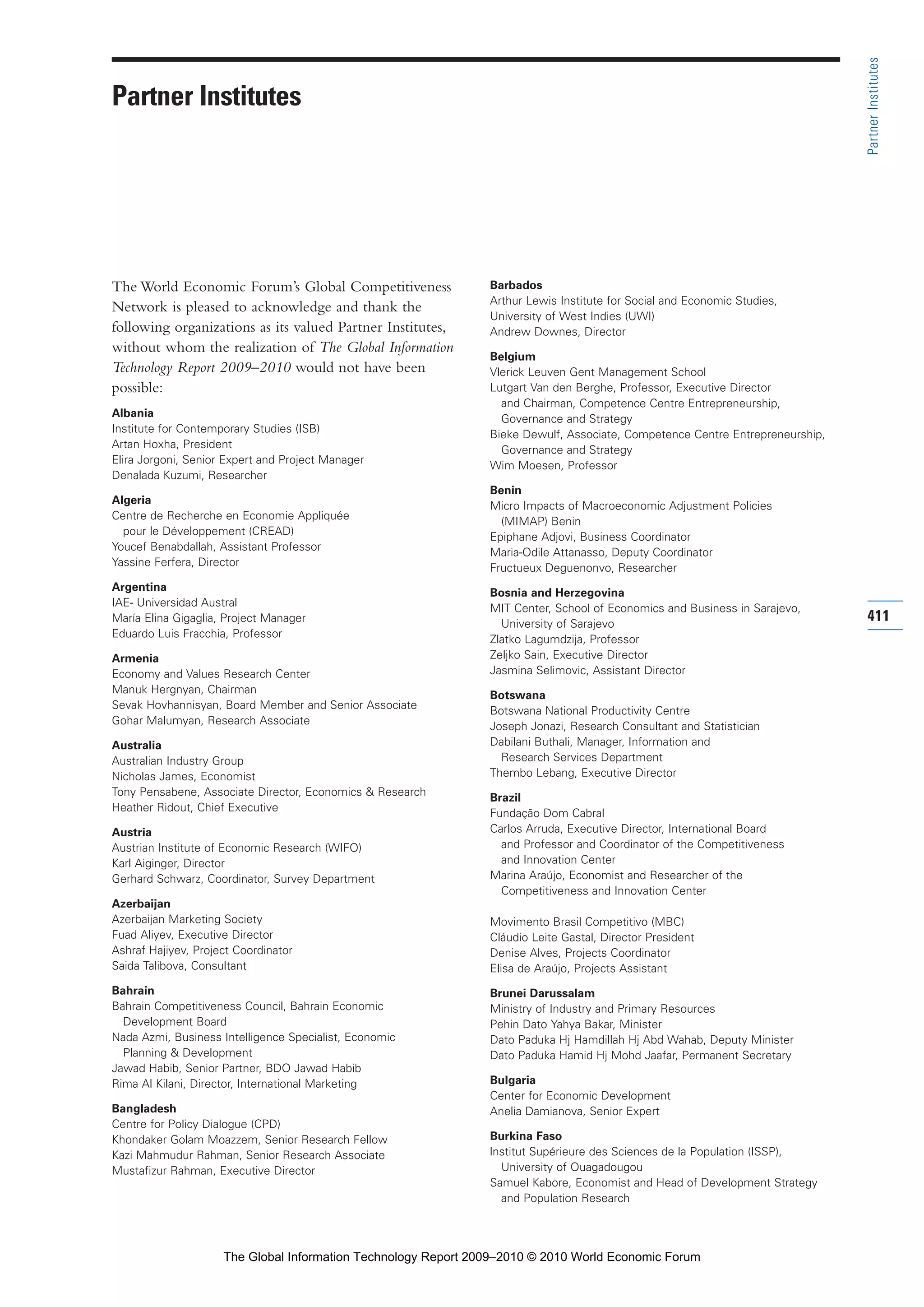
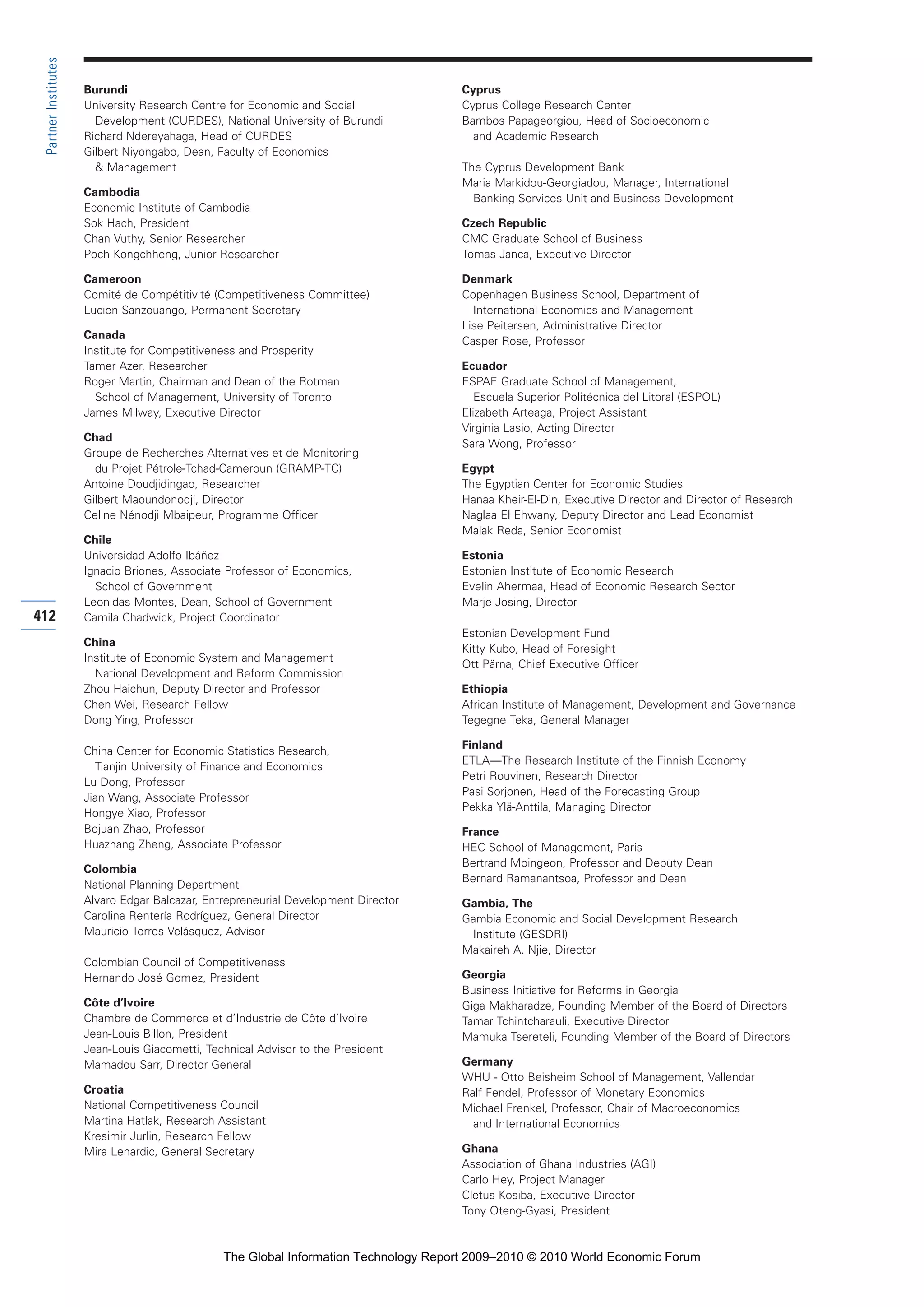
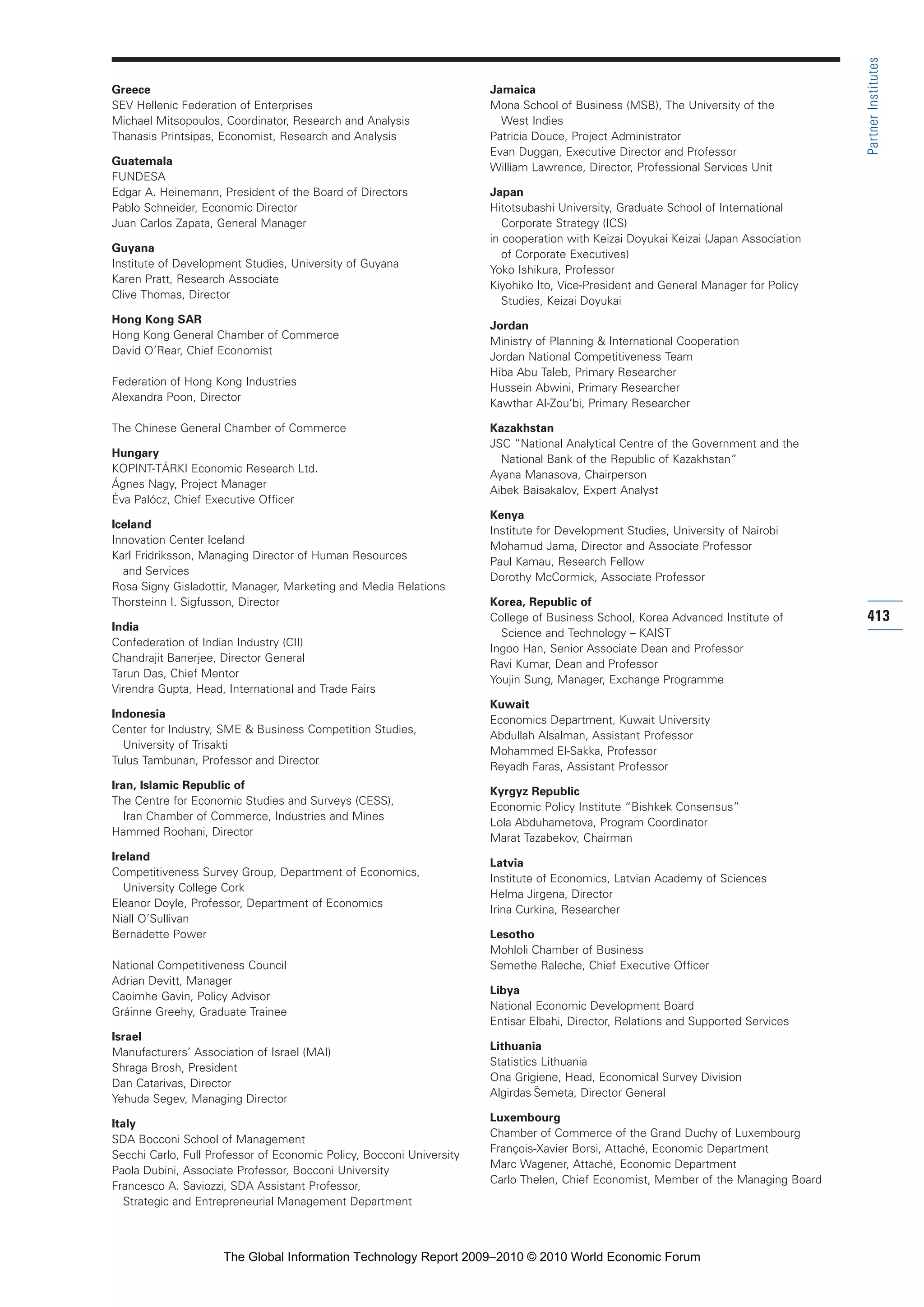
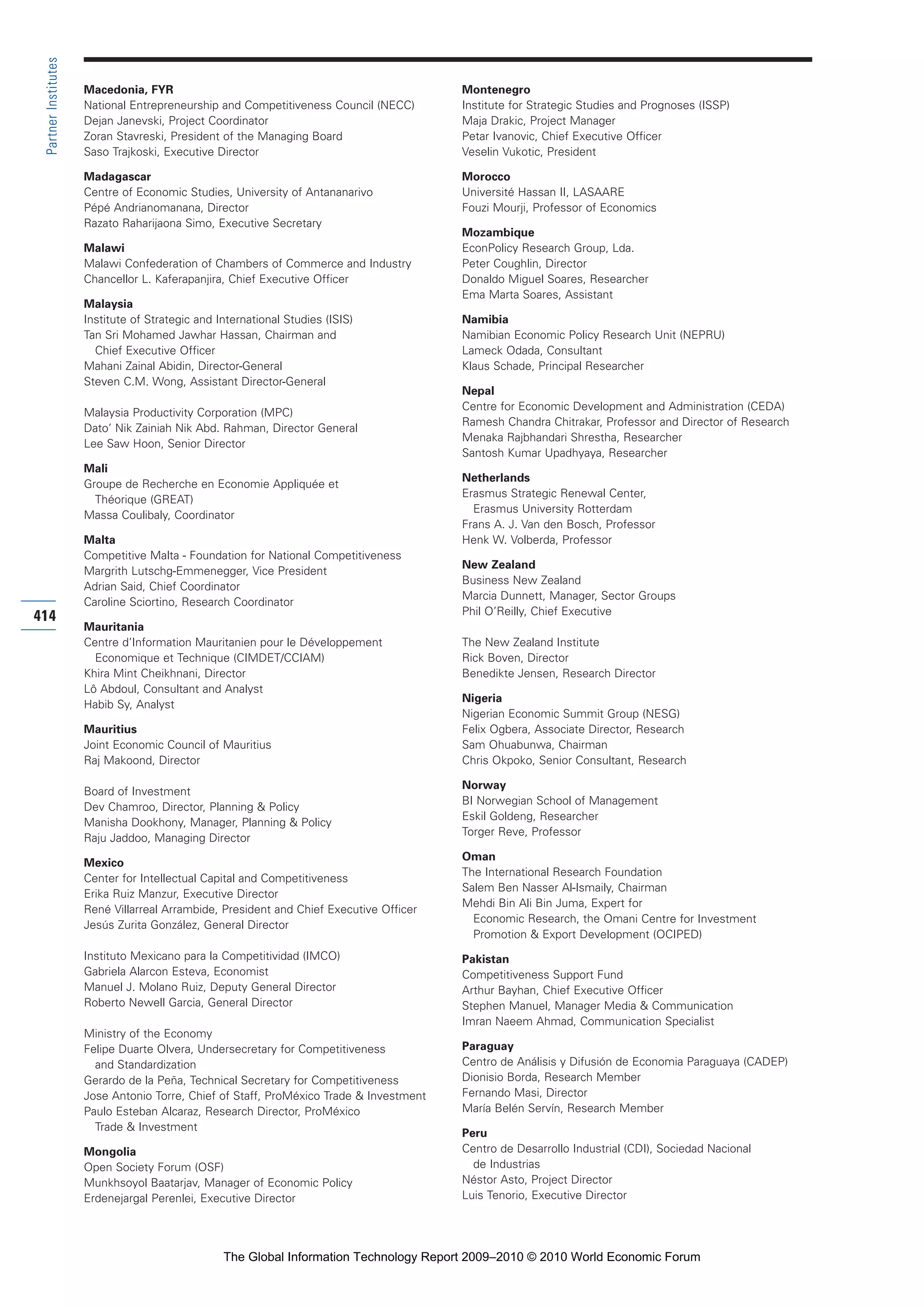
List of Partner Institutes..................................................................411
iii
Part 1.r2 3/22/10 3:27 PM Page iii
The Global Information Technology Report 2009–2010 © 2010 World Economic Forum
Part 1.r2 3/2/10 4:40 AM Page iv
The Global Information Technology Report 2009–2010 © 2010 World Economic Forum
v
As the world economy begins to recover from one of
the worst economic crises in decades, information and
communication technologies (ICT) is bound to play an
increasingly prominent role as a key enabler of renewed
and sustainable growth, given that it has become an
essential element of the infrastructure underpinning
competitive economies. ICT will continue spreading
its revolutionary power to modernize economies and
societies and improve living conditions and opportunities
around the world. ICT performance will remain crucial
not only for developed countries for sustaining and
enhancing their innovation potential and long-term
competitiveness, but also for middle-income and devel-
oping countries in fostering structural transformations,
increasing efficiency as well as reducing the digital,
economic, and social divides within their territories
and vis-à-vis more advanced economies.
If ICT plays a central role in ensuring economic
sustainability, it can and must play an equally central role
in promoting environmental and social sustainability, both
as an industry and as a key element of enabling infra-
structure.We believe sustainability, in all its components,
should be a priority for policymakers, businesses, and
civil society alike to foster a more just, more inclusive
and crisis-resilient world. ICT and the ICT industry
must now rise to the challenge.
The Global Information Technology Report series,
produced by the World EconomicForum in partnership
with INSEAD and published annually since 2001, has
contributed to illuminating the drivers of ICT perform-
ance and the importance of ICT diffusion and usage for
long-term competitiveness and societal well-being.The
Networked Readiness Index (NRI), featured in the
series, has provided a methodological framework that
identifies the enabling factors for countries to fully
benefit from ICT advances while highlighting the joint
responsibility of all social actors, namely individuals,
businesses, and governments, in this respect.The Report
has become one of the most authoritative studies of its
kind, providing a unique international benchmarking
tool that policymakers and all relevant stakeholders can
use to identify national shortcomings and strengths and
to design national policies that set their economies on
the road toward enhanced networked readiness.
The Global Information Technology Report 2009–2010,
the ninth in the series, features the latest results of the
NRI, offering a snapshot of the state of networked
readiness in the world. Under the general theme of ICT
for sustainability, the Report explores the central role of
ICT in fostering economic, environmental, and social
sustainability both as an industry in itself and in the
overall economy and society.
The Report has established itself as one of the most
comprehensive assessments of ICT readiness, covering
133 economies from the developing and developed
world, representing over 98 percent of global GDP. A
number of essays and case studies on sustainability and
best practices in networked readiness are featured in the
Report, together with a comprehensive data section—
including detailed profiles for each economy covered
and data tables with global rankings for the NRI’s 68
indicators.
We would like to convey our sincere gratitude
to the respected academics and industry experts who
contributed excellent chapters to this Report, investigat-
ing the diverse links between ICT and sustainability as
well as highlighting best policies and practices in ICT
diffusion and leveraging.We especially wish to thank
the editors of the Report, Soumitra Dutta at INSEAD
and Irene Mia at the World Economic Forum, for their
leadership and long-lasting dedication to the project.
Appreciation goes also to Jennifer Blanke, Head of the
Global Competitiveness Network Team and to the other
team members: Ciara Browne, Margareta Drzeniek
Hanouz,Thierry Geiger, Carissa Sahli, Pearl Samandari,
and Eva Trujillo Herrera. Last but not least, we would
like to express our gratitude to our network of 150
Partner Institutes around the world and to all the business
executives who participated in our Executive Opinion
Survey, without whose valuable input and support the
production of this Report would not have been possible.
Preface
Preface
ROBERT GREENHILL
Chief Business Officer, World Economic Forum
Part 1.r2 3/2/10 4:40 AM Page v
The Global Information Technology Report 2009–2010 © 2010 World Economic Forum
Part 1.r2 3/2/10 4:40 AM Page vi
The Global Information Technology Report 2009–2010 © 2010 World Economic Forum
vii
ExecutiveSummary
The Global Information Technology Report 2009–2010
appears at a rosier time in economic history than last
year’s edition, when the world seemed to be plunging
into a major recession. Encouraging signs of recovery
have appeared in early 2010 in many countries across
the world, spearheaded by emerging markets such as
China and India, which achieved healthy GDP growth
rates in 2009. Information and communication tech-
nologies (ICT) is an ever-important enabler of renewed
and sustainable growth in such a context. Its unique
function as a key element of infrastructure for efficient
industries and a critical productivity enhancer is crucial
for sustaining recovery and laying the foundations for
economies that are competitive in the long term.
Besides supporting economic sustainability, ICT
can play a leading role in fostering environmental and
social sustainability both within its own sector and as
an industry-wide enabling infrastructure. Not only is
the ICT industry increasingly adopting measures and
strategies to reduce the sector’s energy footprint, but it
is also developing innovative solutions to diminish other
sectors’ energy consumption and improve overall sus-
tainability across industries.
As far as social sustainability is concerned, ICT
enables greater access to basic services by all segments
of society and improves the ways these basic services
(e.g., education, finance, and healthcare) are provided to
citizens. In addition, it offers to all of us revolutionary
and more comprehensive communication channels and
innovative ways of interacting and networking, thanks
notably to Web 2.0 and mobile telephony applications.
The Report series, launched in 2001 and published
annually since then, has been following ICT advances
and reporting on the changing state of the world’s
networked readiness for almost a decade now. It has
contributed to raising the awareness of multiple actors,
including governments, businesses, and civil society,
about the importance of ICT for building competitive
economies and durable prosperity. Leveraging ICT has
many benefits for the above three stakeholders and can
significantly improve their effectiveness of operations
and quality of services. By identifying a number of
enabling factors underpinning networked readiness
and monitoring the extent to which more than 130
economies across the globe fare with respect to these
factors over time, the Report has provided a very useful
tool for decision makers and other relevant stakeholders
to track national progress vis-à-vis the past as well as
the rest of the world. It has also showcased best practices
in networked readiness as well as in-depth analyses on
several issues relating to the ICT industry, furthering
knowledge on the subject and providing inspiring
examples to follow for other countries.
The Report is the ninth of a series and is the result
of a well-established partnership between the World
Economic Forum (the Forum) and INSEAD, aimed
at advancing the understanding of networked readiness’
key drivers.The Report is composed of four thematic parts.
Part 1 features the findings of the Networked Readiness
Index (NRI) for 2009–10, together with selected essays
examining different topics related to ICT and sustainability
in its economic, environmental, and social dimensions.
Part 2 provides insight into best practices and policies in
networked readiness and competitiveness, focusing on
specific country case studies.The countries selected this
year are Spain, Ireland,Tunisia, and China, which all
have adopted interesting examples of successful ICT
strategies to foster national economic growth and
development. Part 3 features detailed profiles for the
133 economies covered in this year’s Report, offering a
detailed assessment of each economy’s current networked
readiness landscape and allowing for international and
historical comparisons on specific variables or components
of the NRI. Part 4 includes data tables for each of the
68 variables composing the NRI this year, with rankings
for the economies covered, as well as technical notes
and sources that provide comprehensive information on
hard data variables.
Part 1: The Networked Readiness of the World in
2009–10, ICT, and Sustainability
Part 1 presents the latest findings of the NRI, taking
a snapshot of the networked readiness landscape of the
world in 2009–10. Further, a number of deep-dive
analyses exploring the many and diverse links between
ICT and sustainability are included.These deal with:
(1) ICT and the sustainable competitiveness of cities;
(2) the creation of competitive advantages for firms
through driving sustainability; (3) the role of metrics in
sustainability; (4) ICT and economic and social sustain-
ability; (5) sustainability and the role of chief information
officers (CIOs); (6) the evolving science of managing for
sustainability; (7) broadband as an enabler for economic
Executive Summary
SOUMITRA DUTTA, INSEAD
IRENE MIA, World Economic Forum
Part 1.r2 3/2/10 4:40 AM Page vii
The Global Information Technology Report 2009–2010 © 2010 World Economic Forum
sustainability; (8) cloud computing and its economic
effects; and (9) innovation in business models and policy-
making to enhance environmental sustainability.
Gauging the networked readiness of the world in 2009-2010
Chapter 1.1,“How Networked Is the World? Insights
from the Networked Readiness Index 2009–2010,”
presents the latest findings of the Index for 2009–10.The
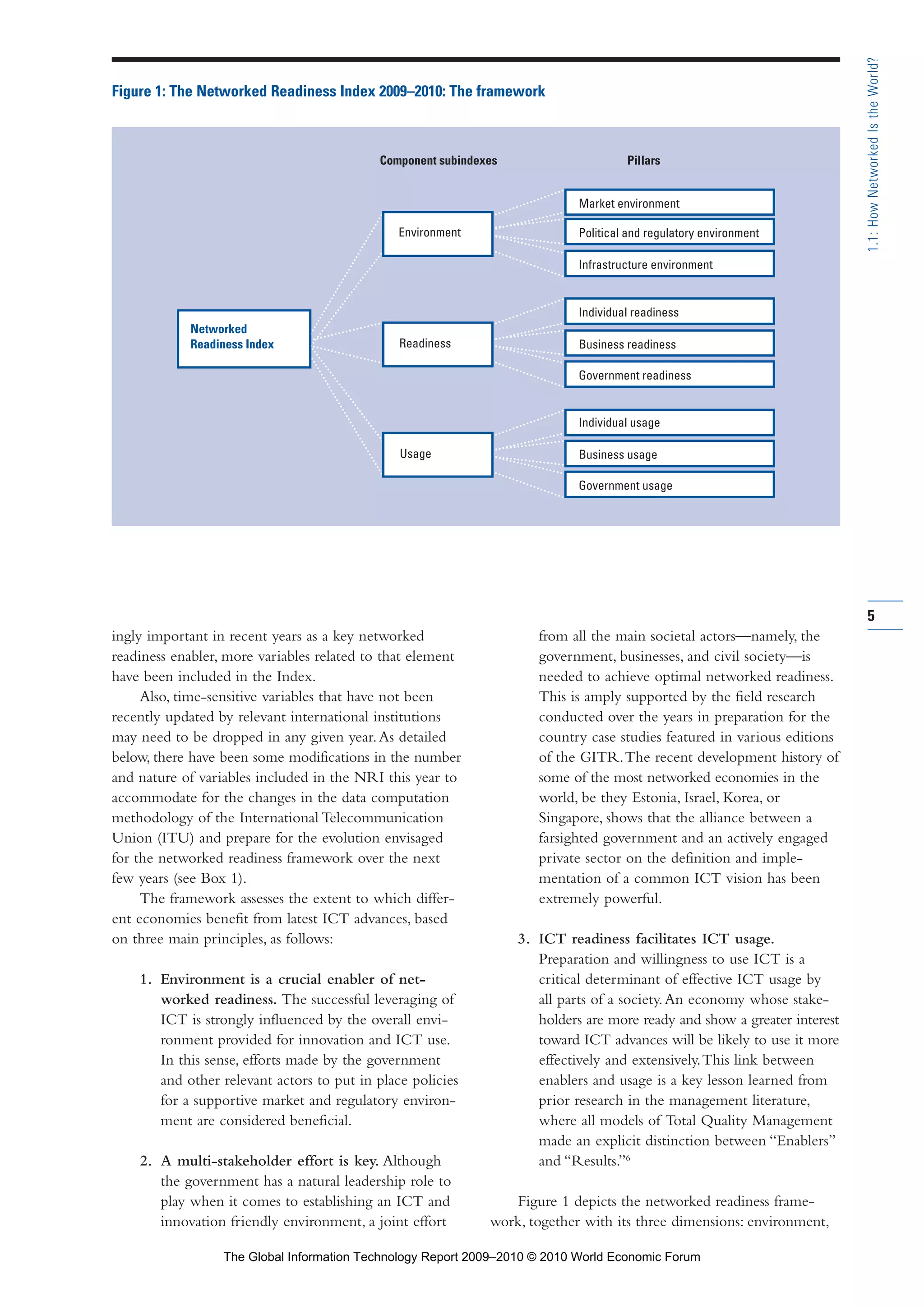
current networked readiness framework and resulting
NRI were developed by INSEAD in 2002 as part of an
ongoing joint research project with the Forum, and is
the main methodological tool featured in the Report to
gauge economies’ preparedness to leverage ICT advances
for increased competitiveness and development.The
framework aims to measure:
• the degree to which a national environment is con-
ducive to ICT development and diffusion, by taking
into account a number of features of the broad
business environment, some regulatory aspects, and
the soft and hard infrastructure for ICT;
• the extent to which the three main national stake-
holders in a society (i.e., individuals, the business
sector, and the government) are inclined and prepared
to use ICT in their daily activities and operation;
and
• the actual use of ICT by the above three stake-
holders.
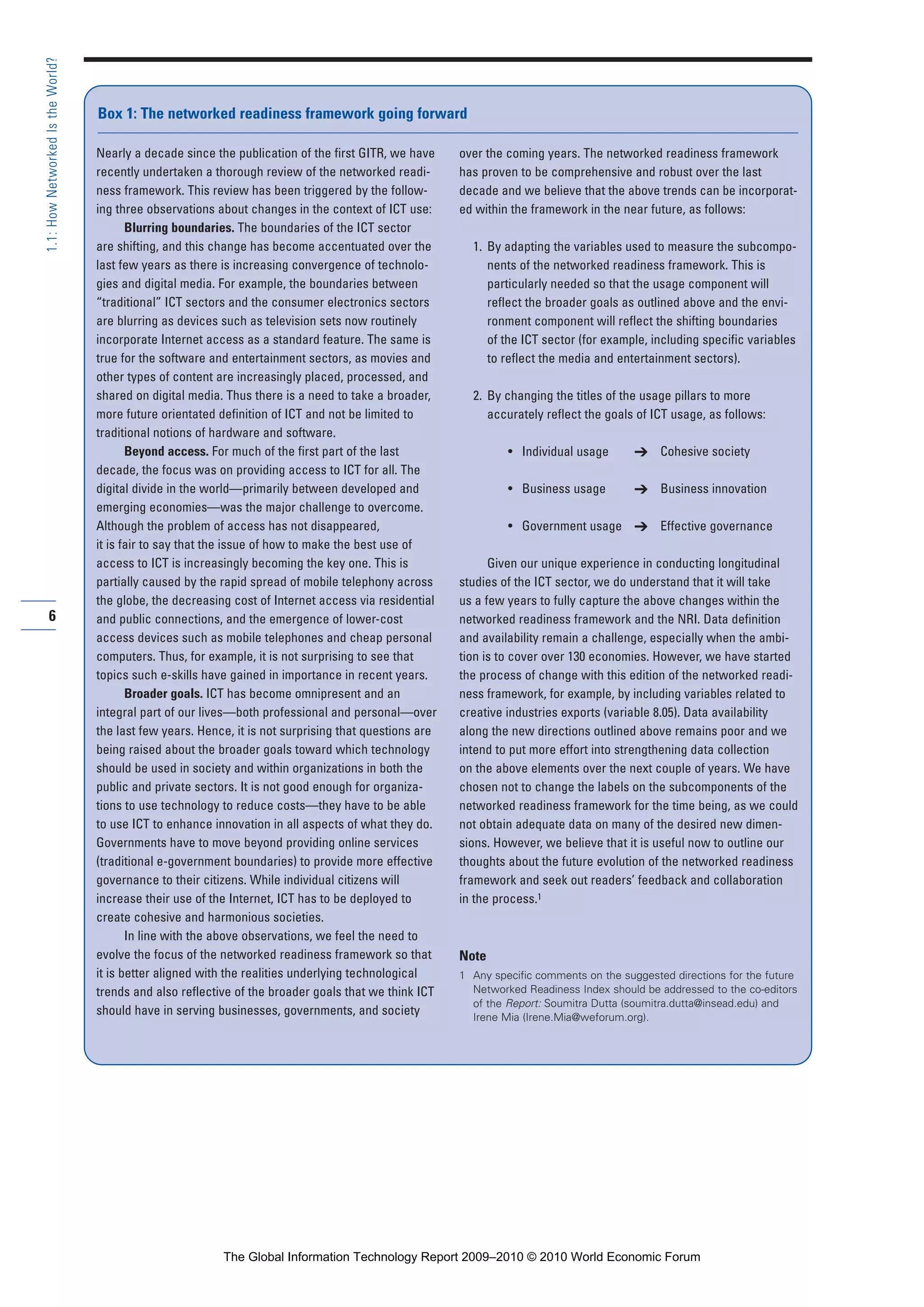
Although the networked readiness framework has
been kept constant since 2002, with some modification
in the nature and number of variables, it is currently
undergoing a process of revision to better capture recent
trends and evolutions in the ICT sector.The chapter
provides some information on expected future develop-
ments.
As in the past, the NRI builds on a mixture of hard
data collected by well-respected international organiza-
tions, such as the International Telecommunication Union
(ITU), the United Nations, and the World Bank, and
survey data from the Executive Opinion Survey, con-
ducted annually by the Forum in each of the economies
covered by the Report. The NRI 2009–2010 covers 133
economies from both the developed and developing
world, accounting for over 98 percent of world GDP.
The NRI rankings for 2009–10 present Sweden as
the most networked economy in the world.A runner-up
in the last three editions, the country overtakes Denmark
as the world’s best performer for the first time since the
NRI’s inception.The other Nordic countries also con-
tinue to optimally leverage ICT in their competitiveness
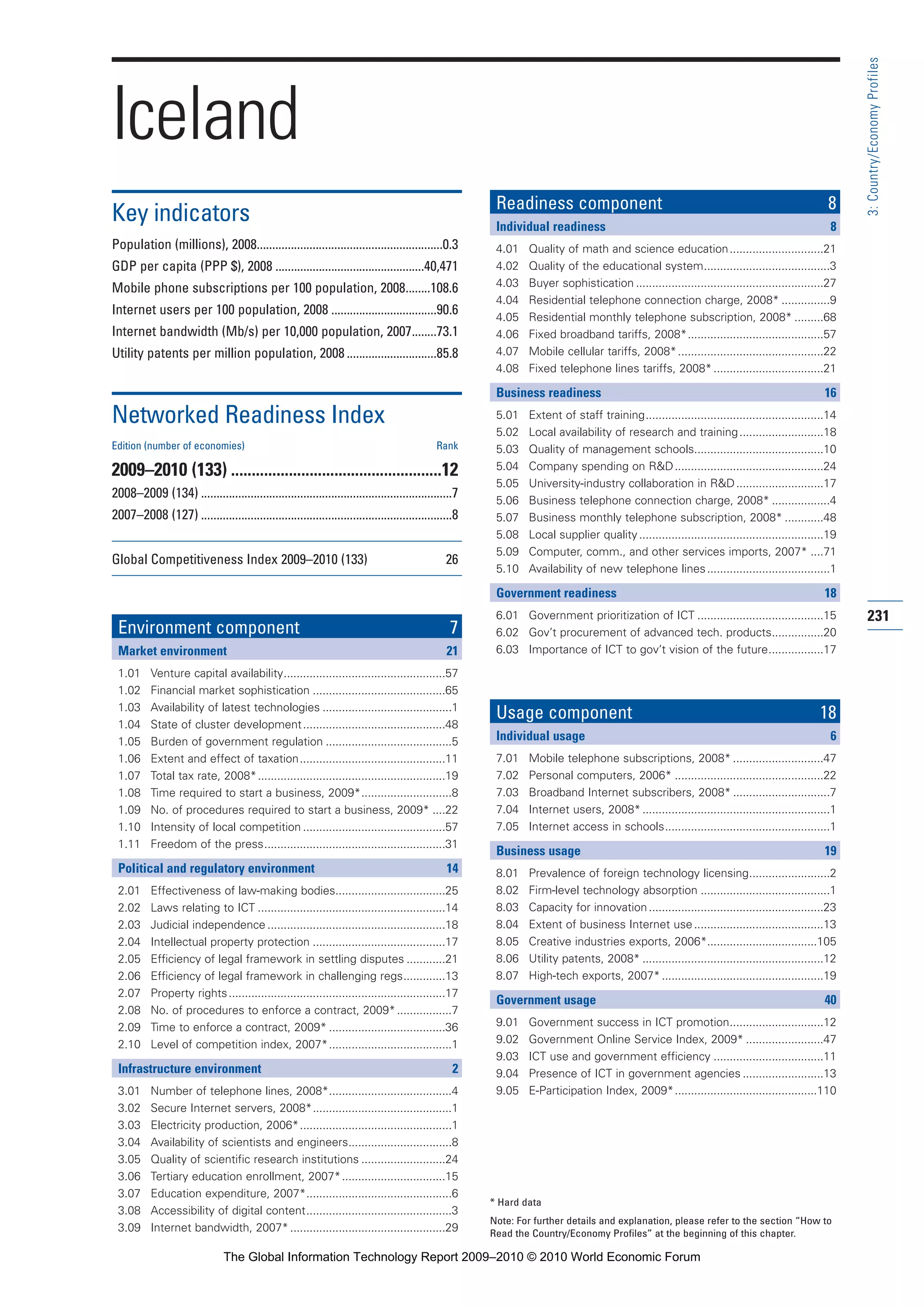
strategy, with Denmark, Finland, Norway, and Iceland at
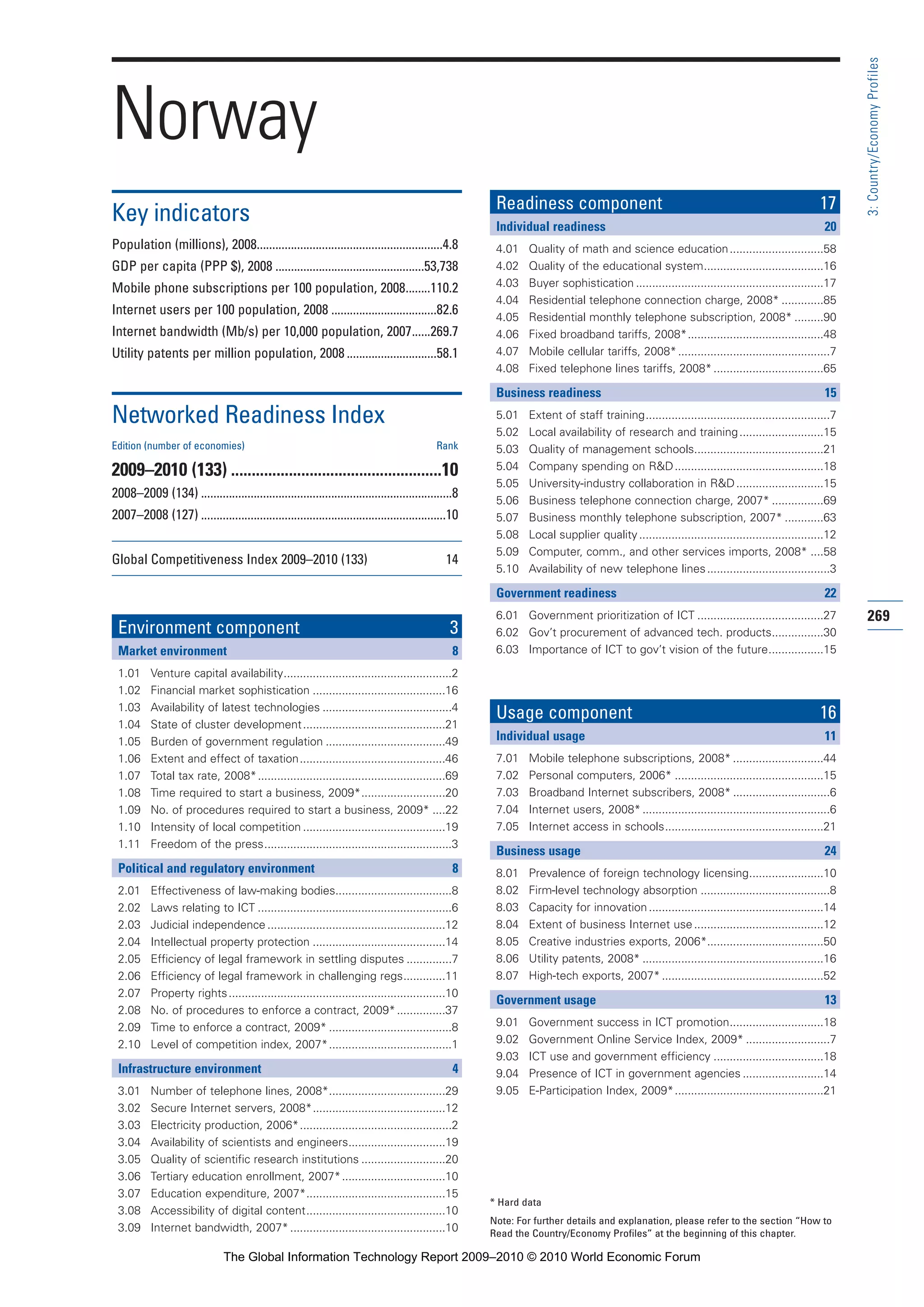
3rd, 6th, 10th, and 12th place, respectively.
Among the top 10, Singapore leads Asia and the
world in networked readiness, climbing two positions to
2nd, followed by Denmark, Switzerland (4th), and the
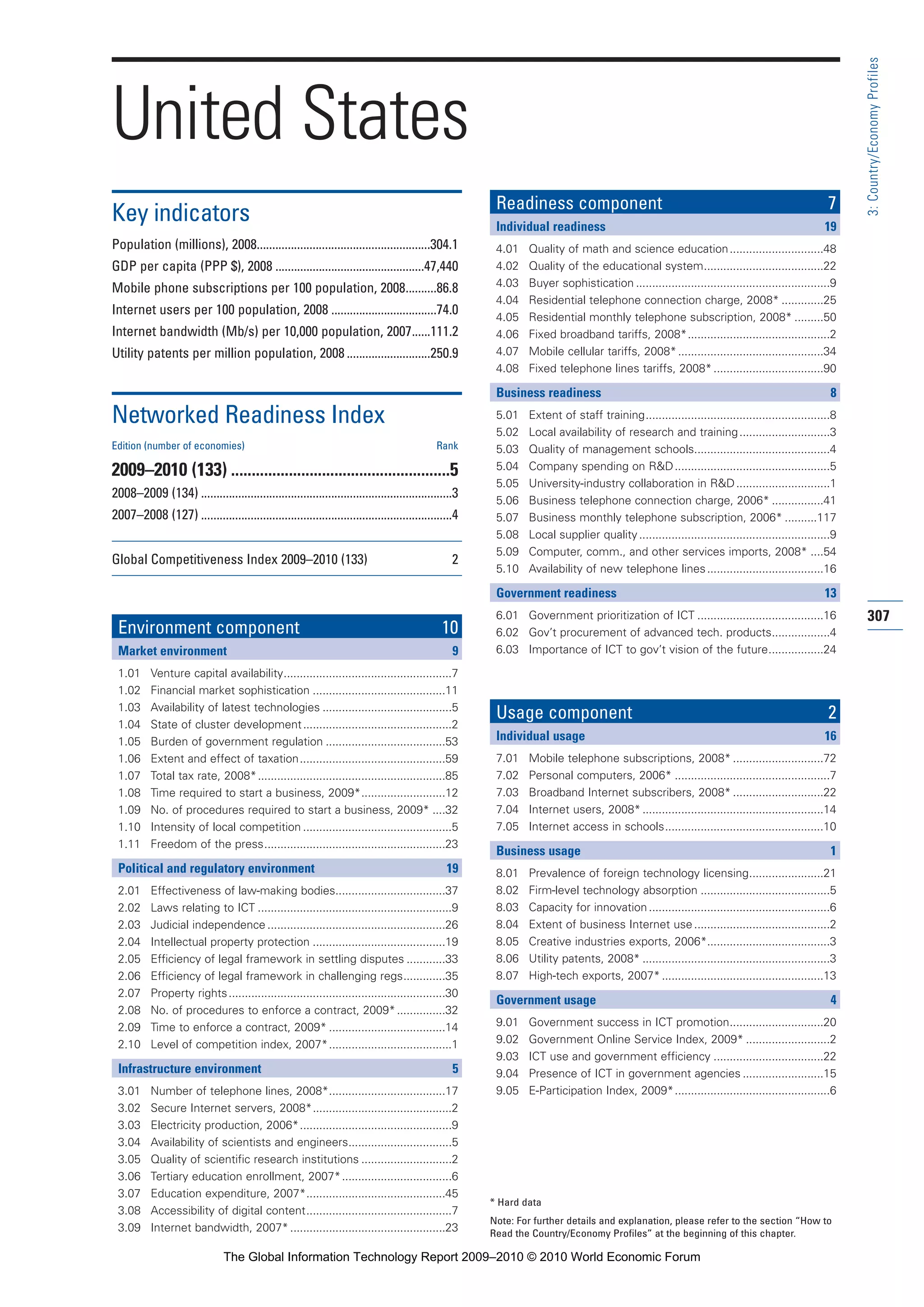
United States (5th).
Europe remains one of the most networked regions
of the world, with 12 economies ranked among the top
20 best performers, as follows: the Nordic countries
mentioned above, the Netherlands (9th), the United
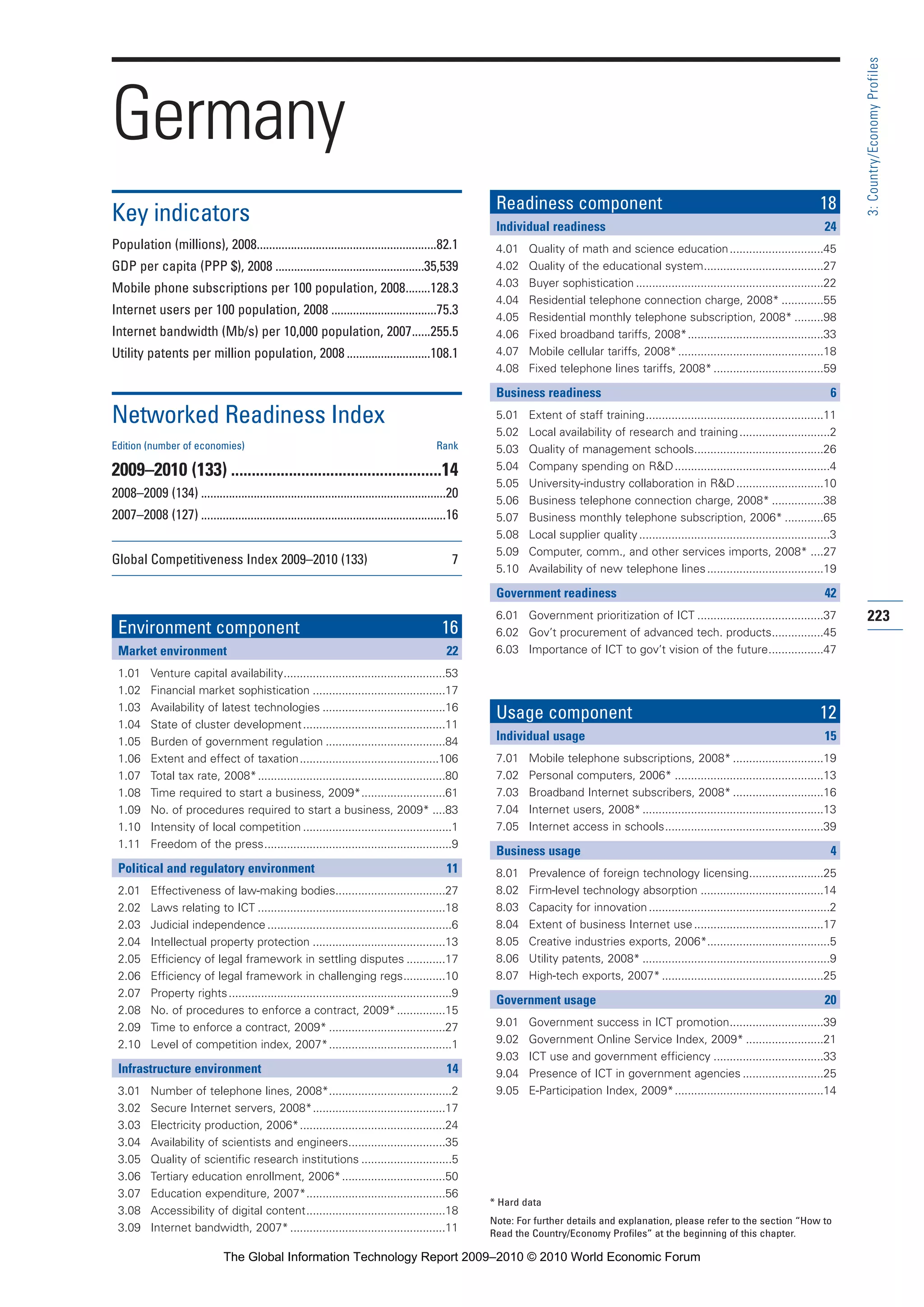
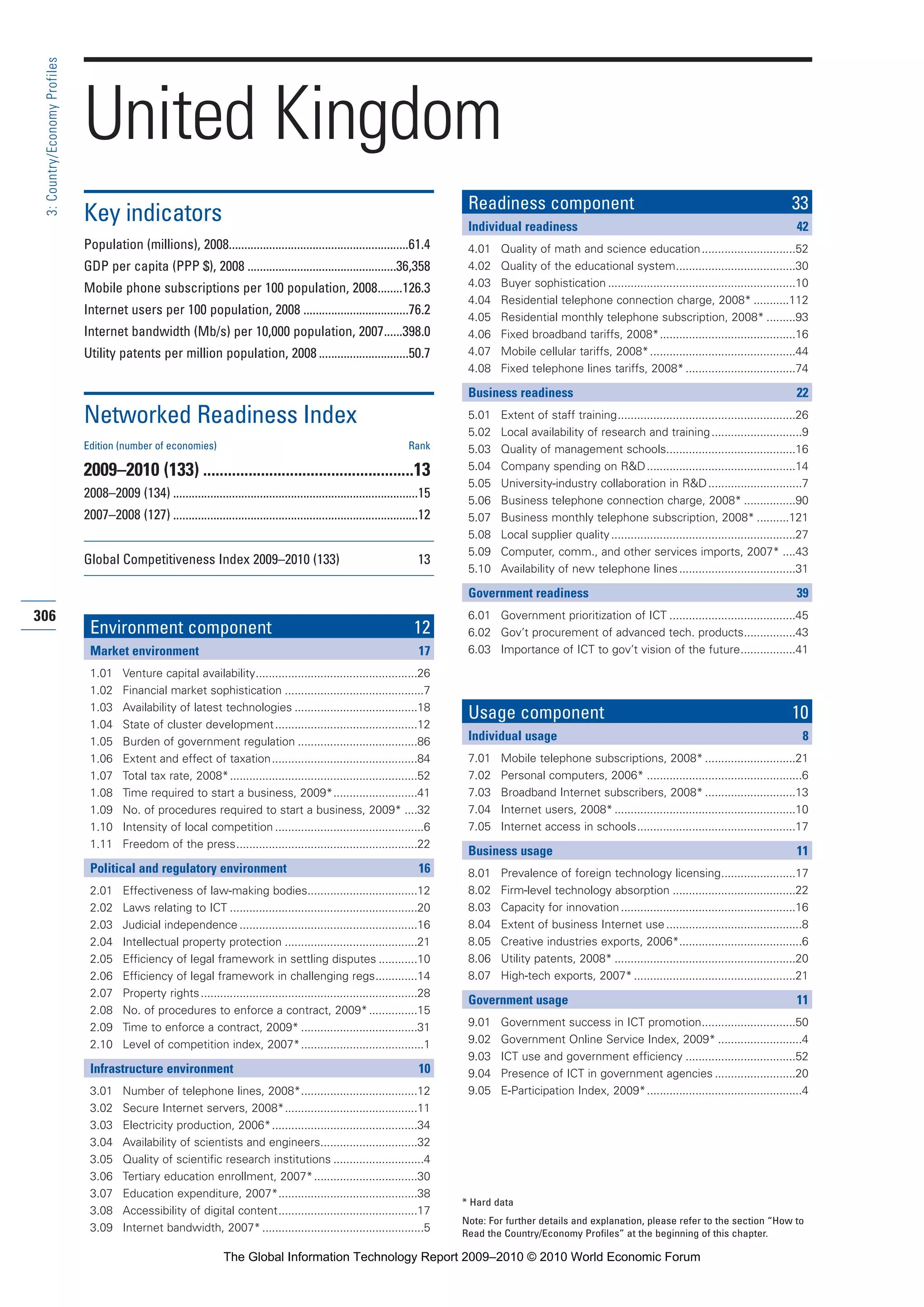
Kingdom (13th), Germany (14th), Luxembourg (17th),
France (18th), and Austria (20th). Five other economies
from the Asia and Pacific region besides Singapore place
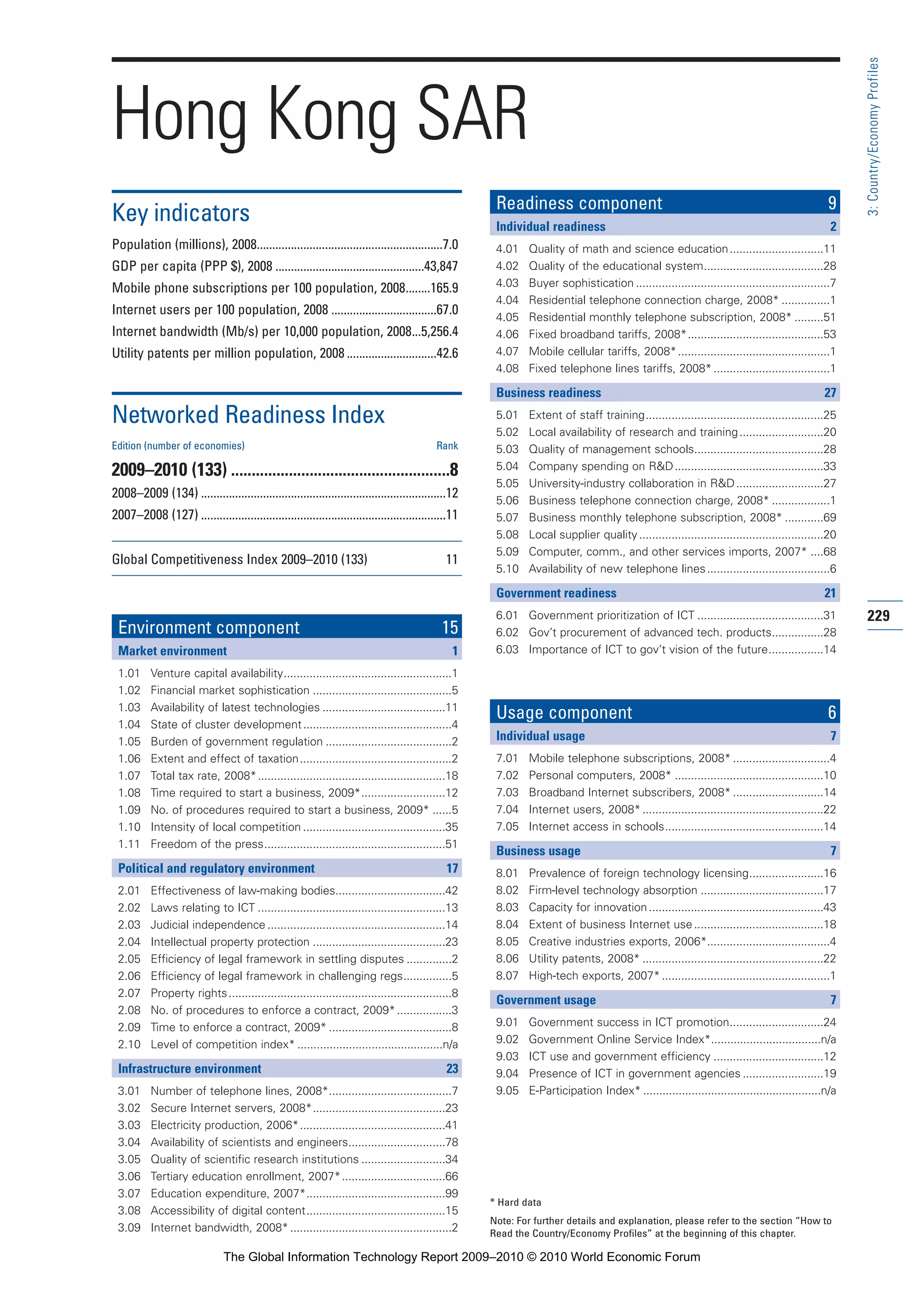
in the top 20 this year: Hong Kong (8th),Taiwan (11th),
Korea (15th),Australia (16th), and New Zealand (19th).
With regard to the largest Asian emerging markets,
China and India continue their progression in the NRI
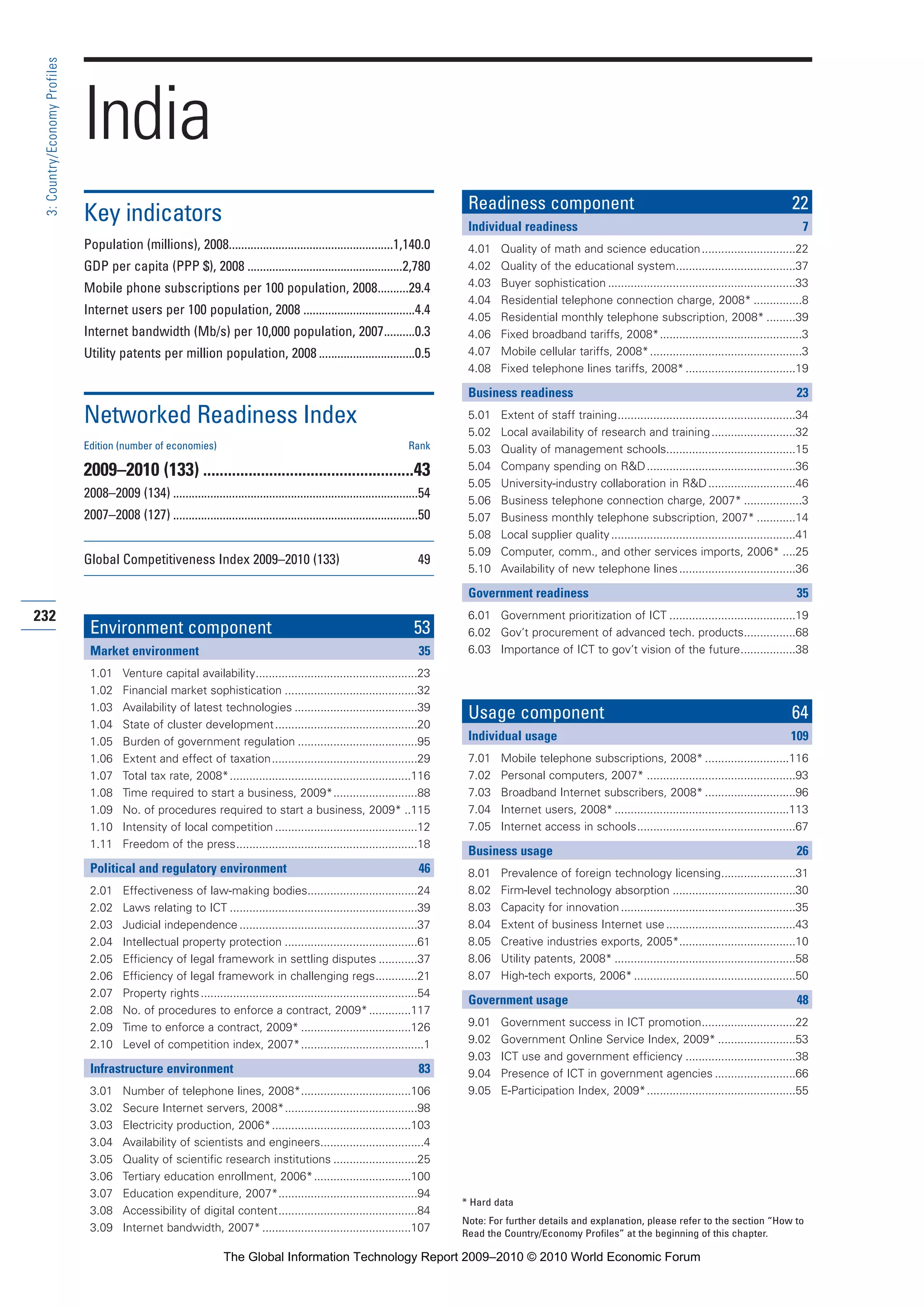
rankings, leapfrogging another 9 and 11 places, to 37th
and 43rd, respectively.The assessment for Latin America
and the Caribbean is less positive, although fairly varied
in terms of country performances with respect to last
year, with no economy from the region appearing in the
top 20 and only four in the top 50, namely Barbados
(35th), Chile (40th), Puerto Rico (45th), and Costa Rica
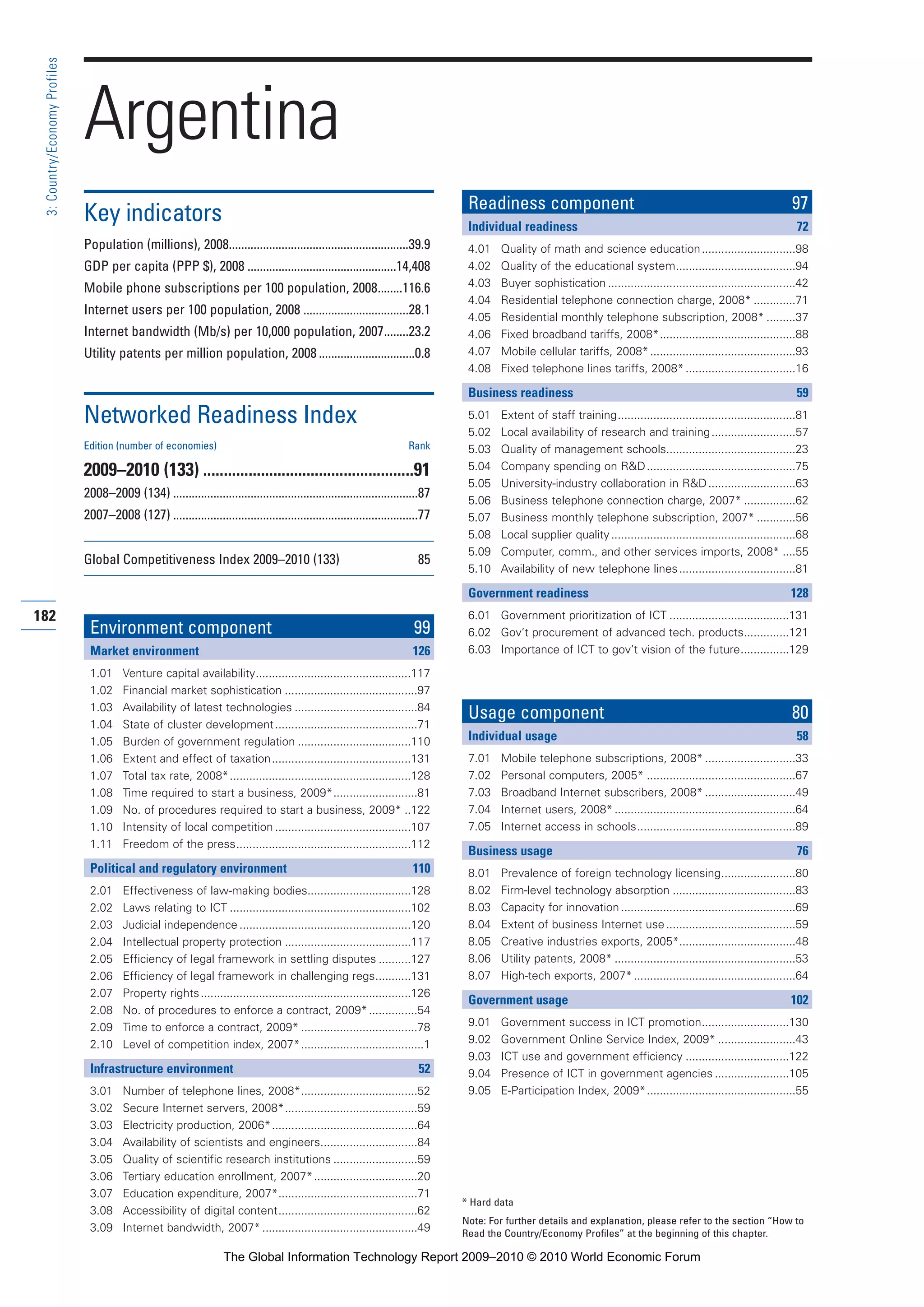
(49th).While Brazil is fairly stable at 61st, Mexico and
Argentina seem to be losing ground, placing themselves
at 78th and 91st, respectively. Despite some positive
trends displayed by a number of economies, most of
sub-Saharan Africa trails behind the rest of the world
in networked readiness, with only Mauritius (53rd)
and South Africa (62nd) featuring in the top half of the
NRI rankings. In North Africa,Tunisia (39th) remains
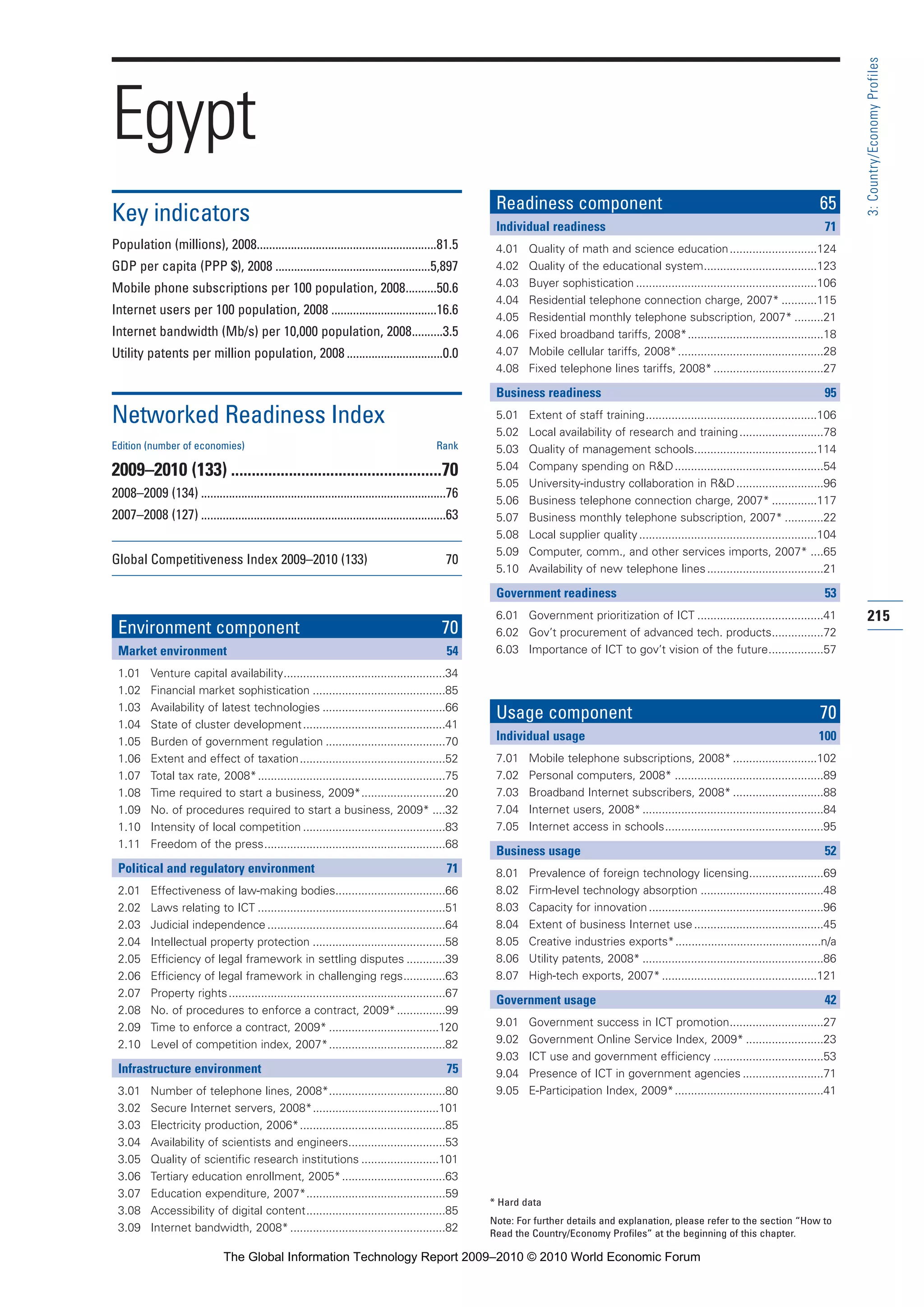
the best performer by far.With the exception of Egypt,
improving six positions from 76th to 70th, all other
countries in the region either remain rather stable or drop
in the rankings. By contrast, the Middle East continues
by and large to improve in networked readiness, with
all countries but two (Kuwait and Syria, at 76th and
105th, respectively) appearing in the top half of the
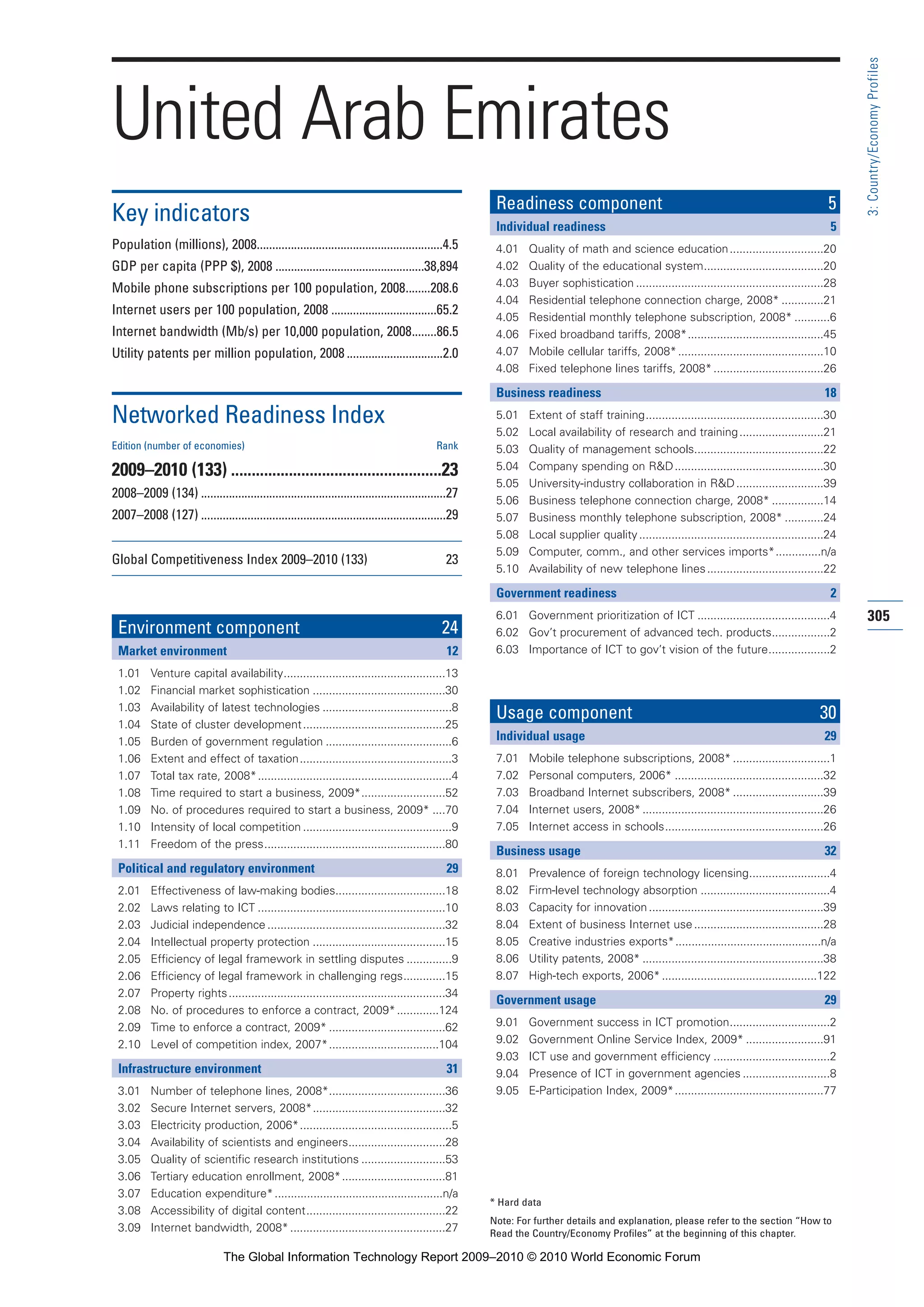
NRI rankings, namely the United Arab Emirates (23rd),
Israel (28th), Bahrain (29th), Qatar (30th), Saudi Arabia
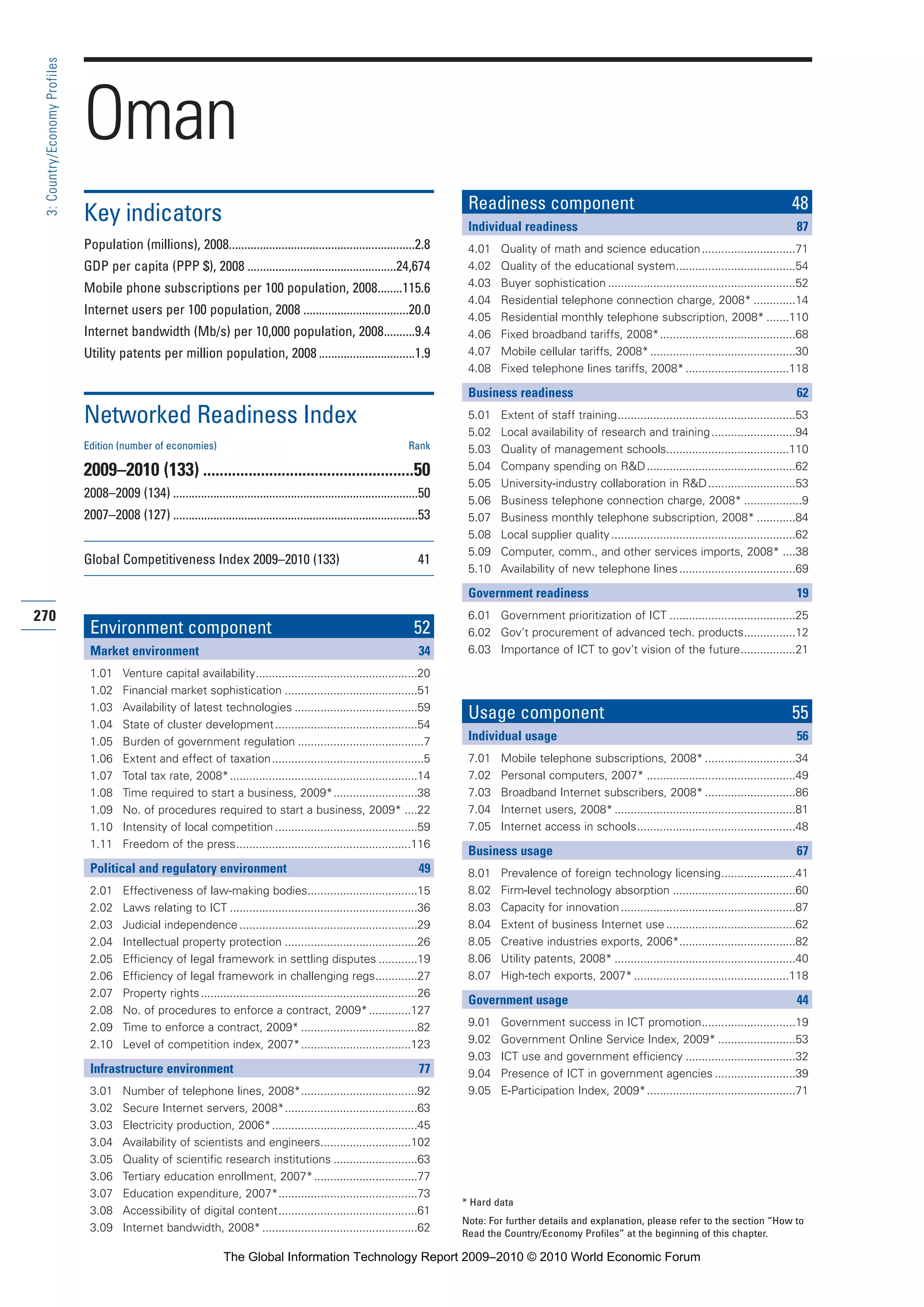
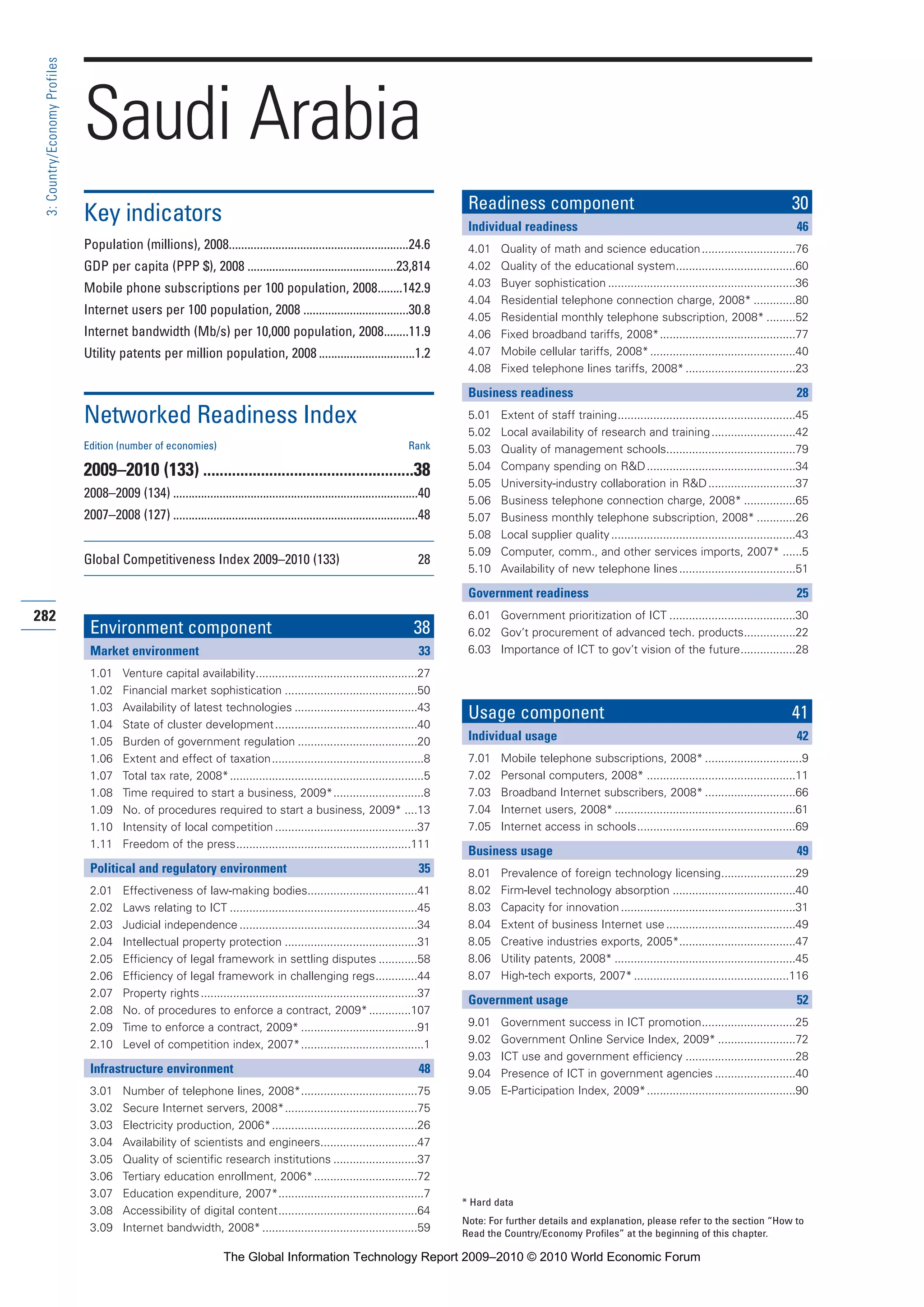
(38th), Jordan (44th), and Oman (50th).
An analysis by income group and, as in the last two
years, another on the most dynamic economies in the
NRI from 2001 to 2009 are also included in chapter.
While the former aims at putting the NRI results in a
context more tailored to each economy and making
comparisons more relevant, the latter provides additional
insight into the evolution of networked readiness in the
world over the last nine years.
ICT and the sustainable competitiveness of cities
For the first time in history, more than half of the
world’s population lives in urban areas. Large cities in
emerging countries are becoming global in that they have
as much in common with cities in advanced countries
as with the rest of their own.As cities increasingly play
in the global arena, they are being driven to develop
sustainable competitiveness strategies and high-speed
networks as basic infrastructure for the 21st century
knowledge economy. In their chapter “ICT and the
viii
ExecutiveSummary
Part 1.r2 3/2/10 4:40 AM Page viii
The Global Information Technology Report 2009–2010 © 2010 World Economic Forum
Sustainable Competitiveness of Cities,” authors Darren
Ware, Enrique J. Rueda-Sabater, Fernando Gil de Bernabé
yVarela, John Garrity, and Julian Lighton (all at Cisco
Systems, Inc.) argue that the traditional advantages of
cities and of ICT can be mutually reinforcing.Through
the advanced use of ICT, cities not only become more
competitive; they can also turn into anchors for national
competitiveness strategies that incorporate the power of
broadband networks.The chapter draws on a review of
the current situation in 21 cities across the world to
explore the extent and quality of connectivity. It then
outlines a framework to assess ICT environment and use
in cities.This framework covers four distinct areas: deliv-
ery of basic services, services offered online, the use of
ICT for city administrative e-efficiency, and the promo-
tion of ICT adoption at the municipal level.This can be
used by city leaders to gain a perspective with regard to
both the frontier of ICT possibilities and current prac-
tice in relatively advanced cities.
The resulting analysis of ICT opportunity gaps
in any given city can then serve as a basis on which
municipal authorities and city leaders can formulate a
strategy and develop specific action plans to exploit ICT
potential for competitive sustainability—including
through efficiency improvements, greater responsiveness
to citizen demands, and inclusive connectivity. Preliminary
application of the assessment framework has produced
results indicating considerable gaps between current
practices and the potential that the Web 2.0 paradigm
offers for cities at all stages of development—even
among relatively advanced cities.The gaps are larger
in emerging-country cities and in basic services and
administration.The authors conclude that cities that
seize the moment of this change in the technological
paradigm stand to benefit enormously—particularly as
the global economic map becomes redefined by growth
paths that have become more divergent as a result of the
recent financial crisis.These cities are the ones that will
be reaping the benefits of sustainable competitiveness for
a long time to come.
Competitive advantage and sustainability
As a competitive force, sustainability is already changing
the world, bringing with it new business models, new
winners, new losers, and completely new ways to oper-
ate. Chief executive officers (CEOs) are just waking up
to this reality, and most struggle in their implementation
of a sustainability strategy.The chapter “Creating Profitable
Competitive Advantage by Driving Sustainability” by
Peter Graf and Jim Hagemann Snabe (both at SAP AG)
offers some management guidelines to steer through the
massive transformation companies are facing and presents
a new model SAP has developed through its extensive
work in helping companies become more sustainable.
This roadmap to sustainability, explored in detail in the
chapter, consists of three major stages, namely: engaging
with stakeholders, evolving profitability, and executing
processes in a sustainable way.The stages exist in an
ongoing loop of improved performance that continually
optimizes an organization’s sustainability and its ability
to respond to new conditions and innovation.The
authors believe that there are real and tangible forces
driving the need for sustainability.They claim business
applications can help companies solve the problems they
face by automating and driving processes in a more sus-
tainable way, helping to extract operational data from
processes and even helping companies engage feedback
from stakeholders. Sustainability could be advanced by
business applications the same way the latter applications
did for the latest two major transformations: globaliza-
tion (technologies supported by the client-server model
of networked and distributed computing, for example,
enabled executives to close books on a global scale and
consolidate data quickly while companies could manu-
facture products in one market and sell them in another
without having to locate offices in either) and the
Internet (new types of applications drove significant
change through disintermediation, putting more power
than ever into the hands of consumers and creating
totally innovative ways for people to interact via the
net).What they expect moving forward is that sustain-
ability will rise to the same level as other management
issues, benefitting as much from the use of technology
to automate the strategy-to-execution process and driv-
ing greater operational and financial performance.
Metrics and environmental sustainability
Even as the world introspects about the environmental
impact of its technological and consumption choices,
technology will help create a sustainable response to
climate change and global warming. From assessing
emission levels of carbon dioxide (CO2
) and other
toxic substances and measuring success rates to telling
us where we stand and what is the ideal state to be in,
technology will help us step into a safer tomorrow. In
“The Role of Metrics in Sustainability,” Janaki Murali,
Praveen Gupta, and Kiran Pereira (all at Infosys) argue
that information technology (IT) companies are already
blazing this trail, setting goals for themselves to reduce
energy consumption and be more ecologically sensitive.
Energy efficiency in buildings, data centers, and air con-
ditioning, and, above all, developing a green conscience
among employees are all steps that IT companies have
started to take.They are also ensuring their efforts are
steered toward achieving substantial results as they delve
deeply into all available data on usage, wastage, and their
consequences. Backed by data, their efforts detail plans
at the most granular level, all of which integrate into a
meaningful concerted effort. For example, green buildings,
fast becoming a norm in the private sector, encompass
“building-envelope optimization” that regulates the
amount of heat and daylight entering the building,
which in turn affects the design of the lighting and
the air-conditioning systems—both of which are major
ix
ExecutiveSummary
Part 1.r2 3/2/10 4:40 AM Page ix
The Global Information Technology Report 2009–2010 © 2010 World Economic Forum
energy consumers.The shading on the windows cuts
down direct radiation, thereby reducing heat gains into
the building and minimizing visual glare.Technologies
such as light shelves are used to cut off direct sunlight
and reflect light deep into the office spaces.
Sustainability is increasingly becoming a quint-
essential part of corporate governance.As more and
more organizations will be called upon to disclose their
performance on the triple bottom-line principle of
economic, environmental, and social issues, the authors
believe that merely publishing an annual sustainability
report will not suffice because the metrics they use to
measure the effectiveness of their reports will become
vital.The Global Reporting Initiative (GRI) started
by the non-profit Ceres in 1997–98 has now grown
into a global body for benchmarking the framework for
sustainability reporting. By 1999, the United Nations
Environment Programme had come on board as a partner,
the GRI Reporting Guidelines had been released, and
20 organizations had released their sustainability reports
based on these guidelines. By 2005, the third-generation
guidelines, called the G3, had been formulated; by 2008,
507 organizations from 55 countries had become stake-
holders.The authors believe all this to be good news
and that the governments should follow and make
commitments.
ICT and economic and social sustainability
The ICT industry has become an increasingly important
industry in the global economy, accounting for approxi-
mately 5 percent of total GDP growth between 2003
and 2008 and representing 5.4 percent of GDP world-
wide in 2008. In their chapter “Fostering the Economic
and Social Benefits of ICT,” Scott Beardsley, Luis
Enriquez, Sheila Bonini, Sergio Sandoval, and Noëmie
Brun (all at McKinsey & Company Inc., working in
different locations) argue that the industry has an
important role to play in encouraging economic growth
and in building a more socially sustainable future for
citizens all over the world, thanks to its huge potential
contribution to societies’ well-being (including the
provision of better education and healthcare services
and enhanced market access for the poorest).
Concretizing these economic and social benefits will
require not only large investment and commitment
from different national stakeholders but also changes to
existing regulatory frameworks, compromises between
governments and industries, and strong public engage-
ment. Moreover, the authors warn about the difficulty
of aligning the different interests of the various stake-
holders, namely ICT companies’ focus on revenues, gov-
ernments’ desire to have access to innovative services
and tax revenues as well as to encourage economic
growth, and regulators’ interest in consumer welfare
and competition. Countries that successfully manage
to bring these different agendas together will see faster
adoption of ICT and will be better positioned to
benefit from it.After exploring the ways in which ICT
drives growth and discussing its outstanding economic
and social impact, the chapter suggests a number of steps
governments, businesses, and regulators should take to
fully leverage ICT and to reap its many and diverse
economic and social benefits. In a nutshell, the authors
believe that: governments should help craft and finan-
cially support a vision for the ICT sector that can bring
the interests of the different parties together and put
them to work toward a common goal, businesses should
use their know-how to deploy state-of-the-art networks
and create innovative products, and regulators should
design incentives in a way that allows the ICT industry
to generate enough profits to make its investment
affordable while maintaining low enough prices to
promote service adoption.
Sustainability and the role of CIOs
Organizations cannot ignore the significant environ-
mental pressures facing them today, even though the
causes, scope, and impact of global climate change
may be subject to a divergence of opinion.Volatile
energy costs, limitations on available energy, rapidly
expanding rules/legislated regulations, and a general
desire for transparent enterprise operations are all
realities organizations must address.To date, the general
response has often proven to be reactive rather than
forward-thinking, isolated rather than coordinated, and
department-centered rather than business-wide.An
organization’s response must be more comprehensive
and systematic to maximize resources and drive the best
outcomes for its business overall.
In his chapter “Unlocking Sustainability:Why the
CIO Should Hold the Key,” Terrence Clark (at CA)
argues that current conditions create a perfect opportunity
for IT to step up and play a critical role in helping shape
organizations’ responses to these growing environmental
challenges. IT can do this by working in tandem with
business units and by using technology across the enter-
prise to help reduce cost and mitigate risk, and also
uncover and seize new opportunities. Clark outlines
the main drivers causing organizations to act today,
including cost cutting, regulatory pressures, and corporate
transparency. He then goes on to provide an overview
of how organizations typically respond to environmental
pressures today, and why this opens the door for the
CIO and the IT department to play a critical role in
driving an enterprise-wide sustainability program.A
two-step prescription plan for the IT department to
attack this problem is also provided, which starts with
examining measures that IT can implement to reduce
the environmental impact of its operations, or “IT
helping itself”; and then by exploring the strategic role
IT can play in addressing the issue across the organiza-
tion, or “IT helping the enterprise.” Last, he offers a
framework for implementing a systematic approach to
sustainability, providing more in-depth details into
x
ExecutiveSummary
Part 1.r2 3/2/10 4:40 AM Page x
The Global Information Technology Report 2009–2010 © 2010 World Economic Forum
building a successful program across the enterprise. IT
has a touch point in every department, it is already
using technologies to improve its own environmental
issues, and it has a desire to play a more strategic role in
the business.Therefore the author believes that now is
an opportune time for CIOs to seize the moment and
take a leadership role in sustainability.
The evolving science of managing for sustainability
For individuals, businesses, and public-sector organizations,
managing energy, greenhouse gas emissions, and social
responsibility have important implications. First, there
is the moral and regulatory imperative to operate in an
environmentally responsible manner. Second, dramatic
cost savings can be gained by reducing resource con-
sumption and waste. Finally, there is pressure from
suppliers, customers, communities, and other stakeholders
that place more and more importance on “green”
practices. In their chapter “The Evolving Science of
Managing for Sustainability: Using ICT to Optimize
Environmental and Economic Outcomes,” Mikael
Hagström, Jonathan Hornby, and Alyssa A. Farrell (all
at SAS) discuss the role of ICT in driving sustainability
efforts—for measuring the impact of organizations’
activities, reducing negative effects, optimizing outcomes,
and extending visibility deeper into an organization and
across the greater value chain.They argue that a holistic
perspective, providing a view of business processes in full
context, is essential when it comes to managing sustain-
ability. It is not just about measuring and reporting discrete
environmental indicators—such as kilowatts of electricity
and gallons of water—but about understanding how the
metrics affect each other, uncovering cause-and-effect
relationships that would not be immediately apparent,
and predicting the environmental impact of business
decisions. Existing analytic, performance management,
and activity-based costing methodologies, which have
already been proven effective in financial analysis and
scenario modeling, can help substantially in dealing
with greenhouse gases and other sustainability issues.
The authors believe that by not succumbing to the
temptation to simply calculate and instead leverage an
enterprise-class business modeling tool, an organization
can move beyond compliance and provide insight to
drive increased environmental performance and bottom-
line value.
Broadband and economic sustainability
In recent years, broadband’s positive impact on economic
development and social networks has become evident to
leaders in both the public and private sectors.This essen-
tial technology facilitates pivotal socioeconomic elements:
education, health, trade, and innovation across various
industries. Broadband has transformed interaction among
businesses, consumers, and governments.The chapter
“Enabling Sustainable Digital Highways,” by Karim
Sabbagh, Roman Friedrich, Bahjat El-Darwiche, and
Milind Singh (all at Booz & Company), argues that the
creation of national broadband networks is crucial to
sustainable economic development and social progress—
and not only in emerging economies, but in developed
ones as well. Despite the widespread recognition of its
benefits, most of the world’s households today lack access
to adequate broadband connections. Legacy policies,
regulations, and obsolete business models are limiting
the ability of the public and private sectors to make the
timely and adequate investment in necessary infrastruc-
ture to ensure universal access. In order to break this
investment gridlock and pave the way for universal
broadband access, both governments and private-sector
operators need to make fundamental changes in their
principles and business models.The authors believe
broadband needs to move to the top of national strategic
agendas. Policymakers ought to consider rebalancing
their goal of advocating for consumer welfare with
providing for an efficient industry structure that entices
investment in national networks. Operators must adopt
new business models to account for a transformative
shift in the industry’s evolution.The authors make the
case that timing is critical and that the faster a country
moves to provide national broadband access, the swifter
it can gain or improve its standing in the global economy.
After exploring broadband’s impact on economic and
social development and the potential risks looming on
the sector’s sustainability, the chapter outlines a new
approach, proposing a shift of paradigms for governments
and private-sector operators.
Cloud computing and its economic effects
Cloud computing is an emerging general purpose tech-
nology that could crucially enhance efficiency in the
private and public sectors alike, as well as promote growth,
competition, and business creation.This Internet-based
technology allows information to be stored in servers
and provided as an on-demand service to clients. In his
chapter “The Economic Consequences of the Diffusion
of Cloud Computing,” Federico Etro from the University
of Milano-Bicocca and Intertic argues that the impact
of cloud computing on both households and companies
will be substantial. Not only will consumers be able to
access all their documents and data from any device
(e.g., the home or work personal computer, the mobile
phone, an Internet point), but firms will be able to rent
computing power (both hardware and software in their
latest versions) and storage from a service provider and
pay on demand. Cloud computing will affect citizens’
lifestyles while having a profound impact on the cost
structure of all the industries using hardware and soft-
ware, and therefore having an indirect but crucial impact
on business creation and on the macroeconomic per-
formance of countries. In the chapter, Etro estimates the
economic impact of the diffusion of cloud computing
on economic growth, business creation, and employment
in the European Union. Starting from conservative
xi
ExecutiveSummary
Part 1.r2 3/2/10 4:40 AM Page xi
The Global Information Technology Report 2009–2010 © 2010 World Economic Forum
assumptions about the cost-reduction process associated
with the spread of cloud computing over five years, he
obtains results showing that the spread of cloud com-
puting could provide a positive and substantial contribu-
tion to the annual growth rate (up to a few decimal
points), helping to create about a million new jobs
through the development of a few hundred thousand
new small- and medium-sized enterprises (SMEs) in the
whole European Union.The driving mechanism behind
the positive contribution works through incentives to
create new firms, in particular SMEs, since it affects entry
barriers to new markets.As a consequence, he makes the
case for policymakers to promote as rapid an adoption
of cloud computing as possible and proposes some
concrete actions toward that end.
Innovation in business models and policymaking to
enhance environmental sustainability
Governments, businesses, and societies are all looking
into more efficient and greener manners to operate
and grow. Supporting this pressing need is a growing
consumer population and a proliferation of many inno-
vative services. However, it is not easy to get society to
behave in a greener way unless there is an underlying
support system from both businesses and governments
providing a personal impetus for such behavioral change.
The creative use of technology coupled with innovative
business models and progressive policymaking will play a
critical role in delivering the CO2
emissions cuts needed
to meet global climate change targets.“How Technology
Will Drive the Transition to the Low-Carbon Economy:
ICT and the Sustainability Imperative,” by GBS Bindra
(Logica plc), explores how the creative use of ICT, cou-
pled with innovative business models aimed at reducing
energy consumption (through smart buildings, smart
grids, reduced travel, and improved energy efficiency,
among others), as well as progressive policymaking
frameworks can and will play a significant role in deliv-
ering the CO2
emissions cuts needed to meet global
climate change targets. It argues that ICT-led business
models can influence human behavior, which will play
a critical role in how we work, live, and play in a low-
carbon economy. ICT companies can leverage their
ability in smart information management and create
new services that positively influence human behavior
to combat the climate challenge, while benefiting
companies, society, and the government in a triple
win-win-win ecosystem, or the economic opportunity
triangle.A few of the many examples in this area are
ICT-based travel optimizing solutions, which can help
reduce or substitute the travel requirements (both busi-
ness and personal); and ICT-enabled systems that allow
consumers to make carbon label–based choices at the
point of sale itself. Bindra sees these examples as just the
tip of the opportunity iceberg of ICT’s potential to cat-
alyze pro-green behavioral changes through innovative,
smart business models.
Part 2: Best Practices in ICT to Foster Growth and
Competitiveness: Selected Case Studies
Part 2 presents deep-dive studies on selected national
experiences in leveraging ICT for increased competi-
tiveness, showcasing best practices and policies relating
the experiences of several countries: namely Spain,
Ireland,Tunisia, and China.
Plan Avanza: Promoting information societies in Spain
The example of Spain offers remarkable insights into
how governments can influence and guide the design
and implementation of national information society
strategies.A member of the European Union since 1986,
Spain has known some of the highest growth rates since
then.The current crisis has been all the more painful for
Spain’s economy and society as it has struck the country
at a time of high expectations for the near and longer
term.
“Promoting Information Societies in Complex
Environments:An In-Depth Look at Spain’s Plan Avanza”
by Bruno Lanvin (INSEAD, eLab), Daniel Torres Mancera
(National Observatory for Telecommunications and the
Information Society, Spain), and Javier Busquets (ESADE
Business School) relates how Plan Avanza has been Spain’s
primary government tool for enhancing the emergence
of a world-class, inclusive and dynamic information
society. Launched in 2005, the Plan is now entering a
new phase, to be launched during Spain’s current presi-
dency of the European Union until June 2010.This
triple coincidence of the renewal of Plan Avanza, Spain’s
European presidency, and the extremely serious economic
crisis makes it particularly interesting to analyze how the
country is preparing to confront and use this unprece-
dented context. Moreover, Spain offers a rather unique
example in combining three levels of governance, namely
regional (as a member of the European Union), national
(as an independent nation state), and local (Spain being
one of the countries in the world where local entities—
regions and municipalities—have the highest degree
of autonomy and power). In this complex political and
economic environment, compounded by high levels
of social and cultural diversity, Spain’s efforts to build a
cohesive information society go far beyond telecommu-
nication infrastructure and e-government services.They
convey many lessons that should be of interest to any
country aiming to make the best of ICT to improve the
well-being of its population and the competitiveness
of its economy.After providing a brief history of efforts
deployed to define the nature and goals of Spain’s
information society vision, with a focus on internation-
alization and innovation and the genesis of Plan Avanza
in that context, the chapter highlights some of the
main results obtained to date.Among these, one can
cite reaching critical mass in terms of telephone and
Internet penetration, the development of citizen-centric
services in health and public administration, and placing
Spain at the forefront of international competition in
xii
ExecutiveSummary
Part 1.r2 3/2/10 4:40 AM Page xii
The Global Information Technology Report 2009–2010 © 2010 World Economic Forum
areas such as digital content and e-banking. Finally,
the challenges faced by Plan Avanza in the future are
identified, while some lessons for other countries are
put forward.
The smart grid in Ireland
Ireland’s industrial development policies have resulted in
a thriving high-tech manufacturing sector increasingly
developing, manufacturing, and exporting a range of
innovative products and services in ICT but also in the
pharmaceutical, biotechnology, and green-tech/energy
areas.The ICT sector employs 87,000 people in total,
with 29,000 in manufacturing and 58,000 in services,
and has a combined turnover of 75 billion, which is
just over 40 percent of GDP. Seven of the top 10 Fortune
500 ICT companies are based in Ireland.There are 166
manufacturing enterprises and over 5,000 companies
specializing in ICT services. In addition to a strong multi-
national presence, the indigenous sector is comprised of
specialist clusters in the telecommunications, finance,
and e-learning areas.
In his chapter “ICT Supporting the Smart Economy:
The Case of Ireland,” author Barry McSweeney (National
Knowledge Society Strategy, Ireland) explains that the
combination of ICT and energy is a strong feature of
future economic development and a key strategic direc-
tion of the 2008 government blueprint for economic
recovery, Building Ireland’s Smart Economy. It is also the
main theme of the government’s 2009 knowledge society
strategy report, Technology Actions to Support the Smart
Economy. This report features a set of innovative actions
including an exemplar communications test-bed based
on optical burst switching—a technology where Ireland
is a global leader, supporting the development of energy-
efficient communication devices and services; an initiative
to establish Ireland as a location for energy-efficient data
and cloud computing centers; the establishment of an
international content services center; the convergence of
communications and energy technology in the develop-
ment of a smart electricity network/grid; the development
of a real-time remote water monitoring system; and a
combined intelligent traffic/work commuting system.
McSweeney points out that a number of lessons can be
drawn from the Irish experience, particularly for small
countries. Countries that decide to adopt a knowledge
approach to economic and social development should
focus their strategies on a small number of areas of dis-
tinct strength capable of addressing national challenges.
Ireland has a significant strength in attracting foreign
direct investment but faces challenges in its cost base. It
has adapted by increasing the knowledge intensity of its
manufacturing and service sectors and by harnessing and
focusing its strength in the ICT area to advance its low-
carbon/energy efficient agenda.
ICT as a strategic competitiveness lever in Tunisia
ICT can be used as a strategic lever for socioeconomic
development and a key competitive tool in an increasingly
global and deregulated market.The chapter “ICT in
Tunisia:A Strategic Lever for Building a Knowledge-
Based Economy,” by Tawfik Jelassi (of the Ecole
Nationale des Ponts et Chaussées in France), relates the
way in which Tunisia has positioned these technologies
at the heart of its national development plan to build a
knowledge-based economy. It also describes the way the
government created a national digital culture and provided
ICT access for all, regardless of gender, region, or any
other criteria.The government also established a trust-
worthy ICT environment through the development of a
specific legal framework, which is seen as a prerequisite
for the successful implementation of e-commerce, e-
banking, and other online services that are described
briefly in the text. Moreover, the chapter discusses the
consistent focus the government has placed on educa-
tion and human capital development since its independ-
ence, and its effort to ensure a better fit between train-
ing supply and market demand. On a related note, the
government has focused on fostering scientific research
and technological innovation, by adopting an action
plan for setting up technology parks all over the coun-
try, among other initiatives.These parks host science and
technology education and training programs as well as
research and development projects and startups.The
challenges faced by the country in implementing its
ICT strategy and in developing e-content are described,
together with future perspectives for fostering Tunisia’s
position as an international destination for value-added
ICT services. In this context, the new US$3 billion
Tunis Telecom City mega-project and the President’s
program for the period 2009–14 are highlighted.The
chapter concludes by suggesting some lessons learned
from Tunisia’s experience that other countries may find
relevant to their own context.
The rise and development of the Internet in China and the
sustainable development of ICT
The emergence and rise of the Internet has enabled a
massive amount of information to be aggregated and has
substantially transformed the way the public can obtain
and disseminate information, as well as increased the
digitalization of society. Many different nations are
exploring ways to develop the ICT industry, and the
Internet specifically, as a means of advancing sustainable
development. China is no exception. Like all other
nations, it has its own experiences and knowledge to
share as far as the construction and development of the
ICT industry are concerned. ICT seems to have played
an indispensable role in facilitating China’s increasing
integration into the global economy and international
community. Moreover, ICT has made positive contribu-
tions to such societal progress as the establishment of a
xiii
ExecutiveSummary
Part 1.r2 3/2/10 4:40 AM Page xiii
The Global Information Technology Report 2009–2010 © 2010 World Economic Forum
civil society and the increasing democratization in the
country.
In their chapter “The Sustainable Development of
ICT in China:The Rise and Future Development of
the Internet,” LiuYunjie (China Unicom), Cao Shumin
(China Academy of Telecommunication Research),
and Luo Wen (China Center for Information Industry
Development) present the recent history of ICT devel-
opment in China (including telecommunications, the
Internet, and the electronic and information technology
industry) while discussing ICT’s contribution to the
country’s economy and society.They also consider the
problems and challenges facing the sustainable develop-
ment of the ICT industry.The chapter concludes with
recommendations for future steps to ensure the industry’s
sustainability going into the future.
Parts 3 and 4: Country/Economy Profiles and Data
Presentation
Parts 3 and 4 present comprehensive profiles for each
of the 133 economies covered this year in the Report
and data tables for each of the 68 variables composing
the NRI, with global rankings. Each part is preceded
by a description of how to interpret the data provided.
Technical notes and sources, included at the end of Part
4, provide additional insight and information on the
definitions and sources of the specific hard data variables
included in the NRI computation this year.
xiv
ExecutiveSummary
Part 1.r2 3/2/10 4:40 AM Page xiv
The Global Information Technology Report 2009–2010 © 2010 World Economic Forum
The Networked Readiness
Index Rankings
Part 1.r2 3/2/10 4:40 AM Page xv
The Global Information Technology Report 2009–2010 © 2010 World Economic Forum
Part 1.r2 3/2/10 4:40 AM Page xvi
The Global Information Technology Report 2009–2010 © 2010 World Economic Forum
xvii
TheNetworkedReadinessIndexRankings
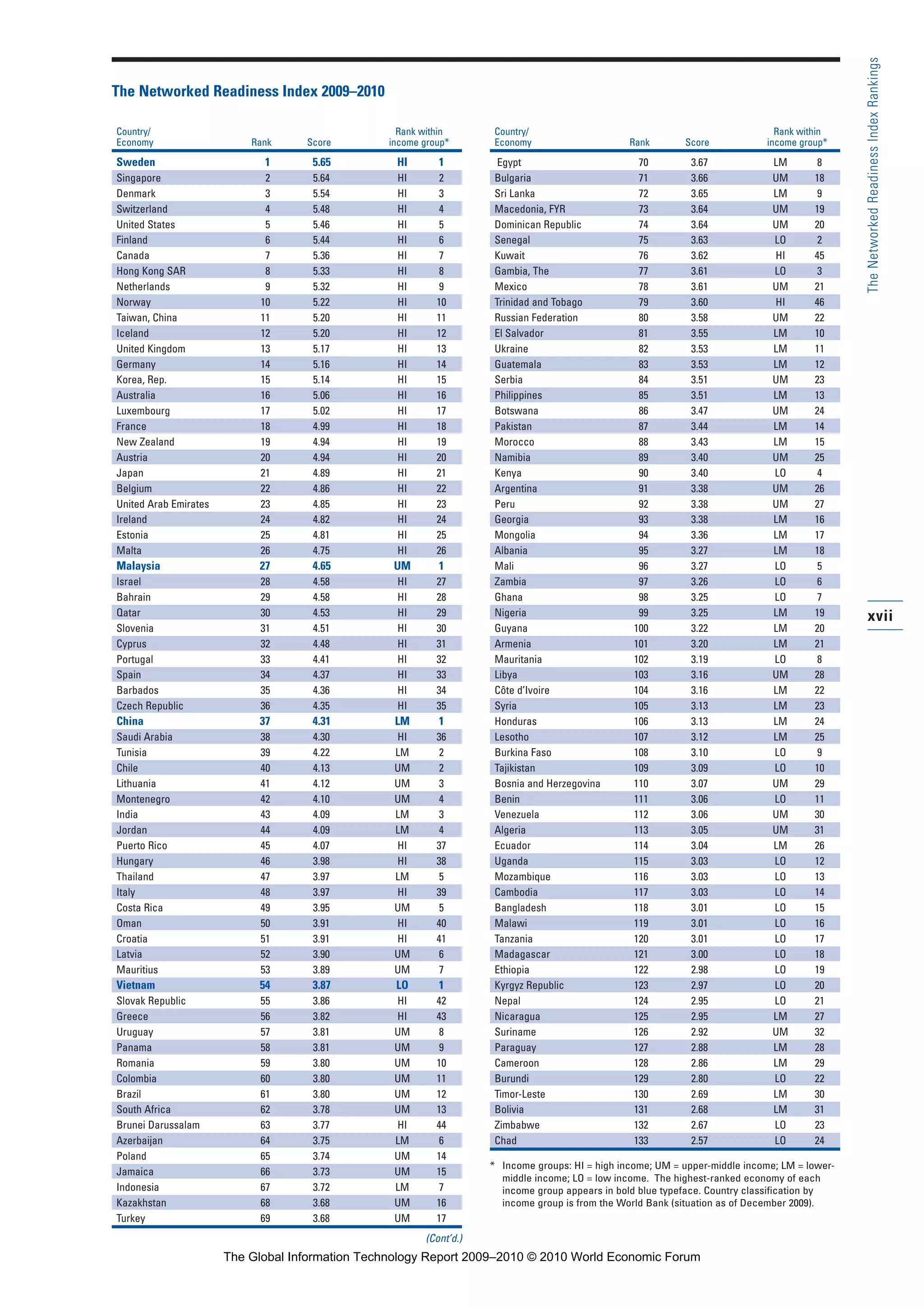
The Networked Readiness Index 2009–2010
Country/ Rank within
Economy Rank Score income group*
Sweden 1 5.65 HI 1
Singapore 2 5.64 HI 2
Denmark 3 5.54 HI 3
Switzerland 4 5.48 HI 4
United States 5 5.46 HI 5
Finland 6 5.44 HI 6
Canada 7 5.36 HI 7
Hong Kong SAR 8 5.33 HI 8
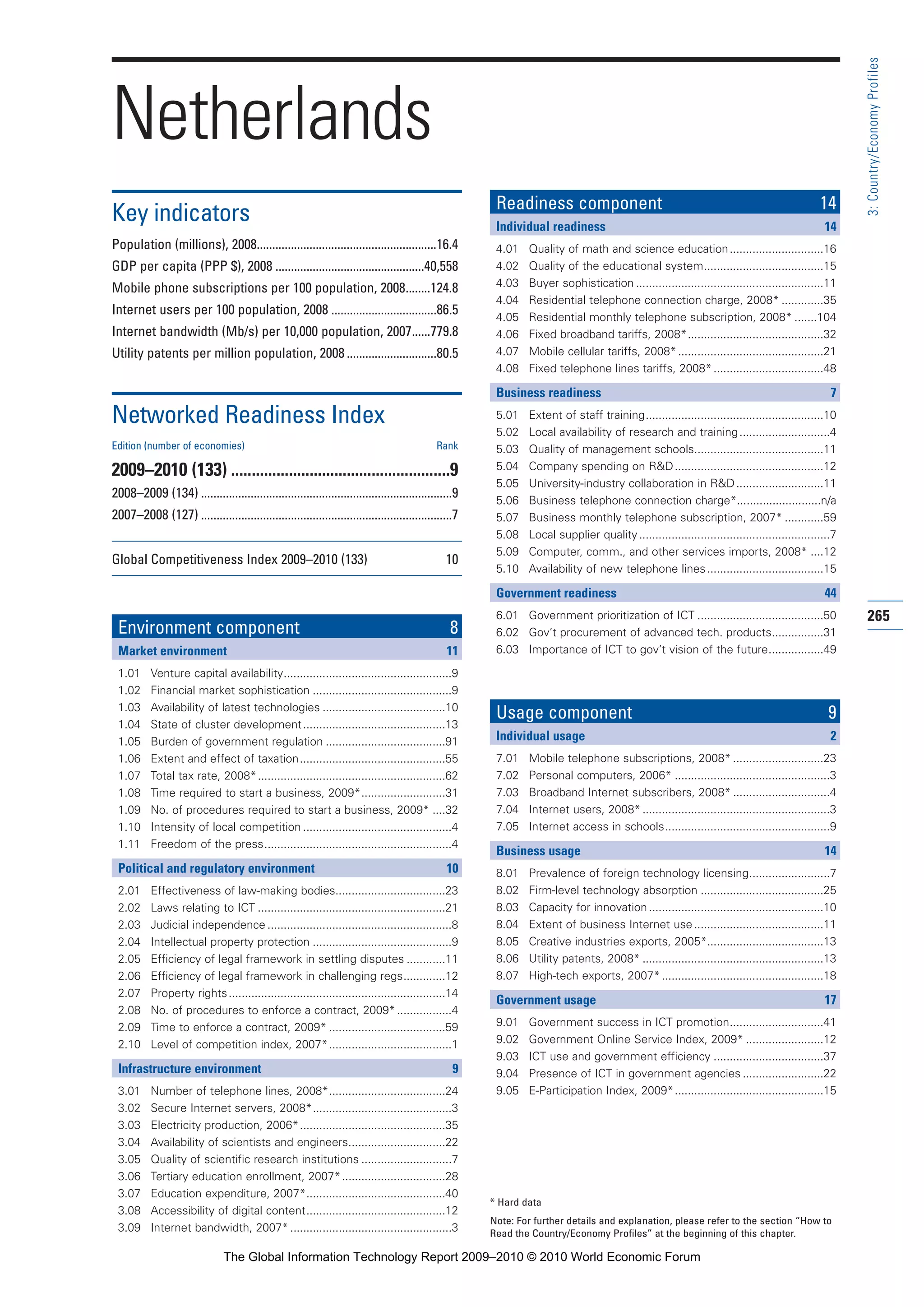
Netherlands 9 5.32 HI 9
Norway 10 5.22 HI 10
Taiwan, China 11 5.20 HI 11
Iceland 12 5.20 HI 12
United Kingdom 13 5.17 HI 13
Germany 14 5.16 HI 14
Korea, Rep. 15 5.14 HI 15
Australia 16 5.06 HI 16
Luxembourg 17 5.02 HI 17
France 18 4.99 HI 18
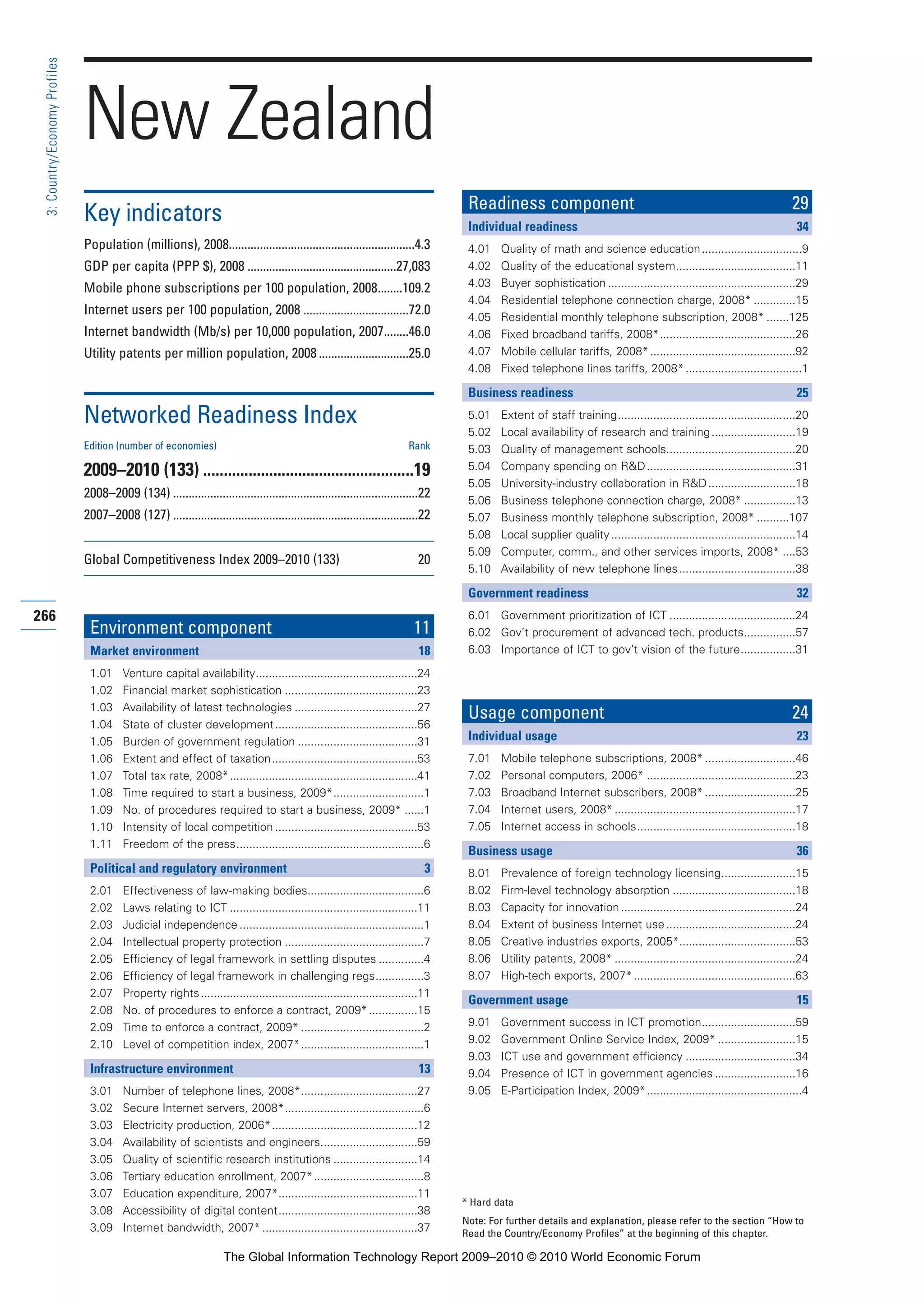
New Zealand 19 4.94 HI 19
Austria 20 4.94 HI 20
Japan 21 4.89 HI 21
Belgium 22 4.86 HI 22
United Arab Emirates 23 4.85 HI 23
Ireland 24 4.82 HI 24
Estonia 25 4.81 HI 25
Malta 26 4.75 HI 26
Malaysia 27 4.65 UM 1
Israel 28 4.58 HI 27
Bahrain 29 4.58 HI 28
Qatar 30 4.53 HI 29
Slovenia 31 4.51 HI 30
Cyprus 32 4.48 HI 31
Portugal 33 4.41 HI 32
Spain 34 4.37 HI 33
Barbados 35 4.36 HI 34
Czech Republic 36 4.35 HI 35
China 37 4.31 LM 1
Saudi Arabia 38 4.30 HI 36
Tunisia 39 4.22 LM 2
Chile 40 4.13 UM 2
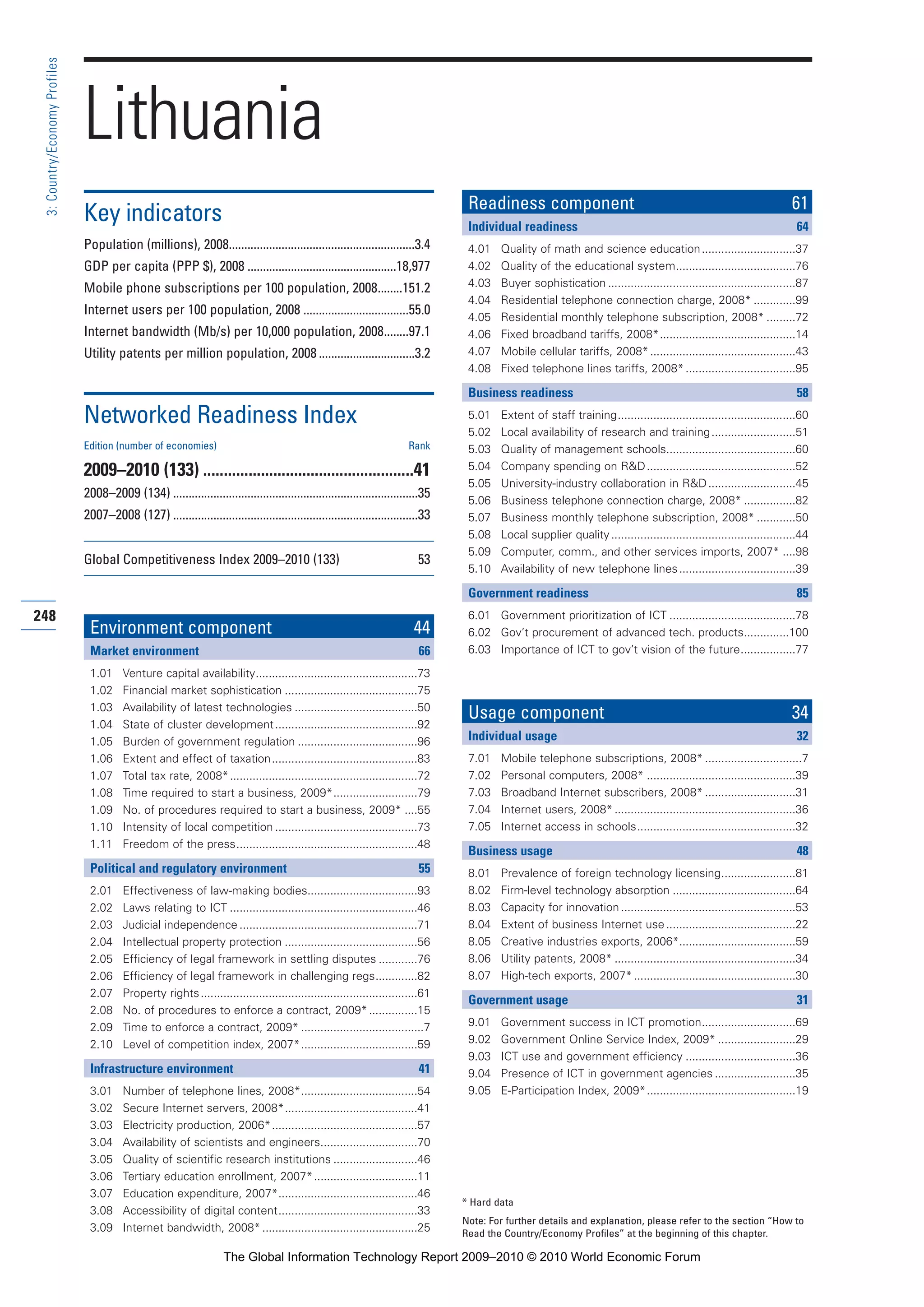
Lithuania 41 4.12 UM 3
Montenegro 42 4.10 UM 4
India 43 4.09 LM 3
Jordan 44 4.09 LM 4
Puerto Rico 45 4.07 HI 37
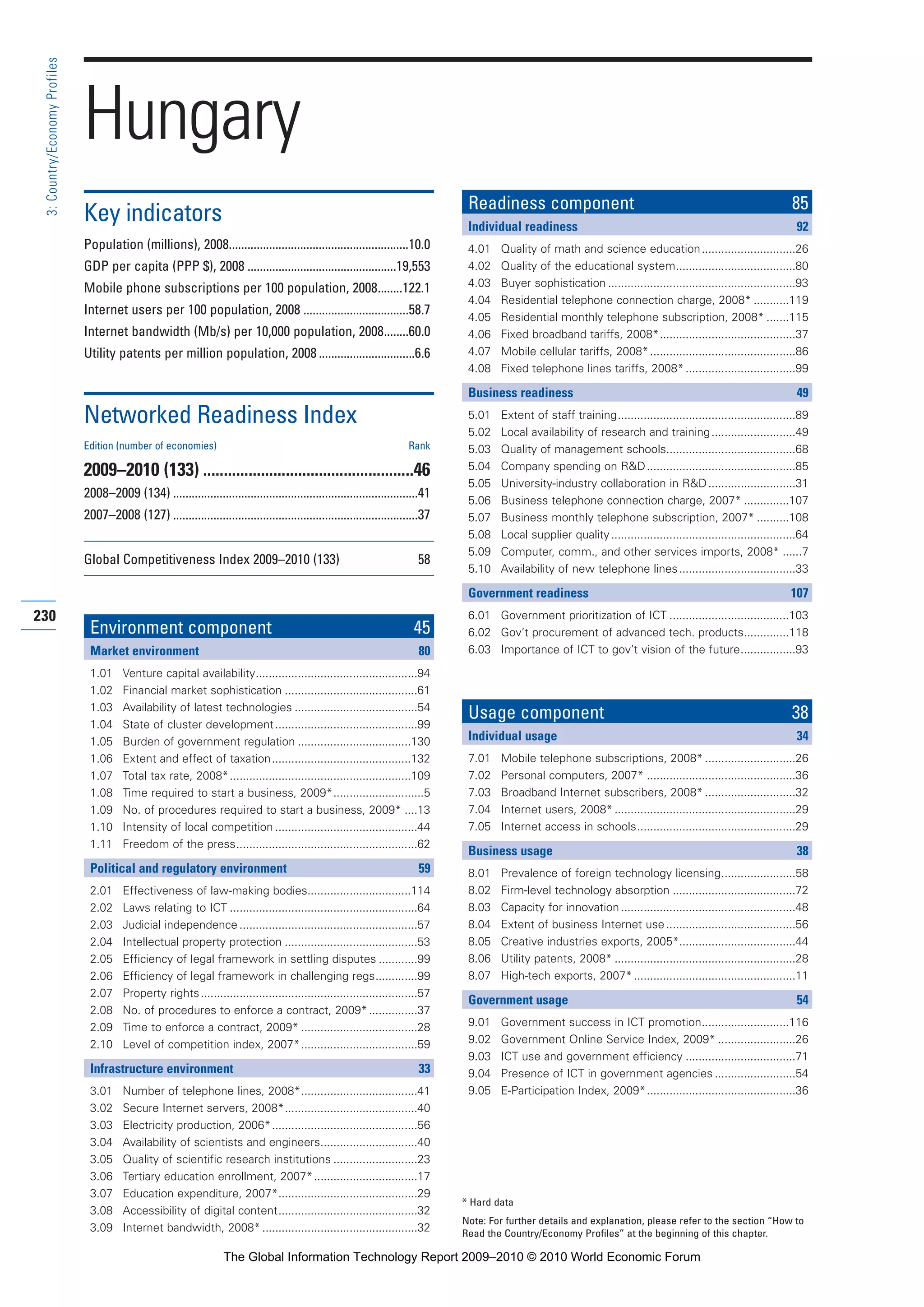
Hungary 46 3.98 HI 38
Thailand 47 3.97 LM 5
Italy 48 3.97 HI 39
Costa Rica 49 3.95 UM 5
Oman 50 3.91 HI 40
Croatia 51 3.91 HI 41
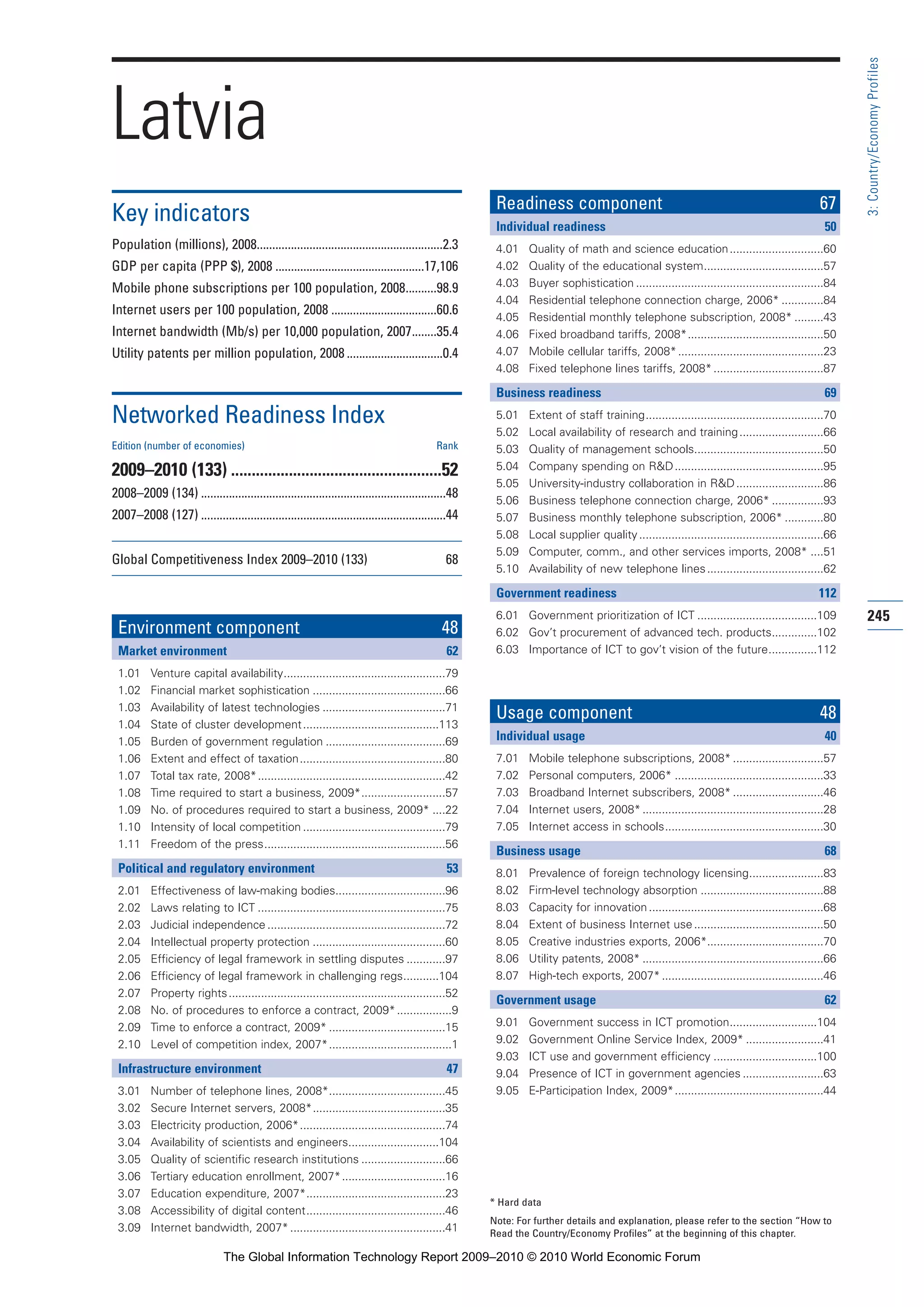
Latvia 52 3.90 UM 6
Mauritius 53 3.89 UM 7
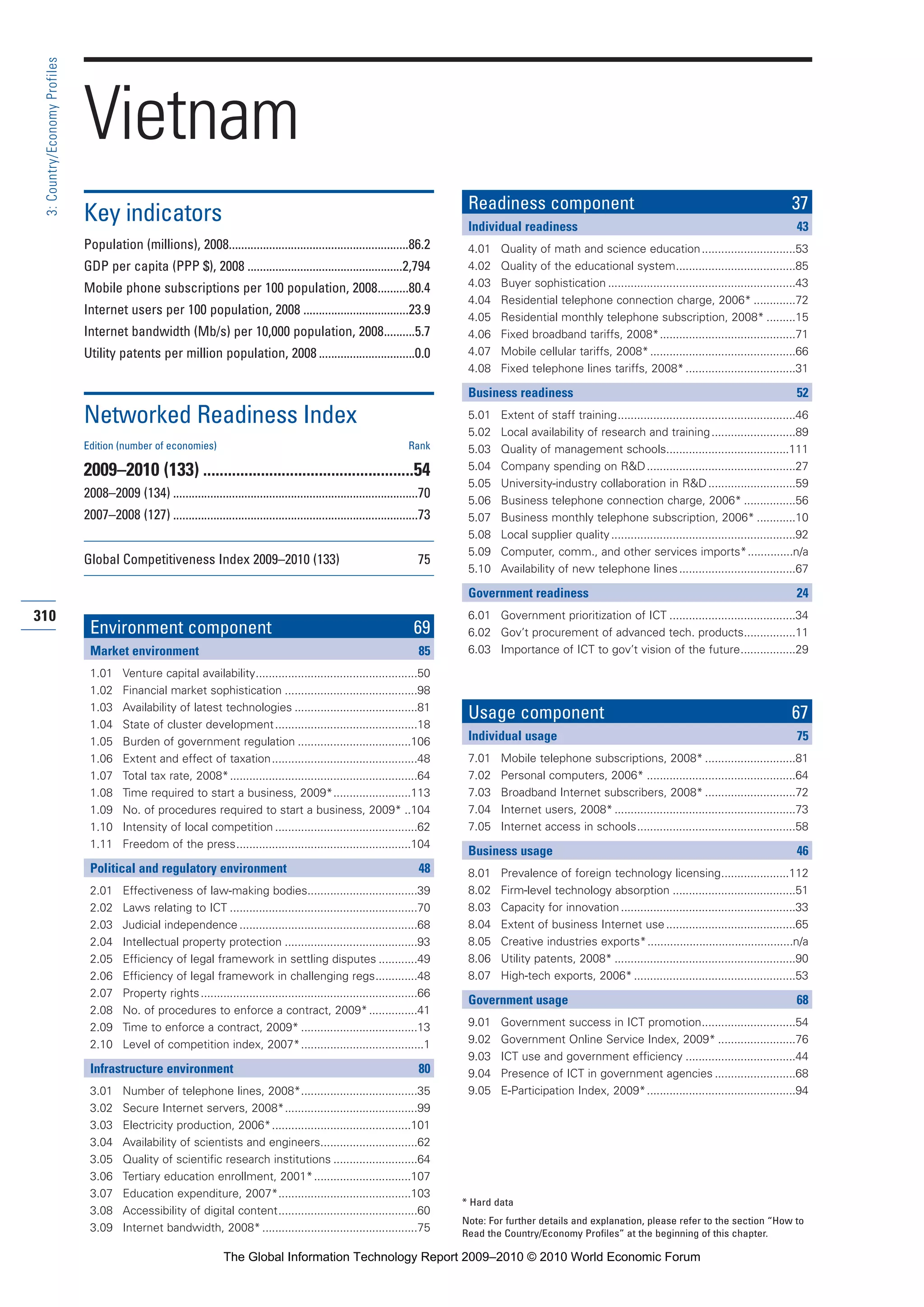
Vietnam 54 3.87 LO 1
Slovak Republic 55 3.86 HI 42
Greece 56 3.82 HI 43
Uruguay 57 3.81 UM 8
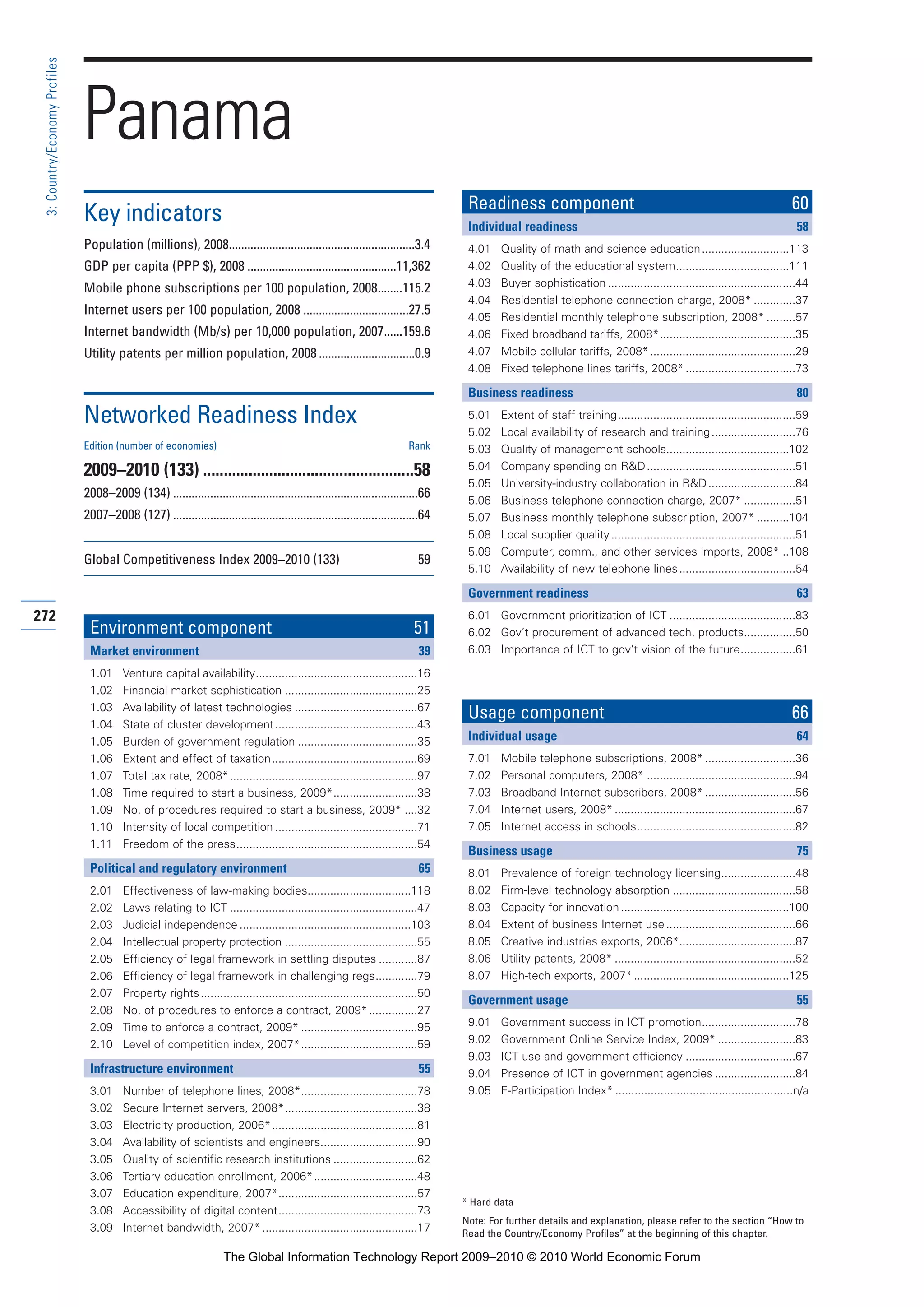
Panama 58 3.81 UM 9
Romania 59 3.80 UM 10
Colombia 60 3.80 UM 11
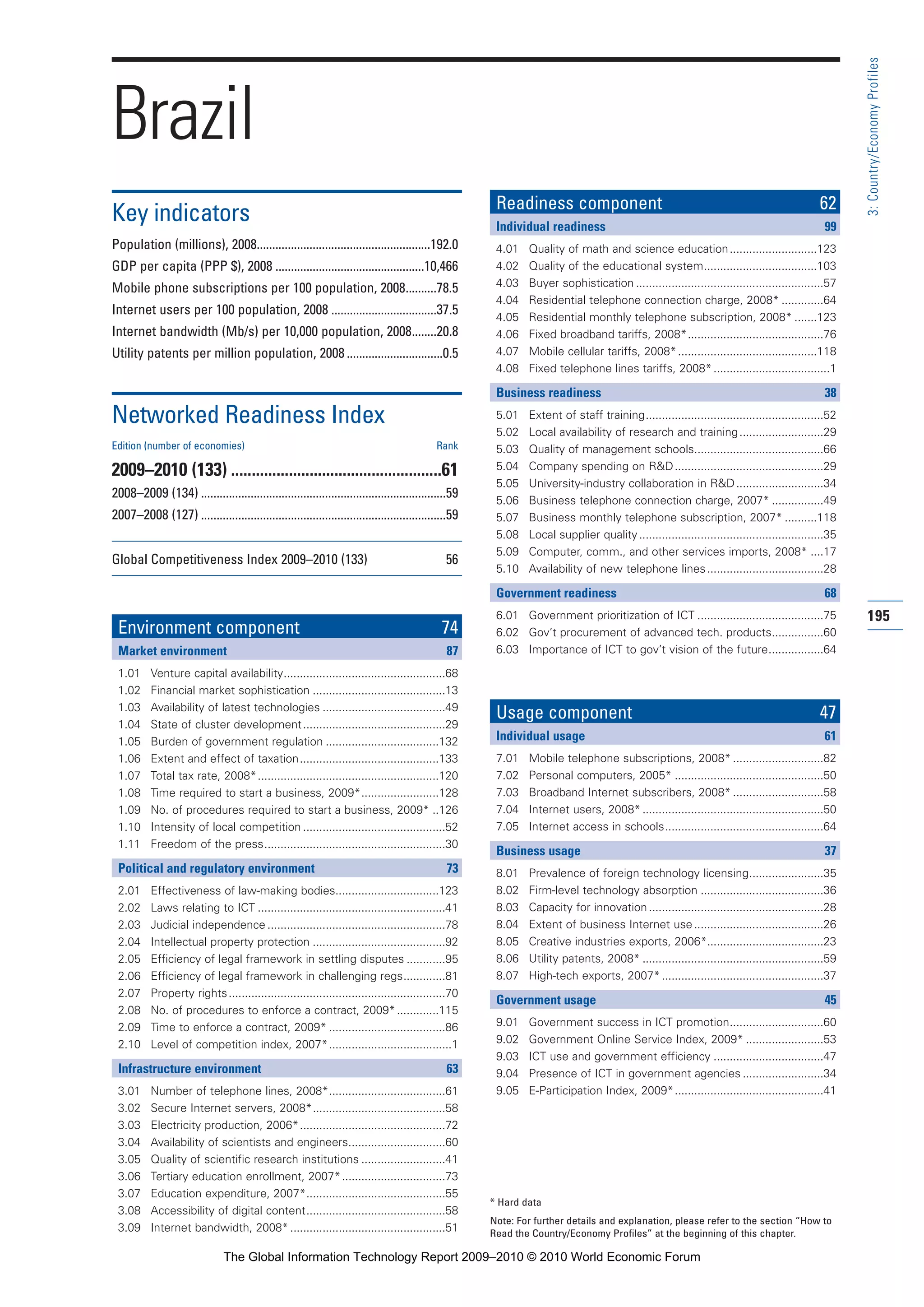
Brazil 61 3.80 UM 12
South Africa 62 3.78 UM 13
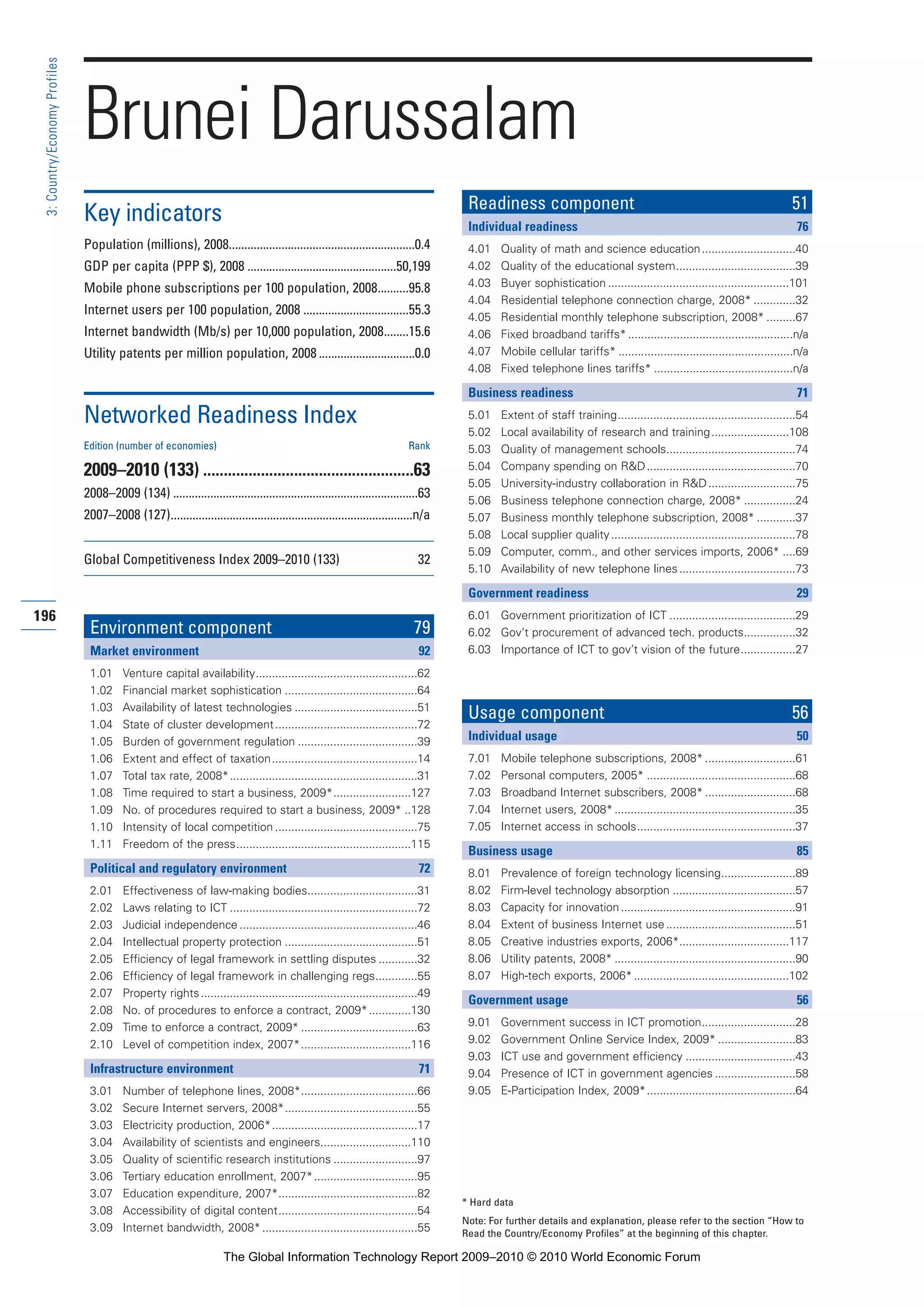
Brunei Darussalam 63 3.77 HI 44
Azerbaijan 64 3.75 LM 6
Poland 65 3.74 UM 14
Jamaica 66 3.73 UM 15
Indonesia 67 3.72 LM 7
Kazakhstan 68 3.68 UM 16
Turkey 69 3.68 UM 17
(Cont’d.)
Country/ Rank within
Economy Rank Score income group*
Egypt 70 3.67 LM 8
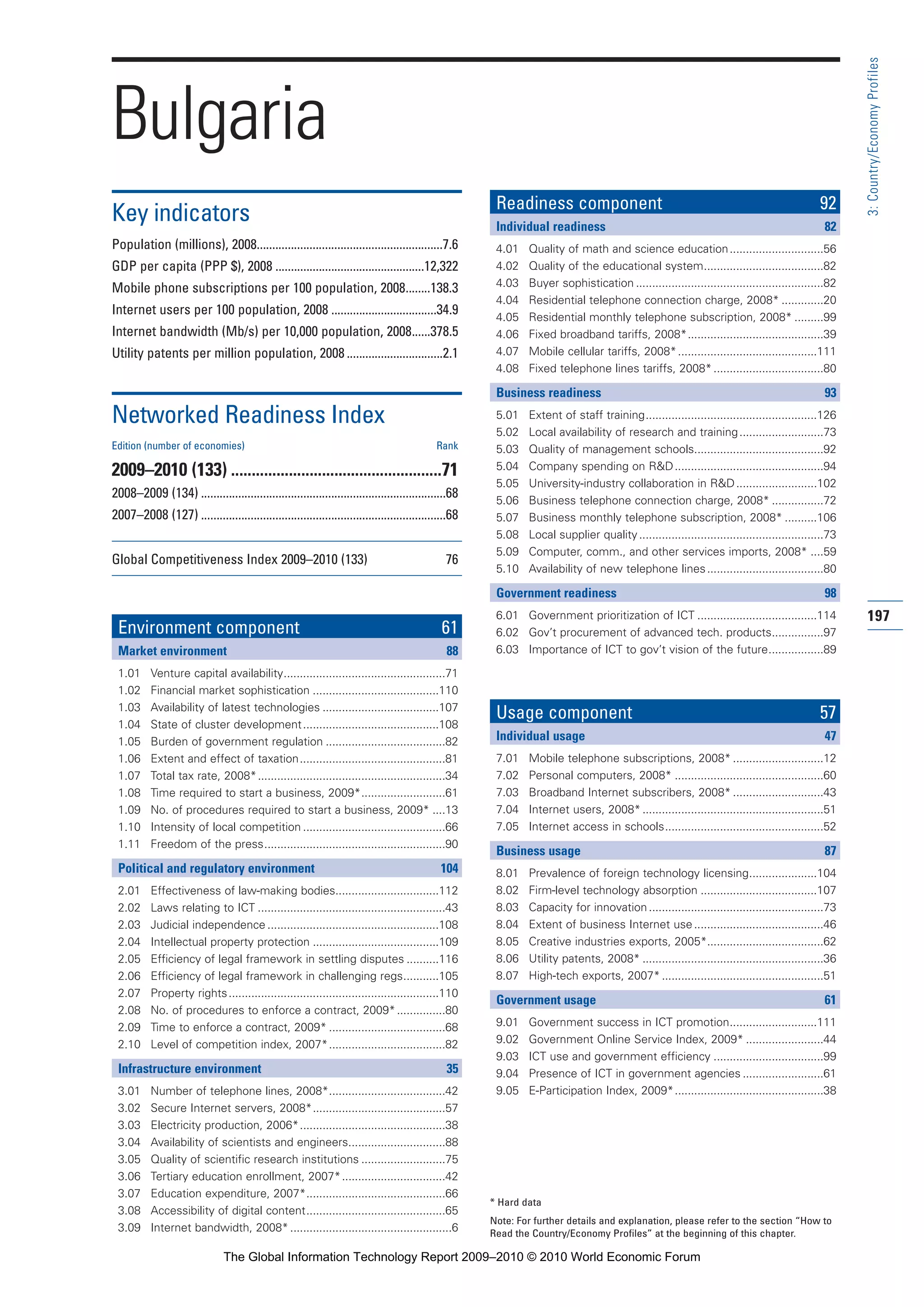
Bulgaria 71 3.66 UM 18
Sri Lanka 72 3.65 LM 9
Macedonia, FYR 73 3.64 UM 19
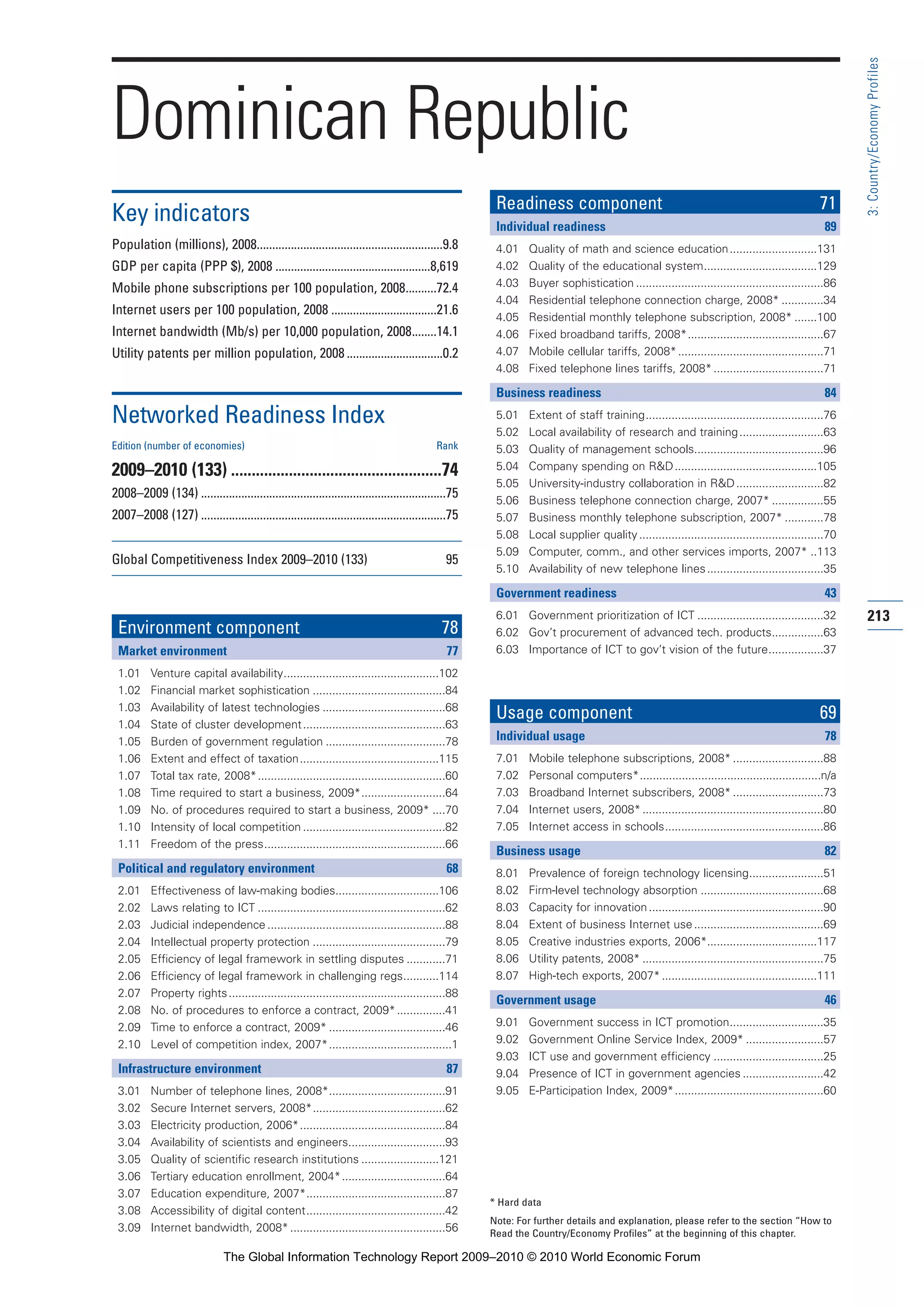
Dominican Republic 74 3.64 UM 20
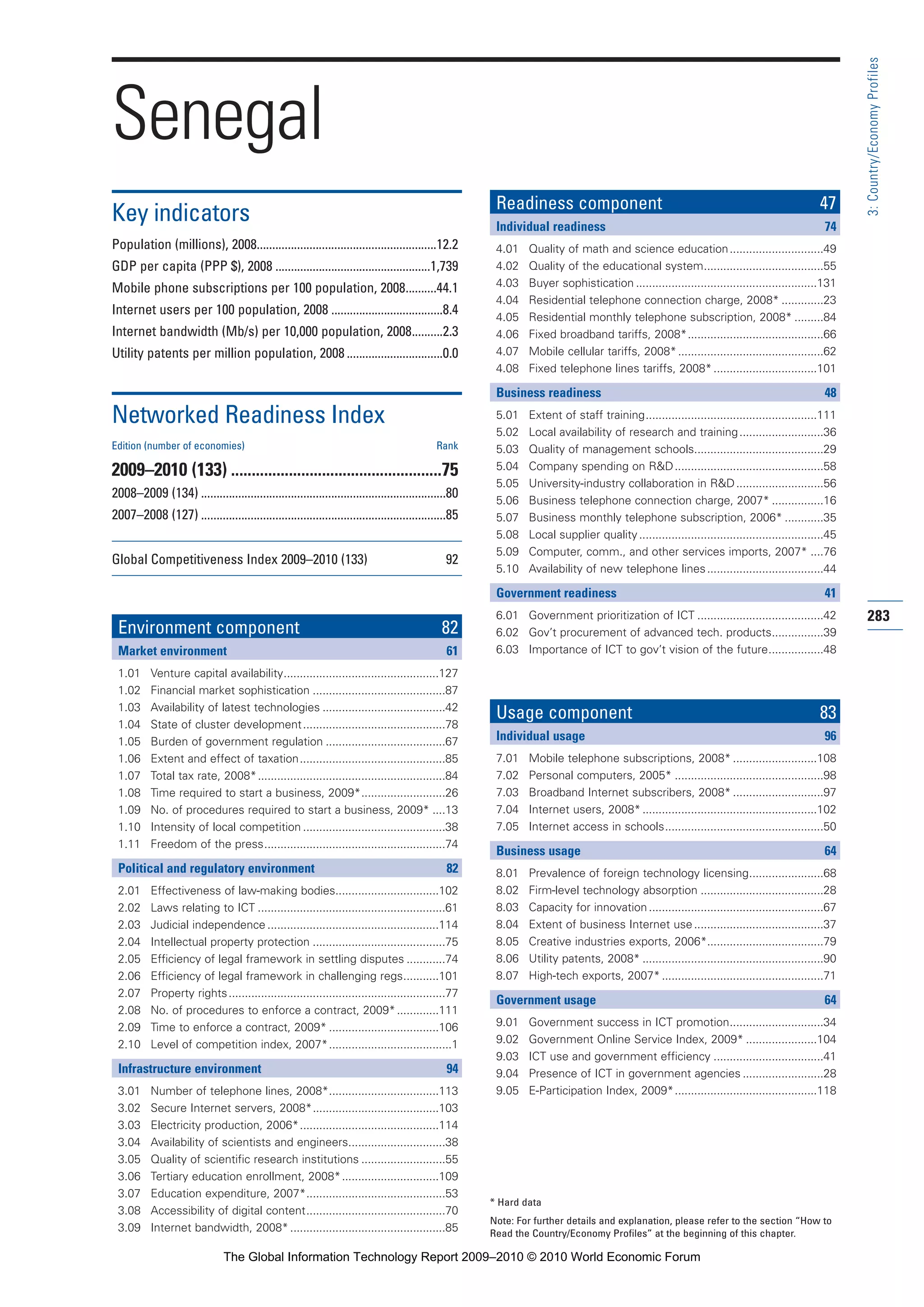
Senegal 75 3.63 LO 2
Kuwait 76 3.62 HI 45
Gambia, The 77 3.61 LO 3
Mexico 78 3.61 UM 21
Trinidad and Tobago 79 3.60 HI 46
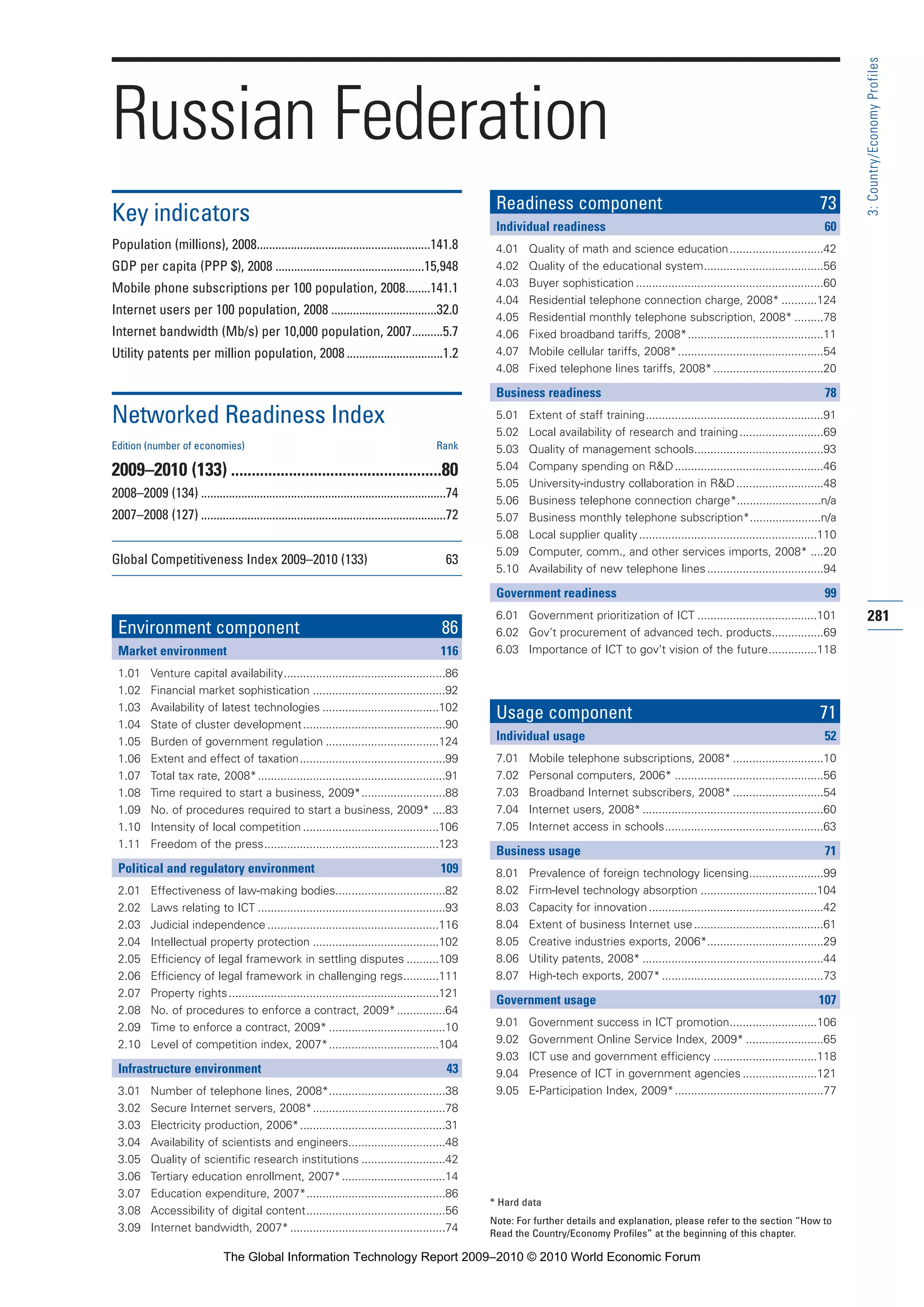
Russian Federation 80 3.58 UM 22
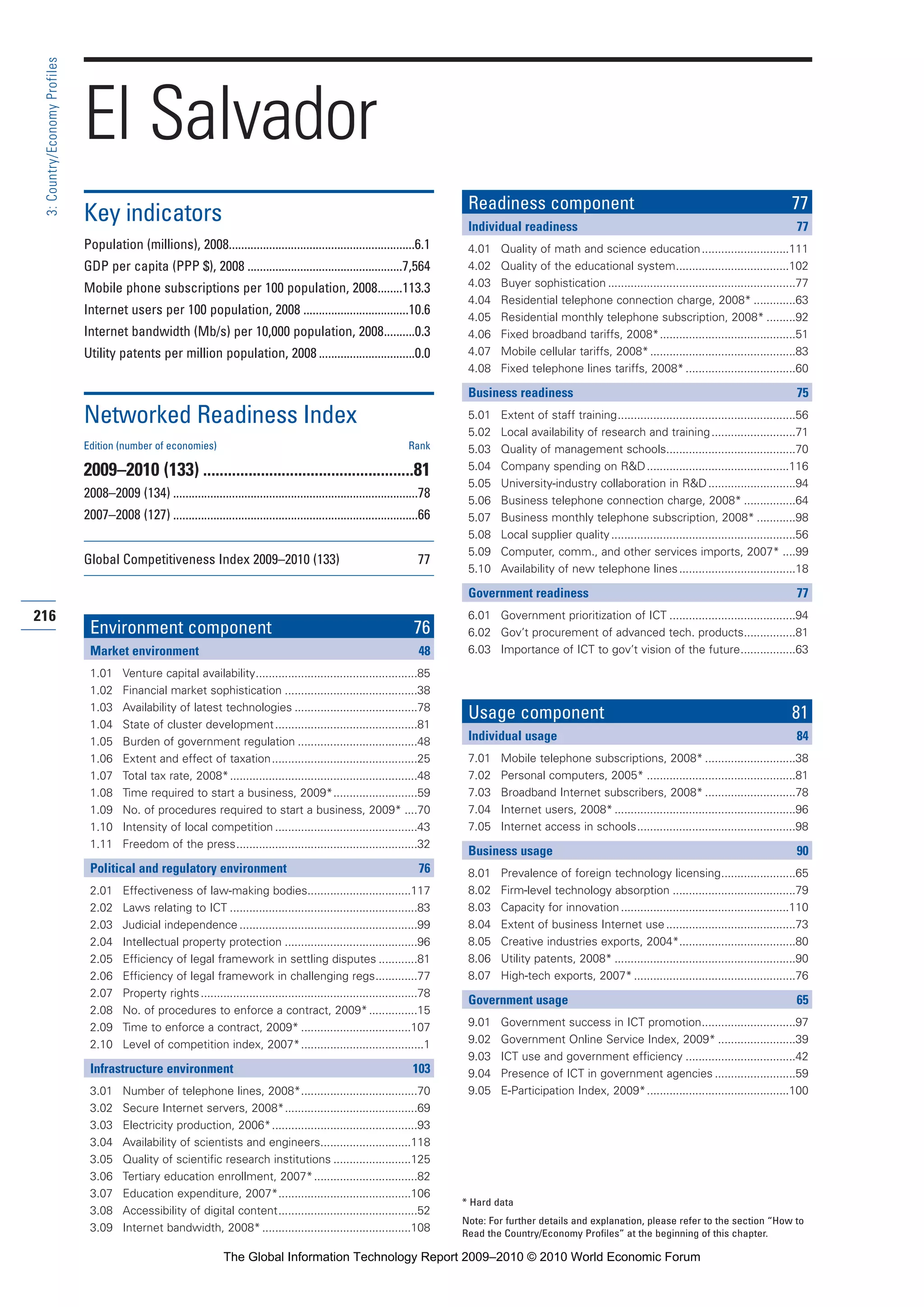
El Salvador 81 3.55 LM 10
Ukraine 82 3.53 LM 11
Guatemala 83 3.53 LM 12
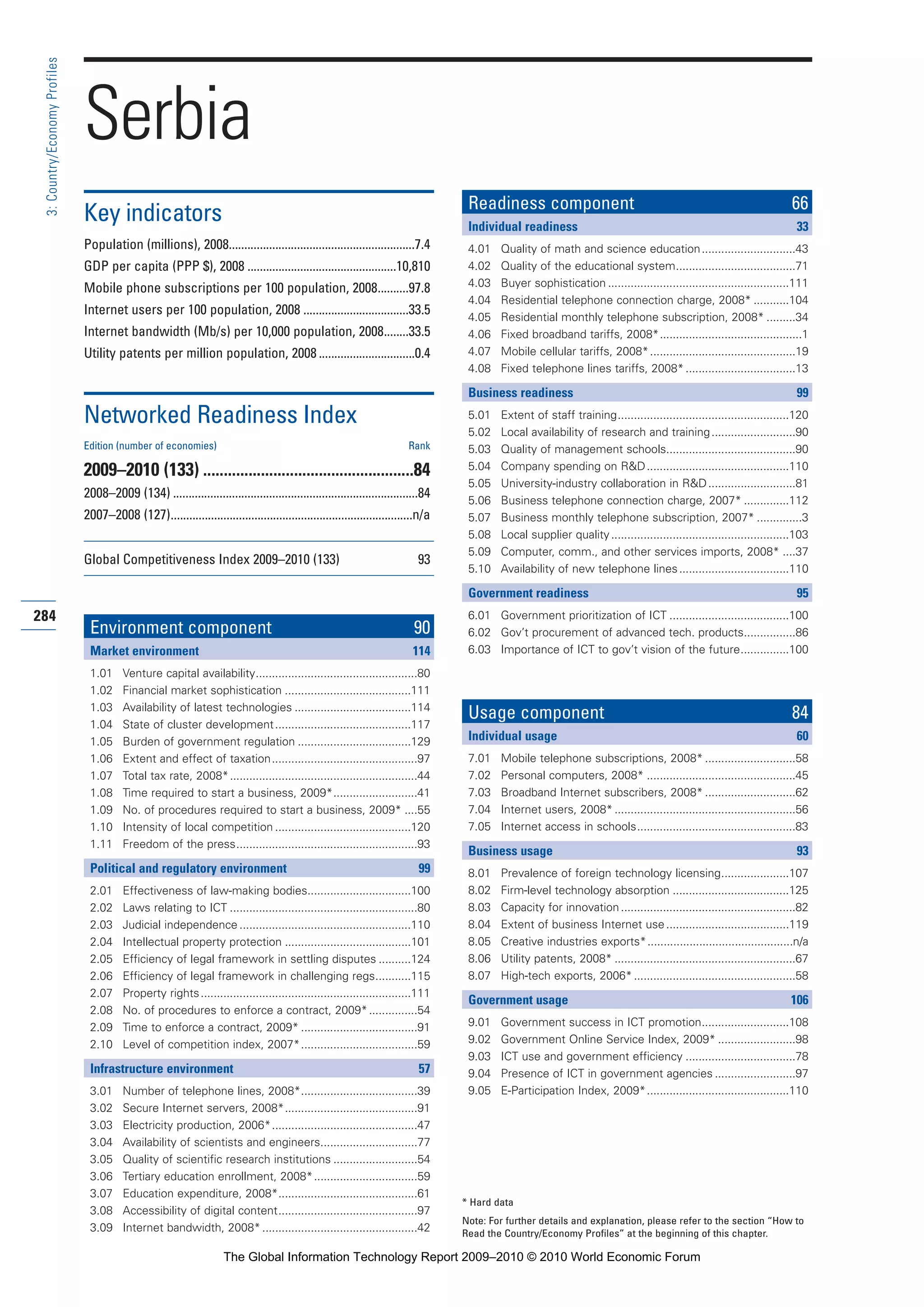
Serbia 84 3.51 UM 23
Philippines 85 3.51 LM 13
Botswana 86 3.47 UM 24
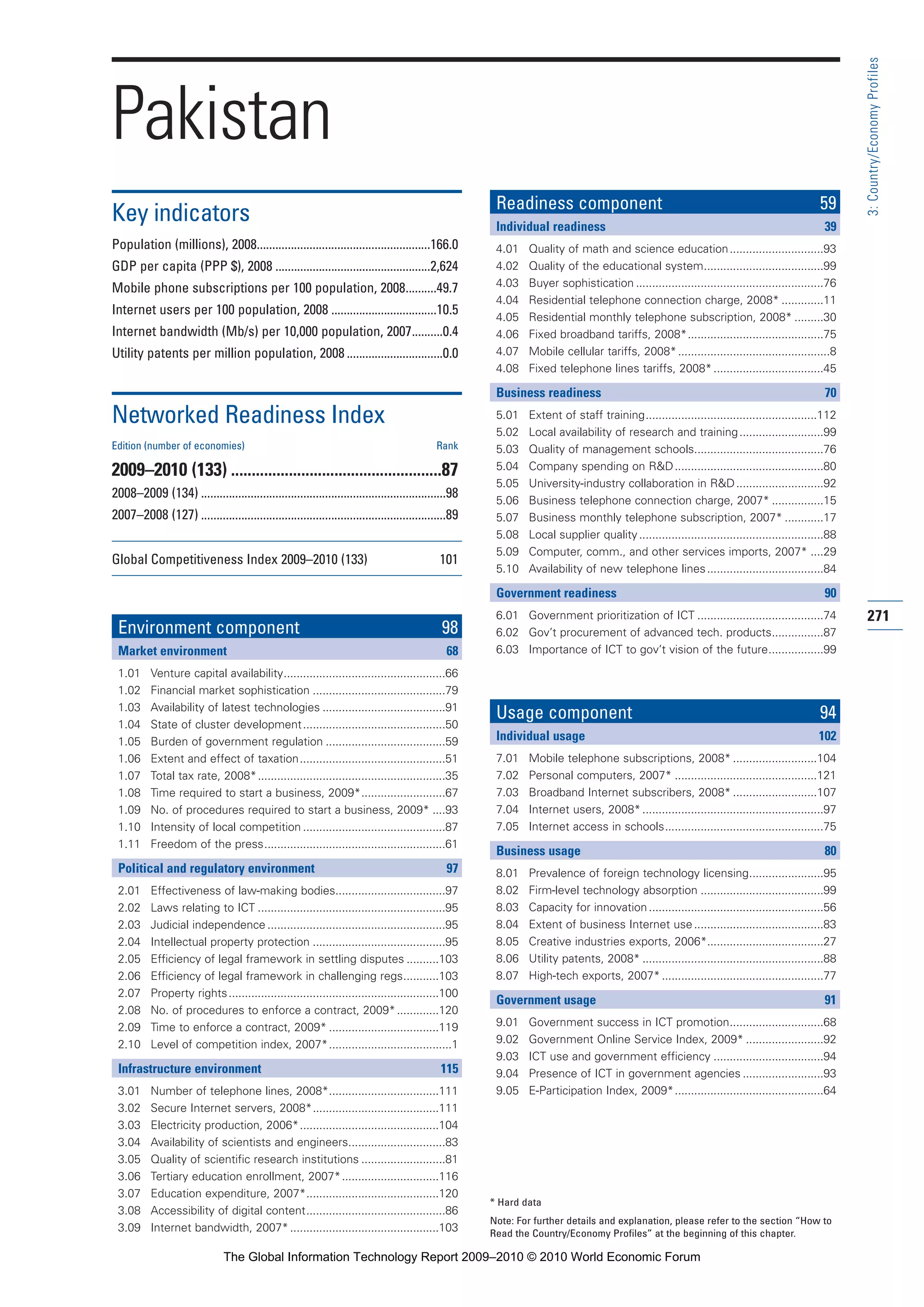
Pakistan 87 3.44 LM 14
Morocco 88 3.43 LM 15
Namibia 89 3.40 UM 25
Kenya 90 3.40 LO 4
Argentina 91 3.38 UM 26
Peru 92 3.38 UM 27
Georgia 93 3.38 LM 16
Mongolia 94 3.36 LM 17
Albania 95 3.27 LM 18
Mali 96 3.27 LO 5
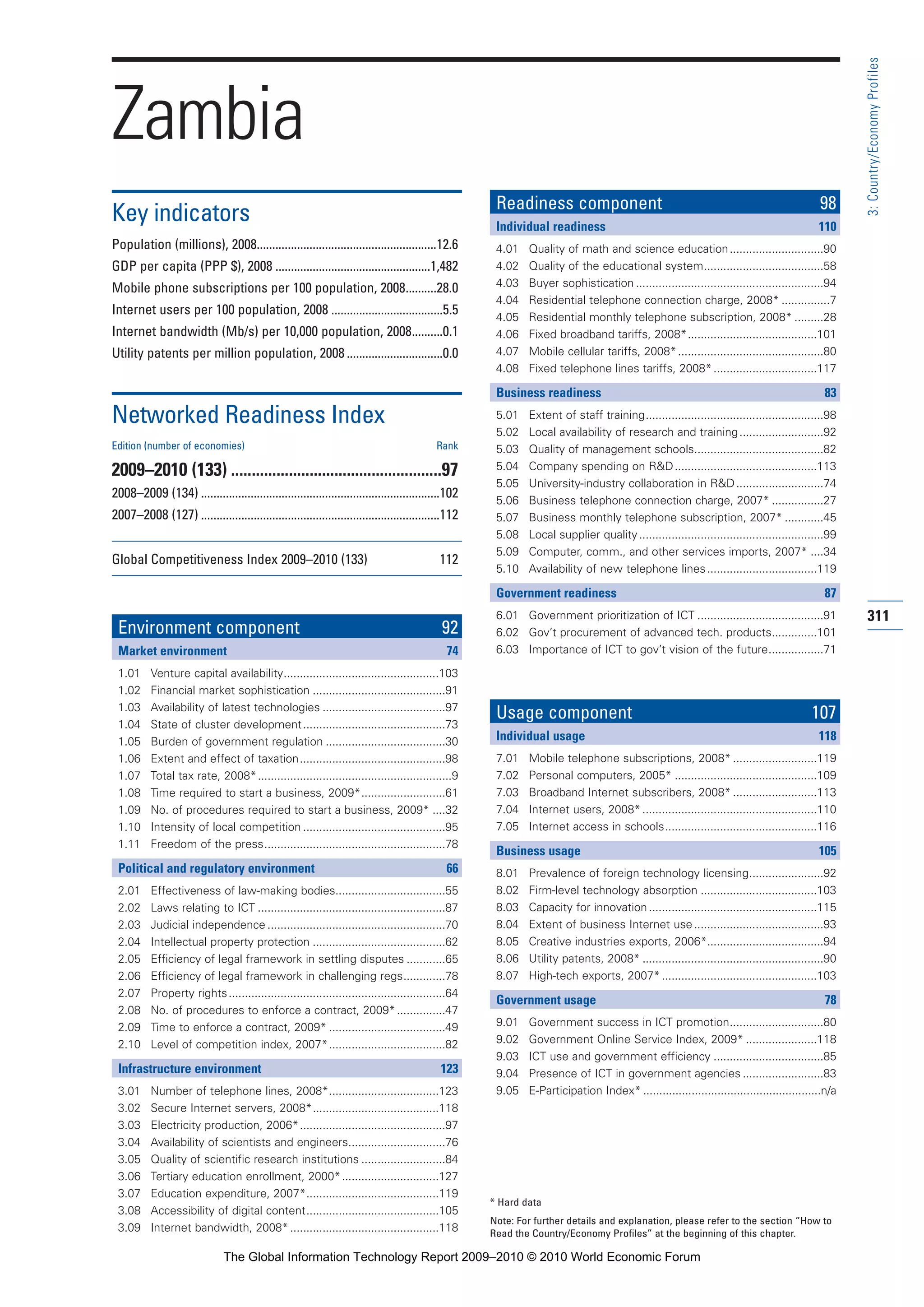
Zambia 97 3.26 LO 6
Ghana 98 3.25 LO 7
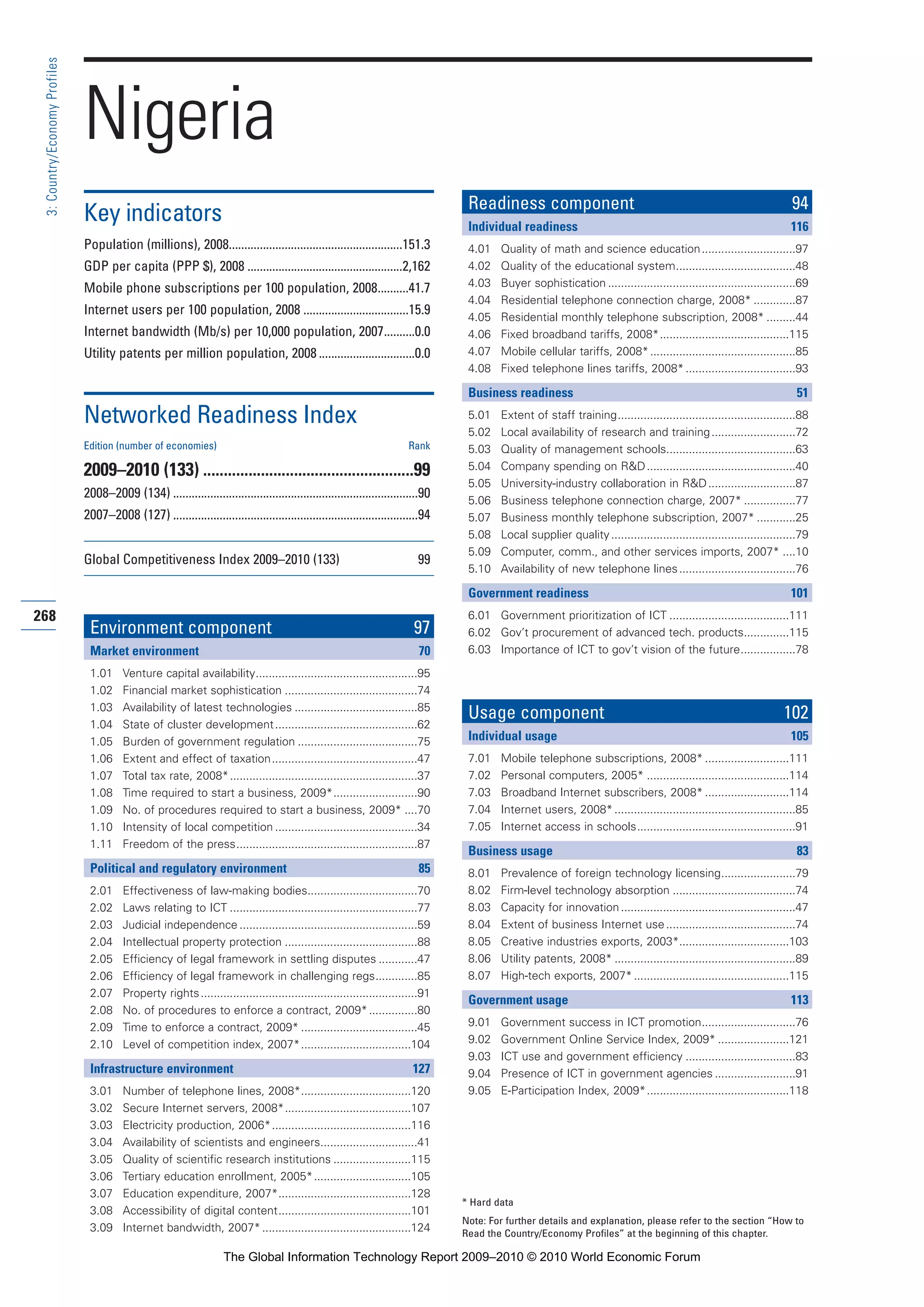
Nigeria 99 3.25 LM 19
Guyana 100 3.22 LM 20
Armenia 101 3.20 LM 21
Mauritania 102 3.19 LO 8
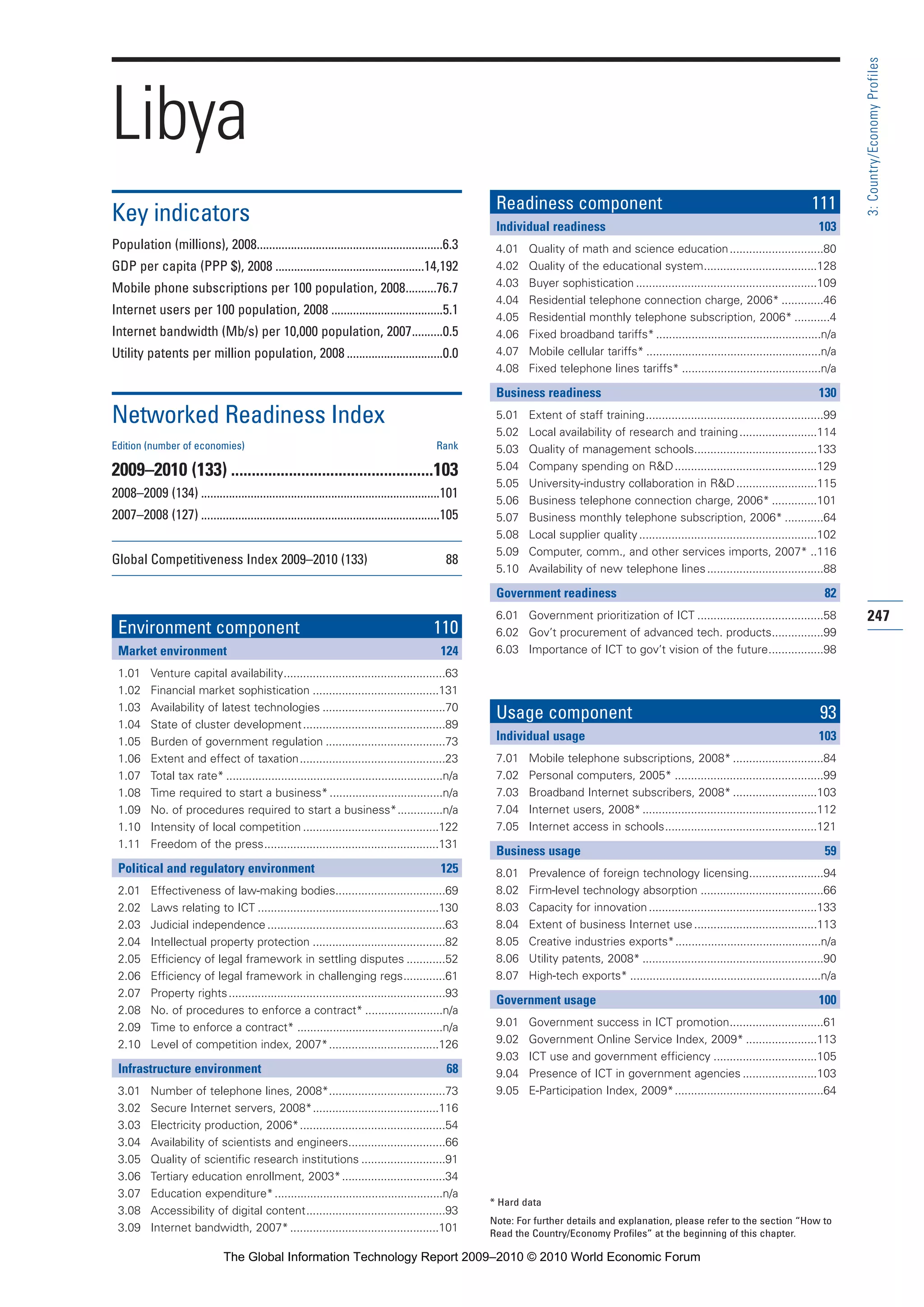
Libya 103 3.16 UM 28
Côte d’Ivoire 104 3.16 LM 22
Syria 105 3.13 LM 23
Honduras 106 3.13 LM 24
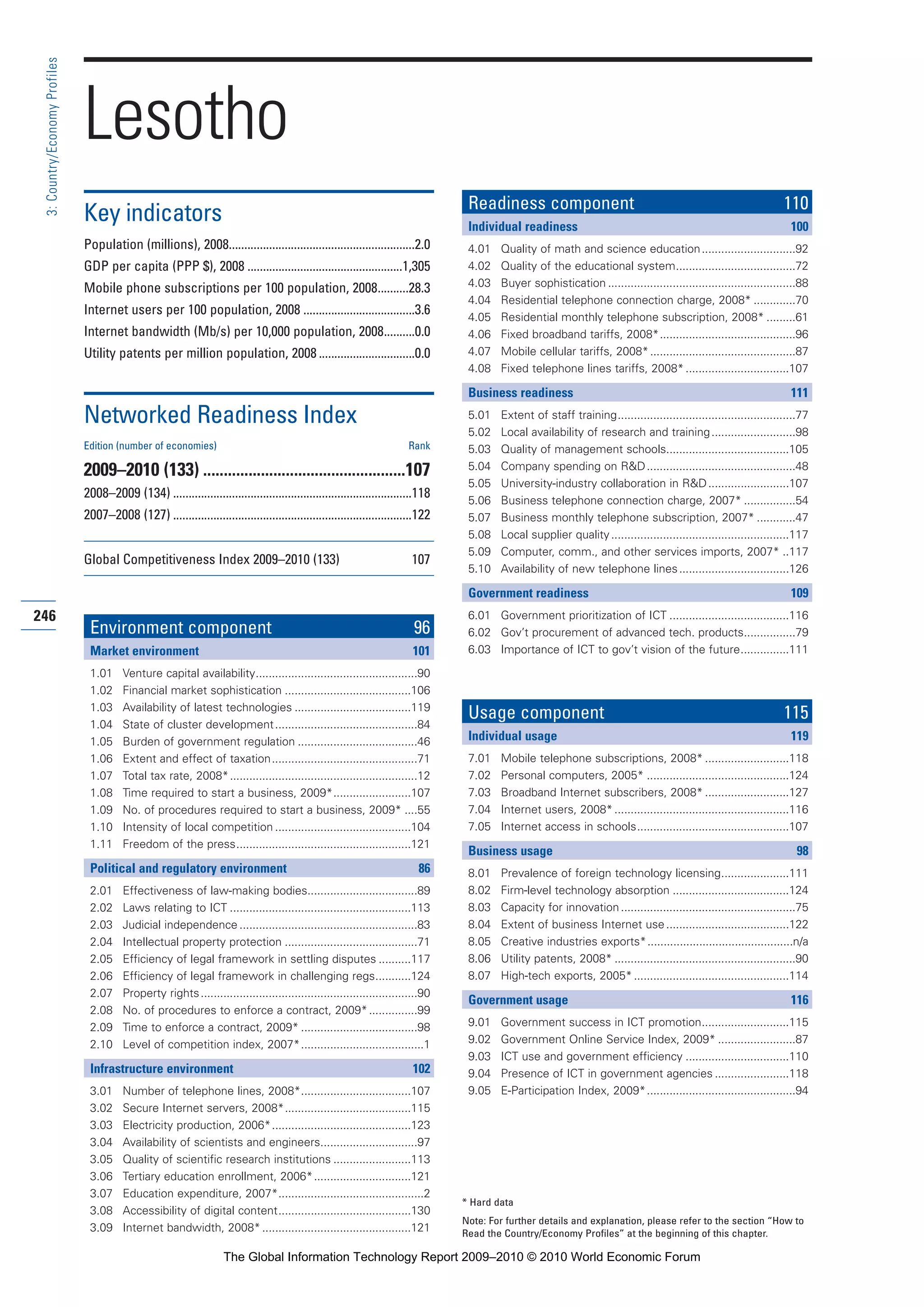
Lesotho 107 3.12 LM 25
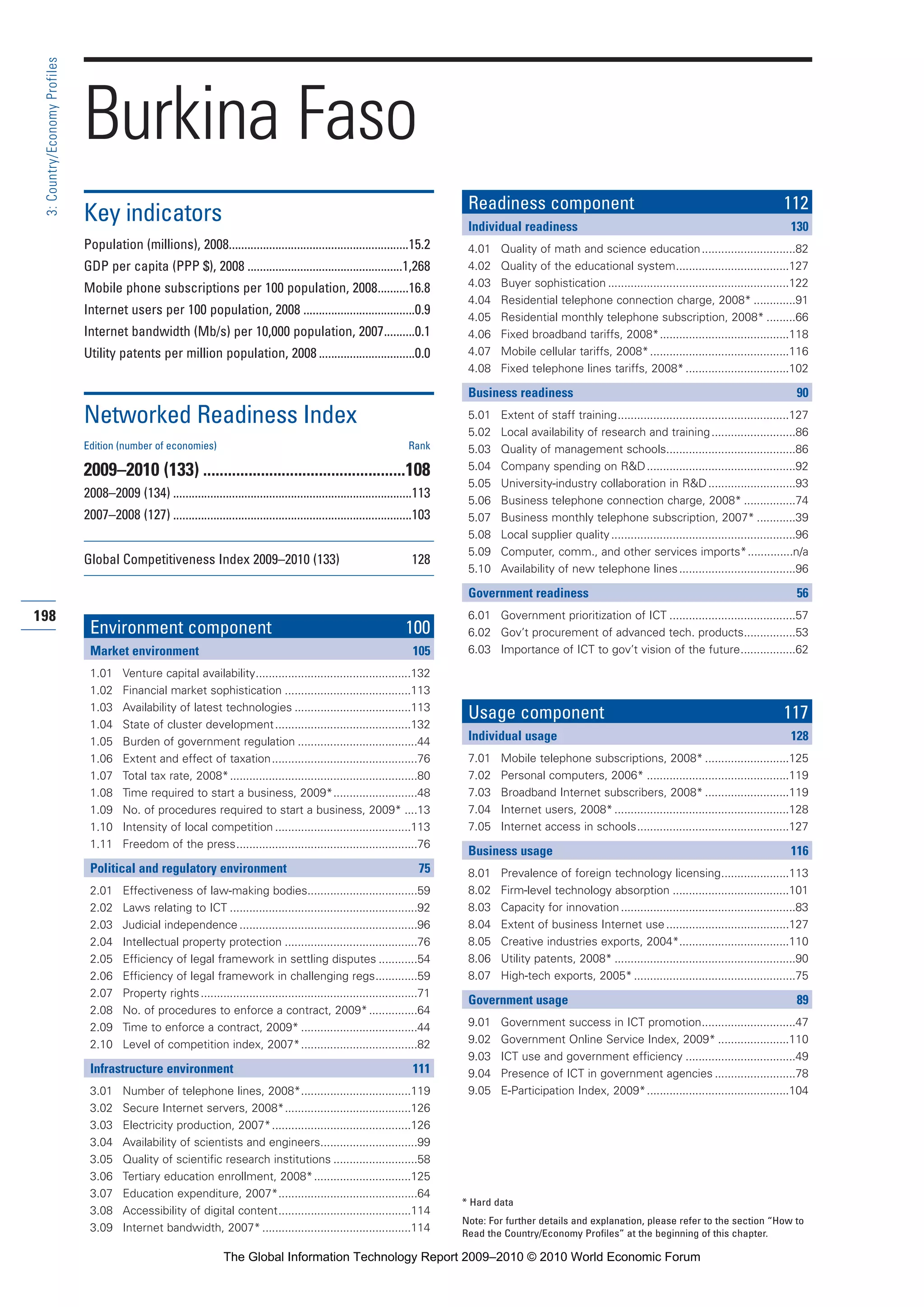
Burkina Faso 108 3.10 LO 9
Tajikistan 109 3.09 LO 10
Bosnia and Herzegovina 110 3.07 UM 29
Benin 111 3.06 LO 11
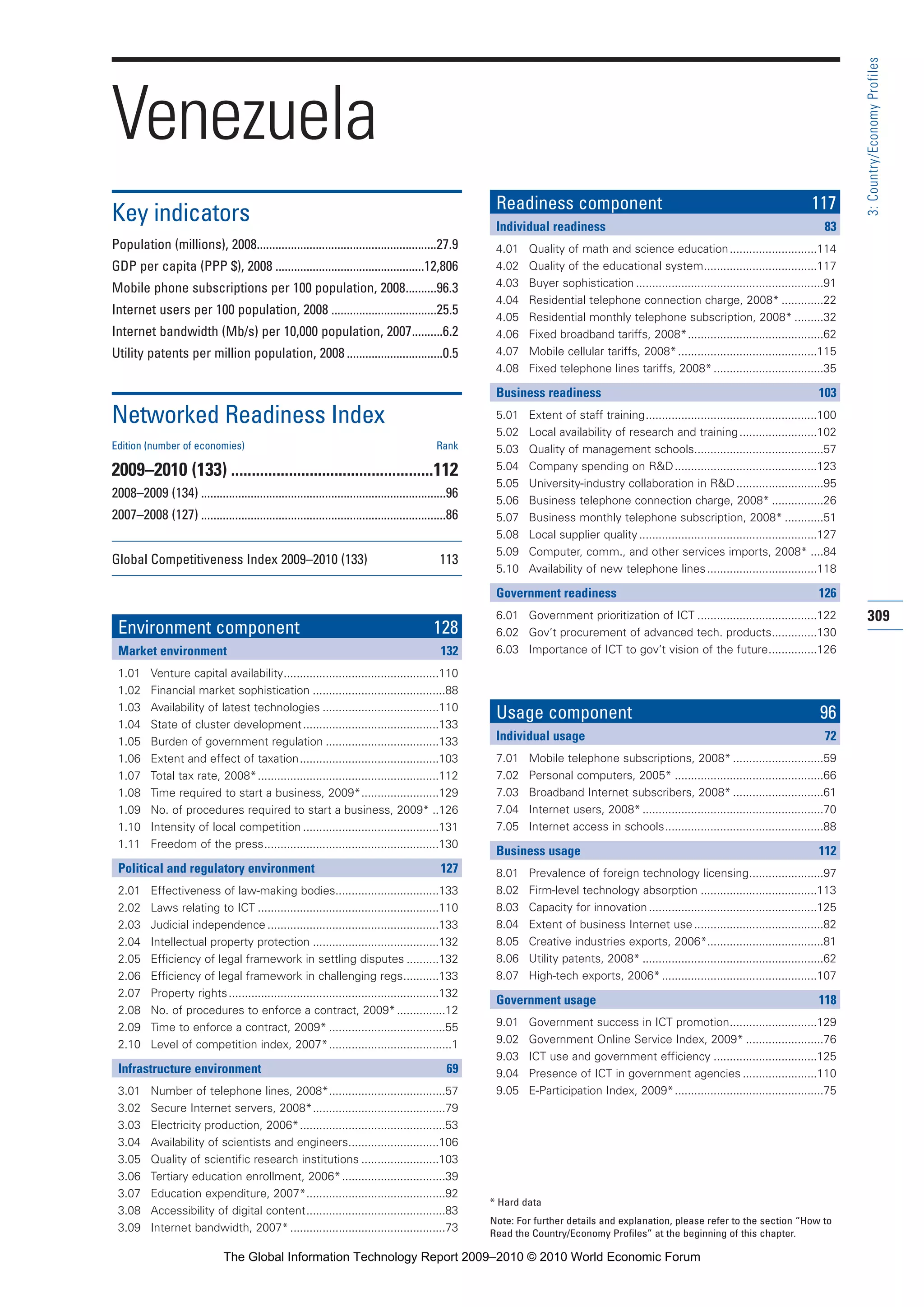
Venezuela 112 3.06 UM 30
Algeria 113 3.05 UM 31
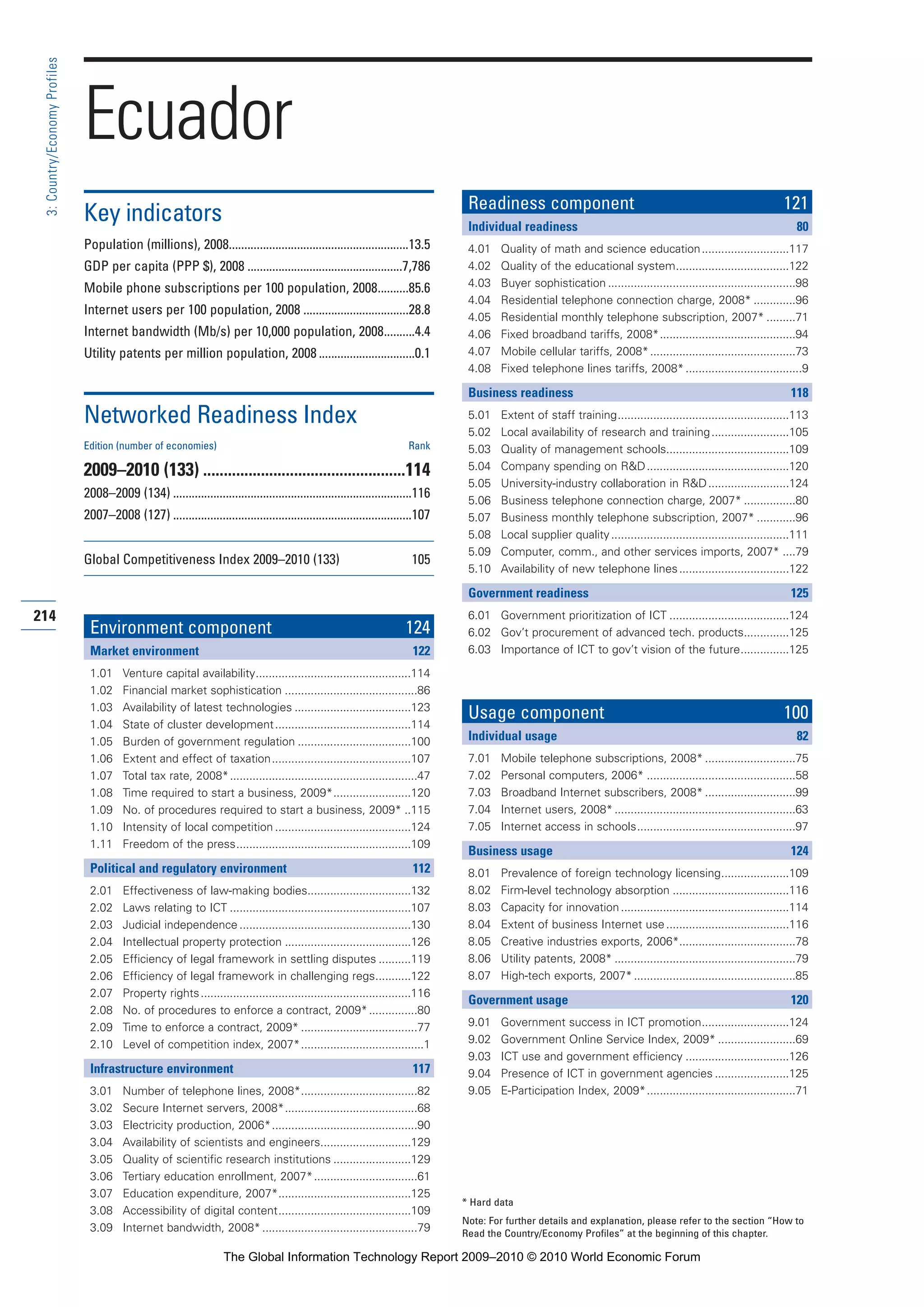
Ecuador 114 3.04 LM 26
Uganda 115 3.03 LO 12
Mozambique 116 3.03 LO 13
Cambodia 117 3.03 LO 14
Bangladesh 118 3.01 LO 15
Malawi 119 3.01 LO 16
Tanzania 120 3.01 LO 17
Madagascar 121 3.00 LO 18
Ethiopia 122 2.98 LO 19
Kyrgyz Republic 123 2.97 LO 20
Nepal 124 2.95 LO 21
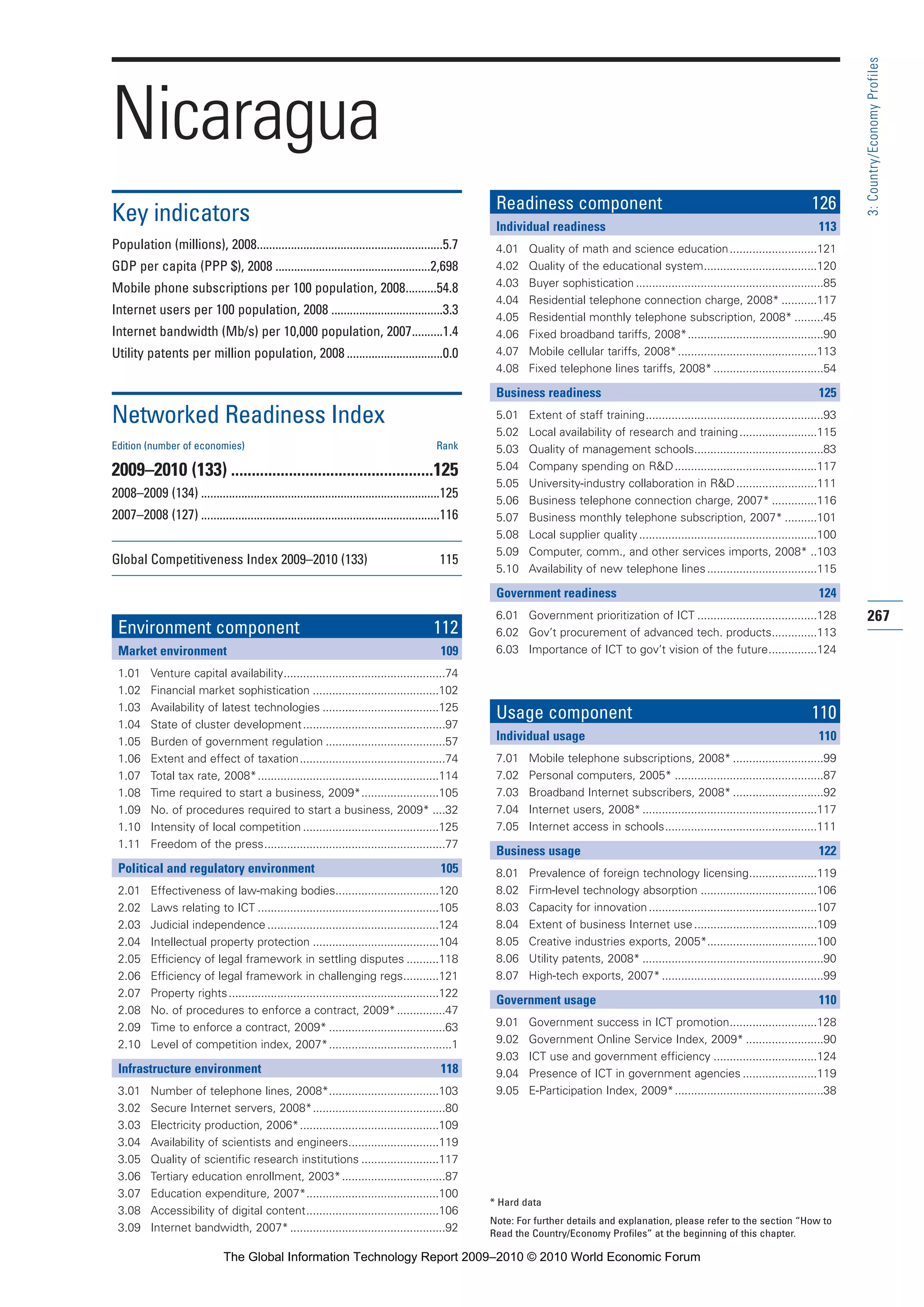
Nicaragua 125 2.95 LM 27
Suriname 126 2.92 UM 32
Paraguay 127 2.88 LM 28
Cameroon 128 2.86 LM 29
Burundi 129 2.80 LO 22
Timor-Leste 130 2.69 LM 30
Bolivia 131 2.68 LM 31
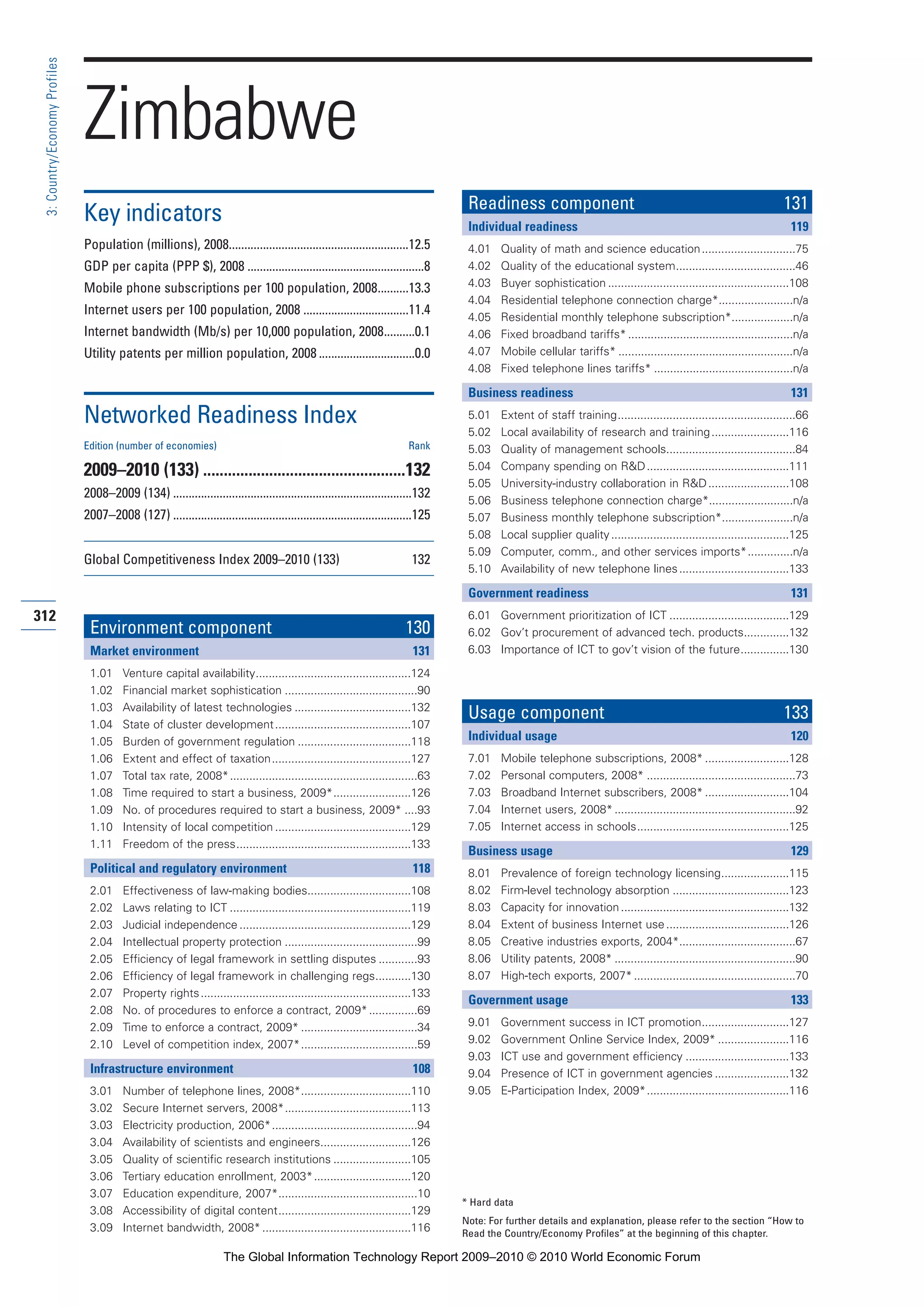
Zimbabwe 132 2.67 LO 23
Chad 133 2.57 LO 24
* Income groups: HI = high income; UM = upper-middle income; LM = lower-
middle income; LO = low income. The highest-ranked economy of each
income group appears in bold blue typeface. Country classification by
income group is from the World Bank (situation as of December 2009).
Part 1.r2 3/8/10 11:24 AM Page xvii
The Global Information Technology Report 2009–2010 © 2010 World Economic Forum
Part 1.r2 3/2/10 4:40 AM Page xviii
The Global Information Technology Report 2009–2010 © 2010 World Economic Forum
Part 1
The Networked Readiness of the
World in 2009–10, ICT, and
Sustainability
Part 1.r2 3/2/10 4:40 AM Page 1
The Global Information Technology Report 2009–2010 © 2010 World Economic Forum
Part 1.r2 3/2/10 4:40 AM Page 2
The Global Information Technology Report 2009–2010 © 2010 World Economic Forum
CHAPTER 1.1
How Networked Is the World?
Insights from the Networked
Readiness Index 2009–2010
SOUMITRA DUTTA, INSEAD
IRENE MIA, World Economic Forum
THIERRY GEIGER, World Economic Forum
EVA TRUJILLO HERRERA, World Economic Forum
A year ago, when the last Global InformationTechnology
Report (GITR) was going to print, the world was on the
brink of a global recession.There was widespread con-
cern that the financial meltdown of autumn of 2008
would soon make its effect felt on the real economy and
drag down investments in all sectors, including informa-
tion and communication technologies (ICT).There was
a fear that the largest emerging economies were not
strong enough to pull the world out of recession and
start leading a course toward recovery.A year later, in
early 2010, the economic outlook appears rosier.Thanks
to active government intervention all over the world, the
financial sector did not capsize—in fact, it surprised
many by achieving healthy profits by the end of 2009.
The real economy also turned out to be surprisingly
resilient.While unemployment and consumer confi-
dence remain stubborn challenges in many parts of the
developed world, emerging markets such as China and
India have spearheaded the global recovery by achieving
GDP growth rates of 8.5 and 5.4 percent, respectively, in
2009.1
Despite differences in the economic upturn
across the globe, it is fair to say that the world is looking
at a healthy resurgence of growth in most of its regions
in 2010.
The ICT sector has done well in these difficult
times.While some subsectors, such as semiconductors,
have suffered because of decreased consumer demand,
most segments of the ICT sector have continued to grow
through the difficult months of 2009.The information
technology (IT) services sector expanded as firms, even
in struggling sectors of the economy, turned to technol-
ogy to increase automation levels and reduce costs. Social
networking and Web 2.0 companies such as Facebook
grew at a brisk pace over the last year and have emerged
as major players in the technology space.The growing
popularity of smart phones such as those produced by
Apple and Google have enabled the creation of thou-
sands of innovative applications (more than 100,000 of
them on Apple’s iPhone platform alone), which are
changing the lives of millions on a daily basis.With an
estimated 4 billion mobile telephone subscriptions
around the world, technology has made the world more
connected than ever before.
The growing importance of technology for the
future is now reflected in the market capitalization of
the largest firms in the world. Google moved from 35th
to 10th position globally in terms of market capitaliza-
tion in 2009.2
Apple, which was not in the top 50 global
firms at the end of 2008, is now ranked 11th, having
gained nearly 150 percent in market capitalization in
2009.At the start of this new decade, eight of the fifty
largest firms as measured by market capitalization are
technology firms: Microsoft, Google,Apple, IBM, Cisco,
Oracle, HP, and Intel, as compared with eleven firms
from the oil and energy sector, nine from the financial
services sector, and only one from the automotive sector.
Clearly a shift is occurring from the traditional sectors
3
1.1:HowNetworkedIstheWorld?
Part 1.r2 3/2/10 4:40 AM Page 3
The Global Information Technology Report 2009–2010 © 2010 World Economic Forum
of energy and automotive to the new economy and
technology-intensive sectors—the market capitalization
of the top five technology firms is close to that of the
top five from the oil and energy sector.
The World Economic Forum has devoted particular
attention to innovation and technology in its three
decade research on competitiveness, given the role these
play in building long-term growth and prosperity. In
particular, The Global Information Technology Report series,
produced jointly with INSEAD since 2002, intends to
shed light on the extent to which 133 developed and
developing economies worldwide, representing over 98
percent of global GDP, benefit from latest ICT advances
for increased competitiveness.
The Report series features, as the main methodolog-
ical tool, the Networked Readiness Index (NRI), iden-
tifying the enabling factors for ICT readiness and pro-
viding governments and relevant stakeholders across the
world with a unique benchmarking assessment of their
respective economy’s strengths and weaknesses vis-à-vis
their past performance and relevant comparators.3
Each
year the Report has also included a number of contribu-
tions written by eminent experts and academics on top-
ics of particular interest for the industry.This year the
focal theme is sustainability, as this has emerged to be
both
a major challenge and an opportunity for firms in the
ICT sector. Energy efficiency is included as one of the
key performance parameters—along with productivity,
scalability, security, and availability—for ICT firms. Firms
in the sector are both actively trying to reduce their
own energy footprints and re-design the data centers
and desktop management of their customers’ ICT
systems to reduce energy consumption. ICT has truly
become an important enabler for improving the sustain-
ability of firms in all sectors. For example, the use of
advanced video conferencing allows firms to significantly
reduce the expenses and ecological footprint associated
with travel. ICT firms are discovering this to be a major
opportunity to provide more innovative services, as well
as to help their clients to achieve their sustainability
goals. In this respect, many ICT providers are creating
specific software suites to help firms collect and report
data on their sustainability performance on a more
accurate and regular basis.
While the Report deals with some of the questions
raised above, this chapter presents the methodology
and framework for the NRI 2009–2010, and maps out
the world’s current networked readiness according to
the latest findings of the Index.
Benchmarking ICT progress of nations and societies
Nine years ago, when the NRI was first conceived, the
global context was quite different.The world was in the
midst of the Internet boom.There was much hype (and
little scepticism) about the role of technology in devel-
opment and economic change. Stories abounded of the
Internet being used for the benefit of corporations
and society at large. In the midst of the excitement sur-
rounding the Internet, it was difficult to differentiate the
trees from the forest.While there was a lot of anecdotal
evidence about the benefits of technology, there were
little hard data for evidence-based decision making with
regard to technology policy. Leaders from both public
and private sectors were left wanting for comprehensible
roadmaps to better leverage technology in their national
competitiveness strategies.
The publication of the first edition of the GITR in
2001 was an attempt to provide conceptual and academic
guidance to senior decision makers on the design of
technology policies and actions to enhance overall com-
petitiveness and development. Central to the GITR was
the creation of a theoretical model, the networked
readiness framework, to identify the factors enabling the
different national stakeholders—individuals, businesses,
the government—to fully benefit from ICT.The net-
worked readiness framework was grounded in academic
research and benefited from prior studies in the man-
agement literature and also ongoing similar work by
other institutions and multilateral agencies.4
Each edition
of the GITR over the last nine years has included a
multi-dimensional assessment, based on the above
framework and resulting NRI, of the use of technology
for competitiveness and development in an expanding
number of economies (up from 75 in the 2001–02
edition to 133 this year).This has lead to the creation
of a valuable database of technology metrics, providing
unique insight for research as well as for decision makers
in the adoption of concrete policy decisions.A holistic
approach has been central to the success of the GITR.
While the numerical analyses of the NRI have proven
to be very useful for identifying overall trends and have
offered evidence for policy directions (such as support-
ing the conclusion that greater competition in the ICT
sector does lead to lower prices and increased usage of
ICT), the essays included every year on specific topics
and on selected country experiences with ICT have
provided important insight into the industry and show-
cased best practices in networked readiness to be emu-
lated by other countries.
The networked readiness framework 2009–10:
Theoretical underpinnings and methodology
The theoretical framework underlying the NRI
2009–2010 was introduced in the 2002–03 edition of
the Report and has remained stable ever since, allowing
for meaningful comparisons over time.The above
notwithstanding, the actual variables included in the
Index have experienced some variation over the years,
given the dynamic trends in the technology landscape
and the need to update the NRI accordingly.5
For
example, because mobile telephony has become increas-
4
1.1:HowNetworkedIstheWorld?
Part 1.r2 3/2/10 4:40 AM Page 4
The Global Information Technology Report 2009–2010 © 2010 World Economic Forum
ingly important in recent years as a key networked
readiness enabler, more variables related to that element
have been included in the Index.
Also, time-sensitive variables that have not been
recently updated by relevant international institutions
may need to be dropped in any given year.As detailed
below, there have been some modifications in the number
and nature of variables included in the NRI this year to
accommodate for the changes in the data computation
methodology of the International Telecommunication
Union (ITU) and prepare for the evolution envisaged
for the networked readiness framework over the next
few years (see Box 1).
The framework assesses the extent to which differ-
ent economies benefit from latest ICT advances, based
on three main principles, as follows:
1. Environment is a crucial enabler of net-
worked readiness. The successful leveraging of
ICT is strongly influenced by the overall envi-
ronment provided for innovation and ICT use.
In this sense, efforts made by the government
and other relevant actors to put in place policies
for a supportive market and regulatory environ-
ment are considered beneficial.
2. A multi-stakeholder effort is key. Although
the government has a natural leadership role to
play when it comes to establishing an ICT and
innovation friendly environment, a joint effort
from all the main societal actors—namely, the
government, businesses, and civil society—is
needed to achieve optimal networked readiness.
This is amply supported by the field research
conducted over the years in preparation for the
country case studies featured in various editions
of the GITR.The recent development history of
some of the most networked economies in the
world, be they Estonia, Israel, Korea, or
Singapore, shows that the alliance between a
farsighted government and an actively engaged
private sector on the definition and imple-
mentation of a common ICT vision has been
extremely powerful.
3. ICT readiness facilitates ICT usage.
Preparation and willingness to use ICT is a
critical determinant of effective ICT usage by
all parts of a society.An economy whose stake-
holders are more ready and show a greater interest
toward ICT advances will be likely to use it more
effectively and extensively.This link between
enablers and usage is a key lesson learned from
prior research in the management literature,
where all models of Total Quality Management
made an explicit distinction between “Enablers”
and “Results.”6
Figure 1 depicts the networked readiness frame-
work, together with its three dimensions: environment,
5
1.1:HowNetworkedIstheWorld?
Networked
Readiness Index
Environment
Business readinessReadiness
Usage
Individual readiness
Infrastructure environment
Government readiness
Business usage
Individual usage
Government usage
Political and regulatory environment
Market environment
Component subindexes Pillars
Figure 1: The Networked Readiness Index 2009–2010: The framework
Part 1.r2 3/2/10 4:40 AM Page 5
The Global Information Technology Report 2009–2010 © 2010 World Economic Forum
6
1.1:HowNetworkedIstheWorld?
Nearly a decade since the publication of the first GITR, we have
recently undertaken a thorough review of the networked readi-
ness framework. This review has been triggered by the follow-
ing three observations about changes in the context of ICT use:
Blurring boundaries. The boundaries of the ICT sector
are shifting, and this change has become accentuated over the
last few years as there is increasing convergence of technolo-
gies and digital media. For example, the boundaries between
“traditional” ICT sectors and the consumer electronics sectors
are blurring as devices such as television sets now routinely
incorporate Internet access as a standard feature. The same is
true for the software and entertainment sectors, as movies and
other types of content are increasingly placed, processed, and
shared on digital media. Thus there is a need to take a broader,
more future orientated definition of ICT and not be limited to
traditional notions of hardware and software.
Beyond access. For much of the first part of the last
decade, the focus was on providing access to ICT for all. The
digital divide in the world—primarily between developed and
emerging economies—was the major challenge to overcome.
Although the problem of access has not disappeared,
it is fair to say that the issue of how to make the best use of
access to ICT is increasingly becoming the key one. This is
partially caused by the rapid spread of mobile telephony across
the globe, the decreasing cost of Internet access via residential
and public connections, and the emergence of lower-cost
access devices such as mobile telephones and cheap personal
computers. Thus, for example, it is not surprising to see that
topics such e-skills have gained in importance in recent years.
Broader goals. ICT has become omnipresent and an
integral part of our lives—both professional and personal—over
the last few years. Hence, it is not surprising that questions are
being raised about the broader goals toward which technology
should be used in society and within organizations in both the
public and private sectors. It is not good enough for organiza-
tions to use technology to reduce costs—they have to be able
to use ICT to enhance innovation in all aspects of what they do.
Governments have to move beyond providing online services
(traditional e-government boundaries) to provide more effective
governance to their citizens. While individual citizens will
increase their use of the Internet, ICT has to be deployed to
create cohesive and harmonious societies.
In line with the above observations, we feel the need to
evolve the focus of the networked readiness framework so that
it is better aligned with the realities underlying technological
trends and also reflective of the broader goals that we think ICT
should have in serving businesses, governments, and society
over the coming years. The networked readiness framework
has proven to be comprehensive and robust over the last
decade and we believe that the above trends can be incorporat-
ed within the framework in the near future, as follows:
1. By adapting the variables used to measure the subcompo-
nents of the networked readiness framework. This is
particularly needed so that the usage component will
reflect the broader goals as outlined above and the envi-
ronment component will reflect the shifting boundaries
of the ICT sector (for example, including specific variables
to reflect the media and entertainment sectors).
2. By changing the titles of the usage pillars to more
accurately reflect the goals of ICT usage, as follows:
• Individual usage ➔ Cohesive society
• Business usage ➔ Business innovation
• Government usage ➔ Effective governance
Given our unique experience in conducting longitudinal
studies of the ICT sector, we do understand that it will take
us a few years to fully capture the above changes within the
networked readiness framework and the NRI. Data definition
and availability remain a challenge, especially when the ambi-
tion is to cover over 130 economies. However, we have started
the process of change with this edition of the networked readi-
ness framework, for example, by including variables related to
creative industries exports (variable 8.05). Data availability
along the new directions outlined above remains poor and we
intend to put more effort into strengthening data collection
on the above elements over the next couple of years. We have
chosen not to change the labels on the subcomponents of the
networked readiness framework for the time being, as we could
not obtain adequate data on many of the desired new dimen-
sions. However, we believe that it is useful now to outline our
thoughts about the future evolution of the networked readiness
framework and seek out readers’ feedback and collaboration
in the process.1
Note
1 Any specific comments on the suggested directions for the future
Networked Readiness Index should be addressed to the co-editors
of the Report: Soumitra Dutta (soumitra.dutta@insead.edu) and
Irene Mia (Irene.Mia@weforum.org).
Box 1: The networked readiness framework going forward
Part 1.r2 3/2/10 4:40 AM Page 6
The Global Information Technology Report 2009–2010 © 2010 World Economic Forum
readiness, and usage.The environment component is in
turn broken down along market, regulatory, and infra-
structure lines, while the readiness and usage compo-
nents are along the lines of the three main stakeholders
(i.e., individuals, businesses, and government).
The networked readiness framework translates into
the NRI, composed by three subindexes, gauging the
environment for ICT, as well as the main stakeholders’
readiness, and usage, with a total of 9 pillars and 68
variables, as follows:
1. Environment subindex
— Market environment
— Political and regulatory environment
— Infrastructure environment
2. Readiness subindex
— Individual readiness
— Business readiness
— Government readiness
3. Usage subindex
— Individual usage
— Business usage
— Government usage
The final NRI score is a simple average of the three
composing subindex scores, while each subindex’s score
is a simple average of those of the composing pillars, the
underlying assumption being that all Index components
give a similar contribution to national networked readi-
ness.The Technical Appendix at the end of this chapter
includes detailed information on the composition and
computation of the NRI 2009–2010.
A brief description of the different composing
elements (at the subindex and pillar level) of the NRI
follows.
Environment subindex
The environment subindex measures the extent to
which the market, regulatory, and infrastructure environ-
ment of a given country is conducive to innovation and
ICT development. It includes a total of 30 variables
grouped into three different pillars, relating to the
market, regulatory, and hard and soft infrastructure
dimensions.
The market environment pillar (11 variables) gauges
the quality of the business environment for ICT devel-
opment and diffusion in any given economy, taking
into account dimensions such as the availability of
appropriate financing sources (notably venture capital)
and the extent of business sophistication (as captured by
cluster development), together with the ease of doing
business (including the presence of red tape and fiscal
charges) and the freedom of exchanging information
over the Internet (proxied by the freedom of the press).
The political and regulatory environment pillar (10
variables) captures the degree to which the national legal
framework facilitates innovation and ICT development.
In this sense, general aspects having to do with the
protection afforded to property rights, the independence
of the judiciary, and the efficiency of the law-making
process are taken into account. ICT-specific features, such
as the development of ICT laws and the extent to which
intellectual property—key to generating innovation—is
protected, are also considered, along with the level of
competition in Internet, international long distance, and
mobile telephone services.
The infrastructure environment pillar (9 variables) assesses
the quality of the national ICT-related infrastructure,
both in its hard elements (namely the number of tele-
phone lines and secure Internet servers, electricity pro-
duction, Internet bandwidth, and accessibility of digital
content) and softer, human resources, ones. In particular,
to capture the human infrastructure in a given economy,
quantitative measures such as tertiary enrollment rates and
education expenditure are combined with a qualitative
assessment of the scientific research institutions and the
availability of scientists and engineers.
Readiness subindex
The readiness subindex assesses the preparation and
interest of the three stakeholders to use technology, par-
ticularly ICT, in their day-to-day activities and transac-
tions.With a total of 21 variables, this subindex gauges
the main aspects of individual and business readiness
(including the existence of appropriate human skills for
using ICT and ICT affordability) as well as of government
readiness (among these indicators is the prioritization of
ICT in the national agenda).
The individual readiness pillar (8 variables) measures
citizens’ preparedness to use ICT through a comprehen-
sive selection of indicators, including the quality of
the educational system (notably math and science edu-
cation), Internet access in schools, and residential tele-
phone connection charges and monthly subscription
costs, together with fixed broadband, mobile cellular,
and fixed telephone lines tariffs.
The business readiness pillar (10 variables) provides
insight on the degree to which firms are inclined and
ready to incorporate ICT into their operations and
processes. Elements taken into consideration are the
quality of on-the-job training; spending on research and
development (R&D); collaboration between academia
and the industry, key to fostering applied innovation and
intrinsic to solid clusters; the quality of suppliers in the
economy; and the affordability of ICT for business.
Last but not least, the government readiness pillar (3
variables) represents an attempt to capture government’s
vision and prioritization of ICT in the national agenda
and competitiveness strategies, including the extent to
which public procurement of high-tech products are
used as a tool to promote efficiency and innovation.
7
1.1:HowNetworkedIstheWorld?
Part 1.r2 3/2/10 4:40 AM Page 7
The Global Information Technology Report 2009–2010 © 2010 World Economic Forum
Usage subindex
The last component of the NRI measures the actual
ICT usage by an economy’s main stakeholders, focusing
in particular on the impact of ICT in terms of efficien-
cy and productivity gains, with a total of 17 variables.
The individual usage pillar (5 variables) measures ICT
penetration and diffusion at the individual level, using
indicators that present the number of mobile and broad-
band Internet subscribers, Internet users, personal com-
puters (PCs), and Internet access in schools.
The business usage pillar (7 variables) captures the
capacity of the business sector to absorb and generate
innovation and technology by factoring in variables
such as the prevalence of foreign licensing, the capacity
for innovation (including the number of utility patents
per 100 population, high-tech exports, and creative
industry exports as a percentage of total exports of these
industries), as well as the extent to which businesses use
the Internet in their daily transactions and operations.
The government usage pillar (5 variables), in turn,
analyzes the implementation of the vision captured
by the government readiness pillar described above as
well as the actual usage of ICT by the government.
Government’s success in promoting ICT penetration,
e-participation, and the development and quality of
e-government services are assessed, as well as the gov-
ernment’s own ICT usage and the extent to which this
has led to productivity and efficiency gains, among
other factors.
Computation methodology and data
In line with past editions of the Report and the Forum’s
competitiveness methodology, the NRI 2009–2010 is
composed of a mixture of hard and survey data captur-
ing both quantitative and qualitative determinants of an
economy’s networked readiness. In this regard, as shown
in Figure 2, 29 out of 68 (43 percent) of the variables
composing the NRI are hard, quantitative data, collected
from international organizations such as the ITU, the
World Bank, and the United Nations. International
sources ensure the validation and comparability of data
across countries.
The remaining 39 variables gauge dimensions that are
more qualitative in nature or for which hard data are not
available for a large enough number of countries, but are
nonetheless key in fully capturing national networked
readiness.These data come from the Executive Opinion
Survey (the Survey), which the Forum administers
annually to over 13,000 business leaders in all the
economies included in the GITR.7
For dimensions relat-
ing to the development of ICT legislation, the quality
of education, or the government’s vision for ICT, the
Survey represents an invaluable source of information.
The NRI’s coverage every year depends on the
Survey coverage and hard data availability.This year, the
Report includes 133 economies, one less than last year,
because Moldova could not be included in the 2009
Survey.
In terms of the NRI composition, as mentioned
above, a number of changes have been made since last
8
1.1:HowNetworkedIstheWorld?
Figure 2: Hard and Survey data composition of the NRI 2009–2010
TOTAL: 68 indicators
HARD DATA
29 Indicators
(43%)
SURVEY DATA
39 Indicators
(57%)
Part 1.r2 3/2/10 4:40 AM Page 8
The Global Information Technology Report 2009–2010 © 2010 World Economic Forum
year, notably as a consequence of the changes the ITU
has made in its computation methodology for ICT
access costs and in preparation for the future develop-
ments envisaged for the networked readiness framework
and outlined in Box 1. Below we detail the changes by
pillar:
1. Market environment. The variables on utility patents
per million inhabitants and high-tech exports as a
percentage of total exports have been moved to the
business readiness pillar to reflect business innovation
and to prepare for the transition to the new frame-
work. Accessibility of digital content has also been
moved to the infrastructure pillar because of the
blurring boundaries between different media and ICT
sectors. Finally, variables 1.06 and 1.07 on taxation
and variables 1.08 and 1.09 on the ease of starting a
business have been included in the NRI computation
as two single indicators. In both cases, the underlying
variables are given half-weight.
2. Political and regulatory environment. The variable on
the efficiency of the legal framework has been
replaced by two distinct variables (i.e., efficiency of
the legal framework in settling disputes and efficiency
of the legal framework in challenging regulations),
given that the original Survey question was split into
two in the 2009 Survey to better capture the two
concepts. In calculating the NRI, the two questions
have been combined into one composite indicator.
In addition, a new hard data variable assessing the
level of competition in Internet, international long
distance, and mobile telephone services has been
introduced. Since this indicator also captures compe-
tition levels in Internet services, the Survey variable
on quality of competition in the ISP sector has been
dropped. Finally, similar to this year’s treatment of
variables 1.08 and 1.09, variables 2.08 and 2.09 on
contract enforcement have been combined in one
single indicator in the NRI computation.
3. Infrastructure environment. As mentioned above, the
variable on the accessibility of digital content has
been added here, along with the measure of Internet
bandwidth, which has been moved from the individ-
ual usage pillar.
4. Individual readiness. The collection of data related
to high-speed monthly subscription, lowest cost
of broadband, and cost of mobile telephone calls
have been discontinued by the ITU.These variables
have been replaced by the ITU’s new price basket
variables that capture fixed broadband, mobile cellu-
lar, and fixed telephone lines tariffs.All these cost
variables are valued at purchasing power parity (PPP)
to account for differences in the cost of living across
countries.To ensure comparability, the residential tele-
phone connection charges and residential monthly
telephone subscriptions (now combined in a com-
posite indicator) are also valued at PPP. In the past,
cost measures were normalized using monthly or
annual GDP per capita.Although the new price
basket indicators capture ICT affordability better
than before, their coverage is not yet complete and
excludes 15 of the countries covered in the NRI
this year. Finally, the variable on Internet access in
schools has been moved to individual usage, as it is
more closely related to the usage of technology than
to readiness.
5. Business readiness. As above, business telephone
connection charges and business monthly telephone
subscription (now combined into a composite indicator)
are also valued at PPP. The variable on the availability
of new telephone lines for business has also been
moved to this pillar from business usage because it fits
in better with the readiness dimension. In addition,
the variable on supplier quantity has been dropped
this year, as it is highly correlated with variable 7.04
(local supplier quality).
6. Government readiness. The E-Government Readiness
Index variable is no longer used. One of its compo-
nents, the Government Online Service Index, is now
used in the government usage pillar to replace the
Survey question on availability of online services.
7. Individual usage. As mentioned above, the measure
of Internet bandwidth has been moved to the infra-
structure pillar.
8. Business usage. As indicated above, the variable related
to the availability of new telephone lines has been
moved to the business readiness pillar, and the vari-
ables for utility patents per million inhabitants and
high-tech exports as a percentage of total exports are
moved to this pillar from the market environment
pillar, in order to better capture business’s innovation
potential and ICT usage. In the same spirit, a new
variable on creative industries exports (capturing an
economy’s share of the world’s total exports of cre-
ative industries products such as art crafts, music, and
book production) has been added.
9. Government usage. The Survey question on the
availability of online services has been replaced by
the Government Online Service Index, which captures
with much more precision and sophistication the
development of e-government services.
More details on the variables included in the Index
and their computation methodology can be found in
the Technical Appendix at the end of this chapter and in
9
1.1:HowNetworkedIstheWorld?
Part 1.r2 3/2/10 4:40 AM Page 9
The Global Information Technology Report 2009–2010 © 2010 World Economic Forum
the Technical Notes and Sources section at the end of
the Report.
The NRI rankings for 2009–10
This section details the results of the NRI 2009–2010
and provides a general overview of the current state of
networked readiness both for the top 10 performing
countries and by region: Europe,Asia and the Pacific,
Latin America and the Caribbean, and sub-Saharan
Africa and Middle East and North Africa (MENA).8
Table 1 displays the NRI rankings and scores for
2009–10, with 2008–09 comparisons, together with an
indication of the income group to which each economy
belongs and its rank within that group (see Box 2 for an
analysis of the rankings by income group).Tables 2
through 4 show the rankings and scores for the three
subindexes and nine pillars composing the NRI.
Tables 5 and 6, in turn, complement the informa-
tion provided by Tables 1 through 4 with some detailed
analysis on the most networked economies in the world,
by looking respectively at the best three performers per
pillar in the current NRI rankings and the evolution of
the top 10 rankings since 2001–02.
Top 10
As shown in Table 1, the Nordic countries continue to
feature prominently in the NRI rankings this year, with
four of them among the top 10 and the fifth one,
Iceland, ranked at a satisfactory 12th place.This high-
lights the region’s impressive prowess when it comes to
ICT. In the nine years of the NRI’s existence, a Nordic
nation has topped the rankings no less than five times.
A runner-up in the last three editions, Sweden
overtakes Denmark as the world’s most networked
economy for the first time since the Index’s inception.
The country’s showing is outstanding across the board:
1st, 4th, and 3rd for environment, readiness, and usage,
respectively.This highlights the role of an ICT-con-
ducive environment as a precondition for national stake-
holders to fully leverage technology. Indeed, Sweden
displays the best and second-best infrastructure and reg-
ulatory environments in the world, with comprehensive
and efficient hard infrastructure, top-class human
resources and education infrastructure, and an extremely
friendly regulatory framework ensuring full protection
of intellectual property (2nd) and providing for compre-
hensive ICT laws (4th).The market environment is also
assessed as being very ICT-friendly at 5th place,
notwithstanding very high taxation levels with a per-
ceived distortive impact (111th for the extent and effect
of taxation and 102nd for total tax rates).The three
stakeholders show an important degree of propensity
and capacity to use ICT, notably businesses (3rd) and
individuals (6th), thanks to affordable ICT costs and
top-class education and research fundamentals, among
other factors.This provides the ideal context for exten-
sive ICT usage, especially by citizens (1st for individual
usage) with among the highest penetration rates in the
world for PCs (4th) and Internet and broadband
Internet (both 2nd), as well as mobile telephony (29th,
with 118.3 subscriptions per 100 population).The
extremely sophisticated and innovative Swedish business
sector is also benefitting fully from ICT in its activities
and operations, ranking 1st in the world for the extent
of business Internet usage.9
Gaining two positions, Singapore places 2nd as a
result of one of the most impressive development strate-
gies based on ICT and innovation and a successful
coherent multi-stakeholder effort in its implementation.
The city-state ranks 1st in three of the nine pillars of the
NRI (political and regulatory environment, individual
readiness, and government readiness) and 2nd in govern-
ment usage, reflecting the remarkable vision and role of
the government in driving ICT penetration and lever-
aging ICT for economic and social modernization and
increased competitiveness.10
Like Sweden, Singapore
appears in the top 10 in eight pillars.The government
continues to spearhead ICT diffusion and development
with yet another set of initiatives launched in 2006: the
Intelligent Nation 2015 10-year master plan.
After topping the rankings for three consecutive
years, Denmark loses its networked readiness primacy,
sliding to 3rd position, with what remains nonetheless
one of the most solid performances within the 133
economies covered. Denmark ranks 2nd for the quality
of its environment and readiness, but scores lower in
terms of ICT usage (11th).The country features among
the top 10 in all pillars but one (17th in business usage).
The conducive environment, coupled with an effective
ICT vision and prioritization by the government (5th and
8th in government readiness and usage, respectively),11
provide a unique basis for ICT development and inno-
vation. Denmark continues to display among the highest
ICT penetration rates in the world (4th for individual
usage), with notably widespread Internet (4th) and broad-
band Internet (3rd) usage. Other notable competitive
advantages are to be found in more general aspects, such
as the well-functioning and developed internal market,
which provided the national high-tech industry with a
large domestic demand in its early stage; the top-notch
education and research system (6th for the quality of the
educational system); and the taste and talent of Danish
citizens and businesses for developing, pioneering, and
using new technologies and applications.
Over the years, Switzerland (4th) has evolved
into an innovation powerhouse. Ranked 16th among
75 countries in the first NRI edition in 2001–02, the
country has been consistently ranked in the top five
for the last four editions. Unlike most of the NRI best
performers, the government does not seem to play a
leading role in ICT promotion and diffusion as com-
pared to the other two stakeholders: Switzerland ranks
10
1.1:HowNetworkedIstheWorld?
Part 1.r2 3/2/10 4:40 AM Page 10
The Global Information Technology Report 2009–2010 © 2010 World Economic Forum
11
1.1:HowNetworkedIstheWorld?
This year sees an important innovation in the way we report the
NRI results. In the spirit of making comparisons more relevant
and the NRI findings more tailored to each economy included
in the Report, its income group and rank within that group is
shown next to its general rank and score in Table 1. This adds
to the regional analysis, which already puts the general results
into a more specific context. We hope that this will make the
NRI results even more understandable and relevant for policy-
makers, business leaders, and all other national stakeholders
interested in enhancing their economy’s networked readiness.
It will also help them identify relevant peers’ best practices
from which to learn.
Figure A provides a graphic representation of NRI
performances (captured by the 2009–10 NRI scores) according
to income groups, with an indication of the top and bottom
three performers for each group.1 As highlighted in the table,
Vietnam (3.87, 54th), Senegal (3.63, 75th), and Gambia (3.61, 77th)
top the rankings for the low-income group, with Chad (2.57, 133rd)
and Burundi (2.80, 129th) as laggards. Best performers in the
lower-middle-income category are China (4.31, 37th), Tunisia
(4.22, 39th), and Jordan (4.09, 44th), while worst are Bolivia
(2.68th, 131st), Timor-Leste (2.69, 130th), and Cameroon (2.86,
128th). The upper-middle-income group is led by Malaysia
(4.65, 27th), Chile (4.13, 40th), and Lithuania (4.12, 41st), while
Suriname (2.92, 126th), Algeria (3.05, 113th), and Bosnia and
Herzegovina (3.07, 110th) close the rankings. Finally, the high-
income group is dominated by Sweden (5.65, 1st), Singapore
(5.64, 2nd), and Denmark (5.54, 3rd), with Trinidad and Tobago
(3.60, 79th), Kuwait (3.62, 76th), and Brunei (3.77, 63rd) trailing
behind.
Figure A shows that, although NRI performance seems to
be broadly correlated with income levels (i.e., the richer the
country, the higher its score in the NRI), there are a number of
economies that display higher levels of networked readiness
than their income level would suggest. Some examples of this
are third-best performer Gambia in the low-income group, with
higher NRI scores than the majority of its richer peers in the
group; China and Tunisia, which top the NRI rankings in the
lower-middle cohort with a lower GNI per capita than laggard
Algeria; best upper-middle group performer Malaysia, with
a lower income than 2nd and 3rd ranked Lithuania and Chile
as well as a large number of other countries in the group;
Singapore, which is ranked 2nd within the high-income group
and worldwide, with a much lower GNI per capita than Sweden
and Denmark as well as a number of lower-ranked peer countries,
such as Norway, Luxemburg, and Switzerland, among others.
Note
1 In classifying by income group, we have used the World Bank’s
classification of countries based on GNI (US$) per capita. The four
groups are: low-income countries (under US$976), lower-middle-
income countries (between US$976 and 3,855), upper-middle-
income countries (between US$3,856 and 11,905), and high-
income countries (above US$11,905).
Box 2: The NRI 2009–2010 and its rankings by income group
1 2 3 4 5 6 7
0
1,000
100,000
0
10,000
BI
GM
BA
SN
TD
CN
TN
MY
CMBO
TP
DZ
SR
BN
VN
TT
KW
DN
SE
SG
CL
LT
JO
Figure A: NRI performance by income group, 2009–10
Source: World Bank, World Development Indicators Online Database (consulted on January 15, 2010); World Economic Forum.
Note: Country labels identify top and bottom three countries in each income group; these are BA = Bosnia and Herzegovina, DZ = Algeria, BO = Bolivia,
BN = Brunei Darussalam, BI = Burundi, CM = Cameroon, TD = Chad, CL = Chile, CN = China, DN = Denmark, GM = Gambia, JO = Jordan,
KW = Kuwait, LT = Lithuania, MY = Malaysia, SN = Senegal, SG = Singapore, SR = Suriname, SE = Sweden, TP = Timor-Leste, TT = Trinidad and
Tobago, TN = Tunisia, and VN = Vietnam. Not all countries are represented because of limited availability of income data.
* Or most recent year available. World Bank's Atlas method. Dollar amounts on the axis correspond to the lower threshold of each income group.
GNI(US$)percapita,2008*(logscale)
NRI 2009–2010 score
● High income
●● Upper-middle income
● Lower-middle income
●● Low income
Part 1.r2 3/2/10 4:40 AM Page 11
The Global Information Technology Report 2009–2010 © 2010 World Economic Forum
12
1.1:HowNetworkedIstheWorld?
Table 1: The Networked Readiness Index 2009–2010 and 2008–2009 comparison
Country/Economy Rank Score Rank within income group* Rank Score
Sweden 1 5.65 HI 1 2 5.84
Singapore 2 5.64 HI 2 4 5.67
Denmark 3 5.54 HI 3 1 5.85
Switzerland 4 5.48 HI 4 5 5.58
United States 5 5.46 HI 5 3 5.68
Finland 6 5.44 HI 6 6 5.53
Canada 7 5.36 HI 7 10 5.41
Hong Kong SAR 8 5.33 HI 8 12 5.30
Netherlands 9 5.32 HI 9 9 5.48
Norway 10 5.22 HI 10 8 5.49
Taiwan, China 11 5.20 HI 11 13 5.30
Iceland 12 5.20 HI 12 7 5.50
United Kingdom 13 5.17 HI 13 15 5.27
Germany 14 5.16 HI 14 20 5.17
Korea, Rep. 15 5.14 HI 15 11 5.37
Australia 16 5.06 HI 16 14 5.29
Luxembourg 17 5.02 HI 17 21 5.10
France 18 4.99 HI 18 19 5.17
New Zealand 19 4.94 HI 19 22 5.04
Austria 20 4.94 HI 20 16 5.22
Japan 21 4.89 HI 21 17 5.19
Belgium 22 4.86 HI 22 24 5.02
United Arab Emirates 23 4.85 HI 23 27 4.76
Ireland 24 4.82 HI 24 23 5.03
Estonia 25 4.81 HI 25 18 5.19
Malta 26 4.75 HI 26 26 4.79
Malaysia 27 4.65 UM 1 28 4.76
Israel 28 4.58 HI 27 25 4.98
Bahrain 29 4.58 HI 28 37 4.38
Qatar 30 4.53 HI 29 29 4.68
Slovenia 31 4.51 HI 30 31 4.57
Cyprus 32 4.48 HI 31 33 4.52
Portugal 33 4.41 HI 32 30 4.63
Spain 34 4.37 HI 33 34 4.50
Barbados 35 4.36 HI 34 36 4.38
Czech Republic 36 4.35 HI 35 32 4.53
China 37 4.31 LM 1 46 4.15
Saudi Arabia 38 4.30 HI 36 40 4.28
Tunisia 39 4.22 LM 2 38 4.34
Chile 40 4.13 UM 2 39 4.32
Lithuania 41 4.12 UM 3 35 4.40
Montenegro 42 4.10 UM 4 71 3.79
India 43 4.09 LM 3 54 4.03
Jordan 44 4.09 LM 4 44 4.19
Puerto Rico 45 4.07 HI 37 42 4.23
Hungary 46 3.98 HI 38 41 4.28
Thailand 47 3.97 LM 5 47 4.14
Italy 48 3.97 HI 39 45 4.16
Costa Rica 49 3.95 UM 5 56 3.99
Oman 50 3.91 HI 40 50 4.08
Croatia 51 3.91 HI 41 49 4.09
Latvia 52 3.90 UM 6 48 4.10
Mauritius 53 3.89 UM 7 51 4.07
Vietnam 54 3.87 LO 1 70 3.79
Slovak Republic 55 3.86 HI 42 43 4.19
Greece 56 3.82 HI 43 55 4.00
Uruguay 57 3.81 UM 8 65 3.85
Panama 58 3.81 UM 9 66 3.84
Romania 59 3.80 UM 10 58 3.97
Colombia 60 3.80 UM 11 64 3.87
Brazil 61 3.80 UM 12 59 3.94
South Africa 62 3.78 UM 13 52 4.07
Brunei Darussalam 63 3.77 HI 44 63 3.87
Azerbaijan 64 3.75 LM 6 60 3.93
Poland 65 3.74 UM 14 69 3.80
Jamaica 66 3.73 UM 15 53 4.03
Indonesia 67 3.72 LM 7 83 3.62
(Cont’d.)
NRI 2009–2010 NRI 2008–2009
Part 1.r2 3/2/10 4:40 AM Page 12
The Global Information Technology Report 2009–2010 © 2010 World Economic Forum
Table 1: The Networked Readiness Index 2009–2010 and 2008–2009 comparison (cont’d.)
Country/Economy Rank Score Rank within income group* Rank Score
Kazakhstan 68 3.68 UM 16 73 3.79
Turkey 69 3.68 UM 17 61 3.91
Egypt 70 3.67 LM 8 76 3.76
Bulgaria 71 3.66 UM 18 68 3.80
Sri Lanka 72 3.65 LM 9 72 3.79
Macedonia, FYR 73 3.64 UM 19 79 3.67
Dominican Republic 74 3.64 UM 20 75 3.76
Senegal 75 3.63 LO 2 80 3.67
Kuwait 76 3.62 HI 45 57 3.98
Gambia, The 77 3.61 LO 3 91 3.44
Mexico 78 3.61 UM 21 67 3.84
Trinidad and Tobago 79 3.60 HI 46 81 3.67
Russian Federation 80 3.58 UM 22 74 3.77
El Salvador 81 3.55 LM 10 78 3.69
Ukraine 82 3.53 LM 11 62 3.88
Guatemala 83 3.53 LM 12 82 3.64
Serbia 84 3.51 UM 23 84 3.62
Philippines 85 3.51 LM 13 85 3.60
Botswana 86 3.47 UM 24 77 3.72
Pakistan 87 3.44 LM 14 98 3.31
Morocco 88 3.43 LM 15 86 3.59
Namibia 89 3.40 UM 25 92 3.44
Kenya 90 3.40 LO 4 97 3.35
Argentina 91 3.38 UM 26 87 3.58
Peru 92 3.38 UM 27 89 3.47
Georgia 93 3.38 LM 16 88 3.48
Mongolia 94 3.36 LM 17 93 3.43
Albania 95 3.27 LM 18 105 3.23
Mali 96 3.27 LO 5 107 3.18
Zambia 97 3.26 LO 6 102 3.26
Ghana 98 3.25 LO 7 103 3.25
Nigeria 99 3.25 LM 19 90 3.45
Guyana 100 3.22 LM 20 100 3.29
Armenia 101 3.20 LM 21 114 3.06
Mauritania 102 3.19 LO 8 109 3.12
Libya 103 3.16 UM 28 101 3.28
Côte d’Ivoire 104 3.16 LM 22 111 3.12
Syria 105 3.13 LM 23 94 3.41
Honduras 106 3.13 LM 24 95 3.41
Lesotho 107 3.12 LM 25 118 3.02
Burkina Faso 108 3.10 LO 9 113 3.07
Tajikistan 109 3.09 LO 10 104 3.25
Bosnia and Herzegovina 110 3.07 UM 29 106 3.23
Benin 111 3.06 LO 11 121 2.96
Venezuela 112 3.06 UM 30 96 3.39
Algeria 113 3.05 UM 31 108 3.14
Ecuador 114 3.04 LM 26 116 3.03
Uganda 115 3.03 LO 12 120 2.98
Mozambique 116 3.03 LO 13 124 2.91
Cambodia 117 3.03 LO 14 126 2.89
Bangladesh 118 3.01 LO 15 130 2.70
Malawi 119 3.01 LO 16 110 3.12
Tanzania 120 3.01 LO 17 119 3.01
Madagascar 121 3.00 LO 18 112 3.09
Ethiopia 122 2.98 LO 19 129 2.80
Kyrgyz Republic 123 2.97 LO 20 115 3.04
Nepal 124 2.95 LO 21 127 2.85
Nicaragua 125 2.95 LM 27 125 2.90
Suriname 126 2.92 UM 32 117 3.03
Paraguay 127 2.88 LM 28 122 2.93
Cameroon 128 2.86 LM 29 123 2.93
Burundi 129 2.80 LO 22 131 2.63
Timor-Leste 130 2.69 LM 30 133 2.47
Bolivia 131 2.68 LM 31 128 2.82
Zimbabwe 132 2.67 LO 23 132 2.49
Chad 133 2.57 LO 24 134 2.44
* Income groups: HI = high income; UM = upper-middle income; LM = lower-middle income; LO = low income. The highest-ranked economy of each income group
appears in bold blue typeface. Country classification by income group is from the World Bank (situation as of December 2009).
NRI 2009–2010 NRI 2008–2009
13
1.1:HowNetworkedIstheWorld?
Part 1.r2 3/2/10 4:40 AM Page 13
The Global Information Technology Report 2009–2010 © 2010 World Economic Forum
ENVIRONMENT SUBINDEX
Rank Country/Economy Score Rank Score Rank Score Rank Score
1 Sweden 5.85 5 5.40 2 6.11 1 6.04
2 Denmark 5.67 10 5.30 5 5.97 3 5.74
3 Norway 5.60 8 5.32 8 5.90 4 5.58
4 Switzerland 5.58 3 5.47 9 5.89 7 5.39
5 Finland 5.56 6 5.38 6 5.95 8 5.36
6 Canada 5.48 7 5.35 13 5.66 6 5.44
7 Iceland 5.47 21 5.00 14 5.65 2 5.75
8 Netherlands 5.45 11 5.25 10 5.79 9 5.32
9 Singapore 5.44 2 5.49 1 6.33 21 4.51
10 United States 5.41 9 5.32 19 5.40 5 5.51
11 New Zealand 5.36 18 5.09 3 6.10 13 4.89
12 United Kingdom 5.35 17 5.10 16 5.63 10 5.31
13 Luxembourg 5.33 4 5.40 4 5.99 19 4.59
14 Australia 5.31 14 5.12 7 5.93 12 4.90
15 Hong Kong SAR 5.23 1 5.69 17 5.63 23 4.36
16 Germany 5.19 22 5.00 11 5.77 14 4.80
17 Austria 5.08 24 4.97 12 5.72 20 4.53
18 Ireland 5.08 26 4.95 15 5.64 18 4.64
19 France 5.04 30 4.84 18 5.51 15 4.77
20 Belgium 4.91 25 4.95 24 5.04 16 4.72
21 Taiwan, China 4.86 13 5.15 44 4.53 11 4.91
22 Japan 4.86 28 4.91 20 5.38 25 4.29
23 Estonia 4.77 20 5.02 23 5.10 26 4.21
24 United Arab Emirates 4.68 12 5.23 29 4.92 31 3.90
25 Cyprus 4.66 16 5.10 28 4.94 30 3.93
26 Israel 4.65 23 4.98 43 4.53 22 4.43
27 Korea, Rep. 4.63 43 4.53 38 4.72 17 4.65
28 Malta 4.61 47 4.49 22 5.15 27 4.21
29 Qatar 4.61 19 5.05 27 4.97 37 3.80
30 Slovenia 4.55 36 4.67 41 4.65 24 4.33
31 Barbados 4.50 51 4.44 26 4.99 28 4.06
32 Portugal 4.45 38 4.66 34 4.83 32 3.86
33 Bahrain 4.45 15 5.11 37 4.72 44 3.52
34 Spain 4.39 46 4.50 40 4.65 29 4.01
35 Chile 4.37 27 4.92 32 4.89 50 3.30
36 Puerto Rico 4.37 37 4.66 39 4.68 39 3.76
37 Malaysia 4.37 32 4.78 25 5.04 51 3.29
38 Saudi Arabia 4.34 33 4.76 35 4.79 48 3.45
39 South Africa 4.31 29 4.90 21 5.16 72 2.86
40 Czech Republic 4.27 44 4.52 50 4.44 34 3.85
41 Jordan 4.18 41 4.55 33 4.88 60 3.10
42 Mauritius 4.12 31 4.81 31 4.89 84 2.67
43 Montenegro 4.07 71 4.14 56 4.27 36 3.80
44 Lithuania 4.06 66 4.19 55 4.33 41 3.68
45 Hungary 4.04 80 4.07 59 4.19 33 3.86
46 Slovak Republic 4.02 45 4.51 58 4.24 49 3.31
47 Tunisia 4.02 55 4.26 42 4.57 53 3.22
48 Latvia 4.02 62 4.21 53 4.36 47 3.48
49 Greece 4.01 78 4.07 62 4.16 38 3.78
50 Thailand 3.99 42 4.55 51 4.39 64 3.03
51 Panama 3.98 39 4.66 65 4.07 55 3.21
52 Oman 3.98 34 4.70 49 4.45 77 2.79
53 India 3.96 35 4.67 46 4.52 83 2.70
54 Namibia 3.93 49 4.45 36 4.77 92 2.58
55 Italy 3.86 81 4.04 84 3.83 40 3.70
56 Croatia 3.86 91 3.91 67 4.05 42 3.61
57 China 3.85 72 4.13 47 4.52 70 2.89
58 Romania 3.80 79 4.07 64 4.11 54 3.22
59 Turkey 3.79 64 4.19 63 4.13 62 3.06
60 Kuwait 3.78 50 4.45 88 3.77 59 3.10
61 Bulgaria 3.77 88 3.94 104 3.53 35 3.85
62 Jamaica 3.77 56 4.25 57 4.25 74 2.81
63 Azerbaijan 3.77 59 4.21 54 4.33 78 2.75
64 Uruguay 3.75 96 3.80 52 4.36 61 3.10
65 Botswana 3.75 65 4.19 45 4.52 96 2.55
66 Indonesia 3.74 40 4.57 60 4.17 100 2.48
67 Poland 3.74 67 4.17 103 3.54 45 3.51
(Cont’d.)
ENVIRONMENT SUBINDEX
Rank Country/Economy Score Rank Score Rank Score Rank Score
68 Trinidad and Tobago 3.73 53 4.36 80 3.88 66 2.96
69 Vietnam 3.72 85 3.98 48 4.46 80 2.72
70 Egypt 3.71 54 4.33 71 4.00 75 2.80
71 Costa Rica 3.70 63 4.20 93 3.73 56 3.17
72 Gambia, The 3.69 82 4.04 30 4.92 120 2.11
73 Mexico 3.68 73 4.13 70 4.01 67 2.91
74 Brazil 3.67 87 3.97 73 3.99 63 3.05
75 Morocco 3.64 69 4.16 61 4.17 90 2.60
76 El Salvador 3.60 48 4.46 76 3.92 103 2.42
77 Macedonia, FYR 3.60 83 4.03 87 3.79 65 2.97
78 Dominican Republic 3.59 77 4.08 68 4.05 87 2.65
79 Brunei Darussalam 3.58 92 3.87 72 4.00 71 2.87
80 Kazakhstan 3.58 93 3.86 89 3.77 58 3.10
81 Colombia 3.57 90 3.93 77 3.92 73 2.86
82 Senegal 3.54 61 4.21 82 3.85 94 2.56
83 Georgia 3.54 57 4.22 83 3.85 97 2.53
84 Sri Lanka 3.53 60 4.21 90 3.76 89 2.60
85 Ukraine 3.52 112 3.65 107 3.43 46 3.48
86 Russian Federation 3.50 116 3.57 109 3.40 43 3.54
87 Guatemala 3.48 52 4.39 100 3.56 98 2.50
88 Peru 3.48 58 4.22 92 3.74 101 2.47
89 Ghana 3.46 75 4.10 74 3.98 110 2.30
90 Serbia 3.45 114 3.61 99 3.58 57 3.16
91 Kenya 3.44 84 3.99 94 3.71 88 2.63
92 Zambia 3.42 74 4.10 66 4.06 123 2.09
93 Malawi 3.36 89 3.94 69 4.04 119 2.11
94 Mongolia 3.36 104 3.73 102 3.54 76 2.80
95 Philippines 3.35 86 3.98 91 3.74 107 2.34
96 Lesotho 3.34 101 3.75 86 3.81 102 2.45
97 Nigeria 3.33 70 4.15 85 3.82 127 2.01
98 Pakistan 3.32 68 4.17 97 3.61 115 2.19
99 Argentina 3.31 126 3.34 110 3.38 52 3.23
100 Burkina Faso 3.30 105 3.72 75 3.93 111 2.25
101 Mali 3.29 98 3.78 79 3.89 114 2.20
102 Uganda 3.25 110 3.66 81 3.86 112 2.22
103 Tanzania 3.23 99 3.76 78 3.92 126 2.02
104 Guyana 3.21 100 3.75 119 3.22 85 2.66
105 Albania 3.20 106 3.72 95 3.69 113 2.20
106 Kyrgyz Republic 3.20 121 3.41 106 3.47 81 2.72
107 Benin 3.17 103 3.74 98 3.59 116 2.19
108 Armenia 3.17 118 3.50 113 3.29 82 2.72
109 Honduras 3.16 76 4.09 128 2.98 106 2.40
110 Libya 3.13 124 3.39 125 3.09 68 2.90
111 Mauritania 3.13 97 3.80 96 3.65 131 1.93
112 Nicaragua 3.10 109 3.67 105 3.49 118 2.16
113 Syria 3.10 115 3.61 114 3.28 105 2.40
114 Mozambique 3.09 111 3.66 101 3.56 124 2.05
115 Tajikistan 3.08 127 3.34 111 3.34 95 2.55
116 Paraguay 3.07 95 3.84 130 2.88 99 2.48
117 Côte d’Ivoire 3.05 113 3.62 124 3.11 104 2.42
118 Bosnia and Herzegovina 3.04 125 3.34 126 3.06 79 2.73
119 Madagascar 3.04 102 3.74 116 3.27 121 2.10
120 Algeria 3.01 128 3.17 121 3.20 86 2.66
121 Cambodia 3.01 107 3.68 108 3.42 132 1.91
122 Bangladesh 2.99 94 3.86 123 3.12 128 2.00
123 Nepal 2.96 108 3.68 115 3.27 130 1.93
124 Ecuador 2.96 122 3.41 112 3.31 117 2.16
125 Timor-Leste 2.91 120 3.42 132 2.72 91 2.59
126 Cameroon 2.91 119 3.43 117 3.25 125 2.05
127 Ethiopia 2.90 117 3.54 120 3.21 129 1.94
128 Venezuela 2.90 132 2.77 127 3.03 69 2.89
129 Suriname 2.86 123 3.40 129 2.88 109 2.31
130 Zimbabwe 2.85 131 2.96 118 3.25 108 2.33
131 Burundi 2.76 129 2.99 122 3.20 122 2.10
132 Bolivia 2.75 130 2.99 133 2.69 93 2.56
133 Chad 2.41 133 2.77 131 2.74 133 1.72
14
1.1:HowNetworkedIstheWorld?
Table 2: Environment subindex
Market
environment
Political and
regulatory
environment
Infrastructure
environment
Market
environment
Political and
regulatory
environment
Infrastructure
environment
Part 1.r2 3/2/10 4:40 AM Page 14
The Global Information Technology Report 2009–2010 © 2010 World Economic Forum
READINESS SUBINDEX
Rank Country/Economy Score Rank Score Rank Score Rank Score
1 Singapore 5.94 1 6.11 5 5.59 1 6.12
2 Denmark 5.64 4 5.76 2 5.80 5 5.37
3 Finland 5.60 3 5.82 4 5.73 9 5.26
4 Sweden 5.56 6 5.73 3 5.77 12 5.17
5 United Arab Emirates 5.53 5 5.74 18 5.10 2 5.75
6 Switzerland 5.42 13 5.47 1 5.92 23 4.87
7 United States 5.29 19 5.32 8 5.45 13 5.10
8 Iceland 5.28 8 5.69 16 5.13 18 5.02
9 Hong Kong SAR 5.25 2 5.94 27 4.90 21 4.92
10 Taiwan, China 5.22 22 5.28 17 5.10 8 5.28
11 Malaysia 5.19 11 5.48 26 4.91 11 5.19
12 Qatar 5.18 27 5.18 32 4.80 3 5.54
13 Canada 5.16 16 5.42 11 5.29 27 4.77
14 Netherlands 5.15 14 5.47 7 5.51 44 4.49
15 Malta 5.14 15 5.46 42 4.46 4 5.49
16 Tunisia 5.13 12 5.47 37 4.61 7 5.32
17 Norway 5.13 20 5.31 15 5.18 22 4.89
18 Germany 5.11 24 5.24 6 5.56 42 4.52
19 China 5.10 9 5.50 34 4.72 14 5.09
20 Luxembourg 5.09 25 5.22 30 4.82 10 5.23
21 Korea, Rep. 5.07 29 5.17 20 4.98 15 5.07
22 India 5.07 7 5.69 23 4.93 35 4.58
23 Belgium 5.01 18 5.33 9 5.42 55 4.28
24 Estonia 4.98 32 5.11 33 4.76 16 5.05
25 Australia 4.97 31 5.16 21 4.97 28 4.77
26 France 4.92 45 4.92 12 5.26 37 4.57
27 Ireland 4.91 28 5.18 10 5.30 58 4.24
28 Austria 4.90 49 4.89 14 5.20 33 4.61
29 New Zealand 4.87 34 5.07 25 4.92 32 4.64
30 Saudi Arabia 4.87 46 4.92 28 4.89 25 4.80
31 Cyprus 4.84 17 5.35 40 4.51 31 4.67
32 Costa Rica 4.83 10 5.49 39 4.53 46 4.46
33 United Kingdom 4.81 42 4.94 22 4.94 39 4.55
34 Bahrain 4.80 21 5.30 72 4.08 17 5.02
35 Slovenia 4.78 35 5.05 31 4.82 47 4.46
36 Japan 4.77 68 4.55 13 5.22 38 4.55
37 Vietnam 4.70 43 4.93 52 4.33 24 4.85
38 Czech Republic 4.70 53 4.76 24 4.93 48 4.42
39 Portugal 4.69 84 4.09 36 4.63 6 5.34
40 Jordan 4.67 30 5.17 73 4.06 26 4.77
41 Montenegro 4.64 26 5.20 50 4.37 51 4.34
42 Barbados 4.61 40 4.99 61 4.23 34 4.61
43 Indonesia 4.53 23 5.26 65 4.18 64 4.14
44 Sri Lanka 4.49 47 4.90 77 4.00 36 4.57
45 Mauritius 4.48 44 4.92 68 4.14 50 4.39
46 Thailand 4.48 38 5.00 54 4.31 65 4.14
47 Senegal 4.43 74 4.38 48 4.38 41 4.52
48 Oman 4.42 87 4.07 62 4.22 19 4.97
49 Colombia 4.42 62 4.65 53 4.31 54 4.31
50 Israel 4.41 108 3.75 19 5.07 49 4.41
51 Brunei Darussalam 4.39 76 4.34 71 4.08 29 4.75
52 Gambia, The 4.37 101 3.85 57 4.30 20 4.95
53 Chile 4.35 85 4.09 41 4.48 45 4.48
54 Spain 4.34 81 4.16 29 4.84 72 4.02
55 Romania 4.34 37 5.01 64 4.20 94 3.79
56 Jamaica 4.32 54 4.75 60 4.25 74 3.98
57 Azerbaijan 4.31 106 3.80 44 4.42 30 4.72
58 Uruguay 4.30 70 4.49 66 4.16 57 4.25
59 Pakistan 4.30 39 4.99 70 4.08 90 3.82
60 Panama 4.27 58 4.69 80 3.97 63 4.15
61 Lithuania 4.25 64 4.63 58 4.27 85 3.86
62 Brazil 4.19 99 3.89 38 4.60 68 4.09
63 Croatia 4.19 75 4.36 56 4.30 80 3.92
64 Italy 4.19 51 4.80 45 4.41 120 3.36
65 Egypt 4.19 71 4.47 95 3.78 53 4.32
66 Serbia 4.18 33 5.08 99 3.75 95 3.71
67 Latvia 4.18 50 4.86 69 4.13 112 3.55
(Cont’d.)
READINESS SUBINDEX
Rank Country/Economy Score Rank Score Rank Score Rank Score
68 Puerto Rico 4.17 79 4.19 35 4.68 100 3.65
69 Poland 4.17 67 4.57 46 4.39 113 3.54
70 Trinidad and Tobago 4.17 41 4.96 91 3.84 96 3.69
71 Dominican Republic 4.16 89 4.04 84 3.92 43 4.51
72 Greece 4.14 65 4.60 74 4.03 93 3.80
73 Russian Federation 4.12 60 4.69 78 3.99 99 3.67
74 Kazakhstan 4.10 95 3.94 67 4.15 60 4.22
75 Macedonia, FYR 4.09 86 4.09 82 3.95 59 4.23
76 Ukraine 4.09 36 5.03 98 3.75 118 3.48
77 El Salvador 4.08 77 4.28 75 4.02 77 3.95
78 Guatemala 4.08 69 4.50 63 4.21 116 3.53
79 Philippines 4.06 57 4.70 86 3.89 106 3.60
80 Guyana 4.05 56 4.74 92 3.83 110 3.58
81 Kenya 4.01 114 3.62 55 4.30 66 4.12
82 Kuwait 4.00 48 4.89 107 3.58 115 3.53
83 Mali 3.99 98 3.89 109 3.56 40 4.53
84 South Africa 3.99 115 3.59 43 4.44 78 3.95
85 Hungary 3.98 92 3.98 49 4.38 107 3.59
86 Botswana 3.97 96 3.93 105 3.66 52 4.33
87 Ghana 3.96 73 4.38 106 3.65 84 3.86
88 Syria 3.95 59 4.69 110 3.56 105 3.61
89 Slovak Republic 3.95 102 3.82 47 4.39 102 3.63
90 Turkey 3.94 94 3.96 79 3.98 83 3.87
91 Armenia 3.89 52 4.76 120 3.34 111 3.57
92 Bulgaria 3.87 82 4.13 93 3.81 98 3.68
93 Algeria 3.87 66 4.58 102 3.68 121 3.34
94 Nigeria 3.86 116 3.59 51 4.36 101 3.64
95 Côte d’Ivoire 3.85 112 3.69 76 4.02 86 3.85
96 Ethiopia 3.85 90 3.99 108 3.56 73 3.99
97 Argentina 3.84 72 4.44 59 4.26 128 2.83
98 Zambia 3.84 110 3.75 83 3.94 87 3.85
99 Mexico 3.83 109 3.75 85 3.90 88 3.84
100 Bangladesh 3.82 61 4.69 127 3.25 117 3.52
101 Mauritania 3.81 118 3.53 100 3.69 61 4.21
102 Peru 3.78 97 3.90 87 3.89 114 3.54
103 Albania 3.76 88 4.06 129 3.24 76 3.97
104 Namibia 3.75 107 3.77 94 3.80 97 3.68
105 Georgia 3.75 93 3.96 116 3.48 92 3.80
106 Morocco 3.75 117 3.56 89 3.86 89 3.82
107 Nepal 3.73 55 4.74 122 3.29 123 3.15
108 Mongolia 3.71 104 3.82 123 3.29 71 4.02
109 Cambodia 3.69 111 3.71 112 3.54 91 3.82
110 Lesotho 3.67 100 3.88 111 3.54 109 3.58
111 Libya 3.64 103 3.82 130 3.24 82 3.87
112 Burkina Faso 3.64 130 2.79 90 3.86 56 4.27
113 Suriname 3.64 78 4.27 88 3.87 130 2.77
114 Benin 3.63 122 3.48 119 3.36 69 4.04
115 Mozambique 3.63 125 2.94 96 3.78 62 4.16
116 Bosnia and Herzegovina 3.62 63 4.63 117 3.43 129 2.78
117 Venezuela 3.59 83 4.10 103 3.67 126 3.00
118 Madagascar 3.59 131 2.76 81 3.96 70 4.04
119 Tajikistan 3.57 124 2.98 97 3.75 75 3.97
120 Burundi 3.57 105 3.81 124 3.29 104 3.61
121 Ecuador 3.55 80 4.19 118 3.41 125 3.04
122 Honduras 3.53 123 3.47 113 3.53 108 3.58
123 Tanzania 3.49 126 2.88 101 3.69 81 3.90
124 Uganda 3.46 133 2.61 104 3.66 67 4.10
125 Malawi 3.38 132 2.69 114 3.52 79 3.93
126 Nicaragua 3.34 113 3.64 125 3.27 124 3.11
127 Cameroon 3.31 128 2.81 115 3.52 103 3.62
128 Paraguay 3.25 91 3.98 132 3.08 132 2.69
129 Kyrgyz Republic 3.21 120 3.53 126 3.25 127 2.86
130 Chad 3.15 127 2.81 128 3.24 119 3.39
131 Zimbabwe 3.15 119 3.53 131 3.16 131 2.75
132 Bolivia 3.09 121 3.52 121 3.31 133 2.46
133 Timor-Leste 3.02 129 2.80 133 2.96 122 3.28
Table 3: Readiness subindex
Individual
readiness
Business
readiness
Government
readiness
Individual
readiness
Business
readiness
Government
readiness
15
1.1:HowNetworkedIstheWorld?
Part 1.r2 3/2/10 4:40 AM Page 15
The Global Information Technology Report 2009–2010 © 2010 World Economic Forum
16
1.1:HowNetworkedIstheWorld?
USAGE SUBINDEX
Rank Country/Economy Score Rank Score Rank Score Rank Score
1 Korea, Rep. 5.71 13 5.43 5 5.48 1 6.20
2 United States 5.69 16 5.28 1 6.10 4 5.69
3 Sweden 5.55 1 6.43 13 5.08 14 5.14
4 Singapore 5.55 9 5.63 9 5.16 2 5.85
5 Taiwan, China 5.53 14 5.35 6 5.47 3 5.78
6 Hong Kong SAR 5.51 7 5.73 7 5.33 7 5.48
7 Switzerland 5.45 3 6.13 2 5.82 34 4.41
8 Canada 5.43 12 5.50 8 5.19 6 5.59
9 Netherlands 5.36 2 6.24 14 4.91 17 4.94
10 United Kingdom 5.35 8 5.72 11 5.11 11 5.21
11 Denmark 5.30 4 5.86 17 4.62 8 5.42
12 Germany 5.20 15 5.30 4 5.49 20 4.80
13 Finland 5.14 10 5.60 10 5.14 23 4.68
14 Japan 5.04 26 4.84 3 5.52 22 4.77
15 France 5.03 22 5.02 12 5.10 16 4.97
16 Norway 4.94 11 5.60 24 4.07 13 5.17
17 Australia 4.89 20 5.16 30 3.91 5 5.60
18 Iceland 4.86 6 5.77 19 4.54 40 4.29
19 Austria 4.85 18 5.27 20 4.50 21 4.78
20 Israel 4.69 25 4.91 15 4.74 36 4.40
21 Estonia 4.67 19 5.18 40 3.52 9 5.33
22 Belgium 4.66 24 4.92 18 4.55 27 4.52
23 Luxembourg 4.65 5 5.82 28 3.94 41 4.19
24 New Zealand 4.60 23 5.00 36 3.68 15 5.12
25 Malta 4.51 27 4.73 27 3.97 19 4.83
26 Ireland 4.49 28 4.71 21 4.34 35 4.41
27 Bahrain 4.48 21 5.05 60 3.10 10 5.29
28 Malaysia 4.39 46 3.65 22 4.34 12 5.18
29 Spain 4.38 35 4.35 31 3.87 18 4.92
30 United Arab Emirates 4.34 29 4.69 32 3.86 29 4.47
31 Slovenia 4.20 30 4.60 41 3.42 26 4.56
32 Portugal 4.08 37 4.14 39 3.52 24 4.59
33 Czech Republic 4.07 31 4.56 29 3.92 58 3.72
34 Lithuania 4.05 32 4.50 48 3.21 31 4.45
35 Barbados 3.99 17 5.27 58 3.12 67 3.58
36 China 3.99 71 2.79 16 4.73 30 4.45
37 Cyprus 3.94 38 4.13 43 3.34 37 4.35
38 Hungary 3.92 34 4.36 38 3.56 54 3.84
39 Italy 3.86 36 4.22 25 4.06 87 3.31
40 Qatar 3.80 43 3.84 56 3.12 33 4.44
41 Saudi Arabia 3.68 42 3.96 49 3.20 52 3.89
42 Chile 3.67 53 3.24 51 3.19 25 4.59
43 Croatia 3.67 39 4.08 63 3.04 53 3.89
44 Puerto Rico 3.67 62 2.96 23 4.16 51 3.89
45 Slovak Republic 3.61 33 4.44 50 3.20 95 3.17
46 Montenegro 3.58 41 3.97 45 3.30 76 3.45
47 Brazil 3.53 61 2.97 37 3.62 45 4.00
48 Latvia 3.51 40 4.02 68 2.91 62 3.61
49 Tunisia 3.50 66 2.85 55 3.13 28 4.52
50 Thailand 3.44 67 2.84 33 3.80 60 3.68
51 Jordan 3.43 68 2.82 57 3.12 38 4.35
52 Colombia 3.41 63 2.92 77 2.85 32 4.45
53 Uruguay 3.39 51 3.40 86 2.78 47 3.99
54 Kazakhstan 3.36 57 3.01 88 2.76 39 4.30
55 Oman 3.33 56 3.04 67 2.92 44 4.04
56 Brunei Darussalam 3.33 50 3.42 85 2.80 56 3.78
57 Bulgaria 3.33 47 3.59 87 2.76 61 3.63
58 Mexico 3.32 76 2.67 42 3.39 50 3.90
59 Poland 3.32 45 3.75 53 3.15 105 3.04
60 Greece 3.31 48 3.52 73 2.87 70 3.55
61 Costa Rica 3.31 79 2.63 34 3.74 69 3.55
62 Turkey 3.31 55 3.04 54 3.15 57 3.73
63 Romania 3.27 49 3.43 72 2.89 75 3.49
64 India 3.25 109 1.83 26 3.97 48 3.95
65 Macedonia, FYR 3.24 44 3.75 125 2.37 66 3.59
66 Panama 3.18 64 2.89 75 2.85 55 3.79
67 Vietnam 3.17 75 2.70 46 3.25 68 3.56
(Cont’d.)
USAGE SUBINDEX
Rank Country/Economy Score Rank Score Rank Score Rank Score
68 Azerbaijan 3.17 77 2.66 70 2.90 49 3.95
69 Dominican Republic 3.16 78 2.65 82 2.82 46 4.00
70 Egypt 3.12 100 2.04 52 3.16 42 4.15
71 Russian Federation 3.11 52 3.39 71 2.89 107 3.03
72 Philippines 3.10 88 2.29 35 3.70 85 3.32
73 Jamaica 3.10 54 3.13 91 2.75 82 3.41
74 Kuwait 3.09 59 3.00 79 2.84 81 3.42
75 Mauritius 3.06 70 2.80 66 2.94 77 3.45
76 South Africa 3.05 89 2.29 44 3.33 71 3.53
77 Guatemala 3.02 85 2.42 62 3.04 63 3.61
78 Mongolia 3.02 86 2.38 104 2.54 43 4.13
79 Ukraine 2.99 74 2.72 78 2.85 80 3.42
80 Argentina 2.98 58 3.01 76 2.85 102 3.09
81 El Salvador 2.95 84 2.50 90 2.75 65 3.60
82 Sri Lanka 2.94 101 2.03 61 3.09 59 3.69
83 Senegal 2.92 96 2.12 64 3.03 64 3.61
84 Serbia 2.91 60 3.00 93 2.70 106 3.03
85 Trinidad and Tobago 2.90 65 2.87 100 2.60 93 3.23
86 Indonesia 2.90 92 2.17 47 3.21 86 3.31
87 Morocco 2.90 83 2.56 74 2.86 92 3.27
88 Peru 2.88 81 2.56 96 2.66 83 3.41
89 Albania 2.86 80 2.61 106 2.54 79 3.42
90 Georgia 2.84 73 2.72 111 2.49 88 3.31
91 Gambia, The 2.79 97 2.10 89 2.75 72 3.53
92 Kenya 2.73 111 1.80 69 2.91 74 3.50
93 Libya 2.72 103 1.93 59 3.11 100 3.12
94 Pakistan 2.71 102 2.00 80 2.83 91 3.29
95 Honduras 2.70 90 2.24 92 2.71 97 3.14
96 Venezuela 2.70 72 2.72 112 2.49 118 2.88
97 Botswana 2.69 95 2.13 97 2.63 90 3.31
98 Mauritania 2.64 108 1.84 94 2.68 84 3.40
99 Tajikistan 2.63 104 1.92 65 3.03 114 2.95
100 Ecuador 2.60 82 2.56 124 2.40 120 2.85
101 Côte d’Ivoire 2.58 114 1.72 84 2.80 94 3.22
102 Nigeria 2.56 105 1.91 83 2.82 113 2.95
103 Bosnia and Herzegovina 2.55 69 2.80 117 2.45 131 2.41
104 Namibia 2.53 98 2.08 81 2.83 122 2.67
105 Armenia 2.52 87 2.32 113 2.48 121 2.77
106 Mali 2.52 122 1.53 108 2.51 73 3.51
107 Zambia 2.52 118 1.57 105 2.54 78 3.45
108 Kyrgyz Republic 2.48 99 2.08 130 2.31 104 3.06
109 Guyana 2.41 106 1.88 118 2.45 117 2.90
110 Nicaragua 2.40 110 1.83 122 2.41 110 2.97
111 Madagascar 2.39 123 1.50 103 2.55 101 3.11
112 Benin 2.39 116 1.60 119 2.44 99 3.12
113 Uganda 2.38 117 1.59 109 2.50 103 3.06
114 Cambodia 2.38 121 1.54 101 2.60 109 3.01
115 Lesotho 2.37 119 1.57 98 2.62 116 2.92
116 Cameroon 2.37 115 1.61 107 2.53 111 2.96
117 Burkina Faso 2.36 128 1.33 116 2.45 89 3.31
118 Mozambique 2.36 126 1.44 110 2.49 96 3.15
119 Syria 2.34 112 1.78 95 2.67 126 2.58
120 Ghana 2.34 113 1.76 123 2.40 119 2.86
121 Paraguay 2.32 91 2.17 131 2.25 130 2.55
122 Tanzania 2.30 124 1.47 114 2.46 112 2.96
123 Malawi 2.28 129 1.30 120 2.42 98 3.14
124 Suriname 2.26 94 2.13 128 2.32 132 2.33
125 Algeria 2.26 93 2.14 133 2.06 128 2.58
126 Bangladesh 2.22 127 1.35 126 2.36 115 2.93
127 Bolivia 2.20 107 1.85 132 2.14 123 2.63
128 Ethiopia 2.20 132 1.26 127 2.32 108 3.03
129 Nepal 2.16 125 1.46 121 2.41 124 2.60
130 Timor-Leste 2.15 131 1.27 99 2.62 129 2.56
131 Chad 2.14 130 1.27 102 2.56 125 2.60
132 Burundi 2.08 133 1.21 115 2.46 127 2.58
133 Zimbabwe 2.01 120 1.55 129 2.31 133 2.17
Table 4: Usage subindex
Individual
usage
Business
usage
Government
usage
Individual
usage
Business
usage
Government
usage
Part 1.r2 3/2/10 4:40 AM Page 16
The Global Information Technology Report 2009–2010 © 2010 World Economic Forum
23rd and 34th in terms of government readiness and
usage, respectively—its two lowest showings among the
nine pillars. Businesses appear to be at the forefront of
ICT readiness and diffusion, as suggested by the out-
standing marks the business sector gets for its readiness
(1st) and usage (2nd). Switzerland also offers an extremely
conducive environment for ICT development (4th),
with an extensive availability of quality soft and hard
infrastructure, favorable regulations, and excellent market
environment.Among the country’s relative competitive
weaknesses, telephony costs remain very high by inter-
national standards, even when accounting for differences
in costs of living.As an example, Switzerland ranks 84th
and 62nd for mobile cellular and fixed telephones tariffs,
respectively.
Down two positions from last year, the United
States places 5th.The country has not been able to
regain the 1st position, earned for the last time in 2005.
Yet its performance remains excellent in many ways.
The country boasts a very conducive ICT environment
(10th) thanks to intensive competition, excellent infra-
structure, and top-notch education.The country ranks
2nd in ICT usage, with businesses (1st) and the govern-
ment (4th) fully leveraging ICT. Individual usage is
somewhat less satisfactory at 16th, mainly as a result of a
comparatively low mobile subscription penetration rate
(72nd, with some 86.8 mobile telephone subscriptions
per 100 population).The enabling environment and
widespread usage contribute to making the United
States one of the world’s most innovative countries, as
reflected by its impressive 250.1 utility patents per mil-
lion population (3rd).Yet some aspects of the US per-
formance show room for improvement.Total taxes
amount to 46 percent of corporate profits (85th) and
the burden of government regulation remains high
(53rd), while the quality of the general regulatory
framework is fairly poor at 19th, with low marks for the
effectiveness of law making (37th), the protection of
property rights (30th), and the independence of the
judiciary (26th), among other indicators.
Finland ranks 6th for the third consecutive year.The
country obtains excellent marks in both the environment
subindex (5th) and readiness subindex (3rd), while results
in the usage component (13th) are slightly weaker—a
pattern observed across all the Nordic countries.
Following its return to the top 10 last year, Canada
continues its progression and now ranks 7th. Internet
use is pervasive (11th, with 75.4 users per 100 popula-
tion), and the country is second to none when it comes
to PCs, with almost one computer per inhabitant. On
a less positive note, with 66.4 subscriptions per 100
population (93rd), Canada’s mobile telephony penetra-
tion rate remains by far the lowest among all advanced
economies.This is attributable in part to the relatively
high costs of mobile telephony (56th for mobile cellular
tariffs).
Another of Asia’s star economies, Hong Kong
SAR (8th) improves four ranks and enters the top 10
for the second time after an incursion in 2004–05.The
country displays the most conducive market environ-
ment for ICT in the world, owing to its developed
financial sector, little taxation, and limited red tape. In
this pillar, however, one observes a continuous deterio-
ration in the assessment of the freedom of the press
(51st, one of the lowest-ranked indicators). Hong Kong
excels in individual readiness (2nd behind Singapore)
and individual usage, thanks to one of the densest levels
of ICT diffusion in the world.Also impressive is the
government’s use of ICT (7th). However, the unavail-
ability of certain indicators makes comparisons with
peers difficult. By contrast, ICT is not perceived to be
a major priority for the government going forward (21st
in the government readiness pillar).
The Netherlands (9th) remains firmly anchored
within the top 10 for the fourth consecutive year.The
country comes 2nd in the individual usage pillar, thanks
to very high penetration rates. Mobile telephony has
become universal, with more than one subscriber per
inhabitant. Internet penetration is the 3rd highest in the
world, with 86.5 users per 100 population, over a third
of whom have broadband access (4th). It is therefore it is
not a surprise that the country boasts the world’s largest
Internet bandwidth, equivalent to 78 kilobits per second
per inhabitant. Last but not least, there are about 91 PCs
per 100 population (3rd).
Fairly stable at 10th, Norway delivers a convincing
performance, led by an extremely conducive ICT envi-
ronment (3rd), notably in its infrastructure component
(4th).Also individuals enjoy outstanding levels of ICT
penetration (11th for individual usage), with among the
highest in the world Internet usage (i.e., 6th for both
Internet users and Broadband Internet subscribers).
Tables 5 and 6 provide some additional insight on
the most successful economies in leveraging ICT this
year, by respectively looking at the top three performers
in each of the nine pillars composing the NRI, and at
the evolution of the top 10 economies since 2001.
Table 5 highlights a number of features:
1. In eight of the nine pillars, the top spot belongs
to a member of the overall top 10, the only
exception being Korea, which ranks 15th overall
and leads the government usage pillar.
2. As a sign of its outstanding performance,
Singapore tops three pillars and ranks five times
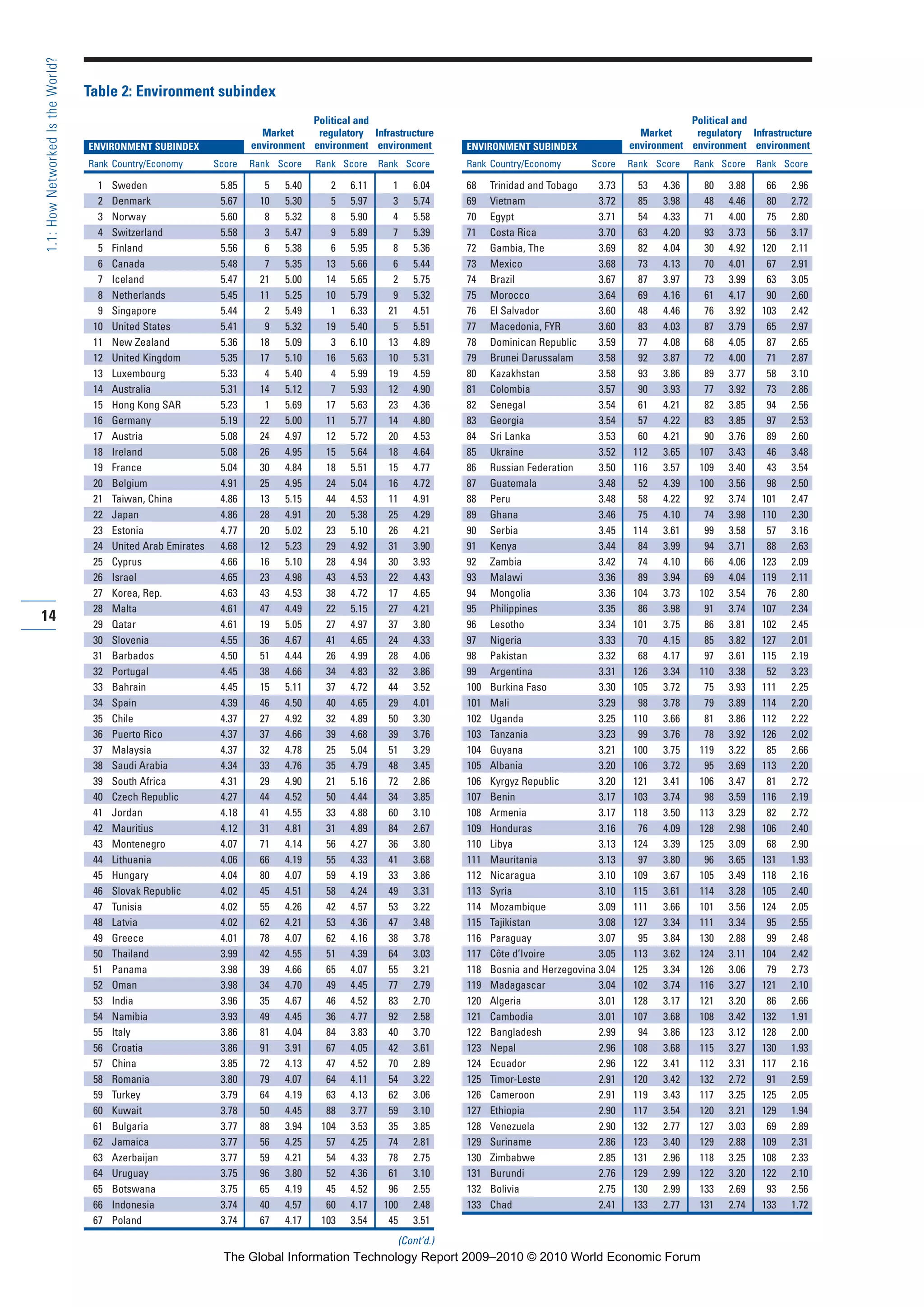
in the top 3, while Sweden ranks first in two
pillars and four times in the top 3. No other
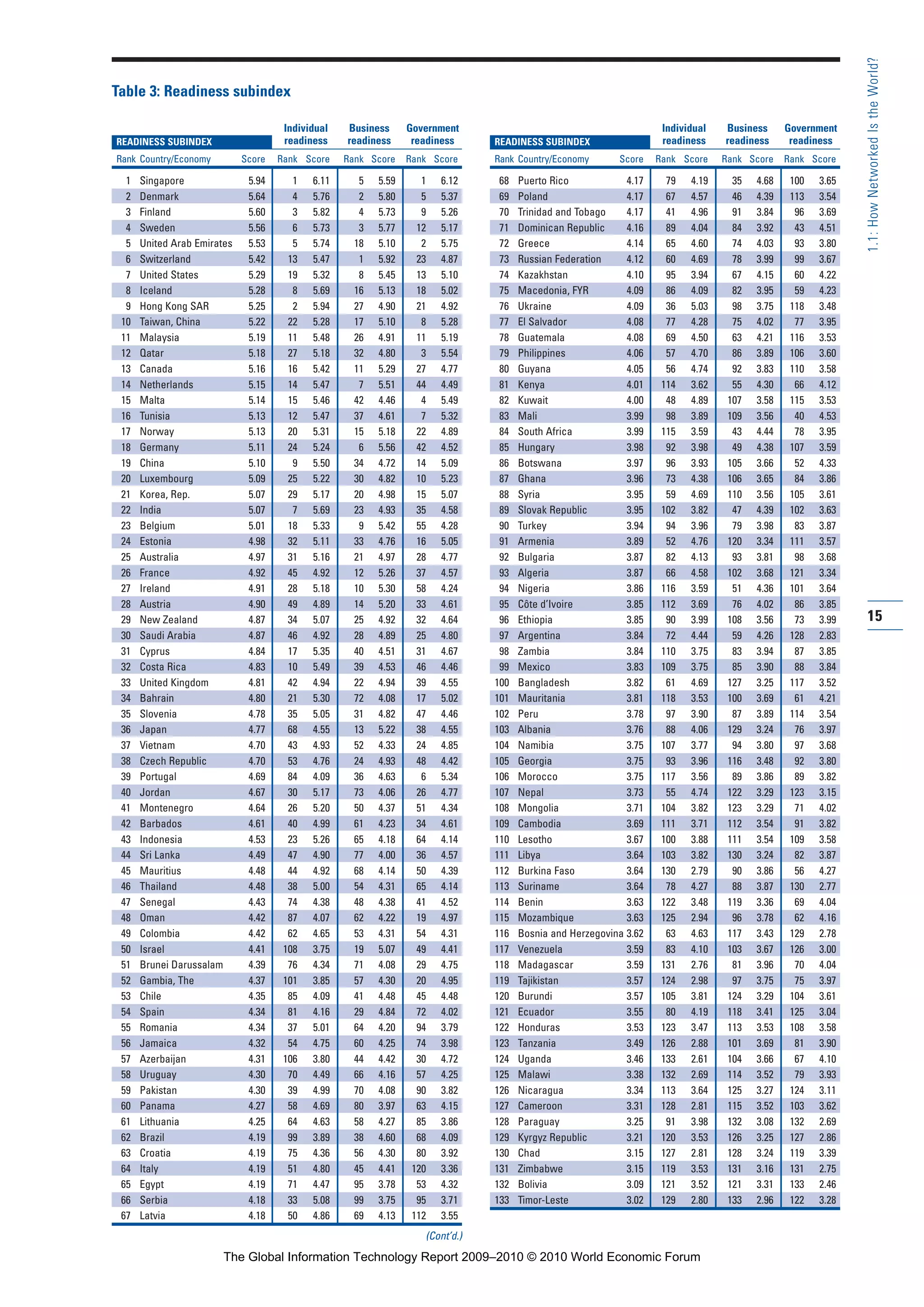
country tops more than one pillar.
3. Presence in the top 10 gives an indication of the
consistency and strength of a country’s perform-
17
1.1:HowNetworkedIstheWorld?
Part 1.r2 3/2/10 4:40 AM Page 17
The Global Information Technology Report 2009–2010 © 2010 World Economic Forum
ance. Singapore, Denmark and Finland appear
eight times in the top 10, Switzerland and
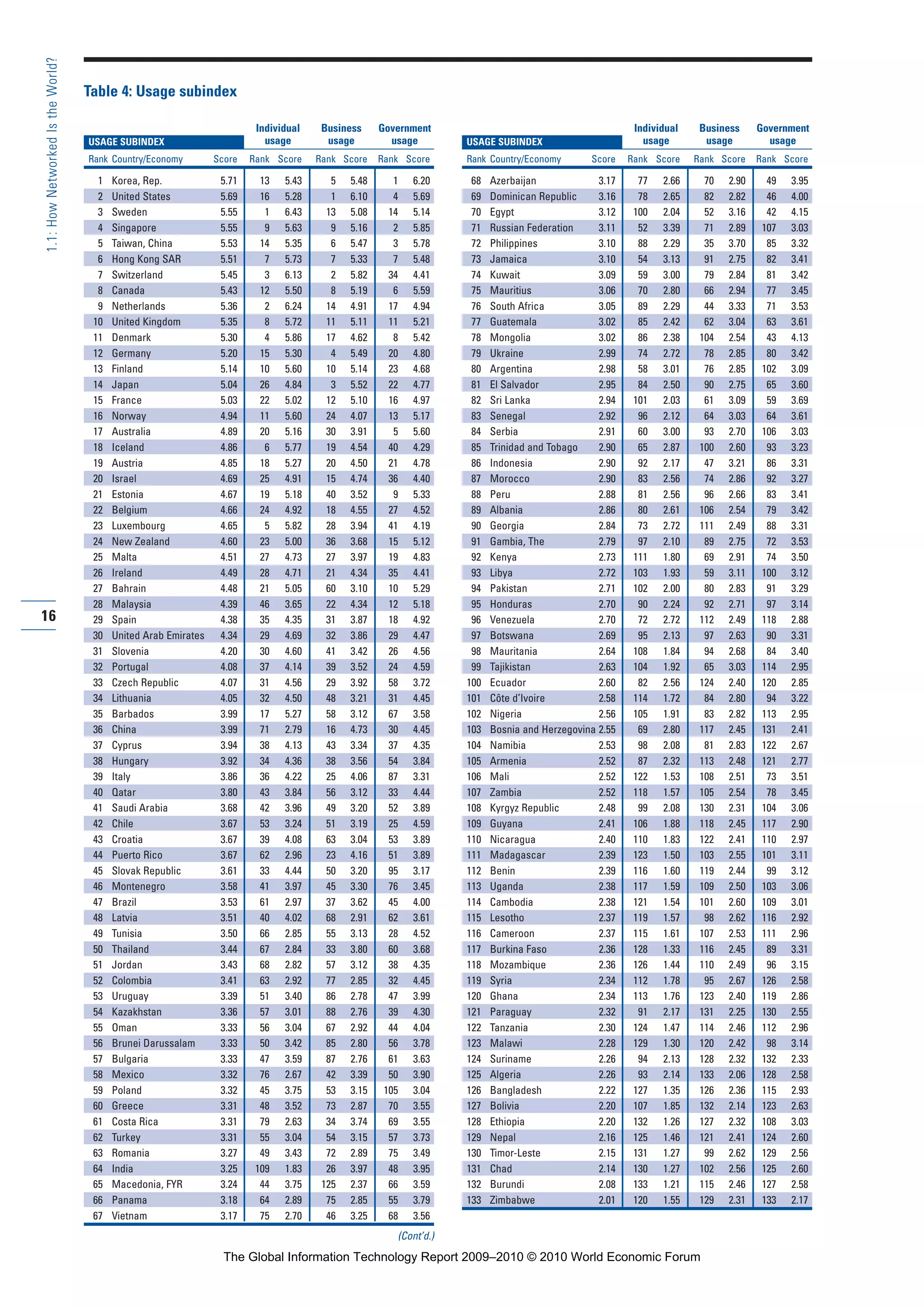
Sweden six times.
4. United Arab Emirates and Qatar, placing 2nd
and 3rd in government readiness, just behind
Singapore, are the two lowest-ranked countries
to appear in the top 3 of any pillar.
As shown in Table 6, in the nine editions of the
NRI, the top spot in the overall rankings has always
been occupied by a member of the current top 10.
Denmark and the United States each topped the rank-
ings three times. Sweden is the current leader, while
Finland and Singapore were number 1 in 2002–03 and
2004–05, respectively. In fact, since 2001–02, the top 3
places have been shared among just 11 countries.
Iceland is the only country outside the current top 10
that has ever been ranked among the top 3 (2nd in the
inaugural edition). Finally, Switzerland (4th) has realized
the most impressive progression over the years. Ranked
16th in 2001, the country has been a member of the
top 5 since 2006–07.
Box 3 presents the main findings of an analysis
across time aimed at identifying the countries that have
progressed the most in the nine years since the NRI’s
inception.
18
1.1:HowNetworkedIstheWorld?
Table 5: Composition of the top 3 by pillar and presence in the top 10
Political and No. of No. of
Overall Market regulatory Infrastructure Individual Business Government Individual Business Government times in times in
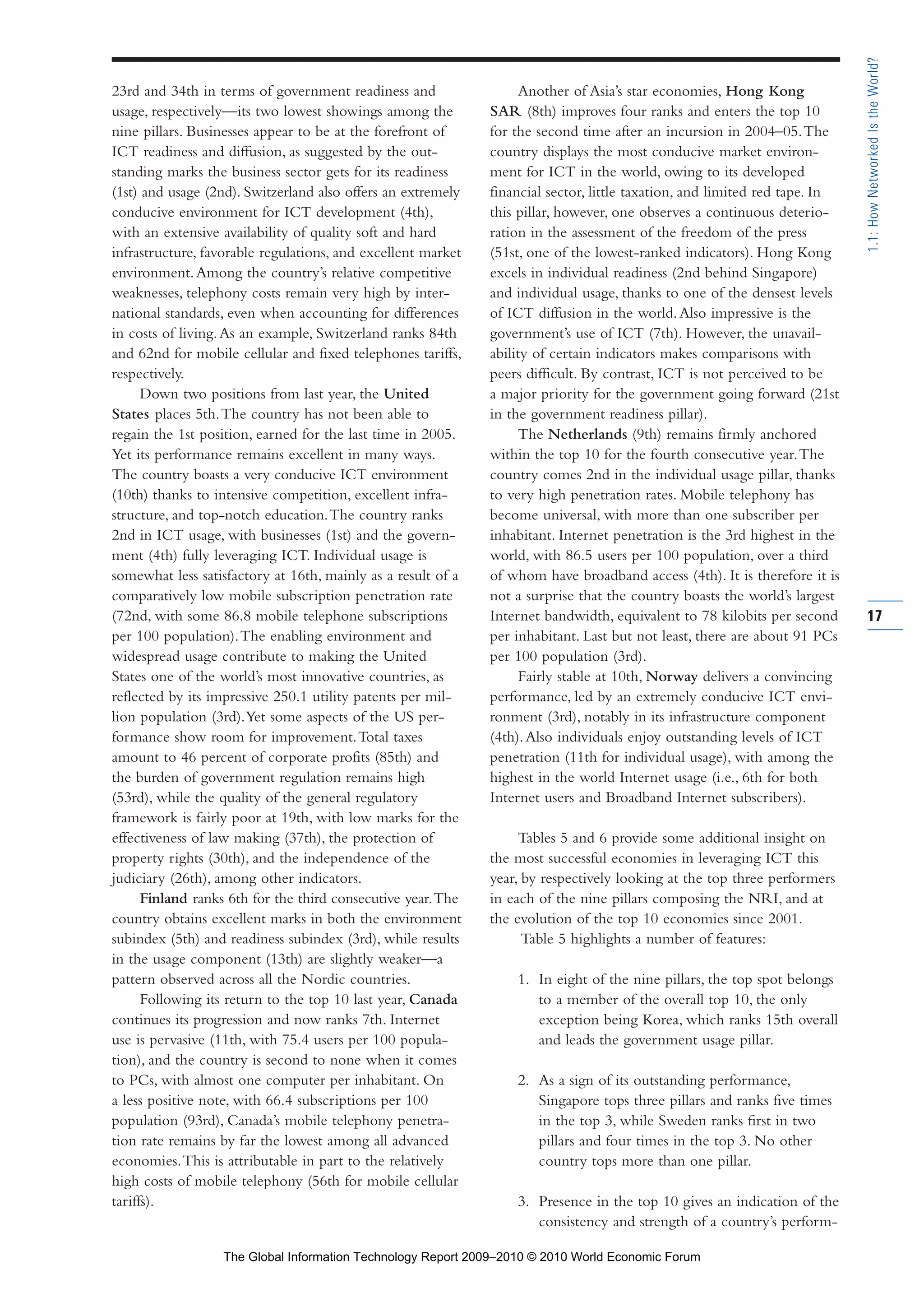
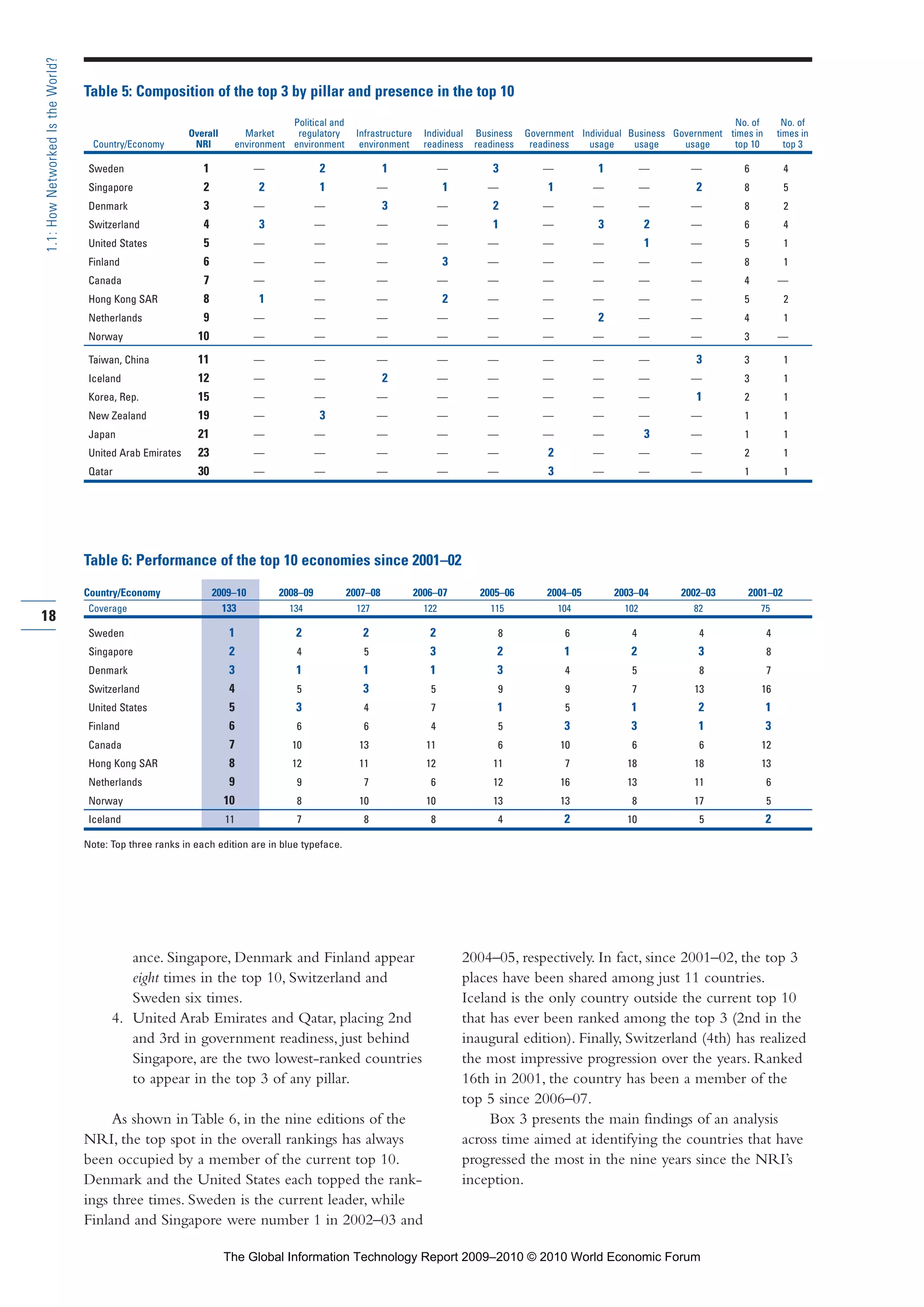
Country/Economy NRI environment environment environment readiness readiness readiness usage usage usage top 10 top 3
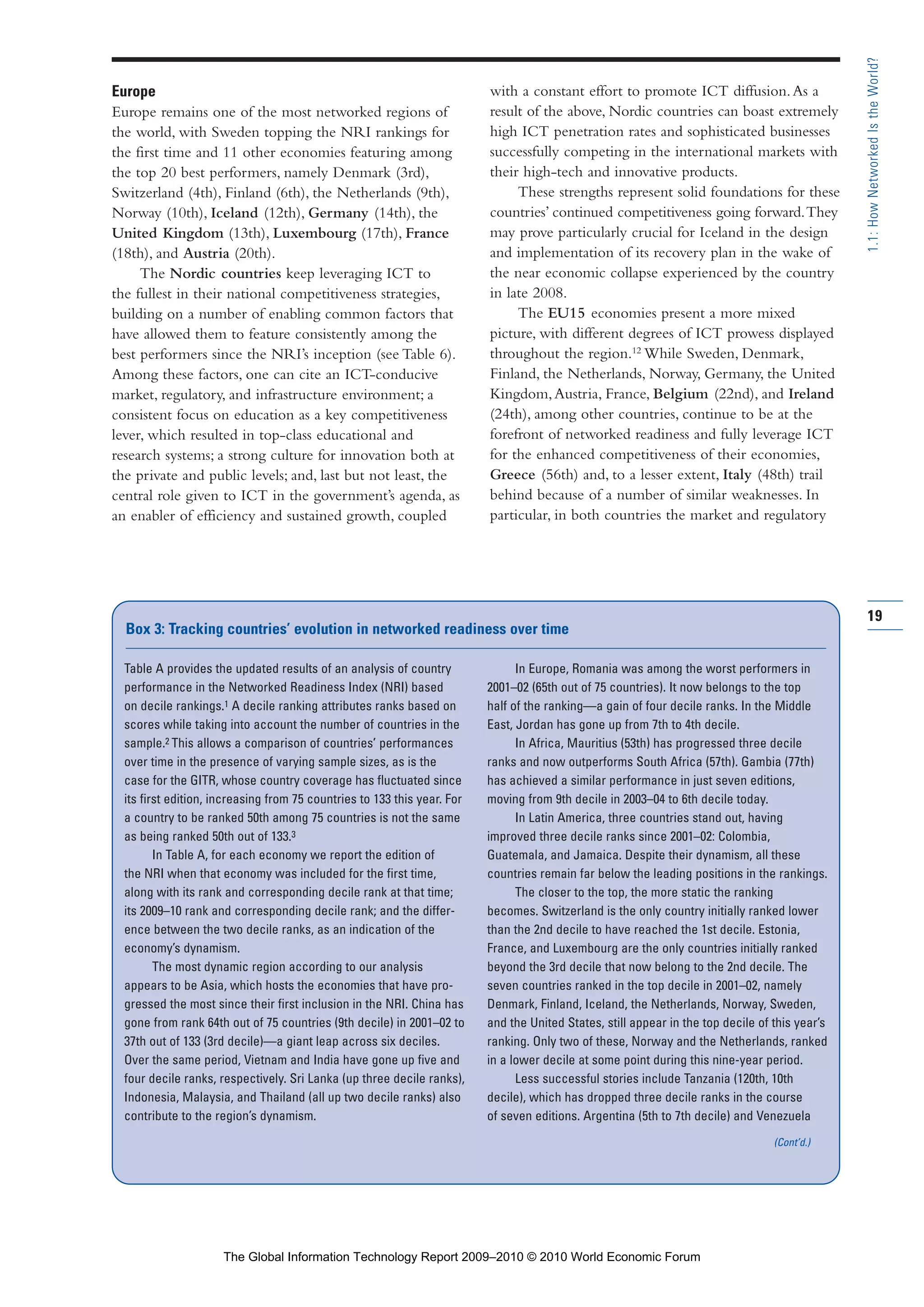
Sweden 1 — 2 1 — 3 — 1 — — 6 4
Singapore 2 2 1 — 1 — 1 — — 2 8 5
Denmark 3 — — 3 — 2 — — — — 8 2
Switzerland 4 3 — — — 1 — 3 2 — 6 4
United States 5 — — — — — — — 1 — 5 1
Finland 6 — — — 3 — — — — — 8 1
Canada 7 — — — — — — — — — 4 —
Hong Kong SAR 8 1 — — 2 — — — — — 5 2
Netherlands 9 — — — — — — 2 — — 4 1
Norway 10 — — — — — — — — — 3 —
Taiwan, China 11 — — — — — — — — 3 3 1
Iceland 12 — — 2 — — — — — — 3 1
Korea, Rep. 15 — — — — — — — — 1 2 1
New Zealand 19 — 3 — — — — — — — 1 1
Japan 21 — — — — — — — 3 — 1 1
United Arab Emirates 23 — — — — — 2 — — — 2 1
Qatar 30 — — — — — 3 — — — 1 1
Table 6: Performance of the top 10 economies since 2001–02
Country/Economy 2009–10 2008–09 2007–08 2006–07 2005–06 2004–05 2003–04 2002–03 2001–02
Coverage 133 134 127 122 115 104 102 82 75
Sweden 1 2 2 2 8 6 4 4 4
Singapore 2 4 5 3 2 1 2 3 8
Denmark 3 1 1 1 3 4 5 8 7
Switzerland 4 5 3 5 9 9 7 13 16
United States 5 3 4 7 1 5 1 2 1
Finland 6 6 6 4 5 3 3 1 3
Canada 7 10 13 11 6 10 6 6 12
Hong Kong SAR 8 12 11 12 11 7 18 18 13
Netherlands 9 9 7 6 12 16 13 11 6
Norway 10 8 10 10 13 13 8 17 5
Iceland 11 7 8 8 4 2 10 5 2
Note: Top three ranks in each edition are in blue typeface.
Part 1.r2 3/2/10 4:40 AM Page 18
The Global Information Technology Report 2009–2010 © 2010 World Economic Forum
Table A provides the updated results of an analysis of country
performance in the Networked Readiness Index (NRI) based
on decile rankings.1 A decile ranking attributes ranks based on
scores while taking into account the number of countries in the
sample.2 This allows a comparison of countries’ performances
over time in the presence of varying sample sizes, as is the
case for the GITR, whose country coverage has fluctuated since
its first edition, increasing from 75 countries to 133 this year. For
a country to be ranked 50th among 75 countries is not the same
as being ranked 50th out of 133.3
In Table A, for each economy we report the edition of
the NRI when that economy was included for the first time,
along with its rank and corresponding decile rank at that time;
its 2009–10 rank and corresponding decile rank; and the differ-
ence between the two decile ranks, as an indication of the
economy’s dynamism.
The most dynamic region according to our analysis
appears to be Asia, which hosts the economies that have pro-
gressed the most since their first inclusion in the NRI. China has
gone from rank 64th out of 75 countries (9th decile) in 2001–02 to
37th out of 133 (3rd decile)—a giant leap across six deciles.
Over the same period, Vietnam and India have gone up five and
four decile ranks, respectively. Sri Lanka (up three decile ranks),
Indonesia, Malaysia, and Thailand (all up two decile ranks) also
contribute to the region’s dynamism.
In Europe, Romania was among the worst performers in
2001–02 (65th out of 75 countries). It now belongs to the top
half of the ranking—a gain of four decile ranks. In the Middle
East, Jordan has gone up from 7th to 4th decile.
In Africa, Mauritius (53th) has progressed three decile
ranks and now outperforms South Africa (57th). Gambia (77th)
has achieved a similar performance in just seven editions,
moving from 9th decile in 2003–04 to 6th decile today.
In Latin America, three countries stand out, having
improved three decile ranks since 2001–02: Colombia,
Guatemala, and Jamaica. Despite their dynamism, all these
countries remain far below the leading positions in the rankings.
The closer to the top, the more static the ranking
becomes. Switzerland is the only country initially ranked lower
than the 2nd decile to have reached the 1st decile. Estonia,
France, and Luxembourg are the only countries initially ranked
beyond the 3rd decile that now belong to the 2nd decile. The
seven countries ranked in the top decile in 2001–02, namely
Denmark, Finland, Iceland, the Netherlands, Norway, Sweden,
and the United States, still appear in the top decile of this year’s
ranking. Only two of these, Norway and the Netherlands, ranked
in a lower decile at some point during this nine-year period.
Less successful stories include Tanzania (120th, 10th
decile), which has dropped three decile ranks in the course
of seven editions. Argentina (5th to 7th decile) and Venezuela
Box 3: Tracking countries’ evolution in networked readiness over time
Europe
Europe remains one of the most networked regions of
the world, with Sweden topping the NRI rankings for
the first time and 11 other economies featuring among
the top 20 best performers, namely Denmark (3rd),
Switzerland (4th), Finland (6th), the Netherlands (9th),
Norway (10th), Iceland (12th), Germany (14th), the
United Kingdom (13th), Luxembourg (17th), France
(18th), and Austria (20th).
The Nordic countries keep leveraging ICT to
the fullest in their national competitiveness strategies,
building on a number of enabling common factors that
have allowed them to feature consistently among the
best performers since the NRI’s inception (see Table 6).
Among these factors, one can cite an ICT-conducive
market, regulatory, and infrastructure environment; a
consistent focus on education as a key competitiveness
lever, which resulted in top-class educational and
research systems; a strong culture for innovation both at
the private and public levels; and, last but not least, the
central role given to ICT in the government’s agenda, as
an enabler of efficiency and sustained growth, coupled
with a constant effort to promote ICT diffusion.As a
result of the above, Nordic countries can boast extremely
high ICT penetration rates and sophisticated businesses
successfully competing in the international markets with
their high-tech and innovative products.
These strengths represent solid foundations for these
countries’ continued competitiveness going forward.They
may prove particularly crucial for Iceland in the design
and implementation of its recovery plan in the wake of
the near economic collapse experienced by the country
in late 2008.
The EU15 economies present a more mixed
picture, with different degrees of ICT prowess displayed
throughout the region.12
While Sweden, Denmark,
Finland, the Netherlands, Norway, Germany, the United
Kingdom,Austria, France, Belgium (22nd), and Ireland
(24th), among other countries, continue to be at the
forefront of networked readiness and fully leverage ICT
for the enhanced competitiveness of their economies,
Greece (56th) and, to a lesser extent, Italy (48th) trail
behind because of a number of similar weaknesses. In
particular, in both countries the market and regulatory
19
1.1:HowNetworkedIstheWorld?
(Cont’d.)
Part 1.r2 3/2/10 4:40 AM Page 19
The Global Information Technology Report 2009–2010 © 2010 World Economic Forum
20
1.1:HowNetworkedIstheWorld?
First inclusion NRI 2009–2010 Decile
Country Region* Edition Rank Decile Rank Decile diff.
Albania CEE 05–06 106 10 95 8 2
Algeria AF 03–04 87 9 113 9 —
Argentina WH 01–02 32 5 91 7 –2
Armenia CIS 05–06 86 8 101 8 —
Australia AE 01–02 14 2 16 2 —
Austria AE 01–02 9 2 20 2 —
Azerbaijan CIS 05–06 73 7 64 5 2
Bahrain ME 04–05 33 4 29 3 1
Bangladesh DA 01–02 73 10 118 9 1
Barbados WH 06–07 40 4 35 3 1
Belgium AE 01–02 18 3 22 2 1
Benin AF 05–06 108 10 111 9 1
Bolivia WH 01–02 67 9 131 10 –1
Bosnia and Herzegovina CEE 04–05 89 9 110 9 —
Botswana AF 02–03 44 6 86 7 –1
Brazil WH 01–02 38 6 61 5 1
Bulgaria CEE 01–02 53 8 71 6 2
Burkina Faso AF 06–07 99 9 108 9 —
Burundi AF 06–07 121 10 129 10 —
Cambodia DA 05–06 104 10 117 9 1
Cameroon AF 03–04 83 9 128 10 –1
Canada AE 01–02 12 2 7 1 1
Chad AF 03–04 102 10 133 10 —
Chile WH 01–02 34 5 40 4 1
China DA 01–02 64 9 37 3 6
Colombia WH 01–02 57 8 60 5 3
Costa Rica WH 01–02 45 6 49 4 2
Croatia CEE 02–03 48 6 51 4 2
Cyprus AE 04–05 37 4 32 3 1
Czech Republic CEE 01–02 28 4 36 3 1
Denmark AE 01–02 7 1 3 1 —
Dominican Republic WH 01–02 47 7 74 6 1
Ecuador WH 01–02 71 10 114 9 1
Egypt ME 01–02 60 8 70 6 2
El Salvador WH 01–02 55 8 81 7 1
Estonia CEE 01–02 23 4 25 2 2
Ethiopia AF 03–04 101 10 122 10 —
Finland AE 01–02 3 1 6 1 —
France AE 01–02 24 4 18 2 2
Gambia, The AF 03–04 82 9 77 6 3
Georgia CIS 04–05 91 9 93 7 2
Germany AE 01–02 17 3 14 2 1
Ghana AF 03–04 74 8 98 8 —
Greece AE 01–02 31 5 56 5 —
Guatemala WH 01–02 68 10 83 7 3
Guyana WH 05–06 111 10 100 8 2
Honduras WH 01–02 72 10 106 8 2
Hong Kong SAR AE 01–02 13 2 8 1 1
Hungary CEE 01–02 30 4 46 4 —
Iceland AE 01–02 2 1 12 1 —
India DA 01–02 54 8 43 4 4
Indonesia DA 01–02 59 8 67 6 2
Ireland AE 01–02 19 3 24 2 1
Israel AE 01–02 22 3 28 3 —
Italy AE 01–02 25 4 48 4 —
Jamaica WH 01–02 56 8 66 5 3
Japan AE 01–02 21 3 21 2 1
Jordan ME 01–02 49 7 44 4 3
Kazakhstan CIS 05–06 60 6 68 6 —
Kenya AF 03–04 84 9 90 7 2
Korea, Rep. AE 01–02 20 3 15 2 1
Kuwait ME 05–06 46 4 76 6 –2
Kyrgyz Republic CIS 05–06 103 9 123 10 –1
Latvia CEE 01–02 39 6 52 4 2
Lesotho AF 06–07 116 10 107 9 1
Libya ME 07–08 105 9 103 8 1
Lithuania CEE 01–02 42 6 41 4 2
First inclusion NRI 2009–2010 Decile
Country Region* Edition Rank Decile Rank Decile diff.
Luxembourg AE 02–03 27 4 17 2 2
Macedonia, FYR CEE 03–04 75 8 73 6 2
Madagascar AF 03–04 92 10 121 10 —
Malawi AF 04–05 93 9 119 9 —
Malaysia DA 01–02 36 5 27 3 2
Mali AF 03–04 96 10 96 8 2
Malta CEE 03–04 27 3 26 2 1
Mauritania AF 06–07 87 8 102 8 —
Mauritius AF 01–02 51 7 53 4 3
Mexico WH 01–02 44 6 78 6 —
Mongolia CIS 05–06 92 8 94 8 —
Morocco AF 02–03 52 7 88 7 —
Mozambique AF 03–04 97 10 116 9 1
Namibia AF 02–03 53 7 89 7 —
Nepal DA 06–07 108 9 124 10 –1
Netherlands AE 01–02 6 1 9 1 —
New Zealand AE 01–02 11 2 19 2 —
Nicaragua WH 01–02 69 10 125 10 —
Nigeria AF 01–02 75 10 99 8 2
Norway AE 01–02 5 1 10 1 —
Oman ME 07–08 53 5 50 4 1
Pakistan DA 03–04 76 8 87 7 1
Panama WH 01–02 48 7 58 5 2
Paraguay WH 01–02 63 9 127 10 –1
Peru WH 01–02 52 7 92 7 —
Philippines DA 01–02 58 8 85 7 1
Poland CEE 01–02 35 5 65 5 —
Portugal AE 01–02 27 4 33 3 1
Puerto Rico WH 07–08 39 4 45 4 —
Qatar ME 05–06 39 4 30 3 1
Romania CEE 01–02 65 9 59 5 4
Russian Federation CIS 01–02 61 9 80 7 2
Saudi Arabia ME 07–08 48 4 38 3 1
Senegal AF 03–04 81 8 75 6 2
Singapore AE 01–02 8 2 2 1 1
Slovak Republic CEE 01–02 33 5 55 5 —
Slovenia AE 01–02 29 4 31 3 1
South Africa AF 01–02 40 6 62 5 1
Spain AE 01–02 26 4 34 3 1
Sri Lanka DA 01–02 62 9 72 6 3
Suriname WH 06–07 110 10 126 10 —
Sweden AE 01–02 4 1 1 1 —
Switzerland AE 01–02 16 3 4 1 2
Syria ME 07–08 110 9 105 8 1
Taiwan, China AE 01–02 15 2 11 1 1
Tajikistan CIS 05–06 93 9 109 9 —
Tanzania AF 03–04 71 7 120 10 –3
Thailand DA 01–02 43 6 47 4 2
Trinidad and Tobago WH 01–02 46 7 79 6 1
Tunisia AF 02–03 34 5 39 3 2
Turkey CEE 01–02 41 6 69 6 —
Uganda AF 03–04 80 8 115 9 –1
Ukraine CIS 01–02 66 9 82 7 2
United Arab Emirates ME 04–05 23 3 23 2 1
United Kingdom AE 01–02 10 2 13 1 1
United States AE 01–02 1 1 5 1 —
Uruguay WH 01–02 37 5 57 5 —
Venezuela WH 01–02 50 7 112 9 –2
Vietnam DA 01–02 74 10 54 5 5
Zambia AF 03–04 85 9 97 8 1
Zimbabwe AF 01–02 70 10 132 10 —
Note: * Abbreviations: Advanced Economies (AE); Africa (AF); Central and
Eastern Europe (CEE); CIS and Mongolia (CIS); Middle East (ME); Western
Hemisphere (WH). See text for details. Countries added in, or after, the
2008–2009 edition are not reported.
Table A: Evolution in decile rankings since first inclusion
Part 1.r2 3/2/10 4:40 AM Page 20
The Global Information Technology Report 2009–2010 © 2010 World Economic Forum
environment does not seem to be very conducive to
ICT and innovation development,13
with little priority
given by the two governments to ICT usage and diffu-
sion in their overall strategy (93rd and 120th for gov-
ernment readiness and 70th and 87th for government
usage for Greece and Italy, respectively). Chapters 2.1
and 2.2, respectively, provide interesting accounts of
Spain (34th) and Ireland’s innovation and ICT diffusion
strategies of recent years.
Although losing some ground since last year
(down seven places), Estonia (25th) continues to lead
the EU accession 12,14
with a solid networked readi-
ness performance notwithstanding the economic turmoil
prompted by the recent major global economic crisis.
Since regaining independence in the early 1990s, Estonia
has successfully leveraged ICT, and its revolutionary
power, to transform itself into a very competitive and
networked market economy in less than two decades,
with top-class and widespread e-services for the benefit
of its citizens.This has been achieved thanks to a visionary
leadership and a consistent focus on innovation and ICT
penetration as key levers of the general competitiveness
strategy.15
Slovenia (31st), the Czech Republic (36th), and,
to a lesser extent, Lithuania (41st) follow closely, with
satisfactory levels of networked readiness. Poland (65th)
and Bulgaria (71st) remain the laggards in the region.
In particular, while Poland posts a remarkable four-
place improvement from last year, Bulgaria appears to
be losing some ground in networked readiness, with a
three-place fall from 2008–09.The country continues
to display important flaws in the quality of its market
(88th) and regulatory (104th) environment, high ICT
access costs (e.g., it is ranked 111th for its mobile tele-
phone tariffs), and inadequate ICT prioritization and
use by the government (98th and 61st for government
readiness and usage, respectively). Poland suffers from
similar weaknesses in its networked readiness landscape:
although ICT usage has registered an important improve-
ment (up 22 places), at 105th it remains disappointing,
while government readiness is poorly assessed at 113th.
Turkey continues the downward trend observed in
the last few years, with another eight-position drop to
69th place.The country can count on a fairly ICT
friendly environment (59th) and on moderately high
levels of ICT usage (62nd), especially by businesses (54th);
however, the overall readiness of the country remains
problematic at 90th, with especially low levels of indi-
vidual readiness (94th).A stronger government vision
and leadership in ICT diffusion would no doubt help
the country in regaining ground and better leverage ICT
for increased growth and development. Currently the
government gets rather low marks both for its readiness
(83rd) and use (57th).
Russia drops six positions to 80th place, with a
deteriorating performance especially in the environment
component (from 62nd in 2008–09 to 86th this year).
Russia’s showing appears quite mixed, with important
elements of strength not able to completely offset the
worrisome shortcomings highlighted by the NRI.A
fairly ICT-conducive infrastructure (43rd), supported by
good education and research bases and a fairly satisfacto-
ry individual readiness and usage (60th and 52nd), coex-
ists with a bleak market (116th) and regulatory (109th)
environment for ICT.There is also an almost nonexist-
ent focus on ICT in the government’s agenda, reflected
in particularly poor marks for government readiness and
usage (99th and 107th, respectively).
Asia and the Pacific
Home to two-thirds of the world’s population, the Asia
and Pacific region presents a very mixed picture in
terms of economic, political, and social performances.
This diversity is also reflected in the NRI assessment.
The region spans the entire rankings from second-best
Singapore to third-to-last Timor-Leste. It hosts some of
the most successful and most dynamic economies when
(7th to 9th) have both lost two decile positions since 2001–02.
Meanwhile, Greece and Italy, two EU members, have not
managed to improve by a single decile despite the nearly
twofold increase in country coverage.
Note
1 This analysis was conducted for the first time two years ago
and updated last year.
2 For each edition of the NRI, the overall ranking was divided into
10 segments called deciles, each with an equal count of ranks.
The 1st and 10th deciles comprise the economies that rank the
highest and the lowest, respectively. The 1st decile includes
ranks 1 through 6 in the 2001–02 edition, and ranks 1 through
13 in the 2009–10 edition. Similarly, the 10th decile includes
ranks 68 through 75 in 2001–02 and ranks 120 through 133 in
2009–10. Based on this approach, the 50th rank corresponds to
the 7th decile in 2001–02 and to the 4th decile in 2009–10.
3 The decile ranking approach presents one caveat: countries that
were included after the first edition of the NRI in 2001 are, in
majority, from the developing world. Admittedly, their perform-
ance tends to be worse than that of incumbent countries. This
means that it is enough for an incumbent country to maintain
its rank to automatically progress in the decile ranking.
However, there are several cases of incumbent countries losing
ground to incoming countries and, as a result, stagnating or
even dropping in the decile rankings, as detailed above.
Box 3: Tracking countries’ evolution in networked
readiness over time (cont’d.)
21
1.1:HowNetworkedIstheWorld?
Part 1.r2 3/2/10 4:40 AM Page 21
The Global Information Technology Report 2009–2010 © 2010 World Economic Forum
it comes to networked readiness. Singapore and Hong
Kong are top 10 regulars, with Taiwan not too far
behind. Malaysia (upper-middle income), China (lower-
middle income), andVietnam (low income) each top
their respective income group (see Box 2); China,
Vietnam, and India are also the countries progressing
the most in the NRI rankings since 2001 (see Box 3).
According to the ITU, in 2008 there were more mobile
phone subscriptions in China (641 million) than in
the entire European Union (609 million), while India
(347 million subscriptions) surpassed the United States
(271 million) in 2007, thanks to an annual growth of
65 percent in the past decade.
Following closely the best two performers in the
region Singapore (2nd) and Hong Kong (8th), Taiwan
(11th) posts a strong performance largely in line with
last year, with high ICT penetration rates—notably with
respect to PCs, with over 80 computers per 100 pop-
ulation (5th).Taiwan remains one of the world’s most
prolific innovators, achieving the highest number of
utility patents per million population (279.25) in the
world. Furthermore, nearly half of Taiwanese exports are
high-tech products.As in Singapore and Hong Kong,
the government has played a pivotal role in pushing the
ICT agenda.Taiwan ranks 8th in terms of government
readiness and 3rd for government usage. On a less posi-
tive note, its low rank in the political and regulatory
environment pillar (44th) is a concern:Taiwan ranks no
higher than 23rd on any of the nine indicators compos-
ing the pillar, and as low as 120th for the number of
procedures required to enforce a contract.
Korea drops four places to 15th, with a worsening
performance in most NRI indicators but nonetheless
a convincing showing.The country continues to display
outstanding levels of ICT usage by individuals (13th)
and businesses (5th). Dense penetration of mobile
telephony, Internet, and PCs; one of the world’s best
rates of patenting (155.97 per million population, corre-
sponding to a 5th rank); and high-tech exports (6th)
contribute to this excellent result. Last but not least,
the country tops the government usage pillar, with
the best-developed e-government services and most
extensive e-participation in the world according to the
United Nations. On the other hand, the environment
for ICT development is assessed comparatively poorly
at 29th, with particularly middling marks in its market
(43rd) and regulatory (38th) components.
Australia is fairly stable at 16th, with its best show-
ing in the market environment pillar (14th), thanks to
intense competition and ICT-friendly regulations, among
other indicators.The performance is more mixed when
it comes to individual (31st) and business (21st) readiness,
notably due to high telephony costs (76th and 82nd for
mobile cellular and fixed telephone tariffs, respectively).
On the other hand, business (30th) and, to a lesser
extent, individual (20th) usage could be improved.This
contrasts with the good results obtained in the govern-
ment usage pillar (5th).
Similar to neighboring Australia, New Zealand’s
good networked performance (19th) rests on the con-
duciveness of its environment for ICT (11th), although
the pillar’s overall rank conceals a very mixed assessment.
While variables such as ease of creating a business (1st),
contract enforcement, ICT regulations, judiciary inde-
pendence, and property rights get excellent marks (i.e.,
rank 15 or better), availability of financing, taxation, and
cluster development are assessed much more poorly.
Government usage is another area of strength at 15th,
with a remarkable 35-place leap in government success
in ICT promotion (59th), partly because of the high
priority given to ICT and innovation in the country’s
recent stimulus package.Among the relative weaknesses,
ICT readiness (29th) and usage (24th) show some margin
for improvement. In particular, the country’s readiness
is penalized by high residential monthly telephone sub-
scription (125th), mobile cellular tariffs (92nd), business
monthly telephone subscription (107th), limited govern-
ment procurements of advanced technology (57th), and
ICT focus in the government vision of the future (31st),
among other elements.
Despite losing some ground in networked readiness
this year, Japan (21st) remains one of the world’s most
innovative countries when measured in terms of utility
patents per million habitants (263.35, 2nd).The country’s
satisfactory performance is largely driven by its sophisti-
cated and innovative business sector, with world-class
clusters (1st) and intense business competition (8th).
Business readiness is excellent (13th) and business usage
outstanding (3rd). On the other hand, the government’s
showing appears much weaker. Public institutions are
perceived as lacking efficiency, the time to start a busi-
ness is lengthy and procedures numerous, and taxation is
high (105th), limiting the incentive to work and invest
(101st). Moreover, both government readiness (38th) and
usage (22nd) are fairly limited.Also undermining ICT
diffusion are the costly communication tariffs, notably
for mobile telephony (106th). If not addressed promptly,
these shortcomings may start hurting Japan’s capacity to
innovate going forward.
At 27th, Malaysia is the highest-ranked nation not
to belong to the group of high-income countries (see
Box 2).The government seems to be clearly leading the
way, with outstanding marks for its readiness (11th) and
usage (12th).These two results boost Malaysia’s showing
in the readiness component (11th) and government
usage pillar (12th). Malaysia posts a less convincing
showing in its infrastructure environment (51st) and its
level of individual usage (46th).
Leading the BRIC economies, China continues its
progression in the NRI rankings, leapfrogging another
nine places to 37th position.As mentioned in Box 3,
China is the country that has progressed the most since
2001–02. It also tops the lower-middle-income country
22
1.1:HowNetworkedIstheWorld?
Part 1.r2 3/2/10 4:40 AM Page 22
The Global Information Technology Report 2009–2010 © 2010 World Economic Forum
group, ahead of Tunisia and Jordan. It is interesting to
note that the gap among the BRIC economies in terms
of networked readiness seem to be widening,16
with 43
places now between China and lowest-ranked BRIC,
Russia (80th). China is the biggest exporter of products
from creative industries when measured as a share of
total world exports in these products (18.19 percent),
and a major exporter of high-tech products (27.62 of
GDP, 8th). Moreover, China ranks an impressive 9th in
the individual readiness pillar.Yet there remains consid-
erable room for improvement in a number of dimen-
sions, notably in the environment component (57th),
displaying overregulated markets, high taxation (123rd),
and poor financial market sophistication (78th), among
other indicators.Also key to ICT penetration and opti-
mal use, both hard and soft infrastructure (70th) suffers
from serious shortcomings.While it could do a lot more
to make the environment more ICT-conducive, the
government has declared ICT to be one of its priorities
and already makes extensive use of ICT. China ranks an
impressive 14th with respect to government readiness
and 30th for government usage. Chapter 2.4 explores
the sustainability of ICT development, focusing on the
Internet in particular, in the country.
Significant improvements across the board help in
lifting India’s position from 54th to 43rd. In particular,
India benefits from the new method of computing
telecommunication costs, which boosts the performance
in the Individual readiness pillar (7th). Business readiness
also remains high (23rd), and India has improved in the
market environment pillar (35th, up from 50th). However,
India is unlikely to pursue its fast-paced rise in the
rankings unless it addresses some critical shortcomings
having to do partly with the sheer size of its market.
Infrastructure at 83rd remains inadequate to support
optimal ICT usage in the country, notably given an
insufficient number of telephone lines (3.21 per 100
population, 106th), few secure Internet servers (98th),
poor Internet bandwidth (107th), and low tertiary
education enrollment rates (11.85 percent, 100th).This
is reflected in dismal ICT penetration rates (109th for
individual usage), notably for mobile telephony (29.36
per 100 population, 116th), PCs (3.18 per 100 popula-
tion, 93rd), Internet (4.38 per 100 population, 113th),
and broadband Internet (0.45 per 100 population, 96th).
Vietnam realizes a remarkable 16-place leap forward
to 54th rank, featuring for the first time in the top half
of the NRI rankings.Vietnam has advanced five decile
ranks since 2001–02. Compared with last year,Vietnam
improves in all nine pillars and on 45 of the 68 indica-
tors of the Index. Given its stage of development,
Vietnam’s performance in the readiness component
(37th) is quite remarkable.Vietnam ranks 24th in the
government readiness pillar, as a manifestation of the
government’s increasing focus on ICT. Over the last
decade, the government has prioritized and taken initia-
tives to boost the development of ICT, particularly in
software production, Internet infrastructure, IT education
promotion, and human resources development.Yet usage
by the government itself remains limited (68th).
Indonesia ranks 67th, significantly improving from
last year.Asia’s third-largest economy delivers a mixed
performance, with rankings in the different pillars ranging
from a 23rd place in individual readiness to a mediocre
100th position in the infrastructure environment.
Sri Lanka (72nd, unchanged), the Philippines
(85th, unchanged), and Mongolia (94th, down one)
deliver performances in line with last year, while Pakistan
(87th) improves by some 11 places. Bangladesh (118th)
and Timor-Leste (130th), at the bottom of the rank-
ings, continue to lag the rest of the region by a wide
margin.
Within the Commonwealth of Independent
States (CIS), Azerbaijan (64th) leads the way. It is now
the only CIS member in the top half of the overall NRI
rankings. Kazakhstan (68th), up five positions,
follows closely. Russia (80th, see the Europe section)
and Ukraine (82nd), once a CIS frontrunner, both
drop significantly, allowing Armenia (101st) to narrow
the gap. Kyrgyz Republic falls eight places from last
year, and at 123rd is now among the worst performers,
while former CIS member Georgia ranks 93rd.
Latin America and the Caribbean
Similar to previous years, the networked readiness land-
scape of Latin America and the Caribbean, as assessed by
the NRI, appears fairly varied, with a number of countries
leveraging the latest ICT advances and consolidating
progress in that direction, while others are progressing
less. Moreover, the region’s networked readiness shows
a large margin for improvement if it is to catch up with
best practices elsewhere: no Latin American or Caribbean
economy features in the top 20 and only four are to be
found in the top 50, namely Barbados (35th), Chile
(40th), Puerto Rico (45th), and Costa Rica (49th).
The tiny Caribbean island of Barbados, at 35th,
leads the region for the second year consecutively, after
having overtaken long-standing best performer Chile
in 2008–09.Among the country’s many competitive
advantages, one can cite its ICT-friendly environment
(31st), notably in its regulatory (26th) and infrastructure
(28th) components, coupled with remarkable levels of
individual usage (17th) and, to a lesser extent, readiness
(40th).Also ICT seems to be moving increasingly to
the heart of the government’s agenda and vision for
future competitiveness: Barbados not only ranks 34th
for government readiness, but the assessment for govern-
ment usage has been substantially improving over the
past two years, moving up from 87th in 2007–08 to 67th
this year. On a less positive note, businesses continue to
be the weakest link among the three stakeholders, with
relatively poor levels of preparation (61st for business
readiness) and ICT usage (58th). In particular, there are
23
1.1:HowNetworkedIstheWorld?
Part 1.r2 3/2/10 4:40 AM Page 23
The Global Information Technology Report 2009–2010 © 2010 World Economic Forum
large margins for improvement in companies’ investment
in R&D (67th) and innovation potential (90th for utility
patents and 83rd for creative industry exports).
Chile is fairly stable at 40th, confirming its ICT
prowess in the region, especially for factors that relate
to government readiness (45th) and usage (25th). ICT
diffusion has been consistently prioritized by the gov-
ernment over the last 15 years or so, with an extremely
ICT-conducive market and regulatory environment (27th
and 32nd, respectively) and the adoption and successful
implementation of one of the first digital agendas in
the region, resulting in first-class e-government services
(18th), among other features.17
However, the country’s
individual readiness remains a problem at 85th, because
of the quality of the educational system, notably in math
and science (116th), coupled with high access costs for
fixed lines (94th and 127th for residential telephone
connection charges and residential monthly telephone
subscription charges, respectively, and 78th for fixed
telephone lines tariffs), broadband (85th for fixed broad-
band tariffs), and, to a lesser extent, mobile telephony
(68th for mobile cellular tariffs).
Puerto Rico follows at 45th, with strong competi-
tive strengths in the quality of its environment (36th) as
well as in the readiness (35th) and usage (23rd) of its
sophisticated business sector. Indeed, businesses seem the
stakeholder leveraging ICT advances the most in the
island, more than individuals (79th and 62nd for their
readiness and usage, respectively) and the government
(100th and 51st for its readiness and usage, respectively).
In particular, the apparent lack of focus on ICT in the
government agenda (102nd for government prioritiza-
tion of ICT and 108th for the importance of ICT in
the government vision of the future) is a reason for
concern going forward.
Costa Rica continues the upward trend it started
in 2007–08, climbing another seven places to 49th, with
improvements across the board (10, 7, and 10 places up
in the environment (71st), readiness (32nd), and usage
(61st) subindexes, respectively).The country’s networked
readiness rests on a remarkable propensity to use ICT by
all national stakeholders (10th, 39th, and 46th for indi-
vidual, businesses, and government, respectively) together
with satisfactory levels of business usage (34th). Moreover,
the government appears to be placing increasing impor-
tance on ICT diffusion in its national strategy and using
ICT more efficiently, as confirmed by the improving
marks for government readiness over the last two years
(from 66th in 2007–08 to 46th this year). However, the
environment (71st), notably in its regulatory component
(93rd), together with individual and government usage
(79th and 69th, respectively) continue to be shortcomings
toward a broader ICT use by all Costa Ricans.
Brazil’s performance is fairly unchanged at 61st this
year, with a solid showing driven mainly by businesses
and the government. Both stakeholders display rather
satisfactory levels of ICT readiness (38th and 68th for
business and government readiness, respectively) and use
ICT extensively in their transactions, operations, and
service provision (37th and 45th for business and gov-
ernment usage, respectively).The business sector is at the
forefront of leveraging ICT advances (26th for extent of
business Internet use, among other indicators), thanks to
its R&D investment (29th for company spending on
R&D) and innovation potential (28th for capacity of
innovation), among other factors. Brazil is also home of
some of the most efficient and advanced e-government
services worldwide (53rd for the development of gov-
ernment online services).18
On the other hand, Brazil’s
market (87th) and regulatory (73rd) environment needs
to be upgraded and made friendlier to ICT by reducing
red tape and improving intellectual property protection
as well as educational and training standards.The poor
quality of the educational system (123rd), notably in math
and science (103rd), coupled with the high cost of access
to ICT (e.g., Brazil ranks 118th for mobile telephone
tariffs) reflect in the country’s low levels of individual
readiness (99th) and in middling ICT penetration (61st
for individual usage).
Uruguay moves up eight positions to 57th, with
relevant advances across the board—9, 3, and 11 places
up respectively in the environment (64th), readiness
(58th), and usage (53rd) components. Despite a poor
market environment (96th) and inadequate business
usage (86th), the country can count on a fairly ICT-
conducive regulatory and infrastructure environment
(52nd and 61st, respectively), on a government with a
clear vision on the importance of ICT for overall com-
petitiveness (39th for government prioritization of
ICT), and on relatively high levels of ICT penetration
in civil society (51st for individual usage). In particular,
government readiness is ranked a rather satisfactory
57th, improving 11 places from 2007–08. Uruguayan
authorities have become more and more aware of the
key role ICT can play in improving service provision
and overall competitiveness.A good example of this is
the country’s Education Connect initiative, by which
the government provided every single schoolchild in
the country with a “One Laptop per Child” computer
and distributed 18,000 computers to teachers across the
country by late 2009.This initiative aims at dramatically
improving traditional, computer, and Internet literacy rates
as well as educational standards, ultimately contributing
to a more competitive economy.19
Panama (58th), Colombia (60th), and Jamaica
(66th) follow closely, with Panama and Colombia
notably posting promising eight- and four-place
improvements, respectively, from last year.
Losing further ground from last year (down 11
places), Mexico, at 78th, continues to suffer from a
number of flaws obstructing a more comprehensive use
of technology for increased competitiveness.Among
these, one can cite the country’s overregulated markets
and poor regulatory (70th) and infrastructure (67th)
24
1.1:HowNetworkedIstheWorld?
Part 1.r2 3/2/10 4:40 AM Page 24
The Global Information Technology Report 2009–2010 © 2010 World Economic Forum
environments and its weak educational standards (127th
for the quality of science and math education and 115th
for the quality of the educational system), which,
together with high ICT access costs, translate into inad-
equate levels of individual readiness (109th) and usage
(76th). On a more positive note, business usage is rather
satisfactory (42nd), and the government displays a satisfac-
tory degree of ICT usage (50th), also providing citizens
with well-developed e-government services (38th),
among other factors.
Argentina drops four places to 91st, with a mixed
assessment pointing to important competitive strengths
that do not seem to fully compensate for the elements
of weaknesses still troubling the country.With respect to
the former,Argentina can count on a rather conducive
infrastructure environment (52nd) and good levels of
business readiness (59th) and individual usage (58th).
However, the serious flaws in the market (126th) and
regulatory (110th) environments and the low prioritiza-
tion of ICT in the government’s national agenda (128th
and 102nd for government readiness and usage, respec-
tively) remain worrisome features in the country’s net-
worked readiness landscape.
Honduras (106th), Venezuela (112th), Ecuador
(114th), Nicaragua (125th), Paraguay (127th), and
Bolivia (131st) close the rankings for the region.These
countries continue to lag behind the best regional
performers, as well as most of the world, in networked
readiness. Overregulated markets, poor education and
research standards, and high ICT access costs are some
of the shortcomings preventing these countries from
increasingly leveraging ICT in their general competi-
tiveness and development strategies.
Sub-Saharan Africa and Middle East and North Africa
(MENA)
As in past editions of the Report, most of the countries
in sub-Saharan Africa trail behind the rest of the world
in network readiness, with only Mauritius (53rd) and
South Africa (62nd) featuring in the top half of the
NRI rankings. Indeed, although some countries realize
encouraging improvements over last year, most of the
region continues to appear in the bottom part of the
rankings.
With a fairly stable 53rd rank, Mauritius confirms
its ICT prowess and leadership in the region.The
country displays a first-class market environment (31st)
characterized by a non-distortive tax system (6th for
the extent and effect of taxation) and ease for starting
a business, with an average of six days (12th) and five
procedures (22nd).The political and regulatory environ-
ment (31st) is also assessed as being conducive to ICT
development, with favorable laws relating to ICT (52nd)
and a high level of competition (1st) among Internet
and telephony providers.With regard to ICT usage, the
three main stakeholders show an even performance
(70th for individuals, 66th for business, and 77th for
government), with margin for improvement. However,
ICT technologies are prioritized to a large extent by
the government (26th), which identifies them as an
important factor for its vision of the future (53rd).
Furthermore, the country’s individual and government
readiness are also satisfactory, ranking 44th and 50th,
respectively. On a more negative note, the infrastructure
environment (84th) remains a reason for concern, espe-
cially in elements such as the accessibility to digital con-
tent (80th), the availability of scientists and engineers
(107th), and tertiary education enrollment (97th, corre-
sponding to a dismal 13.96 percent).
South Africa seems to be losing some ground
this year, dropping 10 places to 62nd.The environment
component (39th) continues to be one of the main
strengths of the country, particularly in its regulatory
(21st) and market (29th) components, thanks to strong
intellectual property protection (24th), favorable laws
relating to ICT (31st), and world-class financial market
sophistication (6th), among other elements. Despite the
weak individual preparation and uptake of ICT (115th
and 89th for individual readiness and usage, respectively),
South Africa’s remarkable business readiness (43rd) ben-
efits from extensive company spending on R&D (35th)
and close university-industry collaboration (25th).
Likewise, business usage is rather extensive (44th) with
a remarkable prevalence of foreign technology licensing
(22nd) and technology absorption (33rd) as well as
capacity for innovation (36th).As for the government,
if its prioritization of ICT is still low (78th), its ICT
usage appears slightly better (71st), with fairly extensive
e-participation (60th) and presence of ICT in public
offices (52nd).
Senegal is up five positions to 75th, placing above
Botswana (86th) and Nigeria (99th).The country’s
main competitive advantages are to be found in its over-
all readiness (47th) and in its business and government
usage, both ranked 64th.
The rest of the region lags behind at the bottom of
the rankings, with some mixed developments with respect
to last year’s performance.Although a few countries
seem to have strengthened their networked readiness,
notably Kenya (90th, up seven positions), Zambia (97th,
up five positions), Lesotho (107th, up 11 positions), Côte
d’Ivoire (104th, up seven positions), some others are sta-
ble or have lost further ground vis-à-vis the rest of the
world. Malawi (119th, down nine positions),
Madagascar (121st, down nine places), and Cameroon
(128th, down five places) belong to this latter category.
At 39th, Tunisia once again leads North Africa, with
a slightly weaker showing than last year.The country’s
outstanding individual readiness (12th) is driven by low
residential connection telephone charges and monthly
telephone subscription, ranked 18th and 6th, respectively.
On a similar note, ICT seems to have a central role in
the government agenda (7th for government readiness),
25
1.1:HowNetworkedIstheWorld?
Part 1.r2 3/2/10 4:40 AM Page 25
The Global Information Technology Report 2009–2010 © 2010 World Economic Forum
as confirmed by the top-class marks obtained by the
country in ICT prioritization (7th).This translates into
extensive government usage (28th) with a high degree
of success in ICT promotion (6th) and well-developed
e-government services (29th), among other factors.
Chapter 2.3 relates the steps and policies that the
Tunisian government implemented to boost the coun-
try’s networked readiness and overall competitiveness in
recent years.
With the exception of Egypt, improving six posi-
tions from 76th to 70th, all other countries in the region
either remain rather stable or fall in the rankings.This
is the case for Libya dropping from 101st to 103rd,
Morocco going from 86th to 88th, and Algeria from
108th to 113th.
On a more positive note, by and large the Middle
East continues to progress in networked readiness,
reflecting the accelerated ICT uptake by most countries
in the region and their increasing prioritization of ICT
as a key tool for economic diversification, increased
competitiveness, and modernization.
The United Arab Emirates improves four positions
to 23rd place, overtaking for the first time traditional
best regional performer Israel (28th).The country’s
impressive performance in recent years has been driven
by a strong and consistent government focus on ICT
(2nd and 29th for government readiness and usage,
respectively) as a key factor for its vision for the future
(2nd).The government has not only been quite success-
ful in promoting ICT diffusion (2nd), but is widely using
it to improve its efficiency (2nd), albeit government
online services and e-participation remain low (91st
and 77th, respectively).Among the country’s many
other strengths, one can cite its outstanding individual
preparation and ICT usage (5th and 29th, respectively)
together with its ICT-conducive market environment
(12th).
Israel drops three positions to 28th place, losing its
supremacy in the region for the first time since the NRI’s
inception. Notwithstanding this slightly deteriorating
performance, Israel continues to display extremely con-
ducive market (23rd) and infrastructure (22th) environ-
ments, notably with widespread availability of venture
capital (14th), top-class scientific research institutions
(3rd), and an extensive availability of scientists and engi-
neers (16th). Moreover, the business sector remains at
the forefront of ICT readiness (19th) and usage (25th),
displaying an outstanding innovation potential, with
excellent marks for utility patents (4th, corresponding
to 166.57 patents per million inhabitants) as well as
creative industry and high-tech exports (36th and 35th,
respectively).The above confirms the country’s role as
one of the world’s ICT powerhouses, the result of a
coherent and effective government development strategy
that turned resource-poor small Israel into a global ICT
player in less than three decades.20
By contrast, govern-
ment readiness (49th, down 33 places) and usage (36th,
down 12 places) seem to be weakening from 2008–09.
The same can be said for individual readiness (108th),
with, in particular, a significantly worsening perception
of the quality of math and science education (103rd,
down 37 places) and of the general educational system
(98th, down 53 places).
Bahrain (29th) consolidates the impressive upward
trend started last year, with another eight-place improve-
ment and a performance driven by an extremely ICT-
and business-friendly market environment (15th) and
high individual readiness (21st), as well as outstanding
government readiness (17th) and usage (10th), including
top-class e-government services (8th) and widespread
e-participation (11th).
Qatar’s rank is fairly unchanged at 30th. Similar to
the United Arab Emirates, the country’s remarkable ICT
prowess rests on the government’s effective leadership
in ICT diffusion as a central enabler of enhanced com-
petitiveness. Government readiness and usage are ranked
3rd and 33rd, respectively. Strong ICT prioritization (3rd),
as a central element of the vision for the future (5th),
has promoted ICT diffusion (4th) and significantly
improved government efficiency (3rd), among other
indicators.Also notable is the degree of individual readi-
ness (27th) and usage (43rd), with more than universal
mobile telephone access (16th, corresponding to 131.39
per 100 people), comprehensive Internet access in
schools (15th), and top-quality math and science educa-
tion (3rd).
While Oman is stable at 50th, Saudi Arabia moves
up two places to 38th, building on its impressive eight-
place jump from 2007–08 to 2008–09, with important
improvements in individual readiness (46th, up 33 places)
and, to a lesser extent, in the market (33rd, up five places)
and regulatory (35th, up seven places) environments.
On a more negative note, Kuwait (76th) and Syria
(105th) lose 19 and 11 positions, respectively, this year.
Conclusions
The recent major economic crisis has underlined the
importance of solid competitiveness fundamentals for
countries to grow in a sustainable manner going
forward.The capacity to adopt and pioneer new tech-
nologies—among them ICT—has proven to be key
for developed economies to maintain their competitive
edge and support their growth potential in the long
term, as well as for middle-income and developing
countries to ease structural transformations in their
economies and societies, increase efficiency, and leapfrog
to higher development stages. ICT is crucial in promot-
ing economic sustainability.The same is true for social and
environmental sustainability: ICT has a major responsi-
bility and role to play in this arena, both as an industry
in itself and as an enabling infrastructure.
More and more governments across the globe have
recognized the revolutionary power of ICT as a driver
26
1.1:HowNetworkedIstheWorld?
Part 1.r2 3/2/10 4:40 AM Page 26
The Global Information Technology Report 2009–2010 © 2010 World Economic Forum
of sustainable economic growth and an enabler of better
living conditions for their citizens.They have increasing-
ly put ICT in a prominent position in their general
competitiveness strategies and national agendas.
The GITR series and the NRI have contributed
over almost a decade to raising awareness about the
importance of ICT as a central tool in the design of
policies aimed at increasing development and competi-
tiveness. Not only has the NRI allowed countries to
track
their improvements in networked readiness over time,
but it has also provided diagnostics on weaknesses to be
addressed and strengths on which to build. Furthermore,
the showcasing of best practices at the international level
has offered additional insights into the determinants of
networked readiness as well as relevant examples to emu-
late in the development of national roadmaps toward
increased growth and competitiveness.
We are proud of the guidance that the NRI and
the Report series may have offered to decision makers
and all relevant stakeholders across the world.We hope
this year’s edition will once again provide a useful
instrument and will contribute to focusing attention on
the important role of ICT in building a better, fairer,
and more sustainable world.
Notes
1 IMF 2009.
2 Jiménez 2010.
3 This statement has a caveat: the NRI used in the first 2001–02
edition of the Report is not strictly comparable with the one
developed by INSEAD in 2002, which has been used since then
as the main methodological framework in the GITR series. For
more information on the 2001–02 theoretical framework, see
Kirkman et al. 2002.
4 For a detailed review of the literature and thinking behind the
Networked Readiness framework developed by INSEAD and
introduced in 2002–03, see Dutta and Jain 2003.
5 Until 2005–06, NRI variables were selected using factor analytical
techniques from a larger set of possible variables. Although this
was a technically rigorous approach, it reduced the ability to easily
explain the underlying logic for including specific variables and to
make strict comparisons over time. As a consequence, starting
with the 2006–07 edition, expert opinion has played a predomi-
nant role in selecting the variables, obviously with the benefit of
previous experience in identifying appropriate variables for com-
puting the NRI, thus aligning the NRI’s to the Forum’s general
competitiveness methodology. The treatment of missing variables
has also changed: whereas until 2005–06, they were estimated
using analytical techniques such as regression and clustering,
beginning in 2006–07 they are indicated with “n/a” and not taken
in consideration in the calculation of the specific pillar to which
they belong. Moreover, the scale used to compute the NRI and
the variables that compose it has been aligned to the Forum’s
(increasing) 1–7 scale, changing with respect to the scale used
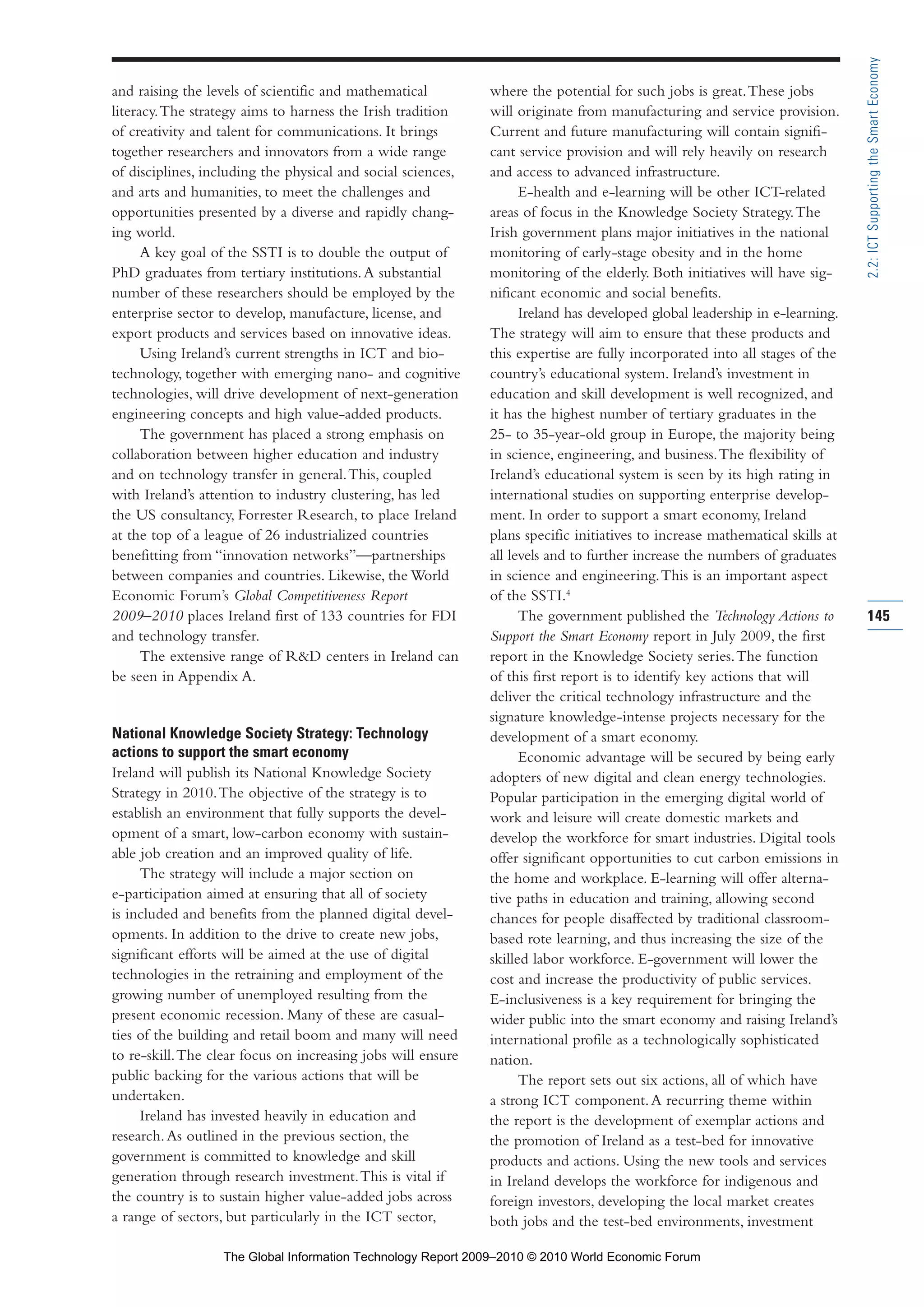
previously for a couple of years (i.e., positive and negative scores
around a standardized mean of 0). For more information on the
earlier computation methodology and changes introduced in
2006–07, see Dutta and Jain 2006 and Mia and Dutta 2007.
6 See EFQM at http://ww1.efqm.org/en/Home/aboutEFQM/
Ourmodels/TheEFQMExcellenceModel/tabid/170/Default.aspx.
7 The NRI 2009–2010 uses the results of the 2008 and 2009
Surveys. For more details on the Survey methodology, see
Browne and Geiger 2009.
8 North America as a region is not dealt with as such in this chapter.
The United States’ and Canada’s performances are detailed in the
top 10 section, and Mexico is included for analysis purposes in
the Latin America and the Caribbean section.
9 This is shown by the excellent marks the country gets for the
variables related to innovation capacity: Sweden ranks 4th for
the capacity of innovation of its firms, generates 115.22 utility
patents per million population (8th), accounts for 1.21 percent of
total world creative industries (18th), and 11.94 percent of its total
exports are high-tech products (24th).
10 For a more detailed analysis of Singapore’s ICT success story, see
Ng et al. 2008.
11 The Danish government’s focus on ICT is reflected in the early
liberalization of the telecommunications sector in 1996, well
ahead of most of its fellow members of the European Union.
This also contributed to the development of a world-class local
high-tech industry, whose exports accounted in 2007 for 11.20
percent of total exports, corresponding to 26th place.
12 The EU15 comprises the countries that joined the European
Union before the last two accession rounds in 2004 and 2007:
Austria, Belgium, Denmark, Finland, France, Germany, Greece,
Ireland, Italy, Luxembourg, the Netherlands, Portugal, Spain,
Sweden, and the United Kingdom.
13 Italy and Greece rank 78th and 81st, respectively, for the quality
of their market environment and 62nd and 84th for that of their
political and regulatory environments.
14 The EU accession countries are Bulgaria, the Czech Republic,
Cyprus, Estonia, Hungary, Latvia, Lithuania, Malta, Poland,
Romania, the Slovak Republic, and Slovenia.
15 For a more in-depth analysis of Estonia’s recent development
story and the role of ICT, see Dutta 2007.
16 A similar trend, though not as pronounced, is observed in our
general assessment of competitiveness. In the Global
Competitiveness Index 2009–2010, China ranks 29th, India
49th, Brazil 56th, and Russia 63rd. For more information, see
Sala-í-Martin et al. 2009.
17 For a full account of Chile’s ICT strategy, see Alvarez Voullième
et al. 2005.
18 For a detailed overview of Brazil’s recent achievements in terms
of e-government services and strategy going forward in that area,
see Magalhães et al. 2009.
19 See http://uruguay.suite101.com/article.cfm/uruguay_one_laptop_
per_child for more information on the Education Connect initiative.
20 For an overview of Israel’s recent development story, see Lopez-
Claros and Mia 2006.
References
Al-Jaber H. and S. Dutta. 2008. “Qatar: Leveraging Technology to
Create a Knowledge-Based Economy in the Middle East.” The
Global Information Technology Report 2007–2008. Hampshire:
Palgrave McMillan. 133–144.
Alvarez Voullième, C., C. Capdevila de la Cerda, F. Flores Labra, A.
Foxley Rioseco, and A. Navarro Haeussler. 2005. “Information
and Communication Technologies in Chile: Past Efforts, Future
Challenges.” The Global Information Technology Report
2005–2006. Hampshire: Palgrave Macmillan. 71–88.
Browne, C. and T. Geiger. 2009.”The Executive Opinion Survey:
Capturing the Views of the Business Community.” The Global
Competitiveness Report 2009–2010. Geneva: World Economic
Forum. 49–57.
Dahl, A. and A. Lopez-Claros. 2006. “The Impact of Information and
Communication Technologies on the Economic Competitiveness
and Social Development of Taiwan.” The Global Information
Technology Report 2005–2006. Hampshire: Palgrave Macmillan.
107–18.
Dutta, S. 2007. “Estonia: A Sustainable Success in Networked
Readiness?” The Global Information Technology Report
2006–2007. Hampshire: Palgrave Macmillan. 81–90.
27
1.1:HowNetworkedIstheWorld?
Part 1.r2 3/2/10 4:40 AM Page 27
The Global Information Technology Report 2009–2010 © 2010 World Economic Forum
Dutta, S., A. de Meyer, A. Jain, and G. Richter. 2006. The Information
Society in an Enlarged Europe. Berlin: Springer-Verlag.
Dutta, S. and A. Jain. 2003. “The Networked Readiness of Nations.”
The Global Information Technology Report 2002–2003. New York:
Oxford University Press. 2-25.
———. 2006. “Networked Readiness and the Benchmarking of ICT
Competitiveness.” The Global Information Technology Report
2005–2006. Hampshire: Palgrave Macmillan. 3–24.
Dutta, S., B. Lanvin, and F. Paua, eds. 2003. The Global Information
Technology Report 2002–2003. New York: Oxford University
Press.
Dutta, S. and I. Mia. 2009. The Global Information Technology Report
2008–2009. Geneva: World Economic Forum.
EFQM. “The EFQM Excellence Model.” Available at http://ww1.efqm.org/
en/Home/aboutEFQM/Ourmodels/TheEFQMExcellenceModel/
tabid/170/Default.aspx.
IMF (International Monetary Fund). 2009. World Economic Outlook
Database. October. Washington, DC: International Monetary Fund.
Jiménez, M. 2010. “Google y Apple, en el Olimpo Bursátil.” El País,
January 3. Available at http://www.elpais.com/articulo/economia/
Google/Apple/Olimpo/bursatil/elpepieco/20100103elpepieco_1/Tes.
Kirkman, G., P. Cornelius, J. Sachs, and K. Schwab, eds. 2002. The
Global Information Technology Report 2001–2002. New York:
Oxford University Press.
Lopez-Claros, A. and I. Mia. 2006. “Israel: Factor in the Emergence of
an ICT Powerhouse.” The Global Information Technology Report
2005–2006. Hampshire: Palgrave Macmillan. 89–105.
Magalhães D., P. Knight, and E. Moreira da Costa. 2009. “Will the 2014
Soccer World Cup Help Bridge the Social Gap through the
Promotion of ICT and E-government in Brazil?” The Global
Information Technology Report 2008–2009. Geneva: World
Economic Forum. 133–143.
Mia, I. and S. Dutta. 2007. “Connecting the World to the Networked
Economy: A Progress Report Based on the Findings of the
Networked Readiness Index 2006–2007.” The Global Information
Technology Report 2006–2007. Hampshire: Palgrave McMillan.
3–21.
Ng, C. K., L. L. Ong, and T. Tang. 2008. “Singapore: Building an Intelligent
Nation with ICT.” The Global Information Technology Report
2007–2008. Hampshire: Palgrave McMillan. 121–132.
OECD (Organisation for Economic Co-operation and Development).
2005. Good Practice Paper on ICTs for Economic Growth and
Poverty Reduction. Paris: OECD.
Sala-i-Martin X., J. Blanke, M. Drneziek Hanouz, T. Geiger, I. Mia. 2009.
“The Global Competitiveness Index 2009–2010: Contributing to
Long-Term Prosperity amid the Global Economic Crisis.” The
Global Competitiveness Report 2009–2010. Geneva: World
Economic Forum. 3–48.
Trajtenberg, M. 2006. “Innovation Policy for Development: An Overview.”
Foerder Institute for Economic Research, WP 6-06, July.
28
1.1:HowNetworkedIstheWorld?
Part 1.r2 3/2/10 4:40 AM Page 28
The Global Information Technology Report 2009–2010 © 2010 World Economic Forum
29
1.1:HowNetworkedIstheWorld?
This appendix presents the structure of the Networked
Readiness Index (NRI).The NRI separates environ-
mental factors from ICT readiness and usage, and is
composed of three subindexes. Each subindex is divided
into three pillars.The 68 variables (or indicators) used in
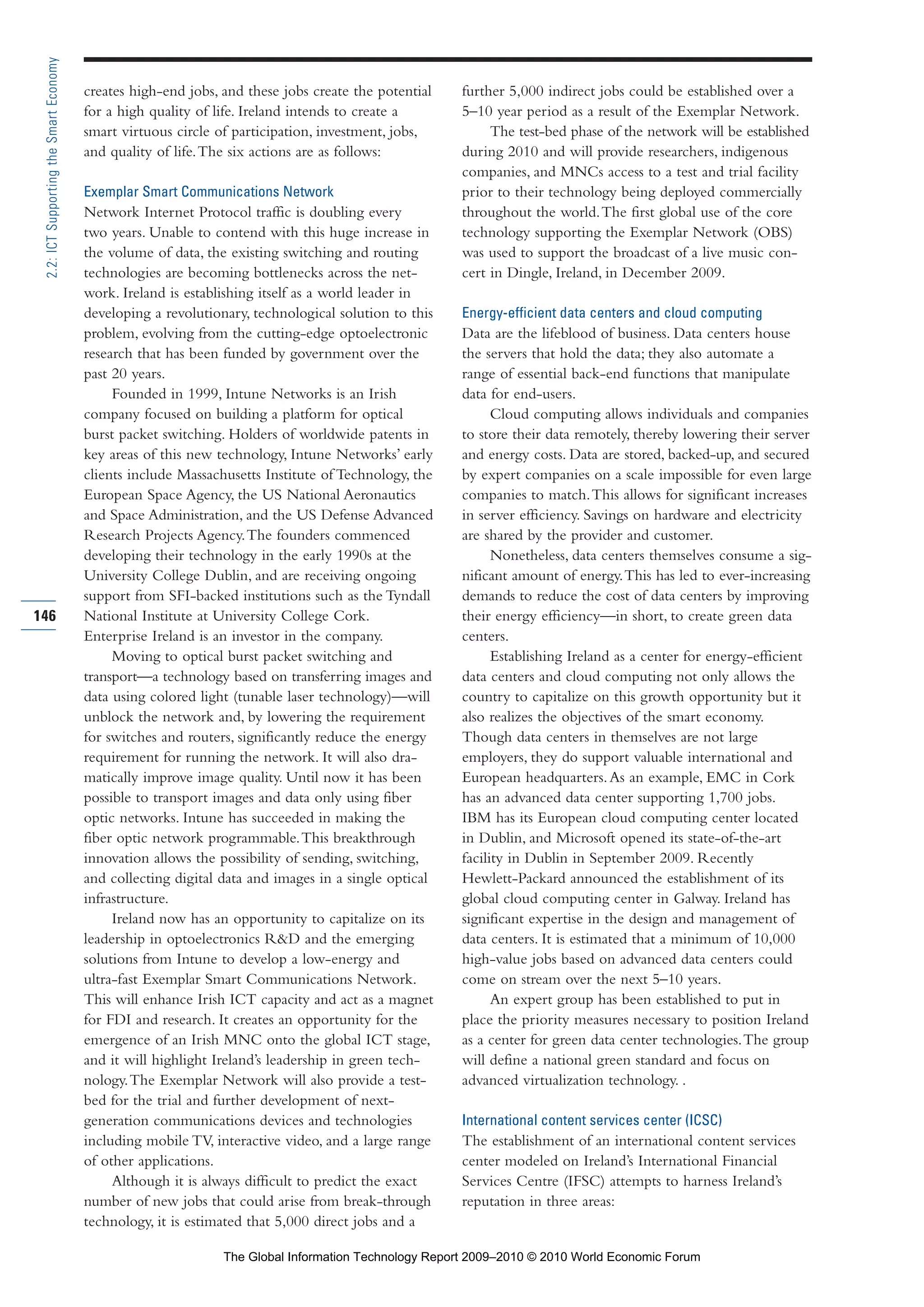
the computation of the NRI are then distributed
among the nine pillars.a
The numbering of the variables
matches the numbering of the Data Tables found at the
end of the Report. The number preceding the period
indicates to which pillar the variable belongs (e.g., vari-
able 1.01 belongs to the first pillar; variable 9.02 belongs
to the ninth pillar).The hard data indicators used in the
NRI are normalized on a 1-to-7 scale in order to align
them with the Executive Opinion Survey’s results.b
The
Technical Notes and Sources at the end of this Report
provide detailed information on all the hard data indica-
tors.
NETWORKED READINESS INDEX
Networked Readiness
Index = 1/3 Environment subindex
+ 1/3 Readiness subindex
+ 1/3 Usage subindex
Environment subindex
Environment subindex = 1/3 Market environment
+ 1/3 Political and regulatory environment
+ 1/3 Infrastructure environment
1st pillar: Market environment
1.01 Venture capital availability
1.02 Financial market sophistication
1.03 Availability of latest technologies
1.04 State of cluster development
1.05 Burden of government regulation
1.06 Extent and effect of taxationc
1.07 Total tax rate (hard data)c
1.08 Time required to start a business (hard data)d
1.09 Number of procedures required to start a business
(hard data)d
1.10 Intensity of local competition
1.11 Freedom of the press
2nd pillar: Political and regulatory environment
2.01 Effectiveness of law-making bodies
2.02 Laws relating to ICT
2.03 Judicial independence
2.04 Intellectual property protection
2.05 Efficiency of legal framework in settling disputese
2.06 Efficiency of legal framework in challenging
regulationse
2.07 Property rights
2.08 Number of procedures to enforce a contract
(hard data)f
2.09 Time to enforce a contract (hard data)f
2.10 Level of competition index (hard data)
3rd pillar: Infrastructure environment
3.01 Number of telephone lines (hard data)
3.02 Secure Internet servers (hard data)
3.03 Electricity production (hard data)
3.04 Availability of scientists and engineers
3.05 Quality of scientific research institutions
3.06 Tertiary enrollment (hard data)
3.07 Education expenditure (hard data)
3.08 Accessibility of digital content
3.09 Internet bandwidth (hard data)
Readiness subindex
Readiness subindex = 1/3 Individual readiness
+ 1/3 Business readiness
+ 1/3 Government readiness
4th pillar: Individual readiness
4.01 Quality of math and science education
4.02 Quality of the educational system
4.03 Buyer sophistication
4.04 Residential telephone connection charge (hard data)g
4.05 Residential monthly telephone subscription
(hard data)g
4.06 Fixed broadband tariffs (hard data)
4.07 Mobile cellular tariffs (hard data)
4.08 Fixed telephone lines tariffs (hard data)
5th pillar: Business readiness
5.01 Extent of staff training
5.02 Local availability of specialized research and training
services
5.03 Quality of management schools
5.04 Company spending on R&D
5.05 University-industry collaboration in R&D
5.06 Business telephone connection charge (hard data)h
5.07 Business monthly telephone subscription (hard data)h
5.08 Local supplier quality
5.09 Computer, communications, and other services
imports (hard data)
5.10 Availability of new telephone lines
6th pillar: Government readiness
6.01 Government prioritization of ICT
6.02 Government procurement of advanced technology
products
6.03 Importance of ICT to government vision of the future
Technical Appendix: Composition and computation of the Networked Readiness Index 2009–2010
Part 1.r2 3/2/10 4:40 AM Page 29
The Global Information Technology Report 2009–2010 © 2010 World Economic Forum
30
1.1:HowNetworkedIstheWorld?
Usage subindex
Usage subindex = 1/3 individual usage
+ 1/3 Business usage
+ 1/3 Government usage
7th pillar: Individual usage
7.01 Mobile telephone subscriptions (hard data)
7.02 Personal computers (hard data)
7.03 Broadband Internet subscribers (hard data)
7.04 Internet users (hard data)
7.05 Internet access in schools
8th pillar: Business usage
8.01 Prevalence of foreign technology licensing
8.02 Firm-level technology absorption
8.03 Capacity for innovation
8.04 Extent of business Internet use
8.05 Creative industries exports (hard data)
8.06 Utility patents (hard data)
8.07 High-tech exports (hard data)
9th pillar: Government usage
9.01 Government success in ICT promotion
9.02 Government Online Service Index (hard data)
9.03 ICT use and government efficiency
9.04 Presence of ICT in government agencies
9.05 E-Participation Index (hard data)
Notes
a The computation of the NRI is based on successive aggregations
of scores, from the variables level (i.e., the lowest level) to the
overall NRI score (i.e., the highest level). For example, the score a
country achieves in the 3rd pillar, Infrastructure environment,
accounts for one-third of the Environment subindex. Similarly, the
Usage subindex accounts for one-third of the overall NRI score.
b The standard formula for converting hard data is the following:
6 x
country score – sample minimum
+ 1
(sample maximum – sample minimum )
The sample minimum and sample maximum are, respectively, the
lowest and highest country scores in the sample of economies
covered by the NRI. In some instances, adjustments were made
to account for extreme outliers. For those hard data variables for
which a higher value indicates a worse outcome (e.g., total tax
rate, time to enforce a contract), we rely on a normalization for-
mula that, in addition to converting the series to a 1-to-7 scale,
reverses it, so that 1 and 7 still correspond to the worst and best
possible outcomes, respectively:
– 6 x
country score – sample minimum
+ 1
(sample maximum – sample minimum )
c Variables 1.06 and 1.07 combine to form one single variable.
d Variables 1.08 and 1.09 combine to form one single variable.
e Variables 2.05 and 2.06 combine to form one single variable.
f Variables 2.08 and 2.09 combine to form one single variable.
g Variables 4.04 and 4.05 combine to form one single variable.
h Variables 5.06 and 5.07 combine to form one single variable.
Technical Appendix: Composition and computation of the Networked Readiness Index 2009–2010` (cont’d.)
Part 1.r2 3/2/10 4:40 AM Page 30
The Global Information Technology Report 2009–2010 © 2010 World Economic Forum
CHAPTER 1.2
ICT and the Sustainable
Competitiveness of Cities
DARREN WARE, Cisco Systems, Inc.
ENRIQUE J. RUEDA-SABATER, Cisco Systems, Inc.
FERNANDO GIL DE BERNABE Y VARELA , Cisco Systems, Inc.
JOHN GARRITY, Cisco Systems, Inc.
JULIAN LIGHTON, Cisco Systems, Inc.
“The city belongs to the 21st century more than the
nation,” asserted Saskia Sassen over 10 years ago.1
Now,
for the first time in history, more than half of the world’s
population live in urban areas. Large cities in emerging
countries are not only replicating many features of those
in advanced countries but, as they become global, they
have as much in common with advanced-country cities
as they do with the rest of their own countries.
As cities increasingly play in a global arena, they are
being driven to develop sustainable competitiveness
strategies and—with knowledge and productivity as key
factors of 21st-century competitiveness—high-speed
networks and the technologies that revolve around them
have become crucial for attracting and retaining citizens
and businesses.This supra-national role of cities in the
context of globalization, however, does not mean that
their focus is primarily external. Cities also play a critical
role as national hubs for all kinds of economic and
cultural activity.
The spread of information and communication
technologies (ICT) has made this role even more
powerful as cities—much more quickly than towns or
rural areas—reach the critical mass required to achieve
the network effects that underpin technology adoption.
Cities can therefore not only become more competitive
through the advanced use of ICT, but they also serve
as anchors for national competitiveness strategies that
incorporate the power of broadband networks.
The aim of this chapter is threefold. First, we aim
to review the role of cities in light of ICT evolution.
Second, we explore different situations with regard to
connectivity that we observe in cities across the world.
Third, we propose a framework for city leaders to iden-
tify gaps in ICT use and chart a course forward in order
to take advantage of the opportunities that ICT and
networks offer for enhancing sustainable competitiveness.
City roles and trajectories
Cities have been acting as hubs of commerce for mil-
lennia.They were a natural point of exchange for goods
produced in the hinterland; for goods brought from the
outside; and, gradually, for goods produced in the city
itself. Cities then became places where skill development
and employment creation concentrated—first in industry
and then in services.
The rise and impact of ICT has allowed cities to
evolve into a more complex type of hub—one that
spreads familiarization with new technologies and pro-
vides the opportunity to expand connectivity to sur-
rounding areas.This connectivity, in turn, expands the
array of options for non-urban inhabitants to relate with
the city.
The global economy—increasingly a knowledge
economy—is now relying to a large extent on a network
of cities that are connected in a way that is distinctly
different from the way nations are connected.This
31
1.2:ICTandtheSustainableCompetitivenessofCities
Part 1.r2 3/8/10 11:24 AM Page 31
The Global Information Technology Report 2009–2010 © 2010 World Economic Forum
highly structured urban cross-border geography links
global cities that possess competitive (strategic) advan-
tage.2
This advantage is comparable to that provided
in the past by good natural harbors. ICT has made it
possible for key cities to be connected in new ways,
with the creation of a global web whose constituent
cities become global through their participation in
these networks.
Some had thought that ICT would erode the
advantages that cities had traditionally gained from
agglomeration economies,3
but this has proved not to
be the case. In The Cybercities Reader, Stephen Graham
and contributors explore—and explode—the fallacy
of the “death of distance.”4
They show, instead, that
complementarities have emerged and that ICT and
urbanization can have mutually reinforcing effects.This
is particularly true for broadband networks that are
quickly becoming part of the basic infrastructure (along-
side power, water, and transportation) and central to
competitiveness.
As a result, global cities have gained in importance
and power relative to nation-states. Especially within
emerging countries, such gains could lead to growing
disparities between large cities and the rest of the
country—including an expanding gap between the early
technology adoption of the large cities and the lagging
adoption elsewhere. But this gap should not be seen as
a permanent source of an urban-rural digital divide. In
contrast to other types of infrastructure, the characteris-
tics of network technology allow national governments
to take advantage of the cities’ natural role as spearheads
of technology adoption and to integrate their role as hubs
into a countrywide broadband connectivity strategy.
Insights into this evolution can be derived from the
notion of fusion space used by William Mitchell.5
Network
technologies are producing architectural space in which
digital technology enables new and socially valuable com-
binations of activities.This fusion of physical and virtual
space occurs in cities and affects their role as centers of
gravity for both ICT demand and supply concentrations.
Furthermore, large cities seem to have evolved in
even more complex ways that are challenging the
notion of city boundaries. Increasingly—and not least
because of the options that ICT offers—metropolitan
areas and their surrounding geographies have become
a continuum of density without natural boundaries.6
Local authorities and urban demarcations are also
becoming separated, with all kinds of policy implica-
tions for the governance of metropolitan areas and their
relationship with national institutions.
The competitiveness of cities, therefore, is a high-
stakes game in which not only a city’s leaders and inhab-
itants play.The stakes are also high for the peri-urban
and rural areas that are under the influence of the city
in its role as intra-national hub.And national competi-
tiveness is, in good measure, linked to the ability of cities
to become sustainably competitive on a global scale.
Cities and technology adoption
Cities have long been a natural spearhead for technology
adoption.This is because of their advantages, including
their critical mass of capacity (skills and support services),
as well as their concentration of purchasing power
and their better connections with the outside world—
incidentally, this was often the reason why cities
emerged where they did.
Cities’ role as spearhead is likely to be particularly
powerful with regard to ICT and especially Internet-
based applications, for the following reasons:
• Agglomeration economies make it most viable for
service providers to introduce and then expand
connectivity in metropolitan areas, starting with
businesses and high-income households and then
spreading across the whole area.
• Legacy telecommunications networks offer an easy
point of entry (although in some cases incumbent
protection can turn the legacy into a hurdle).
• Fiber optics is considered one of the top four
innovations of the last quarter of the 20th century
(the others being the Internet, the mobile phone,
and the personal computer),7
and could well
become another source of advantage for cities.
• Extensive infrastructure networks (from power lines
and sewers to municipal buildings) offer potential
for piggy-back network development, both wired
and wireless.
Finally, we know from recent surveys of Internet
usage in emerging-country cities that familiarity with
the Internet is high there and growing—well ahead
of the national averages.8
The use of online services is
expanding rapidly as city households become regular
users of the Internet, and large segments of the popula-
tion are experiencing the Internet and developing high
expectations for future access to services online.
This is the context that we must keep in mind
as we explore the role of ICT networks in cities in
more specific ways.We attempt to extract from global
experience guidance for efforts to enhance city compet-
itiveness, particularly in emerging countries.We do this
by drawing from three recent studies sponsored by Cisco:
a survey of broadband penetration, an analysis of broad-
band quality, and an extensive assessment (still in progress)
of how municipal governments can promote ICT use in
cities and within city operations.
In this chapter we draw from these three studies to
focus on 21 cities across the world, covering a consider-
able range of geographies, population size, and income
levels (see Table 1).The insights derived from these cities
are compelling and suggestive of broad applicability,
but the sample is not quite large enough for definitive
32
1.2:ICTandtheSustainableCompetitivenessofCities
Part 1.r2 3/2/10 4:40 AM Page 32
The Global Information Technology Report 2009–2010 © 2010 World Economic Forum
conclusions (particularly as Chinese or Indian cities have
not yet been included).
Broadband penetration
The findings of a 2009 survey of Internet service
providers in these major cities across the world allow us
to explore the progress of broadband connectivity, the
differences across and within cities, and the challenges
and opportunities ahead.9
The survey results provide
an empirical basis for reflecting on factors behind the
differences and on the potential policy implications.
Mirroring the importance of that threshold for connec-
tivity, the survey focused on connectivity at download
speeds of at least 1 megabyte per second (MB/s) and,
thus, provides one of the first systematic windows into
real broadband at the city level. By looking separately at
lines going to households and businesses (or institutions),
the survey also allows us to construct true household
penetration indicators (a much better basis for analysis
and comparisons than the conventional apples-and-
oranges broadband lines/population ratios).
The results validate conclusions derived from the
academic literature, provide confirmation of the velocity
of adoption under some conditions, and offer valuable
leads with regard to factors behind the accelerated reach
of broadband.The fact that a city such as St Petersburg
has broadband connectivity penetration rates closer to
the levels of London or Sydney than to the Russian
average also appears to underscore the relevance of the
global city notion as regards ICT.
On the validation front, the results underscore the
role of cities as spearheads of technology adoption:
broadband penetration differences between large cities
and the rest of their country tend to be much greater in
emerging than in advanced economies. In this sense,
one can highlight the following:
• Broadband penetration in London, Sydney, and
Toronto, for instance, is not significantly higher than
broadband penetration overall in Australia, England, or
Canada.And even in Amsterdam and Seoul—two of
the best-connected cities in the world—the differ-
ences with national averages are of around 20 percent
(or just a few percentage points of penetration).
• Broadband penetration levels in emerging-country
cities, on the other hand, are significantly higher—
in most cases at least 50 percent higher—than national
averages. Outside of the cities many connections
show up in the broadband statistics but fall well
below the 1-MB/s level (one-third of the so-called
broadband lines in Brazil and close to half of those
in Argentina, for instance, have speeds below that
threshold).
• Finally, city penetration averages in emerging markets
are brought down by the effect of slums and other
types of low-income and low-infrastructure fringes.
As illustrated in Figure 1, disparities in penetration
within cities are generally much greater in emerging
than advanced-economy cities.This has to be kept
in mind when looking at citywide averages.
Broadband, of course, is not just one more feature
of ICT.The widespread availability of high-speed con-
nectivity represents a critical threshold in the evolution
of ICT and opens the door for major ripple effects
affecting business productivity, dynamic innovation, and
social interaction.Although productivity impacts are
mostly related to the use of broadband in businesses,
social interaction has much to do with the connectivity
of households—and new levels of innovation are enabled
by the connectivity that cuts across business and home
lines.
Intriguing significant differences in the availability
of high-speed connectivity exist across cities. Cities in
advanced economies have a consistently large majority
(85 percent or more) of broadband connections serving
households. But for cities in emerging economies, this
share varies widely—in cities such as Casablanca,
Istanbul, and Johannesburg, half or more of the broad-
band lines serve businesses.The hypothesis that at lower
levels of penetration the proportion of broadband lines
going to businesses will be higher is not confirmed
more generally, however—Rio, São Paulo, and Buenos
Aires, for instance, have close to 90 percent of lines
going to households.
Broadband quality
The quality of broadband connections depends on more
than download speed.10
Upload speed and latency also
affect the quality of broadband connections significantly.
These factors were explored in a recent study of broad-
band quality (see Box 1).
33
1.2:ICTandtheSustainableCompetitivenessofCities
Table 1: Basic characteristics of sample cities
Income Large Very large
(up to 7 million people)
Higher income Amsterdam London
Austin Moscow
Sydney Seoul
Warsaw
Prague
Toronto
Lower income Budapest Bogota
(under US$20,000 Casablanca Buenos Aires
per capita) Johannesburg Cairo
St Petersburg Istanbul
Lima
Mexico City
Rio de Janeiro
São Paulo
Source: United Nations statistics on urban agglomerations and authors’
estimates.
Part 1.r2 3/2/10 4:40 AM Page 33
The Global Information Technology Report 2009–2010 © 2010 World Economic Forum
34
1.2:ICTandtheSustainableCompetitivenessofCities
0
20
40
60
80
100
120 Amsterdam
Austin
London
Seoul
Sydney
Toronto
Bogota
Budapest
BuenosAires
Cairo
Casablanca
Istanbul
Johannesburg
Lima
Mexico
Moscow
Prague
RiodeJaneiro
SãoPaulo
StPetersburg
Warsaw
Figure 1: Broadband penetration in households across different city areas
Source: IDC/Cisco Survey, 2009.
City
Percent
■ City Area A
■■ City Area B
■ City Area C (if identified)
■ City Area D (if identified)
Until recently, the analysis of broadband was focused only on
penetration. As bandwidth-intensive applications, such
as video, become pervasive, the broadband gap is being rede-
fined as a quality divide. Citizens and enterprises with low
broadband quality will be limited in what they can do
on the Internet and, therefore, in their capability to extract eco-
nomic benefit from it.
The universities of Oviedo and Oxford, sponsored by Cisco,
have developed the broadband quality score (BQS)—an index
that combines actual measurement of download, upload, and
latency to gauge the quality of a nation´s broadband connec-
tions. The 2009 BQS includes an analysis of broadband quality
in more than 240 cities worldwide. The results of the survey,
carried out in mid 2009, show that global broadband quality
has improved remarkably in just one year, with 62 of the 66
countries reporting progress; 39 countries now have a BQS
above the threshold required to deliver a consistent quality of
experience with today’s most common Web applications
(which, the study concluded, requires speeds of 3.75 MB/s
download and 1 MB/s upload, and 95 millisecond latency). Nine
countries—Korea, Rep., Japan, Sweden, Lithuania, Bulgaria,
Latvia, the Netherlands, Denmark, and Romania—were found to
have the broadband quality required for future Web applications
(requiring speeds of 11.25 MB/s download and 5 MB/s upload,
and 65 millisecond latency).
The study shows there is still a tremendous gap between
the broadband leaders and the broadband laggards. But those
lowest down the scale, particularly in emerging economies,
have a tremendous opportunity to leapfrog. Indeed, emerging
economies such as Lithuania, Latvia, Romania, and Bulgaria
have entered the “ready for tomorrow” category in this year´s
study as a result of their investments in fiber optics and upgrad-
ed cable networks.
The broadband quality study has established key
differences between the impact of broadband penetration and
broadband quality on socioeconomic factors. For instance,
broadband quality is associated with the knowledge economy
and with increased diffusion of ICT, and citizens in countries
with the highest broadband quality enjoy the highest usage of
the Web, suggesting that broadband quality triggers a positive
network effect. In order for a country or city to reap the full
benefits of broadband and become a true broadband leader, it
must consider both broadband quality and penetration in its
national broadband agenda.
Box 1: Broadband quality: A key enabler of economic development
Part 1.r2 3/2/10 4:40 AM Page 34
The Global Information Technology Report 2009–2010 © 2010 World Economic Forum
The study constructed a broadband quality score
(BQS) on the basis of a survey of connectivity covering
66 countries. 11
This survey allows the quality of broad-
band in a country or city to be classified with respect
to the requirements of different types of applications.
From the BQS it is also possible to show how cities
fare in terms of their readiness for current and evolving
applications, as illustrated by Table 2.
Typical applications of today include Web browsing,
social networking, music downloads, basic video stream-
ing, video chatting, standard definition Internet protocol
television (IPTV), and enterprise-class home offices.
Tomorrow’s applications are the ones that will bring the
full benefits of Web 2.0 and ubiquitous connectivity—
offering new levels of productivity and creativity through
collaboration and new experiences by blending in all
media.They include consumer telepresence, high-defini-
tion video streaming, and high-speed sharing of large
files ranging from family videos to complex working
documents.Although we describe these as “tomorrow’s
applications,” all of these services are already available
and in use today—low broadband is simply preventing
them from reaching their mass market potential in many
countries and cities.
The combination of findings from broadband pene-
tration and quality surveys generates additional insights.
Mapping our cities along the axes of broadband penetra-
tion and broadband quality allows us to explore how
cities vary in terms of breadth and depth of broadband
connectivity (see Figure 2).The combination of high
penetration and high quality, as in Seoul and Amsterdam,
suggests that these cities are ready to take off with the
Table 2: Broadband quality level of cities and their
implications
Broadband quality level Cities in sample
Ready for tomorrow’s applications Seoul
Ample room for today’s applications Amsterdam, Austin, Budapest,
Moscow, Prague, St Petersburg
Meeting the needs Istanbul, London, Sydney, Toronto,
of today’s applications Warsaw
Below the threshold of Bogota, Buenos Aires, Cairo,
today’s applications Casablanca, Johannesburg, Lima,
Mexico City, Rio de Janeiro,
São Paulo
Source: Oxford/Oviedo Broadband Quality Score Study, 2009.
0 10 20 30 40 50 60 70 80 90 100 110
10
20
30
40
50
60
70
80
Casablanca
Lima
Rio de
Janeiro
Cairo
Mexico City
Buenos Aires
São Paulo
Bogota
Warsaw
Istanbul
Sydney
London
Toronto
Prague
Austin
St Petersburg
Moscow
Budapest
Amsterdam
Seoul
Johannesburg
Figure 2: Broadband penetration vs. quality
Source: Oxford/Oviedo Broadband Quality Score 2009 Report; IDC/Cisco Survey, 2009.
Penetration of total households (%)
Broadbandqualityscore
35
1.2:ICTandtheSustainableCompetitivenessofCities
Part 1.r2 3/2/10 4:40 AM Page 35
The Global Information Technology Report 2009–2010 © 2010 World Economic Forum
benefits of Web 2.0 (as long as they can maintain the
quality as penetration keeps expanding). One of the
factors behind high penetration and quality appears to
be the structure of the market—the degree of diversity
in technology platforms (asymmetric digital subscriber
line [ADSL], cable, etc.) in particular.The countries and
cities with highest penetration and best quality of
broadband tend to have more diverse market structures.
High penetration and low-to-medium quality is not
an uncommon combination, and it generally indicates
rapid broadband deployment using existing copper infra-
structure that is now stretching the limits of network
capacity (as appears to be the case of London and
Toronto, for instance). High quality and low penetration
is a rare combination that can reflect small city “niches”
and is not present in our sample. Finally, low penetration
and quality—which affects a number of cities in our
sample—indicates the signi-ficant challenge in taking
advantage of the opportunity of broadband connectivity.
An interesting leapfrogging phenomenon is reflected in
cities such as Budapest, Moscow, Prague, and St
Petersburg, where limited legacy networks paradoxically
created the impetus for investing in network technology
that allows for better broadband quality.
ICT environment and use
As we noted above, the global city phenomenon raises the
competitiveness stakes.What does it take to make a city
competitive in the global arena? What can city leaders
(be they in government, business, or civil society organi-
zations) do to improve their city’s competitiveness—and
sustain it? We believe that a large part of the answer has
to do with ICT—and, more specifically, with networks.
The purpose of the assessment exercise underway is
to provide an overview of the ways in which municipal
governments influence the ICT environment in their
cities and to explore in detail how they use ICT in city
operations.The assessment uses the framework developed
for the purpose by Cisco (and a survey instrument
designed with help from Illuminas Global PLC).
This framework was specifically designed to explore
the environment and use of ICT in cities and to provide
a diagnostic perspective in enough detail that it can guide
the formulation of action plans.The first stage of the
assessment has already allowed us to establish best prac-
tice boundaries. In the second stage, individual cities can
be benchmarked against both the frontier of possibilities
and existing best practice so that avenues for progress—
or opportunity gaps—can be identified.
Cities, of course, operate under an umbrella of
national policies, regulations, infrastructures, and capabil-
ities.A chapter in The Global InformationTechnology Report
(GITR) 2007–2008 explored the importance of the bal-
ance between the “ecosystem” (policies and regulations
affecting ICT directly, as well as the business and inno-
vation environments) and investments in infrastructure
and capabilities.A chapter in The GITR 2008–2009
then proposed an approach for developing national
net strategies, many aspects of which are also relevant for
cities.12
The complementary framework we propose here
is specifically focused on cities.
Before going into the specifics of the ICT environ-
ment and use framework, it is worth stepping back and
thinking about how competitiveness and ICT relate to
three major goals that most city leaders have in mind:
• Economic growth and job creation. This
is one of the main aims of competitiveness
improvements—which attract investment and
generate a virtuous circle that takes advantage of
the potential agglomeration economies. Basic
infrastructure is a key competitiveness factor.As
broadband becomes the basic infrastructure factor
for the knowledge economy (with a significant
impact on total factor productivity), it also moves to
the center of the competitiveness strategies of cities.
• Social welfare. As information about city condi-
tions flows, and as people across the world become
more mobile, the performance of a city in terms of
services offered to its citizens is a major determinant
of whether the city is seen as an attractive place to
live and work—hence able to draw and retain tal-
ented people, which is another major competitive-
ness factor. ICT can be used to achieve dramatic
improvements in efficiency and effectiveness in the
provision of services, as well as to reduce the trans-
action costs in the city-citizen relationship—at both
the economic and political levels.
• Environmental sustainability. Increasingly a con-
cern for citizens and businesses, the choices made by
a city and their impact on the environment are also
becoming a crucial factor of long-term competitive-
ness. ICT offerings are more and more able to address
environmental sustainability concerns in ways that can
also be aligned with social and economic goals.This
win-win approach is the focus of efforts in many
cities across the world. Pilot programs and informa-
tion sharing, among other things, are being promoted
by a collaborative effort among the Massachusetts
Institute of Technology (MIT), Cisco, and global
cities that focuses on the use of ICT to launch a new
wave of innovation in urban development affecting
the flow of people, knowledge, traffic, and energy.13
Conventional discussions of competitiveness have
focused mostly on factors in the economic and social
spheres, but increasingly factors from the “green” sphere
are taking center stage and should now be considered an
integral part of sustainable competitiveness.
Because city governments and other local authori-
ties in metropolitan areas are increasingly expected to
36
1.2:ICTandtheSustainableCompetitivenessofCities
Part 1.r2 3/2/10 4:40 AM Page 36
The Global Information Technology Report 2009–2010 © 2010 World Economic Forum
37
1.2:ICTandtheSustainableCompetitivenessofCities
focus on environmental sustainability, there is a growing
role for ICT in pursuit of green, or sustainable, goals.
Interventions in this regard include environmentally
conscious activities that range from direct action, such as
congestion taxes enabled by sensors, to indirect measures
that facilitate remote work options.They also include
efficiency and social inclusion measures that can make
a considerable contribution to the sustainability of
programs and initiatives.
ICT environment and use: Framework for cities
The framework we are proposing is designed to be used
by city authorities—and city leaders more broadly—to
explore ICT use in cities.The framework considers not
only the use of ICT in the daily life of city operations and
services but also the role that city authorities and other
leaders can play to promote the use of ICT more widely—
as an important tool for competitiveness (Figure 3).
City organizations and administrations come in
very different shapes and sizes.They range from geo-
graphically integrated structures covering whole metro-
politan areas (as in São Paulo) to mosaics (as in London,
with its 33 boroughs) and from centralized operations
(as in Rio) to compartmentalized activities that rely
on relatively independent service-specific authorities
(as in Sydney). For integrated city government opera-
tions, the whole framework will be of relevance, while
specialized agencies will be mainly interested in some
of the components.
The framework consists of four components re-
flecting the different aspects of the roles that municipal
governments play. One component focuses on the influ-
ence that these governments can have over how the
ICT environment evolves in the city—hence affecting
service providers as well as ICT usage by businesses and
households.Another component concerns the use of
ICT in the city’s internal administration.The other two
components cover different types of service interactions
between the city and its constituents.
The framework was not designed, however, only
to provide a conceptual guide to the potential of ICT
in cities.We have also used it to develop a survey instru-
ment to explore in some detail specific types of ICT
usage, thus allowing us to establish both a possibility
frontier on the basis of currently available technology
along with a real-life composite best practice drawn
from the six cities in our sample (Amsterdam,Austin,
London, Seoul, Sydney,Toronto), chosen because of
their advanced adoption of ICT.We can then conduct
the survey in any other city across the world and bench-
mark individual city performance against the composite
best practice to identify opportunity gaps.The structure
of the survey and the establishment of best practice in
each of its component areas thus provide a useful
overview of the potential of ICT for improving city
competitiveness and citizen welfare.The sections below
describe the four areas of the framework and illustrate
the ICT usage frontier and best practice. Examples of
Figure 3: ICT environment and use: Framework for cities
Citizen focused Internally focused
ICT environment
Basic services Online services Administration
Part 1.r2 3/2/10 4:40 AM Page 37
The Global Information Technology Report 2009–2010 © 2010 World Economic Forum
the components are included at the level of detail used
for the survey.
ICT environment
The basic question to be addressed about the ICT
environment in a city is how to ensure ICT policies
and infrastructure (such that the availability and adop-
tion of network technology and Web-based applications
and content) become a source of competitive advantage
for business and individuals based in that city.
The indirect—nonetheless crucial—role that
municipal governments can play with respect to the
environment for the adoption and use of ICT in their
city comprises a wide range of possible interventions.
Although many policies affecting ICT will be national
or federal ones, there are city-level policies and regula-
tions that can hinder ICT adoption. Eliminating these
hindrances provides a “low-hanging fruit” for competi-
tiveness improvements. More proactive interventions,
including infrastructure-related investments, training,
and programs that promote technology adoption are
also being implemented successfully by cities across the
world. It is noteworthy that some interventions (for
example, providing access to infrastructure that could
be shared in some form—such as sewers being used as
conduits for fiber cables) entail virtually no cost to the
city.
One possible indicator of the need for interven-
tions is the structure of the market with respect to tech-
nology platforms. Cross-country evidence suggests that
both broadband penetration and broadband quality are
positively correlated with technological diversity.The
differences across our sample of cities are striking in this
regard: Figure 4 shows that cities such as Amsterdam,
Seoul, and St Petersburg have significant diversity, while
cities such as Istanbul and Lima have virtually none.
In addition to the potential for improving comp-
etitiveness through interventions that create a more
conducive environment for ICT adoption, major gains
can be obtained from using ICT in city operations, both
internally and in relation to citizens and local businesses.
These are also important competitiveness factors, as they
allow the city to attract and retain businesses and people.
A city pushing the frontier of current best practice
would, for instance:
• have an explicit strategy, integrated with national
policies and initiatives, to ensure that broadband
connectivity is available throughout the city at an
affordable cost through private and public invest-
ments, or a combination of both, as appropriate;
• monitor market structure and use the role of
the city as a major customer for ICT services to
promote competition, if needed;
• eliminate hurdles to entry for new service providers,
offer tax or financial incentives to expand networks,
and provide access to city infrastructure where
shared access is viable; and
• offer training programs to develop the ICT and
Internet skills of the population, either as a public
service or in public-private partnership.
ICT use: Basic services
This area of the framework covers services that have
high visibility in the city streets and that are a key part
of how the public perceives the management perform-
ance of the city authorities.The services range from
water, sanitation, transportation, and traffic management
to public safety and emergency services and (in the case
of cities with such responsibilities) health and education.
The key question here concerns how ICT can
contribute to improving efficiency and effectiveness in
the delivery of existing services.As the experience from
best practice suggests, networks can offer important
improvement to the delivery of individual services and
connect the delivery of related services in a seamless
way.The resulting reduction of equipment redundancy
caused by multiple networks would lead to a potential
savings that could be quite high.
Deploying ICT tools in basic services also has great
promise for improving environmental sustainability, as a
number of pioneering programs have demonstrated.14
At the frontier of current technology, they include a
wide range of options—from the electronic sensing
of human activities that can result in fast and appropri-
ate response to emergencies to extended tracking and
control loops that can be used to dramatically improve
supply and removal cycles for chains involving basic
components of city life such as water and sanitation.
More developments, including the Internet of Things,
are constantly pushing this frontier as network technolo-
gy makes it possible to use ubiquitous intelligence to
pursue continuing improvements in the efficient and
sustainable management of scarce resources.
A city at the frontier of current possibilities would,
for instance:
• deploy Web 2.0 tools and rely on mashups
(combined functionalities) to leverage potential
synergies across services;
• utilize traffic control systems that are networked
and use sensors that monitor flows and allow
citizens access to real-time optimal routing systems,
and that rely on networked digital traffic enforce-
ment cameras and use wireless vehicle tracking for
automatic tolls and congestions charges, among
others;
38
1.2:ICTandtheSustainableCompetitivenessofCities
Part 1.r2 3/2/10 4:40 AM Page 38
The Global Information Technology Report 2009–2010 © 2010 World Economic Forum
• deploy automated demand-response systems (in
cases such as power blackouts) and smart grid tech-
nologies that allow utilities to integrate and balance
renewable and other energy supplies;
• implement network-based dispatch services that
enable real-time transit communications and provide
online access to continuously updated information
on public transport routes and timetables;
• employ wireless and networked digital surveillance
cameras and integrated, interoperable communica-
tion devices for coordinated multi-agency response
to emergencies;
• use networked lighting and temperature controls
to reduce overall energy usage in municipal govern-
ment buildings;
39
1.2:ICTandtheSustainableCompetitivenessofCities
0 20 40 60 80 100
Amsterdam
Austin
Bogota
Budapest
Buenos Aires
Cairo
Casablanca
Istanbul
Johannesburg
Lima
London
Mexico City
Moscow
Prague
Rio de Janeiro
São Paulo
Seoul
St Petersburg
Sydney
Toronto
Warsaw
Figure 4: Market share by technology platform (by city)
Source: IDC/Cisco Survey, 2009.
Percent
■ ADSL ■ Cable ■ Other (fixed wireless, dedicated access, satellite)
Part 1.r2 3/2/10 4:40 AM Page 39
The Global Information Technology Report 2009–2010 © 2010 World Economic Forum
• maintain real-time monitoring systems providing
details on the city’s carbon footprint; and
• establish networked work centers that allow
employees to work remotely, reducing overall
commuting needs and traffic into the city.
ICT use: Online services
Citizens in many parts of the world have already
experienced the benefits of Web-based services—first
as information became available on many aspects of city
life, and then as they were able to achieve painlessly
online what used to require traveling to city offices and
standing in lines.Web 2.0 tools offer great potential for
further expanding the breadth and depth of online
interactions between city administrators and citizens
in a wide variety of areas including, for instance,
employment services, education, permits and licensing,
information portals, payment mechanisms, and other
transactions. Many of these tools can also serve to pro-
mote collaboration with and among citizens.
A city at the frontier of current possibilities would,
for instance:
• have online options to access information and
communicate with all city government departments
and municipal agencies;
• offer a one-stop portal that directs users to all
available online resources and a single contact point
to guide citizens to the appropriate service;
• make it possible for most transactions (permit
requests, payments, etc.) to be completed online;
and
• engage with citizens and local business to create
applications, to tap city information resources, and
to develop new services.
ICT use: Internal administration
The final area of the framework considers how tech-
nology can be used in internal city operations.This is no
different from the back-office operations of any other
large institution or corporation and includes data and
voice networks, data centers, call centers, and office
information technology infrastructure such as servers
and wireless access points.The potential of new network
technology is great in this regard too: it can lead to
improving the returns on existing ICT assets as well as
leapfrogging to cost-saving architectures and enhancing
the quality of operations through new levels of inter-
agency collaboration.
A city at the frontier of current possibilities would,
for instance:
• implement an integrated strategy for ICT and
coordinate implementation of plans across city
departments and municipal agencies;
• rely on an organizational structure reflecting the
value of integration around a common platform—
including central coordination of ICT budgeting
and investment decisions;
• ensure widespread access by employees to broad-
band, Internet protocol voice services, unified
communications/conferencing systems, virtual
private network for remote access, shared online
work spaces, and collaboration tools; and
• rely on an integrated citywide network capable of
combining voice, data, and video.
Summary diagnostics
The broadest insights can be derived from an overall
perspective on the strategic response by authorities in a
city to the opportunity of ICT, as illustrated in Figure 5.
We can do this by mapping the answers to questions on
internal and external approaches to ICT adoption,
which can then provide a useful starting point for
reconsidering strategic direction.At this high level, we
can envisage four types of situations:
• A city with clear, far-sighted strategies for ICT
adoption and broadband deployment internally
and externally is a city hitting the bull’s eye of
competitiveness—poised to make the most from the
potential of Web 2.0 connectivity and applications.
• A city that has a clear strategy for ICT adoption
but lacks a clear strategy for its internal use in the
day-to-day workings of the municipal government
is likely to lay the foundation for ICT-driven
competitiveness but miss the opportunity of a more
efficient government.
• At the other end of the spectrum, a municipal
government that is ICT advanced but has no strategy
to promote or facilitate ICT adoption by businesses
and citizens across the city strongly represents a
missed opportunity because the benefits of ICT may
be limited to the public sector while technology
adoption in the city at large relies exclusively on
private-sector leadership.
• Finally, a city lacking strategies for ICT adoption
both internally and externally is likely to see its
competitiveness hobbled by antiquated methods
and technologies—it has a huge opportunity for
improvement ahead through a combination of
external and internal actions.
40
1.2:ICTandtheSustainableCompetitivenessofCities
Part 1.r2 3/2/10 4:40 AM Page 40
The Global Information Technology Report 2009–2010 © 2010 World Economic Forum
The assessment, and the framework on which it is
based, are designed to underpin a diagnostic discussion
of a city’s current situation at a level of detail sufficient
to provide the basis for the formulation of action plans
but that keeps the discussion at the strategic level—the
technical details should come later.An overview is
obtained by considering the summary ratings for the
different items under each of the four areas of the ICT
framework.We can also add a measure of quality-adjusted
broadband penetration (from the surveys mentioned
earlier) to complete a diagnostic pentagon.
The result of this assessment for any city can then
be compared with the possibility frontier reflected in
the outer edge of the pentagon. It can also be compared
with a composite best-practice contour, derived from
the best ratings among the six advanced cities (shown by
the bold line in Figure 6).This benchmarking allows us to
provide a picture of a city’s current situation. Comparing a
city’s contour with the best-practice composite and the
current technology possibility frontier clearly indicates
the opportunity gaps a city faces and, hence, the avenues
for improvement it could consider pursuing.
Comparing the composite best-practice contour
with the possibility frontier makes it clear that there
are significant opportunity gaps even for the relatively
advanced cities, and this is without considering progress in
technology and applications that will continue to push
that frontier.The gaps appear to be wider for the myriad
ICT opportunities available to improve the efficiency of
basic services and internal administration. In emerging-
market cities, the gaps will generally be larger across the
board.
The analysis of ICT opportunity gaps in any given
city can then be pursued at a greater level of detail,
using the 20 different ratings given to areas under each
of the four components to come up with summary
ratings for environment, administration, and basic and
online services.This analysis will serve as a basis from
which municipal authorities and city leaders can formu-
late a strategy and develop specific action plans to lever-
age the potential for competitive sustainability that ICT
has to offer—including efficiency improvements, greater
responsiveness to citizen demands (for example, by
addressing service bottlenecks), and inclusive connectivity
linked to the city’s social goals.
Conclusions
As Castells puts it:“Technology does not determine
society: it is society.”15
Wealth and knowledge generation
depend on the ability to organize in a way that allows
the benefits offered by technology to be realized.
Networked society can thus be seen as resulting from
interaction between a new technological paradigm—
high-speed networks that represent a revolution for
41
1.2:ICTandtheSustainableCompetitivenessofCities
Figure 5: External and internal ICT strategies
CitywideICTstrategy
–+
– +Municipal government ICT strategy
Part 1.r2 3/2/10 4:40 AM Page 41
The Global Information Technology Report 2009–2010 © 2010 World Economic Forum
information flows and communications—and the social
organization of an increasingly urban world.
In this chapter we have seen how the advantages
of cities and those of ICT can be mutually reinforcing
and how they can also serve as a platform from which
to promote national progress. Looking at the broadband
situation in 21 cities across the world, we have observed
a range of situations in terms of the quantity and quality
of their connectivity. Finally, we have proposed a frame-
work to assess ICT use.A preliminary application has
produced results that indicate large gaps between current
practice and the potential that the Web 2.0 paradigm
offers for cities at all stages of development.
Cities that seize the moment of this change in the
technological paradigm stand to benefit enormously,
particularly as the global economic map is redefined by
growth paths that have become more divergent as a
result of the recent financial crisis.These cities are the
ones that will be reaping the benefits of sustainable
competitiveness for a long time to come.
Notes
1 Quoted in Harris 1997, p. 1.
2 Sassen 2001, 2006.
3 Glaeser and Gottlieb 2009 include a useful review of the urban
economics literature, including research on different sources of
agglomeration economies.
4 Graham 2004.
5 See, for instance, Mitchell 2005.
6 World Bank 2009.
7 As noted in Lemelson-MIT and CNN (http://web.mit.edu/invent/
n-pressreleases/n-press-05CNN.html).
8 Pepper et al. 2009, p. 40, Box 1.
9 This survey was conducted by IDC (unpublished) for Cisco
Systems.
10 In the previous section, we focused on the 1 MB/s download
speed threshold because statistics showing broadband penetra-
tion of the basis of lower thresholds have very limited usefulness
nowadays. However, as the discussion shifts to broadband quality,
other thresholds become relevant.
11 Available at http://www.sbs.ox.ac.uk/newsandevents/Documents/
Broadband%20Quality%20Study%202009%20Press%20Present
ation%20 (final).pdf.
12 Morrison et al. 2008 and Pepper et al. 2009.
13 See http://www.connectedurbandevelopment.org/.
14 See, for instance, the analysis and illustrations in Mitchell and
Casalegno 2009.
15 Castells 2006.
References
Castells, M. 2006. “The Network Society: From Knowledge to Policy.”
The Network Society: From Knowledge to Policy, ed. M. Castells
and G. Cardoso. Washington, DC: Center for Transatlantic
Relations. Chapter 1.
Glaeser, E. L. and J. D. Gottlieb. 2009. “The Wealth of Cities:
Agglomeration Economies and Spatial Equilibrium.” NBER
Working Paper No. 14806. Cambridge, MA: National Bureau of
Economic Research.
Graham, S. 2004. “Introduction to the Cybercities Reader.” The
Cybercities Reader, ed. S. Graham. New York: Routledge.
42
1.2:ICTandtheSustainableCompetitivenessofCities
20
40
60
80
100
Basic services
Administration
Broadband penetrationEnvironment
Online services
Figure 6: City ICT diagnostic pentagon
Source: Authors’ survey of city officials.
Note: The bold line reflects composite best practice from the six advanced cities.
Part 1.r2 3/2/10 4:40 AM Page 42
The Global Information Technology Report 2009–2010 © 2010 World Economic Forum
Harris, B. 1997. “Saskia Sassen on the 21st Century City.” Government
Technology, June. Available at http://www.govtech.com/gt/articles/
95352?id=95352&full=1&story_pg=1.
Mitchell, W. J. 2005. “After the Revolution: Instruments of
Displacement.” Disappearing Architecture: From Real to Virtual to
Quantum, ed. G. Flachbart and P. Weibel. Basel: Birkhauser.
Mitchell, W. J. and F. Casalegno. 2009. Connected Sustainable Cities.
Available at http://www.connectedsustainablecities.org/.
Morrison, E., R. Pepper, and E. Rueda-Sabater. 2008. “The Emerging
Nexus: Now Is the Time to Plot a Balanced Course that Delivers
on the Promise of ICT.” The Global Information Technology
Report 2007–2008. Hampshire: Palgrave Macmillan. 23–37.
Pepper, R., E. Rueda-Sabater, B. Boeggeman, and J. Garrity. 2009.
“From Mobility to Ubiquity: Ensuring the Power and Promise of
Internet Connectivity … for Anyone, Anywhere, Anytime.” The
Global Information Technology Report 2008–2009. Geneva: World
Economic Forum. 37–52.
Sassen, S. 2001. The Global City. 2nd edition. Princeton, NJ: Princeton
University Press.
———. 2006. Cities in a World Economy. 3rd edition. Thousand Oaks,
CA: Sage/Pine Forge.
World Bank. 2009. World Development Report 2009: Reshaping
Economic Geography. Washington, DC: The World Bank.
43
1.2:ICTandtheSustainableCompetitivenessofCities
Part 1.r2 3/2/10 4:40 AM Page 43
The Global Information Technology Report 2009–2010 © 2010 World Economic Forum
Part 1.r2 3/2/10 4:40 AM Page 44
The Global Information Technology Report 2009–2010 © 2010 World Economic Forum
CHAPTER 1.3
Creating Profitable Competitive
Advantage by Driving
Sustainability
PETER GRAF, SAP AG
JIM HAGEMANN SNABE, SAP AG
Is managing sustainability performance voluntary? Not
if a business wants to be competitive. Not only do 80
percent of Global Fortune 250 companies disclose their
sustainability performance, but an increasing number
of companies in every industry are using sustainable
business practices to improve operating margins and
attract customers. In addition, each year investors are
placing US$5 trillion in socially responsible investment
funds.
By sustainability we are not speaking of corporate
philanthropy; we define sustainability as increasing short-
and long-term profitability by holistically managing
social, environmental, and economic risks and opportu-
nities. In other words, we never lose sight of the financial
aspect and profitability of a sustainability initiative and
are proactive in using sustainability to gain competitive
advantage.This chapter aims to help C-level executives
and strategists understand how to create profitable
competitive advantage by driving sustainability in their
organizations, particularly through automation in setting
goals, gathering data, monitoring activity, and reporting
results.We offer a management guideline to steer
through the massive transformation companies are fac-
ing.
Sustainability: The third global transformation powered
by business applications
Business application technology has the power to drive
global transformations. It has progressed from mere record
keeping to being the key to worldwide, irreversible, and
fundamental change.The first major transformation
advanced by business applications was globalization.
Technologies supported by the client-server model of
networked and distributed computing, for example,
enabled executives to close books on a global scale and
consolidate data quickly. Companies could manufacture
products in one market and sell them in another with-
out having to locate offices in either. In time, it became
impossible to compete without taking advantage of
globalization and the ability to automate processes on a
global scale.
The second major transformation fueled by business
applications was the Internet. New types of applications
drove significant change through disintermediation,
putting more power than ever into the hands of con-
sumers.The new paradigm created giants such as Google,
Amazon, and eBay and is now changing the very way
business applications are consumed by delivering them
as services in themselves.The transformative power of
business applications has run so deep that it touches the
way we all work, the way we communicate, and the way
we consume.Today, companies’ competitiveness relies on
their ability to tap into the connective power of the
Internet.
The third major transformation fueled by business
applications has just started. It is about holistically
45
1.3:CreatingProfitableCompetitiveAdvantagebyDrivingSustainability
Part 1.r2 3/2/10 4:40 AM Page 45
The Global Information Technology Report 2009–2010 © 2010 World Economic Forum
managing the economic, environmental, and social
implications of business—what we call sustainability.
Sustainability is already changing our lives, bringing
with it new business models, new winners, new losers,
together with completely new ways to operate.Today,
chief executive officers are just waking up to this reality,
and most struggle to implement a sustainability strategy.
However, as with globalization and e-commerce, incor-
porating sustainability into their business strategy and
using business applications to drive this transformation is
essential for companies to be competitive.
The business roadmap to sustainability: The role of
information technology
The roadmap to sustainability, which SAP formulated
after helping many companies become more sustainable,
consists of three major stages, as detailed in Figure 1:
engaging with stakeholders, evolving profitability, and
executing processes in a sustainable way.These stages
exist in an ongoing loop of improved performance that
continually optimizes an organization’s sustainability and
its ability to respond to new conditions and innovation.
The rest of this chapter will analyze each stage of the
roadmap, starting with Materiality and Feedback (in the
Engage Stakeholders loop).
Materiality and Feedback
The first step to transforming business is to understand
the need for transformation. Understanding comes in
part from soliciting feedback from stakeholders—defined
as everyone who is impacted by the organization and its
actions.This includes customers, partners, suppliers,
employees, and investors as well as local communities
and businesses, government institutions, nongovernmen-
tal organizations, and interest groups.
In most cases, an organization must actively collect
input from stakeholders; the process of gathering feed-
back can come in many forms, from organized surveys
and stakeholder panels to insight picked up by listening to
conversations in social networks. Other input may come
automatically—for example, from government institu-
tions in the form of laws and regulations, or from inter-
est groups in the form of advocacy. The job of the
organization is to collect and digest the feedback into a
“materiality matrix” that identifies what has the highest
potential impact on stakeholders, the maturity of the
issue as it effects the organization, and how the issue
46
1.3:CreatingProfitableCompetitiveAdvantagebyDrivingSustainability
Dataintegration
Dataquality
Data analysis
Report Assure Set Targets Adjust Strategy
Analyze and Benchmark
Measure Performance
Operate across Business Networks
Implement Initiatives
Materiality and Feedback
ENGAGE
stakeholders
EVOLVE
profitability
EXECUTE
processes
Figure 1: The sustainability roadmap: Risks and opportunities
Part 1.r2 3/2/10 4:40 AM Page 46
The Global Information Technology Report 2009–2010 © 2010 World Economic Forum
impacts its business (see Figure 2 for a graphical
representation of the materiality matrix for SAP).
While there are many sustainability issues (such as
reducing carbon footprint, women in management,
human rights, and supply chain optimization), in this
chapter we use the issue of reducing an organization’s
carbon footprint to explain the workings of the sustain-
ability roadmap in detail.With the issue of reducing
the carbon footprint as its priority, in the Materiality
and Feedback stage, the organization would ask how
important the issue is to its business. Is it important to
the employees being recruited? Are investors looking at
carbon as a critical liability? Will the company be
exposed to the risk of pending regulation in a carbon-
constrained economy?
In addition, the materiality question would be
considered from two points of view:
1. the ability to maintain operations, which
includes protecting brand reputation, lowering
the cost of compliance with regulations and
ensuring low-cost operations in the context
of increased energy prices; and
2. the opportunity or risk for a product line. Can
a new product line appeal to consumers because
it helps them reduce their carbon footprint or
because the product itself has a low-carbon
footprint? And how do the company’s products
compare with those of the competition?
Finally, to determine sustainability priorities, a
company must look at the level of maturity of the issue,
placing priority on those that are more mature: the
more mature an issue, the less time there is to respond.
Answering these questions with the help of stake-
holder feedback will assist in formulating a strong posi-
tion on sustainability priorities.The point of materiality
assessment is that sustainability is a corporate governance
issue that involves external factors.A carbon-intense
company, for example, can discuss diversity, community
development, and employee welfare, but if climate
change is not also included, the company has failed the
materiality test.The goal is to identify the major cost or
opportunity ahead and come to a conclusion about the
organization’s net contribution to a sustainable develop-
ment.
47
1.3:CreatingProfitableCompetitiveAdvantagebyDrivingSustainability
Figure 2: SAP materiality analysis
Importancetomultiplestakeholders
LowHigh
Potential impact on SAP business
Low High
● People ● Environment ●● Economics
● Digital inclusion
● Human rights
● SAP’s install base carbon footprint
● Water use
● Greenhouse gas
footprint
● Greenhouse gas solutions
● Energy management
● Product safety and stewardship
●● Financial
performance
● Employee
satisfaction
●● Customer
satisfaction
●● Governance,
risk, and
compliance
● Health and
safety
●● Ethical business
practice
● Environment, health,
and safety solution
● Sustainable IT solutions
● Workforce diversity
● Accessibility, privacy and
security of SAP products
● Community relations
● Waste discharge
● Biodiversity
Part 1.r2 3/2/10 4:40 AM Page 47
The Global Information Technology Report 2009–2010 © 2010 World Economic Forum
Business applications such as strategy performance
management solutions can simplify the Materiality and
Feedback process by helping to ensure that all data are
included, modeling various scenarios to account for
risks and opportunities, and mapping data and scenarios
into a plan of action. In addition, advances in business
intelligence solutions can mine sentiments in social
media networks to make corporations more sensitive to
changes in stakeholder attitude and perception, and col-
laboration technologies can help dispersed stakeholders
share insight and best practices.
Ensure data quality and strengthen profitability
Doing the work associated with the next loop of the
sustainability roadmap helps organizations expose weak-
nesses in their data quality and processes and establish a
strong foundation for sustainability performance moving
forward.
Analyze and Benchmark
Once the sustainability initiative has been modeled,
analyzed, and vetted, the current state of the company’s
execution must be benchmarked against its priorities. If
the priority is carbon reduction, for example, the organ-
ization would establish its current carbon emissions rate.
This process involves four steps:
1. Review of systems, processes, and internal
controls for the collection and aggregation of
the qualitative and quantitative information
needed to establish the benchmark. One needs
to know the quality of data to be confident in
one’s calculation.
2. Collection of the information from enterprise
systems. Most of the benchmarking information
needed to establish SAP’s carbon benchmark, for
example—with the exception of employee
commuting information, which were the object
of a specific survey—resided within the compa-
ny’s enterprise software systems.With strong
business applications, an organization should
have data such as utility bills, flight information,
and even company car fuel expenditures down
to the employee level. In addition, business
applications can help integrate this information
to make it more useful.Although spreadsheets
on utility bills and car fleets may provide a rea-
sonable rate of carbon emission, they would
convey nothing about the opportunities for cost
reduction and optimization.To get that informa-
tion, one needs integration of data—to be able
to mine it and see, for example, that 10 percent
of employees are producing 80 percent of car-
bon emissions.Although this stage is benchmark-
ing, to optimize performance later on, a high
level of granularity of data will be needed.
3. When measuring carbon, one would have
to provide data at the granularity of the three
agreed-upon scopes of emissions. Scope 1 meas-
ures how much emissions a company produces
in its own assets, such as in the corporate car
fleet. Scope 2 relates to energy the company
consumes, for example from a utility. Scope 3
relates to supply chain emissions.At SAP, Scope
3 includes business travel and employee commut-
ing other than with a company car.An impor-
tant design principle for Scope 3 is deciding
what emissions sources to report.The dialogue
involves understanding the impact in one’s value
chain.
4. Finally, knowing peers’ benchmarks will help
an organization inform its targets. Initiatives
exposing data can help. One such initiative is
the consortium of Accenture, Microsoft, and
SAP that was formed to support the Carbon
Disclosure Project expose its wealth of voluntarily
reported carbon data along multiple dimensions,
including geography, industry, and even carbon
intensity per dollar of revenue.
The process of mining information and analyzing
processes provides another opportunity as well, by
revealing areas in which processes are weak and there is
potential for improvement.
A recent study conducted by a leading beverage
company examined the carbon footprint, grove to glass,
of its orange juice production.1
The survey revealed that
the biggest element affecting the total carbon footprint
of the juice over its production life cycle was not distri-
bution, cooling, or packaging, but fertilizer. Fertilizer
production and application accounted for 58 percent of
the greenhouse gas emissions in the product’s life cycle.
The company found that if it helped farmers use fertil-
izer more responsibly, it could reduce both its product
carbon footprint and production cost.
Clearly, analysis is critical and the resulting insight
can be very fruitful, and yet this is the step in which
most organizations fumble. Many companies miss the
opportunity to create an overarching management system
to identify risks and opportunities and maximize sus-
tainability investment. Others are hampered by informa-
tion and data spread across many people and systems.The
result is a proliferation of manually intensive and error-
prone spreadsheets. One role that business applications
can play is to help organizations set up a system to auto-
mate processes that drive sustainability, extract opera-
tional data from these processes, translate the informa-
tion into financial impact for the organization, and use
this insight to fine-tune operations.
48
1.3:CreatingProfitableCompetitiveAdvantagebyDrivingSustainability
Part 1.r2 3/2/10 4:40 AM Page 48
The Global Information Technology Report 2009–2010 © 2010 World Economic Forum
Adjust Strategy
The next step is to ensure that overall goals and objec-
tives for the organization are aligned with sustainability
goals. For example, an electronics company with a sup-
ply chain strategy that focuses on cost reduction might
adjust its strategy to consider the toxicity of materials
that suppliers provide, labor conditions (including the
use of child labor), and where raw materials are sourced
(such as conflict metals from Congo). Modeling tools
can help identify cost-effective approaches that factor in
tradeoffs.
In terms of carbon reduction, there are two main
possible adjustments to strategy: efficiency (for example,
avoiding or reducing usage, including limiting the
amount of air travel) and capital investment (for exam-
ple, purchasing solar panels to tap into renewable ener-
gy).These efforts are already difficult for many compa-
nies to model consistently, and they become far more
complex in asset-intensive industries that are consider-
ing complex tradeoffs with regard to production and
logistics requirements. Business software can help to
establish the business case for capital expenditures,
including return on investment.
The goal of the Adjust Strategy is to align sustain-
ability with overall enterprise management and build
it into the core strategic business plan.To do so, the
following questions should be asked:
1. What is the enterprise doing as an exemplar
of sustainability to improve its own internal
operations? Carbon, for example, is a proxy for
inefficiency of energy use.Therefore, reducing
carbon emissions is an important contributor to
corporate financial well-being.
2. What sustainability-driven products or solutions
could increase or maintain revenues and profit-
ability? For instance, unless SAP builds sustain-
ability management into its software, it will not
be able to sell software to a large part
of the market in five years, similar to the way
no company will buy software that does not
support all currencies or the Internet today.This
constraint is true for all industries and must be
addressed: new compliance measures and supply
chain weaknesses will continue to challenge
companies, as will balancing resource product-
ivity and the need to gain competitive advantage
with more sustainable products.
Set Targets
The final step in strengthening data quality is target-
setting, which involves establishing key performance
indicators, assigning responsibility, and cascading budgets.
If the carbon emissions of a particular enterprise must
be reduced by 50 percent in 12 years, for example, how
should that 12-year target be translated into annual targets?
How should the targets be assigned geographically?
How should they be assigned by the bottom line? And
what are the implications of each of those assignments?
For example, for a target of reducing energy usage
in facilities by 10 percent, responsibility could be assigned
to the facilities management area, ensuring that there are
sufficient people and a large enough budget to support
reduction projects.Another target could be to reduce
greenhouse gas emissions by 20 percent by purchasing
more renewable energy. The budget would be allocated
at a high level in this step, but specific projects would be
created under the next step to support the actual initia-
tives.
When SAP set its carbon-reduction target, software
was used to run thresholds.Thirteen sources of carbon
were identified and a tool was created that could slide
back and forth and ascertain the ultimate combination
of these 13 sources to get to a 50 percent reduction in
carbon. Integral to the process, the impact on profitability
was factored in, since the company would not want to
set a target that jeopardizes its financial success.
Execute processes, analyze data, and adjust
The next loop of the sustainability roadmap helps
organizations to bridge strategy and execution. It
involves cascading sustainability strategies into tactical
projects, implementing these projects across the enter-
prise, measuring performance, and identifying ways to
optimize processes within and beyond the boundaries
of the corporation.
Implement Initiatives
With a sustainability target and business plan in place,
broader budgets can be cascaded into specific
initiatives, and teams can devise tactical projects or ini-
tiatives to deliver targeted results. Using the carbon
reduction example, let us assume that the goal is to cut
carbon emissions by 50 percent in 12 years.This year’s
aim is to cut these emissions by 5 percent; in order to
achieve this goal, profitable initiatives must be identified.
First, a price for carbon is assumed; this may be a price
set voluntarily or the actual price of carbon in a regulated
area such as the European Union.The next step is to
identify projects that may help achieve the target and
determine the cost for each ton of carbon reduction.
Finally, the information is used to create an abatement
curve.As long as the cost for carbon reduction is nega-
tive (indicating a savings) or below the cost of buying a
carbon offset, the project is worth pursuing.
Business applications can help to conduct this
exercise in a repeatable and consistent manner, to deter-
mine the cost of each new project, and to understand
whether or not the target will be met. For example, the
SAP®
Carbon Impact on-demand solution includes
financial models for reduction projects that are critical
to identifying opportunities for improvement.When
49
1.3:CreatingProfitableCompetitiveAdvantagebyDrivingSustainability
Part 1.r2 3/2/10 4:40 AM Page 49
The Global Information Technology Report 2009–2010 © 2010 World Economic Forum
the project goes live, a strong business intelligence sys-
tem can forecast carbon emissions by month and con-
duct what-if analyses to drive the right scenario. In
addition, carbon-management software can help to
more clearly measure, mitigate, and monetize green-
house gas emissions and other environmental impacts
across internal operations and the supply chain.
Operate across Business Networks
A sustainable supply network is the cornerstone of any
corporate sustainability strategy, and the creation of a
sustainable supply network requires re-evaluation of a
company’s supply chain with an emphasis on improving
environmental and social performance.With carbon
labeling, for example, to produce a mobile phone or
music device and carbon label it at the point of sale, that
carbon information must be found from the point of
the extraction of material out of the mine to the shop
floor and then the store.To do so, information must be
obtained from many suppliers and aggregated at the
point of sale.The issue is not located only within the
company when the entire supply chain impacts the
issue—a vertical view does not mean much in a global
economy.
Business applications are critical here, because if
one is offering low-carbon products, one needs to be
able to prove that the stock-keeping unit going out the
door is truly low-carbon. Software solutions help with
supply chain complexities and with tools that can model
the supply chain; capture data from sensors, data histori-
ans, and quality systems; calculate and model the pro-
duction processes; monitor calculated parameters against
permit limits, triggering events, and inspections; and
account for sustainability measurements and currency,
such as emissions and credits.
In addition, business applications can help optimize
the production processes and supply chain to reduce
carbon, either tactically or through strategic design. For
example, business intelligence software can give visibility
into energy usage at the asset level and make recommen-
dations on how to optimize the production as well as
how to optimize the network design. It can also assess
whether the right decisions are being made in terms of
sourcing parts and raw materials and assembling products.
Every one of the processes within the organization and
across the network should have some form of sustain-
ability embedded in it, and technology can help to auto-
mate the process of optimization.
Measure Performance
The same level of internal measurement that is used for
financials, sales forecasts, and research and development
forecasts is required for sustainability.When the financial
books of an enterprise are closed, its sustainability books
should be closed as well—on a quarterly basis at least—
to have a good understanding of carbon in terms of
output and financial liability for assets because of that
output.
When actual performance deviates from targets,
areas of deviation can pinpoint where changes can bring
about the greatest improvement in sustainability and
organizational performance. Business applications can
address the complexities of measuring sustainability
performance at a system level: software tools can provide
information and data on how to better configure the
various elements of a system to optimize its overall
performance in a cost-effective manner. In addition,
performance management solutions can help to auto-
matically collect data on key performance indicators from
a variety of sources and move beyond labor-intensive
and error-prone manual data collection and spreadsheet-
based reporting.
Integrate information and engage stakeholders
The final loop of the sustainability roadmap helps
organizations to bring their sustainability process full
circle, re-engaging with stakeholders to report on the
progress of initiatives.
Assure
The next step, assurance, is the process of verifying that
an organization’s sustainability systems are in place and
that they are delivering against targets.Although internal
audits can be conducted, working with an independent
third party increases stakeholders’ trust in the veracity of
the report and in the credibility of the organization.
If a software is used to manage a sustainability initia-
tive, assurance becomes much easier since without the
system in place there is little credibility when the organ-
ization will be asked to prove everything it claims. If
one of the stakeholders is a regulatory body, assurance
will need to come in a specific form, such as reporting
to a sustainability standard and providing evidence to
substantiate reporting. Essentially, if one cannot prove a
claim, one cannot put the claim in the report.With
strong information technology (IT) systems and holistic
management of the process, claims become easier to
prove. In addition, the cost of assurance should drop
dramatically if a system that automates the process is in
place.
Finally, embedding business analytics in a report
can provide a level of engagement and inclusiveness
with stakeholders by offering them not only a finished
report but also a dataset that they can interrogate.A
deeper level of assurance occurs when stakeholders can
slice data and see the views they need, ask questions,
and strengthen their assessment.
Report
With the validation of a neutral third party, the final
step is to publish a sustainability report for stakeholders.
As with gathering feedback, in most cases this will
50
1.3:CreatingProfitableCompetitiveAdvantagebyDrivingSustainability
Part 1.r2 3/2/10 4:40 AM Page 50
The Global Information Technology Report 2009–2010 © 2010 World Economic Forum
require outreach and a strong effort to publicize the
report. Publishing the report helps the organization not
only to report back to stakeholders who provided initial
feedback on the sustainability initiative but also to
attract a larger group of stakeholders, including new
partners and customers who value sustainability.
The Global Reporting Initiative is a standard for
sustainability reporting, providing a framework for sus-
tainability that outlays the main elements or indicators
that should be taken into account.The degree to which a
company addresses the indicators and overall framework
results in a grade.
The challenge in reporting is to increase trans-
parency and to offer more data more frequently and
more closely tied to results. In addition, the goal is to
engage readers and allow them to view top issues relevant
to them as well as to feel involved in communicating
and influencing strategies. Business applications can help
collect the data, make them auditable, and expose the
data to the public in a way that is relevant to them. In
particular, it is important to let the reader slice-and-dice
data to his/her requirements.
For example, SAP allows individuals to look at
carbon emission data in the aggregate for the corpora-
tion or by geography, by absolute value or per employee,
by scope or by source.Additionally, SAP highlights tar-
get reductions by scope and provides a description of
the initiatives underway to meet these targets.
Using the model outlined in this chapter, in 2009
SAP reduced its worldwide CO2
emissions by 16 percent,
to 425 kilotons, down from 505 kilotons in 2008.This
reduction was well ahead of the company’s 2009 target
and represented a significant achievement. In addition,
the reduction equated to a monetary savings of approxi-
mately 90 million euros.A key tool in this effort was the
SAP®
Carbon Impact solution, which allowed the com-
pany to calculate and report numbers much faster than
ever before.
Although we used carbon to walk through the
sustainability roadmap, the same processes apply to
any sustainability issue. Everything we did for carbon,
for example, could be done for energy management,
clean water, or gender diversity. Instead of carbon-
reduction targets, goals might be making sure the best
talent is available to a company and improving the
productivity of its workforce.
Conclusion
Real and tangible forces are driving the need for sus-
tainability.The beauty of the challenge is that business
applications can help us solve the problems we face
by automating and driving processes more sustainably,
helping to extract operational data from processes
and even helping companies engage feedback from
stakeholders.
According to research conducted by The Aberdeen
Group,2
companies that execute sustainability strategies
incorporating C-level oversight as well as real-time visi-
bility and enterprise-wide information management
enabled by IT are reporting a 24 percent reduction in
energy consumption, 30 percent reduction in emissions,
and 19 percent out-performance of corporate operating
margin goals.
Moving forward, creators of business applications
will aim for improvement in several areas to support
more efficient sustainability management.These include
effective cap-and-trade management systems. By 2020,
financial analysts predict a carbon-trading market valued at
US$1 trillion a year.3
Managing greenhouse gas certifi-
cate trading effectively avoids penalties and costs, but
companies have the potential to do more. By effectively
managing certificates and optimizing decisions around
production, energy usage, and external investments,
companies can capture potential revenues.
In addition, key performance indicators and dash-
boards will continue to evolve, with tools specifically
designed to help set those indicators, defining and tracking
programs, and supporting management decisions.
Finally, new tools will help companies to publish
sustainability reports in an auditable way for both external
and internal stakeholders. Different stakeholders require
different standards and sometimes different methodologies.
In cases in which financial institutions are focusing on
“carbon risks,” for example, certification institutions will
look for a much more detailed picture and governments
will push companies to meet reduction targets.
What we should expect moving forward is for sus-
tainability to rise to the same level as other management
issues, benefitting as much from the use of technology to
automate the strategy-to-execution process and driving
greater operational and financial performance. Just think
of how business applications powered globalization and
the Internet.The same will happen with sustainability.
Get ready!
Notes
1 Graf 2009.
2 The Aberdeen Group 2009.
3 Brahic 2008.
References
The Aberdeen Group. 2009. “The Business Imperative for Holistic
Carbon Management.”
Brahic, C. 2008. “Greening US Likely to Create Huge Carbon Market.”
New Scientist, February 15. Available at http://www.newscien-
tist.com/article/dn13325-greening-us-likely-to-create-huge-carbon-
market.html.
51
1.3:CreatingProfitableCompetitiveAdvantagebyDrivingSustainability
Part 1.r2 3/2/10 4:40 AM Page 51
The Global Information Technology Report 2009–2010 © 2010 World Economic Forum
Commission of the European Communities. 2009. Communication from
the Commission to the European Parliament, the Council, the
European Economic and Social Committee and the Committee of
the Regions on Mobilising Information and Communication
Technologies to Facilitate the Transition to an Energy-Efficient,
Low-Carbon Economy. Brussels, December 3. Available at
http://ec.europa.eu/information_society/activities/sustainable_grow
th/docs/com_2009_111/com2009-111-en.pdf.
EIU (Economist Intelligence Unit). 2009. Countdown to Copenhagen:
Government, Business and the Battle against Climate Change: A
Report from the Economist Intelligence Unit. London, New York,
and Hong Kong: Economist Intelligence Unit.
Graf, P. 2009. “Misguided, Opportunistic or Strategic: Where Do You
Stand on Sustainability Ranking?” SAP Insider, SAP Special
Report. October / November / December .
SAP. 2009. “The Business of Sustainability: Information Technology as a
Catalyst for Short- and Long-Term Profitability.” SAP Thought
Leadership White Paper. Available at http://www.sap.com/about/
vision/pdf/The_Business_of_Sustainability.pdf.
52
1.3:CreatingProfitableCompetitiveAdvantagebyDrivingSustainability
Part 1.r2 3/2/10 4:40 AM Page 52
The Global Information Technology Report 2009–2010 © 2010 World Economic Forum
CHAPTER 1.4
The Role of Metrics in
Sustainability
JANAKI MURALI, Infosys
PRAVEEN GUPTA, Infosys
KIRAN PEREIRA, Infosys
Our planet has enough to cater to all our needs but
not enough to cater to our greed.
—Mohandas K. Gandhi
Gandhi’s gentle but stunning indictment of humans holds
even more true today than when it was made, over half
a century ago. Ironically, during this interim alone,
human activity has extensively altered the ecosystem
and its capacity to sustain life, human well-being, and
economic and social development.While economic
progress has brought greater prosperity to some people
around the world, it has made the poor poorer by
depleting and destroying our natural resources.
The world woke up to the fact of global warming
and climate change approximately two decades ago,
but it is only in the last decade that theory could be
supported by hard data. It was also a decade ago that
many countries became part of an international treaty—
the United Nations Framework Convention on Climate
Change—to reduce global warming. Unfortunately, the
Kyoto Protocol, which imposed legally binding measures
on countries to reduce greenhouse gas (GHG) emissions
to an average of 5 percent below the 1990 levels
throughout the 2008–12 period, has now been put on
the back burner.
The recently concluded 15th Conference of the
Parties in Copenhagen (COP15) on global climate
change has also dashed hopes of serious commitment
from industrialized nations to reduce carbon emissions.
The three-page accord that US President Barack Obama
negotiated with the leaders of Brazil, China, India, and
South Africa and then presented to the conference on
the final day of the summit did not meet even the mod-
est expectations that leaders set for this meeting.At the
end of the day, there was no binding international treaty
to seal the provisions of the accord.
The plan also failed to commit either the industri-
alized nations or the developing nations to firm targets
for mid-term or long-term reductions in GHG emissions.
Still, what the accord significantly does is to codify the
commitments of individual nations to act on their own
to tackle global warming.
“For the first time in history, all major economies
have come together to accept their responsibility to take
action to confront the threat of climate change,” said
President Obama at Copenhagen. He was echoing what
an editorial shared by 56 newspapers across 45 countries
had stated on December 7, 2009, the day the summit
commenced.The editorial had said,“Climate change
affects everyone, and must be solved by everyone.The
science is complex but the facts are clear.The world
needs to take steps to limit temperature rises to 2C,
an aim that will require global emissions to peak and
begin falling within the next 5–10 years.A bigger rise
of 3–4C—the smallest increase we can prudently expect
to follow inaction—would parch continents, turning
53
1.4:TheRoleofMetricsinSustainability
Part 1.r2 3/2/10 4:40 AM Page 53
The Global Information Technology Report 2009–2010 © 2010 World Economic Forum
farmland into desert. Half of all species could become
extinct, untold millions of people would be displaced,
whole nations drowned by the sea.”1
Just months before, the World Bank’s Global
Monitoring Report 2009 noted that the year’s global
financial crisis has endangered the attainment of the
United Nations’ Millennium Development Goals
(MDGs) by 2015.The report, which assesses the impact
of the
crisis on developing countries, their growth, poverty
reduction, and other MDGs, also sees value in leverag-
ing the private sector to attain human development
goals.2
Whether governments and politicians come to a
final agreement or not, the private sector must set its own
goals and measure its own contributions toward mitigat-
ing global warming. In this chapter we will cover some
examples of how corporations are not only working
to develop their own infrastructure but also involving
employees who, in turn, are part of the larger society,
to spread awareness and contribute toward the greater
common good.
The role of the private sector
Increasingly, the world will be looking to the private
sector to help find sustainable growth solutions.As the
economy picks up again, the private sector will be called
upon to take a proactive role, not only in providing
solutions but also helping in:
• reducing environmental degradation;
• reducing GHG emissions and carbon emissions;
• improving energy efficiency, using renewable
sources of energy, and building energy-efficient
buildings;
• saving scarce natural water resources through
sustainable rainwater harvesting and recycling
water programs; and
• adopting effective waste management methods.
Even as the world introspects about the environ-
mental impact of its technological and consumption
choices, technology still plays a crucial role in creating
a sustainable response to climate change and global
warming.Technology will assess emission levels of
CO2 and other toxic substances into the atmosphere.
Technology will measure success rates, tell us where we
stand, and what the ideal state is to be in. For instance,
technology will enable the computerization of processes,
which will enable governments and private organiza-
tions to reduce their paper consumption and their car-
bon footprints. Using video conferencing facilities will
help reduce travel and GHG emissions. Cloud comput-
ing, grid computing, and one keystroke are some other
technology measures that technology companies are
working on providing sustainable solutions to their
clients.
Reporting data: Another driver to adopt sustainability
For the private sector, running businesses in a sustainable
manner will become paramount, as will bringing data
to the table to support their claims. More and more
organizations will be called upon to disclose their per-
formance on the triple bottom-line principle of eco-
nomic, environmental, and social issues and publish an
annual sustainability report where the metrics they use
to measure the effectiveness of their programs will
become vital.
Help is at hand for those in the private sector who
have not yet started reporting on their sustainability.The
Global Reporting Initiative (GRI) started by the non-
profit Ceres in 1997–98 has now grown into a global
body for benchmarking the framework for sustainability
reporting.3
By 1999, the United Nations Environment
Programme had come on board as a partner, the GRI
Reporting Guidelines had been released, and 20 organi-
zations had released their sustainability reports based on
these guidelines. By 2005, the third-generation guide-
lines, called the G3, had been formulated; by 2008, 507
organizations from 55 countries had become stakeholders.
The GRI guidelines have made it easier for organi-
zations to measure whether their operations are sustainable
or not according to economic, environmental, and social
parameters, through quantitative and non-qualitative
analysis.
The wake-up call has been sounded for the private
sector to build their businesses without impacting the
ecosystem. Companies have begun to work on reducing
the depletion of natural resources in a variety of ways,
based on the assumption that one can contribute to
saving the planet’s resources by getting that much more
out of every unit of energy, water, natural minerals, and
all other resources that one borrows from nature.And, fol-
lowing the logic of Peter Drucker’s statement “You can
only manage what you can measure,”4
companies
are measuring metrics on sustainability from multiple
dimensions such as energy efficiency, e-waste disposal,
individual carbon footprints incurred by paper usage,
commuting to work, business travel, and so on.
How companies affect the environment
Companies can affect the environment in a number
of different ways. Several of these are identified and
considered in this section.
54
1.4:TheRoleofMetricsinSustainability
Part 1.r2 3/2/10 4:40 AM Page 54
The Global Information Technology Report 2009–2010 © 2010 World Economic Forum
Carbon emissions
Carbon emissions from various operations are one of
the biggest concerns of today, and all major corporations
around the world are setting targets for carbon reduction.
Below are the sources of carbon emissions specific to
the ICT industry:
• Electricity: Power consumption is one of the major
sources of carbon emissions as, globally, a major
portion of power generation comes from coal. In
order to reduce that footprint, companies are adopt-
ing a strategy of conserving electricity; improving
the efficiency of appliances, equipment, machinery
and buildings; and sourcing clean energy from
renewable technologies such as wind, mini hydro,
and solar. Detailed strategies undertaken globally
are discussed in detail in the energy conservation
strategy section.
• Business travel:Travel for business mainly consists of
air travel, and corporations globally are encouraging
the use of video conferencing and telepresence.This
is a difficult challenge as it requires behavioral
change, not only among employees but also among
customers and partners.
• Employee commute:Another area is employee
commute, for which companies are providing buses
and public transport. If using personal transport,
employees are encouraged to carpool. Special privi-
leges, such as reserved parking slots and reduced
fees, are given
to carpoolers.
Freshwater consumption
Freshwater sources are limited.We are consuming
available water resources so quickly that we may see a
major challenge in maintaining the availability of potable
water. In this regard, companies are also adopting water
management practices so that they receive the same or
better services with less water and with less expensive
infrastructure.The focus is on improving radically the
efficiency of water use and integration of water supply,
rainwater, wastewater treatment, and storm water man-
agement systems to meet long-term goals of becoming
water sustainable.
Integrated water management strategies are built
upon the principle of the three Rs: reduce, reuse, and
recycle.The following activities have been undertaken
by several companies:
Reduce
Reduction in the amount of water used by companies
is achieved by:
• recalibrating hydropneumatic pump controls and
adding multiple variable frequency drives (VFDs);
• deploying sensor-based low-flow faucets and
restricting the flow to 4–6 liters per minute;
• installing low-flow shower heads, with a reduced
flow of 9 liters per minute, in the employee care
center buildings;
• installing low-flow, dual-flush systems in toilets;
• replacing regular faucets in kitchens with controlled
faucets;
• installing dishwashing machines in food courts;
• reducing the water used for mopping floors; and
• planting native trees that require less water to grow.
Reuse
Rainwater harvesting is now the key criterion for design-
ing and planning all large campuses at eco-friendly
companies, as rainwater is pure and can be used after
very little treatment.
For instance, water reservoirs in the form of ponds
and lakes are currently being planned for campuses
of Infosys in Hyderabad, India.A detailed hydrology
study helps ascertain the gullies along which the water
will flow, the surface runoff, recharge locations, and the
optimum location for both on-surface and subsurface
reservoirs.
The ponds and lakes are sized after studying the
multi-year rainfall pattern, the nature of the subsurface
strata, and the amount of evaporation losses. During
master planning, a detailed slope analysis is carried out
to ascertain the optimum locations for planning the
gully plugs and contour bunds.These structures slow
down the velocity of rainwater after a flash rainfall and
thereby control erosion.This reduces the amount
of silt entering the reservoirs.Also, the bunds help in
increasing the soil moisture of the surrounding area,
which helps in supporting the green cover on the surface.
Recycle
Many companies are recycling used water and utilizing
it for irrigation.Water consumption for landscaping can
be reduced by limiting grass coverage and planting trees
appropriate to the area, which often need less water.
Innovative technologies such as drip irrigation at the
root zone level for watering trees and shrubs, and the
use of sprinkler systems, predominantly operated at
night to reduce evaporation losses, also help in reducing
water consumption for landscaping purposes.The recy-
cled water thus saved can be used for flushing purposes
in toilets.
55
1.4:TheRoleofMetricsinSustainability
Part 1.r2 3/2/10 4:40 AM Page 55
The Global Information Technology Report 2009–2010 © 2010 World Economic Forum
Preserving biodiversity
Biodiversity is the foundation of life on Earth and one of
the pillars of sustainable development.The conservation
and preservation of biodiversity is an essential element of
any campus strategy.A number of companies are now
attempting to transplant all trees that have to be moved
for development.
To make sure that the message is disseminated
among all employees and to convey their commitment
to the environment, senior managers, including the
boards of directors, of some companies plant trees during
important occasions such as a company’s annual strategic
planning meeting.
Waste management
As urbanization continues, the management of solid
waste is becoming a major public health and environ-
mental concern.
Several companies have taken a number of steps to
reduce resources usage.Top suppliers of hardware have
been urged to use environmentally friendly packaging
material, which they are encouraged to take back after
the delivery of goods.
At several companies, solid waste is segregated at
its source and disposed of as follows: paper waste goes
for recycling, food waste is sent to piggeries, hazardous
waste and e-waste are given to authorized vendors
approved by local and central pollution control boards
(PCBs), and biomedical waste is sent to vendors author-
ized by the local PCB. Several manufacturers across the
world have taken initiatives that, delightfully, also lead to
cost savings.
• For instance,Walmart Stores have reduced their
annual shipping container use by 500 units, avoid-
ing the consumption of 1,000 barrels of oil and
3,800 trees while netting US$2.4 million in cost
savings.
• Dow Chemical Company, the second largest
chemical manufacturer in the world, is attacking
the problem in different ways simultaneously: by
reducing water usage, utilizing seed oils to produce
polyurethane foam, using sugarcane to produce
polyethylene in Brazil, and developing high-tech
epoxy resins made from bio-diesel waste. It has
calculated that these steps have led to efficiency
and cost savings of more than US$5 billion.
• The Houston Business Journal reported that Dial
Corporation, manufacturer of personal care and
household cleaning products, developed a more
environmentally responsible detergent that simulta-
neously conserves water and lowers manufacturing
and transportation costs.
Energy efficiency: One of the most important trends in the
current scenario
Improvements in energy efficiency are being realized on
different fronts by companies adopting green methods.
Organizations are tackling equipment performance with
a vengeance. Optimized power management configura-
tion is being rolled out onto thousands of desktops.
Considering an average power consumption of 10 watts
(W) per hour by a desktop and a monitor in sleep mode,
as against 110W per hour during normal operations, this
configuration change can bring about an estimated 20
percent reduction in power demand by, say, 50,000 desk-
tops. Further, consolidation of core infrastructure servers
such as dynamic host configuration protocol servers and
file servers, among others, can help reduce the power
demand of these servers by as much as 80 percent.
Data center performance
Data centers and server rooms hosting network equip-
ment, servers, and storage devices are large consumers of
energy in the information technology (IT) landscape.
Companies are standardizing on eco-friendly data center
and server room design, incorporating power and cool-
ing best practices and restructuring existing data centers
and server rooms. Review of rack design and placement
based on thermodynamics simulation and study is in
progress. Opportunities for further consolidation and
virtualization of servers and other infrastructure in data
centers and server rooms are being explored. For several
green companies, the plan is to shift from the current
model of dedicated computing infrastructure to a shared,
secure, and virtualized environment.
Computers
Computers are a major heat source in buildings and
contribute more significantly than lighting systems to
heat loads. Computers using about 100W to 150W
can be replaced by more efficient computers.The new
computers consume just 70W during working condi-
tions.This results in a significant capacity reduction of
the cooling system.
Green buildings
A major step toward sustainability at Infosys has been the
implementation of an aggressive plan laid out in 2008 to
design all new buildings as “green buildings.”Accordingly,
all buildings under construction follow green building
principles and are optimized for energy performance
and occupant comfort. Since buildings and their use are
the largest consumers of energy worldwide, there has
been a strong focus on the research and development of
green buildings. High-performance buildings offer
tremendous opportunities to enhance economic per-
formance, gain competitive advantages, improve human
well-being and productivity, and reduce humanity’s
environmental impact.
56
1.4:TheRoleofMetricsinSustainability
Part 1.r2 3/2/10 4:40 AM Page 56
The Global Information Technology Report 2009–2010 © 2010 World Economic Forum
Building total
Building envelope
(wall, roof, window)
Heating, ventilation,
and air conditioning
Lighting
Recently, conscious efforts have been made in the
private sector to measure data accurately at a more
granular level.This exercise has provided deep insights
into areas where further improvements can be made in
the efficiency of current operations.
There are several aspects of a green building that
can provide significant energy savings. Every new build-
ing designed should incorporate the following design
optimization processes (see Figure 1):
• optimize the building envelope to minimize the
heat entering the building;
• minimize internal heat loads such as lighting, equip-
ment (e.g., computers), and fresh air treatment.
These two steps will reduce the requirement for
air-conditioning; and
• improve further, after minimizing all the heat loads,
by efficient system design and operation sequence.
The building envelope in a green building opti-
mizes the building design process for energy efficiency.
The kind of envelope (or exterior surface) used deter-
mines the amount of heat and daylight entering the
building.This, in turn, affects the design of the lighting
system and the air-conditioning system for the building,
both of which are major energy consumers.
Building envelope optimization is realized by
designing efficient walls, roofs, and windows. Hourly
simulation software can be used to model the buildings,
predicting different scenarios of daylight, glare at differ-
ent times of the day, and heat gains into the building.
This is an iterative process, performed with various
combinations of glass and shading, to get the best com-
bination that will bring in maximum daylight and at
the same time reduce heat and glare entering the build-
ing.The shading on the windows cuts down direct radi-
ation, thereby reducing heat gains into the building and
minimizing visual glare.Technologies such as light
shelves are used to cut off direct sunlight and reflect
light deep into the office spaces.
Insulation is used for walls and roof for thermal
resistance, so that the heat coming into the building is
minimized.At Infosys’s Software Development Block-5
(SDB-5) building in its Mysore Development Center,
the walls (cavity wall with 50 millimeters [mm] extrud-
ed polystyrene insulation) have a thermal resistance five
times higher than the regular brick walls of conventional
buildings.This means the heat ingress through the walls
is five times less. Similarly, the insulated roof (RCC roof
with 75mm extruded polystyrene over-deck insulation)
provides resistance eight times that of a conventional
RCC roof.The air-conditioning requirement has been
reduced from 622 tonnage of refrigeration (TR) to 530
TR because of the efficient envelope, and thus the elec-
trical load and energy consumption of the building fell
correspondingly.
The next major heat source is fresh air provided to
the building’s air-conditioning system.About 85 percent
57
1.4:TheRoleofMetricsinSustainability
Building envelope
(wall, roof, window)
Lighting
Heating, ventilation,
and air conditioning
Building total
Figure 1: Design optimization process
Part 1.r2 3/2/10 4:40 AM Page 57
The Global Information Technology Report 2009–2010 © 2010 World Economic Forum
of the air in the air-conditioning system is re-circulated;
the remaining 15 percent is fresh air added continuously
into the system to maintain good indoor air quality
within the building. But adding this 15 percent fresh air
means exhausting cool air from the office and bringing
in outside air at much higher temperature and humidity.
This loss of energy can be prevented with energy recov-
ery wheels, which can transfer heat from the outside air
to the cool exhaust air, thereby recovering cooling ener-
gy from the exhaust air. Examples of measures of effi-
cient equipment in the air-conditioning system are:
• Premium ultra high-efficiency chillers with a
coefficient of performance of 6.6.This coefficient
exceeds the American Society of Heating,
Refrigerating and Air-Conditioning Engineers
(ASHRAE) standard recommended efficiency of
6.1.These chillers also have a low pressure drop,
which reduces the pumping energy in the system.
• The cooling tower is sized at 1.4 times
the chiller capacity, as against conventional practice
of 1.25 times.This increases the physical size and
cost of the cooling tower but saves energy in the
air-conditioning
system.
• The air handling units (AHUs) that supply air
inside the building can be selected for high-
efficiency and low-velocity of air, which will reduce
the fan sizes required.This will also result in a larger
physical size of the AHUs but will significantly save
energy in the air-conditioning system.
• All equipment, including chillers, pumps, cooling
tower fans,AHUs, and so on, can be equipped with
VFDs, which reduces/increases the speed according
to the designated requirements.
• Variable air volume boxes can be used throughout
a building to control air flow based on the office
space temperature.This is very useful during vary-
ing occupancy or other loads such as solar, lighting,
and computers.The result is reduced energy con-
sumption in the AHUs because any reduction in
the speed of motor caused by aVFD reduces the
motor consumption exponentially.
• High-efficiency pumps, motors, and fans can be
selected for a building.
Efficient design of the air-conditioning system includes
the following:
• The use of a variable speed primary loop chilled
water pumping system instead of the traditional
2-loop chilled water system.
• The use of variable speed fans on the cooling tower
and a variable speed condenser water loop.
• The use of a low-pressure piping system and air
distribution system.
• A building automation monitors and controls all
the building systems and maintains best operation
practices.
Table 1 shows the incremental improvement in
energy efficiency with each efficiency measure for
Infosys's SDB-5 Mysore.
It is evident from Table 1 that Infosys has achieved
a significant reduction in the final efficient building over
the conventional building. Specific benefits are that:
• the air conditioning requirement is 36 percent
lower than a conventional building of the same
size and functionality;
• energy consumption is 45 percent lower than
a conventional building of the same size and
functionality; and
• peak electrical demand is 43 percent lower than
a conventional building of the same size and
functionality.
The building surpasses the ASHRAE baseline
building energy efficiency by an estimated 35 percent,
thereby scoring most of the points in the energy credit
of the Leadership in Energy and Environmental Design
green building rating system.
These design elements exemplify that efficient
design is not complex and expensive, but requires logical
reasoning, an integrated approach, intelligent thought,
and apt selection of technology.
Involving people
An organization’s ecological footprint is nothing but
the sum total of the footprints of each individual work-
ing in the company.Thus involving employees in their
individual capacities becomes paramount.With this
reasoning, many companies have started “ecogroups”
that comprise volunteers who want to work in the area
of environment and educate others to change their per-
sonal habits.
My Ecological Footprints
In order to increase awareness among employees and
lead them toward sustainable living, an initiative entitled
My Ecological Footprints was launched at Infosys.The
green initiative group first looked at what the company
was doing in environmental areas and how each of the
over 100,000 employees could contribute.
58
1.4:TheRoleofMetricsinSustainability
Part 1.r2 3/2/10 4:40 AM Page 58
The Global Information Technology Report 2009–2010 © 2010 World Economic Forum
Then, the group decided to put metrics into every
effort that goes on in the organization.The reasoning
was that metrics help in capturing data on usage and
wastage and promote user responsibility.
Finally, it set about showcasing every individual’s
contribution to the total environmental impact of the
company.This would not only help to create a sense
of responsibility among employees and bring about
behavioral change, but would also create a sense of
belonging and pride in being change agents.
Thus My Ecological Footprints came to be an
employee’s personal information page on the company’s
intranet. Data on how each employee has contributed
and can contribute in changing the environment he or
she lives in appear on a real-time basis.This information
is provided to each employee.The objectives were clearly
spelled out, as follows:
• The short-term objective was:
•• to educate each employee about his/her
environmental impact.
• The long-term objectives were:
•• to incentivize, or bring in a credit-point
mechanism,
•• to allow each business unit’s average points
to be compared with another’s, spurring
them to perform better—a development
center’s average could be calculated to com-
pare with others;
•• to allow the company’s average to be
compared with those of rivals or peers;
and
•• to reward best performers and share best
practices.
Conclusion
Experts suggest that GHG emissions can be reduced
by raising energy efficiency—designing better buildings,
consuming less energy, and reducing waste and planting
more trees, for example—so that the CO2 in the atmos-
phere can be absorbed.
For the private sector, the journey has just begun.
To achieve some of the environment goals of the Kyoto
Protocol by 2012, as mentioned above, the private sector
must become proactive and undertake measures to
become sustainable businesses foremost and provide
sustainable solutions to the world. If companies fail to do
so, we will not only be failing our future generations,
but might soon be looking for new planets on which to
grow our food.
Notes
1 guardian.co.uk 2009.
2 World Bank/IMF 2009.
3 See http://www.globalreporting.org/Home.
4 Cohen 2008, p. 53.
59
1.4:TheRoleofMetricsinSustainability
Table 1: Energy consumption for Infosys’s SDB-5 Mysore
Chiller capacity Annual energy Maximum electrical
Element required (TR) consumption (kWh) load (kW)
Conventional building envelope 622 3,244,284 1,052
Efficient building envelope 530 3,030,908 968
Efficient lighting design 510 2,713,390 882
Efficient computers 486 2,358,776 778
Variable air volume system for air conditioning system 486 2,080,462 754
Heat recovery wheels for air conditioning system 400 2,015,430 662
Ultra high efficiency chiller 400 1,992,156 650
Efficient chiller water system design 400 1,960,898 640
High-efficiency cooling tower 400 1,946,532 632
Lighting controls 400 1,775,706 600
Efficient building standard 400 1,775,706 600
Source: Infosys project SDB-5 Mysore.
Part 1.r2 3/2/10 4:40 AM Page 59
The Global Information Technology Report 2009–2010 © 2010 World Economic Forum
References
Cohen, W. 2008. A Class with Drucker: The Lost Lessons of the
World’s Greatest Management Teacher. New York: AMACOM.
guardiain.co.uk. 2009. “Copenhagen Climate Change Conference:
Fourteen Days to Seal History’s Judgment on this Generation.”
Editorial, December 7. Available at http://www.guardian.co.uk/
commentisfree/2009/dec/06/copenhagen-editorial.
Infosys. 2009. Infosys Sustainability Report 2008–09. Bangalore:
Infosys Technologies. Available
at http://www.infosys.com/sustainability/Documents/
infosys-sustainability-report-0809.pdf.
United Nations. 2009. Millennium Development Goals Report 2009.
New York: United Nations. Available at http://www.un.org/
millenniumgoals/pdf/MDG_Report_2009_ENG.pdf.
World Bank/IMF (International Monetary Fund). 2009. Global Monitoring
Report 2009: A Development Emergency. Washington, DC:
World Bank. Available at http://siteresources.worldbank.org/
INTGLOMONREP2009/Resources/5924349-1239742507025/
GMR09_book.pdf.
60
1.4:TheRoleofMetricsinSustainability
Part 1.r2 3/2/10 4:40 AM Page 60
The Global Information Technology Report 2009–2010 © 2010 World Economic Forum
CHAPTER 1.5
Fostering the Economic and
Social Benefits of ICT
SCOTT C. BEARDSLEY, McKinsey & Company Inc., Belgium
LUIS ENRIQUEZ, McKinsey & Company Inc., Belgium
SHEILA BONINI, McKinsey & Company Inc., Silicon Valley
SERGIO SANDOVAL, McKinsey & Company Inc., Belgium
NOËMIE BRUN, McKinsey & Company Inc., Lyon
The ICT industry—including telecommunications
operators, computer and software producers, electronic
equipment manufacturers—is playing an increasingly
important role in the global economy. It created approx-
imately 5 percent of total GDP growth between 2003
and 2008, and it represented 5.4 percent of world’s GDP
in 2008.That share is expected to reach 8.7 percent by
2020.1
Because of its size and the nature of its products,
the industry has a notable role to play in encouraging
economic growth and contributing to other social
goods, including improving education and healthcare
access and services. Furthermore, recent McKinsey
research shows that the ICT industry can potentially
contribute to reducing worldwide CO2 emissions by 15
percent in 2020—an enormous contribution—but we
will focus here on the economic and social contribu-
tions of the industry.2
ICT enables economic growth by broadening the
reach of technologies such as high-speed Internet, mobile
broadband, and computing; expanding these technolo-
gies itself creates growth, and the fact that technologies
make it easier for people to interact and make workers
more productive creates additional benefits. McKinsey
estimates, for instance, that just one action—bringing
mobile broadband levels in emerging markets up to
those of more mature markets—could add between
US$300 and US$420 billion to the world’s GDP and
10 to 14 million direct and indirect jobs in areas such
as equipment manufacturing and outsourcing/offshoring
services (see Figure 1).
ICT’s role in enabling economic growth has
become more significant as governments are investing to
stem the effects of the global financial crisis.As US
President Barack Obama noted in January 2009,
“Increased broadband spending, electronic medical
records, green energy investments, and new computers
for schools and libraries are all smart ways to keep
America competitive while also creating new jobs and
spending.”3
And UK Prime Minister Gordon Brown has
likened his government’s efforts to extend the country’s
digital infrastructure to “the roads and the bridges and
the railways that were built in previous times to stimu-
late the economy.”4
They are far from alone—Korea,
Rep. (Korea) has long been
a leader in broadband investment, and today countries
from Greece to Malaysia have committed large amounts
of money to develop their ICT sectors.
Beyond economic benefits, the ICT industry is
uniquely positioned to help build a more socially sus-
tainable future. McKinsey’s most recent consumer survey
shows that the ICT industry is perceived to be among
the top four industries in terms of its potential contri-
bution to society behind only healthcare, agriculture,
and utilities (Figure 2).The importance of ICT
increased more than any other sector since 2006,5
showing that consumers place growing importance on
the industry as social contributor.And the recent crisis
61
1.5:FosteringtheEconomicandSocialBenefitsofICT
Part 1.r2 3/2/10 4:40 AM Page 61
The Global Information Technology Report 2009–2010 © 2010 World Economic Forum
has put even more pressure on all industries, ICT
included.When one considers that no other industry in
the world can reach out to over 4 billion mobile phone
owners almost instantaneously,6
or that 422 million
households worldwide were connected to the Internet
at the end of 2009,7
this importance is hardly surprising.
Governments have also realized that ICT can offer
social benefits, so they have started large programs to
improve the level of health, education, and government
services they offer to their citizens. For example, as we will
explore later in greater depth, ICT is making an impor-
tant contribution to health delivery: doctors can directly
access their patients’ medical records from anywhere.
Creating these economic and social benefits will
require not only large investments and commitment
from different stakeholders but also changes to existing
regulatory frameworks, compromises between govern-
ments and industries, and strong public engagement.
This chapter will detail how ICT drives growth, discuss
the economic and social benefits it can create, and
suggest some steps stakeholders should take to fully reap
them.
Investing in ICT to drive economic sustainability
Countries have started to invest in ICT because they
know that the sector can have a substantial positive
impact on social and economic sustainability. Investing
in ICT is a key driver of economic development for
emerging and developed markets alike. Figure 3 shows
the correlation between ICT readiness—the availability
of broadband, computers, and software in a country—
and competitiveness. The countries with the most-
advanced ICT sectors present the highest levels of com-
petitiveness, suggesting that having a country enabled by
ICT improves the overall performance of its economy
in the long run.
In fact, investing in ICT can help countries increase
their annual GDP growth by 0.6–0.7 percent on average,
on an annual basis, for each increase of 10 percent in
household penetration, as several studies have shown
(Figure 4).8
This impact is created by a combination of direct
and indirect effects on the economy. Direct effects
come from investments in infrastructure (by government
and operators), increased availability and penetration of
services, and increased employment in the ICT sector.
A good example of direct effects is seen in Korea,
where growth in the ICT sector was 43 percent between
1999 and 2003; in the same period, it was negative in
Japan, less than 1 percent in Malaysia, and 5 percent in
Singapore.9
Korea drove this growth by pushing forward
a national vision to develop its ICT sector; this required
a concerted effort between public and private parties
and large subsidies from the state.The country invested
more than US$700 million in subsidies between 1995
and 1997 to link around 15,000 institutions in 80 major
areas of the country with high-speed fiber networks. It
also provided low-interest loans with minimal paper
work for individuals to acquire personal computers
62
1.5:FosteringtheEconomicandSocialBenefitsofICT
Asia 150–180
40–90
60–80
50–70
300–420 billion 10–14 million
6.6–8.0
1.3–3.1
0.9–1.3
1.1–1.7
Africa
Central and
Eastern Europe
Latin America
TOTAL
Figure 1: Economic effects of leveling out mobile broadband penetration (top-down estimates)
Source: McKinsey & Company analysis.
Note: The figure shows absolute increases in each region. Assumptions are that mobile broadband reaches February 2009 levels of fixed broadband penetration
in Western Europe (54 percent); an increase of 10 percent in broadband penetration leads to a 0.5 percent increase in GDP; employment elasticity of 0.5
percent.
GDP Jobs
(US$ billions) (millions)
Part 1.r2 3/2/10 4:40 AM Page 62
The Global Information Technology Report 2009–2010 © 2010 World Economic Forum
63
1.5:FosteringtheEconomicandSocialBenefitsofICT
2.5 3.0 3.5 4.0 4.5 5.0 5.5 6.0
3.0
3.5
4.0
4.5
5.0
5.5
6.0
6.5
Figure 3: ICT readiness vs. competitiveness
Source: World Economic Forum, Competitiveness Index 2008–2009; McKinsey, Digital Opportunity Index 2008–2009.
Note: The Global Competitiveness Index is a composite index of indicators relating to institutions, infrastructure, macroeconomic environment, health, education,
market efficiency, technological readiness, business sophistication, and innovation. The Digital Opportunity Index is a composite index of indicators relating to
coverage/access, tariffs, equipment penetration, and broadband adoption.
●● Developed economies
● Emerging and developing economies
GlobalCompetitivenessIndex2008–2009(score)
Digital Opportunity Index 2008–2009 (score)
Healthcare
Agriculture
Utilities
ICT
Food and beverage
Pharmaceutical
Construction
Manufacturing
Travel, transportation
Financial services
Retail
Oil and gas
Automotive
Consumer packaged goods
Clothing/textiles
Mining
Chemicals
Tobacco
11
11
9
7
6
4
3
2
12
12
13
13
20
20
22
21
36
40
Figure 2: Perceived ICT contribution to society (percent of respondents)
Which three industries do you think make the greatest overall positive contribution to society?
Source: September 2008 McKinsey survey of 4,787 consumers around the world.
ICT’s ability to improve
sustainability is confirmed
by consumers
Part 1.r2 3/2/10 4:40 AM Page 63
The Global Information Technology Report 2009–2010 © 2010 World Economic Forum
(PCs) and budgets for the purchase of PCs for teachers
and schools.The results are not only 99 percent broad-
band household penetration but also an ICT sector that
is heavily entrenched in Korea’s economy: it represents
17 percent of the country’s GDP—making the largest
contribution by any single sector—and it accounts for
over 43 percent of total exports from the country.10
The direct effects of ICT can also be seen in
bringing ICT services to remote, underserved areas. In
this case, direct investments will bring job creation and
extra spending that benefit the population in these
areas.Telefónica, for example developed the Intégrame
initiative in Peru, which aims at extending ICT services
via public-private partnerships.As a result of these part-
nerships, mobile, landline, Internet access, and television
services are now offered using wireless technology at
better tariffs to 62,300 people in 180 locations through-
out the country. Further, Intégrame has opened new
markets for Telefónica and increased the speed of social
and economic development through the inclusion of
rural communities.11
ICT’s indirect effects include productivity gains
for businesses, increased foreign direct investments as
a consequence of a country being ICT-enabled, the
creation of innovative industry clusters such as knowl-
edge cities, and higher exports of ICT services such as
outsourcing.
The Indian Tobacco Company, an Indian con-
glomerate, illustrates ICT productivity gains for an
economy.Their agri-business division, one of India’s
largest exporters of agricultural commodities, created
e-Choupal in 2000 as a supply chain management
system to reach farmers.These have traditionally sold
their products through inefficient physical marketplaces
where they are forced to take whatever price is offered
because they have limited access to information on
market prices. E-Choupal, a kiosk with computers and
Internet access, is a virtual marketplace where farmers
can sell their products (e.g., soy, tobacco, wheat, shrimp)
directly to producers, without paying fees to traders or
commissions to agents.The tool also provides information
in local languages about the weather, market prices, and
farming best practices, as well as general news.
According to Mr Singh, a farmer in the northern state
of Uttar Pradesh, annual incomes in Kurthia have risen
from up to Rs50,000 (~ 800) before e-Choupal to
Rs100,000–Rs120,000 (~ 1,600–1,900).12
E-Choupal has been useful not only for users but
also for ICT, because it has created profitable direct
access to farmers and raw materials without intermediary
fees.As of 2009, e-Choupal had reached 4 million
Indian farmers in 40,000 villages through 6,500 kiosks;
the goal is to reach 10 million farmers by 2012.13
The social benefits of ICT
Beyond encouraging economic growth, the ICT industry
is helping to achieve social sustainability by improving
the way societies and governments provide education,
healthcare, and services to citizens.Additionally, the ICT
64
1.5:FosteringtheEconomicandSocialBenefitsofICT
Various countries
United Kingdom
Australia1
New Zealand
Malaysia
Middle Eastern country
1.20–1.40
0.60
0.80
0.90
0.14
0.13–0.25
Average: 0.60–0.70 percent
Figure 4: Investment in broadband and economic growth
Source: Qiang and Rossotto, 2009; CEBR, 2003; ACIL Tasman, 2004.
Note: Gray boxes refer to the range indicated.
1 Tasmania region only.
Country of Study Impact on GDP of an increase of 10 percent in broadband penetration
Part 1.r2 3/2/10 4:40 AM Page 64
The Global Information Technology Report 2009–2010 © 2010 World Economic Forum
industry is changing the way people interact with each
other, creating longer-term and largely positive changes
in a variety of areas.
ICT’s impact on education
The ICT sector has already dramatically changed the
way people study.A wide range of information is available
free on the Internet—something that was unthinkable
just 20 years ago.The use of email, websites, and virtual
classrooms and libraries has proliferated, facilitating the
sharing of information on a large scale.
Some countries have set specific initiatives to
improve education through ICT. For instance, the
deployment of the Jordan Education Initiative (JEI),
a public-private partnership that aims to improve
education in Jordan through the effective use of ICT,
was launched in 2003 with the support of the World
Economic Forum. Partnerships with multinational
companies such as Microsoft and Cisco have enabled
the equipment, with computer labs and broadband
Internet, of 100 “Discovery Schools” around the country,
along with the creation of e-learning curricula for
50,000 pupils and information technology (IT) training
schemes for 3,200 teachers.14
The performance of
Jordan’s students is higher in Discovery Schools than in
other schools, and higher levels of education are key to
reducing unemployment and poverty.
Another interesting example of an e-education
program is in South Africa, a country with a 30 percent
adult illiteracy rate. In partnerships with local
communities, IBM has implemented labs in schools and
associations that use a free Web-based program called
Reading Companion.The program employs an innova-
tive speech-recognition technology that listens, guides,
and teaches children and adults to read English and
improve their literacy skills.15
For children, the software
provides a solid grounding in reading, while it allows
adults to gain literacy skills that will help them to search
for a job and obtain a driver’s license, among many
other things.According to IBM, independent evalua-
tions of the technology have shown that young students
using the software tested significantly higher on word
recognition and comprehension tasks. For adults, the
software improved English pronunciation and reading
skills, contributed to learning gains, and enabled greater
comfort with technology.Access to Reading
Companion will be expanded to over 1,000 schools in
South Africa over the next three years.16
In addition,
more than 600 sites, schools, and nonprofit organizations
are using Reading Companion in 22 countries.17
ICT’s impact on healthcare
The use of ICT for health (e-health) has the potential to
transform healthcare by efficiently connecting people and
improving information sharing. Currently,
e-health is predominantly seen in developed countries.
But as the availability of ICT spreads rapidly in the
developing world, there is an opportunity to expand
healthcare access to areas where distance, poverty, and
scarce resources are currently barriers to even basic care.
Thanks to ICT, doctors can access patients’ medical
records more easily, have immediate access to test results
from a laboratory, and deliver prescriptions directly to
pharmacists. Patients with heart problems can carry
monitors, which alert their doctors if their conditions
change yet allow them to continue with their daily lives
as usual.
Denmark is a leading country in national healthcare
information exchange, with the successful development
of its national e-health plan.The healthcare portal was
created in 2003 to enable patients to view their medical
profiles and histories, renew their prescriptions, book
appointments with doctors, and so on.18
Healthcare
professionals also have access to the same information
and additional clinical knowledge.Through the careful
use of IT, the Danish health system has saved money,
improved efficiency, and laid the foundation for
improvements in the quality of care.19
Another example is a major hospital chain in India,
Apollo Hospitals. In collaboration with a leading provider
of telecommunications and data communications systems,
they are providing basic diagnostics (blood pressure),
medical check-ups, and consultation via mobile
services.20
This project will enable the provision of
affordable and accessible healthcare to millions of people
in remote areas.
ICT’s impact on government services
Early breakthroughs in e-government—such as the use
of ICT to provide and improve public-sector services,
transactions, and interactions—have enabled government
organizations to deliver better services more efficiently.
In many countries, more than 70 percent of taxpayers
now file taxes electronically, for example, and many other
transactions—ranging from renewing drivers’ licenses
and paying parking tickets to managing government
benefits—can be conducted online. Citizens have a
much easier and faster access to government services.
In Singapore, for example, citizens can buy
replacement identity cards online by submitting digital
passport-sized color photographs and scanned copies of
existing identity cards.Also, when citizens are changing
their residential address, they need to submit just one
single report and all government agencies, educational
institutions, and selected private companies will auto-
matically be notified.A customer perception survey
conducted by the Ministry of Finance and Infocomm
in Singapore showed that, in 2008, 85 percent of
respondents made transactions with government
electronically, and 88 percent were satisfied, for four
main reasons: it is easy to find information, it is user-
friendly, the transaction is fast, and it is easy to complete.21
In Malta, to take another example, citizens can
purchase online copies of personal documents for
65
1.5:FosteringtheEconomicandSocialBenefitsofICT
Part 1.r2 3/2/10 4:40 AM Page 65
The Global Information Technology Report 2009–2010 © 2010 World Economic Forum
themselves and family members (e.g., birth, marriage,
and death certificates) dating back to the 1880s. Benefits
for governments that are offering these types of services
are huge.“As recent research shows,” noted
Eurochambres Secretary-General Arnaldo Abruzzini in
November 2009,“electronic procedures will lead to
more bidders and thus increased competition, which
could create savings in the order of 150 billion EU-
wide.”22
Improving information access and communications
ICT is changing the way people access information
(with Google and Wikipedia, for example) and interact
with each other (through blogs, social
networking sites, virtual reality sites, and so forth).
Social networking websites have changed the job
recruitment rules.Today these sites are the places to find
a job and recruit talent.A recent survey, conducted in
May 2009, revealed that 72 percent of US companies
plan to increase their use of social network recruiting.
Ninety-five percent of companies used LinkedIn;
Facebook use by companies grew from 36 percent in
2008 to 59 percent in 2009.23
Interestingly, it also seems
that employers are more satisfied with the quality of
candidates from employee referrals and social networks
than of those from job boards. From the candidate’s
point of view, a recent survey showed that today 6 per-
cent of respondents found their last job via a social net-
working site—which is fairly high when one takes into
account that these websites started to acquire a critical
mass only a few years ago.24
It seems likely that such
sources for job hunting and recruiting will only grow in
importance given their overall growth in use.
The latest presidential election in the United States
heavily leveraged these types of social networking
websites. Internet users could have a connection with
then-Senator Obama on more than 15 social network-
ing sites,25
meaning that regardless of Internet users’
preferences, all of them could connect with Obama’s
pages. For instance, on Facebook, the largest group of
Obama’s supporters is composed of 1 million people,
the Obama MySpace page currently has 1.9 million
friends,26
and Obama has 3.1 million followers on
Twitter.27
He also created his own social network web-
site, MyBarackObama.com, where 2 million profiles
were created.28
The large network created by online
channels allowed Obama to reach out to people who
had not been involved in politics before and would have
not been involved otherwise.
The power of the change generated by social net-
works was also evident when a 25-year-old Moldovan
woman put a message in Twitter after she and her six
other friends were discussing doing something about
the recent—and allegedly fraudulent—parliamentary
elections.This message created a demonstration that
raided the parliament and pushed the Moldovan presi-
dent to order a recount of the recently held elections.
Speaking about the power of Twitter, the woman said
“we expected at the most a couple of hundred friends,
friends of friends, and colleagues […] when we went to
the square, there were 20,000 people waiting there. It
was unbelievable.”29
All these examples show new ways in which inno-
vative ICT technologies are having a profound impact
on the way people interact and communicate with each
other. Many of these technologies will undoubtedly lead
to new social benefits.
Unleashing the potential of ICT requires investments
The economic and social benefits of ICT are clear.
However, this impact could be significantly increased if
the penetration of ICT, including mobile phones, broad-
band, and PCs, was expanded. Figure 5 shows the cover-
age of these technologies in the different regions of the
world. Developed countries have room to continue to
expand their current penetration of these technologies,
but also—and possibly more pressing—emerging
economies need to close the gap with more advanced
economies to reap the benefits of ICT. If they can, ICT
will likely bring them even more significant benefits
than it will to developed economies.
Increasing the penetration levels of high-speed
broadband, mobile, and PCs wasin developed and devel-
oping countries will be extremely costly and is not like-
ly to be profitable for ICT companies alone. For exam-
ple, in the EU15 countries, McKinsey estimates that the
capital investments required to bring high-speed, fixed
broadband networks will be as much as 250–300 bil-
lion over the next couple of years.30
But in this same
region, the industry will generate some 250 billion in
cash flows over the next five years.31
That means that
the industry would need to invest all available cash to
build these networks, leaving nothing for maintenance
or other types of network upgrades, or anything else.At
its current investment rates, the industry would take
some 15 years to roll out new networks.The situation is
obviously even more unbalanced in emerging economies,
where penetration levels are lower—and consequently
the necessary investments would be higher—than in
Europe.
The estimates above indicate that governments,
at least in Europe, will need to invest large amounts
of money to enable their countries with ICT. Making
these investments work will require a concerted
approach among all industry stakeholders.
All stakeholders need to adapt their strategies and
cooperate
It is no easy task to align the interests of the various
stakeholders when so much is at stake: ICT companies
seek revenue, governments seek access to innovative
services and tax revenues as well as economic growth,
66
1.5:FosteringtheEconomicandSocialBenefitsofICT
Part 1.r2 3/2/10 4:40 AM Page 66
The Global Information Technology Report 2009–2010 © 2010 World Economic Forum
and regulators seek consumer welfare and competition.
Countries that manage to bring the different agendas
together will see faster adoption of ICT and will be
better positioned to benefit from it. Below there are
some suggestions for each group.
Government’s role: To build and support ICT strategies
Governments around the world are acknowledging,
sooner or later, that the benefits of ICT are great and
also that the business case is difficult for ICT companies.
The main role of the government should be to help
craft and support a vision for the ICT sector that can
bring the interests of the different parties together and
put them to work toward a common goal.The best way
to do this is by:
Creating a strong ICT vision and strategy
Governments around the world are realizing that having
an ICT vision matters—they need to understand how
their ICT sector can best enable other parts of their
economies and social interests in order to convene
industry stakeholders and align them to work toward
that vision.
Governments in the most networked countries
have done just that. Singapore, for instance, has a vision
of becoming an information society by 2015.To do
this, its government has put in place a strategy called
Singapore i2015, which, according toVivian Balakrishnan,
Singapore’s minister for communication, seeks to
“double the value added of the ICT industry to $17
billion, to triple ICT exports to $40 billion, to quadruple
software and IT services revenues to $24 billion, and
finally to create of 80,000 new jobs, achieve a household
broadband penetration rate of 90 percent and ensure
that every household with school-going children will
own a computer with connections to the Internet.”32
The Singaporean government is working on stimu-
lating the demand for ICT services by sponsoring a
broad range of programs such as e-learning, e-health,
and e-government. It is creating initiatives to put several
sectors of its economy at the global technological
forefront.The e-logistics program, for example, aims at
orchestrating supply chain processes in the logistics
industry, which includes the busiest port in the world
in terms of tonnage, to increase manufacturing produc-
tivity in Singapore.
Supporting the ICT strategy financially
Initial government financial support to a country's ICT
strategy is crucial since economic benefits and demand
for some of the new services will necessarily be unclear
for industry players. Many countries in the world have
made significant investments in the past couple of years
(Figure 6).
The industry’s role: Deploying state-of-the-art networks
and creating innovative products
The ICT industry—more specifically, ICT companies—
should re-examine its potential and take advantage of its
significance in order to create social, economic, and
67
1.5:FosteringtheEconomicandSocialBenefitsofICT
North America
Western Europe
Eastern Europe
Latin America
Asia Pacific
Africa
85
62
32
29
17
11
72
83
66
66
48
37
93
64
25
21
14
8
Figure 5: ICT penetration rates, by region (2008)
Source: Pyramid Research data, Q3 2008; World Cellular Information Service (WCIS) online database, accessed October 2009.
Broadband penetration Mobile penetration PC penetration
(% of households) (% of population) (% of households)
Part 1.r2 3/2/10 4:40 AM Page 67
The Global Information Technology Report 2009–2010 © 2010 World Economic Forum
environmental benefits.This is not an industry that
should be looking for profit alone; it is an industry that
is part of the solution for many countries that face key
challenges such as climate change or economic develop-
ment for their people. Other industry stakeholders, such
as governments and regulators, will start to expect more
and more from the industry. Failing to participate in
helping countries and people reap the benefits of ICT
can actually put the industry’s current business models at
risk, if, for instance, unfavorable regulations were to be
passed.
Industry stakeholders can do this by concentrating
on what they do best: deploying state-of-the-art networks
that all citizens can access and developing innovative
products that help countries increase their social, eco-
nomic, and environmental sustainability. If done strategi-
cally, many sustainability activities create financial value
for the ICT industry. Other recent McKinsey research
shows that these activities can create financial value
along the four dimensions of value the market typically
assesses: growth, return on capital, risk management, and
management quality.33
The regulators’ role: Creating the right incentives for
industry to develop the ICT sector
Regulators and competition authorities will need to
manage the way they design industry incentives carefully.
They must allow the industry to generate enough prof-
its to make their investments affordable while maintain-
ing low enough prices to promote adopting the service.
It is this wide service adoption that will enable most of
the potential social and economic benefits.
The challenge for regulators is not an easy one. It
can be illustrated by what is currently one of the hottest
debates in the industry: the network neutrality debate.
In this discussion, network operators (mobile and fixed)
are trying to differentiate the way in which data are
handled on their networks by giving higher or lower
priority to different content. For example, if a content
provider would like some types of services to reach the
final customer faster (a video, for example), it would
need to pay an extra fee. Network operators do not
want companies using their expensive networks free of
charge; content providers do not want to pay for the use
of networks when they never had to pay for this before.
Both groups have strong positions that offer benefit to
society in different ways—faster networks versus more
content availability.The way regulators resolve the issue
will have significant effects on industry structure.
ICT is an increasingly important industry economi-
cally, and—because of the nature of its products and
services—one that can create significant benefits for society
as well. Increasing the reach of ICT creates economic
growth and enables better healthcare, education, and
government services, among many other social benefits.
And all this can happen while ICT reduces its carbon
emissions.
The key to reaping ICT’s economic and social ben-
efits is cooperation among the industry, regulators, and
government policymakers. Government has a central
68
1.5:FosteringtheEconomicandSocialBenefitsofICT
Vision Timing and objective Government support (US$ millions)
First 100% fibered up country By 2015: 100% homes and
in the world businesses passed
Be one of the most technologically By 2018: 35% Internet penetration
advanced countries in Asia
Have the highest broadband Already among the highest
penetration in the world broadband (94%) and fiber
penetrations (34%)
Fiber up the entire country, By 2014: 98% of homes and
even all remote rural areas businesses passed
Give all Italian citizens access By 2013: 100% of homes passed
to 20 megabits per second with fiber to the home
Be one of the first cities entirely By 2012: 100% homes and
covered by fiber businesses passed
Figure 6: Announced government support for ICT development
Source: McKinsey & Company analysis.
Singapore
Malaysia
Korea
Australia
Italy
Stockholm
300
670
680
700
3,300
1,250
Part 1.r2 3/2/10 4:40 AM Page 68
The Global Information Technology Report 2009–2010 © 2010 World Economic Forum
role to play: in countries that have succeeded with ICT
investments, government has provided both a clear strate-
gy and crucial initial funding.We hope that a better
understanding of ICT benefits will encourage all stake-
holders to work together on the next generation of ICT
investment.
Notes
1 McKinsey analysis; data are from Global Insight, timeframe
2003–20.
2 The Climate Group 2008.
3 Obama 2009.
4 Brown made these remarks in an interview with The Observer in
January, 2009. See Hinsliff 2009.
5 McKinsey consumer surveys in July 2006, September 2007, and
September 2008.
6 ITU World Telecommunication/ICT Indicators Database, 2009.
7 Gartner 2009.
8 The impact of the ICT sector is likened to that of investing in high
speed Internet access. See Qiang and Rossotto 2009; CEBR
2003, and ACIL Tasman 2004.
9 McKinsey analysis; data are from Global Insight, timeframe
1999–2003.
10 Ministry of Information and Communication (MIC) of Korea.
11 Telefónica website, Intégrame case study, available at
http://www.telefonica.com/ext/rc08/atlasrc/cspages/site/
casestudypopup-en-08073.html.
12 Yee 2008; see also http://www.echoupal.com/.
13 ITC Infotech’s presentation to the German Global Compact
Network, June 4, 2009, Berlin.
14 See http://www.weforum.org/en/initiatives/gei/
Jordan%20Education%20Initiative/index.htm.
15 See IBM, Corporate Citizenship & Corporate Affairs, Grant
Programs, available at http://www.ibm.com/ibm/ibmgives/
grant/adult/ReadingCompanion.shtml.
16 See IBM 2008.
17 See IBM 2008.
18 See www.sundhed.dk.
19 Edwards 2006.
20 Ericsson website, www.ericsson.com/thecompany/press/
releases/2008/06/1225191, Corporate Social Responsibility Report
2008.
21 According to the Infocomm Development Authority (IDA) of
Singapore website (http://www.ida.gov.sg/Publications/
20090717150535.aspx), the E-Government Customer Perception
Survey was conducted in March 2009 with 1,200 respondents
above the age of 15.
22 Vandystadt 2009.
23 “2009 Social Recruitment Survey Results,” Jobvite survey,
May 2009 in the United States with 438 respondents (human
resources and talent management professionals). See
http://recruiting.jobvite.com/2009-social-recruitment-survey.html.
24 Linked-In Survey realized online since February 2009 with 4,300
respondents in November 2009. See http://www.linkedin.com/
osview/canvas?_ch_page_id=1&_ch_panel_id=1&_ch_app_id=
7231830&_applicationId=1900&_ownerId=0&appParams=
{%22uri%22:%22/answers/show/20649%22}.
25 Vargas 2008.
26 MySpace website, as of January 2010.
27 Twitter website, as of January 2010.
28 Melber 2008.
29 Stack 2009.
30 McKinsey estimates, assuming 50 percent of homes passed with
Fibre To The Home (FTTH) and 40 percent with Fiber to the Curb
(FTTC); estimated upgrade cost for FTTH of 1,100–1,400 per
household.
31 McKinsey estimates.
32 Balakrishnan, 2007.
33 Mirvis and Ryu 2009.
References
ACIL Tasman. 2004. Economic Impacts of Broadband Adoption in
Victoria. June. Melbourne: ACIL Tasman.
Balakrishnan, V. 2007. Speech of Vivian Balakrishnan, Singapore’s
minister for community development, youth and sports, and
second minister of information, communication and the arts at
the American Chamber of Commerce Singapore, August 2.
CEBR. 2003. The Economic Impact of a Competitive Market for
Broadband. November.
The Climate Group. 2008. SMART 2020: Enabling the Low Carbon
Economy in the Information Age. Report by The Climate Group
on behalf of the Global e-Sustainability Initiative (GeSI), with
independent analysis by McKinsey & Company. Available at
http://www.smart2020.org/.
The Economist. 2007. “Full-Spectrum Dominance: Telecoms in India.”
The Economist November 29, 8557: 77.
Edwards, J. 2006. “Denmark’s Achievements with Healthcare
Information Exchange.” Gartner Case Study, no. G00138713,
May 30. Gartner. Available at http://www-03.ibm.com/industries/
ca/en/healthcare/files/gartner-case_study-denmarks_
achievementswHIE.pdf.
Ericsson. 2008. Ericsson Corporate Social Responsibility and
Sustainability Report 2008. Available at http://www.ericsson.com/
ericsson/corporate_responsibility/index.shtml.
Gartner. 2009. “Gartner Says One in Five Households Worldwide Will
Have a Foxed Broadband Connection by End of 2009.” Press
Release, September 28 Available at http://www.gartner.com/
it/page.jsp?id=1189323.
Hinsliff, G. 2009. “Brown Unveils Plan to Create 100,000 Jobs.” UK
Prime Minister Gordon Brown’s New Year Interview with The
Observer, January 4. Available at http://www.guardian.co.uk/
politics/2009/jan/04/gordon-brown-employment-new-deal.
IBM. Corporate Citizenship & Corporate Affairs, Grant Programs.
Available at http://www.ibm.com/ibm/ibmgives/grant/index.shtml.
———. 2008. “Global Citizenship across Society.” IBM Corporate
Responsibility. Available at http://www.ibm.com/ibm/
responsibility/dwnlds/AcrossSociety.pdf.
ITU (International Telecommunication Union). 2008. Digital Opportunity
Index 2008–2009.
———. 2009. World Telecommunication/ICT Indicators Database. ITU.
McKinsey & Company. 2006. “Wireless Unbound: The Surprising
Economic Value and Untapped Potential of the Mobile Phone.”
McKinsey & Company White Paper, December.
Melber, A. 2008. “Obama for America 2.0?” The Nation, December 23.
Available at http://www.thenation.com/doc/20090112/melber.
Mirvis, P. and K. Ryu. 2009. How Virtue Creates Value for Business and
Society: Investigating the Value of Environmental, Social and
Governance Activities. March. Chestnut Hill, MA: Boston College
Center for Corporate Citizenship.
Obama, Barack. 2009. “President-Elect Barack Obama on His American
Recovery and Reinvestment Plan,” Remarks of President-Elect
Barack Obama as prepared for delivery. US News & World
Report, January 8. Available at http://www.usnews.com/news/
stimulus/articles/2009/01/08/president-elect-barack-obama-on-
his-american-recovery-and-reinvestment-plan.html.
69
1.5:FosteringtheEconomicandSocialBenefitsofICT
Part 1.r2 3/2/10 4:40 AM Page 69
The Global Information Technology Report 2009–2010 © 2010 World Economic Forum
Qiang, C. Z.-W. and C. Rosotto, with K. Kimura. 2009. “Economic
Impacts of Broadband.” Information and Communications for
Development 2009: Extending Reach and Increasing Impact.
Washington, DC: World Bank.
Stack, G. 2009. “‘Twitter Revolution’ Moldovan Activist Goes
into Hiding.” guardian.co.uk, April 15. Available at
http://www.guardian.co.uk/world/2009/apr/15/moldova-activist-
hiding-protests.
Vandystadt, N. 2009. “E-Government: Most Basic Public Services
Available Online in EU.” Europolitics, November 30. Available
at http://www.europolitics.info/business-competitiveness/
most-basic-public-services-available-online-in-eu-art255060-6.html.
Vargas, J. A. 2008. “Obama Raised Half a Billion Online.” Washington
Post, posted November 20. Available at
http://voices.washingtonpost.com/44/2008/11/20/
obama_raised_half_a_billion_on.html.
World Economic Forum. 2008. The Global Competitiveness Report
2008–2009. Geneva: World Economic Forum.
Yee, A. 2008. “Rebooting the Indian Farming Revolution.” Financial
Times, May 2. Available at http://www.ft.com/cms/s/0/
c1a49bae-17e5-11dd-b98a-0000779fd2ac.html?nclick_check=1.
70
1.5:FosteringtheEconomicandSocialBenefitsofICT
Part 1.r2 3/2/10 4:40 AM Page 70
The Global Information Technology Report 2009–2010 © 2010 World Economic Forum
CHAPTER 1.6
Unlocking Sustainability: Why
the CIO Should Hold the Key
TERRENCE CLARK, CA
The causes, scope, and impact of global climate change
understandably may be subject to a divergence of
opinion, but it is now virtually impossible to deny that
climatic changes are occurring. Likewise, it is no longer
possible for organizations to ignore the significant envi-
ronmental pressures facing them today.Volatile energy
costs, limitations on available energy, imposed rules and
legislated regulations, and a general desire for transparency
into an enterprise’s operations, including its supply
chain, are all realities organizations must address.And
they must do so while continuing to be responsive to
the needs of stakeholders. Organizations must act to deal
with all of these issues, lest they put themselves at risk of
extinction.
However, to date, those actions all too often have
proven to be reactive rather than forward-thinking,
isolated rather than coordinated, department-centered
rather than businesswide.An organization’s response
must be comprehensive and systematic to maximize
resources and focus energies on successful outcomes for
the business overall.
Current conditions create a perfect opportunity
for information technology (IT) to step up and play a
critical role in helping shape an organization’s responses
to the environmental challenges it faces. IT can do this
by working in concert with business units and by using
technology across the enterprise to help reduce costs,
mitigate risks, and also uncover and seize new opportu-
nities.
This chapter will explore the reasons why businesses
are now beginning to be concerned with sustainability
and the ways in which they are responding. It will focus
on the role that IT can play in helping address sustain-
ability challenges. It will demonstrate why IT should
take a leadership role within the organization and not
only attempt to make its own operations more sustain-
able, but—by providing technology—increase the sus-
tainability of the entire organization.
Why does business care?
There are three main environmental pressures that are
driving organizations to act today: cost cutting, regulatory
compliance, and communication with shareholders.
Cost cutting
In the current economic situation, there is tremendous
pressure to reduce costs in the organization and improve
the bottom line as it struggles to grow the top line.
The volatility of energy prices is generating consid-
erable concern in the offices of many chief executive
officers (CEOs), chief financial officers, and chief operat-
ing officers.What happens to one’s business if the price
of a barrel of oil triples? Is the business prepared for it?
Does it even know its current energy baseline? Where
are the opportunities to reduce one’s energy consump-
tion? This unpredictable price of oil has led many organ-
71
1.6:UnlockingSustainability
Part 1.r2 3/2/10 4:40 AM Page 71
The Global Information Technology Report 2009–2010 © 2010 World Economic Forum
izations to put in place energy programs—not only to
gain control of energy consumption, but also to actively
manage it, ultimately reducing costs.
In addition, the need to ensure the transparency of
an organization’s sustainability efforts is leading to a
growing number of reporting requirements, a point dis-
cussed in more detail later in this chapter.These require-
ments are quickly becoming a part of doing business,
and ignoring them is no longer an option.Tracking this
information so as to report accurately and in a timely
fashion can be quite costly. Organizations are looking for
increased automation and greater efficiencies in manag-
ing these data to drive down the costs of reporting.
Regulatory compliance
In addition to its own internal policies, organizations are
finding more and more that they have to operate within
parameters prescribed from outside the organization.
These exterior regulations are increasing in number
around the world.
In Europe, the European Union (EU) Emission
Trading System (EU ETS) has been active for a few years
now.This is a cap-and-trade system affecting major pol-
luters across Europe.The United Kingdom has gone
beyond the restrictions imposed by the EU ETS and has
expanded its regulatory reach through the upcoming
UK Carbon Reduction Commitment Energy Efficiency
Scheme, which will be targeting approximately 5,000
organizations in non-energy-intensive sectors.
Until recently, climate change efforts in the United
States have been essentially voluntary, with the exception
of a mixed practice of regulatory standards in a few
states. However, there have been significant regulatory
steps at the federal level in recent months. First, the
Environmental Protection Agency (EPA) finalized its
ruling on implementing a greenhouse gas registry for
the largest Scope 1 emitters in the United States.1
This
was followed by the passage of a new energy bill by
the US House of Representatives (known as the
Waxman/Markey Bill),2
and the US Senate, led by
Senators Kerry and Boxer, is now formulating its own
energy bill.3
In October 2009, President Obama issued
an Executive Order that included a mandate for all
federal agencies to determine their carbon footprints
and to establish reduction targets within a prescribed
timeline.4
Other parts of the world are also taking action. In
Australia, climate change has become a very political
issue.The country has been hotly debating the creation
of its own emissions trading scheme, called the Carbon
Pollution Reduction Scheme.5
China was the first major
developing economy to issue a climate change action
program; and more recently, in November 2009,6
the
Chinese government unveiled its goal of reducing the
amount of greenhouse gases emitted per unit
of GDP by 40–45 percent by 2020, using 2005 as its
baseline.7
In addition to actions taken by each individual
country, world leaders joined together in December
2009 in Copenhagen at the 15th Conference of the
Parties (COP 15) to attempt to come up with a new
global framework succeeding the Kyoto Protocol.
Communication with Stakeholders
Concerns over energy costs and regulation alone are
enough to be on the agenda of C-level executives in
an organization. However, even more factors are at
play as stakeholders, both internal and external to the
organization, play an increasingly active role. Energy,
carbon, and sustainability issues are putting tremendous
pressure on organizations today to do a better job com-
municating with key stakeholders.The dialogue must be
bi-directional.An organization not only must provide
visibility into its sustainability progress, but also must be
responsive to the input from its stakeholders as it makes
investment decisions in its sustainability program.
Governments
As just discussed, governments are taking a harder stance
than ever before on the reduction of carbon emissions.
Across the globe, governments are putting in place legis-
lation attempting to alter the behavior of organizations’
operations.These new regulations require organizations
to track, audit, and report on carbon emissions and
reductions.
Consumers
The role of consumers is changing. Consumers are
showing a growing interest in more eco-friendly products
and services.Although research shows they are not will-
ing to pay more for such products and services, the
expectations of consumers are nonetheless rising.They
want to pay the same or less for products that perform
just as well or better, and are also better for the environ-
ment. It is not just the end products that are influencing
consumers today.They are also looking at the reputation
and image of the organization in terms of environmental
issues as a determinant factor in their buying decisions.
The changing nature of the consumer stakeholder, if
ignored, can either be a bane to an organization, or—if
seen as an opportunity for change—can prove to be a
boon.
Suppliers
The role of suppliers continues to be an important one
for organizations, but now it is essential in a different way.
Now it is an issue of transparency. In an effort to both
minimize risk and identify opportunities, organizations
at present need to have greater visibility into the opera-
tion of their suppliers.A telling example of this is
Walmart’s recent announcement of its plans to query
each of its over 100,000 suppliers on what they are
doing to address environmental issues in their opera-
tions.8
72
1.6:UnlockingSustainability
Part 1.r2 3/2/10 4:40 AM Page 72
The Global Information Technology Report 2009–2010 © 2010 World Economic Forum
One of the major suppliers for most organizations
is the utility company that provides them with their
power.The value of energy cost savings for the organi-
zation has already been discussed, but there is another
issue that some are facing: energy capacity limitations.
An increasingly likely future scenario is that of an
organization finding itself unable to secure the power
necessary to meet its business demands. If this occurs,
the organization has no choice but to become more
efficient with its use of energy.
Investors
Investors are another stakeholder group asking for this
new level of organizational transparency. For example,
the Carbon Disclosure Project, a nongovernmental
organization, requests information on a company’s car-
bon footprint, energy usage, and climate change strate-
gies.9
This information is then being fed to Bloomberg
and added to the profile of the organization, allowing
investors to have insight into the carbon and climate
change risks of the firms in their portfolios.
The above context does not take into account all stake-
holders and their needs; among those not considered in
this context are an organization’s employees and its
board of directors.
The increasing needs of these stakeholders result in
rising demands on the organization—demands that must
be met with action.
Organizations’ perception and response: Risk and
opportunity
The stakeholder pressures stemming from various envi-
ronmental challenges facing organizations are clearly
significant. Organizations must respond and take action.
Whether an organization is focusing on reducing
expenditures, mitigating risk, or seizing opportunities—
or any combination of the above—it is taking action. It
is important for the C-suite to understand that action
can be more than just preventative measures resulting
in a positive impact on the bottom line and minimizing
exposure to risk or reducing expenses. Organizations
can initiate measures that capitalize on the underlying
opportunities inherent in the challenges, or those that
may only become known as a result of tackling those
challenges.They can look at ways in which they can dif-
ferentiate themselves from the competition. GE’s eco-
magination line of environmentally friendly solutions,
Procter & Gamble’s Tide Coldwater product, and CA’s
own ecoSoftware offering are just a few examples of
how organizations are looking for the upside to sustain-
ability.10
Are there new products and services
that organizations can provide? Can they optimize their
processes to prepare themselves for the coming low-
carbon economy? What happens if they are not prepared
and their competition is? Organizations taking proactive
steps now will put themselves in the best position to
succeed in the coming years as energy prices and
demands rise, and regulations expand.
Environmental pressures on any organization are
considerable and undeniable. Responding to these pres-
sures brings costs and risks, to be sure, but it can also
present opportunities for savings, growth, and improve-
ment that organizations would be foolish to ignore.
Organizational response today: Siloed thinking
Now that organizations are beginning to understand
these new environmental and sustainability challenges,
they are in a position to figure out how best to address
them. Since these issues are pervasive throughout an
organization, it is clear that they cannot be effectively
treated with a siloed mentality. Departments should not
be left to their own devices to determine how to
address these issues. If they are, they may very well do
what is in the best interest of their department, even to
the detriment of the enterprise. Instead, it is critical to
put in place a systematic approach that cuts across the
silos and ensures that the best choices for the organization
as a whole are made, and not simply what benefits any
department.
A telling example of the siloed mindset can be seen
when looking at the conflict that exists between IT and
facilities in many organizations.To illustrate, consider a
recent discussion that CA had with an organization that
has a very prominent corporate sustainability program.
This program was strongly supported and directly
endorsed by the board and the CEO. One of the mid-
level managers within the IT department had an inter-
esting reaction to a discussion about some of the newer
technologies on the market that help reduce energy
consumption and cost in data centers. He laughed, and
then explained that while he understood the value that
some new technologies could provide, his management
would not support them because energy cost savings
were not important to the IT department.The reason:
the facilities department paid the energy bill!
Simply stated, despite the CEO-led sustainability
program, energy cost savings were not something these
IT managers cared about, since they were not paying
the energy bill. On the flip side, it is not unusual for IT
to express an interest in having access to information
that facilities maintain within their building manage-
ment systems, because such data might provide valuable
insight to enhance their operations.Yet such cross-
department communication rarely materializes.
The strategic role of IT
To address these issues in a systematic fashion, a single
department in the organization needs to have the
capability of driving change across the enterprise.The
73
1.6:UnlockingSustainability
Part 1.r2 3/2/10 4:40 AM Page 73
The Global Information Technology Report 2009–2010 © 2010 World Economic Forum
department best suited to lead this effort is IT for three
primary reasons.
• First and foremost, the IT department is already
integrated into every part of the business and has
the ability to cut across the silos.The IT depart-
ment is pervasive across the business, has a touch
point in all departments, and is therefore best suited
to deal with the challenges cutting across the enter-
prise.
• Second, the IT department in almost all organiza-
tions is already looking into green IT technologies
to optimize the energy consumption of its data
centers.This optimization may or may not be for
the purpose of energy cost reductions, as noted
above; it may be because of energy capacity limits
that are affecting the services being provided to the
business, or it may be part of a plan to reduce the
organization’s carbon footprint.These efforts should
give IT a basic understanding of how technology
can help deal with issues around energy, carbon, and
overall sustainability.This provides the IT depart-
ment with an opportunity to leverage what it is
currently learning in optimizing its own energy
consumption itself and to apply that knowledge
across the enterprise in new and innovative ways.
• Finally, the IT department has long been preaching
its desire to improve its alignment with the business
units.The current situation provides an optimal
opportunity for IT to play a more strategic role for
the organization, seeking to create a competitive
advantage.
IT and business alignment
IT organizations now better understand that their primary
purpose is to provide the business with high-quality and
reliable services at the cheapest possible cost. IT also
realizes that without the business, it would not even
exist.And with outsourcing becoming more and more
prevalent, IT needs to continue to find ways to show its
importance to the business.This is often referred to as
an attempt by IT to get a “seat at the table,” with the
chief information officer (CIO) being part of the core
team that makes strategic decisions for the business.
Energy, carbon, and sustainability challenges facing busi-
nesses today provide IT with a real and significant
opportunity to play that strategic role.
Additionally, IT itself is often a large contributor
when it comes to the organization’s energy consumption
and carbon footprint. Estimates have IT contributing to
approximately 2 percent of all emissions worldwide.To
put that figure into perspective, the worldwide aviation
industry is also estimated to be responsible for 2 percent
of those emissions.11
The EPA estimates that IT’s impact will continue to
grow in the next few years.At the current growth rate,
in 2011, US data centers will account for 100 billion
kilowatt hours (kWh), US$7.4 billion in electricity
spending, and 2.5 percent of emissions in the United
States. Clearly, then, IT is part of organizations’ energy
challenges, but it also can—and should be—part of the
solution. IT should lead by example in addressing its
own operations and be a model for guiding the entire
enterprise.12
What can IT do?
The environmental challenges facing organizations
are by no means insignificant, and they could be quite
costly without technology. By taking an active role, IT
can put itself in a key strategic position that ultimately
will illustrate how it is truly aligned to the business of
the organization. IT should coordinate with the business
in identifying areas where technology can be applied to
help the enterprise reduce expenditures, mitigate risk,
and seize opportunities.To help cut costs, IT can provide
technologies that improve energy management and
automate manual processes. Carbon management and
compliance-monitoring solutions can help the organiza-
tion to mitigate risk. Beyond these preventative meas-
ures, IT can focus on capitalizing on opportunities.
Therefore, technologies that give insight into the port-
folio of opportunities and assist the organization to choose
the right initiatives, to implement them, to validate the
results, and to report fact-based information to stake-
holders comprise an important part of any successful
program.What follows is a twofold prescription plan for
IT:
• Examine some of the measures that IT can imple-
ment to reduce the environmental impact of its
operations—the 2 percent factor.
• Explore the more strategic role IT can play in
addressing the energy, carbon, and sustainability
issues across the organization.
IT helping itself
IT is one of the fastest-growing contributors to carbon
emissions in the world. IT already is responsible for
emitting approximately the same amount of carbon
emissions as the airline industry, and its demands are
growing fast.
A simple example shows how pervasive IT con-
sumption can be.Take an application that is used every
day at the work desk: email. Email is always there and
is a critical ingredient in carrying out daily business
activities efficiently and effectively.A closer examination
allows us to understand some of the elements that go
into making sure emails are sent and received each day.
First you obviously have the power requirements for
74
1.6:UnlockingSustainability
Part 1.r2 3/2/10 4:40 AM Page 74
The Global Information Technology Report 2009–2010 © 2010 World Economic Forum
your desktop or laptop used to run the email applica-
tion.The application is only a client application and
needs to communicate to a server. But how does the
application do that? A network, which has its own
power requirements, allows the client to communicate
to the server.The server is located in one of the organi-
zation’s data centers connected to a power distribution
unit drawing power. For an application such as email,
there is a sizable amount of data, which requires separate
storage devices that also have power requirements.The
equipment in the data center gives off a significant
amount of heat and needs to be cooled to ensure there
is no equipment failure.This cooling process, in turn,
necessitates a tremendous amount of power consump-
tion.
The aggregate amount of energy consumed in
the process just delineated is sizable in and of itself, but
IT support of email does not end there. For email to
function properly, these correlated elements rely on a
steady flow of power.What happens if there is a sudden
problem with the power supply—a reduction or loss?
The above systems will often be connected to uninter-
ruptable power supply (UPS) devices that will prevent
problems should a power issue occur.And, yes, the UPS
devices themselves draw power as well. If there is a power
outage, the UPS may communicate with a generator,
telling it to become active.The generator will burn fuel
to provide the power so that there is continuous service.
The generator provides power long enough to move to
the disaster recovery setup in another facility, which
often is a mirror of what was just described.
Now consider the number and variety of appli-
cations in use on a daily basis, and one can begin to
understand why IT has such a large impact on the
environment.
Sustainable IT management is a reflection and
demonstration of a company’s true commitment to an
overall economic and environmental focus.There are
many steps the IT organization can take to make itself
more efficient. Here are four key areas that organizations
should investigate.
• Virtualization management. Utilization of equip-
ment in many data centers is very poor.There is
significant available computing power that simply is
not being leveraged optimally. For example, in
many organizations the servers in a data center have
only 10–15 percent utilization, which is far from
being optimal.As a result, there is a significant
amount of optimization that can occur.
Virtualization management is one way to improve
efficiencies within the data center, allowing IT
managers to maximize equipment utilization while
reducing energy use and costs.
• Power management for desktops. There are
opportunities beyond the data centers where IT
can be more efficient within its operations. Power
management of desktops is one example.There are
many desktops at individual workstations through-
out an organization. Companies implementing
power management practices can set policies to
remotely alter desktop and laptop power modes
after a period of inactivity. For example, desktop
power management programs could define a policy
that would put a desktop system into standby mode
or turn off monitors after a period of being idle.
• Asset life cycle. For many years, IT has been
managing the life cycle of its hardware assets,
including the physical components of computers
and networks from acquisition through disposal.
Historically, the primary goal has been to capture
the financial information of the asset throughout
its life cycle, allowing the organization to make
better investment decisions. However, more recently
the environmental impact of assets is also being
evaluated during the procurement process.Addition-
ally, proper disposal of the hardware equipment at
the end of its life cycle is quickly becoming a
requirement in and of itself. Regulations such as the
EU’s Waste Electrical and Electronic Equipment are
aimed at eliminating e-waste.13
• Operational energy management. Organizations
often have little discrete information about how
energy is used within a data center, and they often
cannot see details regarding how energy use changes
in real time.With operational energy management,
they can achieve this visibility with solutions that
allow organizations to measure, monitor, and optimize
their use of energy in data centers. Operational
energy management is about making data centers
more efficient. It is about enabling the systems to
run with greater reliability and to meet business
needs while drawing less power. It is about improv-
ing data center efficiency metrics such as the green
grid’s power usage effectiveness and data center
infrastructure efficiency.
IT helping the enterprise
The previous section outlines some of the opportunities
available for IT to utilize technology to help itself. But IT
can play a much more strategic role for the organization
by driving the implementation of technology enabling
the enterprise to address its sustainability challenges.
While organizations are increasingly looking to
formalize their sustainability programs, they are having a
difficult time managing these programs manually
because they cut across various departments. Effective
sustainability management requires an organization to
put a structured process around its program.
In this sense, a systematic approach to sustainability
should include the following points (see Figure 1):
75
1.6:UnlockingSustainability
Part 1.r2 3/2/10 4:40 AM Page 75
The Global Information Technology Report 2009–2010 © 2010 World Economic Forum
• Strategy. It is important to identify and articulate
the sustainability objectives and goals of the
organization. In addition, policies to help guide
the organization toward meeting those goals and
objectives should be adopted.
• Risk management. Organizations may face or be
affected by many sustainability risks. It is important
to perform risk identification, measurement, and
mitigation.
• Compliance management. With compliance
requirements increasing, an organization’s ability to
understand and test what it needs to do statutorily,
or what it has voluntarily committed to do, can be
a significant endeavor.
• Idea management. There are many measures an
organization could choose to implement to help
achieve its sustainability goals. It is important to
engage stakeholders and capture ideas from different
people within and outside the organization.These
ideas should be subject to some basic categorization
and review.The organization can then take the
most relevant to evaluate in more detail as potential
initiatives for implementation.
• Portfolio management. The subset of initiatives
that come from idea management should be evalu-
76
1.6:UnlockingSustainability
Satisfy environmental regulations, internal policies,
and greenhouse gas emission reduction targets
COMPLIANCE
MANAGEMENT
Capture and assess innovative environmental
ideas
IDEA
MANAGEMENT
Identify and mitigate environmental risksRISK MANAGEMENT
Define environmental goals, objectives, policiesSTRATEGY
Expand effective
approaches
Cease ineffective
projects
Improve
continually
Evaluate potential investments considering
financial, environmental, and social costs
and benefits
PORTFOLIO
MANAGEMENT
Track and communicate performance
through dashboards, reports, and key
performance indicators
PERFORMANCE MANAGEMENT
AND STAKEHOLDER REPORTING
Manage initiatives and assessments;
optimize resources
PROJECT
MANAGEMENT
Figure 1: A systematic approach to sustainability
Part 1.r2 3/2/10 4:40 AM Page 76
The Global Information Technology Report 2009–2010 © 2010 World Economic Forum
ated more stringently by looking at their financial
characteristics (such as return on investment, net
present value, and break-even points), as well as the
extent to which they align with the organization’s
own sustainability goals, as defined in the strategy
phase. By performing this evaluation, the organiza-
tion will make better investment decisions. Instead
of choosing projects that simply “appear” to be sus-
tainable or potentially impactful, it will make the
right choices based on its sustainability goals and
financial metrics.
• Project management. Tracking the performance
of each sustainability initiative will help the overall
program.The organization should identify an owner
for each major project. It should adopt baseline
metrics before the project begins, monitor the proj-
ect, and review its outcomes. Often the cost-benefit
analysis is done up front to help select the right ini-
tiative. However, once the initiative has been imple-
mented there is no validation that the expected
benefits were actually achieved. By using technology
to monitor the before and after impacts of an initia-
tive, a project manager can now have fact-based
results that show the true benefits of the project.
• Performance management and stakeholder
reporting. Monitoring overall performance and
communicating the results to various stakeholders
allow the organization to be transparent in its
sustainability efforts. It can utilize key performance
indicators and dashboards to illustrate its progress.
This information will be extremely helpful for the
organization in formulating its annual sustainability
report or in responding to various disclosure
requests from its stakeholders throughout the year.
A systematic approach to sustainability helps the organi-
zation to monitor the overall execution of its
sustainability strategy. It can look to expand effective
approaches and improve or cease initiatives that do not
work or have limited impact against agreed upon goals,
and thereby institute a process of continual improvement.
IT and sustainability
It is clear, then, that an organization must adopt a sys-
tematic approach to managing sustainability in order
to maximize its sustainability program. IT can provide
enabling technology to help ensure a consistent process
leading to increased efficiencies and effectiveness across
the organization, whether it is through improved data
capture, analytics, or automation.There are key areas
where IT can provide these capabilities to help the
organization with its sustainability efforts, as follows:
• Sustainability management. Sustainability manage-
ment technology helps the organization define its
sustainability strategy and goals, and also assists it to
select, run, and monitor a program that will deliver
on those goals. It enables the organization to identify
and mitigate its risks while monitoring compliance
to regulations and internal policies. It helps an
organization choose the right initiatives to meet the
goals, and also to report on those initiatives much
more quickly and efficiently.
• Carbon management. Carbon management tech-
nology measures, calculates, and reports on energy
consumption and the associated greenhouse gas
emissions across the enterprise.Although the current
focal point is carbon, organizations are also looking
for similar capabilities to help manage other natural
resources such as water and waste. In tracking this
information, it is also important to calculate and
track the costs associated with energy use and the
use of resources to help identify opportunities to
reduce waste and cost.
• Environmental assessments. Often organizations
struggle with deciding where to begin. One way to
start is by performing environmental assessments.
With Web-based questionnaires, organizations can
efficiently and effectively capture relevant informa-
tion to measure the environmental performance of
its facilities, products, and suppliers.This will allow
them to identify improvement opportunities more
efficiently and effectively.
• Value chain. There is a growing movement to
understand the total environmental impact of prod-
ucts and services. In order for an organization to
do that, it needs to understand a product’s impact
up and down the supply chain. If an automobile
manufacturer were to look at the environmental
impact of only the manufacturing process in put-
ting together a car, that company would be missing
a major aspect of the overall environmental impact
of that automobile.Technology can be applied to
addressing this challenge.
• Operational energy management beyond the
data center. As referenced earlier, gaining granular
visibility into data center energy consumption in
real time can improve efficiencies within IT.The
same approach can extend beyond the data center
and be applied across facilities and the enterprise.
Organizations can quickly identify opportunities for
energy efficiency gains, ultimately leading to sizable
cost savings in their operations.
77
1.6:UnlockingSustainability
Part 1.r2 3/2/10 4:40 AM Page 77
The Global Information Technology Report 2009–2010 © 2010 World Economic Forum
The importance of data collection and validation
IT for many years now has been capturing complex
data through instrumentation, analyzing those data, and
either providing information for users to take intelligent
action, or—better yet—having the system take the
action automatically.This increases the efficiency of the
organization because the time spent collecting the data
can be dramatically reduced.
Timely and accurate data collection becomes a
must-have as organizations need to respond to the
growing number of requests for sustainability program
information. Some examples of the types of environ-
mental activity that need to be tracked are:
• energy consumption
• energy costs
• carbon emissions
• water utilization
• waste stream
• key business activities
• details about the various sustainability projects
implemented across the enterprise and their corre-
sponding results
• information on suppliers
Capturing credible and auditable data in an efficient
fashion is quickly becoming an imperative. Collecting
this information automatically, or through a structured
process, increases the quality of the data captured.With
quality data, the organization is able not only to respond
responsibly to any sustainability request, but also to
increase its effectiveness through more informed decision
making.
Conclusion
Whether the driver is addressing energy costs, energy
capacity limitations, consumer pressures, environmental
regulations, supply chain transparency, or an increasing
need for investor disclosure, organizations today are
faced with significant challenges.These challenges cut
across the enterprise and require a systematic approach
to address them efficiently, comprehensively, and success-
fully. IT has touch points in every department, it is
already using technologies to improve its own environ-
mental issues, and it has a desire to play a more strategic
role in the business.Therefore now is an opportune time
for CIOs to seize the moment and take a leadership
role. In so doing they will exhibit once again the true
strategic value of IT for an enterprise.
Notes
1 US EPA 2009. Under the Final Mandatory Reporting Rule for
Greenhouse Gases, suppliers of fossil fuels or industrial green-
house gases, manufacturers of vehicles and engines, and facilities
that emit 25,000 metric tons or more per year of GHG emissions
are required to submit annual reports to EPA.
2 US House of Representatives 2009.
3 Samuelsohn 2009.
4 The White House 2009.
5 de Wit 2009.
6 Fransen et al. 2009.
7 Watts 2009.
8 Walmart 2009.
9 Carbon Disclosure Project 2009.
10 GE’s ecomagination product line is focused on balancing opera-
tional performance with real environmental benefits. Tide Coldwater
is specially formulated for cold water conditions so users can save
energy and money. CA’s ecoSoftware is a software that allows an
organization to manage energy, carbon, and sustainability.
11 Gartner 2007.
12 US EPA 2007.
13 EU 2009b.
References
Carbon Disclosure Project. 2009. “Carbon Disclosure Project.” Available
at https://www.cdproject.net/en-US/Pages/HomePage.aspx.
de Wit, E. 2009. “Australia’s CPRS Bill Update.” Thomson Reuters
Australia, November 11. Available at
http://sites.thomsonreuters.com.au/carbon/2009/11/
australia%E2%80%99s-cprs-bill-update/.
EU (European Union). 2009a. European Union Emission Trading System
(EU ETS). Available at http://ec.europa.eu/environment/climat/
emission/index_en.htm.
———. 2009b. Waste Electrical and Electronic Equipment (WEEE).
Available at http://ec.europa.eu/environment/waste/weee/
index_en.htm.
Fransen, T., S. Nakhooda, E. Chu, and H. McGray. 2009. “Comparative
Analysis of National Climate Change Strategies in Developing
Countries.” Working Paper, November. World Resources Institute.
Available at http://www.wri.org/publication/
developing-country-actions.
Gartner. 2007. “Gartner Estimates ICT Industry Accounts for 2 Percent
of Global CO2 Emissions.” Press Release, April 26. Available at
http://www.gartner.com/it/page.jsp?id=503867.
Samuelsohn, D. 2009. “Boxer, Kerry Launch Campaign to Pass Senate
Cap-and-Trade Bill.” New York Times. September 30. 2009.
Available at http://www.nytimes.com/gwire/2009/09/30/30green-
wire-boxer-kerry-launch-campaign-to-pass-senate-cap-29235.html.
United Kingdom, Department of Energy & Climate Change. 2009.
United Kingdom’s Carbon Reduction Commitment Energy
Efficiency Scheme (CRCEES). Available at http://www.decc.gov.uk/
en/content/cms/what_we_do/lc_uk/crc/crc.aspx.
US EPA (United States Environmental Protection Agency). 2007.
“Environmental Protection Agency Energy STAR Program: Report
to Congress on Server and Data Center Energy Efficiency Public
Law 109-431.” ENERGY STAR Program, August 2. Available at
http://www.energystar.gov/ia/partners/prod_development/
downloads/EPA_Datacenter_Report_Congress_Final1.pdf.
———. 2009. Final Mandatory Reporting Rule for Greenhouse Gases
Rule, November. Available at http://www.epa.gov/climatechange/
emissions/ghgrulemaking.html.
78
1.6:UnlockingSustainability
Part 1.r2 3/2/10 4:40 AM Page 78
The Global Information Technology Report 2009–2010 © 2010 World Economic Forum
US House of Representatives, Committee on Energy and Commerce.
2009. The American Clean Energy and Security Act (H.R. 2454),
June 1. Available at http://energycommerce.house.gov/
index.php?option=com_content&view=article&id=1633&catid=15
5&Itemid=55.
Walmart. 2009. Walmart Sustainability Index, November. Available at
http://walmartstores.com/Sustainability/9292.aspx.
Watts, J. 2009. “China Sets First Targets to Curb World’s Largest
Footprint.” guardian.co.uk. November 26. Available at
http://www.guardian.co.uk/environment/2009/nov/26/
china-targets-cut-carbon-footprint.
The White House. 2009. President Obama’s Executive Order on
Sustainability. Press Release. October 5. Available at
http://www.whitehouse.gov/the_press_office/President-Obama-
signs-an-Executive-Order-Focused-on-Federal-Leadership-in-
Environmental-Energy-and-Economic-Performance/.
79
1.6:UnlockingSustainability
Part 1.r2 3/2/10 4:40 AM Page 79
The Global Information Technology Report 2009–2010 © 2010 World Economic Forum
Part 1.r2 3/2/10 4:40 AM Page 80
The Global Information Technology Report 2009–2010 © 2010 World Economic Forum
CHAPTER 1.7
The Evolving Science of
Managing for Sustainability:
Using ICT to Optimize
Environmental and Economic
Outcomes
MIKAEL HAGSTRÖM, SAS
JONATHAN HORNBY, SAS
ALYSSA A. FARRELL, SAS
For households, businesses, and public-sector organizations
of all types, the implications of managing energy, green-
house gas emissions, and social responsibility are signifi-
cant. First, there is the moral and regulatory imperative
to operate in an environmentally responsible manner.
Second, there are dramatic cost savings to be gained by
reducing resource consumption and waste.And third,
there are pressures from suppliers, customers, communities,
and other stakeholders that place more and more
importance on “green” practices.
In a contentious global debate full of finger-pointing,
there seems to be consensus on only one key point:
managing for sustainability is an important issue that
requires action now, even if the world economy is in
upheaval.
This chapter discusses the role of information and
communication technologies (ICT) in driving sustain-
ability efforts—for measuring the impacts of organiza-
tions’ activities, reducing negative impacts, optimizing
outcomes, and extending visibility deeper into an
organization and across the greater value chain.
The good news is that existing analytic, performance
management, and activity-based costing methodologies,
which have already proven effective for other business
problems, can bring new levels of intelligence to sustain-
ability issues as well. Financial and operational leaders
would do well to adopt and adapt best practices that are
readily available with today’s technologies.
This chapter presents current research that highlights
the challenges and opportunities for those organizations
undertaking a business strategy that requires careful
management of greenhouse gas emissions, followed by
a discussion on the current adoption of sustainability
practices worldwide and how ICT enables organizations
to be effective at each stage of the maturity curve.
Emerging sustainable business priorities
In spite of current economic conditions, organizations
have not curtailed their emphasis on sustainability initia-
tives, according to research, sponsored by SAS, conducted
by the MIT Sloan Management Review (MIT SMR)
and published by the Massachusetts Institute of
Technology (MIT) in collaboration with the Boston
Consulting Group.1
In fact, many organizations have
accelerated their efforts as they seek the cost and effi-
ciency improvements that can be gained in the process.
Fewer than 25 percent of respondents said their organi-
zations had decreased commitment to sustainability dur-
ing the downturn (see Figure 1).
The year-long MIT SMR study, comprising more
than 1,500 surveys and 50 in-depth interviews with
executives from around the world, focused on how
organizations are acting on sustainability threats or
81
1.7:TheEvolvingScienceofManagingforSustainability
More case studies and white papers can be found at
www.sas.com/gogreen.
Part 1.r2 3/2/10 4:40 AM Page 81
The Global Information Technology Report 2009–2010 © 2010 World Economic Forum
opportunities. In a separate but related study, the
Economist Intelligence Unit (EIU) found that 87
percent of executives polled said that sustainability
initiatives are very or somewhat important to their
current business strategy (see Figure 2).2
The business case goes far beyond regulatory
compliance and corporate conscience. Sustainable
business practices pay off in financial and brand
benefits.3
For organizations that find the “green sweet
spot,” the results speak for themselves—and pay for
themselves. For example, GE announced last year that
its ecomagination program to reduce environmental
impact generated a US$17 billion revenue stream and
reduced costs by more than US$100 million dollars
since 2005.4
The US Army has said that 80 percent
of its construction meets Leadership in Energy and
Environmental Design (LEED) standards, which has
reduced energy costs by 8 percent.5
For an example from another industry, BMW
took the stance that it is responsible for its cars’ environ-
mental impact throughout the life cycle, from cradle to
grave.6
As a result, the auto maker is designing cars
around recyclable components.At the end of the car’s
service life, it doesn’t go into a trash heap. It goes back
to BMW, and they recycle the parts.The company
recovers and reuses valuable assets in the process of
being environmentally responsible.
What organization would want to ignore the eco-
nomic rewards associated with sustainability initiatives?
Who would want to ignore the regulatory and reputa-
tional risks? Investments in these sustainable practices
and technologies pay off in three ways: by reducing
costs, by growing new markets, and by meeting the
expectations of customers, government, and the public.
The barriers to managing for sustainability
Accuracy of measurement and reporting is going to
become paramount. Companies that can leapfrog
from current practice to next practice in measuring
and managing these factors have a chance to be
hugely profitable.7
Even though there are many examples of organizations
“doing well by doing good,” there are great challenges
that keep all organizations from achieving the same
results.The MIT SMR research identified a number
of primary barriers—as detailed in Figure 3—such as
difficulty in articulating the business case for sustainability,
lack of information on which to make decisions, and
difficulty in aligning sustainability goals with financial
ones.These issues were complicated by the need to
forecast over longer horizons than usual, gauge system-
wide effects, and plan in a time of high uncertainty.
82
1.7:TheEvolvingScienceofManagingforSustainability
0 10 20 30 40
Business as usual: no changes to sustainability commitments
Somewhat decreased
Somewhat increased
Significantly increased
Significantly decreased
Organization does not address sustainability
No basis for making judgment
Figure 1: Sustainability initiatives and the global economic downturn (% respondents)
Source: MIT SMR, 2009.
How has the current economic downturn
affected your organization’s commitment
to addressing sustainability issues?
Part 1.r2 3/2/10 4:40 AM Page 82
The Global Information Technology Report 2009–2010 © 2010 World Economic Forum
83
1.7:TheEvolvingScienceofManagingforSustainability
0
10
20 30 40 50
Brand enhancement
Revenue growth
Cost savings
Increasing profit
Opening of new markets
Public relations
External pressure from stakeholders to do good
Regulatory compliance
Environmental protection
47
25
25
35
37
31
31
31
28
29
29
23
23
22
27
27
14
18
Figure 2: Leading motivations for sustainability initiatives (% respondents)
Source: EIU survey, September 2009.
0 10 20 30 40
Lack of clear objectives or mandates
37
36
29
22
27
21
20
19
17
15
9
9
4
3
The complexity of consistent implementation
Lack of interest from/understanding by senior management
Inability to quantify financial costs and benefits
Insufficient funding/resources (e.g., the organization does not spend enough of its budget on sustainability)
Cost (e.g., the financial cost of implementation is too high relative to perceived benefits
Lack of interest/push back from employees
Poor planning of implementation
Cultural issues
Negative impact on competitive position
Inability to set strategy (what initiatives to take on first)
Other
Don’t know
Difficulty in aligning sustainability goals with financial ones
Figure 3: Barriers to the implementation of sustainability initiatives (% respondents)
Source: MIT SMR, 2009.
What are the biggest barriers to
consistent, successful implementation
of sustainability initiatives across your
organization? Select up to three.
■ Sustainability leaders
■ All others
Part 1.r2 3/2/10 4:40 AM Page 83
The Global Information Technology Report 2009–2010 © 2010 World Economic Forum
Geographic scope
Figure 4: Sustainability and value-creation levers
Executives in every industry agree that defining
the business case is the single most important factor in
success. One cannot effectively lobby for sustainability
investments if one cannot prove the return on investment,
one way or the other. In the EIU research, many execu-
tives cited lack of funding as a big obstacle.That is no
surprise: the MIT SMR research suggests that 70 percent
of organizations do not have a clear business case for
action nor the information needed to make effective,
data-driven decisions.
One way to begin building the business case for
sustainable investments is to map out how sustainability
efforts influence the value-creation levers specific to one’s
organization (Figure 4). Most survey respondents who
considered themselves experts in sustainability, as well as
most thought leaders, say their companies have found a
compelling business case for sustainability-related invest-
ments—one reflecting multiple tangible and intangible
costs and benefits. Mapping efforts to impacts can
uncover the potential benefits, pinpoint where to invest
and reveal ways the organization can differentiate itself.
For a retailer of consumer products, for instance,
sustainability efforts can build a stronger brand that
enhances the company’s pricing power. In industries
where intellectual capital is a primary asset, good
corporate citizenship can help attract the best and
brightest employees. For industries with high emissions
or high consumption of scarce resources, efforts to
reduce waste and carbon footprint can lead to higher
profitability.
Mapping the paths of value creation is just the start.
Good intentions must be translated into action.Among
the various initiatives in which an organization can
invest, which ones will have the best outcomes? Which
ones should be prioritized because of their benefits—or
for the risks they would avert?
Research from the EIU showed that many organi-
zations are unable to evaluate their options.8
The common
denominator is lack of data. If one cannot accurately
measure one’s performance and predict the impact of an
initiative, one cannot set objectives or make winning
decisions.
Organizations that do not have an ICT infrastructure
to collect, manage, analyze, act upon, and learn from
sustainability initiatives will be paralyzed into inactivity.
The leaders will be the ones with the strategic direction
and practical tools to create long-term value for the
organization and its stakeholders.
84
1.7:TheEvolvingScienceofManagingforSustainability
Margin improvement
Profits
Total shareholder return
Revenue growth
Free cash flow Valuation multiple
Value-
creation
levers
• Enhanced
ability
to attract,
retain, and
motivate
employees
• Greater
employee
productivity
• Improved
customer
loyalty; lower
rate of churn
• Enhanced
ability to enter
new markets
• More potential
sources of
revenues
• Lower market,
balance-sheet,
and operational
risks
Potential
impacts of
sustainability
efforts
• A stronger
brand and
greater pricing
power
• Greater
operational
efficiencies
• More efficient
use of resources
• Supply chain
optimization
• Lower costs
and taxes
• Lower cost of
capital
• Greater access
to capital,
financing,
and insurance
Pricing
power
Cost savings
Employee
recruitment &
engagement
Market share
New
market entry
Risk
premiums
Cost of
capital
Part 1.r2 3/2/10 4:40 AM Page 84
The Global Information Technology Report 2009–2010 © 2010 World Economic Forum
The emerging information science of managing for
sustainability
Organizations worldwide have adopted ICT frameworks
to help them measure, monitor, and mitigate the envi-
ronmental impacts of their activities.The global green
information technology (IT) market was estimated at
US$789 billion in 2008 and is expected to grow at a
compound annual growth rate of 6.89 percent, reaching
US$1.257 trillion in 2015, according to Global Markets
Direct.9
That is a large enough force—financially and
socially—to compel IT leaders to take notice.
And they do.According to Computerworld
Research, nearly two-thirds of chief information officers
(CIOs) say their companies are implementing processes
to capture environmental metrics.10
In an AMR
Research survey, almost 90 percent of respondents said
they believed environmental regulations affect business.11
Although there is a tremendous amount of buzz
about managing for sustainability, a lot of uncertainty
about what it is and how to measure for it remains.
How does one benchmark an organization’s current
status in the industry? What metrics are meaningful
to track, and how does one capture them? How does
one identify, prioritize, and assess new initiatives? How
can one predict which initiatives will have the best
outcomes from both an environmental and a financial
standpoint? How does one address continuing flux in
carbon management standards and external reporting
requirements?
Many organizations are still grappling with the far
more fundamental question of how to locate and inte-
grate the data that are required to even begin to address
these issues. Leading organizations will be those that can
accurately and consistently measure their performance,
validate strategies, and effectively execute for success.
New approaches and analytical rigor for sustainability
management
Greenhouse gas emissions, restricted resource consump-
tion, ethical sourcing, and regulatory compliance are
complex and interdependent issues that transcend the
ICT systems most organizations have in place to manage
their transactions and operations.To fully understand the
sources, costs, and impacts of environmental initiatives, a
broader perspective is required—one that is not delivered
in spreadsheets.
Sustainability is a balancing act.The action that
reduces environmental impact in one area might increase
it in another. For example, outsourcing a process might
reduce the organization’s carbon footprint, but what
does it do to overall environmental impact, given a
greater transportation requirement?
A holistic perspective is essential, providing a
view of business processes in full context. It is not just
about measuring and reporting discrete environmental
indicators—such as kilowatts of electricity and gallons of
water—but about understanding how the metrics affect
each other, uncovering cause-and-effect relationships
that would not be immediately apparent, and predicting
the environmental impact of business decisions.This is
not the domain of spreadsheets, siloed organizational
structures, or isolated monitoring systems. Managing
for sustainability requires a different kind of business
intelligence framework and approach.
As organizations are recognizing the need to
manage sustainability in a more systematic and data-
driven way, ICT vendors are approaching the situation
from different angles.Vendors of building automation,
energy management, and IT infrastructure systems are
expanding the quantity of data their systems can deliver
and the types of trending they can report. Enterprise
intelligence solutions are being developed to include
prebuilt drivers and models for carbon management,
Global Reporting Initiative (GRI) performance indicator
reporting, greenhouse gas protocol tools and more.
Startups and spin-off companies are developing new,
pure-play solutions.
The various approaches have their merits and
limitations, but ultimately, sustainability management is
about more than equipment/infrastructure and more than
a niche perspective.The ICT resources within an organ-
ization should mirror the very nature of sustainability
issues themselves, being enterprise-wide, activity-based,
and interdependent.That type of foundation requires
the following integrated ICT functionality:
• a data framework that enables organizations to
gather data about greenhouse gases and other
sustainability metrics—and then allocate those
values to different business processes, products or
customers;
• a multidimensional model that evaluates the
drivers of environmental impacts, the return on
investment of business decisions, and the potential
costs of action or inaction;
• analytic strength to identify the most meaningful
metrics and bring descriptive and predictive insights
into sustainability management modeling; and
• Web-based graphical scorecard and executive
dashboards that bring to the surface performance
information about key metrics and that drill down
into detail, all mapped to overall business strategy
and made available to contributors across the
organization.
85
1.7:TheEvolvingScienceofManagingforSustainability
Part 1.r2 3/2/10 4:40 AM Page 85
The Global Information Technology Report 2009–2010 © 2010 World Economic Forum
The ICT maturity curve: Measure, reduce, optimize, and
extend
Organizations are adopting technology along a maturity
curve, gaining greater capabilities with each level of ICT
sophistication, as follows:
• MEASURE—Sustainability reporting provides a
single source of information about the organization’s
sustainability performance, leveraging pre-built key
performance indicator templates that clarify
performance in alignment with overall corporate
strategy.
• REDUCE—Energy and emissions management
tools can calculate and model carbon emissions
based on global standards; establish and analyze
inventories of emissions, water, and waste; use
“what-if” modeling to evaluate alternative
programs and reveal the costs and return on
investment of various approaches.
• OPTIMIZE—Environmental analytics provide
decision support for resource-intensive organizations,
using sophisticated simulations and enhanced
visualization/exploration tools to quantify the best-
case scenarios.
• EXTEND—An extensible architecture enables
organizations to integrate sustainability management
with closely related solutions such as IT portfolio
management, supplier management, and risk analysis.
For instance, one could use sensitivity analysis to
predict future value at risk under cap-and-trade
scenarios, right-size the IT infrastructure to reduce
energy consumption, and integrate with carbon
trading platforms.
Organizations can start with the capabilities
they need right now and then add new functionality
incrementally over time.An integrated sustainability
framework enables the alignment of initiatives and
reporting across all lines of business—from the data
center to office buildings and the water treatment facility
(Figure 5).
MEASURE performance against industry standards
There is a growing body of accounting and reporting
frameworks for organizations serious about managing for
sustainability and contributing to the global dialogue.
For example:
• The Greenhouse Gas Protocol (GHG
Protocol) was developed a decade ago by the
World Resources Institute (WRI) in collaboration
with the World Business Council for Sustainable
Development.This is the most widely used interna-
tional accounting tool that enables government and
business leaders to understand, quantify, and manage
greenhouse gas emissions.
86
1.7:TheEvolvingScienceofManagingforSustainability
Figure 5:Integrated IT solution for sustainability management
Sustainability reporting
• Industry templates
(GRI, CDP, among others)
• Thematic key
performance
indicator dashboards
• Performance
forecasts
Energy and emissions
management
• Carbon footprint
analysis
• Scenario modeling
Environmental analytics
workbench
• Advanced
forecasting
• “What-if”
simulations
• Resources
optimization
• Greenhouse gas
abatement cost curve
Optional value-added
solutions
• IT resource
utilization
• Carbon market
risk analytics
• Supplier risk
assessment
MEASURE REDUCE EXTENDOPTIMIZE
Part 1.r2 3/2/10 4:40 AM Page 86
The Global Information Technology Report 2009–2010 © 2010 World Economic Forum
The GHG Protocol provides the accounting frame-
work for nearly every greenhouse gas standard and
program in the world—from the International
Standards Organization to the Climate Registry—
as well as hundreds of greenhouse gas inventories
prepared by individual companies, including more
than two-thirds of the Fortune 500.The scope of
the protocol is being expanded and is expected to
be final by December 2010.
• The Carbon Disclosure Project (CDP) was
launched in 2000 as an independent, not-for-profit
organization to create and maintain a global climate
change reporting system. By 2009, more than 2,500
organizations in some 60 countries around the
world were measuring and disclosing their green-
house gas emissions and climate change strategies
through this reporting framework.These data are
made available for use by a wide audience, includ-
ing institutional investors, corporations, policymak-
ers and their advisors, public-sector organizations,
government bodies, academics, and the public.
• The Global Reporting Initiative (GRI) Sustain-
ability Reporting Guidelines provide a framework for
reporting on economic, environmental, and social
performance in a broader context.The GRI guide-
lines also address “soft” factors of responsible corpo-
rate performance, such as human rights, fair trade,
and employment policies, in addition to standard
environmental metrics, such as energy consumption
and carbon emissions.The GRI acknowledges that
not all organizations will be equipped to answer to
every performance indicator—and that some indi-
cators are not relevant to all sectors. But these
guidelines start to foster consistency in the way
organizations report on sustainability in the greater
lens of corporate social responsibility.
Add to this list the guidelines and benchmarks
set forth by The Green Grid, Uptime Institute, the
EnergyStar program, and others.These reporting stan-
dards and frameworks go a long way toward establishing
a common language that can be used among businesses,
consultants, and government entities. But there is still
much room for interpretation, and that means room for
inconsistency—particularly when reporting across multiple
systems and organizational entities.
With multiple reporting frameworks, there is always
the risk of providing inconsistent data in different reports,
an occurrence that erodes trust and casts the validity of
one’s business analysis into question.The potential for
data inconsistency is significant, highlighting the need for
a central data foundation for sustainability management.
Establish meaningful metrics
There is a need to identify what is actually going
to be meaningful to communicate to stakeholders
through various types of reporting mechanisms and
measurements, and at the same time, demonstrate
that these measurements are going to have an
impact on your business performance.12
Global reporting and accounting standards help establish
consistency in the ways organizations communicate their
sustainability programs. But how deeply should one
delve to bring up environmental numbers? Where in the
greater supply chain or product life cycle does account-
ability begin and end? What metrics are meaningful to
one’s industry, and how should they be calculated?
Today, data about sustainable performance—such
as energy consumed in facilities, fleet fuel use, water
consumption, greenhouse gas emissions, and natural gas
usage—are tracked separately in multiple operational
systems or rudimentary accounting files.The diversity
of data formats and platforms makes it a challenge to
establish metrics and processes for consistent measurement,
especially with the increasing frequency of reporting.
ICT can pinpoint the measures that have a
meaningful impact on achieving goals.With correlation
analytics, organizations can determine the top causes
of carbon emissions, waste, or water consumption and
then establish performance measurement dashboards to
monitor performance over time. Leaders can manage
based on fact, not purely intuition.
Establish a trustworthy, central repository of sustainability
data
Even if one agrees on reporting standards and metrics,
are the data available? Who owns these data? If one can
get suppliers and distributors to divulge them, can they
be trusted? Has everybody calculated values the same
way? Can the data from all those external sources be
integrated for meaningful analyses?
These issues persist even in the most mature organ-
izations. Historically, organizations have had trouble
gaining the necessary enterprise-wide perspective—or
even to assemble the highly diverse types of data required,
from energy meter readings to real estate costs, fleet
resources, and more.
In a typical organization, about 80 percent of moni-
tored data points are tracked manually. Numbers are
entered from paper into spreadsheets or Web forms, or
must be re-keyed from incompatible operations systems
into analysis systems.There are opportunities for human
error or capricious data fabrication at every step of the
way.
The challenge is to identify the gaps and then work
out more automated methods in order to minimize the
burden of data collection.Where automation is limited or
nonexistent, there is too little trustworthy information.
87
1.7:TheEvolvingScienceofManagingforSustainability
Part 1.r2 3/2/10 4:40 AM Page 87
The Global Information Technology Report 2009–2010 © 2010 World Economic Forum
Without ready access to meter information or activity
and behavior information, it is hard to perform a base-
line inventory. On the other hand, organizations that
have built automated data collection strategies might
encounter the opposite problem—too many data.A single
building might have 1,000 data points being recorded at
five-minute intervals. In that case, it is difficult just to
separate signal from noise, to analyze huge data volumes
and make decisions on it.
If there are not enough data, an organization could
consider: upgrading to building automation systems that
deliver energy data at a more granular level, partnering
with energy providers to get electronic versions of energy
bills, and using automated data-integration tools to
bring diverse data types together into a consistent,
analysis-ready data repository.
In a typical organization, more functional areas
now use operational/transactional software systems to
track inputs, outputs, costs, and activities.That means,
generally, more data are available—they are just not all
in one place.Automated data extract, transform, and
load processes can integrate all those disparate data
into a single repository.This trusted data resource then
delivers clean, credible, analysis-ready data to support
whichever reporting protocol(s) the organization has
adopted—one agreed-upon version of the truth.
If there are too many data, the question becomes,
how does one know how much is enough and when
can one start to draw relevant conclusions from it?
Analytical techniques embedded in business intelli-
gence systems make it easy to distinguish meaningful
data points from outliers and distractions. For example,
feeding data from equipment sensors or power monitor-
ing systems into predictive analytical models can help
separate the true problems from false positives, bring to
the surface the highest-priority conditions, and help
identify where action should be taken.
Ideally, that analysis would begin with at least 24
periods of data.This could be 24 weeks, months, or
quarters. If one has that range of data about a particular
asset, one can greatly improve the confidence in fore-
casting and predictive analysis about how that asset is
going to perform in the future.
Carbon accounting is just the start.Any resource
that is threatened or in short supply—such as water, rain
forests, or landfill capacity—becomes an environmental
parameter that will need to be tracked, reported, and
efficiently managed.
REDUCE environmental impact by focusing on appropriate
performance targets
The first step is to establish a performance baseline—
one that contains enough granularity to understand the
real sources of environmental impacts. Only with this
baseline understanding of identified key metrics can
appropriate reduction targets be set and the effects of
mitigation activities be gauged.
Set goals
Once one has determined the baseline, one can set
achievable goals for improvement.Where should
those targets be set? Who should set them? What are
the deadlines?
According to the MIT SMR research, few organi-
zations have the right information to answer these
questions with certainty.They may have data about
the past, but not accurate projections of the future.
An analytics-driven ICT solution plays a key role in
providing trustworthy predictions of future performance.
Organizations can ask “what if” to identify the best
paths for improvement, balancing multiple variables
and constraints.
Move beyond calculations and into modeling
Historically, businesses attempted to manage their
monetary resources from a product-based perspective,
only to find that the true costs of products, customers,
or services were obscured by broad-based allocations.
Traditional accounting methods did not reveal the
activities that actually drove these expenses, so those
things the businesses could actually change remained
opaque.
Spreadsheet-based applications designed to model
these relationships proved difficult to manage, lacked
transparency, and were not robust enough to handle the
complexities and scale that occurred in a large-scale
organization. From that pain came the dawn of enterprise-
class activity-based management tools.
Traditional cost accounting systems do not accurately
capture the environmental costs that companies incur.
Costs such as charges for waste disposal, environmental
permit fees, and utility bills are generally aggregated into
overhead accounts and allocated with a broad brush
across all products, processes, or facilities.
The beginnings of this same evolution are now being
seen in the carbon management space. Organizations
started calculating their carbon footprints using spread-
sheets or niche applications, only to find the process
cumbersome and error-prone, with little transparency
into the calculations and limited insights. Spreadsheet-
based tools can suffice for simplified compliance report-
ing, but the real benefits come from understanding one’s
sustainability performance in a way that enables an
organization to predict future outcomes and model the
impact of proposed changes.
Fortunately, the same principles that organizations
have embraced for activity-based modeling lend great
value to the field of sustainability management as well.
Resources, whether economic or natural, are either
created or consumed by the work activities of one’s
organization.Therefore, activity-based management can
be applied to better understand the behaviors of water,
energy, or emissions—just as it was used to understand
the behavior of money.
88
1.7:TheEvolvingScienceofManagingforSustainability
Part 1.r2 3/2/10 4:40 AM Page 88
The Global Information Technology Report 2009–2010 © 2010 World Economic Forum
Sources of CO2
equivalents
Resource module
As a simple example, to reduce the energy use of a
building one must change the properties of the building
itself or manage what goes on inside that building.To
do this, one must understand how these activities affect
the use of the building—activities that are not usually
measured or metered independently.
An activity-based approach to carbon management
would show the flow of emissions from assets to a given
department and then further allocated to the different
activities of that department (Figure 6).These assign-
ments are based on a variety of drivers, such as square
footage, airline miles, delivery service efficiency, and so
on. Using this approach, any number of possibilities can
be modeled according to the practical needs of the
organization.
The point is to model to the level of detail required
for management decisions and use the most practical
drivers that represent actual work (and encourage certain
performance), balanced with the level of effort required
to collect the information. If department managers need
to understand their role in the organization’s overall car-
bon reduction goals, then a perfectly exact number is not
necessary.They just need to see their proportion relative
to their peers and how what they do affects the overall
footprint. It is not enough to have just a consumption
figure. Every kilowatt hour of electricity or carload of
coal or gallon of fuel is associated with a business unit
or product line that is unique to the asset using the
energy. One has to understand the broader business
context to be able to look at process optimization and
improvements.
In short, modeling, not calculating, becomes there-
fore the new paradigm for decision making—something
spreadsheets and similar tools have a difficult time
doing.As Bras and Emblemsvåg explain in their book,
Activity-Based Cost and Environmental Management, “. . .
from an ABC [activity-based costing] method’s point of
view, [other natural resources are] simply ‘just another
currency,’ and the principles remain unchanged.”13
In the simplest terms, by replacing the “currency”
of cost with other resources, we can gain the same kinds
of insights about emissions, water, waste, or energy that
have proven so invaluable in the cost-accounting world.
Combine those resources with cost, and as one begins
to model change, one will also see the financial impact
of one’s decisions, making it easier to prioritize and cost
justify recommendations.
89
1.7:TheEvolvingScienceofManagingforSustainability
Figure 6: Example of a model of greenhouse gas values: Carbon footprint modeling methodology
∞
Facility
Scope
Geography
Activities that drive or otherwise
consume emissions
Activity module
∞
Equipment
Activity
Organization
Products and services delivered
to customers
Cost object module
∞
Customer
Channel
Product
Raw sources of
greenhouse gas and
CO2 equivalents
Contains inventory
and rates
Sources of CO2
• Electricity
• Jet fuel
• Natural gas
• Bio-fuels
• Refrigerants
Calculated CO2 of raw
materials from other
upstream suppliers
External
units module
Time
Scenario
Note: In this example, greenhouse gas values are derived from electricity consumption figures, then assigned to buildings/equipment and modeled just as in a
traditional ABM model.
Part 1.r2 3/2/10 4:40 AM Page 89
The Global Information Technology Report 2009–2010 © 2010 World Economic Forum
Calculations based on greenhouse gas inventories and
other environmental metrics, although a noble first step,
will yield limited new insights.To leap ahead and learn
from the past, modeling should become a core practice
behind any serious sustainability management strategy.
OPTIMIZE people, processes, and technology to get faster
results
Just how much will videoconferencing, telecommuting,
or hybrid vehicles in the company fleet reduce the out-
put of greenhouse gases? To what degree will a change
in materials or methods affect other processes and the
bottom line? How does one factor supply chain prac-
tices into one’s own carbon footprint? Which initiatives
will have the best impact on the bottom line, factoring
in all interdependencies?
To answer such questions, organizations need a
combination of descriptive and predictive insight—the
ability to track meaningful green indicators, validate
strategies and costs before investing, identify causal rela-
tionships, and forecast outcomes.That sounds like a hal-
cyon vision, but analytic science has made it possible.
With analytic intelligence, organizations can measure
emissions and energy consumption throughout a value
chain or product life cycle, ensure regulatory compli-
ance, and build green strategies with proven return on
investment.They can determine which resource conser-
vation efforts or greenhouse gas reduction strategies will
have the most impact—physically and financially.
In a recent survey of C-level executives conducted
by BusinessWeek Research Services, almost half of
respondents (48 percent) indicated that they believe
business analytics can have an impact on their sustain-
ability efforts.They had good reason for that belief.
Among those who had already adopted business analytics
methods, many had seen improvements in several areas
surrounding sustainability management, including: opti-
mizing financial planning and management (50 percent),
managing change (49 percent), sustainable business
growth (47 percent), answering high-impact questions
(46 percent), and risk management (43 percent).14
EXTEND the scope and depth of sustainability manage-
ment capabilities
Global reporting standards go a long way toward estab-
lishing a common language that can be used among
businesses, consultants, and government entities. But
there is still much room for interpretation, and that
means room for inconsistency—particularly when
reporting across multiple organizations in the supply
chain.
For example, the GHG Protocol sets accounting
standards for:
• Scope 1 emissions that come directly from sources
that are owned or controlled by the organization
• Scope 2 emissions generated in the production of
electricity consumed by the organization
However, the protocol addresses only some Scope 3
emissions—those that are created as a consequence of
the organization’s activities, but from sources not owned
or controlled by the organization.This is the realm of
the supply chain and the extended product life cycle,
including such factors as emissions from extraction and
transportation of raw materials, waste disposal, and trans-
port of finished products.
SAS is a stakeholder in the advisory process for
Scope 3 and Product Lifecycle measurement standards.
The standards are still being expanded and will more
fully address supply chain issues in the future. In October
2009,Walmart awarded a US$420,000 grant to the WRI
to create a set of accounting tools for companies to
measure the carbon footprint of their supply chains.
Technical committees and stakeholder communities are
currently involved in building out the guidance for
these new standards.
The announcement coincided with the beginning
of the first phase of Walmart’s Sustainability Index initia-
tive.The retailer’s top-tier suppliers in various product
categories are now reporting the environmental impacts
of their operations, such as greenhouse gas emissions,
water, and waste data. Eventually,Walmart wants to collect
data from all of its roughly 100,000 suppliers in order to
rate the sustainability of consumer products.
If the organization structures its ICT systems on
a common foundation with shared metadata, the sus-
tainability management solution can be extended and
enhanced through integration with other ICT solutions.
For example, they can:
• integrate with risk analytic systems to understand
the implications of trading carbon credits on a reg-
ulated market, and use sensitivity analysis to predict
future value at risk if an emissions cap is in place;
• integrate with carbon trading platforms to under-
stand the costs, risks, and benefits of carbon abate-
ment initiatives in a dynamic context; and
• integrate with IT resource management software to
gain visibility into the operational efficiency of the
data center; and measure and predict the impact of
projects that improve the utilization of IT resources—
such as consolidation and virtualization—in order
to reduce energy consumption and the data center’s
overall efficiency rating, in alignment with service-
level agreements.
Conclusion
The world is on the cusp of a historic breakthrough in the
application of ICT to address sustainability management
90
1.7:TheEvolvingScienceofManagingforSustainability
Part 1.r2 3/2/10 4:40 AM Page 90
The Global Information Technology Report 2009–2010 © 2010 World Economic Forum
challenges.The risk of managing sustainability without
support from ICT is great: wasted resources, lost rev-
enue, and execution disengaged from strategy.
A resource is a resource, whether it is economic or
natural. For managing greenhouse gases and other sus-
tainability measures, organizations can adapt methods,
skills, and technologies that have already been proven
successful for financial analysis and scenario modeling.
As Esty and Winston so aptly wrote,“In a market-
place where other points of competitive differentiation,
such as capital or labor costs, are flattening, the environ-
mental advantage looms larger as a decisive element of
business strategy.”15
By ignoring the impulse to simply
calculate and instead leverage an enterprise-class business
modeling tool, an organization can move beyond compli-
ance and provide insight to drive increased environmental
performance and bottom-line value.
An effective ICT strategy exploits analytics to trans-
form data into insight to support meaningful decisions.
An analytics-driven information framework designed for
sustainability enables an organization to:
• measure sustainability activities using industry-
accepted methodologies and protocols;
• accurately report on environmental performance to
shareholders and regulators; and
• improve performance on sustainability metrics via
optimization, forecasting, and data mining analysis.
Imagine the possibilities. Organizations can measure
emissions and resource consumption throughout a value
chain or product life cycle, ensure regulatory compliance,
and build green strategies with proven return on invest-
ment.They can determine which resource conservation
efforts or greenhouse gas reduction strategies will have
the most impact—physically and financially.And they
can identify ways to promote (and profit from) more
environmentally respectful goods and services.
Notes
1 MIT SMR 2009.
2 EIU 2009.
3 See EIU 2009, Figure 2.
4 Rogers 2009.
5 Environmental Leader 2008.
6 Recycling at BMW. http://www.bmw.com/com/en/owners/
service/recycling.html.
7 From a Webcast panel discussion with Chris Perceval, Director of
Corporate Relations, World Resources Institute, sponsored by
BetterManagement and SAS, August 2009. See SAS 2009a.
8 EIU 2009.
9 Global Markets Direct 2009.
10 SAS 2008.
11 Stokes and O’Marah 2009.
12 From a Webcast panel discussion with Jonathan Estes, president
of Strategic Measures, Inc., and author of Smart Green. See SAS
2009a.
13 Bras and Emblemsvåg 2001.
14 SAS 2009b.
15 Esty and Winston 2006.
References
BMW Service. “Recycling at BMW.” Available at
http://www.bmw.com/com/en/owners/service/recycling.html.
Bras, B. and J. Emblemsvåg. 2001. Activity-Based Cost and
Environmental Management: A Different Approach to the ISO
14000 Compliance. Norwell, MA: Kluwer Academic Publishers.
EIU (Economist Intelligence Unit). 2009. Management Magnified.
November.
Environmental Leader. 2008. “U.S. Army Releases First Sustainability
Report: Big Move To LEED Standards.” November 17. Available
at http://www.environmentalleader.com/2008/11/17/us-army-
releases-first-sustainability-report-big-move-to-leed-standards/.
Esty, D. C. and A. S. Winston. 2006. Green to Gold: How Smart
Companies Use Environmental Strategy to Innovate, Create Value,
and Build Competitive Advantage. New Haven and London, Yale
University Press.
Global Markets Direct. 2009. “Clean Technology Series: Global Green IT
Market Analysis and Forecasts to 2015.” March. Available at
http://www.globalmarketsdirect.com/Report.aspx?ID=
Clean-Technology-Series-Global-Green-IT-Market-Analysis-and-
Forecasts-to-2015.
MIT SMR (Massachusetts Institute of Technology, Sloan Management
Review). 2009. The Business of Sustainability, Special Report, in
collaboration with The Boston Consulting Group. September.
Available at http://www.mitsmr-ezine.com/busofsustainability/
2009#pg1.
Rogers, S. 2009. “GE Ecomagination Revenue Up, Greenhouse Gas
Emissions Down.” mother nature network, May 27. Available
at http://www.mnn.com/earth-matters/energy/stories/
ge-ecomagination-revenue-up-greenhouse-gas-emissions-down.
SAS. 2008. “Expanding Eco-Practices Benefits the Bottom Line and the
Brand.” Survey conducted by Computerworld Research, February.
———. 2009a. “A Guide to Measuring Performance in a Green
Economy.” On-Demand Webcast, August. Available at
http://www.sas.com/events/cm/668368/index.html.
———. 2009b. “Emerging Green Intelligence: Business Analytics
and Corporate Sustainability.” White Paper based on research
performed by BusinessWeek Research Services, August.
Stokes, S. and K. O’Marah. 2009. “The New Age of Carbon.” AMR
Research, June 29. Available at http://www.amrresearch.com/
Content/View.aspx?CompURI=tcm:7-43922.
91
1.7:TheEvolvingScienceofManagingforSustainability
Part 1.r2 3/2/10 4:40 AM Page 91
The Global Information Technology Report 2009–2010 © 2010 World Economic Forum
Part 1.r2 3/2/10 4:40 AM Page 92
The Global Information Technology Report 2009–2010 © 2010 World Economic Forum
CHAPTER 1.8
Enabling Sustainable Digital
Highways
KARIM SABBAGH, Booz & Company
ROMAN FRIEDRICH, Booz & Company
BAHJAT EL-DARWICHE, Booz & Company
MILIND SINGH, Booz & Company
Julius Genachowski, chairman of the US Federal
Communications Commission, aptly described the
relevance of broadband as a vital asset with an impact
that extends far beyond the telecommunications sector:
“Broadband is the great infrastructure challenge of our
generation. It is to us what railroads, electricity, high-
ways, and telephones were to previous generations—a
platform for commerce, for democratic engagement,
and for helping address major national challenges.”1
Nationwide access to electricity and highways was a
central focus of public policy in the 20th century.This
century, timely, universal, and affordable access to broad-
band is emerging worldwide as a vital consideration for
governments and the private sector.The creation of
national broadband networks is crucial to sustainable
economic development and social progress, in developed
as well as emerging economies, and thus must move to
the top of national strategic agendas.
Despite the pervasive recognition of broadband’s
benefits, a substantial majority of the world’s households
today lack access to an adequate connection.The sector’s
adherence to legacy policies, regulations, and business
models is limiting timely and adequate investment in
necessary infrastructure. Governments and private-sector
operators must prepare to accept a fundamentally new
set of principles and business models.Their acceptance
will be imperative to breaking the deadlock that inhibits
investment and secure access to broadband.
After exploring broadband’s impact on economic
and social development and the potential risks looming
on the sector’s sustainability, this chapter will outline a
new approach to broadband, proposing a shift of para-
digms for governments and private-sector operators.
The broadband dividend
Since the beginning of this decade, broadband has
exhibited its profound impact across society. It has fun-
damentally transformed the way businesses, consumers,
and governments operate. Just as countries with a young
population benefit from a so-called demographic divi-
dend, countries with higher broadband penetration have
reaped rich broadband dividends across economic and
social activities. For a society to realize the full potential
of this asset, its broadband deployment has to be univer-
sal and affordable. It has to enable high-speed access, and
it must happen in a timely manner.
Universality and affordability are vital to ensure that
broadband is inclusive and can be used as a tool for public
service, particularly in health, education, employment,
and social integration. Governments have traditionally
been unable to effectively serve rural and underprivileged
communities, where public services are most needed.
Widespread broadband deployment has proven to be
a key transformation tool to address that issue and effect
change in those communities. Broadband has enabled
governments across the world to offer remote diagnostics
93
1.8:EnablingSustainableDigitalHighways
Part 1.r2 3/2/10 4:40 AM Page 93
The Global Information Technology Report 2009–2010 © 2010 World Economic Forum
through e-health, bring quality education to underprivi-
leged communities, widen employment opportunities,
and provide more citizens with an opportunity to influ-
ence policies (see Figure 1).
Broadband’s performance is also a key component
of its effectiveness in transforming the way individuals
and corporations cooperate and create. Broadband facili-
tates innovation and entrepreneurship. Booz & Company
analyzed a group of 50 countries and found that countries
within the top 10 percent of broadband penetration as
a proportion of Internet penetration had much higher
innovation efficiency than countries in the bottom tier
of broadband-to-Internet ratio (see Figure 2). Countries
with a higher proportion of broadband-to-Internet
connections see greater innovation. Broadband stokes
innovation and it does so exponentially—countries with
80 percent broadband penetration are more than twice
as innovative as countries with 40 percent penetration.
Timeliness in deploying broadband yields further
substantial benefits for countries.A Booz & Company
analysis indicated that countries that perennially ranked
in the top tier of broadband penetration recorded twice
the rate of GDP growth of countries that consistently
ranked in the bottom tier (see Figure 3).Additionally,
boosting broadband penetration by 10 percent
translated into a 1.5 percent increase in the country’s
labor productivity—a vital competitive advantage.
As leaders seek policy levers and new business models
to navigate their way through the global economic
recession, it is time for them to recognize that broadband
is not solely a telecommunications sector issue but a
matter of national importance. In developed nations, the
rapid deployment of broadband at the national level can
accelerate economic recovery, create new markets, and
maintain countries’ competitiveness with global peers.
Emerging nations can also reap these benefits, as well as
more fully integrate their citizens into society and their
private sectors into the global economy. Because
nations’ economic and social progress depends increas-
ingly on rapid and effective access to information, lead-
ers in the public and private sectors cannot afford to let
their digital infrastructure lag behind that of their global
peers.
The risk to long-term sector sustainability
Despite widespread recognition of broadband’s significant
socioeconomic impact, more than 75 percent of the
world’s households are not connected to a broadband
network. Even developed economies in Western Europe
94
1.8:EnablingSustainableDigitalHighways
.953+
• Tele-medicine offers the opportunity to bridge • A tele-pathology system developed in Japan
the gap between healthcare services in rural allows pathologists using high-definition video
and urban areas and remote-controlled microscopes to examine
tissue samples from patients living in rural areas
• E-learning and online video tutorials can be a • Korea, Rep. developed the Education Broadcast
powerful tool to improve educational services Service (EBS) to help children in rural areas better
in rural areas prepare for a national aptitude test through access
to free video tutorials
• High-speed broadband enables tele-working in • The US government is active in promoting tele-working
rural areas and creates rural entrepreneurs for the federal government in order to promote
employment in rural areas as well as reduce traffic
congestion
• Broadband allows residents and businesses • The Rural eGov project of the European Union aims to
in rural areas to have access to e-government study the needs of small- and medium-sized enterprises
services (SMEs) in rural areas for governmental and public services
and offer policy recommendations to EU governments
Description Example initiatives
Figure 1: Public services and social inclusion through broadband
Source: Booz & Company database, 2009.
Better education
Employment
opportunities
Access to
government services
Improved healthcare
Part 1.r2 3/2/10 4:40 AM Page 94
The Global Information Technology Report 2009–2010 © 2010 World Economic Forum
95
1.8:EnablingSustainableDigitalHighways
Source: EIU, 2009; ITU, 2009; Booz & Company analysis, 2009.
Note: Innovation efficiency is defined as the number of patents per million population divided by the EIU innovation input/enabler score for the country. Countries
are grouped into deciles of broadband/Internet penetration levels, and averages per decile are used.
2.55
0.15
Countries in
top tier
of broadband
penetration ratio
Countries in
bottom tier
of broadband
penetration ratio
15x
5 10 15 20 25 30 35 40
0
5
10
15
20
Figure 2: Impact of broadband on innovation
2a: Innovation efficiency vs. broadband penetration 2b: Innovation efficiency vs. broadband penetration ratio
y = 0.0281e21.709x
R2
= 0.8108
Innovationefficiency
Broadband penetration rates (% of population)
Source: OECD Labor Productivity Portal, 2008, http://www.oecd.org/topicstatsportal/0,3398,en_2825_30453906_1_1_1_1_1,00.html; Booz & Company analysis, 2009.
3.86%
1.67%
+2.2%
Countries consistently
in top five
Countries consistently
in bottom five
5 10 15 20 25 30
0
1
2
3
4
5
Figure 3: Impact of broadband penetration on different economic indicators
3a: Impact on labor productivity growth 3b: Impact on annual real GDP growth
LaborproductivityCAGR,2003–07(%)
AnnualrealGDPgrowthrate(2002/03–2006/07)
Broadband penetration, 2002 (% population)
y = 0.0015x + 0.0044
R2
= 0.7241
Part 1.r2 3/2/10 4:40 AM Page 95
The Global Information Technology Report 2009–2010 © 2010 World Economic Forum
96
1.8:EnablingSustainableDigitalHighways
Figure 4: Speed and penetration levels
4a: First-generation broadband penetration (Q4 2008, by region)
Source: Informa World Broadband Information Service, 2008; FTTH Council Global Rankings, 2008; Booz & Company analysis, 2009.
0 20 40 60 80 100
2
5
17
20
21
64
63
Western
Europe
North
America
Latin
America
Eastern
Europe
Asia
Middle
East
Africa
Percent of households
4b: Next-generation broadband penetration (fiber to the home/building) (Q4 2008, by country)
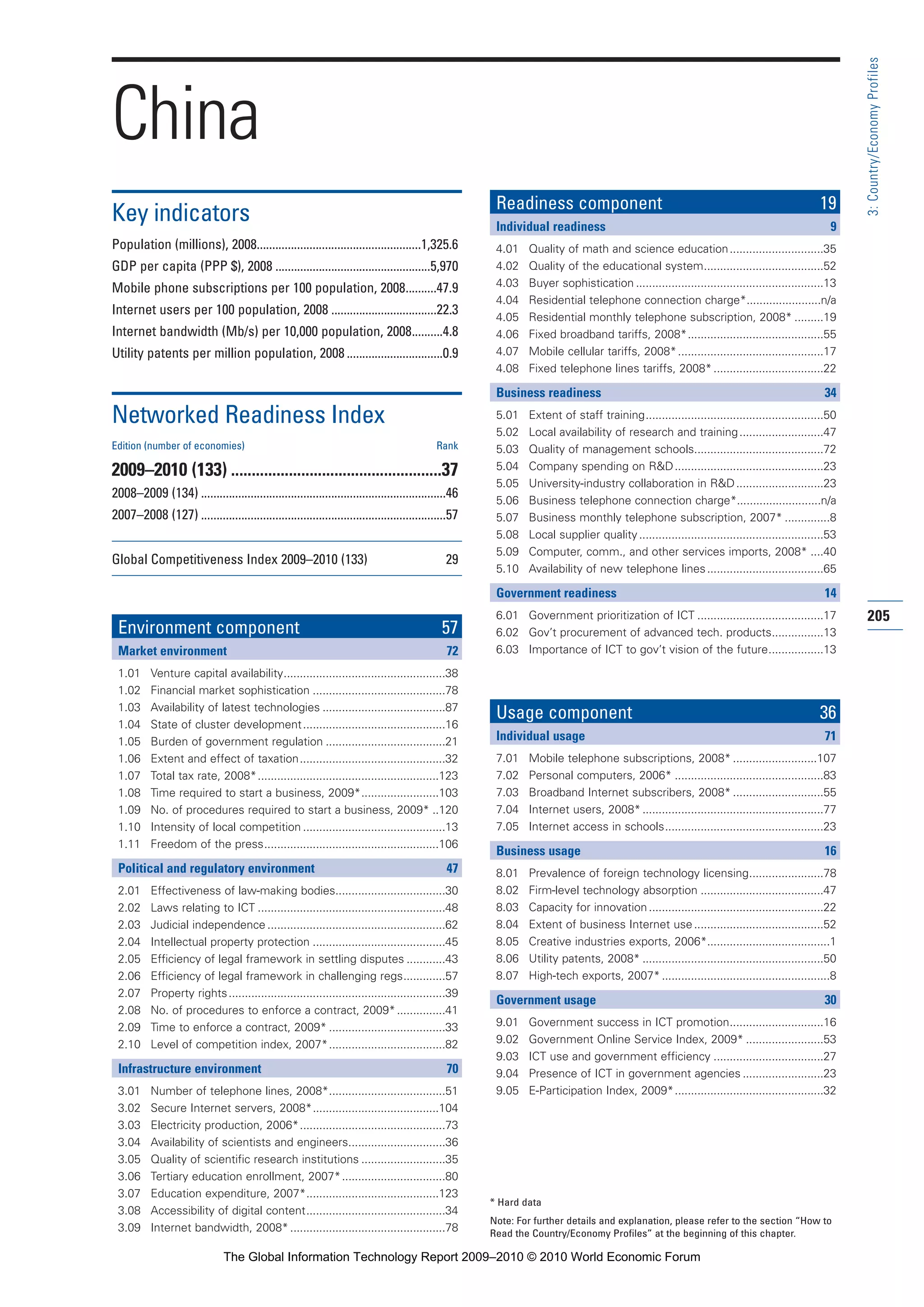
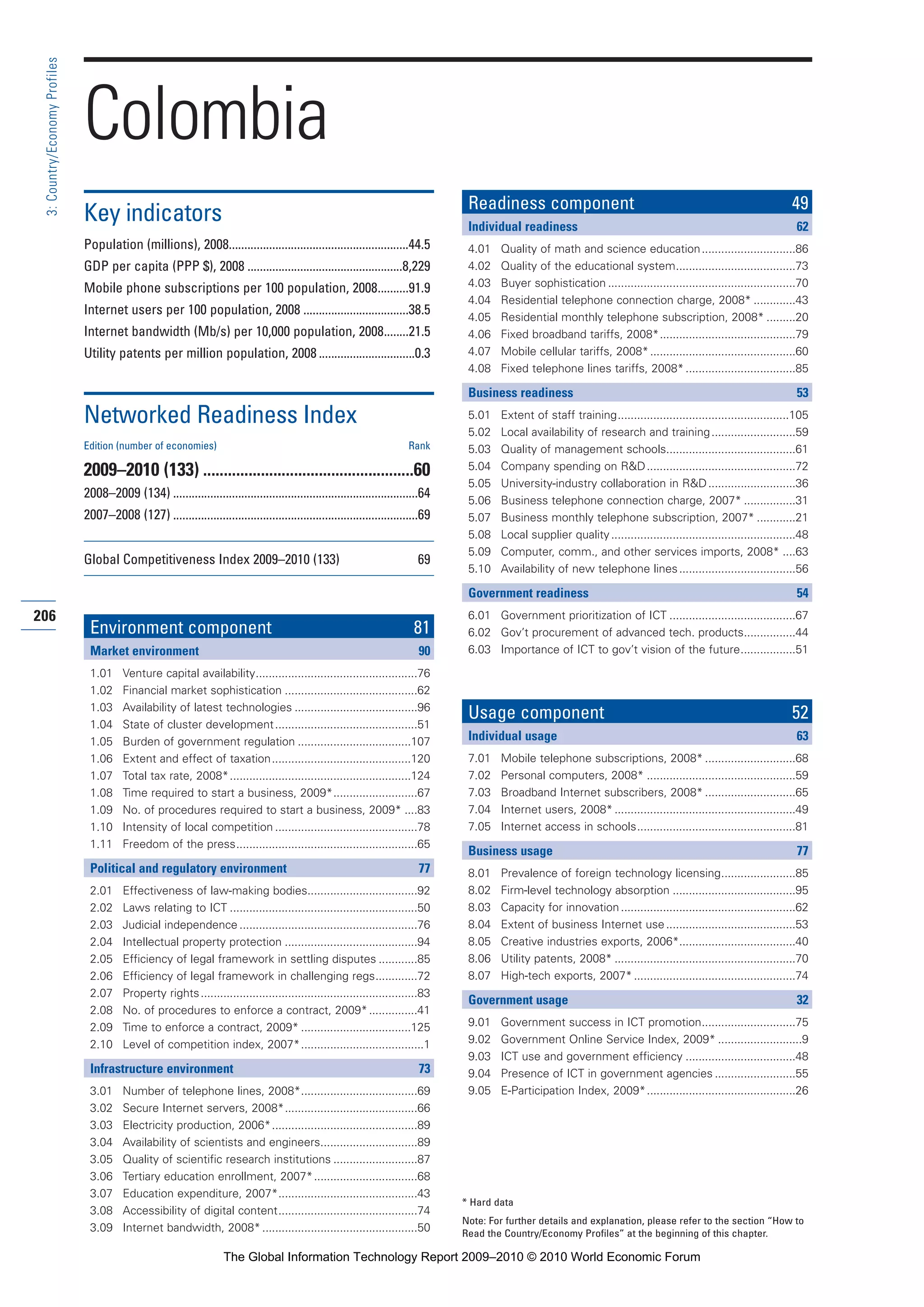
0 10 20 30 40 50
Korea, Rep.
Hong Kong SAR
Japan
Taiwan, China
United Arab Emirates
Sweden
Norway
Slovenia
United States
Iceland
Denmark
Andorra
Netherlands
Finland
Singapore
44
27
26
12
11
10
10
7
5
4
3
2
2
2
2
Percent of households
Part 1.r2 3/2/10 4:40 AM Page 96
The Global Information Technology Report 2009–2010 © 2010 World Economic Forum
and North America have managed only to provide
broadband access to two-thirds of their population.
Despite the best efforts of governments and the private
sector, the broadband digital divide persists as a signifi-
cant challenge to inclusive and sustainable development,
especially in emerging economies.
While governments focus on closing the digital
divide, the chasm that separates nations with access to
ultra-high-speed broadband connections from those
without is opening.As businesses and consumers seek
advanced, next-generation applications such as cloud
computing and virtual world experiences, they need
ultra-high-speed broadband connections. Consumers are
clamoring for speeds at least 10 times faster than those
currently offered in order to use those next-generation
applications. In the future, even faster connections will
be needed for the next wave of advanced services and
applications, increasing significantly the investment
required and hence the challenge of building a national
broadband network. In providing faster services, the
track record of even the most developed markets
falls short. Only seven economies have penetration of
ultra-high-speed broadband 10 percent or higher (see
Figure 4).
Because there is such a long way to go to make
broadband a universally available asset, all stakeholders
will need to collaborate and solve crucial issues.Three
key inhibitors are preventing governments and the pri-
vate sector from collaborating to ensure adequate invest-
ments in national broadband infrastructure: the sheer
magnitude of these investments, revenue prospects, and
regulatory uncertainty.
Investments in national broadband infrastructure are
significant, front-loaded, and irreversible (see Figure 5).
As a result, investors are cautious, tempted to hold back
on investments until they have sufficient clarity about
their ability to make an adequate return on their invest-
ments. Uncertainty surrounding future broadband rev-
enue streams and regulatory obligations are making it
difficult for operators to gauge the level of investment
risk.The emergence of powerful application and service
providers is another key factor driving uncertainties
around future broadband revenue streams for investors.
These providers compete with operators for telecom-
munications service revenues and stand to profit from
broadband—yet they do not have to build the network.
This growing competition between operators and appli-
cation providers marks a fundamental disruption to the
sector’s prevalent revenue model, in which operators
STC Deutsche
Telekom
Telecom
Italia
France
Telecom
BT Telstra Qtel eircom
35
24
19
17
14
1212
10
Figure 5: Number of years to deploy next-generation broadband network infrastructure based on current spending
Source: 2008 company annual reports; Booz & Company analysis, 2009.
Note: Next-generation national broadband network capital expenditure is calculated based on the number of households in each country and the cost of passing a
household. The analysis assumes an average cost of US$1,500 per household and a capital expenditure/revenue ratio of 10 percent.
Years
97
1.8:EnablingSustainableDigitalHighways
Part 1.r2 3/2/10 4:40 AM Page 97
The Global Information Technology Report 2009–2010 © 2010 World Economic Forum
typically capture the bulk of the revenues generated by
the access connection.
Finally, regulators have not established a clear frame-
work targeted at broadband networks.The infrastructure-
sharing models mandated by legacy networks may not
be replicable for next-generation broadband. Regulatory
authorities have developed a number of tools based on
existing technical architecture: these tools include inter-
connect pricing controls based on per-minute rates and
infrastructure-sharing mandates such as local loop
unbundling derived from legacy copper-based network
architectures. Furthermore, as the distinction between
traditional service providers (i.e., operators) and applica-
tion providers (such as Skype and Google) blurs, regula-
tors need to develop new tools to regulate application
providers, which neither are licensed nor have specific
service obligations imposed on them in terms of access
and quality.While regulators attempt to define a new
regulatory regime, operators lack clarity and thus confi-
dence in their ability to monetize their investments in
national broadband infrastructure, further dampening
interest.
The three inhibitors collectively are preventing ade-
quate investments in the sector.This heightens the risk
of a downward spiral in which the sector, devoid of
long-term investments, stagnates in the short term,
resulting in reduced innovation for the economy and
risking the sector’s long-term sustainability.
A fundamentally new approach
In order to break the gridlock that has stalled invest-
ment and ensure the future viability of the sector,
governments and operators need to consider a new
paradigm characterized by three attributes.
Broadband: A national imperative
Broadband must be recognized as a national imperative,
not simply a telecommunications industry mandate.To
date, most governments have considered broadband an
important telecommunications service with revenue
potential for the ICT sector, and have regulated the
business from that perspective. However, given the eco-
nomic and social benefits that broadband offers, it must
be considered a national imperative—and driven
accordingly. Governments must elevate broadband from
merely another regulatory concern to a top issue on the
national strategic agenda.This outlook on broadband
will prompt policymakers to take a long-term view and
develop consensus among all stakeholders, removing
myopic short-term revenue and profitability pressures.
Some countries have already taken giant strides in
recognizing broadband as an essential service. France’s
highest court declared in June 2009 that broadband is a
human right, cementing its role as a national strategic
issue. Finland did the same in October 2009 by making
broadband a legal right.
A proactive public sector
The public sector needs to be proactive in securing uni-
versal broadband. Because national broadband networks
have significant socioeconomic benefits, governments have
a vested interest in their creation. Rolling out infrastruc-
ture at the national level, however, may not be the best
fit for operators’ strategies.Therefore, governments need
to play an active role in the sector’s development,
despite the fact that this represents a significant shift
away from the long-standing trend toward government
disengagement and privatization.
Just as public-private partnerships (PPPs) have
become the norm in the development of vital energy and
transportation infrastructure, effective PPPs are needed as
a model for the telecommunications sector in developing
national broadband networks. Governments have several
options to consider in establishing successful PPPs: subsi-
dizing infrastructure, providing tax concessions to private
operators, or triggering demand for broadband services.
The ideal PPP model for any country hinges on the
dynamics of the broadband ecosystem in that country.
New business models and investment risk spreading
New business models are imperative to spread investment
risk. Under the traditional model of broadband access
delivery, an end-to-end integrated telecommunications
provider offered broadband services over its own infra-
structure.The telecommunications provider invested
across the value chain with attractive medium-term
return prospects, despite market uncertainties and
regulatory obligations.That vertically integrated model,
however, may not be sustainable in the long term. It
could fail to align the risks associated with large-scale
infrastructure investments in a highly uncertain regulatory
environment with traditionally expected returns. It also
inhibits operators from pursuing new revenue opportu-
nities in high-risk application and content ventures.An
alternative new horizontal business model approach,
which separates the layers of traditional service delivery
and establishes three different plays, would allow risk
to be more appropriately tied to rewards and ensure
investment sustainability (see Figure 6).
The infrastructure business, the “PassiveCo” in
the figure, would focus on deploying passive infrastruc-
ture across the country, leveraging economies of scale
and functioning like an infrastructure utility business—
similar to gas and water utilities. PassiveCo is likely to
be a natural monopoly and would be heavily regulated.
Businesses in the middle layer,“ActiveCos,” would
lease infrastructure from PassiveCo and add intelligent
elements to provide differentiated services to both
application providers and end users.ActiveCos would
compete on their ability to provide high-quality net-
work and enablement services to application and content
providers as well as end users.These businesses would
operate in a competitive market, with regulations on
service levels, quality, and pricing.
98
1.8:EnablingSustainableDigitalHighways
Part 1.r2 3/2/10 4:40 AM Page 98
The Global Information Technology Report 2009–2010 © 2010 World Economic Forum
The top layer would have a number of “ServiceCos”
operating in an extremely competitive and lightly regu-
lated market consisting of multiple application and
content providers. ServiceCo businesses would compete
on their ability to develop deep market and customer
understanding, deploy advanced marketing techniques,
and innovate continuously.
Adopting horizontal business models yields signifi-
cant benefits for the stakeholders. It enables traditional
operators to reduce regulatory risks in the bottom layer,
which incentivizes investment in infrastructure for the
long term in return for low-risk, utility-like returns.
Horizontal business models also broaden operators’
return prospects in the top two layers by allowing them
to compete in areas with higher risk profiles but poten-
tially higher returns. Policymakers benefit from increased
private-sector investments, accelerated broadband infra-
structure deployment, greater innovation in applications
and content, and further socioeconomic contributions
from the sector.
The legacy mindset challenge
To adapt to this new paradigm and spur the creation of
national broadband networks, all stakeholders need to
adapt their current thinking and accommodate essential
changes in policy, regulations, and business models (see
Figure 7).
Shifting the government mindset
For decades, the global trend has been to minimize the
role of government in the telecommunications sector.
Governments typically have migrated from owning
incumbent networks to investing passively in them and
finally to simply regulating them.As telecommunications
99
1.8:EnablingSustainableDigitalHighways
Figure 6: Horizontal business models
Source: Booz & Company analysis, 2009.
ServiceCos
ActiveCos
PassiveCo
TYPICAL ELEMENTS
Applications and content
Switches and routers
Ducts and fiber
PROPORTION OF INVESTMENT
5%
25%
70%
INTENSITY OF COMPETITION
High
Medium
Low
TYPICAL PAYBACK PERIOD
1–2 years
5–7 years
12–15 years
Figure 7: Stakeholders and their new roles
Source: Booz & Company analysis, 2009.
Governments
Operators
Focus
Role
Philosophy
Focus
Business model
Philosophy
Telecommunications
Oversight
Open competition
Access
Integrated
Defensive
ICT
Facilitation
Sector sustainability
Enablement
Modular
Proactive
Part 1.r2 3/2/10 4:40 AM Page 99
The Global Information Technology Report 2009–2010 © 2010 World Economic Forum
regulators, governments have primarily focused on com-
petition, which has been introduced as a mechanism to
ensure market efficiency. Effective competition has
indeed been a key enabler of rapid telecommunications
growth in the past decade.
However, to address the three inhibitors to investment
in national broadband, governments need to rethink
their role and consider taking the bold steps necessary
to facilitate investments and ensure the sector’s long-
term sustainability. Governments have played a major
role in the development of vital infrastructure sectors—
roads, bridges, and power plants. Policymakers now need
to explore mechanisms to foster the development of
national digital highways.
Governments created most telecommunications
regulatory authorities based on the principle that the
consumer had to be protected against the monopolistic
activities of incumbent operators. For the past two
decades, most regulatory authorities have pursued the
singular strategy of preserving customer welfare by intro-
ducing competition in the various telecommunications
markets—including mobile, fixed, Internet, broadband,
and international. In cases where it was apparent that
operators were too dominant to allow effective compe-
tition, policymakers established a range of regulatory
measures to ensure competition efficacy and consumer
welfare.These encompass breaking up incumbents (such as
AT&T in the United States), ordering functional separa-
tion (BT in the United Kingdom), and mandating
shared infrastructure (local loop unbundling across
Europe).
A single-minded regulatory focus on introducing
competition will not suffice to generate the magnitude of
investment necessary to create national broadband net-
works. Instead, governments must seek a more balanced
approach to regulation that ensures consumer welfare
while simultaneously guarding the sector’s efficiency and
long-term sustainability.
Shifting the operator mindset
For operators, broadband revenues based on access
charges have undergone a rapid decline (see Figure 8).
Relying solely on these revenues neither supports the
magnitude of investments needed in national broadband
infrastructure nor provides operators with sustainable
growth opportunities in the future. Operators need to
diversify their revenue streams by seeking scale in their
provision of access services and capturing a larger share
of application and content providers’ revenues.
Additionally, traditional vertically integrated models,
which emphasize infrastructure expansion and manage-
ment, impair operators’ ability to compete in the new
market structure by promoting a focus on these areas
to the exclusion of others. Success in changing markets
requires operators to alter their business and operating
models from vertical integration to horizontal plays.
Operators need to focus on building scale and cost effi-
ciency in the utility-like infrastructure layer and offering
reliability and affordability in the service layer, while
100
1.8:EnablingSustainableDigitalHighways
-100 -80 -60 -40 -20 0
Norway
France
Luxembourg
Sweden
Japan
Spain
Austria
Netherlands
Italy
Portugal
Ireland
Australia
Greece
Switzerland
Denmark
Poland
Finland
Turkey
Slovak Republic
Hungary
Czech Republic–84
–82
–75
–71
–64
–63
–51
–50
–61
–46
–41
–9
–13
–13
–20
–14
–27
–23
–33
–40
–45
Mean = –44
Figure 8: Broadband access price declines, selected countries (%, 2005–08)
Source: Booz & Company analysis, 2009.
Part 1.r2 3/2/10 4:40 AM Page 100
The Global Information Technology Report 2009–2010 © 2010 World Economic Forum
competing on innovation and speed in the application
layer (refer to Figure 6).
Finally, operators need to be proactive in both
adopting the new horizontal approach and engaging
the government on suitable implementation approaches.
Traditionally, operators have viewed regulatory initiatives
with suspicion, since in the past regulatory moves have
in some cases depressed incumbents’ returns. Operators
need to engage regulators to accelerate national broad-
band infrastructure deployment because this not only
increases the potential market for operators but also
provides the basis for sector sustainability.
Imperatives for the public sector
In order to broaden access to broadband service, gov-
ernments need to consider adopting three immediate
imperatives: establish a national broadband policy, define
a new regulatory framework that supports operators’
horizontal business models, and facilitate investments in
the sector.
Establish a national broadband policy
As a necessary first step to enabling universal broadband
access, governments need to establish a consistent, coher-
ent, and shared national broadband vision, embedded in
a national broadband policy.This policy not only must
put forth a national aim for the speed and coverage of the
broadband infrastructure, but also provide guidance on
how regulators, operators, and application and content
providers will work together in achieving that aim.
Several countries have already defined or are in the
process of establishing a national broadband policy, with
their different goals highlighting the varying levels of
aspiration and government involvement. For instance,
the United Kingdom’s national broadband policy,
Digital Britain, aims for every household to have a
2-megabyte per second (MB/s) connection in the next
10 years, supported by a long-term tax on broadband
connections; Singapore is aiming for 100 MB/s for each
household by 2015, supported by an immediate direct
grant to the market.
Establishing a national broadband policy should
involve an open dialogue with industry participants.This
must include an objective assessment of the demand for
broadband infrastructure: how widespread and immediate
is the demand? To return to the Digital Britain example,
the policy was established through an open consultation
process.The Digital Britain Summit, a face-to-face, day-
long meeting for key stakeholders, was followed by a
series of “unconferences”—online forums that allowed
the public to weigh in.
Once established, a common policy will serve as
an important tool to continue the dialogue with key
industry stakeholders and ensure that everyone remains
aligned on goals. Governments intent on building
national broadband infrastructures need to undertake
this dialogue immediately.
Create a regulatory environment that supports horizontal
business models
Existing regulatory frameworks emphasize competition
via a series of mandates for vertically integrated incum-
bents.As the industry moves away from vertically inte-
grated models to horizontal ones, regulatory tools need to
be adapted and new ones developed to ensure consumer
welfare and effective competition.
Regulators need to encourage the move toward
horizontal business models by adapting existing regula-
tory regimes, especially at the infrastructure and service
layers. Incumbent operators should be incentivized to
open their network infrastructure, to put their knowl-
edge and existing assets to the best use, and to keep the
cost of national broadband infrastructure under control.
At the same time, regulators could impose stringent
sharing and ownership restrictions on infrastructure
players, ensuring fair and equal access to all providers
upstream. Regulators must also assess the need to grant
exclusivities in the infrastructure layer, since competition
at that level affects the ability of these entities to gener-
ate an adequate return on their investment.
Singapore’s government, in establishing the horizontal
model, licensed a new infrastructure player, accepting
that it would become a natural monopoly.At the same
time, the government mandated universal deployment
by 2015 and banned effective control of the infrastruc-
ture provider by companies in the upper layer. Singtel,
the incumbent, was allowed to be a part of the consor-
tium that will operate the infrastructure player, as it
committed to place all its passive infrastructure assets in
a separate trust and to divest these completely by 2011.
Facilitate investments in the sector
Some governments recently have reversed past privatiza-
tion efforts and have invested in the telecommunications
sector, recognizing the significant benefits and national
competitive advantages derived from broadband.These
investments have ranged from direct investment in
broadband companies, as in Australia, and grants to private-
sector players as in Singapore, to end-user subsidies, as
in Korea, Rep. (Korea) and Japan. In all, governments
around the world have committed recently to investing
more than US$24 billion in broadband network devel-
opment (see Table 1).
Governments, in concert with the private sector,
need to evaluate their role and the magnitude of invest-
ment required in the sector, while identifying the right
investment mechanism.
Governments should also help stimulate demand for
broadband services.The Korean government, for example,
has done so by establishing education centers to train
housewives to use the Internet. Egypt has launched a
successful IT club initiative that provides fully equipped
101
1.8:EnablingSustainableDigitalHighways
Part 1.r2 3/2/10 4:40 AM Page 101
The Global Information Technology Report 2009–2010 © 2010 World Economic Forum
102
1.8:EnablingSustainableDigitalHighways
Source: Booz & Company database, 2009.
Table 1: Government investment in broadband, selected countries
Number of Investment Total
additional countries per capita investment
Country/region considering investment (US$) (US$ millions)
AMERICAS 1 n/a 7,400
Canada 5 193
United States 24 7,200
EUROPE 0 n/a 8,900
Austria 7 59
Estonia 92 69
France 61 3,770
Germany 2 200
Greece 92 1,030
Ireland 25 110
Italy 34 2,049
Portugal 100 1,060
Spain 35 1,420
United Kingdom 6 324
ASIA PACIFIC 0 n/a 6,500
Australia 159 3,300
Korea, Rep. 18 890
Malaysia 27 720
New Zealand 205 840
Singapore 154 710
MIDDLE EAST & AFRICA 2 n/a 0
computer labs and broadband access at schools, clubs,
youth centers, and universities. Governments can also
stimulate demand by ensuring that all public-service
provisioning be handled over broadband networks.
The role of the private sector
In anticipation of policy and regulatory changes, private-
sector operators need to take three proactive, immediate
steps to better position themselves. Operators must open
their infrastructure business, start building capabilities for
double-sided business models, and capture further returns
by sharpening their focus on application innovation.
Adopt open infrastructure plays
Operators have in the past resisted attempts by regulators
to separate the infrastructure layer from the others, driven
by concerns regarding loss of synergies and marketing
power. However, the situation facing the sector today is
different: the long-term sustainability of the sector is at
risk unless vital investments in national broadband infra-
structure are secured in a timely manner. Operators,
facing a decline in their traditional revenue bases, are
unable to capitalize on growth opportunities provided
by broadband, since they alone do not have the incen-
tive to undertake long-term investments under existing
regulatory regimes.
If operators proactively evolve toward a horizontal
model and adopt a more open approach to sharing
infrastructure, up to considering separation if needed,
they can reap significant benefits while strengthening
the sector’s future sustainability.These measures relax
the regulatory obligations that have been imposed on
operators by their current vertically integrated operating
model.They reduce operators’ costs for infrastructure
deployment by allowing operators to share those costs
with the government or with other private players.
Finally, they enhance returns on infrastructure invest-
ment, driven by higher asset utilization and efficiency
as well as the higher premium allotted to infrastructure
companies by the investment community.
The separation undertaken by operators such as
Openreach in the United Kingdom and Chorus in
New Zealand helped reduce the regulatory pressure
on the incumbents that own them. Governments in
Australia, Greece, Malaysia, and Singapore have demon-
strated their willingness to enter into PPPs with infra-
structure players, while Canada, Japan, and Korea have
provided incentives and tax subsidies to such players.
By cooperating with their governments and even
proactively steering them in the direction of infrastruc-
Part 1.r2 3/2/10 4:40 AM Page 102
The Global Information Technology Report 2009–2010 © 2010 World Economic Forum
ture plays, operators stand to reap considerable benefits.
Singtel, for instance, worked closely with the Singapore
government to establish a new horizontal model in the
sector, bidding as a part of a winning consortium to
operate the infrastructure entity. In doing so, Singtel
monetized its existing passive assets, which would
otherwise have been rendered redundant by the new
infrastructure entity; it also benefited significantly from
a subsidy of US$750 million in governmental grants,
which is accelerating the creation of the universal
broadband market and hence providing new growth
opportunities for Singtel in the retail market. Similarly,
BT acted quickly to accept the mechanisms to separate
its infrastructure into a different business, Openreach, a
move that ensured regulatory goodwill and led to
reduced retail regulation.Telstra (in Australia), on the
other hand, was reluctant to consider infrastructure sep-
aration, and may face a stricter regulatory environment
as a result.
Pursue double-sided business models
Having opened the infrastructure layer, operators need
to pursue growth opportunities outside of providing
end-user access services. Building double-sided business
models will allow operators to augment service revenues
by selling enabling services to numerous application and
service providers. Such enabling services could include
hosting services, managed services, and transaction sup-
port services (see Figure 9).
Operators would need to leverage the assets and
capabilities they built over the years of providing
telecommunications services to end users.These include
network management skills, ongoing financial relation-
ships with clients, and the ability to operate large IT and
network systems.Taking advantage of these assets would
enable operators to pursue new growth opportunities
in providing wholesale services, enabling transactional
support to application providers (billing and location
services), and providing managed and hosted services
to enterprises and application providers.
Proactive operators are already testing double-sided
business models. For example, the Spanish multinational
Telefonica is building a cloud-computing service
intended to host enterprise data and services while
continuing to provide telecommunications services to
its subscriber base. Recently, United Arab Emirates–based
Etisalat announced a cloud service that allows companies
to deploy IT services on a pay-per-use basis.
Figure 9: New revenue streams for double-sided business model
Source: Barraclough et al., 2008; Booz & Company analysis, 2009.
Enterprises
Services providers
and resellers
Retailers
Application providers
Operator
Mobile users
Enterprises
Government
Home users
Wholesale
broadband
Managed
services
Broadband
services
Hosting
services
Billing
103
1.8:EnablingSustainableDigitalHighways
Part 1.r2 3/2/10 4:40 AM Page 103
The Global Information Technology Report 2009–2010 © 2010 World Economic Forum
Sharpen focus on application innovation
Finally, having opened the infrastructure layer and built
a double-sided business model, operators need to
enhance their ability to innovate in and extract value
from the application and content layer, which is likely
to be the fastest-growing layer in a multilayer market.
Competition in this layer would be intense and domi-
nated by current application giants such as Google,
Yahoo, and Facebook, all of which have high brand
recognition and a larger user base than most national
operators.
Operators need to undertake an objective and prag-
matic assessment of their capabilities in this space and
focus on niche areas where they are likely to succeed. For
example, operators can take advantage of their ability to
influence consumers’ device and equipment purchases,
as well as their ability to develop scalable and reliable
services, to compete in niche markets such as Internet
Protocol television, smart homes, and location-based
advertising services. Emerging technologies such as
telemetry and embedded radio-frequency identification
could provide lucrative opportunities for operators, since
these technologies require deep network understanding
combined with smart customer insights—an area where
operators are best positioned to compete.
Success in the application space would be contingent
on an operator’s ability to invest smartly, establish
focused business units, and leverage its existing scale,
as seen in the relatively successful efforts of Vodafone,
Orange, and Telefonica.
Conclusion
Winston Churchill once said that if you build a present
only in the image of the past, you will miss out entirely
on the great challenges of the future.2
As governments
and private-sector operators strive to ensure universal
and affordable broadband service, these words ring true
for the profound shift that is required to enable these
digital highways of the future.
Sustainable societies, in which all citizens have a
voice, must provide the means for everyone’s voices to
be heard—and increasingly, those means are digital.As
such, broadband is no longer a telecommunications sector
issue that industry leaders should solve. Its relevance has
transcended the industry and its impact reaches deeply
into socioeconomic issues. Broadband thus mandates
attention from policymakers and regulators as well as
from the telecommunications industry.This is not an
easy task for any of them. Ensuring broadband access
requires radical shifts in thinking, shedding decades-old
business models, changes in regulatory policy, and bold
moves by government to spur development.
For all stakeholders, time is of the essence—and
not only because consumers want faster service.The
quicker a country can provide broadband, the quicker
that country can reap a variety of economic benefits. It
is important that governments and the private sector
realize that access for all is key. Broadband is so vital
that those nations that do not offer high-speed access
to their populations will have a serious disadvantage in
the global economy.This is true for all economies—
developed as well as emerging nations. For developed
nations, broadband is the key to accelerating economic
recovery, creating business opportunities, and reinforcing
competitiveness. For emerging economies, broadband
does all that and more, accelerating inclusion in the
global economy by democratizing business, culture,
health, and education.
Government and industry leaders will need to
demonstrate their foresight in this regard to maintain
their competitiveness with global peers. Doing so will
require them to fundamentally change the way they
think about broadband access.
Notes
1 Julius Genachowski, August 6, 2009. Opening Remarks to a
series of 22 staff workshops being held by the FCC.
2 Gordon Brown, Speech at the Digital Britain Summit. Available at
http://interactive.bis.gov.uk/digitalbritain/wp-content/uploads/
2009/04/digital-britain-summit-full-transcript3.pdf.
References
ANACOM (Autoridade Nacional De Comunicacoes). 2009. Next
Generation Networks. Available at http://www.anacom.pt/
render.jsp?categoryId=327455.
Barraclough, C., K. McMahon, and A. Harrowell. 2008. The
2-Sided Telecoms Market Opportunity: Realising Growth
from the “Platform Play.” STL Partners. Available at
http://www.stlpartners.com/telco2_2-sided-market/index.php.
DCENR (Department of Communications, Energy and Natural
Resources), Ireland. National Broadband Scheme. Available
at http://www.dcenr.gov.ie/Communications/Communications+
Development/NBS+FAQs.
EIU (Economist Intelligence Unit). 2009. “A New Ranking of the
World’s Most Innovative Countries.” Sponsored by Cisco.
Available at http://graphics.eiu.com/PDF/Cisco_Innovation_
Methodology.pdf.
FTTH Council (Fiber to the Home Council). 2009. Global FTTH
Rankings. Available at http://www.ftthcouncil.org.
Government of Australia, Department for Broadband, Communications
and the Digital Economy. Australian National Broadband
Plan. Available at http://www.dbcde.gov.au/broadband/
national_broadband_network.
ITU (International Telecommunication Union). 2009. World
Telecommunication/ICT Indicators Database 2009. Available at
http://www.itu.int/ITU-D/ict/.
Malaysia National ICT Initiative. High Speed Broadband (HSBB)
Plan. Available at http://www.mscmalaysia.my/main_art.php?
CategoryID=5&parentID=12073056649982&artID=120825716849
63&p_artID=723.
New Zealand National Party. 2009. Broadband Plan 2009. Available
at http://www.national.org.nz/Article.aspx?ArticleId=28529.
NTIA (National Telecommunications and Information Administration),
United States. Broadband Technology Opportunities Program
(BTOP). Available at http://www.ntia.doc.gov/broadbandgrants/.
104
1.8:EnablingSustainableDigitalHighways
Part 1.r2 3/2/10 4:40 AM Page 104
The Global Information Technology Report 2009–2010 © 2010 World Economic Forum
OECD (Organisation for Economic Co-operation and Development).
2009. Statistics Productivity portal, October. Available at
http://www.oecd.org/topicstatsportal/0,3398,en_2825_30453906_
1_1_1_1_1,00.html#30453948.
Singapore Infocom Development Authority. Next Generation
Broadband Network Plan. Available at http://www.ida.gov.sg/
Infrastructure/20060919190208.aspx.
WBIS (World Broadband Information Services). 2008. Informa.
Available at http://www.wbisdata.com/newt/l/wbis/index.html.
105
1.8:EnablingSustainableDigitalHighways
Part 1.r2 3/2/10 4:40 AM Page 105
The Global Information Technology Report 2009–2010 © 2010 World Economic Forum
Part 1.r2 3/2/10 4:40 AM Page 106
The Global Information Technology Report 2009–2010 © 2010 World Economic Forum
CHAPTER 1.9
The Economic Consequences
of the Diffusion of Cloud
Computing
FEDERICO ETRO, University of Milano-Bicocca and Intertic
Cloud computing is an emerging general purpose tech-
nology (GPT) that could provide a fundamental contri-
bution to efficiency in the private and public sectors,
as well as promote growth, competition, and business
creation. It is an Internet-based technology through
which information is stored in servers and provided as
an on-demand service to clients.The impact of cloud
computing on both households and companies will be
substantial. On one side, consumers will be able to
access all of their documents and data from any device
(the home or work personal computer [PC], the
mobile phone, or an Internet point, among others) as
they already can for email services or social networks.
On the other side, firms will be able to rent computing
power (both hardware and software in their latest ver-
sions) and storage from a service provider and pay on
demand, as they already do for other inputs such as
energy and electricity.1
The former application will
affect our lifestyles, but the latter will have a profound
impact on the cost structure of all the industries using
hardware and software,2
and therefore it will have an
indirect but crucial impact on business creation and on
the macroeconomic performance of countries.
Cloud computing can exert a number of effects
on the economy. For instance, it can enable huge cost
savings and more efficiency in large areas of the public
sector, including hospitals and healthcare (especially for
providing information and technology to remote or
poorer locations), education (especially for e-learning),
and the activities of government agencies that experi-
ence periodic peaks in usage. Moreover, substantial posi-
tive externalities are expected because of energy savings:
the improvement of energy efficiency may contribute to
the reduction of total carbon emissions in a substantial
way—information and communication technologies
(ICT) is responsible for 2 percent of carbon emissions
in Europe, of which 1.75 percent is due to the use of
ICT products and services, and 0.25 percent to their
production.The introduction of cloud computing can
provide cost savings in the private sector as well: it can
create multilateral network effects among businesses
and increase productivity within businesses, and it can
promote entry and innovation in all the sectors where
ICT costs are relevant and are drastically reduced by
the adoption of cloud computing.This last effect can
be quite large in terms of consequences for the aggre-
gate economy, and is the focus of the evaluation of the
economic impact of cloud computing on the economy
conducted in this chapter.
In a recent study, we estimated the economic
impact of the diffusion of cloud computing in Europe
through incentives to new business creation.3
Starting
from conservative assumptions about the cost-reduction
process associated with the spread of cloud computing
over five years, we obtained results showing that the
diffusion of cloud computing could provide a positive
and substantial contribution to the annual growth rate
107
1.9:TheEconomicConsequencesoftheDiffusionofCloudComputing
Part 1.r2 3/2/10 4:40 AM Page 107
The Global Information Technology Report 2009–2010 © 2010 World Economic Forum
(up to a few decimal points), helping to create about a
million new jobs through the development of a few
hundred thousand new small- and medium-sized enter-
prises (SMEs) in the European Union (EU).The driving
mechanism behind the positive contribution works
through the incentives to create new firms, in particular
SMEs. One of the main obstacles to enter new markets
is represented by the high up-front costs of entry, often
associated with physical and ICT capital spending.
Cloud computing allows potential entrants to save on
the fixed costs associated with hardware/software adop-
tion and with general ICT investment, and turns part of
this capital expenditure into operative expenditure—that
is into variable costs.This reduces the constraints on
entry and promotes business creation.The importance
of such a mechanism is well known at the policy level,
especially in Europe, where SMEs play a crucial role in
the production structure.4
The next section will describe the development of
cloud computing in greater detail and comment on the
consequences of its diffusion for the economy.The fol-
lowing section will provide the results of our economic
investigation on EU countries, and the last section will
draw some policy implications and conclusions.
What is cloud computing and what will be its impact?
Cloud computing is an Internet-based technology
through which information is stored in servers and
provided as an on-demand service to clients, possibly
jointly with the traditional form of access. It is probably
going to develop along different concepts, focused on
the provision of Infrastructure as a Service (IaaS, or
renting virtual machines), Platform as a Service (PaaS,
on which software applications can run), or Software
as a Service (SaaS, or renting the full service, as for
email). In preparation for its introduction, many hard-
ware and software companies are investing to create new
platforms able to attract customers “on the clouds.” Cloud
platforms provide services that facilitate the creation of
applications in competition with, or as an alternative to,
on-premises platforms—the traditional platforms based
on an operating system, a group of infrastructure services,
and a set of packaged and customized applications.The
crucial difference between the two platforms is that,
while on-premises platforms are designed to support
consumer-scale or enterprise-scale applications, cloud
platforms can potentially support multiple users at a
wider scale, namely at Internet scale.5
The introduction of cloud computing is going to
be gradual. Currently we are only in a phase of prepara-
tion, with a few pioneers offering services that can be
regarded as belonging to cloud computing.These serv-
ices are often derived from internal solutions (turning
private clouds into public ones). Meanwhile, many large
high-tech companies are building huge data centers
loaded with hundreds of thousands of servers to be
made available for customer needs in the near future.
The first mover in the field has been Amazon, which has
provided access to half a million developers by way of
Amazon Web Services (initially developed for internal
purposes).Through this cloud computing service, any
small firm can start a Web-based business on its computer
system, add extra virtual machines when needed, and
shut them down when there is no demand. For this
reason the utility is called Elastic Cloud Computing
(Amazon EC2). Google is also investing huge amounts
of funds in data centers.Already today Google provides
word processing and spreadsheet applications online,
while software and data are stored on the servers.
Google App engine allows software developers to write
applications that can be run for free on Google’s servers.
Even Google’s search engine or mapping service can
offer cloud application services: for instance, when
Google Maps was launched, programmers easily found
out how to combine the maps with other information to
provide new services. Microsoft started later but has made
high investments in the creation of new data centers. In
January 2010, the leading software company launched a
cloud platform called Windows Azure (introduced in a
beta version in 2008) that is able to provide a number of
new technologies: a Windows-based environment in the
cloud to store data in Microsoft data centers and to run
applications; an infrastructure for both on-premises and
cloud applications (through .NET Services); a cloud-
based database (through SQL Data Services, which can
be used from different users and different locations); and
an application tool to access Live Services, which allows
for the synchronization and constant updating of data
across systems into a “mesh” (for all the personal devices).
Moreover,Windows Azure provides a browser-accessible
portal for customers, who can create a hosting account
to run applications or a storage account to store data in
the cloud.They can be charged through subscriptions,
per-use fees, or other methods.Another important
player is Salesforce.com with its Force.com products.
Also Oracle has introduced a cloud-based version of its
database program and is merging with Sun Microsystems
to prepare further expansion in the field. Finally,Yahoo!
is developing server farms as well.
The battle for the clouds among these companies is
going to reshape the ICT market structure, just as PC
distribution did in the 1980s. However, the need for
creating network effects in the development of a cloud
platform will keep the margins low for a while and will
maximize the speed of diffusion of cloud computing
between firms at the global level.Therefore, in the long
run, we expect a rather competitive situation on the
supply side of cloud computing.
It is crucial to understand the economic impact
of the introduction of this GPT.6
The diffusion of
cloud computing will certainly have a solid and perva-
sive impact on the global economy.The first and most
relevant benefit of cloud computing is associated with
108
1.9:TheEconomicConsequencesoftheDiffusionofCloudComputing
Part 1.r2 3/2/10 4:40 AM Page 108
The Global Information Technology Report 2009–2010 © 2010 World Economic Forum
a generalized reduction of the fixed costs of entry
and production by shifting fixed capital expenditure
in ICT into operative costs; the size of the shift will
depend on the size of demand and production.This
generalized reduction of fixed costs contributes to
reducing the barriers to entry, especially for SMEs—
because infrastructure is owned by the provider, it does
not need to be purchased for one-time or infrequent
intensive computing tasks; this reduction also generates
quick scalability and growth.The consequences to the
endogenous structure of the markets with largest cost
savings will be wide and will include the entry of new
SMEs, a reduction of mark ups, and an increase in aver-
age and total production.7
In spite of the fact that the relative size of informa-
tion technology (IT) cloud services will probably
remain limited for the next few years, they are destined
to increase and to have a significant macroeconomic
impact, especially in terms of the creation of new SMEs
and of employment. In times of global crisis, this could
be an important contribution to promoting recovery
and fostering growth. Cloud platforms and new data
centers are creating a new level of infrastructure that
global developers—especially SMEs that are so common
in Europe—can exploit.This new infrastructure will open
new investment and business opportunities currently
blocked by the need for massive up-front investment.
The new platforms will enable different business models,
including pay-as-you-go subscriptions for computing,
storage, and/or IT management functions; these models
will in turn allow small firms to scale up or down to
meet their demand needs.8
The economic impact of the expansion of this new
GPT may be quite large, as was the case for the diffusion
of telecommunications infrastructures in the 1970s and
1980s or the introduction of the Internet in the 1990s.9
To evaluate the impact of cloud computing, we adopt
a macroeconomic approach that emphasizes the effects
of this innovation on the cost structure of the firms
investing in ICT and consequently on their incentives
to create and expand new business; on the market struc-
ture; on the level of competition in their sectors; and ulti-
mately on the induced effects for aggregate production,
employment, and other macroeconomic variables.10
The methodology is based on a dynamic stochastic
general equilibrium–calibrated model augmented with
endogenous market structures and is in line with recent
developments in the macroeconomic literature.11
This
model is perturbed with a realistic structural change to
the cost structure in order to study the short- and long-
term reactions of the economy.
Our experiment is focused on Europe, taking as
a given the rest of the world (which is an additional
conservative hypothesis).12
Therefore, all our data are
derived from official EU statistics (Eurostat): these data
are mainly the number of firms, which is basically
equivalent to the number of SMEs; employment; and
GDP.We used data for most of the EU member coun-
tries and Norway, for which we had complete data.
Moreover, we focused on a few aggregate sectors for
which we have detailed and comparable EU statistics:
manufacturing, wholesale and retail trade, hotels and
restaurants, transport storage and communication, and
real estate renting and business activities.These aggregate
sectors cover the majority of firms in terms of number
(more than 17 million firms) and provide much of the
employment for the European countries (more than 113
million workers).They also include all the sectors where
the effects emphasized in our analysis are relevant—
namely, the manufacturing and service sectors—where
the use of ICT capital and the role of entry costs and
competition effects are more relevant.We ignored other
aggregate private sectors (such as electricity, gas, and
water supply) and the public sector, where we believe
that these mechanisms are either weaker or absent, and
sectors where comparable data were not available (such
as part of the financial sector). Country-specific hetero-
geneity and sectoral differences were considered on the
basis of statistics on the labor market and the
entry/competitive conditions at the level of EU coun-
tries and their aggregate sectors.
A key factor for determining the impact of cloud
computing is the size of fixed-cost savings.The business
literature emphasizes large savings. Dubey and Wagle
conjecture large reductions in the cost of ownership for
typical business services, suggesting that this cost could
be as much as 30 percent lower in the case of customer
relationship management delivered through software
as a service.13
International Data Corporation (IDC)
estimates a reduction of about 50 percent.14
On the
other hand, Carr suggests that about half of the capital
expenditure of modern firms is ICT related, and there-
fore a large part of it may be eliminated and (partially)
turned into operative expenditures.15
Although this may
be true in a number of sectors and for advanced compa-
nies, we prefer to adopt a more conservative assumption
for our macroeconomic investigation.
One of the best reviews of the state of ICT in
Europe is provided by the e-Business W@tch of the
European Commission.The 2006 e-Business Report
provides a comprehensive survey of ICT adoption and
spending, showing that, of the total cost, 5 percent is
spent on ICT. Since only part of the total cost corresponds
to fixed costs of production, the average ICT budget
must be more than 5 percent of the total fixed costs of
production. Of course, only part of ICT spending repre-
sents fixed costs, and only a part of it will be cut even
after the adoption of cloud computing as an alternative
to a fully internal solution. For this reason, we decided
to adopt a conservative assumption and consider a range
of fixed-cost reduction of between 1 and 5 percent in
the long run. Even the limited technological change
resulting from cloud computing delivers substantial
109
1.9:TheEconomicConsequencesoftheDiffusionofCloudComputing
Part 1.r2 3/2/10 4:40 AM Page 109
The Global Information Technology Report 2009–2010 © 2010 World Economic Forum
effects at the macroeconomic level. Needless to say, larger
shocks will be associated with wider effects.
The results for EU countries
In this section we report the results of our simulation of
the introduction and diffusion of cloud computing in the
European economy.We focus on the impact on GDP,
business creation, and employment in the short term
(after one year) and in the medium term (after five years).
Two scenarios are considered: slow adoption corresponds
to a sluggish 1 percent reduction in the fixed costs of
entry and rapid adoption to a speedy 5 percent reduc-
tion in the fixed costs.16
The contribution of cloud computing to GDP
growth can hardly be differentiated among countries
and sectors, so we simply summarize our average esti-
mates for the European countries.The estimate averages
range between 0.05 percent growth in the short run
under slow adoption and 0.3 percent in the medium run
under fast adoption. Given the conservative assumptions
on the size of the shock, these are remarkable contribu-
tions to GDP growth, and will be directly reflected in
employment.
One should take the estimates on the impact on
employment with care. Even if we consider country-
specific factors related to labor market conditions, our
basic simulations emphasize the impact in terms of
hours worked. In terms of new jobs, the impact depends
on a number of institutional and structural features of
the labor markets and their country-specific regulation.
Keeping this in mind, we found that the introduction
of cloud computing could create, on average, about a
million additional jobs in Europe.About two-thirds of
this job creation is expected to occur in the six largest
countries (the United Kingdom, Germany, France,
Poland, Italy, and Spain), but also the other EU coun-
tries could enjoy a temporary increase in employment.
Of course, this increase will vanish over time because
the structural features of the economy lead employment
toward its natural level, which is affected only in a small
measure by the reduction of fixed costs. However, the
short-run impact can be quite strong and, in a period
of crisis such as the one forecasted for the forthcoming
years, it can contribute to limiting the increase of the
unemployment rate in a substantial way. Our estimates
of the reduction of the unemployment rate in European
countries from the introduction of cloud computing are
around 0.5 to 0.6 percent in the short run and 0.2 to
3 percent in the medium run.
Before adding further details, it is worthwhile
outlining the mechanism emphasized in our model.The
gradual introduction of cloud computing reduces the
fixed costs and increases incentives for entry into each
sector.This increases current and future competition in
each market and tends to reduce mark ups, thus increas-
ing demand and therefore increasing production.The
associated increase in labor demand induces an upward
pressure on wages that, in turn, induces workers to work
more (or new agents to enter the labor force).The current
and expected increase in output affects consumption
and savings behavior. In the short run, the demand for
new business creation requires an increase in savings,
which may result in a temporary negative impact on
consumption. However, in the medium and long runs,
the positive impact of cloud computing on output leads
to an increase in consumption toward a higher steady-
state level. Of course, a faster adoption exerts a larger
impact on business creation and therefore on output and
employment as well.
Given this overview of the results in terms of GDP
and employment, we now present our results in terms
of estimated new business creation.The largest impact
is expected, in the medium run under fast adoption, to
occur in the aggregate sectors of wholesale and retail
trade (156,000 new firms) and of real estate and other
business activities (with 144,000 new SMEs). Our
empirical exercise shows a strong impact on the creation
of new SMEs, of the magnitude of a few hundred
thousand in the whole European Union (again, this is
in addition to new SMEs created in a normal situation,
without the introduction of cloud computing).The
effect is permanent and tends to increase over time: the
creation of new SMEs will not vanish, but will remain
over time, making a permanent impact on the structure
of the economy. Moreover, the effect is deeper in coun-
tries where the diffusion of SMEs is particularly strong
or where ICT adoption has been generally rapid. In
absolute terms, cloud computing is estimated to have
the largest impact in Italy in terms of new businesses
(with 81,000 new SMEs in the medium run under fast
adoption), followed by Spain (plus 55,000), France
(48,000), Germany (39,000), the United Kingdom
(35,000), and Poland (32,000).
We have also examined the impact of cloud com-
puting on employment in each country, distinguishing
among aggregate sectors. In absolute terms, the largest
impact is expected for the manufacturing sector and also
for the sector under the label “hotels and restaurants.”17
According to our estimates, the United Kingdom will
exhibit the greatest impact in terms of new workers
(with 240,000 new workers in the short run under
fast adoption), followed by Germany (160,000), France
(100,000), Poland (94,000), Italy (76,000), and Spain
(69,000). Overall, the results per country are affected
by differences in labor market conditions that tend to
influence the ability of the economy to react to a posi-
tive change through job creation, and also by differences
in the regulatory framework and in the competitive
conditions in the goods markets that create the condi-
tions for rapid business creation.
110
1.9:TheEconomicConsequencesoftheDiffusionofCloudComputing
Part 1.r2 3/2/10 4:40 AM Page 110
The Global Information Technology Report 2009–2010 © 2010 World Economic Forum
Conclusions
Part of the positive effects of cloud computing will fol-
low from the speed of adoption of the new technology.
There are a number of factors that may slow down this
adoption, such as a lack of understanding of the cloud
by firms, systemic risk, security, privacy and interoper-
ability issues, reliability, jurisdictional complexity, data
governance, loss of IT control, and general status quo
inertia. For this reason, our investigation suggests that
policymakers should promote as rapid an adoption of
cloud computing as possible. Concrete interventions
include:
• international agreements in favor of unrestricted
flow of data across borders (since data centers are
located in different countries with different privacy
laws, data portability remains a key issue for the
diffusion of cloud computing);
• agreements between EU authorities and industry
leaders on a minimum set of technological stan-
dards and process standards to be respected in the
provision of cloud computing services—these
agreements would guarantee data security and
privacy and promote a healthy diffusion of the
new technology;
• expansion of broadband capacity; and
• introduction of fiscal incentives for the adoption of
cloud computing and a specific promotion in par-
ticularly dynamic sectors (for instance, governments
could finance, up to a specified limit, the variable
costs of computing for all the domestic and foreign
firms that decide to adopt a cloud computing
solution).
These policies may be studied in such a way as to
optimize the process of adoption of the new technology
and to strengthen the propagation of its benefits within
the country.The benefits of cloud computing are many,
and countries now have the opportunity to jump-start
their economies by making policies that will enhance its
adoption.
Notes
1 See Dubey and Wagle 2007 and Armbrust et al. 2009 for early
reviews of the topic.
2 The positive association between ICT innovations and competition
is well known, and policymakers recognize that it may work in
both directions: on one side competitive sectors adopt ICT innova-
tions earlier and become more productive; on the other side ICT
adoption enhances competition. For instance, the e-Business
W@tch of the European Commission (2008) notices that “while it
seems obvious that increasing levels of competition can push
companies to adopt and use ICT, the opposite might well also be
the case. In fact, ICT and the usage of the internet have drastical-
ly impacted on certain sectors such as banking and reshaped the
competitive scenario” (p. 42).
3 Etro 2009a.
4 Again, the e-Business W@tch of the European Commission (2008)
emphasizes this aspect clearly: “SMEs form significant industry
segments in the EU and account for the majority share in EU
employment. Thus, they require specific policy attention. While
their strength lies in the flexibility with which they can adjust to
changing market conditions, their small size makes them less able
to face high up-front costs” (p. 53).
5 In the business literature, cloud computing has been seen as a
step in the commoditization of IT investments (Carr 2003); as the
outcome of an evolution toward a utility business model in which
computing capabilities are provided as a service (Rappa 2004); as
the core element of the era of Web 2.0, in which Internet is used
as a software platform (O’Reilly 2005); or simply as an application
of the generativity power of the Internet (Zittrain 2007). See also
IDC 2008.
6 For an introduction to innovation and growth theory, see
Acemoglu 2009 and Aghion and Howitt 2009.
7 Moreover, cloud computing is going to introduce the possibility of
(1) sharing resources (and costs) among a large pool of users, (2)
allowing for centralization of infrastructures in areas with lower
costs, and (3) allowing for peak-load capacity increases (generat-
ing efficiency improvements for systems that are often only
10–20 percent utilized). These features will lead to additional sav-
ings in energy and to greater environmental sustainability, whose
measure, however, is subject to great uncertainty.
8 This mechanism is going to be crucial in Europe because of the
large presence of SMEs and of the higher risk aversion of
European entrepreneurs compared with their American counter-
parts (largely because of differences in the capital and credit mar-
kets and in the venture capital market). Reduction of the fixed
costs may reduce the risk of failure and promote entry even
more.
9 On the diffusion of telecommunications infrastructures, see Röller
and Waverman 2001; on the introduction of the Internet, see
Varian et al. 2002. These were econometric studies done after the
introduction of these technologies took place. We rely on simula-
tions because our analysis occurs before the introduction of the
technology; of course, this makes our calculations subject to
greater uncertainty.
10 Etro 2009a.
11 See Ghironi and Melitz 2005; Bilbiie et al. 2007, 2008a, b; Etro
2007; Colciago and Etro 2008; Etro and Colciago 2010. See Etro
2009b for a survey.
12 Taking into consideration the gains in the competitiveness of firms
in other continents may increase the benefits of this technology
and also increase the costs of a slower diffusion in Europe.
13 Dubey and Wagle 2007.
14 IDC 2008.
15 Carr 2003.
16 Further details can be found in Etro 2009a.
17 Overall, the impact of cloud computing on employment is more
limited than its impact on business creation for a simple reason.
One of the main advantages of cloud computing is an induced
change in the market structure of many sectors, with the creation
of more firms and an increase in the level of competitiveness; this
increase in competitiveness is also associated with a reduction in
prices. This change in the market structure, associated with larger
efficiency, induces a re-allocation of jobs that does not greatly
increase the number of workers. In this case we are talking about
a few hundred additional workers (or a corresponding lower num-
ber of unemployed) at the European level. Our simulation empha-
sizes a slow reduction of the net impact on employment in the
medium run compared with its impact in the short run. This is
normal because the absolute impact on the labor force tends to
vanish in the long run.
References
Acemoglu, D. 2009. Introduction to Modern Economic Growth.
Princeton, NJ: Princeton University Press.
111
1.9:TheEconomicConsequencesoftheDiffusionofCloudComputing
Part 1.r2 3/2/10 4:40 AM Page 111
The Global Information Technology Report 2009–2010 © 2010 World Economic Forum
Aghion, P. and P. Howitt. 2009. The Economics of Growth. Cambridge,
MA: MIT Press.
Armbrust, M., A. Fox, R. Griffith, A. Joseph, R. Katz, A. Konwinski, G.
Lee, D. Patterson, A. Rabkin, I. Stoica, and M. Zaharia. 2009.
“Above the Clouds: A Berkeley View of Cloud Computing.”
Mimeo, UC Berkeley RAD Laboratory. Available at http://berkeley-
clouds.blogspot.com/.
Bilbiie, F., F. Ghironi, and M. Melitz. 2007. “Endogenous Entry, Product
Variety, and Business Cycles.” NBER Working Paper No. 13646.
Cambridge, MA: National Bureau of Economic Research.
———. 2008a. “Monetary Policy and Business Cycles with
Endogenous Entry and Product Variety.” In NBER Macroeconomic
Annual 2007, ed. D. Acemoglu, K. Rogoff, and M. Woodford.
Cambridge, MA: National Bureau of Economic Research.
299–353.
———. 2008b. “Endogenous Entry, Product Variety, and Business
Cycles.” NBER Working Paper No. 14383. Cambridge, MA:
National Bureau of Economic Research.
Carr, N. 2003. “IT Doesn’t Matter.” Harvard Business Review May:
41–9.
Colciago, A. and F. Etro. 2008. “Real Business Cycles with Cournot
Competition and Endogenous Entry.” Mimeo, University of
Milano-Bicocca.
Dubey, A. and D. Wagle. 2007. “Delivering Software as a Service.” The
McKinsey Quarterly May: 1–12.
The Economist. 2008. “Where the Cloud Meets the Ground.” Report,
October 25: 387.
Etro, F. 2007. “Endogenous Market Structures and Macroeconomic
Theory.” Review of Business and Economics 52 (4): 543–66.
———. 2009a. “The Economic Impact of Cloud Computing on Business
Creation, Employment and Output in Europe.” Review of
Business and Economics 54 (2): 179–208.
———. 2009b. Endogenous Market Structures and the Macroeconomy.
New York and Berlin: Springer.
Etro, F. and A. Colciago. 2010. “Endogenous Market Structure and the
Business Cycle.” The Economic Journal, in press.
European Commission. 2006. The European e-Business Report,
2006/07: A Portrait of e-Business in 10 Sectors of the EU
Economy. 5th Synthesis Report of the Sectoral e-Business
W@tch, Luxembourg: European Communities.
———. 2008. The European e-Business Report 2008: The Impact of ICT
and e-Business on Firms, Sectors and the Economy. 6th
Synthesis Report of the Sectoral e-Business W@tch.
Luxembourg: European Communities.
Ghironi, F. and M. Melitz. 2005. “International Trade and
Macroeconomic Dynamics with Heterogenous Firms.” Quarterly
Journal of Economics 120: 865–915.
IDC (International Data Corporation). 2008. “IT Cloud Services
Forecast—2008–2012: A Key Driver for Growth.” Mimeo. October
8. Available at http://blogs.idc.com/ie/?p=224.
O Reilly, T. 2005. “What is Web 2.0? Design Patterns and Business
Models for the Next Generation of Software.” Mimeo.
Rappa, M. 2004. “The Utility Business Model and the Future of
Computing Services.” IBM Systems Journal 43(1): 32–42.
Röller, L.-H. and L. Waverman. 2001. “Telecommunications
Infrastructure and Economic Development: A Simultaneous
Approach.” The American Economic Review 91 (4): 909–23.
Varian, H., R. E. Litan, A. Elder, and J. Shutter. 2002. “The Net Impact
Study: The Projected Economic Benefits of the Internet in the
United States, United Kingdom, France and Germany.” Mimeo
2.0.
Zittrain, J. 2007. “Saving the Internet.” Harvard Business Review June:
49–59.
112
1.9:TheEconomicConsequencesoftheDiffusionofCloudComputing
Part 1.r2 3/2/10 4:40 AM Page 112
The Global Information Technology Report 2009–2010 © 2010 World Economic Forum
CHAPTER 1.10
How Technology Will Drive the
Transition to the Low-Carbon
Economy: ICT and the
Sustainability Imperative
GBS BINDRA, Logica plc
Governments, businesses, and societies are all scrambling
for a more efficient and greener way to operate and grow.
Supporting this pressing need is a growing consumer
population and a proliferation of myriad innovative
services.Together these trends promise to usher in
unprecedented business models and changes to social
behavior.
It is not easy to get society to behave green unless
there is an underlying support system from both businesses
and governments providing a personal impetus for this
change. Information and communication technologies
(ICT) lends itself easily to new models of profitable
services so businesses will find it lucrative to innovate in
this space.The creative use of technology, coupled with
innovative business models and progressive policymaking,
will play a critical role in delivering the carbon dioxide
(CO2) emissions cuts needed to meet global climate
change targets. ICT companies can leverage their abilities
in smart information management and create new serv-
ices that positively influence human behavior to combat
the climate challenge, thus benefiting company, society,
and government in a triple win-win-win scenario.
This chapter will explore the impact of technology,
innovative business models, and policymaking on envi-
ronmental sustainability.
The economic opportunity triangle: Change in life,
work, and play
We are on the threshold of a huge opportunity that will
unfold over the next couple of decades. Spoken in the
midst of the current challenging times, a statement like
that may sound preposterous, but three distinct trends
have emerged over the past few years, and we must not
let the recession cloud their visibility.
The first trend is the likely addition of a huge
number of consumers to the global marketplace.There
are various estimates about the numbers; the top end
of the estimates is upward of a billion over the next
decade.These consumers will come mostly from the
developing countries.As education, infrastructure, and
healthcare progress in these countries, a vast number
of people will take advantage of these improvements
for better living standards.All of them will need shelter,
food, transportation, communication, education, health-
care, entertainment, appliances, and a lot more.The
infrastructure in their countries should also be developed
to support the aspirations of these people.This trend
provides a huge opportunity for companies in various
industries, particularly in the ICT sector.
If we look at the composition of various segments of
global output, we see that the services sector contributes
significantly to the global economy.This is where the
second trend manifests itself.The continuous addition of
new consumers to the market has prompted the creation
of more and new services and the modification of old
services to cater to their needs and preferences.The
113
1.10:HowTechnologyWillDrivetheTransitiontotheLow-CarbonEconomy
Part 1.r2 3/2/10 4:40 AM Page 113
The Global Information Technology Report 2009–2010 © 2010 World Economic Forum
whole spectrum of sectors, ranging from insurance and
retail to transportation and communication, has to con-
stantly innovate and fine-tune its services.An example is
the way in which mobile telephony services have grown
exponentially over the past decade. Modern ICT is
making computers, as we once knew them, disappear
into objects. People, systems, and objects are beginning
to collaborate in unforeseen ways as mobile connectivity
becomes more and more ubiquitous.There are more
mobile phones in the world today than there are cars,
and the possibilities of services that can be delivered
through a mobile phone have increased many fold.
Industry sectors such as airlines, logistics, banking, insur-
ance, and news agencies, to name only a few, have
begun delivering a wide gamut of value-added services
through mobile phones.
Collaboration is one of the biggest pillars of inno-
vation in recent times. ICT makes collaboration possible
by breaking down physical borders. It connects people,
machines, economies, organizations, and governments in
innovative ways.This trend is termed pervasive collabora-
tion. Since this entire set of collaborative connections is
underpinned by ICT, companies are presented with
huge business opportunities for services innovation.
For as long as we can look back in history,
mankind has derived well-being from burning things.
Benefits and advances such warmth, light, and mobility
have all been achieved through fire and burning. For
the last 150 years, carbon has been fundamental to our
economic prosperity and has played a huge role in our
development. If the growth and development men-
tioned above continue with the same speed as they have
over the past century, it will be disastrous for the envi-
ronment. Resources such as coal and oil have powered
the engines of growth in various industries over the
past few decades without a thought to long-term
sustainability. Cars were designed to deliver more power
by guzzling more gasoline, power plants were designed
without considering polluting factors, and factories were
thrown up assuming an infinite availability and supply
of raw materials. Many such lapses occurred in the
course of development.This is where the third trend
comes in.With the rise in awareness of the damage we
are causing to the environment and to society at large,
the focus on designing and consuming products of a
sustainable nature is gaining acceptance. More than ever,
people are willing to change their lifestyles if it con-
tributes to a better world. In order to encourage this,
the benefits of adopting sustainable, green products
and services should reach the individuals that embrace
them. In other words, it should be cheaper to be green
than not to be. Measures could range from cheaper fuel
prices or road taxes for “green drivers” to pay-as-you-
drive types of insurance and carbon labeling of products
and services that enable an individual to choose sustain-
ability. Clearly, there is a need for newer business models
within traditional industry sectors that cater to these
newer needs. It is evident that these will be technology-
intensive and that ICT companies will play a major role
in delivering these solutions.
Each of the three trends above presents a huge
opportunity in itself. However, when combined, the
potential is immense and promises to forever change
the way we live, work, and play. Each of these trends
represents one leg of the economic opportunity triangle
depicted in Figure 1.The three sides of the triangle—
growth in the marketplace, pervasive collaboration, and
transformation of the economy into a low-carbon/
resource-efficient economy—together present the most
significant economic opportunity of the next decade.
This opportunity is supported and driven by both
newer ways of doing business and people changing
their behaviors. Over the next five years, green service
offerings by the ICT industry are estimated to be worth
US$1.2 trillion, according to a study by Insight
Research Corp.1
Ushering in green behavior in society
Humans want to participate, to play a role, in what is
going on around them. But they do not want to feel
incompetent and helpless when they participate in
society’s good.There is a need for a good business
model that understands and facilitates participatory
problem solving, thereby easily invoking the desired
behaviors and naturally motivating enlisted people to
be a part of the solution.To successfully change behavior,
the model should track and report on results—both
individual and collective—in a concerted effort to
create a sense of accomplishment; reporting should
never be allowed to be perceived as the publication of
a social defaulters list.Tracking (for example, the net
reduction in greenhouse gas emissions from every car)
and celebrating success should motivate others to partici-
pate actively rather than remain on the sidelines.A deep
understanding of the “why” of human behavior is
required before designing the “how” in all successful
social changes.
Today, a facilitated, rapid transition toward a low-
carbon economy is imperative if nations are to collec-
tively address the challenges presented by climate change.
For speedy mitigation of some of the most damaging
impacts of climate change, a hitherto-unprecedented
scale and pace of change is required. On this note, any
model that should be seriously considered has to strong-
ly align the needs of government and business while
supporting the good of the taxpayers. Supportive regula-
tory and government policies should be at the core of
business activity and operations, and these should help
reward and drive social behaviors that work toward the
desired de-carbonization effects.
Governments develop policies, legislation
enshrines these policies in law, and strategies direct the
body of policies and provide a framework for policy
114
1.10:HowTechnologyWillDrivetheTransitiontotheLow-CarbonEconomy
Part 1.r2 3/2/10 4:40 AM Page 114
The Global Information Technology Report 2009–2010 © 2010 World Economic Forum
implementation. Individual policies themselves are rather
meaningless when they are not based on an underlying
national agenda.A strategic framework is necessary to
help explain policy decisions and choices, and to give
policies personality and direction. Many countries in the
Asia-Pacific region have developed ambitious ICT
strategies. In these countries, there are regulations and
supervision mechanisms to ensure compliance. Policy
statements and laws in themselves may not be sufficient
to bring about the change that is sometimes necessary
to transform business practices for the greatest possible
diffusion of ICT.
Governmental vision and strategy for ICT should
focus on people and not technology. For this to happen,
it is important to develop both the ICT vision and the
strategy with people in mind, and also to incorporate
their input. National ICT policies and agendas can
choose to be sector driven or to focus on broader issues
and objectives, on benefits for society and the economy
as a whole. Many ICT strategies in the past have adopt-
ed a sectoral approach to implementation.Although
there are many types of strategies that various countries
have adopted, an integrated approach to ICT develop-
ment and deployment is most likely to yield success in
human, social, and economic development over the long
term.
Of special interest to ICT policy formulation are
trade rules affecting telecommunications regulation and
licensing.These rules are especially important in opening
up the telecommunications sector to competition and
foreign investment. Some consider the break-up of
monopolies a prerequisite of increasing information
flows and of encouraging the diffusion of ICT. Until
the World Trade Organization agreements, the telecom-
munication markets in most countries had been closed
to competition and had been operated by de facto
monopolies—the national telecommunications operators.
This is still the case in many of the non-signatory coun-
tries, and it is changing slowly in some of the signatory
countries as well. For signatories, the end result will be
similar in all cases: more open national and international
markets for telecommunications goods and services.
Many countries have developed visions of the
future where ICT is seen as an engine of transformation
toward a desired state. Invariably, this future state is
e-enabled. Some of the best known include Malaysia’s
Vision 2020, which foresees Malaysia becoming a fully
developed country by 2020,2
and e-Japan, which is a
vision of a society “where everyone can actively utilise
information technology (IT) and fully enjoy its benefits.”3
In Botswana, one tenet ofVision 2016, which proposes
“prosperity for all,” calls for Botswana to become an
educated and informed society. Finally, the national
vision for Canada is based on rolling out infrastructure
to “make the information and knowledge infrastructure
accessible to all Canadians, making Canada the most
connected nation in the world.”4
There is thus a very sensitive collaborative ecosys-
tem innovation (Figure 2) that we must address if we
are to successfully introduce working models that take
115
1.10:HowTechnologyWillDrivetheTransitiontotheLow-CarbonEconomy
Businesses
Multilateral agencies
Innovators Regulators
Investors Governments
Growthinthemarketplace
Pervasivecollaboration
Low-carbon economy
Economic
opportunity triangle
Figure 1: The economic opportunity triangle Figure 2: Collaborative ecosystem innovation
Part 1.r2 3/2/10 4:40 AM Page 115
The Global Information Technology Report 2009–2010 © 2010 World Economic Forum
advantage of the economic opportunity triangle. Five
principles ensure win-win-win among the public-private-
government aspects of this collaborative ecosystem:
1. Reward compliance rather than penalize
non-compliance.
2. Create business models that pass on incentives
to participating citizens.
3. Make it financially attractive to be compliant.
4. Enable private good to lead up to and equate
with public good.
5. Absolutely ensure that it costs less to be green
than not to be.
As an example, let us consider the transport sector,
which remains a major source of emissions. Low-carbon
technologies already exist that can significantly reduce
global emissions, but the enabling of frameworks and
specific policy responses are needed to support the rapid
deployment of those technologies, in both developed
and developing countries.The government plays an
important role in encouraging pro-green changes by
levying differential duty to encourage the manufacture
and take-up of cleaner fuels.
In this context, a favorable tariff treatment for
unleaded gas since 1987 has significantly reduced the
use of leaded gas, a major source of lead in the atmos-
phere.The success of this policy has helped facilitate the
phasing out of leaded gas from January 1, 2000, in line
with European Union (EU) directives.As a result of
these measures, lead emissions from traffic have been cut
to almost zero, with older cars—which are unable to use
unleaded gas—switching to lead-replacement gas. Such
indirect fuel taxes reduce CO2 emissions in two ways:
they have a direct impact on the number of miles driven
and, indirectly, they encourage more fuel-efficient or
alternate energy source–based vehicles.
It is by offering such incentives that we can
advance environmental principles ensuring that cheaper,
cleaner fuel is available in every garage, provide better
deals for drivers, and facilitate cleaner air across the
world. It is typical to ask motorists to bear the entire cost
of driving—not only wear and tear and congestion on
the roads, but the wider environmental costs.Any solution
that helps cut fuel consumption or reduces emissions by
encouraging certain behavior patterns or preferential
changes ought to be given careful consideration.
We next introduce some working examples of such
new-age models.
Intelligent emissions monitoring
Rising air pollution levels is a concern to governments
and environmentalists across the world.Vehicular exhaust
gases are the single largest contributors to air pollution.
Greenhouse gases released into the atmosphere because
of vehicular emissions caused by irresponsible driving
behavior have an important impact on global warming
and extreme weather conditions.
Transport is the fastest growing source of green-
house gases (Figure 3). On the one hand, transport is
vital for industrial development and the economy; on
the other, it conflicts with environmental objectives that
clamor for attention. Over the last 50 years, the industri-
al economy has replaced the agricultural economy and,
as a consequence, cities all over the globe are feeling the
effects of globalization and climate change.
There is a growing need for a solution to this uni-
versal problem. ICT can help address this. Creative use
of technology coupled with innovation in business
models and progressive policymaking will play a critical
role in delivering CO2 emissions cuts needed to meet
global climate change targets.
Personal mobility contributes to 51 percent of the
carbon footprint for a typical household in the Western
world.5
Going by this figure, there is no way emerging
economies such as India can replicate that model as-is;
with an emerging work force of half a billion people,
this would be a disaster. New-wave personal mobility
must focus on creating a much more sustainable trans-
portation system. Displaying the right behavior has a
major role to play in the new scheme of things.
The big question is: on a social level, how does one
promote green behavior in emerging economies that are
unwilling to pay more for going green? Here, a creative
business model will be one in which private good drives
public good, a model that makes it financially attractive
for individual citizens to be green. Models are needed that
reward compliance rather than penalize noncompliance.
Modern technology allows real-time monitoring of
vehicular emissions.Wireless emission data from cars can
thereafter be used to offer differential fuel pricing to the
vehicle driver.6
In this model, the fuel station offers a fuel price
tailored to every individual vehicle and driving behav-
ior. If the driving behavior is green, the fuel is priced
lower; conversely, if the driving behavior is poor, the
fuel price goes up for the next tank fill for that driver.
This model enables drivers to improve their driving
patterns and thereby empowers them to go green. By
capturing real-time vehicle emissions values, it facilitates
usage of these data for a number of purposes that change
human behavior.The technology also offers audible
feedback on the driving behavior of the driver in real
time to allow him to alter his driving style to make the
most efficient use of fuel. It measures emissions under
actual driving conditions via a unit of measure called
the green index, thus raising the driver’s awareness
through feedback and reward/penalty schemes for fuel
prices using accurate and credible data.
116
1.10:HowTechnologyWillDrivetheTransitiontotheLow-CarbonEconomy
Part 1.r2 3/2/10 4:40 AM Page 116
The Global Information Technology Report 2009–2010 © 2010 World Economic Forum
A sustainability offering modeled around these
principles provides a high level of immediate driver
orientation on how driving behavior impacts emissions
and fuel consumption.
There are two compelling reasons why such ICT-
driven green models are proving successful:
• According to Logica’s research, feedback on their
driving patterns has helped drivers become aware
of their driving behaviors; an improved driving
behavior was noted in 95 percent of the cases.
• Some overall fuel savings and associated emissions
of up to 15 percent could be recorded with the
adoption of this sustainability model. Driver profil-
ing and training also contribute to this fuel savings.
Decrease in fuel consumption is observed as a result
of decrease in excessive speeding, braking, and
idling times.Audible notifications alert the driver in
real time and help to modify driving behavior,
which in turn helps to reduce fuel consumption.
There is another dimension to this model that
helps drive social acceptance.Traditionally, the car has
been positioned as a social statement of “who you are.”
It is time to introduce a new paradigm by positioning
not the car but its value on a green index as a social
statement.
Readings from the green index would appear on
various social media, and your reading would become
the new statement of “who you are.” One would have
to visualize people proudly posting their green rating
on their social profiles (such as Facebook, MySpace,
Twitter). People would compare their ratings with those
of others and of friends, enabling the entire network to
take notice.
ICT also drives progressive policymaking by gov-
ernment and regulatory bodies. It acts as a catalyst for
policy changes toward a greener environment, enabling
governments to implement policies and programs that
reward initiatives toward reduced vehicle emissions.
ICT, hence, exerts its influence on regulatory changes
that will continue to have a powerful impact on driver
behavior.
Over a period of time, the differential fuel pricing
type models hold the potential to tip social behavior
in the direction of greener options in personal mobility.
ICT companies can work with governments, regulatory
bodies, and oil retail companies as well as individual
citizens to create an ecosystem where technology cou-
pled with progressive policymaking drives the over-
all societal good.Any new business model that aims to
successfully change behavior in a significant way must
enlighten, inform, and empower users.This example
does just that and is a forerunner of many more such
ICT-based green aids to come.
Other than eco-driving and support, the energy
efficiency in the transport and logistics sector can be
improved by deploying ICT systems such as:
117
1.10:HowTechnologyWillDrivetheTransitiontotheLow-CarbonEconomy
Figure 3: Sustainable mobility
Source: Logica, 2009.
Transport
30%
of the EU’s total
energy consumption
28%
of CO2 emissions
in Europe
Urban transport
40%
of CO2 emissions
of road transport
70%
of other pollutants from
transport
Road
84%
of the EU’s total
transport emissions
Part 1.r2 3/2/10 4:40 AM Page 117
The Global Information Technology Report 2009–2010 © 2010 World Economic Forum
• traffic management and control,
• navigation and guidance,
• access and demand management,
• freight logistics and fleet management, and
• higher penetration of in-vehicle safety devices
to avoid accidents and related congestion.
Pay-as-you-drive insurance
If one adds insurance companies and an insurance
regulator to the model of pervasive collaboration platform
cited above, one can create another business model
called pay-as-you-drive (PAYD) insurance.
Vehicle insurance is generally considered a fixed
cost, irrespective of the amount of vehicle usage.
Usage-based insurance makes vehicle insurance more
actuarially accurate (the premiums better reflect the
claim costs of each vehicle) and gives motorists an
opportunity to save money when they reduce their
mileage. It can help achieve several public policy
objectives, including road safety, consumer savings
and choice, congestion reduction, and environmental
protection.
In the near future, ICT will help enable every vehi-
cle to have “intelligence” so that they act as connected
nodes in the dynamic traffic network.Vehicles will be
able to constantly exchange contextual information such
as traffic status, infrastructure usage, and sustainability
parameters to avail various services.At the heart of this
vision is an integrated plug-and-play device that will get
installed in every vehicle. Several unified services will be
built around this smart device, and the unified service
offering could include PAYD insurance.
PAYD service models calculate premium balances
in real time based on distance, time, and speed of
the vehicle, using an on-board device (Figure 4).The
on-board device uses existing global system for mobile
communication technology to transmit the data to an
application at the back-office server. Motorists
are notified of periodic updates on mileage using text
messages.The service provides motorists with options to
top up their insurance premium even as they travel,
using text messages and the Internet. PAYD service
models allow for the customization of insurance premi-
ums using customer-specific rate plans.The system
incorporates well-defined open interfaces to facilitate
quick integration with existing insurance applications.
So how does all this help in incentivizing pro-green
changes to social behavior? Insurance companies have
always tried to differentiate and reward “safe” drivers,
giving those who qualify lower premiums and/or a
no-claims bonus. However, conventional differentiation
is a reflection of past history rather than present patterns
of behavior.What if, instead of paying for your insurance
in the beginning of the year, you could pay it every time
you drive? This in itself is a great incentive to drive less
and thereby reduce your insurance cost. For insurance
companies it reduces risk and for society it reduces
driving; people become more aware of the fact that, as
with fuel, the amount they pay for insurance depends
on how much they use their vehicle, and that they can
control such usage. Moreover, PAYD provides a much
more immediate feedback loop to the driver: by chang-
ing the cost of insurance dynamically with a change
of risk, drivers have a stronger incentive to adopt safer
practices.This is a huge catalyst of behavioral change.
It is estimated that if all motorists were to switch to
PAYD insurance service models, the world’s total oil
consumption would decrease by 12 percent per car.This
in turn, would dramatically reduce CO2 emissions.7
A recent study in the United States estimated that a
PAYD-based insurance model would reduce driving
nationally by 8 percent.8
Such a reduction in driving
would reduce CO2 emissions and oil consumption by
an estimated 2 percent and 4 percent, respectively. Only
increasing the gasoline tax by US$1 per gallon could
achieve the same reduction in driving. However, unlike
an increase in the fuel tax, PAYD would save most driv-
ers money regardless of where they live.Almost two-
thirds of households would pay less for auto insurance,
with each of those households saving an average of
US$270 per car. In short, PAYD represents a win-win
policy.What is good for drivers, in this case, is also good
for society.
Travel Together
There are millions of us who engage in solitary travel to
and from work, cumulatively driving billions of miles
each year, spending heavily on gas, and pumping tons of
emissions into the atmosphere.According to urban travel
standards (single-passenger statistics), a small car emits
around 0.59 pounds of CO2 per mile, a medium car
emits around 1.10 pounds of CO2 per mile, and an
SUV/4 wheel drive vehicle emits around 1.57 pounds
of CO2 per mile.This, in itself, is a huge contributor to
the carbon footprint of a society that supports such
usage.9
Formal carpooling is thought to have emerged in
mid 1970s, probably because of the oil crisis at that
time. Carpooling not only supports sustainability by
reducing fuel consumption, vehicular emissions, and
congestion, but it also directly benefits users by reducing
the stress and cost of travel. However, for carpooling
to work, each member must own a car that can be
shared on a rotational basis, and members of the carpool
should live or work close to each other. Some companies
have been experimenting with a new socio-business
model called Travel Together, offering a different social-
cum-economic stimulus that enables carpooling to work
even when members do not own a car or do not live or
work close to each other.
118
1.10:HowTechnologyWillDrivetheTransitiontotheLow-CarbonEconomy
Part 1.r2 3/2/10 4:40 AM Page 118
The Global Information Technology Report 2009–2010 © 2010 World Economic Forum
Travel Together brings together individuals who
drive their car to work and would like to share with
those who do not drive but would like to share part
or the entire trip. It enables the users of the service to
share the cost of the ride based on the distance traveled
by each unique user, potentially turning every private
vehicle into a shared node in the transport network.
Travel Together promises to change the dynamics
of shared transport and transform people’s commuting
experience. It does this by fusing a social networking
element into the usual car pooling system.Any person
who wishes to travel together registers first on a site by
giving his/her personal credentials, which are validated
and stored in the system.The owner of a group can
publish a route by providing details such as start point,
end point, via points, timing, vehicle details, and seat
availability, among others.The routes can be ad-hoc or
planned as per a published calendar.Alternatively, regis-
tered users can search published routes and if the route
details match their requirements, they can contact the
route owner, citing their interest in joining that group
and indicating their preferred pick-up and drop points
on that route.
Once a route owner accepts a user’s request, the
user is notified that he/she is now a member of the
carpool for that route.At the time of registration, each
user’s account is linked with his/her debit or credit card.
The person who provides the service will get points
credited to his/her account based on the distance for
which the service was offered to each user.These points
are debited from the accounts of the individuals who
availed the service and settled at regular intervals; fees
paid by non-car users are netted off by “money
received” by the car/group owner of that route.This
model encourages those who prefer to drive to volun-
teer their vehicles for carpooling, as they can recover
part of the travel cost by providing a mutually beneficial
transportation service to others who prefer not to drive.
It also throws in exciting social networking possibilities,
with Web 2.0 features supporting the online application.
One can blog on the site or choose one’s co-travelers
based on their social profile as well as local proximity.
Collaborative play thus allows for the full use of seats,
saves on fuel, and reduces the emission contribution per
person.
Smart buildings
More than 40 percent of the energy consumption in
Europe is for heating, cooling, and lighting operations
within buildings.10
Moreover, buildings are the largest
119
1.10:HowTechnologyWillDrivetheTransitiontotheLow-CarbonEconomy
Figure 4: Insurance premiums and vehicle usage
Source: Logica, 2009.
Trip details transmitted and used
• Distance
• Speed
• Time
• Location
Text alerts to users
• Usage details
• Premium balance
• Payment options
On-board unit
Insurance
back end
server
Source: Logica, 2008a.
Part 1.r2 3/2/10 4:40 AM Page 119
The Global Information Technology Report 2009–2010 © 2010 World Economic Forum
source of CO2 emissions in the European Union.The
majority of energy consumption is caused by space and
water heating within households, although the share of
consumption of lighting and appliances is rising over
time (this is similar to the situation within the services
sector, although the share of lighting and appliance con-
sumption is higher there than in households because of
a greater utilization of ICT equipment).
Worldwide energy consumption for buildings will
grow by 45 percent by 2025, when buildings will
account for about 40 percent of energy demand, with
33 percent of that demand in commercial buildings and
67 percent in residential buildings.11
Five areas in which energy efficiency can potentially
be improved through the use of ICT have been identified,
as below:
• Design and simulation tools. When new buildings
are built, designers can apply ICT tools to plan
buildings that minimize energy consumption. For
example, consider simulating and optimizing enve-
lope measures and passive solar heating techniques.
By achieving significant improvements in buildings’
energy performance via monitors and sensors, one
could more accurately measure usage, system status,
and equipment conditions. It is also possible to
obtain full price information, dynamic tariff, and
demand response, thereby allowing more energy-
efficient customer choices, value-added services, and
better-integrated demand-side automation.
• Interoperability standards. Most building control
systems today are based on localized microprocessors
with hardwired sensors controlling single functions.
It is not unusual to have separate controllers for
heating, cooling, air conditioning, and so on.There
are significant opportunities for efficiency but
most are lost because of a lack of integration and
compatibility.The most appropriate solution would
be to use a single control system that governs all
heating, ventilation, and air conditioning (HVAC);
lighting and other electrical applications; and related
subsystems installed in a building.The main barrier
to this logical solution is the fact that the different
subsystems are manufactured and often installed and
even operated by different companies.
• Building automation. In the area of home automa-
tion, which is primarily perceived as improving the
quality of life (for example, more comfortable,
safer homes), ICT has the potential to contribute
to energy efficiency through the use of improved
control and management systems based on smart
appliances and communication networks.
• Smart metering. This technology enables more
accurate measurement of consumption via the use
of advanced meters that are connected to a central
unit through a communications network, improving
data collection for billing purposes. Smart metering
provides information on consumption patterns, thus
contributing to more sustainable consumption and
energy savings.
• User-awareness tools. Providing intuitive feed-
back to users on real-time energy consumption
has significant potential to change behavior on
energy-intensive systems usage.Various studies have
shown that energy consumption could be reduced
by 5–15 percent by implementing this measure.12
Smart electricity grids
Energy generation and distribution use one-third of
all primary energy. Electricity generation could be
made more efficient by 40 percent and its transport
and distribution by 10 percent. ICT could not only
make the management of power grids more efficient
but also facilitate the integration of renewable energy
sources.13
Heating, cooling, and lighting buildings account for
more than 40 percent of European energy consumption.
The introduction of real-time updates on their energy
consumption stimulates consumer behavioral changes.
In Finland, this smart metering encouraged consumers
to reduce energy consumption by 7 percent.According
to the French regulator Commission de Régulation de
l’Energie (CRE), the implementation of smart metering
would decrease residential consumption by up to 5
percent and decrease CO2 emissions by as much as 5
percent.14
The integration of ICT tools for the management
of distribution and the use of smart meters at the
consumer location, with telecommunication networks
forming an intelligent network capable of supporting
distributed generation plants, is generally known as
active distribution networks and advanced metering infrastruc-
ture within smart grids. ICT enablement of the smart grid,
via such things as two-way communication between
grid operators and customers; pervasive con-
trol systems through substation, distribution, and feeder
automation; and decision-support systems that increase
predictive reliability should be supported.
Green consumerism: The next market mantra
A growing number of consumers are beginning to
realize the environmental and social significance of
their purchase decisions as related to the variety of
brands available today.This trend can be an opportunity
for placing consumers in a position to demand green
products from their manufacturers and even retailers.To
help individuals make appropriate, informed choices,
manufacturers and retailers need to have a deep under-
standing of consumers’ lives and consumption patterns
so they can determine the best engagement model
120
1.10:HowTechnologyWillDrivetheTransitiontotheLow-CarbonEconomy
Part 1.r2 3/2/10 4:40 AM Page 120
The Global Information Technology Report 2009–2010 © 2010 World Economic Forum
aligning attitudinal and behavioral changes to a greener
world.
Everything we produce, buy, and use has a carbon
footprint.The carbon footprint of a product or service
is the total CO2 and other greenhouse gases emitted
during its entire life, from production to use and dis-
posal. Until now, everything we consume has been taken
for granted in terms of renewability and sustainability:
no business, government, or society cared to ask what is
more damaging to the air we breathe—airlifting oranges
from halfway across the world or growing them locally
in greenhouses.The global call to action on climate
change has put pressure on companies to measure the
volume of CO2 and other greenhouse gases for which
they are responsible. Such footprints are typically com-
municated by using carbon labels.
Carbon labels show a product’s carbon footprint
from source to store and further, until its disposal.They
convey this information to consumers as a simple
numerical value; by using this value, they can then make
an informed responsible purchase choice at the point of
sale.
Carbon labeling can potentially lead to changes in
consumption, market, and business behavior by:
• informing consumers of the carbon contribution
of the product or service they are planning to pur-
chase, which can potentially influence purchasing
decisions;
• engaging consumers to educate themselves
about products high in carbon content, which
can potentially influence changes in lifestyles;
• enabling manufacturers to gain differential
posi-tioning (and even branding) based on green
credentials;
• enabling/encouraging manufacturers to improve
their efficiency and influence the supply chain
to move toward cleaner methods and means of
manufacturing; and
• providing retailers with new marketing and business
models to engage with consumers based on carbon
thresholds and green shopping habits.
Carbon labeling thus holds tremendous potential
to lead to positive consumer behavior changes and
make the entire supply chain aware of the impact of
various component steps on climate change.This is the
case provided that the challenges of achieving interna-
tional consensus, objectives, and processes and standards
on accessible, auditable carbon estimation and labeling
are overcome.
ICT can help in measuring and tracking the carbon
label for each consumable. However, what we have
today are static labels. Static CO2 labels do not capture
dynamic parameters that influence individual products:
transportation, refrigeration, and heating are some prime
examples.What if one had a way to see the update
dynamic carbon label of a product one wishes to pur-
chase on one’s mobile handset?
Figure 5 shows how near field communication
(NFC) technology could be leveraged to display dynamic
carbon labels of prospective purchases on consumers’
mobile phones.This provides consumers with real-time
carbon information that takes into account the dynamic
nature of carbon emissions and the potential difference
in footprints between instances of the same product
from different producers or even different batches from
the same producer.This leads to behavioral changes in
consumer patterns: people check not just the nutritional
information on a loaf of bread but also its carbon label
before deciding on the purchase.
From a business perspective, competing in the low-
carbon economy requires the right tools to brand right
in order to take advantage of such opportunities; ICT
helps organizations with the right green capabilities and
skills to differentiate themselves from competitors who
are “less green.”Again, government policies should be
framed in such a way as to reward producers with a
smaller carbon footprint.This, in turn, translates into
buying fewer carbon credits to offset any negative bal-
ance and is, hence, cheaper (besides being healthier) in
the longer run. For reducing emissions, carbon labeling
on its own would not be sufficient, but it is a tool that
can help create increased awareness among consumers
and demand for green products and services from the
market.
Conclusions
ICT is a powerful enabler of green behavior through
new business models aimed at reducing emissions in
almost any sector, notably in smart buildings, smart
grids, reduced travel, improved energy efficiency, and
so on. ICT can do this primarily by combining new
business (services) opportunities that effectively help
abate CO2 emissions from traditional arrangements
to the tremendous potential for growth offered by an
exploding marketplace.This is the economic opportunity
triangle.The best of such working models secures a
win-win-win ecosystem among business-society-
government.
ICT-based travel-optimizing solutions can help
reduce or substitute the travel requirements (both busi-
ness and personal) of people and goods.A second area
where ICT has been extensively used for reducing CO2
emissions caused by transport is in the use of green
intelligent transport system (ITS) solutions, the three
main elements of which are the vehicle, the infrastruc-
ture, and the driver. ITS can enlighten, inform, and
support behavioral change for the key players in green
121
1.10:HowTechnologyWillDrivetheTransitiontotheLow-CarbonEconomy
Part 1.r2 3/2/10 4:40 AM Page 121
The Global Information Technology Report 2009–2010 © 2010 World Economic Forum
ITS models.A third way in which ICT can assist other
powerful sectors of the economy in reducing green-
house gas emissions is through allowing consumers to
make carbon label–based choices at the point of sale
itself.
We have touched on only some examples in this
chapter.There are innumerable other smart green models
being attempted in the world today: among them are
variable congestion, parking, and road-usage fees based
on how environmentally friendly the vehicle being
driven is; smart parking and smart charging solutions
that guide the driver to the nearest available parking
space and charging point, thereby reducing the extra
cruising around (and pollution) required to find a place
to park.All these examples we now see breaking in our
midst are just the tip of the opportunity iceberg where
ICT can induce and catalyze pro-green behavioral
changes through innovative, smart business models.
Notes
1 Insight Research Corporation 2008.
2 Mohamad 2008.
3 Prime Minister of Japan, e-Japan Strategy 2001.
4 Industry Canada 1998.
5 See U.S. Department of Energy 2007.
6 See U.S. Department of Energy 2007.
7 Logica’s study and inference are based on following sources:
• http://www.brookings.edu/papers/2008/~/media/Files/rc/
papers/2008/07_payd_bordoffnoel/07_payd_bordoffnoel.pdf
• http://www.dft.gov.uk/pgr/statistics/datatablespublications/
intcomparisons/
• http://www.worldometers.info/cars/
8 Bordoff and Noel 2008.
9 Sightline Institute 2007.
10 eu.bac 2008.
11 European Commission 2009.
12 European Commission 2008.
13 European Commission 2009.
14 European Commission 2009.
122
1.10:HowTechnologyWillDrivetheTransitiontotheLow-CarbonEconomy
Customer enters the store,
downloads application
NFC-enabled mobile
Message sent back to NFC mobile
with dynamic + static CO2
Scans product label with mobile phone
Application serverSearch for similar products with low CO2
Figure 5: Empowering consumers to choose low-carbon products
Source: Logica, 2008b.
Part 1.r2 3/2/10 4:40 AM Page 122
The Global Information Technology Report 2009–2010 © 2010 World Economic Forum
References
Bordoff, J. E. and P. J. Noel. 2008. “Pay-As-You-Drive Auto Insurance:
A Simple Way to Reduce Driving-Related Harms and Increase
Equity.” Washington, DC: The Brookings Institution. Available at
http://www.brookings.edu/~/media/Files/rc/papers/2008/
07_payd_bordoffnoel/07_payd_bordoffnoel.pdf.
eu.bac (European Building Automation and Controls Association). 2008.
“Energy Efficiency of Buildings.” Frankfurt/Main: Fachverband.
Available at http://www.eubac.org/downloads/
energy-efficiency.pdf.
European Commission. 2008. ICT for Energy Efficiency, Ad-Hoc
Consultation Group Report. October. European Commission:
Brussels. Available at http://ec.europa.eu/information_society/
eeurope/i2010/docs/high_level_group/
ad_hoc_group_report_ict_for_energy_efficiency.pdf.
European Commission, Information Society & Media. 2009. “ICT for a
Low Carbon Economy: Smart Buildings.” July. Luxembourg:
Office for Official Publications of the European Communities.
Available at http://ec.europa.eu/information_society/activities/
sustainable_growth/docs/sb_publications/smartbuildings-ld.pdf.
Industry Canada. 1998. “Introduction: Building Canada’s Information
Economy and Society. A Cryptography Policy Framework for
Electronic Commerce: Building Canada’s Information Economy
and Society.” Task Force on Electronic Commerce, February.
Available at http://www.ic.gc.ca/eic/site/ecic-ceac.nsf/eng/
gv00364.html.
Insight Research Corporation. 2008. Communication GREEN:
Telecommunications Value in Promoting Environmental
Improvement, 2008–2013. Available at
http://www.the-infoshop.com/report/ir69558-commu-green.html.
Logica. “Logica EMO: Towards a Greener Future.” Available at
http://www.logica.com/innovation/emo.
———. 2008a. “Crimson: Usage-Based Insurance.” Available at
http://www.logica.com/innovation/crimson/.
———. 2008b. “Emerald: Sustainable Growth in the Green Economy.”
Available at http://www.logica.com/innovation/emerald.
———. 2009. “Energising Sustainability.” Whitepaper. Available at
http://www.logica.co.uk/energising+sustainability/400016188.
Mohamad, M. 2008. “The Way Forward: Vision 2020.” Working Paper
presented by His Excellency YAB Dato’ Seri Dr Mahathir
Mohamad at the Malaysian Business Council. Available at
http://www.wawasan2020.com/vision/.
Prime Minister of Japan and his Cabinet. 2001. e-Japan Strategy. IT
Strategic Headquarters, January 22. Available at
http://www.kantei.go.jp/foreign/it/network/0122full_e.html.
Sightline Institute. 2007. “How Low-Carbon Can You Go: The Green
Travel Ranking.” Available at http://www.sightline.org/maps/
charts/climate-CO2byMode.
U.S. Department of Energy. 2007. “Reduce Climate Change.” Available
at http://www.fueleconomy.gov/feg/climate.shtml.
123
1.10:HowTechnologyWillDrivetheTransitiontotheLow-CarbonEconomy
Part 1.r2 3/2/10 4:40 AM Page 123
The Global Information Technology Report 2009–2010 © 2010 World Economic Forum
Part 1.r2 3/2/10 4:40 AM Page 124
The Global Information Technology Report 2009–2010 © 2010 World Economic Forum
Part 2
Best Practices in ICT to Foster
Growth and Competitiveness:
Selected Case Studies
Part 2.r2 3/1/10 12:59 PM Page 125
The Global Information Technology Report 2009–2010 © 2010 World Economic Forum
Part 2.r2 3/1/10 12:59 PM Page 126
The Global Information Technology Report 2009–2010 © 2010 World Economic Forum
CHAPTER 2.1
Promoting Information
Societies in Complex
Environments: An In-Depth
Look at Spain’s Plan Avanza
BRUNO LANVIN, INSEAD, eLab
DANIEL TORRES MANCERA, National Observatory for
Telecommunications and the Information Society, Spain
JAVIER BUSQUETS, ESADE Business School
Worldwide, countries of all sizes and development levels
are striving to become competitive knowledge economies
and build inclusive information societies. In this context,
the intensive adoption of information and communication
technologies (ICT) as the optimal base for sustainable
social welfare and economic growth in all economic
sectors and social activities is becoming a top priority in
every public policy and corporate agenda.To a large
extent, this trend has been seconded and accelerated by
the recent crisis, as a large array of traditional industrial
and natural resource–intensive sectors have had to face
shrinking demand and margins.
Among the richer countries of Western Europe,
Spain is a case in point. On one hand, the country has
known one of the most spectacular and sustained
growth rates of the last 30 years. On the other hand, it
has also been one of the countries hardest hit by the
recent crisis, with unemployment rates surging from
12.8 percent in October 2007 to 19.3 percent in
October 2009.1
The specific political and administrative
context of Spain—where almost everything from taxes to
education is subject to complex sharing mechanisms
between central and local governments—as well as the
emphasis the country has put on developing its infor-
mation infrastructure make it an even more interesting
case as well as a source of expertise and lessons to illus-
trate the challenges and possible rewards of designing
and promoting information society strategies.
The present chapter includes four sections. In the
first, an attempt will be made to better understand the
context in which Spain’s information society vision was
born and how, as a result, Plan Avanza was designed and
launched.The second section will focus on identifying
the main results generated by this approach, while the
last two sections will address the remaining challenges
to be faced by Spain’s information society strategy and
the lessons that other countries could use from its
experience.
The past is the prologue: Plan Avanza’s design and
launch
In Spain, the traditional growth model has relied mainly
on economic sectors that, though producing positive
results in the short term, were neither intensive in ICT
nor sustainable in the long run.
In this context, the Spanish government designed
and started Plan Avanza (literally,“Move Forward” in
Spanish) in late 2005.Avanza is aimed at the full, effective
development of the information society in the country,
thus ensuring the convergence of social and economic
growth across Spanish regions with European levels.
127
2.1:PromotingInformationSocietiesinComplexEnvironments
The authors wish to thank David Gago Saldaña (consultant and advisor,
Spain’s State Secretariat for Telecommunications and the Information
Society) for his significant input and background research for this chapter.
Part 2.r2 3/1/10 12:59 PM Page 127
The Global Information Technology Report 2009–2010 © 2010 World Economic Forum
A complex background
Spain’s efforts to build a sustainable information society
have been marked by a unique combination of three
characteristics:
• These efforts were led by a vision and an ambition
formulated at the highest levels of the country’s
central government.
• They were formulated in the context of (and firmly
aligned with) Europe’s Lisbon Strategy and other
national policies.
• They were based on a strong philosophy and prac-
tice of cooperation with local Spanish authorities
(mainly Autonomous Communities and Local
Authorities).2
It is against this complex background that Spain’s
information society strategy emerged under the ambitious
banner of Plan Avanza.The Plan emerged from the need
to build a “convergence plan aimed at catching
up with European levels and promote information
society across the different regions.”3
This aim was
expressed as early as 2004 by the Spanish government,
which, at a more general level, also stressed the crucial
role of ICT both in the economy and in society. In this
way, Plan Avanza was the programmatic expression of
the government’s commitment to the promotion and
use of ICT in Spain. It was framed in a strategic govern-
mental commitment started in 2004 and intended to
redefine the Spanish productive base, on which ICT was
bound to play a pivotal role.
Spain’s authorities clearly understood that such a
demanding plan could succeed only with the involvement
and commitment of the whole Spanish society. For this
reason, they were determined to build an inclusive plan
able to cope with different needs and sensitivities of the
private sector, civil society, and the public administration.
Within this framework, regions and local adminis-
trations played significant roles, as warranted by the
highly decentralized organization of the country. In fact,
the central Spanish government, all 19 regional govern-
ments, local governments, private agents and associations
from the ICT sector, political parties, and citizens were
involved.A large array of working groups was created
to build a strategic diagnosis of the initial situation and
suggest objectives and measures for shaping the Plan.
These recommendations were endorsed unanimously
by every group, leading to the elaboration of the main
lines of the Plan.
Plan Avanza was one of the key pillars of the
Programa Ingenio 2010, the strategy that the government
put in motion to foster research, development, and
128
2.1:PromotingInformationSocietiesinComplexEnvironments
0
381,250
762,500
1,143,750
1,525,000
2009
447,329
2000–04 2005–08
1,268,329
1,516,400
Figure 1: Average annual budget devoted to information society (direct financing)
Source: SETSI.
Euros(thousands)
Part 2.r2 3/1/10 12:59 PM Page 128
The Global Information Technology Report 2009–2010 © 2010 World Economic Forum
innovation (RDI) in 2005.The rationale behind this
program was that Spain’s position was severely backward
compared with that of Europe in RDI.4
In fact, accord-
ing to 2005 data, Spain’s ratio of R&D to GDP was
1.13 percent, versus 2 percent in the original 15 mem-
bers of the European Union (EU15).And Spain’s share
of private R&D to total R&D was 46.3 percent, versus
56.6 percent in the EU15.5
From 2005 to 2009, the government devoted more
than 6.5 billion to the development of the ICT sector
and the information society in Spain under Plan Avanza’s
umbrella.This has facilitated the additional mobilization
of over 4 billion by other stakeholders (with regional
governments playing a primary role).The sum of these
efforts means that around 11 billion has been directly
committed to foster ICT diffusion in Spanish society
(see Figure 1).
A brief overview of the Spanish ICT sector
ICT is a thriving sector in Spain, as reflected by the
performance of different macroeconomic indicators in
recent years.6
ICT sector turnover in Spain accounted
for 114.32 billion in 2008,7
reflecting a cumulative
growth of 43 percent over the period 2005–08.
The value-added of the ICT sector in Spain sur-
passed 64 billion in 2008, which means that it
was 7.7 percent higher than in 2007, and it made up
about 6 percent of Spanish GDP in 2008. If indirect,
induced, and network externalities fueled by ICT are
also accounted for, ICT value-added climbed in 2008
to 246.16 billion, thus making up about 22.5 percent
of total Spanish GDP.8
Moreover, the Spanish ICT sector employed around
400,000 people in 2008—2.5 percent more than in
2007.As in the case of the value-added, if indirect,
induced, and network externalities are also included in
the analysis, the figure peaks at 1.52 million, making up
about 7.5 percent of total employees in Spain.
This rapid (pre-crisis) development is also reflected
in the number of ICT enterprises, which increased by
no less than 28 percent between 2005 and 2007 (from
21,966 to 28,189).9
Some of those ICT enterprises
have emerged as pioneers and leaders in activities such
as transport and infrastructure management (such as
Telvent or Avanzit), defense systems (Indra,Amper
Programas, Sitre), information technology (IT) security
(Panda, Secuware), digital TV or audiovisual engineer-
ing solutions (Telefónica,Televés, Itelsis, Brainstorm).As
a case in point, two-thirds of air traffic worldwide is
monitored by information systems created in Spain,
such as Indra.
Two emerging objectives: Internationalization and
innovation
The increasing international exposure of Spanish
companies is contributing to a shift in the economic
model. In fact, the new productive model should be
more foreign demand–based, because the prevailing one
was rather dependent on internal demand.The econom-
ic crisis is likely to reinforce this trend.
ICT exports are still small in Spain as a proportion
of total exports (about 4 percent). Nevertheless, they have
strongly increased over the last four years, leaping from
3.77 billion in 2004 to 6.46 billion in 2008.10
The
leading international role of some ICT Spanish compa-
nies is quite promising, which means that this figure is
expected to be substantially higher in the near future.
Even though innovation is still scarce in Spain
when compared with EU levels, the remarkable increase
observed over the last years has been fueled by the
decisive contribution of ICT.According to specialized
sources, innovation expenditures in the ICT sector
amounted to 9.10 billion in 2008, which means a
growth of 70 percent over the last four years.The figure
makes up a third of total RDI invested by the private
sector in Spain.11
Five years later: Plan Avanza’s achievements
Considering the ambition and scope of Plan Avanza,
five years is a very short time to assess its achievements.
Yet the Plan can clearly be considered a success, both
from the point of view of developing infrastructure
(in particular, broadband, where critical mass has been
reached), and from that of developing new services and
usages for ICT across all components of the society. But
Plan Avanza’s most significant achievement may be in
the way it has contributed to changing Spain’s attitudes
about ICT.
Moving attitudes, reaching critical mass
One of the most important goals achieved by Plan
Avanza has been a change in attitudes and culture
among Spanish citizens and businesses. In fact, ICT is
increasingly being perceived as crucial for the country’s
development, a perception that lags behind its gradual
introduction into economic, institutional, and civic life.
Additionally, Plan Avanza has enabled the achieve-
ment of a critical mass—not only in terms of the ICT
market and subscribers, but also in terms of the gradual
acceptance of ICT and the global coverage of ICT serv-
ices.This is a substantial landmark that will further facil-
itate ICT developments in the future.
The critical mass achieved is epitomized by the
progress in a number of indicators. For instance, the
number of Internet users has more than doubled, to
reach 24.6 million, with a penetration rate of 60.1
percent in 2009 (see Figure 2). Furthermore, more than
97.5 percent of lines are now broadband, compared with
just over 45 percent in 2003, according to the National
Statistics Institute (INE).
The contribution of the Plan in achieving the
critical mass must be highlighted here. Some 257,000
families have benefited from no-interest loans for
129
2.1:PromotingInformationSocietiesinComplexEnvironments
Part 2.r2 3/1/10 12:59 PM Page 129
The Global Information Technology Report 2009–2010 © 2010 World Economic Forum
acquiring ICT equipment. Furthermore, 3,000 tele-
centers and 2,500 libraries are at the disposal of 12
million inhabitants residing in rural areas. On the
business front, Spanish enterprises have also witnessed
positive performances in their IT capabilities. Enterprises
with broadband have climbed to nearly 94 percent in
January 2009 (see Figure 3), remarkably higher than the
European average (i.e., 83 percent in 2009), with a
widespread use of advanced electronic signature—51
percent of enterprises in Spain, as compared with only 26
percent in the whole European Union (EU27).
Plan Avanza has contributed a wide array of initia-
tives, including funding RDI and ICT-training
programs for more than 210,000 enterprises, mainly
small- and medium-sized enterprises (SMEs).The Plan
has provided nearly 134,500 enterprises with no-interest
loans to purchase IT equipment, and has enabled the
creation of more than 62,000 websites by enterprises as
a result of different measures of diffusion and awareness
since 2007.12
Measurable results
The success of Plan Avanza is not only reflected in a
number of intangible assets such as new institutional
or cultural arrangements, but also in a widespread array
of tangible results.These outcomes are seen in ICT
indicators such as (1) the supply and coverage of ICT
infrastructure, (2) networked education, (3) networked
healthcare, (4) networked administration, and (5) the
development of a new regulatory framework.
Supply and penetration of ICT infrastructure: Broadband
everywhere
The Broadband Extension Plan, implemented since
2005, has made Spain reach quasi-universal broadband
penetration (99 percent), despite the fact that almost 50
percent of the country is mountainous.This figure means
that Spain has one of the highest broadband penetration
rates worldwide.
Spain ranks first in terms of mobile broadband users
in Europe, with a penetration rate of 28.3 percent as
compared with the European average of 18 percent.13
In
fact, Spain is the only country from the “Big Five”
where both fixed and mobile broadband penetration
accounts for more than 20 percent of the population. By
contrast, in other countries the development of fixed
broadband seems to take place at the expense of mobile
broadband (and vice versa).The combined fixed and
mobile broadband penetration in Spain accounts for
nearly 49 lines per 100 inhabitants, whereas in France,
Italy, Germany, and the United Kingdom it stands at
34–48.14
Public policies and higher demand by users have
been the drivers of the spectacular increase in the number
of broadband lines in Spain over recent years (Figure 4).
Broadband lines as of September 2009 are more than
4.5 times the figure in 2003, and the average speed has
increased 15-fold.
With regard to speed, 88 percent of fixed broad-
band connections operate at speeds higher than 2
megabits per second (Mb/s), which is higher than the
130
2.1:PromotingInformationSocietiesinComplexEnvironments
0
5
10
15
20
25
2003 2004 2005 2006 2007 2008 2009
11.7
15.3
16.4
18.1
19.7
21.3*
24.6*
Figure 2: Internet users in Spain, 2003–09
Source: INE; ONTSI, 2009a.
Note: Users are 16–74 years old; * indicates individuals 10 years old and older.
Users(millions)
Part 2.r2 3/1/10 12:59 PM Page 130
The Global Information Technology Report 2009–2010 © 2010 World Economic Forum
131
2.1:PromotingInformationSocietiesinComplexEnvironments
0
20
40
60
80
100
200820072006200520042003200220012000 20091999
e
+30%
Ά
Figure 3: Internet and broadband use in enterprises: Spain and European Union, 1999–2009
Source: Eurostat and INE.
Note: Figures for 2009 are provisional; e = estimate. Internet access refers to the percentage of enterprises with Internet access out of total enterprises.
Broadband refers to the percentage of enterprises with a broadband connection out of total enterprises.
Percentage
Internet access EU27
Internet access Spain
Broadband Spain
Broadband EU27
0
2
4
6
8
10
2009
(September)
2003 20082007200620052004
1.30
2.12 2.15
3.40
3.07
5.04
4.29
6.70
5.44
8.07
6.36
9.06
9.52
Figure 4: Growth of the number of broadband lines, 2002–09 (millions)
Source: ONTSI, 2009a, based on Eurostat and CMT.
Users(millions)
■ EU15 average
■ Spain
Part 2.r2 3/1/10 12:59 PM Page 131
The Global Information Technology Report 2009–2010 © 2010 World Economic Forum
EU average (81 percent).15
Another area where Plan
Avanza has achieved outstanding results is the develop-
ment of digital terrestrial television (DTT).The impor-
tance of DTT hinges on different factors. In fact, it
enables television modernization, allowing broader and
more diverse offerings thanks to the greater number of
channels, improvements in the quality of sound and
image, higher availability of value-added content (such
as subtitled broadcast, digital teletext, 16/9 format), and
access to new services such as high definition television
and mobile television, among others.
Spain is a pioneering country in terms of DTT
development. DTT coverage exceeds 98.35 percent, far
beyond the European average, and the digital switch-over
has already occurred in some parts of Spain. Decoders’
purchases have proceeded quickly, amounting to over 23
million decoders sold (which amounts to one decoder
each for almost half the population).
Networked education:The birth of a European champion
The support given to networked education through
Plan Avanza has transformed the Spanish educational
system into one of the most ICT-intensive in Europe. In
fact, 99.5 percent of schools in Spain are Internet-con-
nected, over 98 percent of them through broadband, and
they have been equipped with ICT resources.
Furthermore, 90 percent of teachers have received ICT
training. In addition,Wi-Fi is available in all 50 public
universities, thanks to the Campus en Red (Networked
Campus) program.
It is worth emphasizing the development of the
open source educational platform Agrega.This Spanish
platform, which has also been adopted by the United
Kingdom, has received international awards. Other
countries—such as Australia, New Zealand, Saudi
Arabia, and several others in Latin America—are also
interested and talking to Spanish experts (see Box 1).
Networked healthcare: Creating a source of expertise for
the world
The promotion of networked healthcare is one of the
key pillars of Plan Avanza and explains the leading role
of Spain in the sector. In fact, all public healthcare centers
in Spain are now interconnected through a common
network.Applications such as e-appointment, digital
records or electronic medical history are already achiev-
ing substantial improvements in health and efficiency
ratios.The achievements are crystal clear: for example,
97 percent of primary care doctors in Spain have now
electronic access to their patients’ records (vs. only 14
percent in Canada or 12 percent in the United States).16
As a result of the success of the initiatives implemented
so far, Spanish e-health experts are currently counseling
other countries in the design and implementation of
solutions of this kind. For example, they are advising
four other EU member countries in the context of the
European Patients Smart Open Services project.17
This
project aims to develop a practical e-health framework
and an ICT infrastructure that will enable secure access
to patient health information, particularly with respect
to basic patient summaries and e-prescriptions between
different European healthcare systems.
Networked administration: Reaching out to all Spanish
citizens
One of the main objectives of Plan Avanza has to do
with substantially improving the number and quality of
services provided by the public administration.This field
has developed at an outstanding pace over the last five
years, and, as a result, the availability of online public
services in Spain is now 9 percentage points higher than
the European average (80 percent versus 71 percent).18
The introduction of e-identification (e-ID) has
taken place in this context.As a result of this pioneering
project, more than 15 million Spaniards are e-ID holders
(i.e., about 32 percent of the population), which allows
them to access over 2,500 public services at national,
regional, and local levels. Over 17 million e-identity
instruments have been issued (more than 15 million
e-ID cards and over 2 million e-signature certificates),
making Spain the first country in the world by number
of users.Additionally, almost 7 million Spaniards filed
their tax returns through the Internet in 2009.19
Another relevant e-administration project has been
the gradual digitization of civil registries and magistrates’
courts. Once this project is finished, citizens will be able
to access electronically every document placed in these
records.This will result in significant time savings and
simplification of procedures.
The civil registry online program is highlighted as
an example of a good practice in epractice.eu, an EU-
based Web portal aimed at fostering the participation
and diffusion of experiences among users in electronic
administration.20
Other programs for revamping the local administra-
tion are being implemented to develop online services for
citizens and enterprises, setting up electronic payments
platforms or raising awareness about the potential benefits
of ICT use.
Development of a new regulatory framework: Aligning law
and ambitions
The design of the new regulatory framework is ground-
breaking in Europe.Two main laws have shaped the
main developments in this area: Law 56/2007 on
Measures to Promote the Information Society (Ley para
el Impulso de la Sociedad de la Información) and Law
11/2007 on Citizens’ Electronic Access to Public Services
(Ley de Acceso Electrónico de los Ciudadanos a los
Servicios Públicos).
The laws have been focused on issues such as
compulsory online access to specific services (e.g., pub-
lic utilities) by citizens; a progressive obligation for elec-
tronic invoicing; mandatory accessibility for people with
132
2.1:PromotingInformationSocietiesinComplexEnvironments
Part 2.r2 3/1/10 12:59 PM Page 132
The Global Information Technology Report 2009–2010 © 2010 World Economic Forum
133
2.1:PromotingInformationSocietiesinComplexEnvironments
Agrega is part of a national program to foster ICT in education
and offer access to digital curriculum content. Participation and
funding for the program are provided by state and regional
authorities.
The project
• Agrega addresses the need of digital curriculum standard
resources to foster ICT in education.
• It offers a single point of access to digital learning
resources publicly funded by different initiatives (the
ministries of education and industry, and regional author-
ities’ education departments).
• It provides teachers, students, and parents with
curriculum resources that can be used at school and
at home.
Ten good reasons to follow Agrega
1. It provides access to multilingual digital learning
resources. Each regional authority in Spain will deploy
an Agrega node to provide unified access to digital
learning content.
2. It provides content quality. Digital learning resources
have been produced as the result of cooperation
between teachers and multimedia content industry.
3. It generates an out-of-the-box resources catalog.
Each Agrega node can generate a resources catalog
in PDF format, organized according to the Spanish
curriculum, with hyperlinks to the digital content.
4. Resources are community friendly. Learning
resources can be re-used by teachers, and also anno-
tated and rated by registered users.
5. Content is e-learning friendly. Agrega allows a pre-
view via Web of sharable content object reference
model (SCORM) 2004 content format (a registered user
is able to access to a full SCORM view).
6. Widgets are Web 2.0 friendly. Agrega offers out-of-
the-box widgets to embed its resources in other sites
and allows content to be downloaded in several digital
learning formats.
7. Content and access are built according to digital
learning services standards. Well-known standards
have been used both for repository access and the
content itself.
8. Navigation is available from the teacher’s view.
Digital curriculum content can be searched for
using specific education taxonomies or thesauruses.
Registered users can navigate through taxonomies
and thesauruses out-of-the-box.
9. Out-of-the-box tools are built in. Agrega provides
some built-in tools for packaging (SCORM 2004) and
cataloging (full LOM-ES).1 These tools can be experi-
enced offline with a program installed locally on a
personal computer.
10. Open source development allows reuse. Agrega has
been developed using open source software and will
be EU-PL licensed. Contents are licensed with Creative
Commons to allow distribution, copy, and reuse of
most of the resources.
Source: http://red.es/index.action.
Note
1 LOM-ES is the official version of the IEEE-LOM standard for the
Spanish educational community. LOM (i.e., Learning Object
Metadata) is a model, usually encoded in XML, used to describe a
learning object and similar digital resources used to support learn-
ing. IEEE is the internationally recognized open standard for
Learning Object Metadata published by the Institute of Electrical
and Electronics Engineers Standards Association, New York.
Box 1: Agrega: Search, find, and participate
Part 2.r2 3/1/10 12:59 PM Page 133
The Global Information Technology Report 2009–2010 © 2010 World Economic Forum
disabilities and older people; better and wider statistical
coverage and information availability on the ICT sector;
and online access to public administration content.The
laws have been fully discussed with diverse public author-
ities, political parties, the private sector, and citizens’
associations.
Also, an advantageous new telecommunications
users’ bill was passed on May 15, 2009, implying, inter
alia: speeding up users’ deregistration (i.e., from 15 days
to 2 days); better protection of users in the use of
Telecommunications Users Support Office; extended
warranties in the use of premium rate services; an ad
hoc regulation of pre-paid users’ rights; and reducing to
a maximum of one day the time needed to transfer to a
different carrier/operator while maintaining the same
telephone number.
What next?
In November 2009, the Spanish Minister for Industry
announced that, by January 1, 2011, a broadband speed
of 1 Mb/s would become part of Spain’s definition of
universal access.This is the kind of symbolic threshold
that Plan Avanza has made possible. Even if much remains
to be done to fulfill the country’s full potential to per-
form as a leading knowledge economy, its ambitions can
now be set against remarkably high standards because
attitudes have changed: Spain has proved to itself that it
can do as well as the champions. It can now look with
confidence at the many challenges it still has to face in
building a fully cohesive, inclusive, and vibrant informa-
tion society.
No bed of roses: Plan Avanza’s past and remaining
challenges
Altogether (and with hindsight), Plan Avanza can now
be regarded as a powerful tool to help a country such
as Spain look beyond the current economic crisis.
Generating interest and support at the local level is
clearly a necessary ingredient for turning a national
vision into a sustainable reality.
Nevertheless, the road to achieve this reality is a
difficult one.Though Plan Avanza’s achievements suggest
that the right choices have been made in terms of budget
allocation and management and cooperation models,
there are many lessons that have been learned since the
Plan was started, as well as challenges going forward.
Some of the main challenges are presented here:
• Slow uptake. Though the stimulation of the
supply side of the ICT sector has been followed by
visible results, the demand side has not yet reacted
in this way.A case in point is the use of e-ID: more
than 15 million citizens have an e-ID, but only a
few of them actually use their e-ID services.
Consequently, the government has developed a plan
to foster e-ID use through measures that include
demonstration and training workshops, free distri-
bution of e-ID readers, and awareness campaigns,
among others. On the demand side, promotion
efforts should be combined with support for ICT
companies (SMEs in particular) to innovate.
• Resistance to change. Specific economic sectors
and SMEs still hesitate at moving to intensive, pro-
ductive adoption of ICT.An increased adoption of
these technologies has taken place, but in SMEs
this use has not yet reached the desired degree of
sophistication because these technologies are still
used more for internal processes than for external,
business operations. Insofar as SMEs are the main
engines of growth and employment creation, it is
crucial to foster ICT penetration through promotion
and training measures.
E-commerce has grown, but not as much as desired.
It is true that e-commerce in Spain is evolving
rapidly, as recently released figures by the National
Observatory for Telecommunications and the
Information Society (ONTSI) have shown. In
fact, the business volume generated by e-commerce
exceeded 5.3 billion, an increase of 192 percent
compared with 2004, but this is still far from
European standards.21
Furthermore, the current
challenge in Spain is to raise awareness about the
crucial role of e-commerce among Spanish enter-
prises.As such, e-commerce should not be consid-
ered an option but a strategic weapon able to
increase sales and the competitiveness of companies.
Only around 6 percent of medium enterprises and
1.5 percent of small enterprises make their products
available through the Internet.22
This figure is in
sharp contrast to the 8.8 million Spanish e-buyers
in 2008, which have increased by 3.8 million in
three years.23
• The challenge of e-inclusion. Internet use by
Spanish youths ranks among the highest in Europe:
Spanish 16- to 34-year-olds are more intensive
Internet users than their counterparts in the rest
of Europe. But the situation is reversed for those
over 55, who are lagging behind their European
counterparts in the uptake, use, and acceptance
of ICT.Thus, it is of great importance to develop
specific actions intended to raise awareness of the
advantages prompted by the information society to
these potential users.
Building on success to face new challenges
As mentioned earlier, Spain has gained international
renown through the achievements of some of its ICT
companies. Several sectors are worth considering in
134
2.1:PromotingInformationSocietiesinComplexEnvironments
Part 2.r2 3/1/10 12:59 PM Page 134
The Global Information Technology Report 2009–2010 © 2010 World Economic Forum
greater detail as examples of areas in which Spanish
enterprises have been able to turn higher levels of ICT
readiness into higher levels of business performance and
customer satisfaction.This is the case of the digital con-
tent and banking sectors.
Digital content: Fast growth and increasing visibility
The production, management, and distribution of digital
content have known spectacular development in Spain:
the industry has grown by more than 82 percent in
2003–08,24
drawing increased attention among content
developers, content producers and editors, and content
feed aggregators (see Figure 5).
This industry, which encompasses dynamic sectors
such as video, music, television, cinema, advertising and
communication, videogames, and Internet and mobile
content, is currently a substantial asset with extraordi-
nary promise for Spain by virtue of its technological and
creative features, productive and social acceptance, and
the additional advantage of its potential ability to address
new markets that share culture and language.
Additionally, Feria Internacional de los Contenidos
Digitales (FICOD—the Digital Contents International
Exhibition), has become a benchmark meeting point
for the digital content industry and community and is
already the reference in the Spanish-speaking world.The
2009 exhibition was attended by some 15,000 partici-
pants, with over 200 speakers from industry, govern-
ment, and international institutions; more than 42,000
virtual participants connected through FICOD TV.
How e-banking transformed banking
Spain has become an ecosystem for banking technological
innovation. Spanish banks are among the most profitable
and efficient in the world because of, among other fac-
tors, their excellent capacities in the management of IT
as a lever for business innovation. In 2009, Spanish banks
achieved the best efficiency ratios in the European
Union (42 percent vs. the EU average of 60.7 percent),
and indeed among the best in the world.25
The story of the banking industry in the European
Union in the 1980s and 1990s is related to deregulation,
increased competition, consolidation processes (mergers
and acquisitions), and the creation of the euro.All these
elements have profoundly shaped the European banking
landscape—and in particular Spanish banks, which in
some cases started as local or regional institutions and
became global players in the 21st century.
This story dates back to the 1980s, when the Banco
de España (the Spanish Central Bank) began promoting
policies to deregulate the national market and directives
to reduce costs and the amount of paper used in bank-
ing and to improve security by reducing the scope for
fraud.26
This deregulation prompted banks to automate
the vast majority of their transactions, such as payrolls
and payments. In Spain, checks are hardly ever used, and
many utility and service payments are directly debited
through customers’ accounts.
The retail financial market chose a proximity strategy,
adopting a very aggressive expansion by opening new
branches throughout the country.The existing IT costs
135
2.1:PromotingInformationSocietiesinComplexEnvironments
0
1,000
2,000
3,000
4,000
5,000
2,738
2003
3,039
2004
3,254
2005
3,575
2006
4,303
2007
4,982
2008
Figure 5: Growth of digital content industry turnover in Spain, 2003–08 (€ thousands)
Source: ONTSI, 2009b.
Turnover(C=thousands)
Part 2.r2 3/1/10 12:59 PM Page 135
The Global Information Technology Report 2009–2010 © 2010 World Economic Forum
were too high for the branch model used at the time,
which had fewer than five employees and much greater
capillarity than banks in the rest of Europe. For example,
because of these limitations, the biggest European savings
bank—la Caixa—and other institutions worked with
IBM in the 1980s to create a pioneering solution that
would lead to the deployment of personal computers in
their branches.The solution—called financial branch system
services—became an IBM standard. It was orchestrated
from what was then called the IBM Barcelona Lab (which
developed worldwide, multi-channel front-office
solutions during the 1990s).27
At the same time,
Accenture in Spain developed what is now a global
solution for the banking core system, called Alnova. The
solution aimed to respond to the high volume of trans-
actions from the different channels the average Spanish
bank had to support.Alnova is currently deployed in
hundreds of banks around the world.
The largest global player in the euro zone, Grupo
Santander, has in Partenón (its core banking system), and
its governance model, one of the strategic resources to
leverage its IT-centric growth strategy beyond Spanish
borders,28
for example, in the United Kingdom with
Abbey, in one of the largest transnational acquisitions
ever. More recently, its IT governance and infrastructure
have been critical to its expansion worldwide.This fact
has been recently recognized by The Banker, which
considered Grupo Santander to be the best Western
global bank in 2009.29
Banc Sabadell (the fourth largest
in the Spanish market), has also re-invented itself, devel-
oping a new software banking system called Proteo and
helping to integrate four other Spanish banks with
which it has merged or acquired between 2003 and
2007 and after entering the US market.30
Banco Bilbao
Vizcaya Argentaria (BBVA) also has its BBVA Compass
franchise in the United States, among the top 25 largest
banks in the US market.
Spain now has the highest number of branch offices
in the European Union per 10,000 inhabitants: 8.5. In
the United Kingdom or France, this figure is 4 per
10,000 inhabitants. Spaniards, in fact, prefer automated
teller machines (ATMs) (80 percent use them) over
branches with tellers (14 percent).There are approxi-
mately 60,000 ATMs in Spain, compared with 58,500
in Germany.31
Spanish banks still open new branches in
Spain and in other countries to expand their proximity
strategy. Moreover, the ATM network in Spain offers a
wide range of services: from cash withdrawals to ticket
sales (with seat selection, depending on the theater), tax
payments, and many other functions.
With the onset of the global economic crisis in
2008, Spanish global banks have been facing increasing
challenges, like their peers in the rest of the world. Small
savings banks are also confronting the need to merge
with others to increase their scale and economic viability.
However, it may very well be that the biggest challenge
they will face in the future (besides maintaining front-
office profitability) will be to develop their clients’ use
of available electronic services.Only 15 percent of
Spaniards regularly use the Internet for financial transac-
tions, compared with 22 percent in the EU15.That
notwithstanding, the mid-size bank Bankinter, for
example, has become one of the leading banking institu-
tions in Spain, leveraging its business model through the
use of the Internet (which represents approximately 54
percent of its business) and successfully capturing new
sources of wealth and private banking accounts between
2007 and 2009.
This trend is increasingly important for Spanish
global banks that are facing new sources of competition,
such as the emergent financial services provided by
mobile or Internet players.32
Perhaps the most important of these emergent serv-
ices is mobile banking.This is particularly true since at
the end of 2009 there were some 3.6 billion mobile sets
on the planet for only 1 billion banking accounts.
Mobile banking services are intended to provide a new
and more convenient communication channel with cus-
tomers and increasing security for money transfers in
emerging countries. For example, in 2009, some 190
million workers in Europe transferred some 800 billion
euros to their home countries.33
Examples of mobile
banking services are MicroBank of la Caixa or
Microcréditos BBVA that has provided this kind of
loans to some 1,000,000 people in Latin America. In
Spain, mobile banking is rapidly being adopted and is
closing the gap with mobile Internet (see Figure 6).
Another area of exploration is the link between mobile
services and social networks, now under study.
Spanish banks have leveraged their strategy on IT
management and they have generated a technological
innovation ecosystem based on the highly qualified IT
managers and experts found among banking staff and in
external IT firms.They have a clear focus on a customer-
centric information strategy, which has led to a high
degree of specialization in loan management and fraud
control. Spanish global institutions face an average of 3
percent non-performing loan ratio, which is relatively
low compared with their peers in the international
context.34
Moreover, Spain’s banking industry will now focus
on talent to leverage its front-office IT investments.
Such talent will be key to customer-centric information
and thus encourage an increase in sales opportunities,
marketing efforts, and productivity.The combination of
skilled human resources and digital platforms will be
critical to allowing Spanish banks to develop their sales
and administrative capacities through a multi-channel
approach, thus balancing sales opportunities and tightly
controlled operational costs.
136
2.1:PromotingInformationSocietiesinComplexEnvironments
Part 2.r2 3/1/10 12:59 PM Page 136
The Global Information Technology Report 2009–2010 © 2010 World Economic Forum
Acknowledging the challenges of building durable
success: Plan Avanza II
As a new version of Plan Avanza (Plan Avanza II) is cur-
rently in preparation—this should be announced during
Spain’s European Presidency in early 2010—the chal-
lenges described above are going to attract much of
the attention of Spanish leaders. Because Spain offers
such a unique environment in terms of multi-layered
sovereignty and governance, Plan Avanza should remain
a source of lessons and best practices for all those who,
around the world, strive to enhance e-readiness and
e-usage by building sustainable information societies.
The new Plan is incorporated in the Spanish Plan
for the Employment and Economy Stimulus (Plan E)
aimed at fostering demand and envisaging the pillars of
sustainable competitiveness to return to a path of growth
and employment in the near future.As such, one of the
main objectives of Plan Avanza II is to contribute to the
Spanish economic recovery through the widespread use
of ICT, emphasizing those projects that combine sus-
tainability and energetic savings as well as changing the
productive model.
So far, Plan Avanza has been a very useful tool in
the processing of the town councils’ applications to be
eligible for 8 billion provided by the government in
the form of a local investment fund integrated into Plan
E. In fact, this provision has been made entirely by elec-
tronic means; nearly 31,000 projects were successfully
submitted by more than 8,100 town councils.35
Plan Avanza is an evolving plan, open to new
incoming requirements and needs. In this sense, the Plan
is still growing and improving as its measures are imple-
mented and obtain tangible results. Plan Avanza II will
also be a product of the consensus among the main
stakeholders and will be funded with nearly 1.5 bil-
lion in 2010.
Emphasizing demand instead of supply will also be
brought about by a shift in the instruments used. Hence,
providing loans will be favored over subsidies, because it
is acknowledged that loans may enhance entrepreneur-
ship and invigorate the productive base more than subsi-
dies. Furthermore, the promotion of public-private part-
nerships, which is a recommended mechanism for fos-
tering ICT RDI, may be fueled thanks to this shift in
policy.
The experience from the effective implementation
of Plan Avanza is proving extremely useful for launching
an action plan to promote an economic model shift using
ICT during the Spanish presidency of the EU Council
in the first semester of 2010.A series of meetings to
start defining the roadmap about future European prior-
ities in information society have already taken place.
The definition of such priorities is crucial, as
Europe is currently losing ground against other eco-
nomic areas (i.e., the United States and Asia).To regain
that ground, Europe should be at the forefront of main
ICT developments going into the future. Open govern-
ment, the Internet of Things, net neutrality, new trends
in business models (e.g., crowdsourcing, cloud comput-
ing), cyber security, and sustainable or green IT are all
issues that should be on the European policy agenda
137
2.1:PromotingInformationSocietiesinComplexEnvironments
Q2Q1Q4Q3Q2Q1 Q3
2008 2009
3.784
4.210
4.515 4.472
5.557 5.623
6.456
858643751669
990
643575
13.3%
15.2%
Figure 6: Growth of mobile Internet and mobile banking in Spain, 2008–09
Source: Nielsen.
Uniquecustomersperquarter(thousands)
Mobile Internet in Spain
Mobile banking in Spain
Part 2.r2 3/1/10 12:59 PM Page 137
The Global Information Technology Report 2009–2010 © 2010 World Economic Forum
and, one way or another, tackled during the Spanish
presidency.
The value of Plan Avanza is being recognized at an
international level not only by many eminent interna-
tional organizations, but also by different governments.
These have openly shown interest in analyzing the Plan,
applying it to their scenarios, and using it as a frame-
work to define similar initiatives.
All in all, the future reinforcement of the measures
of Plan Avanza already implemented, along with the
determination of all stakeholders involved (public admin-
istration, private agents, and citizens), is the foundation
on which to build to position the information society as
the main engine of social and economic progress in
Spain.
Lessons to be drawn from Spain’s experience
Because of its unique administrative and political
structure, Spain’s case holds particular interest for all
those countries engaged in building competitive and
inclusive information societies.The ways in which Spain’s
central leadership and vision have been combined with
the continuous contribution, support, and shared
responsibility of local entities (typically provinces and
cities) offers valuable insights about how information
societies can be successfully built.
Because Spain has suffered more than many other
European countries from the current economic crisis,
the coming years will also constitute a test of how
enduring the local/central dynamics of Plan Avanza can
be and how the Plan’s success can be maintained over
the longer run.The success registered by Spain in areas
such as digital content, e-banking, and e-health will
undoubtedly contribute to making this objective a real-
istic one. Moreover, with the European Union under
Spanish presidency from January to June 2010, a unique
opportunity is at hand to make Spain’s experience more
visible and to use it as the basis for sharing experiences
about how information societies can be built as a joint
central/local effort and as a combination of political,
cultural, social, and economic objectives.
Notes
1 Boletín de Estadísticas Laborales Servicio Público de Empleo
(Labour Statistics Bulletin, Public State Employment Service),
December 2009.
2 Spain is a decentralized state organized under of 17 Autonomous
Communities (or Regions) plus 2 Autonomous Cities (Ceuta and
Melilla) with their own regional governments that assume a wide
array of responsibilities. Furthermore, Autonomous Communities
are composed of provinces (50 in total), which correspond to the
European administrative divisions of NUTS III; some Autonomous
Communities (e.g., Navarre or Madrid) are uniprovincial. The
smallest administrative unit is the Municipality (of which there are
8,110 in Spain).
3 Ministerial Agreement on Plan Avanza, November 2005.
4 Besides Plan Avanza, Programa Ingenio is composed of two main
programs, as follows:
• the CENIT Program, intended to foster RDI among enterprises,
universities, research centers, technological and scientific parks,
and technological centers (http://www.ingenio2010.es/
contenido.asp?menu1=2&menu2=0&menu3=&dir=./
02_instrumentos/02_Caracteristicas/02_CENIT); and
• the CONSOLIDER program, aimed at increasing critical mass
and research excellence (http://www.ingenio2010.es/
contenido.asp?menu1=3&menu2=1&dir=./02_instrumentos/
02_Caracteristicas/01_CONSOLIDER).
5 EUROSTAT 2009. Unless otherwise specified, all data used this
chapter are from Eurostat, SETSI (Spain’s State Secretariat for
Technology and Information Society), and INE (National Statistics
Institute).
6 ONTSI 2009a.
7 The ICT sector includes telecommunications (industry, operators,
and telecommunications service providers), information technologies,
digital content, audiovisual services, and other ICT firms.
8 See ONTSI 2009b.
9 See ONTSI 2009a.
10 AETIC 2009.
11 AETIC 2009.
12 Websites created under Plan Avanza's "No Enterprise Without
Web" program. Oficina Técnica del Plan Avanza (Plan Avanza
Technical Office), SETSI.
13 European Commission 2009a.
14 European Commission 2009a.
15 European Commission 2009a.
16 Spanish Ministry of Health and Social Policy.
17 See http://www.epsos.eu/.
18 European Commission 2009b.
19 AEAT (Agencia Estatal de Administración Tributaria) (Spanish Tax
Agency).
20 See http://www.epractice.eu/ .
21 ONTSI 2009a.
22 Data available at Asociación Española de Comercio Electrónico y
Marketing Relacional (Spanish Association of eCommerce and
Relational Marketing, AECEM); see http://www.aecem.org/
inicio.html?11_opm=7.
23 ONTSI 2009.
24 The figure refers to the sum of digital content plus audiovisual
services. See ONTSI 2009.
25 Boletín Fundación BBVA 1/2009, http://www.fbbva.es. The effi-
ciency ratio is one of the most widely used indicators in the bank-
ing industry to measure the respective institutions’ competitive-
ness. It measures the unit of cost necessary to generate a unit of
income—thus the lower the figure, the better.
26 Bank of Spain, http://www.bankofspain.org.
27 See Busquets and Mallart 2009.
28 Credit Suisse Research and Analytics, http://www.csfb.com.
29 The Banker 2009.
30 M&B Capital Advisers, http://www.mbca.es.
31 Centro de Estudios “la Caixa,”
http://www.lacaixacomunicacions.com.
32 Nielsen, http://www.nielsen.com.
33 http://www.worldbank.org
34 IBM 2009.
35 http://www.mpt.es/prensa/actualidad/noticias/2008/12/
20081210.html.
138
2.1:PromotingInformationSocietiesinComplexEnvironments
Part 2.r2 3/1/10 12:59 PM Page 138
The Global Information Technology Report 2009–2010 © 2010 World Economic Forum
References
AETIC (Asociación de Empresas de Electrónica, Tecnologías de la
Información y Telecomunicaciones de España). 2009. Informe
Annual sobre el Hipersector TIC (ICT Sector Annual Report). Press
Note. Available at http://www.aetic.es/VerNoticia.aspx?
id=48&idContenidos=49&idnoticia=501.
The Banker. 2009. “The Banker Awards 2009: Global Winners,”
November 27. Available at http://www.thebanker.com/news/
fullstory.php/aid/6989/The_Banker_Awards_2009_-
_Global_Winners.html.
Busquets, J. and J. Mallart. 2009. ”IBM Barcelona Lab: Orchestrating
Innovation in Banking.” European Case Clearing House. Available
at http://www.ecch.com.
European Commission. 2009a. “Broadband Access in the EU: Situation
at 1 July 2009.” Available at http://ec.europa.eu/information_society/
eeurope/i2010/docs/interinstitutional/cocom_broadband_july09.pdf.
———. 2009b, Smarter, Faster, Better eGovernment, 8th Benchmark
Measurement, November 2009. Available at http://ec.europa.eu/
information_society/eeurope/i2010/docs/benchmarking/egov_benc
hmark_2009.pdf.
EUROSTAT. 2009. Information Society Statistics. Available at
http://epp.eurostat.ec.europa.eu/portal/page/portal/information_
society/introduction/.
IBM. 2009. La Banca Española 2012: Oportunidades y Retos para
Entidades Financieras Españolas. IBM Sector Servicios
Financieros. Available at http://www-304.ibm.com/
easyaccess/sectorfinanciero/forms/!!/xmlid=191789/.
ONTSI (National Observatory for Telecommunications and the
Information Society). 2009a. The Networked Society Annual
Report, 2008. Available at http://www.ontsi.red.es/articles/
detail.action?id=4002&request_locale=en.
———. 2009b. Annual Report on Digital Contents in Spain 2009.
Available at http://www.ontsi.red.es/contenidos-digitales/
articles/id/4279/annual-report-digital-contents-spain-2009.html.
139
2.1:PromotingInformationSocietiesinComplexEnvironments
Part 2.r2 3/1/10 12:59 PM Page 139
The Global Information Technology Report 2009–2010 © 2010 World Economic Forum
Part 2.r2 3/1/10 12:59 PM Page 140
The Global Information Technology Report 2009–2010 © 2010 World Economic Forum
CHAPTER 2.2
ICT Supporting the Smart
Economy: The Case of Ireland
BARRY MCSWEENEY, National Knowledge Society Strategy, Ireland
This case study examines the contribution of informa-
tion and communication technologies (ICT) to national
economic development in the context of Ireland's
National Knowledge Society Strategy. It charts the evo-
lution of the national industrial development strategy
from early-stage, low value-added manufacturing to
higher value-added innovation-driven approach and
identifies essential steps relating to public investment in
education and research.
Ireland has a long tradition of mathematics and
related disciplines supporting ICT.As far back as the 7th
century, monasteries throughout Ireland were engaged
in a mathematical science “computus” aimed at calculat-
ing the exact date of Easter. In later years, the work of
Hamilton (1805–1865) and of Boole (1815–1864) pro-
vided a significant basis for modern computer systems.
The government published its blueprint for sustain-
able economic renewal, Building Ireland’s Smart Economy,
in December 2008.This report contains a list of smart
(ICT-based) actions in the context of a low-carbon
economy.A National Knowledge Society Strategy is also
under preparation and will be published in 2010.The
theme of the strategy is to increase employment and
enhance quality of life.A first report—Technology Actions
to Support the Smart Economy—was published in July 2009
and identifies a number of innovative approaches with
high job-creation potential.A target of 30,000 new,
high-value sustainable jobs has been set for these actions.
The main section of this case study presents six
technology actions and examines the relevant contribu-
tion these can make to accelerate the development of
the smart economy.The actions are:
• an exemplar communications test-bed based on
optical burst switching (OBS), where Ireland is a
global leader;
• an initiative to establish Ireland as a location for
energy-efficient data centers and cloud computing
centers;
• the establishment of an international content
services center;
• the convergence of communications and energy
technology in the development of a smart electricity
network/grid;
141
2.2:ICTSupportingtheSmartEconomy
The author would like to acknowledge the support of Brendan Whelan
(National Knowledge Society Strategy, Ireland) in preparing this chapter.
The author also thanks the Industrial Development Authority Ireland for
their information on foreign direct investment and the Apple Ireland
illustration; Enterprise Ireland for information on indigenous companies;
Science Foundation Ireland, Forfás (Ireland’s national
advisory body for enterprise and science), and the Irish Higher
Education Authority for details on research; the Irish Business and
Employers Confederation; and Maire Herbert (University College Cork)
and David O’Gorman (National Knowledge Society Strategy, Ireland) for
their helpful input.
Part 2.r2 3/10/10 10:43 PM Page 141
The Global Information Technology Report 2009–2010 © 2010 World Economic Forum
• the development of a real-time remote water
monitoring system; and
• a combined intelligent traffic/work commuting
approach.
ICT will play a very significant role in realizing the
goals of these actions and also in the development of a
wide range of green products and services.
ICT and industrial development policy
Ireland introduced a series of initiatives to stimulate
industrial development in the 1960s.The establishment
of the Industrial Development Authority (IDA), the
introduction of grants to attract foreign direct investment
(FDI), and the establishment of low corporate taxation
on profits all had a significant impact on the growth of
manufacturing.The low-cost base, the availability of a
young educated workforce, and good connections to the
United States–based Irish diaspora led to an influx of
US multinational corporations (MNCs).
Joining the European Economic Community
(EEC) in the 1970s increased the rate of FDI.The Irish
educational system adapted to the needs of MNCs and
showed flexibility in organizing specialist tertiary courses
in both regional technical colleges (now institutes of
technology) and universities.
Management of Irish corporations concentrated
on raising their reputation as quality manufacturers by
setting high standards in quality assurance and good
manufacturing practice and establishing strong engineer-
ing expertise in their plants.These initiatives were
encouraged and stimulated by the government through
the provision of generous training grants.
A strong reputation for high-quality and efficient
manufacturing gained in the 1970s and 1980s, the
availability of plant engineers skilled in production
adaptation, and the international marketing expertise
of the IDA with its international network of offices led
to continued success in FDI attraction.A strong MNC
presence stimulated indigenous industrial development.
Initially, these new Irish companies aimed at servicing
the needs of the MNCs and then evolved as manufac-
turers and providers of services in their own right.The
government established a related state marketing board
with offices throughout the world (often sharing prem-
ises with the IDA).The development of an indigenous
industry was separated from the IDA and is managed
today by Enterprise Ireland (EI). Clusters of companies
gradually developed.The main sectors that emerged were
chemicals/pharmaceuticals and ICT. Green technology/
energy is a new developing cluster.Figure 1 provides an
overview of Ireland’s industrial development.
In recent years, Ireland, along with many other
Western economies, is seeing the gradual move of low-
skill, labor-intense manufacturing operations to lower-
cost countries. Ireland, however, continues to attract
advanced manufacturing operations at the cutting edge
of technology, usually with significant research and
development (R&D) content, where high productivity
relies heavily on the skills, capability, and agility of the
142
2.3:ICTSupportingtheSmartEconomy
Figure 1: Industrial development in Ireland
1960s
• IDA grants
• Low corporate
taxes
1970s
• EEC Membership
• Adapted
educational
system
1980s
• Continued FDI
• Reputation for
high-quality
manufacturing
established
1990s
Development of
clusters in:
• Chemicals
• ICT
• Pharmaceuticals
2000s
• Advanced
manufacturing
with high R&D
content
1958 Economic
Development
published
1973 Ireland
joins the EEC
1998 Enterprise Ireland
established
2007 National
development plan
1965 Anglo-Irish
free trade area
agreement
1969 IDA Ireland
incorporated as autonomous
state-sponsored body
1987 Social partnership
process initiated
2006 Strategy for Science,
Technology & Innovation
2006–2013 published
Part 2.r2 3/10/10 10:43 PM Page 142
The Global Information Technology Report 2009–2010 © 2010 World Economic Forum
workforce. Manufacturing and the provision of services
by ICT-related companies continue to make a highly
significant contribution to the Irish economy, account-
ing for exports of =C75 billion (see Table 1). Seven of
Fortune Magazine 2007’s top 10 leading ICT companies
have a substantial presence in Ireland.
At 12.5 percent, Ireland has one of the lowest
corporate tax rates in the world (see Table 2 for a com-
parison of corporate tax rates). Ireland’s fiscal system is
also sufficiently flexible to allow new measures that will
assist businesses in a changing economic landscape. For
example, the 2004 Finance Act acknowledged the
importance of R&D by introducing a 20 percent tax
credit on incremental R&D expenditure.This tax credit
was subsequently increased to 25 percent in 2009.
Table 2: Corporate tax rate on profit (selected
countries), 2009
Country Percent
Ireland 12.50
Singapore 18.00
Switzerland 21.17
Korea, Rep. 22.00
Netherlands 25.50
Sweden 26.30
United Kingdom 28.00
Luxembourg 28.59
Germany 32.92
France 33.33
United States 35.00
Japan 40.50
SOURCE: IMD, 2009.
Ireland has one of the lowest rates of employer
social security contributions, at 10.75 percent; the
United Kingdom is higher, at 12.8 percent, Portugal
much higher, at 23.75 percent; and Germany even
more, at 25 percent.1
Ireland has double-taxation agreements with 45
countries worldwide and has excellent legal expertise
with a strong reputation in exploitation and protection
of intellectual property rights.
In line with market requirements, Ireland has also
introduced more flexible operating models by combin-
ing manufacturing operations with sophisticated supply
chain management and optimization structures.These
include Lean, Six Sigma, Kaisen, and KanBan.
Box 1 provides a good illustration of the evolution
of the ICT manufacturing and services sector in the
country.
The indigenous ICT sector focuses mainly on soft-
ware and comprises over 500 companies, employing in
excess of 13,000 workers, with combined sales of =C1.4
billion—the vast majority of which is based on exports.
There is a strong entrepreneurial culture, which typically
sees the emergence of over 30 high-potential startup
companies every year.The development of the software
industry in Ireland owes much to the enterprise environ-
ment, which provides a uniquely supportive ecosystem
within which individual firms can thrive.This includes:
• a young, skilled workforce;
• R&D support (see next section);
• specialist clusters—there are networks of companies
in the telecommunications, finance, and e-learning
areas that have access to leading-edge publically
funded research;
• MNCs’ presence—almost all the world’s leading
software companies are present in Ireland and con-
tribute to the development of the local skill base.
Many also provide smaller specialist companies with
market access; and
• cultural and geographical advantage. Ireland is a
member of the European Union and has close ties
to the United States, particularly through the
extensive Irish diaspora. Ireland is the only English-
language country in the euro zone and has an
overlap of working hours with the West Coast of
the United States and the Far East.
143
2.2:ICTSupportingtheSmartEconomy
Table 1: ICT sector’s economic contribution, 2008
Gross
Persons Turnover Gross value-added Turnover value-added
employed Enterprises (million euros) (million euros) (percent of GDP) (percent of GDP)
ICT manufacturing 28,646 166 38,195 7,611 21.61 4.31
ICT services 58,514 5,236 37,175 7,882 21.03 4.46
Total 87,160 5,402 75,370 15,493 42.64 8.77
Total ICT 8.2 5.6 24.4 18.6 n/a n/a
(percent of total industry and services)
SOURCE: Central Statistics Office, 2008.
Part 2.r2 3/10/10 10:43 PM Page 143
The Global Information Technology Report 2009–2010 © 2010 World Economic Forum
Ireland has a history and track record of investing
in advanced telecommunications infrastructure to
stimulate economic activity.The first undersea transat-
lantic cable was laid between Ireland (Valentia Island)
and Canada (Hearts Content) in 1858. In the 1980s,
Ireland invested in a digital telephone exchange. In
2000, the government partnered with Global Crossing
to deliver a high-capacity fiber optic cable providing
telecommunications connectivity between Ireland and
40 European cities as well as cables between Europe and
the United States.This resulted in a quantum reduction
in the cost of international telecommunications from
Ireland, as well as the attraction of significant FDI and
the generation of thousands of new jobs.
Project Kelvin is a current collaboration with the
Department of Enterprise,Trade and Investment in
Northern Ireland involving the roll out of further direct
international telecommunications connectivity. Kelvin
will connect a new submarine cable from County
Derry to an existing transatlantic cable 22 miles off the
northern coast of Ireland.The =C32 million project will
provide faster, cheaper broadband and direct interna-
tional telecommunications connectivity for Northern
Ireland, the border counties, and Dublin.
The growing focus on the importance of knowledge-
based development can be seen by the =C527 million
spent by Irish ICT companies in 2007 on R&D.
R&D to support the development of the ICT sector
In 1998, the government formally recognized ICT and
biotechnology as priority areas for economic develop-
ment.A Technology Foresight report concluded that “A
world–class research capability in selected niches of these
two enabling technologies is an essential foundation for
future growth.”2
Recently green technology/energy has
been added as a additional priority.
The Programme for Research in Third-Level
Institutions (PRTLI) and Science Foundation Ireland
(SFI) were established in order to support these enabling
technologies. PRTLI is the Higher Education Authority’s
(HEA) fund to strengthen the research capabilities of
third-level institutions. Since 1998, PRTLI has invested
=C865 million in human and physical infrastructure.
PRTLI aims to establish Ireland as a premier location
for carrying out world-class research and development.
SFI is the government agency responsible for investing
=C1.4 billion over the course of seven years (2007–13)
in research likely to generate new knowledge, leading-
edge technologies, and competitive enterprises in the
fields of science and engineering. It funds research
centers, groups, and individuals in ICT, biotechnology,
and sustainable energy.
In 2006, the government published its Strategy for
Science,Technology and Innovation, 2006–2013 (SSTI).This
strategy states that:“Ireland by 2013 will be internation-
ally renowned for the excellence of its research, and will
be at the forefront in generating and using new knowl-
edge for economic and social progress, within an inno-
vation driven culture.”3
The government has committed =C8 billion to
achieving this vision over the period 2006–13.A whole-
of-government science management system has been
put in place, including a Cabinet Committee on Science
and Technology.
This SSTI investment is to establish Ireland as a
knowledge society built on excellence in science,
technology, and innovation.The SSTI recognizes the
importance of increasing the skills of the population
144
2.2:ICTSupportingtheSmartEconomy
Box 1: The Apple Ireland business model
• Apple was established in Cork in 1980 to do final
assembly and test of personal computers, providing
150 jobs.
• Over the following 10 years, this plant evolved into an
integrated high-volume manufacturing site producing
Apple’s full range of computers from the component
level to finished product and employing 1,500 staff.
• In the mid 1990s, Apple Corp (because of severe cost
and competitive pressures) decided to subcontract
most of its computer manufacturing capacity. This
posed a major threat to the Cork operation, so local
management persuaded the parent company to extend
their mandate to include a range of other business
functions.
• The Irish facility has now evolved into a multi-function
manufacturing and services site and is now Apple’s
European Middle East and African (EMEA) operations
headquarters.
• The Irish operation now has responsibility for the
following functions across EMEA:
•• assembly and test of high-end computers
(500 jobs);
•• customer support center (all European languages);
•• telesales and order management;
•• financial shared services;
•• treasury management;
•• supply chain management; and
•• software testing and localization.
• Apple Cork now employs 1,400 permanent employees,
of whom 64 percent have a tertiary qualification.
Part 2.r2 3/10/10 10:43 PM Page 144
The Global Information Technology Report 2009–2010 © 2010 World Economic Forum
and raising the levels of scientific and mathematical
literacy.The strategy aims to harness the Irish tradition
of creativity and talent for communications. It brings
together researchers and innovators from a wide range
of disciplines, including the physical and social sciences,
and arts and humanities, to meet the challenges and
opportunities presented by a diverse and rapidly chang-
ing world.
A key goal of the SSTI is to double the output of
PhD graduates from tertiary institutions.A substantial
number of these researchers should be employed by the
enterprise sector to develop, manufacture, license, and
export products and services based on innovative ideas.
Using Ireland’s current strengths in ICT and bio-
technology, together with emerging nano- and cognitive
technologies, will drive development of next-generation
engineering concepts and high value-added products.
The government has placed a strong emphasis on
collaboration between higher education and industry
and on technology transfer in general.This, coupled
with Ireland’s attention to industry clustering, has led
the US consultancy, Forrester Research, to place Ireland
at the top of a league of 26 industrialized countries
benefitting from “innovation networks”—partnerships
between companies and countries. Likewise, the World
Economic Forum’s Global Competitiveness Report
2009–2010 places Ireland first of 133 countries for FDI
and technology transfer.
The extensive range of R&D centers in Ireland can
be seen in Appendix A.
National Knowledge Society Strategy: Technology
actions to support the smart economy
Ireland will publish its National Knowledge Society
Strategy in 2010.The objective of the strategy is to
establish an environment that fully supports the devel-
opment of a smart, low-carbon economy with sustain-
able job creation and an improved quality of life.
The strategy will include a major section on
e-participation aimed at ensuring that all of society
is included and benefits from the planned digital devel-
opments. In addition to the drive to create new jobs,
significant efforts will be aimed at the use of digital
technologies in the retraining and employment of the
growing number of unemployed resulting from the
present economic recession. Many of these are casual-
ties of the building and retail boom and many will need
to re-skill.The clear focus on increasing jobs will ensure
public backing for the various actions that will be
undertaken.
Ireland has invested heavily in education and
research.As outlined in the previous section, the
government is committed to knowledge and skill
generation through research investment.This is vital if
the country is to sustain higher value-added jobs across
a range of sectors, but particularly in the ICT sector,
where the potential for such jobs is great.These jobs
will originate from manufacturing and service provision.
Current and future manufacturing will contain signifi-
cant service provision and will rely heavily on research
and access to advanced infrastructure.
E-health and e-learning will be other ICT-related
areas of focus in the Knowledge Society Strategy.The
Irish government plans major initiatives in the national
monitoring of early-stage obesity and in the home
monitoring of the elderly. Both initiatives will have sig-
nificant economic and social benefits.
Ireland has developed global leadership in e-learning.
The strategy will aim to ensure that these products and
this expertise are fully incorporated into all stages of the
country’s educational system. Ireland’s investment in
education and skill development is well recognized, and
it has the highest number of tertiary graduates in the
25- to 35-year-old group in Europe, the majority being
in science, engineering, and business.The flexibility of
Ireland’s educational system is seen by its high rating in
international studies on supporting enterprise develop-
ment. In order to support a smart economy, Ireland
plans specific initiatives to increase mathematical skills at
all levels and to further increase the numbers of graduates
in science and engineering.This is an important aspect
of the SSTI.4
The government published the Technology Actions to
Support the Smart Economy report in July 2009, the first
report in the Knowledge Society series.The function
of this first report is to identify key actions that will
deliver the critical technology infrastructure and the
signature knowledge-intense projects necessary for the
development of a smart economy.
Economic advantage will be secured by being early
adopters of new digital and clean energy technologies.
Popular participation in the emerging digital world of
work and leisure will create domestic markets and
develop the workforce for smart industries. Digital tools
offer significant opportunities to cut carbon emissions in
the home and workplace. E-learning will offer alterna-
tive paths in education and training, allowing second
chances for people disaffected by traditional classroom-
based rote learning, and thus increasing the size of the
skilled labor workforce. E-government will lower the
cost and increase the productivity of public services.
E-inclusiveness is a key requirement for bringing the
wider public into the smart economy and raising Ireland’s
international profile as a technologically sophisticated
nation.
The report sets out six actions, all of which have
a strong ICT component.A recurring theme within
the report is the development of exemplar actions and
the promotion of Ireland as a test-bed for innovative
products and actions. Using the new tools and services
in Ireland develops the workforce for indigenous and
foreign investors, developing the local market creates
both jobs and the test-bed environments, investment
145
2.2:ICTSupportingtheSmartEconomy
Part 2.r2 3/10/10 10:43 PM Page 145
The Global Information Technology Report 2009–2010 © 2010 World Economic Forum
creates high-end jobs, and these jobs create the potential
for a high quality of life. Ireland intends to create a
smart virtuous circle of participation, investment, jobs,
and quality of life.The six actions are as follows:
Exemplar Smart Communications Network
Network Internet Protocol traffic is doubling every
two years. Unable to contend with this huge increase in
the volume of data, the existing switching and routing
technologies are becoming bottlenecks across the net-
work. Ireland is establishing itself as a world leader in
developing a revolutionary, technological solution to this
problem, evolving from the cutting-edge optoelectronic
research that has been funded by government over the
past 20 years.
Founded in 1999, Intune Networks is an Irish
company focused on building a platform for optical
burst packet switching. Holders of worldwide patents in
key areas of this new technology, Intune Networks’ early
clients include Massachusetts Institute of Technology, the
European Space Agency, the US National Aeronautics
and Space Administration, and the US Defense Advanced
Research Projects Agency.The founders commenced
developing their technology in the early 1990s at the
University College Dublin, and are receiving ongoing
support from SFI-backed institutions such as the Tyndall
National Institute at University College Cork.
Enterprise Ireland is an investor in the company.
Moving to optical burst packet switching and
transport—a technology based on transferring images and
data using colored light (tunable laser technology)—will
unblock the network and, by lowering the requirement
for switches and routers, significantly reduce the energy
requirement for running the network. It will also dra-
matically improve image quality. Until now it has been
possible to transport images and data only using fiber
optic networks. Intune has succeeded in making the
fiber optic network programmable.This breakthrough
innovation allows the possibility of sending, switching,
and collecting digital data and images in a single optical
infrastructure.
Ireland now has an opportunity to capitalize on its
leadership in optoelectronics R&D and the emerging
solutions from Intune to develop a low-energy and
ultra-fast Exemplar Smart Communications Network.
This will enhance Irish ICT capacity and act as a magnet
for FDI and research. It creates an opportunity for the
emergence of an Irish MNC onto the global ICT stage,
and it will highlight Ireland’s leadership in green tech-
nology.The Exemplar Network will also provide a test-
bed for the trial and further development of next-
generation communications devices and technologies
including mobile TV, interactive video, and a large range
of other applications.
Although it is always difficult to predict the exact
number of new jobs that could arise from break-through
technology, it is estimated that 5,000 direct jobs and a
further 5,000 indirect jobs could be established over a
5–10 year period as a result of the Exemplar Network.
The test-bed phase of the network will be established
during 2010 and will provide researchers, indigenous
companies, and MNCs access to a test and trial facility
prior to their technology being deployed commercially
throughout the world.The first global use of the core
technology supporting the Exemplar Network (OBS)
was used to support the broadcast of a live music con-
cert in Dingle, Ireland, in December 2009.
Energy-efficient data centers and cloud computing
Data are the lifeblood of business. Data centers house
the servers that hold the data; they also automate a
range of essential back-end functions that manipulate
data for end-users.
Cloud computing allows individuals and companies
to store their data remotely, thereby lowering their server
and energy costs. Data are stored, backed-up, and secured
by expert companies on a scale impossible for even large
companies to match.This allows for significant increases
in server efficiency. Savings on hardware and electricity
are shared by the provider and customer.
Nonetheless, data centers themselves consume a sig-
nificant amount of energy.This has led to ever-increasing
demands to reduce the cost of data centers by improving
their energy efficiency—in short, to create green data
centers.
Establishing Ireland as a center for energy-efficient
data centers and cloud computing not only allows the
country to capitalize on this growth opportunity but it
also realizes the objectives of the smart economy.
Though data centers in themselves are not large
employers, they do support valuable international and
European headquarters.As an example, EMC in Cork
has an advanced data center supporting 1,700 jobs.
IBM has its European cloud computing center located
in Dublin, and Microsoft opened its state-of-the-art
facility in Dublin in September 2009. Recently
Hewlett-Packard announced the establishment of its
global cloud computing center in Galway. Ireland has
significant expertise in the design and management of
data centers. It is estimated that a minimum of 10,000
high-value jobs based on advanced data centers could
come on stream over the next 5–10 years.
An expert group has been established to put in
place the priority measures necessary to position Ireland
as a center for green data center technologies.The group
will define a national green standard and focus on
advanced virtualization technology. .
International content services center (ICSC)
The establishment of an international content services
center modeled on Ireland’s International Financial
Services Centre (IFSC) attempts to harness Ireland’s
reputation in three areas:
146
2.2:ICTSupportingtheSmartEconomy
Part 2.r2 3/10/10 10:43 PM Page 146
The Global Information Technology Report 2009–2010 © 2010 World Economic Forum
• digital creative arts (film, games, music, and
animation);
• modern communications technology; and
• legal and other professional services.
The ICSC will house content and provide content
generation, distribution, and management expertise.This
facility will support the ongoing development of the
1,000 or so digital content companies currently located
in Ireland.The majority of these companies are small
(1–10 persons) and highly creative, with great potential
for growth.The central mission of the proposed center
is to establish itself as a world-class broker between the
digital content developers and owners and the major
content distributors.There is an added challenge posed
by the fact that a significant number of existing data are
transferred illegally. Content developers will benefit from
being able to exercise their legitimate property rights
and content users will be assured of the legal status of
the content they access.The ICSC’s success will also
depend on the development of a certain and consistent
regulatory environment at both the national level and
within the single European market.
A high-level task force has been established and will
define the implementation plan for the initiative. It
should finalize its work by mid 2010.This development
will target the creation of 10,000 jobs over the next
5–10 years.
Smart electricity networks
A smart electricity network will facilitate bi-directional
flows of energy and information.This will enable the
connection of micro-generators, and will improve plan-
ning and optimize pricing and a range of efficiency
measures.
Irish companies such as Glen-Dimplex are already
developing a range of intelligent home heaters using
smart meters and motion detectors. Having introduced
significant state supports for domestic renewable heating
and insulation schemes, the greatest potential for further
economic and energy performance improvements lies in
this area of smart energy management systems.
Ireland also has the potential to play a lead role in
the widespread deployment of electric vehicles, which
both rely on, and in turn support, the development of
smart grid technologies.The Electricity Supply Board
(ESB) is committing to developing an electric vehicle
(EV) charging system involving the standardization of
connections and open data management systems.
A working group has been established in the
Department of Communications, Energy and Natural
Resources (DCENR) to set out how to meet the
government’s target of rolling out a smart meter to
every home in the next five years.To date, some 8,000
meters have been installed as part of the testing phase of
the project.The government has signed a memorandum
of understanding with the ESB and Renault Nissan
with the aim of having a first fleet of new vehicles from
those two companies available in Ireland by the end of
2010.
The last two actions are related to the Internet of
Things, one of the key characteristics of the new digital
world, extending the Internet to include information
coming from sensors attached to equipment and physi-
cal objects.Technologies such as radio frequency identi-
fication, short-range wireless communications, real-time
localization, and sensor networks are now becoming
increasingly common, bringing the Internet of Things
into commercial use.There is a series of actions identi-
fied in the report that will allow Ireland to become an
early-mover in the commercialization of the Internet of
Things. In particular, the report focuses on the develop-
ment of projects such as Work Flow and Smart Bay.
Work Flow
Work Flow is a new concept using Web-enabled mobile
traffic sensors, communication and collaboration tools,
and flexible work practices to increase productivity,
reduce congestion, and lower carbon emissions. Live
feeds of real-time estimates of commute times between
company and home office enable workers to choose
optimum travel times. Smoothing peak-hour traffic will
also result in better return on transportation investment
and shorter business delivery times.
Unified communications and collaboration tools
and services open up possibilities for rich, real-time
integration of home and work offices and for the devel-
opment of e-centers outside the main cities.Working
from home or local e-centers will save on commuting
time and traffic congestion and could provide an eco-
nomic stimulus for smaller towns and villages—now
often reduced to ghost status during the workday.
A pilot scheme for Work Flow will be rolled out in
2010 with the assistance of the DCENR, the Department
of Transport, and industry partners.
SmartBay
SmartBay is a key action of the marine component of
the government’s SSTI.As an island nation, Ireland is
both threatened by the marine elements of climate
change and ideally placed to develop smart solutions for
use nationally and for international export. Combining
indigenous and FDI businesses with government-funded
R&D will provide the capacity to develop products and
services that can be commercialized.
SmartBay aims to establish a marine research, test,
and demonstration platform in Galway Bay. It will link
surface and underwater sensors and networks for envi-
ronmental research. By understanding whole marine
systems, new technologies will be developed that will aid
oil and gas exploration; port and harbor development;
147
2.2:ICTSupportingtheSmartEconomy
Part 2.r2 3/10/10 10:43 PM Page 147
The Global Information Technology Report 2009–2010 © 2010 World Economic Forum
and the mitigation of storm surges, coastal flooding, and
rising sea levels.
IBM Ireland and Intel are already working with the
SmartBay project. EpiSensor, an indigenous Irish com-
pany, has already worked with Dublin City University
on a product developed in the SmartCoast project
(funded by the Marine Institute of Ireland and the US
Environmental Protection Agency) and is now working
with IBM to develop environmental monitoring solu-
tions.
Over the course of 2010 and 2011, SmartBay will
be graduated from a pilot to a full-scale national plat-
form and test-bed, involving the upgrading of its wireless
facilities and the laying of fiber on the seabed.
Conclusions and future direction
A number of conclusions and lessons can be drawn from
this case study. Countries that decide on a knowledge
approach to economic and social development should
focus their strategies on areas of distinctive strengths in
order to address national challenges. Ireland has devel-
oped significant strength in attracting FDI investment
in the ICT sector.At the same time, the country faces
the specter of losing employment to countries with a
lower cost base.The solution is to increase the knowl-
edge intensity of manufacturing and development of
innovative services.
Development of the Exemplar Smart Communications
Network based on innovative technology developed in
Ireland and protected by a series of worldwide-granted
patents is an example of a distinctive strength being
harnessed to establish a unique test-bed for advanced
optical-based communications products that will act as
a magnet for high-value inward investment, support an
ecosystem of indigenous companies, and help focus and
provide a platform for the commercialization of publi-
cally funded research. Communications is the largest and
fastest growing sector of the 6.5 trillion ICT area.5
Significant government investment in R&D has
worked well, as seen by the increase in recent FDI with
noteworthy R&D components. Countries that decide on
a knowledge-intensive approach must allocate significant
funding to all stages of education in addition to research.
Product life cycles are notoriously fast in the ICT areas,
with new communications trends and products serving
as a good example. Ireland made significant investment
in international conductivity in order to attract invest-
ment in newer wave ICT companies.The attraction of
Google, Facebook, and others resulted.
The country has raised its profile by concentrating on
six technology actions that showcase Ireland as a leader
in these areas. Raising the country’s technological pro-
file has already led to significant interest by international
investors.The profile of distinctive innovative areas could
prove useful to countries seeking collaborative partners
and investors.
Focusing on the convergence of ICT and energy is
an example of how the extremely challenging national
situation of heavy dependence on imported fossil fuel
is being addressed by the development of sustainable
energy resources (wind and ocean) and incorporating
these into the national electricity network using a smart
grid/network approach.The development of electric
vehicles and a national roll out of smart meters to every
home in the country are other examples where ICT
plays a key role.
The Irish have a long history of curiosity, travel,
education, and adapting to new people and settings.
Disadvantages have been turned into advantages. Losing
the native language as the vernacular has allowed access
to the dominant English-speaking world, being an off-
shore island of Europe has placed Ireland between the
United States and Europe, and emigration first drove a
powerful diaspora and now fuels an emerging sense of
global Irishness.
The lack of traditional industrial raw materials
forces the country to be smart—to be smart in tools
and with natural resources. National history has driven
an intense commitment to education as the only real
access to survival and prosperity.While bad mistakes
have been made in the last decade, such as the property
bubble, the country continues to thrive in the smart
end of economics. History has prepared the nation for
an era of serial crises.
Irish culture has always been outward looking; as
such, it is a draw for the rest of the world. Success in
literature, music, and the other arts are both selling
points for Ireland as a place with a high quality of living
and the stuff of new digital media industries.The
curiosity of a migrant people is now powered by social
media, communication, and collaboration tools.
The progression from great Irish colleges of
education in Europe after the Dark Ages to leadership
in e-learning is not accidental—it is driven by the needs
and talents of an ambitious people. Ireland is already the
EMEA headquarters for ICT USA. It will now pioneer
new data and electricity network solutions and become
both a serious green data center and a serious digital
content center.
This small, open economy powered by highly edu-
cated people from home and abroad, looking not just to
their own concerns but to global ones, is well placed to
overcome the current major economic downturn and
prosper in this era of knowledge societies and smart
economies.
148
2.2:ICTSupportingtheSmartEconomy
Part 2.r2 3/10/10 10:43 PM Page 148
The Global Information Technology Report 2009–2010 © 2010 World Economic Forum
Notes
1 See OECD 2007.
2 Irish Council for Science, Technology and Innovation, 1998,
recommendation ii, p. 7.
3 See Government of Ireland 2006, pp. 8, 21.
4 Government of Ireland 2006.
5 World Information Technology and Services Alliance 2008.
References
de Lussanet, M. and N. Radjou, with J. Favier, N. van Veen, and A.
Giordanelli. 2006. The Forrester Wave™: National Innovation
Networks, Q4 2006. December 12. Forrester Research Inc.
Available at http://www.forrester.com/rb/Research/
wave%26trade;_national_innovation_networks,_q4_2006/
q/id/38180/t/2.
Department of Communications, Energy and Natural Resources, 2009.
Knowledge Society Strategy: Technology Actions to Support the
Smart Economy. July. Available at http://www.dcenr.gov.ie/NR/
rdonlyres/373D1478-CD29-4DEA-97B0-1847E1B98BB1/33076/
FinalVersionTechnologyActionsReportFinal2107091.doc.
Government of Ireland. 2006. Strategy for Science, Technology and
Innovation 2006–2013. Dublin: The Stationary Office. Available at
http://www.entemp.ie/publications/science/2006/
sciencestrategy.pdf.
———. 2008. Building Ireland’s Smart Economy: A Framework for
Sustainable Economic Renewal. Dublin: The Stationary Office.
Available at http://www.taoiseach.gov.ie/attached_files/
RTF%20files/Building%20Ireland’s%20Smart%20Economy.rtf.
Government of Ireland, Central Statistics Office. 2009. Information
Society and Telecommunications 2008. Dublin: The Stationery
Office. Available at http://www.cso.ie/releasespublications/
documents/information_tech/2008/ictireland2008.pdf.
IMD (Institute for Management Development). 2009. IMD World
Competitiveness Yearbook 2009. Lausanne: Institute for
Management Development.
Irish Council for Science, Technology and Innovation, 1998.
Technology Foresight Ireland: An ICSTI Overview. Available at
http://www.sciencecouncil.ie/media/icsti990430_technology_
foresight_overview.pdf.
OECD (Organisation for Economic Co-operation and Development).
2007. Taxing Wages 2005/2006: 2006 Edition. Paris: OECD.
World Economic Forum. 2009. The Global Competitiveness Report
2009–2010. Geneva: World Economic Forum. Available at
http://www.weforum.org/documents/GCR09/index.html.
World Information Technology and Services Alliance, 2008. Digital Planet
2008 Executive Summary. Available at http://www.witsa.org/v2/
media_center/pdf/DigitalPlanet2008_ExecutiveSummary.pdf.
149
2.2:ICTSupportingtheSmartEconomy
Part 2.r2 3/10/10 10:43 PM Page 149
The Global Information Technology Report 2009–2010 © 2010 World Economic Forum
SFI-funded centers for science, engineering, and
technology (CSET)
SFI is the main funder of ICT-related research in
Ireland. Six CSETs, mainly in ICT, are key to the devel-
opment of the smart /knowledge economy. Ireland is
currently leading future Internet initiatives in Europe in
areas covering platform integration,Web 2.0 technolo-
gies, and the Sensor Web.
The following descriptions are based on the web-
sites of the six CSETs.
Digital Enterprise Research Institute (DERI)1
Focused on the Semantic Web and supported by SFI since
2003 with approximately =C25 million in grants, DERI
aims to develop the software that will allow the Internet
to become a platform where organizations and individuals
communicate and collaborate more easily and intuitively.
DERI’s partners include Nortel, Storm, Ericsson,
IBM, and Cisco.
The Centre for Telecommunications Value-Chain Research
(CTVR)2
CTVR was established in 2004 as a five-year, =C69 mil-
lion program between Lucent Technologies, Bell Labs,
IDA Ireland, and SFI. CTVR is designed to make
Ireland a world-leading location for research in tele-
communication design, engineering, manufacturing, and
servicing.The project established a Bell Labs global
headquarters for research into telecommunications and
supply chain technologies in Ireland.
The Irish software engineering research center Lero3
With a =C11.7 million commitment from SFI, Lero
is a partnership of academic researchers and industry,
led by the University of Limerick. Lero is researching,
developing, and validating theories, technologies, methods,
and notations that help make software production more
predictable, efficient, reliable, flexible, and adaptable. It is
also establishing an automotive software engineering
center.
The Centre for Next Generation Localisation (CNGL)4
CNGL is an academia-industry partnership funded as an
SFI CSET.With over 100 researchers, CNGL is devel-
oping novel technologies addressing the key localization
challenges of volume, access, and personalization and is
carrying out the fundamental and applied research into
the next generation localization factory.
Among companies that are working with CNGL
are Microsoft, IBM, Symantec, Dai Nippon Printing,
Traslán, and others.
CLARITY5
CLARITY is an SFI-funded CSET focusing on the
research intersection between adaptive sensing and infor-
mation discovery. CLARITY will bridge the physical-
digital divide by producing a new generation of smarter,
more proactive information services.
Among companies that are working with CLARITY
are IBM, Big Green,Vodafone, Ericsson, Foster-Miller,
ChangingWorlds, Fidelity Investments, and Critical Path.
Other partners include the Irish Environmental
Protection Agency, the Marine Institute of Ireland, and
the National Museum of Ireland.
Biomedical Diagnostics Institute (BDI)6
BDI is a multidisciplinary research institute focused on
the development of next-generation biomedical diag-
nostic devices.These devices will be applied in both
point-of-care and self-test home use.The availability of
sophisticated personal-use diagnostic devices will allow
for early detection of life-threatening events and will also
allow chronic diseases to be controlled more effectively.
Current MNC and SME industrial partners include
Becton Dickinson and Co.,Analog Devices Inc., Hospira
Inc., Inverness Medical Innovations Inc., Enfer
Technologies Ltd., and Amic AB.
Other relevant SFI initiatives
SFI also funds a large number of strategic research clus-
ters (SRCs). Relevant SRCs include:
• FAME (federated, autonomic management of end-
to-end communication services) at Waterford
Institute of Technology (WIT).
• Complex and Adaptive Systems Laboratory (CASL)
cluster on Graph & Network Analysis at University
College Dublin (UCD).
• Strategic Research in Advanced Geotechnologies
(StratAG) strategic research cluster, led by the
National University of Ireland Maynooth (NUIM).
• Clique, which is working on data mining of graphs
and networks.
• The Irish Centre for High End Computing
(ICHEC).
Other SFI-funded groups include:
• Tyndall’s photonics projects.
• The Research Institute for Networks and
Communications Engineering (RINCE) (see
below) project on tunable lasers in optical net-
works.
(cont’d.)
150
2.2:ICTSupportingtheSmartEconomy
Appendix A: Centers for science, engineering, and technology in Ireland
Part 2.r2 3/1/10 12:59 PM Page 150
The Global Information Technology Report 2009–2010 © 2010 World Economic Forum
• NUIM’s project on next-generation communica-
tion networks.
PRTLI-funded centers
The PRTLI has established 30 research centers or insti-
tutes and 2 research libraries.Three of the centers are
involved in ICT/advanced communications research.
Research Institute for Networks and Communications
Engineering (RINCE)7
Established in 1999 as a national center of excellence in
ICT, RINCE is located in Dublin City University and
addresses major research challenges related to the com-
plexity and integration of new global communications
networks.
The Radio and Optical Communications Laboratory
is central to RINCE.This laboratory focuses on the
design, simulation, and demonstration of new technologies
for future broadband photonic communication systems.
Boole Centre for Research in Informatics8
The Boole Centre for Research in Informatics com-
bines research expertise in computer science and mathe-
matics from University College Cork.The computation
facilities of the center include a 100-node Beowulf clus-
ter parallel computer and a connection to the Irish
computational grid. Research themes include informa-
tion theory, theory of computation, and computing
power.
The Institute for Information Technology and Advanced
Computation Research (IITAC)9
IITAC was established at Trinity College Dublin (TCD)
in 1999. It is housed in a purpose-built facility and con-
ducts a strategic research program in computational and
biomolecular sciences. IITAC links computer, physical,
and biological sciences in a program coordinated and
supported by the TCD Centre for High-Performance
Computing.
IITAC research themes include proteomics, structural
biology, biomolecular modeling, physical sciences (molec-
ular dynamics and quantum chemistry), mathematics,
computational physics, and computational chemistry.
National Digital Research Centre (NDRC)10
The NDRC is a translational research center located in
the country’s digital hub, Dublin, bringing together col-
laborative industry and academic joint venture projects.
Founded in 2006 by a consortium of tertiary institutions
with the support of the DCENR, the NDRC operates
as an independent, not-for-profit center of excellence
with a focus on converting digital research into market-
place success.
Technology Research for Independent Living (TRIL)11
TRIL operates at the convergence of life sciences and
ICT, focusing on new technologies to enable people to
live independent lives for as long as possible in the envi-
ronment of their choice.The center created dedicated
laboratories at Intel and in each of the universities
involved, and is driving bi-directional knowledge and
technology transfer through the collective work of a
multidisciplinary team.
The work of TRIL is important to e-health
programs that will feature prominently in the National
Knowledge Society Strategy.
Notes
1 http://www.deri.ie/.
2 http://www.ctvr.ie/.
3 http://www.lero.ie/.
4 http://www.cngl.ie/.
5 http://www.clarity-centre.org/.
6 http://www.bdi.ie/.
7 http://www.rince.ie/rince/g1/117-EE.html.
8 http://www.bcri.ucc.ie/.
9 http://www.iitac.tchpc.tcd.ie/.
10 http://www.ndrc.ie/.
11 http://www.trilcentre.org/.
Appendix A: Centers for science, engineering, and technology in Ireland (cont’d.)
151
2.2:ICTSupportingtheSmartEconomy
Part 2.r2 3/1/10 12:59 PM Page 151
The Global Information Technology Report 2009–2010 © 2010 World Economic Forum
Part 2.r2 3/1/10 12:59 PM Page 152
The Global Information Technology Report 2009–2010 © 2010 World Economic Forum
CHAPTER 2.3
ICT in Tunisia: A Strategic
Lever for Building a
Knowledge-Based Economy
TAWFIK JELASSI, Ecole Nationale des Ponts et Chaussées, France
We have dedicated a privileged position, in our
program for the future, to the building of the society
of knowledge and technological innovation, based
on our conviction that no progress or development
can be achieved without mastering, adapting and
benefiting from modern technologies, in a way that
consolidates the foundations of the new economy
and expands the prospects of employment and
integration in professional life.
—Zine El Abidine Ben Ali,
President of Tunisia, (excerpt from his swearing-in
speech before Parliament, November 12, 2009)
Information and communication technologies (ICT)
can be used as a strategic lever for socioeconomic devel-
opment and as a competitive tool in an increasingly
global and deregulated market. In Tunisia, the govern-
ment has positioned these technologies at the heart of
the national development plan.They are considered an
enabler for economic diversification and for the creation
of new, value-added activities in all sectors.
Tunisia has been among the first African countries
to implement an ICT-based national strategy aimed at:
1. modernizing the telecommunications
infrastructure throughout the country;
2. formulating a regulatory framework for the
digital economy that supports the private
sector and fosters corporate competitiveness;
3. developing human resources through the
restructuring of education, training, and
research institutions; and
4. enhancing international cooperation and
partnerships in the ICT field.
Since 2002, the telecommunications sector in
Tunisia has been deregulated, a national telecommunica-
tions agency created, and an electronic signature and
electronic document exchange adopted.The World
Summit on the Information Society (WSIS), started by
the United Nations in 1998 on Tunisia’s proposal and
hosted by the country in its second phase in 2005,
boosted the role of ICT in the country’s economic and
153
2.3:ICTinTunisia
The author gratefully acknowledges the valuable input provided
by Naceur Ammar (Director of the School of Communications),
Saloua Benzaghou (Director General of the Tunisian Institute of
Competitiveness and Quantitative Studies), Abdelhaq Kharraz
(Director General of Strategy and Planning, Ministry of Communication
Technologies), Mongia Khemiri (Director General of the Foreign
Investment Promotion Agency), Khaled Néji (Director of Cooperation
and International Relations at the Ministry of Communication
Technologies), Kamel Saadoui (CEO of the Tunisian Internet Agency),
and Belhassen Zouari (Director General of the National Information
Security Agency), all in Tunisia.
Part 2.r2 3/1/10 12:59 PM Page 153
The Global Information Technology Report 2009–2010 © 2010 World Economic Forum
social development. In this context, specific actions
included (1) creating across the country, technology
parks aimed at strengthening the synergy among educa-
tion, research, and the private sector; and (2) fostering
the national program for enterprise upgrading, which
promoted corporate use of ICT and made it economi-
cally affordable for companies.
The purpose of this chapter is to present an
overview of Tunisia’s ICT strategy and its contribution
to building a knowledge-based economy.The following
section highlights the role played by ICT in boosting
Tunisia’s growth and competitiveness. Next, the chapter
describes the way the government created a nationwide
digital culture, provided ICT access for all, and estab-
lished a trustworthy environment for ICT development.
Also the importance of education and technology parks
in building a knowledge-based economy are discussed.
The chapter concludes with an overview of the chal-
lenges faced in implementing nationwide ICT strategy,
future perspectives, and lessons learned from Tunisia’s
experience.
ICT: A powerful booster of Tunisia’s growth and
competitiveness
The importance of ICT in fostering a knowledge-based
economy is confirmed year after year. Measurements of
the degree of companies’ knowledge appropriation have
seen a net increase of ICT contribution to such economy
over the last few years. For the 1997–2005 period,1
the
Knowledge Economy Index has registered an average
growth rate of 4.3 percent per year, essentially due to
companies’ use of ICT (for which the average annual
growth rate was approximately 9 percent).2
Thus a better
ICT utilization enables companies to achieve a better
integration of their business processes and stronger mar-
ket competitiveness.
Also the ICT sector’s share of the country’s GDP
rose from 2.6 percent in 1997 to 10 percent in 2008,
and is expected to reach 13.5 percent in 2011.This
encouraging trend is mirrored in Tunisia’s performance
in the Networked Readiness Index (NRI) 2009–2010,
in which it ranked 1st in North Africa and 39th world-
wide. Between 2001 and 2008, investment in Tunisia’s
ICT sector has increased by 8.1 percent annually. For
the last three years, the increase has been 15 percent
sectorwide and 26.6 percent in ICT-related activities.
Government incentives to set up ICT ventures and the
increasing spread of a digital culture have led to the
annual creation of, on average, 400 private enterprises.3
In 2007,Tunisia was the fourth largest African
exporter of ICT and ICT-enabled services, with exports
valued at US$572 million and imports amounting to
US$496 million.4
On a related note, to enhance their
internal efficiency and overall effectiveness and in order
to benefit from online services offered by the govern-
ment and other institutions, companies are increasingly
integrating ICT into their business activities.To this
end, 90 percent of Tunisia’s companies were connected
to the Internet in 2009, up from 88 percent in 2008 and
80 percent in 2007. Moreover, 47 percent of the compa-
nies surveyed have their own website, up from 37 per-
cent in 2008 and 32 percent in 2007.5
The ICT sector analysis carried out in 2009 by the
Tunisian Institute of Competitiveness and Quantitative
Studies revealed that 54 percent of service companies—
especially in banking, insurance, and tourism—have
their own websites, compared with 42 percent of indus-
trial enterprises.6
This higher number can be explained
by the attitude of top management toward ICT and its
commitment to using these technologies for business
competitiveness, especially since online services have
become a more crucial market imperative than ever (see
Box 1).
Creating a national digital culture
This section highlights the approach that Tunisia has
taken to create a national digital culture. More specifi-
cally, it addresses how the government provided ICT
access for all, built a state-of-the art ICT infrastructure,
and established a trustworthy environment for ICT
development.
ICT access for all
Aware of the essential role that ICT plays in building
the information society,Tunisia has implemented a strat-
egy that guarantees, over time, universal digital access,
regardless of gender, region, or any other possible criteria
of exclusion. Indeed, in order to secure digital opportunity
for all, several initiatives have been undertaken:
• The creation of a national IT center for children
(known as the Centre Régional d’Informatique
Pour Enfants, or CRIPE),7
as well as regional cen-
ters, throughout the country aimed at training 5- to
15-year-olds. Moreover, in order to cater to children
who have specific needs, specialized areas within
each CRIPE and an IT center for disabled children
(Centre d’Informatique Pour Enfants Handicapés,
or CIPEH) were established.
• The use of IT as a teaching aid for preschool activi-
ties.This resulted in setting up microenterprises,
especially in big cities, focused on this market niche.
• The connection of elementary and secondary
schools and colleges, as well as of all other higher-
education institutions, to the Internet.8
• The connection of university libraries, community
arts centers (161 out of 209), municipal libraries
(203 out of 318), and almost all youth clubs (294
out of 296) to the Internet.9
154
2.3:ICTinTunisia
Part 2.r2 3/1/10 12:59 PM Page 154
The Global Information Technology Report 2009–2010 © 2010 World Economic Forum
• The creation of computer and multimedia clubs
within community arts centers (79 out of 209) and
of public Internet access centers throughout the
country.
• The fostering of ICT access in rural areas through
the use of special buses equipped to serve as mobile
computer laboratories, with Internet connections
and educational tools and games targeted at young
users.
• The improvement of the rate of household personal
computer (PC) ownership.The number of comput-
ers in Tunisia increased from 472,000 in 2004 to
997,000 units in 2008, and PC penetration in
households increased from 7 percent in 2004 to
13.1 percent in 2008.10
This growth in computer
usage was an outcome of the presidential initiative
entitled The Family PC.11
• The offer to citizens and corporations, through the
national strategy for e-Administration, of an inte-
grated set of e-services from different government
organizations.This strategy aims to reduce costs,
enhance citizens’ involvement, and improve public
sector efficiency.12
• The modernization of the national healthcare
information system by establishing a broadband
infrastructure to connect 280 healthcare centers and
developing high value-added services such as tele-
medicine.
A trustworthy environment for ICT development
As early as 1999,Tunisia formulated a national cyber-
security strategy aimed at increasing information systems’
security in the country and fostering electronic com-
merce and online services, as well as protecting users
against cyber-threats.A first measure was the adoption
in 1999 of a law defining cybercrime and specifying
sanctions against IT hackers. Subsequent measures
included the establishment of the National Agency for
Computer Security (ANSI) and the Tunisian Computer
Emergency Response Team (TunCERT).13
ANSI’s mis-
sion is to raise governmental and business organizations’
awareness and assist them to implement actions to
ensure the security of their information systems.
Through its TunCERT,ANSI is the first operational
center in Africa recognized by the worldwide network
Forum of Incident Response and Security Teams. It is a
member of the Network of Centers of Excellence of
the United Nations Conference on Trade and
Development (UNCTAD), and also serves asVice
President of the Organization of the Islamic Conference-
Computer Emergency Response Team.
The establishment in 2000 of the National Agency
for Electronic Certification as Tunisia’s certification
authority has provided a technical and legal framework for
the recognition of electronic signatures.14
Furthermore,
the implementation of the local electronic payment sys-
tem E-dinar by the Tunisian Post in 2001 and of secure
online banking solutions “Secure Payment Server” in
2005 fostered the development of electronic commercial
transactions.15
These actions aimed at creating a trust-
worthy IT environment, a prerequisite for the successful
155
2.3:ICTinTunisia
Box 1: The contribution of the Enterprise Upgrading
Program to ICT adoption and use
Corporate adoption and use of ICT is a major imperative
for gaining business value. These technologies enable com-
panies in today’s highly competitive marketplace to improve
the quality, cost, and time-to-market of their products and
services. ICT applications go far beyond fostering internal
efficiency and effectiveness to establishing shared processes
and inter-organizational systems, thus linking a company
with its customers, suppliers, and business partners.
The key ICT role in improving business competitiveness
is at the heart of Tunisia’s national Enterprise Upgrading
Program (known as Programme de Mise à Niveau, or PMN).
This program covers a good share of corporate ICT adoption
costs since it pays for up to 50 percent of computer hard-
ware costs, 70 percent of software costs, and 70 percent of
some technical assistance costs.
More specifically, PMN covers the costs of computer
hardware acquisition, communication network set up, and
some ICT application development. Regarding software
acquisition, the following are some software categories for
which PMN pays:
• management software (e.g., customer relationship
management, enterprise resource planning, accounting,
finance, marketing, and production);
• technical software (e.g., computer-aided design, com-
puter-aided manufacturing, and computation software);
• collaborative and document management software
(e.g., workflow, digital document management, and
archiving); and
• networking software (e.g., network management
and firewalls).
As of May 2009, some 2,800 companies have planned
to make ICT investments totaling 294 million dinars within the
PMN framework. This figure includes 177 million dinars in
software-related investments.
Part 2.r2 3/1/10 12:59 PM Page 155
The Global Information Technology Report 2009–2010 © 2010 World Economic Forum
implementation of e-commerce, e-banking, and other
online services.As of November 2009, more than 80
percent of companies’ income taxes are paid online
using electronic signatures, and all students in the coun-
try register online for their university classes.
A reliable and state-of-the-art ICT infrastructure:
Toward high-speed connectivity
A high-quality ICT infrastructure is a critical pillar for
establishing a knowledge-based economy. Investments
made since the 1990s have enabled Tunisia to set up
a state-of-the-art infrastructure that includes a high-
performance network with more than 10,000 kilometers
of optical fiber links.With its countrywide multiple-
link network of 10 gigabits per second (Gb/s), the
national Internet protocol/multiprotocol label switching
(IP/MPLS) backbone enables high-speed Internet trans-
mission. Industrial and business zones connected to the
IP backbone allow data and Internet transfer at speeds
of up to 1 Gb/s.
ICT networks for higher education, healthcare,
and e-government were designed using virtual private
networks and fiber optic links with the IP/MPLS back-
bone.Access networks installed in Tunisia by telecom-
munications operators offer several technologies, such
as worldwide interoperability for microwave access
(WIMAX), very small aperture terminal, asymmetric
digital subscriber line, symmetric digital subscriber line,
and fiber optic links.All regions, including rural areas,
have benefited from total convergence of fixed and
mobile telephony, allowing a penetration rate of more
than 98.8 percent.
The deployment of broadband networks has resulted
in a significant expansion, mainly through the rapid
deployment of digital subscriber line (DSL) and fiber
optic technologies.The number of Internet users has
grown over the past few years to reach one-third of
the population, stimulated by the reduction in DSL
subscription costs that makes subscription affordable
to most citizens (See Figure 1). More specifically, the
cost of a 1 Mb connection was reduced by 25 percent
in 2008 and by an additional 45 percent in 2009, to
reach almost US$27 per month, compared with a cost
of US$61.5 in 2007.16
For international connectivity and as part of the
“Hannibal system,”Tunisia has just laid out its own sub-
marine cable to Europe, with a capacity of 3.2 terabits
per second (Tb/s).Added to this is the capacity provided
by the Keltra cable (which links Tunisia to Italy) and
by the South East Asia-Middle East-Western Europe 4
(SEA-ME-WE4) submarine fiber-optic cable consortium.
International connectivity using several submarine
cables, the national IP/MPLS, and multiple technology
access networks has enabled operators to offer reliable
national and international links at an affordable price.
The international Internet reached 27.5 Gb/s in
November 2009, up from only 11.25 Gb/s in 2008
(see Figure 2).
156
2.3:ICTinTunisia
0.0
0.5
1.0
1.5
2.0
2.5
3.0
3.5
2006
1.3
2007
1.7
2008
2.8
2009
3.4
Figure 1: Number of Internet users in Tunisia (millions)
Source: Ministry of Communication Technologies.
NumberofInternetusers
Part 2.r2 3/1/10 12:59 PM Page 156
The Global Information Technology Report 2009–2010 © 2010 World Economic Forum
Qualified human capital and the building of a
knowledge-based economy
This section argues that qualified human capital is a
key building block of the knowledge-based economy.
It stresses Tunisia’s focus, since its independence, on
education and the country’s effort to ensure a better
fit between training supply and market demand. It also
highlights the importance of fostering scientific research
and technological innovation at the national level.
Focus on education
Since its independence in 1956,Tunisia has focused on
education as a key lever for its social and economic
development.This strategic choice continued after the
advent of a new political leadership in November 1987.
The democratization of education and the reinforce-
ment of women’s rights have been the salient features
of public policies. In Tunisia, nearly one-third of the
national budget (nearly 7.5 percent of the country’s
GDP) is spent on education. For the current academic
year 2009–10, one Tunisian in four (that is 2.5 million
people out of a population of 10 million) is enrolled in
a school, college, or university. Comprised of a majority
of female students, this enrollment is divided up between
educational and vocational training.The latter has an
enrollment of 2.1 million with a 90 percent schooling
rate for 6- to 16-year-olds, while the former accounts
for 400,000 students with a 40 percent schooling rate
for 19- to 24-year-olds.17
Based on an index that takes
into account access to education, equity, efficiency, and
the quality of reforms in primary and secondary educa-
tion,Tunisia is in pole position in the MENA region,
according to a World Bank report.18
Over the last couple of decades, higher education
in Tunisia has evolved at a quickening pace.The country
today has 14 universities and 200 institutions of higher
education covering all parts of Tunisia and providing
students with over 1,000 study programs or career paths.
Total university enrollment has increased from 40,000
students (37 percent of them women) in the academic
year 1986–87 to more than 350,000 students (59 percent
of them women) in the academic year 2007–08. Students
enrolled in sciences and engineering increased from 10
percent in 1992–93 to 25 percent in 2007–08.Also, the
number of higher-education graduates increased 12-fold
within two decades, from 5,200 in 1987–88 to more
than 60,000 in 2007–08, significantly contributing to
the country’s economic development.19
ICT education programs
Faced with the dual challenge of integrating the coun-
try into the global economy while ensuring employ-
ment for the growing number of university graduates,
Tunisia has implemented some major reforms.These
include increased deregulation of several economic sec-
tors, enhanced research and development (R&D) efforts
through sustained public investment, the development
of new technology parks across the country, and higher
awareness in the public and private sectors about the
country’s move toward a knowledge-based economy.
157
2.3:ICTinTunisia
0
5
10
15
20
25
30
2006
1.2
2007
3.1
2008
11.2
2009
27.5
Figure 2: Evolution of international Internet bandwidth in Tunisia (Gb/s)
Source: Ministry of Communication Technologies.
Internetbandwidth(Gb/s)
Part 2.r2 3/1/10 12:59 PM Page 157
The Global Information Technology Report 2009–2010 © 2010 World Economic Forum
In this context, ICT study programs have taken a
more market-oriented focus with the aim of generating
skills and competencies that can attract foreign direct
investment (FDI). During the academic year 2007–08,
approximately 46,000 students (i.e., 13 percent of the
total student population) were enrolled in ICT study
programs. Furthermore, increased effort was placed on
creating digital educational resources, e-learning
programs, and setting up the TunisVirtual University.
Also, between 1997 and 2007, engineering programs saw
a threefold increase in enrollment, with the number of
graduates climbing from 1,500 to about 4,500 engineers
per year. In 2007, about 30 percent of the country’s
graduating engineers specialized in ICT.20
Scientific research and innovation
Since the government introduced a law enacting new
research policy guidelines in 1996,Tunisia’s scientific
research has advanced at a steady pace. In addition to 30
specialized research centers and institutes, the country
today has 140 laboratories and 630 research units (mainly
located within universities) grouping together some
20,000 researchers, including faculty members, PhD
candidates, and Master-level students.Tunisia’s budget for
scientific research and technological innovation currently
represents 1.25 percent of its GDP and is expected to
reach 1.5 percent of GDP by 2014.21
In order to reinforce science-industry links and
bolster R&D and innovation, the country’s infrastructure
also includes technical centers, high-tech enterprises,
and incubators, mostly located within a network of 10
technology parks spread all over the country. Furthermore,
the government established the Research and Innovation
Promotion Agency in 2009 with the aim of promoting
and transferring research results across different sectors
of the economy.
Technology parks: An interdisciplinary meeting of
minds
Tunisia’s transition toward a knowledge-based economy
represents a key pillar of the country’s 10th and 11th
development plans (for the 2002–06 and 2007–11
periods, respectively), thus extending the national effort,
begun in the 1990s, to restructure the higher-education
and research sectors.Within this framework, the govern-
ment set up a dozen technology parks (three of which
are devoted to ICT) countrywide, in order to create the
interdisciplinary innovation and synergies needed for
sustainable economic development.
The above approach enables technology-based
development and provides solid foundations for a high-
tech industry.These technology parks host science and
technology education and training programs as well as
R&D projects. Such activities are aimed at enhancing
Tunisia’s value-added products and services and the
country’s attractiveness for FDI.The success of the
technology parks’ strategy requires having a minimum
critical mass (through the effective onsite presence of
several stakeholders); a good experimentation, learning,
and adaptation approach; and an institutional and orga-
nizational proximity, which enables sharing experiences
and best practices.
El-Gazala is the first technology park in Tunisia and
North Africa fully devoted to ICT.22
Since its inception
in 1999, it has housed many high-value-added startups
and companies. It currently hosts 90 enterprises employ-
ing more than 1,700 people, predominantly engineers.
These enterprises cover a wide range of activities (e.g.,
network engineering, computer systems and services
engineering,Web technologies, embarked electronic
systems engineering, among others) and include some
leading ICT firms (such as ST-Microelectronics,Alcatel
Lucent, Ericsson, Satec, Microsoft, among others), which
export 75 percent of their Tunisian activities.
Since 2002, El-Gazala has been a member of the
International Association of Science Parks and is referred
to as a Business Innovation Center by the European
Business Innovation Center Network. It also has several
partnership agreements with world-class technology
parks including STPI in India as well as Sophia Antipolis,
Marseille Innovation, and System@tic-Paris in France.
El-Gazala’s education and research facilities include
the School of Communications (Sup’Com), which
offers telecommunications engineering programs; the
Institute of Technological Studies in Communications
(ISET’Com), which trains high-level technicians in
telecommunications; the Center for Training and
Documentation (CIFODE’Com); and the Center for
Studies and Research in Telecommunications (CERT).
Research is particularly dynamic within the seven
research laboratories and units associated with Sup’Com,
bringing together more than 250 researchers working
on a wide range of ICT-related themes.
The ongoing extension of El-Gazala to the Ennahli
and Manouba areas, coupled with the creation or further
development of 15 technology parks throughout the
country (in Gafsa, Kef, Kasserine, Monastir, Siliana,
Kairouan, Sousse,Tozeur, Kebili,Tataouine, Zaghouan,
Béja, Jendouba, Medenine, and Sidi Bouzid) constitute
a national priority for the government (see Figure 3).
This effort, which by 2014 will create a total of 500,000
square meters of high-tech facilities, is aimed at foster-
ing the ICT sector and also contributing to regional
development and integration.
Furthermore, the government implemented a
national program to connect 300 industrial and service
areas to fiber optic telecommunications networks. In
2008, it also put in place the MPLS network with a
speed of more than 100 Mb/s to provide a range of
secure corporate services that meet the needs of bank-
ing, commercial, and industrial enterprises.The 2009
award of a new telecommunications license for the
development of fixed telephony and Internet networks,
158
2.3:ICTinTunisia
Part 2.r2 3/1/10 12:59 PM Page 158
The Global Information Technology Report 2009–2010 © 2010 World Economic Forum
as well as 2nd and 3rd generation mobile telephony
services, to Divona/Orange-France Telecom aims to
enhance the sector’s competitiveness through sound
competition among operators.
ICT investment and a conducive business environment
In the Euro-Mediterranean region,Tunisia presently
offers an attractive transport and logistics platform.The
latter comprises nine international airports, seven sea-
shipping ports, a 2,400-kilometer rail network, and
20,000 kilometers of roads. It is also home to a free eco-
nomic zone, a deep-water port, a new petrochemicals’
port at Skhira, a network of seven logistics platforms,
new sea and air transportation carriers, and a new inter-
continental airport at Enfidha (in the center of the
country) with an annual traffic capacity of 20 million
passengers.
Tunisia also launched several reforms to facilitate
cross-border trade and offer guarantees to foreign
investors.These reforms have earned Tunisia 1st place
in Africa for the ease of doing business, 10th in terms of
the number of procedures to start a business, and 11th
for the time it takes to start a new venture.23
The first seven months of 2009 have seen a 10
percent increase in priority technological investments
compared with the same period in 2008.The share of
investments made in content (i.e., data, information, and
software) in relation to hardware-related investments
increased to 63 percent during the first 7 months of
2009, up from 59 percent during the same period in
2008.24
Tunisia and value-added ICT services
This section covers Tunisia’s effort to reinforce its posi-
tion as an international destination for value-added ICT
services. It describes the country’s current position in
the global ICT market and the national strategy of
offering state-of-the-art IT services.
159
2.3:ICTinTunisia
Tunis
● Tozeur
■▲● Gafsa
● Sidi Bouzid
● Kasserine
■● Kairouan
■● Siliana
■● Le Kef
■● Zaghouan
■▲● Jendouba
■● Béja
■ Bizerte
■ Nabeul
● Hammam Sousse
■▲ Sousse
■▲● Monastir
■ Ksar Hellal
■ Mahdia
■ Sfax
■ Gabès
■▲● Medenine
■● Tataouine
■● Kébili
Grand Tunis
■▲ Ariana
■▲ Borj Cedria
■▲ Gammarth
■● Manouba
■■ Rades
■▲ Sidi Thabet
■■ Tunis ville
■ Djerba
Figure 3: Technoparks, cyberparks, and incubators in Tunisia
Existing In progress
Incubator ■
Technopark ▲ ▲
Cyberpark ●
Source: Ministry of Communication Technologies.
Part 2.r2 3/1/10 12:59 PM Page 159
The Global Information Technology Report 2009–2010 © 2010 World Economic Forum
Tunisia’s position in the global ICT market
The success of the second phase of the 2005 WSIS in
Tunis, and the subsequent annual ICT4ALL international
forum (see Box 2), enhanced the international visibility
of Tunisia’s ICT and business process outsourcing (BPO)
sectors.This has fostered the country’s competitiveness in
the ICT field and attracted a growing number of foreign
R&D and engineering operations, set up in partnership
with national firms.The evolution of the ICT sector
was mirrored in the ratings achieved by Tunisia in this
field. Besides the NRI ranking mentioned earlier, the
2009 A.T. Kearney report confirmed Tunisia’s position-
ing in the services field and its ambition to become an
ICT hub in the Mediterranean region.25
National strategy for offering state-of-the-art IT services
Tunisia’s ICT development strategy aims at making this
sector a catalyst for economic growth and international
competitiveness. Determined to stay at the cutting edge
of the ICT field, the country pays special attention to the
continuous improvement of the installed infrastructure.
The use of ICT in the public sector enhances its adop-
tion in all economic sectors and in society at large.
Thanks to this effective utilization, ICT’s contribution
to GDP has increased from 7 percent in the last three
years to 11 percent at present.
Several major initiatives have been undertaken over
the last decade to develop ICT-based value-added services.
These were either fully supported by the government
or made possible through public-private partnerships.
Examples of such e-services, which received international
recognition and in some cases were adopted and used by
other countries, include Tunisie TradeNet,TrainPost, and
financial e-clearance (detailed information on these
services is available in Box 3).
Furthermore, the new US$3 billion project, called
Tunis Telecom City, will position Tunisia as a key inter-
national destination in the telecommunications sector. It
will offer state-of-the-art education, research, and training
in the telecommunications field and a business incubator
for telecommunications startups, as well as venture capital
and financing (see Box 4).
Challenges for implementing Tunisia’s ICT strategy
This section reviews the main challenges that Tunisia
has faced when implementing its ICT strategy. It also
highlights the challenges encountered in developing
e-content.
Challenges for the ICT sector
Tunisia has faced several challenges in implementing
its national ICT strategy. In particular:
• There has been insufficient innovation in software
and application development in spite of the govern-
ment’s offer to companies of financial support and
tax incentives.
• Competition from other IT offshoring, BPO,
and IT service destinations in the region (such
as Morocco and Egypt) has been stiff.
• Enhancing the country’s technology platform
remains a challenge, although several projects
have been launched to develop software for
telecommunications and industrial systems,
machine-to-machine solutions, embedded soft-
ware, mobile services and content, digital media,
and security for information systems and
infrastructure.
• Notwithstanding government efforts to improve
online service quality and expand the use of ICT
in educational institutions, public-sector agencies,
and with cybercafés throughout the country, the
digital divide has not been completely bridged yet.
• In spite of government incentives to boost R&D
activities in the ICT sector, many ICT firms faced
difficulties in international competition.This is
because of their limited financial resources and the
lack of private investment in the sector.
160
2.3:ICTinTunisia
Box 2: ICT4ALL Forum: A flagship ICT event for
Africa and the MENA region
ICT4ALL Forum is an annual multi-stakeholder, high-level
global forum that has been hosted by Tunisia since 2006. It
has been hailed since its inception as an important interna-
tional event, particularly for Africa and the Middle East and
North Africa (MENA) region. The forum aims to
contribute to the implementation of the outcomes of the
WSIS through the promotion of investment and partnerships
in the ICT sector and also the development of a knowledge-
based economy.
ICT4ALL, which is organized in collaboration mainly
with UNCTAD and the International Telecommunication
Union (ITU), addresses key issues such as ICT investment in
Africa, public-private partnership in ICT, and ICT innovation
as a tool for strengthening competitiveness and growth. The
Forum’s program typically comprises plenary sessions, panels,
parallel events, and an international technology exhibition.
The 2009 edition of ICT4ALL has witnessed the partici-
pation of 1,800 delegates from 52 countries, 23 international
organizations, and over 200 worldwide ICT companies, with
a view to enhance opportunities in this field, promote invest-
ment and partnerships, and stimulate growth. In 2010,
ICT4ALL will have a special importance since it will enable
making a mid-term evaluation of the WSIS Tunis agenda and
action plan as related to the United Nations’ Millennium
Development Goals.
Part 2.r2 3/1/10 12:59 PM Page 160
The Global Information Technology Report 2009–2010 © 2010 World Economic Forum
Tunis Telecom City is a US$3 billion investment by the Vision 3
consortium, which is an alliance of Global Finance House with
Ithmaar Bank and Abu Dhabi Investment House. This mega-
project, which will create 26,000 jobs, comprises the following:
• an international telecommunications university with a
business school and an engineering school focusing on
the telecommunications field;
• venture capital institutions specialized in telecommunica-
tions to fund telecommunications startups;
• an international stock exchange dedicated to the telecom-
munications sector;
• an institute of technology and design to develop new
products in integrated circuits, semiconductors, and
software, and a research laboratory that will test new
protocols for the Internet as well as for data and mobile
telephony products and services;
• a BPO facility comprising technology, consulting, and
outsourcing centers;
• an offshore business center offering professional support
and back-office services to non-technology firms;
• a data recovery center managing and recovering electronic
data and documents (this will be the first center of its kind
in Africa and the Middle East); and
• a multimedia and content management center that will
develop multimedia content and satellite-based mobile
applications.
Box 4: Tunis Telecom City
161
2.3:ICTinTunisia
Tunisie TradeNet: The electronic one-stop shop for
clearing trading transactions
Tunisie TradeNet (TTN) was set up to streamline foreign trade
transactions. It is an IT network that links the different stake-
holders in Tunisia involved in these transactions, among which
are: customs and selected government agencies, the central
bank and other banks, technical monitoring services, maritime
shipping port authorities, maritime and air freight carriers,
transporters, and logistics and handling companies. Since 2001,
TTN has enabled administrative and other foreign trade proce-
dures to be fully digitized, thus eliminating paperwork and offer-
ing the service 24 hours a day, 7 days a week. Since 2006, TTN
has reduced, from 15 to 3 days, the time needed to clear all
trade procedures and thus the time that goods remain at port.
Furthermore, the system allows stakeholders to start the clear-
ance process before the physical arrival of the goods. TTN
received the first prize in the public-private partnership category
in the 2009 Technology in Government in Africa (TIGA) awards
competition, organized by the Economic Commission for Africa
and the Canadian Fund for Africa. It is part of the African
Information Society Initiative.
TrainPost: A platform for e-learning and vocational
training in trade and postal services
TrainPost is a distance training platform developed by the
Tunisian postal service with the aim of enhancing postal staff
skills within the Universal Postal Union member states. It is an
integrated, multifunctional platform that offers courses on trade
topics related to postal services. Since 2004, seven TrainPost
distance training courses have been organized for 3,012 man-
agers working in the postal services of 148 countries from all
over the world. These courses, delivered in Arabic, French,
Spanish, and English, covered the following topics: terminal and
transit expenses, parcel post, philately, service quality, universal
postal service, postal reform and development, letter post, postal
security, postal markets, and customs. TrainPost received the
2009 World Summit Award for the best development of digital
content suited for e-learning and distance training.
Télé-compensation: Tunisia’s financial e-clearance
system
The financial e-clearance system ensures the electronic
exchange of stocks to be compensated. It is based on:
• the electronic exchange of data on stocks to be cleared
and on scanned checks and bills of exchange;
• the electronic archiving of online consultations for a
six-month period (which can be renewed); and
• the removal of any paper trail for financial clearance
transactions.
The e-clearance system, operational since December 1999
for financial transfers and withdrawals, is currently used by
Tunisia’s central bank, 21 other banks, and the National Post
Office in Tunisia as well as banks in Central Africa and Arab
countries.
Box 3: Examples of e-services
Part 2.r2 3/1/10 12:59 PM Page 161
The Global Information Technology Report 2009–2010 © 2010 World Economic Forum
• Cooperation between universities and the private
sector is rather weak, thus hindering R&D and
company-sponsored projects in the ICT field.
Challenges in developing e-content
Another important challenge that Tunisia faced in
implementing its ICT strategy is the development of
digital content.This is mainly the result of the following
factors:
• Lack of awareness. Many small and medium-sized
enterprises (SMEs) still do not feel the need to have
their own websites, or are not ready to invest in
setting up a website, thus overlooking the positive
impact (including the return on investment) that
they could achieve.
• Poor digital marketing. Even when SMEs launch
their own websites, they are often poorly referenced
and poorly updated.
• International competition for Web hosting
services. Better Web hosting solutions available
abroad do not encourage companies to opt for
locally offered hosting services.
• Lack of a viable business model. Tunisian com-
panies have not so far significantly used online
advertising, thus limiting content providers’ interest
in this sector.26
To foster the development of local e-content services,
several actions have been taken, as follows:
• Export-oriented companies have been offered state
subsidies to cover 70 percent of their website devel-
opment costs.
• Public grants to civil society organizations have
been increased substantially in order to encourage
them to develop their websites; in addition, free
domain names and free Web hosting services have
been provided.
• A National Digital Excellence Award has been
established to reward the best e-content in different
fields (e.g., education, government, culture).
Developing e-content has become even more
pressing with the advent of a third telecommunications
operator, which is expected to launch 3G services by
early 2010.This is in addition to the need for other serv-
ices such as mobile e-commerce, mobile e-government,
mobile TV, and so on. In this regard, the incumbent
operator Tunisie Télécom has launched its venture capital
enterprise DIVA Sicar to promote mobile content start-
ups, as has the second mobile operator,Tunisiana, which
has also set up an investment fund for developing
mobile e-content.
Future perspectives
Knowledge has become an essential factor for
enhancing technological innovation, boosting economic
activity, creating jobs, and consolidating competitive-
ness at national and international levels. To that end,
we have provided for our country the necessary
conditions to master communication technologies
and lay the foundations of the information society
and the knowledge-based economy, especially in
promising sectors and in all specialties that can boost
our economic growth, consolidate our competitive
capacity, and provide more job opportunities for our
youth.
—Zine El Abidine Ben Ali,
President of Tunisia, (excerpt from his speech at the
International Conference on the Knowledge-based
Economy, Tunis, December 1, 2009)
Tunisia’s restructuring of its higher-education system
aims to provide more internationally recognized degrees
and sought-after graduates in the global market place.To
this end, the country’s 11th development plan, for the
2007–11 period, considers investment in developing
highly qualified human resources that have a good com-
mand of advanced technologies to be a national strategic
priority. Such human resources will boost the country’s
socioeconomic development and contribute to building
a knowledge-based economy.The new law, providing
policy guidelines for the higher-education sector, redefines
universities’ mission and role with a view to improving
the quality of their services, reinforcing engineering
studies as well as technological and scientific specializa-
tions, promoting foreign languages, and bringing about the
information society. It is in this context that the deploy-
ment of the Bologna system (of Bachelor’s, Master’s, and
Doctoral degrees) will help harmonize Tunisia’s diplomas
and curricula with international quality standards and
align the country’s higher-education system with the
European one.
Engineering education is also part of the 11th
development plan, with a target on the one hand of
doubling the number of graduate engineers by 2014,
and on the other hand of providing these engineers
with technical/technological, linguistic, managerial,
and entrepreneurial expertise recognized by interna-
tional certifications.A program for the certification of
20,000 managers and engineers in the next five years is
underway.
The President’s program for the 2009–14 period
represents a major opportunity for Tunisia’s ICT sector.
It calls for ambitious projects for the country, including:
162
2.3:ICTinTunisia
Part 2.r2 3/1/10 12:59 PM Page 162
The Global Information Technology Report 2009–2010 © 2010 World Economic Forum
• providing broadband access to everyone in society;
• developing quality digital content that is relevant
to all stakeholders and implementing a terrestrial
digital television; and
• strengthening the country’s telecommunications
infrastructure, promoting ICT investment and
employment, and fostering the knowledge-based
economy (see Box 5).
Lessons learned
Tunisia’s ICT experience offers several lessons that other
countries may find relevant to their own context. In
particular:
• Steady investment in education and human capital
development is key to providing a country with the
skills and competencies needed to implement an
ambitious ICT strategy.
• The creation of a nationwide digital culture and the
provision of ICT access to all represent prerequisites
for building the information society.
• An ambitious policy to set up a network of tech-
nology parks creates the necessary interdisciplinary
synergies among education, research, funding, and
commercialization of ICT-based products and
services.
• The creation of a suitable legal framework and
the offering of a variety of incentives are crucial
to attract FDI; these allowed Tunisia to become a
major outsourcing destination in the region.
• A strong and continuous commitment to the ICT
sector in the government’s agenda is a critical
enabler for the creation of a knowledge-based
economy and the emergence of local ICT
champions able to compete internationally.
Notes
1 This is the last period for which data are available.
2 See ITCEQ 2008.
3 ITCEQ, Ministry of Economic Development and International
Cooperation. These private enterprises exclude call centers.
4 UNCTAD 2009.
5 See ITCEQ, 2009, available at http://www.ieq.nat.tn.
163
2.3:ICTinTunisia
The President’s program for Tunisia’s ICT sector for the 2009–14
period calls for making ICT technologies a major pillar of the
country’s economic development. Specific objectives of this
ambitious program include the following:
• Gain 1 million new subscribers to broadband Internet by:
•• using the most-advanced communication networks
providing high-speed connections;
•• increasing the international Internet bandwidth to
reach 100 Gigabytes (GB/s) per second by 2014; and
•• operating third-generation mobile telephone net-
works.
• Offer a digital opportunity to Tunisian families, including
students.
• Establish digital terrestrial television by:
•• covering all regions of the country by 2014;
•• re-allocating the used frequency spectrum in order
to develop future services of high-speed radio
communication and wireless broadband Internet
(such as WIMAX); and
•• developing the most recent broadcasting tech-
nologies, such as high-definition technology.
• Involve civil society in building the knowledge-based
economy and adopting modern technologies by providing
a grant of 10,000 dinars to every association that creates
an interactive website (Web 2.0) with content pertaining to
Tunisia’s culture and national heritage and reflecting the
various concerns of the country.
• Develop Tunisia’s Internet domain name (i.e., .tn).
• Set up a national agency for the promotion of investment
in the digital economy, with a focus on fostering technology
parks and developing digital activities and remote services.
• Achieve a qualitative improvement of the activities offered
by public Internet service centers.
• Allocate 0.5 percent (up from the current 0.15 percent) of
the sales turnover of telecommunications operators and
ICT companies to research and innovation.
Box 5: The President’s 2009–14 program “Together We Meet Challenges” for Tunisia’s ICT sector
Part 2.r2 3/1/10 12:59 PM Page 163
The Global Information Technology Report 2009–2010 © 2010 World Economic Forum
6 See http://www.ieq.nat.tn.
7 See www.cnipe.nat.tn.
8 See http:// www.edunet.tn for the connection of elementary and
secondary schools and colleges; see http://www.cck.rnu.tn for the
connection of all other higher-education institutions.
9 See www.jeunesse.tn.
10 See http://www.infocom.tn; for an explanation of The Family PC
Initiative in Arabic, see www.pcfamilial.tn.
11 This initiative, launched in 2001, offered incentives to the private
sector to promote the PC assembly industry and create jobs as
well as reduce the PC purchase price. It has also helped promote
Tunisia’s e-content industry and enhanced the perception and the
application of the law on intellectual property rights by requiring
the use of original software licenses. See http://www.pcfamilial.tn.
12 See http://www.pm.gov.tn/pm/article/article.php?id=188&lang=en.
13 Information about ANSI can be found at http://www.ansi.tn;
information about TunCERT can be found at http://www.first.org/
members/teams/tuncert/.
14 See http://www.certification.tn.
15 See http://www.e-dinar.poste.tn.
16 Ministry of Communication Technologies (http://www.infocom.tn).
17 See the Ministry of Higher Education, Scientific Research and
Technology (http://www.mes.tn). This enrollment rate of 40
percent of 19- to 24-year-olds is close to the average rate for
OECD countries.
18 World Bank 2008.
19 See the Ministry of Higher Education, Scientific Research and
Technology (http://www.mes.tn).
20 See the Ministry of Higher Education, Scientific Research and
Technology (http://www.mes.tn).
21 See the Ministry of Higher Education, Scientific Research and
Technology (http://www.mes.tn).
22 See http://www.elgazalacom.nat.tn for more information about
this technology park.
23 These rankings are according to the World Bank’s international
annual report Doing Business 2010. See http://www.doingbusiness.
org/ExploreTopics/StartingBusiness/.
24 See the Ministry of Communication Technologies
(http://www.infocom.tn).
25 See A.T. Kearney 2009. The report, which looked at financial
attractiveness, the availability of human resources, and the
business environment, ranked Tunisia 17th out of 50 countries
selected for their offshoring services. An interesting feature of the
A.T. Kearney report is its emphasis on the balance between a
country’s offer and the durability of the benefits that offering
provides.
26 Internet advertising represented in 2007 nearly 2 percent of total
spending in advertising.
References
A.T. Kearney. 2009. The Shifting Geography of Offshoring: The 2009
A.T. Kearney Global Services Location Index. Available at
http://www.atkearney.com/index.php/Publications/global-services-
location-index-gsli-2009-report.html.
Ben Ali, Z. E., President. 209. “The Electoral Program 2009–2014 of
President Zine El-Abidine Ben Ali.” Tunis, October 2009. Available
at http://www.benali.tn/fr/content/texte-intégral-du-programme-
electoral-2009-2014.
ITCEQ (Tunisian Institute of Competitiveness and the Quantitative
Studies). 2008. Report on the Knowledge-Based Economy. Tunis:
ITCEQ.
Jelassi, T. and A. Enders. 2008. Strategies for e-Business: Creating
Value through Electronic and Mobile Commerce. Second edition.
London: Financial Times/Prentice-Hall.
UNCTAD (United Nations Conference on Trade and Development).
2009. Information Economy Report 2009. New York and Geneva:
United Nations. Available at http://www.unctad.org/Templates/
webflyer.asp?docid=11915&intItemID=2068&lang=2.
World Bank. 2008. The Road Not Traveled: Education Reform in the
Middle East and North Africa. MENA Development Report.
Washington, DC: World Bank.
———. 2009. Doing Business 2010. Washington, DC: World Bank.
164
2.3:ICTinTunisia
Part 2.r2 3/1/10 12:59 PM Page 164
The Global Information Technology Report 2009–2010 © 2010 World Economic Forum
CHAPTER 2.4
The Sustainable Development
of ICT in China: The Rise and
Future Development of the
Internet
LIU YUNJIE, China Unicom
CAO SHUMIN, China Academy of Telecommunication Research
LUO WEN, China Center for Information Industry Development
Since the 1980s, information and communication tech-
nologies (ICT) has become a vibrantly developing field.
Notably, the emergence and rise of the Internet has
enabled a massive amount of information to be aggre-
gated and has substantially transformed the way the
public can obtain and disseminate information, as well as
increased the digitalization of our society. However, ICT
has always been controversial, especially when it comes
to its future development.This can be a problem partic-
ularly with the Internet, where the extensibility, safety,
and quality of service have been subject to constant
debate. Many different nations are exploring ways to
develop the ICT industry in a sustainable manner as a
means of advancing human progress.
China is no exception. Like all the other nations,
it has its own experiences and knowledge to share as far
as the development of the ICT industry is concerned.
Based on the history of ICT development in China, this
chapter will discuss ICT’s contribution to the country’s
economy and society, analyze the problems and chal-
lenges facing the sustainable development of ICT and
make recommendations for pursuing this goal.
The rise of ICT in China
The ICT industry in China includes such sectors as
telecommunications, the Internet, the electronic and infor-
mation technology industry, and broadcasting. Of these
elements, the Internet has especially seen considerable
growth in recent years.
The history of the Internet in China
Concomitantly with China’s economic boom and the
development, by leaps and bounds, of its telecommuni-
cations industry, the Internet in the country started from
scratch to reach today’s impressive coverage, with the
highest number of users in the world.This achievement
would be unfathomable without taking into account
the combined efforts of the government, the private
enterprises, and the public at large. Under the planned
economy, the Chinese government has implemented
decisive strategies to encourage further technological
development.This development laid a solid foundation
for the spread of the Internet.This in turn, when nour-
ished by a friendly market economy, has greatly spurred
the development of the Internet under the favorable
conditions of China’s national characteristics and strong
social demands.
In 1994, the Department of Post and Telecomu-
unications established the State Administration on Data
and Telecom (SADT), which was intended to run the
planning, design, construction, operation, and manage-
ment of data telecommunication networks in China.The
SADT started constructing the Chinese Internet, referred
to as CHINANET, which was launched in 1995—one
of the earliest efforts in this area internationally.
165
2.4:TheSustainableDevelopmentofICTinChina
Part 2.r2 3/1/10 12:59 PM Page 165
The Global Information Technology Report 2009–2010 © 2010 World Economic Forum
The earliest users of the Internet in China were
universities and research institutes that mainly targeted
international digital archives of scholarly content.At
this stage, the pace of development was rather slow. In
1995, at the INET’95 International Conference held
in Hawaii, the Chinese experts’ request to connect the
national Internet with its counterpart in the United
States was flatly refused by the American experts.The
reason given was the insufficient number of users and
content on the part of China’s Internet.The Internet in
China was not at parity with that in the United States,
thereby rendering an interconnection both unnecessary
and undesirable.This nonetheless provided a strong
incentive for the Chinese experts to develop content,
as well as to tailor Internet services to the general public
in the country.The synergies among the government,
telecommunication enterprises, research institutes,
Internet service providers, and numerous users has been
indispensable to the mushrooming of the Internet in the
country.
By June 2009, the number of netizens in China
reached 338 million (see Figure 1).1
The country was
ranked number 1 in the whole world in this area, with
a penetration rate higher than the global average of 25.5
percent.The number of broadband users reached 93.48
million, also the largest worldwide.The world’s largest
Internet infrastructure covered all the counties, cities,
and towns in China, providing Internet access to 90.9
percent of the administrative villages. Broadband was
also made available to 95.6 percent of all towns in
China.The scale of basic resources for the Internet has
also expanded enormously. By June 2009, the number
of Internet Protocol version 4 (IPv4) addresses reached
210 million, putting the country at 2nd place worldwide.
By way of comparison, the number of domain names
reached 16.26 million, of which 12.96 were .CN ones—
the most widely used worldwide among all the country-
designated domain names.2
Moreover, this favorable
environment not only catalyzed the first generation of
such well-known enterprises as Sina, Sohu, and Netease,
but it also contributed to the emergence of a new wave
of enterprises (e.g.,Tencent, Baidu, and Alibaba) at the
end of the Internet bubble in 2000.
The development of ICT
As early as 1882, China had its first telephone. During
the three decades from 1978 to 2008, the telecommuni-
cations industry in China built the world’s biggest com-
munications network, and also nurtured the biggest group
of telecommunications users globally.Three Chinese
telecommunications enterprises entered the list of Fortune
500. By September 2009, the number of telephone users
in China reached 1.04 billion, of which 320 million
were fixed lines users and 720 million were mobile
subscribers—the biggest number worldwide.There was
a substantial improvement in the country’s network
capacity, technology, and service quality. Furthermore,
up to September 2009, the capacity of fixed-line office
telephone exchanges reached 495 million, exceeding
that of households and business users. Meanwhile, the
166
2.4:TheSustainableDevelopmentofICTinChina
0
5,000
10,000
15,000
20,000
25,000
30,000
0
5
10
15
20
25
30
December
2005
June
2009
December
2008
June
2008
December
2007
June
2007
December
2006
June
2006
35,000 35
25.5
8.5
9.4
10.5
12.3
16.0
19.1
22.6
11,100
12,300
13,700
16,200
21,000
25,300
29,800
33,800
Figure 1: Number of netizens and penetrations rate in China, 2005–09
Source: CNNIC, 2009.
Netizens(tenthousands)
Penetration(%)
■ No. of netizens
● Penetration rate
Part 2.r2 3/1/10 12:59 PM Page 166
The Global Information Technology Report 2009–2010 © 2010 World Economic Forum
capacity of mobile telephone exchanges reached 1.305
billion.3
The fact that this number approximates the
total Chinese population makes it possible to satisfy its
wide variety of social and economic demands.This is
even more evident when we consider the extensive
coverage of telecommunication networks over almost
all the populated areas and villages in China (Figure 2).
Over the last two decades, a fairly developed per-
sonal computer (PC) industry has resulted in China
becoming the biggest producer of PCs worldwide.
A robust local market provided a fertile environment
for this burgeoning industry, where companies such as
Lenovo and Founder could be created.4
In 1974, the first cable television (TV) station in
China was launched.Three decades later, the optical-
fiber telecommunication network for cable TV reached
40,000 kilometers nationally, with over 300,000 kilo-
meters at the provincial level. Of these, the allocation
access network reached 3 million kilometers; the total
number of users is now as large as 164 million. From
2003 onward, China established a digital cable TV net-
work by selecting a few cities as pilot sites.There are
now many cities that have already built the technology
platforms for digital cable TV. Over 100 cities, such as
Qingdao, Hangzhou, and Shenzhen, have completed the
overall digitalization of TV, and the number of digital
cable TV users in China has reached 60 million so far.
Economic and social contributions of ICT
The impacts of ICT, especially the rise of the Internet,
on societies and economies are palpable worldwide as well
as in China. In the past three decades, ICT has played an
indispensable role in facilitating China’s increasing inte-
gration into the global economy and international com-
munity. Moreover, ICT has made positive contributions
to such societal progress as the establishment of a civil
society and an increasing democratization of the country.
The Internet and China’s economic growth
The Internet industry is becoming more and more sig-
nificant in China. It grows so quickly that it has become
one of the factors driving the country’s economic devel-
opment and operational efficiency.At the same time,
industries that rely on the Internet are emerging, thus
creating a large number of jobs.
The rise of the Internet industry and its implications
In 2008, the Internet service market in China—including
Internet access and Internet information services—
generated 150 billion yuan (roughly 15 billion). Of this,
Internet access provided 72.5 billion yuan in revenues
and 5.6 billion yuan came from the Information Data
Center, 49.2 billion yuan from fixed Internet information
services, and 18.1 billion yuan from wireless application
protocol (WAP) services. In the Internet information
services market, the main sources of revenues came
from such services as Web portals and search engine
167
2.4:TheSustainableDevelopmentofICTinChina
0
100,000
80,000
60,000
40,000
20,000
120,000
2006 20072005 2008 2009
(September)
Figure 2: Telephone users in China, 2005–09
Source: MIIT, 2009 (see http://www.miit.gov.cn/n11293472/n11293832/n11294132/n12858447/index.html).
Users(tenthousands)
Phone users
Mobile
Fixed
Part 2.r2 3/1/10 12:59 PM Page 167
The Global Information Technology Report 2009–2010 © 2010 World Economic Forum
advertisements, Internet games,WAP, instant messaging
applications, and e-business.5
On a related note, a group of Chinese Internet
companies rapidly grew into top global companies.
Measured by their market value in March 2009,Tencent
and Baidu both had joined the top 10 global Internet
companies, at 8th and 9th place, respectively, while
Alibaba and Netease entered the top 15, at 12th and
14th place.The average annual revenues in 2008 for the
top enterprises (e.g.,Tencent, Baidu,Alibaba, SDO,
Netease, Sohu, Sina, and TOM) exceeded 2 billion
yuan, while that of Tencent reached a record 7.15 billion
yuan.6
The application of new technology and services
to the Internet in China keeps pace with international
standards. Recent Internet applications such as blogs,
podcasts, wikis, socializing network services, and online
videos have all experienced extremely fast growth and
had considerable impact. By June 2009, the number
of Chinese bloggers had reached 180 million; users
of online videos numbered 220 million.The mobile
Internet has been the focal point and latest trend in the
development of the Internet. By June 2009, the number
of mobile netizens in China reached 155 million, an
increase of 38 million over the previous six months.7
The Internet economy and China’s productivity
The Internet has significantly reduced transaction costs
and raised productivity. In 2008, the total revenues of
e-business transactions in China reached 3.1 trillion
yuan—9.7 percent of the total volume of retail sales
(Figure 3).The business-to-consumer online shopping
market reached over 100 billion yuan.There were 7.9
million registered users for the international trading
market and 30 million for the Chinese domestic market
at the e-commerce platform provided by Alibaba, the
third-party e-commerce service provider.8
Alongside reducing transaction costs, the Internet
has increased payment and settlement efficiency, acceler-
ated capital turnover rate, and fostered the economy’s
vitality. In 2008, the number of online payments in
China reached 2.6 billion, with a total value of 263.6
trillion yuan—this is eight times China’s GDP and 23.3
percent of total non-cash transactions.9
The Internet and emerging industries
The Internet has become the operation platform for soft-
ware and service outsourcing industries. From January to
June 2009, software outsourcing services experienced
rapid growth, with their revenues accounting for 12.27
billion yuan at a year-to-year growth rate of 87.7 per-
cent.10
Such unprecedented growth is fairly exceptional
against the background of the current global economic
crisis.
The marriage between the Internet and traditional
information content and culture has greatly advanced
the development of digital content and entertainment
industries. In 2008, the output value for the digital
content industry in China reached 210 billion yuan,
with an annual growth rate of 45 percent.11
It has thus
168
2.4:TheSustainableDevelopmentofICTinChina
0
5,000
10,000
15,000
20,000
25,000
30,000
35,000
2007200620052004 2008
31,000
9,293
12,992
15,494
21,700
7.9% 7.9%
70
0
10
20
30
40
50
60
43.0%
39.8%
19.9%
40.0%
5.7%
9.0% 9.7%
Figure 3: Total e-commerce transactions, 2004–08
Source: National Bureau of Statistics (http://www.stats.gov.cn/english/); Economic Information & Agency, 2009.
Chineseyuan(in100millions)
Percent
■ Total trade value (100 million yuan)
● Year-to-year growth rate
●● Percentage of total retail sales
Part 2.r2 3/8/10 11:25 AM Page 168
The Global Information Technology Report 2009–2010 © 2010 World Economic Forum
become one of the new areas of economic growth,
in which the revenues generated by online games, for
instance, have far exceeded that of traditional entertain-
ment industries such as film and audio-visual manufac-
turing.The daily download of “You and Me,” the theme
song for the Beijing Olympics, reached 5.73 million at
its peak, creating an overwhelming record for the music
industry in China.12
The Internet and job opportunities
The rapid expansion of the Internet economy has
created a large number of knowledge-based job oppor-
tunities, which, in turn, has compensated for the job loss
resulting from adjustments in the country’s economic
structure. In addition, the Internet economy has greatly
helped to optimize the employment structure. In 2008,
there were 557,000 direct employees in the value-added
telecommunication services industry, creating even
more indirect job opportunities. In 2008, the business-
to-business platform of Alibaba alone involved over 10
million e-commerce employees working in small- and
medium-sized enterprises.Also 570,000 individuals
opened their own stores on http://www.taobao.com.
Sixty percent of these were people between 22 and 30
years old—most of them recent university graduates or
early career professionals.13
An Internet society, public services, and cultural
development
In the first half of 2009, over 230 million Chinese used
search engines for information related to work, study,
and daily activities. Over 260 million used the Internet
to browse the news, and 100 million used a wide variety
of forums and bulletin board systems for sharing and
distributing information.And 180 million Chinese dissem-
inated information and personal opinions through blogs,
while 290 million visited different websites to listen to
music and 88 million shopped online.14
The Internet has also become an important part
of the infrastructure for governance and the provision
of public services in China (Figure 4). By 2008, 100
percent of central government agencies, 98.5 percent
of municipality-level governments and 95 percent of
county-level governments had established their own
portal sites. Many public services—including industrial
and commercial registrations, filing for taxation, and
social security—had successfully gone online. Campus
networks have been widely established around the
country, covering over 90 percent of universities,
35 percent of technical and professional colleges, and
38,000 primary and secondary schools.Telemedicine
has played an important part in medical routines and
the monitoring of major epidemics.
ICT and innovation
The tremendous growth of the Internet in China can
be seen from the fact that, by 2008, the country had the
169
2.4:TheSustainableDevelopmentofICTinChina
0
5,000
10,000
15,000
20,000
25,000
30,000
2007200620052004200320022001 20082000
Figure 4: Number of government websites in China, 2000–08
Source: CNNIC, 2009.
Note: Government websites are those with the ending gov.cn.
Numberofgovernmentwebsites
Part 2.r2 3/1/10 12:59 PM Page 169
The Global Information Technology Report 2009–2010 © 2010 World Economic Forum
world’s greatest number of netizens.A close examination
reveals that the raison d’être for this development lies in
the ICT demand prompted by the transformations
brought about by institutional reforms in the telecom-
munications industry.
Prior to 1994, China’s telecommunications industry
was a national monopoly.This came to an end with the
appearance of China Unicom Co. Ltd., which indicated
the beginning of telecommunications competition in
the country.This competition caused the whole industry
to develop very quickly and fostered progress in net-
work technologies and innovation.At the time of the
global Internet boom in 1999, China Unicom grasped
the opportunity to restructure its networks and propose
such improvements as adding traffic engineering to IP
networks, operation administration and management,
and bi-directional failure detection to solve problems
of the uncontrollability and unmanageability of IP net-
works and the lack of quality of service (QoS) guarantee.
China Unicom also sought to harmonize additional
functions for improving network performance with such
equipment manufacturers as Cisco, Lucent, Juniper, and
Huawei.
In 2000, China Unicom pioneered the use of
improved IP network technologies to build the China
Uninet—the world’s first multiservice unified network
platform with quality assurance.This network was the
first of its kind to provide a single multiservice physical
network that can handle voice, circuit fax, video confer-
ence, the Internet, and the CDMAIX mobile data.This
network covered 337 cities in China and handled a
monthly load of 1 billion minutes of Voice over Internet
Protocol (VoIP) services and 3,500 concurrent video
conferences at a transmission bandwidth of 384 kilo-
bytes per second (KB/s) per conference.At that time,
China Uninet was an IP network with the world’s
highest business volume that included high-quality
assurance.This project explored effective solutions
for network integration and evolution, which inspired
many other international telecommunications enterprises.
Tencent is another example.When the Internet
bubble burst in 2001, the company was on the verge of
bankruptcy.Thanks to the instant messaging service QQ,
which was highly popular among Chinese netizens,
Tencent was able to rebound and has now joined the
group of companies with a market value exceeding 100
billion yuan. In spite of the overwhelming global pres-
ence of Google, the Chinese search engine Baidu grew
rapidly into a global company with technological inno-
vations in searching Chinese characters. Uninterrupted
technological innovation was also responsible for the
growth of such companies as the telecommunication
solutions provider Huawei and the telecommunication
equipment and network solutions provider ZTE into
leading global players.
Telecommunications, electronic and information technolo-
gy, and China’s economic growth
The telecommunications and electronic and information
technology industries have played an increasingly
important role in China’s economy (see Table 1). In
2008, the combined value of the two industries took up
7.9 percent of China’s total GDP, becoming the largest
industry in the national economy. Of these, the output
value for the manufacturing industry of electronic and
information technology equipment reached 25.5 per-
cent of the total output value of global electronic prod-
ucts.15
Problems and challenges facing the sustainable
development of ICT
With its pervasive application, the Internet has permeated
every aspect of our daily life and work.This constant
use has brought to light certain latent problems that
could jeopardize the Internet’s robust development.We
will analyze these issues in the following sections.
The scalability of IP networks
The omnipresence and explosive growth of the Internet
have brought huge challenges to network capacities. For
instance, even if Internet capacity in China doubles
every year, it may still be unable to meet the growing
users’ demands.This is also the case with IP networks
owned by other global operators.According to statistics
by APNIC, the regional Internet registry that allocates
IP and AS numbers in the Asia Pacific region, the aver-
age update rate for border gateway protocol reached 6
times per second and over 500,000 times per day. In
November 2006, at the Internet Architecture Board
Conference held in Amsterdam, it was pointed out that
the growth rate of network routing had exceeded that
of hardware performance.16
Moreover, because of the
enormous growth in energy consumption by network
devices, the Internet has accounted for 5.4 percent of
global power consumption; this is growing at an annual
rate of 8–10 percent.What is more worrisome, the IPv4
addresses will be exhausted by 2012, which may be
exacerbated by the deployment of IPv6.
170
2.4:TheSustainableDevelopmentofICTinChina
Table 1: Output value of electronic and information
technology products: World and China, 2007–08
Year-to-year
Value (US$ trillions) 2007 2008 growth rate (%)
World’s output value 1.61 1.66 3.1%
China’s output value 0.36 0.41 14.7%
China’s percentage 22.4% 24.9% 11.3%
Source: MIIT, 2009; CIID analysis.
Part 2.r2 3/1/10 12:59 PM Page 170
The Global Information Technology Report 2009–2010 © 2010 World Economic Forum
IP networks: Safety, controllability, manageability, and QoS
guarantee
Initially, the design and application of IP networks were
restricted to certain communities based on acquaintance
and mutual trust; hence there was insufficient considera-
tion of the complexity of applications that would appear
in its future development.This situation has resulted
in the increasingly important problem of safety for IP
networks.According to statistics from the China Internet
Network Information Center (CNNIC), in 2008, secu-
rity incidents involving China’s Internet were double
that of the previous year. Current security measures of
adding firewalls and closing loopholes for IP networks
are far from being the systematic solutions needed for
the whole network frame. Far from realizing its original
purpose of serving mankind, the IP network’s weaknesses
have become weapons for attacking each other, which
unquestionably is a great irony.
That the Internet can provide no more than a “best
effort” service is mainly caused by the core network’s
lack of intelligence, which renders it unable to sense,
detect, and control effectively. Moreover, it lacks the
QoS guarantee, which is why it is often referred to as
a “moron network, intelligent terminal.”
The Internet and the new mobile, ubiquitous demands
In the Internet, ubiquitous demand refers to a comprehen-
sive service for network users that operates regardless of
time, location, and content.There are two main reasons
for which the Internet needs to increase capacity to deal
with this growing demand. First, because it targets fixed-
location hosts and singular data services, the traditional
Internet cannot provide the best solutions for mobile
services, let alone the dynamic binding of hosts and IP
addresses. Second, the majority of contemporary
Internet services are concentrated on the client-server
model, which is far from being capable of providing
comprehensive and ubiquitous services.A top-down
approach to examine the structure of future networks
should fully take into account mobility and ubiquity, so
as to support mobile and ubiquitous demands.
The widening digital divide
Internet development has also been inhibited by the
economic, educational, and cultural divide in the country.
The digital literacy of the poor and the disadvantaged
depends on the improvement of their economic and
social well-being. For instance, in China, 15 million
people still live on a daily income of less than US$0.31.17
The number of people belonging to the disadvantaged
group is even higher if we use the World Bank standard
of US$1.25 per day.These people will find the Internet
inaccessible because it is unaffordable to them.The sus-
tainable development of the Internet, therefore, will be
inevitably bound up with anti-poverty endeavors. In
light of this perspective, the challenges posed by the
digital divide can equally present numerous opportunities
for China to improve the status quo.
Different initiatives have been implemented to devel-
op ICT, notably the Internet, in the poor regions of the
country. For instance, the Sichuan Branch of China
Unicom established a Tianfu Agriculture Information
Network, which—through subsidies from government
and enterprises—has created an all-inclusive information
communication network with mobile text messages as its
priority, and launched such multiple telecommunication
platforms as mobile phones, fixed phones, pagers, the
Internet, and call centers.A website bearing the same
name has also been created. Information work stations
established in over 1,000 towns and villages throughout
the province have mainly been responsible for dissemi-
nating to over 500,000 local officials, agricultural enter-
prises, professional associations, and the rural population
information about politics, agro-technology, commerce,
weather, and agriculture.The Tianfu Agriculture
Information Network is a comprehensive platform that
can effectively communicate information to the rural
areas. By promoting the division of labor, setting up
markets, and improving the quality of public services,
this platform is capable of substantially raising rural
income.This project won the World Summit on the
Information Society Prize at Tunis in 2005.
Internet trends: China’s strategies for sustainable ICT
development
There is a general consensus that ICT can effectively
promote the goal of sustainable development, thanks
to its role as an unceasing driver of economic and social
progress.To achieve sustainable development of ICT,
thus contributing to sustainable economic and social
development, China has implemented many measures,
including ICT research and development (R&D) and
the application of ICT in traditional industries, with the
aim of fostering the industry’s growth.
Internet development trends
Faced with serious challenges of energy and environ-
mental protection, sustainability has become an issue
that concerns every walk of society.As far as network
technology is concerned, a new trend that demands our
attention is appearing. Networks are inevitably moving
toward convergence.According to past experience, con-
verged networks will save space, power, and network
administration costs over separate networks. Cloud
computing has received so much attention because of
its highly efficient utilization of servers. Compared with
the current low utilization of computer servers (less
than 10 percent of their capacity), cloud computing may
increase the servers’ utilization efficiency, thus making it
an inevitable choice for sustainable development.The
technology of sensor networks can greatly improve
humankind’s ability to comprehend the world and to
171
2.4:TheSustainableDevelopmentofICTinChina
Part 2.r2 3/1/10 12:59 PM Page 171
The Global Information Technology Report 2009–2010 © 2010 World Economic Forum
explore nature by integrating its sensitivity to the physi-
cal world with network technology, computing, and
control technology. For this very reason, sensor networks
are regarded as one of the most promising areas for the
future development of network applications.
Existing networks also have problems in areas such as
scalability, security, quality of service, mobility, robustness,
and energy conservation. Finding solutions for these
problems will be the greatest challenge going into the
future.
It is held by the international academic community
that the current method of “patching up” the current
network by improving it without replacing it with a
new one is no longer viable for satisfying the needs of
future networks. Instead, a “clean slate” strategy of con-
structing a new network to replace the current one
should be adopted.This means the current IP network
framework should be discarded and a new network
framework should be constructed from scratch.As a
matter of course, the advantages of traditional networks
should be kept—especially existing network and user
resources, which can be easily transferred to the future
network.
China’s strategies for the sustainable development of ICT
The Chinese government has attached great importance
to the sustainable development of ICT, adopting a series
of effective measures toward that end. China has extended
this approach to technology innovation and industrial
training.An integration of ICT with other industrial
sectors is actively sought.
Key projects in ICT
In the National Mid- and Long-Term Programme for
the Development of Science and Technology, the Chinese
government set up 16 main projects, hoping to achieve
breakthroughs in certain key areas and to enable a sub-
stantial development of overall productivity through the
dynamics of the sectoral leap forward in science and
technology. Of these, ICT has been highly prioritized,
with three special key areas:
1. core electronics, high-end universal chips, and
basic software;
2. manufacturing technology and complete pro-
cessing of Great Large Scale Integration; and
3. the next-generation broadband wireless mobile
communication network.18
Enterprises will carry out these projects, so as to
promote a synergy between manufacturing and research
through market mechanisms. In this process, the govern-
ment will provide necessary support in terms of legislation
and governance.
Support for ICT as an emerging strategic industry
The recent global economic crisis has probably been the
worst since the Great Depression. History demonstrates
that new discoveries in science and technology are fre-
quently conceived in times of financial crises, and the
past decade has witnessed the leading role played by ICT
in global economic growth.The recovery and future
economic growth across the world will depend largely
on further developments in the ICT industry and on
new technologies. In November 2009, Premier Wen
Jiabao delivered a speech to the scientific research
community in Beijing entitled “Enabling Science and
Technology to Lead the Sustainable Development
of China,” in which he pointed out that building an
innovation-oriented country should be the strategic
goal in fostering the sustainable development of the
national economy in the long term.To achieve this, the
emerging strategic industries will play a leading role.As
he emphasized,“specific efforts should be directed to
exploring core technologies on sensor networks and the
Internet of Things, as well as to deploy R&D on post-IP
technologies.The information network industry should
be made the ‘engine’ in industrial upgrading and our
move towards an information society.”19
The Chinese
government is now exploring concrete strategies to
achieve this goal.
Integration within the ICT industry and with other
industries
China is actively promoting an integrated development
of telecommunication networks, broadcasting networks,
and the Internet, in the hope of achieving intercon-
nection and sharing optical fiber and access pipelines
among these three networks. On January 13, 2010, at
the Executive Meeting of the State Council, it was
explicitly suggested that from 2010 to 2012 the pilot
bi-directional access be carried out between broadcasting
and telecommunication services, and from 2013 to
2015, a convergence of the triple networks should be
implemented.20
By converging industrialization and digitalization,
China wishes to carve out a path of industrialization
that entails low consumption and low pollution through
the application of ICT.This aim also points to the direc-
tion of future ICT development in the country, creating
an enormous space for its integration with industrializa-
tion and an organic combination of the sustainable
development of ICT and that of the economy. Last year,
after careful examination, the MIIT organized and pro-
moted the pilot sites of an industrialization-digitalization
convergence at the three levels of enterprise, industry,
and region. Enterprises were encouraged to apply
ICT for raising productivity through a technological
upgrade.The issuance of the Directive on Advancing
`the Industrialization-Digitalization Convergence for
the Consumer Goods Industry was an attempt to test
this convergence on specific industries.21
In addition,
172
2.4:TheSustainableDevelopmentofICTinChina
Part 2.r2 3/1/10 12:59 PM Page 172
The Global Information Technology Report 2009–2010 © 2010 World Economic Forum
pilot zones were set up in eight cities—including
Shanghai, Chongqing, and Guangzhou—to explore dif-
ferent paths of convergence across regions.The positive
effect of these measures is gradually manifesting itself in
various aspects of the development of industrialization
and digitalization.
Conclusions
One of the main lessons to be learned from the devel-
opment of the ICT industry in China has to do with
the joint efforts of the government, the business sector,
and research institutions in such a process.The govern-
ment, in particular, played a leading role, by regulating
the development of ICT through market mechanisms
whenever possible as well as by encouraging enterprises
and research institutions to strengthen their cooperation
on innovation and emphasizing the integration of ICT
development and social needs.
Going forward, China’s ICT industry faces some
difficulties and challenges that may affect its sustainable
development.Among these are the threats to networks’
security and stability; information security issues such as
privacy violations and youth protection; and, last but not
least, the digital divide in the country.These challenges
highlight the need to continuously strengthen techno-
logical innovation in order to promote the industry’s
development as well as to increasingly take into account
the needs and participation of the whole society.This
chapter has described China’s strategy of cultivating a
strategic emerging industry, and—through promoting the
integration of information technology and industrializa-
tion—gradually encouraging an increased use of ICT in
simplifying processes, improving efficiency,
conserving energy, and reducing carbon emissions.
Notes
1 A netizen is a citizen who uses the Internet as a way of participat-
ing in political society (for example, by exchanging views and
providing information).
2 CNNIC 2009.
3 See the Ministry of Industry and Information Technology (MIIT) at
http://www.miit.gov.cn/n11293472/n11293832/n11294132/n12858
447/12985083.html and http://www.miit.gov.cn/n11293472/
n11293832/n11294132/n12858447/12964759.html (in Chinese).
4 See the State Administration of Radio Film and Television,
available at http://www.sarft.gov.cn.
5 This was compiled and calculated from the data available at MIIT,
annual reviews, and annual reports of listed Internet companies.
6 See the quarterly reports of these enterprises.
7 See the State Administration of Radio Film and Television,
available at http://www.sarft.gov.cn.
8 See the quarterly reports of these enterprises.
9 Bank of China 2009.
10 Data from China Electronics News. See http://www.cena.com.cn/
Article/yaowen/zonghexinwen/2009-07-29/20090729105329_
20851.shtml (in Chinese).
11 These figures are from the internal journals of the Ministry of
Culture.
12 These figures are from the MIIT, 2008. See http://ccnews.
people.com.cn/GB/87326/7646129.html (in Chinese).
13 See http://www.alibaba.com/.
14 CNNIC 2009.
15 Figures are from the National Statistics Bureau. See Economic
Information & Agency 2009.
16 See http://bgpupdates.potaroo.net. This report was generated on
February 2, 2010.
17 See the State Council Office of Poverty Alleviation and
Development, available at http://www.cpad.gov.cn/data/
2009/0320/article_340063.htm (in Chinese).
18 See http://www.gov.cn/jrzg/2006-02/09/content_183787.htm
(in Chinese).
19 See http://www.gov.cn/ldhd/2009-11/23/content_1471208.htm
(in Chinese).
20 See http://www.gov.cn/ldhd/2010-01/13/content_1509622.htm
(in Chinese).
21 See http://www.miit.gov.cn/n11293472/n11293832/n11294057/
n11302390/12742632.html (in Chinese).
References
Bank of China. 2009. Report on the Development of the Payment
System in China in 2008. Beijing: Bank of China.
CNNIC (China Internet Network Information Center). 2009. The 24th
Statistical Report on the Development of the Inter-Networks in
China. July. Beijing: CNNIC.
Economic Information & Agency. 2009. China Statistical Yearbook 2009.
Hong Kong: China Statistics Press. Available at http://www.jdonline.
com.hk/book/catalog/product_info.php?products_id=821.
Liu, H-Y. 2009. “Study on the Role of Government in Electronic Policy
Network of China.” Journal of Beijing University of Posts and
Telecommunications (Social Sciences edition) 2009 (5): 14–20. In
Chinese.
Liu, Y. J. 2008. Technology Evolution of NGN, Radio & Television
Information (http://www.rti.cn). See http://epub.cnki.net/grid2008/
detail.aspx?filename=GBXX200807014&dbname=CJFD2008. In
Chinese.
Ministry of Commerce. 2008. China Electronic Commerce Report
(2006–2007). Beijing: Ministry of Commerce.
MIIT (Ministry of Industry and Information Technology). 2009. Statistical
Report 2009. Beijing: MIIT.
OECD (Organisation for Economic Co-operation and Development).
2008. Centre for Entrepreneurship, SMEs and Local
Development. Available at http://www.oecd.org/department/
0,3355,en_2649_33956792_1_1_1_1_1,00.html.
Song Z. Y., W. D. Liu, and Y. Liu. 2007. “Application of New Information
and Communication Technologies (ICTs) in Local Clusters of Small
and Medium-Sized Enterprises: A Case Study of the Shoes
Cluster in Wenling, Zhejiang Province.” Progress in Geographical
Science 26 (4): 121–29. In Chinese.
Zhang, W. Y. 2007. Report on China’s E-Government 2006. Beijing:
Peking University Press.
Zhao J., S. Wang, and W. V. Huang. 2008. “A Study of B2B E-Market in
China: E-Commerce Process Perspective.” Information and
Management 45 (4): 242–48.
173
2.4:TheSustainableDevelopmentofICTinChina
Part 2.r2 3/8/10 11:25 AM Page 173
The Global Information Technology Report 2009–2010 © 2010 World Economic Forum
Part 2.r2 3/1/10 12:59 PM Page 174
The Global Information Technology Report 2009–2010 © 2010 World Economic Forum
Part 3
Country/Economy Profiles
Part 3 3/1/10 12:26 PM Page 175
The Global Information Technology Report 2009–2010 © 2010 World Economic Forum
Part 3 3/1/10 12:26 PM Page 176
The Global Information Technology Report 2009–2010 © 2010 World Economic Forum
177
HowtoReadtheCountry/EconomyProfiles
The following pages present the profiles of the 133
economies covered by The Global Information Technology
Report 2009–2010. They provide a picture of the level
of ICT development of an economy by grouping infor-
mation under the following sections:
Key indicators: population in millions of inhabi-
tants, gross domestic product (GDP) valued at pur-
chasing power parity (PPP) per capita, mobile tele-
phone subscriptions per 100 population, Internet
users per 100 population, Internet bandwidth meas-
ured in megabits per second (Mb/s) per 10,000
population, and utility patents.1
Overall Networked Readiness Index (NRI) ranking
for 2009–2010, which gives insight into overall ICT
readiness; one can compare this ranking with those
of the NRI 2007–2008 and NRI 2008–2009 if the
economy was covered in those editions.Also shown
is the economy’s ranking on the World Economic
Forum’s Global Competitiveness Index
2009–2010.2
Detailed ranking for the three component
subindexes, the nine pillars, and the 68 variables of
the NRI.The numbering of the variables matches
the numbering of the Data Tables found at the end
of the Report, which provide descriptions, rankings,
and scores for all the variables. For hard data indica-
tors (identified by *), the year of the value used to
calculate the rank appears next to the title.The sec-
tion “Technical Notes and Sources” at the end of
the Report provides further details on each indica-
tor, including its definition, method of computa-
tion, and full sources. For Survey variables, the rank
shown is derived from the results of the 2008 and
2009 editions of the World Economic Forum’s
Executive Opinion Survey. Note that for the sake of
readability, the years were omitted. For more infor-
mation on the framework and computation of the
NRI, as well as on the Executive Opinion Survey,
please refer to Chapter 1.1.
* Hard data
Note: For further details and explanation, please refer to the section “How to
Read the Country/Economy Profiles” at the beginning of this chapter.
Albania
Key indicators
Population (millions), 2008............................................................3.1
GDP per capita (PPP $), 2008 ..................................................6,897
Mobile phone subscriptions per 100 population, 2008..........99.9
Internet users per 100 population, 2008 ..................................23.9
Internet bandwidth (Mb/s) per 10,000 population, 2007..........2.2
Utility patents per million population, 2008 ...............................0.0
Networked Readiness Index
Edition (number of economies) Rank
2009–2010 (133) ...................................................95
2008–2009 (134) .............................................................................105
2007–2008 (127) .............................................................................108
Global Competitiveness Index 2009–2010 (133) 96
Environment component 105
Market environment 106
1.01 Venture capital availability................................................101
1.02 Financial market sophistication .......................................117
1.03 Availability of latest technologies ....................................105
1.04 State of cluster development..........................................130
1.05 Burden of government regulation .....................................54
1.06 Extent and effect of taxation.............................................57
1.07 Total tax rate, 2008*..........................................................80
1.08 Time required to start a business, 2009*............................8
1.09 No. of procedures required to start a business, 2009* ....22
1.10 Intensity of local competition ..........................................116
1.11 Freedom of the press......................................................103
Political and regulatory environment 95
2.01 Effectiveness of law-making bodies..................................46
2.02 Laws relating to ICT ..........................................................88
2.03 Judicial independence .....................................................106
2.04 Intellectual property protection .......................................120
2.05 Efficiency of legal framework in settling disputes ............70
2.06 Efficiency of legal framework in challenging regs.............62
2.07 Property rights.................................................................118
2.08 No. of procedures to enforce a contract, 2009*...............80
2.09 Time to enforce a contract, 2009* ....................................25
2.10 Level of competition index, 2007*....................................82
Infrastructure environment 113
3.01 Number of telephone lines, 2008*....................................87
3.02 Secure Internet servers, 2008*.........................................84
3.03 Electricity production, 2006*.............................................86
3.04 Availability of scientists and engineers............................115
3.05 Quality of scientific research institutions ........................128
3.06 Tertiary education enrollment, 2004*................................85
3.07 Education expenditure, 2007*.........................................101
3.08 Accessibility of digital content.........................................118
3.09 Internet bandwidth, 2007*................................................88
Readiness component 103
Individual readiness 88
4.01 Quality of math and science education.............................59
4.02 Quality of the educational system.....................................63
4.03 Buyer sophistication ........................................................103
4.04 Residential telephone connection charge, 2008* ...........121
4.05 Residential monthly telephone subscription, 2008* .........24
4.06 Fixed broadband tariffs, 2008*..........................................70
4.07 Mobile cellular tariffs, 2008*...........................................110
4.08 Fixed telephone lines tariffs, 2008*..................................41
Business readiness 129
5.01 Extent of staff training.......................................................71
5.02 Local availability of research and training........................110
5.03 Quality of management schools......................................103
5.04 Company spending on R&D............................................126
5.05 University-industry collaboration in R&D.........................133
5.06 Business telephone connection charge, 2008* ..............108
5.07 Business monthly telephone subscription, 2008* ............89
5.08 Local supplier quality.......................................................116
5.09 Computer, comm., and other services imports, 2008* ..101
5.10 Availability of new telephone lines..................................123
Government readiness 76
6.01 Government prioritization of ICT .......................................81
6.02 Gov’t procurement of advanced tech. products................80
6.03 Importance of ICT to gov’t vision of the future.................67
Usage component 89
Individual usage 80
7.01 Mobile telephone subscriptions, 2008* ............................55
7.02 Personal computers, 2008* ..............................................84
7.03 Broadband Internet subscribers, 2008* ............................77
7.04 Internet users, 2008*........................................................75
7.05 Internet access in schools.................................................87
Business usage 106
8.01 Prevalence of foreign technology licensing.......................75
8.02 Firm-level technology absorption ....................................100
8.03 Capacity for innovation....................................................120
8.04 Extent of business Internet use......................................120
8.05 Creative industries exports, 2006*....................................92
8.06 Utility patents, 2008* ........................................................90
8.07 High-tech exports, 2006*..................................................78
Government usage 79
9.01 Government success in ICT promotion.............................94
9.02 Government Online Service Index, 2009* ........................72
9.03 ICT use and government efficiency ..................................82
9.04 Presence of ICT in government agencies .........................56
9.05 E-Participation Index, 2009*..............................................77
How to Read the Country/Economy Profiles
Notes
1 The source for population is the World Bank’s World Development
Indicators Online (retrieved January 25, 2010) and the
International Monetary Fund’s World Economic Outlook Database
(October 2009 edition). GDP figures are from the International
Monetary Fund’s World Economic Outlook Database (October
2009 edition). Data on Internet users, Internet bandwidth, and
mobile telephony are from the International Telecommunication
Union’s World Telecommunication/ICT Indicators Database 2009
(December 2009 update) and from national sources. Data on utili-
ty patents are from the United States Patent and Trademark
Office (June 2009).
2 See World Economic Forum. 2009. The Global Competitiveness
Report 2009–2010. Geneva: World Economic Forum.
Part 3 3/1/10 12:26 PM Page 177
The Global Information Technology Report 2009–2010 © 2010 World Economic Forum
Part 3 3/1/10 12:26 PM Page 178
The Global Information Technology Report 2009–2010 © 2010 World Economic Forum
179
ListofCountries/Economies
List of Countries/Economies
Country/Economy Page
Albania 180
Algeria 181
Argentina 182
Armenia 183
Australia 184
Austria 185
Azerbaijan 186
Bahrain 187
Bangladesh 188
Barbados 189
Belgium 190
Benin 191
Bolivia 192
Bosnia and Herzegovina 193
Botswana 194
Brazil 195
Brunei Darussalam 196
Bulgaria 197
Burkina Faso 198
Burundi 199
Cambodia 200
Cameroon 201
Canada 202
Chad 203
Chile 204
China 205
Colombia 206
Costa Rica 207
Côte d’Ivoire 208
Croatia 209
Cyprus 210
Czech Republic 211
Denmark 212
Dominican Republic 213
Ecuador 214
Egypt 215
El Salvador 216
Estonia 217
Ethiopia 218
Finland 219
France 220
Gambia, The 221
Georgia 222
Germany 223
Ghana 224
Country/Economy Page
Greece 225
Guatemala 226
Guyana 227
Honduras 228
Hong Kong SAR 229
Hungary 230
Iceland 231
India 232
Indonesia 233
Ireland 234
Israel 235
Italy 236
Jamaica 237
Japan 238
Jordan 239
Kazakhstan 240
Kenya 241
Korea, Rep. 242
Kuwait 243
Kyrgyz Republic 244
Latvia 245
Lesotho 246
Libya 247
Lithuania 248
Luxembourg 249
Macedonia, FYR 250
Madagascar 251
Malawi 252
Malaysia 253
Mali 254
Malta 255
Mauritania 256
Mauritius 257
Mexico 258
Mongolia 259
Montenegro 260
Morocco 261
Mozambique 262
Namibia 263
Nepal 264
Netherlands 265
New Zealand 266
Nicaragua 267
Nigeria 268
Norway 269
Country/Economy Page
Oman 270
Pakistan 271
Panama 272
Paraguay 273
Peru 274
Philippines 275
Poland 276
Portugal 277
Puerto Rico 278
Qatar 279
Romania 280
Russian Federation 281
Saudi Arabia 282
Senegal 283
Serbia 284
Singapore 285
Slovak Republic 286
Slovenia 287
South Africa 288
Spain 289
Sri Lanka 290
Suriname 291
Sweden 292
Switzerland 293
Syria 294
Taiwan, China 295
Tajikistan 296
Tanzania 297
Thailand 298
Timor-Leste 299
Trinidad and Tobago 300
Tunisia 301
Turkey 302
Uganda 303
Ukraine 304
United Arab Emirates 305
United Kingdom 306
United States 307
Uruguay 308
Venezuela 309
Vietnam 310
Zambia 311
Zimbabwe 312
Part 3 3/1/10 12:26 PM Page 179
The Global Information Technology Report 2009–2010 © 2010 World Economic Forum
180
3:Country/EconomyProfiles
* Hard data
Note: For further details and explanation, please refer to the section “How to
Read the Country/Economy Profiles” at the beginning of this chapter.
Albania
Key indicators
Population (millions), 2008............................................................3.1
GDP per capita (PPP $), 2008 ..................................................6,897
Mobile phone subscriptions per 100 population, 2008..........99.9
Internet users per 100 population, 2008 ..................................23.9
Internet bandwidth (Mb/s) per 10,000 population, 2007..........2.2
Utility patents per million population, 2008 ...............................0.0
Networked Readiness Index
Edition (number of economies) Rank
2009–2010 (133) ...................................................95
2008–2009 (134) .............................................................................105
2007–2008 (127) .............................................................................108
Global Competitiveness Index 2009–2010 (133) 96
Environment component 105
Market environment 106
1.01 Venture capital availability................................................101
1.02 Financial market sophistication .......................................117
1.03 Availability of latest technologies ....................................105
1.04 State of cluster development..........................................130
1.05 Burden of government regulation .....................................54
1.06 Extent and effect of taxation.............................................57
1.07 Total tax rate, 2008*..........................................................80
1.08 Time required to start a business, 2009*............................8
1.09 No. of procedures required to start a business, 2009* ....22
1.10 Intensity of local competition ..........................................116
1.11 Freedom of the press......................................................103
Political and regulatory environment 95
2.01 Effectiveness of law-making bodies..................................46
2.02 Laws relating to ICT ..........................................................88
2.03 Judicial independence .....................................................106
2.04 Intellectual property protection .......................................120
2.05 Efficiency of legal framework in settling disputes ............70
2.06 Efficiency of legal framework in challenging regs.............62
2.07 Property rights.................................................................118
2.08 No. of procedures to enforce a contract, 2009*...............80
2.09 Time to enforce a contract, 2009* ....................................25
2.10 Level of competition index, 2007*....................................82
Infrastructure environment 113
3.01 Number of telephone lines, 2008*....................................87
3.02 Secure Internet servers, 2008*.........................................84
3.03 Electricity production, 2006*.............................................86
3.04 Availability of scientists and engineers............................115
3.05 Quality of scientific research institutions ........................128
3.06 Tertiary education enrollment, 2004*................................85
3.07 Education expenditure, 2007*.........................................101
3.08 Accessibility of digital content.........................................118
3.09 Internet bandwidth, 2007*................................................88
Readiness component 103
Individual readiness 88
4.01 Quality of math and science education.............................59
4.02 Quality of the educational system.....................................63
4.03 Buyer sophistication ........................................................103
4.04 Residential telephone connection charge, 2008* ...........121
4.05 Residential monthly telephone subscription, 2008* .........24
4.06 Fixed broadband tariffs, 2008*..........................................70
4.07 Mobile cellular tariffs, 2008*...........................................110
4.08 Fixed telephone lines tariffs, 2008*..................................41
Business readiness 129
5.01 Extent of staff training.......................................................71
5.02 Local availability of research and training........................110
5.03 Quality of management schools......................................103
5.04 Company spending on R&D............................................126
5.05 University-industry collaboration in R&D.........................133
5.06 Business telephone connection charge, 2008* ..............108
5.07 Business monthly telephone subscription, 2008* ............89
5.08 Local supplier quality.......................................................116
5.09 Computer, comm., and other services imports, 2008* ..101
5.10 Availability of new telephone lines..................................123
Government readiness 76
6.01 Government prioritization of ICT .......................................81
6.02 Gov’t procurement of advanced tech. products................80
6.03 Importance of ICT to gov’t vision of the future.................67
Usage component 89
Individual usage 80
7.01 Mobile telephone subscriptions, 2008* ............................55
7.02 Personal computers, 2008* ..............................................84
7.03 Broadband Internet subscribers, 2008* ............................77
7.04 Internet users, 2008*........................................................75
7.05 Internet access in schools.................................................87
Business usage 106
8.01 Prevalence of foreign technology licensing.......................75
8.02 Firm-level technology absorption ....................................100
8.03 Capacity for innovation....................................................120
8.04 Extent of business Internet use......................................120
8.05 Creative industries exports, 2006*....................................92
8.06 Utility patents, 2008* ........................................................90
8.07 High-tech exports, 2006*..................................................78
Government usage 79
9.01 Government success in ICT promotion.............................94
9.02 Government Online Service Index, 2009* ........................72
9.03 ICT use and government efficiency ..................................82
9.04 Presence of ICT in government agencies .........................56
9.05 E-Participation Index, 2009*..............................................77
Part 3 3/1/10 12:26 PM Page 180
The Global Information Technology Report 2009–2010 © 2010 World Economic Forum
181
3:Country/EconomyProfiles
* Hard data
Note: For further details and explanation, please refer to the section “How to
Read the Country/Economy Profiles” at the beginning of this chapter.
Algeria
Key indicators
Population (millions), 2008..........................................................34.4
GDP per capita (PPP $), 2008 ..................................................6,709
Mobile phone subscriptions per 100 population, 2008..........92.7
Internet users per 100 population, 2008 ..................................11.9
Internet bandwidth (Mb/s) per 10,000 population...................n/a
Utility patents per million population, 2008 ...............................0.0
Networked Readiness Index
Edition (number of economies) Rank
2009–2010 (133) .................................................113
2008–2009 (134) .............................................................................108
2007–2008 (127) ...............................................................................88
Global Competitiveness Index 2009–2010 (133) 83
Environment component 120
Market environment 128
1.01 Venture capital availability................................................118
1.02 Financial market sophistication .......................................127
1.03 Availability of latest technologies ....................................126
1.04 State of cluster development..........................................131
1.05 Burden of government regulation ...................................126
1.06 Extent and effect of taxation.............................................70
1.07 Total tax rate, 2008*........................................................121
1.08 Time required to start a business, 2009*..........................75
1.09 No. of procedures required to start a business, 2009* ..120
1.10 Intensity of local competition ..........................................109
1.11 Freedom of the press......................................................101
Political and regulatory environment 121
2.01 Effectiveness of law-making bodies................................103
2.02 Laws relating to ICT ........................................................127
2.03 Judicial independence .....................................................112
2.04 Intellectual property protection .......................................110
2.05 Efficiency of legal framework in settling disputes ............86
2.06 Efficiency of legal framework in challenging regs...........100
2.07 Property rights.................................................................120
2.08 No. of procedures to enforce a contract, 2009*.............117
2.09 Time to enforce a contract, 2009* ....................................90
2.10 Level of competition index, 2007*....................................82
Infrastructure environment 86
3.01 Number of telephone lines, 2008*....................................93
3.02 Secure Internet servers, 2008*.......................................112
3.03 Electricity production, 2006*.............................................91
3.04 Availability of scientists and engineers..............................57
3.05 Quality of scientific research institutions ........................111
3.06 Tertiary education enrollment, 2007*................................79
3.07 Education expenditure, 2007*...........................................54
3.08 Accessibility of digital content.........................................126
3.09 Internet bandwidth* .........................................................n/a
Readiness component 93
Individual readiness 66
4.01 Quality of math and science education...........................101
4.02 Quality of the educational system...................................118
4.03 Buyer sophistication ........................................................118
4.04 Residential telephone connection charge, 2008* .............61
4.05 Residential monthly telephone subscription, 2008* ...........8
4.06 Fixed broadband tariffs, 2008*..........................................40
4.07 Mobile cellular tariffs, 2008*.............................................41
4.08 Fixed telephone lines tariffs, 2008*..................................67
Business readiness 102
5.01 Extent of staff training.....................................................121
5.02 Local availability of research and training........................111
5.03 Quality of management schools......................................115
5.04 Company spending on R&D..............................................99
5.05 University-industry collaboration in R&D.........................120
5.06 Business telephone connection charge, 2008* ................44
5.07 Business monthly telephone subscription, 2008* ..............5
5.08 Local supplier quality.......................................................120
5.09 Computer, comm., and other services imports*..............n/a
5.10 Availability of new telephone lines..................................109
Government readiness 121
6.01 Government prioritization of ICT .....................................113
6.02 Gov’t procurement of advanced tech. products..............122
6.03 Importance of ICT to gov’t vision of the future...............119
Usage component 125
Individual usage 93
7.01 Mobile telephone subscriptions, 2008* ............................66
7.02 Personal computers, 2005* ............................................111
7.03 Broadband Internet subscribers, 2008* ............................81
7.04 Internet users, 2008*........................................................91
7.05 Internet access in schools...............................................123
Business usage 133
8.01 Prevalence of foreign technology licensing.....................126
8.02 Firm-level technology absorption ....................................130
8.03 Capacity for innovation....................................................129
8.04 Extent of business Internet use......................................133
8.05 Creative industries exports, 2004*..................................106
8.06 Utility patents, 2008* ........................................................90
8.07 High-tech exports, 2007*................................................120
Government usage 128
9.01 Government success in ICT promotion...........................112
9.02 Government Online Service Index, 2009* ......................120
9.03 ICT use and government efficiency ................................127
9.04 Presence of ICT in government agencies .......................116
9.05 E-Participation Index, 2009*............................................118
Part 3 3/1/10 12:26 PM Page 181
The Global Information Technology Report 2009–2010 © 2010 World Economic Forum
182
3:Country/EconomyProfiles
* Hard data
Note: For further details and explanation, please refer to the section “How to
Read the Country/Economy Profiles” at the beginning of this chapter.
Argentina
Key indicators
Population (millions), 2008..........................................................39.9
GDP per capita (PPP $), 2008 ................................................14,408
Mobile phone subscriptions per 100 population, 2008........116.6
Internet users per 100 population, 2008 ..................................28.1
Internet bandwidth (Mb/s) per 10,000 population, 2007........23.2
Utility patents per million population, 2008 ...............................0.8
Networked Readiness Index
Edition (number of economies) Rank
2009–2010 (133) ...................................................91
2008–2009 (134) ...............................................................................87
2007–2008 (127) ...............................................................................77
Global Competitiveness Index 2009–2010 (133) 85
Environment component 99
Market environment 126
1.01 Venture capital availability................................................117
1.02 Financial market sophistication .........................................97
1.03 Availability of latest technologies ......................................84
1.04 State of cluster development............................................71
1.05 Burden of government regulation ...................................110
1.06 Extent and effect of taxation...........................................131
1.07 Total tax rate, 2008*........................................................128
1.08 Time required to start a business, 2009*..........................81
1.09 No. of procedures required to start a business, 2009* ..122
1.10 Intensity of local competition ..........................................107
1.11 Freedom of the press......................................................112
Political and regulatory environment 110
2.01 Effectiveness of law-making bodies................................128
2.02 Laws relating to ICT ........................................................102
2.03 Judicial independence .....................................................120
2.04 Intellectual property protection .......................................117
2.05 Efficiency of legal framework in settling disputes ..........127
2.06 Efficiency of legal framework in challenging regs...........131
2.07 Property rights.................................................................126
2.08 No. of procedures to enforce a contract, 2009*...............54
2.09 Time to enforce a contract, 2009* ....................................78
2.10 Level of competition index, 2007*......................................1
Infrastructure environment 52
3.01 Number of telephone lines, 2008*....................................52
3.02 Secure Internet servers, 2008*.........................................59
3.03 Electricity production, 2006*.............................................64
3.04 Availability of scientists and engineers..............................84
3.05 Quality of scientific research institutions ..........................59
3.06 Tertiary education enrollment, 2007*................................20
3.07 Education expenditure, 2007*...........................................71
3.08 Accessibility of digital content...........................................62
3.09 Internet bandwidth, 2007*................................................49
Readiness component 97
Individual readiness 72
4.01 Quality of math and science education.............................98
4.02 Quality of the educational system.....................................94
4.03 Buyer sophistication ..........................................................42
4.04 Residential telephone connection charge, 2008* .............71
4.05 Residential monthly telephone subscription, 2008* .........37
4.06 Fixed broadband tariffs, 2008*..........................................88
4.07 Mobile cellular tariffs, 2008*.............................................93
4.08 Fixed telephone lines tariffs, 2008*..................................16
Business readiness 59
5.01 Extent of staff training.......................................................81
5.02 Local availability of research and training..........................57
5.03 Quality of management schools........................................23
5.04 Company spending on R&D..............................................75
5.05 University-industry collaboration in R&D...........................63
5.06 Business telephone connection charge, 2007* ................62
5.07 Business monthly telephone subscription, 2007* ............56
5.08 Local supplier quality.........................................................68
5.09 Computer, comm., and other services imports, 2008* ....55
5.10 Availability of new telephone lines....................................81
Government readiness 128
6.01 Government prioritization of ICT .....................................131
6.02 Gov’t procurement of advanced tech. products..............121
6.03 Importance of ICT to gov’t vision of the future...............129
Usage component 80
Individual usage 58
7.01 Mobile telephone subscriptions, 2008* ............................33
7.02 Personal computers, 2005* ..............................................67
7.03 Broadband Internet subscribers, 2008* ............................49
7.04 Internet users, 2008*........................................................64
7.05 Internet access in schools.................................................89
Business usage 76
8.01 Prevalence of foreign technology licensing.......................80
8.02 Firm-level technology absorption ......................................83
8.03 Capacity for innovation......................................................69
8.04 Extent of business Internet use........................................59
8.05 Creative industries exports, 2005*....................................48
8.06 Utility patents, 2008* ........................................................53
8.07 High-tech exports, 2007*..................................................64
Government usage 102
9.01 Government success in ICT promotion...........................130
9.02 Government Online Service Index, 2009* ........................43
9.03 ICT use and government efficiency ................................122
9.04 Presence of ICT in government agencies .......................105
9.05 E-Participation Index, 2009*..............................................55
Part 3 3/1/10 12:26 PM Page 182
The Global Information Technology Report 2009–2010 © 2010 World Economic Forum
183
3:Country/EconomyProfiles
* Hard data
Note: For further details and explanation, please refer to the section “How to
Read the Country/Economy Profiles” at the beginning of this chapter.
Armenia
Key indicators
Population (millions), 2008............................................................3.1
GDP per capita (PPP $), 2008 ..................................................5,792
Mobile phone subscriptions per 100 population, 2008........100.0
Internet users per 100 population, 2008 ....................................6.2
Internet bandwidth (Mb/s) per 10,000 population...................n/a
Utility patents per million population, 2008 ...............................0.3
Networked Readiness Index
Edition (number of economies) Rank
2009–2010 (133) .................................................101
2008–2009 (134) .............................................................................114
2007–2008 (127) .............................................................................106
Global Competitiveness Index 2009–2010 (133) 97
Environment component 108
Market environment 118
1.01 Venture capital availability................................................129
1.02 Financial market sophistication .......................................103
1.03 Availability of latest technologies ....................................115
1.04 State of cluster development..........................................122
1.05 Burden of government regulation .....................................64
1.06 Extent and effect of taxation.............................................86
1.07 Total tax rate, 2008*..........................................................54
1.08 Time required to start a business, 2009*..........................52
1.09 No. of procedures required to start a business, 2009* ....32
1.10 Intensity of local competition ..........................................128
1.11 Freedom of the press......................................................127
Political and regulatory environment 113
2.01 Effectiveness of law-making bodies..................................94
2.02 Laws relating to ICT ........................................................111
2.03 Judicial independence .....................................................122
2.04 Intellectual property protection .......................................107
2.05 Efficiency of legal framework in settling disputes ..........111
2.06 Efficiency of legal framework in challenging regs.............98
2.07 Property rights...................................................................79
2.08 No. of procedures to enforce a contract, 2009*.............122
2.09 Time to enforce a contract, 2009* ....................................11
2.10 Level of competition index, 2007*..................................104
Infrastructure environment 82
3.01 Number of telephone lines, 2008*....................................64
3.02 Secure Internet servers, 2008*.........................................85
3.03 Electricity production, 2006*.............................................79
3.04 Availability of scientists and engineers..............................91
3.05 Quality of scientific research institutions ..........................98
3.06 Tertiary education enrollment, 2007*................................65
3.07 Education expenditure, 2007*.........................................117
3.08 Accessibility of digital content...........................................99
3.09 Internet bandwidth* .........................................................n/a
Readiness component 91
Individual readiness 52
4.01 Quality of math and science education.............................73
4.02 Quality of the educational system...................................105
4.03 Buyer sophistication ..........................................................83
4.04 Residential telephone connection charge, 2008* .............45
4.05 Residential monthly telephone subscription, 2008* .........23
4.06 Fixed broadband tariffs, 2008*..........................................83
4.07 Mobile cellular tariffs, 2008*.............................................46
4.08 Fixed telephone lines tariffs, 2008*..................................39
Business readiness 120
5.01 Extent of staff training.....................................................114
5.02 Local availability of research and training........................120
5.03 Quality of management schools......................................125
5.04 Company spending on R&D............................................115
5.05 University-industry collaboration in R&D.........................114
5.06 Business telephone connection charge, 2008* ................45
5.07 Business monthly telephone subscription, 2008* ............90
5.08 Local supplier quality.......................................................112
5.09 Computer, comm., and other services imports, 2008* ..109
5.10 Availability of new telephone lines..................................106
Government readiness 111
6.01 Government prioritization of ICT .......................................84
6.02 Gov’t procurement of advanced tech. products..............124
6.03 Importance of ICT to gov’t vision of the future...............106
Usage component 105
Individual usage 87
7.01 Mobile telephone subscriptions, 2008* ............................54
7.02 Personal computers, 2005* ..............................................63
7.03 Broadband Internet subscribers, 2008* ..........................102
7.04 Internet users, 2008*......................................................108
7.05 Internet access in schools...............................................101
Business usage 113
8.01 Prevalence of foreign technology licensing.....................124
8.02 Firm-level technology absorption ....................................105
8.03 Capacity for innovation......................................................66
8.04 Extent of business Internet use......................................107
8.05 Creative industries exports, 2006*....................................77
8.06 Utility patents, 2008* ........................................................69
8.07 High-tech exports, 2007*..................................................80
Government usage 121
9.01 Government success in ICT promotion...........................107
9.02 Government Online Service Index, 2009* ......................105
9.03 ICT use and government efficiency ................................120
9.04 Presence of ICT in government agencies .......................113
9.05 E-Participation Index, 2009*............................................110
Part 3 3/1/10 12:26 PM Page 183
The Global Information Technology Report 2009–2010 © 2010 World Economic Forum
184
3:Country/EconomyProfiles
* Hard data
Note: For further details and explanation, please refer to the section “How to
Read the Country/Economy Profiles” at the beginning of this chapter.
Australia
Key indicators
Population (millions), 2008..........................................................21.4
GDP per capita (PPP $), 2008 ................................................36,918
Mobile phone subscriptions per 100 population, 2008........105.0
Internet users per 100 population, 2008 ..................................72.0
Internet bandwidth (Mb/s) per 10,000 population, 2007........55.4
Utility patents per million population, 2008 .............................61.5
Networked Readiness Index
Edition (number of economies) Rank
2009–2010 (133) ...................................................16
2008–2009 (134) ...............................................................................14
2007–2008 (127) ...............................................................................14
Global Competitiveness Index 2009–2010 (133) 15
Environment component 14
Market environment 14
1.01 Venture capital availability..................................................10
1.02 Financial market sophistication .........................................12
1.03 Availability of latest technologies ......................................21
1.04 State of cluster development............................................37
1.05 Burden of government regulation .....................................66
1.06 Extent and effect of taxation.............................................66
1.07 Total tax rate, 2008*..........................................................90
1.08 Time required to start a business, 2009*............................2
1.09 No. of procedures required to start a business, 2009* ......3
1.10 Intensity of local competition ............................................17
1.11 Freedom of the press........................................................16
Political and regulatory environment 7
2.01 Effectiveness of law-making bodies....................................4
2.02 Laws relating to ICT ............................................................8
2.03 Judicial independence .........................................................5
2.04 Intellectual property protection .........................................12
2.05 Efficiency of legal framework in settling disputes ............12
2.06 Efficiency of legal framework in challenging regs.............20
2.07 Property rights...................................................................13
2.08 No. of procedures to enforce a contract, 2009*...............11
2.09 Time to enforce a contract, 2009* ....................................28
2.10 Level of competition index, 2007*......................................1
Infrastructure environment 12
3.01 Number of telephone lines, 2008*....................................22
3.02 Secure Internet servers, 2008*...........................................5
3.03 Electricity production, 2006*.............................................11
3.04 Availability of scientists and engineers..............................34
3.05 Quality of scientific research institutions ..........................10
3.06 Tertiary education enrollment, 2007*................................13
3.07 Education expenditure, 2007*...........................................42
3.08 Accessibility of digital content...........................................29
3.09 Internet bandwidth, 2007*................................................35
Readiness component 25
Individual readiness 31
4.01 Quality of math and science education.............................30
4.02 Quality of the educational system.....................................14
4.03 Buyer sophistication ..........................................................12
4.04 Residential telephone connection charge, 2008* .............24
4.05 Residential monthly telephone subscription, 2008* .........73
4.06 Fixed broadband tariffs, 2008*..........................................10
4.07 Mobile cellular tariffs, 2008*.............................................76
4.08 Fixed telephone lines tariffs, 2008*..................................82
Business readiness 21
5.01 Extent of staff training.......................................................18
5.02 Local availability of research and training..........................17
5.03 Quality of management schools........................................18
5.04 Company spending on R&D..............................................20
5.05 University-industry collaboration in R&D...........................14
5.06 Business telephone connection charge, 2007* ................22
5.07 Business monthly telephone subscription, 2007* ............97
5.08 Local supplier quality.........................................................16
5.09 Computer, comm., and other services imports, 2008* ....57
5.10 Availability of new telephone lines....................................63
Government readiness 28
6.01 Government prioritization of ICT .......................................28
6.02 Gov’t procurement of advanced tech. products................42
6.03 Importance of ICT to gov’t vision of the future.................22
Usage component 17
Individual usage 20
7.01 Mobile telephone subscriptions, 2008* ............................48
7.02 Personal computers*........................................................n/a
7.03 Broadband Internet subscribers, 2008* ............................18
7.04 Internet users, 2008*........................................................18
7.05 Internet access in schools.................................................25
Business usage 30
8.01 Prevalence of foreign technology licensing.......................11
8.02 Firm-level technology absorption ......................................16
8.03 Capacity for innovation......................................................26
8.04 Extent of business Internet use........................................23
8.05 Creative industries exports, 2005*....................................38
8.06 Utility patents, 2008* ........................................................15
8.07 High-tech exports, 2007*..................................................60
Government usage 5
9.01 Government success in ICT promotion.............................32
9.02 Government Online Service Index, 2009* ..........................5
9.03 ICT use and government efficiency ..................................26
9.04 Presence of ICT in government agencies .........................12
9.05 E-Participation Index, 2009*................................................2
Part 3 3/1/10 12:26 PM Page 184
The Global Information Technology Report 2009–2010 © 2010 World Economic Forum
185
3:Country/EconomyProfiles
* Hard data
Note: For further details and explanation, please refer to the section “How to
Read the Country/Economy Profiles” at the beginning of this chapter.
Austria
Key indicators
Population (millions), 2008............................................................8.3
GDP per capita (PPP $), 2008 ................................................39,887
Mobile phone subscriptions per 100 population, 2008........129.7
Internet users per 100 population, 2008 ..................................71.2
Internet bandwidth (Mb/s) per 10,000 population, 2007......201.8
Utility patents per million population, 2008 .............................55.1
Networked Readiness Index
Edition (number of economies) Rank
2009–2010 (133) ...................................................20
2008–2009 (134) ...............................................................................16
2007–2008 (127) ...............................................................................15
Global Competitiveness Index 2009–2010 (133) 17
Environment component 17
Market environment 24
1.01 Venture capital availability..................................................37
1.02 Financial market sophistication .........................................18
1.03 Availability of latest technologies ......................................13
1.04 State of cluster development............................................22
1.05 Burden of government regulation .....................................45
1.06 Extent and effect of taxation.............................................67
1.07 Total tax rate, 2008*........................................................104
1.08 Time required to start a business, 2009*..........................85
1.09 No. of procedures required to start a business, 2009* ....70
1.10 Intensity of local competition ..............................................3
1.11 Freedom of the press........................................................19
Political and regulatory environment 12
2.01 Effectiveness of law-making bodies..................................33
2.02 Laws relating to ICT ............................................................5
2.03 Judicial independence .......................................................13
2.04 Intellectual property protection ...........................................5
2.05 Efficiency of legal framework in settling disputes ............14
2.06 Efficiency of legal framework in challenging regs...............7
2.07 Property rights.....................................................................6
2.08 No. of procedures to enforce a contract, 2009*.................4
2.09 Time to enforce a contract, 2009* ....................................30
2.10 Level of competition index, 2007*....................................59
Infrastructure environment 20
3.01 Number of telephone lines, 2008*....................................30
3.02 Secure Internet servers, 2008*.........................................18
3.03 Electricity production, 2006*.............................................29
3.04 Availability of scientists and engineers..............................30
3.05 Quality of scientific research institutions ..........................21
3.06 Tertiary education enrollment, 2007*................................40
3.07 Education expenditure, 2007*...........................................31
3.08 Accessibility of digital content.............................................5
3.09 Internet bandwidth, 2007*................................................14
Readiness component 28
Individual readiness 49
4.01 Quality of math and science education.............................39
4.02 Quality of the educational system.....................................18
4.03 Buyer sophistication ..........................................................19
4.04 Residential telephone connection charge, 2008* ...........110
4.05 Residential monthly telephone subscription, 2008* .........94
4.06 Fixed broadband tariffs, 2008*..........................................63
4.07 Mobile cellular tariffs, 2008*.............................................63
4.08 Fixed telephone lines tariffs, 2008*..................................68
Business readiness 14
5.01 Extent of staff training.......................................................24
5.02 Local availability of research and training..........................12
5.03 Quality of management schools........................................24
5.04 Company spending on R&D..............................................17
5.05 University-industry collaboration in R&D...........................16
5.06 Business telephone connection charge, 2008* ................96
5.07 Business monthly telephone subscription, 2008* ............76
5.08 Local supplier quality...........................................................1
5.09 Computer, comm., and other services imports, 2008* ....41
5.10 Availability of new telephone lines......................................4
Government readiness 33
6.01 Government prioritization of ICT .......................................35
6.02 Gov’t procurement of advanced tech. products................55
6.03 Importance of ICT to gov’t vision of the future.................30
Usage component 19
Individual usage 18
7.01 Mobile telephone subscriptions, 2008* ............................17
7.02 Personal computers, 2005* ..............................................16
7.03 Broadband Internet subscribers, 2008* ............................27
7.04 Internet users, 2008*........................................................19
7.05 Internet access in schools.................................................11
Business usage 20
8.01 Prevalence of foreign technology licensing.......................19
8.02 Firm-level technology absorption ......................................10
8.03 Capacity for innovation......................................................11
8.04 Extent of business Internet use........................................21
8.05 Creative industries exports, 2006*....................................14
8.06 Utility patents, 2008* ........................................................17
8.07 High-tech exports, 2007*..................................................27
Government usage 21
9.01 Government success in ICT promotion.............................42
9.02 Government Online Service Index, 2009* ........................33
9.03 ICT use and government efficiency ..................................16
9.04 Presence of ICT in government agencies ...........................6
9.05 E-Participation Index, 2009*..............................................21
Part 3 3/1/10 12:26 PM Page 185
The Global Information Technology Report 2009–2010 © 2010 World Economic Forum
186
3:Country/EconomyProfiles
* Hard data
Note: For further details and explanation, please refer to the section “How to
Read the Country/Economy Profiles” at the beginning of this chapter.
Azerbaijan
Key indicators
Population (millions), 2008............................................................8.7
GDP per capita (PPP $), 2008 ..................................................8,634
Mobile phone subscriptions per 100 population, 2008..........75.0
Internet users per 100 population, 2008 ..................................28.0
Internet bandwidth (Mb/s) per 10,000 population, 2008........12.0
Utility patents per million population, 2008 ...............................0.2
Networked Readiness Index
Edition (number of economies) Rank
2009–2010 (133) ...................................................64
2008–2009 (134) ...............................................................................60
2007–2008 (127) ...............................................................................67
Global Competitiveness Index 2009–2010 (133) 51
Environment component 63
Market environment 59
1.01 Venture capital availability..................................................42
1.02 Financial market sophistication .........................................70
1.03 Availability of latest technologies ......................................60
1.04 State of cluster development..........................................111
1.05 Burden of government regulation .....................................14
1.06 Extent and effect of taxation.............................................38
1.07 Total tax rate, 2008*..........................................................67
1.08 Time required to start a business, 2009*..........................31
1.09 No. of procedures required to start a business, 2009* ....32
1.10 Intensity of local competition ..........................................105
1.11 Freedom of the press......................................................105
Political and regulatory environment 54
2.01 Effectiveness of law-making bodies..................................36
2.02 Laws relating to ICT ..........................................................44
2.03 Judicial independence .......................................................65
2.04 Intellectual property protection .........................................54
2.05 Efficiency of legal framework in settling disputes ............61
2.06 Efficiency of legal framework in challenging regs.............42
2.07 Property rights...................................................................80
2.08 No. of procedures to enforce a contract, 2009*...............80
2.09 Time to enforce a contract, 2009* ......................................4
2.10 Level of competition index, 2007*....................................82
Infrastructure environment 78
3.01 Number of telephone lines, 2008*....................................79
3.02 Secure Internet servers, 2008*.........................................94
3.03 Electricity production, 2006*.............................................68
3.04 Availability of scientists and engineers..............................49
3.05 Quality of scientific research institutions ..........................39
3.06 Tertiary education enrollment, 2007*................................96
3.07 Education expenditure, 2007*.........................................102
3.08 Accessibility of digital content...........................................53
3.09 Internet bandwidth, 2008*................................................58
Readiness component 57
Individual readiness 106
4.01 Quality of math and science education.............................85
4.02 Quality of the educational system.....................................64
4.03 Buyer sophistication ..........................................................45
4.04 Residential telephone connection charge, 2008* ...........106
4.05 Residential monthly telephone subscription, 2008* .........11
4.06 Fixed broadband tariffs, 2008*........................................105
4.07 Mobile cellular tariffs, 2008*...........................................109
4.08 Fixed telephone lines tariffs, 2008*..................................89
Business readiness 44
5.01 Extent of staff training.......................................................32
5.02 Local availability of research and training..........................60
5.03 Quality of management schools......................................117
5.04 Company spending on R&D..............................................65
5.05 University-industry collaboration in R&D...........................55
5.06 Business telephone connection charge, 2008* ..............102
5.07 Business monthly telephone subscription, 2008* ............46
5.08 Local supplier quality.........................................................86
5.09 Computer, comm., and other services imports, 2008* ......2
5.10 Availability of new telephone lines....................................86
Government readiness 30
6.01 Government prioritization of ICT .......................................38
6.02 Gov’t procurement of advanced tech. products................16
6.03 Importance of ICT to gov’t vision of the future.................40
Usage component 68
Individual usage 77
7.01 Mobile telephone subscriptions, 2008* ............................86
7.02 Personal computers, 2008* ..............................................71
7.03 Broadband Internet subscribers, 2008* ............................90
7.04 Internet users, 2008*........................................................65
7.05 Internet access in schools.................................................56
Business usage 70
8.01 Prevalence of foreign technology licensing.......................70
8.02 Firm-level technology absorption ......................................55
8.03 Capacity for innovation......................................................29
8.04 Extent of business Internet use........................................89
8.05 Creative industries exports, 2006*..................................109
8.06 Utility patents, 2008* ........................................................72
8.07 High-tech exports, 2007*................................................113
Government usage 49
9.01 Government success in ICT promotion.............................30
9.02 Government Online Service Index, 2009* ........................66
9.03 ICT use and government efficiency ..................................54
9.04 Presence of ICT in government agencies .........................31
9.05 E-Participation Index, 2009*..............................................64
Part 3 3/1/10 12:26 PM Page 186
The Global Information Technology Report 2009–2010 © 2010 World Economic Forum
187
3:Country/EconomyProfiles
* Hard data
Note: For further details and explanation, please refer to the section “How to
Read the Country/Economy Profiles” at the beginning of this chapter.
Bahrain
Key indicators
Population (millions), 2008............................................................0.8
GDP per capita (PPP $), 2008 ................................................34,662
Mobile phone subscriptions per 100 population, 2008........185.8
Internet users per 100 population, 2008 ..................................51.9
Internet bandwidth (Mb/s) per 10,000 population, 2007........25.4
Utility patents per million population, 2008 ...............................0.0
Networked Readiness Index
Edition (number of economies) Rank
2009–2010 (133) ...................................................29
2008–2009 (134) ...............................................................................37
2007–2008 (127) ...............................................................................45
Global Competitiveness Index 2009–2010 (133) 38
Environment component 33
Market environment 15
1.01 Venture capital availability..................................................11
1.02 Financial market sophistication .........................................28
1.03 Availability of latest technologies ......................................28
1.04 State of cluster development............................................15
1.05 Burden of government regulation .....................................32
1.06 Extent and effect of taxation...............................................1
1.07 Total tax rate, 2008*............................................................6
1.08 Time required to start a business, 2009*..........................29
1.09 No. of procedures required to start a business, 2009* ....55
1.10 Intensity of local competition ............................................51
1.11 Freedom of the press........................................................72
Political and regulatory environment 37
2.01 Effectiveness of law-making bodies..................................54
2.02 Laws relating to ICT ..........................................................28
2.03 Judicial independence .......................................................36
2.04 Intellectual property protection .........................................25
2.05 Efficiency of legal framework in settling disputes ............79
2.06 Efficiency of legal framework in challenging regs.............31
2.07 Property rights...................................................................32
2.08 No. of procedures to enforce a contract, 2009*.............122
2.09 Time to enforce a contract, 2009* ....................................91
2.10 Level of competition index, 2007*....................................59
Infrastructure environment 44
3.01 Number of telephone lines, 2008*....................................47
3.02 Secure Internet servers, 2008*.........................................42
3.03 Electricity production, 2006*.............................................10
3.04 Availability of scientists and engineers..............................42
3.05 Quality of scientific research institutions ........................112
3.06 Tertiary education enrollment, 2006*................................67
3.07 Education expenditure, 2007*...........................................62
3.08 Accessibility of digital content...........................................31
3.09 Internet bandwidth, 2007*................................................47
Readiness component 34
Individual readiness 21
4.01 Quality of math and science education.............................54
4.02 Quality of the educational system.....................................40
4.03 Buyer sophistication ..........................................................34
4.04 Residential telephone connection charge, 2008* .............48
4.05 Residential monthly telephone subscription, 2008* ...........9
4.06 Fixed broadband tariffs, 2008*..........................................58
4.07 Mobile cellular tariffs, 2008*.............................................27
4.08 Fixed telephone lines tariffs, 2008*..................................38
Business readiness 72
5.01 Extent of staff training.......................................................36
5.02 Local availability of research and training........................103
5.03 Quality of management schools........................................41
5.04 Company spending on R&D..............................................87
5.05 University-industry collaboration in R&D.........................101
5.06 Business telephone connection charge, 2007* ................40
5.07 Business monthly telephone subscription, 2006* ............16
5.08 Local supplier quality.........................................................82
5.09 Computer, comm., and other services imports, 2007* ..107
5.10 Availability of new telephone lines....................................42
Government readiness 17
6.01 Government prioritization of ICT .......................................13
6.02 Gov’t procurement of advanced tech. products................18
6.03 Importance of ICT to gov’t vision of the future.................20
Usage component 27
Individual usage 21
7.01 Mobile telephone subscriptions, 2008* ..............................3
7.02 Personal computers, 2008* ................................................9
7.03 Broadband Internet subscribers, 2008* ............................36
7.04 Internet users, 2008*........................................................37
7.05 Internet access in schools.................................................28
Business usage 60
8.01 Prevalence of foreign technology licensing.......................26
8.02 Firm-level technology absorption ......................................59
8.03 Capacity for innovation......................................................58
8.04 Extent of business Internet use........................................32
8.05 Creative industries exports, 2006*....................................84
8.06 Utility patents, 2008* ........................................................90
8.07 High-tech exports, 2007*................................................124
Government usage 10
9.01 Government success in ICT promotion.............................15
9.02 Government Online Service Index, 2009* ..........................8
9.03 ICT use and government efficiency ..................................15
9.04 Presence of ICT in government agencies .........................26
9.05 E-Participation Index, 2009*..............................................11
Part 3 3/1/10 12:26 PM Page 187
The Global Information Technology Report 2009–2010 © 2010 World Economic Forum
188
3:Country/EconomyProfiles
* Hard data
Note: For further details and explanation, please refer to the section “How to
Read the Country/Economy Profiles” at the beginning of this chapter.
Bangladesh
Key indicators
Population (millions), 2008........................................................160.0
GDP per capita (PPP $), 2008 ..................................................1,399
Mobile phone subscriptions per 100 population, 2008..........27.9
Internet users per 100 population, 2008 ....................................0.3
Internet bandwidth (Mb/s) per 10,000 population, 2007..........0.0
Utility patents per million population, 2008 ...............................0.0
Networked Readiness Index
Edition (number of economies) Rank
2009–2010 (133) .................................................118
2008–2009 (134) .............................................................................130
2007–2008 (127) .............................................................................124
Global Competitiveness Index 2009–2010 (133) 106
Environment component 122
Market environment 94
1.01 Venture capital availability................................................122
1.02 Financial market sophistication .......................................115
1.03 Availability of latest technologies ....................................109
1.04 State of cluster development............................................65
1.05 Burden of government regulation ...................................123
1.06 Extent and effect of taxation.............................................63
1.07 Total tax rate, 2008*..........................................................48
1.08 Time required to start a business, 2009*........................111
1.09 No. of procedures required to start a business, 2009* ....55
1.10 Intensity of local competition ............................................74
1.11 Freedom of the press........................................................44
Political and regulatory environment 123
2.01 Effectiveness of law-making bodies..................................95
2.02 Laws relating to ICT ........................................................131
2.03 Judicial independence .......................................................82
2.04 Intellectual property protection .......................................124
2.05 Efficiency of legal framework in settling disputes ..........104
2.06 Efficiency of legal framework in challenging regs.............89
2.07 Property rights.................................................................107
2.08 No. of procedures to enforce a contract, 2009*...............99
2.09 Time to enforce a contract, 2009* ..................................128
2.10 Level of competition index, 2007*....................................82
Infrastructure environment 128
3.01 Number of telephone lines, 2008*..................................122
3.02 Secure Internet servers, 2008*.......................................128
3.03 Electricity production, 2006*...........................................117
3.04 Availability of scientists and engineers..............................69
3.05 Quality of scientific research institutions ........................108
3.06 Tertiary education enrollment, 2007*..............................110
3.07 Education expenditure, 2007*.........................................122
3.08 Accessibility of digital content.........................................119
3.09 Internet bandwidth, 2007*..............................................125
Readiness component 100
Individual readiness 61
4.01 Quality of math and science education...........................118
4.02 Quality of the educational system...................................108
4.03 Buyer sophistication ..........................................................92
4.04 Residential telephone connection charge, 2008* .............67
4.05 Residential monthly telephone subscription, 2008* ...........7
4.06 Fixed broadband tariffs, 2008*........................................104
4.07 Mobile cellular tariffs, 2008*...............................................6
4.08 Fixed telephone lines tariffs, 2008*..................................10
Business readiness 127
5.01 Extent of staff training.....................................................132
5.02 Local availability of research and training........................119
5.03 Quality of management schools......................................101
5.04 Company spending on R&D............................................130
5.05 University-industry collaboration in R&D.........................125
5.06 Business telephone connection charge, 2007* ..............103
5.07 Business monthly telephone subscription, 2007* ..............4
5.08 Local supplier quality.........................................................91
5.09 Computer, comm., and other services imports, 2007* ..114
5.10 Availability of new telephone lines..................................121
Government readiness 117
6.01 Government prioritization of ICT .......................................80
6.02 Gov’t procurement of advanced tech. products..............127
6.03 Importance of ICT to gov’t vision of the future...............109
Usage component 126
Individual usage 127
7.01 Mobile telephone subscriptions, 2008* ..........................120
7.02 Personal computers, 2006* ..............................................97
7.03 Broadband Internet subscribers, 2008* ..........................117
7.04 Internet users, 2008*......................................................132
7.05 Internet access in schools...............................................132
Business usage 126
8.01 Prevalence of foreign technology licensing.....................120
8.02 Firm-level technology absorption ....................................109
8.03 Capacity for innovation....................................................123
8.04 Extent of business Internet use......................................117
8.05 Creative industries exports, 2004*....................................64
8.06 Utility patents, 2008* ........................................................90
8.07 High-tech exports, 2004*..................................................96
Government usage 115
9.01 Government success in ICT promotion...........................117
9.02 Government Online Service Index, 2009* ........................58
9.03 ICT use and government efficiency ................................114
9.04 Presence of ICT in government agencies .......................130
9.05 E-Participation Index, 2009*..............................................90
Part 3 3/1/10 12:26 PM Page 188
The Global Information Technology Report 2009–2010 © 2010 World Economic Forum
189
3:Country/EconomyProfiles
* Hard data
Note: For further details and explanation, please refer to the section “How to
Read the Country/Economy Profiles” at the beginning of this chapter.
Barbados
Key indicators
Population (millions), 2008............................................................0.3
GDP per capita (PPP $), 2008 ................................................18,977
Mobile phone subscriptions per 100 population, 2008........159.1
Internet users per 100 population, 2008 ..................................73.7
Internet bandwidth (Mb/s) per 10,000 population, 2007........17.7
Utility patents per million population, 2008 ...............................0.0
Networked Readiness Index
Edition (number of economies) Rank
2009–2010 (133) ...................................................35
2008–2009 (134) ...............................................................................36
2007–2008 (127) ...............................................................................38
Global Competitiveness Index 2009–2010 (133) 44
Environment component 31
Market environment 51
1.01 Venture capital availability..................................................69
1.02 Financial market sophistication .........................................47
1.03 Availability of latest technologies ......................................29
1.04 State of cluster development............................................66
1.05 Burden of government regulation .....................................17
1.06 Extent and effect of taxation.............................................28
1.07 Total tax rate* ...................................................................n/a
1.08 Time required to start a business*...................................n/a
1.09 No. of procedures required to start a business*..............n/a
1.10 Intensity of local competition ............................................96
1.11 Freedom of the press........................................................37
Political and regulatory environment 26
2.01 Effectiveness of law-making bodies....................................7
2.02 Laws relating to ICT ..........................................................42
2.03 Judicial independence .......................................................20
2.04 Intellectual property protection .........................................28
2.05 Efficiency of legal framework in settling disputes ............22
2.06 Efficiency of legal framework in challenging regs.............18
2.07 Property rights...................................................................25
2.08 No. of procedures to enforce a contract* ........................n/a
2.09 Time to enforce a contract* .............................................n/a
2.10 Level of competition index, 2007*..................................104
Infrastructure environment 28
3.01 Number of telephone lines, 2008*......................................6
3.02 Secure Internet servers, 2008*.........................................27
3.03 Electricity production, 2007*.............................................55
3.04 Availability of scientists and engineers..............................63
3.05 Quality of scientific research institutions ..........................38
3.06 Tertiary education enrollment, 2007*................................37
3.07 Education expenditure, 2007*.............................................9
3.08 Accessibility of digital content...........................................39
3.09 Internet bandwidth, 2007*................................................53
Readiness component 42
Individual readiness 40
4.01 Quality of math and science education.............................12
4.02 Quality of the educational system.....................................13
4.03 Buyer sophistication ..........................................................37
4.04 Residential telephone connection charge, 2008* .............53
4.05 Residential monthly telephone subscription, 2008* .......119
4.06 Fixed broadband tariffs, 2008*..........................................91
4.07 Mobile cellular tariffs, 2008*.............................................74
4.08 Fixed telephone lines tariffs, 2008*....................................1
Business readiness 61
5.01 Extent of staff training.......................................................37
5.02 Local availability of research and training..........................62
5.03 Quality of management schools........................................27
5.04 Company spending on R&D..............................................67
5.05 University-industry collaboration in R&D...........................35
5.06 Business telephone connection charge, 2007* ................43
5.07 Business monthly telephone subscription, 2007* ..........110
5.08 Local supplier quality.........................................................54
5.09 Computer, comm., and other services imports, 2005* ....88
5.10 Availability of new telephone lines....................................83
Government readiness 34
6.01 Government prioritization of ICT .......................................23
6.02 Gov’t procurement of advanced tech. products................46
6.03 Importance of ICT to gov’t vision of the future.................43
Usage component 35
Individual usage 17
7.01 Mobile telephone subscriptions, 2008* ..............................5
7.02 Personal computers, 2005* ..............................................51
7.03 Broadband Internet subscribers, 2008* ..............................1
7.04 Internet users, 2008*........................................................15
7.05 Internet access in schools.................................................42
Business usage 58
8.01 Prevalence of foreign technology licensing.......................55
8.02 Firm-level technology absorption ......................................41
8.03 Capacity for innovation......................................................77
8.04 Extent of business Internet use........................................42
8.05 Creative industries exports, 2006*....................................83
8.06 Utility patents, 2008* ........................................................90
8.07 High-tech exports, 2005*..................................................41
Government usage 67
9.01 Government success in ICT promotion.............................26
9.02 Government Online Service Index, 2009* ........................99
9.03 ICT use and government efficiency ..................................56
9.04 Presence of ICT in government agencies .........................53
9.05 E-Participation Index, 2009*..............................................90
Part 3 3/1/10 12:26 PM Page 189
The Global Information Technology Report 2009–2010 © 2010 World Economic Forum
190
3:Country/EconomyProfiles
* Hard data
Note: For further details and explanation, please refer to the section “How to
Read the Country/Economy Profiles” at the beginning of this chapter.
Belgium
Key indicators
Population (millions), 2008..........................................................10.7
GDP per capita (PPP $), 2008 ................................................36,416
Mobile phone subscriptions per 100 population, 2008........111.6
Internet users per 100 population, 2008 ..................................68.9
Internet bandwidth (Mb/s) per 10,000 population, 2007......253.5
Utility patents per million population, 2008 .............................48.6
Networked Readiness Index
Edition (number of economies) Rank
2009–2010 (133) ...................................................22
2008–2009 (134) ...............................................................................24
2007–2008 (127) ...............................................................................25
Global Competitiveness Index 2009–2010 (133) 18
Environment component 20
Market environment 25
1.01 Venture capital availability..................................................29
1.02 Financial market sophistication .........................................19
1.03 Availability of latest technologies ......................................19
1.04 State of cluster development............................................27
1.05 Burden of government regulation ...................................112
1.06 Extent and effect of taxation...........................................130
1.07 Total tax rate, 2008*........................................................108
1.08 Time required to start a business, 2009*............................5
1.09 No. of procedures required to start a business, 2009* ......5
1.10 Intensity of local competition ..............................................7
1.11 Freedom of the press........................................................12
Political and regulatory environment 24
2.01 Effectiveness of law-making bodies..................................74
2.02 Laws relating to ICT ..........................................................30
2.03 Judicial independence .......................................................25
2.04 Intellectual property protection .........................................22
2.05 Efficiency of legal framework in settling disputes ............48
2.06 Efficiency of legal framework in challenging regs.............56
2.07 Property rights...................................................................23
2.08 No. of procedures to enforce a contract, 2009*.................4
2.09 Time to enforce a contract, 2009* ....................................53
2.10 Level of competition index, 2007*....................................59
Infrastructure environment 16
3.01 Number of telephone lines, 2008*....................................26
3.02 Secure Internet servers, 2008*.........................................26
3.03 Electricity production, 2006*.............................................23
3.04 Availability of scientists and engineers..............................17
3.05 Quality of scientific research institutions ............................8
3.06 Tertiary education enrollment, 2007*................................24
3.07 Education expenditure, 2007*...........................................20
3.08 Accessibility of digital content...........................................21
3.09 Internet bandwidth, 2007*................................................12
Readiness component 23
Individual readiness 18
4.01 Quality of math and science education...............................4
4.02 Quality of the educational system.......................................7
4.03 Buyer sophistication ..........................................................16
4.04 Residential telephone connection charge, 2008* .............58
4.05 Residential monthly telephone subscription, 2008* .......102
4.06 Fixed broadband tariffs, 2008*..........................................15
4.07 Mobile cellular tariffs, 2008*.............................................51
4.08 Fixed telephone lines tariffs, 2008*..................................92
Business readiness 9
5.01 Extent of staff training.......................................................13
5.02 Local availability of research and training..........................10
5.03 Quality of management schools..........................................7
5.04 Company spending on R&D..............................................15
5.05 University-industry collaboration in R&D.............................8
5.06 Business telephone connection charge, 2007* ................46
5.07 Business monthly telephone subscription, 2007* ............72
5.08 Local supplier quality...........................................................5
5.09 Computer, comm., and other services imports, 2008* ....22
5.10 Availability of new telephone lines....................................25
Government readiness 55
6.01 Government prioritization of ICT .......................................60
6.02 Gov’t procurement of advanced tech. products................35
6.03 Importance of ICT to gov’t vision of the future.................69
Usage component 22
Individual usage 24
7.01 Mobile telephone subscriptions, 2008* ............................41
7.02 Personal computers, 2005* ..............................................28
7.03 Broadband Internet subscribers, 2008* ............................15
7.04 Internet users, 2008*........................................................20
7.05 Internet access in schools.................................................24
Business usage 18
8.01 Prevalence of foreign technology licensing.......................23
8.02 Firm-level technology absorption ......................................27
8.03 Capacity for innovation......................................................12
8.04 Extent of business Internet use........................................30
8.05 Creative industries exports, 2006*....................................12
8.06 Utility patents, 2008* ........................................................21
8.07 High-tech exports, 2007*..................................................28
Government usage 27
9.01 Government success in ICT promotion.............................58
9.02 Government Online Service Index, 2009* ........................17
9.03 ICT use and government efficiency ..................................73
9.04 Presence of ICT in government agencies .........................45
9.05 E-Participation Index, 2009*..............................................17
Part 3 3/1/10 12:26 PM Page 190
The Global Information Technology Report 2009–2010 © 2010 World Economic Forum
191
3:Country/EconomyProfiles
* Hard data
Note: For further details and explanation, please refer to the section “How to
Read the Country/Economy Profiles” at the beginning of this chapter.
Benin
Key indicators
Population (millions), 2008............................................................8.7
GDP per capita (PPP $), 2008 ..................................................1,608
Mobile phone subscriptions per 100 population, 2008..........39.7
Internet users per 100 population, 2008 ....................................1.8
Internet bandwidth (Mb/s) per 10,000 population, 2007..........0.2
Utility patents per million population, 2008 ...............................0.0
Networked Readiness Index
Edition (number of economies) Rank
2009–2010 (133) .................................................111
2008–2009 (134) .............................................................................121
2007–2008 (127) .............................................................................113
Global Competitiveness Index 2009–2010 (133) 103
Environment component 107
Market environment 103
1.01 Venture capital availability..................................................88
1.02 Financial market sophistication .......................................101
1.03 Availability of latest technologies ....................................117
1.04 State of cluster development..........................................118
1.05 Burden of government regulation .....................................68
1.06 Extent and effect of taxation...........................................104
1.07 Total tax rate, 2008*........................................................122
1.08 Time required to start a business, 2009*..........................90
1.09 No. of procedures required to start a business, 2009* ....55
1.10 Intensity of local competition ............................................63
1.11 Freedom of the press........................................................70
Political and regulatory environment 98
2.01 Effectiveness of law-making bodies..................................44
2.02 Laws relating to ICT ..........................................................86
2.03 Judicial independence .......................................................77
2.04 Intellectual property protection .........................................97
2.05 Efficiency of legal framework in settling disputes ............46
2.06 Efficiency of legal framework in challenging regs.............30
2.07 Property rights...................................................................96
2.08 No. of procedures to enforce a contract, 2009*.............104
2.09 Time to enforce a contract, 2009* ..................................110
2.10 Level of competition index, 2007*..................................116
Infrastructure environment 116
3.01 Number of telephone lines, 2008*..................................114
3.02 Secure Internet servers, 2008*.......................................121
3.03 Electricity production, 2006*...........................................130
3.04 Availability of scientists and engineers..............................73
3.05 Quality of scientific research institutions ..........................95
3.06 Tertiary education enrollment, 2006*..............................117
3.07 Education expenditure, 2007*...........................................83
3.08 Accessibility of digital content.........................................115
3.09 Internet bandwidth, 2007*..............................................112
Readiness component 114
Individual readiness 122
4.01 Quality of math and science education.............................69
4.02 Quality of the educational system.....................................69
4.03 Buyer sophistication ........................................................105
4.04 Residential telephone connection charge, 2008* ...........125
4.05 Residential monthly telephone subscription, 2008* .........59
4.06 Fixed broadband tariffs, 2008*........................................108
4.07 Mobile cellular tariffs, 2008*...........................................108
4.08 Fixed telephone lines tariffs, 2008*..................................29
Business readiness 119
5.01 Extent of staff training.....................................................125
5.02 Local availability of research and training..........................77
5.03 Quality of management schools........................................56
5.04 Company spending on R&D..............................................79
5.05 University-industry collaboration in R&D.........................112
5.06 Business telephone connection charge, 2008* ..............119
5.07 Business monthly telephone subscription, 2008* ............31
5.08 Local supplier quality.........................................................89
5.09 Computer, comm., and other services imports, 2006* ....95
5.10 Availability of new telephone lines..................................131
Government readiness 69
6.01 Government prioritization of ICT .......................................95
6.02 Gov’t procurement of advanced tech. products................47
6.03 Importance of ICT to gov’t vision of the future.................79
Usage component 112
Individual usage 116
7.01 Mobile telephone subscriptions, 2008* ..........................112
7.02 Personal computers, 2007* ............................................117
7.03 Broadband Internet subscribers, 2008* ..........................118
7.04 Internet users, 2008*......................................................121
7.05 Internet access in schools...............................................117
Business usage 119
8.01 Prevalence of foreign technology licensing.....................122
8.02 Firm-level technology absorption ....................................108
8.03 Capacity for innovation....................................................102
8.04 Extent of business Internet use........................................91
8.05 Creative industries exports, 2005*..................................113
8.06 Utility patents, 2008* ........................................................90
8.07 High-tech exports, 2005*................................................123
Government usage 99
9.01 Government success in ICT promotion.............................79
9.02 Government Online Service Index, 2009* ......................117
9.03 ICT use and government efficiency ..................................86
9.04 Presence of ICT in government agencies .........................69
9.05 E-Participation Index, 2009*............................................100
Part 3 3/1/10 12:26 PM Page 191
The Global Information Technology Report 2009–2010 © 2010 World Economic Forum
192
3:Country/EconomyProfiles
* Hard data
Note: For further details and explanation, please refer to the section “How to
Read the Country/Economy Profiles” at the beginning of this chapter.
Bolivia
Key indicators
Population (millions), 2008............................................................9.7
GDP per capita (PPP $), 2008 ..................................................4,345
Mobile phone subscriptions per 100 population, 2008..........49.8
Internet users per 100 population, 2008 ..................................10.8
Internet bandwidth (Mb/s) per 10,000 population, 2008..........2.3
Utility patents per million population, 2008 ...............................0.1
Networked Readiness Index
Edition (number of economies) Rank
2009–2010 (133) .................................................131
2008–2009 (134) .............................................................................128
2007–2008 (127) .............................................................................111
Global Competitiveness Index 2009–2010 (133) 120
Environment component 132
Market environment 130
1.01 Venture capital availability..................................................89
1.02 Financial market sophistication .......................................112
1.03 Availability of latest technologies ....................................129
1.04 State of cluster development..........................................129
1.05 Burden of government regulation ...................................101
1.06 Extent and effect of taxation...........................................125
1.07 Total tax rate, 2008*........................................................125
1.08 Time required to start a business, 2009*........................113
1.09 No. of procedures required to start a business, 2009* ..122
1.10 Intensity of local competition ..........................................126
1.11 Freedom of the press......................................................129
Political and regulatory environment 133
2.01 Effectiveness of law-making bodies................................131
2.02 Laws relating to ICT ........................................................133
2.03 Judicial independence .....................................................128
2.04 Intellectual property protection .......................................133
2.05 Efficiency of legal framework in settling disputes ..........131
2.06 Efficiency of legal framework in challenging regs...........129
2.07 Property rights.................................................................131
2.08 No. of procedures to enforce a contract, 2009*...............92
2.09 Time to enforce a contract, 2009* ....................................79
2.10 Level of competition index, 2007*....................................82
Infrastructure environment 93
3.01 Number of telephone lines, 2008*..................................101
3.02 Secure Internet servers, 2008*.........................................89
3.03 Electricity production, 2006*...........................................108
3.04 Availability of scientists and engineers............................127
3.05 Quality of scientific research institutions ........................130
3.06 Tertiary education enrollment, 2004*................................53
3.07 Education expenditure, 2007*...........................................16
3.08 Accessibility of digital content.........................................122
3.09 Internet bandwidth, 2008*................................................86
Readiness component 132
Individual readiness 121
4.01 Quality of math and science education...........................112
4.02 Quality of the educational system...................................126
4.03 Buyer sophistication ........................................................121
4.04 Residential telephone connection charge, 2008* .............81
4.05 Residential monthly telephone subscription, 2008* .......128
4.06 Fixed broadband tariffs, 2008*..........................................95
4.07 Mobile cellular tariffs, 2008*.............................................95
4.08 Fixed telephone lines tariffs, 2008*..................................81
Business readiness 121
5.01 Extent of staff training.....................................................117
5.02 Local availability of research and training........................112
5.03 Quality of management schools......................................112
5.04 Company spending on R&D............................................132
5.05 University-industry collaboration in R&D.........................121
5.06 Business telephone connection charge, 2007* ................94
5.07 Business monthly telephone subscription, 2006* ............74
5.08 Local supplier quality.......................................................130
5.09 Computer, comm., and other services imports, 2007* ....82
5.10 Availability of new telephone lines..................................113
Government readiness 133
6.01 Government prioritization of ICT .....................................132
6.02 Gov’t procurement of advanced tech. products..............133
6.03 Importance of ICT to gov’t vision of the future...............133
Usage component 127
Individual usage 107
7.01 Mobile telephone subscriptions, 2008* ..........................103
7.02 Personal computers, 2005* ..............................................96
7.03 Broadband Internet subscribers, 2008* ............................91
7.04 Internet users, 2008*........................................................94
7.05 Internet access in schools...............................................114
Business usage 132
8.01 Prevalence of foreign technology licensing.....................132
8.02 Firm-level technology absorption ....................................132
8.03 Capacity for innovation....................................................117
8.04 Extent of business Internet use......................................123
8.05 Creative industries exports, 2006*....................................68
8.06 Utility patents, 2008* ........................................................82
8.07 High-tech exports, 2007*..................................................88
Government usage 123
9.01 Government success in ICT promotion...........................133
9.02 Government Online Service Index, 2009* ........................76
9.03 ICT use and government efficiency ................................129
9.04 Presence of ICT in government agencies .......................131
9.05 E-Participation Index, 2009*..............................................55
Part 3 3/1/10 12:26 PM Page 192
The Global Information Technology Report 2009–2010 © 2010 World Economic Forum
193
3:Country/EconomyProfiles
* Hard data
Note: For further details and explanation, please refer to the section “How to
Read the Country/Economy Profiles” at the beginning of this chapter.
Bosnia and Herzegovina
Key indicators
Population (millions), 2008............................................................3.8
GDP per capita (PPP $), 2008 ..................................................7,624
Mobile phone subscriptions per 100 population, 2008..........84.3
Internet users per 100 population, 2008 ..................................34.7
Internet bandwidth (Mb/s) per 10,000 population, 2007..........5.1
Utility patents per million population, 2008 ...............................0.3
Networked Readiness Index
Edition (number of economies) Rank
2009–2010 (133) .................................................110
2008–2009 (134) .............................................................................106
2007–2008 (127) ...............................................................................95
Global Competitiveness Index 2009–2010 (133) 109
Environment component 118
Market environment 125
1.01 Venture capital availability................................................128
1.02 Financial market sophistication .......................................122
1.03 Availability of latest technologies ....................................122
1.04 State of cluster development..........................................116
1.05 Burden of government regulation ...................................116
1.06 Extent and effect of taxation...........................................124
1.07 Total tax rate, 2008*..........................................................23
1.08 Time required to start a business, 2009*........................116
1.09 No. of procedures required to start a business, 2009* ..108
1.10 Intensity of local competition ..........................................118
1.11 Freedom of the press........................................................89
Political and regulatory environment 126
2.01 Effectiveness of law-making bodies................................129
2.02 Laws relating to ICT ........................................................128
2.03 Judicial independence .....................................................127
2.04 Intellectual property protection .......................................131
2.05 Efficiency of legal framework in settling disputes ..........133
2.06 Efficiency of legal framework in challenging regs...........132
2.07 Property rights.................................................................128
2.08 No. of procedures to enforce a contract, 2009*...............69
2.09 Time to enforce a contract, 2009* ....................................81
2.10 Level of competition index, 2007*......................................1
Infrastructure environment 79
3.01 Number of telephone lines, 2008*....................................48
3.02 Secure Internet servers, 2008*.........................................77
3.03 Electricity production, 2006*.............................................61
3.04 Availability of scientists and engineers............................122
3.05 Quality of scientific research institutions ........................126
3.06 Tertiary education enrollment, 2007*................................56
3.07 Education expenditure*....................................................n/a
3.08 Accessibility of digital content...........................................51
3.09 Internet bandwidth, 2007*................................................76
Readiness component 116
Individual readiness 63
4.01 Quality of math and science education.............................31
4.02 Quality of the educational system...................................114
4.03 Buyer sophistication ........................................................123
4.04 Residential telephone connection charge, 2008* .............76
4.05 Residential monthly telephone subscription, 2008* .........64
4.06 Fixed broadband tariffs, 2008*..........................................19
4.07 Mobile cellular tariffs, 2008*.............................................58
4.08 Fixed telephone lines tariffs, 2008*..................................64
Business readiness 117
5.01 Extent of staff training.....................................................131
5.02 Local availability of research and training........................130
5.03 Quality of management schools........................................99
5.04 Company spending on R&D............................................122
5.05 University-industry collaboration in R&D.........................130
5.06 Business telephone connection charge, 2007* ................68
5.07 Business monthly telephone subscription, 2007* ............81
5.08 Local supplier quality.......................................................113
5.09 Computer, comm., and other services imports, 2008* ....96
5.10 Availability of new telephone lines....................................66
Government readiness 129
6.01 Government prioritization of ICT .....................................127
6.02 Gov’t procurement of advanced tech. products..............129
6.03 Importance of ICT to gov’t vision of the future...............131
Usage component 103
Individual usage 69
7.01 Mobile telephone subscriptions, 2008* ............................78
7.02 Personal computers, 2006* ..............................................78
7.03 Broadband Internet subscribers, 2008* ............................59
7.04 Internet users, 2008*........................................................52
7.05 Internet access in schools.................................................76
Business usage 117
8.01 Prevalence of foreign technology licensing.......................88
8.02 Firm-level technology absorption ....................................131
8.03 Capacity for innovation....................................................121
8.04 Extent of business Internet use......................................111
8.05 Creative industries exports, 2006*....................................85
8.06 Utility patents, 2008* ........................................................71
8.07 High-tech exports, 2007*..................................................67
Government usage 131
9.01 Government success in ICT promotion...........................131
9.02 Government Online Service Index, 2009* ........................86
9.03 ICT use and government efficiency ................................132
9.04 Presence of ICT in government agencies .......................128
9.05 E-Participation Index, 2009*............................................110
Part 3 3/1/10 12:26 PM Page 193
The Global Information Technology Report 2009–2010 © 2010 World Economic Forum
194
3:Country/EconomyProfiles
* Hard data
Note: For further details and explanation, please refer to the section “How to
Read the Country/Economy Profiles” at the beginning of this chapter.
Botswana
Key indicators
Population (millions), 2008............................................................1.9
GDP per capita (PPP $), 2008 ................................................14,907
Mobile phone subscriptions per 100 population, 2008..........77.3
Internet users per 100 population, 2008 ....................................6.2
Internet bandwidth (Mb/s) per 10,000 population, 2008..........2.2
Utility patents per million population, 2008 ...............................0.0
Networked Readiness Index
Edition (number of economies) Rank
2009–2010 (133) ...................................................86
2008–2009 (134) ...............................................................................77
2007–2008 (127) ...............................................................................78
Global Competitiveness Index 2009–2010 (133) 66
Environment component 65
Market environment 65
1.01 Venture capital availability..................................................51
1.02 Financial market sophistication .........................................83
1.03 Availability of latest technologies ......................................69
1.04 State of cluster development............................................98
1.05 Burden of government regulation .....................................40
1.06 Extent and effect of taxation.............................................20
1.07 Total tax rate, 2008*..........................................................11
1.08 Time required to start a business, 2009*........................119
1.09 No. of procedures required to start a business, 2009* ....93
1.10 Intensity of local competition ............................................88
1.11 Freedom of the press........................................................59
Political and regulatory environment 45
2.01 Effectiveness of law-making bodies..................................22
2.02 Laws relating to ICT ..........................................................94
2.03 Judicial independence .......................................................27
2.04 Intellectual property protection .........................................49
2.05 Efficiency of legal framework in settling disputes ............34
2.06 Efficiency of legal framework in challenging regs.............26
2.07 Property rights...................................................................38
2.08 No. of procedures to enforce a contract, 2009*...............12
2.09 Time to enforce a contract, 2009* ....................................96
2.10 Level of competition index, 2007*..................................104
Infrastructure environment 96
3.01 Number of telephone lines, 2008*..................................100
3.02 Secure Internet servers, 2008*.........................................95
3.03 Electricity production, 2006*...........................................107
3.04 Availability of scientists and engineers............................100
3.05 Quality of scientific research institutions ..........................73
3.06 Tertiary education enrollment, 2005*..............................115
3.07 Education expenditure, 2007*...........................................14
3.08 Accessibility of digital content.........................................116
3.09 Internet bandwidth, 2008*................................................87
Readiness component 86
Individual readiness 96
4.01 Quality of math and science education.............................81
4.02 Quality of the educational system.....................................42
4.03 Buyer sophistication ..........................................................80
4.04 Residential telephone connection charge, 2008* .............59
4.05 Residential monthly telephone subscription, 2008* .......111
4.06 Fixed broadband tariffs, 2008*..........................................82
4.07 Mobile cellular tariffs, 2008*.............................................98
4.08 Fixed telephone lines tariffs, 2008*................................105
Business readiness 105
5.01 Extent of staff training.......................................................74
5.02 Local availability of research and training........................113
5.03 Quality of management schools......................................118
5.04 Company spending on R&D..............................................73
5.05 University-industry collaboration in R&D...........................58
5.06 Business telephone connection charge, 2008* ................67
5.07 Business monthly telephone subscription, 2008* ..........113
5.08 Local supplier quality.......................................................115
5.09 Computer, comm., and other services imports, 2007* ....62
5.10 Availability of new telephone lines....................................99
Government readiness 52
6.01 Government prioritization of ICT .......................................61
6.02 Gov’t procurement of advanced tech. products................40
6.03 Importance of ICT to gov’t vision of the future.................54
Usage component 97
Individual usage 95
7.01 Mobile telephone subscriptions, 2008* ............................83
7.02 Personal computers, 2008* ..............................................79
7.03 Broadband Internet subscribers, 2008* ............................95
7.04 Internet users, 2008*......................................................106
7.05 Internet access in schools.................................................96
Business usage 97
8.01 Prevalence of foreign technology licensing.......................59
8.02 Firm-level technology absorption ......................................73
8.03 Capacity for innovation......................................................95
8.04 Extent of business Internet use......................................121
8.05 Creative industries exports, 2003*....................................97
8.06 Utility patents, 2008* ........................................................90
8.07 High-tech exports, 2007*..................................................91
Government usage 90
9.01 Government success in ICT promotion.............................48
9.02 Government Online Service Index, 2009* ........................99
9.03 ICT use and government efficiency ..................................70
9.04 Presence of ICT in government agencies .........................90
9.05 E-Participation Index, 2009*..............................................90
Part 3 3/1/10 12:26 PM Page 194
The Global Information Technology Report 2009–2010 © 2010 World Economic Forum
195
3:Country/EconomyProfiles
* Hard data
Note: For further details and explanation, please refer to the section “How to
Read the Country/Economy Profiles” at the beginning of this chapter.
Brazil
Key indicators
Population (millions), 2008........................................................192.0
GDP per capita (PPP $), 2008 ................................................10,466
Mobile phone subscriptions per 100 population, 2008..........78.5
Internet users per 100 population, 2008 ..................................37.5
Internet bandwidth (Mb/s) per 10,000 population, 2008........20.8
Utility patents per million population, 2008 ...............................0.5
Networked Readiness Index
Edition (number of economies) Rank
2009–2010 (133) ...................................................61
2008–2009 (134) ...............................................................................59
2007–2008 (127) ...............................................................................59
Global Competitiveness Index 2009–2010 (133) 56
Environment component 74
Market environment 87
1.01 Venture capital availability..................................................68
1.02 Financial market sophistication .........................................13
1.03 Availability of latest technologies ......................................49
1.04 State of cluster development............................................29
1.05 Burden of government regulation ...................................132
1.06 Extent and effect of taxation...........................................133
1.07 Total tax rate, 2008*........................................................120
1.08 Time required to start a business, 2009*........................128
1.09 No. of procedures required to start a business, 2009* ..126
1.10 Intensity of local competition ............................................52
1.11 Freedom of the press........................................................30
Political and regulatory environment 73
2.01 Effectiveness of law-making bodies................................123
2.02 Laws relating to ICT ..........................................................41
2.03 Judicial independence .......................................................78
2.04 Intellectual property protection .........................................92
2.05 Efficiency of legal framework in settling disputes ............95
2.06 Efficiency of legal framework in challenging regs.............81
2.07 Property rights...................................................................70
2.08 No. of procedures to enforce a contract, 2009*.............115
2.09 Time to enforce a contract, 2009* ....................................86
2.10 Level of competition index, 2007*......................................1
Infrastructure environment 63
3.01 Number of telephone lines, 2008*....................................61
3.02 Secure Internet servers, 2008*.........................................58
3.03 Electricity production, 2006*.............................................72
3.04 Availability of scientists and engineers..............................60
3.05 Quality of scientific research institutions ..........................41
3.06 Tertiary education enrollment, 2007*................................73
3.07 Education expenditure, 2007*...........................................55
3.08 Accessibility of digital content...........................................58
3.09 Internet bandwidth, 2008*................................................51
Readiness component 62
Individual readiness 99
4.01 Quality of math and science education...........................123
4.02 Quality of the educational system...................................103
4.03 Buyer sophistication ..........................................................57
4.04 Residential telephone connection charge, 2008* .............64
4.05 Residential monthly telephone subscription, 2008* .......123
4.06 Fixed broadband tariffs, 2008*..........................................76
4.07 Mobile cellular tariffs, 2008*...........................................118
4.08 Fixed telephone lines tariffs, 2008*....................................1
Business readiness 38
5.01 Extent of staff training.......................................................52
5.02 Local availability of research and training..........................29
5.03 Quality of management schools........................................66
5.04 Company spending on R&D..............................................29
5.05 University-industry collaboration in R&D...........................34
5.06 Business telephone connection charge, 2007* ................49
5.07 Business monthly telephone subscription, 2007* ..........118
5.08 Local supplier quality.........................................................35
5.09 Computer, comm., and other services imports, 2008* ....17
5.10 Availability of new telephone lines....................................28
Government readiness 68
6.01 Government prioritization of ICT .......................................75
6.02 Gov’t procurement of advanced tech. products................60
6.03 Importance of ICT to gov’t vision of the future.................64
Usage component 47
Individual usage 61
7.01 Mobile telephone subscriptions, 2008* ............................82
7.02 Personal computers, 2005* ..............................................50
7.03 Broadband Internet subscribers, 2008* ............................58
7.04 Internet users, 2008*........................................................50
7.05 Internet access in schools.................................................64
Business usage 37
8.01 Prevalence of foreign technology licensing.......................35
8.02 Firm-level technology absorption ......................................36
8.03 Capacity for innovation......................................................28
8.04 Extent of business Internet use........................................26
8.05 Creative industries exports, 2006*....................................23
8.06 Utility patents, 2008* ........................................................59
8.07 High-tech exports, 2007*..................................................37
Government usage 45
9.01 Government success in ICT promotion.............................60
9.02 Government Online Service Index, 2009* ........................53
9.03 ICT use and government efficiency ..................................47
9.04 Presence of ICT in government agencies .........................34
9.05 E-Participation Index, 2009*..............................................41
Part 3 3/1/10 12:26 PM Page 195
The Global Information Technology Report 2009–2010 © 2010 World Economic Forum
196
3:Country/EconomyProfiles
* Hard data
Note: For further details and explanation, please refer to the section “How to
Read the Country/Economy Profiles” at the beginning of this chapter.
Brunei Darussalam
Key indicators
Population (millions), 2008............................................................0.4
GDP per capita (PPP $), 2008 ................................................50,199
Mobile phone subscriptions per 100 population, 2008..........95.8
Internet users per 100 population, 2008 ..................................55.3
Internet bandwidth (Mb/s) per 10,000 population, 2008........15.6
Utility patents per million population, 2008 ...............................0.0
Networked Readiness Index
Edition (number of economies) Rank
2009–2010 (133) ...................................................63
2008–2009 (134) ...............................................................................63
2007–2008 (127)..............................................................................n/a
Global Competitiveness Index 2009–2010 (133) 32
Environment component 79
Market environment 92
1.01 Venture capital availability..................................................62
1.02 Financial market sophistication .........................................64
1.03 Availability of latest technologies ......................................51
1.04 State of cluster development............................................72
1.05 Burden of government regulation .....................................39
1.06 Extent and effect of taxation.............................................14
1.07 Total tax rate, 2008*..........................................................31
1.08 Time required to start a business, 2009*........................127
1.09 No. of procedures required to start a business, 2009* ..128
1.10 Intensity of local competition ............................................75
1.11 Freedom of the press......................................................115
Political and regulatory environment 72
2.01 Effectiveness of law-making bodies..................................31
2.02 Laws relating to ICT ..........................................................72
2.03 Judicial independence .......................................................46
2.04 Intellectual property protection .........................................51
2.05 Efficiency of legal framework in settling disputes ............32
2.06 Efficiency of legal framework in challenging regs.............55
2.07 Property rights...................................................................49
2.08 No. of procedures to enforce a contract, 2009*.............130
2.09 Time to enforce a contract, 2009* ....................................63
2.10 Level of competition index, 2007*..................................116
Infrastructure environment 71
3.01 Number of telephone lines, 2008*....................................66
3.02 Secure Internet servers, 2008*.........................................55
3.03 Electricity production, 2006*.............................................17
3.04 Availability of scientists and engineers............................110
3.05 Quality of scientific research institutions ..........................97
3.06 Tertiary education enrollment, 2007*................................95
3.07 Education expenditure, 2007*...........................................82
3.08 Accessibility of digital content...........................................54
3.09 Internet bandwidth, 2008*................................................55
Readiness component 51
Individual readiness 76
4.01 Quality of math and science education.............................40
4.02 Quality of the educational system.....................................39
4.03 Buyer sophistication ........................................................101
4.04 Residential telephone connection charge, 2008* .............32
4.05 Residential monthly telephone subscription, 2008* .........67
4.06 Fixed broadband tariffs*...................................................n/a
4.07 Mobile cellular tariffs* ......................................................n/a
4.08 Fixed telephone lines tariffs* ...........................................n/a
Business readiness 71
5.01 Extent of staff training.......................................................54
5.02 Local availability of research and training........................108
5.03 Quality of management schools........................................74
5.04 Company spending on R&D..............................................70
5.05 University-industry collaboration in R&D...........................75
5.06 Business telephone connection charge, 2008* ................24
5.07 Business monthly telephone subscription, 2008* ............37
5.08 Local supplier quality.........................................................78
5.09 Computer, comm., and other services imports, 2006* ....69
5.10 Availability of new telephone lines....................................73
Government readiness 29
6.01 Government prioritization of ICT .......................................29
6.02 Gov’t procurement of advanced tech. products................32
6.03 Importance of ICT to gov’t vision of the future.................27
Usage component 56
Individual usage 50
7.01 Mobile telephone subscriptions, 2008* ............................61
7.02 Personal computers, 2005* ..............................................68
7.03 Broadband Internet subscribers, 2008* ............................68
7.04 Internet users, 2008*........................................................35
7.05 Internet access in schools.................................................37
Business usage 85
8.01 Prevalence of foreign technology licensing.......................89
8.02 Firm-level technology absorption ......................................57
8.03 Capacity for innovation......................................................91
8.04 Extent of business Internet use........................................51
8.05 Creative industries exports, 2006*..................................117
8.06 Utility patents, 2008* ........................................................90
8.07 High-tech exports, 2006*................................................102
Government usage 56
9.01 Government success in ICT promotion.............................28
9.02 Government Online Service Index, 2009* ........................83
9.03 ICT use and government efficiency ..................................43
9.04 Presence of ICT in government agencies .........................58
9.05 E-Participation Index, 2009*..............................................64
Part 3 3/1/10 12:26 PM Page 196
The Global Information Technology Report 2009–2010 © 2010 World Economic Forum
197
3:Country/EconomyProfiles
* Hard data
Note: For further details and explanation, please refer to the section “How to
Read the Country/Economy Profiles” at the beginning of this chapter.
Bulgaria
Key indicators
Population (millions), 2008............................................................7.6
GDP per capita (PPP $), 2008 ................................................12,322
Mobile phone subscriptions per 100 population, 2008........138.3
Internet users per 100 population, 2008 ..................................34.9
Internet bandwidth (Mb/s) per 10,000 population, 2008......378.5
Utility patents per million population, 2008 ...............................2.1
Networked Readiness Index
Edition (number of economies) Rank
2009–2010 (133) ...................................................71
2008–2009 (134) ...............................................................................68
2007–2008 (127) ...............................................................................68
Global Competitiveness Index 2009–2010 (133) 76
Environment component 61
Market environment 88
1.01 Venture capital availability..................................................71
1.02 Financial market sophistication .......................................110
1.03 Availability of latest technologies ....................................107
1.04 State of cluster development..........................................108
1.05 Burden of government regulation .....................................82
1.06 Extent and effect of taxation.............................................81
1.07 Total tax rate, 2008*..........................................................34
1.08 Time required to start a business, 2009*..........................61
1.09 No. of procedures required to start a business, 2009* ....13
1.10 Intensity of local competition ............................................66
1.11 Freedom of the press........................................................90
Political and regulatory environment 104
2.01 Effectiveness of law-making bodies................................112
2.02 Laws relating to ICT ..........................................................43
2.03 Judicial independence .....................................................108
2.04 Intellectual property protection .......................................109
2.05 Efficiency of legal framework in settling disputes ..........116
2.06 Efficiency of legal framework in challenging regs...........105
2.07 Property rights.................................................................110
2.08 No. of procedures to enforce a contract, 2009*...............80
2.09 Time to enforce a contract, 2009* ....................................68
2.10 Level of competition index, 2007*....................................82
Infrastructure environment 35
3.01 Number of telephone lines, 2008*....................................42
3.02 Secure Internet servers, 2008*.........................................57
3.03 Electricity production, 2006*.............................................38
3.04 Availability of scientists and engineers..............................88
3.05 Quality of scientific research institutions ..........................75
3.06 Tertiary education enrollment, 2007*................................42
3.07 Education expenditure, 2007*...........................................66
3.08 Accessibility of digital content...........................................65
3.09 Internet bandwidth, 2008*..................................................6
Readiness component 92
Individual readiness 82
4.01 Quality of math and science education.............................56
4.02 Quality of the educational system.....................................82
4.03 Buyer sophistication ..........................................................82
4.04 Residential telephone connection charge, 2008* .............20
4.05 Residential monthly telephone subscription, 2008* .........99
4.06 Fixed broadband tariffs, 2008*..........................................39
4.07 Mobile cellular tariffs, 2008*...........................................111
4.08 Fixed telephone lines tariffs, 2008*..................................80
Business readiness 93
5.01 Extent of staff training.....................................................126
5.02 Local availability of research and training..........................73
5.03 Quality of management schools........................................92
5.04 Company spending on R&D..............................................94
5.05 University-industry collaboration in R&D.........................102
5.06 Business telephone connection charge, 2008* ................72
5.07 Business monthly telephone subscription, 2008* ..........106
5.08 Local supplier quality.........................................................73
5.09 Computer, comm., and other services imports, 2008* ....59
5.10 Availability of new telephone lines....................................80
Government readiness 98
6.01 Government prioritization of ICT .....................................114
6.02 Gov’t procurement of advanced tech. products................97
6.03 Importance of ICT to gov’t vision of the future.................89
Usage component 57
Individual usage 47
7.01 Mobile telephone subscriptions, 2008* ............................12
7.02 Personal computers, 2008* ..............................................60
7.03 Broadband Internet subscribers, 2008* ............................43
7.04 Internet users, 2008*........................................................51
7.05 Internet access in schools.................................................52
Business usage 87
8.01 Prevalence of foreign technology licensing.....................104
8.02 Firm-level technology absorption ....................................107
8.03 Capacity for innovation......................................................73
8.04 Extent of business Internet use........................................46
8.05 Creative industries exports, 2005*....................................62
8.06 Utility patents, 2008* ........................................................36
8.07 High-tech exports, 2007*..................................................51
Government usage 61
9.01 Government success in ICT promotion...........................111
9.02 Government Online Service Index, 2009* ........................44
9.03 ICT use and government efficiency ..................................99
9.04 Presence of ICT in government agencies .........................61
9.05 E-Participation Index, 2009*..............................................38
Part 3 3/1/10 12:26 PM Page 197
The Global Information Technology Report 2009–2010 © 2010 World Economic Forum
198
3:Country/EconomyProfiles
* Hard data
Note: For further details and explanation, please refer to the section “How to
Read the Country/Economy Profiles” at the beginning of this chapter.
Burkina Faso
Key indicators
Population (millions), 2008..........................................................15.2
GDP per capita (PPP $), 2008 ..................................................1,268
Mobile phone subscriptions per 100 population, 2008..........16.8
Internet users per 100 population, 2008 ....................................0.9
Internet bandwidth (Mb/s) per 10,000 population, 2007..........0.1
Utility patents per million population, 2008 ...............................0.0
Networked Readiness Index
Edition (number of economies) Rank
2009–2010 (133) .................................................108
2008–2009 (134) .............................................................................113
2007–2008 (127) .............................................................................103
Global Competitiveness Index 2009–2010 (133) 128
Environment component 100
Market environment 105
1.01 Venture capital availability................................................132
1.02 Financial market sophistication .......................................113
1.03 Availability of latest technologies ....................................113
1.04 State of cluster development..........................................132
1.05 Burden of government regulation .....................................44
1.06 Extent and effect of taxation.............................................76
1.07 Total tax rate, 2008*..........................................................80
1.08 Time required to start a business, 2009*..........................48
1.09 No. of procedures required to start a business, 2009* ....13
1.10 Intensity of local competition ..........................................113
1.11 Freedom of the press........................................................76
Political and regulatory environment 75
2.01 Effectiveness of law-making bodies..................................59
2.02 Laws relating to ICT ..........................................................92
2.03 Judicial independence .......................................................96
2.04 Intellectual property protection .........................................76
2.05 Efficiency of legal framework in settling disputes ............54
2.06 Efficiency of legal framework in challenging regs.............59
2.07 Property rights...................................................................71
2.08 No. of procedures to enforce a contract, 2009*...............64
2.09 Time to enforce a contract, 2009* ....................................44
2.10 Level of competition index, 2007*....................................82
Infrastructure environment 111
3.01 Number of telephone lines, 2008*..................................119
3.02 Secure Internet servers, 2008*.......................................126
3.03 Electricity production, 2007*...........................................126
3.04 Availability of scientists and engineers..............................99
3.05 Quality of scientific research institutions ..........................58
3.06 Tertiary education enrollment, 2008*..............................125
3.07 Education expenditure, 2007*...........................................64
3.08 Accessibility of digital content.........................................114
3.09 Internet bandwidth, 2007*..............................................114
Readiness component 112
Individual readiness 130
4.01 Quality of math and science education.............................82
4.02 Quality of the educational system...................................127
4.03 Buyer sophistication ........................................................122
4.04 Residential telephone connection charge, 2008* .............91
4.05 Residential monthly telephone subscription, 2008* .........66
4.06 Fixed broadband tariffs, 2008*........................................118
4.07 Mobile cellular tariffs, 2008*...........................................116
4.08 Fixed telephone lines tariffs, 2008*................................102
Business readiness 90
5.01 Extent of staff training.....................................................127
5.02 Local availability of research and training..........................86
5.03 Quality of management schools........................................86
5.04 Company spending on R&D..............................................92
5.05 University-industry collaboration in R&D...........................93
5.06 Business telephone connection charge, 2008* ................74
5.07 Business monthly telephone subscription, 2007* ............39
5.08 Local supplier quality.........................................................96
5.09 Computer, comm., and other services imports*..............n/a
5.10 Availability of new telephone lines....................................96
Government readiness 56
6.01 Government prioritization of ICT .......................................57
6.02 Gov’t procurement of advanced tech. products................53
6.03 Importance of ICT to gov’t vision of the future.................62
Usage component 117
Individual usage 128
7.01 Mobile telephone subscriptions, 2008* ..........................125
7.02 Personal computers, 2006* ............................................119
7.03 Broadband Internet subscribers, 2008* ..........................119
7.04 Internet users, 2008*......................................................128
7.05 Internet access in schools...............................................127
Business usage 116
8.01 Prevalence of foreign technology licensing.....................113
8.02 Firm-level technology absorption ....................................101
8.03 Capacity for innovation......................................................83
8.04 Extent of business Internet use......................................127
8.05 Creative industries exports, 2004*..................................110
8.06 Utility patents, 2008* ........................................................90
8.07 High-tech exports, 2005*..................................................75
Government usage 89
9.01 Government success in ICT promotion.............................47
9.02 Government Online Service Index, 2009* ......................110
9.03 ICT use and government efficiency ..................................49
9.04 Presence of ICT in government agencies .........................78
9.05 E-Participation Index, 2009*............................................104
Part 3 3/1/10 12:26 PM Page 198
The Global Information Technology Report 2009–2010 © 2010 World Economic Forum
199
3:Country/EconomyProfiles
* Hard data
Note: For further details and explanation, please refer to the section “How to
Read the Country/Economy Profiles” at the beginning of this chapter.
Burundi
Key indicators
Population (millions), 2008............................................................8.1
GDP per capita (PPP $), 2008 .....................................................390
Mobile phone subscriptions per 100 population, 2008............6.0
Internet users per 100 population, 2008 ....................................0.8
Internet bandwidth (Mb/s) per 10,000 population, 2008..........0.0
Utility patents per million population, 2008 ...............................0.0
Networked Readiness Index
Edition (number of economies) Rank
2009–2010 (133) .................................................129
2008–2009 (134) .............................................................................131
2007–2008 (127) .............................................................................126
Global Competitiveness Index 2009–2010 (133) 133
Environment component 131
Market environment 129
1.01 Venture capital availability................................................108
1.02 Financial market sophistication .......................................133
1.03 Availability of latest technologies ....................................130
1.04 State of cluster development..........................................112
1.05 Burden of government regulation ...................................104
1.06 Extent and effect of taxation...........................................119
1.07 Total tax rate, 2008*........................................................129
1.08 Time required to start a business, 2009*..........................93
1.09 No. of procedures required to start a business, 2009* ..104
1.10 Intensity of local competition ..........................................130
1.11 Freedom of the press......................................................120
Political and regulatory environment 122
2.01 Effectiveness of law-making bodies................................126
2.02 Laws relating to ICT ........................................................108
2.03 Judicial independence .....................................................126
2.04 Intellectual property protection .......................................130
2.05 Efficiency of legal framework in settling disputes ..........101
2.06 Efficiency of legal framework in challenging regs...........126
2.07 Property rights.................................................................123
2.08 No. of procedures to enforce a contract, 2009*.............111
2.09 Time to enforce a contract, 2009* ..................................112
2.10 Level of competition index, 2007*......................................1
Infrastructure environment 122
3.01 Number of telephone lines, 2008*..................................128
3.02 Secure Internet servers, 2008*.......................................127
3.03 Electricity production, 2006*...........................................131
3.04 Availability of scientists and engineers............................131
3.05 Quality of scientific research institutions ..........................94
3.06 Tertiary education enrollment, 2007*..............................128
3.07 Education expenditure, 2007*...........................................37
3.08 Accessibility of digital content.........................................128
3.09 Internet bandwidth, 2008*..............................................129
Readiness component 120
Individual readiness 105
4.01 Quality of math and science education.............................63
4.02 Quality of the educational system...................................131
4.03 Buyer sophistication ........................................................133
4.04 Residential telephone connection charge, 2006* .............12
4.05 Residential monthly telephone subscription, 2006* ...........1
4.06 Fixed broadband tariffs*...................................................n/a
4.07 Mobile cellular tariffs* ......................................................n/a
4.08 Fixed telephone lines tariffs* ...........................................n/a
Business readiness 124
5.01 Extent of staff training.....................................................122
5.02 Local availability of research and training........................121
5.03 Quality of management schools........................................94
5.04 Company spending on R&D............................................121
5.05 University-industry collaboration in R&D...........................85
5.06 Business telephone connection charge, 2006* ................92
5.07 Business monthly telephone subscription, 2006* ..............1
5.08 Local supplier quality.......................................................123
5.09 Computer, comm., and other services imports, 2007* ..115
5.10 Availability of new telephone lines..................................130
Government readiness 104
6.01 Government prioritization of ICT .....................................117
6.02 Gov’t procurement of advanced tech. products................83
6.03 Importance of ICT to gov’t vision of the future...............102
Usage component 132
Individual usage 133
7.01 Mobile telephone subscriptions, 2008* ..........................131
7.02 Personal computers, 2006* ............................................113
7.03 Broadband Internet subscribers, 2008* ..........................130
7.04 Internet users, 2008*......................................................129
7.05 Internet access in schools...............................................129
Business usage 115
8.01 Prevalence of foreign technology licensing.....................118
8.02 Firm-level technology absorption ....................................111
8.03 Capacity for innovation....................................................116
8.04 Extent of business Internet use......................................105
8.05 Creative industries exports, 2004*..................................116
8.06 Utility patents, 2008* ........................................................90
8.07 High-tech exports, 2007*..................................................62
Government usage 127
9.01 Government success in ICT promotion...........................118
9.02 Government Online Service Index, 2009* ......................126
9.03 ICT use and government efficiency ..................................91
9.04 Presence of ICT in government agencies .......................122
9.05 E-Participation Index, 2009*............................................118
Part 3 3/1/10 12:26 PM Page 199
The Global Information Technology Report 2009–2010 © 2010 World Economic Forum
200
3:Country/EconomyProfiles
* Hard data
Note: For further details and explanation, please refer to the section “How to
Read the Country/Economy Profiles” at the beginning of this chapter.
Cambodia
Key indicators
Population (millions), 2008..........................................................14.7
GDP per capita (PPP $), 2008 ..................................................2,082
Mobile phone subscriptions per 100 population, 2008..........29.1
Internet users per 100 population, 2008 ....................................0.5
Internet bandwidth (Mb/s) per 10,000 population, 2007..........0.2
Utility patents per million population, 2008 ...............................0.0
Networked Readiness Index
Edition (number of economies) Rank
2009–2010 (133) .................................................117
2008–2009 (134) .............................................................................126
2007–2008 (127) .............................................................................115
Global Competitiveness Index 2009–2010 (133) 110
Environment component 121
Market environment 107
1.01 Venture capital availability..................................................78
1.02 Financial market sophistication .......................................120
1.03 Availability of latest technologies ....................................100
1.04 State of cluster development............................................55
1.05 Burden of government regulation .....................................72
1.06 Extent and effect of taxation.............................................50
1.07 Total tax rate, 2008*..........................................................15
1.08 Time required to start a business, 2009*........................125
1.09 No. of procedures required to start a business, 2009* ....83
1.10 Intensity of local competition ..........................................112
1.11 Freedom of the press......................................................107
Political and regulatory environment 108
2.01 Effectiveness of law-making bodies..................................64
2.02 Laws relating to ICT ........................................................118
2.03 Judicial independence .....................................................111
2.04 Intellectual property protection .......................................103
2.05 Efficiency of legal framework in settling disputes ............72
2.06 Efficiency of legal framework in challenging regs.............65
2.07 Property rights.................................................................108
2.08 No. of procedures to enforce a contract, 2009*.............111
2.09 Time to enforce a contract, 2009* ....................................32
2.10 Level of competition index, 2007*..................................104
Infrastructure environment 132
3.01 Number of telephone lines, 2008*..................................130
3.02 Secure Internet servers, 2008*.......................................106
3.03 Electricity production, 2006*...........................................121
3.04 Availability of scientists and engineers............................113
3.05 Quality of scientific research institutions ........................107
3.06 Tertiary education enrollment, 2007*..............................114
3.07 Education expenditure, 2007*.........................................124
3.08 Accessibility of digital content.........................................102
3.09 Internet bandwidth, 2007*..............................................111
Readiness component 109
Individual readiness 111
4.01 Quality of math and science education...........................115
4.02 Quality of the educational system...................................101
4.03 Buyer sophistication ..........................................................58
4.04 Residential telephone connection charge, 2008* ...........102
4.05 Residential monthly telephone subscription, 2008* .......103
4.06 Fixed broadband tariffs, 2008*........................................110
4.07 Mobile cellular tariffs, 2008*.............................................64
4.08 Fixed telephone lines tariffs, 2008*..................................44
Business readiness 112
5.01 Extent of staff training.......................................................86
5.02 Local availability of research and training........................106
5.03 Quality of management schools......................................120
5.04 Company spending on R&D..............................................81
5.05 University-industry collaboration in R&D.........................109
5.06 Business telephone connection charge, 2007* ................97
5.07 Business monthly telephone subscription, 2007* ............73
5.08 Local supplier quality.......................................................114
5.09 Computer, comm., and other services imports, 2008* ....81
5.10 Availability of new telephone lines..................................102
Government readiness 91
6.01 Government prioritization of ICT .......................................93
6.02 Gov’t procurement of advanced tech. products................76
6.03 Importance of ICT to gov’t vision of the future.................94
Usage component 114
Individual usage 121
7.01 Mobile telephone subscriptions, 2008* ..........................117
7.02 Personal computers, 2007* ............................................123
7.03 Broadband Internet subscribers, 2008* ..........................105
7.04 Internet users, 2008*......................................................130
7.05 Internet access in schools...............................................105
Business usage 101
8.01 Prevalence of foreign technology licensing.......................98
8.02 Firm-level technology absorption ......................................93
8.03 Capacity for innovation......................................................92
8.04 Extent of business Internet use......................................104
8.05 Creative industries exports, 2004*....................................35
8.06 Utility patents, 2008* ........................................................90
8.07 High-tech exports, 2004*................................................105
Government usage 109
9.01 Government success in ICT promotion.............................82
9.02 Government Online Service Index, 2009* ......................113
9.03 ICT use and government efficiency ..................................84
9.04 Presence of ICT in government agencies .......................117
9.05 E-Participation Index, 2009*..............................................86
Part 3 3/1/10 12:26 PM Page 200
The Global Information Technology Report 2009–2010 © 2010 World Economic Forum
201
3:Country/EconomyProfiles
* Hard data
Note: For further details and explanation, please refer to the section “How to
Read the Country/Economy Profiles” at the beginning of this chapter.
Cameroon
Key indicators
Population (millions), 2008..........................................................18.9
GDP per capita (PPP $), 2008 ..................................................2,139
Mobile phone subscriptions per 100 population, 2008..........32.3
Internet users per 100 population, 2008 ....................................3.8
Internet bandwidth (Mb/s) per 10,000 population, 2008..........0.1
Utility patents per million population, 2008 ...............................0.0
Networked Readiness Index
Edition (number of economies) Rank
2009–2010 (133) .................................................128
2008–2009 (134) .............................................................................123
2007–2008 (127) .............................................................................118
Global Competitiveness Index 2009–2010 (133) 111
Environment component 126
Market environment 119
1.01 Venture capital availability................................................126
1.02 Financial market sophistication .......................................128
1.03 Availability of latest technologies ......................................88
1.04 State of cluster development..........................................126
1.05 Burden of government regulation ...................................102
1.06 Extent and effect of taxation...........................................113
1.07 Total tax rate, 2008*..........................................................98
1.08 Time required to start a business, 2009*..........................97
1.09 No. of procedures required to start a business, 2009* ..108
1.10 Intensity of local competition ............................................80
1.11 Freedom of the press........................................................92
Political and regulatory environment 117
2.01 Effectiveness of law-making bodies..................................99
2.02 Laws relating to ICT ........................................................115
2.03 Judicial independence .....................................................119
2.04 Intellectual property protection .......................................112
2.05 Efficiency of legal framework in settling disputes ............88
2.06 Efficiency of legal framework in challenging regs.............88
2.07 Property rights.................................................................106
2.08 No. of procedures to enforce a contract, 2009*.............107
2.09 Time to enforce a contract, 2009* ..................................108
2.10 Level of competition index, 2007*....................................82
Infrastructure environment 125
3.01 Number of telephone lines, 2008*..................................118
3.02 Secure Internet servers, 2008*.......................................117
3.03 Electricity production, 2006*...........................................113
3.04 Availability of scientists and engineers..............................71
3.05 Quality of scientific research institutions ........................104
3.06 Tertiary education enrollment, 2007*..............................111
3.07 Education expenditure, 2007*.........................................111
3.08 Accessibility of digital content.........................................125
3.09 Internet bandwidth, 2008*..............................................119
Readiness component 127
Individual readiness 128
4.01 Quality of math and science education.............................77
4.02 Quality of the educational system.....................................84
4.03 Buyer sophistication ........................................................126
4.04 Residential telephone connection charge, 2008* ...........105
4.05 Residential monthly telephone subscription, 2008* .........62
4.06 Fixed broadband tariffs, 2008*........................................111
4.07 Mobile cellular tariffs, 2008*...........................................103
4.08 Fixed telephone lines tariffs, 2008*................................110
Business readiness 115
5.01 Extent of staff training.......................................................95
5.02 Local availability of research and training........................107
5.03 Quality of management schools........................................75
5.04 Company spending on R&D..............................................83
5.05 University-industry collaboration in R&D.........................116
5.06 Business telephone connection charge, 2007* ..............115
5.07 Business monthly telephone subscription, 2007* ............33
5.08 Local supplier quality.......................................................109
5.09 Computer, comm., and other services imports, 2007* ....75
5.10 Availability of new telephone lines..................................104
Government readiness 103
6.01 Government prioritization of ICT .......................................92
6.02 Gov’t procurement of advanced tech. products..............105
6.03 Importance of ICT to gov’t vision of the future...............113
Usage component 116
Individual usage 115
7.01 Mobile telephone subscriptions, 2008* ..........................114
7.02 Personal computers, 2005* ............................................108
7.03 Broadband Internet subscribers, 2008* ..........................129
7.04 Internet users, 2008*......................................................115
7.05 Internet access in schools...............................................109
Business usage 107
8.01 Prevalence of foreign technology licensing.....................106
8.02 Firm-level technology absorption ......................................82
8.03 Capacity for innovation......................................................78
8.04 Extent of business Internet use......................................114
8.05 Creative industries exports, 2006*....................................95
8.06 Utility patents, 2008* ........................................................90
8.07 High-tech exports, 2006*................................................112
Government usage 111
9.01 Government success in ICT promotion.............................95
9.02 Government Online Service Index, 2009* ......................111
9.03 ICT use and government efficiency ................................116
9.04 Presence of ICT in government agencies .......................104
9.05 E-Participation Index, 2009*..............................................71
Part 3 3/1/10 12:26 PM Page 201
The Global Information Technology Report 2009–2010 © 2010 World Economic Forum
202
3:Country/EconomyProfiles
* Hard data
Note: For further details and explanation, please refer to the section “How to
Read the Country/Economy Profiles” at the beginning of this chapter.
Canada
Key indicators
Population (millions), 2008..........................................................33.3
GDP per capita (PPP $), 2008 ................................................39,098
Mobile phone subscriptions per 100 population, 2008..........66.4
Internet users per 100 population, 2008 ..................................75.4
Internet bandwidth (Mb/s) per 10,000 population, 2007......162.4
Utility patents per million population, 2008 ...........................102.2
Networked Readiness Index
Edition (number of economies) Rank
2009–2010 (133) .....................................................7
2008–2009 (134) ...............................................................................10
2007–2008 (127) ...............................................................................13
Global Competitiveness Index 2009–2010 (133) 9
Environment component 6
Market environment 7
1.01 Venture capital availability..................................................18
1.02 Financial market sophistication ...........................................3
1.03 Availability of latest technologies ........................................9
1.04 State of cluster development..............................................8
1.05 Burden of government regulation .....................................42
1.06 Extent and effect of taxation.............................................65
1.07 Total tax rate, 2008*..........................................................76
1.08 Time required to start a business, 2009*............................8
1.09 No. of procedures required to start a business, 2009* ......1
1.10 Intensity of local competition ............................................24
1.11 Freedom of the press........................................................10
Political and regulatory environment 13
2.01 Effectiveness of law-making bodies..................................11
2.02 Laws relating to ICT ..........................................................12
2.03 Judicial independence .......................................................11
2.04 Intellectual property protection .........................................18
2.05 Efficiency of legal framework in settling disputes ............16
2.06 Efficiency of legal framework in challenging regs.............16
2.07 Property rights...................................................................12
2.08 No. of procedures to enforce a contract, 2009*...............54
2.09 Time to enforce a contract, 2009* ....................................72
2.10 Level of competition index, 2007*......................................1
Infrastructure environment 6
3.01 Number of telephone lines, 2008*....................................11
3.02 Secure Internet servers, 2008*.........................................10
3.03 Electricity production, 2006*...............................................3
3.04 Availability of scientists and engineers................................6
3.05 Quality of scientific research institutions ..........................11
3.06 Tertiary education enrollment, 2004*................................25
3.07 Education expenditure, 2007*...........................................47
3.08 Accessibility of digital content...........................................13
3.09 Internet bandwidth, 2007*................................................16
Readiness component 13
Individual readiness 16
4.01 Quality of math and science education.............................14
4.02 Quality of the educational system.......................................5
4.03 Buyer sophistication ..........................................................14
4.04 Residential telephone connection charge, 2008* .............69
4.05 Residential monthly telephone subscription, 2008* .......122
4.06 Fixed broadband tariffs, 2008*............................................4
4.07 Mobile cellular tariffs, 2008*.............................................56
4.08 Fixed telephone lines tariffs, 2008*....................................1
Business readiness 11
5.01 Extent of staff training.......................................................12
5.02 Local availability of research and training..........................11
5.03 Quality of management schools..........................................2
5.04 Company spending on R&D..............................................22
5.05 University-industry collaboration in R&D.............................9
5.06 Business telephone connection charge*..........................n/a
5.07 Business monthly telephone subscription*......................n/a
5.08 Local supplier quality...........................................................8
5.09 Computer, comm., and other services imports, 2008* ....50
5.10 Availability of new telephone lines....................................12
Government readiness 27
6.01 Government prioritization of ICT .......................................33
6.02 Gov’t procurement of advanced tech. products................25
6.03 Importance of ICT to gov’t vision of the future.................26
Usage component 8
Individual usage 12
7.01 Mobile telephone subscriptions, 2008* ............................93
7.02 Personal computers, 2006* ................................................2
7.03 Broadband Internet subscribers, 2008* ............................11
7.04 Internet users, 2008*........................................................11
7.05 Internet access in schools.................................................12
Business usage 8
8.01 Prevalence of foreign technology licensing.........................1
8.02 Firm-level technology absorption ......................................21
8.03 Capacity for innovation......................................................20
8.04 Extent of business Internet use..........................................5
8.05 Creative industries exports, 2006*......................................8
8.06 Utility patents, 2008* ........................................................10
8.07 High-tech exports, 2007*..................................................31
Government usage 6
9.01 Government success in ICT promotion.............................29
9.02 Government Online Service Index, 2009* ..........................3
9.03 ICT use and government efficiency ..................................17
9.04 Presence of ICT in government agencies .........................10
9.05 E-Participation Index, 2009*................................................8
Part 3 3/1/10 12:26 PM Page 202
The Global Information Technology Report 2009–2010 © 2010 World Economic Forum
203
3:Country/EconomyProfiles
* Hard data
Note: For further details and explanation, please refer to the section “How to
Read the Country/Economy Profiles” at the beginning of this chapter.
Chad
Key indicators
Population (millions), 2008..........................................................11.1
GDP per capita (PPP $), 2008 ..................................................1,663
Mobile phone subscriptions per 100 population, 2008..........16.6
Internet users per 100 population, 2008 ....................................1.2
Internet bandwidth (Mb/s) per 10,000 population, 2007..........0.0
Utility patents per million population, 2008 ...............................0.1
Networked Readiness Index
Edition (number of economies) Rank
2009–2010 (133) .................................................133
2008–2009 (134) .............................................................................134
2007–2008 (127) .............................................................................127
Global Competitiveness Index 2009–2010 (133) 131
Environment component 133
Market environment 133
1.01 Venture capital availability................................................123
1.02 Financial market sophistication .......................................129
1.03 Availability of latest technologies ....................................131
1.04 State of cluster development..........................................120
1.05 Burden of government regulation .....................................79
1.06 Extent and effect of taxation...........................................117
1.07 Total tax rate, 2008*........................................................111
1.08 Time required to start a business, 2009*........................123
1.09 No. of procedures required to start a business, 2009* ..130
1.10 Intensity of local competition ..........................................133
1.11 Freedom of the press......................................................126
Political and regulatory environment 131
2.01 Effectiveness of law-making bodies................................121
2.02 Laws relating to ICT ........................................................112
2.03 Judicial independence .....................................................125
2.04 Intellectual property protection .......................................127
2.05 Efficiency of legal framework in settling disputes ..........113
2.06 Efficiency of legal framework in challenging regs...........107
2.07 Property rights.................................................................130
2.08 No. of procedures to enforce a contract, 2009*...............99
2.09 Time to enforce a contract, 2009* ..................................104
2.10 Level of competition index, 2007*..................................116
Infrastructure environment 133
3.01 Number of telephone lines, 2008*..................................133
3.02 Secure Internet servers*..................................................n/a
3.03 Electricity production, 2006*...........................................132
3.04 Availability of scientists and engineers............................114
3.05 Quality of scientific research institutions ........................122
3.06 Tertiary education enrollment, 2005*..............................131
3.07 Education expenditure, 2007*.........................................126
3.08 Accessibility of digital content.........................................133
3.09 Internet bandwidth, 2007*..............................................130
Readiness component 130
Individual readiness 127
4.01 Quality of math and science education...........................110
4.02 Quality of the educational system...................................109
4.03 Buyer sophistication ........................................................132
4.04 Residential telephone connection charge, 2006* ...........120
4.05 Residential monthly telephone subscription, 2006* .........85
4.06 Fixed broadband tariffs*...................................................n/a
4.07 Mobile cellular tariffs* ......................................................n/a
4.08 Fixed telephone lines tariffs* ...........................................n/a
Business readiness 128
5.01 Extent of staff training.....................................................130
5.02 Local availability of research and training........................127
5.03 Quality of management schools......................................124
5.04 Company spending on R&D..............................................91
5.05 University-industry collaboration in R&D.........................119
5.06 Business telephone connection charge, 2006* ..............105
5.07 Business monthly telephone subscription, 2006* ............55
5.08 Local supplier quality.......................................................132
5.09 Computer, comm., and other services imports*..............n/a
5.10 Availability of new telephone lines..................................127
Government readiness 119
6.01 Government prioritization of ICT .....................................121
6.02 Gov’t procurement of advanced tech. products..............107
6.03 Importance of ICT to gov’t vision of the future...............117
Usage component 131
Individual usage 130
7.01 Mobile telephone subscriptions, 2008* ..........................126
7.02 Personal computers, 2005* ............................................126
7.03 Broadband Internet subscribers, 2008* ..........................132
7.04 Internet users, 2008*......................................................127
7.05 Internet access in schools...............................................131
Business usage 102
8.01 Prevalence of foreign technology licensing.....................133
8.02 Firm-level technology absorption ....................................128
8.03 Capacity for innovation....................................................111
8.04 Extent of business Internet use......................................132
8.05 Creative industries exports*.............................................n/a
8.06 Utility patents, 2008* ........................................................84
8.07 High-tech exports* ...........................................................n/a
Government usage 125
9.01 Government success in ICT promotion...........................122
9.02 Government Online Service Index, 2009* ......................129
9.03 ICT use and government efficiency ................................107
9.04 Presence of ICT in government agencies .......................102
9.05 E-Participation Index, 2009*............................................104
Part 3 3/1/10 12:26 PM Page 203
The Global Information Technology Report 2009–2010 © 2010 World Economic Forum
204
3:Country/EconomyProfiles
* Hard data
Note: For further details and explanation, please refer to the section “How to
Read the Country/Economy Profiles” at the beginning of this chapter.
Chile
Key indicators
Population (millions), 2008..........................................................16.8
GDP per capita (PPP $), 2008 ................................................14,529
Mobile phone subscriptions per 100 population, 2008..........88.1
Internet users per 100 population, 2008 ..................................32.5
Internet bandwidth (Mb/s) per 10,000 population, 2007........40.7
Utility patents per million population, 2008 ...............................0.8
Networked Readiness Index
Edition (number of economies) Rank
2009–2010 (133) ...................................................40
2008–2009 (134) ...............................................................................39
2007–2008 (127) ...............................................................................34
Global Competitiveness Index 2009–2010 (133) 30
Environment component 35
Market environment 27
1.01 Venture capital availability..................................................30
1.02 Financial market sophistication .........................................20
1.03 Availability of latest technologies ......................................32
1.04 State of cluster development............................................45
1.05 Burden of government regulation .....................................41
1.06 Extent and effect of taxation.............................................42
1.07 Total tax rate, 2008*..........................................................20
1.08 Time required to start a business, 2009*..........................81
1.09 No. of procedures required to start a business, 2009* ....83
1.10 Intensity of local competition ............................................23
1.11 Freedom of the press........................................................15
Political and regulatory environment 32
2.01 Effectiveness of law-making bodies..................................58
2.02 Laws relating to ICT ..........................................................27
2.03 Judicial independence .......................................................43
2.04 Intellectual property protection .........................................65
2.05 Efficiency of legal framework in settling disputes ............26
2.06 Efficiency of legal framework in challenging regs.............29
2.07 Property rights...................................................................31
2.08 No. of procedures to enforce a contract, 2009*...............54
2.09 Time to enforce a contract, 2009* ....................................51
2.10 Level of competition index, 2007*......................................1
Infrastructure environment 50
3.01 Number of telephone lines, 2008*....................................62
3.02 Secure Internet servers, 2008*.........................................53
3.03 Electricity production, 2006*.............................................58
3.04 Availability of scientists and engineers..............................23
3.05 Quality of scientific research institutions ..........................57
3.06 Tertiary education enrollment, 2007*................................38
3.07 Education expenditure, 2007*...........................................93
3.08 Accessibility of digital content...........................................30
3.09 Internet bandwidth, 2007*................................................40
Readiness component 53
Individual readiness 85
4.01 Quality of math and science education...........................116
4.02 Quality of the educational system...................................107
4.03 Buyer sophistication ..........................................................26
4.04 Residential telephone connection charge, 2008* .............94
4.05 Residential monthly telephone subscription, 2008* .......127
4.06 Fixed broadband tariffs, 2008*..........................................85
4.07 Mobile cellular tariffs, 2008*.............................................68
4.08 Fixed telephone lines tariffs, 2008*..................................78
Business readiness 41
5.01 Extent of staff training.......................................................39
5.02 Local availability of research and training..........................41
5.03 Quality of management schools........................................17
5.04 Company spending on R&D..............................................56
5.05 University-industry collaboration in R&D...........................41
5.06 Business telephone connection charge*..........................n/a
5.07 Business monthly telephone subscription*......................n/a
5.08 Local supplier quality.........................................................26
5.09 Computer, comm., and other services imports, 2008* ....89
5.10 Availability of new telephone lines....................................14
Government readiness 45
6.01 Government prioritization of ICT .......................................51
6.02 Gov’t procurement of advanced tech. products................54
6.03 Importance of ICT to gov’t vision of the future.................36
Usage component 42
Individual usage 53
7.01 Mobile telephone subscriptions, 2008* ............................71
7.02 Personal computers, 2005* ..............................................53
7.03 Broadband Internet subscribers, 2008* ............................47
7.04 Internet users, 2008*........................................................58
7.05 Internet access in schools.................................................38
Business usage 51
8.01 Prevalence of foreign technology licensing.......................33
8.02 Firm-level technology absorption ......................................31
8.03 Capacity for innovation......................................................60
8.04 Extent of business Internet use........................................29
8.05 Creative industries exports, 2005*....................................55
8.06 Utility patents, 2008* ........................................................54
8.07 High-tech exports, 2006*..................................................81
Government usage 25
9.01 Government success in ICT promotion.............................55
9.02 Government Online Service Index, 2009* ........................18
9.03 ICT use and government efficiency ..................................13
9.04 Presence of ICT in government agencies .........................29
9.05 E-Participation Index, 2009*..............................................34
Part 3 3/1/10 12:26 PM Page 204
The Global Information Technology Report 2009–2010 © 2010 World Economic Forum
205
3:Country/EconomyProfiles
* Hard data
Note: For further details and explanation, please refer to the section “How to
Read the Country/Economy Profiles” at the beginning of this chapter.
China
Key indicators
Population (millions), 2008.....................................................1,325.6
GDP per capita (PPP $), 2008 ..................................................5,970
Mobile phone subscriptions per 100 population, 2008..........47.9
Internet users per 100 population, 2008 ..................................22.3
Internet bandwidth (Mb/s) per 10,000 population, 2008..........4.8
Utility patents per million population, 2008 ...............................0.9
Networked Readiness Index
Edition (number of economies) Rank
2009–2010 (133) ...................................................37
2008–2009 (134) ...............................................................................46
2007–2008 (127) ...............................................................................57
Global Competitiveness Index 2009–2010 (133) 29
Environment component 57
Market environment 72
1.01 Venture capital availability..................................................38
1.02 Financial market sophistication .........................................78
1.03 Availability of latest technologies ......................................87
1.04 State of cluster development............................................16
1.05 Burden of government regulation .....................................21
1.06 Extent and effect of taxation.............................................32
1.07 Total tax rate, 2008*........................................................123
1.08 Time required to start a business, 2009*........................103
1.09 No. of procedures required to start a business, 2009* ..120
1.10 Intensity of local competition ............................................13
1.11 Freedom of the press......................................................106
Political and regulatory environment 47
2.01 Effectiveness of law-making bodies..................................30
2.02 Laws relating to ICT ..........................................................48
2.03 Judicial independence .......................................................62
2.04 Intellectual property protection .........................................45
2.05 Efficiency of legal framework in settling disputes ............43
2.06 Efficiency of legal framework in challenging regs.............57
2.07 Property rights...................................................................39
2.08 No. of procedures to enforce a contract, 2009*...............41
2.09 Time to enforce a contract, 2009* ....................................33
2.10 Level of competition index, 2007*....................................82
Infrastructure environment 70
3.01 Number of telephone lines, 2008*....................................51
3.02 Secure Internet servers, 2008*.......................................104
3.03 Electricity production, 2006*.............................................73
3.04 Availability of scientists and engineers..............................36
3.05 Quality of scientific research institutions ..........................35
3.06 Tertiary education enrollment, 2007*................................80
3.07 Education expenditure, 2007*.........................................123
3.08 Accessibility of digital content...........................................34
3.09 Internet bandwidth, 2008*................................................78
Readiness component 19
Individual readiness 9
4.01 Quality of math and science education.............................35
4.02 Quality of the educational system.....................................52
4.03 Buyer sophistication ..........................................................13
4.04 Residential telephone connection charge*.......................n/a
4.05 Residential monthly telephone subscription, 2008* .........19
4.06 Fixed broadband tariffs, 2008*..........................................55
4.07 Mobile cellular tariffs, 2008*.............................................17
4.08 Fixed telephone lines tariffs, 2008*..................................22
Business readiness 34
5.01 Extent of staff training.......................................................50
5.02 Local availability of research and training..........................47
5.03 Quality of management schools........................................72
5.04 Company spending on R&D..............................................23
5.05 University-industry collaboration in R&D...........................23
5.06 Business telephone connection charge*..........................n/a
5.07 Business monthly telephone subscription, 2007* ..............8
5.08 Local supplier quality.........................................................53
5.09 Computer, comm., and other services imports, 2008* ....40
5.10 Availability of new telephone lines....................................65
Government readiness 14
6.01 Government prioritization of ICT .......................................17
6.02 Gov’t procurement of advanced tech. products................13
6.03 Importance of ICT to gov’t vision of the future.................13
Usage component 36
Individual usage 71
7.01 Mobile telephone subscriptions, 2008* ..........................107
7.02 Personal computers, 2006* ..............................................83
7.03 Broadband Internet subscribers, 2008* ............................55
7.04 Internet users, 2008*........................................................77
7.05 Internet access in schools.................................................23
Business usage 16
8.01 Prevalence of foreign technology licensing.......................78
8.02 Firm-level technology absorption ......................................47
8.03 Capacity for innovation......................................................22
8.04 Extent of business Internet use........................................52
8.05 Creative industries exports, 2006*......................................1
8.06 Utility patents, 2008* ........................................................50
8.07 High-tech exports, 2007*....................................................8
Government usage 30
9.01 Government success in ICT promotion.............................16
9.02 Government Online Service Index, 2009* ........................53
9.03 ICT use and government efficiency ..................................27
9.04 Presence of ICT in government agencies .........................23
9.05 E-Participation Index, 2009*..............................................32
Part 3 3/1/10 12:26 PM Page 205
The Global Information Technology Report 2009–2010 © 2010 World Economic Forum
206
3:Country/EconomyProfiles
* Hard data
Note: For further details and explanation, please refer to the section “How to
Read the Country/Economy Profiles” at the beginning of this chapter.
Colombia
Key indicators
Population (millions), 2008..........................................................44.5
GDP per capita (PPP $), 2008 ..................................................8,229
Mobile phone subscriptions per 100 population, 2008..........91.9
Internet users per 100 population, 2008 ..................................38.5
Internet bandwidth (Mb/s) per 10,000 population, 2008........21.5
Utility patents per million population, 2008 ...............................0.3
Networked Readiness Index
Edition (number of economies) Rank
2009–2010 (133) ...................................................60
2008–2009 (134) ...............................................................................64
2007–2008 (127) ...............................................................................69
Global Competitiveness Index 2009–2010 (133) 69
Environment component 81
Market environment 90
1.01 Venture capital availability..................................................76
1.02 Financial market sophistication .........................................62
1.03 Availability of latest technologies ......................................96
1.04 State of cluster development............................................51
1.05 Burden of government regulation ...................................107
1.06 Extent and effect of taxation...........................................120
1.07 Total tax rate, 2008*........................................................124
1.08 Time required to start a business, 2009*..........................67
1.09 No. of procedures required to start a business, 2009* ....83
1.10 Intensity of local competition ............................................78
1.11 Freedom of the press........................................................65
Political and regulatory environment 77
2.01 Effectiveness of law-making bodies..................................92
2.02 Laws relating to ICT ..........................................................50
2.03 Judicial independence .......................................................76
2.04 Intellectual property protection .........................................94
2.05 Efficiency of legal framework in settling disputes ............85
2.06 Efficiency of legal framework in challenging regs.............72
2.07 Property rights...................................................................83
2.08 No. of procedures to enforce a contract, 2009*...............41
2.09 Time to enforce a contract, 2009* ..................................125
2.10 Level of competition index, 2007*......................................1
Infrastructure environment 73
3.01 Number of telephone lines, 2008*....................................69
3.02 Secure Internet servers, 2008*.........................................66
3.03 Electricity production, 2006*.............................................89
3.04 Availability of scientists and engineers..............................89
3.05 Quality of scientific research institutions ..........................87
3.06 Tertiary education enrollment, 2007*................................68
3.07 Education expenditure, 2007*...........................................43
3.08 Accessibility of digital content...........................................74
3.09 Internet bandwidth, 2008*................................................50
Readiness component 49
Individual readiness 62
4.01 Quality of math and science education.............................86
4.02 Quality of the educational system.....................................73
4.03 Buyer sophistication ..........................................................70
4.04 Residential telephone connection charge, 2008* .............43
4.05 Residential monthly telephone subscription, 2008* .........20
4.06 Fixed broadband tariffs, 2008*..........................................79
4.07 Mobile cellular tariffs, 2008*.............................................60
4.08 Fixed telephone lines tariffs, 2008*..................................85
Business readiness 53
5.01 Extent of staff training.....................................................105
5.02 Local availability of research and training..........................59
5.03 Quality of management schools........................................61
5.04 Company spending on R&D..............................................72
5.05 University-industry collaboration in R&D...........................36
5.06 Business telephone connection charge, 2007* ................31
5.07 Business monthly telephone subscription, 2007* ............21
5.08 Local supplier quality.........................................................48
5.09 Computer, comm., and other services imports, 2008* ....63
5.10 Availability of new telephone lines....................................56
Government readiness 54
6.01 Government prioritization of ICT .......................................67
6.02 Gov’t procurement of advanced tech. products................44
6.03 Importance of ICT to gov’t vision of the future.................51
Usage component 52
Individual usage 63
7.01 Mobile telephone subscriptions, 2008* ............................68
7.02 Personal computers, 2008* ..............................................59
7.03 Broadband Internet subscribers, 2008* ............................65
7.04 Internet users, 2008*........................................................49
7.05 Internet access in schools.................................................81
Business usage 77
8.01 Prevalence of foreign technology licensing.......................85
8.02 Firm-level technology absorption ......................................95
8.03 Capacity for innovation......................................................62
8.04 Extent of business Internet use........................................53
8.05 Creative industries exports, 2006*....................................40
8.06 Utility patents, 2008* ........................................................70
8.07 High-tech exports, 2007*..................................................74
Government usage 32
9.01 Government success in ICT promotion.............................75
9.02 Government Online Service Index, 2009* ..........................9
9.03 ICT use and government efficiency ..................................48
9.04 Presence of ICT in government agencies .........................55
9.05 E-Participation Index, 2009*..............................................26
Part 3 3/1/10 12:26 PM Page 206
The Global Information Technology Report 2009–2010 © 2010 World Economic Forum
207
3:Country/EconomyProfiles
* Hard data
Note: For further details and explanation, please refer to the section “How to
Read the Country/Economy Profiles” at the beginning of this chapter.
Costa Rica
Key indicators
Population (millions), 2008............................................................4.5
GDP per capita (PPP $), 2008 ................................................10,735
Mobile phone subscriptions per 100 population, 2008..........41.7
Internet users per 100 population, 2008 ..................................32.3
Internet bandwidth (Mb/s) per 10,000 population, 2008..........8.5
Utility patents per million population, 2008 ...............................0.9
Networked Readiness Index
Edition (number of economies) Rank
2009–2010 (133) ...................................................49
2008–2009 (134) ...............................................................................56
2007–2008 (127) ...............................................................................60
Global Competitiveness Index 2009–2010 (133) 55
Environment component 71
Market environment 63
1.01 Venture capital availability..................................................72
1.02 Financial market sophistication .........................................63
1.03 Availability of latest technologies ......................................74
1.04 State of cluster development............................................60
1.05 Burden of government regulation .....................................63
1.06 Extent and effect of taxation.............................................43
1.07 Total tax rate, 2008*........................................................103
1.08 Time required to start a business, 2009*........................116
1.09 No. of procedures required to start a business, 2009* ..108
1.10 Intensity of local competition ............................................54
1.11 Freedom of the press........................................................13
Political and regulatory environment 93
2.01 Effectiveness of law-making bodies................................113
2.02 Laws relating to ICT ..........................................................58
2.03 Judicial independence .......................................................28
2.04 Intellectual property protection .........................................66
2.05 Efficiency of legal framework in settling disputes ............55
2.06 Efficiency of legal framework in challenging regs.............39
2.07 Property rights...................................................................63
2.08 No. of procedures to enforce a contract, 2009*...............92
2.09 Time to enforce a contract, 2009* ..................................114
2.10 Level of competition index, 2007*..................................123
Infrastructure environment 56
3.01 Number of telephone lines, 2008*....................................37
3.02 Secure Internet servers, 2008*.........................................34
3.03 Electricity production, 2006*.............................................77
3.04 Availability of scientists and engineers..............................29
3.05 Quality of scientific research institutions ..........................30
3.06 Tertiary education enrollment, 2005*................................78
3.07 Education expenditure, 2007*...........................................67
3.08 Accessibility of digital content...........................................77
3.09 Internet bandwidth, 2008*................................................65
Readiness component 32
Individual readiness 10
4.01 Quality of math and science education.............................55
4.02 Quality of the educational system.....................................26
4.03 Buyer sophistication ..........................................................39
4.04 Residential telephone connection charge, 2008* .............49
4.05 Residential monthly telephone subscription, 2008* .........31
4.06 Fixed broadband tariffs, 2008*..........................................44
4.07 Mobile cellular tariffs, 2008*...............................................9
4.08 Fixed telephone lines tariffs, 2008*..................................15
Business readiness 39
5.01 Extent of staff training.......................................................27
5.02 Local availability of research and training..........................37
5.03 Quality of management schools........................................13
5.04 Company spending on R&D..............................................32
5.05 University-industry collaboration in R&D...........................29
5.06 Business telephone connection charge, 2007* ................34
5.07 Business monthly telephone subscription, 2007* ............15
5.08 Local supplier quality.........................................................33
5.09 Computer, comm., and other services imports, 2007* ....72
5.10 Availability of new telephone lines..................................128
Government readiness 46
6.01 Government prioritization of ICT .......................................52
6.02 Gov’t procurement of advanced tech. products................38
6.03 Importance of ICT to gov’t vision of the future.................46
Usage component 61
Individual usage 79
7.01 Mobile telephone subscriptions, 2008* ..........................110
7.02 Personal computers, 2005* ..............................................42
7.03 Broadband Internet subscribers, 2008* ............................71
7.04 Internet users, 2008*........................................................59
7.05 Internet access in schools.................................................62
Business usage 34
8.01 Prevalence of foreign technology licensing.......................54
8.02 Firm-level technology absorption ......................................53
8.03 Capacity for innovation......................................................41
8.04 Extent of business Internet use........................................60
8.05 Creative industries exports, 2006*....................................72
8.06 Utility patents, 2008* ........................................................51
8.07 High-tech exports, 2006*....................................................9
Government usage 69
9.01 Government success in ICT promotion.............................62
9.02 Government Online Service Index, 2009* ........................76
9.03 ICT use and government efficiency ..................................57
9.04 Presence of ICT in government agencies .........................87
9.05 E-Participation Index, 2009*..............................................55
Part 3 3/1/10 12:26 PM Page 207
The Global Information Technology Report 2009–2010 © 2010 World Economic Forum
208
3:Country/EconomyProfiles
* Hard data
Note: For further details and explanation, please refer to the section “How to
Read the Country/Economy Profiles” at the beginning of this chapter.
Côte d’Ivoire
Key indicators
Population (millions), 2008..........................................................20.6
GDP per capita (PPP $), 2008 ..................................................1,643
Mobile phone subscriptions per 100 population, 2008..........50.7
Internet users per 100 population, 2008 ....................................3.2
Internet bandwidth (Mb/s) per 10,000 population, 2007..........0.4
Utility patents per million population, 2008 ...............................0.0
Networked Readiness Index
Edition (number of economies) Rank
2009–2010 (133) .................................................104
2008–2009 (134) .............................................................................111
2007–2008 (127)..............................................................................n/a
Global Competitiveness Index 2009–2010 (133) 116
Environment component 117
Market environment 113
1.01 Venture capital availability................................................133
1.02 Financial market sophistication .........................................99
1.03 Availability of latest technologies ......................................73
1.04 State of cluster development............................................93
1.05 Burden of government regulation ...................................103
1.06 Extent and effect of taxation.............................................94
1.07 Total tax rate, 2008*..........................................................79
1.08 Time required to start a business, 2009*........................107
1.09 No. of procedures required to start a business, 2009* ....93
1.10 Intensity of local competition ............................................84
1.11 Freedom of the press........................................................99
Political and regulatory environment 124
2.01 Effectiveness of law-making bodies................................115
2.02 Laws relating to ICT ........................................................121
2.03 Judicial independence .....................................................131
2.04 Intellectual property protection .......................................129
2.05 Efficiency of legal framework in settling disputes ..........115
2.06 Efficiency of legal framework in challenging regs...........113
2.07 Property rights.................................................................113
2.08 No. of procedures to enforce a contract, 2009*...............37
2.09 Time to enforce a contract, 2009* ..................................105
2.10 Level of competition index, 2007*....................................82
Infrastructure environment 104
3.01 Number of telephone lines, 2008*..................................115
3.02 Secure Internet servers, 2008*.......................................114
3.03 Electricity production, 2006*...........................................112
3.04 Availability of scientists and engineers..............................27
3.05 Quality of scientific research institutions ..........................92
3.06 Tertiary education enrollment, 2007*..............................108
3.07 Education expenditure, 2007*...........................................49
3.08 Accessibility of digital content.........................................112
3.09 Internet bandwidth, 2007*..............................................104
Readiness component 95
Individual readiness 112
4.01 Quality of math and science education.............................66
4.02 Quality of the educational system.....................................95
4.03 Buyer sophistication ........................................................129
4.04 Residential telephone connection charge, 2008* .............16
4.05 Residential monthly telephone subscription, 2008* .......108
4.06 Fixed broadband tariffs, 2008*..........................................87
4.07 Mobile cellular tariffs, 2008*.............................................78
4.08 Fixed telephone lines tariffs, 2008*................................111
Business readiness 76
5.01 Extent of staff training.......................................................47
5.02 Local availability of research and training..........................70
5.03 Quality of management schools........................................71
5.04 Company spending on R&D............................................107
5.05 University-industry collaboration in R&D.........................126
5.06 Business telephone connection charge, 2008* ................10
5.07 Business monthly telephone subscription, 2007* ............87
5.08 Local supplier quality.........................................................69
5.09 Computer, comm., and other services imports, 2007* ....66
5.10 Availability of new telephone lines....................................68
Government readiness 86
6.01 Government prioritization of ICT .......................................66
6.02 Gov’t procurement of advanced tech. products................88
6.03 Importance of ICT to gov’t vision of the future...............101
Usage component 101
Individual usage 114
7.01 Mobile telephone subscriptions, 2008* ..........................101
7.02 Personal computers, 2005* ............................................104
7.03 Broadband Internet subscribers, 2008* ..........................111
7.04 Internet users, 2008*......................................................118
7.05 Internet access in schools...............................................115
Business usage 84
8.01 Prevalence of foreign technology licensing.......................82
8.02 Firm-level technology absorption ......................................50
8.03 Capacity for innovation....................................................124
8.04 Extent of business Internet use......................................100
8.05 Creative industries exports, 2006*....................................71
8.06 Utility patents, 2008* ........................................................90
8.07 High-tech exports, 2007*..................................................40
Government usage 94
9.01 Government success in ICT promotion.............................86
9.02 Government Online Service Index, 2009* ........................66
9.03 ICT use and government efficiency ................................113
9.04 Presence of ICT in government agencies .......................107
9.05 E-Participation Index, 2009*..............................................64
Part 3 3/1/10 12:26 PM Page 208
The Global Information Technology Report 2009–2010 © 2010 World Economic Forum
209
3:Country/EconomyProfiles
* Hard data
Note: For further details and explanation, please refer to the section “How to
Read the Country/Economy Profiles” at the beginning of this chapter.
Croatia
Key indicators
Population (millions), 2008............................................................4.4
GDP per capita (PPP $), 2008 ................................................18,575
Mobile phone subscriptions per 100 population, 2008........133.0
Internet users per 100 population, 2008 ..................................50.6
Internet bandwidth (Mb/s) per 10,000 population, 2008......154.9
Utility patents per million population, 2008 ...............................3.0
Networked Readiness Index
Edition (number of economies) Rank
2009–2010 (133) ...................................................51
2008–2009 (134) ...............................................................................49
2007–2008 (127) ...............................................................................49
Global Competitiveness Index 2009–2010 (133) 72
Environment component 56
Market environment 91
1.01 Venture capital availability..................................................97
1.02 Financial market sophistication .........................................73
1.03 Availability of latest technologies ......................................61
1.04 State of cluster development..........................................106
1.05 Burden of government regulation ...................................120
1.06 Extent and effect of taxation...........................................116
1.07 Total tax rate, 2008*..........................................................38
1.08 Time required to start a business, 2009*..........................71
1.09 No. of procedures required to start a business, 2009* ....55
1.10 Intensity of local competition ............................................93
1.11 Freedom of the press........................................................97
Political and regulatory environment 67
2.01 Effectiveness of law-making bodies..................................63
2.02 Laws relating to ICT ..........................................................54
2.03 Judicial independence .......................................................98
2.04 Intellectual property protection .........................................68
2.05 Efficiency of legal framework in settling disputes ..........126
2.06 Efficiency of legal framework in challenging regs...........118
2.07 Property rights...................................................................85
2.08 No. of procedures to enforce a contract, 2009*...............69
2.09 Time to enforce a contract, 2009* ....................................67
2.10 Level of competition index, 2007*......................................1
Infrastructure environment 42
3.01 Number of telephone lines, 2008*....................................25
3.02 Secure Internet servers, 2008*.........................................37
3.03 Electricity production, 2006*.............................................67
3.04 Availability of scientists and engineers..............................80
3.05 Quality of scientific research institutions ..........................50
3.06 Tertiary education enrollment, 2007*................................47
3.07 Education expenditure, 2007*...........................................63
3.08 Accessibility of digital content...........................................57
3.09 Internet bandwidth, 2008*................................................18
Readiness component 63
Individual readiness 75
4.01 Quality of math and science education.............................33
4.02 Quality of the educational system.....................................75
4.03 Buyer sophistication ..........................................................89
4.04 Residential telephone connection charge, 2008* ...........103
4.05 Residential monthly telephone subscription, 2008* .........95
4.06 Fixed broadband tariffs, 2008*..........................................20
4.07 Mobile cellular tariffs, 2008*.............................................88
4.08 Fixed telephone lines tariffs, 2008*..................................83
Business readiness 56
5.01 Extent of staff training.....................................................107
5.02 Local availability of research and training..........................54
5.03 Quality of management schools........................................89
5.04 Company spending on R&D..............................................49
5.05 University-industry collaboration in R&D...........................61
5.06 Business telephone connection charge, 2008* ................84
5.07 Business monthly telephone subscription, 2008* ............75
5.08 Local supplier quality.........................................................74
5.09 Computer, comm., and other services imports, 2008* ....11
5.10 Availability of new telephone lines....................................46
Government readiness 80
6.01 Government prioritization of ICT .......................................69
6.02 Gov’t procurement of advanced tech. products................94
6.03 Importance of ICT to gov’t vision of the future.................80
Usage component 43
Individual usage 39
7.01 Mobile telephone subscriptions, 2008* ............................15
7.02 Personal computers, 2007* ..............................................31
7.03 Broadband Internet subscribers, 2008* ............................40
7.04 Internet users, 2008*........................................................38
7.05 Internet access in schools.................................................51
Business usage 63
8.01 Prevalence of foreign technology licensing.......................57
8.02 Firm-level technology absorption ....................................102
8.03 Capacity for innovation......................................................52
8.04 Extent of business Internet use........................................54
8.05 Creative industries exports, 2006*....................................45
8.06 Utility patents, 2008* ........................................................35
8.07 High-tech exports, 2007*..................................................36
Government usage 53
9.01 Government success in ICT promotion.............................77
9.02 Government Online Service Index, 2009* ........................40
9.03 ICT use and government efficiency ..................................95
9.04 Presence of ICT in government agencies .........................79
9.05 E-Participation Index, 2009*..............................................25
Part 3 3/1/10 12:26 PM Page 209
The Global Information Technology Report 2009–2010 © 2010 World Economic Forum
210
3:Country/EconomyProfiles
* Hard data
Note: For further details and explanation, please refer to the section “How to
Read the Country/Economy Profiles” at the beginning of this chapter.
Cyprus
Key indicators
Population (millions), 2008............................................................0.9
GDP per capita (PPP $), 2008 ................................................29,853
Mobile phone subscriptions per 100 population, 2008........117.9
Internet users per 100 population, 2008 ..................................38.8
Internet bandwidth (Mb/s) per 10,000 population, 2007........16.0
Utility patents per million population, 2008 ...............................1.2
Networked Readiness Index
Edition (number of economies) Rank
2009–2010 (133) ...................................................32
2008–2009 (134) ...............................................................................33
2007–2008 (127) ...............................................................................41
Global Competitiveness Index 2009–2010 (133) 34
Environment component 25
Market environment 16
1.01 Venture capital availability..................................................19
1.02 Financial market sophistication .........................................34
1.03 Availability of latest technologies ......................................31
1.04 State of cluster development............................................30
1.05 Burden of government regulation .....................................16
1.06 Extent and effect of taxation.............................................13
1.07 Total tax rate, 2008*..........................................................26
1.08 Time required to start a business, 2009*..........................26
1.09 No. of procedures required to start a business, 2009* ....32
1.10 Intensity of local competition ............................................16
1.11 Freedom of the press........................................................28
Political and regulatory environment 28
2.01 Effectiveness of law-making bodies..................................19
2.02 Laws relating to ICT ..........................................................37
2.03 Judicial independence .......................................................24
2.04 Intellectual property protection .........................................29
2.05 Efficiency of legal framework in settling disputes ............25
2.06 Efficiency of legal framework in challenging regs.............25
2.07 Property rights...................................................................29
2.08 No. of procedures to enforce a contract, 2009*.............107
2.09 Time to enforce a contract, 2009* ..................................102
2.10 Level of competition index, 2007*....................................59
Infrastructure environment 30
3.01 Number of telephone lines, 2008*....................................21
3.02 Secure Internet servers, 2008*.........................................20
3.03 Electricity production, 2006*.............................................36
3.04 Availability of scientists and engineers..............................21
3.05 Quality of scientific research institutions ..........................52
3.06 Tertiary education enrollment, 2007*................................58
3.07 Education expenditure, 2007*...........................................21
3.08 Accessibility of digital content...........................................41
3.09 Internet bandwidth, 2007*................................................54
Readiness component 31
Individual readiness 17
4.01 Quality of math and science education.............................13
4.02 Quality of the educational system.......................................9
4.03 Buyer sophistication ..........................................................20
4.04 Residential telephone connection charge, 2007* ...........100
4.05 Residential monthly telephone subscription, 2007* .......109
4.06 Fixed broadband tariffs, 2008*..........................................24
4.07 Mobile cellular tariffs, 2008*.............................................20
4.08 Fixed telephone lines tariffs, 2008*..................................53
Business readiness 40
5.01 Extent of staff training.......................................................43
5.02 Local availability of research and training..........................39
5.03 Quality of management schools........................................32
5.04 Company spending on R&D..............................................38
5.05 University-industry collaboration in R&D...........................47
5.06 Business telephone connection charge, 2007* ................78
5.07 Business monthly telephone subscription, 2007* ............70
5.08 Local supplier quality.........................................................29
5.09 Computer, comm., and other services imports, 2008* ....85
5.10 Availability of new telephone lines....................................29
Government readiness 31
6.01 Government prioritization of ICT .......................................47
6.02 Gov’t procurement of advanced tech. products................19
6.03 Importance of ICT to gov’t vision of the future.................35
Usage component 37
Individual usage 38
7.01 Mobile telephone subscriptions, 2008* ............................32
7.02 Personal computers, 2006* ..............................................27
7.03 Broadband Internet subscribers, 2008* ............................34
7.04 Internet users, 2008*........................................................48
7.05 Internet access in schools.................................................34
Business usage 43
8.01 Prevalence of foreign technology licensing.......................39
8.02 Firm-level technology absorption ......................................39
8.03 Capacity for innovation......................................................40
8.04 Extent of business Internet use........................................38
8.05 Creative industries exports, 2006*....................................88
8.06 Utility patents, 2008* ........................................................47
8.07 High-tech exports, 2007*..................................................32
Government usage 37
9.01 Government success in ICT promotion.............................36
9.02 Government Online Service Index, 2009* ........................52
9.03 ICT use and government efficiency ..................................35
9.04 Presence of ICT in government agencies .........................37
9.05 E-Participation Index, 2009*..............................................23
Part 3 3/1/10 12:26 PM Page 210
The Global Information Technology Report 2009–2010 © 2010 World Economic Forum
211
3:Country/EconomyProfiles
* Hard data
Note: For further details and explanation, please refer to the section “How to
Read the Country/Economy Profiles” at the beginning of this chapter.
Czech Republic
Key indicators
Population (millions), 2008..........................................................10.4
GDP per capita (PPP $), 2008 ................................................25,118
Mobile phone subscriptions per 100 population, 2008........133.5
Internet users per 100 population, 2008 ..................................58.4
Internet bandwidth (Mb/s) per 10,000 population, 2007........71.8
Utility patents per million population, 2008 ...............................4.7
Networked Readiness Index
Edition (number of economies) Rank
2009–2010 (133) ...................................................36
2008–2009 (134) ...............................................................................32
2007–2008 (127) ...............................................................................36
Global Competitiveness Index 2009–2010 (133) 31
Environment component 40
Market environment 44
1.01 Venture capital availability..................................................55
1.02 Financial market sophistication .........................................45
1.03 Availability of latest technologies ......................................48
1.04 State of cluster development............................................34
1.05 Burden of government regulation ...................................114
1.06 Extent and effect of taxation.............................................45
1.07 Total tax rate, 2008*..........................................................87
1.08 Time required to start a business, 2009*..........................52
1.09 No. of procedures required to start a business, 2009* ....70
1.10 Intensity of local competition ............................................10
1.11 Freedom of the press........................................................49
Political and regulatory environment 50
2.01 Effectiveness of law-making bodies..................................85
2.02 Laws relating to ICT ..........................................................32
2.03 Judicial independence .......................................................61
2.04 Intellectual property protection .........................................46
2.05 Efficiency of legal framework in settling disputes ............80
2.06 Efficiency of legal framework in challenging regs.............70
2.07 Property rights...................................................................55
2.08 No. of procedures to enforce a contract, 2009*.................9
2.09 Time to enforce a contract, 2009* ....................................84
2.10 Level of competition index, 2007*....................................59
Infrastructure environment 34
3.01 Number of telephone lines, 2008*....................................60
3.02 Secure Internet servers, 2008*.........................................31
3.03 Electricity production, 2006*.............................................22
3.04 Availability of scientists and engineers..............................24
3.05 Quality of scientific research institutions ..........................19
3.06 Tertiary education enrollment, 2007*................................36
3.07 Education expenditure, 2007*...........................................68
3.08 Accessibility of digital content...........................................20
3.09 Internet bandwidth, 2007*................................................30
Readiness component 38
Individual readiness 53
4.01 Quality of math and science education.............................10
4.02 Quality of the educational system.....................................25
4.03 Buyer sophistication ..........................................................31
4.04 Residential telephone connection charge, 2008* .............27
4.05 Residential monthly telephone subscription, 2008* .......126
4.06 Fixed broadband tariffs, 2008*..........................................47
4.07 Mobile cellular tariffs, 2008*.............................................70
4.08 Fixed telephone lines tariffs, 2008*..................................98
Business readiness 24
5.01 Extent of staff training.......................................................28
5.02 Local availability of research and training..........................16
5.03 Quality of management schools........................................36
5.04 Company spending on R&D..............................................25
5.05 University-industry collaboration in R&D...........................26
5.06 Business telephone connection charge, 2008* ................19
5.07 Business monthly telephone subscription, 2008* ..........115
5.08 Local supplier quality.........................................................15
5.09 Computer, comm., and other services imports, 2008* ....24
5.10 Availability of new telephone lines....................................34
Government readiness 48
6.01 Government prioritization of ICT .......................................56
6.02 Gov’t procurement of advanced tech. products................23
6.03 Importance of ICT to gov’t vision of the future.................58
Usage component 33
Individual usage 31
7.01 Mobile telephone subscriptions, 2008* ............................14
7.02 Personal computers, 2005* ..............................................34
7.03 Broadband Internet subscribers, 2008* ............................33
7.04 Internet users, 2008*........................................................30
7.05 Internet access in schools.................................................19
Business usage 29
8.01 Prevalence of foreign technology licensing.......................32
8.02 Firm-level technology absorption ......................................35
8.03 Capacity for innovation......................................................21
8.04 Extent of business Internet use........................................19
8.05 Creative industries exports, 2005*....................................24
8.06 Utility patents, 2008* ........................................................32
8.07 High-tech exports, 2007*..................................................22
Government usage 58
9.01 Government success in ICT promotion.............................90
9.02 Government Online Service Index, 2009* ........................36
9.03 ICT use and government efficiency ..................................61
9.04 Presence of ICT in government agencies .........................44
9.05 E-Participation Index, 2009*..............................................77
Part 3 3/1/10 12:26 PM Page 211
The Global Information Technology Report 2009–2010 © 2010 World Economic Forum
212
3:Country/EconomyProfiles
* Hard data
Note: For further details and explanation, please refer to the section “How to
Read the Country/Economy Profiles” at the beginning of this chapter.
Denmark
Key indicators
Population (millions), 2008............................................................5.5
GDP per capita (PPP $), 2008 ................................................37,304
Mobile phone subscriptions per 100 population, 2008........125.7
Internet users per 100 population, 2008 ..................................83.9
Internet bandwidth (Mb/s) per 10,000 population, 2007......346.3
Utility patents per million population, 2008 .............................71.1
Networked Readiness Index
Edition (number of economies) Rank
2009–2010 (133) .....................................................3
2008–2009 (134) .................................................................................1
2007–2008 (127) .................................................................................1
Global Competitiveness Index 2009–2010 (133) 5
Environment component 2
Market environment 10
1.01 Venture capital availability..................................................17
1.02 Financial market sophistication .........................................15
1.03 Availability of latest technologies ........................................7
1.04 State of cluster development............................................14
1.05 Burden of government regulation .....................................27
1.06 Extent and effect of taxation...........................................129
1.07 Total tax rate, 2008*..........................................................28
1.08 Time required to start a business, 2009*..........................12
1.09 No. of procedures required to start a business, 2009* ....13
1.10 Intensity of local competition ............................................11
1.11 Freedom of the press..........................................................1
Political and regulatory environment 5
2.01 Effectiveness of law-making bodies....................................2
2.02 Laws relating to ICT ............................................................2
2.03 Judicial independence .........................................................3
2.04 Intellectual property protection ...........................................6
2.05 Efficiency of legal framework in settling disputes ..............6
2.06 Efficiency of legal framework in challenging regs...............6
2.07 Property rights.....................................................................2
2.08 No. of procedures to enforce a contract, 2009*...............41
2.09 Time to enforce a contract, 2009* ....................................24
2.10 Level of competition index, 2007*....................................59
Infrastructure environment 3
3.01 Number of telephone lines, 2008*....................................19
3.02 Secure Internet servers, 2008*...........................................4
3.03 Electricity production, 2006*.............................................20
3.04 Availability of scientists and engineers..............................18
3.05 Quality of scientific research institutions ............................9
3.06 Tertiary education enrollment, 2007*..................................7
3.07 Education expenditure, 2007*.............................................4
3.08 Accessibility of digital content.............................................9
3.09 Internet bandwidth, 2007*..................................................7
Readiness component 2
Individual readiness 4
4.01 Quality of math and science education.............................15
4.02 Quality of the educational system.......................................6
4.03 Buyer sophistication ............................................................8
4.04 Residential telephone connection charge, 2008* .............86
4.05 Residential monthly telephone subscription, 2008* .........76
4.06 Fixed broadband tariffs, 2008*............................................5
4.07 Mobile cellular tariffs, 2008*...............................................4
4.08 Fixed telephone lines tariffs, 2008*..................................42
Business readiness 2
5.01 Extent of staff training.........................................................4
5.02 Local availability of research and training............................6
5.03 Quality of management schools..........................................9
5.04 Company spending on R&D................................................6
5.05 University-industry collaboration in R&D.............................6
5.06 Business telephone connection charge*..........................n/a
5.07 Business monthly telephone subscription*......................n/a
5.08 Local supplier quality.........................................................10
5.09 Computer, comm., and other services imports*..............n/a
5.10 Availability of new telephone lines....................................10
Government readiness 5
6.01 Government prioritization of ICT .........................................6
6.02 Gov’t procurement of advanced tech. products..................8
6.03 Importance of ICT to gov’t vision of the future...................6
Usage component 11
Individual usage 4
7.01 Mobile telephone subscriptions, 2008* ............................22
7.02 Personal computers, 2007* ..............................................21
7.03 Broadband Internet subscribers, 2008* ..............................3
7.04 Internet users, 2008*..........................................................4
7.05 Internet access in schools...................................................6
Business usage 17
8.01 Prevalence of foreign technology licensing.........................8
8.02 Firm-level technology absorption ........................................7
8.03 Capacity for innovation........................................................7
8.04 Extent of business Internet use..........................................7
8.05 Creative industries exports, 2006*....................................26
8.06 Utility patents, 2008* ........................................................14
8.07 High-tech exports, 2007*..................................................26
Government usage 8
9.01 Government success in ICT promotion...............................9
9.02 Government Online Service Index, 2009* ........................13
9.03 ICT use and government efficiency ....................................8
9.04 Presence of ICT in government agencies ...........................4
9.05 E-Participation Index, 2009*..............................................13
Part 3 3/1/10 12:26 PM Page 212
The Global Information Technology Report 2009–2010 © 2010 World Economic Forum
213
3:Country/EconomyProfiles
* Hard data
Note: For further details and explanation, please refer to the section “How to
Read the Country/Economy Profiles” at the beginning of this chapter.
Dominican Republic
Key indicators
Population (millions), 2008............................................................9.8
GDP per capita (PPP $), 2008 ..................................................8,619
Mobile phone subscriptions per 100 population, 2008..........72.4
Internet users per 100 population, 2008 ..................................21.6
Internet bandwidth (Mb/s) per 10,000 population, 2008........14.1
Utility patents per million population, 2008 ...............................0.2
Networked Readiness Index
Edition (number of economies) Rank
2009–2010 (133) ...................................................74
2008–2009 (134) ...............................................................................75
2007–2008 (127) ...............................................................................75
Global Competitiveness Index 2009–2010 (133) 95
Environment component 78
Market environment 77
1.01 Venture capital availability................................................102
1.02 Financial market sophistication .........................................84
1.03 Availability of latest technologies ......................................68
1.04 State of cluster development............................................63
1.05 Burden of government regulation .....................................78
1.06 Extent and effect of taxation...........................................115
1.07 Total tax rate, 2008*..........................................................60
1.08 Time required to start a business, 2009*..........................64
1.09 No. of procedures required to start a business, 2009* ....70
1.10 Intensity of local competition ............................................82
1.11 Freedom of the press........................................................66
Political and regulatory environment 68
2.01 Effectiveness of law-making bodies................................106
2.02 Laws relating to ICT ..........................................................62
2.03 Judicial independence .......................................................88
2.04 Intellectual property protection .........................................79
2.05 Efficiency of legal framework in settling disputes ............71
2.06 Efficiency of legal framework in challenging regs...........114
2.07 Property rights...................................................................88
2.08 No. of procedures to enforce a contract, 2009*...............41
2.09 Time to enforce a contract, 2009* ....................................46
2.10 Level of competition index, 2007*......................................1
Infrastructure environment 87
3.01 Number of telephone lines, 2008*....................................91
3.02 Secure Internet servers, 2008*.........................................62
3.03 Electricity production, 2006*.............................................84
3.04 Availability of scientists and engineers..............................93
3.05 Quality of scientific research institutions ........................121
3.06 Tertiary education enrollment, 2004*................................64
3.07 Education expenditure, 2007*...........................................87
3.08 Accessibility of digital content...........................................42
3.09 Internet bandwidth, 2008*................................................56
Readiness component 71
Individual readiness 89
4.01 Quality of math and science education...........................131
4.02 Quality of the educational system...................................129
4.03 Buyer sophistication ..........................................................86
4.04 Residential telephone connection charge, 2008* .............34
4.05 Residential monthly telephone subscription, 2008* .......100
4.06 Fixed broadband tariffs, 2008*..........................................67
4.07 Mobile cellular tariffs, 2008*.............................................71
4.08 Fixed telephone lines tariffs, 2008*..................................71
Business readiness 84
5.01 Extent of staff training.......................................................76
5.02 Local availability of research and training..........................63
5.03 Quality of management schools........................................96
5.04 Company spending on R&D............................................105
5.05 University-industry collaboration in R&D...........................82
5.06 Business telephone connection charge, 2007* ................55
5.07 Business monthly telephone subscription, 2007* ............78
5.08 Local supplier quality.........................................................70
5.09 Computer, comm., and other services imports, 2007* ..113
5.10 Availability of new telephone lines....................................35
Government readiness 43
6.01 Government prioritization of ICT .......................................32
6.02 Gov’t procurement of advanced tech. products................63
6.03 Importance of ICT to gov’t vision of the future.................37
Usage component 69
Individual usage 78
7.01 Mobile telephone subscriptions, 2008* ............................88
7.02 Personal computers*........................................................n/a
7.03 Broadband Internet subscribers, 2008* ............................73
7.04 Internet users, 2008*........................................................80
7.05 Internet access in schools.................................................86
Business usage 82
8.01 Prevalence of foreign technology licensing.......................51
8.02 Firm-level technology absorption ......................................68
8.03 Capacity for innovation......................................................90
8.04 Extent of business Internet use........................................69
8.05 Creative industries exports, 2006*..................................117
8.06 Utility patents, 2008* ........................................................75
8.07 High-tech exports, 2007*................................................111
Government usage 46
9.01 Government success in ICT promotion.............................35
9.02 Government Online Service Index, 2009* ........................57
9.03 ICT use and government efficiency ..................................25
9.04 Presence of ICT in government agencies .........................42
9.05 E-Participation Index, 2009*..............................................60
Part 3 3/1/10 12:26 PM Page 213
The Global Information Technology Report 2009–2010 © 2010 World Economic Forum
214
3:Country/EconomyProfiles
* Hard data
Note: For further details and explanation, please refer to the section “How to
Read the Country/Economy Profiles” at the beginning of this chapter.
Ecuador
Key indicators
Population (millions), 2008..........................................................13.5
GDP per capita (PPP $), 2008 ..................................................7,786
Mobile phone subscriptions per 100 population, 2008..........85.6
Internet users per 100 population, 2008 ..................................28.8
Internet bandwidth (Mb/s) per 10,000 population, 2008..........4.4
Utility patents per million population, 2008 ...............................0.1
Networked Readiness Index
Edition (number of economies) Rank
2009–2010 (133) .................................................114
2008–2009 (134) .............................................................................116
2007–2008 (127) .............................................................................107
Global Competitiveness Index 2009–2010 (133) 105
Environment component 124
Market environment 122
1.01 Venture capital availability................................................114
1.02 Financial market sophistication .........................................86
1.03 Availability of latest technologies ....................................123
1.04 State of cluster development..........................................114
1.05 Burden of government regulation ...................................100
1.06 Extent and effect of taxation...........................................107
1.07 Total tax rate, 2008*..........................................................47
1.08 Time required to start a business, 2009*........................120
1.09 No. of procedures required to start a business, 2009* ..115
1.10 Intensity of local competition ..........................................124
1.11 Freedom of the press......................................................109
Political and regulatory environment 112
2.01 Effectiveness of law-making bodies................................132
2.02 Laws relating to ICT ........................................................107
2.03 Judicial independence .....................................................130
2.04 Intellectual property protection .......................................126
2.05 Efficiency of legal framework in settling disputes ..........119
2.06 Efficiency of legal framework in challenging regs...........122
2.07 Property rights.................................................................116
2.08 No. of procedures to enforce a contract, 2009*...............80
2.09 Time to enforce a contract, 2009* ....................................77
2.10 Level of competition index, 2007*......................................1
Infrastructure environment 117
3.01 Number of telephone lines, 2008*....................................82
3.02 Secure Internet servers, 2008*.........................................68
3.03 Electricity production, 2006*.............................................90
3.04 Availability of scientists and engineers............................129
3.05 Quality of scientific research institutions ........................129
3.06 Tertiary education enrollment, 2007*................................61
3.07 Education expenditure, 2007*.........................................125
3.08 Accessibility of digital content.........................................109
3.09 Internet bandwidth, 2008*................................................79
Readiness component 121
Individual readiness 80
4.01 Quality of math and science education...........................117
4.02 Quality of the educational system...................................122
4.03 Buyer sophistication ..........................................................98
4.04 Residential telephone connection charge, 2008* .............96
4.05 Residential monthly telephone subscription, 2007* .........71
4.06 Fixed broadband tariffs, 2008*..........................................94
4.07 Mobile cellular tariffs, 2008*.............................................73
4.08 Fixed telephone lines tariffs, 2008*....................................9
Business readiness 118
5.01 Extent of staff training.....................................................113
5.02 Local availability of research and training........................105
5.03 Quality of management schools......................................109
5.04 Company spending on R&D............................................120
5.05 University-industry collaboration in R&D.........................124
5.06 Business telephone connection charge, 2007* ................80
5.07 Business monthly telephone subscription, 2007* ............96
5.08 Local supplier quality.......................................................111
5.09 Computer, comm., and other services imports, 2007* ....79
5.10 Availability of new telephone lines..................................122
Government readiness 125
6.01 Government prioritization of ICT .....................................124
6.02 Gov’t procurement of advanced tech. products..............125
6.03 Importance of ICT to gov’t vision of the future...............125
Usage component 100
Individual usage 82
7.01 Mobile telephone subscriptions, 2008* ............................75
7.02 Personal computers, 2006* ..............................................58
7.03 Broadband Internet subscribers, 2008* ............................99
7.04 Internet users, 2008*........................................................63
7.05 Internet access in schools.................................................97
Business usage 124
8.01 Prevalence of foreign technology licensing.....................109
8.02 Firm-level technology absorption ....................................116
8.03 Capacity for innovation....................................................114
8.04 Extent of business Internet use......................................116
8.05 Creative industries exports, 2006*....................................78
8.06 Utility patents, 2008* ........................................................79
8.07 High-tech exports, 2007*..................................................85
Government usage 120
9.01 Government success in ICT promotion...........................124
9.02 Government Online Service Index, 2009* ........................69
9.03 ICT use and government efficiency ................................126
9.04 Presence of ICT in government agencies .......................125
9.05 E-Participation Index, 2009*..............................................71
Part 3 3/1/10 12:26 PM Page 214
The Global Information Technology Report 2009–2010 © 2010 World Economic Forum
215
3:Country/EconomyProfiles
* Hard data
Note: For further details and explanation, please refer to the section “How to
Read the Country/Economy Profiles” at the beginning of this chapter.
Egypt
Key indicators
Population (millions), 2008..........................................................81.5
GDP per capita (PPP $), 2008 ..................................................5,897
Mobile phone subscriptions per 100 population, 2008..........50.6
Internet users per 100 population, 2008 ..................................16.6
Internet bandwidth (Mb/s) per 10,000 population, 2008..........3.5
Utility patents per million population, 2008 ...............................0.0
Networked Readiness Index
Edition (number of economies) Rank
2009–2010 (133) ...................................................70
2008–2009 (134) ...............................................................................76
2007–2008 (127) ...............................................................................63
Global Competitiveness Index 2009–2010 (133) 70
Environment component 70
Market environment 54
1.01 Venture capital availability..................................................34
1.02 Financial market sophistication .........................................85
1.03 Availability of latest technologies ......................................66
1.04 State of cluster development............................................41
1.05 Burden of government regulation .....................................70
1.06 Extent and effect of taxation.............................................52
1.07 Total tax rate, 2008*..........................................................75
1.08 Time required to start a business, 2009*..........................20
1.09 No. of procedures required to start a business, 2009* ....32
1.10 Intensity of local competition ............................................83
1.11 Freedom of the press........................................................68
Political and regulatory environment 71
2.01 Effectiveness of law-making bodies..................................66
2.02 Laws relating to ICT ..........................................................51
2.03 Judicial independence .......................................................64
2.04 Intellectual property protection .........................................58
2.05 Efficiency of legal framework in settling disputes ............39
2.06 Efficiency of legal framework in challenging regs.............63
2.07 Property rights...................................................................67
2.08 No. of procedures to enforce a contract, 2009*...............99
2.09 Time to enforce a contract, 2009* ..................................120
2.10 Level of competition index, 2007*....................................82
Infrastructure environment 75
3.01 Number of telephone lines, 2008*....................................80
3.02 Secure Internet servers, 2008*.......................................101
3.03 Electricity production, 2006*.............................................85
3.04 Availability of scientists and engineers..............................53
3.05 Quality of scientific research institutions ........................101
3.06 Tertiary education enrollment, 2005*................................63
3.07 Education expenditure, 2007*...........................................59
3.08 Accessibility of digital content...........................................85
3.09 Internet bandwidth, 2008*................................................82
Readiness component 65
Individual readiness 71
4.01 Quality of math and science education...........................124
4.02 Quality of the educational system...................................123
4.03 Buyer sophistication ........................................................106
4.04 Residential telephone connection charge, 2007* ...........115
4.05 Residential monthly telephone subscription, 2007* .........21
4.06 Fixed broadband tariffs, 2008*..........................................18
4.07 Mobile cellular tariffs, 2008*.............................................28
4.08 Fixed telephone lines tariffs, 2008*..................................27
Business readiness 95
5.01 Extent of staff training.....................................................106
5.02 Local availability of research and training..........................78
5.03 Quality of management schools......................................114
5.04 Company spending on R&D..............................................54
5.05 University-industry collaboration in R&D...........................96
5.06 Business telephone connection charge, 2007* ..............117
5.07 Business monthly telephone subscription, 2007* ............22
5.08 Local supplier quality.......................................................104
5.09 Computer, comm., and other services imports, 2007* ....65
5.10 Availability of new telephone lines....................................21
Government readiness 53
6.01 Government prioritization of ICT .......................................41
6.02 Gov’t procurement of advanced tech. products................72
6.03 Importance of ICT to gov’t vision of the future.................57
Usage component 70
Individual usage 100
7.01 Mobile telephone subscriptions, 2008* ..........................102
7.02 Personal computers, 2008* ..............................................89
7.03 Broadband Internet subscribers, 2008* ............................88
7.04 Internet users, 2008*........................................................84
7.05 Internet access in schools.................................................95
Business usage 52
8.01 Prevalence of foreign technology licensing.......................69
8.02 Firm-level technology absorption ......................................48
8.03 Capacity for innovation......................................................96
8.04 Extent of business Internet use........................................45
8.05 Creative industries exports*.............................................n/a
8.06 Utility patents, 2008* ........................................................86
8.07 High-tech exports, 2007*................................................121
Government usage 42
9.01 Government success in ICT promotion.............................27
9.02 Government Online Service Index, 2009* ........................23
9.03 ICT use and government efficiency ..................................53
9.04 Presence of ICT in government agencies .........................71
9.05 E-Participation Index, 2009*..............................................41
Part 3 3/1/10 12:26 PM Page 215
The Global Information Technology Report 2009–2010 © 2010 World Economic Forum
216
3:Country/EconomyProfiles
* Hard data
Note: For further details and explanation, please refer to the section “How to
Read the Country/Economy Profiles” at the beginning of this chapter.
El Salvador
Key indicators
Population (millions), 2008............................................................6.1
GDP per capita (PPP $), 2008 ..................................................7,564
Mobile phone subscriptions per 100 population, 2008........113.3
Internet users per 100 population, 2008 ..................................10.6
Internet bandwidth (Mb/s) per 10,000 population, 2008..........0.3
Utility patents per million population, 2008 ...............................0.0
Networked Readiness Index
Edition (number of economies) Rank
2009–2010 (133) ...................................................81
2008–2009 (134) ...............................................................................78
2007–2008 (127) ...............................................................................66
Global Competitiveness Index 2009–2010 (133) 77
Environment component 76
Market environment 48
1.01 Venture capital availability..................................................85
1.02 Financial market sophistication .........................................38
1.03 Availability of latest technologies ......................................78
1.04 State of cluster development............................................81
1.05 Burden of government regulation .....................................48
1.06 Extent and effect of taxation.............................................25
1.07 Total tax rate, 2008*..........................................................48
1.08 Time required to start a business, 2009*..........................59
1.09 No. of procedures required to start a business, 2009* ....70
1.10 Intensity of local competition ............................................43
1.11 Freedom of the press........................................................32
Political and regulatory environment 76
2.01 Effectiveness of law-making bodies................................117
2.02 Laws relating to ICT ..........................................................83
2.03 Judicial independence .......................................................99
2.04 Intellectual property protection .........................................96
2.05 Efficiency of legal framework in settling disputes ............81
2.06 Efficiency of legal framework in challenging regs.............77
2.07 Property rights...................................................................78
2.08 No. of procedures to enforce a contract, 2009*...............15
2.09 Time to enforce a contract, 2009* ..................................107
2.10 Level of competition index, 2007*......................................1
Infrastructure environment 103
3.01 Number of telephone lines, 2008*....................................70
3.02 Secure Internet servers, 2008*.........................................69
3.03 Electricity production, 2006*.............................................93
3.04 Availability of scientists and engineers............................118
3.05 Quality of scientific research institutions ........................125
3.06 Tertiary education enrollment, 2007*................................82
3.07 Education expenditure, 2007*.........................................106
3.08 Accessibility of digital content...........................................52
3.09 Internet bandwidth, 2008*..............................................108
Readiness component 77
Individual readiness 77
4.01 Quality of math and science education...........................111
4.02 Quality of the educational system...................................102
4.03 Buyer sophistication ..........................................................77
4.04 Residential telephone connection charge, 2008* .............63
4.05 Residential monthly telephone subscription, 2008* .........92
4.06 Fixed broadband tariffs, 2008*..........................................51
4.07 Mobile cellular tariffs, 2008*.............................................83
4.08 Fixed telephone lines tariffs, 2008*..................................60
Business readiness 75
5.01 Extent of staff training.......................................................56
5.02 Local availability of research and training..........................71
5.03 Quality of management schools........................................70
5.04 Company spending on R&D............................................116
5.05 University-industry collaboration in R&D...........................94
5.06 Business telephone connection charge, 2008* ................64
5.07 Business monthly telephone subscription, 2008* ............98
5.08 Local supplier quality.........................................................56
5.09 Computer, comm., and other services imports, 2007* ....99
5.10 Availability of new telephone lines....................................18
Government readiness 77
6.01 Government prioritization of ICT .......................................94
6.02 Gov’t procurement of advanced tech. products................81
6.03 Importance of ICT to gov’t vision of the future.................63
Usage component 81
Individual usage 84
7.01 Mobile telephone subscriptions, 2008* ............................38
7.02 Personal computers, 2005* ..............................................81
7.03 Broadband Internet subscribers, 2008* ............................78
7.04 Internet users, 2008*........................................................96
7.05 Internet access in schools.................................................98
Business usage 90
8.01 Prevalence of foreign technology licensing.......................65
8.02 Firm-level technology absorption ......................................79
8.03 Capacity for innovation....................................................110
8.04 Extent of business Internet use........................................73
8.05 Creative industries exports, 2004*....................................80
8.06 Utility patents, 2008* ........................................................90
8.07 High-tech exports, 2007*..................................................76
Government usage 65
9.01 Government success in ICT promotion.............................97
9.02 Government Online Service Index, 2009* ........................39
9.03 ICT use and government efficiency ..................................42
9.04 Presence of ICT in government agencies .........................59
9.05 E-Participation Index, 2009*............................................100
Part 3 3/1/10 12:26 PM Page 216
The Global Information Technology Report 2009–2010 © 2010 World Economic Forum
217
3:Country/EconomyProfiles
* Hard data
Note: For further details and explanation, please refer to the section “How to
Read the Country/Economy Profiles” at the beginning of this chapter.
Estonia
Key indicators
Population (millions), 2008............................................................1.3
GDP per capita (PPP $), 2008 ................................................20,561
Mobile phone subscriptions per 100 population, 2008........188.2
Internet users per 100 population, 2008 ..................................66.2
Internet bandwidth (Mb/s) per 10,000 population, 2008......120.3
Utility patents per million population, 2008 ...............................1.5
Networked Readiness Index
Edition (number of economies) Rank
2009–2010 (133) ...................................................25
2008–2009 (134) ...............................................................................18
2007–2008 (127) ...............................................................................20
Global Competitiveness Index 2009–2010 (133) 35
Environment component 23
Market environment 20
1.01 Venture capital availability..................................................21
1.02 Financial market sophistication .........................................27
1.03 Availability of latest technologies ......................................26
1.04 State of cluster development............................................77
1.05 Burden of government regulation .......................................8
1.06 Extent and effect of taxation.............................................15
1.07 Total tax rate, 2008*..........................................................94
1.08 Time required to start a business, 2009*..........................20
1.09 No. of procedures required to start a business, 2009* ....22
1.10 Intensity of local competition ............................................26
1.11 Freedom of the press........................................................26
Political and regulatory environment 23
2.01 Effectiveness of law-making bodies..................................40
2.02 Laws relating to ICT ............................................................3
2.03 Judicial independence .......................................................22
2.04 Intellectual property protection .........................................34
2.05 Efficiency of legal framework in settling disputes ............40
2.06 Efficiency of legal framework in challenging regs.............47
2.07 Property rights...................................................................27
2.08 No. of procedures to enforce a contract, 2009*...............54
2.09 Time to enforce a contract, 2009* ....................................39
2.10 Level of competition index, 2007*....................................59
Infrastructure environment 26
3.01 Number of telephone lines, 2008*....................................33
3.02 Secure Internet servers, 2008*.........................................24
3.03 Electricity production, 2006*.............................................30
3.04 Availability of scientists and engineers..............................67
3.05 Quality of scientific research institutions ..........................27
3.06 Tertiary education enrollment, 2007*................................22
3.07 Education expenditure, 2007*...........................................51
3.08 Accessibility of digital content.............................................1
3.09 Internet bandwidth, 2008*................................................21
Readiness component 24
Individual readiness 32
4.01 Quality of math and science education.............................17
4.02 Quality of the educational system.....................................36
4.03 Buyer sophistication ..........................................................63
4.04 Residential telephone connection charge, 2008* ...............1
4.05 Residential monthly telephone subscription, 2008* .........56
4.06 Fixed broadband tariffs, 2008*..........................................64
4.07 Mobile cellular tariffs, 2008*.............................................59
4.08 Fixed telephone lines tariffs, 2008*..................................70
Business readiness 33
5.01 Extent of staff training.......................................................40
5.02 Local availability of research and training..........................24
5.03 Quality of management schools........................................35
5.04 Company spending on R&D..............................................44
5.05 University-industry collaboration in R&D...........................32
5.06 Business telephone connection charge, 2007* ................61
5.07 Business monthly telephone subscription, 2007* ............42
5.08 Local supplier quality.........................................................25
5.09 Computer, comm., and other services imports, 2008* ....45
5.10 Availability of new telephone lines....................................26
Government readiness 16
6.01 Government prioritization of ICT .........................................9
6.02 Gov’t procurement of advanced tech. products................36
6.03 Importance of ICT to gov’t vision of the future.................12
Usage component 21
Individual usage 19
7.01 Mobile telephone subscriptions, 2008* ..............................2
7.02 Personal computers, 2008* ..............................................37
7.03 Broadband Internet subscribers, 2008* ............................20
7.04 Internet users, 2008*........................................................23
7.05 Internet access in schools...................................................2
Business usage 40
8.01 Prevalence of foreign technology licensing.......................53
8.02 Firm-level technology absorption ......................................29
8.03 Capacity for innovation......................................................37
8.04 Extent of business Internet use..........................................4
8.05 Creative industries exports, 2006*....................................56
8.06 Utility patents, 2008* ........................................................41
8.07 High-tech exports, 2007*..................................................29
Government usage 9
9.01 Government success in ICT promotion.............................11
9.02 Government Online Service Index, 2009* ........................27
9.03 ICT use and government efficiency ....................................4
9.04 Presence of ICT in government agencies ...........................3
9.05 E-Participation Index, 2009*................................................9
Part 3 3/1/10 12:26 PM Page 217
The Global Information Technology Report 2009–2010 © 2010 World Economic Forum
218
3:Country/EconomyProfiles
* Hard data
Note: For further details and explanation, please refer to the section “How to
Read the Country/Economy Profiles” at the beginning of this chapter.
Ethiopia
Key indicators
Population (millions), 2008..........................................................80.7
GDP per capita (PPP $), 2008 .....................................................898
Mobile phone subscriptions per 100 population, 2008............2.4
Internet users per 100 population, 2008 ....................................0.4
Internet bandwidth (Mb/s) per 10,000 population, 2007..........0.0
Utility patents per million population, 2008 ...............................0.0
Networked Readiness Index
Edition (number of economies) Rank
2009–2010 (133) .................................................122
2008–2009 (134) .............................................................................129
2007–2008 (127) .............................................................................123
Global Competitiveness Index 2009–2010 (133) 118
Environment component 127
Market environment 117
1.01 Venture capital availability................................................112
1.02 Financial market sophistication .......................................130
1.03 Availability of latest technologies ....................................124
1.04 State of cluster development............................................91
1.05 Burden of government regulation .....................................28
1.06 Extent and effect of taxation.............................................77
1.07 Total tax rate, 2008*..........................................................32
1.08 Time required to start a business, 2009*..........................29
1.09 No. of procedures required to start a business, 2009* ....22
1.10 Intensity of local competition ..........................................123
1.11 Freedom of the press......................................................132
Political and regulatory environment 120
2.01 Effectiveness of law-making bodies..................................83
2.02 Laws relating to ICT ........................................................104
2.03 Judicial independence .....................................................101
2.04 Intellectual property protection .........................................74
2.05 Efficiency of legal framework in settling disputes ............78
2.06 Efficiency of legal framework in challenging regs.............87
2.07 Property rights...................................................................74
2.08 No. of procedures to enforce a contract, 2009*...............64
2.09 Time to enforce a contract, 2009* ....................................87
2.10 Level of competition index, 2007*..................................126
Infrastructure environment 129
3.01 Number of telephone lines, 2008*..................................117
3.02 Secure Internet servers, 2008*.......................................129
3.03 Electricity production, 2006*...........................................127
3.04 Availability of scientists and engineers............................124
3.05 Quality of scientific research institutions ........................114
3.06 Tertiary education enrollment, 2007*..............................126
3.07 Education expenditure, 2007*...........................................80
3.08 Accessibility of digital content.........................................131
3.09 Internet bandwidth, 2007*..............................................127
Readiness component 96
Individual readiness 90
4.01 Quality of math and science education...........................106
4.02 Quality of the educational system.....................................70
4.03 Buyer sophistication ........................................................110
4.04 Residential telephone connection charge, 2008* .............73
4.05 Residential monthly telephone subscription, 2008* ...........5
4.06 Fixed broadband tariffs, 2008*........................................116
4.07 Mobile cellular tariffs, 2008*.............................................45
4.08 Fixed telephone lines tariffs, 2008*..................................33
Business readiness 108
5.01 Extent of staff training.....................................................119
5.02 Local availability of research and training........................109
5.03 Quality of management schools......................................119
5.04 Company spending on R&D............................................118
5.05 University-industry collaboration in R&D.........................110
5.06 Business telephone connection charge, 2006* ................75
5.07 Business monthly telephone subscription, 2006* ............12
5.08 Local supplier quality.......................................................121
5.09 Computer, comm., and other services imports, 2007* ....64
5.10 Availability of new telephone lines..................................111
Government readiness 73
6.01 Government prioritization of ICT .......................................98
6.02 Gov’t procurement of advanced tech. products................65
6.03 Importance of ICT to gov’t vision of the future.................65
Usage component 128
Individual usage 132
7.01 Mobile telephone subscriptions, 2008* ..........................132
7.02 Personal computers, 2007* ............................................118
7.03 Broadband Internet subscribers, 2008* ..........................131
7.04 Internet users, 2008*......................................................131
7.05 Internet access in schools...............................................122
Business usage 127
8.01 Prevalence of foreign technology licensing.....................108
8.02 Firm-level technology absorption ....................................121
8.03 Capacity for innovation....................................................106
8.04 Extent of business Internet use......................................130
8.05 Creative industries exports, 2003*..................................102
8.06 Utility patents, 2008* ........................................................90
8.07 High-tech exports, 2007*..................................................89
Government usage 108
9.01 Government success in ICT promotion.............................88
9.02 Government Online Service Index, 2009* ........................99
9.03 ICT use and government efficiency ..................................92
9.04 Presence of ICT in government agencies .........................94
9.05 E-Participation Index, 2009*............................................110
Part 3 3/1/10 12:26 PM Page 218
The Global Information Technology Report 2009–2010 © 2010 World Economic Forum
219
3:Country/EconomyProfiles
* Hard data
Note: For further details and explanation, please refer to the section “How to
Read the Country/Economy Profiles” at the beginning of this chapter.
Finland
Key indicators
Population (millions), 2008............................................................5.3
GDP per capita (PPP $), 2008 ................................................36,320
Mobile phone subscriptions per 100 population, 2008........128.8
Internet users per 100 population, 2008 ..................................82.6
Internet bandwidth (Mb/s) per 10,000 population, 2007......172.6
Utility patents per million population, 2008 ...........................155.5
Networked Readiness Index
Edition (number of economies) Rank
2009–2010 (133) .....................................................6
2008–2009 (134) .................................................................................6
2007–2008 (127) .................................................................................6
Global Competitiveness Index 2009–2010 (133) 6
Environment component 5
Market environment 6
1.01 Venture capital availability....................................................6
1.02 Financial market sophistication .........................................14
1.03 Availability of latest technologies ........................................3
1.04 State of cluster development..............................................7
1.05 Burden of government regulation .....................................12
1.06 Extent and effect of taxation...........................................109
1.07 Total tax rate, 2008*..........................................................89
1.08 Time required to start a business, 2009*..........................48
1.09 No. of procedures required to start a business, 2009* ......5
1.10 Intensity of local competition ............................................31
1.11 Freedom of the press..........................................................8
Political and regulatory environment 6
2.01 Effectiveness of law-making bodies....................................9
2.02 Laws relating to ICT ..........................................................15
2.03 Judicial independence .........................................................4
2.04 Intellectual property protection ...........................................3
2.05 Efficiency of legal framework in settling disputes ............15
2.06 Efficiency of legal framework in challenging regs...............9
2.07 Property rights.....................................................................3
2.08 No. of procedures to enforce a contract, 2009*...............32
2.09 Time to enforce a contract, 2009* ....................................23
2.10 Level of competition index, 2007*......................................1
Infrastructure environment 8
3.01 Number of telephone lines, 2008*....................................40
3.02 Secure Internet servers, 2008*.........................................15
3.03 Electricity production, 2006*...............................................7
3.04 Availability of scientists and engineers................................1
3.05 Quality of scientific research institutions ..........................13
3.06 Tertiary education enrollment, 2007*..................................2
3.07 Education expenditure, 2007*...........................................19
3.08 Accessibility of digital content.............................................6
3.09 Internet bandwidth, 2007*................................................15
Readiness component 3
Individual readiness 3
4.01 Quality of math and science education...............................2
4.02 Quality of the educational system.......................................4
4.03 Buyer sophistication ..........................................................18
4.04 Residential telephone connection charge, 2008* .............79
4.05 Residential monthly telephone subscription, 2008* .........42
4.06 Fixed broadband tariffs, 2008*..........................................22
4.07 Mobile cellular tariffs, 2008*.............................................15
4.08 Fixed telephone lines tariffs, 2008*..................................63
Business readiness 4
5.01 Extent of staff training.........................................................9
5.02 Local availability of research and training............................5
5.03 Quality of management schools........................................12
5.04 Company spending on R&D................................................7
5.05 University-industry collaboration in R&D.............................3
5.06 Business telephone connection charge, 2008* ................63
5.07 Business monthly telephone subscription, 2008* ............18
5.08 Local supplier quality.........................................................13
5.09 Computer, comm., and other services imports, 2007* ......8
5.10 Availability of new telephone lines......................................2
Government readiness 9
6.01 Government prioritization of ICT .........................................5
6.02 Gov’t procurement of advanced tech. products..................6
6.03 Importance of ICT to gov’t vision of the future.................19
Usage component 13
Individual usage 10
7.01 Mobile telephone subscriptions, 2008* ............................18
7.02 Personal computers, 2005* ..............................................24
7.03 Broadband Internet subscribers, 2008* ..............................9
7.04 Internet users, 2008*..........................................................5
7.05 Internet access in schools...................................................7
Business usage 10
8.01 Prevalence of foreign technology licensing.......................18
8.02 Firm-level technology absorption ........................................9
8.03 Capacity for innovation........................................................5
8.04 Extent of business Internet use........................................15
8.05 Creative industries exports, 2006*....................................32
8.06 Utility patents, 2008* ..........................................................6
8.07 High-tech exports, 2007*..................................................15
Government usage 23
9.01 Government success in ICT promotion.............................23
9.02 Government Online Service Index, 2009* ........................31
9.03 ICT use and government efficiency ..................................21
9.04 Presence of ICT in government agencies .........................21
9.05 E-Participation Index, 2009*..............................................30
Part 3 3/1/10 12:26 PM Page 219
The Global Information Technology Report 2009–2010 © 2010 World Economic Forum
220
3:Country/EconomyProfiles
* Hard data
Note: For further details and explanation, please refer to the section “How to
Read the Country/Economy Profiles” at the beginning of this chapter.
France
Key indicators
Population (millions), 2008..........................................................62.0
GDP per capita (PPP $), 2008 ................................................34,205
Mobile phone subscriptions per 100 population, 2008..........93.4
Internet users per 100 population, 2008 ..................................68.2
Internet bandwidth (Mb/s) per 10,000 population, 2007......294.9
Utility patents per million population, 2008 .............................51.1
Networked Readiness Index
Edition (number of economies) Rank
2009–2010 (133) ...................................................18
2008–2009 (134) ...............................................................................19
2007–2008 (127) ...............................................................................21
Global Competitiveness Index 2009–2010 (133) 16
Environment component 19
Market environment 30
1.01 Venture capital availability..................................................31
1.02 Financial market sophistication .........................................10
1.03 Availability of latest technologies ......................................17
1.04 State of cluster development............................................26
1.05 Burden of government regulation ...................................127
1.06 Extent and effect of taxation.............................................92
1.07 Total tax rate, 2008*........................................................118
1.08 Time required to start a business, 2009*..........................20
1.09 No. of procedures required to start a business, 2009* ....22
1.10 Intensity of local competition ............................................15
1.11 Freedom of the press........................................................39
Political and regulatory environment 18
2.01 Effectiveness of law-making bodies..................................20
2.02 Laws relating to ICT ..........................................................19
2.03 Judicial independence .......................................................42
2.04 Intellectual property protection .........................................10
2.05 Efficiency of legal framework in settling disputes ............27
2.06 Efficiency of legal framework in challenging regs.............17
2.07 Property rights...................................................................22
2.08 No. of procedures to enforce a contract, 2009*...............12
2.09 Time to enforce a contract, 2009* ....................................18
2.10 Level of competition index, 2007*......................................1
Infrastructure environment 15
3.01 Number of telephone lines, 2008*....................................10
3.02 Secure Internet servers, 2008*.........................................28
3.03 Electricity production, 2006*.............................................14
3.04 Availability of scientists and engineers..............................11
3.05 Quality of scientific research institutions ..........................17
3.06 Tertiary education enrollment, 2007*................................35
3.07 Education expenditure, 2007*...........................................36
3.08 Accessibility of digital content...........................................27
3.09 Internet bandwidth, 2007*..................................................9
Readiness component 26
Individual readiness 45
4.01 Quality of math and science education...............................8
4.02 Quality of the educational system.....................................24
4.03 Buyer sophistication ..........................................................21
4.04 Residential telephone connection charge, 2008* .............42
4.05 Residential monthly telephone subscription, 2008* .........89
4.06 Fixed broadband tariffs, 2008*..........................................28
4.07 Mobile cellular tariffs, 2008*.............................................97
4.08 Fixed telephone lines tariffs, 2008*..................................72
Business readiness 12
5.01 Extent of staff training.......................................................17
5.02 Local availability of research and training............................8
5.03 Quality of management schools..........................................3
5.04 Company spending on R&D..............................................13
5.05 University-industry collaboration in R&D...........................42
5.06 Business telephone connection charge, 2007* ................29
5.07 Business monthly telephone subscription, 2007* ............71
5.08 Local supplier quality.........................................................11
5.09 Computer, comm., and other services imports, 2008* ....42
5.10 Availability of new telephone lines....................................13
Government readiness 37
6.01 Government prioritization of ICT .......................................49
6.02 Gov’t procurement of advanced tech. products................37
6.03 Importance of ICT to gov’t vision of the future.................32
Usage component 15
Individual usage 22
7.01 Mobile telephone subscriptions, 2008* ............................65
7.02 Personal computers, 2006* ..............................................14
7.03 Broadband Internet subscribers, 2008* ............................12
7.04 Internet users, 2008*........................................................21
7.05 Internet access in schools.................................................35
Business usage 12
8.01 Prevalence of foreign technology licensing.......................24
8.02 Firm-level technology absorption ......................................26
8.03 Capacity for innovation........................................................9
8.04 Extent of business Internet use........................................20
8.05 Creative industries exports, 2006*......................................7
8.06 Utility patents, 2008* ........................................................18
8.07 High-tech exports, 2007*..................................................20
Government usage 16
9.01 Government success in ICT promotion.............................38
9.02 Government Online Service Index, 2009* ........................11
9.03 ICT use and government efficiency ..................................24
9.04 Presence of ICT in government agencies .........................32
9.05 E-Participation Index, 2009*..............................................15
Part 3 3/1/10 12:26 PM Page 220
The Global Information Technology Report 2009–2010 © 2010 World Economic Forum
221
3:Country/EconomyProfiles
* Hard data
Note: For further details and explanation, please refer to the section “How to
Read the Country/Economy Profiles” at the beginning of this chapter.
Gambia, The
Key indicators
Population (millions), 2008............................................................1.7
GDP per capita (PPP $), 2008 ..................................................1,395
Mobile phone subscriptions per 100 population, 2008..........70.2
Internet users per 100 population, 2008 ....................................6.9
Internet bandwidth (Mb/s) per 10,000 population, 2007..........0.4
Utility patents per million population, 2008 ...............................0.0
Networked Readiness Index
Edition (number of economies) Rank
2009–2010 (133) ...................................................77
2008–2009 (134) ...............................................................................91
2007–2008 (127) .............................................................................101
Global Competitiveness Index 2009–2010 (133) 81
Environment component 72
Market environment 82
1.01 Venture capital availability..................................................77
1.02 Financial market sophistication .........................................81
1.03 Availability of latest technologies ......................................76
1.04 State of cluster development............................................58
1.05 Burden of government regulation .......................................4
1.06 Extent and effect of taxation.............................................36
1.07 Total tax rate, 2008*........................................................130
1.08 Time required to start a business, 2009*..........................81
1.09 No. of procedures required to start a business, 2009* ....70
1.10 Intensity of local competition ............................................76
1.11 Freedom of the press......................................................102
Political and regulatory environment 30
2.01 Effectiveness of law-making bodies..................................21
2.02 Laws relating to ICT ..........................................................60
2.03 Judicial independence .......................................................41
2.04 Intellectual property protection .........................................35
2.05 Efficiency of legal framework in settling disputes ............20
2.06 Efficiency of legal framework in challenging regs.............37
2.07 Property rights...................................................................44
2.08 No. of procedures to enforce a contract, 2009*...............32
2.09 Time to enforce a contract, 2009* ....................................43
2.10 Level of competition index, 2007*....................................59
Infrastructure environment 120
3.01 Number of telephone lines, 2008*..................................108
3.02 Secure Internet servers, 2008*.........................................93
3.03 Electricity production, 2007*...........................................119
3.04 Availability of scientists and engineers............................120
3.05 Quality of scientific research institutions ..........................78
3.06 Tertiary education enrollment, 2004*..............................132
3.07 Education expenditure, 2007*.........................................121
3.08 Accessibility of digital content...........................................59
3.09 Internet bandwidth, 2007*..............................................106
Readiness component 52
Individual readiness 101
4.01 Quality of math and science education.............................91
4.02 Quality of the educational system.....................................29
4.03 Buyer sophistication ........................................................107
4.04 Residential telephone connection charge, 2007* .............77
4.05 Residential monthly telephone subscription, 2007* .........10
4.06 Fixed broadband tariffs, 2008*........................................114
4.07 Mobile cellular tariffs, 2008*.............................................72
4.08 Fixed telephone lines tariffs, 2008*..................................88
Business readiness 57
5.01 Extent of staff training.......................................................41
5.02 Local availability of research and training..........................81
5.03 Quality of management schools........................................58
5.04 Company spending on R&D............................................106
5.05 University-industry collaboration in R&D...........................71
5.06 Business telephone connection charge, 2007* ................60
5.07 Business monthly telephone subscription, 2007* ..............7
5.08 Local supplier quality.........................................................65
5.09 Computer, comm., and other services imports, 2007* ....47
5.10 Availability of new telephone lines....................................78
Government readiness 20
6.01 Government prioritization of ICT .......................................18
6.02 Gov’t procurement of advanced tech. products................27
6.03 Importance of ICT to gov’t vision of the future.................16
Usage component 91
Individual usage 97
7.01 Mobile telephone subscriptions, 2008* ............................90
7.02 Personal computers, 2007* ..............................................92
7.03 Broadband Internet subscribers, 2008* ..........................122
7.04 Internet users, 2008*......................................................105
7.05 Internet access in schools.................................................84
Business usage 89
8.01 Prevalence of foreign technology licensing.......................76
8.02 Firm-level technology absorption ......................................70
8.03 Capacity for innovation......................................................76
8.04 Extent of business Internet use........................................80
8.05 Creative industries exports, 2005*..................................115
8.06 Utility patents, 2008* ........................................................90
8.07 High-tech exports, 2007*................................................119
Government usage 72
9.01 Government success in ICT promotion.............................13
9.02 Government Online Service Index, 2009* ......................124
9.03 ICT use and government efficiency ..................................30
9.04 Presence of ICT in government agencies .........................43
9.05 E-Participation Index, 2009*............................................118
Part 3 3/1/10 12:26 PM Page 221
The Global Information Technology Report 2009–2010 © 2010 World Economic Forum
222
3:Country/EconomyProfiles
* Hard data
Note: For further details and explanation, please refer to the section “How to
Read the Country/Economy Profiles” at the beginning of this chapter.
Georgia
Key indicators
Population (millions), 2008............................................................4.4
GDP per capita (PPP $), 2008 ..................................................4,869
Mobile phone subscriptions per 100 population, 2008..........64.0
Internet users per 100 population, 2008 ..................................23.8
Internet bandwidth (Mb/s) per 10,000 population, 2007..........7.5
Utility patents per million population, 2008 ...............................0.5
Networked Readiness Index
Edition (number of economies) Rank
2009–2010 (133) ...................................................93
2008–2009 (134) ...............................................................................88
2007–2008 (127) ...............................................................................91
Global Competitiveness Index 2009–2010 (133) 90
Environment component 83
Market environment 57
1.01 Venture capital availability................................................109
1.02 Financial market sophistication .........................................96
1.03 Availability of latest technologies ......................................93
1.04 State of cluster development............................................85
1.05 Burden of government regulation .......................................3
1.06 Extent and effect of taxation.............................................19
1.07 Total tax rate, 2008*............................................................7
1.08 Time required to start a business, 2009*............................3
1.09 No. of procedures required to start a business, 2009* ......5
1.10 Intensity of local competition ..........................................115
1.11 Freedom of the press......................................................108
Political and regulatory environment 83
2.01 Effectiveness of law-making bodies..................................84
2.02 Laws relating to ICT ..........................................................97
2.03 Judicial independence .....................................................117
2.04 Intellectual property protection .......................................100
2.05 Efficiency of legal framework in settling disputes ............91
2.06 Efficiency of legal framework in challenging regs...........102
2.07 Property rights.................................................................109
2.08 No. of procedures to enforce a contract, 2009*...............54
2.09 Time to enforce a contract, 2009* ....................................11
2.10 Level of competition index, 2007*......................................1
Infrastructure environment 97
3.01 Number of telephone lines, 2008*....................................81
3.02 Secure Internet servers, 2008*.........................................82
3.03 Electricity production, 2006*.............................................83
3.04 Availability of scientists and engineers..............................96
3.05 Quality of scientific research institutions ........................123
3.06 Tertiary education enrollment, 2007*................................55
3.07 Education expenditure, 2007*.........................................104
3.08 Accessibility of digital content...........................................87
3.09 Internet bandwidth, 2007*................................................69
Readiness component 105
Individual readiness 93
4.01 Quality of math and science education.............................84
4.02 Quality of the educational system.....................................97
4.03 Buyer sophistication ..........................................................90
4.04 Residential telephone connection charge, 2008* ...........113
4.05 Residential monthly telephone subscription, 2008* .........17
4.06 Fixed broadband tariffs, 2008*..........................................92
4.07 Mobile cellular tariffs, 2008*.............................................61
4.08 Fixed telephone lines tariffs, 2008*................................109
Business readiness 116
5.01 Extent of staff training.......................................................82
5.02 Local availability of research and training........................122
5.03 Quality of management schools......................................106
5.04 Company spending on R&D............................................124
5.05 University-industry collaboration in R&D.........................122
5.06 Business telephone connection charge, 2007* ..............100
5.07 Business monthly telephone subscription, 2007* ............13
5.08 Local supplier quality.......................................................129
5.09 Computer, comm., and other services imports, 2008* ..102
5.10 Availability of new telephone lines....................................72
Government readiness 92
6.01 Government prioritization of ICT .......................................87
6.02 Gov’t procurement of advanced tech. products................95
6.03 Importance of ICT to gov’t vision of the future.................91
Usage component 90
Individual usage 73
7.01 Mobile telephone subscriptions, 2008* ............................95
7.02 Personal computers, 2008* ..............................................35
7.03 Broadband Internet subscribers, 2008* ............................76
7.04 Internet users, 2008*........................................................76
7.05 Internet access in schools.................................................65
Business usage 111
8.01 Prevalence of foreign technology licensing.....................100
8.02 Firm-level technology absorption ....................................115
8.03 Capacity for innovation....................................................119
8.04 Extent of business Internet use........................................97
8.05 Creative industries exports, 2005*..................................104
8.06 Utility patents, 2008* ........................................................65
8.07 High-tech exports, 2007*..................................................66
Government usage 88
9.01 Government success in ICT promotion.............................93
9.02 Government Online Service Index, 2009* ........................92
9.03 ICT use and government efficiency ..................................60
9.04 Presence of ICT in government agencies .........................62
9.05 E-Participation Index, 2009*............................................104
Part 3 3/1/10 12:26 PM Page 222
The Global Information Technology Report 2009–2010 © 2010 World Economic Forum
223
3:Country/EconomyProfiles
* Hard data
Note: For further details and explanation, please refer to the section “How to
Read the Country/Economy Profiles” at the beginning of this chapter.
Germany
Key indicators
Population (millions), 2008..........................................................82.1
GDP per capita (PPP $), 2008 ................................................35,539
Mobile phone subscriptions per 100 population, 2008........128.3
Internet users per 100 population, 2008 ..................................75.3
Internet bandwidth (Mb/s) per 10,000 population, 2007......255.5
Utility patents per million population, 2008 ...........................108.1
Networked Readiness Index
Edition (number of economies) Rank
2009–2010 (133) ...................................................14
2008–2009 (134) ...............................................................................20
2007–2008 (127) ...............................................................................16
Global Competitiveness Index 2009–2010 (133) 7
Environment component 16
Market environment 22
1.01 Venture capital availability..................................................53
1.02 Financial market sophistication .........................................17
1.03 Availability of latest technologies ......................................16
1.04 State of cluster development............................................11
1.05 Burden of government regulation .....................................84
1.06 Extent and effect of taxation...........................................106
1.07 Total tax rate, 2008*..........................................................80
1.08 Time required to start a business, 2009*..........................61
1.09 No. of procedures required to start a business, 2009* ....83
1.10 Intensity of local competition ..............................................1
1.11 Freedom of the press..........................................................9
Political and regulatory environment 11
2.01 Effectiveness of law-making bodies..................................27
2.02 Laws relating to ICT ..........................................................18
2.03 Judicial independence .........................................................6
2.04 Intellectual property protection .........................................13
2.05 Efficiency of legal framework in settling disputes ............17
2.06 Efficiency of legal framework in challenging regs.............10
2.07 Property rights.....................................................................9
2.08 No. of procedures to enforce a contract, 2009*....
The Global Information Technology Report 2009-2010

The Global Information Technology Report 2009-2010

  • 1.
    Global Information Technology Report2009–2010 ICT for Sustainability Soumitra Dutta Irene Mia
  • 2.
    The Global InformationTechnology Report 2009–2010 © 2010 World Economic Forum
  • 3.
    The Global Information TechnologyReport 2009–2010 ICT for Sustainability Soumitra Dutta, INSEAD Irene Mia, World Economic Forum Editors Part 1.r2 3/2/10 4:40 AM Page i The Global Information Technology Report 2009–2010 © 2010 World Economic Forum
  • 4.
    World Economic Forum Geneva Copyright© 2010 by the World Economic Forum and INSEAD. All rights reserved. No part of this publication can be reproduced, stored in a retrieval sys- tem, or transmitted, in any form or by any means, electronic, mechanical, photocopying, or otherwise without the prior permission of the World Economic Forum. ISBN-13: 978-92-95044-81-4 ISBN-10: 92-95044-81-9 This book is printed on paper suitable for recycling and made from fully managed and sustained forest sources. Printed and bound in Switzerland by SRO-Kundig, Geneva. The terms country and nation as used in this report do not in all cases refer to a territorial entity that is a state as understood by inter- national law and practice. The terms cover well-defined, geographically self-contained economic areas that may not be states but for which statistical data are maintained on a separate and independent basis. The Global Information Technology Report 2009–2010 is a special project within the framework of the Global Competitiveness Network and the Industry Partnership Program for Information Technology and Telecommunications Industries. It is the result of a collaboration between the World Economic Forum and INSEAD. Professor Klaus Schwab, Executive Chairman, World Economic Forum Robert Greenhill, Chief Business Officer, World Economic Forum EDITORS Soumitra Dutta, Roland Berger Professor of Business and Technology, INSEAD Irene Mia, Director and Senior Economist, World Economic Forum GLOBAL COMPETITIVENESS NETWORK Jennifer Blanke, Head of the Global Competitiveness Network and Senior Economist Ciara Browne, Associate Director Margareta Drzeniek Hanouz, Director and Senior Economist Thierry Geiger, Associate Director and Economist, Global Leadership Fellow Pearl Samandari, Community Manager Carissa Sahli, Coordinator Eva Trujillo Herrera, Research Assistant INFORMATION TECHNOLOGY AND TELECOMMUNICATIONS INDUSTRIES TEAM Alan Marcus, Senior Director and Head of Information Technology and Telecommunications Industries Michelle Barrett, Community Associate, Information Technology Industry Audrey Brasier, Senior Team Coordinator, Information Technology Industry Joanna Gordon, Associate Director, Head of Information Technology Industry; Global Leadership Fellow Qin He, Partnership Development Manager, Telecommunications Industry William Hoffman, Associate Director, Head of Telecommunications Industry Nicholas Kim, Community Manager, Information Technology Industry; Global Leadership Fellow Jessica Lewis, Team Coordinator, Telecommunications Industry Justin Rico Oyola, Community Manager, Telecommunications Industry; Global Leadership Fellow A special thank you to Hope Steele for her superb editing work and Neil Weinberg for his excellent graphic design and layout. Part 1.r2 3/2/10 4:40 AM Page ii The Global Information Technology Report 2009–2010 © 2010 World Economic Forum
  • 5.
    Contents Preface....................................................................................................v Robert Greenhill (WorldEconomic Forum) Executive Summary...........................................................................vii Soumitra Dutta (INSEAD) and Irene Mia (World Economic Forum) The Networked Readiness Index Rankings ...............................xv Part 1: The Networked Readiness of the World in 2009–10, ICT, and Sustainability 1.1 How Networked Is the World? Insights from the Networked Readiness Index 2009–2010 .......................3 Soumitra Dutta (INSEAD) and Irene Mia, Thierry Geiger, and Eva Trujillo Herrera (World Economic Forum) 1.2 ICT and the Sustainable Competitiveness of Cities.........31 Darren Ware, Enrique J. Rueda-Sabater, Fernando Gil de Bernabé y Varela, John Garrity, and Julian Lighton (Cisco Systems, Inc.) 1.3 Creating Profitable Competitive Advantage by Driving Sustainability.........................................................45 Peter Graf and Jim Hagemann Snabe (SAP AG) 1.4 The Role of Metrics in Sustainability..................................53 Janaki Murali, Praveen Gupta, and Kiran Pereira (Infosys) 1.5 Fostering the Economic and Social Benefits of ICT.........61 Scott Beardsley, Luis Enriquez, Sheila Bonini, Sergio Sandoval, and Noëmie Brun (McKinsey & Company, Inc.) 1.6 Unlocking Sustainability: Why the CIO Should Hold the Key...............................................................................71 Terrence Clark (CA) 1.7 The Evolving Science of Managing for Sustainability: Using ICT to Optimize Environmental and Economic Outcomes....................................................................................81 Mikael Hagström, Jonathan Hornby, and Alyssa A. Farrell (SAS) 1.8 Enabling Sustainable Digital Highways .............................93 Karim Sabbagh, Roman Friedrich, Bahjat El-Darwiche, and Milind Singh (Booz & Company) 1.9 The Economic Consequences of the Diffusion of Cloud Computing..............................................107 Federico Etro (University of Milano-Bicocca and Intertic) 1.10 How Technology Will Drive the Transition to the Low-Carbon Economy: ICT and the Sustainability Imperative.................................................................................113 GBS Bindra (Logica plc) Part 2: Best Practices in ICT to Foster Growth and Competitiveness: Selected Case Studies 2.1 Promoting Information Societies in Complex Environments: An In-Depth Look at Spain’s Plan Avanza .......................................................................................127 Bruno Lanvin (INSEAD, eLab), Daniel Torres Mancera (National Observatory for Telecommunications and the Information Society, Spain), and Javier Busquets (ESADE Business School) 2.2 ICT Supporting the Smart Economy: The Case of Ireland ................................................................141 Barry McSweeney (National Knowledge Society Strategy, Ireland) 2.3 ICT in Tunisia: A Strategic Lever for Building a Knowledge-Based Economy ...........................153 Tawfik Jelassi (Ecole Nationale des Ponts et Chaussées, France) 2.4 The Sustainable Development of ICT in China: The Rise and Future Development of the Internet..........165 Liu Yunjie (China Unicom), Cao Shumin (China Academy of Telecommunication Research), and Luo Wen (China Center for Information Industry Development) Part 3: Country/Economy Profiles How to Read the Country/Economy Profiles.............................177 List of Countries/Economies......................................................179 Country/Economy Profiles..........................................................180 Part 4: Data Presentation How to Read the Data Tables ....................................................315 Index of Data Tables...................................................................317 Data Tables.................................................................................319 Technical Notes and Sources.......................................................399 About the Authors.............................................................................403 List of Partner Institutes..................................................................411 iii Part 1.r2 3/22/10 3:27 PM Page iii The Global Information Technology Report 2009–2010 © 2010 World Economic Forum
  • 6.
    Part 1.r2 3/2/104:40 AM Page iv The Global Information Technology Report 2009–2010 © 2010 World Economic Forum
  • 7.
    v As the worldeconomy begins to recover from one of the worst economic crises in decades, information and communication technologies (ICT) is bound to play an increasingly prominent role as a key enabler of renewed and sustainable growth, given that it has become an essential element of the infrastructure underpinning competitive economies. ICT will continue spreading its revolutionary power to modernize economies and societies and improve living conditions and opportunities around the world. ICT performance will remain crucial not only for developed countries for sustaining and enhancing their innovation potential and long-term competitiveness, but also for middle-income and devel- oping countries in fostering structural transformations, increasing efficiency as well as reducing the digital, economic, and social divides within their territories and vis-à-vis more advanced economies. If ICT plays a central role in ensuring economic sustainability, it can and must play an equally central role in promoting environmental and social sustainability, both as an industry and as a key element of enabling infra- structure.We believe sustainability, in all its components, should be a priority for policymakers, businesses, and civil society alike to foster a more just, more inclusive and crisis-resilient world. ICT and the ICT industry must now rise to the challenge. The Global Information Technology Report series, produced by the World EconomicForum in partnership with INSEAD and published annually since 2001, has contributed to illuminating the drivers of ICT perform- ance and the importance of ICT diffusion and usage for long-term competitiveness and societal well-being.The Networked Readiness Index (NRI), featured in the series, has provided a methodological framework that identifies the enabling factors for countries to fully benefit from ICT advances while highlighting the joint responsibility of all social actors, namely individuals, businesses, and governments, in this respect.The Report has become one of the most authoritative studies of its kind, providing a unique international benchmarking tool that policymakers and all relevant stakeholders can use to identify national shortcomings and strengths and to design national policies that set their economies on the road toward enhanced networked readiness. The Global Information Technology Report 2009–2010, the ninth in the series, features the latest results of the NRI, offering a snapshot of the state of networked readiness in the world. Under the general theme of ICT for sustainability, the Report explores the central role of ICT in fostering economic, environmental, and social sustainability both as an industry in itself and in the overall economy and society. The Report has established itself as one of the most comprehensive assessments of ICT readiness, covering 133 economies from the developing and developed world, representing over 98 percent of global GDP. A number of essays and case studies on sustainability and best practices in networked readiness are featured in the Report, together with a comprehensive data section— including detailed profiles for each economy covered and data tables with global rankings for the NRI’s 68 indicators. We would like to convey our sincere gratitude to the respected academics and industry experts who contributed excellent chapters to this Report, investigat- ing the diverse links between ICT and sustainability as well as highlighting best policies and practices in ICT diffusion and leveraging.We especially wish to thank the editors of the Report, Soumitra Dutta at INSEAD and Irene Mia at the World Economic Forum, for their leadership and long-lasting dedication to the project. Appreciation goes also to Jennifer Blanke, Head of the Global Competitiveness Network Team and to the other team members: Ciara Browne, Margareta Drzeniek Hanouz,Thierry Geiger, Carissa Sahli, Pearl Samandari, and Eva Trujillo Herrera. Last but not least, we would like to express our gratitude to our network of 150 Partner Institutes around the world and to all the business executives who participated in our Executive Opinion Survey, without whose valuable input and support the production of this Report would not have been possible. Preface Preface ROBERT GREENHILL Chief Business Officer, World Economic Forum Part 1.r2 3/2/10 4:40 AM Page v The Global Information Technology Report 2009–2010 © 2010 World Economic Forum
  • 8.
    Part 1.r2 3/2/104:40 AM Page vi The Global Information Technology Report 2009–2010 © 2010 World Economic Forum
  • 9.
    vii ExecutiveSummary The Global InformationTechnology Report 2009–2010 appears at a rosier time in economic history than last year’s edition, when the world seemed to be plunging into a major recession. Encouraging signs of recovery have appeared in early 2010 in many countries across the world, spearheaded by emerging markets such as China and India, which achieved healthy GDP growth rates in 2009. Information and communication tech- nologies (ICT) is an ever-important enabler of renewed and sustainable growth in such a context. Its unique function as a key element of infrastructure for efficient industries and a critical productivity enhancer is crucial for sustaining recovery and laying the foundations for economies that are competitive in the long term. Besides supporting economic sustainability, ICT can play a leading role in fostering environmental and social sustainability both within its own sector and as an industry-wide enabling infrastructure. Not only is the ICT industry increasingly adopting measures and strategies to reduce the sector’s energy footprint, but it is also developing innovative solutions to diminish other sectors’ energy consumption and improve overall sus- tainability across industries. As far as social sustainability is concerned, ICT enables greater access to basic services by all segments of society and improves the ways these basic services (e.g., education, finance, and healthcare) are provided to citizens. In addition, it offers to all of us revolutionary and more comprehensive communication channels and innovative ways of interacting and networking, thanks notably to Web 2.0 and mobile telephony applications. The Report series, launched in 2001 and published annually since then, has been following ICT advances and reporting on the changing state of the world’s networked readiness for almost a decade now. It has contributed to raising the awareness of multiple actors, including governments, businesses, and civil society, about the importance of ICT for building competitive economies and durable prosperity. Leveraging ICT has many benefits for the above three stakeholders and can significantly improve their effectiveness of operations and quality of services. By identifying a number of enabling factors underpinning networked readiness and monitoring the extent to which more than 130 economies across the globe fare with respect to these factors over time, the Report has provided a very useful tool for decision makers and other relevant stakeholders to track national progress vis-à-vis the past as well as the rest of the world. It has also showcased best practices in networked readiness as well as in-depth analyses on several issues relating to the ICT industry, furthering knowledge on the subject and providing inspiring examples to follow for other countries. The Report is the ninth of a series and is the result of a well-established partnership between the World Economic Forum (the Forum) and INSEAD, aimed at advancing the understanding of networked readiness’ key drivers.The Report is composed of four thematic parts. Part 1 features the findings of the Networked Readiness Index (NRI) for 2009–10, together with selected essays examining different topics related to ICT and sustainability in its economic, environmental, and social dimensions. Part 2 provides insight into best practices and policies in networked readiness and competitiveness, focusing on specific country case studies.The countries selected this year are Spain, Ireland,Tunisia, and China, which all have adopted interesting examples of successful ICT strategies to foster national economic growth and development. Part 3 features detailed profiles for the 133 economies covered in this year’s Report, offering a detailed assessment of each economy’s current networked readiness landscape and allowing for international and historical comparisons on specific variables or components of the NRI. Part 4 includes data tables for each of the 68 variables composing the NRI this year, with rankings for the economies covered, as well as technical notes and sources that provide comprehensive information on hard data variables. Part 1: The Networked Readiness of the World in 2009–10, ICT, and Sustainability Part 1 presents the latest findings of the NRI, taking a snapshot of the networked readiness landscape of the world in 2009–10. Further, a number of deep-dive analyses exploring the many and diverse links between ICT and sustainability are included.These deal with: (1) ICT and the sustainable competitiveness of cities; (2) the creation of competitive advantages for firms through driving sustainability; (3) the role of metrics in sustainability; (4) ICT and economic and social sustain- ability; (5) sustainability and the role of chief information officers (CIOs); (6) the evolving science of managing for sustainability; (7) broadband as an enabler for economic Executive Summary SOUMITRA DUTTA, INSEAD IRENE MIA, World Economic Forum Part 1.r2 3/2/10 4:40 AM Page vii The Global Information Technology Report 2009–2010 © 2010 World Economic Forum
  • 10.
    sustainability; (8) cloudcomputing and its economic effects; and (9) innovation in business models and policy- making to enhance environmental sustainability. Gauging the networked readiness of the world in 2009-2010 Chapter 1.1,“How Networked Is the World? Insights from the Networked Readiness Index 2009–2010,” presents the latest findings of the Index for 2009–10.The current networked readiness framework and resulting NRI were developed by INSEAD in 2002 as part of an ongoing joint research project with the Forum, and is the main methodological tool featured in the Report to gauge economies’ preparedness to leverage ICT advances for increased competitiveness and development.The framework aims to measure: • the degree to which a national environment is con- ducive to ICT development and diffusion, by taking into account a number of features of the broad business environment, some regulatory aspects, and the soft and hard infrastructure for ICT; • the extent to which the three main national stake- holders in a society (i.e., individuals, the business sector, and the government) are inclined and prepared to use ICT in their daily activities and operation; and • the actual use of ICT by the above three stake- holders. Although the networked readiness framework has been kept constant since 2002, with some modification in the nature and number of variables, it is currently undergoing a process of revision to better capture recent trends and evolutions in the ICT sector.The chapter provides some information on expected future develop- ments. As in the past, the NRI builds on a mixture of hard data collected by well-respected international organiza- tions, such as the International Telecommunication Union (ITU), the United Nations, and the World Bank, and survey data from the Executive Opinion Survey, con- ducted annually by the Forum in each of the economies covered by the Report. The NRI 2009–2010 covers 133 economies from both the developed and developing world, accounting for over 98 percent of world GDP. The NRI rankings for 2009–10 present Sweden as the most networked economy in the world.A runner-up in the last three editions, the country overtakes Denmark as the world’s best performer for the first time since the NRI’s inception.The other Nordic countries also con- tinue to optimally leverage ICT in their competitiveness strategy, with Denmark, Finland, Norway, and Iceland at 3rd, 6th, 10th, and 12th place, respectively. Among the top 10, Singapore leads Asia and the world in networked readiness, climbing two positions to 2nd, followed by Denmark, Switzerland (4th), and the United States (5th). Europe remains one of the most networked regions of the world, with 12 economies ranked among the top 20 best performers, as follows: the Nordic countries mentioned above, the Netherlands (9th), the United Kingdom (13th), Germany (14th), Luxembourg (17th), France (18th), and Austria (20th). Five other economies from the Asia and Pacific region besides Singapore place in the top 20 this year: Hong Kong (8th),Taiwan (11th), Korea (15th),Australia (16th), and New Zealand (19th). With regard to the largest Asian emerging markets, China and India continue their progression in the NRI rankings, leapfrogging another 9 and 11 places, to 37th and 43rd, respectively.The assessment for Latin America and the Caribbean is less positive, although fairly varied in terms of country performances with respect to last year, with no economy from the region appearing in the top 20 and only four in the top 50, namely Barbados (35th), Chile (40th), Puerto Rico (45th), and Costa Rica (49th).While Brazil is fairly stable at 61st, Mexico and Argentina seem to be losing ground, placing themselves at 78th and 91st, respectively. Despite some positive trends displayed by a number of economies, most of sub-Saharan Africa trails behind the rest of the world in networked readiness, with only Mauritius (53rd) and South Africa (62nd) featuring in the top half of the NRI rankings. In North Africa,Tunisia (39th) remains the best performer by far.With the exception of Egypt, improving six positions from 76th to 70th, all other countries in the region either remain rather stable or drop in the rankings. By contrast, the Middle East continues by and large to improve in networked readiness, with all countries but two (Kuwait and Syria, at 76th and 105th, respectively) appearing in the top half of the NRI rankings, namely the United Arab Emirates (23rd), Israel (28th), Bahrain (29th), Qatar (30th), Saudi Arabia (38th), Jordan (44th), and Oman (50th). An analysis by income group and, as in the last two years, another on the most dynamic economies in the NRI from 2001 to 2009 are also included in chapter. While the former aims at putting the NRI results in a context more tailored to each economy and making comparisons more relevant, the latter provides additional insight into the evolution of networked readiness in the world over the last nine years. ICT and the sustainable competitiveness of cities For the first time in history, more than half of the world’s population lives in urban areas. Large cities in emerging countries are becoming global in that they have as much in common with cities in advanced countries as with the rest of their own.As cities increasingly play in the global arena, they are being driven to develop sustainable competitiveness strategies and high-speed networks as basic infrastructure for the 21st century knowledge economy. In their chapter “ICT and the viii ExecutiveSummary Part 1.r2 3/2/10 4:40 AM Page viii The Global Information Technology Report 2009–2010 © 2010 World Economic Forum
  • 11.
    Sustainable Competitiveness ofCities,” authors Darren Ware, Enrique J. Rueda-Sabater, Fernando Gil de Bernabé yVarela, John Garrity, and Julian Lighton (all at Cisco Systems, Inc.) argue that the traditional advantages of cities and of ICT can be mutually reinforcing.Through the advanced use of ICT, cities not only become more competitive; they can also turn into anchors for national competitiveness strategies that incorporate the power of broadband networks.The chapter draws on a review of the current situation in 21 cities across the world to explore the extent and quality of connectivity. It then outlines a framework to assess ICT environment and use in cities.This framework covers four distinct areas: deliv- ery of basic services, services offered online, the use of ICT for city administrative e-efficiency, and the promo- tion of ICT adoption at the municipal level.This can be used by city leaders to gain a perspective with regard to both the frontier of ICT possibilities and current prac- tice in relatively advanced cities. The resulting analysis of ICT opportunity gaps in any given city can then serve as a basis on which municipal authorities and city leaders can formulate a strategy and develop specific action plans to exploit ICT potential for competitive sustainability—including through efficiency improvements, greater responsiveness to citizen demands, and inclusive connectivity. Preliminary application of the assessment framework has produced results indicating considerable gaps between current practices and the potential that the Web 2.0 paradigm offers for cities at all stages of development—even among relatively advanced cities.The gaps are larger in emerging-country cities and in basic services and administration.The authors conclude that cities that seize the moment of this change in the technological paradigm stand to benefit enormously—particularly as the global economic map becomes redefined by growth paths that have become more divergent as a result of the recent financial crisis.These cities are the ones that will be reaping the benefits of sustainable competitiveness for a long time to come. Competitive advantage and sustainability As a competitive force, sustainability is already changing the world, bringing with it new business models, new winners, new losers, and completely new ways to oper- ate. Chief executive officers (CEOs) are just waking up to this reality, and most struggle in their implementation of a sustainability strategy.The chapter “Creating Profitable Competitive Advantage by Driving Sustainability” by Peter Graf and Jim Hagemann Snabe (both at SAP AG) offers some management guidelines to steer through the massive transformation companies are facing and presents a new model SAP has developed through its extensive work in helping companies become more sustainable. This roadmap to sustainability, explored in detail in the chapter, consists of three major stages, namely: engaging with stakeholders, evolving profitability, and executing processes in a sustainable way.The stages exist in an ongoing loop of improved performance that continually optimizes an organization’s sustainability and its ability to respond to new conditions and innovation.The authors believe that there are real and tangible forces driving the need for sustainability.They claim business applications can help companies solve the problems they face by automating and driving processes in a more sus- tainable way, helping to extract operational data from processes and even helping companies engage feedback from stakeholders. Sustainability could be advanced by business applications the same way the latter applications did for the latest two major transformations: globaliza- tion (technologies supported by the client-server model of networked and distributed computing, for example, enabled executives to close books on a global scale and consolidate data quickly while companies could manu- facture products in one market and sell them in another without having to locate offices in either) and the Internet (new types of applications drove significant change through disintermediation, putting more power than ever into the hands of consumers and creating totally innovative ways for people to interact via the net).What they expect moving forward is that sustain- ability will rise to the same level as other management issues, benefitting as much from the use of technology to automate the strategy-to-execution process and driv- ing greater operational and financial performance. Metrics and environmental sustainability Even as the world introspects about the environmental impact of its technological and consumption choices, technology will help create a sustainable response to climate change and global warming. From assessing emission levels of carbon dioxide (CO2 ) and other toxic substances and measuring success rates to telling us where we stand and what is the ideal state to be in, technology will help us step into a safer tomorrow. In “The Role of Metrics in Sustainability,” Janaki Murali, Praveen Gupta, and Kiran Pereira (all at Infosys) argue that information technology (IT) companies are already blazing this trail, setting goals for themselves to reduce energy consumption and be more ecologically sensitive. Energy efficiency in buildings, data centers, and air con- ditioning, and, above all, developing a green conscience among employees are all steps that IT companies have started to take.They are also ensuring their efforts are steered toward achieving substantial results as they delve deeply into all available data on usage, wastage, and their consequences. Backed by data, their efforts detail plans at the most granular level, all of which integrate into a meaningful concerted effort. For example, green buildings, fast becoming a norm in the private sector, encompass “building-envelope optimization” that regulates the amount of heat and daylight entering the building, which in turn affects the design of the lighting and the air-conditioning systems—both of which are major ix ExecutiveSummary Part 1.r2 3/2/10 4:40 AM Page ix The Global Information Technology Report 2009–2010 © 2010 World Economic Forum
  • 12.
    energy consumers.The shadingon the windows cuts down direct radiation, thereby reducing heat gains into the building and minimizing visual glare.Technologies such as light shelves are used to cut off direct sunlight and reflect light deep into the office spaces. Sustainability is increasingly becoming a quint- essential part of corporate governance.As more and more organizations will be called upon to disclose their performance on the triple bottom-line principle of economic, environmental, and social issues, the authors believe that merely publishing an annual sustainability report will not suffice because the metrics they use to measure the effectiveness of their reports will become vital.The Global Reporting Initiative (GRI) started by the non-profit Ceres in 1997–98 has now grown into a global body for benchmarking the framework for sustainability reporting. By 1999, the United Nations Environment Programme had come on board as a partner, the GRI Reporting Guidelines had been released, and 20 organizations had released their sustainability reports based on these guidelines. By 2005, the third-generation guidelines, called the G3, had been formulated; by 2008, 507 organizations from 55 countries had become stake- holders.The authors believe all this to be good news and that the governments should follow and make commitments. ICT and economic and social sustainability The ICT industry has become an increasingly important industry in the global economy, accounting for approxi- mately 5 percent of total GDP growth between 2003 and 2008 and representing 5.4 percent of GDP world- wide in 2008. In their chapter “Fostering the Economic and Social Benefits of ICT,” Scott Beardsley, Luis Enriquez, Sheila Bonini, Sergio Sandoval, and Noëmie Brun (all at McKinsey & Company Inc., working in different locations) argue that the industry has an important role to play in encouraging economic growth and in building a more socially sustainable future for citizens all over the world, thanks to its huge potential contribution to societies’ well-being (including the provision of better education and healthcare services and enhanced market access for the poorest). Concretizing these economic and social benefits will require not only large investment and commitment from different national stakeholders but also changes to existing regulatory frameworks, compromises between governments and industries, and strong public engage- ment. Moreover, the authors warn about the difficulty of aligning the different interests of the various stake- holders, namely ICT companies’ focus on revenues, gov- ernments’ desire to have access to innovative services and tax revenues as well as to encourage economic growth, and regulators’ interest in consumer welfare and competition. Countries that successfully manage to bring these different agendas together will see faster adoption of ICT and will be better positioned to benefit from it.After exploring the ways in which ICT drives growth and discussing its outstanding economic and social impact, the chapter suggests a number of steps governments, businesses, and regulators should take to fully leverage ICT and to reap its many and diverse economic and social benefits. In a nutshell, the authors believe that: governments should help craft and finan- cially support a vision for the ICT sector that can bring the interests of the different parties together and put them to work toward a common goal, businesses should use their know-how to deploy state-of-the-art networks and create innovative products, and regulators should design incentives in a way that allows the ICT industry to generate enough profits to make its investment affordable while maintaining low enough prices to promote service adoption. Sustainability and the role of CIOs Organizations cannot ignore the significant environ- mental pressures facing them today, even though the causes, scope, and impact of global climate change may be subject to a divergence of opinion.Volatile energy costs, limitations on available energy, rapidly expanding rules/legislated regulations, and a general desire for transparent enterprise operations are all realities organizations must address.To date, the general response has often proven to be reactive rather than forward-thinking, isolated rather than coordinated, and department-centered rather than business-wide.An organization’s response must be more comprehensive and systematic to maximize resources and drive the best outcomes for its business overall. In his chapter “Unlocking Sustainability:Why the CIO Should Hold the Key,” Terrence Clark (at CA) argues that current conditions create a perfect opportunity for IT to step up and play a critical role in helping shape organizations’ responses to these growing environmental challenges. IT can do this by working in tandem with business units and by using technology across the enter- prise to help reduce cost and mitigate risk, and also uncover and seize new opportunities. Clark outlines the main drivers causing organizations to act today, including cost cutting, regulatory pressures, and corporate transparency. He then goes on to provide an overview of how organizations typically respond to environmental pressures today, and why this opens the door for the CIO and the IT department to play a critical role in driving an enterprise-wide sustainability program.A two-step prescription plan for the IT department to attack this problem is also provided, which starts with examining measures that IT can implement to reduce the environmental impact of its operations, or “IT helping itself”; and then by exploring the strategic role IT can play in addressing the issue across the organiza- tion, or “IT helping the enterprise.” Last, he offers a framework for implementing a systematic approach to sustainability, providing more in-depth details into x ExecutiveSummary Part 1.r2 3/2/10 4:40 AM Page x The Global Information Technology Report 2009–2010 © 2010 World Economic Forum
  • 13.
    building a successfulprogram across the enterprise. IT has a touch point in every department, it is already using technologies to improve its own environmental issues, and it has a desire to play a more strategic role in the business.Therefore the author believes that now is an opportune time for CIOs to seize the moment and take a leadership role in sustainability. The evolving science of managing for sustainability For individuals, businesses, and public-sector organizations, managing energy, greenhouse gas emissions, and social responsibility have important implications. First, there is the moral and regulatory imperative to operate in an environmentally responsible manner. Second, dramatic cost savings can be gained by reducing resource con- sumption and waste. Finally, there is pressure from suppliers, customers, communities, and other stakeholders that place more and more importance on “green” practices. In their chapter “The Evolving Science of Managing for Sustainability: Using ICT to Optimize Environmental and Economic Outcomes,” Mikael Hagström, Jonathan Hornby, and Alyssa A. Farrell (all at SAS) discuss the role of ICT in driving sustainability efforts—for measuring the impact of organizations’ activities, reducing negative effects, optimizing outcomes, and extending visibility deeper into an organization and across the greater value chain.They argue that a holistic perspective, providing a view of business processes in full context, is essential when it comes to managing sustain- ability. It is not just about measuring and reporting discrete environmental indicators—such as kilowatts of electricity and gallons of water—but about understanding how the metrics affect each other, uncovering cause-and-effect relationships that would not be immediately apparent, and predicting the environmental impact of business decisions. Existing analytic, performance management, and activity-based costing methodologies, which have already been proven effective in financial analysis and scenario modeling, can help substantially in dealing with greenhouse gases and other sustainability issues. The authors believe that by not succumbing to the temptation to simply calculate and instead leverage an enterprise-class business modeling tool, an organization can move beyond compliance and provide insight to drive increased environmental performance and bottom- line value. Broadband and economic sustainability In recent years, broadband’s positive impact on economic development and social networks has become evident to leaders in both the public and private sectors.This essen- tial technology facilitates pivotal socioeconomic elements: education, health, trade, and innovation across various industries. Broadband has transformed interaction among businesses, consumers, and governments.The chapter “Enabling Sustainable Digital Highways,” by Karim Sabbagh, Roman Friedrich, Bahjat El-Darwiche, and Milind Singh (all at Booz & Company), argues that the creation of national broadband networks is crucial to sustainable economic development and social progress— and not only in emerging economies, but in developed ones as well. Despite the widespread recognition of its benefits, most of the world’s households today lack access to adequate broadband connections. Legacy policies, regulations, and obsolete business models are limiting the ability of the public and private sectors to make the timely and adequate investment in necessary infrastruc- ture to ensure universal access. In order to break this investment gridlock and pave the way for universal broadband access, both governments and private-sector operators need to make fundamental changes in their principles and business models.The authors believe broadband needs to move to the top of national strategic agendas. Policymakers ought to consider rebalancing their goal of advocating for consumer welfare with providing for an efficient industry structure that entices investment in national networks. Operators must adopt new business models to account for a transformative shift in the industry’s evolution.The authors make the case that timing is critical and that the faster a country moves to provide national broadband access, the swifter it can gain or improve its standing in the global economy. After exploring broadband’s impact on economic and social development and the potential risks looming on the sector’s sustainability, the chapter outlines a new approach, proposing a shift of paradigms for governments and private-sector operators. Cloud computing and its economic effects Cloud computing is an emerging general purpose tech- nology that could crucially enhance efficiency in the private and public sectors alike, as well as promote growth, competition, and business creation.This Internet-based technology allows information to be stored in servers and provided as an on-demand service to clients. In his chapter “The Economic Consequences of the Diffusion of Cloud Computing,” Federico Etro from the University of Milano-Bicocca and Intertic argues that the impact of cloud computing on both households and companies will be substantial. Not only will consumers be able to access all their documents and data from any device (e.g., the home or work personal computer, the mobile phone, an Internet point), but firms will be able to rent computing power (both hardware and software in their latest versions) and storage from a service provider and pay on demand. Cloud computing will affect citizens’ lifestyles while having a profound impact on the cost structure of all the industries using hardware and soft- ware, and therefore having an indirect but crucial impact on business creation and on the macroeconomic per- formance of countries. In the chapter, Etro estimates the economic impact of the diffusion of cloud computing on economic growth, business creation, and employment in the European Union. Starting from conservative xi ExecutiveSummary Part 1.r2 3/2/10 4:40 AM Page xi The Global Information Technology Report 2009–2010 © 2010 World Economic Forum
  • 14.
    assumptions about thecost-reduction process associated with the spread of cloud computing over five years, he obtains results showing that the spread of cloud com- puting could provide a positive and substantial contribu- tion to the annual growth rate (up to a few decimal points), helping to create about a million new jobs through the development of a few hundred thousand new small- and medium-sized enterprises (SMEs) in the whole European Union.The driving mechanism behind the positive contribution works through incentives to create new firms, in particular SMEs, since it affects entry barriers to new markets.As a consequence, he makes the case for policymakers to promote as rapid an adoption of cloud computing as possible and proposes some concrete actions toward that end. Innovation in business models and policymaking to enhance environmental sustainability Governments, businesses, and societies are all looking into more efficient and greener manners to operate and grow. Supporting this pressing need is a growing consumer population and a proliferation of many inno- vative services. However, it is not easy to get society to behave in a greener way unless there is an underlying support system from both businesses and governments providing a personal impetus for such behavioral change. The creative use of technology coupled with innovative business models and progressive policymaking will play a critical role in delivering the CO2 emissions cuts needed to meet global climate change targets.“How Technology Will Drive the Transition to the Low-Carbon Economy: ICT and the Sustainability Imperative,” by GBS Bindra (Logica plc), explores how the creative use of ICT, cou- pled with innovative business models aimed at reducing energy consumption (through smart buildings, smart grids, reduced travel, and improved energy efficiency, among others), as well as progressive policymaking frameworks can and will play a significant role in deliv- ering the CO2 emissions cuts needed to meet global climate change targets. It argues that ICT-led business models can influence human behavior, which will play a critical role in how we work, live, and play in a low- carbon economy. ICT companies can leverage their ability in smart information management and create new services that positively influence human behavior to combat the climate challenge, while benefiting companies, society, and the government in a triple win-win-win ecosystem, or the economic opportunity triangle.A few of the many examples in this area are ICT-based travel optimizing solutions, which can help reduce or substitute the travel requirements (both busi- ness and personal); and ICT-enabled systems that allow consumers to make carbon label–based choices at the point of sale itself. Bindra sees these examples as just the tip of the opportunity iceberg of ICT’s potential to cat- alyze pro-green behavioral changes through innovative, smart business models. Part 2: Best Practices in ICT to Foster Growth and Competitiveness: Selected Case Studies Part 2 presents deep-dive studies on selected national experiences in leveraging ICT for increased competi- tiveness, showcasing best practices and policies relating the experiences of several countries: namely Spain, Ireland,Tunisia, and China. Plan Avanza: Promoting information societies in Spain The example of Spain offers remarkable insights into how governments can influence and guide the design and implementation of national information society strategies.A member of the European Union since 1986, Spain has known some of the highest growth rates since then.The current crisis has been all the more painful for Spain’s economy and society as it has struck the country at a time of high expectations for the near and longer term. “Promoting Information Societies in Complex Environments:An In-Depth Look at Spain’s Plan Avanza” by Bruno Lanvin (INSEAD, eLab), Daniel Torres Mancera (National Observatory for Telecommunications and the Information Society, Spain), and Javier Busquets (ESADE Business School) relates how Plan Avanza has been Spain’s primary government tool for enhancing the emergence of a world-class, inclusive and dynamic information society. Launched in 2005, the Plan is now entering a new phase, to be launched during Spain’s current presi- dency of the European Union until June 2010.This triple coincidence of the renewal of Plan Avanza, Spain’s European presidency, and the extremely serious economic crisis makes it particularly interesting to analyze how the country is preparing to confront and use this unprece- dented context. Moreover, Spain offers a rather unique example in combining three levels of governance, namely regional (as a member of the European Union), national (as an independent nation state), and local (Spain being one of the countries in the world where local entities— regions and municipalities—have the highest degree of autonomy and power). In this complex political and economic environment, compounded by high levels of social and cultural diversity, Spain’s efforts to build a cohesive information society go far beyond telecommu- nication infrastructure and e-government services.They convey many lessons that should be of interest to any country aiming to make the best of ICT to improve the well-being of its population and the competitiveness of its economy.After providing a brief history of efforts deployed to define the nature and goals of Spain’s information society vision, with a focus on internation- alization and innovation and the genesis of Plan Avanza in that context, the chapter highlights some of the main results obtained to date.Among these, one can cite reaching critical mass in terms of telephone and Internet penetration, the development of citizen-centric services in health and public administration, and placing Spain at the forefront of international competition in xii ExecutiveSummary Part 1.r2 3/2/10 4:40 AM Page xii The Global Information Technology Report 2009–2010 © 2010 World Economic Forum
  • 15.
    areas such asdigital content and e-banking. Finally, the challenges faced by Plan Avanza in the future are identified, while some lessons for other countries are put forward. The smart grid in Ireland Ireland’s industrial development policies have resulted in a thriving high-tech manufacturing sector increasingly developing, manufacturing, and exporting a range of innovative products and services in ICT but also in the pharmaceutical, biotechnology, and green-tech/energy areas.The ICT sector employs 87,000 people in total, with 29,000 in manufacturing and 58,000 in services, and has a combined turnover of 75 billion, which is just over 40 percent of GDP. Seven of the top 10 Fortune 500 ICT companies are based in Ireland.There are 166 manufacturing enterprises and over 5,000 companies specializing in ICT services. In addition to a strong multi- national presence, the indigenous sector is comprised of specialist clusters in the telecommunications, finance, and e-learning areas. In his chapter “ICT Supporting the Smart Economy: The Case of Ireland,” author Barry McSweeney (National Knowledge Society Strategy, Ireland) explains that the combination of ICT and energy is a strong feature of future economic development and a key strategic direc- tion of the 2008 government blueprint for economic recovery, Building Ireland’s Smart Economy. It is also the main theme of the government’s 2009 knowledge society strategy report, Technology Actions to Support the Smart Economy. This report features a set of innovative actions including an exemplar communications test-bed based on optical burst switching—a technology where Ireland is a global leader, supporting the development of energy- efficient communication devices and services; an initiative to establish Ireland as a location for energy-efficient data and cloud computing centers; the establishment of an international content services center; the convergence of communications and energy technology in the develop- ment of a smart electricity network/grid; the development of a real-time remote water monitoring system; and a combined intelligent traffic/work commuting system. McSweeney points out that a number of lessons can be drawn from the Irish experience, particularly for small countries. Countries that decide to adopt a knowledge approach to economic and social development should focus their strategies on a small number of areas of dis- tinct strength capable of addressing national challenges. Ireland has a significant strength in attracting foreign direct investment but faces challenges in its cost base. It has adapted by increasing the knowledge intensity of its manufacturing and service sectors and by harnessing and focusing its strength in the ICT area to advance its low- carbon/energy efficient agenda. ICT as a strategic competitiveness lever in Tunisia ICT can be used as a strategic lever for socioeconomic development and a key competitive tool in an increasingly global and deregulated market.The chapter “ICT in Tunisia:A Strategic Lever for Building a Knowledge- Based Economy,” by Tawfik Jelassi (of the Ecole Nationale des Ponts et Chaussées in France), relates the way in which Tunisia has positioned these technologies at the heart of its national development plan to build a knowledge-based economy. It also describes the way the government created a national digital culture and provided ICT access for all, regardless of gender, region, or any other criteria.The government also established a trust- worthy ICT environment through the development of a specific legal framework, which is seen as a prerequisite for the successful implementation of e-commerce, e- banking, and other online services that are described briefly in the text. Moreover, the chapter discusses the consistent focus the government has placed on educa- tion and human capital development since its independ- ence, and its effort to ensure a better fit between train- ing supply and market demand. On a related note, the government has focused on fostering scientific research and technological innovation, by adopting an action plan for setting up technology parks all over the coun- try, among other initiatives.These parks host science and technology education and training programs as well as research and development projects and startups.The challenges faced by the country in implementing its ICT strategy and in developing e-content are described, together with future perspectives for fostering Tunisia’s position as an international destination for value-added ICT services. In this context, the new US$3 billion Tunis Telecom City mega-project and the President’s program for the period 2009–14 are highlighted.The chapter concludes by suggesting some lessons learned from Tunisia’s experience that other countries may find relevant to their own context. The rise and development of the Internet in China and the sustainable development of ICT The emergence and rise of the Internet has enabled a massive amount of information to be aggregated and has substantially transformed the way the public can obtain and disseminate information, as well as increased the digitalization of society. Many different nations are exploring ways to develop the ICT industry, and the Internet specifically, as a means of advancing sustainable development. China is no exception. Like all other nations, it has its own experiences and knowledge to share as far as the construction and development of the ICT industry are concerned. ICT seems to have played an indispensable role in facilitating China’s increasing integration into the global economy and international community. Moreover, ICT has made positive contribu- tions to such societal progress as the establishment of a xiii ExecutiveSummary Part 1.r2 3/2/10 4:40 AM Page xiii The Global Information Technology Report 2009–2010 © 2010 World Economic Forum
  • 16.
    civil society andthe increasing democratization in the country. In their chapter “The Sustainable Development of ICT in China:The Rise and Future Development of the Internet,” LiuYunjie (China Unicom), Cao Shumin (China Academy of Telecommunication Research), and Luo Wen (China Center for Information Industry Development) present the recent history of ICT devel- opment in China (including telecommunications, the Internet, and the electronic and information technology industry) while discussing ICT’s contribution to the country’s economy and society.They also consider the problems and challenges facing the sustainable develop- ment of the ICT industry.The chapter concludes with recommendations for future steps to ensure the industry’s sustainability going into the future. Parts 3 and 4: Country/Economy Profiles and Data Presentation Parts 3 and 4 present comprehensive profiles for each of the 133 economies covered this year in the Report and data tables for each of the 68 variables composing the NRI, with global rankings. Each part is preceded by a description of how to interpret the data provided. Technical notes and sources, included at the end of Part 4, provide additional insight and information on the definitions and sources of the specific hard data variables included in the NRI computation this year. xiv ExecutiveSummary Part 1.r2 3/2/10 4:40 AM Page xiv The Global Information Technology Report 2009–2010 © 2010 World Economic Forum
  • 17.
    The Networked Readiness IndexRankings Part 1.r2 3/2/10 4:40 AM Page xv The Global Information Technology Report 2009–2010 © 2010 World Economic Forum
  • 18.
    Part 1.r2 3/2/104:40 AM Page xvi The Global Information Technology Report 2009–2010 © 2010 World Economic Forum
  • 19.
    xvii TheNetworkedReadinessIndexRankings The Networked ReadinessIndex 2009–2010 Country/ Rank within Economy Rank Score income group* Sweden 1 5.65 HI 1 Singapore 2 5.64 HI 2 Denmark 3 5.54 HI 3 Switzerland 4 5.48 HI 4 United States 5 5.46 HI 5 Finland 6 5.44 HI 6 Canada 7 5.36 HI 7 Hong Kong SAR 8 5.33 HI 8 Netherlands 9 5.32 HI 9 Norway 10 5.22 HI 10 Taiwan, China 11 5.20 HI 11 Iceland 12 5.20 HI 12 United Kingdom 13 5.17 HI 13 Germany 14 5.16 HI 14 Korea, Rep. 15 5.14 HI 15 Australia 16 5.06 HI 16 Luxembourg 17 5.02 HI 17 France 18 4.99 HI 18 New Zealand 19 4.94 HI 19 Austria 20 4.94 HI 20 Japan 21 4.89 HI 21 Belgium 22 4.86 HI 22 United Arab Emirates 23 4.85 HI 23 Ireland 24 4.82 HI 24 Estonia 25 4.81 HI 25 Malta 26 4.75 HI 26 Malaysia 27 4.65 UM 1 Israel 28 4.58 HI 27 Bahrain 29 4.58 HI 28 Qatar 30 4.53 HI 29 Slovenia 31 4.51 HI 30 Cyprus 32 4.48 HI 31 Portugal 33 4.41 HI 32 Spain 34 4.37 HI 33 Barbados 35 4.36 HI 34 Czech Republic 36 4.35 HI 35 China 37 4.31 LM 1 Saudi Arabia 38 4.30 HI 36 Tunisia 39 4.22 LM 2 Chile 40 4.13 UM 2 Lithuania 41 4.12 UM 3 Montenegro 42 4.10 UM 4 India 43 4.09 LM 3 Jordan 44 4.09 LM 4 Puerto Rico 45 4.07 HI 37 Hungary 46 3.98 HI 38 Thailand 47 3.97 LM 5 Italy 48 3.97 HI 39 Costa Rica 49 3.95 UM 5 Oman 50 3.91 HI 40 Croatia 51 3.91 HI 41 Latvia 52 3.90 UM 6 Mauritius 53 3.89 UM 7 Vietnam 54 3.87 LO 1 Slovak Republic 55 3.86 HI 42 Greece 56 3.82 HI 43 Uruguay 57 3.81 UM 8 Panama 58 3.81 UM 9 Romania 59 3.80 UM 10 Colombia 60 3.80 UM 11 Brazil 61 3.80 UM 12 South Africa 62 3.78 UM 13 Brunei Darussalam 63 3.77 HI 44 Azerbaijan 64 3.75 LM 6 Poland 65 3.74 UM 14 Jamaica 66 3.73 UM 15 Indonesia 67 3.72 LM 7 Kazakhstan 68 3.68 UM 16 Turkey 69 3.68 UM 17 (Cont’d.) Country/ Rank within Economy Rank Score income group* Egypt 70 3.67 LM 8 Bulgaria 71 3.66 UM 18 Sri Lanka 72 3.65 LM 9 Macedonia, FYR 73 3.64 UM 19 Dominican Republic 74 3.64 UM 20 Senegal 75 3.63 LO 2 Kuwait 76 3.62 HI 45 Gambia, The 77 3.61 LO 3 Mexico 78 3.61 UM 21 Trinidad and Tobago 79 3.60 HI 46 Russian Federation 80 3.58 UM 22 El Salvador 81 3.55 LM 10 Ukraine 82 3.53 LM 11 Guatemala 83 3.53 LM 12 Serbia 84 3.51 UM 23 Philippines 85 3.51 LM 13 Botswana 86 3.47 UM 24 Pakistan 87 3.44 LM 14 Morocco 88 3.43 LM 15 Namibia 89 3.40 UM 25 Kenya 90 3.40 LO 4 Argentina 91 3.38 UM 26 Peru 92 3.38 UM 27 Georgia 93 3.38 LM 16 Mongolia 94 3.36 LM 17 Albania 95 3.27 LM 18 Mali 96 3.27 LO 5 Zambia 97 3.26 LO 6 Ghana 98 3.25 LO 7 Nigeria 99 3.25 LM 19 Guyana 100 3.22 LM 20 Armenia 101 3.20 LM 21 Mauritania 102 3.19 LO 8 Libya 103 3.16 UM 28 Côte d’Ivoire 104 3.16 LM 22 Syria 105 3.13 LM 23 Honduras 106 3.13 LM 24 Lesotho 107 3.12 LM 25 Burkina Faso 108 3.10 LO 9 Tajikistan 109 3.09 LO 10 Bosnia and Herzegovina 110 3.07 UM 29 Benin 111 3.06 LO 11 Venezuela 112 3.06 UM 30 Algeria 113 3.05 UM 31 Ecuador 114 3.04 LM 26 Uganda 115 3.03 LO 12 Mozambique 116 3.03 LO 13 Cambodia 117 3.03 LO 14 Bangladesh 118 3.01 LO 15 Malawi 119 3.01 LO 16 Tanzania 120 3.01 LO 17 Madagascar 121 3.00 LO 18 Ethiopia 122 2.98 LO 19 Kyrgyz Republic 123 2.97 LO 20 Nepal 124 2.95 LO 21 Nicaragua 125 2.95 LM 27 Suriname 126 2.92 UM 32 Paraguay 127 2.88 LM 28 Cameroon 128 2.86 LM 29 Burundi 129 2.80 LO 22 Timor-Leste 130 2.69 LM 30 Bolivia 131 2.68 LM 31 Zimbabwe 132 2.67 LO 23 Chad 133 2.57 LO 24 * Income groups: HI = high income; UM = upper-middle income; LM = lower- middle income; LO = low income. The highest-ranked economy of each income group appears in bold blue typeface. Country classification by income group is from the World Bank (situation as of December 2009). Part 1.r2 3/8/10 11:24 AM Page xvii The Global Information Technology Report 2009–2010 © 2010 World Economic Forum
  • 20.
    Part 1.r2 3/2/104:40 AM Page xviii The Global Information Technology Report 2009–2010 © 2010 World Economic Forum
  • 21.
    Part 1 The NetworkedReadiness of the World in 2009–10, ICT, and Sustainability Part 1.r2 3/2/10 4:40 AM Page 1 The Global Information Technology Report 2009–2010 © 2010 World Economic Forum
  • 22.
    Part 1.r2 3/2/104:40 AM Page 2 The Global Information Technology Report 2009–2010 © 2010 World Economic Forum
  • 23.
    CHAPTER 1.1 How NetworkedIs the World? Insights from the Networked Readiness Index 2009–2010 SOUMITRA DUTTA, INSEAD IRENE MIA, World Economic Forum THIERRY GEIGER, World Economic Forum EVA TRUJILLO HERRERA, World Economic Forum A year ago, when the last Global InformationTechnology Report (GITR) was going to print, the world was on the brink of a global recession.There was widespread con- cern that the financial meltdown of autumn of 2008 would soon make its effect felt on the real economy and drag down investments in all sectors, including informa- tion and communication technologies (ICT).There was a fear that the largest emerging economies were not strong enough to pull the world out of recession and start leading a course toward recovery.A year later, in early 2010, the economic outlook appears rosier.Thanks to active government intervention all over the world, the financial sector did not capsize—in fact, it surprised many by achieving healthy profits by the end of 2009. The real economy also turned out to be surprisingly resilient.While unemployment and consumer confi- dence remain stubborn challenges in many parts of the developed world, emerging markets such as China and India have spearheaded the global recovery by achieving GDP growth rates of 8.5 and 5.4 percent, respectively, in 2009.1 Despite differences in the economic upturn across the globe, it is fair to say that the world is looking at a healthy resurgence of growth in most of its regions in 2010. The ICT sector has done well in these difficult times.While some subsectors, such as semiconductors, have suffered because of decreased consumer demand, most segments of the ICT sector have continued to grow through the difficult months of 2009.The information technology (IT) services sector expanded as firms, even in struggling sectors of the economy, turned to technol- ogy to increase automation levels and reduce costs. Social networking and Web 2.0 companies such as Facebook grew at a brisk pace over the last year and have emerged as major players in the technology space.The growing popularity of smart phones such as those produced by Apple and Google have enabled the creation of thou- sands of innovative applications (more than 100,000 of them on Apple’s iPhone platform alone), which are changing the lives of millions on a daily basis.With an estimated 4 billion mobile telephone subscriptions around the world, technology has made the world more connected than ever before. The growing importance of technology for the future is now reflected in the market capitalization of the largest firms in the world. Google moved from 35th to 10th position globally in terms of market capitaliza- tion in 2009.2 Apple, which was not in the top 50 global firms at the end of 2008, is now ranked 11th, having gained nearly 150 percent in market capitalization in 2009.At the start of this new decade, eight of the fifty largest firms as measured by market capitalization are technology firms: Microsoft, Google,Apple, IBM, Cisco, Oracle, HP, and Intel, as compared with eleven firms from the oil and energy sector, nine from the financial services sector, and only one from the automotive sector. Clearly a shift is occurring from the traditional sectors 3 1.1:HowNetworkedIstheWorld? Part 1.r2 3/2/10 4:40 AM Page 3 The Global Information Technology Report 2009–2010 © 2010 World Economic Forum
  • 24.
    of energy andautomotive to the new economy and technology-intensive sectors—the market capitalization of the top five technology firms is close to that of the top five from the oil and energy sector. The World Economic Forum has devoted particular attention to innovation and technology in its three decade research on competitiveness, given the role these play in building long-term growth and prosperity. In particular, The Global Information Technology Report series, produced jointly with INSEAD since 2002, intends to shed light on the extent to which 133 developed and developing economies worldwide, representing over 98 percent of global GDP, benefit from latest ICT advances for increased competitiveness. The Report series features, as the main methodolog- ical tool, the Networked Readiness Index (NRI), iden- tifying the enabling factors for ICT readiness and pro- viding governments and relevant stakeholders across the world with a unique benchmarking assessment of their respective economy’s strengths and weaknesses vis-à-vis their past performance and relevant comparators.3 Each year the Report has also included a number of contribu- tions written by eminent experts and academics on top- ics of particular interest for the industry.This year the focal theme is sustainability, as this has emerged to be both a major challenge and an opportunity for firms in the ICT sector. Energy efficiency is included as one of the key performance parameters—along with productivity, scalability, security, and availability—for ICT firms. Firms in the sector are both actively trying to reduce their own energy footprints and re-design the data centers and desktop management of their customers’ ICT systems to reduce energy consumption. ICT has truly become an important enabler for improving the sustain- ability of firms in all sectors. For example, the use of advanced video conferencing allows firms to significantly reduce the expenses and ecological footprint associated with travel. ICT firms are discovering this to be a major opportunity to provide more innovative services, as well as to help their clients to achieve their sustainability goals. In this respect, many ICT providers are creating specific software suites to help firms collect and report data on their sustainability performance on a more accurate and regular basis. While the Report deals with some of the questions raised above, this chapter presents the methodology and framework for the NRI 2009–2010, and maps out the world’s current networked readiness according to the latest findings of the Index. Benchmarking ICT progress of nations and societies Nine years ago, when the NRI was first conceived, the global context was quite different.The world was in the midst of the Internet boom.There was much hype (and little scepticism) about the role of technology in devel- opment and economic change. Stories abounded of the Internet being used for the benefit of corporations and society at large. In the midst of the excitement sur- rounding the Internet, it was difficult to differentiate the trees from the forest.While there was a lot of anecdotal evidence about the benefits of technology, there were little hard data for evidence-based decision making with regard to technology policy. Leaders from both public and private sectors were left wanting for comprehensible roadmaps to better leverage technology in their national competitiveness strategies. The publication of the first edition of the GITR in 2001 was an attempt to provide conceptual and academic guidance to senior decision makers on the design of technology policies and actions to enhance overall com- petitiveness and development. Central to the GITR was the creation of a theoretical model, the networked readiness framework, to identify the factors enabling the different national stakeholders—individuals, businesses, the government—to fully benefit from ICT.The net- worked readiness framework was grounded in academic research and benefited from prior studies in the man- agement literature and also ongoing similar work by other institutions and multilateral agencies.4 Each edition of the GITR over the last nine years has included a multi-dimensional assessment, based on the above framework and resulting NRI, of the use of technology for competitiveness and development in an expanding number of economies (up from 75 in the 2001–02 edition to 133 this year).This has lead to the creation of a valuable database of technology metrics, providing unique insight for research as well as for decision makers in the adoption of concrete policy decisions.A holistic approach has been central to the success of the GITR. While the numerical analyses of the NRI have proven to be very useful for identifying overall trends and have offered evidence for policy directions (such as support- ing the conclusion that greater competition in the ICT sector does lead to lower prices and increased usage of ICT), the essays included every year on specific topics and on selected country experiences with ICT have provided important insight into the industry and show- cased best practices in networked readiness to be emu- lated by other countries. The networked readiness framework 2009–10: Theoretical underpinnings and methodology The theoretical framework underlying the NRI 2009–2010 was introduced in the 2002–03 edition of the Report and has remained stable ever since, allowing for meaningful comparisons over time.The above notwithstanding, the actual variables included in the Index have experienced some variation over the years, given the dynamic trends in the technology landscape and the need to update the NRI accordingly.5 For example, because mobile telephony has become increas- 4 1.1:HowNetworkedIstheWorld? Part 1.r2 3/2/10 4:40 AM Page 4 The Global Information Technology Report 2009–2010 © 2010 World Economic Forum
  • 25.
    ingly important inrecent years as a key networked readiness enabler, more variables related to that element have been included in the Index. Also, time-sensitive variables that have not been recently updated by relevant international institutions may need to be dropped in any given year.As detailed below, there have been some modifications in the number and nature of variables included in the NRI this year to accommodate for the changes in the data computation methodology of the International Telecommunication Union (ITU) and prepare for the evolution envisaged for the networked readiness framework over the next few years (see Box 1). The framework assesses the extent to which differ- ent economies benefit from latest ICT advances, based on three main principles, as follows: 1. Environment is a crucial enabler of net- worked readiness. The successful leveraging of ICT is strongly influenced by the overall envi- ronment provided for innovation and ICT use. In this sense, efforts made by the government and other relevant actors to put in place policies for a supportive market and regulatory environ- ment are considered beneficial. 2. A multi-stakeholder effort is key. Although the government has a natural leadership role to play when it comes to establishing an ICT and innovation friendly environment, a joint effort from all the main societal actors—namely, the government, businesses, and civil society—is needed to achieve optimal networked readiness. This is amply supported by the field research conducted over the years in preparation for the country case studies featured in various editions of the GITR.The recent development history of some of the most networked economies in the world, be they Estonia, Israel, Korea, or Singapore, shows that the alliance between a farsighted government and an actively engaged private sector on the definition and imple- mentation of a common ICT vision has been extremely powerful. 3. ICT readiness facilitates ICT usage. Preparation and willingness to use ICT is a critical determinant of effective ICT usage by all parts of a society.An economy whose stake- holders are more ready and show a greater interest toward ICT advances will be likely to use it more effectively and extensively.This link between enablers and usage is a key lesson learned from prior research in the management literature, where all models of Total Quality Management made an explicit distinction between “Enablers” and “Results.”6 Figure 1 depicts the networked readiness frame- work, together with its three dimensions: environment, 5 1.1:HowNetworkedIstheWorld? Networked Readiness Index Environment Business readinessReadiness Usage Individual readiness Infrastructure environment Government readiness Business usage Individual usage Government usage Political and regulatory environment Market environment Component subindexes Pillars Figure 1: The Networked Readiness Index 2009–2010: The framework Part 1.r2 3/2/10 4:40 AM Page 5 The Global Information Technology Report 2009–2010 © 2010 World Economic Forum
  • 26.
    6 1.1:HowNetworkedIstheWorld? Nearly a decadesince the publication of the first GITR, we have recently undertaken a thorough review of the networked readi- ness framework. This review has been triggered by the follow- ing three observations about changes in the context of ICT use: Blurring boundaries. The boundaries of the ICT sector are shifting, and this change has become accentuated over the last few years as there is increasing convergence of technolo- gies and digital media. For example, the boundaries between “traditional” ICT sectors and the consumer electronics sectors are blurring as devices such as television sets now routinely incorporate Internet access as a standard feature. The same is true for the software and entertainment sectors, as movies and other types of content are increasingly placed, processed, and shared on digital media. Thus there is a need to take a broader, more future orientated definition of ICT and not be limited to traditional notions of hardware and software. Beyond access. For much of the first part of the last decade, the focus was on providing access to ICT for all. The digital divide in the world—primarily between developed and emerging economies—was the major challenge to overcome. Although the problem of access has not disappeared, it is fair to say that the issue of how to make the best use of access to ICT is increasingly becoming the key one. This is partially caused by the rapid spread of mobile telephony across the globe, the decreasing cost of Internet access via residential and public connections, and the emergence of lower-cost access devices such as mobile telephones and cheap personal computers. Thus, for example, it is not surprising to see that topics such e-skills have gained in importance in recent years. Broader goals. ICT has become omnipresent and an integral part of our lives—both professional and personal—over the last few years. Hence, it is not surprising that questions are being raised about the broader goals toward which technology should be used in society and within organizations in both the public and private sectors. It is not good enough for organiza- tions to use technology to reduce costs—they have to be able to use ICT to enhance innovation in all aspects of what they do. Governments have to move beyond providing online services (traditional e-government boundaries) to provide more effective governance to their citizens. While individual citizens will increase their use of the Internet, ICT has to be deployed to create cohesive and harmonious societies. In line with the above observations, we feel the need to evolve the focus of the networked readiness framework so that it is better aligned with the realities underlying technological trends and also reflective of the broader goals that we think ICT should have in serving businesses, governments, and society over the coming years. The networked readiness framework has proven to be comprehensive and robust over the last decade and we believe that the above trends can be incorporat- ed within the framework in the near future, as follows: 1. By adapting the variables used to measure the subcompo- nents of the networked readiness framework. This is particularly needed so that the usage component will reflect the broader goals as outlined above and the envi- ronment component will reflect the shifting boundaries of the ICT sector (for example, including specific variables to reflect the media and entertainment sectors). 2. By changing the titles of the usage pillars to more accurately reflect the goals of ICT usage, as follows: • Individual usage ➔ Cohesive society • Business usage ➔ Business innovation • Government usage ➔ Effective governance Given our unique experience in conducting longitudinal studies of the ICT sector, we do understand that it will take us a few years to fully capture the above changes within the networked readiness framework and the NRI. Data definition and availability remain a challenge, especially when the ambi- tion is to cover over 130 economies. However, we have started the process of change with this edition of the networked readi- ness framework, for example, by including variables related to creative industries exports (variable 8.05). Data availability along the new directions outlined above remains poor and we intend to put more effort into strengthening data collection on the above elements over the next couple of years. We have chosen not to change the labels on the subcomponents of the networked readiness framework for the time being, as we could not obtain adequate data on many of the desired new dimen- sions. However, we believe that it is useful now to outline our thoughts about the future evolution of the networked readiness framework and seek out readers’ feedback and collaboration in the process.1 Note 1 Any specific comments on the suggested directions for the future Networked Readiness Index should be addressed to the co-editors of the Report: Soumitra Dutta (soumitra.dutta@insead.edu) and Irene Mia (Irene.Mia@weforum.org). Box 1: The networked readiness framework going forward Part 1.r2 3/2/10 4:40 AM Page 6 The Global Information Technology Report 2009–2010 © 2010 World Economic Forum
  • 27.
    readiness, and usage.Theenvironment component is in turn broken down along market, regulatory, and infra- structure lines, while the readiness and usage compo- nents are along the lines of the three main stakeholders (i.e., individuals, businesses, and government). The networked readiness framework translates into the NRI, composed by three subindexes, gauging the environment for ICT, as well as the main stakeholders’ readiness, and usage, with a total of 9 pillars and 68 variables, as follows: 1. Environment subindex — Market environment — Political and regulatory environment — Infrastructure environment 2. Readiness subindex — Individual readiness — Business readiness — Government readiness 3. Usage subindex — Individual usage — Business usage — Government usage The final NRI score is a simple average of the three composing subindex scores, while each subindex’s score is a simple average of those of the composing pillars, the underlying assumption being that all Index components give a similar contribution to national networked readi- ness.The Technical Appendix at the end of this chapter includes detailed information on the composition and computation of the NRI 2009–2010. A brief description of the different composing elements (at the subindex and pillar level) of the NRI follows. Environment subindex The environment subindex measures the extent to which the market, regulatory, and infrastructure environ- ment of a given country is conducive to innovation and ICT development. It includes a total of 30 variables grouped into three different pillars, relating to the market, regulatory, and hard and soft infrastructure dimensions. The market environment pillar (11 variables) gauges the quality of the business environment for ICT devel- opment and diffusion in any given economy, taking into account dimensions such as the availability of appropriate financing sources (notably venture capital) and the extent of business sophistication (as captured by cluster development), together with the ease of doing business (including the presence of red tape and fiscal charges) and the freedom of exchanging information over the Internet (proxied by the freedom of the press). The political and regulatory environment pillar (10 variables) captures the degree to which the national legal framework facilitates innovation and ICT development. In this sense, general aspects having to do with the protection afforded to property rights, the independence of the judiciary, and the efficiency of the law-making process are taken into account. ICT-specific features, such as the development of ICT laws and the extent to which intellectual property—key to generating innovation—is protected, are also considered, along with the level of competition in Internet, international long distance, and mobile telephone services. The infrastructure environment pillar (9 variables) assesses the quality of the national ICT-related infrastructure, both in its hard elements (namely the number of tele- phone lines and secure Internet servers, electricity pro- duction, Internet bandwidth, and accessibility of digital content) and softer, human resources, ones. In particular, to capture the human infrastructure in a given economy, quantitative measures such as tertiary enrollment rates and education expenditure are combined with a qualitative assessment of the scientific research institutions and the availability of scientists and engineers. Readiness subindex The readiness subindex assesses the preparation and interest of the three stakeholders to use technology, par- ticularly ICT, in their day-to-day activities and transac- tions.With a total of 21 variables, this subindex gauges the main aspects of individual and business readiness (including the existence of appropriate human skills for using ICT and ICT affordability) as well as of government readiness (among these indicators is the prioritization of ICT in the national agenda). The individual readiness pillar (8 variables) measures citizens’ preparedness to use ICT through a comprehen- sive selection of indicators, including the quality of the educational system (notably math and science edu- cation), Internet access in schools, and residential tele- phone connection charges and monthly subscription costs, together with fixed broadband, mobile cellular, and fixed telephone lines tariffs. The business readiness pillar (10 variables) provides insight on the degree to which firms are inclined and ready to incorporate ICT into their operations and processes. Elements taken into consideration are the quality of on-the-job training; spending on research and development (R&D); collaboration between academia and the industry, key to fostering applied innovation and intrinsic to solid clusters; the quality of suppliers in the economy; and the affordability of ICT for business. Last but not least, the government readiness pillar (3 variables) represents an attempt to capture government’s vision and prioritization of ICT in the national agenda and competitiveness strategies, including the extent to which public procurement of high-tech products are used as a tool to promote efficiency and innovation. 7 1.1:HowNetworkedIstheWorld? Part 1.r2 3/2/10 4:40 AM Page 7 The Global Information Technology Report 2009–2010 © 2010 World Economic Forum
  • 28.
    Usage subindex The lastcomponent of the NRI measures the actual ICT usage by an economy’s main stakeholders, focusing in particular on the impact of ICT in terms of efficien- cy and productivity gains, with a total of 17 variables. The individual usage pillar (5 variables) measures ICT penetration and diffusion at the individual level, using indicators that present the number of mobile and broad- band Internet subscribers, Internet users, personal com- puters (PCs), and Internet access in schools. The business usage pillar (7 variables) captures the capacity of the business sector to absorb and generate innovation and technology by factoring in variables such as the prevalence of foreign licensing, the capacity for innovation (including the number of utility patents per 100 population, high-tech exports, and creative industry exports as a percentage of total exports of these industries), as well as the extent to which businesses use the Internet in their daily transactions and operations. The government usage pillar (5 variables), in turn, analyzes the implementation of the vision captured by the government readiness pillar described above as well as the actual usage of ICT by the government. Government’s success in promoting ICT penetration, e-participation, and the development and quality of e-government services are assessed, as well as the gov- ernment’s own ICT usage and the extent to which this has led to productivity and efficiency gains, among other factors. Computation methodology and data In line with past editions of the Report and the Forum’s competitiveness methodology, the NRI 2009–2010 is composed of a mixture of hard and survey data captur- ing both quantitative and qualitative determinants of an economy’s networked readiness. In this regard, as shown in Figure 2, 29 out of 68 (43 percent) of the variables composing the NRI are hard, quantitative data, collected from international organizations such as the ITU, the World Bank, and the United Nations. International sources ensure the validation and comparability of data across countries. The remaining 39 variables gauge dimensions that are more qualitative in nature or for which hard data are not available for a large enough number of countries, but are nonetheless key in fully capturing national networked readiness.These data come from the Executive Opinion Survey (the Survey), which the Forum administers annually to over 13,000 business leaders in all the economies included in the GITR.7 For dimensions relat- ing to the development of ICT legislation, the quality of education, or the government’s vision for ICT, the Survey represents an invaluable source of information. The NRI’s coverage every year depends on the Survey coverage and hard data availability.This year, the Report includes 133 economies, one less than last year, because Moldova could not be included in the 2009 Survey. In terms of the NRI composition, as mentioned above, a number of changes have been made since last 8 1.1:HowNetworkedIstheWorld? Figure 2: Hard and Survey data composition of the NRI 2009–2010 TOTAL: 68 indicators HARD DATA 29 Indicators (43%) SURVEY DATA 39 Indicators (57%) Part 1.r2 3/2/10 4:40 AM Page 8 The Global Information Technology Report 2009–2010 © 2010 World Economic Forum
  • 29.
    year, notably asa consequence of the changes the ITU has made in its computation methodology for ICT access costs and in preparation for the future develop- ments envisaged for the networked readiness framework and outlined in Box 1. Below we detail the changes by pillar: 1. Market environment. The variables on utility patents per million inhabitants and high-tech exports as a percentage of total exports have been moved to the business readiness pillar to reflect business innovation and to prepare for the transition to the new frame- work. Accessibility of digital content has also been moved to the infrastructure pillar because of the blurring boundaries between different media and ICT sectors. Finally, variables 1.06 and 1.07 on taxation and variables 1.08 and 1.09 on the ease of starting a business have been included in the NRI computation as two single indicators. In both cases, the underlying variables are given half-weight. 2. Political and regulatory environment. The variable on the efficiency of the legal framework has been replaced by two distinct variables (i.e., efficiency of the legal framework in settling disputes and efficiency of the legal framework in challenging regulations), given that the original Survey question was split into two in the 2009 Survey to better capture the two concepts. In calculating the NRI, the two questions have been combined into one composite indicator. In addition, a new hard data variable assessing the level of competition in Internet, international long distance, and mobile telephone services has been introduced. Since this indicator also captures compe- tition levels in Internet services, the Survey variable on quality of competition in the ISP sector has been dropped. Finally, similar to this year’s treatment of variables 1.08 and 1.09, variables 2.08 and 2.09 on contract enforcement have been combined in one single indicator in the NRI computation. 3. Infrastructure environment. As mentioned above, the variable on the accessibility of digital content has been added here, along with the measure of Internet bandwidth, which has been moved from the individ- ual usage pillar. 4. Individual readiness. The collection of data related to high-speed monthly subscription, lowest cost of broadband, and cost of mobile telephone calls have been discontinued by the ITU.These variables have been replaced by the ITU’s new price basket variables that capture fixed broadband, mobile cellu- lar, and fixed telephone lines tariffs.All these cost variables are valued at purchasing power parity (PPP) to account for differences in the cost of living across countries.To ensure comparability, the residential tele- phone connection charges and residential monthly telephone subscriptions (now combined in a com- posite indicator) are also valued at PPP. In the past, cost measures were normalized using monthly or annual GDP per capita.Although the new price basket indicators capture ICT affordability better than before, their coverage is not yet complete and excludes 15 of the countries covered in the NRI this year. Finally, the variable on Internet access in schools has been moved to individual usage, as it is more closely related to the usage of technology than to readiness. 5. Business readiness. As above, business telephone connection charges and business monthly telephone subscription (now combined into a composite indicator) are also valued at PPP. The variable on the availability of new telephone lines for business has also been moved to this pillar from business usage because it fits in better with the readiness dimension. In addition, the variable on supplier quantity has been dropped this year, as it is highly correlated with variable 7.04 (local supplier quality). 6. Government readiness. The E-Government Readiness Index variable is no longer used. One of its compo- nents, the Government Online Service Index, is now used in the government usage pillar to replace the Survey question on availability of online services. 7. Individual usage. As mentioned above, the measure of Internet bandwidth has been moved to the infra- structure pillar. 8. Business usage. As indicated above, the variable related to the availability of new telephone lines has been moved to the business readiness pillar, and the vari- ables for utility patents per million inhabitants and high-tech exports as a percentage of total exports are moved to this pillar from the market environment pillar, in order to better capture business’s innovation potential and ICT usage. In the same spirit, a new variable on creative industries exports (capturing an economy’s share of the world’s total exports of cre- ative industries products such as art crafts, music, and book production) has been added. 9. Government usage. The Survey question on the availability of online services has been replaced by the Government Online Service Index, which captures with much more precision and sophistication the development of e-government services. More details on the variables included in the Index and their computation methodology can be found in the Technical Appendix at the end of this chapter and in 9 1.1:HowNetworkedIstheWorld? Part 1.r2 3/2/10 4:40 AM Page 9 The Global Information Technology Report 2009–2010 © 2010 World Economic Forum
  • 30.
    the Technical Notesand Sources section at the end of the Report. The NRI rankings for 2009–10 This section details the results of the NRI 2009–2010 and provides a general overview of the current state of networked readiness both for the top 10 performing countries and by region: Europe,Asia and the Pacific, Latin America and the Caribbean, and sub-Saharan Africa and Middle East and North Africa (MENA).8 Table 1 displays the NRI rankings and scores for 2009–10, with 2008–09 comparisons, together with an indication of the income group to which each economy belongs and its rank within that group (see Box 2 for an analysis of the rankings by income group).Tables 2 through 4 show the rankings and scores for the three subindexes and nine pillars composing the NRI. Tables 5 and 6, in turn, complement the informa- tion provided by Tables 1 through 4 with some detailed analysis on the most networked economies in the world, by looking respectively at the best three performers per pillar in the current NRI rankings and the evolution of the top 10 rankings since 2001–02. Top 10 As shown in Table 1, the Nordic countries continue to feature prominently in the NRI rankings this year, with four of them among the top 10 and the fifth one, Iceland, ranked at a satisfactory 12th place.This high- lights the region’s impressive prowess when it comes to ICT. In the nine years of the NRI’s existence, a Nordic nation has topped the rankings no less than five times. A runner-up in the last three editions, Sweden overtakes Denmark as the world’s most networked economy for the first time since the Index’s inception. The country’s showing is outstanding across the board: 1st, 4th, and 3rd for environment, readiness, and usage, respectively.This highlights the role of an ICT-con- ducive environment as a precondition for national stake- holders to fully leverage technology. Indeed, Sweden displays the best and second-best infrastructure and reg- ulatory environments in the world, with comprehensive and efficient hard infrastructure, top-class human resources and education infrastructure, and an extremely friendly regulatory framework ensuring full protection of intellectual property (2nd) and providing for compre- hensive ICT laws (4th).The market environment is also assessed as being very ICT-friendly at 5th place, notwithstanding very high taxation levels with a per- ceived distortive impact (111th for the extent and effect of taxation and 102nd for total tax rates).The three stakeholders show an important degree of propensity and capacity to use ICT, notably businesses (3rd) and individuals (6th), thanks to affordable ICT costs and top-class education and research fundamentals, among other factors.This provides the ideal context for exten- sive ICT usage, especially by citizens (1st for individual usage) with among the highest penetration rates in the world for PCs (4th) and Internet and broadband Internet (both 2nd), as well as mobile telephony (29th, with 118.3 subscriptions per 100 population).The extremely sophisticated and innovative Swedish business sector is also benefitting fully from ICT in its activities and operations, ranking 1st in the world for the extent of business Internet usage.9 Gaining two positions, Singapore places 2nd as a result of one of the most impressive development strate- gies based on ICT and innovation and a successful coherent multi-stakeholder effort in its implementation. The city-state ranks 1st in three of the nine pillars of the NRI (political and regulatory environment, individual readiness, and government readiness) and 2nd in govern- ment usage, reflecting the remarkable vision and role of the government in driving ICT penetration and lever- aging ICT for economic and social modernization and increased competitiveness.10 Like Sweden, Singapore appears in the top 10 in eight pillars.The government continues to spearhead ICT diffusion and development with yet another set of initiatives launched in 2006: the Intelligent Nation 2015 10-year master plan. After topping the rankings for three consecutive years, Denmark loses its networked readiness primacy, sliding to 3rd position, with what remains nonetheless one of the most solid performances within the 133 economies covered. Denmark ranks 2nd for the quality of its environment and readiness, but scores lower in terms of ICT usage (11th).The country features among the top 10 in all pillars but one (17th in business usage). The conducive environment, coupled with an effective ICT vision and prioritization by the government (5th and 8th in government readiness and usage, respectively),11 provide a unique basis for ICT development and inno- vation. Denmark continues to display among the highest ICT penetration rates in the world (4th for individual usage), with notably widespread Internet (4th) and broad- band Internet (3rd) usage. Other notable competitive advantages are to be found in more general aspects, such as the well-functioning and developed internal market, which provided the national high-tech industry with a large domestic demand in its early stage; the top-notch education and research system (6th for the quality of the educational system); and the taste and talent of Danish citizens and businesses for developing, pioneering, and using new technologies and applications. Over the years, Switzerland (4th) has evolved into an innovation powerhouse. Ranked 16th among 75 countries in the first NRI edition in 2001–02, the country has been consistently ranked in the top five for the last four editions. Unlike most of the NRI best performers, the government does not seem to play a leading role in ICT promotion and diffusion as com- pared to the other two stakeholders: Switzerland ranks 10 1.1:HowNetworkedIstheWorld? Part 1.r2 3/2/10 4:40 AM Page 10 The Global Information Technology Report 2009–2010 © 2010 World Economic Forum
  • 31.
    11 1.1:HowNetworkedIstheWorld? This year seesan important innovation in the way we report the NRI results. In the spirit of making comparisons more relevant and the NRI findings more tailored to each economy included in the Report, its income group and rank within that group is shown next to its general rank and score in Table 1. This adds to the regional analysis, which already puts the general results into a more specific context. We hope that this will make the NRI results even more understandable and relevant for policy- makers, business leaders, and all other national stakeholders interested in enhancing their economy’s networked readiness. It will also help them identify relevant peers’ best practices from which to learn. Figure A provides a graphic representation of NRI performances (captured by the 2009–10 NRI scores) according to income groups, with an indication of the top and bottom three performers for each group.1 As highlighted in the table, Vietnam (3.87, 54th), Senegal (3.63, 75th), and Gambia (3.61, 77th) top the rankings for the low-income group, with Chad (2.57, 133rd) and Burundi (2.80, 129th) as laggards. Best performers in the lower-middle-income category are China (4.31, 37th), Tunisia (4.22, 39th), and Jordan (4.09, 44th), while worst are Bolivia (2.68th, 131st), Timor-Leste (2.69, 130th), and Cameroon (2.86, 128th). The upper-middle-income group is led by Malaysia (4.65, 27th), Chile (4.13, 40th), and Lithuania (4.12, 41st), while Suriname (2.92, 126th), Algeria (3.05, 113th), and Bosnia and Herzegovina (3.07, 110th) close the rankings. Finally, the high- income group is dominated by Sweden (5.65, 1st), Singapore (5.64, 2nd), and Denmark (5.54, 3rd), with Trinidad and Tobago (3.60, 79th), Kuwait (3.62, 76th), and Brunei (3.77, 63rd) trailing behind. Figure A shows that, although NRI performance seems to be broadly correlated with income levels (i.e., the richer the country, the higher its score in the NRI), there are a number of economies that display higher levels of networked readiness than their income level would suggest. Some examples of this are third-best performer Gambia in the low-income group, with higher NRI scores than the majority of its richer peers in the group; China and Tunisia, which top the NRI rankings in the lower-middle cohort with a lower GNI per capita than laggard Algeria; best upper-middle group performer Malaysia, with a lower income than 2nd and 3rd ranked Lithuania and Chile as well as a large number of other countries in the group; Singapore, which is ranked 2nd within the high-income group and worldwide, with a much lower GNI per capita than Sweden and Denmark as well as a number of lower-ranked peer countries, such as Norway, Luxemburg, and Switzerland, among others. Note 1 In classifying by income group, we have used the World Bank’s classification of countries based on GNI (US$) per capita. The four groups are: low-income countries (under US$976), lower-middle- income countries (between US$976 and 3,855), upper-middle- income countries (between US$3,856 and 11,905), and high- income countries (above US$11,905). Box 2: The NRI 2009–2010 and its rankings by income group 1 2 3 4 5 6 7 0 1,000 100,000 0 10,000 BI GM BA SN TD CN TN MY CMBO TP DZ SR BN VN TT KW DN SE SG CL LT JO Figure A: NRI performance by income group, 2009–10 Source: World Bank, World Development Indicators Online Database (consulted on January 15, 2010); World Economic Forum. Note: Country labels identify top and bottom three countries in each income group; these are BA = Bosnia and Herzegovina, DZ = Algeria, BO = Bolivia, BN = Brunei Darussalam, BI = Burundi, CM = Cameroon, TD = Chad, CL = Chile, CN = China, DN = Denmark, GM = Gambia, JO = Jordan, KW = Kuwait, LT = Lithuania, MY = Malaysia, SN = Senegal, SG = Singapore, SR = Suriname, SE = Sweden, TP = Timor-Leste, TT = Trinidad and Tobago, TN = Tunisia, and VN = Vietnam. Not all countries are represented because of limited availability of income data. * Or most recent year available. World Bank's Atlas method. Dollar amounts on the axis correspond to the lower threshold of each income group. GNI(US$)percapita,2008*(logscale) NRI 2009–2010 score ● High income ●● Upper-middle income ● Lower-middle income ●● Low income Part 1.r2 3/2/10 4:40 AM Page 11 The Global Information Technology Report 2009–2010 © 2010 World Economic Forum
  • 32.
    12 1.1:HowNetworkedIstheWorld? Table 1: TheNetworked Readiness Index 2009–2010 and 2008–2009 comparison Country/Economy Rank Score Rank within income group* Rank Score Sweden 1 5.65 HI 1 2 5.84 Singapore 2 5.64 HI 2 4 5.67 Denmark 3 5.54 HI 3 1 5.85 Switzerland 4 5.48 HI 4 5 5.58 United States 5 5.46 HI 5 3 5.68 Finland 6 5.44 HI 6 6 5.53 Canada 7 5.36 HI 7 10 5.41 Hong Kong SAR 8 5.33 HI 8 12 5.30 Netherlands 9 5.32 HI 9 9 5.48 Norway 10 5.22 HI 10 8 5.49 Taiwan, China 11 5.20 HI 11 13 5.30 Iceland 12 5.20 HI 12 7 5.50 United Kingdom 13 5.17 HI 13 15 5.27 Germany 14 5.16 HI 14 20 5.17 Korea, Rep. 15 5.14 HI 15 11 5.37 Australia 16 5.06 HI 16 14 5.29 Luxembourg 17 5.02 HI 17 21 5.10 France 18 4.99 HI 18 19 5.17 New Zealand 19 4.94 HI 19 22 5.04 Austria 20 4.94 HI 20 16 5.22 Japan 21 4.89 HI 21 17 5.19 Belgium 22 4.86 HI 22 24 5.02 United Arab Emirates 23 4.85 HI 23 27 4.76 Ireland 24 4.82 HI 24 23 5.03 Estonia 25 4.81 HI 25 18 5.19 Malta 26 4.75 HI 26 26 4.79 Malaysia 27 4.65 UM 1 28 4.76 Israel 28 4.58 HI 27 25 4.98 Bahrain 29 4.58 HI 28 37 4.38 Qatar 30 4.53 HI 29 29 4.68 Slovenia 31 4.51 HI 30 31 4.57 Cyprus 32 4.48 HI 31 33 4.52 Portugal 33 4.41 HI 32 30 4.63 Spain 34 4.37 HI 33 34 4.50 Barbados 35 4.36 HI 34 36 4.38 Czech Republic 36 4.35 HI 35 32 4.53 China 37 4.31 LM 1 46 4.15 Saudi Arabia 38 4.30 HI 36 40 4.28 Tunisia 39 4.22 LM 2 38 4.34 Chile 40 4.13 UM 2 39 4.32 Lithuania 41 4.12 UM 3 35 4.40 Montenegro 42 4.10 UM 4 71 3.79 India 43 4.09 LM 3 54 4.03 Jordan 44 4.09 LM 4 44 4.19 Puerto Rico 45 4.07 HI 37 42 4.23 Hungary 46 3.98 HI 38 41 4.28 Thailand 47 3.97 LM 5 47 4.14 Italy 48 3.97 HI 39 45 4.16 Costa Rica 49 3.95 UM 5 56 3.99 Oman 50 3.91 HI 40 50 4.08 Croatia 51 3.91 HI 41 49 4.09 Latvia 52 3.90 UM 6 48 4.10 Mauritius 53 3.89 UM 7 51 4.07 Vietnam 54 3.87 LO 1 70 3.79 Slovak Republic 55 3.86 HI 42 43 4.19 Greece 56 3.82 HI 43 55 4.00 Uruguay 57 3.81 UM 8 65 3.85 Panama 58 3.81 UM 9 66 3.84 Romania 59 3.80 UM 10 58 3.97 Colombia 60 3.80 UM 11 64 3.87 Brazil 61 3.80 UM 12 59 3.94 South Africa 62 3.78 UM 13 52 4.07 Brunei Darussalam 63 3.77 HI 44 63 3.87 Azerbaijan 64 3.75 LM 6 60 3.93 Poland 65 3.74 UM 14 69 3.80 Jamaica 66 3.73 UM 15 53 4.03 Indonesia 67 3.72 LM 7 83 3.62 (Cont’d.) NRI 2009–2010 NRI 2008–2009 Part 1.r2 3/2/10 4:40 AM Page 12 The Global Information Technology Report 2009–2010 © 2010 World Economic Forum
  • 33.
    Table 1: TheNetworked Readiness Index 2009–2010 and 2008–2009 comparison (cont’d.) Country/Economy Rank Score Rank within income group* Rank Score Kazakhstan 68 3.68 UM 16 73 3.79 Turkey 69 3.68 UM 17 61 3.91 Egypt 70 3.67 LM 8 76 3.76 Bulgaria 71 3.66 UM 18 68 3.80 Sri Lanka 72 3.65 LM 9 72 3.79 Macedonia, FYR 73 3.64 UM 19 79 3.67 Dominican Republic 74 3.64 UM 20 75 3.76 Senegal 75 3.63 LO 2 80 3.67 Kuwait 76 3.62 HI 45 57 3.98 Gambia, The 77 3.61 LO 3 91 3.44 Mexico 78 3.61 UM 21 67 3.84 Trinidad and Tobago 79 3.60 HI 46 81 3.67 Russian Federation 80 3.58 UM 22 74 3.77 El Salvador 81 3.55 LM 10 78 3.69 Ukraine 82 3.53 LM 11 62 3.88 Guatemala 83 3.53 LM 12 82 3.64 Serbia 84 3.51 UM 23 84 3.62 Philippines 85 3.51 LM 13 85 3.60 Botswana 86 3.47 UM 24 77 3.72 Pakistan 87 3.44 LM 14 98 3.31 Morocco 88 3.43 LM 15 86 3.59 Namibia 89 3.40 UM 25 92 3.44 Kenya 90 3.40 LO 4 97 3.35 Argentina 91 3.38 UM 26 87 3.58 Peru 92 3.38 UM 27 89 3.47 Georgia 93 3.38 LM 16 88 3.48 Mongolia 94 3.36 LM 17 93 3.43 Albania 95 3.27 LM 18 105 3.23 Mali 96 3.27 LO 5 107 3.18 Zambia 97 3.26 LO 6 102 3.26 Ghana 98 3.25 LO 7 103 3.25 Nigeria 99 3.25 LM 19 90 3.45 Guyana 100 3.22 LM 20 100 3.29 Armenia 101 3.20 LM 21 114 3.06 Mauritania 102 3.19 LO 8 109 3.12 Libya 103 3.16 UM 28 101 3.28 Côte d’Ivoire 104 3.16 LM 22 111 3.12 Syria 105 3.13 LM 23 94 3.41 Honduras 106 3.13 LM 24 95 3.41 Lesotho 107 3.12 LM 25 118 3.02 Burkina Faso 108 3.10 LO 9 113 3.07 Tajikistan 109 3.09 LO 10 104 3.25 Bosnia and Herzegovina 110 3.07 UM 29 106 3.23 Benin 111 3.06 LO 11 121 2.96 Venezuela 112 3.06 UM 30 96 3.39 Algeria 113 3.05 UM 31 108 3.14 Ecuador 114 3.04 LM 26 116 3.03 Uganda 115 3.03 LO 12 120 2.98 Mozambique 116 3.03 LO 13 124 2.91 Cambodia 117 3.03 LO 14 126 2.89 Bangladesh 118 3.01 LO 15 130 2.70 Malawi 119 3.01 LO 16 110 3.12 Tanzania 120 3.01 LO 17 119 3.01 Madagascar 121 3.00 LO 18 112 3.09 Ethiopia 122 2.98 LO 19 129 2.80 Kyrgyz Republic 123 2.97 LO 20 115 3.04 Nepal 124 2.95 LO 21 127 2.85 Nicaragua 125 2.95 LM 27 125 2.90 Suriname 126 2.92 UM 32 117 3.03 Paraguay 127 2.88 LM 28 122 2.93 Cameroon 128 2.86 LM 29 123 2.93 Burundi 129 2.80 LO 22 131 2.63 Timor-Leste 130 2.69 LM 30 133 2.47 Bolivia 131 2.68 LM 31 128 2.82 Zimbabwe 132 2.67 LO 23 132 2.49 Chad 133 2.57 LO 24 134 2.44 * Income groups: HI = high income; UM = upper-middle income; LM = lower-middle income; LO = low income. The highest-ranked economy of each income group appears in bold blue typeface. Country classification by income group is from the World Bank (situation as of December 2009). NRI 2009–2010 NRI 2008–2009 13 1.1:HowNetworkedIstheWorld? Part 1.r2 3/2/10 4:40 AM Page 13 The Global Information Technology Report 2009–2010 © 2010 World Economic Forum
  • 34.
    ENVIRONMENT SUBINDEX Rank Country/EconomyScore Rank Score Rank Score Rank Score 1 Sweden 5.85 5 5.40 2 6.11 1 6.04 2 Denmark 5.67 10 5.30 5 5.97 3 5.74 3 Norway 5.60 8 5.32 8 5.90 4 5.58 4 Switzerland 5.58 3 5.47 9 5.89 7 5.39 5 Finland 5.56 6 5.38 6 5.95 8 5.36 6 Canada 5.48 7 5.35 13 5.66 6 5.44 7 Iceland 5.47 21 5.00 14 5.65 2 5.75 8 Netherlands 5.45 11 5.25 10 5.79 9 5.32 9 Singapore 5.44 2 5.49 1 6.33 21 4.51 10 United States 5.41 9 5.32 19 5.40 5 5.51 11 New Zealand 5.36 18 5.09 3 6.10 13 4.89 12 United Kingdom 5.35 17 5.10 16 5.63 10 5.31 13 Luxembourg 5.33 4 5.40 4 5.99 19 4.59 14 Australia 5.31 14 5.12 7 5.93 12 4.90 15 Hong Kong SAR 5.23 1 5.69 17 5.63 23 4.36 16 Germany 5.19 22 5.00 11 5.77 14 4.80 17 Austria 5.08 24 4.97 12 5.72 20 4.53 18 Ireland 5.08 26 4.95 15 5.64 18 4.64 19 France 5.04 30 4.84 18 5.51 15 4.77 20 Belgium 4.91 25 4.95 24 5.04 16 4.72 21 Taiwan, China 4.86 13 5.15 44 4.53 11 4.91 22 Japan 4.86 28 4.91 20 5.38 25 4.29 23 Estonia 4.77 20 5.02 23 5.10 26 4.21 24 United Arab Emirates 4.68 12 5.23 29 4.92 31 3.90 25 Cyprus 4.66 16 5.10 28 4.94 30 3.93 26 Israel 4.65 23 4.98 43 4.53 22 4.43 27 Korea, Rep. 4.63 43 4.53 38 4.72 17 4.65 28 Malta 4.61 47 4.49 22 5.15 27 4.21 29 Qatar 4.61 19 5.05 27 4.97 37 3.80 30 Slovenia 4.55 36 4.67 41 4.65 24 4.33 31 Barbados 4.50 51 4.44 26 4.99 28 4.06 32 Portugal 4.45 38 4.66 34 4.83 32 3.86 33 Bahrain 4.45 15 5.11 37 4.72 44 3.52 34 Spain 4.39 46 4.50 40 4.65 29 4.01 35 Chile 4.37 27 4.92 32 4.89 50 3.30 36 Puerto Rico 4.37 37 4.66 39 4.68 39 3.76 37 Malaysia 4.37 32 4.78 25 5.04 51 3.29 38 Saudi Arabia 4.34 33 4.76 35 4.79 48 3.45 39 South Africa 4.31 29 4.90 21 5.16 72 2.86 40 Czech Republic 4.27 44 4.52 50 4.44 34 3.85 41 Jordan 4.18 41 4.55 33 4.88 60 3.10 42 Mauritius 4.12 31 4.81 31 4.89 84 2.67 43 Montenegro 4.07 71 4.14 56 4.27 36 3.80 44 Lithuania 4.06 66 4.19 55 4.33 41 3.68 45 Hungary 4.04 80 4.07 59 4.19 33 3.86 46 Slovak Republic 4.02 45 4.51 58 4.24 49 3.31 47 Tunisia 4.02 55 4.26 42 4.57 53 3.22 48 Latvia 4.02 62 4.21 53 4.36 47 3.48 49 Greece 4.01 78 4.07 62 4.16 38 3.78 50 Thailand 3.99 42 4.55 51 4.39 64 3.03 51 Panama 3.98 39 4.66 65 4.07 55 3.21 52 Oman 3.98 34 4.70 49 4.45 77 2.79 53 India 3.96 35 4.67 46 4.52 83 2.70 54 Namibia 3.93 49 4.45 36 4.77 92 2.58 55 Italy 3.86 81 4.04 84 3.83 40 3.70 56 Croatia 3.86 91 3.91 67 4.05 42 3.61 57 China 3.85 72 4.13 47 4.52 70 2.89 58 Romania 3.80 79 4.07 64 4.11 54 3.22 59 Turkey 3.79 64 4.19 63 4.13 62 3.06 60 Kuwait 3.78 50 4.45 88 3.77 59 3.10 61 Bulgaria 3.77 88 3.94 104 3.53 35 3.85 62 Jamaica 3.77 56 4.25 57 4.25 74 2.81 63 Azerbaijan 3.77 59 4.21 54 4.33 78 2.75 64 Uruguay 3.75 96 3.80 52 4.36 61 3.10 65 Botswana 3.75 65 4.19 45 4.52 96 2.55 66 Indonesia 3.74 40 4.57 60 4.17 100 2.48 67 Poland 3.74 67 4.17 103 3.54 45 3.51 (Cont’d.) ENVIRONMENT SUBINDEX Rank Country/Economy Score Rank Score Rank Score Rank Score 68 Trinidad and Tobago 3.73 53 4.36 80 3.88 66 2.96 69 Vietnam 3.72 85 3.98 48 4.46 80 2.72 70 Egypt 3.71 54 4.33 71 4.00 75 2.80 71 Costa Rica 3.70 63 4.20 93 3.73 56 3.17 72 Gambia, The 3.69 82 4.04 30 4.92 120 2.11 73 Mexico 3.68 73 4.13 70 4.01 67 2.91 74 Brazil 3.67 87 3.97 73 3.99 63 3.05 75 Morocco 3.64 69 4.16 61 4.17 90 2.60 76 El Salvador 3.60 48 4.46 76 3.92 103 2.42 77 Macedonia, FYR 3.60 83 4.03 87 3.79 65 2.97 78 Dominican Republic 3.59 77 4.08 68 4.05 87 2.65 79 Brunei Darussalam 3.58 92 3.87 72 4.00 71 2.87 80 Kazakhstan 3.58 93 3.86 89 3.77 58 3.10 81 Colombia 3.57 90 3.93 77 3.92 73 2.86 82 Senegal 3.54 61 4.21 82 3.85 94 2.56 83 Georgia 3.54 57 4.22 83 3.85 97 2.53 84 Sri Lanka 3.53 60 4.21 90 3.76 89 2.60 85 Ukraine 3.52 112 3.65 107 3.43 46 3.48 86 Russian Federation 3.50 116 3.57 109 3.40 43 3.54 87 Guatemala 3.48 52 4.39 100 3.56 98 2.50 88 Peru 3.48 58 4.22 92 3.74 101 2.47 89 Ghana 3.46 75 4.10 74 3.98 110 2.30 90 Serbia 3.45 114 3.61 99 3.58 57 3.16 91 Kenya 3.44 84 3.99 94 3.71 88 2.63 92 Zambia 3.42 74 4.10 66 4.06 123 2.09 93 Malawi 3.36 89 3.94 69 4.04 119 2.11 94 Mongolia 3.36 104 3.73 102 3.54 76 2.80 95 Philippines 3.35 86 3.98 91 3.74 107 2.34 96 Lesotho 3.34 101 3.75 86 3.81 102 2.45 97 Nigeria 3.33 70 4.15 85 3.82 127 2.01 98 Pakistan 3.32 68 4.17 97 3.61 115 2.19 99 Argentina 3.31 126 3.34 110 3.38 52 3.23 100 Burkina Faso 3.30 105 3.72 75 3.93 111 2.25 101 Mali 3.29 98 3.78 79 3.89 114 2.20 102 Uganda 3.25 110 3.66 81 3.86 112 2.22 103 Tanzania 3.23 99 3.76 78 3.92 126 2.02 104 Guyana 3.21 100 3.75 119 3.22 85 2.66 105 Albania 3.20 106 3.72 95 3.69 113 2.20 106 Kyrgyz Republic 3.20 121 3.41 106 3.47 81 2.72 107 Benin 3.17 103 3.74 98 3.59 116 2.19 108 Armenia 3.17 118 3.50 113 3.29 82 2.72 109 Honduras 3.16 76 4.09 128 2.98 106 2.40 110 Libya 3.13 124 3.39 125 3.09 68 2.90 111 Mauritania 3.13 97 3.80 96 3.65 131 1.93 112 Nicaragua 3.10 109 3.67 105 3.49 118 2.16 113 Syria 3.10 115 3.61 114 3.28 105 2.40 114 Mozambique 3.09 111 3.66 101 3.56 124 2.05 115 Tajikistan 3.08 127 3.34 111 3.34 95 2.55 116 Paraguay 3.07 95 3.84 130 2.88 99 2.48 117 Côte d’Ivoire 3.05 113 3.62 124 3.11 104 2.42 118 Bosnia and Herzegovina 3.04 125 3.34 126 3.06 79 2.73 119 Madagascar 3.04 102 3.74 116 3.27 121 2.10 120 Algeria 3.01 128 3.17 121 3.20 86 2.66 121 Cambodia 3.01 107 3.68 108 3.42 132 1.91 122 Bangladesh 2.99 94 3.86 123 3.12 128 2.00 123 Nepal 2.96 108 3.68 115 3.27 130 1.93 124 Ecuador 2.96 122 3.41 112 3.31 117 2.16 125 Timor-Leste 2.91 120 3.42 132 2.72 91 2.59 126 Cameroon 2.91 119 3.43 117 3.25 125 2.05 127 Ethiopia 2.90 117 3.54 120 3.21 129 1.94 128 Venezuela 2.90 132 2.77 127 3.03 69 2.89 129 Suriname 2.86 123 3.40 129 2.88 109 2.31 130 Zimbabwe 2.85 131 2.96 118 3.25 108 2.33 131 Burundi 2.76 129 2.99 122 3.20 122 2.10 132 Bolivia 2.75 130 2.99 133 2.69 93 2.56 133 Chad 2.41 133 2.77 131 2.74 133 1.72 14 1.1:HowNetworkedIstheWorld? Table 2: Environment subindex Market environment Political and regulatory environment Infrastructure environment Market environment Political and regulatory environment Infrastructure environment Part 1.r2 3/2/10 4:40 AM Page 14 The Global Information Technology Report 2009–2010 © 2010 World Economic Forum
  • 35.
    READINESS SUBINDEX Rank Country/EconomyScore Rank Score Rank Score Rank Score 1 Singapore 5.94 1 6.11 5 5.59 1 6.12 2 Denmark 5.64 4 5.76 2 5.80 5 5.37 3 Finland 5.60 3 5.82 4 5.73 9 5.26 4 Sweden 5.56 6 5.73 3 5.77 12 5.17 5 United Arab Emirates 5.53 5 5.74 18 5.10 2 5.75 6 Switzerland 5.42 13 5.47 1 5.92 23 4.87 7 United States 5.29 19 5.32 8 5.45 13 5.10 8 Iceland 5.28 8 5.69 16 5.13 18 5.02 9 Hong Kong SAR 5.25 2 5.94 27 4.90 21 4.92 10 Taiwan, China 5.22 22 5.28 17 5.10 8 5.28 11 Malaysia 5.19 11 5.48 26 4.91 11 5.19 12 Qatar 5.18 27 5.18 32 4.80 3 5.54 13 Canada 5.16 16 5.42 11 5.29 27 4.77 14 Netherlands 5.15 14 5.47 7 5.51 44 4.49 15 Malta 5.14 15 5.46 42 4.46 4 5.49 16 Tunisia 5.13 12 5.47 37 4.61 7 5.32 17 Norway 5.13 20 5.31 15 5.18 22 4.89 18 Germany 5.11 24 5.24 6 5.56 42 4.52 19 China 5.10 9 5.50 34 4.72 14 5.09 20 Luxembourg 5.09 25 5.22 30 4.82 10 5.23 21 Korea, Rep. 5.07 29 5.17 20 4.98 15 5.07 22 India 5.07 7 5.69 23 4.93 35 4.58 23 Belgium 5.01 18 5.33 9 5.42 55 4.28 24 Estonia 4.98 32 5.11 33 4.76 16 5.05 25 Australia 4.97 31 5.16 21 4.97 28 4.77 26 France 4.92 45 4.92 12 5.26 37 4.57 27 Ireland 4.91 28 5.18 10 5.30 58 4.24 28 Austria 4.90 49 4.89 14 5.20 33 4.61 29 New Zealand 4.87 34 5.07 25 4.92 32 4.64 30 Saudi Arabia 4.87 46 4.92 28 4.89 25 4.80 31 Cyprus 4.84 17 5.35 40 4.51 31 4.67 32 Costa Rica 4.83 10 5.49 39 4.53 46 4.46 33 United Kingdom 4.81 42 4.94 22 4.94 39 4.55 34 Bahrain 4.80 21 5.30 72 4.08 17 5.02 35 Slovenia 4.78 35 5.05 31 4.82 47 4.46 36 Japan 4.77 68 4.55 13 5.22 38 4.55 37 Vietnam 4.70 43 4.93 52 4.33 24 4.85 38 Czech Republic 4.70 53 4.76 24 4.93 48 4.42 39 Portugal 4.69 84 4.09 36 4.63 6 5.34 40 Jordan 4.67 30 5.17 73 4.06 26 4.77 41 Montenegro 4.64 26 5.20 50 4.37 51 4.34 42 Barbados 4.61 40 4.99 61 4.23 34 4.61 43 Indonesia 4.53 23 5.26 65 4.18 64 4.14 44 Sri Lanka 4.49 47 4.90 77 4.00 36 4.57 45 Mauritius 4.48 44 4.92 68 4.14 50 4.39 46 Thailand 4.48 38 5.00 54 4.31 65 4.14 47 Senegal 4.43 74 4.38 48 4.38 41 4.52 48 Oman 4.42 87 4.07 62 4.22 19 4.97 49 Colombia 4.42 62 4.65 53 4.31 54 4.31 50 Israel 4.41 108 3.75 19 5.07 49 4.41 51 Brunei Darussalam 4.39 76 4.34 71 4.08 29 4.75 52 Gambia, The 4.37 101 3.85 57 4.30 20 4.95 53 Chile 4.35 85 4.09 41 4.48 45 4.48 54 Spain 4.34 81 4.16 29 4.84 72 4.02 55 Romania 4.34 37 5.01 64 4.20 94 3.79 56 Jamaica 4.32 54 4.75 60 4.25 74 3.98 57 Azerbaijan 4.31 106 3.80 44 4.42 30 4.72 58 Uruguay 4.30 70 4.49 66 4.16 57 4.25 59 Pakistan 4.30 39 4.99 70 4.08 90 3.82 60 Panama 4.27 58 4.69 80 3.97 63 4.15 61 Lithuania 4.25 64 4.63 58 4.27 85 3.86 62 Brazil 4.19 99 3.89 38 4.60 68 4.09 63 Croatia 4.19 75 4.36 56 4.30 80 3.92 64 Italy 4.19 51 4.80 45 4.41 120 3.36 65 Egypt 4.19 71 4.47 95 3.78 53 4.32 66 Serbia 4.18 33 5.08 99 3.75 95 3.71 67 Latvia 4.18 50 4.86 69 4.13 112 3.55 (Cont’d.) READINESS SUBINDEX Rank Country/Economy Score Rank Score Rank Score Rank Score 68 Puerto Rico 4.17 79 4.19 35 4.68 100 3.65 69 Poland 4.17 67 4.57 46 4.39 113 3.54 70 Trinidad and Tobago 4.17 41 4.96 91 3.84 96 3.69 71 Dominican Republic 4.16 89 4.04 84 3.92 43 4.51 72 Greece 4.14 65 4.60 74 4.03 93 3.80 73 Russian Federation 4.12 60 4.69 78 3.99 99 3.67 74 Kazakhstan 4.10 95 3.94 67 4.15 60 4.22 75 Macedonia, FYR 4.09 86 4.09 82 3.95 59 4.23 76 Ukraine 4.09 36 5.03 98 3.75 118 3.48 77 El Salvador 4.08 77 4.28 75 4.02 77 3.95 78 Guatemala 4.08 69 4.50 63 4.21 116 3.53 79 Philippines 4.06 57 4.70 86 3.89 106 3.60 80 Guyana 4.05 56 4.74 92 3.83 110 3.58 81 Kenya 4.01 114 3.62 55 4.30 66 4.12 82 Kuwait 4.00 48 4.89 107 3.58 115 3.53 83 Mali 3.99 98 3.89 109 3.56 40 4.53 84 South Africa 3.99 115 3.59 43 4.44 78 3.95 85 Hungary 3.98 92 3.98 49 4.38 107 3.59 86 Botswana 3.97 96 3.93 105 3.66 52 4.33 87 Ghana 3.96 73 4.38 106 3.65 84 3.86 88 Syria 3.95 59 4.69 110 3.56 105 3.61 89 Slovak Republic 3.95 102 3.82 47 4.39 102 3.63 90 Turkey 3.94 94 3.96 79 3.98 83 3.87 91 Armenia 3.89 52 4.76 120 3.34 111 3.57 92 Bulgaria 3.87 82 4.13 93 3.81 98 3.68 93 Algeria 3.87 66 4.58 102 3.68 121 3.34 94 Nigeria 3.86 116 3.59 51 4.36 101 3.64 95 Côte d’Ivoire 3.85 112 3.69 76 4.02 86 3.85 96 Ethiopia 3.85 90 3.99 108 3.56 73 3.99 97 Argentina 3.84 72 4.44 59 4.26 128 2.83 98 Zambia 3.84 110 3.75 83 3.94 87 3.85 99 Mexico 3.83 109 3.75 85 3.90 88 3.84 100 Bangladesh 3.82 61 4.69 127 3.25 117 3.52 101 Mauritania 3.81 118 3.53 100 3.69 61 4.21 102 Peru 3.78 97 3.90 87 3.89 114 3.54 103 Albania 3.76 88 4.06 129 3.24 76 3.97 104 Namibia 3.75 107 3.77 94 3.80 97 3.68 105 Georgia 3.75 93 3.96 116 3.48 92 3.80 106 Morocco 3.75 117 3.56 89 3.86 89 3.82 107 Nepal 3.73 55 4.74 122 3.29 123 3.15 108 Mongolia 3.71 104 3.82 123 3.29 71 4.02 109 Cambodia 3.69 111 3.71 112 3.54 91 3.82 110 Lesotho 3.67 100 3.88 111 3.54 109 3.58 111 Libya 3.64 103 3.82 130 3.24 82 3.87 112 Burkina Faso 3.64 130 2.79 90 3.86 56 4.27 113 Suriname 3.64 78 4.27 88 3.87 130 2.77 114 Benin 3.63 122 3.48 119 3.36 69 4.04 115 Mozambique 3.63 125 2.94 96 3.78 62 4.16 116 Bosnia and Herzegovina 3.62 63 4.63 117 3.43 129 2.78 117 Venezuela 3.59 83 4.10 103 3.67 126 3.00 118 Madagascar 3.59 131 2.76 81 3.96 70 4.04 119 Tajikistan 3.57 124 2.98 97 3.75 75 3.97 120 Burundi 3.57 105 3.81 124 3.29 104 3.61 121 Ecuador 3.55 80 4.19 118 3.41 125 3.04 122 Honduras 3.53 123 3.47 113 3.53 108 3.58 123 Tanzania 3.49 126 2.88 101 3.69 81 3.90 124 Uganda 3.46 133 2.61 104 3.66 67 4.10 125 Malawi 3.38 132 2.69 114 3.52 79 3.93 126 Nicaragua 3.34 113 3.64 125 3.27 124 3.11 127 Cameroon 3.31 128 2.81 115 3.52 103 3.62 128 Paraguay 3.25 91 3.98 132 3.08 132 2.69 129 Kyrgyz Republic 3.21 120 3.53 126 3.25 127 2.86 130 Chad 3.15 127 2.81 128 3.24 119 3.39 131 Zimbabwe 3.15 119 3.53 131 3.16 131 2.75 132 Bolivia 3.09 121 3.52 121 3.31 133 2.46 133 Timor-Leste 3.02 129 2.80 133 2.96 122 3.28 Table 3: Readiness subindex Individual readiness Business readiness Government readiness Individual readiness Business readiness Government readiness 15 1.1:HowNetworkedIstheWorld? Part 1.r2 3/2/10 4:40 AM Page 15 The Global Information Technology Report 2009–2010 © 2010 World Economic Forum
  • 36.
    16 1.1:HowNetworkedIstheWorld? USAGE SUBINDEX Rank Country/EconomyScore Rank Score Rank Score Rank Score 1 Korea, Rep. 5.71 13 5.43 5 5.48 1 6.20 2 United States 5.69 16 5.28 1 6.10 4 5.69 3 Sweden 5.55 1 6.43 13 5.08 14 5.14 4 Singapore 5.55 9 5.63 9 5.16 2 5.85 5 Taiwan, China 5.53 14 5.35 6 5.47 3 5.78 6 Hong Kong SAR 5.51 7 5.73 7 5.33 7 5.48 7 Switzerland 5.45 3 6.13 2 5.82 34 4.41 8 Canada 5.43 12 5.50 8 5.19 6 5.59 9 Netherlands 5.36 2 6.24 14 4.91 17 4.94 10 United Kingdom 5.35 8 5.72 11 5.11 11 5.21 11 Denmark 5.30 4 5.86 17 4.62 8 5.42 12 Germany 5.20 15 5.30 4 5.49 20 4.80 13 Finland 5.14 10 5.60 10 5.14 23 4.68 14 Japan 5.04 26 4.84 3 5.52 22 4.77 15 France 5.03 22 5.02 12 5.10 16 4.97 16 Norway 4.94 11 5.60 24 4.07 13 5.17 17 Australia 4.89 20 5.16 30 3.91 5 5.60 18 Iceland 4.86 6 5.77 19 4.54 40 4.29 19 Austria 4.85 18 5.27 20 4.50 21 4.78 20 Israel 4.69 25 4.91 15 4.74 36 4.40 21 Estonia 4.67 19 5.18 40 3.52 9 5.33 22 Belgium 4.66 24 4.92 18 4.55 27 4.52 23 Luxembourg 4.65 5 5.82 28 3.94 41 4.19 24 New Zealand 4.60 23 5.00 36 3.68 15 5.12 25 Malta 4.51 27 4.73 27 3.97 19 4.83 26 Ireland 4.49 28 4.71 21 4.34 35 4.41 27 Bahrain 4.48 21 5.05 60 3.10 10 5.29 28 Malaysia 4.39 46 3.65 22 4.34 12 5.18 29 Spain 4.38 35 4.35 31 3.87 18 4.92 30 United Arab Emirates 4.34 29 4.69 32 3.86 29 4.47 31 Slovenia 4.20 30 4.60 41 3.42 26 4.56 32 Portugal 4.08 37 4.14 39 3.52 24 4.59 33 Czech Republic 4.07 31 4.56 29 3.92 58 3.72 34 Lithuania 4.05 32 4.50 48 3.21 31 4.45 35 Barbados 3.99 17 5.27 58 3.12 67 3.58 36 China 3.99 71 2.79 16 4.73 30 4.45 37 Cyprus 3.94 38 4.13 43 3.34 37 4.35 38 Hungary 3.92 34 4.36 38 3.56 54 3.84 39 Italy 3.86 36 4.22 25 4.06 87 3.31 40 Qatar 3.80 43 3.84 56 3.12 33 4.44 41 Saudi Arabia 3.68 42 3.96 49 3.20 52 3.89 42 Chile 3.67 53 3.24 51 3.19 25 4.59 43 Croatia 3.67 39 4.08 63 3.04 53 3.89 44 Puerto Rico 3.67 62 2.96 23 4.16 51 3.89 45 Slovak Republic 3.61 33 4.44 50 3.20 95 3.17 46 Montenegro 3.58 41 3.97 45 3.30 76 3.45 47 Brazil 3.53 61 2.97 37 3.62 45 4.00 48 Latvia 3.51 40 4.02 68 2.91 62 3.61 49 Tunisia 3.50 66 2.85 55 3.13 28 4.52 50 Thailand 3.44 67 2.84 33 3.80 60 3.68 51 Jordan 3.43 68 2.82 57 3.12 38 4.35 52 Colombia 3.41 63 2.92 77 2.85 32 4.45 53 Uruguay 3.39 51 3.40 86 2.78 47 3.99 54 Kazakhstan 3.36 57 3.01 88 2.76 39 4.30 55 Oman 3.33 56 3.04 67 2.92 44 4.04 56 Brunei Darussalam 3.33 50 3.42 85 2.80 56 3.78 57 Bulgaria 3.33 47 3.59 87 2.76 61 3.63 58 Mexico 3.32 76 2.67 42 3.39 50 3.90 59 Poland 3.32 45 3.75 53 3.15 105 3.04 60 Greece 3.31 48 3.52 73 2.87 70 3.55 61 Costa Rica 3.31 79 2.63 34 3.74 69 3.55 62 Turkey 3.31 55 3.04 54 3.15 57 3.73 63 Romania 3.27 49 3.43 72 2.89 75 3.49 64 India 3.25 109 1.83 26 3.97 48 3.95 65 Macedonia, FYR 3.24 44 3.75 125 2.37 66 3.59 66 Panama 3.18 64 2.89 75 2.85 55 3.79 67 Vietnam 3.17 75 2.70 46 3.25 68 3.56 (Cont’d.) USAGE SUBINDEX Rank Country/Economy Score Rank Score Rank Score Rank Score 68 Azerbaijan 3.17 77 2.66 70 2.90 49 3.95 69 Dominican Republic 3.16 78 2.65 82 2.82 46 4.00 70 Egypt 3.12 100 2.04 52 3.16 42 4.15 71 Russian Federation 3.11 52 3.39 71 2.89 107 3.03 72 Philippines 3.10 88 2.29 35 3.70 85 3.32 73 Jamaica 3.10 54 3.13 91 2.75 82 3.41 74 Kuwait 3.09 59 3.00 79 2.84 81 3.42 75 Mauritius 3.06 70 2.80 66 2.94 77 3.45 76 South Africa 3.05 89 2.29 44 3.33 71 3.53 77 Guatemala 3.02 85 2.42 62 3.04 63 3.61 78 Mongolia 3.02 86 2.38 104 2.54 43 4.13 79 Ukraine 2.99 74 2.72 78 2.85 80 3.42 80 Argentina 2.98 58 3.01 76 2.85 102 3.09 81 El Salvador 2.95 84 2.50 90 2.75 65 3.60 82 Sri Lanka 2.94 101 2.03 61 3.09 59 3.69 83 Senegal 2.92 96 2.12 64 3.03 64 3.61 84 Serbia 2.91 60 3.00 93 2.70 106 3.03 85 Trinidad and Tobago 2.90 65 2.87 100 2.60 93 3.23 86 Indonesia 2.90 92 2.17 47 3.21 86 3.31 87 Morocco 2.90 83 2.56 74 2.86 92 3.27 88 Peru 2.88 81 2.56 96 2.66 83 3.41 89 Albania 2.86 80 2.61 106 2.54 79 3.42 90 Georgia 2.84 73 2.72 111 2.49 88 3.31 91 Gambia, The 2.79 97 2.10 89 2.75 72 3.53 92 Kenya 2.73 111 1.80 69 2.91 74 3.50 93 Libya 2.72 103 1.93 59 3.11 100 3.12 94 Pakistan 2.71 102 2.00 80 2.83 91 3.29 95 Honduras 2.70 90 2.24 92 2.71 97 3.14 96 Venezuela 2.70 72 2.72 112 2.49 118 2.88 97 Botswana 2.69 95 2.13 97 2.63 90 3.31 98 Mauritania 2.64 108 1.84 94 2.68 84 3.40 99 Tajikistan 2.63 104 1.92 65 3.03 114 2.95 100 Ecuador 2.60 82 2.56 124 2.40 120 2.85 101 Côte d’Ivoire 2.58 114 1.72 84 2.80 94 3.22 102 Nigeria 2.56 105 1.91 83 2.82 113 2.95 103 Bosnia and Herzegovina 2.55 69 2.80 117 2.45 131 2.41 104 Namibia 2.53 98 2.08 81 2.83 122 2.67 105 Armenia 2.52 87 2.32 113 2.48 121 2.77 106 Mali 2.52 122 1.53 108 2.51 73 3.51 107 Zambia 2.52 118 1.57 105 2.54 78 3.45 108 Kyrgyz Republic 2.48 99 2.08 130 2.31 104 3.06 109 Guyana 2.41 106 1.88 118 2.45 117 2.90 110 Nicaragua 2.40 110 1.83 122 2.41 110 2.97 111 Madagascar 2.39 123 1.50 103 2.55 101 3.11 112 Benin 2.39 116 1.60 119 2.44 99 3.12 113 Uganda 2.38 117 1.59 109 2.50 103 3.06 114 Cambodia 2.38 121 1.54 101 2.60 109 3.01 115 Lesotho 2.37 119 1.57 98 2.62 116 2.92 116 Cameroon 2.37 115 1.61 107 2.53 111 2.96 117 Burkina Faso 2.36 128 1.33 116 2.45 89 3.31 118 Mozambique 2.36 126 1.44 110 2.49 96 3.15 119 Syria 2.34 112 1.78 95 2.67 126 2.58 120 Ghana 2.34 113 1.76 123 2.40 119 2.86 121 Paraguay 2.32 91 2.17 131 2.25 130 2.55 122 Tanzania 2.30 124 1.47 114 2.46 112 2.96 123 Malawi 2.28 129 1.30 120 2.42 98 3.14 124 Suriname 2.26 94 2.13 128 2.32 132 2.33 125 Algeria 2.26 93 2.14 133 2.06 128 2.58 126 Bangladesh 2.22 127 1.35 126 2.36 115 2.93 127 Bolivia 2.20 107 1.85 132 2.14 123 2.63 128 Ethiopia 2.20 132 1.26 127 2.32 108 3.03 129 Nepal 2.16 125 1.46 121 2.41 124 2.60 130 Timor-Leste 2.15 131 1.27 99 2.62 129 2.56 131 Chad 2.14 130 1.27 102 2.56 125 2.60 132 Burundi 2.08 133 1.21 115 2.46 127 2.58 133 Zimbabwe 2.01 120 1.55 129 2.31 133 2.17 Table 4: Usage subindex Individual usage Business usage Government usage Individual usage Business usage Government usage Part 1.r2 3/2/10 4:40 AM Page 16 The Global Information Technology Report 2009–2010 © 2010 World Economic Forum
  • 37.
    23rd and 34thin terms of government readiness and usage, respectively—its two lowest showings among the nine pillars. Businesses appear to be at the forefront of ICT readiness and diffusion, as suggested by the out- standing marks the business sector gets for its readiness (1st) and usage (2nd). Switzerland also offers an extremely conducive environment for ICT development (4th), with an extensive availability of quality soft and hard infrastructure, favorable regulations, and excellent market environment.Among the country’s relative competitive weaknesses, telephony costs remain very high by inter- national standards, even when accounting for differences in costs of living.As an example, Switzerland ranks 84th and 62nd for mobile cellular and fixed telephones tariffs, respectively. Down two positions from last year, the United States places 5th.The country has not been able to regain the 1st position, earned for the last time in 2005. Yet its performance remains excellent in many ways. The country boasts a very conducive ICT environment (10th) thanks to intensive competition, excellent infra- structure, and top-notch education.The country ranks 2nd in ICT usage, with businesses (1st) and the govern- ment (4th) fully leveraging ICT. Individual usage is somewhat less satisfactory at 16th, mainly as a result of a comparatively low mobile subscription penetration rate (72nd, with some 86.8 mobile telephone subscriptions per 100 population).The enabling environment and widespread usage contribute to making the United States one of the world’s most innovative countries, as reflected by its impressive 250.1 utility patents per mil- lion population (3rd).Yet some aspects of the US per- formance show room for improvement.Total taxes amount to 46 percent of corporate profits (85th) and the burden of government regulation remains high (53rd), while the quality of the general regulatory framework is fairly poor at 19th, with low marks for the effectiveness of law making (37th), the protection of property rights (30th), and the independence of the judiciary (26th), among other indicators. Finland ranks 6th for the third consecutive year.The country obtains excellent marks in both the environment subindex (5th) and readiness subindex (3rd), while results in the usage component (13th) are slightly weaker—a pattern observed across all the Nordic countries. Following its return to the top 10 last year, Canada continues its progression and now ranks 7th. Internet use is pervasive (11th, with 75.4 users per 100 popula- tion), and the country is second to none when it comes to PCs, with almost one computer per inhabitant. On a less positive note, with 66.4 subscriptions per 100 population (93rd), Canada’s mobile telephony penetra- tion rate remains by far the lowest among all advanced economies.This is attributable in part to the relatively high costs of mobile telephony (56th for mobile cellular tariffs). Another of Asia’s star economies, Hong Kong SAR (8th) improves four ranks and enters the top 10 for the second time after an incursion in 2004–05.The country displays the most conducive market environ- ment for ICT in the world, owing to its developed financial sector, little taxation, and limited red tape. In this pillar, however, one observes a continuous deterio- ration in the assessment of the freedom of the press (51st, one of the lowest-ranked indicators). Hong Kong excels in individual readiness (2nd behind Singapore) and individual usage, thanks to one of the densest levels of ICT diffusion in the world.Also impressive is the government’s use of ICT (7th). However, the unavail- ability of certain indicators makes comparisons with peers difficult. By contrast, ICT is not perceived to be a major priority for the government going forward (21st in the government readiness pillar). The Netherlands (9th) remains firmly anchored within the top 10 for the fourth consecutive year.The country comes 2nd in the individual usage pillar, thanks to very high penetration rates. Mobile telephony has become universal, with more than one subscriber per inhabitant. Internet penetration is the 3rd highest in the world, with 86.5 users per 100 population, over a third of whom have broadband access (4th). It is therefore it is not a surprise that the country boasts the world’s largest Internet bandwidth, equivalent to 78 kilobits per second per inhabitant. Last but not least, there are about 91 PCs per 100 population (3rd). Fairly stable at 10th, Norway delivers a convincing performance, led by an extremely conducive ICT envi- ronment (3rd), notably in its infrastructure component (4th).Also individuals enjoy outstanding levels of ICT penetration (11th for individual usage), with among the highest in the world Internet usage (i.e., 6th for both Internet users and Broadband Internet subscribers). Tables 5 and 6 provide some additional insight on the most successful economies in leveraging ICT this year, by respectively looking at the top three performers in each of the nine pillars composing the NRI, and at the evolution of the top 10 economies since 2001. Table 5 highlights a number of features: 1. In eight of the nine pillars, the top spot belongs to a member of the overall top 10, the only exception being Korea, which ranks 15th overall and leads the government usage pillar. 2. As a sign of its outstanding performance, Singapore tops three pillars and ranks five times in the top 3, while Sweden ranks first in two pillars and four times in the top 3. No other country tops more than one pillar. 3. Presence in the top 10 gives an indication of the consistency and strength of a country’s perform- 17 1.1:HowNetworkedIstheWorld? Part 1.r2 3/2/10 4:40 AM Page 17 The Global Information Technology Report 2009–2010 © 2010 World Economic Forum
  • 38.
    ance. Singapore, Denmarkand Finland appear eight times in the top 10, Switzerland and Sweden six times. 4. United Arab Emirates and Qatar, placing 2nd and 3rd in government readiness, just behind Singapore, are the two lowest-ranked countries to appear in the top 3 of any pillar. As shown in Table 6, in the nine editions of the NRI, the top spot in the overall rankings has always been occupied by a member of the current top 10. Denmark and the United States each topped the rank- ings three times. Sweden is the current leader, while Finland and Singapore were number 1 in 2002–03 and 2004–05, respectively. In fact, since 2001–02, the top 3 places have been shared among just 11 countries. Iceland is the only country outside the current top 10 that has ever been ranked among the top 3 (2nd in the inaugural edition). Finally, Switzerland (4th) has realized the most impressive progression over the years. Ranked 16th in 2001, the country has been a member of the top 5 since 2006–07. Box 3 presents the main findings of an analysis across time aimed at identifying the countries that have progressed the most in the nine years since the NRI’s inception. 18 1.1:HowNetworkedIstheWorld? Table 5: Composition of the top 3 by pillar and presence in the top 10 Political and No. of No. of Overall Market regulatory Infrastructure Individual Business Government Individual Business Government times in times in Country/Economy NRI environment environment environment readiness readiness readiness usage usage usage top 10 top 3 Sweden 1 — 2 1 — 3 — 1 — — 6 4 Singapore 2 2 1 — 1 — 1 — — 2 8 5 Denmark 3 — — 3 — 2 — — — — 8 2 Switzerland 4 3 — — — 1 — 3 2 — 6 4 United States 5 — — — — — — — 1 — 5 1 Finland 6 — — — 3 — — — — — 8 1 Canada 7 — — — — — — — — — 4 — Hong Kong SAR 8 1 — — 2 — — — — — 5 2 Netherlands 9 — — — — — — 2 — — 4 1 Norway 10 — — — — — — — — — 3 — Taiwan, China 11 — — — — — — — — 3 3 1 Iceland 12 — — 2 — — — — — — 3 1 Korea, Rep. 15 — — — — — — — — 1 2 1 New Zealand 19 — 3 — — — — — — — 1 1 Japan 21 — — — — — — — 3 — 1 1 United Arab Emirates 23 — — — — — 2 — — — 2 1 Qatar 30 — — — — — 3 — — — 1 1 Table 6: Performance of the top 10 economies since 2001–02 Country/Economy 2009–10 2008–09 2007–08 2006–07 2005–06 2004–05 2003–04 2002–03 2001–02 Coverage 133 134 127 122 115 104 102 82 75 Sweden 1 2 2 2 8 6 4 4 4 Singapore 2 4 5 3 2 1 2 3 8 Denmark 3 1 1 1 3 4 5 8 7 Switzerland 4 5 3 5 9 9 7 13 16 United States 5 3 4 7 1 5 1 2 1 Finland 6 6 6 4 5 3 3 1 3 Canada 7 10 13 11 6 10 6 6 12 Hong Kong SAR 8 12 11 12 11 7 18 18 13 Netherlands 9 9 7 6 12 16 13 11 6 Norway 10 8 10 10 13 13 8 17 5 Iceland 11 7 8 8 4 2 10 5 2 Note: Top three ranks in each edition are in blue typeface. Part 1.r2 3/2/10 4:40 AM Page 18 The Global Information Technology Report 2009–2010 © 2010 World Economic Forum
  • 39.
    Table A providesthe updated results of an analysis of country performance in the Networked Readiness Index (NRI) based on decile rankings.1 A decile ranking attributes ranks based on scores while taking into account the number of countries in the sample.2 This allows a comparison of countries’ performances over time in the presence of varying sample sizes, as is the case for the GITR, whose country coverage has fluctuated since its first edition, increasing from 75 countries to 133 this year. For a country to be ranked 50th among 75 countries is not the same as being ranked 50th out of 133.3 In Table A, for each economy we report the edition of the NRI when that economy was included for the first time, along with its rank and corresponding decile rank at that time; its 2009–10 rank and corresponding decile rank; and the differ- ence between the two decile ranks, as an indication of the economy’s dynamism. The most dynamic region according to our analysis appears to be Asia, which hosts the economies that have pro- gressed the most since their first inclusion in the NRI. China has gone from rank 64th out of 75 countries (9th decile) in 2001–02 to 37th out of 133 (3rd decile)—a giant leap across six deciles. Over the same period, Vietnam and India have gone up five and four decile ranks, respectively. Sri Lanka (up three decile ranks), Indonesia, Malaysia, and Thailand (all up two decile ranks) also contribute to the region’s dynamism. In Europe, Romania was among the worst performers in 2001–02 (65th out of 75 countries). It now belongs to the top half of the ranking—a gain of four decile ranks. In the Middle East, Jordan has gone up from 7th to 4th decile. In Africa, Mauritius (53th) has progressed three decile ranks and now outperforms South Africa (57th). Gambia (77th) has achieved a similar performance in just seven editions, moving from 9th decile in 2003–04 to 6th decile today. In Latin America, three countries stand out, having improved three decile ranks since 2001–02: Colombia, Guatemala, and Jamaica. Despite their dynamism, all these countries remain far below the leading positions in the rankings. The closer to the top, the more static the ranking becomes. Switzerland is the only country initially ranked lower than the 2nd decile to have reached the 1st decile. Estonia, France, and Luxembourg are the only countries initially ranked beyond the 3rd decile that now belong to the 2nd decile. The seven countries ranked in the top decile in 2001–02, namely Denmark, Finland, Iceland, the Netherlands, Norway, Sweden, and the United States, still appear in the top decile of this year’s ranking. Only two of these, Norway and the Netherlands, ranked in a lower decile at some point during this nine-year period. Less successful stories include Tanzania (120th, 10th decile), which has dropped three decile ranks in the course of seven editions. Argentina (5th to 7th decile) and Venezuela Box 3: Tracking countries’ evolution in networked readiness over time Europe Europe remains one of the most networked regions of the world, with Sweden topping the NRI rankings for the first time and 11 other economies featuring among the top 20 best performers, namely Denmark (3rd), Switzerland (4th), Finland (6th), the Netherlands (9th), Norway (10th), Iceland (12th), Germany (14th), the United Kingdom (13th), Luxembourg (17th), France (18th), and Austria (20th). The Nordic countries keep leveraging ICT to the fullest in their national competitiveness strategies, building on a number of enabling common factors that have allowed them to feature consistently among the best performers since the NRI’s inception (see Table 6). Among these factors, one can cite an ICT-conducive market, regulatory, and infrastructure environment; a consistent focus on education as a key competitiveness lever, which resulted in top-class educational and research systems; a strong culture for innovation both at the private and public levels; and, last but not least, the central role given to ICT in the government’s agenda, as an enabler of efficiency and sustained growth, coupled with a constant effort to promote ICT diffusion.As a result of the above, Nordic countries can boast extremely high ICT penetration rates and sophisticated businesses successfully competing in the international markets with their high-tech and innovative products. These strengths represent solid foundations for these countries’ continued competitiveness going forward.They may prove particularly crucial for Iceland in the design and implementation of its recovery plan in the wake of the near economic collapse experienced by the country in late 2008. The EU15 economies present a more mixed picture, with different degrees of ICT prowess displayed throughout the region.12 While Sweden, Denmark, Finland, the Netherlands, Norway, Germany, the United Kingdom,Austria, France, Belgium (22nd), and Ireland (24th), among other countries, continue to be at the forefront of networked readiness and fully leverage ICT for the enhanced competitiveness of their economies, Greece (56th) and, to a lesser extent, Italy (48th) trail behind because of a number of similar weaknesses. In particular, in both countries the market and regulatory 19 1.1:HowNetworkedIstheWorld? (Cont’d.) Part 1.r2 3/2/10 4:40 AM Page 19 The Global Information Technology Report 2009–2010 © 2010 World Economic Forum
  • 40.
    20 1.1:HowNetworkedIstheWorld? First inclusion NRI2009–2010 Decile Country Region* Edition Rank Decile Rank Decile diff. Albania CEE 05–06 106 10 95 8 2 Algeria AF 03–04 87 9 113 9 — Argentina WH 01–02 32 5 91 7 –2 Armenia CIS 05–06 86 8 101 8 — Australia AE 01–02 14 2 16 2 — Austria AE 01–02 9 2 20 2 — Azerbaijan CIS 05–06 73 7 64 5 2 Bahrain ME 04–05 33 4 29 3 1 Bangladesh DA 01–02 73 10 118 9 1 Barbados WH 06–07 40 4 35 3 1 Belgium AE 01–02 18 3 22 2 1 Benin AF 05–06 108 10 111 9 1 Bolivia WH 01–02 67 9 131 10 –1 Bosnia and Herzegovina CEE 04–05 89 9 110 9 — Botswana AF 02–03 44 6 86 7 –1 Brazil WH 01–02 38 6 61 5 1 Bulgaria CEE 01–02 53 8 71 6 2 Burkina Faso AF 06–07 99 9 108 9 — Burundi AF 06–07 121 10 129 10 — Cambodia DA 05–06 104 10 117 9 1 Cameroon AF 03–04 83 9 128 10 –1 Canada AE 01–02 12 2 7 1 1 Chad AF 03–04 102 10 133 10 — Chile WH 01–02 34 5 40 4 1 China DA 01–02 64 9 37 3 6 Colombia WH 01–02 57 8 60 5 3 Costa Rica WH 01–02 45 6 49 4 2 Croatia CEE 02–03 48 6 51 4 2 Cyprus AE 04–05 37 4 32 3 1 Czech Republic CEE 01–02 28 4 36 3 1 Denmark AE 01–02 7 1 3 1 — Dominican Republic WH 01–02 47 7 74 6 1 Ecuador WH 01–02 71 10 114 9 1 Egypt ME 01–02 60 8 70 6 2 El Salvador WH 01–02 55 8 81 7 1 Estonia CEE 01–02 23 4 25 2 2 Ethiopia AF 03–04 101 10 122 10 — Finland AE 01–02 3 1 6 1 — France AE 01–02 24 4 18 2 2 Gambia, The AF 03–04 82 9 77 6 3 Georgia CIS 04–05 91 9 93 7 2 Germany AE 01–02 17 3 14 2 1 Ghana AF 03–04 74 8 98 8 — Greece AE 01–02 31 5 56 5 — Guatemala WH 01–02 68 10 83 7 3 Guyana WH 05–06 111 10 100 8 2 Honduras WH 01–02 72 10 106 8 2 Hong Kong SAR AE 01–02 13 2 8 1 1 Hungary CEE 01–02 30 4 46 4 — Iceland AE 01–02 2 1 12 1 — India DA 01–02 54 8 43 4 4 Indonesia DA 01–02 59 8 67 6 2 Ireland AE 01–02 19 3 24 2 1 Israel AE 01–02 22 3 28 3 — Italy AE 01–02 25 4 48 4 — Jamaica WH 01–02 56 8 66 5 3 Japan AE 01–02 21 3 21 2 1 Jordan ME 01–02 49 7 44 4 3 Kazakhstan CIS 05–06 60 6 68 6 — Kenya AF 03–04 84 9 90 7 2 Korea, Rep. AE 01–02 20 3 15 2 1 Kuwait ME 05–06 46 4 76 6 –2 Kyrgyz Republic CIS 05–06 103 9 123 10 –1 Latvia CEE 01–02 39 6 52 4 2 Lesotho AF 06–07 116 10 107 9 1 Libya ME 07–08 105 9 103 8 1 Lithuania CEE 01–02 42 6 41 4 2 First inclusion NRI 2009–2010 Decile Country Region* Edition Rank Decile Rank Decile diff. Luxembourg AE 02–03 27 4 17 2 2 Macedonia, FYR CEE 03–04 75 8 73 6 2 Madagascar AF 03–04 92 10 121 10 — Malawi AF 04–05 93 9 119 9 — Malaysia DA 01–02 36 5 27 3 2 Mali AF 03–04 96 10 96 8 2 Malta CEE 03–04 27 3 26 2 1 Mauritania AF 06–07 87 8 102 8 — Mauritius AF 01–02 51 7 53 4 3 Mexico WH 01–02 44 6 78 6 — Mongolia CIS 05–06 92 8 94 8 — Morocco AF 02–03 52 7 88 7 — Mozambique AF 03–04 97 10 116 9 1 Namibia AF 02–03 53 7 89 7 — Nepal DA 06–07 108 9 124 10 –1 Netherlands AE 01–02 6 1 9 1 — New Zealand AE 01–02 11 2 19 2 — Nicaragua WH 01–02 69 10 125 10 — Nigeria AF 01–02 75 10 99 8 2 Norway AE 01–02 5 1 10 1 — Oman ME 07–08 53 5 50 4 1 Pakistan DA 03–04 76 8 87 7 1 Panama WH 01–02 48 7 58 5 2 Paraguay WH 01–02 63 9 127 10 –1 Peru WH 01–02 52 7 92 7 — Philippines DA 01–02 58 8 85 7 1 Poland CEE 01–02 35 5 65 5 — Portugal AE 01–02 27 4 33 3 1 Puerto Rico WH 07–08 39 4 45 4 — Qatar ME 05–06 39 4 30 3 1 Romania CEE 01–02 65 9 59 5 4 Russian Federation CIS 01–02 61 9 80 7 2 Saudi Arabia ME 07–08 48 4 38 3 1 Senegal AF 03–04 81 8 75 6 2 Singapore AE 01–02 8 2 2 1 1 Slovak Republic CEE 01–02 33 5 55 5 — Slovenia AE 01–02 29 4 31 3 1 South Africa AF 01–02 40 6 62 5 1 Spain AE 01–02 26 4 34 3 1 Sri Lanka DA 01–02 62 9 72 6 3 Suriname WH 06–07 110 10 126 10 — Sweden AE 01–02 4 1 1 1 — Switzerland AE 01–02 16 3 4 1 2 Syria ME 07–08 110 9 105 8 1 Taiwan, China AE 01–02 15 2 11 1 1 Tajikistan CIS 05–06 93 9 109 9 — Tanzania AF 03–04 71 7 120 10 –3 Thailand DA 01–02 43 6 47 4 2 Trinidad and Tobago WH 01–02 46 7 79 6 1 Tunisia AF 02–03 34 5 39 3 2 Turkey CEE 01–02 41 6 69 6 — Uganda AF 03–04 80 8 115 9 –1 Ukraine CIS 01–02 66 9 82 7 2 United Arab Emirates ME 04–05 23 3 23 2 1 United Kingdom AE 01–02 10 2 13 1 1 United States AE 01–02 1 1 5 1 — Uruguay WH 01–02 37 5 57 5 — Venezuela WH 01–02 50 7 112 9 –2 Vietnam DA 01–02 74 10 54 5 5 Zambia AF 03–04 85 9 97 8 1 Zimbabwe AF 01–02 70 10 132 10 — Note: * Abbreviations: Advanced Economies (AE); Africa (AF); Central and Eastern Europe (CEE); CIS and Mongolia (CIS); Middle East (ME); Western Hemisphere (WH). See text for details. Countries added in, or after, the 2008–2009 edition are not reported. Table A: Evolution in decile rankings since first inclusion Part 1.r2 3/2/10 4:40 AM Page 20 The Global Information Technology Report 2009–2010 © 2010 World Economic Forum
  • 41.
    environment does notseem to be very conducive to ICT and innovation development,13 with little priority given by the two governments to ICT usage and diffu- sion in their overall strategy (93rd and 120th for gov- ernment readiness and 70th and 87th for government usage for Greece and Italy, respectively). Chapters 2.1 and 2.2, respectively, provide interesting accounts of Spain (34th) and Ireland’s innovation and ICT diffusion strategies of recent years. Although losing some ground since last year (down seven places), Estonia (25th) continues to lead the EU accession 12,14 with a solid networked readi- ness performance notwithstanding the economic turmoil prompted by the recent major global economic crisis. Since regaining independence in the early 1990s, Estonia has successfully leveraged ICT, and its revolutionary power, to transform itself into a very competitive and networked market economy in less than two decades, with top-class and widespread e-services for the benefit of its citizens.This has been achieved thanks to a visionary leadership and a consistent focus on innovation and ICT penetration as key levers of the general competitiveness strategy.15 Slovenia (31st), the Czech Republic (36th), and, to a lesser extent, Lithuania (41st) follow closely, with satisfactory levels of networked readiness. Poland (65th) and Bulgaria (71st) remain the laggards in the region. In particular, while Poland posts a remarkable four- place improvement from last year, Bulgaria appears to be losing some ground in networked readiness, with a three-place fall from 2008–09.The country continues to display important flaws in the quality of its market (88th) and regulatory (104th) environment, high ICT access costs (e.g., it is ranked 111th for its mobile tele- phone tariffs), and inadequate ICT prioritization and use by the government (98th and 61st for government readiness and usage, respectively). Poland suffers from similar weaknesses in its networked readiness landscape: although ICT usage has registered an important improve- ment (up 22 places), at 105th it remains disappointing, while government readiness is poorly assessed at 113th. Turkey continues the downward trend observed in the last few years, with another eight-position drop to 69th place.The country can count on a fairly ICT friendly environment (59th) and on moderately high levels of ICT usage (62nd), especially by businesses (54th); however, the overall readiness of the country remains problematic at 90th, with especially low levels of indi- vidual readiness (94th).A stronger government vision and leadership in ICT diffusion would no doubt help the country in regaining ground and better leverage ICT for increased growth and development. Currently the government gets rather low marks both for its readiness (83rd) and use (57th). Russia drops six positions to 80th place, with a deteriorating performance especially in the environment component (from 62nd in 2008–09 to 86th this year). Russia’s showing appears quite mixed, with important elements of strength not able to completely offset the worrisome shortcomings highlighted by the NRI.A fairly ICT-conducive infrastructure (43rd), supported by good education and research bases and a fairly satisfacto- ry individual readiness and usage (60th and 52nd), coex- ists with a bleak market (116th) and regulatory (109th) environment for ICT.There is also an almost nonexist- ent focus on ICT in the government’s agenda, reflected in particularly poor marks for government readiness and usage (99th and 107th, respectively). Asia and the Pacific Home to two-thirds of the world’s population, the Asia and Pacific region presents a very mixed picture in terms of economic, political, and social performances. This diversity is also reflected in the NRI assessment. The region spans the entire rankings from second-best Singapore to third-to-last Timor-Leste. It hosts some of the most successful and most dynamic economies when (7th to 9th) have both lost two decile positions since 2001–02. Meanwhile, Greece and Italy, two EU members, have not managed to improve by a single decile despite the nearly twofold increase in country coverage. Note 1 This analysis was conducted for the first time two years ago and updated last year. 2 For each edition of the NRI, the overall ranking was divided into 10 segments called deciles, each with an equal count of ranks. The 1st and 10th deciles comprise the economies that rank the highest and the lowest, respectively. The 1st decile includes ranks 1 through 6 in the 2001–02 edition, and ranks 1 through 13 in the 2009–10 edition. Similarly, the 10th decile includes ranks 68 through 75 in 2001–02 and ranks 120 through 133 in 2009–10. Based on this approach, the 50th rank corresponds to the 7th decile in 2001–02 and to the 4th decile in 2009–10. 3 The decile ranking approach presents one caveat: countries that were included after the first edition of the NRI in 2001 are, in majority, from the developing world. Admittedly, their perform- ance tends to be worse than that of incumbent countries. This means that it is enough for an incumbent country to maintain its rank to automatically progress in the decile ranking. However, there are several cases of incumbent countries losing ground to incoming countries and, as a result, stagnating or even dropping in the decile rankings, as detailed above. Box 3: Tracking countries’ evolution in networked readiness over time (cont’d.) 21 1.1:HowNetworkedIstheWorld? Part 1.r2 3/2/10 4:40 AM Page 21 The Global Information Technology Report 2009–2010 © 2010 World Economic Forum
  • 42.
    it comes tonetworked readiness. Singapore and Hong Kong are top 10 regulars, with Taiwan not too far behind. Malaysia (upper-middle income), China (lower- middle income), andVietnam (low income) each top their respective income group (see Box 2); China, Vietnam, and India are also the countries progressing the most in the NRI rankings since 2001 (see Box 3). According to the ITU, in 2008 there were more mobile phone subscriptions in China (641 million) than in the entire European Union (609 million), while India (347 million subscriptions) surpassed the United States (271 million) in 2007, thanks to an annual growth of 65 percent in the past decade. Following closely the best two performers in the region Singapore (2nd) and Hong Kong (8th), Taiwan (11th) posts a strong performance largely in line with last year, with high ICT penetration rates—notably with respect to PCs, with over 80 computers per 100 pop- ulation (5th).Taiwan remains one of the world’s most prolific innovators, achieving the highest number of utility patents per million population (279.25) in the world. Furthermore, nearly half of Taiwanese exports are high-tech products.As in Singapore and Hong Kong, the government has played a pivotal role in pushing the ICT agenda.Taiwan ranks 8th in terms of government readiness and 3rd for government usage. On a less posi- tive note, its low rank in the political and regulatory environment pillar (44th) is a concern:Taiwan ranks no higher than 23rd on any of the nine indicators compos- ing the pillar, and as low as 120th for the number of procedures required to enforce a contract. Korea drops four places to 15th, with a worsening performance in most NRI indicators but nonetheless a convincing showing.The country continues to display outstanding levels of ICT usage by individuals (13th) and businesses (5th). Dense penetration of mobile telephony, Internet, and PCs; one of the world’s best rates of patenting (155.97 per million population, corre- sponding to a 5th rank); and high-tech exports (6th) contribute to this excellent result. Last but not least, the country tops the government usage pillar, with the best-developed e-government services and most extensive e-participation in the world according to the United Nations. On the other hand, the environment for ICT development is assessed comparatively poorly at 29th, with particularly middling marks in its market (43rd) and regulatory (38th) components. Australia is fairly stable at 16th, with its best show- ing in the market environment pillar (14th), thanks to intense competition and ICT-friendly regulations, among other indicators.The performance is more mixed when it comes to individual (31st) and business (21st) readiness, notably due to high telephony costs (76th and 82nd for mobile cellular and fixed telephone tariffs, respectively). On the other hand, business (30th) and, to a lesser extent, individual (20th) usage could be improved.This contrasts with the good results obtained in the govern- ment usage pillar (5th). Similar to neighboring Australia, New Zealand’s good networked performance (19th) rests on the con- duciveness of its environment for ICT (11th), although the pillar’s overall rank conceals a very mixed assessment. While variables such as ease of creating a business (1st), contract enforcement, ICT regulations, judiciary inde- pendence, and property rights get excellent marks (i.e., rank 15 or better), availability of financing, taxation, and cluster development are assessed much more poorly. Government usage is another area of strength at 15th, with a remarkable 35-place leap in government success in ICT promotion (59th), partly because of the high priority given to ICT and innovation in the country’s recent stimulus package.Among the relative weaknesses, ICT readiness (29th) and usage (24th) show some margin for improvement. In particular, the country’s readiness is penalized by high residential monthly telephone sub- scription (125th), mobile cellular tariffs (92nd), business monthly telephone subscription (107th), limited govern- ment procurements of advanced technology (57th), and ICT focus in the government vision of the future (31st), among other elements. Despite losing some ground in networked readiness this year, Japan (21st) remains one of the world’s most innovative countries when measured in terms of utility patents per million habitants (263.35, 2nd).The country’s satisfactory performance is largely driven by its sophisti- cated and innovative business sector, with world-class clusters (1st) and intense business competition (8th). Business readiness is excellent (13th) and business usage outstanding (3rd). On the other hand, the government’s showing appears much weaker. Public institutions are perceived as lacking efficiency, the time to start a busi- ness is lengthy and procedures numerous, and taxation is high (105th), limiting the incentive to work and invest (101st). Moreover, both government readiness (38th) and usage (22nd) are fairly limited.Also undermining ICT diffusion are the costly communication tariffs, notably for mobile telephony (106th). If not addressed promptly, these shortcomings may start hurting Japan’s capacity to innovate going forward. At 27th, Malaysia is the highest-ranked nation not to belong to the group of high-income countries (see Box 2).The government seems to be clearly leading the way, with outstanding marks for its readiness (11th) and usage (12th).These two results boost Malaysia’s showing in the readiness component (11th) and government usage pillar (12th). Malaysia posts a less convincing showing in its infrastructure environment (51st) and its level of individual usage (46th). Leading the BRIC economies, China continues its progression in the NRI rankings, leapfrogging another nine places to 37th position.As mentioned in Box 3, China is the country that has progressed the most since 2001–02. It also tops the lower-middle-income country 22 1.1:HowNetworkedIstheWorld? Part 1.r2 3/2/10 4:40 AM Page 22 The Global Information Technology Report 2009–2010 © 2010 World Economic Forum
  • 43.
    group, ahead ofTunisia and Jordan. It is interesting to note that the gap among the BRIC economies in terms of networked readiness seem to be widening,16 with 43 places now between China and lowest-ranked BRIC, Russia (80th). China is the biggest exporter of products from creative industries when measured as a share of total world exports in these products (18.19 percent), and a major exporter of high-tech products (27.62 of GDP, 8th). Moreover, China ranks an impressive 9th in the individual readiness pillar.Yet there remains consid- erable room for improvement in a number of dimen- sions, notably in the environment component (57th), displaying overregulated markets, high taxation (123rd), and poor financial market sophistication (78th), among other indicators.Also key to ICT penetration and opti- mal use, both hard and soft infrastructure (70th) suffers from serious shortcomings.While it could do a lot more to make the environment more ICT-conducive, the government has declared ICT to be one of its priorities and already makes extensive use of ICT. China ranks an impressive 14th with respect to government readiness and 30th for government usage. Chapter 2.4 explores the sustainability of ICT development, focusing on the Internet in particular, in the country. Significant improvements across the board help in lifting India’s position from 54th to 43rd. In particular, India benefits from the new method of computing telecommunication costs, which boosts the performance in the Individual readiness pillar (7th). Business readiness also remains high (23rd), and India has improved in the market environment pillar (35th, up from 50th). However, India is unlikely to pursue its fast-paced rise in the rankings unless it addresses some critical shortcomings having to do partly with the sheer size of its market. Infrastructure at 83rd remains inadequate to support optimal ICT usage in the country, notably given an insufficient number of telephone lines (3.21 per 100 population, 106th), few secure Internet servers (98th), poor Internet bandwidth (107th), and low tertiary education enrollment rates (11.85 percent, 100th).This is reflected in dismal ICT penetration rates (109th for individual usage), notably for mobile telephony (29.36 per 100 population, 116th), PCs (3.18 per 100 popula- tion, 93rd), Internet (4.38 per 100 population, 113th), and broadband Internet (0.45 per 100 population, 96th). Vietnam realizes a remarkable 16-place leap forward to 54th rank, featuring for the first time in the top half of the NRI rankings.Vietnam has advanced five decile ranks since 2001–02. Compared with last year,Vietnam improves in all nine pillars and on 45 of the 68 indica- tors of the Index. Given its stage of development, Vietnam’s performance in the readiness component (37th) is quite remarkable.Vietnam ranks 24th in the government readiness pillar, as a manifestation of the government’s increasing focus on ICT. Over the last decade, the government has prioritized and taken initia- tives to boost the development of ICT, particularly in software production, Internet infrastructure, IT education promotion, and human resources development.Yet usage by the government itself remains limited (68th). Indonesia ranks 67th, significantly improving from last year.Asia’s third-largest economy delivers a mixed performance, with rankings in the different pillars ranging from a 23rd place in individual readiness to a mediocre 100th position in the infrastructure environment. Sri Lanka (72nd, unchanged), the Philippines (85th, unchanged), and Mongolia (94th, down one) deliver performances in line with last year, while Pakistan (87th) improves by some 11 places. Bangladesh (118th) and Timor-Leste (130th), at the bottom of the rank- ings, continue to lag the rest of the region by a wide margin. Within the Commonwealth of Independent States (CIS), Azerbaijan (64th) leads the way. It is now the only CIS member in the top half of the overall NRI rankings. Kazakhstan (68th), up five positions, follows closely. Russia (80th, see the Europe section) and Ukraine (82nd), once a CIS frontrunner, both drop significantly, allowing Armenia (101st) to narrow the gap. Kyrgyz Republic falls eight places from last year, and at 123rd is now among the worst performers, while former CIS member Georgia ranks 93rd. Latin America and the Caribbean Similar to previous years, the networked readiness land- scape of Latin America and the Caribbean, as assessed by the NRI, appears fairly varied, with a number of countries leveraging the latest ICT advances and consolidating progress in that direction, while others are progressing less. Moreover, the region’s networked readiness shows a large margin for improvement if it is to catch up with best practices elsewhere: no Latin American or Caribbean economy features in the top 20 and only four are to be found in the top 50, namely Barbados (35th), Chile (40th), Puerto Rico (45th), and Costa Rica (49th). The tiny Caribbean island of Barbados, at 35th, leads the region for the second year consecutively, after having overtaken long-standing best performer Chile in 2008–09.Among the country’s many competitive advantages, one can cite its ICT-friendly environment (31st), notably in its regulatory (26th) and infrastructure (28th) components, coupled with remarkable levels of individual usage (17th) and, to a lesser extent, readiness (40th).Also ICT seems to be moving increasingly to the heart of the government’s agenda and vision for future competitiveness: Barbados not only ranks 34th for government readiness, but the assessment for govern- ment usage has been substantially improving over the past two years, moving up from 87th in 2007–08 to 67th this year. On a less positive note, businesses continue to be the weakest link among the three stakeholders, with relatively poor levels of preparation (61st for business readiness) and ICT usage (58th). In particular, there are 23 1.1:HowNetworkedIstheWorld? Part 1.r2 3/2/10 4:40 AM Page 23 The Global Information Technology Report 2009–2010 © 2010 World Economic Forum
  • 44.
    large margins forimprovement in companies’ investment in R&D (67th) and innovation potential (90th for utility patents and 83rd for creative industry exports). Chile is fairly stable at 40th, confirming its ICT prowess in the region, especially for factors that relate to government readiness (45th) and usage (25th). ICT diffusion has been consistently prioritized by the gov- ernment over the last 15 years or so, with an extremely ICT-conducive market and regulatory environment (27th and 32nd, respectively) and the adoption and successful implementation of one of the first digital agendas in the region, resulting in first-class e-government services (18th), among other features.17 However, the country’s individual readiness remains a problem at 85th, because of the quality of the educational system, notably in math and science (116th), coupled with high access costs for fixed lines (94th and 127th for residential telephone connection charges and residential monthly telephone subscription charges, respectively, and 78th for fixed telephone lines tariffs), broadband (85th for fixed broad- band tariffs), and, to a lesser extent, mobile telephony (68th for mobile cellular tariffs). Puerto Rico follows at 45th, with strong competi- tive strengths in the quality of its environment (36th) as well as in the readiness (35th) and usage (23rd) of its sophisticated business sector. Indeed, businesses seem the stakeholder leveraging ICT advances the most in the island, more than individuals (79th and 62nd for their readiness and usage, respectively) and the government (100th and 51st for its readiness and usage, respectively). In particular, the apparent lack of focus on ICT in the government agenda (102nd for government prioritiza- tion of ICT and 108th for the importance of ICT in the government vision of the future) is a reason for concern going forward. Costa Rica continues the upward trend it started in 2007–08, climbing another seven places to 49th, with improvements across the board (10, 7, and 10 places up in the environment (71st), readiness (32nd), and usage (61st) subindexes, respectively).The country’s networked readiness rests on a remarkable propensity to use ICT by all national stakeholders (10th, 39th, and 46th for indi- vidual, businesses, and government, respectively) together with satisfactory levels of business usage (34th). Moreover, the government appears to be placing increasing impor- tance on ICT diffusion in its national strategy and using ICT more efficiently, as confirmed by the improving marks for government readiness over the last two years (from 66th in 2007–08 to 46th this year). However, the environment (71st), notably in its regulatory component (93rd), together with individual and government usage (79th and 69th, respectively) continue to be shortcomings toward a broader ICT use by all Costa Ricans. Brazil’s performance is fairly unchanged at 61st this year, with a solid showing driven mainly by businesses and the government. Both stakeholders display rather satisfactory levels of ICT readiness (38th and 68th for business and government readiness, respectively) and use ICT extensively in their transactions, operations, and service provision (37th and 45th for business and gov- ernment usage, respectively).The business sector is at the forefront of leveraging ICT advances (26th for extent of business Internet use, among other indicators), thanks to its R&D investment (29th for company spending on R&D) and innovation potential (28th for capacity of innovation), among other factors. Brazil is also home of some of the most efficient and advanced e-government services worldwide (53rd for the development of gov- ernment online services).18 On the other hand, Brazil’s market (87th) and regulatory (73rd) environment needs to be upgraded and made friendlier to ICT by reducing red tape and improving intellectual property protection as well as educational and training standards.The poor quality of the educational system (123rd), notably in math and science (103rd), coupled with the high cost of access to ICT (e.g., Brazil ranks 118th for mobile telephone tariffs) reflect in the country’s low levels of individual readiness (99th) and in middling ICT penetration (61st for individual usage). Uruguay moves up eight positions to 57th, with relevant advances across the board—9, 3, and 11 places up respectively in the environment (64th), readiness (58th), and usage (53rd) components. Despite a poor market environment (96th) and inadequate business usage (86th), the country can count on a fairly ICT- conducive regulatory and infrastructure environment (52nd and 61st, respectively), on a government with a clear vision on the importance of ICT for overall com- petitiveness (39th for government prioritization of ICT), and on relatively high levels of ICT penetration in civil society (51st for individual usage). In particular, government readiness is ranked a rather satisfactory 57th, improving 11 places from 2007–08. Uruguayan authorities have become more and more aware of the key role ICT can play in improving service provision and overall competitiveness.A good example of this is the country’s Education Connect initiative, by which the government provided every single schoolchild in the country with a “One Laptop per Child” computer and distributed 18,000 computers to teachers across the country by late 2009.This initiative aims at dramatically improving traditional, computer, and Internet literacy rates as well as educational standards, ultimately contributing to a more competitive economy.19 Panama (58th), Colombia (60th), and Jamaica (66th) follow closely, with Panama and Colombia notably posting promising eight- and four-place improvements, respectively, from last year. Losing further ground from last year (down 11 places), Mexico, at 78th, continues to suffer from a number of flaws obstructing a more comprehensive use of technology for increased competitiveness.Among these, one can cite the country’s overregulated markets and poor regulatory (70th) and infrastructure (67th) 24 1.1:HowNetworkedIstheWorld? Part 1.r2 3/2/10 4:40 AM Page 24 The Global Information Technology Report 2009–2010 © 2010 World Economic Forum
  • 45.
    environments and itsweak educational standards (127th for the quality of science and math education and 115th for the quality of the educational system), which, together with high ICT access costs, translate into inad- equate levels of individual readiness (109th) and usage (76th). On a more positive note, business usage is rather satisfactory (42nd), and the government displays a satisfac- tory degree of ICT usage (50th), also providing citizens with well-developed e-government services (38th), among other factors. Argentina drops four places to 91st, with a mixed assessment pointing to important competitive strengths that do not seem to fully compensate for the elements of weaknesses still troubling the country.With respect to the former,Argentina can count on a rather conducive infrastructure environment (52nd) and good levels of business readiness (59th) and individual usage (58th). However, the serious flaws in the market (126th) and regulatory (110th) environments and the low prioritiza- tion of ICT in the government’s national agenda (128th and 102nd for government readiness and usage, respec- tively) remain worrisome features in the country’s net- worked readiness landscape. Honduras (106th), Venezuela (112th), Ecuador (114th), Nicaragua (125th), Paraguay (127th), and Bolivia (131st) close the rankings for the region.These countries continue to lag behind the best regional performers, as well as most of the world, in networked readiness. Overregulated markets, poor education and research standards, and high ICT access costs are some of the shortcomings preventing these countries from increasingly leveraging ICT in their general competi- tiveness and development strategies. Sub-Saharan Africa and Middle East and North Africa (MENA) As in past editions of the Report, most of the countries in sub-Saharan Africa trail behind the rest of the world in network readiness, with only Mauritius (53rd) and South Africa (62nd) featuring in the top half of the NRI rankings. Indeed, although some countries realize encouraging improvements over last year, most of the region continues to appear in the bottom part of the rankings. With a fairly stable 53rd rank, Mauritius confirms its ICT prowess and leadership in the region.The country displays a first-class market environment (31st) characterized by a non-distortive tax system (6th for the extent and effect of taxation) and ease for starting a business, with an average of six days (12th) and five procedures (22nd).The political and regulatory environ- ment (31st) is also assessed as being conducive to ICT development, with favorable laws relating to ICT (52nd) and a high level of competition (1st) among Internet and telephony providers.With regard to ICT usage, the three main stakeholders show an even performance (70th for individuals, 66th for business, and 77th for government), with margin for improvement. However, ICT technologies are prioritized to a large extent by the government (26th), which identifies them as an important factor for its vision of the future (53rd). Furthermore, the country’s individual and government readiness are also satisfactory, ranking 44th and 50th, respectively. On a more negative note, the infrastructure environment (84th) remains a reason for concern, espe- cially in elements such as the accessibility to digital con- tent (80th), the availability of scientists and engineers (107th), and tertiary education enrollment (97th, corre- sponding to a dismal 13.96 percent). South Africa seems to be losing some ground this year, dropping 10 places to 62nd.The environment component (39th) continues to be one of the main strengths of the country, particularly in its regulatory (21st) and market (29th) components, thanks to strong intellectual property protection (24th), favorable laws relating to ICT (31st), and world-class financial market sophistication (6th), among other elements. Despite the weak individual preparation and uptake of ICT (115th and 89th for individual readiness and usage, respectively), South Africa’s remarkable business readiness (43rd) ben- efits from extensive company spending on R&D (35th) and close university-industry collaboration (25th). Likewise, business usage is rather extensive (44th) with a remarkable prevalence of foreign technology licensing (22nd) and technology absorption (33rd) as well as capacity for innovation (36th).As for the government, if its prioritization of ICT is still low (78th), its ICT usage appears slightly better (71st), with fairly extensive e-participation (60th) and presence of ICT in public offices (52nd). Senegal is up five positions to 75th, placing above Botswana (86th) and Nigeria (99th).The country’s main competitive advantages are to be found in its over- all readiness (47th) and in its business and government usage, both ranked 64th. The rest of the region lags behind at the bottom of the rankings, with some mixed developments with respect to last year’s performance.Although a few countries seem to have strengthened their networked readiness, notably Kenya (90th, up seven positions), Zambia (97th, up five positions), Lesotho (107th, up 11 positions), Côte d’Ivoire (104th, up seven positions), some others are sta- ble or have lost further ground vis-à-vis the rest of the world. Malawi (119th, down nine positions), Madagascar (121st, down nine places), and Cameroon (128th, down five places) belong to this latter category. At 39th, Tunisia once again leads North Africa, with a slightly weaker showing than last year.The country’s outstanding individual readiness (12th) is driven by low residential connection telephone charges and monthly telephone subscription, ranked 18th and 6th, respectively. On a similar note, ICT seems to have a central role in the government agenda (7th for government readiness), 25 1.1:HowNetworkedIstheWorld? Part 1.r2 3/2/10 4:40 AM Page 25 The Global Information Technology Report 2009–2010 © 2010 World Economic Forum
  • 46.
    as confirmed bythe top-class marks obtained by the country in ICT prioritization (7th).This translates into extensive government usage (28th) with a high degree of success in ICT promotion (6th) and well-developed e-government services (29th), among other factors. Chapter 2.3 relates the steps and policies that the Tunisian government implemented to boost the coun- try’s networked readiness and overall competitiveness in recent years. With the exception of Egypt, improving six posi- tions from 76th to 70th, all other countries in the region either remain rather stable or fall in the rankings.This is the case for Libya dropping from 101st to 103rd, Morocco going from 86th to 88th, and Algeria from 108th to 113th. On a more positive note, by and large the Middle East continues to progress in networked readiness, reflecting the accelerated ICT uptake by most countries in the region and their increasing prioritization of ICT as a key tool for economic diversification, increased competitiveness, and modernization. The United Arab Emirates improves four positions to 23rd place, overtaking for the first time traditional best regional performer Israel (28th).The country’s impressive performance in recent years has been driven by a strong and consistent government focus on ICT (2nd and 29th for government readiness and usage, respectively) as a key factor for its vision for the future (2nd).The government has not only been quite success- ful in promoting ICT diffusion (2nd), but is widely using it to improve its efficiency (2nd), albeit government online services and e-participation remain low (91st and 77th, respectively).Among the country’s many other strengths, one can cite its outstanding individual preparation and ICT usage (5th and 29th, respectively) together with its ICT-conducive market environment (12th). Israel drops three positions to 28th place, losing its supremacy in the region for the first time since the NRI’s inception. Notwithstanding this slightly deteriorating performance, Israel continues to display extremely con- ducive market (23rd) and infrastructure (22th) environ- ments, notably with widespread availability of venture capital (14th), top-class scientific research institutions (3rd), and an extensive availability of scientists and engi- neers (16th). Moreover, the business sector remains at the forefront of ICT readiness (19th) and usage (25th), displaying an outstanding innovation potential, with excellent marks for utility patents (4th, corresponding to 166.57 patents per million inhabitants) as well as creative industry and high-tech exports (36th and 35th, respectively).The above confirms the country’s role as one of the world’s ICT powerhouses, the result of a coherent and effective government development strategy that turned resource-poor small Israel into a global ICT player in less than three decades.20 By contrast, govern- ment readiness (49th, down 33 places) and usage (36th, down 12 places) seem to be weakening from 2008–09. The same can be said for individual readiness (108th), with, in particular, a significantly worsening perception of the quality of math and science education (103rd, down 37 places) and of the general educational system (98th, down 53 places). Bahrain (29th) consolidates the impressive upward trend started last year, with another eight-place improve- ment and a performance driven by an extremely ICT- and business-friendly market environment (15th) and high individual readiness (21st), as well as outstanding government readiness (17th) and usage (10th), including top-class e-government services (8th) and widespread e-participation (11th). Qatar’s rank is fairly unchanged at 30th. Similar to the United Arab Emirates, the country’s remarkable ICT prowess rests on the government’s effective leadership in ICT diffusion as a central enabler of enhanced com- petitiveness. Government readiness and usage are ranked 3rd and 33rd, respectively. Strong ICT prioritization (3rd), as a central element of the vision for the future (5th), has promoted ICT diffusion (4th) and significantly improved government efficiency (3rd), among other indicators.Also notable is the degree of individual readi- ness (27th) and usage (43rd), with more than universal mobile telephone access (16th, corresponding to 131.39 per 100 people), comprehensive Internet access in schools (15th), and top-quality math and science educa- tion (3rd). While Oman is stable at 50th, Saudi Arabia moves up two places to 38th, building on its impressive eight- place jump from 2007–08 to 2008–09, with important improvements in individual readiness (46th, up 33 places) and, to a lesser extent, in the market (33rd, up five places) and regulatory (35th, up seven places) environments. On a more negative note, Kuwait (76th) and Syria (105th) lose 19 and 11 positions, respectively, this year. Conclusions The recent major economic crisis has underlined the importance of solid competitiveness fundamentals for countries to grow in a sustainable manner going forward.The capacity to adopt and pioneer new tech- nologies—among them ICT—has proven to be key for developed economies to maintain their competitive edge and support their growth potential in the long term, as well as for middle-income and developing countries to ease structural transformations in their economies and societies, increase efficiency, and leapfrog to higher development stages. ICT is crucial in promot- ing economic sustainability.The same is true for social and environmental sustainability: ICT has a major responsi- bility and role to play in this arena, both as an industry in itself and as an enabling infrastructure. More and more governments across the globe have recognized the revolutionary power of ICT as a driver 26 1.1:HowNetworkedIstheWorld? Part 1.r2 3/2/10 4:40 AM Page 26 The Global Information Technology Report 2009–2010 © 2010 World Economic Forum
  • 47.
    of sustainable economicgrowth and an enabler of better living conditions for their citizens.They have increasing- ly put ICT in a prominent position in their general competitiveness strategies and national agendas. The GITR series and the NRI have contributed over almost a decade to raising awareness about the importance of ICT as a central tool in the design of policies aimed at increasing development and competi- tiveness. Not only has the NRI allowed countries to track their improvements in networked readiness over time, but it has also provided diagnostics on weaknesses to be addressed and strengths on which to build. Furthermore, the showcasing of best practices at the international level has offered additional insights into the determinants of networked readiness as well as relevant examples to emu- late in the development of national roadmaps toward increased growth and competitiveness. We are proud of the guidance that the NRI and the Report series may have offered to decision makers and all relevant stakeholders across the world.We hope this year’s edition will once again provide a useful instrument and will contribute to focusing attention on the important role of ICT in building a better, fairer, and more sustainable world. Notes 1 IMF 2009. 2 Jiménez 2010. 3 This statement has a caveat: the NRI used in the first 2001–02 edition of the Report is not strictly comparable with the one developed by INSEAD in 2002, which has been used since then as the main methodological framework in the GITR series. For more information on the 2001–02 theoretical framework, see Kirkman et al. 2002. 4 For a detailed review of the literature and thinking behind the Networked Readiness framework developed by INSEAD and introduced in 2002–03, see Dutta and Jain 2003. 5 Until 2005–06, NRI variables were selected using factor analytical techniques from a larger set of possible variables. Although this was a technically rigorous approach, it reduced the ability to easily explain the underlying logic for including specific variables and to make strict comparisons over time. As a consequence, starting with the 2006–07 edition, expert opinion has played a predomi- nant role in selecting the variables, obviously with the benefit of previous experience in identifying appropriate variables for com- puting the NRI, thus aligning the NRI’s to the Forum’s general competitiveness methodology. The treatment of missing variables has also changed: whereas until 2005–06, they were estimated using analytical techniques such as regression and clustering, beginning in 2006–07 they are indicated with “n/a” and not taken in consideration in the calculation of the specific pillar to which they belong. Moreover, the scale used to compute the NRI and the variables that compose it has been aligned to the Forum’s (increasing) 1–7 scale, changing with respect to the scale used previously for a couple of years (i.e., positive and negative scores around a standardized mean of 0). For more information on the earlier computation methodology and changes introduced in 2006–07, see Dutta and Jain 2006 and Mia and Dutta 2007. 6 See EFQM at http://ww1.efqm.org/en/Home/aboutEFQM/ Ourmodels/TheEFQMExcellenceModel/tabid/170/Default.aspx. 7 The NRI 2009–2010 uses the results of the 2008 and 2009 Surveys. For more details on the Survey methodology, see Browne and Geiger 2009. 8 North America as a region is not dealt with as such in this chapter. The United States’ and Canada’s performances are detailed in the top 10 section, and Mexico is included for analysis purposes in the Latin America and the Caribbean section. 9 This is shown by the excellent marks the country gets for the variables related to innovation capacity: Sweden ranks 4th for the capacity of innovation of its firms, generates 115.22 utility patents per million population (8th), accounts for 1.21 percent of total world creative industries (18th), and 11.94 percent of its total exports are high-tech products (24th). 10 For a more detailed analysis of Singapore’s ICT success story, see Ng et al. 2008. 11 The Danish government’s focus on ICT is reflected in the early liberalization of the telecommunications sector in 1996, well ahead of most of its fellow members of the European Union. This also contributed to the development of a world-class local high-tech industry, whose exports accounted in 2007 for 11.20 percent of total exports, corresponding to 26th place. 12 The EU15 comprises the countries that joined the European Union before the last two accession rounds in 2004 and 2007: Austria, Belgium, Denmark, Finland, France, Germany, Greece, Ireland, Italy, Luxembourg, the Netherlands, Portugal, Spain, Sweden, and the United Kingdom. 13 Italy and Greece rank 78th and 81st, respectively, for the quality of their market environment and 62nd and 84th for that of their political and regulatory environments. 14 The EU accession countries are Bulgaria, the Czech Republic, Cyprus, Estonia, Hungary, Latvia, Lithuania, Malta, Poland, Romania, the Slovak Republic, and Slovenia. 15 For a more in-depth analysis of Estonia’s recent development story and the role of ICT, see Dutta 2007. 16 A similar trend, though not as pronounced, is observed in our general assessment of competitiveness. In the Global Competitiveness Index 2009–2010, China ranks 29th, India 49th, Brazil 56th, and Russia 63rd. For more information, see Sala-í-Martin et al. 2009. 17 For a full account of Chile’s ICT strategy, see Alvarez Voullième et al. 2005. 18 For a detailed overview of Brazil’s recent achievements in terms of e-government services and strategy going forward in that area, see Magalhães et al. 2009. 19 See http://uruguay.suite101.com/article.cfm/uruguay_one_laptop_ per_child for more information on the Education Connect initiative. 20 For an overview of Israel’s recent development story, see Lopez- Claros and Mia 2006. References Al-Jaber H. and S. Dutta. 2008. “Qatar: Leveraging Technology to Create a Knowledge-Based Economy in the Middle East.” The Global Information Technology Report 2007–2008. Hampshire: Palgrave McMillan. 133–144. Alvarez Voullième, C., C. Capdevila de la Cerda, F. Flores Labra, A. Foxley Rioseco, and A. Navarro Haeussler. 2005. “Information and Communication Technologies in Chile: Past Efforts, Future Challenges.” The Global Information Technology Report 2005–2006. Hampshire: Palgrave Macmillan. 71–88. Browne, C. and T. Geiger. 2009.”The Executive Opinion Survey: Capturing the Views of the Business Community.” The Global Competitiveness Report 2009–2010. Geneva: World Economic Forum. 49–57. Dahl, A. and A. Lopez-Claros. 2006. “The Impact of Information and Communication Technologies on the Economic Competitiveness and Social Development of Taiwan.” The Global Information Technology Report 2005–2006. Hampshire: Palgrave Macmillan. 107–18. Dutta, S. 2007. “Estonia: A Sustainable Success in Networked Readiness?” The Global Information Technology Report 2006–2007. Hampshire: Palgrave Macmillan. 81–90. 27 1.1:HowNetworkedIstheWorld? Part 1.r2 3/2/10 4:40 AM Page 27 The Global Information Technology Report 2009–2010 © 2010 World Economic Forum
  • 48.
    Dutta, S., A.de Meyer, A. Jain, and G. Richter. 2006. The Information Society in an Enlarged Europe. Berlin: Springer-Verlag. Dutta, S. and A. Jain. 2003. “The Networked Readiness of Nations.” The Global Information Technology Report 2002–2003. New York: Oxford University Press. 2-25. ———. 2006. “Networked Readiness and the Benchmarking of ICT Competitiveness.” The Global Information Technology Report 2005–2006. Hampshire: Palgrave Macmillan. 3–24. Dutta, S., B. Lanvin, and F. Paua, eds. 2003. The Global Information Technology Report 2002–2003. New York: Oxford University Press. Dutta, S. and I. Mia. 2009. The Global Information Technology Report 2008–2009. Geneva: World Economic Forum. EFQM. “The EFQM Excellence Model.” Available at http://ww1.efqm.org/ en/Home/aboutEFQM/Ourmodels/TheEFQMExcellenceModel/ tabid/170/Default.aspx. IMF (International Monetary Fund). 2009. World Economic Outlook Database. October. Washington, DC: International Monetary Fund. Jiménez, M. 2010. “Google y Apple, en el Olimpo Bursátil.” El País, January 3. Available at http://www.elpais.com/articulo/economia/ Google/Apple/Olimpo/bursatil/elpepieco/20100103elpepieco_1/Tes. Kirkman, G., P. Cornelius, J. Sachs, and K. Schwab, eds. 2002. The Global Information Technology Report 2001–2002. New York: Oxford University Press. Lopez-Claros, A. and I. Mia. 2006. “Israel: Factor in the Emergence of an ICT Powerhouse.” The Global Information Technology Report 2005–2006. Hampshire: Palgrave Macmillan. 89–105. Magalhães D., P. Knight, and E. Moreira da Costa. 2009. “Will the 2014 Soccer World Cup Help Bridge the Social Gap through the Promotion of ICT and E-government in Brazil?” The Global Information Technology Report 2008–2009. Geneva: World Economic Forum. 133–143. Mia, I. and S. Dutta. 2007. “Connecting the World to the Networked Economy: A Progress Report Based on the Findings of the Networked Readiness Index 2006–2007.” The Global Information Technology Report 2006–2007. Hampshire: Palgrave McMillan. 3–21. Ng, C. K., L. L. Ong, and T. Tang. 2008. “Singapore: Building an Intelligent Nation with ICT.” The Global Information Technology Report 2007–2008. Hampshire: Palgrave McMillan. 121–132. OECD (Organisation for Economic Co-operation and Development). 2005. Good Practice Paper on ICTs for Economic Growth and Poverty Reduction. Paris: OECD. Sala-i-Martin X., J. Blanke, M. Drneziek Hanouz, T. Geiger, I. Mia. 2009. “The Global Competitiveness Index 2009–2010: Contributing to Long-Term Prosperity amid the Global Economic Crisis.” The Global Competitiveness Report 2009–2010. Geneva: World Economic Forum. 3–48. Trajtenberg, M. 2006. “Innovation Policy for Development: An Overview.” Foerder Institute for Economic Research, WP 6-06, July. 28 1.1:HowNetworkedIstheWorld? Part 1.r2 3/2/10 4:40 AM Page 28 The Global Information Technology Report 2009–2010 © 2010 World Economic Forum
  • 49.
    29 1.1:HowNetworkedIstheWorld? This appendix presentsthe structure of the Networked Readiness Index (NRI).The NRI separates environ- mental factors from ICT readiness and usage, and is composed of three subindexes. Each subindex is divided into three pillars.The 68 variables (or indicators) used in the computation of the NRI are then distributed among the nine pillars.a The numbering of the variables matches the numbering of the Data Tables found at the end of the Report. The number preceding the period indicates to which pillar the variable belongs (e.g., vari- able 1.01 belongs to the first pillar; variable 9.02 belongs to the ninth pillar).The hard data indicators used in the NRI are normalized on a 1-to-7 scale in order to align them with the Executive Opinion Survey’s results.b The Technical Notes and Sources at the end of this Report provide detailed information on all the hard data indica- tors. NETWORKED READINESS INDEX Networked Readiness Index = 1/3 Environment subindex + 1/3 Readiness subindex + 1/3 Usage subindex Environment subindex Environment subindex = 1/3 Market environment + 1/3 Political and regulatory environment + 1/3 Infrastructure environment 1st pillar: Market environment 1.01 Venture capital availability 1.02 Financial market sophistication 1.03 Availability of latest technologies 1.04 State of cluster development 1.05 Burden of government regulation 1.06 Extent and effect of taxationc 1.07 Total tax rate (hard data)c 1.08 Time required to start a business (hard data)d 1.09 Number of procedures required to start a business (hard data)d 1.10 Intensity of local competition 1.11 Freedom of the press 2nd pillar: Political and regulatory environment 2.01 Effectiveness of law-making bodies 2.02 Laws relating to ICT 2.03 Judicial independence 2.04 Intellectual property protection 2.05 Efficiency of legal framework in settling disputese 2.06 Efficiency of legal framework in challenging regulationse 2.07 Property rights 2.08 Number of procedures to enforce a contract (hard data)f 2.09 Time to enforce a contract (hard data)f 2.10 Level of competition index (hard data) 3rd pillar: Infrastructure environment 3.01 Number of telephone lines (hard data) 3.02 Secure Internet servers (hard data) 3.03 Electricity production (hard data) 3.04 Availability of scientists and engineers 3.05 Quality of scientific research institutions 3.06 Tertiary enrollment (hard data) 3.07 Education expenditure (hard data) 3.08 Accessibility of digital content 3.09 Internet bandwidth (hard data) Readiness subindex Readiness subindex = 1/3 Individual readiness + 1/3 Business readiness + 1/3 Government readiness 4th pillar: Individual readiness 4.01 Quality of math and science education 4.02 Quality of the educational system 4.03 Buyer sophistication 4.04 Residential telephone connection charge (hard data)g 4.05 Residential monthly telephone subscription (hard data)g 4.06 Fixed broadband tariffs (hard data) 4.07 Mobile cellular tariffs (hard data) 4.08 Fixed telephone lines tariffs (hard data) 5th pillar: Business readiness 5.01 Extent of staff training 5.02 Local availability of specialized research and training services 5.03 Quality of management schools 5.04 Company spending on R&D 5.05 University-industry collaboration in R&D 5.06 Business telephone connection charge (hard data)h 5.07 Business monthly telephone subscription (hard data)h 5.08 Local supplier quality 5.09 Computer, communications, and other services imports (hard data) 5.10 Availability of new telephone lines 6th pillar: Government readiness 6.01 Government prioritization of ICT 6.02 Government procurement of advanced technology products 6.03 Importance of ICT to government vision of the future Technical Appendix: Composition and computation of the Networked Readiness Index 2009–2010 Part 1.r2 3/2/10 4:40 AM Page 29 The Global Information Technology Report 2009–2010 © 2010 World Economic Forum
  • 50.
    30 1.1:HowNetworkedIstheWorld? Usage subindex Usage subindex= 1/3 individual usage + 1/3 Business usage + 1/3 Government usage 7th pillar: Individual usage 7.01 Mobile telephone subscriptions (hard data) 7.02 Personal computers (hard data) 7.03 Broadband Internet subscribers (hard data) 7.04 Internet users (hard data) 7.05 Internet access in schools 8th pillar: Business usage 8.01 Prevalence of foreign technology licensing 8.02 Firm-level technology absorption 8.03 Capacity for innovation 8.04 Extent of business Internet use 8.05 Creative industries exports (hard data) 8.06 Utility patents (hard data) 8.07 High-tech exports (hard data) 9th pillar: Government usage 9.01 Government success in ICT promotion 9.02 Government Online Service Index (hard data) 9.03 ICT use and government efficiency 9.04 Presence of ICT in government agencies 9.05 E-Participation Index (hard data) Notes a The computation of the NRI is based on successive aggregations of scores, from the variables level (i.e., the lowest level) to the overall NRI score (i.e., the highest level). For example, the score a country achieves in the 3rd pillar, Infrastructure environment, accounts for one-third of the Environment subindex. Similarly, the Usage subindex accounts for one-third of the overall NRI score. b The standard formula for converting hard data is the following: 6 x country score – sample minimum + 1 (sample maximum – sample minimum ) The sample minimum and sample maximum are, respectively, the lowest and highest country scores in the sample of economies covered by the NRI. In some instances, adjustments were made to account for extreme outliers. For those hard data variables for which a higher value indicates a worse outcome (e.g., total tax rate, time to enforce a contract), we rely on a normalization for- mula that, in addition to converting the series to a 1-to-7 scale, reverses it, so that 1 and 7 still correspond to the worst and best possible outcomes, respectively: – 6 x country score – sample minimum + 1 (sample maximum – sample minimum ) c Variables 1.06 and 1.07 combine to form one single variable. d Variables 1.08 and 1.09 combine to form one single variable. e Variables 2.05 and 2.06 combine to form one single variable. f Variables 2.08 and 2.09 combine to form one single variable. g Variables 4.04 and 4.05 combine to form one single variable. h Variables 5.06 and 5.07 combine to form one single variable. Technical Appendix: Composition and computation of the Networked Readiness Index 2009–2010` (cont’d.) Part 1.r2 3/2/10 4:40 AM Page 30 The Global Information Technology Report 2009–2010 © 2010 World Economic Forum
  • 51.
    CHAPTER 1.2 ICT andthe Sustainable Competitiveness of Cities DARREN WARE, Cisco Systems, Inc. ENRIQUE J. RUEDA-SABATER, Cisco Systems, Inc. FERNANDO GIL DE BERNABE Y VARELA , Cisco Systems, Inc. JOHN GARRITY, Cisco Systems, Inc. JULIAN LIGHTON, Cisco Systems, Inc. “The city belongs to the 21st century more than the nation,” asserted Saskia Sassen over 10 years ago.1 Now, for the first time in history, more than half of the world’s population live in urban areas. Large cities in emerging countries are not only replicating many features of those in advanced countries but, as they become global, they have as much in common with advanced-country cities as they do with the rest of their own countries. As cities increasingly play in a global arena, they are being driven to develop sustainable competitiveness strategies and—with knowledge and productivity as key factors of 21st-century competitiveness—high-speed networks and the technologies that revolve around them have become crucial for attracting and retaining citizens and businesses.This supra-national role of cities in the context of globalization, however, does not mean that their focus is primarily external. Cities also play a critical role as national hubs for all kinds of economic and cultural activity. The spread of information and communication technologies (ICT) has made this role even more powerful as cities—much more quickly than towns or rural areas—reach the critical mass required to achieve the network effects that underpin technology adoption. Cities can therefore not only become more competitive through the advanced use of ICT, but they also serve as anchors for national competitiveness strategies that incorporate the power of broadband networks. The aim of this chapter is threefold. First, we aim to review the role of cities in light of ICT evolution. Second, we explore different situations with regard to connectivity that we observe in cities across the world. Third, we propose a framework for city leaders to iden- tify gaps in ICT use and chart a course forward in order to take advantage of the opportunities that ICT and networks offer for enhancing sustainable competitiveness. City roles and trajectories Cities have been acting as hubs of commerce for mil- lennia.They were a natural point of exchange for goods produced in the hinterland; for goods brought from the outside; and, gradually, for goods produced in the city itself. Cities then became places where skill development and employment creation concentrated—first in industry and then in services. The rise and impact of ICT has allowed cities to evolve into a more complex type of hub—one that spreads familiarization with new technologies and pro- vides the opportunity to expand connectivity to sur- rounding areas.This connectivity, in turn, expands the array of options for non-urban inhabitants to relate with the city. The global economy—increasingly a knowledge economy—is now relying to a large extent on a network of cities that are connected in a way that is distinctly different from the way nations are connected.This 31 1.2:ICTandtheSustainableCompetitivenessofCities Part 1.r2 3/8/10 11:24 AM Page 31 The Global Information Technology Report 2009–2010 © 2010 World Economic Forum
  • 52.
    highly structured urbancross-border geography links global cities that possess competitive (strategic) advan- tage.2 This advantage is comparable to that provided in the past by good natural harbors. ICT has made it possible for key cities to be connected in new ways, with the creation of a global web whose constituent cities become global through their participation in these networks. Some had thought that ICT would erode the advantages that cities had traditionally gained from agglomeration economies,3 but this has proved not to be the case. In The Cybercities Reader, Stephen Graham and contributors explore—and explode—the fallacy of the “death of distance.”4 They show, instead, that complementarities have emerged and that ICT and urbanization can have mutually reinforcing effects.This is particularly true for broadband networks that are quickly becoming part of the basic infrastructure (along- side power, water, and transportation) and central to competitiveness. As a result, global cities have gained in importance and power relative to nation-states. Especially within emerging countries, such gains could lead to growing disparities between large cities and the rest of the country—including an expanding gap between the early technology adoption of the large cities and the lagging adoption elsewhere. But this gap should not be seen as a permanent source of an urban-rural digital divide. In contrast to other types of infrastructure, the characteris- tics of network technology allow national governments to take advantage of the cities’ natural role as spearheads of technology adoption and to integrate their role as hubs into a countrywide broadband connectivity strategy. Insights into this evolution can be derived from the notion of fusion space used by William Mitchell.5 Network technologies are producing architectural space in which digital technology enables new and socially valuable com- binations of activities.This fusion of physical and virtual space occurs in cities and affects their role as centers of gravity for both ICT demand and supply concentrations. Furthermore, large cities seem to have evolved in even more complex ways that are challenging the notion of city boundaries. Increasingly—and not least because of the options that ICT offers—metropolitan areas and their surrounding geographies have become a continuum of density without natural boundaries.6 Local authorities and urban demarcations are also becoming separated, with all kinds of policy implica- tions for the governance of metropolitan areas and their relationship with national institutions. The competitiveness of cities, therefore, is a high- stakes game in which not only a city’s leaders and inhab- itants play.The stakes are also high for the peri-urban and rural areas that are under the influence of the city in its role as intra-national hub.And national competi- tiveness is, in good measure, linked to the ability of cities to become sustainably competitive on a global scale. Cities and technology adoption Cities have long been a natural spearhead for technology adoption.This is because of their advantages, including their critical mass of capacity (skills and support services), as well as their concentration of purchasing power and their better connections with the outside world— incidentally, this was often the reason why cities emerged where they did. Cities’ role as spearhead is likely to be particularly powerful with regard to ICT and especially Internet- based applications, for the following reasons: • Agglomeration economies make it most viable for service providers to introduce and then expand connectivity in metropolitan areas, starting with businesses and high-income households and then spreading across the whole area. • Legacy telecommunications networks offer an easy point of entry (although in some cases incumbent protection can turn the legacy into a hurdle). • Fiber optics is considered one of the top four innovations of the last quarter of the 20th century (the others being the Internet, the mobile phone, and the personal computer),7 and could well become another source of advantage for cities. • Extensive infrastructure networks (from power lines and sewers to municipal buildings) offer potential for piggy-back network development, both wired and wireless. Finally, we know from recent surveys of Internet usage in emerging-country cities that familiarity with the Internet is high there and growing—well ahead of the national averages.8 The use of online services is expanding rapidly as city households become regular users of the Internet, and large segments of the popula- tion are experiencing the Internet and developing high expectations for future access to services online. This is the context that we must keep in mind as we explore the role of ICT networks in cities in more specific ways.We attempt to extract from global experience guidance for efforts to enhance city compet- itiveness, particularly in emerging countries.We do this by drawing from three recent studies sponsored by Cisco: a survey of broadband penetration, an analysis of broad- band quality, and an extensive assessment (still in progress) of how municipal governments can promote ICT use in cities and within city operations. In this chapter we draw from these three studies to focus on 21 cities across the world, covering a consider- able range of geographies, population size, and income levels (see Table 1).The insights derived from these cities are compelling and suggestive of broad applicability, but the sample is not quite large enough for definitive 32 1.2:ICTandtheSustainableCompetitivenessofCities Part 1.r2 3/2/10 4:40 AM Page 32 The Global Information Technology Report 2009–2010 © 2010 World Economic Forum
  • 53.
    conclusions (particularly asChinese or Indian cities have not yet been included). Broadband penetration The findings of a 2009 survey of Internet service providers in these major cities across the world allow us to explore the progress of broadband connectivity, the differences across and within cities, and the challenges and opportunities ahead.9 The survey results provide an empirical basis for reflecting on factors behind the differences and on the potential policy implications. Mirroring the importance of that threshold for connec- tivity, the survey focused on connectivity at download speeds of at least 1 megabyte per second (MB/s) and, thus, provides one of the first systematic windows into real broadband at the city level. By looking separately at lines going to households and businesses (or institutions), the survey also allows us to construct true household penetration indicators (a much better basis for analysis and comparisons than the conventional apples-and- oranges broadband lines/population ratios). The results validate conclusions derived from the academic literature, provide confirmation of the velocity of adoption under some conditions, and offer valuable leads with regard to factors behind the accelerated reach of broadband.The fact that a city such as St Petersburg has broadband connectivity penetration rates closer to the levels of London or Sydney than to the Russian average also appears to underscore the relevance of the global city notion as regards ICT. On the validation front, the results underscore the role of cities as spearheads of technology adoption: broadband penetration differences between large cities and the rest of their country tend to be much greater in emerging than in advanced economies. In this sense, one can highlight the following: • Broadband penetration in London, Sydney, and Toronto, for instance, is not significantly higher than broadband penetration overall in Australia, England, or Canada.And even in Amsterdam and Seoul—two of the best-connected cities in the world—the differ- ences with national averages are of around 20 percent (or just a few percentage points of penetration). • Broadband penetration levels in emerging-country cities, on the other hand, are significantly higher— in most cases at least 50 percent higher—than national averages. Outside of the cities many connections show up in the broadband statistics but fall well below the 1-MB/s level (one-third of the so-called broadband lines in Brazil and close to half of those in Argentina, for instance, have speeds below that threshold). • Finally, city penetration averages in emerging markets are brought down by the effect of slums and other types of low-income and low-infrastructure fringes. As illustrated in Figure 1, disparities in penetration within cities are generally much greater in emerging than advanced-economy cities.This has to be kept in mind when looking at citywide averages. Broadband, of course, is not just one more feature of ICT.The widespread availability of high-speed con- nectivity represents a critical threshold in the evolution of ICT and opens the door for major ripple effects affecting business productivity, dynamic innovation, and social interaction.Although productivity impacts are mostly related to the use of broadband in businesses, social interaction has much to do with the connectivity of households—and new levels of innovation are enabled by the connectivity that cuts across business and home lines. Intriguing significant differences in the availability of high-speed connectivity exist across cities. Cities in advanced economies have a consistently large majority (85 percent or more) of broadband connections serving households. But for cities in emerging economies, this share varies widely—in cities such as Casablanca, Istanbul, and Johannesburg, half or more of the broad- band lines serve businesses.The hypothesis that at lower levels of penetration the proportion of broadband lines going to businesses will be higher is not confirmed more generally, however—Rio, São Paulo, and Buenos Aires, for instance, have close to 90 percent of lines going to households. Broadband quality The quality of broadband connections depends on more than download speed.10 Upload speed and latency also affect the quality of broadband connections significantly. These factors were explored in a recent study of broad- band quality (see Box 1). 33 1.2:ICTandtheSustainableCompetitivenessofCities Table 1: Basic characteristics of sample cities Income Large Very large (up to 7 million people) Higher income Amsterdam London Austin Moscow Sydney Seoul Warsaw Prague Toronto Lower income Budapest Bogota (under US$20,000 Casablanca Buenos Aires per capita) Johannesburg Cairo St Petersburg Istanbul Lima Mexico City Rio de Janeiro São Paulo Source: United Nations statistics on urban agglomerations and authors’ estimates. Part 1.r2 3/2/10 4:40 AM Page 33 The Global Information Technology Report 2009–2010 © 2010 World Economic Forum
  • 54.
    34 1.2:ICTandtheSustainableCompetitivenessofCities 0 20 40 60 80 100 120 Amsterdam Austin London Seoul Sydney Toronto Bogota Budapest BuenosAires Cairo Casablanca Istanbul Johannesburg Lima Mexico Moscow Prague RiodeJaneiro SãoPaulo StPetersburg Warsaw Figure 1:Broadband penetration in households across different city areas Source: IDC/Cisco Survey, 2009. City Percent ■ City Area A ■■ City Area B ■ City Area C (if identified) ■ City Area D (if identified) Until recently, the analysis of broadband was focused only on penetration. As bandwidth-intensive applications, such as video, become pervasive, the broadband gap is being rede- fined as a quality divide. Citizens and enterprises with low broadband quality will be limited in what they can do on the Internet and, therefore, in their capability to extract eco- nomic benefit from it. The universities of Oviedo and Oxford, sponsored by Cisco, have developed the broadband quality score (BQS)—an index that combines actual measurement of download, upload, and latency to gauge the quality of a nation´s broadband connec- tions. The 2009 BQS includes an analysis of broadband quality in more than 240 cities worldwide. The results of the survey, carried out in mid 2009, show that global broadband quality has improved remarkably in just one year, with 62 of the 66 countries reporting progress; 39 countries now have a BQS above the threshold required to deliver a consistent quality of experience with today’s most common Web applications (which, the study concluded, requires speeds of 3.75 MB/s download and 1 MB/s upload, and 95 millisecond latency). Nine countries—Korea, Rep., Japan, Sweden, Lithuania, Bulgaria, Latvia, the Netherlands, Denmark, and Romania—were found to have the broadband quality required for future Web applications (requiring speeds of 11.25 MB/s download and 5 MB/s upload, and 65 millisecond latency). The study shows there is still a tremendous gap between the broadband leaders and the broadband laggards. But those lowest down the scale, particularly in emerging economies, have a tremendous opportunity to leapfrog. Indeed, emerging economies such as Lithuania, Latvia, Romania, and Bulgaria have entered the “ready for tomorrow” category in this year´s study as a result of their investments in fiber optics and upgrad- ed cable networks. The broadband quality study has established key differences between the impact of broadband penetration and broadband quality on socioeconomic factors. For instance, broadband quality is associated with the knowledge economy and with increased diffusion of ICT, and citizens in countries with the highest broadband quality enjoy the highest usage of the Web, suggesting that broadband quality triggers a positive network effect. In order for a country or city to reap the full benefits of broadband and become a true broadband leader, it must consider both broadband quality and penetration in its national broadband agenda. Box 1: Broadband quality: A key enabler of economic development Part 1.r2 3/2/10 4:40 AM Page 34 The Global Information Technology Report 2009–2010 © 2010 World Economic Forum
  • 55.
    The study constructeda broadband quality score (BQS) on the basis of a survey of connectivity covering 66 countries. 11 This survey allows the quality of broad- band in a country or city to be classified with respect to the requirements of different types of applications. From the BQS it is also possible to show how cities fare in terms of their readiness for current and evolving applications, as illustrated by Table 2. Typical applications of today include Web browsing, social networking, music downloads, basic video stream- ing, video chatting, standard definition Internet protocol television (IPTV), and enterprise-class home offices. Tomorrow’s applications are the ones that will bring the full benefits of Web 2.0 and ubiquitous connectivity— offering new levels of productivity and creativity through collaboration and new experiences by blending in all media.They include consumer telepresence, high-defini- tion video streaming, and high-speed sharing of large files ranging from family videos to complex working documents.Although we describe these as “tomorrow’s applications,” all of these services are already available and in use today—low broadband is simply preventing them from reaching their mass market potential in many countries and cities. The combination of findings from broadband pene- tration and quality surveys generates additional insights. Mapping our cities along the axes of broadband penetra- tion and broadband quality allows us to explore how cities vary in terms of breadth and depth of broadband connectivity (see Figure 2).The combination of high penetration and high quality, as in Seoul and Amsterdam, suggests that these cities are ready to take off with the Table 2: Broadband quality level of cities and their implications Broadband quality level Cities in sample Ready for tomorrow’s applications Seoul Ample room for today’s applications Amsterdam, Austin, Budapest, Moscow, Prague, St Petersburg Meeting the needs Istanbul, London, Sydney, Toronto, of today’s applications Warsaw Below the threshold of Bogota, Buenos Aires, Cairo, today’s applications Casablanca, Johannesburg, Lima, Mexico City, Rio de Janeiro, São Paulo Source: Oxford/Oviedo Broadband Quality Score Study, 2009. 0 10 20 30 40 50 60 70 80 90 100 110 10 20 30 40 50 60 70 80 Casablanca Lima Rio de Janeiro Cairo Mexico City Buenos Aires São Paulo Bogota Warsaw Istanbul Sydney London Toronto Prague Austin St Petersburg Moscow Budapest Amsterdam Seoul Johannesburg Figure 2: Broadband penetration vs. quality Source: Oxford/Oviedo Broadband Quality Score 2009 Report; IDC/Cisco Survey, 2009. Penetration of total households (%) Broadbandqualityscore 35 1.2:ICTandtheSustainableCompetitivenessofCities Part 1.r2 3/2/10 4:40 AM Page 35 The Global Information Technology Report 2009–2010 © 2010 World Economic Forum
  • 56.
    benefits of Web2.0 (as long as they can maintain the quality as penetration keeps expanding). One of the factors behind high penetration and quality appears to be the structure of the market—the degree of diversity in technology platforms (asymmetric digital subscriber line [ADSL], cable, etc.) in particular.The countries and cities with highest penetration and best quality of broadband tend to have more diverse market structures. High penetration and low-to-medium quality is not an uncommon combination, and it generally indicates rapid broadband deployment using existing copper infra- structure that is now stretching the limits of network capacity (as appears to be the case of London and Toronto, for instance). High quality and low penetration is a rare combination that can reflect small city “niches” and is not present in our sample. Finally, low penetration and quality—which affects a number of cities in our sample—indicates the signi-ficant challenge in taking advantage of the opportunity of broadband connectivity. An interesting leapfrogging phenomenon is reflected in cities such as Budapest, Moscow, Prague, and St Petersburg, where limited legacy networks paradoxically created the impetus for investing in network technology that allows for better broadband quality. ICT environment and use As we noted above, the global city phenomenon raises the competitiveness stakes.What does it take to make a city competitive in the global arena? What can city leaders (be they in government, business, or civil society organi- zations) do to improve their city’s competitiveness—and sustain it? We believe that a large part of the answer has to do with ICT—and, more specifically, with networks. The purpose of the assessment exercise underway is to provide an overview of the ways in which municipal governments influence the ICT environment in their cities and to explore in detail how they use ICT in city operations.The assessment uses the framework developed for the purpose by Cisco (and a survey instrument designed with help from Illuminas Global PLC). This framework was specifically designed to explore the environment and use of ICT in cities and to provide a diagnostic perspective in enough detail that it can guide the formulation of action plans.The first stage of the assessment has already allowed us to establish best prac- tice boundaries. In the second stage, individual cities can be benchmarked against both the frontier of possibilities and existing best practice so that avenues for progress— or opportunity gaps—can be identified. Cities, of course, operate under an umbrella of national policies, regulations, infrastructures, and capabil- ities.A chapter in The Global InformationTechnology Report (GITR) 2007–2008 explored the importance of the bal- ance between the “ecosystem” (policies and regulations affecting ICT directly, as well as the business and inno- vation environments) and investments in infrastructure and capabilities.A chapter in The GITR 2008–2009 then proposed an approach for developing national net strategies, many aspects of which are also relevant for cities.12 The complementary framework we propose here is specifically focused on cities. Before going into the specifics of the ICT environ- ment and use framework, it is worth stepping back and thinking about how competitiveness and ICT relate to three major goals that most city leaders have in mind: • Economic growth and job creation. This is one of the main aims of competitiveness improvements—which attract investment and generate a virtuous circle that takes advantage of the potential agglomeration economies. Basic infrastructure is a key competitiveness factor.As broadband becomes the basic infrastructure factor for the knowledge economy (with a significant impact on total factor productivity), it also moves to the center of the competitiveness strategies of cities. • Social welfare. As information about city condi- tions flows, and as people across the world become more mobile, the performance of a city in terms of services offered to its citizens is a major determinant of whether the city is seen as an attractive place to live and work—hence able to draw and retain tal- ented people, which is another major competitive- ness factor. ICT can be used to achieve dramatic improvements in efficiency and effectiveness in the provision of services, as well as to reduce the trans- action costs in the city-citizen relationship—at both the economic and political levels. • Environmental sustainability. Increasingly a con- cern for citizens and businesses, the choices made by a city and their impact on the environment are also becoming a crucial factor of long-term competitive- ness. ICT offerings are more and more able to address environmental sustainability concerns in ways that can also be aligned with social and economic goals.This win-win approach is the focus of efforts in many cities across the world. Pilot programs and informa- tion sharing, among other things, are being promoted by a collaborative effort among the Massachusetts Institute of Technology (MIT), Cisco, and global cities that focuses on the use of ICT to launch a new wave of innovation in urban development affecting the flow of people, knowledge, traffic, and energy.13 Conventional discussions of competitiveness have focused mostly on factors in the economic and social spheres, but increasingly factors from the “green” sphere are taking center stage and should now be considered an integral part of sustainable competitiveness. Because city governments and other local authori- ties in metropolitan areas are increasingly expected to 36 1.2:ICTandtheSustainableCompetitivenessofCities Part 1.r2 3/2/10 4:40 AM Page 36 The Global Information Technology Report 2009–2010 © 2010 World Economic Forum
  • 57.
    37 1.2:ICTandtheSustainableCompetitivenessofCities focus on environmentalsustainability, there is a growing role for ICT in pursuit of green, or sustainable, goals. Interventions in this regard include environmentally conscious activities that range from direct action, such as congestion taxes enabled by sensors, to indirect measures that facilitate remote work options.They also include efficiency and social inclusion measures that can make a considerable contribution to the sustainability of programs and initiatives. ICT environment and use: Framework for cities The framework we are proposing is designed to be used by city authorities—and city leaders more broadly—to explore ICT use in cities.The framework considers not only the use of ICT in the daily life of city operations and services but also the role that city authorities and other leaders can play to promote the use of ICT more widely— as an important tool for competitiveness (Figure 3). City organizations and administrations come in very different shapes and sizes.They range from geo- graphically integrated structures covering whole metro- politan areas (as in São Paulo) to mosaics (as in London, with its 33 boroughs) and from centralized operations (as in Rio) to compartmentalized activities that rely on relatively independent service-specific authorities (as in Sydney). For integrated city government opera- tions, the whole framework will be of relevance, while specialized agencies will be mainly interested in some of the components. The framework consists of four components re- flecting the different aspects of the roles that municipal governments play. One component focuses on the influ- ence that these governments can have over how the ICT environment evolves in the city—hence affecting service providers as well as ICT usage by businesses and households.Another component concerns the use of ICT in the city’s internal administration.The other two components cover different types of service interactions between the city and its constituents. The framework was not designed, however, only to provide a conceptual guide to the potential of ICT in cities.We have also used it to develop a survey instru- ment to explore in some detail specific types of ICT usage, thus allowing us to establish both a possibility frontier on the basis of currently available technology along with a real-life composite best practice drawn from the six cities in our sample (Amsterdam,Austin, London, Seoul, Sydney,Toronto), chosen because of their advanced adoption of ICT.We can then conduct the survey in any other city across the world and bench- mark individual city performance against the composite best practice to identify opportunity gaps.The structure of the survey and the establishment of best practice in each of its component areas thus provide a useful overview of the potential of ICT for improving city competitiveness and citizen welfare.The sections below describe the four areas of the framework and illustrate the ICT usage frontier and best practice. Examples of Figure 3: ICT environment and use: Framework for cities Citizen focused Internally focused ICT environment Basic services Online services Administration Part 1.r2 3/2/10 4:40 AM Page 37 The Global Information Technology Report 2009–2010 © 2010 World Economic Forum
  • 58.
    the components areincluded at the level of detail used for the survey. ICT environment The basic question to be addressed about the ICT environment in a city is how to ensure ICT policies and infrastructure (such that the availability and adop- tion of network technology and Web-based applications and content) become a source of competitive advantage for business and individuals based in that city. The indirect—nonetheless crucial—role that municipal governments can play with respect to the environment for the adoption and use of ICT in their city comprises a wide range of possible interventions. Although many policies affecting ICT will be national or federal ones, there are city-level policies and regula- tions that can hinder ICT adoption. Eliminating these hindrances provides a “low-hanging fruit” for competi- tiveness improvements. More proactive interventions, including infrastructure-related investments, training, and programs that promote technology adoption are also being implemented successfully by cities across the world. It is noteworthy that some interventions (for example, providing access to infrastructure that could be shared in some form—such as sewers being used as conduits for fiber cables) entail virtually no cost to the city. One possible indicator of the need for interven- tions is the structure of the market with respect to tech- nology platforms. Cross-country evidence suggests that both broadband penetration and broadband quality are positively correlated with technological diversity.The differences across our sample of cities are striking in this regard: Figure 4 shows that cities such as Amsterdam, Seoul, and St Petersburg have significant diversity, while cities such as Istanbul and Lima have virtually none. In addition to the potential for improving comp- etitiveness through interventions that create a more conducive environment for ICT adoption, major gains can be obtained from using ICT in city operations, both internally and in relation to citizens and local businesses. These are also important competitiveness factors, as they allow the city to attract and retain businesses and people. A city pushing the frontier of current best practice would, for instance: • have an explicit strategy, integrated with national policies and initiatives, to ensure that broadband connectivity is available throughout the city at an affordable cost through private and public invest- ments, or a combination of both, as appropriate; • monitor market structure and use the role of the city as a major customer for ICT services to promote competition, if needed; • eliminate hurdles to entry for new service providers, offer tax or financial incentives to expand networks, and provide access to city infrastructure where shared access is viable; and • offer training programs to develop the ICT and Internet skills of the population, either as a public service or in public-private partnership. ICT use: Basic services This area of the framework covers services that have high visibility in the city streets and that are a key part of how the public perceives the management perform- ance of the city authorities.The services range from water, sanitation, transportation, and traffic management to public safety and emergency services and (in the case of cities with such responsibilities) health and education. The key question here concerns how ICT can contribute to improving efficiency and effectiveness in the delivery of existing services.As the experience from best practice suggests, networks can offer important improvement to the delivery of individual services and connect the delivery of related services in a seamless way.The resulting reduction of equipment redundancy caused by multiple networks would lead to a potential savings that could be quite high. Deploying ICT tools in basic services also has great promise for improving environmental sustainability, as a number of pioneering programs have demonstrated.14 At the frontier of current technology, they include a wide range of options—from the electronic sensing of human activities that can result in fast and appropri- ate response to emergencies to extended tracking and control loops that can be used to dramatically improve supply and removal cycles for chains involving basic components of city life such as water and sanitation. More developments, including the Internet of Things, are constantly pushing this frontier as network technolo- gy makes it possible to use ubiquitous intelligence to pursue continuing improvements in the efficient and sustainable management of scarce resources. A city at the frontier of current possibilities would, for instance: • deploy Web 2.0 tools and rely on mashups (combined functionalities) to leverage potential synergies across services; • utilize traffic control systems that are networked and use sensors that monitor flows and allow citizens access to real-time optimal routing systems, and that rely on networked digital traffic enforce- ment cameras and use wireless vehicle tracking for automatic tolls and congestions charges, among others; 38 1.2:ICTandtheSustainableCompetitivenessofCities Part 1.r2 3/2/10 4:40 AM Page 38 The Global Information Technology Report 2009–2010 © 2010 World Economic Forum
  • 59.
    • deploy automateddemand-response systems (in cases such as power blackouts) and smart grid tech- nologies that allow utilities to integrate and balance renewable and other energy supplies; • implement network-based dispatch services that enable real-time transit communications and provide online access to continuously updated information on public transport routes and timetables; • employ wireless and networked digital surveillance cameras and integrated, interoperable communica- tion devices for coordinated multi-agency response to emergencies; • use networked lighting and temperature controls to reduce overall energy usage in municipal govern- ment buildings; 39 1.2:ICTandtheSustainableCompetitivenessofCities 0 20 40 60 80 100 Amsterdam Austin Bogota Budapest Buenos Aires Cairo Casablanca Istanbul Johannesburg Lima London Mexico City Moscow Prague Rio de Janeiro São Paulo Seoul St Petersburg Sydney Toronto Warsaw Figure 4: Market share by technology platform (by city) Source: IDC/Cisco Survey, 2009. Percent ■ ADSL ■ Cable ■ Other (fixed wireless, dedicated access, satellite) Part 1.r2 3/2/10 4:40 AM Page 39 The Global Information Technology Report 2009–2010 © 2010 World Economic Forum
  • 60.
    • maintain real-timemonitoring systems providing details on the city’s carbon footprint; and • establish networked work centers that allow employees to work remotely, reducing overall commuting needs and traffic into the city. ICT use: Online services Citizens in many parts of the world have already experienced the benefits of Web-based services—first as information became available on many aspects of city life, and then as they were able to achieve painlessly online what used to require traveling to city offices and standing in lines.Web 2.0 tools offer great potential for further expanding the breadth and depth of online interactions between city administrators and citizens in a wide variety of areas including, for instance, employment services, education, permits and licensing, information portals, payment mechanisms, and other transactions. Many of these tools can also serve to pro- mote collaboration with and among citizens. A city at the frontier of current possibilities would, for instance: • have online options to access information and communicate with all city government departments and municipal agencies; • offer a one-stop portal that directs users to all available online resources and a single contact point to guide citizens to the appropriate service; • make it possible for most transactions (permit requests, payments, etc.) to be completed online; and • engage with citizens and local business to create applications, to tap city information resources, and to develop new services. ICT use: Internal administration The final area of the framework considers how tech- nology can be used in internal city operations.This is no different from the back-office operations of any other large institution or corporation and includes data and voice networks, data centers, call centers, and office information technology infrastructure such as servers and wireless access points.The potential of new network technology is great in this regard too: it can lead to improving the returns on existing ICT assets as well as leapfrogging to cost-saving architectures and enhancing the quality of operations through new levels of inter- agency collaboration. A city at the frontier of current possibilities would, for instance: • implement an integrated strategy for ICT and coordinate implementation of plans across city departments and municipal agencies; • rely on an organizational structure reflecting the value of integration around a common platform— including central coordination of ICT budgeting and investment decisions; • ensure widespread access by employees to broad- band, Internet protocol voice services, unified communications/conferencing systems, virtual private network for remote access, shared online work spaces, and collaboration tools; and • rely on an integrated citywide network capable of combining voice, data, and video. Summary diagnostics The broadest insights can be derived from an overall perspective on the strategic response by authorities in a city to the opportunity of ICT, as illustrated in Figure 5. We can do this by mapping the answers to questions on internal and external approaches to ICT adoption, which can then provide a useful starting point for reconsidering strategic direction.At this high level, we can envisage four types of situations: • A city with clear, far-sighted strategies for ICT adoption and broadband deployment internally and externally is a city hitting the bull’s eye of competitiveness—poised to make the most from the potential of Web 2.0 connectivity and applications. • A city that has a clear strategy for ICT adoption but lacks a clear strategy for its internal use in the day-to-day workings of the municipal government is likely to lay the foundation for ICT-driven competitiveness but miss the opportunity of a more efficient government. • At the other end of the spectrum, a municipal government that is ICT advanced but has no strategy to promote or facilitate ICT adoption by businesses and citizens across the city strongly represents a missed opportunity because the benefits of ICT may be limited to the public sector while technology adoption in the city at large relies exclusively on private-sector leadership. • Finally, a city lacking strategies for ICT adoption both internally and externally is likely to see its competitiveness hobbled by antiquated methods and technologies—it has a huge opportunity for improvement ahead through a combination of external and internal actions. 40 1.2:ICTandtheSustainableCompetitivenessofCities Part 1.r2 3/2/10 4:40 AM Page 40 The Global Information Technology Report 2009–2010 © 2010 World Economic Forum
  • 61.
    The assessment, andthe framework on which it is based, are designed to underpin a diagnostic discussion of a city’s current situation at a level of detail sufficient to provide the basis for the formulation of action plans but that keeps the discussion at the strategic level—the technical details should come later.An overview is obtained by considering the summary ratings for the different items under each of the four areas of the ICT framework.We can also add a measure of quality-adjusted broadband penetration (from the surveys mentioned earlier) to complete a diagnostic pentagon. The result of this assessment for any city can then be compared with the possibility frontier reflected in the outer edge of the pentagon. It can also be compared with a composite best-practice contour, derived from the best ratings among the six advanced cities (shown by the bold line in Figure 6).This benchmarking allows us to provide a picture of a city’s current situation. Comparing a city’s contour with the best-practice composite and the current technology possibility frontier clearly indicates the opportunity gaps a city faces and, hence, the avenues for improvement it could consider pursuing. Comparing the composite best-practice contour with the possibility frontier makes it clear that there are significant opportunity gaps even for the relatively advanced cities, and this is without considering progress in technology and applications that will continue to push that frontier.The gaps appear to be wider for the myriad ICT opportunities available to improve the efficiency of basic services and internal administration. In emerging- market cities, the gaps will generally be larger across the board. The analysis of ICT opportunity gaps in any given city can then be pursued at a greater level of detail, using the 20 different ratings given to areas under each of the four components to come up with summary ratings for environment, administration, and basic and online services.This analysis will serve as a basis from which municipal authorities and city leaders can formu- late a strategy and develop specific action plans to lever- age the potential for competitive sustainability that ICT has to offer—including efficiency improvements, greater responsiveness to citizen demands (for example, by addressing service bottlenecks), and inclusive connectivity linked to the city’s social goals. Conclusions As Castells puts it:“Technology does not determine society: it is society.”15 Wealth and knowledge generation depend on the ability to organize in a way that allows the benefits offered by technology to be realized. Networked society can thus be seen as resulting from interaction between a new technological paradigm— high-speed networks that represent a revolution for 41 1.2:ICTandtheSustainableCompetitivenessofCities Figure 5: External and internal ICT strategies CitywideICTstrategy –+ – +Municipal government ICT strategy Part 1.r2 3/2/10 4:40 AM Page 41 The Global Information Technology Report 2009–2010 © 2010 World Economic Forum
  • 62.
    information flows andcommunications—and the social organization of an increasingly urban world. In this chapter we have seen how the advantages of cities and those of ICT can be mutually reinforcing and how they can also serve as a platform from which to promote national progress. Looking at the broadband situation in 21 cities across the world, we have observed a range of situations in terms of the quantity and quality of their connectivity. Finally, we have proposed a frame- work to assess ICT use.A preliminary application has produced results that indicate large gaps between current practice and the potential that the Web 2.0 paradigm offers for cities at all stages of development. Cities that seize the moment of this change in the technological paradigm stand to benefit enormously, particularly as the global economic map is redefined by growth paths that have become more divergent as a result of the recent financial crisis.These cities are the ones that will be reaping the benefits of sustainable competitiveness for a long time to come. Notes 1 Quoted in Harris 1997, p. 1. 2 Sassen 2001, 2006. 3 Glaeser and Gottlieb 2009 include a useful review of the urban economics literature, including research on different sources of agglomeration economies. 4 Graham 2004. 5 See, for instance, Mitchell 2005. 6 World Bank 2009. 7 As noted in Lemelson-MIT and CNN (http://web.mit.edu/invent/ n-pressreleases/n-press-05CNN.html). 8 Pepper et al. 2009, p. 40, Box 1. 9 This survey was conducted by IDC (unpublished) for Cisco Systems. 10 In the previous section, we focused on the 1 MB/s download speed threshold because statistics showing broadband penetra- tion of the basis of lower thresholds have very limited usefulness nowadays. However, as the discussion shifts to broadband quality, other thresholds become relevant. 11 Available at http://www.sbs.ox.ac.uk/newsandevents/Documents/ Broadband%20Quality%20Study%202009%20Press%20Present ation%20 (final).pdf. 12 Morrison et al. 2008 and Pepper et al. 2009. 13 See http://www.connectedurbandevelopment.org/. 14 See, for instance, the analysis and illustrations in Mitchell and Casalegno 2009. 15 Castells 2006. References Castells, M. 2006. “The Network Society: From Knowledge to Policy.” The Network Society: From Knowledge to Policy, ed. M. Castells and G. Cardoso. Washington, DC: Center for Transatlantic Relations. Chapter 1. Glaeser, E. L. and J. D. Gottlieb. 2009. “The Wealth of Cities: Agglomeration Economies and Spatial Equilibrium.” NBER Working Paper No. 14806. Cambridge, MA: National Bureau of Economic Research. Graham, S. 2004. “Introduction to the Cybercities Reader.” The Cybercities Reader, ed. S. Graham. New York: Routledge. 42 1.2:ICTandtheSustainableCompetitivenessofCities 20 40 60 80 100 Basic services Administration Broadband penetrationEnvironment Online services Figure 6: City ICT diagnostic pentagon Source: Authors’ survey of city officials. Note: The bold line reflects composite best practice from the six advanced cities. Part 1.r2 3/2/10 4:40 AM Page 42 The Global Information Technology Report 2009–2010 © 2010 World Economic Forum
  • 63.
    Harris, B. 1997.“Saskia Sassen on the 21st Century City.” Government Technology, June. Available at http://www.govtech.com/gt/articles/ 95352?id=95352&full=1&story_pg=1. Mitchell, W. J. 2005. “After the Revolution: Instruments of Displacement.” Disappearing Architecture: From Real to Virtual to Quantum, ed. G. Flachbart and P. Weibel. Basel: Birkhauser. Mitchell, W. J. and F. Casalegno. 2009. Connected Sustainable Cities. Available at http://www.connectedsustainablecities.org/. Morrison, E., R. Pepper, and E. Rueda-Sabater. 2008. “The Emerging Nexus: Now Is the Time to Plot a Balanced Course that Delivers on the Promise of ICT.” The Global Information Technology Report 2007–2008. Hampshire: Palgrave Macmillan. 23–37. Pepper, R., E. Rueda-Sabater, B. Boeggeman, and J. Garrity. 2009. “From Mobility to Ubiquity: Ensuring the Power and Promise of Internet Connectivity … for Anyone, Anywhere, Anytime.” The Global Information Technology Report 2008–2009. Geneva: World Economic Forum. 37–52. Sassen, S. 2001. The Global City. 2nd edition. Princeton, NJ: Princeton University Press. ———. 2006. Cities in a World Economy. 3rd edition. Thousand Oaks, CA: Sage/Pine Forge. World Bank. 2009. World Development Report 2009: Reshaping Economic Geography. Washington, DC: The World Bank. 43 1.2:ICTandtheSustainableCompetitivenessofCities Part 1.r2 3/2/10 4:40 AM Page 43 The Global Information Technology Report 2009–2010 © 2010 World Economic Forum
  • 64.
    Part 1.r2 3/2/104:40 AM Page 44 The Global Information Technology Report 2009–2010 © 2010 World Economic Forum
  • 65.
    CHAPTER 1.3 Creating ProfitableCompetitive Advantage by Driving Sustainability PETER GRAF, SAP AG JIM HAGEMANN SNABE, SAP AG Is managing sustainability performance voluntary? Not if a business wants to be competitive. Not only do 80 percent of Global Fortune 250 companies disclose their sustainability performance, but an increasing number of companies in every industry are using sustainable business practices to improve operating margins and attract customers. In addition, each year investors are placing US$5 trillion in socially responsible investment funds. By sustainability we are not speaking of corporate philanthropy; we define sustainability as increasing short- and long-term profitability by holistically managing social, environmental, and economic risks and opportu- nities. In other words, we never lose sight of the financial aspect and profitability of a sustainability initiative and are proactive in using sustainability to gain competitive advantage.This chapter aims to help C-level executives and strategists understand how to create profitable competitive advantage by driving sustainability in their organizations, particularly through automation in setting goals, gathering data, monitoring activity, and reporting results.We offer a management guideline to steer through the massive transformation companies are fac- ing. Sustainability: The third global transformation powered by business applications Business application technology has the power to drive global transformations. It has progressed from mere record keeping to being the key to worldwide, irreversible, and fundamental change.The first major transformation advanced by business applications was globalization. Technologies supported by the client-server model of networked and distributed computing, for example, enabled executives to close books on a global scale and consolidate data quickly. Companies could manufacture products in one market and sell them in another with- out having to locate offices in either. In time, it became impossible to compete without taking advantage of globalization and the ability to automate processes on a global scale. The second major transformation fueled by business applications was the Internet. New types of applications drove significant change through disintermediation, putting more power than ever into the hands of con- sumers.The new paradigm created giants such as Google, Amazon, and eBay and is now changing the very way business applications are consumed by delivering them as services in themselves.The transformative power of business applications has run so deep that it touches the way we all work, the way we communicate, and the way we consume.Today, companies’ competitiveness relies on their ability to tap into the connective power of the Internet. The third major transformation fueled by business applications has just started. It is about holistically 45 1.3:CreatingProfitableCompetitiveAdvantagebyDrivingSustainability Part 1.r2 3/2/10 4:40 AM Page 45 The Global Information Technology Report 2009–2010 © 2010 World Economic Forum
  • 66.
    managing the economic,environmental, and social implications of business—what we call sustainability. Sustainability is already changing our lives, bringing with it new business models, new winners, new losers, together with completely new ways to operate.Today, chief executive officers are just waking up to this reality, and most struggle to implement a sustainability strategy. However, as with globalization and e-commerce, incor- porating sustainability into their business strategy and using business applications to drive this transformation is essential for companies to be competitive. The business roadmap to sustainability: The role of information technology The roadmap to sustainability, which SAP formulated after helping many companies become more sustainable, consists of three major stages, as detailed in Figure 1: engaging with stakeholders, evolving profitability, and executing processes in a sustainable way.These stages exist in an ongoing loop of improved performance that continually optimizes an organization’s sustainability and its ability to respond to new conditions and innovation. The rest of this chapter will analyze each stage of the roadmap, starting with Materiality and Feedback (in the Engage Stakeholders loop). Materiality and Feedback The first step to transforming business is to understand the need for transformation. Understanding comes in part from soliciting feedback from stakeholders—defined as everyone who is impacted by the organization and its actions.This includes customers, partners, suppliers, employees, and investors as well as local communities and businesses, government institutions, nongovernmen- tal organizations, and interest groups. In most cases, an organization must actively collect input from stakeholders; the process of gathering feed- back can come in many forms, from organized surveys and stakeholder panels to insight picked up by listening to conversations in social networks. Other input may come automatically—for example, from government institu- tions in the form of laws and regulations, or from inter- est groups in the form of advocacy. The job of the organization is to collect and digest the feedback into a “materiality matrix” that identifies what has the highest potential impact on stakeholders, the maturity of the issue as it effects the organization, and how the issue 46 1.3:CreatingProfitableCompetitiveAdvantagebyDrivingSustainability Dataintegration Dataquality Data analysis Report Assure Set Targets Adjust Strategy Analyze and Benchmark Measure Performance Operate across Business Networks Implement Initiatives Materiality and Feedback ENGAGE stakeholders EVOLVE profitability EXECUTE processes Figure 1: The sustainability roadmap: Risks and opportunities Part 1.r2 3/2/10 4:40 AM Page 46 The Global Information Technology Report 2009–2010 © 2010 World Economic Forum
  • 67.
    impacts its business(see Figure 2 for a graphical representation of the materiality matrix for SAP). While there are many sustainability issues (such as reducing carbon footprint, women in management, human rights, and supply chain optimization), in this chapter we use the issue of reducing an organization’s carbon footprint to explain the workings of the sustain- ability roadmap in detail.With the issue of reducing the carbon footprint as its priority, in the Materiality and Feedback stage, the organization would ask how important the issue is to its business. Is it important to the employees being recruited? Are investors looking at carbon as a critical liability? Will the company be exposed to the risk of pending regulation in a carbon- constrained economy? In addition, the materiality question would be considered from two points of view: 1. the ability to maintain operations, which includes protecting brand reputation, lowering the cost of compliance with regulations and ensuring low-cost operations in the context of increased energy prices; and 2. the opportunity or risk for a product line. Can a new product line appeal to consumers because it helps them reduce their carbon footprint or because the product itself has a low-carbon footprint? And how do the company’s products compare with those of the competition? Finally, to determine sustainability priorities, a company must look at the level of maturity of the issue, placing priority on those that are more mature: the more mature an issue, the less time there is to respond. Answering these questions with the help of stake- holder feedback will assist in formulating a strong posi- tion on sustainability priorities.The point of materiality assessment is that sustainability is a corporate governance issue that involves external factors.A carbon-intense company, for example, can discuss diversity, community development, and employee welfare, but if climate change is not also included, the company has failed the materiality test.The goal is to identify the major cost or opportunity ahead and come to a conclusion about the organization’s net contribution to a sustainable develop- ment. 47 1.3:CreatingProfitableCompetitiveAdvantagebyDrivingSustainability Figure 2: SAP materiality analysis Importancetomultiplestakeholders LowHigh Potential impact on SAP business Low High ● People ● Environment ●● Economics ● Digital inclusion ● Human rights ● SAP’s install base carbon footprint ● Water use ● Greenhouse gas footprint ● Greenhouse gas solutions ● Energy management ● Product safety and stewardship ●● Financial performance ● Employee satisfaction ●● Customer satisfaction ●● Governance, risk, and compliance ● Health and safety ●● Ethical business practice ● Environment, health, and safety solution ● Sustainable IT solutions ● Workforce diversity ● Accessibility, privacy and security of SAP products ● Community relations ● Waste discharge ● Biodiversity Part 1.r2 3/2/10 4:40 AM Page 47 The Global Information Technology Report 2009–2010 © 2010 World Economic Forum
  • 68.
    Business applications suchas strategy performance management solutions can simplify the Materiality and Feedback process by helping to ensure that all data are included, modeling various scenarios to account for risks and opportunities, and mapping data and scenarios into a plan of action. In addition, advances in business intelligence solutions can mine sentiments in social media networks to make corporations more sensitive to changes in stakeholder attitude and perception, and col- laboration technologies can help dispersed stakeholders share insight and best practices. Ensure data quality and strengthen profitability Doing the work associated with the next loop of the sustainability roadmap helps organizations expose weak- nesses in their data quality and processes and establish a strong foundation for sustainability performance moving forward. Analyze and Benchmark Once the sustainability initiative has been modeled, analyzed, and vetted, the current state of the company’s execution must be benchmarked against its priorities. If the priority is carbon reduction, for example, the organ- ization would establish its current carbon emissions rate. This process involves four steps: 1. Review of systems, processes, and internal controls for the collection and aggregation of the qualitative and quantitative information needed to establish the benchmark. One needs to know the quality of data to be confident in one’s calculation. 2. Collection of the information from enterprise systems. Most of the benchmarking information needed to establish SAP’s carbon benchmark, for example—with the exception of employee commuting information, which were the object of a specific survey—resided within the compa- ny’s enterprise software systems.With strong business applications, an organization should have data such as utility bills, flight information, and even company car fuel expenditures down to the employee level. In addition, business applications can help integrate this information to make it more useful.Although spreadsheets on utility bills and car fleets may provide a rea- sonable rate of carbon emission, they would convey nothing about the opportunities for cost reduction and optimization.To get that informa- tion, one needs integration of data—to be able to mine it and see, for example, that 10 percent of employees are producing 80 percent of car- bon emissions.Although this stage is benchmark- ing, to optimize performance later on, a high level of granularity of data will be needed. 3. When measuring carbon, one would have to provide data at the granularity of the three agreed-upon scopes of emissions. Scope 1 meas- ures how much emissions a company produces in its own assets, such as in the corporate car fleet. Scope 2 relates to energy the company consumes, for example from a utility. Scope 3 relates to supply chain emissions.At SAP, Scope 3 includes business travel and employee commut- ing other than with a company car.An impor- tant design principle for Scope 3 is deciding what emissions sources to report.The dialogue involves understanding the impact in one’s value chain. 4. Finally, knowing peers’ benchmarks will help an organization inform its targets. Initiatives exposing data can help. One such initiative is the consortium of Accenture, Microsoft, and SAP that was formed to support the Carbon Disclosure Project expose its wealth of voluntarily reported carbon data along multiple dimensions, including geography, industry, and even carbon intensity per dollar of revenue. The process of mining information and analyzing processes provides another opportunity as well, by revealing areas in which processes are weak and there is potential for improvement. A recent study conducted by a leading beverage company examined the carbon footprint, grove to glass, of its orange juice production.1 The survey revealed that the biggest element affecting the total carbon footprint of the juice over its production life cycle was not distri- bution, cooling, or packaging, but fertilizer. Fertilizer production and application accounted for 58 percent of the greenhouse gas emissions in the product’s life cycle. The company found that if it helped farmers use fertil- izer more responsibly, it could reduce both its product carbon footprint and production cost. Clearly, analysis is critical and the resulting insight can be very fruitful, and yet this is the step in which most organizations fumble. Many companies miss the opportunity to create an overarching management system to identify risks and opportunities and maximize sus- tainability investment. Others are hampered by informa- tion and data spread across many people and systems.The result is a proliferation of manually intensive and error- prone spreadsheets. One role that business applications can play is to help organizations set up a system to auto- mate processes that drive sustainability, extract opera- tional data from these processes, translate the informa- tion into financial impact for the organization, and use this insight to fine-tune operations. 48 1.3:CreatingProfitableCompetitiveAdvantagebyDrivingSustainability Part 1.r2 3/2/10 4:40 AM Page 48 The Global Information Technology Report 2009–2010 © 2010 World Economic Forum
  • 69.
    Adjust Strategy The nextstep is to ensure that overall goals and objec- tives for the organization are aligned with sustainability goals. For example, an electronics company with a sup- ply chain strategy that focuses on cost reduction might adjust its strategy to consider the toxicity of materials that suppliers provide, labor conditions (including the use of child labor), and where raw materials are sourced (such as conflict metals from Congo). Modeling tools can help identify cost-effective approaches that factor in tradeoffs. In terms of carbon reduction, there are two main possible adjustments to strategy: efficiency (for example, avoiding or reducing usage, including limiting the amount of air travel) and capital investment (for exam- ple, purchasing solar panels to tap into renewable ener- gy).These efforts are already difficult for many compa- nies to model consistently, and they become far more complex in asset-intensive industries that are consider- ing complex tradeoffs with regard to production and logistics requirements. Business software can help to establish the business case for capital expenditures, including return on investment. The goal of the Adjust Strategy is to align sustain- ability with overall enterprise management and build it into the core strategic business plan.To do so, the following questions should be asked: 1. What is the enterprise doing as an exemplar of sustainability to improve its own internal operations? Carbon, for example, is a proxy for inefficiency of energy use.Therefore, reducing carbon emissions is an important contributor to corporate financial well-being. 2. What sustainability-driven products or solutions could increase or maintain revenues and profit- ability? For instance, unless SAP builds sustain- ability management into its software, it will not be able to sell software to a large part of the market in five years, similar to the way no company will buy software that does not support all currencies or the Internet today.This constraint is true for all industries and must be addressed: new compliance measures and supply chain weaknesses will continue to challenge companies, as will balancing resource product- ivity and the need to gain competitive advantage with more sustainable products. Set Targets The final step in strengthening data quality is target- setting, which involves establishing key performance indicators, assigning responsibility, and cascading budgets. If the carbon emissions of a particular enterprise must be reduced by 50 percent in 12 years, for example, how should that 12-year target be translated into annual targets? How should the targets be assigned geographically? How should they be assigned by the bottom line? And what are the implications of each of those assignments? For example, for a target of reducing energy usage in facilities by 10 percent, responsibility could be assigned to the facilities management area, ensuring that there are sufficient people and a large enough budget to support reduction projects.Another target could be to reduce greenhouse gas emissions by 20 percent by purchasing more renewable energy. The budget would be allocated at a high level in this step, but specific projects would be created under the next step to support the actual initia- tives. When SAP set its carbon-reduction target, software was used to run thresholds.Thirteen sources of carbon were identified and a tool was created that could slide back and forth and ascertain the ultimate combination of these 13 sources to get to a 50 percent reduction in carbon. Integral to the process, the impact on profitability was factored in, since the company would not want to set a target that jeopardizes its financial success. Execute processes, analyze data, and adjust The next loop of the sustainability roadmap helps organizations to bridge strategy and execution. It involves cascading sustainability strategies into tactical projects, implementing these projects across the enter- prise, measuring performance, and identifying ways to optimize processes within and beyond the boundaries of the corporation. Implement Initiatives With a sustainability target and business plan in place, broader budgets can be cascaded into specific initiatives, and teams can devise tactical projects or ini- tiatives to deliver targeted results. Using the carbon reduction example, let us assume that the goal is to cut carbon emissions by 50 percent in 12 years.This year’s aim is to cut these emissions by 5 percent; in order to achieve this goal, profitable initiatives must be identified. First, a price for carbon is assumed; this may be a price set voluntarily or the actual price of carbon in a regulated area such as the European Union.The next step is to identify projects that may help achieve the target and determine the cost for each ton of carbon reduction. Finally, the information is used to create an abatement curve.As long as the cost for carbon reduction is nega- tive (indicating a savings) or below the cost of buying a carbon offset, the project is worth pursuing. Business applications can help to conduct this exercise in a repeatable and consistent manner, to deter- mine the cost of each new project, and to understand whether or not the target will be met. For example, the SAP® Carbon Impact on-demand solution includes financial models for reduction projects that are critical to identifying opportunities for improvement.When 49 1.3:CreatingProfitableCompetitiveAdvantagebyDrivingSustainability Part 1.r2 3/2/10 4:40 AM Page 49 The Global Information Technology Report 2009–2010 © 2010 World Economic Forum
  • 70.
    the project goeslive, a strong business intelligence sys- tem can forecast carbon emissions by month and con- duct what-if analyses to drive the right scenario. In addition, carbon-management software can help to more clearly measure, mitigate, and monetize green- house gas emissions and other environmental impacts across internal operations and the supply chain. Operate across Business Networks A sustainable supply network is the cornerstone of any corporate sustainability strategy, and the creation of a sustainable supply network requires re-evaluation of a company’s supply chain with an emphasis on improving environmental and social performance.With carbon labeling, for example, to produce a mobile phone or music device and carbon label it at the point of sale, that carbon information must be found from the point of the extraction of material out of the mine to the shop floor and then the store.To do so, information must be obtained from many suppliers and aggregated at the point of sale.The issue is not located only within the company when the entire supply chain impacts the issue—a vertical view does not mean much in a global economy. Business applications are critical here, because if one is offering low-carbon products, one needs to be able to prove that the stock-keeping unit going out the door is truly low-carbon. Software solutions help with supply chain complexities and with tools that can model the supply chain; capture data from sensors, data histori- ans, and quality systems; calculate and model the pro- duction processes; monitor calculated parameters against permit limits, triggering events, and inspections; and account for sustainability measurements and currency, such as emissions and credits. In addition, business applications can help optimize the production processes and supply chain to reduce carbon, either tactically or through strategic design. For example, business intelligence software can give visibility into energy usage at the asset level and make recommen- dations on how to optimize the production as well as how to optimize the network design. It can also assess whether the right decisions are being made in terms of sourcing parts and raw materials and assembling products. Every one of the processes within the organization and across the network should have some form of sustain- ability embedded in it, and technology can help to auto- mate the process of optimization. Measure Performance The same level of internal measurement that is used for financials, sales forecasts, and research and development forecasts is required for sustainability.When the financial books of an enterprise are closed, its sustainability books should be closed as well—on a quarterly basis at least— to have a good understanding of carbon in terms of output and financial liability for assets because of that output. When actual performance deviates from targets, areas of deviation can pinpoint where changes can bring about the greatest improvement in sustainability and organizational performance. Business applications can address the complexities of measuring sustainability performance at a system level: software tools can provide information and data on how to better configure the various elements of a system to optimize its overall performance in a cost-effective manner. In addition, performance management solutions can help to auto- matically collect data on key performance indicators from a variety of sources and move beyond labor-intensive and error-prone manual data collection and spreadsheet- based reporting. Integrate information and engage stakeholders The final loop of the sustainability roadmap helps organizations to bring their sustainability process full circle, re-engaging with stakeholders to report on the progress of initiatives. Assure The next step, assurance, is the process of verifying that an organization’s sustainability systems are in place and that they are delivering against targets.Although internal audits can be conducted, working with an independent third party increases stakeholders’ trust in the veracity of the report and in the credibility of the organization. If a software is used to manage a sustainability initia- tive, assurance becomes much easier since without the system in place there is little credibility when the organ- ization will be asked to prove everything it claims. If one of the stakeholders is a regulatory body, assurance will need to come in a specific form, such as reporting to a sustainability standard and providing evidence to substantiate reporting. Essentially, if one cannot prove a claim, one cannot put the claim in the report.With strong information technology (IT) systems and holistic management of the process, claims become easier to prove. In addition, the cost of assurance should drop dramatically if a system that automates the process is in place. Finally, embedding business analytics in a report can provide a level of engagement and inclusiveness with stakeholders by offering them not only a finished report but also a dataset that they can interrogate.A deeper level of assurance occurs when stakeholders can slice data and see the views they need, ask questions, and strengthen their assessment. Report With the validation of a neutral third party, the final step is to publish a sustainability report for stakeholders. As with gathering feedback, in most cases this will 50 1.3:CreatingProfitableCompetitiveAdvantagebyDrivingSustainability Part 1.r2 3/2/10 4:40 AM Page 50 The Global Information Technology Report 2009–2010 © 2010 World Economic Forum
  • 71.
    require outreach anda strong effort to publicize the report. Publishing the report helps the organization not only to report back to stakeholders who provided initial feedback on the sustainability initiative but also to attract a larger group of stakeholders, including new partners and customers who value sustainability. The Global Reporting Initiative is a standard for sustainability reporting, providing a framework for sus- tainability that outlays the main elements or indicators that should be taken into account.The degree to which a company addresses the indicators and overall framework results in a grade. The challenge in reporting is to increase trans- parency and to offer more data more frequently and more closely tied to results. In addition, the goal is to engage readers and allow them to view top issues relevant to them as well as to feel involved in communicating and influencing strategies. Business applications can help collect the data, make them auditable, and expose the data to the public in a way that is relevant to them. In particular, it is important to let the reader slice-and-dice data to his/her requirements. For example, SAP allows individuals to look at carbon emission data in the aggregate for the corpora- tion or by geography, by absolute value or per employee, by scope or by source.Additionally, SAP highlights tar- get reductions by scope and provides a description of the initiatives underway to meet these targets. Using the model outlined in this chapter, in 2009 SAP reduced its worldwide CO2 emissions by 16 percent, to 425 kilotons, down from 505 kilotons in 2008.This reduction was well ahead of the company’s 2009 target and represented a significant achievement. In addition, the reduction equated to a monetary savings of approxi- mately 90 million euros.A key tool in this effort was the SAP® Carbon Impact solution, which allowed the com- pany to calculate and report numbers much faster than ever before. Although we used carbon to walk through the sustainability roadmap, the same processes apply to any sustainability issue. Everything we did for carbon, for example, could be done for energy management, clean water, or gender diversity. Instead of carbon- reduction targets, goals might be making sure the best talent is available to a company and improving the productivity of its workforce. Conclusion Real and tangible forces are driving the need for sus- tainability.The beauty of the challenge is that business applications can help us solve the problems we face by automating and driving processes more sustainably, helping to extract operational data from processes and even helping companies engage feedback from stakeholders. According to research conducted by The Aberdeen Group,2 companies that execute sustainability strategies incorporating C-level oversight as well as real-time visi- bility and enterprise-wide information management enabled by IT are reporting a 24 percent reduction in energy consumption, 30 percent reduction in emissions, and 19 percent out-performance of corporate operating margin goals. Moving forward, creators of business applications will aim for improvement in several areas to support more efficient sustainability management.These include effective cap-and-trade management systems. By 2020, financial analysts predict a carbon-trading market valued at US$1 trillion a year.3 Managing greenhouse gas certifi- cate trading effectively avoids penalties and costs, but companies have the potential to do more. By effectively managing certificates and optimizing decisions around production, energy usage, and external investments, companies can capture potential revenues. In addition, key performance indicators and dash- boards will continue to evolve, with tools specifically designed to help set those indicators, defining and tracking programs, and supporting management decisions. Finally, new tools will help companies to publish sustainability reports in an auditable way for both external and internal stakeholders. Different stakeholders require different standards and sometimes different methodologies. In cases in which financial institutions are focusing on “carbon risks,” for example, certification institutions will look for a much more detailed picture and governments will push companies to meet reduction targets. What we should expect moving forward is for sus- tainability to rise to the same level as other management issues, benefitting as much from the use of technology to automate the strategy-to-execution process and driving greater operational and financial performance. Just think of how business applications powered globalization and the Internet.The same will happen with sustainability. Get ready! Notes 1 Graf 2009. 2 The Aberdeen Group 2009. 3 Brahic 2008. References The Aberdeen Group. 2009. “The Business Imperative for Holistic Carbon Management.” Brahic, C. 2008. “Greening US Likely to Create Huge Carbon Market.” New Scientist, February 15. Available at http://www.newscien- tist.com/article/dn13325-greening-us-likely-to-create-huge-carbon- market.html. 51 1.3:CreatingProfitableCompetitiveAdvantagebyDrivingSustainability Part 1.r2 3/2/10 4:40 AM Page 51 The Global Information Technology Report 2009–2010 © 2010 World Economic Forum
  • 72.
    Commission of theEuropean Communities. 2009. Communication from the Commission to the European Parliament, the Council, the European Economic and Social Committee and the Committee of the Regions on Mobilising Information and Communication Technologies to Facilitate the Transition to an Energy-Efficient, Low-Carbon Economy. Brussels, December 3. Available at http://ec.europa.eu/information_society/activities/sustainable_grow th/docs/com_2009_111/com2009-111-en.pdf. EIU (Economist Intelligence Unit). 2009. Countdown to Copenhagen: Government, Business and the Battle against Climate Change: A Report from the Economist Intelligence Unit. London, New York, and Hong Kong: Economist Intelligence Unit. Graf, P. 2009. “Misguided, Opportunistic or Strategic: Where Do You Stand on Sustainability Ranking?” SAP Insider, SAP Special Report. October / November / December . SAP. 2009. “The Business of Sustainability: Information Technology as a Catalyst for Short- and Long-Term Profitability.” SAP Thought Leadership White Paper. Available at http://www.sap.com/about/ vision/pdf/The_Business_of_Sustainability.pdf. 52 1.3:CreatingProfitableCompetitiveAdvantagebyDrivingSustainability Part 1.r2 3/2/10 4:40 AM Page 52 The Global Information Technology Report 2009–2010 © 2010 World Economic Forum
  • 73.
    CHAPTER 1.4 The Roleof Metrics in Sustainability JANAKI MURALI, Infosys PRAVEEN GUPTA, Infosys KIRAN PEREIRA, Infosys Our planet has enough to cater to all our needs but not enough to cater to our greed. —Mohandas K. Gandhi Gandhi’s gentle but stunning indictment of humans holds even more true today than when it was made, over half a century ago. Ironically, during this interim alone, human activity has extensively altered the ecosystem and its capacity to sustain life, human well-being, and economic and social development.While economic progress has brought greater prosperity to some people around the world, it has made the poor poorer by depleting and destroying our natural resources. The world woke up to the fact of global warming and climate change approximately two decades ago, but it is only in the last decade that theory could be supported by hard data. It was also a decade ago that many countries became part of an international treaty— the United Nations Framework Convention on Climate Change—to reduce global warming. Unfortunately, the Kyoto Protocol, which imposed legally binding measures on countries to reduce greenhouse gas (GHG) emissions to an average of 5 percent below the 1990 levels throughout the 2008–12 period, has now been put on the back burner. The recently concluded 15th Conference of the Parties in Copenhagen (COP15) on global climate change has also dashed hopes of serious commitment from industrialized nations to reduce carbon emissions. The three-page accord that US President Barack Obama negotiated with the leaders of Brazil, China, India, and South Africa and then presented to the conference on the final day of the summit did not meet even the mod- est expectations that leaders set for this meeting.At the end of the day, there was no binding international treaty to seal the provisions of the accord. The plan also failed to commit either the industri- alized nations or the developing nations to firm targets for mid-term or long-term reductions in GHG emissions. Still, what the accord significantly does is to codify the commitments of individual nations to act on their own to tackle global warming. “For the first time in history, all major economies have come together to accept their responsibility to take action to confront the threat of climate change,” said President Obama at Copenhagen. He was echoing what an editorial shared by 56 newspapers across 45 countries had stated on December 7, 2009, the day the summit commenced.The editorial had said,“Climate change affects everyone, and must be solved by everyone.The science is complex but the facts are clear.The world needs to take steps to limit temperature rises to 2C, an aim that will require global emissions to peak and begin falling within the next 5–10 years.A bigger rise of 3–4C—the smallest increase we can prudently expect to follow inaction—would parch continents, turning 53 1.4:TheRoleofMetricsinSustainability Part 1.r2 3/2/10 4:40 AM Page 53 The Global Information Technology Report 2009–2010 © 2010 World Economic Forum
  • 74.
    farmland into desert.Half of all species could become extinct, untold millions of people would be displaced, whole nations drowned by the sea.”1 Just months before, the World Bank’s Global Monitoring Report 2009 noted that the year’s global financial crisis has endangered the attainment of the United Nations’ Millennium Development Goals (MDGs) by 2015.The report, which assesses the impact of the crisis on developing countries, their growth, poverty reduction, and other MDGs, also sees value in leverag- ing the private sector to attain human development goals.2 Whether governments and politicians come to a final agreement or not, the private sector must set its own goals and measure its own contributions toward mitigat- ing global warming. In this chapter we will cover some examples of how corporations are not only working to develop their own infrastructure but also involving employees who, in turn, are part of the larger society, to spread awareness and contribute toward the greater common good. The role of the private sector Increasingly, the world will be looking to the private sector to help find sustainable growth solutions.As the economy picks up again, the private sector will be called upon to take a proactive role, not only in providing solutions but also helping in: • reducing environmental degradation; • reducing GHG emissions and carbon emissions; • improving energy efficiency, using renewable sources of energy, and building energy-efficient buildings; • saving scarce natural water resources through sustainable rainwater harvesting and recycling water programs; and • adopting effective waste management methods. Even as the world introspects about the environ- mental impact of its technological and consumption choices, technology still plays a crucial role in creating a sustainable response to climate change and global warming.Technology will assess emission levels of CO2 and other toxic substances into the atmosphere. Technology will measure success rates, tell us where we stand, and what the ideal state is to be in. For instance, technology will enable the computerization of processes, which will enable governments and private organiza- tions to reduce their paper consumption and their car- bon footprints. Using video conferencing facilities will help reduce travel and GHG emissions. Cloud comput- ing, grid computing, and one keystroke are some other technology measures that technology companies are working on providing sustainable solutions to their clients. Reporting data: Another driver to adopt sustainability For the private sector, running businesses in a sustainable manner will become paramount, as will bringing data to the table to support their claims. More and more organizations will be called upon to disclose their per- formance on the triple bottom-line principle of eco- nomic, environmental, and social issues and publish an annual sustainability report where the metrics they use to measure the effectiveness of their programs will become vital. Help is at hand for those in the private sector who have not yet started reporting on their sustainability.The Global Reporting Initiative (GRI) started by the non- profit Ceres in 1997–98 has now grown into a global body for benchmarking the framework for sustainability reporting.3 By 1999, the United Nations Environment Programme had come on board as a partner, the GRI Reporting Guidelines had been released, and 20 organi- zations had released their sustainability reports based on these guidelines. By 2005, the third-generation guide- lines, called the G3, had been formulated; by 2008, 507 organizations from 55 countries had become stakeholders. The GRI guidelines have made it easier for organi- zations to measure whether their operations are sustainable or not according to economic, environmental, and social parameters, through quantitative and non-qualitative analysis. The wake-up call has been sounded for the private sector to build their businesses without impacting the ecosystem. Companies have begun to work on reducing the depletion of natural resources in a variety of ways, based on the assumption that one can contribute to saving the planet’s resources by getting that much more out of every unit of energy, water, natural minerals, and all other resources that one borrows from nature.And, fol- lowing the logic of Peter Drucker’s statement “You can only manage what you can measure,”4 companies are measuring metrics on sustainability from multiple dimensions such as energy efficiency, e-waste disposal, individual carbon footprints incurred by paper usage, commuting to work, business travel, and so on. How companies affect the environment Companies can affect the environment in a number of different ways. Several of these are identified and considered in this section. 54 1.4:TheRoleofMetricsinSustainability Part 1.r2 3/2/10 4:40 AM Page 54 The Global Information Technology Report 2009–2010 © 2010 World Economic Forum
  • 75.
    Carbon emissions Carbon emissionsfrom various operations are one of the biggest concerns of today, and all major corporations around the world are setting targets for carbon reduction. Below are the sources of carbon emissions specific to the ICT industry: • Electricity: Power consumption is one of the major sources of carbon emissions as, globally, a major portion of power generation comes from coal. In order to reduce that footprint, companies are adopt- ing a strategy of conserving electricity; improving the efficiency of appliances, equipment, machinery and buildings; and sourcing clean energy from renewable technologies such as wind, mini hydro, and solar. Detailed strategies undertaken globally are discussed in detail in the energy conservation strategy section. • Business travel:Travel for business mainly consists of air travel, and corporations globally are encouraging the use of video conferencing and telepresence.This is a difficult challenge as it requires behavioral change, not only among employees but also among customers and partners. • Employee commute:Another area is employee commute, for which companies are providing buses and public transport. If using personal transport, employees are encouraged to carpool. Special privi- leges, such as reserved parking slots and reduced fees, are given to carpoolers. Freshwater consumption Freshwater sources are limited.We are consuming available water resources so quickly that we may see a major challenge in maintaining the availability of potable water. In this regard, companies are also adopting water management practices so that they receive the same or better services with less water and with less expensive infrastructure.The focus is on improving radically the efficiency of water use and integration of water supply, rainwater, wastewater treatment, and storm water man- agement systems to meet long-term goals of becoming water sustainable. Integrated water management strategies are built upon the principle of the three Rs: reduce, reuse, and recycle.The following activities have been undertaken by several companies: Reduce Reduction in the amount of water used by companies is achieved by: • recalibrating hydropneumatic pump controls and adding multiple variable frequency drives (VFDs); • deploying sensor-based low-flow faucets and restricting the flow to 4–6 liters per minute; • installing low-flow shower heads, with a reduced flow of 9 liters per minute, in the employee care center buildings; • installing low-flow, dual-flush systems in toilets; • replacing regular faucets in kitchens with controlled faucets; • installing dishwashing machines in food courts; • reducing the water used for mopping floors; and • planting native trees that require less water to grow. Reuse Rainwater harvesting is now the key criterion for design- ing and planning all large campuses at eco-friendly companies, as rainwater is pure and can be used after very little treatment. For instance, water reservoirs in the form of ponds and lakes are currently being planned for campuses of Infosys in Hyderabad, India.A detailed hydrology study helps ascertain the gullies along which the water will flow, the surface runoff, recharge locations, and the optimum location for both on-surface and subsurface reservoirs. The ponds and lakes are sized after studying the multi-year rainfall pattern, the nature of the subsurface strata, and the amount of evaporation losses. During master planning, a detailed slope analysis is carried out to ascertain the optimum locations for planning the gully plugs and contour bunds.These structures slow down the velocity of rainwater after a flash rainfall and thereby control erosion.This reduces the amount of silt entering the reservoirs.Also, the bunds help in increasing the soil moisture of the surrounding area, which helps in supporting the green cover on the surface. Recycle Many companies are recycling used water and utilizing it for irrigation.Water consumption for landscaping can be reduced by limiting grass coverage and planting trees appropriate to the area, which often need less water. Innovative technologies such as drip irrigation at the root zone level for watering trees and shrubs, and the use of sprinkler systems, predominantly operated at night to reduce evaporation losses, also help in reducing water consumption for landscaping purposes.The recy- cled water thus saved can be used for flushing purposes in toilets. 55 1.4:TheRoleofMetricsinSustainability Part 1.r2 3/2/10 4:40 AM Page 55 The Global Information Technology Report 2009–2010 © 2010 World Economic Forum
  • 76.
    Preserving biodiversity Biodiversity isthe foundation of life on Earth and one of the pillars of sustainable development.The conservation and preservation of biodiversity is an essential element of any campus strategy.A number of companies are now attempting to transplant all trees that have to be moved for development. To make sure that the message is disseminated among all employees and to convey their commitment to the environment, senior managers, including the boards of directors, of some companies plant trees during important occasions such as a company’s annual strategic planning meeting. Waste management As urbanization continues, the management of solid waste is becoming a major public health and environ- mental concern. Several companies have taken a number of steps to reduce resources usage.Top suppliers of hardware have been urged to use environmentally friendly packaging material, which they are encouraged to take back after the delivery of goods. At several companies, solid waste is segregated at its source and disposed of as follows: paper waste goes for recycling, food waste is sent to piggeries, hazardous waste and e-waste are given to authorized vendors approved by local and central pollution control boards (PCBs), and biomedical waste is sent to vendors author- ized by the local PCB. Several manufacturers across the world have taken initiatives that, delightfully, also lead to cost savings. • For instance,Walmart Stores have reduced their annual shipping container use by 500 units, avoid- ing the consumption of 1,000 barrels of oil and 3,800 trees while netting US$2.4 million in cost savings. • Dow Chemical Company, the second largest chemical manufacturer in the world, is attacking the problem in different ways simultaneously: by reducing water usage, utilizing seed oils to produce polyurethane foam, using sugarcane to produce polyethylene in Brazil, and developing high-tech epoxy resins made from bio-diesel waste. It has calculated that these steps have led to efficiency and cost savings of more than US$5 billion. • The Houston Business Journal reported that Dial Corporation, manufacturer of personal care and household cleaning products, developed a more environmentally responsible detergent that simulta- neously conserves water and lowers manufacturing and transportation costs. Energy efficiency: One of the most important trends in the current scenario Improvements in energy efficiency are being realized on different fronts by companies adopting green methods. Organizations are tackling equipment performance with a vengeance. Optimized power management configura- tion is being rolled out onto thousands of desktops. Considering an average power consumption of 10 watts (W) per hour by a desktop and a monitor in sleep mode, as against 110W per hour during normal operations, this configuration change can bring about an estimated 20 percent reduction in power demand by, say, 50,000 desk- tops. Further, consolidation of core infrastructure servers such as dynamic host configuration protocol servers and file servers, among others, can help reduce the power demand of these servers by as much as 80 percent. Data center performance Data centers and server rooms hosting network equip- ment, servers, and storage devices are large consumers of energy in the information technology (IT) landscape. Companies are standardizing on eco-friendly data center and server room design, incorporating power and cool- ing best practices and restructuring existing data centers and server rooms. Review of rack design and placement based on thermodynamics simulation and study is in progress. Opportunities for further consolidation and virtualization of servers and other infrastructure in data centers and server rooms are being explored. For several green companies, the plan is to shift from the current model of dedicated computing infrastructure to a shared, secure, and virtualized environment. Computers Computers are a major heat source in buildings and contribute more significantly than lighting systems to heat loads. Computers using about 100W to 150W can be replaced by more efficient computers.The new computers consume just 70W during working condi- tions.This results in a significant capacity reduction of the cooling system. Green buildings A major step toward sustainability at Infosys has been the implementation of an aggressive plan laid out in 2008 to design all new buildings as “green buildings.”Accordingly, all buildings under construction follow green building principles and are optimized for energy performance and occupant comfort. Since buildings and their use are the largest consumers of energy worldwide, there has been a strong focus on the research and development of green buildings. High-performance buildings offer tremendous opportunities to enhance economic per- formance, gain competitive advantages, improve human well-being and productivity, and reduce humanity’s environmental impact. 56 1.4:TheRoleofMetricsinSustainability Part 1.r2 3/2/10 4:40 AM Page 56 The Global Information Technology Report 2009–2010 © 2010 World Economic Forum
  • 77.
    Building total Building envelope (wall,roof, window) Heating, ventilation, and air conditioning Lighting Recently, conscious efforts have been made in the private sector to measure data accurately at a more granular level.This exercise has provided deep insights into areas where further improvements can be made in the efficiency of current operations. There are several aspects of a green building that can provide significant energy savings. Every new build- ing designed should incorporate the following design optimization processes (see Figure 1): • optimize the building envelope to minimize the heat entering the building; • minimize internal heat loads such as lighting, equip- ment (e.g., computers), and fresh air treatment. These two steps will reduce the requirement for air-conditioning; and • improve further, after minimizing all the heat loads, by efficient system design and operation sequence. The building envelope in a green building opti- mizes the building design process for energy efficiency. The kind of envelope (or exterior surface) used deter- mines the amount of heat and daylight entering the building.This, in turn, affects the design of the lighting system and the air-conditioning system for the building, both of which are major energy consumers. Building envelope optimization is realized by designing efficient walls, roofs, and windows. Hourly simulation software can be used to model the buildings, predicting different scenarios of daylight, glare at differ- ent times of the day, and heat gains into the building. This is an iterative process, performed with various combinations of glass and shading, to get the best com- bination that will bring in maximum daylight and at the same time reduce heat and glare entering the build- ing.The shading on the windows cuts down direct radi- ation, thereby reducing heat gains into the building and minimizing visual glare.Technologies such as light shelves are used to cut off direct sunlight and reflect light deep into the office spaces. Insulation is used for walls and roof for thermal resistance, so that the heat coming into the building is minimized.At Infosys’s Software Development Block-5 (SDB-5) building in its Mysore Development Center, the walls (cavity wall with 50 millimeters [mm] extrud- ed polystyrene insulation) have a thermal resistance five times higher than the regular brick walls of conventional buildings.This means the heat ingress through the walls is five times less. Similarly, the insulated roof (RCC roof with 75mm extruded polystyrene over-deck insulation) provides resistance eight times that of a conventional RCC roof.The air-conditioning requirement has been reduced from 622 tonnage of refrigeration (TR) to 530 TR because of the efficient envelope, and thus the elec- trical load and energy consumption of the building fell correspondingly. The next major heat source is fresh air provided to the building’s air-conditioning system.About 85 percent 57 1.4:TheRoleofMetricsinSustainability Building envelope (wall, roof, window) Lighting Heating, ventilation, and air conditioning Building total Figure 1: Design optimization process Part 1.r2 3/2/10 4:40 AM Page 57 The Global Information Technology Report 2009–2010 © 2010 World Economic Forum
  • 78.
    of the airin the air-conditioning system is re-circulated; the remaining 15 percent is fresh air added continuously into the system to maintain good indoor air quality within the building. But adding this 15 percent fresh air means exhausting cool air from the office and bringing in outside air at much higher temperature and humidity. This loss of energy can be prevented with energy recov- ery wheels, which can transfer heat from the outside air to the cool exhaust air, thereby recovering cooling ener- gy from the exhaust air. Examples of measures of effi- cient equipment in the air-conditioning system are: • Premium ultra high-efficiency chillers with a coefficient of performance of 6.6.This coefficient exceeds the American Society of Heating, Refrigerating and Air-Conditioning Engineers (ASHRAE) standard recommended efficiency of 6.1.These chillers also have a low pressure drop, which reduces the pumping energy in the system. • The cooling tower is sized at 1.4 times the chiller capacity, as against conventional practice of 1.25 times.This increases the physical size and cost of the cooling tower but saves energy in the air-conditioning system. • The air handling units (AHUs) that supply air inside the building can be selected for high- efficiency and low-velocity of air, which will reduce the fan sizes required.This will also result in a larger physical size of the AHUs but will significantly save energy in the air-conditioning system. • All equipment, including chillers, pumps, cooling tower fans,AHUs, and so on, can be equipped with VFDs, which reduces/increases the speed according to the designated requirements. • Variable air volume boxes can be used throughout a building to control air flow based on the office space temperature.This is very useful during vary- ing occupancy or other loads such as solar, lighting, and computers.The result is reduced energy con- sumption in the AHUs because any reduction in the speed of motor caused by aVFD reduces the motor consumption exponentially. • High-efficiency pumps, motors, and fans can be selected for a building. Efficient design of the air-conditioning system includes the following: • The use of a variable speed primary loop chilled water pumping system instead of the traditional 2-loop chilled water system. • The use of variable speed fans on the cooling tower and a variable speed condenser water loop. • The use of a low-pressure piping system and air distribution system. • A building automation monitors and controls all the building systems and maintains best operation practices. Table 1 shows the incremental improvement in energy efficiency with each efficiency measure for Infosys's SDB-5 Mysore. It is evident from Table 1 that Infosys has achieved a significant reduction in the final efficient building over the conventional building. Specific benefits are that: • the air conditioning requirement is 36 percent lower than a conventional building of the same size and functionality; • energy consumption is 45 percent lower than a conventional building of the same size and functionality; and • peak electrical demand is 43 percent lower than a conventional building of the same size and functionality. The building surpasses the ASHRAE baseline building energy efficiency by an estimated 35 percent, thereby scoring most of the points in the energy credit of the Leadership in Energy and Environmental Design green building rating system. These design elements exemplify that efficient design is not complex and expensive, but requires logical reasoning, an integrated approach, intelligent thought, and apt selection of technology. Involving people An organization’s ecological footprint is nothing but the sum total of the footprints of each individual work- ing in the company.Thus involving employees in their individual capacities becomes paramount.With this reasoning, many companies have started “ecogroups” that comprise volunteers who want to work in the area of environment and educate others to change their per- sonal habits. My Ecological Footprints In order to increase awareness among employees and lead them toward sustainable living, an initiative entitled My Ecological Footprints was launched at Infosys.The green initiative group first looked at what the company was doing in environmental areas and how each of the over 100,000 employees could contribute. 58 1.4:TheRoleofMetricsinSustainability Part 1.r2 3/2/10 4:40 AM Page 58 The Global Information Technology Report 2009–2010 © 2010 World Economic Forum
  • 79.
    Then, the groupdecided to put metrics into every effort that goes on in the organization.The reasoning was that metrics help in capturing data on usage and wastage and promote user responsibility. Finally, it set about showcasing every individual’s contribution to the total environmental impact of the company.This would not only help to create a sense of responsibility among employees and bring about behavioral change, but would also create a sense of belonging and pride in being change agents. Thus My Ecological Footprints came to be an employee’s personal information page on the company’s intranet. Data on how each employee has contributed and can contribute in changing the environment he or she lives in appear on a real-time basis.This information is provided to each employee.The objectives were clearly spelled out, as follows: • The short-term objective was: •• to educate each employee about his/her environmental impact. • The long-term objectives were: •• to incentivize, or bring in a credit-point mechanism, •• to allow each business unit’s average points to be compared with another’s, spurring them to perform better—a development center’s average could be calculated to com- pare with others; •• to allow the company’s average to be compared with those of rivals or peers; and •• to reward best performers and share best practices. Conclusion Experts suggest that GHG emissions can be reduced by raising energy efficiency—designing better buildings, consuming less energy, and reducing waste and planting more trees, for example—so that the CO2 in the atmos- phere can be absorbed. For the private sector, the journey has just begun. To achieve some of the environment goals of the Kyoto Protocol by 2012, as mentioned above, the private sector must become proactive and undertake measures to become sustainable businesses foremost and provide sustainable solutions to the world. If companies fail to do so, we will not only be failing our future generations, but might soon be looking for new planets on which to grow our food. Notes 1 guardian.co.uk 2009. 2 World Bank/IMF 2009. 3 See http://www.globalreporting.org/Home. 4 Cohen 2008, p. 53. 59 1.4:TheRoleofMetricsinSustainability Table 1: Energy consumption for Infosys’s SDB-5 Mysore Chiller capacity Annual energy Maximum electrical Element required (TR) consumption (kWh) load (kW) Conventional building envelope 622 3,244,284 1,052 Efficient building envelope 530 3,030,908 968 Efficient lighting design 510 2,713,390 882 Efficient computers 486 2,358,776 778 Variable air volume system for air conditioning system 486 2,080,462 754 Heat recovery wheels for air conditioning system 400 2,015,430 662 Ultra high efficiency chiller 400 1,992,156 650 Efficient chiller water system design 400 1,960,898 640 High-efficiency cooling tower 400 1,946,532 632 Lighting controls 400 1,775,706 600 Efficient building standard 400 1,775,706 600 Source: Infosys project SDB-5 Mysore. Part 1.r2 3/2/10 4:40 AM Page 59 The Global Information Technology Report 2009–2010 © 2010 World Economic Forum
  • 80.
    References Cohen, W. 2008.A Class with Drucker: The Lost Lessons of the World’s Greatest Management Teacher. New York: AMACOM. guardiain.co.uk. 2009. “Copenhagen Climate Change Conference: Fourteen Days to Seal History’s Judgment on this Generation.” Editorial, December 7. Available at http://www.guardian.co.uk/ commentisfree/2009/dec/06/copenhagen-editorial. Infosys. 2009. Infosys Sustainability Report 2008–09. Bangalore: Infosys Technologies. Available at http://www.infosys.com/sustainability/Documents/ infosys-sustainability-report-0809.pdf. United Nations. 2009. Millennium Development Goals Report 2009. New York: United Nations. Available at http://www.un.org/ millenniumgoals/pdf/MDG_Report_2009_ENG.pdf. World Bank/IMF (International Monetary Fund). 2009. Global Monitoring Report 2009: A Development Emergency. Washington, DC: World Bank. Available at http://siteresources.worldbank.org/ INTGLOMONREP2009/Resources/5924349-1239742507025/ GMR09_book.pdf. 60 1.4:TheRoleofMetricsinSustainability Part 1.r2 3/2/10 4:40 AM Page 60 The Global Information Technology Report 2009–2010 © 2010 World Economic Forum
  • 81.
    CHAPTER 1.5 Fostering theEconomic and Social Benefits of ICT SCOTT C. BEARDSLEY, McKinsey & Company Inc., Belgium LUIS ENRIQUEZ, McKinsey & Company Inc., Belgium SHEILA BONINI, McKinsey & Company Inc., Silicon Valley SERGIO SANDOVAL, McKinsey & Company Inc., Belgium NOËMIE BRUN, McKinsey & Company Inc., Lyon The ICT industry—including telecommunications operators, computer and software producers, electronic equipment manufacturers—is playing an increasingly important role in the global economy. It created approx- imately 5 percent of total GDP growth between 2003 and 2008, and it represented 5.4 percent of world’s GDP in 2008.That share is expected to reach 8.7 percent by 2020.1 Because of its size and the nature of its products, the industry has a notable role to play in encouraging economic growth and contributing to other social goods, including improving education and healthcare access and services. Furthermore, recent McKinsey research shows that the ICT industry can potentially contribute to reducing worldwide CO2 emissions by 15 percent in 2020—an enormous contribution—but we will focus here on the economic and social contribu- tions of the industry.2 ICT enables economic growth by broadening the reach of technologies such as high-speed Internet, mobile broadband, and computing; expanding these technolo- gies itself creates growth, and the fact that technologies make it easier for people to interact and make workers more productive creates additional benefits. McKinsey estimates, for instance, that just one action—bringing mobile broadband levels in emerging markets up to those of more mature markets—could add between US$300 and US$420 billion to the world’s GDP and 10 to 14 million direct and indirect jobs in areas such as equipment manufacturing and outsourcing/offshoring services (see Figure 1). ICT’s role in enabling economic growth has become more significant as governments are investing to stem the effects of the global financial crisis.As US President Barack Obama noted in January 2009, “Increased broadband spending, electronic medical records, green energy investments, and new computers for schools and libraries are all smart ways to keep America competitive while also creating new jobs and spending.”3 And UK Prime Minister Gordon Brown has likened his government’s efforts to extend the country’s digital infrastructure to “the roads and the bridges and the railways that were built in previous times to stimu- late the economy.”4 They are far from alone—Korea, Rep. (Korea) has long been a leader in broadband investment, and today countries from Greece to Malaysia have committed large amounts of money to develop their ICT sectors. Beyond economic benefits, the ICT industry is uniquely positioned to help build a more socially sus- tainable future. McKinsey’s most recent consumer survey shows that the ICT industry is perceived to be among the top four industries in terms of its potential contri- bution to society behind only healthcare, agriculture, and utilities (Figure 2).The importance of ICT increased more than any other sector since 2006,5 showing that consumers place growing importance on the industry as social contributor.And the recent crisis 61 1.5:FosteringtheEconomicandSocialBenefitsofICT Part 1.r2 3/2/10 4:40 AM Page 61 The Global Information Technology Report 2009–2010 © 2010 World Economic Forum
  • 82.
    has put evenmore pressure on all industries, ICT included.When one considers that no other industry in the world can reach out to over 4 billion mobile phone owners almost instantaneously,6 or that 422 million households worldwide were connected to the Internet at the end of 2009,7 this importance is hardly surprising. Governments have also realized that ICT can offer social benefits, so they have started large programs to improve the level of health, education, and government services they offer to their citizens. For example, as we will explore later in greater depth, ICT is making an impor- tant contribution to health delivery: doctors can directly access their patients’ medical records from anywhere. Creating these economic and social benefits will require not only large investments and commitment from different stakeholders but also changes to existing regulatory frameworks, compromises between govern- ments and industries, and strong public engagement. This chapter will detail how ICT drives growth, discuss the economic and social benefits it can create, and suggest some steps stakeholders should take to fully reap them. Investing in ICT to drive economic sustainability Countries have started to invest in ICT because they know that the sector can have a substantial positive impact on social and economic sustainability. Investing in ICT is a key driver of economic development for emerging and developed markets alike. Figure 3 shows the correlation between ICT readiness—the availability of broadband, computers, and software in a country— and competitiveness. The countries with the most- advanced ICT sectors present the highest levels of com- petitiveness, suggesting that having a country enabled by ICT improves the overall performance of its economy in the long run. In fact, investing in ICT can help countries increase their annual GDP growth by 0.6–0.7 percent on average, on an annual basis, for each increase of 10 percent in household penetration, as several studies have shown (Figure 4).8 This impact is created by a combination of direct and indirect effects on the economy. Direct effects come from investments in infrastructure (by government and operators), increased availability and penetration of services, and increased employment in the ICT sector. A good example of direct effects is seen in Korea, where growth in the ICT sector was 43 percent between 1999 and 2003; in the same period, it was negative in Japan, less than 1 percent in Malaysia, and 5 percent in Singapore.9 Korea drove this growth by pushing forward a national vision to develop its ICT sector; this required a concerted effort between public and private parties and large subsidies from the state.The country invested more than US$700 million in subsidies between 1995 and 1997 to link around 15,000 institutions in 80 major areas of the country with high-speed fiber networks. It also provided low-interest loans with minimal paper work for individuals to acquire personal computers 62 1.5:FosteringtheEconomicandSocialBenefitsofICT Asia 150–180 40–90 60–80 50–70 300–420 billion 10–14 million 6.6–8.0 1.3–3.1 0.9–1.3 1.1–1.7 Africa Central and Eastern Europe Latin America TOTAL Figure 1: Economic effects of leveling out mobile broadband penetration (top-down estimates) Source: McKinsey & Company analysis. Note: The figure shows absolute increases in each region. Assumptions are that mobile broadband reaches February 2009 levels of fixed broadband penetration in Western Europe (54 percent); an increase of 10 percent in broadband penetration leads to a 0.5 percent increase in GDP; employment elasticity of 0.5 percent. GDP Jobs (US$ billions) (millions) Part 1.r2 3/2/10 4:40 AM Page 62 The Global Information Technology Report 2009–2010 © 2010 World Economic Forum
  • 83.
    63 1.5:FosteringtheEconomicandSocialBenefitsofICT 2.5 3.0 3.54.0 4.5 5.0 5.5 6.0 3.0 3.5 4.0 4.5 5.0 5.5 6.0 6.5 Figure 3: ICT readiness vs. competitiveness Source: World Economic Forum, Competitiveness Index 2008–2009; McKinsey, Digital Opportunity Index 2008–2009. Note: The Global Competitiveness Index is a composite index of indicators relating to institutions, infrastructure, macroeconomic environment, health, education, market efficiency, technological readiness, business sophistication, and innovation. The Digital Opportunity Index is a composite index of indicators relating to coverage/access, tariffs, equipment penetration, and broadband adoption. ●● Developed economies ● Emerging and developing economies GlobalCompetitivenessIndex2008–2009(score) Digital Opportunity Index 2008–2009 (score) Healthcare Agriculture Utilities ICT Food and beverage Pharmaceutical Construction Manufacturing Travel, transportation Financial services Retail Oil and gas Automotive Consumer packaged goods Clothing/textiles Mining Chemicals Tobacco 11 11 9 7 6 4 3 2 12 12 13 13 20 20 22 21 36 40 Figure 2: Perceived ICT contribution to society (percent of respondents) Which three industries do you think make the greatest overall positive contribution to society? Source: September 2008 McKinsey survey of 4,787 consumers around the world. ICT’s ability to improve sustainability is confirmed by consumers Part 1.r2 3/2/10 4:40 AM Page 63 The Global Information Technology Report 2009–2010 © 2010 World Economic Forum
  • 84.
    (PCs) and budgetsfor the purchase of PCs for teachers and schools.The results are not only 99 percent broad- band household penetration but also an ICT sector that is heavily entrenched in Korea’s economy: it represents 17 percent of the country’s GDP—making the largest contribution by any single sector—and it accounts for over 43 percent of total exports from the country.10 The direct effects of ICT can also be seen in bringing ICT services to remote, underserved areas. In this case, direct investments will bring job creation and extra spending that benefit the population in these areas.Telefónica, for example developed the Intégrame initiative in Peru, which aims at extending ICT services via public-private partnerships.As a result of these part- nerships, mobile, landline, Internet access, and television services are now offered using wireless technology at better tariffs to 62,300 people in 180 locations through- out the country. Further, Intégrame has opened new markets for Telefónica and increased the speed of social and economic development through the inclusion of rural communities.11 ICT’s indirect effects include productivity gains for businesses, increased foreign direct investments as a consequence of a country being ICT-enabled, the creation of innovative industry clusters such as knowl- edge cities, and higher exports of ICT services such as outsourcing. The Indian Tobacco Company, an Indian con- glomerate, illustrates ICT productivity gains for an economy.Their agri-business division, one of India’s largest exporters of agricultural commodities, created e-Choupal in 2000 as a supply chain management system to reach farmers.These have traditionally sold their products through inefficient physical marketplaces where they are forced to take whatever price is offered because they have limited access to information on market prices. E-Choupal, a kiosk with computers and Internet access, is a virtual marketplace where farmers can sell their products (e.g., soy, tobacco, wheat, shrimp) directly to producers, without paying fees to traders or commissions to agents.The tool also provides information in local languages about the weather, market prices, and farming best practices, as well as general news. According to Mr Singh, a farmer in the northern state of Uttar Pradesh, annual incomes in Kurthia have risen from up to Rs50,000 (~ 800) before e-Choupal to Rs100,000–Rs120,000 (~ 1,600–1,900).12 E-Choupal has been useful not only for users but also for ICT, because it has created profitable direct access to farmers and raw materials without intermediary fees.As of 2009, e-Choupal had reached 4 million Indian farmers in 40,000 villages through 6,500 kiosks; the goal is to reach 10 million farmers by 2012.13 The social benefits of ICT Beyond encouraging economic growth, the ICT industry is helping to achieve social sustainability by improving the way societies and governments provide education, healthcare, and services to citizens.Additionally, the ICT 64 1.5:FosteringtheEconomicandSocialBenefitsofICT Various countries United Kingdom Australia1 New Zealand Malaysia Middle Eastern country 1.20–1.40 0.60 0.80 0.90 0.14 0.13–0.25 Average: 0.60–0.70 percent Figure 4: Investment in broadband and economic growth Source: Qiang and Rossotto, 2009; CEBR, 2003; ACIL Tasman, 2004. Note: Gray boxes refer to the range indicated. 1 Tasmania region only. Country of Study Impact on GDP of an increase of 10 percent in broadband penetration Part 1.r2 3/2/10 4:40 AM Page 64 The Global Information Technology Report 2009–2010 © 2010 World Economic Forum
  • 85.
    industry is changingthe way people interact with each other, creating longer-term and largely positive changes in a variety of areas. ICT’s impact on education The ICT sector has already dramatically changed the way people study.A wide range of information is available free on the Internet—something that was unthinkable just 20 years ago.The use of email, websites, and virtual classrooms and libraries has proliferated, facilitating the sharing of information on a large scale. Some countries have set specific initiatives to improve education through ICT. For instance, the deployment of the Jordan Education Initiative (JEI), a public-private partnership that aims to improve education in Jordan through the effective use of ICT, was launched in 2003 with the support of the World Economic Forum. Partnerships with multinational companies such as Microsoft and Cisco have enabled the equipment, with computer labs and broadband Internet, of 100 “Discovery Schools” around the country, along with the creation of e-learning curricula for 50,000 pupils and information technology (IT) training schemes for 3,200 teachers.14 The performance of Jordan’s students is higher in Discovery Schools than in other schools, and higher levels of education are key to reducing unemployment and poverty. Another interesting example of an e-education program is in South Africa, a country with a 30 percent adult illiteracy rate. In partnerships with local communities, IBM has implemented labs in schools and associations that use a free Web-based program called Reading Companion.The program employs an innova- tive speech-recognition technology that listens, guides, and teaches children and adults to read English and improve their literacy skills.15 For children, the software provides a solid grounding in reading, while it allows adults to gain literacy skills that will help them to search for a job and obtain a driver’s license, among many other things.According to IBM, independent evalua- tions of the technology have shown that young students using the software tested significantly higher on word recognition and comprehension tasks. For adults, the software improved English pronunciation and reading skills, contributed to learning gains, and enabled greater comfort with technology.Access to Reading Companion will be expanded to over 1,000 schools in South Africa over the next three years.16 In addition, more than 600 sites, schools, and nonprofit organizations are using Reading Companion in 22 countries.17 ICT’s impact on healthcare The use of ICT for health (e-health) has the potential to transform healthcare by efficiently connecting people and improving information sharing. Currently, e-health is predominantly seen in developed countries. But as the availability of ICT spreads rapidly in the developing world, there is an opportunity to expand healthcare access to areas where distance, poverty, and scarce resources are currently barriers to even basic care. Thanks to ICT, doctors can access patients’ medical records more easily, have immediate access to test results from a laboratory, and deliver prescriptions directly to pharmacists. Patients with heart problems can carry monitors, which alert their doctors if their conditions change yet allow them to continue with their daily lives as usual. Denmark is a leading country in national healthcare information exchange, with the successful development of its national e-health plan.The healthcare portal was created in 2003 to enable patients to view their medical profiles and histories, renew their prescriptions, book appointments with doctors, and so on.18 Healthcare professionals also have access to the same information and additional clinical knowledge.Through the careful use of IT, the Danish health system has saved money, improved efficiency, and laid the foundation for improvements in the quality of care.19 Another example is a major hospital chain in India, Apollo Hospitals. In collaboration with a leading provider of telecommunications and data communications systems, they are providing basic diagnostics (blood pressure), medical check-ups, and consultation via mobile services.20 This project will enable the provision of affordable and accessible healthcare to millions of people in remote areas. ICT’s impact on government services Early breakthroughs in e-government—such as the use of ICT to provide and improve public-sector services, transactions, and interactions—have enabled government organizations to deliver better services more efficiently. In many countries, more than 70 percent of taxpayers now file taxes electronically, for example, and many other transactions—ranging from renewing drivers’ licenses and paying parking tickets to managing government benefits—can be conducted online. Citizens have a much easier and faster access to government services. In Singapore, for example, citizens can buy replacement identity cards online by submitting digital passport-sized color photographs and scanned copies of existing identity cards.Also, when citizens are changing their residential address, they need to submit just one single report and all government agencies, educational institutions, and selected private companies will auto- matically be notified.A customer perception survey conducted by the Ministry of Finance and Infocomm in Singapore showed that, in 2008, 85 percent of respondents made transactions with government electronically, and 88 percent were satisfied, for four main reasons: it is easy to find information, it is user- friendly, the transaction is fast, and it is easy to complete.21 In Malta, to take another example, citizens can purchase online copies of personal documents for 65 1.5:FosteringtheEconomicandSocialBenefitsofICT Part 1.r2 3/2/10 4:40 AM Page 65 The Global Information Technology Report 2009–2010 © 2010 World Economic Forum
  • 86.
    themselves and familymembers (e.g., birth, marriage, and death certificates) dating back to the 1880s. Benefits for governments that are offering these types of services are huge.“As recent research shows,” noted Eurochambres Secretary-General Arnaldo Abruzzini in November 2009,“electronic procedures will lead to more bidders and thus increased competition, which could create savings in the order of 150 billion EU- wide.”22 Improving information access and communications ICT is changing the way people access information (with Google and Wikipedia, for example) and interact with each other (through blogs, social networking sites, virtual reality sites, and so forth). Social networking websites have changed the job recruitment rules.Today these sites are the places to find a job and recruit talent.A recent survey, conducted in May 2009, revealed that 72 percent of US companies plan to increase their use of social network recruiting. Ninety-five percent of companies used LinkedIn; Facebook use by companies grew from 36 percent in 2008 to 59 percent in 2009.23 Interestingly, it also seems that employers are more satisfied with the quality of candidates from employee referrals and social networks than of those from job boards. From the candidate’s point of view, a recent survey showed that today 6 per- cent of respondents found their last job via a social net- working site—which is fairly high when one takes into account that these websites started to acquire a critical mass only a few years ago.24 It seems likely that such sources for job hunting and recruiting will only grow in importance given their overall growth in use. The latest presidential election in the United States heavily leveraged these types of social networking websites. Internet users could have a connection with then-Senator Obama on more than 15 social network- ing sites,25 meaning that regardless of Internet users’ preferences, all of them could connect with Obama’s pages. For instance, on Facebook, the largest group of Obama’s supporters is composed of 1 million people, the Obama MySpace page currently has 1.9 million friends,26 and Obama has 3.1 million followers on Twitter.27 He also created his own social network web- site, MyBarackObama.com, where 2 million profiles were created.28 The large network created by online channels allowed Obama to reach out to people who had not been involved in politics before and would have not been involved otherwise. The power of the change generated by social net- works was also evident when a 25-year-old Moldovan woman put a message in Twitter after she and her six other friends were discussing doing something about the recent—and allegedly fraudulent—parliamentary elections.This message created a demonstration that raided the parliament and pushed the Moldovan presi- dent to order a recount of the recently held elections. Speaking about the power of Twitter, the woman said “we expected at the most a couple of hundred friends, friends of friends, and colleagues […] when we went to the square, there were 20,000 people waiting there. It was unbelievable.”29 All these examples show new ways in which inno- vative ICT technologies are having a profound impact on the way people interact and communicate with each other. Many of these technologies will undoubtedly lead to new social benefits. Unleashing the potential of ICT requires investments The economic and social benefits of ICT are clear. However, this impact could be significantly increased if the penetration of ICT, including mobile phones, broad- band, and PCs, was expanded. Figure 5 shows the cover- age of these technologies in the different regions of the world. Developed countries have room to continue to expand their current penetration of these technologies, but also—and possibly more pressing—emerging economies need to close the gap with more advanced economies to reap the benefits of ICT. If they can, ICT will likely bring them even more significant benefits than it will to developed economies. Increasing the penetration levels of high-speed broadband, mobile, and PCs wasin developed and devel- oping countries will be extremely costly and is not like- ly to be profitable for ICT companies alone. For exam- ple, in the EU15 countries, McKinsey estimates that the capital investments required to bring high-speed, fixed broadband networks will be as much as 250–300 bil- lion over the next couple of years.30 But in this same region, the industry will generate some 250 billion in cash flows over the next five years.31 That means that the industry would need to invest all available cash to build these networks, leaving nothing for maintenance or other types of network upgrades, or anything else.At its current investment rates, the industry would take some 15 years to roll out new networks.The situation is obviously even more unbalanced in emerging economies, where penetration levels are lower—and consequently the necessary investments would be higher—than in Europe. The estimates above indicate that governments, at least in Europe, will need to invest large amounts of money to enable their countries with ICT. Making these investments work will require a concerted approach among all industry stakeholders. All stakeholders need to adapt their strategies and cooperate It is no easy task to align the interests of the various stakeholders when so much is at stake: ICT companies seek revenue, governments seek access to innovative services and tax revenues as well as economic growth, 66 1.5:FosteringtheEconomicandSocialBenefitsofICT Part 1.r2 3/2/10 4:40 AM Page 66 The Global Information Technology Report 2009–2010 © 2010 World Economic Forum
  • 87.
    and regulators seekconsumer welfare and competition. Countries that manage to bring the different agendas together will see faster adoption of ICT and will be better positioned to benefit from it. Below there are some suggestions for each group. Government’s role: To build and support ICT strategies Governments around the world are acknowledging, sooner or later, that the benefits of ICT are great and also that the business case is difficult for ICT companies. The main role of the government should be to help craft and support a vision for the ICT sector that can bring the interests of the different parties together and put them to work toward a common goal.The best way to do this is by: Creating a strong ICT vision and strategy Governments around the world are realizing that having an ICT vision matters—they need to understand how their ICT sector can best enable other parts of their economies and social interests in order to convene industry stakeholders and align them to work toward that vision. Governments in the most networked countries have done just that. Singapore, for instance, has a vision of becoming an information society by 2015.To do this, its government has put in place a strategy called Singapore i2015, which, according toVivian Balakrishnan, Singapore’s minister for communication, seeks to “double the value added of the ICT industry to $17 billion, to triple ICT exports to $40 billion, to quadruple software and IT services revenues to $24 billion, and finally to create of 80,000 new jobs, achieve a household broadband penetration rate of 90 percent and ensure that every household with school-going children will own a computer with connections to the Internet.”32 The Singaporean government is working on stimu- lating the demand for ICT services by sponsoring a broad range of programs such as e-learning, e-health, and e-government. It is creating initiatives to put several sectors of its economy at the global technological forefront.The e-logistics program, for example, aims at orchestrating supply chain processes in the logistics industry, which includes the busiest port in the world in terms of tonnage, to increase manufacturing produc- tivity in Singapore. Supporting the ICT strategy financially Initial government financial support to a country's ICT strategy is crucial since economic benefits and demand for some of the new services will necessarily be unclear for industry players. Many countries in the world have made significant investments in the past couple of years (Figure 6). The industry’s role: Deploying state-of-the-art networks and creating innovative products The ICT industry—more specifically, ICT companies— should re-examine its potential and take advantage of its significance in order to create social, economic, and 67 1.5:FosteringtheEconomicandSocialBenefitsofICT North America Western Europe Eastern Europe Latin America Asia Pacific Africa 85 62 32 29 17 11 72 83 66 66 48 37 93 64 25 21 14 8 Figure 5: ICT penetration rates, by region (2008) Source: Pyramid Research data, Q3 2008; World Cellular Information Service (WCIS) online database, accessed October 2009. Broadband penetration Mobile penetration PC penetration (% of households) (% of population) (% of households) Part 1.r2 3/2/10 4:40 AM Page 67 The Global Information Technology Report 2009–2010 © 2010 World Economic Forum
  • 88.
    environmental benefits.This isnot an industry that should be looking for profit alone; it is an industry that is part of the solution for many countries that face key challenges such as climate change or economic develop- ment for their people. Other industry stakeholders, such as governments and regulators, will start to expect more and more from the industry. Failing to participate in helping countries and people reap the benefits of ICT can actually put the industry’s current business models at risk, if, for instance, unfavorable regulations were to be passed. Industry stakeholders can do this by concentrating on what they do best: deploying state-of-the-art networks that all citizens can access and developing innovative products that help countries increase their social, eco- nomic, and environmental sustainability. If done strategi- cally, many sustainability activities create financial value for the ICT industry. Other recent McKinsey research shows that these activities can create financial value along the four dimensions of value the market typically assesses: growth, return on capital, risk management, and management quality.33 The regulators’ role: Creating the right incentives for industry to develop the ICT sector Regulators and competition authorities will need to manage the way they design industry incentives carefully. They must allow the industry to generate enough prof- its to make their investments affordable while maintain- ing low enough prices to promote adopting the service. It is this wide service adoption that will enable most of the potential social and economic benefits. The challenge for regulators is not an easy one. It can be illustrated by what is currently one of the hottest debates in the industry: the network neutrality debate. In this discussion, network operators (mobile and fixed) are trying to differentiate the way in which data are handled on their networks by giving higher or lower priority to different content. For example, if a content provider would like some types of services to reach the final customer faster (a video, for example), it would need to pay an extra fee. Network operators do not want companies using their expensive networks free of charge; content providers do not want to pay for the use of networks when they never had to pay for this before. Both groups have strong positions that offer benefit to society in different ways—faster networks versus more content availability.The way regulators resolve the issue will have significant effects on industry structure. ICT is an increasingly important industry economi- cally, and—because of the nature of its products and services—one that can create significant benefits for society as well. Increasing the reach of ICT creates economic growth and enables better healthcare, education, and government services, among many other social benefits. And all this can happen while ICT reduces its carbon emissions. The key to reaping ICT’s economic and social ben- efits is cooperation among the industry, regulators, and government policymakers. Government has a central 68 1.5:FosteringtheEconomicandSocialBenefitsofICT Vision Timing and objective Government support (US$ millions) First 100% fibered up country By 2015: 100% homes and in the world businesses passed Be one of the most technologically By 2018: 35% Internet penetration advanced countries in Asia Have the highest broadband Already among the highest penetration in the world broadband (94%) and fiber penetrations (34%) Fiber up the entire country, By 2014: 98% of homes and even all remote rural areas businesses passed Give all Italian citizens access By 2013: 100% of homes passed to 20 megabits per second with fiber to the home Be one of the first cities entirely By 2012: 100% homes and covered by fiber businesses passed Figure 6: Announced government support for ICT development Source: McKinsey & Company analysis. Singapore Malaysia Korea Australia Italy Stockholm 300 670 680 700 3,300 1,250 Part 1.r2 3/2/10 4:40 AM Page 68 The Global Information Technology Report 2009–2010 © 2010 World Economic Forum
  • 89.
    role to play:in countries that have succeeded with ICT investments, government has provided both a clear strate- gy and crucial initial funding.We hope that a better understanding of ICT benefits will encourage all stake- holders to work together on the next generation of ICT investment. Notes 1 McKinsey analysis; data are from Global Insight, timeframe 2003–20. 2 The Climate Group 2008. 3 Obama 2009. 4 Brown made these remarks in an interview with The Observer in January, 2009. See Hinsliff 2009. 5 McKinsey consumer surveys in July 2006, September 2007, and September 2008. 6 ITU World Telecommunication/ICT Indicators Database, 2009. 7 Gartner 2009. 8 The impact of the ICT sector is likened to that of investing in high speed Internet access. See Qiang and Rossotto 2009; CEBR 2003, and ACIL Tasman 2004. 9 McKinsey analysis; data are from Global Insight, timeframe 1999–2003. 10 Ministry of Information and Communication (MIC) of Korea. 11 Telefónica website, Intégrame case study, available at http://www.telefonica.com/ext/rc08/atlasrc/cspages/site/ casestudypopup-en-08073.html. 12 Yee 2008; see also http://www.echoupal.com/. 13 ITC Infotech’s presentation to the German Global Compact Network, June 4, 2009, Berlin. 14 See http://www.weforum.org/en/initiatives/gei/ Jordan%20Education%20Initiative/index.htm. 15 See IBM, Corporate Citizenship & Corporate Affairs, Grant Programs, available at http://www.ibm.com/ibm/ibmgives/ grant/adult/ReadingCompanion.shtml. 16 See IBM 2008. 17 See IBM 2008. 18 See www.sundhed.dk. 19 Edwards 2006. 20 Ericsson website, www.ericsson.com/thecompany/press/ releases/2008/06/1225191, Corporate Social Responsibility Report 2008. 21 According to the Infocomm Development Authority (IDA) of Singapore website (http://www.ida.gov.sg/Publications/ 20090717150535.aspx), the E-Government Customer Perception Survey was conducted in March 2009 with 1,200 respondents above the age of 15. 22 Vandystadt 2009. 23 “2009 Social Recruitment Survey Results,” Jobvite survey, May 2009 in the United States with 438 respondents (human resources and talent management professionals). See http://recruiting.jobvite.com/2009-social-recruitment-survey.html. 24 Linked-In Survey realized online since February 2009 with 4,300 respondents in November 2009. See http://www.linkedin.com/ osview/canvas?_ch_page_id=1&_ch_panel_id=1&_ch_app_id= 7231830&_applicationId=1900&_ownerId=0&appParams= {%22uri%22:%22/answers/show/20649%22}. 25 Vargas 2008. 26 MySpace website, as of January 2010. 27 Twitter website, as of January 2010. 28 Melber 2008. 29 Stack 2009. 30 McKinsey estimates, assuming 50 percent of homes passed with Fibre To The Home (FTTH) and 40 percent with Fiber to the Curb (FTTC); estimated upgrade cost for FTTH of 1,100–1,400 per household. 31 McKinsey estimates. 32 Balakrishnan, 2007. 33 Mirvis and Ryu 2009. References ACIL Tasman. 2004. Economic Impacts of Broadband Adoption in Victoria. June. Melbourne: ACIL Tasman. Balakrishnan, V. 2007. Speech of Vivian Balakrishnan, Singapore’s minister for community development, youth and sports, and second minister of information, communication and the arts at the American Chamber of Commerce Singapore, August 2. CEBR. 2003. The Economic Impact of a Competitive Market for Broadband. November. The Climate Group. 2008. SMART 2020: Enabling the Low Carbon Economy in the Information Age. Report by The Climate Group on behalf of the Global e-Sustainability Initiative (GeSI), with independent analysis by McKinsey & Company. Available at http://www.smart2020.org/. The Economist. 2007. “Full-Spectrum Dominance: Telecoms in India.” The Economist November 29, 8557: 77. Edwards, J. 2006. “Denmark’s Achievements with Healthcare Information Exchange.” Gartner Case Study, no. G00138713, May 30. Gartner. Available at http://www-03.ibm.com/industries/ ca/en/healthcare/files/gartner-case_study-denmarks_ achievementswHIE.pdf. Ericsson. 2008. Ericsson Corporate Social Responsibility and Sustainability Report 2008. Available at http://www.ericsson.com/ ericsson/corporate_responsibility/index.shtml. Gartner. 2009. “Gartner Says One in Five Households Worldwide Will Have a Foxed Broadband Connection by End of 2009.” Press Release, September 28 Available at http://www.gartner.com/ it/page.jsp?id=1189323. Hinsliff, G. 2009. “Brown Unveils Plan to Create 100,000 Jobs.” UK Prime Minister Gordon Brown’s New Year Interview with The Observer, January 4. Available at http://www.guardian.co.uk/ politics/2009/jan/04/gordon-brown-employment-new-deal. IBM. Corporate Citizenship & Corporate Affairs, Grant Programs. Available at http://www.ibm.com/ibm/ibmgives/grant/index.shtml. ———. 2008. “Global Citizenship across Society.” IBM Corporate Responsibility. Available at http://www.ibm.com/ibm/ responsibility/dwnlds/AcrossSociety.pdf. ITU (International Telecommunication Union). 2008. Digital Opportunity Index 2008–2009. ———. 2009. World Telecommunication/ICT Indicators Database. ITU. McKinsey & Company. 2006. “Wireless Unbound: The Surprising Economic Value and Untapped Potential of the Mobile Phone.” McKinsey & Company White Paper, December. Melber, A. 2008. “Obama for America 2.0?” The Nation, December 23. Available at http://www.thenation.com/doc/20090112/melber. Mirvis, P. and K. Ryu. 2009. How Virtue Creates Value for Business and Society: Investigating the Value of Environmental, Social and Governance Activities. March. Chestnut Hill, MA: Boston College Center for Corporate Citizenship. Obama, Barack. 2009. “President-Elect Barack Obama on His American Recovery and Reinvestment Plan,” Remarks of President-Elect Barack Obama as prepared for delivery. US News & World Report, January 8. Available at http://www.usnews.com/news/ stimulus/articles/2009/01/08/president-elect-barack-obama-on- his-american-recovery-and-reinvestment-plan.html. 69 1.5:FosteringtheEconomicandSocialBenefitsofICT Part 1.r2 3/2/10 4:40 AM Page 69 The Global Information Technology Report 2009–2010 © 2010 World Economic Forum
  • 90.
    Qiang, C. Z.-W.and C. Rosotto, with K. Kimura. 2009. “Economic Impacts of Broadband.” Information and Communications for Development 2009: Extending Reach and Increasing Impact. Washington, DC: World Bank. Stack, G. 2009. “‘Twitter Revolution’ Moldovan Activist Goes into Hiding.” guardian.co.uk, April 15. Available at http://www.guardian.co.uk/world/2009/apr/15/moldova-activist- hiding-protests. Vandystadt, N. 2009. “E-Government: Most Basic Public Services Available Online in EU.” Europolitics, November 30. Available at http://www.europolitics.info/business-competitiveness/ most-basic-public-services-available-online-in-eu-art255060-6.html. Vargas, J. A. 2008. “Obama Raised Half a Billion Online.” Washington Post, posted November 20. Available at http://voices.washingtonpost.com/44/2008/11/20/ obama_raised_half_a_billion_on.html. World Economic Forum. 2008. The Global Competitiveness Report 2008–2009. Geneva: World Economic Forum. Yee, A. 2008. “Rebooting the Indian Farming Revolution.” Financial Times, May 2. Available at http://www.ft.com/cms/s/0/ c1a49bae-17e5-11dd-b98a-0000779fd2ac.html?nclick_check=1. 70 1.5:FosteringtheEconomicandSocialBenefitsofICT Part 1.r2 3/2/10 4:40 AM Page 70 The Global Information Technology Report 2009–2010 © 2010 World Economic Forum
  • 91.
    CHAPTER 1.6 Unlocking Sustainability:Why the CIO Should Hold the Key TERRENCE CLARK, CA The causes, scope, and impact of global climate change understandably may be subject to a divergence of opinion, but it is now virtually impossible to deny that climatic changes are occurring. Likewise, it is no longer possible for organizations to ignore the significant envi- ronmental pressures facing them today.Volatile energy costs, limitations on available energy, imposed rules and legislated regulations, and a general desire for transparency into an enterprise’s operations, including its supply chain, are all realities organizations must address.And they must do so while continuing to be responsive to the needs of stakeholders. Organizations must act to deal with all of these issues, lest they put themselves at risk of extinction. However, to date, those actions all too often have proven to be reactive rather than forward-thinking, isolated rather than coordinated, department-centered rather than businesswide.An organization’s response must be comprehensive and systematic to maximize resources and focus energies on successful outcomes for the business overall. Current conditions create a perfect opportunity for information technology (IT) to step up and play a critical role in helping shape an organization’s responses to the environmental challenges it faces. IT can do this by working in concert with business units and by using technology across the enterprise to help reduce costs, mitigate risks, and also uncover and seize new opportu- nities. This chapter will explore the reasons why businesses are now beginning to be concerned with sustainability and the ways in which they are responding. It will focus on the role that IT can play in helping address sustain- ability challenges. It will demonstrate why IT should take a leadership role within the organization and not only attempt to make its own operations more sustain- able, but—by providing technology—increase the sus- tainability of the entire organization. Why does business care? There are three main environmental pressures that are driving organizations to act today: cost cutting, regulatory compliance, and communication with shareholders. Cost cutting In the current economic situation, there is tremendous pressure to reduce costs in the organization and improve the bottom line as it struggles to grow the top line. The volatility of energy prices is generating consid- erable concern in the offices of many chief executive officers (CEOs), chief financial officers, and chief operat- ing officers.What happens to one’s business if the price of a barrel of oil triples? Is the business prepared for it? Does it even know its current energy baseline? Where are the opportunities to reduce one’s energy consump- tion? This unpredictable price of oil has led many organ- 71 1.6:UnlockingSustainability Part 1.r2 3/2/10 4:40 AM Page 71 The Global Information Technology Report 2009–2010 © 2010 World Economic Forum
  • 92.
    izations to putin place energy programs—not only to gain control of energy consumption, but also to actively manage it, ultimately reducing costs. In addition, the need to ensure the transparency of an organization’s sustainability efforts is leading to a growing number of reporting requirements, a point dis- cussed in more detail later in this chapter.These require- ments are quickly becoming a part of doing business, and ignoring them is no longer an option.Tracking this information so as to report accurately and in a timely fashion can be quite costly. Organizations are looking for increased automation and greater efficiencies in manag- ing these data to drive down the costs of reporting. Regulatory compliance In addition to its own internal policies, organizations are finding more and more that they have to operate within parameters prescribed from outside the organization. These exterior regulations are increasing in number around the world. In Europe, the European Union (EU) Emission Trading System (EU ETS) has been active for a few years now.This is a cap-and-trade system affecting major pol- luters across Europe.The United Kingdom has gone beyond the restrictions imposed by the EU ETS and has expanded its regulatory reach through the upcoming UK Carbon Reduction Commitment Energy Efficiency Scheme, which will be targeting approximately 5,000 organizations in non-energy-intensive sectors. Until recently, climate change efforts in the United States have been essentially voluntary, with the exception of a mixed practice of regulatory standards in a few states. However, there have been significant regulatory steps at the federal level in recent months. First, the Environmental Protection Agency (EPA) finalized its ruling on implementing a greenhouse gas registry for the largest Scope 1 emitters in the United States.1 This was followed by the passage of a new energy bill by the US House of Representatives (known as the Waxman/Markey Bill),2 and the US Senate, led by Senators Kerry and Boxer, is now formulating its own energy bill.3 In October 2009, President Obama issued an Executive Order that included a mandate for all federal agencies to determine their carbon footprints and to establish reduction targets within a prescribed timeline.4 Other parts of the world are also taking action. In Australia, climate change has become a very political issue.The country has been hotly debating the creation of its own emissions trading scheme, called the Carbon Pollution Reduction Scheme.5 China was the first major developing economy to issue a climate change action program; and more recently, in November 2009,6 the Chinese government unveiled its goal of reducing the amount of greenhouse gases emitted per unit of GDP by 40–45 percent by 2020, using 2005 as its baseline.7 In addition to actions taken by each individual country, world leaders joined together in December 2009 in Copenhagen at the 15th Conference of the Parties (COP 15) to attempt to come up with a new global framework succeeding the Kyoto Protocol. Communication with Stakeholders Concerns over energy costs and regulation alone are enough to be on the agenda of C-level executives in an organization. However, even more factors are at play as stakeholders, both internal and external to the organization, play an increasingly active role. Energy, carbon, and sustainability issues are putting tremendous pressure on organizations today to do a better job com- municating with key stakeholders.The dialogue must be bi-directional.An organization not only must provide visibility into its sustainability progress, but also must be responsive to the input from its stakeholders as it makes investment decisions in its sustainability program. Governments As just discussed, governments are taking a harder stance than ever before on the reduction of carbon emissions. Across the globe, governments are putting in place legis- lation attempting to alter the behavior of organizations’ operations.These new regulations require organizations to track, audit, and report on carbon emissions and reductions. Consumers The role of consumers is changing. Consumers are showing a growing interest in more eco-friendly products and services.Although research shows they are not will- ing to pay more for such products and services, the expectations of consumers are nonetheless rising.They want to pay the same or less for products that perform just as well or better, and are also better for the environ- ment. It is not just the end products that are influencing consumers today.They are also looking at the reputation and image of the organization in terms of environmental issues as a determinant factor in their buying decisions. The changing nature of the consumer stakeholder, if ignored, can either be a bane to an organization, or—if seen as an opportunity for change—can prove to be a boon. Suppliers The role of suppliers continues to be an important one for organizations, but now it is essential in a different way. Now it is an issue of transparency. In an effort to both minimize risk and identify opportunities, organizations at present need to have greater visibility into the opera- tion of their suppliers.A telling example of this is Walmart’s recent announcement of its plans to query each of its over 100,000 suppliers on what they are doing to address environmental issues in their opera- tions.8 72 1.6:UnlockingSustainability Part 1.r2 3/2/10 4:40 AM Page 72 The Global Information Technology Report 2009–2010 © 2010 World Economic Forum
  • 93.
    One of themajor suppliers for most organizations is the utility company that provides them with their power.The value of energy cost savings for the organi- zation has already been discussed, but there is another issue that some are facing: energy capacity limitations. An increasingly likely future scenario is that of an organization finding itself unable to secure the power necessary to meet its business demands. If this occurs, the organization has no choice but to become more efficient with its use of energy. Investors Investors are another stakeholder group asking for this new level of organizational transparency. For example, the Carbon Disclosure Project, a nongovernmental organization, requests information on a company’s car- bon footprint, energy usage, and climate change strate- gies.9 This information is then being fed to Bloomberg and added to the profile of the organization, allowing investors to have insight into the carbon and climate change risks of the firms in their portfolios. The above context does not take into account all stake- holders and their needs; among those not considered in this context are an organization’s employees and its board of directors. The increasing needs of these stakeholders result in rising demands on the organization—demands that must be met with action. Organizations’ perception and response: Risk and opportunity The stakeholder pressures stemming from various envi- ronmental challenges facing organizations are clearly significant. Organizations must respond and take action. Whether an organization is focusing on reducing expenditures, mitigating risk, or seizing opportunities— or any combination of the above—it is taking action. It is important for the C-suite to understand that action can be more than just preventative measures resulting in a positive impact on the bottom line and minimizing exposure to risk or reducing expenses. Organizations can initiate measures that capitalize on the underlying opportunities inherent in the challenges, or those that may only become known as a result of tackling those challenges.They can look at ways in which they can dif- ferentiate themselves from the competition. GE’s eco- magination line of environmentally friendly solutions, Procter & Gamble’s Tide Coldwater product, and CA’s own ecoSoftware offering are just a few examples of how organizations are looking for the upside to sustain- ability.10 Are there new products and services that organizations can provide? Can they optimize their processes to prepare themselves for the coming low- carbon economy? What happens if they are not prepared and their competition is? Organizations taking proactive steps now will put themselves in the best position to succeed in the coming years as energy prices and demands rise, and regulations expand. Environmental pressures on any organization are considerable and undeniable. Responding to these pres- sures brings costs and risks, to be sure, but it can also present opportunities for savings, growth, and improve- ment that organizations would be foolish to ignore. Organizational response today: Siloed thinking Now that organizations are beginning to understand these new environmental and sustainability challenges, they are in a position to figure out how best to address them. Since these issues are pervasive throughout an organization, it is clear that they cannot be effectively treated with a siloed mentality. Departments should not be left to their own devices to determine how to address these issues. If they are, they may very well do what is in the best interest of their department, even to the detriment of the enterprise. Instead, it is critical to put in place a systematic approach that cuts across the silos and ensures that the best choices for the organization as a whole are made, and not simply what benefits any department. A telling example of the siloed mindset can be seen when looking at the conflict that exists between IT and facilities in many organizations.To illustrate, consider a recent discussion that CA had with an organization that has a very prominent corporate sustainability program. This program was strongly supported and directly endorsed by the board and the CEO. One of the mid- level managers within the IT department had an inter- esting reaction to a discussion about some of the newer technologies on the market that help reduce energy consumption and cost in data centers. He laughed, and then explained that while he understood the value that some new technologies could provide, his management would not support them because energy cost savings were not important to the IT department.The reason: the facilities department paid the energy bill! Simply stated, despite the CEO-led sustainability program, energy cost savings were not something these IT managers cared about, since they were not paying the energy bill. On the flip side, it is not unusual for IT to express an interest in having access to information that facilities maintain within their building manage- ment systems, because such data might provide valuable insight to enhance their operations.Yet such cross- department communication rarely materializes. The strategic role of IT To address these issues in a systematic fashion, a single department in the organization needs to have the capability of driving change across the enterprise.The 73 1.6:UnlockingSustainability Part 1.r2 3/2/10 4:40 AM Page 73 The Global Information Technology Report 2009–2010 © 2010 World Economic Forum
  • 94.
    department best suitedto lead this effort is IT for three primary reasons. • First and foremost, the IT department is already integrated into every part of the business and has the ability to cut across the silos.The IT depart- ment is pervasive across the business, has a touch point in all departments, and is therefore best suited to deal with the challenges cutting across the enter- prise. • Second, the IT department in almost all organiza- tions is already looking into green IT technologies to optimize the energy consumption of its data centers.This optimization may or may not be for the purpose of energy cost reductions, as noted above; it may be because of energy capacity limits that are affecting the services being provided to the business, or it may be part of a plan to reduce the organization’s carbon footprint.These efforts should give IT a basic understanding of how technology can help deal with issues around energy, carbon, and overall sustainability.This provides the IT depart- ment with an opportunity to leverage what it is currently learning in optimizing its own energy consumption itself and to apply that knowledge across the enterprise in new and innovative ways. • Finally, the IT department has long been preaching its desire to improve its alignment with the business units.The current situation provides an optimal opportunity for IT to play a more strategic role for the organization, seeking to create a competitive advantage. IT and business alignment IT organizations now better understand that their primary purpose is to provide the business with high-quality and reliable services at the cheapest possible cost. IT also realizes that without the business, it would not even exist.And with outsourcing becoming more and more prevalent, IT needs to continue to find ways to show its importance to the business.This is often referred to as an attempt by IT to get a “seat at the table,” with the chief information officer (CIO) being part of the core team that makes strategic decisions for the business. Energy, carbon, and sustainability challenges facing busi- nesses today provide IT with a real and significant opportunity to play that strategic role. Additionally, IT itself is often a large contributor when it comes to the organization’s energy consumption and carbon footprint. Estimates have IT contributing to approximately 2 percent of all emissions worldwide.To put that figure into perspective, the worldwide aviation industry is also estimated to be responsible for 2 percent of those emissions.11 The EPA estimates that IT’s impact will continue to grow in the next few years.At the current growth rate, in 2011, US data centers will account for 100 billion kilowatt hours (kWh), US$7.4 billion in electricity spending, and 2.5 percent of emissions in the United States. Clearly, then, IT is part of organizations’ energy challenges, but it also can—and should be—part of the solution. IT should lead by example in addressing its own operations and be a model for guiding the entire enterprise.12 What can IT do? The environmental challenges facing organizations are by no means insignificant, and they could be quite costly without technology. By taking an active role, IT can put itself in a key strategic position that ultimately will illustrate how it is truly aligned to the business of the organization. IT should coordinate with the business in identifying areas where technology can be applied to help the enterprise reduce expenditures, mitigate risk, and seize opportunities.To help cut costs, IT can provide technologies that improve energy management and automate manual processes. Carbon management and compliance-monitoring solutions can help the organiza- tion to mitigate risk. Beyond these preventative meas- ures, IT can focus on capitalizing on opportunities. Therefore, technologies that give insight into the port- folio of opportunities and assist the organization to choose the right initiatives, to implement them, to validate the results, and to report fact-based information to stake- holders comprise an important part of any successful program.What follows is a twofold prescription plan for IT: • Examine some of the measures that IT can imple- ment to reduce the environmental impact of its operations—the 2 percent factor. • Explore the more strategic role IT can play in addressing the energy, carbon, and sustainability issues across the organization. IT helping itself IT is one of the fastest-growing contributors to carbon emissions in the world. IT already is responsible for emitting approximately the same amount of carbon emissions as the airline industry, and its demands are growing fast. A simple example shows how pervasive IT con- sumption can be.Take an application that is used every day at the work desk: email. Email is always there and is a critical ingredient in carrying out daily business activities efficiently and effectively.A closer examination allows us to understand some of the elements that go into making sure emails are sent and received each day. First you obviously have the power requirements for 74 1.6:UnlockingSustainability Part 1.r2 3/2/10 4:40 AM Page 74 The Global Information Technology Report 2009–2010 © 2010 World Economic Forum
  • 95.
    your desktop orlaptop used to run the email applica- tion.The application is only a client application and needs to communicate to a server. But how does the application do that? A network, which has its own power requirements, allows the client to communicate to the server.The server is located in one of the organi- zation’s data centers connected to a power distribution unit drawing power. For an application such as email, there is a sizable amount of data, which requires separate storage devices that also have power requirements.The equipment in the data center gives off a significant amount of heat and needs to be cooled to ensure there is no equipment failure.This cooling process, in turn, necessitates a tremendous amount of power consump- tion. The aggregate amount of energy consumed in the process just delineated is sizable in and of itself, but IT support of email does not end there. For email to function properly, these correlated elements rely on a steady flow of power.What happens if there is a sudden problem with the power supply—a reduction or loss? The above systems will often be connected to uninter- ruptable power supply (UPS) devices that will prevent problems should a power issue occur.And, yes, the UPS devices themselves draw power as well. If there is a power outage, the UPS may communicate with a generator, telling it to become active.The generator will burn fuel to provide the power so that there is continuous service. The generator provides power long enough to move to the disaster recovery setup in another facility, which often is a mirror of what was just described. Now consider the number and variety of appli- cations in use on a daily basis, and one can begin to understand why IT has such a large impact on the environment. Sustainable IT management is a reflection and demonstration of a company’s true commitment to an overall economic and environmental focus.There are many steps the IT organization can take to make itself more efficient. Here are four key areas that organizations should investigate. • Virtualization management. Utilization of equip- ment in many data centers is very poor.There is significant available computing power that simply is not being leveraged optimally. For example, in many organizations the servers in a data center have only 10–15 percent utilization, which is far from being optimal.As a result, there is a significant amount of optimization that can occur. Virtualization management is one way to improve efficiencies within the data center, allowing IT managers to maximize equipment utilization while reducing energy use and costs. • Power management for desktops. There are opportunities beyond the data centers where IT can be more efficient within its operations. Power management of desktops is one example.There are many desktops at individual workstations through- out an organization. Companies implementing power management practices can set policies to remotely alter desktop and laptop power modes after a period of inactivity. For example, desktop power management programs could define a policy that would put a desktop system into standby mode or turn off monitors after a period of being idle. • Asset life cycle. For many years, IT has been managing the life cycle of its hardware assets, including the physical components of computers and networks from acquisition through disposal. Historically, the primary goal has been to capture the financial information of the asset throughout its life cycle, allowing the organization to make better investment decisions. However, more recently the environmental impact of assets is also being evaluated during the procurement process.Addition- ally, proper disposal of the hardware equipment at the end of its life cycle is quickly becoming a requirement in and of itself. Regulations such as the EU’s Waste Electrical and Electronic Equipment are aimed at eliminating e-waste.13 • Operational energy management. Organizations often have little discrete information about how energy is used within a data center, and they often cannot see details regarding how energy use changes in real time.With operational energy management, they can achieve this visibility with solutions that allow organizations to measure, monitor, and optimize their use of energy in data centers. Operational energy management is about making data centers more efficient. It is about enabling the systems to run with greater reliability and to meet business needs while drawing less power. It is about improv- ing data center efficiency metrics such as the green grid’s power usage effectiveness and data center infrastructure efficiency. IT helping the enterprise The previous section outlines some of the opportunities available for IT to utilize technology to help itself. But IT can play a much more strategic role for the organization by driving the implementation of technology enabling the enterprise to address its sustainability challenges. While organizations are increasingly looking to formalize their sustainability programs, they are having a difficult time managing these programs manually because they cut across various departments. Effective sustainability management requires an organization to put a structured process around its program. In this sense, a systematic approach to sustainability should include the following points (see Figure 1): 75 1.6:UnlockingSustainability Part 1.r2 3/2/10 4:40 AM Page 75 The Global Information Technology Report 2009–2010 © 2010 World Economic Forum
  • 96.
    • Strategy. Itis important to identify and articulate the sustainability objectives and goals of the organization. In addition, policies to help guide the organization toward meeting those goals and objectives should be adopted. • Risk management. Organizations may face or be affected by many sustainability risks. It is important to perform risk identification, measurement, and mitigation. • Compliance management. With compliance requirements increasing, an organization’s ability to understand and test what it needs to do statutorily, or what it has voluntarily committed to do, can be a significant endeavor. • Idea management. There are many measures an organization could choose to implement to help achieve its sustainability goals. It is important to engage stakeholders and capture ideas from different people within and outside the organization.These ideas should be subject to some basic categorization and review.The organization can then take the most relevant to evaluate in more detail as potential initiatives for implementation. • Portfolio management. The subset of initiatives that come from idea management should be evalu- 76 1.6:UnlockingSustainability Satisfy environmental regulations, internal policies, and greenhouse gas emission reduction targets COMPLIANCE MANAGEMENT Capture and assess innovative environmental ideas IDEA MANAGEMENT Identify and mitigate environmental risksRISK MANAGEMENT Define environmental goals, objectives, policiesSTRATEGY Expand effective approaches Cease ineffective projects Improve continually Evaluate potential investments considering financial, environmental, and social costs and benefits PORTFOLIO MANAGEMENT Track and communicate performance through dashboards, reports, and key performance indicators PERFORMANCE MANAGEMENT AND STAKEHOLDER REPORTING Manage initiatives and assessments; optimize resources PROJECT MANAGEMENT Figure 1: A systematic approach to sustainability Part 1.r2 3/2/10 4:40 AM Page 76 The Global Information Technology Report 2009–2010 © 2010 World Economic Forum
  • 97.
    ated more stringentlyby looking at their financial characteristics (such as return on investment, net present value, and break-even points), as well as the extent to which they align with the organization’s own sustainability goals, as defined in the strategy phase. By performing this evaluation, the organiza- tion will make better investment decisions. Instead of choosing projects that simply “appear” to be sus- tainable or potentially impactful, it will make the right choices based on its sustainability goals and financial metrics. • Project management. Tracking the performance of each sustainability initiative will help the overall program.The organization should identify an owner for each major project. It should adopt baseline metrics before the project begins, monitor the proj- ect, and review its outcomes. Often the cost-benefit analysis is done up front to help select the right ini- tiative. However, once the initiative has been imple- mented there is no validation that the expected benefits were actually achieved. By using technology to monitor the before and after impacts of an initia- tive, a project manager can now have fact-based results that show the true benefits of the project. • Performance management and stakeholder reporting. Monitoring overall performance and communicating the results to various stakeholders allow the organization to be transparent in its sustainability efforts. It can utilize key performance indicators and dashboards to illustrate its progress. This information will be extremely helpful for the organization in formulating its annual sustainability report or in responding to various disclosure requests from its stakeholders throughout the year. A systematic approach to sustainability helps the organi- zation to monitor the overall execution of its sustainability strategy. It can look to expand effective approaches and improve or cease initiatives that do not work or have limited impact against agreed upon goals, and thereby institute a process of continual improvement. IT and sustainability It is clear, then, that an organization must adopt a sys- tematic approach to managing sustainability in order to maximize its sustainability program. IT can provide enabling technology to help ensure a consistent process leading to increased efficiencies and effectiveness across the organization, whether it is through improved data capture, analytics, or automation.There are key areas where IT can provide these capabilities to help the organization with its sustainability efforts, as follows: • Sustainability management. Sustainability manage- ment technology helps the organization define its sustainability strategy and goals, and also assists it to select, run, and monitor a program that will deliver on those goals. It enables the organization to identify and mitigate its risks while monitoring compliance to regulations and internal policies. It helps an organization choose the right initiatives to meet the goals, and also to report on those initiatives much more quickly and efficiently. • Carbon management. Carbon management tech- nology measures, calculates, and reports on energy consumption and the associated greenhouse gas emissions across the enterprise.Although the current focal point is carbon, organizations are also looking for similar capabilities to help manage other natural resources such as water and waste. In tracking this information, it is also important to calculate and track the costs associated with energy use and the use of resources to help identify opportunities to reduce waste and cost. • Environmental assessments. Often organizations struggle with deciding where to begin. One way to start is by performing environmental assessments. With Web-based questionnaires, organizations can efficiently and effectively capture relevant informa- tion to measure the environmental performance of its facilities, products, and suppliers.This will allow them to identify improvement opportunities more efficiently and effectively. • Value chain. There is a growing movement to understand the total environmental impact of prod- ucts and services. In order for an organization to do that, it needs to understand a product’s impact up and down the supply chain. If an automobile manufacturer were to look at the environmental impact of only the manufacturing process in put- ting together a car, that company would be missing a major aspect of the overall environmental impact of that automobile.Technology can be applied to addressing this challenge. • Operational energy management beyond the data center. As referenced earlier, gaining granular visibility into data center energy consumption in real time can improve efficiencies within IT.The same approach can extend beyond the data center and be applied across facilities and the enterprise. Organizations can quickly identify opportunities for energy efficiency gains, ultimately leading to sizable cost savings in their operations. 77 1.6:UnlockingSustainability Part 1.r2 3/2/10 4:40 AM Page 77 The Global Information Technology Report 2009–2010 © 2010 World Economic Forum
  • 98.
    The importance ofdata collection and validation IT for many years now has been capturing complex data through instrumentation, analyzing those data, and either providing information for users to take intelligent action, or—better yet—having the system take the action automatically.This increases the efficiency of the organization because the time spent collecting the data can be dramatically reduced. Timely and accurate data collection becomes a must-have as organizations need to respond to the growing number of requests for sustainability program information. Some examples of the types of environ- mental activity that need to be tracked are: • energy consumption • energy costs • carbon emissions • water utilization • waste stream • key business activities • details about the various sustainability projects implemented across the enterprise and their corre- sponding results • information on suppliers Capturing credible and auditable data in an efficient fashion is quickly becoming an imperative. Collecting this information automatically, or through a structured process, increases the quality of the data captured.With quality data, the organization is able not only to respond responsibly to any sustainability request, but also to increase its effectiveness through more informed decision making. Conclusion Whether the driver is addressing energy costs, energy capacity limitations, consumer pressures, environmental regulations, supply chain transparency, or an increasing need for investor disclosure, organizations today are faced with significant challenges.These challenges cut across the enterprise and require a systematic approach to address them efficiently, comprehensively, and success- fully. IT has touch points in every department, it is already using technologies to improve its own environ- mental issues, and it has a desire to play a more strategic role in the business.Therefore now is an opportune time for CIOs to seize the moment and take a leadership role. In so doing they will exhibit once again the true strategic value of IT for an enterprise. Notes 1 US EPA 2009. Under the Final Mandatory Reporting Rule for Greenhouse Gases, suppliers of fossil fuels or industrial green- house gases, manufacturers of vehicles and engines, and facilities that emit 25,000 metric tons or more per year of GHG emissions are required to submit annual reports to EPA. 2 US House of Representatives 2009. 3 Samuelsohn 2009. 4 The White House 2009. 5 de Wit 2009. 6 Fransen et al. 2009. 7 Watts 2009. 8 Walmart 2009. 9 Carbon Disclosure Project 2009. 10 GE’s ecomagination product line is focused on balancing opera- tional performance with real environmental benefits. Tide Coldwater is specially formulated for cold water conditions so users can save energy and money. CA’s ecoSoftware is a software that allows an organization to manage energy, carbon, and sustainability. 11 Gartner 2007. 12 US EPA 2007. 13 EU 2009b. References Carbon Disclosure Project. 2009. “Carbon Disclosure Project.” Available at https://www.cdproject.net/en-US/Pages/HomePage.aspx. de Wit, E. 2009. “Australia’s CPRS Bill Update.” Thomson Reuters Australia, November 11. Available at http://sites.thomsonreuters.com.au/carbon/2009/11/ australia%E2%80%99s-cprs-bill-update/. EU (European Union). 2009a. European Union Emission Trading System (EU ETS). Available at http://ec.europa.eu/environment/climat/ emission/index_en.htm. ———. 2009b. Waste Electrical and Electronic Equipment (WEEE). Available at http://ec.europa.eu/environment/waste/weee/ index_en.htm. Fransen, T., S. Nakhooda, E. Chu, and H. McGray. 2009. “Comparative Analysis of National Climate Change Strategies in Developing Countries.” Working Paper, November. World Resources Institute. Available at http://www.wri.org/publication/ developing-country-actions. Gartner. 2007. “Gartner Estimates ICT Industry Accounts for 2 Percent of Global CO2 Emissions.” Press Release, April 26. Available at http://www.gartner.com/it/page.jsp?id=503867. Samuelsohn, D. 2009. “Boxer, Kerry Launch Campaign to Pass Senate Cap-and-Trade Bill.” New York Times. September 30. 2009. Available at http://www.nytimes.com/gwire/2009/09/30/30green- wire-boxer-kerry-launch-campaign-to-pass-senate-cap-29235.html. United Kingdom, Department of Energy & Climate Change. 2009. United Kingdom’s Carbon Reduction Commitment Energy Efficiency Scheme (CRCEES). Available at http://www.decc.gov.uk/ en/content/cms/what_we_do/lc_uk/crc/crc.aspx. US EPA (United States Environmental Protection Agency). 2007. “Environmental Protection Agency Energy STAR Program: Report to Congress on Server and Data Center Energy Efficiency Public Law 109-431.” ENERGY STAR Program, August 2. Available at http://www.energystar.gov/ia/partners/prod_development/ downloads/EPA_Datacenter_Report_Congress_Final1.pdf. ———. 2009. Final Mandatory Reporting Rule for Greenhouse Gases Rule, November. Available at http://www.epa.gov/climatechange/ emissions/ghgrulemaking.html. 78 1.6:UnlockingSustainability Part 1.r2 3/2/10 4:40 AM Page 78 The Global Information Technology Report 2009–2010 © 2010 World Economic Forum
  • 99.
    US House ofRepresentatives, Committee on Energy and Commerce. 2009. The American Clean Energy and Security Act (H.R. 2454), June 1. Available at http://energycommerce.house.gov/ index.php?option=com_content&view=article&id=1633&catid=15 5&Itemid=55. Walmart. 2009. Walmart Sustainability Index, November. Available at http://walmartstores.com/Sustainability/9292.aspx. Watts, J. 2009. “China Sets First Targets to Curb World’s Largest Footprint.” guardian.co.uk. November 26. Available at http://www.guardian.co.uk/environment/2009/nov/26/ china-targets-cut-carbon-footprint. The White House. 2009. President Obama’s Executive Order on Sustainability. Press Release. October 5. Available at http://www.whitehouse.gov/the_press_office/President-Obama- signs-an-Executive-Order-Focused-on-Federal-Leadership-in- Environmental-Energy-and-Economic-Performance/. 79 1.6:UnlockingSustainability Part 1.r2 3/2/10 4:40 AM Page 79 The Global Information Technology Report 2009–2010 © 2010 World Economic Forum
  • 100.
    Part 1.r2 3/2/104:40 AM Page 80 The Global Information Technology Report 2009–2010 © 2010 World Economic Forum
  • 101.
    CHAPTER 1.7 The EvolvingScience of Managing for Sustainability: Using ICT to Optimize Environmental and Economic Outcomes MIKAEL HAGSTRÖM, SAS JONATHAN HORNBY, SAS ALYSSA A. FARRELL, SAS For households, businesses, and public-sector organizations of all types, the implications of managing energy, green- house gas emissions, and social responsibility are signifi- cant. First, there is the moral and regulatory imperative to operate in an environmentally responsible manner. Second, there are dramatic cost savings to be gained by reducing resource consumption and waste.And third, there are pressures from suppliers, customers, communities, and other stakeholders that place more and more importance on “green” practices. In a contentious global debate full of finger-pointing, there seems to be consensus on only one key point: managing for sustainability is an important issue that requires action now, even if the world economy is in upheaval. This chapter discusses the role of information and communication technologies (ICT) in driving sustain- ability efforts—for measuring the impacts of organiza- tions’ activities, reducing negative impacts, optimizing outcomes, and extending visibility deeper into an organization and across the greater value chain. The good news is that existing analytic, performance management, and activity-based costing methodologies, which have already proven effective for other business problems, can bring new levels of intelligence to sustain- ability issues as well. Financial and operational leaders would do well to adopt and adapt best practices that are readily available with today’s technologies. This chapter presents current research that highlights the challenges and opportunities for those organizations undertaking a business strategy that requires careful management of greenhouse gas emissions, followed by a discussion on the current adoption of sustainability practices worldwide and how ICT enables organizations to be effective at each stage of the maturity curve. Emerging sustainable business priorities In spite of current economic conditions, organizations have not curtailed their emphasis on sustainability initia- tives, according to research, sponsored by SAS, conducted by the MIT Sloan Management Review (MIT SMR) and published by the Massachusetts Institute of Technology (MIT) in collaboration with the Boston Consulting Group.1 In fact, many organizations have accelerated their efforts as they seek the cost and effi- ciency improvements that can be gained in the process. Fewer than 25 percent of respondents said their organi- zations had decreased commitment to sustainability dur- ing the downturn (see Figure 1). The year-long MIT SMR study, comprising more than 1,500 surveys and 50 in-depth interviews with executives from around the world, focused on how organizations are acting on sustainability threats or 81 1.7:TheEvolvingScienceofManagingforSustainability More case studies and white papers can be found at www.sas.com/gogreen. Part 1.r2 3/2/10 4:40 AM Page 81 The Global Information Technology Report 2009–2010 © 2010 World Economic Forum
  • 102.
    opportunities. In aseparate but related study, the Economist Intelligence Unit (EIU) found that 87 percent of executives polled said that sustainability initiatives are very or somewhat important to their current business strategy (see Figure 2).2 The business case goes far beyond regulatory compliance and corporate conscience. Sustainable business practices pay off in financial and brand benefits.3 For organizations that find the “green sweet spot,” the results speak for themselves—and pay for themselves. For example, GE announced last year that its ecomagination program to reduce environmental impact generated a US$17 billion revenue stream and reduced costs by more than US$100 million dollars since 2005.4 The US Army has said that 80 percent of its construction meets Leadership in Energy and Environmental Design (LEED) standards, which has reduced energy costs by 8 percent.5 For an example from another industry, BMW took the stance that it is responsible for its cars’ environ- mental impact throughout the life cycle, from cradle to grave.6 As a result, the auto maker is designing cars around recyclable components.At the end of the car’s service life, it doesn’t go into a trash heap. It goes back to BMW, and they recycle the parts.The company recovers and reuses valuable assets in the process of being environmentally responsible. What organization would want to ignore the eco- nomic rewards associated with sustainability initiatives? Who would want to ignore the regulatory and reputa- tional risks? Investments in these sustainable practices and technologies pay off in three ways: by reducing costs, by growing new markets, and by meeting the expectations of customers, government, and the public. The barriers to managing for sustainability Accuracy of measurement and reporting is going to become paramount. Companies that can leapfrog from current practice to next practice in measuring and managing these factors have a chance to be hugely profitable.7 Even though there are many examples of organizations “doing well by doing good,” there are great challenges that keep all organizations from achieving the same results.The MIT SMR research identified a number of primary barriers—as detailed in Figure 3—such as difficulty in articulating the business case for sustainability, lack of information on which to make decisions, and difficulty in aligning sustainability goals with financial ones.These issues were complicated by the need to forecast over longer horizons than usual, gauge system- wide effects, and plan in a time of high uncertainty. 82 1.7:TheEvolvingScienceofManagingforSustainability 0 10 20 30 40 Business as usual: no changes to sustainability commitments Somewhat decreased Somewhat increased Significantly increased Significantly decreased Organization does not address sustainability No basis for making judgment Figure 1: Sustainability initiatives and the global economic downturn (% respondents) Source: MIT SMR, 2009. How has the current economic downturn affected your organization’s commitment to addressing sustainability issues? Part 1.r2 3/2/10 4:40 AM Page 82 The Global Information Technology Report 2009–2010 © 2010 World Economic Forum
  • 103.
    83 1.7:TheEvolvingScienceofManagingforSustainability 0 10 20 30 4050 Brand enhancement Revenue growth Cost savings Increasing profit Opening of new markets Public relations External pressure from stakeholders to do good Regulatory compliance Environmental protection 47 25 25 35 37 31 31 31 28 29 29 23 23 22 27 27 14 18 Figure 2: Leading motivations for sustainability initiatives (% respondents) Source: EIU survey, September 2009. 0 10 20 30 40 Lack of clear objectives or mandates 37 36 29 22 27 21 20 19 17 15 9 9 4 3 The complexity of consistent implementation Lack of interest from/understanding by senior management Inability to quantify financial costs and benefits Insufficient funding/resources (e.g., the organization does not spend enough of its budget on sustainability) Cost (e.g., the financial cost of implementation is too high relative to perceived benefits Lack of interest/push back from employees Poor planning of implementation Cultural issues Negative impact on competitive position Inability to set strategy (what initiatives to take on first) Other Don’t know Difficulty in aligning sustainability goals with financial ones Figure 3: Barriers to the implementation of sustainability initiatives (% respondents) Source: MIT SMR, 2009. What are the biggest barriers to consistent, successful implementation of sustainability initiatives across your organization? Select up to three. ■ Sustainability leaders ■ All others Part 1.r2 3/2/10 4:40 AM Page 83 The Global Information Technology Report 2009–2010 © 2010 World Economic Forum
  • 104.
    Geographic scope Figure 4:Sustainability and value-creation levers Executives in every industry agree that defining the business case is the single most important factor in success. One cannot effectively lobby for sustainability investments if one cannot prove the return on investment, one way or the other. In the EIU research, many execu- tives cited lack of funding as a big obstacle.That is no surprise: the MIT SMR research suggests that 70 percent of organizations do not have a clear business case for action nor the information needed to make effective, data-driven decisions. One way to begin building the business case for sustainable investments is to map out how sustainability efforts influence the value-creation levers specific to one’s organization (Figure 4). Most survey respondents who considered themselves experts in sustainability, as well as most thought leaders, say their companies have found a compelling business case for sustainability-related invest- ments—one reflecting multiple tangible and intangible costs and benefits. Mapping efforts to impacts can uncover the potential benefits, pinpoint where to invest and reveal ways the organization can differentiate itself. For a retailer of consumer products, for instance, sustainability efforts can build a stronger brand that enhances the company’s pricing power. In industries where intellectual capital is a primary asset, good corporate citizenship can help attract the best and brightest employees. For industries with high emissions or high consumption of scarce resources, efforts to reduce waste and carbon footprint can lead to higher profitability. Mapping the paths of value creation is just the start. Good intentions must be translated into action.Among the various initiatives in which an organization can invest, which ones will have the best outcomes? Which ones should be prioritized because of their benefits—or for the risks they would avert? Research from the EIU showed that many organi- zations are unable to evaluate their options.8 The common denominator is lack of data. If one cannot accurately measure one’s performance and predict the impact of an initiative, one cannot set objectives or make winning decisions. Organizations that do not have an ICT infrastructure to collect, manage, analyze, act upon, and learn from sustainability initiatives will be paralyzed into inactivity. The leaders will be the ones with the strategic direction and practical tools to create long-term value for the organization and its stakeholders. 84 1.7:TheEvolvingScienceofManagingforSustainability Margin improvement Profits Total shareholder return Revenue growth Free cash flow Valuation multiple Value- creation levers • Enhanced ability to attract, retain, and motivate employees • Greater employee productivity • Improved customer loyalty; lower rate of churn • Enhanced ability to enter new markets • More potential sources of revenues • Lower market, balance-sheet, and operational risks Potential impacts of sustainability efforts • A stronger brand and greater pricing power • Greater operational efficiencies • More efficient use of resources • Supply chain optimization • Lower costs and taxes • Lower cost of capital • Greater access to capital, financing, and insurance Pricing power Cost savings Employee recruitment & engagement Market share New market entry Risk premiums Cost of capital Part 1.r2 3/2/10 4:40 AM Page 84 The Global Information Technology Report 2009–2010 © 2010 World Economic Forum
  • 105.
    The emerging informationscience of managing for sustainability Organizations worldwide have adopted ICT frameworks to help them measure, monitor, and mitigate the envi- ronmental impacts of their activities.The global green information technology (IT) market was estimated at US$789 billion in 2008 and is expected to grow at a compound annual growth rate of 6.89 percent, reaching US$1.257 trillion in 2015, according to Global Markets Direct.9 That is a large enough force—financially and socially—to compel IT leaders to take notice. And they do.According to Computerworld Research, nearly two-thirds of chief information officers (CIOs) say their companies are implementing processes to capture environmental metrics.10 In an AMR Research survey, almost 90 percent of respondents said they believed environmental regulations affect business.11 Although there is a tremendous amount of buzz about managing for sustainability, a lot of uncertainty about what it is and how to measure for it remains. How does one benchmark an organization’s current status in the industry? What metrics are meaningful to track, and how does one capture them? How does one identify, prioritize, and assess new initiatives? How can one predict which initiatives will have the best outcomes from both an environmental and a financial standpoint? How does one address continuing flux in carbon management standards and external reporting requirements? Many organizations are still grappling with the far more fundamental question of how to locate and inte- grate the data that are required to even begin to address these issues. Leading organizations will be those that can accurately and consistently measure their performance, validate strategies, and effectively execute for success. New approaches and analytical rigor for sustainability management Greenhouse gas emissions, restricted resource consump- tion, ethical sourcing, and regulatory compliance are complex and interdependent issues that transcend the ICT systems most organizations have in place to manage their transactions and operations.To fully understand the sources, costs, and impacts of environmental initiatives, a broader perspective is required—one that is not delivered in spreadsheets. Sustainability is a balancing act.The action that reduces environmental impact in one area might increase it in another. For example, outsourcing a process might reduce the organization’s carbon footprint, but what does it do to overall environmental impact, given a greater transportation requirement? A holistic perspective is essential, providing a view of business processes in full context. It is not just about measuring and reporting discrete environmental indicators—such as kilowatts of electricity and gallons of water—but about understanding how the metrics affect each other, uncovering cause-and-effect relationships that would not be immediately apparent, and predicting the environmental impact of business decisions.This is not the domain of spreadsheets, siloed organizational structures, or isolated monitoring systems. Managing for sustainability requires a different kind of business intelligence framework and approach. As organizations are recognizing the need to manage sustainability in a more systematic and data- driven way, ICT vendors are approaching the situation from different angles.Vendors of building automation, energy management, and IT infrastructure systems are expanding the quantity of data their systems can deliver and the types of trending they can report. Enterprise intelligence solutions are being developed to include prebuilt drivers and models for carbon management, Global Reporting Initiative (GRI) performance indicator reporting, greenhouse gas protocol tools and more. Startups and spin-off companies are developing new, pure-play solutions. The various approaches have their merits and limitations, but ultimately, sustainability management is about more than equipment/infrastructure and more than a niche perspective.The ICT resources within an organ- ization should mirror the very nature of sustainability issues themselves, being enterprise-wide, activity-based, and interdependent.That type of foundation requires the following integrated ICT functionality: • a data framework that enables organizations to gather data about greenhouse gases and other sustainability metrics—and then allocate those values to different business processes, products or customers; • a multidimensional model that evaluates the drivers of environmental impacts, the return on investment of business decisions, and the potential costs of action or inaction; • analytic strength to identify the most meaningful metrics and bring descriptive and predictive insights into sustainability management modeling; and • Web-based graphical scorecard and executive dashboards that bring to the surface performance information about key metrics and that drill down into detail, all mapped to overall business strategy and made available to contributors across the organization. 85 1.7:TheEvolvingScienceofManagingforSustainability Part 1.r2 3/2/10 4:40 AM Page 85 The Global Information Technology Report 2009–2010 © 2010 World Economic Forum
  • 106.
    The ICT maturitycurve: Measure, reduce, optimize, and extend Organizations are adopting technology along a maturity curve, gaining greater capabilities with each level of ICT sophistication, as follows: • MEASURE—Sustainability reporting provides a single source of information about the organization’s sustainability performance, leveraging pre-built key performance indicator templates that clarify performance in alignment with overall corporate strategy. • REDUCE—Energy and emissions management tools can calculate and model carbon emissions based on global standards; establish and analyze inventories of emissions, water, and waste; use “what-if” modeling to evaluate alternative programs and reveal the costs and return on investment of various approaches. • OPTIMIZE—Environmental analytics provide decision support for resource-intensive organizations, using sophisticated simulations and enhanced visualization/exploration tools to quantify the best- case scenarios. • EXTEND—An extensible architecture enables organizations to integrate sustainability management with closely related solutions such as IT portfolio management, supplier management, and risk analysis. For instance, one could use sensitivity analysis to predict future value at risk under cap-and-trade scenarios, right-size the IT infrastructure to reduce energy consumption, and integrate with carbon trading platforms. Organizations can start with the capabilities they need right now and then add new functionality incrementally over time.An integrated sustainability framework enables the alignment of initiatives and reporting across all lines of business—from the data center to office buildings and the water treatment facility (Figure 5). MEASURE performance against industry standards There is a growing body of accounting and reporting frameworks for organizations serious about managing for sustainability and contributing to the global dialogue. For example: • The Greenhouse Gas Protocol (GHG Protocol) was developed a decade ago by the World Resources Institute (WRI) in collaboration with the World Business Council for Sustainable Development.This is the most widely used interna- tional accounting tool that enables government and business leaders to understand, quantify, and manage greenhouse gas emissions. 86 1.7:TheEvolvingScienceofManagingforSustainability Figure 5:Integrated IT solution for sustainability management Sustainability reporting • Industry templates (GRI, CDP, among others) • Thematic key performance indicator dashboards • Performance forecasts Energy and emissions management • Carbon footprint analysis • Scenario modeling Environmental analytics workbench • Advanced forecasting • “What-if” simulations • Resources optimization • Greenhouse gas abatement cost curve Optional value-added solutions • IT resource utilization • Carbon market risk analytics • Supplier risk assessment MEASURE REDUCE EXTENDOPTIMIZE Part 1.r2 3/2/10 4:40 AM Page 86 The Global Information Technology Report 2009–2010 © 2010 World Economic Forum
  • 107.
    The GHG Protocolprovides the accounting frame- work for nearly every greenhouse gas standard and program in the world—from the International Standards Organization to the Climate Registry— as well as hundreds of greenhouse gas inventories prepared by individual companies, including more than two-thirds of the Fortune 500.The scope of the protocol is being expanded and is expected to be final by December 2010. • The Carbon Disclosure Project (CDP) was launched in 2000 as an independent, not-for-profit organization to create and maintain a global climate change reporting system. By 2009, more than 2,500 organizations in some 60 countries around the world were measuring and disclosing their green- house gas emissions and climate change strategies through this reporting framework.These data are made available for use by a wide audience, includ- ing institutional investors, corporations, policymak- ers and their advisors, public-sector organizations, government bodies, academics, and the public. • The Global Reporting Initiative (GRI) Sustain- ability Reporting Guidelines provide a framework for reporting on economic, environmental, and social performance in a broader context.The GRI guide- lines also address “soft” factors of responsible corpo- rate performance, such as human rights, fair trade, and employment policies, in addition to standard environmental metrics, such as energy consumption and carbon emissions.The GRI acknowledges that not all organizations will be equipped to answer to every performance indicator—and that some indi- cators are not relevant to all sectors. But these guidelines start to foster consistency in the way organizations report on sustainability in the greater lens of corporate social responsibility. Add to this list the guidelines and benchmarks set forth by The Green Grid, Uptime Institute, the EnergyStar program, and others.These reporting stan- dards and frameworks go a long way toward establishing a common language that can be used among businesses, consultants, and government entities. But there is still much room for interpretation, and that means room for inconsistency—particularly when reporting across multiple systems and organizational entities. With multiple reporting frameworks, there is always the risk of providing inconsistent data in different reports, an occurrence that erodes trust and casts the validity of one’s business analysis into question.The potential for data inconsistency is significant, highlighting the need for a central data foundation for sustainability management. Establish meaningful metrics There is a need to identify what is actually going to be meaningful to communicate to stakeholders through various types of reporting mechanisms and measurements, and at the same time, demonstrate that these measurements are going to have an impact on your business performance.12 Global reporting and accounting standards help establish consistency in the ways organizations communicate their sustainability programs. But how deeply should one delve to bring up environmental numbers? Where in the greater supply chain or product life cycle does account- ability begin and end? What metrics are meaningful to one’s industry, and how should they be calculated? Today, data about sustainable performance—such as energy consumed in facilities, fleet fuel use, water consumption, greenhouse gas emissions, and natural gas usage—are tracked separately in multiple operational systems or rudimentary accounting files.The diversity of data formats and platforms makes it a challenge to establish metrics and processes for consistent measurement, especially with the increasing frequency of reporting. ICT can pinpoint the measures that have a meaningful impact on achieving goals.With correlation analytics, organizations can determine the top causes of carbon emissions, waste, or water consumption and then establish performance measurement dashboards to monitor performance over time. Leaders can manage based on fact, not purely intuition. Establish a trustworthy, central repository of sustainability data Even if one agrees on reporting standards and metrics, are the data available? Who owns these data? If one can get suppliers and distributors to divulge them, can they be trusted? Has everybody calculated values the same way? Can the data from all those external sources be integrated for meaningful analyses? These issues persist even in the most mature organ- izations. Historically, organizations have had trouble gaining the necessary enterprise-wide perspective—or even to assemble the highly diverse types of data required, from energy meter readings to real estate costs, fleet resources, and more. In a typical organization, about 80 percent of moni- tored data points are tracked manually. Numbers are entered from paper into spreadsheets or Web forms, or must be re-keyed from incompatible operations systems into analysis systems.There are opportunities for human error or capricious data fabrication at every step of the way. The challenge is to identify the gaps and then work out more automated methods in order to minimize the burden of data collection.Where automation is limited or nonexistent, there is too little trustworthy information. 87 1.7:TheEvolvingScienceofManagingforSustainability Part 1.r2 3/2/10 4:40 AM Page 87 The Global Information Technology Report 2009–2010 © 2010 World Economic Forum
  • 108.
    Without ready accessto meter information or activity and behavior information, it is hard to perform a base- line inventory. On the other hand, organizations that have built automated data collection strategies might encounter the opposite problem—too many data.A single building might have 1,000 data points being recorded at five-minute intervals. In that case, it is difficult just to separate signal from noise, to analyze huge data volumes and make decisions on it. If there are not enough data, an organization could consider: upgrading to building automation systems that deliver energy data at a more granular level, partnering with energy providers to get electronic versions of energy bills, and using automated data-integration tools to bring diverse data types together into a consistent, analysis-ready data repository. In a typical organization, more functional areas now use operational/transactional software systems to track inputs, outputs, costs, and activities.That means, generally, more data are available—they are just not all in one place.Automated data extract, transform, and load processes can integrate all those disparate data into a single repository.This trusted data resource then delivers clean, credible, analysis-ready data to support whichever reporting protocol(s) the organization has adopted—one agreed-upon version of the truth. If there are too many data, the question becomes, how does one know how much is enough and when can one start to draw relevant conclusions from it? Analytical techniques embedded in business intelli- gence systems make it easy to distinguish meaningful data points from outliers and distractions. For example, feeding data from equipment sensors or power monitor- ing systems into predictive analytical models can help separate the true problems from false positives, bring to the surface the highest-priority conditions, and help identify where action should be taken. Ideally, that analysis would begin with at least 24 periods of data.This could be 24 weeks, months, or quarters. If one has that range of data about a particular asset, one can greatly improve the confidence in fore- casting and predictive analysis about how that asset is going to perform in the future. Carbon accounting is just the start.Any resource that is threatened or in short supply—such as water, rain forests, or landfill capacity—becomes an environmental parameter that will need to be tracked, reported, and efficiently managed. REDUCE environmental impact by focusing on appropriate performance targets The first step is to establish a performance baseline— one that contains enough granularity to understand the real sources of environmental impacts. Only with this baseline understanding of identified key metrics can appropriate reduction targets be set and the effects of mitigation activities be gauged. Set goals Once one has determined the baseline, one can set achievable goals for improvement.Where should those targets be set? Who should set them? What are the deadlines? According to the MIT SMR research, few organi- zations have the right information to answer these questions with certainty.They may have data about the past, but not accurate projections of the future. An analytics-driven ICT solution plays a key role in providing trustworthy predictions of future performance. Organizations can ask “what if” to identify the best paths for improvement, balancing multiple variables and constraints. Move beyond calculations and into modeling Historically, businesses attempted to manage their monetary resources from a product-based perspective, only to find that the true costs of products, customers, or services were obscured by broad-based allocations. Traditional accounting methods did not reveal the activities that actually drove these expenses, so those things the businesses could actually change remained opaque. Spreadsheet-based applications designed to model these relationships proved difficult to manage, lacked transparency, and were not robust enough to handle the complexities and scale that occurred in a large-scale organization. From that pain came the dawn of enterprise- class activity-based management tools. Traditional cost accounting systems do not accurately capture the environmental costs that companies incur. Costs such as charges for waste disposal, environmental permit fees, and utility bills are generally aggregated into overhead accounts and allocated with a broad brush across all products, processes, or facilities. The beginnings of this same evolution are now being seen in the carbon management space. Organizations started calculating their carbon footprints using spread- sheets or niche applications, only to find the process cumbersome and error-prone, with little transparency into the calculations and limited insights. Spreadsheet- based tools can suffice for simplified compliance report- ing, but the real benefits come from understanding one’s sustainability performance in a way that enables an organization to predict future outcomes and model the impact of proposed changes. Fortunately, the same principles that organizations have embraced for activity-based modeling lend great value to the field of sustainability management as well. Resources, whether economic or natural, are either created or consumed by the work activities of one’s organization.Therefore, activity-based management can be applied to better understand the behaviors of water, energy, or emissions—just as it was used to understand the behavior of money. 88 1.7:TheEvolvingScienceofManagingforSustainability Part 1.r2 3/2/10 4:40 AM Page 88 The Global Information Technology Report 2009–2010 © 2010 World Economic Forum
  • 109.
    Sources of CO2 equivalents Resourcemodule As a simple example, to reduce the energy use of a building one must change the properties of the building itself or manage what goes on inside that building.To do this, one must understand how these activities affect the use of the building—activities that are not usually measured or metered independently. An activity-based approach to carbon management would show the flow of emissions from assets to a given department and then further allocated to the different activities of that department (Figure 6).These assign- ments are based on a variety of drivers, such as square footage, airline miles, delivery service efficiency, and so on. Using this approach, any number of possibilities can be modeled according to the practical needs of the organization. The point is to model to the level of detail required for management decisions and use the most practical drivers that represent actual work (and encourage certain performance), balanced with the level of effort required to collect the information. If department managers need to understand their role in the organization’s overall car- bon reduction goals, then a perfectly exact number is not necessary.They just need to see their proportion relative to their peers and how what they do affects the overall footprint. It is not enough to have just a consumption figure. Every kilowatt hour of electricity or carload of coal or gallon of fuel is associated with a business unit or product line that is unique to the asset using the energy. One has to understand the broader business context to be able to look at process optimization and improvements. In short, modeling, not calculating, becomes there- fore the new paradigm for decision making—something spreadsheets and similar tools have a difficult time doing.As Bras and Emblemsvåg explain in their book, Activity-Based Cost and Environmental Management, “. . . from an ABC [activity-based costing] method’s point of view, [other natural resources are] simply ‘just another currency,’ and the principles remain unchanged.”13 In the simplest terms, by replacing the “currency” of cost with other resources, we can gain the same kinds of insights about emissions, water, waste, or energy that have proven so invaluable in the cost-accounting world. Combine those resources with cost, and as one begins to model change, one will also see the financial impact of one’s decisions, making it easier to prioritize and cost justify recommendations. 89 1.7:TheEvolvingScienceofManagingforSustainability Figure 6: Example of a model of greenhouse gas values: Carbon footprint modeling methodology ∞ Facility Scope Geography Activities that drive or otherwise consume emissions Activity module ∞ Equipment Activity Organization Products and services delivered to customers Cost object module ∞ Customer Channel Product Raw sources of greenhouse gas and CO2 equivalents Contains inventory and rates Sources of CO2 • Electricity • Jet fuel • Natural gas • Bio-fuels • Refrigerants Calculated CO2 of raw materials from other upstream suppliers External units module Time Scenario Note: In this example, greenhouse gas values are derived from electricity consumption figures, then assigned to buildings/equipment and modeled just as in a traditional ABM model. Part 1.r2 3/2/10 4:40 AM Page 89 The Global Information Technology Report 2009–2010 © 2010 World Economic Forum
  • 110.
    Calculations based ongreenhouse gas inventories and other environmental metrics, although a noble first step, will yield limited new insights.To leap ahead and learn from the past, modeling should become a core practice behind any serious sustainability management strategy. OPTIMIZE people, processes, and technology to get faster results Just how much will videoconferencing, telecommuting, or hybrid vehicles in the company fleet reduce the out- put of greenhouse gases? To what degree will a change in materials or methods affect other processes and the bottom line? How does one factor supply chain prac- tices into one’s own carbon footprint? Which initiatives will have the best impact on the bottom line, factoring in all interdependencies? To answer such questions, organizations need a combination of descriptive and predictive insight—the ability to track meaningful green indicators, validate strategies and costs before investing, identify causal rela- tionships, and forecast outcomes.That sounds like a hal- cyon vision, but analytic science has made it possible. With analytic intelligence, organizations can measure emissions and energy consumption throughout a value chain or product life cycle, ensure regulatory compli- ance, and build green strategies with proven return on investment.They can determine which resource conser- vation efforts or greenhouse gas reduction strategies will have the most impact—physically and financially. In a recent survey of C-level executives conducted by BusinessWeek Research Services, almost half of respondents (48 percent) indicated that they believe business analytics can have an impact on their sustain- ability efforts.They had good reason for that belief. Among those who had already adopted business analytics methods, many had seen improvements in several areas surrounding sustainability management, including: opti- mizing financial planning and management (50 percent), managing change (49 percent), sustainable business growth (47 percent), answering high-impact questions (46 percent), and risk management (43 percent).14 EXTEND the scope and depth of sustainability manage- ment capabilities Global reporting standards go a long way toward estab- lishing a common language that can be used among businesses, consultants, and government entities. But there is still much room for interpretation, and that means room for inconsistency—particularly when reporting across multiple organizations in the supply chain. For example, the GHG Protocol sets accounting standards for: • Scope 1 emissions that come directly from sources that are owned or controlled by the organization • Scope 2 emissions generated in the production of electricity consumed by the organization However, the protocol addresses only some Scope 3 emissions—those that are created as a consequence of the organization’s activities, but from sources not owned or controlled by the organization.This is the realm of the supply chain and the extended product life cycle, including such factors as emissions from extraction and transportation of raw materials, waste disposal, and trans- port of finished products. SAS is a stakeholder in the advisory process for Scope 3 and Product Lifecycle measurement standards. The standards are still being expanded and will more fully address supply chain issues in the future. In October 2009,Walmart awarded a US$420,000 grant to the WRI to create a set of accounting tools for companies to measure the carbon footprint of their supply chains. Technical committees and stakeholder communities are currently involved in building out the guidance for these new standards. The announcement coincided with the beginning of the first phase of Walmart’s Sustainability Index initia- tive.The retailer’s top-tier suppliers in various product categories are now reporting the environmental impacts of their operations, such as greenhouse gas emissions, water, and waste data. Eventually,Walmart wants to collect data from all of its roughly 100,000 suppliers in order to rate the sustainability of consumer products. If the organization structures its ICT systems on a common foundation with shared metadata, the sus- tainability management solution can be extended and enhanced through integration with other ICT solutions. For example, they can: • integrate with risk analytic systems to understand the implications of trading carbon credits on a reg- ulated market, and use sensitivity analysis to predict future value at risk if an emissions cap is in place; • integrate with carbon trading platforms to under- stand the costs, risks, and benefits of carbon abate- ment initiatives in a dynamic context; and • integrate with IT resource management software to gain visibility into the operational efficiency of the data center; and measure and predict the impact of projects that improve the utilization of IT resources— such as consolidation and virtualization—in order to reduce energy consumption and the data center’s overall efficiency rating, in alignment with service- level agreements. Conclusion The world is on the cusp of a historic breakthrough in the application of ICT to address sustainability management 90 1.7:TheEvolvingScienceofManagingforSustainability Part 1.r2 3/2/10 4:40 AM Page 90 The Global Information Technology Report 2009–2010 © 2010 World Economic Forum
  • 111.
    challenges.The risk ofmanaging sustainability without support from ICT is great: wasted resources, lost rev- enue, and execution disengaged from strategy. A resource is a resource, whether it is economic or natural. For managing greenhouse gases and other sus- tainability measures, organizations can adapt methods, skills, and technologies that have already been proven successful for financial analysis and scenario modeling. As Esty and Winston so aptly wrote,“In a market- place where other points of competitive differentiation, such as capital or labor costs, are flattening, the environ- mental advantage looms larger as a decisive element of business strategy.”15 By ignoring the impulse to simply calculate and instead leverage an enterprise-class business modeling tool, an organization can move beyond compli- ance and provide insight to drive increased environmental performance and bottom-line value. An effective ICT strategy exploits analytics to trans- form data into insight to support meaningful decisions. An analytics-driven information framework designed for sustainability enables an organization to: • measure sustainability activities using industry- accepted methodologies and protocols; • accurately report on environmental performance to shareholders and regulators; and • improve performance on sustainability metrics via optimization, forecasting, and data mining analysis. Imagine the possibilities. Organizations can measure emissions and resource consumption throughout a value chain or product life cycle, ensure regulatory compliance, and build green strategies with proven return on invest- ment.They can determine which resource conservation efforts or greenhouse gas reduction strategies will have the most impact—physically and financially.And they can identify ways to promote (and profit from) more environmentally respectful goods and services. Notes 1 MIT SMR 2009. 2 EIU 2009. 3 See EIU 2009, Figure 2. 4 Rogers 2009. 5 Environmental Leader 2008. 6 Recycling at BMW. http://www.bmw.com/com/en/owners/ service/recycling.html. 7 From a Webcast panel discussion with Chris Perceval, Director of Corporate Relations, World Resources Institute, sponsored by BetterManagement and SAS, August 2009. See SAS 2009a. 8 EIU 2009. 9 Global Markets Direct 2009. 10 SAS 2008. 11 Stokes and O’Marah 2009. 12 From a Webcast panel discussion with Jonathan Estes, president of Strategic Measures, Inc., and author of Smart Green. See SAS 2009a. 13 Bras and Emblemsvåg 2001. 14 SAS 2009b. 15 Esty and Winston 2006. References BMW Service. “Recycling at BMW.” Available at http://www.bmw.com/com/en/owners/service/recycling.html. Bras, B. and J. Emblemsvåg. 2001. Activity-Based Cost and Environmental Management: A Different Approach to the ISO 14000 Compliance. Norwell, MA: Kluwer Academic Publishers. EIU (Economist Intelligence Unit). 2009. Management Magnified. November. Environmental Leader. 2008. “U.S. Army Releases First Sustainability Report: Big Move To LEED Standards.” November 17. Available at http://www.environmentalleader.com/2008/11/17/us-army- releases-first-sustainability-report-big-move-to-leed-standards/. Esty, D. C. and A. S. Winston. 2006. Green to Gold: How Smart Companies Use Environmental Strategy to Innovate, Create Value, and Build Competitive Advantage. New Haven and London, Yale University Press. Global Markets Direct. 2009. “Clean Technology Series: Global Green IT Market Analysis and Forecasts to 2015.” March. Available at http://www.globalmarketsdirect.com/Report.aspx?ID= Clean-Technology-Series-Global-Green-IT-Market-Analysis-and- Forecasts-to-2015. MIT SMR (Massachusetts Institute of Technology, Sloan Management Review). 2009. The Business of Sustainability, Special Report, in collaboration with The Boston Consulting Group. September. Available at http://www.mitsmr-ezine.com/busofsustainability/ 2009#pg1. Rogers, S. 2009. “GE Ecomagination Revenue Up, Greenhouse Gas Emissions Down.” mother nature network, May 27. Available at http://www.mnn.com/earth-matters/energy/stories/ ge-ecomagination-revenue-up-greenhouse-gas-emissions-down. SAS. 2008. “Expanding Eco-Practices Benefits the Bottom Line and the Brand.” Survey conducted by Computerworld Research, February. ———. 2009a. “A Guide to Measuring Performance in a Green Economy.” On-Demand Webcast, August. Available at http://www.sas.com/events/cm/668368/index.html. ———. 2009b. “Emerging Green Intelligence: Business Analytics and Corporate Sustainability.” White Paper based on research performed by BusinessWeek Research Services, August. Stokes, S. and K. O’Marah. 2009. “The New Age of Carbon.” AMR Research, June 29. Available at http://www.amrresearch.com/ Content/View.aspx?CompURI=tcm:7-43922. 91 1.7:TheEvolvingScienceofManagingforSustainability Part 1.r2 3/2/10 4:40 AM Page 91 The Global Information Technology Report 2009–2010 © 2010 World Economic Forum
  • 112.
    Part 1.r2 3/2/104:40 AM Page 92 The Global Information Technology Report 2009–2010 © 2010 World Economic Forum
  • 113.
    CHAPTER 1.8 Enabling SustainableDigital Highways KARIM SABBAGH, Booz & Company ROMAN FRIEDRICH, Booz & Company BAHJAT EL-DARWICHE, Booz & Company MILIND SINGH, Booz & Company Julius Genachowski, chairman of the US Federal Communications Commission, aptly described the relevance of broadband as a vital asset with an impact that extends far beyond the telecommunications sector: “Broadband is the great infrastructure challenge of our generation. It is to us what railroads, electricity, high- ways, and telephones were to previous generations—a platform for commerce, for democratic engagement, and for helping address major national challenges.”1 Nationwide access to electricity and highways was a central focus of public policy in the 20th century.This century, timely, universal, and affordable access to broad- band is emerging worldwide as a vital consideration for governments and the private sector.The creation of national broadband networks is crucial to sustainable economic development and social progress, in developed as well as emerging economies, and thus must move to the top of national strategic agendas. Despite the pervasive recognition of broadband’s benefits, a substantial majority of the world’s households today lack access to an adequate connection.The sector’s adherence to legacy policies, regulations, and business models is limiting timely and adequate investment in necessary infrastructure. Governments and private-sector operators must prepare to accept a fundamentally new set of principles and business models.Their acceptance will be imperative to breaking the deadlock that inhibits investment and secure access to broadband. After exploring broadband’s impact on economic and social development and the potential risks looming on the sector’s sustainability, this chapter will outline a new approach to broadband, proposing a shift of para- digms for governments and private-sector operators. The broadband dividend Since the beginning of this decade, broadband has exhibited its profound impact across society. It has fun- damentally transformed the way businesses, consumers, and governments operate. Just as countries with a young population benefit from a so-called demographic divi- dend, countries with higher broadband penetration have reaped rich broadband dividends across economic and social activities. For a society to realize the full potential of this asset, its broadband deployment has to be univer- sal and affordable. It has to enable high-speed access, and it must happen in a timely manner. Universality and affordability are vital to ensure that broadband is inclusive and can be used as a tool for public service, particularly in health, education, employment, and social integration. Governments have traditionally been unable to effectively serve rural and underprivileged communities, where public services are most needed. Widespread broadband deployment has proven to be a key transformation tool to address that issue and effect change in those communities. Broadband has enabled governments across the world to offer remote diagnostics 93 1.8:EnablingSustainableDigitalHighways Part 1.r2 3/2/10 4:40 AM Page 93 The Global Information Technology Report 2009–2010 © 2010 World Economic Forum
  • 114.
    through e-health, bringquality education to underprivi- leged communities, widen employment opportunities, and provide more citizens with an opportunity to influ- ence policies (see Figure 1). Broadband’s performance is also a key component of its effectiveness in transforming the way individuals and corporations cooperate and create. Broadband facili- tates innovation and entrepreneurship. Booz & Company analyzed a group of 50 countries and found that countries within the top 10 percent of broadband penetration as a proportion of Internet penetration had much higher innovation efficiency than countries in the bottom tier of broadband-to-Internet ratio (see Figure 2). Countries with a higher proportion of broadband-to-Internet connections see greater innovation. Broadband stokes innovation and it does so exponentially—countries with 80 percent broadband penetration are more than twice as innovative as countries with 40 percent penetration. Timeliness in deploying broadband yields further substantial benefits for countries.A Booz & Company analysis indicated that countries that perennially ranked in the top tier of broadband penetration recorded twice the rate of GDP growth of countries that consistently ranked in the bottom tier (see Figure 3).Additionally, boosting broadband penetration by 10 percent translated into a 1.5 percent increase in the country’s labor productivity—a vital competitive advantage. As leaders seek policy levers and new business models to navigate their way through the global economic recession, it is time for them to recognize that broadband is not solely a telecommunications sector issue but a matter of national importance. In developed nations, the rapid deployment of broadband at the national level can accelerate economic recovery, create new markets, and maintain countries’ competitiveness with global peers. Emerging nations can also reap these benefits, as well as more fully integrate their citizens into society and their private sectors into the global economy. Because nations’ economic and social progress depends increas- ingly on rapid and effective access to information, lead- ers in the public and private sectors cannot afford to let their digital infrastructure lag behind that of their global peers. The risk to long-term sector sustainability Despite widespread recognition of broadband’s significant socioeconomic impact, more than 75 percent of the world’s households are not connected to a broadband network. Even developed economies in Western Europe 94 1.8:EnablingSustainableDigitalHighways .953+ • Tele-medicine offers the opportunity to bridge • A tele-pathology system developed in Japan the gap between healthcare services in rural allows pathologists using high-definition video and urban areas and remote-controlled microscopes to examine tissue samples from patients living in rural areas • E-learning and online video tutorials can be a • Korea, Rep. developed the Education Broadcast powerful tool to improve educational services Service (EBS) to help children in rural areas better in rural areas prepare for a national aptitude test through access to free video tutorials • High-speed broadband enables tele-working in • The US government is active in promoting tele-working rural areas and creates rural entrepreneurs for the federal government in order to promote employment in rural areas as well as reduce traffic congestion • Broadband allows residents and businesses • The Rural eGov project of the European Union aims to in rural areas to have access to e-government study the needs of small- and medium-sized enterprises services (SMEs) in rural areas for governmental and public services and offer policy recommendations to EU governments Description Example initiatives Figure 1: Public services and social inclusion through broadband Source: Booz & Company database, 2009. Better education Employment opportunities Access to government services Improved healthcare Part 1.r2 3/2/10 4:40 AM Page 94 The Global Information Technology Report 2009–2010 © 2010 World Economic Forum
  • 115.
    95 1.8:EnablingSustainableDigitalHighways Source: EIU, 2009;ITU, 2009; Booz & Company analysis, 2009. Note: Innovation efficiency is defined as the number of patents per million population divided by the EIU innovation input/enabler score for the country. Countries are grouped into deciles of broadband/Internet penetration levels, and averages per decile are used. 2.55 0.15 Countries in top tier of broadband penetration ratio Countries in bottom tier of broadband penetration ratio 15x 5 10 15 20 25 30 35 40 0 5 10 15 20 Figure 2: Impact of broadband on innovation 2a: Innovation efficiency vs. broadband penetration 2b: Innovation efficiency vs. broadband penetration ratio y = 0.0281e21.709x R2 = 0.8108 Innovationefficiency Innovationefficiency Broadband penetration rates (% of population) Source: OECD Labor Productivity Portal, 2008, http://www.oecd.org/topicstatsportal/0,3398,en_2825_30453906_1_1_1_1_1,00.html; Booz & Company analysis, 2009. 3.86% 1.67% +2.2% Countries consistently in top five Countries consistently in bottom five 5 10 15 20 25 30 0 1 2 3 4 5 Figure 3: Impact of broadband penetration on different economic indicators 3a: Impact on labor productivity growth 3b: Impact on annual real GDP growth LaborproductivityCAGR,2003–07(%) AnnualrealGDPgrowthrate(2002/03–2006/07) Broadband penetration, 2002 (% population) y = 0.0015x + 0.0044 R2 = 0.7241 Part 1.r2 3/2/10 4:40 AM Page 95 The Global Information Technology Report 2009–2010 © 2010 World Economic Forum
  • 116.
    96 1.8:EnablingSustainableDigitalHighways Figure 4: Speedand penetration levels 4a: First-generation broadband penetration (Q4 2008, by region) Source: Informa World Broadband Information Service, 2008; FTTH Council Global Rankings, 2008; Booz & Company analysis, 2009. 0 20 40 60 80 100 2 5 17 20 21 64 63 Western Europe North America Latin America Eastern Europe Asia Middle East Africa Percent of households Percent of households 4b: Next-generation broadband penetration (fiber to the home/building) (Q4 2008, by country) 0 10 20 30 40 50 Korea, Rep. Hong Kong SAR Japan Taiwan, China United Arab Emirates Sweden Norway Slovenia United States Iceland Denmark Andorra Netherlands Finland Singapore 44 27 26 12 11 10 10 7 5 4 3 2 2 2 2 Percent of households Part 1.r2 3/2/10 4:40 AM Page 96 The Global Information Technology Report 2009–2010 © 2010 World Economic Forum
  • 117.
    and North Americahave managed only to provide broadband access to two-thirds of their population. Despite the best efforts of governments and the private sector, the broadband digital divide persists as a signifi- cant challenge to inclusive and sustainable development, especially in emerging economies. While governments focus on closing the digital divide, the chasm that separates nations with access to ultra-high-speed broadband connections from those without is opening.As businesses and consumers seek advanced, next-generation applications such as cloud computing and virtual world experiences, they need ultra-high-speed broadband connections. Consumers are clamoring for speeds at least 10 times faster than those currently offered in order to use those next-generation applications. In the future, even faster connections will be needed for the next wave of advanced services and applications, increasing significantly the investment required and hence the challenge of building a national broadband network. In providing faster services, the track record of even the most developed markets falls short. Only seven economies have penetration of ultra-high-speed broadband 10 percent or higher (see Figure 4). Because there is such a long way to go to make broadband a universally available asset, all stakeholders will need to collaborate and solve crucial issues.Three key inhibitors are preventing governments and the pri- vate sector from collaborating to ensure adequate invest- ments in national broadband infrastructure: the sheer magnitude of these investments, revenue prospects, and regulatory uncertainty. Investments in national broadband infrastructure are significant, front-loaded, and irreversible (see Figure 5). As a result, investors are cautious, tempted to hold back on investments until they have sufficient clarity about their ability to make an adequate return on their invest- ments. Uncertainty surrounding future broadband rev- enue streams and regulatory obligations are making it difficult for operators to gauge the level of investment risk.The emergence of powerful application and service providers is another key factor driving uncertainties around future broadband revenue streams for investors. These providers compete with operators for telecom- munications service revenues and stand to profit from broadband—yet they do not have to build the network. This growing competition between operators and appli- cation providers marks a fundamental disruption to the sector’s prevalent revenue model, in which operators STC Deutsche Telekom Telecom Italia France Telecom BT Telstra Qtel eircom 35 24 19 17 14 1212 10 Figure 5: Number of years to deploy next-generation broadband network infrastructure based on current spending Source: 2008 company annual reports; Booz & Company analysis, 2009. Note: Next-generation national broadband network capital expenditure is calculated based on the number of households in each country and the cost of passing a household. The analysis assumes an average cost of US$1,500 per household and a capital expenditure/revenue ratio of 10 percent. Years 97 1.8:EnablingSustainableDigitalHighways Part 1.r2 3/2/10 4:40 AM Page 97 The Global Information Technology Report 2009–2010 © 2010 World Economic Forum
  • 118.
    typically capture thebulk of the revenues generated by the access connection. Finally, regulators have not established a clear frame- work targeted at broadband networks.The infrastructure- sharing models mandated by legacy networks may not be replicable for next-generation broadband. Regulatory authorities have developed a number of tools based on existing technical architecture: these tools include inter- connect pricing controls based on per-minute rates and infrastructure-sharing mandates such as local loop unbundling derived from legacy copper-based network architectures. Furthermore, as the distinction between traditional service providers (i.e., operators) and applica- tion providers (such as Skype and Google) blurs, regula- tors need to develop new tools to regulate application providers, which neither are licensed nor have specific service obligations imposed on them in terms of access and quality.While regulators attempt to define a new regulatory regime, operators lack clarity and thus confi- dence in their ability to monetize their investments in national broadband infrastructure, further dampening interest. The three inhibitors collectively are preventing ade- quate investments in the sector.This heightens the risk of a downward spiral in which the sector, devoid of long-term investments, stagnates in the short term, resulting in reduced innovation for the economy and risking the sector’s long-term sustainability. A fundamentally new approach In order to break the gridlock that has stalled invest- ment and ensure the future viability of the sector, governments and operators need to consider a new paradigm characterized by three attributes. Broadband: A national imperative Broadband must be recognized as a national imperative, not simply a telecommunications industry mandate.To date, most governments have considered broadband an important telecommunications service with revenue potential for the ICT sector, and have regulated the business from that perspective. However, given the eco- nomic and social benefits that broadband offers, it must be considered a national imperative—and driven accordingly. Governments must elevate broadband from merely another regulatory concern to a top issue on the national strategic agenda.This outlook on broadband will prompt policymakers to take a long-term view and develop consensus among all stakeholders, removing myopic short-term revenue and profitability pressures. Some countries have already taken giant strides in recognizing broadband as an essential service. France’s highest court declared in June 2009 that broadband is a human right, cementing its role as a national strategic issue. Finland did the same in October 2009 by making broadband a legal right. A proactive public sector The public sector needs to be proactive in securing uni- versal broadband. Because national broadband networks have significant socioeconomic benefits, governments have a vested interest in their creation. Rolling out infrastruc- ture at the national level, however, may not be the best fit for operators’ strategies.Therefore, governments need to play an active role in the sector’s development, despite the fact that this represents a significant shift away from the long-standing trend toward government disengagement and privatization. Just as public-private partnerships (PPPs) have become the norm in the development of vital energy and transportation infrastructure, effective PPPs are needed as a model for the telecommunications sector in developing national broadband networks. Governments have several options to consider in establishing successful PPPs: subsi- dizing infrastructure, providing tax concessions to private operators, or triggering demand for broadband services. The ideal PPP model for any country hinges on the dynamics of the broadband ecosystem in that country. New business models and investment risk spreading New business models are imperative to spread investment risk. Under the traditional model of broadband access delivery, an end-to-end integrated telecommunications provider offered broadband services over its own infra- structure.The telecommunications provider invested across the value chain with attractive medium-term return prospects, despite market uncertainties and regulatory obligations.That vertically integrated model, however, may not be sustainable in the long term. It could fail to align the risks associated with large-scale infrastructure investments in a highly uncertain regulatory environment with traditionally expected returns. It also inhibits operators from pursuing new revenue opportu- nities in high-risk application and content ventures.An alternative new horizontal business model approach, which separates the layers of traditional service delivery and establishes three different plays, would allow risk to be more appropriately tied to rewards and ensure investment sustainability (see Figure 6). The infrastructure business, the “PassiveCo” in the figure, would focus on deploying passive infrastruc- ture across the country, leveraging economies of scale and functioning like an infrastructure utility business— similar to gas and water utilities. PassiveCo is likely to be a natural monopoly and would be heavily regulated. Businesses in the middle layer,“ActiveCos,” would lease infrastructure from PassiveCo and add intelligent elements to provide differentiated services to both application providers and end users.ActiveCos would compete on their ability to provide high-quality net- work and enablement services to application and content providers as well as end users.These businesses would operate in a competitive market, with regulations on service levels, quality, and pricing. 98 1.8:EnablingSustainableDigitalHighways Part 1.r2 3/2/10 4:40 AM Page 98 The Global Information Technology Report 2009–2010 © 2010 World Economic Forum
  • 119.
    The top layerwould have a number of “ServiceCos” operating in an extremely competitive and lightly regu- lated market consisting of multiple application and content providers. ServiceCo businesses would compete on their ability to develop deep market and customer understanding, deploy advanced marketing techniques, and innovate continuously. Adopting horizontal business models yields signifi- cant benefits for the stakeholders. It enables traditional operators to reduce regulatory risks in the bottom layer, which incentivizes investment in infrastructure for the long term in return for low-risk, utility-like returns. Horizontal business models also broaden operators’ return prospects in the top two layers by allowing them to compete in areas with higher risk profiles but poten- tially higher returns. Policymakers benefit from increased private-sector investments, accelerated broadband infra- structure deployment, greater innovation in applications and content, and further socioeconomic contributions from the sector. The legacy mindset challenge To adapt to this new paradigm and spur the creation of national broadband networks, all stakeholders need to adapt their current thinking and accommodate essential changes in policy, regulations, and business models (see Figure 7). Shifting the government mindset For decades, the global trend has been to minimize the role of government in the telecommunications sector. Governments typically have migrated from owning incumbent networks to investing passively in them and finally to simply regulating them.As telecommunications 99 1.8:EnablingSustainableDigitalHighways Figure 6: Horizontal business models Source: Booz & Company analysis, 2009. ServiceCos ActiveCos PassiveCo TYPICAL ELEMENTS Applications and content Switches and routers Ducts and fiber PROPORTION OF INVESTMENT 5% 25% 70% INTENSITY OF COMPETITION High Medium Low TYPICAL PAYBACK PERIOD 1–2 years 5–7 years 12–15 years Figure 7: Stakeholders and their new roles Source: Booz & Company analysis, 2009. Governments Operators Focus Role Philosophy Focus Business model Philosophy Telecommunications Oversight Open competition Access Integrated Defensive ICT Facilitation Sector sustainability Enablement Modular Proactive Part 1.r2 3/2/10 4:40 AM Page 99 The Global Information Technology Report 2009–2010 © 2010 World Economic Forum
  • 120.
    regulators, governments haveprimarily focused on com- petition, which has been introduced as a mechanism to ensure market efficiency. Effective competition has indeed been a key enabler of rapid telecommunications growth in the past decade. However, to address the three inhibitors to investment in national broadband, governments need to rethink their role and consider taking the bold steps necessary to facilitate investments and ensure the sector’s long- term sustainability. Governments have played a major role in the development of vital infrastructure sectors— roads, bridges, and power plants. Policymakers now need to explore mechanisms to foster the development of national digital highways. Governments created most telecommunications regulatory authorities based on the principle that the consumer had to be protected against the monopolistic activities of incumbent operators. For the past two decades, most regulatory authorities have pursued the singular strategy of preserving customer welfare by intro- ducing competition in the various telecommunications markets—including mobile, fixed, Internet, broadband, and international. In cases where it was apparent that operators were too dominant to allow effective compe- tition, policymakers established a range of regulatory measures to ensure competition efficacy and consumer welfare.These encompass breaking up incumbents (such as AT&T in the United States), ordering functional separa- tion (BT in the United Kingdom), and mandating shared infrastructure (local loop unbundling across Europe). A single-minded regulatory focus on introducing competition will not suffice to generate the magnitude of investment necessary to create national broadband net- works. Instead, governments must seek a more balanced approach to regulation that ensures consumer welfare while simultaneously guarding the sector’s efficiency and long-term sustainability. Shifting the operator mindset For operators, broadband revenues based on access charges have undergone a rapid decline (see Figure 8). Relying solely on these revenues neither supports the magnitude of investments needed in national broadband infrastructure nor provides operators with sustainable growth opportunities in the future. Operators need to diversify their revenue streams by seeking scale in their provision of access services and capturing a larger share of application and content providers’ revenues. Additionally, traditional vertically integrated models, which emphasize infrastructure expansion and manage- ment, impair operators’ ability to compete in the new market structure by promoting a focus on these areas to the exclusion of others. Success in changing markets requires operators to alter their business and operating models from vertical integration to horizontal plays. Operators need to focus on building scale and cost effi- ciency in the utility-like infrastructure layer and offering reliability and affordability in the service layer, while 100 1.8:EnablingSustainableDigitalHighways -100 -80 -60 -40 -20 0 Norway France Luxembourg Sweden Japan Spain Austria Netherlands Italy Portugal Ireland Australia Greece Switzerland Denmark Poland Finland Turkey Slovak Republic Hungary Czech Republic–84 –82 –75 –71 –64 –63 –51 –50 –61 –46 –41 –9 –13 –13 –20 –14 –27 –23 –33 –40 –45 Mean = –44 Figure 8: Broadband access price declines, selected countries (%, 2005–08) Source: Booz & Company analysis, 2009. Part 1.r2 3/2/10 4:40 AM Page 100 The Global Information Technology Report 2009–2010 © 2010 World Economic Forum
  • 121.
    competing on innovationand speed in the application layer (refer to Figure 6). Finally, operators need to be proactive in both adopting the new horizontal approach and engaging the government on suitable implementation approaches. Traditionally, operators have viewed regulatory initiatives with suspicion, since in the past regulatory moves have in some cases depressed incumbents’ returns. Operators need to engage regulators to accelerate national broad- band infrastructure deployment because this not only increases the potential market for operators but also provides the basis for sector sustainability. Imperatives for the public sector In order to broaden access to broadband service, gov- ernments need to consider adopting three immediate imperatives: establish a national broadband policy, define a new regulatory framework that supports operators’ horizontal business models, and facilitate investments in the sector. Establish a national broadband policy As a necessary first step to enabling universal broadband access, governments need to establish a consistent, coher- ent, and shared national broadband vision, embedded in a national broadband policy.This policy not only must put forth a national aim for the speed and coverage of the broadband infrastructure, but also provide guidance on how regulators, operators, and application and content providers will work together in achieving that aim. Several countries have already defined or are in the process of establishing a national broadband policy, with their different goals highlighting the varying levels of aspiration and government involvement. For instance, the United Kingdom’s national broadband policy, Digital Britain, aims for every household to have a 2-megabyte per second (MB/s) connection in the next 10 years, supported by a long-term tax on broadband connections; Singapore is aiming for 100 MB/s for each household by 2015, supported by an immediate direct grant to the market. Establishing a national broadband policy should involve an open dialogue with industry participants.This must include an objective assessment of the demand for broadband infrastructure: how widespread and immediate is the demand? To return to the Digital Britain example, the policy was established through an open consultation process.The Digital Britain Summit, a face-to-face, day- long meeting for key stakeholders, was followed by a series of “unconferences”—online forums that allowed the public to weigh in. Once established, a common policy will serve as an important tool to continue the dialogue with key industry stakeholders and ensure that everyone remains aligned on goals. Governments intent on building national broadband infrastructures need to undertake this dialogue immediately. Create a regulatory environment that supports horizontal business models Existing regulatory frameworks emphasize competition via a series of mandates for vertically integrated incum- bents.As the industry moves away from vertically inte- grated models to horizontal ones, regulatory tools need to be adapted and new ones developed to ensure consumer welfare and effective competition. Regulators need to encourage the move toward horizontal business models by adapting existing regula- tory regimes, especially at the infrastructure and service layers. Incumbent operators should be incentivized to open their network infrastructure, to put their knowl- edge and existing assets to the best use, and to keep the cost of national broadband infrastructure under control. At the same time, regulators could impose stringent sharing and ownership restrictions on infrastructure players, ensuring fair and equal access to all providers upstream. Regulators must also assess the need to grant exclusivities in the infrastructure layer, since competition at that level affects the ability of these entities to gener- ate an adequate return on their investment. Singapore’s government, in establishing the horizontal model, licensed a new infrastructure player, accepting that it would become a natural monopoly.At the same time, the government mandated universal deployment by 2015 and banned effective control of the infrastruc- ture provider by companies in the upper layer. Singtel, the incumbent, was allowed to be a part of the consor- tium that will operate the infrastructure player, as it committed to place all its passive infrastructure assets in a separate trust and to divest these completely by 2011. Facilitate investments in the sector Some governments recently have reversed past privatiza- tion efforts and have invested in the telecommunications sector, recognizing the significant benefits and national competitive advantages derived from broadband.These investments have ranged from direct investment in broadband companies, as in Australia, and grants to private- sector players as in Singapore, to end-user subsidies, as in Korea, Rep. (Korea) and Japan. In all, governments around the world have committed recently to investing more than US$24 billion in broadband network devel- opment (see Table 1). Governments, in concert with the private sector, need to evaluate their role and the magnitude of invest- ment required in the sector, while identifying the right investment mechanism. Governments should also help stimulate demand for broadband services.The Korean government, for example, has done so by establishing education centers to train housewives to use the Internet. Egypt has launched a successful IT club initiative that provides fully equipped 101 1.8:EnablingSustainableDigitalHighways Part 1.r2 3/2/10 4:40 AM Page 101 The Global Information Technology Report 2009–2010 © 2010 World Economic Forum
  • 122.
    102 1.8:EnablingSustainableDigitalHighways Source: Booz &Company database, 2009. Table 1: Government investment in broadband, selected countries Number of Investment Total additional countries per capita investment Country/region considering investment (US$) (US$ millions) AMERICAS 1 n/a 7,400 Canada 5 193 United States 24 7,200 EUROPE 0 n/a 8,900 Austria 7 59 Estonia 92 69 France 61 3,770 Germany 2 200 Greece 92 1,030 Ireland 25 110 Italy 34 2,049 Portugal 100 1,060 Spain 35 1,420 United Kingdom 6 324 ASIA PACIFIC 0 n/a 6,500 Australia 159 3,300 Korea, Rep. 18 890 Malaysia 27 720 New Zealand 205 840 Singapore 154 710 MIDDLE EAST & AFRICA 2 n/a 0 computer labs and broadband access at schools, clubs, youth centers, and universities. Governments can also stimulate demand by ensuring that all public-service provisioning be handled over broadband networks. The role of the private sector In anticipation of policy and regulatory changes, private- sector operators need to take three proactive, immediate steps to better position themselves. Operators must open their infrastructure business, start building capabilities for double-sided business models, and capture further returns by sharpening their focus on application innovation. Adopt open infrastructure plays Operators have in the past resisted attempts by regulators to separate the infrastructure layer from the others, driven by concerns regarding loss of synergies and marketing power. However, the situation facing the sector today is different: the long-term sustainability of the sector is at risk unless vital investments in national broadband infra- structure are secured in a timely manner. Operators, facing a decline in their traditional revenue bases, are unable to capitalize on growth opportunities provided by broadband, since they alone do not have the incen- tive to undertake long-term investments under existing regulatory regimes. If operators proactively evolve toward a horizontal model and adopt a more open approach to sharing infrastructure, up to considering separation if needed, they can reap significant benefits while strengthening the sector’s future sustainability.These measures relax the regulatory obligations that have been imposed on operators by their current vertically integrated operating model.They reduce operators’ costs for infrastructure deployment by allowing operators to share those costs with the government or with other private players. Finally, they enhance returns on infrastructure invest- ment, driven by higher asset utilization and efficiency as well as the higher premium allotted to infrastructure companies by the investment community. The separation undertaken by operators such as Openreach in the United Kingdom and Chorus in New Zealand helped reduce the regulatory pressure on the incumbents that own them. Governments in Australia, Greece, Malaysia, and Singapore have demon- strated their willingness to enter into PPPs with infra- structure players, while Canada, Japan, and Korea have provided incentives and tax subsidies to such players. By cooperating with their governments and even proactively steering them in the direction of infrastruc- Part 1.r2 3/2/10 4:40 AM Page 102 The Global Information Technology Report 2009–2010 © 2010 World Economic Forum
  • 123.
    ture plays, operatorsstand to reap considerable benefits. Singtel, for instance, worked closely with the Singapore government to establish a new horizontal model in the sector, bidding as a part of a winning consortium to operate the infrastructure entity. In doing so, Singtel monetized its existing passive assets, which would otherwise have been rendered redundant by the new infrastructure entity; it also benefited significantly from a subsidy of US$750 million in governmental grants, which is accelerating the creation of the universal broadband market and hence providing new growth opportunities for Singtel in the retail market. Similarly, BT acted quickly to accept the mechanisms to separate its infrastructure into a different business, Openreach, a move that ensured regulatory goodwill and led to reduced retail regulation.Telstra (in Australia), on the other hand, was reluctant to consider infrastructure sep- aration, and may face a stricter regulatory environment as a result. Pursue double-sided business models Having opened the infrastructure layer, operators need to pursue growth opportunities outside of providing end-user access services. Building double-sided business models will allow operators to augment service revenues by selling enabling services to numerous application and service providers. Such enabling services could include hosting services, managed services, and transaction sup- port services (see Figure 9). Operators would need to leverage the assets and capabilities they built over the years of providing telecommunications services to end users.These include network management skills, ongoing financial relation- ships with clients, and the ability to operate large IT and network systems.Taking advantage of these assets would enable operators to pursue new growth opportunities in providing wholesale services, enabling transactional support to application providers (billing and location services), and providing managed and hosted services to enterprises and application providers. Proactive operators are already testing double-sided business models. For example, the Spanish multinational Telefonica is building a cloud-computing service intended to host enterprise data and services while continuing to provide telecommunications services to its subscriber base. Recently, United Arab Emirates–based Etisalat announced a cloud service that allows companies to deploy IT services on a pay-per-use basis. Figure 9: New revenue streams for double-sided business model Source: Barraclough et al., 2008; Booz & Company analysis, 2009. Enterprises Services providers and resellers Retailers Application providers Operator Mobile users Enterprises Government Home users Wholesale broadband Managed services Broadband services Hosting services Billing 103 1.8:EnablingSustainableDigitalHighways Part 1.r2 3/2/10 4:40 AM Page 103 The Global Information Technology Report 2009–2010 © 2010 World Economic Forum
  • 124.
    Sharpen focus onapplication innovation Finally, having opened the infrastructure layer and built a double-sided business model, operators need to enhance their ability to innovate in and extract value from the application and content layer, which is likely to be the fastest-growing layer in a multilayer market. Competition in this layer would be intense and domi- nated by current application giants such as Google, Yahoo, and Facebook, all of which have high brand recognition and a larger user base than most national operators. Operators need to undertake an objective and prag- matic assessment of their capabilities in this space and focus on niche areas where they are likely to succeed. For example, operators can take advantage of their ability to influence consumers’ device and equipment purchases, as well as their ability to develop scalable and reliable services, to compete in niche markets such as Internet Protocol television, smart homes, and location-based advertising services. Emerging technologies such as telemetry and embedded radio-frequency identification could provide lucrative opportunities for operators, since these technologies require deep network understanding combined with smart customer insights—an area where operators are best positioned to compete. Success in the application space would be contingent on an operator’s ability to invest smartly, establish focused business units, and leverage its existing scale, as seen in the relatively successful efforts of Vodafone, Orange, and Telefonica. Conclusion Winston Churchill once said that if you build a present only in the image of the past, you will miss out entirely on the great challenges of the future.2 As governments and private-sector operators strive to ensure universal and affordable broadband service, these words ring true for the profound shift that is required to enable these digital highways of the future. Sustainable societies, in which all citizens have a voice, must provide the means for everyone’s voices to be heard—and increasingly, those means are digital.As such, broadband is no longer a telecommunications sector issue that industry leaders should solve. Its relevance has transcended the industry and its impact reaches deeply into socioeconomic issues. Broadband thus mandates attention from policymakers and regulators as well as from the telecommunications industry.This is not an easy task for any of them. Ensuring broadband access requires radical shifts in thinking, shedding decades-old business models, changes in regulatory policy, and bold moves by government to spur development. For all stakeholders, time is of the essence—and not only because consumers want faster service.The quicker a country can provide broadband, the quicker that country can reap a variety of economic benefits. It is important that governments and the private sector realize that access for all is key. Broadband is so vital that those nations that do not offer high-speed access to their populations will have a serious disadvantage in the global economy.This is true for all economies— developed as well as emerging nations. For developed nations, broadband is the key to accelerating economic recovery, creating business opportunities, and reinforcing competitiveness. For emerging economies, broadband does all that and more, accelerating inclusion in the global economy by democratizing business, culture, health, and education. Government and industry leaders will need to demonstrate their foresight in this regard to maintain their competitiveness with global peers. Doing so will require them to fundamentally change the way they think about broadband access. Notes 1 Julius Genachowski, August 6, 2009. Opening Remarks to a series of 22 staff workshops being held by the FCC. 2 Gordon Brown, Speech at the Digital Britain Summit. Available at http://interactive.bis.gov.uk/digitalbritain/wp-content/uploads/ 2009/04/digital-britain-summit-full-transcript3.pdf. References ANACOM (Autoridade Nacional De Comunicacoes). 2009. Next Generation Networks. Available at http://www.anacom.pt/ render.jsp?categoryId=327455. Barraclough, C., K. McMahon, and A. Harrowell. 2008. The 2-Sided Telecoms Market Opportunity: Realising Growth from the “Platform Play.” STL Partners. Available at http://www.stlpartners.com/telco2_2-sided-market/index.php. DCENR (Department of Communications, Energy and Natural Resources), Ireland. National Broadband Scheme. Available at http://www.dcenr.gov.ie/Communications/Communications+ Development/NBS+FAQs. EIU (Economist Intelligence Unit). 2009. “A New Ranking of the World’s Most Innovative Countries.” Sponsored by Cisco. Available at http://graphics.eiu.com/PDF/Cisco_Innovation_ Methodology.pdf. FTTH Council (Fiber to the Home Council). 2009. Global FTTH Rankings. Available at http://www.ftthcouncil.org. Government of Australia, Department for Broadband, Communications and the Digital Economy. Australian National Broadband Plan. Available at http://www.dbcde.gov.au/broadband/ national_broadband_network. ITU (International Telecommunication Union). 2009. World Telecommunication/ICT Indicators Database 2009. Available at http://www.itu.int/ITU-D/ict/. Malaysia National ICT Initiative. High Speed Broadband (HSBB) Plan. Available at http://www.mscmalaysia.my/main_art.php? CategoryID=5&parentID=12073056649982&artID=120825716849 63&p_artID=723. New Zealand National Party. 2009. Broadband Plan 2009. Available at http://www.national.org.nz/Article.aspx?ArticleId=28529. NTIA (National Telecommunications and Information Administration), United States. Broadband Technology Opportunities Program (BTOP). Available at http://www.ntia.doc.gov/broadbandgrants/. 104 1.8:EnablingSustainableDigitalHighways Part 1.r2 3/2/10 4:40 AM Page 104 The Global Information Technology Report 2009–2010 © 2010 World Economic Forum
  • 125.
    OECD (Organisation forEconomic Co-operation and Development). 2009. Statistics Productivity portal, October. Available at http://www.oecd.org/topicstatsportal/0,3398,en_2825_30453906_ 1_1_1_1_1,00.html#30453948. Singapore Infocom Development Authority. Next Generation Broadband Network Plan. Available at http://www.ida.gov.sg/ Infrastructure/20060919190208.aspx. WBIS (World Broadband Information Services). 2008. Informa. Available at http://www.wbisdata.com/newt/l/wbis/index.html. 105 1.8:EnablingSustainableDigitalHighways Part 1.r2 3/2/10 4:40 AM Page 105 The Global Information Technology Report 2009–2010 © 2010 World Economic Forum
  • 126.
    Part 1.r2 3/2/104:40 AM Page 106 The Global Information Technology Report 2009–2010 © 2010 World Economic Forum
  • 127.
    CHAPTER 1.9 The EconomicConsequences of the Diffusion of Cloud Computing FEDERICO ETRO, University of Milano-Bicocca and Intertic Cloud computing is an emerging general purpose tech- nology (GPT) that could provide a fundamental contri- bution to efficiency in the private and public sectors, as well as promote growth, competition, and business creation. It is an Internet-based technology through which information is stored in servers and provided as an on-demand service to clients.The impact of cloud computing on both households and companies will be substantial. On one side, consumers will be able to access all of their documents and data from any device (the home or work personal computer [PC], the mobile phone, or an Internet point, among others) as they already can for email services or social networks. On the other side, firms will be able to rent computing power (both hardware and software in their latest ver- sions) and storage from a service provider and pay on demand, as they already do for other inputs such as energy and electricity.1 The former application will affect our lifestyles, but the latter will have a profound impact on the cost structure of all the industries using hardware and software,2 and therefore it will have an indirect but crucial impact on business creation and on the macroeconomic performance of countries. Cloud computing can exert a number of effects on the economy. For instance, it can enable huge cost savings and more efficiency in large areas of the public sector, including hospitals and healthcare (especially for providing information and technology to remote or poorer locations), education (especially for e-learning), and the activities of government agencies that experi- ence periodic peaks in usage. Moreover, substantial posi- tive externalities are expected because of energy savings: the improvement of energy efficiency may contribute to the reduction of total carbon emissions in a substantial way—information and communication technologies (ICT) is responsible for 2 percent of carbon emissions in Europe, of which 1.75 percent is due to the use of ICT products and services, and 0.25 percent to their production.The introduction of cloud computing can provide cost savings in the private sector as well: it can create multilateral network effects among businesses and increase productivity within businesses, and it can promote entry and innovation in all the sectors where ICT costs are relevant and are drastically reduced by the adoption of cloud computing.This last effect can be quite large in terms of consequences for the aggre- gate economy, and is the focus of the evaluation of the economic impact of cloud computing on the economy conducted in this chapter. In a recent study, we estimated the economic impact of the diffusion of cloud computing in Europe through incentives to new business creation.3 Starting from conservative assumptions about the cost-reduction process associated with the spread of cloud computing over five years, we obtained results showing that the diffusion of cloud computing could provide a positive and substantial contribution to the annual growth rate 107 1.9:TheEconomicConsequencesoftheDiffusionofCloudComputing Part 1.r2 3/2/10 4:40 AM Page 107 The Global Information Technology Report 2009–2010 © 2010 World Economic Forum
  • 128.
    (up to afew decimal points), helping to create about a million new jobs through the development of a few hundred thousand new small- and medium-sized enter- prises (SMEs) in the European Union (EU).The driving mechanism behind the positive contribution works through the incentives to create new firms, in particular SMEs. One of the main obstacles to enter new markets is represented by the high up-front costs of entry, often associated with physical and ICT capital spending. Cloud computing allows potential entrants to save on the fixed costs associated with hardware/software adop- tion and with general ICT investment, and turns part of this capital expenditure into operative expenditure—that is into variable costs.This reduces the constraints on entry and promotes business creation.The importance of such a mechanism is well known at the policy level, especially in Europe, where SMEs play a crucial role in the production structure.4 The next section will describe the development of cloud computing in greater detail and comment on the consequences of its diffusion for the economy.The fol- lowing section will provide the results of our economic investigation on EU countries, and the last section will draw some policy implications and conclusions. What is cloud computing and what will be its impact? Cloud computing is an Internet-based technology through which information is stored in servers and provided as an on-demand service to clients, possibly jointly with the traditional form of access. It is probably going to develop along different concepts, focused on the provision of Infrastructure as a Service (IaaS, or renting virtual machines), Platform as a Service (PaaS, on which software applications can run), or Software as a Service (SaaS, or renting the full service, as for email). In preparation for its introduction, many hard- ware and software companies are investing to create new platforms able to attract customers “on the clouds.” Cloud platforms provide services that facilitate the creation of applications in competition with, or as an alternative to, on-premises platforms—the traditional platforms based on an operating system, a group of infrastructure services, and a set of packaged and customized applications.The crucial difference between the two platforms is that, while on-premises platforms are designed to support consumer-scale or enterprise-scale applications, cloud platforms can potentially support multiple users at a wider scale, namely at Internet scale.5 The introduction of cloud computing is going to be gradual. Currently we are only in a phase of prepara- tion, with a few pioneers offering services that can be regarded as belonging to cloud computing.These serv- ices are often derived from internal solutions (turning private clouds into public ones). Meanwhile, many large high-tech companies are building huge data centers loaded with hundreds of thousands of servers to be made available for customer needs in the near future. The first mover in the field has been Amazon, which has provided access to half a million developers by way of Amazon Web Services (initially developed for internal purposes).Through this cloud computing service, any small firm can start a Web-based business on its computer system, add extra virtual machines when needed, and shut them down when there is no demand. For this reason the utility is called Elastic Cloud Computing (Amazon EC2). Google is also investing huge amounts of funds in data centers.Already today Google provides word processing and spreadsheet applications online, while software and data are stored on the servers. Google App engine allows software developers to write applications that can be run for free on Google’s servers. Even Google’s search engine or mapping service can offer cloud application services: for instance, when Google Maps was launched, programmers easily found out how to combine the maps with other information to provide new services. Microsoft started later but has made high investments in the creation of new data centers. In January 2010, the leading software company launched a cloud platform called Windows Azure (introduced in a beta version in 2008) that is able to provide a number of new technologies: a Windows-based environment in the cloud to store data in Microsoft data centers and to run applications; an infrastructure for both on-premises and cloud applications (through .NET Services); a cloud- based database (through SQL Data Services, which can be used from different users and different locations); and an application tool to access Live Services, which allows for the synchronization and constant updating of data across systems into a “mesh” (for all the personal devices). Moreover,Windows Azure provides a browser-accessible portal for customers, who can create a hosting account to run applications or a storage account to store data in the cloud.They can be charged through subscriptions, per-use fees, or other methods.Another important player is Salesforce.com with its Force.com products. Also Oracle has introduced a cloud-based version of its database program and is merging with Sun Microsystems to prepare further expansion in the field. Finally,Yahoo! is developing server farms as well. The battle for the clouds among these companies is going to reshape the ICT market structure, just as PC distribution did in the 1980s. However, the need for creating network effects in the development of a cloud platform will keep the margins low for a while and will maximize the speed of diffusion of cloud computing between firms at the global level.Therefore, in the long run, we expect a rather competitive situation on the supply side of cloud computing. It is crucial to understand the economic impact of the introduction of this GPT.6 The diffusion of cloud computing will certainly have a solid and perva- sive impact on the global economy.The first and most relevant benefit of cloud computing is associated with 108 1.9:TheEconomicConsequencesoftheDiffusionofCloudComputing Part 1.r2 3/2/10 4:40 AM Page 108 The Global Information Technology Report 2009–2010 © 2010 World Economic Forum
  • 129.
    a generalized reductionof the fixed costs of entry and production by shifting fixed capital expenditure in ICT into operative costs; the size of the shift will depend on the size of demand and production.This generalized reduction of fixed costs contributes to reducing the barriers to entry, especially for SMEs— because infrastructure is owned by the provider, it does not need to be purchased for one-time or infrequent intensive computing tasks; this reduction also generates quick scalability and growth.The consequences to the endogenous structure of the markets with largest cost savings will be wide and will include the entry of new SMEs, a reduction of mark ups, and an increase in aver- age and total production.7 In spite of the fact that the relative size of informa- tion technology (IT) cloud services will probably remain limited for the next few years, they are destined to increase and to have a significant macroeconomic impact, especially in terms of the creation of new SMEs and of employment. In times of global crisis, this could be an important contribution to promoting recovery and fostering growth. Cloud platforms and new data centers are creating a new level of infrastructure that global developers—especially SMEs that are so common in Europe—can exploit.This new infrastructure will open new investment and business opportunities currently blocked by the need for massive up-front investment. The new platforms will enable different business models, including pay-as-you-go subscriptions for computing, storage, and/or IT management functions; these models will in turn allow small firms to scale up or down to meet their demand needs.8 The economic impact of the expansion of this new GPT may be quite large, as was the case for the diffusion of telecommunications infrastructures in the 1970s and 1980s or the introduction of the Internet in the 1990s.9 To evaluate the impact of cloud computing, we adopt a macroeconomic approach that emphasizes the effects of this innovation on the cost structure of the firms investing in ICT and consequently on their incentives to create and expand new business; on the market struc- ture; on the level of competition in their sectors; and ulti- mately on the induced effects for aggregate production, employment, and other macroeconomic variables.10 The methodology is based on a dynamic stochastic general equilibrium–calibrated model augmented with endogenous market structures and is in line with recent developments in the macroeconomic literature.11 This model is perturbed with a realistic structural change to the cost structure in order to study the short- and long- term reactions of the economy. Our experiment is focused on Europe, taking as a given the rest of the world (which is an additional conservative hypothesis).12 Therefore, all our data are derived from official EU statistics (Eurostat): these data are mainly the number of firms, which is basically equivalent to the number of SMEs; employment; and GDP.We used data for most of the EU member coun- tries and Norway, for which we had complete data. Moreover, we focused on a few aggregate sectors for which we have detailed and comparable EU statistics: manufacturing, wholesale and retail trade, hotels and restaurants, transport storage and communication, and real estate renting and business activities.These aggregate sectors cover the majority of firms in terms of number (more than 17 million firms) and provide much of the employment for the European countries (more than 113 million workers).They also include all the sectors where the effects emphasized in our analysis are relevant— namely, the manufacturing and service sectors—where the use of ICT capital and the role of entry costs and competition effects are more relevant.We ignored other aggregate private sectors (such as electricity, gas, and water supply) and the public sector, where we believe that these mechanisms are either weaker or absent, and sectors where comparable data were not available (such as part of the financial sector). Country-specific hetero- geneity and sectoral differences were considered on the basis of statistics on the labor market and the entry/competitive conditions at the level of EU coun- tries and their aggregate sectors. A key factor for determining the impact of cloud computing is the size of fixed-cost savings.The business literature emphasizes large savings. Dubey and Wagle conjecture large reductions in the cost of ownership for typical business services, suggesting that this cost could be as much as 30 percent lower in the case of customer relationship management delivered through software as a service.13 International Data Corporation (IDC) estimates a reduction of about 50 percent.14 On the other hand, Carr suggests that about half of the capital expenditure of modern firms is ICT related, and there- fore a large part of it may be eliminated and (partially) turned into operative expenditures.15 Although this may be true in a number of sectors and for advanced compa- nies, we prefer to adopt a more conservative assumption for our macroeconomic investigation. One of the best reviews of the state of ICT in Europe is provided by the e-Business W@tch of the European Commission.The 2006 e-Business Report provides a comprehensive survey of ICT adoption and spending, showing that, of the total cost, 5 percent is spent on ICT. Since only part of the total cost corresponds to fixed costs of production, the average ICT budget must be more than 5 percent of the total fixed costs of production. Of course, only part of ICT spending repre- sents fixed costs, and only a part of it will be cut even after the adoption of cloud computing as an alternative to a fully internal solution. For this reason, we decided to adopt a conservative assumption and consider a range of fixed-cost reduction of between 1 and 5 percent in the long run. Even the limited technological change resulting from cloud computing delivers substantial 109 1.9:TheEconomicConsequencesoftheDiffusionofCloudComputing Part 1.r2 3/2/10 4:40 AM Page 109 The Global Information Technology Report 2009–2010 © 2010 World Economic Forum
  • 130.
    effects at themacroeconomic level. Needless to say, larger shocks will be associated with wider effects. The results for EU countries In this section we report the results of our simulation of the introduction and diffusion of cloud computing in the European economy.We focus on the impact on GDP, business creation, and employment in the short term (after one year) and in the medium term (after five years). Two scenarios are considered: slow adoption corresponds to a sluggish 1 percent reduction in the fixed costs of entry and rapid adoption to a speedy 5 percent reduc- tion in the fixed costs.16 The contribution of cloud computing to GDP growth can hardly be differentiated among countries and sectors, so we simply summarize our average esti- mates for the European countries.The estimate averages range between 0.05 percent growth in the short run under slow adoption and 0.3 percent in the medium run under fast adoption. Given the conservative assumptions on the size of the shock, these are remarkable contribu- tions to GDP growth, and will be directly reflected in employment. One should take the estimates on the impact on employment with care. Even if we consider country- specific factors related to labor market conditions, our basic simulations emphasize the impact in terms of hours worked. In terms of new jobs, the impact depends on a number of institutional and structural features of the labor markets and their country-specific regulation. Keeping this in mind, we found that the introduction of cloud computing could create, on average, about a million additional jobs in Europe.About two-thirds of this job creation is expected to occur in the six largest countries (the United Kingdom, Germany, France, Poland, Italy, and Spain), but also the other EU coun- tries could enjoy a temporary increase in employment. Of course, this increase will vanish over time because the structural features of the economy lead employment toward its natural level, which is affected only in a small measure by the reduction of fixed costs. However, the short-run impact can be quite strong and, in a period of crisis such as the one forecasted for the forthcoming years, it can contribute to limiting the increase of the unemployment rate in a substantial way. Our estimates of the reduction of the unemployment rate in European countries from the introduction of cloud computing are around 0.5 to 0.6 percent in the short run and 0.2 to 3 percent in the medium run. Before adding further details, it is worthwhile outlining the mechanism emphasized in our model.The gradual introduction of cloud computing reduces the fixed costs and increases incentives for entry into each sector.This increases current and future competition in each market and tends to reduce mark ups, thus increas- ing demand and therefore increasing production.The associated increase in labor demand induces an upward pressure on wages that, in turn, induces workers to work more (or new agents to enter the labor force).The current and expected increase in output affects consumption and savings behavior. In the short run, the demand for new business creation requires an increase in savings, which may result in a temporary negative impact on consumption. However, in the medium and long runs, the positive impact of cloud computing on output leads to an increase in consumption toward a higher steady- state level. Of course, a faster adoption exerts a larger impact on business creation and therefore on output and employment as well. Given this overview of the results in terms of GDP and employment, we now present our results in terms of estimated new business creation.The largest impact is expected, in the medium run under fast adoption, to occur in the aggregate sectors of wholesale and retail trade (156,000 new firms) and of real estate and other business activities (with 144,000 new SMEs). Our empirical exercise shows a strong impact on the creation of new SMEs, of the magnitude of a few hundred thousand in the whole European Union (again, this is in addition to new SMEs created in a normal situation, without the introduction of cloud computing).The effect is permanent and tends to increase over time: the creation of new SMEs will not vanish, but will remain over time, making a permanent impact on the structure of the economy. Moreover, the effect is deeper in coun- tries where the diffusion of SMEs is particularly strong or where ICT adoption has been generally rapid. In absolute terms, cloud computing is estimated to have the largest impact in Italy in terms of new businesses (with 81,000 new SMEs in the medium run under fast adoption), followed by Spain (plus 55,000), France (48,000), Germany (39,000), the United Kingdom (35,000), and Poland (32,000). We have also examined the impact of cloud com- puting on employment in each country, distinguishing among aggregate sectors. In absolute terms, the largest impact is expected for the manufacturing sector and also for the sector under the label “hotels and restaurants.”17 According to our estimates, the United Kingdom will exhibit the greatest impact in terms of new workers (with 240,000 new workers in the short run under fast adoption), followed by Germany (160,000), France (100,000), Poland (94,000), Italy (76,000), and Spain (69,000). Overall, the results per country are affected by differences in labor market conditions that tend to influence the ability of the economy to react to a posi- tive change through job creation, and also by differences in the regulatory framework and in the competitive conditions in the goods markets that create the condi- tions for rapid business creation. 110 1.9:TheEconomicConsequencesoftheDiffusionofCloudComputing Part 1.r2 3/2/10 4:40 AM Page 110 The Global Information Technology Report 2009–2010 © 2010 World Economic Forum
  • 131.
    Conclusions Part of thepositive effects of cloud computing will fol- low from the speed of adoption of the new technology. There are a number of factors that may slow down this adoption, such as a lack of understanding of the cloud by firms, systemic risk, security, privacy and interoper- ability issues, reliability, jurisdictional complexity, data governance, loss of IT control, and general status quo inertia. For this reason, our investigation suggests that policymakers should promote as rapid an adoption of cloud computing as possible. Concrete interventions include: • international agreements in favor of unrestricted flow of data across borders (since data centers are located in different countries with different privacy laws, data portability remains a key issue for the diffusion of cloud computing); • agreements between EU authorities and industry leaders on a minimum set of technological stan- dards and process standards to be respected in the provision of cloud computing services—these agreements would guarantee data security and privacy and promote a healthy diffusion of the new technology; • expansion of broadband capacity; and • introduction of fiscal incentives for the adoption of cloud computing and a specific promotion in par- ticularly dynamic sectors (for instance, governments could finance, up to a specified limit, the variable costs of computing for all the domestic and foreign firms that decide to adopt a cloud computing solution). These policies may be studied in such a way as to optimize the process of adoption of the new technology and to strengthen the propagation of its benefits within the country.The benefits of cloud computing are many, and countries now have the opportunity to jump-start their economies by making policies that will enhance its adoption. Notes 1 See Dubey and Wagle 2007 and Armbrust et al. 2009 for early reviews of the topic. 2 The positive association between ICT innovations and competition is well known, and policymakers recognize that it may work in both directions: on one side competitive sectors adopt ICT innova- tions earlier and become more productive; on the other side ICT adoption enhances competition. For instance, the e-Business W@tch of the European Commission (2008) notices that “while it seems obvious that increasing levels of competition can push companies to adopt and use ICT, the opposite might well also be the case. In fact, ICT and the usage of the internet have drastical- ly impacted on certain sectors such as banking and reshaped the competitive scenario” (p. 42). 3 Etro 2009a. 4 Again, the e-Business W@tch of the European Commission (2008) emphasizes this aspect clearly: “SMEs form significant industry segments in the EU and account for the majority share in EU employment. Thus, they require specific policy attention. While their strength lies in the flexibility with which they can adjust to changing market conditions, their small size makes them less able to face high up-front costs” (p. 53). 5 In the business literature, cloud computing has been seen as a step in the commoditization of IT investments (Carr 2003); as the outcome of an evolution toward a utility business model in which computing capabilities are provided as a service (Rappa 2004); as the core element of the era of Web 2.0, in which Internet is used as a software platform (O’Reilly 2005); or simply as an application of the generativity power of the Internet (Zittrain 2007). See also IDC 2008. 6 For an introduction to innovation and growth theory, see Acemoglu 2009 and Aghion and Howitt 2009. 7 Moreover, cloud computing is going to introduce the possibility of (1) sharing resources (and costs) among a large pool of users, (2) allowing for centralization of infrastructures in areas with lower costs, and (3) allowing for peak-load capacity increases (generat- ing efficiency improvements for systems that are often only 10–20 percent utilized). These features will lead to additional sav- ings in energy and to greater environmental sustainability, whose measure, however, is subject to great uncertainty. 8 This mechanism is going to be crucial in Europe because of the large presence of SMEs and of the higher risk aversion of European entrepreneurs compared with their American counter- parts (largely because of differences in the capital and credit mar- kets and in the venture capital market). Reduction of the fixed costs may reduce the risk of failure and promote entry even more. 9 On the diffusion of telecommunications infrastructures, see Röller and Waverman 2001; on the introduction of the Internet, see Varian et al. 2002. These were econometric studies done after the introduction of these technologies took place. We rely on simula- tions because our analysis occurs before the introduction of the technology; of course, this makes our calculations subject to greater uncertainty. 10 Etro 2009a. 11 See Ghironi and Melitz 2005; Bilbiie et al. 2007, 2008a, b; Etro 2007; Colciago and Etro 2008; Etro and Colciago 2010. See Etro 2009b for a survey. 12 Taking into consideration the gains in the competitiveness of firms in other continents may increase the benefits of this technology and also increase the costs of a slower diffusion in Europe. 13 Dubey and Wagle 2007. 14 IDC 2008. 15 Carr 2003. 16 Further details can be found in Etro 2009a. 17 Overall, the impact of cloud computing on employment is more limited than its impact on business creation for a simple reason. One of the main advantages of cloud computing is an induced change in the market structure of many sectors, with the creation of more firms and an increase in the level of competitiveness; this increase in competitiveness is also associated with a reduction in prices. This change in the market structure, associated with larger efficiency, induces a re-allocation of jobs that does not greatly increase the number of workers. In this case we are talking about a few hundred additional workers (or a corresponding lower num- ber of unemployed) at the European level. Our simulation empha- sizes a slow reduction of the net impact on employment in the medium run compared with its impact in the short run. This is normal because the absolute impact on the labor force tends to vanish in the long run. References Acemoglu, D. 2009. Introduction to Modern Economic Growth. Princeton, NJ: Princeton University Press. 111 1.9:TheEconomicConsequencesoftheDiffusionofCloudComputing Part 1.r2 3/2/10 4:40 AM Page 111 The Global Information Technology Report 2009–2010 © 2010 World Economic Forum
  • 132.
    Aghion, P. andP. Howitt. 2009. The Economics of Growth. Cambridge, MA: MIT Press. Armbrust, M., A. Fox, R. Griffith, A. Joseph, R. Katz, A. Konwinski, G. Lee, D. Patterson, A. Rabkin, I. Stoica, and M. Zaharia. 2009. “Above the Clouds: A Berkeley View of Cloud Computing.” Mimeo, UC Berkeley RAD Laboratory. Available at http://berkeley- clouds.blogspot.com/. Bilbiie, F., F. Ghironi, and M. Melitz. 2007. “Endogenous Entry, Product Variety, and Business Cycles.” NBER Working Paper No. 13646. Cambridge, MA: National Bureau of Economic Research. ———. 2008a. “Monetary Policy and Business Cycles with Endogenous Entry and Product Variety.” In NBER Macroeconomic Annual 2007, ed. D. Acemoglu, K. Rogoff, and M. Woodford. Cambridge, MA: National Bureau of Economic Research. 299–353. ———. 2008b. “Endogenous Entry, Product Variety, and Business Cycles.” NBER Working Paper No. 14383. Cambridge, MA: National Bureau of Economic Research. Carr, N. 2003. “IT Doesn’t Matter.” Harvard Business Review May: 41–9. Colciago, A. and F. Etro. 2008. “Real Business Cycles with Cournot Competition and Endogenous Entry.” Mimeo, University of Milano-Bicocca. Dubey, A. and D. Wagle. 2007. “Delivering Software as a Service.” The McKinsey Quarterly May: 1–12. The Economist. 2008. “Where the Cloud Meets the Ground.” Report, October 25: 387. Etro, F. 2007. “Endogenous Market Structures and Macroeconomic Theory.” Review of Business and Economics 52 (4): 543–66. ———. 2009a. “The Economic Impact of Cloud Computing on Business Creation, Employment and Output in Europe.” Review of Business and Economics 54 (2): 179–208. ———. 2009b. Endogenous Market Structures and the Macroeconomy. New York and Berlin: Springer. Etro, F. and A. Colciago. 2010. “Endogenous Market Structure and the Business Cycle.” The Economic Journal, in press. European Commission. 2006. The European e-Business Report, 2006/07: A Portrait of e-Business in 10 Sectors of the EU Economy. 5th Synthesis Report of the Sectoral e-Business W@tch, Luxembourg: European Communities. ———. 2008. The European e-Business Report 2008: The Impact of ICT and e-Business on Firms, Sectors and the Economy. 6th Synthesis Report of the Sectoral e-Business W@tch. Luxembourg: European Communities. Ghironi, F. and M. Melitz. 2005. “International Trade and Macroeconomic Dynamics with Heterogenous Firms.” Quarterly Journal of Economics 120: 865–915. IDC (International Data Corporation). 2008. “IT Cloud Services Forecast—2008–2012: A Key Driver for Growth.” Mimeo. October 8. Available at http://blogs.idc.com/ie/?p=224. O Reilly, T. 2005. “What is Web 2.0? Design Patterns and Business Models for the Next Generation of Software.” Mimeo. Rappa, M. 2004. “The Utility Business Model and the Future of Computing Services.” IBM Systems Journal 43(1): 32–42. Röller, L.-H. and L. Waverman. 2001. “Telecommunications Infrastructure and Economic Development: A Simultaneous Approach.” The American Economic Review 91 (4): 909–23. Varian, H., R. E. Litan, A. Elder, and J. Shutter. 2002. “The Net Impact Study: The Projected Economic Benefits of the Internet in the United States, United Kingdom, France and Germany.” Mimeo 2.0. Zittrain, J. 2007. “Saving the Internet.” Harvard Business Review June: 49–59. 112 1.9:TheEconomicConsequencesoftheDiffusionofCloudComputing Part 1.r2 3/2/10 4:40 AM Page 112 The Global Information Technology Report 2009–2010 © 2010 World Economic Forum
  • 133.
    CHAPTER 1.10 How TechnologyWill Drive the Transition to the Low-Carbon Economy: ICT and the Sustainability Imperative GBS BINDRA, Logica plc Governments, businesses, and societies are all scrambling for a more efficient and greener way to operate and grow. Supporting this pressing need is a growing consumer population and a proliferation of myriad innovative services.Together these trends promise to usher in unprecedented business models and changes to social behavior. It is not easy to get society to behave green unless there is an underlying support system from both businesses and governments providing a personal impetus for this change. Information and communication technologies (ICT) lends itself easily to new models of profitable services so businesses will find it lucrative to innovate in this space.The creative use of technology, coupled with innovative business models and progressive policymaking, will play a critical role in delivering the carbon dioxide (CO2) emissions cuts needed to meet global climate change targets. ICT companies can leverage their abilities in smart information management and create new serv- ices that positively influence human behavior to combat the climate challenge, thus benefiting company, society, and government in a triple win-win-win scenario. This chapter will explore the impact of technology, innovative business models, and policymaking on envi- ronmental sustainability. The economic opportunity triangle: Change in life, work, and play We are on the threshold of a huge opportunity that will unfold over the next couple of decades. Spoken in the midst of the current challenging times, a statement like that may sound preposterous, but three distinct trends have emerged over the past few years, and we must not let the recession cloud their visibility. The first trend is the likely addition of a huge number of consumers to the global marketplace.There are various estimates about the numbers; the top end of the estimates is upward of a billion over the next decade.These consumers will come mostly from the developing countries.As education, infrastructure, and healthcare progress in these countries, a vast number of people will take advantage of these improvements for better living standards.All of them will need shelter, food, transportation, communication, education, health- care, entertainment, appliances, and a lot more.The infrastructure in their countries should also be developed to support the aspirations of these people.This trend provides a huge opportunity for companies in various industries, particularly in the ICT sector. If we look at the composition of various segments of global output, we see that the services sector contributes significantly to the global economy.This is where the second trend manifests itself.The continuous addition of new consumers to the market has prompted the creation of more and new services and the modification of old services to cater to their needs and preferences.The 113 1.10:HowTechnologyWillDrivetheTransitiontotheLow-CarbonEconomy Part 1.r2 3/2/10 4:40 AM Page 113 The Global Information Technology Report 2009–2010 © 2010 World Economic Forum
  • 134.
    whole spectrum ofsectors, ranging from insurance and retail to transportation and communication, has to con- stantly innovate and fine-tune its services.An example is the way in which mobile telephony services have grown exponentially over the past decade. Modern ICT is making computers, as we once knew them, disappear into objects. People, systems, and objects are beginning to collaborate in unforeseen ways as mobile connectivity becomes more and more ubiquitous.There are more mobile phones in the world today than there are cars, and the possibilities of services that can be delivered through a mobile phone have increased many fold. Industry sectors such as airlines, logistics, banking, insur- ance, and news agencies, to name only a few, have begun delivering a wide gamut of value-added services through mobile phones. Collaboration is one of the biggest pillars of inno- vation in recent times. ICT makes collaboration possible by breaking down physical borders. It connects people, machines, economies, organizations, and governments in innovative ways.This trend is termed pervasive collabora- tion. Since this entire set of collaborative connections is underpinned by ICT, companies are presented with huge business opportunities for services innovation. For as long as we can look back in history, mankind has derived well-being from burning things. Benefits and advances such warmth, light, and mobility have all been achieved through fire and burning. For the last 150 years, carbon has been fundamental to our economic prosperity and has played a huge role in our development. If the growth and development men- tioned above continue with the same speed as they have over the past century, it will be disastrous for the envi- ronment. Resources such as coal and oil have powered the engines of growth in various industries over the past few decades without a thought to long-term sustainability. Cars were designed to deliver more power by guzzling more gasoline, power plants were designed without considering polluting factors, and factories were thrown up assuming an infinite availability and supply of raw materials. Many such lapses occurred in the course of development.This is where the third trend comes in.With the rise in awareness of the damage we are causing to the environment and to society at large, the focus on designing and consuming products of a sustainable nature is gaining acceptance. More than ever, people are willing to change their lifestyles if it con- tributes to a better world. In order to encourage this, the benefits of adopting sustainable, green products and services should reach the individuals that embrace them. In other words, it should be cheaper to be green than not to be. Measures could range from cheaper fuel prices or road taxes for “green drivers” to pay-as-you- drive types of insurance and carbon labeling of products and services that enable an individual to choose sustain- ability. Clearly, there is a need for newer business models within traditional industry sectors that cater to these newer needs. It is evident that these will be technology- intensive and that ICT companies will play a major role in delivering these solutions. Each of the three trends above presents a huge opportunity in itself. However, when combined, the potential is immense and promises to forever change the way we live, work, and play. Each of these trends represents one leg of the economic opportunity triangle depicted in Figure 1.The three sides of the triangle— growth in the marketplace, pervasive collaboration, and transformation of the economy into a low-carbon/ resource-efficient economy—together present the most significant economic opportunity of the next decade. This opportunity is supported and driven by both newer ways of doing business and people changing their behaviors. Over the next five years, green service offerings by the ICT industry are estimated to be worth US$1.2 trillion, according to a study by Insight Research Corp.1 Ushering in green behavior in society Humans want to participate, to play a role, in what is going on around them. But they do not want to feel incompetent and helpless when they participate in society’s good.There is a need for a good business model that understands and facilitates participatory problem solving, thereby easily invoking the desired behaviors and naturally motivating enlisted people to be a part of the solution.To successfully change behavior, the model should track and report on results—both individual and collective—in a concerted effort to create a sense of accomplishment; reporting should never be allowed to be perceived as the publication of a social defaulters list.Tracking (for example, the net reduction in greenhouse gas emissions from every car) and celebrating success should motivate others to partici- pate actively rather than remain on the sidelines.A deep understanding of the “why” of human behavior is required before designing the “how” in all successful social changes. Today, a facilitated, rapid transition toward a low- carbon economy is imperative if nations are to collec- tively address the challenges presented by climate change. For speedy mitigation of some of the most damaging impacts of climate change, a hitherto-unprecedented scale and pace of change is required. On this note, any model that should be seriously considered has to strong- ly align the needs of government and business while supporting the good of the taxpayers. Supportive regula- tory and government policies should be at the core of business activity and operations, and these should help reward and drive social behaviors that work toward the desired de-carbonization effects. Governments develop policies, legislation enshrines these policies in law, and strategies direct the body of policies and provide a framework for policy 114 1.10:HowTechnologyWillDrivetheTransitiontotheLow-CarbonEconomy Part 1.r2 3/2/10 4:40 AM Page 114 The Global Information Technology Report 2009–2010 © 2010 World Economic Forum
  • 135.
    implementation. Individual policiesthemselves are rather meaningless when they are not based on an underlying national agenda.A strategic framework is necessary to help explain policy decisions and choices, and to give policies personality and direction. Many countries in the Asia-Pacific region have developed ambitious ICT strategies. In these countries, there are regulations and supervision mechanisms to ensure compliance. Policy statements and laws in themselves may not be sufficient to bring about the change that is sometimes necessary to transform business practices for the greatest possible diffusion of ICT. Governmental vision and strategy for ICT should focus on people and not technology. For this to happen, it is important to develop both the ICT vision and the strategy with people in mind, and also to incorporate their input. National ICT policies and agendas can choose to be sector driven or to focus on broader issues and objectives, on benefits for society and the economy as a whole. Many ICT strategies in the past have adopt- ed a sectoral approach to implementation.Although there are many types of strategies that various countries have adopted, an integrated approach to ICT develop- ment and deployment is most likely to yield success in human, social, and economic development over the long term. Of special interest to ICT policy formulation are trade rules affecting telecommunications regulation and licensing.These rules are especially important in opening up the telecommunications sector to competition and foreign investment. Some consider the break-up of monopolies a prerequisite of increasing information flows and of encouraging the diffusion of ICT. Until the World Trade Organization agreements, the telecom- munication markets in most countries had been closed to competition and had been operated by de facto monopolies—the national telecommunications operators. This is still the case in many of the non-signatory coun- tries, and it is changing slowly in some of the signatory countries as well. For signatories, the end result will be similar in all cases: more open national and international markets for telecommunications goods and services. Many countries have developed visions of the future where ICT is seen as an engine of transformation toward a desired state. Invariably, this future state is e-enabled. Some of the best known include Malaysia’s Vision 2020, which foresees Malaysia becoming a fully developed country by 2020,2 and e-Japan, which is a vision of a society “where everyone can actively utilise information technology (IT) and fully enjoy its benefits.”3 In Botswana, one tenet ofVision 2016, which proposes “prosperity for all,” calls for Botswana to become an educated and informed society. Finally, the national vision for Canada is based on rolling out infrastructure to “make the information and knowledge infrastructure accessible to all Canadians, making Canada the most connected nation in the world.”4 There is thus a very sensitive collaborative ecosys- tem innovation (Figure 2) that we must address if we are to successfully introduce working models that take 115 1.10:HowTechnologyWillDrivetheTransitiontotheLow-CarbonEconomy Businesses Multilateral agencies Innovators Regulators Investors Governments Growthinthemarketplace Pervasivecollaboration Low-carbon economy Economic opportunity triangle Figure 1: The economic opportunity triangle Figure 2: Collaborative ecosystem innovation Part 1.r2 3/2/10 4:40 AM Page 115 The Global Information Technology Report 2009–2010 © 2010 World Economic Forum
  • 136.
    advantage of theeconomic opportunity triangle. Five principles ensure win-win-win among the public-private- government aspects of this collaborative ecosystem: 1. Reward compliance rather than penalize non-compliance. 2. Create business models that pass on incentives to participating citizens. 3. Make it financially attractive to be compliant. 4. Enable private good to lead up to and equate with public good. 5. Absolutely ensure that it costs less to be green than not to be. As an example, let us consider the transport sector, which remains a major source of emissions. Low-carbon technologies already exist that can significantly reduce global emissions, but the enabling of frameworks and specific policy responses are needed to support the rapid deployment of those technologies, in both developed and developing countries.The government plays an important role in encouraging pro-green changes by levying differential duty to encourage the manufacture and take-up of cleaner fuels. In this context, a favorable tariff treatment for unleaded gas since 1987 has significantly reduced the use of leaded gas, a major source of lead in the atmos- phere.The success of this policy has helped facilitate the phasing out of leaded gas from January 1, 2000, in line with European Union (EU) directives.As a result of these measures, lead emissions from traffic have been cut to almost zero, with older cars—which are unable to use unleaded gas—switching to lead-replacement gas. Such indirect fuel taxes reduce CO2 emissions in two ways: they have a direct impact on the number of miles driven and, indirectly, they encourage more fuel-efficient or alternate energy source–based vehicles. It is by offering such incentives that we can advance environmental principles ensuring that cheaper, cleaner fuel is available in every garage, provide better deals for drivers, and facilitate cleaner air across the world. It is typical to ask motorists to bear the entire cost of driving—not only wear and tear and congestion on the roads, but the wider environmental costs.Any solution that helps cut fuel consumption or reduces emissions by encouraging certain behavior patterns or preferential changes ought to be given careful consideration. We next introduce some working examples of such new-age models. Intelligent emissions monitoring Rising air pollution levels is a concern to governments and environmentalists across the world.Vehicular exhaust gases are the single largest contributors to air pollution. Greenhouse gases released into the atmosphere because of vehicular emissions caused by irresponsible driving behavior have an important impact on global warming and extreme weather conditions. Transport is the fastest growing source of green- house gases (Figure 3). On the one hand, transport is vital for industrial development and the economy; on the other, it conflicts with environmental objectives that clamor for attention. Over the last 50 years, the industri- al economy has replaced the agricultural economy and, as a consequence, cities all over the globe are feeling the effects of globalization and climate change. There is a growing need for a solution to this uni- versal problem. ICT can help address this. Creative use of technology coupled with innovation in business models and progressive policymaking will play a critical role in delivering CO2 emissions cuts needed to meet global climate change targets. Personal mobility contributes to 51 percent of the carbon footprint for a typical household in the Western world.5 Going by this figure, there is no way emerging economies such as India can replicate that model as-is; with an emerging work force of half a billion people, this would be a disaster. New-wave personal mobility must focus on creating a much more sustainable trans- portation system. Displaying the right behavior has a major role to play in the new scheme of things. The big question is: on a social level, how does one promote green behavior in emerging economies that are unwilling to pay more for going green? Here, a creative business model will be one in which private good drives public good, a model that makes it financially attractive for individual citizens to be green. Models are needed that reward compliance rather than penalize noncompliance. Modern technology allows real-time monitoring of vehicular emissions.Wireless emission data from cars can thereafter be used to offer differential fuel pricing to the vehicle driver.6 In this model, the fuel station offers a fuel price tailored to every individual vehicle and driving behav- ior. If the driving behavior is green, the fuel is priced lower; conversely, if the driving behavior is poor, the fuel price goes up for the next tank fill for that driver. This model enables drivers to improve their driving patterns and thereby empowers them to go green. By capturing real-time vehicle emissions values, it facilitates usage of these data for a number of purposes that change human behavior.The technology also offers audible feedback on the driving behavior of the driver in real time to allow him to alter his driving style to make the most efficient use of fuel. It measures emissions under actual driving conditions via a unit of measure called the green index, thus raising the driver’s awareness through feedback and reward/penalty schemes for fuel prices using accurate and credible data. 116 1.10:HowTechnologyWillDrivetheTransitiontotheLow-CarbonEconomy Part 1.r2 3/2/10 4:40 AM Page 116 The Global Information Technology Report 2009–2010 © 2010 World Economic Forum
  • 137.
    A sustainability offeringmodeled around these principles provides a high level of immediate driver orientation on how driving behavior impacts emissions and fuel consumption. There are two compelling reasons why such ICT- driven green models are proving successful: • According to Logica’s research, feedback on their driving patterns has helped drivers become aware of their driving behaviors; an improved driving behavior was noted in 95 percent of the cases. • Some overall fuel savings and associated emissions of up to 15 percent could be recorded with the adoption of this sustainability model. Driver profil- ing and training also contribute to this fuel savings. Decrease in fuel consumption is observed as a result of decrease in excessive speeding, braking, and idling times.Audible notifications alert the driver in real time and help to modify driving behavior, which in turn helps to reduce fuel consumption. There is another dimension to this model that helps drive social acceptance.Traditionally, the car has been positioned as a social statement of “who you are.” It is time to introduce a new paradigm by positioning not the car but its value on a green index as a social statement. Readings from the green index would appear on various social media, and your reading would become the new statement of “who you are.” One would have to visualize people proudly posting their green rating on their social profiles (such as Facebook, MySpace, Twitter). People would compare their ratings with those of others and of friends, enabling the entire network to take notice. ICT also drives progressive policymaking by gov- ernment and regulatory bodies. It acts as a catalyst for policy changes toward a greener environment, enabling governments to implement policies and programs that reward initiatives toward reduced vehicle emissions. ICT, hence, exerts its influence on regulatory changes that will continue to have a powerful impact on driver behavior. Over a period of time, the differential fuel pricing type models hold the potential to tip social behavior in the direction of greener options in personal mobility. ICT companies can work with governments, regulatory bodies, and oil retail companies as well as individual citizens to create an ecosystem where technology cou- pled with progressive policymaking drives the over- all societal good.Any new business model that aims to successfully change behavior in a significant way must enlighten, inform, and empower users.This example does just that and is a forerunner of many more such ICT-based green aids to come. Other than eco-driving and support, the energy efficiency in the transport and logistics sector can be improved by deploying ICT systems such as: 117 1.10:HowTechnologyWillDrivetheTransitiontotheLow-CarbonEconomy Figure 3: Sustainable mobility Source: Logica, 2009. Transport 30% of the EU’s total energy consumption 28% of CO2 emissions in Europe Urban transport 40% of CO2 emissions of road transport 70% of other pollutants from transport Road 84% of the EU’s total transport emissions Part 1.r2 3/2/10 4:40 AM Page 117 The Global Information Technology Report 2009–2010 © 2010 World Economic Forum
  • 138.
    • traffic managementand control, • navigation and guidance, • access and demand management, • freight logistics and fleet management, and • higher penetration of in-vehicle safety devices to avoid accidents and related congestion. Pay-as-you-drive insurance If one adds insurance companies and an insurance regulator to the model of pervasive collaboration platform cited above, one can create another business model called pay-as-you-drive (PAYD) insurance. Vehicle insurance is generally considered a fixed cost, irrespective of the amount of vehicle usage. Usage-based insurance makes vehicle insurance more actuarially accurate (the premiums better reflect the claim costs of each vehicle) and gives motorists an opportunity to save money when they reduce their mileage. It can help achieve several public policy objectives, including road safety, consumer savings and choice, congestion reduction, and environmental protection. In the near future, ICT will help enable every vehi- cle to have “intelligence” so that they act as connected nodes in the dynamic traffic network.Vehicles will be able to constantly exchange contextual information such as traffic status, infrastructure usage, and sustainability parameters to avail various services.At the heart of this vision is an integrated plug-and-play device that will get installed in every vehicle. Several unified services will be built around this smart device, and the unified service offering could include PAYD insurance. PAYD service models calculate premium balances in real time based on distance, time, and speed of the vehicle, using an on-board device (Figure 4).The on-board device uses existing global system for mobile communication technology to transmit the data to an application at the back-office server. Motorists are notified of periodic updates on mileage using text messages.The service provides motorists with options to top up their insurance premium even as they travel, using text messages and the Internet. PAYD service models allow for the customization of insurance premi- ums using customer-specific rate plans.The system incorporates well-defined open interfaces to facilitate quick integration with existing insurance applications. So how does all this help in incentivizing pro-green changes to social behavior? Insurance companies have always tried to differentiate and reward “safe” drivers, giving those who qualify lower premiums and/or a no-claims bonus. However, conventional differentiation is a reflection of past history rather than present patterns of behavior.What if, instead of paying for your insurance in the beginning of the year, you could pay it every time you drive? This in itself is a great incentive to drive less and thereby reduce your insurance cost. For insurance companies it reduces risk and for society it reduces driving; people become more aware of the fact that, as with fuel, the amount they pay for insurance depends on how much they use their vehicle, and that they can control such usage. Moreover, PAYD provides a much more immediate feedback loop to the driver: by chang- ing the cost of insurance dynamically with a change of risk, drivers have a stronger incentive to adopt safer practices.This is a huge catalyst of behavioral change. It is estimated that if all motorists were to switch to PAYD insurance service models, the world’s total oil consumption would decrease by 12 percent per car.This in turn, would dramatically reduce CO2 emissions.7 A recent study in the United States estimated that a PAYD-based insurance model would reduce driving nationally by 8 percent.8 Such a reduction in driving would reduce CO2 emissions and oil consumption by an estimated 2 percent and 4 percent, respectively. Only increasing the gasoline tax by US$1 per gallon could achieve the same reduction in driving. However, unlike an increase in the fuel tax, PAYD would save most driv- ers money regardless of where they live.Almost two- thirds of households would pay less for auto insurance, with each of those households saving an average of US$270 per car. In short, PAYD represents a win-win policy.What is good for drivers, in this case, is also good for society. Travel Together There are millions of us who engage in solitary travel to and from work, cumulatively driving billions of miles each year, spending heavily on gas, and pumping tons of emissions into the atmosphere.According to urban travel standards (single-passenger statistics), a small car emits around 0.59 pounds of CO2 per mile, a medium car emits around 1.10 pounds of CO2 per mile, and an SUV/4 wheel drive vehicle emits around 1.57 pounds of CO2 per mile.This, in itself, is a huge contributor to the carbon footprint of a society that supports such usage.9 Formal carpooling is thought to have emerged in mid 1970s, probably because of the oil crisis at that time. Carpooling not only supports sustainability by reducing fuel consumption, vehicular emissions, and congestion, but it also directly benefits users by reducing the stress and cost of travel. However, for carpooling to work, each member must own a car that can be shared on a rotational basis, and members of the carpool should live or work close to each other. Some companies have been experimenting with a new socio-business model called Travel Together, offering a different social- cum-economic stimulus that enables carpooling to work even when members do not own a car or do not live or work close to each other. 118 1.10:HowTechnologyWillDrivetheTransitiontotheLow-CarbonEconomy Part 1.r2 3/2/10 4:40 AM Page 118 The Global Information Technology Report 2009–2010 © 2010 World Economic Forum
  • 139.
    Travel Together bringstogether individuals who drive their car to work and would like to share with those who do not drive but would like to share part or the entire trip. It enables the users of the service to share the cost of the ride based on the distance traveled by each unique user, potentially turning every private vehicle into a shared node in the transport network. Travel Together promises to change the dynamics of shared transport and transform people’s commuting experience. It does this by fusing a social networking element into the usual car pooling system.Any person who wishes to travel together registers first on a site by giving his/her personal credentials, which are validated and stored in the system.The owner of a group can publish a route by providing details such as start point, end point, via points, timing, vehicle details, and seat availability, among others.The routes can be ad-hoc or planned as per a published calendar.Alternatively, regis- tered users can search published routes and if the route details match their requirements, they can contact the route owner, citing their interest in joining that group and indicating their preferred pick-up and drop points on that route. Once a route owner accepts a user’s request, the user is notified that he/she is now a member of the carpool for that route.At the time of registration, each user’s account is linked with his/her debit or credit card. The person who provides the service will get points credited to his/her account based on the distance for which the service was offered to each user.These points are debited from the accounts of the individuals who availed the service and settled at regular intervals; fees paid by non-car users are netted off by “money received” by the car/group owner of that route.This model encourages those who prefer to drive to volun- teer their vehicles for carpooling, as they can recover part of the travel cost by providing a mutually beneficial transportation service to others who prefer not to drive. It also throws in exciting social networking possibilities, with Web 2.0 features supporting the online application. One can blog on the site or choose one’s co-travelers based on their social profile as well as local proximity. Collaborative play thus allows for the full use of seats, saves on fuel, and reduces the emission contribution per person. Smart buildings More than 40 percent of the energy consumption in Europe is for heating, cooling, and lighting operations within buildings.10 Moreover, buildings are the largest 119 1.10:HowTechnologyWillDrivetheTransitiontotheLow-CarbonEconomy Figure 4: Insurance premiums and vehicle usage Source: Logica, 2009. Trip details transmitted and used • Distance • Speed • Time • Location Text alerts to users • Usage details • Premium balance • Payment options On-board unit Insurance back end server Source: Logica, 2008a. Part 1.r2 3/2/10 4:40 AM Page 119 The Global Information Technology Report 2009–2010 © 2010 World Economic Forum
  • 140.
    source of CO2emissions in the European Union.The majority of energy consumption is caused by space and water heating within households, although the share of consumption of lighting and appliances is rising over time (this is similar to the situation within the services sector, although the share of lighting and appliance con- sumption is higher there than in households because of a greater utilization of ICT equipment). Worldwide energy consumption for buildings will grow by 45 percent by 2025, when buildings will account for about 40 percent of energy demand, with 33 percent of that demand in commercial buildings and 67 percent in residential buildings.11 Five areas in which energy efficiency can potentially be improved through the use of ICT have been identified, as below: • Design and simulation tools. When new buildings are built, designers can apply ICT tools to plan buildings that minimize energy consumption. For example, consider simulating and optimizing enve- lope measures and passive solar heating techniques. By achieving significant improvements in buildings’ energy performance via monitors and sensors, one could more accurately measure usage, system status, and equipment conditions. It is also possible to obtain full price information, dynamic tariff, and demand response, thereby allowing more energy- efficient customer choices, value-added services, and better-integrated demand-side automation. • Interoperability standards. Most building control systems today are based on localized microprocessors with hardwired sensors controlling single functions. It is not unusual to have separate controllers for heating, cooling, air conditioning, and so on.There are significant opportunities for efficiency but most are lost because of a lack of integration and compatibility.The most appropriate solution would be to use a single control system that governs all heating, ventilation, and air conditioning (HVAC); lighting and other electrical applications; and related subsystems installed in a building.The main barrier to this logical solution is the fact that the different subsystems are manufactured and often installed and even operated by different companies. • Building automation. In the area of home automa- tion, which is primarily perceived as improving the quality of life (for example, more comfortable, safer homes), ICT has the potential to contribute to energy efficiency through the use of improved control and management systems based on smart appliances and communication networks. • Smart metering. This technology enables more accurate measurement of consumption via the use of advanced meters that are connected to a central unit through a communications network, improving data collection for billing purposes. Smart metering provides information on consumption patterns, thus contributing to more sustainable consumption and energy savings. • User-awareness tools. Providing intuitive feed- back to users on real-time energy consumption has significant potential to change behavior on energy-intensive systems usage.Various studies have shown that energy consumption could be reduced by 5–15 percent by implementing this measure.12 Smart electricity grids Energy generation and distribution use one-third of all primary energy. Electricity generation could be made more efficient by 40 percent and its transport and distribution by 10 percent. ICT could not only make the management of power grids more efficient but also facilitate the integration of renewable energy sources.13 Heating, cooling, and lighting buildings account for more than 40 percent of European energy consumption. The introduction of real-time updates on their energy consumption stimulates consumer behavioral changes. In Finland, this smart metering encouraged consumers to reduce energy consumption by 7 percent.According to the French regulator Commission de Régulation de l’Energie (CRE), the implementation of smart metering would decrease residential consumption by up to 5 percent and decrease CO2 emissions by as much as 5 percent.14 The integration of ICT tools for the management of distribution and the use of smart meters at the consumer location, with telecommunication networks forming an intelligent network capable of supporting distributed generation plants, is generally known as active distribution networks and advanced metering infrastruc- ture within smart grids. ICT enablement of the smart grid, via such things as two-way communication between grid operators and customers; pervasive con- trol systems through substation, distribution, and feeder automation; and decision-support systems that increase predictive reliability should be supported. Green consumerism: The next market mantra A growing number of consumers are beginning to realize the environmental and social significance of their purchase decisions as related to the variety of brands available today.This trend can be an opportunity for placing consumers in a position to demand green products from their manufacturers and even retailers.To help individuals make appropriate, informed choices, manufacturers and retailers need to have a deep under- standing of consumers’ lives and consumption patterns so they can determine the best engagement model 120 1.10:HowTechnologyWillDrivetheTransitiontotheLow-CarbonEconomy Part 1.r2 3/2/10 4:40 AM Page 120 The Global Information Technology Report 2009–2010 © 2010 World Economic Forum
  • 141.
    aligning attitudinal andbehavioral changes to a greener world. Everything we produce, buy, and use has a carbon footprint.The carbon footprint of a product or service is the total CO2 and other greenhouse gases emitted during its entire life, from production to use and dis- posal. Until now, everything we consume has been taken for granted in terms of renewability and sustainability: no business, government, or society cared to ask what is more damaging to the air we breathe—airlifting oranges from halfway across the world or growing them locally in greenhouses.The global call to action on climate change has put pressure on companies to measure the volume of CO2 and other greenhouse gases for which they are responsible. Such footprints are typically com- municated by using carbon labels. Carbon labels show a product’s carbon footprint from source to store and further, until its disposal.They convey this information to consumers as a simple numerical value; by using this value, they can then make an informed responsible purchase choice at the point of sale. Carbon labeling can potentially lead to changes in consumption, market, and business behavior by: • informing consumers of the carbon contribution of the product or service they are planning to pur- chase, which can potentially influence purchasing decisions; • engaging consumers to educate themselves about products high in carbon content, which can potentially influence changes in lifestyles; • enabling manufacturers to gain differential posi-tioning (and even branding) based on green credentials; • enabling/encouraging manufacturers to improve their efficiency and influence the supply chain to move toward cleaner methods and means of manufacturing; and • providing retailers with new marketing and business models to engage with consumers based on carbon thresholds and green shopping habits. Carbon labeling thus holds tremendous potential to lead to positive consumer behavior changes and make the entire supply chain aware of the impact of various component steps on climate change.This is the case provided that the challenges of achieving interna- tional consensus, objectives, and processes and standards on accessible, auditable carbon estimation and labeling are overcome. ICT can help in measuring and tracking the carbon label for each consumable. However, what we have today are static labels. Static CO2 labels do not capture dynamic parameters that influence individual products: transportation, refrigeration, and heating are some prime examples.What if one had a way to see the update dynamic carbon label of a product one wishes to pur- chase on one’s mobile handset? Figure 5 shows how near field communication (NFC) technology could be leveraged to display dynamic carbon labels of prospective purchases on consumers’ mobile phones.This provides consumers with real-time carbon information that takes into account the dynamic nature of carbon emissions and the potential difference in footprints between instances of the same product from different producers or even different batches from the same producer.This leads to behavioral changes in consumer patterns: people check not just the nutritional information on a loaf of bread but also its carbon label before deciding on the purchase. From a business perspective, competing in the low- carbon economy requires the right tools to brand right in order to take advantage of such opportunities; ICT helps organizations with the right green capabilities and skills to differentiate themselves from competitors who are “less green.”Again, government policies should be framed in such a way as to reward producers with a smaller carbon footprint.This, in turn, translates into buying fewer carbon credits to offset any negative bal- ance and is, hence, cheaper (besides being healthier) in the longer run. For reducing emissions, carbon labeling on its own would not be sufficient, but it is a tool that can help create increased awareness among consumers and demand for green products and services from the market. Conclusions ICT is a powerful enabler of green behavior through new business models aimed at reducing emissions in almost any sector, notably in smart buildings, smart grids, reduced travel, improved energy efficiency, and so on. ICT can do this primarily by combining new business (services) opportunities that effectively help abate CO2 emissions from traditional arrangements to the tremendous potential for growth offered by an exploding marketplace.This is the economic opportunity triangle.The best of such working models secures a win-win-win ecosystem among business-society- government. ICT-based travel-optimizing solutions can help reduce or substitute the travel requirements (both busi- ness and personal) of people and goods.A second area where ICT has been extensively used for reducing CO2 emissions caused by transport is in the use of green intelligent transport system (ITS) solutions, the three main elements of which are the vehicle, the infrastruc- ture, and the driver. ITS can enlighten, inform, and support behavioral change for the key players in green 121 1.10:HowTechnologyWillDrivetheTransitiontotheLow-CarbonEconomy Part 1.r2 3/2/10 4:40 AM Page 121 The Global Information Technology Report 2009–2010 © 2010 World Economic Forum
  • 142.
    ITS models.A thirdway in which ICT can assist other powerful sectors of the economy in reducing green- house gas emissions is through allowing consumers to make carbon label–based choices at the point of sale itself. We have touched on only some examples in this chapter.There are innumerable other smart green models being attempted in the world today: among them are variable congestion, parking, and road-usage fees based on how environmentally friendly the vehicle being driven is; smart parking and smart charging solutions that guide the driver to the nearest available parking space and charging point, thereby reducing the extra cruising around (and pollution) required to find a place to park.All these examples we now see breaking in our midst are just the tip of the opportunity iceberg where ICT can induce and catalyze pro-green behavioral changes through innovative, smart business models. Notes 1 Insight Research Corporation 2008. 2 Mohamad 2008. 3 Prime Minister of Japan, e-Japan Strategy 2001. 4 Industry Canada 1998. 5 See U.S. Department of Energy 2007. 6 See U.S. Department of Energy 2007. 7 Logica’s study and inference are based on following sources: • http://www.brookings.edu/papers/2008/~/media/Files/rc/ papers/2008/07_payd_bordoffnoel/07_payd_bordoffnoel.pdf • http://www.dft.gov.uk/pgr/statistics/datatablespublications/ intcomparisons/ • http://www.worldometers.info/cars/ 8 Bordoff and Noel 2008. 9 Sightline Institute 2007. 10 eu.bac 2008. 11 European Commission 2009. 12 European Commission 2008. 13 European Commission 2009. 14 European Commission 2009. 122 1.10:HowTechnologyWillDrivetheTransitiontotheLow-CarbonEconomy Customer enters the store, downloads application NFC-enabled mobile Message sent back to NFC mobile with dynamic + static CO2 Scans product label with mobile phone Application serverSearch for similar products with low CO2 Figure 5: Empowering consumers to choose low-carbon products Source: Logica, 2008b. Part 1.r2 3/2/10 4:40 AM Page 122 The Global Information Technology Report 2009–2010 © 2010 World Economic Forum
  • 143.
    References Bordoff, J. E.and P. J. Noel. 2008. “Pay-As-You-Drive Auto Insurance: A Simple Way to Reduce Driving-Related Harms and Increase Equity.” Washington, DC: The Brookings Institution. Available at http://www.brookings.edu/~/media/Files/rc/papers/2008/ 07_payd_bordoffnoel/07_payd_bordoffnoel.pdf. eu.bac (European Building Automation and Controls Association). 2008. “Energy Efficiency of Buildings.” Frankfurt/Main: Fachverband. Available at http://www.eubac.org/downloads/ energy-efficiency.pdf. European Commission. 2008. ICT for Energy Efficiency, Ad-Hoc Consultation Group Report. October. European Commission: Brussels. Available at http://ec.europa.eu/information_society/ eeurope/i2010/docs/high_level_group/ ad_hoc_group_report_ict_for_energy_efficiency.pdf. European Commission, Information Society & Media. 2009. “ICT for a Low Carbon Economy: Smart Buildings.” July. Luxembourg: Office for Official Publications of the European Communities. Available at http://ec.europa.eu/information_society/activities/ sustainable_growth/docs/sb_publications/smartbuildings-ld.pdf. Industry Canada. 1998. “Introduction: Building Canada’s Information Economy and Society. A Cryptography Policy Framework for Electronic Commerce: Building Canada’s Information Economy and Society.” Task Force on Electronic Commerce, February. Available at http://www.ic.gc.ca/eic/site/ecic-ceac.nsf/eng/ gv00364.html. Insight Research Corporation. 2008. Communication GREEN: Telecommunications Value in Promoting Environmental Improvement, 2008–2013. Available at http://www.the-infoshop.com/report/ir69558-commu-green.html. Logica. “Logica EMO: Towards a Greener Future.” Available at http://www.logica.com/innovation/emo. ———. 2008a. “Crimson: Usage-Based Insurance.” Available at http://www.logica.com/innovation/crimson/. ———. 2008b. “Emerald: Sustainable Growth in the Green Economy.” Available at http://www.logica.com/innovation/emerald. ———. 2009. “Energising Sustainability.” Whitepaper. Available at http://www.logica.co.uk/energising+sustainability/400016188. Mohamad, M. 2008. “The Way Forward: Vision 2020.” Working Paper presented by His Excellency YAB Dato’ Seri Dr Mahathir Mohamad at the Malaysian Business Council. Available at http://www.wawasan2020.com/vision/. Prime Minister of Japan and his Cabinet. 2001. e-Japan Strategy. IT Strategic Headquarters, January 22. Available at http://www.kantei.go.jp/foreign/it/network/0122full_e.html. Sightline Institute. 2007. “How Low-Carbon Can You Go: The Green Travel Ranking.” Available at http://www.sightline.org/maps/ charts/climate-CO2byMode. U.S. Department of Energy. 2007. “Reduce Climate Change.” Available at http://www.fueleconomy.gov/feg/climate.shtml. 123 1.10:HowTechnologyWillDrivetheTransitiontotheLow-CarbonEconomy Part 1.r2 3/2/10 4:40 AM Page 123 The Global Information Technology Report 2009–2010 © 2010 World Economic Forum
  • 144.
    Part 1.r2 3/2/104:40 AM Page 124 The Global Information Technology Report 2009–2010 © 2010 World Economic Forum
  • 145.
    Part 2 Best Practicesin ICT to Foster Growth and Competitiveness: Selected Case Studies Part 2.r2 3/1/10 12:59 PM Page 125 The Global Information Technology Report 2009–2010 © 2010 World Economic Forum
  • 146.
    Part 2.r2 3/1/1012:59 PM Page 126 The Global Information Technology Report 2009–2010 © 2010 World Economic Forum
  • 147.
    CHAPTER 2.1 Promoting Information Societiesin Complex Environments: An In-Depth Look at Spain’s Plan Avanza BRUNO LANVIN, INSEAD, eLab DANIEL TORRES MANCERA, National Observatory for Telecommunications and the Information Society, Spain JAVIER BUSQUETS, ESADE Business School Worldwide, countries of all sizes and development levels are striving to become competitive knowledge economies and build inclusive information societies. In this context, the intensive adoption of information and communication technologies (ICT) as the optimal base for sustainable social welfare and economic growth in all economic sectors and social activities is becoming a top priority in every public policy and corporate agenda.To a large extent, this trend has been seconded and accelerated by the recent crisis, as a large array of traditional industrial and natural resource–intensive sectors have had to face shrinking demand and margins. Among the richer countries of Western Europe, Spain is a case in point. On one hand, the country has known one of the most spectacular and sustained growth rates of the last 30 years. On the other hand, it has also been one of the countries hardest hit by the recent crisis, with unemployment rates surging from 12.8 percent in October 2007 to 19.3 percent in October 2009.1 The specific political and administrative context of Spain—where almost everything from taxes to education is subject to complex sharing mechanisms between central and local governments—as well as the emphasis the country has put on developing its infor- mation infrastructure make it an even more interesting case as well as a source of expertise and lessons to illus- trate the challenges and possible rewards of designing and promoting information society strategies. The present chapter includes four sections. In the first, an attempt will be made to better understand the context in which Spain’s information society vision was born and how, as a result, Plan Avanza was designed and launched.The second section will focus on identifying the main results generated by this approach, while the last two sections will address the remaining challenges to be faced by Spain’s information society strategy and the lessons that other countries could use from its experience. The past is the prologue: Plan Avanza’s design and launch In Spain, the traditional growth model has relied mainly on economic sectors that, though producing positive results in the short term, were neither intensive in ICT nor sustainable in the long run. In this context, the Spanish government designed and started Plan Avanza (literally,“Move Forward” in Spanish) in late 2005.Avanza is aimed at the full, effective development of the information society in the country, thus ensuring the convergence of social and economic growth across Spanish regions with European levels. 127 2.1:PromotingInformationSocietiesinComplexEnvironments The authors wish to thank David Gago Saldaña (consultant and advisor, Spain’s State Secretariat for Telecommunications and the Information Society) for his significant input and background research for this chapter. Part 2.r2 3/1/10 12:59 PM Page 127 The Global Information Technology Report 2009–2010 © 2010 World Economic Forum
  • 148.
    A complex background Spain’sefforts to build a sustainable information society have been marked by a unique combination of three characteristics: • These efforts were led by a vision and an ambition formulated at the highest levels of the country’s central government. • They were formulated in the context of (and firmly aligned with) Europe’s Lisbon Strategy and other national policies. • They were based on a strong philosophy and prac- tice of cooperation with local Spanish authorities (mainly Autonomous Communities and Local Authorities).2 It is against this complex background that Spain’s information society strategy emerged under the ambitious banner of Plan Avanza.The Plan emerged from the need to build a “convergence plan aimed at catching up with European levels and promote information society across the different regions.”3 This aim was expressed as early as 2004 by the Spanish government, which, at a more general level, also stressed the crucial role of ICT both in the economy and in society. In this way, Plan Avanza was the programmatic expression of the government’s commitment to the promotion and use of ICT in Spain. It was framed in a strategic govern- mental commitment started in 2004 and intended to redefine the Spanish productive base, on which ICT was bound to play a pivotal role. Spain’s authorities clearly understood that such a demanding plan could succeed only with the involvement and commitment of the whole Spanish society. For this reason, they were determined to build an inclusive plan able to cope with different needs and sensitivities of the private sector, civil society, and the public administration. Within this framework, regions and local adminis- trations played significant roles, as warranted by the highly decentralized organization of the country. In fact, the central Spanish government, all 19 regional govern- ments, local governments, private agents and associations from the ICT sector, political parties, and citizens were involved.A large array of working groups was created to build a strategic diagnosis of the initial situation and suggest objectives and measures for shaping the Plan. These recommendations were endorsed unanimously by every group, leading to the elaboration of the main lines of the Plan. Plan Avanza was one of the key pillars of the Programa Ingenio 2010, the strategy that the government put in motion to foster research, development, and 128 2.1:PromotingInformationSocietiesinComplexEnvironments 0 381,250 762,500 1,143,750 1,525,000 2009 447,329 2000–04 2005–08 1,268,329 1,516,400 Figure 1: Average annual budget devoted to information society (direct financing) Source: SETSI. Euros(thousands) Part 2.r2 3/1/10 12:59 PM Page 128 The Global Information Technology Report 2009–2010 © 2010 World Economic Forum
  • 149.
    innovation (RDI) in2005.The rationale behind this program was that Spain’s position was severely backward compared with that of Europe in RDI.4 In fact, accord- ing to 2005 data, Spain’s ratio of R&D to GDP was 1.13 percent, versus 2 percent in the original 15 mem- bers of the European Union (EU15).And Spain’s share of private R&D to total R&D was 46.3 percent, versus 56.6 percent in the EU15.5 From 2005 to 2009, the government devoted more than 6.5 billion to the development of the ICT sector and the information society in Spain under Plan Avanza’s umbrella.This has facilitated the additional mobilization of over 4 billion by other stakeholders (with regional governments playing a primary role).The sum of these efforts means that around 11 billion has been directly committed to foster ICT diffusion in Spanish society (see Figure 1). A brief overview of the Spanish ICT sector ICT is a thriving sector in Spain, as reflected by the performance of different macroeconomic indicators in recent years.6 ICT sector turnover in Spain accounted for 114.32 billion in 2008,7 reflecting a cumulative growth of 43 percent over the period 2005–08. The value-added of the ICT sector in Spain sur- passed 64 billion in 2008, which means that it was 7.7 percent higher than in 2007, and it made up about 6 percent of Spanish GDP in 2008. If indirect, induced, and network externalities fueled by ICT are also accounted for, ICT value-added climbed in 2008 to 246.16 billion, thus making up about 22.5 percent of total Spanish GDP.8 Moreover, the Spanish ICT sector employed around 400,000 people in 2008—2.5 percent more than in 2007.As in the case of the value-added, if indirect, induced, and network externalities are also included in the analysis, the figure peaks at 1.52 million, making up about 7.5 percent of total employees in Spain. This rapid (pre-crisis) development is also reflected in the number of ICT enterprises, which increased by no less than 28 percent between 2005 and 2007 (from 21,966 to 28,189).9 Some of those ICT enterprises have emerged as pioneers and leaders in activities such as transport and infrastructure management (such as Telvent or Avanzit), defense systems (Indra,Amper Programas, Sitre), information technology (IT) security (Panda, Secuware), digital TV or audiovisual engineer- ing solutions (Telefónica,Televés, Itelsis, Brainstorm).As a case in point, two-thirds of air traffic worldwide is monitored by information systems created in Spain, such as Indra. Two emerging objectives: Internationalization and innovation The increasing international exposure of Spanish companies is contributing to a shift in the economic model. In fact, the new productive model should be more foreign demand–based, because the prevailing one was rather dependent on internal demand.The econom- ic crisis is likely to reinforce this trend. ICT exports are still small in Spain as a proportion of total exports (about 4 percent). Nevertheless, they have strongly increased over the last four years, leaping from 3.77 billion in 2004 to 6.46 billion in 2008.10 The leading international role of some ICT Spanish compa- nies is quite promising, which means that this figure is expected to be substantially higher in the near future. Even though innovation is still scarce in Spain when compared with EU levels, the remarkable increase observed over the last years has been fueled by the decisive contribution of ICT.According to specialized sources, innovation expenditures in the ICT sector amounted to 9.10 billion in 2008, which means a growth of 70 percent over the last four years.The figure makes up a third of total RDI invested by the private sector in Spain.11 Five years later: Plan Avanza’s achievements Considering the ambition and scope of Plan Avanza, five years is a very short time to assess its achievements. Yet the Plan can clearly be considered a success, both from the point of view of developing infrastructure (in particular, broadband, where critical mass has been reached), and from that of developing new services and usages for ICT across all components of the society. But Plan Avanza’s most significant achievement may be in the way it has contributed to changing Spain’s attitudes about ICT. Moving attitudes, reaching critical mass One of the most important goals achieved by Plan Avanza has been a change in attitudes and culture among Spanish citizens and businesses. In fact, ICT is increasingly being perceived as crucial for the country’s development, a perception that lags behind its gradual introduction into economic, institutional, and civic life. Additionally, Plan Avanza has enabled the achieve- ment of a critical mass—not only in terms of the ICT market and subscribers, but also in terms of the gradual acceptance of ICT and the global coverage of ICT serv- ices.This is a substantial landmark that will further facil- itate ICT developments in the future. The critical mass achieved is epitomized by the progress in a number of indicators. For instance, the number of Internet users has more than doubled, to reach 24.6 million, with a penetration rate of 60.1 percent in 2009 (see Figure 2). Furthermore, more than 97.5 percent of lines are now broadband, compared with just over 45 percent in 2003, according to the National Statistics Institute (INE). The contribution of the Plan in achieving the critical mass must be highlighted here. Some 257,000 families have benefited from no-interest loans for 129 2.1:PromotingInformationSocietiesinComplexEnvironments Part 2.r2 3/1/10 12:59 PM Page 129 The Global Information Technology Report 2009–2010 © 2010 World Economic Forum
  • 150.
    acquiring ICT equipment.Furthermore, 3,000 tele- centers and 2,500 libraries are at the disposal of 12 million inhabitants residing in rural areas. On the business front, Spanish enterprises have also witnessed positive performances in their IT capabilities. Enterprises with broadband have climbed to nearly 94 percent in January 2009 (see Figure 3), remarkably higher than the European average (i.e., 83 percent in 2009), with a widespread use of advanced electronic signature—51 percent of enterprises in Spain, as compared with only 26 percent in the whole European Union (EU27). Plan Avanza has contributed a wide array of initia- tives, including funding RDI and ICT-training programs for more than 210,000 enterprises, mainly small- and medium-sized enterprises (SMEs).The Plan has provided nearly 134,500 enterprises with no-interest loans to purchase IT equipment, and has enabled the creation of more than 62,000 websites by enterprises as a result of different measures of diffusion and awareness since 2007.12 Measurable results The success of Plan Avanza is not only reflected in a number of intangible assets such as new institutional or cultural arrangements, but also in a widespread array of tangible results.These outcomes are seen in ICT indicators such as (1) the supply and coverage of ICT infrastructure, (2) networked education, (3) networked healthcare, (4) networked administration, and (5) the development of a new regulatory framework. Supply and penetration of ICT infrastructure: Broadband everywhere The Broadband Extension Plan, implemented since 2005, has made Spain reach quasi-universal broadband penetration (99 percent), despite the fact that almost 50 percent of the country is mountainous.This figure means that Spain has one of the highest broadband penetration rates worldwide. Spain ranks first in terms of mobile broadband users in Europe, with a penetration rate of 28.3 percent as compared with the European average of 18 percent.13 In fact, Spain is the only country from the “Big Five” where both fixed and mobile broadband penetration accounts for more than 20 percent of the population. By contrast, in other countries the development of fixed broadband seems to take place at the expense of mobile broadband (and vice versa).The combined fixed and mobile broadband penetration in Spain accounts for nearly 49 lines per 100 inhabitants, whereas in France, Italy, Germany, and the United Kingdom it stands at 34–48.14 Public policies and higher demand by users have been the drivers of the spectacular increase in the number of broadband lines in Spain over recent years (Figure 4). Broadband lines as of September 2009 are more than 4.5 times the figure in 2003, and the average speed has increased 15-fold. With regard to speed, 88 percent of fixed broad- band connections operate at speeds higher than 2 megabits per second (Mb/s), which is higher than the 130 2.1:PromotingInformationSocietiesinComplexEnvironments 0 5 10 15 20 25 2003 2004 2005 2006 2007 2008 2009 11.7 15.3 16.4 18.1 19.7 21.3* 24.6* Figure 2: Internet users in Spain, 2003–09 Source: INE; ONTSI, 2009a. Note: Users are 16–74 years old; * indicates individuals 10 years old and older. Users(millions) Part 2.r2 3/1/10 12:59 PM Page 130 The Global Information Technology Report 2009–2010 © 2010 World Economic Forum
  • 151.
    131 2.1:PromotingInformationSocietiesinComplexEnvironments 0 20 40 60 80 100 200820072006200520042003200220012000 20091999 e +30% Ά Figure 3:Internet and broadband use in enterprises: Spain and European Union, 1999–2009 Source: Eurostat and INE. Note: Figures for 2009 are provisional; e = estimate. Internet access refers to the percentage of enterprises with Internet access out of total enterprises. Broadband refers to the percentage of enterprises with a broadband connection out of total enterprises. Percentage Internet access EU27 Internet access Spain Broadband Spain Broadband EU27 0 2 4 6 8 10 2009 (September) 2003 20082007200620052004 1.30 2.12 2.15 3.40 3.07 5.04 4.29 6.70 5.44 8.07 6.36 9.06 9.52 Figure 4: Growth of the number of broadband lines, 2002–09 (millions) Source: ONTSI, 2009a, based on Eurostat and CMT. Users(millions) ■ EU15 average ■ Spain Part 2.r2 3/1/10 12:59 PM Page 131 The Global Information Technology Report 2009–2010 © 2010 World Economic Forum
  • 152.
    EU average (81percent).15 Another area where Plan Avanza has achieved outstanding results is the develop- ment of digital terrestrial television (DTT).The impor- tance of DTT hinges on different factors. In fact, it enables television modernization, allowing broader and more diverse offerings thanks to the greater number of channels, improvements in the quality of sound and image, higher availability of value-added content (such as subtitled broadcast, digital teletext, 16/9 format), and access to new services such as high definition television and mobile television, among others. Spain is a pioneering country in terms of DTT development. DTT coverage exceeds 98.35 percent, far beyond the European average, and the digital switch-over has already occurred in some parts of Spain. Decoders’ purchases have proceeded quickly, amounting to over 23 million decoders sold (which amounts to one decoder each for almost half the population). Networked education:The birth of a European champion The support given to networked education through Plan Avanza has transformed the Spanish educational system into one of the most ICT-intensive in Europe. In fact, 99.5 percent of schools in Spain are Internet-con- nected, over 98 percent of them through broadband, and they have been equipped with ICT resources. Furthermore, 90 percent of teachers have received ICT training. In addition,Wi-Fi is available in all 50 public universities, thanks to the Campus en Red (Networked Campus) program. It is worth emphasizing the development of the open source educational platform Agrega.This Spanish platform, which has also been adopted by the United Kingdom, has received international awards. Other countries—such as Australia, New Zealand, Saudi Arabia, and several others in Latin America—are also interested and talking to Spanish experts (see Box 1). Networked healthcare: Creating a source of expertise for the world The promotion of networked healthcare is one of the key pillars of Plan Avanza and explains the leading role of Spain in the sector. In fact, all public healthcare centers in Spain are now interconnected through a common network.Applications such as e-appointment, digital records or electronic medical history are already achiev- ing substantial improvements in health and efficiency ratios.The achievements are crystal clear: for example, 97 percent of primary care doctors in Spain have now electronic access to their patients’ records (vs. only 14 percent in Canada or 12 percent in the United States).16 As a result of the success of the initiatives implemented so far, Spanish e-health experts are currently counseling other countries in the design and implementation of solutions of this kind. For example, they are advising four other EU member countries in the context of the European Patients Smart Open Services project.17 This project aims to develop a practical e-health framework and an ICT infrastructure that will enable secure access to patient health information, particularly with respect to basic patient summaries and e-prescriptions between different European healthcare systems. Networked administration: Reaching out to all Spanish citizens One of the main objectives of Plan Avanza has to do with substantially improving the number and quality of services provided by the public administration.This field has developed at an outstanding pace over the last five years, and, as a result, the availability of online public services in Spain is now 9 percentage points higher than the European average (80 percent versus 71 percent).18 The introduction of e-identification (e-ID) has taken place in this context.As a result of this pioneering project, more than 15 million Spaniards are e-ID holders (i.e., about 32 percent of the population), which allows them to access over 2,500 public services at national, regional, and local levels. Over 17 million e-identity instruments have been issued (more than 15 million e-ID cards and over 2 million e-signature certificates), making Spain the first country in the world by number of users.Additionally, almost 7 million Spaniards filed their tax returns through the Internet in 2009.19 Another relevant e-administration project has been the gradual digitization of civil registries and magistrates’ courts. Once this project is finished, citizens will be able to access electronically every document placed in these records.This will result in significant time savings and simplification of procedures. The civil registry online program is highlighted as an example of a good practice in epractice.eu, an EU- based Web portal aimed at fostering the participation and diffusion of experiences among users in electronic administration.20 Other programs for revamping the local administra- tion are being implemented to develop online services for citizens and enterprises, setting up electronic payments platforms or raising awareness about the potential benefits of ICT use. Development of a new regulatory framework: Aligning law and ambitions The design of the new regulatory framework is ground- breaking in Europe.Two main laws have shaped the main developments in this area: Law 56/2007 on Measures to Promote the Information Society (Ley para el Impulso de la Sociedad de la Información) and Law 11/2007 on Citizens’ Electronic Access to Public Services (Ley de Acceso Electrónico de los Ciudadanos a los Servicios Públicos). The laws have been focused on issues such as compulsory online access to specific services (e.g., pub- lic utilities) by citizens; a progressive obligation for elec- tronic invoicing; mandatory accessibility for people with 132 2.1:PromotingInformationSocietiesinComplexEnvironments Part 2.r2 3/1/10 12:59 PM Page 132 The Global Information Technology Report 2009–2010 © 2010 World Economic Forum
  • 153.
    133 2.1:PromotingInformationSocietiesinComplexEnvironments Agrega is partof a national program to foster ICT in education and offer access to digital curriculum content. Participation and funding for the program are provided by state and regional authorities. The project • Agrega addresses the need of digital curriculum standard resources to foster ICT in education. • It offers a single point of access to digital learning resources publicly funded by different initiatives (the ministries of education and industry, and regional author- ities’ education departments). • It provides teachers, students, and parents with curriculum resources that can be used at school and at home. Ten good reasons to follow Agrega 1. It provides access to multilingual digital learning resources. Each regional authority in Spain will deploy an Agrega node to provide unified access to digital learning content. 2. It provides content quality. Digital learning resources have been produced as the result of cooperation between teachers and multimedia content industry. 3. It generates an out-of-the-box resources catalog. Each Agrega node can generate a resources catalog in PDF format, organized according to the Spanish curriculum, with hyperlinks to the digital content. 4. Resources are community friendly. Learning resources can be re-used by teachers, and also anno- tated and rated by registered users. 5. Content is e-learning friendly. Agrega allows a pre- view via Web of sharable content object reference model (SCORM) 2004 content format (a registered user is able to access to a full SCORM view). 6. Widgets are Web 2.0 friendly. Agrega offers out-of- the-box widgets to embed its resources in other sites and allows content to be downloaded in several digital learning formats. 7. Content and access are built according to digital learning services standards. Well-known standards have been used both for repository access and the content itself. 8. Navigation is available from the teacher’s view. Digital curriculum content can be searched for using specific education taxonomies or thesauruses. Registered users can navigate through taxonomies and thesauruses out-of-the-box. 9. Out-of-the-box tools are built in. Agrega provides some built-in tools for packaging (SCORM 2004) and cataloging (full LOM-ES).1 These tools can be experi- enced offline with a program installed locally on a personal computer. 10. Open source development allows reuse. Agrega has been developed using open source software and will be EU-PL licensed. Contents are licensed with Creative Commons to allow distribution, copy, and reuse of most of the resources. Source: http://red.es/index.action. Note 1 LOM-ES is the official version of the IEEE-LOM standard for the Spanish educational community. LOM (i.e., Learning Object Metadata) is a model, usually encoded in XML, used to describe a learning object and similar digital resources used to support learn- ing. IEEE is the internationally recognized open standard for Learning Object Metadata published by the Institute of Electrical and Electronics Engineers Standards Association, New York. Box 1: Agrega: Search, find, and participate Part 2.r2 3/1/10 12:59 PM Page 133 The Global Information Technology Report 2009–2010 © 2010 World Economic Forum
  • 154.
    disabilities and olderpeople; better and wider statistical coverage and information availability on the ICT sector; and online access to public administration content.The laws have been fully discussed with diverse public author- ities, political parties, the private sector, and citizens’ associations. Also, an advantageous new telecommunications users’ bill was passed on May 15, 2009, implying, inter alia: speeding up users’ deregistration (i.e., from 15 days to 2 days); better protection of users in the use of Telecommunications Users Support Office; extended warranties in the use of premium rate services; an ad hoc regulation of pre-paid users’ rights; and reducing to a maximum of one day the time needed to transfer to a different carrier/operator while maintaining the same telephone number. What next? In November 2009, the Spanish Minister for Industry announced that, by January 1, 2011, a broadband speed of 1 Mb/s would become part of Spain’s definition of universal access.This is the kind of symbolic threshold that Plan Avanza has made possible. Even if much remains to be done to fulfill the country’s full potential to per- form as a leading knowledge economy, its ambitions can now be set against remarkably high standards because attitudes have changed: Spain has proved to itself that it can do as well as the champions. It can now look with confidence at the many challenges it still has to face in building a fully cohesive, inclusive, and vibrant informa- tion society. No bed of roses: Plan Avanza’s past and remaining challenges Altogether (and with hindsight), Plan Avanza can now be regarded as a powerful tool to help a country such as Spain look beyond the current economic crisis. Generating interest and support at the local level is clearly a necessary ingredient for turning a national vision into a sustainable reality. Nevertheless, the road to achieve this reality is a difficult one.Though Plan Avanza’s achievements suggest that the right choices have been made in terms of budget allocation and management and cooperation models, there are many lessons that have been learned since the Plan was started, as well as challenges going forward. Some of the main challenges are presented here: • Slow uptake. Though the stimulation of the supply side of the ICT sector has been followed by visible results, the demand side has not yet reacted in this way.A case in point is the use of e-ID: more than 15 million citizens have an e-ID, but only a few of them actually use their e-ID services. Consequently, the government has developed a plan to foster e-ID use through measures that include demonstration and training workshops, free distri- bution of e-ID readers, and awareness campaigns, among others. On the demand side, promotion efforts should be combined with support for ICT companies (SMEs in particular) to innovate. • Resistance to change. Specific economic sectors and SMEs still hesitate at moving to intensive, pro- ductive adoption of ICT.An increased adoption of these technologies has taken place, but in SMEs this use has not yet reached the desired degree of sophistication because these technologies are still used more for internal processes than for external, business operations. Insofar as SMEs are the main engines of growth and employment creation, it is crucial to foster ICT penetration through promotion and training measures. E-commerce has grown, but not as much as desired. It is true that e-commerce in Spain is evolving rapidly, as recently released figures by the National Observatory for Telecommunications and the Information Society (ONTSI) have shown. In fact, the business volume generated by e-commerce exceeded 5.3 billion, an increase of 192 percent compared with 2004, but this is still far from European standards.21 Furthermore, the current challenge in Spain is to raise awareness about the crucial role of e-commerce among Spanish enter- prises.As such, e-commerce should not be consid- ered an option but a strategic weapon able to increase sales and the competitiveness of companies. Only around 6 percent of medium enterprises and 1.5 percent of small enterprises make their products available through the Internet.22 This figure is in sharp contrast to the 8.8 million Spanish e-buyers in 2008, which have increased by 3.8 million in three years.23 • The challenge of e-inclusion. Internet use by Spanish youths ranks among the highest in Europe: Spanish 16- to 34-year-olds are more intensive Internet users than their counterparts in the rest of Europe. But the situation is reversed for those over 55, who are lagging behind their European counterparts in the uptake, use, and acceptance of ICT.Thus, it is of great importance to develop specific actions intended to raise awareness of the advantages prompted by the information society to these potential users. Building on success to face new challenges As mentioned earlier, Spain has gained international renown through the achievements of some of its ICT companies. Several sectors are worth considering in 134 2.1:PromotingInformationSocietiesinComplexEnvironments Part 2.r2 3/1/10 12:59 PM Page 134 The Global Information Technology Report 2009–2010 © 2010 World Economic Forum
  • 155.
    greater detail asexamples of areas in which Spanish enterprises have been able to turn higher levels of ICT readiness into higher levels of business performance and customer satisfaction.This is the case of the digital con- tent and banking sectors. Digital content: Fast growth and increasing visibility The production, management, and distribution of digital content have known spectacular development in Spain: the industry has grown by more than 82 percent in 2003–08,24 drawing increased attention among content developers, content producers and editors, and content feed aggregators (see Figure 5). This industry, which encompasses dynamic sectors such as video, music, television, cinema, advertising and communication, videogames, and Internet and mobile content, is currently a substantial asset with extraordi- nary promise for Spain by virtue of its technological and creative features, productive and social acceptance, and the additional advantage of its potential ability to address new markets that share culture and language. Additionally, Feria Internacional de los Contenidos Digitales (FICOD—the Digital Contents International Exhibition), has become a benchmark meeting point for the digital content industry and community and is already the reference in the Spanish-speaking world.The 2009 exhibition was attended by some 15,000 partici- pants, with over 200 speakers from industry, govern- ment, and international institutions; more than 42,000 virtual participants connected through FICOD TV. How e-banking transformed banking Spain has become an ecosystem for banking technological innovation. Spanish banks are among the most profitable and efficient in the world because of, among other fac- tors, their excellent capacities in the management of IT as a lever for business innovation. In 2009, Spanish banks achieved the best efficiency ratios in the European Union (42 percent vs. the EU average of 60.7 percent), and indeed among the best in the world.25 The story of the banking industry in the European Union in the 1980s and 1990s is related to deregulation, increased competition, consolidation processes (mergers and acquisitions), and the creation of the euro.All these elements have profoundly shaped the European banking landscape—and in particular Spanish banks, which in some cases started as local or regional institutions and became global players in the 21st century. This story dates back to the 1980s, when the Banco de España (the Spanish Central Bank) began promoting policies to deregulate the national market and directives to reduce costs and the amount of paper used in bank- ing and to improve security by reducing the scope for fraud.26 This deregulation prompted banks to automate the vast majority of their transactions, such as payrolls and payments. In Spain, checks are hardly ever used, and many utility and service payments are directly debited through customers’ accounts. The retail financial market chose a proximity strategy, adopting a very aggressive expansion by opening new branches throughout the country.The existing IT costs 135 2.1:PromotingInformationSocietiesinComplexEnvironments 0 1,000 2,000 3,000 4,000 5,000 2,738 2003 3,039 2004 3,254 2005 3,575 2006 4,303 2007 4,982 2008 Figure 5: Growth of digital content industry turnover in Spain, 2003–08 (€ thousands) Source: ONTSI, 2009b. Turnover(C=thousands) Part 2.r2 3/1/10 12:59 PM Page 135 The Global Information Technology Report 2009–2010 © 2010 World Economic Forum
  • 156.
    were too highfor the branch model used at the time, which had fewer than five employees and much greater capillarity than banks in the rest of Europe. For example, because of these limitations, the biggest European savings bank—la Caixa—and other institutions worked with IBM in the 1980s to create a pioneering solution that would lead to the deployment of personal computers in their branches.The solution—called financial branch system services—became an IBM standard. It was orchestrated from what was then called the IBM Barcelona Lab (which developed worldwide, multi-channel front-office solutions during the 1990s).27 At the same time, Accenture in Spain developed what is now a global solution for the banking core system, called Alnova. The solution aimed to respond to the high volume of trans- actions from the different channels the average Spanish bank had to support.Alnova is currently deployed in hundreds of banks around the world. The largest global player in the euro zone, Grupo Santander, has in Partenón (its core banking system), and its governance model, one of the strategic resources to leverage its IT-centric growth strategy beyond Spanish borders,28 for example, in the United Kingdom with Abbey, in one of the largest transnational acquisitions ever. More recently, its IT governance and infrastructure have been critical to its expansion worldwide.This fact has been recently recognized by The Banker, which considered Grupo Santander to be the best Western global bank in 2009.29 Banc Sabadell (the fourth largest in the Spanish market), has also re-invented itself, devel- oping a new software banking system called Proteo and helping to integrate four other Spanish banks with which it has merged or acquired between 2003 and 2007 and after entering the US market.30 Banco Bilbao Vizcaya Argentaria (BBVA) also has its BBVA Compass franchise in the United States, among the top 25 largest banks in the US market. Spain now has the highest number of branch offices in the European Union per 10,000 inhabitants: 8.5. In the United Kingdom or France, this figure is 4 per 10,000 inhabitants. Spaniards, in fact, prefer automated teller machines (ATMs) (80 percent use them) over branches with tellers (14 percent).There are approxi- mately 60,000 ATMs in Spain, compared with 58,500 in Germany.31 Spanish banks still open new branches in Spain and in other countries to expand their proximity strategy. Moreover, the ATM network in Spain offers a wide range of services: from cash withdrawals to ticket sales (with seat selection, depending on the theater), tax payments, and many other functions. With the onset of the global economic crisis in 2008, Spanish global banks have been facing increasing challenges, like their peers in the rest of the world. Small savings banks are also confronting the need to merge with others to increase their scale and economic viability. However, it may very well be that the biggest challenge they will face in the future (besides maintaining front- office profitability) will be to develop their clients’ use of available electronic services.Only 15 percent of Spaniards regularly use the Internet for financial transac- tions, compared with 22 percent in the EU15.That notwithstanding, the mid-size bank Bankinter, for example, has become one of the leading banking institu- tions in Spain, leveraging its business model through the use of the Internet (which represents approximately 54 percent of its business) and successfully capturing new sources of wealth and private banking accounts between 2007 and 2009. This trend is increasingly important for Spanish global banks that are facing new sources of competition, such as the emergent financial services provided by mobile or Internet players.32 Perhaps the most important of these emergent serv- ices is mobile banking.This is particularly true since at the end of 2009 there were some 3.6 billion mobile sets on the planet for only 1 billion banking accounts. Mobile banking services are intended to provide a new and more convenient communication channel with cus- tomers and increasing security for money transfers in emerging countries. For example, in 2009, some 190 million workers in Europe transferred some 800 billion euros to their home countries.33 Examples of mobile banking services are MicroBank of la Caixa or Microcréditos BBVA that has provided this kind of loans to some 1,000,000 people in Latin America. In Spain, mobile banking is rapidly being adopted and is closing the gap with mobile Internet (see Figure 6). Another area of exploration is the link between mobile services and social networks, now under study. Spanish banks have leveraged their strategy on IT management and they have generated a technological innovation ecosystem based on the highly qualified IT managers and experts found among banking staff and in external IT firms.They have a clear focus on a customer- centric information strategy, which has led to a high degree of specialization in loan management and fraud control. Spanish global institutions face an average of 3 percent non-performing loan ratio, which is relatively low compared with their peers in the international context.34 Moreover, Spain’s banking industry will now focus on talent to leverage its front-office IT investments. Such talent will be key to customer-centric information and thus encourage an increase in sales opportunities, marketing efforts, and productivity.The combination of skilled human resources and digital platforms will be critical to allowing Spanish banks to develop their sales and administrative capacities through a multi-channel approach, thus balancing sales opportunities and tightly controlled operational costs. 136 2.1:PromotingInformationSocietiesinComplexEnvironments Part 2.r2 3/1/10 12:59 PM Page 136 The Global Information Technology Report 2009–2010 © 2010 World Economic Forum
  • 157.
    Acknowledging the challengesof building durable success: Plan Avanza II As a new version of Plan Avanza (Plan Avanza II) is cur- rently in preparation—this should be announced during Spain’s European Presidency in early 2010—the chal- lenges described above are going to attract much of the attention of Spanish leaders. Because Spain offers such a unique environment in terms of multi-layered sovereignty and governance, Plan Avanza should remain a source of lessons and best practices for all those who, around the world, strive to enhance e-readiness and e-usage by building sustainable information societies. The new Plan is incorporated in the Spanish Plan for the Employment and Economy Stimulus (Plan E) aimed at fostering demand and envisaging the pillars of sustainable competitiveness to return to a path of growth and employment in the near future.As such, one of the main objectives of Plan Avanza II is to contribute to the Spanish economic recovery through the widespread use of ICT, emphasizing those projects that combine sus- tainability and energetic savings as well as changing the productive model. So far, Plan Avanza has been a very useful tool in the processing of the town councils’ applications to be eligible for 8 billion provided by the government in the form of a local investment fund integrated into Plan E. In fact, this provision has been made entirely by elec- tronic means; nearly 31,000 projects were successfully submitted by more than 8,100 town councils.35 Plan Avanza is an evolving plan, open to new incoming requirements and needs. In this sense, the Plan is still growing and improving as its measures are imple- mented and obtain tangible results. Plan Avanza II will also be a product of the consensus among the main stakeholders and will be funded with nearly 1.5 bil- lion in 2010. Emphasizing demand instead of supply will also be brought about by a shift in the instruments used. Hence, providing loans will be favored over subsidies, because it is acknowledged that loans may enhance entrepreneur- ship and invigorate the productive base more than subsi- dies. Furthermore, the promotion of public-private part- nerships, which is a recommended mechanism for fos- tering ICT RDI, may be fueled thanks to this shift in policy. The experience from the effective implementation of Plan Avanza is proving extremely useful for launching an action plan to promote an economic model shift using ICT during the Spanish presidency of the EU Council in the first semester of 2010.A series of meetings to start defining the roadmap about future European prior- ities in information society have already taken place. The definition of such priorities is crucial, as Europe is currently losing ground against other eco- nomic areas (i.e., the United States and Asia).To regain that ground, Europe should be at the forefront of main ICT developments going into the future. Open govern- ment, the Internet of Things, net neutrality, new trends in business models (e.g., crowdsourcing, cloud comput- ing), cyber security, and sustainable or green IT are all issues that should be on the European policy agenda 137 2.1:PromotingInformationSocietiesinComplexEnvironments Q2Q1Q4Q3Q2Q1 Q3 2008 2009 3.784 4.210 4.515 4.472 5.557 5.623 6.456 858643751669 990 643575 13.3% 15.2% Figure 6: Growth of mobile Internet and mobile banking in Spain, 2008–09 Source: Nielsen. Uniquecustomersperquarter(thousands) Mobile Internet in Spain Mobile banking in Spain Part 2.r2 3/1/10 12:59 PM Page 137 The Global Information Technology Report 2009–2010 © 2010 World Economic Forum
  • 158.
    and, one wayor another, tackled during the Spanish presidency. The value of Plan Avanza is being recognized at an international level not only by many eminent interna- tional organizations, but also by different governments. These have openly shown interest in analyzing the Plan, applying it to their scenarios, and using it as a frame- work to define similar initiatives. All in all, the future reinforcement of the measures of Plan Avanza already implemented, along with the determination of all stakeholders involved (public admin- istration, private agents, and citizens), is the foundation on which to build to position the information society as the main engine of social and economic progress in Spain. Lessons to be drawn from Spain’s experience Because of its unique administrative and political structure, Spain’s case holds particular interest for all those countries engaged in building competitive and inclusive information societies.The ways in which Spain’s central leadership and vision have been combined with the continuous contribution, support, and shared responsibility of local entities (typically provinces and cities) offers valuable insights about how information societies can be successfully built. Because Spain has suffered more than many other European countries from the current economic crisis, the coming years will also constitute a test of how enduring the local/central dynamics of Plan Avanza can be and how the Plan’s success can be maintained over the longer run.The success registered by Spain in areas such as digital content, e-banking, and e-health will undoubtedly contribute to making this objective a real- istic one. Moreover, with the European Union under Spanish presidency from January to June 2010, a unique opportunity is at hand to make Spain’s experience more visible and to use it as the basis for sharing experiences about how information societies can be built as a joint central/local effort and as a combination of political, cultural, social, and economic objectives. Notes 1 Boletín de Estadísticas Laborales Servicio Público de Empleo (Labour Statistics Bulletin, Public State Employment Service), December 2009. 2 Spain is a decentralized state organized under of 17 Autonomous Communities (or Regions) plus 2 Autonomous Cities (Ceuta and Melilla) with their own regional governments that assume a wide array of responsibilities. Furthermore, Autonomous Communities are composed of provinces (50 in total), which correspond to the European administrative divisions of NUTS III; some Autonomous Communities (e.g., Navarre or Madrid) are uniprovincial. The smallest administrative unit is the Municipality (of which there are 8,110 in Spain). 3 Ministerial Agreement on Plan Avanza, November 2005. 4 Besides Plan Avanza, Programa Ingenio is composed of two main programs, as follows: • the CENIT Program, intended to foster RDI among enterprises, universities, research centers, technological and scientific parks, and technological centers (http://www.ingenio2010.es/ contenido.asp?menu1=2&menu2=0&menu3=&dir=./ 02_instrumentos/02_Caracteristicas/02_CENIT); and • the CONSOLIDER program, aimed at increasing critical mass and research excellence (http://www.ingenio2010.es/ contenido.asp?menu1=3&menu2=1&dir=./02_instrumentos/ 02_Caracteristicas/01_CONSOLIDER). 5 EUROSTAT 2009. Unless otherwise specified, all data used this chapter are from Eurostat, SETSI (Spain’s State Secretariat for Technology and Information Society), and INE (National Statistics Institute). 6 ONTSI 2009a. 7 The ICT sector includes telecommunications (industry, operators, and telecommunications service providers), information technologies, digital content, audiovisual services, and other ICT firms. 8 See ONTSI 2009b. 9 See ONTSI 2009a. 10 AETIC 2009. 11 AETIC 2009. 12 Websites created under Plan Avanza's "No Enterprise Without Web" program. Oficina Técnica del Plan Avanza (Plan Avanza Technical Office), SETSI. 13 European Commission 2009a. 14 European Commission 2009a. 15 European Commission 2009a. 16 Spanish Ministry of Health and Social Policy. 17 See http://www.epsos.eu/. 18 European Commission 2009b. 19 AEAT (Agencia Estatal de Administración Tributaria) (Spanish Tax Agency). 20 See http://www.epractice.eu/ . 21 ONTSI 2009a. 22 Data available at Asociación Española de Comercio Electrónico y Marketing Relacional (Spanish Association of eCommerce and Relational Marketing, AECEM); see http://www.aecem.org/ inicio.html?11_opm=7. 23 ONTSI 2009. 24 The figure refers to the sum of digital content plus audiovisual services. See ONTSI 2009. 25 Boletín Fundación BBVA 1/2009, http://www.fbbva.es. The effi- ciency ratio is one of the most widely used indicators in the bank- ing industry to measure the respective institutions’ competitive- ness. It measures the unit of cost necessary to generate a unit of income—thus the lower the figure, the better. 26 Bank of Spain, http://www.bankofspain.org. 27 See Busquets and Mallart 2009. 28 Credit Suisse Research and Analytics, http://www.csfb.com. 29 The Banker 2009. 30 M&B Capital Advisers, http://www.mbca.es. 31 Centro de Estudios “la Caixa,” http://www.lacaixacomunicacions.com. 32 Nielsen, http://www.nielsen.com. 33 http://www.worldbank.org 34 IBM 2009. 35 http://www.mpt.es/prensa/actualidad/noticias/2008/12/ 20081210.html. 138 2.1:PromotingInformationSocietiesinComplexEnvironments Part 2.r2 3/1/10 12:59 PM Page 138 The Global Information Technology Report 2009–2010 © 2010 World Economic Forum
  • 159.
    References AETIC (Asociación deEmpresas de Electrónica, Tecnologías de la Información y Telecomunicaciones de España). 2009. Informe Annual sobre el Hipersector TIC (ICT Sector Annual Report). Press Note. Available at http://www.aetic.es/VerNoticia.aspx? id=48&idContenidos=49&idnoticia=501. The Banker. 2009. “The Banker Awards 2009: Global Winners,” November 27. Available at http://www.thebanker.com/news/ fullstory.php/aid/6989/The_Banker_Awards_2009_- _Global_Winners.html. Busquets, J. and J. Mallart. 2009. ”IBM Barcelona Lab: Orchestrating Innovation in Banking.” European Case Clearing House. Available at http://www.ecch.com. European Commission. 2009a. “Broadband Access in the EU: Situation at 1 July 2009.” Available at http://ec.europa.eu/information_society/ eeurope/i2010/docs/interinstitutional/cocom_broadband_july09.pdf. ———. 2009b, Smarter, Faster, Better eGovernment, 8th Benchmark Measurement, November 2009. Available at http://ec.europa.eu/ information_society/eeurope/i2010/docs/benchmarking/egov_benc hmark_2009.pdf. EUROSTAT. 2009. Information Society Statistics. Available at http://epp.eurostat.ec.europa.eu/portal/page/portal/information_ society/introduction/. IBM. 2009. La Banca Española 2012: Oportunidades y Retos para Entidades Financieras Españolas. IBM Sector Servicios Financieros. Available at http://www-304.ibm.com/ easyaccess/sectorfinanciero/forms/!!/xmlid=191789/. ONTSI (National Observatory for Telecommunications and the Information Society). 2009a. The Networked Society Annual Report, 2008. Available at http://www.ontsi.red.es/articles/ detail.action?id=4002&request_locale=en. ———. 2009b. Annual Report on Digital Contents in Spain 2009. Available at http://www.ontsi.red.es/contenidos-digitales/ articles/id/4279/annual-report-digital-contents-spain-2009.html. 139 2.1:PromotingInformationSocietiesinComplexEnvironments Part 2.r2 3/1/10 12:59 PM Page 139 The Global Information Technology Report 2009–2010 © 2010 World Economic Forum
  • 160.
    Part 2.r2 3/1/1012:59 PM Page 140 The Global Information Technology Report 2009–2010 © 2010 World Economic Forum
  • 161.
    CHAPTER 2.2 ICT Supportingthe Smart Economy: The Case of Ireland BARRY MCSWEENEY, National Knowledge Society Strategy, Ireland This case study examines the contribution of informa- tion and communication technologies (ICT) to national economic development in the context of Ireland's National Knowledge Society Strategy. It charts the evo- lution of the national industrial development strategy from early-stage, low value-added manufacturing to higher value-added innovation-driven approach and identifies essential steps relating to public investment in education and research. Ireland has a long tradition of mathematics and related disciplines supporting ICT.As far back as the 7th century, monasteries throughout Ireland were engaged in a mathematical science “computus” aimed at calculat- ing the exact date of Easter. In later years, the work of Hamilton (1805–1865) and of Boole (1815–1864) pro- vided a significant basis for modern computer systems. The government published its blueprint for sustain- able economic renewal, Building Ireland’s Smart Economy, in December 2008.This report contains a list of smart (ICT-based) actions in the context of a low-carbon economy.A National Knowledge Society Strategy is also under preparation and will be published in 2010.The theme of the strategy is to increase employment and enhance quality of life.A first report—Technology Actions to Support the Smart Economy—was published in July 2009 and identifies a number of innovative approaches with high job-creation potential.A target of 30,000 new, high-value sustainable jobs has been set for these actions. The main section of this case study presents six technology actions and examines the relevant contribu- tion these can make to accelerate the development of the smart economy.The actions are: • an exemplar communications test-bed based on optical burst switching (OBS), where Ireland is a global leader; • an initiative to establish Ireland as a location for energy-efficient data centers and cloud computing centers; • the establishment of an international content services center; • the convergence of communications and energy technology in the development of a smart electricity network/grid; 141 2.2:ICTSupportingtheSmartEconomy The author would like to acknowledge the support of Brendan Whelan (National Knowledge Society Strategy, Ireland) in preparing this chapter. The author also thanks the Industrial Development Authority Ireland for their information on foreign direct investment and the Apple Ireland illustration; Enterprise Ireland for information on indigenous companies; Science Foundation Ireland, Forfás (Ireland’s national advisory body for enterprise and science), and the Irish Higher Education Authority for details on research; the Irish Business and Employers Confederation; and Maire Herbert (University College Cork) and David O’Gorman (National Knowledge Society Strategy, Ireland) for their helpful input. Part 2.r2 3/10/10 10:43 PM Page 141 The Global Information Technology Report 2009–2010 © 2010 World Economic Forum
  • 162.
    • the developmentof a real-time remote water monitoring system; and • a combined intelligent traffic/work commuting approach. ICT will play a very significant role in realizing the goals of these actions and also in the development of a wide range of green products and services. ICT and industrial development policy Ireland introduced a series of initiatives to stimulate industrial development in the 1960s.The establishment of the Industrial Development Authority (IDA), the introduction of grants to attract foreign direct investment (FDI), and the establishment of low corporate taxation on profits all had a significant impact on the growth of manufacturing.The low-cost base, the availability of a young educated workforce, and good connections to the United States–based Irish diaspora led to an influx of US multinational corporations (MNCs). Joining the European Economic Community (EEC) in the 1970s increased the rate of FDI.The Irish educational system adapted to the needs of MNCs and showed flexibility in organizing specialist tertiary courses in both regional technical colleges (now institutes of technology) and universities. Management of Irish corporations concentrated on raising their reputation as quality manufacturers by setting high standards in quality assurance and good manufacturing practice and establishing strong engineer- ing expertise in their plants.These initiatives were encouraged and stimulated by the government through the provision of generous training grants. A strong reputation for high-quality and efficient manufacturing gained in the 1970s and 1980s, the availability of plant engineers skilled in production adaptation, and the international marketing expertise of the IDA with its international network of offices led to continued success in FDI attraction.A strong MNC presence stimulated indigenous industrial development. Initially, these new Irish companies aimed at servicing the needs of the MNCs and then evolved as manufac- turers and providers of services in their own right.The government established a related state marketing board with offices throughout the world (often sharing prem- ises with the IDA).The development of an indigenous industry was separated from the IDA and is managed today by Enterprise Ireland (EI). Clusters of companies gradually developed.The main sectors that emerged were chemicals/pharmaceuticals and ICT. Green technology/ energy is a new developing cluster.Figure 1 provides an overview of Ireland’s industrial development. In recent years, Ireland, along with many other Western economies, is seeing the gradual move of low- skill, labor-intense manufacturing operations to lower- cost countries. Ireland, however, continues to attract advanced manufacturing operations at the cutting edge of technology, usually with significant research and development (R&D) content, where high productivity relies heavily on the skills, capability, and agility of the 142 2.3:ICTSupportingtheSmartEconomy Figure 1: Industrial development in Ireland 1960s • IDA grants • Low corporate taxes 1970s • EEC Membership • Adapted educational system 1980s • Continued FDI • Reputation for high-quality manufacturing established 1990s Development of clusters in: • Chemicals • ICT • Pharmaceuticals 2000s • Advanced manufacturing with high R&D content 1958 Economic Development published 1973 Ireland joins the EEC 1998 Enterprise Ireland established 2007 National development plan 1965 Anglo-Irish free trade area agreement 1969 IDA Ireland incorporated as autonomous state-sponsored body 1987 Social partnership process initiated 2006 Strategy for Science, Technology & Innovation 2006–2013 published Part 2.r2 3/10/10 10:43 PM Page 142 The Global Information Technology Report 2009–2010 © 2010 World Economic Forum
  • 163.
    workforce. Manufacturing andthe provision of services by ICT-related companies continue to make a highly significant contribution to the Irish economy, account- ing for exports of =C75 billion (see Table 1). Seven of Fortune Magazine 2007’s top 10 leading ICT companies have a substantial presence in Ireland. At 12.5 percent, Ireland has one of the lowest corporate tax rates in the world (see Table 2 for a com- parison of corporate tax rates). Ireland’s fiscal system is also sufficiently flexible to allow new measures that will assist businesses in a changing economic landscape. For example, the 2004 Finance Act acknowledged the importance of R&D by introducing a 20 percent tax credit on incremental R&D expenditure.This tax credit was subsequently increased to 25 percent in 2009. Table 2: Corporate tax rate on profit (selected countries), 2009 Country Percent Ireland 12.50 Singapore 18.00 Switzerland 21.17 Korea, Rep. 22.00 Netherlands 25.50 Sweden 26.30 United Kingdom 28.00 Luxembourg 28.59 Germany 32.92 France 33.33 United States 35.00 Japan 40.50 SOURCE: IMD, 2009. Ireland has one of the lowest rates of employer social security contributions, at 10.75 percent; the United Kingdom is higher, at 12.8 percent, Portugal much higher, at 23.75 percent; and Germany even more, at 25 percent.1 Ireland has double-taxation agreements with 45 countries worldwide and has excellent legal expertise with a strong reputation in exploitation and protection of intellectual property rights. In line with market requirements, Ireland has also introduced more flexible operating models by combin- ing manufacturing operations with sophisticated supply chain management and optimization structures.These include Lean, Six Sigma, Kaisen, and KanBan. Box 1 provides a good illustration of the evolution of the ICT manufacturing and services sector in the country. The indigenous ICT sector focuses mainly on soft- ware and comprises over 500 companies, employing in excess of 13,000 workers, with combined sales of =C1.4 billion—the vast majority of which is based on exports. There is a strong entrepreneurial culture, which typically sees the emergence of over 30 high-potential startup companies every year.The development of the software industry in Ireland owes much to the enterprise environ- ment, which provides a uniquely supportive ecosystem within which individual firms can thrive.This includes: • a young, skilled workforce; • R&D support (see next section); • specialist clusters—there are networks of companies in the telecommunications, finance, and e-learning areas that have access to leading-edge publically funded research; • MNCs’ presence—almost all the world’s leading software companies are present in Ireland and con- tribute to the development of the local skill base. Many also provide smaller specialist companies with market access; and • cultural and geographical advantage. Ireland is a member of the European Union and has close ties to the United States, particularly through the extensive Irish diaspora. Ireland is the only English- language country in the euro zone and has an overlap of working hours with the West Coast of the United States and the Far East. 143 2.2:ICTSupportingtheSmartEconomy Table 1: ICT sector’s economic contribution, 2008 Gross Persons Turnover Gross value-added Turnover value-added employed Enterprises (million euros) (million euros) (percent of GDP) (percent of GDP) ICT manufacturing 28,646 166 38,195 7,611 21.61 4.31 ICT services 58,514 5,236 37,175 7,882 21.03 4.46 Total 87,160 5,402 75,370 15,493 42.64 8.77 Total ICT 8.2 5.6 24.4 18.6 n/a n/a (percent of total industry and services) SOURCE: Central Statistics Office, 2008. Part 2.r2 3/10/10 10:43 PM Page 143 The Global Information Technology Report 2009–2010 © 2010 World Economic Forum
  • 164.
    Ireland has ahistory and track record of investing in advanced telecommunications infrastructure to stimulate economic activity.The first undersea transat- lantic cable was laid between Ireland (Valentia Island) and Canada (Hearts Content) in 1858. In the 1980s, Ireland invested in a digital telephone exchange. In 2000, the government partnered with Global Crossing to deliver a high-capacity fiber optic cable providing telecommunications connectivity between Ireland and 40 European cities as well as cables between Europe and the United States.This resulted in a quantum reduction in the cost of international telecommunications from Ireland, as well as the attraction of significant FDI and the generation of thousands of new jobs. Project Kelvin is a current collaboration with the Department of Enterprise,Trade and Investment in Northern Ireland involving the roll out of further direct international telecommunications connectivity. Kelvin will connect a new submarine cable from County Derry to an existing transatlantic cable 22 miles off the northern coast of Ireland.The =C32 million project will provide faster, cheaper broadband and direct interna- tional telecommunications connectivity for Northern Ireland, the border counties, and Dublin. The growing focus on the importance of knowledge- based development can be seen by the =C527 million spent by Irish ICT companies in 2007 on R&D. R&D to support the development of the ICT sector In 1998, the government formally recognized ICT and biotechnology as priority areas for economic develop- ment.A Technology Foresight report concluded that “A world–class research capability in selected niches of these two enabling technologies is an essential foundation for future growth.”2 Recently green technology/energy has been added as a additional priority. The Programme for Research in Third-Level Institutions (PRTLI) and Science Foundation Ireland (SFI) were established in order to support these enabling technologies. PRTLI is the Higher Education Authority’s (HEA) fund to strengthen the research capabilities of third-level institutions. Since 1998, PRTLI has invested =C865 million in human and physical infrastructure. PRTLI aims to establish Ireland as a premier location for carrying out world-class research and development. SFI is the government agency responsible for investing =C1.4 billion over the course of seven years (2007–13) in research likely to generate new knowledge, leading- edge technologies, and competitive enterprises in the fields of science and engineering. It funds research centers, groups, and individuals in ICT, biotechnology, and sustainable energy. In 2006, the government published its Strategy for Science,Technology and Innovation, 2006–2013 (SSTI).This strategy states that:“Ireland by 2013 will be internation- ally renowned for the excellence of its research, and will be at the forefront in generating and using new knowl- edge for economic and social progress, within an inno- vation driven culture.”3 The government has committed =C8 billion to achieving this vision over the period 2006–13.A whole- of-government science management system has been put in place, including a Cabinet Committee on Science and Technology. This SSTI investment is to establish Ireland as a knowledge society built on excellence in science, technology, and innovation.The SSTI recognizes the importance of increasing the skills of the population 144 2.2:ICTSupportingtheSmartEconomy Box 1: The Apple Ireland business model • Apple was established in Cork in 1980 to do final assembly and test of personal computers, providing 150 jobs. • Over the following 10 years, this plant evolved into an integrated high-volume manufacturing site producing Apple’s full range of computers from the component level to finished product and employing 1,500 staff. • In the mid 1990s, Apple Corp (because of severe cost and competitive pressures) decided to subcontract most of its computer manufacturing capacity. This posed a major threat to the Cork operation, so local management persuaded the parent company to extend their mandate to include a range of other business functions. • The Irish facility has now evolved into a multi-function manufacturing and services site and is now Apple’s European Middle East and African (EMEA) operations headquarters. • The Irish operation now has responsibility for the following functions across EMEA: •• assembly and test of high-end computers (500 jobs); •• customer support center (all European languages); •• telesales and order management; •• financial shared services; •• treasury management; •• supply chain management; and •• software testing and localization. • Apple Cork now employs 1,400 permanent employees, of whom 64 percent have a tertiary qualification. Part 2.r2 3/10/10 10:43 PM Page 144 The Global Information Technology Report 2009–2010 © 2010 World Economic Forum
  • 165.
    and raising thelevels of scientific and mathematical literacy.The strategy aims to harness the Irish tradition of creativity and talent for communications. It brings together researchers and innovators from a wide range of disciplines, including the physical and social sciences, and arts and humanities, to meet the challenges and opportunities presented by a diverse and rapidly chang- ing world. A key goal of the SSTI is to double the output of PhD graduates from tertiary institutions.A substantial number of these researchers should be employed by the enterprise sector to develop, manufacture, license, and export products and services based on innovative ideas. Using Ireland’s current strengths in ICT and bio- technology, together with emerging nano- and cognitive technologies, will drive development of next-generation engineering concepts and high value-added products. The government has placed a strong emphasis on collaboration between higher education and industry and on technology transfer in general.This, coupled with Ireland’s attention to industry clustering, has led the US consultancy, Forrester Research, to place Ireland at the top of a league of 26 industrialized countries benefitting from “innovation networks”—partnerships between companies and countries. Likewise, the World Economic Forum’s Global Competitiveness Report 2009–2010 places Ireland first of 133 countries for FDI and technology transfer. The extensive range of R&D centers in Ireland can be seen in Appendix A. National Knowledge Society Strategy: Technology actions to support the smart economy Ireland will publish its National Knowledge Society Strategy in 2010.The objective of the strategy is to establish an environment that fully supports the devel- opment of a smart, low-carbon economy with sustain- able job creation and an improved quality of life. The strategy will include a major section on e-participation aimed at ensuring that all of society is included and benefits from the planned digital devel- opments. In addition to the drive to create new jobs, significant efforts will be aimed at the use of digital technologies in the retraining and employment of the growing number of unemployed resulting from the present economic recession. Many of these are casual- ties of the building and retail boom and many will need to re-skill.The clear focus on increasing jobs will ensure public backing for the various actions that will be undertaken. Ireland has invested heavily in education and research.As outlined in the previous section, the government is committed to knowledge and skill generation through research investment.This is vital if the country is to sustain higher value-added jobs across a range of sectors, but particularly in the ICT sector, where the potential for such jobs is great.These jobs will originate from manufacturing and service provision. Current and future manufacturing will contain signifi- cant service provision and will rely heavily on research and access to advanced infrastructure. E-health and e-learning will be other ICT-related areas of focus in the Knowledge Society Strategy.The Irish government plans major initiatives in the national monitoring of early-stage obesity and in the home monitoring of the elderly. Both initiatives will have sig- nificant economic and social benefits. Ireland has developed global leadership in e-learning. The strategy will aim to ensure that these products and this expertise are fully incorporated into all stages of the country’s educational system. Ireland’s investment in education and skill development is well recognized, and it has the highest number of tertiary graduates in the 25- to 35-year-old group in Europe, the majority being in science, engineering, and business.The flexibility of Ireland’s educational system is seen by its high rating in international studies on supporting enterprise develop- ment. In order to support a smart economy, Ireland plans specific initiatives to increase mathematical skills at all levels and to further increase the numbers of graduates in science and engineering.This is an important aspect of the SSTI.4 The government published the Technology Actions to Support the Smart Economy report in July 2009, the first report in the Knowledge Society series.The function of this first report is to identify key actions that will deliver the critical technology infrastructure and the signature knowledge-intense projects necessary for the development of a smart economy. Economic advantage will be secured by being early adopters of new digital and clean energy technologies. Popular participation in the emerging digital world of work and leisure will create domestic markets and develop the workforce for smart industries. Digital tools offer significant opportunities to cut carbon emissions in the home and workplace. E-learning will offer alterna- tive paths in education and training, allowing second chances for people disaffected by traditional classroom- based rote learning, and thus increasing the size of the skilled labor workforce. E-government will lower the cost and increase the productivity of public services. E-inclusiveness is a key requirement for bringing the wider public into the smart economy and raising Ireland’s international profile as a technologically sophisticated nation. The report sets out six actions, all of which have a strong ICT component.A recurring theme within the report is the development of exemplar actions and the promotion of Ireland as a test-bed for innovative products and actions. Using the new tools and services in Ireland develops the workforce for indigenous and foreign investors, developing the local market creates both jobs and the test-bed environments, investment 145 2.2:ICTSupportingtheSmartEconomy Part 2.r2 3/10/10 10:43 PM Page 145 The Global Information Technology Report 2009–2010 © 2010 World Economic Forum
  • 166.
    creates high-end jobs,and these jobs create the potential for a high quality of life. Ireland intends to create a smart virtuous circle of participation, investment, jobs, and quality of life.The six actions are as follows: Exemplar Smart Communications Network Network Internet Protocol traffic is doubling every two years. Unable to contend with this huge increase in the volume of data, the existing switching and routing technologies are becoming bottlenecks across the net- work. Ireland is establishing itself as a world leader in developing a revolutionary, technological solution to this problem, evolving from the cutting-edge optoelectronic research that has been funded by government over the past 20 years. Founded in 1999, Intune Networks is an Irish company focused on building a platform for optical burst packet switching. Holders of worldwide patents in key areas of this new technology, Intune Networks’ early clients include Massachusetts Institute of Technology, the European Space Agency, the US National Aeronautics and Space Administration, and the US Defense Advanced Research Projects Agency.The founders commenced developing their technology in the early 1990s at the University College Dublin, and are receiving ongoing support from SFI-backed institutions such as the Tyndall National Institute at University College Cork. Enterprise Ireland is an investor in the company. Moving to optical burst packet switching and transport—a technology based on transferring images and data using colored light (tunable laser technology)—will unblock the network and, by lowering the requirement for switches and routers, significantly reduce the energy requirement for running the network. It will also dra- matically improve image quality. Until now it has been possible to transport images and data only using fiber optic networks. Intune has succeeded in making the fiber optic network programmable.This breakthrough innovation allows the possibility of sending, switching, and collecting digital data and images in a single optical infrastructure. Ireland now has an opportunity to capitalize on its leadership in optoelectronics R&D and the emerging solutions from Intune to develop a low-energy and ultra-fast Exemplar Smart Communications Network. This will enhance Irish ICT capacity and act as a magnet for FDI and research. It creates an opportunity for the emergence of an Irish MNC onto the global ICT stage, and it will highlight Ireland’s leadership in green tech- nology.The Exemplar Network will also provide a test- bed for the trial and further development of next- generation communications devices and technologies including mobile TV, interactive video, and a large range of other applications. Although it is always difficult to predict the exact number of new jobs that could arise from break-through technology, it is estimated that 5,000 direct jobs and a further 5,000 indirect jobs could be established over a 5–10 year period as a result of the Exemplar Network. The test-bed phase of the network will be established during 2010 and will provide researchers, indigenous companies, and MNCs access to a test and trial facility prior to their technology being deployed commercially throughout the world.The first global use of the core technology supporting the Exemplar Network (OBS) was used to support the broadcast of a live music con- cert in Dingle, Ireland, in December 2009. Energy-efficient data centers and cloud computing Data are the lifeblood of business. Data centers house the servers that hold the data; they also automate a range of essential back-end functions that manipulate data for end-users. Cloud computing allows individuals and companies to store their data remotely, thereby lowering their server and energy costs. Data are stored, backed-up, and secured by expert companies on a scale impossible for even large companies to match.This allows for significant increases in server efficiency. Savings on hardware and electricity are shared by the provider and customer. Nonetheless, data centers themselves consume a sig- nificant amount of energy.This has led to ever-increasing demands to reduce the cost of data centers by improving their energy efficiency—in short, to create green data centers. Establishing Ireland as a center for energy-efficient data centers and cloud computing not only allows the country to capitalize on this growth opportunity but it also realizes the objectives of the smart economy. Though data centers in themselves are not large employers, they do support valuable international and European headquarters.As an example, EMC in Cork has an advanced data center supporting 1,700 jobs. IBM has its European cloud computing center located in Dublin, and Microsoft opened its state-of-the-art facility in Dublin in September 2009. Recently Hewlett-Packard announced the establishment of its global cloud computing center in Galway. Ireland has significant expertise in the design and management of data centers. It is estimated that a minimum of 10,000 high-value jobs based on advanced data centers could come on stream over the next 5–10 years. An expert group has been established to put in place the priority measures necessary to position Ireland as a center for green data center technologies.The group will define a national green standard and focus on advanced virtualization technology. . International content services center (ICSC) The establishment of an international content services center modeled on Ireland’s International Financial Services Centre (IFSC) attempts to harness Ireland’s reputation in three areas: 146 2.2:ICTSupportingtheSmartEconomy Part 2.r2 3/10/10 10:43 PM Page 146 The Global Information Technology Report 2009–2010 © 2010 World Economic Forum
  • 167.
    • digital creativearts (film, games, music, and animation); • modern communications technology; and • legal and other professional services. The ICSC will house content and provide content generation, distribution, and management expertise.This facility will support the ongoing development of the 1,000 or so digital content companies currently located in Ireland.The majority of these companies are small (1–10 persons) and highly creative, with great potential for growth.The central mission of the proposed center is to establish itself as a world-class broker between the digital content developers and owners and the major content distributors.There is an added challenge posed by the fact that a significant number of existing data are transferred illegally. Content developers will benefit from being able to exercise their legitimate property rights and content users will be assured of the legal status of the content they access.The ICSC’s success will also depend on the development of a certain and consistent regulatory environment at both the national level and within the single European market. A high-level task force has been established and will define the implementation plan for the initiative. It should finalize its work by mid 2010.This development will target the creation of 10,000 jobs over the next 5–10 years. Smart electricity networks A smart electricity network will facilitate bi-directional flows of energy and information.This will enable the connection of micro-generators, and will improve plan- ning and optimize pricing and a range of efficiency measures. Irish companies such as Glen-Dimplex are already developing a range of intelligent home heaters using smart meters and motion detectors. Having introduced significant state supports for domestic renewable heating and insulation schemes, the greatest potential for further economic and energy performance improvements lies in this area of smart energy management systems. Ireland also has the potential to play a lead role in the widespread deployment of electric vehicles, which both rely on, and in turn support, the development of smart grid technologies.The Electricity Supply Board (ESB) is committing to developing an electric vehicle (EV) charging system involving the standardization of connections and open data management systems. A working group has been established in the Department of Communications, Energy and Natural Resources (DCENR) to set out how to meet the government’s target of rolling out a smart meter to every home in the next five years.To date, some 8,000 meters have been installed as part of the testing phase of the project.The government has signed a memorandum of understanding with the ESB and Renault Nissan with the aim of having a first fleet of new vehicles from those two companies available in Ireland by the end of 2010. The last two actions are related to the Internet of Things, one of the key characteristics of the new digital world, extending the Internet to include information coming from sensors attached to equipment and physi- cal objects.Technologies such as radio frequency identi- fication, short-range wireless communications, real-time localization, and sensor networks are now becoming increasingly common, bringing the Internet of Things into commercial use.There is a series of actions identi- fied in the report that will allow Ireland to become an early-mover in the commercialization of the Internet of Things. In particular, the report focuses on the develop- ment of projects such as Work Flow and Smart Bay. Work Flow Work Flow is a new concept using Web-enabled mobile traffic sensors, communication and collaboration tools, and flexible work practices to increase productivity, reduce congestion, and lower carbon emissions. Live feeds of real-time estimates of commute times between company and home office enable workers to choose optimum travel times. Smoothing peak-hour traffic will also result in better return on transportation investment and shorter business delivery times. Unified communications and collaboration tools and services open up possibilities for rich, real-time integration of home and work offices and for the devel- opment of e-centers outside the main cities.Working from home or local e-centers will save on commuting time and traffic congestion and could provide an eco- nomic stimulus for smaller towns and villages—now often reduced to ghost status during the workday. A pilot scheme for Work Flow will be rolled out in 2010 with the assistance of the DCENR, the Department of Transport, and industry partners. SmartBay SmartBay is a key action of the marine component of the government’s SSTI.As an island nation, Ireland is both threatened by the marine elements of climate change and ideally placed to develop smart solutions for use nationally and for international export. Combining indigenous and FDI businesses with government-funded R&D will provide the capacity to develop products and services that can be commercialized. SmartBay aims to establish a marine research, test, and demonstration platform in Galway Bay. It will link surface and underwater sensors and networks for envi- ronmental research. By understanding whole marine systems, new technologies will be developed that will aid oil and gas exploration; port and harbor development; 147 2.2:ICTSupportingtheSmartEconomy Part 2.r2 3/10/10 10:43 PM Page 147 The Global Information Technology Report 2009–2010 © 2010 World Economic Forum
  • 168.
    and the mitigationof storm surges, coastal flooding, and rising sea levels. IBM Ireland and Intel are already working with the SmartBay project. EpiSensor, an indigenous Irish com- pany, has already worked with Dublin City University on a product developed in the SmartCoast project (funded by the Marine Institute of Ireland and the US Environmental Protection Agency) and is now working with IBM to develop environmental monitoring solu- tions. Over the course of 2010 and 2011, SmartBay will be graduated from a pilot to a full-scale national plat- form and test-bed, involving the upgrading of its wireless facilities and the laying of fiber on the seabed. Conclusions and future direction A number of conclusions and lessons can be drawn from this case study. Countries that decide on a knowledge approach to economic and social development should focus their strategies on areas of distinctive strengths in order to address national challenges. Ireland has devel- oped significant strength in attracting FDI investment in the ICT sector.At the same time, the country faces the specter of losing employment to countries with a lower cost base.The solution is to increase the knowl- edge intensity of manufacturing and development of innovative services. Development of the Exemplar Smart Communications Network based on innovative technology developed in Ireland and protected by a series of worldwide-granted patents is an example of a distinctive strength being harnessed to establish a unique test-bed for advanced optical-based communications products that will act as a magnet for high-value inward investment, support an ecosystem of indigenous companies, and help focus and provide a platform for the commercialization of publi- cally funded research. Communications is the largest and fastest growing sector of the 6.5 trillion ICT area.5 Significant government investment in R&D has worked well, as seen by the increase in recent FDI with noteworthy R&D components. Countries that decide on a knowledge-intensive approach must allocate significant funding to all stages of education in addition to research. Product life cycles are notoriously fast in the ICT areas, with new communications trends and products serving as a good example. Ireland made significant investment in international conductivity in order to attract invest- ment in newer wave ICT companies.The attraction of Google, Facebook, and others resulted. The country has raised its profile by concentrating on six technology actions that showcase Ireland as a leader in these areas. Raising the country’s technological pro- file has already led to significant interest by international investors.The profile of distinctive innovative areas could prove useful to countries seeking collaborative partners and investors. Focusing on the convergence of ICT and energy is an example of how the extremely challenging national situation of heavy dependence on imported fossil fuel is being addressed by the development of sustainable energy resources (wind and ocean) and incorporating these into the national electricity network using a smart grid/network approach.The development of electric vehicles and a national roll out of smart meters to every home in the country are other examples where ICT plays a key role. The Irish have a long history of curiosity, travel, education, and adapting to new people and settings. Disadvantages have been turned into advantages. Losing the native language as the vernacular has allowed access to the dominant English-speaking world, being an off- shore island of Europe has placed Ireland between the United States and Europe, and emigration first drove a powerful diaspora and now fuels an emerging sense of global Irishness. The lack of traditional industrial raw materials forces the country to be smart—to be smart in tools and with natural resources. National history has driven an intense commitment to education as the only real access to survival and prosperity.While bad mistakes have been made in the last decade, such as the property bubble, the country continues to thrive in the smart end of economics. History has prepared the nation for an era of serial crises. Irish culture has always been outward looking; as such, it is a draw for the rest of the world. Success in literature, music, and the other arts are both selling points for Ireland as a place with a high quality of living and the stuff of new digital media industries.The curiosity of a migrant people is now powered by social media, communication, and collaboration tools. The progression from great Irish colleges of education in Europe after the Dark Ages to leadership in e-learning is not accidental—it is driven by the needs and talents of an ambitious people. Ireland is already the EMEA headquarters for ICT USA. It will now pioneer new data and electricity network solutions and become both a serious green data center and a serious digital content center. This small, open economy powered by highly edu- cated people from home and abroad, looking not just to their own concerns but to global ones, is well placed to overcome the current major economic downturn and prosper in this era of knowledge societies and smart economies. 148 2.2:ICTSupportingtheSmartEconomy Part 2.r2 3/10/10 10:43 PM Page 148 The Global Information Technology Report 2009–2010 © 2010 World Economic Forum
  • 169.
    Notes 1 See OECD2007. 2 Irish Council for Science, Technology and Innovation, 1998, recommendation ii, p. 7. 3 See Government of Ireland 2006, pp. 8, 21. 4 Government of Ireland 2006. 5 World Information Technology and Services Alliance 2008. References de Lussanet, M. and N. Radjou, with J. Favier, N. van Veen, and A. Giordanelli. 2006. The Forrester Wave™: National Innovation Networks, Q4 2006. December 12. Forrester Research Inc. Available at http://www.forrester.com/rb/Research/ wave%26trade;_national_innovation_networks,_q4_2006/ q/id/38180/t/2. Department of Communications, Energy and Natural Resources, 2009. Knowledge Society Strategy: Technology Actions to Support the Smart Economy. July. Available at http://www.dcenr.gov.ie/NR/ rdonlyres/373D1478-CD29-4DEA-97B0-1847E1B98BB1/33076/ FinalVersionTechnologyActionsReportFinal2107091.doc. Government of Ireland. 2006. Strategy for Science, Technology and Innovation 2006–2013. Dublin: The Stationary Office. Available at http://www.entemp.ie/publications/science/2006/ sciencestrategy.pdf. ———. 2008. Building Ireland’s Smart Economy: A Framework for Sustainable Economic Renewal. Dublin: The Stationary Office. Available at http://www.taoiseach.gov.ie/attached_files/ RTF%20files/Building%20Ireland’s%20Smart%20Economy.rtf. Government of Ireland, Central Statistics Office. 2009. Information Society and Telecommunications 2008. Dublin: The Stationery Office. Available at http://www.cso.ie/releasespublications/ documents/information_tech/2008/ictireland2008.pdf. IMD (Institute for Management Development). 2009. IMD World Competitiveness Yearbook 2009. Lausanne: Institute for Management Development. Irish Council for Science, Technology and Innovation, 1998. Technology Foresight Ireland: An ICSTI Overview. Available at http://www.sciencecouncil.ie/media/icsti990430_technology_ foresight_overview.pdf. OECD (Organisation for Economic Co-operation and Development). 2007. Taxing Wages 2005/2006: 2006 Edition. Paris: OECD. World Economic Forum. 2009. The Global Competitiveness Report 2009–2010. Geneva: World Economic Forum. Available at http://www.weforum.org/documents/GCR09/index.html. World Information Technology and Services Alliance, 2008. Digital Planet 2008 Executive Summary. Available at http://www.witsa.org/v2/ media_center/pdf/DigitalPlanet2008_ExecutiveSummary.pdf. 149 2.2:ICTSupportingtheSmartEconomy Part 2.r2 3/10/10 10:43 PM Page 149 The Global Information Technology Report 2009–2010 © 2010 World Economic Forum
  • 170.
    SFI-funded centers forscience, engineering, and technology (CSET) SFI is the main funder of ICT-related research in Ireland. Six CSETs, mainly in ICT, are key to the devel- opment of the smart /knowledge economy. Ireland is currently leading future Internet initiatives in Europe in areas covering platform integration,Web 2.0 technolo- gies, and the Sensor Web. The following descriptions are based on the web- sites of the six CSETs. Digital Enterprise Research Institute (DERI)1 Focused on the Semantic Web and supported by SFI since 2003 with approximately =C25 million in grants, DERI aims to develop the software that will allow the Internet to become a platform where organizations and individuals communicate and collaborate more easily and intuitively. DERI’s partners include Nortel, Storm, Ericsson, IBM, and Cisco. The Centre for Telecommunications Value-Chain Research (CTVR)2 CTVR was established in 2004 as a five-year, =C69 mil- lion program between Lucent Technologies, Bell Labs, IDA Ireland, and SFI. CTVR is designed to make Ireland a world-leading location for research in tele- communication design, engineering, manufacturing, and servicing.The project established a Bell Labs global headquarters for research into telecommunications and supply chain technologies in Ireland. The Irish software engineering research center Lero3 With a =C11.7 million commitment from SFI, Lero is a partnership of academic researchers and industry, led by the University of Limerick. Lero is researching, developing, and validating theories, technologies, methods, and notations that help make software production more predictable, efficient, reliable, flexible, and adaptable. It is also establishing an automotive software engineering center. The Centre for Next Generation Localisation (CNGL)4 CNGL is an academia-industry partnership funded as an SFI CSET.With over 100 researchers, CNGL is devel- oping novel technologies addressing the key localization challenges of volume, access, and personalization and is carrying out the fundamental and applied research into the next generation localization factory. Among companies that are working with CNGL are Microsoft, IBM, Symantec, Dai Nippon Printing, Traslán, and others. CLARITY5 CLARITY is an SFI-funded CSET focusing on the research intersection between adaptive sensing and infor- mation discovery. CLARITY will bridge the physical- digital divide by producing a new generation of smarter, more proactive information services. Among companies that are working with CLARITY are IBM, Big Green,Vodafone, Ericsson, Foster-Miller, ChangingWorlds, Fidelity Investments, and Critical Path. Other partners include the Irish Environmental Protection Agency, the Marine Institute of Ireland, and the National Museum of Ireland. Biomedical Diagnostics Institute (BDI)6 BDI is a multidisciplinary research institute focused on the development of next-generation biomedical diag- nostic devices.These devices will be applied in both point-of-care and self-test home use.The availability of sophisticated personal-use diagnostic devices will allow for early detection of life-threatening events and will also allow chronic diseases to be controlled more effectively. Current MNC and SME industrial partners include Becton Dickinson and Co.,Analog Devices Inc., Hospira Inc., Inverness Medical Innovations Inc., Enfer Technologies Ltd., and Amic AB. Other relevant SFI initiatives SFI also funds a large number of strategic research clus- ters (SRCs). Relevant SRCs include: • FAME (federated, autonomic management of end- to-end communication services) at Waterford Institute of Technology (WIT). • Complex and Adaptive Systems Laboratory (CASL) cluster on Graph & Network Analysis at University College Dublin (UCD). • Strategic Research in Advanced Geotechnologies (StratAG) strategic research cluster, led by the National University of Ireland Maynooth (NUIM). • Clique, which is working on data mining of graphs and networks. • The Irish Centre for High End Computing (ICHEC). Other SFI-funded groups include: • Tyndall’s photonics projects. • The Research Institute for Networks and Communications Engineering (RINCE) (see below) project on tunable lasers in optical net- works. (cont’d.) 150 2.2:ICTSupportingtheSmartEconomy Appendix A: Centers for science, engineering, and technology in Ireland Part 2.r2 3/1/10 12:59 PM Page 150 The Global Information Technology Report 2009–2010 © 2010 World Economic Forum
  • 171.
    • NUIM’s projecton next-generation communica- tion networks. PRTLI-funded centers The PRTLI has established 30 research centers or insti- tutes and 2 research libraries.Three of the centers are involved in ICT/advanced communications research. Research Institute for Networks and Communications Engineering (RINCE)7 Established in 1999 as a national center of excellence in ICT, RINCE is located in Dublin City University and addresses major research challenges related to the com- plexity and integration of new global communications networks. The Radio and Optical Communications Laboratory is central to RINCE.This laboratory focuses on the design, simulation, and demonstration of new technologies for future broadband photonic communication systems. Boole Centre for Research in Informatics8 The Boole Centre for Research in Informatics com- bines research expertise in computer science and mathe- matics from University College Cork.The computation facilities of the center include a 100-node Beowulf clus- ter parallel computer and a connection to the Irish computational grid. Research themes include informa- tion theory, theory of computation, and computing power. The Institute for Information Technology and Advanced Computation Research (IITAC)9 IITAC was established at Trinity College Dublin (TCD) in 1999. It is housed in a purpose-built facility and con- ducts a strategic research program in computational and biomolecular sciences. IITAC links computer, physical, and biological sciences in a program coordinated and supported by the TCD Centre for High-Performance Computing. IITAC research themes include proteomics, structural biology, biomolecular modeling, physical sciences (molec- ular dynamics and quantum chemistry), mathematics, computational physics, and computational chemistry. National Digital Research Centre (NDRC)10 The NDRC is a translational research center located in the country’s digital hub, Dublin, bringing together col- laborative industry and academic joint venture projects. Founded in 2006 by a consortium of tertiary institutions with the support of the DCENR, the NDRC operates as an independent, not-for-profit center of excellence with a focus on converting digital research into market- place success. Technology Research for Independent Living (TRIL)11 TRIL operates at the convergence of life sciences and ICT, focusing on new technologies to enable people to live independent lives for as long as possible in the envi- ronment of their choice.The center created dedicated laboratories at Intel and in each of the universities involved, and is driving bi-directional knowledge and technology transfer through the collective work of a multidisciplinary team. The work of TRIL is important to e-health programs that will feature prominently in the National Knowledge Society Strategy. Notes 1 http://www.deri.ie/. 2 http://www.ctvr.ie/. 3 http://www.lero.ie/. 4 http://www.cngl.ie/. 5 http://www.clarity-centre.org/. 6 http://www.bdi.ie/. 7 http://www.rince.ie/rince/g1/117-EE.html. 8 http://www.bcri.ucc.ie/. 9 http://www.iitac.tchpc.tcd.ie/. 10 http://www.ndrc.ie/. 11 http://www.trilcentre.org/. Appendix A: Centers for science, engineering, and technology in Ireland (cont’d.) 151 2.2:ICTSupportingtheSmartEconomy Part 2.r2 3/1/10 12:59 PM Page 151 The Global Information Technology Report 2009–2010 © 2010 World Economic Forum
  • 172.
    Part 2.r2 3/1/1012:59 PM Page 152 The Global Information Technology Report 2009–2010 © 2010 World Economic Forum
  • 173.
    CHAPTER 2.3 ICT inTunisia: A Strategic Lever for Building a Knowledge-Based Economy TAWFIK JELASSI, Ecole Nationale des Ponts et Chaussées, France We have dedicated a privileged position, in our program for the future, to the building of the society of knowledge and technological innovation, based on our conviction that no progress or development can be achieved without mastering, adapting and benefiting from modern technologies, in a way that consolidates the foundations of the new economy and expands the prospects of employment and integration in professional life. —Zine El Abidine Ben Ali, President of Tunisia, (excerpt from his swearing-in speech before Parliament, November 12, 2009) Information and communication technologies (ICT) can be used as a strategic lever for socioeconomic devel- opment and as a competitive tool in an increasingly global and deregulated market. In Tunisia, the govern- ment has positioned these technologies at the heart of the national development plan.They are considered an enabler for economic diversification and for the creation of new, value-added activities in all sectors. Tunisia has been among the first African countries to implement an ICT-based national strategy aimed at: 1. modernizing the telecommunications infrastructure throughout the country; 2. formulating a regulatory framework for the digital economy that supports the private sector and fosters corporate competitiveness; 3. developing human resources through the restructuring of education, training, and research institutions; and 4. enhancing international cooperation and partnerships in the ICT field. Since 2002, the telecommunications sector in Tunisia has been deregulated, a national telecommunica- tions agency created, and an electronic signature and electronic document exchange adopted.The World Summit on the Information Society (WSIS), started by the United Nations in 1998 on Tunisia’s proposal and hosted by the country in its second phase in 2005, boosted the role of ICT in the country’s economic and 153 2.3:ICTinTunisia The author gratefully acknowledges the valuable input provided by Naceur Ammar (Director of the School of Communications), Saloua Benzaghou (Director General of the Tunisian Institute of Competitiveness and Quantitative Studies), Abdelhaq Kharraz (Director General of Strategy and Planning, Ministry of Communication Technologies), Mongia Khemiri (Director General of the Foreign Investment Promotion Agency), Khaled Néji (Director of Cooperation and International Relations at the Ministry of Communication Technologies), Kamel Saadoui (CEO of the Tunisian Internet Agency), and Belhassen Zouari (Director General of the National Information Security Agency), all in Tunisia. Part 2.r2 3/1/10 12:59 PM Page 153 The Global Information Technology Report 2009–2010 © 2010 World Economic Forum
  • 174.
    social development. Inthis context, specific actions included (1) creating across the country, technology parks aimed at strengthening the synergy among educa- tion, research, and the private sector; and (2) fostering the national program for enterprise upgrading, which promoted corporate use of ICT and made it economi- cally affordable for companies. The purpose of this chapter is to present an overview of Tunisia’s ICT strategy and its contribution to building a knowledge-based economy.The following section highlights the role played by ICT in boosting Tunisia’s growth and competitiveness. Next, the chapter describes the way the government created a nationwide digital culture, provided ICT access for all, and estab- lished a trustworthy environment for ICT development. Also the importance of education and technology parks in building a knowledge-based economy are discussed. The chapter concludes with an overview of the chal- lenges faced in implementing nationwide ICT strategy, future perspectives, and lessons learned from Tunisia’s experience. ICT: A powerful booster of Tunisia’s growth and competitiveness The importance of ICT in fostering a knowledge-based economy is confirmed year after year. Measurements of the degree of companies’ knowledge appropriation have seen a net increase of ICT contribution to such economy over the last few years. For the 1997–2005 period,1 the Knowledge Economy Index has registered an average growth rate of 4.3 percent per year, essentially due to companies’ use of ICT (for which the average annual growth rate was approximately 9 percent).2 Thus a better ICT utilization enables companies to achieve a better integration of their business processes and stronger mar- ket competitiveness. Also the ICT sector’s share of the country’s GDP rose from 2.6 percent in 1997 to 10 percent in 2008, and is expected to reach 13.5 percent in 2011.This encouraging trend is mirrored in Tunisia’s performance in the Networked Readiness Index (NRI) 2009–2010, in which it ranked 1st in North Africa and 39th world- wide. Between 2001 and 2008, investment in Tunisia’s ICT sector has increased by 8.1 percent annually. For the last three years, the increase has been 15 percent sectorwide and 26.6 percent in ICT-related activities. Government incentives to set up ICT ventures and the increasing spread of a digital culture have led to the annual creation of, on average, 400 private enterprises.3 In 2007,Tunisia was the fourth largest African exporter of ICT and ICT-enabled services, with exports valued at US$572 million and imports amounting to US$496 million.4 On a related note, to enhance their internal efficiency and overall effectiveness and in order to benefit from online services offered by the govern- ment and other institutions, companies are increasingly integrating ICT into their business activities.To this end, 90 percent of Tunisia’s companies were connected to the Internet in 2009, up from 88 percent in 2008 and 80 percent in 2007. Moreover, 47 percent of the compa- nies surveyed have their own website, up from 37 per- cent in 2008 and 32 percent in 2007.5 The ICT sector analysis carried out in 2009 by the Tunisian Institute of Competitiveness and Quantitative Studies revealed that 54 percent of service companies— especially in banking, insurance, and tourism—have their own websites, compared with 42 percent of indus- trial enterprises.6 This higher number can be explained by the attitude of top management toward ICT and its commitment to using these technologies for business competitiveness, especially since online services have become a more crucial market imperative than ever (see Box 1). Creating a national digital culture This section highlights the approach that Tunisia has taken to create a national digital culture. More specifi- cally, it addresses how the government provided ICT access for all, built a state-of-the art ICT infrastructure, and established a trustworthy environment for ICT development. ICT access for all Aware of the essential role that ICT plays in building the information society,Tunisia has implemented a strat- egy that guarantees, over time, universal digital access, regardless of gender, region, or any other possible criteria of exclusion. Indeed, in order to secure digital opportunity for all, several initiatives have been undertaken: • The creation of a national IT center for children (known as the Centre Régional d’Informatique Pour Enfants, or CRIPE),7 as well as regional cen- ters, throughout the country aimed at training 5- to 15-year-olds. Moreover, in order to cater to children who have specific needs, specialized areas within each CRIPE and an IT center for disabled children (Centre d’Informatique Pour Enfants Handicapés, or CIPEH) were established. • The use of IT as a teaching aid for preschool activi- ties.This resulted in setting up microenterprises, especially in big cities, focused on this market niche. • The connection of elementary and secondary schools and colleges, as well as of all other higher- education institutions, to the Internet.8 • The connection of university libraries, community arts centers (161 out of 209), municipal libraries (203 out of 318), and almost all youth clubs (294 out of 296) to the Internet.9 154 2.3:ICTinTunisia Part 2.r2 3/1/10 12:59 PM Page 154 The Global Information Technology Report 2009–2010 © 2010 World Economic Forum
  • 175.
    • The creationof computer and multimedia clubs within community arts centers (79 out of 209) and of public Internet access centers throughout the country. • The fostering of ICT access in rural areas through the use of special buses equipped to serve as mobile computer laboratories, with Internet connections and educational tools and games targeted at young users. • The improvement of the rate of household personal computer (PC) ownership.The number of comput- ers in Tunisia increased from 472,000 in 2004 to 997,000 units in 2008, and PC penetration in households increased from 7 percent in 2004 to 13.1 percent in 2008.10 This growth in computer usage was an outcome of the presidential initiative entitled The Family PC.11 • The offer to citizens and corporations, through the national strategy for e-Administration, of an inte- grated set of e-services from different government organizations.This strategy aims to reduce costs, enhance citizens’ involvement, and improve public sector efficiency.12 • The modernization of the national healthcare information system by establishing a broadband infrastructure to connect 280 healthcare centers and developing high value-added services such as tele- medicine. A trustworthy environment for ICT development As early as 1999,Tunisia formulated a national cyber- security strategy aimed at increasing information systems’ security in the country and fostering electronic com- merce and online services, as well as protecting users against cyber-threats.A first measure was the adoption in 1999 of a law defining cybercrime and specifying sanctions against IT hackers. Subsequent measures included the establishment of the National Agency for Computer Security (ANSI) and the Tunisian Computer Emergency Response Team (TunCERT).13 ANSI’s mis- sion is to raise governmental and business organizations’ awareness and assist them to implement actions to ensure the security of their information systems. Through its TunCERT,ANSI is the first operational center in Africa recognized by the worldwide network Forum of Incident Response and Security Teams. It is a member of the Network of Centers of Excellence of the United Nations Conference on Trade and Development (UNCTAD), and also serves asVice President of the Organization of the Islamic Conference- Computer Emergency Response Team. The establishment in 2000 of the National Agency for Electronic Certification as Tunisia’s certification authority has provided a technical and legal framework for the recognition of electronic signatures.14 Furthermore, the implementation of the local electronic payment sys- tem E-dinar by the Tunisian Post in 2001 and of secure online banking solutions “Secure Payment Server” in 2005 fostered the development of electronic commercial transactions.15 These actions aimed at creating a trust- worthy IT environment, a prerequisite for the successful 155 2.3:ICTinTunisia Box 1: The contribution of the Enterprise Upgrading Program to ICT adoption and use Corporate adoption and use of ICT is a major imperative for gaining business value. These technologies enable com- panies in today’s highly competitive marketplace to improve the quality, cost, and time-to-market of their products and services. ICT applications go far beyond fostering internal efficiency and effectiveness to establishing shared processes and inter-organizational systems, thus linking a company with its customers, suppliers, and business partners. The key ICT role in improving business competitiveness is at the heart of Tunisia’s national Enterprise Upgrading Program (known as Programme de Mise à Niveau, or PMN). This program covers a good share of corporate ICT adoption costs since it pays for up to 50 percent of computer hard- ware costs, 70 percent of software costs, and 70 percent of some technical assistance costs. More specifically, PMN covers the costs of computer hardware acquisition, communication network set up, and some ICT application development. Regarding software acquisition, the following are some software categories for which PMN pays: • management software (e.g., customer relationship management, enterprise resource planning, accounting, finance, marketing, and production); • technical software (e.g., computer-aided design, com- puter-aided manufacturing, and computation software); • collaborative and document management software (e.g., workflow, digital document management, and archiving); and • networking software (e.g., network management and firewalls). As of May 2009, some 2,800 companies have planned to make ICT investments totaling 294 million dinars within the PMN framework. This figure includes 177 million dinars in software-related investments. Part 2.r2 3/1/10 12:59 PM Page 155 The Global Information Technology Report 2009–2010 © 2010 World Economic Forum
  • 176.
    implementation of e-commerce,e-banking, and other online services.As of November 2009, more than 80 percent of companies’ income taxes are paid online using electronic signatures, and all students in the coun- try register online for their university classes. A reliable and state-of-the-art ICT infrastructure: Toward high-speed connectivity A high-quality ICT infrastructure is a critical pillar for establishing a knowledge-based economy. Investments made since the 1990s have enabled Tunisia to set up a state-of-the-art infrastructure that includes a high- performance network with more than 10,000 kilometers of optical fiber links.With its countrywide multiple- link network of 10 gigabits per second (Gb/s), the national Internet protocol/multiprotocol label switching (IP/MPLS) backbone enables high-speed Internet trans- mission. Industrial and business zones connected to the IP backbone allow data and Internet transfer at speeds of up to 1 Gb/s. ICT networks for higher education, healthcare, and e-government were designed using virtual private networks and fiber optic links with the IP/MPLS back- bone.Access networks installed in Tunisia by telecom- munications operators offer several technologies, such as worldwide interoperability for microwave access (WIMAX), very small aperture terminal, asymmetric digital subscriber line, symmetric digital subscriber line, and fiber optic links.All regions, including rural areas, have benefited from total convergence of fixed and mobile telephony, allowing a penetration rate of more than 98.8 percent. The deployment of broadband networks has resulted in a significant expansion, mainly through the rapid deployment of digital subscriber line (DSL) and fiber optic technologies.The number of Internet users has grown over the past few years to reach one-third of the population, stimulated by the reduction in DSL subscription costs that makes subscription affordable to most citizens (See Figure 1). More specifically, the cost of a 1 Mb connection was reduced by 25 percent in 2008 and by an additional 45 percent in 2009, to reach almost US$27 per month, compared with a cost of US$61.5 in 2007.16 For international connectivity and as part of the “Hannibal system,”Tunisia has just laid out its own sub- marine cable to Europe, with a capacity of 3.2 terabits per second (Tb/s).Added to this is the capacity provided by the Keltra cable (which links Tunisia to Italy) and by the South East Asia-Middle East-Western Europe 4 (SEA-ME-WE4) submarine fiber-optic cable consortium. International connectivity using several submarine cables, the national IP/MPLS, and multiple technology access networks has enabled operators to offer reliable national and international links at an affordable price. The international Internet reached 27.5 Gb/s in November 2009, up from only 11.25 Gb/s in 2008 (see Figure 2). 156 2.3:ICTinTunisia 0.0 0.5 1.0 1.5 2.0 2.5 3.0 3.5 2006 1.3 2007 1.7 2008 2.8 2009 3.4 Figure 1: Number of Internet users in Tunisia (millions) Source: Ministry of Communication Technologies. NumberofInternetusers Part 2.r2 3/1/10 12:59 PM Page 156 The Global Information Technology Report 2009–2010 © 2010 World Economic Forum
  • 177.
    Qualified human capitaland the building of a knowledge-based economy This section argues that qualified human capital is a key building block of the knowledge-based economy. It stresses Tunisia’s focus, since its independence, on education and the country’s effort to ensure a better fit between training supply and market demand. It also highlights the importance of fostering scientific research and technological innovation at the national level. Focus on education Since its independence in 1956,Tunisia has focused on education as a key lever for its social and economic development.This strategic choice continued after the advent of a new political leadership in November 1987. The democratization of education and the reinforce- ment of women’s rights have been the salient features of public policies. In Tunisia, nearly one-third of the national budget (nearly 7.5 percent of the country’s GDP) is spent on education. For the current academic year 2009–10, one Tunisian in four (that is 2.5 million people out of a population of 10 million) is enrolled in a school, college, or university. Comprised of a majority of female students, this enrollment is divided up between educational and vocational training.The latter has an enrollment of 2.1 million with a 90 percent schooling rate for 6- to 16-year-olds, while the former accounts for 400,000 students with a 40 percent schooling rate for 19- to 24-year-olds.17 Based on an index that takes into account access to education, equity, efficiency, and the quality of reforms in primary and secondary educa- tion,Tunisia is in pole position in the MENA region, according to a World Bank report.18 Over the last couple of decades, higher education in Tunisia has evolved at a quickening pace.The country today has 14 universities and 200 institutions of higher education covering all parts of Tunisia and providing students with over 1,000 study programs or career paths. Total university enrollment has increased from 40,000 students (37 percent of them women) in the academic year 1986–87 to more than 350,000 students (59 percent of them women) in the academic year 2007–08. Students enrolled in sciences and engineering increased from 10 percent in 1992–93 to 25 percent in 2007–08.Also, the number of higher-education graduates increased 12-fold within two decades, from 5,200 in 1987–88 to more than 60,000 in 2007–08, significantly contributing to the country’s economic development.19 ICT education programs Faced with the dual challenge of integrating the coun- try into the global economy while ensuring employ- ment for the growing number of university graduates, Tunisia has implemented some major reforms.These include increased deregulation of several economic sec- tors, enhanced research and development (R&D) efforts through sustained public investment, the development of new technology parks across the country, and higher awareness in the public and private sectors about the country’s move toward a knowledge-based economy. 157 2.3:ICTinTunisia 0 5 10 15 20 25 30 2006 1.2 2007 3.1 2008 11.2 2009 27.5 Figure 2: Evolution of international Internet bandwidth in Tunisia (Gb/s) Source: Ministry of Communication Technologies. Internetbandwidth(Gb/s) Part 2.r2 3/1/10 12:59 PM Page 157 The Global Information Technology Report 2009–2010 © 2010 World Economic Forum
  • 178.
    In this context,ICT study programs have taken a more market-oriented focus with the aim of generating skills and competencies that can attract foreign direct investment (FDI). During the academic year 2007–08, approximately 46,000 students (i.e., 13 percent of the total student population) were enrolled in ICT study programs. Furthermore, increased effort was placed on creating digital educational resources, e-learning programs, and setting up the TunisVirtual University. Also, between 1997 and 2007, engineering programs saw a threefold increase in enrollment, with the number of graduates climbing from 1,500 to about 4,500 engineers per year. In 2007, about 30 percent of the country’s graduating engineers specialized in ICT.20 Scientific research and innovation Since the government introduced a law enacting new research policy guidelines in 1996,Tunisia’s scientific research has advanced at a steady pace. In addition to 30 specialized research centers and institutes, the country today has 140 laboratories and 630 research units (mainly located within universities) grouping together some 20,000 researchers, including faculty members, PhD candidates, and Master-level students.Tunisia’s budget for scientific research and technological innovation currently represents 1.25 percent of its GDP and is expected to reach 1.5 percent of GDP by 2014.21 In order to reinforce science-industry links and bolster R&D and innovation, the country’s infrastructure also includes technical centers, high-tech enterprises, and incubators, mostly located within a network of 10 technology parks spread all over the country. Furthermore, the government established the Research and Innovation Promotion Agency in 2009 with the aim of promoting and transferring research results across different sectors of the economy. Technology parks: An interdisciplinary meeting of minds Tunisia’s transition toward a knowledge-based economy represents a key pillar of the country’s 10th and 11th development plans (for the 2002–06 and 2007–11 periods, respectively), thus extending the national effort, begun in the 1990s, to restructure the higher-education and research sectors.Within this framework, the govern- ment set up a dozen technology parks (three of which are devoted to ICT) countrywide, in order to create the interdisciplinary innovation and synergies needed for sustainable economic development. The above approach enables technology-based development and provides solid foundations for a high- tech industry.These technology parks host science and technology education and training programs as well as R&D projects. Such activities are aimed at enhancing Tunisia’s value-added products and services and the country’s attractiveness for FDI.The success of the technology parks’ strategy requires having a minimum critical mass (through the effective onsite presence of several stakeholders); a good experimentation, learning, and adaptation approach; and an institutional and orga- nizational proximity, which enables sharing experiences and best practices. El-Gazala is the first technology park in Tunisia and North Africa fully devoted to ICT.22 Since its inception in 1999, it has housed many high-value-added startups and companies. It currently hosts 90 enterprises employ- ing more than 1,700 people, predominantly engineers. These enterprises cover a wide range of activities (e.g., network engineering, computer systems and services engineering,Web technologies, embarked electronic systems engineering, among others) and include some leading ICT firms (such as ST-Microelectronics,Alcatel Lucent, Ericsson, Satec, Microsoft, among others), which export 75 percent of their Tunisian activities. Since 2002, El-Gazala has been a member of the International Association of Science Parks and is referred to as a Business Innovation Center by the European Business Innovation Center Network. It also has several partnership agreements with world-class technology parks including STPI in India as well as Sophia Antipolis, Marseille Innovation, and System@tic-Paris in France. El-Gazala’s education and research facilities include the School of Communications (Sup’Com), which offers telecommunications engineering programs; the Institute of Technological Studies in Communications (ISET’Com), which trains high-level technicians in telecommunications; the Center for Training and Documentation (CIFODE’Com); and the Center for Studies and Research in Telecommunications (CERT). Research is particularly dynamic within the seven research laboratories and units associated with Sup’Com, bringing together more than 250 researchers working on a wide range of ICT-related themes. The ongoing extension of El-Gazala to the Ennahli and Manouba areas, coupled with the creation or further development of 15 technology parks throughout the country (in Gafsa, Kef, Kasserine, Monastir, Siliana, Kairouan, Sousse,Tozeur, Kebili,Tataouine, Zaghouan, Béja, Jendouba, Medenine, and Sidi Bouzid) constitute a national priority for the government (see Figure 3). This effort, which by 2014 will create a total of 500,000 square meters of high-tech facilities, is aimed at foster- ing the ICT sector and also contributing to regional development and integration. Furthermore, the government implemented a national program to connect 300 industrial and service areas to fiber optic telecommunications networks. In 2008, it also put in place the MPLS network with a speed of more than 100 Mb/s to provide a range of secure corporate services that meet the needs of bank- ing, commercial, and industrial enterprises.The 2009 award of a new telecommunications license for the development of fixed telephony and Internet networks, 158 2.3:ICTinTunisia Part 2.r2 3/1/10 12:59 PM Page 158 The Global Information Technology Report 2009–2010 © 2010 World Economic Forum
  • 179.
    as well as2nd and 3rd generation mobile telephony services, to Divona/Orange-France Telecom aims to enhance the sector’s competitiveness through sound competition among operators. ICT investment and a conducive business environment In the Euro-Mediterranean region,Tunisia presently offers an attractive transport and logistics platform.The latter comprises nine international airports, seven sea- shipping ports, a 2,400-kilometer rail network, and 20,000 kilometers of roads. It is also home to a free eco- nomic zone, a deep-water port, a new petrochemicals’ port at Skhira, a network of seven logistics platforms, new sea and air transportation carriers, and a new inter- continental airport at Enfidha (in the center of the country) with an annual traffic capacity of 20 million passengers. Tunisia also launched several reforms to facilitate cross-border trade and offer guarantees to foreign investors.These reforms have earned Tunisia 1st place in Africa for the ease of doing business, 10th in terms of the number of procedures to start a business, and 11th for the time it takes to start a new venture.23 The first seven months of 2009 have seen a 10 percent increase in priority technological investments compared with the same period in 2008.The share of investments made in content (i.e., data, information, and software) in relation to hardware-related investments increased to 63 percent during the first 7 months of 2009, up from 59 percent during the same period in 2008.24 Tunisia and value-added ICT services This section covers Tunisia’s effort to reinforce its posi- tion as an international destination for value-added ICT services. It describes the country’s current position in the global ICT market and the national strategy of offering state-of-the-art IT services. 159 2.3:ICTinTunisia Tunis ● Tozeur ■▲● Gafsa ● Sidi Bouzid ● Kasserine ■● Kairouan ■● Siliana ■● Le Kef ■● Zaghouan ■▲● Jendouba ■● Béja ■ Bizerte ■ Nabeul ● Hammam Sousse ■▲ Sousse ■▲● Monastir ■ Ksar Hellal ■ Mahdia ■ Sfax ■ Gabès ■▲● Medenine ■● Tataouine ■● Kébili Grand Tunis ■▲ Ariana ■▲ Borj Cedria ■▲ Gammarth ■● Manouba ■■ Rades ■▲ Sidi Thabet ■■ Tunis ville ■ Djerba Figure 3: Technoparks, cyberparks, and incubators in Tunisia Existing In progress Incubator ■ Technopark ▲ ▲ Cyberpark ● Source: Ministry of Communication Technologies. Part 2.r2 3/1/10 12:59 PM Page 159 The Global Information Technology Report 2009–2010 © 2010 World Economic Forum
  • 180.
    Tunisia’s position inthe global ICT market The success of the second phase of the 2005 WSIS in Tunis, and the subsequent annual ICT4ALL international forum (see Box 2), enhanced the international visibility of Tunisia’s ICT and business process outsourcing (BPO) sectors.This has fostered the country’s competitiveness in the ICT field and attracted a growing number of foreign R&D and engineering operations, set up in partnership with national firms.The evolution of the ICT sector was mirrored in the ratings achieved by Tunisia in this field. Besides the NRI ranking mentioned earlier, the 2009 A.T. Kearney report confirmed Tunisia’s position- ing in the services field and its ambition to become an ICT hub in the Mediterranean region.25 National strategy for offering state-of-the-art IT services Tunisia’s ICT development strategy aims at making this sector a catalyst for economic growth and international competitiveness. Determined to stay at the cutting edge of the ICT field, the country pays special attention to the continuous improvement of the installed infrastructure. The use of ICT in the public sector enhances its adop- tion in all economic sectors and in society at large. Thanks to this effective utilization, ICT’s contribution to GDP has increased from 7 percent in the last three years to 11 percent at present. Several major initiatives have been undertaken over the last decade to develop ICT-based value-added services. These were either fully supported by the government or made possible through public-private partnerships. Examples of such e-services, which received international recognition and in some cases were adopted and used by other countries, include Tunisie TradeNet,TrainPost, and financial e-clearance (detailed information on these services is available in Box 3). Furthermore, the new US$3 billion project, called Tunis Telecom City, will position Tunisia as a key inter- national destination in the telecommunications sector. It will offer state-of-the-art education, research, and training in the telecommunications field and a business incubator for telecommunications startups, as well as venture capital and financing (see Box 4). Challenges for implementing Tunisia’s ICT strategy This section reviews the main challenges that Tunisia has faced when implementing its ICT strategy. It also highlights the challenges encountered in developing e-content. Challenges for the ICT sector Tunisia has faced several challenges in implementing its national ICT strategy. In particular: • There has been insufficient innovation in software and application development in spite of the govern- ment’s offer to companies of financial support and tax incentives. • Competition from other IT offshoring, BPO, and IT service destinations in the region (such as Morocco and Egypt) has been stiff. • Enhancing the country’s technology platform remains a challenge, although several projects have been launched to develop software for telecommunications and industrial systems, machine-to-machine solutions, embedded soft- ware, mobile services and content, digital media, and security for information systems and infrastructure. • Notwithstanding government efforts to improve online service quality and expand the use of ICT in educational institutions, public-sector agencies, and with cybercafés throughout the country, the digital divide has not been completely bridged yet. • In spite of government incentives to boost R&D activities in the ICT sector, many ICT firms faced difficulties in international competition.This is because of their limited financial resources and the lack of private investment in the sector. 160 2.3:ICTinTunisia Box 2: ICT4ALL Forum: A flagship ICT event for Africa and the MENA region ICT4ALL Forum is an annual multi-stakeholder, high-level global forum that has been hosted by Tunisia since 2006. It has been hailed since its inception as an important interna- tional event, particularly for Africa and the Middle East and North Africa (MENA) region. The forum aims to contribute to the implementation of the outcomes of the WSIS through the promotion of investment and partnerships in the ICT sector and also the development of a knowledge- based economy. ICT4ALL, which is organized in collaboration mainly with UNCTAD and the International Telecommunication Union (ITU), addresses key issues such as ICT investment in Africa, public-private partnership in ICT, and ICT innovation as a tool for strengthening competitiveness and growth. The Forum’s program typically comprises plenary sessions, panels, parallel events, and an international technology exhibition. The 2009 edition of ICT4ALL has witnessed the partici- pation of 1,800 delegates from 52 countries, 23 international organizations, and over 200 worldwide ICT companies, with a view to enhance opportunities in this field, promote invest- ment and partnerships, and stimulate growth. In 2010, ICT4ALL will have a special importance since it will enable making a mid-term evaluation of the WSIS Tunis agenda and action plan as related to the United Nations’ Millennium Development Goals. Part 2.r2 3/1/10 12:59 PM Page 160 The Global Information Technology Report 2009–2010 © 2010 World Economic Forum
  • 181.
    Tunis Telecom Cityis a US$3 billion investment by the Vision 3 consortium, which is an alliance of Global Finance House with Ithmaar Bank and Abu Dhabi Investment House. This mega- project, which will create 26,000 jobs, comprises the following: • an international telecommunications university with a business school and an engineering school focusing on the telecommunications field; • venture capital institutions specialized in telecommunica- tions to fund telecommunications startups; • an international stock exchange dedicated to the telecom- munications sector; • an institute of technology and design to develop new products in integrated circuits, semiconductors, and software, and a research laboratory that will test new protocols for the Internet as well as for data and mobile telephony products and services; • a BPO facility comprising technology, consulting, and outsourcing centers; • an offshore business center offering professional support and back-office services to non-technology firms; • a data recovery center managing and recovering electronic data and documents (this will be the first center of its kind in Africa and the Middle East); and • a multimedia and content management center that will develop multimedia content and satellite-based mobile applications. Box 4: Tunis Telecom City 161 2.3:ICTinTunisia Tunisie TradeNet: The electronic one-stop shop for clearing trading transactions Tunisie TradeNet (TTN) was set up to streamline foreign trade transactions. It is an IT network that links the different stake- holders in Tunisia involved in these transactions, among which are: customs and selected government agencies, the central bank and other banks, technical monitoring services, maritime shipping port authorities, maritime and air freight carriers, transporters, and logistics and handling companies. Since 2001, TTN has enabled administrative and other foreign trade proce- dures to be fully digitized, thus eliminating paperwork and offer- ing the service 24 hours a day, 7 days a week. Since 2006, TTN has reduced, from 15 to 3 days, the time needed to clear all trade procedures and thus the time that goods remain at port. Furthermore, the system allows stakeholders to start the clear- ance process before the physical arrival of the goods. TTN received the first prize in the public-private partnership category in the 2009 Technology in Government in Africa (TIGA) awards competition, organized by the Economic Commission for Africa and the Canadian Fund for Africa. It is part of the African Information Society Initiative. TrainPost: A platform for e-learning and vocational training in trade and postal services TrainPost is a distance training platform developed by the Tunisian postal service with the aim of enhancing postal staff skills within the Universal Postal Union member states. It is an integrated, multifunctional platform that offers courses on trade topics related to postal services. Since 2004, seven TrainPost distance training courses have been organized for 3,012 man- agers working in the postal services of 148 countries from all over the world. These courses, delivered in Arabic, French, Spanish, and English, covered the following topics: terminal and transit expenses, parcel post, philately, service quality, universal postal service, postal reform and development, letter post, postal security, postal markets, and customs. TrainPost received the 2009 World Summit Award for the best development of digital content suited for e-learning and distance training. Télé-compensation: Tunisia’s financial e-clearance system The financial e-clearance system ensures the electronic exchange of stocks to be compensated. It is based on: • the electronic exchange of data on stocks to be cleared and on scanned checks and bills of exchange; • the electronic archiving of online consultations for a six-month period (which can be renewed); and • the removal of any paper trail for financial clearance transactions. The e-clearance system, operational since December 1999 for financial transfers and withdrawals, is currently used by Tunisia’s central bank, 21 other banks, and the National Post Office in Tunisia as well as banks in Central Africa and Arab countries. Box 3: Examples of e-services Part 2.r2 3/1/10 12:59 PM Page 161 The Global Information Technology Report 2009–2010 © 2010 World Economic Forum
  • 182.
    • Cooperation betweenuniversities and the private sector is rather weak, thus hindering R&D and company-sponsored projects in the ICT field. Challenges in developing e-content Another important challenge that Tunisia faced in implementing its ICT strategy is the development of digital content.This is mainly the result of the following factors: • Lack of awareness. Many small and medium-sized enterprises (SMEs) still do not feel the need to have their own websites, or are not ready to invest in setting up a website, thus overlooking the positive impact (including the return on investment) that they could achieve. • Poor digital marketing. Even when SMEs launch their own websites, they are often poorly referenced and poorly updated. • International competition for Web hosting services. Better Web hosting solutions available abroad do not encourage companies to opt for locally offered hosting services. • Lack of a viable business model. Tunisian com- panies have not so far significantly used online advertising, thus limiting content providers’ interest in this sector.26 To foster the development of local e-content services, several actions have been taken, as follows: • Export-oriented companies have been offered state subsidies to cover 70 percent of their website devel- opment costs. • Public grants to civil society organizations have been increased substantially in order to encourage them to develop their websites; in addition, free domain names and free Web hosting services have been provided. • A National Digital Excellence Award has been established to reward the best e-content in different fields (e.g., education, government, culture). Developing e-content has become even more pressing with the advent of a third telecommunications operator, which is expected to launch 3G services by early 2010.This is in addition to the need for other serv- ices such as mobile e-commerce, mobile e-government, mobile TV, and so on. In this regard, the incumbent operator Tunisie Télécom has launched its venture capital enterprise DIVA Sicar to promote mobile content start- ups, as has the second mobile operator,Tunisiana, which has also set up an investment fund for developing mobile e-content. Future perspectives Knowledge has become an essential factor for enhancing technological innovation, boosting economic activity, creating jobs, and consolidating competitive- ness at national and international levels. To that end, we have provided for our country the necessary conditions to master communication technologies and lay the foundations of the information society and the knowledge-based economy, especially in promising sectors and in all specialties that can boost our economic growth, consolidate our competitive capacity, and provide more job opportunities for our youth. —Zine El Abidine Ben Ali, President of Tunisia, (excerpt from his speech at the International Conference on the Knowledge-based Economy, Tunis, December 1, 2009) Tunisia’s restructuring of its higher-education system aims to provide more internationally recognized degrees and sought-after graduates in the global market place.To this end, the country’s 11th development plan, for the 2007–11 period, considers investment in developing highly qualified human resources that have a good com- mand of advanced technologies to be a national strategic priority. Such human resources will boost the country’s socioeconomic development and contribute to building a knowledge-based economy.The new law, providing policy guidelines for the higher-education sector, redefines universities’ mission and role with a view to improving the quality of their services, reinforcing engineering studies as well as technological and scientific specializa- tions, promoting foreign languages, and bringing about the information society. It is in this context that the deploy- ment of the Bologna system (of Bachelor’s, Master’s, and Doctoral degrees) will help harmonize Tunisia’s diplomas and curricula with international quality standards and align the country’s higher-education system with the European one. Engineering education is also part of the 11th development plan, with a target on the one hand of doubling the number of graduate engineers by 2014, and on the other hand of providing these engineers with technical/technological, linguistic, managerial, and entrepreneurial expertise recognized by interna- tional certifications.A program for the certification of 20,000 managers and engineers in the next five years is underway. The President’s program for the 2009–14 period represents a major opportunity for Tunisia’s ICT sector. It calls for ambitious projects for the country, including: 162 2.3:ICTinTunisia Part 2.r2 3/1/10 12:59 PM Page 162 The Global Information Technology Report 2009–2010 © 2010 World Economic Forum
  • 183.
    • providing broadbandaccess to everyone in society; • developing quality digital content that is relevant to all stakeholders and implementing a terrestrial digital television; and • strengthening the country’s telecommunications infrastructure, promoting ICT investment and employment, and fostering the knowledge-based economy (see Box 5). Lessons learned Tunisia’s ICT experience offers several lessons that other countries may find relevant to their own context. In particular: • Steady investment in education and human capital development is key to providing a country with the skills and competencies needed to implement an ambitious ICT strategy. • The creation of a nationwide digital culture and the provision of ICT access to all represent prerequisites for building the information society. • An ambitious policy to set up a network of tech- nology parks creates the necessary interdisciplinary synergies among education, research, funding, and commercialization of ICT-based products and services. • The creation of a suitable legal framework and the offering of a variety of incentives are crucial to attract FDI; these allowed Tunisia to become a major outsourcing destination in the region. • A strong and continuous commitment to the ICT sector in the government’s agenda is a critical enabler for the creation of a knowledge-based economy and the emergence of local ICT champions able to compete internationally. Notes 1 This is the last period for which data are available. 2 See ITCEQ 2008. 3 ITCEQ, Ministry of Economic Development and International Cooperation. These private enterprises exclude call centers. 4 UNCTAD 2009. 5 See ITCEQ, 2009, available at http://www.ieq.nat.tn. 163 2.3:ICTinTunisia The President’s program for Tunisia’s ICT sector for the 2009–14 period calls for making ICT technologies a major pillar of the country’s economic development. Specific objectives of this ambitious program include the following: • Gain 1 million new subscribers to broadband Internet by: •• using the most-advanced communication networks providing high-speed connections; •• increasing the international Internet bandwidth to reach 100 Gigabytes (GB/s) per second by 2014; and •• operating third-generation mobile telephone net- works. • Offer a digital opportunity to Tunisian families, including students. • Establish digital terrestrial television by: •• covering all regions of the country by 2014; •• re-allocating the used frequency spectrum in order to develop future services of high-speed radio communication and wireless broadband Internet (such as WIMAX); and •• developing the most recent broadcasting tech- nologies, such as high-definition technology. • Involve civil society in building the knowledge-based economy and adopting modern technologies by providing a grant of 10,000 dinars to every association that creates an interactive website (Web 2.0) with content pertaining to Tunisia’s culture and national heritage and reflecting the various concerns of the country. • Develop Tunisia’s Internet domain name (i.e., .tn). • Set up a national agency for the promotion of investment in the digital economy, with a focus on fostering technology parks and developing digital activities and remote services. • Achieve a qualitative improvement of the activities offered by public Internet service centers. • Allocate 0.5 percent (up from the current 0.15 percent) of the sales turnover of telecommunications operators and ICT companies to research and innovation. Box 5: The President’s 2009–14 program “Together We Meet Challenges” for Tunisia’s ICT sector Part 2.r2 3/1/10 12:59 PM Page 163 The Global Information Technology Report 2009–2010 © 2010 World Economic Forum
  • 184.
    6 See http://www.ieq.nat.tn. 7See www.cnipe.nat.tn. 8 See http:// www.edunet.tn for the connection of elementary and secondary schools and colleges; see http://www.cck.rnu.tn for the connection of all other higher-education institutions. 9 See www.jeunesse.tn. 10 See http://www.infocom.tn; for an explanation of The Family PC Initiative in Arabic, see www.pcfamilial.tn. 11 This initiative, launched in 2001, offered incentives to the private sector to promote the PC assembly industry and create jobs as well as reduce the PC purchase price. It has also helped promote Tunisia’s e-content industry and enhanced the perception and the application of the law on intellectual property rights by requiring the use of original software licenses. See http://www.pcfamilial.tn. 12 See http://www.pm.gov.tn/pm/article/article.php?id=188&lang=en. 13 Information about ANSI can be found at http://www.ansi.tn; information about TunCERT can be found at http://www.first.org/ members/teams/tuncert/. 14 See http://www.certification.tn. 15 See http://www.e-dinar.poste.tn. 16 Ministry of Communication Technologies (http://www.infocom.tn). 17 See the Ministry of Higher Education, Scientific Research and Technology (http://www.mes.tn). This enrollment rate of 40 percent of 19- to 24-year-olds is close to the average rate for OECD countries. 18 World Bank 2008. 19 See the Ministry of Higher Education, Scientific Research and Technology (http://www.mes.tn). 20 See the Ministry of Higher Education, Scientific Research and Technology (http://www.mes.tn). 21 See the Ministry of Higher Education, Scientific Research and Technology (http://www.mes.tn). 22 See http://www.elgazalacom.nat.tn for more information about this technology park. 23 These rankings are according to the World Bank’s international annual report Doing Business 2010. See http://www.doingbusiness. org/ExploreTopics/StartingBusiness/. 24 See the Ministry of Communication Technologies (http://www.infocom.tn). 25 See A.T. Kearney 2009. The report, which looked at financial attractiveness, the availability of human resources, and the business environment, ranked Tunisia 17th out of 50 countries selected for their offshoring services. An interesting feature of the A.T. Kearney report is its emphasis on the balance between a country’s offer and the durability of the benefits that offering provides. 26 Internet advertising represented in 2007 nearly 2 percent of total spending in advertising. References A.T. Kearney. 2009. The Shifting Geography of Offshoring: The 2009 A.T. Kearney Global Services Location Index. Available at http://www.atkearney.com/index.php/Publications/global-services- location-index-gsli-2009-report.html. Ben Ali, Z. E., President. 209. “The Electoral Program 2009–2014 of President Zine El-Abidine Ben Ali.” Tunis, October 2009. Available at http://www.benali.tn/fr/content/texte-intégral-du-programme- electoral-2009-2014. ITCEQ (Tunisian Institute of Competitiveness and the Quantitative Studies). 2008. Report on the Knowledge-Based Economy. Tunis: ITCEQ. Jelassi, T. and A. Enders. 2008. Strategies for e-Business: Creating Value through Electronic and Mobile Commerce. Second edition. London: Financial Times/Prentice-Hall. UNCTAD (United Nations Conference on Trade and Development). 2009. Information Economy Report 2009. New York and Geneva: United Nations. Available at http://www.unctad.org/Templates/ webflyer.asp?docid=11915&intItemID=2068&lang=2. World Bank. 2008. The Road Not Traveled: Education Reform in the Middle East and North Africa. MENA Development Report. Washington, DC: World Bank. ———. 2009. Doing Business 2010. Washington, DC: World Bank. 164 2.3:ICTinTunisia Part 2.r2 3/1/10 12:59 PM Page 164 The Global Information Technology Report 2009–2010 © 2010 World Economic Forum
  • 185.
    CHAPTER 2.4 The SustainableDevelopment of ICT in China: The Rise and Future Development of the Internet LIU YUNJIE, China Unicom CAO SHUMIN, China Academy of Telecommunication Research LUO WEN, China Center for Information Industry Development Since the 1980s, information and communication tech- nologies (ICT) has become a vibrantly developing field. Notably, the emergence and rise of the Internet has enabled a massive amount of information to be aggre- gated and has substantially transformed the way the public can obtain and disseminate information, as well as increased the digitalization of our society. However, ICT has always been controversial, especially when it comes to its future development.This can be a problem partic- ularly with the Internet, where the extensibility, safety, and quality of service have been subject to constant debate. Many different nations are exploring ways to develop the ICT industry in a sustainable manner as a means of advancing human progress. China is no exception. Like all the other nations, it has its own experiences and knowledge to share as far as the development of the ICT industry is concerned. Based on the history of ICT development in China, this chapter will discuss ICT’s contribution to the country’s economy and society, analyze the problems and chal- lenges facing the sustainable development of ICT and make recommendations for pursuing this goal. The rise of ICT in China The ICT industry in China includes such sectors as telecommunications, the Internet, the electronic and infor- mation technology industry, and broadcasting. Of these elements, the Internet has especially seen considerable growth in recent years. The history of the Internet in China Concomitantly with China’s economic boom and the development, by leaps and bounds, of its telecommuni- cations industry, the Internet in the country started from scratch to reach today’s impressive coverage, with the highest number of users in the world.This achievement would be unfathomable without taking into account the combined efforts of the government, the private enterprises, and the public at large. Under the planned economy, the Chinese government has implemented decisive strategies to encourage further technological development.This development laid a solid foundation for the spread of the Internet.This in turn, when nour- ished by a friendly market economy, has greatly spurred the development of the Internet under the favorable conditions of China’s national characteristics and strong social demands. In 1994, the Department of Post and Telecomu- unications established the State Administration on Data and Telecom (SADT), which was intended to run the planning, design, construction, operation, and manage- ment of data telecommunication networks in China.The SADT started constructing the Chinese Internet, referred to as CHINANET, which was launched in 1995—one of the earliest efforts in this area internationally. 165 2.4:TheSustainableDevelopmentofICTinChina Part 2.r2 3/1/10 12:59 PM Page 165 The Global Information Technology Report 2009–2010 © 2010 World Economic Forum
  • 186.
    The earliest usersof the Internet in China were universities and research institutes that mainly targeted international digital archives of scholarly content.At this stage, the pace of development was rather slow. In 1995, at the INET’95 International Conference held in Hawaii, the Chinese experts’ request to connect the national Internet with its counterpart in the United States was flatly refused by the American experts.The reason given was the insufficient number of users and content on the part of China’s Internet.The Internet in China was not at parity with that in the United States, thereby rendering an interconnection both unnecessary and undesirable.This nonetheless provided a strong incentive for the Chinese experts to develop content, as well as to tailor Internet services to the general public in the country.The synergies among the government, telecommunication enterprises, research institutes, Internet service providers, and numerous users has been indispensable to the mushrooming of the Internet in the country. By June 2009, the number of netizens in China reached 338 million (see Figure 1).1 The country was ranked number 1 in the whole world in this area, with a penetration rate higher than the global average of 25.5 percent.The number of broadband users reached 93.48 million, also the largest worldwide.The world’s largest Internet infrastructure covered all the counties, cities, and towns in China, providing Internet access to 90.9 percent of the administrative villages. Broadband was also made available to 95.6 percent of all towns in China.The scale of basic resources for the Internet has also expanded enormously. By June 2009, the number of Internet Protocol version 4 (IPv4) addresses reached 210 million, putting the country at 2nd place worldwide. By way of comparison, the number of domain names reached 16.26 million, of which 12.96 were .CN ones— the most widely used worldwide among all the country- designated domain names.2 Moreover, this favorable environment not only catalyzed the first generation of such well-known enterprises as Sina, Sohu, and Netease, but it also contributed to the emergence of a new wave of enterprises (e.g.,Tencent, Baidu, and Alibaba) at the end of the Internet bubble in 2000. The development of ICT As early as 1882, China had its first telephone. During the three decades from 1978 to 2008, the telecommuni- cations industry in China built the world’s biggest com- munications network, and also nurtured the biggest group of telecommunications users globally.Three Chinese telecommunications enterprises entered the list of Fortune 500. By September 2009, the number of telephone users in China reached 1.04 billion, of which 320 million were fixed lines users and 720 million were mobile subscribers—the biggest number worldwide.There was a substantial improvement in the country’s network capacity, technology, and service quality. Furthermore, up to September 2009, the capacity of fixed-line office telephone exchanges reached 495 million, exceeding that of households and business users. Meanwhile, the 166 2.4:TheSustainableDevelopmentofICTinChina 0 5,000 10,000 15,000 20,000 25,000 30,000 0 5 10 15 20 25 30 December 2005 June 2009 December 2008 June 2008 December 2007 June 2007 December 2006 June 2006 35,000 35 25.5 8.5 9.4 10.5 12.3 16.0 19.1 22.6 11,100 12,300 13,700 16,200 21,000 25,300 29,800 33,800 Figure 1: Number of netizens and penetrations rate in China, 2005–09 Source: CNNIC, 2009. Netizens(tenthousands) Penetration(%) ■ No. of netizens ● Penetration rate Part 2.r2 3/1/10 12:59 PM Page 166 The Global Information Technology Report 2009–2010 © 2010 World Economic Forum
  • 187.
    capacity of mobiletelephone exchanges reached 1.305 billion.3 The fact that this number approximates the total Chinese population makes it possible to satisfy its wide variety of social and economic demands.This is even more evident when we consider the extensive coverage of telecommunication networks over almost all the populated areas and villages in China (Figure 2). Over the last two decades, a fairly developed per- sonal computer (PC) industry has resulted in China becoming the biggest producer of PCs worldwide. A robust local market provided a fertile environment for this burgeoning industry, where companies such as Lenovo and Founder could be created.4 In 1974, the first cable television (TV) station in China was launched.Three decades later, the optical- fiber telecommunication network for cable TV reached 40,000 kilometers nationally, with over 300,000 kilo- meters at the provincial level. Of these, the allocation access network reached 3 million kilometers; the total number of users is now as large as 164 million. From 2003 onward, China established a digital cable TV net- work by selecting a few cities as pilot sites.There are now many cities that have already built the technology platforms for digital cable TV. Over 100 cities, such as Qingdao, Hangzhou, and Shenzhen, have completed the overall digitalization of TV, and the number of digital cable TV users in China has reached 60 million so far. Economic and social contributions of ICT The impacts of ICT, especially the rise of the Internet, on societies and economies are palpable worldwide as well as in China. In the past three decades, ICT has played an indispensable role in facilitating China’s increasing inte- gration into the global economy and international com- munity. Moreover, ICT has made positive contributions to such societal progress as the establishment of a civil society and an increasing democratization of the country. The Internet and China’s economic growth The Internet industry is becoming more and more sig- nificant in China. It grows so quickly that it has become one of the factors driving the country’s economic devel- opment and operational efficiency.At the same time, industries that rely on the Internet are emerging, thus creating a large number of jobs. The rise of the Internet industry and its implications In 2008, the Internet service market in China—including Internet access and Internet information services— generated 150 billion yuan (roughly 15 billion). Of this, Internet access provided 72.5 billion yuan in revenues and 5.6 billion yuan came from the Information Data Center, 49.2 billion yuan from fixed Internet information services, and 18.1 billion yuan from wireless application protocol (WAP) services. In the Internet information services market, the main sources of revenues came from such services as Web portals and search engine 167 2.4:TheSustainableDevelopmentofICTinChina 0 100,000 80,000 60,000 40,000 20,000 120,000 2006 20072005 2008 2009 (September) Figure 2: Telephone users in China, 2005–09 Source: MIIT, 2009 (see http://www.miit.gov.cn/n11293472/n11293832/n11294132/n12858447/index.html). Users(tenthousands) Phone users Mobile Fixed Part 2.r2 3/1/10 12:59 PM Page 167 The Global Information Technology Report 2009–2010 © 2010 World Economic Forum
  • 188.
    advertisements, Internet games,WAP,instant messaging applications, and e-business.5 On a related note, a group of Chinese Internet companies rapidly grew into top global companies. Measured by their market value in March 2009,Tencent and Baidu both had joined the top 10 global Internet companies, at 8th and 9th place, respectively, while Alibaba and Netease entered the top 15, at 12th and 14th place.The average annual revenues in 2008 for the top enterprises (e.g.,Tencent, Baidu,Alibaba, SDO, Netease, Sohu, Sina, and TOM) exceeded 2 billion yuan, while that of Tencent reached a record 7.15 billion yuan.6 The application of new technology and services to the Internet in China keeps pace with international standards. Recent Internet applications such as blogs, podcasts, wikis, socializing network services, and online videos have all experienced extremely fast growth and had considerable impact. By June 2009, the number of Chinese bloggers had reached 180 million; users of online videos numbered 220 million.The mobile Internet has been the focal point and latest trend in the development of the Internet. By June 2009, the number of mobile netizens in China reached 155 million, an increase of 38 million over the previous six months.7 The Internet economy and China’s productivity The Internet has significantly reduced transaction costs and raised productivity. In 2008, the total revenues of e-business transactions in China reached 3.1 trillion yuan—9.7 percent of the total volume of retail sales (Figure 3).The business-to-consumer online shopping market reached over 100 billion yuan.There were 7.9 million registered users for the international trading market and 30 million for the Chinese domestic market at the e-commerce platform provided by Alibaba, the third-party e-commerce service provider.8 Alongside reducing transaction costs, the Internet has increased payment and settlement efficiency, acceler- ated capital turnover rate, and fostered the economy’s vitality. In 2008, the number of online payments in China reached 2.6 billion, with a total value of 263.6 trillion yuan—this is eight times China’s GDP and 23.3 percent of total non-cash transactions.9 The Internet and emerging industries The Internet has become the operation platform for soft- ware and service outsourcing industries. From January to June 2009, software outsourcing services experienced rapid growth, with their revenues accounting for 12.27 billion yuan at a year-to-year growth rate of 87.7 per- cent.10 Such unprecedented growth is fairly exceptional against the background of the current global economic crisis. The marriage between the Internet and traditional information content and culture has greatly advanced the development of digital content and entertainment industries. In 2008, the output value for the digital content industry in China reached 210 billion yuan, with an annual growth rate of 45 percent.11 It has thus 168 2.4:TheSustainableDevelopmentofICTinChina 0 5,000 10,000 15,000 20,000 25,000 30,000 35,000 2007200620052004 2008 31,000 9,293 12,992 15,494 21,700 7.9% 7.9% 70 0 10 20 30 40 50 60 43.0% 39.8% 19.9% 40.0% 5.7% 9.0% 9.7% Figure 3: Total e-commerce transactions, 2004–08 Source: National Bureau of Statistics (http://www.stats.gov.cn/english/); Economic Information & Agency, 2009. Chineseyuan(in100millions) Percent ■ Total trade value (100 million yuan) ● Year-to-year growth rate ●● Percentage of total retail sales Part 2.r2 3/8/10 11:25 AM Page 168 The Global Information Technology Report 2009–2010 © 2010 World Economic Forum
  • 189.
    become one ofthe new areas of economic growth, in which the revenues generated by online games, for instance, have far exceeded that of traditional entertain- ment industries such as film and audio-visual manufac- turing.The daily download of “You and Me,” the theme song for the Beijing Olympics, reached 5.73 million at its peak, creating an overwhelming record for the music industry in China.12 The Internet and job opportunities The rapid expansion of the Internet economy has created a large number of knowledge-based job oppor- tunities, which, in turn, has compensated for the job loss resulting from adjustments in the country’s economic structure. In addition, the Internet economy has greatly helped to optimize the employment structure. In 2008, there were 557,000 direct employees in the value-added telecommunication services industry, creating even more indirect job opportunities. In 2008, the business- to-business platform of Alibaba alone involved over 10 million e-commerce employees working in small- and medium-sized enterprises.Also 570,000 individuals opened their own stores on http://www.taobao.com. Sixty percent of these were people between 22 and 30 years old—most of them recent university graduates or early career professionals.13 An Internet society, public services, and cultural development In the first half of 2009, over 230 million Chinese used search engines for information related to work, study, and daily activities. Over 260 million used the Internet to browse the news, and 100 million used a wide variety of forums and bulletin board systems for sharing and distributing information.And 180 million Chinese dissem- inated information and personal opinions through blogs, while 290 million visited different websites to listen to music and 88 million shopped online.14 The Internet has also become an important part of the infrastructure for governance and the provision of public services in China (Figure 4). By 2008, 100 percent of central government agencies, 98.5 percent of municipality-level governments and 95 percent of county-level governments had established their own portal sites. Many public services—including industrial and commercial registrations, filing for taxation, and social security—had successfully gone online. Campus networks have been widely established around the country, covering over 90 percent of universities, 35 percent of technical and professional colleges, and 38,000 primary and secondary schools.Telemedicine has played an important part in medical routines and the monitoring of major epidemics. ICT and innovation The tremendous growth of the Internet in China can be seen from the fact that, by 2008, the country had the 169 2.4:TheSustainableDevelopmentofICTinChina 0 5,000 10,000 15,000 20,000 25,000 30,000 2007200620052004200320022001 20082000 Figure 4: Number of government websites in China, 2000–08 Source: CNNIC, 2009. Note: Government websites are those with the ending gov.cn. Numberofgovernmentwebsites Part 2.r2 3/1/10 12:59 PM Page 169 The Global Information Technology Report 2009–2010 © 2010 World Economic Forum
  • 190.
    world’s greatest numberof netizens.A close examination reveals that the raison d’être for this development lies in the ICT demand prompted by the transformations brought about by institutional reforms in the telecom- munications industry. Prior to 1994, China’s telecommunications industry was a national monopoly.This came to an end with the appearance of China Unicom Co. Ltd., which indicated the beginning of telecommunications competition in the country.This competition caused the whole industry to develop very quickly and fostered progress in net- work technologies and innovation.At the time of the global Internet boom in 1999, China Unicom grasped the opportunity to restructure its networks and propose such improvements as adding traffic engineering to IP networks, operation administration and management, and bi-directional failure detection to solve problems of the uncontrollability and unmanageability of IP net- works and the lack of quality of service (QoS) guarantee. China Unicom also sought to harmonize additional functions for improving network performance with such equipment manufacturers as Cisco, Lucent, Juniper, and Huawei. In 2000, China Unicom pioneered the use of improved IP network technologies to build the China Uninet—the world’s first multiservice unified network platform with quality assurance.This network was the first of its kind to provide a single multiservice physical network that can handle voice, circuit fax, video confer- ence, the Internet, and the CDMAIX mobile data.This network covered 337 cities in China and handled a monthly load of 1 billion minutes of Voice over Internet Protocol (VoIP) services and 3,500 concurrent video conferences at a transmission bandwidth of 384 kilo- bytes per second (KB/s) per conference.At that time, China Uninet was an IP network with the world’s highest business volume that included high-quality assurance.This project explored effective solutions for network integration and evolution, which inspired many other international telecommunications enterprises. Tencent is another example.When the Internet bubble burst in 2001, the company was on the verge of bankruptcy.Thanks to the instant messaging service QQ, which was highly popular among Chinese netizens, Tencent was able to rebound and has now joined the group of companies with a market value exceeding 100 billion yuan. In spite of the overwhelming global pres- ence of Google, the Chinese search engine Baidu grew rapidly into a global company with technological inno- vations in searching Chinese characters. Uninterrupted technological innovation was also responsible for the growth of such companies as the telecommunication solutions provider Huawei and the telecommunication equipment and network solutions provider ZTE into leading global players. Telecommunications, electronic and information technolo- gy, and China’s economic growth The telecommunications and electronic and information technology industries have played an increasingly important role in China’s economy (see Table 1). In 2008, the combined value of the two industries took up 7.9 percent of China’s total GDP, becoming the largest industry in the national economy. Of these, the output value for the manufacturing industry of electronic and information technology equipment reached 25.5 per- cent of the total output value of global electronic prod- ucts.15 Problems and challenges facing the sustainable development of ICT With its pervasive application, the Internet has permeated every aspect of our daily life and work.This constant use has brought to light certain latent problems that could jeopardize the Internet’s robust development.We will analyze these issues in the following sections. The scalability of IP networks The omnipresence and explosive growth of the Internet have brought huge challenges to network capacities. For instance, even if Internet capacity in China doubles every year, it may still be unable to meet the growing users’ demands.This is also the case with IP networks owned by other global operators.According to statistics by APNIC, the regional Internet registry that allocates IP and AS numbers in the Asia Pacific region, the aver- age update rate for border gateway protocol reached 6 times per second and over 500,000 times per day. In November 2006, at the Internet Architecture Board Conference held in Amsterdam, it was pointed out that the growth rate of network routing had exceeded that of hardware performance.16 Moreover, because of the enormous growth in energy consumption by network devices, the Internet has accounted for 5.4 percent of global power consumption; this is growing at an annual rate of 8–10 percent.What is more worrisome, the IPv4 addresses will be exhausted by 2012, which may be exacerbated by the deployment of IPv6. 170 2.4:TheSustainableDevelopmentofICTinChina Table 1: Output value of electronic and information technology products: World and China, 2007–08 Year-to-year Value (US$ trillions) 2007 2008 growth rate (%) World’s output value 1.61 1.66 3.1% China’s output value 0.36 0.41 14.7% China’s percentage 22.4% 24.9% 11.3% Source: MIIT, 2009; CIID analysis. Part 2.r2 3/1/10 12:59 PM Page 170 The Global Information Technology Report 2009–2010 © 2010 World Economic Forum
  • 191.
    IP networks: Safety,controllability, manageability, and QoS guarantee Initially, the design and application of IP networks were restricted to certain communities based on acquaintance and mutual trust; hence there was insufficient considera- tion of the complexity of applications that would appear in its future development.This situation has resulted in the increasingly important problem of safety for IP networks.According to statistics from the China Internet Network Information Center (CNNIC), in 2008, secu- rity incidents involving China’s Internet were double that of the previous year. Current security measures of adding firewalls and closing loopholes for IP networks are far from being the systematic solutions needed for the whole network frame. Far from realizing its original purpose of serving mankind, the IP network’s weaknesses have become weapons for attacking each other, which unquestionably is a great irony. That the Internet can provide no more than a “best effort” service is mainly caused by the core network’s lack of intelligence, which renders it unable to sense, detect, and control effectively. Moreover, it lacks the QoS guarantee, which is why it is often referred to as a “moron network, intelligent terminal.” The Internet and the new mobile, ubiquitous demands In the Internet, ubiquitous demand refers to a comprehen- sive service for network users that operates regardless of time, location, and content.There are two main reasons for which the Internet needs to increase capacity to deal with this growing demand. First, because it targets fixed- location hosts and singular data services, the traditional Internet cannot provide the best solutions for mobile services, let alone the dynamic binding of hosts and IP addresses. Second, the majority of contemporary Internet services are concentrated on the client-server model, which is far from being capable of providing comprehensive and ubiquitous services.A top-down approach to examine the structure of future networks should fully take into account mobility and ubiquity, so as to support mobile and ubiquitous demands. The widening digital divide Internet development has also been inhibited by the economic, educational, and cultural divide in the country. The digital literacy of the poor and the disadvantaged depends on the improvement of their economic and social well-being. For instance, in China, 15 million people still live on a daily income of less than US$0.31.17 The number of people belonging to the disadvantaged group is even higher if we use the World Bank standard of US$1.25 per day.These people will find the Internet inaccessible because it is unaffordable to them.The sus- tainable development of the Internet, therefore, will be inevitably bound up with anti-poverty endeavors. In light of this perspective, the challenges posed by the digital divide can equally present numerous opportunities for China to improve the status quo. Different initiatives have been implemented to devel- op ICT, notably the Internet, in the poor regions of the country. For instance, the Sichuan Branch of China Unicom established a Tianfu Agriculture Information Network, which—through subsidies from government and enterprises—has created an all-inclusive information communication network with mobile text messages as its priority, and launched such multiple telecommunication platforms as mobile phones, fixed phones, pagers, the Internet, and call centers.A website bearing the same name has also been created. Information work stations established in over 1,000 towns and villages throughout the province have mainly been responsible for dissemi- nating to over 500,000 local officials, agricultural enter- prises, professional associations, and the rural population information about politics, agro-technology, commerce, weather, and agriculture.The Tianfu Agriculture Information Network is a comprehensive platform that can effectively communicate information to the rural areas. By promoting the division of labor, setting up markets, and improving the quality of public services, this platform is capable of substantially raising rural income.This project won the World Summit on the Information Society Prize at Tunis in 2005. Internet trends: China’s strategies for sustainable ICT development There is a general consensus that ICT can effectively promote the goal of sustainable development, thanks to its role as an unceasing driver of economic and social progress.To achieve sustainable development of ICT, thus contributing to sustainable economic and social development, China has implemented many measures, including ICT research and development (R&D) and the application of ICT in traditional industries, with the aim of fostering the industry’s growth. Internet development trends Faced with serious challenges of energy and environ- mental protection, sustainability has become an issue that concerns every walk of society.As far as network technology is concerned, a new trend that demands our attention is appearing. Networks are inevitably moving toward convergence.According to past experience, con- verged networks will save space, power, and network administration costs over separate networks. Cloud computing has received so much attention because of its highly efficient utilization of servers. Compared with the current low utilization of computer servers (less than 10 percent of their capacity), cloud computing may increase the servers’ utilization efficiency, thus making it an inevitable choice for sustainable development.The technology of sensor networks can greatly improve humankind’s ability to comprehend the world and to 171 2.4:TheSustainableDevelopmentofICTinChina Part 2.r2 3/1/10 12:59 PM Page 171 The Global Information Technology Report 2009–2010 © 2010 World Economic Forum
  • 192.
    explore nature byintegrating its sensitivity to the physi- cal world with network technology, computing, and control technology. For this very reason, sensor networks are regarded as one of the most promising areas for the future development of network applications. Existing networks also have problems in areas such as scalability, security, quality of service, mobility, robustness, and energy conservation. Finding solutions for these problems will be the greatest challenge going into the future. It is held by the international academic community that the current method of “patching up” the current network by improving it without replacing it with a new one is no longer viable for satisfying the needs of future networks. Instead, a “clean slate” strategy of con- structing a new network to replace the current one should be adopted.This means the current IP network framework should be discarded and a new network framework should be constructed from scratch.As a matter of course, the advantages of traditional networks should be kept—especially existing network and user resources, which can be easily transferred to the future network. China’s strategies for the sustainable development of ICT The Chinese government has attached great importance to the sustainable development of ICT, adopting a series of effective measures toward that end. China has extended this approach to technology innovation and industrial training.An integration of ICT with other industrial sectors is actively sought. Key projects in ICT In the National Mid- and Long-Term Programme for the Development of Science and Technology, the Chinese government set up 16 main projects, hoping to achieve breakthroughs in certain key areas and to enable a sub- stantial development of overall productivity through the dynamics of the sectoral leap forward in science and technology. Of these, ICT has been highly prioritized, with three special key areas: 1. core electronics, high-end universal chips, and basic software; 2. manufacturing technology and complete pro- cessing of Great Large Scale Integration; and 3. the next-generation broadband wireless mobile communication network.18 Enterprises will carry out these projects, so as to promote a synergy between manufacturing and research through market mechanisms. In this process, the govern- ment will provide necessary support in terms of legislation and governance. Support for ICT as an emerging strategic industry The recent global economic crisis has probably been the worst since the Great Depression. History demonstrates that new discoveries in science and technology are fre- quently conceived in times of financial crises, and the past decade has witnessed the leading role played by ICT in global economic growth.The recovery and future economic growth across the world will depend largely on further developments in the ICT industry and on new technologies. In November 2009, Premier Wen Jiabao delivered a speech to the scientific research community in Beijing entitled “Enabling Science and Technology to Lead the Sustainable Development of China,” in which he pointed out that building an innovation-oriented country should be the strategic goal in fostering the sustainable development of the national economy in the long term.To achieve this, the emerging strategic industries will play a leading role.As he emphasized,“specific efforts should be directed to exploring core technologies on sensor networks and the Internet of Things, as well as to deploy R&D on post-IP technologies.The information network industry should be made the ‘engine’ in industrial upgrading and our move towards an information society.”19 The Chinese government is now exploring concrete strategies to achieve this goal. Integration within the ICT industry and with other industries China is actively promoting an integrated development of telecommunication networks, broadcasting networks, and the Internet, in the hope of achieving intercon- nection and sharing optical fiber and access pipelines among these three networks. On January 13, 2010, at the Executive Meeting of the State Council, it was explicitly suggested that from 2010 to 2012 the pilot bi-directional access be carried out between broadcasting and telecommunication services, and from 2013 to 2015, a convergence of the triple networks should be implemented.20 By converging industrialization and digitalization, China wishes to carve out a path of industrialization that entails low consumption and low pollution through the application of ICT.This aim also points to the direc- tion of future ICT development in the country, creating an enormous space for its integration with industrializa- tion and an organic combination of the sustainable development of ICT and that of the economy. Last year, after careful examination, the MIIT organized and pro- moted the pilot sites of an industrialization-digitalization convergence at the three levels of enterprise, industry, and region. Enterprises were encouraged to apply ICT for raising productivity through a technological upgrade.The issuance of the Directive on Advancing `the Industrialization-Digitalization Convergence for the Consumer Goods Industry was an attempt to test this convergence on specific industries.21 In addition, 172 2.4:TheSustainableDevelopmentofICTinChina Part 2.r2 3/1/10 12:59 PM Page 172 The Global Information Technology Report 2009–2010 © 2010 World Economic Forum
  • 193.
    pilot zones wereset up in eight cities—including Shanghai, Chongqing, and Guangzhou—to explore dif- ferent paths of convergence across regions.The positive effect of these measures is gradually manifesting itself in various aspects of the development of industrialization and digitalization. Conclusions One of the main lessons to be learned from the devel- opment of the ICT industry in China has to do with the joint efforts of the government, the business sector, and research institutions in such a process.The govern- ment, in particular, played a leading role, by regulating the development of ICT through market mechanisms whenever possible as well as by encouraging enterprises and research institutions to strengthen their cooperation on innovation and emphasizing the integration of ICT development and social needs. Going forward, China’s ICT industry faces some difficulties and challenges that may affect its sustainable development.Among these are the threats to networks’ security and stability; information security issues such as privacy violations and youth protection; and, last but not least, the digital divide in the country.These challenges highlight the need to continuously strengthen techno- logical innovation in order to promote the industry’s development as well as to increasingly take into account the needs and participation of the whole society.This chapter has described China’s strategy of cultivating a strategic emerging industry, and—through promoting the integration of information technology and industrializa- tion—gradually encouraging an increased use of ICT in simplifying processes, improving efficiency, conserving energy, and reducing carbon emissions. Notes 1 A netizen is a citizen who uses the Internet as a way of participat- ing in political society (for example, by exchanging views and providing information). 2 CNNIC 2009. 3 See the Ministry of Industry and Information Technology (MIIT) at http://www.miit.gov.cn/n11293472/n11293832/n11294132/n12858 447/12985083.html and http://www.miit.gov.cn/n11293472/ n11293832/n11294132/n12858447/12964759.html (in Chinese). 4 See the State Administration of Radio Film and Television, available at http://www.sarft.gov.cn. 5 This was compiled and calculated from the data available at MIIT, annual reviews, and annual reports of listed Internet companies. 6 See the quarterly reports of these enterprises. 7 See the State Administration of Radio Film and Television, available at http://www.sarft.gov.cn. 8 See the quarterly reports of these enterprises. 9 Bank of China 2009. 10 Data from China Electronics News. See http://www.cena.com.cn/ Article/yaowen/zonghexinwen/2009-07-29/20090729105329_ 20851.shtml (in Chinese). 11 These figures are from the internal journals of the Ministry of Culture. 12 These figures are from the MIIT, 2008. See http://ccnews. people.com.cn/GB/87326/7646129.html (in Chinese). 13 See http://www.alibaba.com/. 14 CNNIC 2009. 15 Figures are from the National Statistics Bureau. See Economic Information & Agency 2009. 16 See http://bgpupdates.potaroo.net. This report was generated on February 2, 2010. 17 See the State Council Office of Poverty Alleviation and Development, available at http://www.cpad.gov.cn/data/ 2009/0320/article_340063.htm (in Chinese). 18 See http://www.gov.cn/jrzg/2006-02/09/content_183787.htm (in Chinese). 19 See http://www.gov.cn/ldhd/2009-11/23/content_1471208.htm (in Chinese). 20 See http://www.gov.cn/ldhd/2010-01/13/content_1509622.htm (in Chinese). 21 See http://www.miit.gov.cn/n11293472/n11293832/n11294057/ n11302390/12742632.html (in Chinese). References Bank of China. 2009. Report on the Development of the Payment System in China in 2008. Beijing: Bank of China. CNNIC (China Internet Network Information Center). 2009. The 24th Statistical Report on the Development of the Inter-Networks in China. July. Beijing: CNNIC. Economic Information & Agency. 2009. China Statistical Yearbook 2009. Hong Kong: China Statistics Press. Available at http://www.jdonline. com.hk/book/catalog/product_info.php?products_id=821. Liu, H-Y. 2009. “Study on the Role of Government in Electronic Policy Network of China.” Journal of Beijing University of Posts and Telecommunications (Social Sciences edition) 2009 (5): 14–20. In Chinese. Liu, Y. J. 2008. Technology Evolution of NGN, Radio & Television Information (http://www.rti.cn). See http://epub.cnki.net/grid2008/ detail.aspx?filename=GBXX200807014&dbname=CJFD2008. In Chinese. Ministry of Commerce. 2008. China Electronic Commerce Report (2006–2007). Beijing: Ministry of Commerce. MIIT (Ministry of Industry and Information Technology). 2009. Statistical Report 2009. Beijing: MIIT. OECD (Organisation for Economic Co-operation and Development). 2008. Centre for Entrepreneurship, SMEs and Local Development. Available at http://www.oecd.org/department/ 0,3355,en_2649_33956792_1_1_1_1_1,00.html. Song Z. Y., W. D. Liu, and Y. Liu. 2007. “Application of New Information and Communication Technologies (ICTs) in Local Clusters of Small and Medium-Sized Enterprises: A Case Study of the Shoes Cluster in Wenling, Zhejiang Province.” Progress in Geographical Science 26 (4): 121–29. In Chinese. Zhang, W. Y. 2007. Report on China’s E-Government 2006. Beijing: Peking University Press. Zhao J., S. Wang, and W. V. Huang. 2008. “A Study of B2B E-Market in China: E-Commerce Process Perspective.” Information and Management 45 (4): 242–48. 173 2.4:TheSustainableDevelopmentofICTinChina Part 2.r2 3/8/10 11:25 AM Page 173 The Global Information Technology Report 2009–2010 © 2010 World Economic Forum
  • 194.
    Part 2.r2 3/1/1012:59 PM Page 174 The Global Information Technology Report 2009–2010 © 2010 World Economic Forum
  • 195.
    Part 3 Country/Economy Profiles Part3 3/1/10 12:26 PM Page 175 The Global Information Technology Report 2009–2010 © 2010 World Economic Forum
  • 196.
    Part 3 3/1/1012:26 PM Page 176 The Global Information Technology Report 2009–2010 © 2010 World Economic Forum
  • 197.
    177 HowtoReadtheCountry/EconomyProfiles The following pagespresent the profiles of the 133 economies covered by The Global Information Technology Report 2009–2010. They provide a picture of the level of ICT development of an economy by grouping infor- mation under the following sections: Key indicators: population in millions of inhabi- tants, gross domestic product (GDP) valued at pur- chasing power parity (PPP) per capita, mobile tele- phone subscriptions per 100 population, Internet users per 100 population, Internet bandwidth meas- ured in megabits per second (Mb/s) per 10,000 population, and utility patents.1 Overall Networked Readiness Index (NRI) ranking for 2009–2010, which gives insight into overall ICT readiness; one can compare this ranking with those of the NRI 2007–2008 and NRI 2008–2009 if the economy was covered in those editions.Also shown is the economy’s ranking on the World Economic Forum’s Global Competitiveness Index 2009–2010.2 Detailed ranking for the three component subindexes, the nine pillars, and the 68 variables of the NRI.The numbering of the variables matches the numbering of the Data Tables found at the end of the Report, which provide descriptions, rankings, and scores for all the variables. For hard data indica- tors (identified by *), the year of the value used to calculate the rank appears next to the title.The sec- tion “Technical Notes and Sources” at the end of the Report provides further details on each indica- tor, including its definition, method of computa- tion, and full sources. For Survey variables, the rank shown is derived from the results of the 2008 and 2009 editions of the World Economic Forum’s Executive Opinion Survey. Note that for the sake of readability, the years were omitted. For more infor- mation on the framework and computation of the NRI, as well as on the Executive Opinion Survey, please refer to Chapter 1.1. * Hard data Note: For further details and explanation, please refer to the section “How to Read the Country/Economy Profiles” at the beginning of this chapter. Albania Key indicators Population (millions), 2008............................................................3.1 GDP per capita (PPP $), 2008 ..................................................6,897 Mobile phone subscriptions per 100 population, 2008..........99.9 Internet users per 100 population, 2008 ..................................23.9 Internet bandwidth (Mb/s) per 10,000 population, 2007..........2.2 Utility patents per million population, 2008 ...............................0.0 Networked Readiness Index Edition (number of economies) Rank 2009–2010 (133) ...................................................95 2008–2009 (134) .............................................................................105 2007–2008 (127) .............................................................................108 Global Competitiveness Index 2009–2010 (133) 96 Environment component 105 Market environment 106 1.01 Venture capital availability................................................101 1.02 Financial market sophistication .......................................117 1.03 Availability of latest technologies ....................................105 1.04 State of cluster development..........................................130 1.05 Burden of government regulation .....................................54 1.06 Extent and effect of taxation.............................................57 1.07 Total tax rate, 2008*..........................................................80 1.08 Time required to start a business, 2009*............................8 1.09 No. of procedures required to start a business, 2009* ....22 1.10 Intensity of local competition ..........................................116 1.11 Freedom of the press......................................................103 Political and regulatory environment 95 2.01 Effectiveness of law-making bodies..................................46 2.02 Laws relating to ICT ..........................................................88 2.03 Judicial independence .....................................................106 2.04 Intellectual property protection .......................................120 2.05 Efficiency of legal framework in settling disputes ............70 2.06 Efficiency of legal framework in challenging regs.............62 2.07 Property rights.................................................................118 2.08 No. of procedures to enforce a contract, 2009*...............80 2.09 Time to enforce a contract, 2009* ....................................25 2.10 Level of competition index, 2007*....................................82 Infrastructure environment 113 3.01 Number of telephone lines, 2008*....................................87 3.02 Secure Internet servers, 2008*.........................................84 3.03 Electricity production, 2006*.............................................86 3.04 Availability of scientists and engineers............................115 3.05 Quality of scientific research institutions ........................128 3.06 Tertiary education enrollment, 2004*................................85 3.07 Education expenditure, 2007*.........................................101 3.08 Accessibility of digital content.........................................118 3.09 Internet bandwidth, 2007*................................................88 Readiness component 103 Individual readiness 88 4.01 Quality of math and science education.............................59 4.02 Quality of the educational system.....................................63 4.03 Buyer sophistication ........................................................103 4.04 Residential telephone connection charge, 2008* ...........121 4.05 Residential monthly telephone subscription, 2008* .........24 4.06 Fixed broadband tariffs, 2008*..........................................70 4.07 Mobile cellular tariffs, 2008*...........................................110 4.08 Fixed telephone lines tariffs, 2008*..................................41 Business readiness 129 5.01 Extent of staff training.......................................................71 5.02 Local availability of research and training........................110 5.03 Quality of management schools......................................103 5.04 Company spending on R&D............................................126 5.05 University-industry collaboration in R&D.........................133 5.06 Business telephone connection charge, 2008* ..............108 5.07 Business monthly telephone subscription, 2008* ............89 5.08 Local supplier quality.......................................................116 5.09 Computer, comm., and other services imports, 2008* ..101 5.10 Availability of new telephone lines..................................123 Government readiness 76 6.01 Government prioritization of ICT .......................................81 6.02 Gov’t procurement of advanced tech. products................80 6.03 Importance of ICT to gov’t vision of the future.................67 Usage component 89 Individual usage 80 7.01 Mobile telephone subscriptions, 2008* ............................55 7.02 Personal computers, 2008* ..............................................84 7.03 Broadband Internet subscribers, 2008* ............................77 7.04 Internet users, 2008*........................................................75 7.05 Internet access in schools.................................................87 Business usage 106 8.01 Prevalence of foreign technology licensing.......................75 8.02 Firm-level technology absorption ....................................100 8.03 Capacity for innovation....................................................120 8.04 Extent of business Internet use......................................120 8.05 Creative industries exports, 2006*....................................92 8.06 Utility patents, 2008* ........................................................90 8.07 High-tech exports, 2006*..................................................78 Government usage 79 9.01 Government success in ICT promotion.............................94 9.02 Government Online Service Index, 2009* ........................72 9.03 ICT use and government efficiency ..................................82 9.04 Presence of ICT in government agencies .........................56 9.05 E-Participation Index, 2009*..............................................77 How to Read the Country/Economy Profiles Notes 1 The source for population is the World Bank’s World Development Indicators Online (retrieved January 25, 2010) and the International Monetary Fund’s World Economic Outlook Database (October 2009 edition). GDP figures are from the International Monetary Fund’s World Economic Outlook Database (October 2009 edition). Data on Internet users, Internet bandwidth, and mobile telephony are from the International Telecommunication Union’s World Telecommunication/ICT Indicators Database 2009 (December 2009 update) and from national sources. Data on utili- ty patents are from the United States Patent and Trademark Office (June 2009). 2 See World Economic Forum. 2009. The Global Competitiveness Report 2009–2010. Geneva: World Economic Forum. Part 3 3/1/10 12:26 PM Page 177 The Global Information Technology Report 2009–2010 © 2010 World Economic Forum
  • 198.
    Part 3 3/1/1012:26 PM Page 178 The Global Information Technology Report 2009–2010 © 2010 World Economic Forum
  • 199.
    179 ListofCountries/Economies List of Countries/Economies Country/EconomyPage Albania 180 Algeria 181 Argentina 182 Armenia 183 Australia 184 Austria 185 Azerbaijan 186 Bahrain 187 Bangladesh 188 Barbados 189 Belgium 190 Benin 191 Bolivia 192 Bosnia and Herzegovina 193 Botswana 194 Brazil 195 Brunei Darussalam 196 Bulgaria 197 Burkina Faso 198 Burundi 199 Cambodia 200 Cameroon 201 Canada 202 Chad 203 Chile 204 China 205 Colombia 206 Costa Rica 207 Côte d’Ivoire 208 Croatia 209 Cyprus 210 Czech Republic 211 Denmark 212 Dominican Republic 213 Ecuador 214 Egypt 215 El Salvador 216 Estonia 217 Ethiopia 218 Finland 219 France 220 Gambia, The 221 Georgia 222 Germany 223 Ghana 224 Country/Economy Page Greece 225 Guatemala 226 Guyana 227 Honduras 228 Hong Kong SAR 229 Hungary 230 Iceland 231 India 232 Indonesia 233 Ireland 234 Israel 235 Italy 236 Jamaica 237 Japan 238 Jordan 239 Kazakhstan 240 Kenya 241 Korea, Rep. 242 Kuwait 243 Kyrgyz Republic 244 Latvia 245 Lesotho 246 Libya 247 Lithuania 248 Luxembourg 249 Macedonia, FYR 250 Madagascar 251 Malawi 252 Malaysia 253 Mali 254 Malta 255 Mauritania 256 Mauritius 257 Mexico 258 Mongolia 259 Montenegro 260 Morocco 261 Mozambique 262 Namibia 263 Nepal 264 Netherlands 265 New Zealand 266 Nicaragua 267 Nigeria 268 Norway 269 Country/Economy Page Oman 270 Pakistan 271 Panama 272 Paraguay 273 Peru 274 Philippines 275 Poland 276 Portugal 277 Puerto Rico 278 Qatar 279 Romania 280 Russian Federation 281 Saudi Arabia 282 Senegal 283 Serbia 284 Singapore 285 Slovak Republic 286 Slovenia 287 South Africa 288 Spain 289 Sri Lanka 290 Suriname 291 Sweden 292 Switzerland 293 Syria 294 Taiwan, China 295 Tajikistan 296 Tanzania 297 Thailand 298 Timor-Leste 299 Trinidad and Tobago 300 Tunisia 301 Turkey 302 Uganda 303 Ukraine 304 United Arab Emirates 305 United Kingdom 306 United States 307 Uruguay 308 Venezuela 309 Vietnam 310 Zambia 311 Zimbabwe 312 Part 3 3/1/10 12:26 PM Page 179 The Global Information Technology Report 2009–2010 © 2010 World Economic Forum
  • 200.
    180 3:Country/EconomyProfiles * Hard data Note:For further details and explanation, please refer to the section “How to Read the Country/Economy Profiles” at the beginning of this chapter. Albania Key indicators Population (millions), 2008............................................................3.1 GDP per capita (PPP $), 2008 ..................................................6,897 Mobile phone subscriptions per 100 population, 2008..........99.9 Internet users per 100 population, 2008 ..................................23.9 Internet bandwidth (Mb/s) per 10,000 population, 2007..........2.2 Utility patents per million population, 2008 ...............................0.0 Networked Readiness Index Edition (number of economies) Rank 2009–2010 (133) ...................................................95 2008–2009 (134) .............................................................................105 2007–2008 (127) .............................................................................108 Global Competitiveness Index 2009–2010 (133) 96 Environment component 105 Market environment 106 1.01 Venture capital availability................................................101 1.02 Financial market sophistication .......................................117 1.03 Availability of latest technologies ....................................105 1.04 State of cluster development..........................................130 1.05 Burden of government regulation .....................................54 1.06 Extent and effect of taxation.............................................57 1.07 Total tax rate, 2008*..........................................................80 1.08 Time required to start a business, 2009*............................8 1.09 No. of procedures required to start a business, 2009* ....22 1.10 Intensity of local competition ..........................................116 1.11 Freedom of the press......................................................103 Political and regulatory environment 95 2.01 Effectiveness of law-making bodies..................................46 2.02 Laws relating to ICT ..........................................................88 2.03 Judicial independence .....................................................106 2.04 Intellectual property protection .......................................120 2.05 Efficiency of legal framework in settling disputes ............70 2.06 Efficiency of legal framework in challenging regs.............62 2.07 Property rights.................................................................118 2.08 No. of procedures to enforce a contract, 2009*...............80 2.09 Time to enforce a contract, 2009* ....................................25 2.10 Level of competition index, 2007*....................................82 Infrastructure environment 113 3.01 Number of telephone lines, 2008*....................................87 3.02 Secure Internet servers, 2008*.........................................84 3.03 Electricity production, 2006*.............................................86 3.04 Availability of scientists and engineers............................115 3.05 Quality of scientific research institutions ........................128 3.06 Tertiary education enrollment, 2004*................................85 3.07 Education expenditure, 2007*.........................................101 3.08 Accessibility of digital content.........................................118 3.09 Internet bandwidth, 2007*................................................88 Readiness component 103 Individual readiness 88 4.01 Quality of math and science education.............................59 4.02 Quality of the educational system.....................................63 4.03 Buyer sophistication ........................................................103 4.04 Residential telephone connection charge, 2008* ...........121 4.05 Residential monthly telephone subscription, 2008* .........24 4.06 Fixed broadband tariffs, 2008*..........................................70 4.07 Mobile cellular tariffs, 2008*...........................................110 4.08 Fixed telephone lines tariffs, 2008*..................................41 Business readiness 129 5.01 Extent of staff training.......................................................71 5.02 Local availability of research and training........................110 5.03 Quality of management schools......................................103 5.04 Company spending on R&D............................................126 5.05 University-industry collaboration in R&D.........................133 5.06 Business telephone connection charge, 2008* ..............108 5.07 Business monthly telephone subscription, 2008* ............89 5.08 Local supplier quality.......................................................116 5.09 Computer, comm., and other services imports, 2008* ..101 5.10 Availability of new telephone lines..................................123 Government readiness 76 6.01 Government prioritization of ICT .......................................81 6.02 Gov’t procurement of advanced tech. products................80 6.03 Importance of ICT to gov’t vision of the future.................67 Usage component 89 Individual usage 80 7.01 Mobile telephone subscriptions, 2008* ............................55 7.02 Personal computers, 2008* ..............................................84 7.03 Broadband Internet subscribers, 2008* ............................77 7.04 Internet users, 2008*........................................................75 7.05 Internet access in schools.................................................87 Business usage 106 8.01 Prevalence of foreign technology licensing.......................75 8.02 Firm-level technology absorption ....................................100 8.03 Capacity for innovation....................................................120 8.04 Extent of business Internet use......................................120 8.05 Creative industries exports, 2006*....................................92 8.06 Utility patents, 2008* ........................................................90 8.07 High-tech exports, 2006*..................................................78 Government usage 79 9.01 Government success in ICT promotion.............................94 9.02 Government Online Service Index, 2009* ........................72 9.03 ICT use and government efficiency ..................................82 9.04 Presence of ICT in government agencies .........................56 9.05 E-Participation Index, 2009*..............................................77 Part 3 3/1/10 12:26 PM Page 180 The Global Information Technology Report 2009–2010 © 2010 World Economic Forum
  • 201.
    181 3:Country/EconomyProfiles * Hard data Note:For further details and explanation, please refer to the section “How to Read the Country/Economy Profiles” at the beginning of this chapter. Algeria Key indicators Population (millions), 2008..........................................................34.4 GDP per capita (PPP $), 2008 ..................................................6,709 Mobile phone subscriptions per 100 population, 2008..........92.7 Internet users per 100 population, 2008 ..................................11.9 Internet bandwidth (Mb/s) per 10,000 population...................n/a Utility patents per million population, 2008 ...............................0.0 Networked Readiness Index Edition (number of economies) Rank 2009–2010 (133) .................................................113 2008–2009 (134) .............................................................................108 2007–2008 (127) ...............................................................................88 Global Competitiveness Index 2009–2010 (133) 83 Environment component 120 Market environment 128 1.01 Venture capital availability................................................118 1.02 Financial market sophistication .......................................127 1.03 Availability of latest technologies ....................................126 1.04 State of cluster development..........................................131 1.05 Burden of government regulation ...................................126 1.06 Extent and effect of taxation.............................................70 1.07 Total tax rate, 2008*........................................................121 1.08 Time required to start a business, 2009*..........................75 1.09 No. of procedures required to start a business, 2009* ..120 1.10 Intensity of local competition ..........................................109 1.11 Freedom of the press......................................................101 Political and regulatory environment 121 2.01 Effectiveness of law-making bodies................................103 2.02 Laws relating to ICT ........................................................127 2.03 Judicial independence .....................................................112 2.04 Intellectual property protection .......................................110 2.05 Efficiency of legal framework in settling disputes ............86 2.06 Efficiency of legal framework in challenging regs...........100 2.07 Property rights.................................................................120 2.08 No. of procedures to enforce a contract, 2009*.............117 2.09 Time to enforce a contract, 2009* ....................................90 2.10 Level of competition index, 2007*....................................82 Infrastructure environment 86 3.01 Number of telephone lines, 2008*....................................93 3.02 Secure Internet servers, 2008*.......................................112 3.03 Electricity production, 2006*.............................................91 3.04 Availability of scientists and engineers..............................57 3.05 Quality of scientific research institutions ........................111 3.06 Tertiary education enrollment, 2007*................................79 3.07 Education expenditure, 2007*...........................................54 3.08 Accessibility of digital content.........................................126 3.09 Internet bandwidth* .........................................................n/a Readiness component 93 Individual readiness 66 4.01 Quality of math and science education...........................101 4.02 Quality of the educational system...................................118 4.03 Buyer sophistication ........................................................118 4.04 Residential telephone connection charge, 2008* .............61 4.05 Residential monthly telephone subscription, 2008* ...........8 4.06 Fixed broadband tariffs, 2008*..........................................40 4.07 Mobile cellular tariffs, 2008*.............................................41 4.08 Fixed telephone lines tariffs, 2008*..................................67 Business readiness 102 5.01 Extent of staff training.....................................................121 5.02 Local availability of research and training........................111 5.03 Quality of management schools......................................115 5.04 Company spending on R&D..............................................99 5.05 University-industry collaboration in R&D.........................120 5.06 Business telephone connection charge, 2008* ................44 5.07 Business monthly telephone subscription, 2008* ..............5 5.08 Local supplier quality.......................................................120 5.09 Computer, comm., and other services imports*..............n/a 5.10 Availability of new telephone lines..................................109 Government readiness 121 6.01 Government prioritization of ICT .....................................113 6.02 Gov’t procurement of advanced tech. products..............122 6.03 Importance of ICT to gov’t vision of the future...............119 Usage component 125 Individual usage 93 7.01 Mobile telephone subscriptions, 2008* ............................66 7.02 Personal computers, 2005* ............................................111 7.03 Broadband Internet subscribers, 2008* ............................81 7.04 Internet users, 2008*........................................................91 7.05 Internet access in schools...............................................123 Business usage 133 8.01 Prevalence of foreign technology licensing.....................126 8.02 Firm-level technology absorption ....................................130 8.03 Capacity for innovation....................................................129 8.04 Extent of business Internet use......................................133 8.05 Creative industries exports, 2004*..................................106 8.06 Utility patents, 2008* ........................................................90 8.07 High-tech exports, 2007*................................................120 Government usage 128 9.01 Government success in ICT promotion...........................112 9.02 Government Online Service Index, 2009* ......................120 9.03 ICT use and government efficiency ................................127 9.04 Presence of ICT in government agencies .......................116 9.05 E-Participation Index, 2009*............................................118 Part 3 3/1/10 12:26 PM Page 181 The Global Information Technology Report 2009–2010 © 2010 World Economic Forum
  • 202.
    182 3:Country/EconomyProfiles * Hard data Note:For further details and explanation, please refer to the section “How to Read the Country/Economy Profiles” at the beginning of this chapter. Argentina Key indicators Population (millions), 2008..........................................................39.9 GDP per capita (PPP $), 2008 ................................................14,408 Mobile phone subscriptions per 100 population, 2008........116.6 Internet users per 100 population, 2008 ..................................28.1 Internet bandwidth (Mb/s) per 10,000 population, 2007........23.2 Utility patents per million population, 2008 ...............................0.8 Networked Readiness Index Edition (number of economies) Rank 2009–2010 (133) ...................................................91 2008–2009 (134) ...............................................................................87 2007–2008 (127) ...............................................................................77 Global Competitiveness Index 2009–2010 (133) 85 Environment component 99 Market environment 126 1.01 Venture capital availability................................................117 1.02 Financial market sophistication .........................................97 1.03 Availability of latest technologies ......................................84 1.04 State of cluster development............................................71 1.05 Burden of government regulation ...................................110 1.06 Extent and effect of taxation...........................................131 1.07 Total tax rate, 2008*........................................................128 1.08 Time required to start a business, 2009*..........................81 1.09 No. of procedures required to start a business, 2009* ..122 1.10 Intensity of local competition ..........................................107 1.11 Freedom of the press......................................................112 Political and regulatory environment 110 2.01 Effectiveness of law-making bodies................................128 2.02 Laws relating to ICT ........................................................102 2.03 Judicial independence .....................................................120 2.04 Intellectual property protection .......................................117 2.05 Efficiency of legal framework in settling disputes ..........127 2.06 Efficiency of legal framework in challenging regs...........131 2.07 Property rights.................................................................126 2.08 No. of procedures to enforce a contract, 2009*...............54 2.09 Time to enforce a contract, 2009* ....................................78 2.10 Level of competition index, 2007*......................................1 Infrastructure environment 52 3.01 Number of telephone lines, 2008*....................................52 3.02 Secure Internet servers, 2008*.........................................59 3.03 Electricity production, 2006*.............................................64 3.04 Availability of scientists and engineers..............................84 3.05 Quality of scientific research institutions ..........................59 3.06 Tertiary education enrollment, 2007*................................20 3.07 Education expenditure, 2007*...........................................71 3.08 Accessibility of digital content...........................................62 3.09 Internet bandwidth, 2007*................................................49 Readiness component 97 Individual readiness 72 4.01 Quality of math and science education.............................98 4.02 Quality of the educational system.....................................94 4.03 Buyer sophistication ..........................................................42 4.04 Residential telephone connection charge, 2008* .............71 4.05 Residential monthly telephone subscription, 2008* .........37 4.06 Fixed broadband tariffs, 2008*..........................................88 4.07 Mobile cellular tariffs, 2008*.............................................93 4.08 Fixed telephone lines tariffs, 2008*..................................16 Business readiness 59 5.01 Extent of staff training.......................................................81 5.02 Local availability of research and training..........................57 5.03 Quality of management schools........................................23 5.04 Company spending on R&D..............................................75 5.05 University-industry collaboration in R&D...........................63 5.06 Business telephone connection charge, 2007* ................62 5.07 Business monthly telephone subscription, 2007* ............56 5.08 Local supplier quality.........................................................68 5.09 Computer, comm., and other services imports, 2008* ....55 5.10 Availability of new telephone lines....................................81 Government readiness 128 6.01 Government prioritization of ICT .....................................131 6.02 Gov’t procurement of advanced tech. products..............121 6.03 Importance of ICT to gov’t vision of the future...............129 Usage component 80 Individual usage 58 7.01 Mobile telephone subscriptions, 2008* ............................33 7.02 Personal computers, 2005* ..............................................67 7.03 Broadband Internet subscribers, 2008* ............................49 7.04 Internet users, 2008*........................................................64 7.05 Internet access in schools.................................................89 Business usage 76 8.01 Prevalence of foreign technology licensing.......................80 8.02 Firm-level technology absorption ......................................83 8.03 Capacity for innovation......................................................69 8.04 Extent of business Internet use........................................59 8.05 Creative industries exports, 2005*....................................48 8.06 Utility patents, 2008* ........................................................53 8.07 High-tech exports, 2007*..................................................64 Government usage 102 9.01 Government success in ICT promotion...........................130 9.02 Government Online Service Index, 2009* ........................43 9.03 ICT use and government efficiency ................................122 9.04 Presence of ICT in government agencies .......................105 9.05 E-Participation Index, 2009*..............................................55 Part 3 3/1/10 12:26 PM Page 182 The Global Information Technology Report 2009–2010 © 2010 World Economic Forum
  • 203.
    183 3:Country/EconomyProfiles * Hard data Note:For further details and explanation, please refer to the section “How to Read the Country/Economy Profiles” at the beginning of this chapter. Armenia Key indicators Population (millions), 2008............................................................3.1 GDP per capita (PPP $), 2008 ..................................................5,792 Mobile phone subscriptions per 100 population, 2008........100.0 Internet users per 100 population, 2008 ....................................6.2 Internet bandwidth (Mb/s) per 10,000 population...................n/a Utility patents per million population, 2008 ...............................0.3 Networked Readiness Index Edition (number of economies) Rank 2009–2010 (133) .................................................101 2008–2009 (134) .............................................................................114 2007–2008 (127) .............................................................................106 Global Competitiveness Index 2009–2010 (133) 97 Environment component 108 Market environment 118 1.01 Venture capital availability................................................129 1.02 Financial market sophistication .......................................103 1.03 Availability of latest technologies ....................................115 1.04 State of cluster development..........................................122 1.05 Burden of government regulation .....................................64 1.06 Extent and effect of taxation.............................................86 1.07 Total tax rate, 2008*..........................................................54 1.08 Time required to start a business, 2009*..........................52 1.09 No. of procedures required to start a business, 2009* ....32 1.10 Intensity of local competition ..........................................128 1.11 Freedom of the press......................................................127 Political and regulatory environment 113 2.01 Effectiveness of law-making bodies..................................94 2.02 Laws relating to ICT ........................................................111 2.03 Judicial independence .....................................................122 2.04 Intellectual property protection .......................................107 2.05 Efficiency of legal framework in settling disputes ..........111 2.06 Efficiency of legal framework in challenging regs.............98 2.07 Property rights...................................................................79 2.08 No. of procedures to enforce a contract, 2009*.............122 2.09 Time to enforce a contract, 2009* ....................................11 2.10 Level of competition index, 2007*..................................104 Infrastructure environment 82 3.01 Number of telephone lines, 2008*....................................64 3.02 Secure Internet servers, 2008*.........................................85 3.03 Electricity production, 2006*.............................................79 3.04 Availability of scientists and engineers..............................91 3.05 Quality of scientific research institutions ..........................98 3.06 Tertiary education enrollment, 2007*................................65 3.07 Education expenditure, 2007*.........................................117 3.08 Accessibility of digital content...........................................99 3.09 Internet bandwidth* .........................................................n/a Readiness component 91 Individual readiness 52 4.01 Quality of math and science education.............................73 4.02 Quality of the educational system...................................105 4.03 Buyer sophistication ..........................................................83 4.04 Residential telephone connection charge, 2008* .............45 4.05 Residential monthly telephone subscription, 2008* .........23 4.06 Fixed broadband tariffs, 2008*..........................................83 4.07 Mobile cellular tariffs, 2008*.............................................46 4.08 Fixed telephone lines tariffs, 2008*..................................39 Business readiness 120 5.01 Extent of staff training.....................................................114 5.02 Local availability of research and training........................120 5.03 Quality of management schools......................................125 5.04 Company spending on R&D............................................115 5.05 University-industry collaboration in R&D.........................114 5.06 Business telephone connection charge, 2008* ................45 5.07 Business monthly telephone subscription, 2008* ............90 5.08 Local supplier quality.......................................................112 5.09 Computer, comm., and other services imports, 2008* ..109 5.10 Availability of new telephone lines..................................106 Government readiness 111 6.01 Government prioritization of ICT .......................................84 6.02 Gov’t procurement of advanced tech. products..............124 6.03 Importance of ICT to gov’t vision of the future...............106 Usage component 105 Individual usage 87 7.01 Mobile telephone subscriptions, 2008* ............................54 7.02 Personal computers, 2005* ..............................................63 7.03 Broadband Internet subscribers, 2008* ..........................102 7.04 Internet users, 2008*......................................................108 7.05 Internet access in schools...............................................101 Business usage 113 8.01 Prevalence of foreign technology licensing.....................124 8.02 Firm-level technology absorption ....................................105 8.03 Capacity for innovation......................................................66 8.04 Extent of business Internet use......................................107 8.05 Creative industries exports, 2006*....................................77 8.06 Utility patents, 2008* ........................................................69 8.07 High-tech exports, 2007*..................................................80 Government usage 121 9.01 Government success in ICT promotion...........................107 9.02 Government Online Service Index, 2009* ......................105 9.03 ICT use and government efficiency ................................120 9.04 Presence of ICT in government agencies .......................113 9.05 E-Participation Index, 2009*............................................110 Part 3 3/1/10 12:26 PM Page 183 The Global Information Technology Report 2009–2010 © 2010 World Economic Forum
  • 204.
    184 3:Country/EconomyProfiles * Hard data Note:For further details and explanation, please refer to the section “How to Read the Country/Economy Profiles” at the beginning of this chapter. Australia Key indicators Population (millions), 2008..........................................................21.4 GDP per capita (PPP $), 2008 ................................................36,918 Mobile phone subscriptions per 100 population, 2008........105.0 Internet users per 100 population, 2008 ..................................72.0 Internet bandwidth (Mb/s) per 10,000 population, 2007........55.4 Utility patents per million population, 2008 .............................61.5 Networked Readiness Index Edition (number of economies) Rank 2009–2010 (133) ...................................................16 2008–2009 (134) ...............................................................................14 2007–2008 (127) ...............................................................................14 Global Competitiveness Index 2009–2010 (133) 15 Environment component 14 Market environment 14 1.01 Venture capital availability..................................................10 1.02 Financial market sophistication .........................................12 1.03 Availability of latest technologies ......................................21 1.04 State of cluster development............................................37 1.05 Burden of government regulation .....................................66 1.06 Extent and effect of taxation.............................................66 1.07 Total tax rate, 2008*..........................................................90 1.08 Time required to start a business, 2009*............................2 1.09 No. of procedures required to start a business, 2009* ......3 1.10 Intensity of local competition ............................................17 1.11 Freedom of the press........................................................16 Political and regulatory environment 7 2.01 Effectiveness of law-making bodies....................................4 2.02 Laws relating to ICT ............................................................8 2.03 Judicial independence .........................................................5 2.04 Intellectual property protection .........................................12 2.05 Efficiency of legal framework in settling disputes ............12 2.06 Efficiency of legal framework in challenging regs.............20 2.07 Property rights...................................................................13 2.08 No. of procedures to enforce a contract, 2009*...............11 2.09 Time to enforce a contract, 2009* ....................................28 2.10 Level of competition index, 2007*......................................1 Infrastructure environment 12 3.01 Number of telephone lines, 2008*....................................22 3.02 Secure Internet servers, 2008*...........................................5 3.03 Electricity production, 2006*.............................................11 3.04 Availability of scientists and engineers..............................34 3.05 Quality of scientific research institutions ..........................10 3.06 Tertiary education enrollment, 2007*................................13 3.07 Education expenditure, 2007*...........................................42 3.08 Accessibility of digital content...........................................29 3.09 Internet bandwidth, 2007*................................................35 Readiness component 25 Individual readiness 31 4.01 Quality of math and science education.............................30 4.02 Quality of the educational system.....................................14 4.03 Buyer sophistication ..........................................................12 4.04 Residential telephone connection charge, 2008* .............24 4.05 Residential monthly telephone subscription, 2008* .........73 4.06 Fixed broadband tariffs, 2008*..........................................10 4.07 Mobile cellular tariffs, 2008*.............................................76 4.08 Fixed telephone lines tariffs, 2008*..................................82 Business readiness 21 5.01 Extent of staff training.......................................................18 5.02 Local availability of research and training..........................17 5.03 Quality of management schools........................................18 5.04 Company spending on R&D..............................................20 5.05 University-industry collaboration in R&D...........................14 5.06 Business telephone connection charge, 2007* ................22 5.07 Business monthly telephone subscription, 2007* ............97 5.08 Local supplier quality.........................................................16 5.09 Computer, comm., and other services imports, 2008* ....57 5.10 Availability of new telephone lines....................................63 Government readiness 28 6.01 Government prioritization of ICT .......................................28 6.02 Gov’t procurement of advanced tech. products................42 6.03 Importance of ICT to gov’t vision of the future.................22 Usage component 17 Individual usage 20 7.01 Mobile telephone subscriptions, 2008* ............................48 7.02 Personal computers*........................................................n/a 7.03 Broadband Internet subscribers, 2008* ............................18 7.04 Internet users, 2008*........................................................18 7.05 Internet access in schools.................................................25 Business usage 30 8.01 Prevalence of foreign technology licensing.......................11 8.02 Firm-level technology absorption ......................................16 8.03 Capacity for innovation......................................................26 8.04 Extent of business Internet use........................................23 8.05 Creative industries exports, 2005*....................................38 8.06 Utility patents, 2008* ........................................................15 8.07 High-tech exports, 2007*..................................................60 Government usage 5 9.01 Government success in ICT promotion.............................32 9.02 Government Online Service Index, 2009* ..........................5 9.03 ICT use and government efficiency ..................................26 9.04 Presence of ICT in government agencies .........................12 9.05 E-Participation Index, 2009*................................................2 Part 3 3/1/10 12:26 PM Page 184 The Global Information Technology Report 2009–2010 © 2010 World Economic Forum
  • 205.
    185 3:Country/EconomyProfiles * Hard data Note:For further details and explanation, please refer to the section “How to Read the Country/Economy Profiles” at the beginning of this chapter. Austria Key indicators Population (millions), 2008............................................................8.3 GDP per capita (PPP $), 2008 ................................................39,887 Mobile phone subscriptions per 100 population, 2008........129.7 Internet users per 100 population, 2008 ..................................71.2 Internet bandwidth (Mb/s) per 10,000 population, 2007......201.8 Utility patents per million population, 2008 .............................55.1 Networked Readiness Index Edition (number of economies) Rank 2009–2010 (133) ...................................................20 2008–2009 (134) ...............................................................................16 2007–2008 (127) ...............................................................................15 Global Competitiveness Index 2009–2010 (133) 17 Environment component 17 Market environment 24 1.01 Venture capital availability..................................................37 1.02 Financial market sophistication .........................................18 1.03 Availability of latest technologies ......................................13 1.04 State of cluster development............................................22 1.05 Burden of government regulation .....................................45 1.06 Extent and effect of taxation.............................................67 1.07 Total tax rate, 2008*........................................................104 1.08 Time required to start a business, 2009*..........................85 1.09 No. of procedures required to start a business, 2009* ....70 1.10 Intensity of local competition ..............................................3 1.11 Freedom of the press........................................................19 Political and regulatory environment 12 2.01 Effectiveness of law-making bodies..................................33 2.02 Laws relating to ICT ............................................................5 2.03 Judicial independence .......................................................13 2.04 Intellectual property protection ...........................................5 2.05 Efficiency of legal framework in settling disputes ............14 2.06 Efficiency of legal framework in challenging regs...............7 2.07 Property rights.....................................................................6 2.08 No. of procedures to enforce a contract, 2009*.................4 2.09 Time to enforce a contract, 2009* ....................................30 2.10 Level of competition index, 2007*....................................59 Infrastructure environment 20 3.01 Number of telephone lines, 2008*....................................30 3.02 Secure Internet servers, 2008*.........................................18 3.03 Electricity production, 2006*.............................................29 3.04 Availability of scientists and engineers..............................30 3.05 Quality of scientific research institutions ..........................21 3.06 Tertiary education enrollment, 2007*................................40 3.07 Education expenditure, 2007*...........................................31 3.08 Accessibility of digital content.............................................5 3.09 Internet bandwidth, 2007*................................................14 Readiness component 28 Individual readiness 49 4.01 Quality of math and science education.............................39 4.02 Quality of the educational system.....................................18 4.03 Buyer sophistication ..........................................................19 4.04 Residential telephone connection charge, 2008* ...........110 4.05 Residential monthly telephone subscription, 2008* .........94 4.06 Fixed broadband tariffs, 2008*..........................................63 4.07 Mobile cellular tariffs, 2008*.............................................63 4.08 Fixed telephone lines tariffs, 2008*..................................68 Business readiness 14 5.01 Extent of staff training.......................................................24 5.02 Local availability of research and training..........................12 5.03 Quality of management schools........................................24 5.04 Company spending on R&D..............................................17 5.05 University-industry collaboration in R&D...........................16 5.06 Business telephone connection charge, 2008* ................96 5.07 Business monthly telephone subscription, 2008* ............76 5.08 Local supplier quality...........................................................1 5.09 Computer, comm., and other services imports, 2008* ....41 5.10 Availability of new telephone lines......................................4 Government readiness 33 6.01 Government prioritization of ICT .......................................35 6.02 Gov’t procurement of advanced tech. products................55 6.03 Importance of ICT to gov’t vision of the future.................30 Usage component 19 Individual usage 18 7.01 Mobile telephone subscriptions, 2008* ............................17 7.02 Personal computers, 2005* ..............................................16 7.03 Broadband Internet subscribers, 2008* ............................27 7.04 Internet users, 2008*........................................................19 7.05 Internet access in schools.................................................11 Business usage 20 8.01 Prevalence of foreign technology licensing.......................19 8.02 Firm-level technology absorption ......................................10 8.03 Capacity for innovation......................................................11 8.04 Extent of business Internet use........................................21 8.05 Creative industries exports, 2006*....................................14 8.06 Utility patents, 2008* ........................................................17 8.07 High-tech exports, 2007*..................................................27 Government usage 21 9.01 Government success in ICT promotion.............................42 9.02 Government Online Service Index, 2009* ........................33 9.03 ICT use and government efficiency ..................................16 9.04 Presence of ICT in government agencies ...........................6 9.05 E-Participation Index, 2009*..............................................21 Part 3 3/1/10 12:26 PM Page 185 The Global Information Technology Report 2009–2010 © 2010 World Economic Forum
  • 206.
    186 3:Country/EconomyProfiles * Hard data Note:For further details and explanation, please refer to the section “How to Read the Country/Economy Profiles” at the beginning of this chapter. Azerbaijan Key indicators Population (millions), 2008............................................................8.7 GDP per capita (PPP $), 2008 ..................................................8,634 Mobile phone subscriptions per 100 population, 2008..........75.0 Internet users per 100 population, 2008 ..................................28.0 Internet bandwidth (Mb/s) per 10,000 population, 2008........12.0 Utility patents per million population, 2008 ...............................0.2 Networked Readiness Index Edition (number of economies) Rank 2009–2010 (133) ...................................................64 2008–2009 (134) ...............................................................................60 2007–2008 (127) ...............................................................................67 Global Competitiveness Index 2009–2010 (133) 51 Environment component 63 Market environment 59 1.01 Venture capital availability..................................................42 1.02 Financial market sophistication .........................................70 1.03 Availability of latest technologies ......................................60 1.04 State of cluster development..........................................111 1.05 Burden of government regulation .....................................14 1.06 Extent and effect of taxation.............................................38 1.07 Total tax rate, 2008*..........................................................67 1.08 Time required to start a business, 2009*..........................31 1.09 No. of procedures required to start a business, 2009* ....32 1.10 Intensity of local competition ..........................................105 1.11 Freedom of the press......................................................105 Political and regulatory environment 54 2.01 Effectiveness of law-making bodies..................................36 2.02 Laws relating to ICT ..........................................................44 2.03 Judicial independence .......................................................65 2.04 Intellectual property protection .........................................54 2.05 Efficiency of legal framework in settling disputes ............61 2.06 Efficiency of legal framework in challenging regs.............42 2.07 Property rights...................................................................80 2.08 No. of procedures to enforce a contract, 2009*...............80 2.09 Time to enforce a contract, 2009* ......................................4 2.10 Level of competition index, 2007*....................................82 Infrastructure environment 78 3.01 Number of telephone lines, 2008*....................................79 3.02 Secure Internet servers, 2008*.........................................94 3.03 Electricity production, 2006*.............................................68 3.04 Availability of scientists and engineers..............................49 3.05 Quality of scientific research institutions ..........................39 3.06 Tertiary education enrollment, 2007*................................96 3.07 Education expenditure, 2007*.........................................102 3.08 Accessibility of digital content...........................................53 3.09 Internet bandwidth, 2008*................................................58 Readiness component 57 Individual readiness 106 4.01 Quality of math and science education.............................85 4.02 Quality of the educational system.....................................64 4.03 Buyer sophistication ..........................................................45 4.04 Residential telephone connection charge, 2008* ...........106 4.05 Residential monthly telephone subscription, 2008* .........11 4.06 Fixed broadband tariffs, 2008*........................................105 4.07 Mobile cellular tariffs, 2008*...........................................109 4.08 Fixed telephone lines tariffs, 2008*..................................89 Business readiness 44 5.01 Extent of staff training.......................................................32 5.02 Local availability of research and training..........................60 5.03 Quality of management schools......................................117 5.04 Company spending on R&D..............................................65 5.05 University-industry collaboration in R&D...........................55 5.06 Business telephone connection charge, 2008* ..............102 5.07 Business monthly telephone subscription, 2008* ............46 5.08 Local supplier quality.........................................................86 5.09 Computer, comm., and other services imports, 2008* ......2 5.10 Availability of new telephone lines....................................86 Government readiness 30 6.01 Government prioritization of ICT .......................................38 6.02 Gov’t procurement of advanced tech. products................16 6.03 Importance of ICT to gov’t vision of the future.................40 Usage component 68 Individual usage 77 7.01 Mobile telephone subscriptions, 2008* ............................86 7.02 Personal computers, 2008* ..............................................71 7.03 Broadband Internet subscribers, 2008* ............................90 7.04 Internet users, 2008*........................................................65 7.05 Internet access in schools.................................................56 Business usage 70 8.01 Prevalence of foreign technology licensing.......................70 8.02 Firm-level technology absorption ......................................55 8.03 Capacity for innovation......................................................29 8.04 Extent of business Internet use........................................89 8.05 Creative industries exports, 2006*..................................109 8.06 Utility patents, 2008* ........................................................72 8.07 High-tech exports, 2007*................................................113 Government usage 49 9.01 Government success in ICT promotion.............................30 9.02 Government Online Service Index, 2009* ........................66 9.03 ICT use and government efficiency ..................................54 9.04 Presence of ICT in government agencies .........................31 9.05 E-Participation Index, 2009*..............................................64 Part 3 3/1/10 12:26 PM Page 186 The Global Information Technology Report 2009–2010 © 2010 World Economic Forum
  • 207.
    187 3:Country/EconomyProfiles * Hard data Note:For further details and explanation, please refer to the section “How to Read the Country/Economy Profiles” at the beginning of this chapter. Bahrain Key indicators Population (millions), 2008............................................................0.8 GDP per capita (PPP $), 2008 ................................................34,662 Mobile phone subscriptions per 100 population, 2008........185.8 Internet users per 100 population, 2008 ..................................51.9 Internet bandwidth (Mb/s) per 10,000 population, 2007........25.4 Utility patents per million population, 2008 ...............................0.0 Networked Readiness Index Edition (number of economies) Rank 2009–2010 (133) ...................................................29 2008–2009 (134) ...............................................................................37 2007–2008 (127) ...............................................................................45 Global Competitiveness Index 2009–2010 (133) 38 Environment component 33 Market environment 15 1.01 Venture capital availability..................................................11 1.02 Financial market sophistication .........................................28 1.03 Availability of latest technologies ......................................28 1.04 State of cluster development............................................15 1.05 Burden of government regulation .....................................32 1.06 Extent and effect of taxation...............................................1 1.07 Total tax rate, 2008*............................................................6 1.08 Time required to start a business, 2009*..........................29 1.09 No. of procedures required to start a business, 2009* ....55 1.10 Intensity of local competition ............................................51 1.11 Freedom of the press........................................................72 Political and regulatory environment 37 2.01 Effectiveness of law-making bodies..................................54 2.02 Laws relating to ICT ..........................................................28 2.03 Judicial independence .......................................................36 2.04 Intellectual property protection .........................................25 2.05 Efficiency of legal framework in settling disputes ............79 2.06 Efficiency of legal framework in challenging regs.............31 2.07 Property rights...................................................................32 2.08 No. of procedures to enforce a contract, 2009*.............122 2.09 Time to enforce a contract, 2009* ....................................91 2.10 Level of competition index, 2007*....................................59 Infrastructure environment 44 3.01 Number of telephone lines, 2008*....................................47 3.02 Secure Internet servers, 2008*.........................................42 3.03 Electricity production, 2006*.............................................10 3.04 Availability of scientists and engineers..............................42 3.05 Quality of scientific research institutions ........................112 3.06 Tertiary education enrollment, 2006*................................67 3.07 Education expenditure, 2007*...........................................62 3.08 Accessibility of digital content...........................................31 3.09 Internet bandwidth, 2007*................................................47 Readiness component 34 Individual readiness 21 4.01 Quality of math and science education.............................54 4.02 Quality of the educational system.....................................40 4.03 Buyer sophistication ..........................................................34 4.04 Residential telephone connection charge, 2008* .............48 4.05 Residential monthly telephone subscription, 2008* ...........9 4.06 Fixed broadband tariffs, 2008*..........................................58 4.07 Mobile cellular tariffs, 2008*.............................................27 4.08 Fixed telephone lines tariffs, 2008*..................................38 Business readiness 72 5.01 Extent of staff training.......................................................36 5.02 Local availability of research and training........................103 5.03 Quality of management schools........................................41 5.04 Company spending on R&D..............................................87 5.05 University-industry collaboration in R&D.........................101 5.06 Business telephone connection charge, 2007* ................40 5.07 Business monthly telephone subscription, 2006* ............16 5.08 Local supplier quality.........................................................82 5.09 Computer, comm., and other services imports, 2007* ..107 5.10 Availability of new telephone lines....................................42 Government readiness 17 6.01 Government prioritization of ICT .......................................13 6.02 Gov’t procurement of advanced tech. products................18 6.03 Importance of ICT to gov’t vision of the future.................20 Usage component 27 Individual usage 21 7.01 Mobile telephone subscriptions, 2008* ..............................3 7.02 Personal computers, 2008* ................................................9 7.03 Broadband Internet subscribers, 2008* ............................36 7.04 Internet users, 2008*........................................................37 7.05 Internet access in schools.................................................28 Business usage 60 8.01 Prevalence of foreign technology licensing.......................26 8.02 Firm-level technology absorption ......................................59 8.03 Capacity for innovation......................................................58 8.04 Extent of business Internet use........................................32 8.05 Creative industries exports, 2006*....................................84 8.06 Utility patents, 2008* ........................................................90 8.07 High-tech exports, 2007*................................................124 Government usage 10 9.01 Government success in ICT promotion.............................15 9.02 Government Online Service Index, 2009* ..........................8 9.03 ICT use and government efficiency ..................................15 9.04 Presence of ICT in government agencies .........................26 9.05 E-Participation Index, 2009*..............................................11 Part 3 3/1/10 12:26 PM Page 187 The Global Information Technology Report 2009–2010 © 2010 World Economic Forum
  • 208.
    188 3:Country/EconomyProfiles * Hard data Note:For further details and explanation, please refer to the section “How to Read the Country/Economy Profiles” at the beginning of this chapter. Bangladesh Key indicators Population (millions), 2008........................................................160.0 GDP per capita (PPP $), 2008 ..................................................1,399 Mobile phone subscriptions per 100 population, 2008..........27.9 Internet users per 100 population, 2008 ....................................0.3 Internet bandwidth (Mb/s) per 10,000 population, 2007..........0.0 Utility patents per million population, 2008 ...............................0.0 Networked Readiness Index Edition (number of economies) Rank 2009–2010 (133) .................................................118 2008–2009 (134) .............................................................................130 2007–2008 (127) .............................................................................124 Global Competitiveness Index 2009–2010 (133) 106 Environment component 122 Market environment 94 1.01 Venture capital availability................................................122 1.02 Financial market sophistication .......................................115 1.03 Availability of latest technologies ....................................109 1.04 State of cluster development............................................65 1.05 Burden of government regulation ...................................123 1.06 Extent and effect of taxation.............................................63 1.07 Total tax rate, 2008*..........................................................48 1.08 Time required to start a business, 2009*........................111 1.09 No. of procedures required to start a business, 2009* ....55 1.10 Intensity of local competition ............................................74 1.11 Freedom of the press........................................................44 Political and regulatory environment 123 2.01 Effectiveness of law-making bodies..................................95 2.02 Laws relating to ICT ........................................................131 2.03 Judicial independence .......................................................82 2.04 Intellectual property protection .......................................124 2.05 Efficiency of legal framework in settling disputes ..........104 2.06 Efficiency of legal framework in challenging regs.............89 2.07 Property rights.................................................................107 2.08 No. of procedures to enforce a contract, 2009*...............99 2.09 Time to enforce a contract, 2009* ..................................128 2.10 Level of competition index, 2007*....................................82 Infrastructure environment 128 3.01 Number of telephone lines, 2008*..................................122 3.02 Secure Internet servers, 2008*.......................................128 3.03 Electricity production, 2006*...........................................117 3.04 Availability of scientists and engineers..............................69 3.05 Quality of scientific research institutions ........................108 3.06 Tertiary education enrollment, 2007*..............................110 3.07 Education expenditure, 2007*.........................................122 3.08 Accessibility of digital content.........................................119 3.09 Internet bandwidth, 2007*..............................................125 Readiness component 100 Individual readiness 61 4.01 Quality of math and science education...........................118 4.02 Quality of the educational system...................................108 4.03 Buyer sophistication ..........................................................92 4.04 Residential telephone connection charge, 2008* .............67 4.05 Residential monthly telephone subscription, 2008* ...........7 4.06 Fixed broadband tariffs, 2008*........................................104 4.07 Mobile cellular tariffs, 2008*...............................................6 4.08 Fixed telephone lines tariffs, 2008*..................................10 Business readiness 127 5.01 Extent of staff training.....................................................132 5.02 Local availability of research and training........................119 5.03 Quality of management schools......................................101 5.04 Company spending on R&D............................................130 5.05 University-industry collaboration in R&D.........................125 5.06 Business telephone connection charge, 2007* ..............103 5.07 Business monthly telephone subscription, 2007* ..............4 5.08 Local supplier quality.........................................................91 5.09 Computer, comm., and other services imports, 2007* ..114 5.10 Availability of new telephone lines..................................121 Government readiness 117 6.01 Government prioritization of ICT .......................................80 6.02 Gov’t procurement of advanced tech. products..............127 6.03 Importance of ICT to gov’t vision of the future...............109 Usage component 126 Individual usage 127 7.01 Mobile telephone subscriptions, 2008* ..........................120 7.02 Personal computers, 2006* ..............................................97 7.03 Broadband Internet subscribers, 2008* ..........................117 7.04 Internet users, 2008*......................................................132 7.05 Internet access in schools...............................................132 Business usage 126 8.01 Prevalence of foreign technology licensing.....................120 8.02 Firm-level technology absorption ....................................109 8.03 Capacity for innovation....................................................123 8.04 Extent of business Internet use......................................117 8.05 Creative industries exports, 2004*....................................64 8.06 Utility patents, 2008* ........................................................90 8.07 High-tech exports, 2004*..................................................96 Government usage 115 9.01 Government success in ICT promotion...........................117 9.02 Government Online Service Index, 2009* ........................58 9.03 ICT use and government efficiency ................................114 9.04 Presence of ICT in government agencies .......................130 9.05 E-Participation Index, 2009*..............................................90 Part 3 3/1/10 12:26 PM Page 188 The Global Information Technology Report 2009–2010 © 2010 World Economic Forum
  • 209.
    189 3:Country/EconomyProfiles * Hard data Note:For further details and explanation, please refer to the section “How to Read the Country/Economy Profiles” at the beginning of this chapter. Barbados Key indicators Population (millions), 2008............................................................0.3 GDP per capita (PPP $), 2008 ................................................18,977 Mobile phone subscriptions per 100 population, 2008........159.1 Internet users per 100 population, 2008 ..................................73.7 Internet bandwidth (Mb/s) per 10,000 population, 2007........17.7 Utility patents per million population, 2008 ...............................0.0 Networked Readiness Index Edition (number of economies) Rank 2009–2010 (133) ...................................................35 2008–2009 (134) ...............................................................................36 2007–2008 (127) ...............................................................................38 Global Competitiveness Index 2009–2010 (133) 44 Environment component 31 Market environment 51 1.01 Venture capital availability..................................................69 1.02 Financial market sophistication .........................................47 1.03 Availability of latest technologies ......................................29 1.04 State of cluster development............................................66 1.05 Burden of government regulation .....................................17 1.06 Extent and effect of taxation.............................................28 1.07 Total tax rate* ...................................................................n/a 1.08 Time required to start a business*...................................n/a 1.09 No. of procedures required to start a business*..............n/a 1.10 Intensity of local competition ............................................96 1.11 Freedom of the press........................................................37 Political and regulatory environment 26 2.01 Effectiveness of law-making bodies....................................7 2.02 Laws relating to ICT ..........................................................42 2.03 Judicial independence .......................................................20 2.04 Intellectual property protection .........................................28 2.05 Efficiency of legal framework in settling disputes ............22 2.06 Efficiency of legal framework in challenging regs.............18 2.07 Property rights...................................................................25 2.08 No. of procedures to enforce a contract* ........................n/a 2.09 Time to enforce a contract* .............................................n/a 2.10 Level of competition index, 2007*..................................104 Infrastructure environment 28 3.01 Number of telephone lines, 2008*......................................6 3.02 Secure Internet servers, 2008*.........................................27 3.03 Electricity production, 2007*.............................................55 3.04 Availability of scientists and engineers..............................63 3.05 Quality of scientific research institutions ..........................38 3.06 Tertiary education enrollment, 2007*................................37 3.07 Education expenditure, 2007*.............................................9 3.08 Accessibility of digital content...........................................39 3.09 Internet bandwidth, 2007*................................................53 Readiness component 42 Individual readiness 40 4.01 Quality of math and science education.............................12 4.02 Quality of the educational system.....................................13 4.03 Buyer sophistication ..........................................................37 4.04 Residential telephone connection charge, 2008* .............53 4.05 Residential monthly telephone subscription, 2008* .......119 4.06 Fixed broadband tariffs, 2008*..........................................91 4.07 Mobile cellular tariffs, 2008*.............................................74 4.08 Fixed telephone lines tariffs, 2008*....................................1 Business readiness 61 5.01 Extent of staff training.......................................................37 5.02 Local availability of research and training..........................62 5.03 Quality of management schools........................................27 5.04 Company spending on R&D..............................................67 5.05 University-industry collaboration in R&D...........................35 5.06 Business telephone connection charge, 2007* ................43 5.07 Business monthly telephone subscription, 2007* ..........110 5.08 Local supplier quality.........................................................54 5.09 Computer, comm., and other services imports, 2005* ....88 5.10 Availability of new telephone lines....................................83 Government readiness 34 6.01 Government prioritization of ICT .......................................23 6.02 Gov’t procurement of advanced tech. products................46 6.03 Importance of ICT to gov’t vision of the future.................43 Usage component 35 Individual usage 17 7.01 Mobile telephone subscriptions, 2008* ..............................5 7.02 Personal computers, 2005* ..............................................51 7.03 Broadband Internet subscribers, 2008* ..............................1 7.04 Internet users, 2008*........................................................15 7.05 Internet access in schools.................................................42 Business usage 58 8.01 Prevalence of foreign technology licensing.......................55 8.02 Firm-level technology absorption ......................................41 8.03 Capacity for innovation......................................................77 8.04 Extent of business Internet use........................................42 8.05 Creative industries exports, 2006*....................................83 8.06 Utility patents, 2008* ........................................................90 8.07 High-tech exports, 2005*..................................................41 Government usage 67 9.01 Government success in ICT promotion.............................26 9.02 Government Online Service Index, 2009* ........................99 9.03 ICT use and government efficiency ..................................56 9.04 Presence of ICT in government agencies .........................53 9.05 E-Participation Index, 2009*..............................................90 Part 3 3/1/10 12:26 PM Page 189 The Global Information Technology Report 2009–2010 © 2010 World Economic Forum
  • 210.
    190 3:Country/EconomyProfiles * Hard data Note:For further details and explanation, please refer to the section “How to Read the Country/Economy Profiles” at the beginning of this chapter. Belgium Key indicators Population (millions), 2008..........................................................10.7 GDP per capita (PPP $), 2008 ................................................36,416 Mobile phone subscriptions per 100 population, 2008........111.6 Internet users per 100 population, 2008 ..................................68.9 Internet bandwidth (Mb/s) per 10,000 population, 2007......253.5 Utility patents per million population, 2008 .............................48.6 Networked Readiness Index Edition (number of economies) Rank 2009–2010 (133) ...................................................22 2008–2009 (134) ...............................................................................24 2007–2008 (127) ...............................................................................25 Global Competitiveness Index 2009–2010 (133) 18 Environment component 20 Market environment 25 1.01 Venture capital availability..................................................29 1.02 Financial market sophistication .........................................19 1.03 Availability of latest technologies ......................................19 1.04 State of cluster development............................................27 1.05 Burden of government regulation ...................................112 1.06 Extent and effect of taxation...........................................130 1.07 Total tax rate, 2008*........................................................108 1.08 Time required to start a business, 2009*............................5 1.09 No. of procedures required to start a business, 2009* ......5 1.10 Intensity of local competition ..............................................7 1.11 Freedom of the press........................................................12 Political and regulatory environment 24 2.01 Effectiveness of law-making bodies..................................74 2.02 Laws relating to ICT ..........................................................30 2.03 Judicial independence .......................................................25 2.04 Intellectual property protection .........................................22 2.05 Efficiency of legal framework in settling disputes ............48 2.06 Efficiency of legal framework in challenging regs.............56 2.07 Property rights...................................................................23 2.08 No. of procedures to enforce a contract, 2009*.................4 2.09 Time to enforce a contract, 2009* ....................................53 2.10 Level of competition index, 2007*....................................59 Infrastructure environment 16 3.01 Number of telephone lines, 2008*....................................26 3.02 Secure Internet servers, 2008*.........................................26 3.03 Electricity production, 2006*.............................................23 3.04 Availability of scientists and engineers..............................17 3.05 Quality of scientific research institutions ............................8 3.06 Tertiary education enrollment, 2007*................................24 3.07 Education expenditure, 2007*...........................................20 3.08 Accessibility of digital content...........................................21 3.09 Internet bandwidth, 2007*................................................12 Readiness component 23 Individual readiness 18 4.01 Quality of math and science education...............................4 4.02 Quality of the educational system.......................................7 4.03 Buyer sophistication ..........................................................16 4.04 Residential telephone connection charge, 2008* .............58 4.05 Residential monthly telephone subscription, 2008* .......102 4.06 Fixed broadband tariffs, 2008*..........................................15 4.07 Mobile cellular tariffs, 2008*.............................................51 4.08 Fixed telephone lines tariffs, 2008*..................................92 Business readiness 9 5.01 Extent of staff training.......................................................13 5.02 Local availability of research and training..........................10 5.03 Quality of management schools..........................................7 5.04 Company spending on R&D..............................................15 5.05 University-industry collaboration in R&D.............................8 5.06 Business telephone connection charge, 2007* ................46 5.07 Business monthly telephone subscription, 2007* ............72 5.08 Local supplier quality...........................................................5 5.09 Computer, comm., and other services imports, 2008* ....22 5.10 Availability of new telephone lines....................................25 Government readiness 55 6.01 Government prioritization of ICT .......................................60 6.02 Gov’t procurement of advanced tech. products................35 6.03 Importance of ICT to gov’t vision of the future.................69 Usage component 22 Individual usage 24 7.01 Mobile telephone subscriptions, 2008* ............................41 7.02 Personal computers, 2005* ..............................................28 7.03 Broadband Internet subscribers, 2008* ............................15 7.04 Internet users, 2008*........................................................20 7.05 Internet access in schools.................................................24 Business usage 18 8.01 Prevalence of foreign technology licensing.......................23 8.02 Firm-level technology absorption ......................................27 8.03 Capacity for innovation......................................................12 8.04 Extent of business Internet use........................................30 8.05 Creative industries exports, 2006*....................................12 8.06 Utility patents, 2008* ........................................................21 8.07 High-tech exports, 2007*..................................................28 Government usage 27 9.01 Government success in ICT promotion.............................58 9.02 Government Online Service Index, 2009* ........................17 9.03 ICT use and government efficiency ..................................73 9.04 Presence of ICT in government agencies .........................45 9.05 E-Participation Index, 2009*..............................................17 Part 3 3/1/10 12:26 PM Page 190 The Global Information Technology Report 2009–2010 © 2010 World Economic Forum
  • 211.
    191 3:Country/EconomyProfiles * Hard data Note:For further details and explanation, please refer to the section “How to Read the Country/Economy Profiles” at the beginning of this chapter. Benin Key indicators Population (millions), 2008............................................................8.7 GDP per capita (PPP $), 2008 ..................................................1,608 Mobile phone subscriptions per 100 population, 2008..........39.7 Internet users per 100 population, 2008 ....................................1.8 Internet bandwidth (Mb/s) per 10,000 population, 2007..........0.2 Utility patents per million population, 2008 ...............................0.0 Networked Readiness Index Edition (number of economies) Rank 2009–2010 (133) .................................................111 2008–2009 (134) .............................................................................121 2007–2008 (127) .............................................................................113 Global Competitiveness Index 2009–2010 (133) 103 Environment component 107 Market environment 103 1.01 Venture capital availability..................................................88 1.02 Financial market sophistication .......................................101 1.03 Availability of latest technologies ....................................117 1.04 State of cluster development..........................................118 1.05 Burden of government regulation .....................................68 1.06 Extent and effect of taxation...........................................104 1.07 Total tax rate, 2008*........................................................122 1.08 Time required to start a business, 2009*..........................90 1.09 No. of procedures required to start a business, 2009* ....55 1.10 Intensity of local competition ............................................63 1.11 Freedom of the press........................................................70 Political and regulatory environment 98 2.01 Effectiveness of law-making bodies..................................44 2.02 Laws relating to ICT ..........................................................86 2.03 Judicial independence .......................................................77 2.04 Intellectual property protection .........................................97 2.05 Efficiency of legal framework in settling disputes ............46 2.06 Efficiency of legal framework in challenging regs.............30 2.07 Property rights...................................................................96 2.08 No. of procedures to enforce a contract, 2009*.............104 2.09 Time to enforce a contract, 2009* ..................................110 2.10 Level of competition index, 2007*..................................116 Infrastructure environment 116 3.01 Number of telephone lines, 2008*..................................114 3.02 Secure Internet servers, 2008*.......................................121 3.03 Electricity production, 2006*...........................................130 3.04 Availability of scientists and engineers..............................73 3.05 Quality of scientific research institutions ..........................95 3.06 Tertiary education enrollment, 2006*..............................117 3.07 Education expenditure, 2007*...........................................83 3.08 Accessibility of digital content.........................................115 3.09 Internet bandwidth, 2007*..............................................112 Readiness component 114 Individual readiness 122 4.01 Quality of math and science education.............................69 4.02 Quality of the educational system.....................................69 4.03 Buyer sophistication ........................................................105 4.04 Residential telephone connection charge, 2008* ...........125 4.05 Residential monthly telephone subscription, 2008* .........59 4.06 Fixed broadband tariffs, 2008*........................................108 4.07 Mobile cellular tariffs, 2008*...........................................108 4.08 Fixed telephone lines tariffs, 2008*..................................29 Business readiness 119 5.01 Extent of staff training.....................................................125 5.02 Local availability of research and training..........................77 5.03 Quality of management schools........................................56 5.04 Company spending on R&D..............................................79 5.05 University-industry collaboration in R&D.........................112 5.06 Business telephone connection charge, 2008* ..............119 5.07 Business monthly telephone subscription, 2008* ............31 5.08 Local supplier quality.........................................................89 5.09 Computer, comm., and other services imports, 2006* ....95 5.10 Availability of new telephone lines..................................131 Government readiness 69 6.01 Government prioritization of ICT .......................................95 6.02 Gov’t procurement of advanced tech. products................47 6.03 Importance of ICT to gov’t vision of the future.................79 Usage component 112 Individual usage 116 7.01 Mobile telephone subscriptions, 2008* ..........................112 7.02 Personal computers, 2007* ............................................117 7.03 Broadband Internet subscribers, 2008* ..........................118 7.04 Internet users, 2008*......................................................121 7.05 Internet access in schools...............................................117 Business usage 119 8.01 Prevalence of foreign technology licensing.....................122 8.02 Firm-level technology absorption ....................................108 8.03 Capacity for innovation....................................................102 8.04 Extent of business Internet use........................................91 8.05 Creative industries exports, 2005*..................................113 8.06 Utility patents, 2008* ........................................................90 8.07 High-tech exports, 2005*................................................123 Government usage 99 9.01 Government success in ICT promotion.............................79 9.02 Government Online Service Index, 2009* ......................117 9.03 ICT use and government efficiency ..................................86 9.04 Presence of ICT in government agencies .........................69 9.05 E-Participation Index, 2009*............................................100 Part 3 3/1/10 12:26 PM Page 191 The Global Information Technology Report 2009–2010 © 2010 World Economic Forum
  • 212.
    192 3:Country/EconomyProfiles * Hard data Note:For further details and explanation, please refer to the section “How to Read the Country/Economy Profiles” at the beginning of this chapter. Bolivia Key indicators Population (millions), 2008............................................................9.7 GDP per capita (PPP $), 2008 ..................................................4,345 Mobile phone subscriptions per 100 population, 2008..........49.8 Internet users per 100 population, 2008 ..................................10.8 Internet bandwidth (Mb/s) per 10,000 population, 2008..........2.3 Utility patents per million population, 2008 ...............................0.1 Networked Readiness Index Edition (number of economies) Rank 2009–2010 (133) .................................................131 2008–2009 (134) .............................................................................128 2007–2008 (127) .............................................................................111 Global Competitiveness Index 2009–2010 (133) 120 Environment component 132 Market environment 130 1.01 Venture capital availability..................................................89 1.02 Financial market sophistication .......................................112 1.03 Availability of latest technologies ....................................129 1.04 State of cluster development..........................................129 1.05 Burden of government regulation ...................................101 1.06 Extent and effect of taxation...........................................125 1.07 Total tax rate, 2008*........................................................125 1.08 Time required to start a business, 2009*........................113 1.09 No. of procedures required to start a business, 2009* ..122 1.10 Intensity of local competition ..........................................126 1.11 Freedom of the press......................................................129 Political and regulatory environment 133 2.01 Effectiveness of law-making bodies................................131 2.02 Laws relating to ICT ........................................................133 2.03 Judicial independence .....................................................128 2.04 Intellectual property protection .......................................133 2.05 Efficiency of legal framework in settling disputes ..........131 2.06 Efficiency of legal framework in challenging regs...........129 2.07 Property rights.................................................................131 2.08 No. of procedures to enforce a contract, 2009*...............92 2.09 Time to enforce a contract, 2009* ....................................79 2.10 Level of competition index, 2007*....................................82 Infrastructure environment 93 3.01 Number of telephone lines, 2008*..................................101 3.02 Secure Internet servers, 2008*.........................................89 3.03 Electricity production, 2006*...........................................108 3.04 Availability of scientists and engineers............................127 3.05 Quality of scientific research institutions ........................130 3.06 Tertiary education enrollment, 2004*................................53 3.07 Education expenditure, 2007*...........................................16 3.08 Accessibility of digital content.........................................122 3.09 Internet bandwidth, 2008*................................................86 Readiness component 132 Individual readiness 121 4.01 Quality of math and science education...........................112 4.02 Quality of the educational system...................................126 4.03 Buyer sophistication ........................................................121 4.04 Residential telephone connection charge, 2008* .............81 4.05 Residential monthly telephone subscription, 2008* .......128 4.06 Fixed broadband tariffs, 2008*..........................................95 4.07 Mobile cellular tariffs, 2008*.............................................95 4.08 Fixed telephone lines tariffs, 2008*..................................81 Business readiness 121 5.01 Extent of staff training.....................................................117 5.02 Local availability of research and training........................112 5.03 Quality of management schools......................................112 5.04 Company spending on R&D............................................132 5.05 University-industry collaboration in R&D.........................121 5.06 Business telephone connection charge, 2007* ................94 5.07 Business monthly telephone subscription, 2006* ............74 5.08 Local supplier quality.......................................................130 5.09 Computer, comm., and other services imports, 2007* ....82 5.10 Availability of new telephone lines..................................113 Government readiness 133 6.01 Government prioritization of ICT .....................................132 6.02 Gov’t procurement of advanced tech. products..............133 6.03 Importance of ICT to gov’t vision of the future...............133 Usage component 127 Individual usage 107 7.01 Mobile telephone subscriptions, 2008* ..........................103 7.02 Personal computers, 2005* ..............................................96 7.03 Broadband Internet subscribers, 2008* ............................91 7.04 Internet users, 2008*........................................................94 7.05 Internet access in schools...............................................114 Business usage 132 8.01 Prevalence of foreign technology licensing.....................132 8.02 Firm-level technology absorption ....................................132 8.03 Capacity for innovation....................................................117 8.04 Extent of business Internet use......................................123 8.05 Creative industries exports, 2006*....................................68 8.06 Utility patents, 2008* ........................................................82 8.07 High-tech exports, 2007*..................................................88 Government usage 123 9.01 Government success in ICT promotion...........................133 9.02 Government Online Service Index, 2009* ........................76 9.03 ICT use and government efficiency ................................129 9.04 Presence of ICT in government agencies .......................131 9.05 E-Participation Index, 2009*..............................................55 Part 3 3/1/10 12:26 PM Page 192 The Global Information Technology Report 2009–2010 © 2010 World Economic Forum
  • 213.
    193 3:Country/EconomyProfiles * Hard data Note:For further details and explanation, please refer to the section “How to Read the Country/Economy Profiles” at the beginning of this chapter. Bosnia and Herzegovina Key indicators Population (millions), 2008............................................................3.8 GDP per capita (PPP $), 2008 ..................................................7,624 Mobile phone subscriptions per 100 population, 2008..........84.3 Internet users per 100 population, 2008 ..................................34.7 Internet bandwidth (Mb/s) per 10,000 population, 2007..........5.1 Utility patents per million population, 2008 ...............................0.3 Networked Readiness Index Edition (number of economies) Rank 2009–2010 (133) .................................................110 2008–2009 (134) .............................................................................106 2007–2008 (127) ...............................................................................95 Global Competitiveness Index 2009–2010 (133) 109 Environment component 118 Market environment 125 1.01 Venture capital availability................................................128 1.02 Financial market sophistication .......................................122 1.03 Availability of latest technologies ....................................122 1.04 State of cluster development..........................................116 1.05 Burden of government regulation ...................................116 1.06 Extent and effect of taxation...........................................124 1.07 Total tax rate, 2008*..........................................................23 1.08 Time required to start a business, 2009*........................116 1.09 No. of procedures required to start a business, 2009* ..108 1.10 Intensity of local competition ..........................................118 1.11 Freedom of the press........................................................89 Political and regulatory environment 126 2.01 Effectiveness of law-making bodies................................129 2.02 Laws relating to ICT ........................................................128 2.03 Judicial independence .....................................................127 2.04 Intellectual property protection .......................................131 2.05 Efficiency of legal framework in settling disputes ..........133 2.06 Efficiency of legal framework in challenging regs...........132 2.07 Property rights.................................................................128 2.08 No. of procedures to enforce a contract, 2009*...............69 2.09 Time to enforce a contract, 2009* ....................................81 2.10 Level of competition index, 2007*......................................1 Infrastructure environment 79 3.01 Number of telephone lines, 2008*....................................48 3.02 Secure Internet servers, 2008*.........................................77 3.03 Electricity production, 2006*.............................................61 3.04 Availability of scientists and engineers............................122 3.05 Quality of scientific research institutions ........................126 3.06 Tertiary education enrollment, 2007*................................56 3.07 Education expenditure*....................................................n/a 3.08 Accessibility of digital content...........................................51 3.09 Internet bandwidth, 2007*................................................76 Readiness component 116 Individual readiness 63 4.01 Quality of math and science education.............................31 4.02 Quality of the educational system...................................114 4.03 Buyer sophistication ........................................................123 4.04 Residential telephone connection charge, 2008* .............76 4.05 Residential monthly telephone subscription, 2008* .........64 4.06 Fixed broadband tariffs, 2008*..........................................19 4.07 Mobile cellular tariffs, 2008*.............................................58 4.08 Fixed telephone lines tariffs, 2008*..................................64 Business readiness 117 5.01 Extent of staff training.....................................................131 5.02 Local availability of research and training........................130 5.03 Quality of management schools........................................99 5.04 Company spending on R&D............................................122 5.05 University-industry collaboration in R&D.........................130 5.06 Business telephone connection charge, 2007* ................68 5.07 Business monthly telephone subscription, 2007* ............81 5.08 Local supplier quality.......................................................113 5.09 Computer, comm., and other services imports, 2008* ....96 5.10 Availability of new telephone lines....................................66 Government readiness 129 6.01 Government prioritization of ICT .....................................127 6.02 Gov’t procurement of advanced tech. products..............129 6.03 Importance of ICT to gov’t vision of the future...............131 Usage component 103 Individual usage 69 7.01 Mobile telephone subscriptions, 2008* ............................78 7.02 Personal computers, 2006* ..............................................78 7.03 Broadband Internet subscribers, 2008* ............................59 7.04 Internet users, 2008*........................................................52 7.05 Internet access in schools.................................................76 Business usage 117 8.01 Prevalence of foreign technology licensing.......................88 8.02 Firm-level technology absorption ....................................131 8.03 Capacity for innovation....................................................121 8.04 Extent of business Internet use......................................111 8.05 Creative industries exports, 2006*....................................85 8.06 Utility patents, 2008* ........................................................71 8.07 High-tech exports, 2007*..................................................67 Government usage 131 9.01 Government success in ICT promotion...........................131 9.02 Government Online Service Index, 2009* ........................86 9.03 ICT use and government efficiency ................................132 9.04 Presence of ICT in government agencies .......................128 9.05 E-Participation Index, 2009*............................................110 Part 3 3/1/10 12:26 PM Page 193 The Global Information Technology Report 2009–2010 © 2010 World Economic Forum
  • 214.
    194 3:Country/EconomyProfiles * Hard data Note:For further details and explanation, please refer to the section “How to Read the Country/Economy Profiles” at the beginning of this chapter. Botswana Key indicators Population (millions), 2008............................................................1.9 GDP per capita (PPP $), 2008 ................................................14,907 Mobile phone subscriptions per 100 population, 2008..........77.3 Internet users per 100 population, 2008 ....................................6.2 Internet bandwidth (Mb/s) per 10,000 population, 2008..........2.2 Utility patents per million population, 2008 ...............................0.0 Networked Readiness Index Edition (number of economies) Rank 2009–2010 (133) ...................................................86 2008–2009 (134) ...............................................................................77 2007–2008 (127) ...............................................................................78 Global Competitiveness Index 2009–2010 (133) 66 Environment component 65 Market environment 65 1.01 Venture capital availability..................................................51 1.02 Financial market sophistication .........................................83 1.03 Availability of latest technologies ......................................69 1.04 State of cluster development............................................98 1.05 Burden of government regulation .....................................40 1.06 Extent and effect of taxation.............................................20 1.07 Total tax rate, 2008*..........................................................11 1.08 Time required to start a business, 2009*........................119 1.09 No. of procedures required to start a business, 2009* ....93 1.10 Intensity of local competition ............................................88 1.11 Freedom of the press........................................................59 Political and regulatory environment 45 2.01 Effectiveness of law-making bodies..................................22 2.02 Laws relating to ICT ..........................................................94 2.03 Judicial independence .......................................................27 2.04 Intellectual property protection .........................................49 2.05 Efficiency of legal framework in settling disputes ............34 2.06 Efficiency of legal framework in challenging regs.............26 2.07 Property rights...................................................................38 2.08 No. of procedures to enforce a contract, 2009*...............12 2.09 Time to enforce a contract, 2009* ....................................96 2.10 Level of competition index, 2007*..................................104 Infrastructure environment 96 3.01 Number of telephone lines, 2008*..................................100 3.02 Secure Internet servers, 2008*.........................................95 3.03 Electricity production, 2006*...........................................107 3.04 Availability of scientists and engineers............................100 3.05 Quality of scientific research institutions ..........................73 3.06 Tertiary education enrollment, 2005*..............................115 3.07 Education expenditure, 2007*...........................................14 3.08 Accessibility of digital content.........................................116 3.09 Internet bandwidth, 2008*................................................87 Readiness component 86 Individual readiness 96 4.01 Quality of math and science education.............................81 4.02 Quality of the educational system.....................................42 4.03 Buyer sophistication ..........................................................80 4.04 Residential telephone connection charge, 2008* .............59 4.05 Residential monthly telephone subscription, 2008* .......111 4.06 Fixed broadband tariffs, 2008*..........................................82 4.07 Mobile cellular tariffs, 2008*.............................................98 4.08 Fixed telephone lines tariffs, 2008*................................105 Business readiness 105 5.01 Extent of staff training.......................................................74 5.02 Local availability of research and training........................113 5.03 Quality of management schools......................................118 5.04 Company spending on R&D..............................................73 5.05 University-industry collaboration in R&D...........................58 5.06 Business telephone connection charge, 2008* ................67 5.07 Business monthly telephone subscription, 2008* ..........113 5.08 Local supplier quality.......................................................115 5.09 Computer, comm., and other services imports, 2007* ....62 5.10 Availability of new telephone lines....................................99 Government readiness 52 6.01 Government prioritization of ICT .......................................61 6.02 Gov’t procurement of advanced tech. products................40 6.03 Importance of ICT to gov’t vision of the future.................54 Usage component 97 Individual usage 95 7.01 Mobile telephone subscriptions, 2008* ............................83 7.02 Personal computers, 2008* ..............................................79 7.03 Broadband Internet subscribers, 2008* ............................95 7.04 Internet users, 2008*......................................................106 7.05 Internet access in schools.................................................96 Business usage 97 8.01 Prevalence of foreign technology licensing.......................59 8.02 Firm-level technology absorption ......................................73 8.03 Capacity for innovation......................................................95 8.04 Extent of business Internet use......................................121 8.05 Creative industries exports, 2003*....................................97 8.06 Utility patents, 2008* ........................................................90 8.07 High-tech exports, 2007*..................................................91 Government usage 90 9.01 Government success in ICT promotion.............................48 9.02 Government Online Service Index, 2009* ........................99 9.03 ICT use and government efficiency ..................................70 9.04 Presence of ICT in government agencies .........................90 9.05 E-Participation Index, 2009*..............................................90 Part 3 3/1/10 12:26 PM Page 194 The Global Information Technology Report 2009–2010 © 2010 World Economic Forum
  • 215.
    195 3:Country/EconomyProfiles * Hard data Note:For further details and explanation, please refer to the section “How to Read the Country/Economy Profiles” at the beginning of this chapter. Brazil Key indicators Population (millions), 2008........................................................192.0 GDP per capita (PPP $), 2008 ................................................10,466 Mobile phone subscriptions per 100 population, 2008..........78.5 Internet users per 100 population, 2008 ..................................37.5 Internet bandwidth (Mb/s) per 10,000 population, 2008........20.8 Utility patents per million population, 2008 ...............................0.5 Networked Readiness Index Edition (number of economies) Rank 2009–2010 (133) ...................................................61 2008–2009 (134) ...............................................................................59 2007–2008 (127) ...............................................................................59 Global Competitiveness Index 2009–2010 (133) 56 Environment component 74 Market environment 87 1.01 Venture capital availability..................................................68 1.02 Financial market sophistication .........................................13 1.03 Availability of latest technologies ......................................49 1.04 State of cluster development............................................29 1.05 Burden of government regulation ...................................132 1.06 Extent and effect of taxation...........................................133 1.07 Total tax rate, 2008*........................................................120 1.08 Time required to start a business, 2009*........................128 1.09 No. of procedures required to start a business, 2009* ..126 1.10 Intensity of local competition ............................................52 1.11 Freedom of the press........................................................30 Political and regulatory environment 73 2.01 Effectiveness of law-making bodies................................123 2.02 Laws relating to ICT ..........................................................41 2.03 Judicial independence .......................................................78 2.04 Intellectual property protection .........................................92 2.05 Efficiency of legal framework in settling disputes ............95 2.06 Efficiency of legal framework in challenging regs.............81 2.07 Property rights...................................................................70 2.08 No. of procedures to enforce a contract, 2009*.............115 2.09 Time to enforce a contract, 2009* ....................................86 2.10 Level of competition index, 2007*......................................1 Infrastructure environment 63 3.01 Number of telephone lines, 2008*....................................61 3.02 Secure Internet servers, 2008*.........................................58 3.03 Electricity production, 2006*.............................................72 3.04 Availability of scientists and engineers..............................60 3.05 Quality of scientific research institutions ..........................41 3.06 Tertiary education enrollment, 2007*................................73 3.07 Education expenditure, 2007*...........................................55 3.08 Accessibility of digital content...........................................58 3.09 Internet bandwidth, 2008*................................................51 Readiness component 62 Individual readiness 99 4.01 Quality of math and science education...........................123 4.02 Quality of the educational system...................................103 4.03 Buyer sophistication ..........................................................57 4.04 Residential telephone connection charge, 2008* .............64 4.05 Residential monthly telephone subscription, 2008* .......123 4.06 Fixed broadband tariffs, 2008*..........................................76 4.07 Mobile cellular tariffs, 2008*...........................................118 4.08 Fixed telephone lines tariffs, 2008*....................................1 Business readiness 38 5.01 Extent of staff training.......................................................52 5.02 Local availability of research and training..........................29 5.03 Quality of management schools........................................66 5.04 Company spending on R&D..............................................29 5.05 University-industry collaboration in R&D...........................34 5.06 Business telephone connection charge, 2007* ................49 5.07 Business monthly telephone subscription, 2007* ..........118 5.08 Local supplier quality.........................................................35 5.09 Computer, comm., and other services imports, 2008* ....17 5.10 Availability of new telephone lines....................................28 Government readiness 68 6.01 Government prioritization of ICT .......................................75 6.02 Gov’t procurement of advanced tech. products................60 6.03 Importance of ICT to gov’t vision of the future.................64 Usage component 47 Individual usage 61 7.01 Mobile telephone subscriptions, 2008* ............................82 7.02 Personal computers, 2005* ..............................................50 7.03 Broadband Internet subscribers, 2008* ............................58 7.04 Internet users, 2008*........................................................50 7.05 Internet access in schools.................................................64 Business usage 37 8.01 Prevalence of foreign technology licensing.......................35 8.02 Firm-level technology absorption ......................................36 8.03 Capacity for innovation......................................................28 8.04 Extent of business Internet use........................................26 8.05 Creative industries exports, 2006*....................................23 8.06 Utility patents, 2008* ........................................................59 8.07 High-tech exports, 2007*..................................................37 Government usage 45 9.01 Government success in ICT promotion.............................60 9.02 Government Online Service Index, 2009* ........................53 9.03 ICT use and government efficiency ..................................47 9.04 Presence of ICT in government agencies .........................34 9.05 E-Participation Index, 2009*..............................................41 Part 3 3/1/10 12:26 PM Page 195 The Global Information Technology Report 2009–2010 © 2010 World Economic Forum
  • 216.
    196 3:Country/EconomyProfiles * Hard data Note:For further details and explanation, please refer to the section “How to Read the Country/Economy Profiles” at the beginning of this chapter. Brunei Darussalam Key indicators Population (millions), 2008............................................................0.4 GDP per capita (PPP $), 2008 ................................................50,199 Mobile phone subscriptions per 100 population, 2008..........95.8 Internet users per 100 population, 2008 ..................................55.3 Internet bandwidth (Mb/s) per 10,000 population, 2008........15.6 Utility patents per million population, 2008 ...............................0.0 Networked Readiness Index Edition (number of economies) Rank 2009–2010 (133) ...................................................63 2008–2009 (134) ...............................................................................63 2007–2008 (127)..............................................................................n/a Global Competitiveness Index 2009–2010 (133) 32 Environment component 79 Market environment 92 1.01 Venture capital availability..................................................62 1.02 Financial market sophistication .........................................64 1.03 Availability of latest technologies ......................................51 1.04 State of cluster development............................................72 1.05 Burden of government regulation .....................................39 1.06 Extent and effect of taxation.............................................14 1.07 Total tax rate, 2008*..........................................................31 1.08 Time required to start a business, 2009*........................127 1.09 No. of procedures required to start a business, 2009* ..128 1.10 Intensity of local competition ............................................75 1.11 Freedom of the press......................................................115 Political and regulatory environment 72 2.01 Effectiveness of law-making bodies..................................31 2.02 Laws relating to ICT ..........................................................72 2.03 Judicial independence .......................................................46 2.04 Intellectual property protection .........................................51 2.05 Efficiency of legal framework in settling disputes ............32 2.06 Efficiency of legal framework in challenging regs.............55 2.07 Property rights...................................................................49 2.08 No. of procedures to enforce a contract, 2009*.............130 2.09 Time to enforce a contract, 2009* ....................................63 2.10 Level of competition index, 2007*..................................116 Infrastructure environment 71 3.01 Number of telephone lines, 2008*....................................66 3.02 Secure Internet servers, 2008*.........................................55 3.03 Electricity production, 2006*.............................................17 3.04 Availability of scientists and engineers............................110 3.05 Quality of scientific research institutions ..........................97 3.06 Tertiary education enrollment, 2007*................................95 3.07 Education expenditure, 2007*...........................................82 3.08 Accessibility of digital content...........................................54 3.09 Internet bandwidth, 2008*................................................55 Readiness component 51 Individual readiness 76 4.01 Quality of math and science education.............................40 4.02 Quality of the educational system.....................................39 4.03 Buyer sophistication ........................................................101 4.04 Residential telephone connection charge, 2008* .............32 4.05 Residential monthly telephone subscription, 2008* .........67 4.06 Fixed broadband tariffs*...................................................n/a 4.07 Mobile cellular tariffs* ......................................................n/a 4.08 Fixed telephone lines tariffs* ...........................................n/a Business readiness 71 5.01 Extent of staff training.......................................................54 5.02 Local availability of research and training........................108 5.03 Quality of management schools........................................74 5.04 Company spending on R&D..............................................70 5.05 University-industry collaboration in R&D...........................75 5.06 Business telephone connection charge, 2008* ................24 5.07 Business monthly telephone subscription, 2008* ............37 5.08 Local supplier quality.........................................................78 5.09 Computer, comm., and other services imports, 2006* ....69 5.10 Availability of new telephone lines....................................73 Government readiness 29 6.01 Government prioritization of ICT .......................................29 6.02 Gov’t procurement of advanced tech. products................32 6.03 Importance of ICT to gov’t vision of the future.................27 Usage component 56 Individual usage 50 7.01 Mobile telephone subscriptions, 2008* ............................61 7.02 Personal computers, 2005* ..............................................68 7.03 Broadband Internet subscribers, 2008* ............................68 7.04 Internet users, 2008*........................................................35 7.05 Internet access in schools.................................................37 Business usage 85 8.01 Prevalence of foreign technology licensing.......................89 8.02 Firm-level technology absorption ......................................57 8.03 Capacity for innovation......................................................91 8.04 Extent of business Internet use........................................51 8.05 Creative industries exports, 2006*..................................117 8.06 Utility patents, 2008* ........................................................90 8.07 High-tech exports, 2006*................................................102 Government usage 56 9.01 Government success in ICT promotion.............................28 9.02 Government Online Service Index, 2009* ........................83 9.03 ICT use and government efficiency ..................................43 9.04 Presence of ICT in government agencies .........................58 9.05 E-Participation Index, 2009*..............................................64 Part 3 3/1/10 12:26 PM Page 196 The Global Information Technology Report 2009–2010 © 2010 World Economic Forum
  • 217.
    197 3:Country/EconomyProfiles * Hard data Note:For further details and explanation, please refer to the section “How to Read the Country/Economy Profiles” at the beginning of this chapter. Bulgaria Key indicators Population (millions), 2008............................................................7.6 GDP per capita (PPP $), 2008 ................................................12,322 Mobile phone subscriptions per 100 population, 2008........138.3 Internet users per 100 population, 2008 ..................................34.9 Internet bandwidth (Mb/s) per 10,000 population, 2008......378.5 Utility patents per million population, 2008 ...............................2.1 Networked Readiness Index Edition (number of economies) Rank 2009–2010 (133) ...................................................71 2008–2009 (134) ...............................................................................68 2007–2008 (127) ...............................................................................68 Global Competitiveness Index 2009–2010 (133) 76 Environment component 61 Market environment 88 1.01 Venture capital availability..................................................71 1.02 Financial market sophistication .......................................110 1.03 Availability of latest technologies ....................................107 1.04 State of cluster development..........................................108 1.05 Burden of government regulation .....................................82 1.06 Extent and effect of taxation.............................................81 1.07 Total tax rate, 2008*..........................................................34 1.08 Time required to start a business, 2009*..........................61 1.09 No. of procedures required to start a business, 2009* ....13 1.10 Intensity of local competition ............................................66 1.11 Freedom of the press........................................................90 Political and regulatory environment 104 2.01 Effectiveness of law-making bodies................................112 2.02 Laws relating to ICT ..........................................................43 2.03 Judicial independence .....................................................108 2.04 Intellectual property protection .......................................109 2.05 Efficiency of legal framework in settling disputes ..........116 2.06 Efficiency of legal framework in challenging regs...........105 2.07 Property rights.................................................................110 2.08 No. of procedures to enforce a contract, 2009*...............80 2.09 Time to enforce a contract, 2009* ....................................68 2.10 Level of competition index, 2007*....................................82 Infrastructure environment 35 3.01 Number of telephone lines, 2008*....................................42 3.02 Secure Internet servers, 2008*.........................................57 3.03 Electricity production, 2006*.............................................38 3.04 Availability of scientists and engineers..............................88 3.05 Quality of scientific research institutions ..........................75 3.06 Tertiary education enrollment, 2007*................................42 3.07 Education expenditure, 2007*...........................................66 3.08 Accessibility of digital content...........................................65 3.09 Internet bandwidth, 2008*..................................................6 Readiness component 92 Individual readiness 82 4.01 Quality of math and science education.............................56 4.02 Quality of the educational system.....................................82 4.03 Buyer sophistication ..........................................................82 4.04 Residential telephone connection charge, 2008* .............20 4.05 Residential monthly telephone subscription, 2008* .........99 4.06 Fixed broadband tariffs, 2008*..........................................39 4.07 Mobile cellular tariffs, 2008*...........................................111 4.08 Fixed telephone lines tariffs, 2008*..................................80 Business readiness 93 5.01 Extent of staff training.....................................................126 5.02 Local availability of research and training..........................73 5.03 Quality of management schools........................................92 5.04 Company spending on R&D..............................................94 5.05 University-industry collaboration in R&D.........................102 5.06 Business telephone connection charge, 2008* ................72 5.07 Business monthly telephone subscription, 2008* ..........106 5.08 Local supplier quality.........................................................73 5.09 Computer, comm., and other services imports, 2008* ....59 5.10 Availability of new telephone lines....................................80 Government readiness 98 6.01 Government prioritization of ICT .....................................114 6.02 Gov’t procurement of advanced tech. products................97 6.03 Importance of ICT to gov’t vision of the future.................89 Usage component 57 Individual usage 47 7.01 Mobile telephone subscriptions, 2008* ............................12 7.02 Personal computers, 2008* ..............................................60 7.03 Broadband Internet subscribers, 2008* ............................43 7.04 Internet users, 2008*........................................................51 7.05 Internet access in schools.................................................52 Business usage 87 8.01 Prevalence of foreign technology licensing.....................104 8.02 Firm-level technology absorption ....................................107 8.03 Capacity for innovation......................................................73 8.04 Extent of business Internet use........................................46 8.05 Creative industries exports, 2005*....................................62 8.06 Utility patents, 2008* ........................................................36 8.07 High-tech exports, 2007*..................................................51 Government usage 61 9.01 Government success in ICT promotion...........................111 9.02 Government Online Service Index, 2009* ........................44 9.03 ICT use and government efficiency ..................................99 9.04 Presence of ICT in government agencies .........................61 9.05 E-Participation Index, 2009*..............................................38 Part 3 3/1/10 12:26 PM Page 197 The Global Information Technology Report 2009–2010 © 2010 World Economic Forum
  • 218.
    198 3:Country/EconomyProfiles * Hard data Note:For further details and explanation, please refer to the section “How to Read the Country/Economy Profiles” at the beginning of this chapter. Burkina Faso Key indicators Population (millions), 2008..........................................................15.2 GDP per capita (PPP $), 2008 ..................................................1,268 Mobile phone subscriptions per 100 population, 2008..........16.8 Internet users per 100 population, 2008 ....................................0.9 Internet bandwidth (Mb/s) per 10,000 population, 2007..........0.1 Utility patents per million population, 2008 ...............................0.0 Networked Readiness Index Edition (number of economies) Rank 2009–2010 (133) .................................................108 2008–2009 (134) .............................................................................113 2007–2008 (127) .............................................................................103 Global Competitiveness Index 2009–2010 (133) 128 Environment component 100 Market environment 105 1.01 Venture capital availability................................................132 1.02 Financial market sophistication .......................................113 1.03 Availability of latest technologies ....................................113 1.04 State of cluster development..........................................132 1.05 Burden of government regulation .....................................44 1.06 Extent and effect of taxation.............................................76 1.07 Total tax rate, 2008*..........................................................80 1.08 Time required to start a business, 2009*..........................48 1.09 No. of procedures required to start a business, 2009* ....13 1.10 Intensity of local competition ..........................................113 1.11 Freedom of the press........................................................76 Political and regulatory environment 75 2.01 Effectiveness of law-making bodies..................................59 2.02 Laws relating to ICT ..........................................................92 2.03 Judicial independence .......................................................96 2.04 Intellectual property protection .........................................76 2.05 Efficiency of legal framework in settling disputes ............54 2.06 Efficiency of legal framework in challenging regs.............59 2.07 Property rights...................................................................71 2.08 No. of procedures to enforce a contract, 2009*...............64 2.09 Time to enforce a contract, 2009* ....................................44 2.10 Level of competition index, 2007*....................................82 Infrastructure environment 111 3.01 Number of telephone lines, 2008*..................................119 3.02 Secure Internet servers, 2008*.......................................126 3.03 Electricity production, 2007*...........................................126 3.04 Availability of scientists and engineers..............................99 3.05 Quality of scientific research institutions ..........................58 3.06 Tertiary education enrollment, 2008*..............................125 3.07 Education expenditure, 2007*...........................................64 3.08 Accessibility of digital content.........................................114 3.09 Internet bandwidth, 2007*..............................................114 Readiness component 112 Individual readiness 130 4.01 Quality of math and science education.............................82 4.02 Quality of the educational system...................................127 4.03 Buyer sophistication ........................................................122 4.04 Residential telephone connection charge, 2008* .............91 4.05 Residential monthly telephone subscription, 2008* .........66 4.06 Fixed broadband tariffs, 2008*........................................118 4.07 Mobile cellular tariffs, 2008*...........................................116 4.08 Fixed telephone lines tariffs, 2008*................................102 Business readiness 90 5.01 Extent of staff training.....................................................127 5.02 Local availability of research and training..........................86 5.03 Quality of management schools........................................86 5.04 Company spending on R&D..............................................92 5.05 University-industry collaboration in R&D...........................93 5.06 Business telephone connection charge, 2008* ................74 5.07 Business monthly telephone subscription, 2007* ............39 5.08 Local supplier quality.........................................................96 5.09 Computer, comm., and other services imports*..............n/a 5.10 Availability of new telephone lines....................................96 Government readiness 56 6.01 Government prioritization of ICT .......................................57 6.02 Gov’t procurement of advanced tech. products................53 6.03 Importance of ICT to gov’t vision of the future.................62 Usage component 117 Individual usage 128 7.01 Mobile telephone subscriptions, 2008* ..........................125 7.02 Personal computers, 2006* ............................................119 7.03 Broadband Internet subscribers, 2008* ..........................119 7.04 Internet users, 2008*......................................................128 7.05 Internet access in schools...............................................127 Business usage 116 8.01 Prevalence of foreign technology licensing.....................113 8.02 Firm-level technology absorption ....................................101 8.03 Capacity for innovation......................................................83 8.04 Extent of business Internet use......................................127 8.05 Creative industries exports, 2004*..................................110 8.06 Utility patents, 2008* ........................................................90 8.07 High-tech exports, 2005*..................................................75 Government usage 89 9.01 Government success in ICT promotion.............................47 9.02 Government Online Service Index, 2009* ......................110 9.03 ICT use and government efficiency ..................................49 9.04 Presence of ICT in government agencies .........................78 9.05 E-Participation Index, 2009*............................................104 Part 3 3/1/10 12:26 PM Page 198 The Global Information Technology Report 2009–2010 © 2010 World Economic Forum
  • 219.
    199 3:Country/EconomyProfiles * Hard data Note:For further details and explanation, please refer to the section “How to Read the Country/Economy Profiles” at the beginning of this chapter. Burundi Key indicators Population (millions), 2008............................................................8.1 GDP per capita (PPP $), 2008 .....................................................390 Mobile phone subscriptions per 100 population, 2008............6.0 Internet users per 100 population, 2008 ....................................0.8 Internet bandwidth (Mb/s) per 10,000 population, 2008..........0.0 Utility patents per million population, 2008 ...............................0.0 Networked Readiness Index Edition (number of economies) Rank 2009–2010 (133) .................................................129 2008–2009 (134) .............................................................................131 2007–2008 (127) .............................................................................126 Global Competitiveness Index 2009–2010 (133) 133 Environment component 131 Market environment 129 1.01 Venture capital availability................................................108 1.02 Financial market sophistication .......................................133 1.03 Availability of latest technologies ....................................130 1.04 State of cluster development..........................................112 1.05 Burden of government regulation ...................................104 1.06 Extent and effect of taxation...........................................119 1.07 Total tax rate, 2008*........................................................129 1.08 Time required to start a business, 2009*..........................93 1.09 No. of procedures required to start a business, 2009* ..104 1.10 Intensity of local competition ..........................................130 1.11 Freedom of the press......................................................120 Political and regulatory environment 122 2.01 Effectiveness of law-making bodies................................126 2.02 Laws relating to ICT ........................................................108 2.03 Judicial independence .....................................................126 2.04 Intellectual property protection .......................................130 2.05 Efficiency of legal framework in settling disputes ..........101 2.06 Efficiency of legal framework in challenging regs...........126 2.07 Property rights.................................................................123 2.08 No. of procedures to enforce a contract, 2009*.............111 2.09 Time to enforce a contract, 2009* ..................................112 2.10 Level of competition index, 2007*......................................1 Infrastructure environment 122 3.01 Number of telephone lines, 2008*..................................128 3.02 Secure Internet servers, 2008*.......................................127 3.03 Electricity production, 2006*...........................................131 3.04 Availability of scientists and engineers............................131 3.05 Quality of scientific research institutions ..........................94 3.06 Tertiary education enrollment, 2007*..............................128 3.07 Education expenditure, 2007*...........................................37 3.08 Accessibility of digital content.........................................128 3.09 Internet bandwidth, 2008*..............................................129 Readiness component 120 Individual readiness 105 4.01 Quality of math and science education.............................63 4.02 Quality of the educational system...................................131 4.03 Buyer sophistication ........................................................133 4.04 Residential telephone connection charge, 2006* .............12 4.05 Residential monthly telephone subscription, 2006* ...........1 4.06 Fixed broadband tariffs*...................................................n/a 4.07 Mobile cellular tariffs* ......................................................n/a 4.08 Fixed telephone lines tariffs* ...........................................n/a Business readiness 124 5.01 Extent of staff training.....................................................122 5.02 Local availability of research and training........................121 5.03 Quality of management schools........................................94 5.04 Company spending on R&D............................................121 5.05 University-industry collaboration in R&D...........................85 5.06 Business telephone connection charge, 2006* ................92 5.07 Business monthly telephone subscription, 2006* ..............1 5.08 Local supplier quality.......................................................123 5.09 Computer, comm., and other services imports, 2007* ..115 5.10 Availability of new telephone lines..................................130 Government readiness 104 6.01 Government prioritization of ICT .....................................117 6.02 Gov’t procurement of advanced tech. products................83 6.03 Importance of ICT to gov’t vision of the future...............102 Usage component 132 Individual usage 133 7.01 Mobile telephone subscriptions, 2008* ..........................131 7.02 Personal computers, 2006* ............................................113 7.03 Broadband Internet subscribers, 2008* ..........................130 7.04 Internet users, 2008*......................................................129 7.05 Internet access in schools...............................................129 Business usage 115 8.01 Prevalence of foreign technology licensing.....................118 8.02 Firm-level technology absorption ....................................111 8.03 Capacity for innovation....................................................116 8.04 Extent of business Internet use......................................105 8.05 Creative industries exports, 2004*..................................116 8.06 Utility patents, 2008* ........................................................90 8.07 High-tech exports, 2007*..................................................62 Government usage 127 9.01 Government success in ICT promotion...........................118 9.02 Government Online Service Index, 2009* ......................126 9.03 ICT use and government efficiency ..................................91 9.04 Presence of ICT in government agencies .......................122 9.05 E-Participation Index, 2009*............................................118 Part 3 3/1/10 12:26 PM Page 199 The Global Information Technology Report 2009–2010 © 2010 World Economic Forum
  • 220.
    200 3:Country/EconomyProfiles * Hard data Note:For further details and explanation, please refer to the section “How to Read the Country/Economy Profiles” at the beginning of this chapter. Cambodia Key indicators Population (millions), 2008..........................................................14.7 GDP per capita (PPP $), 2008 ..................................................2,082 Mobile phone subscriptions per 100 population, 2008..........29.1 Internet users per 100 population, 2008 ....................................0.5 Internet bandwidth (Mb/s) per 10,000 population, 2007..........0.2 Utility patents per million population, 2008 ...............................0.0 Networked Readiness Index Edition (number of economies) Rank 2009–2010 (133) .................................................117 2008–2009 (134) .............................................................................126 2007–2008 (127) .............................................................................115 Global Competitiveness Index 2009–2010 (133) 110 Environment component 121 Market environment 107 1.01 Venture capital availability..................................................78 1.02 Financial market sophistication .......................................120 1.03 Availability of latest technologies ....................................100 1.04 State of cluster development............................................55 1.05 Burden of government regulation .....................................72 1.06 Extent and effect of taxation.............................................50 1.07 Total tax rate, 2008*..........................................................15 1.08 Time required to start a business, 2009*........................125 1.09 No. of procedures required to start a business, 2009* ....83 1.10 Intensity of local competition ..........................................112 1.11 Freedom of the press......................................................107 Political and regulatory environment 108 2.01 Effectiveness of law-making bodies..................................64 2.02 Laws relating to ICT ........................................................118 2.03 Judicial independence .....................................................111 2.04 Intellectual property protection .......................................103 2.05 Efficiency of legal framework in settling disputes ............72 2.06 Efficiency of legal framework in challenging regs.............65 2.07 Property rights.................................................................108 2.08 No. of procedures to enforce a contract, 2009*.............111 2.09 Time to enforce a contract, 2009* ....................................32 2.10 Level of competition index, 2007*..................................104 Infrastructure environment 132 3.01 Number of telephone lines, 2008*..................................130 3.02 Secure Internet servers, 2008*.......................................106 3.03 Electricity production, 2006*...........................................121 3.04 Availability of scientists and engineers............................113 3.05 Quality of scientific research institutions ........................107 3.06 Tertiary education enrollment, 2007*..............................114 3.07 Education expenditure, 2007*.........................................124 3.08 Accessibility of digital content.........................................102 3.09 Internet bandwidth, 2007*..............................................111 Readiness component 109 Individual readiness 111 4.01 Quality of math and science education...........................115 4.02 Quality of the educational system...................................101 4.03 Buyer sophistication ..........................................................58 4.04 Residential telephone connection charge, 2008* ...........102 4.05 Residential monthly telephone subscription, 2008* .......103 4.06 Fixed broadband tariffs, 2008*........................................110 4.07 Mobile cellular tariffs, 2008*.............................................64 4.08 Fixed telephone lines tariffs, 2008*..................................44 Business readiness 112 5.01 Extent of staff training.......................................................86 5.02 Local availability of research and training........................106 5.03 Quality of management schools......................................120 5.04 Company spending on R&D..............................................81 5.05 University-industry collaboration in R&D.........................109 5.06 Business telephone connection charge, 2007* ................97 5.07 Business monthly telephone subscription, 2007* ............73 5.08 Local supplier quality.......................................................114 5.09 Computer, comm., and other services imports, 2008* ....81 5.10 Availability of new telephone lines..................................102 Government readiness 91 6.01 Government prioritization of ICT .......................................93 6.02 Gov’t procurement of advanced tech. products................76 6.03 Importance of ICT to gov’t vision of the future.................94 Usage component 114 Individual usage 121 7.01 Mobile telephone subscriptions, 2008* ..........................117 7.02 Personal computers, 2007* ............................................123 7.03 Broadband Internet subscribers, 2008* ..........................105 7.04 Internet users, 2008*......................................................130 7.05 Internet access in schools...............................................105 Business usage 101 8.01 Prevalence of foreign technology licensing.......................98 8.02 Firm-level technology absorption ......................................93 8.03 Capacity for innovation......................................................92 8.04 Extent of business Internet use......................................104 8.05 Creative industries exports, 2004*....................................35 8.06 Utility patents, 2008* ........................................................90 8.07 High-tech exports, 2004*................................................105 Government usage 109 9.01 Government success in ICT promotion.............................82 9.02 Government Online Service Index, 2009* ......................113 9.03 ICT use and government efficiency ..................................84 9.04 Presence of ICT in government agencies .......................117 9.05 E-Participation Index, 2009*..............................................86 Part 3 3/1/10 12:26 PM Page 200 The Global Information Technology Report 2009–2010 © 2010 World Economic Forum
  • 221.
    201 3:Country/EconomyProfiles * Hard data Note:For further details and explanation, please refer to the section “How to Read the Country/Economy Profiles” at the beginning of this chapter. Cameroon Key indicators Population (millions), 2008..........................................................18.9 GDP per capita (PPP $), 2008 ..................................................2,139 Mobile phone subscriptions per 100 population, 2008..........32.3 Internet users per 100 population, 2008 ....................................3.8 Internet bandwidth (Mb/s) per 10,000 population, 2008..........0.1 Utility patents per million population, 2008 ...............................0.0 Networked Readiness Index Edition (number of economies) Rank 2009–2010 (133) .................................................128 2008–2009 (134) .............................................................................123 2007–2008 (127) .............................................................................118 Global Competitiveness Index 2009–2010 (133) 111 Environment component 126 Market environment 119 1.01 Venture capital availability................................................126 1.02 Financial market sophistication .......................................128 1.03 Availability of latest technologies ......................................88 1.04 State of cluster development..........................................126 1.05 Burden of government regulation ...................................102 1.06 Extent and effect of taxation...........................................113 1.07 Total tax rate, 2008*..........................................................98 1.08 Time required to start a business, 2009*..........................97 1.09 No. of procedures required to start a business, 2009* ..108 1.10 Intensity of local competition ............................................80 1.11 Freedom of the press........................................................92 Political and regulatory environment 117 2.01 Effectiveness of law-making bodies..................................99 2.02 Laws relating to ICT ........................................................115 2.03 Judicial independence .....................................................119 2.04 Intellectual property protection .......................................112 2.05 Efficiency of legal framework in settling disputes ............88 2.06 Efficiency of legal framework in challenging regs.............88 2.07 Property rights.................................................................106 2.08 No. of procedures to enforce a contract, 2009*.............107 2.09 Time to enforce a contract, 2009* ..................................108 2.10 Level of competition index, 2007*....................................82 Infrastructure environment 125 3.01 Number of telephone lines, 2008*..................................118 3.02 Secure Internet servers, 2008*.......................................117 3.03 Electricity production, 2006*...........................................113 3.04 Availability of scientists and engineers..............................71 3.05 Quality of scientific research institutions ........................104 3.06 Tertiary education enrollment, 2007*..............................111 3.07 Education expenditure, 2007*.........................................111 3.08 Accessibility of digital content.........................................125 3.09 Internet bandwidth, 2008*..............................................119 Readiness component 127 Individual readiness 128 4.01 Quality of math and science education.............................77 4.02 Quality of the educational system.....................................84 4.03 Buyer sophistication ........................................................126 4.04 Residential telephone connection charge, 2008* ...........105 4.05 Residential monthly telephone subscription, 2008* .........62 4.06 Fixed broadband tariffs, 2008*........................................111 4.07 Mobile cellular tariffs, 2008*...........................................103 4.08 Fixed telephone lines tariffs, 2008*................................110 Business readiness 115 5.01 Extent of staff training.......................................................95 5.02 Local availability of research and training........................107 5.03 Quality of management schools........................................75 5.04 Company spending on R&D..............................................83 5.05 University-industry collaboration in R&D.........................116 5.06 Business telephone connection charge, 2007* ..............115 5.07 Business monthly telephone subscription, 2007* ............33 5.08 Local supplier quality.......................................................109 5.09 Computer, comm., and other services imports, 2007* ....75 5.10 Availability of new telephone lines..................................104 Government readiness 103 6.01 Government prioritization of ICT .......................................92 6.02 Gov’t procurement of advanced tech. products..............105 6.03 Importance of ICT to gov’t vision of the future...............113 Usage component 116 Individual usage 115 7.01 Mobile telephone subscriptions, 2008* ..........................114 7.02 Personal computers, 2005* ............................................108 7.03 Broadband Internet subscribers, 2008* ..........................129 7.04 Internet users, 2008*......................................................115 7.05 Internet access in schools...............................................109 Business usage 107 8.01 Prevalence of foreign technology licensing.....................106 8.02 Firm-level technology absorption ......................................82 8.03 Capacity for innovation......................................................78 8.04 Extent of business Internet use......................................114 8.05 Creative industries exports, 2006*....................................95 8.06 Utility patents, 2008* ........................................................90 8.07 High-tech exports, 2006*................................................112 Government usage 111 9.01 Government success in ICT promotion.............................95 9.02 Government Online Service Index, 2009* ......................111 9.03 ICT use and government efficiency ................................116 9.04 Presence of ICT in government agencies .......................104 9.05 E-Participation Index, 2009*..............................................71 Part 3 3/1/10 12:26 PM Page 201 The Global Information Technology Report 2009–2010 © 2010 World Economic Forum
  • 222.
    202 3:Country/EconomyProfiles * Hard data Note:For further details and explanation, please refer to the section “How to Read the Country/Economy Profiles” at the beginning of this chapter. Canada Key indicators Population (millions), 2008..........................................................33.3 GDP per capita (PPP $), 2008 ................................................39,098 Mobile phone subscriptions per 100 population, 2008..........66.4 Internet users per 100 population, 2008 ..................................75.4 Internet bandwidth (Mb/s) per 10,000 population, 2007......162.4 Utility patents per million population, 2008 ...........................102.2 Networked Readiness Index Edition (number of economies) Rank 2009–2010 (133) .....................................................7 2008–2009 (134) ...............................................................................10 2007–2008 (127) ...............................................................................13 Global Competitiveness Index 2009–2010 (133) 9 Environment component 6 Market environment 7 1.01 Venture capital availability..................................................18 1.02 Financial market sophistication ...........................................3 1.03 Availability of latest technologies ........................................9 1.04 State of cluster development..............................................8 1.05 Burden of government regulation .....................................42 1.06 Extent and effect of taxation.............................................65 1.07 Total tax rate, 2008*..........................................................76 1.08 Time required to start a business, 2009*............................8 1.09 No. of procedures required to start a business, 2009* ......1 1.10 Intensity of local competition ............................................24 1.11 Freedom of the press........................................................10 Political and regulatory environment 13 2.01 Effectiveness of law-making bodies..................................11 2.02 Laws relating to ICT ..........................................................12 2.03 Judicial independence .......................................................11 2.04 Intellectual property protection .........................................18 2.05 Efficiency of legal framework in settling disputes ............16 2.06 Efficiency of legal framework in challenging regs.............16 2.07 Property rights...................................................................12 2.08 No. of procedures to enforce a contract, 2009*...............54 2.09 Time to enforce a contract, 2009* ....................................72 2.10 Level of competition index, 2007*......................................1 Infrastructure environment 6 3.01 Number of telephone lines, 2008*....................................11 3.02 Secure Internet servers, 2008*.........................................10 3.03 Electricity production, 2006*...............................................3 3.04 Availability of scientists and engineers................................6 3.05 Quality of scientific research institutions ..........................11 3.06 Tertiary education enrollment, 2004*................................25 3.07 Education expenditure, 2007*...........................................47 3.08 Accessibility of digital content...........................................13 3.09 Internet bandwidth, 2007*................................................16 Readiness component 13 Individual readiness 16 4.01 Quality of math and science education.............................14 4.02 Quality of the educational system.......................................5 4.03 Buyer sophistication ..........................................................14 4.04 Residential telephone connection charge, 2008* .............69 4.05 Residential monthly telephone subscription, 2008* .......122 4.06 Fixed broadband tariffs, 2008*............................................4 4.07 Mobile cellular tariffs, 2008*.............................................56 4.08 Fixed telephone lines tariffs, 2008*....................................1 Business readiness 11 5.01 Extent of staff training.......................................................12 5.02 Local availability of research and training..........................11 5.03 Quality of management schools..........................................2 5.04 Company spending on R&D..............................................22 5.05 University-industry collaboration in R&D.............................9 5.06 Business telephone connection charge*..........................n/a 5.07 Business monthly telephone subscription*......................n/a 5.08 Local supplier quality...........................................................8 5.09 Computer, comm., and other services imports, 2008* ....50 5.10 Availability of new telephone lines....................................12 Government readiness 27 6.01 Government prioritization of ICT .......................................33 6.02 Gov’t procurement of advanced tech. products................25 6.03 Importance of ICT to gov’t vision of the future.................26 Usage component 8 Individual usage 12 7.01 Mobile telephone subscriptions, 2008* ............................93 7.02 Personal computers, 2006* ................................................2 7.03 Broadband Internet subscribers, 2008* ............................11 7.04 Internet users, 2008*........................................................11 7.05 Internet access in schools.................................................12 Business usage 8 8.01 Prevalence of foreign technology licensing.........................1 8.02 Firm-level technology absorption ......................................21 8.03 Capacity for innovation......................................................20 8.04 Extent of business Internet use..........................................5 8.05 Creative industries exports, 2006*......................................8 8.06 Utility patents, 2008* ........................................................10 8.07 High-tech exports, 2007*..................................................31 Government usage 6 9.01 Government success in ICT promotion.............................29 9.02 Government Online Service Index, 2009* ..........................3 9.03 ICT use and government efficiency ..................................17 9.04 Presence of ICT in government agencies .........................10 9.05 E-Participation Index, 2009*................................................8 Part 3 3/1/10 12:26 PM Page 202 The Global Information Technology Report 2009–2010 © 2010 World Economic Forum
  • 223.
    203 3:Country/EconomyProfiles * Hard data Note:For further details and explanation, please refer to the section “How to Read the Country/Economy Profiles” at the beginning of this chapter. Chad Key indicators Population (millions), 2008..........................................................11.1 GDP per capita (PPP $), 2008 ..................................................1,663 Mobile phone subscriptions per 100 population, 2008..........16.6 Internet users per 100 population, 2008 ....................................1.2 Internet bandwidth (Mb/s) per 10,000 population, 2007..........0.0 Utility patents per million population, 2008 ...............................0.1 Networked Readiness Index Edition (number of economies) Rank 2009–2010 (133) .................................................133 2008–2009 (134) .............................................................................134 2007–2008 (127) .............................................................................127 Global Competitiveness Index 2009–2010 (133) 131 Environment component 133 Market environment 133 1.01 Venture capital availability................................................123 1.02 Financial market sophistication .......................................129 1.03 Availability of latest technologies ....................................131 1.04 State of cluster development..........................................120 1.05 Burden of government regulation .....................................79 1.06 Extent and effect of taxation...........................................117 1.07 Total tax rate, 2008*........................................................111 1.08 Time required to start a business, 2009*........................123 1.09 No. of procedures required to start a business, 2009* ..130 1.10 Intensity of local competition ..........................................133 1.11 Freedom of the press......................................................126 Political and regulatory environment 131 2.01 Effectiveness of law-making bodies................................121 2.02 Laws relating to ICT ........................................................112 2.03 Judicial independence .....................................................125 2.04 Intellectual property protection .......................................127 2.05 Efficiency of legal framework in settling disputes ..........113 2.06 Efficiency of legal framework in challenging regs...........107 2.07 Property rights.................................................................130 2.08 No. of procedures to enforce a contract, 2009*...............99 2.09 Time to enforce a contract, 2009* ..................................104 2.10 Level of competition index, 2007*..................................116 Infrastructure environment 133 3.01 Number of telephone lines, 2008*..................................133 3.02 Secure Internet servers*..................................................n/a 3.03 Electricity production, 2006*...........................................132 3.04 Availability of scientists and engineers............................114 3.05 Quality of scientific research institutions ........................122 3.06 Tertiary education enrollment, 2005*..............................131 3.07 Education expenditure, 2007*.........................................126 3.08 Accessibility of digital content.........................................133 3.09 Internet bandwidth, 2007*..............................................130 Readiness component 130 Individual readiness 127 4.01 Quality of math and science education...........................110 4.02 Quality of the educational system...................................109 4.03 Buyer sophistication ........................................................132 4.04 Residential telephone connection charge, 2006* ...........120 4.05 Residential monthly telephone subscription, 2006* .........85 4.06 Fixed broadband tariffs*...................................................n/a 4.07 Mobile cellular tariffs* ......................................................n/a 4.08 Fixed telephone lines tariffs* ...........................................n/a Business readiness 128 5.01 Extent of staff training.....................................................130 5.02 Local availability of research and training........................127 5.03 Quality of management schools......................................124 5.04 Company spending on R&D..............................................91 5.05 University-industry collaboration in R&D.........................119 5.06 Business telephone connection charge, 2006* ..............105 5.07 Business monthly telephone subscription, 2006* ............55 5.08 Local supplier quality.......................................................132 5.09 Computer, comm., and other services imports*..............n/a 5.10 Availability of new telephone lines..................................127 Government readiness 119 6.01 Government prioritization of ICT .....................................121 6.02 Gov’t procurement of advanced tech. products..............107 6.03 Importance of ICT to gov’t vision of the future...............117 Usage component 131 Individual usage 130 7.01 Mobile telephone subscriptions, 2008* ..........................126 7.02 Personal computers, 2005* ............................................126 7.03 Broadband Internet subscribers, 2008* ..........................132 7.04 Internet users, 2008*......................................................127 7.05 Internet access in schools...............................................131 Business usage 102 8.01 Prevalence of foreign technology licensing.....................133 8.02 Firm-level technology absorption ....................................128 8.03 Capacity for innovation....................................................111 8.04 Extent of business Internet use......................................132 8.05 Creative industries exports*.............................................n/a 8.06 Utility patents, 2008* ........................................................84 8.07 High-tech exports* ...........................................................n/a Government usage 125 9.01 Government success in ICT promotion...........................122 9.02 Government Online Service Index, 2009* ......................129 9.03 ICT use and government efficiency ................................107 9.04 Presence of ICT in government agencies .......................102 9.05 E-Participation Index, 2009*............................................104 Part 3 3/1/10 12:26 PM Page 203 The Global Information Technology Report 2009–2010 © 2010 World Economic Forum
  • 224.
    204 3:Country/EconomyProfiles * Hard data Note:For further details and explanation, please refer to the section “How to Read the Country/Economy Profiles” at the beginning of this chapter. Chile Key indicators Population (millions), 2008..........................................................16.8 GDP per capita (PPP $), 2008 ................................................14,529 Mobile phone subscriptions per 100 population, 2008..........88.1 Internet users per 100 population, 2008 ..................................32.5 Internet bandwidth (Mb/s) per 10,000 population, 2007........40.7 Utility patents per million population, 2008 ...............................0.8 Networked Readiness Index Edition (number of economies) Rank 2009–2010 (133) ...................................................40 2008–2009 (134) ...............................................................................39 2007–2008 (127) ...............................................................................34 Global Competitiveness Index 2009–2010 (133) 30 Environment component 35 Market environment 27 1.01 Venture capital availability..................................................30 1.02 Financial market sophistication .........................................20 1.03 Availability of latest technologies ......................................32 1.04 State of cluster development............................................45 1.05 Burden of government regulation .....................................41 1.06 Extent and effect of taxation.............................................42 1.07 Total tax rate, 2008*..........................................................20 1.08 Time required to start a business, 2009*..........................81 1.09 No. of procedures required to start a business, 2009* ....83 1.10 Intensity of local competition ............................................23 1.11 Freedom of the press........................................................15 Political and regulatory environment 32 2.01 Effectiveness of law-making bodies..................................58 2.02 Laws relating to ICT ..........................................................27 2.03 Judicial independence .......................................................43 2.04 Intellectual property protection .........................................65 2.05 Efficiency of legal framework in settling disputes ............26 2.06 Efficiency of legal framework in challenging regs.............29 2.07 Property rights...................................................................31 2.08 No. of procedures to enforce a contract, 2009*...............54 2.09 Time to enforce a contract, 2009* ....................................51 2.10 Level of competition index, 2007*......................................1 Infrastructure environment 50 3.01 Number of telephone lines, 2008*....................................62 3.02 Secure Internet servers, 2008*.........................................53 3.03 Electricity production, 2006*.............................................58 3.04 Availability of scientists and engineers..............................23 3.05 Quality of scientific research institutions ..........................57 3.06 Tertiary education enrollment, 2007*................................38 3.07 Education expenditure, 2007*...........................................93 3.08 Accessibility of digital content...........................................30 3.09 Internet bandwidth, 2007*................................................40 Readiness component 53 Individual readiness 85 4.01 Quality of math and science education...........................116 4.02 Quality of the educational system...................................107 4.03 Buyer sophistication ..........................................................26 4.04 Residential telephone connection charge, 2008* .............94 4.05 Residential monthly telephone subscription, 2008* .......127 4.06 Fixed broadband tariffs, 2008*..........................................85 4.07 Mobile cellular tariffs, 2008*.............................................68 4.08 Fixed telephone lines tariffs, 2008*..................................78 Business readiness 41 5.01 Extent of staff training.......................................................39 5.02 Local availability of research and training..........................41 5.03 Quality of management schools........................................17 5.04 Company spending on R&D..............................................56 5.05 University-industry collaboration in R&D...........................41 5.06 Business telephone connection charge*..........................n/a 5.07 Business monthly telephone subscription*......................n/a 5.08 Local supplier quality.........................................................26 5.09 Computer, comm., and other services imports, 2008* ....89 5.10 Availability of new telephone lines....................................14 Government readiness 45 6.01 Government prioritization of ICT .......................................51 6.02 Gov’t procurement of advanced tech. products................54 6.03 Importance of ICT to gov’t vision of the future.................36 Usage component 42 Individual usage 53 7.01 Mobile telephone subscriptions, 2008* ............................71 7.02 Personal computers, 2005* ..............................................53 7.03 Broadband Internet subscribers, 2008* ............................47 7.04 Internet users, 2008*........................................................58 7.05 Internet access in schools.................................................38 Business usage 51 8.01 Prevalence of foreign technology licensing.......................33 8.02 Firm-level technology absorption ......................................31 8.03 Capacity for innovation......................................................60 8.04 Extent of business Internet use........................................29 8.05 Creative industries exports, 2005*....................................55 8.06 Utility patents, 2008* ........................................................54 8.07 High-tech exports, 2006*..................................................81 Government usage 25 9.01 Government success in ICT promotion.............................55 9.02 Government Online Service Index, 2009* ........................18 9.03 ICT use and government efficiency ..................................13 9.04 Presence of ICT in government agencies .........................29 9.05 E-Participation Index, 2009*..............................................34 Part 3 3/1/10 12:26 PM Page 204 The Global Information Technology Report 2009–2010 © 2010 World Economic Forum
  • 225.
    205 3:Country/EconomyProfiles * Hard data Note:For further details and explanation, please refer to the section “How to Read the Country/Economy Profiles” at the beginning of this chapter. China Key indicators Population (millions), 2008.....................................................1,325.6 GDP per capita (PPP $), 2008 ..................................................5,970 Mobile phone subscriptions per 100 population, 2008..........47.9 Internet users per 100 population, 2008 ..................................22.3 Internet bandwidth (Mb/s) per 10,000 population, 2008..........4.8 Utility patents per million population, 2008 ...............................0.9 Networked Readiness Index Edition (number of economies) Rank 2009–2010 (133) ...................................................37 2008–2009 (134) ...............................................................................46 2007–2008 (127) ...............................................................................57 Global Competitiveness Index 2009–2010 (133) 29 Environment component 57 Market environment 72 1.01 Venture capital availability..................................................38 1.02 Financial market sophistication .........................................78 1.03 Availability of latest technologies ......................................87 1.04 State of cluster development............................................16 1.05 Burden of government regulation .....................................21 1.06 Extent and effect of taxation.............................................32 1.07 Total tax rate, 2008*........................................................123 1.08 Time required to start a business, 2009*........................103 1.09 No. of procedures required to start a business, 2009* ..120 1.10 Intensity of local competition ............................................13 1.11 Freedom of the press......................................................106 Political and regulatory environment 47 2.01 Effectiveness of law-making bodies..................................30 2.02 Laws relating to ICT ..........................................................48 2.03 Judicial independence .......................................................62 2.04 Intellectual property protection .........................................45 2.05 Efficiency of legal framework in settling disputes ............43 2.06 Efficiency of legal framework in challenging regs.............57 2.07 Property rights...................................................................39 2.08 No. of procedures to enforce a contract, 2009*...............41 2.09 Time to enforce a contract, 2009* ....................................33 2.10 Level of competition index, 2007*....................................82 Infrastructure environment 70 3.01 Number of telephone lines, 2008*....................................51 3.02 Secure Internet servers, 2008*.......................................104 3.03 Electricity production, 2006*.............................................73 3.04 Availability of scientists and engineers..............................36 3.05 Quality of scientific research institutions ..........................35 3.06 Tertiary education enrollment, 2007*................................80 3.07 Education expenditure, 2007*.........................................123 3.08 Accessibility of digital content...........................................34 3.09 Internet bandwidth, 2008*................................................78 Readiness component 19 Individual readiness 9 4.01 Quality of math and science education.............................35 4.02 Quality of the educational system.....................................52 4.03 Buyer sophistication ..........................................................13 4.04 Residential telephone connection charge*.......................n/a 4.05 Residential monthly telephone subscription, 2008* .........19 4.06 Fixed broadband tariffs, 2008*..........................................55 4.07 Mobile cellular tariffs, 2008*.............................................17 4.08 Fixed telephone lines tariffs, 2008*..................................22 Business readiness 34 5.01 Extent of staff training.......................................................50 5.02 Local availability of research and training..........................47 5.03 Quality of management schools........................................72 5.04 Company spending on R&D..............................................23 5.05 University-industry collaboration in R&D...........................23 5.06 Business telephone connection charge*..........................n/a 5.07 Business monthly telephone subscription, 2007* ..............8 5.08 Local supplier quality.........................................................53 5.09 Computer, comm., and other services imports, 2008* ....40 5.10 Availability of new telephone lines....................................65 Government readiness 14 6.01 Government prioritization of ICT .......................................17 6.02 Gov’t procurement of advanced tech. products................13 6.03 Importance of ICT to gov’t vision of the future.................13 Usage component 36 Individual usage 71 7.01 Mobile telephone subscriptions, 2008* ..........................107 7.02 Personal computers, 2006* ..............................................83 7.03 Broadband Internet subscribers, 2008* ............................55 7.04 Internet users, 2008*........................................................77 7.05 Internet access in schools.................................................23 Business usage 16 8.01 Prevalence of foreign technology licensing.......................78 8.02 Firm-level technology absorption ......................................47 8.03 Capacity for innovation......................................................22 8.04 Extent of business Internet use........................................52 8.05 Creative industries exports, 2006*......................................1 8.06 Utility patents, 2008* ........................................................50 8.07 High-tech exports, 2007*....................................................8 Government usage 30 9.01 Government success in ICT promotion.............................16 9.02 Government Online Service Index, 2009* ........................53 9.03 ICT use and government efficiency ..................................27 9.04 Presence of ICT in government agencies .........................23 9.05 E-Participation Index, 2009*..............................................32 Part 3 3/1/10 12:26 PM Page 205 The Global Information Technology Report 2009–2010 © 2010 World Economic Forum
  • 226.
    206 3:Country/EconomyProfiles * Hard data Note:For further details and explanation, please refer to the section “How to Read the Country/Economy Profiles” at the beginning of this chapter. Colombia Key indicators Population (millions), 2008..........................................................44.5 GDP per capita (PPP $), 2008 ..................................................8,229 Mobile phone subscriptions per 100 population, 2008..........91.9 Internet users per 100 population, 2008 ..................................38.5 Internet bandwidth (Mb/s) per 10,000 population, 2008........21.5 Utility patents per million population, 2008 ...............................0.3 Networked Readiness Index Edition (number of economies) Rank 2009–2010 (133) ...................................................60 2008–2009 (134) ...............................................................................64 2007–2008 (127) ...............................................................................69 Global Competitiveness Index 2009–2010 (133) 69 Environment component 81 Market environment 90 1.01 Venture capital availability..................................................76 1.02 Financial market sophistication .........................................62 1.03 Availability of latest technologies ......................................96 1.04 State of cluster development............................................51 1.05 Burden of government regulation ...................................107 1.06 Extent and effect of taxation...........................................120 1.07 Total tax rate, 2008*........................................................124 1.08 Time required to start a business, 2009*..........................67 1.09 No. of procedures required to start a business, 2009* ....83 1.10 Intensity of local competition ............................................78 1.11 Freedom of the press........................................................65 Political and regulatory environment 77 2.01 Effectiveness of law-making bodies..................................92 2.02 Laws relating to ICT ..........................................................50 2.03 Judicial independence .......................................................76 2.04 Intellectual property protection .........................................94 2.05 Efficiency of legal framework in settling disputes ............85 2.06 Efficiency of legal framework in challenging regs.............72 2.07 Property rights...................................................................83 2.08 No. of procedures to enforce a contract, 2009*...............41 2.09 Time to enforce a contract, 2009* ..................................125 2.10 Level of competition index, 2007*......................................1 Infrastructure environment 73 3.01 Number of telephone lines, 2008*....................................69 3.02 Secure Internet servers, 2008*.........................................66 3.03 Electricity production, 2006*.............................................89 3.04 Availability of scientists and engineers..............................89 3.05 Quality of scientific research institutions ..........................87 3.06 Tertiary education enrollment, 2007*................................68 3.07 Education expenditure, 2007*...........................................43 3.08 Accessibility of digital content...........................................74 3.09 Internet bandwidth, 2008*................................................50 Readiness component 49 Individual readiness 62 4.01 Quality of math and science education.............................86 4.02 Quality of the educational system.....................................73 4.03 Buyer sophistication ..........................................................70 4.04 Residential telephone connection charge, 2008* .............43 4.05 Residential monthly telephone subscription, 2008* .........20 4.06 Fixed broadband tariffs, 2008*..........................................79 4.07 Mobile cellular tariffs, 2008*.............................................60 4.08 Fixed telephone lines tariffs, 2008*..................................85 Business readiness 53 5.01 Extent of staff training.....................................................105 5.02 Local availability of research and training..........................59 5.03 Quality of management schools........................................61 5.04 Company spending on R&D..............................................72 5.05 University-industry collaboration in R&D...........................36 5.06 Business telephone connection charge, 2007* ................31 5.07 Business monthly telephone subscription, 2007* ............21 5.08 Local supplier quality.........................................................48 5.09 Computer, comm., and other services imports, 2008* ....63 5.10 Availability of new telephone lines....................................56 Government readiness 54 6.01 Government prioritization of ICT .......................................67 6.02 Gov’t procurement of advanced tech. products................44 6.03 Importance of ICT to gov’t vision of the future.................51 Usage component 52 Individual usage 63 7.01 Mobile telephone subscriptions, 2008* ............................68 7.02 Personal computers, 2008* ..............................................59 7.03 Broadband Internet subscribers, 2008* ............................65 7.04 Internet users, 2008*........................................................49 7.05 Internet access in schools.................................................81 Business usage 77 8.01 Prevalence of foreign technology licensing.......................85 8.02 Firm-level technology absorption ......................................95 8.03 Capacity for innovation......................................................62 8.04 Extent of business Internet use........................................53 8.05 Creative industries exports, 2006*....................................40 8.06 Utility patents, 2008* ........................................................70 8.07 High-tech exports, 2007*..................................................74 Government usage 32 9.01 Government success in ICT promotion.............................75 9.02 Government Online Service Index, 2009* ..........................9 9.03 ICT use and government efficiency ..................................48 9.04 Presence of ICT in government agencies .........................55 9.05 E-Participation Index, 2009*..............................................26 Part 3 3/1/10 12:26 PM Page 206 The Global Information Technology Report 2009–2010 © 2010 World Economic Forum
  • 227.
    207 3:Country/EconomyProfiles * Hard data Note:For further details and explanation, please refer to the section “How to Read the Country/Economy Profiles” at the beginning of this chapter. Costa Rica Key indicators Population (millions), 2008............................................................4.5 GDP per capita (PPP $), 2008 ................................................10,735 Mobile phone subscriptions per 100 population, 2008..........41.7 Internet users per 100 population, 2008 ..................................32.3 Internet bandwidth (Mb/s) per 10,000 population, 2008..........8.5 Utility patents per million population, 2008 ...............................0.9 Networked Readiness Index Edition (number of economies) Rank 2009–2010 (133) ...................................................49 2008–2009 (134) ...............................................................................56 2007–2008 (127) ...............................................................................60 Global Competitiveness Index 2009–2010 (133) 55 Environment component 71 Market environment 63 1.01 Venture capital availability..................................................72 1.02 Financial market sophistication .........................................63 1.03 Availability of latest technologies ......................................74 1.04 State of cluster development............................................60 1.05 Burden of government regulation .....................................63 1.06 Extent and effect of taxation.............................................43 1.07 Total tax rate, 2008*........................................................103 1.08 Time required to start a business, 2009*........................116 1.09 No. of procedures required to start a business, 2009* ..108 1.10 Intensity of local competition ............................................54 1.11 Freedom of the press........................................................13 Political and regulatory environment 93 2.01 Effectiveness of law-making bodies................................113 2.02 Laws relating to ICT ..........................................................58 2.03 Judicial independence .......................................................28 2.04 Intellectual property protection .........................................66 2.05 Efficiency of legal framework in settling disputes ............55 2.06 Efficiency of legal framework in challenging regs.............39 2.07 Property rights...................................................................63 2.08 No. of procedures to enforce a contract, 2009*...............92 2.09 Time to enforce a contract, 2009* ..................................114 2.10 Level of competition index, 2007*..................................123 Infrastructure environment 56 3.01 Number of telephone lines, 2008*....................................37 3.02 Secure Internet servers, 2008*.........................................34 3.03 Electricity production, 2006*.............................................77 3.04 Availability of scientists and engineers..............................29 3.05 Quality of scientific research institutions ..........................30 3.06 Tertiary education enrollment, 2005*................................78 3.07 Education expenditure, 2007*...........................................67 3.08 Accessibility of digital content...........................................77 3.09 Internet bandwidth, 2008*................................................65 Readiness component 32 Individual readiness 10 4.01 Quality of math and science education.............................55 4.02 Quality of the educational system.....................................26 4.03 Buyer sophistication ..........................................................39 4.04 Residential telephone connection charge, 2008* .............49 4.05 Residential monthly telephone subscription, 2008* .........31 4.06 Fixed broadband tariffs, 2008*..........................................44 4.07 Mobile cellular tariffs, 2008*...............................................9 4.08 Fixed telephone lines tariffs, 2008*..................................15 Business readiness 39 5.01 Extent of staff training.......................................................27 5.02 Local availability of research and training..........................37 5.03 Quality of management schools........................................13 5.04 Company spending on R&D..............................................32 5.05 University-industry collaboration in R&D...........................29 5.06 Business telephone connection charge, 2007* ................34 5.07 Business monthly telephone subscription, 2007* ............15 5.08 Local supplier quality.........................................................33 5.09 Computer, comm., and other services imports, 2007* ....72 5.10 Availability of new telephone lines..................................128 Government readiness 46 6.01 Government prioritization of ICT .......................................52 6.02 Gov’t procurement of advanced tech. products................38 6.03 Importance of ICT to gov’t vision of the future.................46 Usage component 61 Individual usage 79 7.01 Mobile telephone subscriptions, 2008* ..........................110 7.02 Personal computers, 2005* ..............................................42 7.03 Broadband Internet subscribers, 2008* ............................71 7.04 Internet users, 2008*........................................................59 7.05 Internet access in schools.................................................62 Business usage 34 8.01 Prevalence of foreign technology licensing.......................54 8.02 Firm-level technology absorption ......................................53 8.03 Capacity for innovation......................................................41 8.04 Extent of business Internet use........................................60 8.05 Creative industries exports, 2006*....................................72 8.06 Utility patents, 2008* ........................................................51 8.07 High-tech exports, 2006*....................................................9 Government usage 69 9.01 Government success in ICT promotion.............................62 9.02 Government Online Service Index, 2009* ........................76 9.03 ICT use and government efficiency ..................................57 9.04 Presence of ICT in government agencies .........................87 9.05 E-Participation Index, 2009*..............................................55 Part 3 3/1/10 12:26 PM Page 207 The Global Information Technology Report 2009–2010 © 2010 World Economic Forum
  • 228.
    208 3:Country/EconomyProfiles * Hard data Note:For further details and explanation, please refer to the section “How to Read the Country/Economy Profiles” at the beginning of this chapter. Côte d’Ivoire Key indicators Population (millions), 2008..........................................................20.6 GDP per capita (PPP $), 2008 ..................................................1,643 Mobile phone subscriptions per 100 population, 2008..........50.7 Internet users per 100 population, 2008 ....................................3.2 Internet bandwidth (Mb/s) per 10,000 population, 2007..........0.4 Utility patents per million population, 2008 ...............................0.0 Networked Readiness Index Edition (number of economies) Rank 2009–2010 (133) .................................................104 2008–2009 (134) .............................................................................111 2007–2008 (127)..............................................................................n/a Global Competitiveness Index 2009–2010 (133) 116 Environment component 117 Market environment 113 1.01 Venture capital availability................................................133 1.02 Financial market sophistication .........................................99 1.03 Availability of latest technologies ......................................73 1.04 State of cluster development............................................93 1.05 Burden of government regulation ...................................103 1.06 Extent and effect of taxation.............................................94 1.07 Total tax rate, 2008*..........................................................79 1.08 Time required to start a business, 2009*........................107 1.09 No. of procedures required to start a business, 2009* ....93 1.10 Intensity of local competition ............................................84 1.11 Freedom of the press........................................................99 Political and regulatory environment 124 2.01 Effectiveness of law-making bodies................................115 2.02 Laws relating to ICT ........................................................121 2.03 Judicial independence .....................................................131 2.04 Intellectual property protection .......................................129 2.05 Efficiency of legal framework in settling disputes ..........115 2.06 Efficiency of legal framework in challenging regs...........113 2.07 Property rights.................................................................113 2.08 No. of procedures to enforce a contract, 2009*...............37 2.09 Time to enforce a contract, 2009* ..................................105 2.10 Level of competition index, 2007*....................................82 Infrastructure environment 104 3.01 Number of telephone lines, 2008*..................................115 3.02 Secure Internet servers, 2008*.......................................114 3.03 Electricity production, 2006*...........................................112 3.04 Availability of scientists and engineers..............................27 3.05 Quality of scientific research institutions ..........................92 3.06 Tertiary education enrollment, 2007*..............................108 3.07 Education expenditure, 2007*...........................................49 3.08 Accessibility of digital content.........................................112 3.09 Internet bandwidth, 2007*..............................................104 Readiness component 95 Individual readiness 112 4.01 Quality of math and science education.............................66 4.02 Quality of the educational system.....................................95 4.03 Buyer sophistication ........................................................129 4.04 Residential telephone connection charge, 2008* .............16 4.05 Residential monthly telephone subscription, 2008* .......108 4.06 Fixed broadband tariffs, 2008*..........................................87 4.07 Mobile cellular tariffs, 2008*.............................................78 4.08 Fixed telephone lines tariffs, 2008*................................111 Business readiness 76 5.01 Extent of staff training.......................................................47 5.02 Local availability of research and training..........................70 5.03 Quality of management schools........................................71 5.04 Company spending on R&D............................................107 5.05 University-industry collaboration in R&D.........................126 5.06 Business telephone connection charge, 2008* ................10 5.07 Business monthly telephone subscription, 2007* ............87 5.08 Local supplier quality.........................................................69 5.09 Computer, comm., and other services imports, 2007* ....66 5.10 Availability of new telephone lines....................................68 Government readiness 86 6.01 Government prioritization of ICT .......................................66 6.02 Gov’t procurement of advanced tech. products................88 6.03 Importance of ICT to gov’t vision of the future...............101 Usage component 101 Individual usage 114 7.01 Mobile telephone subscriptions, 2008* ..........................101 7.02 Personal computers, 2005* ............................................104 7.03 Broadband Internet subscribers, 2008* ..........................111 7.04 Internet users, 2008*......................................................118 7.05 Internet access in schools...............................................115 Business usage 84 8.01 Prevalence of foreign technology licensing.......................82 8.02 Firm-level technology absorption ......................................50 8.03 Capacity for innovation....................................................124 8.04 Extent of business Internet use......................................100 8.05 Creative industries exports, 2006*....................................71 8.06 Utility patents, 2008* ........................................................90 8.07 High-tech exports, 2007*..................................................40 Government usage 94 9.01 Government success in ICT promotion.............................86 9.02 Government Online Service Index, 2009* ........................66 9.03 ICT use and government efficiency ................................113 9.04 Presence of ICT in government agencies .......................107 9.05 E-Participation Index, 2009*..............................................64 Part 3 3/1/10 12:26 PM Page 208 The Global Information Technology Report 2009–2010 © 2010 World Economic Forum
  • 229.
    209 3:Country/EconomyProfiles * Hard data Note:For further details and explanation, please refer to the section “How to Read the Country/Economy Profiles” at the beginning of this chapter. Croatia Key indicators Population (millions), 2008............................................................4.4 GDP per capita (PPP $), 2008 ................................................18,575 Mobile phone subscriptions per 100 population, 2008........133.0 Internet users per 100 population, 2008 ..................................50.6 Internet bandwidth (Mb/s) per 10,000 population, 2008......154.9 Utility patents per million population, 2008 ...............................3.0 Networked Readiness Index Edition (number of economies) Rank 2009–2010 (133) ...................................................51 2008–2009 (134) ...............................................................................49 2007–2008 (127) ...............................................................................49 Global Competitiveness Index 2009–2010 (133) 72 Environment component 56 Market environment 91 1.01 Venture capital availability..................................................97 1.02 Financial market sophistication .........................................73 1.03 Availability of latest technologies ......................................61 1.04 State of cluster development..........................................106 1.05 Burden of government regulation ...................................120 1.06 Extent and effect of taxation...........................................116 1.07 Total tax rate, 2008*..........................................................38 1.08 Time required to start a business, 2009*..........................71 1.09 No. of procedures required to start a business, 2009* ....55 1.10 Intensity of local competition ............................................93 1.11 Freedom of the press........................................................97 Political and regulatory environment 67 2.01 Effectiveness of law-making bodies..................................63 2.02 Laws relating to ICT ..........................................................54 2.03 Judicial independence .......................................................98 2.04 Intellectual property protection .........................................68 2.05 Efficiency of legal framework in settling disputes ..........126 2.06 Efficiency of legal framework in challenging regs...........118 2.07 Property rights...................................................................85 2.08 No. of procedures to enforce a contract, 2009*...............69 2.09 Time to enforce a contract, 2009* ....................................67 2.10 Level of competition index, 2007*......................................1 Infrastructure environment 42 3.01 Number of telephone lines, 2008*....................................25 3.02 Secure Internet servers, 2008*.........................................37 3.03 Electricity production, 2006*.............................................67 3.04 Availability of scientists and engineers..............................80 3.05 Quality of scientific research institutions ..........................50 3.06 Tertiary education enrollment, 2007*................................47 3.07 Education expenditure, 2007*...........................................63 3.08 Accessibility of digital content...........................................57 3.09 Internet bandwidth, 2008*................................................18 Readiness component 63 Individual readiness 75 4.01 Quality of math and science education.............................33 4.02 Quality of the educational system.....................................75 4.03 Buyer sophistication ..........................................................89 4.04 Residential telephone connection charge, 2008* ...........103 4.05 Residential monthly telephone subscription, 2008* .........95 4.06 Fixed broadband tariffs, 2008*..........................................20 4.07 Mobile cellular tariffs, 2008*.............................................88 4.08 Fixed telephone lines tariffs, 2008*..................................83 Business readiness 56 5.01 Extent of staff training.....................................................107 5.02 Local availability of research and training..........................54 5.03 Quality of management schools........................................89 5.04 Company spending on R&D..............................................49 5.05 University-industry collaboration in R&D...........................61 5.06 Business telephone connection charge, 2008* ................84 5.07 Business monthly telephone subscription, 2008* ............75 5.08 Local supplier quality.........................................................74 5.09 Computer, comm., and other services imports, 2008* ....11 5.10 Availability of new telephone lines....................................46 Government readiness 80 6.01 Government prioritization of ICT .......................................69 6.02 Gov’t procurement of advanced tech. products................94 6.03 Importance of ICT to gov’t vision of the future.................80 Usage component 43 Individual usage 39 7.01 Mobile telephone subscriptions, 2008* ............................15 7.02 Personal computers, 2007* ..............................................31 7.03 Broadband Internet subscribers, 2008* ............................40 7.04 Internet users, 2008*........................................................38 7.05 Internet access in schools.................................................51 Business usage 63 8.01 Prevalence of foreign technology licensing.......................57 8.02 Firm-level technology absorption ....................................102 8.03 Capacity for innovation......................................................52 8.04 Extent of business Internet use........................................54 8.05 Creative industries exports, 2006*....................................45 8.06 Utility patents, 2008* ........................................................35 8.07 High-tech exports, 2007*..................................................36 Government usage 53 9.01 Government success in ICT promotion.............................77 9.02 Government Online Service Index, 2009* ........................40 9.03 ICT use and government efficiency ..................................95 9.04 Presence of ICT in government agencies .........................79 9.05 E-Participation Index, 2009*..............................................25 Part 3 3/1/10 12:26 PM Page 209 The Global Information Technology Report 2009–2010 © 2010 World Economic Forum
  • 230.
    210 3:Country/EconomyProfiles * Hard data Note:For further details and explanation, please refer to the section “How to Read the Country/Economy Profiles” at the beginning of this chapter. Cyprus Key indicators Population (millions), 2008............................................................0.9 GDP per capita (PPP $), 2008 ................................................29,853 Mobile phone subscriptions per 100 population, 2008........117.9 Internet users per 100 population, 2008 ..................................38.8 Internet bandwidth (Mb/s) per 10,000 population, 2007........16.0 Utility patents per million population, 2008 ...............................1.2 Networked Readiness Index Edition (number of economies) Rank 2009–2010 (133) ...................................................32 2008–2009 (134) ...............................................................................33 2007–2008 (127) ...............................................................................41 Global Competitiveness Index 2009–2010 (133) 34 Environment component 25 Market environment 16 1.01 Venture capital availability..................................................19 1.02 Financial market sophistication .........................................34 1.03 Availability of latest technologies ......................................31 1.04 State of cluster development............................................30 1.05 Burden of government regulation .....................................16 1.06 Extent and effect of taxation.............................................13 1.07 Total tax rate, 2008*..........................................................26 1.08 Time required to start a business, 2009*..........................26 1.09 No. of procedures required to start a business, 2009* ....32 1.10 Intensity of local competition ............................................16 1.11 Freedom of the press........................................................28 Political and regulatory environment 28 2.01 Effectiveness of law-making bodies..................................19 2.02 Laws relating to ICT ..........................................................37 2.03 Judicial independence .......................................................24 2.04 Intellectual property protection .........................................29 2.05 Efficiency of legal framework in settling disputes ............25 2.06 Efficiency of legal framework in challenging regs.............25 2.07 Property rights...................................................................29 2.08 No. of procedures to enforce a contract, 2009*.............107 2.09 Time to enforce a contract, 2009* ..................................102 2.10 Level of competition index, 2007*....................................59 Infrastructure environment 30 3.01 Number of telephone lines, 2008*....................................21 3.02 Secure Internet servers, 2008*.........................................20 3.03 Electricity production, 2006*.............................................36 3.04 Availability of scientists and engineers..............................21 3.05 Quality of scientific research institutions ..........................52 3.06 Tertiary education enrollment, 2007*................................58 3.07 Education expenditure, 2007*...........................................21 3.08 Accessibility of digital content...........................................41 3.09 Internet bandwidth, 2007*................................................54 Readiness component 31 Individual readiness 17 4.01 Quality of math and science education.............................13 4.02 Quality of the educational system.......................................9 4.03 Buyer sophistication ..........................................................20 4.04 Residential telephone connection charge, 2007* ...........100 4.05 Residential monthly telephone subscription, 2007* .......109 4.06 Fixed broadband tariffs, 2008*..........................................24 4.07 Mobile cellular tariffs, 2008*.............................................20 4.08 Fixed telephone lines tariffs, 2008*..................................53 Business readiness 40 5.01 Extent of staff training.......................................................43 5.02 Local availability of research and training..........................39 5.03 Quality of management schools........................................32 5.04 Company spending on R&D..............................................38 5.05 University-industry collaboration in R&D...........................47 5.06 Business telephone connection charge, 2007* ................78 5.07 Business monthly telephone subscription, 2007* ............70 5.08 Local supplier quality.........................................................29 5.09 Computer, comm., and other services imports, 2008* ....85 5.10 Availability of new telephone lines....................................29 Government readiness 31 6.01 Government prioritization of ICT .......................................47 6.02 Gov’t procurement of advanced tech. products................19 6.03 Importance of ICT to gov’t vision of the future.................35 Usage component 37 Individual usage 38 7.01 Mobile telephone subscriptions, 2008* ............................32 7.02 Personal computers, 2006* ..............................................27 7.03 Broadband Internet subscribers, 2008* ............................34 7.04 Internet users, 2008*........................................................48 7.05 Internet access in schools.................................................34 Business usage 43 8.01 Prevalence of foreign technology licensing.......................39 8.02 Firm-level technology absorption ......................................39 8.03 Capacity for innovation......................................................40 8.04 Extent of business Internet use........................................38 8.05 Creative industries exports, 2006*....................................88 8.06 Utility patents, 2008* ........................................................47 8.07 High-tech exports, 2007*..................................................32 Government usage 37 9.01 Government success in ICT promotion.............................36 9.02 Government Online Service Index, 2009* ........................52 9.03 ICT use and government efficiency ..................................35 9.04 Presence of ICT in government agencies .........................37 9.05 E-Participation Index, 2009*..............................................23 Part 3 3/1/10 12:26 PM Page 210 The Global Information Technology Report 2009–2010 © 2010 World Economic Forum
  • 231.
    211 3:Country/EconomyProfiles * Hard data Note:For further details and explanation, please refer to the section “How to Read the Country/Economy Profiles” at the beginning of this chapter. Czech Republic Key indicators Population (millions), 2008..........................................................10.4 GDP per capita (PPP $), 2008 ................................................25,118 Mobile phone subscriptions per 100 population, 2008........133.5 Internet users per 100 population, 2008 ..................................58.4 Internet bandwidth (Mb/s) per 10,000 population, 2007........71.8 Utility patents per million population, 2008 ...............................4.7 Networked Readiness Index Edition (number of economies) Rank 2009–2010 (133) ...................................................36 2008–2009 (134) ...............................................................................32 2007–2008 (127) ...............................................................................36 Global Competitiveness Index 2009–2010 (133) 31 Environment component 40 Market environment 44 1.01 Venture capital availability..................................................55 1.02 Financial market sophistication .........................................45 1.03 Availability of latest technologies ......................................48 1.04 State of cluster development............................................34 1.05 Burden of government regulation ...................................114 1.06 Extent and effect of taxation.............................................45 1.07 Total tax rate, 2008*..........................................................87 1.08 Time required to start a business, 2009*..........................52 1.09 No. of procedures required to start a business, 2009* ....70 1.10 Intensity of local competition ............................................10 1.11 Freedom of the press........................................................49 Political and regulatory environment 50 2.01 Effectiveness of law-making bodies..................................85 2.02 Laws relating to ICT ..........................................................32 2.03 Judicial independence .......................................................61 2.04 Intellectual property protection .........................................46 2.05 Efficiency of legal framework in settling disputes ............80 2.06 Efficiency of legal framework in challenging regs.............70 2.07 Property rights...................................................................55 2.08 No. of procedures to enforce a contract, 2009*.................9 2.09 Time to enforce a contract, 2009* ....................................84 2.10 Level of competition index, 2007*....................................59 Infrastructure environment 34 3.01 Number of telephone lines, 2008*....................................60 3.02 Secure Internet servers, 2008*.........................................31 3.03 Electricity production, 2006*.............................................22 3.04 Availability of scientists and engineers..............................24 3.05 Quality of scientific research institutions ..........................19 3.06 Tertiary education enrollment, 2007*................................36 3.07 Education expenditure, 2007*...........................................68 3.08 Accessibility of digital content...........................................20 3.09 Internet bandwidth, 2007*................................................30 Readiness component 38 Individual readiness 53 4.01 Quality of math and science education.............................10 4.02 Quality of the educational system.....................................25 4.03 Buyer sophistication ..........................................................31 4.04 Residential telephone connection charge, 2008* .............27 4.05 Residential monthly telephone subscription, 2008* .......126 4.06 Fixed broadband tariffs, 2008*..........................................47 4.07 Mobile cellular tariffs, 2008*.............................................70 4.08 Fixed telephone lines tariffs, 2008*..................................98 Business readiness 24 5.01 Extent of staff training.......................................................28 5.02 Local availability of research and training..........................16 5.03 Quality of management schools........................................36 5.04 Company spending on R&D..............................................25 5.05 University-industry collaboration in R&D...........................26 5.06 Business telephone connection charge, 2008* ................19 5.07 Business monthly telephone subscription, 2008* ..........115 5.08 Local supplier quality.........................................................15 5.09 Computer, comm., and other services imports, 2008* ....24 5.10 Availability of new telephone lines....................................34 Government readiness 48 6.01 Government prioritization of ICT .......................................56 6.02 Gov’t procurement of advanced tech. products................23 6.03 Importance of ICT to gov’t vision of the future.................58 Usage component 33 Individual usage 31 7.01 Mobile telephone subscriptions, 2008* ............................14 7.02 Personal computers, 2005* ..............................................34 7.03 Broadband Internet subscribers, 2008* ............................33 7.04 Internet users, 2008*........................................................30 7.05 Internet access in schools.................................................19 Business usage 29 8.01 Prevalence of foreign technology licensing.......................32 8.02 Firm-level technology absorption ......................................35 8.03 Capacity for innovation......................................................21 8.04 Extent of business Internet use........................................19 8.05 Creative industries exports, 2005*....................................24 8.06 Utility patents, 2008* ........................................................32 8.07 High-tech exports, 2007*..................................................22 Government usage 58 9.01 Government success in ICT promotion.............................90 9.02 Government Online Service Index, 2009* ........................36 9.03 ICT use and government efficiency ..................................61 9.04 Presence of ICT in government agencies .........................44 9.05 E-Participation Index, 2009*..............................................77 Part 3 3/1/10 12:26 PM Page 211 The Global Information Technology Report 2009–2010 © 2010 World Economic Forum
  • 232.
    212 3:Country/EconomyProfiles * Hard data Note:For further details and explanation, please refer to the section “How to Read the Country/Economy Profiles” at the beginning of this chapter. Denmark Key indicators Population (millions), 2008............................................................5.5 GDP per capita (PPP $), 2008 ................................................37,304 Mobile phone subscriptions per 100 population, 2008........125.7 Internet users per 100 population, 2008 ..................................83.9 Internet bandwidth (Mb/s) per 10,000 population, 2007......346.3 Utility patents per million population, 2008 .............................71.1 Networked Readiness Index Edition (number of economies) Rank 2009–2010 (133) .....................................................3 2008–2009 (134) .................................................................................1 2007–2008 (127) .................................................................................1 Global Competitiveness Index 2009–2010 (133) 5 Environment component 2 Market environment 10 1.01 Venture capital availability..................................................17 1.02 Financial market sophistication .........................................15 1.03 Availability of latest technologies ........................................7 1.04 State of cluster development............................................14 1.05 Burden of government regulation .....................................27 1.06 Extent and effect of taxation...........................................129 1.07 Total tax rate, 2008*..........................................................28 1.08 Time required to start a business, 2009*..........................12 1.09 No. of procedures required to start a business, 2009* ....13 1.10 Intensity of local competition ............................................11 1.11 Freedom of the press..........................................................1 Political and regulatory environment 5 2.01 Effectiveness of law-making bodies....................................2 2.02 Laws relating to ICT ............................................................2 2.03 Judicial independence .........................................................3 2.04 Intellectual property protection ...........................................6 2.05 Efficiency of legal framework in settling disputes ..............6 2.06 Efficiency of legal framework in challenging regs...............6 2.07 Property rights.....................................................................2 2.08 No. of procedures to enforce a contract, 2009*...............41 2.09 Time to enforce a contract, 2009* ....................................24 2.10 Level of competition index, 2007*....................................59 Infrastructure environment 3 3.01 Number of telephone lines, 2008*....................................19 3.02 Secure Internet servers, 2008*...........................................4 3.03 Electricity production, 2006*.............................................20 3.04 Availability of scientists and engineers..............................18 3.05 Quality of scientific research institutions ............................9 3.06 Tertiary education enrollment, 2007*..................................7 3.07 Education expenditure, 2007*.............................................4 3.08 Accessibility of digital content.............................................9 3.09 Internet bandwidth, 2007*..................................................7 Readiness component 2 Individual readiness 4 4.01 Quality of math and science education.............................15 4.02 Quality of the educational system.......................................6 4.03 Buyer sophistication ............................................................8 4.04 Residential telephone connection charge, 2008* .............86 4.05 Residential monthly telephone subscription, 2008* .........76 4.06 Fixed broadband tariffs, 2008*............................................5 4.07 Mobile cellular tariffs, 2008*...............................................4 4.08 Fixed telephone lines tariffs, 2008*..................................42 Business readiness 2 5.01 Extent of staff training.........................................................4 5.02 Local availability of research and training............................6 5.03 Quality of management schools..........................................9 5.04 Company spending on R&D................................................6 5.05 University-industry collaboration in R&D.............................6 5.06 Business telephone connection charge*..........................n/a 5.07 Business monthly telephone subscription*......................n/a 5.08 Local supplier quality.........................................................10 5.09 Computer, comm., and other services imports*..............n/a 5.10 Availability of new telephone lines....................................10 Government readiness 5 6.01 Government prioritization of ICT .........................................6 6.02 Gov’t procurement of advanced tech. products..................8 6.03 Importance of ICT to gov’t vision of the future...................6 Usage component 11 Individual usage 4 7.01 Mobile telephone subscriptions, 2008* ............................22 7.02 Personal computers, 2007* ..............................................21 7.03 Broadband Internet subscribers, 2008* ..............................3 7.04 Internet users, 2008*..........................................................4 7.05 Internet access in schools...................................................6 Business usage 17 8.01 Prevalence of foreign technology licensing.........................8 8.02 Firm-level technology absorption ........................................7 8.03 Capacity for innovation........................................................7 8.04 Extent of business Internet use..........................................7 8.05 Creative industries exports, 2006*....................................26 8.06 Utility patents, 2008* ........................................................14 8.07 High-tech exports, 2007*..................................................26 Government usage 8 9.01 Government success in ICT promotion...............................9 9.02 Government Online Service Index, 2009* ........................13 9.03 ICT use and government efficiency ....................................8 9.04 Presence of ICT in government agencies ...........................4 9.05 E-Participation Index, 2009*..............................................13 Part 3 3/1/10 12:26 PM Page 212 The Global Information Technology Report 2009–2010 © 2010 World Economic Forum
  • 233.
    213 3:Country/EconomyProfiles * Hard data Note:For further details and explanation, please refer to the section “How to Read the Country/Economy Profiles” at the beginning of this chapter. Dominican Republic Key indicators Population (millions), 2008............................................................9.8 GDP per capita (PPP $), 2008 ..................................................8,619 Mobile phone subscriptions per 100 population, 2008..........72.4 Internet users per 100 population, 2008 ..................................21.6 Internet bandwidth (Mb/s) per 10,000 population, 2008........14.1 Utility patents per million population, 2008 ...............................0.2 Networked Readiness Index Edition (number of economies) Rank 2009–2010 (133) ...................................................74 2008–2009 (134) ...............................................................................75 2007–2008 (127) ...............................................................................75 Global Competitiveness Index 2009–2010 (133) 95 Environment component 78 Market environment 77 1.01 Venture capital availability................................................102 1.02 Financial market sophistication .........................................84 1.03 Availability of latest technologies ......................................68 1.04 State of cluster development............................................63 1.05 Burden of government regulation .....................................78 1.06 Extent and effect of taxation...........................................115 1.07 Total tax rate, 2008*..........................................................60 1.08 Time required to start a business, 2009*..........................64 1.09 No. of procedures required to start a business, 2009* ....70 1.10 Intensity of local competition ............................................82 1.11 Freedom of the press........................................................66 Political and regulatory environment 68 2.01 Effectiveness of law-making bodies................................106 2.02 Laws relating to ICT ..........................................................62 2.03 Judicial independence .......................................................88 2.04 Intellectual property protection .........................................79 2.05 Efficiency of legal framework in settling disputes ............71 2.06 Efficiency of legal framework in challenging regs...........114 2.07 Property rights...................................................................88 2.08 No. of procedures to enforce a contract, 2009*...............41 2.09 Time to enforce a contract, 2009* ....................................46 2.10 Level of competition index, 2007*......................................1 Infrastructure environment 87 3.01 Number of telephone lines, 2008*....................................91 3.02 Secure Internet servers, 2008*.........................................62 3.03 Electricity production, 2006*.............................................84 3.04 Availability of scientists and engineers..............................93 3.05 Quality of scientific research institutions ........................121 3.06 Tertiary education enrollment, 2004*................................64 3.07 Education expenditure, 2007*...........................................87 3.08 Accessibility of digital content...........................................42 3.09 Internet bandwidth, 2008*................................................56 Readiness component 71 Individual readiness 89 4.01 Quality of math and science education...........................131 4.02 Quality of the educational system...................................129 4.03 Buyer sophistication ..........................................................86 4.04 Residential telephone connection charge, 2008* .............34 4.05 Residential monthly telephone subscription, 2008* .......100 4.06 Fixed broadband tariffs, 2008*..........................................67 4.07 Mobile cellular tariffs, 2008*.............................................71 4.08 Fixed telephone lines tariffs, 2008*..................................71 Business readiness 84 5.01 Extent of staff training.......................................................76 5.02 Local availability of research and training..........................63 5.03 Quality of management schools........................................96 5.04 Company spending on R&D............................................105 5.05 University-industry collaboration in R&D...........................82 5.06 Business telephone connection charge, 2007* ................55 5.07 Business monthly telephone subscription, 2007* ............78 5.08 Local supplier quality.........................................................70 5.09 Computer, comm., and other services imports, 2007* ..113 5.10 Availability of new telephone lines....................................35 Government readiness 43 6.01 Government prioritization of ICT .......................................32 6.02 Gov’t procurement of advanced tech. products................63 6.03 Importance of ICT to gov’t vision of the future.................37 Usage component 69 Individual usage 78 7.01 Mobile telephone subscriptions, 2008* ............................88 7.02 Personal computers*........................................................n/a 7.03 Broadband Internet subscribers, 2008* ............................73 7.04 Internet users, 2008*........................................................80 7.05 Internet access in schools.................................................86 Business usage 82 8.01 Prevalence of foreign technology licensing.......................51 8.02 Firm-level technology absorption ......................................68 8.03 Capacity for innovation......................................................90 8.04 Extent of business Internet use........................................69 8.05 Creative industries exports, 2006*..................................117 8.06 Utility patents, 2008* ........................................................75 8.07 High-tech exports, 2007*................................................111 Government usage 46 9.01 Government success in ICT promotion.............................35 9.02 Government Online Service Index, 2009* ........................57 9.03 ICT use and government efficiency ..................................25 9.04 Presence of ICT in government agencies .........................42 9.05 E-Participation Index, 2009*..............................................60 Part 3 3/1/10 12:26 PM Page 213 The Global Information Technology Report 2009–2010 © 2010 World Economic Forum
  • 234.
    214 3:Country/EconomyProfiles * Hard data Note:For further details and explanation, please refer to the section “How to Read the Country/Economy Profiles” at the beginning of this chapter. Ecuador Key indicators Population (millions), 2008..........................................................13.5 GDP per capita (PPP $), 2008 ..................................................7,786 Mobile phone subscriptions per 100 population, 2008..........85.6 Internet users per 100 population, 2008 ..................................28.8 Internet bandwidth (Mb/s) per 10,000 population, 2008..........4.4 Utility patents per million population, 2008 ...............................0.1 Networked Readiness Index Edition (number of economies) Rank 2009–2010 (133) .................................................114 2008–2009 (134) .............................................................................116 2007–2008 (127) .............................................................................107 Global Competitiveness Index 2009–2010 (133) 105 Environment component 124 Market environment 122 1.01 Venture capital availability................................................114 1.02 Financial market sophistication .........................................86 1.03 Availability of latest technologies ....................................123 1.04 State of cluster development..........................................114 1.05 Burden of government regulation ...................................100 1.06 Extent and effect of taxation...........................................107 1.07 Total tax rate, 2008*..........................................................47 1.08 Time required to start a business, 2009*........................120 1.09 No. of procedures required to start a business, 2009* ..115 1.10 Intensity of local competition ..........................................124 1.11 Freedom of the press......................................................109 Political and regulatory environment 112 2.01 Effectiveness of law-making bodies................................132 2.02 Laws relating to ICT ........................................................107 2.03 Judicial independence .....................................................130 2.04 Intellectual property protection .......................................126 2.05 Efficiency of legal framework in settling disputes ..........119 2.06 Efficiency of legal framework in challenging regs...........122 2.07 Property rights.................................................................116 2.08 No. of procedures to enforce a contract, 2009*...............80 2.09 Time to enforce a contract, 2009* ....................................77 2.10 Level of competition index, 2007*......................................1 Infrastructure environment 117 3.01 Number of telephone lines, 2008*....................................82 3.02 Secure Internet servers, 2008*.........................................68 3.03 Electricity production, 2006*.............................................90 3.04 Availability of scientists and engineers............................129 3.05 Quality of scientific research institutions ........................129 3.06 Tertiary education enrollment, 2007*................................61 3.07 Education expenditure, 2007*.........................................125 3.08 Accessibility of digital content.........................................109 3.09 Internet bandwidth, 2008*................................................79 Readiness component 121 Individual readiness 80 4.01 Quality of math and science education...........................117 4.02 Quality of the educational system...................................122 4.03 Buyer sophistication ..........................................................98 4.04 Residential telephone connection charge, 2008* .............96 4.05 Residential monthly telephone subscription, 2007* .........71 4.06 Fixed broadband tariffs, 2008*..........................................94 4.07 Mobile cellular tariffs, 2008*.............................................73 4.08 Fixed telephone lines tariffs, 2008*....................................9 Business readiness 118 5.01 Extent of staff training.....................................................113 5.02 Local availability of research and training........................105 5.03 Quality of management schools......................................109 5.04 Company spending on R&D............................................120 5.05 University-industry collaboration in R&D.........................124 5.06 Business telephone connection charge, 2007* ................80 5.07 Business monthly telephone subscription, 2007* ............96 5.08 Local supplier quality.......................................................111 5.09 Computer, comm., and other services imports, 2007* ....79 5.10 Availability of new telephone lines..................................122 Government readiness 125 6.01 Government prioritization of ICT .....................................124 6.02 Gov’t procurement of advanced tech. products..............125 6.03 Importance of ICT to gov’t vision of the future...............125 Usage component 100 Individual usage 82 7.01 Mobile telephone subscriptions, 2008* ............................75 7.02 Personal computers, 2006* ..............................................58 7.03 Broadband Internet subscribers, 2008* ............................99 7.04 Internet users, 2008*........................................................63 7.05 Internet access in schools.................................................97 Business usage 124 8.01 Prevalence of foreign technology licensing.....................109 8.02 Firm-level technology absorption ....................................116 8.03 Capacity for innovation....................................................114 8.04 Extent of business Internet use......................................116 8.05 Creative industries exports, 2006*....................................78 8.06 Utility patents, 2008* ........................................................79 8.07 High-tech exports, 2007*..................................................85 Government usage 120 9.01 Government success in ICT promotion...........................124 9.02 Government Online Service Index, 2009* ........................69 9.03 ICT use and government efficiency ................................126 9.04 Presence of ICT in government agencies .......................125 9.05 E-Participation Index, 2009*..............................................71 Part 3 3/1/10 12:26 PM Page 214 The Global Information Technology Report 2009–2010 © 2010 World Economic Forum
  • 235.
    215 3:Country/EconomyProfiles * Hard data Note:For further details and explanation, please refer to the section “How to Read the Country/Economy Profiles” at the beginning of this chapter. Egypt Key indicators Population (millions), 2008..........................................................81.5 GDP per capita (PPP $), 2008 ..................................................5,897 Mobile phone subscriptions per 100 population, 2008..........50.6 Internet users per 100 population, 2008 ..................................16.6 Internet bandwidth (Mb/s) per 10,000 population, 2008..........3.5 Utility patents per million population, 2008 ...............................0.0 Networked Readiness Index Edition (number of economies) Rank 2009–2010 (133) ...................................................70 2008–2009 (134) ...............................................................................76 2007–2008 (127) ...............................................................................63 Global Competitiveness Index 2009–2010 (133) 70 Environment component 70 Market environment 54 1.01 Venture capital availability..................................................34 1.02 Financial market sophistication .........................................85 1.03 Availability of latest technologies ......................................66 1.04 State of cluster development............................................41 1.05 Burden of government regulation .....................................70 1.06 Extent and effect of taxation.............................................52 1.07 Total tax rate, 2008*..........................................................75 1.08 Time required to start a business, 2009*..........................20 1.09 No. of procedures required to start a business, 2009* ....32 1.10 Intensity of local competition ............................................83 1.11 Freedom of the press........................................................68 Political and regulatory environment 71 2.01 Effectiveness of law-making bodies..................................66 2.02 Laws relating to ICT ..........................................................51 2.03 Judicial independence .......................................................64 2.04 Intellectual property protection .........................................58 2.05 Efficiency of legal framework in settling disputes ............39 2.06 Efficiency of legal framework in challenging regs.............63 2.07 Property rights...................................................................67 2.08 No. of procedures to enforce a contract, 2009*...............99 2.09 Time to enforce a contract, 2009* ..................................120 2.10 Level of competition index, 2007*....................................82 Infrastructure environment 75 3.01 Number of telephone lines, 2008*....................................80 3.02 Secure Internet servers, 2008*.......................................101 3.03 Electricity production, 2006*.............................................85 3.04 Availability of scientists and engineers..............................53 3.05 Quality of scientific research institutions ........................101 3.06 Tertiary education enrollment, 2005*................................63 3.07 Education expenditure, 2007*...........................................59 3.08 Accessibility of digital content...........................................85 3.09 Internet bandwidth, 2008*................................................82 Readiness component 65 Individual readiness 71 4.01 Quality of math and science education...........................124 4.02 Quality of the educational system...................................123 4.03 Buyer sophistication ........................................................106 4.04 Residential telephone connection charge, 2007* ...........115 4.05 Residential monthly telephone subscription, 2007* .........21 4.06 Fixed broadband tariffs, 2008*..........................................18 4.07 Mobile cellular tariffs, 2008*.............................................28 4.08 Fixed telephone lines tariffs, 2008*..................................27 Business readiness 95 5.01 Extent of staff training.....................................................106 5.02 Local availability of research and training..........................78 5.03 Quality of management schools......................................114 5.04 Company spending on R&D..............................................54 5.05 University-industry collaboration in R&D...........................96 5.06 Business telephone connection charge, 2007* ..............117 5.07 Business monthly telephone subscription, 2007* ............22 5.08 Local supplier quality.......................................................104 5.09 Computer, comm., and other services imports, 2007* ....65 5.10 Availability of new telephone lines....................................21 Government readiness 53 6.01 Government prioritization of ICT .......................................41 6.02 Gov’t procurement of advanced tech. products................72 6.03 Importance of ICT to gov’t vision of the future.................57 Usage component 70 Individual usage 100 7.01 Mobile telephone subscriptions, 2008* ..........................102 7.02 Personal computers, 2008* ..............................................89 7.03 Broadband Internet subscribers, 2008* ............................88 7.04 Internet users, 2008*........................................................84 7.05 Internet access in schools.................................................95 Business usage 52 8.01 Prevalence of foreign technology licensing.......................69 8.02 Firm-level technology absorption ......................................48 8.03 Capacity for innovation......................................................96 8.04 Extent of business Internet use........................................45 8.05 Creative industries exports*.............................................n/a 8.06 Utility patents, 2008* ........................................................86 8.07 High-tech exports, 2007*................................................121 Government usage 42 9.01 Government success in ICT promotion.............................27 9.02 Government Online Service Index, 2009* ........................23 9.03 ICT use and government efficiency ..................................53 9.04 Presence of ICT in government agencies .........................71 9.05 E-Participation Index, 2009*..............................................41 Part 3 3/1/10 12:26 PM Page 215 The Global Information Technology Report 2009–2010 © 2010 World Economic Forum
  • 236.
    216 3:Country/EconomyProfiles * Hard data Note:For further details and explanation, please refer to the section “How to Read the Country/Economy Profiles” at the beginning of this chapter. El Salvador Key indicators Population (millions), 2008............................................................6.1 GDP per capita (PPP $), 2008 ..................................................7,564 Mobile phone subscriptions per 100 population, 2008........113.3 Internet users per 100 population, 2008 ..................................10.6 Internet bandwidth (Mb/s) per 10,000 population, 2008..........0.3 Utility patents per million population, 2008 ...............................0.0 Networked Readiness Index Edition (number of economies) Rank 2009–2010 (133) ...................................................81 2008–2009 (134) ...............................................................................78 2007–2008 (127) ...............................................................................66 Global Competitiveness Index 2009–2010 (133) 77 Environment component 76 Market environment 48 1.01 Venture capital availability..................................................85 1.02 Financial market sophistication .........................................38 1.03 Availability of latest technologies ......................................78 1.04 State of cluster development............................................81 1.05 Burden of government regulation .....................................48 1.06 Extent and effect of taxation.............................................25 1.07 Total tax rate, 2008*..........................................................48 1.08 Time required to start a business, 2009*..........................59 1.09 No. of procedures required to start a business, 2009* ....70 1.10 Intensity of local competition ............................................43 1.11 Freedom of the press........................................................32 Political and regulatory environment 76 2.01 Effectiveness of law-making bodies................................117 2.02 Laws relating to ICT ..........................................................83 2.03 Judicial independence .......................................................99 2.04 Intellectual property protection .........................................96 2.05 Efficiency of legal framework in settling disputes ............81 2.06 Efficiency of legal framework in challenging regs.............77 2.07 Property rights...................................................................78 2.08 No. of procedures to enforce a contract, 2009*...............15 2.09 Time to enforce a contract, 2009* ..................................107 2.10 Level of competition index, 2007*......................................1 Infrastructure environment 103 3.01 Number of telephone lines, 2008*....................................70 3.02 Secure Internet servers, 2008*.........................................69 3.03 Electricity production, 2006*.............................................93 3.04 Availability of scientists and engineers............................118 3.05 Quality of scientific research institutions ........................125 3.06 Tertiary education enrollment, 2007*................................82 3.07 Education expenditure, 2007*.........................................106 3.08 Accessibility of digital content...........................................52 3.09 Internet bandwidth, 2008*..............................................108 Readiness component 77 Individual readiness 77 4.01 Quality of math and science education...........................111 4.02 Quality of the educational system...................................102 4.03 Buyer sophistication ..........................................................77 4.04 Residential telephone connection charge, 2008* .............63 4.05 Residential monthly telephone subscription, 2008* .........92 4.06 Fixed broadband tariffs, 2008*..........................................51 4.07 Mobile cellular tariffs, 2008*.............................................83 4.08 Fixed telephone lines tariffs, 2008*..................................60 Business readiness 75 5.01 Extent of staff training.......................................................56 5.02 Local availability of research and training..........................71 5.03 Quality of management schools........................................70 5.04 Company spending on R&D............................................116 5.05 University-industry collaboration in R&D...........................94 5.06 Business telephone connection charge, 2008* ................64 5.07 Business monthly telephone subscription, 2008* ............98 5.08 Local supplier quality.........................................................56 5.09 Computer, comm., and other services imports, 2007* ....99 5.10 Availability of new telephone lines....................................18 Government readiness 77 6.01 Government prioritization of ICT .......................................94 6.02 Gov’t procurement of advanced tech. products................81 6.03 Importance of ICT to gov’t vision of the future.................63 Usage component 81 Individual usage 84 7.01 Mobile telephone subscriptions, 2008* ............................38 7.02 Personal computers, 2005* ..............................................81 7.03 Broadband Internet subscribers, 2008* ............................78 7.04 Internet users, 2008*........................................................96 7.05 Internet access in schools.................................................98 Business usage 90 8.01 Prevalence of foreign technology licensing.......................65 8.02 Firm-level technology absorption ......................................79 8.03 Capacity for innovation....................................................110 8.04 Extent of business Internet use........................................73 8.05 Creative industries exports, 2004*....................................80 8.06 Utility patents, 2008* ........................................................90 8.07 High-tech exports, 2007*..................................................76 Government usage 65 9.01 Government success in ICT promotion.............................97 9.02 Government Online Service Index, 2009* ........................39 9.03 ICT use and government efficiency ..................................42 9.04 Presence of ICT in government agencies .........................59 9.05 E-Participation Index, 2009*............................................100 Part 3 3/1/10 12:26 PM Page 216 The Global Information Technology Report 2009–2010 © 2010 World Economic Forum
  • 237.
    217 3:Country/EconomyProfiles * Hard data Note:For further details and explanation, please refer to the section “How to Read the Country/Economy Profiles” at the beginning of this chapter. Estonia Key indicators Population (millions), 2008............................................................1.3 GDP per capita (PPP $), 2008 ................................................20,561 Mobile phone subscriptions per 100 population, 2008........188.2 Internet users per 100 population, 2008 ..................................66.2 Internet bandwidth (Mb/s) per 10,000 population, 2008......120.3 Utility patents per million population, 2008 ...............................1.5 Networked Readiness Index Edition (number of economies) Rank 2009–2010 (133) ...................................................25 2008–2009 (134) ...............................................................................18 2007–2008 (127) ...............................................................................20 Global Competitiveness Index 2009–2010 (133) 35 Environment component 23 Market environment 20 1.01 Venture capital availability..................................................21 1.02 Financial market sophistication .........................................27 1.03 Availability of latest technologies ......................................26 1.04 State of cluster development............................................77 1.05 Burden of government regulation .......................................8 1.06 Extent and effect of taxation.............................................15 1.07 Total tax rate, 2008*..........................................................94 1.08 Time required to start a business, 2009*..........................20 1.09 No. of procedures required to start a business, 2009* ....22 1.10 Intensity of local competition ............................................26 1.11 Freedom of the press........................................................26 Political and regulatory environment 23 2.01 Effectiveness of law-making bodies..................................40 2.02 Laws relating to ICT ............................................................3 2.03 Judicial independence .......................................................22 2.04 Intellectual property protection .........................................34 2.05 Efficiency of legal framework in settling disputes ............40 2.06 Efficiency of legal framework in challenging regs.............47 2.07 Property rights...................................................................27 2.08 No. of procedures to enforce a contract, 2009*...............54 2.09 Time to enforce a contract, 2009* ....................................39 2.10 Level of competition index, 2007*....................................59 Infrastructure environment 26 3.01 Number of telephone lines, 2008*....................................33 3.02 Secure Internet servers, 2008*.........................................24 3.03 Electricity production, 2006*.............................................30 3.04 Availability of scientists and engineers..............................67 3.05 Quality of scientific research institutions ..........................27 3.06 Tertiary education enrollment, 2007*................................22 3.07 Education expenditure, 2007*...........................................51 3.08 Accessibility of digital content.............................................1 3.09 Internet bandwidth, 2008*................................................21 Readiness component 24 Individual readiness 32 4.01 Quality of math and science education.............................17 4.02 Quality of the educational system.....................................36 4.03 Buyer sophistication ..........................................................63 4.04 Residential telephone connection charge, 2008* ...............1 4.05 Residential monthly telephone subscription, 2008* .........56 4.06 Fixed broadband tariffs, 2008*..........................................64 4.07 Mobile cellular tariffs, 2008*.............................................59 4.08 Fixed telephone lines tariffs, 2008*..................................70 Business readiness 33 5.01 Extent of staff training.......................................................40 5.02 Local availability of research and training..........................24 5.03 Quality of management schools........................................35 5.04 Company spending on R&D..............................................44 5.05 University-industry collaboration in R&D...........................32 5.06 Business telephone connection charge, 2007* ................61 5.07 Business monthly telephone subscription, 2007* ............42 5.08 Local supplier quality.........................................................25 5.09 Computer, comm., and other services imports, 2008* ....45 5.10 Availability of new telephone lines....................................26 Government readiness 16 6.01 Government prioritization of ICT .........................................9 6.02 Gov’t procurement of advanced tech. products................36 6.03 Importance of ICT to gov’t vision of the future.................12 Usage component 21 Individual usage 19 7.01 Mobile telephone subscriptions, 2008* ..............................2 7.02 Personal computers, 2008* ..............................................37 7.03 Broadband Internet subscribers, 2008* ............................20 7.04 Internet users, 2008*........................................................23 7.05 Internet access in schools...................................................2 Business usage 40 8.01 Prevalence of foreign technology licensing.......................53 8.02 Firm-level technology absorption ......................................29 8.03 Capacity for innovation......................................................37 8.04 Extent of business Internet use..........................................4 8.05 Creative industries exports, 2006*....................................56 8.06 Utility patents, 2008* ........................................................41 8.07 High-tech exports, 2007*..................................................29 Government usage 9 9.01 Government success in ICT promotion.............................11 9.02 Government Online Service Index, 2009* ........................27 9.03 ICT use and government efficiency ....................................4 9.04 Presence of ICT in government agencies ...........................3 9.05 E-Participation Index, 2009*................................................9 Part 3 3/1/10 12:26 PM Page 217 The Global Information Technology Report 2009–2010 © 2010 World Economic Forum
  • 238.
    218 3:Country/EconomyProfiles * Hard data Note:For further details and explanation, please refer to the section “How to Read the Country/Economy Profiles” at the beginning of this chapter. Ethiopia Key indicators Population (millions), 2008..........................................................80.7 GDP per capita (PPP $), 2008 .....................................................898 Mobile phone subscriptions per 100 population, 2008............2.4 Internet users per 100 population, 2008 ....................................0.4 Internet bandwidth (Mb/s) per 10,000 population, 2007..........0.0 Utility patents per million population, 2008 ...............................0.0 Networked Readiness Index Edition (number of economies) Rank 2009–2010 (133) .................................................122 2008–2009 (134) .............................................................................129 2007–2008 (127) .............................................................................123 Global Competitiveness Index 2009–2010 (133) 118 Environment component 127 Market environment 117 1.01 Venture capital availability................................................112 1.02 Financial market sophistication .......................................130 1.03 Availability of latest technologies ....................................124 1.04 State of cluster development............................................91 1.05 Burden of government regulation .....................................28 1.06 Extent and effect of taxation.............................................77 1.07 Total tax rate, 2008*..........................................................32 1.08 Time required to start a business, 2009*..........................29 1.09 No. of procedures required to start a business, 2009* ....22 1.10 Intensity of local competition ..........................................123 1.11 Freedom of the press......................................................132 Political and regulatory environment 120 2.01 Effectiveness of law-making bodies..................................83 2.02 Laws relating to ICT ........................................................104 2.03 Judicial independence .....................................................101 2.04 Intellectual property protection .........................................74 2.05 Efficiency of legal framework in settling disputes ............78 2.06 Efficiency of legal framework in challenging regs.............87 2.07 Property rights...................................................................74 2.08 No. of procedures to enforce a contract, 2009*...............64 2.09 Time to enforce a contract, 2009* ....................................87 2.10 Level of competition index, 2007*..................................126 Infrastructure environment 129 3.01 Number of telephone lines, 2008*..................................117 3.02 Secure Internet servers, 2008*.......................................129 3.03 Electricity production, 2006*...........................................127 3.04 Availability of scientists and engineers............................124 3.05 Quality of scientific research institutions ........................114 3.06 Tertiary education enrollment, 2007*..............................126 3.07 Education expenditure, 2007*...........................................80 3.08 Accessibility of digital content.........................................131 3.09 Internet bandwidth, 2007*..............................................127 Readiness component 96 Individual readiness 90 4.01 Quality of math and science education...........................106 4.02 Quality of the educational system.....................................70 4.03 Buyer sophistication ........................................................110 4.04 Residential telephone connection charge, 2008* .............73 4.05 Residential monthly telephone subscription, 2008* ...........5 4.06 Fixed broadband tariffs, 2008*........................................116 4.07 Mobile cellular tariffs, 2008*.............................................45 4.08 Fixed telephone lines tariffs, 2008*..................................33 Business readiness 108 5.01 Extent of staff training.....................................................119 5.02 Local availability of research and training........................109 5.03 Quality of management schools......................................119 5.04 Company spending on R&D............................................118 5.05 University-industry collaboration in R&D.........................110 5.06 Business telephone connection charge, 2006* ................75 5.07 Business monthly telephone subscription, 2006* ............12 5.08 Local supplier quality.......................................................121 5.09 Computer, comm., and other services imports, 2007* ....64 5.10 Availability of new telephone lines..................................111 Government readiness 73 6.01 Government prioritization of ICT .......................................98 6.02 Gov’t procurement of advanced tech. products................65 6.03 Importance of ICT to gov’t vision of the future.................65 Usage component 128 Individual usage 132 7.01 Mobile telephone subscriptions, 2008* ..........................132 7.02 Personal computers, 2007* ............................................118 7.03 Broadband Internet subscribers, 2008* ..........................131 7.04 Internet users, 2008*......................................................131 7.05 Internet access in schools...............................................122 Business usage 127 8.01 Prevalence of foreign technology licensing.....................108 8.02 Firm-level technology absorption ....................................121 8.03 Capacity for innovation....................................................106 8.04 Extent of business Internet use......................................130 8.05 Creative industries exports, 2003*..................................102 8.06 Utility patents, 2008* ........................................................90 8.07 High-tech exports, 2007*..................................................89 Government usage 108 9.01 Government success in ICT promotion.............................88 9.02 Government Online Service Index, 2009* ........................99 9.03 ICT use and government efficiency ..................................92 9.04 Presence of ICT in government agencies .........................94 9.05 E-Participation Index, 2009*............................................110 Part 3 3/1/10 12:26 PM Page 218 The Global Information Technology Report 2009–2010 © 2010 World Economic Forum
  • 239.
    219 3:Country/EconomyProfiles * Hard data Note:For further details and explanation, please refer to the section “How to Read the Country/Economy Profiles” at the beginning of this chapter. Finland Key indicators Population (millions), 2008............................................................5.3 GDP per capita (PPP $), 2008 ................................................36,320 Mobile phone subscriptions per 100 population, 2008........128.8 Internet users per 100 population, 2008 ..................................82.6 Internet bandwidth (Mb/s) per 10,000 population, 2007......172.6 Utility patents per million population, 2008 ...........................155.5 Networked Readiness Index Edition (number of economies) Rank 2009–2010 (133) .....................................................6 2008–2009 (134) .................................................................................6 2007–2008 (127) .................................................................................6 Global Competitiveness Index 2009–2010 (133) 6 Environment component 5 Market environment 6 1.01 Venture capital availability....................................................6 1.02 Financial market sophistication .........................................14 1.03 Availability of latest technologies ........................................3 1.04 State of cluster development..............................................7 1.05 Burden of government regulation .....................................12 1.06 Extent and effect of taxation...........................................109 1.07 Total tax rate, 2008*..........................................................89 1.08 Time required to start a business, 2009*..........................48 1.09 No. of procedures required to start a business, 2009* ......5 1.10 Intensity of local competition ............................................31 1.11 Freedom of the press..........................................................8 Political and regulatory environment 6 2.01 Effectiveness of law-making bodies....................................9 2.02 Laws relating to ICT ..........................................................15 2.03 Judicial independence .........................................................4 2.04 Intellectual property protection ...........................................3 2.05 Efficiency of legal framework in settling disputes ............15 2.06 Efficiency of legal framework in challenging regs...............9 2.07 Property rights.....................................................................3 2.08 No. of procedures to enforce a contract, 2009*...............32 2.09 Time to enforce a contract, 2009* ....................................23 2.10 Level of competition index, 2007*......................................1 Infrastructure environment 8 3.01 Number of telephone lines, 2008*....................................40 3.02 Secure Internet servers, 2008*.........................................15 3.03 Electricity production, 2006*...............................................7 3.04 Availability of scientists and engineers................................1 3.05 Quality of scientific research institutions ..........................13 3.06 Tertiary education enrollment, 2007*..................................2 3.07 Education expenditure, 2007*...........................................19 3.08 Accessibility of digital content.............................................6 3.09 Internet bandwidth, 2007*................................................15 Readiness component 3 Individual readiness 3 4.01 Quality of math and science education...............................2 4.02 Quality of the educational system.......................................4 4.03 Buyer sophistication ..........................................................18 4.04 Residential telephone connection charge, 2008* .............79 4.05 Residential monthly telephone subscription, 2008* .........42 4.06 Fixed broadband tariffs, 2008*..........................................22 4.07 Mobile cellular tariffs, 2008*.............................................15 4.08 Fixed telephone lines tariffs, 2008*..................................63 Business readiness 4 5.01 Extent of staff training.........................................................9 5.02 Local availability of research and training............................5 5.03 Quality of management schools........................................12 5.04 Company spending on R&D................................................7 5.05 University-industry collaboration in R&D.............................3 5.06 Business telephone connection charge, 2008* ................63 5.07 Business monthly telephone subscription, 2008* ............18 5.08 Local supplier quality.........................................................13 5.09 Computer, comm., and other services imports, 2007* ......8 5.10 Availability of new telephone lines......................................2 Government readiness 9 6.01 Government prioritization of ICT .........................................5 6.02 Gov’t procurement of advanced tech. products..................6 6.03 Importance of ICT to gov’t vision of the future.................19 Usage component 13 Individual usage 10 7.01 Mobile telephone subscriptions, 2008* ............................18 7.02 Personal computers, 2005* ..............................................24 7.03 Broadband Internet subscribers, 2008* ..............................9 7.04 Internet users, 2008*..........................................................5 7.05 Internet access in schools...................................................7 Business usage 10 8.01 Prevalence of foreign technology licensing.......................18 8.02 Firm-level technology absorption ........................................9 8.03 Capacity for innovation........................................................5 8.04 Extent of business Internet use........................................15 8.05 Creative industries exports, 2006*....................................32 8.06 Utility patents, 2008* ..........................................................6 8.07 High-tech exports, 2007*..................................................15 Government usage 23 9.01 Government success in ICT promotion.............................23 9.02 Government Online Service Index, 2009* ........................31 9.03 ICT use and government efficiency ..................................21 9.04 Presence of ICT in government agencies .........................21 9.05 E-Participation Index, 2009*..............................................30 Part 3 3/1/10 12:26 PM Page 219 The Global Information Technology Report 2009–2010 © 2010 World Economic Forum
  • 240.
    220 3:Country/EconomyProfiles * Hard data Note:For further details and explanation, please refer to the section “How to Read the Country/Economy Profiles” at the beginning of this chapter. France Key indicators Population (millions), 2008..........................................................62.0 GDP per capita (PPP $), 2008 ................................................34,205 Mobile phone subscriptions per 100 population, 2008..........93.4 Internet users per 100 population, 2008 ..................................68.2 Internet bandwidth (Mb/s) per 10,000 population, 2007......294.9 Utility patents per million population, 2008 .............................51.1 Networked Readiness Index Edition (number of economies) Rank 2009–2010 (133) ...................................................18 2008–2009 (134) ...............................................................................19 2007–2008 (127) ...............................................................................21 Global Competitiveness Index 2009–2010 (133) 16 Environment component 19 Market environment 30 1.01 Venture capital availability..................................................31 1.02 Financial market sophistication .........................................10 1.03 Availability of latest technologies ......................................17 1.04 State of cluster development............................................26 1.05 Burden of government regulation ...................................127 1.06 Extent and effect of taxation.............................................92 1.07 Total tax rate, 2008*........................................................118 1.08 Time required to start a business, 2009*..........................20 1.09 No. of procedures required to start a business, 2009* ....22 1.10 Intensity of local competition ............................................15 1.11 Freedom of the press........................................................39 Political and regulatory environment 18 2.01 Effectiveness of law-making bodies..................................20 2.02 Laws relating to ICT ..........................................................19 2.03 Judicial independence .......................................................42 2.04 Intellectual property protection .........................................10 2.05 Efficiency of legal framework in settling disputes ............27 2.06 Efficiency of legal framework in challenging regs.............17 2.07 Property rights...................................................................22 2.08 No. of procedures to enforce a contract, 2009*...............12 2.09 Time to enforce a contract, 2009* ....................................18 2.10 Level of competition index, 2007*......................................1 Infrastructure environment 15 3.01 Number of telephone lines, 2008*....................................10 3.02 Secure Internet servers, 2008*.........................................28 3.03 Electricity production, 2006*.............................................14 3.04 Availability of scientists and engineers..............................11 3.05 Quality of scientific research institutions ..........................17 3.06 Tertiary education enrollment, 2007*................................35 3.07 Education expenditure, 2007*...........................................36 3.08 Accessibility of digital content...........................................27 3.09 Internet bandwidth, 2007*..................................................9 Readiness component 26 Individual readiness 45 4.01 Quality of math and science education...............................8 4.02 Quality of the educational system.....................................24 4.03 Buyer sophistication ..........................................................21 4.04 Residential telephone connection charge, 2008* .............42 4.05 Residential monthly telephone subscription, 2008* .........89 4.06 Fixed broadband tariffs, 2008*..........................................28 4.07 Mobile cellular tariffs, 2008*.............................................97 4.08 Fixed telephone lines tariffs, 2008*..................................72 Business readiness 12 5.01 Extent of staff training.......................................................17 5.02 Local availability of research and training............................8 5.03 Quality of management schools..........................................3 5.04 Company spending on R&D..............................................13 5.05 University-industry collaboration in R&D...........................42 5.06 Business telephone connection charge, 2007* ................29 5.07 Business monthly telephone subscription, 2007* ............71 5.08 Local supplier quality.........................................................11 5.09 Computer, comm., and other services imports, 2008* ....42 5.10 Availability of new telephone lines....................................13 Government readiness 37 6.01 Government prioritization of ICT .......................................49 6.02 Gov’t procurement of advanced tech. products................37 6.03 Importance of ICT to gov’t vision of the future.................32 Usage component 15 Individual usage 22 7.01 Mobile telephone subscriptions, 2008* ............................65 7.02 Personal computers, 2006* ..............................................14 7.03 Broadband Internet subscribers, 2008* ............................12 7.04 Internet users, 2008*........................................................21 7.05 Internet access in schools.................................................35 Business usage 12 8.01 Prevalence of foreign technology licensing.......................24 8.02 Firm-level technology absorption ......................................26 8.03 Capacity for innovation........................................................9 8.04 Extent of business Internet use........................................20 8.05 Creative industries exports, 2006*......................................7 8.06 Utility patents, 2008* ........................................................18 8.07 High-tech exports, 2007*..................................................20 Government usage 16 9.01 Government success in ICT promotion.............................38 9.02 Government Online Service Index, 2009* ........................11 9.03 ICT use and government efficiency ..................................24 9.04 Presence of ICT in government agencies .........................32 9.05 E-Participation Index, 2009*..............................................15 Part 3 3/1/10 12:26 PM Page 220 The Global Information Technology Report 2009–2010 © 2010 World Economic Forum
  • 241.
    221 3:Country/EconomyProfiles * Hard data Note:For further details and explanation, please refer to the section “How to Read the Country/Economy Profiles” at the beginning of this chapter. Gambia, The Key indicators Population (millions), 2008............................................................1.7 GDP per capita (PPP $), 2008 ..................................................1,395 Mobile phone subscriptions per 100 population, 2008..........70.2 Internet users per 100 population, 2008 ....................................6.9 Internet bandwidth (Mb/s) per 10,000 population, 2007..........0.4 Utility patents per million population, 2008 ...............................0.0 Networked Readiness Index Edition (number of economies) Rank 2009–2010 (133) ...................................................77 2008–2009 (134) ...............................................................................91 2007–2008 (127) .............................................................................101 Global Competitiveness Index 2009–2010 (133) 81 Environment component 72 Market environment 82 1.01 Venture capital availability..................................................77 1.02 Financial market sophistication .........................................81 1.03 Availability of latest technologies ......................................76 1.04 State of cluster development............................................58 1.05 Burden of government regulation .......................................4 1.06 Extent and effect of taxation.............................................36 1.07 Total tax rate, 2008*........................................................130 1.08 Time required to start a business, 2009*..........................81 1.09 No. of procedures required to start a business, 2009* ....70 1.10 Intensity of local competition ............................................76 1.11 Freedom of the press......................................................102 Political and regulatory environment 30 2.01 Effectiveness of law-making bodies..................................21 2.02 Laws relating to ICT ..........................................................60 2.03 Judicial independence .......................................................41 2.04 Intellectual property protection .........................................35 2.05 Efficiency of legal framework in settling disputes ............20 2.06 Efficiency of legal framework in challenging regs.............37 2.07 Property rights...................................................................44 2.08 No. of procedures to enforce a contract, 2009*...............32 2.09 Time to enforce a contract, 2009* ....................................43 2.10 Level of competition index, 2007*....................................59 Infrastructure environment 120 3.01 Number of telephone lines, 2008*..................................108 3.02 Secure Internet servers, 2008*.........................................93 3.03 Electricity production, 2007*...........................................119 3.04 Availability of scientists and engineers............................120 3.05 Quality of scientific research institutions ..........................78 3.06 Tertiary education enrollment, 2004*..............................132 3.07 Education expenditure, 2007*.........................................121 3.08 Accessibility of digital content...........................................59 3.09 Internet bandwidth, 2007*..............................................106 Readiness component 52 Individual readiness 101 4.01 Quality of math and science education.............................91 4.02 Quality of the educational system.....................................29 4.03 Buyer sophistication ........................................................107 4.04 Residential telephone connection charge, 2007* .............77 4.05 Residential monthly telephone subscription, 2007* .........10 4.06 Fixed broadband tariffs, 2008*........................................114 4.07 Mobile cellular tariffs, 2008*.............................................72 4.08 Fixed telephone lines tariffs, 2008*..................................88 Business readiness 57 5.01 Extent of staff training.......................................................41 5.02 Local availability of research and training..........................81 5.03 Quality of management schools........................................58 5.04 Company spending on R&D............................................106 5.05 University-industry collaboration in R&D...........................71 5.06 Business telephone connection charge, 2007* ................60 5.07 Business monthly telephone subscription, 2007* ..............7 5.08 Local supplier quality.........................................................65 5.09 Computer, comm., and other services imports, 2007* ....47 5.10 Availability of new telephone lines....................................78 Government readiness 20 6.01 Government prioritization of ICT .......................................18 6.02 Gov’t procurement of advanced tech. products................27 6.03 Importance of ICT to gov’t vision of the future.................16 Usage component 91 Individual usage 97 7.01 Mobile telephone subscriptions, 2008* ............................90 7.02 Personal computers, 2007* ..............................................92 7.03 Broadband Internet subscribers, 2008* ..........................122 7.04 Internet users, 2008*......................................................105 7.05 Internet access in schools.................................................84 Business usage 89 8.01 Prevalence of foreign technology licensing.......................76 8.02 Firm-level technology absorption ......................................70 8.03 Capacity for innovation......................................................76 8.04 Extent of business Internet use........................................80 8.05 Creative industries exports, 2005*..................................115 8.06 Utility patents, 2008* ........................................................90 8.07 High-tech exports, 2007*................................................119 Government usage 72 9.01 Government success in ICT promotion.............................13 9.02 Government Online Service Index, 2009* ......................124 9.03 ICT use and government efficiency ..................................30 9.04 Presence of ICT in government agencies .........................43 9.05 E-Participation Index, 2009*............................................118 Part 3 3/1/10 12:26 PM Page 221 The Global Information Technology Report 2009–2010 © 2010 World Economic Forum
  • 242.
    222 3:Country/EconomyProfiles * Hard data Note:For further details and explanation, please refer to the section “How to Read the Country/Economy Profiles” at the beginning of this chapter. Georgia Key indicators Population (millions), 2008............................................................4.4 GDP per capita (PPP $), 2008 ..................................................4,869 Mobile phone subscriptions per 100 population, 2008..........64.0 Internet users per 100 population, 2008 ..................................23.8 Internet bandwidth (Mb/s) per 10,000 population, 2007..........7.5 Utility patents per million population, 2008 ...............................0.5 Networked Readiness Index Edition (number of economies) Rank 2009–2010 (133) ...................................................93 2008–2009 (134) ...............................................................................88 2007–2008 (127) ...............................................................................91 Global Competitiveness Index 2009–2010 (133) 90 Environment component 83 Market environment 57 1.01 Venture capital availability................................................109 1.02 Financial market sophistication .........................................96 1.03 Availability of latest technologies ......................................93 1.04 State of cluster development............................................85 1.05 Burden of government regulation .......................................3 1.06 Extent and effect of taxation.............................................19 1.07 Total tax rate, 2008*............................................................7 1.08 Time required to start a business, 2009*............................3 1.09 No. of procedures required to start a business, 2009* ......5 1.10 Intensity of local competition ..........................................115 1.11 Freedom of the press......................................................108 Political and regulatory environment 83 2.01 Effectiveness of law-making bodies..................................84 2.02 Laws relating to ICT ..........................................................97 2.03 Judicial independence .....................................................117 2.04 Intellectual property protection .......................................100 2.05 Efficiency of legal framework in settling disputes ............91 2.06 Efficiency of legal framework in challenging regs...........102 2.07 Property rights.................................................................109 2.08 No. of procedures to enforce a contract, 2009*...............54 2.09 Time to enforce a contract, 2009* ....................................11 2.10 Level of competition index, 2007*......................................1 Infrastructure environment 97 3.01 Number of telephone lines, 2008*....................................81 3.02 Secure Internet servers, 2008*.........................................82 3.03 Electricity production, 2006*.............................................83 3.04 Availability of scientists and engineers..............................96 3.05 Quality of scientific research institutions ........................123 3.06 Tertiary education enrollment, 2007*................................55 3.07 Education expenditure, 2007*.........................................104 3.08 Accessibility of digital content...........................................87 3.09 Internet bandwidth, 2007*................................................69 Readiness component 105 Individual readiness 93 4.01 Quality of math and science education.............................84 4.02 Quality of the educational system.....................................97 4.03 Buyer sophistication ..........................................................90 4.04 Residential telephone connection charge, 2008* ...........113 4.05 Residential monthly telephone subscription, 2008* .........17 4.06 Fixed broadband tariffs, 2008*..........................................92 4.07 Mobile cellular tariffs, 2008*.............................................61 4.08 Fixed telephone lines tariffs, 2008*................................109 Business readiness 116 5.01 Extent of staff training.......................................................82 5.02 Local availability of research and training........................122 5.03 Quality of management schools......................................106 5.04 Company spending on R&D............................................124 5.05 University-industry collaboration in R&D.........................122 5.06 Business telephone connection charge, 2007* ..............100 5.07 Business monthly telephone subscription, 2007* ............13 5.08 Local supplier quality.......................................................129 5.09 Computer, comm., and other services imports, 2008* ..102 5.10 Availability of new telephone lines....................................72 Government readiness 92 6.01 Government prioritization of ICT .......................................87 6.02 Gov’t procurement of advanced tech. products................95 6.03 Importance of ICT to gov’t vision of the future.................91 Usage component 90 Individual usage 73 7.01 Mobile telephone subscriptions, 2008* ............................95 7.02 Personal computers, 2008* ..............................................35 7.03 Broadband Internet subscribers, 2008* ............................76 7.04 Internet users, 2008*........................................................76 7.05 Internet access in schools.................................................65 Business usage 111 8.01 Prevalence of foreign technology licensing.....................100 8.02 Firm-level technology absorption ....................................115 8.03 Capacity for innovation....................................................119 8.04 Extent of business Internet use........................................97 8.05 Creative industries exports, 2005*..................................104 8.06 Utility patents, 2008* ........................................................65 8.07 High-tech exports, 2007*..................................................66 Government usage 88 9.01 Government success in ICT promotion.............................93 9.02 Government Online Service Index, 2009* ........................92 9.03 ICT use and government efficiency ..................................60 9.04 Presence of ICT in government agencies .........................62 9.05 E-Participation Index, 2009*............................................104 Part 3 3/1/10 12:26 PM Page 222 The Global Information Technology Report 2009–2010 © 2010 World Economic Forum
  • 243.
    223 3:Country/EconomyProfiles * Hard data Note:For further details and explanation, please refer to the section “How to Read the Country/Economy Profiles” at the beginning of this chapter. Germany Key indicators Population (millions), 2008..........................................................82.1 GDP per capita (PPP $), 2008 ................................................35,539 Mobile phone subscriptions per 100 population, 2008........128.3 Internet users per 100 population, 2008 ..................................75.3 Internet bandwidth (Mb/s) per 10,000 population, 2007......255.5 Utility patents per million population, 2008 ...........................108.1 Networked Readiness Index Edition (number of economies) Rank 2009–2010 (133) ...................................................14 2008–2009 (134) ...............................................................................20 2007–2008 (127) ...............................................................................16 Global Competitiveness Index 2009–2010 (133) 7 Environment component 16 Market environment 22 1.01 Venture capital availability..................................................53 1.02 Financial market sophistication .........................................17 1.03 Availability of latest technologies ......................................16 1.04 State of cluster development............................................11 1.05 Burden of government regulation .....................................84 1.06 Extent and effect of taxation...........................................106 1.07 Total tax rate, 2008*..........................................................80 1.08 Time required to start a business, 2009*..........................61 1.09 No. of procedures required to start a business, 2009* ....83 1.10 Intensity of local competition ..............................................1 1.11 Freedom of the press..........................................................9 Political and regulatory environment 11 2.01 Effectiveness of law-making bodies..................................27 2.02 Laws relating to ICT ..........................................................18 2.03 Judicial independence .........................................................6 2.04 Intellectual property protection .........................................13 2.05 Efficiency of legal framework in settling disputes ............17 2.06 Efficiency of legal framework in challenging regs.............10 2.07 Property rights.....................................................................9 2.08 No. of procedures to enforce a contract, 2009*....