Insight Report 
The Global Information 
Technology Report 2014 
Rewards and Risks of Big Data 
Beñat Bilbao-Osorio, Soumitra Dutta, and Bruno Lanvin, Editors
© 2014 World Economic Forum
Insight Report 
The Global Information 
Technology Report 2014 
Rewards and Risks of Big Data 
Beñat Bilbao-Osorio, World Economic Forum 
Soumitra Dutta, Cornell University 
Bruno Lanvin, INSEAD 
Editors 
© 2014 World Economic Forum
The Global Information Technology Report 2014 is 
a special project within the framework of the World 
Economic Forum’s Global Competitiveness and 
Benchmarking Network and the Industry Partnership 
Programme for Information and Communication 
Technologies. It is the result of collaboration between 
the World Economic Forum and INSEAD. 
Professor Klaus Schwab 
Executive Chairman 
Espen Barth Eide 
Managing Director, Centre for Global Strategies 
EDITORS 
Beñat Bilbao-Osorio, Associate Director and Senior 
Economist, Global Competitiveness and Benchmarking 
Network, World Economic Forum 
Soumitra Dutta, Dean, Samuel Curtis Johnson Graduate 
School of Management, Cornell University 
Bruno Lanvin, Executive Director, European 
Competitiveness Initiative, INSEAD 
GLOBAL COMPETITIVENESS AND BENCHMARKING 
NETWORK 
Jennifer Blanke, Chief Economist, Head of the Global 
Competitiveness and Benchmarking Network 
Ciara Browne, Associate Director 
Roberto Crotti, Quantitative Economist 
Gemma Corrigan, Project Associate 
Attilio di Batista, Junior Quantitative Economist 
Gaëlle Dreyer, Project Associate 
Margareta Drzeniek-Hanouz, Director, Senior Economist, 
Head of Competitiveness Research 
Thierry Geiger, Associate Director, Economist 
Tania Gutknecht, Community Manager 
Caroline Ko, Economist 
Cecilia Serin, Senior Associate 
INFORMATION AND COMMUNICATION TECHNOLOGY 
INDUSTRIES TEAM 
Alan Marcus, Senior Director, Head of Information and 
Communication Technology Industries 
Aurélie Corre, Team Coordinator, Telecommunication 
Industry 
Aurélien Goutorbe, Senior Content Manager, 
Telecommunication Industry 
Qin He, Associate Director, Telecommunication Industry 
William Hoffman, Associate Director, Head of Personal 
Data Initiative 
Dimitri Kaskoutas, Senior Community Associate, 
Telecommunication Industry 
Danil Kerimi, Director, Government Affairs, Information 
and Communication Technology Industries 
Elena Kvochko, Manager, Information Technology 
Industry 
Derek O’Halloran, Associate Director, Head of 
Information Technology Industry 
Michele Petruzziello, Senior Partnership Development, 
Global Leadership Fellow 
Alexandra Shaw, Senior Community Associate, 
Information Technology Industry 
Bruce Weinelt, Director, Head of Telecommunication 
Industry 
World Economic Forum 
Geneva 
Copyright © 2014 
by the World Economic Forum and INSEAD 
All rights reserved. No part of this publication may be 
reproduced, stored in a retrieval system, or transmitted, 
in any form or by any means, electronic, mechanical, 
photocopying, or otherwise without the prior permission of 
the World Economic Forum. 
ISBN-13: 978-92-95044-63-0 
ISBN-10: 92-95044-63-0 
This report is printed on paper suitable for recycling and 
made from fully managed and sustainable forest sources. 
Printed and bound in Switzerland by SRO-Kundig. 
Visit The Global Information Technology Report page at 
www.weforum.org/gitr 
We thank Hope Steele for her excellent editing work and 
Neil Weinberg for his superb graphic design and layout. 
The terms country and nation as used in this report do 
not in all cases refer to a territorial entity that is a state 
as understood by international law and practice. The 
terms cover well-defined, geographically self-contained 
economic areas that may not be states but for which 
statistical data are maintained on a separate and 
independent basis. 
© 2014 World Economic Forum
The Global Information Technology Report 2014 | iii 
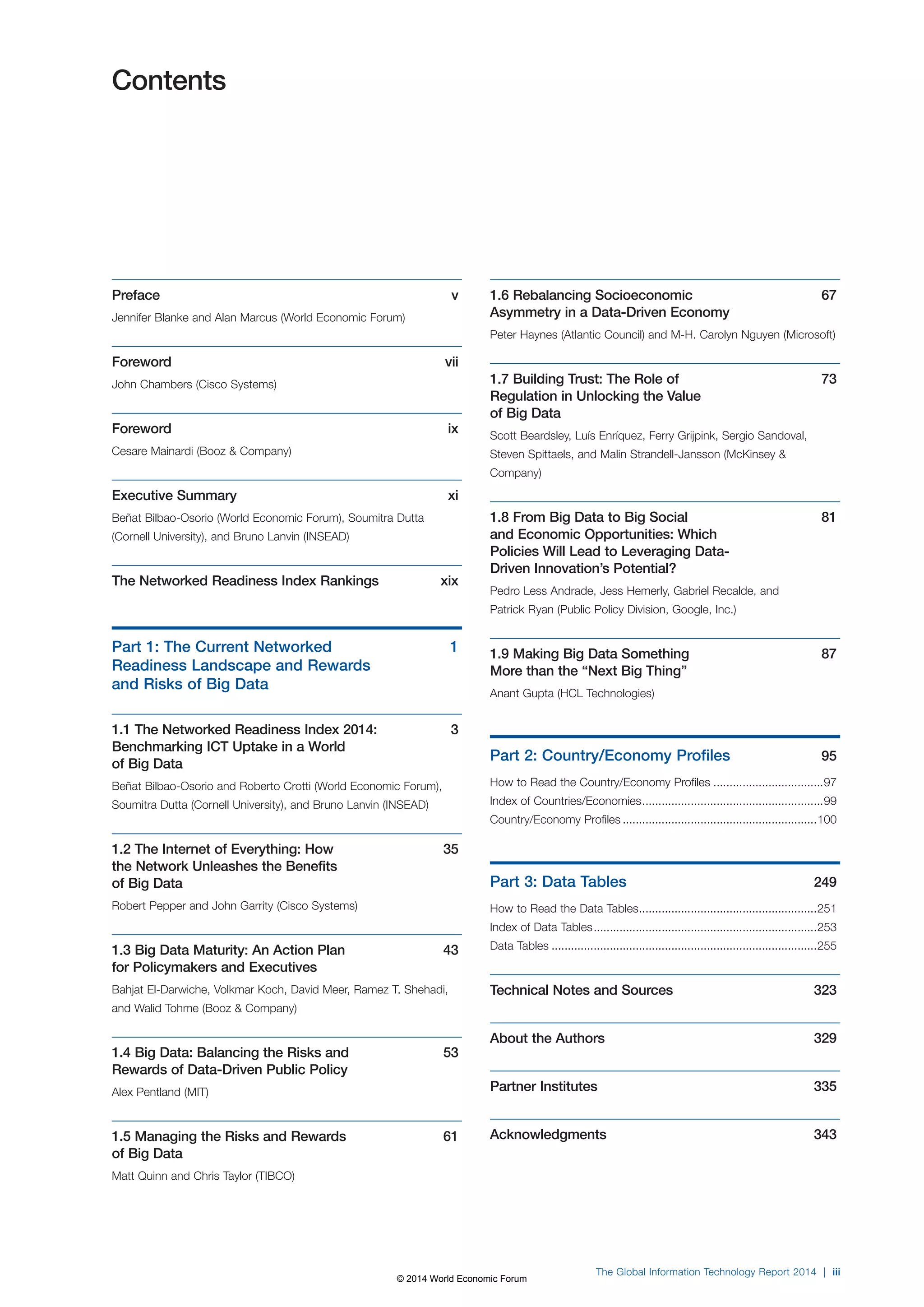
Contents 
Preface v 
Jennifer Blanke and Alan Marcus (World Economic Forum) 
Foreword vii 
John Chambers (Cisco Systems) 
Foreword ix 
Cesare Mainardi (Booz & Company) 
Executive Summary xi 
Beñat Bilbao-Osorio (World Economic Forum), Soumitra Dutta 
(Cornell University), and Bruno Lanvin (INSEAD) 
The Networked Readiness Index Rankings xix 
Part 1: The Current Networked 1 
Readiness Landscape and Rewards 
and Risks of Big Data 
1.1 The Networked Readiness Index 2014: 3 
Benchmarking ICT Uptake in a World 
of Big Data 
Beñat Bilbao-Osorio and Roberto Crotti (World Economic Forum), 
Soumitra Dutta (Cornell University), and Bruno Lanvin (INSEAD) 
1.2 The Internet of Everything: How 35 
the Network Unleashes the Benefits 
of Big Data 
Robert Pepper and John Garrity (Cisco Systems) 
1.3 Big Data Maturity: An Action Plan 43 
for Policymakers and Executives 
Bahjat El-Darwiche, Volkmar Koch, David Meer, Ramez T. Shehadi, 
and Walid Tohme (Booz & Company) 
1.4 Big Data: Balancing the Risks and 53 
Rewards of Data-Driven Public Policy 
Alex Pentland (MIT) 
1.5 Managing the Risks and Rewards 61 
of Big Data 
Matt Quinn and Chris Taylor (TIBCO) 
1.6 Rebalancing Socioeconomic 67 
Asymmetry in a Data-Driven Economy 
Peter Haynes (Atlantic Council) and M-H. Carolyn Nguyen (Microsoft) 
1.7 Building Trust: The Role of 73 
Regulation in Unlocking the Value 
of Big Data 
Scott Beardsley, Luís Enríquez, Ferry Grijpink, Sergio Sandoval, 
Steven Spittaels, and Malin Strandell-Jansson (McKinsey & 
Company) 
1.8 From Big Data to Big Social 81 
and Economic Opportunities: Which 
Policies Will Lead to Leveraging Data- 
Driven Innovation’s Potential? 
Pedro Less Andrade, Jess Hemerly, Gabriel Recalde, and 
Patrick Ryan (Public Policy Division, Google, Inc.) 
1.9 Making Big Data Something 87 
More than the “Next Big Thing” 
Anant Gupta (HCL Technologies) 
Part 2: Country/Economy Profiles 95 
How to Read the Country/Economy Profiles ..................................97 
Index of Countries/Economies ........................................................99 
Country/Economy Profiles ............................................................100 
Part 3: Data Tables 249 
How to Read the Data Tables .......................................................251 
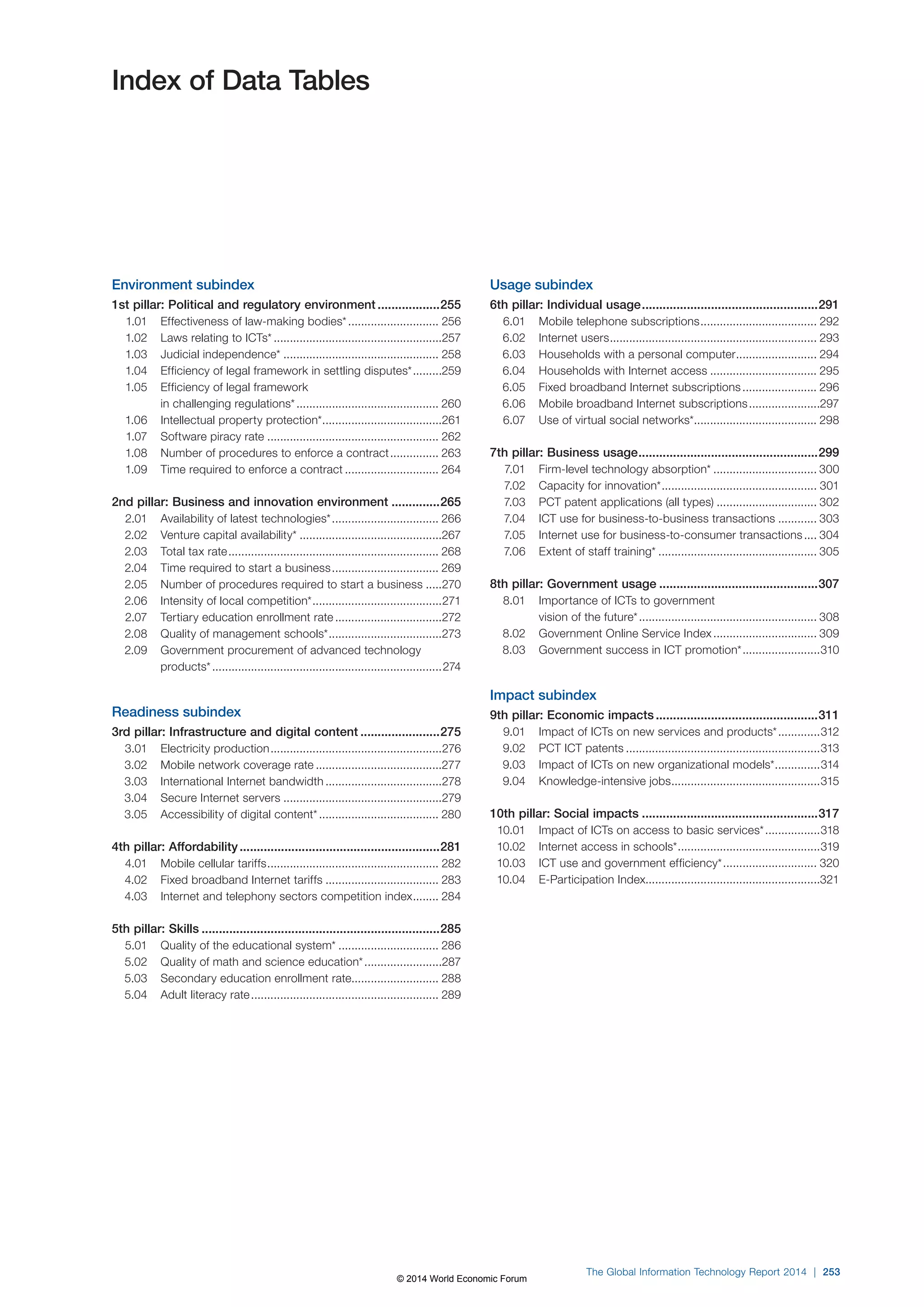
Index of Data Tables .....................................................................253 
Data Tables ..................................................................................255 
Technical Notes and Sources 323 
About the Authors 329 
Partner Institutes 335 
Acknowledgments 343 
© 2014 World Economic Forum
The Global Information Technology Report 2014 | v 
The 13th edition of The Global Information Technology 
Report is released at a time when economies need 
to solidify the recovery of the past year and leave the 
worst financial and economic crisis of the past 80 
years behind. Developed economies need to sustain 
their incipient economic recovery and find new areas 
of growth and employment creation; emerging and 
developing economies need to build their resilience 
against turbulence in the markets and foster their 
innovation potential in order to sustain the rapid 
economic growth they experienced in the past decade. 
Against this backdrop, information and 
communication technologies (ICTs)—in their role as 
key enablers of innovation and new employment 
opportunities—are drawing more attention than ever 
before. As the benefits of ICTs increasingly materialize 
into tangible assets, building and strengthening digital 
ecosystems becomes increasingly important. 
The GITR series has been published by the World 
Economic Forum in partnership with INSEAD since 
2002. The Report has accompanied and monitored ICT 
progress for more than a decade and raised awareness 
of the importance of ICTs for long-term competitiveness 
and well-being. Through the lens of the Networked 
Readiness Index (NRI), the driving factors and impacts 
of networked readiness and ICT leveraging have been 
identified, highlighting the joint responsibility of all social 
actors—individuals, businesses, and governments. 
The Global Information Technology Report 2014 
features the latest results of the NRI, offering an overview 
of the current state of ICT readiness in the world. This 
year’s coverage includes a record number of 148 
economies, accounting for over 98 percent of global 
GDP. In addition, it features a number of essays that 
inquire into the rewards and risks accruing from big 
data, an unprecedented phenomenon in terms of the 
volume, velocity, and variety of sources of the creation 
of new data. These essays also advise on the changes 
that organizations, both public and private, will need to 
adopt in order to manage, make sense of, and obtain 
economic and social value from this vast quantity of 
newly generated data. In addition, the Report presents 
a wealth of data, including detailed profiles for each 
economy covered and data tables with global rankings 
for the NRI’s 54 indicators. 
We would like to convey our sincere gratitude to 
the industry and academic organizations’ experts who 
contributed outstanding chapters. We also wish to thank 
the editors of the Report—Soumitra Dutta at the Samuel 
Curtis Johnson Graduate School of Management at 
Cornell University, Bruno Lanvin at INSEAD, and Beñat 
Bilbao-Osorio at the World Economic Forum—for 
their leadership in this project, together with the other 
members of the GITR team: Roberto Crotti, Danil Kerimi, 
and Elena Kvochko. Appreciation also goes to members 
of the Global Competitiveness and Benchmarking 
Network team: Ciara Browne, Gemma Corrigan, Attilio 
di Batista, Gaëlle Dreyer, Margareta Drzeniek-Hanouz, 
Thierry Geiger, Tania Gutknecht, Caroline Ko, and Cecilia 
Serin. Last but not least, we would like to express our 
gratitude to our network of over 160 Partner Institutes 
around the world and to all the business executives who 
participated in our Executive Opinion Survey. Without 
their valuable input, the production of this Report would 
not be possible. 
Preface 
JENNIFER BLANKE and ALAN MARCUS 
World Economic Forum 
© 2014 World Economic Forum
The Global Information Technology Report 2014 | vii 
Foreword 
JOHN CHAMBERS 
Chairman and Chief Executive Officer, Cisco Systems 
I never cease to be amazed by the speed of innovation. 
Change is the only true constant, and each year the 
pace of change only accelerates. Transitions that once 
took place over three or five years now happen in 12 to 
18 months. 
I believe we are currently experiencing the biggest 
fundamental change the world has seen since the initial 
development of the Internet as people, processes, 
data, and things become increasingly connected. 
We call this the Internet of Everything (IoE), and it is 
having a profound impact on individuals, businesses, 
communities, and countries. According to analysis 
conducted by Cisco, the Internet of Everything 
represents a US$19 trillion global opportunity to create 
value over the next decade through greater profits for 
businesses as well as improved citizen services, cost 
efficiencies, and increased revenues for governments 
and other public-sector organizations. 
Several major transitions in technology—each 
important in its own right—are combining to make 
the Internet of Everything possible. These include the 
emergence of cloud and mobile computing, the growth 
of big data and analytics, and the explosive development 
of the Internet of Things (IoT). These transitions are 
changing the role of information technology (IT), with 
Internet protocol (IP) networks playing an increasingly 
central part by seamlessly connecting disparate IT 
environments. Cisco’s contribution to this edition of The 
Global Information Technology Report focuses on the 
how IP networks facilitate new information flows through 
the interaction between two of these transitions: IoT and 
data analytics. 
The explosive expansion of IoT, or connections 
between context-aware machines and other physical 
objects, is changing how we utilize devices to improve 
our daily lives. And the shift in data and analytics— 
from being centralized, structured, and static to being 
distributed, mixed structured and unstructured, and real-time— 
is leading to a new era of real-time processing and 
decision-making. 
More industries are moving their systems and 
processes to IP networks, and the rapid growth of IP-connected 
devices is driving exponential increases in 
data traffic. The migration to IP networks and the ability 
to turn “big data” into valuable, actionable information 
have demonstrable benefits—both economic and 
social—as well as positive financial impacts for firms. 
In our 30-year history, our success has been based 
on our ability to see around corners, identify market 
transitions, and make big bets on what is next—such as 
the emergence of the Internet of Everything. We have 
seen this before, in the transitions from bridged networks 
to routed networks, shared networks to switched ones, 
circuit switching to packet switching, fixed connectivity to 
mobile connectivity, dedicated resources to virtual ones, 
data traffic to voice and video traffic, PC connections to 
any-device connections, and physical data centers to the 
cloud. 
We see the network as the critical accelerator 
and enabler in all of these transitions, transforming 
processes to increase efficiency and decrease costs. In 
data centers, for example, the network is the common 
element for intelligence, scale, and flexibility. Data 
centers have evolved as more intelligence has been built 
into the network—from networking virtual machines and 
developing a platform optimizing computing to scaling 
applications and decoupling them from the server or 
data center in which they live. 
The network also facilitates the growth of 
applications, a key driver of the Internet of Everything. 
Applications already provide an integral way that 
consumers experience the Internet of Everything, with 
the number of applications growing from 10 billion 
downloads in 2010 to 77 billion by 2014. 
As this trend continues, we expect the Internet of 
Everything to drive massive gains in efficiency, business 
growth, and quality of life, helped along by thousands 
of new IoT applications. These applications will require 
building new end-to-end IoT infrastructures, which will 
enable the deployment of even more IoT applications. 
We are pleased to collaborate again with the World 
Economic Forum and INSEAD to produce The Global 
Information Technology Report and the Networked 
Readiness Index (NRI). The NRI provides policymakers, 
business leaders, and concerned citizens with valuable 
insights into current market conditions and the state 
of connectivity across the world, and helps to identify 
where more can be done to accelerate the Internet of 
Everything’s positive impact on the world in which we 
live. 
© 2014 World Economic Forum
The Global Information Technology Report 2014 | ix 
Foreword 
CESARE MAINARDI 
Chief Executive Officer, Booz & Company 
The report in your hands is a compilation of wisdom 
about the relationship between digitization and corporate 
strategy. This is a relationship of enormous promise, 
because digitization—the mass adoption of connected 
digital services by consumers, enterprises, and 
governments—provides dramatic power and reach to the 
companies that understand it. 
But there is also enormous tension in the 
relationship between digitization and strategy. Digital 
media and technologies are inherently subject to change. 
A company’s strategy, its way of winning in the market, 
is most effective when it is tied to its identity. And 
corporate identities—and the capabilities and cultures 
that go with them—are by nature slow to change. It 
takes years to develop the kind of proficiency that no 
other company can easily master. 
We have found in our research on capable 
companies that the most consistently successful are 
those that master this tension. They base their strategies 
on their distinctive capabilities: the things they do 
better than any other company. These are consistent 
throughout their lifetimes. Apple competes on its unique 
approach to design, which no other company can 
match; IKEA on its unparalleled prowess in making and 
selling low-priced but appealing home furnishings; and 
Haier on its remarkable ability to translate its customers’ 
needs into innovative new appliances. These successful 
companies then learn to adapt to new challenges and 
opportunities within the context of their constant identity. 
They become rapid innovators, able to shift to new 
products, markets, and geographies, but they adapt only 
when their existing capabilities can give them the right to 
win. 
For most companies, digitization is a great enabler. 
But it is also a great disruptor. It enables competitors as 
well, including competitors from other sectors who might 
enter your business arena. This can present a threat that 
can often turn a company’s advantage into a weakness. 
Digitization is also distracting: it can present a 
bewildering array of potential opportunities, all of which 
look compelling. But pursuing them all is both financially 
unfeasible and strategically distracting. It leads to 
incoherence, which can lead an enterprise into decline. 
How then do capable companies handle the 
opportunities and challenges of digitization? They are 
rigorously and prudently selective. They invest in those 
areas that are in line with their chosen way to play in the 
market—the distinctive way they create value for their 
customers. 
Consider, for example, the threats, distractions, 
and benefits of one current element of digitization: big 
data. This is comprised of large datasets often gathered 
in unstructured forms from the behavior of people and 
groups. For example, as individuals search online, shop, 
express their opinions, communicate with each other, 
and move from one place to another, their aggregate 
behavior can be tracked and inferences drawn from it. 
New technologies, such as analytic engines and cloud-based 
storage, have made it possible to gather these 
data in unprecedented amounts and interpret them in 
novel ways. Insights from old forms of market research, 
such as asking customers what they liked or did not 
like in a commercial transaction, now become part of 
a larger pattern of awareness, with both the scale and 
granularity to give business people a much clearer view 
of their market. 
In capable companies, big data is aligned with their 
strategies. They invest only in the data gathering that 
gives them privileged access to the customers they care 
about, or that contributes to the capabilities that make 
them distinctive. Without that discipline, companies 
can be overwhelmed by big data. They can collect a 
huge volume of information without any predetermined 
purpose, and then struggle to make sense of it. In short, 
the prevalence of massive amounts of new information 
has only highlighted the importance of the old strategic 
verity: to change successfully, you must stay true to your 
identity and seek the customers who you can serve well. 
The next few years will see many companies 
struggling to resolve the tension between change and 
identity. Those who master the new digital technologies 
in a disciplined way, in the service of their focused 
strategies, will become more successful in the market— 
and the economies around them will thrive accordingly. 
© 2014 World Economic Forum
Executive Summary 
BEÑAT BILBAO-OSORIO, World Economic Forum 
SOUMITRA DUTTA, Cornell University 
BRUNO LANVIN, INSEAD 
When The Global Information Technology Report (GITR) 
and the Networked Readiness Index (NRI) were created 
more than 13 years ago, the attention of decision 
makers was focused on how to develop strategies that 
would allow them to benefit from what Time Magazine 
had described as “the new economy”: a new way of 
organizing and managing economic activity based on 
the new opportunities that the Internet provided for 
businesses.1 At present, the world is slowly emerging 
from one of the worst financial and economic crises 
in decades, and policymakers, business leaders, and 
civil society are looking into new opportunities that 
can consolidate growth, generate new employment, 
and create business opportunities. Information and 
communication technologies (ICTs) continue to rank high 
on the list as one of the key sources of new opportunities 
to foster innovation and boost economic and social 
prosperity, for both advanced and emerging economies. 
For more than 13 years, the NRI has provided 
decision makers with a useful conceptual framework 
to evaluate the impact of ICTs at a global level and 
to benchmark the ICT readiness and usage of their 
economies. 
EXTRACTING VALUE FROM BIG DATA 
Data have always had strategic value, but with the 
magnitude of data available today—and our capability to 
process them—they have become a new form of asset 
class. In a very real sense, data are now the equivalent 
of oil or gold. And today we are seeing a data boom 
rivaling the Texas oil boom of the 20th century and the 
San Francisco gold rush of the 1800s. It has spawned 
an entire support industry and has attracted a great deal 
of business press in recent years. 
This new asset class of big data is commonly 
described by what we call the “three Vs.” Big data is 
high volume, high velocity, and includes a high variety of 
sources of information. Next to those traditional three Vs 
we could add a fourth: value. This is what everyone is 
looking for, and this is why big data today gets so much 
attention. In the quest for value, the challenge facing us 
is how to reduce the complexity and unwieldiness of big 
data so that it becomes truly valuable. 
Big data can take the form of structured data such 
as financial transactions or unstructured data such as 
photographs or blog posts. It can be crowd-sourced or 
obtained from proprietary data sources. Big data has 
been fueled by both technological advances (such as the 
spread of radio-frequency identification, or RFID, chips) 
and social trends (such as the widespread adoption of 
social media). Our collective discussions, comments, 
likes, dislikes, and networks of social connections are 
now all data, and their scale is massive. What did we 
search for? What did we read? Where did we go? With 
whom do we associate? What do we eat? What do 
we purchase? In short, almost any imaginable human 
interaction can be captured and studied within the realm 
of big data. 
Big data has arrived. It is changing our lives and 
changing the way we do business. But succeeding 
with big data requires more than just data. Data-based 
value creation requires the identification of patterns from 
which predictions can be inferred and decisions made. 
Businesses need to decide which data to use. The 
data each business owns might be as different as the 
businesses themselves; these data range from log files 
and GPS data to customer- or machine-to-machine 
data. Each business will need to select the data source 
it will use to create value. Moreover, creating this 
value will require the right way of dissecting and then 
analyzing those data with the right analytics. It will 
require knowing how to separate valuable information 
from hype. 
This world of big data has also become a source 
of concern. The consequences of big data for issues 
of privacy and other areas of society are not yet fully 
understood. Some prominent critics, such as Jaron 
Lanier,2 call on us to be cautious about readily believing 
any result created by the “wisdom of the crowd.” 
Moreover, applications of big data in military intelligence 
have created a growing concern for privacy around the 
world. 
Indeed, we are now living in a world where anything 
and everything can be measured. “Data” could become 
a new ideology. We are just at the beginning of a long 
journey where, with the proper principles and guidelines, 
we should be able to collect, measure, and analyze more 
and more information about everyone and everything 
in order to make better decisions, individually and 
collectively. 
The Global Information Technology Report 2014 | xi 
© 2014 World Economic Forum
Executive Summary 
PART 1: THE CURRENT NETWORKED 
READINESS LANDSCAPE 
Part 1 of this Report presents the latest findings of 
the NRI, offering a comprehensive assessment of the 
present state of networked readiness in the world. 
Furthermore, a number of expert contributions inquiring 
into the role of big data and how to extract value from it 
are also included. These contributions relate to (1) how 
the network unleashes the benefits of big data; (2) how 
and why policymakers and business executives need 
to develop action plans to extract value from big data; 
(3) balancing the risks and rewards of big data from a 
public policy perspective; (4) managing these risks and 
rewards; (5) rebalancing socioeconomic asymmetry in a 
data-driven economy; (6) the role of regulation and trust 
building in unlocking the value of big data; (7) turning the 
potential of big data into socioeconomic results; and (8) 
defining organizational change to take full advantage of 
big data. 
Insights from the NRI 2014 on the world’s 
networked readiness 
Chapter 1.1 provides an overview of the networked 
readiness landscape of the world as assessed by the 
NRI 2014. It presents the results of the top 10 performers 
and selected countries by region, in the following order: 
Europe and the Commonwealth of Independent States, 
Asia and the Pacific, Latin America and the Caribbean, 
sub-Saharan Africa, and the Middle East and North 
Africa. 
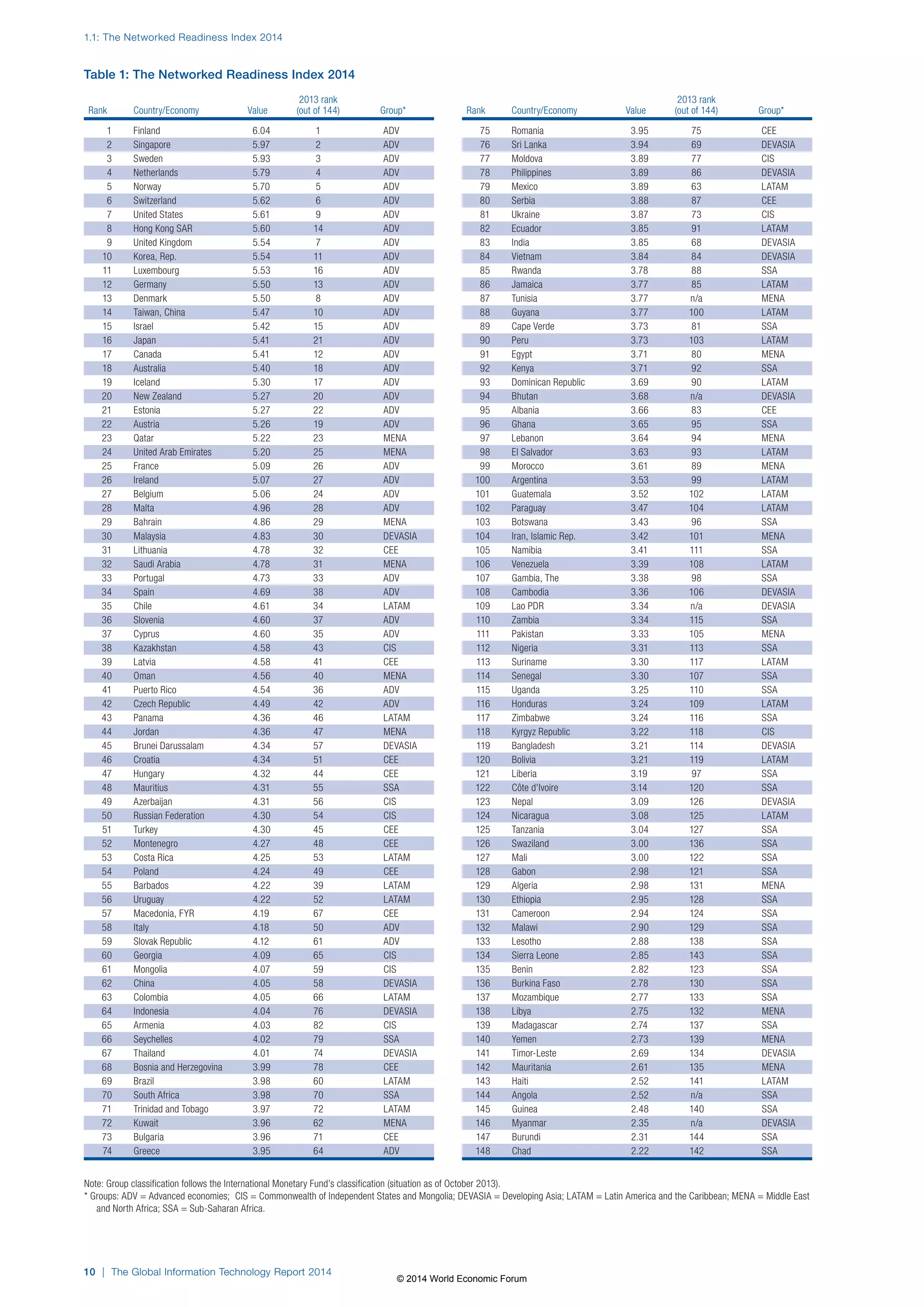
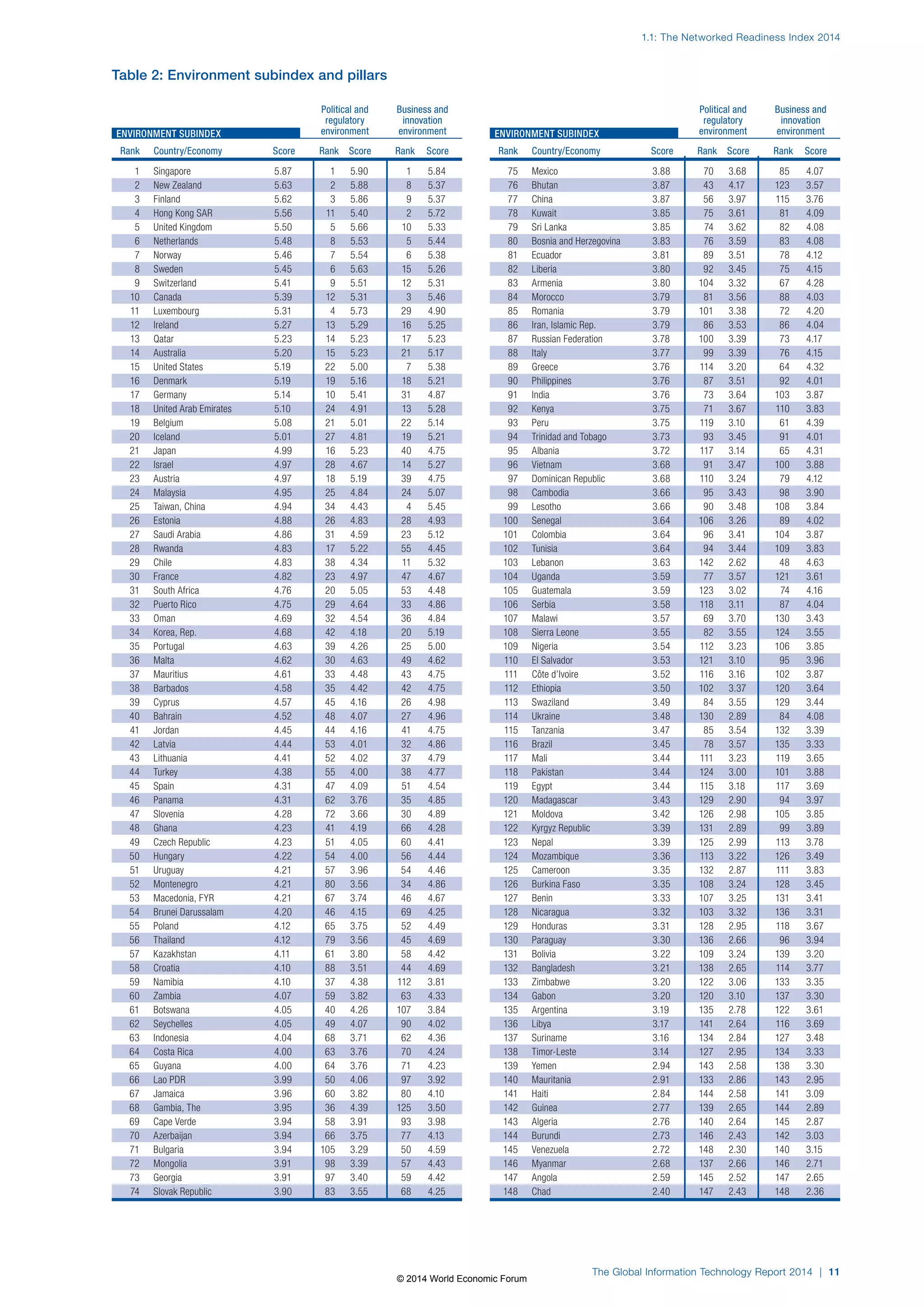
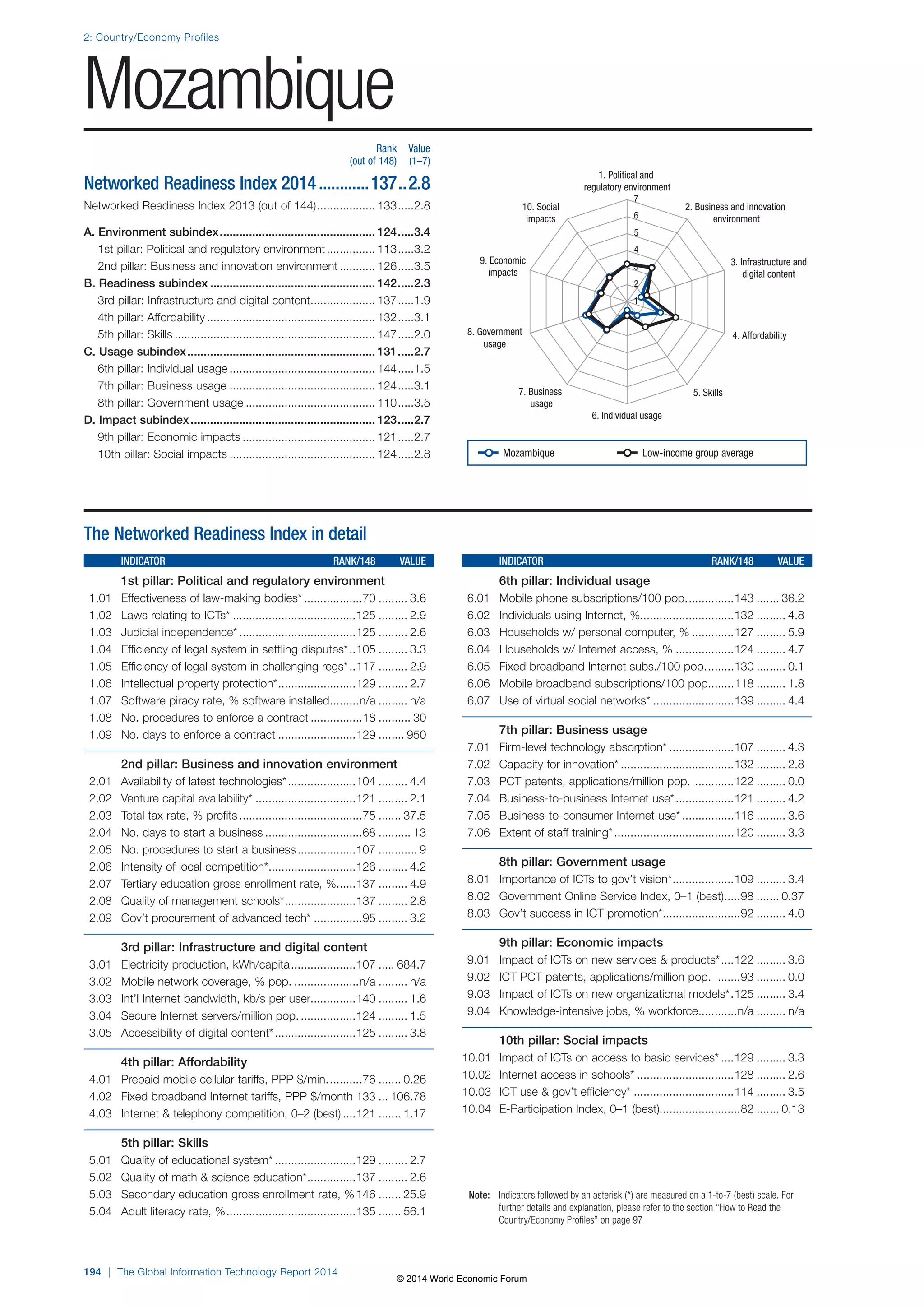
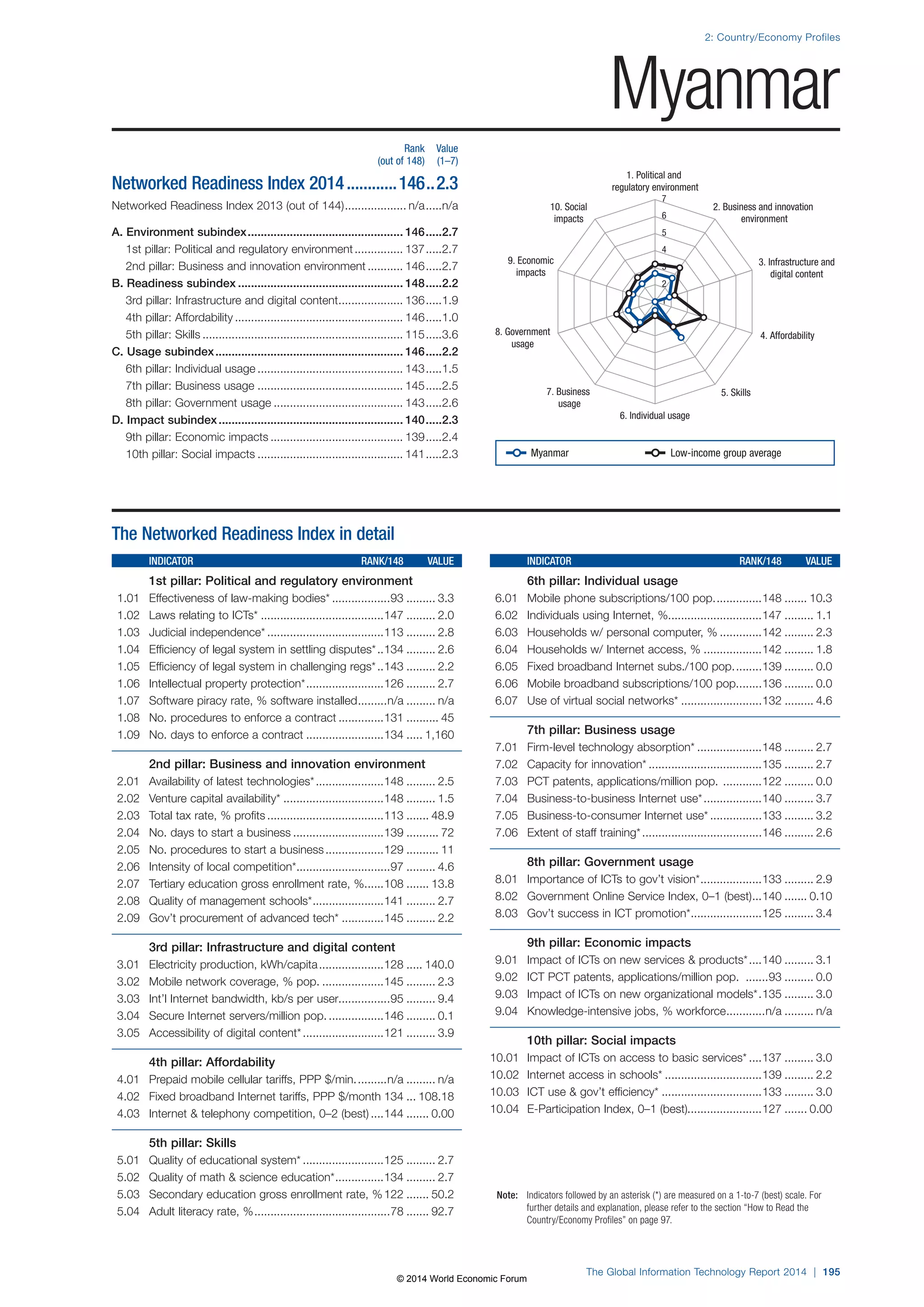
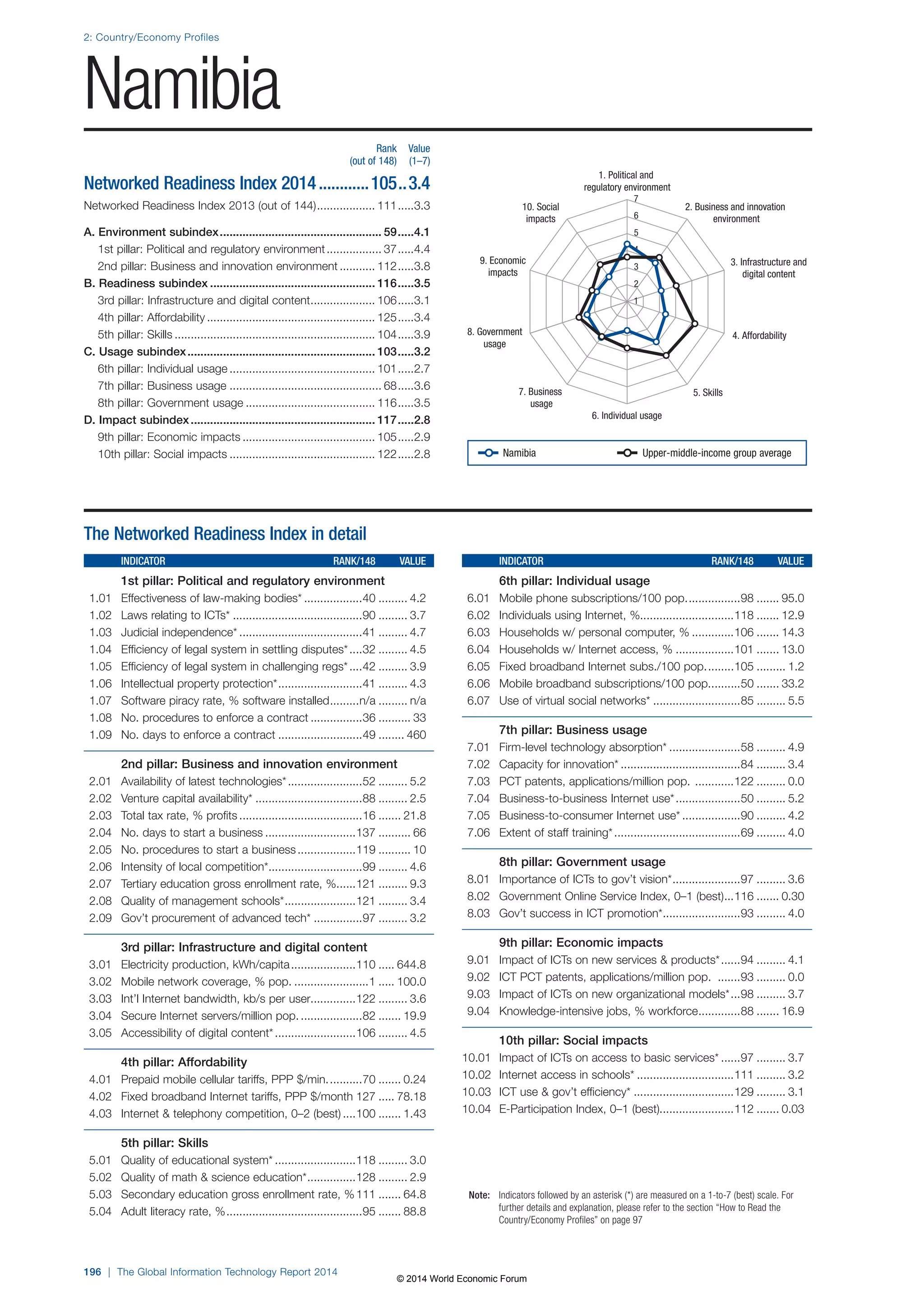
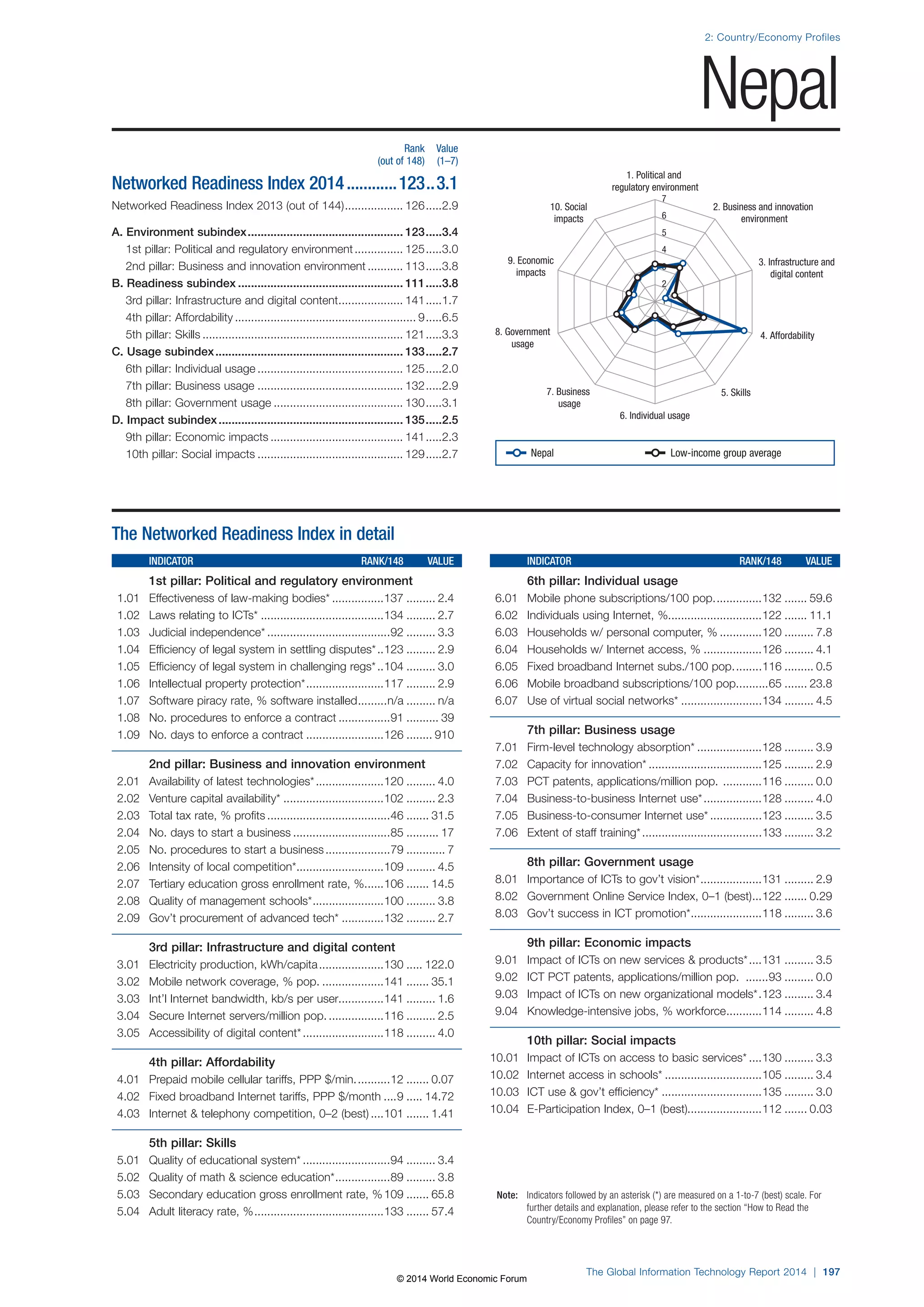
Tables 1 through 5 report the 2014 rankings for 
the overall NRI, its four subindexes, and its 10 pillars. In 
addition, the Country/Economy Profile and Data Tables 
sections at the end of the Report present the detailed 
results for the 148 economies covered by the study and 
the 54 indicators composing the NRI. To complement 
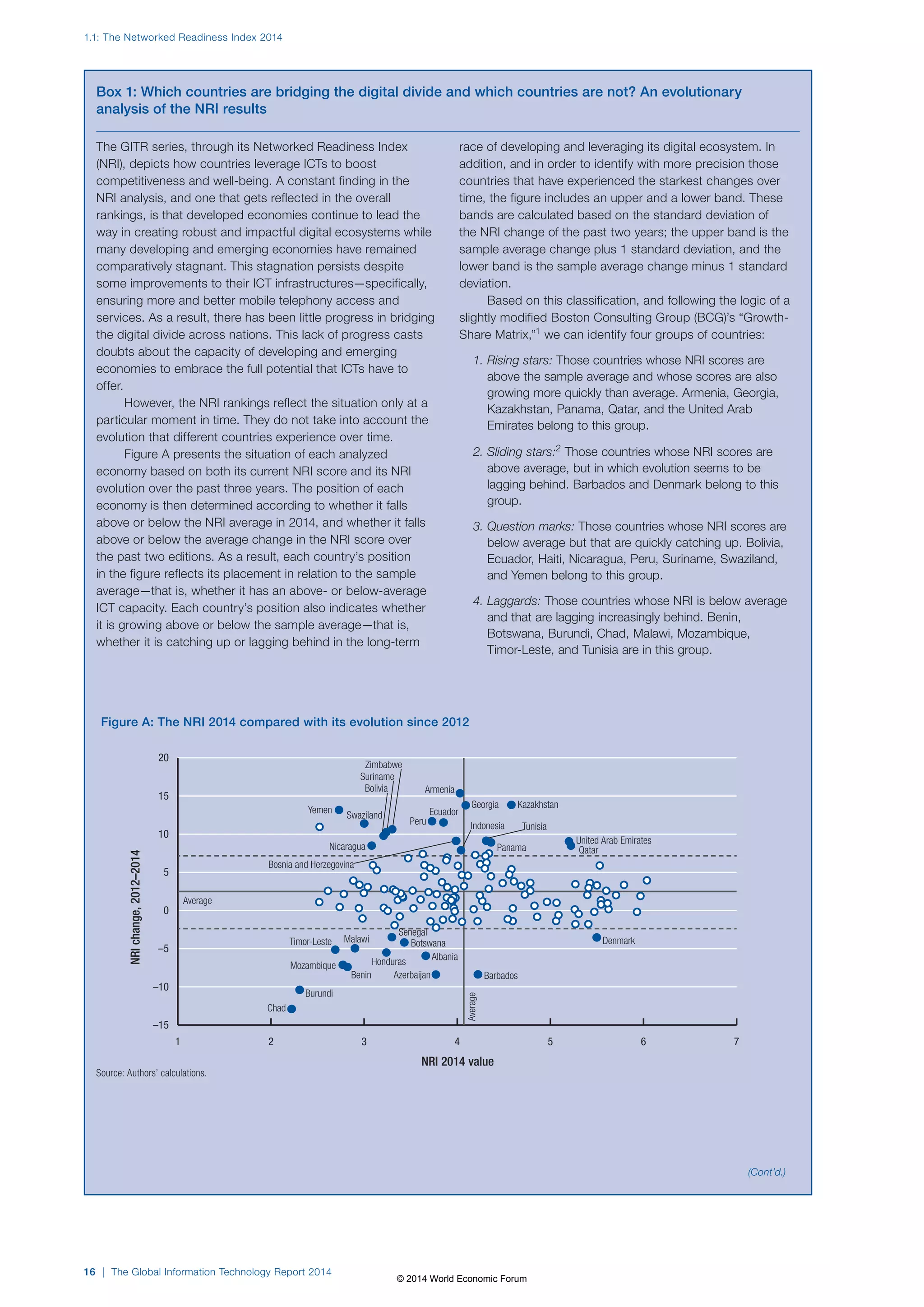
the analysis of the results, Box 1 presents a classification 
of countries based on their NRI 2014 scores and the 
change rate of this Index over a two-year period; Box 
2 assesses the nature of the digital divide in Europe; 
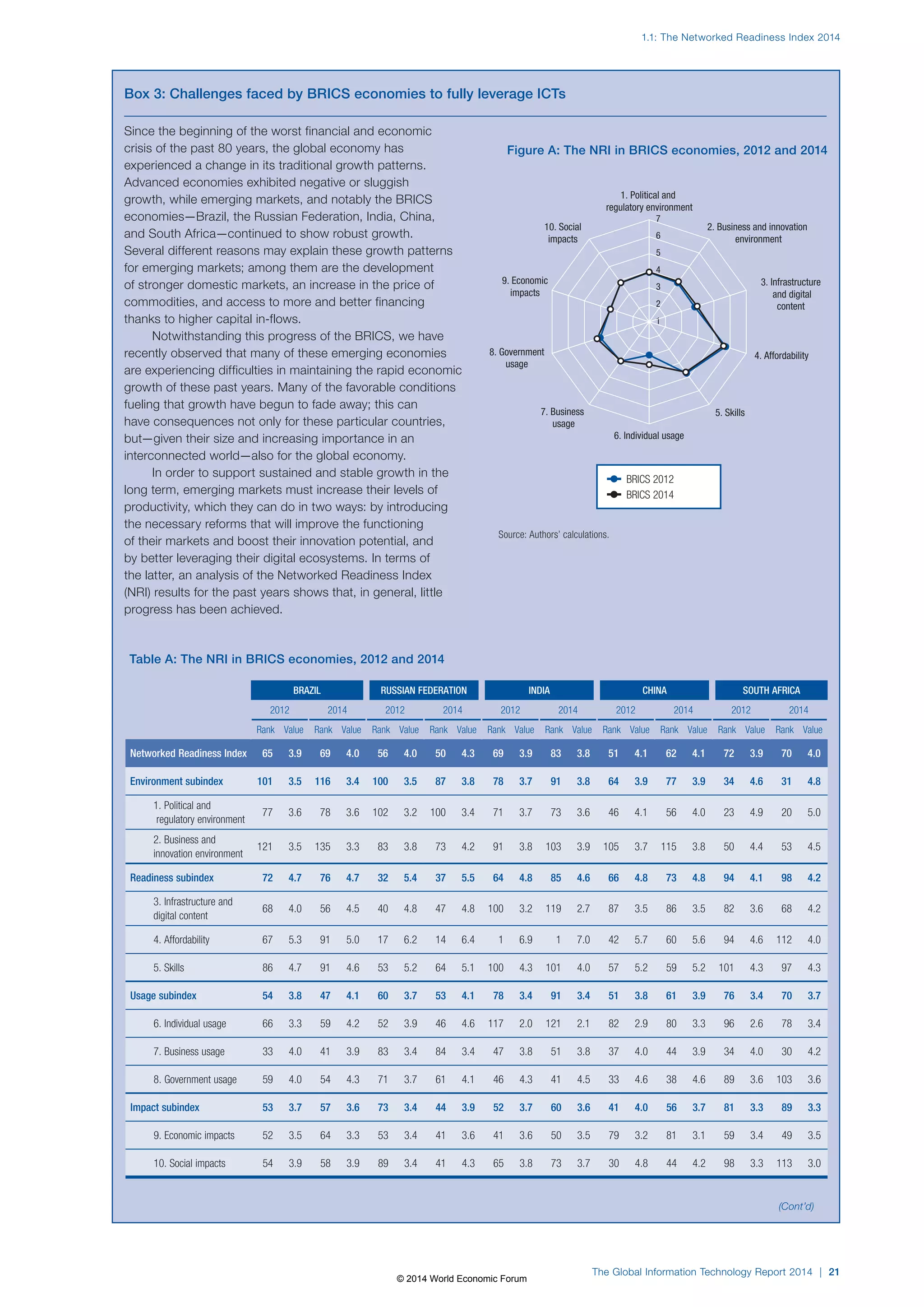
and Box 3 discusses the challenges large emerging 
economies must overcome if they are to keep moving 
forward in integrating ICTs into more robust innovation 
ecosystems that could help them transition from what 
appears to be a mid-life crisis toward a knowledge-based 
society. Finally, Appendix A of Chapter 1.1 details 
the structure of the NRI and describes the method of 
calculation. 
Top 10 
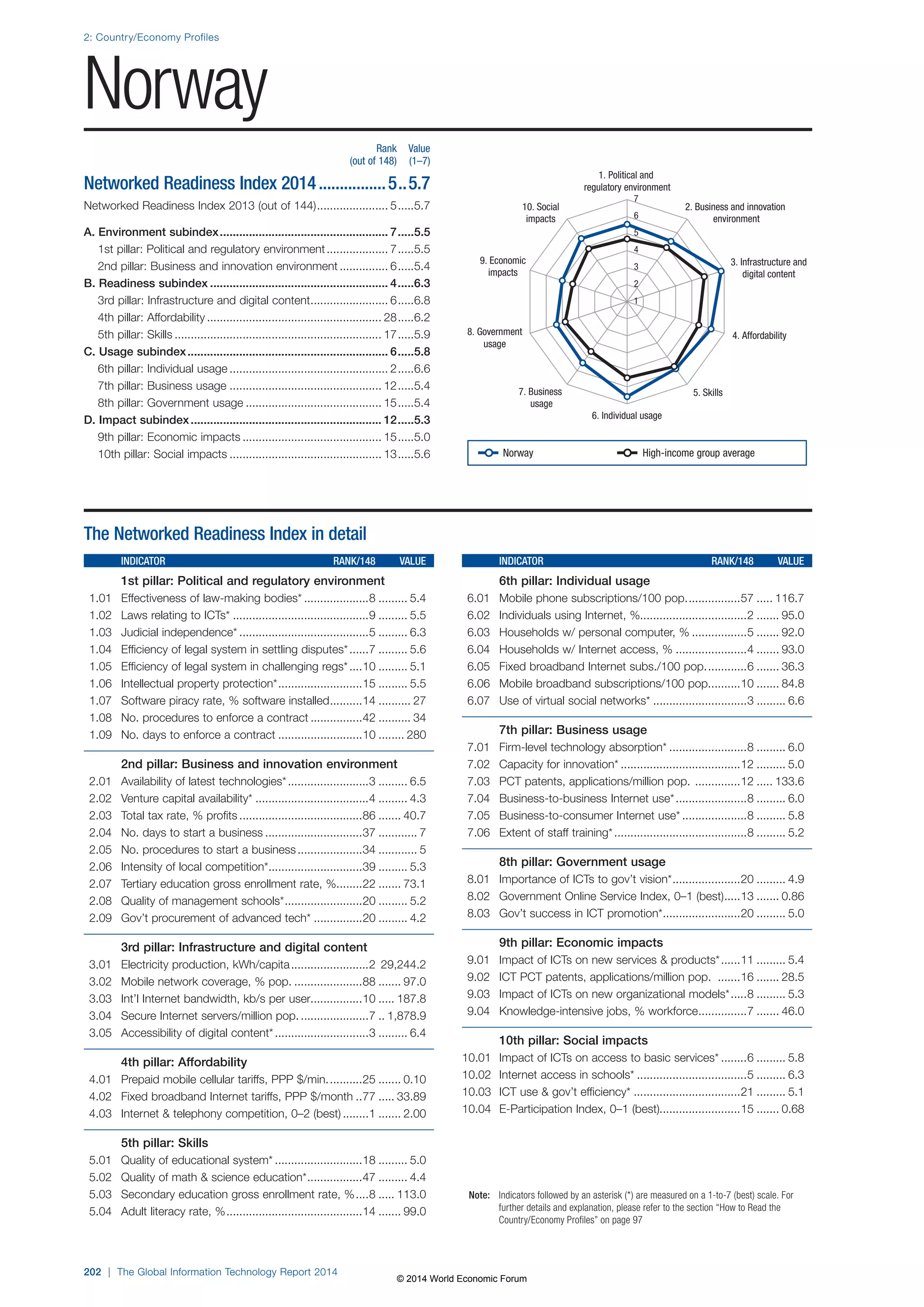
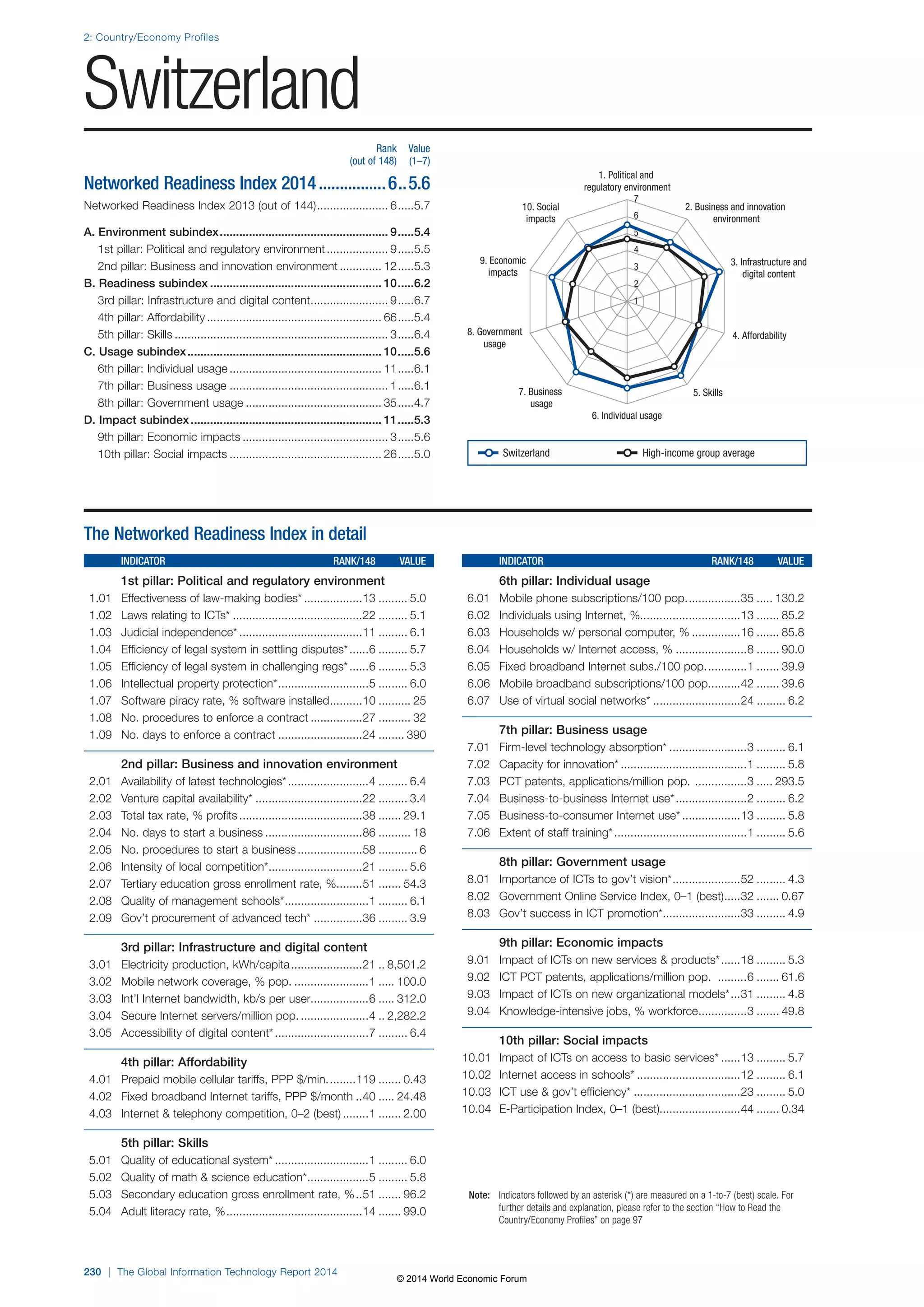
The top 10 spots continue to be dominated by Northern 
European economies, the Asian Tigers, and some of 
the most advanced Western economies. Three Nordic 
economies—Finland, Sweden, and Norway—lead the 
rankings and are positioned among the top 5. Denmark 
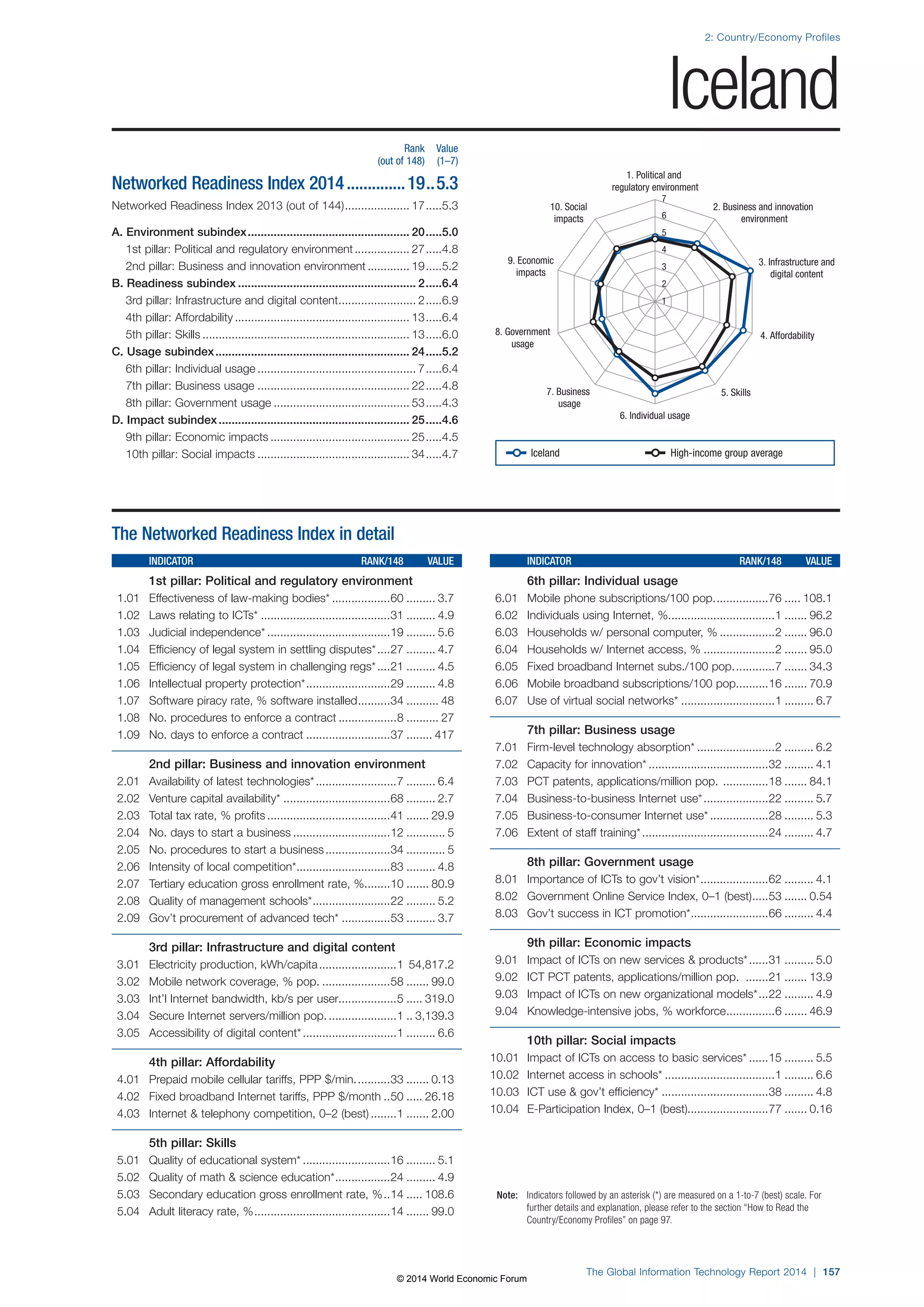
and Iceland, the remaining two Nordic economies, 
also perform strongly, and despite small slips this 
year they feature among the top 20. Overall, their 
performance in terms of ICT readiness, with excellent 
digital infrastructures and robust innovation systems, 
allows them to score very highly both in ICT use—with 
almost universal Internet use, for example—and in 
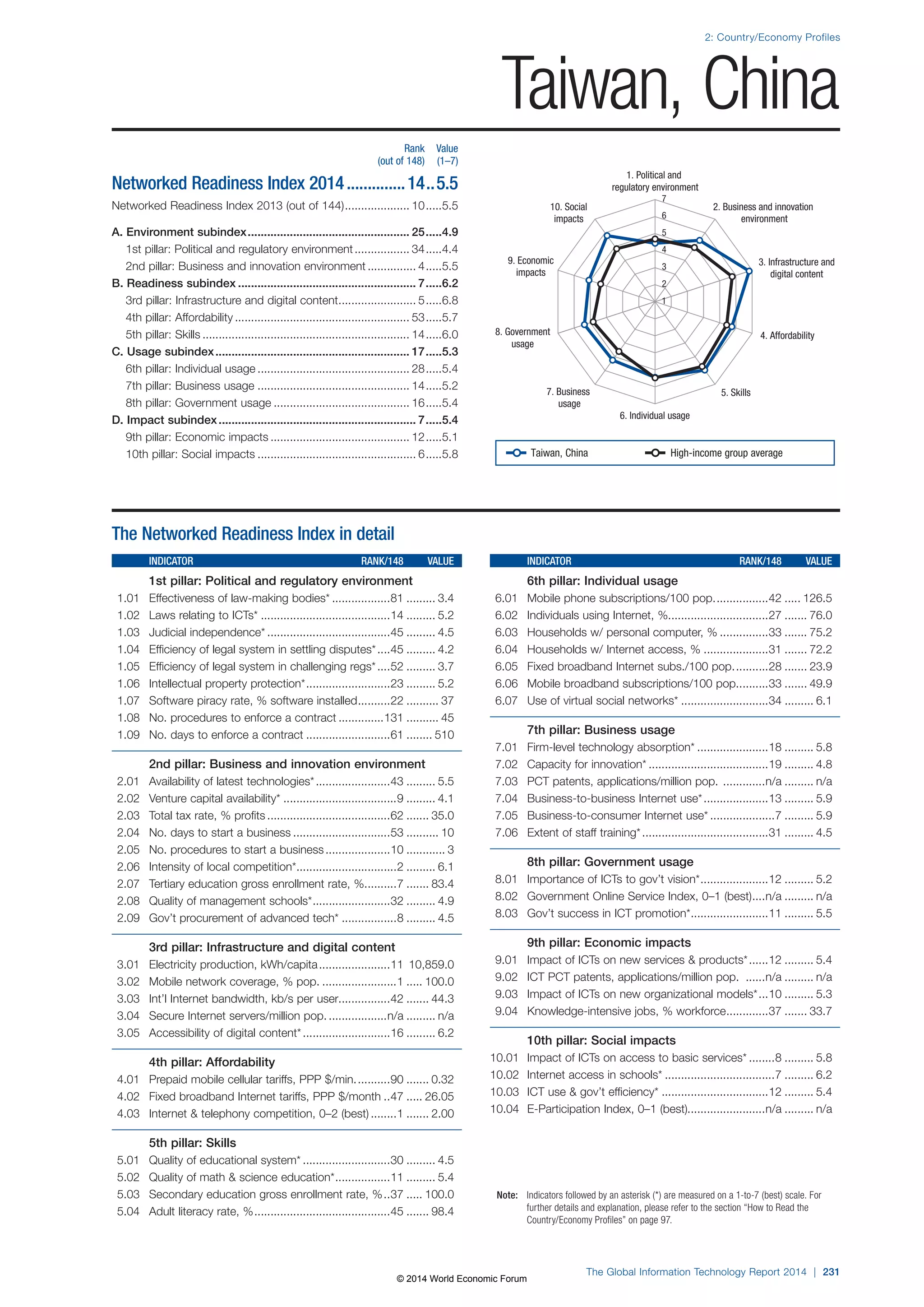
innovation performances. The Asian Tigers—composed 
of Singapore, Hong Kong SAR, the Republic of Korea, 
and Taiwan (China)—also perform very strongly, all of 
them positioned at the forefront of the NRI and with 
Singapore, Hong Kong SAR, and Korea featuring among 
the top 10. All these economies continue to boast 
outstanding business and innovation environments that 
are consistently ranked among the most conducive to 
entrepreneurship in the world. Finally, the top 10 includes 
some of the most advanced Western economies—the 
Netherlands, Switzerland, the United States, and the 
United Kingdom—that have recognized the potential of 
ICTs to embark in a new economic and social revolution, 
and thus have substantially invested in developing their 
digital potential. 
In evolutionary terms, this year the rankings remain 
very stable, with no movement in the top 6 and negligible 
changes in the rest, with the exception of the significant 
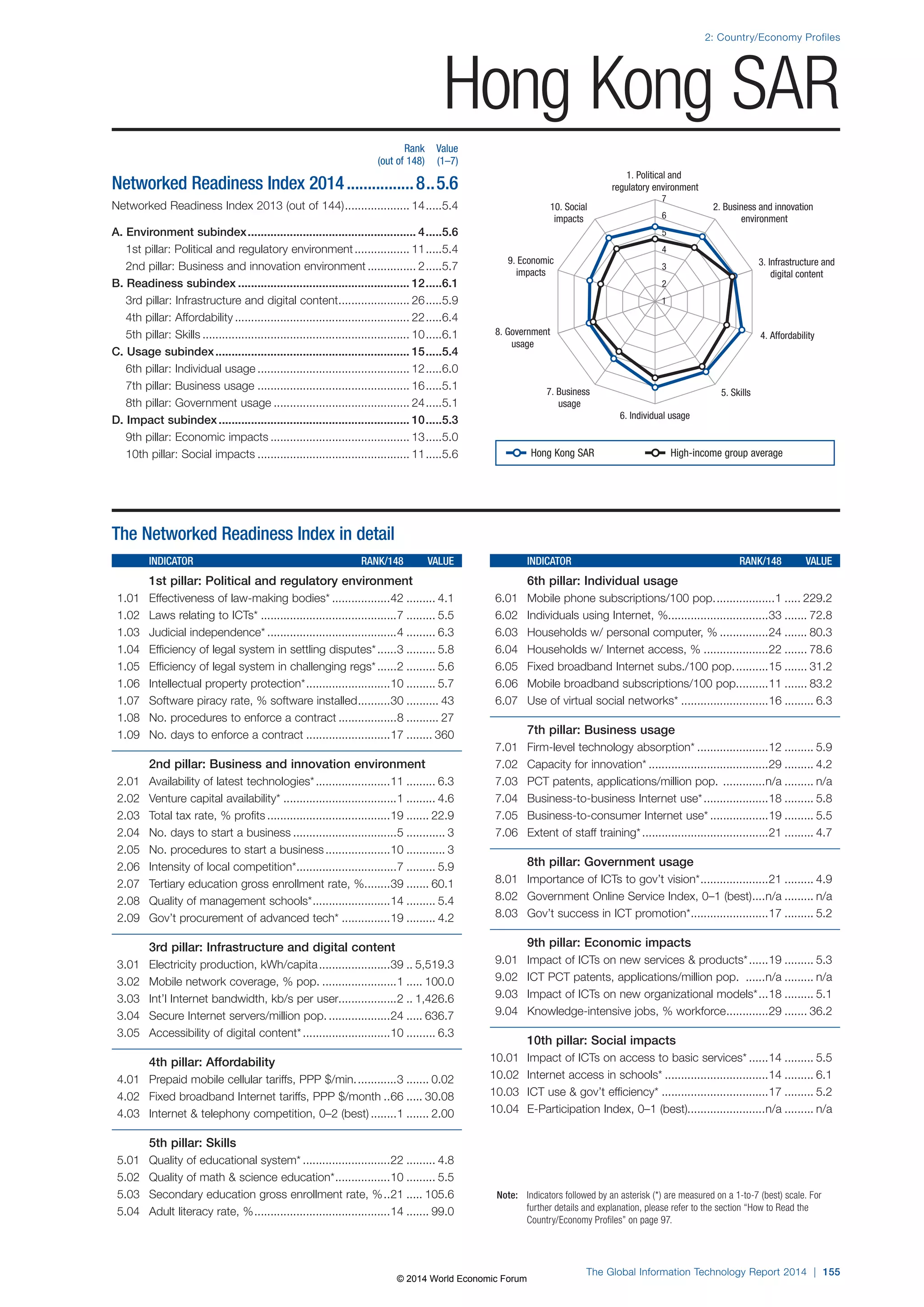
improvement by six positions of Hong Kong SAR, which 
climbs to 8th place. 
For a second consecutive year, Finland tops 
the rankings with a strong performance across the 
board. It ranks 1st in the readiness subindex thanks 
to an outstanding digital ICT infrastructure—the best 
in the world—and 2nd in both the usage and impact 
subindexes, with more than 90 percent of its population 
using the Internet and high levels of technological and 
non-technological innovation. The country also comes 
in 3rd in the environment subindex, with a very robust 
innovation system. Singapore continues to follow 
closely in the rankings, remaining in 2nd place. With 
the best pro-business and pro-innovation environment 
worldwide, the city-state continues to obtain the top rank 
in terms of ICT impacts, notably on the social dimension. 
Supported by a government with a clear digital strategy 
that offers the best online services in the world, an ICT 
infrastructure that is relentlessly being improved over 
time (16th), and one of the highest quality educational 
systems in the world (3rd), notably in terms of math and 
science (1st), Singapore has become one of the most 
knowledge-intensive economies globally (2nd) and is an 
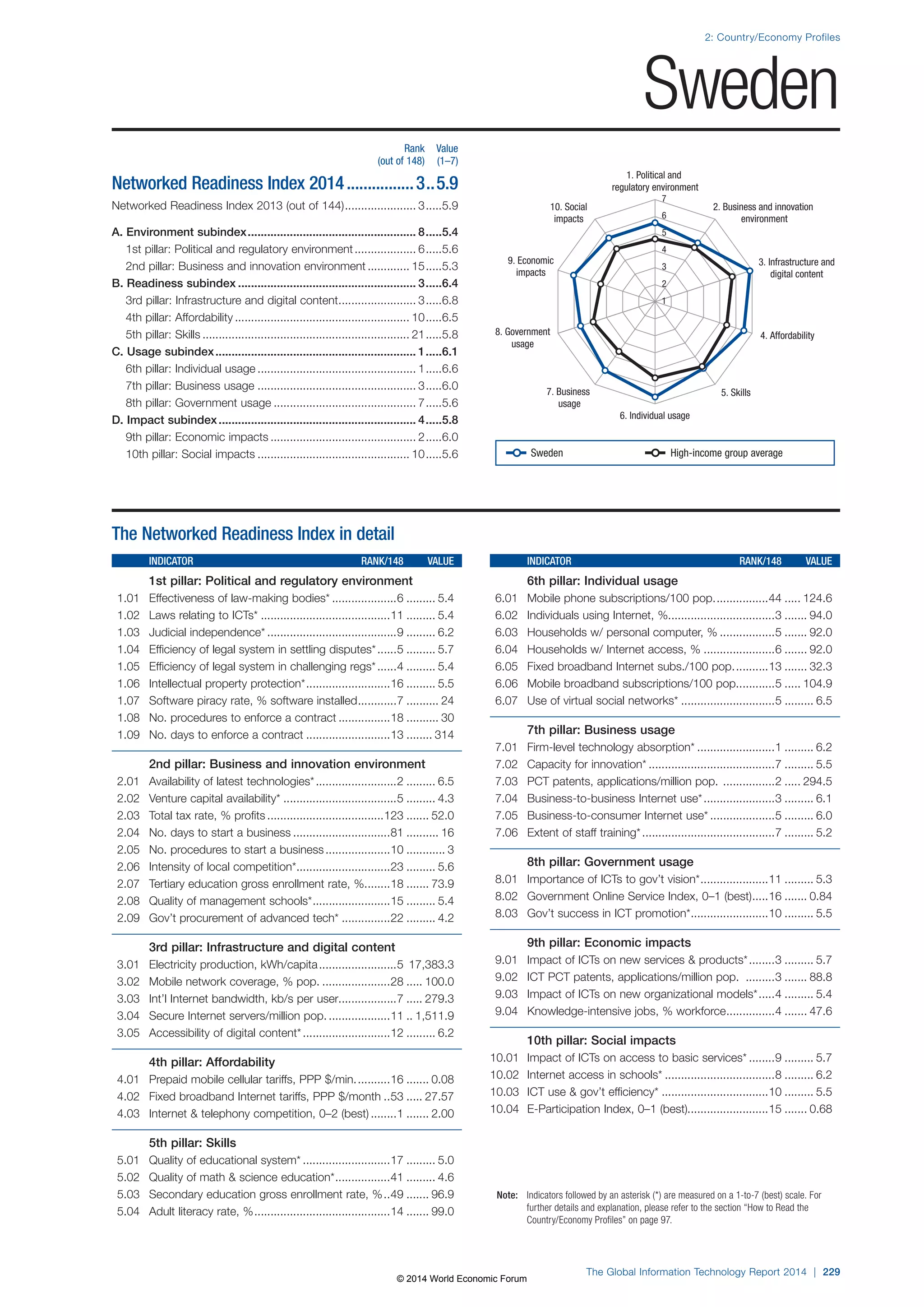
ICT-generation powerhouse. Sweden (3rd) maintains 
its position this year despite a slight improvement in its 
overall score, unable to regain the top position it held 
two editions ago. Overall, the very strong performance 
of Sweden reflects its world-class, affordable (11th) ICT 
infrastructure (3rd) and a stable and pro-business and 
innovation environment (15th), despite its high tax rate 
(123rd). These strengths result in outstanding uptake 
and use of ICTs by individuals (1st), businesses (3rd), and 
government (7th) and one of the highest technological 
and non-technological innovation performances in the 
xii | The Global Information Technology Report 2014 
© 2014 World Economic Forum
world (2nd), making Sweden a truly knowledge-based 
society. 
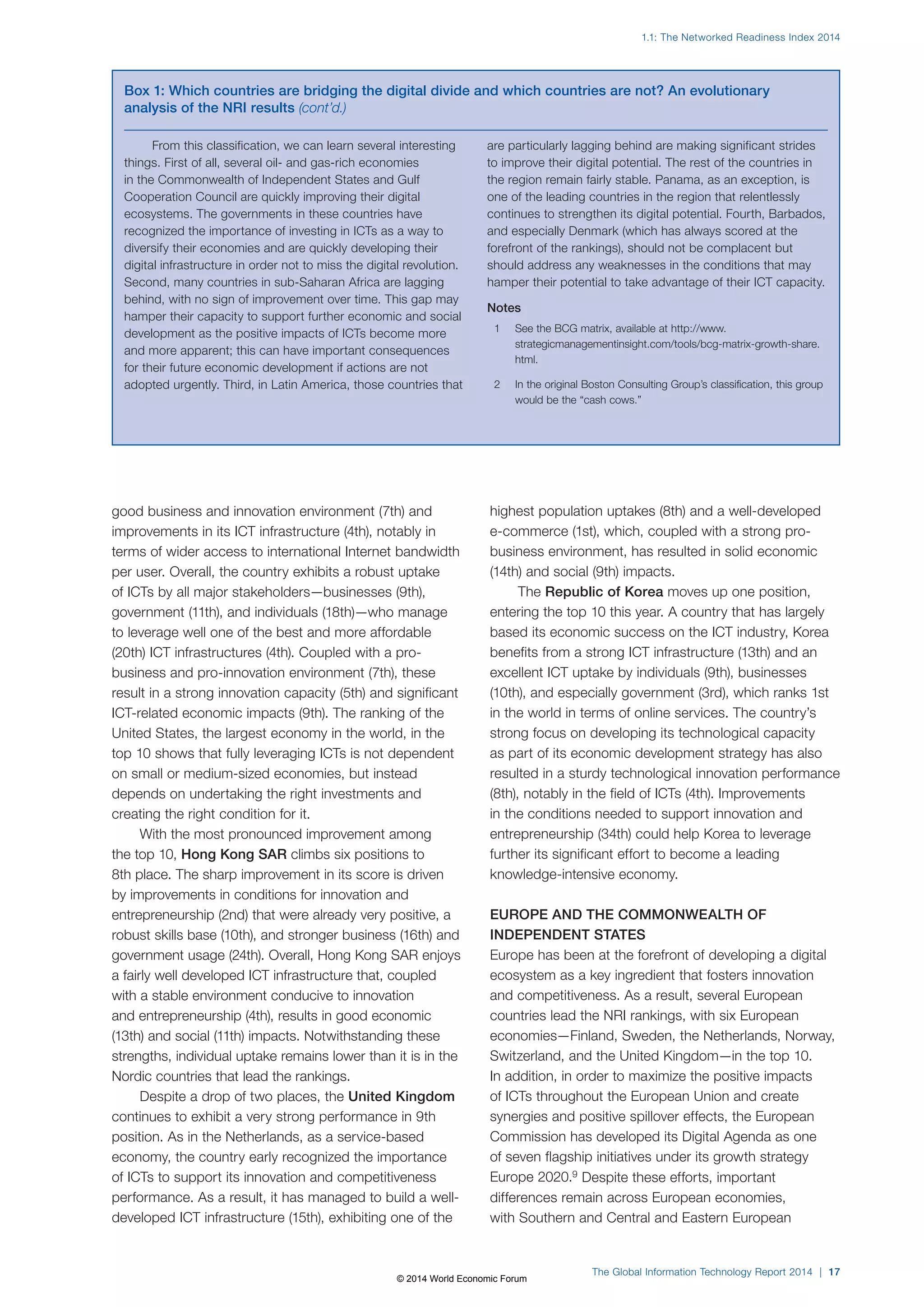
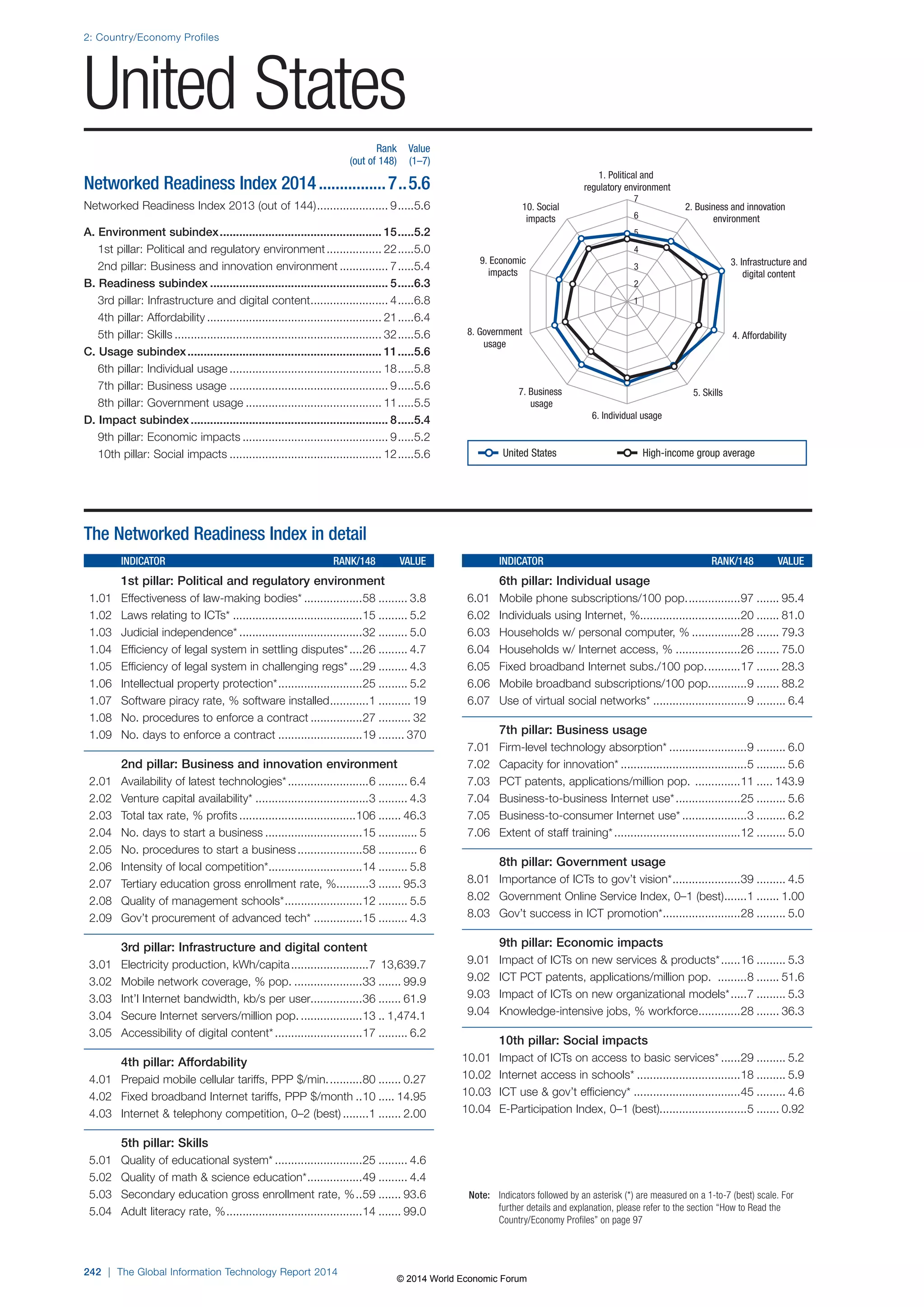
The United States moves up two positions to 
7th place, thanks to slight improvements in many 
areas of the Index. These include the country’s already 
good business and innovation environment (7th) and 
improvements in its ICT infrastructure (4th), notably in 
terms of wider access to international Internet bandwidth 
per user. Overall, the country exhibits a robust uptake 
of ICTs by all major stakeholders—businesses (9th), 
government (11th), and individuals (18th)—who manage 
to leverage well one of the best and more affordable 
(20th) ICT infrastructures (4th). Coupled with a pro-business 
and pro-innovation environment (7th), these 
result in a strong innovation capacity (5th) and significant 
ICT-related economic impacts (9th). The ranking of the 
United States, the largest economy in the world, in the 
top 10 shows that fully leveraging ICTs is not dependent 
on small or medium-sized economies, but instead 
depends on undertaking the right investments and 
creating the right condition for it. Despite a drop of two 
places, the United Kingdom continues to exhibit a very 
strong performance in 9th position. As a service-based 
economy, the country early recognized the importance 
of ICTs to support its innovation and competitiveness 
performance. As a result, it has managed to build a well-developed 
ICT infrastructure (15th), exhibiting one of the 
highest population uptakes (8th) and a well-developed 
e-commerce (1st), which, coupled with a strong pro-business 
environment, has resulted in solid economic 
(14th) and social (9th) impacts. 
Regional results 
Europe has been at the forefront of developing a digital 
ecosystem as a key ingredient that fosters innovation 
and competitiveness. As a result, several European 
countries lead the NRI rankings, with six European 
economies—Finland, Sweden, the Netherlands, 
Norway, Switzerland, and the United Kingdom—in the 
top 10. In addition, in order to maximize the positive 
impacts of ICTs throughout the European Union and 
create synergies and positive spillover effects, the 
European Commission has developed its Digital Agenda 
as one of seven flagship initiatives under its growth 
strategy Europe 2020. Despite these efforts, important 
differences remain across European economies, 
with Southern and Central and Eastern European 
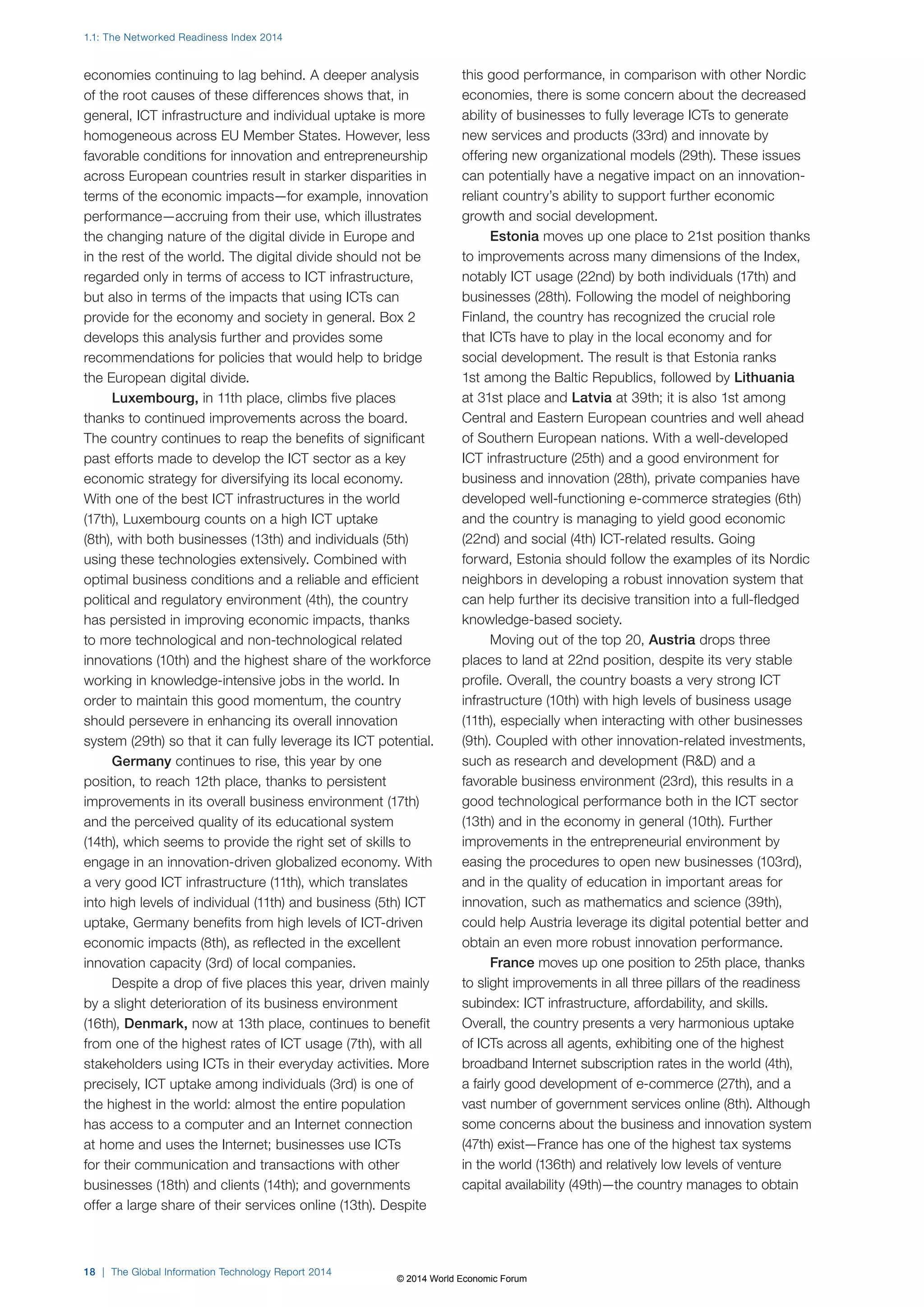
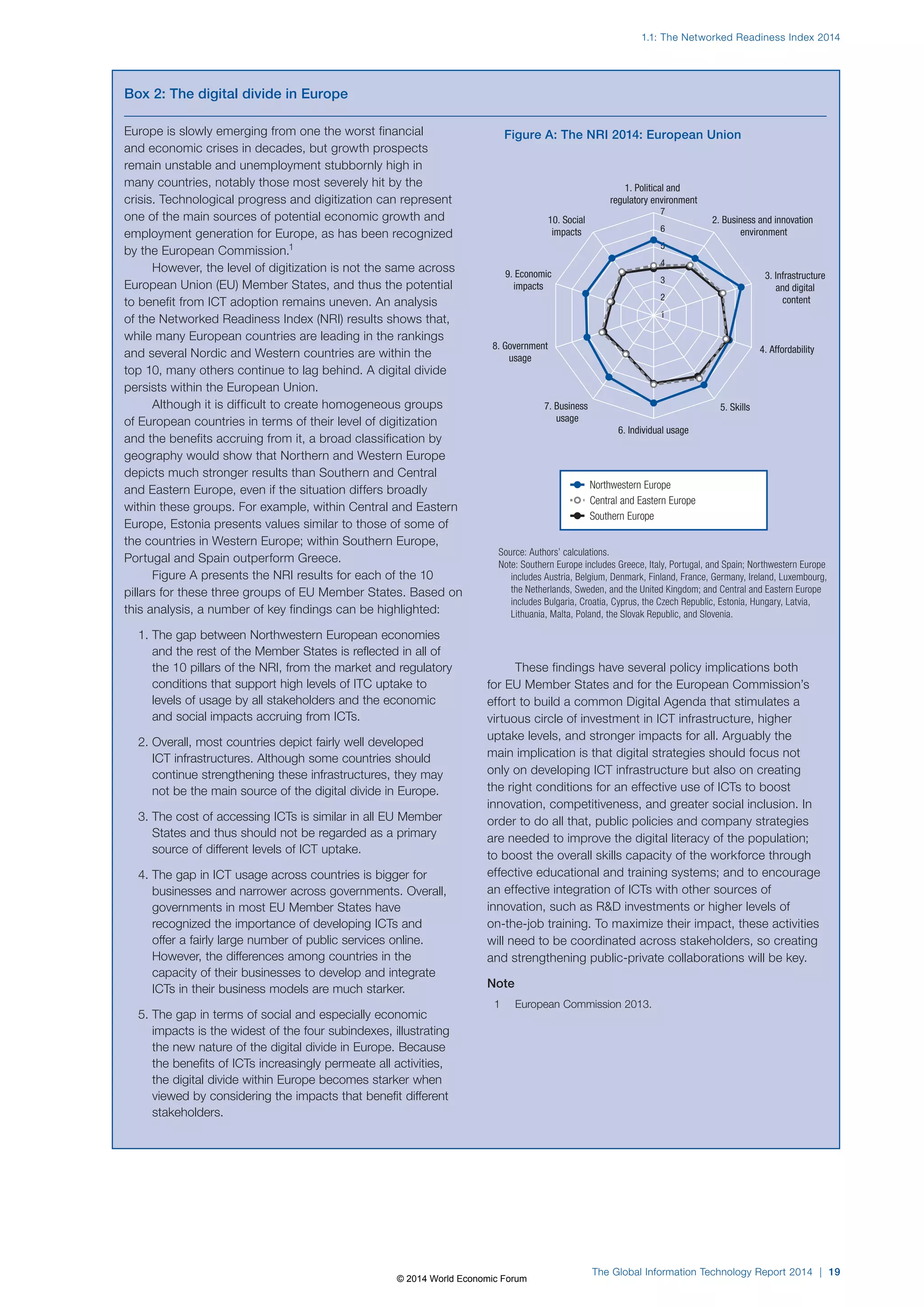
economies continuing to lag behind. A deeper analysis 
of the root causes of these differences shows that, in 
general, ICT infrastructure and individual uptake is more 
homogeneous across EU Member States. However, less 
favorable conditions for innovation and entrepreneurship 
across European countries result in starker disparities in 
terms of the economic impacts—for example, innovation 
performance—accruing from their use, which illustrates 
the changing nature of the digital divide in Europe and 
in the rest of the world. The digital divide should not be 
Executive Summary 
regarded only in terms of access to ICT infrastructure, 
but also in terms of the impacts that using ICTs can 
provide for the economy and society in general. Within 
the Commonwealth of Independent States, several 
countries improve their performances, reflecting the 
key importance and hopes they have placed on ICTs to 
diversify their economies and lead them toward more 
knowledge-intensive activities. 
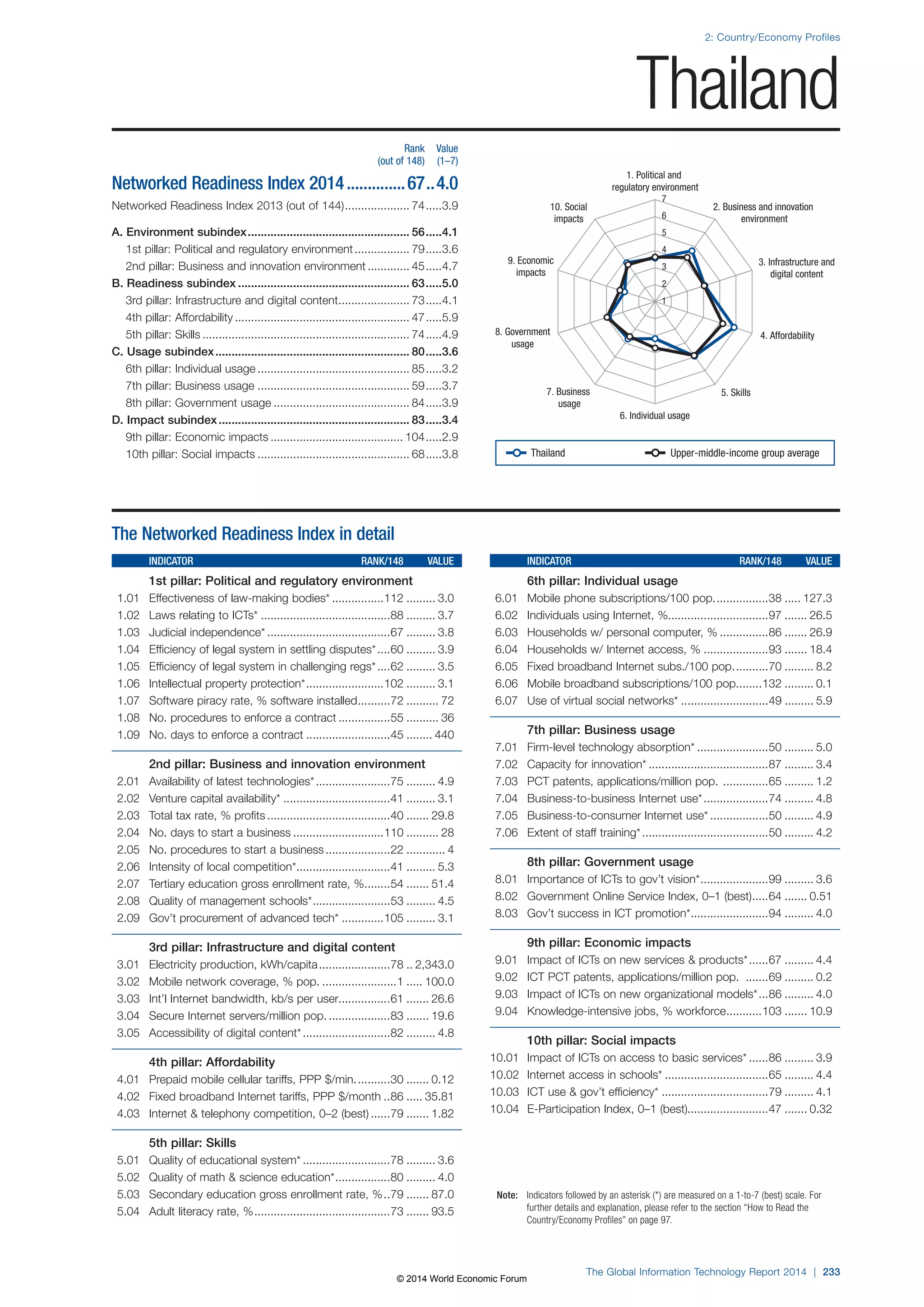
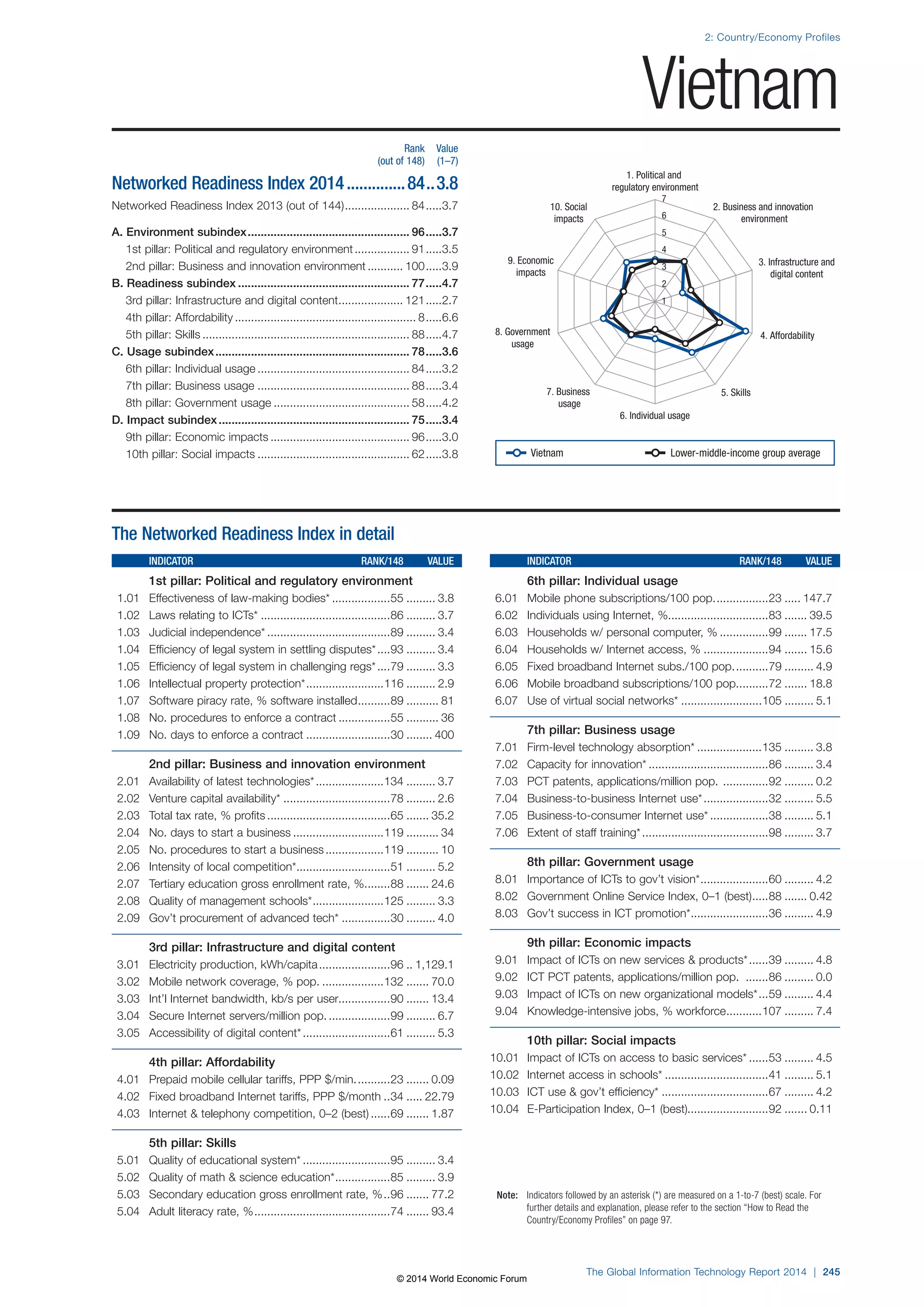
With three economies from the region in the top 
10 of the NRI rankings and several countries showing 
improvement, Asia and the Pacific is very dynamic 
and active in developing its ICT agenda. Yet a significant 
digital divide persists between the most advanced 
economies—such as the Asian Tigers and Japan— 
and emerging economies and other trailing countries. 
Regardless of their position on the development ladder, 
however, all Asian economies have much to gain from 
increased networked readiness. It will allow populations 
of the least advanced among them to gain access to 
much-needed basic services, to improve government 
transparency and efficiency, and—for the most 
advanced—it will contribute to boosting their innovation 
capacity and allow them to attain higher levels of 
competitiveness. 
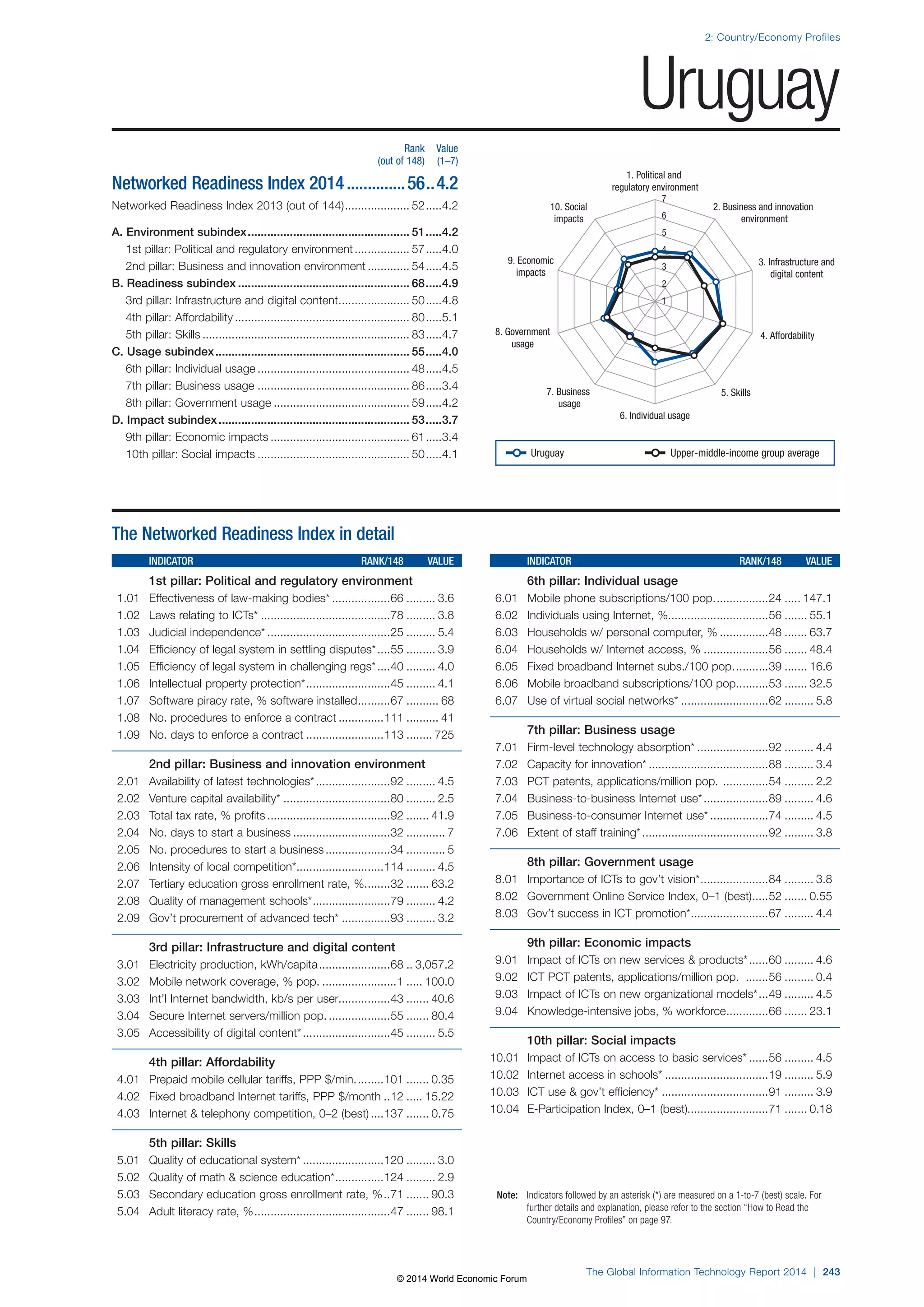
Improving the connectivity of Latin America and 
the Caribbean continues to represent one of the 
region’s main challenges despite the recent efforts 
of many countries to develop and update their ICT 
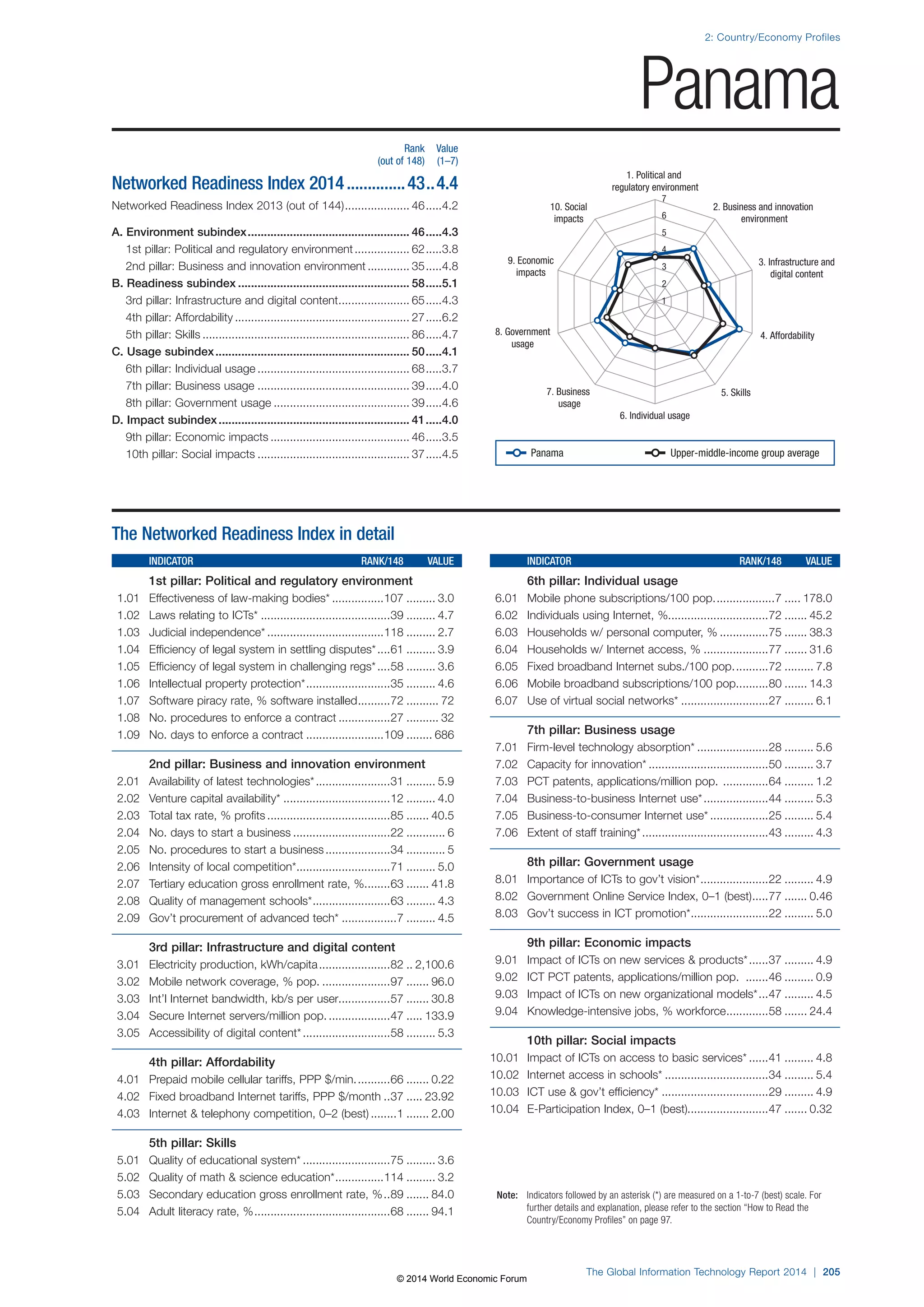
infrastructures. Countries such as Chile, Panama, 
Uruguay, and Colombia have made significant progress 
in developing and ensuring more and better access to 
ICT infrastructure, ensuring higher ICT usage across 
stakeholders. However, persistent weaknesses in 
the broader innovation system hinder the overall 
capacity of the region to fully leverage ICTs to foster its 
competitiveness potential, highlighting the rise of the 
new digital divide—that is, the divide between countries 
that are achieving positive economic and social impacts 
related to the use of ICTs and those that are not. 
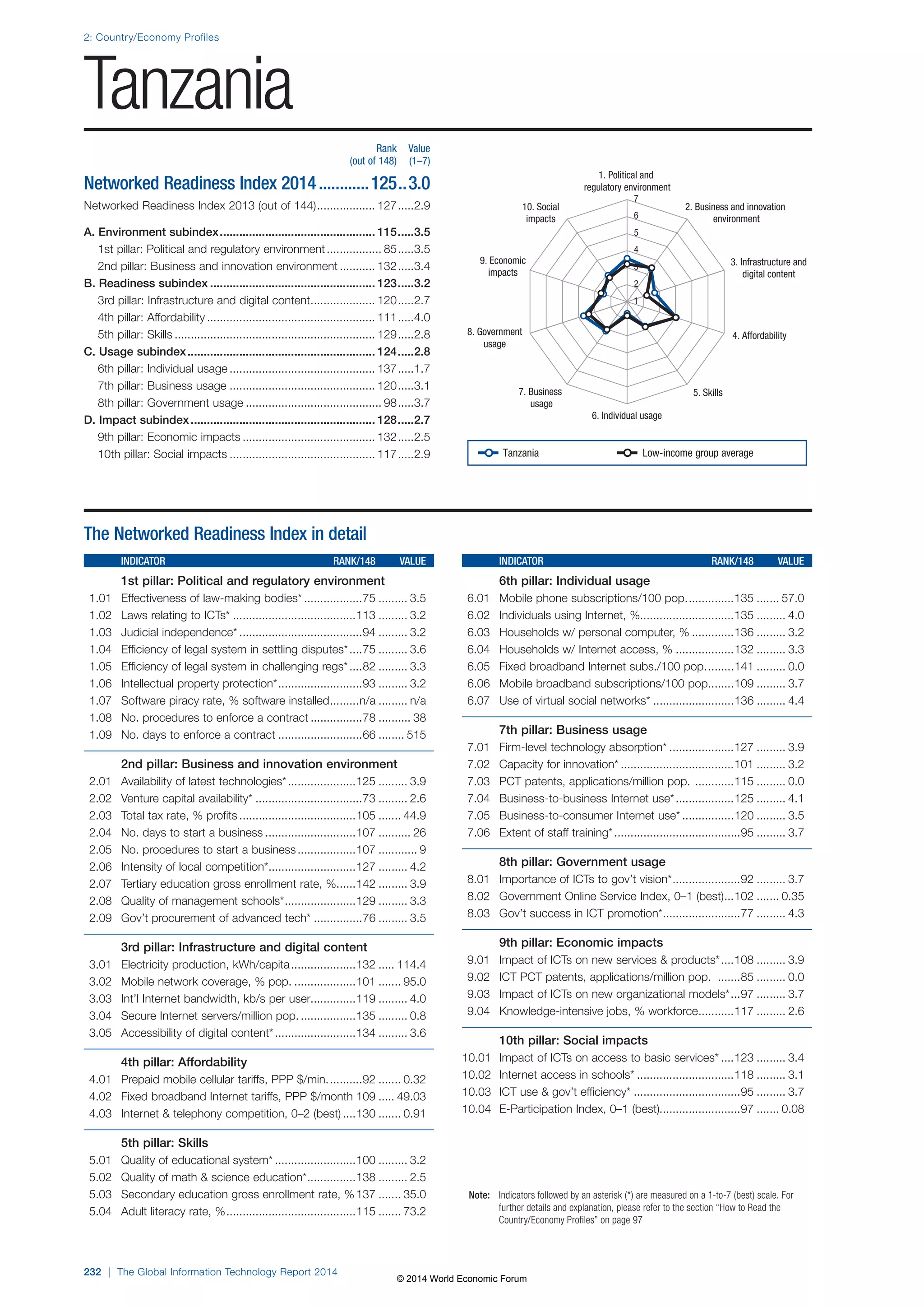
Sub-Saharan Africa slowly continues to develop 
its ICT infrastructure, especially by expanding the share 
of the population covered by, and having access to, 
mobile telephony and by expanding the number of 
Internet users, which in some countries—such as South 
Africa—has almost doubled. These improvements have 
led to many important innovations that provide more 
and better services that were previously unavailable, 
such as financial services. Notwithstanding this 
progress, the region overall continues to suffer from a 
relatively poor ICT infrastructure, which remains costly to 
access, although some notable exceptions exist. More 
importantly, severe weaknesses persist in the region’s 
business and innovation ecosystems, which result in very 
low positive economic and social impacts. Addressing 
these weaknesses, not only by developing a more solid 
ICT infrastructure but also by improving the framework 
conditions for innovation and entrepreneurship, will be 
The Global Information Technology Report 2014 | xiii 
© 2014 World Economic Forum
Executive Summary 
crucial to avoid the emergence of a new digital divide 
that will be evident in a disparity of the economic and 
social impacts associated with what has been called the 
digital revolution. 
As in previous years, the Middle East and North 
Africa depicts a highly diversified outlook in terms of 
the capacity of countries to leverage ICTs to boost 
competitiveness and well-being. On the one hand, 
Israel and several Gulf Cooperation Council states 
have continued their efforts to improve ICT uptake 
and integrate ICTs better in more robust innovation 
ecosystems in order to obtain higher returns. On the 
other hand, many countries in North Africa continue 
to lag behind and suffer from important weaknesses 
in their framework conditions and overall innovation 
capacity that prevent them from fully leveraging ICTs and 
obtaining higher returns. 
The Internet of Everything: How the Network 
Unleashes the Benefits of Big Data 
Chapter 1.2, contributed by Robert Pepper and John 
Garrity from Cisco Systems, details how Internet protocol 
(IP) networks underpin the concept of the Internet 
of Everything (IoE) and explores how IP networks 
accelerate big data’s transformational impact on 
individuals, businesses, and governments around the 
world. 
As exabytes of new data are created daily, a rising 
share of this data growth is flowing over IP networks 
as more people, places, and things connect to the IoE. 
Proprietary networks are increasingly migrating to IP, 
facilitating the growth of big data, and networks are fast 
becoming the key link among data generation, analysis, 
processing, and utilization. 
The authors highlight four major trends driving 
data growth over IP networks and detail how networks 
are central to maximizing analytical value from the 
data deluge. The chapter identifies critical technology 
and public policy challenges that could accelerate, 
or encumber, the full impact of big data and the IoE 
including standards and interoperability, privacy and 
security, spectrum and bandwidth constraints, cross-border 
data traffic, legacy regulatory models, reliability, 
scaling, and electrical power. 
Big Data Maturity: An Action Plan for Policymakers 
and Executives 
In Chapter 1.3, Bahjat El-Darwiche, Volkmar Koch, 
David Meer, Ramez T. Shehadi, and Walid Tohme of 
Booz & Company argue that big data has the potential 
to improve or transform existing business operations 
and reshape entire economic sectors. Big data can 
pave the way for disruptive, entrepreneurial companies 
and allow new industries to emerge. The technological 
aspect is important, but technology alone is insufficient 
to allow big data to show its full potential and to prevent 
companies from feeling swamped by this information. 
What matters is to reshape internal decision-making 
culture so that executives base their judgments on data 
rather than hunches. Research already indicates that 
companies that have managed this are more likely to be 
productive and profitable than their competition. 
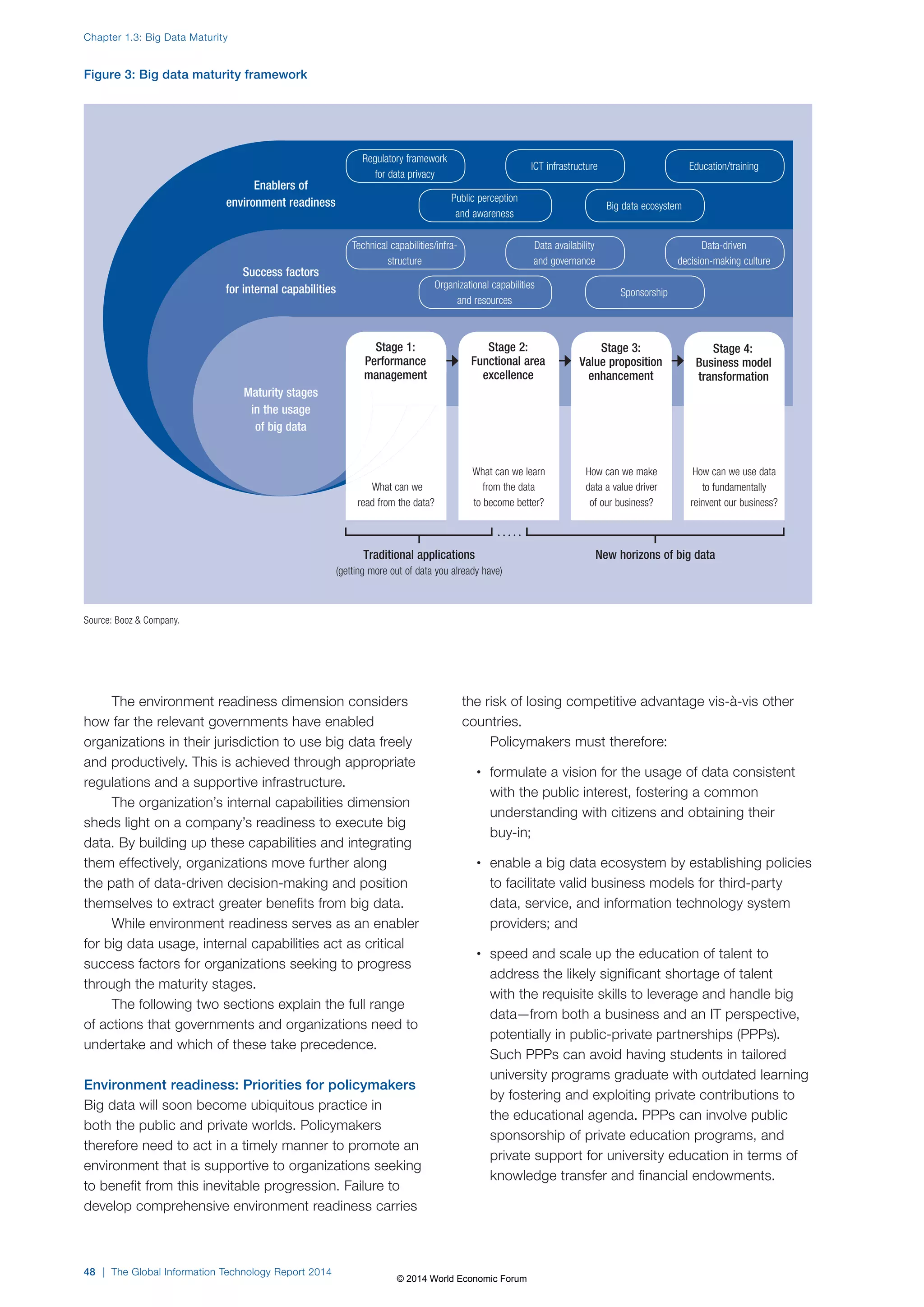
Organizations need to understand where they are in 
terms of big data maturity, an approach that allows them 
to assess progress and identify necessary initiatives. 
Judging maturity requires looking at environment 
readiness, determining how far governments have 
provided the necessary legal and regulatory frameworks 
and ICT infrastructure; considering an organization’s 
internal capabilities and how ready it is to implement big 
data initiatives; and looking also at the many and more 
complicated methods for using big data, which can 
mean simple efficiency gains or revamping a business 
model. The ultimate maturity level involves transforming 
the business model to become data-driven, which 
requires significant investment over many years. 
Policymakers should pay particular attention to 
environment readiness. They should present citizens 
with a compelling case for the benefits of big data. 
This means addressing privacy concerns and seeking 
to harmonize regulations around data privacy globally. 
Policymakers should establish an environment that 
facilitates the business viability of the big data sector 
(such as data, service, or IT system providers), and 
they should take educational measures to address the 
shortage of big data specialists. As big data becomes 
ubiquitous in public and private organizations, its use will 
become a source of national and corporate competitive 
advantage. 
Balancing the Risks and Rewards of Data-Driven 
Public Policy 
Alex “Sandy” Pentland from the Massachusetts Institute 
of Technology (MIT) highlights in Chapter 1.4 that we 
are entering a big data world, where governance is 
far more driven by data than it has been in the past. 
Basic to the success of a data-driven society is the 
protection of personal privacy and freedom. Discussions 
at the World Economic Forum have made substantial 
contributions to altering the privacy and data ownership 
standards around the world in order to give individuals 
unprecedented control over data that are about 
them, while at the same time providing for increased 
transparency and engagement in both the public and 
private spheres. 
We still face the challenge that large organizations, 
and in particular governments, may be tempted to abuse 
the power of the data that they hold. To address this 
concern we need to establish best practices that are in 
the interests of both large organizations and individuals. 
This chapter suggests one path by which potential 
abuses of power can be limited, while at the same time 
providing greater security for organizations that use 
xiv | The Global Information Technology Report 2014 
© 2014 World Economic Forum
big data. The key policy recommendations for all large 
organizations, commercial or government, are that: 
1. Large data systems should store data in a 
distributed manner, separated by type (e.g., 
financial vs. health) and real-world categories (e.g., 
individual vs. corporate), managed by a department 
whose function is focused on those data, and 
with sharing permissions set and monitored by 
personnel from that department. Best practice 
would have the custodians of data be regional 
and use heterogeneous computer systems. With 
such safeguards in place, it is difficult to attack 
many different types of data at once, and it is more 
difficult to combine data types without authentic 
authorization. 
2. Data sharing should always maintain provenance 
and permissions associated with data and support 
automatic, tamper-proof auditing. Best practice 
would share only answers to questions about the 
data (e.g., by use of pre-programmed SQL queries 
known as “Database Views”) rather than the 
data themselves, whenever possible. This allows 
improved internal compliance and auditing, and 
helps minimize the risk of unauthorized information 
leakage. 
3. Systems controlled by partner organizations, and 
not just a company’s own systems, should be 
secure. External data sharing should occur only 
between data systems that have similar local 
control, permissions, provenance, and auditing, 
and should include the use of standardized legal 
agreements such as those employed in trust 
networks. Otherwise data can be siphoned off at 
either the data source or the end consumer, without 
the need for attacking central system directly. 
4. The need for a secure data ecosystem extends to 
the private data of individuals and the proprietary 
data of partner companies. As a consequence, best 
practice for data flows to and from individual citizens 
and businesses is to require them to have secure 
personal data stores and be enrolled in a trust 
network data sharing agreement. 
5. All entities should employ secure identity credentials 
at all times. Best practice is to base these 
credentials on biometric signatures. 
6. Create an “open” data commons that is available 
to partners under a lightweight legal agreement, 
such as the trust network agreements. Open data 
can generate great value by allowing third parties to 
improve services. 
Although these recommendations might at first 
glance seem cumbersome, they are for the most part 
easily implemented with the standard protocols found 
within modern computer databases and networks. In 
Executive Summary 
many cases, the use of distributed data stores and 
management are already part of current practice, and 
so the entire system will be simpler and cheaper to 
implement than a centralized solution: all that is really 
new is the careful use of provenance, permissions, and 
auditing within a legal or regulatory framework such as a 
trust network. Most importantly, these recommendations 
will result in a data ecosystem that is more secure and 
resilient, allowing us to safely reap the advantages of 
using big data to help set and monitor public policy. 
Managing the Risks and Rewards of Big Data 
In Chapter 1.5., Matt Quinn and Chris Taylor from TIBCO 
argue that expert handling of big data brings the reward 
of being able to react to world-changing events, both 
big and small, at an unprecedented rate and scope. 
Epidemics can be tracked and miracle drugs developed, 
for example, but at the same time, big data brings risks 
that require balancing those benefits against privacy 
concerns raised by the potentially unsettling correlation 
of personal information. 
Organizations are awakening to the reality that an 
overwhelming amount of high-volume, wide-variety, and 
high-velocity data creates three key trends: 
• Big data leverages previously untapped data 
sources to liberate information from places where it 
was previously hidden. 
• Big data management requires automation wherever 
possible, because volume and complexity eliminate 
the ability of humans to intervene and reprogram 
processes in real time. 
• Big data forces us to create adaptable, less 
fragile data systems because the sheer variety of 
structured and unstructured data breaks the old 
computational and transactional ways of writing 
logic. 
These trends create two main challenges: 
• Big data holds unseen patterns, which need to be 
visualized using analytics tools and techniques. 
Insights gained must be used at the right time, in 
the right context, and with the right approach. 
• The challenge of systematically discovering, 
capturing, governing, and securing ever-larger 
amounts of data is much more complicated than the 
relatively simple problem of marshaling storage and 
computational resources. 
These elements are the driving forces behind 
making use of big data in increasingly sophisticated 
ways. The chapter cites examples in healthcare, 
logistics, and retail where big data is being tackled 
with a systems approach that takes into consideration 
information streaming constantly as well as what is found 
in historical databases that cut through the mystique of 
The Global Information Technology Report 2014 | xv 
© 2014 World Economic Forum
Executive Summary 
big data and get to the core of understanding big data’s 
risks and rewards. 
Rebalancing Socioeconomic Asymmetry in a 
Data-Driven Economy 
Chapter 1.6, contributed by Peter Haynes of the 
Atlantic Council and M-H. Carolyn Nguyen at Microsoft, 
explains that an increasing amount of data is being 
generated by individuals who are handing potentially 
valuable information to commercial enterprises in 
exchange for “free” services. Moreover, they are doing 
this without realizing—or being recompensed for—their 
data’s monetary value, and with little or no control over 
its immediate or future use. These socioeconomic 
asymmetries in the broad data ecosystem are a potential 
threat to the emerging data-driven economy, since 
they may reduce overall output as more and more 
economic activity is predicated on the use, exchange, 
and analytics of data. The authors argue the need for a 
data ecosystem based on fair value exchange and the 
ability of users to control the use of data related to them. 
The chapter also considers potential technology and 
policy approaches by which this might be achieved, and 
present the need for significant additional research and 
new thinking, in both technology and policy, to enable a 
sustainable data-driven economy. 
Building Trust: The Role of Regulation in Unlocking 
the Value of Big Data 
In Chapter 1.7, Scott Beardsley, Luís Enríquez, Ferry 
Grijpink, Sergio Sandoval, Steven Spittaels, and Malin 
Strandell-Jansson from McKinsey & Company highlight 
the expectation that big data will create great benefit 
for society, companies, and individuals in the coming 
years. For this to fully materialize, however, a number of 
factors must be in place. There must be robust high-speed 
Internet networks, an educated workforce, and 
consumer trust in the services, especially regarding the 
protection of personal data and privacy. 
The increasing importance of protecting personal 
data and privacy is being recognized by countries and 
organizations across the world. There are, however, a 
range of diverging views about how to tackle the issue. 
These range from the light-touch approach of the United 
States, which leaves the issue mainly to the industry 
to solve, to the strict ex ante regulatory framework as 
advocated by the European Union. 
No matter which approach is taken, a few issues 
remain unclear across the frameworks. These issues 
might hamper public trust in big data applications and 
companies and hinder the development of big data to 
its full potential. The issues of concern include how to 
define personal data, how to treat anonymous data, 
whether to allow the right to be forgotten, and the need 
to clarify the relevant jurisdictions and liabilities between 
parties. 
The chapter outlines a few suggestions for 
regulators and companies about how to tackle these 
issues, and suggests that regulators should work closely 
with industry stakeholders and across regions to achieve 
technology-neutral high-level regulatory principles that 
last and promote industry self-regulation. 
Companies should, after an initial assessment, 
implement necessary changes into their organization and 
cooperate with the regulators and industry stakeholders. 
Key, however, is to empower the customer. With clear 
and transparent privacy policies outlining practices, 
enabled services, and trade-offs, consumers are 
empowered to make their own choices while the trust of 
the industry is preserved. 
From Big Data to Big Social and Economic 
Opportunities: Which Policies Will Lead to 
Leveraging Data-Driven Innovation’s Potential? 
Chapter 1.8, contributed by Pedro Less Andrade, Jess 
Hemerly, Gabriel Recalde, and Patrick Ryan at Google, 
focuses on the social and economic value of data, 
but from the point of view of use and purpose rather 
than volume. As it has become axiomatic that more 
data are produced every year, commentators have 
been driven to call this revolution the “age of big data.” 
However, what is commonly known as “big data” is 
not a new concept: the use of data to build successful 
products and services, optimize business processes, 
and make more efficient data-based decisions already 
has an established history. Moreover, the term big data 
is ambiguous: the main features of big data (quantity, 
speed, variety) are technical properties that depend 
not on the data themselves but on the evolution of 
computing, storage, and processing technologies. What 
is important about big data is not its volume but how it 
may contribute to innovation and therefore be used to 
create value. This is why this chapter uses data-driven 
innovation to frame the discussion. 
High-value solutions that may not have quantifiable 
economic value are being developed using data, and 
many sectors, from businesses to governments, benefit 
from data-driven innovation. Apart from producing 
and using data for better policymaking processes, the 
public sector can also play its part in promoting and 
fostering data-driven innovation and growth throughout 
economies by (1) making public data accessible through 
open data formats, (2) promoting balanced legislation, 
and (3) supporting education that focuses on data 
science skills. 
Making Big Data Something More than the “Next Big 
Thing” 
In Chapter 1.9., Anant Gupta, Chief Executive Officer at 
HCL Technologies Ltd, argues that big data analytics is 
not a passing fad. It will be a central means of creating 
value for the organization of tomorrow—almost literally, 
tomorrow. It represents a major change in the way that 
xvi | The Global Information Technology Report 2014 
© 2014 World Economic Forum
businesses and other organizations will operate, and 
using it successfully will require a new mind-set and 
new capabilities. Given that, many organizations are 
struggling to even know where to start in becoming big-data 
competent. A step-by-step approach can make the 
transition seem less daunting and minimize the stumbles 
that are bound to occur along the way. 
PARTS 2 AND 3: COUNTRY/ECONOMY PROFILES 
AND DATA PRESENTATION 
Parts 2 and 3 of the Report feature comprehensive 
profiles for each of the 148 economies covered this 
year as well as data tables for each of the 54 variables 
composing the NRI, with global rankings. Each part 
begins with a description of how to interpret the data 
provided. 
Technical notes and sources, included at the end 
of Part 3, provide additional insight and information on 
the definitions and sources of specific quantitative non- 
Survey data variables included in the NRI computation 
this year. 
NOTES 
1 Alexander 1983. 
2 See Lanier 2010; see also Kakutani 2010. 
REFERENCES 
Alexander, C. P. 1983. “The New Economy.” Time Magazine, May 
30. Available at http://content.time.com/time/magazine/ 
article/0,9171,926013,00.html. 
Kakutani, M. 2010. “A Rebel in Cyberspace, Fighting Collectivism.” 
Books of the Times, January 14. The New York Times. Available at 
http://www.nytimes.com/2010/01/15/books/15book.html?_r=0. 
Lanier, J. 2010. You Are Not a Gadget. New York: Vintage Books, 
Random House. 
Executive Summary 
The Global Information Technology Report 2014 | xvii 
© 2014 World Economic Forum
The Networked 
Readiness Index 
Rankings 
© 2014 World Economic Forum
The Global Information Technology Report 2014 | xxi 
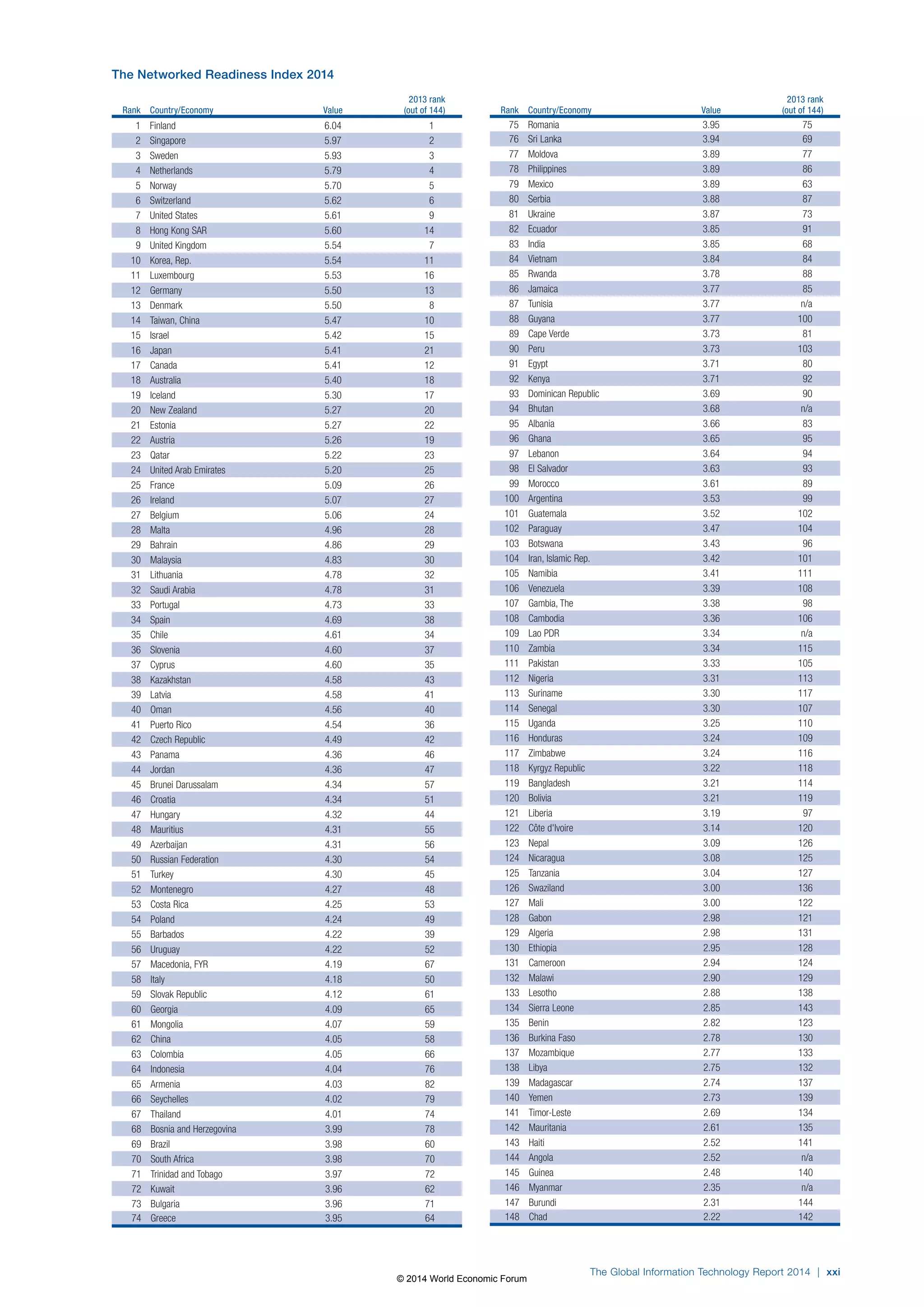
Rank Country/Economy Value 
2013 rank 
(out of 144) 
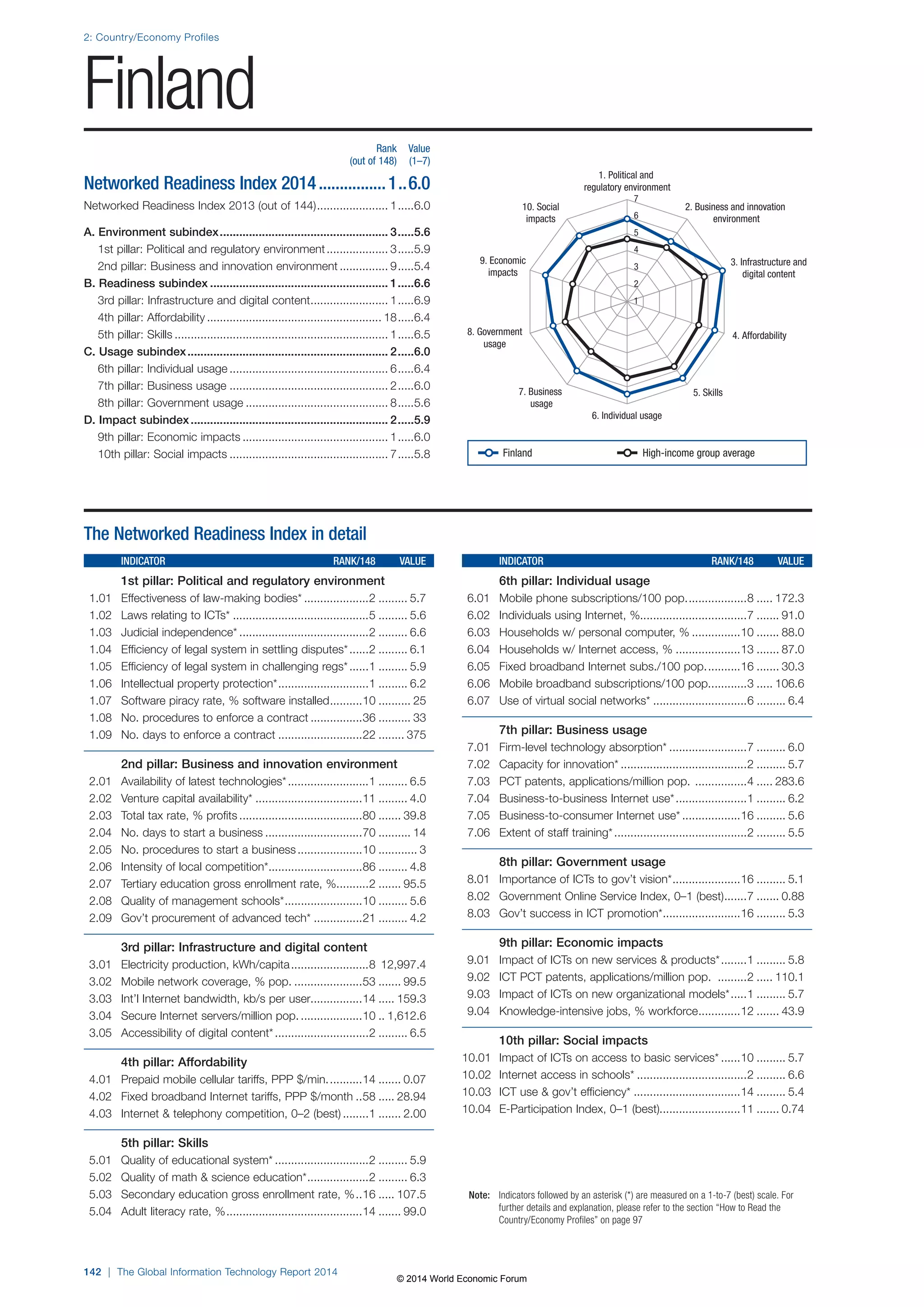
1 Finland 6.04 1 
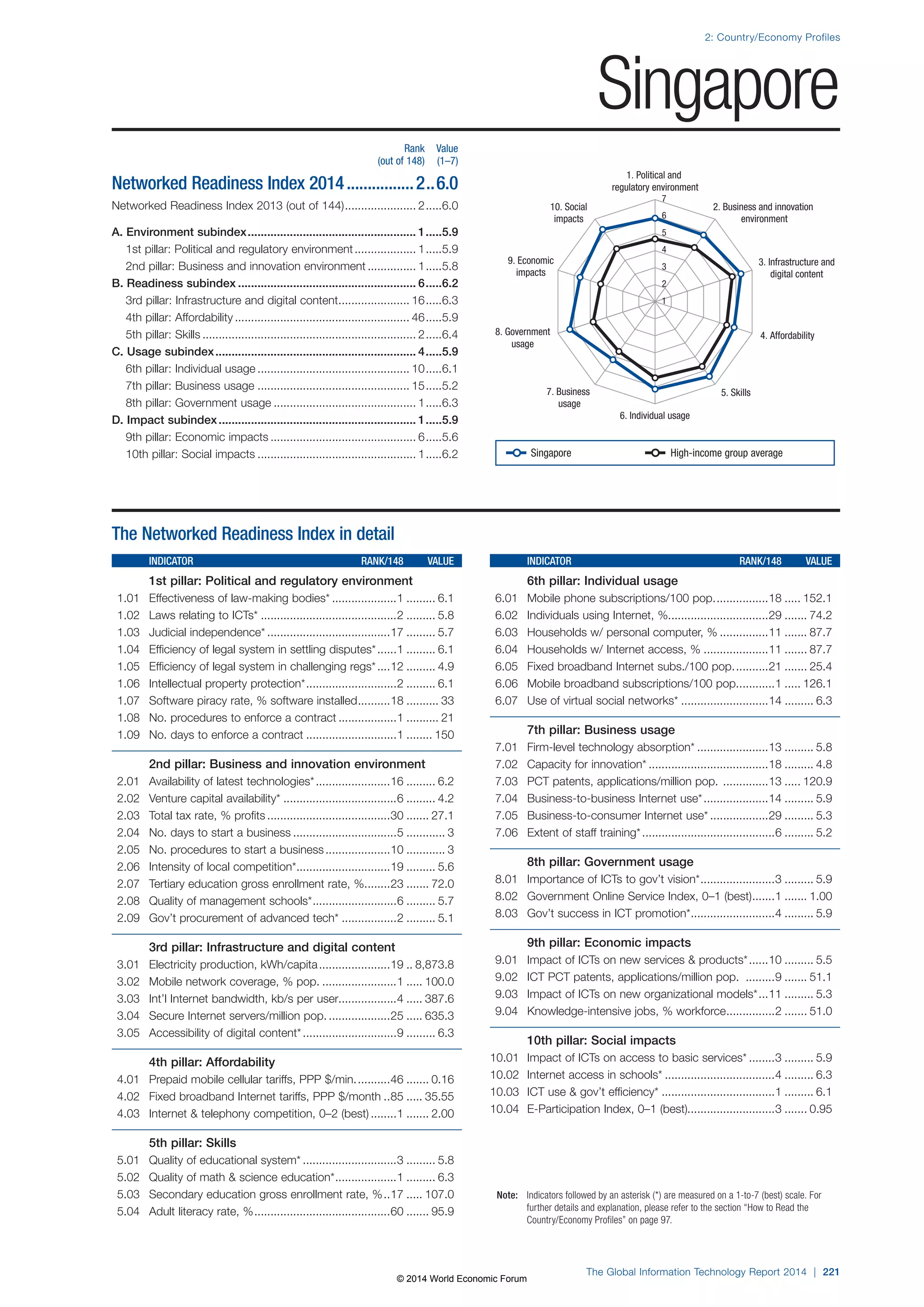
2 Singapore 5.97 2 
3 Sweden 5.93 3 
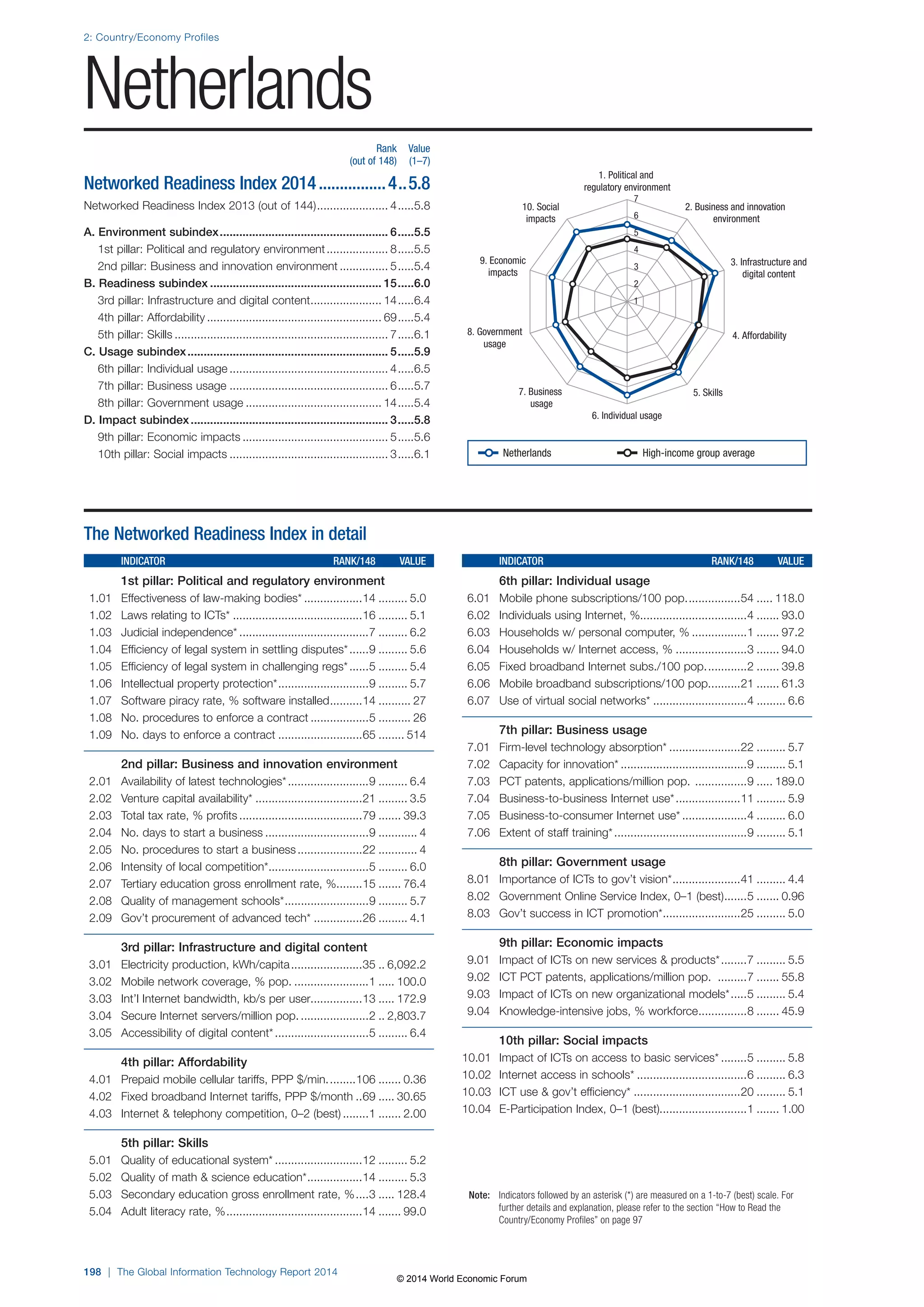
4 Netherlands 5.79 4 
5 Norway 5.70 5 
6 Switzerland 5.62 6 
7 United States 5.61 9 
8 Hong Kong SAR 5.60 14 
9 United Kingdom 5.54 7 
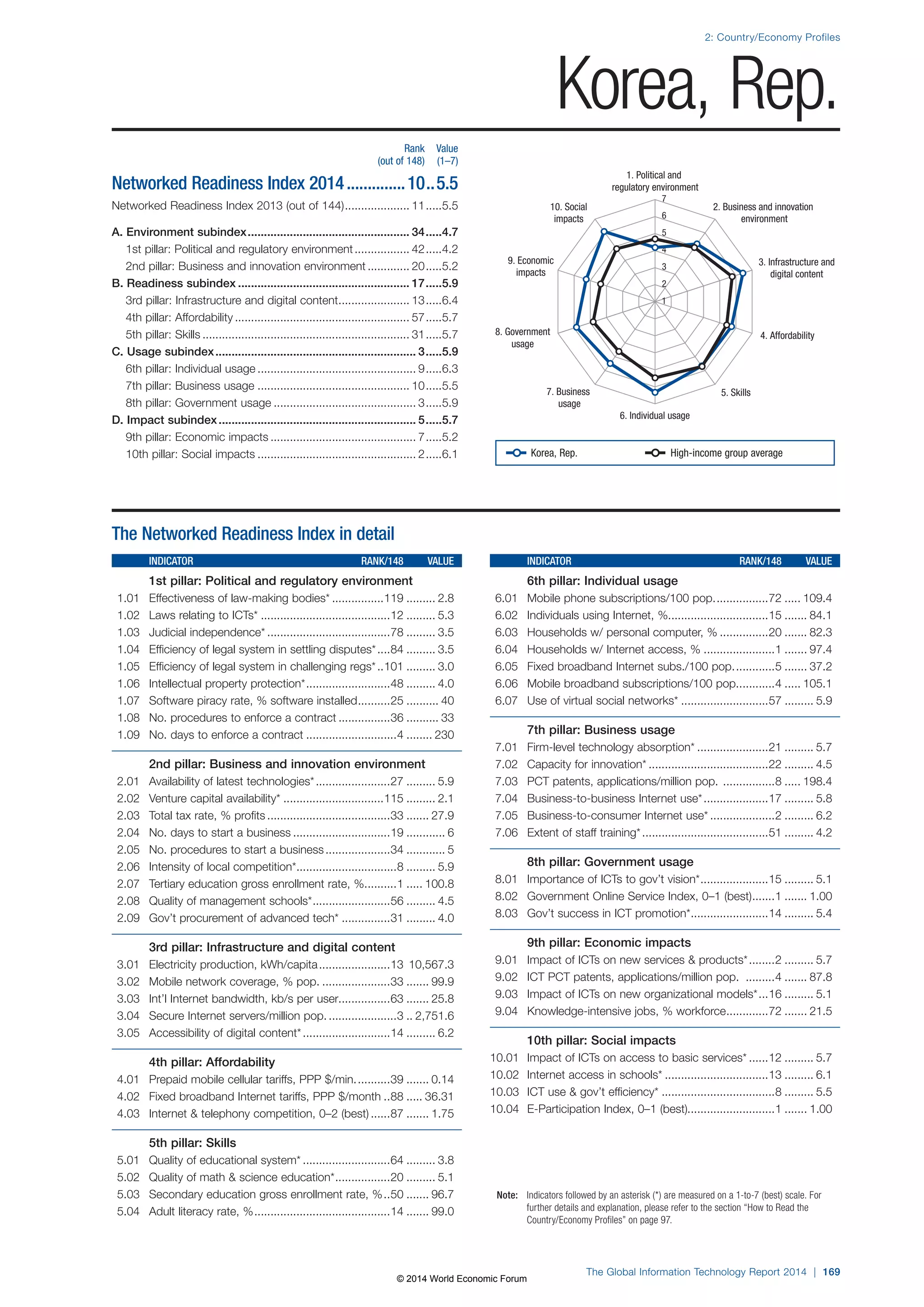
10 Korea, Rep. 5.54 11 
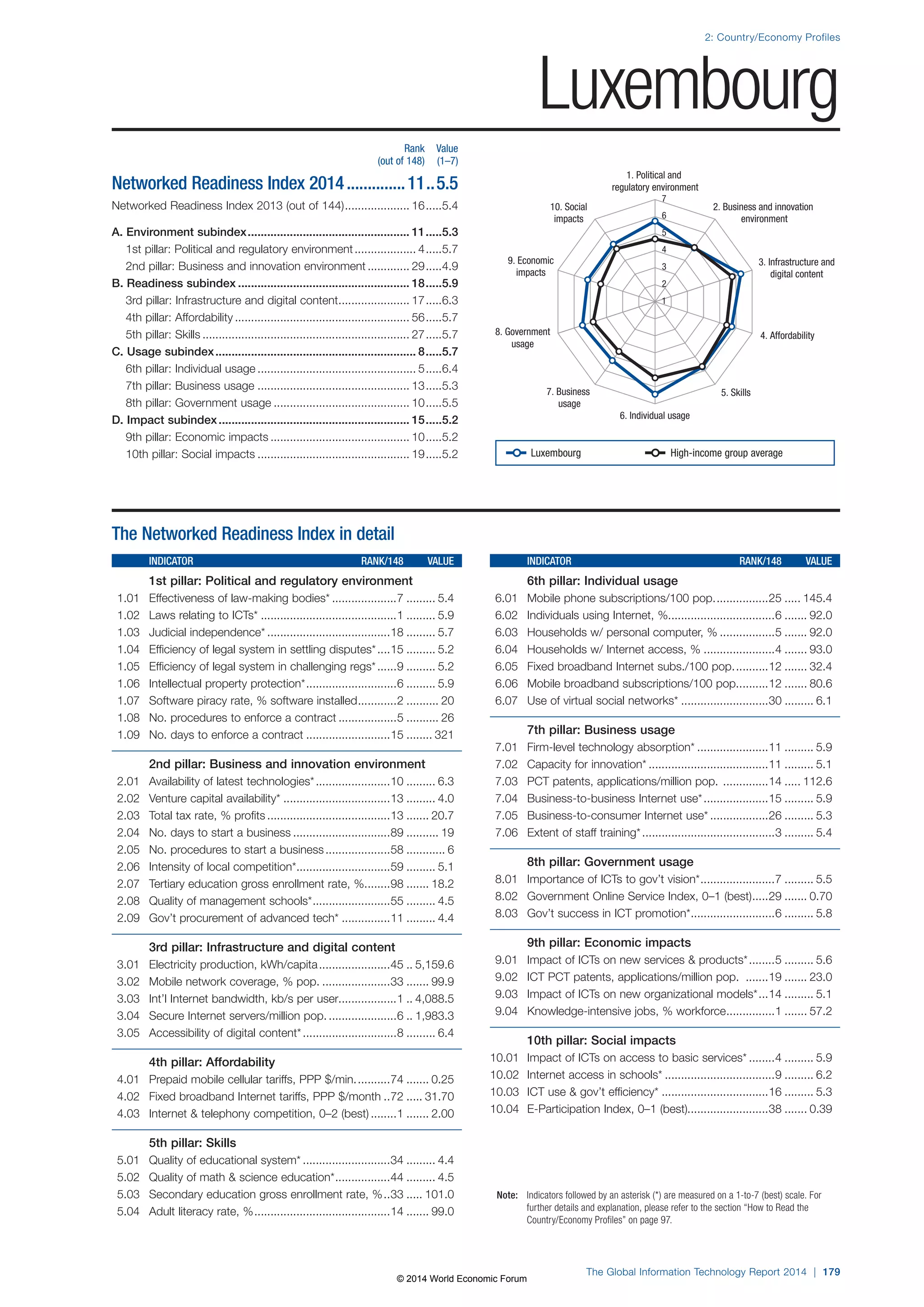
11 Luxembourg 5.53 16 
12 Germany 5.50 13 
13 Denmark 5.50 8 
14 Taiwan, China 5.47 10 
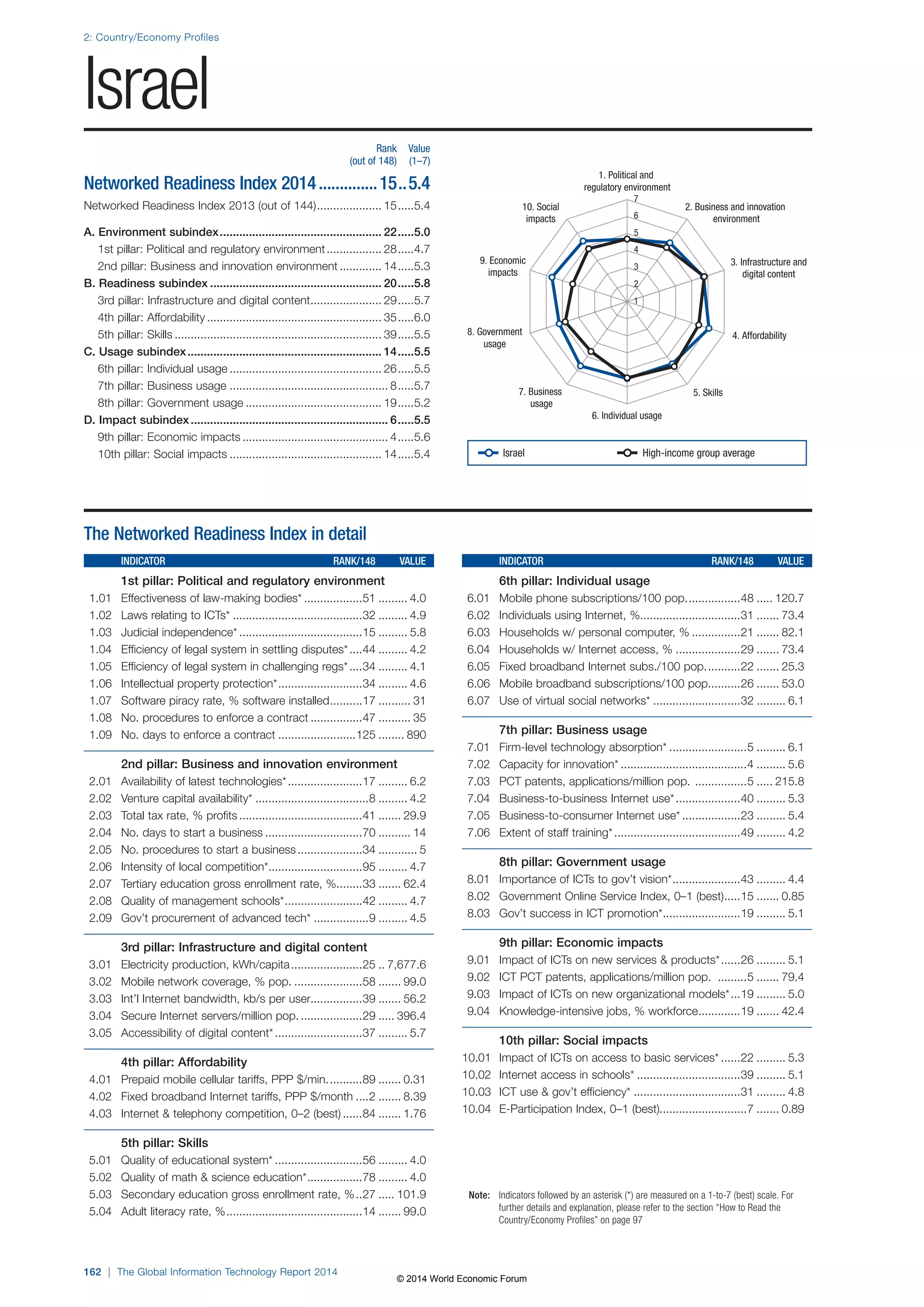
15 Israel 5.42 15 
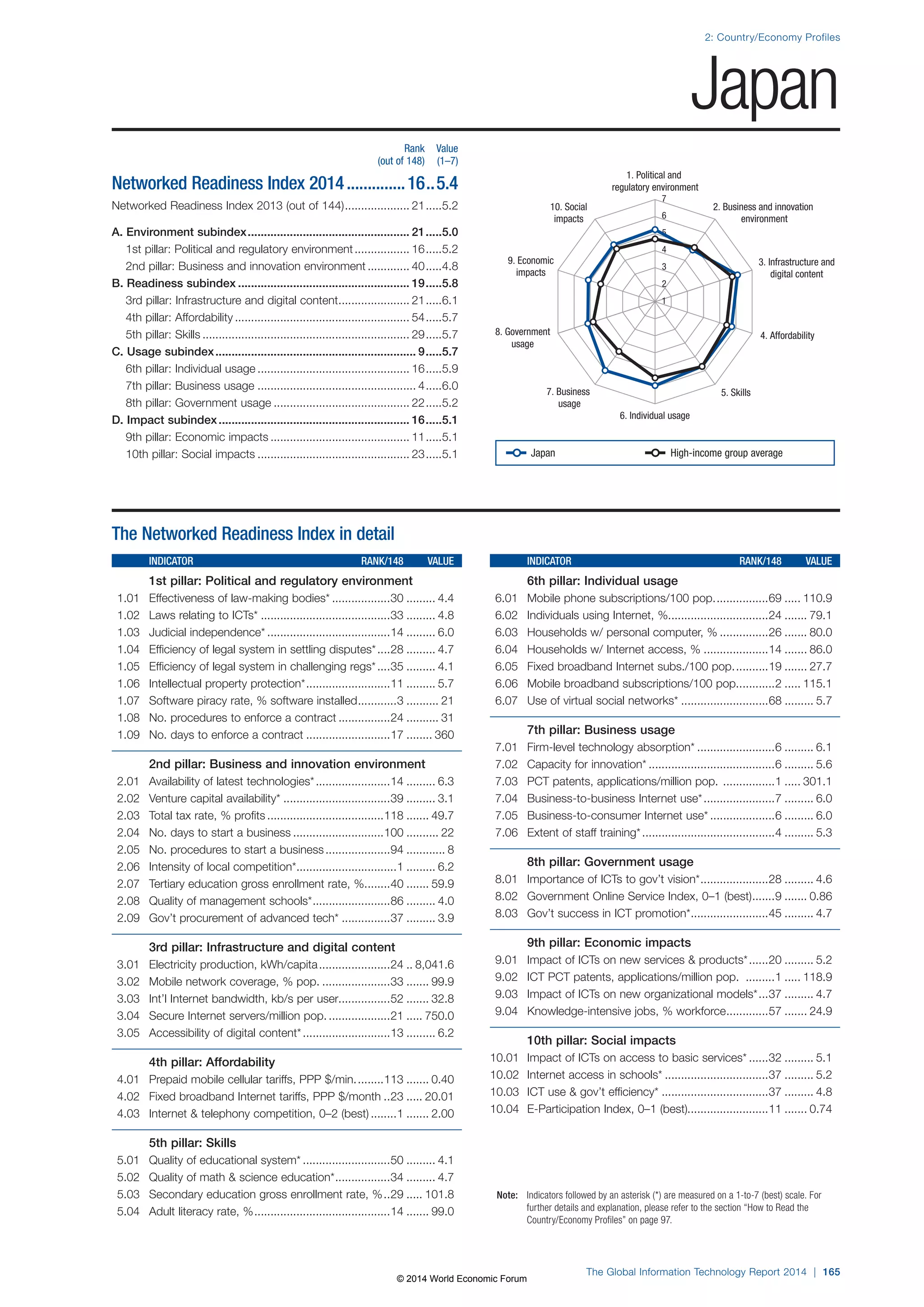
16 Japan 5.41 21 
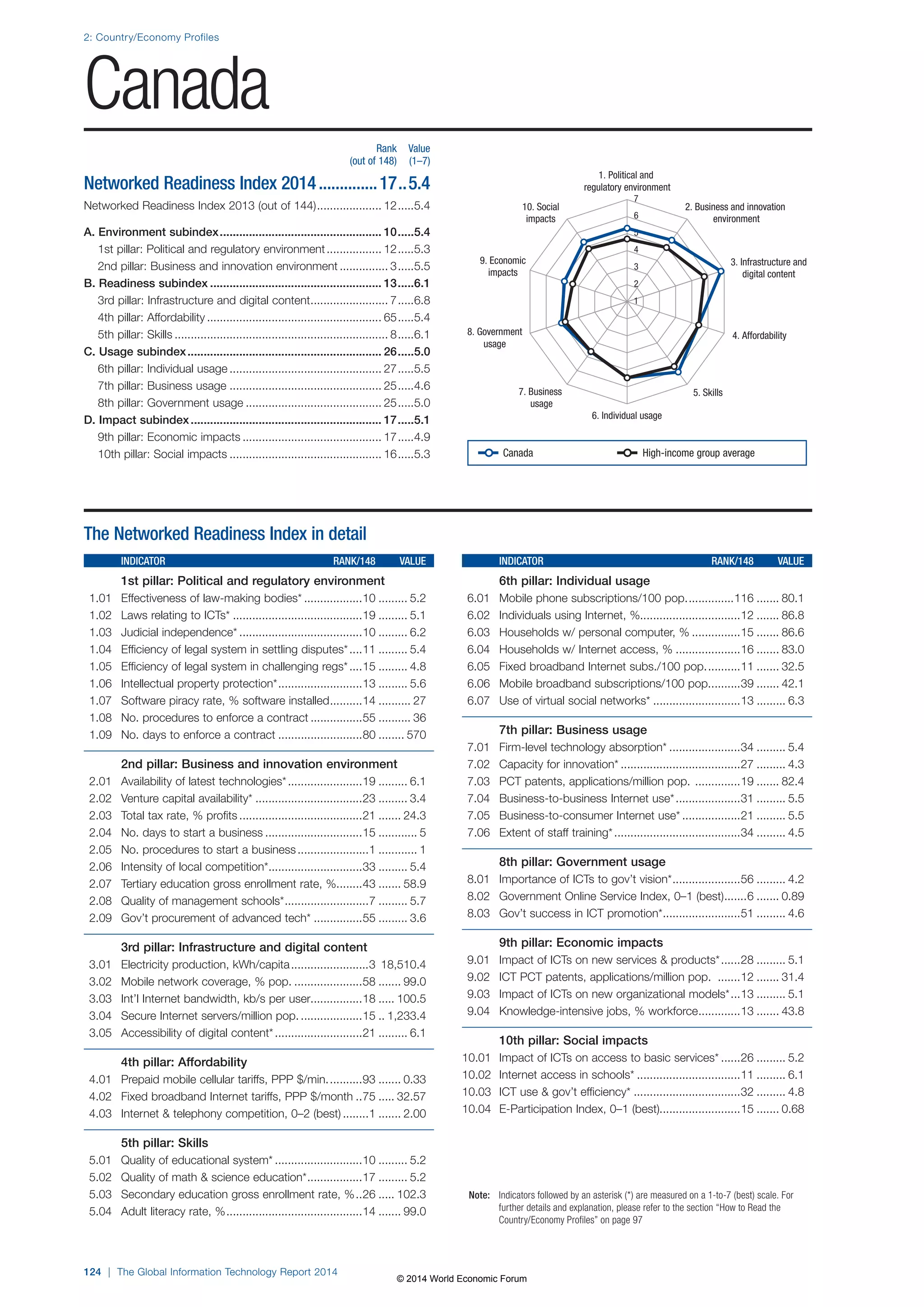
17 Canada 5.41 12 
18 Australia 5.40 18 
19 Iceland 5.30 17 
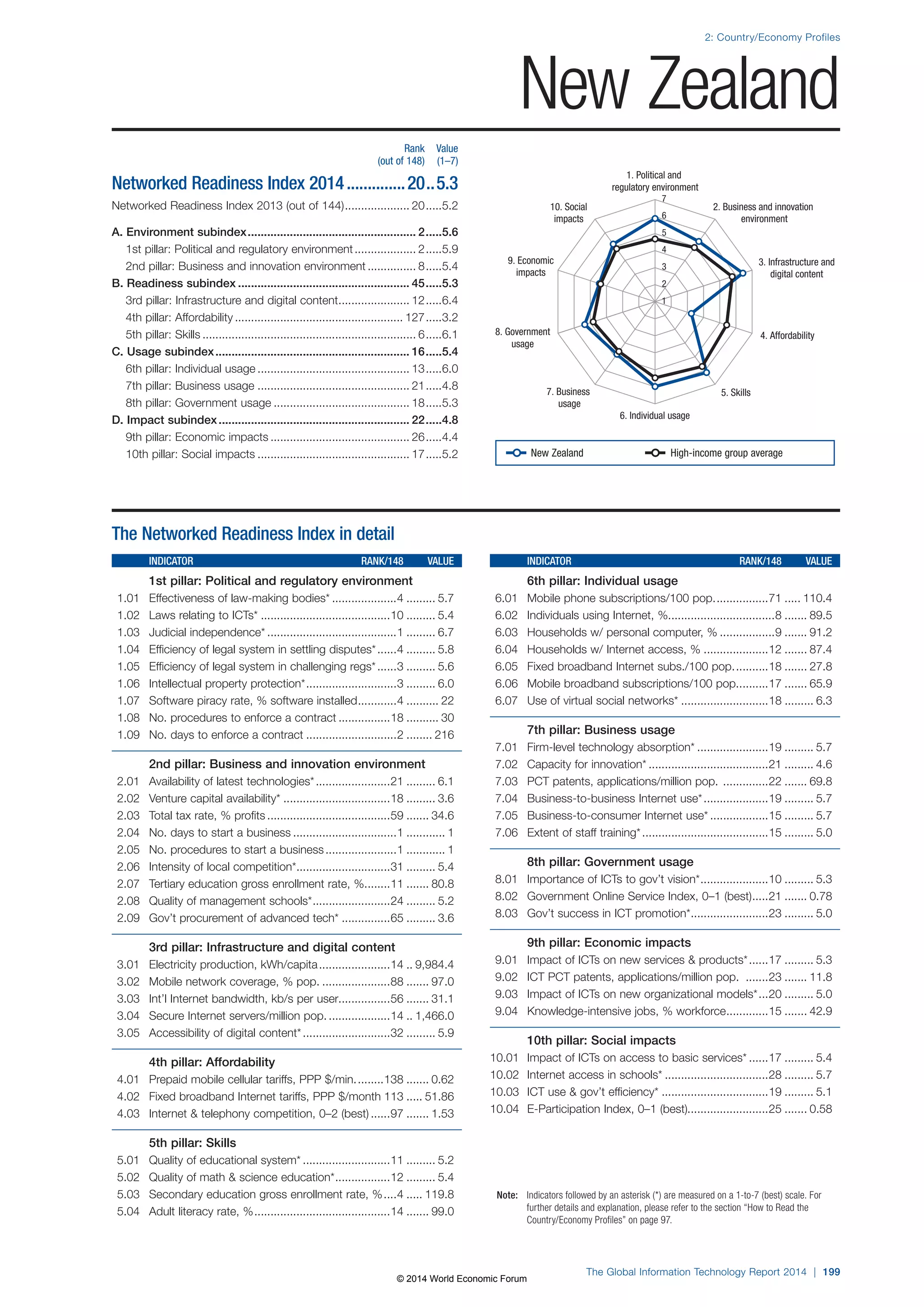
20 New Zealand 5.27 20 
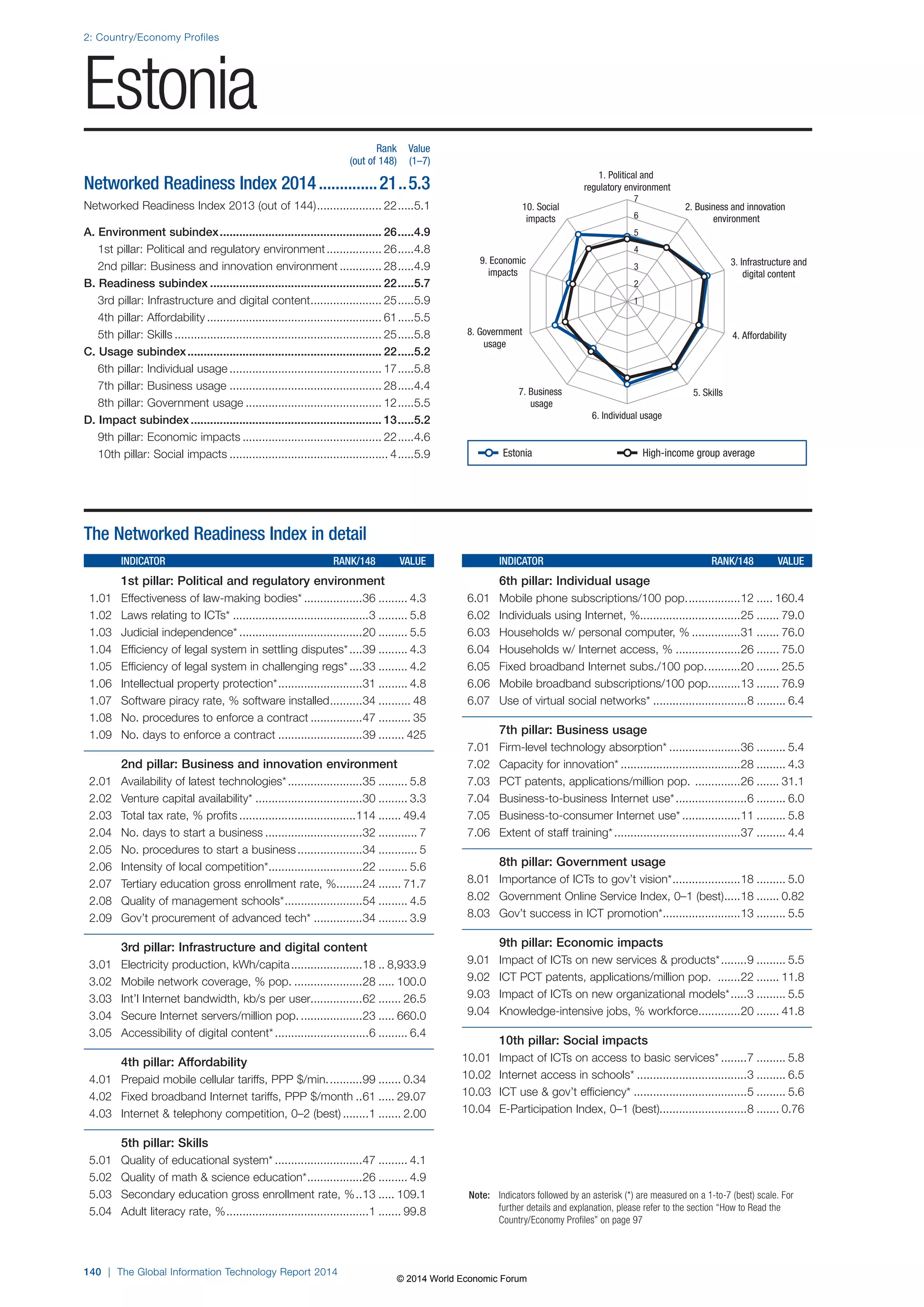
21 Estonia 5.27 22 
22 Austria 5.26 19 
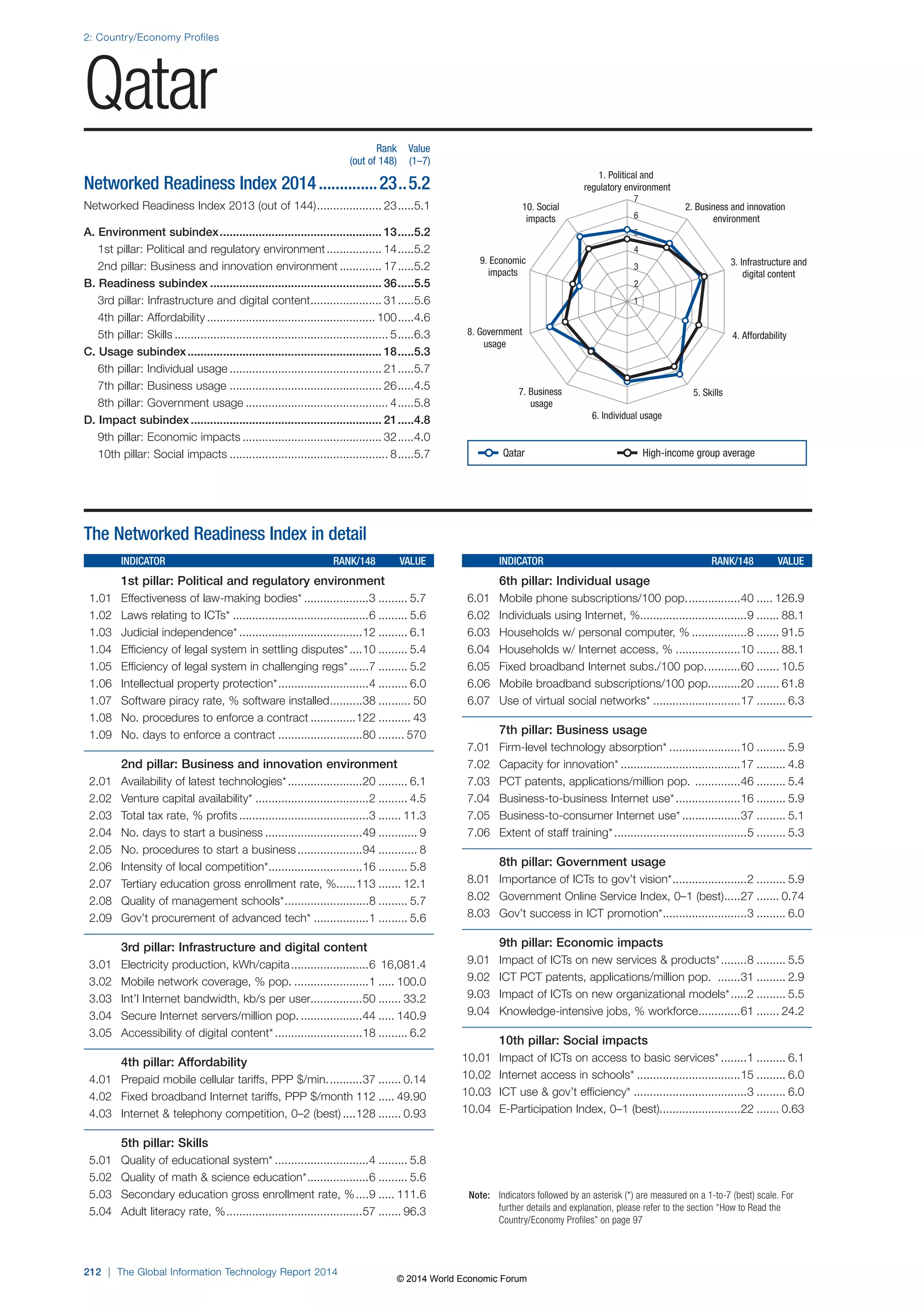
23 Qatar 5.22 23 
24 United Arab Emirates 5.20 25 
25 France 5.09 26 
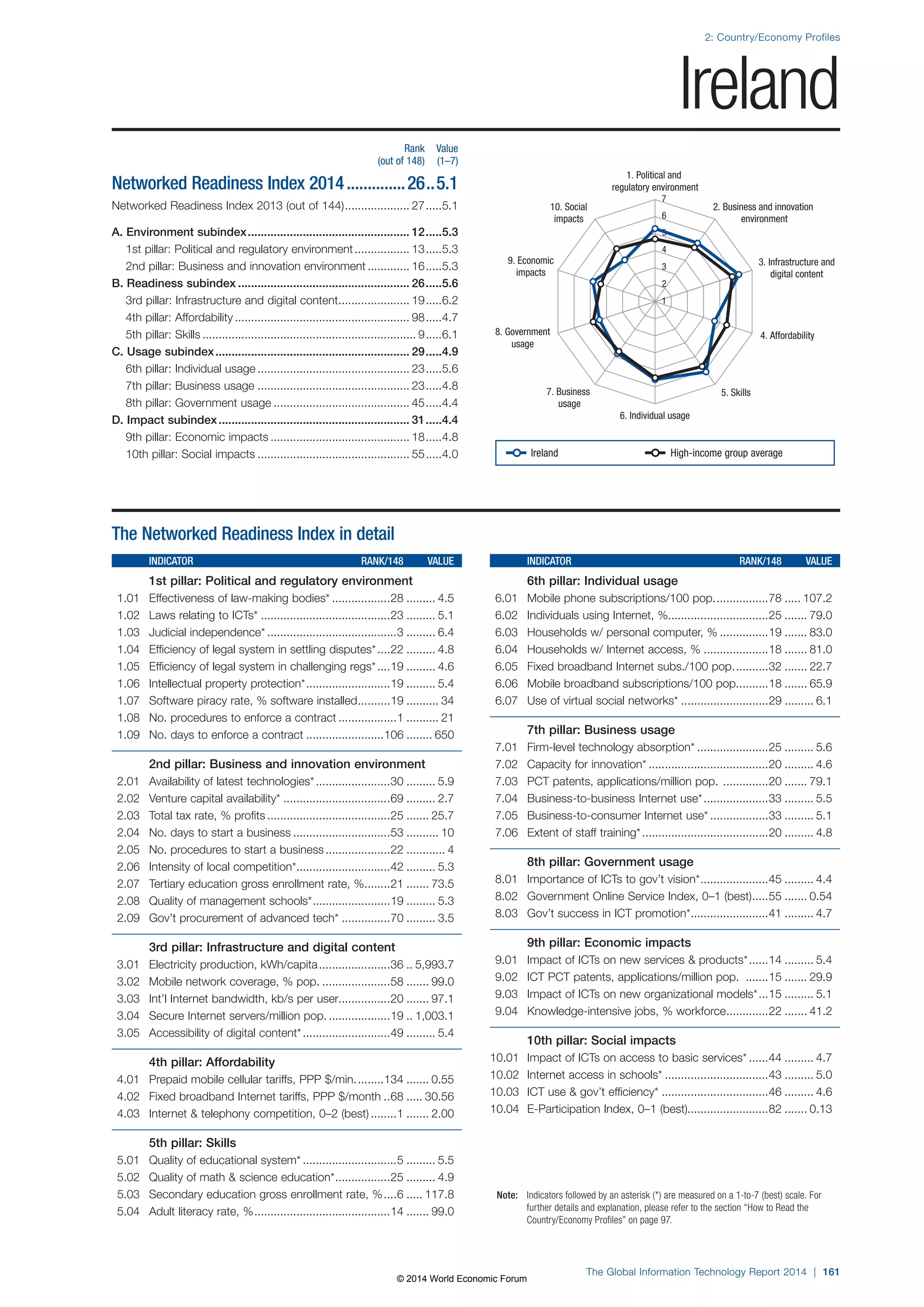
26 Ireland 5.07 27 
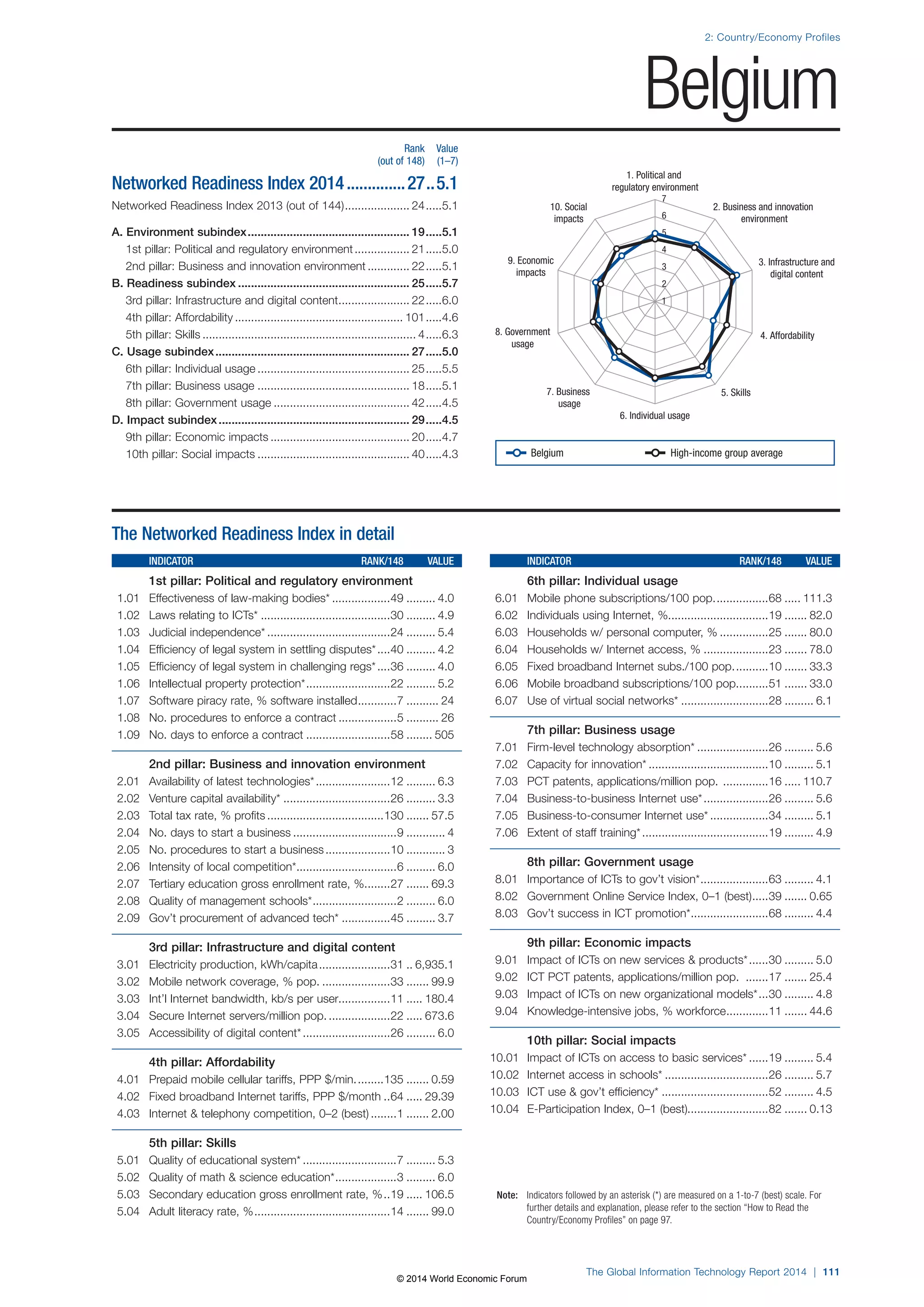
27 Belgium 5.06 24 
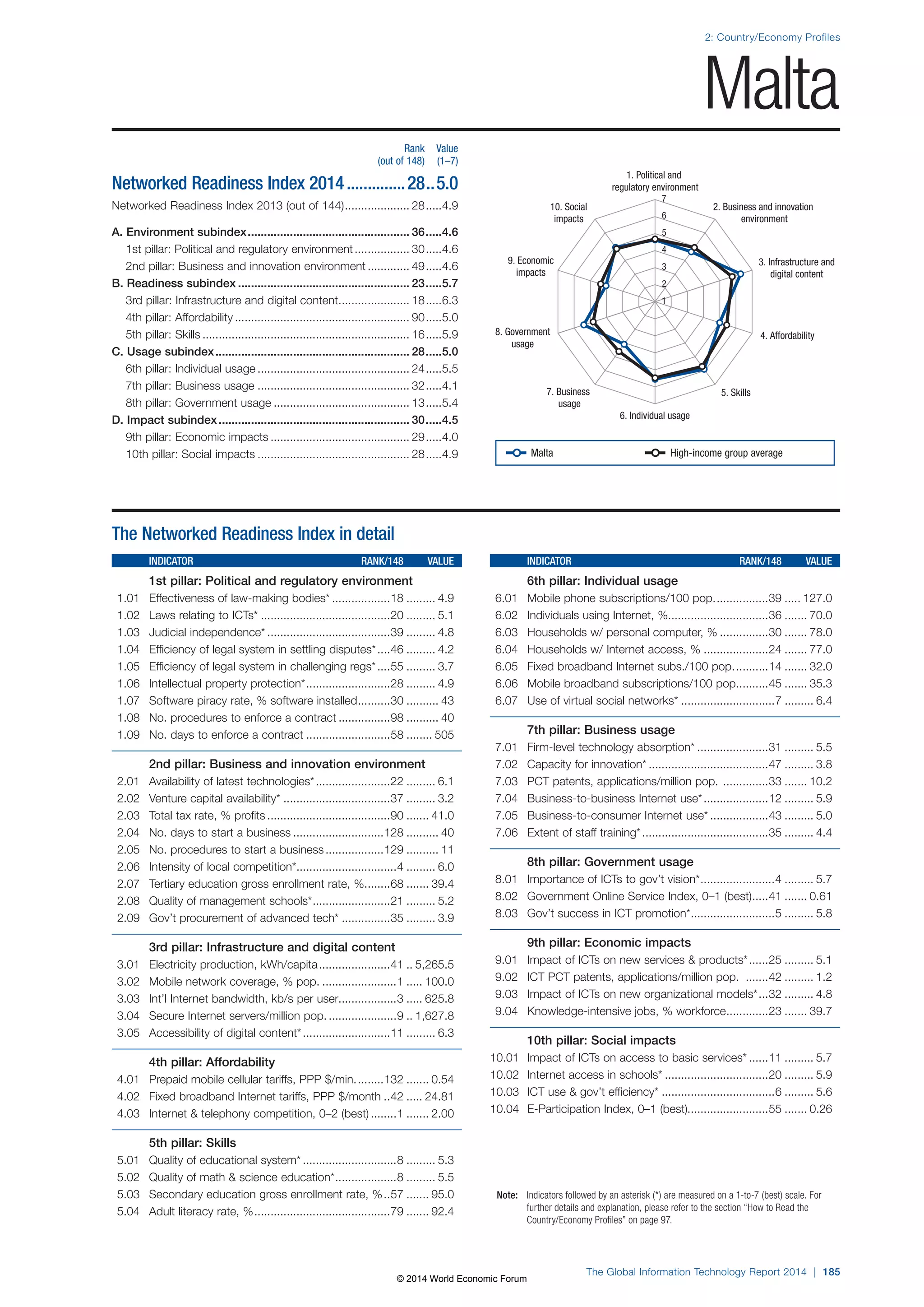
28 Malta 4.96 28 
29 Bahrain 4.86 29 
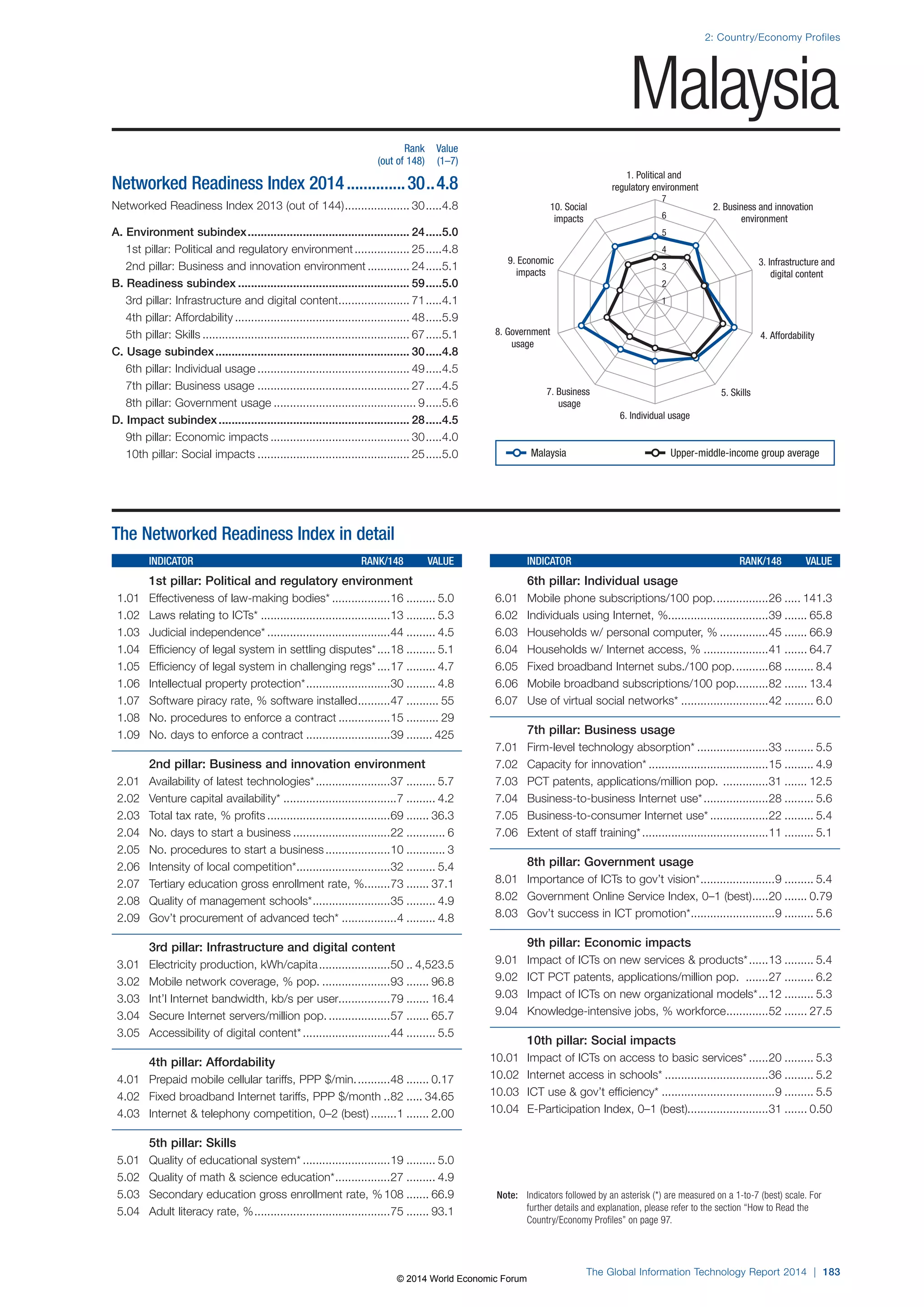
30 Malaysia 4.83 30 
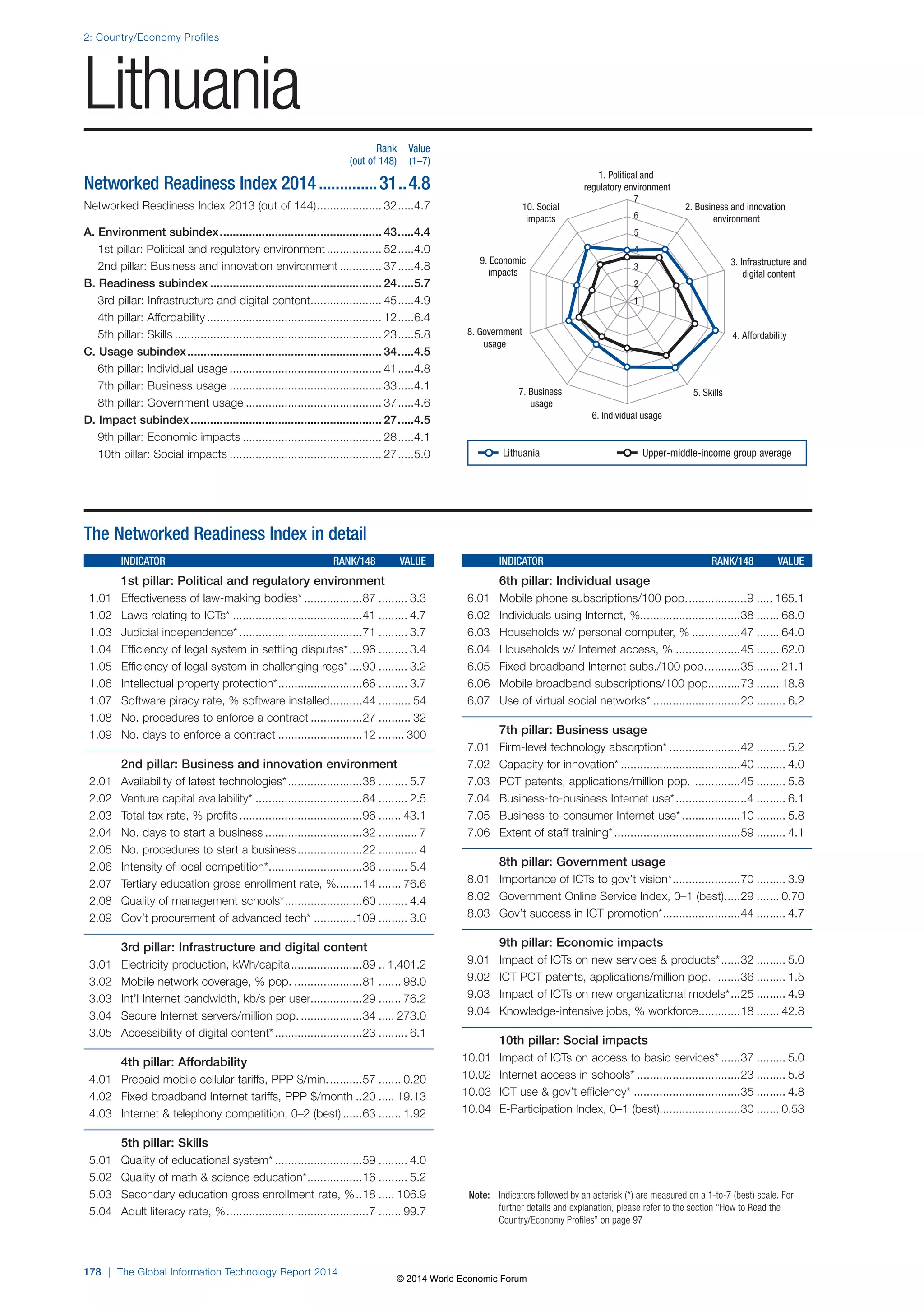
31 Lithuania 4.78 32 
32 Saudi Arabia 4.78 31 
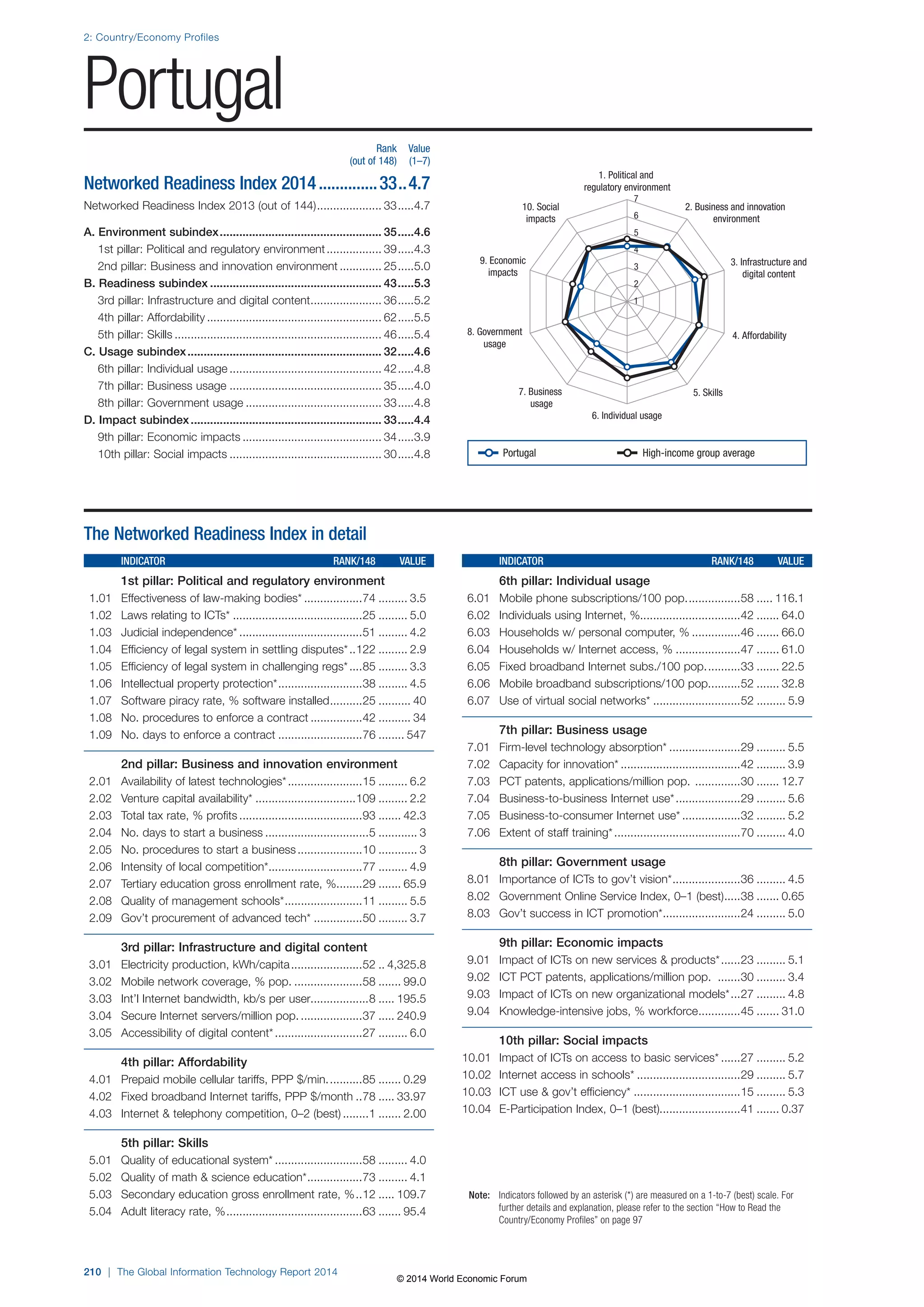
33 Portugal 4.73 33 
34 Spain 4.69 38 
35 Chile 4.61 34 
36 Slovenia 4.60 37 
37 Cyprus 4.60 35 
38 Kazakhstan 4.58 43 
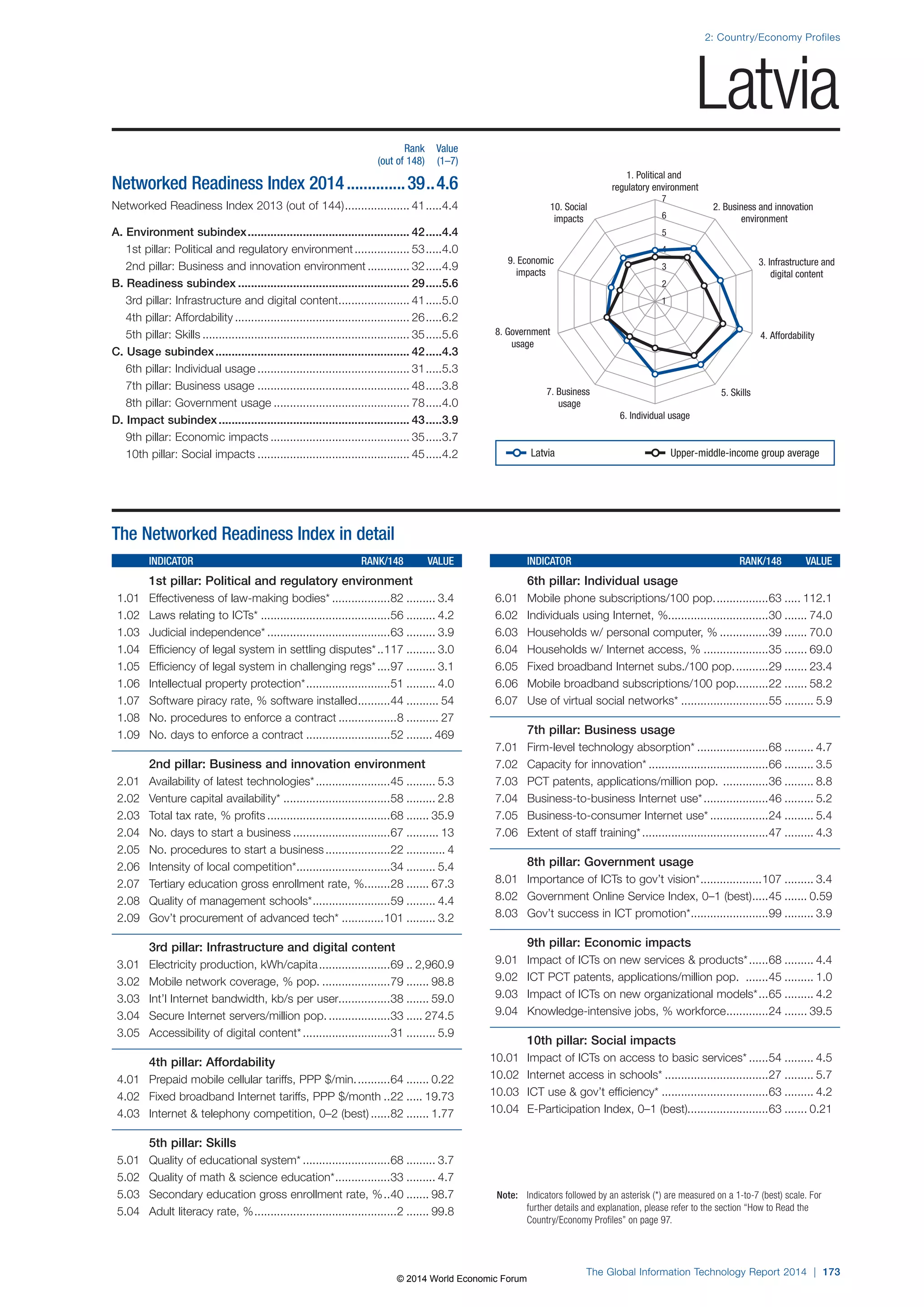
39 Latvia 4.58 41 
40 Oman 4.56 40 
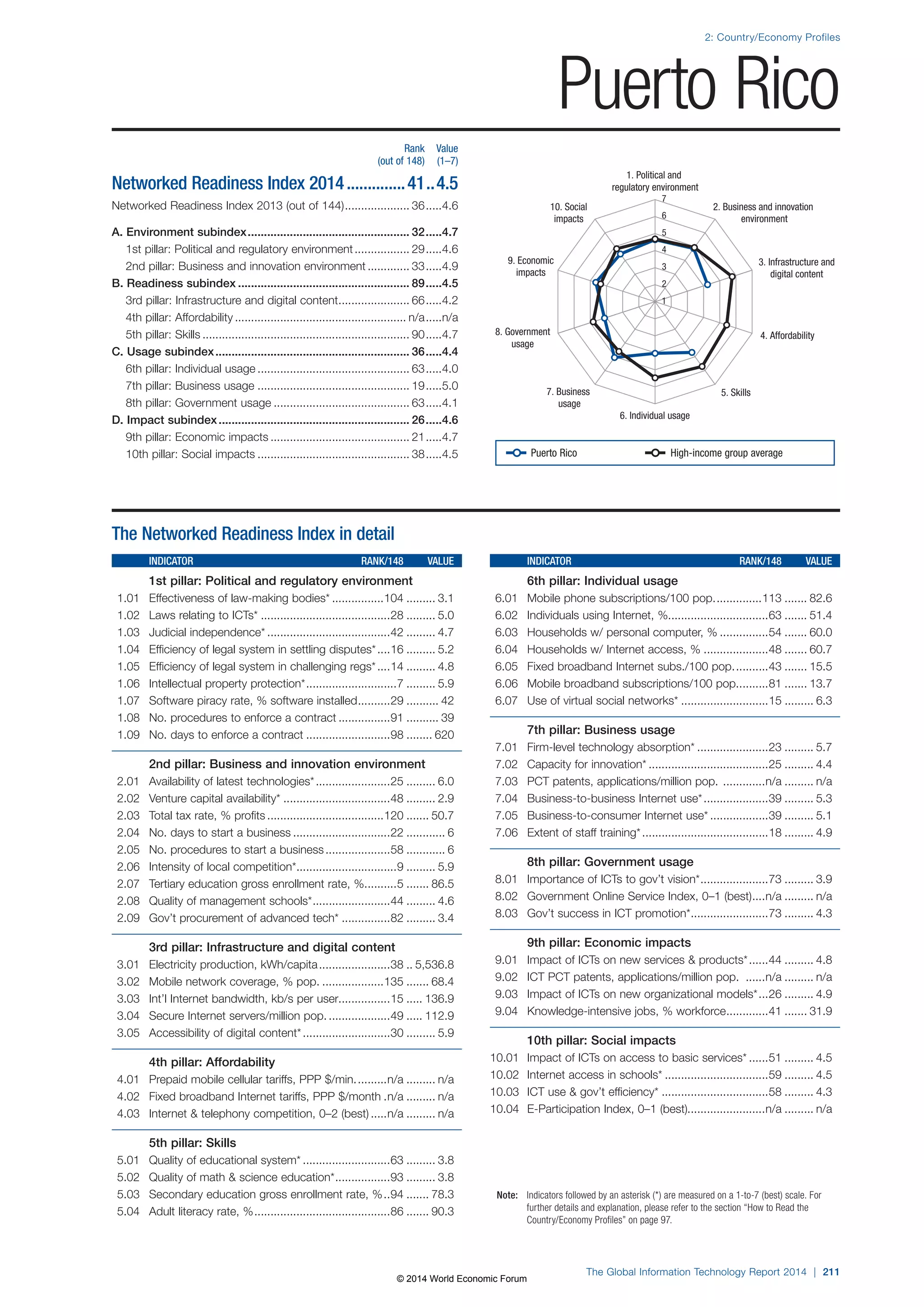
41 Puerto Rico 4.54 36 
42 Czech Republic 4.49 42 
43 Panama 4.36 46 
44 Jordan 4.36 47 
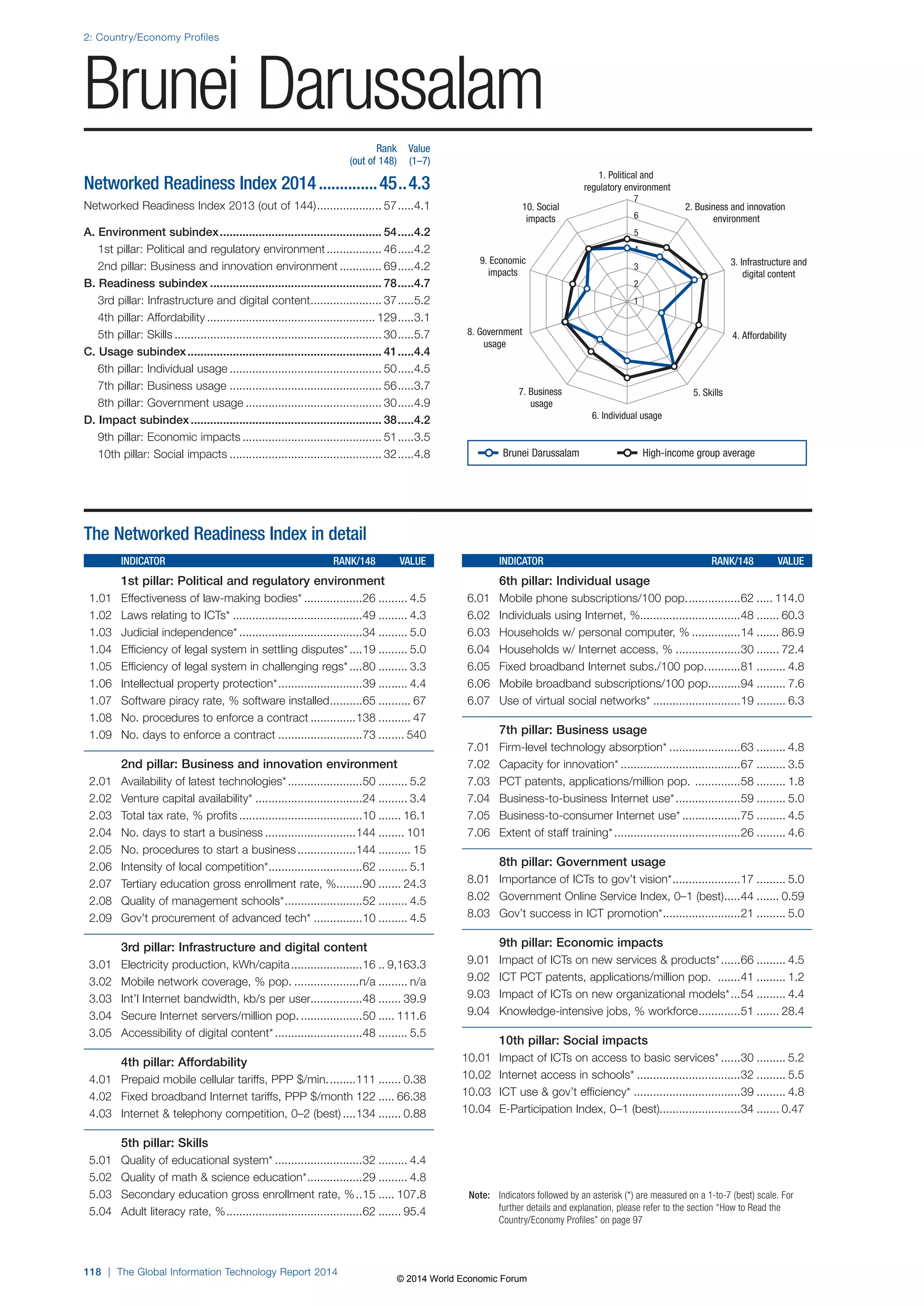
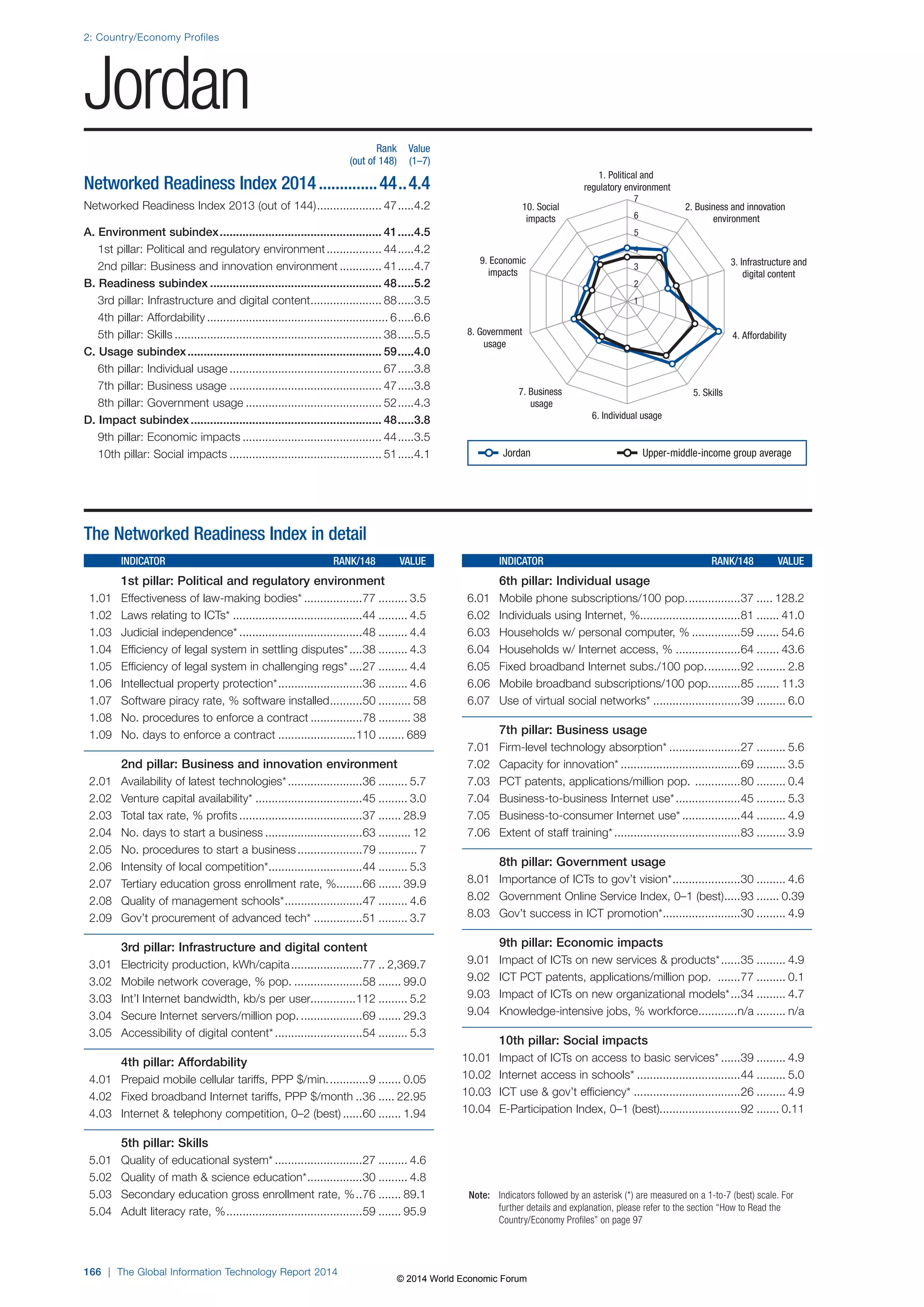
45 Brunei Darussalam 4.34 57 
46 Croatia 4.34 51 
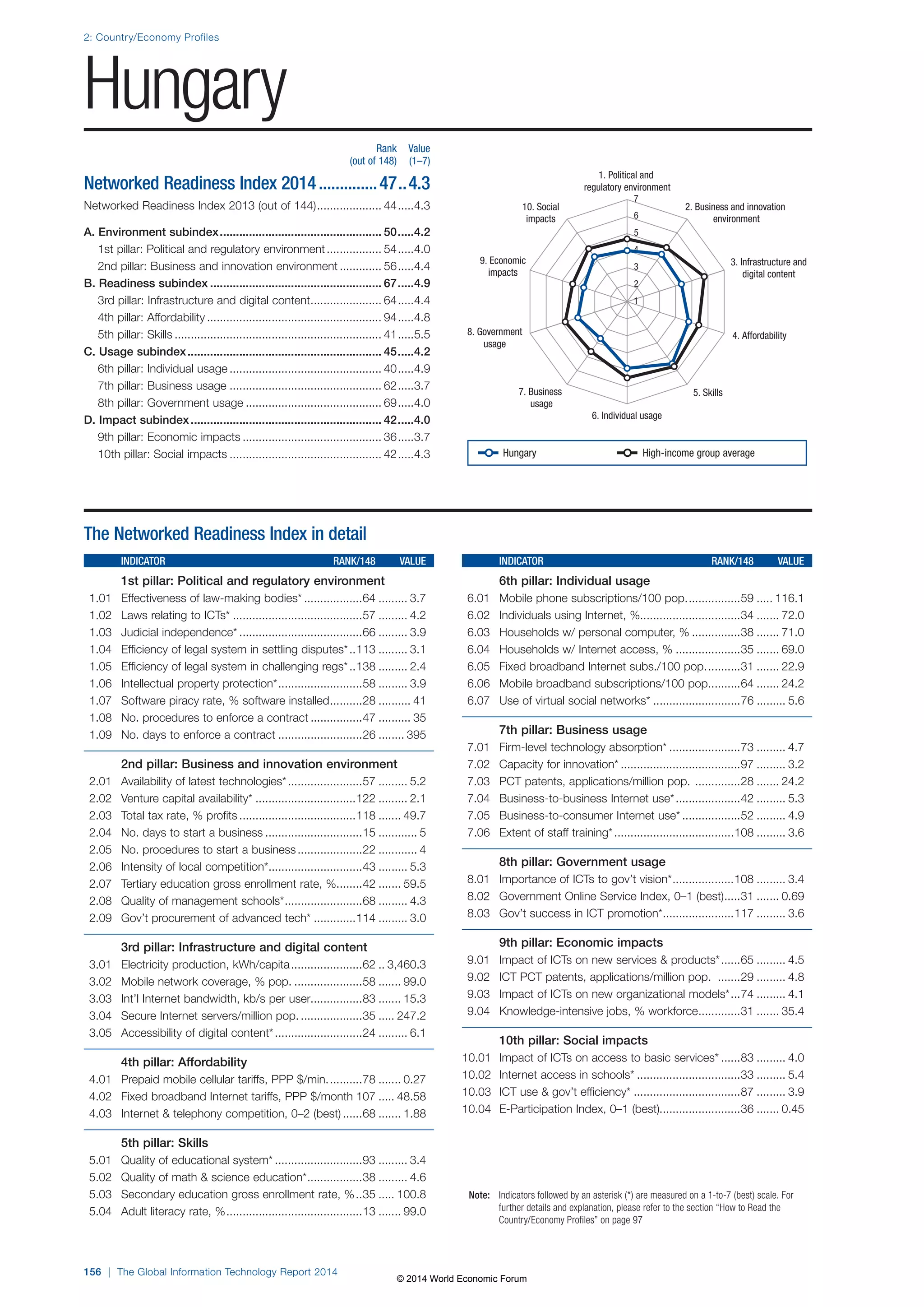
47 Hungary 4.32 44 
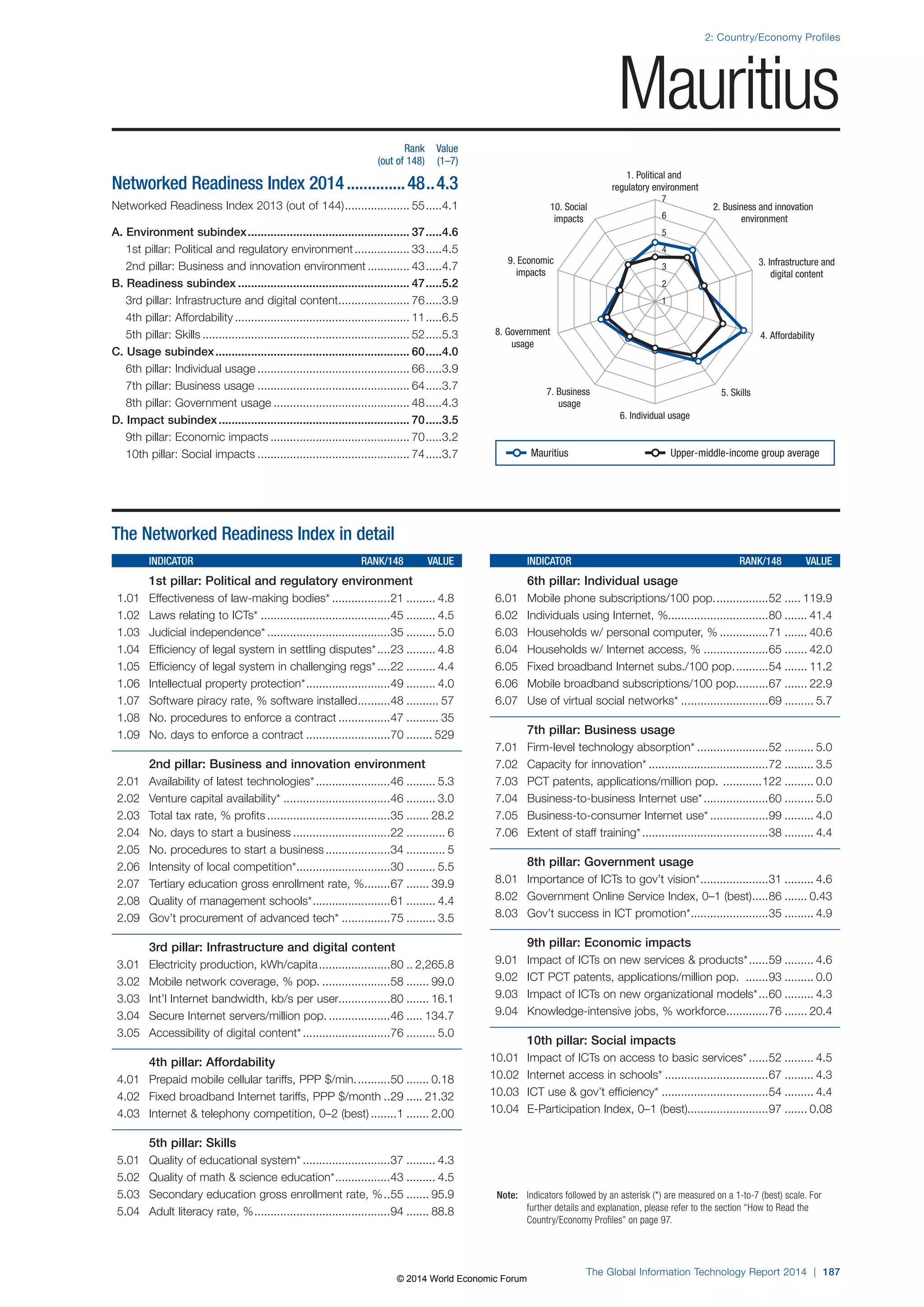
48 Mauritius 4.31 55 
49 Azerbaijan 4.31 56 
50 Russian Federation 4.30 54 
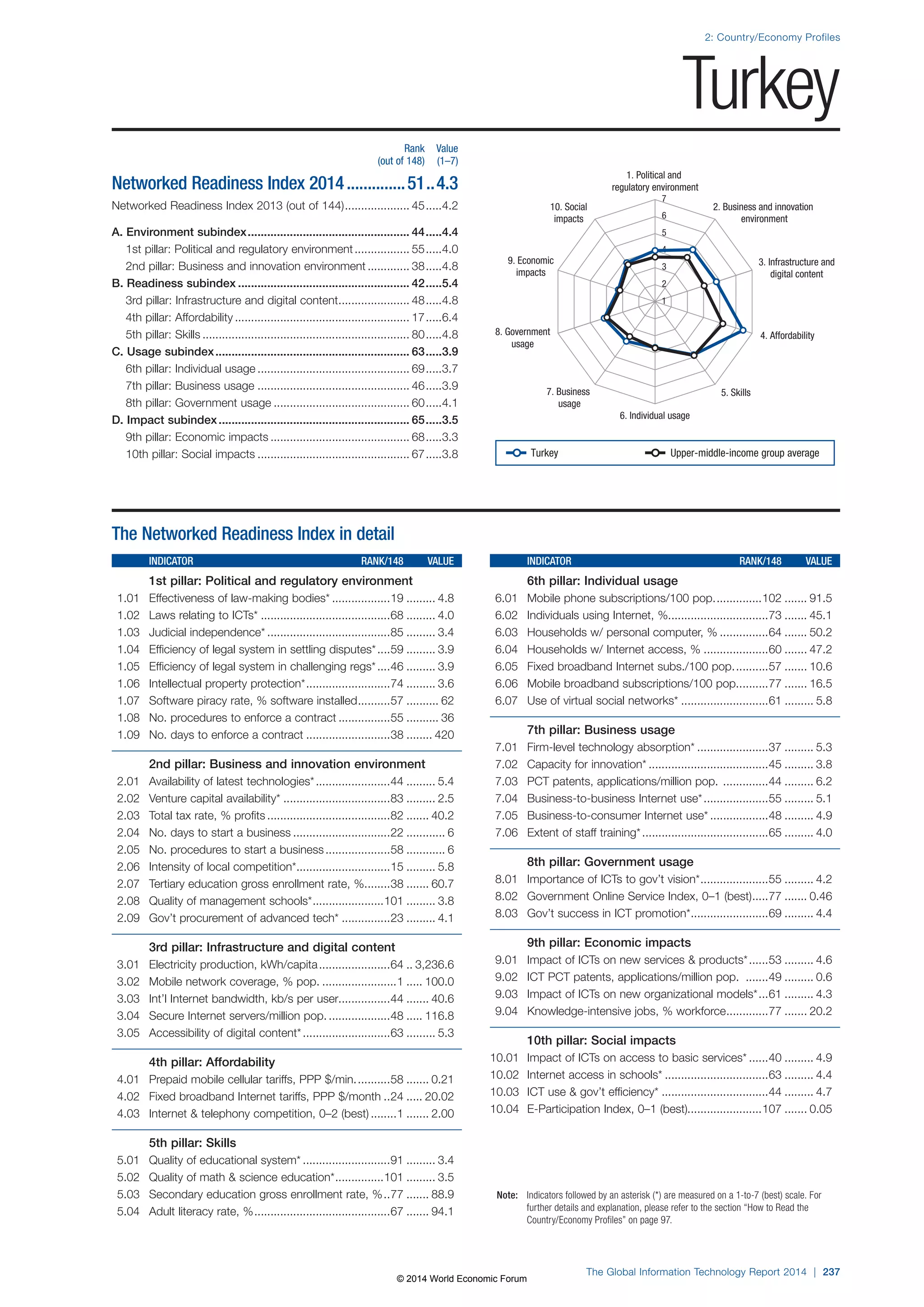
51 Turkey 4.30 45 
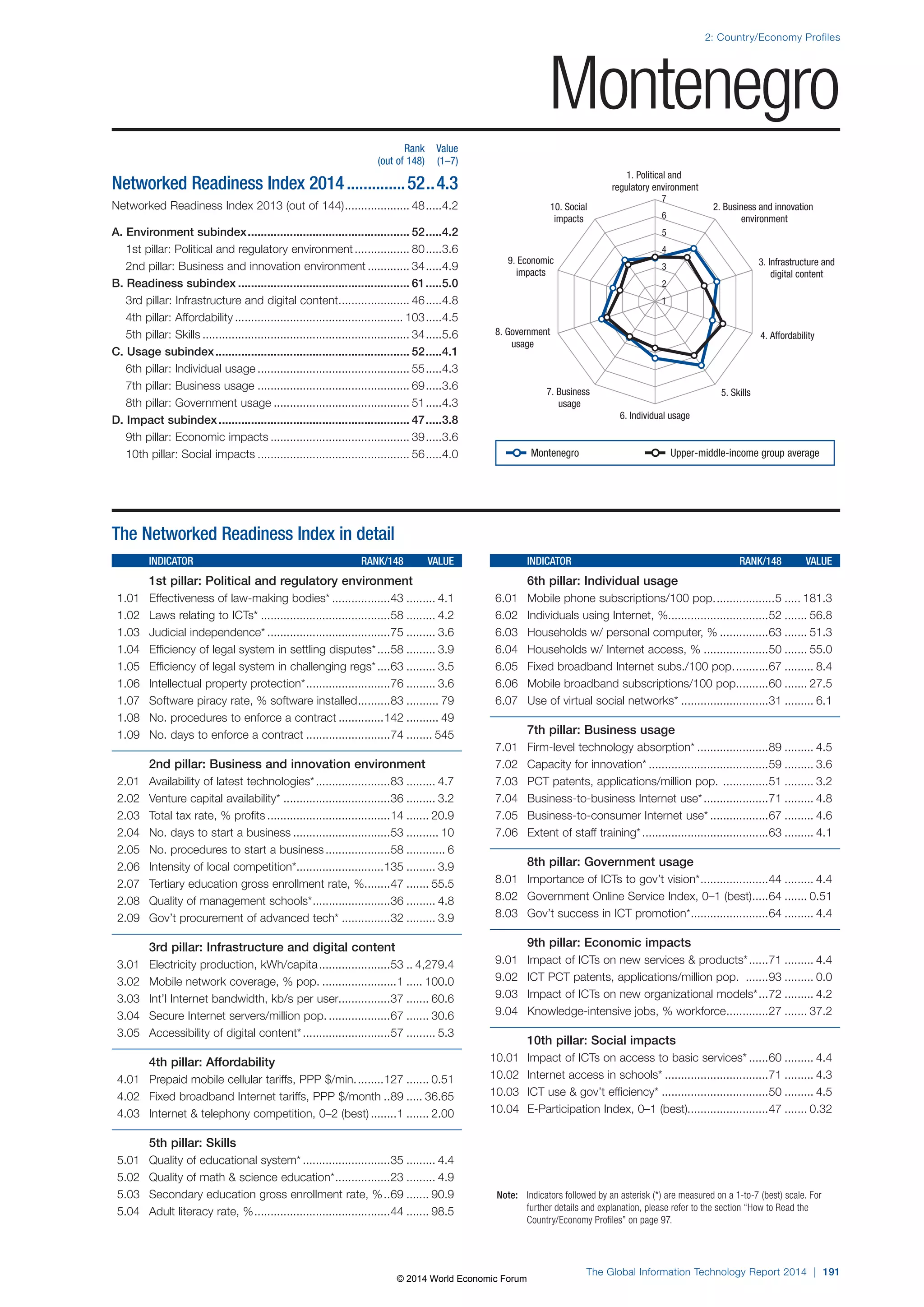
52 Montenegro 4.27 48 
53 Costa Rica 4.25 53 
54 Poland 4.24 49 
55 Barbados 4.22 39 
56 Uruguay 4.22 52 
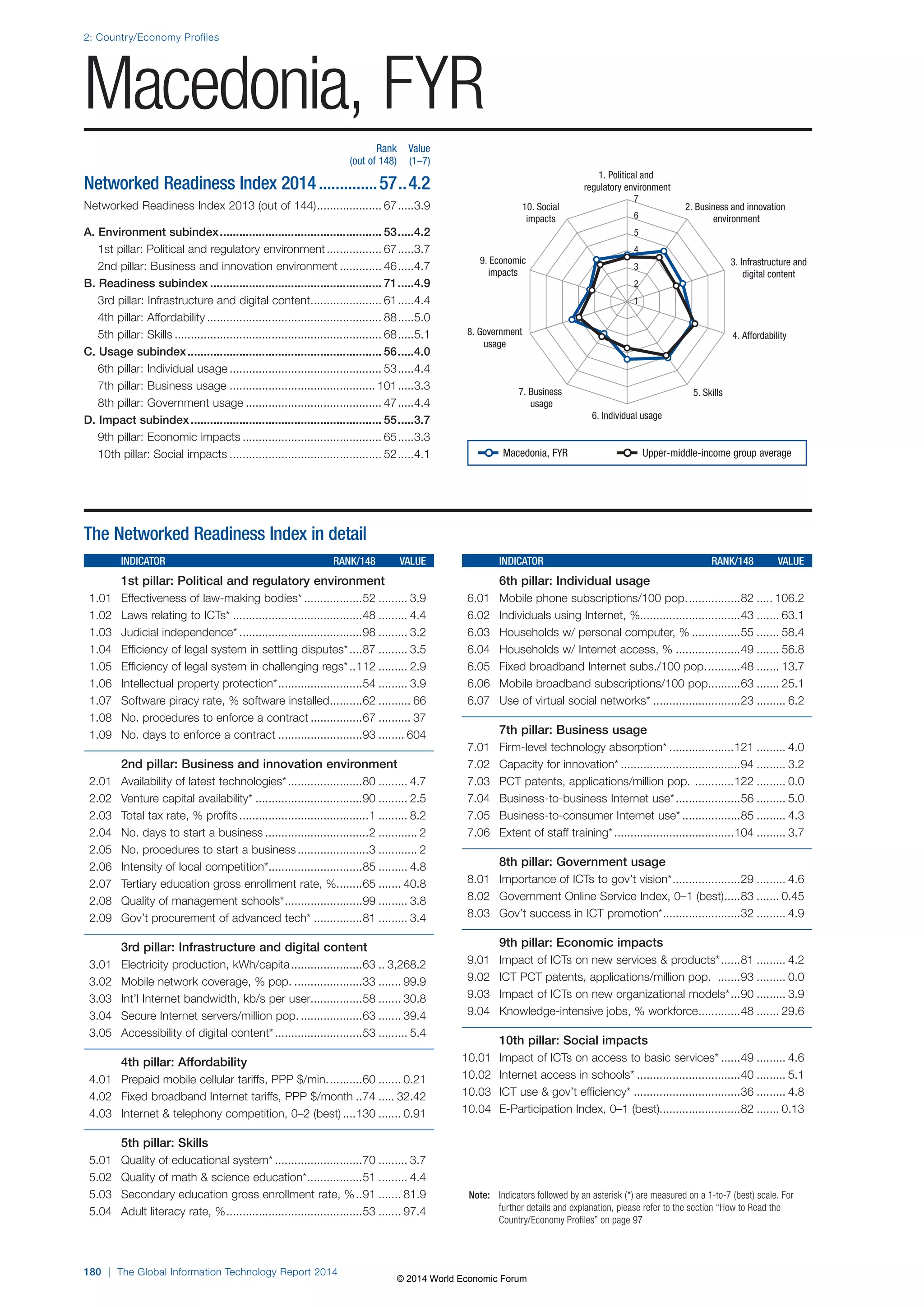
57 Macedonia, FYR 4.19 67 
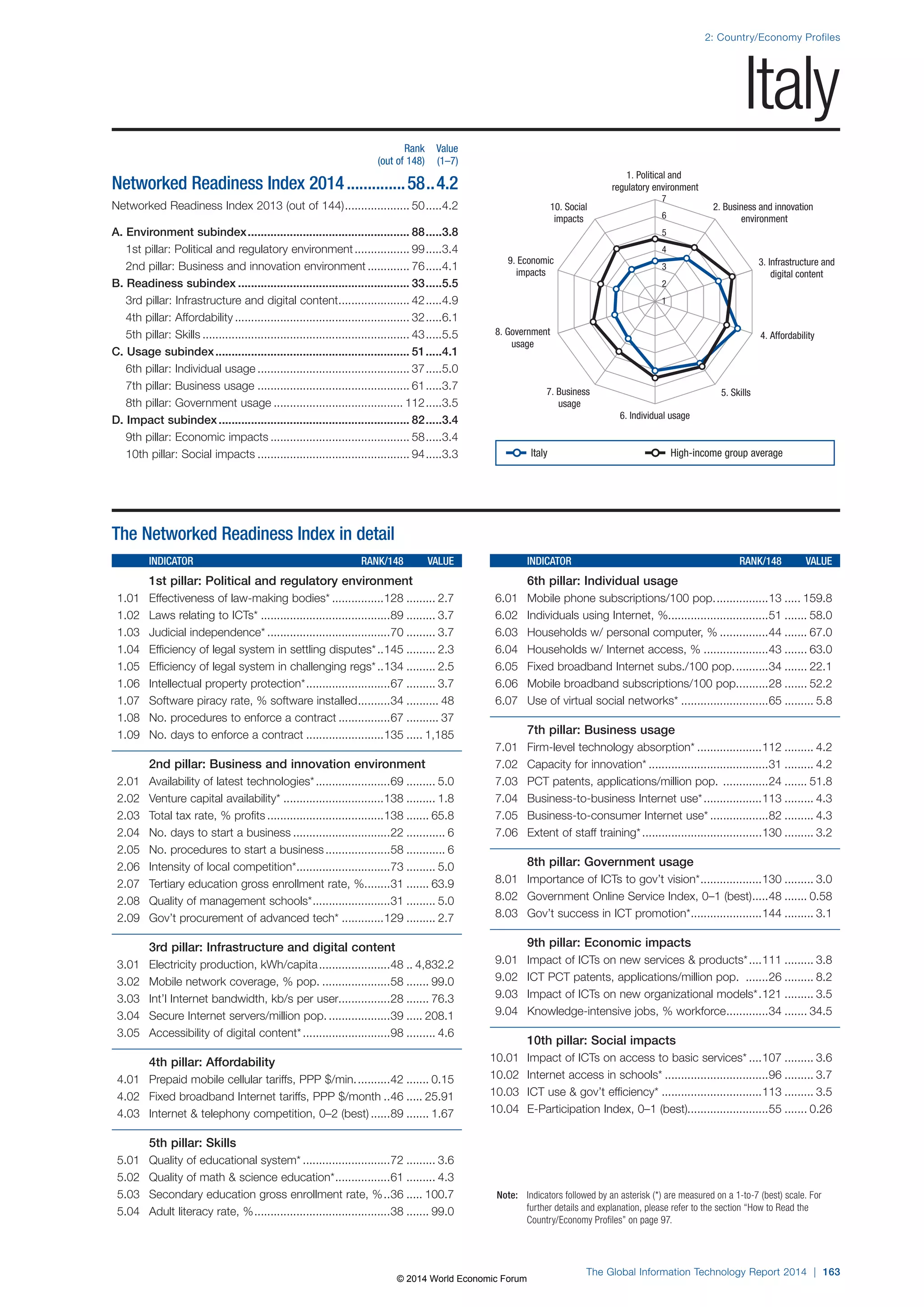
58 Italy 4.18 50 
59 Slovak Republic 4.12 61 
60 Georgia 4.09 65 
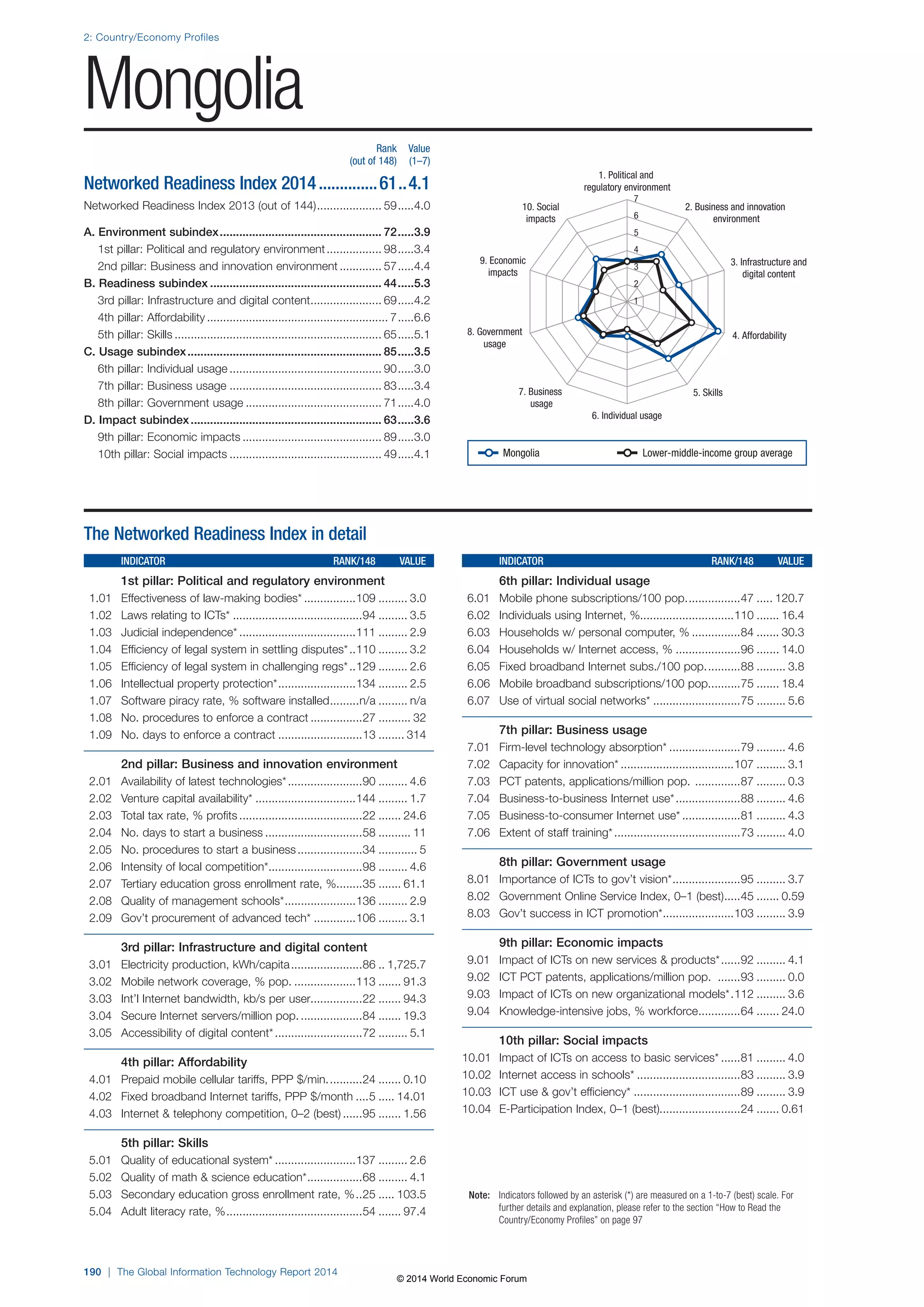
61 Mongolia 4.07 59 
62 China 4.05 58 
63 Colombia 4.05 66 
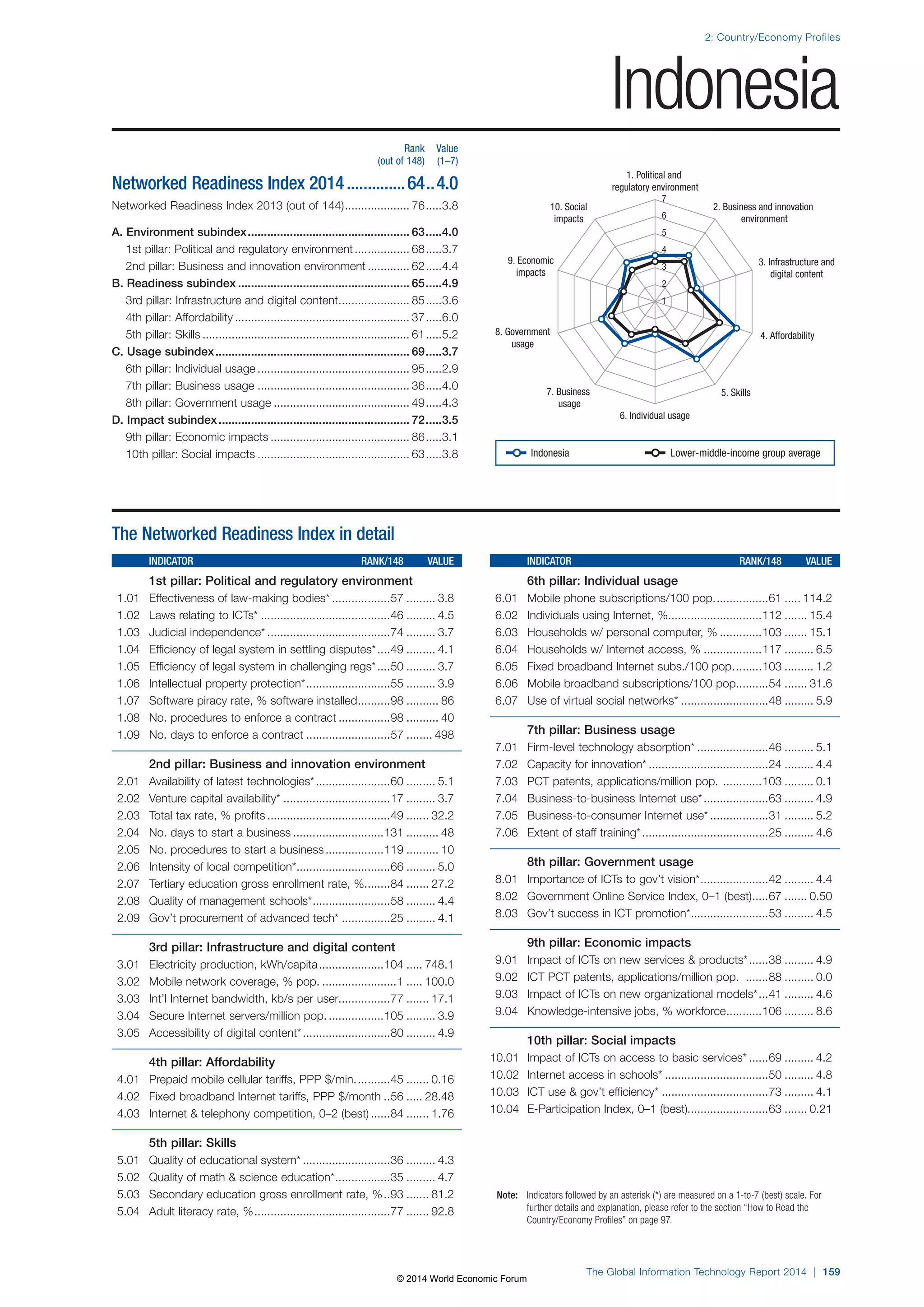
64 Indonesia 4.04 76 
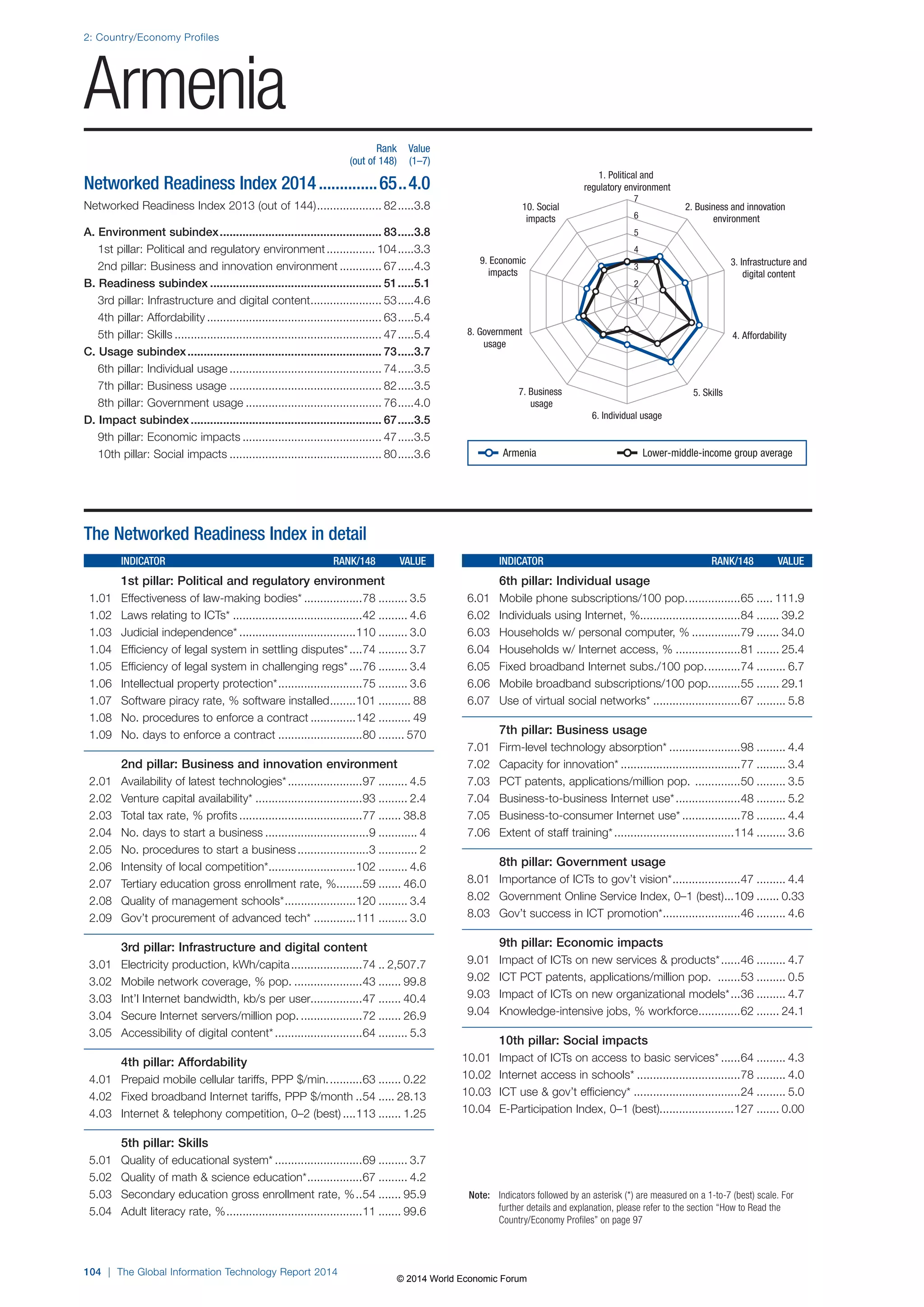
65 Armenia 4.03 82 
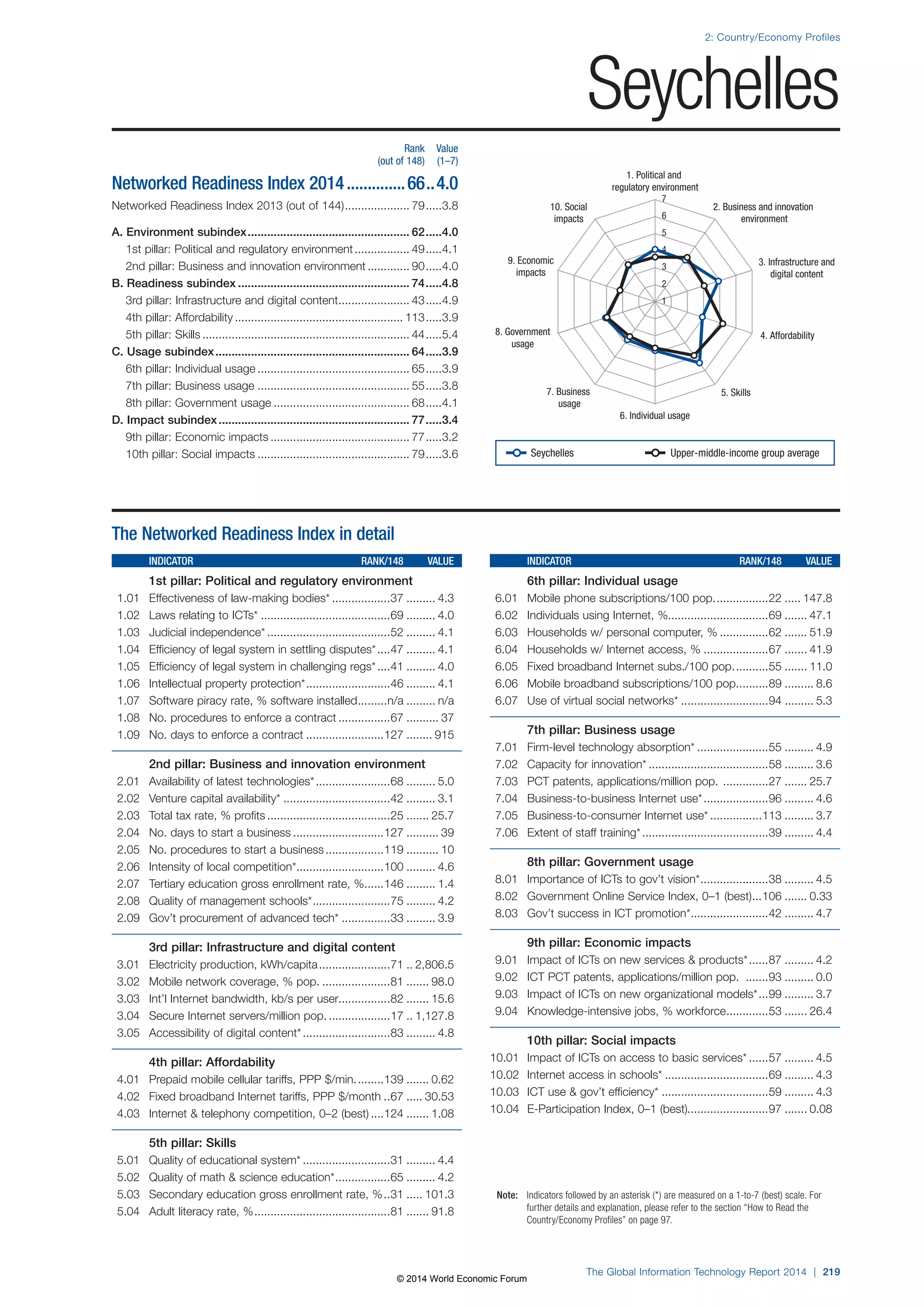
66 Seychelles 4.02 79 
67 Thailand 4.01 74 
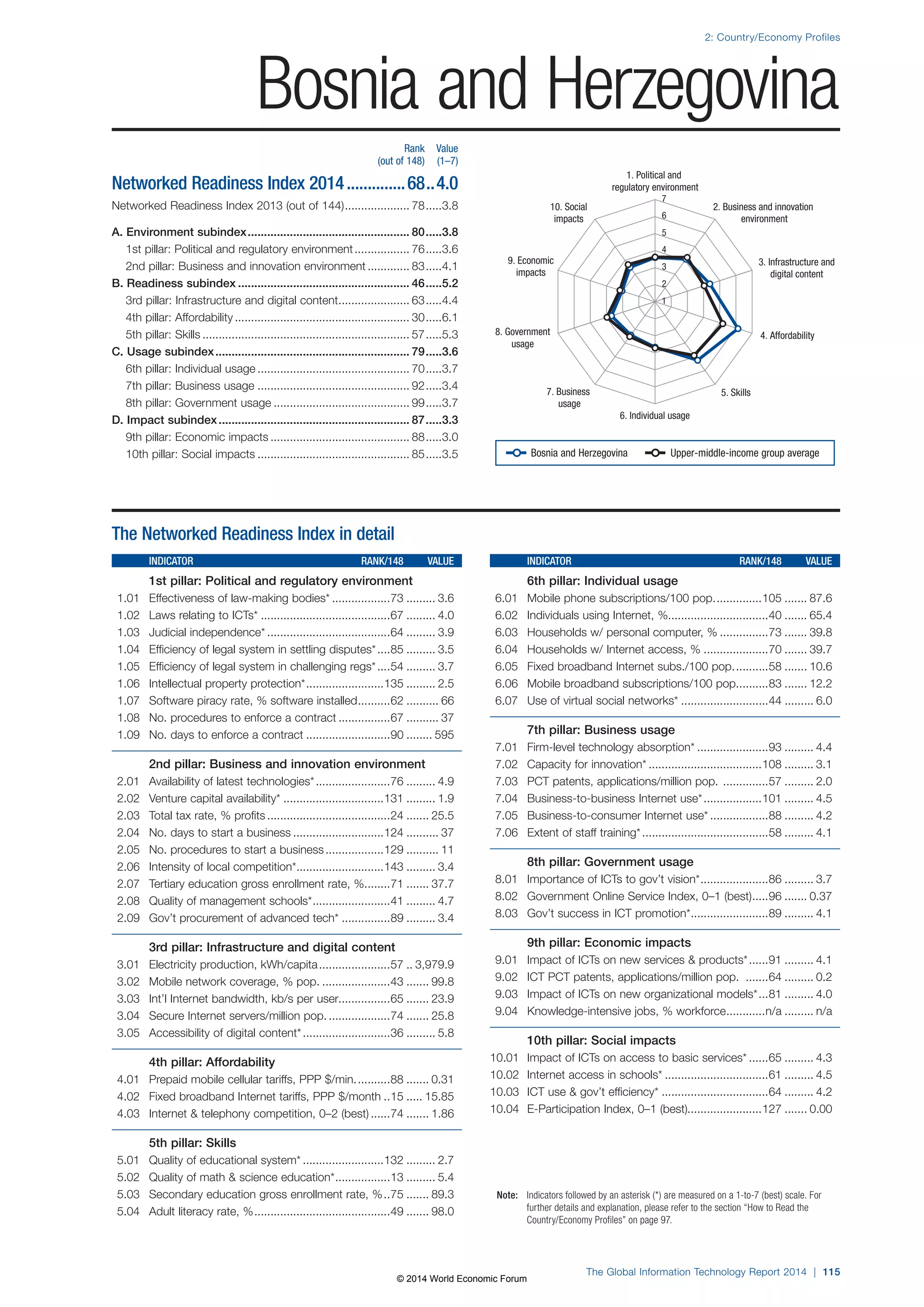
68 Bosnia and Herzegovina 3.99 78 
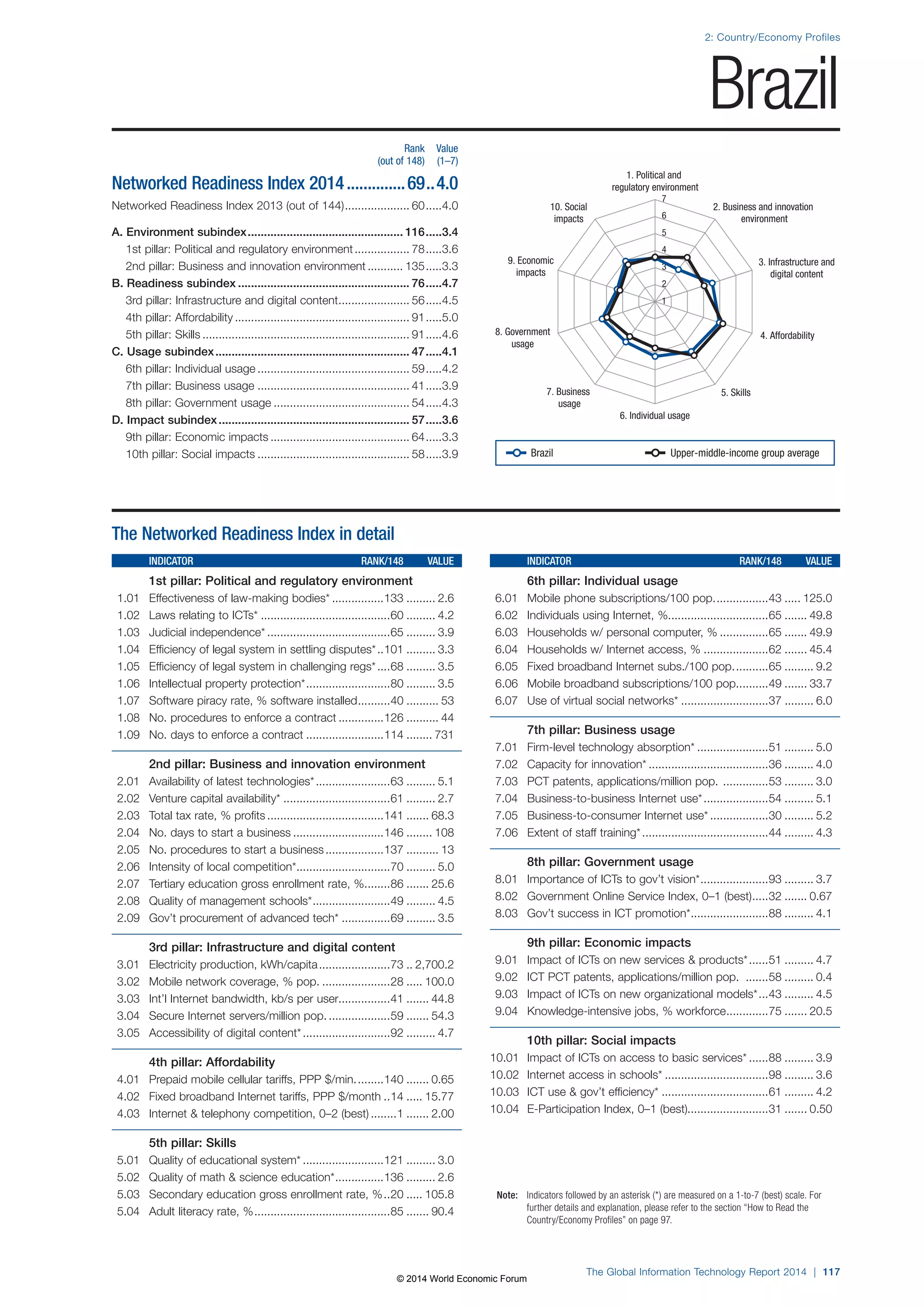
69 Brazil 3.98 60 
70 South Africa 3.98 70 
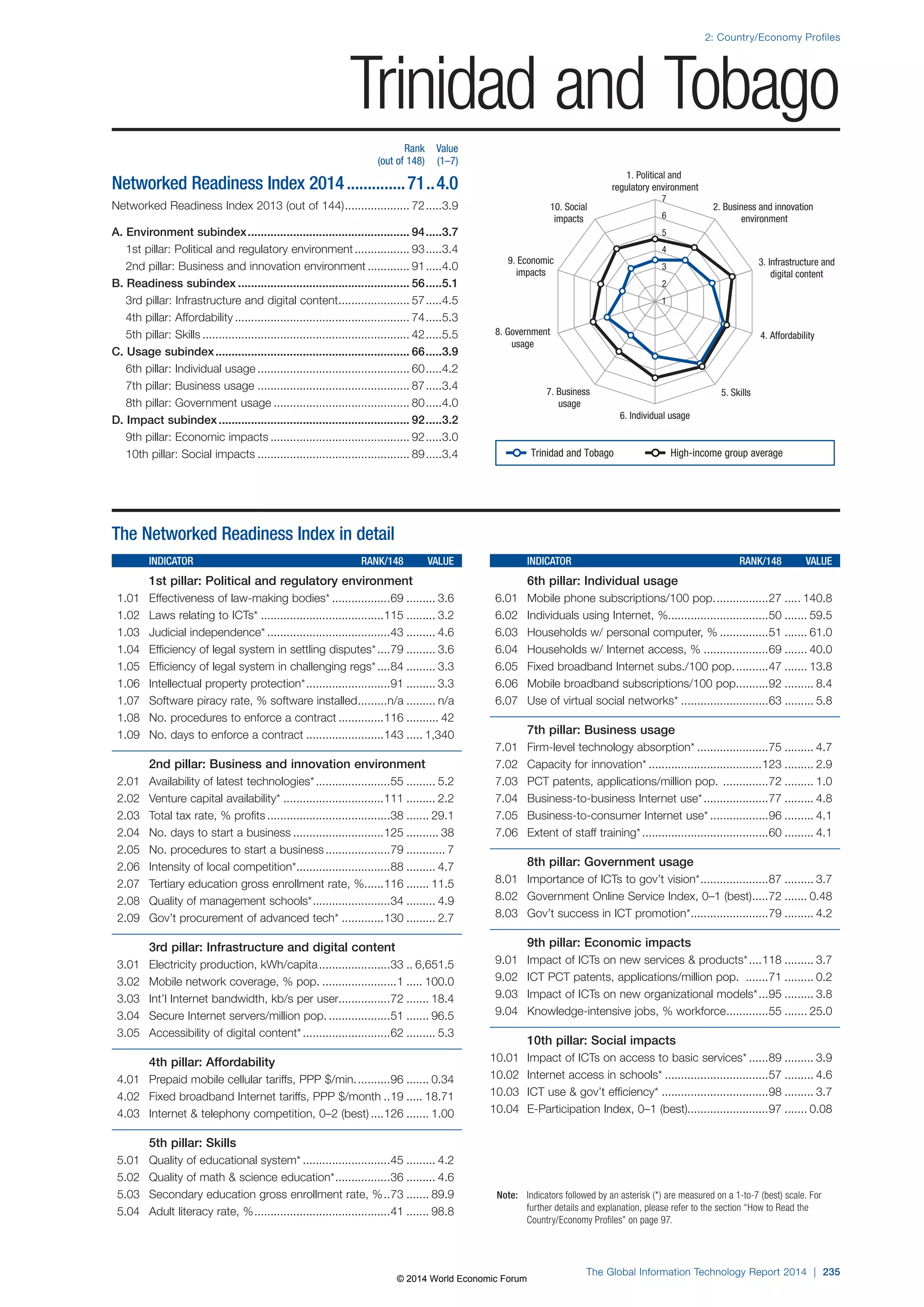
71 Trinidad and Tobago 3.97 72 
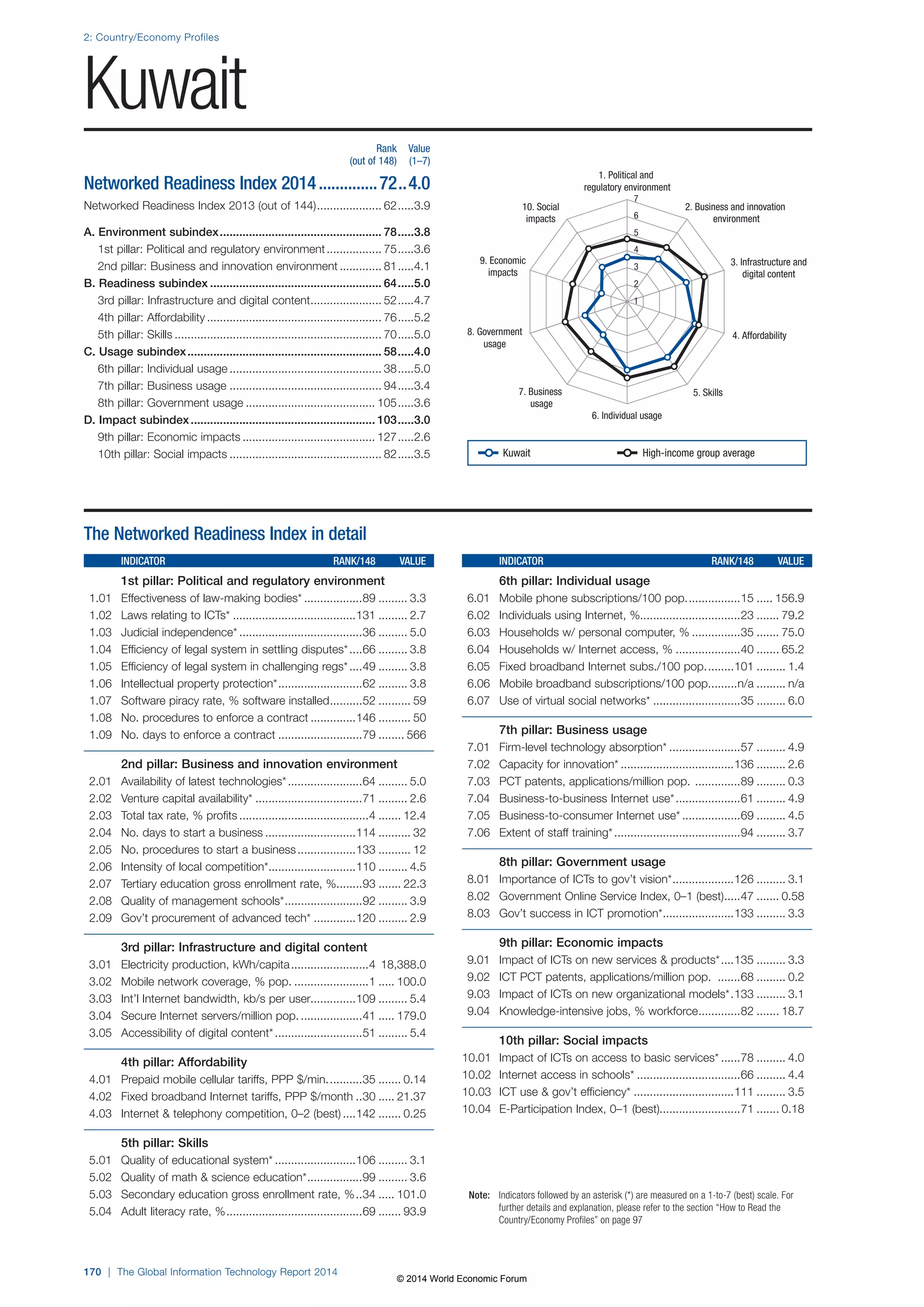
72 Kuwait 3.96 62 
73 Bulgaria 3.96 71 
74 Greece 3.95 64 
Rank Country/Economy Value 
2013 rank 
(out of 144) 
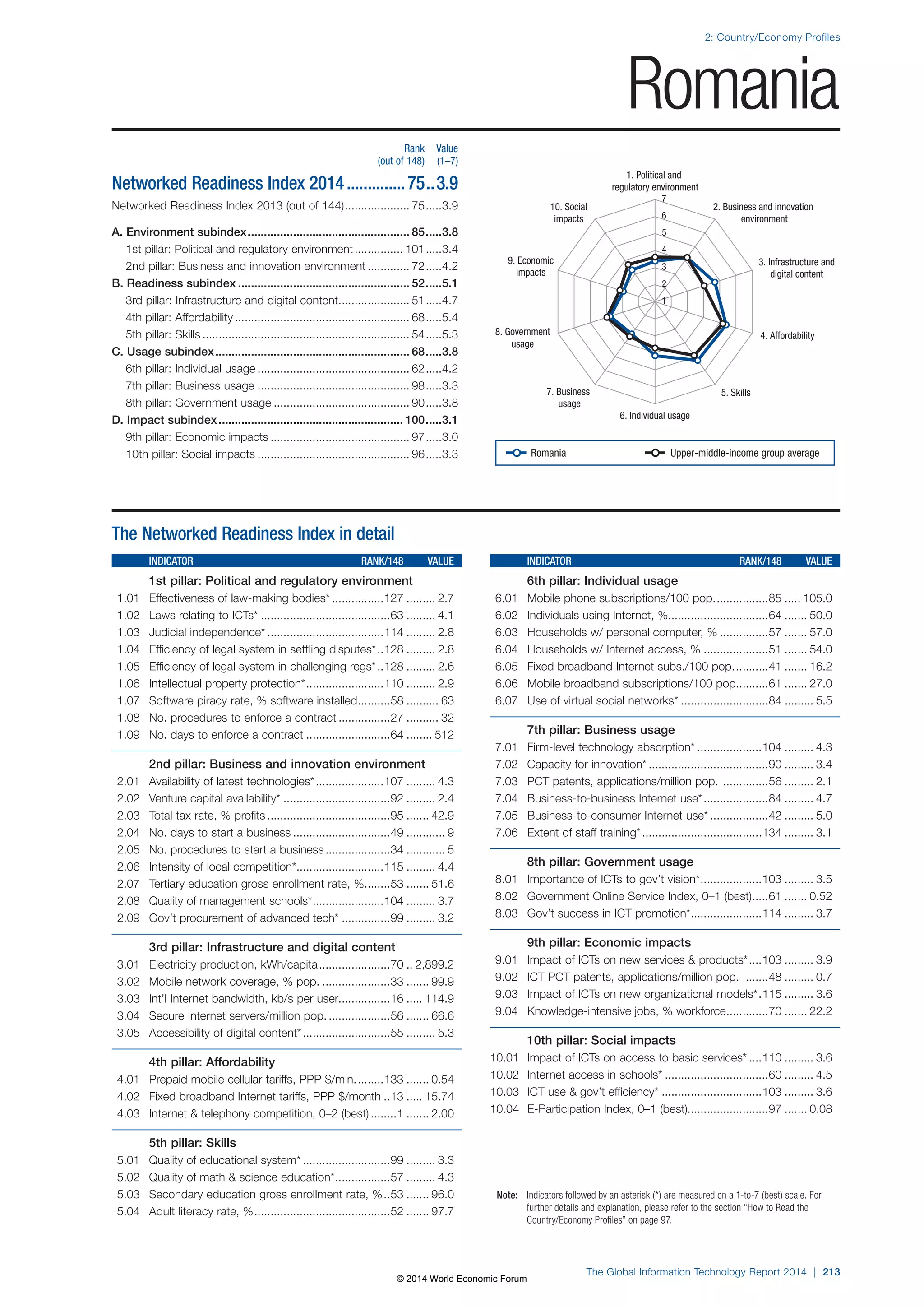
75 Romania 3.95 75 
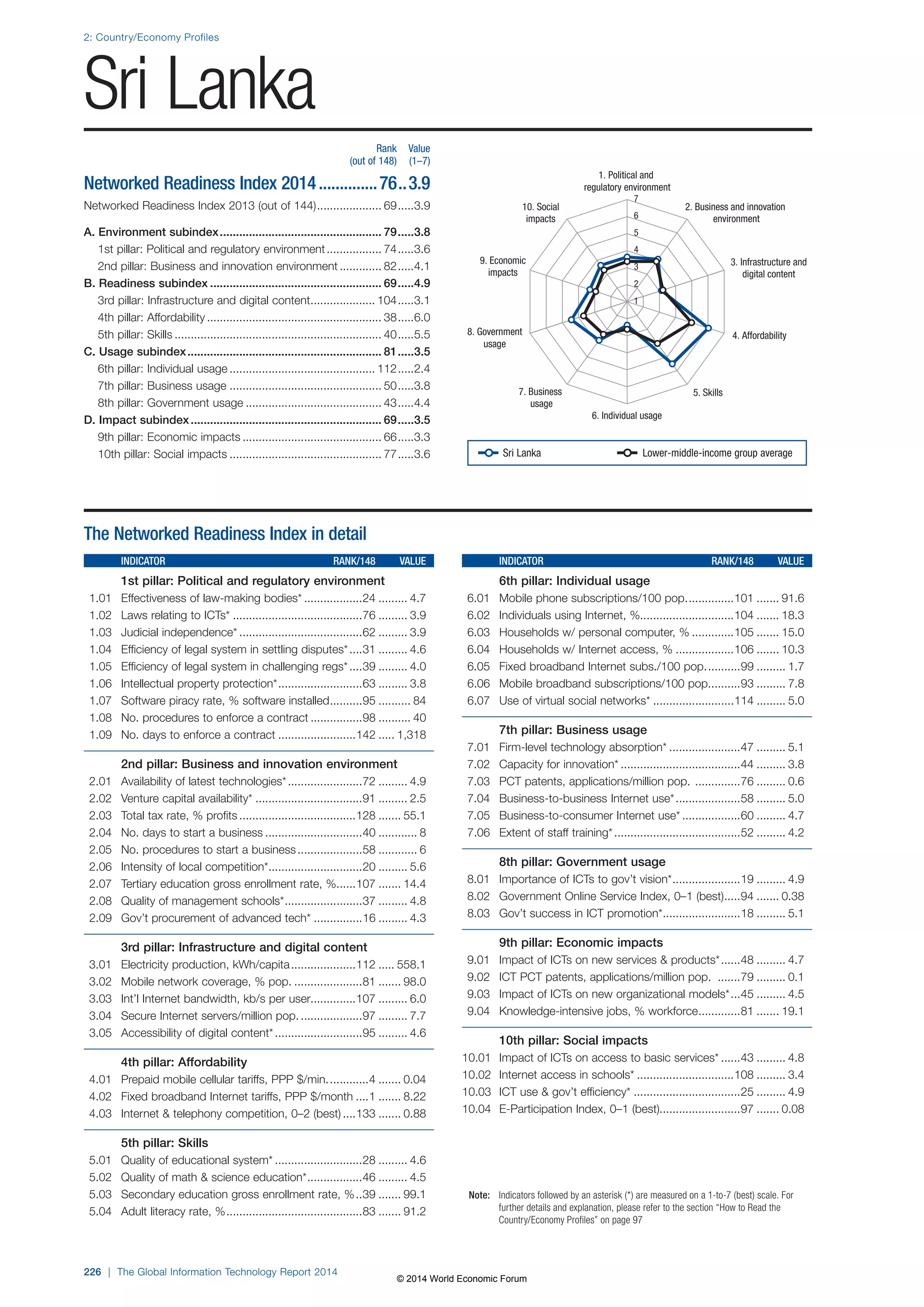
76 Sri Lanka 3.94 69 
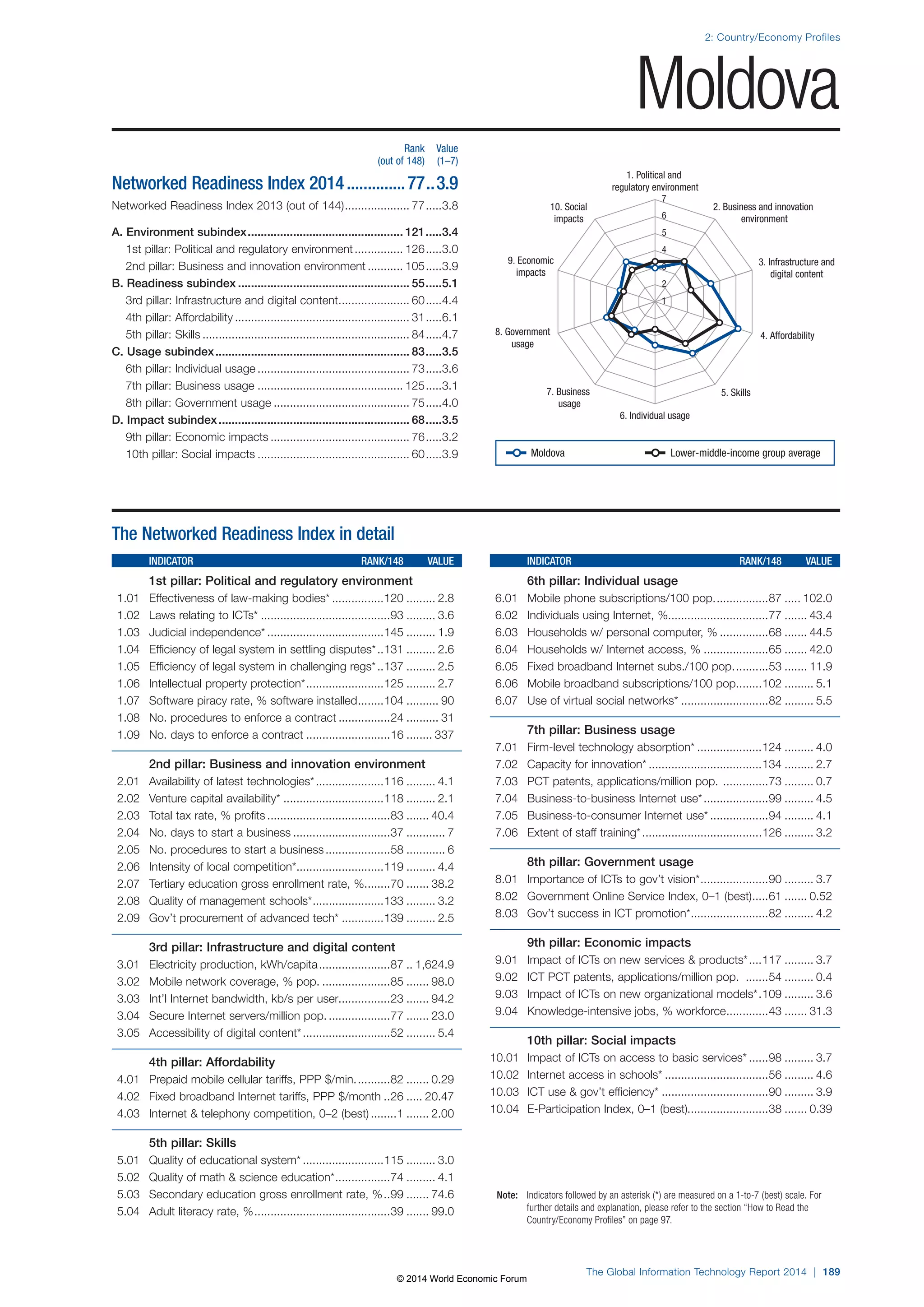
77 Moldova 3.89 77 
78 Philippines 3.89 86 
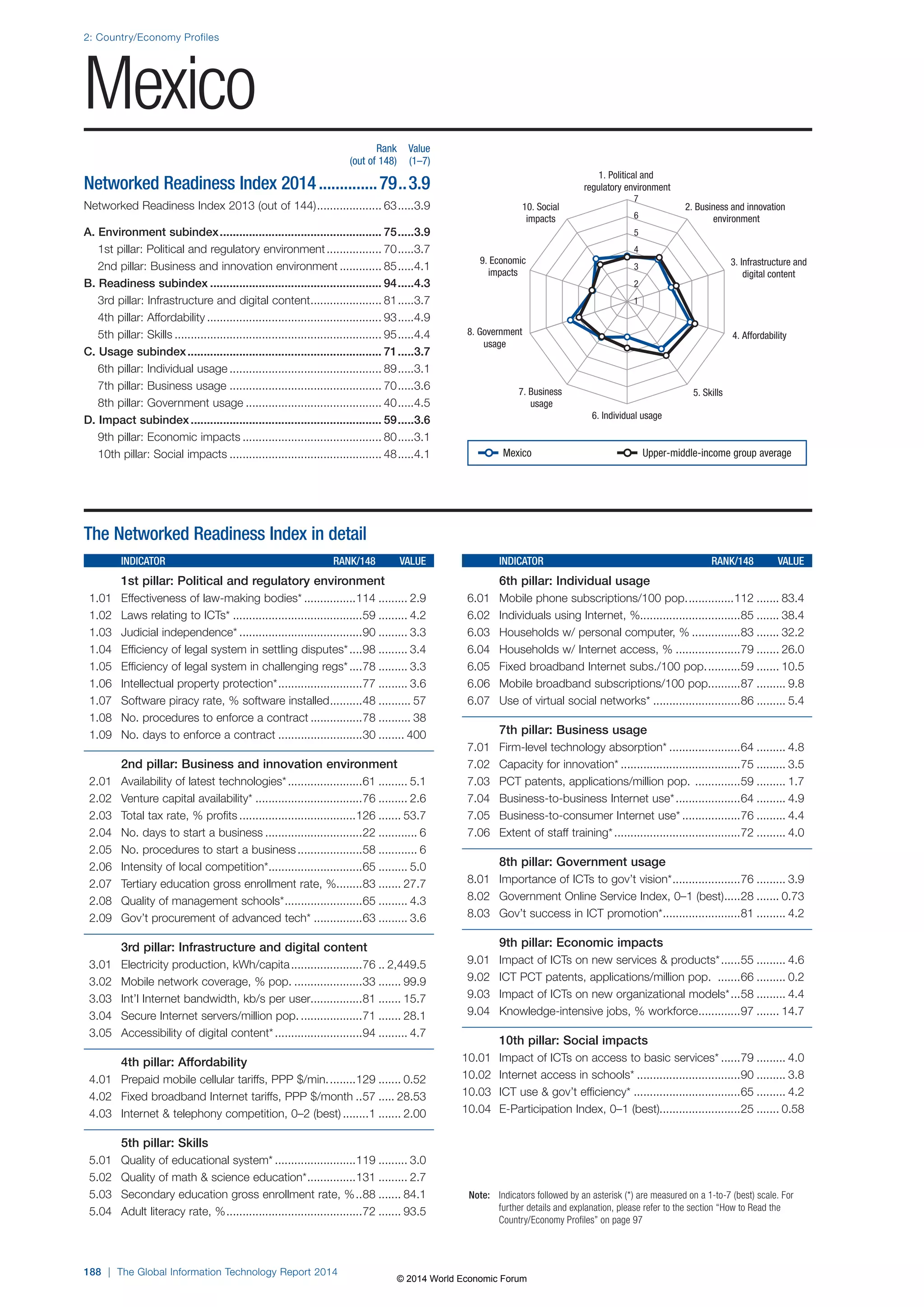
79 Mexico 3.89 63 
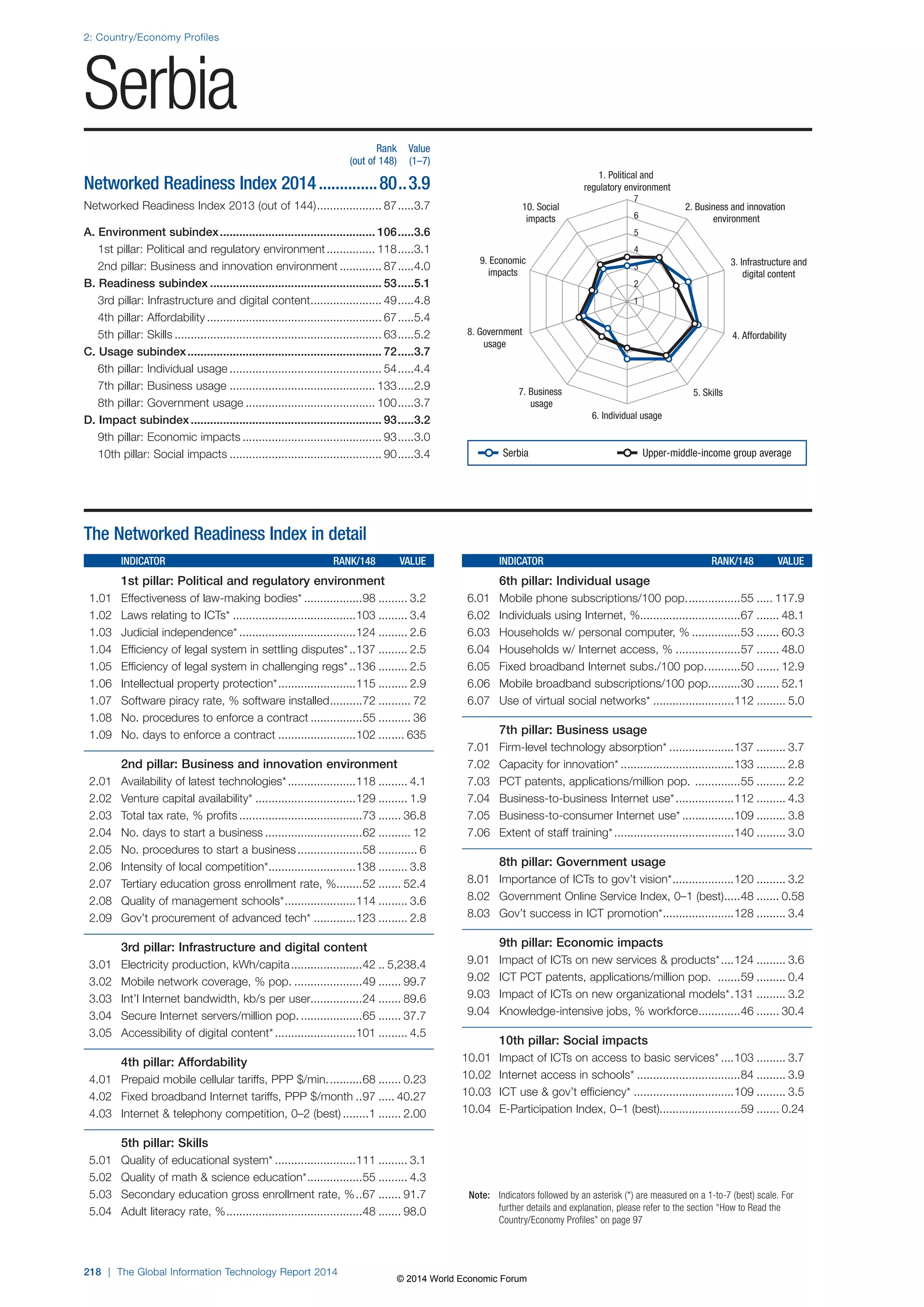
80 Serbia 3.88 87 
81 Ukraine 3.87 73 
82 Ecuador 3.85 91 
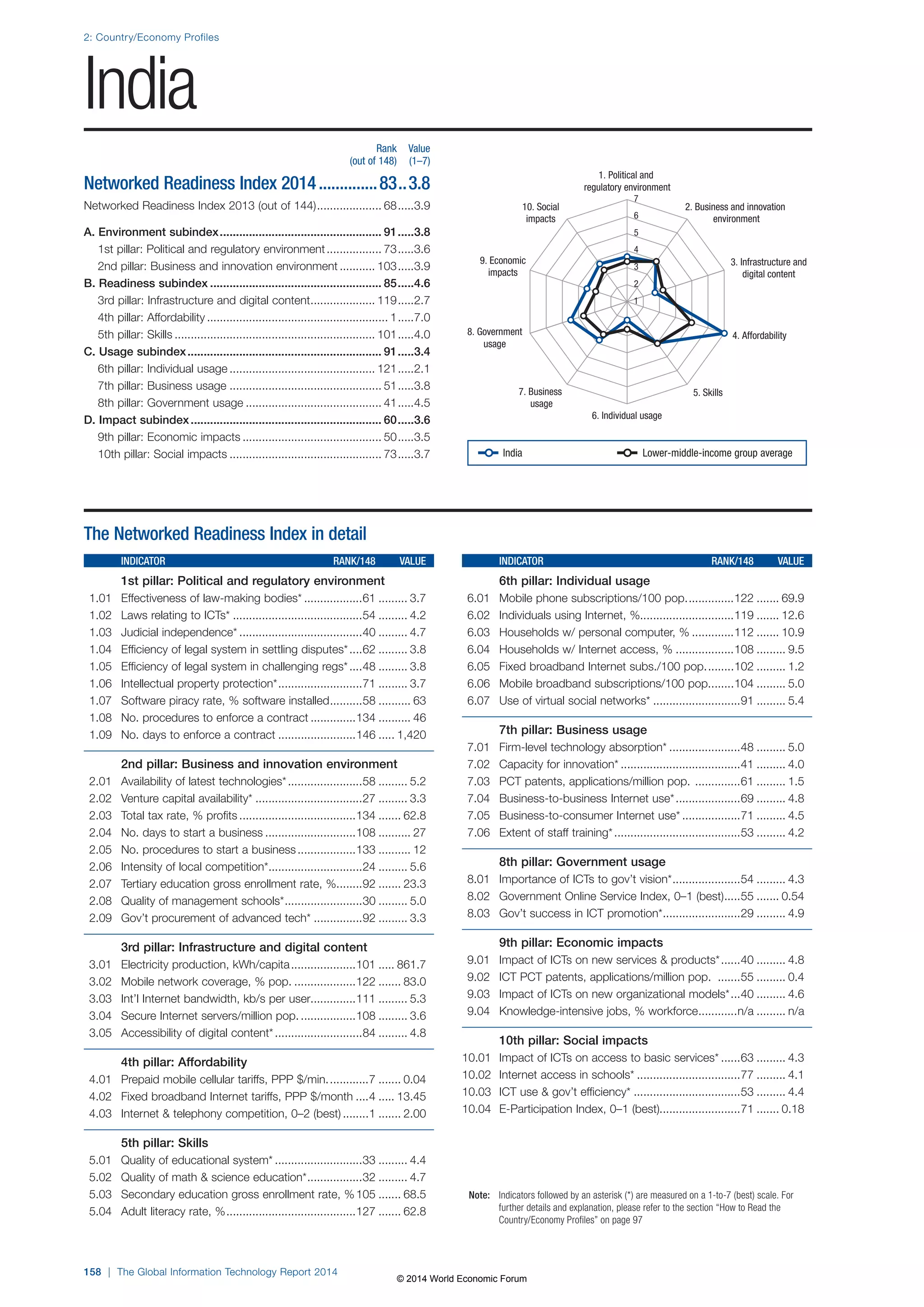
83 India 3.85 68 
84 Vietnam 3.84 84 
85 Rwanda 3.78 88 
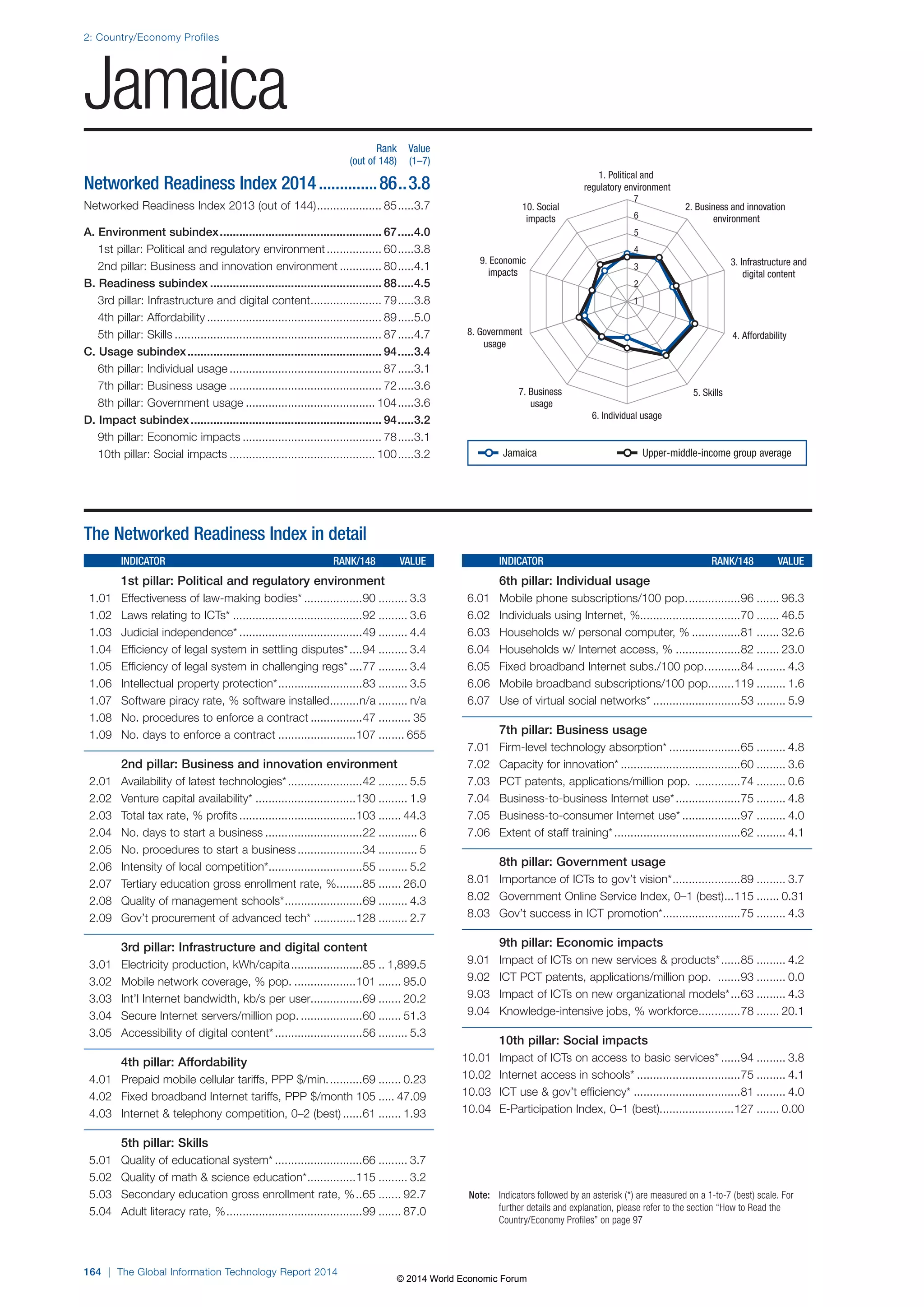
86 Jamaica 3.77 85 
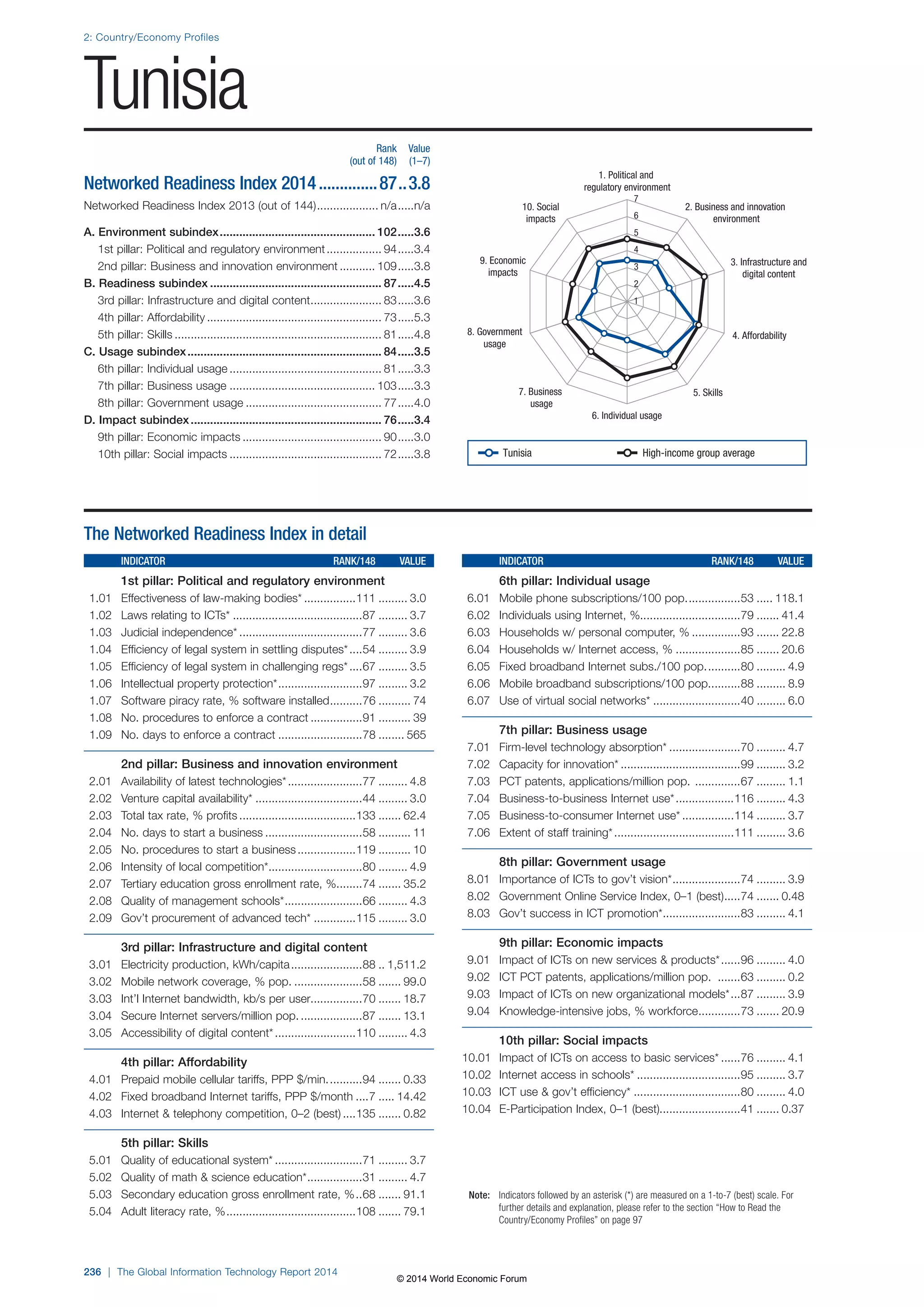
87 Tunisia 3.77 n/a 
88 Guyana 3.77 100 
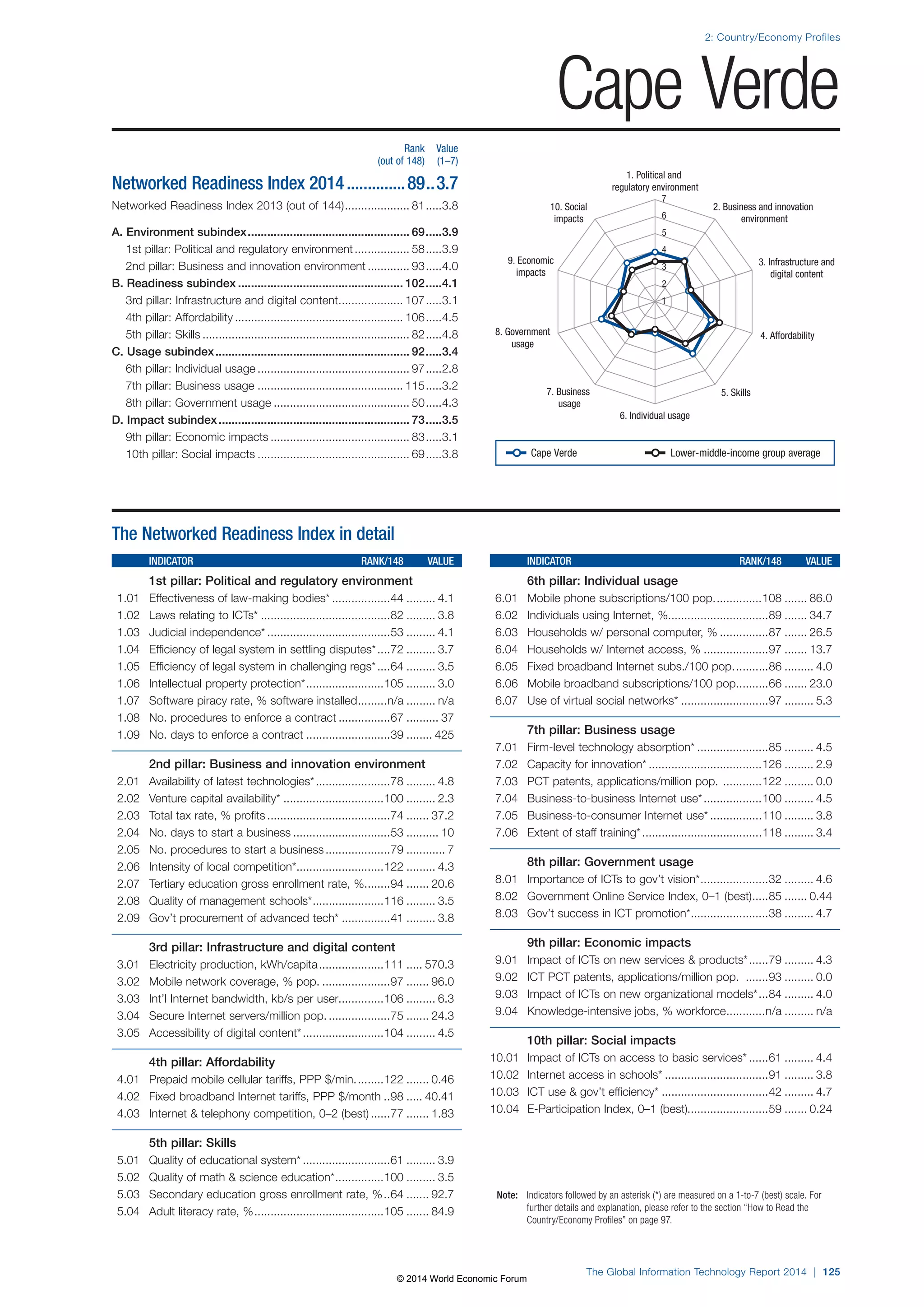
89 Cape Verde 3.73 81 
90 Peru 3.73 103 
91 Egypt 3.71 80 
92 Kenya 3.71 92 
93 Dominican Republic 3.69 90 
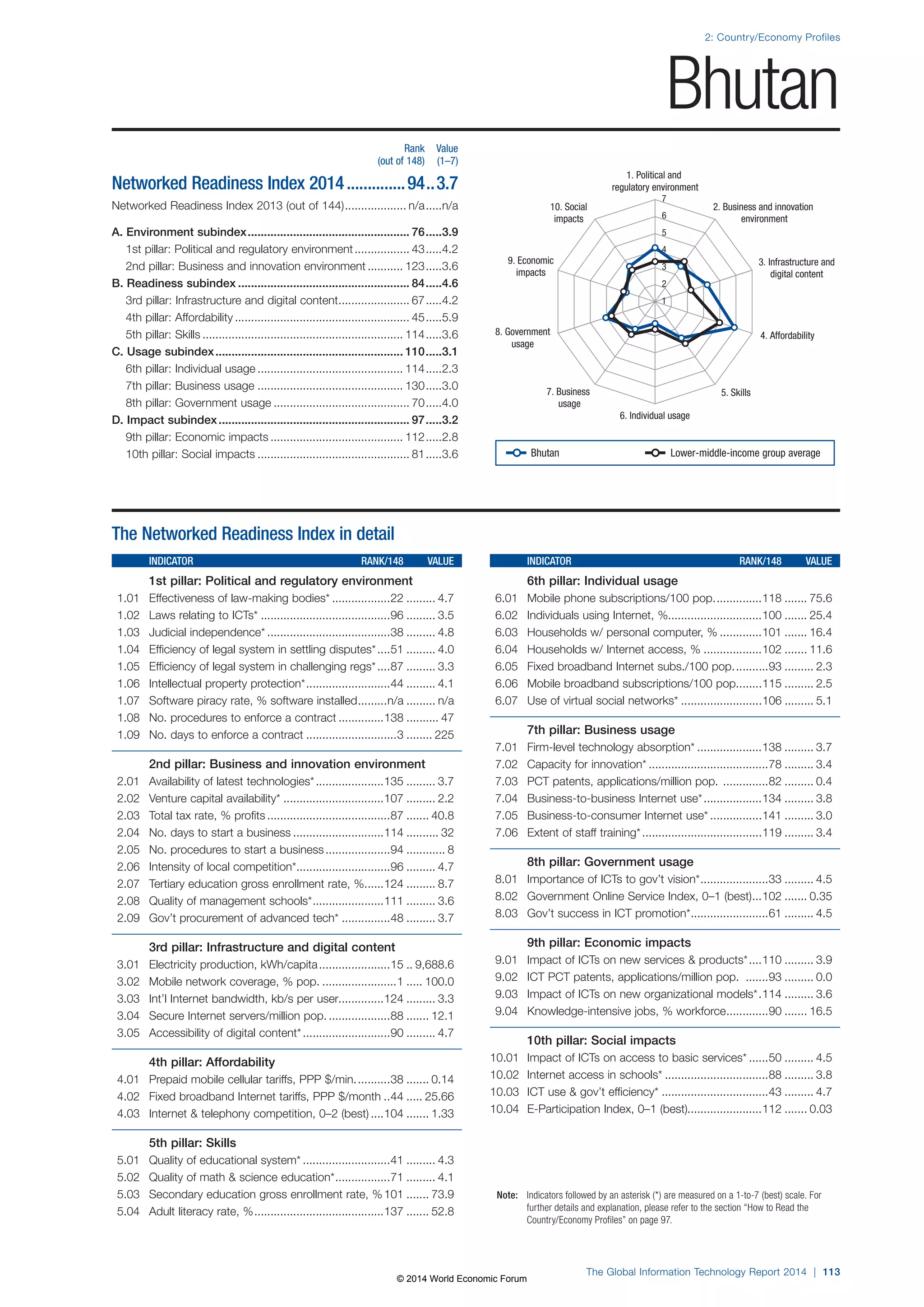
94 Bhutan 3.68 n/a 
95 Albania 3.66 83 
96 Ghana 3.65 95 
97 Lebanon 3.64 94 
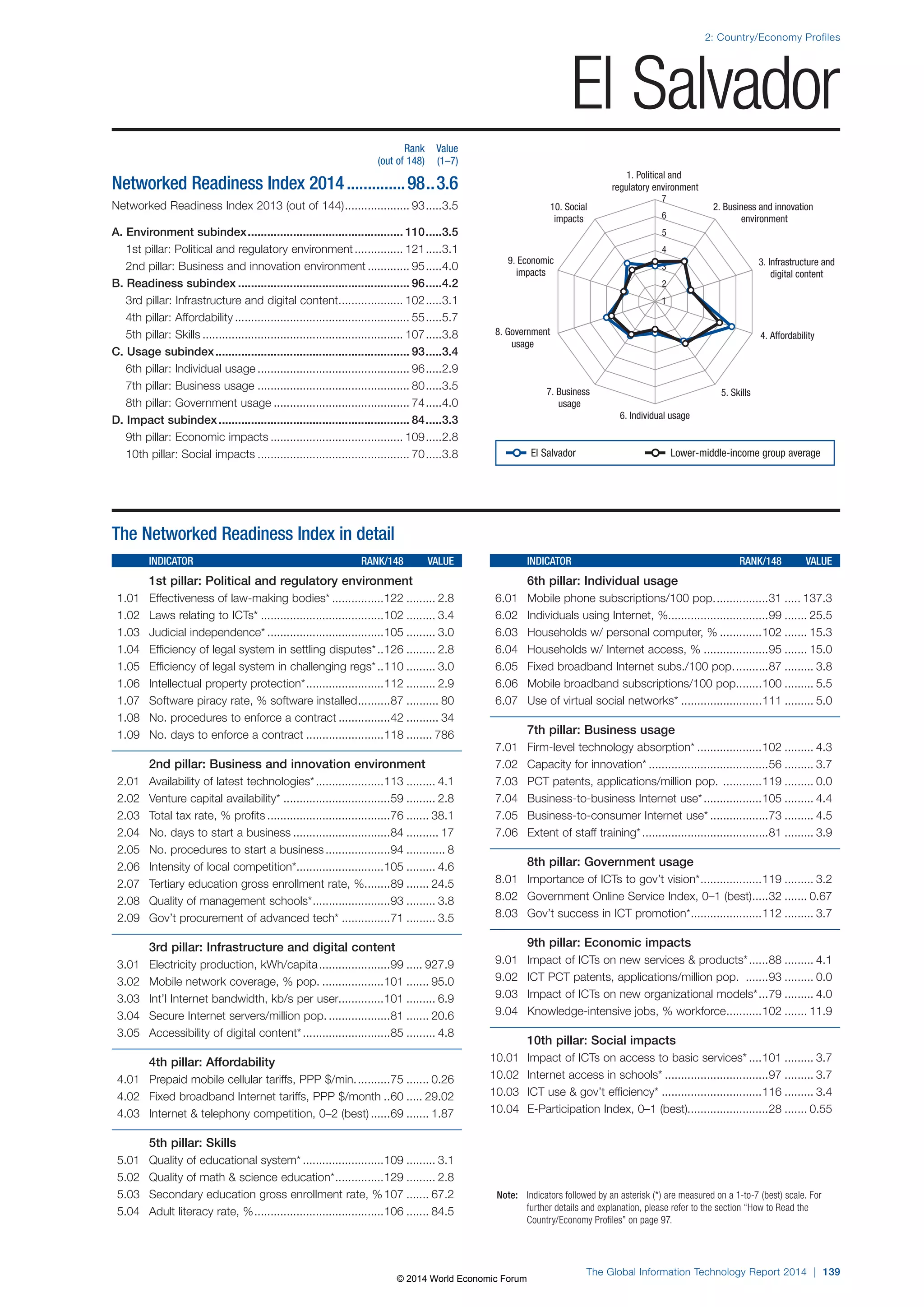
98 El Salvador 3.63 93 
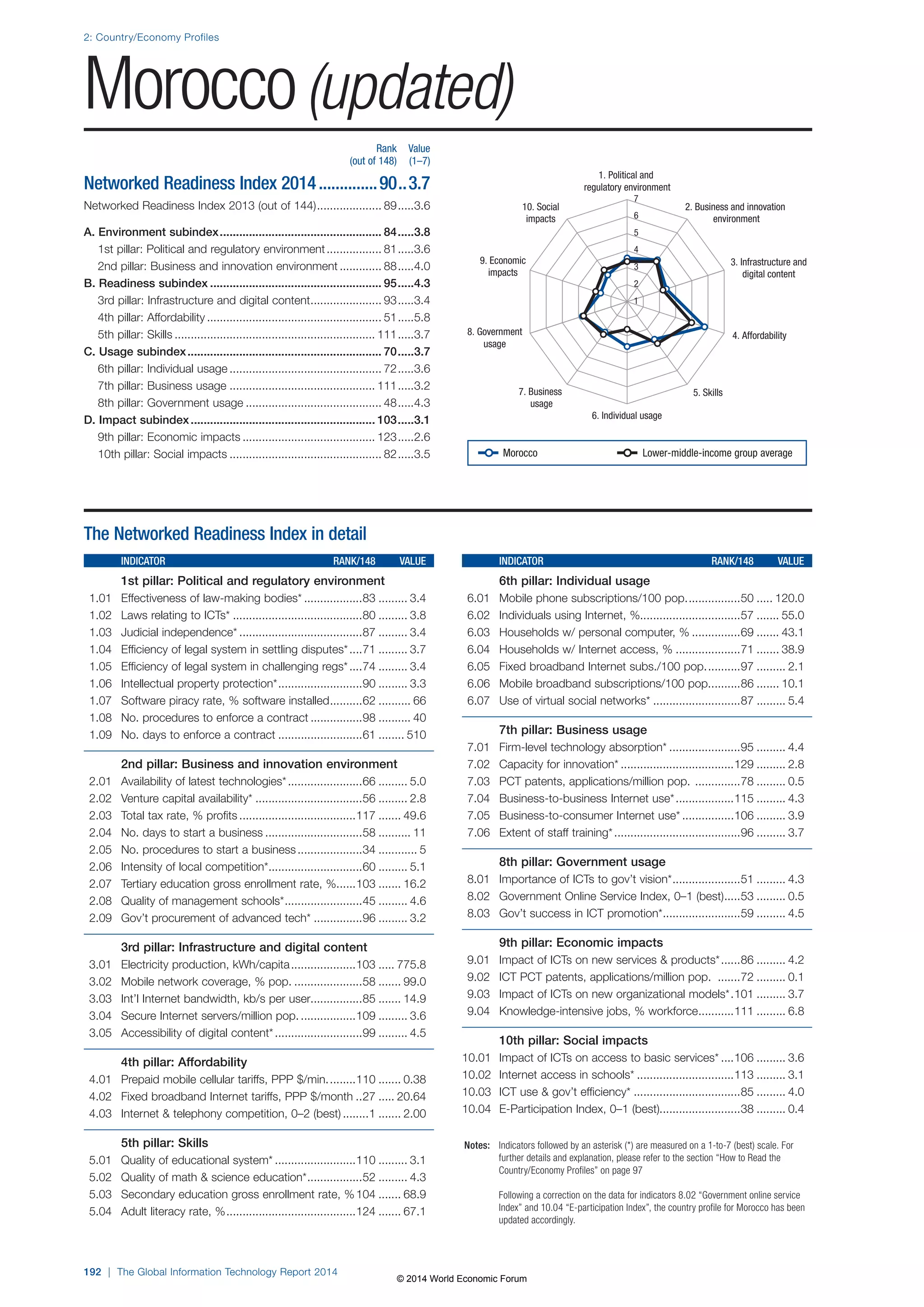
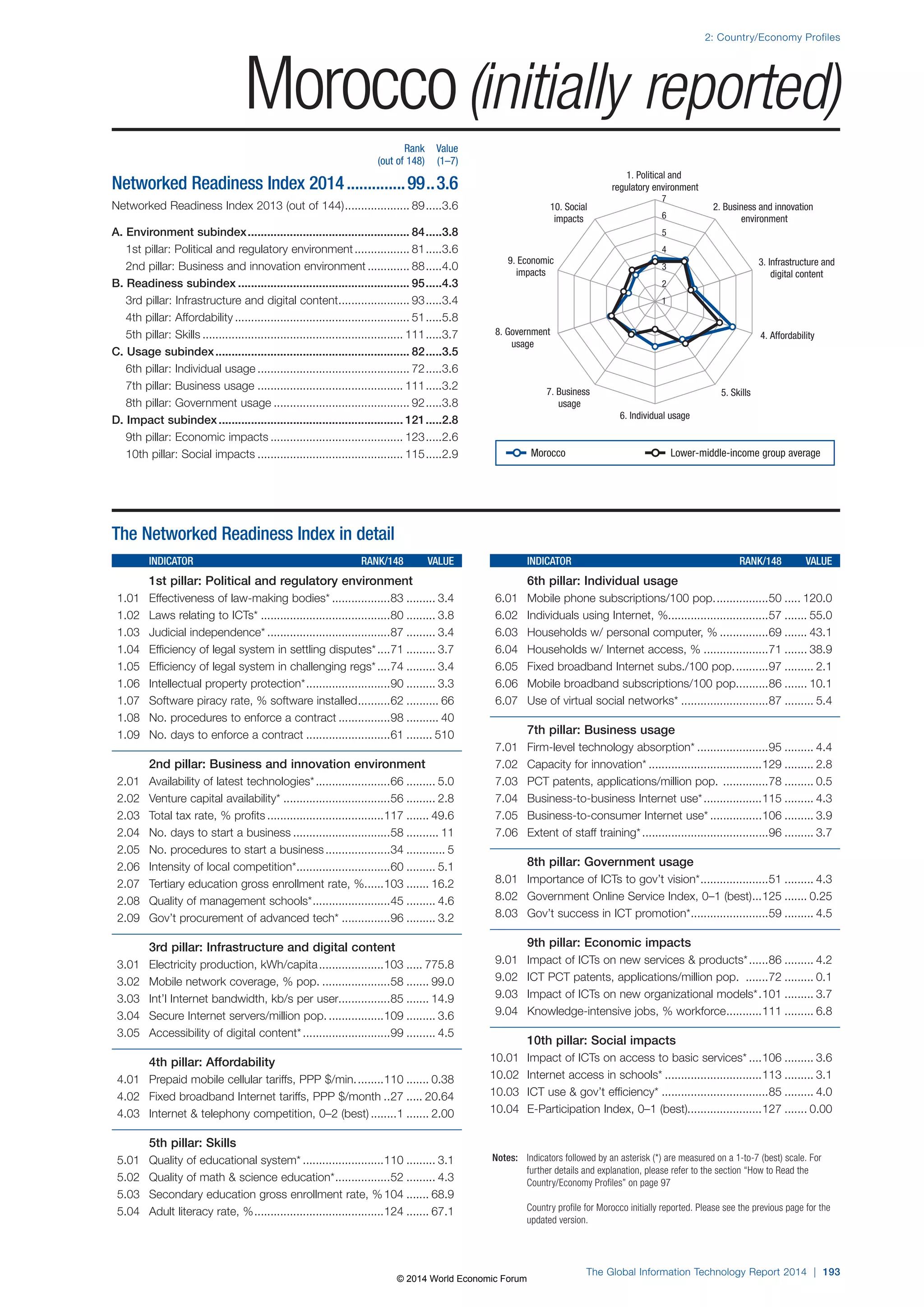
99 Morocco 3.61 89 
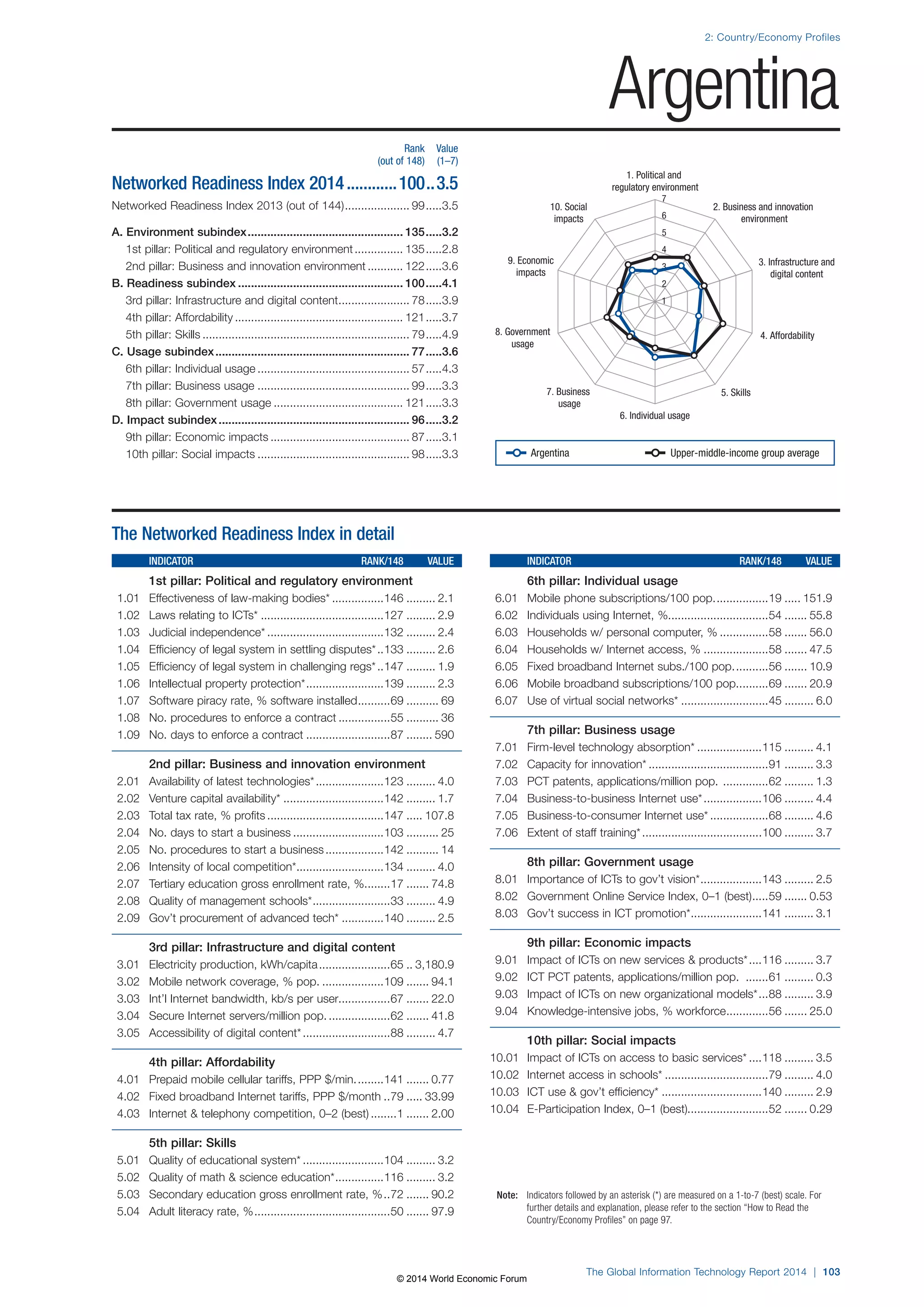
100 Argentina 3.53 99 
101 Guatemala 3.52 102 
102 Paraguay 3.47 104 
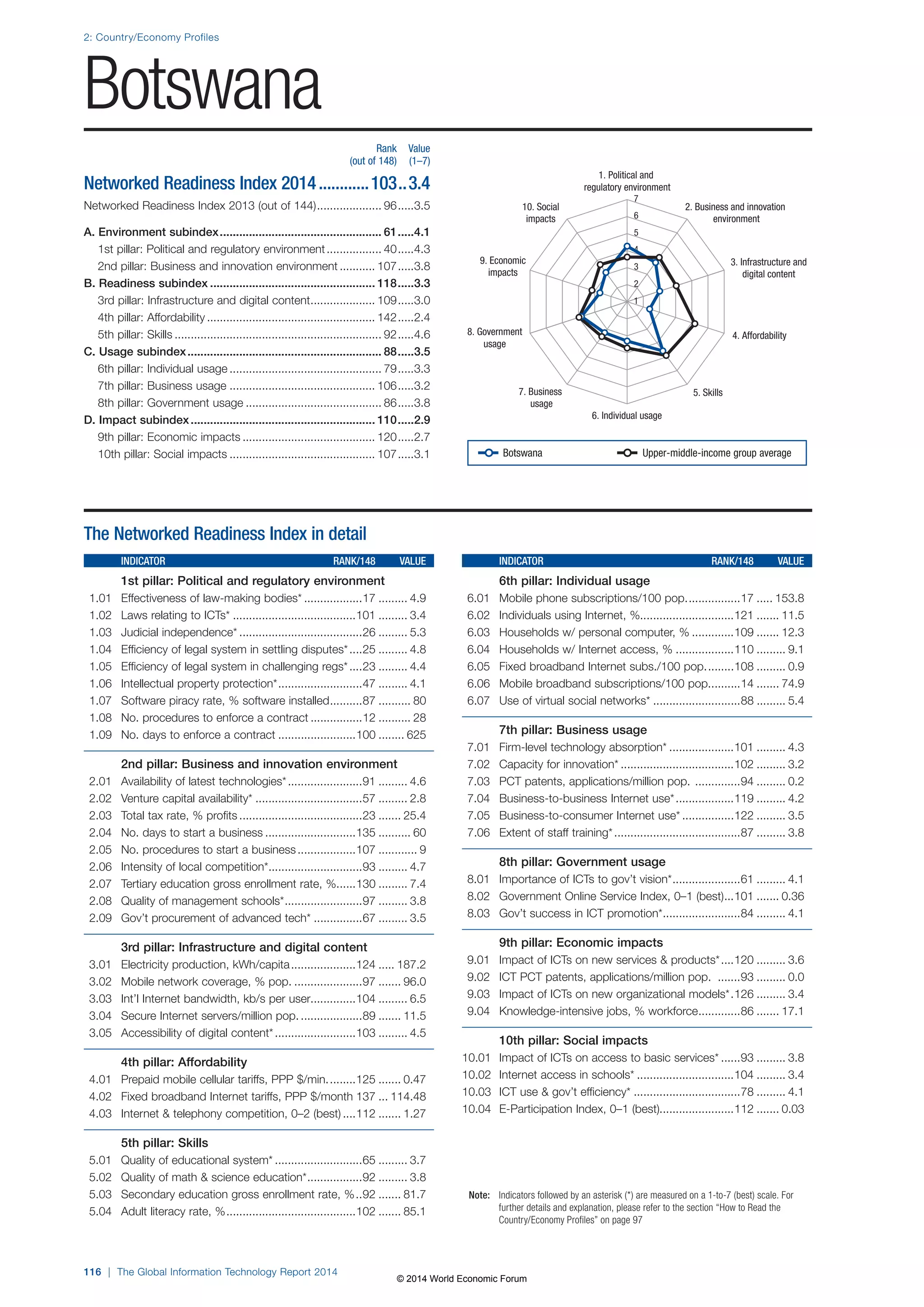
103 Botswana 3.43 96 
104 Iran, Islamic Rep. 3.42 101 
105 Namibia 3.41 111 
106 Venezuela 3.39 108 
107 Gambia, The 3.38 98 
108 Cambodia 3.36 106 
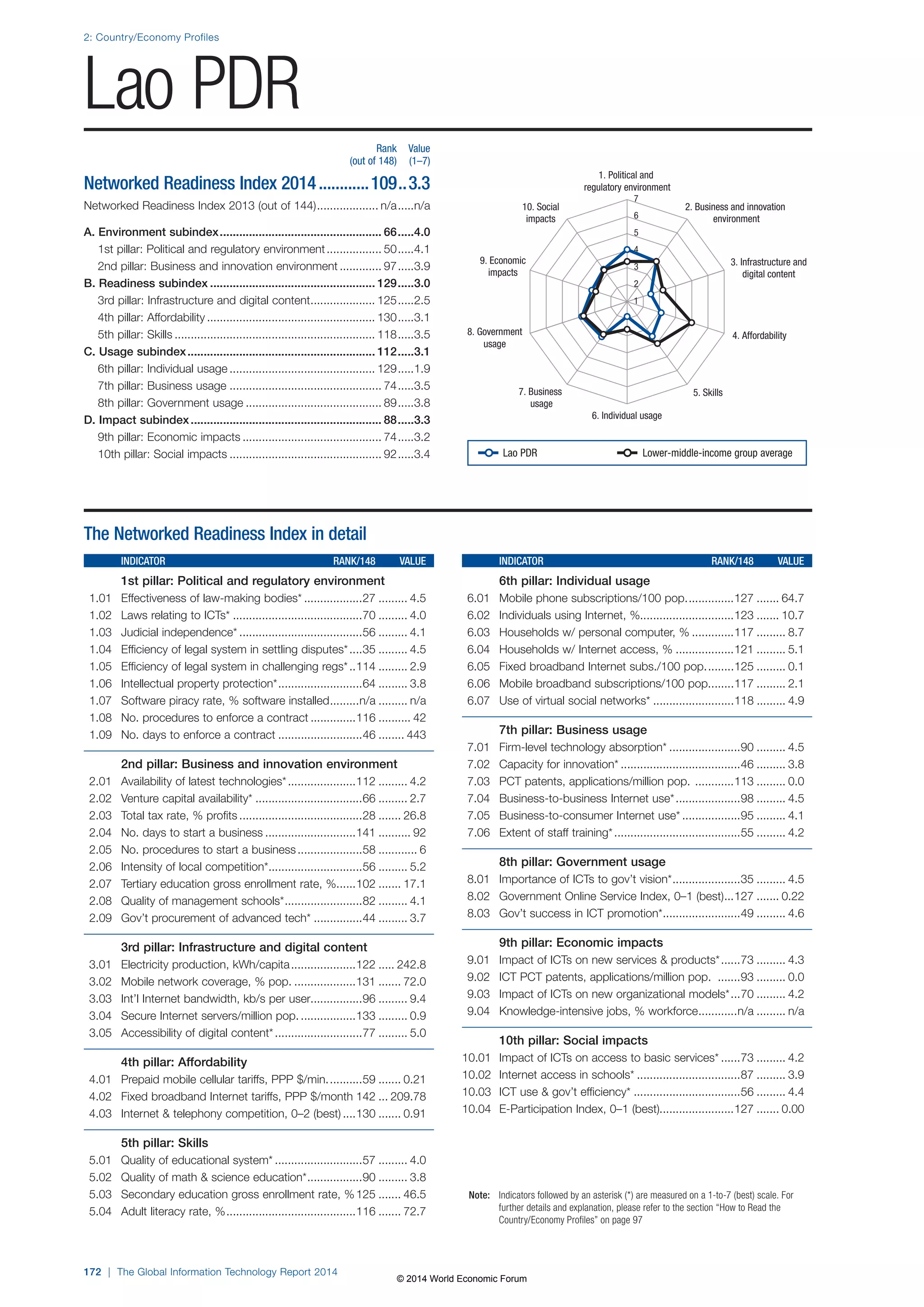
109 Lao PDR 3.34 n/a 
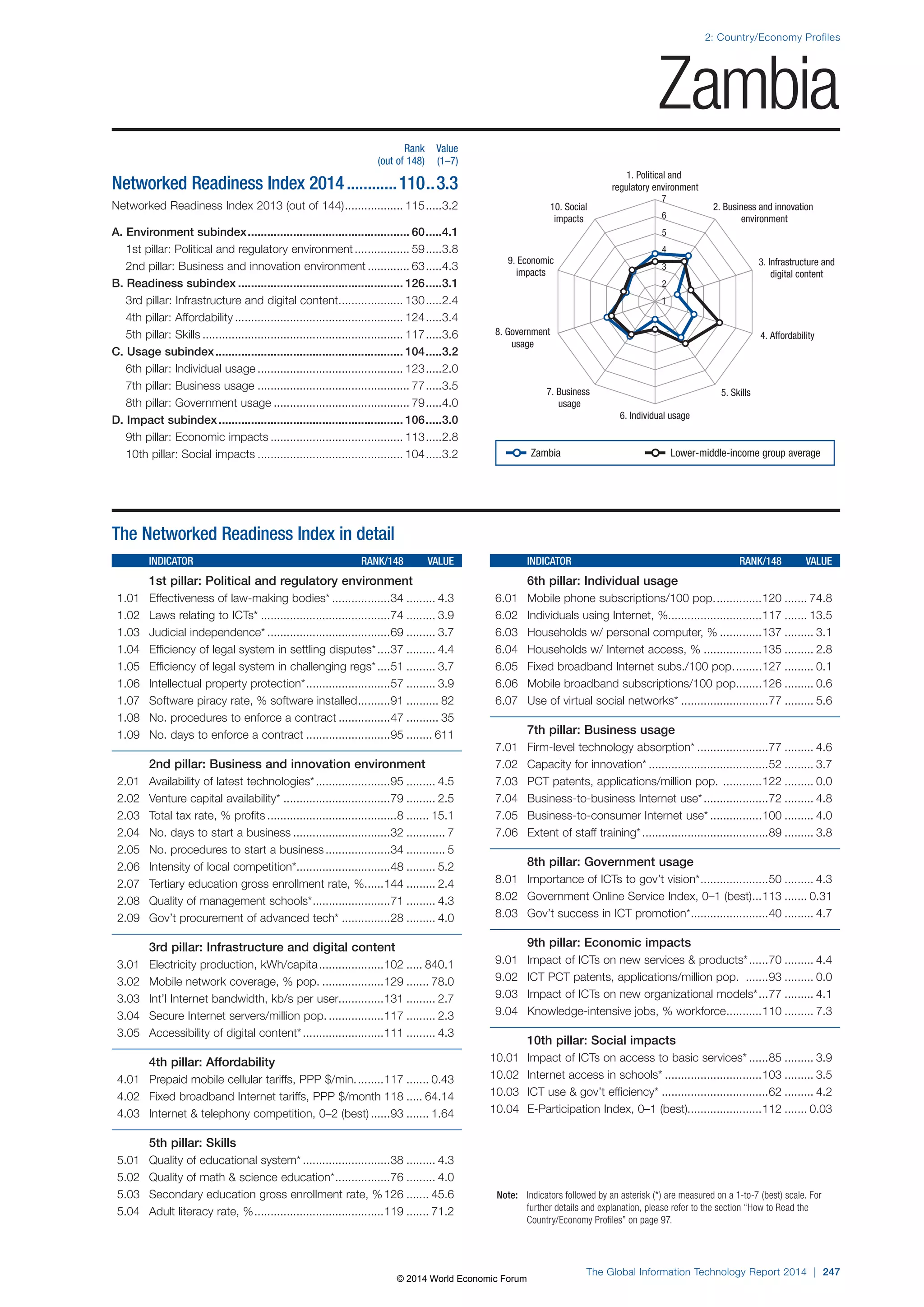
110 Zambia 3.34 115 
111 Pakistan 3.33 105 
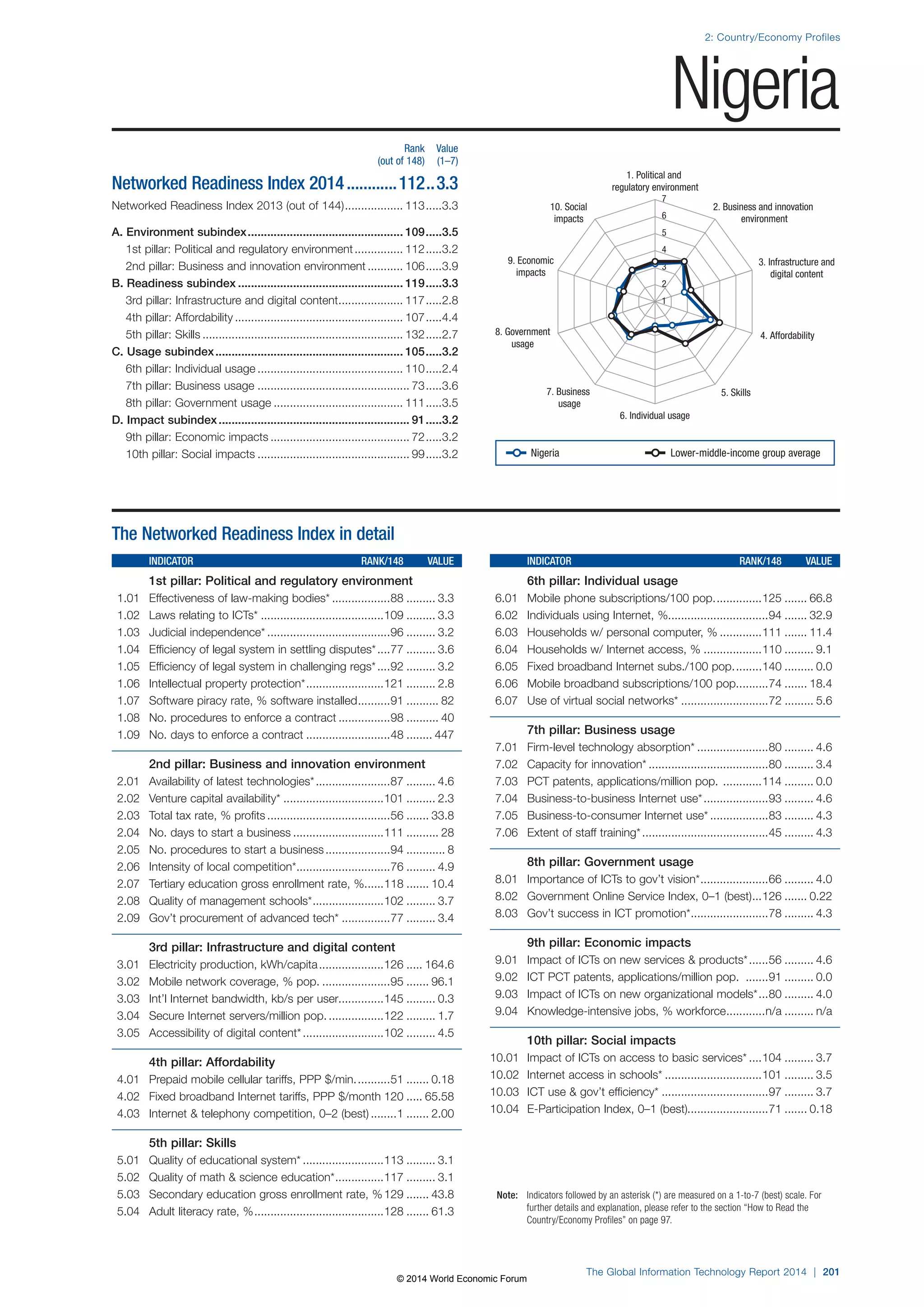
112 Nigeria 3.31 113 
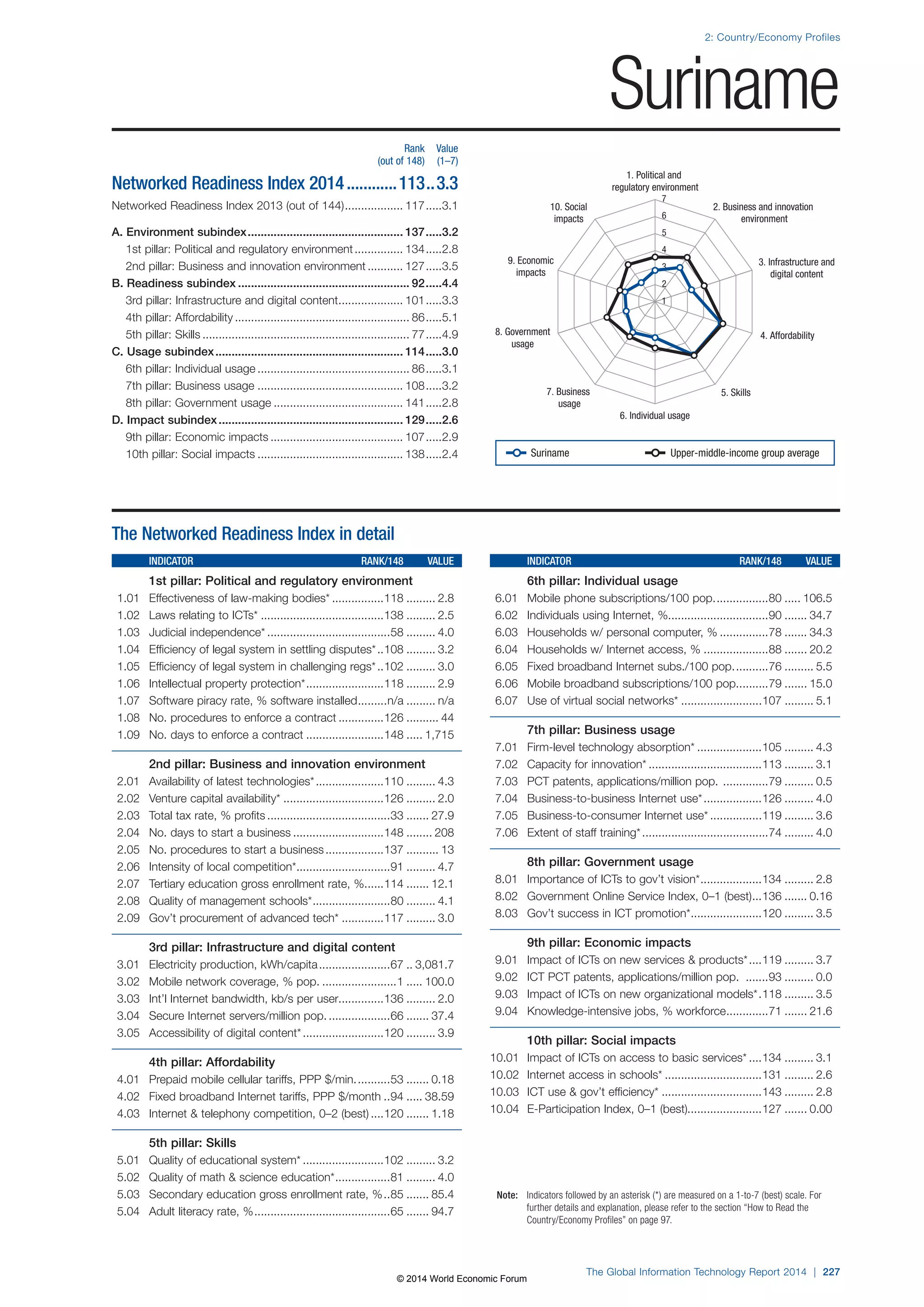
113 Suriname 3.30 117 
114 Senegal 3.30 107 
115 Uganda 3.25 110 
116 Honduras 3.24 109 
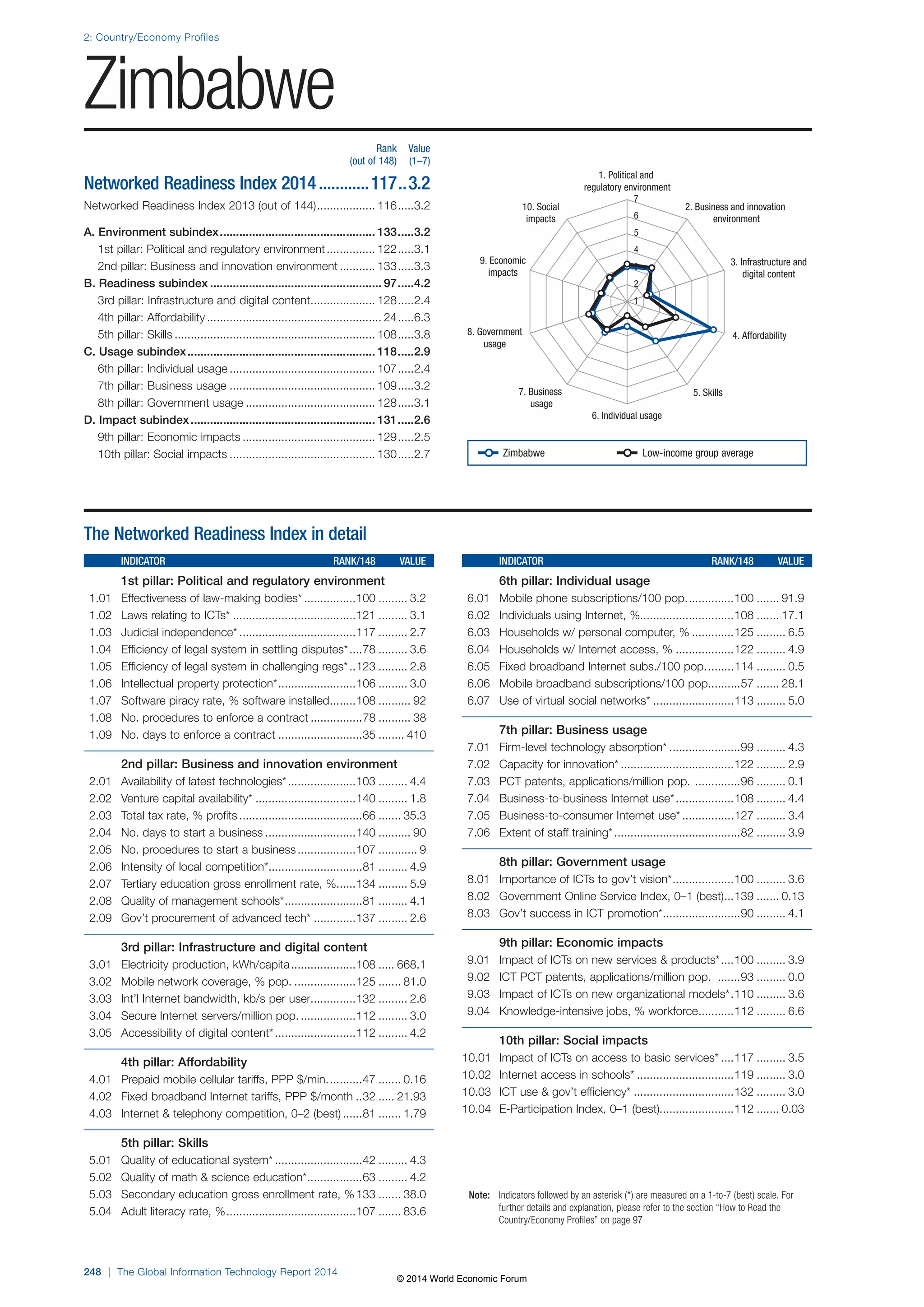
117 Zimbabwe 3.24 116 
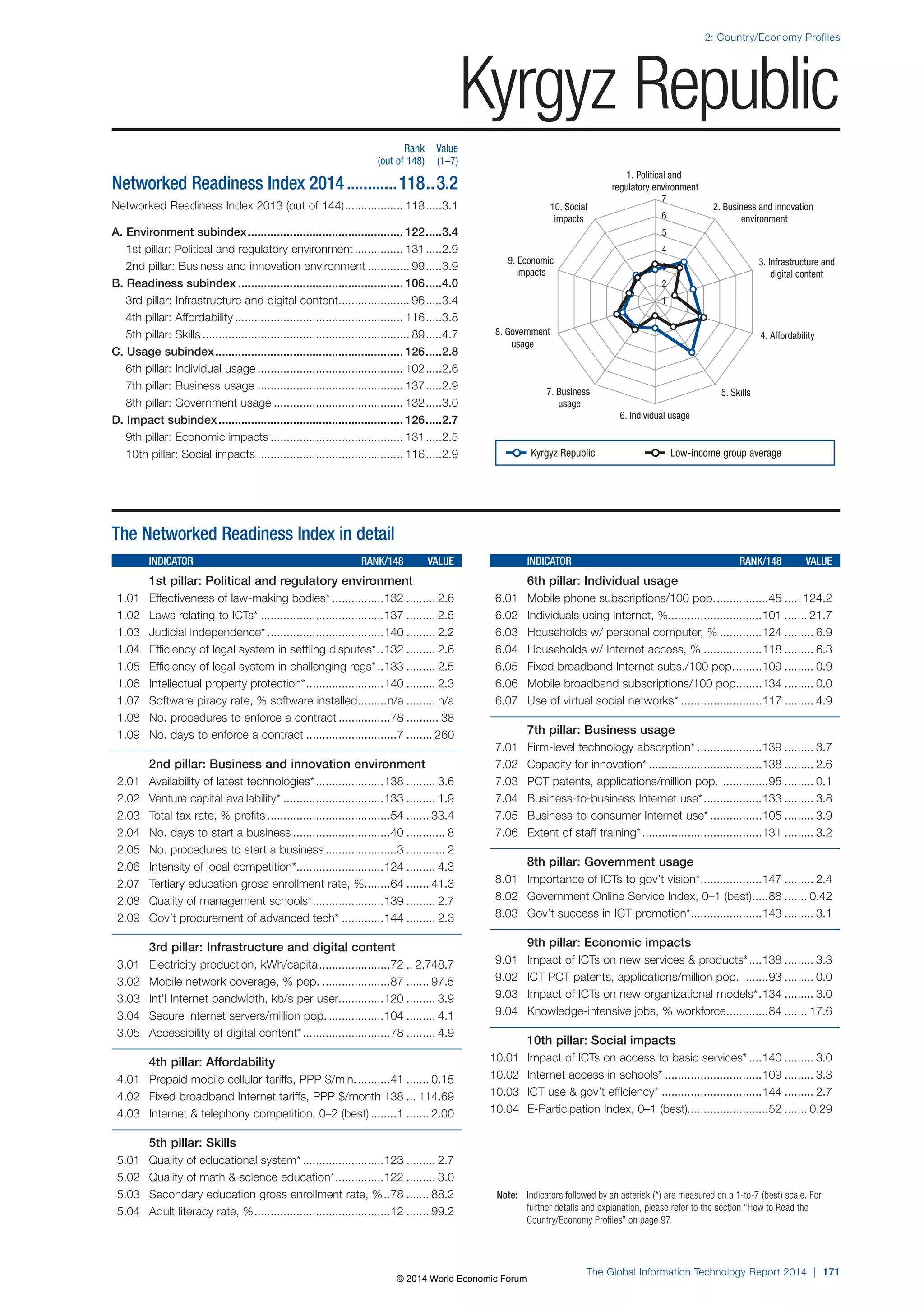
118 Kyrgyz Republic 3.22 118 
119 Bangladesh 3.21 114 
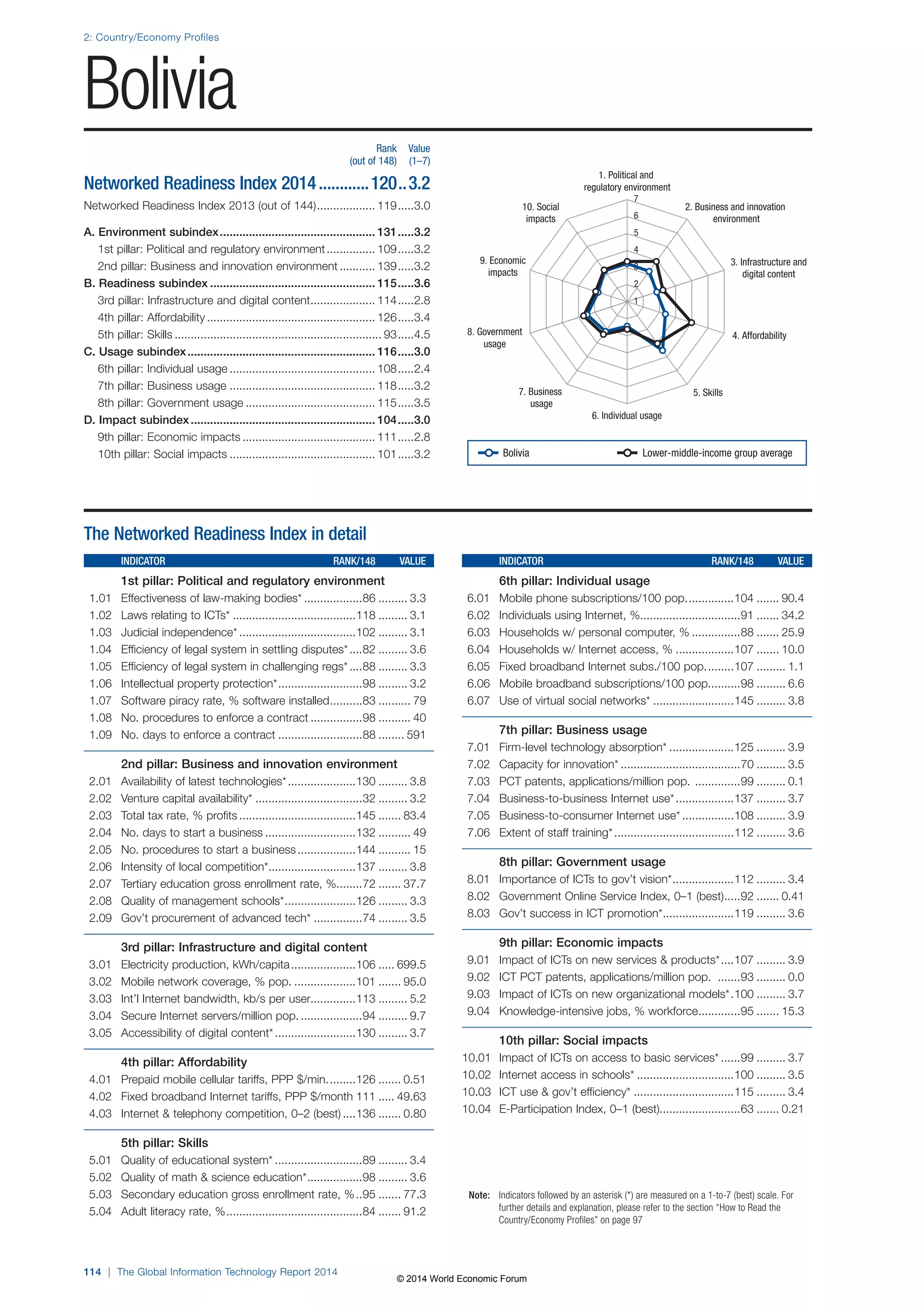
120 Bolivia 3.21 119 
121 Liberia 3.19 97 
122 Côte d'Ivoire 3.14 120 
123 Nepal 3.09 126 
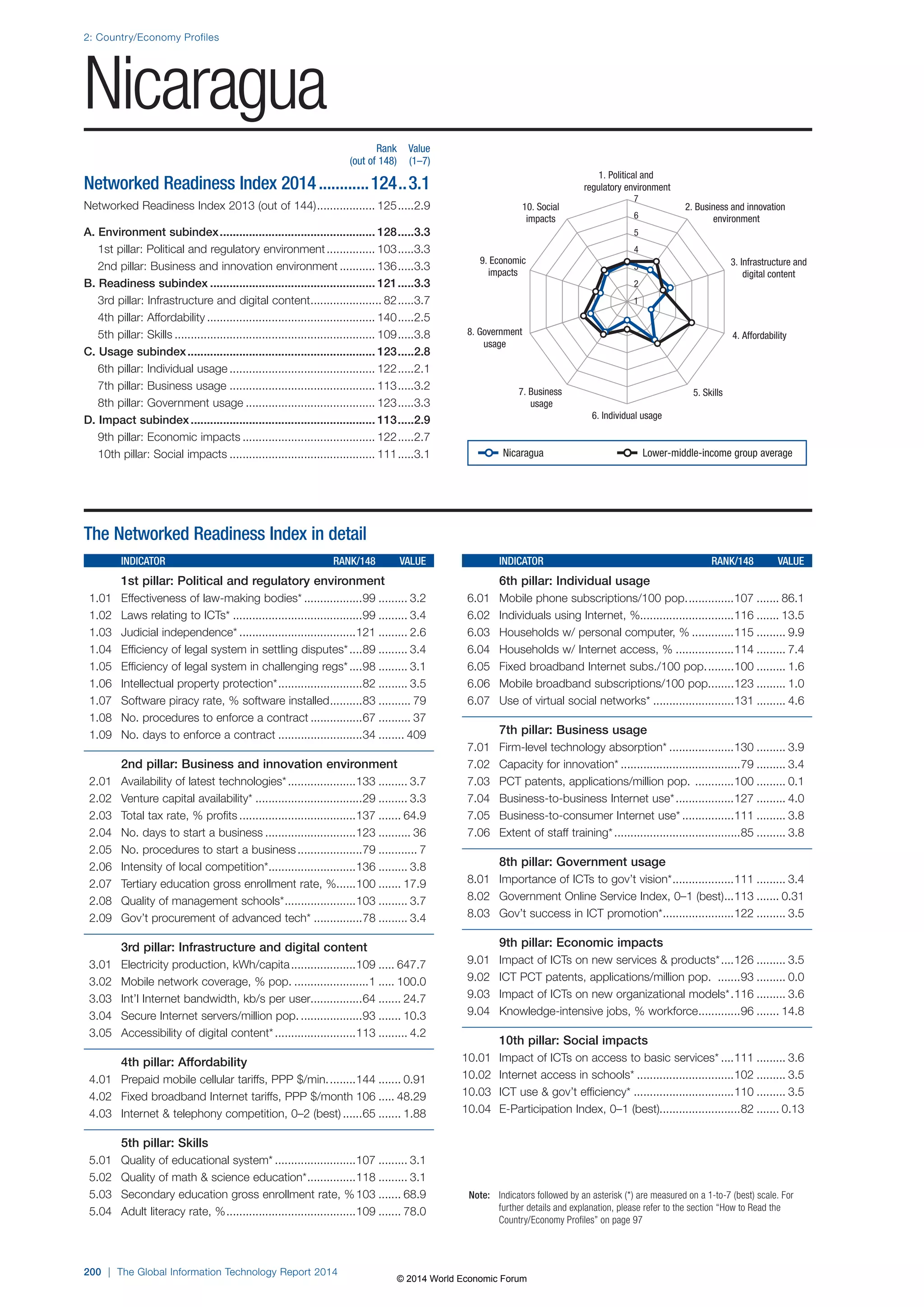
124 Nicaragua 3.08 125 
125 Tanzania 3.04 127 
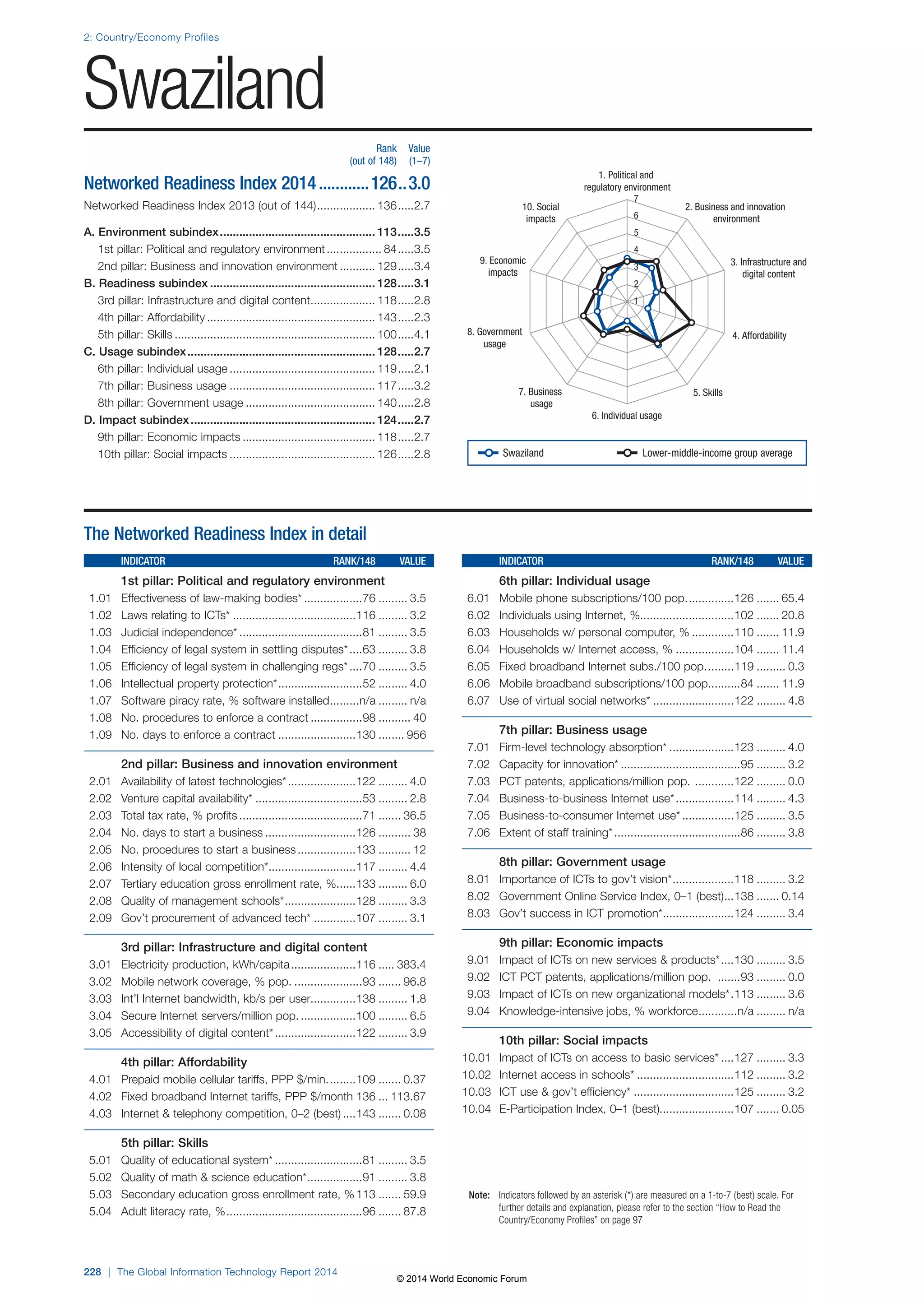
126 Swaziland 3.00 136 
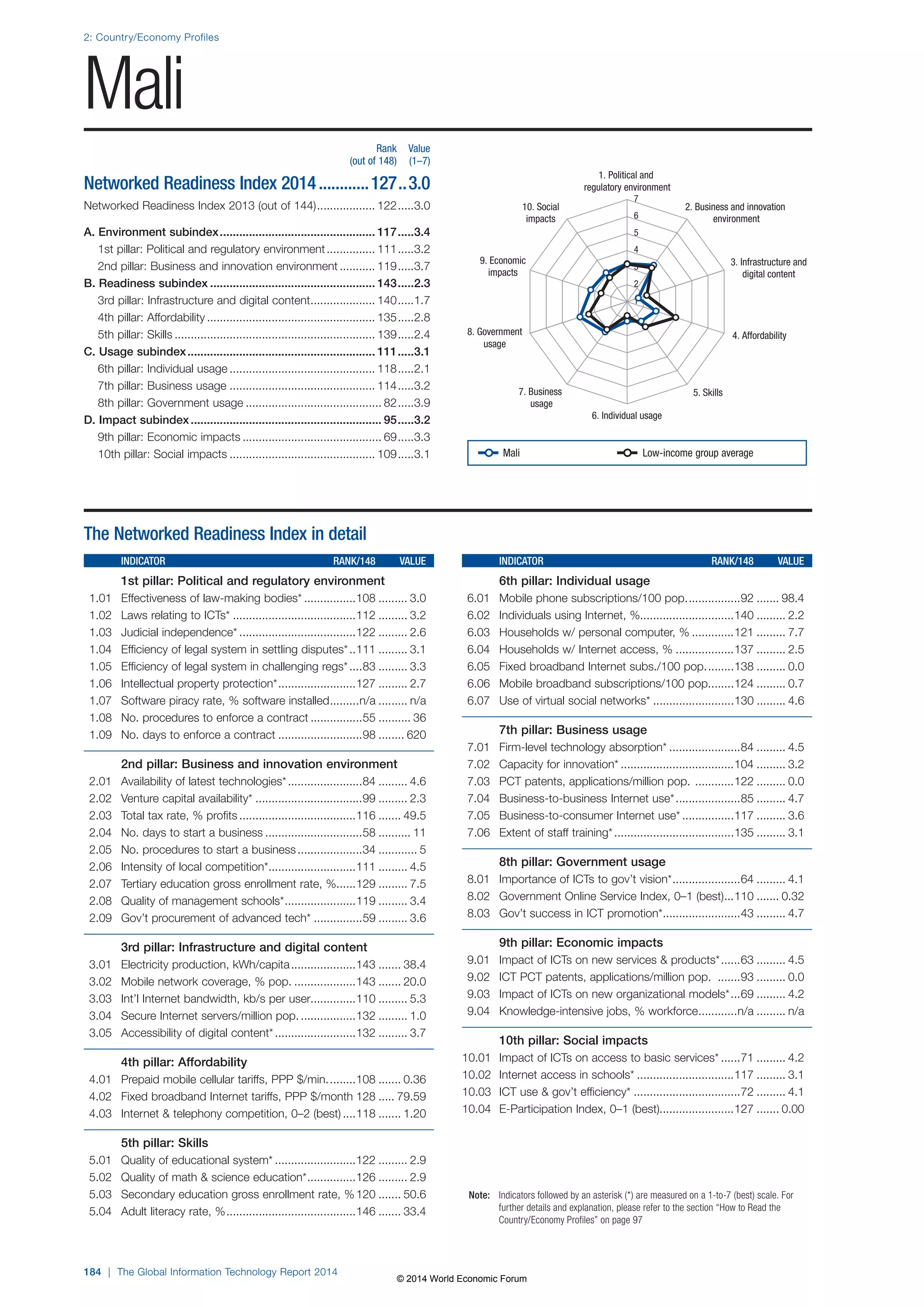
127 Mali 3.00 122 
128 Gabon 2.98 121 
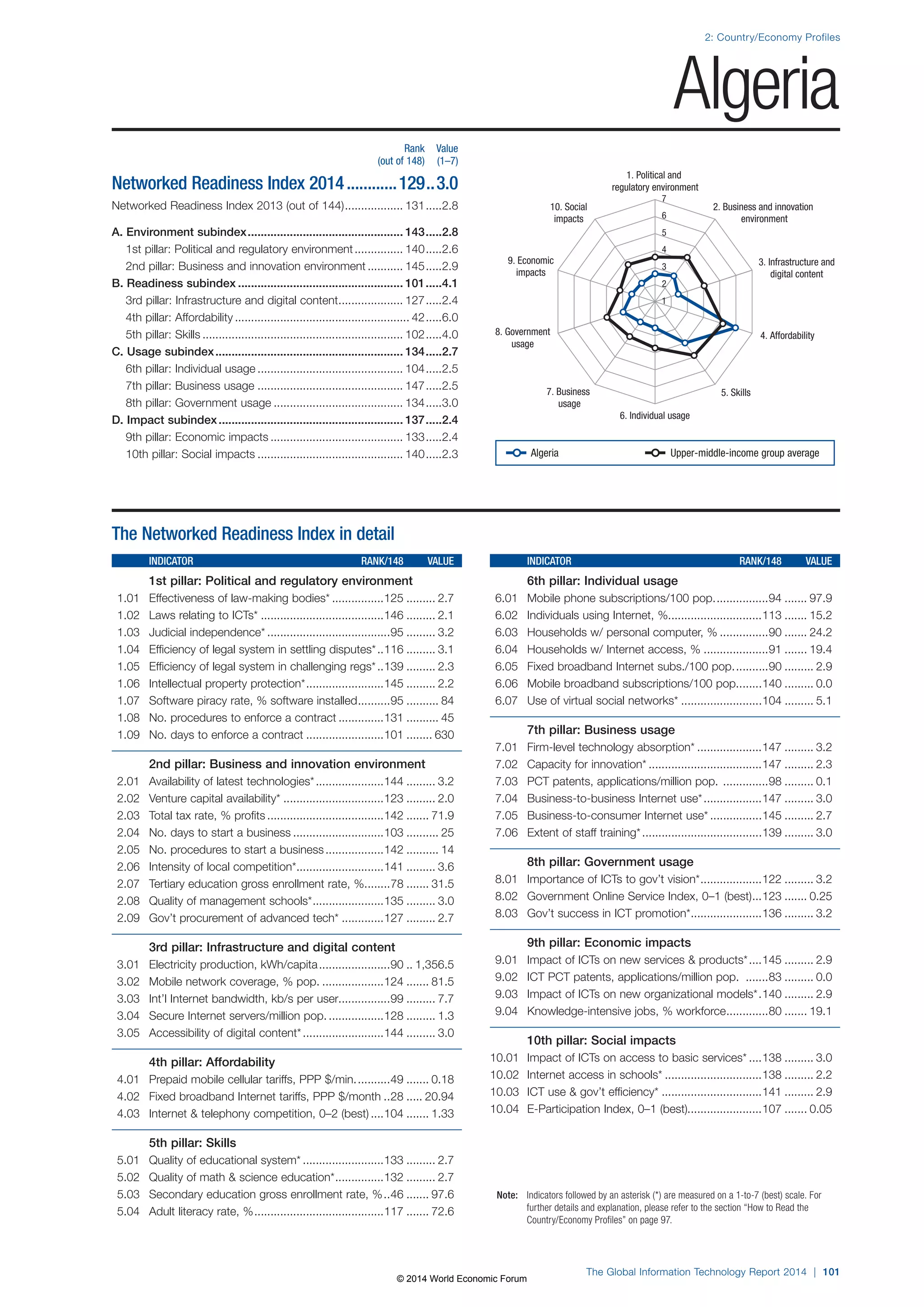
129 Algeria 2.98 131 
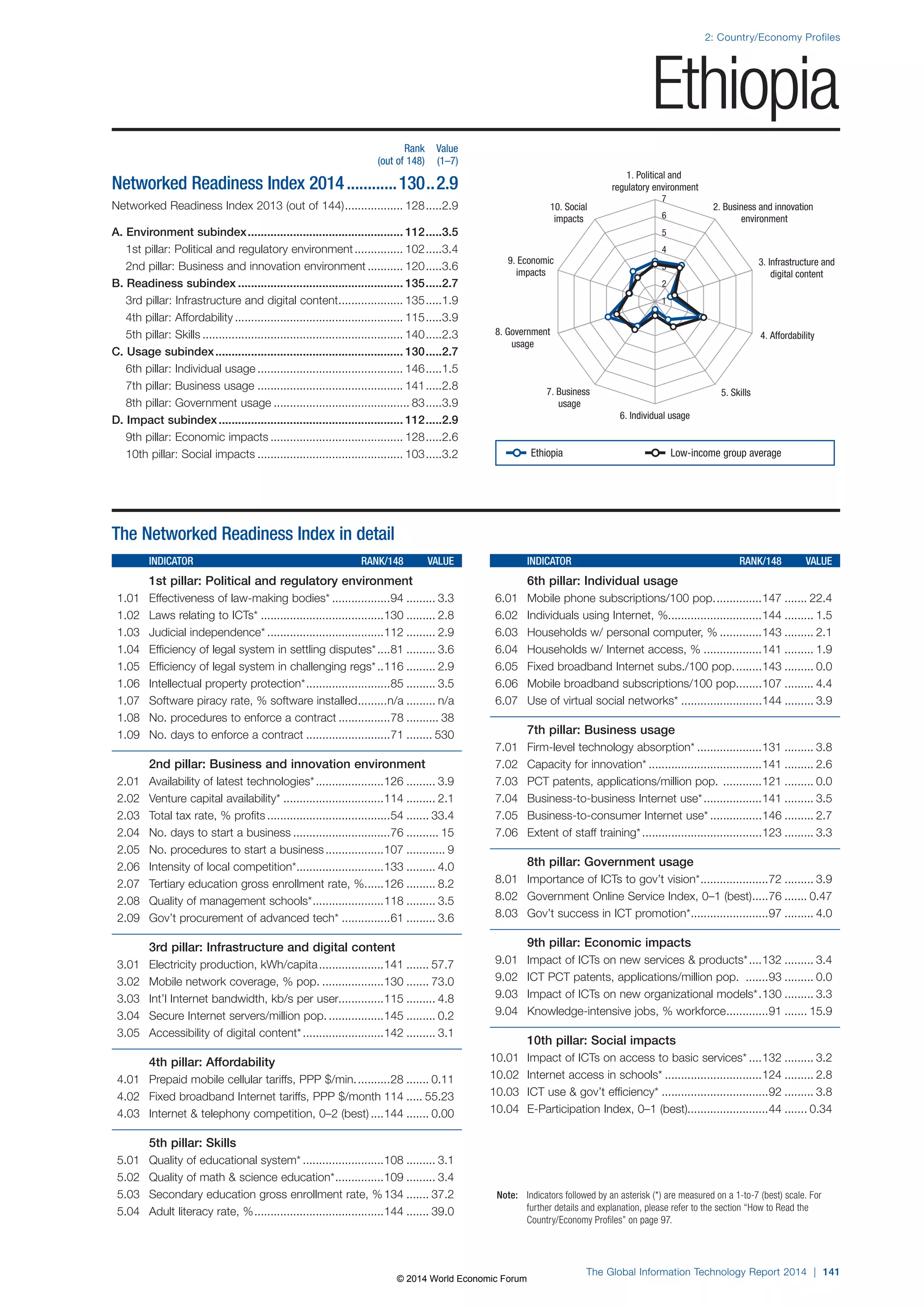
130 Ethiopia 2.95 128 
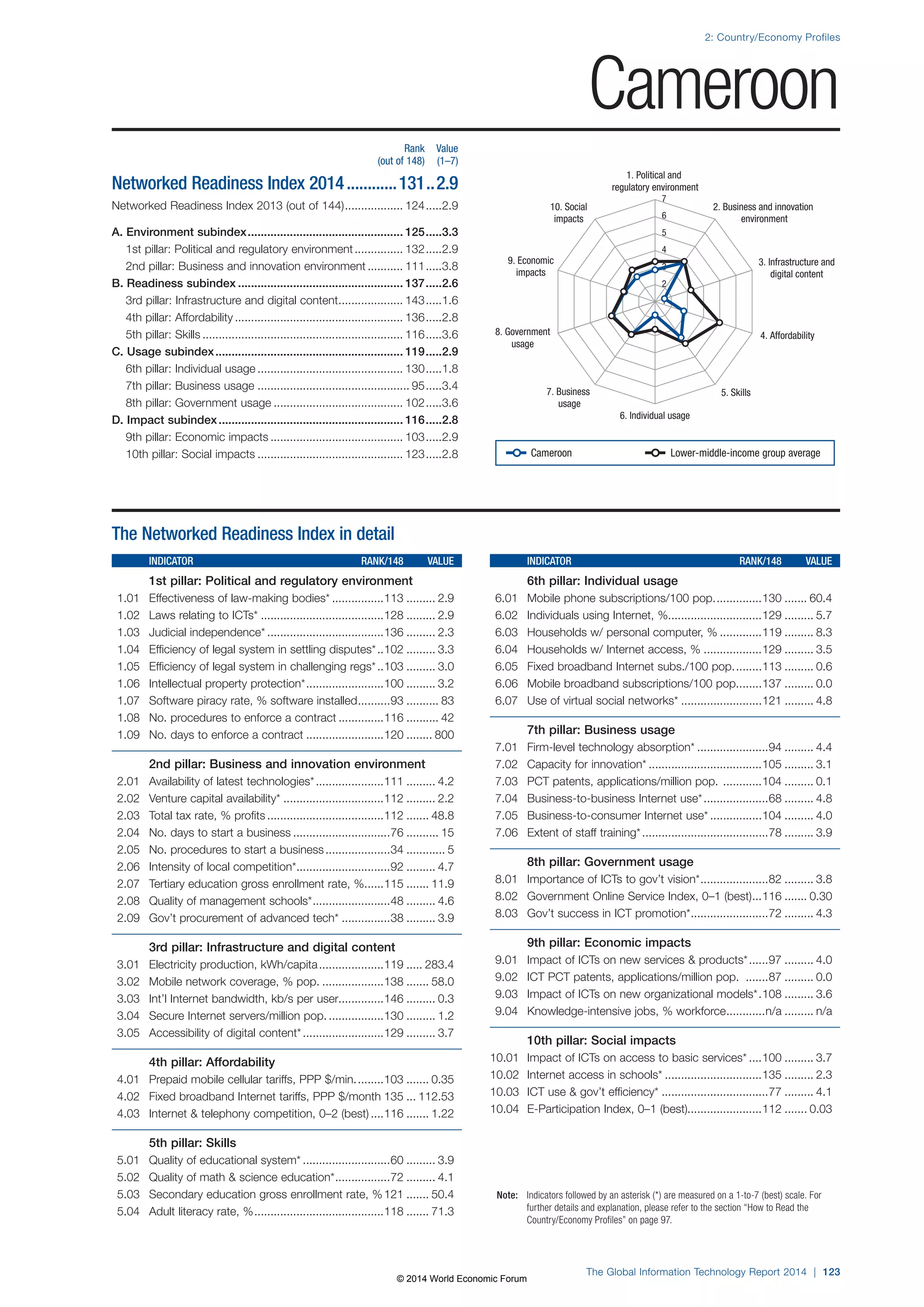
131 Cameroon 2.94 124 
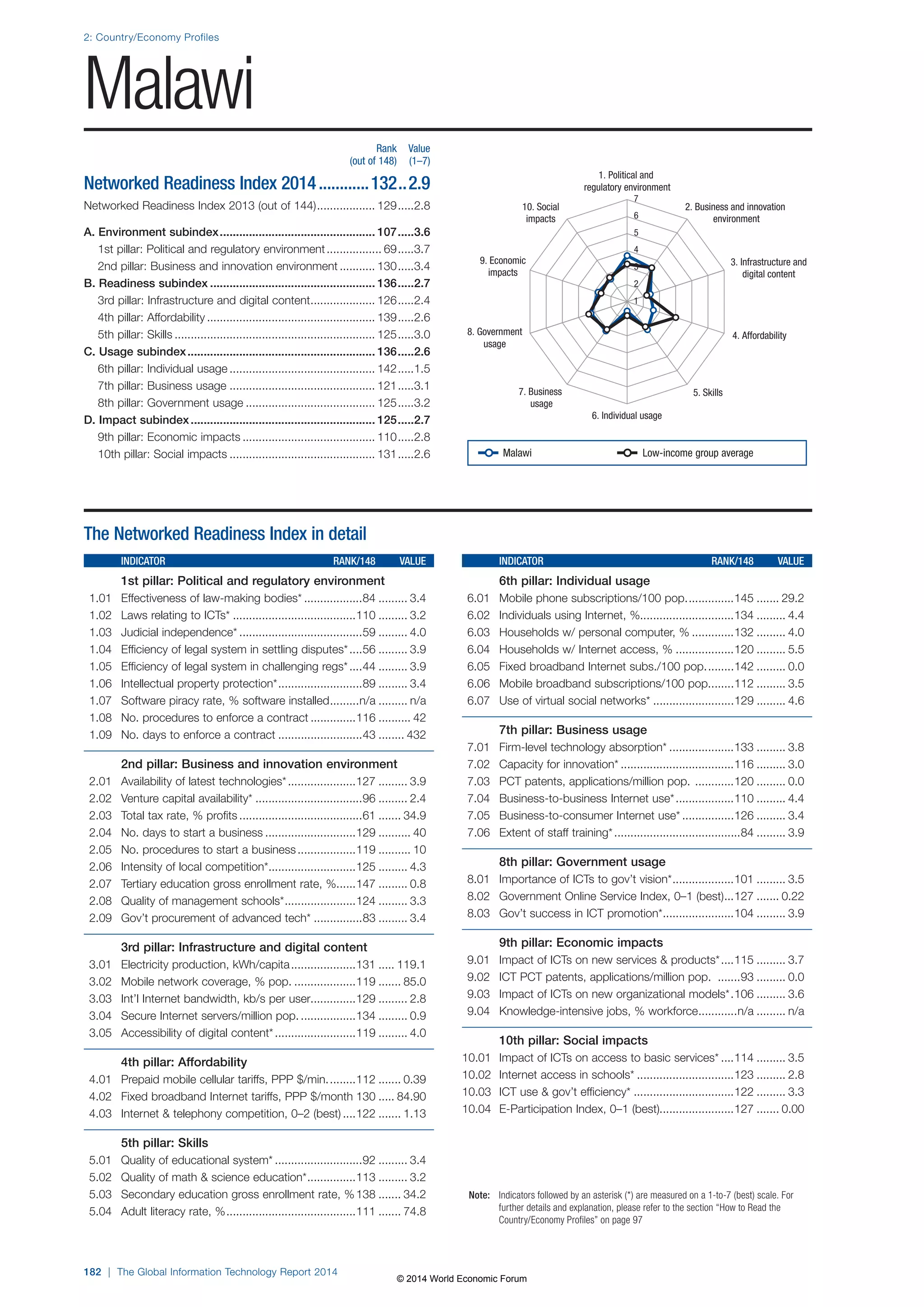
132 Malawi 2.90 129 
133 Lesotho 2.88 138 
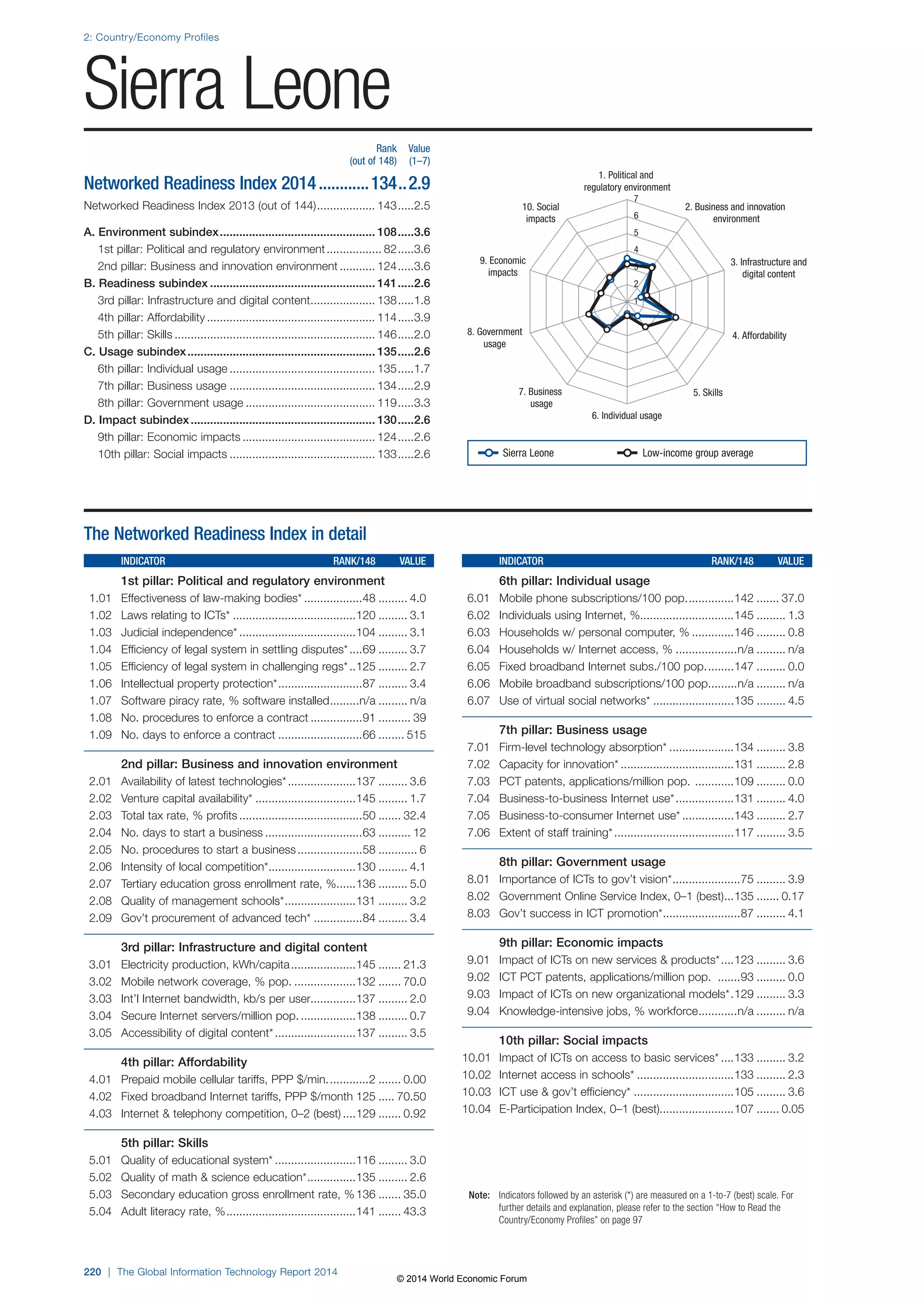
134 Sierra Leone 2.85 143 
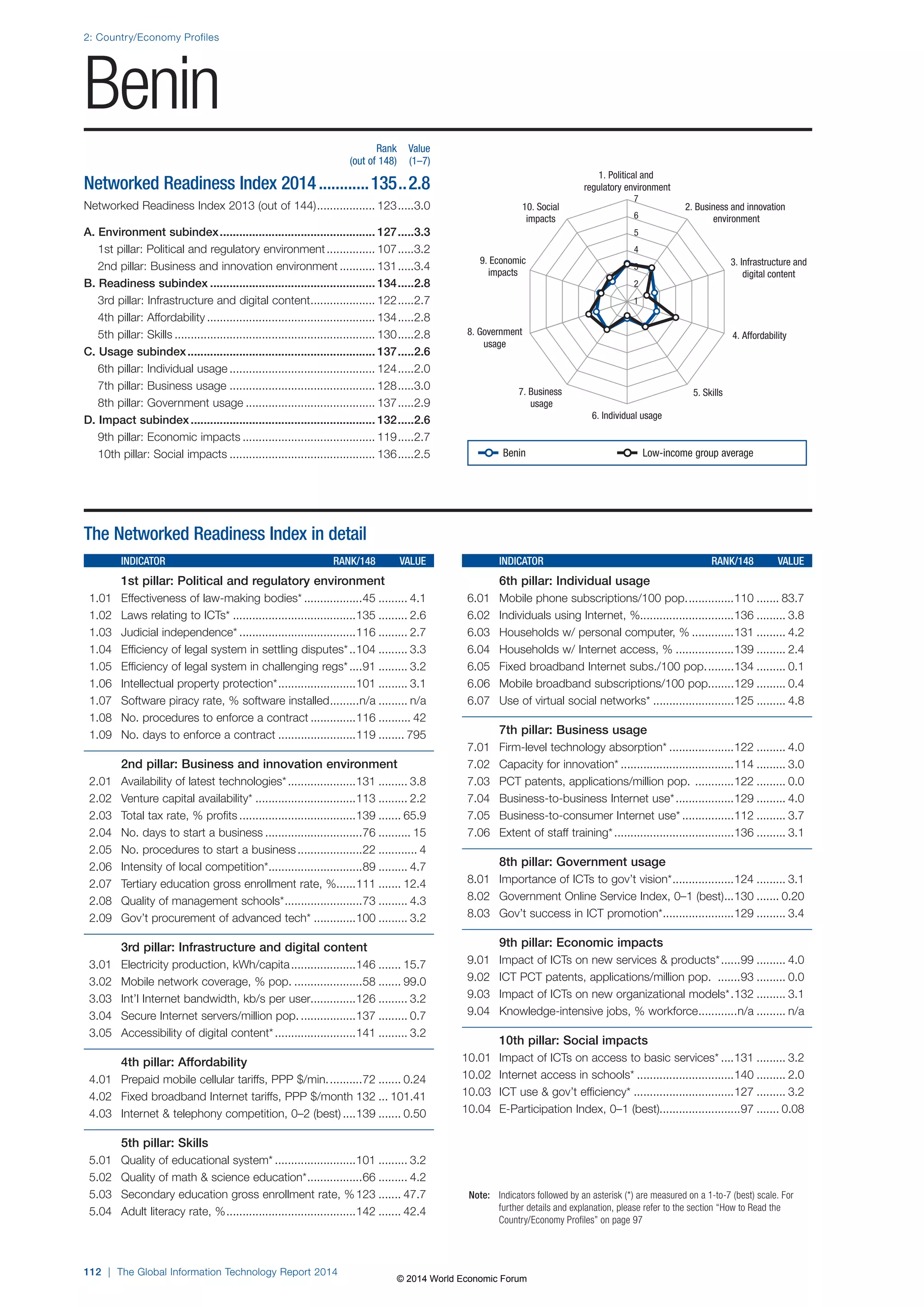
135 Benin 2.82 123 
136 Burkina Faso 2.78 130 
137 Mozambique 2.77 133 
138 Libya 2.75 132 
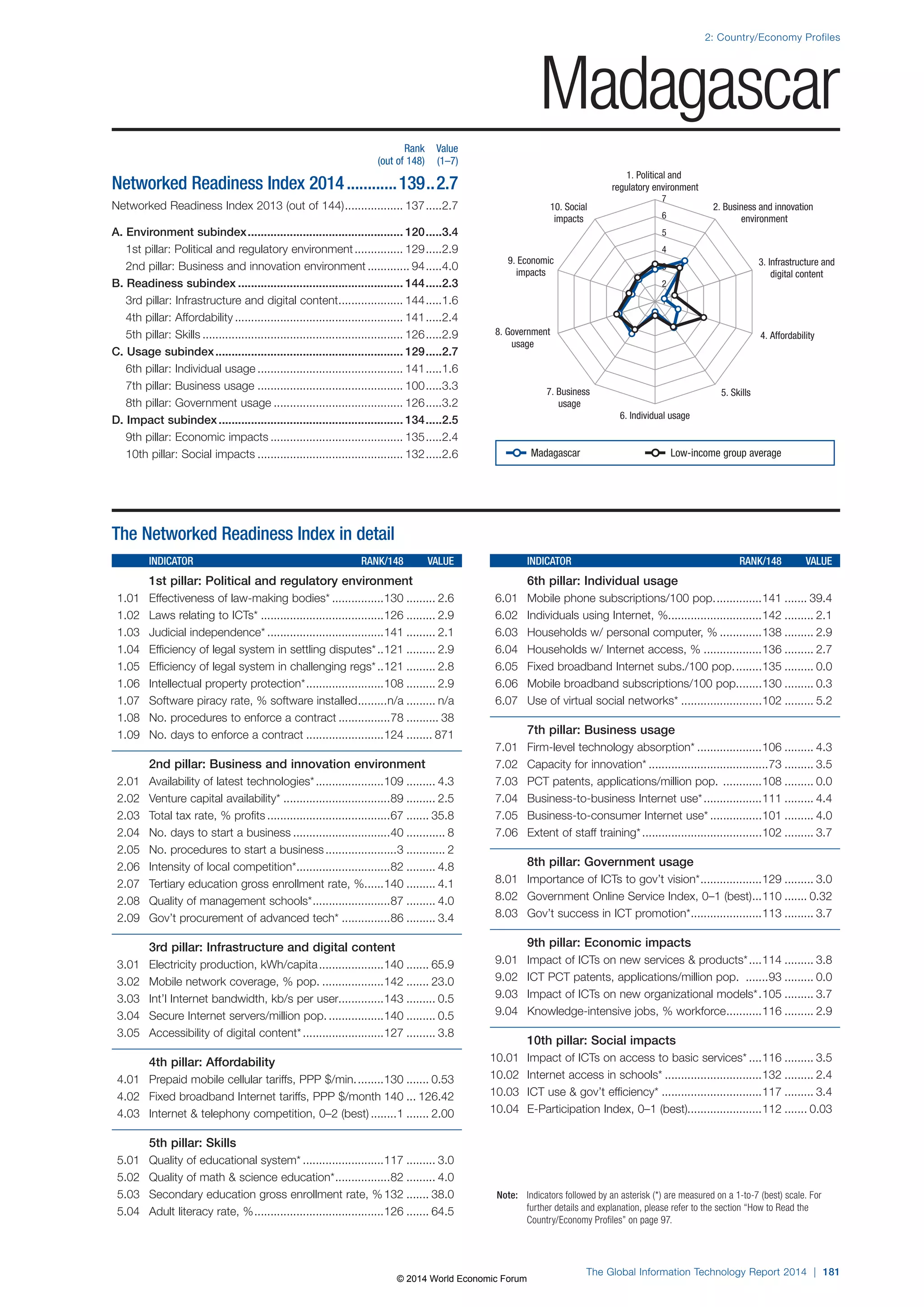
139 Madagascar 2.74 137 
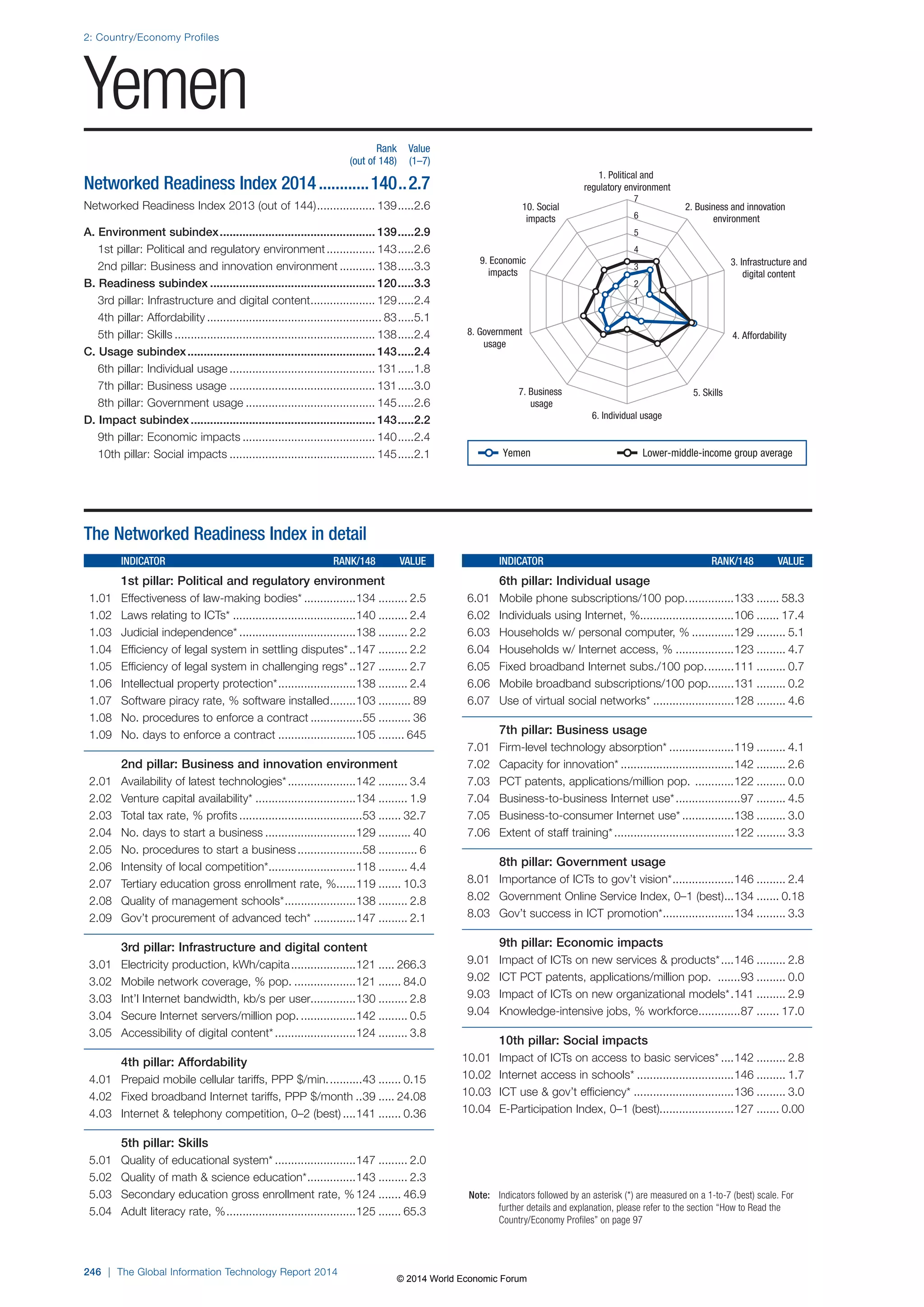
140 Yemen 2.73 139 
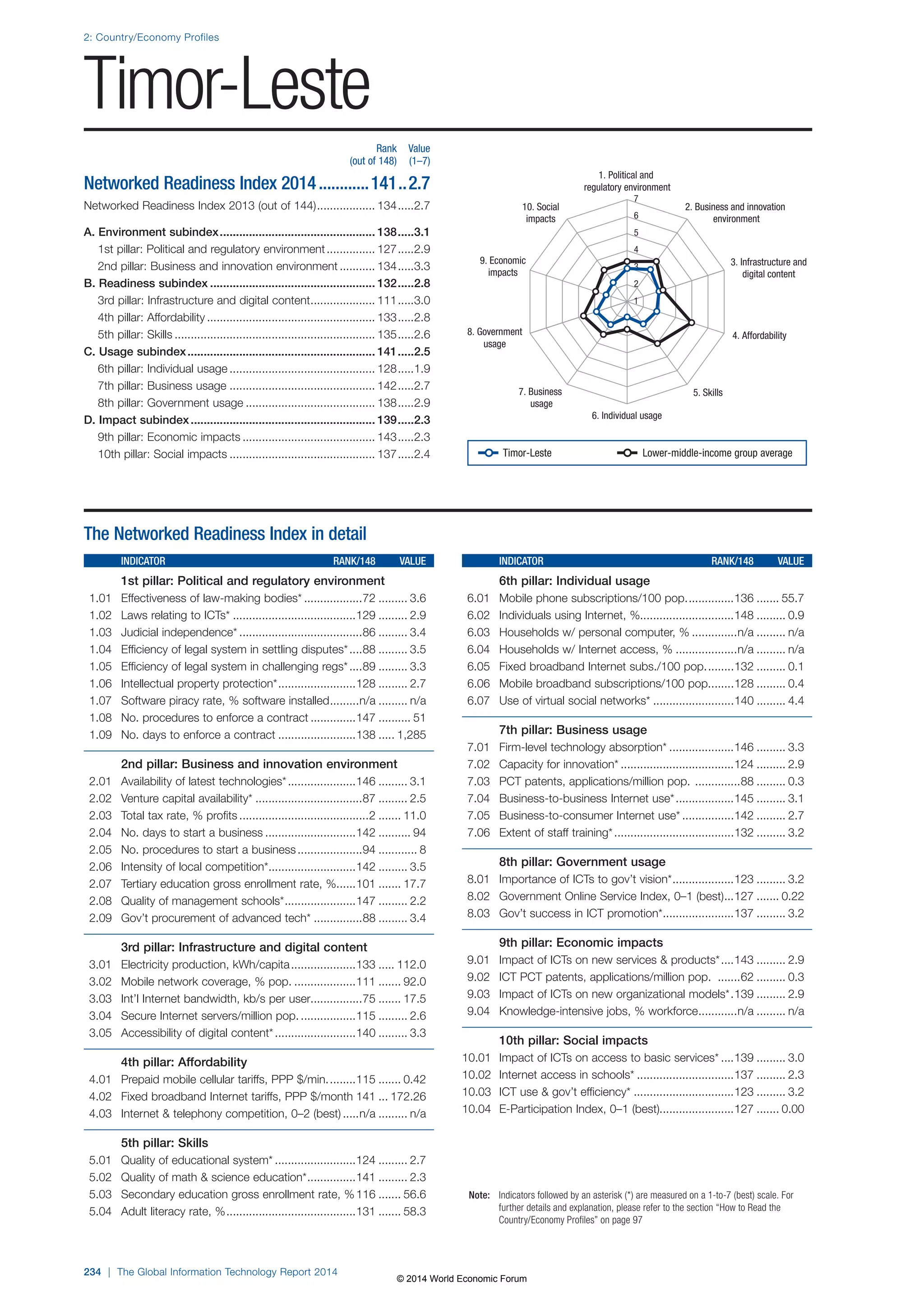
141 Timor-Leste 2.69 134 
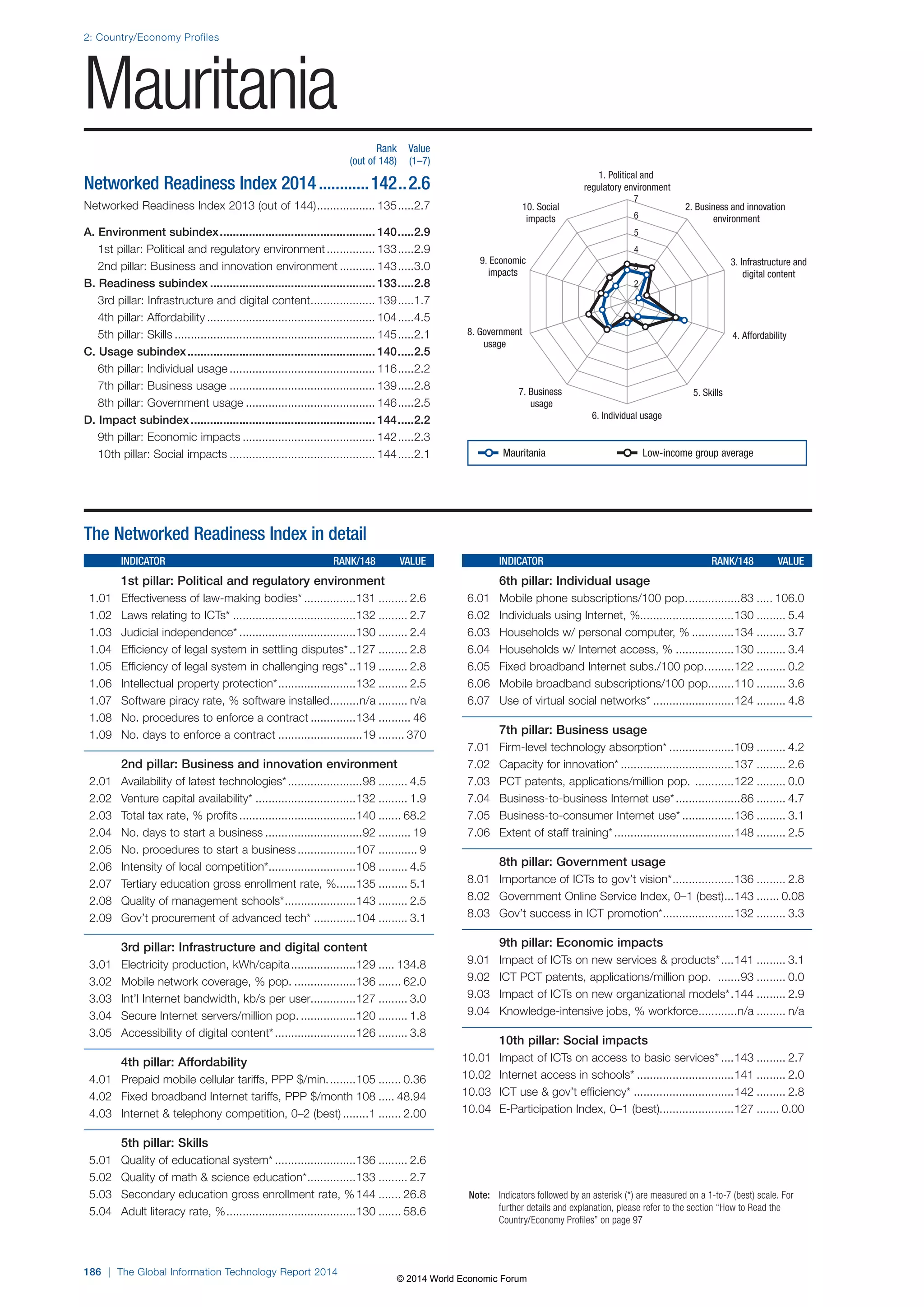
142 Mauritania 2.61 135 
143 Haiti 2.52 141 
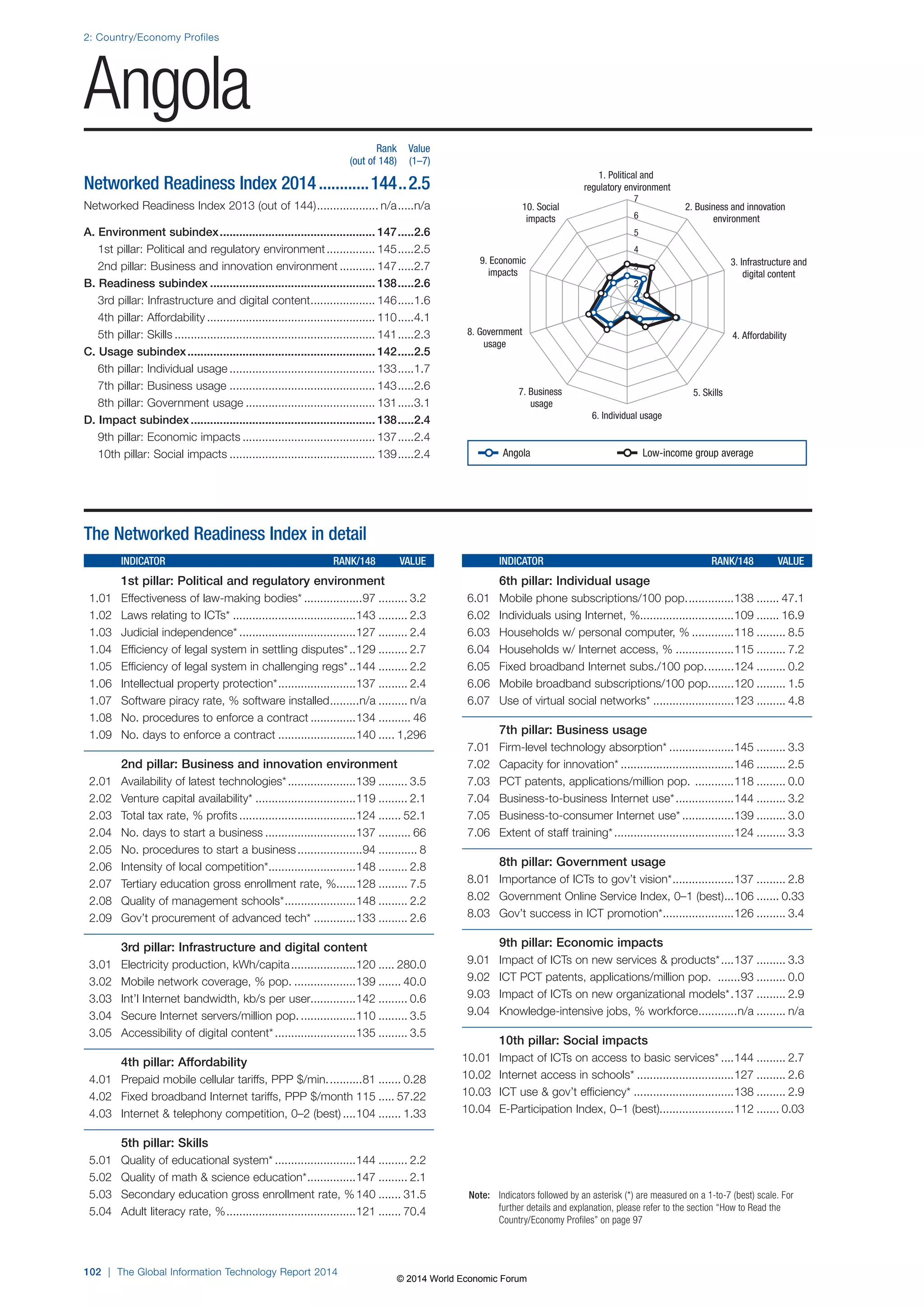
144 Angola 2.52 n/a 
145 Guinea 2.48 140 
146 Myanmar 2.35 n/a 
147 Burundi 2.31 144 
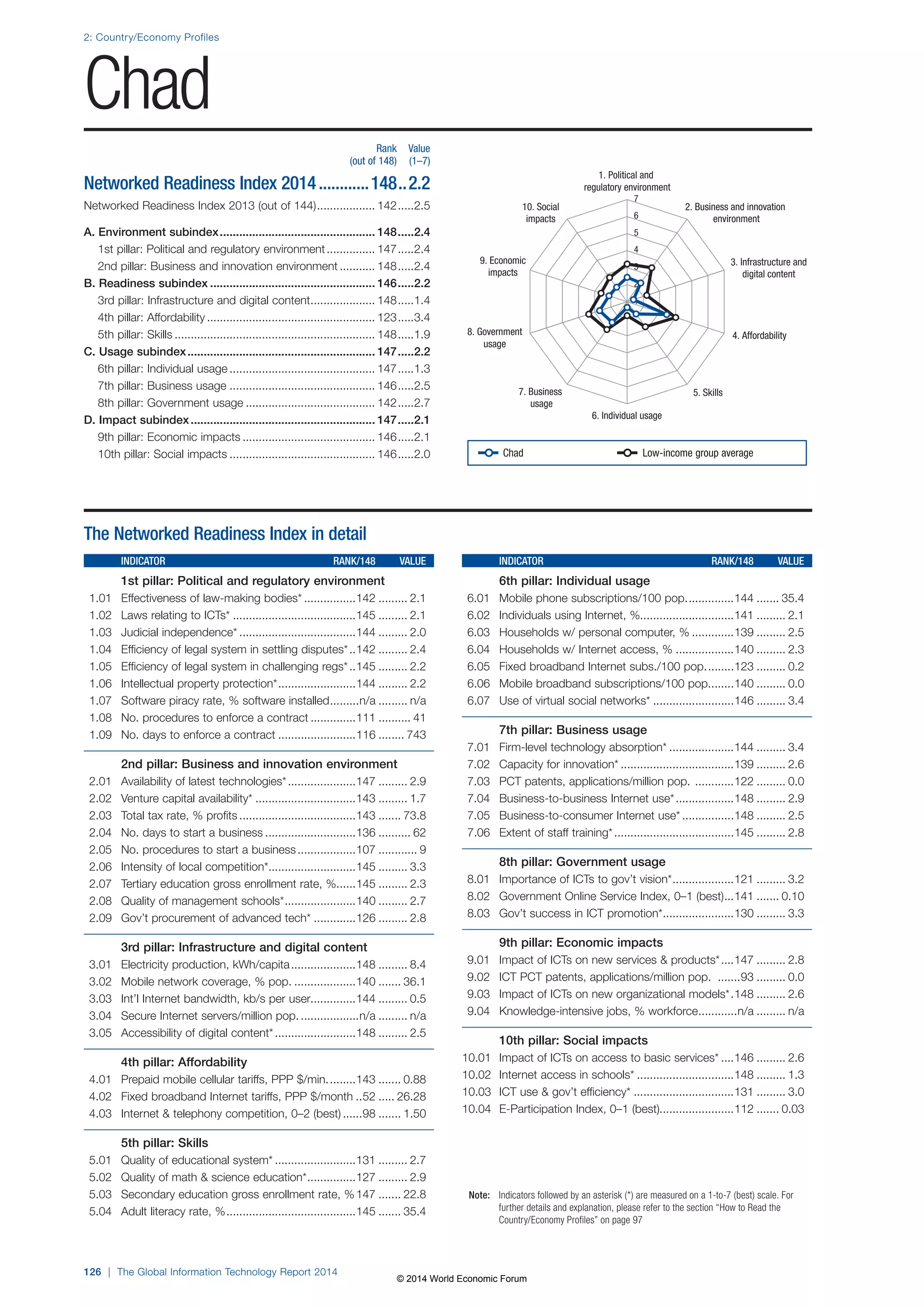
148 Chad 2.22 142 
The Networked Readiness Index 2014 
© 2014 World Economic Forum
Part 1 
The Current Networked 
Readiness Landscape 
and Rewards and Risks 
of Big Data 
© 2014 World Economic Forum
The Global Information Technology Report 2014 | 3 
CHAPTER 1.1 
The Networked Readiness 
Index 2014: Benchmarking 
ICT Uptake in a World of 
Big Data 
BEÑAT BILBAO-OSORIO, World Economic Forum 
ROBERTO CROTTI, World Economic Forum 
SOUMITRA DUTTA, Cornell University 
BRUNO LANVIN, INSEAD 
When The Global Information Technology Report (GITR) 
and the Networked Readiness Index (NRI) were created 
more than 13 years ago, the attention of decision 
makers was focused on how to develop strategies that 
would allow them to benefit from what Time Magazine 
had described as “the new economy”: a new way of 
organizing and managing economic activity based on 
the new opportunities that the Internet provided for 
businesses.1 At present, the world is slowly emerging 
from one of the worst financial and economic crises 
in decades, and policymakers, business leaders, and 
civil society are looking into new opportunities that 
can consolidate growth, generate new employment, 
and create business opportunities. Information and 
communication technologies (ICTs) continue to rank 
high on the list as one of the key sources of new 
opportunities to foster innovation and boost economic 
and social prosperity, for both advanced and emerging 
economies. 
For more than 13 years, the NRI has provided 
decision makers with a useful conceptual framework 
to evaluate the impact of ICTs at a global level and 
to benchmark the ICT readiness and usage of their 
economies. 
EXTRACTING VALUE FROM BIG DATA 
Data have always had strategic value, but with the 
magnitude of data available today—and our capability to 
process them—they have become a new form of asset 
class. In a very real sense, data are now the equivalent 
of oil or gold. And today we are seeing a data boom 
rivaling the Texas oil boom of the 20th century and the 
San Francisco gold rush of the 1800s. It has spawned 
an entire support industry and has attracted a great deal 
of business press in recent years. 
As explained in more detail in Chapter 1.3, this 
new asset class of big data is commonly described by 
what we call the “three Vs.” Big data is high volume, 
high velocity, and includes a high variety of sources 
of information. Next to those three Vs we could add a 
fourth: value. This is what everyone is looking for, and 
this is why big data today gets so much attention. In the 
quest for value, the challenge facing us is how to reduce 
the complexity and unwieldiness of big data so that it 
becomes truly valuable. 
Big data can take the form of structured data such 
as financial transactions or unstructured data such as 
photographs or blog posts. It can be crowd-sourced or 
obtained from proprietary data sources. Big data has 
been fueled by both technological advances (such as the 
spread of radio-frequency identification, or RFID, chips) 
and social trends (such as the widespread adoption of 
social media). Our collective discussions, comments, 
likes, dislikes, and networks of social connections are 
now all data, and their scale is massive. What did we 
search for? What did we read? Where did we go? With 
whom do we associate? What do we eat? What do 
© 2014 World Economic Forum
1.1: The Networked Readiness Index 2014 
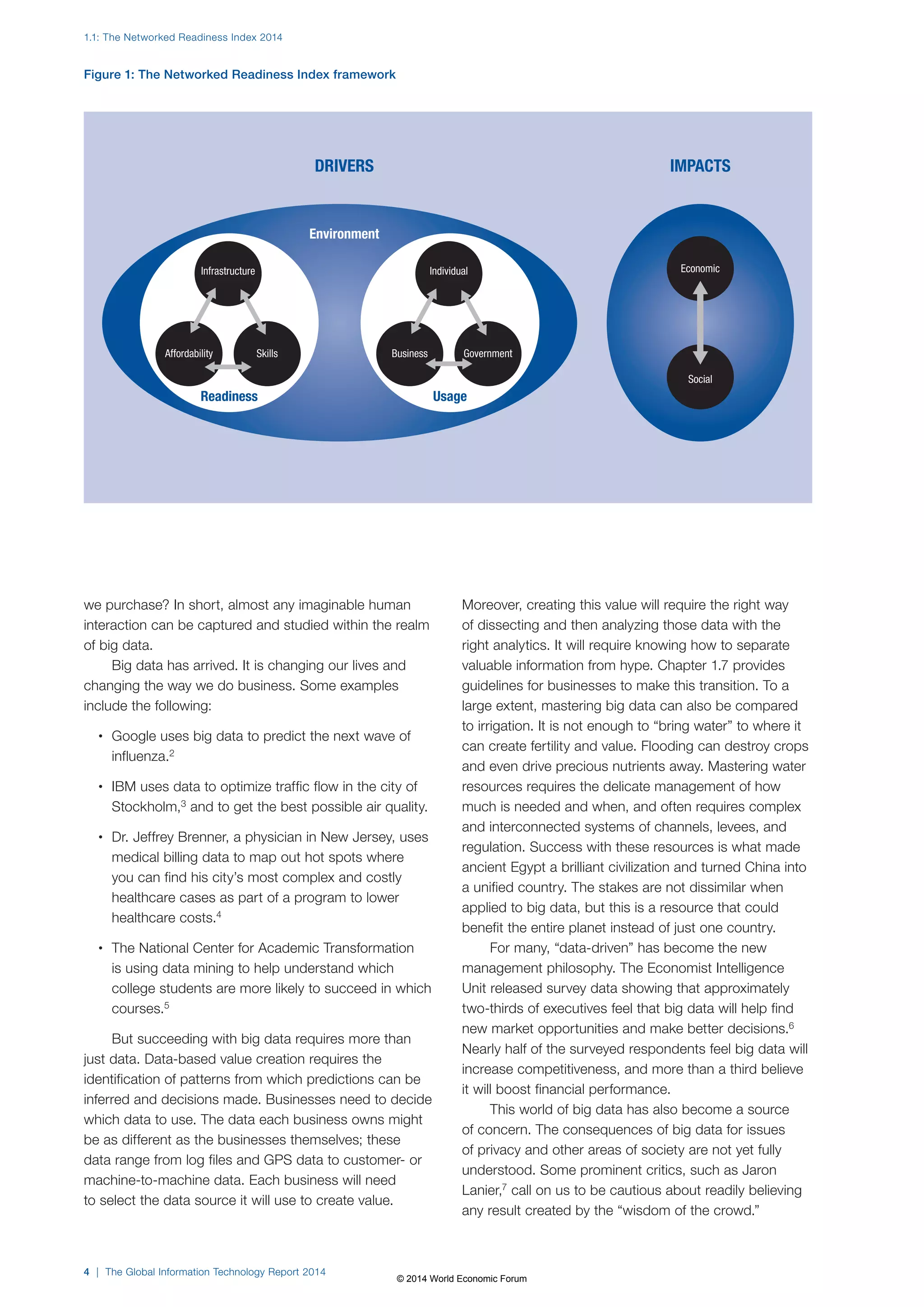
Figure 1: The Networked Readiness Index framework 
DRIVERS 
we purchase? In short, almost any imaginable human 
interaction can be captured and studied within the realm 
of big data. 
Big data has arrived. It is changing our lives and 
changing the way we do business. Some examples 
include the following: 
• Google uses big data to predict the next wave of 
influenza.2 
• IBM uses data to optimize traffic flow in the city of 
Stockholm,3 and to get the best possible air quality. 
• Dr. Jeffrey Brenner, a physician in New Jersey, uses 
medical billing data to map out hot spots where 
you can find his city’s most complex and costly 
healthcare cases as part of a program to lower 
healthcare costs.4 
• The National Center for Academic Transformation 
is using data mining to help understand which 
college students are more likely to succeed in which 
courses.5 
But succeeding with big data requires more than 
just data. Data-based value creation requires the 
identification of patterns from which predictions can be 
inferred and decisions made. Businesses need to decide 
which data to use. The data each business owns might 
be as different as the businesses themselves; these 
data range from log files and GPS data to customer- or 
machine-to-machine data. Each business will need 
to select the data source it will use to create value. 
4 | The Global Information Technology Report 2014 
Moreover, creating this value will require the right way 
of dissecting and then analyzing those data with the 
right analytics. It will require knowing how to separate 
valuable information from hype. Chapter 1.7 provides 
guidelines for businesses to make this transition. To a 
large extent, mastering big data can also be compared 
to irrigation. It is not enough to “bring water” to where it 
can create fertility and value. Flooding can destroy crops 
and even drive precious nutrients away. Mastering water 
resources requires the delicate management of how 
much is needed and when, and often requires complex 
and interconnected systems of channels, levees, and 
regulation. Success with these resources is what made 
ancient Egypt a brilliant civilization and turned China into 
a unified country. The stakes are not dissimilar when 
applied to big data, but this is a resource that could 
benefit the entire planet instead of just one country. 
For many, “data-driven” has become the new 
management philosophy. The Economist Intelligence 
Unit released survey data showing that approximately 
two-thirds of executives feel that big data will help find 
new market opportunities and make better decisions.6 
Nearly half of the surveyed respondents feel big data will 
increase competitiveness, and more than a third believe 
it will boost financial performance. 
This world of big data has also become a source 
of concern. The consequences of big data for issues 
of privacy and other areas of society are not yet fully 
understood. Some prominent critics, such as Jaron 
Lanier,7 call on us to be cautious about readily believing 
any result created by the “wisdom of the crowd.” 
Infrastructure 
Affordability Skills 
Individual 
Environment 
Business Government 
IMPACTS 
Economic 
Social 
Readiness Usage 
© 2014 World Economic Forum
1.1: The Networked Readiness Index 2014 
The Global Information Technology Report 2014 | 5 
Moreover, applications of big data in military intelligence 
have created a growing concern for privacy around the 
world. 
Indeed, we are now living in a world where anything 
and everything can be measured. “Data” could become 
a new ideology. We are just at the beginning of a long 
journey where, with the proper principles and guidelines, 
we should be able to collect, measure, and analyze more 
and more information about everyone and everything 
in order to make better decisions, individually and 
collectively. 
THE NETWORKED READINESS FRAMEWORK: A 
HOLISTIC APPROACH TO MEASURE ICT ACCESS 
AND IMPACTS 
Because of the potential high returns that ICTs can 
provide in transforming a nation’s economy and 
increasing its citizens’ well-being, assessing ICT 
developments has been the object of much academic 
and policy attention over the past decade. Several 
organizations have exerted significant effort toward 
measuring and benchmarking ICT deployment and 
uptake, but few have tried as hard to assess the returns 
that ICTs can actually provide to both the economy and 
society. Although data are still scarce in terms of ICT 
impacts, policy interest in measuring ICTs has shifted 
from measuring ICT access to measuring ICT impacts. 
In 2012, after two years of research and 
consultations with ICT practitioners, policy and industry 
experts, and academia, the Networked Readiness Index 
(NRI) introduced a new subindex on ICT impacts that 
aimed at holistically assessing the way that countries 
go about leveraging ICTs and benefiting from them in 
terms of enhanced competitiveness and well-being. 
This evolution ensures that the NRI framework remains 
at the forefront of ICT measurement. As one of the 
most authoritative assessments of its kind, it has been 
adopted by several governments as a valuable tool for 
informing their competitiveness and policy agendas. 
The design of the framework for the calculation of 
the NRI (Figure1) has been guided by five principles: 
1. Measuring the economic and social impacts of 
ICTs is crucial. The NRI must include aspects of 
the way ICTs are transforming both the economy 
and society. In several economies, the ICT industry 
has become increasingly important and now 
accounts for a significant share of value-added and 
employment. In addition, ICTs interact closely with 
many other sectors, thus enabling innovations to 
accrue and affecting productivity. Moreover, the 
impacts of ICTs are also evident in the development 
of new skills that are important in knowledge-based, 
information-rich societies and that are crucial 
for employment. In society, ICTs allow citizens to 
participate more actively and steadily in social and 
political debates and make the government more 
accountable. They improve access to better and 
faster services, which, in turn, yield significant 
benefits. 
2. An enabling environment determines the 
capacity of an economy and society to benefit 
from the use of ICTs. The success of a country 
in leveraging ICTs and achieving the desired 
economic and social benefits will depend on its 
overall environment—including market conditions, 
the regulatory framework, and innovation-prone 
conditions—to boost innovation and 
entrepreneurship. 
3. ICT readiness and usage remain key drivers and 
preconditions for obtaining any impacts. Despite 
the increasing availability of ICTs, the question of 
access and usage remains important especially for 
developing countries, given their need to narrow 
the digital divide. Even within developed nations, 
the need to provide high-speed broadband to all 
segments of the population has acquired greater 
importance in recent years. Some features of the 
NRI are related to access and usage; these cover 
not only affordable ICT infrastructure but also digital 
resources, including software and skills. Moreover, 
ICT impacts can arise only if ICTs are widely used 
by all key actors—individuals, businesses, and 
governments. It is a society-wide effort. Those 
actors demonstrating better preparedness and 
greater interest are likely to use ICTs more and 
more effectively, contributing to a greater impact on 
competitiveness and development. 
4. All factors interact and co-evolve within an ICT 
ecosystem. Those societies that can count on 
better-prepared actors and an enabling environment 
are more likely to benefit from higher rates of ICT 
use and more extensive impacts. At the same time, 
those societies that benefit from higher rates of 
ICT use and positive impacts will, in turn, be more 
likely to benefit from a push on the part of the 
different stakeholders to be better prepared and 
keep improving the framework conditions that will 
allow for more and stronger benefits to accrue. As a 
result, a virtuous circle starts, where improvements 
in one area affect and drive improvements in other 
areas. Conversely, lags in one particular factor also 
affect the evolution of the other factors. 
5. The framework should provide clear policy 
orientations and identify opportunities for 
public-private collaboration. The NRI facilitates 
the identification of areas where policy intervention— 
through investment including public-private 
partnerships, smart regulation, or the provision 
of incentives—could boost the impacts of ICTs. 
This is important because the development and 
general uptake of ICTs depend on the capacity 
of a country to provide an institutional framework 
© 2014 World Economic Forum
1.1: The Networked Readiness Index 2014 
with reliable and efficient rules and regulations; 
favorable business conditions for the founding and 
growth of new (social and commercial) enterprises; 
an innovation-prone environment, capable of 
developing and absorbing new knowledge; and an 
ICT-friendly government policy. 
ELEMENTS OF THE NETWORKED READINESS 
INDEX 
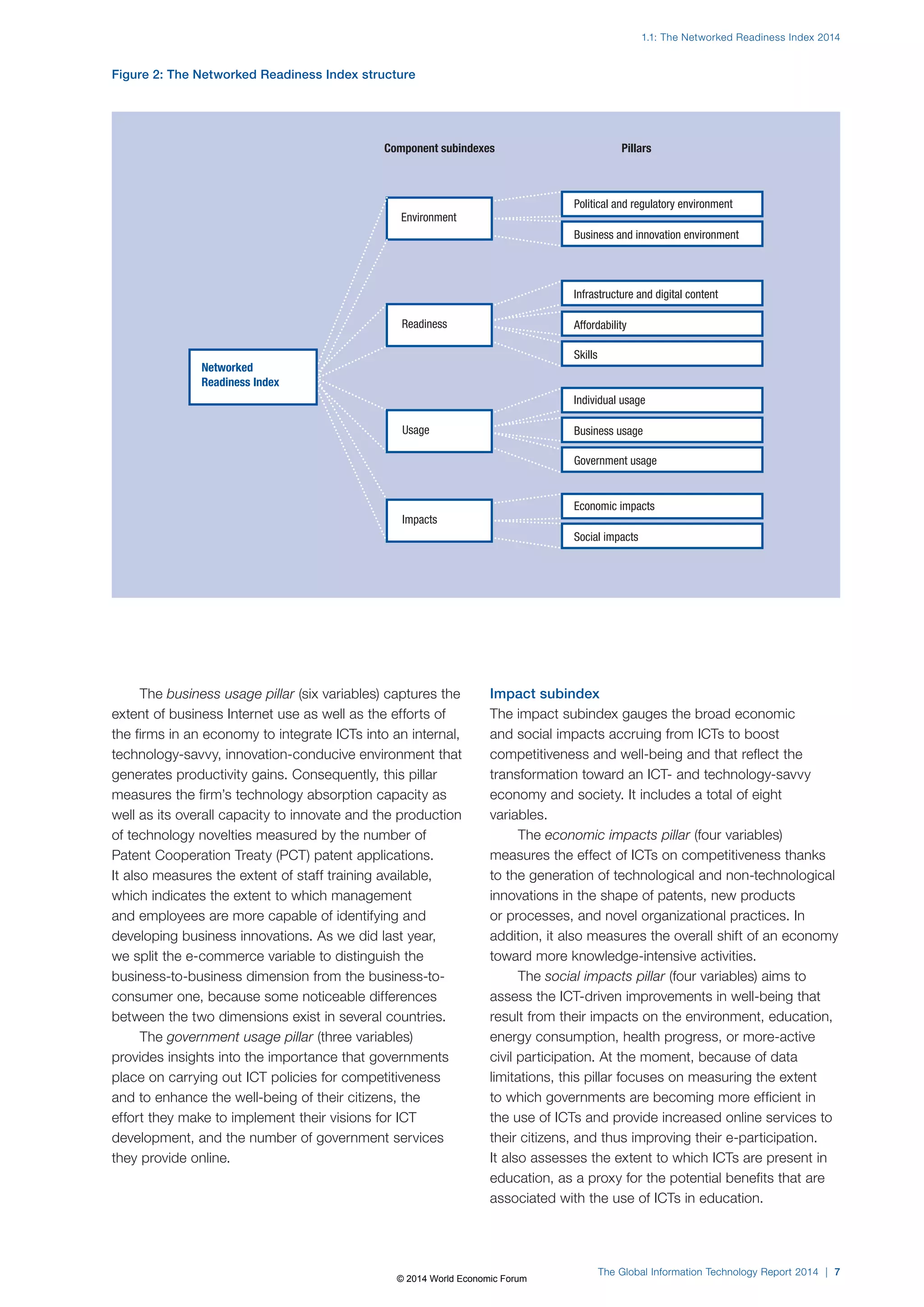
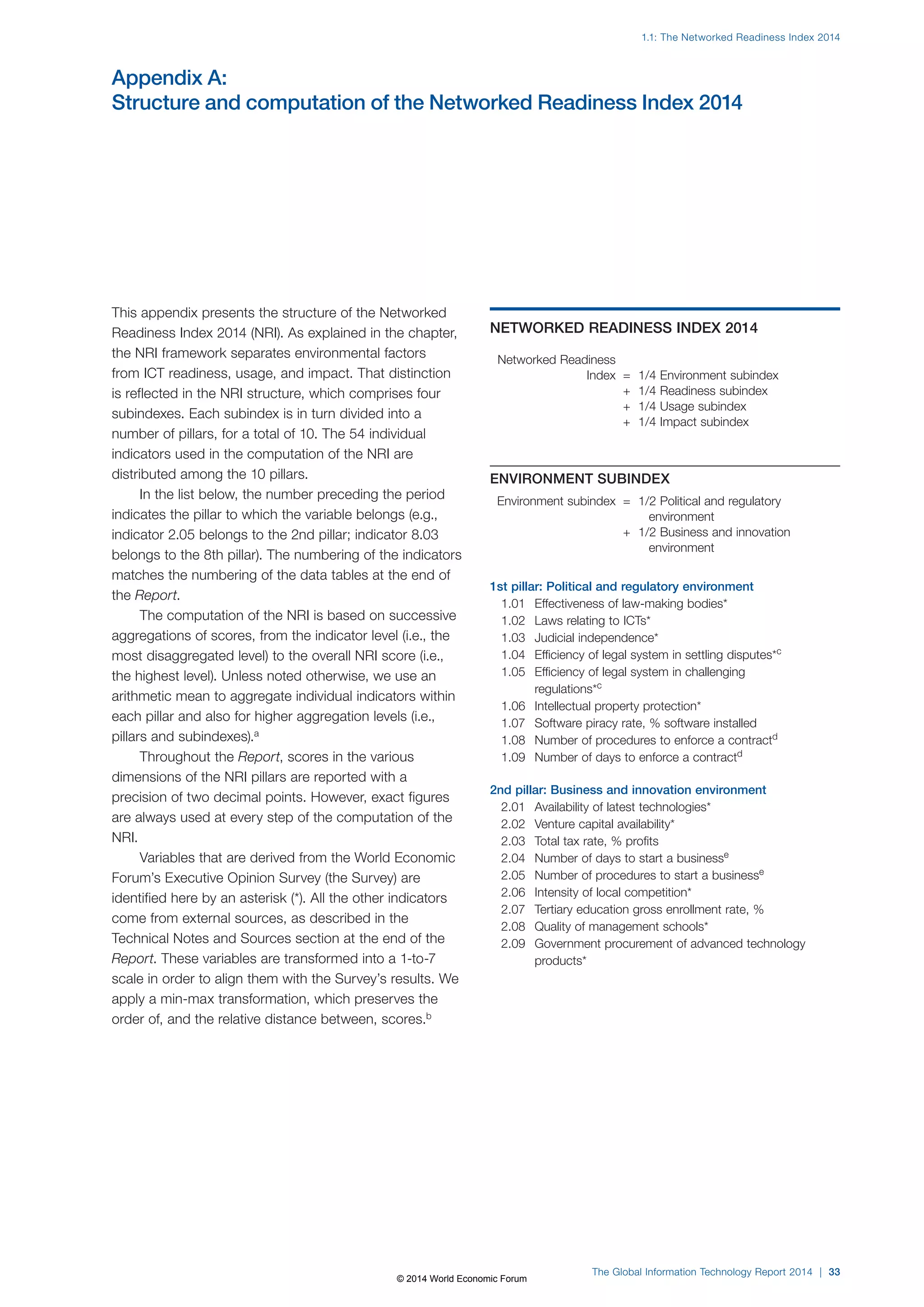
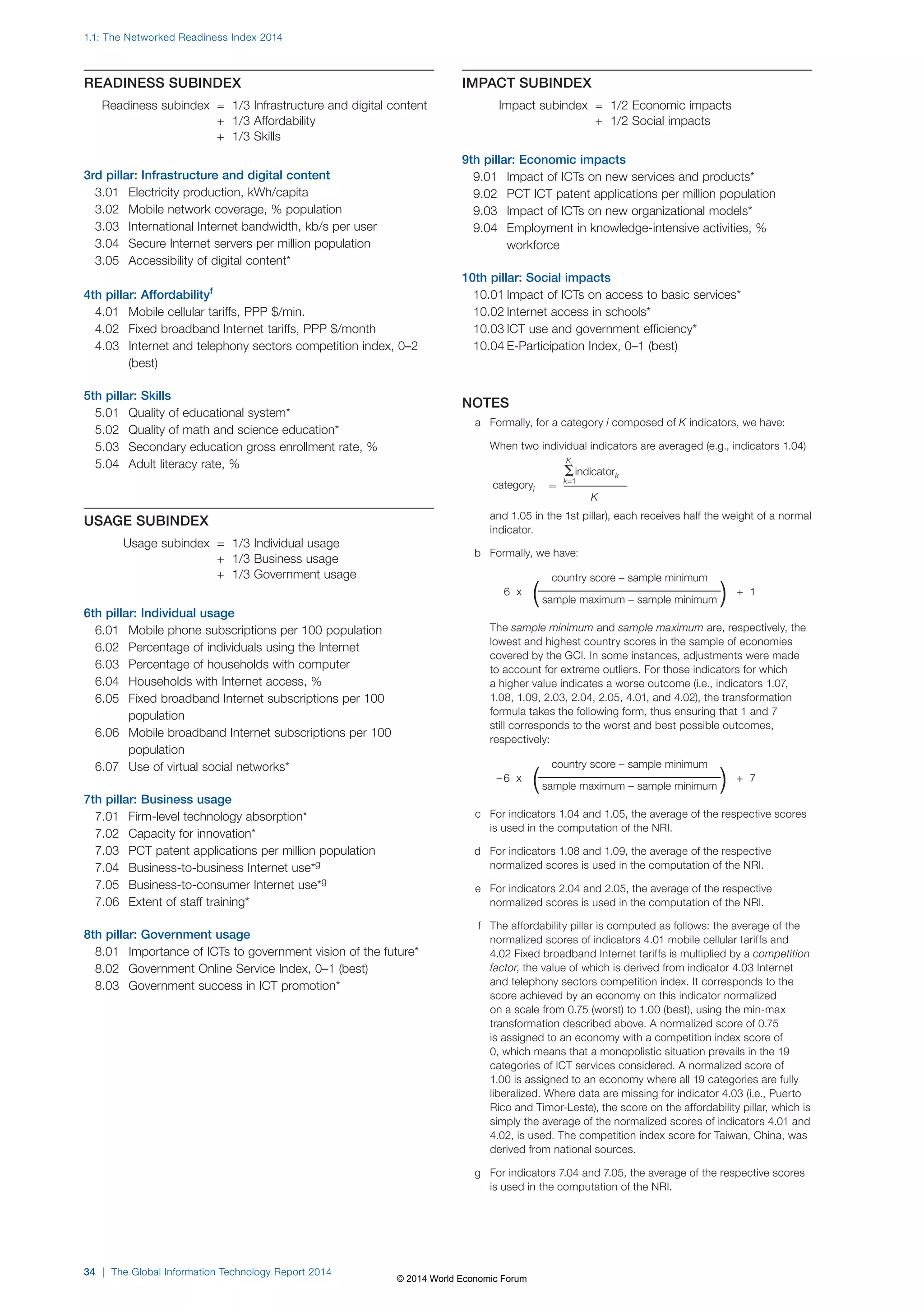
The networked readiness framework translates into the 
NRI, comprising four subindexes: these measure the 
environment for ICTs; the readiness of a society to use 
ICTs; the actual usage of all main stakeholders; and, 
finally, the impacts that ICTs generate in the economy 
and in society. The three first subindexes can be 
regarded as the drivers that establish the conditions for 
the results of the fourth subindex, ICT impacts. These 
four subindexes are divided into 10 pillars composed of 
54 individual indicators in total, according to the following 
structure (see also Figure2): 
A. Environment subindex 
1. Political and regulatory environment 
2. Business and innovation environment 
B. Readiness subindex 
3. Infrastructure and digital content 
4. Affordability 
5. Skills 
C. Usage subindex 
6. Individual usage 
7. Business usage 
8. Government usage 
D. Impact subindex 
9. Economic impacts 
10. Social impacts 
The final NRI score is a simple average of the four 
composing subindex scores, while each subindex’s 
score is a simple average of those of the composing 
pillars. In doing this, we assume that all NRI subindexes 
make a similar contribution to networked readiness. 
Appendix A includes detailed information on the 
composition and computation of the NRI 2014, while we 
briefly describe the different subindexes below. 
Environment subindex 
The environment subindex gauges the friendliness 
of a country’s market and regulatory framework in 
supporting high levels of ICT uptake and the emergence 
of entrepreneurship and innovation-prone conditions. A 
supportive environment is necessary to maximize the 
potential impacts of ICTs in boosting competitiveness 
and well-being. It includes a total of 18 variables 
distributed into two pillars. 
The political and regulatory environment pillar 
(composed of nine variables) assesses the extent 
6 | The Global Information Technology Report 2014 
to which the national legal framework facilitates ICT 
penetration and the safe development of business 
activities, taking into account general features of the 
regulatory environment (including the protection afforded 
to property rights, the independence of the judiciary, and 
the efficiency of the law-making process) as well as more 
ICT-specific dimensions (the passing of laws related to 
ICTs and software piracy rates). 
The business and innovation environment pillar 
(nine variables) gauges the capacity of the business 
framework’s conditions to boost entrepreneurship, 
taking into account dimensions related to the ease of 
doing business (including the presence of red tape 
and excessive fiscal charges). This pillar also measures 
the presence of conditions that allow innovation to 
flourish by including variables on the overall availability 
of technology, the demand conditions for innovative 
products (as proxied by the development of government 
procurement of advanced technology products), the 
availability of venture capital for financing innovation-related 
projects, and the presence of a skilled labor 
force. 
Readiness subindex 
The readiness subindex, with a total of 12 variables, 
measures the degree to which a society is prepared to 
make good use of an affordable ICT infrastructure and 
digital content. 
The infrastructure and digital content pillar (five 
variables) captures the development of ICT infrastructure 
(including mobile network coverage, international Internet 
bandwidth, secure Internet servers, and electricity 
production) as well as the accessibility of digital content. 
The affordability pillar (three variables) assesses 
the cost of accessing ICTs, either via mobile telephony 
or fixed broadband Internet, as well as the level of 
competition in the Internet and telephony sectors that 
determine this cost. 
The skills pillar (four variables) gauges the ability 
of a society to make effective use of ICTs thanks to 
the existence of basic educational skills captured by 
the quality of the educational system, the level of adult 
literacy, and the rate of secondary education enrollment. 
Usage subindex 
The usage subindex assesses the individual efforts of 
the main social agents—that is, individuals, business, 
and government—to increase their capacity to use ICTs 
as well as their actual use in their day-to-day activities 
with other agents. It includes 16 variables. 
The individual usage pillar (seven variables) 
measures ICT penetration and diffusion at the individual 
level, using indicators such as the number of mobile 
phone subscriptions, individuals using the Internet, 
households with a personal computer (PC), households 
with Internet access, both fixed and mobile broadband 
subscriptions, and the use of social networks. 
© 2014 World Economic Forum
1.1: The Networked Readiness Index 2014 
Figure 2: The Networked Readiness Index structure 
Component subindexes Pillars 
Political and regulatory environment 
Business and innovation environment 
Infrastructure and digital content 
Individual usage 
Economic impacts 
The Global Information Technology Report 2014 | 7 
The business usage pillar (six variables) captures the 
extent of business Internet use as well as the efforts of 
the firms in an economy to integrate ICTs into an internal, 
technology-savvy, innovation-conducive environment that 
generates productivity gains. Consequently, this pillar 
measures the firm’s technology absorption capacity as 
well as its overall capacity to innovate and the production 
of technology novelties measured by the number of 
Patent Cooperation Treaty (PCT) patent applications. 
It also measures the extent of staff training available, 
which indicates the extent to which management 
and employees are more capable of identifying and 
developing business innovations. As we did last year, 
we split the e-commerce variable to distinguish the 
business-to-business dimension from the business-to-consumer 
one, because some noticeable differences 
between the two dimensions exist in several countries. 
The government usage pillar (three variables) 
provides insights into the importance that governments 
place on carrying out ICT policies for competitiveness 
and to enhance the well-being of their citizens, the 
effort they make to implement their visions for ICT 
development, and the number of government services 
they provide online. 
Impact subindex 
The impact subindex gauges the broad economic 
and social impacts accruing from ICTs to boost 
competitiveness and well-being and that reflect the 
transformation toward an ICT- and technology-savvy 
economy and society. It includes a total of eight 
variables. 
The economic impacts pillar (four variables) 
measures the effect of ICTs on competitiveness thanks 
to the generation of technological and non-technological 
innovations in the shape of patents, new products 
or processes, and novel organizational practices. In 
addition, it also measures the overall shift of an economy 
toward more knowledge-intensive activities. 
The social impacts pillar (four variables) aims to 
assess the ICT-driven improvements in well-being that 
result from their impacts on the environment, education, 
energy consumption, health progress, or more-active 
civil participation. At the moment, because of data 
limitations, this pillar focuses on measuring the extent 
to which governments are becoming more efficient in 
the use of ICTs and provide increased online services to 
their citizens, and thus improving their e-participation. 
It also assesses the extent to which ICTs are present in 
education, as a proxy for the potential benefits that are 
associated with the use of ICTs in education. 
Networked 
Readiness Index 
Readiness Affordability 
Skills 
Usage Business usage 
Government usage 
Environment 
Social impacts 
Impacts 
© 2014 World Economic Forum
1.1: The Networked Readiness Index 2014 
Figure 3: Breakdown of indicators used in the Networked Readiness Index 2014 by data source 
In general, measuring the impacts of ICTs is 
INDICATORS FROM 
OTHER SOURCES 
27 INDICATORS 
a complex task, and the development of rigorous 
quantitative data to do so is still in its infancy. As a result, 
many of the dimensions where ICTs are producing 
important impacts—especially when these impacts are 
not directly translated into commercial activities, as is 
the case for the environment and for health—cannot yet 
be covered. Therefore this subindex should be regarded 
as a work in progress that will evolve to accommodate 
new data on many of these dimensions as they become 
available. 
COMPUTATION METHODOLOGY AND DATA 
In order to capture as comprehensively as possible all 
relevant dimensions of societies’ networked readiness, 
the NRI 2014 is composed of a mixture of quantitative 
and survey data, as shown in Figure3. 
Of the 54 variables composing the NRI this year, 
27—or 50 percent—are quantitative data, collected 
primarily by international organizations such as 
International Telecommunication Union (ITU), the World 
Bank, and the United Nations. International sources 
ensure the validation and comparability of data across 
countries. 
The remaining 27 variables capture aspects that 
are more qualitative in nature or for which internationally 
comparable quantitative data are not available for a large 
enough number of countries, but that nonetheless are 
crucial to fully measure national networked readiness. 
These data come from the Executive Opinion Survey (the 
Survey), which the Forum administers annually to over 
8 | The Global Information Technology Report 2014 
TOTAL: 54 INDICATORS 
(50%) 
15,000 business leaders in all economies included in 
the Report.8 The Survey represents a unique source of 
insight into many critical aspects related to the enabling 
environment, such as the effectiveness of law-making 
bodies and the intensity of local competition; into ICT 
readiness, such as the quality of the educational system 
and the accessibility of digital content; into ICT usage, 
such as capacity to innovate and the importance of 
government vision for ICTs; and into impacts, such as 
the impact of ICTs on developing new products and 
services and improving access to basic services. 
The NRI’s coverage every year is determined 
by the Survey coverage and data availability for 
indicators obtained from other sources, mostly 
international organizations. This year the Report 
includes 148 economies, four more than the 2013 
edition. The newly covered countries are Bhutan, Lao 
PDR, and Myanmar. We have also re-instated Angola 
and Tunisia into the Index, two countries that were not 
included in last year’s edition. Tajikistan is not covered 
in the 2014 Report because Survey data could not be 
collected this year. 
More details on variables included in the Index and 
their computation can be found in Appendix A and in the 
Technical Notes and Sources section at the end of the 
Report. 
THE CURRENT NETWORKED READINESS 
LANDSCAPE: INSIGHTS FROM THE NRI 2014 
This section provides an overview of the networked 
readiness landscape of the world as assessed by the 
EXECUTIVE OPINION 
SURVEY 
27 INDICATORS 
(50%) 
© 2014 World Economic Forum
1.1: The Networked Readiness Index 2014 
The Global Information Technology Report 2014 | 9 
NRI 2014. It presents the results of the top 10 performers 
and selected countries by region, in the following order: 
Europe and the Commonwealth of Independent States; 
Asia and the Pacific; Latin America and the Caribbean, 
sub-Saharan Africa; and the Middle East and North 
Africa. 
Tables 1 through 5 report the 2014 rankings for 
the overall NRI, its four subindexes, and its 10 pillars. In 
addition, the Country/Economy Profiles and Data Tables 
sections at the end of the Report present the detailed 
results for the 148 economies covered by the study and 
the 54 indicators composing the NRI. To complement 
the analysis of the results, Box1 presents a classification 
of countries based on their NRI 2014 scores and the 
change rate of this Index over a two-year period; Box2 
assesses the nature of the digital divide in Europe; 
and Box3 discusses the challenges large emerging 
economies must overcome if they are to keep moving 
forward in integrating ICTs into more robust innovation 
ecosystems that could help them transition from what 
appears to be a mid-life crisis toward a knowledge-based 
society. Figure4 presents an intensity map of the 
world; economies are color-coded based on their NRI 
overall score measured on a 1-to-7 scale, with best- and 
worst-performing economies appearing in dark green 
and red, respectively. Finally, Appendix A of the present 
chapter details the structure of the NRI and describes 
the method of calculation. 
TOP 10 
As in previous years, the top 10 spots continue to be 
dominated by Northern European economies, the 
Asian Tigers, and some of the most advanced Western 
economies. Three Nordic economies—Finland, 
Sweden, and Norway—lead the rankings and are 
positioned among the top 5. Denmark and Iceland, 
the remaining two Nordic economies, also perform 
strongly, and despite small slips this year they feature 
among the top 20. Overall, their performance in terms of 
ICT readiness, with excellent digital infrastructures and 
robust innovation systems, allows them to score very 
highly both in ICT use—with almost universal Internet 
use, for example—and in innovation performances. The 
Asian Tigers—composed of Singapore, Hong Kong 
SAR, the Republic of Korea, and Taiwan (China)—also 
perform very strongly, all of them positioned at the 
forefront of the NRI and with Singapore, Hong Kong 
SAR, and the Republic of Korea featuring among 
the top 10. All these economies continue to boast 
outstanding business and innovation environments that 
are consistently ranked among the most conducive to 
entrepreneurship in the world. Finally, the top 10 includes 
some of the most advanced Western economies—the 
Netherlands, Switzerland, the United States, and the 
United Kingdom—that have recognized the potential of 
ICTs to embark in a new economic and social revolution, 
and thus have substantially invested in developing their 
digital potential. 
In dynamic terms, this year the rankings remain very 
stable, with no movement in the top 6 and negligible 
Figure 4: The Networked Readiness Index map 
Value 
n 5.4–7.0 (best) 
n 5.0–5.4 
n 4.0–5.0 
n 3.3–4.0 
n 1.0(worst)–3.3 
n Not covered 
© 2014 World Economic Forum
1.1: The Networked Readiness Index 2014 
Table 1: The Networked Readiness Index 2014 
2013 rank 
Rank Country/Economy Value (out of 144) Group* 
1 Finland 6.04 1 ADV 
2 Singapore 5.97 2 ADV 
3 Sweden 5.93 3 ADV 
4 Netherlands 5.79 4 ADV 
5 Norway 5.70 5 ADV 
6 Switzerland 5.62 6 ADV 
7 United States 5.61 9 ADV 
8 Hong Kong SAR 5.60 14 ADV 
9 United Kingdom 5.54 7 ADV 
10 Korea, Rep. 5.54 11 ADV 
11 Luxembourg 5.53 16 ADV 
12 Germany 5.50 13 ADV 
13 Denmark 5.50 8 ADV 
14 Taiwan, China 5.47 10 ADV 
15 Israel 5.42 15 ADV 
16 Japan 5.41 21 ADV 
17 Canada 5.41 12 ADV 
18 Australia 5.40 18 ADV 
19 Iceland 5.30 17 ADV 
20 New Zealand 5.27 20 ADV 
21 Estonia 5.27 22 ADV 
22 Austria 5.26 19 ADV 
23 Qatar 5.22 23 MENA 
24 United Arab Emirates 5.20 25 MENA 
25 France 5.09 26 ADV 
26 Ireland 5.07 27 ADV 
27 Belgium 5.06 24 ADV 
28 Malta 4.96 28 ADV 
29 Bahrain 4.86 29 MENA 
30 Malaysia 4.83 30 DEVASIA 
31 Lithuania 4.78 32 CEE 
32 Saudi Arabia 4.78 31 MENA 
33 Portugal 4.73 33 ADV 
34 Spain 4.69 38 ADV 
35 Chile 4.61 34 LATAM 
36 Slovenia 4.60 37 ADV 
37 Cyprus 4.60 35 ADV 
38 Kazakhstan 4.58 43 CIS 
39 Latvia 4.58 41 CEE 
40 Oman 4.56 40 MENA 
41 Puerto Rico 4.54 36 ADV 
42 Czech Republic 4.49 42 ADV 
43 Panama 4.36 46 LATAM 
44 Jordan 4.36 47 MENA 
45 Brunei Darussalam 4.34 57 DEVASIA 
46 Croatia 4.34 51 CEE 
47 Hungary 4.32 44 CEE 
48 Mauritius 4.31 55 SSA 
49 Azerbaijan 4.31 56 CIS 
50 Russian Federation 4.30 54 CIS 
51 Turkey 4.30 45 CEE 
52 Montenegro 4.27 48 CEE 
53 Costa Rica 4.25 53 LATAM 
54 Poland 4.24 49 CEE 
55 Barbados 4.22 39 LATAM 
56 Uruguay 4.22 52 LATAM 
57 Macedonia, FYR 4.19 67 CEE 
58 Italy 4.18 50 ADV 
59 Slovak Republic 4.12 61 ADV 
60 Georgia 4.09 65 CIS 
61 Mongolia 4.07 59 CIS 
62 China 4.05 58 DEVASIA 
63 Colombia 4.05 66 LATAM 
64 Indonesia 4.04 76 DEVASIA 
65 Armenia 4.03 82 CIS 
66 Seychelles 4.02 79 SSA 
67 Thailand 4.01 74 DEVASIA 
68 Bosnia and Herzegovina 3.99 78 CEE 
69 Brazil 3.98 60 LATAM 
70 South Africa 3.98 70 SSA 
71 Trinidad and Tobago 3.97 72 LATAM 
72 Kuwait 3.96 62 MENA 
73 Bulgaria 3.96 71 CEE 
74 Greece 3.95 64 ADV 
10 | The Global Information Technology Report 2014 
2013 rank 
Rank Country/Economy Value (out of 144) Group* 
75 Romania 3.95 75 CEE 
76 Sri Lanka 3.94 69 DEVASIA 
77 Moldova 3.89 77 CIS 
78 Philippines 3.89 86 DEVASIA 
79 Mexico 3.89 63 LATAM 
80 Serbia 3.88 87 CEE 
81 Ukraine 3.87 73 CIS 
82 Ecuador 3.85 91 LATAM 
83 India 3.85 68 DEVASIA 
84 Vietnam 3.84 84 DEVASIA 
85 Rwanda 3.78 88 SSA 
86 Jamaica 3.77 85 LATAM 
87 Tunisia 3.77 n/a MENA 
88 Guyana 3.77 100 LATAM 
89 Cape Verde 3.73 81 SSA 
90 Peru 3.73 103 LATAM 
91 Egypt 3.71 80 MENA 
92 Kenya 3.71 92 SSA 
93 Dominican Republic 3.69 90 LATAM 
94 Bhutan 3.68 n/a DEVASIA 
95 Albania 3.66 83 CEE 
96 Ghana 3.65 95 SSA 
97 Lebanon 3.64 94 MENA 
98 El Salvador 3.63 93 LATAM 
99 Morocco 3.61 89 MENA 
100 Argentina 3.53 99 LATAM 
101 Guatemala 3.52 102 LATAM 
102 Paraguay 3.47 104 LATAM 
103 Botswana 3.43 96 SSA 
104 Iran, Islamic Rep. 3.42 101 MENA 
105 Namibia 3.41 111 SSA 
106 Venezuela 3.39 108 LATAM 
107 Gambia, The 3.38 98 SSA 
108 Cambodia 3.36 106 DEVASIA 
109 Lao PDR 3.34 n/a DEVASIA 
110 Zambia 3.34 115 SSA 
111 Pakistan 3.33 105 MENA 
112 Nigeria 3.31 113 SSA 
113 Suriname 3.30 117 LATAM 
114 Senegal 3.30 107 SSA 
115 Uganda 3.25 110 SSA 
116 Honduras 3.24 109 LATAM 
117 Zimbabwe 3.24 116 SSA 
118 Kyrgyz Republic 3.22 118 CIS 
119 Bangladesh 3.21 114 DEVASIA 
120 Bolivia 3.21 119 LATAM 
121 Liberia 3.19 97 SSA 
122 Côte d'Ivoire 3.14 120 SSA 
123 Nepal 3.09 126 DEVASIA 
124 Nicaragua 3.08 125 LATAM 
125 Tanzania 3.04 127 SSA 
126 Swaziland 3.00 136 SSA 
127 Mali 3.00 122 SSA 
128 Gabon 2.98 121 SSA 
129 Algeria 2.98 131 MENA 
130 Ethiopia 2.95 128 SSA 
131 Cameroon 2.94 124 SSA 
132 Malawi 2.90 129 SSA 
133 Lesotho 2.88 138 SSA 
134 Sierra Leone 2.85 143 SSA 
135 Benin 2.82 123 SSA 
136 Burkina Faso 2.78 130 SSA 
137 Mozambique 2.77 133 SSA 
138 Libya 2.75 132 MENA 
139 Madagascar 2.74 137 SSA 
140 Yemen 2.73 139 MENA 
141 Timor-Leste 2.69 134 DEVASIA 
142 Mauritania 2.61 135 MENA 
143 Haiti 2.52 141 LATAM 
144 Angola 2.52 n/a SSA 
145 Guinea 2.48 140 SSA 
146 Myanmar 2.35 n/a DEVASIA 
147 Burundi 2.31 144 SSA 
148 Chad 2.22 142 SSA 
Note: Group classification follows the International Monetary Fund’s classification (situation as of October 2013). 
* Groups: ADV = Advanced economies; CIS = Commonwealth of Independent States and Mongolia; DEVASIA = Developing Asia; LATAM = Latin America and the Caribbean; MENA = Middle East 
and North Africa; SSA = Sub-Saharan Africa. 
© 2014 World Economic Forum
1.1: The Networked Readiness Index 2014 
The Global Information Technology Report 2014 | 11 
Table 2: Environment subindex and pillars 
ENVIRONMENT SUBINDEX 
Rank Country/Economy Score Rank Score Rank Score 
1 Singapore 5.87 1 5.90 1 5.84 
2 New Zealand 5.63 2 5.88 8 5.37 
3 Finland 5.62 3 5.86 9 5.37 
4 Hong Kong SAR 5.56 11 5.40 2 5.72 
5 United Kingdom 5.50 5 5.66 10 5.33 
6 Netherlands 5.48 8 5.53 5 5.44 
7 Norway 5.46 7 5.54 6 5.38 
8 Sweden 5.45 6 5.63 15 5.26 
9 Switzerland 5.41 9 5.51 12 5.31 
10 Canada 5.39 12 5.31 3 5.46 
11 Luxembourg 5.31 4 5.73 29 4.90 
12 Ireland 5.27 13 5.29 16 5.25 
13 Qatar 5.23 14 5.23 17 5.23 
14 Australia 5.20 15 5.23 21 5.17 
15 United States 5.19 22 5.00 7 5.38 
16 Denmark 5.19 19 5.16 18 5.21 
17 Germany 5.14 10 5.41 31 4.87 
18 United Arab Emirates 5.10 24 4.91 13 5.28 
19 Belgium 5.08 21 5.01 22 5.14 
20 Iceland 5.01 27 4.81 19 5.21 
21 Japan 4.99 16 5.23 40 4.75 
22 Israel 4.97 28 4.67 14 5.27 
23 Austria 4.97 18 5.19 39 4.75 
24 Malaysia 4.95 25 4.84 24 5.07 
25 Taiwan, China 4.94 34 4.43 4 5.45 
26 Estonia 4.88 26 4.83 28 4.93 
27 Saudi Arabia 4.86 31 4.59 23 5.12 
28 Rwanda 4.83 17 5.22 55 4.45 
29 Chile 4.83 38 4.34 11 5.32 
30 France 4.82 23 4.97 47 4.67 
31 South Africa 4.76 20 5.05 53 4.48 
32 Puerto Rico 4.75 29 4.64 33 4.86 
33 Oman 4.69 32 4.54 36 4.84 
34 Korea, Rep. 4.68 42 4.18 20 5.19 
35 Portugal 4.63 39 4.26 25 5.00 
36 Malta 4.62 30 4.63 49 4.62 
37 Mauritius 4.61 33 4.48 43 4.75 
38 Barbados 4.58 35 4.42 42 4.75 
39 Cyprus 4.57 45 4.16 26 4.98 
40 Bahrain 4.52 48 4.07 27 4.96 
41 Jordan 4.45 44 4.16 41 4.75 
42 Latvia 4.44 53 4.01 32 4.86 
43 Lithuania 4.41 52 4.02 37 4.79 
44 Turkey 4.38 55 4.00 38 4.77 
45 Spain 4.31 47 4.09 51 4.54 
46 Panama 4.31 62 3.76 35 4.85 
47 Slovenia 4.28 72 3.66 30 4.89 
48 Ghana 4.23 41 4.19 66 4.28 
49 Czech Republic 4.23 51 4.05 60 4.41 
50 Hungary 4.22 54 4.00 56 4.44 
51 Uruguay 4.21 57 3.96 54 4.46 
52 Montenegro 4.21 80 3.56 34 4.86 
53 Macedonia, FYR 4.21 67 3.74 46 4.67 
54 Brunei Darussalam 4.20 46 4.15 69 4.25 
55 Poland 4.12 65 3.75 52 4.49 
56 Thailand 4.12 79 3.56 45 4.69 
57 Kazakhstan 4.11 61 3.80 58 4.42 
58 Croatia 4.10 88 3.51 44 4.69 
59 Namibia 4.10 37 4.38 112 3.81 
60 Zambia 4.07 59 3.82 63 4.33 
61 Botswana 4.05 40 4.26 107 3.84 
62 Seychelles 4.05 49 4.07 90 4.02 
63 Indonesia 4.04 68 3.71 62 4.36 
64 Costa Rica 4.00 63 3.76 70 4.24 
65 Guyana 4.00 64 3.76 71 4.23 
66 Lao PDR 3.99 50 4.06 97 3.92 
67 Jamaica 3.96 60 3.82 80 4.10 
68 Gambia, The 3.95 36 4.39 125 3.50 
69 Cape Verde 3.94 58 3.91 93 3.98 
70 Azerbaijan 3.94 66 3.75 77 4.13 
71 Bulgaria 3.94 105 3.29 50 4.59 
72 Mongolia 3.91 98 3.39 57 4.43 
73 Georgia 3.91 97 3.40 59 4.42 
74 Slovak Republic 3.90 83 3.55 68 4.25 
ENVIRONMENT SUBINDEX 
Rank Country/Economy Score Rank Score Rank Score 
75 Mexico 3.88 70 3.68 85 4.07 
76 Bhutan 3.87 43 4.17 123 3.57 
77 China 3.87 56 3.97 115 3.76 
78 Kuwait 3.85 75 3.61 81 4.09 
79 Sri Lanka 3.85 74 3.62 82 4.08 
80 Bosnia and Herzegovina 3.83 76 3.59 83 4.08 
81 Ecuador 3.81 89 3.51 78 4.12 
82 Liberia 3.80 92 3.45 75 4.15 
83 Armenia 3.80 104 3.32 67 4.28 
84 Morocco 3.79 81 3.56 88 4.03 
85 Romania 3.79 101 3.38 72 4.20 
86 Iran, Islamic Rep. 3.79 86 3.53 86 4.04 
87 Russian Federation 3.78 100 3.39 73 4.17 
88 Italy 3.77 99 3.39 76 4.15 
89 Greece 3.76 114 3.20 64 4.32 
90 Philippines 3.76 87 3.51 92 4.01 
91 India 3.76 73 3.64 103 3.87 
92 Kenya 3.75 71 3.67 110 3.83 
93 Peru 3.75 119 3.10 61 4.39 
94 Trinidad and Tobago 3.73 93 3.45 91 4.01 
95 Albania 3.72 117 3.14 65 4.31 
96 Vietnam 3.68 91 3.47 100 3.88 
97 Dominican Republic 3.68 110 3.24 79 4.12 
98 Cambodia 3.66 95 3.43 98 3.90 
99 Lesotho 3.66 90 3.48 108 3.84 
100 Senegal 3.64 106 3.26 89 4.02 
101 Colombia 3.64 96 3.41 104 3.87 
102 Tunisia 3.64 94 3.44 109 3.83 
103 Lebanon 3.63 142 2.62 48 4.63 
104 Uganda 3.59 77 3.57 121 3.61 
105 Guatemala 3.59 123 3.02 74 4.16 
106 Serbia 3.58 118 3.11 87 4.04 
107 Malawi 3.57 69 3.70 130 3.43 
108 Sierra Leone 3.55 82 3.55 124 3.55 
109 Nigeria 3.54 112 3.23 106 3.85 
110 El Salvador 3.53 121 3.10 95 3.96 
111 Côte d’Ivoire 3.52 116 3.16 102 3.87 
112 Ethiopia 3.50 102 3.37 120 3.64 
113 Swaziland 3.49 84 3.55 129 3.44 
114 Ukraine 3.48 130 2.89 84 4.08 
115 Tanzania 3.47 85 3.54 132 3.39 
116 Brazil 3.45 78 3.57 135 3.33 
117 Mali 3.44 111 3.23 119 3.65 
118 Pakistan 3.44 124 3.00 101 3.88 
119 Egypt 3.44 115 3.18 117 3.69 
120 Madagascar 3.43 129 2.90 94 3.97 
121 Moldova 3.42 126 2.98 105 3.85 
122 Kyrgyz Republic 3.39 131 2.89 99 3.89 
123 Nepal 3.39 125 2.99 113 3.78 
124 Mozambique 3.36 113 3.22 126 3.49 
125 Cameroon 3.35 132 2.87 111 3.83 
126 Burkina Faso 3.35 108 3.24 128 3.45 
127 Benin 3.33 107 3.25 131 3.41 
128 Nicaragua 3.32 103 3.32 136 3.31 
129 Honduras 3.31 128 2.95 118 3.67 
130 Paraguay 3.30 136 2.66 96 3.94 
131 Bolivia 3.22 109 3.24 139 3.20 
132 Bangladesh 3.21 138 2.65 114 3.77 
133 Zimbabwe 3.20 122 3.06 133 3.35 
134 Gabon 3.20 120 3.10 137 3.30 
135 Argentina 3.19 135 2.78 122 3.61 
136 Libya 3.17 141 2.64 116 3.69 
137 Suriname 3.16 134 2.84 127 3.48 
138 Timor-Leste 3.14 127 2.95 134 3.33 
139 Yemen 2.94 143 2.58 138 3.30 
140 Mauritania 2.91 133 2.86 143 2.95 
141 Haiti 2.84 144 2.58 141 3.09 
142 Guinea 2.77 139 2.65 144 2.89 
143 Algeria 2.76 140 2.64 145 2.87 
144 Burundi 2.73 146 2.43 142 3.03 
145 Venezuela 2.72 148 2.30 140 3.15 
146 Myanmar 2.68 137 2.66 146 2.71 
147 Angola 2.59 145 2.52 147 2.65 
148 Chad 2.40 147 2.43 148 2.36 
Political and Business and 
regulatory innovation 
environment environment 
Political and Business and 
regulatory innovation 
environment environment 
© 2014 World Economic Forum
1.1: The Networked Readiness Index 2014 
Table 3: Readiness subindex and pillars 
READINESS SUBINDEX 
Rank Country/Economy Score Rank Score Rank Score Rank Score 
1 Finland 6.61 1 6.88 18 6.41 1 6.55 
2 Iceland 6.44 2 6.88 13 6.44 13 5.99 
3 Sweden 6.39 3 6.85 10 6.48 21 5.83 
4 Norway 6.28 6 6.80 28 6.18 17 5.86 
5 United States 6.27 4 6.83 21 6.36 32 5.62 
6 Singapore 6.20 16 6.30 46 5.88 2 6.42 
7 Taiwan, China 6.17 5 6.81 53 5.74 14 5.96 
8 Germany 6.16 11 6.48 43 5.94 12 6.05 
9 Australia 6.15 8 6.79 49 5.83 20 5.85 
10 Switzerland 6.15 9 6.69 66 5.40 3 6.36 
11 Austria 6.14 10 6.53 34 6.09 22 5.79 
12 Hong Kong SAR 6.11 26 5.88 22 6.36 10 6.08 
13 Canada 6.10 7 6.79 65 5.41 8 6.10 
14 Denmark 6.06 20 6.15 29 6.17 18 5.85 
15 Netherlands 5.97 14 6.42 69 5.37 7 6.12 
16 Cyprus 5.95 28 5.80 39 6.00 11 6.05 
17 Korea, Rep. 5.93 13 6.42 57 5.72 31 5.66 
18 Luxembourg 5.91 17 6.29 56 5.73 27 5.73 
19 Japan 5.84 21 6.09 54 5.73 29 5.69 
20 Israel 5.76 29 5.71 35 6.05 39 5.51 
21 United Kingdom 5.74 15 6.36 79 5.16 28 5.69 
22 Estonia 5.73 25 5.94 61 5.51 25 5.76 
23 Malta 5.73 18 6.28 90 4.99 16 5.90 
24 Lithuania 5.69 45 4.85 12 6.45 23 5.78 
25 Belgium 5.66 22 6.04 101 4.59 4 6.34 
26 Ireland 5.65 19 6.17 98 4.68 9 6.09 
27 France 5.64 27 5.80 72 5.27 19 5.85 
28 Slovenia 5.60 24 5.95 82 5.12 26 5.74 
29 Latvia 5.60 41 5.03 26 6.21 35 5.56 
30 Spain 5.60 32 5.48 41 5.99 50 5.33 
31 Kazakhstan 5.57 58 4.50 2 6.88 51 5.32 
32 Bahrain 5.52 39 5.05 25 6.29 58 5.23 
33 Italy 5.49 42 4.91 32 6.09 43 5.47 
34 Ukraine 5.49 74 4.06 3 6.88 37 5.54 
35 Czech Republic 5.49 23 6.04 84 5.09 49 5.33 
36 Qatar 5.48 31 5.60 100 4.59 5 6.26 
37 Russian Federation 5.46 47 4.81 14 6.44 64 5.13 
38 United Arab Emirates 5.44 30 5.62 85 5.09 33 5.62 
39 Poland 5.40 38 5.07 52 5.78 48 5.34 
40 Georgia 5.39 59 4.50 4 6.82 78 4.85 
41 Croatia 5.38 54 4.57 36 6.03 36 5.55 
42 Turkey 5.35 48 4.78 17 6.43 80 4.85 
43 Portugal 5.35 36 5.18 62 5.47 46 5.40 
44 Mongolia 5.31 69 4.19 7 6.61 65 5.12 
45 New Zealand 5.27 12 6.42 127 3.24 6 6.14 
46 Bosnia and Herzegovina 5.25 63 4.38 30 6.12 57 5.25 
47 Mauritius 5.22 76 3.88 11 6.47 52 5.32 
48 Jordan 5.22 88 3.51 6 6.64 38 5.51 
49 Azerbaijan 5.21 55 4.55 40 5.99 66 5.09 
50 Costa Rica 5.21 92 3.43 15 6.44 24 5.76 
51 Armenia 5.13 53 4.58 63 5.45 47 5.37 
52 Romania 5.11 51 4.69 68 5.39 54 5.26 
53 Serbia 5.11 49 4.77 67 5.39 63 5.15 
54 Saudi Arabia 5.11 33 5.32 96 4.73 55 5.26 
55 Moldova 5.10 60 4.44 31 6.12 84 4.74 
56 Trinidad and Tobago 5.09 57 4.52 74 5.25 42 5.49 
57 Oman 5.07 70 4.14 33 6.09 73 4.99 
58 Panama 5.06 65 4.28 27 6.20 86 4.72 
59 Malaysia 5.03 71 4.12 48 5.88 67 5.09 
60 Chile 5.01 44 4.86 81 5.13 71 5.02 
61 Montenegro 4.99 46 4.81 103 4.54 34 5.62 
62 Greece 4.97 40 5.04 102 4.59 53 5.29 
63 Thailand 4.97 73 4.07 47 5.88 74 4.95 
64 Kuwait 4.95 52 4.65 76 5.18 70 5.03 
65 Indonesia 4.92 85 3.58 37 6.03 61 5.16 
66 Slovak Republic 4.91 62 4.40 71 5.31 72 5.01 
67 Hungary 4.89 64 4.35 94 4.80 41 5.50 
68 Uruguay 4.88 50 4.76 80 5.14 83 4.75 
69 Sri Lanka 4.88 104 3.12 38 6.02 40 5.51 
70 Colombia 4.85 80 3.74 44 5.93 76 4.89 
71 Macedonia, FYR 4.85 61 4.43 88 5.04 68 5.07 
72 Venezuela 4.78 91 3.44 20 6.39 94 4.50 
73 China 4.76 86 3.53 60 5.57 59 5.18 
74 Seychelles 4.76 43 4.91 113 3.92 44 5.44 
12 | The Global Information Technology Report 2014 
READINESS SUBINDEX 
Rank Country/Economy Score Rank Score Rank Score Rank Score 
75 Bulgaria 4.75 34 5.26 119 3.74 56 5.26 
76 Brazil 4.71 56 4.53 91 4.97 91 4.62 
77 Vietnam 4.65 121 2.69 8 6.59 88 4.68 
78 Brunei Darussalam 4.65 37 5.15 129 3.12 30 5.69 
79 Lebanon 4.63 77 3.86 99 4.62 45 5.41 
80 Guyana 4.62 98 3.32 70 5.37 60 5.18 
81 Philippines 4.60 89 3.51 75 5.24 69 5.07 
82 Paraguay 4.60 72 4.10 50 5.81 105 3.89 
83 Ecuador 4.59 75 3.94 92 4.89 75 4.94 
84 Bhutan 4.58 67 4.22 45 5.89 114 3.63 
85 India 4.57 119 2.72 1 7.00 101 4.00 
86 Albania 4.57 90 3.49 87 5.07 62 5.16 
87 Tunisia 4.55 83 3.59 73 5.25 81 4.80 
88 Jamaica 4.52 79 3.81 89 5.03 87 4.71 
89 Puerto Rico 4.46 66 4.24 n/a n/a 90 4.68 
90 Peru 4.43 95 3.37 59 5.65 99 4.27 
91 Barbados 4.40 35 5.25 144 1.99 15 5.95 
92 Suriname 4.40 101 3.25 86 5.08 77 4.86 
93 Egypt 4.35 99 3.30 16 6.44 120 3.32 
94 Mexico 4.34 81 3.72 93 4.89 95 4.42 
95 Morocco 4.31 93 3.42 51 5.78 111 3.73 
96 El Salvador 4.24 102 3.15 55 5.73 107 3.85 
97 Zimbabwe 4.20 128 2.42 24 6.33 108 3.85 
98 South Africa 4.17 68 4.21 112 3.97 97 4.32 
99 Kenya 4.14 94 3.39 97 4.73 98 4.29 
100 Argentina 4.13 78 3.86 121 3.69 79 4.85 
101 Algeria 4.12 127 2.43 42 5.96 102 3.99 
102 Cape Verde 4.09 107 3.06 106 4.45 82 4.76 
103 Dominican Republic 4.05 87 3.52 95 4.75 106 3.88 
104 Bangladesh 4.02 112 2.88 23 6.34 128 2.84 
105 Pakistan 3.97 110 2.97 19 6.40 136 2.54 
106 Kyrgyz Republic 3.95 96 3.35 116 3.83 89 4.68 
107 Guatemala 3.92 100 3.29 78 5.17 122 3.31 
108 Honduras 3.89 115 2.83 77 5.18 112 3.67 
109 Ghana 3.89 124 2.50 64 5.41 110 3.75 
110 Iran, Islamic Rep. 3.87 103 3.14 118 3.74 85 4.73 
111 Nepal 3.82 141 1.65 9 6.49 121 3.32 
112 Uganda 3.80 113 2.87 58 5.68 127 2.86 
113 Cambodia 3.73 97 3.35 105 4.50 119 3.34 
114 Liberia 3.70 145 1.57 5 6.78 131 2.75 
115 Bolivia 3.58 114 2.83 126 3.36 93 4.54 
116 Namibia 3.46 106 3.10 125 3.37 104 3.91 
117 Gabon 3.34 132 2.28 109 4.09 113 3.66 
118 Botswana 3.32 109 3.01 142 2.39 92 4.57 
119 Nigeria 3.31 117 2.81 107 4.42 132 2.71 
120 Yemen 3.31 129 2.39 83 5.12 138 2.41 
121 Nicaragua 3.30 82 3.66 140 2.48 109 3.76 
122 Libya 3.23 84 3.58 145 1.73 96 4.37 
123 Tanzania 3.17 120 2.70 111 4.03 129 2.77 
124 Côte d’Ivoire 3.15 105 3.11 120 3.70 133 2.65 
125 Rwanda 3.14 108 3.05 128 3.13 123 3.25 
126 Zambia 3.12 130 2.37 124 3.40 117 3.59 
127 Senegal 3.08 116 2.83 117 3.78 134 2.64 
128 Swaziland 3.07 118 2.79 143 2.28 100 4.14 
129 Lao PDR 3.03 125 2.46 130 3.10 118 3.51 
130 Lesotho 2.99 131 2.37 138 2.66 103 3.95 
131 Gambia, The 2.85 123 2.60 137 2.75 124 3.20 
132 Timor-Leste 2.80 111 2.97 133 2.83 135 2.61 
133 Mauritania 2.78 139 1.72 104 4.53 145 2.08 
134 Benin 2.76 122 2.69 134 2.82 130 2.76 
135 Ethiopia 2.70 135 1.95 115 3.85 140 2.30 
136 Malawi 2.70 126 2.43 139 2.62 125 3.03 
137 Cameroon 2.65 143 1.58 136 2.77 116 3.60 
138 Angola 2.63 146 1.55 110 4.07 141 2.26 
139 Guinea 2.63 134 2.01 122 3.69 142 2.17 
140 Haiti 2.61 142 1.63 108 4.09 143 2.11 
141 Sierra Leone 2.59 138 1.85 114 3.88 146 2.03 
142 Mozambique 2.31 137 1.86 132 3.06 147 2.00 
143 Mali 2.29 140 1.69 135 2.78 139 2.41 
144 Madagascar 2.29 144 1.57 141 2.42 126 2.88 
145 Burundi 2.28 133 2.12 n/a n/a 137 2.45 
146 Chad 2.24 148 1.39 123 3.44 148 1.89 
147 Burkina Faso 2.21 147 1.41 131 3.10 144 2.11 
148 Myanmar 2.16 136 1.88 146 1.00 115 3.60 
Infrastructure 
and digital 
content Affordability Skills 
Infrastructure 
and digital 
content Affordability Skills 
© 2014 World Economic Forum
1.1: The Networked Readiness Index 2014 
The Global Information Technology Report 2014 | 13 
Table 4: Usage subindex and pillars 
USAGE SUBINDEX 
Rank Country/Economy Score Rank Score Rank Score Rank Score 
1 Sweden 6.06 1 6.59 3 5.99 7 5.60 
2 Finland 6.01 6 6.42 2 6.02 8 5.57 
3 Korea, Rep. 5.89 9 6.32 10 5.48 3 5.85 
4 Singapore 5.87 10 6.13 15 5.21 1 6.26 
5 Netherlands 5.86 4 6.48 6 5.71 14 5.40 
6 Norway 5.79 2 6.57 12 5.44 15 5.36 
7 Denmark 5.75 3 6.57 7 5.66 26 5.01 
8 Luxembourg 5.73 5 6.43 13 5.27 10 5.48 
9 Japan 5.69 16 5.92 4 5.99 22 5.15 
10 Switzerland 5.64 11 6.07 1 6.10 35 4.74 
11 United States 5.60 18 5.76 9 5.56 11 5.47 
12 United Kingdom 5.58 8 6.33 17 5.06 17 5.35 
13 Germany 5.51 19 5.72 5 5.85 27 4.97 
14 Israel 5.45 26 5.51 8 5.66 19 5.19 
15 Hong Kong SAR 5.41 12 6.03 16 5.13 24 5.07 
16 New Zealand 5.37 13 5.98 21 4.81 18 5.34 
17 Taiwan, China 5.34 28 5.44 14 5.24 16 5.36 
18 Qatar 5.33 21 5.69 26 4.53 4 5.77 
19 Australia 5.28 15 5.92 24 4.75 21 5.17 
20 Austria 5.27 20 5.71 11 5.44 36 4.65 
21 United Arab Emirates 5.24 29 5.30 29 4.37 2 6.06 
22 Estonia 5.22 17 5.84 28 4.38 12 5.45 
23 France 5.16 22 5.65 20 4.88 28 4.96 
24 Iceland 5.16 7 6.39 22 4.80 53 4.28 
25 Bahrain 5.13 14 5.96 49 3.81 5 5.62 
26 Canada 5.04 27 5.46 25 4.63 25 5.05 
27 Belgium 5.02 25 5.52 18 5.05 42 4.47 
28 Malta 5.01 24 5.55 32 4.09 13 5.40 
29 Ireland 4.92 23 5.57 23 4.75 45 4.43 
30 Malaysia 4.83 49 4.49 27 4.45 9 5.55 
31 Saudi Arabia 4.78 44 4.67 34 4.04 6 5.62 
32 Portugal 4.56 42 4.83 35 4.04 33 4.81 
33 Spain 4.53 32 5.21 40 3.96 44 4.44 
34 Lithuania 4.51 41 4.83 33 4.09 37 4.60 
35 Slovenia 4.44 34 5.09 37 4.02 57 4.20 
36 Puerto Rico 4.40 63 4.03 19 5.05 63 4.12 
37 Oman 4.40 56 4.30 57 3.72 20 5.18 
38 Kazakhstan 4.39 51 4.42 66 3.61 23 5.12 
39 Chile 4.37 52 4.40 45 3.89 32 4.83 
40 Czech Republic 4.36 30 5.26 31 4.10 96 3.72 
41 Brunei Darussalam 4.36 50 4.47 56 3.73 30 4.86 
42 Latvia 4.35 31 5.25 48 3.81 78 3.97 
43 Barbados 4.30 33 5.11 53 3.77 72 4.01 
44 Azerbaijan 4.24 61 4.19 52 3.78 34 4.77 
45 Hungary 4.21 40 4.91 62 3.67 69 4.04 
46 Croatia 4.18 39 4.99 81 3.46 65 4.08 
47 Brazil 4.13 59 4.21 41 3.92 54 4.27 
48 Cyprus 4.13 45 4.62 58 3.71 66 4.07 
49 Slovak Republic 4.11 35 5.09 65 3.66 106 3.60 
50 Panama 4.10 68 3.74 39 3.99 39 4.56 
51 Italy 4.07 37 5.05 61 3.68 112 3.49 
52 Montenegro 4.07 55 4.32 69 3.59 51 4.30 
53 Russian Federation 4.06 46 4.61 84 3.45 61 4.13 
54 Poland 4.06 36 5.08 75 3.52 108 3.57 
55 Uruguay 4.05 48 4.55 86 3.43 59 4.16 
56 Macedonia, FYR 4.03 53 4.38 101 3.31 47 4.41 
57 Costa Rica 4.02 64 3.95 38 4.01 64 4.12 
58 Kuwait 4.00 38 5.01 94 3.40 105 3.60 
59 Jordan 3.96 67 3.79 47 3.81 52 4.28 
60 Mauritius 3.95 66 3.86 64 3.66 48 4.34 
61 China 3.91 80 3.27 44 3.89 38 4.58 
62 Colombia 3.91 77 3.40 79 3.47 31 4.86 
63 Turkey 3.90 69 3.69 46 3.87 60 4.14 
64 Seychelles 3.90 65 3.87 55 3.76 68 4.06 
65 Bulgaria 3.87 47 4.61 104 3.29 97 3.71 
66 Trinidad and Tobago 3.86 60 4.20 87 3.43 80 3.96 
67 Greece 3.83 43 4.74 102 3.30 117 3.45 
68 Romania 3.76 62 4.17 98 3.34 90 3.77 
69 Indonesia 3.75 95 2.90 36 4.03 49 4.31 
70 South Africa 3.72 78 3.39 30 4.15 103 3.62 
71 Mexico 3.72 89 3.07 70 3.59 40 4.50 
72 Serbia 3.66 54 4.36 133 2.93 100 3.69 
73 Armenia 3.65 74 3.52 82 3.45 76 3.98 
74 Ecuador 3.63 83 3.18 71 3.59 62 4.13 
USAGE SUBINDEX 
Rank Country/Economy Score Rank Score Rank Score Rank Score 
75 Georgia 3.63 76 3.43 110 3.21 55 4.24 
76 Philippines 3.63 91 2.94 43 3.89 67 4.06 
77 Argentina 3.62 57 4.26 99 3.33 121 3.26 
78 Vietnam 3.60 84 3.18 88 3.43 58 4.19 
79 Bosnia and Herzegovina 3.59 70 3.67 92 3.42 99 3.69 
80 Thailand 3.58 85 3.17 59 3.70 84 3.88 
81 Sri Lanka 3.54 112 2.38 50 3.80 43 4.44 
82 Morocco 3.53 72 3.63 111 3.21 92 3.76 
83 Moldova 3.53 73 3.55 125 3.05 75 3.99 
84 Tunisia 3.51 81 3.25 103 3.30 77 3.98 
85 Mongolia 3.50 90 3.04 83 3.45 71 4.02 
86 Kenya 3.49 113 2.30 54 3.76 46 4.41 
87 Dominican Republic 3.49 93 2.92 67 3.60 81 3.95 
88 Botswana 3.46 79 3.31 106 3.25 86 3.82 
89 Egypt 3.45 71 3.66 112 3.21 113 3.49 
90 Lebanon 3.45 58 4.23 116 3.19 136 2.93 
91 India 3.45 121 2.08 51 3.78 41 4.48 
92 Cape Verde 3.45 97 2.84 115 3.19 50 4.31 
93 El Salvador 3.44 96 2.85 80 3.47 74 4.00 
94 Jamaica 3.43 87 3.10 72 3.58 104 3.62 
95 Albania 3.41 82 3.25 107 3.24 93 3.75 
96 Guatemala 3.41 99 2.77 42 3.90 109 3.57 
97 Rwanda 3.39 138 1.68 76 3.52 29 4.96 
98 Peru 3.36 94 2.91 89 3.43 94 3.75 
99 Gambia, The 3.35 120 2.12 60 3.69 56 4.24 
100 Ghana 3.34 100 2.74 90 3.42 85 3.88 
101 Ukraine 3.34 75 3.49 93 3.40 129 3.12 
102 Guyana 3.34 103 2.54 63 3.66 87 3.81 
103 Namibia 3.25 101 2.69 68 3.59 116 3.47 
104 Zambia 3.17 123 2.04 77 3.51 79 3.97 
105 Nigeria 3.17 110 2.42 73 3.55 111 3.54 
106 Senegal 3.17 115 2.26 85 3.45 88 3.80 
107 Cambodia 3.16 105 2.51 78 3.48 114 3.48 
108 Venezuela 3.13 88 3.07 119 3.15 127 3.18 
109 Paraguay 3.13 98 2.79 105 3.27 120 3.33 
110 Bhutan 3.10 114 2.28 130 2.99 70 4.04 
111 Mali 3.08 118 2.14 114 3.19 82 3.91 
112 Lao PDR 3.07 129 1.87 74 3.54 89 3.80 
113 Iran, Islamic Rep. 3.05 111 2.39 129 3.00 91 3.76 
114 Suriname 3.04 86 3.11 108 3.23 141 2.78 
115 Côte d’Ivoire 3.04 117 2.17 96 3.37 107 3.58 
116 Bolivia 3.02 108 2.44 118 3.16 115 3.47 
117 Honduras 2.95 106 2.46 91 3.42 133 2.98 
118 Zimbabwe 2.93 107 2.45 109 3.22 128 3.14 
119 Cameroon 2.93 130 1.78 95 3.38 102 3.64 
120 Bangladesh 2.91 134 1.72 127 3.00 73 4.00 
121 Pakistan 2.91 126 1.93 97 3.36 118 3.43 
122 Gabon 2.90 109 2.43 126 3.02 122 3.26 
123 Nicaragua 2.84 122 2.08 113 3.20 123 3.25 
124 Tanzania 2.84 137 1.69 120 3.13 98 3.69 
125 Uganda 2.83 140 1.63 122 3.12 95 3.75 
126 Kyrgyz Republic 2.81 102 2.55 137 2.88 132 3.00 
127 Burkina Faso 2.73 139 1.67 135 2.88 101 3.65 
128 Swaziland 2.72 119 2.13 117 3.19 140 2.84 
129 Madagascar 2.71 141 1.60 100 3.32 126 3.22 
130 Ethiopia 2.71 146 1.46 141 2.77 83 3.90 
131 Mozambique 2.70 144 1.50 124 3.06 110 3.55 
132 Liberia 2.68 136 1.69 123 3.10 124 3.24 
133 Nepal 2.66 125 1.96 132 2.95 130 3.07 
134 Algeria 2.66 104 2.54 147 2.47 134 2.97 
135 Sierra Leone 2.64 135 1.70 134 2.88 119 3.35 
136 Malawi 2.63 142 1.55 121 3.12 125 3.23 
137 Benin 2.63 124 1.98 128 3.00 137 2.90 
138 Lesotho 2.57 127 1.92 136 2.88 135 2.93 
139 Libya 2.56 92 2.92 144 2.63 148 2.13 
140 Mauritania 2.54 116 2.24 139 2.85 146 2.53 
141 Timor-Leste 2.48 128 1.90 142 2.66 138 2.89 
142 Angola 2.48 133 1.74 143 2.64 131 3.07 
143 Yemen 2.44 131 1.78 131 2.95 145 2.57 
144 Guinea 2.39 145 1.47 138 2.85 139 2.84 
145 Haiti 2.34 132 1.78 140 2.77 147 2.46 
146 Myanmar 2.22 143 1.51 145 2.50 143 2.65 
147 Chad 2.18 147 1.34 146 2.50 142 2.70 
148 Burundi 2.12 148 1.30 148 2.42 144 2.64 
Individual Business Governent 
usage usage usage 
Individual Business Governent 
usage usage usage 
© 2014 World Economic Forum
1.1: The Networked Readiness Index 2014 
Table 5: Impact subindex and pillars 
IMPACT SUBINDEX 
Rank Country/Economy Score Rank Score Rank Score 
1 Singapore 5.93 6 5.63 1 6.24 
2 Finland 5.91 1 6.04 7 5.78 
3 Netherlands 5.85 5 5.63 3 6.06 
4 Sweden 5.82 2 6.03 10 5.62 
5 Korea, Rep. 5.67 7 5.25 2 6.09 
6 Israel 5.52 4 5.64 14 5.40 
7 Taiwan, China 5.43 12 5.08 6 5.79 
8 United States 5.39 9 5.20 12 5.58 
9 United Kingdom 5.36 14 5.01 9 5.72 
10 Hong Kong SAR 5.32 13 5.03 11 5.62 
11 Switzerland 5.30 3 5.64 26 4.96 
12 Norway 5.29 15 5.00 13 5.58 
13 Estonia 5.23 22 4.58 4 5.88 
14 Germany 5.20 8 5.22 20 5.17 
15 Luxembourg 5.17 10 5.16 19 5.17 
16 Japan 5.12 11 5.12 23 5.13 
17 Canada 5.10 17 4.87 16 5.33 
18 United Arab Emirates 5.01 27 4.19 5 5.84 
19 Denmark 4.99 16 4.94 24 5.05 
20 Australia 4.95 23 4.57 15 5.33 
21 Qatar 4.84 32 3.95 8 5.72 
22 New Zealand 4.81 26 4.44 17 5.18 
23 France 4.73 19 4.77 35 4.68 
24 Austria 4.67 24 4.51 31 4.83 
25 Iceland 4.61 25 4.51 34 4.72 
26 Puerto Rico 4.56 21 4.66 38 4.46 
27 Lithuania 4.53 28 4.11 27 4.96 
28 Malaysia 4.51 30 4.01 25 5.00 
29 Belgium 4.50 20 4.67 40 4.33 
30 Malta 4.49 29 4.03 28 4.94 
31 Ireland 4.43 18 4.83 55 4.03 
32 Saudi Arabia 4.40 37 3.65 22 5.14 
33 Portugal 4.36 34 3.87 30 4.85 
34 Spain 4.30 31 3.97 36 4.63 
35 Bahrain 4.26 63 3.35 18 5.17 
36 Kazakhstan 4.26 60 3.38 21 5.15 
37 Chile 4.23 43 3.55 29 4.91 
38 Brunei Darussalam 4.15 51 3.48 32 4.82 
39 Slovenia 4.07 33 3.92 43 4.22 
40 Oman 4.07 56 3.41 33 4.73 
41 Panama 3.99 46 3.49 37 4.48 
42 Hungary 3.97 36 3.68 42 4.26 
43 Latvia 3.94 35 3.71 45 4.17 
44 Russian Federation 3.91 41 3.56 41 4.27 
45 Czech Republic 3.87 38 3.63 47 4.12 
46 Azerbaijan 3.85 42 3.55 46 4.15 
47 Montenegro 3.81 39 3.60 56 4.02 
48 Jordan 3.81 44 3.53 51 4.09 
49 Colombia 3.79 75 3.16 39 4.42 
50 Costa Rica 3.75 52 3.47 54 4.04 
51 Rwanda 3.75 53 3.45 53 4.05 
52 Cyprus 3.73 45 3.49 57 3.97 
53 Uruguay 3.73 61 3.36 50 4.10 
54 Croatia 3.69 40 3.56 66 3.83 
55 Macedonia, FYR 3.68 65 3.31 52 4.06 
56 China 3.67 81 3.11 44 4.22 
57 Brazil 3.64 64 3.34 58 3.94 
58 Barbados 3.62 57 3.40 64 3.84 
59 Mexico 3.62 80 3.12 48 4.11 
60 India 3.61 50 3.48 73 3.74 
61 Egypt 3.61 59 3.38 65 3.83 
62 Philippines 3.57 48 3.49 76 3.66 
63 Mongolia 3.57 89 3.04 49 4.10 
64 Dominican Republic 3.55 71 3.22 61 3.88 
65 Turkey 3.55 68 3.27 67 3.83 
66 Slovak Republic 3.54 54 3.44 78 3.63 
67 Armenia 3.53 47 3.49 80 3.58 
68 Moldova 3.52 76 3.16 60 3.89 
69 Sri Lanka 3.47 66 3.30 77 3.64 
70 Mauritius 3.47 70 3.25 74 3.69 
71 Kenya 3.46 55 3.42 83 3.50 
72 Indonesia 3.46 86 3.07 63 3.84 
73 Cape Verde 3.45 83 3.09 69 3.81 
74 Georgia 3.44 100 2.95 59 3.93 
14 | The Global Information Technology Report 2014 
IMPACT SUBINDEX 
Rank Country/Economy Score Rank Score Rank Score 
75 Vietnam 3.41 96 2.98 62 3.85 
76 Tunisia 3.39 90 3.03 72 3.76 
77 Seychelles 3.39 77 3.16 79 3.63 
78 Poland 3.39 62 3.36 88 3.42 
79 Gambia, The 3.39 67 3.27 84 3.50 
80 Ecuador 3.38 95 2.99 71 3.78 
81 Peru 3.37 84 3.08 75 3.67 
82 Italy 3.37 58 3.40 94 3.34 
83 Thailand 3.35 104 2.88 68 3.83 
84 El Salvador 3.31 109 2.84 70 3.78 
85 Senegal 3.29 82 3.10 86 3.48 
86 Bulgaria 3.27 73 3.20 93 3.35 
87 Bosnia and Herzegovina 3.27 88 3.04 85 3.49 
88 Lao PDR 3.27 74 3.18 92 3.35 
89 South Africa 3.25 49 3.48 113 3.02 
90 Greece 3.24 91 3.03 87 3.45 
91 Nigeria 3.23 72 3.20 99 3.25 
92 Trinidad and Tobago 3.21 92 3.02 89 3.41 
93 Serbia 3.19 93 3.00 90 3.38 
94 Jamaica 3.18 78 3.13 100 3.24 
95 Mali 3.18 69 3.25 109 3.10 
96 Argentina 3.18 87 3.07 98 3.29 
97 Bhutan 3.17 112 2.78 81 3.56 
98 Ukraine 3.16 79 3.12 102 3.20 
99 Guatemala 3.16 94 2.99 95 3.32 
100 Romania 3.13 97 2.96 96 3.30 
101 Ghana 3.12 85 3.08 106 3.17 
102 Guyana 3.12 106 2.87 91 3.37 
103 Kuwait 3.04 127 2.58 82 3.50 
104 Bolivia 3.01 111 2.79 101 3.24 
105 Pakistan 2.99 98 2.96 112 3.03 
106 Zambia 2.99 113 2.78 104 3.20 
107 Iran, Islamic Rep. 2.97 114 2.77 105 3.17 
108 Albania 2.95 125 2.60 97 3.30 
109 Venezuela 2.94 115 2.76 108 3.12 
110 Botswana 2.90 120 2.68 107 3.12 
111 Cambodia 2.90 117 2.70 110 3.10 
112 Ethiopia 2.88 128 2.57 103 3.20 
113 Nicaragua 2.87 122 2.65 111 3.08 
114 Lebanon 2.87 101 2.92 121 2.81 
115 Paraguay 2.86 99 2.95 125 2.78 
116 Cameroon 2.85 103 2.88 123 2.81 
117 Namibia 2.85 105 2.88 122 2.81 
118 Burkina Faso 2.84 108 2.85 120 2.84 
119 Côte d’Ivoire 2.84 102 2.92 127 2.76 
120 Honduras 2.80 116 2.75 119 2.85 
121 Morocco 2.79 123 2.64 115 2.94 
122 Uganda 2.79 126 2.60 114 2.98 
123 Mozambique 2.73 121 2.67 124 2.79 
124 Swaziland 2.73 118 2.70 126 2.76 
125 Malawi 2.72 110 2.79 131 2.64 
126 Kyrgyz Republic 2.71 131 2.50 116 2.92 
127 Bangladesh 2.71 130 2.50 118 2.91 
128 Tanzania 2.68 132 2.45 117 2.91 
129 Suriname 2.62 107 2.86 138 2.38 
130 Sierra Leone 2.62 124 2.63 133 2.61 
131 Zimbabwe 2.61 129 2.54 130 2.69 
132 Benin 2.58 119 2.69 136 2.47 
133 Liberia 2.57 134 2.43 128 2.71 
134 Madagascar 2.52 135 2.42 132 2.61 
135 Nepal 2.51 141 2.32 129 2.70 
136 Gabon 2.49 136 2.41 134 2.58 
137 Algeria 2.39 133 2.44 140 2.34 
138 Angola 2.38 137 2.40 139 2.36 
139 Timor-Leste 2.34 143 2.30 137 2.39 
140 Myanmar 2.33 139 2.37 141 2.30 
141 Lesotho 2.31 147 2.08 135 2.53 
142 Haiti 2.30 138 2.39 143 2.22 
143 Yemen 2.24 140 2.35 145 2.13 
144 Mauritania 2.23 142 2.32 144 2.14 
145 Guinea 2.15 148 2.04 142 2.27 
146 Burundi 2.09 144 2.18 147 2.00 
147 Chad 2.08 146 2.12 146 2.05 
148 Libya 2.03 145 2.12 148 1.94 
Economic Social 
impacts impacts 
Economic Social 
impacts impacts 
© 2014 World Economic Forum
1.1: The Networked Readiness Index 2014 
The Global Information Technology Report 2014 | 15 
changes in the rest, with the exception of the significant 
improvement by six positions of Hong Kong SAR, which 
climbs to 8th place. Box1 presents and analyzes the 
position and evolution of different economies in the 
rankings over the past two years, highlighting different 
dynamics in building and leveraging their digital 
ecosystems. 
For a second consecutive year, Finland tops 
the rankings with a strong performance across the 
board. It ranks 1st in the readiness subindex thanks 
to an outstanding digital ICT infrastructure—the best 
in the world—and 2nd in both the usage and impact 
subindexes, with more than 90 percent of its population 
using the Internet and with high levels of technological 
and non-technological innovation. The country also 
comes in 3rd in the environment subindex, with a 
very robust innovation system. This positive digital 
landscape has been created over the years, as Finland 
decidedly started investing in building its ICT ecosystem 
in the mid-1990s as an answer to its financial and 
economic crisis at that time. Since then, the active 
role of all stakeholders—government, businesses, and 
individuals—has resulted in the positive outcome we see 
today. 
As in past years, Singapore continues to follow 
closely in the rankings, remaining in 2nd place. With 
the best pro-business and pro-innovation environment 
worldwide, the city-state continues to obtain the top rank 
in terms of ICT impacts, notably on the social dimension. 
Supported by a government with a clear digital strategy 
that offers the best online services in the world, an ICT 
infrastructure that is relentlessly being improved over 
time (16th), and one of the highest quality educational 
systems in the world (3rd), notably in terms of math and 
science (1st), Singapore has become one of the most 
knowledge-intensive economies globally (2nd) and is an 
ICT-generation powerhouse (9th). Improving the already 
very high number of Internet users (29th) or households 
with a personal computer and Internet access (11th) 
to the level of some Nordic countries, coupled with 
reducing the cost of accessing fixed broadband Internet 
(now at 87th), would allow Singapore to lead the overall 
rankings. 
Sweden (3rd) maintains its position this year despite 
a slight improvement in its overall score. Overall, the very 
strong performance of Sweden reflects its world-class, 
affordable (11th) ICT infrastructure (3rd) and a stable 
and pro-business and innovation environment (15th), 
despite its high tax rate (123rd). These strengths result in 
outstanding uptake and use of ICTs by individuals (1st), 
businesses (3rd), and government (7th) and one of the 
highest technological and non-technological innovation 
performances in the world (2nd), making Sweden a truly 
knowledge-based society. 
The Netherlands retains its 4th position despite a 
slight decline in its score driven by a small drop in the 
economic impacts pillar, where it nevertheless ranks a 
very respectable 5th globally. The country, as a service-based 
economy, has quickly and skilfully recognized 
the importance of ICTs to boost its innovation and 
competitiveness potential; this is reflected in virtually 
all the indicators, where the country ranks among the 
best in the world. ICTs have permeated all stages of 
society in the Netherlands, with nearly all individuals 
having access to a computer (1st) with an Internet 
connection at home (3rd), a large number of government 
services are online (5th), and businesses use extensive 
e-commerce in their transactions with other businesses 
(11th) and with consumers (4th). These scores, coupled 
with an environment highly conducive to innovation and 
entrepreneurship, result in very high levels of ICT-based 
innovations and the highest citizen e-participation in the 
world (1st). Although the affordability (67th) of a well-developed 
ICT infrastructure and digital content (14th) 
still remains an unresolved issue, it does not seem to 
interfere in the capacity of the country to fully leverage 
ICTs to obtain meaningful economic (5th) and social (3rd) 
impacts. 
Stable at 5th place, Norway continues to leverage 
ICTs effectively. With a well-developed and affordable 
(28th) ICT infrastructure (6th), ICT uptake is virtually 
universal among Norway’s population: 95 percent are 
Internet users and more than 90 percent have access to 
a personal computer (5th) and Internet (4th) at home. In 
addition, the country benefits from a stable pro-business 
and innovation environment (6th) and a government that 
is aware of the importance of ICTs for the economic and 
social development of a geographically vast nation with a 
widely dispersed population. Despite these many assets, 
compared with its Nordic neighbors, Norway depicts 
poorer results in terms of technological innovation (12th), 
notably in the domain of ICTs (16th); improving the quality 
of the overall educational system (18th), notably in the 
area of math and science (47th), may represent part of 
the solution. 
Switzerland revalidates its 6th position of the 
previous edition. The country benefits from very good, 
albeit expensive (66th) ICT infrastructure (9th) and a 
good educational system that provides the necessary 
skills to create a knowledge-based, technology-rich 
economy. Those assets, coupled with a stable political 
and regulatory environment (9th) and excellent conditions 
for innovation and entrepreneurship (12th), have resulted 
in outstanding uptake and use of ICTs by businesses 
(1st) in all their transactions and in their ability to foster 
innovation. In this process of digitization, the government 
appears to be lagging slightly behind (35th): government 
online services (32nd) continue to be relatively reduced 
compared with those of other countries of its economic 
and social level of development, which partially affects its 
overall social impacts (26th). 
The United States moves up two positions to 
7th place, thanks to slight improvements in many 
areas of the Index. These include the country’s already 
© 2014 World Economic Forum
1.1: The Networked Readiness Index 2014 
Box 1: Which countries are bridging the digital divide and which countries are not? An evolutionary 
analysis of the NRI results 
The GITR series, through its Networked Readiness Index 
(NRI), depicts how countries leverage ICTs to boost 
competitiveness and well-being. A constant finding in the 
NRI analysis, and one that gets reflected in the overall 
rankings, is that developed economies continue to lead the 
way in creating robust and impactful digital ecosystems while 
many developing and emerging economies have remained 
comparatively stagnant. This stagnation persists despite 
some improvements to their ICT infrastructures—specifically, 
ensuring more and better mobile telephony access and 
services. As a result, there has been little progress in bridging 
the digital divide across nations. This lack of progress casts 
doubts about the capacity of developing and emerging 
economies to embrace the full potential that ICTs have to 
offer. 
However, the NRI rankings reflect the situation only at a 
particular moment in time. They do not take into account the 
evolution that different countries experience over time. 
Figure A presents the situation of each analyzed 
economy based on both its current NRI score and its NRI 
evolution over the past three years. The position of each 
economy is then determined according to whether it falls 
above or below the NRI average in 2014, and whether it falls 
above or below the average change in the NRI score over 
the past two editions. As a result, each country’s position 
in the figure reflects its placement in relation to the sample 
average—that is, whether it has an above- or below-average 
ICT capacity. Each country’s position also indicates whether 
it is growing above or below the sample average—that is, 
whether it is catching up or lagging behind in the long-term 
20 
15 
10 
5 
0 
–5 
–10 
Timor-Leste 
Mozambique 
16 | The Global Information Technology Report 2014 
race of developing and leveraging its digital ecosystem. In 
addition, and in order to identify with more precision those 
countries that have experienced the starkest changes over 
time, the figure includes an upper and a lower band. These 
bands are calculated based on the standard deviation of 
the NRI change of the past two years; the upper band is the 
sample average change plus 1 standard deviation, and the 
lower band is the sample average change minus 1 standard 
deviation. 
Based on this classification, and following the logic of a 
slightly modified Boston Consulting Group (BCG)’s “Growth- 
Share Matrix,”1 we can identify four groups of countries: 
1. Rising stars: Those countries whose NRI scores are 
above the sample average and whose scores are also 
growing more quickly than average. Armenia, Georgia, 
Kazakhstan, Panama, Qatar, and the United Arab 
Emirates belong to this group. 
2. Sliding stars:2 Those countries whose NRI scores are 
above average, but in which evolution seems to be 
lagging behind. Barbados and Denmark belong to this 
group. 
3. Question marks: Those countries whose NRI scores are 
below average but that are quickly catching up. Bolivia, 
Ecuador, Haiti, Nicaragua, Peru, Suriname, Swaziland, 
and Yemen belong to this group. 
4. Laggards: Those countries whose NRI is below average 
and that are lagging increasingly behind. Benin, 
Botswana, Burundi, Chad, Malawi, Mozambique, 
Timor-Leste, and Tunisia are in this group. 
(Cont’d.) 
Figure A: The NRI 2014 compared with its evolution since 2012 
Georgia 
Indonesia Tunisia 
United Arab Emirates 
Zimbabwe 
Suriname 
Bolivia 
Swaziland 
Malawi 
Senegal 
1 2 3 4 5 6 7 
–15 
Average 
Average 
NRI 2014 value 
NRI change, 2012–2014 
Albania 
Azerbaijan 
Yemen 
Peru 
Ecuador 
Bosnia and Herzegovina 
Panama 
Armenia 
Kazakhstan 
Qatar 
Denmark 
Chad 
Burundi 
Benin 
Honduras 
Botswana 
Barbados 
Nicaragua 
Source: Authors’ calculations. 
© 2014 World Economic Forum
1.1: The Networked Readiness Index 2014 
Box 1: Which countries are bridging the digital divide and which countries are not? An evolutionary 
analysis of the NRI results (cont’d.) 
The Global Information Technology Report 2014 | 17 
From this classification, we can learn several interesting 
things. First of all, several oil- and gas-rich economies 
in the Commonwealth of Independent States and Gulf 
Cooperation Council are quickly improving their digital 
ecosystems. The governments in these countries have 
recognized the importance of investing in ICTs as a way to 
diversify their economies and are quickly developing their 
digital infrastructure in order not to miss the digital revolution. 
Second, many countries in sub-Saharan Africa are lagging 
behind, with no sign of improvement over time. This gap may 
hamper their capacity to support further economic and social 
development as the positive impacts of ICTs become more 
and more apparent; this can have important consequences 
for their future economic development if actions are not 
adopted urgently. Third, in Latin America, those countries that 
are particularly lagging behind are making significant strides 
to improve their digital potential. The rest of the countries in 
the region remain fairly stable. Panama, as an exception, is 
one of the leading countries in the region that relentlessly 
continues to strengthen its digital potential. Fourth, Barbados, 
and especially Denmark (which has always scored at the 
forefront of the rankings), should not be complacent but 
should address any weaknesses in the conditions that may 
hamper their potential to take advantage of their ICT capacity. 
Notes 
1 See the BCG matrix, available at http://www. 
strategicmanagementinsight.com/tools/bcg-matrix-growth-share. 
html. 
2 In the original Boston Consulting Group’s classification, this group 
would be the “cash cows.” 
good business and innovation environment (7th) and 
improvements in its ICT infrastructure (4th), notably in 
terms of wider access to international Internet bandwidth 
per user. Overall, the country exhibits a robust uptake 
of ICTs by all major stakeholders—businesses (9th), 
government (11th), and individuals (18th)—who manage 
to leverage well one of the best and more affordable 
(20th) ICT infrastructures (4th). Coupled with a pro-business 
and pro-innovation environment (7th), these 
result in a strong innovation capacity (5th) and significant 
ICT-related economic impacts (9th). The ranking of the 
United States, the largest economy in the world, in the 
top 10 shows that fully leveraging ICTs is not dependent 
on small or medium-sized economies, but instead 
depends on undertaking the right investments and 
creating the right condition for it. 
With the most pronounced improvement among 
the top 10, Hong Kong SAR climbs six positions to 
8th place. The sharp improvement in its score is driven 
by improvements in conditions for innovation and 
entrepreneurship (2nd) that were already very positive, a 
robust skills base (10th), and stronger business (16th) and 
government usage (24th). Overall, Hong Kong SAR enjoys 
a fairly well developed ICT infrastructure that, coupled 
with a stable environment conducive to innovation 
and entrepreneurship (4th), results in good economic 
(13th) and social (11th) impacts. Notwithstanding these 
strengths, individual uptake remains lower than it is in the 
Nordic countries that lead the rankings. 
Despite a drop of two places, the United Kingdom 
continues to exhibit a very strong performance in 9th 
position. As in the Netherlands, as a service-based 
economy, the country early recognized the importance 
of ICTs to support its innovation and competitiveness 
performance. As a result, it has managed to build a well-developed 
ICT infrastructure (15th), exhibiting one of the 
highest population uptakes (8th) and a well-developed 
e-commerce (1st), which, coupled with a strong pro-business 
environment, has resulted in solid economic 
(14th) and social (9th) impacts. 
The Republic of Korea moves up one position, 
entering the top 10 this year. A country that has largely 
based its economic success on the ICT industry, Korea 
benefits from a strong ICT infrastructure (13th) and an 
excellent ICT uptake by individuals (9th), businesses 
(10th), and especially government (3rd), which ranks 1st 
in the world in terms of online services. The country’s 
strong focus on developing its technological capacity 
as part of its economic development strategy has also 
resulted in a sturdy technological innovation performance 
(8th), notably in the field of ICTs (4th). Improvements 
in the conditions needed to support innovation and 
entrepreneurship (34th) could help Korea to leverage 
further its significant effort to become a leading 
knowledge-intensive economy. 
EUROPE AND THE COMMONWEALTH OF 
INDEPENDENT STATES 
Europe has been at the forefront of developing a digital 
ecosystem as a key ingredient that fosters innovation 
and competitiveness. As a result, several European 
countries lead the NRI rankings, with six European 
economies—Finland, Sweden, the Netherlands, Norway, 
Switzerland, and the United Kingdom—in the top 10. 
In addition, in order to maximize the positive impacts 
of ICTs throughout the European Union and create 
synergies and positive spillover effects, the European 
Commission has developed its Digital Agenda as one 
of seven flagship initiatives under its growth strategy 
Europe 2020.9 Despite these efforts, important 
differences remain across European economies, 
with Southern and Central and Eastern European 
© 2014 World Economic Forum
1.1: The Networked Readiness Index 2014 
economies continuing to lag behind. A deeper analysis 
of the root causes of these differences shows that, in 
general, ICT infrastructure and individual uptake is more 
homogeneous across EU Member States. However, less 
favorable conditions for innovation and entrepreneurship 
across European countries result in starker disparities in 
terms of the economic impacts—for example, innovation 
performance—accruing from their use, which illustrates 
the changing nature of the digital divide in Europe and 
in the rest of the world. The digital divide should not be 
regarded only in terms of access to ICT infrastructure, 
but also in terms of the impacts that using ICTs can 
provide for the economy and society in general. Box2 
develops this analysis further and provides some 
recommendations for policies that would help to bridge 
the European digital divide. 
Luxembourg, in 11th place, climbs five places 
thanks to continued improvements across the board. 
The country continues to reap the benefits of significant 
past efforts made to develop the ICT sector as a key 
economic strategy for diversifying its local economy. 
With one of the best ICT infrastructures in the world 
(17th), Luxembourg counts on a high ICT uptake 
(8th), with both businesses (13th) and individuals (5th) 
using these technologies extensively. Combined with 
optimal business conditions and a reliable and efficient 
political and regulatory environment (4th), the country 
has persisted in improving economic impacts, thanks 
to more technological and non-technological related 
innovations (10th) and the highest share of the workforce 
working in knowledge-intensive jobs in the world. In 
order to maintain this good momentum, the country 
should persevere in enhancing its overall innovation 
system (29th) so that it can fully leverage its ICT potential. 
Germany continues to rise, this year by one 
position, to reach 12th place, thanks to persistent 
improvements in its overall business environment (17th) 
and the perceived quality of its educational system 
(14th), which seems to provide the right set of skills to 
engage in an innovation-driven globalized economy. With 
a very good ICT infrastructure (11th), which translates 
into high levels of individual (11th) and business (5th) ICT 
uptake, Germany benefits from high levels of ICT-driven 
economic impacts (8th), as reflected in the excellent 
innovation capacity (3rd) of local companies. 
Despite a drop of five places this year, driven mainly 
by a slight deterioration of its business environment 
(16th), Denmark, now at 13th place, continues to benefit 
from one of the highest rates of ICT usage (7th), with all 
stakeholders using ICTs in their everyday activities. More 
precisely, ICT uptake among individuals (3rd) is one of 
the highest in the world: almost the entire population 
has access to a computer and an Internet connection 
at home and uses the Internet; businesses use ICTs 
for their communication and transactions with other 
businesses (18th) and clients (14th); and governments 
offer a large share of their services online (13th). Despite 
18 | The Global Information Technology Report 2014 
this good performance, in comparison with other Nordic 
economies, there is some concern about the decreased 
ability of businesses to fully leverage ICTs to generate 
new services and products (33rd) and innovate by 
offering new organizational models (29th). These issues 
can potentially have a negative impact on an innovation-reliant 
country’s ability to support further economic 
growth and social development. 
Estonia moves up one place to 21st position thanks 
to improvements across many dimensions of the Index, 
notably ICT usage (22nd) by both individuals (17th) and 
businesses (28th). Following the model of neighboring 
Finland, the country has recognized the crucial role 
that ICTs have to play in the local economy and for 
social development. The result is that Estonia ranks 
1st among the Baltic Republics, followed by Lithuania 
at 31st place and Latvia at 39th; it is also 1st among 
Central and Eastern European countries and well ahead 
of Southern European nations. With a well-developed 
ICT infrastructure (25th) and a good environment for 
business and innovation (28th), private companies have 
developed well-functioning e-commerce strategies (6th) 
and the country is managing to yield good economic 
(22nd) and social (4th) ICT-related results. Going 
forward, Estonia should follow the examples of its Nordic 
neighbors in developing a robust innovation system that 
can help further its decisive transition into a full-fledged 
knowledge-based society. 
Moving out of the top 20, Austria drops three 
places to land at 22nd position, despite its very stable 
profile. Overall, the country boasts a very strong ICT 
infrastructure (10th) with high levels of business usage 
(11th), especially when interacting with other businesses 
(9th). Coupled with other innovation-related investments, 
such as research and development (RD) and a 
favorable business environment (23rd), this results in a 
good technological performance both in the ICT sector 
(13th) and in the economy in general (10th). Further 
improvements in the entrepreneurial environment by 
easing the procedures to open new businesses (103rd), 
and in the quality of education in important areas for 
innovation, such as mathematics and science (39th), 
could help Austria leverage its digital potential better and 
obtain an even more robust innovation performance. 
France moves up one position to 25th place, thanks 
to slight improvements in all three pillars of the readiness 
subindex: ICT infrastructure, affordability, and skills. 
Overall, the country presents a very harmonious uptake 
of ICTs across all agents, exhibiting one of the highest 
broadband Internet subscription rates in the world (4th), 
a fairly good development of e-commerce (27th), and a 
vast number of government services online (8th). Although 
some concerns about the business and innovation system 
(47th) exist—France has one of the highest tax systems 
in the world (136th) and relatively low levels of venture 
capital availability (49th)—the country manages to obtain 
© 2014 World Economic Forum
1.1: The Networked Readiness Index 2014 
Figure A: The NRI 2014: European Union 
7 
6 
5 
4 
3 
2 
8. Government 4. Affordability 
7. Business 5. Skills 
The Global Information Technology Report 2014 | 19 
Europe is slowly emerging from one the worst financial 
and economic crises in decades, but growth prospects 
remain unstable and unemployment stubbornly high in 
many countries, notably those most severely hit by the 
crisis. Technological progress and digitization can represent 
one of the main sources of potential economic growth and 
employment generation for Europe, as has been recognized 
by the European Commission.1 
However, the level of digitization is not the same across 
European Union (EU) Member States, and thus the potential 
to benefit from ICT adoption remains uneven. An analysis 
of the Networked Readiness Index (NRI) results shows that, 
while many European countries are leading in the rankings 
and several Nordic and Western countries are within the 
top 10, many others continue to lag behind. A digital divide 
persists within the European Union. 
Although it is difficult to create homogeneous groups 
of European countries in terms of their level of digitization 
and the benefits accruing from it, a broad classification by 
geography would show that Northern and Western Europe 
depicts much stronger results than Southern and Central 
and Eastern Europe, even if the situation differs broadly 
within these groups. For example, within Central and Eastern 
Europe, Estonia presents values similar to those of some of 
the countries in Western Europe; within Southern Europe, 
Portugal and Spain outperform Greece. 
Figure A presents the NRI results for each of the 10 
pillars for these three groups of EU Member States. Based on 
this analysis, a number of key findings can be highlighted: 
1. The gap between Northwestern European economies 
and the rest of the Member States is reflected in all of 
the 10 pillars of the NRI, from the market and regulatory 
conditions that support high levels of ITC uptake to 
levels of usage by all stakeholders and the economic 
and social impacts accruing from ICTs. 
2. Overall, most countries depict fairly well developed 
ICT infrastructures. Although some countries should 
continue strengthening these infrastructures, they may 
not be the main source of the digital divide in Europe. 
3. The cost of accessing ICTs is similar in all EU Member 
States and thus should not be regarded as a primary 
source of different levels of ICT uptake. 
4. The gap in ICT usage across countries is bigger for 
businesses and narrower across governments. Overall, 
governments in most EU Member States have 
recognized the importance of developing ICTs and 
offer a fairly large number of public services online. 
However, the differences among countries in the 
capacity of their businesses to develop and integrate 
ICTs in their business models are much starker. 
5. The gap in terms of social and especially economic 
impacts is the widest of the four subindexes, illustrating 
the new nature of the digital divide in Europe. Because 
the benefits of ICTs increasingly permeate all activities, 
the digital divide within Europe becomes starker when 
viewed by considering the impacts that benefit different 
stakeholders. 
These findings have several policy implications both 
for EU Member States and for the European Commission’s 
effort to build a common Digital Agenda that stimulates a 
virtuous circle of investment in ICT infrastructure, higher 
uptake levels, and stronger impacts for all. Arguably the 
main implication is that digital strategies should focus not 
only on developing ICT infrastructure but also on creating 
the right conditions for an effective use of ICTs to boost 
innovation, competitiveness, and greater social inclusion. In 
order to do all that, public policies and company strategies 
are needed to improve the digital literacy of the population; 
to boost the overall skills capacity of the workforce through 
effective educational and training systems; and to encourage 
an effective integration of ICTs with other sources of 
innovation, such as RD investments or higher levels of 
on-the-job training. To maximize their impact, these activities 
will need to be coordinated across stakeholders, so creating 
and strengthening public-private collaborations will be key. 
Note 
1 European Commission 2013. 
Box2: The digital divide in Europe 
1. Political and 
regulatory environment 
6. Individual usage 
usage 
usage 
3. Infrastructure 
and digital 
content 
9. Economic 
impacts 
2. Business and innovation 
environment 
10. Social 
impacts 
1 
Northwestern Europe 
Central and Eastern Europe 
Southern Europe 
Source: Authors’ calculations. 
Note: Southern Europe includes Greece, Italy, Portugal, and Spain; Northwestern Europe 
includes Austria, Belgium, Denmark, Finland, France, Germany, Ireland, Luxembourg, 
the Netherlands, Sweden, and the United Kingdom; and Central and Eastern Europe 
includes Bulgaria, Croatia, Cyprus, the Czech Republic, Estonia, Hungary, Latvia, 
Lithuania, Malta, Poland, the Slovak Republic, and Slovenia. 
© 2014 World Economic Forum
1.1: The Networked Readiness Index 2014 
good economic impacts (19th) and a large share of its 
population is employed in knowledge-intensive jobs (10th). 
Benefiting from a fairly well developed ICT 
infrastructure (19th) and a pro-business and innovation 
environment (16th), Ireland moves up one position to 
26th place. Since the early days of the Internet revolution, 
Ireland has identified ICTs as one of the key industries 
that could help diversify its economy and has attracted 
many global ICT companies thanks to its favorable 
environment for business. As a result, the island boasts 
good levels of digital connectivity that, coupled with a 
skilful labor force, has resulted in good economic impacts 
(18th) derived from technology-related innovations. On a 
less positive note, the government seems to lag behind in 
embracing ICTs in their offerings of online services (55th), 
which affects the country’s capacity to fully leverage ICTs 
to increase their social impacts (55th). 
Portugal and Spain, at 33rd and 34th position 
respectively, present fairly stable profiles. As in past 
editions, both countries have managed to develop good 
ICT infrastructures (36th and 32nd, respectively) and 
ICT uptake has permeated among their populations, 
particularly in Spain where almost three-quarters are 
Internet users (34th). In addition, both governments have 
made significant attempts to increase the number of 
services they offer online. Despite these efforts, both 
countries continue to struggle to fully leverage ICTs 
to boost innovation (42nd and 57th, respectively), and 
weaknesses in their innovation ecosystems persist, 
notably in Spain (51st). Addressing these weaknesses and 
integrating ICT investments better with other innovation-enhancing 
investments, such as RD, would result in 
more robust economic outputs, which are needed for the 
economic transformation of these countries. 
In Southeastern Europe, once again Slovenia, 
despite its current economic difficulties, continues to 
lead the rankings, moving up one position to reach 
36th place. The country boasts a fairly robust ICT 
infrastructure (24th), along with good ICT uptake by 
individuals (34th) and government in its offering of 
online services (35th). Despite these positive features, 
Slovenia does not manage to completely leverage the 
full economic potential of ICTs for boosting innovation, 
where it continues to lag behind other EU countries. 
Weaknesses in Slovenia’s innovation system, with low 
levels of venture capital (127th), a limited capacity to 
innovate (54th), and low levels of on-the-job training 
(105th) result in low levels of innovation, in terms of both 
new products and services (69th) and organizational 
models (68th), which hinder the productivity-enhancing 
potential of the economy. Within the region, Croatia 
follows at 47th place, with Bosnia and Herzegovina 
(68th) and Serbia (79th) lagging behind because of 
insufficient development of their ICT infrastructures, 
weak ICT uptake, and weaknesses in their innovation 
systems that hinder their potential to fully enjoy the 
benefits that can accrue from ICT. 
20 | The Global Information Technology Report 2014 
In Central and Eastern Europe, the Czech Republic 
repeats last year’s position at 42nd place, despite 
sharp improvements in rendering a fairly good ICT 
infrastructure (23rd) more affordable (84th), which has 
resulted in a slightly higher ICT uptake by individuals 
(30th). However, this improvement is set off by a slight 
deterioration in the political and regulatory environment 
(51st) that does not allow for better ICT-related economic 
(38th) or social impacts (47th). Overall, the country 
continues to depict strong ICT uptake by individuals, 
reflected by the fact that a large share of its population 
uses the Internet (28th) and e-commerce is well 
developed (9th). However, the government continues to 
lag behind in supporting and promoting the use of ICTs 
in their activities (96th), and weaknesses in the innovation 
and entrepreneurial systems (60th) hinder the country’s 
capacity to fully leverage ICTs for improving innovation, 
competitiveness, and well-being. 
Other countries in Central Europe—such as Hungary 
and Poland, at 48th and 55th place respectively—have 
lost some ground in the rankings because of the relatively 
faster progress of other countries, while the Slovak 
Republic improves its position by two places to reach 
59th position. In addition, Bulgaria and Romania, 72nd 
and 76th respectively, drop one position each, depicting 
relatively stable profiles. 
Despite a slight improvement in many indicators 
related to ICT infrastructure (42nd) and uptake (37th), 
which gives rise to a stable score, Italy suffers from a 
significant drop of eight places in the rankings to reach 
58th place: other countries progress faster in building 
and fully utilizing their digital ecosystems. Persistent 
weaknesses in Italy’s political and regulatory environment 
(99th), coupled with some significant challenges in its 
innovation system, hinder the country’s capacity to fully 
leverage ICTs to boost innovation, competitiveness, and 
well-being. 
As in the case of Italy, Greece suffers from a 
notable drop of 10 ranks despite a slight improvement 
in its overall score, coming in at 74th place this year. 
Continued improvements in its ICT infrastructure (40th) 
and the uptake of its citizens (43rd), as well as a rising 
number of broadband Internet subscriptions (27th) 
and Internet users (53rd), are not reflected in better, 
innovation-led economic (91st) or social (87th) impacts. 
Weaknesses in the country’s political and regulatory 
environment (114th) coupled with a low capacity to 
innovate (117th) and scarce access to venture capital 
(146th) affect the country’s capacity to introduce new 
services and products (129th) or organizational models 
(128th) that could help to transform its national economy 
and lead it toward more productive activities. 
Within the Commonwealth of Independent States, 
several countries improve their performances, reflecting 
the key importance and hopes they have placed on ICTs 
to diversify their economies and lead them toward more 
knowledge-intensive activities. 
© 2014 World Economic Forum
1.1: The Networked Readiness Index 2014 
Figure A: The NRI in BRICS economies, 2012 and 2014 
7 
6 
5 
4 
3 
2 
8. Government 4. Affordability 
7. Business 5. Skills 
The Global Information Technology Report 2014 | 21 
Since the beginning of the worst financial and economic 
crisis of the past 80 years, the global economy has 
experienced a change in its traditional growth patterns. 
Advanced economies exhibited negative or sluggish 
growth, while emerging markets, and notably the BRICS 
economies—Brazil, the Russian Federation, India, China, 
and South Africa—continued to show robust growth. 
Several different reasons may explain these growth patterns 
for emerging markets; among them are the development 
of stronger domestic markets, an increase in the price of 
commodities, and access to more and better financing 
thanks to higher capital in-flows. 
Notwithstanding this progress of the BRICS, we have 
recently observed that many of these emerging economies 
are experiencing difficulties in maintaining the rapid economic 
growth of these past years. Many of the favorable conditions 
fueling that growth have begun to fade away; this can 
have consequences not only for these particular countries, 
but—given their size and increasing importance in an 
interconnected world—also for the global economy. 
In order to support sustained and stable growth in the 
long term, emerging markets must increase their levels of 
productivity, which they can do in two ways: by introducing 
the necessary reforms that will improve the functioning 
of their markets and boost their innovation potential, and 
by better leveraging their digital ecosystems. In terms of 
the latter, an analysis of the Networked Readiness Index 
(NRI) results for the past years shows that, in general, little 
progress has been achieved. 
1. Political and 
regulatory environment 
6. Individual usage 
usage 
usage 
3. Infrastructure 
and digital 
content 
9. Economic 
impacts 
2. Business and innovation 
environment 
10. Social 
impacts 
1 
BRICS 2012 
BRICS 2014 
Box 3: Challenges faced by BRICS economies to fully leverage ICTs 
(Cont’d) 
Source: Authors’ calculations. 
Table A: The NRI in BRICS economies, 2012 and 2014 
BRAZIL RUSSIAN FEDERATION INDIA CHINA SOUTH AFRICA 
2012 2014 2012 2014 2012 2014 2012 2014 2012 2014 
Rank Value Rank Value Rank Value Rank Value Rank Value Rank Value Rank Value Rank Value Rank Value Rank Value 
Networked Readiness Index 65 3.9 69 4.0 56 4.0 50 4.3 69 3.9 83 3.8 51 4.1 62 4.1 72 3.9 70 4.0 
Environment subindex 101 3.5 116 3.4 100 3.5 87 3.8 78 3.7 91 3.8 64 3.9 77 3.9 34 4.6 31 4.8 
1. Political and 
regulatory environment 
77 3.6 78 3.6 102 3.2 100 3.4 71 3.7 73 3.6 46 4.1 56 4.0 23 4.9 20 5.0 
2. Business and 
innovation environment 
121 3.5 135 3.3 83 3.8 73 4.2 91 3.8 103 3.9 105 3.7 115 3.8 50 4.4 53 4.5 
Readiness subindex 72 4.7 76 4.7 32 5.4 37 5.5 64 4.8 85 4.6 66 4.8 73 4.8 94 4.1 98 4.2 
3. Infrastructure and 
digital content 
68 4.0 56 4.5 40 4.8 47 4.8 100 3.2 119 2.7 87 3.5 86 3.5 82 3.6 68 4.2 
4. Affordability 67 5.3 91 5.0 17 6.2 14 6.4 1 6.9 1 7.0 42 5.7 60 5.6 94 4.6 112 4.0 
5. Skills 86 4.7 91 4.6 53 5.2 64 5.1 100 4.3 101 4.0 57 5.2 59 5.2 101 4.3 97 4.3 
Usage subindex 54 3.8 47 4.1 60 3.7 53 4.1 78 3.4 91 3.4 51 3.8 61 3.9 76 3.4 70 3.7 
6. Individual usage 66 3.3 59 4.2 52 3.9 46 4.6 117 2.0 121 2.1 82 2.9 80 3.3 96 2.6 78 3.4 
7. Business usage 33 4.0 41 3.9 83 3.4 84 3.4 47 3.8 51 3.8 37 4.0 44 3.9 34 4.0 30 4.2 
8. Government usage 59 4.0 54 4.3 71 3.7 61 4.1 46 4.3 41 4.5 33 4.6 38 4.6 89 3.6 103 3.6 
Impact subindex 53 3.7 57 3.6 73 3.4 44 3.9 52 3.7 60 3.6 41 4.0 56 3.7 81 3.3 89 3.3 
9. Economic impacts 52 3.5 64 3.3 53 3.4 41 3.6 41 3.6 50 3.5 79 3.2 81 3.1 59 3.4 49 3.5 
10. Social impacts 54 3.9 58 3.9 89 3.4 41 4.3 65 3.8 73 3.7 30 4.8 44 4.2 98 3.3 113 3.0 
© 2014 World Economic Forum
1.1: The Networked Readiness Index 2014 
Box 3: Challenges faced by BRICS economies to fully leverage ICTs (cont’d.) 
Kazakhstan is one of the most prominent of this 
group, leading the regional rankings at 38th, five positions 
up from the last edition. The country has improved its 
ICT infrastructure (58th), which remains one of the most 
affordable to access in the world (2nd)—an advantage 
that is also reflected in stronger ICT uptake by individuals 
(54th), with more than half of its population using the 
Internet or owning a computer with an Internet connection 
at home. The effort to upgrade the digital capacity of 
the country has been led by a strong government vision 
(27th) that recognizes the importance of promoting ICTs to 
diversify an economy that otherwise continues to be very 
reliant on the extraction of fossil fuels. Going forward, the 
country needs to continue building and strengthening its 
innovation system and the capacity of local companies 
to innovate (now 74th) to improve the economic impacts 
accruing from an increasing uptake of ICTs. 
With a similar profile, Azerbaijan follows Kazakhstan 
closely in the rankings as it positions itself at 49th place, 
seven places up since the last edition. Improvements in 
the country’s ICT infrastructure (55th), giving rise to much 
higher ICT uptake—especially by individuals (61st)—have 
yielded this positive result. Despite this advance, the 
country continues to lag behind in terms of fostering 
technological innovation, exhibiting low levels of overall 
and ICT-related patents (75th). To some extent this lag 
reflects the severe impediments existing in an incipient 
innovation system (77th) and the insufficient quality of 
its educational system (114th). Addressing these long-term 
challenges over the coming years will be crucial 
for Azerbaijan to diversify its economy and make it less 
dependent on oil revenues while transitioning toward a 
knowledge-based society. 
Similar to other countries in the region, and in 
sharp contrast to other BRICS economies (see Box3) 
the Russian Federation moves up four positions to 
22 | The Global Information Technology Report 2014 
enter the top 50 this year. Slight improvements in the 
country’s ICT infrastructure, which has become more 
affordable, along with higher rates of individual uptake 
(46th), have resulted in this positive outcome. Despite 
this progress, the country continues to suffer from a 
fairly inefficient political and regulatory environment 
(100th) and weaknesses in its innovation system, 
including a poor quality educational system (85th) that 
hinders its capacity to fully leverage ICTs to innovate, 
either through new products and services (113th) or new 
organizational models (93rd). It is also worth noting that, 
although individual ICT uptake is rather good (46th), both 
government usage (61st) and a poor government vision 
for developing ICTs (102nd) as well as inferior business 
uptake (84th) to support its innovation potential (64th) 
and business activity (94th) remain in need of attention. 
Within the region, Georgia at 60th place and 
especially Armenia—which has one of the sharpest 
improvements and reaches 62nd place this year— 
continue on their positive path toward higher positions 
in the rankings. In contrast, Ukraine, in the middle of a 
difficult political and social context, drops to 80th place, 
while the Kyrgyz Republic repeats its 118th position of 
the past edition. 
ASIA AND THE PACIFIC 
With three economies from the region in the top 10 
of the NRI rankings and several countries showing 
improvement, Asia and the Pacific is very dynamic and 
active in developing its ICT agenda. Yet a significant 
digital divide persists between the most advanced 
economies—such as the Asian Tigers and Japan—and 
emerging economies and other trailing countries. 
Regardless of their position on the development 
ladder, all Asian economies have much to gain from 
increased networked readiness. It will allow populations 
Figure A compares the NRI scores by pillar for the 
BRICS economies in the 2012 and 2014 editions. Overall, the 
results have remained stable in virtually all pillars, and notably 
so for the economic and social impacts accruing from ICTs. 
The only exception has been a slight improvement in the 
individual usage score, which reflects the significant effort 
made to facilitate a broader access to ICTs for a wider share 
of the population. 
In comparative terms, however, this stability in the 
scores represents a drop in the global rankings because 
other economies are progressing faster in developing and 
leveraging their ICT potential. Table A shows that since 2012— 
with the exception of the Russian Federation, which rises 
six places in the rankings—all other BRICS economies have 
dropped over time, in some cases significantly, and are now 
classified around the middle of the overall rankings. A more 
nuanced analysis of the different subindexes confirms that 
this drop in rankings is particularly important for economic 
and social impacts, where only the Russian Federation 
manages to improve in both score and rank. 
Reversing this situation will require the adoption of 
holistic strategies that support better development of ICT 
infrastructure and higher uptake of ICTs throughout these 
countries, including in rural areas. Although the vast expanse 
of these nations may represent a challenge, they should 
continue to invest in strengthening their ICT infrastructures 
and facilitating wider access to them. In addition, and very 
importantly, the conditions needed to better leverage ICTs need 
to be improved by integrating these technologies better into 
more robust innovation and entrepreneurial ecosystems that 
can support higher economic and social returns. Strengthening 
the institutional framework to support the development of ICTs, 
improving the quality of the educational systems and of the 
scientific and technological base in the country, and supporting 
interactions between research institutions and local companies 
will be thus be key going forward. 
© 2014 World Economic Forum
1.1: The Networked Readiness Index 2014 
The Global Information Technology Report 2014 | 23 
of the least advanced among them to gain access to 
much-needed basic services, to improve government 
transparency and efficiency, and—for the most 
advanced—it will contribute to boosting their innovation 
capacity and allow them to attain higher levels of 
competitiveness. 
Taiwan, China, slips to 14th place in this edition 
despite a stable performance in terms of score. This 
relative drop in the rankings is primarily the result of 
improvements in other countries. Taiwan remains at 
the frontier both as a high-tech manufacturer and as 
a technology-driven economy, with strong usage of 
ICTs among all society’s stakeholders. In addition, the 
economy manages to improve its already developed 
infrastructure (5th) by, for example, expanding its 
international Internet bandwidth by a significant amount 
and by making access to ICTs more affordable (53rd). 
Consequently, the economy scores strong social (6th) 
and economic impacts (12th), although these could be 
increased further by addressing some weaknesses in its 
political and regulatory environment (34th). This remains 
Taiwan’s main area for improvement, especially with its 
lengthy procedures to enforce contracts (131st). 
Japan moves up five positions to attain 16th place 
this year. Although a link between this improvement and 
its current economic outlook cannot be established, 
renewed business confidence in the political environment 
may have contributed to this progress. In addition, 
Japan has achieved marginal improvements in its ICT 
infrastructure, which has become more affordable, 
and maintains its competitive advantage in the high 
innovation capacity of local firms (4th). Technology and 
innovation continue to play a key role in making Japan 
one of the most productive economies worldwide; 
these have managed to extend to society, as social 
impacts have continued to improve (23rd). Yet further 
improvements in social and economic impacts could be 
achieved by incentivizing a more dynamic environment 
that could, for example, foster innovation through 
new organizational models (37th). A more conducive 
institutional framework, especially the general business 
and innovation environment (40th), could contribute to 
delivering better results and boost competitiveness. 
Australia occupies the 18th rank and is stable since 
last year, despite an improved score. The country registers 
a sharp improvement in the affordability of ICTs (49th) and 
in some notable aspects of individual usage, such as the 
penetration of broadband subscriptions. According to 
ITU, the increase in smartphone usage is leading to more 
handset data download because owners of smartphones 
are more likely to purchase goods, access video and 
audio content, pay bills, and use other online services.10 
This increased usage is partially reflected in some aspects 
of their economic impacts through the creation of new 
services, new products, and new organizational models. 
Compared with individuals, businesses and government 
are less dynamic in taking up ICTs. 
Neighboring New Zealand (20th) shows a stable 
performance in the rankings with a slight advancement 
in score. The country’s regulatory and business 
environment remains its strongest competitive advantage 
(2nd overall in the environment subindex, just behind 
Singapore). New Zealand ranks 1st for the independence 
of its judicial system and 1st in both the number of days 
and the number of procedures to start a business. The 
excellent skill base of its population (6th) also contributes 
to the country’s ability to properly use and leverage a 
fairly good ICT infrastructure, although it remains rather 
pricy (127th), constituting New Zealand’s main weakness. 
Malaysia is also stable (30th) and confirms its 
leadership as the highest ranked economy in Developing 
Asia. Malaysia maintains relatively competitive 
regulatory (25th) and business (24th) environments, 
and its government continues to use ICTs extensively 
(9th), highlighting the high priority of this sector in the 
government’s agenda. Business usage (27th) is also 
strong, as firms invest to adopt new technologies and 
make the effort to become increasingly innovative. The 
combination of a favorable environment and an overall 
high level of ICT usage results in high positive economic 
(30th) and social (25th) impacts. However, individual 
usage (49th), although improving in many dimensions, 
has yet to expand so that ICTs become a widespread 
technology in Malaysian households. This will certainly 
increase as the economy develops, but further 
investment in infrastructure and digital content (71st) are 
needed to ease access and foster even higher economic 
and social impacts. 
China falls four places in the rankings this year and 
occupies the 62nd position overall, despite an increase 
in its overall score. The country is slowly improving its 
innovation potential but still lags behind in leveraging 
the full potential of ICTs. For example, despite an 
increase in patent applications, the overall level remains 
relatively low (32nd) with just 11.5 applications per 
million population. Individual usage is also growing, 
which explains most of the progress in China’s score. 
However, only just over 40 percent of individuals use the 
Internet on a regular basis and there are only 13 fixed 
broadband Internet subscriptions for every 100 people 
(51st). Mobile broadband Internet has registered more 
substantial growth, but its penetration is still low, with 17 
subscriptions per 100 population (76th). Consequently, 
individual usage in China still ranks low (80th), trailing 
behind the level of ICTs used by other stakeholders: 
business (44th) and government (38th). Certainly the vast 
size of the country and its proportion of rural population 
does not allow for rapid improvement in ICT usage 
and infrastructure build up, yet China needs to fill the 
gap to meet its ICT potential. Some of the constraints 
to better leverage ICTs that have been faced by the 
country in the past are not improving. The institutional 
framework does not lead to higher ICT uptake (56th), 
and the business environment (115th) witnesses a relative 
© 2014 World Economic Forum
1.1: The Networked Readiness Index 2014 
worsening because of excessive bureaucracy and red 
tape, high taxes (135th), and delayed availability of new 
technologies (107th), at least at the national, aggregate 
level. In terms of readiness, China is making an effort to 
improve its infrastructure, with augmented production 
of electricity and higher international Internet bandwidth 
capacity and server security. Yet performance in these 
dimensions is still relatively low because improvements 
hardly keep up with the country’s rapid development. 
Moreover, progress on the construction of hard ICT 
infrastructure is counterbalanced by a diminished 
accessibility of digital content (67th). And although the 
skill base of the workforce is growing (for instance, 
participation in secondary education is growing to 
reach 86.6 percent of its population), it is not growing 
as quickly as in other competing economies, and the 
country attains a relatively low 59th position on the skills 
pillar. Furthermore, the affordability of ICTs has dropped 
to 60th place, representing the main area of decline. All 
these limitations combine to realize only low economic 
impacts (81st), allowing a limited impact of ICTs on new 
services and products and a low share of the workforce 
employed in knowledge-intensive activities. Further 
and sustained efforts should be made to unleash the 
innovative potential of ICTs, both through investment in 
capacity building and infrastructure and through a more 
open and creative environment that could foster new 
ideas and business models. 
Since the last assessment, Indonesia climbs 
12 places to attain 64th position, the third best result 
among members of the Association of Southeast Asian 
Nations (ASEAN) after Singapore and Malaysia.11 This 
result is achieved thanks to balanced improvements 
across the board rather than to a sharp increase in one 
particular area, although more significant progress takes 
place in the environment subindex. Both the political 
and regulatory environment (68th) and the business 
environment (62nd) are improving. The former is driven 
by stronger perceptions about the effectiveness of the 
country’s institutions, with enhanced intellectual property 
protection (55th), a more efficient legal system (49th), 
and better-developed ICT regulations (46th). The latter 
is driven by stronger local competition (66th, up several 
positions since last year) and the greater availability 
of the latest technologies (60th), while venture capital 
availability remains high (17th) and slightly improving as 
well. However, further advancements can be achieved 
in this area, as excessive red tape continues to limit the 
creation of new businesses. Indonesia’s readiness also 
improves. While affordability remains one of its main 
strengths (37th), progress in skills and infrastructure 
add to the country’s fairly solid performance. After 
having achieved full mobile network coverage last year, 
its international Internet bandwidth capacity improves 
significantly to reach 77th place. In terms of skills, the 
quality of its educational system is improving as well 
as its population’s participation in higher education, 
24 | The Global Information Technology Report 2014 
with a secondary education enrollment rate of 81 
percent. Yet readiness can be further enhanced by 
continuing investing in education and especially in ICT 
infrastructure, where the capacity of secure Internet 
servers (105th) and electricity production (104th) remain 
insufficient to sustain future ICT development. Usage, 
also on a positive trend, has stayed more stable. 
Across stakeholders, businesses (36th) lead, with 
companies quickly absorbing the latest technologies 
and increasingly integrating ICTs in their daily activities. 
Businesses are followed by the government (49th), 
while households continue to lag behind (95th). The 
penetration of mobile phones passed 100 subscriptions 
per population a few years ago, mobile broadband 
subscriptions are rapidly evolving, and social networks 
are popular. However, the low usage of the Internet 
(112th) and the scarce availability of personal computers 
(103rd) and home Internet connections (117th) still 
reflect gaps in the fulfilment of Indonesia’s ICT agenda. 
Consequently, economic and social impacts (86th and 
63rd, respectively) are increasing but still low compared 
to the tremendous improvements registered in the few 
years. It is hoped that the benefits of ICTs are building up 
and will be secured in the near future. 
Thailand, similar to most other ASEAN members, 
improves its performance this year, reaching 67th place 
in the rankings. Despite the wide gap vis-à-vis Singapore 
and, to a lesser extent, Malaysia, Thailand exhibits 
progress in all the subindexes. Its main strengths lie in 
its relative affordability of ICTs (47th) and its business 
and innovation environment (45th). However, in both 
these pillars Thailand alternates good results with areas 
for improvement. For example, in terms of affordability, 
the accessible mobile phone tariffs (30th) are 
counterbalanced by less competitive broadband Internet 
prices (86th). Similarly, the business and innovation 
environment includes a high level of local competition 
(41st) as well as low government procurement of 
advanced technology (105th). Business usage is another 
area of relative strength (59th), thanks to the widespread 
use of ICTs for consumer transactions (50th) and also 
to active technology absorption (50th). Individual usage 
of ICTs still lags behind (85th), yet it shows significant 
improvement with a good penetration of mobile 
phones (38th) and usage of virtual social networks 
(49th), comparable to those of advanced economies. 
Yet, aside from mobile telephony, other technologies 
remain relatively scant, especially the breadth of 
mobile broadband technologies (132nd). Moreover, the 
institutional environment does not seem to be particularly 
conducive (79th) and the government does not appear 
to be particularly eager to push the digital agenda 
nationwide (84th). The resulting economic impact is 
therefore not yet satisfactory (104th), with few ICT PCT 
applications, few organizational models, and a low share 
of the workforce in knowledge-intensive activities. 
© 2014 World Economic Forum
1.1: The Networked Readiness Index 2014 
The Global Information Technology Report 2014 | 25 
Sri Lanka, another ASEAN economy, drops 
seven places to take the 76th position in the rankings, 
but its score continues on a positive upward trend. 
The environment subindex, both in its political and 
regulatory component and in its business and innovation 
component, loses some ground, yet this is compensated 
for by stronger usage, especially among business (50th) 
and government (43rd) stakeholders. Individual usage is 
also improving, but because it is starting from a very low 
base (112th) it still needs to fill important gaps across the 
board, while the country’s infrastructure (104th) demands 
sustained investments to support the ICT sector 
adequately. 
India is the least performing of the BRICS 
economies and is continuing on its declining trajectory 
to arrive at 83rd place in this edition. The drop in 
rankings can be traced back mainly to difficulties in 
improving historical limitations and keeping up with other 
emerging economies in several dimensions. Overall, 
India’s networked readiness profile remains hindered 
by the quality of its political, regulatory, and business 
environment (91st) and its lack of digital infrastructure 
(119th), which is reflected in low individual usage (121st) 
and wide gaps in education participation that limit 
the creation of a wide skill base (101st). Red tape and 
corporate tax continue to create a difficult environment 
for businesses to operate, with almost no improvements 
since the last assessment. On this dimension— 
despite the positive availability of venture capital (27th), 
competitive local markets (24th), the availability of the 
latest technologies (58th), and improving perceptions 
of judicial independence (40th)—bureaucracy and 
administrative costs are extremely burdensome. For 
example, enforcing contracts remains a long process, 
both in terms of number of procedures (134th) and time 
(146th). In terms of readiness, the development of the 
country’s infrastructure proceeds slowly: for example, 
electricity production expands, but remains insufficient 
overall (101st); the number of secure Internet servers also 
increases but remains low (108th). However, the most 
worrisome signals of insufficient progress on the digital 
agenda come from the lack of skills buildup, with dismal 
progress made in secondary education participation 
(68.5 percent, ranking 105th) and literacy rate (127th). 
The inadequate diffusion of basic skills required 
in a knowledge society is certainly a drag on ICT 
development and hinders leveraging the yet-untapped 
innovation potential of large, young Indian human 
resources. The low level of ICT usage by households and 
individuals reflects the strong human, infrastructure, and 
digital divides that characterize India. The penetration 
of mobile phones is low (69.9 percent) and not growing, 
while the numbers of Internet users (12.6 percent), 
households with a personal computer (10.9 percent), 
and mobile broadband subscriptions (5 percent) are 
disappointing (all ranking below the 102nd position). 
The main strength of India lies in its very affordable set 
of ICT tariffs (1st) and its businesses’ capacity to adopt 
new technology (48th). The government continues to 
emphasize ICTs as a promising tool to address some of 
the country’s priorities such as job creation, corruption, 
red tape, and education. However, this vision has yet 
to translate into a structural transformation of India’s 
economy and society. 
Improving its position both within the ASEAN group 
and overall, the Philippines climbs eight places to 
reach the 78th position. With a significant improvement 
in its overall score, the country continues its positive 
trend. The scores of all the 10 networked readiness 
pillars register an increase. A significant improvement 
in the perceived efficiency in the country’s legal system 
and property rights protection drive the political and 
regulatory environment up to 87th place. ICT readiness 
is the other area where the Philippines improves the 
most, thanks to a more affordable (75th) access to ICT 
infrastructure and better skills (69th), despite the need 
for higher quality in the educational system. Business 
usage is, as in many other Asian economies, at a more 
advanced stage (43rd) than individual usage (91st). 
Progress made in terms of economic impacts registered 
last year continues this year, moving up eight positions 
and reaching 48th place. The role of ICTs in fostering 
innovation by creating new products and services (42nd) 
and organizational models (28th) is confirmed and 
contributes to this promising result. 
With a stable performance, Vietnam is overtaken 
by the Philippines in the ASEAN group but remains 
84th overall and marginally improves its score. The 
affordability pillar is corroborated as the main strength 
of Vietnam’s performance (8th), jumping 30 positions 
since the last assessment. The business and innovation 
environment is the other main area where Vietnam 
progresses significantly, albeit from a low base (100th 
this year). The other many shortcomings endure: the 
poor overall quality of the political and regulatory 
environment (91st) and ICT infrastructure (121st) limit the 
expansion of the ICT sector, while available skills (88th) 
show no signs of development. The usage of ICTs by 
individuals (84th), businesses (88th), and government 
(58th) remain stable, with little progress registered since 
the last assessment. Such a lack of dynamism not 
only is detrimental to the development of ICTs, but also 
seriously undermines the country’s competitiveness 
going forward. 
The eight ASEAN members covered by the NRI 
in the last edition improve their overall scores and a 
majority make progress in the rankings as well, although 
some continue to be located toward the lower end: 
Cambodia (108th), the newly covered Lao PDR (109th), 
and Myanmar (146th) close the regional rankings. 
Finally, Bhutan, assessed for the first time this 
year, ranks 94th; Pakistan is ranked 105th, down three 
places; Bangladesh is 114th, losing one position; and 
Nepal is 126th. 
© 2014 World Economic Forum
1.1: The Networked Readiness Index 2014 
LATIN AMERICA AND THE CARIBBEAN 
Improving the connectivity of the region continues to 
represent one of its main challenges despite the recent 
efforts of many countries to develop and update their 
ICT infrastructures. Countries such as Chile, Panama, 
Uruguay, and Colombia have made significant progress 
in developing and ensuring more and better access to 
ICT infrastructure, ensuring higher ICT usage across 
stakeholders. However, persistent weaknesses in 
the broader innovation system hinder the overall 
capacity of the region to fully leverage ICTs to foster its 
competitiveness potential, highlighting the rise of the 
new digital divide—that is, the divide between countries 
that are achieving positive economic and social impacts 
related to the use of ICTs and those that are not. 
Despite a slight increase in its overall score, Chile 
drops one notch to 35th place while still leading the 
regional rankings. As mentioned above, the country 
relentlessly continues to develop its ICT infrastructure 
and ensure higher ICT usage across stakeholders, 
with one of the highest rates of Internet users (45th), 
e-commerce (35th), and online government (24th) 
services in the region. Despite this important progress, 
weaknesses in its innovation system, which are reflected 
in the relatively low capacity of Chilean companies to 
innovate (63rd) and concerns about the quality of its 
educational system (74th), especially math and science 
education (107th), continue to hinder Chile’s capacity 
to fully leverage ICTs to support innovation and the 
transition to a knowledge-based economy. 
Panama continues its ascent in the rankings, 
moving up three spots to 43rd place. The country has 
recognized the importance of ICTs as one of the key 
sources of economic growth for the future both as an 
industry and as an enabler for innovation, notably in 
the service sector. This governmental vision (22nd) is 
reflected in higher rates of ICT uptake by businesses 
(39th) and individuals (68th), even if the reported figures 
do not reflect the government’s efforts to provide 
free universal Internet access. Notwithstanding this 
progress, the country still suffers from weaknesses in 
its educational system (75th), notably in important areas 
for innovation such as math and science (114th), and in 
its political and regulatory environment (62nd). Panama’s 
overall capacity to innovate is also still low (50th). These 
weaknesses hinder its ability to fully leverage its digital 
potential to foster higher levels of competitiveness. 
Stable at 53rd place, Costa Rica exhibits some 
progress in ensuring higher ICT uptake, with an 
important increase in the number of households with 
access to an Internet connection (59th) and a higher 
proportion of its population with mobile broadband 
subscriptions (70th), thanks to efforts to guarantee 
affordable (15th) access to the ICT infrastructure. 
Notwithstanding these strengths, overall individual (64th) 
and government (64th) usage remain a bit low, and some 
weaknesses in the political and regulatory environment 
26 | The Global Information Technology Report 2014 
(63rd)—notably in the effectiveness of law-making 
bodies (140th) and the number of days to enforce a 
contract (123rd), as well as the conditions needed to 
boost innovation and entrepreneurship (70th)—affect 
the country’s capacity to leverage its ICT potential to 
foster innovation and ensure the transition toward a 
knowledge-based economy (65th). 
Barbados suffers a significant drop in the rankings, 
falling 16 positions to arrive at 55th place. This decline 
is driven by sharp increases in the price of accessing its 
ICT infrastructure and a drop in the economic impacts 
derived from ICT usage (57th). Overall, the Caribbean 
island continues to boast an excellent educational 
system (6th) that, coupled with a relatively favorable 
environment for business (38th), could result in higher 
economic impacts than those yet achieved. However, 
weaknesses in its innovation system, where companies 
report low levels of capacity to innovate (81st) and 
difficulties in accessing venture capital financing 
(98th), along with long and cumbersome procedures 
to start a business (94th), continue to hamper its 
innovation potential and thwart its ability to leverage 
the digital ecosystem. Going forward, addressing 
these weaknesses while continuing to improve its 
ICT infrastructure and uptake would result in greater 
economic and social impacts. 
Despite the improvement in score that reflects the 
effort Uruguay has made to boost its ICT infrastructure 
and uptake over the past years, because other countries 
are progressing more quickly the country drops four 
places to land at 56th place. As in past years, Uruguay 
continues to improve its ICT infrastructure (50th), which 
has become more affordable (80th), resulting in higher 
levels of uptake by individuals (48th). Notwithstanding 
this progress, the country continues to suffer from 
weaknesses in its overall innovation system: of concern 
is the quality of its educational system (120th) and its 
capacity to provide the necessary skills for a changing 
economy, as well as its low capacity to innovate (88th). 
This situation results in modest economic impacts (61st) 
in terms of fostering innovation and ensuring a faster 
transition toward a knowledge-based economy (66th). 
Colombia moves up three positions to reach 63rd 
place this year. Improvements in its ICT infrastructure, 
which has become relatively more affordable (44th), 
and in individual uptake (77th)—with a larger number of 
Internet users (66th) and households with a personal 
computer (74th) and an Internet connection (75th)— 
have allowed for this positive result. Notwithstanding 
this progress, the country continues to suffer from 
poor framework conditions for entrepreneurship 
and innovation (104th) and from weaknesses in its 
educational sector, notably in the quality of math and 
science education (108th), resulting in a poor capacity 
to innovate (83rd) and a small share of its population 
engaged in knowledge-intensive jobs (89th). 
© 2014 World Economic Forum
1.1: The Networked Readiness Index 2014 
The Global Information Technology Report 2014 | 27 
Despite a slight increase in NRI score thanks to 
improvements in its ICT infrastructure (56th), Brazil 
drops nine positions to arrive at 69th place because 
other economies have been faster to embrace the digital 
revolution. Overall, the country exhibits relatively high 
levels of ICT usage, with about half of its population 
using the Internet, a well-developed e-commerce 
industry (30th), and a government committed to offering 
a significant number of its services online (32nd), 
resulting in fairly good citizen e-participation (31st). 
However, a poor business and innovation environment 
(135th), coupled with weaknesses in its educational 
system (121st)—notably in the area of math and science 
(136th)—hampers the full attainment of the economic 
impacts that ICTs can provide (64th). Only a small 
proportion of its population is engaged in knowledge-intensive 
jobs (75th). 
After a couple of years of important improvements 
in the rankings, Mexico does not consolidate past 
gains and falls 16 positions to reach 79th place. 
Despite some progress in expanding and upgrading 
its ICT infrastructure (81st) and uptake by individuals 
(89th), this is insufficient to catch up with advances in 
other economies, and thus Mexico does not manage 
to digitally converge with more-advanced economies. 
The cost of accessing its existing ICT infrastructure 
remains high (93rd) and the quality of its educational 
system (119th) continues to pose a severe challenge 
to providing the country with the skills necessary 
required for a changing and more digital economy. All 
this results in low ICT usage levels by both individuals 
and businesses, in spite of the government’s significant 
efforts to offer many of its services online (28th), thereby 
enabling good rates of citizen e-participation (25th). In 
addition, its innovation ecosystem needs strengthening 
and, in general, Mexican companies have a low capacity 
to innovate (75th), resulting in low economic impacts 
(80th) and a population that concentrates largely on 
low-productivity activities and few jobs considered to be 
knowledge intensive (97th). A full implementation of the 
country’s digital agenda and addressing the persistent 
weaknesses in the innovation system should help in 
resolving several of these persistent challenges. 
Peru jumps 13 places to attain 90th position, 
thanks to some improvement in its ICT infrastructure— 
for example, greater access to international Internet 
bandwidth and higher individual uptake. Despite this 
progress, the country continues to lag significantly 
behind in terms of its capacity to fully leverage ICTs to 
build its competitiveness and modernize its economy, 
which continues to rely heavily on mining. Overall, 
weaknesses in its educational sector (134th), which does 
not seem to provide the right set of skills, coupled with 
relatively low deployment of its ICT infrastructure (95th), 
result in low levels of ICT uptake by both individuals 
(94th) and businesses (89th). In addition, weaknesses 
in enabling conditions for leveraging digital capacity 
for innovation (93rd), along with a weak political and 
regulatory environment (119th) and an excessive number 
of days to open new businesses (103rd), result in a 
poor innovation capacity (106th) and an economy that 
is not able to offer many knowledge-intensive jobs 
(94th). Improving the development of ICT infrastructure 
and access to it, coupled with better conditions and 
interaction with other innovation-related investments— 
such as education, training, and RD—would help to 
improve the situation going forward. 
Argentina drops one position to reach 100th place. 
In general, the country boasts few changes since last 
year. Although the development of an expensive (121st) 
ICT infrastructure (78th) and uptake by individuals (57th) 
present values above the Latin American average, the 
severe weaknesses in its business environment (135th) 
and concerns about the quality of its educational 
system (104th) and its ability to provide the workforce 
with the necessary skills for the economy result in this 
disappointing position. 
Finally, Paraguay (102nd), Venezuela (106th), 
Honduras (117th), Bolivia (120th), Nicaragua (124th), 
and Haiti (143rd) close the regional rankings. These 
countries all suffer from both important weaknesses in 
the development of their ICT infrastructures and a lack of 
the innovation and entrepreneurial conditions that could 
help them fully leverage them. 
SUB-SAHARAN AFRICA 
Sub-Saharan Africa slowly continues to develop its ICT 
infrastructure, especially by expanding the share of the 
population covered by, and having access to, mobile 
telephony and by expanding the number of Internet 
users, which in some countries—such as South Africa— 
has almost doubled. These improvements have led 
to many important innovations that provide more and 
better services that were previously unavailable, such 
as financial services. Notwithstanding this progress, 
the region overall continues to suffer from a relatively 
poor ICT infrastructure, which remains costly to 
access, although some notable exceptions exist. More 
importantly, severe weaknesses persist in the region’s 
business and innovation ecosystems, which result in very 
low positive economic and social impacts. Addressing 
these weaknesses, not only by developing a more solid 
ICT infrastructure but also by improving the framework 
conditions for innovation and entrepreneurship, will be 
crucial to avoid the emergence of a new digital divide 
that will be evident in a disparity of the economic and 
social impacts associated with what has been called the 
digital revolution. 
Mauritius recovers the ground lost last year and 
moves up seven positions to attain 48th place. Gains 
across the board—most notably in terms of a better ICT 
infrastructure and skills base, along with a higher level 
of individual usage—have led this improvement. Overall, 
the government’s vision (31st) to develop ICTs as a key 
© 2014 World Economic Forum
1.1: The Networked Readiness Index 2014 
sector to support the economic development of the 
island, coupled with a positive political and regulatory 
environment, have resulted in improvements in an 
affordable (11th) ICT infrastructure and higher levels of 
ICT users, even if less than half of its population uses the 
Internet or has a computer with an Internet connection at 
home. Improving the economic impacts (70th) accruing 
from a higher use of ICTs will require resolving some 
important weaknesses in the innovation system, such 
as the capacity of local companies to innovate (72nd), 
which is still considered low. 
Despite some important improvements in the 
penetration of ICTs among individuals, which is reflected 
in a higher NRI score, South Africa remains stable at 
70th place. In the past year, an expensive (112th) ICT 
infrastructure (68th) has exhibited little progress. In using 
ICTs, the business community (30th) seems to have 
taken the lead, using ICTs vigorously in interactions with 
other businesses (30th); this business-to-business use 
seems much more developed than interactions with 
consumers (62nd). On the other hand, the government 
(103rd) lags substantially behind in embracing ICTs, 
offering few online services (80th), which in turn results in 
low social impacts (113th). Weaknesses in the innovation 
system, notably in terms of skills development (97th), also 
affect the country’s economic potential (49th) despite its 
fairly robust political and regulatory environment. 
In the bottom half of the rankings, Rwanda moves 
up three positions to reach 85th place, regaining some 
of the ground lost last year. Overall, the country depicts 
a profile similar to that of previous years. It makes little 
progress in improving its very expensive (128th) ICT 
infrastructure (108th), which results in a low uptake 
by its population (138th) despite the clear vision of 
the government (5th) to promote ICTs in the country. 
Weaknesses in its innovation system and the low 
share of its population that graduates from secondary 
education (139th) also affect its capacity to fully 
leverage ICTs to boost innovation (93rd) or increase its 
population’s online participation (112th). 
Despite some very significant efforts to boost its 
ICT infrastructure and ICT uptake by its population, 
Kenya remains stable at 92nd place. As in the case 
of Rwanda, despite a strong government vision (26th) 
to develop ICTs, the actual uptake by its population 
(113rd) continues to remain very low, albeit increasing: 
only around 10 percent of households have a computer 
(113th) or an Internet connection (103rd). Weaknesses in 
the innovation and entrepreneurial environment (110th) 
and a fairly low skills base (98th) also affect the capacity 
of the country to fully achieve the potential benefits 
accruing from ICTs. 
In East Africa, Zambia (110th) and Uganda 
(115th), swapping places from last year, and Tanzania 
(125th) continue to lag behind in developing their ICT 
infrastructures, promoting higher ICT uptake, and finally 
benefiting from the economic yields associated with 
28 | The Global Information Technology Report 2014 
it. The situation is similar in West Africa, where many 
countries—such as Senegal (113th), Gabon (128th), and 
Cameroon (131st)—remain at the bottom of the rankings 
as a consequence of both the insufficient development 
of their ICT infrastructures despite important progress 
made in their mobile telephony uptake, and weaknesses 
in their innovation systems that result in a low capacity to 
boost their overall competitiveness. Efforts to close the 
digital divide in these countries should focus not only on 
developing their ICT infrastructures but also on improving 
the framework conditions for innovation in order to avoid 
the perpetuation of the gap in economic and social 
impacts that constitute the new digital divide. 
THE MIDDLE EAST AND NORTH AFRICA 
As in previous years, the region depicts a highly 
diversified outlook in terms of the capacity of countries 
to leverage ICTs to boost competitiveness and well-being. 
On the one hand, Israel and several Gulf 
Cooperation Council states have continued their efforts 
to improve ICT uptake and integrate ICTs better in 
more robust innovation ecosystems in order to obtain 
higher returns.12 On the other hand, many countries 
in North Africa continue to lag behind and suffer from 
important weaknesses in their framework conditions and 
overall innovation capacity that prevent them from fully 
leveraging ICTs and obtaining higher returns. 
Israel repeats its position at 15th place, leading 
the regional rankings with a stable profile. The country 
continues to boast a fairly good ICT infrastructure (29th) 
that remains affordable (35th) and results in very high 
levels of ICT usage (14th) across all agents. Around 
three-quarters of the country’s households count on a 
personal computer (21st) and Internet connection (29th) 
at home and are Internet users (31st), and more than 
half of its population has access to mobile broadband 
(26th). The government has also made a significant 
effort to offer its services online (15th), and e-commerce 
(23rd) is fairly well developed. In addition, the country 
benefits from a rather skilful labor force (39th), despite 
some concerns about the quality of education (56th), 
that—coupled with favorable conditions for innovation 
and entrepreneurship (14th) and a high capacity 
of companies to innovate (4th)—result in very high 
technological capacity, as evidenced by the high number 
of overall patents (5th), notably in ICT-related fields (4th). 
Qatar remains stable at 23rd place and leads 
the rankings in the Arab world. In the past year, the 
country has continued to improve and upgrade its 
ICT infrastructure (31st) and uptake (18th), thanks 
to a decisive effort led by the government’s strong 
vision (3rd) that has identified ICTs as one of the key 
industries that will diversify the local economy and 
boost the productivity of all sectors. Qatar is among 
the top 10 in the world in terms of Internet users (9th) 
and households having access to a computer (8th) and 
Internet connection (10th), which has become almost 
© 2014 World Economic Forum
1.1: The Networked Readiness Index 2014 
The Global Information Technology Report 2014 | 29 
universal and has helped to achieve very high social 
impacts (8th). Economic impacts (32nd), while improving, 
could be higher. Technological innovation (46th) remains 
modest, and just a quarter of its population is employed 
in knowledge-intensive jobs (61st). Continuing to address 
some of the weaknesses in its innovation system, which 
is quickly evolving and strengthening, would result in a 
higher technological potential. 
The United Arab Emirates continues to move 
up in the rankings, this year by one position, to reach 
24th place. Improvements in its ICT infrastructure 
(30th) and ICT uptake by individuals (29th) have led to 
greater economic impacts (27th) and thus the rise in 
the rankings. As in Qatar, the government has a strong 
vision (1st) to develop ICTs as one of the key industries 
to diversify the local economy; this is reflected in the 
already high and rapidly increasing levels of ICT uptake 
across all stakeholders. More precisely, 85 percent of its 
population use the Internet (14th) and have access to a 
personal computer at home (18th); government services 
are largely available online (9th) and e-commerce is 
relatively well established (20th). Benefiting from a 
pro-business environment, the country also obtains 
fairly good economic impacts (27th), even though its 
technological innovation capacity remains low (49th). 
Sustaining efforts to strengthen its innovation ecosystem 
will be important going forward in order to boost 
the potential results of a fairly well developed digital 
ecosystem. 
Stable at 29th place, Bahrain continues to depict 
a robust performance. Although ICT infrastructure, 
especially in terms of international Internet bandwidth 
(74th), may not be as well developed in Bahrain as in 
other countries, it is less costly to access (25th) and 
uptake by individuals is one of the highest in the world 
(14th), with a very high number of Internet users (10th); 
the number of households with a personal computer 
(3rd) is similar to that of the Nordic countries. As for 
other countries in the region, the government has a 
strong vision to develop the sector (14th) and offers a 
wide range of services online. Notwithstanding these 
strengths, Bahrain suffers from an overall low capacity to 
innovate (82nd), which reflects persistent weaknesses in 
its innovation system. Along with some concerns about 
the quality of its educational system (48th), notably in 
math and science (77th), these weaknesses hamper 
the country’s capacity to obtain higher economic 
impacts (63rd) and transition toward a knowledge-based 
economy (74th). 
Despite some significant improvement in the 
uptake of ICTs by individuals and development in its 
infrastructure, Saudi Arabia falls one position to reach 
32nd place. Overall the country depicts a very stable 
profile compared with that of previous editions. Similar to 
others in the region, the government (6th) is leading the 
effort to digitally connect and advance the country, while 
individual uptake (44th), despite recent improvements, 
and business uptake (34th), with a limited development 
of e-commerce (54th), lag a bit behind. Notwithstanding 
a fairly business friendly environment (23rd) that should 
continue its efforts to cut red tape (107th), weaknesses in 
its innovation system do not allow the economic impacts 
that ICTs could bring (37th). Going forward, strengthening 
its innovation system through more and more efficient 
investments to foster the scientific and technological 
capacity of the country will be important to increasing 
the share of its population working at knowledge-intensive 
jobs ( 67th) and helping the transition from a 
resource-based economy toward an innovation-driven 
one. 
In the Levantine, both Jordan and Lebanon 
improve their scores, but while Jordan moves up three 
positions to 44th place, reaffirming its leadership in the 
area, Lebanon drops three to 97th place. 
In North Africa, countries—except Algeria—suffer 
significant drops and are positioned in the lower half of 
the rankings, illustrating the difficulties they face if they 
are to fully develop their ICT potential and leverage it to 
obtain great social and economic impacts. Tunisia, at 
87th place, leads the area, followed by Egypt, Morocco, 
and Algeria at 91st, 99th, and 129th place, respectively. 
Egypt, at 91st place, falls 11 positions despite a 
slight improvement in individual ICT uptake (71st), which 
has nevertheless been smaller than the improvement 
seen by other countries that have evolved faster. Overall, 
Egypt continues to lag behind in terms of developing 
its ICT infrastructure (99th), although it remains 
fairly affordable (16th). ICT uptake by government is 
average (42nd), but penetration among citizens (71st)— 
with less than half its population using the Internet 
(75th)—and businesses, in their interaction with other 
businesses (81st) and consumers (70th), remain modest. 
Weaknesses in the political and regulatory environment 
(115th) and the business and innovation environment 
(117th) result in a low innovation capacity by Egyptian 
companies (111th) and thus limited economic (59th) and 
social (65th) positive outcomes. 
Falling 10 positions, Morocco, at 99th place, barely 
ranks among the first 100 analyzed economies. As in 
the case of Egypt, ICT infrastructure (93rd) has slowly 
improved. This is also the case of individual ICT uptake, 
although progress in Morocco has been slower than 
in other countries that are moving faster. Overall, the 
country’s economic (123rd) and social (115th) impacts 
remain very low, partly as a consequence of the relatively 
low ICT uptake, partly because of the poor conditions for 
boosting innovation and entrepreneurship (88th) in the 
country, and partly because of its low skills base (111th). 
In comparative terms, individuals are more advanced in 
using ICTs, with more than half of its population using 
internet (57th), than both businesses, where e-business 
still lags behind, and the government, which notably 
scores poorly in terms of its offerings of online services 
(125th). 
© 2014 World Economic Forum
1.1: The Networked Readiness Index 2014 
After a sharp drop in the past edition, Algeria 
manages to move up two positions to reach 129th 
place. With very poor general conditions for business 
and innovation development (145th), a poorly developed 
ICT infrastructure (127th), and very low ICT penetration 
across all stakeholders, it is not surprising that the 
country does not achieve higher economic (133rd) and 
social (140th) impacts. 
CONCLUSIONS 
With the advent of the information revolution, ICTs have 
become ubiquitous and the world hyperconnected, 
deeply transforming the economic and social 
relationships across stakeholders. In this environment 
of fast-paced change, a new form of asset that can 
be thought of as the gold or oil of previous economic 
revolution periods has emerged: data. Large amounts 
of data, often referred to as big data, are constantly 
generated both in a structured and non-structured 
manner. Thanks to advances in ICTs, the volume and 
velocity of generation of these data are unprecedented, 
as is the capacity of organizations to capture and treat 
them, potentially generating great economic and social 
value. However, success in extracting this value requires 
more than just the generation of or access to big data. 
Organizations, both public and private, need to decide 
how to acquire, treat, and interpret these data. This 
will frequently require new management philosophies 
and organizational structures capable of adapting and 
benefiting from the new market opportunities. At the 
same time, the potential of big data to be misused is 
also increasingly becoming a source of concern. Privacy 
issues, and sometimes concerns about geopolitical and 
strategic matters regarding national security, have been 
raised. Measures that can build resilience and avoid 
these perils will need to be developed. 
Against this backdrop, for the past 13 years, the 
Networked Readiness Index (NRI) of the GITR series has 
contributed to better understanding and measuring the 
determinants and impacts that ICTs can make, analyzing 
national conditions and stakeholders’ readiness to fully 
leverage the potential that ICTs unveil. An analysis of 
the digital landscape confirms some of the key findings 
that have been presented in previous editions. Overall, 
the digital divide between advanced economies and 
emerging and developing ones persists. This is notable 
especially in terms of the economic and social impacts 
that ICTs can provide and that characterize the changing 
nature of this digital divide. The NRI results show that 
many developing and emerging countries have made 
significant attempts to develop their ICT infrastructure— 
mainly by increasing mobile telephony, which has 
become increasingly available for a large share of the 
population and has resulted in new services, such as 
financial services, that were previously unavailable. 
However, progress in building and upgrading the 
enabling infrastructure to allow for more and higher 
30 | The Global Information Technology Report 2014 
quality Internet connections or to expand ICT uptake has 
been slower, especially in the least-developed countries. 
In addition, these countries suffer from unfavorable 
business and innovation conditions and weaknesses in 
their educational systems, hindering their capacity to fully 
leverage the existing ICT uptake and resulting in lower 
innovation and competitiveness capacity. This situation is 
particularly worrisome in sub-Saharan African countries. 
On a more positive note, some countries, notably in 
the Commonwealth of Independent States and the Gulf 
Cooperation Council, have made significant progress 
over the past years, channeling many of the fossil 
fuel revenues toward ICT investments as a strategy to 
diversify their economies and make them less dependent 
on volatile international energy prices. 
Another trend that is confirmed by the results is that 
large intra-regional disparities persist across all regions: 
from Latin America to Asia and the ASEAN countries, 
from the Middle East and North Africa to Europe and 
the EU countries. In Latin America, the regional rankings 
continue to be led by Chile, Panama, Costa Rica, and 
Uruguay—countries that portray relatively good results, 
albeit with some weaknesses in their overall innovation 
systems, in terms of increasingly developing their 
digital ecosystems. On the other hand, little progress is 
recorded for countries such as Brazil, Mexico, Argentina, 
Bolivia, and Venezuela. Within Asia and the ASEAN 
countries, the differences are also stark. Although 
Singapore continues to be at the forefront of the global 
rankings, Malaysia is the only other economy from the 
region that manages to score within the top 30, followed 
distantly by Indonesia and Thailand just above the top 
half of the rankings; Pakistan, Bangladesh, and Nepal 
come in toward the bottom of the rankings. In the Middle 
East and North Africa, the differences have become even 
more pronounced. While many countries from the Gulf 
Cooperation Council, especially Qatar and the United 
Arab Emirates, have continued their decisive progress 
toward strengthening their digital and innovation 
ecosystems, countries in North Africa continue to suffer 
from significant challenges to promoting ICT uptake 
and from poor conditions that present obstacles to 
integrating ICTs and leveraging them to boost innovation 
and competitiveness. Finally, in Europe, notably even 
within the European Union, the differences are also 
significant. A deeper analysis reveals that differences 
in terms of fostering ICT infrastructure and uptake are 
not so prominent—to a large extent, this is thanks to the 
efforts of the European Commission to develop a robust 
digital infrastructure throughout the Union. However, 
differences across countries in the conditions under 
which innovation can occur affect their capacity to fully 
take advantage of the existing infrastructure. Efforts to 
continue bettering these conditions for innovation will be 
key to reducing this new digital divide going forward. 
Finally, of special importance given their size and 
influence in the global economy, is the situation of the 
© 2014 World Economic Forum
1.1: The Networked Readiness Index 2014 
The Global Information Technology Report 2014 | 31 
BRICS economies—more precisely, their inability to 
make decisive progress in developing and leveraging 
their ICT potential. Overall, although the situation 
differs across the five economies, they all seem to face 
difficulties in developing and benefiting from their digital 
potential. While their vast geographical expanse may 
hinder their capacity to quickly and more economically 
develop their ICT infrastructure and reach out to larger 
shares of the population, weaknesses in their innovation 
systems persist despite the many efforts to mitigate 
these limitations. This situation hampers their potential to 
benefit from the economic and social benefits that ICTs 
could bring about to boost their competitiveness and 
allow them to transition toward full-fledged knowledge-based 
societies. 
The GITR series and the NRI provide a 
comprehensive analytical framework for assessing not 
only the progress made in raising ICT connectivity in 
different countries, but also—and more importantly—the 
progress made in obtaining the desired economic and 
social impacts that higher connectivity and the rise of 
big data can yield in generating growth and high-quality 
employment in a rapidly changing context. Designed 
and produced as a framework for multi-stakeholder 
dialogue, it also serves to identify and define policies 
and measures that can catalyze change toward better 
leveraging ICTs and achieving their full potential. 
NOTES 
1 Alexander 1983. 
2 Google, no date, Explore Flu Trends Around the World, available at 
http://www.google.org/flutrends/. 
3 Schaefer et al. 2011. 
4 Gawande 2011. 
5 Parry 2012. 
6 The Economist Intelligence Unit 2013. 
7 See Lanier 2010; see also Kakutani 2010. 
8 Browne et al. 2013. 
9 See European Commission, 2010a, b. 
10 ITU 2013, Box2.4. 
11 The members of the Association of Southeast Asian Nations 
(ASEAN) are Cambodia, Indonesia, Laos PDR, Malaysia, Myanmar, 
the Philippines, Singapore, Thailand, and Vietnam. 
12 The six Gulf Cooperation Council states are Bahrain, Kuwait, 
Oman, Qatar, Saudi Arabia, and the United Arab Emirates. 
REFERENCES 
Alexander, C. P. 1983. “The New Economy.” Time Magazine, May 
30. Available at http://content.time.com/time/magazine/ 
article/0,9171,926013,00.html. 
BCG (Boston Consulting Group). 1970. “BCG Growth-Share Matrix: 
Definition.” Strategic Management insight, Strategy Tools. May 1. 
Available at http://www.strategicmanagementinsight.com/tools/ 
bcg-matrix-growth-share.html 
Browne, C., T. Geiger, and T. Gutknecht. 2013. “The Executive Opinion 
Survey: The Voice of the Business Community.” In The Global 
Competitiveness Report 2013–2014. Geneva: World Economic 
Forum. 83–92. Available at www.weforum.org/gcr. 
The Economist Intelligence Unit. 2013. “In Search of Insight and 
Foresight: Getting More out of Big Data.” White Paper, sponsored 
by Oracle and Intel. London, New York, Hong Kong, and Geneva: 
The Economist Intelligence Unit. Available at http://www. 
managementthinking.eiu.com/sites/default/files/downloads/In%20 
search%20of%20insight%20and%20foresight_0.pdf. 
European Commission. 2010a. Digital Agenda for Europe: A Europe 
2020 Initiative. March. Available at http://ec.europa.eu/digital-agenda/. 
———. 2010b. Europe 2020. March. Available at http://ec.europa.eu/ 
europe2020/index_en.htm. 
———. 2013. Digital Agenda Scoreboard, 2013. Commission Staff 
Working Document. Brussels: European Commission. Available 
at https://ec.europa.eu/digital-agenda/sites/digital-agenda/files/ 
DAE%20SCOREBOARD%202013%20-%20SWD%202013%20 
217%20FINAL.pdf. 
Gawande, A. 2011. “Doctor Hotspot.” PBS Frontline. WGBH Educational 
Foundation. Available at http://www.pbs.org/wgbh/pages/frontline/ 
doctor-hotspot/. 
Google. No date. Explore Flu Trends Around the World. Available at 
http://www.google.org/flutrends/. 
ITU (International Telecommunication Union). 2013. Measuring the 
Information Society. Geneva: ITU. 
Kakutani, M. 2010. “A Rebel in Cyberspace, Fighting Collectivism.” 
Books of the Times, January 14. The New York Times. Available at 
http://www.nytimes.com/2010/01/15/books/15book.html?_r=0. 
Lanier, J. 2010. You Are Not a Gadget. New York: Vintage Books, 
Random House. 
Parry, M. 2012. “College Degrees, Designed by the Numbers.” The 
Chronicle of Higher Education, July 18. Available at https:// 
chronicle.com/article/College-Degrees-Designed-by/132945/. 
Schaefer, S., C. Harrisonh, N. Lamba, and V. Srikanth. 2011. Smarter 
Cities Series: Understanding the IBM Approach to Traffic 
Management. Redguides for Business Leaders. IBM. Available at 
http://www.redbooks.ibm.com/redpapers/pdfs/redp4737.pdf. 
© 2014 World Economic Forum
1.1: The Networked Readiness Index 2014 
Appendix A: 
Structure and computation of the Networked Readiness Index 2014 
The Global Information Technology Report 2014 | 33 
This appendix presents the structure of the Networked 
Readiness Index 2014 (NRI). As explained in the chapter, 
the NRI framework separates environmental factors 
from ICT readiness, usage, and impact. That distinction 
is reflected in the NRI structure, which comprises four 
subindexes. Each subindex is in turn divided into a 
number of pillars, for a total of 10. The 54 individual 
indicators used in the computation of the NRI are 
distributed among the 10 pillars. 
In the list below, the number preceding the period 
indicates the pillar to which the variable belongs (e.g., 
indicator 2.05 belongs to the 2nd pillar; indicator 8.03 
belongs to the 8th pillar). The numbering of the indicators 
matches the numbering of the data tables at the end of 
the Report. 
The computation of the NRI is based on successive 
aggregations of scores, from the indicator level (i.e., the 
most disaggregated level) to the overall NRI score (i.e., 
the highest level). Unless noted otherwise, we use an 
arithmetic mean to aggregate individual indicators within 
each pillar and also for higher aggregation levels (i.e., 
pillars and subindexes).a 
Throughout the Report, scores in the various 
dimensions of the NRI pillars are reported with a 
precision of two decimal points. However, exact figures 
are always used at every step of the computation of the 
NRI. 
Variables that are derived from the World Economic 
Forum’s Executive Opinion Survey (the Survey) are 
identified here by an asterisk (*). All the other indicators 
come from external sources, as described in the 
Technical Notes and Sources section at the end of the 
Report. These variables are transformed into a 1-to-7 
scale in order to align them with the Survey’s results. We 
apply a min-max transformation, which preserves the 
order of, and the relative distance between, scores.b 
NETWORKED READINESS INDEX 2014 
Networked Readiness 
Index = 1/4 Environment subindex 
+ 1/4 Readiness subindex 
+ 1/4 Usage subindex 
+ 1/4 Impact subindex 
ENVIRONMENT SUBINDEX 
Environment subindex = 1/2 Political and regulatory 
environment 
+ 1/2 Business and innovation 
environment 
1st pillar: Political and regulatory environment 
1.01 Effectiveness of law-making bodies* 
1.02 Laws relating to ICTs* 
1.03 Judicial independence* 
1.04 Efficiency of legal system in settling disputes*c 
1.05 Efficiency of legal system in challenging 
regulations*c 
1.06 Intellectual property protection* 
1.07 Software piracy rate, % software installed 
1.08 Number of procedures to enforce a contractd 
1.09 Number of days to enforce a contractd 
2nd pillar: Business and innovation environment 
2.01 Availability of latest technologies* 
2.02 Venture capital availability* 
2.03 Total tax rate, % profits 
2.04 Number of days to start a businesse 
2.05 Number of procedures to start a businesse 
2.06 Intensity of local competition* 
2.07 Tertiary education gross enrollment rate, % 
2.08 Quality of management schools* 
2.09 Government procurement of advanced technology 
products* 
© 2014 World Economic Forum
1.1: The Networked Readiness Index 2014 
READINESS SUBINDEX 
Readiness subindex = 1/3 Infrastructure and digital content 
+ 1/3 Affordability 
+ 1/3 Skills 
3rd pillar: Infrastructure and digital content 
3.01 Electricity production, kWh/capita 
3.02 Mobile network coverage, % population 
3.03 International Internet bandwidth, kb/s per user 
3.04 Secure Internet servers per million population 
3.05 Accessibility of digital content* 
4th pillar: Affordabilityf 
4.01 Mobile cellular tariffs, PPP $/min. 
4.02 Fixed broadband Internet tariffs, PPP $/month 
4.03 Internet and telephony sectors competition index, 0–2 
(best) 
5th pillar: Skills 
5.01 Quality of educational system* 
5.02 Quality of math and science education* 
5.03 Secondary education gross enrollment rate, % 
5.04 Adult literacy rate, % 
USAGE SUBINDEX 
Usage subindex = 1/3 Individual usage 
+ 1/3 Business usage 
+ 1/3 Government usage 
6th pillar: Individual usage 
6.01 Mobile phone subscriptions per 100 population 
6.02 Percentage of individuals using the Internet 
6.03 Percentage of households with computer 
6.04 Households with Internet access, % 
6.05 Fixed broadband Internet subscriptions per 100 
population 
6.06 Mobile broadband Internet subscriptions per 100 
population 
6.07 Use of virtual social networks* 
7th pillar: Business usage 
7.01 Firm-level technology absorption* 
7.02 Capacity for innovation* 
7.03 PCT patent applications per million population 
7.04 Business-to-business Internet use*g 
7.05 Business-to-consumer Internet use*g 
7.06 Extent of staff training* 
8th pillar: Government usage 
8.01 Importance of ICTs to government vision of the future* 
8.02 Government Online Service Index, 0–1 (best) 
8.03 Government success in ICT promotion* 
34 | The Global Information Technology Report 2014 
IMPACT SUBINDEX 
Impact subindex = 1/2 Economic impacts 
+ 1/2 Social impacts 
9th pillar: Economic impacts 
9.01 Impact of ICTs on new services and products* 
9.02 PCT ICT patent applications per million population 
9.03 Impact of ICTs on new organizational models* 
9.04 Employment in knowledge-intensive activities, % 
workforce 
10th pillar: Social impacts 
10.01 Impact of ICTs on access to basic services* 
10.02 Internet access in schools* 
10.03 ICT use and government efficiency* 
10.04 E-Participation Index, 0–1 (best) 
NOTES 
a Formally, for a category i composed of K indicators, we have: 
When two individual indicators are averaged (e.g., indicators 1.04) 
categoryi 
indicatork 
K 
K 
 
k=1 
 
and 1.05 in the 1st pillar), each receives half the weight of a normal 
indicator. 
b Formally, we have: 
6 x 
country score – sample minimum 
+ 1 
( sample maximum – sample minimum ) 
The sample minimum and sample maximum are, respectively, the 
lowest and highest country scores in the sample of economies 
covered by the GCI. In some instances, adjustments were made 
to account for extreme outliers. For those indicators for which 
a higher value indicates a worse outcome (i.e., indicators 1.07, 
1.08, 1.09, 2.03, 2.04, 2.05, 4.01, and 4.02), the transformation 
formula takes the following form, thus ensuring that 1 and 7 
still corresponds to the worst and best possible outcomes, 
respectively: 
– 6 x 
country score – sample minimum 
+ 7 
( sample maximum – sample minimum ) 
c For indicators 1.04 and 1.05, the average of the respective scores 
is used in the computation of the NRI. 
d For indicators 1.08 and 1.09, the average of the respective 
normalized scores is used in the computation of the NRI. 
e For indicators 2.04 and 2.05, the average of the respective 
normalized scores is used in the computation of the NRI. 
f The affordability pillar is computed as follows: the average of the 
normalized scores of indicators 4.01 mobile cellular tariffs and 
4.02 Fixed broadband Internet tariffs is multiplied by a competition 
factor, the value of which is derived from indicator 4.03 Internet 
and telephony sectors competition index. It corresponds to the 
score achieved by an economy on this indicator normalized 
on a scale from 0.75 (worst) to 1.00 (best), using the min-max 
transformation described above. A normalized score of 0.75 
is assigned to an economy with a competition index score of 
0, which means that a monopolistic situation prevails in the 19 
categories of ICT services considered. A normalized score of 
1.00 is assigned to an economy where all 19 categories are fully 
liberalized. Where data are missing for indicator 4.03 (i.e., Puerto 
Rico and Timor-Leste), the score on the affordability pillar, which is 
simply the average of the normalized scores of indicators 4.01 and 
4.02, is used. The competition index score for Taiwan, China, was 
derived from national sources. 
g For indicators 7.04 and 7.05, the average of the respective scores 
is used in the computation of the NRI. 
© 2014 World Economic Forum
CHAPTER 1.2 
The Internet of Everything: 
How the Network 
Unleashes the Benefits of 
Big Data 
ROBERT PEPPER 
JOHN GARRITY 
Cisco Systems 
Exabytes (1018) of new data are created every single 
day. Much of this information is transported over Internet 
protocol (IP) networks. First described by Clive Humby 
as the “new oil,”1 this data growth is fueling knowledge 
economies, sparking innovation, and unleashing waves 
of creative destruction. But most of these data are 
unstructured and underutilized, flowing at a volume and 
velocity that is often too large and too fast to analyze. 
If data do, in fact, comprise the new raw material of 
business, on par with economic inputs such as capital 
and labor,2 then deriving insight and added value 
from this new input will require targeted transmission, 
processing, and analysis. 
A rising share of this data growth is flowing over IP 
networks as more people, places, and things connect 
to this Internet of Everything (IoE). Proprietary networks, 
built on industry-siloed standards such as those in 
manufacturing or electric utilities, are increasingly 
migrating to IP networks, facilitating the growth of 
big data, and fast becoming the key link among data 
generation, processing, analysis, and utilization. 
How can we effectively maximize value from this 
data explosion and avoid the pitfall of diminishing 
marginal data value? This chapter details how IP 
networks underpin the IoE and can accelerate big data’s 
transformational impact on individuals, businesses, and 
governments around the world. After first highlighting 
four major trends driving data growth over IP networks 
and detailing how networks are central to maximizing 
analytical value from the data deluge, the chapter 
identifies critical technology and public policy challenges 
that could either accelerate or encumber the full impact 
of big data and the IoE. 
ACCELERATING DATA PRODUCTION AND 
DATA TRAFFIC 
Data growth is skyrocketing. Over 2.5 quintillion bytes 
of data are created each day; 90 percent of the world’s 
stored data was created in the last two years alone.3 To 
put this into context, one hour of customer transaction 
data at Wal-Mart (2.5 petabytes) provides 167 times 
the amount of data housed by the Library of Congress. 
The research consultancy IDC estimates that the 
digital universe—all digital data created, replicated, or 
consumed—is growing by a factor of 30 from 2005 to 
2020, doubling every two years. By 2020, there will be 
over 40 trillion gigabytes (or 40 yottabytes) of digital 
data—or 5,200 gigabytes for every person on earth.4 
Much of this data growth is traversing IP networks. 
Cisco’s Visual Networking Index estimates that, from 
2012 to 2017, total traffic over IP networks will grow 
threefold, rising at a compound annual growth rate 
(CAGR) of 23 percent. Mobile data traffic, however, is 
growing at an even faster pace: over the same period, 
mobile data will grow 13-fold, with a CAGR of 66 
percent, capturing a greater share of all data created and 
transmitted (Figure1).5 
The Global Information Technology Report 2014 | 35 
© 2014 World Economic Forum
1.2: The Internet of Everything 
Figure 1: Growth rates and rising share of mobile data 
2,000 
1,500 
1,000 
500 
Indexed data traffic series, 2010 levels of bytes = 100 
— Mobile data traffic 
— Total data universe 
— Total IP traffic 
Despite the rapid growth in data production and 
transmission, however, only a small fraction of all 
physical objects in the world are currently connected to 
IP networks. Cisco estimates that less than 1 percent 
of physical objects are connected to IP networks.6 But 
the IoE is expanding as more devices and users are 
connecting to IP networks every day, conducting more 
transactions and processes online. 
For individuals, the impacts of the IoE are felt 
daily. Sensors embedded in shoes, for example, 
track the distances that fitness enthusiasts run and 
automatically upload information to social media profiles 
to immediately compare athletic achievements with those 
of friends. Internet-enabled alarm clocks gather data on 
weather and traffic, combining that information with a 
user’s schedule, determining the optimal time to wake 
local residents. And applications on smart phones can 
control home electronic devices, adjusting heating and 
cooling levels as well as arming (or disarming) security 
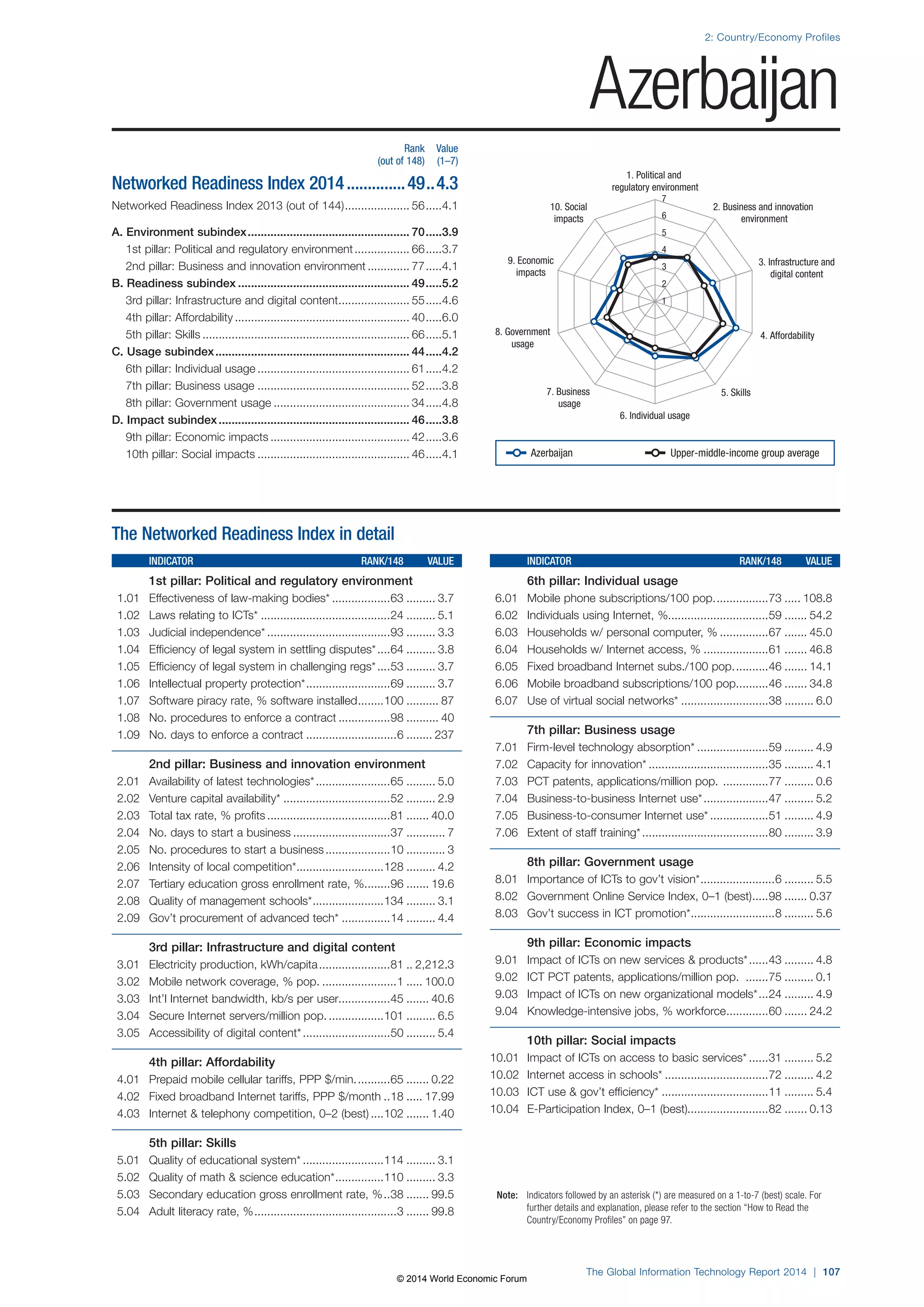
settings remotely. 
At an industrial level, applications using sensor 
technologies are capturing vast amounts of data to 
improve decision-making. Sensors embedded in 
agricultural fields monitor temperature and moisture 
levels, controlling irrigation systems. Devices in oil fields 
and deep well rigs track all aspects of drilling and fuel 
delivery, increasing production efficiency. And sensors in 
vehicles are able to monitor usage, informing decisions 
around refueling and repair as well as vehicle design. 
For governments, IoE and big data applications 
are helping to monitor pandemics and environmental 
conditions, improve public safety and security, and 
increase efficiency in the delivery of public services such 
as municipal traffic systems that incorporate real-time 
remote monitoring to streamline traffic flows. 
As more people, places, and things connect to the 
IoE, the data universe will continue to grow rapidly. The 
IoE will not only fuel the expansion of big data and data 
transmission, but can also provide targeted, automatic, 
data-driven analysis for our day-to-day lives. 
CRITICAL DRIVERS OF DATA GROWTH 
In 1944, the first digital computer, the Colossus, 
was deployed in the United Kingdom to decipher 
codes during World War II. The Colossus was able 
to process data at 5,000 characters per second (~25 
Kb/s).7 Currently the world’s fastest supercomputer, 
the MilkyWay-2, can process 54,902 × 1012 operations 
per second (54,902 TFlop/s).8 This intensive growth in 
data processing power continues today, coupled with 
extensive growth in data production. This data growth 
also supports four major trends that lead to a rising 
share of data transmission over IP networks in the world 
of the IoE, as described below. 
• Internet protocol (IP) is becoming the common 
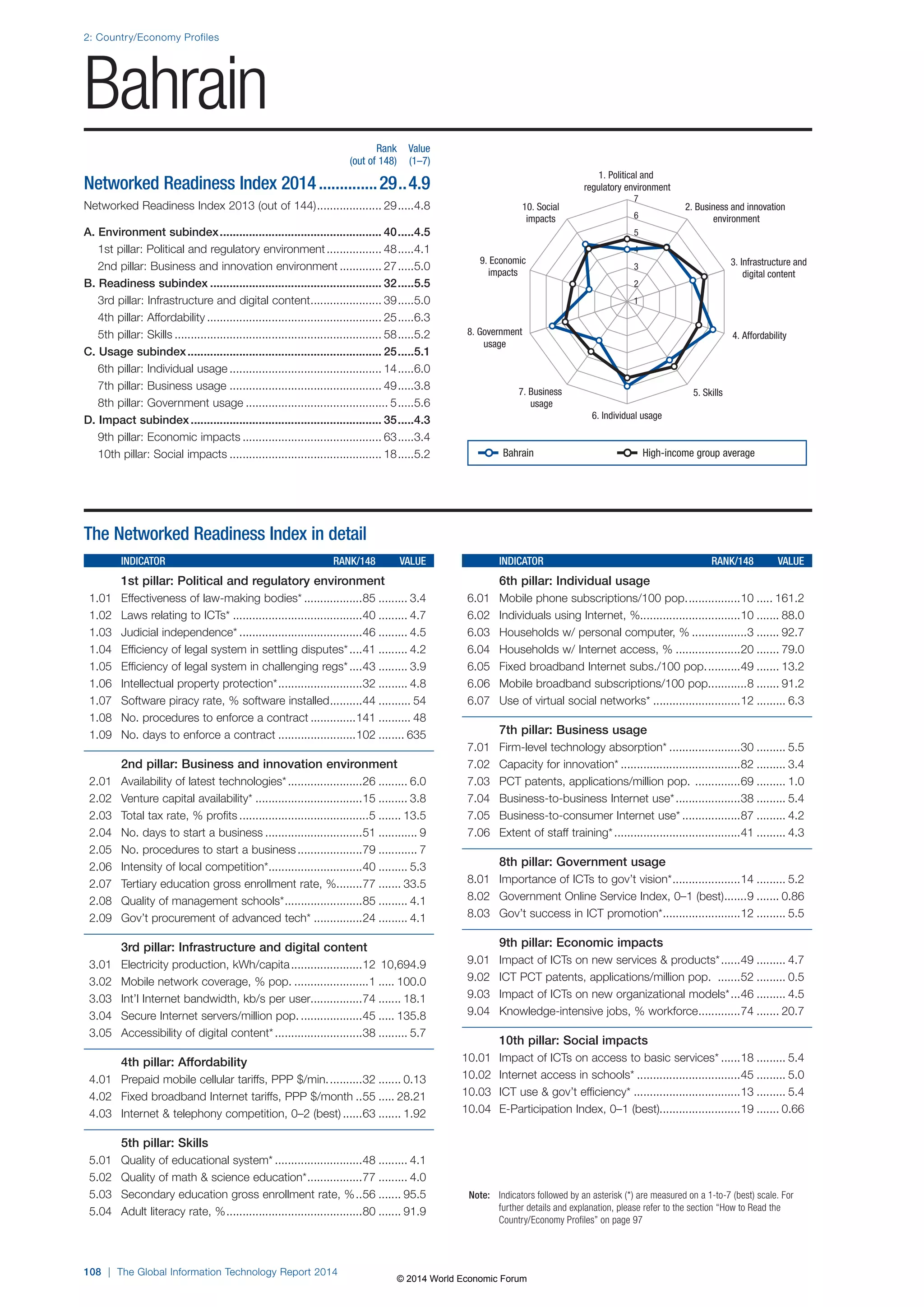
language for most data communication. 
Proprietary industrial networks are migrating to IP, 
bringing previously isolated data onto public and 
managed IP networks. The Internet’s history is 
built on the migration of proprietary networks to IP. 
Proprietary data networks such as AppleTalk and 
IBM Systems Network Architecture (SNA) have 
migrated to IP over time, and traditional time-division 
multiplexing (TDM) voice networks are migrating to 
0 
2010 2011 2012 2013 2014 (forecasted) 2015 (forecasted) 
Sources: Cisco 2013b; EMC² 2013; authors’ calculations. 
36 | The Global Information Technology Report 2014 
© 2014 World Economic Forum
Voice over Internet Protocol (VoIP). Today electricity 
grids, building systems, industrial manufacturing, 
oil systems, and a multitude of other sectors with 
networks that were previously built with proprietary 
protocols are increasingly migrating to IP as 
industries and enterprises recognize the value of 
interoperability and scale. Each migration shifts a 
large amount of data production and transmission 
onto IP networks (see Box1). 
• Previously unconnected places, people, things, 
and processes are connecting to networks for 
the first time. Billions of people and devices will 
come online in the next five years, adding heavily 
to the endpoints collecting data and to the devices 
consuming information. Cisco’s Visual Networking 
Index estimates that, between 2012 and 2017, 7 
billion more devices will connect to the Internet, 
reaching a total of 19 billion connected devices. 
These figures are conservative projections; other 
estimates of the total number of connected devices 
range from around 20 billion to 50 billion by 2020.9 
By 2017, nearly half of the world’s population (3.6 
billion out of 7.6 billion people) will be connected 
to the Internet. Of the world’s total inhabited areas, 
mobile network coverage will increase to 85 percent 
in 2017, up from 79 percent in 2012.10 In addition, a 
diversity of processes are migrating online. These 
include transactional activities (such as payments 
and requests), environmental monitoring (such as 
environmental sensors and remote monitoring), and 
government interactions (including census taking, 
tax collections, and benefit distributions). 
• Existing physically stored information is being 
digitized in order to record and share previously 
analogue material. Over the last decade, the 
digital share of the world’s stored information has 
increased from 25 percent to over 98 percent.11 
Information previously stored on other media—such 
as paper, film, and other analogue formats—is 
being digitized, along with meta-information about 
the data itself (e.g., descriptive statistics, frequency, 
distribution, dispersion, etc.). This digitization of 
information is leading to greater exchange of stored 
media and data over the Internet. 
• The introduction of Internet protocol version 
6 (IPv6) allows for trillions of trillions (1038) of 
devices to connect to the Internet. IPv6 is the 
latest update to the protocol that underpins the 
Internet. It defines the system for routing traffic on 
the Internet by giving identification and location to 
all points connected to the global IP network. The 
previous version of the protocol, IPv4, enabled 
only approximately 4 billion IP addresses. But 
IPv6 provides more than 340 trillion, trillion, trillion, 
addresses,12 ensuring no immediate exhaustion of IP 
1.2: The Internet of Everything 
Box 1: Big data: Huge and growing data volume 
from industrial applications 
Industrial applications of the Internet of Everything (IoE) 
generate immense data flows, which are increasingly 
shifting over to Internet protocol (IP) networks. One reason 
for the shift is that IP networks have increased reliability. 
Industrial networks have traditionally been concerned with 
uptime and latency, and IP networks have evolved to be 
able to handle industrial demands and the data flows that 
come with them. 
In the oil and gas industry, for example, data are 
utilized across the entire value chain, from exploration, 
production, refining, and distribution to marketing and 
retail. Sensors and computing are used to capture and 
monitor seismic data, borehole activity, environmental 
readings, weather, production utilization, storage capacity, 
spot pricing (trading), transportation, inventory levels, 
demand and forecasts, and location data. In seismic 
exploration, the cost, size, and speed of data are all 
rising as exploration moves to 3D imaging. Data capture 
amounted to around 300 megabytes per square kilometer 
in the 1990s. By 2006, data per square kilometer 
amounted to 25 gigabytes, while today the amount per 
square kilometer is in the petabytes.1 According to Chevron 
and industry-wide estimates, a “fully optimized” digital oil 
field based on data utilization results in 8 percent higher 
production rates and 6 percent higher overall recovery. 2 
In electric utility grids, data utilization also improves 
efficiency. Current grids monitor data to control electricity 
flows (both to and from the grid) based on real-time 
demand, thus improving generator efficiency and ensuring 
more-sustainable energy sources. Upgrading standard 
electric meters to “smart meters” allows information to be 
communicated over a network back to a control center and 
increases the amount of data captured. While traditional 
meters are read once a month, some smart meters can 
report usage rates in 15-minute intervals. For every million 
meters, this leads to 96 million measurements per day, 
an estimated 3,000-fold increase in data collection. 3 
Conservative estimates of the total amount of data that will 
be generated by smart meters by 2019 in the United States 
alone (assuming only two readings per day, and below full 
deployment) yields measurements in the order of hundreds 
of petabytes per year. 4 
In an example from another industry, aircraft 
manufacture and operation, sensors on General Electric 
(GE)’s jet plane turbines illustrate the vast amount of data 
generated daily. GE estimates that each sensor on a GE 
turbine generates approximately 500 gigabytes of data 
every day. Each turbine has 20 sensors, and globally GE 
owns approximately 12,000 turbines. This aggregates to 
petabytes of data daily. 5 
Notes 
1 Beals 2013; see also note 4 at the end of this chapter. 
2 Leber 2012. 
3 IBM Software 2012. 
4 Danahy 2009; Fehrenbacher 2009. 
5 Lopez 2013. 
The Global Information Technology Report 2014 | 37 
© 2014 World Economic Forum
1.2: The Internet of Everything 
addresses or limits to the number of IP connections. 
The sheer number of available addresses allows for 
every single star in the known universe to have 4.8 
trillion addresses. 
THE GAP BETWEEN DATA GROWTH AND DATA 
VALUE 
Current estimates suggest that only half a percent of 
all data is being analyzed for insights;13 furthermore, 
the vast majority of existing data are unstructured and 
machine-generated.14 Applying analytics to a greater 
share of all data can lead to productivity increases, 
economic growth, and societal development through the 
creation of actionable insights. 
Data alone are not very interesting or useful. It is 
when data can be used and become actionable that 
they can change processes and have direct positive 
impact on people’s lives. The IoE generates data, and 
adding analysis and analytics turns those data into 
actionable information. Building on the framework of 
the knowledge hierarchy,15 aggregated data become 
information that, when analyzed, become knowledge. 
Knowledge can lead to insights and informed decision-making, 
which at the highest level is wisdom (Figure2). 
For example, society at large can benefit from 
tracking trends observed from metadata such as 
anonymized mobile phone data used to track population 
migration after the earthquake and cholera outbreaks in 
Port-au-Prince, Haiti.16 Likewise, analyzing social media 
discussions can identify crises or flu outbreaks. 
At an industrial level, big data analysis can yield very 
large benefits. For example, the value of modernizing 
the US electricity grid to be data-driven is estimated at 
Benefits to society via improved outcomes 
US$210 billion. A reconstituted electricity grid would 
be based on an architecture driven by “technology 
selections to fully harness the convergence of data, 
controls and transactions.”17 
According to Bradley et al. in a recent Cisco White 
Paper, harvesting data for critical decision-making 
though the IoE can create approximately US$14.4 trillion 
dollars of added value in the commercial sector over 
the next 10 years across a wide range of industries.18 
This opportunity exists in the form of new value created 
by technology innovation, market share gains, and 
increasing competitive advantage. It translates into 
an opportunity to increase global corporate profits by 
approximately 21 percent, driven by improvements in 
asset utilization (reducing costs and improving capital 
efficiency), employee productivity (improved labor 
efficiency), supply chain logistics (eliminating waste and 
improving process efficiency), customer experience 
(adding more customers), and innovation (reducing time 
to market). 
Similarly, research by the Economist Intelligence 
Unit and Capgemini indicates that big data analytics 
were responsible for a 26 percent improvement in 
business performance among a cohort of companies 
examined, and forecasts that the impact could increase 
to 41 percent in three years.19 Capturing these gains, 
however, may require concurrent investment in resources 
to manage the rise in data. It is forecasted that by 2020, 
an average business will have to manage 50 times 
more information than it does today, while the average 
information technology (IT) staff is expected to rise only 
by 1.5 times.20 
Figure 2: Turning data into insight 
Sources: Ackoff 1989; authors’ interpretation. 
Insight 
(wisdom) 
Process optimization 
Decision-making Knowledge 
Metrics and scorecards Information 
Data 
Individual data 
points 
38 | The Global Information Technology Report 2014 
© 2014 World Economic Forum
Figure 3: Policy and technical issues facing big data and the IoE 
EQUIPPING IP NETWORKS TO DELIVER BIG DATA 
INSIGHTS 
Moving up the knowledge pyramid from data to insights 
and informed decisions is a critical challenge facing 
businesses and governments. Equipping IP networks 
to better transmit data to processing centers as well as 
enabling the network to create, analyze, and act on data 
insights is one comprehensive approach. Building this 
capability will require improving network infrastructure, 
building analytical capabilities and “intelligence” into 
the network, and distributing computing and analytical 
capabilities throughout the network, particularly at the 
edge. Specifically, these are: 
• Network infrastructure improvements. These 
improvements include connecting all things, 
including unintelligent ones (those that are capable 
only of transmitting data, not receiving them); 
securing infrastructure; improving inter and intra-data 
center traffic flows; and increasing the ability to 
manage private and public networks. 
• Building intelligence into the network. This will 
require building in the ability to compute data 
in motion and host partner applications in an 
ecosystem where applications can be built to 
analyze data inflow, particularly enabling machine-to- 
machine (M2M) services. 
• Distributing computing and storage. Efficient 
distribution will require moving the ability to analyze 
data only in the data center to add processing at the 
edge (or near the edge) of the network, to prevent 
1.2: The Internet of Everything 
delays in processing caused by latency as well as 
delays caused by network congestion. 
TECHNICAL AND POLICY CHALLENGES 
Building a network that will maximize the impact of big 
data requires powerful and seamless interactions among 
sensors, devices, computing, storage, analytics, and 
control systems. 
But although IP networks are primed to support the 
expansion of big data and the IoE, technical and policy 
challenges exist in the ability of current IP networks to 
fully exploit big data expansion (Figure3). An approach 
that tackles these issues concurrently will help to 
create the right ecosystem. The discussion below 
highlights specific issues that will need to be addressed 
thoughtfully. 
Standards and interoperability issues span both the 
technical and policy domains. Agreement on standards 
is critical to develop economies of scale by encouraging 
product and service innovation around a common 
language, and generally accepted global standards 
allow for greater interoperability between devices. 
Requirements differ for closed critical networks (such 
as utilities) and open networks (for example, those that 
may monitor parking space availability), but common 
standards allow information to be exchanged within, and 
among, these networks when those needs arise. 
Privacy issues arise with the growth of data, 
particularly with regard to data generated by or about 
individuals. Policymakers must identify the appropriate 
balance between protecting the privacy of individuals’ 
data and allowing for innovation in service delivery and 
product development. New technologies and services, 
Source: Authors. 
TECHNICAL POLICY 
Standards  
interoperability 
Privacy  
security 
Spectrum  
bandwidth 
constraints 
Reliability 
Scaling 
Electrical power 
Cross-border data traffic 
Legacy regulatory models 
The Global Information Technology Report 2014 | 39 
© 2014 World Economic Forum
such as location-based services, are bringing these 
privacy issues to the forefront, offering users enhanced 
experiences while raising concerns of identity protection. 
Some policies—such as transparency in the use of 
data and effective mechanisms for consumer control of 
personal data—can help in this regard. The key security 
issues for big data include the reliable prevention of 
hacking and access by unauthorized and unwanted 
users to large databases and data flows. In order to 
ensure a healthy ecosystem where users, consumers, 
and businesses feel safe in engaging in big data 
activities, network security is essential. 
Over the next five years, the growth of mobile data 
traffic will require greater radio spectrum to enable 
wireless M2M, as well as people-to-people (P2P) and 
people-to-machine (P2M), connectivity. Ensuring device 
connectivity and sufficient bandwidth for all of the uses 
of wireless sensors will require careful planning. The 
spectrum requirements are going to be heterogeneous 
and will include narrowband and broadband frequencies, 
short haul and long haul spectrum, continuous data 
transmission and short bursts of data transmission, 
and licensed spectrum in addition to license-exempt 
spectrum. Bandwidth constraints will also be an 
obstacle in transmitting data over existing networks. 
The examples cited in Box1 reflect the volume of data 
being generated by proprietary networks, resulting in 
the need to move computing close to the network edge 
in a distributed intelligence architecture. Data loads will 
be lumpy across various applications of the IoE, and 
matching bandwidth needs to bandwidth availability will 
be a continuous challenge. 
As more critical processes are conducted as 
part of the IoE, the need for reliability in IP networks 
increases. Healthcare applications that require instant 
communication between end users and medical 
professionals, safety and security applications, utility 
functions, and industrial uses are examples where 
continuous, uninterrupted, real-time communications 
require reliable and redundant connectivity. Low latency 
(the time required for round-trip data transmission) 
is already required for advanced cloud computing 
applications such as high-definition video conferencing 
and industrial collaboration. Any interruption to the 
transmission of data over networks negatively impacts 
these processes. 
Constraints on the technological limits of electrical 
efficiency and on computer memory and processing 
already pose limits to computing and data analysis. Data 
centers, for example, exemplify the boundaries where 
electrical power, cooling resources, and space design 
are constantly redesigned and re-imagined to advance 
current capabilities. As the IoE expands into tens of 
billions of connected devices, the technological aspects 
of IP networks have to be able to manage the huge scale 
of device connectivity. One aspect of this expansion, 
Internet addressing, is being resolved with the migration 
from IPv4 to IPv6. Other challenges include determining 
how virtualized computing environments may support a 
reallocation of computing resources. And new sources 
of electrical power (advanced batteries, simple chemical 
reactions, etc.) will be needed to power the multitude of 
new devices that will emerge. 
IoE applications that collect and handle data across 
sovereign jurisdictions could be negatively affected by 
policies restricting cross-border data traffic and global 
trade in IoE-related services. Emerging cross-border 
issues include national data protection rules and data 
transfers, data portability and interoperability standards, 
and liability costs for cloud service providers. Furthermore, 
trade in some IoE services may fall under existing 
international trade agreements, while others do not. 
As the IoE permeates across business sectors, the 
application of IoE technology in traditional industries 
presents new challenges to legacy regulatory models. 
IoE technology is impacting business models, input/ 
output markets, and end users in markets ranging 
from healthcare to utilities. The heavily regulated 
energy markets, in particular, face a range of issues 
from “connected energy” technologies. At the 
consumer level, smart meters may present privacy and 
security challenges. However, at the aggregation and 
distribution levels, utility companies face the new reality 
of a changing energy source mix and must adapt to 
transactional loads and markets along with existing grid 
control that needs to adapt to distributed intelligence as 
well as challenges to traditional regulated utility pricing. 
THE CENTRALITY OF THE NETWORK 
Since the beginning of our species, humans have been 
processing data. We have been our own primary data 
machines. But today, with the advent of vast arrays 
of computing power, we increasingly rely on data 
processed by others, and the IoE and the era of big data 
are transforming our lives. 
Data flows and the ability to capture value from data 
are changing industries, creating new opportunities while 
impacting others. For example, the “app economy”—the 
business created by software applications running on 
smartphones—has created hundreds of thousands of 
jobs.21 One recent study estimates that the marginal 
impact of data utilization in the IoE could raise US gross 
domestic product by 2 percent to 2.5 percent by 2025.22 
The IoE—where more data are being captured 
by more devices, interacting with more people and 
changing the processes by which we live, learn, work, 
and play—is having a profound impact on the world. 
But the value derived from the IoE can be measurably 
increased if IP networks are able to facilitate the rise of 
big data and generate added positive impact for society. 
NOTES 
1 Palmer 2006. 
2 The Economist 2010. 
1.2: The Internet of Everything 
40 | The Global Information Technology Report 2014 
© 2014 World Economic Forum
3 IBM 2013. 
4 Gantz and Reinsel 2012. A useful reminder in the sequence of 
data storage and memory is that the measure increases by the 
thousands and the sequence is from byte, kilobyte, megabyte, 
gigabyte, terabyte, petabyte, exabyte, zettabyte and beyond. 
5 Cisco 2013b 
6 Cisco 2013a. 
7 McLellan. 2013. 
8 Top500.org 2013. 
9 Biggs et al. 2012. 
10 GSM Association 2012. 
11 Cukier and Mayer-Schoenburger 2013. 
12 More specifically, 340,282,366,920,938,463,463,374,607,431,768, 
211,456 addresses, or roughly 3.4 times 1038. 
13 Gantz and Reinsel 2012. 
14 Canalys 2012. 
15 Ackoff 1989. 
16 Bengtsson et al. 2011. 
17 De Martini and Von Prellwitz 2011; Taft et al. 2012, p. 2. 
18 Bradley et al. 2013. 
19 EIU 2012. 
20 EMC2 2013. 
21 In the United States, according to Mandel and Scherer (2012), over 
500,000 jobs have been created through application development 
since 2007; in the European Union, Vision Mobile and Plum (2013) 
found that nearly 800,000 jobs have been created this way. 
22 Mandel 2013. 
REFERENCES 
Ackoff, R. 1989. “From Data to Wisdom.” Journal of Applied Systems 
Analysis 16: 3–9. 
Beals, B. 2013. “The Big Deal about Big Data in Oil and Gas.” Hitachi. 
Available at www.lnm.com.br/bah/downloads/Hitachi_Bert-Beals_ 
BAH2013.pptx. 
Bengtsson L., X. Lu, A. Thorson, R. Garfield, and J. von Schreeb. 2011. 
“Improved Response to Disasters and Outbreaks by Tracking 
Population Movements with Mobile Phone Network Data: A Post- 
Earthquake Geospatial Study in Haiti.” PLoS Med 8 (8): e1001083. 
doi:10.1371/journal.pmed.1001083. 
Biggs, P., with T. Johnson, Y. Lozanova, and N. Sundberg. 2012. 
“Emerging Issues for Our Hyperconnected World.” In The Global 
Information Technology Report: Living in a Hyperconnected World. 
Geneva: World Economic Forum and INSEAD. 47–56. 
Bradley, J., J. Barbier, and D. Handler. 2013. “Embracing the Internet of 
Everything to Capture Your Share of $14.4 Trillion.” Cisco White 
Paper. Available at http://www.cisco.com/web/about/ac79/docs/ 
innov/IoE_Economy.pdf. 
Canalys. 2012. Defining Big Data report. September 27. Palo Alto, 
Shanghai, Singapore, and Reading, UK: Canalys. 
Cisco. 2012. Cisco Global Cloud Index: Forecast and Methodology, 
2012–2017. Available at http://www.cisco.com/en/US/solutions/ 
collateral/ns341/ns525/ns537/ns705/ns1175/Cloud_Index_White_ 
Paper.html. 
———. 2013a. “Connections Counter: The Internet of Everything in 
Motion.” the network: Cisco’s Technology News Site, July 29. 
Available at http://newsroom.cisco.com/feature-content?type=web 
contentarticleId=1208342. 
———. 2013b. Visual Networking Index (VNI). Available at http://www. 
cisco.com/en/US/netsol/ns827/networking_solutions_solution_ 
category.html. 
1.2: The Internet of Everything 
Cukier, K. and V. Mayer-Schoenburger. 2013. “The Rise of Big 
Data: How It’s Changing the Way We Think about the World.” 
Foreign Affairs May/June. Available at http://www.foreignaffairs. 
com/articles/139104/kenneth-neil-cukier-and-viktor-mayer-schoenberger/ 
the-rise-of-big-data. 
Danahy, J. 2009. “The Coming Smart Grid Data Surge.” October 5. 
Available at http://www.smartgridnews.com/artman/publish/ 
News_Blogs_News/The-Coming-Smart-Grid-Data-Surge-1247. 
html. 
De Martini, P. and L. von Prellwitz. 2011. “Gridonomics: An Introduction 
to the Factors Shaping Electric Industry Transformation.” Cisco 
White Paper. Available at http://www.cisco.com/web/strategy/ 
docs/energy/gridonomics_white_paper.pdf. 
The Economist. 2010. “Data, Data Everywhere.” Managing Information, 
Special Report, February 25. Available at http://www.economist. 
com/node/15557443. 
EIU (Economist Intelligence Unit). 2012. The Deciding Factor: Big 
Data and Decision Making, June 12. Report commissioned by 
Capgemini. Available at http://www.managementthinking.eiu.com/ 
sites/default/files/downloads/The%20deciding%20factor_FINAL. 
pdf. 
EMC2. 2013. “Digital Universe.” Available at http://www.emc.com/ 
leadership/programs/digital-universe.htm. 
Fehrenbacher, K. 2009. “Smart Grid Data About to Swamp Utilities.” 
October 12. Gigaom. Available at http://gigaom.com/2009/10/12/ 
smart-grid-data-about-to-swamp-utilities/. 
Gantz, J. and D. Reinsel. 2012. “The Digital Universe in 2020: Big Data, 
Bigger Digital Shadows, and Biggest Growth in the Far East.” 
IDC iView, sponsored by EMC. December. Available at http:// 
www.emc.com/collateral/analyst-reports/idc-the-digital-universe-in- 
2020.pdf. 
GSM Association. 2012. “GSMA Announces New Global Research 
That Highlights Significant Growth Opportunity For The Mobile 
Industry.” Press Release, October 18. Available at http://www. 
gsma.com/newsroom/gsma-announces-new-global-research-that- 
highlights-significant-growth-opportunity-for-the-mobile-industry. 
IBM. 2013. Website. “Big Data.” Available at http://www.ibm.com/big-data/ 
us/en/. 
IBM Software. 2012. “Managing Big Data for Smart Grids and Smart 
Meters.” IBM White Paper. Somers, NY: IBM Corporation. 
Available at ftp://public.dhe.ibm.com/software/pdf/industry/ 
IMW14628USEN.pdf. 
Leber, J. 2012. “Big Oil Goes Mining for Big Data.” MIT Technology 
Review, May 8. Available at http://www.technologyreview.com/ 
news/427876/big-oil-goes-mining-for-big-data/. 
Lopez, M. 2013. “GE Speaks on the Business Value of the Internet of 
Things.” Forbes.com, May 10. Available at http://www.forbes.com/ 
sites/maribellopez/2013/05/10/ge-speaks-on-the-business-value-of- 
the-internet-of-things. 
Mandel, M. 2013. “Can the Internet of Everything Bring Back the High- 
Growth Economy?” Policy Memo, September. Washington, 
DC: Progressive Policy Institute (PPI). Available at http://www. 
progressivepolicy.org/wp-content/uploads/2013/09/09.2013- 
Mandel_Can-the-Internet-of-Everything-Bring-Back-the-High- 
Growth-Economy-1.pdf. 
Mandel, M. and J. Scherer. 2012. “The Geography of the App Economy.” 
September 20, South Mountain Economics LLC. Available at 
http://files.ctia.org/pdf/The_Geography_of_the_App_Economy.pdf. 
McLellan, C. 2013. “Big Data: An Overview.” Going Deep on Big Data. 
ZDNet special feature, October 1. Available at http://www.zdnet. 
com/big-data-an-overview-7000020785/. 
Palmer, M. 2006. “Data Is the New Oil.” Blog Post, November 3. 
Available at http://ana.blogs.com/maestros/2006/11/data_is_the_ 
new.html. 
Taft, J., with P. De Martini and L. von Prellwitz. 2012. Utility Data 
Management and Intelligence. Cisco. http://www.cisco.com/web/ 
strategy/docs/energy/managing_utility_data_intelligence.pdf. 
Top500.org. 2013. Supercomputer Sites. http://www.top500.org/ 
system/177999, accessed October 4, 2013. 
The Global Information Technology Report 2014 | 41 
© 2014 World Economic Forum
1.2: The Internet of Everything 
Vision Mobile and Plum Consulting. 2013. The European App Economy: 
Creating Jobs and Driving Growth. Report sponsored by ACT, 
September. Available at http://www.act4apps.org/wp-content/ 
uploads/2013/09/ACT-The-European-App-Economy-20131.pdf. 
42 | The Global Information Technology Report 2014 
© 2014 World Economic Forum
CHAPTER 1.3 
Big Data Maturity: 
An Action Plan for 
Policymakers and 
Executives 
BAHJAT EL-DARWICHE 
VOLKMAR KOCH 
DAVID MEER 
RAMEZ T. SHEHADI 
WALID TOHME 
Booz  Company 
The total volume of structured and unstructured data 
generated by individuals, enterprises, and public 
organizations is multiplying exponentially; 90 percent 
of the total data stored today is less than two years 
old.1 So-called big data has the potential to improve 
or transform existing business operations and reshape 
entire economic sectors. It can also pave the way for 
disruptive, entrepreneurial companies and allow new 
industries to emerge. 
THE BIG DATA IMPERATIVE 
If they are to capitalize on this potential, organizations 
should avoid a common misapprehension. Much debate 
has focused on the need to develop the technology to 
store and analyze the deluge of data that threatens to 
drown companies. Although this technology is indeed 
necessary, it is not sufficient to enable big data to be 
exploited fully. 
Organizations must instead remold their decision-making 
culture so that senior executives make more 
judgments based on clear data insights rather than 
on intuition. They must build the necessary internal 
capabilities, deploying the technical and human 
resources to interpret data in an astute manner. 
Moreover, because they rely on governments to provide 
the requisite environment, they must ask policymakers 
to create the regulatory framework and information 
and communications technology (ICT) infrastructure to 
remove external obstacles. 
We propose a Big Data Maturity Framework 
that is based on the experiences of organizations 
that have undergone a big data transformation. This 
framework will allow organizations to assess their 
progress in this arena and determine what they need 
to do to extract greater business and organizational 
benefits from the vast volume of data. The framework 
incorporates three elements: (1) environment readiness; 
(2) internal capabilities; and (3) the various, steadily more 
sophisticated, ways to use big data that range from 
increased efficiency in existing operations to a complete 
change in an organization’s business model. 
WHAT IS BIG DATA? 
Big data represents the newest and most 
comprehensive version of organizations’ long-term 
aspiration to establish and improve their data-driven 
decision-making. It is characterized by what are known 
as the “three Vs”—large data volumes, from a variety 
of sources, at high velocity (i.e., real-time data capture, 
storage, and analysis). Besides structured data (such as 
customer or financial records), which are typically kept 
in organizations’ data warehouses, big data builds on 
unstructured data from sources such as social media, 
text and video messages, and technical sensors (such 
The authors wish to thank Dr. Andreas Deckert for his contribution to this 
chapter. 
The Global Information Technology Report 2014 | 43 
© 2014 World Economic Forum
Operational 
intelligence 
1970 1980 1990 2000 2010 Now and future 
Linearprogramming 
as global positioning system, or GPS, devices)—often 
originating from outside the organization itself. 
The magnitude and complexity of data being 
produced far exceed the typical capacities of traditional 
databases and data warehouses for the purposes of 
storing, processing, analyzing, and deriving insights. 
Usage statistics emanating from social media sites 
illustrate the sheer volume of unstructured data. For 
example, in 2012 Facebook reported that it was 
processing around 2.5 billion new pieces of content 
daily.2 
Big data has the potential to infuse executive 
decisions with an unprecedented level of data-driven 
insights. However, research indicates that many 
organizations are struggling to cope with the challenges 
of big data. For example, in 2012 the Aberdeen Group 
found that the proportion of executives who reported 
that their companies were unable to use unstructured 
data, and who complained that the volume of data was 
growing too rapidly to manage, had increased by up to 
25 percent during the previous year.3 
EVOLUTION, NOT REVOLUTION 
Despite the rapid growth of big data, organizations 
should keep its influence in perspective. Although 
remarkable, the big data phenomenon is merely 
the continuation of a journey in which ever-more-elaborate 
data have influenced decision-making. From 
organizations’ first attempts at data analytics in the 
1960s and 1970s, this journey has proceeded through 
various stages, described by buzz words such as data 
mining and business intelligence, all of which sought 
to transform raw data into meaningful information for 
business purposes (Figure1). 
The latest development, big data, may appear 
all-enveloping and revolutionary. However, the essential 
principles for exploiting its commercial benefit remain 
exactly the same as they were in previous moves toward 
increased data-driven decision-making. Executives 
must harness this recent data explosion by focusing on 
carefully formulating the business questions that enable 
the swift and accurate identification of those nuggets of 
data that they believe can improve their organization’s 
Figure 1: Evolution of data-driven decision-making 
Source: Booz  Company. 
Managementinformation 
systems/dashboards 
Datamarts Datawarehouses 
Dataclusters 
Operations 
research Creditscoring 
Cloudstorage 
Nonlinear 
programming 
Crowd-sourcing 
InternetofThings 
Neuralnetworks 
Webanalytics 
Industry4.0 
Decision 
support 
systemts 
Customer 
relationship 
management 
Sentimentanalysis 
Image 
analysis 
Webcrawling 
Naturallanguage 
processing 
Data 
visualization 
MonteCarlo 
simulations 
Standardreporting 
Knowledgediscovery 
Heuristic 
problem-solving 
Riskmodeling 
Alerting 
Expertsystems 
Ad-hocreporting 
Datacubes/drilldown 
Forecasting 
Statisticalanalysis 
Websearch 
Yieldmanagement 
Datamining 
Telematics 
Predictivemodeling 
Discrete-event 
simulation 
Businesssintelligence 
Machinelearning 
Speechrecognition 
Textmining 
Videoanalysis 
Contextualmarketing 
Useractivitytracking 
Real-timeanalytics 
Advancedanalytics 
Socialmedia 
monitoring 
Anticipatoryanalytics 
Artificialintelligence 
Analytics: Degree of sophistication 
Volume/complexity of data 
BIG DATA 
Chapter 1.3: Big Data Maturity 
44 | The Global Information Technology Report 2014 
© 2014 World Economic Forum
performance or allow them to gain access to new 
revenue pools. 
This continuation of a trusted managerial approach 
does not, however, imply an endorsement of inertia. 
Rather, organizations must foster a new decision-making 
culture to exploit the opportunities presented by big data 
and prepare their own internal capabilities to handle 
this new era. At the same time, they must encourage 
governments to nurture an environment conducive to the 
exploitation of big data. 
THE BUSINESS IMPACT OF BIG DATA 
Many organizations are still in the early stages of reaping 
the benefits of big data. Writing in the Harvard Business 
Review, Andrew McAfee and Erik Brynjolfsson explored 
the impact of big data on corporate performance. The 
authors interviewed executives in 330 publicly traded 
companies in the United States. They then examined 
relevant performance data, enabling them to measure 
the extent to which corporate attitudes toward big data 
correlated with how the respective companies were 
faring. 
McAfee and Brynjolfsson’s conclusions were 
remarkable for establishing a connection between 
big data and performance: “The more companies 
characterized themselves as data-driven, the better 
they performed on objective measures of financial 
and operational results.” The advantage gained by 
these companies over their rivals was also marked: “In 
particular, companies in the top third of their industry 
in the use of data-driven decision-making were, on 
average, 5 percent more productive and 6 percent more 
profitable than their competitors.”4 
Despite these findings, broad adoption of advanced 
big data practices has not yet materialized. A 2013 
Gartner survey found that less than 8 percent of 
companies surveyed have actually deployed big data 
technology.5 
Investment in forthcoming projects is much more 
widespread; the research firm IDC has forecasted that 
the market for big data technology and services will 
reach US$16.9 billion by 2015, up from US$3.2 billion 
in 2010. This represents a 40 percent annual growth 
rate, seven times the rate for the overall ICT business.6 
This trend is affecting all regions. For example, over 40 
percent of chief information officers in the Middle East, 
according to IDC, are considering big data technology 
investment in 2013. Although few have actually 
undertaken large-scale big data or analytics programs 
to date, IDC forecasts investment in this area to grow at 
a compound annual growth rate of over 20 percent over 
the coming five years.7 
Both expenditure and implementation vary 
substantially across regions, industries, and functional 
domains. For example, highly digitized industries such 
as telecommunications and travel still tend to spend 
substantially more on big data projects than the energy 
Chapter 1.3: Big Data Maturity 
sector, and there is far more implementation of big data 
initiatives in the United States than in the Asia Pacific 
region. Meanwhile, the Economist Intelligence Unit found 
that big data is most frequently enlisted to assist financial 
management and marketing/sales, and deemed least 
valuable in human resources management.8 
How big data is used 
The big data maturity stages (Figure2) depict the 
various ways in which data can be used, from selective 
adoption to large-scale implementation. Depending on 
the maturity of an organization’s big data capabilities, 
big data can significantly increase top-line revenues 
and markedly reduce operational expenses. The path 
to business model transformation, the highest level 
of maturity, promises potential high returns but often 
involves major investment over many years. 
The first maturity stage, performance management, 
enables executives to view their own business more 
clearly through, for example, user-friendly management 
information dashboards. This stage typically relies on 
internal data, with an organization establishing key 
performance indicators (KPIs) to evaluate its success at 
achieving stated goals. 
During stage 2, functional area excellence, 
organizations start to experiment with internal and 
external data to improve selected facets of their 
business. This may involve sales and marketing 
techniques such as customer segmentation and 
targeting, or entry-stage analytical methods for product 
recommendations. For example, one retailer analyzed 
data recounting the past purchasing behavior of 
individual customers in conjunction with the company’s 
most recent sales to predict and recommend each 
customer’s most likely next purchase. This resulted in a 
revenue increase of up to 5 percent, depending on the 
customer segment. 
Advances in operational efficiency through big data, 
such as the efficient deployment of staff resources and 
the optimization of the supply chain, also reside within 
this maturity stage. Recent examples include a German 
car manufacturer that used real-time performance 
monitoring of production machinery to trigger a 20 
percent increase in productivity. Each machine was 
tightly monitored to highlight downtime and plan around 
those production disruptions to optimize the utilization of 
the overall plant. In the public sector, a Canadian hospital 
observed previously unseen patterns in streaming 
data from monitoring of newborns, enabling detection 
of dangerous infections 24 hours before symptoms 
appeared.9 
At the value proposition enhancement stage (stage 
3), organizations start to monetize big data, positioning it 
as a value driver of the business that offers a new source 
of competitive advantage beyond the mere improvement 
of operations or services. In many instances this 
involves obtaining data from external sources and 
The Global Information Technology Report 2014 | 45 
© 2014 World Economic Forum
deriving insights from it. This may include innovations 
such as customized, real-time recommendations or the 
personalization of services to augment the customer 
experience. 
For example, one leading European bank tailored 
its website content to trigger an increase of 12 percent 
in sales. After customers logged in, the bank presented 
one of several alternative websites based on the relevant 
individual’s transaction history and segment and the 
company’s overall product portfolio. The content was 
specific to the predicted needs of the customer to 
maximize sales potential. 
Data-rich organizations, such as retailers or 
telecommunications companies, are better equipped 
than others to utilize their internally generated data in 
this way. For instance, a global mass merchant was 
Experimenting/ 
selective adoption 
BIG DATA 
able to increase its profit per customer by 37 percent 
by applying advanced customer analytics, such as 
behavioral segmentation, to identify its best customers 
and provide them with personalized offers. The 
frequency of those target customers’ purchases rose by 
approximately 25 percent, and the average basket size 
increased by around 10 percent. 
Another instructive case involved the US city of Los 
Angeles, which introduced demand-responsive pricing 
for parking. The city sets specific prices for hourly 
parking in each street, varying according to the time 
and day. These prices are based on in-depth choice 
modeling, fed with data from parking sensors, surveys, 
weather forecasts, information about holidays, local 
business activities, and other information. The goal is 
to reach a steadily high, but not excessive, utilization 
Figure 2: Big data maturity stages and related use cases 
Source: Booz  Company. 
Maturity stages Typical use cases/applications 
Stage 1: 
Performance 
management 
• Financial reporting 
• Regulatory/compliance 
reporting 
• Dashboards for management 
reporting 
• Performance measurement via 
key performance indicators/ 
metrics 
Stage 2: 
Functional area 
excellence 
• Smart pricing 
• Targeted mailings 
• Customer segmentation 
• Customer value analysis 
• Choice analysis 
• Website clickstream analysis 
• Loyalty schemes 
• Customer satisfaction opt. 
• Supply chain balancing 
• Facility optimization 
• Optimization of staff utilization 
• Route optimization for fleet 
• Fraud monitoring/prevention 
• Patient treatment control 
• Traffic optimization 
• Crime monitoring 
Stage 3: 
Value proposition 
enhancement 
• Targeted advertising/ 
customized recommendations 
in real time 
• Preventive health monitoring  
disease detection 
• Data monetization 
• Online telematics services 
• Personalization of customer 
experience/products 
Stage 4: 
Business model 
transformation 
• Selling of data to open new 
revenue pools 
• Data-centric business models 
(e.g., web search, web adver-tising) 
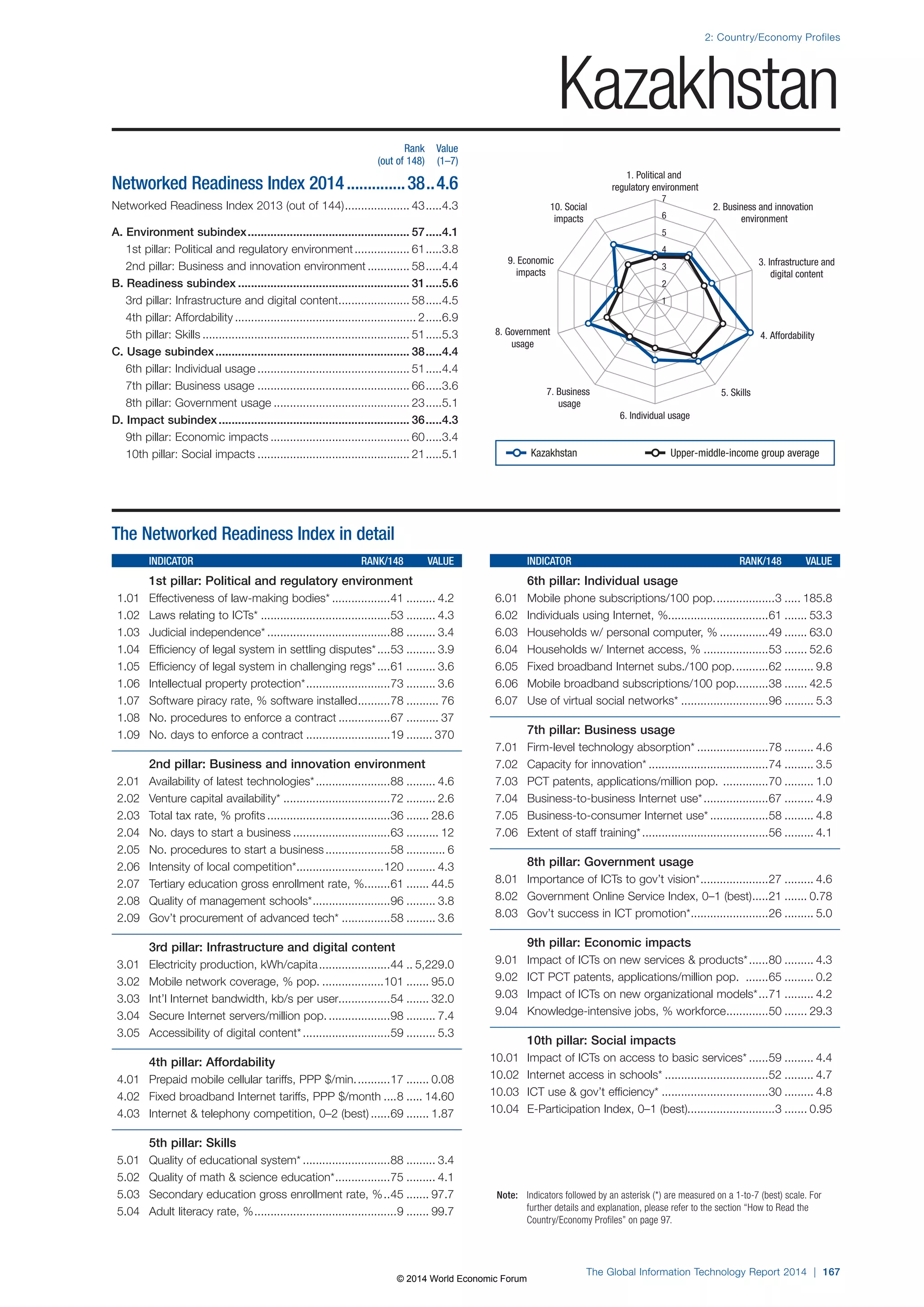
• Quantitative management of 
investment funds 
• Crowdsourcing to augment 
internal data 
Large-scale 
implementation 
Chapter 1.3: Big Data Maturity 
46 | The Global Information Technology Report 2014 
© 2014 World Economic Forum
of parking space at all times. The initial results are 
impressive. Although city parking revenues increased 
by 2.4 percent due to higher utilization, 60 percent of 
parking rates actually fell and congestion during peak 
hours decreased by 5 percent.10 
In the final maturity stage, business model 
transformation, big data permeates the whole 
organization. It becomes deeply embedded within the 
operation, determining the nature of the business and 
the mode of executive decision-making. 
This stage can be reached by both product and 
services organizations alike. One example of the latter 
involves the recent merger of the two large advertising 
companies Omnicom and Publicis. Their industry is 
moving away from the creative “Mad Men” approach, 
where a catchy phrase was the pinnacle of aspiration, 
toward a more science-based, data-driven business 
that aims to personalize ads. The ultimate goal is to 
deliver the right message to the right person at the right 
time. The Internet and mobile devices play a major role 
in this development. This new “ad tech” world will be 
dominated by those major players that possess the most 
comprehensive data about consumers and are thus 
able to understand them better—who they are, where 
they are, what they like, who their friends are, and so on. 
Omnicom and Publicis believe that their combined size 
will produce the desired volume of data. 
General Electric (GE) provides a prominent example 
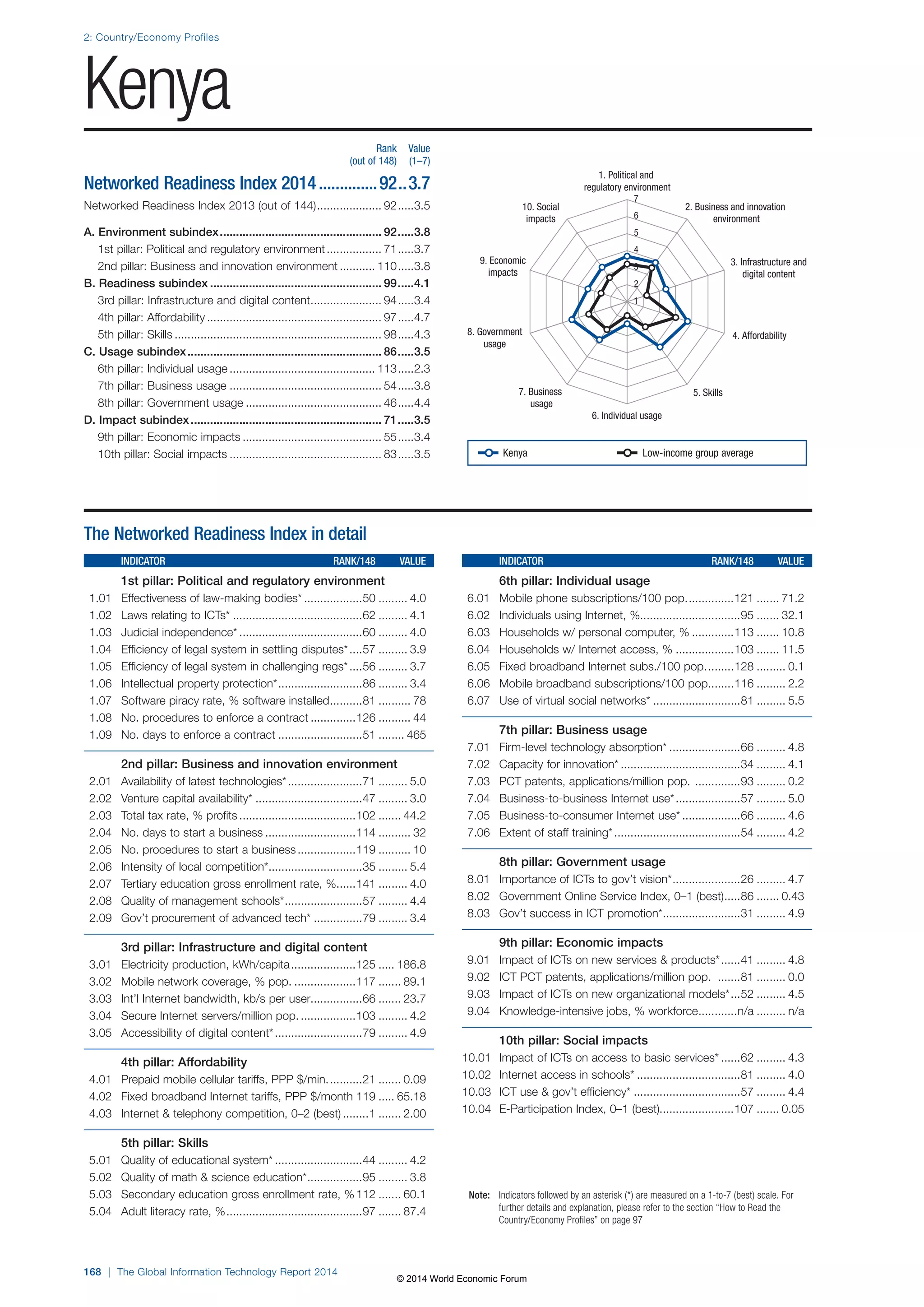
of a product organization placing great faith in big data. 
GE expects that machinery and equipment will soon 
be loaded with sensors, making in-depth status data 
available both in real time and across longer time spans. 
To be at the forefront of this development, GE is investing 
more than US$1 billion in building up its data science 
capabilities to provide data and analytics services across 
business functions and geographies.11 
Another showcase for the transformative potential 
of big data comes from the public sector. Regional 
and national-level policymakers around the world are 
launching “open data” initiatives, making data available 
to the public via integrated web portals and automated 
interfaces. Recent examples involve the United Kingdom 
and New York City.12 Although originally conceived as 
a way of increasing the transparency of government 
decisions, the release of public data is an important 
environmental factor enabling organizations to use big 
data, creating novel applications and services. 
However, some organizations do not have to 
progress through all the big data maturity stages. 
A data-driven business model has been integral to 
companies such as Google, Facebook, and Twitter, 
which have burst on to the scene in recent years and 
are introducing new technologies to capture the digital 
advertising market. Such companies actually started 
operations at the final stage. By doing so, they have 
prompted others to proceed through the earlier stages to 
keep up. 
Chapter 1.3: Big Data Maturity 
Obstacles to progress 
Despite widespread interest in data-driven decision-making 
in one form or another, companies face many 
potential pitfalls in extracting the maximum commercial 
benefit from big data usage. Some of these relate to their 
own internal systems and culture; others are tied to the 
external environment. 
The most prominent obstacle is the shortage of 
available talent specializing in data analytics—data 
scientists with an advanced education in mathematics or 
statistics who are also able to translate raw data material 
into exploitable commercial insights. Although many 
educational institutions have now started to establish 
courses to address this scarcity, the market demand is 
already considerable. 
Many organizations also suffer from poor-quality 
data that are fragmented across various systems, 
geographies, and functional silos. Embracing the 
potential of big data as a concept will take organizations 
only so far. First and foremost, they must get the basics 
right. Internal data has to be of high quality—consistent, 
accurate, and complete—and available across the 
organization. 
The prevailing decision-making culture presents 
a major internal obstacle—the one that is the least 
straightforward to identify and then overcome. To 
complicate matters, changing this culture may impinge 
on personal concerns relating to status. Companies 
and public institutions typically rely on the intuition of 
senior managers for important decisions. As big data 
extends its reach, executive instinct is challenged by the 
facts of hard data. However, while data can be of great 
assistance in solving an actual problem, it still holds true 
that senior management has to ask the right questions. 
Many of the external challenges that companies 
face revolve around data privacy considerations. For 
example, very specific details of an individual’s lifestyle 
preferences and buying habits are now captured and 
analyzed by companies through their own websites 
or by monitoring social media. These details are all 
collected without that person’s explicit consent, leading 
to significant public reservations about big data. Such 
concerns about privacy will strengthen demands for 
tighter regulatory control, potentially limiting companies’ 
ability to exploit big data opportunities or exposing them 
to threats of legal and regulatory intervention. 
HOW TO REACH BIG DATA MATURITY 
Our big data maturity framework (Figure3) comprises 
three elements: the enablers of environment readiness, 
the organization’s internal capabilities, and the different 
stages of maturity and sophistication in which big data 
can be used. The framework enables organizations to 
view the extent of their success in overcoming obstacles, 
and identifies what more can be done to promote big 
data maturity and reach the desired destination. 
The Global Information Technology Report 2014 | 47 
© 2014 World Economic Forum
Regulatory framework 
for data privacy 
The environment readiness dimension considers 
how far the relevant governments have enabled 
organizations in their jurisdiction to use big data freely 
and productively. This is achieved through appropriate 
regulations and a supportive infrastructure. 
The organization’s internal capabilities dimension 
sheds light on a company’s readiness to execute big 
data. By building up these capabilities and integrating 
them effectively, organizations move further along 
the path of data-driven decision-making and position 
themselves to extract greater benefits from big data. 
While environment readiness serves as an enabler 
for big data usage, internal capabilities act as critical 
success factors for organizations seeking to progress 
through the maturity stages. 
The following two sections explain the full range 
of actions that governments and organizations need to 
undertake and which of these take precedence. 
Environment readiness: Priorities for policymakers 
Big data will soon become ubiquitous practice in 
both the public and private worlds. Policymakers 
therefore need to act in a timely manner to promote an 
environment that is supportive to organizations seeking 
to benefit from this inevitable progression. Failure to 
develop comprehensive environment readiness carries 
ICT infrastructure 
Big data ecosystem 
Public perception 
and awareness 
Education/training 
the risk of losing competitive advantage vis-à-vis other 
countries. 
Policymakers must therefore: 
• formulate a vision for the usage of data consistent 
with the public interest, fostering a common 
understanding with citizens and obtaining their 
buy-in; 
• enable a big data ecosystem by establishing policies 
to facilitate valid business models for third-party 
data, service, and information technology system 
providers; and 
• speed and scale up the education of talent to 
address the likely significant shortage of talent 
with the requisite skills to leverage and handle big 
data—from both a business and an IT perspective, 
potentially in public-private partnerships (PPPs). 
Such PPPs can avoid having students in tailored 
university programs graduate with outdated learning 
by fostering and exploiting private contributions to 
the educational agenda. PPPs can involve public 
sponsorship of private education programs, and 
private support for university education in terms of 
knowledge transfer and financial endowments. 
Figure 3: Big data maturity framework 
Source: Booz  Company. 
Enablers of 
environment readiness 
Success factors 
for internal capabilities 
Maturity stages 
in the usage 
of big data 
Traditional applications 
(getting more out of data you already have) 
New horizons of big data 
Technical capabilities/infra-structure 
Dataavailability 
andgovernance 
Sponsorship 
Organizational capabilities 
and resources 
Data-driven 
decision-making culture 
Stage 1: 
Performance 
management 
Stage 2: 
Functional area 
excellence 
Stage 3: 
Value proposition 
enhancement 
Stage 4: 
Business model 
transformation 
What can we 
read from the data? 
What can we learn 
from the data 
to become better? 
How can we make 
data a value driver 
of our business? 
How can we use data 
to fundamentally 
reinvent our business? 
Chapter 1.3: Big Data Maturity 
48 | The Global Information Technology Report 2014 
© 2014 World Economic Forum
Priorities for policymakers will vary in different 
parts of the world. Developing countries, for example, 
will concentrate on building up the required ICT 
infrastructure and education programs to prepare for 
large-scale demand from organizations intent on using 
big data. In more developed countries, however, the 
government’s primary concerns should be ensuring 
transparent regulation and promoting a public-interest 
argument for big data. 
Policymakers must make the case for big data 
In particular, policymakers should set clear rules 
regarding data privacy so that organizations know which 
personal data they can store and for how long, and 
which data are explicitly forbidden by privacy regulations. 
If the scope of permissible data is to expand, 
skeptical citizens must first be persuaded that big data 
will work in their favor by paving the way for better 
products and services. Forward-thinking governments 
will initiate and inform this public debate about the 
benefits of big data. Indeed, Jules Polonetsky and 
Omer Tene, in their Stanford Law Review article (2013), 
argue that finding the right balance between individuals’ 
legitimate privacy concerns and the overall rewards 
offered by big data practices may be the greatest 
contemporary public policy challenge.13 
The outcome of this debate will vary depending on 
the country. Cultural factors will have a strong bearing on 
the decision about the right level of data privacy in any 
given country, and this decision will result in a regulatory 
regime appropriate for citizens and organizations. On a 
regional level, groups such as the European Union allow 
possible harmonization of data privacy regulation across 
borders, given that the constituent countries may share 
attitudes on this issue. 
Policymakers should promote harmonization 
On a global level, though, no binding agreement to 
harmonize regulation around data privacy currently looks 
likely in the short to medium term. Because countries 
have legitimate differences on this issue, this lack of 
harmonization threatens the adoption of big data on an 
international scale. 
The prevailing patchwork situation accentuates 
the lack of clarity on lawful data usage—especially the 
question of which jurisdiction holds sway for certain 
cross-border cases. For example, if data are owned 
by a company in the European Union, but hosted on 
servers in the United States, which privacy law applies? 
Legal inconsistency between countries can even inhibit 
free commerce across borders. This problem arises, for 
example, when an organization plans to outsource data 
operations to a foreign provider, yet some personal data 
are prohibited from being transferred out of the country 
concerned. 
The Organisation for Economic Co-operation and 
Development (OECD) Guidelines on the Protection of 
Chapter 1.3: Big Data Maturity 
Privacy and Transborder Flows of Personal Data, which 
were revised and updated in 2013, may represent a 
practical step in the direction of harmonization.14 In the 
absence of binding rules, a common understanding for 
data privacy and data protection regulation on the basis 
of guidelines and recommendations from a high-profile 
international organization is the most sensible option 
currently available. 
The OECD guidelines follow a best-of-breed 
approach. They formulate basic principles around 
the limitation of collection of personal data, the 
specification of the purpose of data collection, the 
protection of collected data, the prevention of data loss 
or unauthorized access, and the right of individuals to 
obtain information about collected data. The guidelines 
have in the past influenced national legislation, including 
privacy acts in Australia, Japan, Mexico, and New 
Zealand. We encourage both OECD members and non-members 
to review and adopt those basic principles and 
recommendations to establish common ground. 
An organization’s internal capabilities: Priorities for 
executives 
There is no general rule dictating how organizations 
should navigate the stages of big data maturity. They 
must each decide for themselves, based on their 
own situation—the competitive environment they are 
operating in, their business model, and their existing 
internal capabilities. In less-advanced sectors, with 
executives still grappling with existing data, making 
intelligent use of what they already possess may have a 
substantial impact on decision-making. 
The main priorities for executives are to: 
• develop a clear (big) data strategy; 
• prove the value of data in pilot schemes; 
• identify the owner for “big data” in the organization 
and formally establish a “Chief Data Scientist” 
position (where applicable); 
• recruit/train talent to ask the right questions and 
technical personnel to provide the systems and tools 
to allow data scientists to answer those questions; 
• position big data as an integral element of the 
operating model; and 
• establish a data-driven decision culture and launch 
a communication campaign around it. 
Quick wins 
Organizations should resist expensive upfront 
infrastructure investments for overly ambitious big data 
projects. Instead, they should select opportunities for 
high business impact and adopt pilot schemes that also 
allow for periodic refinements along the way. 
Seeking out proprietary data that can be 
immediately exploited for commercial gain may provide 
The Global Information Technology Report 2014 | 49 
© 2014 World Economic Forum
one such quick win. For example, a mobile phone 
operator can collect anonymized real-time travel 
patterns, which are of value for navigation system 
operators that want to provide up-to-date traffic 
information to their customers. 
Help from outside 
External data providers can offer all types of data to 
organizations and can therefore complement existing 
data-gathering efforts. Typical datasets offered by 
external providers include contact, lifestyle, and 
demographic information on (market segments 
of) individuals. Social media platforms are also 
demonstrated to be great sources of relevant big data— 
for example, for sentiment analysis (to determine the 
voice and desires of the consumer) or for personalizing 
product offerings. In addition to sourcing data from 
outside the organization, the selective use of external 
analytics service providers can also prove instrumental 
in establishing big data maturity quickly, while potentially 
training employees to take on these tasks themselves. 
CONCLUSION 
We currently see big data as poised to have significant 
impact in public and business spaces alike. Large-scale 
investment is flowing into establishing big data 
capabilities in many organizations, despite the limited 
number of cases in which it has been successfully used 
in completed projects and initiatives. Decision makers 
already acknowledge the future influence of data-driven 
decision-making. 
However, organizations confront vast differences 
in their ability to utilize big data to good effect, as seen 
in their stages of big data maturity. These differences 
range from adopting big data practices for operational 
improvement in selected functional areas or building 
or revamping an organization’s value proposition to 
completely transforming their business model based on 
big data. At the more advanced stages, organizations 
learn to monetize big data far beyond simply getting 
better at what they are currently doing; learning 
this lesson is an accomplishment that can mean a 
fundamental shift for them. Environment readiness 
plays a pivotal role in enabling such success, because 
its effect is far greater than the evolution of individual 
organizations’ internal capabilities and usage levels of big 
data. 
Nonetheless, policymakers and organizations in 
general still have much to do if they want to realize the 
full potential of big data. For their part, governments 
throughout the world need to create a supportive 
environment for the usage of big data to attract business 
to their region. Meanwhile, organizations must act 
in a timely manner to determine how they can most 
effectively deploy big data. They will have to predict 
what the world of data-driven insights will look like in the 
medium term, anticipate which trends will lead there, and 
position their organization accordingly. 
Within the next five years, big data will become the 
norm, enabling a new horizon of personalization for both 
products and services. Wise leaders will soon embrace 
the game-changing opportunities that big data affords 
for their societies and organizations, and will provide the 
necessary sponsorship to realize this potential. Skeptics 
and laggards, meanwhile, look set to pay a heavy price. 
NOTES 
1 IBM, no date. “What Is Big Data?” 
2 Constine 2012. 
3 Aberdeen Group 2013. 
4 McAfee and Brynjolfsson 2012, p. 6. 
5 Gartner 2013. 
6 The New York Times 2012. 
7 ITP.net 2013. 
8 The Economist Intelligence Unit 2013. 
9 This chapter contains examples from many clients whose identities 
are not stated due to confidentiality reasons. 
10 Munford 2013. 
11 Catts 2012. 
12 In the UK, the initiative is available at http://data.gov.uk/; in 
New York City it is available at https://data.cityofnewyork.us/. 
13 Polonetsky and Tene 2013. 
14 OECD 2013. 
REFERENCES 
Aberdeen Group. 2013. “Big Data Trends in 2013,” February 1. Available 
at http://www.aberdeen.com/Aberdeen-Library/8244/RA-big-data-trends. 
aspx. 
Catts, T. 2012. “GE’s Billion-Dollar Bet on Big Data.” Bloomberg 
Businessweek, April 26. Available at http://www.businessweek. 
com/articles/2012-04-26/ges-billion-dollar-bet-on-big-data. 
Constine, J. 2012. “How Big Is Facebook’s Data? 2.5 Billion Pieces of 
Content and 500+ Terabytes Ingested Every Day.” Tech Crunch 
Conference Highlights, August 22. Available at http://techcrunch. 
com/2012/08/22/how-big-is-facebooks-data-2-5-billion-pieces-of-content- 
and-500-terabytes-ingested-every-day/. 
The Economist Intelligence Unit. 2013. “The Evolving Role of Data in 
Decision-Making.” Available at http://www.economistinsights.com/ 
analysis/evolving-role-data-decision-making. 
Gartner. 2013. “Survey Analysis: Big Data Adoption in 2013 Shows 
Substance Behind the Hype.” Available at http://www.gartner.com/ 
id=2589121. 
IBM. No date. “What Is Big Data?” Available at http://www.ibm.com/ 
big-data. 
ITP.net. 2013. “DWTC to Highlight Big Data at GITEX: Event Organiser to 
Host First Ever Big Data Conference on October 22,” September 
29. Available at http://www.itp.net/595102-dwtc-to-highlight-big-data- 
at-gitex#.UkrZ9oasiSo. 
McAfee, A. and E. Brynjolfsson. 2012. “Big Data: The Management 
Revolution.” Harvard Business Review, October. Available at 
http://hbr.org/2012/10/big-data-the-management-revolution. 
Munford, M. 2013. “Don’t Follow the Leaders, Watch the Parking 
Meters.” The Daily Telegraph, September 15. Available at 
http://www.telegraph.co.uk/technology/news/10307926/Dont-follow- 
leaders-watch-the-parking-meters.html. 
Chapter 1.3: Big Data Maturity 
50 | The Global Information Technology Report 2014 
© 2014 World Economic Forum
The New York Times. 2012. “IDC Sizes Up the Big Data Market,” March 
7. Available at http://bits.blogs.nytimes.com/2012/03/07/idc-sizes- 
up-the-big-data-market/?_r=0. 
OECD (Organisation for Economic Co-operation and Development). 
2013. OECD Guidelines on the Protection of Privacy and 
Transborder Flows of Personal Data. Available at 
http://www.oecd.org/internet/ieconomy/oecdguidelinesonthe 
protectionofprivacyandtransborderflowsofpersonaldata.htm. 
Polonetsky, J. and O. Tene. 2013. “Privacy and Big Data: Making Ends 
Meet.” 66 Stanford Law Review 25, September 3. Available at 
http://www.stanfordlawreview.org/sites/default/files/online/topics/ 
PolonetskyTene.pdf. 
Chapter 1.3: Big Data Maturity 
The Global Information Technology Report 2014 | 51 
© 2014 World Economic Forum
CHAPTER 1.4 
Big Data: Balancing the 
Risks and Rewards of 
Data-Driven Public Policy 
ALEX PENTLAND 
MIT 
In June 2013, massive US surveillance of phone 
records and Internet data was revealed by former 
National Security Agency (NSA) contractor Edward 
Snowden, who called these activities the “architecture 
of oppression.” His disclosures ignited an overdue 
public debate on the balance between personal 
privacy and our growing digital capabilities regarding 
the collection and use of personal data. Finding this 
balance is an issue of vital and urgent interest to 
corporations and governments as well as to ordinary 
citizens around the world. This chapter will outline both 
the risks and the rewards of this new age of big data, 
address policy issues in this area, and provide practical 
recommendations for a way forward. 
Data about human behavior, such as census data, 
have always been essential for both government and 
industry to function. In recent years, however, a new 
methodology for collecting data about human behavior 
has emerged. By analyzing patterns within the “digital 
breadcrumbs” that we all leave behind us as we move 
through the world (call records, credit card transactions, 
and global positioning system, or GPS, location fixes, 
for example), scientists are discovering that we can 
begin to explain many things—such as financial crashes, 
revolutions, panics—that previously appeared to be 
random events. These new tools, with the perspective 
they provide on life in all its complexity, shape the 
future of social science and public policy. Just as the 
microscope and telescope revolutionized the study of 
biology and astronomy, “socioscopes” have the potential 
to revolutionize regulation and public policy. 
The risk of deploying this sort of data-driven policy 
and regulation comes from the danger of putting so 
much personal data into the hands of either companies 
or governments. Fortunately, new approaches to 
regulation and technology that can help protect personal 
privacy from exploitation have been developed. These 
approaches can mitigate the problem of government 
overreach as well. Both regulation and technology must 
continue to evolve in order to provide more scientific, 
real-time public policy while protecting citizens from the 
dangers of exploitative companies or an all-knowing 
authoritarian government. This chapter will provide 
practical recommendations to achieve these goals. 
A BIG DATA TAXONOMY 
It is probably hopeless to try to provide a detailed 
taxonomy of data types and uses because the 
technology is progressing so quickly. But it is possible 
to provide a broad taxonomy framed in terms of control. 
The three main divisions within the spectrum of data 
control are: (1) data commons, which are available to 
all, with at most minor limitations on use; (2) personal 
or proprietary data, which are typically controlled by 
individuals or companies, and for which legal and 
technology infrastructure must provide strict control and 
auditing of use; and (3) the secret data of governments, 
The Global Information Technology Report 2014 | 53 
© 2014 World Economic Forum
Chapter 1.4: Big Data: Balancing the Risks and Rewards of Data-Driven Public Policy 
which typically has less direct public oversight and more 
stringent controls. The issues of data commons will be 
addressed first, followed by concerns about personal 
and proprietary data, and, finally, issues of secret 
government data. 
The preferred lens for examining these issues is 
experimentation in the real world rather than arguments 
from theory or first principles, because using massive, 
live data to design institutions and policies is outside of 
our traditional way of managing things. In this new digital 
era we cannot rely only on existing policy, tradition, or 
even laboratory science, because the strengths and 
weaknesses of big data analysis are very different 
from those obtained through standard information 
sources. To begin to manage our society in a data-driven 
manner requires us to move beyond academic 
debate and laboratory question-and-answer processes. 
Instead, we need to try out new policy ideas within living 
laboratories—real, diverse communities that are willing to 
try a new way of doing things—in order to test and prove 
our ideas. This is new territory and so it is important for 
us to constantly try out new ideas in the real world in 
order to see what works and what does not (see Box1). 
Data commons 
The first entry in the data taxonomy is the data 
commons. A key insight is that our data are worth more 
when shared because they can inform improvements 
in systems such as public health, transportation, and 
government. Using a “digital data commons” can 
potentially give us unprecedented ability to measure how 
our policies are performing so we can know when to act 
quickly and effectively to address a situation. 
We already have many data commons available: 
maps, census data, and financial indices, for example. 
With the advent of big data, we can potentially develop 
many more types of data commons; these commons 
can be both accessible in real time and far more detailed 
than previous, hand-built data commons (e.g., census 
data, etc.). This is because the new digital commons 
depend mostly on data that are already produced as a 
side effect of ongoing daily life (e.g., digital transaction 
records, cell phone location fixes, road toll records, etc.), 
and because they can be produced automatically by 
computers without human intervention. 
One major concern with these new data commons 
is that they can endanger personal privacy. Another, 
secondary, concern involves the tension between 
proprietary interests, both commercial and personal, 
and the goal of putting data in the commons. Acceding 
to these proprietary interests might tend to reduce the 
richness of such a commons, which would diminish the 
ability of such a data commons to enable significant 
public goods. 
To explore the viability of a big data commons, what 
is perhaps the world’s first true big data commons was 
unveiled on May 1, 2013. In this Data for Development 
(D4D) initiative, 90 research organizations from around 
the world reported hundreds of results from their analysis 
of data describing the mobility and call patterns of the 
citizens of the entire African country Côte d’Ivoire.1 The 
data were donated by the mobile carrier Orange, with 
help from the University of Louvain (Belgium) and the 
MIT Human Dynamics Laboratory (United States), along 
with collaboration from Bouake University (Côte d’Ivoire), 
the United Nation’s Global Pulse, the World Economic 
Forum, and the GSMA (the mobile carriers’ international 
trade association). The D4D program was led by Nicolas 
De Cordes (Orange), Vincent Blondel (Louvain), Alex 
Pentland (MIT), Robert Kirkpatrick (UN Global Pulse), and 
Bill Hoffman (World Economic Forum). 
The research projects conducted by the 90 
participating organizations explored the use of this data 
commons, covering many different aspects of better 
governance. An example of using the D4D data to 
improve social equality was highlighted by work done 
by researchers at the University College of London, 
who developed a method for mapping poverty from 
the diversity of cell phone usage. As people have 
more disposable income, they explore or sample their 
environment more, and their patterns of movement 
and patterns of phone calls become increasingly 
diverse. Measurement of this additional exploration 
allows us to make a surprisingly accurate estimate of 
their disposable income. Another example of using the 
D4D data to enhance social equality is the mapping of 
ethnic boundaries by researchers from the University 
of California, San Diego. This method relies on the 
fact that ethnic and language groups communicate far 
more within their own group than they communicate 
with other groups. This project is significant because, 
while we know that ethic violence often erupts along 
such boundaries, the government and aid agencies are 
usually uncertain about the geography of these social 
fault zones. 
The D4D data were also utilized to understand and 
promote operational efficiency through an analysis of 
Côte d’Ivoire’s public transportation system by IBM’s 
Dublin laboratory. This analysis showed that, for very 
little cost, the average commute time in Abidjan—Côte 
d’Ivoire’s biggest city—could be cut by 10 percent. 
Other research groups demonstrated similar potential for 
operational improvements in the areas of government, 
commerce, agriculture, and finance. 
Finally, examples of using D4D data to improve 
social resiliency include analysis of disease spread 
by groups from Novi Sad University (Serbia), École 
Polytechnique Fédérale de Lausanne (EPFL, 
Switzerland), and Birmingham (United Kingdom). These 
research groups showed that small changes in the public 
health system could potentially cut the spread of flu by 
20 percent as well as significantly reduce the spread of 
HIV and malaria. 
54 | The Global Information Technology Report 2014 
© 2014 World Economic Forum
Box 1: The future of big data and governance 
Chapter 1.4: Big Data: Balancing the Risks and Rewards of Data-Driven Public Policy 
The Data for Development (D4D) data commons is only a 
small first step toward improving governance by using big 
data. Much more can be accomplished because our current 
understanding of policy and human society is based on 
very limited data resources. Currently, most social science 
is based either on analysis of laboratory experiments or on 
survey data. These approaches miss the critical fact that 
it is the details of which people you interact with, and how 
you interact with them, that truly matter. Social phenomena 
are made up of billions of small transactions between 
individuals—people trading not only goods and money but 
also information, ideas, or just gossip. There are patterns in 
those individual transactions that drive phenomena such as 
financial crashes and Arab Springs. We need to understand 
these micro-patterns because they do not just average out 
to the classical way of understanding society. Big data gives 
us—for the first time—a chance to view society in all its 
complexity, composed of millions of networks of person-to-person 
exchanges. 
Figure A compares social science living labs with 
traditional experiments. The horizontal axis presents the 
duration of the data collection; the vertical axis shows the 
richness of the information collected. 
If we had an all-seeing view, we could potentially 
arrive at a true understanding of how society works and 
develop scientifically proven methods to fix our problems. 
Unfortunately, as illustrated in Figure A, almost all data from 
traditional social science (labeled “1” in the figure) are near 
the (0,0) coordinate, meaning that these datasets represent 
information gathered from under a hundred people and for 
only for a few hours. The studies labeled “2” and “3” are 
some of the largest social science studies to date.1 In the 
last decade, computational social scientists have begun 
to discover how to leverage big data and have been using 
datasets from companies such as cell phone carriers and 
social media firms. Typical examples of these studies are 
labeled “4.” 
Figure A: Qualitative overview of social science living labs and traditional experiments 
5 6 
1 4 2 3 
Note: Datasets identified in the figure are derived from the following: 1 = most social science experiments, 2 = the Midwest Field Station Study, 3 = the Framingham heart study, 
4 = large call record datasets, 5 = reality mining, 6 = social evolution, 7 = friends and family, 8 = sociometric badge studies, 9 = the D4D dataset, and 10 = where the world is headed 
(see text for explanation). 
Unfortunately, even these large datasets are 
impoverished because they measure only a few variables 
at a time, thus providing only a very limited view of human 
nature. Recently data scientists have developed living lab 
technologies for harvesting digital breadcrumbs, and are now 
obtaining much richer descriptions of human behavior. The 
studies labeled “5,” “6,” “7,” and “8” are living lab studies that 
use smart phones or electronic name badges (sociometers) 
to collect data.2 The point labeled “9” is the D4D dataset that 
covers the entire country of Côte d’Ivoire.3 
Just a brief examination of Figure A makes it easy to see 
that these living lab datasets are many orders of magnitude 
richer than previous social science datasets. These large, 
digital datasets contain extraordinary amounts of objective, 
continuous, dense data that allow us to build quantitative, 
predictive models of human behavior in complex, everyday 
situations. 
Importantly, the point labeled “10” shows where the 
world is headed. In just a few short years we are likely to have 
available incredibly rich data about the behavior of virtually 
all of humanity on a continuous basis. The data mostly 
already exist in cell phone networks, credit card databases, 
and elsewhere, but currently only technical gurus have 
access to them. As these digital data become more widely 
available for scientific inquiry, we will be able to understand 
and manage ourselves in ways better suited to our complex, 
interconnected, and networked society. 
Notes 
1 See Barker 1968; Dawber 1980. 
2 For details about these living lab studies, see Pentland 
2014; Mobile Territorial Lab (MTL), available at http://www. 
mobileterritoriallab.eu/. 
3 See the D4D challenge, available at http://www.d4d.orange.com/ 
home. 
7 
8 9 
10 
l Traditional social science studies 
l Social physics studies 
l Where the world is headed 
Duration of observation, log scale from minutes to years 
No. of measurements per person, per minute 
The Global Information Technology Report 2014 | 55 
© 2014 World Economic Forum
Chapter 1.4: Big Data: Balancing the Risks and Rewards of Data-Driven Public Policy 
These selected results are just a small sample of 
the impressive work that is made possible by this rich 
and unique data commons. These results and others like 
them are available at http://www.d4d.orange.com/home. 
Each of these D4D research projects has demonstrated 
the great potential of a big data commons for improving 
people’s living conditions. From the point of view of 
Orange, it also demonstrates the potential for new 
lines of business that combine this data commons with 
customers’ personal data: imagine phone applications 
that advise commuters about which bus will get them to 
work quickest, or that help citizens reduce their risk of 
catching the flu. 
The work of these 90 research groups also 
suggests that many of the privacy fears associated 
with the release of data about human behavior may be 
generally misunderstood. In this data commons, the 
data were processed by advanced computer algorithms 
(e.g., sophisticated sampling and the use of aggregated 
indicators) so that it was unlikely that any individual could 
be re-identified. In fact, no path to re-identification was 
discovered even though several of the research groups 
studied this specific question. 
In addition, although the data were freely available 
for any legitimate research in which a group was 
interested, the data were distributed under a legal 
contract that specified that they could be used only 
for the purpose proposed and only by the specific 
people making the proposal. A similar technology-legal 
framework is used in trust networks described in 
the next section. The use of both advanced computer 
algorithms and contract law to specify and audit how 
personal data may be used and shared is the goal of 
new privacy regulations in the European Union, the 
United States, and elsewhere. 
Personal and proprietary data 
The second category in the data taxonomy is personal 
and proprietary data, which are typically controlled 
by individuals or companies, and for which legal and 
technology infrastructure that provides strict control and 
auditing of use is needed. The current best practice is 
a system of data sharing called trust networks.2 Trust 
networks are a combination of a computer network 
that keeps track of user permissions for each piece of 
personal data and a legal contract that specifies both 
what can and cannot be done with the data and what 
happens if there is a violation of the permissions. This 
is the model of personal data management that is most 
frequently proposed within the World Economic Forum 
Personal Data Initiative. 
In such a system, all personal data have attached 
labels specifying what the data can, and cannot, be 
used for. These labels are exactly matched by terms 
in a legal contract between all the participants stating 
penalties for not obeying the permission labels and 
giving the right to audit the use of the data. Having 
permissions, including the provenance of the data, 
allows automatic auditing of data use and allows 
individuals to change their permissions and withdraw 
their individual data. 
Today, long-standing versions of trust networks have 
proven to be both secure and robust. The best known 
example is the SWIFT network for inter-bank money 
transfer; its most distinguishing feature is that it has 
never been hacked. When asked why he robbed banks, 
bank robber Willie Sutton famously said, “Because 
that’s where the money is.” In today’s world, the SWIFT 
network is where the money is—trillions of dollars are 
moved through the network each day. This trust network 
has not only kept the robbers away, but it also makes 
sure the money reliably goes where it is supposed to go. 
Until recently, such systems were available only to the 
“big guys.” To give individuals a similarly safe method 
of managing personal data, the MIT Human Dynamics 
Laboratory (http://hd.media.mit.edu), in partnership 
with the Institute for Data Driven Design (http://idcubed. 
org), have helped build openPDS (open Personal Data 
Store)—a consumer version of this type of system. 
We are now testing it with a variety of industry and 
government partners.3 
A major concern about trust networks is the cost 
associated with keeping track of permissions and 
supporting the capability for automated auditing. Since 
many companies already maintain such data structures 
in order to support internal compliance and auditing 
functions, the cost concern does not appear to be a 
major barrier. Another more serious concern, however, 
is the extent to which incidental data about human 
behavior must be included in the permissions and 
auditing framework. Such data are typically collected 
in the course of normal operations in order to support 
those operations (e.g., the location of a cell phone is 
required to complete phone calls), but without specific 
informed consent. A final concern is that a trust network 
system may be too complex for average people to use, 
or that it will not inspire (or deserve) the sort of user trust 
that the name suggests. 
In order to investigate these concerns, a living 
lab has been launched with the city of Trento in Italy, 
supported by Telecom Italia, Telefonica, the MIT Human 
Dynamics Laboratory, the Fondazione Bruno Kessler, 
the Institute for Data Driven Design, and local companies 
within Trento. Importantly, this living lab has the approval 
and informed consent of all its participants—they know 
that they are part of a real-world experiment whose goal 
is to invent a better way of living.4 
The objective of this living lab is to develop 
new ways of sharing data to promote greater civic 
engagement and information diffusion. One specific goal 
is to build upon and test trust-network software such 
as the openPDS system by deploying a set of “personal 
data services” designed to enable users to collect, 
store, manage, disclose, share, and use data about 
56 | The Global Information Technology Report 2014 
© 2014 World Economic Forum
Chapter 1.4: Big Data: Balancing the Risks and Rewards of Data-Driven Public Policy 
themselves. For example, the openPDS system lets 
the community of young families learn from each other 
without the work of entering data by hand or the risks 
associated with sharing through current social media. 
These data can then be used for the personal self-empowerment 
of each member, or (when aggregated) 
for the creation of a data commons that supports 
improvement of the community—for example, a map 
that shows disposable income for each neighborhood 
can stimulate better distribution of community services. 
The ability to share data safely should enable better idea 
flow among individuals, companies, and government; 
we want to see if these tools can in fact increase 
productivity and creative output at the scale of an entire 
city. 
The Trento living lab will also investigate how to 
deal with the sensitivities of collecting and using deeply 
personal data in real-world situations. For example, it 
will explore different techniques and methodologies 
to protect the users’ privacy while at the same time 
being able to use personal data—typically mobility, 
financial, and medical records—to generate a useful data 
commons. It will also explore different user interfaces 
for privacy settings, for configuring the data collected, 
for the data disclosed to applications, and for those 
data shared with other users, all in the context of a trust 
framework. Although the Trento experiment is still in its 
early days, the initial reaction from participating families 
is that these sorts of data-sharing capabilities are 
valuable, and they feel safe sharing their data using the 
openPDS system. 
Government data 
The third category in the taxonomy is secret government 
data. A major risk of deploying data-driven policies and 
regulations comes from the danger of putting so much 
personal data into the hands of governments. But how 
can it happen that governments, especially authoritarian 
governments, choose to limit their reach? The answer is 
that unlimited access to data about the citizen behavior 
is a great danger to the government as well as to its 
citizenry. Consider the NSA’s response to the recent 
Snowden leaks: 
“This failure originated from two practices 
that we need to reverse,” Ashton B. Carter, 
the deputy secretary of defense, said 
recently. “There was an enormous amount 
of information concentrated in one place,” 
he said. “That’s a mistake.” And second, 
no individual should be given the kind of 
access Mr. Snowden had, Mr. Carter said.5 
That is, the government must organize big data 
resources in a distributed manner, with each different 
type of data separated and dispersed among many 
locations, using many different types of computer 
systems and encryption. Similarly, human resources 
should be organized into cells of access and permission 
that are localized both spatially and by data type. 
Both computer and human resources should always 
be redundant and fragmented in order to avoid overly 
powerful central actors. 
The logic behind this observation is that databases 
that have different types of data that are physically and 
logically distributed, and that also have heterogeneous 
computer and encryption systems, are hard to attack, 
both physically as well as through cyberattack. This 
is because any single exploit is likely to gain access 
to only a limited part of the whole database. Similarly, 
the resilience of organizations with a heterogeneous 
cell-like human and permissions structure is 
familiar from intelligence and terrorist organizations. 
Importantly, resistance to attack by adopting a 
distributed organization is a particularly pressing issue 
for authoritarian governments, because unfettered 
access to data about citizen behavior can be a major 
aid to organizing a successful coup to overthrow the 
government. 
What does all this have to do with the danger that 
a big data government will trample individual freedoms? 
The key insight is that for these types of data systems, 
each type of data analysis operation has a characteristic 
pattern of communication between different databases 
and human operators. As a consequence, it is possible 
to monitor the functioning of the data analysis process 
without gaining access to, or endangering, the analysis 
content. In short, one can use “metadata about 
metadata” in order to monitor the use of metadata, 
and with some reasonable confidence one can ensure 
that only normal and usual analysis operations are 
being conducted without reference to specific content. 
Governments that structure their data resources in this 
manner can more easily monitor attacks and misuse of 
all sorts. 
As a concrete example, let us assume a system 
in which different types of databases are physically 
distributed. In this case one can observe the amount 
and pattern of traffic between the different databases. 
These patterns are characteristic of the analysis being 
performed, and so deviations from the normal patterns 
of communication between databases are cause for 
concern. In this manner, an open civil authority can 
perform substantial, fairly effective monitoring of the 
functioning of a classified agency. In most cases it is 
sufficient that each element of the system monitor only 
local traffic. 
A familiar example of this type of monitoring is 
the “many eyes” security strategy. When patterns of 
communication among different departments are visible 
(as with physical mail), then the patterns of normal 
operations are also visible to many employees, even 
though the content of the operations (the content of 
The Global Information Technology Report 2014 | 57 
© 2014 World Economic Forum
Chapter 1.4: Big Data: Balancing the Risks and Rewards of Data-Driven Public Policy 
the requested records) remains hidden. For example, a 
health official responsible for maintaining health records 
will be able to see if those records are suddenly being 
accessed by the finance records office with unusual 
frequency, and may inquire if that is proper. In contrast, 
when copies of all the data types are all in one place (as 
when all the records are located in one filing cabinet), it 
is easy for people to conduct unauthorized analyses. 
The computer architecture for the type of system 
that relies on multiple, distributed types of oversight 
is very similar to that of the trust networks described 
in the previous section: distributed data stores with 
permissions, provenance, and auditing for sharing 
among data stores. In this case, however, the data 
stores are segmented by their referent—for example, 
tax records for individuals, tax records for companies, 
import records from country X to port Y, and so 
on—rather than having one data store per person. 
Because the architecture is so similar to the citizen-centric 
personal data stores, it enables easier and safer 
sharing of data between citizens and government. For 
this reason, several states within the United States are 
beginning to test this architecture for both internal and 
external data analysis services. 
Finally, it should not escape the reader’s attention 
that all of these lessons also apply to companies with 
large, complex databases. Misbehavior by employees, 
industrial espionage, and cyberattack are among the 
greatest dangers that companies face in the big data 
era. A distributed architecture of databases joined with 
a network that supports permissions, provenance, 
and auditing can reduce risk and increase resilience of 
companies’ internal data analysis functions. 
SUMMARY 
We are entering a big data world, where governance 
is far more driven by data than it has been in the past. 
Basic to the success of a data-driven society is the 
protection of personal privacy and freedom. Discussions 
at the World Economic Forum have made substantial 
contributions to altering the privacy and data ownership 
standards around the world in order to give individuals 
unprecedented control over data that are about 
them, while at the same time providing for increased 
transparency and engagement in both the public and 
private spheres. 
We still face the challenge that large organizations, 
in particular governments and corporations, may be 
tempted to abuse the power of the data that they 
hold. To address this concern, we need to establish 
best practices that are in the interest of both large 
organizations and individuals. This chapter has 
suggested one path that can limit potential abuses of 
power while at the same time providing greater security 
for organizations that use big data. The key policy 
recommendations for all large organizations, commercial 
or government, are that: 
1. Large data systems should store data in a 
distributed manner, separated by type (e.g., financial 
vs. health) and real-world categories (e.g., individual 
vs. corporate). These systems should be managed 
by a department whose function is focused on 
those data, with sharing permissions set and 
monitored by personnel from that department. 
Best practice would have the custodians of data be 
regional and use heterogeneous computer systems. 
With such safeguards in place, it is difficult to attack 
many different types of data at once, and it is more 
difficult to combine data types without authentic 
authorization. 
2. Data sharing should always maintain provenance 
and permissions associated with data, and should 
support automatic, tamper-proof auditing. Best 
practice would share answers only to questions 
about the data (e.g., by using the pre-programmed 
structured query language, or SQL, queries 
known as “Database Views”) rather than sharing 
the data themselves, whenever possible. This 
allows improved internal compliance and auditing 
and helps to minimize the risk of unauthorized 
information leakage by providing the minimum 
amount of information required. 
3. Systems controlled by partner organizations, and 
not just one’s own systems, should be secure. 
External data sharing should take place only 
between data systems that have similar local 
control, permissions, provenance, and auditing, 
and should include the use of standardized legal 
agreements such as those employed in trust 
networks, as described earlier. Without such 
safeguards, data can be siphoned off at either the 
data source or at the end consumer, without even 
attacking central system directly. 
4. The need for a secure data ecosystem extends to 
the private data of individuals and the proprietary 
data of partner companies. As a consequence, best 
practice for data flows to and from individual citizens 
and businesses is to require them to have secure 
personal data stores and be enrolled in a trust 
network data sharing agreement.6 
5. All entities should employ secure identity credentials 
at all times. Best practice is to base these 
credentials on biometric signatures.7 
6. Create an “open” data commons that is available 
to partners under a lightweight legal agreement, 
such as the trust network agreements. Open data 
can generate great value by allowing third parties to 
improve services. 
Although these recommendations might seem 
cumbersome at first glance, they are for the most part 
easily implemented with the standard protocols already 
58 | The Global Information Technology Report 2014 
© 2014 World Economic Forum
Chapter 1.4: Big Data: Balancing the Risks and Rewards of Data-Driven Public Policy 
found within modern computer databases and networks. 
In many cases, the use of distributed data stores and 
management are already part of current practice, and 
so the entire system will be simpler and cheaper to 
implement than a centralized solution: all that is really 
new is the careful use of provenance, permissions, and 
auditing within a legal or regulatory framework such as a 
trust network. Most importantly, these recommendations 
will result in a data ecosystem that is more secure and 
resilient, allowing us to safely reap the advantages of 
using big data to help set and monitor public policy. 
NOTES 
1 See the D4D challenge, available at http://www.d4d.orange.com/ 
home. 
2 For examples of trust networks, see Pentland 2009; World 
Economic Forum 2011; and the Institute for Data Driven Design, 
available at http://idcubed.org. 
3 For details about openPDS, see http://idcubed.org/open-platform/ 
openpds-project/. 
4 For information about the Mobile Territorial Lab (MTL), see 
http://www.mobileterritoriallab.eu/. 
5 Sanger 2013. 
6 Pentland 2009; World Economic Forum 2011; http://idcubed.org. 
7 See http://openid.net/connect/. 
REFERENCES 
Barker, R. 1968. Ecological Psychology: Concepts and Methods for 
Studying the Environment of Human Behavior. Palo Alto, CA: 
Stanford University Press. 
Dawber, T. 1980. The Framingham Study: The Epidemiology of 
Atherosclerotic Disease. Cambridge, MA: Harvard University 
Press. 
ID3 (Institute for Data Driven Design, or idcubed). Available at 
http://idcubed.org. 
MTL (Mobile Territorial Lab). Available at http://www.mobileterritoriallab.eu/. 
OpenID Connect. Available at http://openid.net/connect/. 
Orange. D4D Challenge. Available at http://www.d4d.orange.com/home. 
Pentland, A. 2009. “Reality Mining of Mobile Communications: Toward 
a New Deal on Data.” In The Global Information Technology 
Report 2008–2009: Mobility in a Networked World. Geneva: World 
Economic Forum. 75–80. Available at www.insead.edu/v1/gitr/wef/ 
main/fullreport/files/Chap1/1.6.pdf. 
———. 2014. Social Physics: How Good Ideas Spread—The Lessons 
from a New Science. New York: Penguin Press. 
Sanger, D. E. 2013. “A Washington Riddle: What Is ‘Top Secret‘?” 
The New York Times Sunday Review, August 3. Available at 
http://www.nytimes.com/2013/08/04/sunday-review/a-washington-riddle- 
what-is-top-secret.html?_r=0. 
World Economic Forum. 2011. Personal Data: The Emergence of a 
New Asset Class. Geneva: World Economic Forum. 
Available at http://www3.weforum.org/docs/WEF_ITTC_ 
PersonalDataNewAsset_Report_2011.pdf. 
The Global Information Technology Report 2014 | 59 
© 2014 World Economic Forum
CHAPTER 1.5 
Managing the Risks 
and Rewards of Big Data 
MATT QUINN 
CHRIS TAYLOR 
TIBCO 
One of the biggest challenges of the term big data is 
deciding on a standard definition of what those words 
really mean. For many companies that have worked in an 
environment of large datasets, fast-moving information, 
and data that lack traditional structure, working in an 
environment of big data is just business as usual. In 
this chapter we will discuss how managing the growing 
challenge of data is not new for a regional healthcare 
organization in the Midwestern United States, a global 
logistics company, and a major American retailer. But for 
a majority of organizations, which have neither integrated 
data nor built a strategy around its use, the term big 
data itself is a way to express the sudden digitization 
of many things that have been with us forever but were 
not previously captured and stored as data. For most 
companies, big data represents a significant challenge 
to growth and competitive positioning. In some cases, it 
represents the survival of the business. 
BIG DATA: RISKS AND REWARDS 
Digitization itself is not new, but the maturation and 
availability of the Internet; the rapid growth of mobile 
computing; and, more recently, the addition of sensor 
data (data derived from devices that sense their 
environment) to the mix have all pushed the boundaries 
of how we think about data and its uses. The term big 
data represents the need for a new way of thinking but 
also implies new tools and new ways of managing data. 
Like many things, data can be used to do positive things 
for the world, but it can also be used to manipulate, 
embarrass, or repress. Data can be highly accurate 
and efficiently structured or unstructured, fragmented, 
and highly suspect. Data can also be managed well or 
carelessly. Big data, in its outsized properties, amplifies 
those effects. It is in those extremes that the risks and 
rewards of big data are decided. 
THREE KEY BIG DATA TRENDS 
As the world becomes more familiar with big data, 
three key trends that have a significant impact on those 
risks and rewards are emerging. First and foremost, 
big data leverages previously untapped data sources. 
Those sources are of several types. The first includes 
wearable devices that stream data about an individual 
and his or her surrounding environment on a moment-by- 
moment basis—such sensors include the applications 
on a smartphone that sense movement. The sensor in 
a runner’s shoe is a very consumer-facing example, but 
business-facing sensors, which track all kinds of things, 
are proliferating very quickly. A pacemaker is a sensor 
that has been around a while (the newer models give 
feedback to healthcare workers). 
The next type comprises connected sensors that 
instantly digitize and report what is happening in any 
moment and in any location. Examples of this type 
include the global positioning system (GPS) device that 
reports location back to a central computer or a user, 
The Global Information Technology Report 2014 | 61 
© 2014 World Economic Forum
and devices in the soil of a farm that sense when and 
how much to irrigate. There are also sensors in trains, 
for example, that watch for signals that maintenance is 
necessary before a human could ever see them, such 
as brake heat, brake wear, movement in the rails, and so 
on. This new breed of sensors is coming into service and 
is connected to the Internet, making big data even bigger 
than human-generated information. 
The third type of sensor provides constant 
reporting by machines that perform the work critical 
to our security, health, and lifestyle. Machines can be 
something as large as an aircraft or locomotive or they 
can be components of one of those things. Some of 
the most interesting of these sensors are the ones 
that measure the way an aircraft engine is performing 
mid-flight. Machines used to be purely mechanical but 
are increasingly computer controlled. Those computer 
controls mean not only that data are constantly being 
fed into machines but that they are also coming out of 
machines at a quickly increasing rate. 
We have reached a point of information discovery 
that reveals correlation before causation, leaving 
researchers scratching their heads to find the underlying 
causes for correlations that data analysis clearly 
demonstrates. TIBCO’s chief executive officer, Vivek 
Ranadive, is fond of saying that we have reached a point 
where we may know the “what” without knowing the 
“why.” 
The previously untapped information sources create 
a data ecosystem that can be modeled in a way that 
blends historical with in-the-moment information and 
is remarkably useful for anticipating the future. These 
models accurately predict such diverse outcomes as the 
spread of disease, the failure rate of aircraft components, 
and consumer behaviors. Big data’s effectiveness is 
tightly coupled to an organization’s ability to bring the 
right data together in the right moments that allow for the 
right response and outcome. Whatever we may know 
today, the continued discovery of previously untapped 
data sources will continue to change and improve our 
models, allowing us to better anticipate future events 
and to continue to increase our ability to affect desired 
outcomes. 
The desire to affect outcomes brings about the 
second trend of big data: the need for automation 
technologies. Richard Hackathorn wrote about the value-time 
curve of information back in 2004 in “Real-Time to 
Real-Value,” just as the world was becoming broadly and 
acutely aware of the explosion of data.1 Hackathorn’s 
curve describes the decreasing value of data over time 
as it passes through stages of use (Figure1). 
The challenge of the decreasing value of data over 
time has become even more meaningful in the age of 
big data. Today, the volume, velocity, and variety of data 
continue to push the curve down and to the right as 
organizations struggle to capture, analyze, and decide 
in a gradually more difficult environment. Added to this 
complexity is the increasing access to real-time data 
that leaves organizations in some industries attempting 
to reduce their response time to microseconds, 
understanding that this is a crucial part of being 
successful in their business. 
The value-time curve challenge makes big data 
management a function of creating automation wherever 
possible. Machines have always been humanity’s friend 
in making work more efficient, and big data follows the 
same path. Big data’s growth in each of its dimensions 
eliminates the ability for humans to intervene and 
reprogram processes in real time, opening the door for 
better and better tools that can manage data far more 
quickly and efficiently than a human can. Data exist in 
a moment, ready for decision and action, but there is a 
higher-level purpose for information. Data comprise the 
digital representation of events, or things that happen in 
patterns that occur over time, in conjunction with other 
events or in isolation, and even with things that may be 
expected but do not occur (such as when a patient fails 
to pick up a prescription after being discharged from a 
hospital, starting a likely string of events that will lead to 
readmission). 
The idea of keeping track of what does not occur is 
a level of complexity higher than the old ways of waiting 
for data to arrive or change. Automation is especially 
well suited to the complexity of predicting, and then 
anticipating, events. In many organizations, automation 
is also a significant part of the actions that events 
precipitate. 
The big data conversation often centers on the use 
of machines as the best resource for the storage and 
analytic processing of vast amounts of data, but this is 
only a piece of the story. Automation is increasingly a 
logical response to the need to find, filter, and correlate 
each piece of data as it flows over the enterprise so 
that decisions can be made—some through automation 
and some using a hybrid approach combining human 
and machine. Once decisions are reached, automation 
becomes the path for taking action in the shortest time 
frame possible before the value of data decays further. 
The third trend being driven by big data is the 
necessity for adaptable, less fragile systems. For 
big data to leverage previously untapped sources of 
information, organizations need to quickly adapt to 
the opportunities and risks represented by these new 
sources. Automated systems that manage big data 
ecosystems cannot be developed around rigid schemas 
that require redevelopment for each new stream of 
information. Instead, systems need to absorb new 
information in an adaptable way that also adds value to 
existing data that have already been collected. Adaptable 
systems treat new sources of data coming constantly as 
the means to improve analytical models, create better 
decisions, and drive more appropriate actions. 
Chapter 1.5: Managing the Risks and Rewards of Big Data 
62 | The Global Information Technology Report 2014 
© 2014 World Economic Forum
Business event 
Data stored 
RESOLVING TWO PRIMARY CHALLENGES OF 
BIG DATA 
Most organizations need to overcome two primary 
challenges before becoming productive with big data. 
The first is the need for powerful visualization that 
allows the business to explore data to find questions 
worth answering. This stands the traditional business 
intelligence model on its head, as the pre–big data 
model began with the business asking a question and 
ended with information technology structuring data 
to answer those questions in a very repeatable way, 
typically as dashboards. Visualization instead begins with 
capturing all data available so that multi-structured and 
iterative discovery can take place that reveals information 
with or without having the right question. Visualization 
lets the data speak for themselves. 
Humans are extremely well suited to visual analysis. 
Our brains are wired to very rapidly assimilate what we 
see and spot patterns. Using our eyes, we can spot a 
trend or an outlier in a fraction of a second, far faster 
than we can by sifting through numbers on a screen. If a 
picture is worth a thousand words, visualization is worth 
petabytes, terabytes, and more of raw data. Visualized 
data and the human mind make for a highly efficient 
combination. Most importantly, visualized data have the 
effect of engaging the non-technical but business-savvy 
human in the iterative process of discovering exploitable 
insight. This lessens the organization’s reliance on 
technical resources and, specifically, on data scientists. 
The second hurdle that organizations face is the 
need to manage ever-larger amounts of data. Systems 
scoped for today’s needs quickly become insufficient 
when the data are increasing in size, speed, and 
Chapter 1.5: Managing the Risks and Rewards of Big Data 
complexity. Unfortunately, when people talk about “big 
data” they often use the term to compartmentalize it and 
give it boundaries. This is a natural reaction and harkens 
to the beginning of computerization when data were 
processed as batches of transactions that represented a 
finite amount of information. Thinking of big data in those 
terms fails to take into account all of the data being 
created everywhere, every day. This compartmentalized 
view can also deprecate data that may not appear 
useful or valuable or may be difficult to process. At a 
point in the future, organizations will very likely look back 
and wish they had considered all data when deciding 
what to store. When we consider data without specific 
boundaries, we can focus our efforts on linking data 
together and analyzing them more broadly. We will 
probably find the data have value for a wider range of 
people in the organization than originally anticipated. 
When we consider all data, we can see the value 
of discovering the connectivity of data. This brings into 
consideration different data types that are used to adorn 
our original data and make them more valuable as a 
source of visual, predictive, and operational analytics. 
Why does that matter? We have grown accustomed to 
having instantaneous answers to our questions. As data 
grow, they have the very real likelihood of slowing down 
how decisions are made. Nonlinear growth taxes our 
systems and creates the scenario that every day we get 
bogged down more as untapped data sources become 
newly available, our clever automations become less 
effective, and our systems seem less adaptable than 
before. An all-data approach allows the organization 
to see today’s information as the best we have in the 
moment, knowing that we will continue to layer on more 
DATA LATENCY 
ANALYSIS Information delivered 
LATENCY DECISION LATENCY 
Action taken 
Figure 1: The value-time curve 
Source: Hackathorn 2004. 
l Process entry and exit 
l Process intermediate steps 
Time 
Value 
The Global Information Technology Report 2014 | 63 
© 2014 World Economic Forum
data—not with the goal of having a larger dataset, but 
instead with the goal of using all of the data available to 
gain the best outcome. Rather than slowing down the 
results, using all available data takes into account data 
linkages and permits a broad analysis that allows the 
most organizational clients to constantly arrive at the 
best possible outcome. 
Enabling the organization with visualization and the 
constantly additive benefits of all data allows experts 
to be able to explore data to find their value. For a 
retailer, that means being able to explore diverse data 
that include historical visits to the website as well as 
transactions completed or shopping carts abandoned; 
with the addition of geographical information from a 
mobile society, the retailer has an ability to understand 
the ambient circumstances at the time decisions are 
being made. 
ENSURING THAT HUMANS STAY IN THE LOOP 
For exactly this reason we need to take a very careful 
approach to how big data is being used and apply the 
right level of oversight. There are two specific reasons for 
having an appropriate governance model, each tackling 
the problem from the opposite perspective. The first is 
a need to ensure that data are not being used in a way 
that goes against the organization’s best interests. Such 
unfortunate (even inappropriate) uses can be the result of 
rogue individuals with no checks and balances on their 
access and actions, or it can be the result of individuals 
acting with the best intentions but incurring unintended 
consequences that go against the goals of the 
organization. Data are very powerful, and organizations 
need to ensure that information is being collected, 
stored, analyzed, and acted upon in ways that can be 
audited and that raises alarms when necessary. 
The second need for governance is demonstrated 
by the danger of having machines talking to machines 
without a human supervising the conversation. Systems 
need to leave an aperture for control by humans to avoid 
the problems of passive neglect or runaway processing. 
Finding the right balance is the challenge, and it involves 
looking at the value of the decisions being reached and 
the risk associated with the decision. There is a broad 
spectrum of judgments that covers small, incremental 
decisions that have moderate impact on an overall 
risk profile versus large, occasional decisions that can 
have enormous impact. Machines are exceptionally 
good at monitoring and executing detail, but the 
need for humans to focus on the macro decisions is 
significant. Consider the car analogy: a human cannot 
be involved in every firing of every cylinder. The human 
has absolute responsibility, however, for the speed of the 
car under the current conditions, monitoring the engine 
temperature, and a host of other variables. 
STRIKING A PRIVACY BALANCE 
We have watched the sharing of personal data increase 
year after year since people first connected across 
the Internet. Many of the risks and rewards of big data 
are coupled tightly to the use of all of those data. On 
the reward side, data can be used to create far better 
customer service by knowing the customers’ needs and 
histories. They can be used to create more personalized 
offers based on customers’ preferences and their loyalty 
to a brand. From this perspective, data can be used to 
engage the customer and to create a better relationship 
that serves everyone’s needs. Healthcare-related 
personal information improves treatment and saves lives 
both at the individual level and in aggregate, as clinical 
trials of sample patients give way to all data about every 
patient. 
Personalization and healthcare offer two standout 
opportunities for big data to reward us. At the same 
time, big data comes with privacy concerns that are 
not simply related to technology but are also about very 
human things such as privacy, all-knowing “creepiness,” 
and personal security. Given enough personal data, 
information can be correlated that can be both unsettling 
and unwanted. Today’s public, legislative, and legal 
sentiments may not be tomorrow’s, and these attitudes 
tend to diverge by government and region of the world. 
What is standard practice in terms of collecting personal 
information in the United States is frowned upon in 
many parts of Europe. Managing the “Facebook Effect,” 
where people willingly share ever-increasing amounts of 
personal information, is a challenge for individuals and 
governments as well as for the software companies that 
sit in the middle, confronted with inconsistent norms and 
laws across different locations in the world. 
Privacy paradigms are in constant flux, but the need 
for a consistent approach to meet privacy expectations 
never changes. Protecting privacy has, at its roots, 
the need to protect data both at a discrete level and, 
maybe even more importantly, at an aggregate level. 
Learning a great deal about a person by combining 
factors that may seem harmless at a discrete level but, 
when taken together, may give away information that 
the person would not want generally known is one such 
example. This could happen, for instance, by combining 
someone’s Facebook status with the location where he 
or she logged in to pay an electric bill with the home 
zip code; this could target wealthy people by knowing 
that they are not at home, making them vulnerable to 
burglaries. Each discrete piece of information is not 
meaningful, but in the aggregate can make someone a 
potential victim. 
Systems exist that can manage the access, 
movement, and dissemination of data, but in our haste 
to build out the largest datasets and the maximum 
computational power, the need to put the right controls 
in place has been consistently overlooked. Some of 
this has been naiveté, and some has been a deliberate 
Chapter 1.5: Managing the Risks and Rewards of Big Data 
64 | The Global Information Technology Report 2014 
© 2014 World Economic Forum
stretching of the boundaries of individual expectations. 
Throughout the evolution of big data, the capability 
to govern data appropriately has existed, but unless 
organizations make the choice themselves or are pushed 
by legal or public pressure, the protection of personal 
privacy remains a low priority. 
SHOWING BIG DATA’S SOPHISTICATED SYSTEMS 
Gaining benefits from big data while mitigating risks is 
entirely a matter of data systems sophistication. This 
section will explore three examples that demonstrate the 
successful use of big data. 
The first example of that sophistication is on display 
at a major network of hospitals in the Midwest to 
address the problem of sepsis—the systemic infection 
of the body—which is a constant threat to hospitalized 
patients. Sepsis is usually acquired in the healthcare 
facility; it is not the reason a patient arrives. Instead, 
sepsis appears somewhere between a patient’s travel 
between the emergency room, the laboratory, the 
radiology department, and any other department where 
treatment is given. If not treated immediately, sepsis 
usually results in the death of the patient. 
This healthcare company realized that, in order 
to tackle the sepsis problem, they had to create 
a sophisticated system that could follow a patient 
throughout his or her stay. The system needed to track 
patient data despite that patient’s location within the 
hospital and despite the siloed information technology 
systems that are all too common in healthcare. Most 
of all, the system needed to bring data together in a 
way that allows high-speed correlation, based on prior 
analysis of sepsis data, so that medical staff can be 
alerted within life-saving time frames. This company’s 
sophisticated system was successful at significantly 
shortening time frames for response to sepsis and 
significantly decreased the mortality rate in their facilities. 
They were successful enough, in fact, to allow their 
system to be turned into a Software-as-a-Service and 
contracted to other facilities.2 
The second example is one of logistics. Like 
healthcare, logistics is an age-old practice undergoing 
big data transformation. It has become far more 
complicated in recent years because of the explosion 
of data that connect the customer’s customer and the 
supplier’s supplier. We are able to know significantly 
more in the form of digital data that not only allow the 
prediction of outcomes but that also allow us to make 
operational decisions at any point along the supply 
chain. For a global package delivery company, knowing 
their business means being able to access all available 
data to monitor not just the arrival and departure of 
aircraft but also the aircraft altimeter and attitude in 
order to provide additional layers of data that provide 
better insight on the nuanced status of the flight.3 In a 
similar fashion, today’s complex contracts encompass 
the global movement of pharmaceuticals and other 
Chapter 1.5: Managing the Risks and Rewards of Big Data 
sensitive cargos that require constantly monitoring all 
data. A global logistics company must monitor discrete 
data such as package temperature, location, and time to 
delivery that continually describe a shipment’s ambient 
conditions; furthermore, these data must be available 
alongside expiration data and acceptable data ranges. 
Those aggregate data form the basis for ensuring 
non-stop compliance to local and international 
standards for moving items that require special handling. 
Those same data ensure that contract terms are 
being respected and provide the basis for improving 
profitability while decreasing waste and inefficiency 
within a contracted service. It is a gift that keeps on 
giving, as detailed historical shipment data allow better 
pricing of potential new contracts, making the logistics 
carrier more competitive and reducing the risk of 
negotiating and accepting poor contracts. Without the 
ability to manage all relevant data, logistics companies 
and their customers would be unable to effectively move 
cargoes that bring enormous benefits to all parts of the 
planet. 
The third example is seen in retail markets. In retail, 
the management of big data supports a brand’s ability 
to predict the best product offering and to establish 
effective marketing and loyalty programs. It also supports 
better ways to sell and greatly improves customer 
service execution.4 Big data offers an enormous reward 
to retail because successful selling is ultimately about 
having an excellent understanding of customers and the 
circumstances in which they buy. Even more importantly, 
successful retail is about creating the circumstances 
that turn a customer into a fan. A fan feels a personal 
connection to the brand and is much more likely to be an 
advocate. From a revenue perspective, a fan has a much 
greater total lifetime value. 
But creating a fan is not a simple exercise in better 
customer service. Predictive analytics, heavily dependent 
on powerful visualization, form the basis for knowing the 
best moments and the best ways to engage with the 
customer. Understanding the past is key to predicting 
the future, and visualization reveals the meaningful 
patterns in data that tell us what happened under a host 
of variables in the past. Visual analytics tell the retailer 
what can be anticipated in today’s real-time situations 
and set the stage for blending information streaming 
constantly from the website, store, and logistical 
systems, along with data coming from mobile devices. 
That information is vitally important to knowing not only 
how to provide information and offers to help a customer 
through a purchase, but also how to best serve a 
customer’s needs after products have been purchased. 
The brand that knows its customers using this approach 
is leaps and bounds ahead of the one that lacks these 
capabilities. 
Although the rewards are clear, a risk remains in 
gaining the customer’s favor while requiring access to 
so much personal information. Loyalty programs are the 
The Global Information Technology Report 2014 | 65 
© 2014 World Economic Forum
ideal way to gain that access and avoid the creepiness 
factor. Focused customer loyalty management elicits 
the customer’s permission through a system of rewards 
and exclusive offers that provides benefit back to the 
customer, mitigating the risk of a brand being perceived 
as stalking the customer or invading their privacy. 
ENSURING THE BENEFITS, MITIGATING THE RISKS 
Managing the three key trends of leveraging previously 
untapped data sources, using automation wherever 
possible, and creating less fragile data systems are 
crucial parts of ensuring the benefits of big data while 
mitigating its risks. Accomplishing these three objectives 
requires successfully meeting big data’s two main 
challenges: the need to visualize by using analytics tools 
and the need to systematically discover, capture, govern, 
and secure ever-larger amounts of data. 
Big data has a remarkable ability to change the 
world. Its benefits need to be considered as a function 
of how well its risks are managed. Truly expert handling 
of big data brings the reward of being able to react 
to world-changing events, both big and small, at an 
unprecedented rate and scope. Epidemics can be 
tracked and miracle drugs developed, but at the same 
time, there is a need to ensure that humans are not cut 
out of the loop. Organizations need to carefully plan 
for the right level of oversight that gives an aperture of 
control to humans—after all, big data should be working 
for the benefit of humans, not the other way around. 
Organizations that manage big data have an 
obligation to monitor security device, server, and 
application logs, all of which generate machine data 
that provide insight into how, when, and why machines 
are communicating with other machines. Monitoring the 
activities of machines allows organizations to watch for 
patterns and avoid runaway transactions or manipulation 
that can lead to fraud and other unintended results. 
Server logs also provide indications of who accessed 
data and how these data were used, affording critical 
oversight into potential illegal or unethical access and 
use of data. Machine data are monitored by healthcare 
organizations to show compliance with Health Insurance 
Portability and Accountability Act (HIPAA) standards, 
banks to prevent credit card fraud, and governments and 
corporations to watch for and prevent data loss. 
Today’s public, legislative, and legal sentiments 
may not be tomorrow’s; these attitudes will continue to 
diverge by government and region. Governments and 
other organizations need to balance the Facebook Effect, 
which entails the deliberate sharing of more and more 
personal information, with the requirements of security 
and what the marketplace can use for better customer 
service and marketing. Organizations, both public and 
private, need to proactively take steps to prevent privacy 
intrusion whether the public demands such measures or 
not. European governments provide an example with the 
“right to be forgotten” for minors across the European 
Union. Those steps may include obtaining approval, 
either by asking permission or by gaining permission 
in exchange for tangible benefits for the collection and 
use of personal data—a common technique used by 
customer loyalty programs. Organizations should also 
consider the use of anonymization techniques to mask 
personal identities where that is the appropriate path. 
Organizations, both public and private, must 
balance the risks and rewards of big data—especially as 
big data moves from low impact “experiments” to driving 
real-time operations and decision-making. Although 
social acceptance of what data can and will be shared 
is changing and evolving, its impact on privacy and 
personal security and the introduction of the creepiness 
factor are all things to consider. Big data is a fast-moving 
technology space that will affect all aspects of our lives. 
Transparency about what, how, and why data will be 
used will become more important as organizations 
seek to provide better services and products at both 
the government and private levels. Taken together, the 
trends and challenges will shape the path forward for 
organizations that wish to be deliberate and wise about 
their use of big data. 
NOTES 
1 Hackathorne 2004. 
2 The website for the service is http://mercytelehealth.com/services/ 
safe-watch/. 
3 Confidential client example. 
4 Confidential client example. 
REFERENCES 
Hackathorne, R. 2004. “The BI Watch: Real-Time to Real-Value.” 
DM Review, January (2004). Available at http://www.bolder.com/ 
pubs/DMR200401-Real-Time%20to%20Real-Value.pdf. 
Mercy Services. Telehealth Services, Safe Watch. Available at 
http://mercytelehealth.com/services/safe-watch/. 
Chapter 1.5: Managing the Risks and Rewards of Big Data 
66 | The Global Information Technology Report 2014 
© 2014 World Economic Forum
CHAPTER 1.6 
Rebalancing 
Socioeconomic Asymmetry 
in a Data-Driven Economy 
PETER HAYNES, Atlantic Council 
M-H. CAROLYN NGUYEN, Microsoft 
It is more than half a century since economist Fritz 
Machlup, in his book The Production and Distribution of 
Knowledge in the United States,1 developed the concept 
of the knowledge economy, a term later popularized 
by management theorist Peter Drucker.2 Both used 
the phrase to differentiate between an economy based 
largely on goods and services produced by manual labor 
and an economy based on the production of new ideas, 
information, and knowledge. 
The wide availability of low-cost information and 
communication technologies (ICTs)—which started 
in the early 1980s but gained real traction in the mid- 
1990s with the advent of the public Internet—drove the 
economic transformation that Machlup and Drucker 
envisioned. Research by the Organisation for Economic 
Co-operation and Development (OECD) shows how 
rapidly the combination of personal computers, digital 
telecommunication devices, and the Internet impacted 
economic growth in the early years of that troika. A 2004 
OECD paper estimates that inflation-adjusted investment 
in ICTs accounted for an average of 0.5 percentage 
points of annual growth in real GDP in OECD countries 
between 1995 and 2001.3 This represents about 20 
percent of total growth in real GDP—a significant 
impact. And a 2002 OECD study demonstrated 
that corporate investment in networked computer 
systems is consistently associated with increased labor 
productivity—for example, productivity was found to be 
11 percent higher in US manufacturing plants that have 
computer networks.4 It took about 80 years for steam 
engines to increase labor productivity by approximately 
that amount, about 40 years for electricity, and more 
than 20 years for pre-Internet ICTs.5 
Yet it could be argued that what we saw in the years 
from the early to mid-1990s was less the emergence of 
a knowledge economy than an information economy. 
Early Internet-era ICTs enabled more efficient and 
effective processing and use of data, resulting in 
information that was, for the most part, used to improve 
the performance of existing processes, businesses, 
and industries. Although in some cases that information 
transformed businesses completely (e.g., Amazon), these 
are still traditional businesses. To describe what was 
created during this period as a knowledge economy 
would be an exaggeration. Much information has been 
generated from the raw data collection made possible 
by advances in ICTs, and significant new knowledge has 
been created, but neither is yet the foundation on which 
the global economy is built. That honor still belongs to 
physical goods and services. 
The recent emergence of big data, along with what 
is being called the “data-driven economy,” may finally 
make possible a true knowledge economy—by which 
we mean entirely new classes of economic activity 
predicated on insights and value derived from analyzing, 
contextualizing, and commingling vast datasets in ways 
that were previously either unknown or impossible. For 
The Global Information Technology Report 2014 | 67 
© 2014 World Economic Forum
Chapter 1.6: Rebalancing Socioeconomic Asymmetry in a Data-Driven Economy 
companies (and entire economies) to keep growing, 
the development of such an economy is an imperative: 
battered by global competition, commoditization, and 
shrinking product/service cycles, corporations seeking 
to maintain or grow their profit margins will increasingly 
rely on creating new (and hard-to-emulate) products and 
services based on insights derived from the datasets 
that they own or can gain access to, especially those 
pertaining to their customers. 
Two decades after the emergence of the consumer 
Internet, the world is awash in data. By one estimate, 
almost 3 zettabytes (3 billion terabytes) of information 
had been created by 2012, a digital deluge that is 
growing at around 50 percent a year.6 By the end of 
2013, the number of wirelessly connected devices, 
at an estimated 8 billion, will have exceeded the 7.2 
billion people on the planet.7 By 2020, as many as 50 
billion devices could be wirelessly connected to the 
Internet,8 while the world population is forecast to be 
fewer than 8 billion people.9 At the same time, from 
2012 to 2017 machine-to-machine data traffic is set to 
grow an estimated 24 times, to reach 6 × 1017 bytes 
per month—an astonishing compound annual growth 
rate of 89 percent.10 Indeed, the majority of big data will 
be collected passively and automatically, via machine-to- 
machine transactions, and users will not be actively 
involved in the majority of those transactions. 
Big data, analytics, and machine learning promise 
new solutions to previously intractable problems (e.g., 
in healthcare, disaster response, the environment, and 
transportation); new businesses will be able to create 
innovative services by selecting, combining, and parsing 
data in groundbreaking ways; and individuals will be 
empowered because they will be able to draw on a 
wide range of yet-to-be-invented data-based services 
and tools to improve the quality of their lives. Big data, 
then, truly does promise to create new knowledge—and 
indeed new kinds of knowledge—on which an entirely 
new economy can be founded. 
However, the knowledge economy relies on the 
availability of an adequate supply of data to enable 
the discovery of new knowledge. This requires policy 
frameworks that permit data—including personal data—to 
be collected, analyzed, and exchanged freely, across 
geopolitical boundaries, while minimizing risks and 
harms to individuals and enterprises globally. Existing 
regulatory approaches that are based on the principles 
of notice and consent to restrict the collection of data 
pre-designated as personal may overly restrict the supply 
of data available, hampering the foundation for the new 
economy. Furthermore, what is considered personal 
and acceptable use are individual decisions, subject to 
context, perceived value, and social and cultural norms— 
all of which are in a constant state of flux. 
In reality, it is not the collection of data that is the 
source of potential harm, but its unconstrained use. 
Moreover, in the world of big data, it would be impractical, 
if not impossible, for individuals to give express consent 
for all the data that may be generated about them. 
Together, the above factors necessitate a change in 
policy approach from a collection-based model toward a 
use-based model, where individuals give permission for 
the use of data related to them. 
What is increasingly clear about an economy 
based on the collection, use, and analytics of big data 
is how little we actually know about it—its potential risks 
and rewards, as well as its implications for individuals, 
organizations, policy development, and growth. The rest 
of this chapter will focus on some core challenges that 
the authors believe could be particularly problematic— 
and that may threaten to impede the development of a 
promising 21st-century knowledge economy. 
THE DEMISE OF FAIR VALUE EXCHANGE 
All previous economic revolutions have been based 
on the idea of an explicit (i.e., transparent) fair value 
exchange. For example, in return for $850, early 20th-century 
consumers could obtain a 1909 Ford Model 
T; $1,565 bought a base-model 1981 IBM PC; and 
today, a hardback edition of Adam Smith’s The Wealth 
of Nations is available for a price of about $17. The 
costs and benefits to those on both sides of this value 
equation (usually an individual and a corporation) are 
both clear and easily discoverable. The process by 
which the transaction is executed is well established in 
modern economics: rational, self-interested economic 
actors determine the price they are willing to pay for a 
good or service based on their subjective perception 
of its utility—something that is usually quite simple for 
them to determine. Assuming that the market in which 
the economic actors are engaging is not subject to 
monopolistic or other distortions, prices tend to settle at 
the point where supply equals demand. 
Research sponsored by Microsoft and published 
last year by the International Institute of Communications 
found that, among other things, users do consider 
fair value exchange in allowing the use of their data.11 
They have some expectation of what they will receive 
in return—for example, discounts, better service, an 
improved product, or potential benefits to the larger 
community in which they live. 
Retailer loyalty cards are an example of this 
type of transaction, and they also illustrate one of the 
challenges of the data-driven economy. Most consumers 
understand that the discounts they receive via a loyalty 
card are provided in exchange for data they supply to 
the retailer. But very few realize that the primary value 
to the retailer is the ability to track and analyze the 
spending patterns of both individuals and aggregated 
datasets of groups of consumers. In other words, 
significant information asymmetries are embedded in 
the transaction, and the average consumer lacks all the 
information required to make a rational decision about 
whether he or she should participate in it. 
68 | The Global Information Technology Report 2014 
© 2014 World Economic Forum
As the global economy becomes increasingly 
Chapter 1.6: Rebalancing Socioeconomic Asymmetry in a Data-Driven Economy 
grounded in the exchange of data, the ways in which 
those data are collected and analyzed will become 
even more opaque to the consumer and the value 
exchange even harder to discern; trust will decrease 
correspondingly. An individual may have only a vague 
idea of what data exist about him or her and what 
is being done with these data. Some will have been 
actively volunteered by the consumer; some will have 
been obtained passively, with or without his or her 
explicit knowledge; and yet more may have been inferred 
by commingling a range of public and private, personal 
and non-personal datasets in ways that might expose 
new information or knowledge about each consumer’s 
habits, lifestyle, health, or financial situation. Although 
the individual may receive something in return for this 
information, the real values of both the data provided 
and the service returned (in other words, the underlying 
exchange of value) may be almost impossible to 
determine. 
Today little agreement exists about how best to 
value online data. The most comprehensive survey of 
valuation methodologies was presented in a recent 
OECD study (on which the authors of this chapter 
consulted) that identified numerous ways in which 
data might be valued in the market (refer to Box1).12 
However, each of these methods has significant flaws, 
and none addresses the potential social and economic 
benefits of personal data. For example, corporate 
revenues per record/user are problematic because 
revenues contribute to economic growth only insofar 
as they generate added value (or surplus). Revenue of 
$4 per record/user with near-zero profitability is very 
different from $4 per record/user with 40 percent net 
profit. Similarly, the vast amount of personal data on 
Facebook have a relatively low per-person value because 
the company, while making significant profits from the 
sheer scale of its data holdings, has yet to find the Holy 
Grail of social-media data monetization. Amazon, by 
contrast, collects far less personal information from 
individuals, but its business model is predicated on 
advanced purchase analytics. Thus, on a per-user level, 
its inferred personal data (which are at present mostly 
outside the user’s control) are more valuable than 
Facebook’s volunteered personal data (which the user 
has painstakingly assembled, and over which she or he 
has at least nominal control). 
Distinguishing personally beneficial uses of data 
from socially beneficial uses is a further challenge 
because each creates separate and significant value. 
For example, the personal value of using an electronic 
health record is improved treatment for the patient—and 
this undoubtedly has direct monetary value in the form of 
reduced costs, better outcomes, and so on. But socially 
beneficial uses also create (or could create) value— 
for example, by facilitating research into new drugs, 
identifying new epidemiological trends, or improving 
Box 1: Potential approaches for estimating the 
value of personal data 
The following methods for valuing personal data have been 
identified, but each has important drawbacks. Possible 
approaches include: 
• determining the market capitalizations of firms with 
business models predicated on personal data; 
• ascertaining the revenues or net income per data 
record; 
• establishing the market prices at which personal data 
are offered or sold; 
• establishing the economic cost of a data breach; 
• determining prices for personal data in illegal markets; 
• reviewing economic experiments and surveys that 
attempt to establish the price companies would need 
to pay for individuals to give up some of their personal 
information; and 
• ascertaining how much individuals would be willing to 
pay to protect their data. 
Source: OECD 2013. 
medical protocols. However, because the value created 
does not involve explicit market transactions, attributing 
this benefit directly to data involves some inspired 
approximation. And even though one estimate puts the 
savings in this case at up to US$300 billion,13 most of 
the ways in which data are valued today would consider 
such benefits an externality to be ignored. 
For many people, however, the various ways in 
which data might be valued are largely irrelevant today, 
because they have already given away their digital crown 
jewels for free. Individuals are passing massive amounts 
of personal and other data to large corporations with 
little or no thought to its potential monetary value—and 
those corporations are making significant profits as a 
result, because their cost of materials is essentially zero. 
The concept of fair value exchange no longer exists, at 
least not in any conventional sense. Facebook users, for 
example, provide it with data that have the potential to 
generate immense long-term value for the company; in 
return they receive a “free” service, but the transaction 
is wholly asymmetrical. As the computer scientist Jaron 
Lanier has observed, “[T]he dominant principle of the 
new economy, the information economy, has lately been 
to conceal the value of information…. We’ve decided 
not to pay most people for performing the new roles 
that are valuable in relation to the latest technologies. 
Ordinary people ‘share,’ while elite network presences 
generate unprecedented fortunes.” And if an individual’s 
information is not valued in economic terms, Lanier 
adds, “a massive disenfranchisement will take place.”14 
The Global Information Technology Report 2014 | 69 
© 2014 World Economic Forum
Chapter 1.6: Rebalancing Socioeconomic Asymmetry in a Data-Driven Economy 
In other words, under the current model, the greater 
the role that data play in the global economy, the less 
the majority of individuals will be worth. This could mean 
that a data-driven economy may become a contracting 
economy. Like Lanier, we believe that if a truly 
sustainable data-driven economy is to be established, 
the way in which data are traded between individuals 
and corporations will require a major reset. For a data-driven 
economy to thrive, individuals would have to 
receive fair/appropriate monetary compensation for each 
specific datum they provide, perhaps with additional 
payments whenever that datum produces incremental 
profits for the entity to which it has been given (a 
concept popularized by Lanier). Such an arrangement 
would be complex: a specific datum might gain value 
only when commingled with other data, for example, and 
any payment/micropayment system would have to be 
capable of keeping track of such complexities (assuming 
the individual has given permission for this to happen). 
And a sustainable data-driven economy might also entail 
individuals paying fees (likely modest) for services they 
now consider (erroneously) to be “free.” 
Such systems, or similar approaches that address 
these concerns, will be essential to establish the 
concept of fair value exchange in the world of big data. 
The importance to our economic future—to the entire 
concept of a data-driven economy—of undergoing 
this evolution cannot be overstated. Without it, the 
consumers who today are the engine of economic 
growth will increasingly lose their ability to participate in 
the economy. Without fair value exchange for data along 
with inherent trust in the data ecosystem, everyone will 
ultimately lose—consumers, corporations, and countries 
alike. Establishing a system of fair value exchange will 
require new thinking on how technology and policy can 
work in parallel. 
DESIGNING A TRUSTWORTHY—AND 
ECONOMICALLY VIABLE—DATA ECOSYSTEM 
We believe that an essential element of the foundation 
that can enable user trust and fair value exchange 
is an interoperable metadata-based architecture. In 
such an architecture, data are logically accompanied 
by a “metadata tag” that contains references to the 
permissions and policies associated with the data, 
along with related provenance information, specified 
in an extensible and interoperable markup language. 
The metadata is logically bound to the data and 
cannot legally be unbound or modified for the entire 
data lifecycle by any parties other than the user or as 
specified by, for example, a related policy or rules of a 
“trust framework.” More comprehensive consideration of 
these issues can be found in Realizing the Full Potential 
of Health Information Technology to Improve Healthcare 
for Americans: The Path Forward and the Digital 
Enlightenment Yearbook 2013.15 
But the use of metadata does not stop at enabling 
the enforcement of user permissions and related 
policies. It can also be utilized to track and capture the 
monetary value produced by personal data, over time, 
in a decentralized data ecosystem—and consequently 
provides a foundation for both trustworthy data and 
fair value exchange. Consider: metadata enables 
individuals to change their personal data preferences 
and permissions over time, prevent undesirable use of 
previously collected data, address unanticipated uses, 
and adjust to changing norms. Thus, if we consider 
personal data to be the product of an individual’s 
online “labors,” and if we further consider that, in order 
to introduce the concept of fair value exchange (and 
sustainability) into a data-driven economy, those data 
must be assigned monetary value, then metadata is the 
mechanism that will enable individuals to “direct” their 
labors and reap the related benefits for the duration of 
its existence in the data ecosystem—enabling a more 
enlightened society in the digital space. How such 
an approach would incorporate machine-to-machine 
generation and use of data remains unanswered, 
however, and requires considerably more research. 
Such an approach is technologically non-trivial. A 
primary challenge is security: although metadata can be 
logically bound to data, it can also be unbound by bad 
actors (a situation similar to the vulnerability of today’s 
financial systems to hackers). Thus a strong legal and 
policy framework will be required to ensure that criminals 
are discouraged from doing this (again analogous to 
the laws governing today’s financial systems). Another 
challenge lies in specifying the user permissions and 
policies that would govern how data can be used 
within—and shared across—trust boundaries, and how 
those permissions and policies would be negotiated 
among the multiple parties with claims on the data 
or claims to its monetary value.16 Yet another, highly 
significant challenge is developing the appropriate 
interfaces that will enable individuals to specify their 
permissions, either directly or through other means (such 
as recommender systems or data intermediaries). 
Achieving all this will require the specification of 
an interoperable metadata-based architecture that can 
function at Internet scale. The development of such 
an architecture needs to be a collaboration between 
multiple data stakeholders to ensure its feasibility 
and inherent security, as well as its ability to enable 
alternative policy frameworks. 
A metadata-based architecture offers value to all 
stakeholders in the data ecosystem, not only users. Data 
controllers and processors can more easily understand 
and comply with permissions and policies defined 
for specific data. They can also establish a dynamic, 
economically viable and sustainable “marketplace” in 
data that would ideally mirror the way in which fair value 
exchange is established in the physical world. Solution 
providers can create applications and services that 
70 | The Global Information Technology Report 2014 
© 2014 World Economic Forum
produce new business value and track the associated 
value chain, yet still use data in privacy-preserving 
ways. Companies can develop metadata schemas that 
fully describe data use, codes of conduct, and relevant 
policies to meet industry and regulatory requirements. 
And regulators can take advantage of greatly improved 
auditability of data, along with a stronger and better-defined 
connection between the data and those policies 
that govern its use. 
Although metadata can help facilitate a data-driven 
Chapter 1.6: Rebalancing Socioeconomic Asymmetry in a Data-Driven Economy 
economy, it cannot guarantee that entities handling the 
data will honor the permissions and policies associated 
with them. However, when implemented as part of 
a principles-based policy framework that provides 
guidance on trustworthy data practices—supplemented 
by voluntary but enforceable codes of conduct and 
underpinned by legal redress—this is a flexible approach 
that holds the promise of satisfying the interests of 
regulators, individuals, and industry. In addition, as 
noted above, the authors believe that metadata could 
also be a key to establishing a viable and sustainable 
economic ecosystem in a data-driven economy, enabling 
the monetary value generated by data to be tracked, 
captured, and realized as payments to and from the 
ecosystem’s participants. 
CONCLUSION AND WAYS FORWARD 
There are many challenges here, and today we have 
more questions than answers. But what is clear is that, 
in order to create a sustainable data-driven ecosystem, 
technology and policy must work symbiotically. For 
that to happen, governments and their regulatory 
representatives need to partner closely with industry, 
academic researchers, and consumer groups to gain a 
better understanding of the issues and to jointly develop 
innovative and evidence-based approaches to policy 
frameworks that address the above needs. Similar to 
evolution of new technologies, such approaches will 
need to be iterative. 
Indeed, our view is that governments are the only 
entities with the ability to convene the broad societal 
coalition that will be required if the promise of a data-driven 
knowledge economy is to be fully realized. Such 
dialogues will, of course, need to be conducted on a 
global level. 
NOTES 
1 Machlup 1962. 
2 Drucker 1969. 
3 Ahmad et al. 2004. 
4 Astrotic et al. 2002. Data are for value-added labor productivity. 
5 Bughin and Manyika 2013. 
6 Gens 2011. 
7 Cisco 2013. 
8 Ericsson 2011. 
9 United Nations, Department of Economic and Social Affairs 2013. 
10 Cisco 2013. 
11 International Institute of Communications 2012. 
12 OECD 2013. 
13 Manyika et al. 2011. 
14 Lanier 2013, p. 15. 
15 See PCAST 2010 and Nguyen et al. 2013. When two or more 
entities agree to abide by a common set of legal rules, codes 
of conduct, other business and technical rules, and operational 
rules, they are generally referred to as belonging to the same trust 
framework. 
16 In some respects, this is no more complicated than 
the agreements that have existed for years among 
telecommunications carriers—the scale and scope are different, 
the principles similar. 
REFERENCES 
Ahmad, N., P. Schreyer, and A. Wölfl. 2004. “ICT Investment in OECD 
Countries and its Economic Impacts.” In The Economic Impact 
of ICT: Measurement, Evidence and Implications. Paris: OECD 
Publishing. 61–83. 
Astrotic, B. K., P. Boegh-Nielsen, K. Motohashi, and S. Nguyen. 2002. 
IT, Productivity and Growth in Enterprises: New Results from 
International Micro Data. Paper presented at the OECD Workshop 
on ICT and Business Performance, OECD, Paris, December 9. 
Available at http://www.rieti.go.jp/it/productivity/docs/DJUS_ 
OECD_.pdf. 
Bughin, J. and J. Manyika. 2013. “Measuring the Full Impact of Digital 
Capital.” McKinsey Quarterly, July. Available at http://www. 
mckinsey.com/insights/high_tech_telecoms_internet/measuring_ 
the_full_impact_of_digital_capital. 
Cisco. 2013. Cisco Visual Networking Index: Global Mobile Data Traffic 
Forecast Update, 2012–2017, February 6. Cisco. Available at 
http://www.cisco.com/en/US/solutions/collateral/ns341/ns525/ 
ns537/ns705/ns827/white_paper_c11-520862.pdf. 
Drucker, P. F. 1969. The Age of Discontinuity: Guidelines to Our 
Changing Society. New York: Harper and Row. 
Ericsson. 2011. More Than 50 Billion Connected Devices. Ericsson 
White Paper 284 23-3149 Uen, February. Available at http://www. 
ericsson.com/res/docs/whitepapers/wp-50-billions.pdf. 
Gens, F. 2011. IDC Predictions 2012: Competing for 2020. IDC 
#231720, Volume 1. Framingham, MA: IDC. Available at 
http://cdn.idc.com/research/Predictions12/Main/downloads/ 
IDCTOP10Predictions2012.pdf. 
International Institute of Communications. 2012. Personal Data 
Management: The User’s Perspective. International Institute of 
Communications. Available at http://www.iicom.org/open-access-resources/ 
doc_details/226-personal-data-management-the-users-perspective. 
Lanier, J. 2013. Who Owns the Future? New York: Simon  Schuster. 
Machlup, F. 1962. The Production and Distribution of Knowledge in the 
United States. Princeton, NJ: Princeton University Press. 
Manyika, J. M. Chui, B. Brown, J. Bughin, R. Dobbs, C. Roxburgh, and 
A. Hung Byers. 2011. Big Data: The Next Frontier for Innovation, 
Competition and Productivity. McKinsey Global Institute Report, 
May. Available at http://www.mckinsey.com/insights/business_ 
technology/big_data_the_next_frontier_for_innovation. 
Nguyen, M.-H. C., P. Haynes, S. Maguire, and J. Friedberg. 2013. 
“A User-Centred Approach to the Data Dilemma: Context, 
Architecture, and Policy.” In Digital Enlightenment Yearbook 2013. 
IOS Press Ebooks. 227–42. Available at http://ebooks.iospress.nl/ 
publication/35146. 
OECD (Organisation for Economic Co-operation and Development). 
2013. “Exploring the Economics of Personal Data: A Survey of 
Methodologies for Measuring Monetary Value.” OECD Digital 
Economy Papers, No. 220. OECD Publishing. Available at http:// 
www.oecd-ilibrary.org/science-and-technology/exploring-the-economics- 
of-personal-data_5k486qtxldmq-en. 
The Global Information Technology Report 2014 | 71 
© 2014 World Economic Forum
Chapter 1.6: Rebalancing Socioeconomic Asymmetry in a Data-Driven Economy 
PCAST (President’s Council of Advisors on Science and Technology). 
2010. Realizing the Full Potential of Health Information Technology 
to Improve Healthcare for Americans: The Path Forward, 
December. Available at http://www.whitehouse.gov/sites/default/ 
files/microsites/ostp/pcast-health-it-report.pdf. 
United Nations, Department of Economic and Social Affairs. 2013. 
World Population Prospects: The 2012 Revision. Available at http:// 
esa.un.org/wpp/. 
72 | The Global Information Technology Report 2014 
© 2014 World Economic Forum
The Global Information Technology Report 2014 | 73 
CHAPTER 1.7 
Building Trust: The Role of 
Regulation in Unlocking the 
Value of Big Data 
SCOTT BEARDSLEY 
LUIS ENRIQUEZ 
FERRY GRIJPINK 
SERGIO SANDOVAL 
STEVEN SPITTAELS 
MALIN STRANDELL-JANSSON 
McKinsey  Company 
“Data is a precious thing. . .” and “…that’s why I’ve 
called data the new oil. Because it’s a fuel for innovation, 
powering and energizing our economy.”1 These were the 
words of Neelie Kroes, Vice-President of the European 
Commission responsible for the Digital Agenda, when 
speaking about the value of big data earlier in 2013. As 
Kroes noted, data comprise a fuel we have only just 
begun to tap. 
This “new oil” is certainly plentiful. Trillions of bytes 
of data are generated by companies that capture 
information about their customers, suppliers, and 
operations. Networked sensors and software embedded 
in devices and appliances are further energy generators, 
as are the growing volumes of media content. These 
sources of data do not even include the billions of 
individuals around the world generating the same fuel 
on their smartphones, personal computers, and laptops. 
And the volumes of data are exploding. McKinsey 
recently estimated that the data collected globally will 
grow from some 2,700 exabytes in 2012 to 40,000 
exabytes by 2020.2 To put this into context, a single 
exabyte of data equals a hundred thousand times all the 
printed material of the Library of Congress. 
Definitions of big data vary greatly. Rather than put 
a number on what qualifies as “big,” McKinsey defines 
it as datasets so large that typical database software 
tools are unable to capture, store, manage, and analyze 
them. Such a definition allows for the fact that the size 
of datasets regarded as “big” will also grow with the 
advance of technology.3 
Whatever the precise definition, big data is widely 
acknowledged to create value in four ways. It creates 
greater transparency by making more and better 
information available more quickly. It helps organizations 
create highly specific segmentations, enabling them 
to tailor products and services more precisely. It helps 
improve decision-making by providing better tools for 
analysis. And it supports innovation in the form of new 
products and services. 
Big data can create significant value for the whole 
economy. McKinsey research shows that companies 
that use big data can deliver productivity and profit gains 
that are 5 to 6 percent higher than those of competitors. 
The private sector is not the only beneficiary, 
however. Big data can also enhance productivity and 
effectiveness of the public sector and create economic 
surplus for consumers. For example, the McKinsey 
Global Institute estimates that US healthcare expenditure 
could be reduced by 8 percent by using big data to drive 
efficiency and quality. 
No wonder, then, that governments and political 
institutions are promoting big data on their agendas 
and adopting initiatives such as the European Union’s 
open data directive, which aims to give both citizens and 
member governments access to a raft of government 
Please note: The views expressed in this article are those of the authors 
and do not necessarily represent those of McKinsey and Company. 
© 2014 World Economic Forum
1.7: Building Trust: The Role of Regulation in Unlocking the Value of Big Data 
74% of Europeans think that disclosing personal data is 
increasingly part of modern life 
78% of US citizens think that companies collecting personal 
information online are invading consumers’ privacy 
72% of Internet users are worried about giving away too 
much personal data 
88% of Europeans believe that their data would be better 
protected in large companies that are obliged to name 
a data protection officer 
data. Governments understand that big data’s economic 
and social potential can grow only alongside continued 
innovation in the underlying technologies, platforms, and 
analytic capabilities for handling data, as well as the 
evolution of behavior among its users. Recent McKinsey 
research shows that enabling “open data” or “liquid 
data” across seven domains—education, transportation, 
consumer products, electricity, oil and gas, healthcare, 
and consumer finance—can generate more than US$3 
trillion in additional value a year.4 
There is no guarantee, however, that this potential 
will be fully realized. Several obstacles lie in the way. The 
uptake of big data will depend on the adoption of next-generation 
telecommunications infrastructure, which is 
still in its early development in many parts of the world. 
Another prerequisite is a large enough pool of talent with 
the advanced analytical skills needed to put the data to 
good use. This workforce will need to be trained. Equally, 
big data uptake will hinge on whether ways can be 
found to protect information technology infrastructures 
and the data they carry from cyberattacks. A further 
imperative is to build the trust of citizens, who are 
growing increasingly suspicious about how information 
about them is being used. 
Regulation plays a role in tackling all these 
obstacles. This chapter focuses only on the need to 
build trust. It examines the various broad types of 
regulatory frameworks that are emerging to protect 
privacy. Furthermore, it identifies the key issues that 
regulators will need to consider as their policies evolve if 
their aim is to foster trust while not stifling the enormous 
potential of big data, and it outlines some actions 
74 | The Global Information Technology Report 2014 
companies can take themselves to promote consumer 
trust. 
CONSUMER TRUST AS AN ENABLER OF BIG DATA 
Research reveals that consumers are increasingly 
concerned about how their personal data are used 
(Figure1), although the level of concern varies according 
to the type of data being considered. Consumers care 
more about their financial transactions and health-related 
information than about their online habits, for 
example. The recent revelations by Edward Snowden 
disclosing US government data collection practices and 
the extraction of data from a number of large Internet 
companies have further raised public awareness about 
privacy issues and data protection in the online world. 
If big data is to deliver on its promise, companies 
will need both to create customer trust in big data 
applications and their use and to help customers feel 
safe about the protection of their personal data and 
privacy. Governments and regulators will need to frame 
data protection policies that safeguard the privacy of 
both customers and citizens. At the same time, these 
policies must not stifle the innovation that big data can 
deliver, or its attendant economic and social benefits. 
DATA PROTECTION ARCHETYPES ACROSS THE 
WORLD 
The protection of personal data has long been viewed 
as a fundamental right, enabling individuals to be in 
control of data about their own person and preventing 
unnecessary listings and discriminatory behavior. 
Individuals can exercise this control by explicitly giving 
or withholding consent before their personal data are 
Figure 1: Consumers’ privacy protection concerns 
Sources: USC Dornslife/Los Angeles Times 2012; European Commission 2011. 
* These data are taken from the Special Eurobarometer poll published in 2011. Respondents were asked to select 4 out of 12 possible responses to the question of what should happen to 
companies that breach protection rules. We present the top 3 responses here. 
Companies that breach 
protection rules should be* 
51% fined 
40% banned from using 
such data in the future 
39% compelled to 
compensate the victims 
© 2014 World Economic Forum
1.7: Building Trust: The Role of Regulation in Unlocking the Value of Big Data 
The Global Information Technology Report 2014 | 75 
used. They have a right to be informed if those data 
are to be used, and for what purpose. Companies 
and organizations using their data are also required 
to protect it from unauthorized use. There are strict 
measures in place to protect medical data and credit 
information. 
But the issue has become more complicated in 
the Internet era. Some argue that this right should be 
safeguarded more strongly than ever when so many 
companies and organizations are seeking access to 
personal data and can gain that access more easily. On 
the other hand, as we have seen, economic, social, and 
personal benefits can arise from sharing data, and many 
consumers are perfectly happy to give up some of their 
privacy in return for certain goods or services. 
Data protection laws are evolving not only in an 
attempt to keep pace with technological developments 
and new ways of using, collecting, and sharing 
personal data, but also to keep pace with attitudes 
toward privacy. To better understand the state of play, 
McKinsey has conducted extensive research into the 
data protection regulatory frameworks of more than 20 
countries worldwide, identifying the key principles and 
requirements (Figure2). 
From our research we have identified three main 
archetypes of the level of regulation imposed around 
the world: from the least to the most extensive, these 
are regulations with a light touch, those with a minimum 
standard, and those with strict ex-ante requirements. 
• Light touch/self-regulation. This is the approach 
used in the United States, where there is no general 
federal data protection law. Instead, different 
sectors—such as healthcare, telecommunications, 
and finance—are regulated by specific laws applying 
only to these sectors. These laws are enforced by 
sector-specific authorities. Separate states can also 
stipulate their own general regulations. Generally 
the onus is on industries and the companies 
within them to build trust with their customers, 
either by issuing and following codes of conduct 
or via contractual arrangements. Companies are 
responsible for the privacy statements issued to 
their customers and can face judicial sanctions for 
non-compliance. Facebook and Google are two 
recent cases in point.5 
• Minimum standard setting. In Asia, the Asia- 
Pacific Economic Cooperation (APEC, a forum of 
21 Asia-Pacific economies) has developed a self-regulatory 
framework setting out the principles that 
economies should implement and companies then 
follow to ensure a common, minimum level of data 
protection across member economies. The aim is to 
enable the easier transfer of data among economies 
where the level of data protection regulation varies 
greatly. Although some Asian economies (such 
as Pakistan) still lack data protection laws entirely 
or have recently introduced them (e.g., China and 
India), others—such as Japan—have well-developed 
laws. Examples of minimum-level principles are the 
requirement that individuals (where appropriate) 
should be able to exercise choice about the 
collection, use, or disclosure of their data, and that 
the data collected should be accurate, complete, 
and up to date.6 
• Strict ex-ante requirements. Ex-ante requirements 
apply in Europe, where both the Council of Europe 
and the EU Commission have developed extensive 
frameworks to protect data and privacy in their 
respective member countries.7 These frameworks 
not only define what is regarded as personal data 
and how such data can and cannot be used, but 
they also set organizational and technological 
requirements. Companies should, for example, 
implement technological and organizational 
measures to protect the data gathered. Furthermore, 
strict liabilities are in place relating to both 
companies and cooperation frameworks for 
regulators. The frameworks stipulate that data 
from the European Union may be transferred 
only to countries that have an appropriate level of 
protection.8 
All three regulatory archetypes are constantly 
evolving. One example of this evolution is that the 
European Union is currently updating the existing 
data protection directive from 1995 to better meet the 
requirements of today’s data-intensive world.9 In the 
United States, the Federal Trade Commission (FTC) has 
increased its focus on data protection issues and has 
published several reports and recommendations on the 
topic in the past few years. It has also taken on a stricter 
role regarding the enforcement of companies’ own 
privacy statements.10 The APEC framework was set up 
in 2004 and has evolved over the past 10 years. 
Opinions on the best approach to data protection 
and privacy regulation differ. Some experts argue 
that it is better to adopt a light-touch approach in a 
technologically dynamic world because detailed, specific 
regulation could quickly become obsolete and even 
hinder technological and business development. Others 
argue that increasingly powerful technology makes 
a stricter regulatory approach necessary to protect 
privacy. Whatever approach is taken, we believe data 
protection and privacy regulation is becoming more and 
more important across the world, and countries and 
companies need to embrace it to create competitive 
advantages for them in the future. 
KEY REGULATORY AREAS FOR BIG DATA UPTAKE 
Whatever approach any single government or regulator 
chooses to adopt, all will need to pay particular 
attention to key areas that require further clarification to 
support the kind of innovation and prosperity that big 
© 2014 World Economic Forum
1.7: Building Trust: The Role of Regulation in Unlocking the Value of Big Data 
Figure 2: Variation in data protection regulation across markets 
Regulation maturity 
n High 
n Mid 
n Low 
UNITED STATES SOUTH AMERICA EUROPEAN UNION 
No federal law exists to date 
Some state- and sector-specific laws have 
stricter regulations 
Case-by-case enforcement of privacy 
statements 
Sources: Council of Europe 2013a, b; European Commission 1995, 2002, 2012; IAPP 2013a, b. 
* The convention was initiated and signed by Member States of the Council of Europe in 1981. See Council of Europe, Convention for the Protection of Individuals with regard to Automatic 
Processing of Personal Data (ETS No. 108), available at http://conventions.coe.int/Treaty/en/Treaties/Html/108.htm. 
76 | The Global Information Technology Report 2014 
Tradition of “habeas data”—the right to 
find out if personal data is processed and 
the right to file a complaint if it is misused 
After amendments, regulation in Argentina 
and Uruguay is at the EU level of strictness 
No specific data protection law exists in 
Brazil, but the country has constitutional 
protection and sector-specific data 
protection legal provisions 
Existing regulation is already the strictest 
globally 
Regulations cover all industry sectors 
Regulation requires “adequate 
protection”—that is, the same level 
of protection for transmission to third 
countries 
A safe harbor agreement with the United 
States enables free data transfer between 
compliant companies in the two regions 
RUSSIA AND CENTRAL ASIA MIDDLE EAST AND AFRICA ASIA PACIFIC 
Data Protection Acts exist in some countries 
(Azerbaijan, Georgia, Russia, Ukraine) 
Enforcement is low (relevant mechanisms 
and authorities are not always in place) 
A few countries (Morocco, Tunisia, the 
United Arab Emirates) already have data 
protection laws 
Morocco signed the Council of Europe 
data protection convention in 2013,* 
establishing a general data protection 
regime 
Most countries are unregulated or have 
single points in sector laws (e.g., Algeria, 
Egypt) 
The level of protection ranges from strong 
protection in Japan and the Republic of 
Korea to weaker protection in Bangladesh, 
China, Pakistan, Indonesia, for example 
Recent awareness of data protection 
issues has resulted in several new laws in 
economies such as India, Hong Kong SAR, 
the Republic of Korea, and Singapore, as 
well as other efforts, such as the APEC 
Cross-Border Privacy Rules System, 
enhancing protection 
© 2014 World Economic Forum
1.7: Building Trust: The Role of Regulation in Unlocking the Value of Big Data 
The Global Information Technology Report 2014 | 77 
data can drive, while maintaining customer trust and 
data protection. These areas include: consent before 
collection, a definition of personal data, anonymization, 
the right to be forgotten, relevant jurisdiction, and liability 
issues. Each of these key areas is discussed below. 
Consent before data collection. A key principle 
in the European regulatory framework is the need to 
obtain personal consent before data are gathered. 
Anyone wanting to use an individual’s data must 
first seek his or her permission. But with so much 
information now available and being gathered, seeking 
that approval can be a slow, tedious process for 
companies and consumers alike and can hinder big 
data development. Cookies on the Internet are a simple 
example. Surfing the web would be more convenient 
without cookie notifications and approvals. The APEC 
framework recognizes this, and the framework states 
that “where appropriate, individuals should be provided 
with . . . mechanisms to exercise choice in relation 
to the collection, use and disclosure of their personal 
information.”11 However, determining where such choice 
is appropriate is open to interpretation. 
The definition of personal data. The suggested 
EU framework defines personal data as “any data that 
can be attributed to an identifiable person either directly 
or indirectly.” The APEC framework describes personal 
data as “information about an identified or identifiable 
individual.” Both these definitions mean that not only 
data clearly identifying a person with information such 
as a name or address is considered to be personal 
data, but also data that can be attributed to a person 
indirectly through some other measure, such as via 
a mobile phone number or an identity code. In a big 
data world where a lot of data are interlinked, it can be 
difficult to know exactly when data become “personal.” 
Is it only data that identify a person with certainty, or 
does it also include data that identify someone with 
high probability? How about a person’s actions? 
Performance? Or buying behavior? To give a concrete 
example, a US retail chain identified new parents as a 
very lucrative market segment. The chain analyzed their 
customers via characteristics such as their shopping 
habits, age, or marital status to spot customers who 
were pregnant. They then sent those customers direct 
marketing material for their baby products ahead of their 
competitors, who sent their material only after the child’s 
birth.12 However, information on pregnancies is extremely 
sensitive, and such material could risk disclosing a 
pregnancy that has not yet been announced. This could 
clearly be seen by some as an intrusion of privacy, but 
the issue is not entirely clear from a legal perspective. 
Anonymization. Closely linked to the dilemma 
of how to define which data are personal is the issue 
of data anonymization or sanitization. Traditionally, 
anonymous data have not been subject to data 
protection laws. However, in a big data world where 
anonymized data can easily be linked up, it is not very 
hard to build a profile of a person without traditional 
means of identification such as a name or address. 
For example, a team at Harvard was able to identify 
individuals from anonymized data in a genetics database 
by cross-referencing it with other public databases. 
The accuracy rate was 42 percent based on the use 
of only three types of information—zip code, date of 
birth, and gender—and rose to 97 percent when the 
first name or nickname was added.13 Another example 
is the use of de-anonymization tools by researchers 
from Texas University on 500,000 Netflix users who 
had anonymously voted for their preferred movies back 
in 2007. In this case, the researchers also managed to 
identify users by linking the anonymized ratings with 
another public database with movie ratings.14 It can 
therefore be argued that the use of anonymous data can 
potentially constitute an intrusion of privacy. 
Another question related to data anonymization is 
the right of companies to use the personal data already 
in their possession and turn them into anonymized data 
that they sell to others. Some companies are selling their 
customer data—such as location and application data 
of telecommunications companies—to other companies 
in anonymized and aggregated form for marketing 
purposes. Companies can target their marketing more 
effectively by using these data to learn about their 
customers. Internet companies are also matching their 
customer data and online habits with data from other 
companies to better target their online advertising.15 
Several questions arise from a privacy perspective. 
When can data be considered anonymized? Does using 
a pseudonym make data anonymous? Are companies 
allowed to use anonymized data without the customer’s 
consent, or must customers give their prior approval? 
Should that consent be granted before use, or is it 
enough to allow customers to opt out? 
The right to be forgotten. The new EU data 
protection framework proposes introducing a right 
for users to request that data controllers remove their 
personal data from their files. Although on paper it 
sounds easy to remove personal data relating to an 
individual upon request, this may not be so easy 
in the real world. The European Union Agency for 
Network and Information Security (ENISA) states that 
a great deal of data are stored in different places in 
the cloud for security reasons, and these data may 
have been aggregated or amended into new forms, 
such as statistical data. Thus removing some specific 
data from all systems upon request may be entwined 
with the aggregated data. Clearly this is not such a 
straightforward task in a virtual environment, and there is 
no single technical method to enable this easily.16 
Relevant jurisdiction. Data are increasingly used 
and stored across borders, but regulation is still largely 
national in its scope and regulators lack jurisdiction 
in markets outside their own. The uncertainty about 
jurisdictions creates problems for companies and 
© 2014 World Economic Forum
1.7: Building Trust: The Role of Regulation in Unlocking the Value of Big Data 
consumers alike. Which regulations apply to companies 
from another country? Which judicial authority has the 
right to intervene in disputes? What happens in cases 
where a company breaches laws across many markets? 
In its recent proposal on the new EU data protection 
regulation, the European Union extends the applicability 
of its regulation to companies outside the European 
Union that are handling data relating to European Union– 
based individuals. 
Liability issues. In today’s world, companies 
often cooperate to produce big data applications and 
solutions. One company orders software from another, 
which in turn uses a third company as a contractor, 
which stores its data within a cloud service operated by 
yet another. If data are leaked, it can be very difficult to 
decide which company is liable. 
The above remaining gray areas must be considered 
and clarified so that both consumers and companies 
using big data clearly know what the rules are in order 
to ensure a certain environment that is conducive to 
investment and market growth. In the next sections we 
propose several options for regulators and companies to 
make the big data environment more certain. 
IMPLICATIONS FOR REGULATORS AND 
POLICYMAKERS 
Regulators will need to address all the above issues 
when shaping their personal data protection policies. 
Although not prescribing any single solution, certain 
principles will help guide regulators in their deliberations 
and ensure the necessary regulatory balance. These 
principles include the need to establish regulatory 
stability, cooperation with members of industries 
and different countries, and promoting industry self-regulation. 
Each of these principles is discussed below. 
Regulation in any field always works best if it 
creates a stable environment in which companies and 
other organizations can operate. When it comes to data 
protection, companies and other organizations will need 
regulatory certainty if innovation is to be encouraged. 
Providing that stability is likely to be easier if regulators 
focus not on specific regulations that may quickly 
become obsolete, but instead on establishing non-discriminatory 
technology-neutral high-level regulatory 
principles that last. 
Regulators should cooperate with companies and 
other stakeholders within the industry when revisiting 
their regulatory frameworks. This will help to understand 
the business issues and allow them to be at the 
forefront of developments without hampering industry 
development. 
Regulators should also cooperate internationally 
to establish common international norms and clarity 
around applicable legislation. International discussions 
are already taking place on specific issues. Regulators in 
the European Union and the United States have a safe 
harbor framework, for example, that allows US-based 
78 | The Global Information Technology Report 2014 
companies to transfer data between the two regions 
without further approval from EU-based regulators. 
These safe harbor provisions are currently being revisited. 
US and Asian regulators are cooperating around the 
APEC framework; the United States is the first non- 
APEC market to sign the minimum standard framework. 
An even a wider take on data protection issues in the big 
data environment would be beneficial for all parties. 
Whatever their approach to regulation, governments 
should promote industry self-regulation. Self-regulation 
is the best way to achieve a commonly accepted code 
of conduct for a specific industry. This has already 
been done in specific areas—for example, the use of 
personal data in mobile marketing—but so far efforts 
have occurred mainly at the country level, in markets 
such as the United States and the United Kingdom. An 
international industry standard specifically concerning 
the use of personal data protection in big data would 
certainly be beneficial to establish a higher level of trust 
among consumers and create a clear data protection 
standard for companies. The weakness of industry 
self-regulation is obviously enforcement, because self-regulation 
is not normally legally binding. 
By efficiently managing all stakeholders, regulators 
can establish a transparent legal framework that helps 
promote industry growth rather than hindering it with 
unnecessary legal burdens. 
IMPLICATIONS FOR COMPANIES 
The onus is not just on regulators to build an 
environment of trust where citizens feel their privacy 
will be properly protected. Companies also have a key 
role to play. If they develop an efficient data protection 
strategy, companies may also gain competitive 
advantage in the form of cost savings, organizational 
efficiency, and—importantly—reputational advantage. To 
maximize the benefits of big data and to build trust, a 
number of actions could be considered. 
The first action a company should take is to 
assess its regulatory and operational starting point. 
Understanding customer concerns and regulatory 
issues early will help companies determine the areas 
of risk they need to start tackling. It will also outline 
the company’s strengths and determine the best way 
to leverage those strengths to develop their big data 
strategy. For example, a company may wish to build 
on its reputation as a reliable company that safeguards 
customers’ personal data or position itself as an 
innovative company with cool services based on its 
users’ behavior and habits or preferences. 
A company should also build a privacy-by-design 
mentality. It goes without saying that companies will 
need to comply with relevant regulations. But gaining 
consumers’ trust is a question of mentality, too. Many 
companies may find they need to implement changes 
across the organization as well as in relevant processes 
and technology applications to protect consumer privacy. 
© 2014 World Economic Forum
1.7: Building Trust: The Role of Regulation in Unlocking the Value of Big Data 
The Global Information Technology Report 2014 | 79 
Companies should strive to make data protection part of 
the company culture. They can avoid costs occurring at 
a later stage (when compliance measures are needed) 
by implementing data protection in their processes from 
the start. 
Companies must also cooperate with regulatory 
authorities. Privacy and data protection regulation is 
constantly evolving. This means that companies will 
need to establish a close relationship with national 
regulators to ensure compliance and to make certain 
that the regulators and policymakers understand the 
business issues at hand and the benefits of big data for 
society. 
Furthermore, companies need to cooperate with 
other industry participants. Cooperating to develop 
industry-specific norms and standards will help to 
create an industry norm that enables consumers to have 
greater trust. 
Importantly, companies also should empower 
customers. Customers’ concerns about privacy are 
often alleviated if they are able to make their own 
decisions about what data they do or do not share. 
Providing transparent privacy policies or simply informing 
the customer of the scope of data handling as well as 
requesting clear consent declarations from customers 
also helps create customer trust without sacrificing big 
data business opportunities. Technological tools help, as 
they can allow customers to adjust their privacy settings 
and choose whether to opt in or out of services. One 
example of this is British Telecom’s cookie settings, 
which allow the customer to set the level of cookies 
allowed and choose the level of privacy they are ready to 
sacrifice for better services or service quality. 
Companies have a key role to play in creating 
consumer trust. Success in this area is not only about 
managing regulators and compliance, but also about 
creating a reputation as trustworthy and reliable in terms 
of both secure operations and fair commercial practices. 
As mentioned in the beginning of this chapter, customers 
are usually willing to share personal data if the value of 
the service is attractive enough and the customers feel 
they get more in return than they give up. 
CONCLUSION 
Big data offers a wide range of opportunities—not just 
for individual companies, but also for nations and society 
as a whole. Both regulators and companies have large 
roles to play to ensure positive development in this 
emerging market with such great potential. 
Regulators and policymakers should respond swiftly 
to regulatory and policy concerns regarding big data 
development. They must enable fast network build-out. 
They must also ensure the education and training of a 
qualified workforce and safeguard Internet safety. And 
they must address consumer disquiet about privacy and 
the protection of personal data—an area where several 
issues are unclear and require further consideration and 
clarification, ideally in cooperation with players across 
the industry value chain and at an international level. 
Above, a number of suggestions about how 
companies might respond to these concerns were 
outlined. Initially companies should conduct an 
assessment of their regulatory and operational status 
quo to identify risks and opportunities. They should 
consider implementing a privacy-by-design mentality 
to avoid unnecessary costs while ensuring compliance. 
Companies should also consider cooperating both with 
regulators and others within their industry to create 
trust of their specific sector. Key for gaining customer 
trust will, however, be the empowerment of customers 
by clearly communicating their privacy policies to them, 
giving them options for their privacy settings, and 
requesting consent declarations. Companies need to 
ensure that their customers understand what choice 
means in terms of service performance and make sure 
their services are providing more value to the customer 
than the loss of privacy is worth. 
It is only by addressing customer concerns at 
different levels within the industry that the big data 
industry can eventually evolve to its full potential. 
NOTES 
1 Kroes 2013a, b. 
2 Lund et al. 2013. 
3 Manyika et al. 2011. 
4 Manyika et al. 2013. 
5 FTC 2010–14; see www.ftc.gov/opa/reporter/privacy/ 
privacypromises.shtml. 
6 APEC 2005. 
7 Council of Europe 1981; European Commission 1995, 2002. 
8 European Commission 1995. 
9 European Commission 2012. 
10 FTC 2010-2014; see www.ftc.gov/opa/reporter/privacy/ 
privacypromises.shtml. 
11 APEC 2005. 
12 Duhigg 2012. 
13 Sweeney et al. 2013. 
14 Narayanan and Shmatikov 2008. 
15 Steel 2012. 
16 ENISA 2011. 
REFERENCES 
APEC (Asia-Pacific Economic Cooperation). 2005. APEC Privacy 
Framework. Available at http://www.apec.org/Groups/Committee-on- 
Trade-and-Investment/~/media/Files/Groups/ECSG/05_ecsg_ 
privacyframewk.ashx. 
Beardsley, S., L. Enriquez, W. Torfs, F. Grijpink, S. Newman, S. 
Sandoval, and M. Strandell-Jansson. 2013. “Re-Establishing 
the European Union’s Competitiveness with the Next Wave of 
Investment in Telecommunications.” In The Global Information 
Technology Report: Growth and Jobs in a Hyperconnected World. 
Geneva: World Economic Forum, INSEAD, and Cornell University. 
93–100. 
© 2014 World Economic Forum
1.7: Building Trust: The Role of Regulation in Unlocking the Value of Big Data 
Council of Europe. 1981. Convention for the Protection of Individuals 
with Regard to Automatic Processing of Personal Data. Available 
at http://conventions.coe.int/Treaty/en/Treaties/Html/108.htm. 
———. 2013a. Human Rights and Rule of Law: Data Protection. Available 
at http://www.coe.int/t/dghl/standardsetting/DataProtection/ 
default_en.asp. 
———. 2013b. Human Rights and Rule of Law: Data Protection: National 
Laws. Available at http://www.coe.int/t/dghl/standardsetting/ 
dataprotection/National%20laws/National_laws_en.asp. 
Duhigg, C. 2012. “How Companies Learn Your Secrets.” The 
New York Times, February 16. Available at http://www. 
nytimes.com/2012/02/19/magazine/shopping-habits. 
html?pagewanted=all_r=1. 
ENISA (European Union Agency for Network and Information Society). 
2011. The Right To Be Forgotten: Between Expectations and 
Practice. Heraklion, Greece: ENISA. Available at https://www. 
enisa.europa.eu/activities/identity-and-trust/library/deliverables/ 
the-right-to-be-forgotten/. 
European Commission. 1995. Directive 95/46/EC on the Protection of 
Individuals with Regard to the Processing of Personal Data and on 
the Free Movement of such Data. Available at http://eur-lex.europa. 
eu/LexUriServ/LexUriServ.do?uri=CELEX:31995L0046:en:HTML. 
———. 2002. Directive 2002/58 on Privacy and Electronic 
Communications. Available at http://eur-lex.europa.eu/LexUriServ/ 
LexUriServ.do?uri=OJ:L:2002:201:0037:0037:EN:PDF. 
———. 2011. Special Eurobarometer 359: Attitudes on Data Protection 
and Electronic Identity in the European Union. Brussels: 
Directorate-General Communication. Available at http://ec.europa. 
eu/public_opinion/archives/ebs/ebs_359_en.pdf. 
———. 2012. Proposal for a Regulation of the European Parliament and 
of the Council on the Protection of Individuals with Regard to the 
Processing of Personal Data and on the Free Movement of such 
Data (General Data Protection Regulation), COM (2012) 11 final. 
Available at http://ec.europa.eu/justice/data-protection/document/ 
review2012/com_2012_11_en.pdf. 
FTC (Federal Trade Commission). 2010–14. Protecting Consumer 
Privacy: Making Sure Companies Keep Their Privacy Promises 
to Consumers. Available at www.ftc.gov/opa/reporter/privacy/ 
privacypromises.shtml. 
IAPP (International Association of Privacy Professionals). 2013a. IAPP 
Home Page. Available at https://www.privacyassociation.org/. 
———. 2013b. IAPP: Data Protection Authorities. Available at https:// 
www.privacyassociation.org/resource_center/data_protection_ 
authorities. 
Kroes, N. 2013a. “The Big Data Revolution.” Speech given by Neelie 
Kroes, Vice President of the European Commission responsible 
for the Digital Agenda, March 26. Available at http://europa.eu/ 
rapid/press-release_SPEECH-13-261_en.htm. 
———. 2013b. “The Economic and Social Benefits of Big Data.” 
Speech given by Neelie Kroes, Vice President of the European 
Commission responsible for the Digital Agenda, May 23. Available 
at http://europa.eu/rapid/press-release_SPEECH-13-450_en.htm. 
Lund, S., J. Manyika, S. Nyquist, L. Mendonca, and S. Ramaswamy. 
2013. “Game Changers: Five Opportunities for US Growth and 
Renewal.” McKinsey Global Institute Report, July. Available at 
http://www.mckinsey.com/insights/americas/us_game_changers. 
Manyika, J., M. Chui, B. Brown, J. Bughin, R. Dobbs, C. Roxburgh, 
and A. Hung Byers. 2011. “Big Data: The Next Frontier for 
Innovation,Competition and Productivity.” McKinsey Global 
Institute Report, May. Available at http://www.mckinsey.com/ 
insights/business_technology/big_data_the_next_frontier_for_ 
innovation. 
Manyika, J., M. Chui, D. Farrell, S. Van Kuiken, P. Groves, and E. Almasi 
Doshi. 2013. “Open Data: Unlocking Innovation and Performance 
with Liquid Information.” McKinsey Global Institute, McKinsey 
Center for Government, and McKinsey Business Technology 
Office Report, October. Available at http://www.mckinsey.com/ 
insights/business_technology/open_data_unlocking_innovation_ 
and_performance_with_liquid_information. 
80 | The Global Information Technology Report 2014 
Naranyanan, A. and V. Shmatikov. 2008. Robust De-anonymization of 
Large Datasets, February 5. The University of Texas at Austin. 
Available at http://arxiv.org/PS_cache/cs/pdf/0610/0610105v2.pdf. 
Steel, E. 2012.“Datalogix Leads Path in Online Tracking.” The 
Financial Times, September 23. Available at http://www. 
ft.com/intl/cms/s/2/8b9faecc-0584-11e2-9ebd-00144feabdc0. 
html#axzz2idgoMkIT. 
Sweeney, L., A. Abu, and J. Winn. 2013. Identifying Participants in the 
Personal Genome Project by Name. Harvard University. Data 
Privacy Lab. White Paper 1021-1, April 24. Available at http:// 
dataprivacylab.org/projects/pgp/. 
USC Dornsife/Los Angeles Times. 2012. “Voters Across the Political 
Spectrum Concerned About Tech Companies Invading Their 
Privacy.” Press Release, March 21. Available at http://dornsife.usc. 
edu/usc-lat-poll-privacy-march-2012/. 
© 2014 World Economic Forum
CHAPTER 1.8 
From Big Data to Big 
Social and Economic 
Opportunities: Which 
Policies Will Lead to 
Leveraging Data-Driven 
Innovation’s Potential? 
PEDRO LESS ANDRADE 
JESS HEMERLY 
GABRIEL RECALDE 
PATRICK RYAN 
Public Policy Division, Google, Inc. 
Over the last few years, myriad examples of innovation 
in data analysis have emerged, creating new business 
models for data-driven innovation. For example, 
businesses are developing ways for real-time weather 
information to be communicated to devices in the field 
that can advise farmers on pest activity, water supply, 
and inclement weather.1 The Royal Netherlands 
Meteorological Institute has found a way to generate 
extremely accurate rainfall information using nothing 
more than existing data from cell-tower installations.2 
The next phase of the Internet’s evolution has us on a 
clear path toward a “revolution of data.”3 Every year, 
the costs associated with the production, collection, 
storage, and dissemination of data come down, 
making those data more readily available. This process 
is fomented by the increasing migration of many social 
and economic activities to the web.4 More data are 
generated today than ever before; this is a positive 
trend that will inevitably continue: 90 percent of the 
world’s information generated through the history of 
mankind has been generated over the last two years,5 
while data generated per year is growing at a rate of 
40 percent.6 
In this chapter we will focus on the social and 
economic value of data, but from the point of view of 
use and purpose rather than volume. We will therefore 
talk about data driven-innovation instead of “big data,” 
and will provide case studies from different areas, with 
a special consideration of how data-driven innovation 
in the public sector could improve policymaking. We 
will finish the chapter by describing the main issues 
that should be addressed by policymakers, who can 
leverage the potential of data-driven innovation in their 
communities through forward looking policies. 
WHY SPEAK OF DATA-DRIVEN INNOVATION 
INSTEAD OF BIG DATA? 
It has become axiomatic that more data are produced 
every year, and somehow this phenomenon has 
driven commentators to call this revolution “the age 
of big data.” However, what is commonly known as 
big data is not a new concept, as the use of data to 
build successful products and services, optimize 
business processes, or make more efficient data-based 
decisions already has an established history. Innovative 
uses of data have been key to developing new products 
and making more efficient decisions for quite a long 
time, and these activities have become more common 
and more efficient with the availability of modern 
computing. Crunching data, statistics, and trends in new 
ways has always helped change the way that entire 
sectors operate. Agriculture is one of the first major 
sectors to have benefitted from the aggregation and 
analysis of data: in 1793, the Farmer’s Almanac found a 
The opinions here are the views of the authors and do not represent the 
views and positions of their employer. 
The Global Information Technology Report 2014 | 81 
© 2014 World Economic Forum
niche when it published its first report more to provide 
landowners with guidance for what they might expect 
in the coming year and to plan their crops accordingly.7 
It took 183 years for paper-based, manpower-intensive 
analysis to become automated, but in 1950, a team 
of meteorologists used the Electronic Numerical 
Integrator and Computer (ENIAC) computer to make 
the first successful numerical weather prediction.8 
Moreover, the term big data is ambiguous, and it 
sets up data as a negative because of the implication 
that “big” is “bad.” Indeed, many common definitions of 
big data usually focus not on size but instead on various 
characteristics, including the frequency of production, 
speed, volume, variety, and capacities needed to 
manage and process information.9 McKinsey, for 
example, describes big data as “datasets whose size is 
beyond the ability of typical database tools to capture, 
store, manage and analyze.”10 The implications of this 
definition are that the main features of big data (quantity, 
speed, variety) are technical properties that depend 
not on the data itself, but instead on the evolution of 
computing, storage, and processing technologies.11 
What may look like big data today will not likely be as 
“big” in the near future. 
Thus, what is important about data is not their 
volume, but how they may contribute to innovation 
and therefore be used to create value. Data alone do 
not possess inherent value; instead it is the processing 
of data in innovative ways that brings new economic 
and social benefits, and this value creates a virtuous 
circle to feed into more use of data-based decision-making 
and analysis.12 In other words, it is the use of 
data that really matters.13 One way to measure this 
value is to measure the socioeconomic metrics (or 
to estimate the future potential) obtained from the 
use of data. The excitement that we are seeing with 
new deployments of data to fuel innovation is not just 
because of the volume of data, nor is it about the 
data themselves. As pointed out by the Software and 
Information Industry Association, “transformative data 
can be big or small or even the ‘needle’ of data found 
in a giant haystack.”14 
The truth is that data are data, and that has not 
changed for centuries. When “big data” is no longer a 
trendy concept, data will continue to drive innovation, 
and solutions for new problems will come from new 
ways of analyzing and interpreting data, regardless of 
volume or our technological capacities to manage it. 
In the next section, we will address what we see in the 
future for data-driven innovation. 
THE BENEFITS OF DATA-DRIVEN INNOVATION 
Many sectors benefit from data-driven innovation: 
healthcare (e.g., diagnosis and treatment), financial 
services (e.g., analyzing market trends and economic 
conditions), and transportation and public administration 
(e.g., metrics on what citizens want and where 
economic development is headed), to name a few. In 
one example, a philanthropic research center stores 
and analyzes the cancer genome and the sequences 
and mutations of more than 10,000 cancer cases to 
understand the complexity of the disease.15 In another 
recent project, a university-based group of academics 
mined data from 60 years of historical weather 
records to identify the factors that are most predictive 
of hurricane activity.16 In the private sector, PayPal 
has developed a system that screens payments and 
combines them with IP addresses, browser information, 
and other technical data to identify and prevent 
fraudulent activity in online payments, bolstering trust 
for commercial exchanges on the Internet.17 A startup 
firm has developed a no-cost platform for users that 
helps travelers predict flight delays using an algorithm 
that scours data on every domestic flight for the past 10 
years and matches it to real-time conditions.18 Finally, 
the United Nations is working with governments around 
the world to understand global trends related to hunger, 
poverty, disease, and job loss.19 
However, because data-driven innovation takes 
place across various sectors of the economy and 
society, it is sometimes difficult to quantify its full 
economic impact. For example, using any traditional 
measure of Gross Domestic Product (GDP), Wikipedia 
does not contribute any economic value.20 This makes 
no sense in today’s world, as economists are now 
demonstrating that a fundamental problem exists in 
our ability to quantify the value of data, and this gap 
misleads policymakers in their drive to maximize 
economic surplus.21 As Michael Mandel has observed, 
“economists have been systematically trained to think 
of the economy as divided into two big categories: 
‘goods’ and ‘services.’”22 Data are neither a good nor 
a service and so they escape traditional economic 
analysis. This highlights the complication of discussing 
data: although the value often creates an economic 
reward, such measurements are not easy to make. 
The Internet itself has been a strong contributor to 
economic growth for more than two decades, but 
only in the past couple of years have economists 
undertaken serious attempts to quantify the Internet’s 
impact on the world’s economies.23 
One example of innovative data use that has a 
difficult-to-quantify economic value proposition is 
Google’s Flu Trends, which provides near real-time 
estimates of flu activity for a number of countries around 
the world. Flu Trends provides its analysis based on 
aggregated search queries.24 Some of these estimates 
have been compared with official historic influenza data 
from relevant countries with surprisingly high levels 
of accuracy, and in some cases Flu Trends provided 
information weeks ahead of official records. In the case 
of H1N1, the world’s citizens were searching online long 
before official statistics were available.25 Additionally, the 
data from Flu Trends are open, available for everybody 
1.8: From Big Data to Big Social and Economic Opportunities 
82 | The Global Information Technology Report 2014 
© 2014 World Economic Forum
to download and use. A group of researchers from the 
Johns Hopkins University, for example, used these data 
to develop a practical influenza forecast model designed 
to provide medical centers with advance warning of the 
expected number of flu cases, thus allowing sufficient 
time to implement interventions before outbreaks.26 This 
example illustrates how the openness and accessibility of 
data are crucial to keeping the wheel of innovation rolling 
by allowing others to access and manipulate the data in 
transformative ways. 
Similarly, the rapid collection and processing of 
information has helped in recent natural disasters. After 
a devastating earthquake hit Haiti in 2010, a group of 
researchers from the Karolinska Institute and Columbia 
University analyzed calling data of over 2 million mobile 
phones to detect the pattern of population movements 
across the country. This information was then handed 
to humanitarian agencies to allocate relief resources in a 
more efficient way.27 The findings of the project, called 
Flow Minder, suggest that population movements during 
disasters may be more predictable than had previously 
been understood.28 
These examples show that there are ethical 
and responsible ways of analyzing big sets of data 
and equally ethical and responsible ways of using 
them to provide high-value solutions for citizens, whether 
or not they have a clear quantifiable economic value 
at the outset. More efficient preparation for outbreaks 
and better understanding of post-disaster movement 
ultimately mean more cost-effective deployment of 
public services. 
High-value products and services and more efficient 
deployment of resources are not the only outcomes of 
data-driven innovation. Studies suggest that there is a 
direct connection between data-driven decision-making 
in business and improved firm performance. Firms that 
adopt data-driven decision-making have an output and 
productivity that is 5 percent to 6 percent higher than 
would be expected, given their other investments and 
their information technology (IT) usage.29 Another study 
has shown that the use of Internet computing tools can 
also help firms reach decisions more efficiently, across a 
broad range of industries, as they allow firms of all sizes 
to leverage data-driven analysis without needing to make 
huge investments in their IT infrastructure.30 
As is the case for businesses, policymakers are 
entrusted to make decisions for the citizenry with very 
little information. Politicians recognize the need to base 
their recommendations on objective information, and 
they are expected to move quickly, just as business 
managers are. 
In fact, the public sector is one the most data-intensive 
sectors of all. According to McKinsey, the US 
government had over 848 petabytes of data stored 
in 2009—second only to the manufacturing sector.31 
What is usually known as “data-driven policymaking” 
involves the collection of information related to how 
1.8: From Big Data to Big Social and Economic Opportunities 
Box 1: Hong Kong Efficiency Unit 
The Hong Kong Efficiency Unit acts as a single point 
of contact for handling public inquiries and complaints 
on behalf of many government departments. After 
collecting thousands of complaints each year, its staff 
recognized the social messages hidden in the complaints 
data, which in fact provided important feedback on 
public service. Using a platform called the “Complaints 
Intelligence System,” they now use the complaints 
information collected to gain a better understanding of 
daily issues by uncovering trends, patterns, and 
relationships inherent in the complaints. 
Source: Government of the Hong Kong Special Administrative 
Region, Hong Kong Efficiency Unit, 2013. 
roads are traveled, to determine trends in utility 
consumption and the provision of government services 
(Box1), and to promote creativity and new ideas within 
government agencies.32 Statistical agencies inside of 
governments, such as census departments, have long 
been established to maintain data about the nation. 
Thus data-driven policymaking is not new, but the 
opportunities brought by the advances on information 
and communication technologies make data-driven 
policymaking increasingly accessible to government 
officials. Further, open government initiatives put 
these data into the hands of the public, facilitating a 
new kind of transparency and civic engagement for 
curious and interested citizens. Data can benefit society 
when they are open.33 
By providing a way to check assumptions, detect 
problems, clarify choices, prioritize resources, and 
identify solutions, data-driven policymaking injects data-based 
rationality into the policymaking process, all of 
which could also create economic benefits.34 According 
to the Organisation for Economic Co-operation and 
Development (OECD), by fully exploiting public data, 
governments in the European Union could reduce 
administrative costs by 15 percent to 20 percent, 
creating the equivalent of €150 billion to €300 billion.35 
In other words, data-driven policymaking moves 
policymaking out of the realm of intuition and dogma by 
creating a sound evidentiary basis for decisions. 
However, studies suggest that the public sector 
still does not fully exploit the potential of the data it 
generates and collects, nor does it exploit the potential 
of data generated elsewhere. The “revolution of data” 
still needs to make its way within government agencies. 
Although the government is one of the sectors with the 
greatest potential to capture value from data-driven 
innovation, it also has one of the lowest productivity 
growth rates because it lags behind business and 
industry in fully embracing data. 
The Global Information Technology Report 2014 | 83 
© 2014 World Economic Forum
1.8: From Big Data to Big Social and Economic Opportunities 
SETTING THE STAGE FOR A DATA-DRIVEN 
ECONOMY 
Apart from producing and using data for better 
policymaking processes, the public sector can also 
play its part by promoting and fostering data-driven 
innovation and growth throughout economies. To realize 
the potential of data-driven innovation, policymakers 
need to develop coherent policies for the use of data. 
This could be achieved by: (1) making public data 
accessible through open data formats, (2) promoting 
balanced legislation, and (3) supporting education that 
focuses on data science skills. 
Open data initiatives 
The use of data across sectors can drive innovation and 
economic growth. However, many generators of data— 
including governments—do not share their data. As we 
have seen, the public sector is one of the main producers 
and collectors of data. Open data initiatives that 
make data in the public sector accessible to everyone 
contribute to data-driven innovation and create value for 
governments. For example, aggregate public transport 
data may be used by developers to create useful 
applications for passengers (see Box2). This access to 
real-time information could result in a greater number 
of passengers and, subsequently, to more income for 
the transport authorities. In addition, accessible public 
data usually lead to better data because data users 
can test structure and help to fix mistakes (see Box3). 
Improvements in the quality of data mean better data-based 
solutions and, ultimately, better policy. 
It is important to note that opening up public data 
does not necessarily lead to the disclosure of personal 
data. Public data that may contain personal information 
of citizens should be shared in an aggregate or fully 
de-identified way to protect citizens’ privacy. We will go 
into more detail around the discussions on privacy and 
personal data in the following section. 
How to get the best of data-driven innovation 
The increasing ease of linking and analyzing information 
usually raises concerns about individual privacy 
protection. Personal data are the type that has drawn the 
most attention, from a regulatory point of view, in relation 
to data-driven innovation. The challenge is to achieve a 
reasonable balance between individuals’ right to privacy 
and the emerging opportunities in data-driven innovation. 
For this reason, in order to capitalize on 
opportunities for economic growth via innovation, flexible 
and adaptable policies are needed. We need to focus on 
using datasets responsibly and ensuring that personally 
identifiable information is accessible only by those who 
are authorized to do so, without limiting innovation. 
In other words, privacy protection frameworks should 
support secure and reliable data flows while enhancing 
responsible, risk-reducing behavior regarding the use of 
personal data. 
Legislation should take into account the tension 
between data-driven innovation and the principle of 
data minimization. This principle essentially states that 
the collection of personal data should be limited to 
what is relevant and necessary to accomplish a specific 
purpose, and for only as long as necessary. This tension 
usually materializes in two regulatory discussions: first, 
the definition of personal data; and second, the model of 
consent by users. These considerations are both critical, 
but framing things in this way leads to the inevitable 
conclusion that fewer data are better. 
A key dividend of data-driven innovation is the 
possibility of finding new insights by analyzing existing 
data and combining them with other data. This can 
sometimes blur the lines between personal and non-personal 
data, as well as the uses for which consent 
may have been given.36 A practical definition of personal 
data should be based on the real possibility of identifying 
an individual during the treatment of data.37 This is why 
applying existing approaches to personal data may result 
in overly broad definitions that can have unintended 
negative consequences for data-driven innovation. 
For the same reason that combining and correlating 
datasets is a key feature of data-driven innovation, the full 
potential of data collected may not be clear at the time 
of collection. A consent model that is appropriate to the 
data-driven economy should provide a path for individuals 
to participate in research through informed consent. In 
this model, they would become aware of the benefits of 
their participation as well as potential privacy risks. For this 
reason, the legislative considerations for data collection 
should not assume that less is always more and should 
take into consideration the data-intensive direction of 
some of the economy’s growing sectors. 
Building skills for the future 
An economy where both the public and private 
actors who base their decisions on data analysis will 
demand highly skilled workers with backgrounds in 
Box 2: Harvard Transparency Project 
The Transparency Policy Project at Harvard’s Kennedy 
School studied the relationship between transit data 
format and accessibility and the number of applications 
for that system. Of the five transit agencies they studied, 
the TriMet in Portland, Oregon, and the Massachusetts 
Bay Transit Authority (MBTA) in Boston have generated the 
highest ratio of applications per transit rider (1 to 7,000 
and 1 to 27,000, respectively). Meanwhile, the most 
reluctant agency to adopt open data, Washington DC’s 
Metro, had only 10 applications serving its customers in 
2012 (1 to 121,400). 
Source: Rojas, 2012. 
84 | The Global Information Technology Report 2014 
© 2014 World Economic Forum
data analysis, information science, metadata and data 
visualization. The demand for engineers who specialize 
in technologies such as machine learning and natural 
language processing will also increase, and a gap 
between the supply and demand for these types of 
skills may hinder data-driven innovation’s full potential. 
The United States itself will need up to 190,000 more 
workers with deep analytical expertise by 2018.38 This 
clear demand for skilled workers is further evidence of 
data-driven innovation’s potential benefits for economies. 
CONCLUSION 
We have already begun to see the impact technology 
has had on the volume and speed at which data may 
be generated, analyzed, and put to use. Thirty years 
ago we needed an army of data-entry clerks to feed 
an information into a system; today, the information is 
already available in a machine-readable format. We 
carry devices with sensors that can provide incredible 
amounts of information in real time. Every day, the world 
adds petabytes of information into social networks and 
other Internet platforms. 
Talking about this phenomenon as “big data,” 
however, misses the true potential of data. Instead, we 
should focus our discussion on data-driven innovation, 
as this relates to the results and outcomes of data 
use—from generating innovative products and service 
to improving business and government efficiency. Many 
other examples provided earlier have shown that data-driven 
solutions have transformative social impact as well. 
However, achieving the full potential of data-driven 
innovation demands challenging the outdated paradigms 
established in a significantly less data-intensive world. 
To achieve the maximum benefits from data-driven 
innovation, policymakers must take into account the 
possibility that regulation could preclude economic 
and societal benefits. Decisions that affect data-driven 
innovation are usually focused on the problems 
1.8: From Big Data to Big Social and Economic Opportunities 
of privacy and data protection, but fail to consider 
economic and social benefits that regulation could 
preclude. It is by looking at the big picture surrounding 
big data that we can create the right environment 
for data-driven innovation, and that the individuals, 
organizations, and economies that may benefit from it 
can thrive. 
NOTES 
1 Gray 2013. 
2 The Economist 2013a. 
3 Mayer-Schonberger and Cukier 2013. 
4 OECD 2013. 
5 IBM 2013. 
6 Manyika et al. 2011. 
7 The Old Farmer’s Almanac, no date, “History of the Farmer’s 
Almanac.” 
8 Platzman 1979. 
9 Hemerly 2013. 
10 Manyika et al. 2011. 
11 OECD 2013. 
12 According to Hilbert (2013, p. 4), “the crux of the ‘Big Data’ 
paradigm is actually not the increasingly large amount of data 
itself, but its analysis for intelligent decision-making.” 
13 Hemerly 2013. 
14 SIIA 2013. 
15 Burke 2012. 
16 McCormick University 2012. See also Chen 2013. 
17 Sims 2011. 
18 See www.flightcaster.com. 
19 United Nations 2012. 
20 Tapscott and Williams 2007. 
21 Pélissié du Rausas et al. 2011. 
22 Mandel 2012, p. 1. 
23 A collection of studies that quantify the contribution of the Internet 
to GDP is available at www.valueoftheweb.com. 
24 The Economist 2013b. 
25 The Economist 2011. 
26 Dugas et al. 2013. 
27 Lu et al. 2012. 
28 Talbot 2013. 
29 Brynjolfsson et al. 2011. 
30 Cacciola and Gibbons 2012. 
31 Manyika et al. 2011. 
32 Esty and Rushing 2007. 
33 Rojas 2012. 
34 Esty and Rushing 2007. 
35 Manyika et al. 2011. 
36 Hemerly 2013. 
37 For example, an IP address, by itself, cannot be linked to nor 
identify an individual, because it identifies only a device connected 
to a network. 
38 Manyika et al. 2011. 
Box 3: Can open data lead to better data? 
Moscow’s city government published about 170 
datasets with geo coordinates at the Moscow opendata 
portal. After examining the data, Russian members 
of the OpenStreetMap community found many errors 
and mistakes, including wrong geo coordinates. After 
publishing their research, most of the issues were solved 
by Moscow state officials. 
Clinicians from the Imperial College London, while 
reviewing open statistical data from the United Kingdom’s 
National Health Service, found that records said that 
20,000 male patients required midwifery services between 
2009 and 2010. After this research was published, data 
systems were improved. 
Source: Open Knowledge Foundation, 2013. 
The Global Information Technology Report 2014 | 85 
© 2014 World Economic Forum
REFERENCES 
Brynjolfsson, E., L. M. Hitt, and H. H. Kim. 2011. “Strength in Numbers: 
How Does Data-Driven Decisionmaking Affect Firm Performance?” 
April 22. http://dx.doi.org/10.2139/ssrn.1819486. 
Burke, A. 2012. “Haussler Says Cancer Genomics Needs Tech Geeks.” 
New York Genome Center Blog, November 13. Available at http:// 
nygenome.org/blog/haussler-says-cancer-genomics-needs-tech-geeks. 
Cacciola, S. and R. Gibbons. 2012. “Coase Meets the Cloud: How and 
When Can Outsourcing IT Improve Organizational Performance?” 
White Paper, November 28. Available at http://web.mit.edu/ 
rgibbons/www/Coase%20Meets%20the%20Cloud_Final.pdf. 
Chen, Z., W. Hendrix, H. Guan, I. K. Tetteh, A. Choudhary, F. Semazzi, 
and N. F. Samatova. 2013. “Discovery of Extreme Events- 
Related Communities in Contrasting Groups of Physical System 
Networks.” Data Mining and Knowledge Discovery 27 (2): 225–58. 
Available at http://link.springer.com/article/10.1007/s10618-012- 
0289-3?null. 
Dugas, A.F., M. Jalalpour, Y. Gel, S. Levin, F. Torcaso, T. Igusa, and R. 
E. Rothman. 2013. “Influenza Forecasting with Google Flu Trends.” 
PLoS ONE 8 (2). Available at http://www.ncbi.nlm.nih.gov/pmc/ 
articles/PMC3572967/pdf/pone.0056176.pdf. 
The Economist. 2011. “Attention, Citizens!” The Economist, November 
16. Available at http://www.economist.com/node/21538656. 
———. 2013a. “Counting Raindrops.” The Economist, February 9. 
Available at http://www.economist.com/news/science-and-technology/ 
21571384-how-use-mobile-phone-networks-weather-forecasting- 
counting-raindrops. 
———. 2013b. “Have Germs, Will Travel.” The Economist, January 25. 
Available at http://www.economist.com/blogs/gulliver/2013/01/ 
tracking-flu-0. 
Esty, D. C. and R. Rushing. 2007. Governing by the Numbers: The 
Promise of Data-Driven Policymaking in the Information Age. 
April. Center for American Progress. Available at http://www. 
americanprogress.org/wp-content/uploads/issues/2007/04/pdf/ 
data_driven_policy_report.pdf. 
Government of the Hong Kong Special Administrative Region. No date. 
Hong Kong Efficiency Unit Homepage. Available at http://www. 
eu.gov.hk/eindex.html. 
Gray, J. 2013. “Semios: Big Data and Digitizing the Farm.” Canadian 
Startup News, August 7. Available at http://www.betakit.com/ 
semios-big-data-and-digitizing-the-farm/. 
Hemerly, J. 2013. “Public Policy Considerations for Data-driven 
Innovation.” Computer (IEEE Computer Society) 46 (6): 25–31. 
Hilbert, M. 2013. “Big Data for Development: From Information- to 
Knowledge Societies.” January 15. Available at http://dx.doi. 
org/10.2139/ssrn.2205145. 
IBM. 2013. “The IBM Big Data Platform.” New York: IBM Corporation. 
Available at http://public.dhe.ibm.com/common/ssi/ecm/en/ 
imb14135usen/IMB14135USEN.PDF. 
Lu, X., L. Bengtsson, and P. Holme. 2012. “Predictability of Population 
Displacement after the 2010 Haiti Earthquake.” PNAS 109 
(29), July 17. Available at http://www.pnas.org/content/ 
early/2012/06/11/1203882109.full.pdf+html. 
Mandel, M. 2012. “Beyond Goods and Services: The (Unmeasured) 
Rise of the Data-Driven Economy.” Progressive Policy Institute, 
Policy Memo. October. Available at http://www.progressivepolicy. 
org/wp-content/uploads/2012/10/10.2012-Mandel_Beyond- 
Goods-and-Services_The-Unmeasured-Rise-of-the-Data-Driven- 
Economy.pdf. 
Manyika, J., M. Chui, B. Brown, J. Bughin, R, Dobbs, C. Roxburgh, and 
A. H. Byers. 2011. “Big Data: The Next Frontier for Innovation, 
Competition, and Productivity.” McKinsey Global Institute Report, 
May. Available at http://www.mckinsey.com/insights/business_ 
technology/big_data_the_next_frontier_for_innovation. 
Mayer-Schonberger, V. and K. Cukier. 2013. Big Data: A Revolution 
That Will Transform How We Live, Work, and Think. New York: 
Houghton Mifflin Harcourt. 
McCormick University, 2012. “Big-Data Approach Leads to More 
Accurate Hurricane Forecasting.” News from McCormick, 
September 25. Available at http://www.mccormick.northwestern. 
edu/news/articles/2012/09/more-accurate-hurricane-forecasting-using- 
big-data.html. 
OECD (Organisation for Economic Co-operation and Development). 
2013. “Exploring Data-Driven Innovation as a New Source of 
Growth: Mapping the Policy Issues Raised by ‘Big Data’.” OECD 
Digital Economy Papers 222, June 18. Available at http://dx.doi. 
org/10.1787/5k47zw3fcp43-en. 
The Old Farmer’s Almanac. No date. “History of the Farmer’s Almanac.” 
Available at http://www.almanac.com/content/history-old-farmers-almanac. 
Open Knowledge Foundation. 2013. “How Can Open Data Lead to 
Better Data Quality?” September 3. Available at http://blog.okfn. 
org/2013/09/03/how-can-open-data-lead-to-better-data-quality/. 
Platzman, G. W. 1979. “The ENIAC Computations of 1950: Gateway 
to Numerical Weather Prediction.” Bulletin of the American 
Meteorological Society 60 (4): 302–12. 
Pélissié du Rausas, P., J. Manyika, E. Hazan, J. Bughin, M. Chui, and 
R. Said. 2011. Internet Matters: The Net’s Sweeping Impact 
on Growth, Jobs, and Prosperity. McKinsey Global Institute, 
McKinsey  Company, May. Available at http://www.mckinsey. 
com/insights/high_tech_telecoms_internet/internet_matters. 
Rojas, F. M. 2012. “Transit Transparency: Effective Disclosure through 
Open Data.” Transparency Policy Project, Harvard Kennedy 
School, June. Available at http://www.transparencypolicy.net/ 
assets/FINAL_UTC_TransitTransparency_8%2028%202012.pdf. 
SIIA (Software and Information Industry Association). 2013. “Data-Driven 
Innovation: A Guide for Policymakers: Understanding and Enabling 
the Economic and Social Value of Data.” SIIA White Paper. 
Available at http://goo.gl/QWjGhY. 
Sims, D. 2011. “Big Data Thwarts Fraud.” O’Reilly Strata, February 
8. Available at http://strata.oreilly.com/2011/02/big-data-fraud-protection- 
payment.html. 
Talbot, D. 2013. “Big Data from Cheap Phones.” MIT Technology 
Review, April 23. Available at http://www.technologyreview.com/ 
featuredstory/513721/big-data-from-cheap-phones/. 
Tapscott, D. and A. Williams. 2007. Wikinomics: How Mass 
Collaboration Changes Everything. New York: Portfolio Trade 
Books. 
United Nations. 2012. “Big Data for Development: Challenges  
Opportunities.” Global Pulse, May. Available at http://www. 
unglobalpulse.org/sites/default/files/BigDataforDevelopment- 
UNGlobalPulseJune2012.pdf. 
1.8: From Big Data to Big Social and Economic Opportunities 
86 | The Global Information Technology Report 2014 
© 2014 World Economic Forum
CHAPTER 1.9 
Making Big Data 
Something More than the 
“Next Big Thing” 
ANANT GUPTA 
HCL Technologies 
Big data is the business buzzword du jour. But how can 
you turn this hot topic into a real source of business 
value? 
You have certainly heard the breathless spiel: The 
world today is being flooded with digital data, in myriad 
manifestations and washing over us at such incredible 
speed that making sense of it is dauntingly difficult. Yet 
this tidal wave of data—when channeled and filtered by 
an array of new information technologies—holds untold 
value for organizations, whether they are small not-for-profits 
or Fortune 500 companies. 
Or so we are told. But despite the sometimes 
exaggerated hype surrounding “big data,” the 
fundamental assertion is true: data—and the decisions 
driven by those data—now represent the next frontier of 
innovation and productivity. 
Estimates of the potential benefits of leveraging big 
data are indeed staggering: productivity-led savings 
worth US$300 billion a year for the US healthcare 
industry and €250 billion for the European public sector, 
a 60 percent potential increase in retailers’ operating 
margins.1 And technology seems poised to deliver these 
benefits. One small example: data storage technology 
has advanced to the point that only US$600 is all it takes 
to purchase storage space that can accommodate the 
entire world’s music!2 
Some large companies have indeed used emerging 
technologies to extract significant value from big data. 
Visa recently announced that increasing from 40 to 200 
the number of attributes it analyzes in each credit card 
transaction has saved 6 cents in every $100 worth of 
transactions.3 Wal-Mart uses a self-teaching semantic 
search tool that, honed by the monthly clickstream data 
of 45 million online shoppers, tailors offerings to online 
shoppers, raising the rate of completed transactions by 
more than 10 percent.4 
But for most businesses, the promise of big data is 
nowhere close to being fulfilled. For one thing, spending 
on it is polarized. While the telecommunications, travel, 
retail, life sciences, and financial services industries are 
making significant strides in big data technologies, other 
industries, such as manufacturing and government,5 are 
in a wait-and-watch mode. 
The lack of major big data initiatives across 
industries can be seen in the numbers from service 
providers. In 2012, the global top 20 big data players 
made less than 1 percent of their total revenues from big 
data. The total market for big data hardware, software, 
and services in 2012 was US$11.5 billion, whereas the 
combined overall revenue of those 20 big data players 
was more than US$1.2 trillion. 
The disparity between a few success stories and 
the lack of action elsewhere has created a high level of 
anxiety within firms that have not yet begun to explore 
big data. But it is important that they not rush 
thoughtlessly into the fray. An organization should make 
The Global Information Technology Report 2014 | 87 
© 2014 World Economic Forum
1.9: Making Big Data Something More than the “Next Big Thing” 
a big data investment only if it has well-defined and 
realizable business objectives. 
We offer here nine steps that companies can take 
to begin turning big data talk into action, buzz into 
business benefits. 
WHY IS EXTRACTING VALUE FROM BIG DATA 
SO HARD? 
First, though, we examine some of the barriers to 
realizing big data’s promise. 
Volume, velocity, and variety 
Big data is often said to be characterized by 3 Vs: its 
tremendous volume, the velocity at which it needs 
to be processed, and the variety of data types it 
encompasses. The first two characteristics are fairly 
obvious: technology has made it possible to capture 
increasingly large amounts of information and make it 
available for analysis in real time. 
But mining the value of big data also is difficult 
because it requires simultaneously analyzing various 
types of information—transactions, log data, mail 
documents, social media interactions, machine data, 
geospatial data, video and audio data, to name just a 
few—much of which is “unstructured.” Traditional types 
of business data were available in a format that was 
structured and could have been automatically analyzed— 
for example, a spreadsheet quantifying customer 
returns of different products at different stores over 
time. However, much of the value in big data exists in 
unstructured information—for example, the transcript of a 
chat session between a retail customer and a customer 
service representative. 
Synthesizing unstructured data from numerous 
sources and extracting relevant information from it can 
be as much art as science. 
Talent scarcity 
Much has been said and published about the looming 
talent gap. Estimates suggest that the United States 
alone faces a shortage of 140,000 to 190,000 people 
with deep analytical skills, as well as 1.5 million analysts 
and managers to analyze big data and make decisions 
based on those findings.6 Another report predicts that 
only one-third of 4.4 million big data jobs created by 
2015 will be filled.7 Unlike traditional analytics, mining big 
data requires an extremely diverse set of skills—deep 
business insights, data visualization, statistics, machine 
learning, and computer programming. Policy should 
work to mitigate this talent shortage through forward-looking 
education and immigration policies. 
Flawed data governance 
Big data is not a substitute for—much less a solution 
for—flawed information management practices. 
If anything, it requires much more rigorous data 
governance structures. Without those improvements, 
information technology (IT) systems that have not been 
upgraded to handle large volumes of data are likely 
to collapse under the sheer weight of the data being 
processed. Surveys suggest that business leaders 
are often more excited about the potential of big data 
Box 1: A user’s glossary of key big data terms 
As an organization plans its big data strategy, the following 
terms are likely to be used with increasing frequency. 
• Hadoop: A batch-oriented programming framework 
that supports the processing of large data sets in a 
distributed computing environment. Hadoop is written 
in the Java programming language and is a top-level 
Apache project (Apache is a decentralized community 
of developers supporting open-source software). 
• HBase: A non-relational, column-oriented distributed 
database written in Java. A column-oriented database 
stores data tables as sections of columns of data 
rather than as rows of data, as in most relational 
databases, providing fast aggregation and computation 
of large numbers of similar data items. 
• HDFS: A distributed, scalable, and portable file system 
written in Java for the Hadoop framework. 
• Hive: A data warehouse infrastructure built on top 
of Hadoop, providing data summarization, query, 
and analysis. It permits queries over the data using a 
familiar SQL-like syntax. 
• Flume: A tool for collecting, aggregating, and moving 
large amounts of log data from applications to 
Hadoop. 
• Mahout: A library of Hadoop implementations of 
common analytical computations. 
• Oozie: A workflow scheduler system developed to 
manage Hadoop jobs. 
• Pig: A platform for analyzing large datasets that 
consists of a high-level language (Pig Latin) for 
expressing data analysis programs, coupled with 
infrastructure for evaluating these programs. 
• R: R is a free software programming language and 
software environment for statistical computing and 
graphics. The R language is widely used among 
statisticians and data miners for developing statistical 
software and data analysis. 
• Sqoop: A tool facilitating the transfer of data from 
relational databases into Hadoop. 
• Zookeeper: A centralized service for maintaining 
configuration information, naming, providing distributed 
synchronization, and providing group services for 
distributed applications. 
Source: HCL 2013b. 
88 | The Global Information Technology Report 2014 
© 2014 World Economic Forum
than their IT counterparts. That may be because of IT 
executives’ understanding of the realities on the ground. 
Lack of a data-driven mind-set 
Because mind-set can be hard to pin down, its power 
is often underestimated. That is a mistake when it 
comes to assessing the prerequisites to successful 
analytics deployment. It is virtually impossible for big 
data investments to deliver value if business leaders do 
not have a data-driven mind-set—that is, if they do not 
believe that it is important for decisions to be based on 
cold, hard numbers rather than gut feel and experience. 
But once the right mind-set takes hold, other good 
things will follow: data-driven business leaders will have 
a tremendous incentive to treat data, and therefore the 
IT and analytics professionals who help deliver it in an 
understandable form, as a strategic asset. And these 
leaders will make it a priority to ease the flow of data 
across organizational silos. 
Lack of technical know-how 
Big data represents a convergence of IT and data science. 
Technologies include Hadoop (which enables large-scale 
processing of diverse datasets), R (a programming 
language for statistics), and in-memory databases 
(where data reside on main memory as opposed to disk 
storage). Data science includes, among many other areas, 
machine learning (systems that learn from data) and data 
warehousing. Big data professionals are expected to be 
familiar with both disciplines, but this combination is rare, 
despite the training courses that are sprouting up globally. 
(For descriptions of some of the technologies that enable 
the analysis of big data, see Box1.) 
NINE STEPS TO BIG DATA VALUE CREATION 
The barriers to extracting business value from big data 
can seem daunting. But they can be overcome through 
a systematic plan, one that breaks down the challenge 
into a series of nine sequential steps that will enable 
organizations to take advantage of this valuable and 
growing asset. We will consider each of these steps 
individually here. 
Step 1: Define responsibilities. 
Who collects, who analyzes, and who drives value? 
The onus of collecting data should be shared by the 
IT and analytics teams, but analysis must be the sole 
responsibility of analytics professionals. Similarly, only 
functional leaders—for example, the Chief Marketing 
Officer, the Chief Financial Officer, and the Chief 
Procurement Officer—should be responsible for 
identifying areas within their respective functions where 
big data could drive value. However, getting this level of 
support from functional leaders is not easy, especially 
if the team—IT and analytics or a dedicated big data 
center of excellence—reside outside of the business 
1.9: Making Big Data Something More than the “Next Big Thing” 
function. In order to drive the big data program, the 
team may want to appoint a big data program sponsor 
for each function and work closely with him or her to 
discover and locate the types of information that would 
improve business outcomes. Most importantly, however, 
the program sponsor would try to get functional buy-in 
and identify big data opportunities within the function. 
Step 2: Get the business functions to ask the right 
questions. 
Senior executives will have an easier time winning 
buy-in from business functions if they demonstrate how 
big data might be valuable to them. Simple questions 
such as “What would you really like to know about 
your business, and how can data help you with it?” 
are a good place to start. Such questions can spur the 
functional experts themselves to start asking the more 
fundamental questions that can unlock the value of data. 
For instance, marketing professionals could ask, “What 
is the value of a ‘tweet’ or a ‘like’? Are our investments 
in customer service paying off? What is the optimal price 
for our product right now?” The ability to ask the right 
questions is key to succeeding with big data. It also 
pays to keep in mind that big data is not about data 
themselves; it is about using data to discover insights 
that can lead to valuable outcomes. 
Step 3: Take stock of all data “worth analyzing.” 
Valuable business insight can come from many sources, 
including social media feeds, activity streams, and 
“dark data” (data that are currently unused but that 
have already been captured), machine instrumentation, 
and operational technology feeds. It is important to 
explore these sources and to experiment with new 
ways of capturing information, such as complex-event 
processing, video search, and text analytics. 
Organizations’ data typically fit into four buckets: 
• Operational data, such as data emanating from 
smart grid meters, embedded systems (examples 
include microwave sensors and chips inserted in 
automobiles), transactions logs (such as payment 
transactions), radio-frequency identification chips 
(RFID), navigation and location sensors, networks, 
and servers. 
• Streaming data, such as computer network data, 
phone conversations, and so on. 
• Documents and content, such as PDFs, web 
content, and legal discovery elements (electronic 
information exchange in civil litigations). 
• Rich media, including audio and video tracks, 
electronic images, and so on. 
The Global Information Technology Report 2014 | 89 
© 2014 World Economic Forum
Figure1: Potential payback of big data initiatives 
Sales 
Regulatory compliance 
0 5 10 15 20 25 30 35 40 45 50 
50 
40 
30 
20 
10 
Data systems most fit for purpose 
Step 4: Select the business functions best 
positioned to lead the way. 
It is smart to launch big data initiatives in business 
functions that are most ready to collect and analyze 
data and for which the potential payback is high. 
Functions such as marketing, customer service, supply 
chain management, and finance are poised for maximum 
growth. If system readiness is not an issue, these are 
usually the right places to direct initial investments 
(see Figure1). 
Step 5: Match big data initiatives with compatible 
business functions. 
Some big data programs can be implemented in a 
variety of settings, but most are suited to specific 
functions. For example: 
• Customer functions (such as marketing, 
e-commerce, and customer service) can use 
big data for targeted advertising that provides 
personalized offers to consumers based on their 
socio-demographic characteristics, and for loyalty 
management that extends channel reach from 
point of sale, web, and call center to include mobile 
and social capabilities. 
• Finance functions (such as finance, risk, and 
treasury) can use big data for intraday liquidity 
management, providing real-time monitoring of 
price movements in relation to positions, to make 
trading and rebalancing decisions, and for improved 
credit risk assessment, through multiple big data– 
supported credit risk assessments that factor in 
hundreds or even thousands of indicators. 
• Supply chain and procurement can use big data 
for dynamic route optimization because big data 
technologies that are faster than conventional 
systems allow more iterations and faster route 
planning in real-time. 
Step 6: Determine whether big data will yield 
valuable information unavailable through traditional 
business analytics. 
Making the business case for a big data initiative 
clearly will be easier if it can be shown that it creates 
new value. For instance, if a marketing department is 
currently segmenting customer profiles using standard 
demographic indicators, would there be additional 
benefit in analyzing attitudes and preferences (at a 
granular level) through text and speech analysis? 
Similarly, if a traditional business intelligence program 
is currently analyzing financial market sentiments 
using structured stock information, would it make the 
sentiment analysis more refined by including social 
media feeds, news sites, and so on? 
In comparing views of data from a traditional 
business intelligence perspective versus a big data 
one, consider the following the questions: What data 
are we capturing today? What are the limitations of this 
kind of structured data? What extra value will we get by 
collecting external, context-specific, and unstructured 
data? Where will we find data and how will we collect 
them? Would our business act upon the insights 
0 
Source: Gartner, 2013. 
Easy pickings 
Overeager 
Invest here 
Not ready but who cares? 
Most opportunity for analysis 
Least opportunity for analysis 
Data systems least fit for purpose 
Customer service 
Operations  production 
Finance 
Information  research 
Risk/security 
RD 
Procurement 
Supply chain management 
IT 
Operations, real estate planning 
Legal 
Human resources 
Marketing 
Strategy  business development 
General management 
1.9: Making Big Data Something More than the “Next Big Thing” 
90 | The Global Information Technology Report 2014 
© 2014 World Economic Forum
gained? Is the extra business value worth the additional 
investment of time, energy, and money? 
Step 7: Assess complexities and prioritize 
accordingly. 
All else being equal, an organization should begin its 
big data experimentation with an initiative that is not too 
demanding. In assessing possibilities, it is helpful to keep 
in mind the complexity of both the type of data and the 
type of analysis the data will require. 
As we mentioned above, much of what is meant 
by “big data” is unstructured information—data that 
traditionally have been impossible to break down and 
categorize as they are collected. Such data are not only 
difficult to analyze but can also be easily misinterpreted 
when taken out of context. Thus it makes sense to 
experiment in the beginning with data that are relatively 
easy to analyze. 
Different types of analysis also present varying 
degrees of complexity. Generally speaking, descriptive 
analytics (which answers “what happened?”—for 
example, an analysis of social media sentiment 
analysis) are relatively easy to do. However, diagnostic 
analytics (which answers “why did it happen?”—for 
example, an analysis of customer defection at the 
shopping cart stage of the online purchase process); 
predictive analytics (which answers “what will 
happen?”—for example, forecasts of customer churn in 
telecommunications); and prescriptive analytics (which 
answers “how can we make it happen?”—for example, 
determining whether personalized offers to customers 
would make sense), are increasingly complex to conduct. 
Step 8: Assess your technology architecture. 
An organization’s traditional information architecture 
may not accommodate massive, high-speed, variable 
data flows. Many traditional and even state-of-the-art 
technologies were not designed for today’s or 
tomorrow’s level of data volume, velocity, and variety. 
Even as datasets grow exponentially along those 
dimensions, the investments required for scaling 
technologies (such as processors, storage, database 
management systems, and analytics) to perform 
efficiently grow even faster. To counter these intractable 
economics, organizations need to consider a variety of 
methods to upgrade their infrastructure in support of or 
in anticipation of big data. 
In fact, the idea that big data involves negligible 
cost because it is analyzed using open-source tools and 
platforms is a myth. “Free” open-source technologies 
such as Hadoop (which enables large-scale processing 
of diverse datasets) are typically not immediately 
usable. You need either to hire and train data scientists 
and analysts in Hadoop programming, or to buy an 
enterprise-ready version of Hadoop. 
If the outcome of big data analysis is mission-critical 
for your business, it probably makes sense to use only 
1.9: Making Big Data Something More than the “Next Big Thing” 
purpose-built hardware. Generic servers may be fine for 
smaller projects and proofs of concept, but specifically 
designed, enterprise-grade servers, storage, and 
networking products are best for large-scale-production 
solutions. 
Creating or upgrading to big data–ready technology 
architecture is no small feat. Building everything from 
scratch takes time, and buying everything is expensive. 
Therefore, finding the right combination of insourcing and 
outsourcing requires careful consideration. 
Step 9: Start building a team. 
Big data initiatives require multidisciplinary teams of 
business and technology experts. Every team member— 
business analyst, programmer, data scientist, and data 
visualizer—will need to have cross-functional familiarity. 
Building this team is a five-step process: 
• Break down your talent needs into four distinct 
areas: business analysis, analytics, database 
technology, and data visualization. 
• Scan your internal landscape for the aforementioned 
skills. Although they may not be in the target 
department, every organization probably already 
includes people who know the business, possess 
data-crunching capabilities, and make data-driven 
decisions. 
• Hire people with needed skills if they are not 
available or cannot be acquired by cross-training 
existing employees. 
• Hire people with related skills if the needed skills 
are unavailable within your organization or difficult 
to acquire through external hires. For instance, 
consider substituting statisticians for the much less 
common data scientists. 
• Start small and scale up. In the beginning, your 
needs will be modest. A few hires may be adequate 
to get started. 
Some are even predicting that big data analytics will 
lead to the emergence of an entirely new set of CXO roles 
within enterprises—Chief Data Officer, Chief Digital Officer, 
Chief Analytics Officer, and so on. That said, the structure 
of most organizations would make it difficult for someone 
owning the big data portfolio to succeed. Without clear 
line responsibilities, a CDO (whichever flavor, Data or 
Digital) or a CAO would have little leverage to execute the 
important tasks needed to increase the organization’s big 
data capabilities and optimize its initiatives. 
Instead, big data and business analytics expertise 
should fall within existing functions—for example, 
finance, human resources, and marketing—with the aim 
of furthering the strategic initiatives of those functions. 
The efforts of the big data teams in these areas could 
be overseen and coordinated by a big data manager, 
reporting to the Chief Information Officer, who would 
The Global Information Technology Report 2014 | 91 
© 2014 World Economic Forum
ensure that best practices were adopted and that 
initiatives were coordinated. 
Following the nine steps described above will help 
the IT function to assume such responsibilities. 
CASE STUDIES 
Many global organizations have already begun 
embarking on deriving value out of big data initiatives. 
Almost all of them have defined step-by-step frameworks 
somewhat similar to the one outlined above. The sheer 
variety of value creation evident—from clinical trials 
and marketing to risk management and audits, from 
analyzing crop and seed production to fan listening 
posts—is also staggering (see Box2). 
RECOMMENDATIONS FOR GOVERNMENT ACTIONS 
AND POLICIES 
In order to take full advantage of the potential of big data 
in both the public and private sectors, we recommend 
that governments create a vision and platform for public-sector 
open data. We believe that open data will be 
an essential characteristic of future public policy. It is 
important that such a vision percolate down from the top 
to garner support from ministries and civil servants alike 
so that open data initiatives function effectively. 
Communicating from the very top that open data 
is an essential characteristic of public policy is crucial. 
Furthermore, governments should create an easy-to-use 
platform for the public to access the data in a form 
that is easily digestible and ready for analysis. It is also 
advisable to develop rules and regulations for taxing the 
commercial use of open data. 
Governments should spearhead the effort to 
ensure the privacy and security of personal data. The 
appropriate agency should take a leading role in working 
with all relevant private- and public-sector entities 
to develop and implement policies for safeguarding 
personal data and means for enforcement. 
Box 2: Organizations already using big data initiatives 
A few organizations that have followed frameworks for using 
big data include: 
• A US-based mid- to upscale chain of department stores 
is gaining new insights from analyzing and combining data 
on Hadoop with data from traditional databases to turn its 
marketing staff from “Mad Men” to “Math Men.” 
• A US-based provider of business outsourcing solutions 
has set up an innovation lab where subject experts from 
different industries and backgrounds work together to 
tackle big data analytics. 
• An Indianapolis-based global pharmaceutical company 
is using big data to develop an integrated approach to 
optimizing how clinical trials are conducted and eliminate 
inefficiencies. 
• A US-based document management corporation is 
applying its decades of expertise in imaging technologies 
to transportation systems that can benefit from real-time 
analysis of data. 
• Australia-based telecommunications companies use big 
data to determine which of their customers are less likely 
to pay their bills, allowing them to focus collection efforts 
on that group rather than across the whole customer 
base. 
• A global corporation offering computer-assisted legal 
research services uses a big data technology platform 
it has developed in house both for its risk management 
business and for gathering data it sells to its clients. It 
now also sells this big data platform through its newly 
established subsidiary. 
• A US-based multinational consumer goods company has 
developed a decision-support environment used by more 
than 60,000 employees worldwide to see what is 
happening in the business, to understand why it is 
happening, and to determine how to respond to changing 
market conditions. The decision cockpit is focused 
on forward-looking projections rather than historical 
reporting, with data visualization showing the relative 
revenue and profit contribution of each region, country, 
territory, brand, and product. The company’s performance 
is also tracked against that of competing brands and 
products. The company has established about 50 
collaborative conference rooms, called Business Spheres, 
in offices around the globe. The rooms are surrounded 
by projection screens for displaying the dashboards as 
well as live video-conferencing sessions, allowing remote 
executives to attend weekly review meetings in person. 
• A California-based multinational energy corporation is 
using big data to transform the audit function. It runs audit 
tests on all of its accounts payable transactions instead 
of only on the small sample it used to analyze before. 
This enables the finance department to better understand 
various business risks and adjust audit coverage to the 
areas that pose the greatest risks. At the same time, it 
reduces the time spent on auditing by about 15 percent. 
• A British multinational music recording and publishing 
company has created the Million Interview Dataset over 
the last few years, asking consumers in 24 countries 
and across 15 languages about their music listening and 
consumption habits. The Dataset provides rich insights 
into the interests, attitudes, behaviors, familiarity, and 
appreciation of music as expressed by music fans. 
• A Minnesota-based member-owned agricultural 
cooperative combines 20 years of satellite imagery with 
local seed and crop protection data from its test sites 
to provide a service that generates field performance 
information for every acre and matches crop inputs and 
decisions to the potential of each field and each zone. 
Source: HCL Technologies. 
1.9: Making Big Data Something More than the “Next Big Thing” 
92 | The Global Information Technology Report 2014 
© 2014 World Economic Forum
Moreover, it is essential to develop and execute a 
big data plan for all government services and activities. 
The plan should identify all government data worth 
analyzing, define data collection responsibilities, outline 
steps to ensure data quality, and determine where big 
data technologies and analysis capabilities should be 
first deployed. 
Finally, each government should establish a big 
data center of excellence (BDCOE). The BDCOE should 
be the focal point of expertise, long-range thinking and 
policy formulation, and training and development. It 
should also be the repository of best practices. It should 
not only serve as a resource for all government agencies 
but should also act as the government’s leading 
authority on all matters related to data management. 
CONCLUSION 
Big data analytics is not a passing fad. It will be a 
central means of creating value for the organization of 
tomorrow—and that is “tomorrow” almost literally. It 
represents a major change in the way that businesses 
and other organizations will operate and will require a 
new mind-set and new capabilities. Given that, many 
organizations are struggling to know where to start in 
becoming competent in the realm of big data. A step-by- 
step approach can make the transition seem less 
daunting and minimize the stumbles that are bound to 
occur along the way. 
NOTES 
1 Manyika et al. 2011. 
2 Manyika et al. 2011. 
3 Laney 2012. 
4 Laney 2012. 
5 HCL Technologies 2013a. 
6 Manyika et al. 2011. 
7 Manyika et al. 2011. 
REFERENCES 
Gartner. 2013. What’s the Big Deal with Big Data for Customer Service? 
Webinar with Gareth Herschel, Research Director, Gartner and 
Michael Maoz, VP Distinguished Analyst, Gartner. September 17. 
Available at http://my.gartner.com/portal/server.pt?open=512objI 
D=202mode=2PageID=5553ref=webinar-rssresId=2569818. 
HCL Technologies. 2013a. Strategic Intelligence Wing Research on Big 
Data (the research arm of HCL Technologies). 
———. 2013b. CIO Straight Talk Issue 3. Quincy, Mass, US and 
Noida, India: HCL Technologies. Available at http://magazine. 
straighttalkonline.com/issue3/. 
Laney, D. 2012. Big Data Strategy Components: IT Essentials. October 
15, ID G00238944. Chicago: Gartner. 
Manyika, J., M. Chui, B. Brown, J. Bughin, R, Dobbs, C. Roxburgh, and 
A. Hung Byers. 2011. “Big Data: The Next Frontier for Innovation, 
Competition, and Productivity.” McKinsey Global Institute Report. 
May. Available at http://www.mckinsey.com/insights/business_ 
technology/big_data_the_next_frontier_for_innovation. 
1.9: Making Big Data Something More than the “Next Big Thing” 
The Global Information Technology Report 2014 | 93 
© 2014 World Economic Forum
Part 2 
Country/Economy Profiles 
© 2014 World Economic Forum
How to Read the Country/Economy Profiles 
3: Country/Economy Profiles 
(out of 148) (1–7) 
Albania 
Networked Readiness Index 2014 .............. 95 ..3.7 
Networked Readiness Index 2013 (out of 144) .................... 83 .....3.8 
A. Environment subindex .................................................. 95 .....3.7 
1st pillar: Political and regulatory environment ............... 117 .....3.1 
2nd pillar: Business and innovation environment ............. 65 .....4.3 
B. Readiness subindex .................................................... 86 .....4.6 
3rd pillar: Infrastructure and digital content ...................... 90 .....3.5 
4th pillar: Affordability ...................................................... 87 .....5.1 
5th pillar: Skills ................................................................ 62 .....5.2 
C. Usage subindex ............................................................ 95 .....3.4 
6th pillar: Individual usage ............................................... 82 .....3.2 
7th pillar: Business usage ............................................. 107 .....3.2 
8th pillar: Government usage .......................................... 93 .....3.8 
D. Impact subindex ......................................................... 108 .....2.9 
9th pillar: Economic impacts ......................................... 125 .....2.6 
10th pillar: Social impacts ............................................... 97 .....3.3 
The Networked Readiness Index in detail 
Rank Value 
INDICATOR RANK/148 VALUE 
1st pillar: Political and regulatory environment 
1.01 Effectiveness of law-making bodies* ................105 ......... 3.1 
1.02 Laws relating to ICTs* ........................................85 ......... 3.7 
1.03 Judicial independence* ....................................134 ......... 2.3 
1.04 Efficiency of legal system in settling disputes* ..120 ......... 3.0 
1.05 Efficiency of legal system in challenging regs* ..113 ......... 2.9 
1.06 Intellectual property protection* ........................114 ......... 2.9 
1.07 Software piracy rate, % software installed ..........77 .......... 75 
1.08 No. procedures to enforce a contract ................91 .......... 39 
1.09 No. days to enforce a contract ..........................69 ........ 525 
2nd pillar: Business and innovation environment 
2.01 Availability of latest technologies* .....................119 ......... 4.1 
2.02 Venture capital availability* ...............................136 ......... 1.9 
2.03 Total tax rate, % profits ......................................48 ....... 31.7 
2.04 No. days to start a business ..............................12 ............ 5 
2.05 No. procedures to start a business ....................34 ............ 5 
2.06 Intensity of local competition* ...........................144 ......... 3.4 
2.07 Tertiary education gross enrollment rate, % ........50 ....... 54.9 
2.08 Quality of management schools* ........................84 ......... 4.1 
2.09 Gov’t procurement of advanced tech* ...............52 ......... 3.7 
3rd pillar: Infrastructure and digital content 
3.01 Electricity production, kWh/capita ......................93 ... 1318.7 
3.02 Mobile network coverage, % pop. .....................58 ....... 99.0 
3.03 Int’l Internet bandwidth, kb/s per user................76 ....... 17.4 
3.04 Secure Internet servers/million pop. ...................85 ....... 19.0 
3.05 Accessibility of digital content* .........................116 ......... 4.1 
4th pillar: Affordability 
4.01 Mobile cellular tariffs, PPP $/min. .....................120 ....... 0.44 
4.02 Fixed broadband Internet tariffs, PPP $/month ..48 ..... 26.05 
4.03 Internet  telephony competition, 0–2 (best) ......92 ....... 1.64 
5th pillar: Skills 
5.01 Quality of educational system* ...........................52 ......... 4.0 
5.02 Quality of math  science education* .................54 ......... 4.3 
5.03 Secondary education gross enrollment rate, % ..90 ....... 82.4 
5.04 Adult literacy rate, % ..........................................56 ....... 96.8 
100 | The Global Information Technology Report 2014 
1. Political and 
regulatory environment 
2. Business and innovation 
environment 
3. Infrastructure and 
digital content 
10. Social 
impacts 
9. Economic 
impacts 
7 
6 
5 
4 
3 
2 
1 
8. Government 4. Affordability 
7. Business 5. Skills 
6. Individual usage 
usage 
usage 
Albania Lower-middle-income group average 
INDICATOR RANK/148 VALUE 
6th pillar: Individual usage 
6.01 Mobile phone subscriptions/100 pop. ................70 ..... 110.7 
6.02 Individuals using Internet, %...............................58 ....... 54.7 
6.03 Households w/ personal computer, % ...............95 ....... 20.0 
6.04 Households w/ Internet access, % ....................87 ....... 20.5 
6.05 Fixed broadband Internet subs./100 pop. ..........78 ......... 5.1 
6.06 Mobile broadband subscriptions/100 pop. .........71 ....... 18.8 
6.07 Use of virtual social networks* .........................110 ......... 5.1 
7th pillar: Business usage 
7.01 Firm-level technology absorption* ....................108 ......... 4.2 
7.02 Capacity for innovation* ...................................121 ......... 3.0 
7.03 PCT patents, applications/million pop. ..............85 ......... 0.3 
7.04 Business-to-business Internet use* ..................135 ......... 3.8 
7.05 Business-to-consumer Internet use* ................131 ......... 3.4 
7.06 Extent of staff training* .......................................36 ......... 4.4 
8th pillar: Government usage 
8.01 Importance of ICTs to gov’t vision* .....................78 ......... 3.9 
8.02 Government Online Service Index, 0–1 (best) .....88 ....... 0.42 
8.03 Gov’t success in ICT promotion* ......................106 ......... 3.9 
9th pillar: Economic impacts 
9.01 Impact of ICTs on new services  products* ....121 ......... 3.6 
9.02 ICT PCT patents, applications/million pop. .......93 ......... 0.0 
9.03 Impact of ICTs on new organizational models* .124 ......... 3.4 
9.04 Knowledge-intensive jobs, % workforce .............99 ....... 13.7 
10th pillar: Social impacts 
10.01 Impact of ICTs on access to basic services* ....126 ......... 3.3 
10.02 Internet access in schools* ................................73 ......... 4.2 
10.03 ICT use  gov’t efficiency* .................................82 ......... 4.0 
10.04 E-Participation Index, 0–1 (best).........................92 ....... 0.11 
Note: Indicators followed by an asterisk (*) are measured on a 1-to-7 (best) scale. For 
further details and explanation, please refer to the section “How to Read the 
Country/Economy Profiles” on page 97 
The Global Information Technology Report 2014 | 97 
The Country/Economy Profiles section presents a profile 
for each of the 148 economies covered in The Global 
Information Technology Report 2014. Each profile sum-marizes 
an economy’s performance in the various di-mensions 
of the Networked Readiness Index (NRI). 
PERFORMANCE HIGHLIGHTS 
The first section of the profile presents the economy’s 
overall performance in the NRI, along with its perfor-mance 
in the NRI’s four components and 10 pillars. The 
economy’s rank (out of 148 economies) and score (on a 
1-to-7 scale) are reported. 
On the radar chart to the right of the table, a blue 
line plots the economy’s score on each of the 10 pillars. 
The black line represents the average score of all econo-mies 
in the income group to which the economy under 
review belongs. The country classification by income 
group is defined by the World Bank and reflects the 
situation as of December 2013. Note that the two high-income 
groups in this classification, High income: OECD 
and High income: non-OECD, were merged into a single 
group for the purpose of the analysis. 
THE NETWORKED READINESS INDEX IN DETAIL 
This section presents an economy’s performance in 
each of the 54 indicators composing the NRI. The in-dicators 
are organized by pillar. The numbering of the 
variables matches that of the data tables in the next sec-tion 
of the Report, which provide descriptions, rankings, 
and scores for all the indicators. The indicators derived 
from the 2012 and 2013 editions of the World Economic 
Forum’s Executive Opinion Survey are identified by an 
asterisk (*). These indicators are always measured on a 
1-to-7 scale (where 1 and 7 correspond to the worst and 
best possible outcomes, respectively). For more infor-mation 
on the Executive Opinion Survey and a detailed 
explanation of how scores are computed, please refer to 
Chapter 1.3 of The Global Competitiveness Report 2013– 
2014, available for free on the World Economic Forum 
website at www.weforum.org/gcr. 
For those indicators not derived from the World 
Economic Forum’s Executive Opinion Survey, the scale 
is reported next to the title. The Technical Notes and 
Sources at the end of this Report provides further de-tails 
on each indicator, including its definition, method of 
computation, and sources. 
Note that for the sake of readability, the years 
were omitted. However, the year of each data point is 
indicated in the corresponding data table. For more in-formation 
on the framework and computation of the NRI, 
refer to Chapter 1.1. 
ONLINE DATA PORTAL 
In complement to the analysis presented in this 
Report, an online data portal can be accessed via www. 
weforum.org/gitr. The platform offers a number of analyt-ical 
tools and visualizations, including sortable rankings, 
scatter plots, bar charts, and maps, as well as the pos-sibility 
of downloading portions of the NRI dataset. 
© 2014 World Economic Forum
Index of Country/Economy Profiles 
Country/Economy Page 
Albania 100 
Algeria 101 
Angola 102 
Argentina 103 
Armenia 104 
Australia 105 
Austria 106 
Azerbaijan 107 
Bahrain 108 
Bangladesh 109 
Barbados 110 
Belgium 111 
Benin 112 
Bhutan 113 
Bolivia 114 
Bosnia and Herzegovina 115 
Botswana 116 
Brazil 117 
Brunei Darussalam 118 
Bulgaria 119 
Burkina Faso 120 
Burundi 121 
Cambodia 122 
Cameroon 123 
Canada 124 
Cape Verde 125 
Chad 126 
Chile 127 
China 128 
Colombia 129 
Costa Rica 130 
Côte d'Ivoire 131 
Croatia 132 
Cyprus 133 
Czech Republic 134 
Denmark 135 
Dominican Republic 136 
Country/Economy Page 
Ecuador 137 
Egypt 138 
El Salvador 139 
Estonia 140 
Ethiopia 141 
Finland 142 
France 143 
Gabon 144 
Gambia, The 145 
Georgia 146 
Germany 147 
Ghana 148 
Greece 149 
Guatemala 150 
Guinea 151 
Guyana 152 
Haiti 153 
Honduras 154 
Hong Kong SAR 155 
Hungary 156 
Iceland 157 
India 158 
Indonesia 159 
Iran, Islamic Rep. 160 
Ireland 161 
Israel 162 
Italy 163 
Jamaica 164 
Japan 165 
Jordan 166 
Kazakhstan 167 
Kenya 168 
Korea, Rep. 169 
Kuwait 170 
Kyrgyz Republic 171 
Lao PDR 172 
Latvia 173 
Country/Economy Page 
Lebanon 174 
Lesotho 175 
Liberia 176 
Libya 177 
Lithuania 178 
Luxembourg 179 
Macedonia, FYR 180 
Madagascar 181 
Malawi 182 
Malaysia 183 
Mali 184 
Malta 185 
Mauritania 186 
Mauritius 187 
Mexico 188 
Moldova 189 
Mongolia 190 
Montenegro 191 
Morocco 192 
Mozambique 193 
Myanmar 194 
Namibia 195 
Nepal 196 
Netherlands 197 
New Zealand 198 
Nicaragua 199 
Nigeria 200 
Norway 201 
Oman 202 
Pakistan 203 
Panama 204 
Paraguay 205 
Peru 206 
Philippines 207 
Poland 208 
Portugal 209 
Puerto Rico 210 
Country/Economy Page 
Qatar 211 
Romania 212 
Russian Federation 213 
Rwanda 214 
Saudi Arabia 215 
Seychelles 216 
Senegal 217 
Serbia 218 
Sierra Leone 219 
Singapore 220 
Slovak Republic 221 
Slovenia 222 
South Africa 223 
Spain 224 
Sri Lanka 225 
Suriname 226 
Swaziland 227 
Sweden 228 
Switzerland 229 
Taiwan, China 230 
Tanzania 231 
Thailand 232 
Timor-Leste 233 
Trinidad and Tobago 234 
Tunisia 235 
Turkey 236 
Uganda 237 
Ukraine 238 
United Arab Emirates 239 
United Kingdom 240 
United States 241 
Uruguay 242 
Venezuela 243 
Vietnam 244 
Yemen 245 
Zambia 246 
Zimbabwe 247 
© 2014 World Economic Forum
2: Country/Economy Profiles 
Albania 
100 | The Global Information Technology Report 2014 
1. Political and 
regulatory environment 
2. Business and innovation 
environment 
3. Infrastructure and 
digital content 
10. Social 
impacts 
9. Economic 
impacts 
7 
6 
5 
4 
3 
2 
1 
8. Government 4. Affordability 
7. Business 5. Skills 
6. Individual usage 
usage 
usage 
Note: Indicators followed by an asterisk (*) are measured on a 1-to-7 (best) scale. For 
further details and explanation, please refer to the section “How to Read the 
Country/Economy Profiles” on page 97 
The Networked Readiness Index in detail 
INDICATOR RANK/148 VALUE 
1st pillar: Political and regulatory environment 
1.01 Effectiveness of law-making bodies* ................105 ......... 3.1 
1.02 Laws relating to ICTs* ........................................85 ......... 3.7 
1.03 Judicial independence* ....................................134 ......... 2.3 
1.04 Efficiency of legal system in settling disputes* ..120 ......... 3.0 
1.05 Efficiency of legal system in challenging regs* ..113 ......... 2.9 
1.06 Intellectual property protection* ........................114 ......... 2.9 
1.07 Software piracy rate, % software installed ..........77 .......... 75 
1.08 No. procedures to enforce a contract ................91 .......... 39 
1.09 No. days to enforce a contract ..........................69 ........ 525 
2nd pillar: Business and innovation environment 
2.01 Availability of latest technologies* .....................119 ......... 4.1 
2.02 Venture capital availability* ...............................136 ......... 1.9 
2.03 Total tax rate, % profits ......................................48 ....... 31.7 
2.04 No. days to start a business ..............................12 ............ 5 
2.05 No. procedures to start a business ....................34 ............ 5 
2.06 Intensity of local competition* ...........................144 ......... 3.4 
2.07 Tertiary education gross enrollment rate, % ........50 ....... 54.9 
2.08 Quality of management schools* ........................84 ......... 4.1 
2.09 Gov’t procurement of advanced tech* ...............52 ......... 3.7 
3rd pillar: Infrastructure and digital content 
3.01 Electricity production, kWh/capita ......................93 .. 1,318.7 
3.02 Mobile network coverage, % pop. .....................58 ....... 99.0 
3.03 Int’l Internet bandwidth, kb/s per user................76 ....... 17.4 
3.04 Secure Internet servers/million pop. ...................85 ....... 19.0 
3.05 Accessibility of digital content* .........................116 ......... 4.1 
4th pillar: Affordability 
4.01 Prepaid mobile cellular tariffs, PPP $/min. ........120 ....... 0.44 
4.02 Fixed broadband Internet tariffs, PPP $/month ..48 ..... 26.05 
4.03 Internet  telephony competition, 0–2 (best) ......92 ....... 1.64 
5th pillar: Skills 
5.01 Quality of educational system* ...........................52 ......... 4.0 
5.02 Quality of math  science education* .................54 ......... 4.3 
5.03 Secondary education gross enrollment rate, % ..90 ....... 82.4 
5.04 Adult literacy rate, % ..........................................56 ....... 96.8 
INDICATOR RANK/148 VALUE 
6th pillar: Individual usage 
6.01 Mobile phone subscriptions/100 pop. ................70 ..... 110.7 
6.02 Individuals using Internet, %...............................58 ....... 54.7 
6.03 Households w/ personal computer, % ...............95 ....... 20.0 
6.04 Households w/ Internet access, % ....................87 ....... 20.5 
6.05 Fixed broadband Internet subs./100 pop. ..........78 ......... 5.1 
6.06 Mobile broadband subscriptions/100 pop. .........71 ....... 18.8 
6.07 Use of virtual social networks* .........................110 ......... 5.1 
7th pillar: Business usage 
7.01 Firm-level technology absorption* ....................108 ......... 4.2 
7.02 Capacity for innovation* ...................................121 ......... 3.0 
7.03 PCT patents, applications/million pop. ..............85 ......... 0.3 
7.04 Business-to-business Internet use* ..................135 ......... 3.8 
7.05 Business-to-consumer Internet use* ................131 ......... 3.4 
7.06 Extent of staff training* .......................................36 ......... 4.4 
8th pillar: Government usage 
8.01 Importance of ICTs to gov’t vision* .....................78 ......... 3.9 
8.02 Government Online Service Index, 0–1 (best) .....88 ....... 0.42 
8.03 Gov’t success in ICT promotion* ......................106 ......... 3.9 
9th pillar: Economic impacts 
9.01 Impact of ICTs on new services  products* ....121 ......... 3.6 
9.02 ICT PCT patents, applications/million pop. .......93 ......... 0.0 
9.03 Impact of ICTs on new organizational models* .124 ......... 3.4 
9.04 Knowledge-intensive jobs, % workforce .............99 ....... 13.7 
10th pillar: Social impacts 
10.01 Impact of ICTs on access to basic services* ....126 ......... 3.3 
10.02 Internet access in schools* ................................73 ......... 4.2 
10.03 ICT use  gov’t efficiency* .................................82 ......... 4.0 
10.04 E-Participation Index, 0–1 (best).........................92 ....... 0.11 
Rank Value 
(out of 148) (1–7) 
Networked Readiness Index 2014 ..............95 ..3.7 
Networked Readiness Index 2013 (out of 144) .................... 83 .....3.8 
A. Environment subindex .................................................. 95 .....3.7 
1st pillar: Political and regulatory environment ............... 117 .....3.1 
2nd pillar: Business and innovation environment ............. 65 .....4.3 
B. Readiness subindex .................................................... 86 .....4.6 
3rd pillar: Infrastructure and digital content ...................... 90 .....3.5 
4th pillar: Affordability ...................................................... 87 .....5.1 
5th pillar: Skills ................................................................ 62 .....5.2 
C. Usage subindex ............................................................ 95 .....3.4 
6th pillar: Individual usage ............................................... 82 .....3.2 
7th pillar: Business usage ............................................. 107 .....3.2 
8th pillar: Government usage .......................................... 93 .....3.8 
D. Impact subindex ......................................................... 108 .....2.9 
9th pillar: Economic impacts ......................................... 125 .....2.6 
10th pillar: Social impacts ............................................... 97 .....3.3 
Albania Lower-middle-income group average 
© 2014 World Economic Forum
2: Country/Economy Profiles 
1. Political and 
regulatory environment 
7 
6 
5 
4 
3 
2 
8. Government 4. Affordability 
7. Business 5. Skills 
6. Individual usage 
Note: Indicators followed by an asterisk (*) are measured on a 1-to-7 (best) scale. For 
further details and explanation, please refer to the section “How to Read the 
Country/Economy Profiles” on page 97. 
The Global Information Technology Report 2014 | 101 
usage 
usage 
3. Infrastructure and 
digital content 
9. Economic 
impacts 
2. Business and innovation 
environment 
10. Social 
impacts 
1 
The Networked Readiness Index in detail 
INDICATOR RANK/148 VALUE 
1st pillar: Political and regulatory environment 
1.01 Effectiveness of law-making bodies* ................125 ......... 2.7 
1.02 Laws relating to ICTs* ......................................146 ......... 2.1 
1.03 Judicial independence* ......................................95 ......... 3.2 
1.04 Efficiency of legal system in settling disputes* ..116 ......... 3.1 
1.05 Efficiency of legal system in challenging regs* ..139 ......... 2.3 
1.06 Intellectual property protection* ........................145 ......... 2.2 
1.07 Software piracy rate, % software installed ..........95 .......... 84 
1.08 No. procedures to enforce a contract ..............131 .......... 45 
1.09 No. days to enforce a contract ........................101 ........ 630 
2nd pillar: Business and innovation environment 
2.01 Availability of latest technologies* .....................144 ......... 3.2 
2.02 Venture capital availability* ...............................123 ......... 2.0 
2.03 Total tax rate, % profits ....................................142 ....... 71.9 
2.04 No. days to start a business ............................103 .......... 25 
2.05 No. procedures to start a business ..................142 .......... 14 
2.06 Intensity of local competition* ...........................141 ......... 3.6 
2.07 Tertiary education gross enrollment rate, % ........78 ....... 31.5 
2.08 Quality of management schools* ......................135 ......... 3.0 
2.09 Gov’t procurement of advanced tech* .............127 ......... 2.7 
3rd pillar: Infrastructure and digital content 
3.01 Electricity production, kWh/capita ......................90 .. 1,356.5 
3.02 Mobile network coverage, % pop. ...................124 ....... 81.5 
3.03 Int’l Internet bandwidth, kb/s per user................99 ......... 7.7 
3.04 Secure Internet servers/million pop. .................128 ......... 1.3 
3.05 Accessibility of digital content* .........................144 ......... 3.0 
4th pillar: Affordability 
4.01 Prepaid mobile cellular tariffs, PPP $/min. ..........49 ....... 0.18 
4.02 Fixed broadband Internet tariffs, PPP $/month ..28 ..... 20.94 
4.03 Internet  telephony competition, 0–2 (best) ....104 ....... 1.33 
5th pillar: Skills 
5.01 Quality of educational system* .........................133 ......... 2.7 
5.02 Quality of math  science education* ...............132 ......... 2.7 
5.03 Secondary education gross enrollment rate, % ..46 ....... 97.6 
5.04 Adult literacy rate, % ........................................117 ....... 72.6 
INDICATOR RANK/148 VALUE 
6th pillar: Individual usage 
6.01 Mobile phone subscriptions/100 pop. ................94 ....... 97.9 
6.02 Individuals using Internet, %.............................113 ....... 15.2 
6.03 Households w/ personal computer, % ...............90 ....... 24.2 
6.04 Households w/ Internet access, % ....................91 ....... 19.4 
6.05 Fixed broadband Internet subs./100 pop. ..........90 ......... 2.9 
6.06 Mobile broadband subscriptions/100 pop. .......140 ......... 0.0 
6.07 Use of virtual social networks* .........................104 ......... 5.1 
7th pillar: Business usage 
7.01 Firm-level technology absorption* ....................147 ......... 3.2 
7.02 Capacity for innovation* ...................................147 ......... 2.3 
7.03 PCT patents, applications/million pop. ..............98 ......... 0.1 
7.04 Business-to-business Internet use* ..................147 ......... 3.0 
7.05 Business-to-consumer Internet use* ................145 ......... 2.7 
7.06 Extent of staff training* .....................................139 ......... 3.0 
8th pillar: Government usage 
8.01 Importance of ICTs to gov’t vision* ...................122 ......... 3.2 
8.02 Government Online Service Index, 0–1 (best) ...123 ....... 0.25 
8.03 Gov’t success in ICT promotion* ......................136 ......... 3.2 
9th pillar: Economic impacts 
9.01 Impact of ICTs on new services  products* ....145 ......... 2.9 
9.02 ICT PCT patents, applications/million pop. .......83 ......... 0.0 
9.03 Impact of ICTs on new organizational models* .140 ......... 2.9 
9.04 Knowledge-intensive jobs, % workforce .............80 ....... 19.1 
10th pillar: Social impacts 
10.01 Impact of ICTs on access to basic services* ....138 ......... 3.0 
10.02 Internet access in schools* ..............................138 ......... 2.2 
10.03 ICT use  gov’t efficiency* ...............................141 ......... 2.9 
10.04 E-Participation Index, 0–1 (best).......................107 ....... 0.05 
Rank Value 
(out of 148) (1–7) 
Networked Readiness Index 2014 ............129 ..3.0 
Networked Readiness Index 2013 (out of 144) .................. 131 .....2.8 
A. Environment subindex ................................................ 143 .....2.8 
1st pillar: Political and regulatory environment ............... 140 .....2.6 
2nd pillar: Business and innovation environment ........... 145 .....2.9 
B. Readiness subindex ................................................... 101 .....4.1 
3rd pillar: Infrastructure and digital content .................... 127 .....2.4 
4th pillar: Affordability ...................................................... 42 .....6.0 
5th pillar: Skills .............................................................. 102 .....4.0 
C. Usage subindex .......................................................... 134 .....2.7 
6th pillar: Individual usage ............................................. 104 .....2.5 
7th pillar: Business usage ............................................. 147 .....2.5 
8th pillar: Government usage ........................................ 134 .....3.0 
D. Impact subindex ......................................................... 137 .....2.4 
9th pillar: Economic impacts ......................................... 133 .....2.4 
10th pillar: Social impacts ............................................. 140 .....2.3 
Algeria 
Algeria Upper-middle-income group average 
© 2014 World Economic Forum
2: Country/Economy Profiles 
Angola 
102 | The Global Information Technology Report 2014 
1. Political and 
regulatory environment 
2. Business and innovation 
environment 
3. Infrastructure and 
digital content 
10. Social 
impacts 
9. Economic 
impacts 
7 
6 
5 
4 
3 
2 
1 
8. Government 4. Affordability 
7. Business 5. Skills 
6. Individual usage 
usage 
usage 
Note: Indicators followed by an asterisk (*) are measured on a 1-to-7 (best) scale. For 
further details and explanation, please refer to the section “How to Read the 
Country/Economy Profiles” on page 97 
The Networked Readiness Index in detail 
INDICATOR RANK/148 VALUE 
1st pillar: Political and regulatory environment 
1.01 Effectiveness of law-making bodies* ..................97 ......... 3.2 
1.02 Laws relating to ICTs* ......................................143 ......... 2.3 
1.03 Judicial independence* ....................................127 ......... 2.4 
1.04 Efficiency of legal system in settling disputes* ..129 ......... 2.7 
1.05 Efficiency of legal system in challenging regs* ..144 ......... 2.2 
1.06 Intellectual property protection* ........................137 ......... 2.4 
1.07 Software piracy rate, % software installed .........n/a ......... n/a 
1.08 No. procedures to enforce a contract ..............134 .......... 46 
1.09 No. days to enforce a contract ........................140 ..... 1,296 
2nd pillar: Business and innovation environment 
2.01 Availability of latest technologies* .....................139 ......... 3.5 
2.02 Venture capital availability* ...............................119 ......... 2.1 
2.03 Total tax rate, % profits ....................................124 ....... 52.1 
2.04 No. days to start a business ............................137 .......... 66 
2.05 No. procedures to start a business ....................94 ............ 8 
2.06 Intensity of local competition* ...........................148 ......... 2.8 
2.07 Tertiary education gross enrollment rate, % ......128 ......... 7.5 
2.08 Quality of management schools* ......................148 ......... 2.2 
2.09 Gov’t procurement of advanced tech* .............133 ......... 2.6 
3rd pillar: Infrastructure and digital content 
3.01 Electricity production, kWh/capita ....................120 ..... 280.0 
3.02 Mobile network coverage, % pop. ...................139 ....... 40.0 
3.03 Int’l Internet bandwidth, kb/s per user..............142 ......... 0.6 
3.04 Secure Internet servers/million pop. .................110 ......... 3.5 
3.05 Accessibility of digital content* .........................135 ......... 3.5 
4th pillar: Affordability 
4.01 Prepaid mobile cellular tariffs, PPP $/min. ..........81 ....... 0.28 
4.02 Fixed broadband Internet tariffs, PPP $/month 115 ..... 57.22 
4.03 Internet  telephony competition, 0–2 (best) ....104 ....... 1.33 
5th pillar: Skills 
5.01 Quality of educational system* .........................144 ......... 2.2 
5.02 Quality of math  science education* ...............147 ......... 2.1 
5.03 Secondary education gross enrollment rate, % 140 ....... 31.5 
5.04 Adult literacy rate, % ........................................121 ....... 70.4 
INDICATOR RANK/148 VALUE 
6th pillar: Individual usage 
6.01 Mobile phone subscriptions/100 pop. ..............138 ....... 47.1 
6.02 Individuals using Internet, %.............................109 ....... 16.9 
6.03 Households w/ personal computer, % .............118 ......... 8.5 
6.04 Households w/ Internet access, % ..................115 ......... 7.2 
6.05 Fixed broadband Internet subs./100 pop. ........124 ......... 0.2 
6.06 Mobile broadband subscriptions/100 pop. .......120 ......... 1.5 
6.07 Use of virtual social networks* .........................123 ......... 4.8 
7th pillar: Business usage 
7.01 Firm-level technology absorption* ....................145 ......... 3.3 
7.02 Capacity for innovation* ...................................146 ......... 2.5 
7.03 PCT patents, applications/million pop. ............118 ......... 0.0 
7.04 Business-to-business Internet use* ..................144 ......... 3.2 
7.05 Business-to-consumer Internet use* ................139 ......... 3.0 
7.06 Extent of staff training* .....................................124 ......... 3.3 
8th pillar: Government usage 
8.01 Importance of ICTs to gov’t vision* ...................137 ......... 2.8 
8.02 Government Online Service Index, 0–1 (best) ...106 ....... 0.33 
8.03 Gov’t success in ICT promotion* ......................126 ......... 3.4 
9th pillar: Economic impacts 
9.01 Impact of ICTs on new services  products* ....137 ......... 3.3 
9.02 ICT PCT patents, applications/million pop. .......93 ......... 0.0 
9.03 Impact of ICTs on new organizational models* .137 ......... 2.9 
9.04 Knowledge-intensive jobs, % workforce ............n/a ......... n/a 
10th pillar: Social impacts 
10.01 Impact of ICTs on access to basic services* ....144 ......... 2.7 
10.02 Internet access in schools* ..............................127 ......... 2.6 
10.03 ICT use  gov’t efficiency* ...............................138 ......... 2.9 
10.04 E-Participation Index, 0–1 (best).......................112 ....... 0.03 
Rank Value 
(out of 148) (1–7) 
Networked Readiness Index 2014 ............144 ..2.5 
Networked Readiness Index 2013 (out of 144) ................... n/a .....n/a 
A. Environment subindex ................................................ 147 .....2.6 
1st pillar: Political and regulatory environment ............... 145 .....2.5 
2nd pillar: Business and innovation environment ........... 147 .....2.7 
B. Readiness subindex ................................................... 138 .....2.6 
3rd pillar: Infrastructure and digital content .................... 146 .....1.6 
4th pillar: Affordability .................................................... 110 .....4.1 
5th pillar: Skills .............................................................. 141 .....2.3 
C. Usage subindex .......................................................... 142 .....2.5 
6th pillar: Individual usage ............................................. 133 .....1.7 
7th pillar: Business usage ............................................. 143 .....2.6 
8th pillar: Government usage ........................................ 131 .....3.1 
D. Impact subindex ......................................................... 138 .....2.4 
9th pillar: Economic impacts ......................................... 137 .....2.4 
10th pillar: Social impacts ............................................. 139 .....2.4 
Angola Low-income group average 
© 2014 World Economic Forum
2: Country/Economy Profiles 
1. Political and 
regulatory environment 
7 
6 
5 
4 
3 
2 
8. Government 4. Affordability 
7. Business 5. Skills 
6. Individual usage 
Note: Indicators followed by an asterisk (*) are measured on a 1-to-7 (best) scale. For 
further details and explanation, please refer to the section “How to Read the 
Country/Economy Profiles” on page 97. 
The Global Information Technology Report 2014 | 103 
usage 
usage 
3. Infrastructure and 
digital content 
9. Economic 
impacts 
2. Business and innovation 
environment 
10. Social 
impacts 
1 
The Networked Readiness Index in detail 
INDICATOR RANK/148 VALUE 
1st pillar: Political and regulatory environment 
1.01 Effectiveness of law-making bodies* ................146 ......... 2.1 
1.02 Laws relating to ICTs* ......................................127 ......... 2.9 
1.03 Judicial independence* ....................................132 ......... 2.4 
1.04 Efficiency of legal system in settling disputes* ..133 ......... 2.6 
1.05 Efficiency of legal system in challenging regs* ..147 ......... 1.9 
1.06 Intellectual property protection* ........................139 ......... 2.3 
1.07 Software piracy rate, % software installed ..........69 .......... 69 
1.08 No. procedures to enforce a contract ................55 .......... 36 
1.09 No. days to enforce a contract ..........................87 ........ 590 
2nd pillar: Business and innovation environment 
2.01 Availability of latest technologies* .....................123 ......... 4.0 
2.02 Venture capital availability* ...............................142 ......... 1.7 
2.03 Total tax rate, % profits ....................................147 ..... 107.8 
2.04 No. days to start a business ............................103 .......... 25 
2.05 No. procedures to start a business ..................142 .......... 14 
2.06 Intensity of local competition* ...........................134 ......... 4.0 
2.07 Tertiary education gross enrollment rate, % ........17 ....... 74.8 
2.08 Quality of management schools* ........................33 ......... 4.9 
2.09 Gov’t procurement of advanced tech* .............140 ......... 2.5 
3rd pillar: Infrastructure and digital content 
3.01 Electricity production, kWh/capita ......................65 .. 3,180.9 
3.02 Mobile network coverage, % pop. ...................109 ....... 94.1 
3.03 Int’l Internet bandwidth, kb/s per user................67 ....... 22.0 
3.04 Secure Internet servers/million pop. ...................62 ....... 41.8 
3.05 Accessibility of digital content* ...........................88 ......... 4.7 
4th pillar: Affordability 
4.01 Prepaid mobile cellular tariffs, PPP $/min. ........141 ....... 0.77 
4.02 Fixed broadband Internet tariffs, PPP $/month ..79 ..... 33.99 
4.03 Internet  telephony competition, 0–2 (best) ........1 ....... 2.00 
5th pillar: Skills 
5.01 Quality of educational system* .........................104 ......... 3.2 
5.02 Quality of math  science education* ...............116 ......... 3.2 
5.03 Secondary education gross enrollment rate, % ..72 ....... 90.2 
5.04 Adult literacy rate, % ..........................................50 ....... 97.9 
INDICATOR RANK/148 VALUE 
6th pillar: Individual usage 
6.01 Mobile phone subscriptions/100 pop. ................19 ..... 151.9 
6.02 Individuals using Internet, %...............................54 ....... 55.8 
6.03 Households w/ personal computer, % ...............58 ....... 56.0 
6.04 Households w/ Internet access, % ....................58 ....... 47.5 
6.05 Fixed broadband Internet subs./100 pop. ..........56 ....... 10.9 
6.06 Mobile broadband subscriptions/100 pop. .........69 ....... 20.9 
6.07 Use of virtual social networks* ...........................45 ......... 6.0 
7th pillar: Business usage 
7.01 Firm-level technology absorption* ....................115 ......... 4.1 
7.02 Capacity for innovation* .....................................91 ......... 3.3 
7.03 PCT patents, applications/million pop. ..............62 ......... 1.3 
7.04 Business-to-business Internet use* ..................106 ......... 4.4 
7.05 Business-to-consumer Internet use* ..................68 ......... 4.6 
7.06 Extent of staff training* .....................................100 ......... 3.7 
8th pillar: Government usage 
8.01 Importance of ICTs to gov’t vision* ...................143 ......... 2.5 
8.02 Government Online Service Index, 0–1 (best) .....59 ....... 0.53 
8.03 Gov’t success in ICT promotion* ......................141 ......... 3.1 
9th pillar: Economic impacts 
9.01 Impact of ICTs on new services  products* ....116 ......... 3.7 
9.02 ICT PCT patents, applications/million pop. .......61 ......... 0.3 
9.03 Impact of ICTs on new organizational models* ...88 ......... 3.9 
9.04 Knowledge-intensive jobs, % workforce .............56 ....... 25.0 
10th pillar: Social impacts 
10.01 Impact of ICTs on access to basic services* ....118 ......... 3.5 
10.02 Internet access in schools* ................................79 ......... 4.0 
10.03 ICT use  gov’t efficiency* ...............................140 ......... 2.9 
10.04 E-Participation Index, 0–1 (best).........................52 ....... 0.29 
Rank Value 
(out of 148) (1–7) 
Networked Readiness Index 2014 ............100 ..3.5 
Networked Readiness Index 2013 (out of 144) .................... 99 .....3.5 
A. Environment subindex ................................................ 135 .....3.2 
1st pillar: Political and regulatory environment ............... 135 .....2.8 
2nd pillar: Business and innovation environment ........... 122 .....3.6 
B. Readiness subindex ................................................... 100 .....4.1 
3rd pillar: Infrastructure and digital content ...................... 78 .....3.9 
4th pillar: Affordability .................................................... 121 .....3.7 
5th pillar: Skills ................................................................ 79 .....4.9 
C. Usage subindex ............................................................ 77 .....3.6 
6th pillar: Individual usage ............................................... 57 .....4.3 
7th pillar: Business usage ............................................... 99 .....3.3 
8th pillar: Government usage ........................................ 121 .....3.3 
D. Impact subindex ........................................................... 96 .....3.2 
9th pillar: Economic impacts ........................................... 87 .....3.1 
10th pillar: Social impacts ............................................... 98 .....3.3 
Argentina 
Argentina Upper-middle-income group average 
© 2014 World Economic Forum
2: Country/Economy Profiles 
Armenia 
104 | The Global Information Technology Report 2014 
1. Political and 
regulatory environment 
2. Business and innovation 
environment 
3. Infrastructure and 
digital content 
10. Social 
impacts 
9. Economic 
impacts 
7 
6 
5 
4 
3 
2 
1 
8. Government 4. Affordability 
7. Business 5. Skills 
6. Individual usage 
usage 
usage 
Note: Indicators followed by an asterisk (*) are measured on a 1-to-7 (best) scale. For 
further details and explanation, please refer to the section “How to Read the 
Country/Economy Profiles” on page 97 
The Networked Readiness Index in detail 
INDICATOR RANK/148 VALUE 
1st pillar: Political and regulatory environment 
1.01 Effectiveness of law-making bodies* ..................78 ......... 3.5 
1.02 Laws relating to ICTs* ........................................42 ......... 4.6 
1.03 Judicial independence* ....................................110 ......... 3.0 
1.04 Efficiency of legal system in settling disputes* ....74 ......... 3.7 
1.05 Efficiency of legal system in challenging regs* ....76 ......... 3.4 
1.06 Intellectual property protection* ..........................75 ......... 3.6 
1.07 Software piracy rate, % software installed ........101 .......... 88 
1.08 No. procedures to enforce a contract ..............142 .......... 49 
1.09 No. days to enforce a contract ..........................80 ........ 570 
2nd pillar: Business and innovation environment 
2.01 Availability of latest technologies* .......................97 ......... 4.5 
2.02 Venture capital availability* .................................93 ......... 2.4 
2.03 Total tax rate, % profits ......................................77 ....... 38.8 
2.04 No. days to start a business ................................9 ............ 4 
2.05 No. procedures to start a business ......................3 ............ 2 
2.06 Intensity of local competition* ...........................102 ......... 4.6 
2.07 Tertiary education gross enrollment rate, % ........59 ....... 46.0 
2.08 Quality of management schools* ......................120 ......... 3.4 
2.09 Gov’t procurement of advanced tech* .............111 ......... 3.0 
3rd pillar: Infrastructure and digital content 
3.01 Electricity production, kWh/capita ......................74 .. 2,507.7 
3.02 Mobile network coverage, % pop. .....................43 ....... 99.8 
3.03 Int’l Internet bandwidth, kb/s per user................47 ....... 40.4 
3.04 Secure Internet servers/million pop. ...................72 ....... 26.9 
3.05 Accessibility of digital content* ...........................64 ......... 5.3 
4th pillar: Affordability 
4.01 Prepaid mobile cellular tariffs, PPP $/min. ..........63 ....... 0.22 
4.02 Fixed broadband Internet tariffs, PPP $/month ..54 ..... 28.13 
4.03 Internet  telephony competition, 0–2 (best) ....113 ....... 1.25 
5th pillar: Skills 
5.01 Quality of educational system* ...........................69 ......... 3.7 
5.02 Quality of math  science education* .................67 ......... 4.2 
5.03 Secondary education gross enrollment rate, % ..54 ....... 95.9 
5.04 Adult literacy rate, % ..........................................11 ....... 99.6 
INDICATOR RANK/148 VALUE 
6th pillar: Individual usage 
6.01 Mobile phone subscriptions/100 pop. ................65 ..... 111.9 
6.02 Individuals using Internet, %...............................84 ....... 39.2 
6.03 Households w/ personal computer, % ...............79 ....... 34.0 
6.04 Households w/ Internet access, % ....................81 ....... 25.4 
6.05 Fixed broadband Internet subs./100 pop. ..........74 ......... 6.7 
6.06 Mobile broadband subscriptions/100 pop. .........55 ....... 29.1 
6.07 Use of virtual social networks* ...........................67 ......... 5.8 
7th pillar: Business usage 
7.01 Firm-level technology absorption* ......................98 ......... 4.4 
7.02 Capacity for innovation* .....................................77 ......... 3.4 
7.03 PCT patents, applications/million pop. ..............50 ......... 3.5 
7.04 Business-to-business Internet use* ....................48 ......... 5.2 
7.05 Business-to-consumer Internet use* ..................78 ......... 4.4 
7.06 Extent of staff training* .....................................114 ......... 3.6 
8th pillar: Government usage 
8.01 Importance of ICTs to gov’t vision* .....................47 ......... 4.4 
8.02 Government Online Service Index, 0–1 (best) ...109 ....... 0.33 
8.03 Gov’t success in ICT promotion* ........................46 ......... 4.6 
9th pillar: Economic impacts 
9.01 Impact of ICTs on new services  products* ......46 ......... 4.7 
9.02 ICT PCT patents, applications/million pop. .......53 ......... 0.5 
9.03 Impact of ICTs on new organizational models* ...36 ......... 4.7 
9.04 Knowledge-intensive jobs, % workforce .............62 ....... 24.1 
10th pillar: Social impacts 
10.01 Impact of ICTs on access to basic services* ......64 ......... 4.3 
10.02 Internet access in schools* ................................78 ......... 4.0 
10.03 ICT use  gov’t efficiency* .................................24 ......... 5.0 
10.04 E-Participation Index, 0–1 (best).......................127 ....... 0.00 
Rank Value 
(out of 148) (1–7) 
Networked Readiness Index 2014 ..............65 ..4.0 
Networked Readiness Index 2013 (out of 144) .................... 82 .....3.8 
A. Environment subindex .................................................. 83 .....3.8 
1st pillar: Political and regulatory environment ............... 104 .....3.3 
2nd pillar: Business and innovation environment ............. 67 .....4.3 
B. Readiness subindex ..................................................... 51 .....5.1 
3rd pillar: Infrastructure and digital content ...................... 53 .....4.6 
4th pillar: Affordability ...................................................... 63 .....5.4 
5th pillar: Skills ................................................................ 47 .....5.4 
C. Usage subindex ............................................................ 73 .....3.7 
6th pillar: Individual usage ............................................... 74 .....3.5 
7th pillar: Business usage ............................................... 82 .....3.5 
8th pillar: Government usage .......................................... 76 .....4.0 
D. Impact subindex ........................................................... 67 .....3.5 
9th pillar: Economic impacts ........................................... 47 .....3.5 
10th pillar: Social impacts ............................................... 80 .....3.6 
Armenia Lower-middle-income group average 
© 2014 World Economic Forum
2: Country/Economy Profiles 
1. Political and 
regulatory environment 
7 
6 
5 
4 
3 
2 
8. Government 4. Affordability 
7. Business 5. Skills 
6. Individual usage 
Note: Indicators followed by an asterisk (*) are measured on a 1-to-7 (best) scale. For 
further details and explanation, please refer to the section “How to Read the 
Country/Economy Profiles” on page 97. 
The Global Information Technology Report 2014 | 105 
usage 
usage 
3. Infrastructure and 
digital content 
9. Economic 
impacts 
2. Business and innovation 
environment 
10. Social 
impacts 
1 
The Networked Readiness Index in detail 
INDICATOR RANK/148 VALUE 
1st pillar: Political and regulatory environment 
1.01 Effectiveness of law-making bodies* ..................25 ......... 4.5 
1.02 Laws relating to ICTs* ........................................17 ......... 5.1 
1.03 Judicial independence* ......................................16 ......... 5.7 
1.04 Efficiency of legal system in settling disputes* ....30 ......... 4.6 
1.05 Efficiency of legal system in challenging regs* ....30 ......... 4.3 
1.06 Intellectual property protection* ..........................21 ......... 5.3 
1.07 Software piracy rate, % software installed ............5 .......... 23 
1.08 No. procedures to enforce a contract ................12 .......... 28 
1.09 No. days to enforce a contract ..........................26 ........ 395 
2nd pillar: Business and innovation environment 
2.01 Availability of latest technologies* .......................23 ......... 6.1 
2.02 Venture capital availability* .................................19 ......... 3.6 
2.03 Total tax rate, % profits ....................................108 ....... 47.0 
2.04 No. days to start a business ................................5 ............ 3 
2.05 No. procedures to start a business ....................10 ............ 3 
2.06 Intensity of local competition* .............................13 ......... 5.8 
2.07 Tertiary education gross enrollment rate, % ..........8 ....... 83.2 
2.08 Quality of management schools* ........................29 ......... 5.1 
2.09 Gov’t procurement of advanced tech* ...............57 ......... 3.6 
3rd pillar: Infrastructure and digital content 
3.01 Electricity production, kWh/capita ........................9 11,120.8 
3.02 Mobile network coverage, % pop. .....................58 ....... 99.0 
3.03 Int’l Internet bandwidth, kb/s per user................33 ....... 69.1 
3.04 Secure Internet servers/million pop. .....................8 .. 1,724.5 
3.05 Accessibility of digital content* ...........................22 ......... 6.1 
4th pillar: Affordability 
4.01 Prepaid mobile cellular tariffs, PPP $/min. ..........26 ....... 0.10 
4.02 Fixed broadband Internet tariffs, PPP $/month 101 ..... 41.30 
4.03 Internet  telephony competition, 0–2 (best) ........1 ....... 2.00 
5th pillar: Skills 
5.01 Quality of educational system* ...........................23 ......... 4.8 
5.02 Quality of math  science education* .................37 ......... 4.6 
5.03 Secondary education gross enrollment rate, % ....1 ..... 133.0 
5.04 Adult literacy rate, % ..........................................14 ....... 99.0 
INDICATOR RANK/148 VALUE 
6th pillar: Individual usage 
6.01 Mobile phone subscriptions/100 pop. ................84 ..... 105.6 
6.02 Individuals using Internet, %...............................18 ....... 82.4 
6.03 Households w/ personal computer, % ...............17 ....... 85.2 
6.04 Households w/ Internet access, % ....................17 ....... 81.4 
6.05 Fixed broadband Internet subs./100 pop. ..........25 ....... 24.3 
6.06 Mobile broadband subscriptions/100 pop. ...........7 ....... 96.2 
6.07 Use of virtual social networks* ...........................10 ......... 6.4 
7th pillar: Business usage 
7.01 Firm-level technology absorption* ......................14 ......... 5.8 
7.02 Capacity for innovation* .....................................23 ......... 4.5 
7.03 PCT patents, applications/million pop. ..............21 ....... 76.2 
7.04 Business-to-business Internet use* ....................27 ......... 5.6 
7.05 Business-to-consumer Internet use* ..................12 ......... 5.8 
7.06 Extent of staff training* .......................................30 ......... 4.5 
8th pillar: Government usage 
8.01 Importance of ICTs to gov’t vision* .....................25 ......... 4.7 
8.02 Government Online Service Index, 0–1 (best) .......9 ....... 0.86 
8.03 Gov’t success in ICT promotion* ........................48 ......... 4.6 
9th pillar: Economic impacts 
9.01 Impact of ICTs on new services  products* ......22 ......... 5.1 
9.02 ICT PCT patents, applications/million pop. .......20 ....... 20.1 
9.03 Impact of ICTs on new organizational models* ...21 ......... 4.9 
9.04 Knowledge-intensive jobs, % workforce .............16 ....... 42.9 
10th pillar: Social impacts 
10.01 Impact of ICTs on access to basic services* ......24 ......... 5.3 
10.02 Internet access in schools* ................................17 ......... 5.9 
10.03 ICT use  gov’t efficiency* .................................51 ......... 4.5 
10.04 E-Participation Index, 0–1 (best)...........................8 ....... 0.76 
Rank Value 
(out of 148) (1–7) 
Networked Readiness Index 2014 ..............18 ..5.4 
Networked Readiness Index 2013 (out of 144) .................... 18 .....5.3 
A. Environment subindex .................................................. 14 .....5.2 
1st pillar: Political and regulatory environment ................. 15 .....5.2 
2nd pillar: Business and innovation environment ............. 21 .....5.2 
B. Readiness subindex ....................................................... 9 .....6.2 
3rd pillar: Infrastructure and digital content ........................ 8 .....6.8 
4th pillar: Affordability ...................................................... 49 .....5.8 
5th pillar: Skills ................................................................ 20 .....5.8 
C. Usage subindex ............................................................ 19 .....5.3 
6th pillar: Individual usage ............................................... 15 .....5.9 
7th pillar: Business usage ............................................... 24 .....4.8 
8th pillar: Government usage .......................................... 21 .....5.2 
D. Impact subindex ........................................................... 20 .....5.0 
9th pillar: Economic impacts ........................................... 23 .....4.6 
10th pillar: Social impacts ............................................... 15 .....5.3 
Australia 
Australia High-income group average 
© 2014 World Economic Forum
2: Country/Economy Profiles 
Austria 
106 | The Global Information Technology Report 2014 
1. Political and 
regulatory environment 
2. Business and innovation 
environment 
3. Infrastructure and 
digital content 
10. Social 
impacts 
9. Economic 
impacts 
7 
6 
5 
4 
3 
2 
1 
8. Government 4. Affordability 
7. Business 5. Skills 
6. Individual usage 
usage 
usage 
Note: Indicators followed by an asterisk (*) are measured on a 1-to-7 (best) scale. For 
further details and explanation, please refer to the section “How to Read the 
Country/Economy Profiles” on page 97 
The Networked Readiness Index in detail 
INDICATOR RANK/148 VALUE 
1st pillar: Political and regulatory environment 
1.01 Effectiveness of law-making bodies* ..................35 ......... 4.3 
1.02 Laws relating to ICTs* ........................................21 ......... 5.1 
1.03 Judicial independence* ......................................30 ......... 5.1 
1.04 Efficiency of legal system in settling disputes* ....24 ......... 4.8 
1.05 Efficiency of legal system in challenging regs* ....25 ......... 4.4 
1.06 Intellectual property protection* ..........................17 ......... 5.5 
1.07 Software piracy rate, % software installed ............5 .......... 23 
1.08 No. procedures to enforce a contract ..................4 .......... 25 
1.09 No. days to enforce a contract ..........................29 ........ 397 
2nd pillar: Business and innovation environment 
2.01 Availability of latest technologies* .......................24 ......... 6.1 
2.02 Venture capital availability* .................................55 ......... 2.8 
2.03 Total tax rate, % profits ....................................125 ....... 52.4 
2.04 No. days to start a business ............................103 .......... 25 
2.05 No. procedures to start a business ....................94 ............ 8 
2.06 Intensity of local competition* .............................11 ......... 5.8 
2.07 Tertiary education gross enrollment rate, % ........25 ....... 71.0 
2.08 Quality of management schools* ........................40 ......... 4.7 
2.09 Gov’t procurement of advanced tech* ...............47 ......... 3.7 
3rd pillar: Infrastructure and digital content 
3.01 Electricity production, kWh/capita ......................26 .. 7,618.2 
3.02 Mobile network coverage, % pop. .....................58 ....... 99.0 
3.03 Int’l Internet bandwidth, kb/s per user................17 ..... 108.1 
3.04 Secure Internet servers/million pop. ...................16 .. 1,134.7 
3.05 Accessibility of digital content* ...........................15 ......... 6.2 
4th pillar: Affordability 
4.01 Prepaid mobile cellular tariffs, PPP $/min. ..........20 ....... 0.08 
4.02 Fixed broadband Internet tariffs, PPP $/month ..87 ..... 35.98 
4.03 Internet  telephony competition, 0–2 (best) ........1 ....... 2.00 
5th pillar: Skills 
5.01 Quality of educational system* ...........................24 ......... 4.8 
5.02 Quality of math  science education* .................39 ......... 4.6 
5.03 Secondary education gross enrollment rate, % ..41 ....... 98.0 
5.04 Adult literacy rate, % ..........................................14 ....... 99.0 
INDICATOR RANK/148 VALUE 
6th pillar: Individual usage 
6.01 Mobile phone subscriptions/100 pop. ................11 ..... 160.5 
6.02 Individuals using Internet, %...............................21 ....... 81.0 
6.03 Households w/ personal computer, % ...............22 ....... 81.0 
6.04 Households w/ Internet access, % ....................20 ....... 79.0 
6.05 Fixed broadband Internet subs./100 pop. ..........23 ....... 25.0 
6.06 Mobile broadband subscriptions/100 pop. .........23 ....... 56.3 
6.07 Use of virtual social networks* ...........................21 ......... 6.2 
7th pillar: Business usage 
7.01 Firm-level technology absorption* ......................17 ......... 5.8 
7.02 Capacity for innovation* .....................................14 ......... 5.0 
7.03 PCT patents, applications/million pop. ..............10 ..... 159.6 
7.04 Business-to-business Internet use* ......................9 ......... 5.9 
7.05 Business-to-consumer Internet use* ..................17 ......... 5.6 
7.06 Extent of staff training* .......................................16 ......... 4.9 
8th pillar: Government usage 
8.01 Importance of ICTs to gov’t vision* .....................69 ......... 3.9 
8.02 Government Online Service Index, 0–1 (best) .....26 ....... 0.75 
8.03 Gov’t success in ICT promotion* ........................56 ......... 4.5 
9th pillar: Economic impacts 
9.01 Impact of ICTs on new services  products* ......36 ......... 4.9 
9.02 ICT PCT patents, applications/million pop. .......13 ....... 31.0 
9.03 Impact of ICTs on new organizational models* ...48 ......... 4.5 
9.04 Knowledge-intensive jobs, % workforce .............25 ....... 38.5 
10th pillar: Social impacts 
10.01 Impact of ICTs on access to basic services* ......23 ......... 5.3 
10.02 Internet access in schools* ................................25 ......... 5.7 
10.03 ICT use  gov’t efficiency* .................................22 ......... 5.1 
10.04 E-Participation Index, 0–1 (best).........................41 ....... 0.37 
Rank Value 
(out of 148) (1–7) 
Networked Readiness Index 2014 ..............22 ..5.3 
Networked Readiness Index 2013 (out of 144) .................... 19 .....5.2 
A. Environment subindex .................................................. 23 .....5.0 
1st pillar: Political and regulatory environment ................. 18 .....5.2 
2nd pillar: Business and innovation environment ............. 39 .....4.8 
B. Readiness subindex ..................................................... 11 .....6.1 
3rd pillar: Infrastructure and digital content ...................... 10 .....6.5 
4th pillar: Affordability ...................................................... 34 .....6.1 
5th pillar: Skills ................................................................ 22 .....5.8 
C. Usage subindex ............................................................ 20 .....5.3 
6th pillar: Individual usage ............................................... 20 .....5.7 
7th pillar: Business usage ............................................... 11 .....5.4 
8th pillar: Government usage .......................................... 36 .....4.6 
D. Impact subindex ........................................................... 24 .....4.7 
9th pillar: Economic impacts ........................................... 24 .....4.5 
10th pillar: Social impacts ............................................... 31 .....4.8 
Austria High-income group average 
© 2014 World Economic Forum
2: Country/Economy Profiles 
1. Political and 
regulatory environment 
7 
6 
5 
4 
3 
2 
8. Government 4. Affordability 
7. Business 5. Skills 
6. Individual usage 
Note: Indicators followed by an asterisk (*) are measured on a 1-to-7 (best) scale. For 
further details and explanation, please refer to the section “How to Read the 
Country/Economy Profiles” on page 97. 
The Global Information Technology Report 2014 | 107 
usage 
usage 
3. Infrastructure and 
digital content 
9. Economic 
impacts 
2. Business and innovation 
environment 
10. Social 
impacts 
1 
The Networked Readiness Index in detail 
INDICATOR RANK/148 VALUE 
1st pillar: Political and regulatory environment 
1.01 Effectiveness of law-making bodies* ..................63 ......... 3.7 
1.02 Laws relating to ICTs* ........................................24 ......... 5.1 
1.03 Judicial independence* ......................................93 ......... 3.3 
1.04 Efficiency of legal system in settling disputes* ....64 ......... 3.8 
1.05 Efficiency of legal system in challenging regs* ....53 ......... 3.7 
1.06 Intellectual property protection* ..........................69 ......... 3.7 
1.07 Software piracy rate, % software installed ........100 .......... 87 
1.08 No. procedures to enforce a contract ................98 .......... 40 
1.09 No. days to enforce a contract ............................6 ........ 237 
2nd pillar: Business and innovation environment 
2.01 Availability of latest technologies* .......................65 ......... 5.0 
2.02 Venture capital availability* .................................52 ......... 2.9 
2.03 Total tax rate, % profits ......................................81 ....... 40.0 
2.04 No. days to start a business ..............................37 ............ 7 
2.05 No. procedures to start a business ....................10 ............ 3 
2.06 Intensity of local competition* ...........................128 ......... 4.2 
2.07 Tertiary education gross enrollment rate, % ........96 ....... 19.6 
2.08 Quality of management schools* ......................134 ......... 3.1 
2.09 Gov’t procurement of advanced tech* ...............14 ......... 4.4 
3rd pillar: Infrastructure and digital content 
3.01 Electricity production, kWh/capita ......................81 .. 2,212.3 
3.02 Mobile network coverage, % pop. .......................1 ..... 100.0 
3.03 Int’l Internet bandwidth, kb/s per user................45 ....... 40.6 
3.04 Secure Internet servers/million pop. .................101 ......... 6.5 
3.05 Accessibility of digital content* ...........................50 ......... 5.4 
4th pillar: Affordability 
4.01 Prepaid mobile cellular tariffs, PPP $/min. ..........65 ....... 0.22 
4.02 Fixed broadband Internet tariffs, PPP $/month ..18 ..... 17.99 
4.03 Internet  telephony competition, 0–2 (best) ....102 ....... 1.40 
5th pillar: Skills 
5.01 Quality of educational system* .........................114 ......... 3.1 
5.02 Quality of math  science education* ...............110 ......... 3.3 
5.03 Secondary education gross enrollment rate, % ..38 ....... 99.5 
5.04 Adult literacy rate, % ............................................3 ....... 99.8 
INDICATOR RANK/148 VALUE 
6th pillar: Individual usage 
6.01 Mobile phone subscriptions/100 pop. ................73 ..... 108.8 
6.02 Individuals using Internet, %...............................59 ....... 54.2 
6.03 Households w/ personal computer, % ...............67 ....... 45.0 
6.04 Households w/ Internet access, % ....................61 ....... 46.8 
6.05 Fixed broadband Internet subs./100 pop. ..........46 ....... 14.1 
6.06 Mobile broadband subscriptions/100 pop. .........46 ....... 34.8 
6.07 Use of virtual social networks* ...........................38 ......... 6.0 
7th pillar: Business usage 
7.01 Firm-level technology absorption* ......................59 ......... 4.9 
7.02 Capacity for innovation* .....................................35 ......... 4.1 
7.03 PCT patents, applications/million pop. ..............77 ......... 0.6 
7.04 Business-to-business Internet use* ....................47 ......... 5.2 
7.05 Business-to-consumer Internet use* ..................51 ......... 4.9 
7.06 Extent of staff training* .......................................80 ......... 3.9 
8th pillar: Government usage 
8.01 Importance of ICTs to gov’t vision* .......................6 ......... 5.5 
8.02 Government Online Service Index, 0–1 (best) .....98 ....... 0.37 
8.03 Gov’t success in ICT promotion* ..........................8 ......... 5.6 
9th pillar: Economic impacts 
9.01 Impact of ICTs on new services  products* ......43 ......... 4.8 
9.02 ICT PCT patents, applications/million pop. .......75 ......... 0.1 
9.03 Impact of ICTs on new organizational models* ...24 ......... 4.9 
9.04 Knowledge-intensive jobs, % workforce .............60 ....... 24.2 
10th pillar: Social impacts 
10.01 Impact of ICTs on access to basic services* ......31 ......... 5.2 
10.02 Internet access in schools* ................................72 ......... 4.2 
10.03 ICT use  gov’t efficiency* .................................11 ......... 5.4 
10.04 E-Participation Index, 0–1 (best).........................82 ....... 0.13 
Rank Value 
(out of 148) (1–7) 
Networked Readiness Index 2014 ..............49 ..4.3 
Networked Readiness Index 2013 (out of 144) .................... 56 .....4.1 
A. Environment subindex .................................................. 70 .....3.9 
1st pillar: Political and regulatory environment ................. 66 .....3.7 
2nd pillar: Business and innovation environment ............. 77 .....4.1 
B. Readiness subindex ..................................................... 49 .....5.2 
3rd pillar: Infrastructure and digital content ...................... 55 .....4.6 
4th pillar: Affordability ...................................................... 40 .....6.0 
5th pillar: Skills ................................................................ 66 .....5.1 
C. Usage subindex ............................................................ 44 .....4.2 
6th pillar: Individual usage ............................................... 61 .....4.2 
7th pillar: Business usage ............................................... 52 .....3.8 
8th pillar: Government usage .......................................... 34 .....4.8 
D. Impact subindex ........................................................... 46 .....3.8 
9th pillar: Economic impacts ........................................... 42 .....3.6 
10th pillar: Social impacts ............................................... 46 .....4.1 
Azerbaijan 
Azerbaijan Upper-middle-income group average 
© 2014 World Economic Forum
2: Country/Economy Profiles 
Bahrain 
108 | The Global Information Technology Report 2014 
1. Political and 
regulatory environment 
2. Business and innovation 
environment 
3. Infrastructure and 
digital content 
10. Social 
impacts 
9. Economic 
impacts 
7 
6 
5 
4 
3 
2 
1 
8. Government 4. Affordability 
7. Business 5. Skills 
6. Individual usage 
usage 
usage 
Note: Indicators followed by an asterisk (*) are measured on a 1-to-7 (best) scale. For 
further details and explanation, please refer to the section “How to Read the 
Country/Economy Profiles” on page 97 
The Networked Readiness Index in detail 
INDICATOR RANK/148 VALUE 
1st pillar: Political and regulatory environment 
1.01 Effectiveness of law-making bodies* ..................85 ......... 3.4 
1.02 Laws relating to ICTs* ........................................40 ......... 4.7 
1.03 Judicial independence* ......................................46 ......... 4.5 
1.04 Efficiency of legal system in settling disputes* ....41 ......... 4.2 
1.05 Efficiency of legal system in challenging regs* ....43 ......... 3.9 
1.06 Intellectual property protection* ..........................32 ......... 4.8 
1.07 Software piracy rate, % software installed ..........44 .......... 54 
1.08 No. procedures to enforce a contract ..............141 .......... 48 
1.09 No. days to enforce a contract ........................102 ........ 635 
2nd pillar: Business and innovation environment 
2.01 Availability of latest technologies* .......................26 ......... 6.0 
2.02 Venture capital availability* .................................15 ......... 3.8 
2.03 Total tax rate, % profits ........................................5 ....... 13.5 
2.04 No. days to start a business ..............................51 ............ 9 
2.05 No. procedures to start a business ....................79 ............ 7 
2.06 Intensity of local competition* .............................40 ......... 5.3 
2.07 Tertiary education gross enrollment rate, % ........77 ....... 33.5 
2.08 Quality of management schools* ........................85 ......... 4.1 
2.09 Gov’t procurement of advanced tech* ...............24 ......... 4.1 
3rd pillar: Infrastructure and digital content 
3.01 Electricity production, kWh/capita ......................12 10,694.9 
3.02 Mobile network coverage, % pop. .......................1 ..... 100.0 
3.03 Int’l Internet bandwidth, kb/s per user................74 ....... 18.1 
3.04 Secure Internet servers/million pop. ...................45 ..... 135.8 
3.05 Accessibility of digital content* ...........................38 ......... 5.7 
4th pillar: Affordability 
4.01 Prepaid mobile cellular tariffs, PPP $/min. ..........32 ....... 0.13 
4.02 Fixed broadband Internet tariffs, PPP $/month ..55 ..... 28.21 
4.03 Internet  telephony competition, 0–2 (best) ......63 ....... 1.92 
5th pillar: Skills 
5.01 Quality of educational system* ...........................48 ......... 4.1 
5.02 Quality of math  science education* .................77 ......... 4.0 
5.03 Secondary education gross enrollment rate, % ..56 ....... 95.5 
5.04 Adult literacy rate, % ..........................................80 ....... 91.9 
INDICATOR RANK/148 VALUE 
6th pillar: Individual usage 
6.01 Mobile phone subscriptions/100 pop. ................10 ..... 161.2 
6.02 Individuals using Internet, %...............................10 ....... 88.0 
6.03 Households w/ personal computer, % .................3 ....... 92.7 
6.04 Households w/ Internet access, % ....................20 ....... 79.0 
6.05 Fixed broadband Internet subs./100 pop. ..........49 ....... 13.2 
6.06 Mobile broadband subscriptions/100 pop. ...........8 ....... 91.2 
6.07 Use of virtual social networks* ...........................12 ......... 6.3 
7th pillar: Business usage 
7.01 Firm-level technology absorption* ......................30 ......... 5.5 
7.02 Capacity for innovation* .....................................82 ......... 3.4 
7.03 PCT patents, applications/million pop. ..............69 ......... 1.0 
7.04 Business-to-business Internet use* ....................38 ......... 5.4 
7.05 Business-to-consumer Internet use* ..................87 ......... 4.2 
7.06 Extent of staff training* .......................................41 ......... 4.3 
8th pillar: Government usage 
8.01 Importance of ICTs to gov’t vision* .....................14 ......... 5.2 
8.02 Government Online Service Index, 0–1 (best) .......9 ....... 0.86 
8.03 Gov’t success in ICT promotion* ........................12 ......... 5.5 
9th pillar: Economic impacts 
9.01 Impact of ICTs on new services  products* ......49 ......... 4.7 
9.02 ICT PCT patents, applications/million pop. .......52 ......... 0.5 
9.03 Impact of ICTs on new organizational models* ...46 ......... 4.5 
9.04 Knowledge-intensive jobs, % workforce .............74 ....... 20.7 
10th pillar: Social impacts 
10.01 Impact of ICTs on access to basic services* ......18 ......... 5.4 
10.02 Internet access in schools* ................................45 ......... 5.0 
10.03 ICT use  gov’t efficiency* .................................13 ......... 5.4 
10.04 E-Participation Index, 0–1 (best).........................19 ....... 0.66 
Rank Value 
(out of 148) (1–7) 
Networked Readiness Index 2014 ..............29 ..4.9 
Networked Readiness Index 2013 (out of 144) .................... 29 .....4.8 
A. Environment subindex .................................................. 40 .....4.5 
1st pillar: Political and regulatory environment ................. 48 .....4.1 
2nd pillar: Business and innovation environment ............. 27 .....5.0 
B. Readiness subindex ..................................................... 32 .....5.5 
3rd pillar: Infrastructure and digital content ...................... 39 .....5.0 
4th pillar: Affordability ...................................................... 25 .....6.3 
5th pillar: Skills ................................................................ 58 .....5.2 
C. Usage subindex ............................................................ 25 .....5.1 
6th pillar: Individual usage ............................................... 14 .....6.0 
7th pillar: Business usage ............................................... 49 .....3.8 
8th pillar: Government usage ............................................ 5 .....5.6 
D. Impact subindex ........................................................... 35 .....4.3 
9th pillar: Economic impacts ........................................... 63 .....3.4 
10th pillar: Social impacts ............................................... 18 .....5.2 
Bahrain High-income group average 
© 2014 World Economic Forum
2: Country/Economy Profiles 
1. Political and 
regulatory environment 
7 
6 
5 
4 
3 
2 
8. Government 4. Affordability 
7. Business 5. Skills 
6. Individual usage 
Note: Indicators followed by an asterisk (*) are measured on a 1-to-7 (best) scale. For 
further details and explanation, please refer to the section “How to Read the 
Country/Economy Profiles” on page 97. 
The Global Information Technology Report 2014 | 109 
usage 
usage 
3. Infrastructure and 
digital content 
9. Economic 
impacts 
2. Business and innovation 
environment 
10. Social 
impacts 
1 
The Networked Readiness Index in detail 
INDICATOR RANK/148 VALUE 
1st pillar: Political and regulatory environment 
1.01 Effectiveness of law-making bodies* ................101 ......... 3.2 
1.02 Laws relating to ICTs* ......................................123 ......... 3.0 
1.03 Judicial independence* ....................................129 ......... 2.4 
1.04 Efficiency of legal system in settling disputes* ..114 ......... 3.1 
1.05 Efficiency of legal system in challenging regs* ....81 ......... 3.3 
1.06 Intellectual property protection* ........................130 ......... 2.6 
1.07 Software piracy rate, % software installed ........104 .......... 90 
1.08 No. procedures to enforce a contract ..............111 .......... 41 
1.09 No. days to enforce a contract ........................147 ..... 1,442 
2nd pillar: Business and innovation environment 
2.01 Availability of latest technologies* .....................101 ......... 4.4 
2.02 Venture capital availability* ...............................125 ......... 2.0 
2.03 Total tax rate, % profits ......................................62 ....... 35.0 
2.04 No. days to start a business ..............................57 .......... 11 
2.05 No. procedures to start a business ....................79 ............ 7 
2.06 Intensity of local competition* .............................74 ......... 4.9 
2.07 Tertiary education gross enrollment rate, % ......109 ....... 13.2 
2.08 Quality of management schools* ......................105 ......... 3.7 
2.09 Gov’t procurement of advanced tech* .............142 ......... 2.4 
3rd pillar: Infrastructure and digital content 
3.01 Electricity production, kWh/capita ....................118 ..... 288.2 
3.02 Mobile network coverage, % pop. .....................58 ....... 99.0 
3.03 Int’l Internet bandwidth, kb/s per user..............128 ......... 3.0 
3.04 Secure Internet servers/million pop. .................136 ......... 0.7 
3.05 Accessibility of digital content* .........................117 ......... 4.0 
4th pillar: Affordability 
4.01 Prepaid mobile cellular tariffs, PPP $/min. ............5 ....... 0.04 
4.02 Fixed broadband Internet tariffs, PPP $/month ....3 ..... 10.37 
4.03 Internet  telephony competition, 0–2 (best) ....113 ....... 1.25 
5th pillar: Skills 
5.01 Quality of educational system* ...........................98 ......... 3.3 
5.02 Quality of math  science education* ...............112 ......... 3.3 
5.03 Secondary education gross enrollment rate, % 119 ....... 50.8 
5.04 Adult literacy rate, % ........................................132 ....... 57.7 
INDICATOR RANK/148 VALUE 
6th pillar: Individual usage 
6.01 Mobile phone subscriptions/100 pop. ..............128 ....... 62.8 
6.02 Individuals using Internet, %.............................128 ......... 6.3 
6.03 Households w/ personal computer, % .............130 ......... 4.8 
6.04 Households w/ Internet access, % ..................133 ......... 3.2 
6.05 Fixed broadband Internet subs./100 pop. ........117 ......... 0.4 
6.06 Mobile broadband subscriptions/100 pop. .......127 ......... 0.5 
6.07 Use of virtual social networks* .........................138 ......... 4.4 
7th pillar: Business usage 
7.01 Firm-level technology absorption* ....................111 ......... 4.2 
7.02 Capacity for innovation* ...................................120 ......... 3.0 
7.03 PCT patents, applications/million pop. ............117 ......... 0.0 
7.04 Business-to-business Internet use* ..................130 ......... 4.0 
7.05 Business-to-consumer Internet use* ................124 ......... 3.5 
7.06 Extent of staff training* .....................................137 ......... 3.1 
8th pillar: Government usage 
8.01 Importance of ICTs to gov’t vision* .....................65 ......... 4.1 
8.02 Government Online Service Index, 0–1 (best) .....84 ....... 0.44 
8.03 Gov’t success in ICT promotion* ........................76 ......... 4.3 
9th pillar: Economic impacts 
9.01 Impact of ICTs on new services  products* ....112 ......... 3.8 
9.02 ICT PCT patents, applications/million pop. .......92 ......... 0.0 
9.03 Impact of ICTs on new organizational models* .119 ......... 3.5 
9.04 Knowledge-intensive jobs, % workforce ...........109 ......... 7.3 
10th pillar: Social impacts 
10.01 Impact of ICTs on access to basic services* ......96 ......... 3.7 
10.02 Internet access in schools* ..............................122 ......... 2.8 
10.03 ICT use  gov’t efficiency* ...............................107 ......... 3.6 
10.04 E-Participation Index, 0–1 (best).........................97 ....... 0.08 
Rank Value 
(out of 148) (1–7) 
Networked Readiness Index 2014 ............119 ..3.2 
Networked Readiness Index 2013 (out of 144) .................. 114 .....3.2 
A. Environment subindex ................................................ 132 .....3.2 
1st pillar: Political and regulatory environment ............... 138 .....2.7 
2nd pillar: Business and innovation environment ........... 114 .....3.8 
B. Readiness subindex ................................................... 104 .....4.0 
3rd pillar: Infrastructure and digital content .................... 112 .....2.9 
4th pillar: Affordability ...................................................... 23 .....6.3 
5th pillar: Skills .............................................................. 128 .....2.8 
C. Usage subindex .......................................................... 120 .....2.9 
6th pillar: Individual usage ............................................. 134 .....1.7 
7th pillar: Business usage ............................................. 127 .....3.0 
8th pillar: Government usage .......................................... 73 .....4.0 
D. Impact subindex ......................................................... 127 .....2.7 
9th pillar: Economic impacts ......................................... 130 .....2.5 
10th pillar: Social impacts ............................................. 118 .....2.9 
Bangladesh 
Bangladesh Low-income group average 
© 2014 World Economic Forum
2: Country/Economy Profiles 
Barbados 
110 | The Global Information Technology Report 2014 
1. Political and 
regulatory environment 
2. Business and innovation 
environment 
3. Infrastructure and 
digital content 
10. Social 
impacts 
9. Economic 
impacts 
7 
6 
5 
4 
3 
2 
1 
8. Government 4. Affordability 
7. Business 5. Skills 
6. Individual usage 
usage 
usage 
Note: Indicators followed by an asterisk (*) are measured on a 1-to-7 (best) scale. For 
further details and explanation, please refer to the section “How to Read the 
Country/Economy Profiles” on page 97 
The Networked Readiness Index in detail 
INDICATOR RANK/148 VALUE 
1st pillar: Political and regulatory environment 
1.01 Effectiveness of law-making bodies* ..................15 ......... 5.0 
1.02 Laws relating to ICTs* ........................................64 ......... 4.1 
1.03 Judicial independence* ......................................21 ......... 5.5 
1.04 Efficiency of legal system in settling disputes* ....34 ......... 4.5 
1.05 Efficiency of legal system in challenging regs* ....32 ......... 4.2 
1.06 Intellectual property protection* ..........................37 ......... 4.5 
1.07 Software piracy rate, % software installed .........n/a ......... n/a 
1.08 No. procedures to enforce a contract ................78 .......... 38 
1.09 No. days to enforce a contract ........................143 ..... 1,340 
2nd pillar: Business and innovation environment 
2.01 Availability of latest technologies* .......................28 ......... 5.9 
2.02 Venture capital availability* .................................98 ......... 2.4 
2.03 Total tax rate, % profits ......................................87 ....... 40.8 
2.04 No. days to start a business ..............................86 .......... 18 
2.05 No. procedures to start a business ....................94 ............ 8 
2.06 Intensity of local competition* .............................50 ......... 5.2 
2.07 Tertiary education gross enrollment rate, % ........37 ....... 60.8 
2.08 Quality of management schools* ........................26 ......... 5.1 
2.09 Gov’t procurement of advanced tech* ...............54 ......... 3.6 
3rd pillar: Infrastructure and digital content 
3.01 Electricity production, kWh/capita ......................60 .. 3,698.3 
3.02 Mobile network coverage, % pop. .....................58 ....... 99.0 
3.03 Int’l Internet bandwidth, kb/s per user................34 ....... 67.4 
3.04 Secure Internet servers/million pop. ...................30 ..... 374.3 
3.05 Accessibility of digital content* ...........................28 ......... 6.0 
4th pillar: Affordability 
4.01 Prepaid mobile cellular tariffs, PPP $/min. ........136 ....... 0.59 
4.02 Fixed broadband Internet tariffs, PPP $/month 129 ..... 80.33 
4.03 Internet  telephony competition, 0–2 (best) ....118 ....... 1.20 
5th pillar: Skills 
5.01 Quality of educational system* .............................6 ......... 5.3 
5.02 Quality of math  science education* ...................9 ......... 5.5 
5.03 Secondary education gross enrollment rate, % ..23 ..... 104.7 
5.04 Adult literacy rate, % .........................................n/a ......... n/a 
INDICATOR RANK/148 VALUE 
6th pillar: Individual usage 
6.01 Mobile phone subscriptions/100 pop. ................46 ..... 122.5 
6.02 Individuals using Internet, %...............................32 ....... 73.3 
6.03 Households w/ personal computer, % ...............41 ....... 69.2 
6.04 Households w/ Internet access, % ....................44 ....... 62.9 
6.05 Fixed broadband Internet subs./100 pop. ..........30 ....... 23.1 
6.06 Mobile broadband subscriptions/100 pop. .........44 ....... 36.0 
6.07 Use of virtual social networks* ...........................25 ......... 6.2 
7th pillar: Business usage 
7.01 Firm-level technology absorption* ......................44 ......... 5.2 
7.02 Capacity for innovation* .....................................81 ......... 3.4 
7.03 PCT patents, applications/million pop. ..............43 ......... 6.2 
7.04 Business-to-business Internet use* ....................70 ......... 4.8 
7.05 Business-to-consumer Internet use* ..................79 ......... 4.4 
7.06 Extent of staff training* .......................................32 ......... 4.5 
8th pillar: Government usage 
8.01 Importance of ICTs to gov’t vision* .....................53 ......... 4.3 
8.02 Government Online Service Index, 0–1 (best) .....96 ....... 0.37 
8.03 Gov’t success in ICT promotion* ........................57 ......... 4.5 
9th pillar: Economic impacts 
9.01 Impact of ICTs on new services  products* ......74 ......... 4.3 
9.02 ICT PCT patents, applications/million pop. .......93 ......... 0.0 
9.03 Impact of ICTs on new organizational models* ...76 ......... 4.1 
9.04 Knowledge-intensive jobs, % workforce .............47 ....... 30.3 
10th pillar: Social impacts 
10.01 Impact of ICTs on access to basic services* ......42 ......... 4.8 
10.02 Internet access in schools* ................................38 ......... 5.1 
10.03 ICT use  gov’t efficiency* .................................60 ......... 4.3 
10.04 E-Participation Index, 0–1 (best).......................112 ....... 0.03 
Rank Value 
(out of 148) (1–7) 
Networked Readiness Index 2014 ..............55 ..4.2 
Networked Readiness Index 2013 (out of 144) .................... 39 .....4.5 
A. Environment subindex .................................................. 38 .....4.6 
1st pillar: Political and regulatory environment ................. 35 .....4.4 
2nd pillar: Business and innovation environment ............. 42 .....4.7 
B. Readiness subindex ..................................................... 91 .....4.4 
3rd pillar: Infrastructure and digital content ...................... 35 .....5.3 
4th pillar: Affordability .................................................... 144 .....2.0 
5th pillar: Skills ................................................................ 15 .....5.9 
C. Usage subindex ............................................................ 43 .....4.3 
6th pillar: Individual usage ............................................... 33 .....5.1 
7th pillar: Business usage ............................................... 53 .....3.8 
8th pillar: Government usage .......................................... 72 .....4.0 
D. Impact subindex ........................................................... 58 .....3.6 
9th pillar: Economic impacts ........................................... 57 .....3.4 
10th pillar: Social impacts ............................................... 64 .....3.8 
Barbados High-income group average 
© 2014 World Economic Forum
2: Country/Economy Profiles 
1. Political and 
regulatory environment 
7 
6 
5 
4 
3 
2 
8. Government 4. Affordability 
7. Business 5. Skills 
6. Individual usage 
Note: Indicators followed by an asterisk (*) are measured on a 1-to-7 (best) scale. For 
further details and explanation, please refer to the section “How to Read the 
Country/Economy Profiles” on page 97. 
The Global Information Technology Report 2014 | 111 
usage 
usage 
3. Infrastructure and 
digital content 
9. Economic 
impacts 
2. Business and innovation 
environment 
10. Social 
impacts 
1 
The Networked Readiness Index in detail 
INDICATOR RANK/148 VALUE 
1st pillar: Political and regulatory environment 
1.01 Effectiveness of law-making bodies* ..................49 ......... 4.0 
1.02 Laws relating to ICTs* ........................................30 ......... 4.9 
1.03 Judicial independence* ......................................24 ......... 5.4 
1.04 Efficiency of legal system in settling disputes* ....40 ......... 4.2 
1.05 Efficiency of legal system in challenging regs* ....36 ......... 4.0 
1.06 Intellectual property protection* ..........................22 ......... 5.2 
1.07 Software piracy rate, % software installed ............7 .......... 24 
1.08 No. procedures to enforce a contract ..................5 .......... 26 
1.09 No. days to enforce a contract ..........................58 ........ 505 
2nd pillar: Business and innovation environment 
2.01 Availability of latest technologies* .......................12 ......... 6.3 
2.02 Venture capital availability* .................................26 ......... 3.3 
2.03 Total tax rate, % profits ....................................130 ....... 57.5 
2.04 No. days to start a business ................................9 ............ 4 
2.05 No. procedures to start a business ....................10 ............ 3 
2.06 Intensity of local competition* ...............................6 ......... 6.0 
2.07 Tertiary education gross enrollment rate, % ........27 ....... 69.3 
2.08 Quality of management schools* ..........................2 ......... 6.0 
2.09 Gov’t procurement of advanced tech* ...............45 ......... 3.7 
3rd pillar: Infrastructure and digital content 
3.01 Electricity production, kWh/capita ......................31 .. 6,935.1 
3.02 Mobile network coverage, % pop. .....................33 ....... 99.9 
3.03 Int’l Internet bandwidth, kb/s per user................11 ..... 180.4 
3.04 Secure Internet servers/million pop. ...................22 ..... 673.6 
3.05 Accessibility of digital content* ...........................26 ......... 6.0 
4th pillar: Affordability 
4.01 Prepaid mobile cellular tariffs, PPP $/min. ........135 ....... 0.59 
4.02 Fixed broadband Internet tariffs, PPP $/month ..64 ..... 29.39 
4.03 Internet  telephony competition, 0–2 (best) ........1 ....... 2.00 
5th pillar: Skills 
5.01 Quality of educational system* .............................7 ......... 5.3 
5.02 Quality of math  science education* ...................3 ......... 6.0 
5.03 Secondary education gross enrollment rate, % ..19 ..... 106.5 
5.04 Adult literacy rate, % ..........................................14 ....... 99.0 
INDICATOR RANK/148 VALUE 
6th pillar: Individual usage 
6.01 Mobile phone subscriptions/100 pop. ................68 ..... 111.3 
6.02 Individuals using Internet, %...............................19 ....... 82.0 
6.03 Households w/ personal computer, % ...............25 ....... 80.0 
6.04 Households w/ Internet access, % ....................23 ....... 78.0 
6.05 Fixed broadband Internet subs./100 pop. ..........10 ....... 33.3 
6.06 Mobile broadband subscriptions/100 pop. .........51 ....... 33.0 
6.07 Use of virtual social networks* ...........................28 ......... 6.1 
7th pillar: Business usage 
7.01 Firm-level technology absorption* ......................26 ......... 5.6 
7.02 Capacity for innovation* .....................................10 ......... 5.1 
7.03 PCT patents, applications/million pop. ..............16 ..... 110.7 
7.04 Business-to-business Internet use* ....................26 ......... 5.6 
7.05 Business-to-consumer Internet use* ..................34 ......... 5.1 
7.06 Extent of staff training* .......................................19 ......... 4.9 
8th pillar: Government usage 
8.01 Importance of ICTs to gov’t vision* .....................63 ......... 4.1 
8.02 Government Online Service Index, 0–1 (best) .....39 ....... 0.65 
8.03 Gov’t success in ICT promotion* ........................68 ......... 4.4 
9th pillar: Economic impacts 
9.01 Impact of ICTs on new services  products* ......30 ......... 5.0 
9.02 ICT PCT patents, applications/million pop. .......17 ....... 25.4 
9.03 Impact of ICTs on new organizational models* ...30 ......... 4.8 
9.04 Knowledge-intensive jobs, % workforce .............11 ....... 44.6 
10th pillar: Social impacts 
10.01 Impact of ICTs on access to basic services* ......19 ......... 5.4 
10.02 Internet access in schools* ................................26 ......... 5.7 
10.03 ICT use  gov’t efficiency* .................................52 ......... 4.5 
10.04 E-Participation Index, 0–1 (best).........................82 ....... 0.13 
Rank Value 
(out of 148) (1–7) 
Networked Readiness Index 2014 ..............27 ..5.1 
Networked Readiness Index 2013 (out of 144) .................... 24 .....5.1 
A. Environment subindex .................................................. 19 .....5.1 
1st pillar: Political and regulatory environment ................. 21 .....5.0 
2nd pillar: Business and innovation environment ............. 22 .....5.1 
B. Readiness subindex ..................................................... 25 .....5.7 
3rd pillar: Infrastructure and digital content ...................... 22 .....6.0 
4th pillar: Affordability .................................................... 101 .....4.6 
5th pillar: Skills .................................................................. 4 .....6.3 
C. Usage subindex ............................................................ 27 .....5.0 
6th pillar: Individual usage ............................................... 25 .....5.5 
7th pillar: Business usage ............................................... 18 .....5.1 
8th pillar: Government usage .......................................... 42 .....4.5 
D. Impact subindex ........................................................... 29 .....4.5 
9th pillar: Economic impacts ........................................... 20 .....4.7 
10th pillar: Social impacts ............................................... 40 .....4.3 
Belgium 
Belgium High-income group average 
© 2014 World Economic Forum
2: Country/Economy Profiles 
Benin 
112 | The Global Information Technology Report 2014 
1. Political and 
regulatory environment 
2. Business and innovation 
environment 
3. Infrastructure and 
digital content 
10. Social 
impacts 
9. Economic 
impacts 
7 
6 
5 
4 
3 
2 
1 
8. Government 4. Affordability 
7. Business 5. Skills 
6. Individual usage 
usage 
usage 
Note: Indicators followed by an asterisk (*) are measured on a 1-to-7 (best) scale. For 
further details and explanation, please refer to the section “How to Read the 
Country/Economy Profiles” on page 97 
The Networked Readiness Index in detail 
INDICATOR RANK/148 VALUE 
1st pillar: Political and regulatory environment 
1.01 Effectiveness of law-making bodies* ..................45 ......... 4.1 
1.02 Laws relating to ICTs* ......................................135 ......... 2.6 
1.03 Judicial independence* ....................................116 ......... 2.7 
1.04 Efficiency of legal system in settling disputes* ..104 ......... 3.3 
1.05 Efficiency of legal system in challenging regs* ....91 ......... 3.2 
1.06 Intellectual property protection* ........................101 ......... 3.1 
1.07 Software piracy rate, % software installed .........n/a ......... n/a 
1.08 No. procedures to enforce a contract ..............116 .......... 42 
1.09 No. days to enforce a contract ........................119 ........ 795 
2nd pillar: Business and innovation environment 
2.01 Availability of latest technologies* .....................131 ......... 3.8 
2.02 Venture capital availability* ...............................113 ......... 2.2 
2.03 Total tax rate, % profits ....................................139 ....... 65.9 
2.04 No. days to start a business ..............................76 .......... 15 
2.05 No. procedures to start a business ....................22 ............ 4 
2.06 Intensity of local competition* .............................89 ......... 4.7 
2.07 Tertiary education gross enrollment rate, % ......111 ....... 12.4 
2.08 Quality of management schools* ........................73 ......... 4.3 
2.09 Gov’t procurement of advanced tech* .............100 ......... 3.2 
3rd pillar: Infrastructure and digital content 
3.01 Electricity production, kWh/capita ....................146 ....... 15.7 
3.02 Mobile network coverage, % pop. .....................58 ....... 99.0 
3.03 Int’l Internet bandwidth, kb/s per user..............126 ......... 3.2 
3.04 Secure Internet servers/million pop. .................137 ......... 0.7 
3.05 Accessibility of digital content* .........................141 ......... 3.2 
4th pillar: Affordability 
4.01 Prepaid mobile cellular tariffs, PPP $/min. ..........72 ....... 0.24 
4.02 Fixed broadband Internet tariffs, PPP $/month 132 ... 101.41 
4.03 Internet  telephony competition, 0–2 (best) ....139 ....... 0.50 
5th pillar: Skills 
5.01 Quality of educational system* .........................101 ......... 3.2 
5.02 Quality of math  science education* .................66 ......... 4.2 
5.03 Secondary education gross enrollment rate, % 123 ....... 47.7 
5.04 Adult literacy rate, % ........................................142 ....... 42.4 
INDICATOR RANK/148 VALUE 
6th pillar: Individual usage 
6.01 Mobile phone subscriptions/100 pop. ..............110 ....... 83.7 
6.02 Individuals using Internet, %.............................136 ......... 3.8 
6.03 Households w/ personal computer, % .............131 ......... 4.2 
6.04 Households w/ Internet access, % ..................139 ......... 2.4 
6.05 Fixed broadband Internet subs./100 pop. ........134 ......... 0.1 
6.06 Mobile broadband subscriptions/100 pop. .......129 ......... 0.4 
6.07 Use of virtual social networks* .........................125 ......... 4.8 
7th pillar: Business usage 
7.01 Firm-level technology absorption* ....................122 ......... 4.0 
7.02 Capacity for innovation* ...................................114 ......... 3.0 
7.03 PCT patents, applications/million pop. ............122 ......... 0.0 
7.04 Business-to-business Internet use* ..................129 ......... 4.0 
7.05 Business-to-consumer Internet use* ................112 ......... 3.7 
7.06 Extent of staff training* .....................................136 ......... 3.1 
8th pillar: Government usage 
8.01 Importance of ICTs to gov’t vision* ...................124 ......... 3.1 
8.02 Government Online Service Index, 0–1 (best) ...130 ....... 0.20 
8.03 Gov’t success in ICT promotion* ......................129 ......... 3.4 
9th pillar: Economic impacts 
9.01 Impact of ICTs on new services  products* ......99 ......... 4.0 
9.02 ICT PCT patents, applications/million pop. .......93 ......... 0.0 
9.03 Impact of ICTs on new organizational models* .132 ......... 3.1 
9.04 Knowledge-intensive jobs, % workforce ............n/a ......... n/a 
10th pillar: Social impacts 
10.01 Impact of ICTs on access to basic services* ....131 ......... 3.2 
10.02 Internet access in schools* ..............................140 ......... 2.0 
10.03 ICT use  gov’t efficiency* ...............................127 ......... 3.2 
10.04 E-Participation Index, 0–1 (best).........................97 ....... 0.08 
Rank Value 
(out of 148) (1–7) 
Networked Readiness Index 2014 ............135 ..2.8 
Networked Readiness Index 2013 (out of 144) .................. 123 .....3.0 
A. Environment subindex ................................................ 127 .....3.3 
1st pillar: Political and regulatory environment ............... 107 .....3.2 
2nd pillar: Business and innovation environment ........... 131 .....3.4 
B. Readiness subindex ................................................... 134 .....2.8 
3rd pillar: Infrastructure and digital content .................... 122 .....2.7 
4th pillar: Affordability .................................................... 134 .....2.8 
5th pillar: Skills .............................................................. 130 .....2.8 
C. Usage subindex .......................................................... 137 .....2.6 
6th pillar: Individual usage ............................................. 124 .....2.0 
7th pillar: Business usage ............................................. 128 .....3.0 
8th pillar: Government usage ........................................ 137 .....2.9 
D. Impact subindex ......................................................... 132 .....2.6 
9th pillar: Economic impacts ......................................... 119 .....2.7 
10th pillar: Social impacts ............................................. 136 .....2.5 
Benin Low-income group average 
© 2014 World Economic Forum
2: Country/Economy Profiles 
1. Political and 
regulatory environment 
7 
6 
5 
4 
3 
2 
8. Government 4. Affordability 
7. Business 5. Skills 
6. Individual usage 
Note: Indicators followed by an asterisk (*) are measured on a 1-to-7 (best) scale. For 
further details and explanation, please refer to the section “How to Read the 
Country/Economy Profiles” on page 97. 
The Global Information Technology Report 2014 | 113 
usage 
usage 
3. Infrastructure and 
digital content 
9. Economic 
impacts 
2. Business and innovation 
environment 
10. Social 
impacts 
1 
The Networked Readiness Index in detail 
INDICATOR RANK/148 VALUE 
1st pillar: Political and regulatory environment 
1.01 Effectiveness of law-making bodies* ..................22 ......... 4.7 
1.02 Laws relating to ICTs* ........................................96 ......... 3.5 
1.03 Judicial independence* ......................................38 ......... 4.8 
1.04 Efficiency of legal system in settling disputes* ....51 ......... 4.0 
1.05 Efficiency of legal system in challenging regs* ....87 ......... 3.3 
1.06 Intellectual property protection* ..........................44 ......... 4.1 
1.07 Software piracy rate, % software installed .........n/a ......... n/a 
1.08 No. procedures to enforce a contract ..............138 .......... 47 
1.09 No. days to enforce a contract ............................3 ........ 225 
2nd pillar: Business and innovation environment 
2.01 Availability of latest technologies* .....................135 ......... 3.7 
2.02 Venture capital availability* ...............................107 ......... 2.2 
2.03 Total tax rate, % profits ......................................87 ....... 40.8 
2.04 No. days to start a business ............................114 .......... 32 
2.05 No. procedures to start a business ....................94 ............ 8 
2.06 Intensity of local competition* .............................96 ......... 4.7 
2.07 Tertiary education gross enrollment rate, % ......124 ......... 8.7 
2.08 Quality of management schools* ......................111 ......... 3.6 
2.09 Gov’t procurement of advanced tech* ...............48 ......... 3.7 
3rd pillar: Infrastructure and digital content 
3.01 Electricity production, kWh/capita ......................15 .. 9,688.6 
3.02 Mobile network coverage, % pop. .......................1 ..... 100.0 
3.03 Int’l Internet bandwidth, kb/s per user..............124 ......... 3.3 
3.04 Secure Internet servers/million pop. ...................88 ....... 12.1 
3.05 Accessibility of digital content* ...........................90 ......... 4.7 
4th pillar: Affordability 
4.01 Prepaid mobile cellular tariffs, PPP $/min. ..........38 ....... 0.14 
4.02 Fixed broadband Internet tariffs, PPP $/month ..44 ..... 25.66 
4.03 Internet  telephony competition, 0–2 (best) ....104 ....... 1.33 
5th pillar: Skills 
5.01 Quality of educational system* ...........................41 ......... 4.3 
5.02 Quality of math  science education* .................71 ......... 4.1 
5.03 Secondary education gross enrollment rate, % 101 ....... 73.9 
5.04 Adult literacy rate, % ........................................137 ....... 52.8 
INDICATOR RANK/148 VALUE 
6th pillar: Individual usage 
6.01 Mobile phone subscriptions/100 pop. ..............118 ....... 75.6 
6.02 Individuals using Internet, %.............................100 ....... 25.4 
6.03 Households w/ personal computer, % .............101 ....... 16.4 
6.04 Households w/ Internet access, % ..................102 ....... 11.6 
6.05 Fixed broadband Internet subs./100 pop. ..........93 ......... 2.3 
6.06 Mobile broadband subscriptions/100 pop. .......115 ......... 2.5 
6.07 Use of virtual social networks* .........................106 ......... 5.1 
7th pillar: Business usage 
7.01 Firm-level technology absorption* ....................138 ......... 3.7 
7.02 Capacity for innovation* .....................................78 ......... 3.4 
7.03 PCT patents, applications/million pop. ..............82 ......... 0.4 
7.04 Business-to-business Internet use* ..................134 ......... 3.8 
7.05 Business-to-consumer Internet use* ................141 ......... 3.0 
7.06 Extent of staff training* .....................................119 ......... 3.4 
8th pillar: Government usage 
8.01 Importance of ICTs to gov’t vision* .....................33 ......... 4.5 
8.02 Government Online Service Index, 0–1 (best) ...102 ....... 0.35 
8.03 Gov’t success in ICT promotion* ........................61 ......... 4.5 
9th pillar: Economic impacts 
9.01 Impact of ICTs on new services  products* ....110 ......... 3.9 
9.02 ICT PCT patents, applications/million pop. .......93 ......... 0.0 
9.03 Impact of ICTs on new organizational models* .114 ......... 3.6 
9.04 Knowledge-intensive jobs, % workforce .............90 ....... 16.5 
10th pillar: Social impacts 
10.01 Impact of ICTs on access to basic services* ......50 ......... 4.5 
10.02 Internet access in schools* ................................88 ......... 3.8 
10.03 ICT use  gov’t efficiency* .................................43 ......... 4.7 
10.04 E-Participation Index, 0–1 (best).......................112 ....... 0.03 
Rank Value 
(out of 148) (1–7) 
Networked Readiness Index 2014 ..............94 ..3.7 
Networked Readiness Index 2013 (out of 144) ................... n/a .....n/a 
A. Environment subindex .................................................. 76 .....3.9 
1st pillar: Political and regulatory environment ................. 43 .....4.2 
2nd pillar: Business and innovation environment ........... 123 .....3.6 
B. Readiness subindex ..................................................... 84 .....4.6 
3rd pillar: Infrastructure and digital content ...................... 67 .....4.2 
4th pillar: Affordability ...................................................... 45 .....5.9 
5th pillar: Skills .............................................................. 114 .....3.6 
C. Usage subindex .......................................................... 110 .....3.1 
6th pillar: Individual usage ............................................. 114 .....2.3 
7th pillar: Business usage ............................................. 130 .....3.0 
8th pillar: Government usage .......................................... 70 .....4.0 
D. Impact subindex ........................................................... 97 .....3.2 
9th pillar: Economic impacts ......................................... 112 .....2.8 
10th pillar: Social impacts ............................................... 81 .....3.6 
Bhutan 
Bhutan Lower-middle-income group average 
© 2014 World Economic Forum
2: Country/Economy Profiles 
Bolivia 
114 | The Global Information Technology Report 2014 
1. Political and 
regulatory environment 
2. Business and innovation 
environment 
3. Infrastructure and 
digital content 
10. Social 
impacts 
9. Economic 
impacts 
7 
6 
5 
4 
3 
2 
1 
8. Government 4. Affordability 
7. Business 5. Skills 
6. Individual usage 
usage 
usage 
Note: Indicators followed by an asterisk (*) are measured on a 1-to-7 (best) scale. For 
further details and explanation, please refer to the section “How to Read the 
Country/Economy Profiles” on page 97 
The Networked Readiness Index in detail 
INDICATOR RANK/148 VALUE 
1st pillar: Political and regulatory environment 
1.01 Effectiveness of law-making bodies* ..................86 ......... 3.3 
1.02 Laws relating to ICTs* ......................................118 ......... 3.1 
1.03 Judicial independence* ....................................102 ......... 3.1 
1.04 Efficiency of legal system in settling disputes* ....82 ......... 3.6 
1.05 Efficiency of legal system in challenging regs* ....88 ......... 3.3 
1.06 Intellectual property protection* ..........................98 ......... 3.2 
1.07 Software piracy rate, % software installed ..........83 .......... 79 
1.08 No. procedures to enforce a contract ................98 .......... 40 
1.09 No. days to enforce a contract ..........................88 ........ 591 
2nd pillar: Business and innovation environment 
2.01 Availability of latest technologies* .....................130 ......... 3.8 
2.02 Venture capital availability* .................................32 ......... 3.2 
2.03 Total tax rate, % profits ....................................145 ....... 83.4 
2.04 No. days to start a business ............................132 .......... 49 
2.05 No. procedures to start a business ..................144 .......... 15 
2.06 Intensity of local competition* ...........................137 ......... 3.8 
2.07 Tertiary education gross enrollment rate, % ........72 ....... 37.7 
2.08 Quality of management schools* ......................126 ......... 3.3 
2.09 Gov’t procurement of advanced tech* ...............74 ......... 3.5 
3rd pillar: Infrastructure and digital content 
3.01 Electricity production, kWh/capita ....................106 ..... 699.5 
3.02 Mobile network coverage, % pop. ...................101 ....... 95.0 
3.03 Int’l Internet bandwidth, kb/s per user..............113 ......... 5.2 
3.04 Secure Internet servers/million pop. ...................94 ......... 9.7 
3.05 Accessibility of digital content* .........................130 ......... 3.7 
4th pillar: Affordability 
4.01 Prepaid mobile cellular tariffs, PPP $/min. ........126 ....... 0.51 
4.02 Fixed broadband Internet tariffs, PPP $/month 111 ..... 49.63 
4.03 Internet  telephony competition, 0–2 (best) ....136 ....... 0.80 
5th pillar: Skills 
5.01 Quality of educational system* ...........................89 ......... 3.4 
5.02 Quality of math  science education* .................98 ......... 3.6 
5.03 Secondary education gross enrollment rate, % ..95 ....... 77.3 
5.04 Adult literacy rate, % ..........................................84 ....... 91.2 
INDICATOR RANK/148 VALUE 
6th pillar: Individual usage 
6.01 Mobile phone subscriptions/100 pop. ..............104 ....... 90.4 
6.02 Individuals using Internet, %...............................91 ....... 34.2 
6.03 Households w/ personal computer, % ...............88 ....... 25.9 
6.04 Households w/ Internet access, % ..................107 ....... 10.0 
6.05 Fixed broadband Internet subs./100 pop. ........107 ......... 1.1 
6.06 Mobile broadband subscriptions/100 pop. .........98 ......... 6.6 
6.07 Use of virtual social networks* .........................145 ......... 3.8 
7th pillar: Business usage 
7.01 Firm-level technology absorption* ....................125 ......... 3.9 
7.02 Capacity for innovation* .....................................70 ......... 3.5 
7.03 PCT patents, applications/million pop. ..............99 ......... 0.1 
7.04 Business-to-business Internet use* ..................137 ......... 3.7 
7.05 Business-to-consumer Internet use* ................108 ......... 3.9 
7.06 Extent of staff training* .....................................112 ......... 3.6 
8th pillar: Government usage 
8.01 Importance of ICTs to gov’t vision* ...................112 ......... 3.4 
8.02 Government Online Service Index, 0–1 (best) .....92 ....... 0.41 
8.03 Gov’t success in ICT promotion* ......................119 ......... 3.6 
9th pillar: Economic impacts 
9.01 Impact of ICTs on new services  products* ....107 ......... 3.9 
9.02 ICT PCT patents, applications/million pop. .......93 ......... 0.0 
9.03 Impact of ICTs on new organizational models* .100 ......... 3.7 
9.04 Knowledge-intensive jobs, % workforce .............95 ....... 15.3 
10th pillar: Social impacts 
10.01 Impact of ICTs on access to basic services* ......99 ......... 3.7 
10.02 Internet access in schools* ..............................100 ......... 3.5 
10.03 ICT use  gov’t efficiency* ...............................115 ......... 3.4 
10.04 E-Participation Index, 0–1 (best).........................63 ....... 0.21 
Rank Value 
(out of 148) (1–7) 
Networked Readiness Index 2014 ............120 ..3.2 
Networked Readiness Index 2013 (out of 144) .................. 119 .....3.0 
A. Environment subindex ................................................ 131 .....3.2 
1st pillar: Political and regulatory environment ............... 109 .....3.2 
2nd pillar: Business and innovation environment ........... 139 .....3.2 
B. Readiness subindex ................................................... 115 .....3.6 
3rd pillar: Infrastructure and digital content .................... 114 .....2.8 
4th pillar: Affordability .................................................... 126 .....3.4 
5th pillar: Skills ................................................................ 93 .....4.5 
C. Usage subindex .......................................................... 116 .....3.0 
6th pillar: Individual usage ............................................. 108 .....2.4 
7th pillar: Business usage ............................................. 118 .....3.2 
8th pillar: Government usage ........................................ 115 .....3.5 
D. Impact subindex ......................................................... 104 .....3.0 
9th pillar: Economic impacts ......................................... 111 .....2.8 
10th pillar: Social impacts ............................................. 101 .....3.2 
Bolivia Lower-middle-income group average 
© 2014 World Economic Forum
2: Country/Economy Profiles 
Bosnia and Herzegovina 
1. Political and 
regulatory environment 
7 
6 
5 
4 
3 
2 
8. Government 4. Affordability 
7. Business 5. Skills 
6. Individual usage 
Note: Indicators followed by an asterisk (*) are measured on a 1-to-7 (best) scale. For 
further details and explanation, please refer to the section “How to Read the 
Country/Economy Profiles” on page 97. 
The Global Information Technology Report 2014 | 115 
usage 
usage 
3. Infrastructure and 
digital content 
9. Economic 
impacts 
2. Business and innovation 
environment 
10. Social 
impacts 
1 
The Networked Readiness Index in detail 
INDICATOR RANK/148 VALUE 
1st pillar: Political and regulatory environment 
1.01 Effectiveness of law-making bodies* ..................73 ......... 3.6 
1.02 Laws relating to ICTs* ........................................67 ......... 4.0 
1.03 Judicial independence* ......................................64 ......... 3.9 
1.04 Efficiency of legal system in settling disputes* ....85 ......... 3.5 
1.05 Efficiency of legal system in challenging regs* ....54 ......... 3.7 
1.06 Intellectual property protection* ........................135 ......... 2.5 
1.07 Software piracy rate, % software installed ..........62 .......... 66 
1.08 No. procedures to enforce a contract ................67 .......... 37 
1.09 No. days to enforce a contract ..........................90 ........ 595 
2nd pillar: Business and innovation environment 
2.01 Availability of latest technologies* .......................76 ......... 4.9 
2.02 Venture capital availability* ...............................131 ......... 1.9 
2.03 Total tax rate, % profits ......................................24 ....... 25.5 
2.04 No. days to start a business ............................124 .......... 37 
2.05 No. procedures to start a business ..................129 .......... 11 
2.06 Intensity of local competition* ...........................143 ......... 3.4 
2.07 Tertiary education gross enrollment rate, % ........71 ....... 37.7 
2.08 Quality of management schools* ........................41 ......... 4.7 
2.09 Gov’t procurement of advanced tech* ...............89 ......... 3.4 
3rd pillar: Infrastructure and digital content 
3.01 Electricity production, kWh/capita ......................57 .. 3,979.9 
3.02 Mobile network coverage, % pop. .....................43 ....... 99.8 
3.03 Int’l Internet bandwidth, kb/s per user................65 ....... 23.9 
3.04 Secure Internet servers/million pop. ...................74 ....... 25.8 
3.05 Accessibility of digital content* ...........................36 ......... 5.8 
4th pillar: Affordability 
4.01 Prepaid mobile cellular tariffs, PPP $/min. ..........88 ....... 0.31 
4.02 Fixed broadband Internet tariffs, PPP $/month ..15 ..... 15.85 
4.03 Internet  telephony competition, 0–2 (best) ......74 ....... 1.86 
5th pillar: Skills 
5.01 Quality of educational system* .........................132 ......... 2.7 
5.02 Quality of math  science education* .................13 ......... 5.4 
5.03 Secondary education gross enrollment rate, % ..75 ....... 89.3 
5.04 Adult literacy rate, % ..........................................49 ....... 98.0 
INDICATOR RANK/148 VALUE 
6th pillar: Individual usage 
6.01 Mobile phone subscriptions/100 pop. ..............105 ....... 87.6 
6.02 Individuals using Internet, %...............................40 ....... 65.4 
6.03 Households w/ personal computer, % ...............73 ....... 39.8 
6.04 Households w/ Internet access, % ....................70 ....... 39.7 
6.05 Fixed broadband Internet subs./100 pop. ..........58 ....... 10.6 
6.06 Mobile broadband subscriptions/100 pop. .........83 ....... 12.2 
6.07 Use of virtual social networks* ...........................44 ......... 6.0 
7th pillar: Business usage 
7.01 Firm-level technology absorption* ......................93 ......... 4.4 
7.02 Capacity for innovation* ...................................108 ......... 3.1 
7.03 PCT patents, applications/million pop. ..............57 ......... 2.0 
7.04 Business-to-business Internet use* ..................101 ......... 4.5 
7.05 Business-to-consumer Internet use* ..................88 ......... 4.2 
7.06 Extent of staff training* .......................................58 ......... 4.1 
8th pillar: Government usage 
8.01 Importance of ICTs to gov’t vision* .....................86 ......... 3.7 
8.02 Government Online Service Index, 0–1 (best) .....96 ....... 0.37 
8.03 Gov’t success in ICT promotion* ........................89 ......... 4.1 
9th pillar: Economic impacts 
9.01 Impact of ICTs on new services  products* ......91 ......... 4.1 
9.02 ICT PCT patents, applications/million pop. .......64 ......... 0.2 
9.03 Impact of ICTs on new organizational models* ...81 ......... 4.0 
9.04 Knowledge-intensive jobs, % workforce ............n/a ......... n/a 
10th pillar: Social impacts 
10.01 Impact of ICTs on access to basic services* ......65 ......... 4.3 
10.02 Internet access in schools* ................................61 ......... 4.5 
10.03 ICT use  gov’t efficiency* .................................64 ......... 4.2 
10.04 E-Participation Index, 0–1 (best).......................127 ....... 0.00 
Rank Value 
(out of 148) (1–7) 
Networked Readiness Index 2014 ..............68 ..4.0 
Networked Readiness Index 2013 (out of 144) .................... 78 .....3.8 
A. Environment subindex .................................................. 80 .....3.8 
1st pillar: Political and regulatory environment ................. 76 .....3.6 
2nd pillar: Business and innovation environment ............. 83 .....4.1 
B. Readiness subindex ..................................................... 46 .....5.2 
3rd pillar: Infrastructure and digital content ...................... 63 .....4.4 
4th pillar: Affordability ...................................................... 30 .....6.1 
5th pillar: Skills ................................................................ 57 .....5.3 
C. Usage subindex ............................................................ 79 .....3.6 
6th pillar: Individual usage ............................................... 70 .....3.7 
7th pillar: Business usage ............................................... 92 .....3.4 
8th pillar: Government usage .......................................... 99 .....3.7 
D. Impact subindex ........................................................... 87 .....3.3 
9th pillar: Economic impacts ........................................... 88 .....3.0 
10th pillar: Social impacts ............................................... 85 .....3.5 
Bosnia and Herzegovina Upper-middle-income group average 
© 2014 World Economic Forum
2: Country/Economy Profiles 
Botswana 
116 | The Global Information Technology Report 2014 
1. Political and 
regulatory environment 
2. Business and innovation 
environment 
3. Infrastructure and 
digital content 
10. Social 
impacts 
9. Economic 
impacts 
7 
6 
5 
4 
3 
2 
1 
8. Government 4. Affordability 
7. Business 5. Skills 
6. Individual usage 
usage 
usage 
Note: Indicators followed by an asterisk (*) are measured on a 1-to-7 (best) scale. For 
further details and explanation, please refer to the section “How to Read the 
Country/Economy Profiles” on page 97 
The Networked Readiness Index in detail 
INDICATOR RANK/148 VALUE 
1st pillar: Political and regulatory environment 
1.01 Effectiveness of law-making bodies* ..................17 ......... 4.9 
1.02 Laws relating to ICTs* ......................................101 ......... 3.4 
1.03 Judicial independence* ......................................26 ......... 5.3 
1.04 Efficiency of legal system in settling disputes* ....25 ......... 4.8 
1.05 Efficiency of legal system in challenging regs* ....23 ......... 4.4 
1.06 Intellectual property protection* ..........................47 ......... 4.1 
1.07 Software piracy rate, % software installed ..........87 .......... 80 
1.08 No. procedures to enforce a contract ................12 .......... 28 
1.09 No. days to enforce a contract ........................100 ........ 625 
2nd pillar: Business and innovation environment 
2.01 Availability of latest technologies* .......................91 ......... 4.6 
2.02 Venture capital availability* .................................57 ......... 2.8 
2.03 Total tax rate, % profits ......................................23 ....... 25.4 
2.04 No. days to start a business ............................135 .......... 60 
2.05 No. procedures to start a business ..................107 ............ 9 
2.06 Intensity of local competition* .............................93 ......... 4.7 
2.07 Tertiary education gross enrollment rate, % ......130 ......... 7.4 
2.08 Quality of management schools* ........................97 ......... 3.8 
2.09 Gov’t procurement of advanced tech* ...............67 ......... 3.5 
3rd pillar: Infrastructure and digital content 
3.01 Electricity production, kWh/capita ....................124 ..... 187.2 
3.02 Mobile network coverage, % pop. .....................97 ....... 96.0 
3.03 Int’l Internet bandwidth, kb/s per user..............104 ......... 6.5 
3.04 Secure Internet servers/million pop. ...................89 ....... 11.5 
3.05 Accessibility of digital content* .........................103 ......... 4.5 
4th pillar: Affordability 
4.01 Prepaid mobile cellular tariffs, PPP $/min. ........125 ....... 0.47 
4.02 Fixed broadband Internet tariffs, PPP $/month 137 ... 114.48 
4.03 Internet  telephony competition, 0–2 (best) ....112 ....... 1.27 
5th pillar: Skills 
5.01 Quality of educational system* ...........................65 ......... 3.7 
5.02 Quality of math  science education* .................92 ......... 3.8 
5.03 Secondary education gross enrollment rate, % ..92 ....... 81.7 
5.04 Adult literacy rate, % ........................................102 ....... 85.1 
INDICATOR RANK/148 VALUE 
6th pillar: Individual usage 
6.01 Mobile phone subscriptions/100 pop. ................17 ..... 153.8 
6.02 Individuals using Internet, %.............................121 ....... 11.5 
6.03 Households w/ personal computer, % .............109 ....... 12.3 
6.04 Households w/ Internet access, % ..................110 ......... 9.1 
6.05 Fixed broadband Internet subs./100 pop. ........108 ......... 0.9 
6.06 Mobile broadband subscriptions/100 pop. .........14 ....... 74.9 
6.07 Use of virtual social networks* ...........................88 ......... 5.4 
7th pillar: Business usage 
7.01 Firm-level technology absorption* ....................101 ......... 4.3 
7.02 Capacity for innovation* ...................................102 ......... 3.2 
7.03 PCT patents, applications/million pop. ..............94 ......... 0.2 
7.04 Business-to-business Internet use* ..................119 ......... 4.2 
7.05 Business-to-consumer Internet use* ................122 ......... 3.5 
7.06 Extent of staff training* .......................................87 ......... 3.8 
8th pillar: Government usage 
8.01 Importance of ICTs to gov’t vision* .....................61 ......... 4.1 
8.02 Government Online Service Index, 0–1 (best) ...101 ....... 0.36 
8.03 Gov’t success in ICT promotion* ........................84 ......... 4.1 
9th pillar: Economic impacts 
9.01 Impact of ICTs on new services  products* ....120 ......... 3.6 
9.02 ICT PCT patents, applications/million pop. .......93 ......... 0.0 
9.03 Impact of ICTs on new organizational models* .126 ......... 3.4 
9.04 Knowledge-intensive jobs, % workforce .............86 ....... 17.1 
10th pillar: Social impacts 
10.01 Impact of ICTs on access to basic services* ......93 ......... 3.8 
10.02 Internet access in schools* ..............................104 ......... 3.4 
10.03 ICT use  gov’t efficiency* .................................78 ......... 4.1 
10.04 E-Participation Index, 0–1 (best).......................112 ....... 0.03 
Rank Value 
(out of 148) (1–7) 
Networked Readiness Index 2014 ............103 ..3.4 
Networked Readiness Index 2013 (out of 144) .................... 96 .....3.5 
A. Environment subindex .................................................. 61 .....4.1 
1st pillar: Political and regulatory environment ................. 40 .....4.3 
2nd pillar: Business and innovation environment ........... 107 .....3.8 
B. Readiness subindex ................................................... 118 .....3.3 
3rd pillar: Infrastructure and digital content .................... 109 .....3.0 
4th pillar: Affordability .................................................... 142 .....2.4 
5th pillar: Skills ................................................................ 92 .....4.6 
C. Usage subindex ............................................................ 88 .....3.5 
6th pillar: Individual usage ............................................... 79 .....3.3 
7th pillar: Business usage ............................................. 106 .....3.2 
8th pillar: Government usage .......................................... 86 .....3.8 
D. Impact subindex ......................................................... 110 .....2.9 
9th pillar: Economic impacts ......................................... 120 .....2.7 
10th pillar: Social impacts ............................................. 107 .....3.1 
Botswana Upper-middle-income group average 
© 2014 World Economic Forum
2: Country/Economy Profiles 
1. Political and 
regulatory environment 
7 
6 
5 
4 
3 
2 
8. Government 4. Affordability 
7. Business 5. Skills 
6. Individual usage 
Note: Indicators followed by an asterisk (*) are measured on a 1-to-7 (best) scale. For 
further details and explanation, please refer to the section “How to Read the 
Country/Economy Profiles” on page 97. 
The Global Information Technology Report 2014 | 117 
usage 
usage 
3. Infrastructure and 
digital content 
9. Economic 
impacts 
2. Business and innovation 
environment 
10. Social 
impacts 
1 
The Networked Readiness Index in detail 
INDICATOR RANK/148 VALUE 
1st pillar: Political and regulatory environment 
1.01 Effectiveness of law-making bodies* ................133 ......... 2.6 
1.02 Laws relating to ICTs* ........................................60 ......... 4.2 
1.03 Judicial independence* ......................................65 ......... 3.9 
1.04 Efficiency of legal system in settling disputes* ..101 ......... 3.3 
1.05 Efficiency of legal system in challenging regs* ....68 ......... 3.5 
1.06 Intellectual property protection* ..........................80 ......... 3.5 
1.07 Software piracy rate, % software installed ..........40 .......... 53 
1.08 No. procedures to enforce a contract ..............126 .......... 44 
1.09 No. days to enforce a contract ........................114 ........ 731 
2nd pillar: Business and innovation environment 
2.01 Availability of latest technologies* .......................63 ......... 5.1 
2.02 Venture capital availability* .................................61 ......... 2.7 
2.03 Total tax rate, % profits ....................................141 ....... 68.3 
2.04 No. days to start a business ............................146 ........ 108 
2.05 No. procedures to start a business ..................137 .......... 13 
2.06 Intensity of local competition* .............................70 ......... 5.0 
2.07 Tertiary education gross enrollment rate, % ........86 ....... 25.6 
2.08 Quality of management schools* ........................49 ......... 4.5 
2.09 Gov’t procurement of advanced tech* ...............69 ......... 3.5 
3rd pillar: Infrastructure and digital content 
3.01 Electricity production, kWh/capita ......................73 .. 2,700.2 
3.02 Mobile network coverage, % pop. .....................28 ..... 100.0 
3.03 Int’l Internet bandwidth, kb/s per user................41 ....... 44.8 
3.04 Secure Internet servers/million pop. ...................59 ....... 54.3 
3.05 Accessibility of digital content* ...........................92 ......... 4.7 
4th pillar: Affordability 
4.01 Prepaid mobile cellular tariffs, PPP $/min. ........140 ....... 0.65 
4.02 Fixed broadband Internet tariffs, PPP $/month ..14 ..... 15.77 
4.03 Internet  telephony competition, 0–2 (best) ........1 ....... 2.00 
5th pillar: Skills 
5.01 Quality of educational system* .........................121 ......... 3.0 
5.02 Quality of math  science education* ...............136 ......... 2.6 
5.03 Secondary education gross enrollment rate, % ..20 ..... 105.8 
5.04 Adult literacy rate, % ..........................................85 ....... 90.4 
INDICATOR RANK/148 VALUE 
6th pillar: Individual usage 
6.01 Mobile phone subscriptions/100 pop. ................43 ..... 125.0 
6.02 Individuals using Internet, %...............................65 ....... 49.8 
6.03 Households w/ personal computer, % ...............65 ....... 49.9 
6.04 Households w/ Internet access, % ....................62 ....... 45.4 
6.05 Fixed broadband Internet subs./100 pop. ..........65 ......... 9.2 
6.06 Mobile broadband subscriptions/100 pop. .........49 ....... 33.7 
6.07 Use of virtual social networks* ...........................37 ......... 6.0 
7th pillar: Business usage 
7.01 Firm-level technology absorption* ......................51 ......... 5.0 
7.02 Capacity for innovation* .....................................36 ......... 4.0 
7.03 PCT patents, applications/million pop. ..............53 ......... 3.0 
7.04 Business-to-business Internet use* ....................54 ......... 5.1 
7.05 Business-to-consumer Internet use* ..................30 ......... 5.2 
7.06 Extent of staff training* .......................................44 ......... 4.3 
8th pillar: Government usage 
8.01 Importance of ICTs to gov’t vision* .....................93 ......... 3.7 
8.02 Government Online Service Index, 0–1 (best) .....32 ....... 0.67 
8.03 Gov’t success in ICT promotion* ........................88 ......... 4.1 
9th pillar: Economic impacts 
9.01 Impact of ICTs on new services  products* ......51 ......... 4.7 
9.02 ICT PCT patents, applications/million pop. .......58 ......... 0.4 
9.03 Impact of ICTs on new organizational models* ...43 ......... 4.5 
9.04 Knowledge-intensive jobs, % workforce .............75 ....... 20.5 
10th pillar: Social impacts 
10.01 Impact of ICTs on access to basic services* ......88 ......... 3.9 
10.02 Internet access in schools* ................................98 ......... 3.6 
10.03 ICT use  gov’t efficiency* .................................61 ......... 4.2 
10.04 E-Participation Index, 0–1 (best).........................31 ....... 0.50 
Rank Value 
(out of 148) (1–7) 
Networked Readiness Index 2014 ..............69 ..4.0 
Networked Readiness Index 2013 (out of 144) .................... 60 .....4.0 
A. Environment subindex ................................................ 116 .....3.4 
1st pillar: Political and regulatory environment ................. 78 .....3.6 
2nd pillar: Business and innovation environment ........... 135 .....3.3 
B. Readiness subindex ..................................................... 76 .....4.7 
3rd pillar: Infrastructure and digital content ...................... 56 .....4.5 
4th pillar: Affordability ...................................................... 91 .....5.0 
5th pillar: Skills ................................................................ 91 .....4.6 
C. Usage subindex ............................................................ 47 .....4.1 
6th pillar: Individual usage ............................................... 59 .....4.2 
7th pillar: Business usage ............................................... 41 .....3.9 
8th pillar: Government usage .......................................... 54 .....4.3 
D. Impact subindex ........................................................... 57 .....3.6 
9th pillar: Economic impacts ........................................... 64 .....3.3 
10th pillar: Social impacts ............................................... 58 .....3.9 
Brazil 
Brazil Upper-middle-income group average 
© 2014 World Economic Forum
2: Country/Economy Profiles 
Brunei Darussalam 
118 | The Global Information Technology Report 2014 
1. Political and 
regulatory environment 
2. Business and innovation 
environment 
3. Infrastructure and 
digital content 
10. Social 
impacts 
9. Economic 
impacts 
7 
6 
5 
4 
3 
2 
1 
8. Government 4. Affordability 
7. Business 5. Skills 
6. Individual usage 
usage 
usage 
Note: Indicators followed by an asterisk (*) are measured on a 1-to-7 (best) scale. For 
further details and explanation, please refer to the section “How to Read the 
Country/Economy Profiles” on page 97 
The Networked Readiness Index in detail 
INDICATOR RANK/148 VALUE 
1st pillar: Political and regulatory environment 
1.01 Effectiveness of law-making bodies* ..................26 ......... 4.5 
1.02 Laws relating to ICTs* ........................................49 ......... 4.3 
1.03 Judicial independence* ......................................34 ......... 5.0 
1.04 Efficiency of legal system in settling disputes* ....19 ......... 5.0 
1.05 Efficiency of legal system in challenging regs* ....80 ......... 3.3 
1.06 Intellectual property protection* ..........................39 ......... 4.4 
1.07 Software piracy rate, % software installed ..........65 .......... 67 
1.08 No. procedures to enforce a contract ..............138 .......... 47 
1.09 No. days to enforce a contract ..........................73 ........ 540 
2nd pillar: Business and innovation environment 
2.01 Availability of latest technologies* .......................50 ......... 5.2 
2.02 Venture capital availability* .................................24 ......... 3.4 
2.03 Total tax rate, % profits ......................................10 ....... 16.1 
2.04 No. days to start a business ............................144 ........ 101 
2.05 No. procedures to start a business ..................144 .......... 15 
2.06 Intensity of local competition* .............................62 ......... 5.1 
2.07 Tertiary education gross enrollment rate, % ........90 ....... 24.3 
2.08 Quality of management schools* ........................52 ......... 4.5 
2.09 Gov’t procurement of advanced tech* ...............10 ......... 4.5 
3rd pillar: Infrastructure and digital content 
3.01 Electricity production, kWh/capita ......................16 .. 9,163.3 
3.02 Mobile network coverage, % pop. ....................n/a ......... n/a 
3.03 Int’l Internet bandwidth, kb/s per user................48 ....... 39.9 
3.04 Secure Internet servers/million pop. ...................50 ..... 111.6 
3.05 Accessibility of digital content* ...........................48 ......... 5.5 
4th pillar: Affordability 
4.01 Prepaid mobile cellular tariffs, PPP $/min. ........111 ....... 0.38 
4.02 Fixed broadband Internet tariffs, PPP $/month 122 ..... 66.38 
4.03 Internet  telephony competition, 0–2 (best) ....134 ....... 0.88 
5th pillar: Skills 
5.01 Quality of educational system* ...........................32 ......... 4.4 
5.02 Quality of math  science education* .................29 ......... 4.8 
5.03 Secondary education gross enrollment rate, % ..15 ..... 107.8 
5.04 Adult literacy rate, % ..........................................62 ....... 95.4 
INDICATOR RANK/148 VALUE 
6th pillar: Individual usage 
6.01 Mobile phone subscriptions/100 pop. ................62 ..... 114.0 
6.02 Individuals using Internet, %...............................48 ....... 60.3 
6.03 Households w/ personal computer, % ...............14 ....... 86.9 
6.04 Households w/ Internet access, % ....................30 ....... 72.4 
6.05 Fixed broadband Internet subs./100 pop. ..........81 ......... 4.8 
6.06 Mobile broadband subscriptions/100 pop. .........94 ......... 7.6 
6.07 Use of virtual social networks* ...........................19 ......... 6.3 
7th pillar: Business usage 
7.01 Firm-level technology absorption* ......................63 ......... 4.8 
7.02 Capacity for innovation* .....................................67 ......... 3.5 
7.03 PCT patents, applications/million pop. ..............58 ......... 1.8 
7.04 Business-to-business Internet use* ....................59 ......... 5.0 
7.05 Business-to-consumer Internet use* ..................75 ......... 4.5 
7.06 Extent of staff training* .......................................26 ......... 4.6 
8th pillar: Government usage 
8.01 Importance of ICTs to gov’t vision* .....................17 ......... 5.0 
8.02 Government Online Service Index, 0–1 (best) .....44 ....... 0.59 
8.03 Gov’t success in ICT promotion* ........................21 ......... 5.0 
9th pillar: Economic impacts 
9.01 Impact of ICTs on new services  products* ......66 ......... 4.5 
9.02 ICT PCT patents, applications/million pop. .......41 ......... 1.2 
9.03 Impact of ICTs on new organizational models* ...54 ......... 4.4 
9.04 Knowledge-intensive jobs, % workforce .............51 ....... 28.4 
10th pillar: Social impacts 
10.01 Impact of ICTs on access to basic services* ......30 ......... 5.2 
10.02 Internet access in schools* ................................32 ......... 5.5 
10.03 ICT use  gov’t efficiency* .................................39 ......... 4.8 
10.04 E-Participation Index, 0–1 (best).........................34 ....... 0.47 
Rank Value 
(out of 148) (1–7) 
Networked Readiness Index 2014 ..............45 ..4.3 
Networked Readiness Index 2013 (out of 144) .................... 57 .....4.1 
A. Environment subindex .................................................. 54 .....4.2 
1st pillar: Political and regulatory environment ................. 46 .....4.2 
2nd pillar: Business and innovation environment ............. 69 .....4.2 
B. Readiness subindex ..................................................... 78 .....4.7 
3rd pillar: Infrastructure and digital content ...................... 37 .....5.2 
4th pillar: Affordability .................................................... 129 .....3.1 
5th pillar: Skills ................................................................ 30 .....5.7 
C. Usage subindex ............................................................ 41 .....4.4 
6th pillar: Individual usage ............................................... 50 .....4.5 
7th pillar: Business usage ............................................... 56 .....3.7 
8th pillar: Government usage .......................................... 30 .....4.9 
D. Impact subindex ........................................................... 38 .....4.2 
9th pillar: Economic impacts ........................................... 51 .....3.5 
10th pillar: Social impacts ............................................... 32 .....4.8 
Brunei Darussalam High-income group average 
© 2014 World Economic Forum
2: Country/Economy Profiles 
1. Political and 
regulatory environment 
7 
6 
5 
4 
3 
2 
8. Government 4. Affordability 
7. Business 5. Skills 
6. Individual usage 
Note: Indicators followed by an asterisk (*) are measured on a 1-to-7 (best) scale. For 
further details and explanation, please refer to the section “How to Read the 
Country/Economy Profiles” on page 97. 
The Global Information Technology Report 2014 | 119 
usage 
usage 
3. Infrastructure and 
digital content 
9. Economic 
impacts 
2. Business and innovation 
environment 
10. Social 
impacts 
1 
The Networked Readiness Index in detail 
INDICATOR RANK/148 VALUE 
1st pillar: Political and regulatory environment 
1.01 Effectiveness of law-making bodies* ................117 ......... 2.8 
1.02 Laws relating to ICTs* ........................................66 ......... 4.0 
1.03 Judicial independence* ....................................123 ......... 2.6 
1.04 Efficiency of legal system in settling disputes* ..125 ......... 2.9 
1.05 Efficiency of legal system in challenging regs* ..122 ......... 2.8 
1.06 Intellectual property protection* ........................104 ......... 3.0 
1.07 Software piracy rate, % software installed ..........61 .......... 64 
1.08 No. procedures to enforce a contract ................78 .......... 38 
1.09 No. days to enforce a contract ..........................77 ........ 564 
2nd pillar: Business and innovation environment 
2.01 Availability of latest technologies* .......................99 ......... 4.4 
2.02 Venture capital availability* .................................65 ......... 2.7 
2.03 Total tax rate, % profits ......................................31 ....... 27.7 
2.04 No. days to start a business ..............................86 .......... 18 
2.05 No. procedures to start a business ....................22 ............ 4 
2.06 Intensity of local competition* ...........................101 ......... 4.6 
2.07 Tertiary education gross enrollment rate, % ........41 ....... 59.6 
2.08 Quality of management schools* ......................112 ......... 3.6 
2.09 Gov’t procurement of advanced tech* ...............90 ......... 3.3 
3rd pillar: Infrastructure and digital content 
3.01 Electricity production, kWh/capita ......................32 .. 6,807.4 
3.02 Mobile network coverage, % pop. .....................28 ..... 100.0 
3.03 Int’l Internet bandwidth, kb/s per user................25 ....... 85.4 
3.04 Secure Internet servers/million pop. ...................43 ..... 164.1 
3.05 Accessibility of digital content* ...........................65 ......... 5.2 
4th pillar: Affordability 
4.01 Prepaid mobile cellular tariffs, PPP $/min. ........142 ....... 0.82 
4.02 Fixed broadband Internet tariffs, PPP $/month ..33 ..... 22.36 
4.03 Internet  telephony competition, 0–2 (best) ....104 ....... 1.33 
5th pillar: Skills 
5.01 Quality of educational system* ...........................90 ......... 3.4 
5.02 Quality of math  science education* .................59 ......... 4.3 
5.03 Secondary education gross enrollment rate, % ..61 ....... 93.2 
5.04 Adult literacy rate, % ..........................................46 ....... 98.4 
INDICATOR RANK/148 VALUE 
6th pillar: Individual usage 
6.01 Mobile phone subscriptions/100 pop. ................21 ..... 148.1 
6.02 Individuals using Internet, %...............................55 ....... 55.1 
6.03 Households w/ personal computer, % ...............61 ....... 52.0 
6.04 Households w/ Internet access, % ....................55 ....... 51.0 
6.05 Fixed broadband Internet subs./100 pop. ..........38 ....... 17.9 
6.06 Mobile broadband subscriptions/100 pop. .........34 ....... 48.5 
6.07 Use of virtual social networks* ...........................79 ......... 5.6 
7th pillar: Business usage 
7.01 Firm-level technology absorption* ....................113 ......... 4.2 
7.02 Capacity for innovation* ...................................103 ......... 3.2 
7.03 PCT patents, applications/million pop. ..............48 ......... 4.8 
7.04 Business-to-business Internet use* ....................78 ......... 4.8 
7.05 Business-to-consumer Internet use* ..................64 ......... 4.7 
7.06 Extent of staff training* .....................................127 ......... 3.2 
8th pillar: Government usage 
8.01 Importance of ICTs to gov’t vision* ...................110 ......... 3.4 
8.02 Government Online Service Index, 0–1 (best) .....70 ....... 0.49 
8.03 Gov’t success in ICT promotion* ......................111 ......... 3.8 
9th pillar: Economic impacts 
9.01 Impact of ICTs on new services  products* ....104 ......... 3.9 
9.02 ICT PCT patents, applications/million pop. .......43 ......... 1.1 
9.03 Impact of ICTs on new organizational models* .102 ......... 3.7 
9.04 Knowledge-intensive jobs, % workforce .............49 ....... 29.6 
10th pillar: Social impacts 
10.01 Impact of ICTs on access to basic services* ......91 ......... 3.8 
10.02 Internet access in schools* ................................51 ......... 4.7 
10.03 ICT use  gov’t efficiency* ...............................100 ......... 3.7 
10.04 E-Participation Index, 0–1 (best).......................112 ....... 0.03 
Rank Value 
(out of 148) (1–7) 
Networked Readiness Index 2014 ..............73 ..4.0 
Networked Readiness Index 2013 (out of 144) .................... 71 .....3.9 
A. Environment subindex .................................................. 71 .....3.9 
1st pillar: Political and regulatory environment ............... 105 .....3.3 
2nd pillar: Business and innovation environment ............. 50 .....4.6 
B. Readiness subindex ..................................................... 75 .....4.8 
3rd pillar: Infrastructure and digital content ...................... 34 .....5.3 
4th pillar: Affordability .................................................... 119 .....3.7 
5th pillar: Skills ................................................................ 56 .....5.3 
C. Usage subindex ............................................................ 65 .....3.9 
6th pillar: Individual usage ............................................... 47 .....4.6 
7th pillar: Business usage ............................................. 104 .....3.3 
8th pillar: Government usage .......................................... 97 .....3.7 
D. Impact subindex ........................................................... 86 .....3.3 
9th pillar: Economic impacts ........................................... 73 .....3.2 
10th pillar: Social impacts ............................................... 93 .....3.4 
Bulgaria 
Bulgaria Upper-middle-income group average 
© 2014 World Economic Forum
2: Country/Economy Profiles 
Burkina Faso 
120 | The Global Information Technology Report 2014 
1. Political and 
regulatory environment 
2. Business and innovation 
environment 
3. Infrastructure and 
digital content 
10. Social 
impacts 
9. Economic 
impacts 
7 
6 
5 
4 
3 
2 
1 
8. Government 4. Affordability 
7. Business 5. Skills 
6. Individual usage 
usage 
usage 
Note: Indicators followed by an asterisk (*) are measured on a 1-to-7 (best) scale. For 
further details and explanation, please refer to the section “How to Read the 
Country/Economy Profiles” on page 97 
The Networked Readiness Index in detail 
INDICATOR RANK/148 VALUE 
1st pillar: Political and regulatory environment 
1.01 Effectiveness of law-making bodies* ................116 ......... 2.9 
1.02 Laws relating to ICTs* ......................................124 ......... 3.0 
1.03 Judicial independence* ....................................142 ......... 2.1 
1.04 Efficiency of legal system in settling disputes* ..103 ......... 3.3 
1.05 Efficiency of legal system in challenging regs* ..106 ......... 3.0 
1.06 Intellectual property protection* ..........................88 ......... 3.4 
1.07 Software piracy rate, % software installed .........n/a ......... n/a 
1.08 No. procedures to enforce a contract ................67 .......... 37 
1.09 No. days to enforce a contract ..........................47 ........ 446 
2nd pillar: Business and innovation environment 
2.01 Availability of latest technologies* .....................145 ......... 3.2 
2.02 Venture capital availability* ...............................147 ......... 1.7 
2.03 Total tax rate, % profits ......................................99 ....... 43.9 
2.04 No. days to start a business ..............................68 .......... 13 
2.05 No. procedures to start a business ....................10 ............ 3 
2.06 Intensity of local competition* ...........................116 ......... 4.4 
2.07 Tertiary education gross enrollment rate, % ......138 ......... 4.6 
2.08 Quality of management schools* ......................110 ......... 3.6 
2.09 Gov’t procurement of advanced tech* ...............94 ......... 3.2 
3rd pillar: Infrastructure and digital content 
3.01 Electricity production, kWh/capita ....................142 ....... 44.0 
3.02 Mobile network coverage, % pop. ...................137 ....... 61.1 
3.03 Int’l Internet bandwidth, kb/s per user..............139 ......... 1.8 
3.04 Secure Internet servers/million pop. .................139 ......... 0.6 
3.05 Accessibility of digital content* .........................147 ......... 2.6 
4th pillar: Affordability 
4.01 Prepaid mobile cellular tariffs, PPP $/min. ........100 ....... 0.34 
4.02 Fixed broadband Internet tariffs, PPP $/month 131 ... 101.12 
4.03 Internet  telephony competition, 0–2 (best) ........1 ....... 2.00 
5th pillar: Skills 
5.01 Quality of educational system* .........................127 ......... 2.7 
5.02 Quality of math  science education* .................97 ......... 3.7 
5.03 Secondary education gross enrollment rate, % 145 ....... 25.9 
5.04 Adult literacy rate, % ........................................147 ....... 28.7 
INDICATOR RANK/148 VALUE 
6th pillar: Individual usage 
6.01 Mobile phone subscriptions/100 pop. ..............129 ....... 60.6 
6.02 Individuals using Internet, %.............................138 ......... 3.7 
6.03 Households w/ personal computer, % .............135 ......... 3.4 
6.04 Households w/ Internet access, % ..................134 ......... 2.8 
6.05 Fixed broadband Internet subs./100 pop. ........129 ......... 0.1 
6.06 Mobile broadband subscriptions/100 pop. .......139 ......... 0.0 
6.07 Use of virtual social networks* .........................142 ......... 4.2 
7th pillar: Business usage 
7.01 Firm-level technology absorption* ....................140 ......... 3.7 
7.02 Capacity for innovation* ...................................119 ......... 3.0 
7.03 PCT patents, applications/million pop. ............110 ......... 0.0 
7.04 Business-to-business Internet use* ..................117 ......... 4.3 
7.05 Business-to-consumer Internet use* ................129 ......... 3.4 
7.06 Extent of staff training* .....................................142 ......... 2.9 
8th pillar: Government usage 
8.01 Importance of ICTs to gov’t vision* .....................68 ......... 4.0 
8.02 Government Online Service Index, 0–1 (best) ...120 ....... 0.29 
8.03 Gov’t success in ICT promotion* ........................80 ......... 4.2 
9th pillar: Economic impacts 
9.01 Impact of ICTs on new services  products* ......89 ......... 4.1 
9.02 ICT PCT patents, applications/million pop. .......93 ......... 0.0 
9.03 Impact of ICTs on new organizational models* .120 ......... 3.5 
9.04 Knowledge-intensive jobs, % workforce ............n/a ......... n/a 
10th pillar: Social impacts 
10.01 Impact of ICTs on access to basic services* ....105 ......... 3.6 
10.02 Internet access in schools* ..............................147 ......... 1.6 
10.03 ICT use  gov’t efficiency* .................................69 ......... 4.1 
10.04 E-Participation Index, 0–1 (best).........................77 ....... 0.16 
Rank Value 
(out of 148) (1–7) 
Networked Readiness Index 2014 ............136 ..2.8 
Networked Readiness Index 2013 (out of 144) .................. 130 .....2.8 
A. Environment subindex ................................................ 126 .....3.3 
1st pillar: Political and regulatory environment ............... 108 .....3.2 
2nd pillar: Business and innovation environment ........... 128 .....3.5 
B. Readiness subindex ................................................... 147 .....2.2 
3rd pillar: Infrastructure and digital content .................... 147 .....1.4 
4th pillar: Affordability .................................................... 131 .....3.1 
5th pillar: Skills .............................................................. 144 .....2.1 
C. Usage subindex .......................................................... 127 .....2.7 
6th pillar: Individual usage ............................................. 139 .....1.7 
7th pillar: Business usage ............................................. 135 .....2.9 
8th pillar: Government usage ........................................ 101 .....3.7 
D. Impact subindex ......................................................... 118 .....2.8 
9th pillar: Economic impacts ......................................... 108 .....2.9 
10th pillar: Social impacts ............................................. 120 .....2.8 
Burkina Faso Low-income group average 
© 2014 World Economic Forum
2: Country/Economy Profiles 
1. Political and 
regulatory environment 
7 
6 
5 
4 
3 
2 
8. Government 4. Affordability 
7. Business 5. Skills 
6. Individual usage 
Note: Indicators followed by an asterisk (*) are measured on a 1-to-7 (best) scale. For 
further details and explanation, please refer to the section “How to Read the 
Country/Economy Profiles” on page 97. 
The Global Information Technology Report 2014 | 121 
usage 
usage 
3. Infrastructure and 
digital content 
9. Economic 
impacts 
2. Business and innovation 
environment 
10. Social 
impacts 
1 
The Networked Readiness Index in detail 
INDICATOR RANK/148 VALUE 
1st pillar: Political and regulatory environment 
1.01 Effectiveness of law-making bodies* ................136 ......... 2.4 
1.02 Laws relating to ICTs* ......................................141 ......... 2.3 
1.03 Judicial independence* ....................................147 ......... 1.7 
1.04 Efficiency of legal system in settling disputes* ..136 ......... 2.6 
1.05 Efficiency of legal system in challenging regs* ..135 ......... 2.5 
1.06 Intellectual property protection* ........................142 ......... 2.3 
1.07 Software piracy rate, % software installed .........n/a ......... n/a 
1.08 No. procedures to enforce a contract ..............126 .......... 44 
1.09 No. days to enforce a contract ........................121 ........ 832 
2nd pillar: Business and innovation environment 
2.01 Availability of latest technologies* .....................143 ......... 3.2 
2.02 Venture capital availability* ...............................137 ......... 1.9 
2.03 Total tax rate, % profits ....................................122 ....... 51.6 
2.04 No. days to start a business ..............................15 ............ 5 
2.05 No. procedures to start a business ....................10 ............ 3 
2.06 Intensity of local competition* ...........................146 ......... 3.3 
2.07 Tertiary education gross enrollment rate, % ......143 ......... 3.2 
2.08 Quality of management schools* ......................142 ......... 2.6 
2.09 Gov’t procurement of advanced tech* .............138 ......... 2.6 
3rd pillar: Infrastructure and digital content 
3.01 Electricity production, kWh/capita ....................147 ....... 14.2 
3.02 Mobile network coverage, % pop. ...................122 ....... 83.0 
3.03 Int’l Internet bandwidth, kb/s per user..............123 ......... 3.5 
3.04 Secure Internet servers/million pop. .................144 ......... 0.3 
3.05 Accessibility of digital content* .........................146 ......... 2.6 
4th pillar: Affordability 
4.01 Prepaid mobile cellular tariffs, PPP $/min. .........n/a ......... n/a 
4.02 Fixed broadband Internet tariffs, PPP $/month .n/a ......... n/a 
4.03 Internet  telephony competition, 0–2 (best) ......96 ....... 1.54 
5th pillar: Skills 
5.01 Quality of educational system* .........................143 ......... 2.3 
5.02 Quality of math  science education* ...............103 ......... 3.4 
5.03 Secondary education gross enrollment rate, % 142 ....... 28.5 
5.04 Adult literacy rate, % ........................................123 ....... 67.2 
INDICATOR RANK/148 VALUE 
6th pillar: Individual usage 
6.01 Mobile phone subscriptions/100 pop. ..............146 ....... 22.8 
6.02 Individuals using Internet, %.............................146 ......... 1.2 
6.03 Households w/ personal computer, % .............147 ......... 0.1 
6.04 Households w/ Internet access, % ..................146 ......... 0.1 
6.05 Fixed broadband Internet subs./100 pop. ........145 ......... 0.0 
6.06 Mobile broadband subscriptions/100 pop. .......138 ......... 0.0 
6.07 Use of virtual social networks* .........................148 ......... 3.1 
7th pillar: Business usage 
7.01 Firm-level technology absorption* ....................143 ......... 3.5 
7.02 Capacity for innovation* ...................................148 ......... 2.2 
7.03 PCT patents, applications/million pop. ............122 ......... 0.0 
7.04 Business-to-business Internet use* ..................146 ......... 3.0 
7.05 Business-to-consumer Internet use* ................147 ......... 2.6 
7.06 Extent of staff training* .....................................147 ......... 2.6 
8th pillar: Government usage 
8.01 Importance of ICTs to gov’t vision* ...................127 ......... 3.0 
8.02 Government Online Service Index, 0–1 (best) ...137 ....... 0.15 
8.03 Gov’t success in ICT promotion* ......................145 ......... 3.0 
9th pillar: Economic impacts 
9.01 Impact of ICTs on new services  products* ....144 ......... 2.9 
9.02 ICT PCT patents, applications/million pop. .......93 ......... 0.0 
9.03 Impact of ICTs on new organizational models* .147 ......... 2.6 
9.04 Knowledge-intensive jobs, % workforce ............n/a ......... n/a 
10th pillar: Social impacts 
10.01 Impact of ICTs on access to basic services* ....148 ......... 2.6 
10.02 Internet access in schools* ..............................144 ......... 1.8 
10.03 ICT use  gov’t efficiency* ...............................146 ......... 2.6 
10.04 E-Participation Index, 0–1 (best).......................127 ....... 0.00 
Rank Value 
(out of 148) (1–7) 
Networked Readiness Index 2014 ............147 ..2.3 
Networked Readiness Index 2013 (out of 144) .................. 144 .....2.3 
A. Environment subindex ................................................ 144 .....2.7 
1st pillar: Political and regulatory environment ............... 146 .....2.4 
2nd pillar: Business and innovation environment ........... 142 .....3.0 
B. Readiness subindex ................................................... 145 .....2.3 
3rd pillar: Infrastructure and digital content .................... 133 .....2.1 
4th pillar: Affordability ..................................................... n/a .....n/a 
5th pillar: Skills .............................................................. 137 .....2.4 
C. Usage subindex .......................................................... 148 .....2.1 
6th pillar: Individual usage ............................................. 148 .....1.3 
7th pillar: Business usage ............................................. 148 .....2.4 
8th pillar: Government usage ........................................ 144 .....2.6 
D. Impact subindex ......................................................... 146 .....2.1 
9th pillar: Economic impacts ......................................... 144 .....2.2 
10th pillar: Social impacts ............................................. 147 .....2.0 
Burundi 
Burundi Low-income group average 
© 2014 World Economic Forum
2: Country/Economy Profiles 
Cambodia 
122 | The Global Information Technology Report 2014 
1. Political and 
regulatory environment 
2. Business and innovation 
environment 
3. Infrastructure and 
digital content 
10. Social 
impacts 
9. Economic 
impacts 
7 
6 
5 
4 
3 
2 
1 
8. Government 4. Affordability 
7. Business 5. Skills 
6. Individual usage 
usage 
usage 
Note: Indicators followed by an asterisk (*) are measured on a 1-to-7 (best) scale. For 
further details and explanation, please refer to the section “How to Read the 
Country/Economy Profiles” on page 97 
The Networked Readiness Index in detail 
INDICATOR RANK/148 VALUE 
1st pillar: Political and regulatory environment 
1.01 Effectiveness of law-making bodies* ..................67 ......... 3.6 
1.02 Laws relating to ICTs* ........................................98 ......... 3.5 
1.03 Judicial independence* ....................................115 ......... 2.8 
1.04 Efficiency of legal system in settling disputes* ....83 ......... 3.5 
1.05 Efficiency of legal system in challenging regs* ....72 ......... 3.5 
1.06 Intellectual property protection* ..........................99 ......... 3.2 
1.07 Software piracy rate, % software installed .........n/a ......... n/a 
1.08 No. procedures to enforce a contract ..............126 .......... 44 
1.09 No. days to enforce a contract ..........................54 ........ 483 
2nd pillar: Business and innovation environment 
2.01 Availability of latest technologies* .......................82 ......... 4.7 
2.02 Venture capital availability* .................................43 ......... 3.0 
2.03 Total tax rate, % profits ......................................15 ....... 21.4 
2.04 No. days to start a business ............................145 ........ 104 
2.05 No. procedures to start a business ..................129 .......... 11 
2.06 Intensity of local competition* .............................78 ......... 4.9 
2.07 Tertiary education gross enrollment rate, % ......104 ....... 15.8 
2.08 Quality of management schools* ......................108 ......... 3.7 
2.09 Gov’t procurement of advanced tech* ...............46 ......... 3.7 
3rd pillar: Infrastructure and digital content 
3.01 Electricity production, kWh/capita ....................138 ....... 72.1 
3.02 Mobile network coverage, % pop. .....................58 ....... 99.0 
3.03 Int’l Internet bandwidth, kb/s per user................89 ....... 13.6 
3.04 Secure Internet servers/million pop. .................113 ......... 3.0 
3.05 Accessibility of digital content* ...........................86 ......... 4.8 
4th pillar: Affordability 
4.01 Prepaid mobile cellular tariffs, PPP $/min. ..........55 ....... 0.19 
4.02 Fixed broadband Internet tariffs, PPP $/month 116 ..... 61.54 
4.03 Internet  telephony competition, 0–2 (best) ......65 ....... 1.88 
5th pillar: Skills 
5.01 Quality of educational system* ...........................76 ......... 3.6 
5.02 Quality of math  science education* ...............102 ......... 3.5 
5.03 Secondary education gross enrollment rate, % 128 ....... 45.0 
5.04 Adult literacy rate, % ........................................112 ....... 73.9 
INDICATOR RANK/148 VALUE 
6th pillar: Individual usage 
6.01 Mobile phone subscriptions/100 pop. ................36 ..... 128.5 
6.02 Individuals using Internet, %.............................131 ......... 4.9 
6.03 Households w/ personal computer, % .............128 ......... 5.4 
6.04 Households w/ Internet access, % ..................127 ......... 3.9 
6.05 Fixed broadband Internet subs./100 pop. ........121 ......... 0.2 
6.06 Mobile broadband subscriptions/100 pop. .........97 ......... 6.7 
6.07 Use of virtual social networks* .........................108 ......... 5.1 
7th pillar: Business usage 
7.01 Firm-level technology absorption* ......................82 ......... 4.6 
7.02 Capacity for innovation* .....................................71 ......... 3.5 
7.03 PCT patents, applications/million pop. ............122 ......... 0.0 
7.04 Business-to-business Internet use* ....................82 ......... 4.7 
7.05 Business-to-consumer Internet use* ................107 ......... 3.9 
7.06 Extent of staff training* .......................................66 ......... 4.0 
8th pillar: Government usage 
8.01 Importance of ICTs to gov’t vision* .....................85 ......... 3.8 
8.02 Government Online Service Index, 0–1 (best) ...131 ....... 0.19 
8.03 Gov’t success in ICT promotion* ........................52 ......... 4.6 
9th pillar: Economic impacts 
9.01 Impact of ICTs on new services  products* ......77 ......... 4.3 
9.02 ICT PCT patents, applications/million pop. .......93 ......... 0.0 
9.03 Impact of ICTs on new organizational models* ...62 ......... 4.3 
9.04 Knowledge-intensive jobs, % workforce ...........118 ......... 2.5 
10th pillar: Social impacts 
10.01 Impact of ICTs on access to basic services* ......87 ......... 3.9 
10.02 Internet access in schools* ................................89 ......... 3.8 
10.03 ICT use  gov’t efficiency* .................................99 ......... 3.7 
10.04 E-Participation Index, 0–1 (best).......................127 ....... 0.00 
Rank Value 
(out of 148) (1–7) 
Networked Readiness Index 2014 ............108 ..3.4 
Networked Readiness Index 2013 (out of 144) .................. 106 .....3.3 
A. Environment subindex .................................................. 98 .....3.7 
1st pillar: Political and regulatory environment ................. 95 .....3.4 
2nd pillar: Business and innovation environment ............. 98 .....3.9 
B. Readiness subindex ................................................... 113 .....3.7 
3rd pillar: Infrastructure and digital content ...................... 97 .....3.3 
4th pillar: Affordability .................................................... 105 .....4.5 
5th pillar: Skills .............................................................. 119 .....3.3 
C. Usage subindex .......................................................... 107 .....3.2 
6th pillar: Individual usage ............................................. 105 .....2.5 
7th pillar: Business usage ............................................... 78 .....3.5 
8th pillar: Government usage ........................................ 114 .....3.5 
D. Impact subindex ......................................................... 111 .....2.9 
9th pillar: Economic impacts ......................................... 117 .....2.7 
10th pillar: Social impacts ............................................. 110 .....3.1 
Cambodia Low-income group average 
© 2014 World Economic Forum
2: Country/Economy Profiles 
1. Political and 
regulatory environment 
7 
6 
5 
4 
3 
2 
8. Government 4. Affordability 
7. Business 5. Skills 
6. Individual usage 
Note: Indicators followed by an asterisk (*) are measured on a 1-to-7 (best) scale. For 
further details and explanation, please refer to the section “How to Read the 
Country/Economy Profiles” on page 97. 
The Global Information Technology Report 2014 | 123 
usage 
usage 
3. Infrastructure and 
digital content 
9. Economic 
impacts 
2. Business and innovation 
environment 
10. Social 
impacts 
1 
The Networked Readiness Index in detail 
INDICATOR RANK/148 VALUE 
1st pillar: Political and regulatory environment 
1.01 Effectiveness of law-making bodies* ................113 ......... 2.9 
1.02 Laws relating to ICTs* ......................................128 ......... 2.9 
1.03 Judicial independence* ....................................136 ......... 2.3 
1.04 Efficiency of legal system in settling disputes* ..102 ......... 3.3 
1.05 Efficiency of legal system in challenging regs* ..103 ......... 3.0 
1.06 Intellectual property protection* ........................100 ......... 3.2 
1.07 Software piracy rate, % software installed ..........93 .......... 83 
1.08 No. procedures to enforce a contract ..............116 .......... 42 
1.09 No. days to enforce a contract ........................120 ........ 800 
2nd pillar: Business and innovation environment 
2.01 Availability of latest technologies* .....................111 ......... 4.2 
2.02 Venture capital availability* ...............................112 ......... 2.2 
2.03 Total tax rate, % profits ....................................112 ....... 48.8 
2.04 No. days to start a business ..............................76 .......... 15 
2.05 No. procedures to start a business ....................34 ............ 5 
2.06 Intensity of local competition* .............................92 ......... 4.7 
2.07 Tertiary education gross enrollment rate, % ......115 ....... 11.9 
2.08 Quality of management schools* ........................48 ......... 4.6 
2.09 Gov’t procurement of advanced tech* ...............38 ......... 3.9 
3rd pillar: Infrastructure and digital content 
3.01 Electricity production, kWh/capita ....................119 ..... 283.4 
3.02 Mobile network coverage, % pop. ...................138 ....... 58.0 
3.03 Int’l Internet bandwidth, kb/s per user..............146 ......... 0.3 
3.04 Secure Internet servers/million pop. .................130 ......... 1.2 
3.05 Accessibility of digital content* .........................129 ......... 3.7 
4th pillar: Affordability 
4.01 Prepaid mobile cellular tariffs, PPP $/min. ........103 ....... 0.35 
4.02 Fixed broadband Internet tariffs, PPP $/month 135 ... 112.53 
4.03 Internet  telephony competition, 0–2 (best) ....116 ....... 1.22 
5th pillar: Skills 
5.01 Quality of educational system* ...........................60 ......... 3.9 
5.02 Quality of math  science education* .................72 ......... 4.1 
5.03 Secondary education gross enrollment rate, % 121 ....... 50.4 
5.04 Adult literacy rate, % ........................................118 ....... 71.3 
INDICATOR RANK/148 VALUE 
6th pillar: Individual usage 
6.01 Mobile phone subscriptions/100 pop. ..............130 ....... 60.4 
6.02 Individuals using Internet, %.............................129 ......... 5.7 
6.03 Households w/ personal computer, % .............119 ......... 8.3 
6.04 Households w/ Internet access, % ..................129 ......... 3.5 
6.05 Fixed broadband Internet subs./100 pop. ........113 ......... 0.6 
6.06 Mobile broadband subscriptions/100 pop. .......137 ......... 0.0 
6.07 Use of virtual social networks* .........................121 ......... 4.8 
7th pillar: Business usage 
7.01 Firm-level technology absorption* ......................94 ......... 4.4 
7.02 Capacity for innovation* ...................................105 ......... 3.1 
7.03 PCT patents, applications/million pop. ............104 ......... 0.1 
7.04 Business-to-business Internet use* ....................68 ......... 4.8 
7.05 Business-to-consumer Internet use* ................104 ......... 4.0 
7.06 Extent of staff training* .......................................78 ......... 3.9 
8th pillar: Government usage 
8.01 Importance of ICTs to gov’t vision* .....................82 ......... 3.8 
8.02 Government Online Service Index, 0–1 (best) ...116 ....... 0.30 
8.03 Gov’t success in ICT promotion* ........................72 ......... 4.3 
9th pillar: Economic impacts 
9.01 Impact of ICTs on new services  products* ......97 ......... 4.0 
9.02 ICT PCT patents, applications/million pop. .......87 ......... 0.0 
9.03 Impact of ICTs on new organizational models* .108 ......... 3.6 
9.04 Knowledge-intensive jobs, % workforce ............n/a ......... n/a 
10th pillar: Social impacts 
10.01 Impact of ICTs on access to basic services* ....100 ......... 3.7 
10.02 Internet access in schools* ..............................135 ......... 2.3 
10.03 ICT use  gov’t efficiency* .................................77 ......... 4.1 
10.04 E-Participation Index, 0–1 (best).......................112 ....... 0.03 
Rank Value 
(out of 148) (1–7) 
Networked Readiness Index 2014 ............131 ..2.9 
Networked Readiness Index 2013 (out of 144) .................. 124 .....2.9 
A. Environment subindex ................................................ 125 .....3.3 
1st pillar: Political and regulatory environment ............... 132 .....2.9 
2nd pillar: Business and innovation environment ........... 111 .....3.8 
B. Readiness subindex ................................................... 137 .....2.6 
3rd pillar: Infrastructure and digital content .................... 143 .....1.6 
4th pillar: Affordability .................................................... 136 .....2.8 
5th pillar: Skills .............................................................. 116 .....3.6 
C. Usage subindex .......................................................... 119 .....2.9 
6th pillar: Individual usage ............................................. 130 .....1.8 
7th pillar: Business usage ............................................... 95 .....3.4 
8th pillar: Government usage ........................................ 102 .....3.6 
D. Impact subindex ......................................................... 116 .....2.8 
9th pillar: Economic impacts ......................................... 103 .....2.9 
10th pillar: Social impacts ............................................. 123 .....2.8 
Cameroon 
Cameroon Lower-middle-income group average 
© 2014 World Economic Forum
2: Country/Economy Profiles 
Canada 
124 | The Global Information Technology Report 2014 
1. Political and 
regulatory environment 
2. Business and innovation 
environment 
3. Infrastructure and 
digital content 
10. Social 
impacts 
9. Economic 
impacts 
7 
6 
5 
4 
3 
2 
1 
8. Government 4. Affordability 
7. Business 5. Skills 
6. Individual usage 
usage 
usage 
Note: Indicators followed by an asterisk (*) are measured on a 1-to-7 (best) scale. For 
further details and explanation, please refer to the section “How to Read the 
Country/Economy Profiles” on page 97 
The Networked Readiness Index in detail 
INDICATOR RANK/148 VALUE 
1st pillar: Political and regulatory environment 
1.01 Effectiveness of law-making bodies* ..................10 ......... 5.2 
1.02 Laws relating to ICTs* ........................................19 ......... 5.1 
1.03 Judicial independence* ......................................10 ......... 6.2 
1.04 Efficiency of legal system in settling disputes* ....11 ......... 5.4 
1.05 Efficiency of legal system in challenging regs* ....15 ......... 4.8 
1.06 Intellectual property protection* ..........................13 ......... 5.6 
1.07 Software piracy rate, % software installed ..........14 .......... 27 
1.08 No. procedures to enforce a contract ................55 .......... 36 
1.09 No. days to enforce a contract ..........................80 ........ 570 
2nd pillar: Business and innovation environment 
2.01 Availability of latest technologies* .......................19 ......... 6.1 
2.02 Venture capital availability* .................................23 ......... 3.4 
2.03 Total tax rate, % profits ......................................21 ....... 24.3 
2.04 No. days to start a business ..............................15 ............ 5 
2.05 No. procedures to start a business ......................1 ............ 1 
2.06 Intensity of local competition* .............................33 ......... 5.4 
2.07 Tertiary education gross enrollment rate, % ........43 ....... 58.9 
2.08 Quality of management schools* ..........................7 ......... 5.7 
2.09 Gov’t procurement of advanced tech* ...............55 ......... 3.6 
3rd pillar: Infrastructure and digital content 
3.01 Electricity production, kWh/capita ........................3 18,510.4 
3.02 Mobile network coverage, % pop. .....................58 ....... 99.0 
3.03 Int’l Internet bandwidth, kb/s per user................18 ..... 100.5 
3.04 Secure Internet servers/million pop. ...................15 .. 1,233.4 
3.05 Accessibility of digital content* ...........................21 ......... 6.1 
4th pillar: Affordability 
4.01 Prepaid mobile cellular tariffs, PPP $/min. ..........93 ....... 0.33 
4.02 Fixed broadband Internet tariffs, PPP $/month ..75 ..... 32.57 
4.03 Internet  telephony competition, 0–2 (best) ........1 ....... 2.00 
5th pillar: Skills 
5.01 Quality of educational system* ...........................10 ......... 5.2 
5.02 Quality of math  science education* .................17 ......... 5.2 
5.03 Secondary education gross enrollment rate, % ..26 ..... 102.3 
5.04 Adult literacy rate, % ..........................................14 ....... 99.0 
INDICATOR RANK/148 VALUE 
6th pillar: Individual usage 
6.01 Mobile phone subscriptions/100 pop. ..............116 ....... 80.1 
6.02 Individuals using Internet, %...............................12 ....... 86.8 
6.03 Households w/ personal computer, % ...............15 ....... 86.6 
6.04 Households w/ Internet access, % ....................16 ....... 83.0 
6.05 Fixed broadband Internet subs./100 pop. ..........11 ....... 32.5 
6.06 Mobile broadband subscriptions/100 pop. .........39 ....... 42.1 
6.07 Use of virtual social networks* ...........................13 ......... 6.3 
7th pillar: Business usage 
7.01 Firm-level technology absorption* ......................34 ......... 5.4 
7.02 Capacity for innovation* .....................................27 ......... 4.3 
7.03 PCT patents, applications/million pop. ..............19 ....... 82.4 
7.04 Business-to-business Internet use* ....................31 ......... 5.5 
7.05 Business-to-consumer Internet use* ..................21 ......... 5.5 
7.06 Extent of staff training* .......................................34 ......... 4.5 
8th pillar: Government usage 
8.01 Importance of ICTs to gov’t vision* .....................56 ......... 4.2 
8.02 Government Online Service Index, 0–1 (best) .......6 ....... 0.89 
8.03 Gov’t success in ICT promotion* ........................51 ......... 4.6 
9th pillar: Economic impacts 
9.01 Impact of ICTs on new services  products* ......28 ......... 5.1 
9.02 ICT PCT patents, applications/million pop. .......12 ....... 31.4 
9.03 Impact of ICTs on new organizational models* ...13 ......... 5.1 
9.04 Knowledge-intensive jobs, % workforce .............13 ....... 43.8 
10th pillar: Social impacts 
10.01 Impact of ICTs on access to basic services* ......26 ......... 5.2 
10.02 Internet access in schools* ................................11 ......... 6.1 
10.03 ICT use  gov’t efficiency* .................................32 ......... 4.8 
10.04 E-Participation Index, 0–1 (best).........................15 ....... 0.68 
Rank Value 
(out of 148) (1–7) 
Networked Readiness Index 2014 ..............17 ..5.4 
Networked Readiness Index 2013 (out of 144) .................... 12 .....5.4 
A. Environment subindex .................................................. 10 .....5.4 
1st pillar: Political and regulatory environment ................. 12 .....5.3 
2nd pillar: Business and innovation environment ............... 3 .....5.5 
B. Readiness subindex ..................................................... 13 .....6.1 
3rd pillar: Infrastructure and digital content ........................ 7 .....6.8 
4th pillar: Affordability ...................................................... 65 .....5.4 
5th pillar: Skills .................................................................. 8 .....6.1 
C. Usage subindex ............................................................ 26 .....5.0 
6th pillar: Individual usage ............................................... 27 .....5.5 
7th pillar: Business usage ............................................... 25 .....4.6 
8th pillar: Government usage .......................................... 25 .....5.0 
D. Impact subindex ........................................................... 17 .....5.1 
9th pillar: Economic impacts ........................................... 17 .....4.9 
10th pillar: Social impacts ............................................... 16 .....5.3 
Canada High-income group average 
© 2014 World Economic Forum
2: Country/Economy Profiles 
1. Political and 
regulatory environment 
7 
6 
5 
4 
3 
2 
8. Government 4. Affordability 
7. Business 5. Skills 
6. Individual usage 
Note: Indicators followed by an asterisk (*) are measured on a 1-to-7 (best) scale. For 
further details and explanation, please refer to the section “How to Read the 
Country/Economy Profiles” on page 97. 
The Global Information Technology Report 2014 | 125 
usage 
usage 
3. Infrastructure and 
digital content 
9. Economic 
impacts 
2. Business and innovation 
environment 
10. Social 
impacts 
1 
The Networked Readiness Index in detail 
INDICATOR RANK/148 VALUE 
1st pillar: Political and regulatory environment 
1.01 Effectiveness of law-making bodies* ..................44 ......... 4.1 
1.02 Laws relating to ICTs* ........................................82 ......... 3.8 
1.03 Judicial independence* ......................................53 ......... 4.1 
1.04 Efficiency of legal system in settling disputes* ....72 ......... 3.7 
1.05 Efficiency of legal system in challenging regs* ....64 ......... 3.5 
1.06 Intellectual property protection* ........................105 ......... 3.0 
1.07 Software piracy rate, % software installed .........n/a ......... n/a 
1.08 No. procedures to enforce a contract ................67 .......... 37 
1.09 No. days to enforce a contract ..........................39 ........ 425 
2nd pillar: Business and innovation environment 
2.01 Availability of latest technologies* .......................78 ......... 4.8 
2.02 Venture capital availability* ...............................100 ......... 2.3 
2.03 Total tax rate, % profits ......................................74 ....... 37.2 
2.04 No. days to start a business ..............................53 .......... 10 
2.05 No. procedures to start a business ....................79 ............ 7 
2.06 Intensity of local competition* ...........................122 ......... 4.3 
2.07 Tertiary education gross enrollment rate, % ........94 ....... 20.6 
2.08 Quality of management schools* ......................116 ......... 3.5 
2.09 Gov’t procurement of advanced tech* ...............41 ......... 3.8 
3rd pillar: Infrastructure and digital content 
3.01 Electricity production, kWh/capita ....................111 ..... 570.3 
3.02 Mobile network coverage, % pop. .....................97 ....... 96.0 
3.03 Int’l Internet bandwidth, kb/s per user..............106 ......... 6.3 
3.04 Secure Internet servers/million pop. ...................75 ....... 24.3 
3.05 Accessibility of digital content* .........................104 ......... 4.5 
4th pillar: Affordability 
4.01 Prepaid mobile cellular tariffs, PPP $/min. ........122 ....... 0.46 
4.02 Fixed broadband Internet tariffs, PPP $/month ..98 ..... 40.41 
4.03 Internet  telephony competition, 0–2 (best) ......77 ....... 1.83 
5th pillar: Skills 
5.01 Quality of educational system* ...........................61 ......... 3.9 
5.02 Quality of math  science education* ...............100 ......... 3.5 
5.03 Secondary education gross enrollment rate, % ..64 ....... 92.7 
5.04 Adult literacy rate, % ........................................105 ....... 84.9 
INDICATOR RANK/148 VALUE 
6th pillar: Individual usage 
6.01 Mobile phone subscriptions/100 pop. ..............108 ....... 86.0 
6.02 Individuals using Internet, %...............................89 ....... 34.7 
6.03 Households w/ personal computer, % ...............87 ....... 26.5 
6.04 Households w/ Internet access, % ....................97 ....... 13.7 
6.05 Fixed broadband Internet subs./100 pop. ..........86 ......... 4.0 
6.06 Mobile broadband subscriptions/100 pop. .........66 ....... 23.0 
6.07 Use of virtual social networks* ...........................97 ......... 5.3 
7th pillar: Business usage 
7.01 Firm-level technology absorption* ......................85 ......... 4.5 
7.02 Capacity for innovation* ...................................126 ......... 2.9 
7.03 PCT patents, applications/million pop. ............122 ......... 0.0 
7.04 Business-to-business Internet use* ..................100 ......... 4.5 
7.05 Business-to-consumer Internet use* ................110 ......... 3.8 
7.06 Extent of staff training* .....................................118 ......... 3.4 
8th pillar: Government usage 
8.01 Importance of ICTs to gov’t vision* .....................32 ......... 4.6 
8.02 Government Online Service Index, 0–1 (best) .....85 ....... 0.44 
8.03 Gov’t success in ICT promotion* ........................38 ......... 4.7 
9th pillar: Economic impacts 
9.01 Impact of ICTs on new services  products* ......79 ......... 4.3 
9.02 ICT PCT patents, applications/million pop. .......93 ......... 0.0 
9.03 Impact of ICTs on new organizational models* ...84 ......... 4.0 
9.04 Knowledge-intensive jobs, % workforce ............n/a ......... n/a 
10th pillar: Social impacts 
10.01 Impact of ICTs on access to basic services* ......61 ......... 4.4 
10.02 Internet access in schools* ................................91 ......... 3.8 
10.03 ICT use  gov’t efficiency* .................................42 ......... 4.7 
10.04 E-Participation Index, 0–1 (best).........................59 ....... 0.24 
Rank Value 
(out of 148) (1–7) 
Networked Readiness Index 2014 ..............89 ..3.7 
Networked Readiness Index 2013 (out of 144) .................... 81 .....3.8 
A. Environment subindex .................................................. 69 .....3.9 
1st pillar: Political and regulatory environment ................. 58 .....3.9 
2nd pillar: Business and innovation environment ............. 93 .....4.0 
B. Readiness subindex ................................................... 102 .....4.1 
3rd pillar: Infrastructure and digital content .................... 107 .....3.1 
4th pillar: Affordability .................................................... 106 .....4.5 
5th pillar: Skills ................................................................ 82 .....4.8 
C. Usage subindex ............................................................ 92 .....3.4 
6th pillar: Individual usage ............................................... 97 .....2.8 
7th pillar: Business usage ............................................. 115 .....3.2 
8th pillar: Government usage .......................................... 50 .....4.3 
D. Impact subindex ........................................................... 73 .....3.5 
9th pillar: Economic impacts ........................................... 83 .....3.1 
10th pillar: Social impacts ............................................... 69 .....3.8 
Cape Verde 
Cape Verde Lower-middle-income group average 
© 2014 World Economic Forum
2: Country/Economy Profiles 
Chad 
126 | The Global Information Technology Report 2014 
1. Political and 
regulatory environment 
2. Business and innovation 
environment 
3. Infrastructure and 
digital content 
10. Social 
impacts 
9. Economic 
impacts 
7 
6 
5 
4 
3 
2 
1 
8. Government 4. Affordability 
7. Business 5. Skills 
6. Individual usage 
usage 
usage 
Note: Indicators followed by an asterisk (*) are measured on a 1-to-7 (best) scale. For 
further details and explanation, please refer to the section “How to Read the 
Country/Economy Profiles” on page 97 
The Networked Readiness Index in detail 
INDICATOR RANK/148 VALUE 
1st pillar: Political and regulatory environment 
1.01 Effectiveness of law-making bodies* ................142 ......... 2.1 
1.02 Laws relating to ICTs* ......................................145 ......... 2.1 
1.03 Judicial independence* ....................................144 ......... 2.0 
1.04 Efficiency of legal system in settling disputes* ..142 ......... 2.4 
1.05 Efficiency of legal system in challenging regs* ..145 ......... 2.2 
1.06 Intellectual property protection* ........................144 ......... 2.2 
1.07 Software piracy rate, % software installed .........n/a ......... n/a 
1.08 No. procedures to enforce a contract ..............111 .......... 41 
1.09 No. days to enforce a contract ........................116 ........ 743 
2nd pillar: Business and innovation environment 
2.01 Availability of latest technologies* .....................147 ......... 2.9 
2.02 Venture capital availability* ...............................143 ......... 1.7 
2.03 Total tax rate, % profits ....................................143 ....... 73.8 
2.04 No. days to start a business ............................136 .......... 62 
2.05 No. procedures to start a business ..................107 ............ 9 
2.06 Intensity of local competition* ...........................145 ......... 3.3 
2.07 Tertiary education gross enrollment rate, % ......145 ......... 2.3 
2.08 Quality of management schools* ......................140 ......... 2.7 
2.09 Gov’t procurement of advanced tech* .............126 ......... 2.8 
3rd pillar: Infrastructure and digital content 
3.01 Electricity production, kWh/capita ....................148 ......... 8.4 
3.02 Mobile network coverage, % pop. ...................140 ....... 36.1 
3.03 Int’l Internet bandwidth, kb/s per user..............144 ......... 0.5 
3.04 Secure Internet servers/million pop. ..................n/a ......... n/a 
3.05 Accessibility of digital content* .........................148 ......... 2.5 
4th pillar: Affordability 
4.01 Prepaid mobile cellular tariffs, PPP $/min. ........143 ....... 0.88 
4.02 Fixed broadband Internet tariffs, PPP $/month ..52 ..... 26.28 
4.03 Internet  telephony competition, 0–2 (best) ......98 ....... 1.50 
5th pillar: Skills 
5.01 Quality of educational system* .........................131 ......... 2.7 
5.02 Quality of math  science education* ...............127 ......... 2.9 
5.03 Secondary education gross enrollment rate, % 147 ....... 22.8 
5.04 Adult literacy rate, % ........................................145 ....... 35.4 
INDICATOR RANK/148 VALUE 
6th pillar: Individual usage 
6.01 Mobile phone subscriptions/100 pop. ..............144 ....... 35.4 
6.02 Individuals using Internet, %.............................141 ......... 2.1 
6.03 Households w/ personal computer, % .............139 ......... 2.5 
6.04 Households w/ Internet access, % ..................140 ......... 2.3 
6.05 Fixed broadband Internet subs./100 pop. ........123 ......... 0.2 
6.06 Mobile broadband subscriptions/100 pop. .......140 ......... 0.0 
6.07 Use of virtual social networks* .........................146 ......... 3.4 
7th pillar: Business usage 
7.01 Firm-level technology absorption* ....................144 ......... 3.4 
7.02 Capacity for innovation* ...................................139 ......... 2.6 
7.03 PCT patents, applications/million pop. ............122 ......... 0.0 
7.04 Business-to-business Internet use* ..................148 ......... 2.9 
7.05 Business-to-consumer Internet use* ................148 ......... 2.5 
7.06 Extent of staff training* .....................................145 ......... 2.8 
8th pillar: Government usage 
8.01 Importance of ICTs to gov’t vision* ...................121 ......... 3.2 
8.02 Government Online Service Index, 0–1 (best) ...141 ....... 0.10 
8.03 Gov’t success in ICT promotion* ......................130 ......... 3.3 
9th pillar: Economic impacts 
9.01 Impact of ICTs on new services  products* ....147 ......... 2.8 
9.02 ICT PCT patents, applications/million pop. .......93 ......... 0.0 
9.03 Impact of ICTs on new organizational models* .148 ......... 2.6 
9.04 Knowledge-intensive jobs, % workforce ............n/a ......... n/a 
10th pillar: Social impacts 
10.01 Impact of ICTs on access to basic services* ....146 ......... 2.6 
10.02 Internet access in schools* ..............................148 ......... 1.3 
10.03 ICT use  gov’t efficiency* ...............................131 ......... 3.0 
10.04 E-Participation Index, 0–1 (best).......................112 ....... 0.03 
Rank Value 
(out of 148) (1–7) 
Networked Readiness Index 2014 ............148 ..2.2 
Networked Readiness Index 2013 (out of 144) .................. 142 .....2.5 
A. Environment subindex ................................................ 148 .....2.4 
1st pillar: Political and regulatory environment ............... 147 .....2.4 
2nd pillar: Business and innovation environment ........... 148 .....2.4 
B. Readiness subindex ................................................... 146 .....2.2 
3rd pillar: Infrastructure and digital content .................... 148 .....1.4 
4th pillar: Affordability .................................................... 123 .....3.4 
5th pillar: Skills .............................................................. 148 .....1.9 
C. Usage subindex .......................................................... 147 .....2.2 
6th pillar: Individual usage ............................................. 147 .....1.3 
7th pillar: Business usage ............................................. 146 .....2.5 
8th pillar: Government usage ........................................ 142 .....2.7 
D. Impact subindex ......................................................... 147 .....2.1 
9th pillar: Economic impacts ......................................... 146 .....2.1 
10th pillar: Social impacts ............................................. 146 .....2.0 
Chad Low-income group average 
© 2014 World Economic Forum
2: Country/Economy Profiles 
1. Political and 
regulatory environment 
7 
6 
5 
4 
3 
2 
8. Government 4. Affordability 
7. Business 5. Skills 
6. Individual usage 
Note: Indicators followed by an asterisk (*) are measured on a 1-to-7 (best) scale. For 
further details and explanation, please refer to the section “How to Read the 
Country/Economy Profiles” on page 97. 
The Global Information Technology Report 2014 | 127 
usage 
usage 
3. Infrastructure and 
digital content 
9. Economic 
impacts 
2. Business and innovation 
environment 
10. Social 
impacts 
1 
The Networked Readiness Index in detail 
INDICATOR RANK/148 VALUE 
1st pillar: Political and regulatory environment 
1.01 Effectiveness of law-making bodies* ..................62 ......... 3.7 
1.02 Laws relating to ICTs* ........................................36 ......... 4.8 
1.03 Judicial independence* ......................................27 ......... 5.3 
1.04 Efficiency of legal system in settling disputes* ....29 ......... 4.7 
1.05 Efficiency of legal system in challenging regs* ....24 ......... 4.4 
1.06 Intellectual property protection* ..........................60 ......... 3.8 
1.07 Software piracy rate, % software installed ..........53 .......... 61 
1.08 No. procedures to enforce a contract ................55 .......... 36 
1.09 No. days to enforce a contract ..........................53 ........ 480 
2nd pillar: Business and innovation environment 
2.01 Availability of latest technologies* .......................34 ......... 5.8 
2.02 Venture capital availability* .................................31 ......... 3.3 
2.03 Total tax rate, % profits ......................................31 ....... 27.7 
2.04 No. days to start a business ..............................19 ............ 6 
2.05 No. procedures to start a business ....................79 ............ 7 
2.06 Intensity of local competition* .............................37 ......... 5.4 
2.07 Tertiary education gross enrollment rate, % ........26 ....... 70.5 
2.08 Quality of management schools* ........................16 ......... 5.3 
2.09 Gov’t procurement of advanced tech* ...............27 ......... 4.0 
3rd pillar: Infrastructure and digital content 
3.01 Electricity production, kWh/capita ......................58 .. 3,915.6 
3.02 Mobile network coverage, % pop. .......................1 ..... 100.0 
3.03 Int’l Internet bandwidth, kb/s per user................46 ....... 40.5 
3.04 Secure Internet servers/million pop. ...................54 ....... 82.2 
3.05 Accessibility of digital content* ...........................46 ......... 5.5 
4th pillar: Affordability 
4.01 Prepaid mobile cellular tariffs, PPP $/min. ..........98 ....... 0.34 
4.02 Fixed broadband Internet tariffs, PPP $/month ..90 ..... 37.16 
4.03 Internet  telephony competition, 0–2 (best) ........1 ....... 2.00 
5th pillar: Skills 
5.01 Quality of educational system* ...........................74 ......... 3.6 
5.02 Quality of math  science education* ...............107 ......... 3.4 
5.03 Secondary education gross enrollment rate, % ..74 ....... 89.9 
5.04 Adult literacy rate, % ..........................................43 ....... 98.6 
INDICATOR RANK/148 VALUE 
6th pillar: Individual usage 
6.01 Mobile phone subscriptions/100 pop. ................29 ..... 138.2 
6.02 Individuals using Internet, %...............................45 ....... 61.4 
6.03 Households w/ personal computer, % ...............60 ....... 53.7 
6.04 Households w/ Internet access, % ....................63 ....... 45.3 
6.05 Fixed broadband Internet subs./100 pop. ..........52 ....... 12.4 
6.06 Mobile broadband subscriptions/100 pop. .........58 ....... 28.0 
6.07 Use of virtual social networks* ...........................26 ......... 6.1 
7th pillar: Business usage 
7.01 Firm-level technology absorption* ......................45 ......... 5.1 
7.02 Capacity for innovation* .....................................63 ......... 3.5 
7.03 PCT patents, applications/million pop. ..............41 ......... 6.3 
7.04 Business-to-business Internet use* ....................35 ......... 5.5 
7.05 Business-to-consumer Internet use* ..................35 ......... 5.1 
7.06 Extent of staff training* .......................................46 ......... 4.3 
8th pillar: Government usage 
8.01 Importance of ICTs to gov’t vision* .....................40 ......... 4.4 
8.02 Government Online Service Index, 0–1 (best) .....24 ....... 0.75 
8.03 Gov’t success in ICT promotion* ........................54 ......... 4.5 
9th pillar: Economic impacts 
9.01 Impact of ICTs on new services  products* ......29 ......... 5.0 
9.02 ICT PCT patents, applications/million pop. .......51 ......... 0.5 
9.03 Impact of ICTs on new organizational models* ...38 ......... 4.7 
9.04 Knowledge-intensive jobs, % workforce .............63 ....... 24.1 
10th pillar: Social impacts 
10.01 Impact of ICTs on access to basic services* ......38 ......... 5.0 
10.02 Internet access in schools* ................................48 ......... 4.9 
10.03 ICT use  gov’t efficiency* .................................28 ......... 4.9 
10.04 E-Participation Index, 0–1 (best).........................19 ....... 0.66 
Rank Value 
(out of 148) (1–7) 
Networked Readiness Index 2014 ..............35 ..4.6 
Networked Readiness Index 2013 (out of 144) .................... 34 .....4.6 
A. Environment subindex .................................................. 29 .....4.8 
1st pillar: Political and regulatory environment ................. 38 .....4.3 
2nd pillar: Business and innovation environment ............. 11 .....5.3 
B. Readiness subindex ..................................................... 60 .....5.0 
3rd pillar: Infrastructure and digital content ...................... 44 .....4.9 
4th pillar: Affordability ...................................................... 81 .....5.1 
5th pillar: Skills ................................................................ 71 .....5.0 
C. Usage subindex ............................................................ 39 .....4.4 
6th pillar: Individual usage ............................................... 52 .....4.4 
7th pillar: Business usage ............................................... 45 .....3.9 
8th pillar: Government usage .......................................... 32 .....4.8 
D. Impact subindex ........................................................... 37 .....4.2 
9th pillar: Economic impacts ........................................... 43 .....3.5 
10th pillar: Social impacts ............................................... 29 .....4.9 
Chile 
Chile Upper-middle-income group average 
© 2014 World Economic Forum
2: Country/Economy Profiles 
China 
128 | The Global Information Technology Report 2014 
1. Political and 
regulatory environment 
2. Business and innovation 
environment 
3. Infrastructure and 
digital content 
10. Social 
impacts 
9. Economic 
impacts 
7 
6 
5 
4 
3 
2 
1 
8. Government 4. Affordability 
7. Business 5. Skills 
6. Individual usage 
usage 
usage 
Note: Indicators followed by an asterisk (*) are measured on a 1-to-7 (best) scale. For 
further details and explanation, please refer to the section “How to Read the 
Country/Economy Profiles” on page 97 
The Networked Readiness Index in detail 
INDICATOR RANK/148 VALUE 
1st pillar: Political and regulatory environment 
1.01 Effectiveness of law-making bodies* ..................39 ......... 4.2 
1.02 Laws relating to ICTs* ........................................52 ......... 4.3 
1.03 Judicial independence* ......................................57 ......... 4.0 
1.04 Efficiency of legal system in settling disputes* ....43 ......... 4.2 
1.05 Efficiency of legal system in challenging regs* ....47 ......... 3.8 
1.06 Intellectual property protection* ..........................53 ......... 3.9 
1.07 Software piracy rate, % software installed ..........80 .......... 77 
1.08 No. procedures to enforce a contract ................67 .......... 37 
1.09 No. days to enforce a contract ..........................32 ........ 406 
2nd pillar: Business and innovation environment 
2.01 Availability of latest technologies* .....................105 ......... 4.4 
2.02 Venture capital availability* .................................16 ......... 3.8 
2.03 Total tax rate, % profits ....................................135 ....... 63.7 
2.04 No. days to start a business ............................118 .......... 33 
2.05 No. procedures to start a business ..................137 .......... 13 
2.06 Intensity of local competition* .............................46 ......... 5.3 
2.07 Tertiary education gross enrollment rate, % ........91 ....... 24.3 
2.08 Quality of management schools* ........................83 ......... 4.1 
2.09 Gov’t procurement of advanced tech* ...............13 ......... 4.4 
3rd pillar: Infrastructure and digital content 
3.01 Electricity production, kWh/capita ......................61 .. 3,508.4 
3.02 Mobile network coverage, % pop. .....................54 ....... 99.5 
3.03 Int’l Internet bandwidth, kb/s per user..............125 ......... 3.3 
3.04 Secure Internet servers/million pop. .................111 ......... 3.1 
3.05 Accessibility of digital content* ...........................67 ......... 5.2 
4th pillar: Affordability 
4.01 Prepaid mobile cellular tariffs, PPP $/min. ..........13 ....... 0.07 
4.02 Fixed broadband Internet tariffs, PPP $/month ..84 ..... 35.44 
4.03 Internet  telephony competition, 0–2 (best) ....110 ....... 1.29 
5th pillar: Skills 
5.01 Quality of educational system* ...........................54 ......... 4.0 
5.02 Quality of math  science education* .................48 ......... 4.4 
5.03 Secondary education gross enrollment rate, % ..82 ....... 86.6 
5.04 Adult literacy rate, % ..........................................66 ....... 94.3 
INDICATOR RANK/148 VALUE 
6th pillar: Individual usage 
6.01 Mobile phone subscriptions/100 pop. ..............115 ....... 80.8 
6.02 Individuals using Internet, %...............................78 ....... 42.3 
6.03 Households w/ personal computer, % ...............70 ....... 40.9 
6.04 Households w/ Internet access, % ....................72 ....... 37.4 
6.05 Fixed broadband Internet subs./100 pop. ..........51 ....... 12.7 
6.06 Mobile broadband subscriptions/100 pop. .........76 ....... 16.9 
6.07 Use of virtual social networks* .........................126 ......... 4.7 
7th pillar: Business usage 
7.01 Firm-level technology absorption* ......................71 ......... 4.7 
7.02 Capacity for innovation* .....................................30 ......... 4.2 
7.03 PCT patents, applications/million pop. ..............32 ....... 11.5 
7.04 Business-to-business Internet use* ....................66 ......... 4.9 
7.05 Business-to-consumer Internet use* ..................41 ......... 5.1 
7.06 Extent of staff training* .......................................48 ......... 4.3 
8th pillar: Government usage 
8.01 Importance of ICTs to gov’t vision* .....................24 ......... 4.8 
8.02 Government Online Service Index, 0–1 (best) .....59 ....... 0.53 
8.03 Gov’t success in ICT promotion* ........................37 ......... 4.8 
9th pillar: Economic impacts 
9.01 Impact of ICTs on new services  products* ......52 ......... 4.6 
9.02 ICT PCT patents, applications/million pop. .......28 ......... 4.9 
9.03 Impact of ICTs on new organizational models* ...35 ......... 4.7 
9.04 Knowledge-intensive jobs, % workforce ...........108 ......... 7.4 
10th pillar: Social impacts 
10.01 Impact of ICTs on access to basic services* ......45 ......... 4.7 
10.02 Internet access in schools* ................................35 ......... 5.3 
10.03 ICT use  gov’t efficiency* .................................47 ......... 4.6 
10.04 E-Participation Index, 0–1 (best).........................63 ....... 0.21 
Rank Value 
(out of 148) (1–7) 
Networked Readiness Index 2014 ..............62 ..4.1 
Networked Readiness Index 2013 (out of 144) .................... 58 .....4.0 
A. Environment subindex .................................................. 77 .....3.9 
1st pillar: Political and regulatory environment ................. 56 .....4.0 
2nd pillar: Business and innovation environment ........... 115 .....3.8 
B. Readiness subindex ..................................................... 73 .....4.8 
3rd pillar: Infrastructure and digital content ...................... 86 .....3.5 
4th pillar: Affordability ...................................................... 60 .....5.6 
5th pillar: Skills ................................................................ 59 .....5.2 
C. Usage subindex ............................................................ 61 .....3.9 
6th pillar: Individual usage ............................................... 80 .....3.3 
7th pillar: Business usage ............................................... 44 .....3.9 
8th pillar: Government usage .......................................... 38 .....4.6 
D. Impact subindex ........................................................... 56 .....3.7 
9th pillar: Economic impacts ........................................... 81 .....3.1 
10th pillar: Social impacts ............................................... 44 .....4.2 
China Upper-middle-income group average 
© 2014 World Economic Forum
2: Country/Economy Profiles 
1. Political and 
regulatory environment 
7 
6 
5 
4 
3 
2 
8. Government 4. Affordability 
7. Business 5. Skills 
6. Individual usage 
Note: Indicators followed by an asterisk (*) are measured on a 1-to-7 (best) scale. For 
further details and explanation, please refer to the section “How to Read the 
Country/Economy Profiles” on page 97. 
The Global Information Technology Report 2014 | 129 
usage 
usage 
3. Infrastructure and 
digital content 
9. Economic 
impacts 
2. Business and innovation 
environment 
10. Social 
impacts 
1 
The Networked Readiness Index in detail 
INDICATOR RANK/148 VALUE 
1st pillar: Political and regulatory environment 
1.01 Effectiveness of law-making bodies* ................124 ......... 2.7 
1.02 Laws relating to ICTs* ........................................55 ......... 4.2 
1.03 Judicial independence* ....................................106 ......... 3.0 
1.04 Efficiency of legal system in settling disputes* ....95 ......... 3.4 
1.05 Efficiency of legal system in challenging regs* ....93 ......... 3.2 
1.06 Intellectual property protection* ..........................95 ......... 3.2 
1.07 Software piracy rate, % software installed ..........40 .......... 53 
1.08 No. procedures to enforce a contract ................42 .......... 34 
1.09 No. days to enforce a contract ........................139 ..... 1,288 
2nd pillar: Business and innovation environment 
2.01 Availability of latest technologies* .......................96 ......... 4.5 
2.02 Venture capital availability* .................................75 ......... 2.6 
2.03 Total tax rate, % profits ....................................144 ....... 76.0 
2.04 No. days to start a business ..............................76 .......... 15 
2.05 No. procedures to start a business ..................107 ............ 9 
2.06 Intensity of local competition* .............................64 ......... 5.1 
2.07 Tertiary education gross enrollment rate, % ........60 ....... 45.0 
2.08 Quality of management schools* ........................70 ......... 4.3 
2.09 Gov’t procurement of advanced tech* ...............49 ......... 3.7 
3rd pillar: Infrastructure and digital content 
3.01 Electricity production, kWh/capita ......................94 .. 1,313.2 
3.02 Mobile network coverage, % pop. .......................1 ..... 100.0 
3.03 Int’l Internet bandwidth, kb/s per user................68 ....... 20.4 
3.04 Secure Internet servers/million pop. ...................70 ....... 28.4 
3.05 Accessibility of digital content* ...........................91 ......... 4.7 
4th pillar: Affordability 
4.01 Prepaid mobile cellular tariffs, PPP $/min. ..........79 ....... 0.27 
4.02 Fixed broadband Internet tariffs, PPP $/month ..45 ..... 25.85 
4.03 Internet  telephony competition, 0–2 (best) ........1 ....... 2.00 
5th pillar: Skills 
5.01 Quality of educational system* ...........................86 ......... 3.5 
5.02 Quality of math  science education* ...............108 ......... 3.4 
5.03 Secondary education gross enrollment rate, % ..63 ....... 92.8 
5.04 Adult literacy rate, % ..........................................71 ....... 93.6 
INDICATOR RANK/148 VALUE 
6th pillar: Individual usage 
6.01 Mobile phone subscriptions/100 pop. ................86 ..... 102.9 
6.02 Individuals using Internet, %...............................66 ....... 49.0 
6.03 Households w/ personal computer, % ...............74 ....... 38.4 
6.04 Households w/ Internet access, % ....................75 ....... 32.1 
6.05 Fixed broadband Internet subs./100 pop. ..........69 ......... 8.2 
6.06 Mobile broadband subscriptions/100 pop. .......103 ......... 5.0 
6.07 Use of virtual social networks* ...........................80 ......... 5.6 
7th pillar: Business usage 
7.01 Firm-level technology absorption* ......................97 ......... 4.4 
7.02 Capacity for innovation* .....................................83 ......... 3.4 
7.03 PCT patents, applications/million pop. ..............68 ......... 1.0 
7.04 Business-to-business Internet use* ....................62 ......... 4.9 
7.05 Business-to-consumer Internet use* ..................56 ......... 4.8 
7.06 Extent of staff training* .......................................93 ......... 3.7 
8th pillar: Government usage 
8.01 Importance of ICTs to gov’t vision* .....................57 ......... 4.2 
8.02 Government Online Service Index, 0–1 (best) .....16 ....... 0.84 
8.03 Gov’t success in ICT promotion* ........................74 ......... 4.3 
9th pillar: Economic impacts 
9.01 Impact of ICTs on new services  products* ......62 ......... 4.5 
9.02 ICT PCT patents, applications/million pop. .......76 ......... 0.1 
9.03 Impact of ICTs on new organizational models* ...56 ......... 4.4 
9.04 Knowledge-intensive jobs, % workforce .............89 ....... 16.8 
10th pillar: Social impacts 
10.01 Impact of ICTs on access to basic services* ......70 ......... 4.2 
10.02 Internet access in schools* ................................82 ......... 3.9 
10.03 ICT use  gov’t efficiency* .................................68 ......... 4.1 
10.04 E-Participation Index, 0–1 (best).........................11 ....... 0.74 
Rank Value 
(out of 148) (1–7) 
Networked Readiness Index 2014 ..............63 ..4.0 
Networked Readiness Index 2013 (out of 144) .................... 66 .....3.9 
A. Environment subindex ................................................ 101 .....3.6 
1st pillar: Political and regulatory environment ................. 96 .....3.4 
2nd pillar: Business and innovation environment ........... 104 .....3.9 
B. Readiness subindex ..................................................... 70 .....4.9 
3rd pillar: Infrastructure and digital content ...................... 80 .....3.7 
4th pillar: Affordability ...................................................... 44 .....5.9 
5th pillar: Skills ................................................................ 76 .....4.9 
C. Usage subindex ............................................................ 62 .....3.9 
6th pillar: Individual usage ............................................... 77 .....3.4 
7th pillar: Business usage ............................................... 79 .....3.5 
8th pillar: Government usage .......................................... 31 .....4.9 
D. Impact subindex ........................................................... 49 .....3.8 
9th pillar: Economic impacts ........................................... 75 .....3.2 
10th pillar: Social impacts ............................................... 39 .....4.4 
Colombia 
Colombia Upper-middle-income group average 
© 2014 World Economic Forum
2: Country/Economy Profiles 
Costa Rica 
130 | The Global Information Technology Report 2014 
1. Political and 
regulatory environment 
2. Business and innovation 
environment 
3. Infrastructure and 
digital content 
10. Social 
impacts 
9. Economic 
impacts 
7 
6 
5 
4 
3 
2 
1 
8. Government 4. Affordability 
7. Business 5. Skills 
6. Individual usage 
usage 
usage 
Note: Indicators followed by an asterisk (*) are measured on a 1-to-7 (best) scale. For 
further details and explanation, please refer to the section “How to Read the 
Country/Economy Profiles” on page 97 
The Networked Readiness Index in detail 
INDICATOR RANK/148 VALUE 
1st pillar: Political and regulatory environment 
1.01 Effectiveness of law-making bodies* ................140 ......... 2.2 
1.02 Laws relating to ICTs* ........................................51 ......... 4.3 
1.03 Judicial independence* ......................................37 ......... 4.8 
1.04 Efficiency of legal system in settling disputes* ....68 ......... 3.7 
1.05 Efficiency of legal system in challenging regs* ....37 ......... 4.0 
1.06 Intellectual property protection* ..........................59 ......... 3.8 
1.07 Software piracy rate, % software installed ..........50 .......... 58 
1.08 No. procedures to enforce a contract ................98 .......... 40 
1.09 No. days to enforce a contract ........................123 ........ 852 
2nd pillar: Business and innovation environment 
2.01 Availability of latest technologies* .......................49 ......... 5.3 
2.02 Venture capital availability* ...............................103 ......... 2.3 
2.03 Total tax rate, % profits ....................................129 ....... 55.3 
2.04 No. days to start a business ............................102 .......... 24 
2.05 No. procedures to start a business ..................107 ............ 9 
2.06 Intensity of local competition* .............................52 ......... 5.2 
2.07 Tertiary education gross enrollment rate, % ........56 ....... 46.7 
2.08 Quality of management schools* ........................17 ......... 5.3 
2.09 Gov’t procurement of advanced tech* ...............66 ......... 3.5 
3rd pillar: Infrastructure and digital content 
3.01 Electricity production, kWh/capita ......................83 .. 2,075.5 
3.02 Mobile network coverage, % pop. ...................134 ....... 69.5 
3.03 Int’l Internet bandwidth, kb/s per user................59 ....... 29.9 
3.04 Secure Internet servers/million pop. ...................52 ....... 94.9 
3.05 Accessibility of digital content* ...........................47 ......... 5.5 
4th pillar: Affordability 
4.01 Prepaid mobile cellular tariffs, PPP $/min. ..........22 ....... 0.09 
4.02 Fixed broadband Internet tariffs, PPP $/month ..31 ..... 21.59 
4.03 Internet  telephony competition, 0–2 (best) ......94 ....... 1.63 
5th pillar: Skills 
5.01 Quality of educational system* ...........................20 ......... 4.9 
5.02 Quality of math  science education* .................45 ......... 4.5 
5.03 Secondary education gross enrollment rate, % ..32 ..... 101.1 
5.04 Adult literacy rate, % ..........................................58 ....... 96.3 
INDICATOR RANK/148 VALUE 
6th pillar: Individual usage 
6.01 Mobile phone subscriptions/100 pop. ................64 ..... 111.9 
6.02 Individuals using Internet, %...............................68 ....... 47.5 
6.03 Households w/ personal computer, % ...............66 ....... 49.0 
6.04 Households w/ Internet access, % ....................59 ....... 47.3 
6.05 Fixed broadband Internet subs./100 pop. ..........64 ......... 9.3 
6.06 Mobile broadband subscriptions/100 pop. .........70 ....... 20.3 
6.07 Use of virtual social networks* ...........................36 ......... 6.0 
7th pillar: Business usage 
7.01 Firm-level technology absorption* ......................43 ......... 5.2 
7.02 Capacity for innovation* .....................................37 ......... 4.0 
7.03 PCT patents, applications/million pop. ..............63 ......... 1.2 
7.04 Business-to-business Internet use* ....................43 ......... 5.3 
7.05 Business-to-consumer Internet use* ..................47 ......... 4.9 
7.06 Extent of staff training* .......................................23 ......... 4.7 
8th pillar: Government usage 
8.01 Importance of ICTs to gov’t vision* .....................71 ......... 3.9 
8.02 Government Online Service Index, 0–1 (best) .....67 ....... 0.50 
8.03 Gov’t success in ICT promotion* ........................65 ......... 4.4 
9th pillar: Economic impacts 
9.01 Impact of ICTs on new services  products* ......45 ......... 4.8 
9.02 ICT PCT patents, applications/million pop. .......60 ......... 0.3 
9.03 Impact of ICTs on new organizational models* ...39 ......... 4.6 
9.04 Knowledge-intensive jobs, % workforce .............65 ....... 23.9 
10th pillar: Social impacts 
10.01 Impact of ICTs on access to basic services* ......47 ......... 4.6 
10.02 Internet access in schools* ................................58 ......... 4.6 
10.03 ICT use  gov’t efficiency* .................................76 ......... 4.1 
10.04 E-Participation Index, 0–1 (best).........................47 ....... 0.32 
Rank Value 
(out of 148) (1–7) 
Networked Readiness Index 2014 ..............53 ..4.2 
Networked Readiness Index 2013 (out of 144) .................... 53 .....4.1 
A. Environment subindex .................................................. 64 .....4.0 
1st pillar: Political and regulatory environment ................. 63 .....3.8 
2nd pillar: Business and innovation environment ............. 70 .....4.2 
B. Readiness subindex ..................................................... 50 .....5.2 
3rd pillar: Infrastructure and digital content ...................... 92 .....3.4 
4th pillar: Affordability ...................................................... 15 .....6.4 
5th pillar: Skills ................................................................ 24 .....5.8 
C. Usage subindex ............................................................ 57 .....4.0 
6th pillar: Individual usage ............................................... 64 .....3.9 
7th pillar: Business usage ............................................... 38 .....4.0 
8th pillar: Government usage .......................................... 64 .....4.1 
D. Impact subindex ........................................................... 50 .....3.8 
9th pillar: Economic impacts ........................................... 52 .....3.5 
10th pillar: Social impacts ............................................... 54 .....4.0 
Costa Rica Upper-middle-income group average 
© 2014 World Economic Forum
2: Country/Economy Profiles 
1. Political and 
regulatory environment 
7 
6 
5 
4 
3 
2 
8. Government 4. Affordability 
7. Business 5. Skills 
6. Individual usage 
Note: Indicators followed by an asterisk (*) are measured on a 1-to-7 (best) scale. For 
further details and explanation, please refer to the section “How to Read the 
Country/Economy Profiles” on page 97. 
The Global Information Technology Report 2014 | 131 
usage 
usage 
3. Infrastructure and 
digital content 
9. Economic 
impacts 
2. Business and innovation 
environment 
10. Social 
impacts 
1 
The Networked Readiness Index in detail 
INDICATOR RANK/148 VALUE 
1st pillar: Political and regulatory environment 
1.01 Effectiveness of law-making bodies* ................103 ......... 3.1 
1.02 Laws relating to ICTs* ......................................108 ......... 3.3 
1.03 Judicial independence* ....................................128 ......... 2.4 
1.04 Efficiency of legal system in settling disputes* ....90 ......... 3.4 
1.05 Efficiency of legal system in challenging regs* ....95 ......... 3.2 
1.06 Intellectual property protection* ........................123 ......... 2.7 
1.07 Software piracy rate, % software installed ..........89 .......... 81 
1.08 No. procedures to enforce a contract ................27 .......... 32 
1.09 No. days to enforce a contract ..........................85 ........ 585 
2nd pillar: Business and innovation environment 
2.01 Availability of latest technologies* .......................94 ......... 4.5 
2.02 Venture capital availability* ...............................116 ......... 2.1 
2.03 Total tax rate, % profits ....................................107 ....... 46.4 
2.04 No. days to start a business ..............................40 ............ 8 
2.05 No. procedures to start a business ....................34 ............ 5 
2.06 Intensity of local competition* .............................72 ......... 5.0 
2.07 Tertiary education gross enrollment rate, % ......125 ......... 8.4 
2.08 Quality of management schools* ........................62 ......... 4.3 
2.09 Gov’t procurement of advanced tech* ...............43 ......... 3.8 
3rd pillar: Infrastructure and digital content 
3.01 Electricity production, kWh/capita ....................117 ..... 314.5 
3.02 Mobile network coverage, % pop. ...................108 ....... 94.5 
3.03 Int’l Internet bandwidth, kb/s per user................78 ....... 17.0 
3.04 Secure Internet servers/million pop. .................125 ......... 1.5 
3.05 Accessibility of digital content* .........................131 ......... 3.7 
4th pillar: Affordability 
4.01 Prepaid mobile cellular tariffs, PPP $/min. ..........87 ....... 0.30 
4.02 Fixed broadband Internet tariffs, PPP $/month 117 ..... 63.17 
4.03 Internet  telephony competition, 0–2 (best) ....116 ....... 1.22 
5th pillar: Skills 
5.01 Quality of educational system* ...........................83 ......... 3.5 
5.02 Quality of math  science education* .................60 ......... 4.3 
5.03 Secondary education gross enrollment rate, % 141 ....... 28.9 
5.04 Adult literacy rate, % ........................................134 ....... 56.9 
INDICATOR RANK/148 VALUE 
6th pillar: Individual usage 
6.01 Mobile phone subscriptions/100 pop. ..............103 ....... 91.2 
6.02 Individuals using Internet, %.............................139 ......... 2.4 
6.03 Households w/ personal computer, % .............141 ......... 2.3 
6.04 Households w/ Internet access, % ..................144 ......... 1.3 
6.05 Fixed broadband Internet subs./100 pop. ........133 ......... 0.1 
6.06 Mobile broadband subscriptions/100 pop. .......140 ......... 0.0 
6.07 Use of virtual social networks* ...........................78 ......... 5.6 
7th pillar: Business usage 
7.01 Firm-level technology absorption* ......................67 ......... 4.7 
7.02 Capacity for innovation* ...................................127 ......... 2.9 
7.03 PCT patents, applications/million pop. ............105 ......... 0.1 
7.04 Business-to-business Internet use* ..................120 ......... 4.2 
7.05 Business-to-consumer Internet use* ................118 ......... 3.6 
7.06 Extent of staff training* .......................................40 ......... 4.3 
8th pillar: Government usage 
8.01 Importance of ICTs to gov’t vision* .....................81 ......... 3.8 
8.02 Government Online Service Index, 0–1 (best) ...106 ....... 0.33 
8.03 Gov’t success in ICT promotion* ........................98 ......... 3.9 
9th pillar: Economic impacts 
9.01 Impact of ICTs on new services  products* ......95 ......... 4.0 
9.02 ICT PCT patents, applications/million pop. .......93 ......... 0.0 
9.03 Impact of ICTs on new organizational models* .103 ......... 3.7 
9.04 Knowledge-intensive jobs, % workforce ............n/a ......... n/a 
10th pillar: Social impacts 
10.01 Impact of ICTs on access to basic services* ....124 ......... 3.4 
10.02 Internet access in schools* ..............................134 ......... 2.3 
10.03 ICT use  gov’t efficiency* ...............................112 ......... 3.5 
10.04 E-Participation Index, 0–1 (best).........................82 ....... 0.13 
Rank Value 
(out of 148) (1–7) 
Networked Readiness Index 2014 ............122 ..3.1 
Networked Readiness Index 2013 (out of 144) .................. 120 .....3.0 
A. Environment subindex ................................................ 111 .....3.5 
1st pillar: Political and regulatory environment ............... 116 .....3.2 
2nd pillar: Business and innovation environment ........... 102 .....3.9 
B. Readiness subindex ................................................... 124 .....3.2 
3rd pillar: Infrastructure and digital content .................... 105 .....3.1 
4th pillar: Affordability .................................................... 120 .....3.7 
5th pillar: Skills .............................................................. 133 .....2.7 
C. Usage subindex .......................................................... 115 .....3.0 
6th pillar: Individual usage ............................................. 117 .....2.2 
7th pillar: Business usage ............................................... 96 .....3.4 
8th pillar: Government usage ........................................ 107 .....3.6 
D. Impact subindex ......................................................... 119 .....2.8 
9th pillar: Economic impacts ......................................... 102 .....2.9 
10th pillar: Social impacts ............................................. 127 .....2.8 
Côte d’Ivoire 
Côte d’Ivoire Lower-middle-income group average 
© 2014 World Economic Forum
2: Country/Economy Profiles 
Croatia 
132 | The Global Information Technology Report 2014 
1. Political and 
regulatory environment 
2. Business and innovation 
environment 
3. Infrastructure and 
digital content 
10. Social 
impacts 
9. Economic 
impacts 
7 
6 
5 
4 
3 
2 
1 
8. Government 4. Affordability 
7. Business 5. Skills 
6. Individual usage 
usage 
usage 
Note: Indicators followed by an asterisk (*) are measured on a 1-to-7 (best) scale. For 
further details and explanation, please refer to the section “How to Read the 
Country/Economy Profiles” on page 97 
The Networked Readiness Index in detail 
INDICATOR RANK/148 VALUE 
1st pillar: Political and regulatory environment 
1.01 Effectiveness of law-making bodies* ..................92 ......... 3.3 
1.02 Laws relating to ICTs* ........................................71 ......... 4.0 
1.03 Judicial independence* ....................................109 ......... 3.0 
1.04 Efficiency of legal system in settling disputes* ..140 ......... 2.5 
1.05 Efficiency of legal system in challenging regs* ..132 ......... 2.5 
1.06 Intellectual property protection* ..........................81 ......... 3.5 
1.07 Software piracy rate, % software installed ..........40 .......... 53 
1.08 No. procedures to enforce a contract ................78 .......... 38 
1.09 No. days to enforce a contract ..........................83 ........ 572 
2nd pillar: Business and innovation environment 
2.01 Availability of latest technologies* .......................59 ......... 5.1 
2.02 Venture capital availability* ...............................110 ......... 2.2 
2.03 Total tax rate, % profits ......................................12 ....... 19.8 
2.04 No. days to start a business ..............................40 ............ 8 
2.05 No. procedures to start a business ....................58 ............ 6 
2.06 Intensity of local competition* ...........................107 ......... 4.5 
2.07 Tertiary education gross enrollment rate, % ........44 ....... 58.8 
2.08 Quality of management schools* ........................78 ......... 4.2 
2.09 Gov’t procurement of advanced tech* .............136 ......... 2.6 
3rd pillar: Infrastructure and digital content 
3.01 Electricity production, kWh/capita ......................75 .. 2,500.1 
3.02 Mobile network coverage, % pop. .......................1 ..... 100.0 
3.03 Int’l Internet bandwidth, kb/s per user................60 ....... 28.7 
3.04 Secure Internet servers/million pop. ...................36 ..... 245.1 
3.05 Accessibility of digital content* ...........................42 ......... 5.6 
4th pillar: Affordability 
4.01 Prepaid mobile cellular tariffs, PPP $/min. ..........71 ....... 0.24 
4.02 Fixed broadband Internet tariffs, PPP $/month ..51 ..... 26.19 
4.03 Internet  telephony competition, 0–2 (best) ........1 ....... 2.00 
5th pillar: Skills 
5.01 Quality of educational system* ...........................97 ......... 3.4 
5.02 Quality of math  science education* .................22 ......... 5.0 
5.03 Secondary education gross enrollment rate, % ..42 ....... 98.0 
5.04 Adult literacy rate, % ..........................................40 ....... 98.9 
INDICATOR RANK/148 VALUE 
6th pillar: Individual usage 
6.01 Mobile phone subscriptions/100 pop. ................60 ..... 115.4 
6.02 Individuals using Internet, %...............................44 ....... 63.0 
6.03 Households w/ personal computer, % ...............42 ....... 68.0 
6.04 Households w/ Internet access, % ....................39 ....... 66.0 
6.05 Fixed broadband Internet subs./100 pop. ..........36 ....... 20.7 
6.06 Mobile broadband subscriptions/100 pop. .........24 ....... 53.9 
6.07 Use of virtual social networks* ...........................71 ......... 5.6 
7th pillar: Business usage 
7.01 Firm-level technology absorption* ......................76 ......... 4.7 
7.02 Capacity for innovation* ...................................110 ......... 3.1 
7.03 PCT patents, applications/million pop. ..............34 ......... 9.8 
7.04 Business-to-business Internet use* ....................49 ......... 5.2 
7.05 Business-to-consumer Internet use* ..................65 ......... 4.6 
7.06 Extent of staff training* .....................................121 ......... 3.3 
8th pillar: Government usage 
8.01 Importance of ICTs to gov’t vision* .....................98 ......... 3.6 
8.02 Government Online Service Index, 0–1 (best) .....40 ....... 0.64 
8.03 Gov’t success in ICT promotion* ......................110 ......... 3.8 
9th pillar: Economic impacts 
9.01 Impact of ICTs on new services  products* ......64 ......... 4.5 
9.02 ICT PCT patents, applications/million pop. .......37 ......... 1.4 
9.03 Impact of ICTs on new organizational models* ...67 ......... 4.2 
9.04 Knowledge-intensive jobs, % workforce .............40 ....... 32.3 
10th pillar: Social impacts 
10.01 Impact of ICTs on access to basic services* ......72 ......... 4.2 
10.02 Internet access in schools* ................................53 ......... 4.7 
10.03 ICT use  gov’t efficiency* .................................94 ......... 3.7 
10.04 E-Participation Index, 0–1 (best).........................52 ....... 0.29 
Rank Value 
(out of 148) (1–7) 
Networked Readiness Index 2014 ..............46 ..4.3 
Networked Readiness Index 2013 (out of 144) .................... 51 .....4.2 
A. Environment subindex .................................................. 58 .....4.1 
1st pillar: Political and regulatory environment ................. 88 .....3.5 
2nd pillar: Business and innovation environment ............. 44 .....4.7 
B. Readiness subindex ..................................................... 41 .....5.4 
3rd pillar: Infrastructure and digital content ...................... 54 .....4.6 
4th pillar: Affordability ...................................................... 36 .....6.0 
5th pillar: Skills ................................................................ 36 .....5.6 
C. Usage subindex ............................................................ 46 .....4.2 
6th pillar: Individual usage ............................................... 39 .....5.0 
7th pillar: Business usage ............................................... 81 .....3.5 
8th pillar: Government usage .......................................... 65 .....4.1 
D. Impact subindex ........................................................... 54 .....3.7 
9th pillar: Economic impacts ........................................... 40 .....3.6 
10th pillar: Social impacts ............................................... 66 .....3.8 
Croatia High-income group average 
© 2014 World Economic Forum
2: Country/Economy Profiles 
1. Political and 
regulatory environment 
7 
6 
5 
4 
3 
2 
8. Government 4. Affordability 
7. Business 5. Skills 
6. Individual usage 
Note: Indicators followed by an asterisk (*) are measured on a 1-to-7 (best) scale. For 
further details and explanation, please refer to the section “How to Read the 
Country/Economy Profiles” on page 97. 
The Global Information Technology Report 2014 | 133 
usage 
usage 
3. Infrastructure and 
digital content 
9. Economic 
impacts 
2. Business and innovation 
environment 
10. Social 
impacts 
1 
The Networked Readiness Index in detail 
INDICATOR RANK/148 VALUE 
1st pillar: Political and regulatory environment 
1.01 Effectiveness of law-making bodies* ..................46 ......... 4.0 
1.02 Laws relating to ICTs* ........................................61 ......... 4.1 
1.03 Judicial independence* ......................................47 ......... 4.5 
1.04 Efficiency of legal system in settling disputes* ....42 ......... 4.2 
1.05 Efficiency of legal system in challenging regs* ....26 ......... 4.4 
1.06 Intellectual property protection* ..........................40 ......... 4.4 
1.07 Software piracy rate, % software installed ..........34 .......... 48 
1.08 No. procedures to enforce a contract ..............122 .......... 43 
1.09 No. days to enforce a contract ........................115 ........ 735 
2nd pillar: Business and innovation environment 
2.01 Availability of latest technologies* .......................41 ......... 5.5 
2.02 Venture capital availability* .................................54 ......... 2.8 
2.03 Total tax rate, % profits ......................................18 ....... 22.5 
2.04 No. days to start a business ..............................40 ............ 8 
2.05 No. procedures to start a business ....................58 ............ 6 
2.06 Intensity of local competition* .............................47 ......... 5.2 
2.07 Tertiary education gross enrollment rate, % ........57 ....... 46.5 
2.08 Quality of management schools* ........................18 ......... 5.3 
2.09 Gov’t procurement of advanced tech* ...............72 ......... 3.5 
3rd pillar: Infrastructure and digital content 
3.01 Electricity production, kWh/capita ......................51 .. 4,414.6 
3.02 Mobile network coverage, % pop. .....................32 ..... 100.0 
3.03 Int’l Internet bandwidth, kb/s per user................32 ....... 69.7 
3.04 Secure Internet servers/million pop. ...................20 ..... 786.5 
3.05 Accessibility of digital content* ...........................40 ......... 5.6 
4th pillar: Affordability 
4.01 Prepaid mobile cellular tariffs, PPP $/min. ..........29 ....... 0.12 
4.02 Fixed broadband Internet tariffs, PPP $/month ..38 ..... 23.92 
4.03 Internet  telephony competition, 0–2 (best) ....109 ....... 1.31 
5th pillar: Skills 
5.01 Quality of educational system* .............................9 ......... 5.3 
5.02 Quality of math  science education* ...................7 ......... 5.6 
5.03 Secondary education gross enrollment rate, % ..62 ....... 92.8 
5.04 Adult literacy rate, % ..........................................42 ....... 98.7 
INDICATOR RANK/148 VALUE 
6th pillar: Individual usage 
6.01 Mobile phone subscriptions/100 pop. ................91 ....... 98.4 
6.02 Individuals using Internet, %...............................47 ....... 61.0 
6.03 Households w/ personal computer, % ...............39 ....... 70.0 
6.04 Households w/ Internet access, % ....................45 ....... 62.0 
6.05 Fixed broadband Internet subs./100 pop. ..........37 ....... 19.2 
6.06 Mobile broadband subscriptions/100 pop. .........47 ....... 34.1 
6.07 Use of virtual social networks* ...........................41 ......... 6.0 
7th pillar: Business usage 
7.01 Firm-level technology absorption* ......................38 ......... 5.2 
7.02 Capacity for innovation* .....................................93 ......... 3.3 
7.03 PCT patents, applications/million pop. ..............47 ......... 5.2 
7.04 Business-to-business Internet use* ....................76 ......... 4.8 
7.05 Business-to-consumer Internet use* ..................53 ......... 4.9 
7.06 Extent of staff training* .......................................67 ......... 4.0 
8th pillar: Government usage 
8.01 Importance of ICTs to gov’t vision* .....................77 ......... 3.9 
8.02 Government Online Service Index, 0–1 (best) .....51 ....... 0.56 
8.03 Gov’t success in ICT promotion* ........................96 ......... 4.0 
9th pillar: Economic impacts 
9.01 Impact of ICTs on new services  products* ......76 ......... 4.3 
9.02 ICT PCT patents, applications/million pop. .......73 ......... 0.1 
9.03 Impact of ICTs on new organizational models* ...82 ......... 4.0 
9.04 Knowledge-intensive jobs, % workforce .............33 ....... 35.0 
10th pillar: Social impacts 
10.01 Impact of ICTs on access to basic services* ......46 ......... 4.6 
10.02 Internet access in schools* ................................30 ......... 5.6 
10.03 ICT use  gov’t efficiency* .................................66 ......... 4.2 
10.04 E-Participation Index, 0–1 (best).........................97 ....... 0.08 
Rank Value 
(out of 148) (1–7) 
Networked Readiness Index 2014 ..............37 ..4.6 
Networked Readiness Index 2013 (out of 144) .................... 35 .....4.6 
A. Environment subindex .................................................. 39 .....4.6 
1st pillar: Political and regulatory environment ................. 45 .....4.2 
2nd pillar: Business and innovation environment ............. 26 .....5.0 
B. Readiness subindex ..................................................... 16 .....6.0 
3rd pillar: Infrastructure and digital content ...................... 28 .....5.8 
4th pillar: Affordability ...................................................... 39 .....6.0 
5th pillar: Skills ................................................................ 11 .....6.1 
C. Usage subindex ............................................................ 48 .....4.1 
6th pillar: Individual usage ............................................... 45 .....4.6 
7th pillar: Business usage ............................................... 58 .....3.7 
8th pillar: Government usage .......................................... 66 .....4.1 
D. Impact subindex ........................................................... 52 .....3.7 
9th pillar: Economic impacts ........................................... 45 .....3.5 
10th pillar: Social impacts ............................................... 57 .....4.0 
Cyprus 
Cyprus High-income group average 
© 2014 World Economic Forum
2: Country/Economy Profiles 
Czech Republic 
134 | The Global Information Technology Report 2014 
1. Political and 
regulatory environment 
2. Business and innovation 
environment 
3. Infrastructure and 
digital content 
10. Social 
impacts 
9. Economic 
impacts 
7 
6 
5 
4 
3 
2 
1 
8. Government 4. Affordability 
7. Business 5. Skills 
6. Individual usage 
usage 
usage 
Note: Indicators followed by an asterisk (*) are measured on a 1-to-7 (best) scale. For 
further details and explanation, please refer to the section “How to Read the 
Country/Economy Profiles” on page 97 
The Networked Readiness Index in detail 
INDICATOR RANK/148 VALUE 
1st pillar: Political and regulatory environment 
1.01 Effectiveness of law-making bodies* ................110 ......... 3.0 
1.02 Laws relating to ICTs* ........................................47 ......... 4.4 
1.03 Judicial independence* ......................................68 ......... 3.8 
1.04 Efficiency of legal system in settling disputes* ..115 ......... 3.1 
1.05 Efficiency of legal system in challenging regs* ..126 ......... 2.7 
1.06 Intellectual property protection* ..........................61 ......... 3.8 
1.07 Software piracy rate, % software installed ..........20 .......... 35 
1.08 No. procedures to enforce a contract ..................8 .......... 27 
1.09 No. days to enforce a contract ..........................95 ........ 611 
2nd pillar: Business and innovation environment 
2.01 Availability of latest technologies* .......................53 ......... 5.2 
2.02 Venture capital availability* .................................74 ......... 2.6 
2.03 Total tax rate, % profits ....................................110 ....... 48.1 
2.04 No. days to start a business ..............................94 .......... 20 
2.05 No. procedures to start a business ..................107 ............ 9 
2.06 Intensity of local competition* .............................12 ......... 5.8 
2.07 Tertiary education gross enrollment rate, % ........30 ....... 64.6 
2.08 Quality of management schools* ........................90 ......... 4.0 
2.09 Gov’t procurement of advanced tech* .............124 ......... 2.8 
3rd pillar: Infrastructure and digital content 
3.01 Electricity production, kWh/capita ......................23 .. 8,260.3 
3.02 Mobile network coverage, % pop. .....................43 ....... 99.8 
3.03 Int’l Internet bandwidth, kb/s per user................19 ..... 100.1 
3.04 Secure Internet servers/million pop. ...................27 ..... 518.6 
3.05 Accessibility of digital content* ...........................19 ......... 6.1 
4th pillar: Affordability 
4.01 Prepaid mobile cellular tariffs, PPP $/min. ........118 ....... 0.43 
4.02 Fixed broadband Internet tariffs, PPP $/month ..63 ..... 29.20 
4.03 Internet  telephony competition, 0–2 (best) ......69 ....... 1.87 
5th pillar: Skills 
5.01 Quality of educational system* ...........................67 ......... 3.7 
5.02 Quality of math  science education* .................83 ......... 4.0 
5.03 Secondary education gross enrollment rate, % ..52 ....... 96.0 
5.04 Adult literacy rate, % ..........................................14 ....... 99.0 
INDICATOR RANK/148 VALUE 
6th pillar: Individual usage 
6.01 Mobile phone subscriptions/100 pop. ................41 ..... 126.9 
6.02 Individuals using Internet, %...............................28 ....... 75.0 
6.03 Households w/ personal computer, % ...............34 ....... 75.0 
6.04 Households w/ Internet access, % ....................33 ....... 71.0 
6.05 Fixed broadband Internet subs./100 pop. ..........40 ....... 16.4 
6.06 Mobile broadband subscriptions/100 pop. .........29 ....... 52.1 
6.07 Use of virtual social networks* ...........................43 ......... 6.0 
7th pillar: Business usage 
7.01 Firm-level technology absorption* ......................54 ......... 4.9 
7.02 Capacity for innovation* .....................................26 ......... 4.3 
7.03 PCT patents, applications/million pop. ..............29 ....... 15.3 
7.04 Business-to-business Internet use* ....................24 ......... 5.7 
7.05 Business-to-consumer Internet use* ....................9 ......... 5.8 
7.06 Extent of staff training* .......................................68 ......... 4.0 
8th pillar: Government usage 
8.01 Importance of ICTs to gov’t vision* ...................113 ......... 3.3 
8.02 Government Online Service Index, 0–1 (best) .....53 ....... 0.54 
8.03 Gov’t success in ICT promotion* ......................116 ......... 3.6 
9th pillar: Economic impacts 
9.01 Impact of ICTs on new services  products* ......78 ......... 4.3 
9.02 ICT PCT patents, applications/million pop. .......32 ......... 2.3 
9.03 Impact of ICTs on new organizational models* ...73 ......... 4.1 
9.04 Knowledge-intensive jobs, % workforce .............26 ....... 37.3 
10th pillar: Social impacts 
10.01 Impact of ICTs on access to basic services* ......58 ......... 4.5 
10.02 Internet access in schools* ................................24 ......... 5.8 
10.03 ICT use  gov’t efficiency* ...............................101 ......... 3.6 
10.04 E-Participation Index, 0–1 (best).........................55 ....... 0.26 
Rank Value 
(out of 148) (1–7) 
Networked Readiness Index 2014 ..............42 ..4.5 
Networked Readiness Index 2013 (out of 144) .................... 42 .....4.4 
A. Environment subindex .................................................. 49 .....4.2 
1st pillar: Political and regulatory environment ................. 51 .....4.0 
2nd pillar: Business and innovation environment ............. 60 .....4.4 
B. Readiness subindex ..................................................... 35 .....5.5 
3rd pillar: Infrastructure and digital content ...................... 23 .....6.0 
4th pillar: Affordability ...................................................... 84 .....5.1 
5th pillar: Skills ................................................................ 49 .....5.3 
C. Usage subindex ............................................................ 40 .....4.4 
6th pillar: Individual usage ............................................... 30 .....5.3 
7th pillar: Business usage ............................................... 31 .....4.1 
8th pillar: Government usage .......................................... 96 .....3.7 
D. Impact subindex ........................................................... 45 .....3.9 
9th pillar: Economic impacts ........................................... 38 .....3.6 
10th pillar: Social impacts ............................................... 47 .....4.1 
Czech Republic High-income group average 
© 2014 World Economic Forum
2: Country/Economy Profiles 
1. Political and 
regulatory environment 
7 
6 
5 
4 
3 
2 
8. Government 4. Affordability 
7. Business 5. Skills 
6. Individual usage 
Note: Indicators followed by an asterisk (*) are measured on a 1-to-7 (best) scale. For 
further details and explanation, please refer to the section “How to Read the 
Country/Economy Profiles” on page 97. 
The Global Information Technology Report 2014 | 135 
usage 
usage 
3. Infrastructure and 
digital content 
9. Economic 
impacts 
2. Business and innovation 
environment 
10. Social 
impacts 
1 
The Networked Readiness Index in detail 
INDICATOR RANK/148 VALUE 
1st pillar: Political and regulatory environment 
1.01 Effectiveness of law-making bodies* ..................23 ......... 4.7 
1.02 Laws relating to ICTs* ........................................18 ......... 5.1 
1.03 Judicial independence* ........................................8 ......... 6.2 
1.04 Efficiency of legal system in settling disputes* ....21 ......... 4.9 
1.05 Efficiency of legal system in challenging regs* ....38 ......... 4.0 
1.06 Intellectual property protection* ..........................26 ......... 5.0 
1.07 Software piracy rate, % software installed ............7 .......... 24 
1.08 No. procedures to enforce a contract ................47 .......... 35 
1.09 No. days to enforce a contract ..........................35 ........ 410 
2nd pillar: Business and innovation environment 
2.01 Availability of latest technologies* .......................29 ......... 5.9 
2.02 Venture capital availability* .................................95 ......... 2.4 
2.03 Total tax rate, % profits ......................................29 ....... 27.0 
2.04 No. days to start a business ..............................19 ............ 6 
2.05 No. procedures to start a business ....................22 ............ 4 
2.06 Intensity of local competition* .............................27 ......... 5.5 
2.07 Tertiary education gross enrollment rate, % ........19 ....... 73.6 
2.08 Quality of management schools* ........................25 ......... 5.2 
2.09 Gov’t procurement of advanced tech* ...............87 ......... 3.4 
3rd pillar: Infrastructure and digital content 
3.01 Electricity production, kWh/capita ......................40 .. 5,438.4 
3.02 Mobile network coverage, % pop. .....................88 ....... 97.0 
3.03 Int’l Internet bandwidth, kb/s per user................12 ..... 174.8 
3.04 Secure Internet servers/million pop. .....................5 .. 2,214.3 
3.05 Accessibility of digital content* ...........................29 ......... 6.0 
4th pillar: Affordability 
4.01 Prepaid mobile cellular tariffs, PPP $/min. ..........11 ....... 0.06 
4.02 Fixed broadband Internet tariffs, PPP $/month ..73 ..... 32.19 
4.03 Internet  telephony competition, 0–2 (best) ......65 ....... 1.88 
5th pillar: Skills 
5.01 Quality of educational system* ...........................21 ......... 4.9 
5.02 Quality of math  science education* .................42 ......... 4.5 
5.03 Secondary education gross enrollment rate, % ....5 ..... 119.5 
5.04 Adult literacy rate, % ..........................................14 ....... 99.0 
INDICATOR RANK/148 VALUE 
6th pillar: Individual usage 
6.01 Mobile phone subscriptions/100 pop. ................56 ..... 117.6 
6.02 Individuals using Internet, %.................................4 ....... 93.0 
6.03 Households w/ personal computer, % .................4 ....... 92.2 
6.04 Households w/ Internet access, % ......................6 ....... 92.0 
6.05 Fixed broadband Internet subs./100 pop. ............3 ....... 38.8 
6.06 Mobile broadband subscriptions/100 pop. ...........6 ....... 97.2 
6.07 Use of virtual social networks* ...........................46 ......... 5.9 
7th pillar: Business usage 
7.01 Firm-level technology absorption* ......................20 ......... 5.7 
7.02 Capacity for innovation* .....................................13 ......... 5.0 
7.03 PCT patents, applications/million pop. ................7 ..... 208.5 
7.04 Business-to-business Internet use* ....................21 ......... 5.7 
7.05 Business-to-consumer Internet use* ..................18 ......... 5.6 
7.06 Extent of staff training* .......................................14 ......... 5.0 
8th pillar: Government usage 
8.01 Importance of ICTs to gov’t vision* .....................48 ......... 4.3 
8.02 Government Online Service Index, 0–1 (best) .....13 ....... 0.86 
8.03 Gov’t success in ICT promotion* ........................50 ......... 4.6 
9th pillar: Economic impacts 
9.01 Impact of ICTs on new services  products* ......33 ......... 4.9 
9.02 ICT PCT patents, applications/million pop. .......11 ....... 38.0 
9.03 Impact of ICTs on new organizational models* ...29 ......... 4.8 
9.04 Knowledge-intensive jobs, % workforce ...............9 ....... 45.2 
10th pillar: Social impacts 
10.01 Impact of ICTs on access to basic services* ......28 ......... 5.2 
10.02 Internet access in schools* ................................22 ......... 5.8 
10.03 ICT use  gov’t efficiency* .................................34 ......... 4.8 
10.04 E-Participation Index, 0–1 (best).........................28 ....... 0.55 
Rank Value 
(out of 148) (1–7) 
Networked Readiness Index 2014 ..............13 ..5.5 
Networked Readiness Index 2013 (out of 144) ...................... 8 .....5.6 
A. Environment subindex .................................................. 16 .....5.2 
1st pillar: Political and regulatory environment ................. 19 .....5.2 
2nd pillar: Business and innovation environment ............. 18 .....5.2 
B. Readiness subindex ..................................................... 14 .....6.1 
3rd pillar: Infrastructure and digital content ...................... 20 .....6.2 
4th pillar: Affordability ...................................................... 29 .....6.2 
5th pillar: Skills ................................................................ 18 .....5.9 
C. Usage subindex .............................................................. 7 .....5.7 
6th pillar: Individual usage ................................................. 3 .....6.6 
7th pillar: Business usage ................................................. 7 .....5.7 
8th pillar: Government usage .......................................... 26 .....5.0 
D. Impact subindex ........................................................... 19 .....5.0 
9th pillar: Economic impacts ........................................... 16 .....4.9 
10th pillar: Social impacts ............................................... 24 .....5.0 
Denmark 
Denmark High-income group average 
© 2014 World Economic Forum
2: Country/Economy Profiles 
Dominican Republic 
136 | The Global Information Technology Report 2014 
1. Political and 
regulatory environment 
2. Business and innovation 
environment 
3. Infrastructure and 
digital content 
10. Social 
impacts 
9. Economic 
impacts 
7 
6 
5 
4 
3 
2 
1 
8. Government 4. Affordability 
7. Business 5. Skills 
6. Individual usage 
usage 
usage 
Note: Indicators followed by an asterisk (*) are measured on a 1-to-7 (best) scale. For 
further details and explanation, please refer to the section “How to Read the 
Country/Economy Profiles” on page 97 
The Networked Readiness Index in detail 
INDICATOR RANK/148 VALUE 
1st pillar: Political and regulatory environment 
1.01 Effectiveness of law-making bodies* ................129 ......... 2.7 
1.02 Laws relating to ICTs* ........................................73 ......... 4.0 
1.03 Judicial independence* ....................................131 ......... 2.4 
1.04 Efficiency of legal system in settling disputes* ....99 ......... 3.4 
1.05 Efficiency of legal system in challenging regs* ..107 ......... 3.0 
1.06 Intellectual property protection* ........................107 ......... 3.0 
1.07 Software piracy rate, % software installed ..........78 .......... 76 
1.08 No. procedures to enforce a contract ................42 .......... 34 
1.09 No. days to enforce a contract ..........................49 ........ 460 
2nd pillar: Business and innovation environment 
2.01 Availability of latest technologies* .......................51 ......... 5.2 
2.02 Venture capital availability* .................................86 ......... 2.5 
2.03 Total tax rate, % profits ......................................97 ....... 43.5 
2.04 No. days to start a business ..............................89 .......... 19 
2.05 No. procedures to start a business ....................79 ............ 7 
2.06 Intensity of local competition* .............................75 ......... 4.9 
2.07 Tertiary education gross enrollment rate, % ........76 ....... 34.0 
2.08 Quality of management schools* ......................106 ......... 3.7 
2.09 Gov’t procurement of advanced tech* ...............80 ......... 3.4 
3rd pillar: Infrastructure and digital content 
3.01 Electricity production, kWh/capita ......................95 .. 1,278.6 
3.02 Mobile network coverage, % pop. ...................107 ....... 94.6 
3.03 Int’l Internet bandwidth, kb/s per user................84 ....... 14.9 
3.04 Secure Internet servers/million pop. ...................78 ....... 23.0 
3.05 Accessibility of digital content* ...........................60 ......... 5.3 
4th pillar: Affordability 
4.01 Prepaid mobile cellular tariffs, PPP $/min. ........116 ....... 0.42 
4.02 Fixed broadband Internet tariffs, PPP $/month ..96 ..... 39.51 
4.03 Internet  telephony competition, 0–2 (best) ........1 ....... 2.00 
5th pillar: Skills 
5.01 Quality of educational system* .........................140 ......... 2.5 
5.02 Quality of math  science education* ...............146 ......... 2.2 
5.03 Secondary education gross enrollment rate, % ..98 ....... 75.1 
5.04 Adult literacy rate, % ..........................................87 ....... 90.1 
INDICATOR RANK/148 VALUE 
6th pillar: Individual usage 
6.01 Mobile phone subscriptions/100 pop. ..............106 ....... 86.9 
6.02 Individuals using Internet, %...............................74 ....... 45.0 
6.03 Households w/ personal computer, % ...............96 ....... 19.8 
6.04 Households w/ Internet access, % ....................99 ....... 13.7 
6.05 Fixed broadband Internet subs./100 pop. ..........83 ......... 4.3 
6.06 Mobile broadband subscriptions/100 pop. .........78 ....... 15.6 
6.07 Use of virtual social networks* ...........................51 ......... 5.9 
7th pillar: Business usage 
7.01 Firm-level technology absorption* ......................56 ......... 4.9 
7.02 Capacity for innovation* .....................................98 ......... 3.2 
7.03 PCT patents, applications/million pop. ..............83 ......... 0.4 
7.04 Business-to-business Internet use* ....................53 ......... 5.1 
7.05 Business-to-consumer Internet use* ..................61 ......... 4.7 
7.06 Extent of staff training* .......................................76 ......... 4.0 
8th pillar: Government usage 
8.01 Importance of ICTs to gov’t vision* ...................104 ......... 3.5 
8.02 Government Online Service Index, 0–1 (best) .....55 ....... 0.54 
8.03 Gov’t success in ICT promotion* ........................85 ......... 4.1 
9th pillar: Economic impacts 
9.01 Impact of ICTs on new services  products* ......57 ......... 4.6 
9.02 ICT PCT patents, applications/million pop. .......80 ......... 0.0 
9.03 Impact of ICTs on new organizational models* ...44 ......... 4.5 
9.04 Knowledge-intensive jobs, % workforce .............85 ....... 17.3 
10th pillar: Social impacts 
10.01 Impact of ICTs on access to basic services* ......80 ......... 4.0 
10.02 Internet access in schools* ................................99 ......... 3.6 
10.03 ICT use  gov’t efficiency* .................................74 ......... 4.1 
10.04 E-Participation Index, 0–1 (best).........................34 ....... 0.47 
Rank Value 
(out of 148) (1–7) 
Networked Readiness Index 2014 ..............93 ..3.7 
Networked Readiness Index 2013 (out of 144) .................... 90 .....3.6 
A. Environment subindex .................................................. 97 .....3.7 
1st pillar: Political and regulatory environment ............... 110 .....3.2 
2nd pillar: Business and innovation environment ............. 79 .....4.1 
B. Readiness subindex ................................................... 103 .....4.0 
3rd pillar: Infrastructure and digital content ...................... 87 .....3.5 
4th pillar: Affordability ...................................................... 95 .....4.7 
5th pillar: Skills .............................................................. 106 .....3.9 
C. Usage subindex ............................................................ 87 .....3.5 
6th pillar: Individual usage ............................................... 93 .....2.9 
7th pillar: Business usage ............................................... 67 .....3.6 
8th pillar: Government usage .......................................... 81 .....3.9 
D. Impact subindex ........................................................... 64 .....3.6 
9th pillar: Economic impacts ........................................... 71 .....3.2 
10th pillar: Social impacts ............................................... 61 .....3.9 
Dominican Republic Upper-middle-income group average 
© 2014 World Economic Forum
2: Country/Economy Profiles 
1. Political and 
regulatory environment 
7 
6 
5 
4 
3 
2 
8. Government 4. Affordability 
7. Business 5. Skills 
6. Individual usage 
Note: Indicators followed by an asterisk (*) are measured on a 1-to-7 (best) scale. For 
further details and explanation, please refer to the section “How to Read the 
Country/Economy Profiles” on page 97. 
The Global Information Technology Report 2014 | 137 
usage 
usage 
3. Infrastructure and 
digital content 
9. Economic 
impacts 
2. Business and innovation 
environment 
10. Social 
impacts 
1 
The Networked Readiness Index in detail 
INDICATOR RANK/148 VALUE 
1st pillar: Political and regulatory environment 
1.01 Effectiveness of law-making bodies* ..................91 ......... 3.3 
1.02 Laws relating to ICTs* ........................................65 ......... 4.0 
1.03 Judicial independence* ....................................100 ......... 3.2 
1.04 Efficiency of legal system in settling disputes* ....97 ......... 3.4 
1.05 Efficiency of legal system in challenging regs* ..100 ......... 3.1 
1.06 Intellectual property protection* ..........................79 ......... 3.6 
1.07 Software piracy rate, % software installed ..........67 .......... 68 
1.08 No. procedures to enforce a contract ................91 .......... 39 
1.09 No. days to enforce a contract ..........................86 ........ 588 
2nd pillar: Business and innovation environment 
2.01 Availability of latest technologies* .......................89 ......... 4.6 
2.02 Venture capital availability* .................................34 ......... 3.2 
2.03 Total tax rate, % profits ......................................57 ....... 33.9 
2.04 No. days to start a business ............................134 .......... 56 
2.05 No. procedures to start a business ..................137 .......... 13 
2.06 Intensity of local competition* ...........................112 ......... 4.5 
2.07 Tertiary education gross enrollment rate, % ........69 ....... 38.9 
2.08 Quality of management schools* ........................77 ......... 4.2 
2.09 Gov’t procurement of advanced tech* ...............29 ......... 4.0 
3rd pillar: Infrastructure and digital content 
3.01 Electricity production, kWh/capita ......................91 .. 1,329.2 
3.02 Mobile network coverage, % pop. .....................96 ....... 96.0 
3.03 Int’l Internet bandwidth, kb/s per user................55 ....... 31.8 
3.04 Secure Internet servers/million pop. ...................79 ....... 22.1 
3.05 Accessibility of digital content* ...........................97 ......... 4.6 
4th pillar: Affordability 
4.01 Prepaid mobile cellular tariffs, PPP $/min. ........104 ....... 0.36 
4.02 Fixed broadband Internet tariffs, PPP $/month ..99 ..... 41.06 
4.03 Internet  telephony competition, 0–2 (best) ........1 ....... 2.00 
5th pillar: Skills 
5.01 Quality of educational system* ...........................62 ......... 3.8 
5.02 Quality of math  science education* .................84 ......... 4.0 
5.03 Secondary education gross enrollment rate, % ..80 ....... 86.8 
5.04 Adult literacy rate, % ..........................................82 ....... 91.6 
INDICATOR RANK/148 VALUE 
6th pillar: Individual usage 
6.01 Mobile phone subscriptions/100 pop. ................81 ..... 106.2 
6.02 Individuals using Internet, %...............................88 ....... 35.1 
6.03 Households w/ personal computer, % ...............82 ....... 32.2 
6.04 Households w/ Internet access, % ....................84 ....... 22.5 
6.05 Fixed broadband Internet subs./100 pop. ..........77 ......... 5.3 
6.06 Mobile broadband subscriptions/100 pop. .........68 ....... 21.6 
6.07 Use of virtual social networks* .........................103 ......... 5.1 
7th pillar: Business usage 
7.01 Firm-level technology absorption* ......................87 ......... 4.5 
7.02 Capacity for innovation* .....................................53 ......... 3.7 
7.03 PCT patents, applications/million pop. ..............81 ......... 0.4 
7.04 Business-to-business Internet use* ....................95 ......... 4.6 
7.05 Business-to-consumer Internet use* ..................57 ......... 4.8 
7.06 Extent of staff training* .......................................61 ......... 4.1 
8th pillar: Government usage 
8.01 Importance of ICTs to gov’t vision* .....................58 ......... 4.2 
8.02 Government Online Service Index, 0–1 (best) .....80 ....... 0.46 
8.03 Gov’t success in ICT promotion* ........................62 ......... 4.5 
9th pillar: Economic impacts 
9.01 Impact of ICTs on new services  products* ......83 ......... 4.2 
9.02 ICT PCT patents, applications/million pop. .......93 ......... 0.0 
9.03 Impact of ICTs on new organizational models* ...66 ......... 4.2 
9.04 Knowledge-intensive jobs, % workforce .............98 ....... 14.6 
10th pillar: Social impacts 
10.01 Impact of ICTs on access to basic services* ......66 ......... 4.3 
10.02 Internet access in schools* ................................80 ......... 4.0 
10.03 ICT use  gov’t efficiency* .................................55 ......... 4.4 
10.04 E-Participation Index, 0–1 (best).........................59 ....... 0.24 
Rank Value 
(out of 148) (1–7) 
Networked Readiness Index 2014 ..............82 ..3.9 
Networked Readiness Index 2013 (out of 144) .................... 91 .....3.6 
A. Environment subindex .................................................. 81 .....3.8 
1st pillar: Political and regulatory environment ................. 89 .....3.5 
2nd pillar: Business and innovation environment ............. 78 .....4.1 
B. Readiness subindex ..................................................... 83 .....4.6 
3rd pillar: Infrastructure and digital content ...................... 75 .....3.9 
4th pillar: Affordability ...................................................... 92 .....4.9 
5th pillar: Skills ................................................................ 75 .....4.9 
C. Usage subindex ............................................................ 74 .....3.6 
6th pillar: Individual usage ............................................... 83 .....3.2 
7th pillar: Business usage ............................................... 71 .....3.6 
8th pillar: Government usage .......................................... 62 .....4.1 
D. Impact subindex ........................................................... 80 .....3.4 
9th pillar: Economic impacts ........................................... 95 .....3.0 
10th pillar: Social impacts ............................................... 71 .....3.8 
Ecuador 
Ecuador Upper-middle-income group average 
© 2014 World Economic Forum
2: Country/Economy Profiles 
Egypt 
138 | The Global Information Technology Report 2014 
1. Political and 
regulatory environment 
2. Business and innovation 
environment 
3. Infrastructure and 
digital content 
10. Social 
impacts 
9. Economic 
impacts 
7 
6 
5 
4 
3 
2 
1 
8. Government 4. Affordability 
7. Business 5. Skills 
6. Individual usage 
usage 
usage 
Note: Indicators followed by an asterisk (*) are measured on a 1-to-7 (best) scale. For 
further details and explanation, please refer to the section “How to Read the 
Country/Economy Profiles” on page 97 
The Networked Readiness Index in detail 
INDICATOR RANK/148 VALUE 
1st pillar: Political and regulatory environment 
1.01 Effectiveness of law-making bodies* ................135 ......... 2.4 
1.02 Laws relating to ICTs* ......................................104 ......... 3.4 
1.03 Judicial independence* ......................................82 ......... 3.5 
1.04 Efficiency of legal system in settling disputes* ..106 ......... 3.2 
1.05 Efficiency of legal system in challenging regs* ....94 ......... 3.2 
1.06 Intellectual property protection* ..........................94 ......... 3.2 
1.07 Software piracy rate, % software installed ..........53 .......... 61 
1.08 No. procedures to enforce a contract ..............116 .......... 42 
1.09 No. days to enforce a contract ........................132 ..... 1,010 
2nd pillar: Business and innovation environment 
2.01 Availability of latest technologies* .....................117 ......... 4.1 
2.02 Venture capital availability* .................................51 ......... 2.9 
2.03 Total tax rate, % profits ......................................94 ....... 42.6 
2.04 No. days to start a business ..............................40 ............ 8 
2.05 No. procedures to start a business ....................79 ............ 7 
2.06 Intensity of local competition* ...........................131 ......... 4.1 
2.07 Tertiary education gross enrollment rate, % ........79 ....... 28.8 
2.08 Quality of management schools* ......................145 ......... 2.3 
2.09 Gov’t procurement of advanced tech* .............116 ......... 3.0 
3rd pillar: Infrastructure and digital content 
3.01 Electricity production, kWh/capita ......................84 .. 1,972.3 
3.02 Mobile network coverage, % pop. .....................43 ....... 99.8 
3.03 Int’l Internet bandwidth, kb/s per user..............117 ......... 4.2 
3.04 Secure Internet servers/million pop. .................107 ......... 3.7 
3.05 Accessibility of digital content* ...........................89 ......... 4.7 
4th pillar: Affordability 
4.01 Prepaid mobile cellular tariffs, PPP $/min. ............8 ....... 0.05 
4.02 Fixed broadband Internet tariffs, PPP $/month ..11 ..... 15.09 
4.03 Internet  telephony competition, 0–2 (best) ....103 ....... 1.36 
5th pillar: Skills 
5.01 Quality of educational system* .........................145 ......... 2.2 
5.02 Quality of math  science education* ...............145 ......... 2.2 
5.03 Secondary education gross enrollment rate, % ..97 ....... 75.9 
5.04 Adult literacy rate, % ........................................113 ....... 73.9 
INDICATOR RANK/148 VALUE 
6th pillar: Individual usage 
6.01 Mobile phone subscriptions/100 pop. ................51 ..... 119.9 
6.02 Individuals using Internet, %...............................75 ....... 44.1 
6.03 Households w/ personal computer, % ...............76 ....... 37.9 
6.04 Households w/ Internet access, % ....................74 ....... 32.3 
6.05 Fixed broadband Internet subs./100 pop. ..........91 ......... 2.8 
6.06 Mobile broadband subscriptions/100 pop. .........59 ....... 27.9 
6.07 Use of virtual social networks* ...........................50 ......... 5.9 
7th pillar: Business usage 
7.01 Firm-level technology absorption* ....................110 ......... 4.2 
7.02 Capacity for innovation* ...................................111 ......... 3.1 
7.03 PCT patents, applications/million pop. ..............75 ......... 0.6 
7.04 Business-to-business Internet use* ....................81 ......... 4.7 
7.05 Business-to-consumer Internet use* ..................70 ......... 4.5 
7.06 Extent of staff training* .....................................138 ......... 3.1 
8th pillar: Government usage 
8.01 Importance of ICTs to gov’t vision* ...................141 ......... 2.6 
8.02 Government Online Service Index, 0–1 (best) .....42 ....... 0.60 
8.03 Gov’t success in ICT promotion* ......................131 ......... 3.3 
9th pillar: Economic impacts 
9.01 Impact of ICTs on new services  products* ....101 ......... 3.9 
9.02 ICT PCT patents, applications/million pop. .......70 ......... 0.2 
9.03 Impact of ICTs on new organizational models* ...78 ......... 4.0 
9.04 Knowledge-intensive jobs, % workforce .............35 ....... 34.0 
10th pillar: Social impacts 
10.01 Impact of ICTs on access to basic services* ......92 ......... 3.8 
10.02 Internet access in schools* ..............................125 ......... 2.7 
10.03 ICT use  gov’t efficiency* .................................96 ......... 3.7 
10.04 E-Participation Index, 0–1 (best).........................15 ....... 0.68 
Rank Value 
(out of 148) (1–7) 
Networked Readiness Index 2014 ..............91 ..3.7 
Networked Readiness Index 2013 (out of 144) .................... 80 .....3.8 
A. Environment subindex ................................................ 119 .....3.4 
1st pillar: Political and regulatory environment ............... 115 .....3.2 
2nd pillar: Business and innovation environment ........... 117 .....3.7 
B. Readiness subindex ..................................................... 93 .....4.4 
3rd pillar: Infrastructure and digital content ...................... 99 .....3.3 
4th pillar: Affordability ...................................................... 16 .....6.4 
5th pillar: Skills .............................................................. 120 .....3.3 
C. Usage subindex ............................................................ 89 .....3.5 
6th pillar: Individual usage ............................................... 71 .....3.7 
7th pillar: Business usage ............................................. 112 .....3.2 
8th pillar: Government usage ........................................ 113 .....3.5 
D. Impact subindex ........................................................... 61 .....3.6 
9th pillar: Economic impacts ........................................... 59 .....3.4 
10th pillar: Social impacts ............................................... 65 .....3.8 
Egypt Lower-middle-income group average 
© 2014 World Economic Forum
2: Country/Economy Profiles 
1. Political and 
regulatory environment 
7 
6 
5 
4 
3 
2 
8. Government 4. Affordability 
7. Business 5. Skills 
6. Individual usage 
Note: Indicators followed by an asterisk (*) are measured on a 1-to-7 (best) scale. For 
further details and explanation, please refer to the section “How to Read the 
Country/Economy Profiles” on page 97. 
The Global Information Technology Report 2014 | 139 
usage 
usage 
3. Infrastructure and 
digital content 
9. Economic 
impacts 
2. Business and innovation 
environment 
10. Social 
impacts 
1 
The Networked Readiness Index in detail 
INDICATOR RANK/148 VALUE 
1st pillar: Political and regulatory environment 
1.01 Effectiveness of law-making bodies* ................122 ......... 2.8 
1.02 Laws relating to ICTs* ......................................102 ......... 3.4 
1.03 Judicial independence* ....................................105 ......... 3.0 
1.04 Efficiency of legal system in settling disputes* ..126 ......... 2.8 
1.05 Efficiency of legal system in challenging regs* ..110 ......... 3.0 
1.06 Intellectual property protection* ........................112 ......... 2.9 
1.07 Software piracy rate, % software installed ..........87 .......... 80 
1.08 No. procedures to enforce a contract ................42 .......... 34 
1.09 No. days to enforce a contract ........................118 ........ 786 
2nd pillar: Business and innovation environment 
2.01 Availability of latest technologies* .....................113 ......... 4.1 
2.02 Venture capital availability* .................................59 ......... 2.8 
2.03 Total tax rate, % profits ......................................76 ....... 38.1 
2.04 No. days to start a business ..............................84 .......... 17 
2.05 No. procedures to start a business ....................94 ............ 8 
2.06 Intensity of local competition* ...........................105 ......... 4.6 
2.07 Tertiary education gross enrollment rate, % ........89 ....... 24.5 
2.08 Quality of management schools* ........................93 ......... 3.8 
2.09 Gov’t procurement of advanced tech* ...............71 ......... 3.5 
3rd pillar: Infrastructure and digital content 
3.01 Electricity production, kWh/capita ......................99 ..... 927.9 
3.02 Mobile network coverage, % pop. ...................101 ....... 95.0 
3.03 Int’l Internet bandwidth, kb/s per user..............101 ......... 6.9 
3.04 Secure Internet servers/million pop. ...................81 ....... 20.6 
3.05 Accessibility of digital content* ...........................85 ......... 4.8 
4th pillar: Affordability 
4.01 Prepaid mobile cellular tariffs, PPP $/min. ..........75 ....... 0.26 
4.02 Fixed broadband Internet tariffs, PPP $/month ..60 ..... 29.02 
4.03 Internet  telephony competition, 0–2 (best) ......69 ....... 1.87 
5th pillar: Skills 
5.01 Quality of educational system* .........................109 ......... 3.1 
5.02 Quality of math  science education* ...............129 ......... 2.8 
5.03 Secondary education gross enrollment rate, % 107 ....... 67.2 
5.04 Adult literacy rate, % ........................................106 ....... 84.5 
INDICATOR RANK/148 VALUE 
6th pillar: Individual usage 
6.01 Mobile phone subscriptions/100 pop. ................31 ..... 137.3 
6.02 Individuals using Internet, %...............................99 ....... 25.5 
6.03 Households w/ personal computer, % .............102 ....... 15.3 
6.04 Households w/ Internet access, % ....................95 ....... 15.0 
6.05 Fixed broadband Internet subs./100 pop. ..........87 ......... 3.8 
6.06 Mobile broadband subscriptions/100 pop. .......100 ......... 5.5 
6.07 Use of virtual social networks* .........................111 ......... 5.0 
7th pillar: Business usage 
7.01 Firm-level technology absorption* ....................102 ......... 4.3 
7.02 Capacity for innovation* .....................................56 ......... 3.7 
7.03 PCT patents, applications/million pop. ............119 ......... 0.0 
7.04 Business-to-business Internet use* ..................105 ......... 4.4 
7.05 Business-to-consumer Internet use* ..................73 ......... 4.5 
7.06 Extent of staff training* .......................................81 ......... 3.9 
8th pillar: Government usage 
8.01 Importance of ICTs to gov’t vision* ...................119 ......... 3.2 
8.02 Government Online Service Index, 0–1 (best) .....32 ....... 0.67 
8.03 Gov’t success in ICT promotion* ......................112 ......... 3.7 
9th pillar: Economic impacts 
9.01 Impact of ICTs on new services  products* ......88 ......... 4.1 
9.02 ICT PCT patents, applications/million pop. .......93 ......... 0.0 
9.03 Impact of ICTs on new organizational models* ...79 ......... 4.0 
9.04 Knowledge-intensive jobs, % workforce ...........102 ....... 11.9 
10th pillar: Social impacts 
10.01 Impact of ICTs on access to basic services* ....101 ......... 3.7 
10.02 Internet access in schools* ................................97 ......... 3.7 
10.03 ICT use  gov’t efficiency* ...............................116 ......... 3.4 
10.04 E-Participation Index, 0–1 (best).........................28 ....... 0.55 
Rank Value 
(out of 148) (1–7) 
Networked Readiness Index 2014 ..............98 ..3.6 
Networked Readiness Index 2013 (out of 144) .................... 93 .....3.5 
A. Environment subindex ................................................ 110 .....3.5 
1st pillar: Political and regulatory environment ............... 121 .....3.1 
2nd pillar: Business and innovation environment ............. 95 .....4.0 
B. Readiness subindex ..................................................... 96 .....4.2 
3rd pillar: Infrastructure and digital content .................... 102 .....3.1 
4th pillar: Affordability ...................................................... 55 .....5.7 
5th pillar: Skills .............................................................. 107 .....3.8 
C. Usage subindex ............................................................ 93 .....3.4 
6th pillar: Individual usage ............................................... 96 .....2.9 
7th pillar: Business usage ............................................... 80 .....3.5 
8th pillar: Government usage .......................................... 74 .....4.0 
D. Impact subindex ........................................................... 84 .....3.3 
9th pillar: Economic impacts ......................................... 109 .....2.8 
10th pillar: Social impacts ............................................... 70 .....3.8 
El Salvador 
El Salvador Lower-middle-income group average 
© 2014 World Economic Forum
2: Country/Economy Profiles 
Estonia 
140 | The Global Information Technology Report 2014 
1. Political and 
regulatory environment 
2. Business and innovation 
environment 
3. Infrastructure and 
digital content 
10. Social 
impacts 
9. Economic 
impacts 
7 
6 
5 
4 
3 
2 
1 
8. Government 4. Affordability 
7. Business 5. Skills 
6. Individual usage 
usage 
usage 
Note: Indicators followed by an asterisk (*) are measured on a 1-to-7 (best) scale. For 
further details and explanation, please refer to the section “How to Read the 
Country/Economy Profiles” on page 97 
The Networked Readiness Index in detail 
INDICATOR RANK/148 VALUE 
1st pillar: Political and regulatory environment 
1.01 Effectiveness of law-making bodies* ..................36 ......... 4.3 
1.02 Laws relating to ICTs* ..........................................3 ......... 5.8 
1.03 Judicial independence* ......................................20 ......... 5.5 
1.04 Efficiency of legal system in settling disputes* ....39 ......... 4.3 
1.05 Efficiency of legal system in challenging regs* ....33 ......... 4.2 
1.06 Intellectual property protection* ..........................31 ......... 4.8 
1.07 Software piracy rate, % software installed ..........34 .......... 48 
1.08 No. procedures to enforce a contract ................47 .......... 35 
1.09 No. days to enforce a contract ..........................39 ........ 425 
2nd pillar: Business and innovation environment 
2.01 Availability of latest technologies* .......................35 ......... 5.8 
2.02 Venture capital availability* .................................30 ......... 3.3 
2.03 Total tax rate, % profits ....................................114 ....... 49.4 
2.04 No. days to start a business ..............................32 ............ 7 
2.05 No. procedures to start a business ....................34 ............ 5 
2.06 Intensity of local competition* .............................22 ......... 5.6 
2.07 Tertiary education gross enrollment rate, % ........24 ....... 71.7 
2.08 Quality of management schools* ........................54 ......... 4.5 
2.09 Gov’t procurement of advanced tech* ...............34 ......... 3.9 
3rd pillar: Infrastructure and digital content 
3.01 Electricity production, kWh/capita ......................18 .. 8,933.9 
3.02 Mobile network coverage, % pop. .....................28 ..... 100.0 
3.03 Int’l Internet bandwidth, kb/s per user................62 ....... 26.5 
3.04 Secure Internet servers/million pop. ...................23 ..... 660.0 
3.05 Accessibility of digital content* .............................6 ......... 6.4 
4th pillar: Affordability 
4.01 Prepaid mobile cellular tariffs, PPP $/min. ..........99 ....... 0.34 
4.02 Fixed broadband Internet tariffs, PPP $/month ..61 ..... 29.07 
4.03 Internet  telephony competition, 0–2 (best) ........1 ....... 2.00 
5th pillar: Skills 
5.01 Quality of educational system* ...........................47 ......... 4.1 
5.02 Quality of math  science education* .................26 ......... 4.9 
5.03 Secondary education gross enrollment rate, % ..13 ..... 109.1 
5.04 Adult literacy rate, % ............................................1 ....... 99.8 
INDICATOR RANK/148 VALUE 
6th pillar: Individual usage 
6.01 Mobile phone subscriptions/100 pop. ................12 ..... 160.4 
6.02 Individuals using Internet, %...............................25 ....... 79.0 
6.03 Households w/ personal computer, % ...............31 ....... 76.0 
6.04 Households w/ Internet access, % ....................26 ....... 75.0 
6.05 Fixed broadband Internet subs./100 pop. ..........20 ....... 25.5 
6.06 Mobile broadband subscriptions/100 pop. .........13 ....... 76.9 
6.07 Use of virtual social networks* .............................8 ......... 6.4 
7th pillar: Business usage 
7.01 Firm-level technology absorption* ......................36 ......... 5.4 
7.02 Capacity for innovation* .....................................28 ......... 4.3 
7.03 PCT patents, applications/million pop. ..............26 ....... 31.1 
7.04 Business-to-business Internet use* ......................6 ......... 6.0 
7.05 Business-to-consumer Internet use* ..................11 ......... 5.8 
7.06 Extent of staff training* .......................................37 ......... 4.4 
8th pillar: Government usage 
8.01 Importance of ICTs to gov’t vision* .....................18 ......... 5.0 
8.02 Government Online Service Index, 0–1 (best) .....18 ....... 0.82 
8.03 Gov’t success in ICT promotion* ........................13 ......... 5.5 
9th pillar: Economic impacts 
9.01 Impact of ICTs on new services  products* ........9 ......... 5.5 
9.02 ICT PCT patents, applications/million pop. .......22 ....... 11.8 
9.03 Impact of ICTs on new organizational models* .....3 ......... 5.5 
9.04 Knowledge-intensive jobs, % workforce .............20 ....... 41.8 
10th pillar: Social impacts 
10.01 Impact of ICTs on access to basic services* ........7 ......... 5.8 
10.02 Internet access in schools* ..................................3 ......... 6.5 
10.03 ICT use  gov’t efficiency* ...................................5 ......... 5.6 
10.04 E-Participation Index, 0–1 (best)...........................8 ....... 0.76 
Rank Value 
(out of 148) (1–7) 
Networked Readiness Index 2014 ..............21 ..5.3 
Networked Readiness Index 2013 (out of 144) .................... 22 .....5.1 
A. Environment subindex .................................................. 26 .....4.9 
1st pillar: Political and regulatory environment ................. 26 .....4.8 
2nd pillar: Business and innovation environment ............. 28 .....4.9 
B. Readiness subindex ..................................................... 22 .....5.7 
3rd pillar: Infrastructure and digital content ...................... 25 .....5.9 
4th pillar: Affordability ...................................................... 61 .....5.5 
5th pillar: Skills ................................................................ 25 .....5.8 
C. Usage subindex ............................................................ 22 .....5.2 
6th pillar: Individual usage ............................................... 17 .....5.8 
7th pillar: Business usage ............................................... 28 .....4.4 
8th pillar: Government usage .......................................... 12 .....5.5 
D. Impact subindex ........................................................... 13 .....5.2 
9th pillar: Economic impacts ........................................... 22 .....4.6 
10th pillar: Social impacts ................................................. 4 .....5.9 
Estonia High-income group average 
© 2014 World Economic Forum
2: Country/Economy Profiles 
1. Political and 
regulatory environment 
7 
6 
5 
4 
3 
2 
8. Government 4. Affordability 
7. Business 5. Skills 
6. Individual usage 
Note: Indicators followed by an asterisk (*) are measured on a 1-to-7 (best) scale. For 
further details and explanation, please refer to the section “How to Read the 
Country/Economy Profiles” on page 97. 
The Global Information Technology Report 2014 | 141 
usage 
usage 
3. Infrastructure and 
digital content 
9. Economic 
impacts 
2. Business and innovation 
environment 
10. Social 
impacts 
1 
The Networked Readiness Index in detail 
INDICATOR RANK/148 VALUE 
1st pillar: Political and regulatory environment 
1.01 Effectiveness of law-making bodies* ..................94 ......... 3.3 
1.02 Laws relating to ICTs* ......................................130 ......... 2.8 
1.03 Judicial independence* ....................................112 ......... 2.9 
1.04 Efficiency of legal system in settling disputes* ....81 ......... 3.6 
1.05 Efficiency of legal system in challenging regs* ..116 ......... 2.9 
1.06 Intellectual property protection* ..........................85 ......... 3.5 
1.07 Software piracy rate, % software installed .........n/a ......... n/a 
1.08 No. procedures to enforce a contract ................78 .......... 38 
1.09 No. days to enforce a contract ..........................71 ........ 530 
2nd pillar: Business and innovation environment 
2.01 Availability of latest technologies* .....................126 ......... 3.9 
2.02 Venture capital availability* ...............................114 ......... 2.1 
2.03 Total tax rate, % profits ......................................54 ....... 33.4 
2.04 No. days to start a business ..............................76 .......... 15 
2.05 No. procedures to start a business ..................107 ............ 9 
2.06 Intensity of local competition* ...........................133 ......... 4.0 
2.07 Tertiary education gross enrollment rate, % ......126 ......... 8.2 
2.08 Quality of management schools* ......................118 ......... 3.5 
2.09 Gov’t procurement of advanced tech* ...............61 ......... 3.6 
3rd pillar: Infrastructure and digital content 
3.01 Electricity production, kWh/capita ....................141 ....... 57.7 
3.02 Mobile network coverage, % pop. ...................130 ....... 73.0 
3.03 Int’l Internet bandwidth, kb/s per user..............115 ......... 4.8 
3.04 Secure Internet servers/million pop. .................145 ......... 0.2 
3.05 Accessibility of digital content* .........................142 ......... 3.1 
4th pillar: Affordability 
4.01 Prepaid mobile cellular tariffs, PPP $/min. ..........28 ....... 0.11 
4.02 Fixed broadband Internet tariffs, PPP $/month 114 ..... 55.23 
4.03 Internet  telephony competition, 0–2 (best) ....144 ....... 0.00 
5th pillar: Skills 
5.01 Quality of educational system* .........................108 ......... 3.1 
5.02 Quality of math  science education* ...............109 ......... 3.4 
5.03 Secondary education gross enrollment rate, % 134 ....... 37.2 
5.04 Adult literacy rate, % ........................................144 ....... 39.0 
INDICATOR RANK/148 VALUE 
6th pillar: Individual usage 
6.01 Mobile phone subscriptions/100 pop. ..............147 ....... 22.4 
6.02 Individuals using Internet, %.............................144 ......... 1.5 
6.03 Households w/ personal computer, % .............143 ......... 2.1 
6.04 Households w/ Internet access, % ..................141 ......... 1.9 
6.05 Fixed broadband Internet subs./100 pop. ........143 ......... 0.0 
6.06 Mobile broadband subscriptions/100 pop. .......107 ......... 4.4 
6.07 Use of virtual social networks* .........................144 ......... 3.9 
7th pillar: Business usage 
7.01 Firm-level technology absorption* ....................131 ......... 3.8 
7.02 Capacity for innovation* ...................................141 ......... 2.6 
7.03 PCT patents, applications/million pop. ............121 ......... 0.0 
7.04 Business-to-business Internet use* ..................141 ......... 3.5 
7.05 Business-to-consumer Internet use* ................146 ......... 2.7 
7.06 Extent of staff training* .....................................123 ......... 3.3 
8th pillar: Government usage 
8.01 Importance of ICTs to gov’t vision* .....................72 ......... 3.9 
8.02 Government Online Service Index, 0–1 (best) .....76 ....... 0.47 
8.03 Gov’t success in ICT promotion* ........................97 ......... 4.0 
9th pillar: Economic impacts 
9.01 Impact of ICTs on new services  products* ....132 ......... 3.4 
9.02 ICT PCT patents, applications/million pop. .......93 ......... 0.0 
9.03 Impact of ICTs on new organizational models* .130 ......... 3.3 
9.04 Knowledge-intensive jobs, % workforce .............91 ....... 15.9 
10th pillar: Social impacts 
10.01 Impact of ICTs on access to basic services* ....132 ......... 3.2 
10.02 Internet access in schools* ..............................124 ......... 2.8 
10.03 ICT use  gov’t efficiency* .................................92 ......... 3.8 
10.04 E-Participation Index, 0–1 (best).........................44 ....... 0.34 
Rank Value 
(out of 148) (1–7) 
Networked Readiness Index 2014 ............130 ..2.9 
Networked Readiness Index 2013 (out of 144) .................. 128 .....2.9 
A. Environment subindex ................................................ 112 .....3.5 
1st pillar: Political and regulatory environment ............... 102 .....3.4 
2nd pillar: Business and innovation environment ........... 120 .....3.6 
B. Readiness subindex ................................................... 135 .....2.7 
3rd pillar: Infrastructure and digital content .................... 135 .....1.9 
4th pillar: Affordability .................................................... 115 .....3.9 
5th pillar: Skills .............................................................. 140 .....2.3 
C. Usage subindex .......................................................... 130 .....2.7 
6th pillar: Individual usage ............................................. 146 .....1.5 
7th pillar: Business usage ............................................. 141 .....2.8 
8th pillar: Government usage .......................................... 83 .....3.9 
D. Impact subindex ......................................................... 112 .....2.9 
9th pillar: Economic impacts ......................................... 128 .....2.6 
10th pillar: Social impacts ............................................. 103 .....3.2 
Ethiopia 
Ethiopia Low-income group average 
© 2014 World Economic Forum
2: Country/Economy Profiles 
Finland 
142 | The Global Information Technology Report 2014 
1. Political and 
regulatory environment 
2. Business and innovation 
environment 
3. Infrastructure and 
digital content 
10. Social 
impacts 
9. Economic 
impacts 
7 
6 
5 
4 
3 
2 
1 
8. Government 4. Affordability 
7. Business 5. Skills 
6. Individual usage 
usage 
usage 
Note: Indicators followed by an asterisk (*) are measured on a 1-to-7 (best) scale. For 
further details and explanation, please refer to the section “How to Read the 
Country/Economy Profiles” on page 97 
The Networked Readiness Index in detail 
INDICATOR RANK/148 VALUE 
1st pillar: Political and regulatory environment 
1.01 Effectiveness of law-making bodies* ....................2 ......... 5.7 
1.02 Laws relating to ICTs* ..........................................5 ......... 5.6 
1.03 Judicial independence* ........................................2 ......... 6.6 
1.04 Efficiency of legal system in settling disputes* ......2 ......... 6.1 
1.05 Efficiency of legal system in challenging regs* ......1 ......... 5.9 
1.06 Intellectual property protection* ............................1 ......... 6.2 
1.07 Software piracy rate, % software installed ..........10 .......... 25 
1.08 No. procedures to enforce a contract ................36 .......... 33 
1.09 No. days to enforce a contract ..........................22 ........ 375 
2nd pillar: Business and innovation environment 
2.01 Availability of latest technologies* .........................1 ......... 6.5 
2.02 Venture capital availability* .................................11 ......... 4.0 
2.03 Total tax rate, % profits ......................................80 ....... 39.8 
2.04 No. days to start a business ..............................70 .......... 14 
2.05 No. procedures to start a business ....................10 ............ 3 
2.06 Intensity of local competition* .............................86 ......... 4.8 
2.07 Tertiary education gross enrollment rate, % ..........2 ....... 95.5 
2.08 Quality of management schools* ........................10 ......... 5.6 
2.09 Gov’t procurement of advanced tech* ...............21 ......... 4.2 
3rd pillar: Infrastructure and digital content 
3.01 Electricity production, kWh/capita ........................8 12,997.4 
3.02 Mobile network coverage, % pop. .....................53 ....... 99.5 
3.03 Int’l Internet bandwidth, kb/s per user................14 ..... 159.3 
3.04 Secure Internet servers/million pop. ...................10 .. 1,612.6 
3.05 Accessibility of digital content* .............................2 ......... 6.5 
4th pillar: Affordability 
4.01 Prepaid mobile cellular tariffs, PPP $/min. ..........14 ....... 0.07 
4.02 Fixed broadband Internet tariffs, PPP $/month ..58 ..... 28.94 
4.03 Internet  telephony competition, 0–2 (best) ........1 ....... 2.00 
5th pillar: Skills 
5.01 Quality of educational system* .............................2 ......... 5.9 
5.02 Quality of math  science education* ...................2 ......... 6.3 
5.03 Secondary education gross enrollment rate, % ..16 ..... 107.5 
5.04 Adult literacy rate, % ..........................................14 ....... 99.0 
INDICATOR RANK/148 VALUE 
6th pillar: Individual usage 
6.01 Mobile phone subscriptions/100 pop. ..................8 ..... 172.3 
6.02 Individuals using Internet, %.................................7 ....... 91.0 
6.03 Households w/ personal computer, % ...............10 ....... 88.0 
6.04 Households w/ Internet access, % ....................13 ....... 87.0 
6.05 Fixed broadband Internet subs./100 pop. ..........16 ....... 30.3 
6.06 Mobile broadband subscriptions/100 pop. ...........3 ..... 106.6 
6.07 Use of virtual social networks* .............................6 ......... 6.4 
7th pillar: Business usage 
7.01 Firm-level technology absorption* ........................7 ......... 6.0 
7.02 Capacity for innovation* .......................................2 ......... 5.7 
7.03 PCT patents, applications/million pop. ................4 ..... 283.6 
7.04 Business-to-business Internet use* ......................1 ......... 6.2 
7.05 Business-to-consumer Internet use* ..................16 ......... 5.6 
7.06 Extent of staff training* .........................................2 ......... 5.5 
8th pillar: Government usage 
8.01 Importance of ICTs to gov’t vision* .....................16 ......... 5.1 
8.02 Government Online Service Index, 0–1 (best) .......7 ....... 0.88 
8.03 Gov’t success in ICT promotion* ........................16 ......... 5.3 
9th pillar: Economic impacts 
9.01 Impact of ICTs on new services  products* ........1 ......... 5.8 
9.02 ICT PCT patents, applications/million pop. .........2 ..... 110.1 
9.03 Impact of ICTs on new organizational models* .....1 ......... 5.7 
9.04 Knowledge-intensive jobs, % workforce .............12 ....... 43.9 
10th pillar: Social impacts 
10.01 Impact of ICTs on access to basic services* ......10 ......... 5.7 
10.02 Internet access in schools* ..................................2 ......... 6.6 
10.03 ICT use  gov’t efficiency* .................................14 ......... 5.4 
10.04 E-Participation Index, 0–1 (best).........................11 ....... 0.74 
Rank Value 
(out of 148) (1–7) 
Networked Readiness Index 2014 ................1 ..6.0 
Networked Readiness Index 2013 (out of 144) ...................... 1 .....6.0 
A. Environment subindex .................................................... 3 .....5.6 
1st pillar: Political and regulatory environment ................... 3 .....5.9 
2nd pillar: Business and innovation environment ............... 9 .....5.4 
B. Readiness subindex ....................................................... 1 .....6.6 
3rd pillar: Infrastructure and digital content ........................ 1 .....6.9 
4th pillar: Affordability ...................................................... 18 .....6.4 
5th pillar: Skills .................................................................. 1 .....6.5 
C. Usage subindex .............................................................. 2 .....6.0 
6th pillar: Individual usage ................................................. 6 .....6.4 
7th pillar: Business usage ................................................. 2 .....6.0 
8th pillar: Government usage ............................................ 8 .....5.6 
D. Impact subindex ............................................................. 2 .....5.9 
9th pillar: Economic impacts ............................................. 1 .....6.0 
10th pillar: Social impacts ................................................. 7 .....5.8 
Finland High-income group average 
© 2014 World Economic Forum
2: Country/Economy Profiles 
1. Political and 
regulatory environment 
7 
6 
5 
4 
3 
2 
8. Government 4. Affordability 
7. Business 5. Skills 
6. Individual usage 
Note: Indicators followed by an asterisk (*) are measured on a 1-to-7 (best) scale. For 
further details and explanation, please refer to the section “How to Read the 
Country/Economy Profiles” on page 97. 
The Global Information Technology Report 2014 | 143 
usage 
usage 
3. Infrastructure and 
digital content 
9. Economic 
impacts 
2. Business and innovation 
environment 
10. Social 
impacts 
1 
The Networked Readiness Index in detail 
INDICATOR RANK/148 VALUE 
1st pillar: Political and regulatory environment 
1.01 Effectiveness of law-making bodies* ..................29 ......... 4.5 
1.02 Laws relating to ICTs* ........................................29 ......... 4.9 
1.03 Judicial independence* ......................................31 ......... 5.1 
1.04 Efficiency of legal system in settling disputes* ....48 ......... 4.1 
1.05 Efficiency of legal system in challenging regs* ....31 ......... 4.3 
1.06 Intellectual property protection* ..........................12 ......... 5.7 
1.07 Software piracy rate, % software installed ..........22 .......... 37 
1.08 No. procedures to enforce a contract ................15 .......... 29 
1.09 No. days to enforce a contract ..........................26 ........ 395 
2nd pillar: Business and innovation environment 
2.01 Availability of latest technologies* .......................18 ......... 6.1 
2.02 Venture capital availability* .................................49 ......... 2.9 
2.03 Total tax rate, % profits ....................................136 ....... 64.7 
2.04 No. days to start a business ..............................32 ............ 7 
2.05 No. procedures to start a business ....................34 ............ 5 
2.06 Intensity of local competition* .............................26 ......... 5.5 
2.07 Tertiary education gross enrollment rate, % ........45 ....... 57.1 
2.08 Quality of management schools* ..........................5 ......... 5.8 
2.09 Gov’t procurement of advanced tech* ...............60 ......... 3.6 
3rd pillar: Infrastructure and digital content 
3.01 Electricity production, kWh/capita ......................22 .. 8,449.8 
3.02 Mobile network coverage, % pop. .....................58 ....... 99.0 
3.03 Int’l Internet bandwidth, kb/s per user................26 ....... 83.9 
3.04 Secure Internet servers/million pop. ...................28 ..... 409.0 
3.05 Accessibility of digital content* ...........................41 ......... 5.6 
4th pillar: Affordability 
4.01 Prepaid mobile cellular tariffs, PPP $/min. ........124 ....... 0.47 
4.02 Fixed broadband Internet tariffs, PPP $/month ..41 ..... 24.50 
4.03 Internet  telephony competition, 0–2 (best) ........1 ....... 2.00 
5th pillar: Skills 
5.01 Quality of educational system* ...........................43 ......... 4.2 
5.02 Quality of math  science education* .................15 ......... 5.2 
5.03 Secondary education gross enrollment rate, % ..11 ..... 109.9 
5.04 Adult literacy rate, % ..........................................14 ....... 99.0 
INDICATOR RANK/148 VALUE 
6th pillar: Individual usage 
6.01 Mobile phone subscriptions/100 pop. ................95 ....... 97.4 
6.02 Individuals using Internet, %...............................17 ....... 83.0 
6.03 Households w/ personal computer, % ...............22 ....... 81.0 
6.04 Households w/ Internet access, % ....................19 ....... 80.0 
6.05 Fixed broadband Internet subs./100 pop. ............4 ....... 37.5 
6.06 Mobile broadband subscriptions/100 pop. .........31 ....... 51.8 
6.07 Use of virtual social networks* ...........................54 ......... 5.9 
7th pillar: Business usage 
7.01 Firm-level technology absorption* ......................32 ......... 5.5 
7.02 Capacity for innovation* .....................................16 ......... 4.8 
7.03 PCT patents, applications/million pop. ..............15 ..... 111.3 
7.04 Business-to-business Internet use* ....................37 ......... 5.5 
7.05 Business-to-consumer Internet use* ..................27 ......... 5.3 
7.06 Extent of staff training* .......................................42 ......... 4.3 
8th pillar: Government usage 
8.01 Importance of ICTs to gov’t vision* .....................59 ......... 4.2 
8.02 Government Online Service Index, 0–1 (best) .......8 ....... 0.88 
8.03 Gov’t success in ICT promotion* ........................63 ......... 4.5 
9th pillar: Economic impacts 
9.01 Impact of ICTs on new services  products* ......21 ......... 5.2 
9.02 ICT PCT patents, applications/million pop. .......14 ....... 30.6 
9.03 Impact of ICTs on new organizational models* ...42 ......... 4.6 
9.04 Knowledge-intensive jobs, % workforce .............10 ....... 44.8 
10th pillar: Social impacts 
10.01 Impact of ICTs on access to basic services* ......35 ......... 5.1 
10.02 Internet access in schools* ................................64 ......... 4.4 
10.03 ICT use  gov’t efficiency* .................................40 ......... 4.8 
10.04 E-Participation Index, 0–1 (best).........................25 ....... 0.58 
Rank Value 
(out of 148) (1–7) 
Networked Readiness Index 2014 ..............25 ..5.1 
Networked Readiness Index 2013 (out of 144) .................... 26 .....5.1 
A. Environment subindex .................................................. 30 .....4.8 
1st pillar: Political and regulatory environment ................. 23 .....5.0 
2nd pillar: Business and innovation environment ............. 47 .....4.7 
B. Readiness subindex ..................................................... 27 .....5.6 
3rd pillar: Infrastructure and digital content ...................... 27 .....5.8 
4th pillar: Affordability ...................................................... 72 .....5.3 
5th pillar: Skills ................................................................ 19 .....5.9 
C. Usage subindex ............................................................ 23 .....5.2 
6th pillar: Individual usage ............................................... 22 .....5.7 
7th pillar: Business usage ............................................... 20 .....4.9 
8th pillar: Government usage .......................................... 28 .....5.0 
D. Impact subindex ........................................................... 23 .....4.7 
9th pillar: Economic impacts ........................................... 19 .....4.8 
10th pillar: Social impacts ............................................... 35 .....4.7 
France 
France High-income group average 
© 2014 World Economic Forum
2: Country/Economy Profiles 
Gabon 
144 | The Global Information Technology Report 2014 
1. Political and 
regulatory environment 
2. Business and innovation 
environment 
3. Infrastructure and 
digital content 
10. Social 
impacts 
9. Economic 
impacts 
7 
6 
5 
4 
3 
2 
1 
8. Government 4. Affordability 
7. Business 5. Skills 
6. Individual usage 
usage 
usage 
Note: Indicators followed by an asterisk (*) are measured on a 1-to-7 (best) scale. For 
further details and explanation, please refer to the section “How to Read the 
Country/Economy Profiles” on page 97 
The Networked Readiness Index in detail 
INDICATOR RANK/148 VALUE 
1st pillar: Political and regulatory environment 
1.01 Effectiveness of law-making bodies* ..................54 ......... 3.9 
1.02 Laws relating to ICTs* ......................................136 ......... 2.6 
1.03 Judicial independence* ....................................120 ......... 2.6 
1.04 Efficiency of legal system in settling disputes* ....86 ......... 3.5 
1.05 Efficiency of legal system in challenging regs* ....86 ......... 3.3 
1.06 Intellectual property protection* ........................131 ......... 2.6 
1.07 Software piracy rate, % software installed .........n/a ......... n/a 
1.08 No. procedures to enforce a contract ................78 .......... 38 
1.09 No. days to enforce a contract ........................133 ..... 1,070 
2nd pillar: Business and innovation environment 
2.01 Availability of latest technologies* .....................129 ......... 3.9 
2.02 Venture capital availability* ...............................124 ......... 2.0 
2.03 Total tax rate, % profits ......................................97 ....... 43.5 
2.04 No. days to start a business ............................133 .......... 50 
2.05 No. procedures to start a business ....................79 ............ 7 
2.06 Intensity of local competition* ...........................129 ......... 4.2 
2.07 Tertiary education gross enrollment rate, % ......131 ......... 7.2 
2.08 Quality of management schools* ......................127 ......... 3.3 
2.09 Gov’t procurement of advanced tech* ...............91 ......... 3.3 
3rd pillar: Infrastructure and digital content 
3.01 Electricity production, kWh/capita ......................97 .. 1,109.8 
3.02 Mobile network coverage, % pop. ...................128 ....... 79.0 
3.03 Int’l Internet bandwidth, kb/s per user..............108 ......... 5.5 
3.04 Secure Internet servers/million pop. ...................90 ....... 11.0 
3.05 Accessibility of digital content* .........................143 ......... 3.0 
4th pillar: Affordability 
4.01 Prepaid mobile cellular tariffs, PPP $/min. ........121 ....... 0.46 
4.02 Fixed broadband Internet tariffs, PPP $/month 100 ..... 41.15 
4.03 Internet  telephony competition, 0–2 (best) ....115 ....... 1.23 
5th pillar: Skills 
5.01 Quality of educational system* .........................126 ......... 2.7 
5.02 Quality of math  science education* ...............121 ......... 3.0 
5.03 Secondary education gross enrollment rate, % 117 ....... 53.9 
5.04 Adult literacy rate, % ..........................................93 ....... 89.0 
INDICATOR RANK/148 VALUE 
6th pillar: Individual usage 
6.01 Mobile phone subscriptions/100 pop. ..................6 ..... 179.5 
6.02 Individuals using Internet, %.............................126 ......... 8.6 
6.03 Households w/ personal computer, % .............114 ....... 10.1 
6.04 Households w/ Internet access, % ..................113 ......... 7.9 
6.05 Fixed broadband Internet subs./100 pop. ........118 ......... 0.3 
6.06 Mobile broadband subscriptions/100 pop. .......140 ......... 0.0 
6.07 Use of virtual social networks* .........................133 ......... 4.6 
7th pillar: Business usage 
7.01 Firm-level technology absorption* ......................96 ......... 4.4 
7.02 Capacity for innovation* ...................................144 ......... 2.5 
7.03 PCT patents, applications/million pop. ..............86 ......... 0.3 
7.04 Business-to-business Internet use* ..................122 ......... 4.1 
7.05 Business-to-consumer Internet use* ................135 ......... 3.1 
7.06 Extent of staff training* .....................................113 ......... 3.6 
8th pillar: Government usage 
8.01 Importance of ICTs to gov’t vision* .....................94 ......... 3.7 
8.02 Government Online Service Index, 0–1 (best) ...131 ....... 0.19 
8.03 Gov’t success in ICT promotion* ........................95 ......... 4.0 
9th pillar: Economic impacts 
9.01 Impact of ICTs on new services  products* ....127 ......... 3.5 
9.02 ICT PCT patents, applications/million pop. .......93 ......... 0.0 
9.03 Impact of ICTs on new organizational models* .146 ......... 2.7 
9.04 Knowledge-intensive jobs, % workforce ............n/a ......... n/a 
10th pillar: Social impacts 
10.01 Impact of ICTs on access to basic services* ....125 ......... 3.3 
10.02 Internet access in schools* ..............................142 ......... 2.0 
10.03 ICT use  gov’t efficiency* ...............................120 ......... 3.4 
10.04 E-Participation Index, 0–1 (best).........................92 ....... 0.11 
Rank Value 
(out of 148) (1–7) 
Networked Readiness Index 2014 ............128 ..3.0 
Networked Readiness Index 2013 (out of 144) .................. 121 .....3.0 
A. Environment subindex ................................................ 134 .....3.2 
1st pillar: Political and regulatory environment ............... 120 .....3.1 
2nd pillar: Business and innovation environment ........... 137 .....3.3 
B. Readiness subindex ................................................... 117 .....3.3 
3rd pillar: Infrastructure and digital content .................... 132 .....2.3 
4th pillar: Affordability .................................................... 109 .....4.1 
5th pillar: Skills .............................................................. 113 .....3.7 
C. Usage subindex .......................................................... 122 .....2.9 
6th pillar: Individual usage ............................................. 109 .....2.4 
7th pillar: Business usage ............................................. 126 .....3.0 
8th pillar: Government usage ........................................ 122 .....3.3 
D. Impact subindex ......................................................... 136 .....2.5 
9th pillar: Economic impacts ......................................... 136 .....2.4 
10th pillar: Social impacts ............................................. 134 .....2.6 
Gabon Upper-middle-income group average 
© 2014 World Economic Forum
2: Country/Economy Profiles 
1. Political and 
regulatory environment 
7 
6 
5 
4 
3 
2 
8. Government 4. Affordability 
7. Business 5. Skills 
6. Individual usage 
Note: Indicators followed by an asterisk (*) are measured on a 1-to-7 (best) scale. For 
further details and explanation, please refer to the section “How to Read the 
Country/Economy Profiles” on page 97. 
The Global Information Technology Report 2014 | 145 
usage 
usage 
3. Infrastructure and 
digital content 
9. Economic 
impacts 
2. Business and innovation 
environment 
10. Social 
impacts 
1 
The Networked Readiness Index in detail 
INDICATOR RANK/148 VALUE 
1st pillar: Political and regulatory environment 
1.01 Effectiveness of law-making bodies* ..................33 ......... 4.3 
1.02 Laws relating to ICTs* ........................................50 ......... 4.3 
1.03 Judicial independence* ......................................61 ......... 4.0 
1.04 Efficiency of legal system in settling disputes* ....33 ......... 4.5 
1.05 Efficiency of legal system in challenging regs* ....45 ......... 3.9 
1.06 Intellectual property protection* ..........................43 ......... 4.2 
1.07 Software piracy rate, % software installed .........n/a ......... n/a 
1.08 No. procedures to enforce a contract ................36 .......... 33 
1.09 No. days to enforce a contract ..........................33 ........ 407 
2nd pillar: Business and innovation environment 
2.01 Availability of latest technologies* .......................74 ......... 4.9 
2.02 Venture capital availability* .................................85 ......... 2.5 
2.03 Total tax rate, % profits ....................................148 ..... 283.2 
2.04 No. days to start a business ............................108 .......... 27 
2.05 No. procedures to start a business ....................94 ............ 8 
2.06 Intensity of local competition* .............................84 ......... 4.8 
2.07 Tertiary education gross enrollment rate, % ......139 ......... 4.5 
2.08 Quality of management schools* ........................46 ......... 4.6 
2.09 Gov’t procurement of advanced tech* ...............18 ......... 4.2 
3rd pillar: Infrastructure and digital content 
3.01 Electricity production, kWh/capita ....................127 ..... 147.4 
3.02 Mobile network coverage, % pop. ...................119 ....... 85.0 
3.03 Int’l Internet bandwidth, kb/s per user..............133 ......... 2.1 
3.04 Secure Internet servers/million pop. .................106 ......... 3.9 
3.05 Accessibility of digital content* ...........................81 ......... 4.9 
4th pillar: Affordability 
4.01 Prepaid mobile cellular tariffs, PPP $/min. ........102 ....... 0.35 
4.02 Fixed broadband Internet tariffs, PPP $/month 144 ... 986.58 
4.03 Internet  telephony competition, 0–2 (best) ....122 ....... 1.13 
5th pillar: Skills 
5.01 Quality of educational system* ...........................29 ......... 4.5 
5.02 Quality of math  science education* .................94 ......... 3.8 
5.03 Secondary education gross enrollment rate, % 115 ....... 57.5 
5.04 Adult literacy rate, % ........................................138 ....... 51.1 
INDICATOR RANK/148 VALUE 
6th pillar: Individual usage 
6.01 Mobile phone subscriptions/100 pop. ..............109 ....... 85.2 
6.02 Individuals using Internet, %.............................120 ....... 12.4 
6.03 Households w/ personal computer, % .............122 ......... 7.4 
6.04 Households w/ Internet access, % ..................116 ......... 6.7 
6.05 Fixed broadband Internet subs./100 pop. ........136 ......... 0.0 
6.06 Mobile broadband subscriptions/100 pop. .......121 ......... 1.4 
6.07 Use of virtual social networks* .........................101 ......... 5.2 
7th pillar: Business usage 
7.01 Firm-level technology absorption* ......................60 ......... 4.9 
7.02 Capacity for innovation* .....................................65 ......... 3.5 
7.03 PCT patents, applications/million pop. ............122 ......... 0.0 
7.04 Business-to-business Internet use* ....................79 ......... 4.8 
7.05 Business-to-consumer Internet use* ..................84 ......... 4.3 
7.06 Extent of staff training* .......................................29 ......... 4.5 
8th pillar: Government usage 
8.01 Importance of ICTs to gov’t vision* .....................23 ......... 4.8 
8.02 Government Online Service Index, 0–1 (best) ...110 ....... 0.32 
8.03 Gov’t success in ICT promotion* ........................27 ......... 5.0 
9th pillar: Economic impacts 
9.01 Impact of ICTs on new services  products* ......61 ......... 4.6 
9.02 ICT PCT patents, applications/million pop. .......93 ......... 0.0 
9.03 Impact of ICTs on new organizational models* ...64 ......... 4.3 
9.04 Knowledge-intensive jobs, % workforce ............n/a ......... n/a 
10th pillar: Social impacts 
10.01 Impact of ICTs on access to basic services* ......55 ......... 4.5 
10.02 Internet access in schools* ................................85 ......... 3.9 
10.03 ICT use  gov’t efficiency* .................................48 ......... 4.6 
10.04 E-Participation Index, 0–1 (best).......................127 ....... 0.00 
Rank Value 
(out of 148) (1–7) 
Networked Readiness Index 2014 ............107 ..3.4 
Networked Readiness Index 2013 (out of 144) .................... 98 .....3.5 
A. Environment subindex .................................................. 68 .....3.9 
1st pillar: Political and regulatory environment ................. 36 .....4.4 
2nd pillar: Business and innovation environment ........... 125 .....3.5 
B. Readiness subindex ................................................... 131 .....2.8 
3rd pillar: Infrastructure and digital content .................... 123 .....2.6 
4th pillar: Affordability .................................................... 137 .....2.7 
5th pillar: Skills .............................................................. 124 .....3.2 
C. Usage subindex ............................................................ 99 .....3.4 
6th pillar: Individual usage ............................................. 120 .....2.1 
7th pillar: Business usage ............................................... 60 .....3.7 
8th pillar: Government usage .......................................... 56 .....4.2 
D. Impact subindex ........................................................... 79 .....3.4 
9th pillar: Economic impacts ........................................... 67 .....3.3 
10th pillar: Social impacts ............................................... 84 .....3.5 
Gambia, The 
Gambia, The Low-income group average 
© 2014 World Economic Forum
2: Country/Economy Profiles 
Georgia 
146 | The Global Information Technology Report 2014 
1. Political and 
regulatory environment 
2. Business and innovation 
environment 
3. Infrastructure and 
digital content 
10. Social 
impacts 
9. Economic 
impacts 
7 
6 
5 
4 
3 
2 
1 
8. Government 4. Affordability 
7. Business 5. Skills 
6. Individual usage 
usage 
usage 
Note: Indicators followed by an asterisk (*) are measured on a 1-to-7 (best) scale. For 
further details and explanation, please refer to the section “How to Read the 
Country/Economy Profiles” on page 97 
The Networked Readiness Index in detail 
INDICATOR RANK/148 VALUE 
1st pillar: Political and regulatory environment 
1.01 Effectiveness of law-making bodies* ..................65 ......... 3.7 
1.02 Laws relating to ICTs* ........................................79 ......... 3.8 
1.03 Judicial independence* ......................................91 ......... 3.3 
1.04 Efficiency of legal system in settling disputes* ....92 ......... 3.4 
1.05 Efficiency of legal system in challenging regs* ..105 ......... 3.0 
1.06 Intellectual property protection* ........................124 ......... 2.7 
1.07 Software piracy rate, % software installed ........107 .......... 91 
1.08 No. procedures to enforce a contract ................36 .......... 33 
1.09 No. days to enforce a contract ..........................11 ........ 285 
2nd pillar: Business and innovation environment 
2.01 Availability of latest technologies* .....................100 ......... 4.4 
2.02 Venture capital availability* ...............................106 ......... 2.3 
2.03 Total tax rate, % profits ......................................11 ....... 16.4 
2.04 No. days to start a business ................................2 ............ 2 
2.05 No. procedures to start a business ......................3 ............ 2 
2.06 Intensity of local competition* ...........................123 ......... 4.3 
2.07 Tertiary education gross enrollment rate, % ........82 ....... 27.9 
2.08 Quality of management schools* ......................107 ......... 3.7 
2.09 Gov’t procurement of advanced tech* ...............62 ......... 3.6 
3rd pillar: Infrastructure and digital content 
3.01 Electricity production, kWh/capita ......................79 .. 2,273.7 
3.02 Mobile network coverage, % pop. .....................57 ....... 99.1 
3.03 Int’l Internet bandwidth, kb/s per user................40 ....... 52.9 
3.04 Secure Internet servers/million pop. ...................73 ....... 25.9 
3.05 Accessibility of digital content* ...........................71 ......... 5.1 
4th pillar: Affordability 
4.01 Prepaid mobile cellular tariffs, PPP $/min. ..........15 ....... 0.08 
4.02 Fixed broadband Internet tariffs, PPP $/month ..25 ..... 20.15 
4.03 Internet  telephony competition, 0–2 (best) ........1 ....... 2.00 
5th pillar: Skills 
5.01 Quality of educational system* .........................105 ......... 3.2 
5.02 Quality of math  science education* ...............106 ......... 3.4 
5.03 Secondary education gross enrollment rate, % ..81 ....... 86.8 
5.04 Adult literacy rate, % ............................................4 ....... 99.7 
INDICATOR RANK/148 VALUE 
6th pillar: Individual usage 
6.01 Mobile phone subscriptions/100 pop. ................77 ..... 107.8 
6.02 Individuals using Internet, %...............................71 ....... 45.5 
6.03 Households w/ personal computer, % ...............80 ....... 32.7 
6.04 Households w/ Internet access, % ....................76 ....... 32.0 
6.05 Fixed broadband Internet subs./100 pop. ..........66 ......... 8.7 
6.06 Mobile broadband subscriptions/100 pop. .........91 ......... 8.5 
6.07 Use of virtual social networks* ...........................66 ......... 5.8 
7th pillar: Business usage 
7.01 Firm-level technology absorption* ....................117 ......... 4.1 
7.02 Capacity for innovation* ...................................118 ......... 3.0 
7.03 PCT patents, applications/million pop. ..............66 ......... 1.2 
7.04 Business-to-business Internet use* ....................92 ......... 4.6 
7.05 Business-to-consumer Internet use* ..................98 ......... 4.0 
7.06 Extent of staff training* .....................................107 ......... 3.6 
8th pillar: Government usage 
8.01 Importance of ICTs to gov’t vision* .....................88 ......... 3.7 
8.02 Government Online Service Index, 0–1 (best) .....42 ....... 0.60 
8.03 Gov’t success in ICT promotion* ........................71 ......... 4.4 
9th pillar: Economic impacts 
9.01 Impact of ICTs on new services  products* ....102 ......... 3.9 
9.02 ICT PCT patents, applications/million pop. .......57 ......... 0.4 
9.03 Impact of ICTs on new organizational models* .117 ......... 3.5 
9.04 Knowledge-intensive jobs, % workforce .............69 ....... 22.2 
10th pillar: Social impacts 
10.01 Impact of ICTs on access to basic services* ......67 ......... 4.3 
10.02 Internet access in schools* ................................62 ......... 4.5 
10.03 ICT use  gov’t efficiency* .................................41 ......... 4.7 
10.04 E-Participation Index, 0–1 (best).........................63 ....... 0.21 
Rank Value 
(out of 148) (1–7) 
Networked Readiness Index 2014 ..............60 ..4.1 
Networked Readiness Index 2013 (out of 144) .................... 65 .....3.9 
A. Environment subindex .................................................. 73 .....3.9 
1st pillar: Political and regulatory environment ................. 97 .....3.4 
2nd pillar: Business and innovation environment ............. 59 .....4.4 
B. Readiness subindex ..................................................... 40 .....5.4 
3rd pillar: Infrastructure and digital content ...................... 59 .....4.5 
4th pillar: Affordability ........................................................ 4 .....6.8 
5th pillar: Skills ................................................................ 78 .....4.9 
C. Usage subindex ............................................................ 75 .....3.6 
6th pillar: Individual usage ............................................... 76 .....3.4 
7th pillar: Business usage ............................................. 110 .....3.2 
8th pillar: Government usage .......................................... 55 .....4.2 
D. Impact subindex ........................................................... 74 .....3.4 
9th pillar: Economic impacts ......................................... 100 .....2.9 
10th pillar: Social impacts ............................................... 59 .....3.9 
Georgia Lower-middle-income group average 
© 2014 World Economic Forum
2: Country/Economy Profiles 
1. Political and 
regulatory environment 
7 
6 
5 
4 
3 
2 
8. Government 4. Affordability 
7. Business 5. Skills 
6. Individual usage 
Note: Indicators followed by an asterisk (*) are measured on a 1-to-7 (best) scale. For 
further details and explanation, please refer to the section “How to Read the 
Country/Economy Profiles” on page 97. 
The Global Information Technology Report 2014 | 147 
usage 
usage 
3. Infrastructure and 
digital content 
9. Economic 
impacts 
2. Business and innovation 
environment 
10. Social 
impacts 
1 
The Networked Readiness Index in detail 
INDICATOR RANK/148 VALUE 
1st pillar: Political and regulatory environment 
1.01 Effectiveness of law-making bodies* ..................11 ......... 5.1 
1.02 Laws relating to ICTs* ........................................26 ......... 5.0 
1.03 Judicial independence* ......................................13 ......... 6.0 
1.04 Efficiency of legal system in settling disputes* ....13 ......... 5.2 
1.05 Efficiency of legal system in challenging regs* ....11 ......... 4.9 
1.06 Intellectual property protection* ..........................14 ......... 5.6 
1.07 Software piracy rate, % software installed ..........12 .......... 26 
1.08 No. procedures to enforce a contract ................18 .......... 30 
1.09 No. days to enforce a contract ..........................25 ........ 394 
2nd pillar: Business and innovation environment 
2.01 Availability of latest technologies* .......................13 ......... 6.3 
2.02 Venture capital availability* .................................33 ......... 3.2 
2.03 Total tax rate, % profits ....................................114 ....... 49.4 
2.04 No. days to start a business ..............................75 .......... 15 
2.05 No. procedures to start a business ..................107 ............ 9 
2.06 Intensity of local competition* .............................10 ......... 5.9 
2.07 Tertiary education gross enrollment rate, % ........46 ....... 56.5 
2.08 Quality of management schools* ........................27 ......... 5.1 
2.09 Gov’t procurement of advanced tech* ...............17 ......... 4.3 
3rd pillar: Infrastructure and digital content 
3.01 Electricity production, kWh/capita ......................28 .. 7,460.6 
3.02 Mobile network coverage, % pop. .....................58 ....... 99.0 
3.03 Int’l Internet bandwidth, kb/s per user................30 ....... 74.8 
3.04 Secure Internet servers/million pop. ...................18 .. 1,090.9 
3.05 Accessibility of digital content* ...........................25 ......... 6.1 
4th pillar: Affordability 
4.01 Prepaid mobile cellular tariffs, PPP $/min. ..........27 ....... 0.11 
4.02 Fixed broadband Internet tariffs, PPP $/month ..92 ..... 37.93 
4.03 Internet  telephony competition, 0–2 (best) ........1 ....... 2.00 
5th pillar: Skills 
5.01 Quality of educational system* ...........................14 ......... 5.1 
5.02 Quality of math  science education* .................21 ......... 5.1 
5.03 Secondary education gross enrollment rate, % ..30 ..... 101.7 
5.04 Adult literacy rate, % ..........................................14 ....... 99.0 
INDICATOR RANK/148 VALUE 
6th pillar: Individual usage 
6.01 Mobile phone subscriptions/100 pop. ................67 ..... 111.6 
6.02 Individuals using Internet, %...............................16 ....... 84.0 
6.03 Households w/ personal computer, % ...............12 ....... 87.0 
6.04 Households w/ Internet access, % ....................15 ....... 85.0 
6.05 Fixed broadband Internet subs./100 pop. ............9 ....... 33.7 
6.06 Mobile broadband subscriptions/100 pop. .........40 ....... 40.8 
6.07 Use of virtual social networks* ...........................56 ......... 5.9 
7th pillar: Business usage 
7.01 Firm-level technology absorption* ......................16 ......... 5.8 
7.02 Capacity for innovation* .......................................3 ......... 5.6 
7.03 PCT patents, applications/million pop. ................6 ..... 210.5 
7.04 Business-to-business Internet use* ....................20 ......... 5.7 
7.05 Business-to-consumer Internet use* ..................14 ......... 5.8 
7.06 Extent of staff training* .......................................10 ......... 5.1 
8th pillar: Government usage 
8.01 Importance of ICTs to gov’t vision* .....................34 ......... 4.5 
8.02 Government Online Service Index, 0–1 (best) .....24 ....... 0.75 
8.03 Gov’t success in ICT promotion* ........................34 ......... 4.9 
9th pillar: Economic impacts 
9.01 Impact of ICTs on new services  products* ......15 ......... 5.3 
9.02 ICT PCT patents, applications/million pop. .......10 ....... 46.0 
9.03 Impact of ICTs on new organizational models* ...17 ......... 5.1 
9.04 Knowledge-intensive jobs, % workforce .............14 ....... 43.5 
10th pillar: Social impacts 
10.01 Impact of ICTs on access to basic services* ......25 ......... 5.2 
10.02 Internet access in schools* ................................42 ......... 5.0 
10.03 ICT use  gov’t efficiency* .................................33 ......... 4.8 
10.04 E-Participation Index, 0–1 (best)...........................8 ....... 0.76 
Rank Value 
(out of 148) (1–7) 
Networked Readiness Index 2014 ..............12 ..5.5 
Networked Readiness Index 2013 (out of 144) .................... 13 .....5.4 
A. Environment subindex .................................................. 17 .....5.1 
1st pillar: Political and regulatory environment ................. 10 .....5.4 
2nd pillar: Business and innovation environment ............. 31 .....4.9 
B. Readiness subindex ....................................................... 8 .....6.2 
3rd pillar: Infrastructure and digital content ...................... 11 .....6.5 
4th pillar: Affordability ...................................................... 43 .....5.9 
5th pillar: Skills ................................................................ 12 .....6.0 
C. Usage subindex ............................................................ 13 .....5.5 
6th pillar: Individual usage ............................................... 19 .....5.7 
7th pillar: Business usage ................................................. 5 .....5.8 
8th pillar: Government usage .......................................... 27 .....5.0 
D. Impact subindex ........................................................... 14 .....5.2 
9th pillar: Economic impacts ............................................. 8 .....5.2 
10th pillar: Social impacts ............................................... 20 .....5.2 
Germany 
Germany High-income group average 
© 2014 World Economic Forum
2: Country/Economy Profiles 
Ghana 
148 | The Global Information Technology Report 2014 
1. Political and 
regulatory environment 
2. Business and innovation 
environment 
3. Infrastructure and 
digital content 
10. Social 
impacts 
9. Economic 
impacts 
7 
6 
5 
4 
3 
2 
1 
8. Government 4. Affordability 
7. Business 5. Skills 
6. Individual usage 
usage 
usage 
Note: Indicators followed by an asterisk (*) are measured on a 1-to-7 (best) scale. For 
further details and explanation, please refer to the section “How to Read the 
Country/Economy Profiles” on page 97 
The Networked Readiness Index in detail 
INDICATOR RANK/148 VALUE 
1st pillar: Political and regulatory environment 
1.01 Effectiveness of law-making bodies* ..................31 ......... 4.3 
1.02 Laws relating to ICTs* ........................................77 ......... 3.8 
1.03 Judicial independence* ......................................50 ......... 4.4 
1.04 Efficiency of legal system in settling disputes* ....50 ......... 4.1 
1.05 Efficiency of legal system in challenging regs* ....65 ......... 3.5 
1.06 Intellectual property protection* ..........................56 ......... 3.9 
1.07 Software piracy rate, % software installed .........n/a ......... n/a 
1.08 No. procedures to enforce a contract ................55 .......... 36 
1.09 No. days to enforce a contract ..........................56 ........ 495 
2nd pillar: Business and innovation environment 
2.01 Availability of latest technologies* .......................81 ......... 4.7 
2.02 Venture capital availability* .................................67 ......... 2.7 
2.03 Total tax rate, % profits ......................................19 ....... 22.9 
2.04 No. days to start a business ..............................70 .......... 14 
2.05 No. procedures to start a business ....................94 ............ 8 
2.06 Intensity of local competition* .............................68 ......... 5.0 
2.07 Tertiary education gross enrollment rate, % ......112 ....... 12.2 
2.08 Quality of management schools* ........................51 ......... 4.5 
2.09 Gov’t procurement of advanced tech* ...............64 ......... 3.6 
3rd pillar: Infrastructure and digital content 
3.01 Electricity production, kWh/capita ....................115 ..... 451.2 
3.02 Mobile network coverage, % pop. ...................118 ....... 87.0 
3.03 Int’l Internet bandwidth, kb/s per user..............147 ......... 0.2 
3.04 Secure Internet servers/million pop. .................114 ......... 3.0 
3.05 Accessibility of digital content* .........................114 ......... 4.2 
4th pillar: Affordability 
4.01 Prepaid mobile cellular tariffs, PPP $/min. ..........18 ....... 0.08 
4.02 Fixed broadband Internet tariffs, PPP $/month 104 ..... 45.42 
4.03 Internet  telephony competition, 0–2 (best) ......89 ....... 1.67 
5th pillar: Skills 
5.01 Quality of educational system* ...........................46 ......... 4.2 
5.02 Quality of math  science education* .................62 ......... 4.2 
5.03 Secondary education gross enrollment rate, % 114 ....... 58.2 
5.04 Adult literacy rate, % ........................................122 ....... 67.3 
INDICATOR RANK/148 VALUE 
6th pillar: Individual usage 
6.01 Mobile phone subscriptions/100 pop. ................90 ..... 101.0 
6.02 Individuals using Internet, %.............................107 ....... 17.1 
6.03 Households w/ personal computer, % .............107 ....... 13.8 
6.04 Households w/ Internet access, % ..................105 ....... 11.0 
6.05 Fixed broadband Internet subs./100 pop. ........120 ......... 0.3 
6.06 Mobile broadband subscriptions/100 pop. .........48 ....... 33.9 
6.07 Use of virtual social networks* ...........................99 ......... 5.2 
7th pillar: Business usage 
7.01 Firm-level technology absorption* ......................91 ......... 4.4 
7.02 Capacity for innovation* .....................................55 ......... 3.7 
7.03 PCT patents, applications/million pop. ............107 ......... 0.0 
7.04 Business-to-business Internet use* ..................102 ......... 4.4 
7.05 Business-to-consumer Internet use* ................115 ......... 3.7 
7.06 Extent of staff training* .......................................79 ......... 3.9 
8th pillar: Government usage 
8.01 Importance of ICTs to gov’t vision* .....................49 ......... 4.3 
8.02 Government Online Service Index, 0–1 (best) ...116 ....... 0.30 
8.03 Gov’t success in ICT promotion* ........................58 ......... 4.5 
9th pillar: Economic impacts 
9.01 Impact of ICTs on new services  products* ......75 ......... 4.3 
9.02 ICT PCT patents, applications/million pop. .......93 ......... 0.0 
9.03 Impact of ICTs on new organizational models* ...89 ......... 3.9 
9.04 Knowledge-intensive jobs, % workforce ............n/a ......... n/a 
10th pillar: Social impacts 
10.01 Impact of ICTs on access to basic services* ......84 ......... 3.9 
10.02 Internet access in schools* ..............................114 ......... 3.1 
10.03 ICT use  gov’t efficiency* .................................86 ......... 4.0 
10.04 E-Participation Index, 0–1 (best).........................92 ....... 0.11 
Rank Value 
(out of 148) (1–7) 
Networked Readiness Index 2014 ..............96 ..3.6 
Networked Readiness Index 2013 (out of 144) .................... 95 .....3.5 
A. Environment subindex .................................................. 48 .....4.2 
1st pillar: Political and regulatory environment ................. 41 .....4.2 
2nd pillar: Business and innovation environment ............. 66 .....4.3 
B. Readiness subindex ................................................... 109 .....3.9 
3rd pillar: Infrastructure and digital content .................... 124 .....2.5 
4th pillar: Affordability ...................................................... 64 .....5.4 
5th pillar: Skills .............................................................. 110 .....3.7 
C. Usage subindex .......................................................... 100 .....3.3 
6th pillar: Individual usage ............................................. 100 .....2.7 
7th pillar: Business usage ............................................... 90 .....3.4 
8th pillar: Government usage .......................................... 85 .....3.9 
D. Impact subindex ......................................................... 101 .....3.1 
9th pillar: Economic impacts ........................................... 85 .....3.1 
10th pillar: Social impacts ............................................. 106 .....3.2 
Ghana Lower-middle-income group average 
© 2014 World Economic Forum
2: Country/Economy Profiles 
1. Political and 
regulatory environment 
7 
6 
5 
4 
3 
2 
8. Government 4. Affordability 
7. Business 5. Skills 
6. Individual usage 
Note: Indicators followed by an asterisk (*) are measured on a 1-to-7 (best) scale. For 
further details and explanation, please refer to the section “How to Read the 
Country/Economy Profiles” on page 97. 
The Global Information Technology Report 2014 | 149 
usage 
usage 
3. Infrastructure and 
digital content 
9. Economic 
impacts 
2. Business and innovation 
environment 
10. Social 
impacts 
1 
The Networked Readiness Index in detail 
INDICATOR RANK/148 VALUE 
1st pillar: Political and regulatory environment 
1.01 Effectiveness of law-making bodies* ................106 ......... 3.1 
1.02 Laws relating to ICTs* ......................................106 ......... 3.3 
1.03 Judicial independence* ......................................84 ......... 3.4 
1.04 Efficiency of legal system in settling disputes* ..138 ......... 2.5 
1.05 Efficiency of legal system in challenging regs* ..130 ......... 2.6 
1.06 Intellectual property protection* ..........................70 ......... 3.7 
1.07 Software piracy rate, % software installed ..........53 .......... 61 
1.08 No. procedures to enforce a contract ................91 .......... 39 
1.09 No. days to enforce a contract ........................141 ..... 1,300 
2nd pillar: Business and innovation environment 
2.01 Availability of latest technologies* .......................67 ......... 5.0 
2.02 Venture capital availability* ...............................146 ......... 1.7 
2.03 Total tax rate, % profits ....................................100 ....... 44.0 
2.04 No. days to start a business ..............................70 .......... 14 
2.05 No. procedures to start a business ....................34 ............ 5 
2.06 Intensity of local competition* .............................87 ......... 4.8 
2.07 Tertiary education gross enrollment rate, % ..........4 ....... 91.4 
2.08 Quality of management schools* ........................94 ......... 3.8 
2.09 Gov’t procurement of advanced tech* .............141 ......... 2.4 
3rd pillar: Infrastructure and digital content 
3.01 Electricity production, kWh/capita ......................47 .. 5,103.2 
3.02 Mobile network coverage, % pop. .....................33 ....... 99.9 
3.03 Int’l Internet bandwidth, kb/s per user................35 ....... 64.2 
3.04 Secure Internet servers/million pop. ...................42 ..... 168.3 
3.05 Accessibility of digital content* ...........................69 ......... 5.1 
4th pillar: Affordability 
4.01 Prepaid mobile cellular tariffs, PPP $/min. ........137 ....... 0.61 
4.02 Fixed broadband Internet tariffs, PPP $/month ..43 ..... 25.15 
4.03 Internet  telephony competition, 0–2 (best) ......80 ....... 1.80 
5th pillar: Skills 
5.01 Quality of educational system* .........................112 ......... 3.1 
5.02 Quality of math  science education* .................58 ......... 4.3 
5.03 Secondary education gross enrollment rate, % ..10 ..... 110.8 
5.04 Adult literacy rate, % ..........................................55 ....... 97.3 
INDICATOR RANK/148 VALUE 
6th pillar: Individual usage 
6.01 Mobile phone subscriptions/100 pop. ................49 ..... 120.0 
6.02 Individuals using Internet, %...............................53 ....... 56.0 
6.03 Households w/ personal computer, % ...............56 ....... 57.4 
6.04 Households w/ Internet access, % ....................51 ....... 54.0 
6.05 Fixed broadband Internet subs./100 pop. ..........27 ....... 24.1 
6.06 Mobile broadband subscriptions/100 pop. .........35 ....... 45.7 
6.07 Use of virtual social networks* ...........................90 ......... 5.4 
7th pillar: Business usage 
7.01 Firm-level technology absorption* ......................88 ......... 4.5 
7.02 Capacity for innovation* ...................................117 ......... 3.0 
7.03 PCT patents, applications/million pop. ..............37 ......... 7.2 
7.04 Business-to-business Internet use* ..................107 ......... 4.4 
7.05 Business-to-consumer Internet use* ..................86 ......... 4.2 
7.06 Extent of staff training* .....................................116 ......... 3.5 
8th pillar: Government usage 
8.01 Importance of ICTs to gov’t vision* ...................138 ......... 2.8 
8.02 Government Online Service Index, 0–1 (best) .....48 ....... 0.58 
8.03 Gov’t success in ICT promotion* ......................140 ......... 3.1 
9th pillar: Economic impacts 
9.01 Impact of ICTs on new services  products* ....129 ......... 3.5 
9.02 ICT PCT patents, applications/million pop. .......38 ......... 1.4 
9.03 Impact of ICTs on new organizational models* .128 ......... 3.3 
9.04 Knowledge-intensive jobs, % workforce .............44 ....... 31.1 
10th pillar: Social impacts 
10.01 Impact of ICTs on access to basic services* ....109 ......... 3.6 
10.02 Internet access in schools* ................................86 ......... 3.9 
10.03 ICT use  gov’t efficiency* ...............................124 ......... 3.2 
10.04 E-Participation Index, 0–1 (best).........................44 ....... 0.34 
Rank Value 
(out of 148) (1–7) 
Networked Readiness Index 2014 ..............74 ..3.9 
Networked Readiness Index 2013 (out of 144) .................... 64 .....3.9 
A. Environment subindex .................................................. 89 .....3.8 
1st pillar: Political and regulatory environment ............... 114 .....3.2 
2nd pillar: Business and innovation environment ............. 64 .....4.3 
B. Readiness subindex ..................................................... 62 .....5.0 
3rd pillar: Infrastructure and digital content ...................... 40 .....5.0 
4th pillar: Affordability .................................................... 102 .....4.6 
5th pillar: Skills ................................................................ 53 .....5.3 
C. Usage subindex ............................................................ 67 .....3.8 
6th pillar: Individual usage ............................................... 43 .....4.7 
7th pillar: Business usage ............................................. 102 .....3.3 
8th pillar: Government usage ........................................ 117 .....3.4 
D. Impact subindex ........................................................... 90 .....3.2 
9th pillar: Economic impacts ........................................... 91 .....3.0 
10th pillar: Social impacts ............................................... 87 .....3.4 
Greece 
Greece High-income group average 
© 2014 World Economic Forum
2: Country/Economy Profiles 
Guatemala 
150 | The Global Information Technology Report 2014 
1. Political and 
regulatory environment 
2. Business and innovation 
environment 
3. Infrastructure and 
digital content 
10. Social 
impacts 
9. Economic 
impacts 
7 
6 
5 
4 
3 
2 
1 
8. Government 4. Affordability 
7. Business 5. Skills 
6. Individual usage 
usage 
usage 
Note: Indicators followed by an asterisk (*) are measured on a 1-to-7 (best) scale. For 
further details and explanation, please refer to the section “How to Read the 
Country/Economy Profiles” on page 97 
The Networked Readiness Index in detail 
INDICATOR RANK/148 VALUE 
1st pillar: Political and regulatory environment 
1.01 Effectiveness of law-making bodies* ................143 ......... 2.1 
1.02 Laws relating to ICTs* ........................................75 ......... 3.9 
1.03 Judicial independence* ....................................107 ......... 3.0 
1.04 Efficiency of legal system in settling disputes* ..100 ......... 3.3 
1.05 Efficiency of legal system in challenging regs* ....73 ......... 3.5 
1.06 Intellectual property protection* ........................111 ......... 2.9 
1.07 Software piracy rate, % software installed ..........83 .......... 79 
1.08 No. procedures to enforce a contract ................24 .......... 31 
1.09 No. days to enforce a contract ........................145 ..... 1,402 
2nd pillar: Business and innovation environment 
2.01 Availability of latest technologies* .......................48 ......... 5.3 
2.02 Venture capital availability* .................................60 ......... 2.8 
2.03 Total tax rate, % profits ......................................89 ....... 40.9 
2.04 No. days to start a business ..............................94 .......... 20 
2.05 No. procedures to start a business ....................58 ............ 6 
2.06 Intensity of local competition* .............................53 ......... 5.2 
2.07 Tertiary education gross enrollment rate, % ........99 ....... 17.9 
2.08 Quality of management schools* ........................38 ......... 4.8 
2.09 Gov’t procurement of advanced tech* .............113 ......... 3.0 
3rd pillar: Infrastructure and digital content 
3.01 Electricity production, kWh/capita ....................113 ..... 553.9 
3.02 Mobile network coverage, % pop. .......................1 ..... 100.0 
3.03 Int’l Internet bandwidth, kb/s per user..............102 ......... 6.6 
3.04 Secure Internet servers/million pop. ...................86 ....... 14.1 
3.05 Accessibility of digital content* ...........................74 ......... 5.1 
4th pillar: Affordability 
4.01 Prepaid mobile cellular tariffs, PPP $/min. ........114 ....... 0.41 
4.02 Fixed broadband Internet tariffs, PPP $/month ..70 ..... 30.78 
4.03 Internet  telephony competition, 0–2 (best) ........1 ....... 2.00 
5th pillar: Skills 
5.01 Quality of educational system* .........................135 ......... 2.6 
5.02 Quality of math  science education* ...............139 ......... 2.4 
5.03 Secondary education gross enrollment rate, % 110 ....... 65.1 
5.04 Adult literacy rate, % ........................................110 ....... 75.9 
INDICATOR RANK/148 VALUE 
6th pillar: Individual usage 
6.01 Mobile phone subscriptions/100 pop. ................30 ..... 137.8 
6.02 Individuals using Internet, %.............................111 ....... 16.0 
6.03 Households w/ personal computer, % ...............97 ....... 19.2 
6.04 Households w/ Internet access, % ..................109 ......... 9.3 
6.05 Fixed broadband Internet subs./100 pop. ..........98 ......... 1.8 
6.06 Mobile broadband subscriptions/100 pop. .......106 ......... 4.5 
6.07 Use of virtual social networks* ...........................74 ......... 5.6 
7th pillar: Business usage 
7.01 Firm-level technology absorption* ......................41 ......... 5.2 
7.02 Capacity for innovation* .....................................51 ......... 3.7 
7.03 PCT patents, applications/million pop. ............101 ......... 0.1 
7.04 Business-to-business Internet use* ....................52 ......... 5.2 
7.05 Business-to-consumer Internet use* ..................55 ......... 4.8 
7.06 Extent of staff training* .......................................28 ......... 4.5 
8th pillar: Government usage 
8.01 Importance of ICTs to gov’t vision* ...................115 ......... 3.3 
8.02 Government Online Service Index, 0–1 (best) .....77 ....... 0.46 
8.03 Gov’t success in ICT promotion* ......................115 ......... 3.6 
9th pillar: Economic impacts 
9.01 Impact of ICTs on new services  products* ......58 ......... 4.6 
9.02 ICT PCT patents, applications/million pop. .......93 ......... 0.0 
9.03 Impact of ICTs on new organizational models* ...51 ......... 4.5 
9.04 Knowledge-intensive jobs, % workforce ...........104 ......... 9.4 
10th pillar: Social impacts 
10.01 Impact of ICTs on access to basic services* ......75 ......... 4.1 
10.02 Internet access in schools* ..............................110 ......... 3.3 
10.03 ICT use  gov’t efficiency* ...............................108 ......... 3.5 
10.04 E-Participation Index, 0–1 (best).........................59 ....... 0.24 
Rank Value 
(out of 148) (1–7) 
Networked Readiness Index 2014 ............101 ..3.5 
Networked Readiness Index 2013 (out of 144) .................. 102 .....3.4 
A. Environment subindex ................................................ 105 .....3.6 
1st pillar: Political and regulatory environment ............... 123 .....3.0 
2nd pillar: Business and innovation environment ............. 74 .....4.2 
B. Readiness subindex ................................................... 107 .....3.9 
3rd pillar: Infrastructure and digital content .................... 100 .....3.3 
4th pillar: Affordability ...................................................... 78 .....5.2 
5th pillar: Skills .............................................................. 122 .....3.3 
C. Usage subindex ............................................................ 96 .....3.4 
6th pillar: Individual usage ............................................... 99 .....2.8 
7th pillar: Business usage ............................................... 42 .....3.9 
8th pillar: Government usage ........................................ 109 .....3.6 
D. Impact subindex ........................................................... 99 .....3.2 
9th pillar: Economic impacts ........................................... 94 .....3.0 
10th pillar: Social impacts ............................................... 95 .....3.3 
Guatemala Lower-middle-income group average 
© 2014 World Economic Forum
2: Country/Economy Profiles 
1. Political and 
regulatory environment 
7 
6 
5 
4 
3 
2 
8. Government 4. Affordability 
7. Business 5. Skills 
6. Individual usage 
Note: Indicators followed by an asterisk (*) are measured on a 1-to-7 (best) scale. For 
further details and explanation, please refer to the section “How to Read the 
Country/Economy Profiles” on page 97. 
The Global Information Technology Report 2014 | 151 
usage 
usage 
3. Infrastructure and 
digital content 
9. Economic 
impacts 
2. Business and innovation 
environment 
10. Social 
impacts 
1 
The Networked Readiness Index in detail 
INDICATOR RANK/148 VALUE 
1st pillar: Political and regulatory environment 
1.01 Effectiveness of law-making bodies* ................139 ......... 2.3 
1.02 Laws relating to ICTs* ......................................139 ......... 2.5 
1.03 Judicial independence* ....................................137 ......... 2.2 
1.04 Efficiency of legal system in settling disputes* ..139 ......... 2.5 
1.05 Efficiency of legal system in challenging regs* ..118 ......... 2.9 
1.06 Intellectual property protection* ........................143 ......... 2.2 
1.07 Software piracy rate, % software installed .........n/a ......... n/a 
1.08 No. procedures to enforce a contract ..............142 .......... 49 
1.09 No. days to enforce a contract ............................9 ........ 276 
2nd pillar: Business and innovation environment 
2.01 Availability of latest technologies* .....................140 ......... 3.5 
2.02 Venture capital availability* ...............................141 ......... 1.8 
2.03 Total tax rate, % profits ....................................146 ....... 91.2 
2.04 No. days to start a business ..............................81 .......... 16 
2.05 No. procedures to start a business ....................34 ............ 5 
2.06 Intensity of local competition* ...........................132 ......... 4.1 
2.07 Tertiary education gross enrollment rate, % ......123 ......... 8.8 
2.08 Quality of management schools* ......................144 ......... 2.5 
2.09 Gov’t procurement of advanced tech* .............112 ......... 3.0 
3rd pillar: Infrastructure and digital content 
3.01 Electricity production, kWh/capita ....................135 ....... 90.2 
3.02 Mobile network coverage, % pop. ...................127 ....... 80.0 
3.03 Int’l Internet bandwidth, kb/s per user..............134 ......... 2.1 
3.04 Secure Internet servers/million pop. .................143 ......... 0.4 
3.05 Accessibility of digital content* .........................145 ......... 2.7 
4th pillar: Affordability 
4.01 Prepaid mobile cellular tariffs, PPP $/min. ..........36 ....... 0.14 
4.02 Fixed broadband Internet tariffs, PPP $/month 145 2,049.86 
4.03 Internet  telephony competition, 0–2 (best) ......91 ....... 1.65 
5th pillar: Skills 
5.01 Quality of educational system* .........................139 ......... 2.6 
5.02 Quality of math  science education* ...............111 ......... 3.3 
5.03 Secondary education gross enrollment rate, % 131 ....... 38.8 
5.04 Adult literacy rate, % ........................................143 ....... 41.0 
INDICATOR RANK/148 VALUE 
6th pillar: Individual usage 
6.01 Mobile phone subscriptions/100 pop. ..............140 ....... 41.8 
6.02 Individuals using Internet, %.............................143 ......... 1.5 
6.03 Households w/ personal computer, % .............144 ......... 2.1 
6.04 Households w/ Internet access, % ..................145 ......... 1.3 
6.05 Fixed broadband Internet subs./100 pop. ........144 ......... 0.0 
6.06 Mobile broadband subscriptions/100 pop. .......140 ......... 0.0 
6.07 Use of virtual social networks* .........................143 ......... 4.2 
7th pillar: Business usage 
7.01 Firm-level technology absorption* ....................129 ......... 3.9 
7.02 Capacity for innovation* ...................................145 ......... 2.5 
7.03 PCT patents, applications/million pop. ............122 ......... 0.0 
7.04 Business-to-business Internet use* ..................123 ......... 4.1 
7.05 Business-to-consumer Internet use* ................134 ......... 3.1 
7.06 Extent of staff training* .....................................129 ......... 3.2 
8th pillar: Government usage 
8.01 Importance of ICTs to gov’t vision* .....................96 ......... 3.7 
8.02 Government Online Service Index, 0–1 (best) ...144 ....... 0.00 
8.03 Gov’t success in ICT promotion* ......................105 ......... 3.9 
9th pillar: Economic impacts 
9.01 Impact of ICTs on new services  products* ....136 ......... 3.3 
9.02 ICT PCT patents, applications/million pop. .......93 ......... 0.0 
9.03 Impact of ICTs on new organizational models* .142 ......... 2.9 
9.04 Knowledge-intensive jobs, % workforce ...........119 ......... 0.7 
10th pillar: Social impacts 
10.01 Impact of ICTs on access to basic services* ....135 ......... 3.1 
10.02 Internet access in schools* ..............................143 ......... 1.8 
10.03 ICT use  gov’t efficiency* ...............................126 ......... 3.2 
10.04 E-Participation Index, 0–1 (best).......................127 ....... 0.00 
Rank Value 
(out of 148) (1–7) 
Networked Readiness Index 2014 ............145 ..2.5 
Networked Readiness Index 2013 (out of 144) .................. 140 .....2.6 
A. Environment subindex ................................................ 142 .....2.8 
1st pillar: Political and regulatory environment ............... 139 .....2.6 
2nd pillar: Business and innovation environment ........... 144 .....2.9 
B. Readiness subindex ................................................... 139 .....2.6 
3rd pillar: Infrastructure and digital content .................... 134 .....2.0 
4th pillar: Affordability .................................................... 122 .....3.7 
5th pillar: Skills .............................................................. 142 .....2.2 
C. Usage subindex .......................................................... 144 .....2.4 
6th pillar: Individual usage ............................................. 145 .....1.5 
7th pillar: Business usage ............................................. 138 .....2.9 
8th pillar: Government usage ........................................ 139 .....2.8 
D. Impact subindex ......................................................... 145 .....2.2 
9th pillar: Economic impacts ......................................... 148 .....2.0 
10th pillar: Social impacts ............................................. 142 .....2.3 
Guinea 
Guinea Low-income group average 
© 2014 World Economic Forum
2: Country/Economy Profiles 
Guyana 
152 | The Global Information Technology Report 2014 
1. Political and 
regulatory environment 
2. Business and innovation 
environment 
3. Infrastructure and 
digital content 
10. Social 
impacts 
9. Economic 
impacts 
7 
6 
5 
4 
3 
2 
1 
8. Government 4. Affordability 
7. Business 5. Skills 
6. Individual usage 
usage 
usage 
Note: Indicators followed by an asterisk (*) are measured on a 1-to-7 (best) scale. For 
further details and explanation, please refer to the section “How to Read the 
Country/Economy Profiles” on page 97 
The Networked Readiness Index in detail 
INDICATOR RANK/148 VALUE 
1st pillar: Political and regulatory environment 
1.01 Effectiveness of law-making bodies* ..................68 ......... 3.6 
1.02 Laws relating to ICTs* ........................................91 ......... 3.6 
1.03 Judicial independence* ......................................79 ......... 3.5 
1.04 Efficiency of legal system in settling disputes* ....73 ......... 3.7 
1.05 Efficiency of legal system in challenging regs* ....60 ......... 3.6 
1.06 Intellectual property protection* ..........................84 ......... 3.5 
1.07 Software piracy rate, % software installed .........n/a ......... n/a 
1.08 No. procedures to enforce a contract ................55 .......... 36 
1.09 No. days to enforce a contract ..........................84 ........ 581 
2nd pillar: Business and innovation environment 
2.01 Availability of latest technologies* .......................73 ......... 4.9 
2.02 Venture capital availability* .................................38 ......... 3.2 
2.03 Total tax rate, % profits ......................................51 ....... 32.5 
2.04 No. days to start a business ..............................96 .......... 20 
2.05 No. procedures to start a business ....................94 ............ 8 
2.06 Intensity of local competition* .............................69 ......... 5.0 
2.07 Tertiary education gross enrollment rate, % ......110 ....... 12.9 
2.08 Quality of management schools* ........................50 ......... 4.5 
2.09 Gov’t procurement of advanced tech* ...............39 ......... 3.8 
3rd pillar: Infrastructure and digital content 
3.01 Electricity production, kWh/capita ......................98 .. 1,046.0 
3.02 Mobile network coverage, % pop. .....................88 ....... 97.0 
3.03 Int’l Internet bandwidth, kb/s per user................98 ......... 8.4 
3.04 Secure Internet servers/million pop. .................102 ......... 6.3 
3.05 Accessibility of digital content* ...........................68 ......... 5.1 
4th pillar: Affordability 
4.01 Prepaid mobile cellular tariffs, PPP $/min. ..........31 ....... 0.12 
4.02 Fixed broadband Internet tariffs, PPP $/month ..35 ..... 22.82 
4.03 Internet  telephony competition, 0–2 (best) ....139 ....... 0.50 
5th pillar: Skills 
5.01 Quality of educational system* ...........................49 ......... 4.1 
5.02 Quality of math  science education* .................53 ......... 4.3 
5.03 Secondary education gross enrollment rate, % ..22 ..... 105.4 
5.04 Adult literacy rate, % ........................................104 ....... 85.0 
INDICATOR RANK/148 VALUE 
6th pillar: Individual usage 
6.01 Mobile phone subscriptions/100 pop. ..............123 ....... 68.8 
6.02 Individuals using Internet, %...............................93 ....... 33.0 
6.03 Households w/ personal computer, % ...............92 ....... 22.9 
6.04 Households w/ Internet access, % ....................85 ....... 20.6 
6.05 Fixed broadband Internet subs./100 pop. ..........89 ......... 3.7 
6.06 Mobile broadband subscriptions/100 pop. .......133 ......... 0.1 
6.07 Use of virtual social networks* ...........................60 ......... 5.8 
7th pillar: Business usage 
7.01 Firm-level technology absorption* ......................69 ......... 4.7 
7.02 Capacity for innovation* .....................................38 ......... 4.0 
7.03 PCT patents, applications/million pop. ............122 ......... 0.0 
7.04 Business-to-business Internet use* ....................80 ......... 4.8 
7.05 Business-to-consumer Internet use* ..................80 ......... 4.4 
7.06 Extent of staff training* .......................................64 ......... 4.1 
8th pillar: Government usage 
8.01 Importance of ICTs to gov’t vision* .....................46 ......... 4.4 
8.02 Government Online Service Index, 0–1 (best) ...123 ....... 0.25 
8.03 Gov’t success in ICT promotion* ........................55 ......... 4.5 
9th pillar: Economic impacts 
9.01 Impact of ICTs on new services  products* ......93 ......... 4.1 
9.02 ICT PCT patents, applications/million pop. .......93 ......... 0.0 
9.03 Impact of ICTs on new organizational models* ...75 ......... 4.1 
9.04 Knowledge-intensive jobs, % workforce ...........101 ....... 12.7 
10th pillar: Social impacts 
10.01 Impact of ICTs on access to basic services* ......68 ......... 4.3 
10.02 Internet access in schools* ................................76 ......... 4.1 
10.03 ICT use  gov’t efficiency* .................................75 ......... 4.1 
10.04 E-Participation Index, 0–1 (best).......................127 ....... 0.00 
Rank Value 
(out of 148) (1–7) 
Networked Readiness Index 2014 ..............88 ..3.8 
Networked Readiness Index 2013 (out of 144) .................. 100 .....3.4 
A. Environment subindex .................................................. 65 .....4.0 
1st pillar: Political and regulatory environment ................. 64 .....3.8 
2nd pillar: Business and innovation environment ............. 71 .....4.2 
B. Readiness subindex ..................................................... 80 .....4.6 
3rd pillar: Infrastructure and digital content ...................... 98 .....3.3 
4th pillar: Affordability ...................................................... 70 .....5.4 
5th pillar: Skills ................................................................ 60 .....5.2 
C. Usage subindex .......................................................... 102 .....3.3 
6th pillar: Individual usage ............................................. 103 .....2.5 
7th pillar: Business usage ............................................... 63 .....3.7 
8th pillar: Government usage .......................................... 87 .....3.8 
D. Impact subindex ......................................................... 102 .....3.1 
9th pillar: Economic impacts ......................................... 106 .....2.9 
10th pillar: Social impacts ............................................... 91 .....3.4 
Guyana Lower-middle-income group average 
© 2014 World Economic Forum
2: Country/Economy Profiles 
1. Political and 
regulatory environment 
7 
6 
5 
4 
3 
2 
8. Government 4. Affordability 
7. Business 5. Skills 
6. Individual usage 
Note: Indicators followed by an asterisk (*) are measured on a 1-to-7 (best) scale. For 
further details and explanation, please refer to the section “How to Read the 
Country/Economy Profiles” on page 97. 
The Global Information Technology Report 2014 | 153 
usage 
usage 
3. Infrastructure and 
digital content 
9. Economic 
impacts 
2. Business and innovation 
environment 
10. Social 
impacts 
1 
The Networked Readiness Index in detail 
INDICATOR RANK/148 VALUE 
1st pillar: Political and regulatory environment 
1.01 Effectiveness of law-making bodies* ................147 ......... 2.1 
1.02 Laws relating to ICTs* ......................................142 ......... 2.3 
1.03 Judicial independence* ....................................143 ......... 2.0 
1.04 Efficiency of legal system in settling disputes* ..146 ......... 2.2 
1.05 Efficiency of legal system in challenging regs* ..140 ......... 2.3 
1.06 Intellectual property protection* ........................147 ......... 2.0 
1.07 Software piracy rate, % software installed .........n/a ......... n/a 
1.08 No. procedures to enforce a contract ................47 .......... 35 
1.09 No. days to enforce a contract ..........................71 ........ 530 
2nd pillar: Business and innovation environment 
2.01 Availability of latest technologies* .....................128 ......... 3.9 
2.02 Venture capital availability* ...............................135 ......... 1.9 
2.03 Total tax rate, % profits ......................................83 ....... 40.4 
2.04 No. days to start a business ............................143 .......... 97 
2.05 No. procedures to start a business ..................133 .......... 12 
2.06 Intensity of local competition* ...........................140 ......... 3.7 
2.07 Tertiary education gross enrollment rate, % .......n/a ......... n/a 
2.08 Quality of management schools* ......................130 ......... 3.2 
2.09 Gov’t procurement of advanced tech* .............135 ......... 2.6 
3rd pillar: Infrastructure and digital content 
3.01 Electricity production, kWh/capita ....................139 ....... 71.6 
3.02 Mobile network coverage, % pop. ....................n/a ......... n/a 
3.03 Int’l Internet bandwidth, kb/s per user..............148 ......... 0.2 
3.04 Secure Internet servers/million pop. .................123 ......... 1.7 
3.05 Accessibility of digital content* .........................138 ......... 3.5 
4th pillar: Affordability 
4.01 Prepaid mobile cellular tariffs, PPP $/min. ..........54 ....... 0.18 
4.02 Fixed broadband Internet tariffs, PPP $/month 126 ..... 72.32 
4.03 Internet  telephony competition, 0–2 (best) ........1 ....... 2.00 
5th pillar: Skills 
5.01 Quality of educational system* .........................142 ......... 2.3 
5.02 Quality of math  science education* ...............120 ......... 3.0 
5.03 Secondary education gross enrollment rate, % .n/a ......... n/a 
5.04 Adult literacy rate, % ........................................140 ....... 48.7 
INDICATOR RANK/148 VALUE 
6th pillar: Individual usage 
6.01 Mobile phone subscriptions/100 pop. ..............131 ....... 59.9 
6.02 Individuals using Internet, %.............................125 ......... 9.8 
6.03 Households w/ personal computer, % .............123 ......... 7.3 
6.04 Households w/ Internet access, % ..................131 ......... 3.4 
6.05 Fixed broadband Internet subs./100 pop. ........147 ......... 0.0 
6.06 Mobile broadband subscriptions/100 pop. .......140 ......... 0.0 
6.07 Use of virtual social networks* .........................119 ......... 4.9 
7th pillar: Business usage 
7.01 Firm-level technology absorption* ....................132 ......... 3.8 
7.02 Capacity for innovation* ...................................140 ......... 2.6 
7.03 PCT patents, applications/million pop. ............122 ......... 0.0 
7.04 Business-to-business Internet use* ..................138 ......... 3.7 
7.05 Business-to-consumer Internet use* ................128 ......... 3.4 
7.06 Extent of staff training* .....................................144 ......... 2.8 
8th pillar: Government usage 
8.01 Importance of ICTs to gov’t vision* ...................140 ......... 2.7 
8.02 Government Online Service Index, 0–1 (best) ...142 ....... 0.09 
8.03 Gov’t success in ICT promotion* ......................138 ......... 3.2 
9th pillar: Economic impacts 
9.01 Impact of ICTs on new services  products* ....139 ......... 3.2 
9.02 ICT PCT patents, applications/million pop. .......93 ......... 0.0 
9.03 Impact of ICTs on new organizational models* .136 ......... 3.0 
9.04 Knowledge-intensive jobs, % workforce ............n/a ......... n/a 
10th pillar: Social impacts 
10.01 Impact of ICTs on access to basic services* ....141 ......... 2.9 
10.02 Internet access in schools* ..............................136 ......... 2.3 
10.03 ICT use  gov’t efficiency* ...............................145 ......... 2.7 
10.04 E-Participation Index, 0–1 (best).......................127 ....... 0.00 
Rank Value 
(out of 148) (1–7) 
Networked Readiness Index 2014 ............143 ..2.5 
Networked Readiness Index 2013 (out of 144) .................. 141 .....2.6 
A. Environment subindex ................................................ 141 .....2.8 
1st pillar: Political and regulatory environment ............... 144 .....2.6 
2nd pillar: Business and innovation environment ........... 141 .....3.1 
B. Readiness subindex ................................................... 140 .....2.6 
3rd pillar: Infrastructure and digital content .................... 142 .....1.6 
4th pillar: Affordability .................................................... 108 .....4.1 
5th pillar: Skills .............................................................. 143 .....2.1 
C. Usage subindex .......................................................... 145 .....2.3 
6th pillar: Individual usage ............................................. 132 .....1.8 
7th pillar: Business usage ............................................. 140 .....2.8 
8th pillar: Government usage ........................................ 147 .....2.5 
D. Impact subindex ......................................................... 142 .....2.3 
9th pillar: Economic impacts ......................................... 138 .....2.4 
10th pillar: Social impacts ............................................. 143 .....2.2 
Haiti 
Haiti Low-income group average 
© 2014 World Economic Forum
2: Country/Economy Profiles 
Honduras 
154 | The Global Information Technology Report 2014 
1. Political and 
regulatory environment 
2. Business and innovation 
environment 
3. Infrastructure and 
digital content 
10. Social 
impacts 
9. Economic 
impacts 
7 
6 
5 
4 
3 
2 
1 
8. Government 4. Affordability 
7. Business 5. Skills 
6. Individual usage 
usage 
usage 
Note: Indicators followed by an asterisk (*) are measured on a 1-to-7 (best) scale. For 
further details and explanation, please refer to the section “How to Read the 
Country/Economy Profiles” on page 97 
The Networked Readiness Index in detail 
INDICATOR RANK/148 VALUE 
1st pillar: Political and regulatory environment 
1.01 Effectiveness of law-making bodies* ................121 ......... 2.8 
1.02 Laws relating to ICTs* ......................................119 ......... 3.1 
1.03 Judicial independence* ....................................108 ......... 3.0 
1.04 Efficiency of legal system in settling disputes* ..109 ......... 3.2 
1.05 Efficiency of legal system in challenging regs* ....96 ......... 3.1 
1.06 Intellectual property protection* ........................103 ......... 3.1 
1.07 Software piracy rate, % software installed ..........75 .......... 73 
1.08 No. procedures to enforce a contract ..............138 .......... 47 
1.09 No. days to enforce a contract ........................128 ........ 920 
2nd pillar: Business and innovation environment 
2.01 Availability of latest technologies* .......................93 ......... 4.5 
2.02 Venture capital availability* .................................82 ......... 2.5 
2.03 Total tax rate, % profits ......................................78 ....... 39.2 
2.04 No. days to start a business ..............................70 .......... 14 
2.05 No. procedures to start a business ..................137 .......... 13 
2.06 Intensity of local competition* ...........................104 ......... 4.6 
2.07 Tertiary education gross enrollment rate, % ........95 ....... 20.6 
2.08 Quality of management schools* ......................123 ......... 3.4 
2.09 Gov’t procurement of advanced tech* .............125 ......... 2.8 
3rd pillar: Infrastructure and digital content 
3.01 Electricity production, kWh/capita ....................100 ..... 916.3 
3.02 Mobile network coverage, % pop. ...................116 ....... 89.9 
3.03 Int’l Internet bandwidth, kb/s per user..............118 ......... 4.2 
3.04 Secure Internet servers/million pop. ...................95 ......... 9.5 
3.05 Accessibility of digital content* .........................107 ......... 4.5 
4th pillar: Affordability 
4.01 Prepaid mobile cellular tariffs, PPP $/min. ........107 ....... 0.36 
4.02 Fixed broadband Internet tariffs, PPP $/month ..83 ..... 34.71 
4.03 Internet  telephony competition, 0–2 (best) ........1 ....... 2.00 
5th pillar: Skills 
5.01 Quality of educational system* .........................141 ......... 2.4 
5.02 Quality of math  science education* ...............144 ......... 2.2 
5.03 Secondary education gross enrollment rate, % 102 ....... 73.1 
5.04 Adult literacy rate, % ........................................101 ....... 85.1 
INDICATOR RANK/148 VALUE 
6th pillar: Individual usage 
6.01 Mobile phone subscriptions/100 pop. ................99 ....... 92.9 
6.02 Individuals using Internet, %.............................105 ....... 18.1 
6.03 Households w/ personal computer, % .............104 ....... 15.1 
6.04 Households w/ Internet access, % ..................100 ....... 13.2 
6.05 Fixed broadband Internet subs./100 pop. ........110 ......... 0.8 
6.06 Mobile broadband subscriptions/100 pop. .........90 ......... 8.6 
6.07 Use of virtual social networks* ...........................98 ......... 5.3 
7th pillar: Business usage 
7.01 Firm-level technology absorption* ......................74 ......... 4.7 
7.02 Capacity for innovation* ...................................112 ......... 3.1 
7.03 PCT patents, applications/million pop. ............122 ......... 0.0 
7.04 Business-to-business Internet use* ....................91 ......... 4.6 
7.05 Business-to-consumer Internet use* ..................93 ......... 4.1 
7.06 Extent of staff training* .......................................77 ......... 3.9 
8th pillar: Government usage 
8.01 Importance of ICTs to gov’t vision* ...................139 ......... 2.7 
8.02 Government Online Service Index, 0–1 (best) .....94 ....... 0.38 
8.03 Gov’t success in ICT promotion* ......................146 ......... 2.9 
9th pillar: Economic impacts 
9.01 Impact of ICTs on new services  products* ....109 ......... 3.9 
9.02 ICT PCT patents, applications/million pop. .......93 ......... 0.0 
9.03 Impact of ICTs on new organizational models* ...94 ......... 3.8 
9.04 Knowledge-intensive jobs, % workforce ...........100 ....... 12.8 
10th pillar: Social impacts 
10.01 Impact of ICTs on access to basic services* ....115 ......... 3.5 
10.02 Internet access in schools* ..............................115 ......... 3.1 
10.03 ICT use  gov’t efficiency* ...............................134 ......... 3.0 
10.04 E-Participation Index, 0–1 (best).........................82 ....... 0.13 
Rank Value 
(out of 148) (1–7) 
Networked Readiness Index 2014 ............116 ..3.2 
Networked Readiness Index 2013 (out of 144) .................. 109 .....3.3 
A. Environment subindex ................................................ 129 .....3.3 
1st pillar: Political and regulatory environment ............... 128 .....2.9 
2nd pillar: Business and innovation environment ........... 118 .....3.7 
B. Readiness subindex ................................................... 108 .....3.9 
3rd pillar: Infrastructure and digital content .................... 115 .....2.8 
4th pillar: Affordability ...................................................... 77 .....5.2 
5th pillar: Skills .............................................................. 112 .....3.7 
C. Usage subindex .......................................................... 117 .....3.0 
6th pillar: Individual usage ............................................. 106 .....2.5 
7th pillar: Business usage ............................................... 91 .....3.4 
8th pillar: Government usage ........................................ 133 .....3.0 
D. Impact subindex ......................................................... 120 .....2.8 
9th pillar: Economic impacts ......................................... 116 .....2.7 
10th pillar: Social impacts ............................................. 119 .....2.9 
Honduras Lower-middle-income group average 
© 2014 World Economic Forum
2: Country/Economy Profiles 
Hong Kong SAR 
1. Political and 
regulatory environment 
7 
6 
5 
4 
3 
2 
8. Government 4. Affordability 
7. Business 5. Skills 
6. Individual usage 
Note: Indicators followed by an asterisk (*) are measured on a 1-to-7 (best) scale. For 
further details and explanation, please refer to the section “How to Read the 
Country/Economy Profiles” on page 97. 
The Global Information Technology Report 2014 | 155 
usage 
usage 
3. Infrastructure and 
digital content 
9. Economic 
impacts 
2. Business and innovation 
environment 
10. Social 
impacts 
1 
The Networked Readiness Index in detail 
INDICATOR RANK/148 VALUE 
1st pillar: Political and regulatory environment 
1.01 Effectiveness of law-making bodies* ..................42 ......... 4.1 
1.02 Laws relating to ICTs* ..........................................7 ......... 5.5 
1.03 Judicial independence* ........................................4 ......... 6.3 
1.04 Efficiency of legal system in settling disputes* ......3 ......... 5.8 
1.05 Efficiency of legal system in challenging regs* ......2 ......... 5.6 
1.06 Intellectual property protection* ..........................10 ......... 5.7 
1.07 Software piracy rate, % software installed ..........30 .......... 43 
1.08 No. procedures to enforce a contract ..................8 .......... 27 
1.09 No. days to enforce a contract ..........................17 ........ 360 
2nd pillar: Business and innovation environment 
2.01 Availability of latest technologies* .......................11 ......... 6.3 
2.02 Venture capital availability* ...................................1 ......... 4.6 
2.03 Total tax rate, % profits ......................................19 ....... 22.9 
2.04 No. days to start a business ................................5 ............ 3 
2.05 No. procedures to start a business ....................10 ............ 3 
2.06 Intensity of local competition* ...............................7 ......... 5.9 
2.07 Tertiary education gross enrollment rate, % ........39 ....... 60.1 
2.08 Quality of management schools* ........................14 ......... 5.4 
2.09 Gov’t procurement of advanced tech* ...............19 ......... 4.2 
3rd pillar: Infrastructure and digital content 
3.01 Electricity production, kWh/capita ......................39 .. 5,519.3 
3.02 Mobile network coverage, % pop. .......................1 ..... 100.0 
3.03 Int’l Internet bandwidth, kb/s per user..................2 .. 1,426.6 
3.04 Secure Internet servers/million pop. ...................24 ..... 636.7 
3.05 Accessibility of digital content* ...........................10 ......... 6.3 
4th pillar: Affordability 
4.01 Prepaid mobile cellular tariffs, PPP $/min. ............3 ....... 0.02 
4.02 Fixed broadband Internet tariffs, PPP $/month ..66 ..... 30.08 
4.03 Internet  telephony competition, 0–2 (best) ........1 ....... 2.00 
5th pillar: Skills 
5.01 Quality of educational system* ...........................22 ......... 4.8 
5.02 Quality of math  science education* .................10 ......... 5.5 
5.03 Secondary education gross enrollment rate, % ..21 ..... 105.6 
5.04 Adult literacy rate, % ..........................................14 ....... 99.0 
INDICATOR RANK/148 VALUE 
6th pillar: Individual usage 
6.01 Mobile phone subscriptions/100 pop. ..................1 ..... 229.2 
6.02 Individuals using Internet, %...............................33 ....... 72.8 
6.03 Households w/ personal computer, % ...............24 ....... 80.3 
6.04 Households w/ Internet access, % ....................22 ....... 78.6 
6.05 Fixed broadband Internet subs./100 pop. ..........15 ....... 31.2 
6.06 Mobile broadband subscriptions/100 pop. .........11 ....... 83.2 
6.07 Use of virtual social networks* ...........................16 ......... 6.3 
7th pillar: Business usage 
7.01 Firm-level technology absorption* ......................12 ......... 5.9 
7.02 Capacity for innovation* .....................................29 ......... 4.2 
7.03 PCT patents, applications/million pop. .............n/a ......... n/a 
7.04 Business-to-business Internet use* ....................18 ......... 5.8 
7.05 Business-to-consumer Internet use* ..................19 ......... 5.5 
7.06 Extent of staff training* .......................................21 ......... 4.7 
8th pillar: Government usage 
8.01 Importance of ICTs to gov’t vision* .....................21 ......... 4.9 
8.02 Government Online Service Index, 0–1 (best) ....n/a ......... n/a 
8.03 Gov’t success in ICT promotion* ........................17 ......... 5.2 
9th pillar: Economic impacts 
9.01 Impact of ICTs on new services  products* ......19 ......... 5.3 
9.02 ICT PCT patents, applications/million pop. ......n/a ......... n/a 
9.03 Impact of ICTs on new organizational models* ...18 ......... 5.1 
9.04 Knowledge-intensive jobs, % workforce .............29 ....... 36.2 
10th pillar: Social impacts 
10.01 Impact of ICTs on access to basic services* ......14 ......... 5.5 
10.02 Internet access in schools* ................................14 ......... 6.1 
10.03 ICT use  gov’t efficiency* .................................17 ......... 5.2 
10.04 E-Participation Index, 0–1 (best)........................n/a ......... n/a 
Rank Value 
(out of 148) (1–7) 
Networked Readiness Index 2014 ................8 ..5.6 
Networked Readiness Index 2013 (out of 144) .................... 14 .....5.4 
A. Environment subindex .................................................... 4 .....5.6 
1st pillar: Political and regulatory environment ................. 11 .....5.4 
2nd pillar: Business and innovation environment ............... 2 .....5.7 
B. Readiness subindex ..................................................... 12 .....6.1 
3rd pillar: Infrastructure and digital content ...................... 26 .....5.9 
4th pillar: Affordability ...................................................... 22 .....6.4 
5th pillar: Skills ................................................................ 10 .....6.1 
C. Usage subindex ............................................................ 15 .....5.4 
6th pillar: Individual usage ............................................... 12 .....6.0 
7th pillar: Business usage ............................................... 16 .....5.1 
8th pillar: Government usage .......................................... 24 .....5.1 
D. Impact subindex ........................................................... 10 .....5.3 
9th pillar: Economic impacts ........................................... 13 .....5.0 
10th pillar: Social impacts ............................................... 11 .....5.6 
Hong Kong SAR High-income group average 
© 2014 World Economic Forum
2: Country/Economy Profiles 
Hungary 
156 | The Global Information Technology Report 2014 
1. Political and 
regulatory environment 
2. Business and innovation 
environment 
3. Infrastructure and 
digital content 
10. Social 
impacts 
9. Economic 
impacts 
7 
6 
5 
4 
3 
2 
1 
8. Government 4. Affordability 
7. Business 5. Skills 
6. Individual usage 
usage 
usage 
Note: Indicators followed by an asterisk (*) are measured on a 1-to-7 (best) scale. For 
further details and explanation, please refer to the section “How to Read the 
Country/Economy Profiles” on page 97 
The Networked Readiness Index in detail 
INDICATOR RANK/148 VALUE 
1st pillar: Political and regulatory environment 
1.01 Effectiveness of law-making bodies* ..................64 ......... 3.7 
1.02 Laws relating to ICTs* ........................................57 ......... 4.2 
1.03 Judicial independence* ......................................66 ......... 3.9 
1.04 Efficiency of legal system in settling disputes* ..113 ......... 3.1 
1.05 Efficiency of legal system in challenging regs* ..138 ......... 2.4 
1.06 Intellectual property protection* ..........................58 ......... 3.9 
1.07 Software piracy rate, % software installed ..........28 .......... 41 
1.08 No. procedures to enforce a contract ................47 .......... 35 
1.09 No. days to enforce a contract ..........................26 ........ 395 
2nd pillar: Business and innovation environment 
2.01 Availability of latest technologies* .......................57 ......... 5.2 
2.02 Venture capital availability* ...............................122 ......... 2.1 
2.03 Total tax rate, % profits ....................................118 ....... 49.7 
2.04 No. days to start a business ..............................15 ............ 5 
2.05 No. procedures to start a business ....................22 ............ 4 
2.06 Intensity of local competition* .............................43 ......... 5.3 
2.07 Tertiary education gross enrollment rate, % ........42 ....... 59.5 
2.08 Quality of management schools* ........................68 ......... 4.3 
2.09 Gov’t procurement of advanced tech* .............114 ......... 3.0 
3rd pillar: Infrastructure and digital content 
3.01 Electricity production, kWh/capita ......................62 .. 3,460.3 
3.02 Mobile network coverage, % pop. .....................58 ....... 99.0 
3.03 Int’l Internet bandwidth, kb/s per user................83 ....... 15.3 
3.04 Secure Internet servers/million pop. ...................35 ..... 247.2 
3.05 Accessibility of digital content* ...........................24 ......... 6.1 
4th pillar: Affordability 
4.01 Prepaid mobile cellular tariffs, PPP $/min. ..........78 ....... 0.27 
4.02 Fixed broadband Internet tariffs, PPP $/month 107 ..... 48.58 
4.03 Internet  telephony competition, 0–2 (best) ......68 ....... 1.88 
5th pillar: Skills 
5.01 Quality of educational system* ...........................93 ......... 3.4 
5.02 Quality of math  science education* .................38 ......... 4.6 
5.03 Secondary education gross enrollment rate, % ..35 ..... 100.8 
5.04 Adult literacy rate, % ..........................................13 ....... 99.0 
INDICATOR RANK/148 VALUE 
6th pillar: Individual usage 
6.01 Mobile phone subscriptions/100 pop. ................59 ..... 116.1 
6.02 Individuals using Internet, %...............................34 ....... 72.0 
6.03 Households w/ personal computer, % ...............38 ....... 71.0 
6.04 Households w/ Internet access, % ....................35 ....... 69.0 
6.05 Fixed broadband Internet subs./100 pop. ..........31 ....... 22.9 
6.06 Mobile broadband subscriptions/100 pop. .........64 ....... 24.2 
6.07 Use of virtual social networks* ...........................76 ......... 5.6 
7th pillar: Business usage 
7.01 Firm-level technology absorption* ......................73 ......... 4.7 
7.02 Capacity for innovation* .....................................97 ......... 3.2 
7.03 PCT patents, applications/million pop. ..............28 ....... 24.2 
7.04 Business-to-business Internet use* ....................42 ......... 5.3 
7.05 Business-to-consumer Internet use* ..................52 ......... 4.9 
7.06 Extent of staff training* .....................................108 ......... 3.6 
8th pillar: Government usage 
8.01 Importance of ICTs to gov’t vision* ...................108 ......... 3.4 
8.02 Government Online Service Index, 0–1 (best) .....31 ....... 0.69 
8.03 Gov’t success in ICT promotion* ......................117 ......... 3.6 
9th pillar: Economic impacts 
9.01 Impact of ICTs on new services  products* ......65 ......... 4.5 
9.02 ICT PCT patents, applications/million pop. .......29 ......... 4.8 
9.03 Impact of ICTs on new organizational models* ...74 ......... 4.1 
9.04 Knowledge-intensive jobs, % workforce .............31 ....... 35.4 
10th pillar: Social impacts 
10.01 Impact of ICTs on access to basic services* ......83 ......... 4.0 
10.02 Internet access in schools* ................................33 ......... 5.4 
10.03 ICT use  gov’t efficiency* .................................87 ......... 3.9 
10.04 E-Participation Index, 0–1 (best).........................36 ....... 0.45 
Rank Value 
(out of 148) (1–7) 
Networked Readiness Index 2014 ..............47 ..4.3 
Networked Readiness Index 2013 (out of 144) .................... 44 .....4.3 
A. Environment subindex .................................................. 50 .....4.2 
1st pillar: Political and regulatory environment ................. 54 .....4.0 
2nd pillar: Business and innovation environment ............. 56 .....4.4 
B. Readiness subindex ..................................................... 67 .....4.9 
3rd pillar: Infrastructure and digital content ...................... 64 .....4.4 
4th pillar: Affordability ...................................................... 94 .....4.8 
5th pillar: Skills ................................................................ 41 .....5.5 
C. Usage subindex ............................................................ 45 .....4.2 
6th pillar: Individual usage ............................................... 40 .....4.9 
7th pillar: Business usage ............................................... 62 .....3.7 
8th pillar: Government usage .......................................... 69 .....4.0 
D. Impact subindex ........................................................... 42 .....4.0 
9th pillar: Economic impacts ........................................... 36 .....3.7 
10th pillar: Social impacts ............................................... 42 .....4.3 
Hungary High-income group average 
© 2014 World Economic Forum
2: Country/Economy Profiles 
1. Political and 
regulatory environment 
7 
6 
5 
4 
3 
2 
8. Government 4. Affordability 
7. Business 5. Skills 
6. Individual usage 
Note: Indicators followed by an asterisk (*) are measured on a 1-to-7 (best) scale. For 
further details and explanation, please refer to the section “How to Read the 
Country/Economy Profiles” on page 97. 
The Global Information Technology Report 2014 | 157 
usage 
usage 
3. Infrastructure and 
digital content 
9. Economic 
impacts 
2. Business and innovation 
environment 
10. Social 
impacts 
1 
The Networked Readiness Index in detail 
INDICATOR RANK/148 VALUE 
1st pillar: Political and regulatory environment 
1.01 Effectiveness of law-making bodies* ..................60 ......... 3.7 
1.02 Laws relating to ICTs* ........................................31 ......... 4.9 
1.03 Judicial independence* ......................................19 ......... 5.6 
1.04 Efficiency of legal system in settling disputes* ....27 ......... 4.7 
1.05 Efficiency of legal system in challenging regs* ....21 ......... 4.5 
1.06 Intellectual property protection* ..........................29 ......... 4.8 
1.07 Software piracy rate, % software installed ..........34 .......... 48 
1.08 No. procedures to enforce a contract ..................8 .......... 27 
1.09 No. days to enforce a contract ..........................37 ........ 417 
2nd pillar: Business and innovation environment 
2.01 Availability of latest technologies* .........................7 ......... 6.4 
2.02 Venture capital availability* .................................68 ......... 2.7 
2.03 Total tax rate, % profits ......................................41 ....... 29.9 
2.04 No. days to start a business ..............................12 ............ 5 
2.05 No. procedures to start a business ....................34 ............ 5 
2.06 Intensity of local competition* .............................83 ......... 4.8 
2.07 Tertiary education gross enrollment rate, % ........10 ....... 80.9 
2.08 Quality of management schools* ........................22 ......... 5.2 
2.09 Gov’t procurement of advanced tech* ...............53 ......... 3.7 
3rd pillar: Infrastructure and digital content 
3.01 Electricity production, kWh/capita ........................1 54,817.2 
3.02 Mobile network coverage, % pop. .....................58 ....... 99.0 
3.03 Int’l Internet bandwidth, kb/s per user..................5 ..... 319.0 
3.04 Secure Internet servers/million pop. .....................1 .. 3,139.3 
3.05 Accessibility of digital content* .............................1 ......... 6.6 
4th pillar: Affordability 
4.01 Prepaid mobile cellular tariffs, PPP $/min. ..........33 ....... 0.13 
4.02 Fixed broadband Internet tariffs, PPP $/month ..50 ..... 26.18 
4.03 Internet  telephony competition, 0–2 (best) ........1 ....... 2.00 
5th pillar: Skills 
5.01 Quality of educational system* ...........................16 ......... 5.1 
5.02 Quality of math  science education* .................24 ......... 4.9 
5.03 Secondary education gross enrollment rate, % ..14 ..... 108.6 
5.04 Adult literacy rate, % ..........................................14 ....... 99.0 
INDICATOR RANK/148 VALUE 
6th pillar: Individual usage 
6.01 Mobile phone subscriptions/100 pop. ................76 ..... 108.1 
6.02 Individuals using Internet, %.................................1 ....... 96.2 
6.03 Households w/ personal computer, % .................2 ....... 96.0 
6.04 Households w/ Internet access, % ......................2 ....... 95.0 
6.05 Fixed broadband Internet subs./100 pop. ............7 ....... 34.3 
6.06 Mobile broadband subscriptions/100 pop. .........16 ....... 70.9 
6.07 Use of virtual social networks* .............................1 ......... 6.7 
7th pillar: Business usage 
7.01 Firm-level technology absorption* ........................2 ......... 6.2 
7.02 Capacity for innovation* .....................................32 ......... 4.1 
7.03 PCT patents, applications/million pop. ..............18 ....... 84.1 
7.04 Business-to-business Internet use* ....................22 ......... 5.7 
7.05 Business-to-consumer Internet use* ..................28 ......... 5.3 
7.06 Extent of staff training* .......................................24 ......... 4.7 
8th pillar: Government usage 
8.01 Importance of ICTs to gov’t vision* .....................62 ......... 4.1 
8.02 Government Online Service Index, 0–1 (best) .....53 ....... 0.54 
8.03 Gov’t success in ICT promotion* ........................66 ......... 4.4 
9th pillar: Economic impacts 
9.01 Impact of ICTs on new services  products* ......31 ......... 5.0 
9.02 ICT PCT patents, applications/million pop. .......21 ....... 13.9 
9.03 Impact of ICTs on new organizational models* ...22 ......... 4.9 
9.04 Knowledge-intensive jobs, % workforce ...............6 ....... 46.9 
10th pillar: Social impacts 
10.01 Impact of ICTs on access to basic services* ......15 ......... 5.5 
10.02 Internet access in schools* ..................................1 ......... 6.6 
10.03 ICT use  gov’t efficiency* .................................38 ......... 4.8 
10.04 E-Participation Index, 0–1 (best).........................77 ....... 0.16 
Rank Value 
(out of 148) (1–7) 
Networked Readiness Index 2014 ..............19 ..5.3 
Networked Readiness Index 2013 (out of 144) .................... 17 .....5.3 
A. Environment subindex .................................................. 20 .....5.0 
1st pillar: Political and regulatory environment ................. 27 .....4.8 
2nd pillar: Business and innovation environment ............. 19 .....5.2 
B. Readiness subindex ....................................................... 2 .....6.4 
3rd pillar: Infrastructure and digital content ........................ 2 .....6.9 
4th pillar: Affordability ...................................................... 13 .....6.4 
5th pillar: Skills ................................................................ 13 .....6.0 
C. Usage subindex ............................................................ 24 .....5.2 
6th pillar: Individual usage ................................................. 7 .....6.4 
7th pillar: Business usage ............................................... 22 .....4.8 
8th pillar: Government usage .......................................... 53 .....4.3 
D. Impact subindex ........................................................... 25 .....4.6 
9th pillar: Economic impacts ........................................... 25 .....4.5 
10th pillar: Social impacts ............................................... 34 .....4.7 
Iceland 
Iceland High-income group average 
© 2014 World Economic Forum
2: Country/Economy Profiles 
India 
158 | The Global Information Technology Report 2014 
1. Political and 
regulatory environment 
2. Business and innovation 
environment 
3. Infrastructure and 
digital content 
10. Social 
impacts 
9. Economic 
impacts 
7 
6 
5 
4 
3 
2 
1 
8. Government 4. Affordability 
7. Business 5. Skills 
6. Individual usage 
usage 
usage 
Note: Indicators followed by an asterisk (*) are measured on a 1-to-7 (best) scale. For 
further details and explanation, please refer to the section “How to Read the 
Country/Economy Profiles” on page 97 
The Networked Readiness Index in detail 
INDICATOR RANK/148 VALUE 
1st pillar: Political and regulatory environment 
1.01 Effectiveness of law-making bodies* ..................61 ......... 3.7 
1.02 Laws relating to ICTs* ........................................54 ......... 4.2 
1.03 Judicial independence* ......................................40 ......... 4.7 
1.04 Efficiency of legal system in settling disputes* ....62 ......... 3.8 
1.05 Efficiency of legal system in challenging regs* ....48 ......... 3.8 
1.06 Intellectual property protection* ..........................71 ......... 3.7 
1.07 Software piracy rate, % software installed ..........58 .......... 63 
1.08 No. procedures to enforce a contract ..............134 .......... 46 
1.09 No. days to enforce a contract ........................146 ..... 1,420 
2nd pillar: Business and innovation environment 
2.01 Availability of latest technologies* .......................58 ......... 5.2 
2.02 Venture capital availability* .................................27 ......... 3.3 
2.03 Total tax rate, % profits ....................................134 ....... 62.8 
2.04 No. days to start a business ............................108 .......... 27 
2.05 No. procedures to start a business ..................133 .......... 12 
2.06 Intensity of local competition* .............................24 ......... 5.6 
2.07 Tertiary education gross enrollment rate, % ........92 ....... 23.3 
2.08 Quality of management schools* ........................30 ......... 5.0 
2.09 Gov’t procurement of advanced tech* ...............92 ......... 3.3 
3rd pillar: Infrastructure and digital content 
3.01 Electricity production, kWh/capita ....................101 ..... 861.7 
3.02 Mobile network coverage, % pop. ...................122 ....... 83.0 
3.03 Int’l Internet bandwidth, kb/s per user..............111 ......... 5.3 
3.04 Secure Internet servers/million pop. .................108 ......... 3.6 
3.05 Accessibility of digital content* ...........................84 ......... 4.8 
4th pillar: Affordability 
4.01 Prepaid mobile cellular tariffs, PPP $/min. ............7 ....... 0.04 
4.02 Fixed broadband Internet tariffs, PPP $/month ....4 ..... 13.45 
4.03 Internet  telephony competition, 0–2 (best) ........1 ....... 2.00 
5th pillar: Skills 
5.01 Quality of educational system* ...........................33 ......... 4.4 
5.02 Quality of math  science education* .................32 ......... 4.7 
5.03 Secondary education gross enrollment rate, % 105 ....... 68.5 
5.04 Adult literacy rate, % ........................................127 ....... 62.8 
INDICATOR RANK/148 VALUE 
6th pillar: Individual usage 
6.01 Mobile phone subscriptions/100 pop. ..............122 ....... 69.9 
6.02 Individuals using Internet, %.............................119 ....... 12.6 
6.03 Households w/ personal computer, % .............112 ....... 10.9 
6.04 Households w/ Internet access, % ..................108 ......... 9.5 
6.05 Fixed broadband Internet subs./100 pop. ........102 ......... 1.2 
6.06 Mobile broadband subscriptions/100 pop. .......104 ......... 5.0 
6.07 Use of virtual social networks* ...........................91 ......... 5.4 
7th pillar: Business usage 
7.01 Firm-level technology absorption* ......................48 ......... 5.0 
7.02 Capacity for innovation* .....................................41 ......... 4.0 
7.03 PCT patents, applications/million pop. ..............61 ......... 1.5 
7.04 Business-to-business Internet use* ....................69 ......... 4.8 
7.05 Business-to-consumer Internet use* ..................71 ......... 4.5 
7.06 Extent of staff training* .......................................53 ......... 4.2 
8th pillar: Government usage 
8.01 Importance of ICTs to gov’t vision* .....................54 ......... 4.3 
8.02 Government Online Service Index, 0–1 (best) .....55 ....... 0.54 
8.03 Gov’t success in ICT promotion* ........................29 ......... 4.9 
9th pillar: Economic impacts 
9.01 Impact of ICTs on new services  products* ......40 ......... 4.8 
9.02 ICT PCT patents, applications/million pop. .......55 ......... 0.4 
9.03 Impact of ICTs on new organizational models* ...40 ......... 4.6 
9.04 Knowledge-intensive jobs, % workforce ............n/a ......... n/a 
10th pillar: Social impacts 
10.01 Impact of ICTs on access to basic services* ......63 ......... 4.3 
10.02 Internet access in schools* ................................77 ......... 4.1 
10.03 ICT use  gov’t efficiency* .................................53 ......... 4.4 
10.04 E-Participation Index, 0–1 (best).........................71 ....... 0.18 
Rank Value 
(out of 148) (1–7) 
Networked Readiness Index 2014 ..............83 ..3.8 
Networked Readiness Index 2013 (out of 144) .................... 68 .....3.9 
A. Environment subindex .................................................. 91 .....3.8 
1st pillar: Political and regulatory environment ................. 73 .....3.6 
2nd pillar: Business and innovation environment ........... 103 .....3.9 
B. Readiness subindex ..................................................... 85 .....4.6 
3rd pillar: Infrastructure and digital content .................... 119 .....2.7 
4th pillar: Affordability ........................................................ 1 .....7.0 
5th pillar: Skills .............................................................. 101 .....4.0 
C. Usage subindex ............................................................ 91 .....3.4 
6th pillar: Individual usage ............................................. 121 .....2.1 
7th pillar: Business usage ............................................... 51 .....3.8 
8th pillar: Government usage .......................................... 41 .....4.5 
D. Impact subindex ........................................................... 60 .....3.6 
9th pillar: Economic impacts ........................................... 50 .....3.5 
10th pillar: Social impacts ............................................... 73 .....3.7 
India Lower-middle-income group average 
© 2014 World Economic Forum
2: Country/Economy Profiles 
1. Political and 
regulatory environment 
7 
6 
5 
4 
3 
2 
8. Government 4. Affordability 
7. Business 5. Skills 
6. Individual usage 
Note: Indicators followed by an asterisk (*) are measured on a 1-to-7 (best) scale. For 
further details and explanation, please refer to the section “How to Read the 
Country/Economy Profiles” on page 97. 
The Global Information Technology Report 2014 | 159 
usage 
usage 
3. Infrastructure and 
digital content 
9. Economic 
impacts 
2. Business and innovation 
environment 
10. Social 
impacts 
1 
The Networked Readiness Index in detail 
INDICATOR RANK/148 VALUE 
1st pillar: Political and regulatory environment 
1.01 Effectiveness of law-making bodies* ..................57 ......... 3.8 
1.02 Laws relating to ICTs* ........................................46 ......... 4.5 
1.03 Judicial independence* ......................................74 ......... 3.7 
1.04 Efficiency of legal system in settling disputes* ....49 ......... 4.1 
1.05 Efficiency of legal system in challenging regs* ....50 ......... 3.7 
1.06 Intellectual property protection* ..........................55 ......... 3.9 
1.07 Software piracy rate, % software installed ..........98 .......... 86 
1.08 No. procedures to enforce a contract ................98 .......... 40 
1.09 No. days to enforce a contract ..........................57 ........ 498 
2nd pillar: Business and innovation environment 
2.01 Availability of latest technologies* .......................60 ......... 5.1 
2.02 Venture capital availability* .................................17 ......... 3.7 
2.03 Total tax rate, % profits ......................................49 ....... 32.2 
2.04 No. days to start a business ............................131 .......... 48 
2.05 No. procedures to start a business ..................119 .......... 10 
2.06 Intensity of local competition* .............................66 ......... 5.0 
2.07 Tertiary education gross enrollment rate, % ........84 ....... 27.2 
2.08 Quality of management schools* ........................58 ......... 4.4 
2.09 Gov’t procurement of advanced tech* ...............25 ......... 4.1 
3rd pillar: Infrastructure and digital content 
3.01 Electricity production, kWh/capita ....................104 ..... 748.1 
3.02 Mobile network coverage, % pop. .......................1 ..... 100.0 
3.03 Int’l Internet bandwidth, kb/s per user................77 ....... 17.1 
3.04 Secure Internet servers/million pop. .................105 ......... 3.9 
3.05 Accessibility of digital content* ...........................80 ......... 4.9 
4th pillar: Affordability 
4.01 Prepaid mobile cellular tariffs, PPP $/min. ..........45 ....... 0.16 
4.02 Fixed broadband Internet tariffs, PPP $/month ..56 ..... 28.48 
4.03 Internet  telephony competition, 0–2 (best) ......84 ....... 1.76 
5th pillar: Skills 
5.01 Quality of educational system* ...........................36 ......... 4.3 
5.02 Quality of math  science education* .................35 ......... 4.7 
5.03 Secondary education gross enrollment rate, % ..93 ....... 81.2 
5.04 Adult literacy rate, % ..........................................77 ....... 92.8 
INDICATOR RANK/148 VALUE 
6th pillar: Individual usage 
6.01 Mobile phone subscriptions/100 pop. ................61 ..... 114.2 
6.02 Individuals using Internet, %.............................112 ....... 15.4 
6.03 Households w/ personal computer, % .............103 ....... 15.1 
6.04 Households w/ Internet access, % ..................117 ......... 6.5 
6.05 Fixed broadband Internet subs./100 pop. ........103 ......... 1.2 
6.06 Mobile broadband subscriptions/100 pop. .........54 ....... 31.6 
6.07 Use of virtual social networks* ...........................48 ......... 5.9 
7th pillar: Business usage 
7.01 Firm-level technology absorption* ......................46 ......... 5.1 
7.02 Capacity for innovation* .....................................24 ......... 4.4 
7.03 PCT patents, applications/million pop. ............103 ......... 0.1 
7.04 Business-to-business Internet use* ....................63 ......... 4.9 
7.05 Business-to-consumer Internet use* ..................31 ......... 5.2 
7.06 Extent of staff training* .......................................25 ......... 4.6 
8th pillar: Government usage 
8.01 Importance of ICTs to gov’t vision* .....................42 ......... 4.4 
8.02 Government Online Service Index, 0–1 (best) .....67 ....... 0.50 
8.03 Gov’t success in ICT promotion* ........................53 ......... 4.5 
9th pillar: Economic impacts 
9.01 Impact of ICTs on new services  products* ......38 ......... 4.9 
9.02 ICT PCT patents, applications/million pop. .......88 ......... 0.0 
9.03 Impact of ICTs on new organizational models* ...41 ......... 4.6 
9.04 Knowledge-intensive jobs, % workforce ...........106 ......... 8.6 
10th pillar: Social impacts 
10.01 Impact of ICTs on access to basic services* ......69 ......... 4.2 
10.02 Internet access in schools* ................................50 ......... 4.8 
10.03 ICT use  gov’t efficiency* .................................73 ......... 4.1 
10.04 E-Participation Index, 0–1 (best).........................63 ....... 0.21 
Rank Value 
(out of 148) (1–7) 
Networked Readiness Index 2014 ..............64 ..4.0 
Networked Readiness Index 2013 (out of 144) .................... 76 .....3.8 
A. Environment subindex .................................................. 63 .....4.0 
1st pillar: Political and regulatory environment ................. 68 .....3.7 
2nd pillar: Business and innovation environment ............. 62 .....4.4 
B. Readiness subindex ..................................................... 65 .....4.9 
3rd pillar: Infrastructure and digital content ...................... 85 .....3.6 
4th pillar: Affordability ...................................................... 37 .....6.0 
5th pillar: Skills ................................................................ 61 .....5.2 
C. Usage subindex ............................................................ 69 .....3.7 
6th pillar: Individual usage ............................................... 95 .....2.9 
7th pillar: Business usage ............................................... 36 .....4.0 
8th pillar: Government usage .......................................... 49 .....4.3 
D. Impact subindex ........................................................... 72 .....3.5 
9th pillar: Economic impacts ........................................... 86 .....3.1 
10th pillar: Social impacts ............................................... 63 .....3.8 
Indonesia 
Indonesia Lower-middle-income group average 
© 2014 World Economic Forum
2: Country/Economy Profiles 
Iran, Islamic Rep. 
160 | The Global Information Technology Report 2014 
1. Political and 
regulatory environment 
2. Business and innovation 
environment 
3. Infrastructure and 
digital content 
10. Social 
impacts 
9. Economic 
impacts 
7 
6 
5 
4 
3 
2 
1 
8. Government 4. Affordability 
7. Business 5. Skills 
6. Individual usage 
usage 
usage 
Note: Indicators followed by an asterisk (*) are measured on a 1-to-7 (best) scale. For 
further details and explanation, please refer to the section “How to Read the 
Country/Economy Profiles” on page 97 
The Networked Readiness Index in detail 
INDICATOR RANK/148 VALUE 
1st pillar: Political and regulatory environment 
1.01 Effectiveness of law-making bodies* ..................59 ......... 3.8 
1.02 Laws relating to ICTs* ........................................97 ......... 3.5 
1.03 Judicial independence* ......................................73 ......... 3.7 
1.04 Efficiency of legal system in settling disputes* ....91 ......... 3.4 
1.05 Efficiency of legal system in challenging regs* ..124 ......... 2.7 
1.06 Intellectual property protection* ........................122 ......... 2.8 
1.07 Software piracy rate, % software installed .........n/a ......... n/a 
1.08 No. procedures to enforce a contract ................98 .......... 40 
1.09 No. days to enforce a contract ..........................58 ........ 505 
2nd pillar: Business and innovation environment 
2.01 Availability of latest technologies* .....................121 ......... 4.0 
2.02 Venture capital availability* ...............................139 ......... 1.8 
2.03 Total tax rate, % profits ....................................101 ....... 44.1 
2.04 No. days to start a business ..............................81 .......... 16 
2.05 No. procedures to start a business ....................94 ............ 8 
2.06 Intensity of local competition* ...........................121 ......... 4.3 
2.07 Tertiary education gross enrollment rate, % ........48 ....... 55.2 
2.08 Quality of management schools* ........................95 ......... 3.8 
2.09 Gov’t procurement of advanced tech* ...............73 ......... 3.5 
3rd pillar: Infrastructure and digital content 
3.01 Electricity production, kWh/capita ......................66 .. 3,178.1 
3.02 Mobile network coverage, % pop. .....................97 ....... 96.0 
3.03 Int’l Internet bandwidth, kb/s per user..............121 ......... 3.7 
3.04 Secure Internet servers/million pop. .................127 ......... 1.3 
3.05 Accessibility of digital content* .........................123 ......... 3.9 
4th pillar: Affordability 
4.01 Prepaid mobile cellular tariffs, PPP $/min. ..........61 ....... 0.21 
4.02 Fixed broadband Internet tariffs, PPP $/month 124 ..... 69.52 
4.03 Internet  telephony competition, 0–2 (best) ....110 ....... 1.29 
5th pillar: Skills 
5.01 Quality of educational system* .........................103 ......... 3.2 
5.02 Quality of math  science education* .................40 ......... 4.6 
5.03 Secondary education gross enrollment rate, % ..83 ....... 86.3 
5.04 Adult literacy rate, % ........................................103 ....... 85.0 
INDICATOR RANK/148 VALUE 
6th pillar: Individual usage 
6.01 Mobile phone subscriptions/100 pop. ..............117 ....... 76.1 
6.02 Individuals using Internet, %...............................98 ....... 26.0 
6.03 Households w/ personal computer, % ...............77 ....... 37.0 
6.04 Households w/ Internet access, % ....................78 ....... 26.5 
6.05 Fixed broadband Internet subs./100 pop. ..........85 ......... 4.0 
6.06 Mobile broadband subscriptions/100 pop. .......122 ......... 1.3 
6.07 Use of virtual social networks* .........................147 ......... 3.3 
7th pillar: Business usage 
7.01 Firm-level technology absorption* ....................120 ......... 4.0 
7.02 Capacity for innovation* .....................................85 ......... 3.4 
7.03 PCT patents, applications/million pop. ............106 ......... 0.0 
7.04 Business-to-business Internet use* ..................139 ......... 3.7 
7.05 Business-to-consumer Internet use* ................121 ......... 3.5 
7.06 Extent of staff training* .....................................141 ......... 3.0 
8th pillar: Government usage 
8.01 Importance of ICTs to gov’t vision* ...................105 ......... 3.5 
8.02 Government Online Service Index, 0–1 (best) .....70 ....... 0.49 
8.03 Gov’t success in ICT promotion* ......................102 ......... 3.9 
9th pillar: Economic impacts 
9.01 Impact of ICTs on new services  products* ....106 ......... 3.9 
9.02 ICT PCT patents, applications/million pop. .......84 ......... 0.0 
9.03 Impact of ICTs on new organizational models* .107 ......... 3.6 
9.04 Knowledge-intensive jobs, % workforce .............93 ....... 15.3 
10th pillar: Social impacts 
10.01 Impact of ICTs on access to basic services* ......95 ......... 3.8 
10.02 Internet access in schools* ..............................126 ......... 2.7 
10.03 ICT use  gov’t efficiency* .................................70 ......... 4.1 
10.04 E-Participation Index, 0–1 (best).........................71 ....... 0.18 
Rank Value 
(out of 148) (1–7) 
Networked Readiness Index 2014 ............104 ..3.4 
Networked Readiness Index 2013 (out of 144) .................. 101 .....3.4 
A. Environment subindex .................................................. 86 .....3.8 
1st pillar: Political and regulatory environment ................. 86 .....3.5 
2nd pillar: Business and innovation environment ............. 86 .....4.0 
B. Readiness subindex ................................................... 110 .....3.9 
3rd pillar: Infrastructure and digital content .................... 103 .....3.1 
4th pillar: Affordability .................................................... 118 .....3.7 
5th pillar: Skills ................................................................ 85 .....4.7 
C. Usage subindex .......................................................... 113 .....3.0 
6th pillar: Individual usage ............................................. 111 .....2.4 
7th pillar: Business usage ............................................. 129 .....3.0 
8th pillar: Government usage .......................................... 91 .....3.8 
D. Impact subindex ......................................................... 107 .....3.0 
9th pillar: Economic impacts ......................................... 114 .....2.8 
10th pillar: Social impacts ............................................. 105 .....3.2 
Iran, Islamic Rep. Upper-middle-income group average 
© 2014 World Economic Forum
2: Country/Economy Profiles 
1. Political and 
regulatory environment 
7 
6 
5 
4 
3 
2 
8. Government 4. Affordability 
7. Business 5. Skills 
6. Individual usage 
Note: Indicators followed by an asterisk (*) are measured on a 1-to-7 (best) scale. For 
further details and explanation, please refer to the section “How to Read the 
Country/Economy Profiles” on page 97. 
The Global Information Technology Report 2014 | 161 
usage 
usage 
3. Infrastructure and 
digital content 
9. Economic 
impacts 
2. Business and innovation 
environment 
10. Social 
impacts 
1 
The Networked Readiness Index in detail 
INDICATOR RANK/148 VALUE 
1st pillar: Political and regulatory environment 
1.01 Effectiveness of law-making bodies* ..................28 ......... 4.5 
1.02 Laws relating to ICTs* ........................................23 ......... 5.1 
1.03 Judicial independence* ........................................3 ......... 6.4 
1.04 Efficiency of legal system in settling disputes* ....22 ......... 4.8 
1.05 Efficiency of legal system in challenging regs* ....19 ......... 4.6 
1.06 Intellectual property protection* ..........................19 ......... 5.4 
1.07 Software piracy rate, % software installed ..........19 .......... 34 
1.08 No. procedures to enforce a contract ..................1 .......... 21 
1.09 No. days to enforce a contract ........................106 ........ 650 
2nd pillar: Business and innovation environment 
2.01 Availability of latest technologies* .......................30 ......... 5.9 
2.02 Venture capital availability* .................................69 ......... 2.7 
2.03 Total tax rate, % profits ......................................25 ....... 25.7 
2.04 No. days to start a business ..............................53 .......... 10 
2.05 No. procedures to start a business ....................22 ............ 4 
2.06 Intensity of local competition* .............................42 ......... 5.3 
2.07 Tertiary education gross enrollment rate, % ........21 ....... 73.5 
2.08 Quality of management schools* ........................19 ......... 5.3 
2.09 Gov’t procurement of advanced tech* ...............70 ......... 3.5 
3rd pillar: Infrastructure and digital content 
3.01 Electricity production, kWh/capita ......................36 .. 5,993.7 
3.02 Mobile network coverage, % pop. .....................58 ....... 99.0 
3.03 Int’l Internet bandwidth, kb/s per user................20 ....... 97.1 
3.04 Secure Internet servers/million pop. ...................19 .. 1,003.1 
3.05 Accessibility of digital content* ...........................49 ......... 5.4 
4th pillar: Affordability 
4.01 Prepaid mobile cellular tariffs, PPP $/min. ........134 ....... 0.55 
4.02 Fixed broadband Internet tariffs, PPP $/month ..68 ..... 30.56 
4.03 Internet  telephony competition, 0–2 (best) ........1 ....... 2.00 
5th pillar: Skills 
5.01 Quality of educational system* .............................5 ......... 5.5 
5.02 Quality of math  science education* .................25 ......... 4.9 
5.03 Secondary education gross enrollment rate, % ....6 ..... 117.8 
5.04 Adult literacy rate, % ..........................................14 ....... 99.0 
INDICATOR RANK/148 VALUE 
6th pillar: Individual usage 
6.01 Mobile phone subscriptions/100 pop. ................78 ..... 107.2 
6.02 Individuals using Internet, %...............................25 ....... 79.0 
6.03 Households w/ personal computer, % ...............19 ....... 83.0 
6.04 Households w/ Internet access, % ....................18 ....... 81.0 
6.05 Fixed broadband Internet subs./100 pop. ..........32 ....... 22.7 
6.06 Mobile broadband subscriptions/100 pop. .........18 ....... 65.9 
6.07 Use of virtual social networks* ...........................29 ......... 6.1 
7th pillar: Business usage 
7.01 Firm-level technology absorption* ......................25 ......... 5.6 
7.02 Capacity for innovation* .....................................20 ......... 4.6 
7.03 PCT patents, applications/million pop. ..............20 ....... 79.1 
7.04 Business-to-business Internet use* ....................33 ......... 5.5 
7.05 Business-to-consumer Internet use* ..................33 ......... 5.1 
7.06 Extent of staff training* .......................................20 ......... 4.8 
8th pillar: Government usage 
8.01 Importance of ICTs to gov’t vision* .....................45 ......... 4.4 
8.02 Government Online Service Index, 0–1 (best) .....55 ....... 0.54 
8.03 Gov’t success in ICT promotion* ........................41 ......... 4.7 
9th pillar: Economic impacts 
9.01 Impact of ICTs on new services  products* ......14 ......... 5.4 
9.02 ICT PCT patents, applications/million pop. .......15 ....... 29.9 
9.03 Impact of ICTs on new organizational models* ...15 ......... 5.1 
9.04 Knowledge-intensive jobs, % workforce .............22 ....... 41.2 
10th pillar: Social impacts 
10.01 Impact of ICTs on access to basic services* ......44 ......... 4.7 
10.02 Internet access in schools* ................................43 ......... 5.0 
10.03 ICT use  gov’t efficiency* .................................46 ......... 4.6 
10.04 E-Participation Index, 0–1 (best).........................82 ....... 0.13 
Rank Value 
(out of 148) (1–7) 
Networked Readiness Index 2014 ..............26 ..5.1 
Networked Readiness Index 2013 (out of 144) .................... 27 .....5.1 
A. Environment subindex .................................................. 12 .....5.3 
1st pillar: Political and regulatory environment ................. 13 .....5.3 
2nd pillar: Business and innovation environment ............. 16 .....5.3 
B. Readiness subindex ..................................................... 26 .....5.6 
3rd pillar: Infrastructure and digital content ...................... 19 .....6.2 
4th pillar: Affordability ...................................................... 98 .....4.7 
5th pillar: Skills .................................................................. 9 .....6.1 
C. Usage subindex ............................................................ 29 .....4.9 
6th pillar: Individual usage ............................................... 23 .....5.6 
7th pillar: Business usage ............................................... 23 .....4.8 
8th pillar: Government usage .......................................... 45 .....4.4 
D. Impact subindex ........................................................... 31 .....4.4 
9th pillar: Economic impacts ........................................... 18 .....4.8 
10th pillar: Social impacts ............................................... 55 .....4.0 
Ireland 
Ireland High-income group average 
© 2014 World Economic Forum
2: Country/Economy Profiles 
Israel 
162 | The Global Information Technology Report 2014 
1. Political and 
regulatory environment 
2. Business and innovation 
environment 
3. Infrastructure and 
digital content 
10. Social 
impacts 
9. Economic 
impacts 
7 
6 
5 
4 
3 
2 
1 
8. Government 4. Affordability 
7. Business 5. Skills 
6. Individual usage 
usage 
usage 
Note: Indicators followed by an asterisk (*) are measured on a 1-to-7 (best) scale. For 
further details and explanation, please refer to the section “How to Read the 
Country/Economy Profiles” on page 97 
The Networked Readiness Index in detail 
INDICATOR RANK/148 VALUE 
1st pillar: Political and regulatory environment 
1.01 Effectiveness of law-making bodies* ..................51 ......... 4.0 
1.02 Laws relating to ICTs* ........................................32 ......... 4.9 
1.03 Judicial independence* ......................................15 ......... 5.8 
1.04 Efficiency of legal system in settling disputes* ....44 ......... 4.2 
1.05 Efficiency of legal system in challenging regs* ....34 ......... 4.1 
1.06 Intellectual property protection* ..........................34 ......... 4.6 
1.07 Software piracy rate, % software installed ..........17 .......... 31 
1.08 No. procedures to enforce a contract ................47 .......... 35 
1.09 No. days to enforce a contract ........................125 ........ 890 
2nd pillar: Business and innovation environment 
2.01 Availability of latest technologies* .......................17 ......... 6.2 
2.02 Venture capital availability* ...................................8 ......... 4.2 
2.03 Total tax rate, % profits ......................................41 ....... 29.9 
2.04 No. days to start a business ..............................70 .......... 14 
2.05 No. procedures to start a business ....................34 ............ 5 
2.06 Intensity of local competition* .............................95 ......... 4.7 
2.07 Tertiary education gross enrollment rate, % ........33 ....... 62.4 
2.08 Quality of management schools* ........................42 ......... 4.7 
2.09 Gov’t procurement of advanced tech* .................9 ......... 4.5 
3rd pillar: Infrastructure and digital content 
3.01 Electricity production, kWh/capita ......................25 .. 7,677.6 
3.02 Mobile network coverage, % pop. .....................58 ....... 99.0 
3.03 Int’l Internet bandwidth, kb/s per user................39 ....... 56.2 
3.04 Secure Internet servers/million pop. ...................29 ..... 396.4 
3.05 Accessibility of digital content* ...........................37 ......... 5.7 
4th pillar: Affordability 
4.01 Prepaid mobile cellular tariffs, PPP $/min. ..........89 ....... 0.31 
4.02 Fixed broadband Internet tariffs, PPP $/month ....2 ....... 8.39 
4.03 Internet  telephony competition, 0–2 (best) ......84 ....... 1.76 
5th pillar: Skills 
5.01 Quality of educational system* ...........................56 ......... 4.0 
5.02 Quality of math  science education* .................78 ......... 4.0 
5.03 Secondary education gross enrollment rate, % ..27 ..... 101.9 
5.04 Adult literacy rate, % ..........................................14 ....... 99.0 
INDICATOR RANK/148 VALUE 
6th pillar: Individual usage 
6.01 Mobile phone subscriptions/100 pop. ................48 ..... 120.7 
6.02 Individuals using Internet, %...............................31 ....... 73.4 
6.03 Households w/ personal computer, % ...............21 ....... 82.1 
6.04 Households w/ Internet access, % ....................29 ....... 73.4 
6.05 Fixed broadband Internet subs./100 pop. ..........22 ....... 25.3 
6.06 Mobile broadband subscriptions/100 pop. .........26 ....... 53.0 
6.07 Use of virtual social networks* ...........................32 ......... 6.1 
7th pillar: Business usage 
7.01 Firm-level technology absorption* ........................5 ......... 6.1 
7.02 Capacity for innovation* .......................................4 ......... 5.6 
7.03 PCT patents, applications/million pop. ................5 ..... 215.8 
7.04 Business-to-business Internet use* ....................40 ......... 5.3 
7.05 Business-to-consumer Internet use* ..................23 ......... 5.4 
7.06 Extent of staff training* .......................................49 ......... 4.2 
8th pillar: Government usage 
8.01 Importance of ICTs to gov’t vision* .....................43 ......... 4.4 
8.02 Government Online Service Index, 0–1 (best) .....15 ....... 0.85 
8.03 Gov’t success in ICT promotion* ........................19 ......... 5.1 
9th pillar: Economic impacts 
9.01 Impact of ICTs on new services  products* ......26 ......... 5.1 
9.02 ICT PCT patents, applications/million pop. .........5 ....... 79.4 
9.03 Impact of ICTs on new organizational models* ...19 ......... 5.0 
9.04 Knowledge-intensive jobs, % workforce .............19 ....... 42.4 
10th pillar: Social impacts 
10.01 Impact of ICTs on access to basic services* ......22 ......... 5.3 
10.02 Internet access in schools* ................................39 ......... 5.1 
10.03 ICT use  gov’t efficiency* .................................31 ......... 4.8 
10.04 E-Participation Index, 0–1 (best)...........................7 ....... 0.89 
Rank Value 
(out of 148) (1–7) 
Networked Readiness Index 2014 ..............15 ..5.4 
Networked Readiness Index 2013 (out of 144) .................... 15 .....5.4 
A. Environment subindex .................................................. 22 .....5.0 
1st pillar: Political and regulatory environment ................. 28 .....4.7 
2nd pillar: Business and innovation environment ............. 14 .....5.3 
B. Readiness subindex ..................................................... 20 .....5.8 
3rd pillar: Infrastructure and digital content ...................... 29 .....5.7 
4th pillar: Affordability ...................................................... 35 .....6.0 
5th pillar: Skills ................................................................ 39 .....5.5 
C. Usage subindex ............................................................ 14 .....5.5 
6th pillar: Individual usage ............................................... 26 .....5.5 
7th pillar: Business usage ................................................. 8 .....5.7 
8th pillar: Government usage .......................................... 19 .....5.2 
D. Impact subindex ............................................................. 6 .....5.5 
9th pillar: Economic impacts ............................................. 4 .....5.6 
10th pillar: Social impacts ............................................... 14 .....5.4 
Israel High-income group average 
© 2014 World Economic Forum
2: Country/Economy Profiles 
1. Political and 
regulatory environment 
7 
6 
5 
4 
3 
2 
8. Government 4. Affordability 
7. Business 5. Skills 
6. Individual usage 
Note: Indicators followed by an asterisk (*) are measured on a 1-to-7 (best) scale. For 
further details and explanation, please refer to the section “How to Read the 
Country/Economy Profiles” on page 97. 
The Global Information Technology Report 2014 | 163 
usage 
usage 
3. Infrastructure and 
digital content 
9. Economic 
impacts 
2. Business and innovation 
environment 
10. Social 
impacts 
1 
The Networked Readiness Index in detail 
INDICATOR RANK/148 VALUE 
1st pillar: Political and regulatory environment 
1.01 Effectiveness of law-making bodies* ................128 ......... 2.7 
1.02 Laws relating to ICTs* ........................................89 ......... 3.7 
1.03 Judicial independence* ......................................70 ......... 3.7 
1.04 Efficiency of legal system in settling disputes* ..145 ......... 2.3 
1.05 Efficiency of legal system in challenging regs* ..134 ......... 2.5 
1.06 Intellectual property protection* ..........................67 ......... 3.7 
1.07 Software piracy rate, % software installed ..........34 .......... 48 
1.08 No. procedures to enforce a contract ................67 .......... 37 
1.09 No. days to enforce a contract ........................135 ..... 1,185 
2nd pillar: Business and innovation environment 
2.01 Availability of latest technologies* .......................69 ......... 5.0 
2.02 Venture capital availability* ...............................138 ......... 1.8 
2.03 Total tax rate, % profits ....................................138 ....... 65.8 
2.04 No. days to start a business ..............................22 ............ 6 
2.05 No. procedures to start a business ....................58 ............ 6 
2.06 Intensity of local competition* .............................73 ......... 5.0 
2.07 Tertiary education gross enrollment rate, % ........31 ....... 63.9 
2.08 Quality of management schools* ........................31 ......... 5.0 
2.09 Gov’t procurement of advanced tech* .............129 ......... 2.7 
3rd pillar: Infrastructure and digital content 
3.01 Electricity production, kWh/capita ......................48 .. 4,832.2 
3.02 Mobile network coverage, % pop. .....................58 ....... 99.0 
3.03 Int’l Internet bandwidth, kb/s per user................28 ....... 76.3 
3.04 Secure Internet servers/million pop. ...................39 ..... 208.1 
3.05 Accessibility of digital content* ...........................98 ......... 4.6 
4th pillar: Affordability 
4.01 Prepaid mobile cellular tariffs, PPP $/min. ..........42 ....... 0.15 
4.02 Fixed broadband Internet tariffs, PPP $/month ..46 ..... 25.91 
4.03 Internet  telephony competition, 0–2 (best) ......89 ....... 1.67 
5th pillar: Skills 
5.01 Quality of educational system* ...........................72 ......... 3.6 
5.02 Quality of math  science education* .................61 ......... 4.3 
5.03 Secondary education gross enrollment rate, % ..36 ..... 100.7 
5.04 Adult literacy rate, % ..........................................38 ....... 99.0 
INDICATOR RANK/148 VALUE 
6th pillar: Individual usage 
6.01 Mobile phone subscriptions/100 pop. ................13 ..... 159.8 
6.02 Individuals using Internet, %...............................51 ....... 58.0 
6.03 Households w/ personal computer, % ...............44 ....... 67.0 
6.04 Households w/ Internet access, % ....................43 ....... 63.0 
6.05 Fixed broadband Internet subs./100 pop. ..........34 ....... 22.1 
6.06 Mobile broadband subscriptions/100 pop. .........28 ....... 52.2 
6.07 Use of virtual social networks* ...........................65 ......... 5.8 
7th pillar: Business usage 
7.01 Firm-level technology absorption* ....................112 ......... 4.2 
7.02 Capacity for innovation* .....................................31 ......... 4.2 
7.03 PCT patents, applications/million pop. ..............24 ....... 51.8 
7.04 Business-to-business Internet use* ..................113 ......... 4.3 
7.05 Business-to-consumer Internet use* ..................82 ......... 4.3 
7.06 Extent of staff training* .....................................130 ......... 3.2 
8th pillar: Government usage 
8.01 Importance of ICTs to gov’t vision* ...................130 ......... 3.0 
8.02 Government Online Service Index, 0–1 (best) .....48 ....... 0.58 
8.03 Gov’t success in ICT promotion* ......................144 ......... 3.1 
9th pillar: Economic impacts 
9.01 Impact of ICTs on new services  products* ....111 ......... 3.8 
9.02 ICT PCT patents, applications/million pop. .......26 ......... 8.2 
9.03 Impact of ICTs on new organizational models* .121 ......... 3.5 
9.04 Knowledge-intensive jobs, % workforce .............34 ....... 34.5 
10th pillar: Social impacts 
10.01 Impact of ICTs on access to basic services* ....107 ......... 3.6 
10.02 Internet access in schools* ................................96 ......... 3.7 
10.03 ICT use  gov’t efficiency* ...............................113 ......... 3.5 
10.04 E-Participation Index, 0–1 (best).........................55 ....... 0.26 
Rank Value 
(out of 148) (1–7) 
Networked Readiness Index 2014 ..............58 ..4.2 
Networked Readiness Index 2013 (out of 144) .................... 50 .....4.2 
A. Environment subindex .................................................. 88 .....3.8 
1st pillar: Political and regulatory environment ................. 99 .....3.4 
2nd pillar: Business and innovation environment ............. 76 .....4.1 
B. Readiness subindex ..................................................... 33 .....5.5 
3rd pillar: Infrastructure and digital content ...................... 42 .....4.9 
4th pillar: Affordability ...................................................... 32 .....6.1 
5th pillar: Skills ................................................................ 43 .....5.5 
C. Usage subindex ............................................................ 51 .....4.1 
6th pillar: Individual usage ............................................... 37 .....5.0 
7th pillar: Business usage ............................................... 61 .....3.7 
8th pillar: Government usage ........................................ 112 .....3.5 
D. Impact subindex ........................................................... 82 .....3.4 
9th pillar: Economic impacts ........................................... 58 .....3.4 
10th pillar: Social impacts ............................................... 94 .....3.3 
Italy 
Italy High-income group average 
© 2014 World Economic Forum
2: Country/Economy Profiles 
Jamaica 
164 | The Global Information Technology Report 2014 
1. Political and 
regulatory environment 
2. Business and innovation 
environment 
3. Infrastructure and 
digital content 
10. Social 
impacts 
9. Economic 
impacts 
7 
6 
5 
4 
3 
2 
1 
8. Government 4. Affordability 
7. Business 5. Skills 
6. Individual usage 
usage 
usage 
Note: Indicators followed by an asterisk (*) are measured on a 1-to-7 (best) scale. For 
further details and explanation, please refer to the section “How to Read the 
Country/Economy Profiles” on page 97 
The Networked Readiness Index in detail 
INDICATOR RANK/148 VALUE 
1st pillar: Political and regulatory environment 
1.01 Effectiveness of law-making bodies* ..................90 ......... 3.3 
1.02 Laws relating to ICTs* ........................................92 ......... 3.6 
1.03 Judicial independence* ......................................49 ......... 4.4 
1.04 Efficiency of legal system in settling disputes* ....94 ......... 3.4 
1.05 Efficiency of legal system in challenging regs* ....77 ......... 3.4 
1.06 Intellectual property protection* ..........................83 ......... 3.5 
1.07 Software piracy rate, % software installed .........n/a ......... n/a 
1.08 No. procedures to enforce a contract ................47 .......... 35 
1.09 No. days to enforce a contract ........................107 ........ 655 
2nd pillar: Business and innovation environment 
2.01 Availability of latest technologies* .......................42 ......... 5.5 
2.02 Venture capital availability* ...............................130 ......... 1.9 
2.03 Total tax rate, % profits ....................................103 ....... 44.3 
2.04 No. days to start a business ..............................22 ............ 6 
2.05 No. procedures to start a business ....................34 ............ 5 
2.06 Intensity of local competition* .............................55 ......... 5.2 
2.07 Tertiary education gross enrollment rate, % ........85 ....... 26.0 
2.08 Quality of management schools* ........................69 ......... 4.3 
2.09 Gov’t procurement of advanced tech* .............128 ......... 2.7 
3rd pillar: Infrastructure and digital content 
3.01 Electricity production, kWh/capita ......................85 .. 1,899.5 
3.02 Mobile network coverage, % pop. ...................101 ....... 95.0 
3.03 Int’l Internet bandwidth, kb/s per user................69 ....... 20.2 
3.04 Secure Internet servers/million pop. ...................60 ....... 51.3 
3.05 Accessibility of digital content* ...........................56 ......... 5.3 
4th pillar: Affordability 
4.01 Prepaid mobile cellular tariffs, PPP $/min. ..........69 ....... 0.23 
4.02 Fixed broadband Internet tariffs, PPP $/month 105 ..... 47.09 
4.03 Internet  telephony competition, 0–2 (best) ......61 ....... 1.93 
5th pillar: Skills 
5.01 Quality of educational system* ...........................66 ......... 3.7 
5.02 Quality of math  science education* ...............115 ......... 3.2 
5.03 Secondary education gross enrollment rate, % ..65 ....... 92.7 
5.04 Adult literacy rate, % ..........................................99 ....... 87.0 
INDICATOR RANK/148 VALUE 
6th pillar: Individual usage 
6.01 Mobile phone subscriptions/100 pop. ................96 ....... 96.3 
6.02 Individuals using Internet, %...............................70 ....... 46.5 
6.03 Households w/ personal computer, % ...............81 ....... 32.6 
6.04 Households w/ Internet access, % ....................82 ....... 23.0 
6.05 Fixed broadband Internet subs./100 pop. ..........84 ......... 4.3 
6.06 Mobile broadband subscriptions/100 pop. .......119 ......... 1.6 
6.07 Use of virtual social networks* ...........................53 ......... 5.9 
7th pillar: Business usage 
7.01 Firm-level technology absorption* ......................65 ......... 4.8 
7.02 Capacity for innovation* .....................................60 ......... 3.6 
7.03 PCT patents, applications/million pop. ..............74 ......... 0.6 
7.04 Business-to-business Internet use* ....................75 ......... 4.8 
7.05 Business-to-consumer Internet use* ..................97 ......... 4.0 
7.06 Extent of staff training* .......................................62 ......... 4.1 
8th pillar: Government usage 
8.01 Importance of ICTs to gov’t vision* .....................89 ......... 3.7 
8.02 Government Online Service Index, 0–1 (best) ...115 ....... 0.31 
8.03 Gov’t success in ICT promotion* ........................75 ......... 4.3 
9th pillar: Economic impacts 
9.01 Impact of ICTs on new services  products* ......85 ......... 4.2 
9.02 ICT PCT patents, applications/million pop. .......93 ......... 0.0 
9.03 Impact of ICTs on new organizational models* ...63 ......... 4.3 
9.04 Knowledge-intensive jobs, % workforce .............78 ....... 20.1 
10th pillar: Social impacts 
10.01 Impact of ICTs on access to basic services* ......94 ......... 3.8 
10.02 Internet access in schools* ................................75 ......... 4.1 
10.03 ICT use  gov’t efficiency* .................................81 ......... 4.0 
10.04 E-Participation Index, 0–1 (best).......................127 ....... 0.00 
Rank Value 
(out of 148) (1–7) 
Networked Readiness Index 2014 ..............86 ..3.8 
Networked Readiness Index 2013 (out of 144) .................... 85 .....3.7 
A. Environment subindex .................................................. 67 .....4.0 
1st pillar: Political and regulatory environment ................. 60 .....3.8 
2nd pillar: Business and innovation environment ............. 80 .....4.1 
B. Readiness subindex ..................................................... 88 .....4.5 
3rd pillar: Infrastructure and digital content ...................... 79 .....3.8 
4th pillar: Affordability ...................................................... 89 .....5.0 
5th pillar: Skills ................................................................ 87 .....4.7 
C. Usage subindex ............................................................ 94 .....3.4 
6th pillar: Individual usage ............................................... 87 .....3.1 
7th pillar: Business usage ............................................... 72 .....3.6 
8th pillar: Government usage ........................................ 104 .....3.6 
D. Impact subindex ........................................................... 94 .....3.2 
9th pillar: Economic impacts ........................................... 78 .....3.1 
10th pillar: Social impacts ............................................. 100 .....3.2 
Jamaica Upper-middle-income group average 
© 2014 World Economic Forum
2: Country/Economy Profiles 
1. Political and 
regulatory environment 
7 
6 
5 
4 
3 
2 
8. Government 4. Affordability 
7. Business 5. Skills 
6. Individual usage 
Note: Indicators followed by an asterisk (*) are measured on a 1-to-7 (best) scale. For 
further details and explanation, please refer to the section “How to Read the 
Country/Economy Profiles” on page 97. 
The Global Information Technology Report 2014 | 165 
usage 
usage 
3. Infrastructure and 
digital content 
9. Economic 
impacts 
2. Business and innovation 
environment 
10. Social 
impacts 
1 
The Networked Readiness Index in detail 
INDICATOR RANK/148 VALUE 
1st pillar: Political and regulatory environment 
1.01 Effectiveness of law-making bodies* ..................30 ......... 4.4 
1.02 Laws relating to ICTs* ........................................33 ......... 4.8 
1.03 Judicial independence* ......................................14 ......... 6.0 
1.04 Efficiency of legal system in settling disputes* ....28 ......... 4.7 
1.05 Efficiency of legal system in challenging regs* ....35 ......... 4.1 
1.06 Intellectual property protection* ..........................11 ......... 5.7 
1.07 Software piracy rate, % software installed ............3 .......... 21 
1.08 No. procedures to enforce a contract ................24 .......... 31 
1.09 No. days to enforce a contract ..........................17 ........ 360 
2nd pillar: Business and innovation environment 
2.01 Availability of latest technologies* .......................14 ......... 6.3 
2.02 Venture capital availability* .................................39 ......... 3.1 
2.03 Total tax rate, % profits ....................................118 ....... 49.7 
2.04 No. days to start a business ............................100 .......... 22 
2.05 No. procedures to start a business ....................94 ............ 8 
2.06 Intensity of local competition* ...............................1 ......... 6.2 
2.07 Tertiary education gross enrollment rate, % ........40 ....... 59.9 
2.08 Quality of management schools* ........................86 ......... 4.0 
2.09 Gov’t procurement of advanced tech* ...............37 ......... 3.9 
3rd pillar: Infrastructure and digital content 
3.01 Electricity production, kWh/capita ......................24 .. 8,041.6 
3.02 Mobile network coverage, % pop. .....................33 ....... 99.9 
3.03 Int’l Internet bandwidth, kb/s per user................52 ....... 32.8 
3.04 Secure Internet servers/million pop. ...................21 ..... 750.0 
3.05 Accessibility of digital content* ...........................13 ......... 6.2 
4th pillar: Affordability 
4.01 Prepaid mobile cellular tariffs, PPP $/min. ........113 ....... 0.40 
4.02 Fixed broadband Internet tariffs, PPP $/month ..23 ..... 20.01 
4.03 Internet  telephony competition, 0–2 (best) ........1 ....... 2.00 
5th pillar: Skills 
5.01 Quality of educational system* ...........................50 ......... 4.1 
5.02 Quality of math  science education* .................34 ......... 4.7 
5.03 Secondary education gross enrollment rate, % ..29 ..... 101.8 
5.04 Adult literacy rate, % ..........................................14 ....... 99.0 
INDICATOR RANK/148 VALUE 
6th pillar: Individual usage 
6.01 Mobile phone subscriptions/100 pop. ................69 ..... 110.9 
6.02 Individuals using Internet, %...............................24 ....... 79.1 
6.03 Households w/ personal computer, % ...............26 ....... 80.0 
6.04 Households w/ Internet access, % ....................14 ....... 86.0 
6.05 Fixed broadband Internet subs./100 pop. ..........19 ....... 27.7 
6.06 Mobile broadband subscriptions/100 pop. ...........2 ..... 115.1 
6.07 Use of virtual social networks* ...........................68 ......... 5.7 
7th pillar: Business usage 
7.01 Firm-level technology absorption* ........................6 ......... 6.1 
7.02 Capacity for innovation* .......................................6 ......... 5.6 
7.03 PCT patents, applications/million pop. ................1 ..... 301.1 
7.04 Business-to-business Internet use* ......................7 ......... 6.0 
7.05 Business-to-consumer Internet use* ....................6 ......... 6.0 
7.06 Extent of staff training* .........................................4 ......... 5.3 
8th pillar: Government usage 
8.01 Importance of ICTs to gov’t vision* .....................28 ......... 4.6 
8.02 Government Online Service Index, 0–1 (best) .......9 ....... 0.86 
8.03 Gov’t success in ICT promotion* ........................45 ......... 4.7 
9th pillar: Economic impacts 
9.01 Impact of ICTs on new services  products* ......20 ......... 5.2 
9.02 ICT PCT patents, applications/million pop. .........1 ..... 118.9 
9.03 Impact of ICTs on new organizational models* ...37 ......... 4.7 
9.04 Knowledge-intensive jobs, % workforce .............57 ....... 24.9 
10th pillar: Social impacts 
10.01 Impact of ICTs on access to basic services* ......32 ......... 5.1 
10.02 Internet access in schools* ................................37 ......... 5.2 
10.03 ICT use  gov’t efficiency* .................................37 ......... 4.8 
10.04 E-Participation Index, 0–1 (best).........................11 ....... 0.74 
Rank Value 
(out of 148) (1–7) 
Networked Readiness Index 2014 ..............16 ..5.4 
Networked Readiness Index 2013 (out of 144) .................... 21 .....5.2 
A. Environment subindex .................................................. 21 .....5.0 
1st pillar: Political and regulatory environment ................. 16 .....5.2 
2nd pillar: Business and innovation environment ............. 40 .....4.8 
B. Readiness subindex ..................................................... 19 .....5.8 
3rd pillar: Infrastructure and digital content ...................... 21 .....6.1 
4th pillar: Affordability ...................................................... 54 .....5.7 
5th pillar: Skills ................................................................ 29 .....5.7 
C. Usage subindex .............................................................. 9 .....5.7 
6th pillar: Individual usage ............................................... 16 .....5.9 
7th pillar: Business usage ................................................. 4 .....6.0 
8th pillar: Government usage .......................................... 22 .....5.2 
D. Impact subindex ........................................................... 16 .....5.1 
9th pillar: Economic impacts ........................................... 11 .....5.1 
10th pillar: Social impacts ............................................... 23 .....5.1 
Japan 
Japan High-income group average 
© 2014 World Economic Forum
2: Country/Economy Profiles 
Jordan 
166 | The Global Information Technology Report 2014 
1. Political and 
regulatory environment 
2. Business and innovation 
environment 
3. Infrastructure and 
digital content 
10. Social 
impacts 
9. Economic 
impacts 
7 
6 
5 
4 
3 
2 
1 
8. Government 4. Affordability 
7. Business 5. Skills 
6. Individual usage 
usage 
usage 
Note: Indicators followed by an asterisk (*) are measured on a 1-to-7 (best) scale. For 
further details and explanation, please refer to the section “How to Read the 
Country/Economy Profiles” on page 97 
The Networked Readiness Index in detail 
INDICATOR RANK/148 VALUE 
1st pillar: Political and regulatory environment 
1.01 Effectiveness of law-making bodies* ..................77 ......... 3.5 
1.02 Laws relating to ICTs* ........................................44 ......... 4.5 
1.03 Judicial independence* ......................................48 ......... 4.4 
1.04 Efficiency of legal system in settling disputes* ....38 ......... 4.3 
1.05 Efficiency of legal system in challenging regs* ....27 ......... 4.4 
1.06 Intellectual property protection* ..........................36 ......... 4.6 
1.07 Software piracy rate, % software installed ..........50 .......... 58 
1.08 No. procedures to enforce a contract ................78 .......... 38 
1.09 No. days to enforce a contract ........................110 ........ 689 
2nd pillar: Business and innovation environment 
2.01 Availability of latest technologies* .......................36 ......... 5.7 
2.02 Venture capital availability* .................................45 ......... 3.0 
2.03 Total tax rate, % profits ......................................37 ....... 28.9 
2.04 No. days to start a business ..............................63 .......... 12 
2.05 No. procedures to start a business ....................79 ............ 7 
2.06 Intensity of local competition* .............................44 ......... 5.3 
2.07 Tertiary education gross enrollment rate, % ........66 ....... 39.9 
2.08 Quality of management schools* ........................47 ......... 4.6 
2.09 Gov’t procurement of advanced tech* ...............51 ......... 3.7 
3rd pillar: Infrastructure and digital content 
3.01 Electricity production, kWh/capita ......................77 .. 2,369.7 
3.02 Mobile network coverage, % pop. .....................58 ....... 99.0 
3.03 Int’l Internet bandwidth, kb/s per user..............112 ......... 5.2 
3.04 Secure Internet servers/million pop. ...................69 ....... 29.3 
3.05 Accessibility of digital content* ...........................54 ......... 5.3 
4th pillar: Affordability 
4.01 Prepaid mobile cellular tariffs, PPP $/min. ............9 ....... 0.05 
4.02 Fixed broadband Internet tariffs, PPP $/month ..36 ..... 22.95 
4.03 Internet  telephony competition, 0–2 (best) ......60 ....... 1.94 
5th pillar: Skills 
5.01 Quality of educational system* ...........................27 ......... 4.6 
5.02 Quality of math  science education* .................30 ......... 4.8 
5.03 Secondary education gross enrollment rate, % ..76 ....... 89.1 
5.04 Adult literacy rate, % ..........................................59 ....... 95.9 
INDICATOR RANK/148 VALUE 
6th pillar: Individual usage 
6.01 Mobile phone subscriptions/100 pop. ................37 ..... 128.2 
6.02 Individuals using Internet, %...............................81 ....... 41.0 
6.03 Households w/ personal computer, % ...............59 ....... 54.6 
6.04 Households w/ Internet access, % ....................64 ....... 43.6 
6.05 Fixed broadband Internet subs./100 pop. ..........92 ......... 2.8 
6.06 Mobile broadband subscriptions/100 pop. .........85 ....... 11.3 
6.07 Use of virtual social networks* ...........................39 ......... 6.0 
7th pillar: Business usage 
7.01 Firm-level technology absorption* ......................27 ......... 5.6 
7.02 Capacity for innovation* .....................................69 ......... 3.5 
7.03 PCT patents, applications/million pop. ..............80 ......... 0.4 
7.04 Business-to-business Internet use* ....................45 ......... 5.3 
7.05 Business-to-consumer Internet use* ..................44 ......... 4.9 
7.06 Extent of staff training* .......................................83 ......... 3.9 
8th pillar: Government usage 
8.01 Importance of ICTs to gov’t vision* .....................30 ......... 4.6 
8.02 Government Online Service Index, 0–1 (best) .....93 ....... 0.39 
8.03 Gov’t success in ICT promotion* ........................30 ......... 4.9 
9th pillar: Economic impacts 
9.01 Impact of ICTs on new services  products* ......35 ......... 4.9 
9.02 ICT PCT patents, applications/million pop. .......77 ......... 0.1 
9.03 Impact of ICTs on new organizational models* ...34 ......... 4.7 
9.04 Knowledge-intensive jobs, % workforce ............n/a ......... n/a 
10th pillar: Social impacts 
10.01 Impact of ICTs on access to basic services* ......39 ......... 4.9 
10.02 Internet access in schools* ................................44 ......... 5.0 
10.03 ICT use  gov’t efficiency* .................................26 ......... 4.9 
10.04 E-Participation Index, 0–1 (best).........................92 ....... 0.11 
Rank Value 
(out of 148) (1–7) 
Networked Readiness Index 2014 ..............44 ..4.4 
Networked Readiness Index 2013 (out of 144) .................... 47 .....4.2 
A. Environment subindex .................................................. 41 .....4.5 
1st pillar: Political and regulatory environment ................. 44 .....4.2 
2nd pillar: Business and innovation environment ............. 41 .....4.7 
B. Readiness subindex ..................................................... 48 .....5.2 
3rd pillar: Infrastructure and digital content ...................... 88 .....3.5 
4th pillar: Affordability ........................................................ 6 .....6.6 
5th pillar: Skills ................................................................ 38 .....5.5 
C. Usage subindex ............................................................ 59 .....4.0 
6th pillar: Individual usage ............................................... 67 .....3.8 
7th pillar: Business usage ............................................... 47 .....3.8 
8th pillar: Government usage .......................................... 52 .....4.3 
D. Impact subindex ........................................................... 48 .....3.8 
9th pillar: Economic impacts ........................................... 44 .....3.5 
10th pillar: Social impacts ............................................... 51 .....4.1 
Jordan Upper-middle-income group average 
© 2014 World Economic Forum
2: Country/Economy Profiles 
1. Political and 
regulatory environment 
7 
6 
5 
4 
3 
2 
8. Government 4. Affordability 
7. Business 5. Skills 
6. Individual usage 
Note: Indicators followed by an asterisk (*) are measured on a 1-to-7 (best) scale. For 
further details and explanation, please refer to the section “How to Read the 
Country/Economy Profiles” on page 97. 
The Global Information Technology Report 2014 | 167 
usage 
usage 
3. Infrastructure and 
digital content 
9. Economic 
impacts 
2. Business and innovation 
environment 
10. Social 
impacts 
1 
The Networked Readiness Index in detail 
INDICATOR RANK/148 VALUE 
1st pillar: Political and regulatory environment 
1.01 Effectiveness of law-making bodies* ..................41 ......... 4.2 
1.02 Laws relating to ICTs* ........................................53 ......... 4.3 
1.03 Judicial independence* ......................................88 ......... 3.4 
1.04 Efficiency of legal system in settling disputes* ....53 ......... 3.9 
1.05 Efficiency of legal system in challenging regs* ....61 ......... 3.6 
1.06 Intellectual property protection* ..........................73 ......... 3.6 
1.07 Software piracy rate, % software installed ..........78 .......... 76 
1.08 No. procedures to enforce a contract ................67 .......... 37 
1.09 No. days to enforce a contract ..........................19 ........ 370 
2nd pillar: Business and innovation environment 
2.01 Availability of latest technologies* .......................88 ......... 4.6 
2.02 Venture capital availability* .................................72 ......... 2.6 
2.03 Total tax rate, % profits ......................................36 ....... 28.6 
2.04 No. days to start a business ..............................63 .......... 12 
2.05 No. procedures to start a business ....................58 ............ 6 
2.06 Intensity of local competition* ...........................120 ......... 4.3 
2.07 Tertiary education gross enrollment rate, % ........61 ....... 44.5 
2.08 Quality of management schools* ........................96 ......... 3.8 
2.09 Gov’t procurement of advanced tech* ...............58 ......... 3.6 
3rd pillar: Infrastructure and digital content 
3.01 Electricity production, kWh/capita ......................44 .. 5,229.0 
3.02 Mobile network coverage, % pop. ...................101 ....... 95.0 
3.03 Int’l Internet bandwidth, kb/s per user................54 ....... 32.0 
3.04 Secure Internet servers/million pop. ...................98 ......... 7.4 
3.05 Accessibility of digital content* ...........................59 ......... 5.3 
4th pillar: Affordability 
4.01 Prepaid mobile cellular tariffs, PPP $/min. ..........17 ....... 0.08 
4.02 Fixed broadband Internet tariffs, PPP $/month ....8 ..... 14.60 
4.03 Internet  telephony competition, 0–2 (best) ......69 ....... 1.87 
5th pillar: Skills 
5.01 Quality of educational system* ...........................88 ......... 3.4 
5.02 Quality of math  science education* .................75 ......... 4.1 
5.03 Secondary education gross enrollment rate, % ..45 ....... 97.7 
5.04 Adult literacy rate, % ............................................9 ....... 99.7 
INDICATOR RANK/148 VALUE 
6th pillar: Individual usage 
6.01 Mobile phone subscriptions/100 pop. ..................3 ..... 185.8 
6.02 Individuals using Internet, %...............................61 ....... 53.3 
6.03 Households w/ personal computer, % ...............49 ....... 63.0 
6.04 Households w/ Internet access, % ....................53 ....... 52.6 
6.05 Fixed broadband Internet subs./100 pop. ..........62 ......... 9.8 
6.06 Mobile broadband subscriptions/100 pop. .........38 ....... 42.5 
6.07 Use of virtual social networks* ...........................96 ......... 5.3 
7th pillar: Business usage 
7.01 Firm-level technology absorption* ......................78 ......... 4.6 
7.02 Capacity for innovation* .....................................74 ......... 3.5 
7.03 PCT patents, applications/million pop. ..............70 ......... 1.0 
7.04 Business-to-business Internet use* ....................67 ......... 4.9 
7.05 Business-to-consumer Internet use* ..................58 ......... 4.8 
7.06 Extent of staff training* .......................................56 ......... 4.1 
8th pillar: Government usage 
8.01 Importance of ICTs to gov’t vision* .....................27 ......... 4.6 
8.02 Government Online Service Index, 0–1 (best) .....21 ....... 0.78 
8.03 Gov’t success in ICT promotion* ........................26 ......... 5.0 
9th pillar: Economic impacts 
9.01 Impact of ICTs on new services  products* ......80 ......... 4.3 
9.02 ICT PCT patents, applications/million pop. .......65 ......... 0.2 
9.03 Impact of ICTs on new organizational models* ...71 ......... 4.2 
9.04 Knowledge-intensive jobs, % workforce .............50 ....... 29.3 
10th pillar: Social impacts 
10.01 Impact of ICTs on access to basic services* ......59 ......... 4.4 
10.02 Internet access in schools* ................................52 ......... 4.7 
10.03 ICT use  gov’t efficiency* .................................30 ......... 4.8 
10.04 E-Participation Index, 0–1 (best)...........................3 ....... 0.95 
Rank Value 
(out of 148) (1–7) 
Networked Readiness Index 2014 ..............38 ..4.6 
Networked Readiness Index 2013 (out of 144) .................... 43 .....4.3 
A. Environment subindex .................................................. 57 .....4.1 
1st pillar: Political and regulatory environment ................. 61 .....3.8 
2nd pillar: Business and innovation environment ............. 58 .....4.4 
B. Readiness subindex ..................................................... 31 .....5.6 
3rd pillar: Infrastructure and digital content ...................... 58 .....4.5 
4th pillar: Affordability ........................................................ 2 .....6.9 
5th pillar: Skills ................................................................ 51 .....5.3 
C. Usage subindex ............................................................ 38 .....4.4 
6th pillar: Individual usage ............................................... 51 .....4.4 
7th pillar: Business usage ............................................... 66 .....3.6 
8th pillar: Government usage .......................................... 23 .....5.1 
D. Impact subindex ........................................................... 36 .....4.3 
9th pillar: Economic impacts ........................................... 60 .....3.4 
10th pillar: Social impacts ............................................... 21 .....5.1 
Kazakhstan 
Kazakhstan Upper-middle-income group average 
© 2014 World Economic Forum
2: Country/Economy Profiles 
Kenya 
168 | The Global Information Technology Report 2014 
1. Political and 
regulatory environment 
2. Business and innovation 
environment 
3. Infrastructure and 
digital content 
10. Social 
impacts 
9. Economic 
impacts 
7 
6 
5 
4 
3 
2 
1 
8. Government 4. Affordability 
7. Business 5. Skills 
6. Individual usage 
usage 
usage 
Note: Indicators followed by an asterisk (*) are measured on a 1-to-7 (best) scale. For 
further details and explanation, please refer to the section “How to Read the 
Country/Economy Profiles” on page 97 
The Networked Readiness Index in detail 
INDICATOR RANK/148 VALUE 
1st pillar: Political and regulatory environment 
1.01 Effectiveness of law-making bodies* ..................50 ......... 4.0 
1.02 Laws relating to ICTs* ........................................62 ......... 4.1 
1.03 Judicial independence* ......................................60 ......... 4.0 
1.04 Efficiency of legal system in settling disputes* ....57 ......... 3.9 
1.05 Efficiency of legal system in challenging regs* ....56 ......... 3.7 
1.06 Intellectual property protection* ..........................86 ......... 3.4 
1.07 Software piracy rate, % software installed ..........81 .......... 78 
1.08 No. procedures to enforce a contract ..............126 .......... 44 
1.09 No. days to enforce a contract ..........................51 ........ 465 
2nd pillar: Business and innovation environment 
2.01 Availability of latest technologies* .......................71 ......... 5.0 
2.02 Venture capital availability* .................................47 ......... 3.0 
2.03 Total tax rate, % profits ....................................102 ....... 44.2 
2.04 No. days to start a business ............................114 .......... 32 
2.05 No. procedures to start a business ..................119 .......... 10 
2.06 Intensity of local competition* .............................35 ......... 5.4 
2.07 Tertiary education gross enrollment rate, % ......141 ......... 4.0 
2.08 Quality of management schools* ........................57 ......... 4.4 
2.09 Gov’t procurement of advanced tech* ...............79 ......... 3.4 
3rd pillar: Infrastructure and digital content 
3.01 Electricity production, kWh/capita ....................125 ..... 186.8 
3.02 Mobile network coverage, % pop. ...................117 ....... 89.1 
3.03 Int’l Internet bandwidth, kb/s per user................66 ....... 23.7 
3.04 Secure Internet servers/million pop. .................103 ......... 4.2 
3.05 Accessibility of digital content* ...........................79 ......... 4.9 
4th pillar: Affordability 
4.01 Prepaid mobile cellular tariffs, PPP $/min. ..........21 ....... 0.09 
4.02 Fixed broadband Internet tariffs, PPP $/month 119 ..... 65.18 
4.03 Internet  telephony competition, 0–2 (best) ........1 ....... 2.00 
5th pillar: Skills 
5.01 Quality of educational system* ...........................44 ......... 4.2 
5.02 Quality of math  science education* .................95 ......... 3.8 
5.03 Secondary education gross enrollment rate, % 112 ....... 60.1 
5.04 Adult literacy rate, % ..........................................97 ....... 87.4 
INDICATOR RANK/148 VALUE 
6th pillar: Individual usage 
6.01 Mobile phone subscriptions/100 pop. ..............121 ....... 71.2 
6.02 Individuals using Internet, %...............................95 ....... 32.1 
6.03 Households w/ personal computer, % .............113 ....... 10.8 
6.04 Households w/ Internet access, % ..................103 ....... 11.5 
6.05 Fixed broadband Internet subs./100 pop. ........128 ......... 0.1 
6.06 Mobile broadband subscriptions/100 pop. .......116 ......... 2.2 
6.07 Use of virtual social networks* ...........................81 ......... 5.5 
7th pillar: Business usage 
7.01 Firm-level technology absorption* ......................66 ......... 4.8 
7.02 Capacity for innovation* .....................................34 ......... 4.1 
7.03 PCT patents, applications/million pop. ..............93 ......... 0.2 
7.04 Business-to-business Internet use* ....................57 ......... 5.0 
7.05 Business-to-consumer Internet use* ..................66 ......... 4.6 
7.06 Extent of staff training* .......................................54 ......... 4.2 
8th pillar: Government usage 
8.01 Importance of ICTs to gov’t vision* .....................26 ......... 4.7 
8.02 Government Online Service Index, 0–1 (best) .....86 ....... 0.43 
8.03 Gov’t success in ICT promotion* ........................31 ......... 4.9 
9th pillar: Economic impacts 
9.01 Impact of ICTs on new services  products* ......41 ......... 4.8 
9.02 ICT PCT patents, applications/million pop. .......81 ......... 0.0 
9.03 Impact of ICTs on new organizational models* ...52 ......... 4.5 
9.04 Knowledge-intensive jobs, % workforce ............n/a ......... n/a 
10th pillar: Social impacts 
10.01 Impact of ICTs on access to basic services* ......62 ......... 4.3 
10.02 Internet access in schools* ................................81 ......... 4.0 
10.03 ICT use  gov’t efficiency* .................................57 ......... 4.4 
10.04 E-Participation Index, 0–1 (best).......................107 ....... 0.05 
Rank Value 
(out of 148) (1–7) 
Networked Readiness Index 2014 ..............92 ..3.7 
Networked Readiness Index 2013 (out of 144) .................... 92 .....3.5 
A. Environment subindex .................................................. 92 .....3.8 
1st pillar: Political and regulatory environment ................. 71 .....3.7 
2nd pillar: Business and innovation environment ........... 110 .....3.8 
B. Readiness subindex ..................................................... 99 .....4.1 
3rd pillar: Infrastructure and digital content ...................... 94 .....3.4 
4th pillar: Affordability ...................................................... 97 .....4.7 
5th pillar: Skills ................................................................ 98 .....4.3 
C. Usage subindex ............................................................ 86 .....3.5 
6th pillar: Individual usage ............................................. 113 .....2.3 
7th pillar: Business usage ............................................... 54 .....3.8 
8th pillar: Government usage .......................................... 46 .....4.4 
D. Impact subindex ........................................................... 71 .....3.5 
9th pillar: Economic impacts ........................................... 55 .....3.4 
10th pillar: Social impacts ............................................... 83 .....3.5 
Kenya Low-income group average 
© 2014 World Economic Forum
2: Country/Economy Profiles 
1. Political and 
regulatory environment 
7 
6 
5 
4 
3 
2 
8. Government 4. Affordability 
7. Business 5. Skills 
6. Individual usage 
Note: Indicators followed by an asterisk (*) are measured on a 1-to-7 (best) scale. For 
further details and explanation, please refer to the section “How to Read the 
Country/Economy Profiles” on page 97. 
The Global Information Technology Report 2014 | 169 
usage 
usage 
3. Infrastructure and 
digital content 
9. Economic 
impacts 
2. Business and innovation 
environment 
10. Social 
impacts 
1 
The Networked Readiness Index in detail 
INDICATOR RANK/148 VALUE 
1st pillar: Political and regulatory environment 
1.01 Effectiveness of law-making bodies* ................119 ......... 2.8 
1.02 Laws relating to ICTs* ........................................12 ......... 5.3 
1.03 Judicial independence* ......................................78 ......... 3.5 
1.04 Efficiency of legal system in settling disputes* ....84 ......... 3.5 
1.05 Efficiency of legal system in challenging regs* ..101 ......... 3.0 
1.06 Intellectual property protection* ..........................48 ......... 4.0 
1.07 Software piracy rate, % software installed ..........25 .......... 40 
1.08 No. procedures to enforce a contract ................36 .......... 33 
1.09 No. days to enforce a contract ............................4 ........ 230 
2nd pillar: Business and innovation environment 
2.01 Availability of latest technologies* .......................27 ......... 5.9 
2.02 Venture capital availability* ...............................115 ......... 2.1 
2.03 Total tax rate, % profits ......................................33 ....... 27.9 
2.04 No. days to start a business ..............................19 ............ 6 
2.05 No. procedures to start a business ....................34 ............ 5 
2.06 Intensity of local competition* ...............................8 ......... 5.9 
2.07 Tertiary education gross enrollment rate, % ..........1 ..... 100.8 
2.08 Quality of management schools* ........................56 ......... 4.5 
2.09 Gov’t procurement of advanced tech* ...............31 ......... 4.0 
3rd pillar: Infrastructure and digital content 
3.01 Electricity production, kWh/capita ......................13 10,567.3 
3.02 Mobile network coverage, % pop. .....................33 ....... 99.9 
3.03 Int’l Internet bandwidth, kb/s per user................63 ....... 25.8 
3.04 Secure Internet servers/million pop. .....................3 .. 2,751.6 
3.05 Accessibility of digital content* ...........................14 ......... 6.2 
4th pillar: Affordability 
4.01 Prepaid mobile cellular tariffs, PPP $/min. ..........39 ....... 0.14 
4.02 Fixed broadband Internet tariffs, PPP $/month ..88 ..... 36.31 
4.03 Internet  telephony competition, 0–2 (best) ......87 ....... 1.75 
5th pillar: Skills 
5.01 Quality of educational system* ...........................64 ......... 3.8 
5.02 Quality of math  science education* .................20 ......... 5.1 
5.03 Secondary education gross enrollment rate, % ..50 ....... 96.7 
5.04 Adult literacy rate, % ..........................................14 ....... 99.0 
INDICATOR RANK/148 VALUE 
6th pillar: Individual usage 
6.01 Mobile phone subscriptions/100 pop. ................72 ..... 109.4 
6.02 Individuals using Internet, %...............................15 ....... 84.1 
6.03 Households w/ personal computer, % ...............20 ....... 82.3 
6.04 Households w/ Internet access, % ......................1 ....... 97.4 
6.05 Fixed broadband Internet subs./100 pop. ............5 ....... 37.2 
6.06 Mobile broadband subscriptions/100 pop. ...........4 ..... 105.1 
6.07 Use of virtual social networks* ...........................57 ......... 5.9 
7th pillar: Business usage 
7.01 Firm-level technology absorption* ......................21 ......... 5.7 
7.02 Capacity for innovation* .....................................22 ......... 4.5 
7.03 PCT patents, applications/million pop. ................8 ..... 198.4 
7.04 Business-to-business Internet use* ....................17 ......... 5.8 
7.05 Business-to-consumer Internet use* ....................2 ......... 6.2 
7.06 Extent of staff training* .......................................51 ......... 4.2 
8th pillar: Government usage 
8.01 Importance of ICTs to gov’t vision* .....................15 ......... 5.1 
8.02 Government Online Service Index, 0–1 (best) .......1 ....... 1.00 
8.03 Gov’t success in ICT promotion* ........................14 ......... 5.4 
9th pillar: Economic impacts 
9.01 Impact of ICTs on new services  products* ........2 ......... 5.7 
9.02 ICT PCT patents, applications/million pop. .........4 ....... 87.8 
9.03 Impact of ICTs on new organizational models* ...16 ......... 5.1 
9.04 Knowledge-intensive jobs, % workforce .............72 ....... 21.5 
10th pillar: Social impacts 
10.01 Impact of ICTs on access to basic services* ......12 ......... 5.7 
10.02 Internet access in schools* ................................13 ......... 6.1 
10.03 ICT use  gov’t efficiency* ...................................8 ......... 5.5 
10.04 E-Participation Index, 0–1 (best)...........................1 ....... 1.00 
Rank Value 
(out of 148) (1–7) 
Networked Readiness Index 2014 ..............10 ..5.5 
Networked Readiness Index 2013 (out of 144) .................... 11 .....5.5 
A. Environment subindex .................................................. 34 .....4.7 
1st pillar: Political and regulatory environment ................. 42 .....4.2 
2nd pillar: Business and innovation environment ............. 20 .....5.2 
B. Readiness subindex ..................................................... 17 .....5.9 
3rd pillar: Infrastructure and digital content ...................... 13 .....6.4 
4th pillar: Affordability ...................................................... 57 .....5.7 
5th pillar: Skills ................................................................ 31 .....5.7 
C. Usage subindex .............................................................. 3 .....5.9 
6th pillar: Individual usage ................................................. 9 .....6.3 
7th pillar: Business usage ............................................... 10 .....5.5 
8th pillar: Government usage ............................................ 3 .....5.9 
D. Impact subindex ............................................................. 5 .....5.7 
9th pillar: Economic impacts ............................................. 7 .....5.2 
10th pillar: Social impacts ................................................. 2 .....6.1 
Korea, Rep. 
Korea, Rep. High-income group average 
© 2014 World Economic Forum
2: Country/Economy Profiles 
Kuwait 
170 | The Global Information Technology Report 2014 
1. Political and 
regulatory environment 
2. Business and innovation 
environment 
3. Infrastructure and 
digital content 
10. Social 
impacts 
9. Economic 
impacts 
7 
6 
5 
4 
3 
2 
1 
8. Government 4. Affordability 
7. Business 5. Skills 
6. Individual usage 
usage 
usage 
Note: Indicators followed by an asterisk (*) are measured on a 1-to-7 (best) scale. For 
further details and explanation, please refer to the section “How to Read the 
Country/Economy Profiles” on page 97 
The Networked Readiness Index in detail 
INDICATOR RANK/148 VALUE 
1st pillar: Political and regulatory environment 
1.01 Effectiveness of law-making bodies* ..................89 ......... 3.3 
1.02 Laws relating to ICTs* ......................................131 ......... 2.7 
1.03 Judicial independence* ......................................36 ......... 5.0 
1.04 Efficiency of legal system in settling disputes* ....66 ......... 3.8 
1.05 Efficiency of legal system in challenging regs* ....49 ......... 3.8 
1.06 Intellectual property protection* ..........................62 ......... 3.8 
1.07 Software piracy rate, % software installed ..........52 .......... 59 
1.08 No. procedures to enforce a contract ..............146 .......... 50 
1.09 No. days to enforce a contract ..........................79 ........ 566 
2nd pillar: Business and innovation environment 
2.01 Availability of latest technologies* .......................64 ......... 5.0 
2.02 Venture capital availability* .................................71 ......... 2.6 
2.03 Total tax rate, % profits ........................................4 ....... 12.4 
2.04 No. days to start a business ............................114 .......... 32 
2.05 No. procedures to start a business ..................133 .......... 12 
2.06 Intensity of local competition* ...........................110 ......... 4.5 
2.07 Tertiary education gross enrollment rate, % ........93 ....... 22.3 
2.08 Quality of management schools* ........................92 ......... 3.9 
2.09 Gov’t procurement of advanced tech* .............120 ......... 2.9 
3rd pillar: Infrastructure and digital content 
3.01 Electricity production, kWh/capita ........................4 18,388.0 
3.02 Mobile network coverage, % pop. .......................1 ..... 100.0 
3.03 Int’l Internet bandwidth, kb/s per user..............109 ......... 5.4 
3.04 Secure Internet servers/million pop. ...................41 ..... 179.0 
3.05 Accessibility of digital content* ...........................51 ......... 5.4 
4th pillar: Affordability 
4.01 Prepaid mobile cellular tariffs, PPP $/min. ..........35 ....... 0.14 
4.02 Fixed broadband Internet tariffs, PPP $/month ..30 ..... 21.37 
4.03 Internet  telephony competition, 0–2 (best) ....142 ....... 0.25 
5th pillar: Skills 
5.01 Quality of educational system* .........................106 ......... 3.1 
5.02 Quality of math  science education* .................99 ......... 3.6 
5.03 Secondary education gross enrollment rate, % ..34 ..... 101.0 
5.04 Adult literacy rate, % ..........................................69 ....... 93.9 
INDICATOR RANK/148 VALUE 
6th pillar: Individual usage 
6.01 Mobile phone subscriptions/100 pop. ................15 ..... 156.9 
6.02 Individuals using Internet, %...............................23 ....... 79.2 
6.03 Households w/ personal computer, % ...............35 ....... 75.0 
6.04 Households w/ Internet access, % ....................40 ....... 65.2 
6.05 Fixed broadband Internet subs./100 pop. ........101 ......... 1.4 
6.06 Mobile broadband subscriptions/100 pop. ........n/a ......... n/a 
6.07 Use of virtual social networks* ...........................35 ......... 6.0 
7th pillar: Business usage 
7.01 Firm-level technology absorption* ......................57 ......... 4.9 
7.02 Capacity for innovation* ...................................136 ......... 2.6 
7.03 PCT patents, applications/million pop. ..............89 ......... 0.3 
7.04 Business-to-business Internet use* ....................61 ......... 4.9 
7.05 Business-to-consumer Internet use* ..................69 ......... 4.5 
7.06 Extent of staff training* .......................................94 ......... 3.7 
8th pillar: Government usage 
8.01 Importance of ICTs to gov’t vision* ...................126 ......... 3.1 
8.02 Government Online Service Index, 0–1 (best) .....47 ....... 0.58 
8.03 Gov’t success in ICT promotion* ......................133 ......... 3.3 
9th pillar: Economic impacts 
9.01 Impact of ICTs on new services  products* ....135 ......... 3.3 
9.02 ICT PCT patents, applications/million pop. .......68 ......... 0.2 
9.03 Impact of ICTs on new organizational models* .133 ......... 3.1 
9.04 Knowledge-intensive jobs, % workforce .............82 ....... 18.7 
10th pillar: Social impacts 
10.01 Impact of ICTs on access to basic services* ......78 ......... 4.0 
10.02 Internet access in schools* ................................66 ......... 4.4 
10.03 ICT use  gov’t efficiency* ...............................111 ......... 3.5 
10.04 E-Participation Index, 0–1 (best).........................71 ....... 0.18 
Rank Value 
(out of 148) (1–7) 
Networked Readiness Index 2014 ..............72 ..4.0 
Networked Readiness Index 2013 (out of 144) .................... 62 .....3.9 
A. Environment subindex .................................................. 78 .....3.8 
1st pillar: Political and regulatory environment ................. 75 .....3.6 
2nd pillar: Business and innovation environment ............. 81 .....4.1 
B. Readiness subindex ..................................................... 64 .....5.0 
3rd pillar: Infrastructure and digital content ...................... 52 .....4.7 
4th pillar: Affordability ...................................................... 76 .....5.2 
5th pillar: Skills ................................................................ 70 .....5.0 
C. Usage subindex ............................................................ 58 .....4.0 
6th pillar: Individual usage ............................................... 38 .....5.0 
7th pillar: Business usage ............................................... 94 .....3.4 
8th pillar: Government usage ........................................ 105 .....3.6 
D. Impact subindex ......................................................... 103 .....3.0 
9th pillar: Economic impacts ......................................... 127 .....2.6 
10th pillar: Social impacts ............................................... 82 .....3.5 
Kuwait High-income group average 
© 2014 World Economic Forum
2: Country/Economy Profiles 
1. Political and 
regulatory environment 
7 
6 
5 
4 
3 
2 
8. Government 4. Affordability 
7. Business 5. Skills 
6. Individual usage 
Note: Indicators followed by an asterisk (*) are measured on a 1-to-7 (best) scale. For 
further details and explanation, please refer to the section “How to Read the 
Country/Economy Profiles” on page 97. 
The Global Information Technology Report 2014 | 171 
usage 
usage 
3. Infrastructure and 
digital content 
9. Economic 
impacts 
2. Business and innovation 
environment 
10. Social 
impacts 
1 
The Networked Readiness Index in detail 
INDICATOR RANK/148 VALUE 
1st pillar: Political and regulatory environment 
1.01 Effectiveness of law-making bodies* ................132 ......... 2.6 
1.02 Laws relating to ICTs* ......................................137 ......... 2.5 
1.03 Judicial independence* ....................................140 ......... 2.2 
1.04 Efficiency of legal system in settling disputes* ..132 ......... 2.6 
1.05 Efficiency of legal system in challenging regs* ..133 ......... 2.5 
1.06 Intellectual property protection* ........................140 ......... 2.3 
1.07 Software piracy rate, % software installed .........n/a ......... n/a 
1.08 No. procedures to enforce a contract ................78 .......... 38 
1.09 No. days to enforce a contract ............................7 ........ 260 
2nd pillar: Business and innovation environment 
2.01 Availability of latest technologies* .....................138 ......... 3.6 
2.02 Venture capital availability* ...............................133 ......... 1.9 
2.03 Total tax rate, % profits ......................................54 ....... 33.4 
2.04 No. days to start a business ..............................40 ............ 8 
2.05 No. procedures to start a business ......................3 ............ 2 
2.06 Intensity of local competition* ...........................124 ......... 4.3 
2.07 Tertiary education gross enrollment rate, % ........64 ....... 41.3 
2.08 Quality of management schools* ......................139 ......... 2.7 
2.09 Gov’t procurement of advanced tech* .............144 ......... 2.3 
3rd pillar: Infrastructure and digital content 
3.01 Electricity production, kWh/capita ......................72 .. 2,748.7 
3.02 Mobile network coverage, % pop. .....................87 ....... 97.5 
3.03 Int’l Internet bandwidth, kb/s per user..............120 ......... 3.9 
3.04 Secure Internet servers/million pop. .................104 ......... 4.1 
3.05 Accessibility of digital content* ...........................78 ......... 4.9 
4th pillar: Affordability 
4.01 Prepaid mobile cellular tariffs, PPP $/min. ..........41 ....... 0.15 
4.02 Fixed broadband Internet tariffs, PPP $/month 138 ... 114.69 
4.03 Internet  telephony competition, 0–2 (best) ........1 ....... 2.00 
5th pillar: Skills 
5.01 Quality of educational system* .........................123 ......... 2.7 
5.02 Quality of math  science education* ...............122 ......... 3.0 
5.03 Secondary education gross enrollment rate, % ..78 ....... 88.2 
5.04 Adult literacy rate, % ..........................................12 ....... 99.2 
INDICATOR RANK/148 VALUE 
6th pillar: Individual usage 
6.01 Mobile phone subscriptions/100 pop. ................45 ..... 124.2 
6.02 Individuals using Internet, %.............................101 ....... 21.7 
6.03 Households w/ personal computer, % .............124 ......... 6.9 
6.04 Households w/ Internet access, % ..................118 ......... 6.3 
6.05 Fixed broadband Internet subs./100 pop. ........109 ......... 0.9 
6.06 Mobile broadband subscriptions/100 pop. .......134 ......... 0.0 
6.07 Use of virtual social networks* .........................117 ......... 4.9 
7th pillar: Business usage 
7.01 Firm-level technology absorption* ....................139 ......... 3.7 
7.02 Capacity for innovation* ...................................138 ......... 2.6 
7.03 PCT patents, applications/million pop. ..............95 ......... 0.1 
7.04 Business-to-business Internet use* ..................133 ......... 3.8 
7.05 Business-to-consumer Internet use* ................105 ......... 3.9 
7.06 Extent of staff training* .....................................131 ......... 3.2 
8th pillar: Government usage 
8.01 Importance of ICTs to gov’t vision* ...................147 ......... 2.4 
8.02 Government Online Service Index, 0–1 (best) .....88 ....... 0.42 
8.03 Gov’t success in ICT promotion* ......................143 ......... 3.1 
9th pillar: Economic impacts 
9.01 Impact of ICTs on new services  products* ....138 ......... 3.3 
9.02 ICT PCT patents, applications/million pop. .......93 ......... 0.0 
9.03 Impact of ICTs on new organizational models* .134 ......... 3.0 
9.04 Knowledge-intensive jobs, % workforce .............84 ....... 17.6 
10th pillar: Social impacts 
10.01 Impact of ICTs on access to basic services* ....140 ......... 3.0 
10.02 Internet access in schools* ..............................109 ......... 3.3 
10.03 ICT use  gov’t efficiency* ...............................144 ......... 2.7 
10.04 E-Participation Index, 0–1 (best).........................52 ....... 0.29 
Rank Value 
(out of 148) (1–7) 
Networked Readiness Index 2014 ............118 ..3.2 
Networked Readiness Index 2013 (out of 144) .................. 118 .....3.1 
A. Environment subindex ................................................ 122 .....3.4 
1st pillar: Political and regulatory environment ............... 131 .....2.9 
2nd pillar: Business and innovation environment ............. 99 .....3.9 
B. Readiness subindex ................................................... 106 .....4.0 
3rd pillar: Infrastructure and digital content ...................... 96 .....3.4 
4th pillar: Affordability .................................................... 116 .....3.8 
5th pillar: Skills ................................................................ 89 .....4.7 
C. Usage subindex .......................................................... 126 .....2.8 
6th pillar: Individual usage ............................................. 102 .....2.6 
7th pillar: Business usage ............................................. 137 .....2.9 
8th pillar: Government usage ........................................ 132 .....3.0 
D. Impact subindex ......................................................... 126 .....2.7 
9th pillar: Economic impacts ......................................... 131 .....2.5 
10th pillar: Social impacts ............................................. 116 .....2.9 
Kyrgyz Republic 
Kyrgyz Republic Low-income group average 
© 2014 World Economic Forum
2: Country/Economy Profiles 
Lao PDR 
172 | The Global Information Technology Report 2014 
1. Political and 
regulatory environment 
2. Business and innovation 
environment 
3. Infrastructure and 
digital content 
10. Social 
impacts 
9. Economic 
impacts 
7 
6 
5 
4 
3 
2 
1 
8. Government 4. Affordability 
7. Business 5. Skills 
6. Individual usage 
usage 
usage 
Note: Indicators followed by an asterisk (*) are measured on a 1-to-7 (best) scale. For 
further details and explanation, please refer to the section “How to Read the 
Country/Economy Profiles” on page 97 
The Networked Readiness Index in detail 
INDICATOR RANK/148 VALUE 
1st pillar: Political and regulatory environment 
1.01 Effectiveness of law-making bodies* ..................27 ......... 4.5 
1.02 Laws relating to ICTs* ........................................70 ......... 4.0 
1.03 Judicial independence* ......................................56 ......... 4.1 
1.04 Efficiency of legal system in settling disputes* ....35 ......... 4.5 
1.05 Efficiency of legal system in challenging regs* ..114 ......... 2.9 
1.06 Intellectual property protection* ..........................64 ......... 3.8 
1.07 Software piracy rate, % software installed .........n/a ......... n/a 
1.08 No. procedures to enforce a contract ..............116 .......... 42 
1.09 No. days to enforce a contract ..........................46 ........ 443 
2nd pillar: Business and innovation environment 
2.01 Availability of latest technologies* .....................112 ......... 4.2 
2.02 Venture capital availability* .................................66 ......... 2.7 
2.03 Total tax rate, % profits ......................................28 ....... 26.8 
2.04 No. days to start a business ............................141 .......... 92 
2.05 No. procedures to start a business ....................58 ............ 6 
2.06 Intensity of local competition* .............................56 ......... 5.2 
2.07 Tertiary education gross enrollment rate, % ......102 ....... 17.1 
2.08 Quality of management schools* ........................82 ......... 4.1 
2.09 Gov’t procurement of advanced tech* ...............44 ......... 3.7 
3rd pillar: Infrastructure and digital content 
3.01 Electricity production, kWh/capita ....................122 ..... 242.8 
3.02 Mobile network coverage, % pop. ...................131 ....... 72.0 
3.03 Int’l Internet bandwidth, kb/s per user................96 ......... 9.4 
3.04 Secure Internet servers/million pop. .................133 ......... 0.9 
3.05 Accessibility of digital content* ...........................77 ......... 5.0 
4th pillar: Affordability 
4.01 Prepaid mobile cellular tariffs, PPP $/min. ..........59 ....... 0.21 
4.02 Fixed broadband Internet tariffs, PPP $/month 142 ... 209.78 
4.03 Internet  telephony competition, 0–2 (best) ....130 ....... 0.91 
5th pillar: Skills 
5.01 Quality of educational system* ...........................57 ......... 4.0 
5.02 Quality of math  science education* .................90 ......... 3.8 
5.03 Secondary education gross enrollment rate, % 125 ....... 46.5 
5.04 Adult literacy rate, % ........................................116 ....... 72.7 
INDICATOR RANK/148 VALUE 
6th pillar: Individual usage 
6.01 Mobile phone subscriptions/100 pop. ..............127 ....... 64.7 
6.02 Individuals using Internet, %.............................123 ....... 10.7 
6.03 Households w/ personal computer, % .............117 ......... 8.7 
6.04 Households w/ Internet access, % ..................121 ......... 5.1 
6.05 Fixed broadband Internet subs./100 pop. ........125 ......... 0.1 
6.06 Mobile broadband subscriptions/100 pop. .......117 ......... 2.1 
6.07 Use of virtual social networks* .........................118 ......... 4.9 
7th pillar: Business usage 
7.01 Firm-level technology absorption* ......................90 ......... 4.5 
7.02 Capacity for innovation* .....................................46 ......... 3.8 
7.03 PCT patents, applications/million pop. ............113 ......... 0.0 
7.04 Business-to-business Internet use* ....................98 ......... 4.5 
7.05 Business-to-consumer Internet use* ..................95 ......... 4.1 
7.06 Extent of staff training* .......................................55 ......... 4.2 
8th pillar: Government usage 
8.01 Importance of ICTs to gov’t vision* .....................35 ......... 4.5 
8.02 Government Online Service Index, 0–1 (best) ...127 ....... 0.22 
8.03 Gov’t success in ICT promotion* ........................49 ......... 4.6 
9th pillar: Economic impacts 
9.01 Impact of ICTs on new services  products* ......73 ......... 4.3 
9.02 ICT PCT patents, applications/million pop. .......93 ......... 0.0 
9.03 Impact of ICTs on new organizational models* ...70 ......... 4.2 
9.04 Knowledge-intensive jobs, % workforce ............n/a ......... n/a 
10th pillar: Social impacts 
10.01 Impact of ICTs on access to basic services* ......73 ......... 4.2 
10.02 Internet access in schools* ................................87 ......... 3.9 
10.03 ICT use  gov’t efficiency* .................................56 ......... 4.4 
10.04 E-Participation Index, 0–1 (best).......................127 ....... 0.00 
Rank Value 
(out of 148) (1–7) 
Networked Readiness Index 2014 ............109 ..3.3 
Networked Readiness Index 2013 (out of 144) ................... n/a .....n/a 
A. Environment subindex .................................................. 66 .....4.0 
1st pillar: Political and regulatory environment ................. 50 .....4.1 
2nd pillar: Business and innovation environment ............. 97 .....3.9 
B. Readiness subindex ................................................... 129 .....3.0 
3rd pillar: Infrastructure and digital content .................... 125 .....2.5 
4th pillar: Affordability .................................................... 130 .....3.1 
5th pillar: Skills .............................................................. 118 .....3.5 
C. Usage subindex .......................................................... 112 .....3.1 
6th pillar: Individual usage ............................................. 129 .....1.9 
7th pillar: Business usage ............................................... 74 .....3.5 
8th pillar: Government usage .......................................... 89 .....3.8 
D. Impact subindex ........................................................... 88 .....3.3 
9th pillar: Economic impacts ........................................... 74 .....3.2 
10th pillar: Social impacts ............................................... 92 .....3.4 
Lao PDR Lower-middle-income group average 
© 2014 World Economic Forum
2: Country/Economy Profiles 
1. Political and 
regulatory environment 
7 
6 
5 
4 
3 
2 
8. Government 4. Affordability 
7. Business 5. Skills 
6. Individual usage 
Note: Indicators followed by an asterisk (*) are measured on a 1-to-7 (best) scale. For 
further details and explanation, please refer to the section “How to Read the 
Country/Economy Profiles” on page 97. 
The Global Information Technology Report 2014 | 173 
usage 
usage 
3. Infrastructure and 
digital content 
9. Economic 
impacts 
2. Business and innovation 
environment 
10. Social 
impacts 
1 
The Networked Readiness Index in detail 
INDICATOR RANK/148 VALUE 
1st pillar: Political and regulatory environment 
1.01 Effectiveness of law-making bodies* ..................82 ......... 3.4 
1.02 Laws relating to ICTs* ........................................56 ......... 4.2 
1.03 Judicial independence* ......................................63 ......... 3.9 
1.04 Efficiency of legal system in settling disputes* ..117 ......... 3.0 
1.05 Efficiency of legal system in challenging regs* ....97 ......... 3.1 
1.06 Intellectual property protection* ..........................51 ......... 4.0 
1.07 Software piracy rate, % software installed ..........44 .......... 54 
1.08 No. procedures to enforce a contract ..................8 .......... 27 
1.09 No. days to enforce a contract ..........................52 ........ 469 
2nd pillar: Business and innovation environment 
2.01 Availability of latest technologies* .......................45 ......... 5.3 
2.02 Venture capital availability* .................................58 ......... 2.8 
2.03 Total tax rate, % profits ......................................68 ....... 35.9 
2.04 No. days to start a business ..............................67 .......... 13 
2.05 No. procedures to start a business ....................22 ............ 4 
2.06 Intensity of local competition* .............................34 ......... 5.4 
2.07 Tertiary education gross enrollment rate, % ........28 ....... 67.3 
2.08 Quality of management schools* ........................59 ......... 4.4 
2.09 Gov’t procurement of advanced tech* .............101 ......... 3.2 
3rd pillar: Infrastructure and digital content 
3.01 Electricity production, kWh/capita ......................69 .. 2,960.9 
3.02 Mobile network coverage, % pop. .....................79 ....... 98.8 
3.03 Int’l Internet bandwidth, kb/s per user................38 ....... 59.0 
3.04 Secure Internet servers/million pop. ...................33 ..... 274.5 
3.05 Accessibility of digital content* ...........................31 ......... 5.9 
4th pillar: Affordability 
4.01 Prepaid mobile cellular tariffs, PPP $/min. ..........64 ....... 0.22 
4.02 Fixed broadband Internet tariffs, PPP $/month ..22 ..... 19.73 
4.03 Internet  telephony competition, 0–2 (best) ......82 ....... 1.77 
5th pillar: Skills 
5.01 Quality of educational system* ...........................68 ......... 3.7 
5.02 Quality of math  science education* .................33 ......... 4.7 
5.03 Secondary education gross enrollment rate, % ..40 ....... 98.7 
5.04 Adult literacy rate, % ............................................2 ....... 99.8 
INDICATOR RANK/148 VALUE 
6th pillar: Individual usage 
6.01 Mobile phone subscriptions/100 pop. ................63 ..... 112.1 
6.02 Individuals using Internet, %...............................30 ....... 74.0 
6.03 Households w/ personal computer, % ...............39 ....... 70.0 
6.04 Households w/ Internet access, % ....................35 ....... 69.0 
6.05 Fixed broadband Internet subs./100 pop. ..........29 ....... 23.4 
6.06 Mobile broadband subscriptions/100 pop. .........22 ....... 58.2 
6.07 Use of virtual social networks* ...........................55 ......... 5.9 
7th pillar: Business usage 
7.01 Firm-level technology absorption* ......................68 ......... 4.7 
7.02 Capacity for innovation* .....................................66 ......... 3.5 
7.03 PCT patents, applications/million pop. ..............36 ......... 8.8 
7.04 Business-to-business Internet use* ....................46 ......... 5.2 
7.05 Business-to-consumer Internet use* ..................24 ......... 5.4 
7.06 Extent of staff training* .......................................47 ......... 4.3 
8th pillar: Government usage 
8.01 Importance of ICTs to gov’t vision* ...................107 ......... 3.4 
8.02 Government Online Service Index, 0–1 (best) .....45 ....... 0.59 
8.03 Gov’t success in ICT promotion* ........................99 ......... 3.9 
9th pillar: Economic impacts 
9.01 Impact of ICTs on new services  products* ......68 ......... 4.4 
9.02 ICT PCT patents, applications/million pop. .......45 ......... 1.0 
9.03 Impact of ICTs on new organizational models* ...65 ......... 4.2 
9.04 Knowledge-intensive jobs, % workforce .............24 ....... 39.5 
10th pillar: Social impacts 
10.01 Impact of ICTs on access to basic services* ......54 ......... 4.5 
10.02 Internet access in schools* ................................27 ......... 5.7 
10.03 ICT use  gov’t efficiency* .................................63 ......... 4.2 
10.04 E-Participation Index, 0–1 (best).........................63 ....... 0.21 
Rank Value 
(out of 148) (1–7) 
Networked Readiness Index 2014 ..............39 ..4.6 
Networked Readiness Index 2013 (out of 144) .................... 41 .....4.4 
A. Environment subindex .................................................. 42 .....4.4 
1st pillar: Political and regulatory environment ................. 53 .....4.0 
2nd pillar: Business and innovation environment ............. 32 .....4.9 
B. Readiness subindex ..................................................... 29 .....5.6 
3rd pillar: Infrastructure and digital content ...................... 41 .....5.0 
4th pillar: Affordability ...................................................... 26 .....6.2 
5th pillar: Skills ................................................................ 35 .....5.6 
C. Usage subindex ............................................................ 42 .....4.3 
6th pillar: Individual usage ............................................... 31 .....5.3 
7th pillar: Business usage ............................................... 48 .....3.8 
8th pillar: Government usage .......................................... 78 .....4.0 
D. Impact subindex ........................................................... 43 .....3.9 
9th pillar: Economic impacts ........................................... 35 .....3.7 
10th pillar: Social impacts ............................................... 45 .....4.2 
Latvia 
Latvia Upper-middle-income group average 
© 2014 World Economic Forum
2: Country/Economy Profiles 
Lebanon 
174 | The Global Information Technology Report 2014 
1. Political and 
regulatory environment 
2. Business and innovation 
environment 
3. Infrastructure and 
digital content 
10. Social 
impacts 
9. Economic 
impacts 
7 
6 
5 
4 
3 
2 
1 
8. Government 4. Affordability 
7. Business 5. Skills 
6. Individual usage 
usage 
usage 
Note: Indicators followed by an asterisk (*) are measured on a 1-to-7 (best) scale. For 
further details and explanation, please refer to the section “How to Read the 
Country/Economy Profiles” on page 97 
The Networked Readiness Index in detail 
INDICATOR RANK/148 VALUE 
1st pillar: Political and regulatory environment 
1.01 Effectiveness of law-making bodies* ................145 ......... 2.1 
1.02 Laws relating to ICTs* ......................................148 ......... 2.0 
1.03 Judicial independence* ....................................135 ......... 2.3 
1.04 Efficiency of legal system in settling disputes* ..130 ......... 2.7 
1.05 Efficiency of legal system in challenging regs* ..141 ......... 2.3 
1.06 Intellectual property protection* ........................136 ......... 2.4 
1.07 Software piracy rate, % software installed ..........71 .......... 71 
1.08 No. procedures to enforce a contract ................67 .......... 37 
1.09 No. days to enforce a contract ........................112 ........ 721 
2nd pillar: Business and innovation environment 
2.01 Availability of latest technologies* .......................86 ......... 4.6 
2.02 Venture capital availability* .................................62 ......... 2.7 
2.03 Total tax rate, % profits ......................................45 ....... 30.2 
2.04 No. days to start a business ..............................51 ............ 9 
2.05 No. procedures to start a business ....................34 ............ 5 
2.06 Intensity of local competition* .............................25 ......... 5.5 
2.07 Tertiary education gross enrollment rate, % ........58 ....... 46.3 
2.08 Quality of management schools* ........................13 ......... 5.4 
2.09 Gov’t procurement of advanced tech* .............146 ......... 2.2 
3rd pillar: Infrastructure and digital content 
3.01 Electricity production, kWh/capita ......................59 .. 3,733.9 
3.02 Mobile network coverage, % pop. .....................56 ....... 99.1 
3.03 Int’l Internet bandwidth, kb/s per user................71 ....... 18.4 
3.04 Secure Internet servers/million pop. ...................61 ....... 48.6 
3.05 Accessibility of digital content* .........................115 ......... 4.2 
4th pillar: Affordability 
4.01 Prepaid mobile cellular tariffs, PPP $/min. ..........97 ....... 0.34 
4.02 Fixed broadband Internet tariffs, PPP $/month ..49 ..... 26.07 
4.03 Internet  telephony competition, 0–2 (best) ....138 ....... 0.55 
5th pillar: Skills 
5.01 Quality of educational system* ...........................13 ......... 5.2 
5.02 Quality of math  science education* ...................4 ......... 5.8 
5.03 Secondary education gross enrollment rate, % 100 ....... 74.0 
5.04 Adult literacy rate, % ..........................................90 ....... 89.6 
INDICATOR RANK/148 VALUE 
6th pillar: Individual usage 
6.01 Mobile phone subscriptions/100 pop. ..............114 ....... 80.8 
6.02 Individuals using Internet, %...............................46 ....... 61.3 
6.03 Households w/ personal computer, % ...............27 ....... 79.7 
6.04 Households w/ Internet access, % ....................42 ....... 64.0 
6.05 Fixed broadband Internet subs./100 pop. ..........63 ......... 9.7 
6.06 Mobile broadband subscriptions/100 pop. .........56 ....... 28.3 
6.07 Use of virtual social networks* ...........................70 ......... 5.7 
7th pillar: Business usage 
7.01 Firm-level technology absorption* ......................86 ......... 4.5 
7.02 Capacity for innovation* .....................................89 ......... 3.4 
7.03 PCT patents, applications/million pop. ..............60 ......... 1.5 
7.04 Business-to-business Internet use* ..................136 ......... 3.7 
7.05 Business-to-consumer Internet use* ................140 ......... 3.0 
7.06 Extent of staff training* .......................................99 ......... 3.7 
8th pillar: Government usage 
8.01 Importance of ICTs to gov’t vision* ...................148 ......... 2.2 
8.02 Government Online Service Index, 0–1 (best) .....74 ....... 0.48 
8.03 Gov’t success in ICT promotion* ......................148 ......... 2.7 
9th pillar: Economic impacts 
9.01 Impact of ICTs on new services  products* ....134 ......... 3.4 
9.02 ICT PCT patents, applications/million pop. .......50 ......... 0.6 
9.03 Impact of ICTs on new organizational models* .138 ......... 2.9 
9.04 Knowledge-intensive jobs, % workforce .............42 ....... 31.9 
10th pillar: Social impacts 
10.01 Impact of ICTs on access to basic services* ....145 ......... 2.7 
10.02 Internet access in schools* ..............................107 ......... 3.4 
10.03 ICT use  gov’t efficiency* ...............................148 ......... 2.3 
10.04 E-Participation Index, 0–1 (best).........................47 ....... 0.32 
Rank Value 
(out of 148) (1–7) 
Networked Readiness Index 2014 ..............97 ..3.6 
Networked Readiness Index 2013 (out of 144) .................... 94 .....3.5 
A. Environment subindex ................................................ 103 .....3.6 
1st pillar: Political and regulatory environment ............... 142 .....2.6 
2nd pillar: Business and innovation environment ............. 48 .....4.6 
B. Readiness subindex ..................................................... 79 .....4.6 
3rd pillar: Infrastructure and digital content ...................... 77 .....3.9 
4th pillar: Affordability ...................................................... 99 .....4.6 
5th pillar: Skills ................................................................ 45 .....5.4 
C. Usage subindex ............................................................ 90 .....3.4 
6th pillar: Individual usage ............................................... 58 .....4.2 
7th pillar: Business usage ............................................. 116 .....3.2 
8th pillar: Government usage ........................................ 136 .....2.9 
D. Impact subindex ......................................................... 114 .....2.9 
9th pillar: Economic impacts ......................................... 101 .....2.9 
10th pillar: Social impacts ............................................. 121 .....2.8 
Lebanon Upper-middle-income group average 
© 2014 World Economic Forum
2: Country/Economy Profiles 
1. Political and 
regulatory environment 
7 
6 
5 
4 
3 
2 
8. Government 4. Affordability 
7. Business 5. Skills 
6. Individual usage 
Note: Indicators followed by an asterisk (*) are measured on a 1-to-7 (best) scale. For 
further details and explanation, please refer to the section “How to Read the 
Country/Economy Profiles” on page 97. 
The Global Information Technology Report 2014 | 175 
usage 
usage 
3. Infrastructure and 
digital content 
9. Economic 
impacts 
2. Business and innovation 
environment 
10. Social 
impacts 
1 
The Networked Readiness Index in detail 
INDICATOR RANK/148 VALUE 
1st pillar: Political and regulatory environment 
1.01 Effectiveness of law-making bodies* ..................53 ......... 3.9 
1.02 Laws relating to ICTs* ......................................133 ......... 2.7 
1.03 Judicial independence* ......................................80 ......... 3.5 
1.04 Efficiency of legal system in settling disputes* ....80 ......... 3.6 
1.05 Efficiency of legal system in challenging regs* ....75 ......... 3.4 
1.06 Intellectual property protection* ..........................92 ......... 3.3 
1.07 Software piracy rate, % software installed .........n/a ......... n/a 
1.08 No. procedures to enforce a contract ..............111 .......... 41 
1.09 No. days to enforce a contract ..........................97 ........ 615 
2nd pillar: Business and innovation environment 
2.01 Availability of latest technologies* .....................132 ......... 3.7 
2.02 Venture capital availability* .................................81 ......... 2.5 
2.03 Total tax rate, % profits ........................................9 ....... 16.0 
2.04 No. days to start a business ............................112 .......... 29 
2.05 No. procedures to start a business ....................79 ............ 7 
2.06 Intensity of local competition* .............................94 ......... 4.7 
2.07 Tertiary education gross enrollment rate, % ......117 ....... 10.8 
2.08 Quality of management schools* ......................122 ......... 3.4 
2.09 Gov’t procurement of advanced tech* .............131 ......... 2.7 
3rd pillar: Infrastructure and digital content 
3.01 Electricity production, kWh/capita ....................134 ..... 100.5 
3.02 Mobile network coverage, % pop. ...................125 ....... 81.0 
3.03 Int’l Internet bandwidth, kb/s per user..............105 ......... 6.3 
3.04 Secure Internet servers/million pop. .................141 ......... 0.5 
3.05 Accessibility of digital content* .........................128 ......... 3.7 
4th pillar: Affordability 
4.01 Prepaid mobile cellular tariffs, PPP $/min. ........123 ....... 0.46 
4.02 Fixed broadband Internet tariffs, PPP $/month 139 ... 122.24 
4.03 Internet  telephony competition, 0–2 (best) ........1 ....... 2.00 
5th pillar: Skills 
5.01 Quality of educational system* ...........................73 ......... 3.6 
5.02 Quality of math  science education* ...............105 ......... 3.4 
5.03 Secondary education gross enrollment rate, % 118 ....... 51.7 
5.04 Adult literacy rate, % ..........................................89 ....... 89.6 
INDICATOR RANK/148 VALUE 
6th pillar: Individual usage 
6.01 Mobile phone subscriptions/100 pop. ..............119 ....... 75.3 
6.02 Individuals using Internet, %.............................133 ......... 4.6 
6.03 Households w/ personal computer, % .............126 ......... 5.9 
6.04 Households w/ Internet access, % ..................128 ......... 3.7 
6.05 Fixed broadband Internet subs./100 pop. ........131 ......... 0.1 
6.06 Mobile broadband subscriptions/100 pop. .........95 ......... 7.5 
6.07 Use of virtual social networks* .........................137 ......... 4.4 
7th pillar: Business usage 
7.01 Firm-level technology absorption* ....................141 ......... 3.7 
7.02 Capacity for innovation* ...................................130 ......... 2.8 
7.03 PCT patents, applications/million pop. ............122 ......... 0.0 
7.04 Business-to-business Internet use* ..................143 ......... 3.5 
7.05 Business-to-consumer Internet use* ................137 ......... 3.1 
7.06 Extent of staff training* .....................................110 ......... 3.6 
8th pillar: Government usage 
8.01 Importance of ICTs to gov’t vision* ...................132 ......... 2.9 
8.02 Government Online Service Index, 0–1 (best) ...116 ....... 0.30 
8.03 Gov’t success in ICT promotion* ......................142 ......... 3.1 
9th pillar: Economic impacts 
9.01 Impact of ICTs on new services  products* ....142 ......... 3.0 
9.02 ICT PCT patents, applications/million pop. .......93 ......... 0.0 
9.03 Impact of ICTs on new organizational models* .145 ......... 2.7 
9.04 Knowledge-intensive jobs, % workforce ...........113 ......... 6.0 
10th pillar: Social impacts 
10.01 Impact of ICTs on access to basic services* ....136 ......... 3.1 
10.02 Internet access in schools* ..............................120 ......... 3.0 
10.03 ICT use  gov’t efficiency* ...............................139 ......... 2.9 
10.04 E-Participation Index, 0–1 (best).......................112 ....... 0.03 
Rank Value 
(out of 148) (1–7) 
Networked Readiness Index 2014 ............133 ..2.9 
Networked Readiness Index 2013 (out of 144) .................. 138 .....2.7 
A. Environment subindex .................................................. 99 .....3.7 
1st pillar: Political and regulatory environment ................. 90 .....3.5 
2nd pillar: Business and innovation environment ........... 108 .....3.8 
B. Readiness subindex ................................................... 130 .....3.0 
3rd pillar: Infrastructure and digital content .................... 131 .....2.4 
4th pillar: Affordability .................................................... 138 .....2.7 
5th pillar: Skills .............................................................. 103 .....4.0 
C. Usage subindex .......................................................... 138 .....2.6 
6th pillar: Individual usage ............................................. 127 .....1.9 
7th pillar: Business usage ............................................. 136 .....2.9 
8th pillar: Government usage ........................................ 135 .....2.9 
D. Impact subindex ......................................................... 141 .....2.3 
9th pillar: Economic impacts ......................................... 147 .....2.1 
10th pillar: Social impacts ............................................. 135 .....2.5 
Lesotho 
Lesotho Lower-middle-income group average 
© 2014 World Economic Forum
2: Country/Economy Profiles 
Liberia 
176 | The Global Information Technology Report 2014 
1. Political and 
regulatory environment 
2. Business and innovation 
environment 
3. Infrastructure and 
digital content 
10. Social 
impacts 
9. Economic 
impacts 
7 
6 
5 
4 
3 
2 
1 
8. Government 4. Affordability 
7. Business 5. Skills 
6. Individual usage 
usage 
usage 
Note: Indicators followed by an asterisk (*) are measured on a 1-to-7 (best) scale. For 
further details and explanation, please refer to the section “How to Read the 
Country/Economy Profiles” on page 97 
The Networked Readiness Index in detail 
INDICATOR RANK/148 VALUE 
1st pillar: Political and regulatory environment 
1.01 Effectiveness of law-making bodies* ..................71 ......... 3.6 
1.02 Laws relating to ICTs* ......................................105 ......... 3.3 
1.03 Judicial independence* ......................................83 ......... 3.4 
1.04 Efficiency of legal system in settling disputes* ....67 ......... 3.8 
1.05 Efficiency of legal system in challenging regs* ....57 ......... 3.7 
1.06 Intellectual property protection* ..........................68 ......... 3.7 
1.07 Software piracy rate, % software installed .........n/a ......... n/a 
1.08 No. procedures to enforce a contract ................98 .......... 40 
1.09 No. days to enforce a contract ........................137 ..... 1,280 
2nd pillar: Business and innovation environment 
2.01 Availability of latest technologies* .....................136 ......... 3.6 
2.02 Venture capital availability* .................................63 ......... 2.7 
2.03 Total tax rate, % profits ......................................27 ....... 26.6 
2.04 No. days to start a business ..............................12 ............ 5 
2.05 No. procedures to start a business ....................22 ............ 4 
2.06 Intensity of local competition* ...........................103 ......... 4.6 
2.07 Tertiary education gross enrollment rate, % ........97 ....... 19.4 
2.08 Quality of management schools* ......................117 ......... 3.5 
2.09 Gov’t procurement of advanced tech* ...............40 ......... 3.8 
3rd pillar: Infrastructure and digital content 
3.01 Electricity production, kWh/capita ....................136 ....... 87.7 
3.02 Mobile network coverage, % pop. ...................144 ....... 16.4 
3.03 Int’l Internet bandwidth, kb/s per user..............135 ......... 2.0 
3.04 Secure Internet servers/million pop. .................131 ......... 1.2 
3.05 Accessibility of digital content* .........................136 ......... 3.5 
4th pillar: Affordability 
4.01 Prepaid mobile cellular tariffs, PPP $/min. ............1 ....... 0.00 
4.02 Fixed broadband Internet tariffs, PPP $/month .n/a ......... n/a 
4.03 Internet  telephony competition, 0–2 (best) ......87 ....... 1.75 
5th pillar: Skills 
5.01 Quality of educational system* ...........................96 ......... 3.4 
5.02 Quality of math  science education* ...............125 ......... 2.9 
5.03 Secondary education gross enrollment rate, % 127 ....... 45.2 
5.04 Adult literacy rate, % ........................................129 ....... 60.8 
INDICATOR RANK/148 VALUE 
6th pillar: Individual usage 
6.01 Mobile phone subscriptions/100 pop. ..............134 ....... 57.1 
6.02 Individuals using Internet, %.............................137 ......... 3.8 
6.03 Households w/ personal computer, % .............145 ......... 2.0 
6.04 Households w/ Internet access, % ..................143 ......... 1.5 
6.05 Fixed broadband Internet subs./100 pop. ........146 ......... 0.0 
6.06 Mobile broadband subscriptions/100 pop. .......135 ......... 0.0 
6.07 Use of virtual social networks* .........................127 ......... 4.6 
7th pillar: Business usage 
7.01 Firm-level technology absorption* ....................136 ......... 3.8 
7.02 Capacity for innovation* .....................................68 ......... 3.5 
7.03 PCT patents, applications/million pop. ............122 ......... 0.0 
7.04 Business-to-business Internet use* ..................132 ......... 3.9 
7.05 Business-to-consumer Internet use* ................132 ......... 3.3 
7.06 Extent of staff training* .....................................101 ......... 3.7 
8th pillar: Government usage 
8.01 Importance of ICTs to gov’t vision* .....................83 ......... 3.8 
8.02 Government Online Service Index, 0–1 (best) ...131 ....... 0.19 
8.03 Gov’t success in ICT promotion* ......................108 ......... 3.8 
9th pillar: Economic impacts 
9.01 Impact of ICTs on new services  products* ....133 ......... 3.4 
9.02 ICT PCT patents, applications/million pop. .......93 ......... 0.0 
9.03 Impact of ICTs on new organizational models* .122 ......... 3.4 
9.04 Knowledge-intensive jobs, % workforce ...........105 ......... 9.3 
10th pillar: Social impacts 
10.01 Impact of ICTs on access to basic services* ....119 ......... 3.5 
10.02 Internet access in schools* ..............................129 ......... 2.6 
10.03 ICT use  gov’t efficiency* ...............................106 ......... 3.6 
10.04 E-Participation Index, 0–1 (best).......................112 ....... 0.03 
Rank Value 
(out of 148) (1–7) 
Networked Readiness Index 2014 ............121 ..3.2 
Networked Readiness Index 2013 (out of 144) .................... 97 .....3.5 
A. Environment subindex .................................................. 82 .....3.8 
1st pillar: Political and regulatory environment ................. 92 .....3.5 
2nd pillar: Business and innovation environment ............. 75 .....4.2 
B. Readiness subindex ................................................... 114 .....3.7 
3rd pillar: Infrastructure and digital content .................... 145 .....1.6 
4th pillar: Affordability ........................................................ 5 .....6.8 
5th pillar: Skills .............................................................. 131 .....2.8 
C. Usage subindex .......................................................... 132 .....2.7 
6th pillar: Individual usage ............................................. 136 .....1.7 
7th pillar: Business usage ............................................. 123 .....3.1 
8th pillar: Government usage ........................................ 124 .....3.2 
D. Impact subindex ......................................................... 133 .....2.6 
9th pillar: Economic impacts ......................................... 134 .....2.4 
10th pillar: Social impacts ............................................. 128 .....2.7 
Liberia Low-income group average 
© 2014 World Economic Forum
2: Country/Economy Profiles 
1. Political and 
regulatory environment 
7 
6 
5 
4 
3 
2 
8. Government 4. Affordability 
7. Business 5. Skills 
6. Individual usage 
Note: Indicators followed by an asterisk (*) are measured on a 1-to-7 (best) scale. For 
further details and explanation, please refer to the section “How to Read the 
Country/Economy Profiles” on page 97. 
The Global Information Technology Report 2014 | 177 
usage 
usage 
3. Infrastructure and 
digital content 
9. Economic 
impacts 
2. Business and innovation 
environment 
10. Social 
impacts 
1 
The Networked Readiness Index in detail 
INDICATOR RANK/148 VALUE 
1st pillar: Political and regulatory environment 
1.01 Effectiveness of law-making bodies* ................126 ......... 2.7 
1.02 Laws relating to ICTs* ......................................144 ......... 2.2 
1.03 Judicial independence* ......................................97 ......... 3.2 
1.04 Efficiency of legal system in settling disputes* ..124 ......... 2.9 
1.05 Efficiency of legal system in challenging regs* ..115 ......... 2.9 
1.06 Intellectual property protection* ........................146 ......... 2.2 
1.07 Software piracy rate, % software installed ........104 .......... 90 
1.08 No. procedures to enforce a contract ..............122 .......... 43 
1.09 No. days to enforce a contract ........................111 ........ 690 
2nd pillar: Business and innovation environment 
2.01 Availability of latest technologies* .....................141 ......... 3.4 
2.02 Venture capital availability* ...............................128 ......... 2.0 
2.03 Total tax rate, % profits ......................................47 ....... 31.6 
2.04 No. days to start a business ............................120 .......... 35 
2.05 No. procedures to start a business ..................119 .......... 10 
2.06 Intensity of local competition* ...........................139 ......... 3.7 
2.07 Tertiary education gross enrollment rate, % ........36 ....... 60.9 
2.08 Quality of management schools* ......................146 ......... 2.2 
2.09 Gov’t procurement of advanced tech* .............143 ......... 2.3 
3rd pillar: Infrastructure and digital content 
3.01 Electricity production, kWh/capita ......................49 .. 4,524.5 
3.02 Mobile network coverage, % pop. .....................81 ....... 98.0 
3.03 Int’l Internet bandwidth, kb/s per user................88 ....... 14.0 
3.04 Secure Internet servers/million pop. .................121 ......... 1.8 
3.05 Accessibility of digital content* .........................139 ......... 3.4 
4th pillar: Affordability 
4.01 Prepaid mobile cellular tariffs, PPP $/min. .........n/a ......... n/a 
4.02 Fixed broadband Internet tariffs, PPP $/month 123 ..... 66.89 
4.03 Internet  telephony competition, 0–2 (best) ....144 ....... 0.00 
5th pillar: Skills 
5.01 Quality of educational system* .........................148 ......... 1.9 
5.02 Quality of math  science education* ...............130 ......... 2.7 
5.03 Secondary education gross enrollment rate, % ..24 ..... 104.3 
5.04 Adult literacy rate, % ..........................................92 ....... 89.5 
INDICATOR RANK/148 VALUE 
6th pillar: Individual usage 
6.01 Mobile phone subscriptions/100 pop. ................16 ..... 155.8 
6.02 Individuals using Internet, %.............................115 ....... 14.0 
6.03 Households w/ personal computer, % ...............98 ....... 17.6 
6.04 Households w/ Internet access, % ....................98 ....... 13.7 
6.05 Fixed broadband Internet subs./100 pop. ........106 ......... 1.1 
6.06 Mobile broadband subscriptions/100 pop. ........n/a ......... n/a 
6.07 Use of virtual social networks* .........................115 ......... 5.0 
7th pillar: Business usage 
7.01 Firm-level technology absorption* ....................142 ......... 3.6 
7.02 Capacity for innovation* ...................................143 ......... 2.5 
7.03 PCT patents, applications/million pop. ............122 ......... 0.0 
7.04 Business-to-business Internet use* ..................142 ......... 3.5 
7.05 Business-to-consumer Internet use* ................144 ......... 2.7 
7.06 Extent of staff training* .....................................143 ......... 2.9 
8th pillar: Government usage 
8.01 Importance of ICTs to gov’t vision* ...................145 ......... 2.5 
8.02 Government Online Service Index, 0–1 (best) ...144 ....... 0.00 
8.03 Gov’t success in ICT promotion* ......................147 ......... 2.9 
9th pillar: Economic impacts 
9.01 Impact of ICTs on new services  products* ....148 ......... 2.5 
9.02 ICT PCT patents, applications/million pop. .......93 ......... 0.0 
9.03 Impact of ICTs on new organizational models* .143 ......... 2.9 
9.04 Knowledge-intensive jobs, % workforce ............n/a ......... n/a 
10th pillar: Social impacts 
10.01 Impact of ICTs on access to basic services* ....147 ......... 2.6 
10.02 Internet access in schools* ..............................145 ......... 1.8 
10.03 ICT use  gov’t efficiency* ...............................147 ......... 2.4 
10.04 E-Participation Index, 0–1 (best).......................127 ....... 0.00 
Rank Value 
(out of 148) (1–7) 
Networked Readiness Index 2014 ............138 ..2.7 
Networked Readiness Index 2013 (out of 144) .................. 132 .....2.8 
A. Environment subindex ................................................ 136 .....3.2 
1st pillar: Political and regulatory environment ............... 141 .....2.6 
2nd pillar: Business and innovation environment ........... 116 .....3.7 
B. Readiness subindex ................................................... 122 .....3.2 
3rd pillar: Infrastructure and digital content ...................... 84 .....3.6 
4th pillar: Affordability .................................................... 145 .....1.7 
5th pillar: Skills ................................................................ 96 .....4.4 
C. Usage subindex .......................................................... 139 .....2.6 
6th pillar: Individual usage ............................................... 92 .....2.9 
7th pillar: Business usage ............................................. 144 .....2.6 
8th pillar: Government usage ........................................ 148 .....2.1 
D. Impact subindex ......................................................... 148 .....2.0 
9th pillar: Economic impacts ......................................... 145 .....2.1 
10th pillar: Social impacts ............................................. 148 .....1.9 
Libya 
Libya Upper-middle-income group average 
© 2014 World Economic Forum
2: Country/Economy Profiles 
Lithuania 
178 | The Global Information Technology Report 2014 
1. Political and 
regulatory environment 
2. Business and innovation 
environment 
3. Infrastructure and 
digital content 
10. Social 
impacts 
9. Economic 
impacts 
7 
6 
5 
4 
3 
2 
1 
8. Government 4. Affordability 
7. Business 5. Skills 
6. Individual usage 
usage 
usage 
Note: Indicators followed by an asterisk (*) are measured on a 1-to-7 (best) scale. For 
further details and explanation, please refer to the section “How to Read the 
Country/Economy Profiles” on page 97 
The Networked Readiness Index in detail 
INDICATOR RANK/148 VALUE 
1st pillar: Political and regulatory environment 
1.01 Effectiveness of law-making bodies* ..................87 ......... 3.3 
1.02 Laws relating to ICTs* ........................................41 ......... 4.7 
1.03 Judicial independence* ......................................71 ......... 3.7 
1.04 Efficiency of legal system in settling disputes* ....96 ......... 3.4 
1.05 Efficiency of legal system in challenging regs* ....90 ......... 3.2 
1.06 Intellectual property protection* ..........................66 ......... 3.7 
1.07 Software piracy rate, % software installed ..........44 .......... 54 
1.08 No. procedures to enforce a contract ................27 .......... 32 
1.09 No. days to enforce a contract ..........................12 ........ 300 
2nd pillar: Business and innovation environment 
2.01 Availability of latest technologies* .......................38 ......... 5.7 
2.02 Venture capital availability* .................................84 ......... 2.5 
2.03 Total tax rate, % profits ......................................96 ....... 43.1 
2.04 No. days to start a business ..............................32 ............ 7 
2.05 No. procedures to start a business ....................22 ............ 4 
2.06 Intensity of local competition* .............................36 ......... 5.4 
2.07 Tertiary education gross enrollment rate, % ........14 ....... 76.6 
2.08 Quality of management schools* ........................60 ......... 4.4 
2.09 Gov’t procurement of advanced tech* .............109 ......... 3.0 
3rd pillar: Infrastructure and digital content 
3.01 Electricity production, kWh/capita ......................89 .. 1,401.2 
3.02 Mobile network coverage, % pop. .....................81 ....... 98.0 
3.03 Int’l Internet bandwidth, kb/s per user................29 ....... 76.2 
3.04 Secure Internet servers/million pop. ...................34 ..... 273.0 
3.05 Accessibility of digital content* ...........................23 ......... 6.1 
4th pillar: Affordability 
4.01 Prepaid mobile cellular tariffs, PPP $/min. ..........57 ....... 0.20 
4.02 Fixed broadband Internet tariffs, PPP $/month ..20 ..... 19.13 
4.03 Internet  telephony competition, 0–2 (best) ......63 ....... 1.92 
5th pillar: Skills 
5.01 Quality of educational system* ...........................59 ......... 4.0 
5.02 Quality of math  science education* .................16 ......... 5.2 
5.03 Secondary education gross enrollment rate, % ..18 ..... 106.9 
5.04 Adult literacy rate, % ............................................7 ....... 99.7 
INDICATOR RANK/148 VALUE 
6th pillar: Individual usage 
6.01 Mobile phone subscriptions/100 pop. ..................9 ..... 165.1 
6.02 Individuals using Internet, %...............................38 ....... 68.0 
6.03 Households w/ personal computer, % ...............47 ....... 64.0 
6.04 Households w/ Internet access, % ....................45 ....... 62.0 
6.05 Fixed broadband Internet subs./100 pop. ..........35 ....... 21.1 
6.06 Mobile broadband subscriptions/100 pop. .........73 ....... 18.8 
6.07 Use of virtual social networks* ...........................20 ......... 6.2 
7th pillar: Business usage 
7.01 Firm-level technology absorption* ......................42 ......... 5.2 
7.02 Capacity for innovation* .....................................40 ......... 4.0 
7.03 PCT patents, applications/million pop. ..............45 ......... 5.8 
7.04 Business-to-business Internet use* ......................4 ......... 6.1 
7.05 Business-to-consumer Internet use* ..................10 ......... 5.8 
7.06 Extent of staff training* .......................................59 ......... 4.1 
8th pillar: Government usage 
8.01 Importance of ICTs to gov’t vision* .....................70 ......... 3.9 
8.02 Government Online Service Index, 0–1 (best) .....29 ....... 0.70 
8.03 Gov’t success in ICT promotion* ........................44 ......... 4.7 
9th pillar: Economic impacts 
9.01 Impact of ICTs on new services  products* ......32 ......... 5.0 
9.02 ICT PCT patents, applications/million pop. .......36 ......... 1.5 
9.03 Impact of ICTs on new organizational models* ...25 ......... 4.9 
9.04 Knowledge-intensive jobs, % workforce .............18 ....... 42.8 
10th pillar: Social impacts 
10.01 Impact of ICTs on access to basic services* ......37 ......... 5.0 
10.02 Internet access in schools* ................................23 ......... 5.8 
10.03 ICT use  gov’t efficiency* .................................35 ......... 4.8 
10.04 E-Participation Index, 0–1 (best).........................30 ....... 0.53 
Rank Value 
(out of 148) (1–7) 
Networked Readiness Index 2014 ..............31 ..4.8 
Networked Readiness Index 2013 (out of 144) .................... 32 .....4.7 
A. Environment subindex .................................................. 43 .....4.4 
1st pillar: Political and regulatory environment ................. 52 .....4.0 
2nd pillar: Business and innovation environment ............. 37 .....4.8 
B. Readiness subindex ..................................................... 24 .....5.7 
3rd pillar: Infrastructure and digital content ...................... 45 .....4.9 
4th pillar: Affordability ...................................................... 12 .....6.4 
5th pillar: Skills ................................................................ 23 .....5.8 
C. Usage subindex ............................................................ 34 .....4.5 
6th pillar: Individual usage ............................................... 41 .....4.8 
7th pillar: Business usage ............................................... 33 .....4.1 
8th pillar: Government usage .......................................... 37 .....4.6 
D. Impact subindex ........................................................... 27 .....4.5 
9th pillar: Economic impacts ........................................... 28 .....4.1 
10th pillar: Social impacts ............................................... 27 .....5.0 
Lithuania Upper-middle-income group average 
© 2014 World Economic Forum
2: Country/Economy Profiles 
1. Political and 
regulatory environment 
7 
6 
5 
4 
3 
2 
8. Government 4. Affordability 
7. Business 5. Skills 
6. Individual usage 
Note: Indicators followed by an asterisk (*) are measured on a 1-to-7 (best) scale. For 
further details and explanation, please refer to the section “How to Read the 
Country/Economy Profiles” on page 97. 
The Global Information Technology Report 2014 | 179 
usage 
usage 
3. Infrastructure and 
digital content 
9. Economic 
impacts 
2. Business and innovation 
environment 
10. Social 
impacts 
1 
The Networked Readiness Index in detail 
INDICATOR RANK/148 VALUE 
1st pillar: Political and regulatory environment 
1.01 Effectiveness of law-making bodies* ....................7 ......... 5.4 
1.02 Laws relating to ICTs* ..........................................1 ......... 5.9 
1.03 Judicial independence* ......................................18 ......... 5.7 
1.04 Efficiency of legal system in settling disputes* ....15 ......... 5.2 
1.05 Efficiency of legal system in challenging regs* ......9 ......... 5.2 
1.06 Intellectual property protection* ............................6 ......... 5.9 
1.07 Software piracy rate, % software installed ............2 .......... 20 
1.08 No. procedures to enforce a contract ..................5 .......... 26 
1.09 No. days to enforce a contract ..........................15 ........ 321 
2nd pillar: Business and innovation environment 
2.01 Availability of latest technologies* .......................10 ......... 6.3 
2.02 Venture capital availability* .................................13 ......... 4.0 
2.03 Total tax rate, % profits ......................................13 ....... 20.7 
2.04 No. days to start a business ..............................89 .......... 19 
2.05 No. procedures to start a business ....................58 ............ 6 
2.06 Intensity of local competition* .............................59 ......... 5.1 
2.07 Tertiary education gross enrollment rate, % ........98 ....... 18.2 
2.08 Quality of management schools* ........................55 ......... 4.5 
2.09 Gov’t procurement of advanced tech* ...............11 ......... 4.4 
3rd pillar: Infrastructure and digital content 
3.01 Electricity production, kWh/capita ......................45 .. 5,159.6 
3.02 Mobile network coverage, % pop. .....................33 ....... 99.9 
3.03 Int’l Internet bandwidth, kb/s per user..................1 .. 4,088.5 
3.04 Secure Internet servers/million pop. .....................6 .. 1,983.3 
3.05 Accessibility of digital content* .............................8 ......... 6.4 
4th pillar: Affordability 
4.01 Prepaid mobile cellular tariffs, PPP $/min. ..........74 ....... 0.25 
4.02 Fixed broadband Internet tariffs, PPP $/month ..72 ..... 31.70 
4.03 Internet  telephony competition, 0–2 (best) ........1 ....... 2.00 
5th pillar: Skills 
5.01 Quality of educational system* ...........................34 ......... 4.4 
5.02 Quality of math  science education* .................44 ......... 4.5 
5.03 Secondary education gross enrollment rate, % ..33 ..... 101.0 
5.04 Adult literacy rate, % ..........................................14 ....... 99.0 
INDICATOR RANK/148 VALUE 
6th pillar: Individual usage 
6.01 Mobile phone subscriptions/100 pop. ................25 ..... 145.4 
6.02 Individuals using Internet, %.................................6 ....... 92.0 
6.03 Households w/ personal computer, % .................5 ....... 92.0 
6.04 Households w/ Internet access, % ......................4 ....... 93.0 
6.05 Fixed broadband Internet subs./100 pop. ..........12 ....... 32.4 
6.06 Mobile broadband subscriptions/100 pop. .........12 ....... 80.6 
6.07 Use of virtual social networks* ...........................30 ......... 6.1 
7th pillar: Business usage 
7.01 Firm-level technology absorption* ......................11 ......... 5.9 
7.02 Capacity for innovation* .....................................11 ......... 5.1 
7.03 PCT patents, applications/million pop. ..............14 ..... 112.6 
7.04 Business-to-business Internet use* ....................15 ......... 5.9 
7.05 Business-to-consumer Internet use* ..................26 ......... 5.3 
7.06 Extent of staff training* .........................................3 ......... 5.4 
8th pillar: Government usage 
8.01 Importance of ICTs to gov’t vision* .......................7 ......... 5.5 
8.02 Government Online Service Index, 0–1 (best) .....29 ....... 0.70 
8.03 Gov’t success in ICT promotion* ..........................6 ......... 5.8 
9th pillar: Economic impacts 
9.01 Impact of ICTs on new services  products* ........5 ......... 5.6 
9.02 ICT PCT patents, applications/million pop. .......19 ....... 23.0 
9.03 Impact of ICTs on new organizational models* ...14 ......... 5.1 
9.04 Knowledge-intensive jobs, % workforce ...............1 ....... 57.2 
10th pillar: Social impacts 
10.01 Impact of ICTs on access to basic services* ........4 ......... 5.9 
10.02 Internet access in schools* ..................................9 ......... 6.2 
10.03 ICT use  gov’t efficiency* .................................16 ......... 5.3 
10.04 E-Participation Index, 0–1 (best).........................38 ....... 0.39 
Rank Value 
(out of 148) (1–7) 
Networked Readiness Index 2014 ..............11 ..5.5 
Networked Readiness Index 2013 (out of 144) .................... 16 .....5.4 
A. Environment subindex .................................................. 11 .....5.3 
1st pillar: Political and regulatory environment ................... 4 .....5.7 
2nd pillar: Business and innovation environment ............. 29 .....4.9 
B. Readiness subindex ..................................................... 18 .....5.9 
3rd pillar: Infrastructure and digital content ...................... 17 .....6.3 
4th pillar: Affordability ...................................................... 56 .....5.7 
5th pillar: Skills ................................................................ 27 .....5.7 
C. Usage subindex .............................................................. 8 .....5.7 
6th pillar: Individual usage ................................................. 5 .....6.4 
7th pillar: Business usage ............................................... 13 .....5.3 
8th pillar: Government usage .......................................... 10 .....5.5 
D. Impact subindex ........................................................... 15 .....5.2 
9th pillar: Economic impacts ........................................... 10 .....5.2 
10th pillar: Social impacts ............................................... 19 .....5.2 
Luxembourg 
Luxembourg High-income group average 
© 2014 World Economic Forum
2: Country/Economy Profiles 
Macedonia, FYR 
180 | The Global Information Technology Report 2014 
1. Political and 
regulatory environment 
2. Business and innovation 
environment 
3. Infrastructure and 
digital content 
10. Social 
impacts 
9. Economic 
impacts 
7 
6 
5 
4 
3 
2 
1 
8. Government 4. Affordability 
7. Business 5. Skills 
6. Individual usage 
usage 
usage 
Note: Indicators followed by an asterisk (*) are measured on a 1-to-7 (best) scale. For 
further details and explanation, please refer to the section “How to Read the 
Country/Economy Profiles” on page 97 
The Networked Readiness Index in detail 
INDICATOR RANK/148 VALUE 
1st pillar: Political and regulatory environment 
1.01 Effectiveness of law-making bodies* ..................52 ......... 3.9 
1.02 Laws relating to ICTs* ........................................48 ......... 4.4 
1.03 Judicial independence* ......................................98 ......... 3.2 
1.04 Efficiency of legal system in settling disputes* ....87 ......... 3.5 
1.05 Efficiency of legal system in challenging regs* ..112 ......... 2.9 
1.06 Intellectual property protection* ..........................54 ......... 3.9 
1.07 Software piracy rate, % software installed ..........62 .......... 66 
1.08 No. procedures to enforce a contract ................67 .......... 37 
1.09 No. days to enforce a contract ..........................93 ........ 604 
2nd pillar: Business and innovation environment 
2.01 Availability of latest technologies* .......................80 ......... 4.7 
2.02 Venture capital availability* .................................90 ......... 2.5 
2.03 Total tax rate, % profits ........................................1 ......... 8.2 
2.04 No. days to start a business ................................2 ............ 2 
2.05 No. procedures to start a business ......................3 ............ 2 
2.06 Intensity of local competition* .............................85 ......... 4.8 
2.07 Tertiary education gross enrollment rate, % ........65 ....... 40.8 
2.08 Quality of management schools* ........................99 ......... 3.8 
2.09 Gov’t procurement of advanced tech* ...............81 ......... 3.4 
3rd pillar: Infrastructure and digital content 
3.01 Electricity production, kWh/capita ......................63 .. 3,268.2 
3.02 Mobile network coverage, % pop. .....................33 ....... 99.9 
3.03 Int’l Internet bandwidth, kb/s per user................58 ....... 30.8 
3.04 Secure Internet servers/million pop. ...................63 ....... 39.4 
3.05 Accessibility of digital content* ...........................53 ......... 5.4 
4th pillar: Affordability 
4.01 Prepaid mobile cellular tariffs, PPP $/min. ..........60 ....... 0.21 
4.02 Fixed broadband Internet tariffs, PPP $/month ..74 ..... 32.42 
4.03 Internet  telephony competition, 0–2 (best) ....130 ....... 0.91 
5th pillar: Skills 
5.01 Quality of educational system* ...........................70 ......... 3.7 
5.02 Quality of math  science education* .................51 ......... 4.4 
5.03 Secondary education gross enrollment rate, % ..91 ....... 81.9 
5.04 Adult literacy rate, % ..........................................53 ....... 97.4 
INDICATOR RANK/148 VALUE 
6th pillar: Individual usage 
6.01 Mobile phone subscriptions/100 pop. ................82 ..... 106.2 
6.02 Individuals using Internet, %...............................43 ....... 63.1 
6.03 Households w/ personal computer, % ...............55 ....... 58.4 
6.04 Households w/ Internet access, % ....................49 ....... 56.8 
6.05 Fixed broadband Internet subs./100 pop. ..........48 ....... 13.7 
6.06 Mobile broadband subscriptions/100 pop. .........63 ....... 25.1 
6.07 Use of virtual social networks* ...........................23 ......... 6.2 
7th pillar: Business usage 
7.01 Firm-level technology absorption* ....................121 ......... 4.0 
7.02 Capacity for innovation* .....................................94 ......... 3.2 
7.03 PCT patents, applications/million pop. ............122 ......... 0.0 
7.04 Business-to-business Internet use* ....................56 ......... 5.0 
7.05 Business-to-consumer Internet use* ..................85 ......... 4.3 
7.06 Extent of staff training* .....................................104 ......... 3.7 
8th pillar: Government usage 
8.01 Importance of ICTs to gov’t vision* .....................29 ......... 4.6 
8.02 Government Online Service Index, 0–1 (best) .....83 ....... 0.45 
8.03 Gov’t success in ICT promotion* ........................32 ......... 4.9 
9th pillar: Economic impacts 
9.01 Impact of ICTs on new services  products* ......81 ......... 4.2 
9.02 ICT PCT patents, applications/million pop. .......93 ......... 0.0 
9.03 Impact of ICTs on new organizational models* ...90 ......... 3.9 
9.04 Knowledge-intensive jobs, % workforce .............48 ....... 29.6 
10th pillar: Social impacts 
10.01 Impact of ICTs on access to basic services* ......49 ......... 4.6 
10.02 Internet access in schools* ................................40 ......... 5.1 
10.03 ICT use  gov’t efficiency* .................................36 ......... 4.8 
10.04 E-Participation Index, 0–1 (best).........................82 ....... 0.13 
Rank Value 
(out of 148) (1–7) 
Networked Readiness Index 2014 ..............57 ..4.2 
Networked Readiness Index 2013 (out of 144) .................... 67 .....3.9 
A. Environment subindex .................................................. 53 .....4.2 
1st pillar: Political and regulatory environment ................. 67 .....3.7 
2nd pillar: Business and innovation environment ............. 46 .....4.7 
B. Readiness subindex ..................................................... 71 .....4.9 
3rd pillar: Infrastructure and digital content ...................... 61 .....4.4 
4th pillar: Affordability ...................................................... 88 .....5.0 
5th pillar: Skills ................................................................ 68 .....5.1 
C. Usage subindex ............................................................ 56 .....4.0 
6th pillar: Individual usage ............................................... 53 .....4.4 
7th pillar: Business usage ............................................. 101 .....3.3 
8th pillar: Government usage .......................................... 47 .....4.4 
D. Impact subindex ........................................................... 55 .....3.7 
9th pillar: Economic impacts ........................................... 65 .....3.3 
10th pillar: Social impacts ............................................... 52 .....4.1 
Macedonia, FYR Upper-middle-income group average 
© 2014 World Economic Forum
2: Country/Economy Profiles 
1. Political and 
regulatory environment 
7 
6 
5 
4 
3 
2 
8. Government 4. Affordability 
7. Business 5. Skills 
6. Individual usage 
Note: Indicators followed by an asterisk (*) are measured on a 1-to-7 (best) scale. For 
further details and explanation, please refer to the section “How to Read the 
Country/Economy Profiles” on page 97. 
The Global Information Technology Report 2014 | 181 
usage 
usage 
3. Infrastructure and 
digital content 
9. Economic 
impacts 
2. Business and innovation 
environment 
10. Social 
impacts 
1 
The Networked Readiness Index in detail 
INDICATOR RANK/148 VALUE 
1st pillar: Political and regulatory environment 
1.01 Effectiveness of law-making bodies* ................130 ......... 2.6 
1.02 Laws relating to ICTs* ......................................126 ......... 2.9 
1.03 Judicial independence* ....................................141 ......... 2.1 
1.04 Efficiency of legal system in settling disputes* ..121 ......... 2.9 
1.05 Efficiency of legal system in challenging regs* ..121 ......... 2.8 
1.06 Intellectual property protection* ........................108 ......... 2.9 
1.07 Software piracy rate, % software installed .........n/a ......... n/a 
1.08 No. procedures to enforce a contract ................78 .......... 38 
1.09 No. days to enforce a contract ........................124 ........ 871 
2nd pillar: Business and innovation environment 
2.01 Availability of latest technologies* .....................109 ......... 4.3 
2.02 Venture capital availability* .................................89 ......... 2.5 
2.03 Total tax rate, % profits ......................................67 ....... 35.8 
2.04 No. days to start a business ..............................40 ............ 8 
2.05 No. procedures to start a business ......................3 ............ 2 
2.06 Intensity of local competition* .............................82 ......... 4.8 
2.07 Tertiary education gross enrollment rate, % ......140 ......... 4.1 
2.08 Quality of management schools* ........................87 ......... 4.0 
2.09 Gov’t procurement of advanced tech* ...............86 ......... 3.4 
3rd pillar: Infrastructure and digital content 
3.01 Electricity production, kWh/capita ....................140 ....... 65.9 
3.02 Mobile network coverage, % pop. ...................142 ....... 23.0 
3.03 Int’l Internet bandwidth, kb/s per user..............143 ......... 0.5 
3.04 Secure Internet servers/million pop. .................140 ......... 0.5 
3.05 Accessibility of digital content* .........................127 ......... 3.8 
4th pillar: Affordability 
4.01 Prepaid mobile cellular tariffs, PPP $/min. ........130 ....... 0.53 
4.02 Fixed broadband Internet tariffs, PPP $/month 140 ... 126.42 
4.03 Internet  telephony competition, 0–2 (best) ........1 ....... 2.00 
5th pillar: Skills 
5.01 Quality of educational system* .........................117 ......... 3.0 
5.02 Quality of math  science education* .................82 ......... 4.0 
5.03 Secondary education gross enrollment rate, % 132 ....... 38.0 
5.04 Adult literacy rate, % ........................................126 ....... 64.5 
INDICATOR RANK/148 VALUE 
6th pillar: Individual usage 
6.01 Mobile phone subscriptions/100 pop. ..............141 ....... 39.4 
6.02 Individuals using Internet, %.............................142 ......... 2.1 
6.03 Households w/ personal computer, % .............138 ......... 2.9 
6.04 Households w/ Internet access, % ..................136 ......... 2.7 
6.05 Fixed broadband Internet subs./100 pop. ........135 ......... 0.0 
6.06 Mobile broadband subscriptions/100 pop. .......130 ......... 0.3 
6.07 Use of virtual social networks* .........................102 ......... 5.2 
7th pillar: Business usage 
7.01 Firm-level technology absorption* ....................106 ......... 4.3 
7.02 Capacity for innovation* .....................................73 ......... 3.5 
7.03 PCT patents, applications/million pop. ............108 ......... 0.0 
7.04 Business-to-business Internet use* ..................111 ......... 4.4 
7.05 Business-to-consumer Internet use* ................101 ......... 4.0 
7.06 Extent of staff training* .....................................102 ......... 3.7 
8th pillar: Government usage 
8.01 Importance of ICTs to gov’t vision* ...................129 ......... 3.0 
8.02 Government Online Service Index, 0–1 (best) ...110 ....... 0.32 
8.03 Gov’t success in ICT promotion* ......................113 ......... 3.7 
9th pillar: Economic impacts 
9.01 Impact of ICTs on new services  products* ....114 ......... 3.8 
9.02 ICT PCT patents, applications/million pop. .......93 ......... 0.0 
9.03 Impact of ICTs on new organizational models* .105 ......... 3.7 
9.04 Knowledge-intensive jobs, % workforce ...........116 ......... 2.9 
10th pillar: Social impacts 
10.01 Impact of ICTs on access to basic services* ....116 ......... 3.5 
10.02 Internet access in schools* ..............................132 ......... 2.4 
10.03 ICT use  gov’t efficiency* ...............................117 ......... 3.4 
10.04 E-Participation Index, 0–1 (best).......................112 ....... 0.03 
Rank Value 
(out of 148) (1–7) 
Networked Readiness Index 2014 ............139 ..2.7 
Networked Readiness Index 2013 (out of 144) .................. 137 .....2.7 
A. Environment subindex ................................................ 120 .....3.4 
1st pillar: Political and regulatory environment ............... 129 .....2.9 
2nd pillar: Business and innovation environment ............. 94 .....4.0 
B. Readiness subindex ................................................... 144 .....2.3 
3rd pillar: Infrastructure and digital content .................... 144 .....1.6 
4th pillar: Affordability .................................................... 141 .....2.4 
5th pillar: Skills .............................................................. 126 .....2.9 
C. Usage subindex .......................................................... 129 .....2.7 
6th pillar: Individual usage ............................................. 141 .....1.6 
7th pillar: Business usage ............................................. 100 .....3.3 
8th pillar: Government usage ........................................ 126 .....3.2 
D. Impact subindex ......................................................... 134 .....2.5 
9th pillar: Economic impacts ......................................... 135 .....2.4 
10th pillar: Social impacts ..............
Wef global informationtechnology report 2014

Wef global informationtechnology report 2014

  • 1.
    Insight Report TheGlobal Information Technology Report 2014 Rewards and Risks of Big Data Beñat Bilbao-Osorio, Soumitra Dutta, and Bruno Lanvin, Editors
  • 2.
    © 2014 WorldEconomic Forum
  • 3.
    Insight Report TheGlobal Information Technology Report 2014 Rewards and Risks of Big Data Beñat Bilbao-Osorio, World Economic Forum Soumitra Dutta, Cornell University Bruno Lanvin, INSEAD Editors © 2014 World Economic Forum
  • 4.
    The Global InformationTechnology Report 2014 is a special project within the framework of the World Economic Forum’s Global Competitiveness and Benchmarking Network and the Industry Partnership Programme for Information and Communication Technologies. It is the result of collaboration between the World Economic Forum and INSEAD. Professor Klaus Schwab Executive Chairman Espen Barth Eide Managing Director, Centre for Global Strategies EDITORS Beñat Bilbao-Osorio, Associate Director and Senior Economist, Global Competitiveness and Benchmarking Network, World Economic Forum Soumitra Dutta, Dean, Samuel Curtis Johnson Graduate School of Management, Cornell University Bruno Lanvin, Executive Director, European Competitiveness Initiative, INSEAD GLOBAL COMPETITIVENESS AND BENCHMARKING NETWORK Jennifer Blanke, Chief Economist, Head of the Global Competitiveness and Benchmarking Network Ciara Browne, Associate Director Roberto Crotti, Quantitative Economist Gemma Corrigan, Project Associate Attilio di Batista, Junior Quantitative Economist Gaëlle Dreyer, Project Associate Margareta Drzeniek-Hanouz, Director, Senior Economist, Head of Competitiveness Research Thierry Geiger, Associate Director, Economist Tania Gutknecht, Community Manager Caroline Ko, Economist Cecilia Serin, Senior Associate INFORMATION AND COMMUNICATION TECHNOLOGY INDUSTRIES TEAM Alan Marcus, Senior Director, Head of Information and Communication Technology Industries Aurélie Corre, Team Coordinator, Telecommunication Industry Aurélien Goutorbe, Senior Content Manager, Telecommunication Industry Qin He, Associate Director, Telecommunication Industry William Hoffman, Associate Director, Head of Personal Data Initiative Dimitri Kaskoutas, Senior Community Associate, Telecommunication Industry Danil Kerimi, Director, Government Affairs, Information and Communication Technology Industries Elena Kvochko, Manager, Information Technology Industry Derek O’Halloran, Associate Director, Head of Information Technology Industry Michele Petruzziello, Senior Partnership Development, Global Leadership Fellow Alexandra Shaw, Senior Community Associate, Information Technology Industry Bruce Weinelt, Director, Head of Telecommunication Industry World Economic Forum Geneva Copyright © 2014 by the World Economic Forum and INSEAD All rights reserved. No part of this publication may be reproduced, stored in a retrieval system, or transmitted, in any form or by any means, electronic, mechanical, photocopying, or otherwise without the prior permission of the World Economic Forum. ISBN-13: 978-92-95044-63-0 ISBN-10: 92-95044-63-0 This report is printed on paper suitable for recycling and made from fully managed and sustainable forest sources. Printed and bound in Switzerland by SRO-Kundig. Visit The Global Information Technology Report page at www.weforum.org/gitr We thank Hope Steele for her excellent editing work and Neil Weinberg for his superb graphic design and layout. The terms country and nation as used in this report do not in all cases refer to a territorial entity that is a state as understood by international law and practice. The terms cover well-defined, geographically self-contained economic areas that may not be states but for which statistical data are maintained on a separate and independent basis. © 2014 World Economic Forum
  • 5.
    The Global InformationTechnology Report 2014 | iii Contents Preface v Jennifer Blanke and Alan Marcus (World Economic Forum) Foreword vii John Chambers (Cisco Systems) Foreword ix Cesare Mainardi (Booz & Company) Executive Summary xi Beñat Bilbao-Osorio (World Economic Forum), Soumitra Dutta (Cornell University), and Bruno Lanvin (INSEAD) The Networked Readiness Index Rankings xix Part 1: The Current Networked 1 Readiness Landscape and Rewards and Risks of Big Data 1.1 The Networked Readiness Index 2014: 3 Benchmarking ICT Uptake in a World of Big Data Beñat Bilbao-Osorio and Roberto Crotti (World Economic Forum), Soumitra Dutta (Cornell University), and Bruno Lanvin (INSEAD) 1.2 The Internet of Everything: How 35 the Network Unleashes the Benefits of Big Data Robert Pepper and John Garrity (Cisco Systems) 1.3 Big Data Maturity: An Action Plan 43 for Policymakers and Executives Bahjat El-Darwiche, Volkmar Koch, David Meer, Ramez T. Shehadi, and Walid Tohme (Booz & Company) 1.4 Big Data: Balancing the Risks and 53 Rewards of Data-Driven Public Policy Alex Pentland (MIT) 1.5 Managing the Risks and Rewards 61 of Big Data Matt Quinn and Chris Taylor (TIBCO) 1.6 Rebalancing Socioeconomic 67 Asymmetry in a Data-Driven Economy Peter Haynes (Atlantic Council) and M-H. Carolyn Nguyen (Microsoft) 1.7 Building Trust: The Role of 73 Regulation in Unlocking the Value of Big Data Scott Beardsley, Luís Enríquez, Ferry Grijpink, Sergio Sandoval, Steven Spittaels, and Malin Strandell-Jansson (McKinsey & Company) 1.8 From Big Data to Big Social 81 and Economic Opportunities: Which Policies Will Lead to Leveraging Data- Driven Innovation’s Potential? Pedro Less Andrade, Jess Hemerly, Gabriel Recalde, and Patrick Ryan (Public Policy Division, Google, Inc.) 1.9 Making Big Data Something 87 More than the “Next Big Thing” Anant Gupta (HCL Technologies) Part 2: Country/Economy Profiles 95 How to Read the Country/Economy Profiles ..................................97 Index of Countries/Economies ........................................................99 Country/Economy Profiles ............................................................100 Part 3: Data Tables 249 How to Read the Data Tables .......................................................251 Index of Data Tables .....................................................................253 Data Tables ..................................................................................255 Technical Notes and Sources 323 About the Authors 329 Partner Institutes 335 Acknowledgments 343 © 2014 World Economic Forum
  • 6.
    © 2014 WorldEconomic Forum
  • 7.
    The Global InformationTechnology Report 2014 | v The 13th edition of The Global Information Technology Report is released at a time when economies need to solidify the recovery of the past year and leave the worst financial and economic crisis of the past 80 years behind. Developed economies need to sustain their incipient economic recovery and find new areas of growth and employment creation; emerging and developing economies need to build their resilience against turbulence in the markets and foster their innovation potential in order to sustain the rapid economic growth they experienced in the past decade. Against this backdrop, information and communication technologies (ICTs)—in their role as key enablers of innovation and new employment opportunities—are drawing more attention than ever before. As the benefits of ICTs increasingly materialize into tangible assets, building and strengthening digital ecosystems becomes increasingly important. The GITR series has been published by the World Economic Forum in partnership with INSEAD since 2002. The Report has accompanied and monitored ICT progress for more than a decade and raised awareness of the importance of ICTs for long-term competitiveness and well-being. Through the lens of the Networked Readiness Index (NRI), the driving factors and impacts of networked readiness and ICT leveraging have been identified, highlighting the joint responsibility of all social actors—individuals, businesses, and governments. The Global Information Technology Report 2014 features the latest results of the NRI, offering an overview of the current state of ICT readiness in the world. This year’s coverage includes a record number of 148 economies, accounting for over 98 percent of global GDP. In addition, it features a number of essays that inquire into the rewards and risks accruing from big data, an unprecedented phenomenon in terms of the volume, velocity, and variety of sources of the creation of new data. These essays also advise on the changes that organizations, both public and private, will need to adopt in order to manage, make sense of, and obtain economic and social value from this vast quantity of newly generated data. In addition, the Report presents a wealth of data, including detailed profiles for each economy covered and data tables with global rankings for the NRI’s 54 indicators. We would like to convey our sincere gratitude to the industry and academic organizations’ experts who contributed outstanding chapters. We also wish to thank the editors of the Report—Soumitra Dutta at the Samuel Curtis Johnson Graduate School of Management at Cornell University, Bruno Lanvin at INSEAD, and Beñat Bilbao-Osorio at the World Economic Forum—for their leadership in this project, together with the other members of the GITR team: Roberto Crotti, Danil Kerimi, and Elena Kvochko. Appreciation also goes to members of the Global Competitiveness and Benchmarking Network team: Ciara Browne, Gemma Corrigan, Attilio di Batista, Gaëlle Dreyer, Margareta Drzeniek-Hanouz, Thierry Geiger, Tania Gutknecht, Caroline Ko, and Cecilia Serin. Last but not least, we would like to express our gratitude to our network of over 160 Partner Institutes around the world and to all the business executives who participated in our Executive Opinion Survey. Without their valuable input, the production of this Report would not be possible. Preface JENNIFER BLANKE and ALAN MARCUS World Economic Forum © 2014 World Economic Forum
  • 8.
    © 2014 WorldEconomic Forum
  • 9.
    The Global InformationTechnology Report 2014 | vii Foreword JOHN CHAMBERS Chairman and Chief Executive Officer, Cisco Systems I never cease to be amazed by the speed of innovation. Change is the only true constant, and each year the pace of change only accelerates. Transitions that once took place over three or five years now happen in 12 to 18 months. I believe we are currently experiencing the biggest fundamental change the world has seen since the initial development of the Internet as people, processes, data, and things become increasingly connected. We call this the Internet of Everything (IoE), and it is having a profound impact on individuals, businesses, communities, and countries. According to analysis conducted by Cisco, the Internet of Everything represents a US$19 trillion global opportunity to create value over the next decade through greater profits for businesses as well as improved citizen services, cost efficiencies, and increased revenues for governments and other public-sector organizations. Several major transitions in technology—each important in its own right—are combining to make the Internet of Everything possible. These include the emergence of cloud and mobile computing, the growth of big data and analytics, and the explosive development of the Internet of Things (IoT). These transitions are changing the role of information technology (IT), with Internet protocol (IP) networks playing an increasingly central part by seamlessly connecting disparate IT environments. Cisco’s contribution to this edition of The Global Information Technology Report focuses on the how IP networks facilitate new information flows through the interaction between two of these transitions: IoT and data analytics. The explosive expansion of IoT, or connections between context-aware machines and other physical objects, is changing how we utilize devices to improve our daily lives. And the shift in data and analytics— from being centralized, structured, and static to being distributed, mixed structured and unstructured, and real-time— is leading to a new era of real-time processing and decision-making. More industries are moving their systems and processes to IP networks, and the rapid growth of IP-connected devices is driving exponential increases in data traffic. The migration to IP networks and the ability to turn “big data” into valuable, actionable information have demonstrable benefits—both economic and social—as well as positive financial impacts for firms. In our 30-year history, our success has been based on our ability to see around corners, identify market transitions, and make big bets on what is next—such as the emergence of the Internet of Everything. We have seen this before, in the transitions from bridged networks to routed networks, shared networks to switched ones, circuit switching to packet switching, fixed connectivity to mobile connectivity, dedicated resources to virtual ones, data traffic to voice and video traffic, PC connections to any-device connections, and physical data centers to the cloud. We see the network as the critical accelerator and enabler in all of these transitions, transforming processes to increase efficiency and decrease costs. In data centers, for example, the network is the common element for intelligence, scale, and flexibility. Data centers have evolved as more intelligence has been built into the network—from networking virtual machines and developing a platform optimizing computing to scaling applications and decoupling them from the server or data center in which they live. The network also facilitates the growth of applications, a key driver of the Internet of Everything. Applications already provide an integral way that consumers experience the Internet of Everything, with the number of applications growing from 10 billion downloads in 2010 to 77 billion by 2014. As this trend continues, we expect the Internet of Everything to drive massive gains in efficiency, business growth, and quality of life, helped along by thousands of new IoT applications. These applications will require building new end-to-end IoT infrastructures, which will enable the deployment of even more IoT applications. We are pleased to collaborate again with the World Economic Forum and INSEAD to produce The Global Information Technology Report and the Networked Readiness Index (NRI). The NRI provides policymakers, business leaders, and concerned citizens with valuable insights into current market conditions and the state of connectivity across the world, and helps to identify where more can be done to accelerate the Internet of Everything’s positive impact on the world in which we live. © 2014 World Economic Forum
  • 10.
    © 2014 WorldEconomic Forum
  • 11.
    The Global InformationTechnology Report 2014 | ix Foreword CESARE MAINARDI Chief Executive Officer, Booz & Company The report in your hands is a compilation of wisdom about the relationship between digitization and corporate strategy. This is a relationship of enormous promise, because digitization—the mass adoption of connected digital services by consumers, enterprises, and governments—provides dramatic power and reach to the companies that understand it. But there is also enormous tension in the relationship between digitization and strategy. Digital media and technologies are inherently subject to change. A company’s strategy, its way of winning in the market, is most effective when it is tied to its identity. And corporate identities—and the capabilities and cultures that go with them—are by nature slow to change. It takes years to develop the kind of proficiency that no other company can easily master. We have found in our research on capable companies that the most consistently successful are those that master this tension. They base their strategies on their distinctive capabilities: the things they do better than any other company. These are consistent throughout their lifetimes. Apple competes on its unique approach to design, which no other company can match; IKEA on its unparalleled prowess in making and selling low-priced but appealing home furnishings; and Haier on its remarkable ability to translate its customers’ needs into innovative new appliances. These successful companies then learn to adapt to new challenges and opportunities within the context of their constant identity. They become rapid innovators, able to shift to new products, markets, and geographies, but they adapt only when their existing capabilities can give them the right to win. For most companies, digitization is a great enabler. But it is also a great disruptor. It enables competitors as well, including competitors from other sectors who might enter your business arena. This can present a threat that can often turn a company’s advantage into a weakness. Digitization is also distracting: it can present a bewildering array of potential opportunities, all of which look compelling. But pursuing them all is both financially unfeasible and strategically distracting. It leads to incoherence, which can lead an enterprise into decline. How then do capable companies handle the opportunities and challenges of digitization? They are rigorously and prudently selective. They invest in those areas that are in line with their chosen way to play in the market—the distinctive way they create value for their customers. Consider, for example, the threats, distractions, and benefits of one current element of digitization: big data. This is comprised of large datasets often gathered in unstructured forms from the behavior of people and groups. For example, as individuals search online, shop, express their opinions, communicate with each other, and move from one place to another, their aggregate behavior can be tracked and inferences drawn from it. New technologies, such as analytic engines and cloud-based storage, have made it possible to gather these data in unprecedented amounts and interpret them in novel ways. Insights from old forms of market research, such as asking customers what they liked or did not like in a commercial transaction, now become part of a larger pattern of awareness, with both the scale and granularity to give business people a much clearer view of their market. In capable companies, big data is aligned with their strategies. They invest only in the data gathering that gives them privileged access to the customers they care about, or that contributes to the capabilities that make them distinctive. Without that discipline, companies can be overwhelmed by big data. They can collect a huge volume of information without any predetermined purpose, and then struggle to make sense of it. In short, the prevalence of massive amounts of new information has only highlighted the importance of the old strategic verity: to change successfully, you must stay true to your identity and seek the customers who you can serve well. The next few years will see many companies struggling to resolve the tension between change and identity. Those who master the new digital technologies in a disciplined way, in the service of their focused strategies, will become more successful in the market— and the economies around them will thrive accordingly. © 2014 World Economic Forum
  • 12.
    © 2014 WorldEconomic Forum
  • 13.
    Executive Summary BEÑATBILBAO-OSORIO, World Economic Forum SOUMITRA DUTTA, Cornell University BRUNO LANVIN, INSEAD When The Global Information Technology Report (GITR) and the Networked Readiness Index (NRI) were created more than 13 years ago, the attention of decision makers was focused on how to develop strategies that would allow them to benefit from what Time Magazine had described as “the new economy”: a new way of organizing and managing economic activity based on the new opportunities that the Internet provided for businesses.1 At present, the world is slowly emerging from one of the worst financial and economic crises in decades, and policymakers, business leaders, and civil society are looking into new opportunities that can consolidate growth, generate new employment, and create business opportunities. Information and communication technologies (ICTs) continue to rank high on the list as one of the key sources of new opportunities to foster innovation and boost economic and social prosperity, for both advanced and emerging economies. For more than 13 years, the NRI has provided decision makers with a useful conceptual framework to evaluate the impact of ICTs at a global level and to benchmark the ICT readiness and usage of their economies. EXTRACTING VALUE FROM BIG DATA Data have always had strategic value, but with the magnitude of data available today—and our capability to process them—they have become a new form of asset class. In a very real sense, data are now the equivalent of oil or gold. And today we are seeing a data boom rivaling the Texas oil boom of the 20th century and the San Francisco gold rush of the 1800s. It has spawned an entire support industry and has attracted a great deal of business press in recent years. This new asset class of big data is commonly described by what we call the “three Vs.” Big data is high volume, high velocity, and includes a high variety of sources of information. Next to those traditional three Vs we could add a fourth: value. This is what everyone is looking for, and this is why big data today gets so much attention. In the quest for value, the challenge facing us is how to reduce the complexity and unwieldiness of big data so that it becomes truly valuable. Big data can take the form of structured data such as financial transactions or unstructured data such as photographs or blog posts. It can be crowd-sourced or obtained from proprietary data sources. Big data has been fueled by both technological advances (such as the spread of radio-frequency identification, or RFID, chips) and social trends (such as the widespread adoption of social media). Our collective discussions, comments, likes, dislikes, and networks of social connections are now all data, and their scale is massive. What did we search for? What did we read? Where did we go? With whom do we associate? What do we eat? What do we purchase? In short, almost any imaginable human interaction can be captured and studied within the realm of big data. Big data has arrived. It is changing our lives and changing the way we do business. But succeeding with big data requires more than just data. Data-based value creation requires the identification of patterns from which predictions can be inferred and decisions made. Businesses need to decide which data to use. The data each business owns might be as different as the businesses themselves; these data range from log files and GPS data to customer- or machine-to-machine data. Each business will need to select the data source it will use to create value. Moreover, creating this value will require the right way of dissecting and then analyzing those data with the right analytics. It will require knowing how to separate valuable information from hype. This world of big data has also become a source of concern. The consequences of big data for issues of privacy and other areas of society are not yet fully understood. Some prominent critics, such as Jaron Lanier,2 call on us to be cautious about readily believing any result created by the “wisdom of the crowd.” Moreover, applications of big data in military intelligence have created a growing concern for privacy around the world. Indeed, we are now living in a world where anything and everything can be measured. “Data” could become a new ideology. We are just at the beginning of a long journey where, with the proper principles and guidelines, we should be able to collect, measure, and analyze more and more information about everyone and everything in order to make better decisions, individually and collectively. The Global Information Technology Report 2014 | xi © 2014 World Economic Forum
  • 14.
    Executive Summary PART1: THE CURRENT NETWORKED READINESS LANDSCAPE Part 1 of this Report presents the latest findings of the NRI, offering a comprehensive assessment of the present state of networked readiness in the world. Furthermore, a number of expert contributions inquiring into the role of big data and how to extract value from it are also included. These contributions relate to (1) how the network unleashes the benefits of big data; (2) how and why policymakers and business executives need to develop action plans to extract value from big data; (3) balancing the risks and rewards of big data from a public policy perspective; (4) managing these risks and rewards; (5) rebalancing socioeconomic asymmetry in a data-driven economy; (6) the role of regulation and trust building in unlocking the value of big data; (7) turning the potential of big data into socioeconomic results; and (8) defining organizational change to take full advantage of big data. Insights from the NRI 2014 on the world’s networked readiness Chapter 1.1 provides an overview of the networked readiness landscape of the world as assessed by the NRI 2014. It presents the results of the top 10 performers and selected countries by region, in the following order: Europe and the Commonwealth of Independent States, Asia and the Pacific, Latin America and the Caribbean, sub-Saharan Africa, and the Middle East and North Africa. Tables 1 through 5 report the 2014 rankings for the overall NRI, its four subindexes, and its 10 pillars. In addition, the Country/Economy Profile and Data Tables sections at the end of the Report present the detailed results for the 148 economies covered by the study and the 54 indicators composing the NRI. To complement the analysis of the results, Box 1 presents a classification of countries based on their NRI 2014 scores and the change rate of this Index over a two-year period; Box 2 assesses the nature of the digital divide in Europe; and Box 3 discusses the challenges large emerging economies must overcome if they are to keep moving forward in integrating ICTs into more robust innovation ecosystems that could help them transition from what appears to be a mid-life crisis toward a knowledge-based society. Finally, Appendix A of Chapter 1.1 details the structure of the NRI and describes the method of calculation. Top 10 The top 10 spots continue to be dominated by Northern European economies, the Asian Tigers, and some of the most advanced Western economies. Three Nordic economies—Finland, Sweden, and Norway—lead the rankings and are positioned among the top 5. Denmark and Iceland, the remaining two Nordic economies, also perform strongly, and despite small slips this year they feature among the top 20. Overall, their performance in terms of ICT readiness, with excellent digital infrastructures and robust innovation systems, allows them to score very highly both in ICT use—with almost universal Internet use, for example—and in innovation performances. The Asian Tigers—composed of Singapore, Hong Kong SAR, the Republic of Korea, and Taiwan (China)—also perform very strongly, all of them positioned at the forefront of the NRI and with Singapore, Hong Kong SAR, and Korea featuring among the top 10. All these economies continue to boast outstanding business and innovation environments that are consistently ranked among the most conducive to entrepreneurship in the world. Finally, the top 10 includes some of the most advanced Western economies—the Netherlands, Switzerland, the United States, and the United Kingdom—that have recognized the potential of ICTs to embark in a new economic and social revolution, and thus have substantially invested in developing their digital potential. In evolutionary terms, this year the rankings remain very stable, with no movement in the top 6 and negligible changes in the rest, with the exception of the significant improvement by six positions of Hong Kong SAR, which climbs to 8th place. For a second consecutive year, Finland tops the rankings with a strong performance across the board. It ranks 1st in the readiness subindex thanks to an outstanding digital ICT infrastructure—the best in the world—and 2nd in both the usage and impact subindexes, with more than 90 percent of its population using the Internet and high levels of technological and non-technological innovation. The country also comes in 3rd in the environment subindex, with a very robust innovation system. Singapore continues to follow closely in the rankings, remaining in 2nd place. With the best pro-business and pro-innovation environment worldwide, the city-state continues to obtain the top rank in terms of ICT impacts, notably on the social dimension. Supported by a government with a clear digital strategy that offers the best online services in the world, an ICT infrastructure that is relentlessly being improved over time (16th), and one of the highest quality educational systems in the world (3rd), notably in terms of math and science (1st), Singapore has become one of the most knowledge-intensive economies globally (2nd) and is an ICT-generation powerhouse. Sweden (3rd) maintains its position this year despite a slight improvement in its overall score, unable to regain the top position it held two editions ago. Overall, the very strong performance of Sweden reflects its world-class, affordable (11th) ICT infrastructure (3rd) and a stable and pro-business and innovation environment (15th), despite its high tax rate (123rd). These strengths result in outstanding uptake and use of ICTs by individuals (1st), businesses (3rd), and government (7th) and one of the highest technological and non-technological innovation performances in the xii | The Global Information Technology Report 2014 © 2014 World Economic Forum
  • 15.
    world (2nd), makingSweden a truly knowledge-based society. The United States moves up two positions to 7th place, thanks to slight improvements in many areas of the Index. These include the country’s already good business and innovation environment (7th) and improvements in its ICT infrastructure (4th), notably in terms of wider access to international Internet bandwidth per user. Overall, the country exhibits a robust uptake of ICTs by all major stakeholders—businesses (9th), government (11th), and individuals (18th)—who manage to leverage well one of the best and more affordable (20th) ICT infrastructures (4th). Coupled with a pro-business and pro-innovation environment (7th), these result in a strong innovation capacity (5th) and significant ICT-related economic impacts (9th). The ranking of the United States, the largest economy in the world, in the top 10 shows that fully leveraging ICTs is not dependent on small or medium-sized economies, but instead depends on undertaking the right investments and creating the right condition for it. Despite a drop of two places, the United Kingdom continues to exhibit a very strong performance in 9th position. As a service-based economy, the country early recognized the importance of ICTs to support its innovation and competitiveness performance. As a result, it has managed to build a well-developed ICT infrastructure (15th), exhibiting one of the highest population uptakes (8th) and a well-developed e-commerce (1st), which, coupled with a strong pro-business environment, has resulted in solid economic (14th) and social (9th) impacts. Regional results Europe has been at the forefront of developing a digital ecosystem as a key ingredient that fosters innovation and competitiveness. As a result, several European countries lead the NRI rankings, with six European economies—Finland, Sweden, the Netherlands, Norway, Switzerland, and the United Kingdom—in the top 10. In addition, in order to maximize the positive impacts of ICTs throughout the European Union and create synergies and positive spillover effects, the European Commission has developed its Digital Agenda as one of seven flagship initiatives under its growth strategy Europe 2020. Despite these efforts, important differences remain across European economies, with Southern and Central and Eastern European economies continuing to lag behind. A deeper analysis of the root causes of these differences shows that, in general, ICT infrastructure and individual uptake is more homogeneous across EU Member States. However, less favorable conditions for innovation and entrepreneurship across European countries result in starker disparities in terms of the economic impacts—for example, innovation performance—accruing from their use, which illustrates the changing nature of the digital divide in Europe and in the rest of the world. The digital divide should not be Executive Summary regarded only in terms of access to ICT infrastructure, but also in terms of the impacts that using ICTs can provide for the economy and society in general. Within the Commonwealth of Independent States, several countries improve their performances, reflecting the key importance and hopes they have placed on ICTs to diversify their economies and lead them toward more knowledge-intensive activities. With three economies from the region in the top 10 of the NRI rankings and several countries showing improvement, Asia and the Pacific is very dynamic and active in developing its ICT agenda. Yet a significant digital divide persists between the most advanced economies—such as the Asian Tigers and Japan— and emerging economies and other trailing countries. Regardless of their position on the development ladder, however, all Asian economies have much to gain from increased networked readiness. It will allow populations of the least advanced among them to gain access to much-needed basic services, to improve government transparency and efficiency, and—for the most advanced—it will contribute to boosting their innovation capacity and allow them to attain higher levels of competitiveness. Improving the connectivity of Latin America and the Caribbean continues to represent one of the region’s main challenges despite the recent efforts of many countries to develop and update their ICT infrastructures. Countries such as Chile, Panama, Uruguay, and Colombia have made significant progress in developing and ensuring more and better access to ICT infrastructure, ensuring higher ICT usage across stakeholders. However, persistent weaknesses in the broader innovation system hinder the overall capacity of the region to fully leverage ICTs to foster its competitiveness potential, highlighting the rise of the new digital divide—that is, the divide between countries that are achieving positive economic and social impacts related to the use of ICTs and those that are not. Sub-Saharan Africa slowly continues to develop its ICT infrastructure, especially by expanding the share of the population covered by, and having access to, mobile telephony and by expanding the number of Internet users, which in some countries—such as South Africa—has almost doubled. These improvements have led to many important innovations that provide more and better services that were previously unavailable, such as financial services. Notwithstanding this progress, the region overall continues to suffer from a relatively poor ICT infrastructure, which remains costly to access, although some notable exceptions exist. More importantly, severe weaknesses persist in the region’s business and innovation ecosystems, which result in very low positive economic and social impacts. Addressing these weaknesses, not only by developing a more solid ICT infrastructure but also by improving the framework conditions for innovation and entrepreneurship, will be The Global Information Technology Report 2014 | xiii © 2014 World Economic Forum
  • 16.
    Executive Summary crucialto avoid the emergence of a new digital divide that will be evident in a disparity of the economic and social impacts associated with what has been called the digital revolution. As in previous years, the Middle East and North Africa depicts a highly diversified outlook in terms of the capacity of countries to leverage ICTs to boost competitiveness and well-being. On the one hand, Israel and several Gulf Cooperation Council states have continued their efforts to improve ICT uptake and integrate ICTs better in more robust innovation ecosystems in order to obtain higher returns. On the other hand, many countries in North Africa continue to lag behind and suffer from important weaknesses in their framework conditions and overall innovation capacity that prevent them from fully leveraging ICTs and obtaining higher returns. The Internet of Everything: How the Network Unleashes the Benefits of Big Data Chapter 1.2, contributed by Robert Pepper and John Garrity from Cisco Systems, details how Internet protocol (IP) networks underpin the concept of the Internet of Everything (IoE) and explores how IP networks accelerate big data’s transformational impact on individuals, businesses, and governments around the world. As exabytes of new data are created daily, a rising share of this data growth is flowing over IP networks as more people, places, and things connect to the IoE. Proprietary networks are increasingly migrating to IP, facilitating the growth of big data, and networks are fast becoming the key link among data generation, analysis, processing, and utilization. The authors highlight four major trends driving data growth over IP networks and detail how networks are central to maximizing analytical value from the data deluge. The chapter identifies critical technology and public policy challenges that could accelerate, or encumber, the full impact of big data and the IoE including standards and interoperability, privacy and security, spectrum and bandwidth constraints, cross-border data traffic, legacy regulatory models, reliability, scaling, and electrical power. Big Data Maturity: An Action Plan for Policymakers and Executives In Chapter 1.3, Bahjat El-Darwiche, Volkmar Koch, David Meer, Ramez T. Shehadi, and Walid Tohme of Booz & Company argue that big data has the potential to improve or transform existing business operations and reshape entire economic sectors. Big data can pave the way for disruptive, entrepreneurial companies and allow new industries to emerge. The technological aspect is important, but technology alone is insufficient to allow big data to show its full potential and to prevent companies from feeling swamped by this information. What matters is to reshape internal decision-making culture so that executives base their judgments on data rather than hunches. Research already indicates that companies that have managed this are more likely to be productive and profitable than their competition. Organizations need to understand where they are in terms of big data maturity, an approach that allows them to assess progress and identify necessary initiatives. Judging maturity requires looking at environment readiness, determining how far governments have provided the necessary legal and regulatory frameworks and ICT infrastructure; considering an organization’s internal capabilities and how ready it is to implement big data initiatives; and looking also at the many and more complicated methods for using big data, which can mean simple efficiency gains or revamping a business model. The ultimate maturity level involves transforming the business model to become data-driven, which requires significant investment over many years. Policymakers should pay particular attention to environment readiness. They should present citizens with a compelling case for the benefits of big data. This means addressing privacy concerns and seeking to harmonize regulations around data privacy globally. Policymakers should establish an environment that facilitates the business viability of the big data sector (such as data, service, or IT system providers), and they should take educational measures to address the shortage of big data specialists. As big data becomes ubiquitous in public and private organizations, its use will become a source of national and corporate competitive advantage. Balancing the Risks and Rewards of Data-Driven Public Policy Alex “Sandy” Pentland from the Massachusetts Institute of Technology (MIT) highlights in Chapter 1.4 that we are entering a big data world, where governance is far more driven by data than it has been in the past. Basic to the success of a data-driven society is the protection of personal privacy and freedom. Discussions at the World Economic Forum have made substantial contributions to altering the privacy and data ownership standards around the world in order to give individuals unprecedented control over data that are about them, while at the same time providing for increased transparency and engagement in both the public and private spheres. We still face the challenge that large organizations, and in particular governments, may be tempted to abuse the power of the data that they hold. To address this concern we need to establish best practices that are in the interests of both large organizations and individuals. This chapter suggests one path by which potential abuses of power can be limited, while at the same time providing greater security for organizations that use xiv | The Global Information Technology Report 2014 © 2014 World Economic Forum
  • 17.
    big data. Thekey policy recommendations for all large organizations, commercial or government, are that: 1. Large data systems should store data in a distributed manner, separated by type (e.g., financial vs. health) and real-world categories (e.g., individual vs. corporate), managed by a department whose function is focused on those data, and with sharing permissions set and monitored by personnel from that department. Best practice would have the custodians of data be regional and use heterogeneous computer systems. With such safeguards in place, it is difficult to attack many different types of data at once, and it is more difficult to combine data types without authentic authorization. 2. Data sharing should always maintain provenance and permissions associated with data and support automatic, tamper-proof auditing. Best practice would share only answers to questions about the data (e.g., by use of pre-programmed SQL queries known as “Database Views”) rather than the data themselves, whenever possible. This allows improved internal compliance and auditing, and helps minimize the risk of unauthorized information leakage. 3. Systems controlled by partner organizations, and not just a company’s own systems, should be secure. External data sharing should occur only between data systems that have similar local control, permissions, provenance, and auditing, and should include the use of standardized legal agreements such as those employed in trust networks. Otherwise data can be siphoned off at either the data source or the end consumer, without the need for attacking central system directly. 4. The need for a secure data ecosystem extends to the private data of individuals and the proprietary data of partner companies. As a consequence, best practice for data flows to and from individual citizens and businesses is to require them to have secure personal data stores and be enrolled in a trust network data sharing agreement. 5. All entities should employ secure identity credentials at all times. Best practice is to base these credentials on biometric signatures. 6. Create an “open” data commons that is available to partners under a lightweight legal agreement, such as the trust network agreements. Open data can generate great value by allowing third parties to improve services. Although these recommendations might at first glance seem cumbersome, they are for the most part easily implemented with the standard protocols found within modern computer databases and networks. In Executive Summary many cases, the use of distributed data stores and management are already part of current practice, and so the entire system will be simpler and cheaper to implement than a centralized solution: all that is really new is the careful use of provenance, permissions, and auditing within a legal or regulatory framework such as a trust network. Most importantly, these recommendations will result in a data ecosystem that is more secure and resilient, allowing us to safely reap the advantages of using big data to help set and monitor public policy. Managing the Risks and Rewards of Big Data In Chapter 1.5., Matt Quinn and Chris Taylor from TIBCO argue that expert handling of big data brings the reward of being able to react to world-changing events, both big and small, at an unprecedented rate and scope. Epidemics can be tracked and miracle drugs developed, for example, but at the same time, big data brings risks that require balancing those benefits against privacy concerns raised by the potentially unsettling correlation of personal information. Organizations are awakening to the reality that an overwhelming amount of high-volume, wide-variety, and high-velocity data creates three key trends: • Big data leverages previously untapped data sources to liberate information from places where it was previously hidden. • Big data management requires automation wherever possible, because volume and complexity eliminate the ability of humans to intervene and reprogram processes in real time. • Big data forces us to create adaptable, less fragile data systems because the sheer variety of structured and unstructured data breaks the old computational and transactional ways of writing logic. These trends create two main challenges: • Big data holds unseen patterns, which need to be visualized using analytics tools and techniques. Insights gained must be used at the right time, in the right context, and with the right approach. • The challenge of systematically discovering, capturing, governing, and securing ever-larger amounts of data is much more complicated than the relatively simple problem of marshaling storage and computational resources. These elements are the driving forces behind making use of big data in increasingly sophisticated ways. The chapter cites examples in healthcare, logistics, and retail where big data is being tackled with a systems approach that takes into consideration information streaming constantly as well as what is found in historical databases that cut through the mystique of The Global Information Technology Report 2014 | xv © 2014 World Economic Forum
  • 18.
    Executive Summary bigdata and get to the core of understanding big data’s risks and rewards. Rebalancing Socioeconomic Asymmetry in a Data-Driven Economy Chapter 1.6, contributed by Peter Haynes of the Atlantic Council and M-H. Carolyn Nguyen at Microsoft, explains that an increasing amount of data is being generated by individuals who are handing potentially valuable information to commercial enterprises in exchange for “free” services. Moreover, they are doing this without realizing—or being recompensed for—their data’s monetary value, and with little or no control over its immediate or future use. These socioeconomic asymmetries in the broad data ecosystem are a potential threat to the emerging data-driven economy, since they may reduce overall output as more and more economic activity is predicated on the use, exchange, and analytics of data. The authors argue the need for a data ecosystem based on fair value exchange and the ability of users to control the use of data related to them. The chapter also considers potential technology and policy approaches by which this might be achieved, and present the need for significant additional research and new thinking, in both technology and policy, to enable a sustainable data-driven economy. Building Trust: The Role of Regulation in Unlocking the Value of Big Data In Chapter 1.7, Scott Beardsley, Luís Enríquez, Ferry Grijpink, Sergio Sandoval, Steven Spittaels, and Malin Strandell-Jansson from McKinsey & Company highlight the expectation that big data will create great benefit for society, companies, and individuals in the coming years. For this to fully materialize, however, a number of factors must be in place. There must be robust high-speed Internet networks, an educated workforce, and consumer trust in the services, especially regarding the protection of personal data and privacy. The increasing importance of protecting personal data and privacy is being recognized by countries and organizations across the world. There are, however, a range of diverging views about how to tackle the issue. These range from the light-touch approach of the United States, which leaves the issue mainly to the industry to solve, to the strict ex ante regulatory framework as advocated by the European Union. No matter which approach is taken, a few issues remain unclear across the frameworks. These issues might hamper public trust in big data applications and companies and hinder the development of big data to its full potential. The issues of concern include how to define personal data, how to treat anonymous data, whether to allow the right to be forgotten, and the need to clarify the relevant jurisdictions and liabilities between parties. The chapter outlines a few suggestions for regulators and companies about how to tackle these issues, and suggests that regulators should work closely with industry stakeholders and across regions to achieve technology-neutral high-level regulatory principles that last and promote industry self-regulation. Companies should, after an initial assessment, implement necessary changes into their organization and cooperate with the regulators and industry stakeholders. Key, however, is to empower the customer. With clear and transparent privacy policies outlining practices, enabled services, and trade-offs, consumers are empowered to make their own choices while the trust of the industry is preserved. From Big Data to Big Social and Economic Opportunities: Which Policies Will Lead to Leveraging Data-Driven Innovation’s Potential? Chapter 1.8, contributed by Pedro Less Andrade, Jess Hemerly, Gabriel Recalde, and Patrick Ryan at Google, focuses on the social and economic value of data, but from the point of view of use and purpose rather than volume. As it has become axiomatic that more data are produced every year, commentators have been driven to call this revolution the “age of big data.” However, what is commonly known as “big data” is not a new concept: the use of data to build successful products and services, optimize business processes, and make more efficient data-based decisions already has an established history. Moreover, the term big data is ambiguous: the main features of big data (quantity, speed, variety) are technical properties that depend not on the data themselves but on the evolution of computing, storage, and processing technologies. What is important about big data is not its volume but how it may contribute to innovation and therefore be used to create value. This is why this chapter uses data-driven innovation to frame the discussion. High-value solutions that may not have quantifiable economic value are being developed using data, and many sectors, from businesses to governments, benefit from data-driven innovation. Apart from producing and using data for better policymaking processes, the public sector can also play its part in promoting and fostering data-driven innovation and growth throughout economies by (1) making public data accessible through open data formats, (2) promoting balanced legislation, and (3) supporting education that focuses on data science skills. Making Big Data Something More than the “Next Big Thing” In Chapter 1.9., Anant Gupta, Chief Executive Officer at HCL Technologies Ltd, argues that big data analytics is not a passing fad. It will be a central means of creating value for the organization of tomorrow—almost literally, tomorrow. It represents a major change in the way that xvi | The Global Information Technology Report 2014 © 2014 World Economic Forum
  • 19.
    businesses and otherorganizations will operate, and using it successfully will require a new mind-set and new capabilities. Given that, many organizations are struggling to even know where to start in becoming big-data competent. A step-by-step approach can make the transition seem less daunting and minimize the stumbles that are bound to occur along the way. PARTS 2 AND 3: COUNTRY/ECONOMY PROFILES AND DATA PRESENTATION Parts 2 and 3 of the Report feature comprehensive profiles for each of the 148 economies covered this year as well as data tables for each of the 54 variables composing the NRI, with global rankings. Each part begins with a description of how to interpret the data provided. Technical notes and sources, included at the end of Part 3, provide additional insight and information on the definitions and sources of specific quantitative non- Survey data variables included in the NRI computation this year. NOTES 1 Alexander 1983. 2 See Lanier 2010; see also Kakutani 2010. REFERENCES Alexander, C. P. 1983. “The New Economy.” Time Magazine, May 30. Available at http://content.time.com/time/magazine/ article/0,9171,926013,00.html. Kakutani, M. 2010. “A Rebel in Cyberspace, Fighting Collectivism.” Books of the Times, January 14. The New York Times. Available at http://www.nytimes.com/2010/01/15/books/15book.html?_r=0. Lanier, J. 2010. You Are Not a Gadget. New York: Vintage Books, Random House. Executive Summary The Global Information Technology Report 2014 | xvii © 2014 World Economic Forum
  • 20.
    © 2014 WorldEconomic Forum
  • 21.
    The Networked ReadinessIndex Rankings © 2014 World Economic Forum
  • 22.
    © 2014 WorldEconomic Forum
  • 23.
    The Global InformationTechnology Report 2014 | xxi Rank Country/Economy Value 2013 rank (out of 144) 1 Finland 6.04 1 2 Singapore 5.97 2 3 Sweden 5.93 3 4 Netherlands 5.79 4 5 Norway 5.70 5 6 Switzerland 5.62 6 7 United States 5.61 9 8 Hong Kong SAR 5.60 14 9 United Kingdom 5.54 7 10 Korea, Rep. 5.54 11 11 Luxembourg 5.53 16 12 Germany 5.50 13 13 Denmark 5.50 8 14 Taiwan, China 5.47 10 15 Israel 5.42 15 16 Japan 5.41 21 17 Canada 5.41 12 18 Australia 5.40 18 19 Iceland 5.30 17 20 New Zealand 5.27 20 21 Estonia 5.27 22 22 Austria 5.26 19 23 Qatar 5.22 23 24 United Arab Emirates 5.20 25 25 France 5.09 26 26 Ireland 5.07 27 27 Belgium 5.06 24 28 Malta 4.96 28 29 Bahrain 4.86 29 30 Malaysia 4.83 30 31 Lithuania 4.78 32 32 Saudi Arabia 4.78 31 33 Portugal 4.73 33 34 Spain 4.69 38 35 Chile 4.61 34 36 Slovenia 4.60 37 37 Cyprus 4.60 35 38 Kazakhstan 4.58 43 39 Latvia 4.58 41 40 Oman 4.56 40 41 Puerto Rico 4.54 36 42 Czech Republic 4.49 42 43 Panama 4.36 46 44 Jordan 4.36 47 45 Brunei Darussalam 4.34 57 46 Croatia 4.34 51 47 Hungary 4.32 44 48 Mauritius 4.31 55 49 Azerbaijan 4.31 56 50 Russian Federation 4.30 54 51 Turkey 4.30 45 52 Montenegro 4.27 48 53 Costa Rica 4.25 53 54 Poland 4.24 49 55 Barbados 4.22 39 56 Uruguay 4.22 52 57 Macedonia, FYR 4.19 67 58 Italy 4.18 50 59 Slovak Republic 4.12 61 60 Georgia 4.09 65 61 Mongolia 4.07 59 62 China 4.05 58 63 Colombia 4.05 66 64 Indonesia 4.04 76 65 Armenia 4.03 82 66 Seychelles 4.02 79 67 Thailand 4.01 74 68 Bosnia and Herzegovina 3.99 78 69 Brazil 3.98 60 70 South Africa 3.98 70 71 Trinidad and Tobago 3.97 72 72 Kuwait 3.96 62 73 Bulgaria 3.96 71 74 Greece 3.95 64 Rank Country/Economy Value 2013 rank (out of 144) 75 Romania 3.95 75 76 Sri Lanka 3.94 69 77 Moldova 3.89 77 78 Philippines 3.89 86 79 Mexico 3.89 63 80 Serbia 3.88 87 81 Ukraine 3.87 73 82 Ecuador 3.85 91 83 India 3.85 68 84 Vietnam 3.84 84 85 Rwanda 3.78 88 86 Jamaica 3.77 85 87 Tunisia 3.77 n/a 88 Guyana 3.77 100 89 Cape Verde 3.73 81 90 Peru 3.73 103 91 Egypt 3.71 80 92 Kenya 3.71 92 93 Dominican Republic 3.69 90 94 Bhutan 3.68 n/a 95 Albania 3.66 83 96 Ghana 3.65 95 97 Lebanon 3.64 94 98 El Salvador 3.63 93 99 Morocco 3.61 89 100 Argentina 3.53 99 101 Guatemala 3.52 102 102 Paraguay 3.47 104 103 Botswana 3.43 96 104 Iran, Islamic Rep. 3.42 101 105 Namibia 3.41 111 106 Venezuela 3.39 108 107 Gambia, The 3.38 98 108 Cambodia 3.36 106 109 Lao PDR 3.34 n/a 110 Zambia 3.34 115 111 Pakistan 3.33 105 112 Nigeria 3.31 113 113 Suriname 3.30 117 114 Senegal 3.30 107 115 Uganda 3.25 110 116 Honduras 3.24 109 117 Zimbabwe 3.24 116 118 Kyrgyz Republic 3.22 118 119 Bangladesh 3.21 114 120 Bolivia 3.21 119 121 Liberia 3.19 97 122 Côte d'Ivoire 3.14 120 123 Nepal 3.09 126 124 Nicaragua 3.08 125 125 Tanzania 3.04 127 126 Swaziland 3.00 136 127 Mali 3.00 122 128 Gabon 2.98 121 129 Algeria 2.98 131 130 Ethiopia 2.95 128 131 Cameroon 2.94 124 132 Malawi 2.90 129 133 Lesotho 2.88 138 134 Sierra Leone 2.85 143 135 Benin 2.82 123 136 Burkina Faso 2.78 130 137 Mozambique 2.77 133 138 Libya 2.75 132 139 Madagascar 2.74 137 140 Yemen 2.73 139 141 Timor-Leste 2.69 134 142 Mauritania 2.61 135 143 Haiti 2.52 141 144 Angola 2.52 n/a 145 Guinea 2.48 140 146 Myanmar 2.35 n/a 147 Burundi 2.31 144 148 Chad 2.22 142 The Networked Readiness Index 2014 © 2014 World Economic Forum
  • 24.
    © 2014 WorldEconomic Forum
  • 25.
    Part 1 TheCurrent Networked Readiness Landscape and Rewards and Risks of Big Data © 2014 World Economic Forum
  • 26.
    © 2014 WorldEconomic Forum
  • 27.
    The Global InformationTechnology Report 2014 | 3 CHAPTER 1.1 The Networked Readiness Index 2014: Benchmarking ICT Uptake in a World of Big Data BEÑAT BILBAO-OSORIO, World Economic Forum ROBERTO CROTTI, World Economic Forum SOUMITRA DUTTA, Cornell University BRUNO LANVIN, INSEAD When The Global Information Technology Report (GITR) and the Networked Readiness Index (NRI) were created more than 13 years ago, the attention of decision makers was focused on how to develop strategies that would allow them to benefit from what Time Magazine had described as “the new economy”: a new way of organizing and managing economic activity based on the new opportunities that the Internet provided for businesses.1 At present, the world is slowly emerging from one of the worst financial and economic crises in decades, and policymakers, business leaders, and civil society are looking into new opportunities that can consolidate growth, generate new employment, and create business opportunities. Information and communication technologies (ICTs) continue to rank high on the list as one of the key sources of new opportunities to foster innovation and boost economic and social prosperity, for both advanced and emerging economies. For more than 13 years, the NRI has provided decision makers with a useful conceptual framework to evaluate the impact of ICTs at a global level and to benchmark the ICT readiness and usage of their economies. EXTRACTING VALUE FROM BIG DATA Data have always had strategic value, but with the magnitude of data available today—and our capability to process them—they have become a new form of asset class. In a very real sense, data are now the equivalent of oil or gold. And today we are seeing a data boom rivaling the Texas oil boom of the 20th century and the San Francisco gold rush of the 1800s. It has spawned an entire support industry and has attracted a great deal of business press in recent years. As explained in more detail in Chapter 1.3, this new asset class of big data is commonly described by what we call the “three Vs.” Big data is high volume, high velocity, and includes a high variety of sources of information. Next to those three Vs we could add a fourth: value. This is what everyone is looking for, and this is why big data today gets so much attention. In the quest for value, the challenge facing us is how to reduce the complexity and unwieldiness of big data so that it becomes truly valuable. Big data can take the form of structured data such as financial transactions or unstructured data such as photographs or blog posts. It can be crowd-sourced or obtained from proprietary data sources. Big data has been fueled by both technological advances (such as the spread of radio-frequency identification, or RFID, chips) and social trends (such as the widespread adoption of social media). Our collective discussions, comments, likes, dislikes, and networks of social connections are now all data, and their scale is massive. What did we search for? What did we read? Where did we go? With whom do we associate? What do we eat? What do © 2014 World Economic Forum
  • 28.
    1.1: The NetworkedReadiness Index 2014 Figure 1: The Networked Readiness Index framework DRIVERS we purchase? In short, almost any imaginable human interaction can be captured and studied within the realm of big data. Big data has arrived. It is changing our lives and changing the way we do business. Some examples include the following: • Google uses big data to predict the next wave of influenza.2 • IBM uses data to optimize traffic flow in the city of Stockholm,3 and to get the best possible air quality. • Dr. Jeffrey Brenner, a physician in New Jersey, uses medical billing data to map out hot spots where you can find his city’s most complex and costly healthcare cases as part of a program to lower healthcare costs.4 • The National Center for Academic Transformation is using data mining to help understand which college students are more likely to succeed in which courses.5 But succeeding with big data requires more than just data. Data-based value creation requires the identification of patterns from which predictions can be inferred and decisions made. Businesses need to decide which data to use. The data each business owns might be as different as the businesses themselves; these data range from log files and GPS data to customer- or machine-to-machine data. Each business will need to select the data source it will use to create value. 4 | The Global Information Technology Report 2014 Moreover, creating this value will require the right way of dissecting and then analyzing those data with the right analytics. It will require knowing how to separate valuable information from hype. Chapter 1.7 provides guidelines for businesses to make this transition. To a large extent, mastering big data can also be compared to irrigation. It is not enough to “bring water” to where it can create fertility and value. Flooding can destroy crops and even drive precious nutrients away. Mastering water resources requires the delicate management of how much is needed and when, and often requires complex and interconnected systems of channels, levees, and regulation. Success with these resources is what made ancient Egypt a brilliant civilization and turned China into a unified country. The stakes are not dissimilar when applied to big data, but this is a resource that could benefit the entire planet instead of just one country. For many, “data-driven” has become the new management philosophy. The Economist Intelligence Unit released survey data showing that approximately two-thirds of executives feel that big data will help find new market opportunities and make better decisions.6 Nearly half of the surveyed respondents feel big data will increase competitiveness, and more than a third believe it will boost financial performance. This world of big data has also become a source of concern. The consequences of big data for issues of privacy and other areas of society are not yet fully understood. Some prominent critics, such as Jaron Lanier,7 call on us to be cautious about readily believing any result created by the “wisdom of the crowd.” Infrastructure Affordability Skills Individual Environment Business Government IMPACTS Economic Social Readiness Usage © 2014 World Economic Forum
  • 29.
    1.1: The NetworkedReadiness Index 2014 The Global Information Technology Report 2014 | 5 Moreover, applications of big data in military intelligence have created a growing concern for privacy around the world. Indeed, we are now living in a world where anything and everything can be measured. “Data” could become a new ideology. We are just at the beginning of a long journey where, with the proper principles and guidelines, we should be able to collect, measure, and analyze more and more information about everyone and everything in order to make better decisions, individually and collectively. THE NETWORKED READINESS FRAMEWORK: A HOLISTIC APPROACH TO MEASURE ICT ACCESS AND IMPACTS Because of the potential high returns that ICTs can provide in transforming a nation’s economy and increasing its citizens’ well-being, assessing ICT developments has been the object of much academic and policy attention over the past decade. Several organizations have exerted significant effort toward measuring and benchmarking ICT deployment and uptake, but few have tried as hard to assess the returns that ICTs can actually provide to both the economy and society. Although data are still scarce in terms of ICT impacts, policy interest in measuring ICTs has shifted from measuring ICT access to measuring ICT impacts. In 2012, after two years of research and consultations with ICT practitioners, policy and industry experts, and academia, the Networked Readiness Index (NRI) introduced a new subindex on ICT impacts that aimed at holistically assessing the way that countries go about leveraging ICTs and benefiting from them in terms of enhanced competitiveness and well-being. This evolution ensures that the NRI framework remains at the forefront of ICT measurement. As one of the most authoritative assessments of its kind, it has been adopted by several governments as a valuable tool for informing their competitiveness and policy agendas. The design of the framework for the calculation of the NRI (Figure1) has been guided by five principles: 1. Measuring the economic and social impacts of ICTs is crucial. The NRI must include aspects of the way ICTs are transforming both the economy and society. In several economies, the ICT industry has become increasingly important and now accounts for a significant share of value-added and employment. In addition, ICTs interact closely with many other sectors, thus enabling innovations to accrue and affecting productivity. Moreover, the impacts of ICTs are also evident in the development of new skills that are important in knowledge-based, information-rich societies and that are crucial for employment. In society, ICTs allow citizens to participate more actively and steadily in social and political debates and make the government more accountable. They improve access to better and faster services, which, in turn, yield significant benefits. 2. An enabling environment determines the capacity of an economy and society to benefit from the use of ICTs. The success of a country in leveraging ICTs and achieving the desired economic and social benefits will depend on its overall environment—including market conditions, the regulatory framework, and innovation-prone conditions—to boost innovation and entrepreneurship. 3. ICT readiness and usage remain key drivers and preconditions for obtaining any impacts. Despite the increasing availability of ICTs, the question of access and usage remains important especially for developing countries, given their need to narrow the digital divide. Even within developed nations, the need to provide high-speed broadband to all segments of the population has acquired greater importance in recent years. Some features of the NRI are related to access and usage; these cover not only affordable ICT infrastructure but also digital resources, including software and skills. Moreover, ICT impacts can arise only if ICTs are widely used by all key actors—individuals, businesses, and governments. It is a society-wide effort. Those actors demonstrating better preparedness and greater interest are likely to use ICTs more and more effectively, contributing to a greater impact on competitiveness and development. 4. All factors interact and co-evolve within an ICT ecosystem. Those societies that can count on better-prepared actors and an enabling environment are more likely to benefit from higher rates of ICT use and more extensive impacts. At the same time, those societies that benefit from higher rates of ICT use and positive impacts will, in turn, be more likely to benefit from a push on the part of the different stakeholders to be better prepared and keep improving the framework conditions that will allow for more and stronger benefits to accrue. As a result, a virtuous circle starts, where improvements in one area affect and drive improvements in other areas. Conversely, lags in one particular factor also affect the evolution of the other factors. 5. The framework should provide clear policy orientations and identify opportunities for public-private collaboration. The NRI facilitates the identification of areas where policy intervention— through investment including public-private partnerships, smart regulation, or the provision of incentives—could boost the impacts of ICTs. This is important because the development and general uptake of ICTs depend on the capacity of a country to provide an institutional framework © 2014 World Economic Forum
  • 30.
    1.1: The NetworkedReadiness Index 2014 with reliable and efficient rules and regulations; favorable business conditions for the founding and growth of new (social and commercial) enterprises; an innovation-prone environment, capable of developing and absorbing new knowledge; and an ICT-friendly government policy. ELEMENTS OF THE NETWORKED READINESS INDEX The networked readiness framework translates into the NRI, comprising four subindexes: these measure the environment for ICTs; the readiness of a society to use ICTs; the actual usage of all main stakeholders; and, finally, the impacts that ICTs generate in the economy and in society. The three first subindexes can be regarded as the drivers that establish the conditions for the results of the fourth subindex, ICT impacts. These four subindexes are divided into 10 pillars composed of 54 individual indicators in total, according to the following structure (see also Figure2): A. Environment subindex 1. Political and regulatory environment 2. Business and innovation environment B. Readiness subindex 3. Infrastructure and digital content 4. Affordability 5. Skills C. Usage subindex 6. Individual usage 7. Business usage 8. Government usage D. Impact subindex 9. Economic impacts 10. Social impacts The final NRI score is a simple average of the four composing subindex scores, while each subindex’s score is a simple average of those of the composing pillars. In doing this, we assume that all NRI subindexes make a similar contribution to networked readiness. Appendix A includes detailed information on the composition and computation of the NRI 2014, while we briefly describe the different subindexes below. Environment subindex The environment subindex gauges the friendliness of a country’s market and regulatory framework in supporting high levels of ICT uptake and the emergence of entrepreneurship and innovation-prone conditions. A supportive environment is necessary to maximize the potential impacts of ICTs in boosting competitiveness and well-being. It includes a total of 18 variables distributed into two pillars. The political and regulatory environment pillar (composed of nine variables) assesses the extent 6 | The Global Information Technology Report 2014 to which the national legal framework facilitates ICT penetration and the safe development of business activities, taking into account general features of the regulatory environment (including the protection afforded to property rights, the independence of the judiciary, and the efficiency of the law-making process) as well as more ICT-specific dimensions (the passing of laws related to ICTs and software piracy rates). The business and innovation environment pillar (nine variables) gauges the capacity of the business framework’s conditions to boost entrepreneurship, taking into account dimensions related to the ease of doing business (including the presence of red tape and excessive fiscal charges). This pillar also measures the presence of conditions that allow innovation to flourish by including variables on the overall availability of technology, the demand conditions for innovative products (as proxied by the development of government procurement of advanced technology products), the availability of venture capital for financing innovation-related projects, and the presence of a skilled labor force. Readiness subindex The readiness subindex, with a total of 12 variables, measures the degree to which a society is prepared to make good use of an affordable ICT infrastructure and digital content. The infrastructure and digital content pillar (five variables) captures the development of ICT infrastructure (including mobile network coverage, international Internet bandwidth, secure Internet servers, and electricity production) as well as the accessibility of digital content. The affordability pillar (three variables) assesses the cost of accessing ICTs, either via mobile telephony or fixed broadband Internet, as well as the level of competition in the Internet and telephony sectors that determine this cost. The skills pillar (four variables) gauges the ability of a society to make effective use of ICTs thanks to the existence of basic educational skills captured by the quality of the educational system, the level of adult literacy, and the rate of secondary education enrollment. Usage subindex The usage subindex assesses the individual efforts of the main social agents—that is, individuals, business, and government—to increase their capacity to use ICTs as well as their actual use in their day-to-day activities with other agents. It includes 16 variables. The individual usage pillar (seven variables) measures ICT penetration and diffusion at the individual level, using indicators such as the number of mobile phone subscriptions, individuals using the Internet, households with a personal computer (PC), households with Internet access, both fixed and mobile broadband subscriptions, and the use of social networks. © 2014 World Economic Forum
  • 31.
    1.1: The NetworkedReadiness Index 2014 Figure 2: The Networked Readiness Index structure Component subindexes Pillars Political and regulatory environment Business and innovation environment Infrastructure and digital content Individual usage Economic impacts The Global Information Technology Report 2014 | 7 The business usage pillar (six variables) captures the extent of business Internet use as well as the efforts of the firms in an economy to integrate ICTs into an internal, technology-savvy, innovation-conducive environment that generates productivity gains. Consequently, this pillar measures the firm’s technology absorption capacity as well as its overall capacity to innovate and the production of technology novelties measured by the number of Patent Cooperation Treaty (PCT) patent applications. It also measures the extent of staff training available, which indicates the extent to which management and employees are more capable of identifying and developing business innovations. As we did last year, we split the e-commerce variable to distinguish the business-to-business dimension from the business-to-consumer one, because some noticeable differences between the two dimensions exist in several countries. The government usage pillar (three variables) provides insights into the importance that governments place on carrying out ICT policies for competitiveness and to enhance the well-being of their citizens, the effort they make to implement their visions for ICT development, and the number of government services they provide online. Impact subindex The impact subindex gauges the broad economic and social impacts accruing from ICTs to boost competitiveness and well-being and that reflect the transformation toward an ICT- and technology-savvy economy and society. It includes a total of eight variables. The economic impacts pillar (four variables) measures the effect of ICTs on competitiveness thanks to the generation of technological and non-technological innovations in the shape of patents, new products or processes, and novel organizational practices. In addition, it also measures the overall shift of an economy toward more knowledge-intensive activities. The social impacts pillar (four variables) aims to assess the ICT-driven improvements in well-being that result from their impacts on the environment, education, energy consumption, health progress, or more-active civil participation. At the moment, because of data limitations, this pillar focuses on measuring the extent to which governments are becoming more efficient in the use of ICTs and provide increased online services to their citizens, and thus improving their e-participation. It also assesses the extent to which ICTs are present in education, as a proxy for the potential benefits that are associated with the use of ICTs in education. Networked Readiness Index Readiness Affordability Skills Usage Business usage Government usage Environment Social impacts Impacts © 2014 World Economic Forum
  • 32.
    1.1: The NetworkedReadiness Index 2014 Figure 3: Breakdown of indicators used in the Networked Readiness Index 2014 by data source In general, measuring the impacts of ICTs is INDICATORS FROM OTHER SOURCES 27 INDICATORS a complex task, and the development of rigorous quantitative data to do so is still in its infancy. As a result, many of the dimensions where ICTs are producing important impacts—especially when these impacts are not directly translated into commercial activities, as is the case for the environment and for health—cannot yet be covered. Therefore this subindex should be regarded as a work in progress that will evolve to accommodate new data on many of these dimensions as they become available. COMPUTATION METHODOLOGY AND DATA In order to capture as comprehensively as possible all relevant dimensions of societies’ networked readiness, the NRI 2014 is composed of a mixture of quantitative and survey data, as shown in Figure3. Of the 54 variables composing the NRI this year, 27—or 50 percent—are quantitative data, collected primarily by international organizations such as International Telecommunication Union (ITU), the World Bank, and the United Nations. International sources ensure the validation and comparability of data across countries. The remaining 27 variables capture aspects that are more qualitative in nature or for which internationally comparable quantitative data are not available for a large enough number of countries, but that nonetheless are crucial to fully measure national networked readiness. These data come from the Executive Opinion Survey (the Survey), which the Forum administers annually to over 8 | The Global Information Technology Report 2014 TOTAL: 54 INDICATORS (50%) 15,000 business leaders in all economies included in the Report.8 The Survey represents a unique source of insight into many critical aspects related to the enabling environment, such as the effectiveness of law-making bodies and the intensity of local competition; into ICT readiness, such as the quality of the educational system and the accessibility of digital content; into ICT usage, such as capacity to innovate and the importance of government vision for ICTs; and into impacts, such as the impact of ICTs on developing new products and services and improving access to basic services. The NRI’s coverage every year is determined by the Survey coverage and data availability for indicators obtained from other sources, mostly international organizations. This year the Report includes 148 economies, four more than the 2013 edition. The newly covered countries are Bhutan, Lao PDR, and Myanmar. We have also re-instated Angola and Tunisia into the Index, two countries that were not included in last year’s edition. Tajikistan is not covered in the 2014 Report because Survey data could not be collected this year. More details on variables included in the Index and their computation can be found in Appendix A and in the Technical Notes and Sources section at the end of the Report. THE CURRENT NETWORKED READINESS LANDSCAPE: INSIGHTS FROM THE NRI 2014 This section provides an overview of the networked readiness landscape of the world as assessed by the EXECUTIVE OPINION SURVEY 27 INDICATORS (50%) © 2014 World Economic Forum
  • 33.
    1.1: The NetworkedReadiness Index 2014 The Global Information Technology Report 2014 | 9 NRI 2014. It presents the results of the top 10 performers and selected countries by region, in the following order: Europe and the Commonwealth of Independent States; Asia and the Pacific; Latin America and the Caribbean, sub-Saharan Africa; and the Middle East and North Africa. Tables 1 through 5 report the 2014 rankings for the overall NRI, its four subindexes, and its 10 pillars. In addition, the Country/Economy Profiles and Data Tables sections at the end of the Report present the detailed results for the 148 economies covered by the study and the 54 indicators composing the NRI. To complement the analysis of the results, Box1 presents a classification of countries based on their NRI 2014 scores and the change rate of this Index over a two-year period; Box2 assesses the nature of the digital divide in Europe; and Box3 discusses the challenges large emerging economies must overcome if they are to keep moving forward in integrating ICTs into more robust innovation ecosystems that could help them transition from what appears to be a mid-life crisis toward a knowledge-based society. Figure4 presents an intensity map of the world; economies are color-coded based on their NRI overall score measured on a 1-to-7 scale, with best- and worst-performing economies appearing in dark green and red, respectively. Finally, Appendix A of the present chapter details the structure of the NRI and describes the method of calculation. TOP 10 As in previous years, the top 10 spots continue to be dominated by Northern European economies, the Asian Tigers, and some of the most advanced Western economies. Three Nordic economies—Finland, Sweden, and Norway—lead the rankings and are positioned among the top 5. Denmark and Iceland, the remaining two Nordic economies, also perform strongly, and despite small slips this year they feature among the top 20. Overall, their performance in terms of ICT readiness, with excellent digital infrastructures and robust innovation systems, allows them to score very highly both in ICT use—with almost universal Internet use, for example—and in innovation performances. The Asian Tigers—composed of Singapore, Hong Kong SAR, the Republic of Korea, and Taiwan (China)—also perform very strongly, all of them positioned at the forefront of the NRI and with Singapore, Hong Kong SAR, and the Republic of Korea featuring among the top 10. All these economies continue to boast outstanding business and innovation environments that are consistently ranked among the most conducive to entrepreneurship in the world. Finally, the top 10 includes some of the most advanced Western economies—the Netherlands, Switzerland, the United States, and the United Kingdom—that have recognized the potential of ICTs to embark in a new economic and social revolution, and thus have substantially invested in developing their digital potential. In dynamic terms, this year the rankings remain very stable, with no movement in the top 6 and negligible Figure 4: The Networked Readiness Index map Value n 5.4–7.0 (best) n 5.0–5.4 n 4.0–5.0 n 3.3–4.0 n 1.0(worst)–3.3 n Not covered © 2014 World Economic Forum
  • 34.
    1.1: The NetworkedReadiness Index 2014 Table 1: The Networked Readiness Index 2014 2013 rank Rank Country/Economy Value (out of 144) Group* 1 Finland 6.04 1 ADV 2 Singapore 5.97 2 ADV 3 Sweden 5.93 3 ADV 4 Netherlands 5.79 4 ADV 5 Norway 5.70 5 ADV 6 Switzerland 5.62 6 ADV 7 United States 5.61 9 ADV 8 Hong Kong SAR 5.60 14 ADV 9 United Kingdom 5.54 7 ADV 10 Korea, Rep. 5.54 11 ADV 11 Luxembourg 5.53 16 ADV 12 Germany 5.50 13 ADV 13 Denmark 5.50 8 ADV 14 Taiwan, China 5.47 10 ADV 15 Israel 5.42 15 ADV 16 Japan 5.41 21 ADV 17 Canada 5.41 12 ADV 18 Australia 5.40 18 ADV 19 Iceland 5.30 17 ADV 20 New Zealand 5.27 20 ADV 21 Estonia 5.27 22 ADV 22 Austria 5.26 19 ADV 23 Qatar 5.22 23 MENA 24 United Arab Emirates 5.20 25 MENA 25 France 5.09 26 ADV 26 Ireland 5.07 27 ADV 27 Belgium 5.06 24 ADV 28 Malta 4.96 28 ADV 29 Bahrain 4.86 29 MENA 30 Malaysia 4.83 30 DEVASIA 31 Lithuania 4.78 32 CEE 32 Saudi Arabia 4.78 31 MENA 33 Portugal 4.73 33 ADV 34 Spain 4.69 38 ADV 35 Chile 4.61 34 LATAM 36 Slovenia 4.60 37 ADV 37 Cyprus 4.60 35 ADV 38 Kazakhstan 4.58 43 CIS 39 Latvia 4.58 41 CEE 40 Oman 4.56 40 MENA 41 Puerto Rico 4.54 36 ADV 42 Czech Republic 4.49 42 ADV 43 Panama 4.36 46 LATAM 44 Jordan 4.36 47 MENA 45 Brunei Darussalam 4.34 57 DEVASIA 46 Croatia 4.34 51 CEE 47 Hungary 4.32 44 CEE 48 Mauritius 4.31 55 SSA 49 Azerbaijan 4.31 56 CIS 50 Russian Federation 4.30 54 CIS 51 Turkey 4.30 45 CEE 52 Montenegro 4.27 48 CEE 53 Costa Rica 4.25 53 LATAM 54 Poland 4.24 49 CEE 55 Barbados 4.22 39 LATAM 56 Uruguay 4.22 52 LATAM 57 Macedonia, FYR 4.19 67 CEE 58 Italy 4.18 50 ADV 59 Slovak Republic 4.12 61 ADV 60 Georgia 4.09 65 CIS 61 Mongolia 4.07 59 CIS 62 China 4.05 58 DEVASIA 63 Colombia 4.05 66 LATAM 64 Indonesia 4.04 76 DEVASIA 65 Armenia 4.03 82 CIS 66 Seychelles 4.02 79 SSA 67 Thailand 4.01 74 DEVASIA 68 Bosnia and Herzegovina 3.99 78 CEE 69 Brazil 3.98 60 LATAM 70 South Africa 3.98 70 SSA 71 Trinidad and Tobago 3.97 72 LATAM 72 Kuwait 3.96 62 MENA 73 Bulgaria 3.96 71 CEE 74 Greece 3.95 64 ADV 10 | The Global Information Technology Report 2014 2013 rank Rank Country/Economy Value (out of 144) Group* 75 Romania 3.95 75 CEE 76 Sri Lanka 3.94 69 DEVASIA 77 Moldova 3.89 77 CIS 78 Philippines 3.89 86 DEVASIA 79 Mexico 3.89 63 LATAM 80 Serbia 3.88 87 CEE 81 Ukraine 3.87 73 CIS 82 Ecuador 3.85 91 LATAM 83 India 3.85 68 DEVASIA 84 Vietnam 3.84 84 DEVASIA 85 Rwanda 3.78 88 SSA 86 Jamaica 3.77 85 LATAM 87 Tunisia 3.77 n/a MENA 88 Guyana 3.77 100 LATAM 89 Cape Verde 3.73 81 SSA 90 Peru 3.73 103 LATAM 91 Egypt 3.71 80 MENA 92 Kenya 3.71 92 SSA 93 Dominican Republic 3.69 90 LATAM 94 Bhutan 3.68 n/a DEVASIA 95 Albania 3.66 83 CEE 96 Ghana 3.65 95 SSA 97 Lebanon 3.64 94 MENA 98 El Salvador 3.63 93 LATAM 99 Morocco 3.61 89 MENA 100 Argentina 3.53 99 LATAM 101 Guatemala 3.52 102 LATAM 102 Paraguay 3.47 104 LATAM 103 Botswana 3.43 96 SSA 104 Iran, Islamic Rep. 3.42 101 MENA 105 Namibia 3.41 111 SSA 106 Venezuela 3.39 108 LATAM 107 Gambia, The 3.38 98 SSA 108 Cambodia 3.36 106 DEVASIA 109 Lao PDR 3.34 n/a DEVASIA 110 Zambia 3.34 115 SSA 111 Pakistan 3.33 105 MENA 112 Nigeria 3.31 113 SSA 113 Suriname 3.30 117 LATAM 114 Senegal 3.30 107 SSA 115 Uganda 3.25 110 SSA 116 Honduras 3.24 109 LATAM 117 Zimbabwe 3.24 116 SSA 118 Kyrgyz Republic 3.22 118 CIS 119 Bangladesh 3.21 114 DEVASIA 120 Bolivia 3.21 119 LATAM 121 Liberia 3.19 97 SSA 122 Côte d'Ivoire 3.14 120 SSA 123 Nepal 3.09 126 DEVASIA 124 Nicaragua 3.08 125 LATAM 125 Tanzania 3.04 127 SSA 126 Swaziland 3.00 136 SSA 127 Mali 3.00 122 SSA 128 Gabon 2.98 121 SSA 129 Algeria 2.98 131 MENA 130 Ethiopia 2.95 128 SSA 131 Cameroon 2.94 124 SSA 132 Malawi 2.90 129 SSA 133 Lesotho 2.88 138 SSA 134 Sierra Leone 2.85 143 SSA 135 Benin 2.82 123 SSA 136 Burkina Faso 2.78 130 SSA 137 Mozambique 2.77 133 SSA 138 Libya 2.75 132 MENA 139 Madagascar 2.74 137 SSA 140 Yemen 2.73 139 MENA 141 Timor-Leste 2.69 134 DEVASIA 142 Mauritania 2.61 135 MENA 143 Haiti 2.52 141 LATAM 144 Angola 2.52 n/a SSA 145 Guinea 2.48 140 SSA 146 Myanmar 2.35 n/a DEVASIA 147 Burundi 2.31 144 SSA 148 Chad 2.22 142 SSA Note: Group classification follows the International Monetary Fund’s classification (situation as of October 2013). * Groups: ADV = Advanced economies; CIS = Commonwealth of Independent States and Mongolia; DEVASIA = Developing Asia; LATAM = Latin America and the Caribbean; MENA = Middle East and North Africa; SSA = Sub-Saharan Africa. © 2014 World Economic Forum
  • 35.
    1.1: The NetworkedReadiness Index 2014 The Global Information Technology Report 2014 | 11 Table 2: Environment subindex and pillars ENVIRONMENT SUBINDEX Rank Country/Economy Score Rank Score Rank Score 1 Singapore 5.87 1 5.90 1 5.84 2 New Zealand 5.63 2 5.88 8 5.37 3 Finland 5.62 3 5.86 9 5.37 4 Hong Kong SAR 5.56 11 5.40 2 5.72 5 United Kingdom 5.50 5 5.66 10 5.33 6 Netherlands 5.48 8 5.53 5 5.44 7 Norway 5.46 7 5.54 6 5.38 8 Sweden 5.45 6 5.63 15 5.26 9 Switzerland 5.41 9 5.51 12 5.31 10 Canada 5.39 12 5.31 3 5.46 11 Luxembourg 5.31 4 5.73 29 4.90 12 Ireland 5.27 13 5.29 16 5.25 13 Qatar 5.23 14 5.23 17 5.23 14 Australia 5.20 15 5.23 21 5.17 15 United States 5.19 22 5.00 7 5.38 16 Denmark 5.19 19 5.16 18 5.21 17 Germany 5.14 10 5.41 31 4.87 18 United Arab Emirates 5.10 24 4.91 13 5.28 19 Belgium 5.08 21 5.01 22 5.14 20 Iceland 5.01 27 4.81 19 5.21 21 Japan 4.99 16 5.23 40 4.75 22 Israel 4.97 28 4.67 14 5.27 23 Austria 4.97 18 5.19 39 4.75 24 Malaysia 4.95 25 4.84 24 5.07 25 Taiwan, China 4.94 34 4.43 4 5.45 26 Estonia 4.88 26 4.83 28 4.93 27 Saudi Arabia 4.86 31 4.59 23 5.12 28 Rwanda 4.83 17 5.22 55 4.45 29 Chile 4.83 38 4.34 11 5.32 30 France 4.82 23 4.97 47 4.67 31 South Africa 4.76 20 5.05 53 4.48 32 Puerto Rico 4.75 29 4.64 33 4.86 33 Oman 4.69 32 4.54 36 4.84 34 Korea, Rep. 4.68 42 4.18 20 5.19 35 Portugal 4.63 39 4.26 25 5.00 36 Malta 4.62 30 4.63 49 4.62 37 Mauritius 4.61 33 4.48 43 4.75 38 Barbados 4.58 35 4.42 42 4.75 39 Cyprus 4.57 45 4.16 26 4.98 40 Bahrain 4.52 48 4.07 27 4.96 41 Jordan 4.45 44 4.16 41 4.75 42 Latvia 4.44 53 4.01 32 4.86 43 Lithuania 4.41 52 4.02 37 4.79 44 Turkey 4.38 55 4.00 38 4.77 45 Spain 4.31 47 4.09 51 4.54 46 Panama 4.31 62 3.76 35 4.85 47 Slovenia 4.28 72 3.66 30 4.89 48 Ghana 4.23 41 4.19 66 4.28 49 Czech Republic 4.23 51 4.05 60 4.41 50 Hungary 4.22 54 4.00 56 4.44 51 Uruguay 4.21 57 3.96 54 4.46 52 Montenegro 4.21 80 3.56 34 4.86 53 Macedonia, FYR 4.21 67 3.74 46 4.67 54 Brunei Darussalam 4.20 46 4.15 69 4.25 55 Poland 4.12 65 3.75 52 4.49 56 Thailand 4.12 79 3.56 45 4.69 57 Kazakhstan 4.11 61 3.80 58 4.42 58 Croatia 4.10 88 3.51 44 4.69 59 Namibia 4.10 37 4.38 112 3.81 60 Zambia 4.07 59 3.82 63 4.33 61 Botswana 4.05 40 4.26 107 3.84 62 Seychelles 4.05 49 4.07 90 4.02 63 Indonesia 4.04 68 3.71 62 4.36 64 Costa Rica 4.00 63 3.76 70 4.24 65 Guyana 4.00 64 3.76 71 4.23 66 Lao PDR 3.99 50 4.06 97 3.92 67 Jamaica 3.96 60 3.82 80 4.10 68 Gambia, The 3.95 36 4.39 125 3.50 69 Cape Verde 3.94 58 3.91 93 3.98 70 Azerbaijan 3.94 66 3.75 77 4.13 71 Bulgaria 3.94 105 3.29 50 4.59 72 Mongolia 3.91 98 3.39 57 4.43 73 Georgia 3.91 97 3.40 59 4.42 74 Slovak Republic 3.90 83 3.55 68 4.25 ENVIRONMENT SUBINDEX Rank Country/Economy Score Rank Score Rank Score 75 Mexico 3.88 70 3.68 85 4.07 76 Bhutan 3.87 43 4.17 123 3.57 77 China 3.87 56 3.97 115 3.76 78 Kuwait 3.85 75 3.61 81 4.09 79 Sri Lanka 3.85 74 3.62 82 4.08 80 Bosnia and Herzegovina 3.83 76 3.59 83 4.08 81 Ecuador 3.81 89 3.51 78 4.12 82 Liberia 3.80 92 3.45 75 4.15 83 Armenia 3.80 104 3.32 67 4.28 84 Morocco 3.79 81 3.56 88 4.03 85 Romania 3.79 101 3.38 72 4.20 86 Iran, Islamic Rep. 3.79 86 3.53 86 4.04 87 Russian Federation 3.78 100 3.39 73 4.17 88 Italy 3.77 99 3.39 76 4.15 89 Greece 3.76 114 3.20 64 4.32 90 Philippines 3.76 87 3.51 92 4.01 91 India 3.76 73 3.64 103 3.87 92 Kenya 3.75 71 3.67 110 3.83 93 Peru 3.75 119 3.10 61 4.39 94 Trinidad and Tobago 3.73 93 3.45 91 4.01 95 Albania 3.72 117 3.14 65 4.31 96 Vietnam 3.68 91 3.47 100 3.88 97 Dominican Republic 3.68 110 3.24 79 4.12 98 Cambodia 3.66 95 3.43 98 3.90 99 Lesotho 3.66 90 3.48 108 3.84 100 Senegal 3.64 106 3.26 89 4.02 101 Colombia 3.64 96 3.41 104 3.87 102 Tunisia 3.64 94 3.44 109 3.83 103 Lebanon 3.63 142 2.62 48 4.63 104 Uganda 3.59 77 3.57 121 3.61 105 Guatemala 3.59 123 3.02 74 4.16 106 Serbia 3.58 118 3.11 87 4.04 107 Malawi 3.57 69 3.70 130 3.43 108 Sierra Leone 3.55 82 3.55 124 3.55 109 Nigeria 3.54 112 3.23 106 3.85 110 El Salvador 3.53 121 3.10 95 3.96 111 Côte d’Ivoire 3.52 116 3.16 102 3.87 112 Ethiopia 3.50 102 3.37 120 3.64 113 Swaziland 3.49 84 3.55 129 3.44 114 Ukraine 3.48 130 2.89 84 4.08 115 Tanzania 3.47 85 3.54 132 3.39 116 Brazil 3.45 78 3.57 135 3.33 117 Mali 3.44 111 3.23 119 3.65 118 Pakistan 3.44 124 3.00 101 3.88 119 Egypt 3.44 115 3.18 117 3.69 120 Madagascar 3.43 129 2.90 94 3.97 121 Moldova 3.42 126 2.98 105 3.85 122 Kyrgyz Republic 3.39 131 2.89 99 3.89 123 Nepal 3.39 125 2.99 113 3.78 124 Mozambique 3.36 113 3.22 126 3.49 125 Cameroon 3.35 132 2.87 111 3.83 126 Burkina Faso 3.35 108 3.24 128 3.45 127 Benin 3.33 107 3.25 131 3.41 128 Nicaragua 3.32 103 3.32 136 3.31 129 Honduras 3.31 128 2.95 118 3.67 130 Paraguay 3.30 136 2.66 96 3.94 131 Bolivia 3.22 109 3.24 139 3.20 132 Bangladesh 3.21 138 2.65 114 3.77 133 Zimbabwe 3.20 122 3.06 133 3.35 134 Gabon 3.20 120 3.10 137 3.30 135 Argentina 3.19 135 2.78 122 3.61 136 Libya 3.17 141 2.64 116 3.69 137 Suriname 3.16 134 2.84 127 3.48 138 Timor-Leste 3.14 127 2.95 134 3.33 139 Yemen 2.94 143 2.58 138 3.30 140 Mauritania 2.91 133 2.86 143 2.95 141 Haiti 2.84 144 2.58 141 3.09 142 Guinea 2.77 139 2.65 144 2.89 143 Algeria 2.76 140 2.64 145 2.87 144 Burundi 2.73 146 2.43 142 3.03 145 Venezuela 2.72 148 2.30 140 3.15 146 Myanmar 2.68 137 2.66 146 2.71 147 Angola 2.59 145 2.52 147 2.65 148 Chad 2.40 147 2.43 148 2.36 Political and Business and regulatory innovation environment environment Political and Business and regulatory innovation environment environment © 2014 World Economic Forum
  • 36.
    1.1: The NetworkedReadiness Index 2014 Table 3: Readiness subindex and pillars READINESS SUBINDEX Rank Country/Economy Score Rank Score Rank Score Rank Score 1 Finland 6.61 1 6.88 18 6.41 1 6.55 2 Iceland 6.44 2 6.88 13 6.44 13 5.99 3 Sweden 6.39 3 6.85 10 6.48 21 5.83 4 Norway 6.28 6 6.80 28 6.18 17 5.86 5 United States 6.27 4 6.83 21 6.36 32 5.62 6 Singapore 6.20 16 6.30 46 5.88 2 6.42 7 Taiwan, China 6.17 5 6.81 53 5.74 14 5.96 8 Germany 6.16 11 6.48 43 5.94 12 6.05 9 Australia 6.15 8 6.79 49 5.83 20 5.85 10 Switzerland 6.15 9 6.69 66 5.40 3 6.36 11 Austria 6.14 10 6.53 34 6.09 22 5.79 12 Hong Kong SAR 6.11 26 5.88 22 6.36 10 6.08 13 Canada 6.10 7 6.79 65 5.41 8 6.10 14 Denmark 6.06 20 6.15 29 6.17 18 5.85 15 Netherlands 5.97 14 6.42 69 5.37 7 6.12 16 Cyprus 5.95 28 5.80 39 6.00 11 6.05 17 Korea, Rep. 5.93 13 6.42 57 5.72 31 5.66 18 Luxembourg 5.91 17 6.29 56 5.73 27 5.73 19 Japan 5.84 21 6.09 54 5.73 29 5.69 20 Israel 5.76 29 5.71 35 6.05 39 5.51 21 United Kingdom 5.74 15 6.36 79 5.16 28 5.69 22 Estonia 5.73 25 5.94 61 5.51 25 5.76 23 Malta 5.73 18 6.28 90 4.99 16 5.90 24 Lithuania 5.69 45 4.85 12 6.45 23 5.78 25 Belgium 5.66 22 6.04 101 4.59 4 6.34 26 Ireland 5.65 19 6.17 98 4.68 9 6.09 27 France 5.64 27 5.80 72 5.27 19 5.85 28 Slovenia 5.60 24 5.95 82 5.12 26 5.74 29 Latvia 5.60 41 5.03 26 6.21 35 5.56 30 Spain 5.60 32 5.48 41 5.99 50 5.33 31 Kazakhstan 5.57 58 4.50 2 6.88 51 5.32 32 Bahrain 5.52 39 5.05 25 6.29 58 5.23 33 Italy 5.49 42 4.91 32 6.09 43 5.47 34 Ukraine 5.49 74 4.06 3 6.88 37 5.54 35 Czech Republic 5.49 23 6.04 84 5.09 49 5.33 36 Qatar 5.48 31 5.60 100 4.59 5 6.26 37 Russian Federation 5.46 47 4.81 14 6.44 64 5.13 38 United Arab Emirates 5.44 30 5.62 85 5.09 33 5.62 39 Poland 5.40 38 5.07 52 5.78 48 5.34 40 Georgia 5.39 59 4.50 4 6.82 78 4.85 41 Croatia 5.38 54 4.57 36 6.03 36 5.55 42 Turkey 5.35 48 4.78 17 6.43 80 4.85 43 Portugal 5.35 36 5.18 62 5.47 46 5.40 44 Mongolia 5.31 69 4.19 7 6.61 65 5.12 45 New Zealand 5.27 12 6.42 127 3.24 6 6.14 46 Bosnia and Herzegovina 5.25 63 4.38 30 6.12 57 5.25 47 Mauritius 5.22 76 3.88 11 6.47 52 5.32 48 Jordan 5.22 88 3.51 6 6.64 38 5.51 49 Azerbaijan 5.21 55 4.55 40 5.99 66 5.09 50 Costa Rica 5.21 92 3.43 15 6.44 24 5.76 51 Armenia 5.13 53 4.58 63 5.45 47 5.37 52 Romania 5.11 51 4.69 68 5.39 54 5.26 53 Serbia 5.11 49 4.77 67 5.39 63 5.15 54 Saudi Arabia 5.11 33 5.32 96 4.73 55 5.26 55 Moldova 5.10 60 4.44 31 6.12 84 4.74 56 Trinidad and Tobago 5.09 57 4.52 74 5.25 42 5.49 57 Oman 5.07 70 4.14 33 6.09 73 4.99 58 Panama 5.06 65 4.28 27 6.20 86 4.72 59 Malaysia 5.03 71 4.12 48 5.88 67 5.09 60 Chile 5.01 44 4.86 81 5.13 71 5.02 61 Montenegro 4.99 46 4.81 103 4.54 34 5.62 62 Greece 4.97 40 5.04 102 4.59 53 5.29 63 Thailand 4.97 73 4.07 47 5.88 74 4.95 64 Kuwait 4.95 52 4.65 76 5.18 70 5.03 65 Indonesia 4.92 85 3.58 37 6.03 61 5.16 66 Slovak Republic 4.91 62 4.40 71 5.31 72 5.01 67 Hungary 4.89 64 4.35 94 4.80 41 5.50 68 Uruguay 4.88 50 4.76 80 5.14 83 4.75 69 Sri Lanka 4.88 104 3.12 38 6.02 40 5.51 70 Colombia 4.85 80 3.74 44 5.93 76 4.89 71 Macedonia, FYR 4.85 61 4.43 88 5.04 68 5.07 72 Venezuela 4.78 91 3.44 20 6.39 94 4.50 73 China 4.76 86 3.53 60 5.57 59 5.18 74 Seychelles 4.76 43 4.91 113 3.92 44 5.44 12 | The Global Information Technology Report 2014 READINESS SUBINDEX Rank Country/Economy Score Rank Score Rank Score Rank Score 75 Bulgaria 4.75 34 5.26 119 3.74 56 5.26 76 Brazil 4.71 56 4.53 91 4.97 91 4.62 77 Vietnam 4.65 121 2.69 8 6.59 88 4.68 78 Brunei Darussalam 4.65 37 5.15 129 3.12 30 5.69 79 Lebanon 4.63 77 3.86 99 4.62 45 5.41 80 Guyana 4.62 98 3.32 70 5.37 60 5.18 81 Philippines 4.60 89 3.51 75 5.24 69 5.07 82 Paraguay 4.60 72 4.10 50 5.81 105 3.89 83 Ecuador 4.59 75 3.94 92 4.89 75 4.94 84 Bhutan 4.58 67 4.22 45 5.89 114 3.63 85 India 4.57 119 2.72 1 7.00 101 4.00 86 Albania 4.57 90 3.49 87 5.07 62 5.16 87 Tunisia 4.55 83 3.59 73 5.25 81 4.80 88 Jamaica 4.52 79 3.81 89 5.03 87 4.71 89 Puerto Rico 4.46 66 4.24 n/a n/a 90 4.68 90 Peru 4.43 95 3.37 59 5.65 99 4.27 91 Barbados 4.40 35 5.25 144 1.99 15 5.95 92 Suriname 4.40 101 3.25 86 5.08 77 4.86 93 Egypt 4.35 99 3.30 16 6.44 120 3.32 94 Mexico 4.34 81 3.72 93 4.89 95 4.42 95 Morocco 4.31 93 3.42 51 5.78 111 3.73 96 El Salvador 4.24 102 3.15 55 5.73 107 3.85 97 Zimbabwe 4.20 128 2.42 24 6.33 108 3.85 98 South Africa 4.17 68 4.21 112 3.97 97 4.32 99 Kenya 4.14 94 3.39 97 4.73 98 4.29 100 Argentina 4.13 78 3.86 121 3.69 79 4.85 101 Algeria 4.12 127 2.43 42 5.96 102 3.99 102 Cape Verde 4.09 107 3.06 106 4.45 82 4.76 103 Dominican Republic 4.05 87 3.52 95 4.75 106 3.88 104 Bangladesh 4.02 112 2.88 23 6.34 128 2.84 105 Pakistan 3.97 110 2.97 19 6.40 136 2.54 106 Kyrgyz Republic 3.95 96 3.35 116 3.83 89 4.68 107 Guatemala 3.92 100 3.29 78 5.17 122 3.31 108 Honduras 3.89 115 2.83 77 5.18 112 3.67 109 Ghana 3.89 124 2.50 64 5.41 110 3.75 110 Iran, Islamic Rep. 3.87 103 3.14 118 3.74 85 4.73 111 Nepal 3.82 141 1.65 9 6.49 121 3.32 112 Uganda 3.80 113 2.87 58 5.68 127 2.86 113 Cambodia 3.73 97 3.35 105 4.50 119 3.34 114 Liberia 3.70 145 1.57 5 6.78 131 2.75 115 Bolivia 3.58 114 2.83 126 3.36 93 4.54 116 Namibia 3.46 106 3.10 125 3.37 104 3.91 117 Gabon 3.34 132 2.28 109 4.09 113 3.66 118 Botswana 3.32 109 3.01 142 2.39 92 4.57 119 Nigeria 3.31 117 2.81 107 4.42 132 2.71 120 Yemen 3.31 129 2.39 83 5.12 138 2.41 121 Nicaragua 3.30 82 3.66 140 2.48 109 3.76 122 Libya 3.23 84 3.58 145 1.73 96 4.37 123 Tanzania 3.17 120 2.70 111 4.03 129 2.77 124 Côte d’Ivoire 3.15 105 3.11 120 3.70 133 2.65 125 Rwanda 3.14 108 3.05 128 3.13 123 3.25 126 Zambia 3.12 130 2.37 124 3.40 117 3.59 127 Senegal 3.08 116 2.83 117 3.78 134 2.64 128 Swaziland 3.07 118 2.79 143 2.28 100 4.14 129 Lao PDR 3.03 125 2.46 130 3.10 118 3.51 130 Lesotho 2.99 131 2.37 138 2.66 103 3.95 131 Gambia, The 2.85 123 2.60 137 2.75 124 3.20 132 Timor-Leste 2.80 111 2.97 133 2.83 135 2.61 133 Mauritania 2.78 139 1.72 104 4.53 145 2.08 134 Benin 2.76 122 2.69 134 2.82 130 2.76 135 Ethiopia 2.70 135 1.95 115 3.85 140 2.30 136 Malawi 2.70 126 2.43 139 2.62 125 3.03 137 Cameroon 2.65 143 1.58 136 2.77 116 3.60 138 Angola 2.63 146 1.55 110 4.07 141 2.26 139 Guinea 2.63 134 2.01 122 3.69 142 2.17 140 Haiti 2.61 142 1.63 108 4.09 143 2.11 141 Sierra Leone 2.59 138 1.85 114 3.88 146 2.03 142 Mozambique 2.31 137 1.86 132 3.06 147 2.00 143 Mali 2.29 140 1.69 135 2.78 139 2.41 144 Madagascar 2.29 144 1.57 141 2.42 126 2.88 145 Burundi 2.28 133 2.12 n/a n/a 137 2.45 146 Chad 2.24 148 1.39 123 3.44 148 1.89 147 Burkina Faso 2.21 147 1.41 131 3.10 144 2.11 148 Myanmar 2.16 136 1.88 146 1.00 115 3.60 Infrastructure and digital content Affordability Skills Infrastructure and digital content Affordability Skills © 2014 World Economic Forum
  • 37.
    1.1: The NetworkedReadiness Index 2014 The Global Information Technology Report 2014 | 13 Table 4: Usage subindex and pillars USAGE SUBINDEX Rank Country/Economy Score Rank Score Rank Score Rank Score 1 Sweden 6.06 1 6.59 3 5.99 7 5.60 2 Finland 6.01 6 6.42 2 6.02 8 5.57 3 Korea, Rep. 5.89 9 6.32 10 5.48 3 5.85 4 Singapore 5.87 10 6.13 15 5.21 1 6.26 5 Netherlands 5.86 4 6.48 6 5.71 14 5.40 6 Norway 5.79 2 6.57 12 5.44 15 5.36 7 Denmark 5.75 3 6.57 7 5.66 26 5.01 8 Luxembourg 5.73 5 6.43 13 5.27 10 5.48 9 Japan 5.69 16 5.92 4 5.99 22 5.15 10 Switzerland 5.64 11 6.07 1 6.10 35 4.74 11 United States 5.60 18 5.76 9 5.56 11 5.47 12 United Kingdom 5.58 8 6.33 17 5.06 17 5.35 13 Germany 5.51 19 5.72 5 5.85 27 4.97 14 Israel 5.45 26 5.51 8 5.66 19 5.19 15 Hong Kong SAR 5.41 12 6.03 16 5.13 24 5.07 16 New Zealand 5.37 13 5.98 21 4.81 18 5.34 17 Taiwan, China 5.34 28 5.44 14 5.24 16 5.36 18 Qatar 5.33 21 5.69 26 4.53 4 5.77 19 Australia 5.28 15 5.92 24 4.75 21 5.17 20 Austria 5.27 20 5.71 11 5.44 36 4.65 21 United Arab Emirates 5.24 29 5.30 29 4.37 2 6.06 22 Estonia 5.22 17 5.84 28 4.38 12 5.45 23 France 5.16 22 5.65 20 4.88 28 4.96 24 Iceland 5.16 7 6.39 22 4.80 53 4.28 25 Bahrain 5.13 14 5.96 49 3.81 5 5.62 26 Canada 5.04 27 5.46 25 4.63 25 5.05 27 Belgium 5.02 25 5.52 18 5.05 42 4.47 28 Malta 5.01 24 5.55 32 4.09 13 5.40 29 Ireland 4.92 23 5.57 23 4.75 45 4.43 30 Malaysia 4.83 49 4.49 27 4.45 9 5.55 31 Saudi Arabia 4.78 44 4.67 34 4.04 6 5.62 32 Portugal 4.56 42 4.83 35 4.04 33 4.81 33 Spain 4.53 32 5.21 40 3.96 44 4.44 34 Lithuania 4.51 41 4.83 33 4.09 37 4.60 35 Slovenia 4.44 34 5.09 37 4.02 57 4.20 36 Puerto Rico 4.40 63 4.03 19 5.05 63 4.12 37 Oman 4.40 56 4.30 57 3.72 20 5.18 38 Kazakhstan 4.39 51 4.42 66 3.61 23 5.12 39 Chile 4.37 52 4.40 45 3.89 32 4.83 40 Czech Republic 4.36 30 5.26 31 4.10 96 3.72 41 Brunei Darussalam 4.36 50 4.47 56 3.73 30 4.86 42 Latvia 4.35 31 5.25 48 3.81 78 3.97 43 Barbados 4.30 33 5.11 53 3.77 72 4.01 44 Azerbaijan 4.24 61 4.19 52 3.78 34 4.77 45 Hungary 4.21 40 4.91 62 3.67 69 4.04 46 Croatia 4.18 39 4.99 81 3.46 65 4.08 47 Brazil 4.13 59 4.21 41 3.92 54 4.27 48 Cyprus 4.13 45 4.62 58 3.71 66 4.07 49 Slovak Republic 4.11 35 5.09 65 3.66 106 3.60 50 Panama 4.10 68 3.74 39 3.99 39 4.56 51 Italy 4.07 37 5.05 61 3.68 112 3.49 52 Montenegro 4.07 55 4.32 69 3.59 51 4.30 53 Russian Federation 4.06 46 4.61 84 3.45 61 4.13 54 Poland 4.06 36 5.08 75 3.52 108 3.57 55 Uruguay 4.05 48 4.55 86 3.43 59 4.16 56 Macedonia, FYR 4.03 53 4.38 101 3.31 47 4.41 57 Costa Rica 4.02 64 3.95 38 4.01 64 4.12 58 Kuwait 4.00 38 5.01 94 3.40 105 3.60 59 Jordan 3.96 67 3.79 47 3.81 52 4.28 60 Mauritius 3.95 66 3.86 64 3.66 48 4.34 61 China 3.91 80 3.27 44 3.89 38 4.58 62 Colombia 3.91 77 3.40 79 3.47 31 4.86 63 Turkey 3.90 69 3.69 46 3.87 60 4.14 64 Seychelles 3.90 65 3.87 55 3.76 68 4.06 65 Bulgaria 3.87 47 4.61 104 3.29 97 3.71 66 Trinidad and Tobago 3.86 60 4.20 87 3.43 80 3.96 67 Greece 3.83 43 4.74 102 3.30 117 3.45 68 Romania 3.76 62 4.17 98 3.34 90 3.77 69 Indonesia 3.75 95 2.90 36 4.03 49 4.31 70 South Africa 3.72 78 3.39 30 4.15 103 3.62 71 Mexico 3.72 89 3.07 70 3.59 40 4.50 72 Serbia 3.66 54 4.36 133 2.93 100 3.69 73 Armenia 3.65 74 3.52 82 3.45 76 3.98 74 Ecuador 3.63 83 3.18 71 3.59 62 4.13 USAGE SUBINDEX Rank Country/Economy Score Rank Score Rank Score Rank Score 75 Georgia 3.63 76 3.43 110 3.21 55 4.24 76 Philippines 3.63 91 2.94 43 3.89 67 4.06 77 Argentina 3.62 57 4.26 99 3.33 121 3.26 78 Vietnam 3.60 84 3.18 88 3.43 58 4.19 79 Bosnia and Herzegovina 3.59 70 3.67 92 3.42 99 3.69 80 Thailand 3.58 85 3.17 59 3.70 84 3.88 81 Sri Lanka 3.54 112 2.38 50 3.80 43 4.44 82 Morocco 3.53 72 3.63 111 3.21 92 3.76 83 Moldova 3.53 73 3.55 125 3.05 75 3.99 84 Tunisia 3.51 81 3.25 103 3.30 77 3.98 85 Mongolia 3.50 90 3.04 83 3.45 71 4.02 86 Kenya 3.49 113 2.30 54 3.76 46 4.41 87 Dominican Republic 3.49 93 2.92 67 3.60 81 3.95 88 Botswana 3.46 79 3.31 106 3.25 86 3.82 89 Egypt 3.45 71 3.66 112 3.21 113 3.49 90 Lebanon 3.45 58 4.23 116 3.19 136 2.93 91 India 3.45 121 2.08 51 3.78 41 4.48 92 Cape Verde 3.45 97 2.84 115 3.19 50 4.31 93 El Salvador 3.44 96 2.85 80 3.47 74 4.00 94 Jamaica 3.43 87 3.10 72 3.58 104 3.62 95 Albania 3.41 82 3.25 107 3.24 93 3.75 96 Guatemala 3.41 99 2.77 42 3.90 109 3.57 97 Rwanda 3.39 138 1.68 76 3.52 29 4.96 98 Peru 3.36 94 2.91 89 3.43 94 3.75 99 Gambia, The 3.35 120 2.12 60 3.69 56 4.24 100 Ghana 3.34 100 2.74 90 3.42 85 3.88 101 Ukraine 3.34 75 3.49 93 3.40 129 3.12 102 Guyana 3.34 103 2.54 63 3.66 87 3.81 103 Namibia 3.25 101 2.69 68 3.59 116 3.47 104 Zambia 3.17 123 2.04 77 3.51 79 3.97 105 Nigeria 3.17 110 2.42 73 3.55 111 3.54 106 Senegal 3.17 115 2.26 85 3.45 88 3.80 107 Cambodia 3.16 105 2.51 78 3.48 114 3.48 108 Venezuela 3.13 88 3.07 119 3.15 127 3.18 109 Paraguay 3.13 98 2.79 105 3.27 120 3.33 110 Bhutan 3.10 114 2.28 130 2.99 70 4.04 111 Mali 3.08 118 2.14 114 3.19 82 3.91 112 Lao PDR 3.07 129 1.87 74 3.54 89 3.80 113 Iran, Islamic Rep. 3.05 111 2.39 129 3.00 91 3.76 114 Suriname 3.04 86 3.11 108 3.23 141 2.78 115 Côte d’Ivoire 3.04 117 2.17 96 3.37 107 3.58 116 Bolivia 3.02 108 2.44 118 3.16 115 3.47 117 Honduras 2.95 106 2.46 91 3.42 133 2.98 118 Zimbabwe 2.93 107 2.45 109 3.22 128 3.14 119 Cameroon 2.93 130 1.78 95 3.38 102 3.64 120 Bangladesh 2.91 134 1.72 127 3.00 73 4.00 121 Pakistan 2.91 126 1.93 97 3.36 118 3.43 122 Gabon 2.90 109 2.43 126 3.02 122 3.26 123 Nicaragua 2.84 122 2.08 113 3.20 123 3.25 124 Tanzania 2.84 137 1.69 120 3.13 98 3.69 125 Uganda 2.83 140 1.63 122 3.12 95 3.75 126 Kyrgyz Republic 2.81 102 2.55 137 2.88 132 3.00 127 Burkina Faso 2.73 139 1.67 135 2.88 101 3.65 128 Swaziland 2.72 119 2.13 117 3.19 140 2.84 129 Madagascar 2.71 141 1.60 100 3.32 126 3.22 130 Ethiopia 2.71 146 1.46 141 2.77 83 3.90 131 Mozambique 2.70 144 1.50 124 3.06 110 3.55 132 Liberia 2.68 136 1.69 123 3.10 124 3.24 133 Nepal 2.66 125 1.96 132 2.95 130 3.07 134 Algeria 2.66 104 2.54 147 2.47 134 2.97 135 Sierra Leone 2.64 135 1.70 134 2.88 119 3.35 136 Malawi 2.63 142 1.55 121 3.12 125 3.23 137 Benin 2.63 124 1.98 128 3.00 137 2.90 138 Lesotho 2.57 127 1.92 136 2.88 135 2.93 139 Libya 2.56 92 2.92 144 2.63 148 2.13 140 Mauritania 2.54 116 2.24 139 2.85 146 2.53 141 Timor-Leste 2.48 128 1.90 142 2.66 138 2.89 142 Angola 2.48 133 1.74 143 2.64 131 3.07 143 Yemen 2.44 131 1.78 131 2.95 145 2.57 144 Guinea 2.39 145 1.47 138 2.85 139 2.84 145 Haiti 2.34 132 1.78 140 2.77 147 2.46 146 Myanmar 2.22 143 1.51 145 2.50 143 2.65 147 Chad 2.18 147 1.34 146 2.50 142 2.70 148 Burundi 2.12 148 1.30 148 2.42 144 2.64 Individual Business Governent usage usage usage Individual Business Governent usage usage usage © 2014 World Economic Forum
  • 38.
    1.1: The NetworkedReadiness Index 2014 Table 5: Impact subindex and pillars IMPACT SUBINDEX Rank Country/Economy Score Rank Score Rank Score 1 Singapore 5.93 6 5.63 1 6.24 2 Finland 5.91 1 6.04 7 5.78 3 Netherlands 5.85 5 5.63 3 6.06 4 Sweden 5.82 2 6.03 10 5.62 5 Korea, Rep. 5.67 7 5.25 2 6.09 6 Israel 5.52 4 5.64 14 5.40 7 Taiwan, China 5.43 12 5.08 6 5.79 8 United States 5.39 9 5.20 12 5.58 9 United Kingdom 5.36 14 5.01 9 5.72 10 Hong Kong SAR 5.32 13 5.03 11 5.62 11 Switzerland 5.30 3 5.64 26 4.96 12 Norway 5.29 15 5.00 13 5.58 13 Estonia 5.23 22 4.58 4 5.88 14 Germany 5.20 8 5.22 20 5.17 15 Luxembourg 5.17 10 5.16 19 5.17 16 Japan 5.12 11 5.12 23 5.13 17 Canada 5.10 17 4.87 16 5.33 18 United Arab Emirates 5.01 27 4.19 5 5.84 19 Denmark 4.99 16 4.94 24 5.05 20 Australia 4.95 23 4.57 15 5.33 21 Qatar 4.84 32 3.95 8 5.72 22 New Zealand 4.81 26 4.44 17 5.18 23 France 4.73 19 4.77 35 4.68 24 Austria 4.67 24 4.51 31 4.83 25 Iceland 4.61 25 4.51 34 4.72 26 Puerto Rico 4.56 21 4.66 38 4.46 27 Lithuania 4.53 28 4.11 27 4.96 28 Malaysia 4.51 30 4.01 25 5.00 29 Belgium 4.50 20 4.67 40 4.33 30 Malta 4.49 29 4.03 28 4.94 31 Ireland 4.43 18 4.83 55 4.03 32 Saudi Arabia 4.40 37 3.65 22 5.14 33 Portugal 4.36 34 3.87 30 4.85 34 Spain 4.30 31 3.97 36 4.63 35 Bahrain 4.26 63 3.35 18 5.17 36 Kazakhstan 4.26 60 3.38 21 5.15 37 Chile 4.23 43 3.55 29 4.91 38 Brunei Darussalam 4.15 51 3.48 32 4.82 39 Slovenia 4.07 33 3.92 43 4.22 40 Oman 4.07 56 3.41 33 4.73 41 Panama 3.99 46 3.49 37 4.48 42 Hungary 3.97 36 3.68 42 4.26 43 Latvia 3.94 35 3.71 45 4.17 44 Russian Federation 3.91 41 3.56 41 4.27 45 Czech Republic 3.87 38 3.63 47 4.12 46 Azerbaijan 3.85 42 3.55 46 4.15 47 Montenegro 3.81 39 3.60 56 4.02 48 Jordan 3.81 44 3.53 51 4.09 49 Colombia 3.79 75 3.16 39 4.42 50 Costa Rica 3.75 52 3.47 54 4.04 51 Rwanda 3.75 53 3.45 53 4.05 52 Cyprus 3.73 45 3.49 57 3.97 53 Uruguay 3.73 61 3.36 50 4.10 54 Croatia 3.69 40 3.56 66 3.83 55 Macedonia, FYR 3.68 65 3.31 52 4.06 56 China 3.67 81 3.11 44 4.22 57 Brazil 3.64 64 3.34 58 3.94 58 Barbados 3.62 57 3.40 64 3.84 59 Mexico 3.62 80 3.12 48 4.11 60 India 3.61 50 3.48 73 3.74 61 Egypt 3.61 59 3.38 65 3.83 62 Philippines 3.57 48 3.49 76 3.66 63 Mongolia 3.57 89 3.04 49 4.10 64 Dominican Republic 3.55 71 3.22 61 3.88 65 Turkey 3.55 68 3.27 67 3.83 66 Slovak Republic 3.54 54 3.44 78 3.63 67 Armenia 3.53 47 3.49 80 3.58 68 Moldova 3.52 76 3.16 60 3.89 69 Sri Lanka 3.47 66 3.30 77 3.64 70 Mauritius 3.47 70 3.25 74 3.69 71 Kenya 3.46 55 3.42 83 3.50 72 Indonesia 3.46 86 3.07 63 3.84 73 Cape Verde 3.45 83 3.09 69 3.81 74 Georgia 3.44 100 2.95 59 3.93 14 | The Global Information Technology Report 2014 IMPACT SUBINDEX Rank Country/Economy Score Rank Score Rank Score 75 Vietnam 3.41 96 2.98 62 3.85 76 Tunisia 3.39 90 3.03 72 3.76 77 Seychelles 3.39 77 3.16 79 3.63 78 Poland 3.39 62 3.36 88 3.42 79 Gambia, The 3.39 67 3.27 84 3.50 80 Ecuador 3.38 95 2.99 71 3.78 81 Peru 3.37 84 3.08 75 3.67 82 Italy 3.37 58 3.40 94 3.34 83 Thailand 3.35 104 2.88 68 3.83 84 El Salvador 3.31 109 2.84 70 3.78 85 Senegal 3.29 82 3.10 86 3.48 86 Bulgaria 3.27 73 3.20 93 3.35 87 Bosnia and Herzegovina 3.27 88 3.04 85 3.49 88 Lao PDR 3.27 74 3.18 92 3.35 89 South Africa 3.25 49 3.48 113 3.02 90 Greece 3.24 91 3.03 87 3.45 91 Nigeria 3.23 72 3.20 99 3.25 92 Trinidad and Tobago 3.21 92 3.02 89 3.41 93 Serbia 3.19 93 3.00 90 3.38 94 Jamaica 3.18 78 3.13 100 3.24 95 Mali 3.18 69 3.25 109 3.10 96 Argentina 3.18 87 3.07 98 3.29 97 Bhutan 3.17 112 2.78 81 3.56 98 Ukraine 3.16 79 3.12 102 3.20 99 Guatemala 3.16 94 2.99 95 3.32 100 Romania 3.13 97 2.96 96 3.30 101 Ghana 3.12 85 3.08 106 3.17 102 Guyana 3.12 106 2.87 91 3.37 103 Kuwait 3.04 127 2.58 82 3.50 104 Bolivia 3.01 111 2.79 101 3.24 105 Pakistan 2.99 98 2.96 112 3.03 106 Zambia 2.99 113 2.78 104 3.20 107 Iran, Islamic Rep. 2.97 114 2.77 105 3.17 108 Albania 2.95 125 2.60 97 3.30 109 Venezuela 2.94 115 2.76 108 3.12 110 Botswana 2.90 120 2.68 107 3.12 111 Cambodia 2.90 117 2.70 110 3.10 112 Ethiopia 2.88 128 2.57 103 3.20 113 Nicaragua 2.87 122 2.65 111 3.08 114 Lebanon 2.87 101 2.92 121 2.81 115 Paraguay 2.86 99 2.95 125 2.78 116 Cameroon 2.85 103 2.88 123 2.81 117 Namibia 2.85 105 2.88 122 2.81 118 Burkina Faso 2.84 108 2.85 120 2.84 119 Côte d’Ivoire 2.84 102 2.92 127 2.76 120 Honduras 2.80 116 2.75 119 2.85 121 Morocco 2.79 123 2.64 115 2.94 122 Uganda 2.79 126 2.60 114 2.98 123 Mozambique 2.73 121 2.67 124 2.79 124 Swaziland 2.73 118 2.70 126 2.76 125 Malawi 2.72 110 2.79 131 2.64 126 Kyrgyz Republic 2.71 131 2.50 116 2.92 127 Bangladesh 2.71 130 2.50 118 2.91 128 Tanzania 2.68 132 2.45 117 2.91 129 Suriname 2.62 107 2.86 138 2.38 130 Sierra Leone 2.62 124 2.63 133 2.61 131 Zimbabwe 2.61 129 2.54 130 2.69 132 Benin 2.58 119 2.69 136 2.47 133 Liberia 2.57 134 2.43 128 2.71 134 Madagascar 2.52 135 2.42 132 2.61 135 Nepal 2.51 141 2.32 129 2.70 136 Gabon 2.49 136 2.41 134 2.58 137 Algeria 2.39 133 2.44 140 2.34 138 Angola 2.38 137 2.40 139 2.36 139 Timor-Leste 2.34 143 2.30 137 2.39 140 Myanmar 2.33 139 2.37 141 2.30 141 Lesotho 2.31 147 2.08 135 2.53 142 Haiti 2.30 138 2.39 143 2.22 143 Yemen 2.24 140 2.35 145 2.13 144 Mauritania 2.23 142 2.32 144 2.14 145 Guinea 2.15 148 2.04 142 2.27 146 Burundi 2.09 144 2.18 147 2.00 147 Chad 2.08 146 2.12 146 2.05 148 Libya 2.03 145 2.12 148 1.94 Economic Social impacts impacts Economic Social impacts impacts © 2014 World Economic Forum
  • 39.
    1.1: The NetworkedReadiness Index 2014 The Global Information Technology Report 2014 | 15 changes in the rest, with the exception of the significant improvement by six positions of Hong Kong SAR, which climbs to 8th place. Box1 presents and analyzes the position and evolution of different economies in the rankings over the past two years, highlighting different dynamics in building and leveraging their digital ecosystems. For a second consecutive year, Finland tops the rankings with a strong performance across the board. It ranks 1st in the readiness subindex thanks to an outstanding digital ICT infrastructure—the best in the world—and 2nd in both the usage and impact subindexes, with more than 90 percent of its population using the Internet and with high levels of technological and non-technological innovation. The country also comes in 3rd in the environment subindex, with a very robust innovation system. This positive digital landscape has been created over the years, as Finland decidedly started investing in building its ICT ecosystem in the mid-1990s as an answer to its financial and economic crisis at that time. Since then, the active role of all stakeholders—government, businesses, and individuals—has resulted in the positive outcome we see today. As in past years, Singapore continues to follow closely in the rankings, remaining in 2nd place. With the best pro-business and pro-innovation environment worldwide, the city-state continues to obtain the top rank in terms of ICT impacts, notably on the social dimension. Supported by a government with a clear digital strategy that offers the best online services in the world, an ICT infrastructure that is relentlessly being improved over time (16th), and one of the highest quality educational systems in the world (3rd), notably in terms of math and science (1st), Singapore has become one of the most knowledge-intensive economies globally (2nd) and is an ICT-generation powerhouse (9th). Improving the already very high number of Internet users (29th) or households with a personal computer and Internet access (11th) to the level of some Nordic countries, coupled with reducing the cost of accessing fixed broadband Internet (now at 87th), would allow Singapore to lead the overall rankings. Sweden (3rd) maintains its position this year despite a slight improvement in its overall score. Overall, the very strong performance of Sweden reflects its world-class, affordable (11th) ICT infrastructure (3rd) and a stable and pro-business and innovation environment (15th), despite its high tax rate (123rd). These strengths result in outstanding uptake and use of ICTs by individuals (1st), businesses (3rd), and government (7th) and one of the highest technological and non-technological innovation performances in the world (2nd), making Sweden a truly knowledge-based society. The Netherlands retains its 4th position despite a slight decline in its score driven by a small drop in the economic impacts pillar, where it nevertheless ranks a very respectable 5th globally. The country, as a service-based economy, has quickly and skilfully recognized the importance of ICTs to boost its innovation and competitiveness potential; this is reflected in virtually all the indicators, where the country ranks among the best in the world. ICTs have permeated all stages of society in the Netherlands, with nearly all individuals having access to a computer (1st) with an Internet connection at home (3rd), a large number of government services are online (5th), and businesses use extensive e-commerce in their transactions with other businesses (11th) and with consumers (4th). These scores, coupled with an environment highly conducive to innovation and entrepreneurship, result in very high levels of ICT-based innovations and the highest citizen e-participation in the world (1st). Although the affordability (67th) of a well-developed ICT infrastructure and digital content (14th) still remains an unresolved issue, it does not seem to interfere in the capacity of the country to fully leverage ICTs to obtain meaningful economic (5th) and social (3rd) impacts. Stable at 5th place, Norway continues to leverage ICTs effectively. With a well-developed and affordable (28th) ICT infrastructure (6th), ICT uptake is virtually universal among Norway’s population: 95 percent are Internet users and more than 90 percent have access to a personal computer (5th) and Internet (4th) at home. In addition, the country benefits from a stable pro-business and innovation environment (6th) and a government that is aware of the importance of ICTs for the economic and social development of a geographically vast nation with a widely dispersed population. Despite these many assets, compared with its Nordic neighbors, Norway depicts poorer results in terms of technological innovation (12th), notably in the domain of ICTs (16th); improving the quality of the overall educational system (18th), notably in the area of math and science (47th), may represent part of the solution. Switzerland revalidates its 6th position of the previous edition. The country benefits from very good, albeit expensive (66th) ICT infrastructure (9th) and a good educational system that provides the necessary skills to create a knowledge-based, technology-rich economy. Those assets, coupled with a stable political and regulatory environment (9th) and excellent conditions for innovation and entrepreneurship (12th), have resulted in outstanding uptake and use of ICTs by businesses (1st) in all their transactions and in their ability to foster innovation. In this process of digitization, the government appears to be lagging slightly behind (35th): government online services (32nd) continue to be relatively reduced compared with those of other countries of its economic and social level of development, which partially affects its overall social impacts (26th). The United States moves up two positions to 7th place, thanks to slight improvements in many areas of the Index. These include the country’s already © 2014 World Economic Forum
  • 40.
    1.1: The NetworkedReadiness Index 2014 Box 1: Which countries are bridging the digital divide and which countries are not? An evolutionary analysis of the NRI results The GITR series, through its Networked Readiness Index (NRI), depicts how countries leverage ICTs to boost competitiveness and well-being. A constant finding in the NRI analysis, and one that gets reflected in the overall rankings, is that developed economies continue to lead the way in creating robust and impactful digital ecosystems while many developing and emerging economies have remained comparatively stagnant. This stagnation persists despite some improvements to their ICT infrastructures—specifically, ensuring more and better mobile telephony access and services. As a result, there has been little progress in bridging the digital divide across nations. This lack of progress casts doubts about the capacity of developing and emerging economies to embrace the full potential that ICTs have to offer. However, the NRI rankings reflect the situation only at a particular moment in time. They do not take into account the evolution that different countries experience over time. Figure A presents the situation of each analyzed economy based on both its current NRI score and its NRI evolution over the past three years. The position of each economy is then determined according to whether it falls above or below the NRI average in 2014, and whether it falls above or below the average change in the NRI score over the past two editions. As a result, each country’s position in the figure reflects its placement in relation to the sample average—that is, whether it has an above- or below-average ICT capacity. Each country’s position also indicates whether it is growing above or below the sample average—that is, whether it is catching up or lagging behind in the long-term 20 15 10 5 0 –5 –10 Timor-Leste Mozambique 16 | The Global Information Technology Report 2014 race of developing and leveraging its digital ecosystem. In addition, and in order to identify with more precision those countries that have experienced the starkest changes over time, the figure includes an upper and a lower band. These bands are calculated based on the standard deviation of the NRI change of the past two years; the upper band is the sample average change plus 1 standard deviation, and the lower band is the sample average change minus 1 standard deviation. Based on this classification, and following the logic of a slightly modified Boston Consulting Group (BCG)’s “Growth- Share Matrix,”1 we can identify four groups of countries: 1. Rising stars: Those countries whose NRI scores are above the sample average and whose scores are also growing more quickly than average. Armenia, Georgia, Kazakhstan, Panama, Qatar, and the United Arab Emirates belong to this group. 2. Sliding stars:2 Those countries whose NRI scores are above average, but in which evolution seems to be lagging behind. Barbados and Denmark belong to this group. 3. Question marks: Those countries whose NRI scores are below average but that are quickly catching up. Bolivia, Ecuador, Haiti, Nicaragua, Peru, Suriname, Swaziland, and Yemen belong to this group. 4. Laggards: Those countries whose NRI is below average and that are lagging increasingly behind. Benin, Botswana, Burundi, Chad, Malawi, Mozambique, Timor-Leste, and Tunisia are in this group. (Cont’d.) Figure A: The NRI 2014 compared with its evolution since 2012 Georgia Indonesia Tunisia United Arab Emirates Zimbabwe Suriname Bolivia Swaziland Malawi Senegal 1 2 3 4 5 6 7 –15 Average Average NRI 2014 value NRI change, 2012–2014 Albania Azerbaijan Yemen Peru Ecuador Bosnia and Herzegovina Panama Armenia Kazakhstan Qatar Denmark Chad Burundi Benin Honduras Botswana Barbados Nicaragua Source: Authors’ calculations. © 2014 World Economic Forum
  • 41.
    1.1: The NetworkedReadiness Index 2014 Box 1: Which countries are bridging the digital divide and which countries are not? An evolutionary analysis of the NRI results (cont’d.) The Global Information Technology Report 2014 | 17 From this classification, we can learn several interesting things. First of all, several oil- and gas-rich economies in the Commonwealth of Independent States and Gulf Cooperation Council are quickly improving their digital ecosystems. The governments in these countries have recognized the importance of investing in ICTs as a way to diversify their economies and are quickly developing their digital infrastructure in order not to miss the digital revolution. Second, many countries in sub-Saharan Africa are lagging behind, with no sign of improvement over time. This gap may hamper their capacity to support further economic and social development as the positive impacts of ICTs become more and more apparent; this can have important consequences for their future economic development if actions are not adopted urgently. Third, in Latin America, those countries that are particularly lagging behind are making significant strides to improve their digital potential. The rest of the countries in the region remain fairly stable. Panama, as an exception, is one of the leading countries in the region that relentlessly continues to strengthen its digital potential. Fourth, Barbados, and especially Denmark (which has always scored at the forefront of the rankings), should not be complacent but should address any weaknesses in the conditions that may hamper their potential to take advantage of their ICT capacity. Notes 1 See the BCG matrix, available at http://www. strategicmanagementinsight.com/tools/bcg-matrix-growth-share. html. 2 In the original Boston Consulting Group’s classification, this group would be the “cash cows.” good business and innovation environment (7th) and improvements in its ICT infrastructure (4th), notably in terms of wider access to international Internet bandwidth per user. Overall, the country exhibits a robust uptake of ICTs by all major stakeholders—businesses (9th), government (11th), and individuals (18th)—who manage to leverage well one of the best and more affordable (20th) ICT infrastructures (4th). Coupled with a pro-business and pro-innovation environment (7th), these result in a strong innovation capacity (5th) and significant ICT-related economic impacts (9th). The ranking of the United States, the largest economy in the world, in the top 10 shows that fully leveraging ICTs is not dependent on small or medium-sized economies, but instead depends on undertaking the right investments and creating the right condition for it. With the most pronounced improvement among the top 10, Hong Kong SAR climbs six positions to 8th place. The sharp improvement in its score is driven by improvements in conditions for innovation and entrepreneurship (2nd) that were already very positive, a robust skills base (10th), and stronger business (16th) and government usage (24th). Overall, Hong Kong SAR enjoys a fairly well developed ICT infrastructure that, coupled with a stable environment conducive to innovation and entrepreneurship (4th), results in good economic (13th) and social (11th) impacts. Notwithstanding these strengths, individual uptake remains lower than it is in the Nordic countries that lead the rankings. Despite a drop of two places, the United Kingdom continues to exhibit a very strong performance in 9th position. As in the Netherlands, as a service-based economy, the country early recognized the importance of ICTs to support its innovation and competitiveness performance. As a result, it has managed to build a well-developed ICT infrastructure (15th), exhibiting one of the highest population uptakes (8th) and a well-developed e-commerce (1st), which, coupled with a strong pro-business environment, has resulted in solid economic (14th) and social (9th) impacts. The Republic of Korea moves up one position, entering the top 10 this year. A country that has largely based its economic success on the ICT industry, Korea benefits from a strong ICT infrastructure (13th) and an excellent ICT uptake by individuals (9th), businesses (10th), and especially government (3rd), which ranks 1st in the world in terms of online services. The country’s strong focus on developing its technological capacity as part of its economic development strategy has also resulted in a sturdy technological innovation performance (8th), notably in the field of ICTs (4th). Improvements in the conditions needed to support innovation and entrepreneurship (34th) could help Korea to leverage further its significant effort to become a leading knowledge-intensive economy. EUROPE AND THE COMMONWEALTH OF INDEPENDENT STATES Europe has been at the forefront of developing a digital ecosystem as a key ingredient that fosters innovation and competitiveness. As a result, several European countries lead the NRI rankings, with six European economies—Finland, Sweden, the Netherlands, Norway, Switzerland, and the United Kingdom—in the top 10. In addition, in order to maximize the positive impacts of ICTs throughout the European Union and create synergies and positive spillover effects, the European Commission has developed its Digital Agenda as one of seven flagship initiatives under its growth strategy Europe 2020.9 Despite these efforts, important differences remain across European economies, with Southern and Central and Eastern European © 2014 World Economic Forum
  • 42.
    1.1: The NetworkedReadiness Index 2014 economies continuing to lag behind. A deeper analysis of the root causes of these differences shows that, in general, ICT infrastructure and individual uptake is more homogeneous across EU Member States. However, less favorable conditions for innovation and entrepreneurship across European countries result in starker disparities in terms of the economic impacts—for example, innovation performance—accruing from their use, which illustrates the changing nature of the digital divide in Europe and in the rest of the world. The digital divide should not be regarded only in terms of access to ICT infrastructure, but also in terms of the impacts that using ICTs can provide for the economy and society in general. Box2 develops this analysis further and provides some recommendations for policies that would help to bridge the European digital divide. Luxembourg, in 11th place, climbs five places thanks to continued improvements across the board. The country continues to reap the benefits of significant past efforts made to develop the ICT sector as a key economic strategy for diversifying its local economy. With one of the best ICT infrastructures in the world (17th), Luxembourg counts on a high ICT uptake (8th), with both businesses (13th) and individuals (5th) using these technologies extensively. Combined with optimal business conditions and a reliable and efficient political and regulatory environment (4th), the country has persisted in improving economic impacts, thanks to more technological and non-technological related innovations (10th) and the highest share of the workforce working in knowledge-intensive jobs in the world. In order to maintain this good momentum, the country should persevere in enhancing its overall innovation system (29th) so that it can fully leverage its ICT potential. Germany continues to rise, this year by one position, to reach 12th place, thanks to persistent improvements in its overall business environment (17th) and the perceived quality of its educational system (14th), which seems to provide the right set of skills to engage in an innovation-driven globalized economy. With a very good ICT infrastructure (11th), which translates into high levels of individual (11th) and business (5th) ICT uptake, Germany benefits from high levels of ICT-driven economic impacts (8th), as reflected in the excellent innovation capacity (3rd) of local companies. Despite a drop of five places this year, driven mainly by a slight deterioration of its business environment (16th), Denmark, now at 13th place, continues to benefit from one of the highest rates of ICT usage (7th), with all stakeholders using ICTs in their everyday activities. More precisely, ICT uptake among individuals (3rd) is one of the highest in the world: almost the entire population has access to a computer and an Internet connection at home and uses the Internet; businesses use ICTs for their communication and transactions with other businesses (18th) and clients (14th); and governments offer a large share of their services online (13th). Despite 18 | The Global Information Technology Report 2014 this good performance, in comparison with other Nordic economies, there is some concern about the decreased ability of businesses to fully leverage ICTs to generate new services and products (33rd) and innovate by offering new organizational models (29th). These issues can potentially have a negative impact on an innovation-reliant country’s ability to support further economic growth and social development. Estonia moves up one place to 21st position thanks to improvements across many dimensions of the Index, notably ICT usage (22nd) by both individuals (17th) and businesses (28th). Following the model of neighboring Finland, the country has recognized the crucial role that ICTs have to play in the local economy and for social development. The result is that Estonia ranks 1st among the Baltic Republics, followed by Lithuania at 31st place and Latvia at 39th; it is also 1st among Central and Eastern European countries and well ahead of Southern European nations. With a well-developed ICT infrastructure (25th) and a good environment for business and innovation (28th), private companies have developed well-functioning e-commerce strategies (6th) and the country is managing to yield good economic (22nd) and social (4th) ICT-related results. Going forward, Estonia should follow the examples of its Nordic neighbors in developing a robust innovation system that can help further its decisive transition into a full-fledged knowledge-based society. Moving out of the top 20, Austria drops three places to land at 22nd position, despite its very stable profile. Overall, the country boasts a very strong ICT infrastructure (10th) with high levels of business usage (11th), especially when interacting with other businesses (9th). Coupled with other innovation-related investments, such as research and development (RD) and a favorable business environment (23rd), this results in a good technological performance both in the ICT sector (13th) and in the economy in general (10th). Further improvements in the entrepreneurial environment by easing the procedures to open new businesses (103rd), and in the quality of education in important areas for innovation, such as mathematics and science (39th), could help Austria leverage its digital potential better and obtain an even more robust innovation performance. France moves up one position to 25th place, thanks to slight improvements in all three pillars of the readiness subindex: ICT infrastructure, affordability, and skills. Overall, the country presents a very harmonious uptake of ICTs across all agents, exhibiting one of the highest broadband Internet subscription rates in the world (4th), a fairly good development of e-commerce (27th), and a vast number of government services online (8th). Although some concerns about the business and innovation system (47th) exist—France has one of the highest tax systems in the world (136th) and relatively low levels of venture capital availability (49th)—the country manages to obtain © 2014 World Economic Forum
  • 43.
    1.1: The NetworkedReadiness Index 2014 Figure A: The NRI 2014: European Union 7 6 5 4 3 2 8. Government 4. Affordability 7. Business 5. Skills The Global Information Technology Report 2014 | 19 Europe is slowly emerging from one the worst financial and economic crises in decades, but growth prospects remain unstable and unemployment stubbornly high in many countries, notably those most severely hit by the crisis. Technological progress and digitization can represent one of the main sources of potential economic growth and employment generation for Europe, as has been recognized by the European Commission.1 However, the level of digitization is not the same across European Union (EU) Member States, and thus the potential to benefit from ICT adoption remains uneven. An analysis of the Networked Readiness Index (NRI) results shows that, while many European countries are leading in the rankings and several Nordic and Western countries are within the top 10, many others continue to lag behind. A digital divide persists within the European Union. Although it is difficult to create homogeneous groups of European countries in terms of their level of digitization and the benefits accruing from it, a broad classification by geography would show that Northern and Western Europe depicts much stronger results than Southern and Central and Eastern Europe, even if the situation differs broadly within these groups. For example, within Central and Eastern Europe, Estonia presents values similar to those of some of the countries in Western Europe; within Southern Europe, Portugal and Spain outperform Greece. Figure A presents the NRI results for each of the 10 pillars for these three groups of EU Member States. Based on this analysis, a number of key findings can be highlighted: 1. The gap between Northwestern European economies and the rest of the Member States is reflected in all of the 10 pillars of the NRI, from the market and regulatory conditions that support high levels of ITC uptake to levels of usage by all stakeholders and the economic and social impacts accruing from ICTs. 2. Overall, most countries depict fairly well developed ICT infrastructures. Although some countries should continue strengthening these infrastructures, they may not be the main source of the digital divide in Europe. 3. The cost of accessing ICTs is similar in all EU Member States and thus should not be regarded as a primary source of different levels of ICT uptake. 4. The gap in ICT usage across countries is bigger for businesses and narrower across governments. Overall, governments in most EU Member States have recognized the importance of developing ICTs and offer a fairly large number of public services online. However, the differences among countries in the capacity of their businesses to develop and integrate ICTs in their business models are much starker. 5. The gap in terms of social and especially economic impacts is the widest of the four subindexes, illustrating the new nature of the digital divide in Europe. Because the benefits of ICTs increasingly permeate all activities, the digital divide within Europe becomes starker when viewed by considering the impacts that benefit different stakeholders. These findings have several policy implications both for EU Member States and for the European Commission’s effort to build a common Digital Agenda that stimulates a virtuous circle of investment in ICT infrastructure, higher uptake levels, and stronger impacts for all. Arguably the main implication is that digital strategies should focus not only on developing ICT infrastructure but also on creating the right conditions for an effective use of ICTs to boost innovation, competitiveness, and greater social inclusion. In order to do all that, public policies and company strategies are needed to improve the digital literacy of the population; to boost the overall skills capacity of the workforce through effective educational and training systems; and to encourage an effective integration of ICTs with other sources of innovation, such as RD investments or higher levels of on-the-job training. To maximize their impact, these activities will need to be coordinated across stakeholders, so creating and strengthening public-private collaborations will be key. Note 1 European Commission 2013. Box2: The digital divide in Europe 1. Political and regulatory environment 6. Individual usage usage usage 3. Infrastructure and digital content 9. Economic impacts 2. Business and innovation environment 10. Social impacts 1 Northwestern Europe Central and Eastern Europe Southern Europe Source: Authors’ calculations. Note: Southern Europe includes Greece, Italy, Portugal, and Spain; Northwestern Europe includes Austria, Belgium, Denmark, Finland, France, Germany, Ireland, Luxembourg, the Netherlands, Sweden, and the United Kingdom; and Central and Eastern Europe includes Bulgaria, Croatia, Cyprus, the Czech Republic, Estonia, Hungary, Latvia, Lithuania, Malta, Poland, the Slovak Republic, and Slovenia. © 2014 World Economic Forum
  • 44.
    1.1: The NetworkedReadiness Index 2014 good economic impacts (19th) and a large share of its population is employed in knowledge-intensive jobs (10th). Benefiting from a fairly well developed ICT infrastructure (19th) and a pro-business and innovation environment (16th), Ireland moves up one position to 26th place. Since the early days of the Internet revolution, Ireland has identified ICTs as one of the key industries that could help diversify its economy and has attracted many global ICT companies thanks to its favorable environment for business. As a result, the island boasts good levels of digital connectivity that, coupled with a skilful labor force, has resulted in good economic impacts (18th) derived from technology-related innovations. On a less positive note, the government seems to lag behind in embracing ICTs in their offerings of online services (55th), which affects the country’s capacity to fully leverage ICTs to increase their social impacts (55th). Portugal and Spain, at 33rd and 34th position respectively, present fairly stable profiles. As in past editions, both countries have managed to develop good ICT infrastructures (36th and 32nd, respectively) and ICT uptake has permeated among their populations, particularly in Spain where almost three-quarters are Internet users (34th). In addition, both governments have made significant attempts to increase the number of services they offer online. Despite these efforts, both countries continue to struggle to fully leverage ICTs to boost innovation (42nd and 57th, respectively), and weaknesses in their innovation ecosystems persist, notably in Spain (51st). Addressing these weaknesses and integrating ICT investments better with other innovation-enhancing investments, such as RD, would result in more robust economic outputs, which are needed for the economic transformation of these countries. In Southeastern Europe, once again Slovenia, despite its current economic difficulties, continues to lead the rankings, moving up one position to reach 36th place. The country boasts a fairly robust ICT infrastructure (24th), along with good ICT uptake by individuals (34th) and government in its offering of online services (35th). Despite these positive features, Slovenia does not manage to completely leverage the full economic potential of ICTs for boosting innovation, where it continues to lag behind other EU countries. Weaknesses in Slovenia’s innovation system, with low levels of venture capital (127th), a limited capacity to innovate (54th), and low levels of on-the-job training (105th) result in low levels of innovation, in terms of both new products and services (69th) and organizational models (68th), which hinder the productivity-enhancing potential of the economy. Within the region, Croatia follows at 47th place, with Bosnia and Herzegovina (68th) and Serbia (79th) lagging behind because of insufficient development of their ICT infrastructures, weak ICT uptake, and weaknesses in their innovation systems that hinder their potential to fully enjoy the benefits that can accrue from ICT. 20 | The Global Information Technology Report 2014 In Central and Eastern Europe, the Czech Republic repeats last year’s position at 42nd place, despite sharp improvements in rendering a fairly good ICT infrastructure (23rd) more affordable (84th), which has resulted in a slightly higher ICT uptake by individuals (30th). However, this improvement is set off by a slight deterioration in the political and regulatory environment (51st) that does not allow for better ICT-related economic (38th) or social impacts (47th). Overall, the country continues to depict strong ICT uptake by individuals, reflected by the fact that a large share of its population uses the Internet (28th) and e-commerce is well developed (9th). However, the government continues to lag behind in supporting and promoting the use of ICTs in their activities (96th), and weaknesses in the innovation and entrepreneurial systems (60th) hinder the country’s capacity to fully leverage ICTs for improving innovation, competitiveness, and well-being. Other countries in Central Europe—such as Hungary and Poland, at 48th and 55th place respectively—have lost some ground in the rankings because of the relatively faster progress of other countries, while the Slovak Republic improves its position by two places to reach 59th position. In addition, Bulgaria and Romania, 72nd and 76th respectively, drop one position each, depicting relatively stable profiles. Despite a slight improvement in many indicators related to ICT infrastructure (42nd) and uptake (37th), which gives rise to a stable score, Italy suffers from a significant drop of eight places in the rankings to reach 58th place: other countries progress faster in building and fully utilizing their digital ecosystems. Persistent weaknesses in Italy’s political and regulatory environment (99th), coupled with some significant challenges in its innovation system, hinder the country’s capacity to fully leverage ICTs to boost innovation, competitiveness, and well-being. As in the case of Italy, Greece suffers from a notable drop of 10 ranks despite a slight improvement in its overall score, coming in at 74th place this year. Continued improvements in its ICT infrastructure (40th) and the uptake of its citizens (43rd), as well as a rising number of broadband Internet subscriptions (27th) and Internet users (53rd), are not reflected in better, innovation-led economic (91st) or social (87th) impacts. Weaknesses in the country’s political and regulatory environment (114th) coupled with a low capacity to innovate (117th) and scarce access to venture capital (146th) affect the country’s capacity to introduce new services and products (129th) or organizational models (128th) that could help to transform its national economy and lead it toward more productive activities. Within the Commonwealth of Independent States, several countries improve their performances, reflecting the key importance and hopes they have placed on ICTs to diversify their economies and lead them toward more knowledge-intensive activities. © 2014 World Economic Forum
  • 45.
    1.1: The NetworkedReadiness Index 2014 Figure A: The NRI in BRICS economies, 2012 and 2014 7 6 5 4 3 2 8. Government 4. Affordability 7. Business 5. Skills The Global Information Technology Report 2014 | 21 Since the beginning of the worst financial and economic crisis of the past 80 years, the global economy has experienced a change in its traditional growth patterns. Advanced economies exhibited negative or sluggish growth, while emerging markets, and notably the BRICS economies—Brazil, the Russian Federation, India, China, and South Africa—continued to show robust growth. Several different reasons may explain these growth patterns for emerging markets; among them are the development of stronger domestic markets, an increase in the price of commodities, and access to more and better financing thanks to higher capital in-flows. Notwithstanding this progress of the BRICS, we have recently observed that many of these emerging economies are experiencing difficulties in maintaining the rapid economic growth of these past years. Many of the favorable conditions fueling that growth have begun to fade away; this can have consequences not only for these particular countries, but—given their size and increasing importance in an interconnected world—also for the global economy. In order to support sustained and stable growth in the long term, emerging markets must increase their levels of productivity, which they can do in two ways: by introducing the necessary reforms that will improve the functioning of their markets and boost their innovation potential, and by better leveraging their digital ecosystems. In terms of the latter, an analysis of the Networked Readiness Index (NRI) results for the past years shows that, in general, little progress has been achieved. 1. Political and regulatory environment 6. Individual usage usage usage 3. Infrastructure and digital content 9. Economic impacts 2. Business and innovation environment 10. Social impacts 1 BRICS 2012 BRICS 2014 Box 3: Challenges faced by BRICS economies to fully leverage ICTs (Cont’d) Source: Authors’ calculations. Table A: The NRI in BRICS economies, 2012 and 2014 BRAZIL RUSSIAN FEDERATION INDIA CHINA SOUTH AFRICA 2012 2014 2012 2014 2012 2014 2012 2014 2012 2014 Rank Value Rank Value Rank Value Rank Value Rank Value Rank Value Rank Value Rank Value Rank Value Rank Value Networked Readiness Index 65 3.9 69 4.0 56 4.0 50 4.3 69 3.9 83 3.8 51 4.1 62 4.1 72 3.9 70 4.0 Environment subindex 101 3.5 116 3.4 100 3.5 87 3.8 78 3.7 91 3.8 64 3.9 77 3.9 34 4.6 31 4.8 1. Political and regulatory environment 77 3.6 78 3.6 102 3.2 100 3.4 71 3.7 73 3.6 46 4.1 56 4.0 23 4.9 20 5.0 2. Business and innovation environment 121 3.5 135 3.3 83 3.8 73 4.2 91 3.8 103 3.9 105 3.7 115 3.8 50 4.4 53 4.5 Readiness subindex 72 4.7 76 4.7 32 5.4 37 5.5 64 4.8 85 4.6 66 4.8 73 4.8 94 4.1 98 4.2 3. Infrastructure and digital content 68 4.0 56 4.5 40 4.8 47 4.8 100 3.2 119 2.7 87 3.5 86 3.5 82 3.6 68 4.2 4. Affordability 67 5.3 91 5.0 17 6.2 14 6.4 1 6.9 1 7.0 42 5.7 60 5.6 94 4.6 112 4.0 5. Skills 86 4.7 91 4.6 53 5.2 64 5.1 100 4.3 101 4.0 57 5.2 59 5.2 101 4.3 97 4.3 Usage subindex 54 3.8 47 4.1 60 3.7 53 4.1 78 3.4 91 3.4 51 3.8 61 3.9 76 3.4 70 3.7 6. Individual usage 66 3.3 59 4.2 52 3.9 46 4.6 117 2.0 121 2.1 82 2.9 80 3.3 96 2.6 78 3.4 7. Business usage 33 4.0 41 3.9 83 3.4 84 3.4 47 3.8 51 3.8 37 4.0 44 3.9 34 4.0 30 4.2 8. Government usage 59 4.0 54 4.3 71 3.7 61 4.1 46 4.3 41 4.5 33 4.6 38 4.6 89 3.6 103 3.6 Impact subindex 53 3.7 57 3.6 73 3.4 44 3.9 52 3.7 60 3.6 41 4.0 56 3.7 81 3.3 89 3.3 9. Economic impacts 52 3.5 64 3.3 53 3.4 41 3.6 41 3.6 50 3.5 79 3.2 81 3.1 59 3.4 49 3.5 10. Social impacts 54 3.9 58 3.9 89 3.4 41 4.3 65 3.8 73 3.7 30 4.8 44 4.2 98 3.3 113 3.0 © 2014 World Economic Forum
  • 46.
    1.1: The NetworkedReadiness Index 2014 Box 3: Challenges faced by BRICS economies to fully leverage ICTs (cont’d.) Kazakhstan is one of the most prominent of this group, leading the regional rankings at 38th, five positions up from the last edition. The country has improved its ICT infrastructure (58th), which remains one of the most affordable to access in the world (2nd)—an advantage that is also reflected in stronger ICT uptake by individuals (54th), with more than half of its population using the Internet or owning a computer with an Internet connection at home. The effort to upgrade the digital capacity of the country has been led by a strong government vision (27th) that recognizes the importance of promoting ICTs to diversify an economy that otherwise continues to be very reliant on the extraction of fossil fuels. Going forward, the country needs to continue building and strengthening its innovation system and the capacity of local companies to innovate (now 74th) to improve the economic impacts accruing from an increasing uptake of ICTs. With a similar profile, Azerbaijan follows Kazakhstan closely in the rankings as it positions itself at 49th place, seven places up since the last edition. Improvements in the country’s ICT infrastructure (55th), giving rise to much higher ICT uptake—especially by individuals (61st)—have yielded this positive result. Despite this advance, the country continues to lag behind in terms of fostering technological innovation, exhibiting low levels of overall and ICT-related patents (75th). To some extent this lag reflects the severe impediments existing in an incipient innovation system (77th) and the insufficient quality of its educational system (114th). Addressing these long-term challenges over the coming years will be crucial for Azerbaijan to diversify its economy and make it less dependent on oil revenues while transitioning toward a knowledge-based society. Similar to other countries in the region, and in sharp contrast to other BRICS economies (see Box3) the Russian Federation moves up four positions to 22 | The Global Information Technology Report 2014 enter the top 50 this year. Slight improvements in the country’s ICT infrastructure, which has become more affordable, along with higher rates of individual uptake (46th), have resulted in this positive outcome. Despite this progress, the country continues to suffer from a fairly inefficient political and regulatory environment (100th) and weaknesses in its innovation system, including a poor quality educational system (85th) that hinders its capacity to fully leverage ICTs to innovate, either through new products and services (113th) or new organizational models (93rd). It is also worth noting that, although individual ICT uptake is rather good (46th), both government usage (61st) and a poor government vision for developing ICTs (102nd) as well as inferior business uptake (84th) to support its innovation potential (64th) and business activity (94th) remain in need of attention. Within the region, Georgia at 60th place and especially Armenia—which has one of the sharpest improvements and reaches 62nd place this year— continue on their positive path toward higher positions in the rankings. In contrast, Ukraine, in the middle of a difficult political and social context, drops to 80th place, while the Kyrgyz Republic repeats its 118th position of the past edition. ASIA AND THE PACIFIC With three economies from the region in the top 10 of the NRI rankings and several countries showing improvement, Asia and the Pacific is very dynamic and active in developing its ICT agenda. Yet a significant digital divide persists between the most advanced economies—such as the Asian Tigers and Japan—and emerging economies and other trailing countries. Regardless of their position on the development ladder, all Asian economies have much to gain from increased networked readiness. It will allow populations Figure A compares the NRI scores by pillar for the BRICS economies in the 2012 and 2014 editions. Overall, the results have remained stable in virtually all pillars, and notably so for the economic and social impacts accruing from ICTs. The only exception has been a slight improvement in the individual usage score, which reflects the significant effort made to facilitate a broader access to ICTs for a wider share of the population. In comparative terms, however, this stability in the scores represents a drop in the global rankings because other economies are progressing faster in developing and leveraging their ICT potential. Table A shows that since 2012— with the exception of the Russian Federation, which rises six places in the rankings—all other BRICS economies have dropped over time, in some cases significantly, and are now classified around the middle of the overall rankings. A more nuanced analysis of the different subindexes confirms that this drop in rankings is particularly important for economic and social impacts, where only the Russian Federation manages to improve in both score and rank. Reversing this situation will require the adoption of holistic strategies that support better development of ICT infrastructure and higher uptake of ICTs throughout these countries, including in rural areas. Although the vast expanse of these nations may represent a challenge, they should continue to invest in strengthening their ICT infrastructures and facilitating wider access to them. In addition, and very importantly, the conditions needed to better leverage ICTs need to be improved by integrating these technologies better into more robust innovation and entrepreneurial ecosystems that can support higher economic and social returns. Strengthening the institutional framework to support the development of ICTs, improving the quality of the educational systems and of the scientific and technological base in the country, and supporting interactions between research institutions and local companies will be thus be key going forward. © 2014 World Economic Forum
  • 47.
    1.1: The NetworkedReadiness Index 2014 The Global Information Technology Report 2014 | 23 of the least advanced among them to gain access to much-needed basic services, to improve government transparency and efficiency, and—for the most advanced—it will contribute to boosting their innovation capacity and allow them to attain higher levels of competitiveness. Taiwan, China, slips to 14th place in this edition despite a stable performance in terms of score. This relative drop in the rankings is primarily the result of improvements in other countries. Taiwan remains at the frontier both as a high-tech manufacturer and as a technology-driven economy, with strong usage of ICTs among all society’s stakeholders. In addition, the economy manages to improve its already developed infrastructure (5th) by, for example, expanding its international Internet bandwidth by a significant amount and by making access to ICTs more affordable (53rd). Consequently, the economy scores strong social (6th) and economic impacts (12th), although these could be increased further by addressing some weaknesses in its political and regulatory environment (34th). This remains Taiwan’s main area for improvement, especially with its lengthy procedures to enforce contracts (131st). Japan moves up five positions to attain 16th place this year. Although a link between this improvement and its current economic outlook cannot be established, renewed business confidence in the political environment may have contributed to this progress. In addition, Japan has achieved marginal improvements in its ICT infrastructure, which has become more affordable, and maintains its competitive advantage in the high innovation capacity of local firms (4th). Technology and innovation continue to play a key role in making Japan one of the most productive economies worldwide; these have managed to extend to society, as social impacts have continued to improve (23rd). Yet further improvements in social and economic impacts could be achieved by incentivizing a more dynamic environment that could, for example, foster innovation through new organizational models (37th). A more conducive institutional framework, especially the general business and innovation environment (40th), could contribute to delivering better results and boost competitiveness. Australia occupies the 18th rank and is stable since last year, despite an improved score. The country registers a sharp improvement in the affordability of ICTs (49th) and in some notable aspects of individual usage, such as the penetration of broadband subscriptions. According to ITU, the increase in smartphone usage is leading to more handset data download because owners of smartphones are more likely to purchase goods, access video and audio content, pay bills, and use other online services.10 This increased usage is partially reflected in some aspects of their economic impacts through the creation of new services, new products, and new organizational models. Compared with individuals, businesses and government are less dynamic in taking up ICTs. Neighboring New Zealand (20th) shows a stable performance in the rankings with a slight advancement in score. The country’s regulatory and business environment remains its strongest competitive advantage (2nd overall in the environment subindex, just behind Singapore). New Zealand ranks 1st for the independence of its judicial system and 1st in both the number of days and the number of procedures to start a business. The excellent skill base of its population (6th) also contributes to the country’s ability to properly use and leverage a fairly good ICT infrastructure, although it remains rather pricy (127th), constituting New Zealand’s main weakness. Malaysia is also stable (30th) and confirms its leadership as the highest ranked economy in Developing Asia. Malaysia maintains relatively competitive regulatory (25th) and business (24th) environments, and its government continues to use ICTs extensively (9th), highlighting the high priority of this sector in the government’s agenda. Business usage (27th) is also strong, as firms invest to adopt new technologies and make the effort to become increasingly innovative. The combination of a favorable environment and an overall high level of ICT usage results in high positive economic (30th) and social (25th) impacts. However, individual usage (49th), although improving in many dimensions, has yet to expand so that ICTs become a widespread technology in Malaysian households. This will certainly increase as the economy develops, but further investment in infrastructure and digital content (71st) are needed to ease access and foster even higher economic and social impacts. China falls four places in the rankings this year and occupies the 62nd position overall, despite an increase in its overall score. The country is slowly improving its innovation potential but still lags behind in leveraging the full potential of ICTs. For example, despite an increase in patent applications, the overall level remains relatively low (32nd) with just 11.5 applications per million population. Individual usage is also growing, which explains most of the progress in China’s score. However, only just over 40 percent of individuals use the Internet on a regular basis and there are only 13 fixed broadband Internet subscriptions for every 100 people (51st). Mobile broadband Internet has registered more substantial growth, but its penetration is still low, with 17 subscriptions per 100 population (76th). Consequently, individual usage in China still ranks low (80th), trailing behind the level of ICTs used by other stakeholders: business (44th) and government (38th). Certainly the vast size of the country and its proportion of rural population does not allow for rapid improvement in ICT usage and infrastructure build up, yet China needs to fill the gap to meet its ICT potential. Some of the constraints to better leverage ICTs that have been faced by the country in the past are not improving. The institutional framework does not lead to higher ICT uptake (56th), and the business environment (115th) witnesses a relative © 2014 World Economic Forum
  • 48.
    1.1: The NetworkedReadiness Index 2014 worsening because of excessive bureaucracy and red tape, high taxes (135th), and delayed availability of new technologies (107th), at least at the national, aggregate level. In terms of readiness, China is making an effort to improve its infrastructure, with augmented production of electricity and higher international Internet bandwidth capacity and server security. Yet performance in these dimensions is still relatively low because improvements hardly keep up with the country’s rapid development. Moreover, progress on the construction of hard ICT infrastructure is counterbalanced by a diminished accessibility of digital content (67th). And although the skill base of the workforce is growing (for instance, participation in secondary education is growing to reach 86.6 percent of its population), it is not growing as quickly as in other competing economies, and the country attains a relatively low 59th position on the skills pillar. Furthermore, the affordability of ICTs has dropped to 60th place, representing the main area of decline. All these limitations combine to realize only low economic impacts (81st), allowing a limited impact of ICTs on new services and products and a low share of the workforce employed in knowledge-intensive activities. Further and sustained efforts should be made to unleash the innovative potential of ICTs, both through investment in capacity building and infrastructure and through a more open and creative environment that could foster new ideas and business models. Since the last assessment, Indonesia climbs 12 places to attain 64th position, the third best result among members of the Association of Southeast Asian Nations (ASEAN) after Singapore and Malaysia.11 This result is achieved thanks to balanced improvements across the board rather than to a sharp increase in one particular area, although more significant progress takes place in the environment subindex. Both the political and regulatory environment (68th) and the business environment (62nd) are improving. The former is driven by stronger perceptions about the effectiveness of the country’s institutions, with enhanced intellectual property protection (55th), a more efficient legal system (49th), and better-developed ICT regulations (46th). The latter is driven by stronger local competition (66th, up several positions since last year) and the greater availability of the latest technologies (60th), while venture capital availability remains high (17th) and slightly improving as well. However, further advancements can be achieved in this area, as excessive red tape continues to limit the creation of new businesses. Indonesia’s readiness also improves. While affordability remains one of its main strengths (37th), progress in skills and infrastructure add to the country’s fairly solid performance. After having achieved full mobile network coverage last year, its international Internet bandwidth capacity improves significantly to reach 77th place. In terms of skills, the quality of its educational system is improving as well as its population’s participation in higher education, 24 | The Global Information Technology Report 2014 with a secondary education enrollment rate of 81 percent. Yet readiness can be further enhanced by continuing investing in education and especially in ICT infrastructure, where the capacity of secure Internet servers (105th) and electricity production (104th) remain insufficient to sustain future ICT development. Usage, also on a positive trend, has stayed more stable. Across stakeholders, businesses (36th) lead, with companies quickly absorbing the latest technologies and increasingly integrating ICTs in their daily activities. Businesses are followed by the government (49th), while households continue to lag behind (95th). The penetration of mobile phones passed 100 subscriptions per population a few years ago, mobile broadband subscriptions are rapidly evolving, and social networks are popular. However, the low usage of the Internet (112th) and the scarce availability of personal computers (103rd) and home Internet connections (117th) still reflect gaps in the fulfilment of Indonesia’s ICT agenda. Consequently, economic and social impacts (86th and 63rd, respectively) are increasing but still low compared to the tremendous improvements registered in the few years. It is hoped that the benefits of ICTs are building up and will be secured in the near future. Thailand, similar to most other ASEAN members, improves its performance this year, reaching 67th place in the rankings. Despite the wide gap vis-à-vis Singapore and, to a lesser extent, Malaysia, Thailand exhibits progress in all the subindexes. Its main strengths lie in its relative affordability of ICTs (47th) and its business and innovation environment (45th). However, in both these pillars Thailand alternates good results with areas for improvement. For example, in terms of affordability, the accessible mobile phone tariffs (30th) are counterbalanced by less competitive broadband Internet prices (86th). Similarly, the business and innovation environment includes a high level of local competition (41st) as well as low government procurement of advanced technology (105th). Business usage is another area of relative strength (59th), thanks to the widespread use of ICTs for consumer transactions (50th) and also to active technology absorption (50th). Individual usage of ICTs still lags behind (85th), yet it shows significant improvement with a good penetration of mobile phones (38th) and usage of virtual social networks (49th), comparable to those of advanced economies. Yet, aside from mobile telephony, other technologies remain relatively scant, especially the breadth of mobile broadband technologies (132nd). Moreover, the institutional environment does not seem to be particularly conducive (79th) and the government does not appear to be particularly eager to push the digital agenda nationwide (84th). The resulting economic impact is therefore not yet satisfactory (104th), with few ICT PCT applications, few organizational models, and a low share of the workforce in knowledge-intensive activities. © 2014 World Economic Forum
  • 49.
    1.1: The NetworkedReadiness Index 2014 The Global Information Technology Report 2014 | 25 Sri Lanka, another ASEAN economy, drops seven places to take the 76th position in the rankings, but its score continues on a positive upward trend. The environment subindex, both in its political and regulatory component and in its business and innovation component, loses some ground, yet this is compensated for by stronger usage, especially among business (50th) and government (43rd) stakeholders. Individual usage is also improving, but because it is starting from a very low base (112th) it still needs to fill important gaps across the board, while the country’s infrastructure (104th) demands sustained investments to support the ICT sector adequately. India is the least performing of the BRICS economies and is continuing on its declining trajectory to arrive at 83rd place in this edition. The drop in rankings can be traced back mainly to difficulties in improving historical limitations and keeping up with other emerging economies in several dimensions. Overall, India’s networked readiness profile remains hindered by the quality of its political, regulatory, and business environment (91st) and its lack of digital infrastructure (119th), which is reflected in low individual usage (121st) and wide gaps in education participation that limit the creation of a wide skill base (101st). Red tape and corporate tax continue to create a difficult environment for businesses to operate, with almost no improvements since the last assessment. On this dimension— despite the positive availability of venture capital (27th), competitive local markets (24th), the availability of the latest technologies (58th), and improving perceptions of judicial independence (40th)—bureaucracy and administrative costs are extremely burdensome. For example, enforcing contracts remains a long process, both in terms of number of procedures (134th) and time (146th). In terms of readiness, the development of the country’s infrastructure proceeds slowly: for example, electricity production expands, but remains insufficient overall (101st); the number of secure Internet servers also increases but remains low (108th). However, the most worrisome signals of insufficient progress on the digital agenda come from the lack of skills buildup, with dismal progress made in secondary education participation (68.5 percent, ranking 105th) and literacy rate (127th). The inadequate diffusion of basic skills required in a knowledge society is certainly a drag on ICT development and hinders leveraging the yet-untapped innovation potential of large, young Indian human resources. The low level of ICT usage by households and individuals reflects the strong human, infrastructure, and digital divides that characterize India. The penetration of mobile phones is low (69.9 percent) and not growing, while the numbers of Internet users (12.6 percent), households with a personal computer (10.9 percent), and mobile broadband subscriptions (5 percent) are disappointing (all ranking below the 102nd position). The main strength of India lies in its very affordable set of ICT tariffs (1st) and its businesses’ capacity to adopt new technology (48th). The government continues to emphasize ICTs as a promising tool to address some of the country’s priorities such as job creation, corruption, red tape, and education. However, this vision has yet to translate into a structural transformation of India’s economy and society. Improving its position both within the ASEAN group and overall, the Philippines climbs eight places to reach the 78th position. With a significant improvement in its overall score, the country continues its positive trend. The scores of all the 10 networked readiness pillars register an increase. A significant improvement in the perceived efficiency in the country’s legal system and property rights protection drive the political and regulatory environment up to 87th place. ICT readiness is the other area where the Philippines improves the most, thanks to a more affordable (75th) access to ICT infrastructure and better skills (69th), despite the need for higher quality in the educational system. Business usage is, as in many other Asian economies, at a more advanced stage (43rd) than individual usage (91st). Progress made in terms of economic impacts registered last year continues this year, moving up eight positions and reaching 48th place. The role of ICTs in fostering innovation by creating new products and services (42nd) and organizational models (28th) is confirmed and contributes to this promising result. With a stable performance, Vietnam is overtaken by the Philippines in the ASEAN group but remains 84th overall and marginally improves its score. The affordability pillar is corroborated as the main strength of Vietnam’s performance (8th), jumping 30 positions since the last assessment. The business and innovation environment is the other main area where Vietnam progresses significantly, albeit from a low base (100th this year). The other many shortcomings endure: the poor overall quality of the political and regulatory environment (91st) and ICT infrastructure (121st) limit the expansion of the ICT sector, while available skills (88th) show no signs of development. The usage of ICTs by individuals (84th), businesses (88th), and government (58th) remain stable, with little progress registered since the last assessment. Such a lack of dynamism not only is detrimental to the development of ICTs, but also seriously undermines the country’s competitiveness going forward. The eight ASEAN members covered by the NRI in the last edition improve their overall scores and a majority make progress in the rankings as well, although some continue to be located toward the lower end: Cambodia (108th), the newly covered Lao PDR (109th), and Myanmar (146th) close the regional rankings. Finally, Bhutan, assessed for the first time this year, ranks 94th; Pakistan is ranked 105th, down three places; Bangladesh is 114th, losing one position; and Nepal is 126th. © 2014 World Economic Forum
  • 50.
    1.1: The NetworkedReadiness Index 2014 LATIN AMERICA AND THE CARIBBEAN Improving the connectivity of the region continues to represent one of its main challenges despite the recent efforts of many countries to develop and update their ICT infrastructures. Countries such as Chile, Panama, Uruguay, and Colombia have made significant progress in developing and ensuring more and better access to ICT infrastructure, ensuring higher ICT usage across stakeholders. However, persistent weaknesses in the broader innovation system hinder the overall capacity of the region to fully leverage ICTs to foster its competitiveness potential, highlighting the rise of the new digital divide—that is, the divide between countries that are achieving positive economic and social impacts related to the use of ICTs and those that are not. Despite a slight increase in its overall score, Chile drops one notch to 35th place while still leading the regional rankings. As mentioned above, the country relentlessly continues to develop its ICT infrastructure and ensure higher ICT usage across stakeholders, with one of the highest rates of Internet users (45th), e-commerce (35th), and online government (24th) services in the region. Despite this important progress, weaknesses in its innovation system, which are reflected in the relatively low capacity of Chilean companies to innovate (63rd) and concerns about the quality of its educational system (74th), especially math and science education (107th), continue to hinder Chile’s capacity to fully leverage ICTs to support innovation and the transition to a knowledge-based economy. Panama continues its ascent in the rankings, moving up three spots to 43rd place. The country has recognized the importance of ICTs as one of the key sources of economic growth for the future both as an industry and as an enabler for innovation, notably in the service sector. This governmental vision (22nd) is reflected in higher rates of ICT uptake by businesses (39th) and individuals (68th), even if the reported figures do not reflect the government’s efforts to provide free universal Internet access. Notwithstanding this progress, the country still suffers from weaknesses in its educational system (75th), notably in important areas for innovation such as math and science (114th), and in its political and regulatory environment (62nd). Panama’s overall capacity to innovate is also still low (50th). These weaknesses hinder its ability to fully leverage its digital potential to foster higher levels of competitiveness. Stable at 53rd place, Costa Rica exhibits some progress in ensuring higher ICT uptake, with an important increase in the number of households with access to an Internet connection (59th) and a higher proportion of its population with mobile broadband subscriptions (70th), thanks to efforts to guarantee affordable (15th) access to the ICT infrastructure. Notwithstanding these strengths, overall individual (64th) and government (64th) usage remain a bit low, and some weaknesses in the political and regulatory environment 26 | The Global Information Technology Report 2014 (63rd)—notably in the effectiveness of law-making bodies (140th) and the number of days to enforce a contract (123rd), as well as the conditions needed to boost innovation and entrepreneurship (70th)—affect the country’s capacity to leverage its ICT potential to foster innovation and ensure the transition toward a knowledge-based economy (65th). Barbados suffers a significant drop in the rankings, falling 16 positions to arrive at 55th place. This decline is driven by sharp increases in the price of accessing its ICT infrastructure and a drop in the economic impacts derived from ICT usage (57th). Overall, the Caribbean island continues to boast an excellent educational system (6th) that, coupled with a relatively favorable environment for business (38th), could result in higher economic impacts than those yet achieved. However, weaknesses in its innovation system, where companies report low levels of capacity to innovate (81st) and difficulties in accessing venture capital financing (98th), along with long and cumbersome procedures to start a business (94th), continue to hamper its innovation potential and thwart its ability to leverage the digital ecosystem. Going forward, addressing these weaknesses while continuing to improve its ICT infrastructure and uptake would result in greater economic and social impacts. Despite the improvement in score that reflects the effort Uruguay has made to boost its ICT infrastructure and uptake over the past years, because other countries are progressing more quickly the country drops four places to land at 56th place. As in past years, Uruguay continues to improve its ICT infrastructure (50th), which has become more affordable (80th), resulting in higher levels of uptake by individuals (48th). Notwithstanding this progress, the country continues to suffer from weaknesses in its overall innovation system: of concern is the quality of its educational system (120th) and its capacity to provide the necessary skills for a changing economy, as well as its low capacity to innovate (88th). This situation results in modest economic impacts (61st) in terms of fostering innovation and ensuring a faster transition toward a knowledge-based economy (66th). Colombia moves up three positions to reach 63rd place this year. Improvements in its ICT infrastructure, which has become relatively more affordable (44th), and in individual uptake (77th)—with a larger number of Internet users (66th) and households with a personal computer (74th) and an Internet connection (75th)— have allowed for this positive result. Notwithstanding this progress, the country continues to suffer from poor framework conditions for entrepreneurship and innovation (104th) and from weaknesses in its educational sector, notably in the quality of math and science education (108th), resulting in a poor capacity to innovate (83rd) and a small share of its population engaged in knowledge-intensive jobs (89th). © 2014 World Economic Forum
  • 51.
    1.1: The NetworkedReadiness Index 2014 The Global Information Technology Report 2014 | 27 Despite a slight increase in NRI score thanks to improvements in its ICT infrastructure (56th), Brazil drops nine positions to arrive at 69th place because other economies have been faster to embrace the digital revolution. Overall, the country exhibits relatively high levels of ICT usage, with about half of its population using the Internet, a well-developed e-commerce industry (30th), and a government committed to offering a significant number of its services online (32nd), resulting in fairly good citizen e-participation (31st). However, a poor business and innovation environment (135th), coupled with weaknesses in its educational system (121st)—notably in the area of math and science (136th)—hampers the full attainment of the economic impacts that ICTs can provide (64th). Only a small proportion of its population is engaged in knowledge-intensive jobs (75th). After a couple of years of important improvements in the rankings, Mexico does not consolidate past gains and falls 16 positions to reach 79th place. Despite some progress in expanding and upgrading its ICT infrastructure (81st) and uptake by individuals (89th), this is insufficient to catch up with advances in other economies, and thus Mexico does not manage to digitally converge with more-advanced economies. The cost of accessing its existing ICT infrastructure remains high (93rd) and the quality of its educational system (119th) continues to pose a severe challenge to providing the country with the skills necessary required for a changing and more digital economy. All this results in low ICT usage levels by both individuals and businesses, in spite of the government’s significant efforts to offer many of its services online (28th), thereby enabling good rates of citizen e-participation (25th). In addition, its innovation ecosystem needs strengthening and, in general, Mexican companies have a low capacity to innovate (75th), resulting in low economic impacts (80th) and a population that concentrates largely on low-productivity activities and few jobs considered to be knowledge intensive (97th). A full implementation of the country’s digital agenda and addressing the persistent weaknesses in the innovation system should help in resolving several of these persistent challenges. Peru jumps 13 places to attain 90th position, thanks to some improvement in its ICT infrastructure— for example, greater access to international Internet bandwidth and higher individual uptake. Despite this progress, the country continues to lag significantly behind in terms of its capacity to fully leverage ICTs to build its competitiveness and modernize its economy, which continues to rely heavily on mining. Overall, weaknesses in its educational sector (134th), which does not seem to provide the right set of skills, coupled with relatively low deployment of its ICT infrastructure (95th), result in low levels of ICT uptake by both individuals (94th) and businesses (89th). In addition, weaknesses in enabling conditions for leveraging digital capacity for innovation (93rd), along with a weak political and regulatory environment (119th) and an excessive number of days to open new businesses (103rd), result in a poor innovation capacity (106th) and an economy that is not able to offer many knowledge-intensive jobs (94th). Improving the development of ICT infrastructure and access to it, coupled with better conditions and interaction with other innovation-related investments— such as education, training, and RD—would help to improve the situation going forward. Argentina drops one position to reach 100th place. In general, the country boasts few changes since last year. Although the development of an expensive (121st) ICT infrastructure (78th) and uptake by individuals (57th) present values above the Latin American average, the severe weaknesses in its business environment (135th) and concerns about the quality of its educational system (104th) and its ability to provide the workforce with the necessary skills for the economy result in this disappointing position. Finally, Paraguay (102nd), Venezuela (106th), Honduras (117th), Bolivia (120th), Nicaragua (124th), and Haiti (143rd) close the regional rankings. These countries all suffer from both important weaknesses in the development of their ICT infrastructures and a lack of the innovation and entrepreneurial conditions that could help them fully leverage them. SUB-SAHARAN AFRICA Sub-Saharan Africa slowly continues to develop its ICT infrastructure, especially by expanding the share of the population covered by, and having access to, mobile telephony and by expanding the number of Internet users, which in some countries—such as South Africa— has almost doubled. These improvements have led to many important innovations that provide more and better services that were previously unavailable, such as financial services. Notwithstanding this progress, the region overall continues to suffer from a relatively poor ICT infrastructure, which remains costly to access, although some notable exceptions exist. More importantly, severe weaknesses persist in the region’s business and innovation ecosystems, which result in very low positive economic and social impacts. Addressing these weaknesses, not only by developing a more solid ICT infrastructure but also by improving the framework conditions for innovation and entrepreneurship, will be crucial to avoid the emergence of a new digital divide that will be evident in a disparity of the economic and social impacts associated with what has been called the digital revolution. Mauritius recovers the ground lost last year and moves up seven positions to attain 48th place. Gains across the board—most notably in terms of a better ICT infrastructure and skills base, along with a higher level of individual usage—have led this improvement. Overall, the government’s vision (31st) to develop ICTs as a key © 2014 World Economic Forum
  • 52.
    1.1: The NetworkedReadiness Index 2014 sector to support the economic development of the island, coupled with a positive political and regulatory environment, have resulted in improvements in an affordable (11th) ICT infrastructure and higher levels of ICT users, even if less than half of its population uses the Internet or has a computer with an Internet connection at home. Improving the economic impacts (70th) accruing from a higher use of ICTs will require resolving some important weaknesses in the innovation system, such as the capacity of local companies to innovate (72nd), which is still considered low. Despite some important improvements in the penetration of ICTs among individuals, which is reflected in a higher NRI score, South Africa remains stable at 70th place. In the past year, an expensive (112th) ICT infrastructure (68th) has exhibited little progress. In using ICTs, the business community (30th) seems to have taken the lead, using ICTs vigorously in interactions with other businesses (30th); this business-to-business use seems much more developed than interactions with consumers (62nd). On the other hand, the government (103rd) lags substantially behind in embracing ICTs, offering few online services (80th), which in turn results in low social impacts (113th). Weaknesses in the innovation system, notably in terms of skills development (97th), also affect the country’s economic potential (49th) despite its fairly robust political and regulatory environment. In the bottom half of the rankings, Rwanda moves up three positions to reach 85th place, regaining some of the ground lost last year. Overall, the country depicts a profile similar to that of previous years. It makes little progress in improving its very expensive (128th) ICT infrastructure (108th), which results in a low uptake by its population (138th) despite the clear vision of the government (5th) to promote ICTs in the country. Weaknesses in its innovation system and the low share of its population that graduates from secondary education (139th) also affect its capacity to fully leverage ICTs to boost innovation (93rd) or increase its population’s online participation (112th). Despite some very significant efforts to boost its ICT infrastructure and ICT uptake by its population, Kenya remains stable at 92nd place. As in the case of Rwanda, despite a strong government vision (26th) to develop ICTs, the actual uptake by its population (113rd) continues to remain very low, albeit increasing: only around 10 percent of households have a computer (113th) or an Internet connection (103rd). Weaknesses in the innovation and entrepreneurial environment (110th) and a fairly low skills base (98th) also affect the capacity of the country to fully achieve the potential benefits accruing from ICTs. In East Africa, Zambia (110th) and Uganda (115th), swapping places from last year, and Tanzania (125th) continue to lag behind in developing their ICT infrastructures, promoting higher ICT uptake, and finally benefiting from the economic yields associated with 28 | The Global Information Technology Report 2014 it. The situation is similar in West Africa, where many countries—such as Senegal (113th), Gabon (128th), and Cameroon (131st)—remain at the bottom of the rankings as a consequence of both the insufficient development of their ICT infrastructures despite important progress made in their mobile telephony uptake, and weaknesses in their innovation systems that result in a low capacity to boost their overall competitiveness. Efforts to close the digital divide in these countries should focus not only on developing their ICT infrastructures but also on improving the framework conditions for innovation in order to avoid the perpetuation of the gap in economic and social impacts that constitute the new digital divide. THE MIDDLE EAST AND NORTH AFRICA As in previous years, the region depicts a highly diversified outlook in terms of the capacity of countries to leverage ICTs to boost competitiveness and well-being. On the one hand, Israel and several Gulf Cooperation Council states have continued their efforts to improve ICT uptake and integrate ICTs better in more robust innovation ecosystems in order to obtain higher returns.12 On the other hand, many countries in North Africa continue to lag behind and suffer from important weaknesses in their framework conditions and overall innovation capacity that prevent them from fully leveraging ICTs and obtaining higher returns. Israel repeats its position at 15th place, leading the regional rankings with a stable profile. The country continues to boast a fairly good ICT infrastructure (29th) that remains affordable (35th) and results in very high levels of ICT usage (14th) across all agents. Around three-quarters of the country’s households count on a personal computer (21st) and Internet connection (29th) at home and are Internet users (31st), and more than half of its population has access to mobile broadband (26th). The government has also made a significant effort to offer its services online (15th), and e-commerce (23rd) is fairly well developed. In addition, the country benefits from a rather skilful labor force (39th), despite some concerns about the quality of education (56th), that—coupled with favorable conditions for innovation and entrepreneurship (14th) and a high capacity of companies to innovate (4th)—result in very high technological capacity, as evidenced by the high number of overall patents (5th), notably in ICT-related fields (4th). Qatar remains stable at 23rd place and leads the rankings in the Arab world. In the past year, the country has continued to improve and upgrade its ICT infrastructure (31st) and uptake (18th), thanks to a decisive effort led by the government’s strong vision (3rd) that has identified ICTs as one of the key industries that will diversify the local economy and boost the productivity of all sectors. Qatar is among the top 10 in the world in terms of Internet users (9th) and households having access to a computer (8th) and Internet connection (10th), which has become almost © 2014 World Economic Forum
  • 53.
    1.1: The NetworkedReadiness Index 2014 The Global Information Technology Report 2014 | 29 universal and has helped to achieve very high social impacts (8th). Economic impacts (32nd), while improving, could be higher. Technological innovation (46th) remains modest, and just a quarter of its population is employed in knowledge-intensive jobs (61st). Continuing to address some of the weaknesses in its innovation system, which is quickly evolving and strengthening, would result in a higher technological potential. The United Arab Emirates continues to move up in the rankings, this year by one position, to reach 24th place. Improvements in its ICT infrastructure (30th) and ICT uptake by individuals (29th) have led to greater economic impacts (27th) and thus the rise in the rankings. As in Qatar, the government has a strong vision (1st) to develop ICTs as one of the key industries to diversify the local economy; this is reflected in the already high and rapidly increasing levels of ICT uptake across all stakeholders. More precisely, 85 percent of its population use the Internet (14th) and have access to a personal computer at home (18th); government services are largely available online (9th) and e-commerce is relatively well established (20th). Benefiting from a pro-business environment, the country also obtains fairly good economic impacts (27th), even though its technological innovation capacity remains low (49th). Sustaining efforts to strengthen its innovation ecosystem will be important going forward in order to boost the potential results of a fairly well developed digital ecosystem. Stable at 29th place, Bahrain continues to depict a robust performance. Although ICT infrastructure, especially in terms of international Internet bandwidth (74th), may not be as well developed in Bahrain as in other countries, it is less costly to access (25th) and uptake by individuals is one of the highest in the world (14th), with a very high number of Internet users (10th); the number of households with a personal computer (3rd) is similar to that of the Nordic countries. As for other countries in the region, the government has a strong vision to develop the sector (14th) and offers a wide range of services online. Notwithstanding these strengths, Bahrain suffers from an overall low capacity to innovate (82nd), which reflects persistent weaknesses in its innovation system. Along with some concerns about the quality of its educational system (48th), notably in math and science (77th), these weaknesses hamper the country’s capacity to obtain higher economic impacts (63rd) and transition toward a knowledge-based economy (74th). Despite some significant improvement in the uptake of ICTs by individuals and development in its infrastructure, Saudi Arabia falls one position to reach 32nd place. Overall the country depicts a very stable profile compared with that of previous editions. Similar to others in the region, the government (6th) is leading the effort to digitally connect and advance the country, while individual uptake (44th), despite recent improvements, and business uptake (34th), with a limited development of e-commerce (54th), lag a bit behind. Notwithstanding a fairly business friendly environment (23rd) that should continue its efforts to cut red tape (107th), weaknesses in its innovation system do not allow the economic impacts that ICTs could bring (37th). Going forward, strengthening its innovation system through more and more efficient investments to foster the scientific and technological capacity of the country will be important to increasing the share of its population working at knowledge-intensive jobs ( 67th) and helping the transition from a resource-based economy toward an innovation-driven one. In the Levantine, both Jordan and Lebanon improve their scores, but while Jordan moves up three positions to 44th place, reaffirming its leadership in the area, Lebanon drops three to 97th place. In North Africa, countries—except Algeria—suffer significant drops and are positioned in the lower half of the rankings, illustrating the difficulties they face if they are to fully develop their ICT potential and leverage it to obtain great social and economic impacts. Tunisia, at 87th place, leads the area, followed by Egypt, Morocco, and Algeria at 91st, 99th, and 129th place, respectively. Egypt, at 91st place, falls 11 positions despite a slight improvement in individual ICT uptake (71st), which has nevertheless been smaller than the improvement seen by other countries that have evolved faster. Overall, Egypt continues to lag behind in terms of developing its ICT infrastructure (99th), although it remains fairly affordable (16th). ICT uptake by government is average (42nd), but penetration among citizens (71st)— with less than half its population using the Internet (75th)—and businesses, in their interaction with other businesses (81st) and consumers (70th), remain modest. Weaknesses in the political and regulatory environment (115th) and the business and innovation environment (117th) result in a low innovation capacity by Egyptian companies (111th) and thus limited economic (59th) and social (65th) positive outcomes. Falling 10 positions, Morocco, at 99th place, barely ranks among the first 100 analyzed economies. As in the case of Egypt, ICT infrastructure (93rd) has slowly improved. This is also the case of individual ICT uptake, although progress in Morocco has been slower than in other countries that are moving faster. Overall, the country’s economic (123rd) and social (115th) impacts remain very low, partly as a consequence of the relatively low ICT uptake, partly because of the poor conditions for boosting innovation and entrepreneurship (88th) in the country, and partly because of its low skills base (111th). In comparative terms, individuals are more advanced in using ICTs, with more than half of its population using internet (57th), than both businesses, where e-business still lags behind, and the government, which notably scores poorly in terms of its offerings of online services (125th). © 2014 World Economic Forum
  • 54.
    1.1: The NetworkedReadiness Index 2014 After a sharp drop in the past edition, Algeria manages to move up two positions to reach 129th place. With very poor general conditions for business and innovation development (145th), a poorly developed ICT infrastructure (127th), and very low ICT penetration across all stakeholders, it is not surprising that the country does not achieve higher economic (133rd) and social (140th) impacts. CONCLUSIONS With the advent of the information revolution, ICTs have become ubiquitous and the world hyperconnected, deeply transforming the economic and social relationships across stakeholders. In this environment of fast-paced change, a new form of asset that can be thought of as the gold or oil of previous economic revolution periods has emerged: data. Large amounts of data, often referred to as big data, are constantly generated both in a structured and non-structured manner. Thanks to advances in ICTs, the volume and velocity of generation of these data are unprecedented, as is the capacity of organizations to capture and treat them, potentially generating great economic and social value. However, success in extracting this value requires more than just the generation of or access to big data. Organizations, both public and private, need to decide how to acquire, treat, and interpret these data. This will frequently require new management philosophies and organizational structures capable of adapting and benefiting from the new market opportunities. At the same time, the potential of big data to be misused is also increasingly becoming a source of concern. Privacy issues, and sometimes concerns about geopolitical and strategic matters regarding national security, have been raised. Measures that can build resilience and avoid these perils will need to be developed. Against this backdrop, for the past 13 years, the Networked Readiness Index (NRI) of the GITR series has contributed to better understanding and measuring the determinants and impacts that ICTs can make, analyzing national conditions and stakeholders’ readiness to fully leverage the potential that ICTs unveil. An analysis of the digital landscape confirms some of the key findings that have been presented in previous editions. Overall, the digital divide between advanced economies and emerging and developing ones persists. This is notable especially in terms of the economic and social impacts that ICTs can provide and that characterize the changing nature of this digital divide. The NRI results show that many developing and emerging countries have made significant attempts to develop their ICT infrastructure— mainly by increasing mobile telephony, which has become increasingly available for a large share of the population and has resulted in new services, such as financial services, that were previously unavailable. However, progress in building and upgrading the enabling infrastructure to allow for more and higher 30 | The Global Information Technology Report 2014 quality Internet connections or to expand ICT uptake has been slower, especially in the least-developed countries. In addition, these countries suffer from unfavorable business and innovation conditions and weaknesses in their educational systems, hindering their capacity to fully leverage the existing ICT uptake and resulting in lower innovation and competitiveness capacity. This situation is particularly worrisome in sub-Saharan African countries. On a more positive note, some countries, notably in the Commonwealth of Independent States and the Gulf Cooperation Council, have made significant progress over the past years, channeling many of the fossil fuel revenues toward ICT investments as a strategy to diversify their economies and make them less dependent on volatile international energy prices. Another trend that is confirmed by the results is that large intra-regional disparities persist across all regions: from Latin America to Asia and the ASEAN countries, from the Middle East and North Africa to Europe and the EU countries. In Latin America, the regional rankings continue to be led by Chile, Panama, Costa Rica, and Uruguay—countries that portray relatively good results, albeit with some weaknesses in their overall innovation systems, in terms of increasingly developing their digital ecosystems. On the other hand, little progress is recorded for countries such as Brazil, Mexico, Argentina, Bolivia, and Venezuela. Within Asia and the ASEAN countries, the differences are also stark. Although Singapore continues to be at the forefront of the global rankings, Malaysia is the only other economy from the region that manages to score within the top 30, followed distantly by Indonesia and Thailand just above the top half of the rankings; Pakistan, Bangladesh, and Nepal come in toward the bottom of the rankings. In the Middle East and North Africa, the differences have become even more pronounced. While many countries from the Gulf Cooperation Council, especially Qatar and the United Arab Emirates, have continued their decisive progress toward strengthening their digital and innovation ecosystems, countries in North Africa continue to suffer from significant challenges to promoting ICT uptake and from poor conditions that present obstacles to integrating ICTs and leveraging them to boost innovation and competitiveness. Finally, in Europe, notably even within the European Union, the differences are also significant. A deeper analysis reveals that differences in terms of fostering ICT infrastructure and uptake are not so prominent—to a large extent, this is thanks to the efforts of the European Commission to develop a robust digital infrastructure throughout the Union. However, differences across countries in the conditions under which innovation can occur affect their capacity to fully take advantage of the existing infrastructure. Efforts to continue bettering these conditions for innovation will be key to reducing this new digital divide going forward. Finally, of special importance given their size and influence in the global economy, is the situation of the © 2014 World Economic Forum
  • 55.
    1.1: The NetworkedReadiness Index 2014 The Global Information Technology Report 2014 | 31 BRICS economies—more precisely, their inability to make decisive progress in developing and leveraging their ICT potential. Overall, although the situation differs across the five economies, they all seem to face difficulties in developing and benefiting from their digital potential. While their vast geographical expanse may hinder their capacity to quickly and more economically develop their ICT infrastructure and reach out to larger shares of the population, weaknesses in their innovation systems persist despite the many efforts to mitigate these limitations. This situation hampers their potential to benefit from the economic and social benefits that ICTs could bring about to boost their competitiveness and allow them to transition toward full-fledged knowledge-based societies. The GITR series and the NRI provide a comprehensive analytical framework for assessing not only the progress made in raising ICT connectivity in different countries, but also—and more importantly—the progress made in obtaining the desired economic and social impacts that higher connectivity and the rise of big data can yield in generating growth and high-quality employment in a rapidly changing context. Designed and produced as a framework for multi-stakeholder dialogue, it also serves to identify and define policies and measures that can catalyze change toward better leveraging ICTs and achieving their full potential. NOTES 1 Alexander 1983. 2 Google, no date, Explore Flu Trends Around the World, available at http://www.google.org/flutrends/. 3 Schaefer et al. 2011. 4 Gawande 2011. 5 Parry 2012. 6 The Economist Intelligence Unit 2013. 7 See Lanier 2010; see also Kakutani 2010. 8 Browne et al. 2013. 9 See European Commission, 2010a, b. 10 ITU 2013, Box2.4. 11 The members of the Association of Southeast Asian Nations (ASEAN) are Cambodia, Indonesia, Laos PDR, Malaysia, Myanmar, the Philippines, Singapore, Thailand, and Vietnam. 12 The six Gulf Cooperation Council states are Bahrain, Kuwait, Oman, Qatar, Saudi Arabia, and the United Arab Emirates. REFERENCES Alexander, C. P. 1983. “The New Economy.” Time Magazine, May 30. Available at http://content.time.com/time/magazine/ article/0,9171,926013,00.html. BCG (Boston Consulting Group). 1970. “BCG Growth-Share Matrix: Definition.” Strategic Management insight, Strategy Tools. May 1. Available at http://www.strategicmanagementinsight.com/tools/ bcg-matrix-growth-share.html Browne, C., T. Geiger, and T. Gutknecht. 2013. “The Executive Opinion Survey: The Voice of the Business Community.” In The Global Competitiveness Report 2013–2014. Geneva: World Economic Forum. 83–92. Available at www.weforum.org/gcr. The Economist Intelligence Unit. 2013. “In Search of Insight and Foresight: Getting More out of Big Data.” White Paper, sponsored by Oracle and Intel. London, New York, Hong Kong, and Geneva: The Economist Intelligence Unit. Available at http://www. managementthinking.eiu.com/sites/default/files/downloads/In%20 search%20of%20insight%20and%20foresight_0.pdf. European Commission. 2010a. Digital Agenda for Europe: A Europe 2020 Initiative. March. Available at http://ec.europa.eu/digital-agenda/. ———. 2010b. Europe 2020. March. Available at http://ec.europa.eu/ europe2020/index_en.htm. ———. 2013. Digital Agenda Scoreboard, 2013. Commission Staff Working Document. Brussels: European Commission. Available at https://ec.europa.eu/digital-agenda/sites/digital-agenda/files/ DAE%20SCOREBOARD%202013%20-%20SWD%202013%20 217%20FINAL.pdf. Gawande, A. 2011. “Doctor Hotspot.” PBS Frontline. WGBH Educational Foundation. Available at http://www.pbs.org/wgbh/pages/frontline/ doctor-hotspot/. Google. No date. Explore Flu Trends Around the World. Available at http://www.google.org/flutrends/. ITU (International Telecommunication Union). 2013. Measuring the Information Society. Geneva: ITU. Kakutani, M. 2010. “A Rebel in Cyberspace, Fighting Collectivism.” Books of the Times, January 14. The New York Times. Available at http://www.nytimes.com/2010/01/15/books/15book.html?_r=0. Lanier, J. 2010. You Are Not a Gadget. New York: Vintage Books, Random House. Parry, M. 2012. “College Degrees, Designed by the Numbers.” The Chronicle of Higher Education, July 18. Available at https:// chronicle.com/article/College-Degrees-Designed-by/132945/. Schaefer, S., C. Harrisonh, N. Lamba, and V. Srikanth. 2011. Smarter Cities Series: Understanding the IBM Approach to Traffic Management. Redguides for Business Leaders. IBM. Available at http://www.redbooks.ibm.com/redpapers/pdfs/redp4737.pdf. © 2014 World Economic Forum
  • 56.
    © 2014 WorldEconomic Forum
  • 57.
    1.1: The NetworkedReadiness Index 2014 Appendix A: Structure and computation of the Networked Readiness Index 2014 The Global Information Technology Report 2014 | 33 This appendix presents the structure of the Networked Readiness Index 2014 (NRI). As explained in the chapter, the NRI framework separates environmental factors from ICT readiness, usage, and impact. That distinction is reflected in the NRI structure, which comprises four subindexes. Each subindex is in turn divided into a number of pillars, for a total of 10. The 54 individual indicators used in the computation of the NRI are distributed among the 10 pillars. In the list below, the number preceding the period indicates the pillar to which the variable belongs (e.g., indicator 2.05 belongs to the 2nd pillar; indicator 8.03 belongs to the 8th pillar). The numbering of the indicators matches the numbering of the data tables at the end of the Report. The computation of the NRI is based on successive aggregations of scores, from the indicator level (i.e., the most disaggregated level) to the overall NRI score (i.e., the highest level). Unless noted otherwise, we use an arithmetic mean to aggregate individual indicators within each pillar and also for higher aggregation levels (i.e., pillars and subindexes).a Throughout the Report, scores in the various dimensions of the NRI pillars are reported with a precision of two decimal points. However, exact figures are always used at every step of the computation of the NRI. Variables that are derived from the World Economic Forum’s Executive Opinion Survey (the Survey) are identified here by an asterisk (*). All the other indicators come from external sources, as described in the Technical Notes and Sources section at the end of the Report. These variables are transformed into a 1-to-7 scale in order to align them with the Survey’s results. We apply a min-max transformation, which preserves the order of, and the relative distance between, scores.b NETWORKED READINESS INDEX 2014 Networked Readiness Index = 1/4 Environment subindex + 1/4 Readiness subindex + 1/4 Usage subindex + 1/4 Impact subindex ENVIRONMENT SUBINDEX Environment subindex = 1/2 Political and regulatory environment + 1/2 Business and innovation environment 1st pillar: Political and regulatory environment 1.01 Effectiveness of law-making bodies* 1.02 Laws relating to ICTs* 1.03 Judicial independence* 1.04 Efficiency of legal system in settling disputes*c 1.05 Efficiency of legal system in challenging regulations*c 1.06 Intellectual property protection* 1.07 Software piracy rate, % software installed 1.08 Number of procedures to enforce a contractd 1.09 Number of days to enforce a contractd 2nd pillar: Business and innovation environment 2.01 Availability of latest technologies* 2.02 Venture capital availability* 2.03 Total tax rate, % profits 2.04 Number of days to start a businesse 2.05 Number of procedures to start a businesse 2.06 Intensity of local competition* 2.07 Tertiary education gross enrollment rate, % 2.08 Quality of management schools* 2.09 Government procurement of advanced technology products* © 2014 World Economic Forum
  • 58.
    1.1: The NetworkedReadiness Index 2014 READINESS SUBINDEX Readiness subindex = 1/3 Infrastructure and digital content + 1/3 Affordability + 1/3 Skills 3rd pillar: Infrastructure and digital content 3.01 Electricity production, kWh/capita 3.02 Mobile network coverage, % population 3.03 International Internet bandwidth, kb/s per user 3.04 Secure Internet servers per million population 3.05 Accessibility of digital content* 4th pillar: Affordabilityf 4.01 Mobile cellular tariffs, PPP $/min. 4.02 Fixed broadband Internet tariffs, PPP $/month 4.03 Internet and telephony sectors competition index, 0–2 (best) 5th pillar: Skills 5.01 Quality of educational system* 5.02 Quality of math and science education* 5.03 Secondary education gross enrollment rate, % 5.04 Adult literacy rate, % USAGE SUBINDEX Usage subindex = 1/3 Individual usage + 1/3 Business usage + 1/3 Government usage 6th pillar: Individual usage 6.01 Mobile phone subscriptions per 100 population 6.02 Percentage of individuals using the Internet 6.03 Percentage of households with computer 6.04 Households with Internet access, % 6.05 Fixed broadband Internet subscriptions per 100 population 6.06 Mobile broadband Internet subscriptions per 100 population 6.07 Use of virtual social networks* 7th pillar: Business usage 7.01 Firm-level technology absorption* 7.02 Capacity for innovation* 7.03 PCT patent applications per million population 7.04 Business-to-business Internet use*g 7.05 Business-to-consumer Internet use*g 7.06 Extent of staff training* 8th pillar: Government usage 8.01 Importance of ICTs to government vision of the future* 8.02 Government Online Service Index, 0–1 (best) 8.03 Government success in ICT promotion* 34 | The Global Information Technology Report 2014 IMPACT SUBINDEX Impact subindex = 1/2 Economic impacts + 1/2 Social impacts 9th pillar: Economic impacts 9.01 Impact of ICTs on new services and products* 9.02 PCT ICT patent applications per million population 9.03 Impact of ICTs on new organizational models* 9.04 Employment in knowledge-intensive activities, % workforce 10th pillar: Social impacts 10.01 Impact of ICTs on access to basic services* 10.02 Internet access in schools* 10.03 ICT use and government efficiency* 10.04 E-Participation Index, 0–1 (best) NOTES a Formally, for a category i composed of K indicators, we have: When two individual indicators are averaged (e.g., indicators 1.04) categoryi indicatork K K k=1 and 1.05 in the 1st pillar), each receives half the weight of a normal indicator. b Formally, we have: 6 x country score – sample minimum + 1 ( sample maximum – sample minimum ) The sample minimum and sample maximum are, respectively, the lowest and highest country scores in the sample of economies covered by the GCI. In some instances, adjustments were made to account for extreme outliers. For those indicators for which a higher value indicates a worse outcome (i.e., indicators 1.07, 1.08, 1.09, 2.03, 2.04, 2.05, 4.01, and 4.02), the transformation formula takes the following form, thus ensuring that 1 and 7 still corresponds to the worst and best possible outcomes, respectively: – 6 x country score – sample minimum + 7 ( sample maximum – sample minimum ) c For indicators 1.04 and 1.05, the average of the respective scores is used in the computation of the NRI. d For indicators 1.08 and 1.09, the average of the respective normalized scores is used in the computation of the NRI. e For indicators 2.04 and 2.05, the average of the respective normalized scores is used in the computation of the NRI. f The affordability pillar is computed as follows: the average of the normalized scores of indicators 4.01 mobile cellular tariffs and 4.02 Fixed broadband Internet tariffs is multiplied by a competition factor, the value of which is derived from indicator 4.03 Internet and telephony sectors competition index. It corresponds to the score achieved by an economy on this indicator normalized on a scale from 0.75 (worst) to 1.00 (best), using the min-max transformation described above. A normalized score of 0.75 is assigned to an economy with a competition index score of 0, which means that a monopolistic situation prevails in the 19 categories of ICT services considered. A normalized score of 1.00 is assigned to an economy where all 19 categories are fully liberalized. Where data are missing for indicator 4.03 (i.e., Puerto Rico and Timor-Leste), the score on the affordability pillar, which is simply the average of the normalized scores of indicators 4.01 and 4.02, is used. The competition index score for Taiwan, China, was derived from national sources. g For indicators 7.04 and 7.05, the average of the respective scores is used in the computation of the NRI. © 2014 World Economic Forum
  • 59.
    CHAPTER 1.2 TheInternet of Everything: How the Network Unleashes the Benefits of Big Data ROBERT PEPPER JOHN GARRITY Cisco Systems Exabytes (1018) of new data are created every single day. Much of this information is transported over Internet protocol (IP) networks. First described by Clive Humby as the “new oil,”1 this data growth is fueling knowledge economies, sparking innovation, and unleashing waves of creative destruction. But most of these data are unstructured and underutilized, flowing at a volume and velocity that is often too large and too fast to analyze. If data do, in fact, comprise the new raw material of business, on par with economic inputs such as capital and labor,2 then deriving insight and added value from this new input will require targeted transmission, processing, and analysis. A rising share of this data growth is flowing over IP networks as more people, places, and things connect to this Internet of Everything (IoE). Proprietary networks, built on industry-siloed standards such as those in manufacturing or electric utilities, are increasingly migrating to IP networks, facilitating the growth of big data, and fast becoming the key link among data generation, processing, analysis, and utilization. How can we effectively maximize value from this data explosion and avoid the pitfall of diminishing marginal data value? This chapter details how IP networks underpin the IoE and can accelerate big data’s transformational impact on individuals, businesses, and governments around the world. After first highlighting four major trends driving data growth over IP networks and detailing how networks are central to maximizing analytical value from the data deluge, the chapter identifies critical technology and public policy challenges that could either accelerate or encumber the full impact of big data and the IoE. ACCELERATING DATA PRODUCTION AND DATA TRAFFIC Data growth is skyrocketing. Over 2.5 quintillion bytes of data are created each day; 90 percent of the world’s stored data was created in the last two years alone.3 To put this into context, one hour of customer transaction data at Wal-Mart (2.5 petabytes) provides 167 times the amount of data housed by the Library of Congress. The research consultancy IDC estimates that the digital universe—all digital data created, replicated, or consumed—is growing by a factor of 30 from 2005 to 2020, doubling every two years. By 2020, there will be over 40 trillion gigabytes (or 40 yottabytes) of digital data—or 5,200 gigabytes for every person on earth.4 Much of this data growth is traversing IP networks. Cisco’s Visual Networking Index estimates that, from 2012 to 2017, total traffic over IP networks will grow threefold, rising at a compound annual growth rate (CAGR) of 23 percent. Mobile data traffic, however, is growing at an even faster pace: over the same period, mobile data will grow 13-fold, with a CAGR of 66 percent, capturing a greater share of all data created and transmitted (Figure1).5 The Global Information Technology Report 2014 | 35 © 2014 World Economic Forum
  • 60.
    1.2: The Internetof Everything Figure 1: Growth rates and rising share of mobile data 2,000 1,500 1,000 500 Indexed data traffic series, 2010 levels of bytes = 100 — Mobile data traffic — Total data universe — Total IP traffic Despite the rapid growth in data production and transmission, however, only a small fraction of all physical objects in the world are currently connected to IP networks. Cisco estimates that less than 1 percent of physical objects are connected to IP networks.6 But the IoE is expanding as more devices and users are connecting to IP networks every day, conducting more transactions and processes online. For individuals, the impacts of the IoE are felt daily. Sensors embedded in shoes, for example, track the distances that fitness enthusiasts run and automatically upload information to social media profiles to immediately compare athletic achievements with those of friends. Internet-enabled alarm clocks gather data on weather and traffic, combining that information with a user’s schedule, determining the optimal time to wake local residents. And applications on smart phones can control home electronic devices, adjusting heating and cooling levels as well as arming (or disarming) security settings remotely. At an industrial level, applications using sensor technologies are capturing vast amounts of data to improve decision-making. Sensors embedded in agricultural fields monitor temperature and moisture levels, controlling irrigation systems. Devices in oil fields and deep well rigs track all aspects of drilling and fuel delivery, increasing production efficiency. And sensors in vehicles are able to monitor usage, informing decisions around refueling and repair as well as vehicle design. For governments, IoE and big data applications are helping to monitor pandemics and environmental conditions, improve public safety and security, and increase efficiency in the delivery of public services such as municipal traffic systems that incorporate real-time remote monitoring to streamline traffic flows. As more people, places, and things connect to the IoE, the data universe will continue to grow rapidly. The IoE will not only fuel the expansion of big data and data transmission, but can also provide targeted, automatic, data-driven analysis for our day-to-day lives. CRITICAL DRIVERS OF DATA GROWTH In 1944, the first digital computer, the Colossus, was deployed in the United Kingdom to decipher codes during World War II. The Colossus was able to process data at 5,000 characters per second (~25 Kb/s).7 Currently the world’s fastest supercomputer, the MilkyWay-2, can process 54,902 × 1012 operations per second (54,902 TFlop/s).8 This intensive growth in data processing power continues today, coupled with extensive growth in data production. This data growth also supports four major trends that lead to a rising share of data transmission over IP networks in the world of the IoE, as described below. • Internet protocol (IP) is becoming the common language for most data communication. Proprietary industrial networks are migrating to IP, bringing previously isolated data onto public and managed IP networks. The Internet’s history is built on the migration of proprietary networks to IP. Proprietary data networks such as AppleTalk and IBM Systems Network Architecture (SNA) have migrated to IP over time, and traditional time-division multiplexing (TDM) voice networks are migrating to 0 2010 2011 2012 2013 2014 (forecasted) 2015 (forecasted) Sources: Cisco 2013b; EMC² 2013; authors’ calculations. 36 | The Global Information Technology Report 2014 © 2014 World Economic Forum
  • 61.
    Voice over InternetProtocol (VoIP). Today electricity grids, building systems, industrial manufacturing, oil systems, and a multitude of other sectors with networks that were previously built with proprietary protocols are increasingly migrating to IP as industries and enterprises recognize the value of interoperability and scale. Each migration shifts a large amount of data production and transmission onto IP networks (see Box1). • Previously unconnected places, people, things, and processes are connecting to networks for the first time. Billions of people and devices will come online in the next five years, adding heavily to the endpoints collecting data and to the devices consuming information. Cisco’s Visual Networking Index estimates that, between 2012 and 2017, 7 billion more devices will connect to the Internet, reaching a total of 19 billion connected devices. These figures are conservative projections; other estimates of the total number of connected devices range from around 20 billion to 50 billion by 2020.9 By 2017, nearly half of the world’s population (3.6 billion out of 7.6 billion people) will be connected to the Internet. Of the world’s total inhabited areas, mobile network coverage will increase to 85 percent in 2017, up from 79 percent in 2012.10 In addition, a diversity of processes are migrating online. These include transactional activities (such as payments and requests), environmental monitoring (such as environmental sensors and remote monitoring), and government interactions (including census taking, tax collections, and benefit distributions). • Existing physically stored information is being digitized in order to record and share previously analogue material. Over the last decade, the digital share of the world’s stored information has increased from 25 percent to over 98 percent.11 Information previously stored on other media—such as paper, film, and other analogue formats—is being digitized, along with meta-information about the data itself (e.g., descriptive statistics, frequency, distribution, dispersion, etc.). This digitization of information is leading to greater exchange of stored media and data over the Internet. • The introduction of Internet protocol version 6 (IPv6) allows for trillions of trillions (1038) of devices to connect to the Internet. IPv6 is the latest update to the protocol that underpins the Internet. It defines the system for routing traffic on the Internet by giving identification and location to all points connected to the global IP network. The previous version of the protocol, IPv4, enabled only approximately 4 billion IP addresses. But IPv6 provides more than 340 trillion, trillion, trillion, addresses,12 ensuring no immediate exhaustion of IP 1.2: The Internet of Everything Box 1: Big data: Huge and growing data volume from industrial applications Industrial applications of the Internet of Everything (IoE) generate immense data flows, which are increasingly shifting over to Internet protocol (IP) networks. One reason for the shift is that IP networks have increased reliability. Industrial networks have traditionally been concerned with uptime and latency, and IP networks have evolved to be able to handle industrial demands and the data flows that come with them. In the oil and gas industry, for example, data are utilized across the entire value chain, from exploration, production, refining, and distribution to marketing and retail. Sensors and computing are used to capture and monitor seismic data, borehole activity, environmental readings, weather, production utilization, storage capacity, spot pricing (trading), transportation, inventory levels, demand and forecasts, and location data. In seismic exploration, the cost, size, and speed of data are all rising as exploration moves to 3D imaging. Data capture amounted to around 300 megabytes per square kilometer in the 1990s. By 2006, data per square kilometer amounted to 25 gigabytes, while today the amount per square kilometer is in the petabytes.1 According to Chevron and industry-wide estimates, a “fully optimized” digital oil field based on data utilization results in 8 percent higher production rates and 6 percent higher overall recovery. 2 In electric utility grids, data utilization also improves efficiency. Current grids monitor data to control electricity flows (both to and from the grid) based on real-time demand, thus improving generator efficiency and ensuring more-sustainable energy sources. Upgrading standard electric meters to “smart meters” allows information to be communicated over a network back to a control center and increases the amount of data captured. While traditional meters are read once a month, some smart meters can report usage rates in 15-minute intervals. For every million meters, this leads to 96 million measurements per day, an estimated 3,000-fold increase in data collection. 3 Conservative estimates of the total amount of data that will be generated by smart meters by 2019 in the United States alone (assuming only two readings per day, and below full deployment) yields measurements in the order of hundreds of petabytes per year. 4 In an example from another industry, aircraft manufacture and operation, sensors on General Electric (GE)’s jet plane turbines illustrate the vast amount of data generated daily. GE estimates that each sensor on a GE turbine generates approximately 500 gigabytes of data every day. Each turbine has 20 sensors, and globally GE owns approximately 12,000 turbines. This aggregates to petabytes of data daily. 5 Notes 1 Beals 2013; see also note 4 at the end of this chapter. 2 Leber 2012. 3 IBM Software 2012. 4 Danahy 2009; Fehrenbacher 2009. 5 Lopez 2013. The Global Information Technology Report 2014 | 37 © 2014 World Economic Forum
  • 62.
    1.2: The Internetof Everything addresses or limits to the number of IP connections. The sheer number of available addresses allows for every single star in the known universe to have 4.8 trillion addresses. THE GAP BETWEEN DATA GROWTH AND DATA VALUE Current estimates suggest that only half a percent of all data is being analyzed for insights;13 furthermore, the vast majority of existing data are unstructured and machine-generated.14 Applying analytics to a greater share of all data can lead to productivity increases, economic growth, and societal development through the creation of actionable insights. Data alone are not very interesting or useful. It is when data can be used and become actionable that they can change processes and have direct positive impact on people’s lives. The IoE generates data, and adding analysis and analytics turns those data into actionable information. Building on the framework of the knowledge hierarchy,15 aggregated data become information that, when analyzed, become knowledge. Knowledge can lead to insights and informed decision-making, which at the highest level is wisdom (Figure2). For example, society at large can benefit from tracking trends observed from metadata such as anonymized mobile phone data used to track population migration after the earthquake and cholera outbreaks in Port-au-Prince, Haiti.16 Likewise, analyzing social media discussions can identify crises or flu outbreaks. At an industrial level, big data analysis can yield very large benefits. For example, the value of modernizing the US electricity grid to be data-driven is estimated at Benefits to society via improved outcomes US$210 billion. A reconstituted electricity grid would be based on an architecture driven by “technology selections to fully harness the convergence of data, controls and transactions.”17 According to Bradley et al. in a recent Cisco White Paper, harvesting data for critical decision-making though the IoE can create approximately US$14.4 trillion dollars of added value in the commercial sector over the next 10 years across a wide range of industries.18 This opportunity exists in the form of new value created by technology innovation, market share gains, and increasing competitive advantage. It translates into an opportunity to increase global corporate profits by approximately 21 percent, driven by improvements in asset utilization (reducing costs and improving capital efficiency), employee productivity (improved labor efficiency), supply chain logistics (eliminating waste and improving process efficiency), customer experience (adding more customers), and innovation (reducing time to market). Similarly, research by the Economist Intelligence Unit and Capgemini indicates that big data analytics were responsible for a 26 percent improvement in business performance among a cohort of companies examined, and forecasts that the impact could increase to 41 percent in three years.19 Capturing these gains, however, may require concurrent investment in resources to manage the rise in data. It is forecasted that by 2020, an average business will have to manage 50 times more information than it does today, while the average information technology (IT) staff is expected to rise only by 1.5 times.20 Figure 2: Turning data into insight Sources: Ackoff 1989; authors’ interpretation. Insight (wisdom) Process optimization Decision-making Knowledge Metrics and scorecards Information Data Individual data points 38 | The Global Information Technology Report 2014 © 2014 World Economic Forum
  • 63.
    Figure 3: Policyand technical issues facing big data and the IoE EQUIPPING IP NETWORKS TO DELIVER BIG DATA INSIGHTS Moving up the knowledge pyramid from data to insights and informed decisions is a critical challenge facing businesses and governments. Equipping IP networks to better transmit data to processing centers as well as enabling the network to create, analyze, and act on data insights is one comprehensive approach. Building this capability will require improving network infrastructure, building analytical capabilities and “intelligence” into the network, and distributing computing and analytical capabilities throughout the network, particularly at the edge. Specifically, these are: • Network infrastructure improvements. These improvements include connecting all things, including unintelligent ones (those that are capable only of transmitting data, not receiving them); securing infrastructure; improving inter and intra-data center traffic flows; and increasing the ability to manage private and public networks. • Building intelligence into the network. This will require building in the ability to compute data in motion and host partner applications in an ecosystem where applications can be built to analyze data inflow, particularly enabling machine-to- machine (M2M) services. • Distributing computing and storage. Efficient distribution will require moving the ability to analyze data only in the data center to add processing at the edge (or near the edge) of the network, to prevent 1.2: The Internet of Everything delays in processing caused by latency as well as delays caused by network congestion. TECHNICAL AND POLICY CHALLENGES Building a network that will maximize the impact of big data requires powerful and seamless interactions among sensors, devices, computing, storage, analytics, and control systems. But although IP networks are primed to support the expansion of big data and the IoE, technical and policy challenges exist in the ability of current IP networks to fully exploit big data expansion (Figure3). An approach that tackles these issues concurrently will help to create the right ecosystem. The discussion below highlights specific issues that will need to be addressed thoughtfully. Standards and interoperability issues span both the technical and policy domains. Agreement on standards is critical to develop economies of scale by encouraging product and service innovation around a common language, and generally accepted global standards allow for greater interoperability between devices. Requirements differ for closed critical networks (such as utilities) and open networks (for example, those that may monitor parking space availability), but common standards allow information to be exchanged within, and among, these networks when those needs arise. Privacy issues arise with the growth of data, particularly with regard to data generated by or about individuals. Policymakers must identify the appropriate balance between protecting the privacy of individuals’ data and allowing for innovation in service delivery and product development. New technologies and services, Source: Authors. TECHNICAL POLICY Standards interoperability Privacy security Spectrum bandwidth constraints Reliability Scaling Electrical power Cross-border data traffic Legacy regulatory models The Global Information Technology Report 2014 | 39 © 2014 World Economic Forum
  • 64.
    such as location-basedservices, are bringing these privacy issues to the forefront, offering users enhanced experiences while raising concerns of identity protection. Some policies—such as transparency in the use of data and effective mechanisms for consumer control of personal data—can help in this regard. The key security issues for big data include the reliable prevention of hacking and access by unauthorized and unwanted users to large databases and data flows. In order to ensure a healthy ecosystem where users, consumers, and businesses feel safe in engaging in big data activities, network security is essential. Over the next five years, the growth of mobile data traffic will require greater radio spectrum to enable wireless M2M, as well as people-to-people (P2P) and people-to-machine (P2M), connectivity. Ensuring device connectivity and sufficient bandwidth for all of the uses of wireless sensors will require careful planning. The spectrum requirements are going to be heterogeneous and will include narrowband and broadband frequencies, short haul and long haul spectrum, continuous data transmission and short bursts of data transmission, and licensed spectrum in addition to license-exempt spectrum. Bandwidth constraints will also be an obstacle in transmitting data over existing networks. The examples cited in Box1 reflect the volume of data being generated by proprietary networks, resulting in the need to move computing close to the network edge in a distributed intelligence architecture. Data loads will be lumpy across various applications of the IoE, and matching bandwidth needs to bandwidth availability will be a continuous challenge. As more critical processes are conducted as part of the IoE, the need for reliability in IP networks increases. Healthcare applications that require instant communication between end users and medical professionals, safety and security applications, utility functions, and industrial uses are examples where continuous, uninterrupted, real-time communications require reliable and redundant connectivity. Low latency (the time required for round-trip data transmission) is already required for advanced cloud computing applications such as high-definition video conferencing and industrial collaboration. Any interruption to the transmission of data over networks negatively impacts these processes. Constraints on the technological limits of electrical efficiency and on computer memory and processing already pose limits to computing and data analysis. Data centers, for example, exemplify the boundaries where electrical power, cooling resources, and space design are constantly redesigned and re-imagined to advance current capabilities. As the IoE expands into tens of billions of connected devices, the technological aspects of IP networks have to be able to manage the huge scale of device connectivity. One aspect of this expansion, Internet addressing, is being resolved with the migration from IPv4 to IPv6. Other challenges include determining how virtualized computing environments may support a reallocation of computing resources. And new sources of electrical power (advanced batteries, simple chemical reactions, etc.) will be needed to power the multitude of new devices that will emerge. IoE applications that collect and handle data across sovereign jurisdictions could be negatively affected by policies restricting cross-border data traffic and global trade in IoE-related services. Emerging cross-border issues include national data protection rules and data transfers, data portability and interoperability standards, and liability costs for cloud service providers. Furthermore, trade in some IoE services may fall under existing international trade agreements, while others do not. As the IoE permeates across business sectors, the application of IoE technology in traditional industries presents new challenges to legacy regulatory models. IoE technology is impacting business models, input/ output markets, and end users in markets ranging from healthcare to utilities. The heavily regulated energy markets, in particular, face a range of issues from “connected energy” technologies. At the consumer level, smart meters may present privacy and security challenges. However, at the aggregation and distribution levels, utility companies face the new reality of a changing energy source mix and must adapt to transactional loads and markets along with existing grid control that needs to adapt to distributed intelligence as well as challenges to traditional regulated utility pricing. THE CENTRALITY OF THE NETWORK Since the beginning of our species, humans have been processing data. We have been our own primary data machines. But today, with the advent of vast arrays of computing power, we increasingly rely on data processed by others, and the IoE and the era of big data are transforming our lives. Data flows and the ability to capture value from data are changing industries, creating new opportunities while impacting others. For example, the “app economy”—the business created by software applications running on smartphones—has created hundreds of thousands of jobs.21 One recent study estimates that the marginal impact of data utilization in the IoE could raise US gross domestic product by 2 percent to 2.5 percent by 2025.22 The IoE—where more data are being captured by more devices, interacting with more people and changing the processes by which we live, learn, work, and play—is having a profound impact on the world. But the value derived from the IoE can be measurably increased if IP networks are able to facilitate the rise of big data and generate added positive impact for society. NOTES 1 Palmer 2006. 2 The Economist 2010. 1.2: The Internet of Everything 40 | The Global Information Technology Report 2014 © 2014 World Economic Forum
  • 65.
    3 IBM 2013. 4 Gantz and Reinsel 2012. A useful reminder in the sequence of data storage and memory is that the measure increases by the thousands and the sequence is from byte, kilobyte, megabyte, gigabyte, terabyte, petabyte, exabyte, zettabyte and beyond. 5 Cisco 2013b 6 Cisco 2013a. 7 McLellan. 2013. 8 Top500.org 2013. 9 Biggs et al. 2012. 10 GSM Association 2012. 11 Cukier and Mayer-Schoenburger 2013. 12 More specifically, 340,282,366,920,938,463,463,374,607,431,768, 211,456 addresses, or roughly 3.4 times 1038. 13 Gantz and Reinsel 2012. 14 Canalys 2012. 15 Ackoff 1989. 16 Bengtsson et al. 2011. 17 De Martini and Von Prellwitz 2011; Taft et al. 2012, p. 2. 18 Bradley et al. 2013. 19 EIU 2012. 20 EMC2 2013. 21 In the United States, according to Mandel and Scherer (2012), over 500,000 jobs have been created through application development since 2007; in the European Union, Vision Mobile and Plum (2013) found that nearly 800,000 jobs have been created this way. 22 Mandel 2013. REFERENCES Ackoff, R. 1989. “From Data to Wisdom.” Journal of Applied Systems Analysis 16: 3–9. Beals, B. 2013. “The Big Deal about Big Data in Oil and Gas.” Hitachi. Available at www.lnm.com.br/bah/downloads/Hitachi_Bert-Beals_ BAH2013.pptx. Bengtsson L., X. Lu, A. Thorson, R. Garfield, and J. von Schreeb. 2011. “Improved Response to Disasters and Outbreaks by Tracking Population Movements with Mobile Phone Network Data: A Post- Earthquake Geospatial Study in Haiti.” PLoS Med 8 (8): e1001083. doi:10.1371/journal.pmed.1001083. Biggs, P., with T. Johnson, Y. Lozanova, and N. Sundberg. 2012. “Emerging Issues for Our Hyperconnected World.” In The Global Information Technology Report: Living in a Hyperconnected World. Geneva: World Economic Forum and INSEAD. 47–56. Bradley, J., J. Barbier, and D. Handler. 2013. “Embracing the Internet of Everything to Capture Your Share of $14.4 Trillion.” Cisco White Paper. Available at http://www.cisco.com/web/about/ac79/docs/ innov/IoE_Economy.pdf. Canalys. 2012. Defining Big Data report. September 27. Palo Alto, Shanghai, Singapore, and Reading, UK: Canalys. Cisco. 2012. Cisco Global Cloud Index: Forecast and Methodology, 2012–2017. Available at http://www.cisco.com/en/US/solutions/ collateral/ns341/ns525/ns537/ns705/ns1175/Cloud_Index_White_ Paper.html. ———. 2013a. “Connections Counter: The Internet of Everything in Motion.” the network: Cisco’s Technology News Site, July 29. Available at http://newsroom.cisco.com/feature-content?type=web contentarticleId=1208342. ———. 2013b. Visual Networking Index (VNI). Available at http://www. cisco.com/en/US/netsol/ns827/networking_solutions_solution_ category.html. 1.2: The Internet of Everything Cukier, K. and V. Mayer-Schoenburger. 2013. “The Rise of Big Data: How It’s Changing the Way We Think about the World.” Foreign Affairs May/June. Available at http://www.foreignaffairs. com/articles/139104/kenneth-neil-cukier-and-viktor-mayer-schoenberger/ the-rise-of-big-data. Danahy, J. 2009. “The Coming Smart Grid Data Surge.” October 5. Available at http://www.smartgridnews.com/artman/publish/ News_Blogs_News/The-Coming-Smart-Grid-Data-Surge-1247. html. De Martini, P. and L. von Prellwitz. 2011. “Gridonomics: An Introduction to the Factors Shaping Electric Industry Transformation.” Cisco White Paper. Available at http://www.cisco.com/web/strategy/ docs/energy/gridonomics_white_paper.pdf. The Economist. 2010. “Data, Data Everywhere.” Managing Information, Special Report, February 25. Available at http://www.economist. com/node/15557443. EIU (Economist Intelligence Unit). 2012. The Deciding Factor: Big Data and Decision Making, June 12. Report commissioned by Capgemini. Available at http://www.managementthinking.eiu.com/ sites/default/files/downloads/The%20deciding%20factor_FINAL. pdf. EMC2. 2013. “Digital Universe.” Available at http://www.emc.com/ leadership/programs/digital-universe.htm. Fehrenbacher, K. 2009. “Smart Grid Data About to Swamp Utilities.” October 12. Gigaom. Available at http://gigaom.com/2009/10/12/ smart-grid-data-about-to-swamp-utilities/. Gantz, J. and D. Reinsel. 2012. “The Digital Universe in 2020: Big Data, Bigger Digital Shadows, and Biggest Growth in the Far East.” IDC iView, sponsored by EMC. December. Available at http:// www.emc.com/collateral/analyst-reports/idc-the-digital-universe-in- 2020.pdf. GSM Association. 2012. “GSMA Announces New Global Research That Highlights Significant Growth Opportunity For The Mobile Industry.” Press Release, October 18. Available at http://www. gsma.com/newsroom/gsma-announces-new-global-research-that- highlights-significant-growth-opportunity-for-the-mobile-industry. IBM. 2013. Website. “Big Data.” Available at http://www.ibm.com/big-data/ us/en/. IBM Software. 2012. “Managing Big Data for Smart Grids and Smart Meters.” IBM White Paper. Somers, NY: IBM Corporation. Available at ftp://public.dhe.ibm.com/software/pdf/industry/ IMW14628USEN.pdf. Leber, J. 2012. “Big Oil Goes Mining for Big Data.” MIT Technology Review, May 8. Available at http://www.technologyreview.com/ news/427876/big-oil-goes-mining-for-big-data/. Lopez, M. 2013. “GE Speaks on the Business Value of the Internet of Things.” Forbes.com, May 10. Available at http://www.forbes.com/ sites/maribellopez/2013/05/10/ge-speaks-on-the-business-value-of- the-internet-of-things. Mandel, M. 2013. “Can the Internet of Everything Bring Back the High- Growth Economy?” Policy Memo, September. Washington, DC: Progressive Policy Institute (PPI). Available at http://www. progressivepolicy.org/wp-content/uploads/2013/09/09.2013- Mandel_Can-the-Internet-of-Everything-Bring-Back-the-High- Growth-Economy-1.pdf. Mandel, M. and J. Scherer. 2012. “The Geography of the App Economy.” September 20, South Mountain Economics LLC. Available at http://files.ctia.org/pdf/The_Geography_of_the_App_Economy.pdf. McLellan, C. 2013. “Big Data: An Overview.” Going Deep on Big Data. ZDNet special feature, October 1. Available at http://www.zdnet. com/big-data-an-overview-7000020785/. Palmer, M. 2006. “Data Is the New Oil.” Blog Post, November 3. Available at http://ana.blogs.com/maestros/2006/11/data_is_the_ new.html. Taft, J., with P. De Martini and L. von Prellwitz. 2012. Utility Data Management and Intelligence. Cisco. http://www.cisco.com/web/ strategy/docs/energy/managing_utility_data_intelligence.pdf. Top500.org. 2013. Supercomputer Sites. http://www.top500.org/ system/177999, accessed October 4, 2013. The Global Information Technology Report 2014 | 41 © 2014 World Economic Forum
  • 66.
    1.2: The Internetof Everything Vision Mobile and Plum Consulting. 2013. The European App Economy: Creating Jobs and Driving Growth. Report sponsored by ACT, September. Available at http://www.act4apps.org/wp-content/ uploads/2013/09/ACT-The-European-App-Economy-20131.pdf. 42 | The Global Information Technology Report 2014 © 2014 World Economic Forum
  • 67.
    CHAPTER 1.3 BigData Maturity: An Action Plan for Policymakers and Executives BAHJAT EL-DARWICHE VOLKMAR KOCH DAVID MEER RAMEZ T. SHEHADI WALID TOHME Booz Company The total volume of structured and unstructured data generated by individuals, enterprises, and public organizations is multiplying exponentially; 90 percent of the total data stored today is less than two years old.1 So-called big data has the potential to improve or transform existing business operations and reshape entire economic sectors. It can also pave the way for disruptive, entrepreneurial companies and allow new industries to emerge. THE BIG DATA IMPERATIVE If they are to capitalize on this potential, organizations should avoid a common misapprehension. Much debate has focused on the need to develop the technology to store and analyze the deluge of data that threatens to drown companies. Although this technology is indeed necessary, it is not sufficient to enable big data to be exploited fully. Organizations must instead remold their decision-making culture so that senior executives make more judgments based on clear data insights rather than on intuition. They must build the necessary internal capabilities, deploying the technical and human resources to interpret data in an astute manner. Moreover, because they rely on governments to provide the requisite environment, they must ask policymakers to create the regulatory framework and information and communications technology (ICT) infrastructure to remove external obstacles. We propose a Big Data Maturity Framework that is based on the experiences of organizations that have undergone a big data transformation. This framework will allow organizations to assess their progress in this arena and determine what they need to do to extract greater business and organizational benefits from the vast volume of data. The framework incorporates three elements: (1) environment readiness; (2) internal capabilities; and (3) the various, steadily more sophisticated, ways to use big data that range from increased efficiency in existing operations to a complete change in an organization’s business model. WHAT IS BIG DATA? Big data represents the newest and most comprehensive version of organizations’ long-term aspiration to establish and improve their data-driven decision-making. It is characterized by what are known as the “three Vs”—large data volumes, from a variety of sources, at high velocity (i.e., real-time data capture, storage, and analysis). Besides structured data (such as customer or financial records), which are typically kept in organizations’ data warehouses, big data builds on unstructured data from sources such as social media, text and video messages, and technical sensors (such The authors wish to thank Dr. Andreas Deckert for his contribution to this chapter. The Global Information Technology Report 2014 | 43 © 2014 World Economic Forum
  • 68.
    Operational intelligence 19701980 1990 2000 2010 Now and future Linearprogramming as global positioning system, or GPS, devices)—often originating from outside the organization itself. The magnitude and complexity of data being produced far exceed the typical capacities of traditional databases and data warehouses for the purposes of storing, processing, analyzing, and deriving insights. Usage statistics emanating from social media sites illustrate the sheer volume of unstructured data. For example, in 2012 Facebook reported that it was processing around 2.5 billion new pieces of content daily.2 Big data has the potential to infuse executive decisions with an unprecedented level of data-driven insights. However, research indicates that many organizations are struggling to cope with the challenges of big data. For example, in 2012 the Aberdeen Group found that the proportion of executives who reported that their companies were unable to use unstructured data, and who complained that the volume of data was growing too rapidly to manage, had increased by up to 25 percent during the previous year.3 EVOLUTION, NOT REVOLUTION Despite the rapid growth of big data, organizations should keep its influence in perspective. Although remarkable, the big data phenomenon is merely the continuation of a journey in which ever-more-elaborate data have influenced decision-making. From organizations’ first attempts at data analytics in the 1960s and 1970s, this journey has proceeded through various stages, described by buzz words such as data mining and business intelligence, all of which sought to transform raw data into meaningful information for business purposes (Figure1). The latest development, big data, may appear all-enveloping and revolutionary. However, the essential principles for exploiting its commercial benefit remain exactly the same as they were in previous moves toward increased data-driven decision-making. Executives must harness this recent data explosion by focusing on carefully formulating the business questions that enable the swift and accurate identification of those nuggets of data that they believe can improve their organization’s Figure 1: Evolution of data-driven decision-making Source: Booz Company. Managementinformation systems/dashboards Datamarts Datawarehouses Dataclusters Operations research Creditscoring Cloudstorage Nonlinear programming Crowd-sourcing InternetofThings Neuralnetworks Webanalytics Industry4.0 Decision support systemts Customer relationship management Sentimentanalysis Image analysis Webcrawling Naturallanguage processing Data visualization MonteCarlo simulations Standardreporting Knowledgediscovery Heuristic problem-solving Riskmodeling Alerting Expertsystems Ad-hocreporting Datacubes/drilldown Forecasting Statisticalanalysis Websearch Yieldmanagement Datamining Telematics Predictivemodeling Discrete-event simulation Businesssintelligence Machinelearning Speechrecognition Textmining Videoanalysis Contextualmarketing Useractivitytracking Real-timeanalytics Advancedanalytics Socialmedia monitoring Anticipatoryanalytics Artificialintelligence Analytics: Degree of sophistication Volume/complexity of data BIG DATA Chapter 1.3: Big Data Maturity 44 | The Global Information Technology Report 2014 © 2014 World Economic Forum
  • 69.
    performance or allowthem to gain access to new revenue pools. This continuation of a trusted managerial approach does not, however, imply an endorsement of inertia. Rather, organizations must foster a new decision-making culture to exploit the opportunities presented by big data and prepare their own internal capabilities to handle this new era. At the same time, they must encourage governments to nurture an environment conducive to the exploitation of big data. THE BUSINESS IMPACT OF BIG DATA Many organizations are still in the early stages of reaping the benefits of big data. Writing in the Harvard Business Review, Andrew McAfee and Erik Brynjolfsson explored the impact of big data on corporate performance. The authors interviewed executives in 330 publicly traded companies in the United States. They then examined relevant performance data, enabling them to measure the extent to which corporate attitudes toward big data correlated with how the respective companies were faring. McAfee and Brynjolfsson’s conclusions were remarkable for establishing a connection between big data and performance: “The more companies characterized themselves as data-driven, the better they performed on objective measures of financial and operational results.” The advantage gained by these companies over their rivals was also marked: “In particular, companies in the top third of their industry in the use of data-driven decision-making were, on average, 5 percent more productive and 6 percent more profitable than their competitors.”4 Despite these findings, broad adoption of advanced big data practices has not yet materialized. A 2013 Gartner survey found that less than 8 percent of companies surveyed have actually deployed big data technology.5 Investment in forthcoming projects is much more widespread; the research firm IDC has forecasted that the market for big data technology and services will reach US$16.9 billion by 2015, up from US$3.2 billion in 2010. This represents a 40 percent annual growth rate, seven times the rate for the overall ICT business.6 This trend is affecting all regions. For example, over 40 percent of chief information officers in the Middle East, according to IDC, are considering big data technology investment in 2013. Although few have actually undertaken large-scale big data or analytics programs to date, IDC forecasts investment in this area to grow at a compound annual growth rate of over 20 percent over the coming five years.7 Both expenditure and implementation vary substantially across regions, industries, and functional domains. For example, highly digitized industries such as telecommunications and travel still tend to spend substantially more on big data projects than the energy Chapter 1.3: Big Data Maturity sector, and there is far more implementation of big data initiatives in the United States than in the Asia Pacific region. Meanwhile, the Economist Intelligence Unit found that big data is most frequently enlisted to assist financial management and marketing/sales, and deemed least valuable in human resources management.8 How big data is used The big data maturity stages (Figure2) depict the various ways in which data can be used, from selective adoption to large-scale implementation. Depending on the maturity of an organization’s big data capabilities, big data can significantly increase top-line revenues and markedly reduce operational expenses. The path to business model transformation, the highest level of maturity, promises potential high returns but often involves major investment over many years. The first maturity stage, performance management, enables executives to view their own business more clearly through, for example, user-friendly management information dashboards. This stage typically relies on internal data, with an organization establishing key performance indicators (KPIs) to evaluate its success at achieving stated goals. During stage 2, functional area excellence, organizations start to experiment with internal and external data to improve selected facets of their business. This may involve sales and marketing techniques such as customer segmentation and targeting, or entry-stage analytical methods for product recommendations. For example, one retailer analyzed data recounting the past purchasing behavior of individual customers in conjunction with the company’s most recent sales to predict and recommend each customer’s most likely next purchase. This resulted in a revenue increase of up to 5 percent, depending on the customer segment. Advances in operational efficiency through big data, such as the efficient deployment of staff resources and the optimization of the supply chain, also reside within this maturity stage. Recent examples include a German car manufacturer that used real-time performance monitoring of production machinery to trigger a 20 percent increase in productivity. Each machine was tightly monitored to highlight downtime and plan around those production disruptions to optimize the utilization of the overall plant. In the public sector, a Canadian hospital observed previously unseen patterns in streaming data from monitoring of newborns, enabling detection of dangerous infections 24 hours before symptoms appeared.9 At the value proposition enhancement stage (stage 3), organizations start to monetize big data, positioning it as a value driver of the business that offers a new source of competitive advantage beyond the mere improvement of operations or services. In many instances this involves obtaining data from external sources and The Global Information Technology Report 2014 | 45 © 2014 World Economic Forum
  • 70.
    deriving insights fromit. This may include innovations such as customized, real-time recommendations or the personalization of services to augment the customer experience. For example, one leading European bank tailored its website content to trigger an increase of 12 percent in sales. After customers logged in, the bank presented one of several alternative websites based on the relevant individual’s transaction history and segment and the company’s overall product portfolio. The content was specific to the predicted needs of the customer to maximize sales potential. Data-rich organizations, such as retailers or telecommunications companies, are better equipped than others to utilize their internally generated data in this way. For instance, a global mass merchant was Experimenting/ selective adoption BIG DATA able to increase its profit per customer by 37 percent by applying advanced customer analytics, such as behavioral segmentation, to identify its best customers and provide them with personalized offers. The frequency of those target customers’ purchases rose by approximately 25 percent, and the average basket size increased by around 10 percent. Another instructive case involved the US city of Los Angeles, which introduced demand-responsive pricing for parking. The city sets specific prices for hourly parking in each street, varying according to the time and day. These prices are based on in-depth choice modeling, fed with data from parking sensors, surveys, weather forecasts, information about holidays, local business activities, and other information. The goal is to reach a steadily high, but not excessive, utilization Figure 2: Big data maturity stages and related use cases Source: Booz Company. Maturity stages Typical use cases/applications Stage 1: Performance management • Financial reporting • Regulatory/compliance reporting • Dashboards for management reporting • Performance measurement via key performance indicators/ metrics Stage 2: Functional area excellence • Smart pricing • Targeted mailings • Customer segmentation • Customer value analysis • Choice analysis • Website clickstream analysis • Loyalty schemes • Customer satisfaction opt. • Supply chain balancing • Facility optimization • Optimization of staff utilization • Route optimization for fleet • Fraud monitoring/prevention • Patient treatment control • Traffic optimization • Crime monitoring Stage 3: Value proposition enhancement • Targeted advertising/ customized recommendations in real time • Preventive health monitoring disease detection • Data monetization • Online telematics services • Personalization of customer experience/products Stage 4: Business model transformation • Selling of data to open new revenue pools • Data-centric business models (e.g., web search, web adver-tising) • Quantitative management of investment funds • Crowdsourcing to augment internal data Large-scale implementation Chapter 1.3: Big Data Maturity 46 | The Global Information Technology Report 2014 © 2014 World Economic Forum
  • 71.
    of parking spaceat all times. The initial results are impressive. Although city parking revenues increased by 2.4 percent due to higher utilization, 60 percent of parking rates actually fell and congestion during peak hours decreased by 5 percent.10 In the final maturity stage, business model transformation, big data permeates the whole organization. It becomes deeply embedded within the operation, determining the nature of the business and the mode of executive decision-making. This stage can be reached by both product and services organizations alike. One example of the latter involves the recent merger of the two large advertising companies Omnicom and Publicis. Their industry is moving away from the creative “Mad Men” approach, where a catchy phrase was the pinnacle of aspiration, toward a more science-based, data-driven business that aims to personalize ads. The ultimate goal is to deliver the right message to the right person at the right time. The Internet and mobile devices play a major role in this development. This new “ad tech” world will be dominated by those major players that possess the most comprehensive data about consumers and are thus able to understand them better—who they are, where they are, what they like, who their friends are, and so on. Omnicom and Publicis believe that their combined size will produce the desired volume of data. General Electric (GE) provides a prominent example of a product organization placing great faith in big data. GE expects that machinery and equipment will soon be loaded with sensors, making in-depth status data available both in real time and across longer time spans. To be at the forefront of this development, GE is investing more than US$1 billion in building up its data science capabilities to provide data and analytics services across business functions and geographies.11 Another showcase for the transformative potential of big data comes from the public sector. Regional and national-level policymakers around the world are launching “open data” initiatives, making data available to the public via integrated web portals and automated interfaces. Recent examples involve the United Kingdom and New York City.12 Although originally conceived as a way of increasing the transparency of government decisions, the release of public data is an important environmental factor enabling organizations to use big data, creating novel applications and services. However, some organizations do not have to progress through all the big data maturity stages. A data-driven business model has been integral to companies such as Google, Facebook, and Twitter, which have burst on to the scene in recent years and are introducing new technologies to capture the digital advertising market. Such companies actually started operations at the final stage. By doing so, they have prompted others to proceed through the earlier stages to keep up. Chapter 1.3: Big Data Maturity Obstacles to progress Despite widespread interest in data-driven decision-making in one form or another, companies face many potential pitfalls in extracting the maximum commercial benefit from big data usage. Some of these relate to their own internal systems and culture; others are tied to the external environment. The most prominent obstacle is the shortage of available talent specializing in data analytics—data scientists with an advanced education in mathematics or statistics who are also able to translate raw data material into exploitable commercial insights. Although many educational institutions have now started to establish courses to address this scarcity, the market demand is already considerable. Many organizations also suffer from poor-quality data that are fragmented across various systems, geographies, and functional silos. Embracing the potential of big data as a concept will take organizations only so far. First and foremost, they must get the basics right. Internal data has to be of high quality—consistent, accurate, and complete—and available across the organization. The prevailing decision-making culture presents a major internal obstacle—the one that is the least straightforward to identify and then overcome. To complicate matters, changing this culture may impinge on personal concerns relating to status. Companies and public institutions typically rely on the intuition of senior managers for important decisions. As big data extends its reach, executive instinct is challenged by the facts of hard data. However, while data can be of great assistance in solving an actual problem, it still holds true that senior management has to ask the right questions. Many of the external challenges that companies face revolve around data privacy considerations. For example, very specific details of an individual’s lifestyle preferences and buying habits are now captured and analyzed by companies through their own websites or by monitoring social media. These details are all collected without that person’s explicit consent, leading to significant public reservations about big data. Such concerns about privacy will strengthen demands for tighter regulatory control, potentially limiting companies’ ability to exploit big data opportunities or exposing them to threats of legal and regulatory intervention. HOW TO REACH BIG DATA MATURITY Our big data maturity framework (Figure3) comprises three elements: the enablers of environment readiness, the organization’s internal capabilities, and the different stages of maturity and sophistication in which big data can be used. The framework enables organizations to view the extent of their success in overcoming obstacles, and identifies what more can be done to promote big data maturity and reach the desired destination. The Global Information Technology Report 2014 | 47 © 2014 World Economic Forum
  • 72.
    Regulatory framework fordata privacy The environment readiness dimension considers how far the relevant governments have enabled organizations in their jurisdiction to use big data freely and productively. This is achieved through appropriate regulations and a supportive infrastructure. The organization’s internal capabilities dimension sheds light on a company’s readiness to execute big data. By building up these capabilities and integrating them effectively, organizations move further along the path of data-driven decision-making and position themselves to extract greater benefits from big data. While environment readiness serves as an enabler for big data usage, internal capabilities act as critical success factors for organizations seeking to progress through the maturity stages. The following two sections explain the full range of actions that governments and organizations need to undertake and which of these take precedence. Environment readiness: Priorities for policymakers Big data will soon become ubiquitous practice in both the public and private worlds. Policymakers therefore need to act in a timely manner to promote an environment that is supportive to organizations seeking to benefit from this inevitable progression. Failure to develop comprehensive environment readiness carries ICT infrastructure Big data ecosystem Public perception and awareness Education/training the risk of losing competitive advantage vis-à-vis other countries. Policymakers must therefore: • formulate a vision for the usage of data consistent with the public interest, fostering a common understanding with citizens and obtaining their buy-in; • enable a big data ecosystem by establishing policies to facilitate valid business models for third-party data, service, and information technology system providers; and • speed and scale up the education of talent to address the likely significant shortage of talent with the requisite skills to leverage and handle big data—from both a business and an IT perspective, potentially in public-private partnerships (PPPs). Such PPPs can avoid having students in tailored university programs graduate with outdated learning by fostering and exploiting private contributions to the educational agenda. PPPs can involve public sponsorship of private education programs, and private support for university education in terms of knowledge transfer and financial endowments. Figure 3: Big data maturity framework Source: Booz Company. Enablers of environment readiness Success factors for internal capabilities Maturity stages in the usage of big data Traditional applications (getting more out of data you already have) New horizons of big data Technical capabilities/infra-structure Dataavailability andgovernance Sponsorship Organizational capabilities and resources Data-driven decision-making culture Stage 1: Performance management Stage 2: Functional area excellence Stage 3: Value proposition enhancement Stage 4: Business model transformation What can we read from the data? What can we learn from the data to become better? How can we make data a value driver of our business? How can we use data to fundamentally reinvent our business? Chapter 1.3: Big Data Maturity 48 | The Global Information Technology Report 2014 © 2014 World Economic Forum
  • 73.
    Priorities for policymakerswill vary in different parts of the world. Developing countries, for example, will concentrate on building up the required ICT infrastructure and education programs to prepare for large-scale demand from organizations intent on using big data. In more developed countries, however, the government’s primary concerns should be ensuring transparent regulation and promoting a public-interest argument for big data. Policymakers must make the case for big data In particular, policymakers should set clear rules regarding data privacy so that organizations know which personal data they can store and for how long, and which data are explicitly forbidden by privacy regulations. If the scope of permissible data is to expand, skeptical citizens must first be persuaded that big data will work in their favor by paving the way for better products and services. Forward-thinking governments will initiate and inform this public debate about the benefits of big data. Indeed, Jules Polonetsky and Omer Tene, in their Stanford Law Review article (2013), argue that finding the right balance between individuals’ legitimate privacy concerns and the overall rewards offered by big data practices may be the greatest contemporary public policy challenge.13 The outcome of this debate will vary depending on the country. Cultural factors will have a strong bearing on the decision about the right level of data privacy in any given country, and this decision will result in a regulatory regime appropriate for citizens and organizations. On a regional level, groups such as the European Union allow possible harmonization of data privacy regulation across borders, given that the constituent countries may share attitudes on this issue. Policymakers should promote harmonization On a global level, though, no binding agreement to harmonize regulation around data privacy currently looks likely in the short to medium term. Because countries have legitimate differences on this issue, this lack of harmonization threatens the adoption of big data on an international scale. The prevailing patchwork situation accentuates the lack of clarity on lawful data usage—especially the question of which jurisdiction holds sway for certain cross-border cases. For example, if data are owned by a company in the European Union, but hosted on servers in the United States, which privacy law applies? Legal inconsistency between countries can even inhibit free commerce across borders. This problem arises, for example, when an organization plans to outsource data operations to a foreign provider, yet some personal data are prohibited from being transferred out of the country concerned. The Organisation for Economic Co-operation and Development (OECD) Guidelines on the Protection of Chapter 1.3: Big Data Maturity Privacy and Transborder Flows of Personal Data, which were revised and updated in 2013, may represent a practical step in the direction of harmonization.14 In the absence of binding rules, a common understanding for data privacy and data protection regulation on the basis of guidelines and recommendations from a high-profile international organization is the most sensible option currently available. The OECD guidelines follow a best-of-breed approach. They formulate basic principles around the limitation of collection of personal data, the specification of the purpose of data collection, the protection of collected data, the prevention of data loss or unauthorized access, and the right of individuals to obtain information about collected data. The guidelines have in the past influenced national legislation, including privacy acts in Australia, Japan, Mexico, and New Zealand. We encourage both OECD members and non-members to review and adopt those basic principles and recommendations to establish common ground. An organization’s internal capabilities: Priorities for executives There is no general rule dictating how organizations should navigate the stages of big data maturity. They must each decide for themselves, based on their own situation—the competitive environment they are operating in, their business model, and their existing internal capabilities. In less-advanced sectors, with executives still grappling with existing data, making intelligent use of what they already possess may have a substantial impact on decision-making. The main priorities for executives are to: • develop a clear (big) data strategy; • prove the value of data in pilot schemes; • identify the owner for “big data” in the organization and formally establish a “Chief Data Scientist” position (where applicable); • recruit/train talent to ask the right questions and technical personnel to provide the systems and tools to allow data scientists to answer those questions; • position big data as an integral element of the operating model; and • establish a data-driven decision culture and launch a communication campaign around it. Quick wins Organizations should resist expensive upfront infrastructure investments for overly ambitious big data projects. Instead, they should select opportunities for high business impact and adopt pilot schemes that also allow for periodic refinements along the way. Seeking out proprietary data that can be immediately exploited for commercial gain may provide The Global Information Technology Report 2014 | 49 © 2014 World Economic Forum
  • 74.
    one such quickwin. For example, a mobile phone operator can collect anonymized real-time travel patterns, which are of value for navigation system operators that want to provide up-to-date traffic information to their customers. Help from outside External data providers can offer all types of data to organizations and can therefore complement existing data-gathering efforts. Typical datasets offered by external providers include contact, lifestyle, and demographic information on (market segments of) individuals. Social media platforms are also demonstrated to be great sources of relevant big data— for example, for sentiment analysis (to determine the voice and desires of the consumer) or for personalizing product offerings. In addition to sourcing data from outside the organization, the selective use of external analytics service providers can also prove instrumental in establishing big data maturity quickly, while potentially training employees to take on these tasks themselves. CONCLUSION We currently see big data as poised to have significant impact in public and business spaces alike. Large-scale investment is flowing into establishing big data capabilities in many organizations, despite the limited number of cases in which it has been successfully used in completed projects and initiatives. Decision makers already acknowledge the future influence of data-driven decision-making. However, organizations confront vast differences in their ability to utilize big data to good effect, as seen in their stages of big data maturity. These differences range from adopting big data practices for operational improvement in selected functional areas or building or revamping an organization’s value proposition to completely transforming their business model based on big data. At the more advanced stages, organizations learn to monetize big data far beyond simply getting better at what they are currently doing; learning this lesson is an accomplishment that can mean a fundamental shift for them. Environment readiness plays a pivotal role in enabling such success, because its effect is far greater than the evolution of individual organizations’ internal capabilities and usage levels of big data. Nonetheless, policymakers and organizations in general still have much to do if they want to realize the full potential of big data. For their part, governments throughout the world need to create a supportive environment for the usage of big data to attract business to their region. Meanwhile, organizations must act in a timely manner to determine how they can most effectively deploy big data. They will have to predict what the world of data-driven insights will look like in the medium term, anticipate which trends will lead there, and position their organization accordingly. Within the next five years, big data will become the norm, enabling a new horizon of personalization for both products and services. Wise leaders will soon embrace the game-changing opportunities that big data affords for their societies and organizations, and will provide the necessary sponsorship to realize this potential. Skeptics and laggards, meanwhile, look set to pay a heavy price. NOTES 1 IBM, no date. “What Is Big Data?” 2 Constine 2012. 3 Aberdeen Group 2013. 4 McAfee and Brynjolfsson 2012, p. 6. 5 Gartner 2013. 6 The New York Times 2012. 7 ITP.net 2013. 8 The Economist Intelligence Unit 2013. 9 This chapter contains examples from many clients whose identities are not stated due to confidentiality reasons. 10 Munford 2013. 11 Catts 2012. 12 In the UK, the initiative is available at http://data.gov.uk/; in New York City it is available at https://data.cityofnewyork.us/. 13 Polonetsky and Tene 2013. 14 OECD 2013. REFERENCES Aberdeen Group. 2013. “Big Data Trends in 2013,” February 1. Available at http://www.aberdeen.com/Aberdeen-Library/8244/RA-big-data-trends. aspx. Catts, T. 2012. “GE’s Billion-Dollar Bet on Big Data.” Bloomberg Businessweek, April 26. Available at http://www.businessweek. com/articles/2012-04-26/ges-billion-dollar-bet-on-big-data. Constine, J. 2012. “How Big Is Facebook’s Data? 2.5 Billion Pieces of Content and 500+ Terabytes Ingested Every Day.” Tech Crunch Conference Highlights, August 22. Available at http://techcrunch. com/2012/08/22/how-big-is-facebooks-data-2-5-billion-pieces-of-content- and-500-terabytes-ingested-every-day/. The Economist Intelligence Unit. 2013. “The Evolving Role of Data in Decision-Making.” Available at http://www.economistinsights.com/ analysis/evolving-role-data-decision-making. Gartner. 2013. “Survey Analysis: Big Data Adoption in 2013 Shows Substance Behind the Hype.” Available at http://www.gartner.com/ id=2589121. IBM. No date. “What Is Big Data?” Available at http://www.ibm.com/ big-data. ITP.net. 2013. “DWTC to Highlight Big Data at GITEX: Event Organiser to Host First Ever Big Data Conference on October 22,” September 29. Available at http://www.itp.net/595102-dwtc-to-highlight-big-data- at-gitex#.UkrZ9oasiSo. McAfee, A. and E. Brynjolfsson. 2012. “Big Data: The Management Revolution.” Harvard Business Review, October. Available at http://hbr.org/2012/10/big-data-the-management-revolution. Munford, M. 2013. “Don’t Follow the Leaders, Watch the Parking Meters.” The Daily Telegraph, September 15. Available at http://www.telegraph.co.uk/technology/news/10307926/Dont-follow- leaders-watch-the-parking-meters.html. Chapter 1.3: Big Data Maturity 50 | The Global Information Technology Report 2014 © 2014 World Economic Forum
  • 75.
    The New YorkTimes. 2012. “IDC Sizes Up the Big Data Market,” March 7. Available at http://bits.blogs.nytimes.com/2012/03/07/idc-sizes- up-the-big-data-market/?_r=0. OECD (Organisation for Economic Co-operation and Development). 2013. OECD Guidelines on the Protection of Privacy and Transborder Flows of Personal Data. Available at http://www.oecd.org/internet/ieconomy/oecdguidelinesonthe protectionofprivacyandtransborderflowsofpersonaldata.htm. Polonetsky, J. and O. Tene. 2013. “Privacy and Big Data: Making Ends Meet.” 66 Stanford Law Review 25, September 3. Available at http://www.stanfordlawreview.org/sites/default/files/online/topics/ PolonetskyTene.pdf. Chapter 1.3: Big Data Maturity The Global Information Technology Report 2014 | 51 © 2014 World Economic Forum
  • 76.
    © 2014 WorldEconomic Forum
  • 77.
    CHAPTER 1.4 BigData: Balancing the Risks and Rewards of Data-Driven Public Policy ALEX PENTLAND MIT In June 2013, massive US surveillance of phone records and Internet data was revealed by former National Security Agency (NSA) contractor Edward Snowden, who called these activities the “architecture of oppression.” His disclosures ignited an overdue public debate on the balance between personal privacy and our growing digital capabilities regarding the collection and use of personal data. Finding this balance is an issue of vital and urgent interest to corporations and governments as well as to ordinary citizens around the world. This chapter will outline both the risks and the rewards of this new age of big data, address policy issues in this area, and provide practical recommendations for a way forward. Data about human behavior, such as census data, have always been essential for both government and industry to function. In recent years, however, a new methodology for collecting data about human behavior has emerged. By analyzing patterns within the “digital breadcrumbs” that we all leave behind us as we move through the world (call records, credit card transactions, and global positioning system, or GPS, location fixes, for example), scientists are discovering that we can begin to explain many things—such as financial crashes, revolutions, panics—that previously appeared to be random events. These new tools, with the perspective they provide on life in all its complexity, shape the future of social science and public policy. Just as the microscope and telescope revolutionized the study of biology and astronomy, “socioscopes” have the potential to revolutionize regulation and public policy. The risk of deploying this sort of data-driven policy and regulation comes from the danger of putting so much personal data into the hands of either companies or governments. Fortunately, new approaches to regulation and technology that can help protect personal privacy from exploitation have been developed. These approaches can mitigate the problem of government overreach as well. Both regulation and technology must continue to evolve in order to provide more scientific, real-time public policy while protecting citizens from the dangers of exploitative companies or an all-knowing authoritarian government. This chapter will provide practical recommendations to achieve these goals. A BIG DATA TAXONOMY It is probably hopeless to try to provide a detailed taxonomy of data types and uses because the technology is progressing so quickly. But it is possible to provide a broad taxonomy framed in terms of control. The three main divisions within the spectrum of data control are: (1) data commons, which are available to all, with at most minor limitations on use; (2) personal or proprietary data, which are typically controlled by individuals or companies, and for which legal and technology infrastructure must provide strict control and auditing of use; and (3) the secret data of governments, The Global Information Technology Report 2014 | 53 © 2014 World Economic Forum
  • 78.
    Chapter 1.4: BigData: Balancing the Risks and Rewards of Data-Driven Public Policy which typically has less direct public oversight and more stringent controls. The issues of data commons will be addressed first, followed by concerns about personal and proprietary data, and, finally, issues of secret government data. The preferred lens for examining these issues is experimentation in the real world rather than arguments from theory or first principles, because using massive, live data to design institutions and policies is outside of our traditional way of managing things. In this new digital era we cannot rely only on existing policy, tradition, or even laboratory science, because the strengths and weaknesses of big data analysis are very different from those obtained through standard information sources. To begin to manage our society in a data-driven manner requires us to move beyond academic debate and laboratory question-and-answer processes. Instead, we need to try out new policy ideas within living laboratories—real, diverse communities that are willing to try a new way of doing things—in order to test and prove our ideas. This is new territory and so it is important for us to constantly try out new ideas in the real world in order to see what works and what does not (see Box1). Data commons The first entry in the data taxonomy is the data commons. A key insight is that our data are worth more when shared because they can inform improvements in systems such as public health, transportation, and government. Using a “digital data commons” can potentially give us unprecedented ability to measure how our policies are performing so we can know when to act quickly and effectively to address a situation. We already have many data commons available: maps, census data, and financial indices, for example. With the advent of big data, we can potentially develop many more types of data commons; these commons can be both accessible in real time and far more detailed than previous, hand-built data commons (e.g., census data, etc.). This is because the new digital commons depend mostly on data that are already produced as a side effect of ongoing daily life (e.g., digital transaction records, cell phone location fixes, road toll records, etc.), and because they can be produced automatically by computers without human intervention. One major concern with these new data commons is that they can endanger personal privacy. Another, secondary, concern involves the tension between proprietary interests, both commercial and personal, and the goal of putting data in the commons. Acceding to these proprietary interests might tend to reduce the richness of such a commons, which would diminish the ability of such a data commons to enable significant public goods. To explore the viability of a big data commons, what is perhaps the world’s first true big data commons was unveiled on May 1, 2013. In this Data for Development (D4D) initiative, 90 research organizations from around the world reported hundreds of results from their analysis of data describing the mobility and call patterns of the citizens of the entire African country Côte d’Ivoire.1 The data were donated by the mobile carrier Orange, with help from the University of Louvain (Belgium) and the MIT Human Dynamics Laboratory (United States), along with collaboration from Bouake University (Côte d’Ivoire), the United Nation’s Global Pulse, the World Economic Forum, and the GSMA (the mobile carriers’ international trade association). The D4D program was led by Nicolas De Cordes (Orange), Vincent Blondel (Louvain), Alex Pentland (MIT), Robert Kirkpatrick (UN Global Pulse), and Bill Hoffman (World Economic Forum). The research projects conducted by the 90 participating organizations explored the use of this data commons, covering many different aspects of better governance. An example of using the D4D data to improve social equality was highlighted by work done by researchers at the University College of London, who developed a method for mapping poverty from the diversity of cell phone usage. As people have more disposable income, they explore or sample their environment more, and their patterns of movement and patterns of phone calls become increasingly diverse. Measurement of this additional exploration allows us to make a surprisingly accurate estimate of their disposable income. Another example of using the D4D data to enhance social equality is the mapping of ethnic boundaries by researchers from the University of California, San Diego. This method relies on the fact that ethnic and language groups communicate far more within their own group than they communicate with other groups. This project is significant because, while we know that ethic violence often erupts along such boundaries, the government and aid agencies are usually uncertain about the geography of these social fault zones. The D4D data were also utilized to understand and promote operational efficiency through an analysis of Côte d’Ivoire’s public transportation system by IBM’s Dublin laboratory. This analysis showed that, for very little cost, the average commute time in Abidjan—Côte d’Ivoire’s biggest city—could be cut by 10 percent. Other research groups demonstrated similar potential for operational improvements in the areas of government, commerce, agriculture, and finance. Finally, examples of using D4D data to improve social resiliency include analysis of disease spread by groups from Novi Sad University (Serbia), École Polytechnique Fédérale de Lausanne (EPFL, Switzerland), and Birmingham (United Kingdom). These research groups showed that small changes in the public health system could potentially cut the spread of flu by 20 percent as well as significantly reduce the spread of HIV and malaria. 54 | The Global Information Technology Report 2014 © 2014 World Economic Forum
  • 79.
    Box 1: Thefuture of big data and governance Chapter 1.4: Big Data: Balancing the Risks and Rewards of Data-Driven Public Policy The Data for Development (D4D) data commons is only a small first step toward improving governance by using big data. Much more can be accomplished because our current understanding of policy and human society is based on very limited data resources. Currently, most social science is based either on analysis of laboratory experiments or on survey data. These approaches miss the critical fact that it is the details of which people you interact with, and how you interact with them, that truly matter. Social phenomena are made up of billions of small transactions between individuals—people trading not only goods and money but also information, ideas, or just gossip. There are patterns in those individual transactions that drive phenomena such as financial crashes and Arab Springs. We need to understand these micro-patterns because they do not just average out to the classical way of understanding society. Big data gives us—for the first time—a chance to view society in all its complexity, composed of millions of networks of person-to-person exchanges. Figure A compares social science living labs with traditional experiments. The horizontal axis presents the duration of the data collection; the vertical axis shows the richness of the information collected. If we had an all-seeing view, we could potentially arrive at a true understanding of how society works and develop scientifically proven methods to fix our problems. Unfortunately, as illustrated in Figure A, almost all data from traditional social science (labeled “1” in the figure) are near the (0,0) coordinate, meaning that these datasets represent information gathered from under a hundred people and for only for a few hours. The studies labeled “2” and “3” are some of the largest social science studies to date.1 In the last decade, computational social scientists have begun to discover how to leverage big data and have been using datasets from companies such as cell phone carriers and social media firms. Typical examples of these studies are labeled “4.” Figure A: Qualitative overview of social science living labs and traditional experiments 5 6 1 4 2 3 Note: Datasets identified in the figure are derived from the following: 1 = most social science experiments, 2 = the Midwest Field Station Study, 3 = the Framingham heart study, 4 = large call record datasets, 5 = reality mining, 6 = social evolution, 7 = friends and family, 8 = sociometric badge studies, 9 = the D4D dataset, and 10 = where the world is headed (see text for explanation). Unfortunately, even these large datasets are impoverished because they measure only a few variables at a time, thus providing only a very limited view of human nature. Recently data scientists have developed living lab technologies for harvesting digital breadcrumbs, and are now obtaining much richer descriptions of human behavior. The studies labeled “5,” “6,” “7,” and “8” are living lab studies that use smart phones or electronic name badges (sociometers) to collect data.2 The point labeled “9” is the D4D dataset that covers the entire country of Côte d’Ivoire.3 Just a brief examination of Figure A makes it easy to see that these living lab datasets are many orders of magnitude richer than previous social science datasets. These large, digital datasets contain extraordinary amounts of objective, continuous, dense data that allow us to build quantitative, predictive models of human behavior in complex, everyday situations. Importantly, the point labeled “10” shows where the world is headed. In just a few short years we are likely to have available incredibly rich data about the behavior of virtually all of humanity on a continuous basis. The data mostly already exist in cell phone networks, credit card databases, and elsewhere, but currently only technical gurus have access to them. As these digital data become more widely available for scientific inquiry, we will be able to understand and manage ourselves in ways better suited to our complex, interconnected, and networked society. Notes 1 See Barker 1968; Dawber 1980. 2 For details about these living lab studies, see Pentland 2014; Mobile Territorial Lab (MTL), available at http://www. mobileterritoriallab.eu/. 3 See the D4D challenge, available at http://www.d4d.orange.com/ home. 7 8 9 10 l Traditional social science studies l Social physics studies l Where the world is headed Duration of observation, log scale from minutes to years No. of measurements per person, per minute The Global Information Technology Report 2014 | 55 © 2014 World Economic Forum
  • 80.
    Chapter 1.4: BigData: Balancing the Risks and Rewards of Data-Driven Public Policy These selected results are just a small sample of the impressive work that is made possible by this rich and unique data commons. These results and others like them are available at http://www.d4d.orange.com/home. Each of these D4D research projects has demonstrated the great potential of a big data commons for improving people’s living conditions. From the point of view of Orange, it also demonstrates the potential for new lines of business that combine this data commons with customers’ personal data: imagine phone applications that advise commuters about which bus will get them to work quickest, or that help citizens reduce their risk of catching the flu. The work of these 90 research groups also suggests that many of the privacy fears associated with the release of data about human behavior may be generally misunderstood. In this data commons, the data were processed by advanced computer algorithms (e.g., sophisticated sampling and the use of aggregated indicators) so that it was unlikely that any individual could be re-identified. In fact, no path to re-identification was discovered even though several of the research groups studied this specific question. In addition, although the data were freely available for any legitimate research in which a group was interested, the data were distributed under a legal contract that specified that they could be used only for the purpose proposed and only by the specific people making the proposal. A similar technology-legal framework is used in trust networks described in the next section. The use of both advanced computer algorithms and contract law to specify and audit how personal data may be used and shared is the goal of new privacy regulations in the European Union, the United States, and elsewhere. Personal and proprietary data The second category in the data taxonomy is personal and proprietary data, which are typically controlled by individuals or companies, and for which legal and technology infrastructure that provides strict control and auditing of use is needed. The current best practice is a system of data sharing called trust networks.2 Trust networks are a combination of a computer network that keeps track of user permissions for each piece of personal data and a legal contract that specifies both what can and cannot be done with the data and what happens if there is a violation of the permissions. This is the model of personal data management that is most frequently proposed within the World Economic Forum Personal Data Initiative. In such a system, all personal data have attached labels specifying what the data can, and cannot, be used for. These labels are exactly matched by terms in a legal contract between all the participants stating penalties for not obeying the permission labels and giving the right to audit the use of the data. Having permissions, including the provenance of the data, allows automatic auditing of data use and allows individuals to change their permissions and withdraw their individual data. Today, long-standing versions of trust networks have proven to be both secure and robust. The best known example is the SWIFT network for inter-bank money transfer; its most distinguishing feature is that it has never been hacked. When asked why he robbed banks, bank robber Willie Sutton famously said, “Because that’s where the money is.” In today’s world, the SWIFT network is where the money is—trillions of dollars are moved through the network each day. This trust network has not only kept the robbers away, but it also makes sure the money reliably goes where it is supposed to go. Until recently, such systems were available only to the “big guys.” To give individuals a similarly safe method of managing personal data, the MIT Human Dynamics Laboratory (http://hd.media.mit.edu), in partnership with the Institute for Data Driven Design (http://idcubed. org), have helped build openPDS (open Personal Data Store)—a consumer version of this type of system. We are now testing it with a variety of industry and government partners.3 A major concern about trust networks is the cost associated with keeping track of permissions and supporting the capability for automated auditing. Since many companies already maintain such data structures in order to support internal compliance and auditing functions, the cost concern does not appear to be a major barrier. Another more serious concern, however, is the extent to which incidental data about human behavior must be included in the permissions and auditing framework. Such data are typically collected in the course of normal operations in order to support those operations (e.g., the location of a cell phone is required to complete phone calls), but without specific informed consent. A final concern is that a trust network system may be too complex for average people to use, or that it will not inspire (or deserve) the sort of user trust that the name suggests. In order to investigate these concerns, a living lab has been launched with the city of Trento in Italy, supported by Telecom Italia, Telefonica, the MIT Human Dynamics Laboratory, the Fondazione Bruno Kessler, the Institute for Data Driven Design, and local companies within Trento. Importantly, this living lab has the approval and informed consent of all its participants—they know that they are part of a real-world experiment whose goal is to invent a better way of living.4 The objective of this living lab is to develop new ways of sharing data to promote greater civic engagement and information diffusion. One specific goal is to build upon and test trust-network software such as the openPDS system by deploying a set of “personal data services” designed to enable users to collect, store, manage, disclose, share, and use data about 56 | The Global Information Technology Report 2014 © 2014 World Economic Forum
  • 81.
    Chapter 1.4: BigData: Balancing the Risks and Rewards of Data-Driven Public Policy themselves. For example, the openPDS system lets the community of young families learn from each other without the work of entering data by hand or the risks associated with sharing through current social media. These data can then be used for the personal self-empowerment of each member, or (when aggregated) for the creation of a data commons that supports improvement of the community—for example, a map that shows disposable income for each neighborhood can stimulate better distribution of community services. The ability to share data safely should enable better idea flow among individuals, companies, and government; we want to see if these tools can in fact increase productivity and creative output at the scale of an entire city. The Trento living lab will also investigate how to deal with the sensitivities of collecting and using deeply personal data in real-world situations. For example, it will explore different techniques and methodologies to protect the users’ privacy while at the same time being able to use personal data—typically mobility, financial, and medical records—to generate a useful data commons. It will also explore different user interfaces for privacy settings, for configuring the data collected, for the data disclosed to applications, and for those data shared with other users, all in the context of a trust framework. Although the Trento experiment is still in its early days, the initial reaction from participating families is that these sorts of data-sharing capabilities are valuable, and they feel safe sharing their data using the openPDS system. Government data The third category in the taxonomy is secret government data. A major risk of deploying data-driven policies and regulations comes from the danger of putting so much personal data into the hands of governments. But how can it happen that governments, especially authoritarian governments, choose to limit their reach? The answer is that unlimited access to data about the citizen behavior is a great danger to the government as well as to its citizenry. Consider the NSA’s response to the recent Snowden leaks: “This failure originated from two practices that we need to reverse,” Ashton B. Carter, the deputy secretary of defense, said recently. “There was an enormous amount of information concentrated in one place,” he said. “That’s a mistake.” And second, no individual should be given the kind of access Mr. Snowden had, Mr. Carter said.5 That is, the government must organize big data resources in a distributed manner, with each different type of data separated and dispersed among many locations, using many different types of computer systems and encryption. Similarly, human resources should be organized into cells of access and permission that are localized both spatially and by data type. Both computer and human resources should always be redundant and fragmented in order to avoid overly powerful central actors. The logic behind this observation is that databases that have different types of data that are physically and logically distributed, and that also have heterogeneous computer and encryption systems, are hard to attack, both physically as well as through cyberattack. This is because any single exploit is likely to gain access to only a limited part of the whole database. Similarly, the resilience of organizations with a heterogeneous cell-like human and permissions structure is familiar from intelligence and terrorist organizations. Importantly, resistance to attack by adopting a distributed organization is a particularly pressing issue for authoritarian governments, because unfettered access to data about citizen behavior can be a major aid to organizing a successful coup to overthrow the government. What does all this have to do with the danger that a big data government will trample individual freedoms? The key insight is that for these types of data systems, each type of data analysis operation has a characteristic pattern of communication between different databases and human operators. As a consequence, it is possible to monitor the functioning of the data analysis process without gaining access to, or endangering, the analysis content. In short, one can use “metadata about metadata” in order to monitor the use of metadata, and with some reasonable confidence one can ensure that only normal and usual analysis operations are being conducted without reference to specific content. Governments that structure their data resources in this manner can more easily monitor attacks and misuse of all sorts. As a concrete example, let us assume a system in which different types of databases are physically distributed. In this case one can observe the amount and pattern of traffic between the different databases. These patterns are characteristic of the analysis being performed, and so deviations from the normal patterns of communication between databases are cause for concern. In this manner, an open civil authority can perform substantial, fairly effective monitoring of the functioning of a classified agency. In most cases it is sufficient that each element of the system monitor only local traffic. A familiar example of this type of monitoring is the “many eyes” security strategy. When patterns of communication among different departments are visible (as with physical mail), then the patterns of normal operations are also visible to many employees, even though the content of the operations (the content of The Global Information Technology Report 2014 | 57 © 2014 World Economic Forum
  • 82.
    Chapter 1.4: BigData: Balancing the Risks and Rewards of Data-Driven Public Policy the requested records) remains hidden. For example, a health official responsible for maintaining health records will be able to see if those records are suddenly being accessed by the finance records office with unusual frequency, and may inquire if that is proper. In contrast, when copies of all the data types are all in one place (as when all the records are located in one filing cabinet), it is easy for people to conduct unauthorized analyses. The computer architecture for the type of system that relies on multiple, distributed types of oversight is very similar to that of the trust networks described in the previous section: distributed data stores with permissions, provenance, and auditing for sharing among data stores. In this case, however, the data stores are segmented by their referent—for example, tax records for individuals, tax records for companies, import records from country X to port Y, and so on—rather than having one data store per person. Because the architecture is so similar to the citizen-centric personal data stores, it enables easier and safer sharing of data between citizens and government. For this reason, several states within the United States are beginning to test this architecture for both internal and external data analysis services. Finally, it should not escape the reader’s attention that all of these lessons also apply to companies with large, complex databases. Misbehavior by employees, industrial espionage, and cyberattack are among the greatest dangers that companies face in the big data era. A distributed architecture of databases joined with a network that supports permissions, provenance, and auditing can reduce risk and increase resilience of companies’ internal data analysis functions. SUMMARY We are entering a big data world, where governance is far more driven by data than it has been in the past. Basic to the success of a data-driven society is the protection of personal privacy and freedom. Discussions at the World Economic Forum have made substantial contributions to altering the privacy and data ownership standards around the world in order to give individuals unprecedented control over data that are about them, while at the same time providing for increased transparency and engagement in both the public and private spheres. We still face the challenge that large organizations, in particular governments and corporations, may be tempted to abuse the power of the data that they hold. To address this concern, we need to establish best practices that are in the interest of both large organizations and individuals. This chapter has suggested one path that can limit potential abuses of power while at the same time providing greater security for organizations that use big data. The key policy recommendations for all large organizations, commercial or government, are that: 1. Large data systems should store data in a distributed manner, separated by type (e.g., financial vs. health) and real-world categories (e.g., individual vs. corporate). These systems should be managed by a department whose function is focused on those data, with sharing permissions set and monitored by personnel from that department. Best practice would have the custodians of data be regional and use heterogeneous computer systems. With such safeguards in place, it is difficult to attack many different types of data at once, and it is more difficult to combine data types without authentic authorization. 2. Data sharing should always maintain provenance and permissions associated with data, and should support automatic, tamper-proof auditing. Best practice would share answers only to questions about the data (e.g., by using the pre-programmed structured query language, or SQL, queries known as “Database Views”) rather than sharing the data themselves, whenever possible. This allows improved internal compliance and auditing and helps to minimize the risk of unauthorized information leakage by providing the minimum amount of information required. 3. Systems controlled by partner organizations, and not just one’s own systems, should be secure. External data sharing should take place only between data systems that have similar local control, permissions, provenance, and auditing, and should include the use of standardized legal agreements such as those employed in trust networks, as described earlier. Without such safeguards, data can be siphoned off at either the data source or at the end consumer, without even attacking central system directly. 4. The need for a secure data ecosystem extends to the private data of individuals and the proprietary data of partner companies. As a consequence, best practice for data flows to and from individual citizens and businesses is to require them to have secure personal data stores and be enrolled in a trust network data sharing agreement.6 5. All entities should employ secure identity credentials at all times. Best practice is to base these credentials on biometric signatures.7 6. Create an “open” data commons that is available to partners under a lightweight legal agreement, such as the trust network agreements. Open data can generate great value by allowing third parties to improve services. Although these recommendations might seem cumbersome at first glance, they are for the most part easily implemented with the standard protocols already 58 | The Global Information Technology Report 2014 © 2014 World Economic Forum
  • 83.
    Chapter 1.4: BigData: Balancing the Risks and Rewards of Data-Driven Public Policy found within modern computer databases and networks. In many cases, the use of distributed data stores and management are already part of current practice, and so the entire system will be simpler and cheaper to implement than a centralized solution: all that is really new is the careful use of provenance, permissions, and auditing within a legal or regulatory framework such as a trust network. Most importantly, these recommendations will result in a data ecosystem that is more secure and resilient, allowing us to safely reap the advantages of using big data to help set and monitor public policy. NOTES 1 See the D4D challenge, available at http://www.d4d.orange.com/ home. 2 For examples of trust networks, see Pentland 2009; World Economic Forum 2011; and the Institute for Data Driven Design, available at http://idcubed.org. 3 For details about openPDS, see http://idcubed.org/open-platform/ openpds-project/. 4 For information about the Mobile Territorial Lab (MTL), see http://www.mobileterritoriallab.eu/. 5 Sanger 2013. 6 Pentland 2009; World Economic Forum 2011; http://idcubed.org. 7 See http://openid.net/connect/. REFERENCES Barker, R. 1968. Ecological Psychology: Concepts and Methods for Studying the Environment of Human Behavior. Palo Alto, CA: Stanford University Press. Dawber, T. 1980. The Framingham Study: The Epidemiology of Atherosclerotic Disease. Cambridge, MA: Harvard University Press. ID3 (Institute for Data Driven Design, or idcubed). Available at http://idcubed.org. MTL (Mobile Territorial Lab). Available at http://www.mobileterritoriallab.eu/. OpenID Connect. Available at http://openid.net/connect/. Orange. D4D Challenge. Available at http://www.d4d.orange.com/home. Pentland, A. 2009. “Reality Mining of Mobile Communications: Toward a New Deal on Data.” In The Global Information Technology Report 2008–2009: Mobility in a Networked World. Geneva: World Economic Forum. 75–80. Available at www.insead.edu/v1/gitr/wef/ main/fullreport/files/Chap1/1.6.pdf. ———. 2014. Social Physics: How Good Ideas Spread—The Lessons from a New Science. New York: Penguin Press. Sanger, D. E. 2013. “A Washington Riddle: What Is ‘Top Secret‘?” The New York Times Sunday Review, August 3. Available at http://www.nytimes.com/2013/08/04/sunday-review/a-washington-riddle- what-is-top-secret.html?_r=0. World Economic Forum. 2011. Personal Data: The Emergence of a New Asset Class. Geneva: World Economic Forum. Available at http://www3.weforum.org/docs/WEF_ITTC_ PersonalDataNewAsset_Report_2011.pdf. The Global Information Technology Report 2014 | 59 © 2014 World Economic Forum
  • 84.
    © 2014 WorldEconomic Forum
  • 85.
    CHAPTER 1.5 Managingthe Risks and Rewards of Big Data MATT QUINN CHRIS TAYLOR TIBCO One of the biggest challenges of the term big data is deciding on a standard definition of what those words really mean. For many companies that have worked in an environment of large datasets, fast-moving information, and data that lack traditional structure, working in an environment of big data is just business as usual. In this chapter we will discuss how managing the growing challenge of data is not new for a regional healthcare organization in the Midwestern United States, a global logistics company, and a major American retailer. But for a majority of organizations, which have neither integrated data nor built a strategy around its use, the term big data itself is a way to express the sudden digitization of many things that have been with us forever but were not previously captured and stored as data. For most companies, big data represents a significant challenge to growth and competitive positioning. In some cases, it represents the survival of the business. BIG DATA: RISKS AND REWARDS Digitization itself is not new, but the maturation and availability of the Internet; the rapid growth of mobile computing; and, more recently, the addition of sensor data (data derived from devices that sense their environment) to the mix have all pushed the boundaries of how we think about data and its uses. The term big data represents the need for a new way of thinking but also implies new tools and new ways of managing data. Like many things, data can be used to do positive things for the world, but it can also be used to manipulate, embarrass, or repress. Data can be highly accurate and efficiently structured or unstructured, fragmented, and highly suspect. Data can also be managed well or carelessly. Big data, in its outsized properties, amplifies those effects. It is in those extremes that the risks and rewards of big data are decided. THREE KEY BIG DATA TRENDS As the world becomes more familiar with big data, three key trends that have a significant impact on those risks and rewards are emerging. First and foremost, big data leverages previously untapped data sources. Those sources are of several types. The first includes wearable devices that stream data about an individual and his or her surrounding environment on a moment-by- moment basis—such sensors include the applications on a smartphone that sense movement. The sensor in a runner’s shoe is a very consumer-facing example, but business-facing sensors, which track all kinds of things, are proliferating very quickly. A pacemaker is a sensor that has been around a while (the newer models give feedback to healthcare workers). The next type comprises connected sensors that instantly digitize and report what is happening in any moment and in any location. Examples of this type include the global positioning system (GPS) device that reports location back to a central computer or a user, The Global Information Technology Report 2014 | 61 © 2014 World Economic Forum
  • 86.
    and devices inthe soil of a farm that sense when and how much to irrigate. There are also sensors in trains, for example, that watch for signals that maintenance is necessary before a human could ever see them, such as brake heat, brake wear, movement in the rails, and so on. This new breed of sensors is coming into service and is connected to the Internet, making big data even bigger than human-generated information. The third type of sensor provides constant reporting by machines that perform the work critical to our security, health, and lifestyle. Machines can be something as large as an aircraft or locomotive or they can be components of one of those things. Some of the most interesting of these sensors are the ones that measure the way an aircraft engine is performing mid-flight. Machines used to be purely mechanical but are increasingly computer controlled. Those computer controls mean not only that data are constantly being fed into machines but that they are also coming out of machines at a quickly increasing rate. We have reached a point of information discovery that reveals correlation before causation, leaving researchers scratching their heads to find the underlying causes for correlations that data analysis clearly demonstrates. TIBCO’s chief executive officer, Vivek Ranadive, is fond of saying that we have reached a point where we may know the “what” without knowing the “why.” The previously untapped information sources create a data ecosystem that can be modeled in a way that blends historical with in-the-moment information and is remarkably useful for anticipating the future. These models accurately predict such diverse outcomes as the spread of disease, the failure rate of aircraft components, and consumer behaviors. Big data’s effectiveness is tightly coupled to an organization’s ability to bring the right data together in the right moments that allow for the right response and outcome. Whatever we may know today, the continued discovery of previously untapped data sources will continue to change and improve our models, allowing us to better anticipate future events and to continue to increase our ability to affect desired outcomes. The desire to affect outcomes brings about the second trend of big data: the need for automation technologies. Richard Hackathorn wrote about the value-time curve of information back in 2004 in “Real-Time to Real-Value,” just as the world was becoming broadly and acutely aware of the explosion of data.1 Hackathorn’s curve describes the decreasing value of data over time as it passes through stages of use (Figure1). The challenge of the decreasing value of data over time has become even more meaningful in the age of big data. Today, the volume, velocity, and variety of data continue to push the curve down and to the right as organizations struggle to capture, analyze, and decide in a gradually more difficult environment. Added to this complexity is the increasing access to real-time data that leaves organizations in some industries attempting to reduce their response time to microseconds, understanding that this is a crucial part of being successful in their business. The value-time curve challenge makes big data management a function of creating automation wherever possible. Machines have always been humanity’s friend in making work more efficient, and big data follows the same path. Big data’s growth in each of its dimensions eliminates the ability for humans to intervene and reprogram processes in real time, opening the door for better and better tools that can manage data far more quickly and efficiently than a human can. Data exist in a moment, ready for decision and action, but there is a higher-level purpose for information. Data comprise the digital representation of events, or things that happen in patterns that occur over time, in conjunction with other events or in isolation, and even with things that may be expected but do not occur (such as when a patient fails to pick up a prescription after being discharged from a hospital, starting a likely string of events that will lead to readmission). The idea of keeping track of what does not occur is a level of complexity higher than the old ways of waiting for data to arrive or change. Automation is especially well suited to the complexity of predicting, and then anticipating, events. In many organizations, automation is also a significant part of the actions that events precipitate. The big data conversation often centers on the use of machines as the best resource for the storage and analytic processing of vast amounts of data, but this is only a piece of the story. Automation is increasingly a logical response to the need to find, filter, and correlate each piece of data as it flows over the enterprise so that decisions can be made—some through automation and some using a hybrid approach combining human and machine. Once decisions are reached, automation becomes the path for taking action in the shortest time frame possible before the value of data decays further. The third trend being driven by big data is the necessity for adaptable, less fragile systems. For big data to leverage previously untapped sources of information, organizations need to quickly adapt to the opportunities and risks represented by these new sources. Automated systems that manage big data ecosystems cannot be developed around rigid schemas that require redevelopment for each new stream of information. Instead, systems need to absorb new information in an adaptable way that also adds value to existing data that have already been collected. Adaptable systems treat new sources of data coming constantly as the means to improve analytical models, create better decisions, and drive more appropriate actions. Chapter 1.5: Managing the Risks and Rewards of Big Data 62 | The Global Information Technology Report 2014 © 2014 World Economic Forum
  • 87.
    Business event Datastored RESOLVING TWO PRIMARY CHALLENGES OF BIG DATA Most organizations need to overcome two primary challenges before becoming productive with big data. The first is the need for powerful visualization that allows the business to explore data to find questions worth answering. This stands the traditional business intelligence model on its head, as the pre–big data model began with the business asking a question and ended with information technology structuring data to answer those questions in a very repeatable way, typically as dashboards. Visualization instead begins with capturing all data available so that multi-structured and iterative discovery can take place that reveals information with or without having the right question. Visualization lets the data speak for themselves. Humans are extremely well suited to visual analysis. Our brains are wired to very rapidly assimilate what we see and spot patterns. Using our eyes, we can spot a trend or an outlier in a fraction of a second, far faster than we can by sifting through numbers on a screen. If a picture is worth a thousand words, visualization is worth petabytes, terabytes, and more of raw data. Visualized data and the human mind make for a highly efficient combination. Most importantly, visualized data have the effect of engaging the non-technical but business-savvy human in the iterative process of discovering exploitable insight. This lessens the organization’s reliance on technical resources and, specifically, on data scientists. The second hurdle that organizations face is the need to manage ever-larger amounts of data. Systems scoped for today’s needs quickly become insufficient when the data are increasing in size, speed, and Chapter 1.5: Managing the Risks and Rewards of Big Data complexity. Unfortunately, when people talk about “big data” they often use the term to compartmentalize it and give it boundaries. This is a natural reaction and harkens to the beginning of computerization when data were processed as batches of transactions that represented a finite amount of information. Thinking of big data in those terms fails to take into account all of the data being created everywhere, every day. This compartmentalized view can also deprecate data that may not appear useful or valuable or may be difficult to process. At a point in the future, organizations will very likely look back and wish they had considered all data when deciding what to store. When we consider data without specific boundaries, we can focus our efforts on linking data together and analyzing them more broadly. We will probably find the data have value for a wider range of people in the organization than originally anticipated. When we consider all data, we can see the value of discovering the connectivity of data. This brings into consideration different data types that are used to adorn our original data and make them more valuable as a source of visual, predictive, and operational analytics. Why does that matter? We have grown accustomed to having instantaneous answers to our questions. As data grow, they have the very real likelihood of slowing down how decisions are made. Nonlinear growth taxes our systems and creates the scenario that every day we get bogged down more as untapped data sources become newly available, our clever automations become less effective, and our systems seem less adaptable than before. An all-data approach allows the organization to see today’s information as the best we have in the moment, knowing that we will continue to layer on more DATA LATENCY ANALYSIS Information delivered LATENCY DECISION LATENCY Action taken Figure 1: The value-time curve Source: Hackathorn 2004. l Process entry and exit l Process intermediate steps Time Value The Global Information Technology Report 2014 | 63 © 2014 World Economic Forum
  • 88.
    data—not with thegoal of having a larger dataset, but instead with the goal of using all of the data available to gain the best outcome. Rather than slowing down the results, using all available data takes into account data linkages and permits a broad analysis that allows the most organizational clients to constantly arrive at the best possible outcome. Enabling the organization with visualization and the constantly additive benefits of all data allows experts to be able to explore data to find their value. For a retailer, that means being able to explore diverse data that include historical visits to the website as well as transactions completed or shopping carts abandoned; with the addition of geographical information from a mobile society, the retailer has an ability to understand the ambient circumstances at the time decisions are being made. ENSURING THAT HUMANS STAY IN THE LOOP For exactly this reason we need to take a very careful approach to how big data is being used and apply the right level of oversight. There are two specific reasons for having an appropriate governance model, each tackling the problem from the opposite perspective. The first is a need to ensure that data are not being used in a way that goes against the organization’s best interests. Such unfortunate (even inappropriate) uses can be the result of rogue individuals with no checks and balances on their access and actions, or it can be the result of individuals acting with the best intentions but incurring unintended consequences that go against the goals of the organization. Data are very powerful, and organizations need to ensure that information is being collected, stored, analyzed, and acted upon in ways that can be audited and that raises alarms when necessary. The second need for governance is demonstrated by the danger of having machines talking to machines without a human supervising the conversation. Systems need to leave an aperture for control by humans to avoid the problems of passive neglect or runaway processing. Finding the right balance is the challenge, and it involves looking at the value of the decisions being reached and the risk associated with the decision. There is a broad spectrum of judgments that covers small, incremental decisions that have moderate impact on an overall risk profile versus large, occasional decisions that can have enormous impact. Machines are exceptionally good at monitoring and executing detail, but the need for humans to focus on the macro decisions is significant. Consider the car analogy: a human cannot be involved in every firing of every cylinder. The human has absolute responsibility, however, for the speed of the car under the current conditions, monitoring the engine temperature, and a host of other variables. STRIKING A PRIVACY BALANCE We have watched the sharing of personal data increase year after year since people first connected across the Internet. Many of the risks and rewards of big data are coupled tightly to the use of all of those data. On the reward side, data can be used to create far better customer service by knowing the customers’ needs and histories. They can be used to create more personalized offers based on customers’ preferences and their loyalty to a brand. From this perspective, data can be used to engage the customer and to create a better relationship that serves everyone’s needs. Healthcare-related personal information improves treatment and saves lives both at the individual level and in aggregate, as clinical trials of sample patients give way to all data about every patient. Personalization and healthcare offer two standout opportunities for big data to reward us. At the same time, big data comes with privacy concerns that are not simply related to technology but are also about very human things such as privacy, all-knowing “creepiness,” and personal security. Given enough personal data, information can be correlated that can be both unsettling and unwanted. Today’s public, legislative, and legal sentiments may not be tomorrow’s, and these attitudes tend to diverge by government and region of the world. What is standard practice in terms of collecting personal information in the United States is frowned upon in many parts of Europe. Managing the “Facebook Effect,” where people willingly share ever-increasing amounts of personal information, is a challenge for individuals and governments as well as for the software companies that sit in the middle, confronted with inconsistent norms and laws across different locations in the world. Privacy paradigms are in constant flux, but the need for a consistent approach to meet privacy expectations never changes. Protecting privacy has, at its roots, the need to protect data both at a discrete level and, maybe even more importantly, at an aggregate level. Learning a great deal about a person by combining factors that may seem harmless at a discrete level but, when taken together, may give away information that the person would not want generally known is one such example. This could happen, for instance, by combining someone’s Facebook status with the location where he or she logged in to pay an electric bill with the home zip code; this could target wealthy people by knowing that they are not at home, making them vulnerable to burglaries. Each discrete piece of information is not meaningful, but in the aggregate can make someone a potential victim. Systems exist that can manage the access, movement, and dissemination of data, but in our haste to build out the largest datasets and the maximum computational power, the need to put the right controls in place has been consistently overlooked. Some of this has been naiveté, and some has been a deliberate Chapter 1.5: Managing the Risks and Rewards of Big Data 64 | The Global Information Technology Report 2014 © 2014 World Economic Forum
  • 89.
    stretching of theboundaries of individual expectations. Throughout the evolution of big data, the capability to govern data appropriately has existed, but unless organizations make the choice themselves or are pushed by legal or public pressure, the protection of personal privacy remains a low priority. SHOWING BIG DATA’S SOPHISTICATED SYSTEMS Gaining benefits from big data while mitigating risks is entirely a matter of data systems sophistication. This section will explore three examples that demonstrate the successful use of big data. The first example of that sophistication is on display at a major network of hospitals in the Midwest to address the problem of sepsis—the systemic infection of the body—which is a constant threat to hospitalized patients. Sepsis is usually acquired in the healthcare facility; it is not the reason a patient arrives. Instead, sepsis appears somewhere between a patient’s travel between the emergency room, the laboratory, the radiology department, and any other department where treatment is given. If not treated immediately, sepsis usually results in the death of the patient. This healthcare company realized that, in order to tackle the sepsis problem, they had to create a sophisticated system that could follow a patient throughout his or her stay. The system needed to track patient data despite that patient’s location within the hospital and despite the siloed information technology systems that are all too common in healthcare. Most of all, the system needed to bring data together in a way that allows high-speed correlation, based on prior analysis of sepsis data, so that medical staff can be alerted within life-saving time frames. This company’s sophisticated system was successful at significantly shortening time frames for response to sepsis and significantly decreased the mortality rate in their facilities. They were successful enough, in fact, to allow their system to be turned into a Software-as-a-Service and contracted to other facilities.2 The second example is one of logistics. Like healthcare, logistics is an age-old practice undergoing big data transformation. It has become far more complicated in recent years because of the explosion of data that connect the customer’s customer and the supplier’s supplier. We are able to know significantly more in the form of digital data that not only allow the prediction of outcomes but that also allow us to make operational decisions at any point along the supply chain. For a global package delivery company, knowing their business means being able to access all available data to monitor not just the arrival and departure of aircraft but also the aircraft altimeter and attitude in order to provide additional layers of data that provide better insight on the nuanced status of the flight.3 In a similar fashion, today’s complex contracts encompass the global movement of pharmaceuticals and other Chapter 1.5: Managing the Risks and Rewards of Big Data sensitive cargos that require constantly monitoring all data. A global logistics company must monitor discrete data such as package temperature, location, and time to delivery that continually describe a shipment’s ambient conditions; furthermore, these data must be available alongside expiration data and acceptable data ranges. Those aggregate data form the basis for ensuring non-stop compliance to local and international standards for moving items that require special handling. Those same data ensure that contract terms are being respected and provide the basis for improving profitability while decreasing waste and inefficiency within a contracted service. It is a gift that keeps on giving, as detailed historical shipment data allow better pricing of potential new contracts, making the logistics carrier more competitive and reducing the risk of negotiating and accepting poor contracts. Without the ability to manage all relevant data, logistics companies and their customers would be unable to effectively move cargoes that bring enormous benefits to all parts of the planet. The third example is seen in retail markets. In retail, the management of big data supports a brand’s ability to predict the best product offering and to establish effective marketing and loyalty programs. It also supports better ways to sell and greatly improves customer service execution.4 Big data offers an enormous reward to retail because successful selling is ultimately about having an excellent understanding of customers and the circumstances in which they buy. Even more importantly, successful retail is about creating the circumstances that turn a customer into a fan. A fan feels a personal connection to the brand and is much more likely to be an advocate. From a revenue perspective, a fan has a much greater total lifetime value. But creating a fan is not a simple exercise in better customer service. Predictive analytics, heavily dependent on powerful visualization, form the basis for knowing the best moments and the best ways to engage with the customer. Understanding the past is key to predicting the future, and visualization reveals the meaningful patterns in data that tell us what happened under a host of variables in the past. Visual analytics tell the retailer what can be anticipated in today’s real-time situations and set the stage for blending information streaming constantly from the website, store, and logistical systems, along with data coming from mobile devices. That information is vitally important to knowing not only how to provide information and offers to help a customer through a purchase, but also how to best serve a customer’s needs after products have been purchased. The brand that knows its customers using this approach is leaps and bounds ahead of the one that lacks these capabilities. Although the rewards are clear, a risk remains in gaining the customer’s favor while requiring access to so much personal information. Loyalty programs are the The Global Information Technology Report 2014 | 65 © 2014 World Economic Forum
  • 90.
    ideal way togain that access and avoid the creepiness factor. Focused customer loyalty management elicits the customer’s permission through a system of rewards and exclusive offers that provides benefit back to the customer, mitigating the risk of a brand being perceived as stalking the customer or invading their privacy. ENSURING THE BENEFITS, MITIGATING THE RISKS Managing the three key trends of leveraging previously untapped data sources, using automation wherever possible, and creating less fragile data systems are crucial parts of ensuring the benefits of big data while mitigating its risks. Accomplishing these three objectives requires successfully meeting big data’s two main challenges: the need to visualize by using analytics tools and the need to systematically discover, capture, govern, and secure ever-larger amounts of data. Big data has a remarkable ability to change the world. Its benefits need to be considered as a function of how well its risks are managed. Truly expert handling of big data brings the reward of being able to react to world-changing events, both big and small, at an unprecedented rate and scope. Epidemics can be tracked and miracle drugs developed, but at the same time, there is a need to ensure that humans are not cut out of the loop. Organizations need to carefully plan for the right level of oversight that gives an aperture of control to humans—after all, big data should be working for the benefit of humans, not the other way around. Organizations that manage big data have an obligation to monitor security device, server, and application logs, all of which generate machine data that provide insight into how, when, and why machines are communicating with other machines. Monitoring the activities of machines allows organizations to watch for patterns and avoid runaway transactions or manipulation that can lead to fraud and other unintended results. Server logs also provide indications of who accessed data and how these data were used, affording critical oversight into potential illegal or unethical access and use of data. Machine data are monitored by healthcare organizations to show compliance with Health Insurance Portability and Accountability Act (HIPAA) standards, banks to prevent credit card fraud, and governments and corporations to watch for and prevent data loss. Today’s public, legislative, and legal sentiments may not be tomorrow’s; these attitudes will continue to diverge by government and region. Governments and other organizations need to balance the Facebook Effect, which entails the deliberate sharing of more and more personal information, with the requirements of security and what the marketplace can use for better customer service and marketing. Organizations, both public and private, need to proactively take steps to prevent privacy intrusion whether the public demands such measures or not. European governments provide an example with the “right to be forgotten” for minors across the European Union. Those steps may include obtaining approval, either by asking permission or by gaining permission in exchange for tangible benefits for the collection and use of personal data—a common technique used by customer loyalty programs. Organizations should also consider the use of anonymization techniques to mask personal identities where that is the appropriate path. Organizations, both public and private, must balance the risks and rewards of big data—especially as big data moves from low impact “experiments” to driving real-time operations and decision-making. Although social acceptance of what data can and will be shared is changing and evolving, its impact on privacy and personal security and the introduction of the creepiness factor are all things to consider. Big data is a fast-moving technology space that will affect all aspects of our lives. Transparency about what, how, and why data will be used will become more important as organizations seek to provide better services and products at both the government and private levels. Taken together, the trends and challenges will shape the path forward for organizations that wish to be deliberate and wise about their use of big data. NOTES 1 Hackathorne 2004. 2 The website for the service is http://mercytelehealth.com/services/ safe-watch/. 3 Confidential client example. 4 Confidential client example. REFERENCES Hackathorne, R. 2004. “The BI Watch: Real-Time to Real-Value.” DM Review, January (2004). Available at http://www.bolder.com/ pubs/DMR200401-Real-Time%20to%20Real-Value.pdf. Mercy Services. Telehealth Services, Safe Watch. Available at http://mercytelehealth.com/services/safe-watch/. Chapter 1.5: Managing the Risks and Rewards of Big Data 66 | The Global Information Technology Report 2014 © 2014 World Economic Forum
  • 91.
    CHAPTER 1.6 Rebalancing Socioeconomic Asymmetry in a Data-Driven Economy PETER HAYNES, Atlantic Council M-H. CAROLYN NGUYEN, Microsoft It is more than half a century since economist Fritz Machlup, in his book The Production and Distribution of Knowledge in the United States,1 developed the concept of the knowledge economy, a term later popularized by management theorist Peter Drucker.2 Both used the phrase to differentiate between an economy based largely on goods and services produced by manual labor and an economy based on the production of new ideas, information, and knowledge. The wide availability of low-cost information and communication technologies (ICTs)—which started in the early 1980s but gained real traction in the mid- 1990s with the advent of the public Internet—drove the economic transformation that Machlup and Drucker envisioned. Research by the Organisation for Economic Co-operation and Development (OECD) shows how rapidly the combination of personal computers, digital telecommunication devices, and the Internet impacted economic growth in the early years of that troika. A 2004 OECD paper estimates that inflation-adjusted investment in ICTs accounted for an average of 0.5 percentage points of annual growth in real GDP in OECD countries between 1995 and 2001.3 This represents about 20 percent of total growth in real GDP—a significant impact. And a 2002 OECD study demonstrated that corporate investment in networked computer systems is consistently associated with increased labor productivity—for example, productivity was found to be 11 percent higher in US manufacturing plants that have computer networks.4 It took about 80 years for steam engines to increase labor productivity by approximately that amount, about 40 years for electricity, and more than 20 years for pre-Internet ICTs.5 Yet it could be argued that what we saw in the years from the early to mid-1990s was less the emergence of a knowledge economy than an information economy. Early Internet-era ICTs enabled more efficient and effective processing and use of data, resulting in information that was, for the most part, used to improve the performance of existing processes, businesses, and industries. Although in some cases that information transformed businesses completely (e.g., Amazon), these are still traditional businesses. To describe what was created during this period as a knowledge economy would be an exaggeration. Much information has been generated from the raw data collection made possible by advances in ICTs, and significant new knowledge has been created, but neither is yet the foundation on which the global economy is built. That honor still belongs to physical goods and services. The recent emergence of big data, along with what is being called the “data-driven economy,” may finally make possible a true knowledge economy—by which we mean entirely new classes of economic activity predicated on insights and value derived from analyzing, contextualizing, and commingling vast datasets in ways that were previously either unknown or impossible. For The Global Information Technology Report 2014 | 67 © 2014 World Economic Forum
  • 92.
    Chapter 1.6: RebalancingSocioeconomic Asymmetry in a Data-Driven Economy companies (and entire economies) to keep growing, the development of such an economy is an imperative: battered by global competition, commoditization, and shrinking product/service cycles, corporations seeking to maintain or grow their profit margins will increasingly rely on creating new (and hard-to-emulate) products and services based on insights derived from the datasets that they own or can gain access to, especially those pertaining to their customers. Two decades after the emergence of the consumer Internet, the world is awash in data. By one estimate, almost 3 zettabytes (3 billion terabytes) of information had been created by 2012, a digital deluge that is growing at around 50 percent a year.6 By the end of 2013, the number of wirelessly connected devices, at an estimated 8 billion, will have exceeded the 7.2 billion people on the planet.7 By 2020, as many as 50 billion devices could be wirelessly connected to the Internet,8 while the world population is forecast to be fewer than 8 billion people.9 At the same time, from 2012 to 2017 machine-to-machine data traffic is set to grow an estimated 24 times, to reach 6 × 1017 bytes per month—an astonishing compound annual growth rate of 89 percent.10 Indeed, the majority of big data will be collected passively and automatically, via machine-to- machine transactions, and users will not be actively involved in the majority of those transactions. Big data, analytics, and machine learning promise new solutions to previously intractable problems (e.g., in healthcare, disaster response, the environment, and transportation); new businesses will be able to create innovative services by selecting, combining, and parsing data in groundbreaking ways; and individuals will be empowered because they will be able to draw on a wide range of yet-to-be-invented data-based services and tools to improve the quality of their lives. Big data, then, truly does promise to create new knowledge—and indeed new kinds of knowledge—on which an entirely new economy can be founded. However, the knowledge economy relies on the availability of an adequate supply of data to enable the discovery of new knowledge. This requires policy frameworks that permit data—including personal data—to be collected, analyzed, and exchanged freely, across geopolitical boundaries, while minimizing risks and harms to individuals and enterprises globally. Existing regulatory approaches that are based on the principles of notice and consent to restrict the collection of data pre-designated as personal may overly restrict the supply of data available, hampering the foundation for the new economy. Furthermore, what is considered personal and acceptable use are individual decisions, subject to context, perceived value, and social and cultural norms— all of which are in a constant state of flux. In reality, it is not the collection of data that is the source of potential harm, but its unconstrained use. Moreover, in the world of big data, it would be impractical, if not impossible, for individuals to give express consent for all the data that may be generated about them. Together, the above factors necessitate a change in policy approach from a collection-based model toward a use-based model, where individuals give permission for the use of data related to them. What is increasingly clear about an economy based on the collection, use, and analytics of big data is how little we actually know about it—its potential risks and rewards, as well as its implications for individuals, organizations, policy development, and growth. The rest of this chapter will focus on some core challenges that the authors believe could be particularly problematic— and that may threaten to impede the development of a promising 21st-century knowledge economy. THE DEMISE OF FAIR VALUE EXCHANGE All previous economic revolutions have been based on the idea of an explicit (i.e., transparent) fair value exchange. For example, in return for $850, early 20th-century consumers could obtain a 1909 Ford Model T; $1,565 bought a base-model 1981 IBM PC; and today, a hardback edition of Adam Smith’s The Wealth of Nations is available for a price of about $17. The costs and benefits to those on both sides of this value equation (usually an individual and a corporation) are both clear and easily discoverable. The process by which the transaction is executed is well established in modern economics: rational, self-interested economic actors determine the price they are willing to pay for a good or service based on their subjective perception of its utility—something that is usually quite simple for them to determine. Assuming that the market in which the economic actors are engaging is not subject to monopolistic or other distortions, prices tend to settle at the point where supply equals demand. Research sponsored by Microsoft and published last year by the International Institute of Communications found that, among other things, users do consider fair value exchange in allowing the use of their data.11 They have some expectation of what they will receive in return—for example, discounts, better service, an improved product, or potential benefits to the larger community in which they live. Retailer loyalty cards are an example of this type of transaction, and they also illustrate one of the challenges of the data-driven economy. Most consumers understand that the discounts they receive via a loyalty card are provided in exchange for data they supply to the retailer. But very few realize that the primary value to the retailer is the ability to track and analyze the spending patterns of both individuals and aggregated datasets of groups of consumers. In other words, significant information asymmetries are embedded in the transaction, and the average consumer lacks all the information required to make a rational decision about whether he or she should participate in it. 68 | The Global Information Technology Report 2014 © 2014 World Economic Forum
  • 93.
    As the globaleconomy becomes increasingly Chapter 1.6: Rebalancing Socioeconomic Asymmetry in a Data-Driven Economy grounded in the exchange of data, the ways in which those data are collected and analyzed will become even more opaque to the consumer and the value exchange even harder to discern; trust will decrease correspondingly. An individual may have only a vague idea of what data exist about him or her and what is being done with these data. Some will have been actively volunteered by the consumer; some will have been obtained passively, with or without his or her explicit knowledge; and yet more may have been inferred by commingling a range of public and private, personal and non-personal datasets in ways that might expose new information or knowledge about each consumer’s habits, lifestyle, health, or financial situation. Although the individual may receive something in return for this information, the real values of both the data provided and the service returned (in other words, the underlying exchange of value) may be almost impossible to determine. Today little agreement exists about how best to value online data. The most comprehensive survey of valuation methodologies was presented in a recent OECD study (on which the authors of this chapter consulted) that identified numerous ways in which data might be valued in the market (refer to Box1).12 However, each of these methods has significant flaws, and none addresses the potential social and economic benefits of personal data. For example, corporate revenues per record/user are problematic because revenues contribute to economic growth only insofar as they generate added value (or surplus). Revenue of $4 per record/user with near-zero profitability is very different from $4 per record/user with 40 percent net profit. Similarly, the vast amount of personal data on Facebook have a relatively low per-person value because the company, while making significant profits from the sheer scale of its data holdings, has yet to find the Holy Grail of social-media data monetization. Amazon, by contrast, collects far less personal information from individuals, but its business model is predicated on advanced purchase analytics. Thus, on a per-user level, its inferred personal data (which are at present mostly outside the user’s control) are more valuable than Facebook’s volunteered personal data (which the user has painstakingly assembled, and over which she or he has at least nominal control). Distinguishing personally beneficial uses of data from socially beneficial uses is a further challenge because each creates separate and significant value. For example, the personal value of using an electronic health record is improved treatment for the patient—and this undoubtedly has direct monetary value in the form of reduced costs, better outcomes, and so on. But socially beneficial uses also create (or could create) value— for example, by facilitating research into new drugs, identifying new epidemiological trends, or improving Box 1: Potential approaches for estimating the value of personal data The following methods for valuing personal data have been identified, but each has important drawbacks. Possible approaches include: • determining the market capitalizations of firms with business models predicated on personal data; • ascertaining the revenues or net income per data record; • establishing the market prices at which personal data are offered or sold; • establishing the economic cost of a data breach; • determining prices for personal data in illegal markets; • reviewing economic experiments and surveys that attempt to establish the price companies would need to pay for individuals to give up some of their personal information; and • ascertaining how much individuals would be willing to pay to protect their data. Source: OECD 2013. medical protocols. However, because the value created does not involve explicit market transactions, attributing this benefit directly to data involves some inspired approximation. And even though one estimate puts the savings in this case at up to US$300 billion,13 most of the ways in which data are valued today would consider such benefits an externality to be ignored. For many people, however, the various ways in which data might be valued are largely irrelevant today, because they have already given away their digital crown jewels for free. Individuals are passing massive amounts of personal and other data to large corporations with little or no thought to its potential monetary value—and those corporations are making significant profits as a result, because their cost of materials is essentially zero. The concept of fair value exchange no longer exists, at least not in any conventional sense. Facebook users, for example, provide it with data that have the potential to generate immense long-term value for the company; in return they receive a “free” service, but the transaction is wholly asymmetrical. As the computer scientist Jaron Lanier has observed, “[T]he dominant principle of the new economy, the information economy, has lately been to conceal the value of information…. We’ve decided not to pay most people for performing the new roles that are valuable in relation to the latest technologies. Ordinary people ‘share,’ while elite network presences generate unprecedented fortunes.” And if an individual’s information is not valued in economic terms, Lanier adds, “a massive disenfranchisement will take place.”14 The Global Information Technology Report 2014 | 69 © 2014 World Economic Forum
  • 94.
    Chapter 1.6: RebalancingSocioeconomic Asymmetry in a Data-Driven Economy In other words, under the current model, the greater the role that data play in the global economy, the less the majority of individuals will be worth. This could mean that a data-driven economy may become a contracting economy. Like Lanier, we believe that if a truly sustainable data-driven economy is to be established, the way in which data are traded between individuals and corporations will require a major reset. For a data-driven economy to thrive, individuals would have to receive fair/appropriate monetary compensation for each specific datum they provide, perhaps with additional payments whenever that datum produces incremental profits for the entity to which it has been given (a concept popularized by Lanier). Such an arrangement would be complex: a specific datum might gain value only when commingled with other data, for example, and any payment/micropayment system would have to be capable of keeping track of such complexities (assuming the individual has given permission for this to happen). And a sustainable data-driven economy might also entail individuals paying fees (likely modest) for services they now consider (erroneously) to be “free.” Such systems, or similar approaches that address these concerns, will be essential to establish the concept of fair value exchange in the world of big data. The importance to our economic future—to the entire concept of a data-driven economy—of undergoing this evolution cannot be overstated. Without it, the consumers who today are the engine of economic growth will increasingly lose their ability to participate in the economy. Without fair value exchange for data along with inherent trust in the data ecosystem, everyone will ultimately lose—consumers, corporations, and countries alike. Establishing a system of fair value exchange will require new thinking on how technology and policy can work in parallel. DESIGNING A TRUSTWORTHY—AND ECONOMICALLY VIABLE—DATA ECOSYSTEM We believe that an essential element of the foundation that can enable user trust and fair value exchange is an interoperable metadata-based architecture. In such an architecture, data are logically accompanied by a “metadata tag” that contains references to the permissions and policies associated with the data, along with related provenance information, specified in an extensible and interoperable markup language. The metadata is logically bound to the data and cannot legally be unbound or modified for the entire data lifecycle by any parties other than the user or as specified by, for example, a related policy or rules of a “trust framework.” More comprehensive consideration of these issues can be found in Realizing the Full Potential of Health Information Technology to Improve Healthcare for Americans: The Path Forward and the Digital Enlightenment Yearbook 2013.15 But the use of metadata does not stop at enabling the enforcement of user permissions and related policies. It can also be utilized to track and capture the monetary value produced by personal data, over time, in a decentralized data ecosystem—and consequently provides a foundation for both trustworthy data and fair value exchange. Consider: metadata enables individuals to change their personal data preferences and permissions over time, prevent undesirable use of previously collected data, address unanticipated uses, and adjust to changing norms. Thus, if we consider personal data to be the product of an individual’s online “labors,” and if we further consider that, in order to introduce the concept of fair value exchange (and sustainability) into a data-driven economy, those data must be assigned monetary value, then metadata is the mechanism that will enable individuals to “direct” their labors and reap the related benefits for the duration of its existence in the data ecosystem—enabling a more enlightened society in the digital space. How such an approach would incorporate machine-to-machine generation and use of data remains unanswered, however, and requires considerably more research. Such an approach is technologically non-trivial. A primary challenge is security: although metadata can be logically bound to data, it can also be unbound by bad actors (a situation similar to the vulnerability of today’s financial systems to hackers). Thus a strong legal and policy framework will be required to ensure that criminals are discouraged from doing this (again analogous to the laws governing today’s financial systems). Another challenge lies in specifying the user permissions and policies that would govern how data can be used within—and shared across—trust boundaries, and how those permissions and policies would be negotiated among the multiple parties with claims on the data or claims to its monetary value.16 Yet another, highly significant challenge is developing the appropriate interfaces that will enable individuals to specify their permissions, either directly or through other means (such as recommender systems or data intermediaries). Achieving all this will require the specification of an interoperable metadata-based architecture that can function at Internet scale. The development of such an architecture needs to be a collaboration between multiple data stakeholders to ensure its feasibility and inherent security, as well as its ability to enable alternative policy frameworks. A metadata-based architecture offers value to all stakeholders in the data ecosystem, not only users. Data controllers and processors can more easily understand and comply with permissions and policies defined for specific data. They can also establish a dynamic, economically viable and sustainable “marketplace” in data that would ideally mirror the way in which fair value exchange is established in the physical world. Solution providers can create applications and services that 70 | The Global Information Technology Report 2014 © 2014 World Economic Forum
  • 95.
    produce new businessvalue and track the associated value chain, yet still use data in privacy-preserving ways. Companies can develop metadata schemas that fully describe data use, codes of conduct, and relevant policies to meet industry and regulatory requirements. And regulators can take advantage of greatly improved auditability of data, along with a stronger and better-defined connection between the data and those policies that govern its use. Although metadata can help facilitate a data-driven Chapter 1.6: Rebalancing Socioeconomic Asymmetry in a Data-Driven Economy economy, it cannot guarantee that entities handling the data will honor the permissions and policies associated with them. However, when implemented as part of a principles-based policy framework that provides guidance on trustworthy data practices—supplemented by voluntary but enforceable codes of conduct and underpinned by legal redress—this is a flexible approach that holds the promise of satisfying the interests of regulators, individuals, and industry. In addition, as noted above, the authors believe that metadata could also be a key to establishing a viable and sustainable economic ecosystem in a data-driven economy, enabling the monetary value generated by data to be tracked, captured, and realized as payments to and from the ecosystem’s participants. CONCLUSION AND WAYS FORWARD There are many challenges here, and today we have more questions than answers. But what is clear is that, in order to create a sustainable data-driven ecosystem, technology and policy must work symbiotically. For that to happen, governments and their regulatory representatives need to partner closely with industry, academic researchers, and consumer groups to gain a better understanding of the issues and to jointly develop innovative and evidence-based approaches to policy frameworks that address the above needs. Similar to evolution of new technologies, such approaches will need to be iterative. Indeed, our view is that governments are the only entities with the ability to convene the broad societal coalition that will be required if the promise of a data-driven knowledge economy is to be fully realized. Such dialogues will, of course, need to be conducted on a global level. NOTES 1 Machlup 1962. 2 Drucker 1969. 3 Ahmad et al. 2004. 4 Astrotic et al. 2002. Data are for value-added labor productivity. 5 Bughin and Manyika 2013. 6 Gens 2011. 7 Cisco 2013. 8 Ericsson 2011. 9 United Nations, Department of Economic and Social Affairs 2013. 10 Cisco 2013. 11 International Institute of Communications 2012. 12 OECD 2013. 13 Manyika et al. 2011. 14 Lanier 2013, p. 15. 15 See PCAST 2010 and Nguyen et al. 2013. When two or more entities agree to abide by a common set of legal rules, codes of conduct, other business and technical rules, and operational rules, they are generally referred to as belonging to the same trust framework. 16 In some respects, this is no more complicated than the agreements that have existed for years among telecommunications carriers—the scale and scope are different, the principles similar. REFERENCES Ahmad, N., P. Schreyer, and A. Wölfl. 2004. “ICT Investment in OECD Countries and its Economic Impacts.” In The Economic Impact of ICT: Measurement, Evidence and Implications. Paris: OECD Publishing. 61–83. Astrotic, B. K., P. Boegh-Nielsen, K. Motohashi, and S. Nguyen. 2002. IT, Productivity and Growth in Enterprises: New Results from International Micro Data. Paper presented at the OECD Workshop on ICT and Business Performance, OECD, Paris, December 9. Available at http://www.rieti.go.jp/it/productivity/docs/DJUS_ OECD_.pdf. Bughin, J. and J. Manyika. 2013. “Measuring the Full Impact of Digital Capital.” McKinsey Quarterly, July. Available at http://www. mckinsey.com/insights/high_tech_telecoms_internet/measuring_ the_full_impact_of_digital_capital. Cisco. 2013. Cisco Visual Networking Index: Global Mobile Data Traffic Forecast Update, 2012–2017, February 6. Cisco. Available at http://www.cisco.com/en/US/solutions/collateral/ns341/ns525/ ns537/ns705/ns827/white_paper_c11-520862.pdf. Drucker, P. F. 1969. The Age of Discontinuity: Guidelines to Our Changing Society. New York: Harper and Row. Ericsson. 2011. More Than 50 Billion Connected Devices. Ericsson White Paper 284 23-3149 Uen, February. Available at http://www. ericsson.com/res/docs/whitepapers/wp-50-billions.pdf. Gens, F. 2011. IDC Predictions 2012: Competing for 2020. IDC #231720, Volume 1. Framingham, MA: IDC. Available at http://cdn.idc.com/research/Predictions12/Main/downloads/ IDCTOP10Predictions2012.pdf. International Institute of Communications. 2012. Personal Data Management: The User’s Perspective. International Institute of Communications. Available at http://www.iicom.org/open-access-resources/ doc_details/226-personal-data-management-the-users-perspective. Lanier, J. 2013. Who Owns the Future? New York: Simon Schuster. Machlup, F. 1962. The Production and Distribution of Knowledge in the United States. Princeton, NJ: Princeton University Press. Manyika, J. M. Chui, B. Brown, J. Bughin, R. Dobbs, C. Roxburgh, and A. Hung Byers. 2011. Big Data: The Next Frontier for Innovation, Competition and Productivity. McKinsey Global Institute Report, May. Available at http://www.mckinsey.com/insights/business_ technology/big_data_the_next_frontier_for_innovation. Nguyen, M.-H. C., P. Haynes, S. Maguire, and J. Friedberg. 2013. “A User-Centred Approach to the Data Dilemma: Context, Architecture, and Policy.” In Digital Enlightenment Yearbook 2013. IOS Press Ebooks. 227–42. Available at http://ebooks.iospress.nl/ publication/35146. OECD (Organisation for Economic Co-operation and Development). 2013. “Exploring the Economics of Personal Data: A Survey of Methodologies for Measuring Monetary Value.” OECD Digital Economy Papers, No. 220. OECD Publishing. Available at http:// www.oecd-ilibrary.org/science-and-technology/exploring-the-economics- of-personal-data_5k486qtxldmq-en. The Global Information Technology Report 2014 | 71 © 2014 World Economic Forum
  • 96.
    Chapter 1.6: RebalancingSocioeconomic Asymmetry in a Data-Driven Economy PCAST (President’s Council of Advisors on Science and Technology). 2010. Realizing the Full Potential of Health Information Technology to Improve Healthcare for Americans: The Path Forward, December. Available at http://www.whitehouse.gov/sites/default/ files/microsites/ostp/pcast-health-it-report.pdf. United Nations, Department of Economic and Social Affairs. 2013. World Population Prospects: The 2012 Revision. Available at http:// esa.un.org/wpp/. 72 | The Global Information Technology Report 2014 © 2014 World Economic Forum
  • 97.
    The Global InformationTechnology Report 2014 | 73 CHAPTER 1.7 Building Trust: The Role of Regulation in Unlocking the Value of Big Data SCOTT BEARDSLEY LUIS ENRIQUEZ FERRY GRIJPINK SERGIO SANDOVAL STEVEN SPITTAELS MALIN STRANDELL-JANSSON McKinsey Company “Data is a precious thing. . .” and “…that’s why I’ve called data the new oil. Because it’s a fuel for innovation, powering and energizing our economy.”1 These were the words of Neelie Kroes, Vice-President of the European Commission responsible for the Digital Agenda, when speaking about the value of big data earlier in 2013. As Kroes noted, data comprise a fuel we have only just begun to tap. This “new oil” is certainly plentiful. Trillions of bytes of data are generated by companies that capture information about their customers, suppliers, and operations. Networked sensors and software embedded in devices and appliances are further energy generators, as are the growing volumes of media content. These sources of data do not even include the billions of individuals around the world generating the same fuel on their smartphones, personal computers, and laptops. And the volumes of data are exploding. McKinsey recently estimated that the data collected globally will grow from some 2,700 exabytes in 2012 to 40,000 exabytes by 2020.2 To put this into context, a single exabyte of data equals a hundred thousand times all the printed material of the Library of Congress. Definitions of big data vary greatly. Rather than put a number on what qualifies as “big,” McKinsey defines it as datasets so large that typical database software tools are unable to capture, store, manage, and analyze them. Such a definition allows for the fact that the size of datasets regarded as “big” will also grow with the advance of technology.3 Whatever the precise definition, big data is widely acknowledged to create value in four ways. It creates greater transparency by making more and better information available more quickly. It helps organizations create highly specific segmentations, enabling them to tailor products and services more precisely. It helps improve decision-making by providing better tools for analysis. And it supports innovation in the form of new products and services. Big data can create significant value for the whole economy. McKinsey research shows that companies that use big data can deliver productivity and profit gains that are 5 to 6 percent higher than those of competitors. The private sector is not the only beneficiary, however. Big data can also enhance productivity and effectiveness of the public sector and create economic surplus for consumers. For example, the McKinsey Global Institute estimates that US healthcare expenditure could be reduced by 8 percent by using big data to drive efficiency and quality. No wonder, then, that governments and political institutions are promoting big data on their agendas and adopting initiatives such as the European Union’s open data directive, which aims to give both citizens and member governments access to a raft of government Please note: The views expressed in this article are those of the authors and do not necessarily represent those of McKinsey and Company. © 2014 World Economic Forum
  • 98.
    1.7: Building Trust:The Role of Regulation in Unlocking the Value of Big Data 74% of Europeans think that disclosing personal data is increasingly part of modern life 78% of US citizens think that companies collecting personal information online are invading consumers’ privacy 72% of Internet users are worried about giving away too much personal data 88% of Europeans believe that their data would be better protected in large companies that are obliged to name a data protection officer data. Governments understand that big data’s economic and social potential can grow only alongside continued innovation in the underlying technologies, platforms, and analytic capabilities for handling data, as well as the evolution of behavior among its users. Recent McKinsey research shows that enabling “open data” or “liquid data” across seven domains—education, transportation, consumer products, electricity, oil and gas, healthcare, and consumer finance—can generate more than US$3 trillion in additional value a year.4 There is no guarantee, however, that this potential will be fully realized. Several obstacles lie in the way. The uptake of big data will depend on the adoption of next-generation telecommunications infrastructure, which is still in its early development in many parts of the world. Another prerequisite is a large enough pool of talent with the advanced analytical skills needed to put the data to good use. This workforce will need to be trained. Equally, big data uptake will hinge on whether ways can be found to protect information technology infrastructures and the data they carry from cyberattacks. A further imperative is to build the trust of citizens, who are growing increasingly suspicious about how information about them is being used. Regulation plays a role in tackling all these obstacles. This chapter focuses only on the need to build trust. It examines the various broad types of regulatory frameworks that are emerging to protect privacy. Furthermore, it identifies the key issues that regulators will need to consider as their policies evolve if their aim is to foster trust while not stifling the enormous potential of big data, and it outlines some actions 74 | The Global Information Technology Report 2014 companies can take themselves to promote consumer trust. CONSUMER TRUST AS AN ENABLER OF BIG DATA Research reveals that consumers are increasingly concerned about how their personal data are used (Figure1), although the level of concern varies according to the type of data being considered. Consumers care more about their financial transactions and health-related information than about their online habits, for example. The recent revelations by Edward Snowden disclosing US government data collection practices and the extraction of data from a number of large Internet companies have further raised public awareness about privacy issues and data protection in the online world. If big data is to deliver on its promise, companies will need both to create customer trust in big data applications and their use and to help customers feel safe about the protection of their personal data and privacy. Governments and regulators will need to frame data protection policies that safeguard the privacy of both customers and citizens. At the same time, these policies must not stifle the innovation that big data can deliver, or its attendant economic and social benefits. DATA PROTECTION ARCHETYPES ACROSS THE WORLD The protection of personal data has long been viewed as a fundamental right, enabling individuals to be in control of data about their own person and preventing unnecessary listings and discriminatory behavior. Individuals can exercise this control by explicitly giving or withholding consent before their personal data are Figure 1: Consumers’ privacy protection concerns Sources: USC Dornslife/Los Angeles Times 2012; European Commission 2011. * These data are taken from the Special Eurobarometer poll published in 2011. Respondents were asked to select 4 out of 12 possible responses to the question of what should happen to companies that breach protection rules. We present the top 3 responses here. Companies that breach protection rules should be* 51% fined 40% banned from using such data in the future 39% compelled to compensate the victims © 2014 World Economic Forum
  • 99.
    1.7: Building Trust:The Role of Regulation in Unlocking the Value of Big Data The Global Information Technology Report 2014 | 75 used. They have a right to be informed if those data are to be used, and for what purpose. Companies and organizations using their data are also required to protect it from unauthorized use. There are strict measures in place to protect medical data and credit information. But the issue has become more complicated in the Internet era. Some argue that this right should be safeguarded more strongly than ever when so many companies and organizations are seeking access to personal data and can gain that access more easily. On the other hand, as we have seen, economic, social, and personal benefits can arise from sharing data, and many consumers are perfectly happy to give up some of their privacy in return for certain goods or services. Data protection laws are evolving not only in an attempt to keep pace with technological developments and new ways of using, collecting, and sharing personal data, but also to keep pace with attitudes toward privacy. To better understand the state of play, McKinsey has conducted extensive research into the data protection regulatory frameworks of more than 20 countries worldwide, identifying the key principles and requirements (Figure2). From our research we have identified three main archetypes of the level of regulation imposed around the world: from the least to the most extensive, these are regulations with a light touch, those with a minimum standard, and those with strict ex-ante requirements. • Light touch/self-regulation. This is the approach used in the United States, where there is no general federal data protection law. Instead, different sectors—such as healthcare, telecommunications, and finance—are regulated by specific laws applying only to these sectors. These laws are enforced by sector-specific authorities. Separate states can also stipulate their own general regulations. Generally the onus is on industries and the companies within them to build trust with their customers, either by issuing and following codes of conduct or via contractual arrangements. Companies are responsible for the privacy statements issued to their customers and can face judicial sanctions for non-compliance. Facebook and Google are two recent cases in point.5 • Minimum standard setting. In Asia, the Asia- Pacific Economic Cooperation (APEC, a forum of 21 Asia-Pacific economies) has developed a self-regulatory framework setting out the principles that economies should implement and companies then follow to ensure a common, minimum level of data protection across member economies. The aim is to enable the easier transfer of data among economies where the level of data protection regulation varies greatly. Although some Asian economies (such as Pakistan) still lack data protection laws entirely or have recently introduced them (e.g., China and India), others—such as Japan—have well-developed laws. Examples of minimum-level principles are the requirement that individuals (where appropriate) should be able to exercise choice about the collection, use, or disclosure of their data, and that the data collected should be accurate, complete, and up to date.6 • Strict ex-ante requirements. Ex-ante requirements apply in Europe, where both the Council of Europe and the EU Commission have developed extensive frameworks to protect data and privacy in their respective member countries.7 These frameworks not only define what is regarded as personal data and how such data can and cannot be used, but they also set organizational and technological requirements. Companies should, for example, implement technological and organizational measures to protect the data gathered. Furthermore, strict liabilities are in place relating to both companies and cooperation frameworks for regulators. The frameworks stipulate that data from the European Union may be transferred only to countries that have an appropriate level of protection.8 All three regulatory archetypes are constantly evolving. One example of this evolution is that the European Union is currently updating the existing data protection directive from 1995 to better meet the requirements of today’s data-intensive world.9 In the United States, the Federal Trade Commission (FTC) has increased its focus on data protection issues and has published several reports and recommendations on the topic in the past few years. It has also taken on a stricter role regarding the enforcement of companies’ own privacy statements.10 The APEC framework was set up in 2004 and has evolved over the past 10 years. Opinions on the best approach to data protection and privacy regulation differ. Some experts argue that it is better to adopt a light-touch approach in a technologically dynamic world because detailed, specific regulation could quickly become obsolete and even hinder technological and business development. Others argue that increasingly powerful technology makes a stricter regulatory approach necessary to protect privacy. Whatever approach is taken, we believe data protection and privacy regulation is becoming more and more important across the world, and countries and companies need to embrace it to create competitive advantages for them in the future. KEY REGULATORY AREAS FOR BIG DATA UPTAKE Whatever approach any single government or regulator chooses to adopt, all will need to pay particular attention to key areas that require further clarification to support the kind of innovation and prosperity that big © 2014 World Economic Forum
  • 100.
    1.7: Building Trust:The Role of Regulation in Unlocking the Value of Big Data Figure 2: Variation in data protection regulation across markets Regulation maturity n High n Mid n Low UNITED STATES SOUTH AMERICA EUROPEAN UNION No federal law exists to date Some state- and sector-specific laws have stricter regulations Case-by-case enforcement of privacy statements Sources: Council of Europe 2013a, b; European Commission 1995, 2002, 2012; IAPP 2013a, b. * The convention was initiated and signed by Member States of the Council of Europe in 1981. See Council of Europe, Convention for the Protection of Individuals with regard to Automatic Processing of Personal Data (ETS No. 108), available at http://conventions.coe.int/Treaty/en/Treaties/Html/108.htm. 76 | The Global Information Technology Report 2014 Tradition of “habeas data”—the right to find out if personal data is processed and the right to file a complaint if it is misused After amendments, regulation in Argentina and Uruguay is at the EU level of strictness No specific data protection law exists in Brazil, but the country has constitutional protection and sector-specific data protection legal provisions Existing regulation is already the strictest globally Regulations cover all industry sectors Regulation requires “adequate protection”—that is, the same level of protection for transmission to third countries A safe harbor agreement with the United States enables free data transfer between compliant companies in the two regions RUSSIA AND CENTRAL ASIA MIDDLE EAST AND AFRICA ASIA PACIFIC Data Protection Acts exist in some countries (Azerbaijan, Georgia, Russia, Ukraine) Enforcement is low (relevant mechanisms and authorities are not always in place) A few countries (Morocco, Tunisia, the United Arab Emirates) already have data protection laws Morocco signed the Council of Europe data protection convention in 2013,* establishing a general data protection regime Most countries are unregulated or have single points in sector laws (e.g., Algeria, Egypt) The level of protection ranges from strong protection in Japan and the Republic of Korea to weaker protection in Bangladesh, China, Pakistan, Indonesia, for example Recent awareness of data protection issues has resulted in several new laws in economies such as India, Hong Kong SAR, the Republic of Korea, and Singapore, as well as other efforts, such as the APEC Cross-Border Privacy Rules System, enhancing protection © 2014 World Economic Forum
  • 101.
    1.7: Building Trust:The Role of Regulation in Unlocking the Value of Big Data The Global Information Technology Report 2014 | 77 data can drive, while maintaining customer trust and data protection. These areas include: consent before collection, a definition of personal data, anonymization, the right to be forgotten, relevant jurisdiction, and liability issues. Each of these key areas is discussed below. Consent before data collection. A key principle in the European regulatory framework is the need to obtain personal consent before data are gathered. Anyone wanting to use an individual’s data must first seek his or her permission. But with so much information now available and being gathered, seeking that approval can be a slow, tedious process for companies and consumers alike and can hinder big data development. Cookies on the Internet are a simple example. Surfing the web would be more convenient without cookie notifications and approvals. The APEC framework recognizes this, and the framework states that “where appropriate, individuals should be provided with . . . mechanisms to exercise choice in relation to the collection, use and disclosure of their personal information.”11 However, determining where such choice is appropriate is open to interpretation. The definition of personal data. The suggested EU framework defines personal data as “any data that can be attributed to an identifiable person either directly or indirectly.” The APEC framework describes personal data as “information about an identified or identifiable individual.” Both these definitions mean that not only data clearly identifying a person with information such as a name or address is considered to be personal data, but also data that can be attributed to a person indirectly through some other measure, such as via a mobile phone number or an identity code. In a big data world where a lot of data are interlinked, it can be difficult to know exactly when data become “personal.” Is it only data that identify a person with certainty, or does it also include data that identify someone with high probability? How about a person’s actions? Performance? Or buying behavior? To give a concrete example, a US retail chain identified new parents as a very lucrative market segment. The chain analyzed their customers via characteristics such as their shopping habits, age, or marital status to spot customers who were pregnant. They then sent those customers direct marketing material for their baby products ahead of their competitors, who sent their material only after the child’s birth.12 However, information on pregnancies is extremely sensitive, and such material could risk disclosing a pregnancy that has not yet been announced. This could clearly be seen by some as an intrusion of privacy, but the issue is not entirely clear from a legal perspective. Anonymization. Closely linked to the dilemma of how to define which data are personal is the issue of data anonymization or sanitization. Traditionally, anonymous data have not been subject to data protection laws. However, in a big data world where anonymized data can easily be linked up, it is not very hard to build a profile of a person without traditional means of identification such as a name or address. For example, a team at Harvard was able to identify individuals from anonymized data in a genetics database by cross-referencing it with other public databases. The accuracy rate was 42 percent based on the use of only three types of information—zip code, date of birth, and gender—and rose to 97 percent when the first name or nickname was added.13 Another example is the use of de-anonymization tools by researchers from Texas University on 500,000 Netflix users who had anonymously voted for their preferred movies back in 2007. In this case, the researchers also managed to identify users by linking the anonymized ratings with another public database with movie ratings.14 It can therefore be argued that the use of anonymous data can potentially constitute an intrusion of privacy. Another question related to data anonymization is the right of companies to use the personal data already in their possession and turn them into anonymized data that they sell to others. Some companies are selling their customer data—such as location and application data of telecommunications companies—to other companies in anonymized and aggregated form for marketing purposes. Companies can target their marketing more effectively by using these data to learn about their customers. Internet companies are also matching their customer data and online habits with data from other companies to better target their online advertising.15 Several questions arise from a privacy perspective. When can data be considered anonymized? Does using a pseudonym make data anonymous? Are companies allowed to use anonymized data without the customer’s consent, or must customers give their prior approval? Should that consent be granted before use, or is it enough to allow customers to opt out? The right to be forgotten. The new EU data protection framework proposes introducing a right for users to request that data controllers remove their personal data from their files. Although on paper it sounds easy to remove personal data relating to an individual upon request, this may not be so easy in the real world. The European Union Agency for Network and Information Security (ENISA) states that a great deal of data are stored in different places in the cloud for security reasons, and these data may have been aggregated or amended into new forms, such as statistical data. Thus removing some specific data from all systems upon request may be entwined with the aggregated data. Clearly this is not such a straightforward task in a virtual environment, and there is no single technical method to enable this easily.16 Relevant jurisdiction. Data are increasingly used and stored across borders, but regulation is still largely national in its scope and regulators lack jurisdiction in markets outside their own. The uncertainty about jurisdictions creates problems for companies and © 2014 World Economic Forum
  • 102.
    1.7: Building Trust:The Role of Regulation in Unlocking the Value of Big Data consumers alike. Which regulations apply to companies from another country? Which judicial authority has the right to intervene in disputes? What happens in cases where a company breaches laws across many markets? In its recent proposal on the new EU data protection regulation, the European Union extends the applicability of its regulation to companies outside the European Union that are handling data relating to European Union– based individuals. Liability issues. In today’s world, companies often cooperate to produce big data applications and solutions. One company orders software from another, which in turn uses a third company as a contractor, which stores its data within a cloud service operated by yet another. If data are leaked, it can be very difficult to decide which company is liable. The above remaining gray areas must be considered and clarified so that both consumers and companies using big data clearly know what the rules are in order to ensure a certain environment that is conducive to investment and market growth. In the next sections we propose several options for regulators and companies to make the big data environment more certain. IMPLICATIONS FOR REGULATORS AND POLICYMAKERS Regulators will need to address all the above issues when shaping their personal data protection policies. Although not prescribing any single solution, certain principles will help guide regulators in their deliberations and ensure the necessary regulatory balance. These principles include the need to establish regulatory stability, cooperation with members of industries and different countries, and promoting industry self-regulation. Each of these principles is discussed below. Regulation in any field always works best if it creates a stable environment in which companies and other organizations can operate. When it comes to data protection, companies and other organizations will need regulatory certainty if innovation is to be encouraged. Providing that stability is likely to be easier if regulators focus not on specific regulations that may quickly become obsolete, but instead on establishing non-discriminatory technology-neutral high-level regulatory principles that last. Regulators should cooperate with companies and other stakeholders within the industry when revisiting their regulatory frameworks. This will help to understand the business issues and allow them to be at the forefront of developments without hampering industry development. Regulators should also cooperate internationally to establish common international norms and clarity around applicable legislation. International discussions are already taking place on specific issues. Regulators in the European Union and the United States have a safe harbor framework, for example, that allows US-based 78 | The Global Information Technology Report 2014 companies to transfer data between the two regions without further approval from EU-based regulators. These safe harbor provisions are currently being revisited. US and Asian regulators are cooperating around the APEC framework; the United States is the first non- APEC market to sign the minimum standard framework. An even a wider take on data protection issues in the big data environment would be beneficial for all parties. Whatever their approach to regulation, governments should promote industry self-regulation. Self-regulation is the best way to achieve a commonly accepted code of conduct for a specific industry. This has already been done in specific areas—for example, the use of personal data in mobile marketing—but so far efforts have occurred mainly at the country level, in markets such as the United States and the United Kingdom. An international industry standard specifically concerning the use of personal data protection in big data would certainly be beneficial to establish a higher level of trust among consumers and create a clear data protection standard for companies. The weakness of industry self-regulation is obviously enforcement, because self-regulation is not normally legally binding. By efficiently managing all stakeholders, regulators can establish a transparent legal framework that helps promote industry growth rather than hindering it with unnecessary legal burdens. IMPLICATIONS FOR COMPANIES The onus is not just on regulators to build an environment of trust where citizens feel their privacy will be properly protected. Companies also have a key role to play. If they develop an efficient data protection strategy, companies may also gain competitive advantage in the form of cost savings, organizational efficiency, and—importantly—reputational advantage. To maximize the benefits of big data and to build trust, a number of actions could be considered. The first action a company should take is to assess its regulatory and operational starting point. Understanding customer concerns and regulatory issues early will help companies determine the areas of risk they need to start tackling. It will also outline the company’s strengths and determine the best way to leverage those strengths to develop their big data strategy. For example, a company may wish to build on its reputation as a reliable company that safeguards customers’ personal data or position itself as an innovative company with cool services based on its users’ behavior and habits or preferences. A company should also build a privacy-by-design mentality. It goes without saying that companies will need to comply with relevant regulations. But gaining consumers’ trust is a question of mentality, too. Many companies may find they need to implement changes across the organization as well as in relevant processes and technology applications to protect consumer privacy. © 2014 World Economic Forum
  • 103.
    1.7: Building Trust:The Role of Regulation in Unlocking the Value of Big Data The Global Information Technology Report 2014 | 79 Companies should strive to make data protection part of the company culture. They can avoid costs occurring at a later stage (when compliance measures are needed) by implementing data protection in their processes from the start. Companies must also cooperate with regulatory authorities. Privacy and data protection regulation is constantly evolving. This means that companies will need to establish a close relationship with national regulators to ensure compliance and to make certain that the regulators and policymakers understand the business issues at hand and the benefits of big data for society. Furthermore, companies need to cooperate with other industry participants. Cooperating to develop industry-specific norms and standards will help to create an industry norm that enables consumers to have greater trust. Importantly, companies also should empower customers. Customers’ concerns about privacy are often alleviated if they are able to make their own decisions about what data they do or do not share. Providing transparent privacy policies or simply informing the customer of the scope of data handling as well as requesting clear consent declarations from customers also helps create customer trust without sacrificing big data business opportunities. Technological tools help, as they can allow customers to adjust their privacy settings and choose whether to opt in or out of services. One example of this is British Telecom’s cookie settings, which allow the customer to set the level of cookies allowed and choose the level of privacy they are ready to sacrifice for better services or service quality. Companies have a key role to play in creating consumer trust. Success in this area is not only about managing regulators and compliance, but also about creating a reputation as trustworthy and reliable in terms of both secure operations and fair commercial practices. As mentioned in the beginning of this chapter, customers are usually willing to share personal data if the value of the service is attractive enough and the customers feel they get more in return than they give up. CONCLUSION Big data offers a wide range of opportunities—not just for individual companies, but also for nations and society as a whole. Both regulators and companies have large roles to play to ensure positive development in this emerging market with such great potential. Regulators and policymakers should respond swiftly to regulatory and policy concerns regarding big data development. They must enable fast network build-out. They must also ensure the education and training of a qualified workforce and safeguard Internet safety. And they must address consumer disquiet about privacy and the protection of personal data—an area where several issues are unclear and require further consideration and clarification, ideally in cooperation with players across the industry value chain and at an international level. Above, a number of suggestions about how companies might respond to these concerns were outlined. Initially companies should conduct an assessment of their regulatory and operational status quo to identify risks and opportunities. They should consider implementing a privacy-by-design mentality to avoid unnecessary costs while ensuring compliance. Companies should also consider cooperating both with regulators and others within their industry to create trust of their specific sector. Key for gaining customer trust will, however, be the empowerment of customers by clearly communicating their privacy policies to them, giving them options for their privacy settings, and requesting consent declarations. Companies need to ensure that their customers understand what choice means in terms of service performance and make sure their services are providing more value to the customer than the loss of privacy is worth. It is only by addressing customer concerns at different levels within the industry that the big data industry can eventually evolve to its full potential. NOTES 1 Kroes 2013a, b. 2 Lund et al. 2013. 3 Manyika et al. 2011. 4 Manyika et al. 2013. 5 FTC 2010–14; see www.ftc.gov/opa/reporter/privacy/ privacypromises.shtml. 6 APEC 2005. 7 Council of Europe 1981; European Commission 1995, 2002. 8 European Commission 1995. 9 European Commission 2012. 10 FTC 2010-2014; see www.ftc.gov/opa/reporter/privacy/ privacypromises.shtml. 11 APEC 2005. 12 Duhigg 2012. 13 Sweeney et al. 2013. 14 Narayanan and Shmatikov 2008. 15 Steel 2012. 16 ENISA 2011. REFERENCES APEC (Asia-Pacific Economic Cooperation). 2005. APEC Privacy Framework. Available at http://www.apec.org/Groups/Committee-on- Trade-and-Investment/~/media/Files/Groups/ECSG/05_ecsg_ privacyframewk.ashx. Beardsley, S., L. Enriquez, W. Torfs, F. Grijpink, S. Newman, S. Sandoval, and M. Strandell-Jansson. 2013. “Re-Establishing the European Union’s Competitiveness with the Next Wave of Investment in Telecommunications.” In The Global Information Technology Report: Growth and Jobs in a Hyperconnected World. Geneva: World Economic Forum, INSEAD, and Cornell University. 93–100. © 2014 World Economic Forum
  • 104.
    1.7: Building Trust:The Role of Regulation in Unlocking the Value of Big Data Council of Europe. 1981. Convention for the Protection of Individuals with Regard to Automatic Processing of Personal Data. Available at http://conventions.coe.int/Treaty/en/Treaties/Html/108.htm. ———. 2013a. Human Rights and Rule of Law: Data Protection. Available at http://www.coe.int/t/dghl/standardsetting/DataProtection/ default_en.asp. ———. 2013b. Human Rights and Rule of Law: Data Protection: National Laws. Available at http://www.coe.int/t/dghl/standardsetting/ dataprotection/National%20laws/National_laws_en.asp. Duhigg, C. 2012. “How Companies Learn Your Secrets.” The New York Times, February 16. Available at http://www. nytimes.com/2012/02/19/magazine/shopping-habits. html?pagewanted=all_r=1. ENISA (European Union Agency for Network and Information Society). 2011. The Right To Be Forgotten: Between Expectations and Practice. Heraklion, Greece: ENISA. Available at https://www. enisa.europa.eu/activities/identity-and-trust/library/deliverables/ the-right-to-be-forgotten/. European Commission. 1995. Directive 95/46/EC on the Protection of Individuals with Regard to the Processing of Personal Data and on the Free Movement of such Data. Available at http://eur-lex.europa. eu/LexUriServ/LexUriServ.do?uri=CELEX:31995L0046:en:HTML. ———. 2002. Directive 2002/58 on Privacy and Electronic Communications. Available at http://eur-lex.europa.eu/LexUriServ/ LexUriServ.do?uri=OJ:L:2002:201:0037:0037:EN:PDF. ———. 2011. Special Eurobarometer 359: Attitudes on Data Protection and Electronic Identity in the European Union. Brussels: Directorate-General Communication. Available at http://ec.europa. eu/public_opinion/archives/ebs/ebs_359_en.pdf. ———. 2012. Proposal for a Regulation of the European Parliament and of the Council on the Protection of Individuals with Regard to the Processing of Personal Data and on the Free Movement of such Data (General Data Protection Regulation), COM (2012) 11 final. Available at http://ec.europa.eu/justice/data-protection/document/ review2012/com_2012_11_en.pdf. FTC (Federal Trade Commission). 2010–14. Protecting Consumer Privacy: Making Sure Companies Keep Their Privacy Promises to Consumers. Available at www.ftc.gov/opa/reporter/privacy/ privacypromises.shtml. IAPP (International Association of Privacy Professionals). 2013a. IAPP Home Page. Available at https://www.privacyassociation.org/. ———. 2013b. IAPP: Data Protection Authorities. Available at https:// www.privacyassociation.org/resource_center/data_protection_ authorities. Kroes, N. 2013a. “The Big Data Revolution.” Speech given by Neelie Kroes, Vice President of the European Commission responsible for the Digital Agenda, March 26. Available at http://europa.eu/ rapid/press-release_SPEECH-13-261_en.htm. ———. 2013b. “The Economic and Social Benefits of Big Data.” Speech given by Neelie Kroes, Vice President of the European Commission responsible for the Digital Agenda, May 23. Available at http://europa.eu/rapid/press-release_SPEECH-13-450_en.htm. Lund, S., J. Manyika, S. Nyquist, L. Mendonca, and S. Ramaswamy. 2013. “Game Changers: Five Opportunities for US Growth and Renewal.” McKinsey Global Institute Report, July. Available at http://www.mckinsey.com/insights/americas/us_game_changers. Manyika, J., M. Chui, B. Brown, J. Bughin, R. Dobbs, C. Roxburgh, and A. Hung Byers. 2011. “Big Data: The Next Frontier for Innovation,Competition and Productivity.” McKinsey Global Institute Report, May. Available at http://www.mckinsey.com/ insights/business_technology/big_data_the_next_frontier_for_ innovation. Manyika, J., M. Chui, D. Farrell, S. Van Kuiken, P. Groves, and E. Almasi Doshi. 2013. “Open Data: Unlocking Innovation and Performance with Liquid Information.” McKinsey Global Institute, McKinsey Center for Government, and McKinsey Business Technology Office Report, October. Available at http://www.mckinsey.com/ insights/business_technology/open_data_unlocking_innovation_ and_performance_with_liquid_information. 80 | The Global Information Technology Report 2014 Naranyanan, A. and V. Shmatikov. 2008. Robust De-anonymization of Large Datasets, February 5. The University of Texas at Austin. Available at http://arxiv.org/PS_cache/cs/pdf/0610/0610105v2.pdf. Steel, E. 2012.“Datalogix Leads Path in Online Tracking.” The Financial Times, September 23. Available at http://www. ft.com/intl/cms/s/2/8b9faecc-0584-11e2-9ebd-00144feabdc0. html#axzz2idgoMkIT. Sweeney, L., A. Abu, and J. Winn. 2013. Identifying Participants in the Personal Genome Project by Name. Harvard University. Data Privacy Lab. White Paper 1021-1, April 24. Available at http:// dataprivacylab.org/projects/pgp/. USC Dornsife/Los Angeles Times. 2012. “Voters Across the Political Spectrum Concerned About Tech Companies Invading Their Privacy.” Press Release, March 21. Available at http://dornsife.usc. edu/usc-lat-poll-privacy-march-2012/. © 2014 World Economic Forum
  • 105.
    CHAPTER 1.8 FromBig Data to Big Social and Economic Opportunities: Which Policies Will Lead to Leveraging Data-Driven Innovation’s Potential? PEDRO LESS ANDRADE JESS HEMERLY GABRIEL RECALDE PATRICK RYAN Public Policy Division, Google, Inc. Over the last few years, myriad examples of innovation in data analysis have emerged, creating new business models for data-driven innovation. For example, businesses are developing ways for real-time weather information to be communicated to devices in the field that can advise farmers on pest activity, water supply, and inclement weather.1 The Royal Netherlands Meteorological Institute has found a way to generate extremely accurate rainfall information using nothing more than existing data from cell-tower installations.2 The next phase of the Internet’s evolution has us on a clear path toward a “revolution of data.”3 Every year, the costs associated with the production, collection, storage, and dissemination of data come down, making those data more readily available. This process is fomented by the increasing migration of many social and economic activities to the web.4 More data are generated today than ever before; this is a positive trend that will inevitably continue: 90 percent of the world’s information generated through the history of mankind has been generated over the last two years,5 while data generated per year is growing at a rate of 40 percent.6 In this chapter we will focus on the social and economic value of data, but from the point of view of use and purpose rather than volume. We will therefore talk about data driven-innovation instead of “big data,” and will provide case studies from different areas, with a special consideration of how data-driven innovation in the public sector could improve policymaking. We will finish the chapter by describing the main issues that should be addressed by policymakers, who can leverage the potential of data-driven innovation in their communities through forward looking policies. WHY SPEAK OF DATA-DRIVEN INNOVATION INSTEAD OF BIG DATA? It has become axiomatic that more data are produced every year, and somehow this phenomenon has driven commentators to call this revolution “the age of big data.” However, what is commonly known as big data is not a new concept, as the use of data to build successful products and services, optimize business processes, or make more efficient data-based decisions already has an established history. Innovative uses of data have been key to developing new products and making more efficient decisions for quite a long time, and these activities have become more common and more efficient with the availability of modern computing. Crunching data, statistics, and trends in new ways has always helped change the way that entire sectors operate. Agriculture is one of the first major sectors to have benefitted from the aggregation and analysis of data: in 1793, the Farmer’s Almanac found a The opinions here are the views of the authors and do not represent the views and positions of their employer. The Global Information Technology Report 2014 | 81 © 2014 World Economic Forum
  • 106.
    niche when itpublished its first report more to provide landowners with guidance for what they might expect in the coming year and to plan their crops accordingly.7 It took 183 years for paper-based, manpower-intensive analysis to become automated, but in 1950, a team of meteorologists used the Electronic Numerical Integrator and Computer (ENIAC) computer to make the first successful numerical weather prediction.8 Moreover, the term big data is ambiguous, and it sets up data as a negative because of the implication that “big” is “bad.” Indeed, many common definitions of big data usually focus not on size but instead on various characteristics, including the frequency of production, speed, volume, variety, and capacities needed to manage and process information.9 McKinsey, for example, describes big data as “datasets whose size is beyond the ability of typical database tools to capture, store, manage and analyze.”10 The implications of this definition are that the main features of big data (quantity, speed, variety) are technical properties that depend not on the data itself, but instead on the evolution of computing, storage, and processing technologies.11 What may look like big data today will not likely be as “big” in the near future. Thus, what is important about data is not their volume, but how they may contribute to innovation and therefore be used to create value. Data alone do not possess inherent value; instead it is the processing of data in innovative ways that brings new economic and social benefits, and this value creates a virtuous circle to feed into more use of data-based decision-making and analysis.12 In other words, it is the use of data that really matters.13 One way to measure this value is to measure the socioeconomic metrics (or to estimate the future potential) obtained from the use of data. The excitement that we are seeing with new deployments of data to fuel innovation is not just because of the volume of data, nor is it about the data themselves. As pointed out by the Software and Information Industry Association, “transformative data can be big or small or even the ‘needle’ of data found in a giant haystack.”14 The truth is that data are data, and that has not changed for centuries. When “big data” is no longer a trendy concept, data will continue to drive innovation, and solutions for new problems will come from new ways of analyzing and interpreting data, regardless of volume or our technological capacities to manage it. In the next section, we will address what we see in the future for data-driven innovation. THE BENEFITS OF DATA-DRIVEN INNOVATION Many sectors benefit from data-driven innovation: healthcare (e.g., diagnosis and treatment), financial services (e.g., analyzing market trends and economic conditions), and transportation and public administration (e.g., metrics on what citizens want and where economic development is headed), to name a few. In one example, a philanthropic research center stores and analyzes the cancer genome and the sequences and mutations of more than 10,000 cancer cases to understand the complexity of the disease.15 In another recent project, a university-based group of academics mined data from 60 years of historical weather records to identify the factors that are most predictive of hurricane activity.16 In the private sector, PayPal has developed a system that screens payments and combines them with IP addresses, browser information, and other technical data to identify and prevent fraudulent activity in online payments, bolstering trust for commercial exchanges on the Internet.17 A startup firm has developed a no-cost platform for users that helps travelers predict flight delays using an algorithm that scours data on every domestic flight for the past 10 years and matches it to real-time conditions.18 Finally, the United Nations is working with governments around the world to understand global trends related to hunger, poverty, disease, and job loss.19 However, because data-driven innovation takes place across various sectors of the economy and society, it is sometimes difficult to quantify its full economic impact. For example, using any traditional measure of Gross Domestic Product (GDP), Wikipedia does not contribute any economic value.20 This makes no sense in today’s world, as economists are now demonstrating that a fundamental problem exists in our ability to quantify the value of data, and this gap misleads policymakers in their drive to maximize economic surplus.21 As Michael Mandel has observed, “economists have been systematically trained to think of the economy as divided into two big categories: ‘goods’ and ‘services.’”22 Data are neither a good nor a service and so they escape traditional economic analysis. This highlights the complication of discussing data: although the value often creates an economic reward, such measurements are not easy to make. The Internet itself has been a strong contributor to economic growth for more than two decades, but only in the past couple of years have economists undertaken serious attempts to quantify the Internet’s impact on the world’s economies.23 One example of innovative data use that has a difficult-to-quantify economic value proposition is Google’s Flu Trends, which provides near real-time estimates of flu activity for a number of countries around the world. Flu Trends provides its analysis based on aggregated search queries.24 Some of these estimates have been compared with official historic influenza data from relevant countries with surprisingly high levels of accuracy, and in some cases Flu Trends provided information weeks ahead of official records. In the case of H1N1, the world’s citizens were searching online long before official statistics were available.25 Additionally, the data from Flu Trends are open, available for everybody 1.8: From Big Data to Big Social and Economic Opportunities 82 | The Global Information Technology Report 2014 © 2014 World Economic Forum
  • 107.
    to download anduse. A group of researchers from the Johns Hopkins University, for example, used these data to develop a practical influenza forecast model designed to provide medical centers with advance warning of the expected number of flu cases, thus allowing sufficient time to implement interventions before outbreaks.26 This example illustrates how the openness and accessibility of data are crucial to keeping the wheel of innovation rolling by allowing others to access and manipulate the data in transformative ways. Similarly, the rapid collection and processing of information has helped in recent natural disasters. After a devastating earthquake hit Haiti in 2010, a group of researchers from the Karolinska Institute and Columbia University analyzed calling data of over 2 million mobile phones to detect the pattern of population movements across the country. This information was then handed to humanitarian agencies to allocate relief resources in a more efficient way.27 The findings of the project, called Flow Minder, suggest that population movements during disasters may be more predictable than had previously been understood.28 These examples show that there are ethical and responsible ways of analyzing big sets of data and equally ethical and responsible ways of using them to provide high-value solutions for citizens, whether or not they have a clear quantifiable economic value at the outset. More efficient preparation for outbreaks and better understanding of post-disaster movement ultimately mean more cost-effective deployment of public services. High-value products and services and more efficient deployment of resources are not the only outcomes of data-driven innovation. Studies suggest that there is a direct connection between data-driven decision-making in business and improved firm performance. Firms that adopt data-driven decision-making have an output and productivity that is 5 percent to 6 percent higher than would be expected, given their other investments and their information technology (IT) usage.29 Another study has shown that the use of Internet computing tools can also help firms reach decisions more efficiently, across a broad range of industries, as they allow firms of all sizes to leverage data-driven analysis without needing to make huge investments in their IT infrastructure.30 As is the case for businesses, policymakers are entrusted to make decisions for the citizenry with very little information. Politicians recognize the need to base their recommendations on objective information, and they are expected to move quickly, just as business managers are. In fact, the public sector is one the most data-intensive sectors of all. According to McKinsey, the US government had over 848 petabytes of data stored in 2009—second only to the manufacturing sector.31 What is usually known as “data-driven policymaking” involves the collection of information related to how 1.8: From Big Data to Big Social and Economic Opportunities Box 1: Hong Kong Efficiency Unit The Hong Kong Efficiency Unit acts as a single point of contact for handling public inquiries and complaints on behalf of many government departments. After collecting thousands of complaints each year, its staff recognized the social messages hidden in the complaints data, which in fact provided important feedback on public service. Using a platform called the “Complaints Intelligence System,” they now use the complaints information collected to gain a better understanding of daily issues by uncovering trends, patterns, and relationships inherent in the complaints. Source: Government of the Hong Kong Special Administrative Region, Hong Kong Efficiency Unit, 2013. roads are traveled, to determine trends in utility consumption and the provision of government services (Box1), and to promote creativity and new ideas within government agencies.32 Statistical agencies inside of governments, such as census departments, have long been established to maintain data about the nation. Thus data-driven policymaking is not new, but the opportunities brought by the advances on information and communication technologies make data-driven policymaking increasingly accessible to government officials. Further, open government initiatives put these data into the hands of the public, facilitating a new kind of transparency and civic engagement for curious and interested citizens. Data can benefit society when they are open.33 By providing a way to check assumptions, detect problems, clarify choices, prioritize resources, and identify solutions, data-driven policymaking injects data-based rationality into the policymaking process, all of which could also create economic benefits.34 According to the Organisation for Economic Co-operation and Development (OECD), by fully exploiting public data, governments in the European Union could reduce administrative costs by 15 percent to 20 percent, creating the equivalent of €150 billion to €300 billion.35 In other words, data-driven policymaking moves policymaking out of the realm of intuition and dogma by creating a sound evidentiary basis for decisions. However, studies suggest that the public sector still does not fully exploit the potential of the data it generates and collects, nor does it exploit the potential of data generated elsewhere. The “revolution of data” still needs to make its way within government agencies. Although the government is one of the sectors with the greatest potential to capture value from data-driven innovation, it also has one of the lowest productivity growth rates because it lags behind business and industry in fully embracing data. The Global Information Technology Report 2014 | 83 © 2014 World Economic Forum
  • 108.
    1.8: From BigData to Big Social and Economic Opportunities SETTING THE STAGE FOR A DATA-DRIVEN ECONOMY Apart from producing and using data for better policymaking processes, the public sector can also play its part by promoting and fostering data-driven innovation and growth throughout economies. To realize the potential of data-driven innovation, policymakers need to develop coherent policies for the use of data. This could be achieved by: (1) making public data accessible through open data formats, (2) promoting balanced legislation, and (3) supporting education that focuses on data science skills. Open data initiatives The use of data across sectors can drive innovation and economic growth. However, many generators of data— including governments—do not share their data. As we have seen, the public sector is one of the main producers and collectors of data. Open data initiatives that make data in the public sector accessible to everyone contribute to data-driven innovation and create value for governments. For example, aggregate public transport data may be used by developers to create useful applications for passengers (see Box2). This access to real-time information could result in a greater number of passengers and, subsequently, to more income for the transport authorities. In addition, accessible public data usually lead to better data because data users can test structure and help to fix mistakes (see Box3). Improvements in the quality of data mean better data-based solutions and, ultimately, better policy. It is important to note that opening up public data does not necessarily lead to the disclosure of personal data. Public data that may contain personal information of citizens should be shared in an aggregate or fully de-identified way to protect citizens’ privacy. We will go into more detail around the discussions on privacy and personal data in the following section. How to get the best of data-driven innovation The increasing ease of linking and analyzing information usually raises concerns about individual privacy protection. Personal data are the type that has drawn the most attention, from a regulatory point of view, in relation to data-driven innovation. The challenge is to achieve a reasonable balance between individuals’ right to privacy and the emerging opportunities in data-driven innovation. For this reason, in order to capitalize on opportunities for economic growth via innovation, flexible and adaptable policies are needed. We need to focus on using datasets responsibly and ensuring that personally identifiable information is accessible only by those who are authorized to do so, without limiting innovation. In other words, privacy protection frameworks should support secure and reliable data flows while enhancing responsible, risk-reducing behavior regarding the use of personal data. Legislation should take into account the tension between data-driven innovation and the principle of data minimization. This principle essentially states that the collection of personal data should be limited to what is relevant and necessary to accomplish a specific purpose, and for only as long as necessary. This tension usually materializes in two regulatory discussions: first, the definition of personal data; and second, the model of consent by users. These considerations are both critical, but framing things in this way leads to the inevitable conclusion that fewer data are better. A key dividend of data-driven innovation is the possibility of finding new insights by analyzing existing data and combining them with other data. This can sometimes blur the lines between personal and non-personal data, as well as the uses for which consent may have been given.36 A practical definition of personal data should be based on the real possibility of identifying an individual during the treatment of data.37 This is why applying existing approaches to personal data may result in overly broad definitions that can have unintended negative consequences for data-driven innovation. For the same reason that combining and correlating datasets is a key feature of data-driven innovation, the full potential of data collected may not be clear at the time of collection. A consent model that is appropriate to the data-driven economy should provide a path for individuals to participate in research through informed consent. In this model, they would become aware of the benefits of their participation as well as potential privacy risks. For this reason, the legislative considerations for data collection should not assume that less is always more and should take into consideration the data-intensive direction of some of the economy’s growing sectors. Building skills for the future An economy where both the public and private actors who base their decisions on data analysis will demand highly skilled workers with backgrounds in Box 2: Harvard Transparency Project The Transparency Policy Project at Harvard’s Kennedy School studied the relationship between transit data format and accessibility and the number of applications for that system. Of the five transit agencies they studied, the TriMet in Portland, Oregon, and the Massachusetts Bay Transit Authority (MBTA) in Boston have generated the highest ratio of applications per transit rider (1 to 7,000 and 1 to 27,000, respectively). Meanwhile, the most reluctant agency to adopt open data, Washington DC’s Metro, had only 10 applications serving its customers in 2012 (1 to 121,400). Source: Rojas, 2012. 84 | The Global Information Technology Report 2014 © 2014 World Economic Forum
  • 109.
    data analysis, informationscience, metadata and data visualization. The demand for engineers who specialize in technologies such as machine learning and natural language processing will also increase, and a gap between the supply and demand for these types of skills may hinder data-driven innovation’s full potential. The United States itself will need up to 190,000 more workers with deep analytical expertise by 2018.38 This clear demand for skilled workers is further evidence of data-driven innovation’s potential benefits for economies. CONCLUSION We have already begun to see the impact technology has had on the volume and speed at which data may be generated, analyzed, and put to use. Thirty years ago we needed an army of data-entry clerks to feed an information into a system; today, the information is already available in a machine-readable format. We carry devices with sensors that can provide incredible amounts of information in real time. Every day, the world adds petabytes of information into social networks and other Internet platforms. Talking about this phenomenon as “big data,” however, misses the true potential of data. Instead, we should focus our discussion on data-driven innovation, as this relates to the results and outcomes of data use—from generating innovative products and service to improving business and government efficiency. Many other examples provided earlier have shown that data-driven solutions have transformative social impact as well. However, achieving the full potential of data-driven innovation demands challenging the outdated paradigms established in a significantly less data-intensive world. To achieve the maximum benefits from data-driven innovation, policymakers must take into account the possibility that regulation could preclude economic and societal benefits. Decisions that affect data-driven innovation are usually focused on the problems 1.8: From Big Data to Big Social and Economic Opportunities of privacy and data protection, but fail to consider economic and social benefits that regulation could preclude. It is by looking at the big picture surrounding big data that we can create the right environment for data-driven innovation, and that the individuals, organizations, and economies that may benefit from it can thrive. NOTES 1 Gray 2013. 2 The Economist 2013a. 3 Mayer-Schonberger and Cukier 2013. 4 OECD 2013. 5 IBM 2013. 6 Manyika et al. 2011. 7 The Old Farmer’s Almanac, no date, “History of the Farmer’s Almanac.” 8 Platzman 1979. 9 Hemerly 2013. 10 Manyika et al. 2011. 11 OECD 2013. 12 According to Hilbert (2013, p. 4), “the crux of the ‘Big Data’ paradigm is actually not the increasingly large amount of data itself, but its analysis for intelligent decision-making.” 13 Hemerly 2013. 14 SIIA 2013. 15 Burke 2012. 16 McCormick University 2012. See also Chen 2013. 17 Sims 2011. 18 See www.flightcaster.com. 19 United Nations 2012. 20 Tapscott and Williams 2007. 21 Pélissié du Rausas et al. 2011. 22 Mandel 2012, p. 1. 23 A collection of studies that quantify the contribution of the Internet to GDP is available at www.valueoftheweb.com. 24 The Economist 2013b. 25 The Economist 2011. 26 Dugas et al. 2013. 27 Lu et al. 2012. 28 Talbot 2013. 29 Brynjolfsson et al. 2011. 30 Cacciola and Gibbons 2012. 31 Manyika et al. 2011. 32 Esty and Rushing 2007. 33 Rojas 2012. 34 Esty and Rushing 2007. 35 Manyika et al. 2011. 36 Hemerly 2013. 37 For example, an IP address, by itself, cannot be linked to nor identify an individual, because it identifies only a device connected to a network. 38 Manyika et al. 2011. Box 3: Can open data lead to better data? Moscow’s city government published about 170 datasets with geo coordinates at the Moscow opendata portal. After examining the data, Russian members of the OpenStreetMap community found many errors and mistakes, including wrong geo coordinates. After publishing their research, most of the issues were solved by Moscow state officials. Clinicians from the Imperial College London, while reviewing open statistical data from the United Kingdom’s National Health Service, found that records said that 20,000 male patients required midwifery services between 2009 and 2010. After this research was published, data systems were improved. Source: Open Knowledge Foundation, 2013. The Global Information Technology Report 2014 | 85 © 2014 World Economic Forum
  • 110.
    REFERENCES Brynjolfsson, E.,L. M. Hitt, and H. H. Kim. 2011. “Strength in Numbers: How Does Data-Driven Decisionmaking Affect Firm Performance?” April 22. http://dx.doi.org/10.2139/ssrn.1819486. Burke, A. 2012. “Haussler Says Cancer Genomics Needs Tech Geeks.” New York Genome Center Blog, November 13. Available at http:// nygenome.org/blog/haussler-says-cancer-genomics-needs-tech-geeks. Cacciola, S. and R. Gibbons. 2012. “Coase Meets the Cloud: How and When Can Outsourcing IT Improve Organizational Performance?” White Paper, November 28. Available at http://web.mit.edu/ rgibbons/www/Coase%20Meets%20the%20Cloud_Final.pdf. Chen, Z., W. Hendrix, H. Guan, I. K. Tetteh, A. Choudhary, F. Semazzi, and N. F. Samatova. 2013. “Discovery of Extreme Events- Related Communities in Contrasting Groups of Physical System Networks.” Data Mining and Knowledge Discovery 27 (2): 225–58. Available at http://link.springer.com/article/10.1007/s10618-012- 0289-3?null. Dugas, A.F., M. Jalalpour, Y. Gel, S. Levin, F. Torcaso, T. Igusa, and R. E. Rothman. 2013. “Influenza Forecasting with Google Flu Trends.” PLoS ONE 8 (2). Available at http://www.ncbi.nlm.nih.gov/pmc/ articles/PMC3572967/pdf/pone.0056176.pdf. The Economist. 2011. “Attention, Citizens!” The Economist, November 16. Available at http://www.economist.com/node/21538656. ———. 2013a. “Counting Raindrops.” The Economist, February 9. Available at http://www.economist.com/news/science-and-technology/ 21571384-how-use-mobile-phone-networks-weather-forecasting- counting-raindrops. ———. 2013b. “Have Germs, Will Travel.” The Economist, January 25. Available at http://www.economist.com/blogs/gulliver/2013/01/ tracking-flu-0. Esty, D. C. and R. Rushing. 2007. Governing by the Numbers: The Promise of Data-Driven Policymaking in the Information Age. April. Center for American Progress. Available at http://www. americanprogress.org/wp-content/uploads/issues/2007/04/pdf/ data_driven_policy_report.pdf. Government of the Hong Kong Special Administrative Region. No date. Hong Kong Efficiency Unit Homepage. Available at http://www. eu.gov.hk/eindex.html. Gray, J. 2013. “Semios: Big Data and Digitizing the Farm.” Canadian Startup News, August 7. Available at http://www.betakit.com/ semios-big-data-and-digitizing-the-farm/. Hemerly, J. 2013. “Public Policy Considerations for Data-driven Innovation.” Computer (IEEE Computer Society) 46 (6): 25–31. Hilbert, M. 2013. “Big Data for Development: From Information- to Knowledge Societies.” January 15. Available at http://dx.doi. org/10.2139/ssrn.2205145. IBM. 2013. “The IBM Big Data Platform.” New York: IBM Corporation. Available at http://public.dhe.ibm.com/common/ssi/ecm/en/ imb14135usen/IMB14135USEN.PDF. Lu, X., L. Bengtsson, and P. Holme. 2012. “Predictability of Population Displacement after the 2010 Haiti Earthquake.” PNAS 109 (29), July 17. Available at http://www.pnas.org/content/ early/2012/06/11/1203882109.full.pdf+html. Mandel, M. 2012. “Beyond Goods and Services: The (Unmeasured) Rise of the Data-Driven Economy.” Progressive Policy Institute, Policy Memo. October. Available at http://www.progressivepolicy. org/wp-content/uploads/2012/10/10.2012-Mandel_Beyond- Goods-and-Services_The-Unmeasured-Rise-of-the-Data-Driven- Economy.pdf. Manyika, J., M. Chui, B. Brown, J. Bughin, R, Dobbs, C. Roxburgh, and A. H. Byers. 2011. “Big Data: The Next Frontier for Innovation, Competition, and Productivity.” McKinsey Global Institute Report, May. Available at http://www.mckinsey.com/insights/business_ technology/big_data_the_next_frontier_for_innovation. Mayer-Schonberger, V. and K. Cukier. 2013. Big Data: A Revolution That Will Transform How We Live, Work, and Think. New York: Houghton Mifflin Harcourt. McCormick University, 2012. “Big-Data Approach Leads to More Accurate Hurricane Forecasting.” News from McCormick, September 25. Available at http://www.mccormick.northwestern. edu/news/articles/2012/09/more-accurate-hurricane-forecasting-using- big-data.html. OECD (Organisation for Economic Co-operation and Development). 2013. “Exploring Data-Driven Innovation as a New Source of Growth: Mapping the Policy Issues Raised by ‘Big Data’.” OECD Digital Economy Papers 222, June 18. Available at http://dx.doi. org/10.1787/5k47zw3fcp43-en. The Old Farmer’s Almanac. No date. “History of the Farmer’s Almanac.” Available at http://www.almanac.com/content/history-old-farmers-almanac. Open Knowledge Foundation. 2013. “How Can Open Data Lead to Better Data Quality?” September 3. Available at http://blog.okfn. org/2013/09/03/how-can-open-data-lead-to-better-data-quality/. Platzman, G. W. 1979. “The ENIAC Computations of 1950: Gateway to Numerical Weather Prediction.” Bulletin of the American Meteorological Society 60 (4): 302–12. Pélissié du Rausas, P., J. Manyika, E. Hazan, J. Bughin, M. Chui, and R. Said. 2011. Internet Matters: The Net’s Sweeping Impact on Growth, Jobs, and Prosperity. McKinsey Global Institute, McKinsey Company, May. Available at http://www.mckinsey. com/insights/high_tech_telecoms_internet/internet_matters. Rojas, F. M. 2012. “Transit Transparency: Effective Disclosure through Open Data.” Transparency Policy Project, Harvard Kennedy School, June. Available at http://www.transparencypolicy.net/ assets/FINAL_UTC_TransitTransparency_8%2028%202012.pdf. SIIA (Software and Information Industry Association). 2013. “Data-Driven Innovation: A Guide for Policymakers: Understanding and Enabling the Economic and Social Value of Data.” SIIA White Paper. Available at http://goo.gl/QWjGhY. Sims, D. 2011. “Big Data Thwarts Fraud.” O’Reilly Strata, February 8. Available at http://strata.oreilly.com/2011/02/big-data-fraud-protection- payment.html. Talbot, D. 2013. “Big Data from Cheap Phones.” MIT Technology Review, April 23. Available at http://www.technologyreview.com/ featuredstory/513721/big-data-from-cheap-phones/. Tapscott, D. and A. Williams. 2007. Wikinomics: How Mass Collaboration Changes Everything. New York: Portfolio Trade Books. United Nations. 2012. “Big Data for Development: Challenges Opportunities.” Global Pulse, May. Available at http://www. unglobalpulse.org/sites/default/files/BigDataforDevelopment- UNGlobalPulseJune2012.pdf. 1.8: From Big Data to Big Social and Economic Opportunities 86 | The Global Information Technology Report 2014 © 2014 World Economic Forum
  • 111.
    CHAPTER 1.9 MakingBig Data Something More than the “Next Big Thing” ANANT GUPTA HCL Technologies Big data is the business buzzword du jour. But how can you turn this hot topic into a real source of business value? You have certainly heard the breathless spiel: The world today is being flooded with digital data, in myriad manifestations and washing over us at such incredible speed that making sense of it is dauntingly difficult. Yet this tidal wave of data—when channeled and filtered by an array of new information technologies—holds untold value for organizations, whether they are small not-for-profits or Fortune 500 companies. Or so we are told. But despite the sometimes exaggerated hype surrounding “big data,” the fundamental assertion is true: data—and the decisions driven by those data—now represent the next frontier of innovation and productivity. Estimates of the potential benefits of leveraging big data are indeed staggering: productivity-led savings worth US$300 billion a year for the US healthcare industry and €250 billion for the European public sector, a 60 percent potential increase in retailers’ operating margins.1 And technology seems poised to deliver these benefits. One small example: data storage technology has advanced to the point that only US$600 is all it takes to purchase storage space that can accommodate the entire world’s music!2 Some large companies have indeed used emerging technologies to extract significant value from big data. Visa recently announced that increasing from 40 to 200 the number of attributes it analyzes in each credit card transaction has saved 6 cents in every $100 worth of transactions.3 Wal-Mart uses a self-teaching semantic search tool that, honed by the monthly clickstream data of 45 million online shoppers, tailors offerings to online shoppers, raising the rate of completed transactions by more than 10 percent.4 But for most businesses, the promise of big data is nowhere close to being fulfilled. For one thing, spending on it is polarized. While the telecommunications, travel, retail, life sciences, and financial services industries are making significant strides in big data technologies, other industries, such as manufacturing and government,5 are in a wait-and-watch mode. The lack of major big data initiatives across industries can be seen in the numbers from service providers. In 2012, the global top 20 big data players made less than 1 percent of their total revenues from big data. The total market for big data hardware, software, and services in 2012 was US$11.5 billion, whereas the combined overall revenue of those 20 big data players was more than US$1.2 trillion. The disparity between a few success stories and the lack of action elsewhere has created a high level of anxiety within firms that have not yet begun to explore big data. But it is important that they not rush thoughtlessly into the fray. An organization should make The Global Information Technology Report 2014 | 87 © 2014 World Economic Forum
  • 112.
    1.9: Making BigData Something More than the “Next Big Thing” a big data investment only if it has well-defined and realizable business objectives. We offer here nine steps that companies can take to begin turning big data talk into action, buzz into business benefits. WHY IS EXTRACTING VALUE FROM BIG DATA SO HARD? First, though, we examine some of the barriers to realizing big data’s promise. Volume, velocity, and variety Big data is often said to be characterized by 3 Vs: its tremendous volume, the velocity at which it needs to be processed, and the variety of data types it encompasses. The first two characteristics are fairly obvious: technology has made it possible to capture increasingly large amounts of information and make it available for analysis in real time. But mining the value of big data also is difficult because it requires simultaneously analyzing various types of information—transactions, log data, mail documents, social media interactions, machine data, geospatial data, video and audio data, to name just a few—much of which is “unstructured.” Traditional types of business data were available in a format that was structured and could have been automatically analyzed— for example, a spreadsheet quantifying customer returns of different products at different stores over time. However, much of the value in big data exists in unstructured information—for example, the transcript of a chat session between a retail customer and a customer service representative. Synthesizing unstructured data from numerous sources and extracting relevant information from it can be as much art as science. Talent scarcity Much has been said and published about the looming talent gap. Estimates suggest that the United States alone faces a shortage of 140,000 to 190,000 people with deep analytical skills, as well as 1.5 million analysts and managers to analyze big data and make decisions based on those findings.6 Another report predicts that only one-third of 4.4 million big data jobs created by 2015 will be filled.7 Unlike traditional analytics, mining big data requires an extremely diverse set of skills—deep business insights, data visualization, statistics, machine learning, and computer programming. Policy should work to mitigate this talent shortage through forward-looking education and immigration policies. Flawed data governance Big data is not a substitute for—much less a solution for—flawed information management practices. If anything, it requires much more rigorous data governance structures. Without those improvements, information technology (IT) systems that have not been upgraded to handle large volumes of data are likely to collapse under the sheer weight of the data being processed. Surveys suggest that business leaders are often more excited about the potential of big data Box 1: A user’s glossary of key big data terms As an organization plans its big data strategy, the following terms are likely to be used with increasing frequency. • Hadoop: A batch-oriented programming framework that supports the processing of large data sets in a distributed computing environment. Hadoop is written in the Java programming language and is a top-level Apache project (Apache is a decentralized community of developers supporting open-source software). • HBase: A non-relational, column-oriented distributed database written in Java. A column-oriented database stores data tables as sections of columns of data rather than as rows of data, as in most relational databases, providing fast aggregation and computation of large numbers of similar data items. • HDFS: A distributed, scalable, and portable file system written in Java for the Hadoop framework. • Hive: A data warehouse infrastructure built on top of Hadoop, providing data summarization, query, and analysis. It permits queries over the data using a familiar SQL-like syntax. • Flume: A tool for collecting, aggregating, and moving large amounts of log data from applications to Hadoop. • Mahout: A library of Hadoop implementations of common analytical computations. • Oozie: A workflow scheduler system developed to manage Hadoop jobs. • Pig: A platform for analyzing large datasets that consists of a high-level language (Pig Latin) for expressing data analysis programs, coupled with infrastructure for evaluating these programs. • R: R is a free software programming language and software environment for statistical computing and graphics. The R language is widely used among statisticians and data miners for developing statistical software and data analysis. • Sqoop: A tool facilitating the transfer of data from relational databases into Hadoop. • Zookeeper: A centralized service for maintaining configuration information, naming, providing distributed synchronization, and providing group services for distributed applications. Source: HCL 2013b. 88 | The Global Information Technology Report 2014 © 2014 World Economic Forum
  • 113.
    than their ITcounterparts. That may be because of IT executives’ understanding of the realities on the ground. Lack of a data-driven mind-set Because mind-set can be hard to pin down, its power is often underestimated. That is a mistake when it comes to assessing the prerequisites to successful analytics deployment. It is virtually impossible for big data investments to deliver value if business leaders do not have a data-driven mind-set—that is, if they do not believe that it is important for decisions to be based on cold, hard numbers rather than gut feel and experience. But once the right mind-set takes hold, other good things will follow: data-driven business leaders will have a tremendous incentive to treat data, and therefore the IT and analytics professionals who help deliver it in an understandable form, as a strategic asset. And these leaders will make it a priority to ease the flow of data across organizational silos. Lack of technical know-how Big data represents a convergence of IT and data science. Technologies include Hadoop (which enables large-scale processing of diverse datasets), R (a programming language for statistics), and in-memory databases (where data reside on main memory as opposed to disk storage). Data science includes, among many other areas, machine learning (systems that learn from data) and data warehousing. Big data professionals are expected to be familiar with both disciplines, but this combination is rare, despite the training courses that are sprouting up globally. (For descriptions of some of the technologies that enable the analysis of big data, see Box1.) NINE STEPS TO BIG DATA VALUE CREATION The barriers to extracting business value from big data can seem daunting. But they can be overcome through a systematic plan, one that breaks down the challenge into a series of nine sequential steps that will enable organizations to take advantage of this valuable and growing asset. We will consider each of these steps individually here. Step 1: Define responsibilities. Who collects, who analyzes, and who drives value? The onus of collecting data should be shared by the IT and analytics teams, but analysis must be the sole responsibility of analytics professionals. Similarly, only functional leaders—for example, the Chief Marketing Officer, the Chief Financial Officer, and the Chief Procurement Officer—should be responsible for identifying areas within their respective functions where big data could drive value. However, getting this level of support from functional leaders is not easy, especially if the team—IT and analytics or a dedicated big data center of excellence—reside outside of the business 1.9: Making Big Data Something More than the “Next Big Thing” function. In order to drive the big data program, the team may want to appoint a big data program sponsor for each function and work closely with him or her to discover and locate the types of information that would improve business outcomes. Most importantly, however, the program sponsor would try to get functional buy-in and identify big data opportunities within the function. Step 2: Get the business functions to ask the right questions. Senior executives will have an easier time winning buy-in from business functions if they demonstrate how big data might be valuable to them. Simple questions such as “What would you really like to know about your business, and how can data help you with it?” are a good place to start. Such questions can spur the functional experts themselves to start asking the more fundamental questions that can unlock the value of data. For instance, marketing professionals could ask, “What is the value of a ‘tweet’ or a ‘like’? Are our investments in customer service paying off? What is the optimal price for our product right now?” The ability to ask the right questions is key to succeeding with big data. It also pays to keep in mind that big data is not about data themselves; it is about using data to discover insights that can lead to valuable outcomes. Step 3: Take stock of all data “worth analyzing.” Valuable business insight can come from many sources, including social media feeds, activity streams, and “dark data” (data that are currently unused but that have already been captured), machine instrumentation, and operational technology feeds. It is important to explore these sources and to experiment with new ways of capturing information, such as complex-event processing, video search, and text analytics. Organizations’ data typically fit into four buckets: • Operational data, such as data emanating from smart grid meters, embedded systems (examples include microwave sensors and chips inserted in automobiles), transactions logs (such as payment transactions), radio-frequency identification chips (RFID), navigation and location sensors, networks, and servers. • Streaming data, such as computer network data, phone conversations, and so on. • Documents and content, such as PDFs, web content, and legal discovery elements (electronic information exchange in civil litigations). • Rich media, including audio and video tracks, electronic images, and so on. The Global Information Technology Report 2014 | 89 © 2014 World Economic Forum
  • 114.
    Figure1: Potential paybackof big data initiatives Sales Regulatory compliance 0 5 10 15 20 25 30 35 40 45 50 50 40 30 20 10 Data systems most fit for purpose Step 4: Select the business functions best positioned to lead the way. It is smart to launch big data initiatives in business functions that are most ready to collect and analyze data and for which the potential payback is high. Functions such as marketing, customer service, supply chain management, and finance are poised for maximum growth. If system readiness is not an issue, these are usually the right places to direct initial investments (see Figure1). Step 5: Match big data initiatives with compatible business functions. Some big data programs can be implemented in a variety of settings, but most are suited to specific functions. For example: • Customer functions (such as marketing, e-commerce, and customer service) can use big data for targeted advertising that provides personalized offers to consumers based on their socio-demographic characteristics, and for loyalty management that extends channel reach from point of sale, web, and call center to include mobile and social capabilities. • Finance functions (such as finance, risk, and treasury) can use big data for intraday liquidity management, providing real-time monitoring of price movements in relation to positions, to make trading and rebalancing decisions, and for improved credit risk assessment, through multiple big data– supported credit risk assessments that factor in hundreds or even thousands of indicators. • Supply chain and procurement can use big data for dynamic route optimization because big data technologies that are faster than conventional systems allow more iterations and faster route planning in real-time. Step 6: Determine whether big data will yield valuable information unavailable through traditional business analytics. Making the business case for a big data initiative clearly will be easier if it can be shown that it creates new value. For instance, if a marketing department is currently segmenting customer profiles using standard demographic indicators, would there be additional benefit in analyzing attitudes and preferences (at a granular level) through text and speech analysis? Similarly, if a traditional business intelligence program is currently analyzing financial market sentiments using structured stock information, would it make the sentiment analysis more refined by including social media feeds, news sites, and so on? In comparing views of data from a traditional business intelligence perspective versus a big data one, consider the following the questions: What data are we capturing today? What are the limitations of this kind of structured data? What extra value will we get by collecting external, context-specific, and unstructured data? Where will we find data and how will we collect them? Would our business act upon the insights 0 Source: Gartner, 2013. Easy pickings Overeager Invest here Not ready but who cares? Most opportunity for analysis Least opportunity for analysis Data systems least fit for purpose Customer service Operations production Finance Information research Risk/security RD Procurement Supply chain management IT Operations, real estate planning Legal Human resources Marketing Strategy business development General management 1.9: Making Big Data Something More than the “Next Big Thing” 90 | The Global Information Technology Report 2014 © 2014 World Economic Forum
  • 115.
    gained? Is theextra business value worth the additional investment of time, energy, and money? Step 7: Assess complexities and prioritize accordingly. All else being equal, an organization should begin its big data experimentation with an initiative that is not too demanding. In assessing possibilities, it is helpful to keep in mind the complexity of both the type of data and the type of analysis the data will require. As we mentioned above, much of what is meant by “big data” is unstructured information—data that traditionally have been impossible to break down and categorize as they are collected. Such data are not only difficult to analyze but can also be easily misinterpreted when taken out of context. Thus it makes sense to experiment in the beginning with data that are relatively easy to analyze. Different types of analysis also present varying degrees of complexity. Generally speaking, descriptive analytics (which answers “what happened?”—for example, an analysis of social media sentiment analysis) are relatively easy to do. However, diagnostic analytics (which answers “why did it happen?”—for example, an analysis of customer defection at the shopping cart stage of the online purchase process); predictive analytics (which answers “what will happen?”—for example, forecasts of customer churn in telecommunications); and prescriptive analytics (which answers “how can we make it happen?”—for example, determining whether personalized offers to customers would make sense), are increasingly complex to conduct. Step 8: Assess your technology architecture. An organization’s traditional information architecture may not accommodate massive, high-speed, variable data flows. Many traditional and even state-of-the-art technologies were not designed for today’s or tomorrow’s level of data volume, velocity, and variety. Even as datasets grow exponentially along those dimensions, the investments required for scaling technologies (such as processors, storage, database management systems, and analytics) to perform efficiently grow even faster. To counter these intractable economics, organizations need to consider a variety of methods to upgrade their infrastructure in support of or in anticipation of big data. In fact, the idea that big data involves negligible cost because it is analyzed using open-source tools and platforms is a myth. “Free” open-source technologies such as Hadoop (which enables large-scale processing of diverse datasets) are typically not immediately usable. You need either to hire and train data scientists and analysts in Hadoop programming, or to buy an enterprise-ready version of Hadoop. If the outcome of big data analysis is mission-critical for your business, it probably makes sense to use only 1.9: Making Big Data Something More than the “Next Big Thing” purpose-built hardware. Generic servers may be fine for smaller projects and proofs of concept, but specifically designed, enterprise-grade servers, storage, and networking products are best for large-scale-production solutions. Creating or upgrading to big data–ready technology architecture is no small feat. Building everything from scratch takes time, and buying everything is expensive. Therefore, finding the right combination of insourcing and outsourcing requires careful consideration. Step 9: Start building a team. Big data initiatives require multidisciplinary teams of business and technology experts. Every team member— business analyst, programmer, data scientist, and data visualizer—will need to have cross-functional familiarity. Building this team is a five-step process: • Break down your talent needs into four distinct areas: business analysis, analytics, database technology, and data visualization. • Scan your internal landscape for the aforementioned skills. Although they may not be in the target department, every organization probably already includes people who know the business, possess data-crunching capabilities, and make data-driven decisions. • Hire people with needed skills if they are not available or cannot be acquired by cross-training existing employees. • Hire people with related skills if the needed skills are unavailable within your organization or difficult to acquire through external hires. For instance, consider substituting statisticians for the much less common data scientists. • Start small and scale up. In the beginning, your needs will be modest. A few hires may be adequate to get started. Some are even predicting that big data analytics will lead to the emergence of an entirely new set of CXO roles within enterprises—Chief Data Officer, Chief Digital Officer, Chief Analytics Officer, and so on. That said, the structure of most organizations would make it difficult for someone owning the big data portfolio to succeed. Without clear line responsibilities, a CDO (whichever flavor, Data or Digital) or a CAO would have little leverage to execute the important tasks needed to increase the organization’s big data capabilities and optimize its initiatives. Instead, big data and business analytics expertise should fall within existing functions—for example, finance, human resources, and marketing—with the aim of furthering the strategic initiatives of those functions. The efforts of the big data teams in these areas could be overseen and coordinated by a big data manager, reporting to the Chief Information Officer, who would The Global Information Technology Report 2014 | 91 © 2014 World Economic Forum
  • 116.
    ensure that bestpractices were adopted and that initiatives were coordinated. Following the nine steps described above will help the IT function to assume such responsibilities. CASE STUDIES Many global organizations have already begun embarking on deriving value out of big data initiatives. Almost all of them have defined step-by-step frameworks somewhat similar to the one outlined above. The sheer variety of value creation evident—from clinical trials and marketing to risk management and audits, from analyzing crop and seed production to fan listening posts—is also staggering (see Box2). RECOMMENDATIONS FOR GOVERNMENT ACTIONS AND POLICIES In order to take full advantage of the potential of big data in both the public and private sectors, we recommend that governments create a vision and platform for public-sector open data. We believe that open data will be an essential characteristic of future public policy. It is important that such a vision percolate down from the top to garner support from ministries and civil servants alike so that open data initiatives function effectively. Communicating from the very top that open data is an essential characteristic of public policy is crucial. Furthermore, governments should create an easy-to-use platform for the public to access the data in a form that is easily digestible and ready for analysis. It is also advisable to develop rules and regulations for taxing the commercial use of open data. Governments should spearhead the effort to ensure the privacy and security of personal data. The appropriate agency should take a leading role in working with all relevant private- and public-sector entities to develop and implement policies for safeguarding personal data and means for enforcement. Box 2: Organizations already using big data initiatives A few organizations that have followed frameworks for using big data include: • A US-based mid- to upscale chain of department stores is gaining new insights from analyzing and combining data on Hadoop with data from traditional databases to turn its marketing staff from “Mad Men” to “Math Men.” • A US-based provider of business outsourcing solutions has set up an innovation lab where subject experts from different industries and backgrounds work together to tackle big data analytics. • An Indianapolis-based global pharmaceutical company is using big data to develop an integrated approach to optimizing how clinical trials are conducted and eliminate inefficiencies. • A US-based document management corporation is applying its decades of expertise in imaging technologies to transportation systems that can benefit from real-time analysis of data. • Australia-based telecommunications companies use big data to determine which of their customers are less likely to pay their bills, allowing them to focus collection efforts on that group rather than across the whole customer base. • A global corporation offering computer-assisted legal research services uses a big data technology platform it has developed in house both for its risk management business and for gathering data it sells to its clients. It now also sells this big data platform through its newly established subsidiary. • A US-based multinational consumer goods company has developed a decision-support environment used by more than 60,000 employees worldwide to see what is happening in the business, to understand why it is happening, and to determine how to respond to changing market conditions. The decision cockpit is focused on forward-looking projections rather than historical reporting, with data visualization showing the relative revenue and profit contribution of each region, country, territory, brand, and product. The company’s performance is also tracked against that of competing brands and products. The company has established about 50 collaborative conference rooms, called Business Spheres, in offices around the globe. The rooms are surrounded by projection screens for displaying the dashboards as well as live video-conferencing sessions, allowing remote executives to attend weekly review meetings in person. • A California-based multinational energy corporation is using big data to transform the audit function. It runs audit tests on all of its accounts payable transactions instead of only on the small sample it used to analyze before. This enables the finance department to better understand various business risks and adjust audit coverage to the areas that pose the greatest risks. At the same time, it reduces the time spent on auditing by about 15 percent. • A British multinational music recording and publishing company has created the Million Interview Dataset over the last few years, asking consumers in 24 countries and across 15 languages about their music listening and consumption habits. The Dataset provides rich insights into the interests, attitudes, behaviors, familiarity, and appreciation of music as expressed by music fans. • A Minnesota-based member-owned agricultural cooperative combines 20 years of satellite imagery with local seed and crop protection data from its test sites to provide a service that generates field performance information for every acre and matches crop inputs and decisions to the potential of each field and each zone. Source: HCL Technologies. 1.9: Making Big Data Something More than the “Next Big Thing” 92 | The Global Information Technology Report 2014 © 2014 World Economic Forum
  • 117.
    Moreover, it isessential to develop and execute a big data plan for all government services and activities. The plan should identify all government data worth analyzing, define data collection responsibilities, outline steps to ensure data quality, and determine where big data technologies and analysis capabilities should be first deployed. Finally, each government should establish a big data center of excellence (BDCOE). The BDCOE should be the focal point of expertise, long-range thinking and policy formulation, and training and development. It should also be the repository of best practices. It should not only serve as a resource for all government agencies but should also act as the government’s leading authority on all matters related to data management. CONCLUSION Big data analytics is not a passing fad. It will be a central means of creating value for the organization of tomorrow—and that is “tomorrow” almost literally. It represents a major change in the way that businesses and other organizations will operate and will require a new mind-set and new capabilities. Given that, many organizations are struggling to know where to start in becoming competent in the realm of big data. A step-by- step approach can make the transition seem less daunting and minimize the stumbles that are bound to occur along the way. NOTES 1 Manyika et al. 2011. 2 Manyika et al. 2011. 3 Laney 2012. 4 Laney 2012. 5 HCL Technologies 2013a. 6 Manyika et al. 2011. 7 Manyika et al. 2011. REFERENCES Gartner. 2013. What’s the Big Deal with Big Data for Customer Service? Webinar with Gareth Herschel, Research Director, Gartner and Michael Maoz, VP Distinguished Analyst, Gartner. September 17. Available at http://my.gartner.com/portal/server.pt?open=512objI D=202mode=2PageID=5553ref=webinar-rssresId=2569818. HCL Technologies. 2013a. Strategic Intelligence Wing Research on Big Data (the research arm of HCL Technologies). ———. 2013b. CIO Straight Talk Issue 3. Quincy, Mass, US and Noida, India: HCL Technologies. Available at http://magazine. straighttalkonline.com/issue3/. Laney, D. 2012. Big Data Strategy Components: IT Essentials. October 15, ID G00238944. Chicago: Gartner. Manyika, J., M. Chui, B. Brown, J. Bughin, R, Dobbs, C. Roxburgh, and A. Hung Byers. 2011. “Big Data: The Next Frontier for Innovation, Competition, and Productivity.” McKinsey Global Institute Report. May. Available at http://www.mckinsey.com/insights/business_ technology/big_data_the_next_frontier_for_innovation. 1.9: Making Big Data Something More than the “Next Big Thing” The Global Information Technology Report 2014 | 93 © 2014 World Economic Forum
  • 118.
    © 2014 WorldEconomic Forum
  • 119.
    Part 2 Country/EconomyProfiles © 2014 World Economic Forum
  • 120.
    © 2014 WorldEconomic Forum
  • 121.
    How to Readthe Country/Economy Profiles 3: Country/Economy Profiles (out of 148) (1–7) Albania Networked Readiness Index 2014 .............. 95 ..3.7 Networked Readiness Index 2013 (out of 144) .................... 83 .....3.8 A. Environment subindex .................................................. 95 .....3.7 1st pillar: Political and regulatory environment ............... 117 .....3.1 2nd pillar: Business and innovation environment ............. 65 .....4.3 B. Readiness subindex .................................................... 86 .....4.6 3rd pillar: Infrastructure and digital content ...................... 90 .....3.5 4th pillar: Affordability ...................................................... 87 .....5.1 5th pillar: Skills ................................................................ 62 .....5.2 C. Usage subindex ............................................................ 95 .....3.4 6th pillar: Individual usage ............................................... 82 .....3.2 7th pillar: Business usage ............................................. 107 .....3.2 8th pillar: Government usage .......................................... 93 .....3.8 D. Impact subindex ......................................................... 108 .....2.9 9th pillar: Economic impacts ......................................... 125 .....2.6 10th pillar: Social impacts ............................................... 97 .....3.3 The Networked Readiness Index in detail Rank Value INDICATOR RANK/148 VALUE 1st pillar: Political and regulatory environment 1.01 Effectiveness of law-making bodies* ................105 ......... 3.1 1.02 Laws relating to ICTs* ........................................85 ......... 3.7 1.03 Judicial independence* ....................................134 ......... 2.3 1.04 Efficiency of legal system in settling disputes* ..120 ......... 3.0 1.05 Efficiency of legal system in challenging regs* ..113 ......... 2.9 1.06 Intellectual property protection* ........................114 ......... 2.9 1.07 Software piracy rate, % software installed ..........77 .......... 75 1.08 No. procedures to enforce a contract ................91 .......... 39 1.09 No. days to enforce a contract ..........................69 ........ 525 2nd pillar: Business and innovation environment 2.01 Availability of latest technologies* .....................119 ......... 4.1 2.02 Venture capital availability* ...............................136 ......... 1.9 2.03 Total tax rate, % profits ......................................48 ....... 31.7 2.04 No. days to start a business ..............................12 ............ 5 2.05 No. procedures to start a business ....................34 ............ 5 2.06 Intensity of local competition* ...........................144 ......... 3.4 2.07 Tertiary education gross enrollment rate, % ........50 ....... 54.9 2.08 Quality of management schools* ........................84 ......... 4.1 2.09 Gov’t procurement of advanced tech* ...............52 ......... 3.7 3rd pillar: Infrastructure and digital content 3.01 Electricity production, kWh/capita ......................93 ... 1318.7 3.02 Mobile network coverage, % pop. .....................58 ....... 99.0 3.03 Int’l Internet bandwidth, kb/s per user................76 ....... 17.4 3.04 Secure Internet servers/million pop. ...................85 ....... 19.0 3.05 Accessibility of digital content* .........................116 ......... 4.1 4th pillar: Affordability 4.01 Mobile cellular tariffs, PPP $/min. .....................120 ....... 0.44 4.02 Fixed broadband Internet tariffs, PPP $/month ..48 ..... 26.05 4.03 Internet telephony competition, 0–2 (best) ......92 ....... 1.64 5th pillar: Skills 5.01 Quality of educational system* ...........................52 ......... 4.0 5.02 Quality of math science education* .................54 ......... 4.3 5.03 Secondary education gross enrollment rate, % ..90 ....... 82.4 5.04 Adult literacy rate, % ..........................................56 ....... 96.8 100 | The Global Information Technology Report 2014 1. Political and regulatory environment 2. Business and innovation environment 3. Infrastructure and digital content 10. Social impacts 9. Economic impacts 7 6 5 4 3 2 1 8. Government 4. Affordability 7. Business 5. Skills 6. Individual usage usage usage Albania Lower-middle-income group average INDICATOR RANK/148 VALUE 6th pillar: Individual usage 6.01 Mobile phone subscriptions/100 pop. ................70 ..... 110.7 6.02 Individuals using Internet, %...............................58 ....... 54.7 6.03 Households w/ personal computer, % ...............95 ....... 20.0 6.04 Households w/ Internet access, % ....................87 ....... 20.5 6.05 Fixed broadband Internet subs./100 pop. ..........78 ......... 5.1 6.06 Mobile broadband subscriptions/100 pop. .........71 ....... 18.8 6.07 Use of virtual social networks* .........................110 ......... 5.1 7th pillar: Business usage 7.01 Firm-level technology absorption* ....................108 ......... 4.2 7.02 Capacity for innovation* ...................................121 ......... 3.0 7.03 PCT patents, applications/million pop. ..............85 ......... 0.3 7.04 Business-to-business Internet use* ..................135 ......... 3.8 7.05 Business-to-consumer Internet use* ................131 ......... 3.4 7.06 Extent of staff training* .......................................36 ......... 4.4 8th pillar: Government usage 8.01 Importance of ICTs to gov’t vision* .....................78 ......... 3.9 8.02 Government Online Service Index, 0–1 (best) .....88 ....... 0.42 8.03 Gov’t success in ICT promotion* ......................106 ......... 3.9 9th pillar: Economic impacts 9.01 Impact of ICTs on new services products* ....121 ......... 3.6 9.02 ICT PCT patents, applications/million pop. .......93 ......... 0.0 9.03 Impact of ICTs on new organizational models* .124 ......... 3.4 9.04 Knowledge-intensive jobs, % workforce .............99 ....... 13.7 10th pillar: Social impacts 10.01 Impact of ICTs on access to basic services* ....126 ......... 3.3 10.02 Internet access in schools* ................................73 ......... 4.2 10.03 ICT use gov’t efficiency* .................................82 ......... 4.0 10.04 E-Participation Index, 0–1 (best).........................92 ....... 0.11 Note: Indicators followed by an asterisk (*) are measured on a 1-to-7 (best) scale. For further details and explanation, please refer to the section “How to Read the Country/Economy Profiles” on page 97 The Global Information Technology Report 2014 | 97 The Country/Economy Profiles section presents a profile for each of the 148 economies covered in The Global Information Technology Report 2014. Each profile sum-marizes an economy’s performance in the various di-mensions of the Networked Readiness Index (NRI). PERFORMANCE HIGHLIGHTS The first section of the profile presents the economy’s overall performance in the NRI, along with its perfor-mance in the NRI’s four components and 10 pillars. The economy’s rank (out of 148 economies) and score (on a 1-to-7 scale) are reported. On the radar chart to the right of the table, a blue line plots the economy’s score on each of the 10 pillars. The black line represents the average score of all econo-mies in the income group to which the economy under review belongs. The country classification by income group is defined by the World Bank and reflects the situation as of December 2013. Note that the two high-income groups in this classification, High income: OECD and High income: non-OECD, were merged into a single group for the purpose of the analysis. THE NETWORKED READINESS INDEX IN DETAIL This section presents an economy’s performance in each of the 54 indicators composing the NRI. The in-dicators are organized by pillar. The numbering of the variables matches that of the data tables in the next sec-tion of the Report, which provide descriptions, rankings, and scores for all the indicators. The indicators derived from the 2012 and 2013 editions of the World Economic Forum’s Executive Opinion Survey are identified by an asterisk (*). These indicators are always measured on a 1-to-7 scale (where 1 and 7 correspond to the worst and best possible outcomes, respectively). For more infor-mation on the Executive Opinion Survey and a detailed explanation of how scores are computed, please refer to Chapter 1.3 of The Global Competitiveness Report 2013– 2014, available for free on the World Economic Forum website at www.weforum.org/gcr. For those indicators not derived from the World Economic Forum’s Executive Opinion Survey, the scale is reported next to the title. The Technical Notes and Sources at the end of this Report provides further de-tails on each indicator, including its definition, method of computation, and sources. Note that for the sake of readability, the years were omitted. However, the year of each data point is indicated in the corresponding data table. For more in-formation on the framework and computation of the NRI, refer to Chapter 1.1. ONLINE DATA PORTAL In complement to the analysis presented in this Report, an online data portal can be accessed via www. weforum.org/gitr. The platform offers a number of analyt-ical tools and visualizations, including sortable rankings, scatter plots, bar charts, and maps, as well as the pos-sibility of downloading portions of the NRI dataset. © 2014 World Economic Forum
  • 122.
    © 2014 WorldEconomic Forum
  • 123.
    Index of Country/EconomyProfiles Country/Economy Page Albania 100 Algeria 101 Angola 102 Argentina 103 Armenia 104 Australia 105 Austria 106 Azerbaijan 107 Bahrain 108 Bangladesh 109 Barbados 110 Belgium 111 Benin 112 Bhutan 113 Bolivia 114 Bosnia and Herzegovina 115 Botswana 116 Brazil 117 Brunei Darussalam 118 Bulgaria 119 Burkina Faso 120 Burundi 121 Cambodia 122 Cameroon 123 Canada 124 Cape Verde 125 Chad 126 Chile 127 China 128 Colombia 129 Costa Rica 130 Côte d'Ivoire 131 Croatia 132 Cyprus 133 Czech Republic 134 Denmark 135 Dominican Republic 136 Country/Economy Page Ecuador 137 Egypt 138 El Salvador 139 Estonia 140 Ethiopia 141 Finland 142 France 143 Gabon 144 Gambia, The 145 Georgia 146 Germany 147 Ghana 148 Greece 149 Guatemala 150 Guinea 151 Guyana 152 Haiti 153 Honduras 154 Hong Kong SAR 155 Hungary 156 Iceland 157 India 158 Indonesia 159 Iran, Islamic Rep. 160 Ireland 161 Israel 162 Italy 163 Jamaica 164 Japan 165 Jordan 166 Kazakhstan 167 Kenya 168 Korea, Rep. 169 Kuwait 170 Kyrgyz Republic 171 Lao PDR 172 Latvia 173 Country/Economy Page Lebanon 174 Lesotho 175 Liberia 176 Libya 177 Lithuania 178 Luxembourg 179 Macedonia, FYR 180 Madagascar 181 Malawi 182 Malaysia 183 Mali 184 Malta 185 Mauritania 186 Mauritius 187 Mexico 188 Moldova 189 Mongolia 190 Montenegro 191 Morocco 192 Mozambique 193 Myanmar 194 Namibia 195 Nepal 196 Netherlands 197 New Zealand 198 Nicaragua 199 Nigeria 200 Norway 201 Oman 202 Pakistan 203 Panama 204 Paraguay 205 Peru 206 Philippines 207 Poland 208 Portugal 209 Puerto Rico 210 Country/Economy Page Qatar 211 Romania 212 Russian Federation 213 Rwanda 214 Saudi Arabia 215 Seychelles 216 Senegal 217 Serbia 218 Sierra Leone 219 Singapore 220 Slovak Republic 221 Slovenia 222 South Africa 223 Spain 224 Sri Lanka 225 Suriname 226 Swaziland 227 Sweden 228 Switzerland 229 Taiwan, China 230 Tanzania 231 Thailand 232 Timor-Leste 233 Trinidad and Tobago 234 Tunisia 235 Turkey 236 Uganda 237 Ukraine 238 United Arab Emirates 239 United Kingdom 240 United States 241 Uruguay 242 Venezuela 243 Vietnam 244 Yemen 245 Zambia 246 Zimbabwe 247 © 2014 World Economic Forum
  • 124.
    2: Country/Economy Profiles Albania 100 | The Global Information Technology Report 2014 1. Political and regulatory environment 2. Business and innovation environment 3. Infrastructure and digital content 10. Social impacts 9. Economic impacts 7 6 5 4 3 2 1 8. Government 4. Affordability 7. Business 5. Skills 6. Individual usage usage usage Note: Indicators followed by an asterisk (*) are measured on a 1-to-7 (best) scale. For further details and explanation, please refer to the section “How to Read the Country/Economy Profiles” on page 97 The Networked Readiness Index in detail INDICATOR RANK/148 VALUE 1st pillar: Political and regulatory environment 1.01 Effectiveness of law-making bodies* ................105 ......... 3.1 1.02 Laws relating to ICTs* ........................................85 ......... 3.7 1.03 Judicial independence* ....................................134 ......... 2.3 1.04 Efficiency of legal system in settling disputes* ..120 ......... 3.0 1.05 Efficiency of legal system in challenging regs* ..113 ......... 2.9 1.06 Intellectual property protection* ........................114 ......... 2.9 1.07 Software piracy rate, % software installed ..........77 .......... 75 1.08 No. procedures to enforce a contract ................91 .......... 39 1.09 No. days to enforce a contract ..........................69 ........ 525 2nd pillar: Business and innovation environment 2.01 Availability of latest technologies* .....................119 ......... 4.1 2.02 Venture capital availability* ...............................136 ......... 1.9 2.03 Total tax rate, % profits ......................................48 ....... 31.7 2.04 No. days to start a business ..............................12 ............ 5 2.05 No. procedures to start a business ....................34 ............ 5 2.06 Intensity of local competition* ...........................144 ......... 3.4 2.07 Tertiary education gross enrollment rate, % ........50 ....... 54.9 2.08 Quality of management schools* ........................84 ......... 4.1 2.09 Gov’t procurement of advanced tech* ...............52 ......... 3.7 3rd pillar: Infrastructure and digital content 3.01 Electricity production, kWh/capita ......................93 .. 1,318.7 3.02 Mobile network coverage, % pop. .....................58 ....... 99.0 3.03 Int’l Internet bandwidth, kb/s per user................76 ....... 17.4 3.04 Secure Internet servers/million pop. ...................85 ....... 19.0 3.05 Accessibility of digital content* .........................116 ......... 4.1 4th pillar: Affordability 4.01 Prepaid mobile cellular tariffs, PPP $/min. ........120 ....... 0.44 4.02 Fixed broadband Internet tariffs, PPP $/month ..48 ..... 26.05 4.03 Internet telephony competition, 0–2 (best) ......92 ....... 1.64 5th pillar: Skills 5.01 Quality of educational system* ...........................52 ......... 4.0 5.02 Quality of math science education* .................54 ......... 4.3 5.03 Secondary education gross enrollment rate, % ..90 ....... 82.4 5.04 Adult literacy rate, % ..........................................56 ....... 96.8 INDICATOR RANK/148 VALUE 6th pillar: Individual usage 6.01 Mobile phone subscriptions/100 pop. ................70 ..... 110.7 6.02 Individuals using Internet, %...............................58 ....... 54.7 6.03 Households w/ personal computer, % ...............95 ....... 20.0 6.04 Households w/ Internet access, % ....................87 ....... 20.5 6.05 Fixed broadband Internet subs./100 pop. ..........78 ......... 5.1 6.06 Mobile broadband subscriptions/100 pop. .........71 ....... 18.8 6.07 Use of virtual social networks* .........................110 ......... 5.1 7th pillar: Business usage 7.01 Firm-level technology absorption* ....................108 ......... 4.2 7.02 Capacity for innovation* ...................................121 ......... 3.0 7.03 PCT patents, applications/million pop. ..............85 ......... 0.3 7.04 Business-to-business Internet use* ..................135 ......... 3.8 7.05 Business-to-consumer Internet use* ................131 ......... 3.4 7.06 Extent of staff training* .......................................36 ......... 4.4 8th pillar: Government usage 8.01 Importance of ICTs to gov’t vision* .....................78 ......... 3.9 8.02 Government Online Service Index, 0–1 (best) .....88 ....... 0.42 8.03 Gov’t success in ICT promotion* ......................106 ......... 3.9 9th pillar: Economic impacts 9.01 Impact of ICTs on new services products* ....121 ......... 3.6 9.02 ICT PCT patents, applications/million pop. .......93 ......... 0.0 9.03 Impact of ICTs on new organizational models* .124 ......... 3.4 9.04 Knowledge-intensive jobs, % workforce .............99 ....... 13.7 10th pillar: Social impacts 10.01 Impact of ICTs on access to basic services* ....126 ......... 3.3 10.02 Internet access in schools* ................................73 ......... 4.2 10.03 ICT use gov’t efficiency* .................................82 ......... 4.0 10.04 E-Participation Index, 0–1 (best).........................92 ....... 0.11 Rank Value (out of 148) (1–7) Networked Readiness Index 2014 ..............95 ..3.7 Networked Readiness Index 2013 (out of 144) .................... 83 .....3.8 A. Environment subindex .................................................. 95 .....3.7 1st pillar: Political and regulatory environment ............... 117 .....3.1 2nd pillar: Business and innovation environment ............. 65 .....4.3 B. Readiness subindex .................................................... 86 .....4.6 3rd pillar: Infrastructure and digital content ...................... 90 .....3.5 4th pillar: Affordability ...................................................... 87 .....5.1 5th pillar: Skills ................................................................ 62 .....5.2 C. Usage subindex ............................................................ 95 .....3.4 6th pillar: Individual usage ............................................... 82 .....3.2 7th pillar: Business usage ............................................. 107 .....3.2 8th pillar: Government usage .......................................... 93 .....3.8 D. Impact subindex ......................................................... 108 .....2.9 9th pillar: Economic impacts ......................................... 125 .....2.6 10th pillar: Social impacts ............................................... 97 .....3.3 Albania Lower-middle-income group average © 2014 World Economic Forum
  • 125.
    2: Country/Economy Profiles 1. Political and regulatory environment 7 6 5 4 3 2 8. Government 4. Affordability 7. Business 5. Skills 6. Individual usage Note: Indicators followed by an asterisk (*) are measured on a 1-to-7 (best) scale. For further details and explanation, please refer to the section “How to Read the Country/Economy Profiles” on page 97. The Global Information Technology Report 2014 | 101 usage usage 3. Infrastructure and digital content 9. Economic impacts 2. Business and innovation environment 10. Social impacts 1 The Networked Readiness Index in detail INDICATOR RANK/148 VALUE 1st pillar: Political and regulatory environment 1.01 Effectiveness of law-making bodies* ................125 ......... 2.7 1.02 Laws relating to ICTs* ......................................146 ......... 2.1 1.03 Judicial independence* ......................................95 ......... 3.2 1.04 Efficiency of legal system in settling disputes* ..116 ......... 3.1 1.05 Efficiency of legal system in challenging regs* ..139 ......... 2.3 1.06 Intellectual property protection* ........................145 ......... 2.2 1.07 Software piracy rate, % software installed ..........95 .......... 84 1.08 No. procedures to enforce a contract ..............131 .......... 45 1.09 No. days to enforce a contract ........................101 ........ 630 2nd pillar: Business and innovation environment 2.01 Availability of latest technologies* .....................144 ......... 3.2 2.02 Venture capital availability* ...............................123 ......... 2.0 2.03 Total tax rate, % profits ....................................142 ....... 71.9 2.04 No. days to start a business ............................103 .......... 25 2.05 No. procedures to start a business ..................142 .......... 14 2.06 Intensity of local competition* ...........................141 ......... 3.6 2.07 Tertiary education gross enrollment rate, % ........78 ....... 31.5 2.08 Quality of management schools* ......................135 ......... 3.0 2.09 Gov’t procurement of advanced tech* .............127 ......... 2.7 3rd pillar: Infrastructure and digital content 3.01 Electricity production, kWh/capita ......................90 .. 1,356.5 3.02 Mobile network coverage, % pop. ...................124 ....... 81.5 3.03 Int’l Internet bandwidth, kb/s per user................99 ......... 7.7 3.04 Secure Internet servers/million pop. .................128 ......... 1.3 3.05 Accessibility of digital content* .........................144 ......... 3.0 4th pillar: Affordability 4.01 Prepaid mobile cellular tariffs, PPP $/min. ..........49 ....... 0.18 4.02 Fixed broadband Internet tariffs, PPP $/month ..28 ..... 20.94 4.03 Internet telephony competition, 0–2 (best) ....104 ....... 1.33 5th pillar: Skills 5.01 Quality of educational system* .........................133 ......... 2.7 5.02 Quality of math science education* ...............132 ......... 2.7 5.03 Secondary education gross enrollment rate, % ..46 ....... 97.6 5.04 Adult literacy rate, % ........................................117 ....... 72.6 INDICATOR RANK/148 VALUE 6th pillar: Individual usage 6.01 Mobile phone subscriptions/100 pop. ................94 ....... 97.9 6.02 Individuals using Internet, %.............................113 ....... 15.2 6.03 Households w/ personal computer, % ...............90 ....... 24.2 6.04 Households w/ Internet access, % ....................91 ....... 19.4 6.05 Fixed broadband Internet subs./100 pop. ..........90 ......... 2.9 6.06 Mobile broadband subscriptions/100 pop. .......140 ......... 0.0 6.07 Use of virtual social networks* .........................104 ......... 5.1 7th pillar: Business usage 7.01 Firm-level technology absorption* ....................147 ......... 3.2 7.02 Capacity for innovation* ...................................147 ......... 2.3 7.03 PCT patents, applications/million pop. ..............98 ......... 0.1 7.04 Business-to-business Internet use* ..................147 ......... 3.0 7.05 Business-to-consumer Internet use* ................145 ......... 2.7 7.06 Extent of staff training* .....................................139 ......... 3.0 8th pillar: Government usage 8.01 Importance of ICTs to gov’t vision* ...................122 ......... 3.2 8.02 Government Online Service Index, 0–1 (best) ...123 ....... 0.25 8.03 Gov’t success in ICT promotion* ......................136 ......... 3.2 9th pillar: Economic impacts 9.01 Impact of ICTs on new services products* ....145 ......... 2.9 9.02 ICT PCT patents, applications/million pop. .......83 ......... 0.0 9.03 Impact of ICTs on new organizational models* .140 ......... 2.9 9.04 Knowledge-intensive jobs, % workforce .............80 ....... 19.1 10th pillar: Social impacts 10.01 Impact of ICTs on access to basic services* ....138 ......... 3.0 10.02 Internet access in schools* ..............................138 ......... 2.2 10.03 ICT use gov’t efficiency* ...............................141 ......... 2.9 10.04 E-Participation Index, 0–1 (best).......................107 ....... 0.05 Rank Value (out of 148) (1–7) Networked Readiness Index 2014 ............129 ..3.0 Networked Readiness Index 2013 (out of 144) .................. 131 .....2.8 A. Environment subindex ................................................ 143 .....2.8 1st pillar: Political and regulatory environment ............... 140 .....2.6 2nd pillar: Business and innovation environment ........... 145 .....2.9 B. Readiness subindex ................................................... 101 .....4.1 3rd pillar: Infrastructure and digital content .................... 127 .....2.4 4th pillar: Affordability ...................................................... 42 .....6.0 5th pillar: Skills .............................................................. 102 .....4.0 C. Usage subindex .......................................................... 134 .....2.7 6th pillar: Individual usage ............................................. 104 .....2.5 7th pillar: Business usage ............................................. 147 .....2.5 8th pillar: Government usage ........................................ 134 .....3.0 D. Impact subindex ......................................................... 137 .....2.4 9th pillar: Economic impacts ......................................... 133 .....2.4 10th pillar: Social impacts ............................................. 140 .....2.3 Algeria Algeria Upper-middle-income group average © 2014 World Economic Forum
  • 126.
    2: Country/Economy Profiles Angola 102 | The Global Information Technology Report 2014 1. Political and regulatory environment 2. Business and innovation environment 3. Infrastructure and digital content 10. Social impacts 9. Economic impacts 7 6 5 4 3 2 1 8. Government 4. Affordability 7. Business 5. Skills 6. Individual usage usage usage Note: Indicators followed by an asterisk (*) are measured on a 1-to-7 (best) scale. For further details and explanation, please refer to the section “How to Read the Country/Economy Profiles” on page 97 The Networked Readiness Index in detail INDICATOR RANK/148 VALUE 1st pillar: Political and regulatory environment 1.01 Effectiveness of law-making bodies* ..................97 ......... 3.2 1.02 Laws relating to ICTs* ......................................143 ......... 2.3 1.03 Judicial independence* ....................................127 ......... 2.4 1.04 Efficiency of legal system in settling disputes* ..129 ......... 2.7 1.05 Efficiency of legal system in challenging regs* ..144 ......... 2.2 1.06 Intellectual property protection* ........................137 ......... 2.4 1.07 Software piracy rate, % software installed .........n/a ......... n/a 1.08 No. procedures to enforce a contract ..............134 .......... 46 1.09 No. days to enforce a contract ........................140 ..... 1,296 2nd pillar: Business and innovation environment 2.01 Availability of latest technologies* .....................139 ......... 3.5 2.02 Venture capital availability* ...............................119 ......... 2.1 2.03 Total tax rate, % profits ....................................124 ....... 52.1 2.04 No. days to start a business ............................137 .......... 66 2.05 No. procedures to start a business ....................94 ............ 8 2.06 Intensity of local competition* ...........................148 ......... 2.8 2.07 Tertiary education gross enrollment rate, % ......128 ......... 7.5 2.08 Quality of management schools* ......................148 ......... 2.2 2.09 Gov’t procurement of advanced tech* .............133 ......... 2.6 3rd pillar: Infrastructure and digital content 3.01 Electricity production, kWh/capita ....................120 ..... 280.0 3.02 Mobile network coverage, % pop. ...................139 ....... 40.0 3.03 Int’l Internet bandwidth, kb/s per user..............142 ......... 0.6 3.04 Secure Internet servers/million pop. .................110 ......... 3.5 3.05 Accessibility of digital content* .........................135 ......... 3.5 4th pillar: Affordability 4.01 Prepaid mobile cellular tariffs, PPP $/min. ..........81 ....... 0.28 4.02 Fixed broadband Internet tariffs, PPP $/month 115 ..... 57.22 4.03 Internet telephony competition, 0–2 (best) ....104 ....... 1.33 5th pillar: Skills 5.01 Quality of educational system* .........................144 ......... 2.2 5.02 Quality of math science education* ...............147 ......... 2.1 5.03 Secondary education gross enrollment rate, % 140 ....... 31.5 5.04 Adult literacy rate, % ........................................121 ....... 70.4 INDICATOR RANK/148 VALUE 6th pillar: Individual usage 6.01 Mobile phone subscriptions/100 pop. ..............138 ....... 47.1 6.02 Individuals using Internet, %.............................109 ....... 16.9 6.03 Households w/ personal computer, % .............118 ......... 8.5 6.04 Households w/ Internet access, % ..................115 ......... 7.2 6.05 Fixed broadband Internet subs./100 pop. ........124 ......... 0.2 6.06 Mobile broadband subscriptions/100 pop. .......120 ......... 1.5 6.07 Use of virtual social networks* .........................123 ......... 4.8 7th pillar: Business usage 7.01 Firm-level technology absorption* ....................145 ......... 3.3 7.02 Capacity for innovation* ...................................146 ......... 2.5 7.03 PCT patents, applications/million pop. ............118 ......... 0.0 7.04 Business-to-business Internet use* ..................144 ......... 3.2 7.05 Business-to-consumer Internet use* ................139 ......... 3.0 7.06 Extent of staff training* .....................................124 ......... 3.3 8th pillar: Government usage 8.01 Importance of ICTs to gov’t vision* ...................137 ......... 2.8 8.02 Government Online Service Index, 0–1 (best) ...106 ....... 0.33 8.03 Gov’t success in ICT promotion* ......................126 ......... 3.4 9th pillar: Economic impacts 9.01 Impact of ICTs on new services products* ....137 ......... 3.3 9.02 ICT PCT patents, applications/million pop. .......93 ......... 0.0 9.03 Impact of ICTs on new organizational models* .137 ......... 2.9 9.04 Knowledge-intensive jobs, % workforce ............n/a ......... n/a 10th pillar: Social impacts 10.01 Impact of ICTs on access to basic services* ....144 ......... 2.7 10.02 Internet access in schools* ..............................127 ......... 2.6 10.03 ICT use gov’t efficiency* ...............................138 ......... 2.9 10.04 E-Participation Index, 0–1 (best).......................112 ....... 0.03 Rank Value (out of 148) (1–7) Networked Readiness Index 2014 ............144 ..2.5 Networked Readiness Index 2013 (out of 144) ................... n/a .....n/a A. Environment subindex ................................................ 147 .....2.6 1st pillar: Political and regulatory environment ............... 145 .....2.5 2nd pillar: Business and innovation environment ........... 147 .....2.7 B. Readiness subindex ................................................... 138 .....2.6 3rd pillar: Infrastructure and digital content .................... 146 .....1.6 4th pillar: Affordability .................................................... 110 .....4.1 5th pillar: Skills .............................................................. 141 .....2.3 C. Usage subindex .......................................................... 142 .....2.5 6th pillar: Individual usage ............................................. 133 .....1.7 7th pillar: Business usage ............................................. 143 .....2.6 8th pillar: Government usage ........................................ 131 .....3.1 D. Impact subindex ......................................................... 138 .....2.4 9th pillar: Economic impacts ......................................... 137 .....2.4 10th pillar: Social impacts ............................................. 139 .....2.4 Angola Low-income group average © 2014 World Economic Forum
  • 127.
    2: Country/Economy Profiles 1. Political and regulatory environment 7 6 5 4 3 2 8. Government 4. Affordability 7. Business 5. Skills 6. Individual usage Note: Indicators followed by an asterisk (*) are measured on a 1-to-7 (best) scale. For further details and explanation, please refer to the section “How to Read the Country/Economy Profiles” on page 97. The Global Information Technology Report 2014 | 103 usage usage 3. Infrastructure and digital content 9. Economic impacts 2. Business and innovation environment 10. Social impacts 1 The Networked Readiness Index in detail INDICATOR RANK/148 VALUE 1st pillar: Political and regulatory environment 1.01 Effectiveness of law-making bodies* ................146 ......... 2.1 1.02 Laws relating to ICTs* ......................................127 ......... 2.9 1.03 Judicial independence* ....................................132 ......... 2.4 1.04 Efficiency of legal system in settling disputes* ..133 ......... 2.6 1.05 Efficiency of legal system in challenging regs* ..147 ......... 1.9 1.06 Intellectual property protection* ........................139 ......... 2.3 1.07 Software piracy rate, % software installed ..........69 .......... 69 1.08 No. procedures to enforce a contract ................55 .......... 36 1.09 No. days to enforce a contract ..........................87 ........ 590 2nd pillar: Business and innovation environment 2.01 Availability of latest technologies* .....................123 ......... 4.0 2.02 Venture capital availability* ...............................142 ......... 1.7 2.03 Total tax rate, % profits ....................................147 ..... 107.8 2.04 No. days to start a business ............................103 .......... 25 2.05 No. procedures to start a business ..................142 .......... 14 2.06 Intensity of local competition* ...........................134 ......... 4.0 2.07 Tertiary education gross enrollment rate, % ........17 ....... 74.8 2.08 Quality of management schools* ........................33 ......... 4.9 2.09 Gov’t procurement of advanced tech* .............140 ......... 2.5 3rd pillar: Infrastructure and digital content 3.01 Electricity production, kWh/capita ......................65 .. 3,180.9 3.02 Mobile network coverage, % pop. ...................109 ....... 94.1 3.03 Int’l Internet bandwidth, kb/s per user................67 ....... 22.0 3.04 Secure Internet servers/million pop. ...................62 ....... 41.8 3.05 Accessibility of digital content* ...........................88 ......... 4.7 4th pillar: Affordability 4.01 Prepaid mobile cellular tariffs, PPP $/min. ........141 ....... 0.77 4.02 Fixed broadband Internet tariffs, PPP $/month ..79 ..... 33.99 4.03 Internet telephony competition, 0–2 (best) ........1 ....... 2.00 5th pillar: Skills 5.01 Quality of educational system* .........................104 ......... 3.2 5.02 Quality of math science education* ...............116 ......... 3.2 5.03 Secondary education gross enrollment rate, % ..72 ....... 90.2 5.04 Adult literacy rate, % ..........................................50 ....... 97.9 INDICATOR RANK/148 VALUE 6th pillar: Individual usage 6.01 Mobile phone subscriptions/100 pop. ................19 ..... 151.9 6.02 Individuals using Internet, %...............................54 ....... 55.8 6.03 Households w/ personal computer, % ...............58 ....... 56.0 6.04 Households w/ Internet access, % ....................58 ....... 47.5 6.05 Fixed broadband Internet subs./100 pop. ..........56 ....... 10.9 6.06 Mobile broadband subscriptions/100 pop. .........69 ....... 20.9 6.07 Use of virtual social networks* ...........................45 ......... 6.0 7th pillar: Business usage 7.01 Firm-level technology absorption* ....................115 ......... 4.1 7.02 Capacity for innovation* .....................................91 ......... 3.3 7.03 PCT patents, applications/million pop. ..............62 ......... 1.3 7.04 Business-to-business Internet use* ..................106 ......... 4.4 7.05 Business-to-consumer Internet use* ..................68 ......... 4.6 7.06 Extent of staff training* .....................................100 ......... 3.7 8th pillar: Government usage 8.01 Importance of ICTs to gov’t vision* ...................143 ......... 2.5 8.02 Government Online Service Index, 0–1 (best) .....59 ....... 0.53 8.03 Gov’t success in ICT promotion* ......................141 ......... 3.1 9th pillar: Economic impacts 9.01 Impact of ICTs on new services products* ....116 ......... 3.7 9.02 ICT PCT patents, applications/million pop. .......61 ......... 0.3 9.03 Impact of ICTs on new organizational models* ...88 ......... 3.9 9.04 Knowledge-intensive jobs, % workforce .............56 ....... 25.0 10th pillar: Social impacts 10.01 Impact of ICTs on access to basic services* ....118 ......... 3.5 10.02 Internet access in schools* ................................79 ......... 4.0 10.03 ICT use gov’t efficiency* ...............................140 ......... 2.9 10.04 E-Participation Index, 0–1 (best).........................52 ....... 0.29 Rank Value (out of 148) (1–7) Networked Readiness Index 2014 ............100 ..3.5 Networked Readiness Index 2013 (out of 144) .................... 99 .....3.5 A. Environment subindex ................................................ 135 .....3.2 1st pillar: Political and regulatory environment ............... 135 .....2.8 2nd pillar: Business and innovation environment ........... 122 .....3.6 B. Readiness subindex ................................................... 100 .....4.1 3rd pillar: Infrastructure and digital content ...................... 78 .....3.9 4th pillar: Affordability .................................................... 121 .....3.7 5th pillar: Skills ................................................................ 79 .....4.9 C. Usage subindex ............................................................ 77 .....3.6 6th pillar: Individual usage ............................................... 57 .....4.3 7th pillar: Business usage ............................................... 99 .....3.3 8th pillar: Government usage ........................................ 121 .....3.3 D. Impact subindex ........................................................... 96 .....3.2 9th pillar: Economic impacts ........................................... 87 .....3.1 10th pillar: Social impacts ............................................... 98 .....3.3 Argentina Argentina Upper-middle-income group average © 2014 World Economic Forum
  • 128.
    2: Country/Economy Profiles Armenia 104 | The Global Information Technology Report 2014 1. Political and regulatory environment 2. Business and innovation environment 3. Infrastructure and digital content 10. Social impacts 9. Economic impacts 7 6 5 4 3 2 1 8. Government 4. Affordability 7. Business 5. Skills 6. Individual usage usage usage Note: Indicators followed by an asterisk (*) are measured on a 1-to-7 (best) scale. For further details and explanation, please refer to the section “How to Read the Country/Economy Profiles” on page 97 The Networked Readiness Index in detail INDICATOR RANK/148 VALUE 1st pillar: Political and regulatory environment 1.01 Effectiveness of law-making bodies* ..................78 ......... 3.5 1.02 Laws relating to ICTs* ........................................42 ......... 4.6 1.03 Judicial independence* ....................................110 ......... 3.0 1.04 Efficiency of legal system in settling disputes* ....74 ......... 3.7 1.05 Efficiency of legal system in challenging regs* ....76 ......... 3.4 1.06 Intellectual property protection* ..........................75 ......... 3.6 1.07 Software piracy rate, % software installed ........101 .......... 88 1.08 No. procedures to enforce a contract ..............142 .......... 49 1.09 No. days to enforce a contract ..........................80 ........ 570 2nd pillar: Business and innovation environment 2.01 Availability of latest technologies* .......................97 ......... 4.5 2.02 Venture capital availability* .................................93 ......... 2.4 2.03 Total tax rate, % profits ......................................77 ....... 38.8 2.04 No. days to start a business ................................9 ............ 4 2.05 No. procedures to start a business ......................3 ............ 2 2.06 Intensity of local competition* ...........................102 ......... 4.6 2.07 Tertiary education gross enrollment rate, % ........59 ....... 46.0 2.08 Quality of management schools* ......................120 ......... 3.4 2.09 Gov’t procurement of advanced tech* .............111 ......... 3.0 3rd pillar: Infrastructure and digital content 3.01 Electricity production, kWh/capita ......................74 .. 2,507.7 3.02 Mobile network coverage, % pop. .....................43 ....... 99.8 3.03 Int’l Internet bandwidth, kb/s per user................47 ....... 40.4 3.04 Secure Internet servers/million pop. ...................72 ....... 26.9 3.05 Accessibility of digital content* ...........................64 ......... 5.3 4th pillar: Affordability 4.01 Prepaid mobile cellular tariffs, PPP $/min. ..........63 ....... 0.22 4.02 Fixed broadband Internet tariffs, PPP $/month ..54 ..... 28.13 4.03 Internet telephony competition, 0–2 (best) ....113 ....... 1.25 5th pillar: Skills 5.01 Quality of educational system* ...........................69 ......... 3.7 5.02 Quality of math science education* .................67 ......... 4.2 5.03 Secondary education gross enrollment rate, % ..54 ....... 95.9 5.04 Adult literacy rate, % ..........................................11 ....... 99.6 INDICATOR RANK/148 VALUE 6th pillar: Individual usage 6.01 Mobile phone subscriptions/100 pop. ................65 ..... 111.9 6.02 Individuals using Internet, %...............................84 ....... 39.2 6.03 Households w/ personal computer, % ...............79 ....... 34.0 6.04 Households w/ Internet access, % ....................81 ....... 25.4 6.05 Fixed broadband Internet subs./100 pop. ..........74 ......... 6.7 6.06 Mobile broadband subscriptions/100 pop. .........55 ....... 29.1 6.07 Use of virtual social networks* ...........................67 ......... 5.8 7th pillar: Business usage 7.01 Firm-level technology absorption* ......................98 ......... 4.4 7.02 Capacity for innovation* .....................................77 ......... 3.4 7.03 PCT patents, applications/million pop. ..............50 ......... 3.5 7.04 Business-to-business Internet use* ....................48 ......... 5.2 7.05 Business-to-consumer Internet use* ..................78 ......... 4.4 7.06 Extent of staff training* .....................................114 ......... 3.6 8th pillar: Government usage 8.01 Importance of ICTs to gov’t vision* .....................47 ......... 4.4 8.02 Government Online Service Index, 0–1 (best) ...109 ....... 0.33 8.03 Gov’t success in ICT promotion* ........................46 ......... 4.6 9th pillar: Economic impacts 9.01 Impact of ICTs on new services products* ......46 ......... 4.7 9.02 ICT PCT patents, applications/million pop. .......53 ......... 0.5 9.03 Impact of ICTs on new organizational models* ...36 ......... 4.7 9.04 Knowledge-intensive jobs, % workforce .............62 ....... 24.1 10th pillar: Social impacts 10.01 Impact of ICTs on access to basic services* ......64 ......... 4.3 10.02 Internet access in schools* ................................78 ......... 4.0 10.03 ICT use gov’t efficiency* .................................24 ......... 5.0 10.04 E-Participation Index, 0–1 (best).......................127 ....... 0.00 Rank Value (out of 148) (1–7) Networked Readiness Index 2014 ..............65 ..4.0 Networked Readiness Index 2013 (out of 144) .................... 82 .....3.8 A. Environment subindex .................................................. 83 .....3.8 1st pillar: Political and regulatory environment ............... 104 .....3.3 2nd pillar: Business and innovation environment ............. 67 .....4.3 B. Readiness subindex ..................................................... 51 .....5.1 3rd pillar: Infrastructure and digital content ...................... 53 .....4.6 4th pillar: Affordability ...................................................... 63 .....5.4 5th pillar: Skills ................................................................ 47 .....5.4 C. Usage subindex ............................................................ 73 .....3.7 6th pillar: Individual usage ............................................... 74 .....3.5 7th pillar: Business usage ............................................... 82 .....3.5 8th pillar: Government usage .......................................... 76 .....4.0 D. Impact subindex ........................................................... 67 .....3.5 9th pillar: Economic impacts ........................................... 47 .....3.5 10th pillar: Social impacts ............................................... 80 .....3.6 Armenia Lower-middle-income group average © 2014 World Economic Forum
  • 129.
    2: Country/Economy Profiles 1. Political and regulatory environment 7 6 5 4 3 2 8. Government 4. Affordability 7. Business 5. Skills 6. Individual usage Note: Indicators followed by an asterisk (*) are measured on a 1-to-7 (best) scale. For further details and explanation, please refer to the section “How to Read the Country/Economy Profiles” on page 97. The Global Information Technology Report 2014 | 105 usage usage 3. Infrastructure and digital content 9. Economic impacts 2. Business and innovation environment 10. Social impacts 1 The Networked Readiness Index in detail INDICATOR RANK/148 VALUE 1st pillar: Political and regulatory environment 1.01 Effectiveness of law-making bodies* ..................25 ......... 4.5 1.02 Laws relating to ICTs* ........................................17 ......... 5.1 1.03 Judicial independence* ......................................16 ......... 5.7 1.04 Efficiency of legal system in settling disputes* ....30 ......... 4.6 1.05 Efficiency of legal system in challenging regs* ....30 ......... 4.3 1.06 Intellectual property protection* ..........................21 ......... 5.3 1.07 Software piracy rate, % software installed ............5 .......... 23 1.08 No. procedures to enforce a contract ................12 .......... 28 1.09 No. days to enforce a contract ..........................26 ........ 395 2nd pillar: Business and innovation environment 2.01 Availability of latest technologies* .......................23 ......... 6.1 2.02 Venture capital availability* .................................19 ......... 3.6 2.03 Total tax rate, % profits ....................................108 ....... 47.0 2.04 No. days to start a business ................................5 ............ 3 2.05 No. procedures to start a business ....................10 ............ 3 2.06 Intensity of local competition* .............................13 ......... 5.8 2.07 Tertiary education gross enrollment rate, % ..........8 ....... 83.2 2.08 Quality of management schools* ........................29 ......... 5.1 2.09 Gov’t procurement of advanced tech* ...............57 ......... 3.6 3rd pillar: Infrastructure and digital content 3.01 Electricity production, kWh/capita ........................9 11,120.8 3.02 Mobile network coverage, % pop. .....................58 ....... 99.0 3.03 Int’l Internet bandwidth, kb/s per user................33 ....... 69.1 3.04 Secure Internet servers/million pop. .....................8 .. 1,724.5 3.05 Accessibility of digital content* ...........................22 ......... 6.1 4th pillar: Affordability 4.01 Prepaid mobile cellular tariffs, PPP $/min. ..........26 ....... 0.10 4.02 Fixed broadband Internet tariffs, PPP $/month 101 ..... 41.30 4.03 Internet telephony competition, 0–2 (best) ........1 ....... 2.00 5th pillar: Skills 5.01 Quality of educational system* ...........................23 ......... 4.8 5.02 Quality of math science education* .................37 ......... 4.6 5.03 Secondary education gross enrollment rate, % ....1 ..... 133.0 5.04 Adult literacy rate, % ..........................................14 ....... 99.0 INDICATOR RANK/148 VALUE 6th pillar: Individual usage 6.01 Mobile phone subscriptions/100 pop. ................84 ..... 105.6 6.02 Individuals using Internet, %...............................18 ....... 82.4 6.03 Households w/ personal computer, % ...............17 ....... 85.2 6.04 Households w/ Internet access, % ....................17 ....... 81.4 6.05 Fixed broadband Internet subs./100 pop. ..........25 ....... 24.3 6.06 Mobile broadband subscriptions/100 pop. ...........7 ....... 96.2 6.07 Use of virtual social networks* ...........................10 ......... 6.4 7th pillar: Business usage 7.01 Firm-level technology absorption* ......................14 ......... 5.8 7.02 Capacity for innovation* .....................................23 ......... 4.5 7.03 PCT patents, applications/million pop. ..............21 ....... 76.2 7.04 Business-to-business Internet use* ....................27 ......... 5.6 7.05 Business-to-consumer Internet use* ..................12 ......... 5.8 7.06 Extent of staff training* .......................................30 ......... 4.5 8th pillar: Government usage 8.01 Importance of ICTs to gov’t vision* .....................25 ......... 4.7 8.02 Government Online Service Index, 0–1 (best) .......9 ....... 0.86 8.03 Gov’t success in ICT promotion* ........................48 ......... 4.6 9th pillar: Economic impacts 9.01 Impact of ICTs on new services products* ......22 ......... 5.1 9.02 ICT PCT patents, applications/million pop. .......20 ....... 20.1 9.03 Impact of ICTs on new organizational models* ...21 ......... 4.9 9.04 Knowledge-intensive jobs, % workforce .............16 ....... 42.9 10th pillar: Social impacts 10.01 Impact of ICTs on access to basic services* ......24 ......... 5.3 10.02 Internet access in schools* ................................17 ......... 5.9 10.03 ICT use gov’t efficiency* .................................51 ......... 4.5 10.04 E-Participation Index, 0–1 (best)...........................8 ....... 0.76 Rank Value (out of 148) (1–7) Networked Readiness Index 2014 ..............18 ..5.4 Networked Readiness Index 2013 (out of 144) .................... 18 .....5.3 A. Environment subindex .................................................. 14 .....5.2 1st pillar: Political and regulatory environment ................. 15 .....5.2 2nd pillar: Business and innovation environment ............. 21 .....5.2 B. Readiness subindex ....................................................... 9 .....6.2 3rd pillar: Infrastructure and digital content ........................ 8 .....6.8 4th pillar: Affordability ...................................................... 49 .....5.8 5th pillar: Skills ................................................................ 20 .....5.8 C. Usage subindex ............................................................ 19 .....5.3 6th pillar: Individual usage ............................................... 15 .....5.9 7th pillar: Business usage ............................................... 24 .....4.8 8th pillar: Government usage .......................................... 21 .....5.2 D. Impact subindex ........................................................... 20 .....5.0 9th pillar: Economic impacts ........................................... 23 .....4.6 10th pillar: Social impacts ............................................... 15 .....5.3 Australia Australia High-income group average © 2014 World Economic Forum
  • 130.
    2: Country/Economy Profiles Austria 106 | The Global Information Technology Report 2014 1. Political and regulatory environment 2. Business and innovation environment 3. Infrastructure and digital content 10. Social impacts 9. Economic impacts 7 6 5 4 3 2 1 8. Government 4. Affordability 7. Business 5. Skills 6. Individual usage usage usage Note: Indicators followed by an asterisk (*) are measured on a 1-to-7 (best) scale. For further details and explanation, please refer to the section “How to Read the Country/Economy Profiles” on page 97 The Networked Readiness Index in detail INDICATOR RANK/148 VALUE 1st pillar: Political and regulatory environment 1.01 Effectiveness of law-making bodies* ..................35 ......... 4.3 1.02 Laws relating to ICTs* ........................................21 ......... 5.1 1.03 Judicial independence* ......................................30 ......... 5.1 1.04 Efficiency of legal system in settling disputes* ....24 ......... 4.8 1.05 Efficiency of legal system in challenging regs* ....25 ......... 4.4 1.06 Intellectual property protection* ..........................17 ......... 5.5 1.07 Software piracy rate, % software installed ............5 .......... 23 1.08 No. procedures to enforce a contract ..................4 .......... 25 1.09 No. days to enforce a contract ..........................29 ........ 397 2nd pillar: Business and innovation environment 2.01 Availability of latest technologies* .......................24 ......... 6.1 2.02 Venture capital availability* .................................55 ......... 2.8 2.03 Total tax rate, % profits ....................................125 ....... 52.4 2.04 No. days to start a business ............................103 .......... 25 2.05 No. procedures to start a business ....................94 ............ 8 2.06 Intensity of local competition* .............................11 ......... 5.8 2.07 Tertiary education gross enrollment rate, % ........25 ....... 71.0 2.08 Quality of management schools* ........................40 ......... 4.7 2.09 Gov’t procurement of advanced tech* ...............47 ......... 3.7 3rd pillar: Infrastructure and digital content 3.01 Electricity production, kWh/capita ......................26 .. 7,618.2 3.02 Mobile network coverage, % pop. .....................58 ....... 99.0 3.03 Int’l Internet bandwidth, kb/s per user................17 ..... 108.1 3.04 Secure Internet servers/million pop. ...................16 .. 1,134.7 3.05 Accessibility of digital content* ...........................15 ......... 6.2 4th pillar: Affordability 4.01 Prepaid mobile cellular tariffs, PPP $/min. ..........20 ....... 0.08 4.02 Fixed broadband Internet tariffs, PPP $/month ..87 ..... 35.98 4.03 Internet telephony competition, 0–2 (best) ........1 ....... 2.00 5th pillar: Skills 5.01 Quality of educational system* ...........................24 ......... 4.8 5.02 Quality of math science education* .................39 ......... 4.6 5.03 Secondary education gross enrollment rate, % ..41 ....... 98.0 5.04 Adult literacy rate, % ..........................................14 ....... 99.0 INDICATOR RANK/148 VALUE 6th pillar: Individual usage 6.01 Mobile phone subscriptions/100 pop. ................11 ..... 160.5 6.02 Individuals using Internet, %...............................21 ....... 81.0 6.03 Households w/ personal computer, % ...............22 ....... 81.0 6.04 Households w/ Internet access, % ....................20 ....... 79.0 6.05 Fixed broadband Internet subs./100 pop. ..........23 ....... 25.0 6.06 Mobile broadband subscriptions/100 pop. .........23 ....... 56.3 6.07 Use of virtual social networks* ...........................21 ......... 6.2 7th pillar: Business usage 7.01 Firm-level technology absorption* ......................17 ......... 5.8 7.02 Capacity for innovation* .....................................14 ......... 5.0 7.03 PCT patents, applications/million pop. ..............10 ..... 159.6 7.04 Business-to-business Internet use* ......................9 ......... 5.9 7.05 Business-to-consumer Internet use* ..................17 ......... 5.6 7.06 Extent of staff training* .......................................16 ......... 4.9 8th pillar: Government usage 8.01 Importance of ICTs to gov’t vision* .....................69 ......... 3.9 8.02 Government Online Service Index, 0–1 (best) .....26 ....... 0.75 8.03 Gov’t success in ICT promotion* ........................56 ......... 4.5 9th pillar: Economic impacts 9.01 Impact of ICTs on new services products* ......36 ......... 4.9 9.02 ICT PCT patents, applications/million pop. .......13 ....... 31.0 9.03 Impact of ICTs on new organizational models* ...48 ......... 4.5 9.04 Knowledge-intensive jobs, % workforce .............25 ....... 38.5 10th pillar: Social impacts 10.01 Impact of ICTs on access to basic services* ......23 ......... 5.3 10.02 Internet access in schools* ................................25 ......... 5.7 10.03 ICT use gov’t efficiency* .................................22 ......... 5.1 10.04 E-Participation Index, 0–1 (best).........................41 ....... 0.37 Rank Value (out of 148) (1–7) Networked Readiness Index 2014 ..............22 ..5.3 Networked Readiness Index 2013 (out of 144) .................... 19 .....5.2 A. Environment subindex .................................................. 23 .....5.0 1st pillar: Political and regulatory environment ................. 18 .....5.2 2nd pillar: Business and innovation environment ............. 39 .....4.8 B. Readiness subindex ..................................................... 11 .....6.1 3rd pillar: Infrastructure and digital content ...................... 10 .....6.5 4th pillar: Affordability ...................................................... 34 .....6.1 5th pillar: Skills ................................................................ 22 .....5.8 C. Usage subindex ............................................................ 20 .....5.3 6th pillar: Individual usage ............................................... 20 .....5.7 7th pillar: Business usage ............................................... 11 .....5.4 8th pillar: Government usage .......................................... 36 .....4.6 D. Impact subindex ........................................................... 24 .....4.7 9th pillar: Economic impacts ........................................... 24 .....4.5 10th pillar: Social impacts ............................................... 31 .....4.8 Austria High-income group average © 2014 World Economic Forum
  • 131.
    2: Country/Economy Profiles 1. Political and regulatory environment 7 6 5 4 3 2 8. Government 4. Affordability 7. Business 5. Skills 6. Individual usage Note: Indicators followed by an asterisk (*) are measured on a 1-to-7 (best) scale. For further details and explanation, please refer to the section “How to Read the Country/Economy Profiles” on page 97. The Global Information Technology Report 2014 | 107 usage usage 3. Infrastructure and digital content 9. Economic impacts 2. Business and innovation environment 10. Social impacts 1 The Networked Readiness Index in detail INDICATOR RANK/148 VALUE 1st pillar: Political and regulatory environment 1.01 Effectiveness of law-making bodies* ..................63 ......... 3.7 1.02 Laws relating to ICTs* ........................................24 ......... 5.1 1.03 Judicial independence* ......................................93 ......... 3.3 1.04 Efficiency of legal system in settling disputes* ....64 ......... 3.8 1.05 Efficiency of legal system in challenging regs* ....53 ......... 3.7 1.06 Intellectual property protection* ..........................69 ......... 3.7 1.07 Software piracy rate, % software installed ........100 .......... 87 1.08 No. procedures to enforce a contract ................98 .......... 40 1.09 No. days to enforce a contract ............................6 ........ 237 2nd pillar: Business and innovation environment 2.01 Availability of latest technologies* .......................65 ......... 5.0 2.02 Venture capital availability* .................................52 ......... 2.9 2.03 Total tax rate, % profits ......................................81 ....... 40.0 2.04 No. days to start a business ..............................37 ............ 7 2.05 No. procedures to start a business ....................10 ............ 3 2.06 Intensity of local competition* ...........................128 ......... 4.2 2.07 Tertiary education gross enrollment rate, % ........96 ....... 19.6 2.08 Quality of management schools* ......................134 ......... 3.1 2.09 Gov’t procurement of advanced tech* ...............14 ......... 4.4 3rd pillar: Infrastructure and digital content 3.01 Electricity production, kWh/capita ......................81 .. 2,212.3 3.02 Mobile network coverage, % pop. .......................1 ..... 100.0 3.03 Int’l Internet bandwidth, kb/s per user................45 ....... 40.6 3.04 Secure Internet servers/million pop. .................101 ......... 6.5 3.05 Accessibility of digital content* ...........................50 ......... 5.4 4th pillar: Affordability 4.01 Prepaid mobile cellular tariffs, PPP $/min. ..........65 ....... 0.22 4.02 Fixed broadband Internet tariffs, PPP $/month ..18 ..... 17.99 4.03 Internet telephony competition, 0–2 (best) ....102 ....... 1.40 5th pillar: Skills 5.01 Quality of educational system* .........................114 ......... 3.1 5.02 Quality of math science education* ...............110 ......... 3.3 5.03 Secondary education gross enrollment rate, % ..38 ....... 99.5 5.04 Adult literacy rate, % ............................................3 ....... 99.8 INDICATOR RANK/148 VALUE 6th pillar: Individual usage 6.01 Mobile phone subscriptions/100 pop. ................73 ..... 108.8 6.02 Individuals using Internet, %...............................59 ....... 54.2 6.03 Households w/ personal computer, % ...............67 ....... 45.0 6.04 Households w/ Internet access, % ....................61 ....... 46.8 6.05 Fixed broadband Internet subs./100 pop. ..........46 ....... 14.1 6.06 Mobile broadband subscriptions/100 pop. .........46 ....... 34.8 6.07 Use of virtual social networks* ...........................38 ......... 6.0 7th pillar: Business usage 7.01 Firm-level technology absorption* ......................59 ......... 4.9 7.02 Capacity for innovation* .....................................35 ......... 4.1 7.03 PCT patents, applications/million pop. ..............77 ......... 0.6 7.04 Business-to-business Internet use* ....................47 ......... 5.2 7.05 Business-to-consumer Internet use* ..................51 ......... 4.9 7.06 Extent of staff training* .......................................80 ......... 3.9 8th pillar: Government usage 8.01 Importance of ICTs to gov’t vision* .......................6 ......... 5.5 8.02 Government Online Service Index, 0–1 (best) .....98 ....... 0.37 8.03 Gov’t success in ICT promotion* ..........................8 ......... 5.6 9th pillar: Economic impacts 9.01 Impact of ICTs on new services products* ......43 ......... 4.8 9.02 ICT PCT patents, applications/million pop. .......75 ......... 0.1 9.03 Impact of ICTs on new organizational models* ...24 ......... 4.9 9.04 Knowledge-intensive jobs, % workforce .............60 ....... 24.2 10th pillar: Social impacts 10.01 Impact of ICTs on access to basic services* ......31 ......... 5.2 10.02 Internet access in schools* ................................72 ......... 4.2 10.03 ICT use gov’t efficiency* .................................11 ......... 5.4 10.04 E-Participation Index, 0–1 (best).........................82 ....... 0.13 Rank Value (out of 148) (1–7) Networked Readiness Index 2014 ..............49 ..4.3 Networked Readiness Index 2013 (out of 144) .................... 56 .....4.1 A. Environment subindex .................................................. 70 .....3.9 1st pillar: Political and regulatory environment ................. 66 .....3.7 2nd pillar: Business and innovation environment ............. 77 .....4.1 B. Readiness subindex ..................................................... 49 .....5.2 3rd pillar: Infrastructure and digital content ...................... 55 .....4.6 4th pillar: Affordability ...................................................... 40 .....6.0 5th pillar: Skills ................................................................ 66 .....5.1 C. Usage subindex ............................................................ 44 .....4.2 6th pillar: Individual usage ............................................... 61 .....4.2 7th pillar: Business usage ............................................... 52 .....3.8 8th pillar: Government usage .......................................... 34 .....4.8 D. Impact subindex ........................................................... 46 .....3.8 9th pillar: Economic impacts ........................................... 42 .....3.6 10th pillar: Social impacts ............................................... 46 .....4.1 Azerbaijan Azerbaijan Upper-middle-income group average © 2014 World Economic Forum
  • 132.
    2: Country/Economy Profiles Bahrain 108 | The Global Information Technology Report 2014 1. Political and regulatory environment 2. Business and innovation environment 3. Infrastructure and digital content 10. Social impacts 9. Economic impacts 7 6 5 4 3 2 1 8. Government 4. Affordability 7. Business 5. Skills 6. Individual usage usage usage Note: Indicators followed by an asterisk (*) are measured on a 1-to-7 (best) scale. For further details and explanation, please refer to the section “How to Read the Country/Economy Profiles” on page 97 The Networked Readiness Index in detail INDICATOR RANK/148 VALUE 1st pillar: Political and regulatory environment 1.01 Effectiveness of law-making bodies* ..................85 ......... 3.4 1.02 Laws relating to ICTs* ........................................40 ......... 4.7 1.03 Judicial independence* ......................................46 ......... 4.5 1.04 Efficiency of legal system in settling disputes* ....41 ......... 4.2 1.05 Efficiency of legal system in challenging regs* ....43 ......... 3.9 1.06 Intellectual property protection* ..........................32 ......... 4.8 1.07 Software piracy rate, % software installed ..........44 .......... 54 1.08 No. procedures to enforce a contract ..............141 .......... 48 1.09 No. days to enforce a contract ........................102 ........ 635 2nd pillar: Business and innovation environment 2.01 Availability of latest technologies* .......................26 ......... 6.0 2.02 Venture capital availability* .................................15 ......... 3.8 2.03 Total tax rate, % profits ........................................5 ....... 13.5 2.04 No. days to start a business ..............................51 ............ 9 2.05 No. procedures to start a business ....................79 ............ 7 2.06 Intensity of local competition* .............................40 ......... 5.3 2.07 Tertiary education gross enrollment rate, % ........77 ....... 33.5 2.08 Quality of management schools* ........................85 ......... 4.1 2.09 Gov’t procurement of advanced tech* ...............24 ......... 4.1 3rd pillar: Infrastructure and digital content 3.01 Electricity production, kWh/capita ......................12 10,694.9 3.02 Mobile network coverage, % pop. .......................1 ..... 100.0 3.03 Int’l Internet bandwidth, kb/s per user................74 ....... 18.1 3.04 Secure Internet servers/million pop. ...................45 ..... 135.8 3.05 Accessibility of digital content* ...........................38 ......... 5.7 4th pillar: Affordability 4.01 Prepaid mobile cellular tariffs, PPP $/min. ..........32 ....... 0.13 4.02 Fixed broadband Internet tariffs, PPP $/month ..55 ..... 28.21 4.03 Internet telephony competition, 0–2 (best) ......63 ....... 1.92 5th pillar: Skills 5.01 Quality of educational system* ...........................48 ......... 4.1 5.02 Quality of math science education* .................77 ......... 4.0 5.03 Secondary education gross enrollment rate, % ..56 ....... 95.5 5.04 Adult literacy rate, % ..........................................80 ....... 91.9 INDICATOR RANK/148 VALUE 6th pillar: Individual usage 6.01 Mobile phone subscriptions/100 pop. ................10 ..... 161.2 6.02 Individuals using Internet, %...............................10 ....... 88.0 6.03 Households w/ personal computer, % .................3 ....... 92.7 6.04 Households w/ Internet access, % ....................20 ....... 79.0 6.05 Fixed broadband Internet subs./100 pop. ..........49 ....... 13.2 6.06 Mobile broadband subscriptions/100 pop. ...........8 ....... 91.2 6.07 Use of virtual social networks* ...........................12 ......... 6.3 7th pillar: Business usage 7.01 Firm-level technology absorption* ......................30 ......... 5.5 7.02 Capacity for innovation* .....................................82 ......... 3.4 7.03 PCT patents, applications/million pop. ..............69 ......... 1.0 7.04 Business-to-business Internet use* ....................38 ......... 5.4 7.05 Business-to-consumer Internet use* ..................87 ......... 4.2 7.06 Extent of staff training* .......................................41 ......... 4.3 8th pillar: Government usage 8.01 Importance of ICTs to gov’t vision* .....................14 ......... 5.2 8.02 Government Online Service Index, 0–1 (best) .......9 ....... 0.86 8.03 Gov’t success in ICT promotion* ........................12 ......... 5.5 9th pillar: Economic impacts 9.01 Impact of ICTs on new services products* ......49 ......... 4.7 9.02 ICT PCT patents, applications/million pop. .......52 ......... 0.5 9.03 Impact of ICTs on new organizational models* ...46 ......... 4.5 9.04 Knowledge-intensive jobs, % workforce .............74 ....... 20.7 10th pillar: Social impacts 10.01 Impact of ICTs on access to basic services* ......18 ......... 5.4 10.02 Internet access in schools* ................................45 ......... 5.0 10.03 ICT use gov’t efficiency* .................................13 ......... 5.4 10.04 E-Participation Index, 0–1 (best).........................19 ....... 0.66 Rank Value (out of 148) (1–7) Networked Readiness Index 2014 ..............29 ..4.9 Networked Readiness Index 2013 (out of 144) .................... 29 .....4.8 A. Environment subindex .................................................. 40 .....4.5 1st pillar: Political and regulatory environment ................. 48 .....4.1 2nd pillar: Business and innovation environment ............. 27 .....5.0 B. Readiness subindex ..................................................... 32 .....5.5 3rd pillar: Infrastructure and digital content ...................... 39 .....5.0 4th pillar: Affordability ...................................................... 25 .....6.3 5th pillar: Skills ................................................................ 58 .....5.2 C. Usage subindex ............................................................ 25 .....5.1 6th pillar: Individual usage ............................................... 14 .....6.0 7th pillar: Business usage ............................................... 49 .....3.8 8th pillar: Government usage ............................................ 5 .....5.6 D. Impact subindex ........................................................... 35 .....4.3 9th pillar: Economic impacts ........................................... 63 .....3.4 10th pillar: Social impacts ............................................... 18 .....5.2 Bahrain High-income group average © 2014 World Economic Forum
  • 133.
    2: Country/Economy Profiles 1. Political and regulatory environment 7 6 5 4 3 2 8. Government 4. Affordability 7. Business 5. Skills 6. Individual usage Note: Indicators followed by an asterisk (*) are measured on a 1-to-7 (best) scale. For further details and explanation, please refer to the section “How to Read the Country/Economy Profiles” on page 97. The Global Information Technology Report 2014 | 109 usage usage 3. Infrastructure and digital content 9. Economic impacts 2. Business and innovation environment 10. Social impacts 1 The Networked Readiness Index in detail INDICATOR RANK/148 VALUE 1st pillar: Political and regulatory environment 1.01 Effectiveness of law-making bodies* ................101 ......... 3.2 1.02 Laws relating to ICTs* ......................................123 ......... 3.0 1.03 Judicial independence* ....................................129 ......... 2.4 1.04 Efficiency of legal system in settling disputes* ..114 ......... 3.1 1.05 Efficiency of legal system in challenging regs* ....81 ......... 3.3 1.06 Intellectual property protection* ........................130 ......... 2.6 1.07 Software piracy rate, % software installed ........104 .......... 90 1.08 No. procedures to enforce a contract ..............111 .......... 41 1.09 No. days to enforce a contract ........................147 ..... 1,442 2nd pillar: Business and innovation environment 2.01 Availability of latest technologies* .....................101 ......... 4.4 2.02 Venture capital availability* ...............................125 ......... 2.0 2.03 Total tax rate, % profits ......................................62 ....... 35.0 2.04 No. days to start a business ..............................57 .......... 11 2.05 No. procedures to start a business ....................79 ............ 7 2.06 Intensity of local competition* .............................74 ......... 4.9 2.07 Tertiary education gross enrollment rate, % ......109 ....... 13.2 2.08 Quality of management schools* ......................105 ......... 3.7 2.09 Gov’t procurement of advanced tech* .............142 ......... 2.4 3rd pillar: Infrastructure and digital content 3.01 Electricity production, kWh/capita ....................118 ..... 288.2 3.02 Mobile network coverage, % pop. .....................58 ....... 99.0 3.03 Int’l Internet bandwidth, kb/s per user..............128 ......... 3.0 3.04 Secure Internet servers/million pop. .................136 ......... 0.7 3.05 Accessibility of digital content* .........................117 ......... 4.0 4th pillar: Affordability 4.01 Prepaid mobile cellular tariffs, PPP $/min. ............5 ....... 0.04 4.02 Fixed broadband Internet tariffs, PPP $/month ....3 ..... 10.37 4.03 Internet telephony competition, 0–2 (best) ....113 ....... 1.25 5th pillar: Skills 5.01 Quality of educational system* ...........................98 ......... 3.3 5.02 Quality of math science education* ...............112 ......... 3.3 5.03 Secondary education gross enrollment rate, % 119 ....... 50.8 5.04 Adult literacy rate, % ........................................132 ....... 57.7 INDICATOR RANK/148 VALUE 6th pillar: Individual usage 6.01 Mobile phone subscriptions/100 pop. ..............128 ....... 62.8 6.02 Individuals using Internet, %.............................128 ......... 6.3 6.03 Households w/ personal computer, % .............130 ......... 4.8 6.04 Households w/ Internet access, % ..................133 ......... 3.2 6.05 Fixed broadband Internet subs./100 pop. ........117 ......... 0.4 6.06 Mobile broadband subscriptions/100 pop. .......127 ......... 0.5 6.07 Use of virtual social networks* .........................138 ......... 4.4 7th pillar: Business usage 7.01 Firm-level technology absorption* ....................111 ......... 4.2 7.02 Capacity for innovation* ...................................120 ......... 3.0 7.03 PCT patents, applications/million pop. ............117 ......... 0.0 7.04 Business-to-business Internet use* ..................130 ......... 4.0 7.05 Business-to-consumer Internet use* ................124 ......... 3.5 7.06 Extent of staff training* .....................................137 ......... 3.1 8th pillar: Government usage 8.01 Importance of ICTs to gov’t vision* .....................65 ......... 4.1 8.02 Government Online Service Index, 0–1 (best) .....84 ....... 0.44 8.03 Gov’t success in ICT promotion* ........................76 ......... 4.3 9th pillar: Economic impacts 9.01 Impact of ICTs on new services products* ....112 ......... 3.8 9.02 ICT PCT patents, applications/million pop. .......92 ......... 0.0 9.03 Impact of ICTs on new organizational models* .119 ......... 3.5 9.04 Knowledge-intensive jobs, % workforce ...........109 ......... 7.3 10th pillar: Social impacts 10.01 Impact of ICTs on access to basic services* ......96 ......... 3.7 10.02 Internet access in schools* ..............................122 ......... 2.8 10.03 ICT use gov’t efficiency* ...............................107 ......... 3.6 10.04 E-Participation Index, 0–1 (best).........................97 ....... 0.08 Rank Value (out of 148) (1–7) Networked Readiness Index 2014 ............119 ..3.2 Networked Readiness Index 2013 (out of 144) .................. 114 .....3.2 A. Environment subindex ................................................ 132 .....3.2 1st pillar: Political and regulatory environment ............... 138 .....2.7 2nd pillar: Business and innovation environment ........... 114 .....3.8 B. Readiness subindex ................................................... 104 .....4.0 3rd pillar: Infrastructure and digital content .................... 112 .....2.9 4th pillar: Affordability ...................................................... 23 .....6.3 5th pillar: Skills .............................................................. 128 .....2.8 C. Usage subindex .......................................................... 120 .....2.9 6th pillar: Individual usage ............................................. 134 .....1.7 7th pillar: Business usage ............................................. 127 .....3.0 8th pillar: Government usage .......................................... 73 .....4.0 D. Impact subindex ......................................................... 127 .....2.7 9th pillar: Economic impacts ......................................... 130 .....2.5 10th pillar: Social impacts ............................................. 118 .....2.9 Bangladesh Bangladesh Low-income group average © 2014 World Economic Forum
  • 134.
    2: Country/Economy Profiles Barbados 110 | The Global Information Technology Report 2014 1. Political and regulatory environment 2. Business and innovation environment 3. Infrastructure and digital content 10. Social impacts 9. Economic impacts 7 6 5 4 3 2 1 8. Government 4. Affordability 7. Business 5. Skills 6. Individual usage usage usage Note: Indicators followed by an asterisk (*) are measured on a 1-to-7 (best) scale. For further details and explanation, please refer to the section “How to Read the Country/Economy Profiles” on page 97 The Networked Readiness Index in detail INDICATOR RANK/148 VALUE 1st pillar: Political and regulatory environment 1.01 Effectiveness of law-making bodies* ..................15 ......... 5.0 1.02 Laws relating to ICTs* ........................................64 ......... 4.1 1.03 Judicial independence* ......................................21 ......... 5.5 1.04 Efficiency of legal system in settling disputes* ....34 ......... 4.5 1.05 Efficiency of legal system in challenging regs* ....32 ......... 4.2 1.06 Intellectual property protection* ..........................37 ......... 4.5 1.07 Software piracy rate, % software installed .........n/a ......... n/a 1.08 No. procedures to enforce a contract ................78 .......... 38 1.09 No. days to enforce a contract ........................143 ..... 1,340 2nd pillar: Business and innovation environment 2.01 Availability of latest technologies* .......................28 ......... 5.9 2.02 Venture capital availability* .................................98 ......... 2.4 2.03 Total tax rate, % profits ......................................87 ....... 40.8 2.04 No. days to start a business ..............................86 .......... 18 2.05 No. procedures to start a business ....................94 ............ 8 2.06 Intensity of local competition* .............................50 ......... 5.2 2.07 Tertiary education gross enrollment rate, % ........37 ....... 60.8 2.08 Quality of management schools* ........................26 ......... 5.1 2.09 Gov’t procurement of advanced tech* ...............54 ......... 3.6 3rd pillar: Infrastructure and digital content 3.01 Electricity production, kWh/capita ......................60 .. 3,698.3 3.02 Mobile network coverage, % pop. .....................58 ....... 99.0 3.03 Int’l Internet bandwidth, kb/s per user................34 ....... 67.4 3.04 Secure Internet servers/million pop. ...................30 ..... 374.3 3.05 Accessibility of digital content* ...........................28 ......... 6.0 4th pillar: Affordability 4.01 Prepaid mobile cellular tariffs, PPP $/min. ........136 ....... 0.59 4.02 Fixed broadband Internet tariffs, PPP $/month 129 ..... 80.33 4.03 Internet telephony competition, 0–2 (best) ....118 ....... 1.20 5th pillar: Skills 5.01 Quality of educational system* .............................6 ......... 5.3 5.02 Quality of math science education* ...................9 ......... 5.5 5.03 Secondary education gross enrollment rate, % ..23 ..... 104.7 5.04 Adult literacy rate, % .........................................n/a ......... n/a INDICATOR RANK/148 VALUE 6th pillar: Individual usage 6.01 Mobile phone subscriptions/100 pop. ................46 ..... 122.5 6.02 Individuals using Internet, %...............................32 ....... 73.3 6.03 Households w/ personal computer, % ...............41 ....... 69.2 6.04 Households w/ Internet access, % ....................44 ....... 62.9 6.05 Fixed broadband Internet subs./100 pop. ..........30 ....... 23.1 6.06 Mobile broadband subscriptions/100 pop. .........44 ....... 36.0 6.07 Use of virtual social networks* ...........................25 ......... 6.2 7th pillar: Business usage 7.01 Firm-level technology absorption* ......................44 ......... 5.2 7.02 Capacity for innovation* .....................................81 ......... 3.4 7.03 PCT patents, applications/million pop. ..............43 ......... 6.2 7.04 Business-to-business Internet use* ....................70 ......... 4.8 7.05 Business-to-consumer Internet use* ..................79 ......... 4.4 7.06 Extent of staff training* .......................................32 ......... 4.5 8th pillar: Government usage 8.01 Importance of ICTs to gov’t vision* .....................53 ......... 4.3 8.02 Government Online Service Index, 0–1 (best) .....96 ....... 0.37 8.03 Gov’t success in ICT promotion* ........................57 ......... 4.5 9th pillar: Economic impacts 9.01 Impact of ICTs on new services products* ......74 ......... 4.3 9.02 ICT PCT patents, applications/million pop. .......93 ......... 0.0 9.03 Impact of ICTs on new organizational models* ...76 ......... 4.1 9.04 Knowledge-intensive jobs, % workforce .............47 ....... 30.3 10th pillar: Social impacts 10.01 Impact of ICTs on access to basic services* ......42 ......... 4.8 10.02 Internet access in schools* ................................38 ......... 5.1 10.03 ICT use gov’t efficiency* .................................60 ......... 4.3 10.04 E-Participation Index, 0–1 (best).......................112 ....... 0.03 Rank Value (out of 148) (1–7) Networked Readiness Index 2014 ..............55 ..4.2 Networked Readiness Index 2013 (out of 144) .................... 39 .....4.5 A. Environment subindex .................................................. 38 .....4.6 1st pillar: Political and regulatory environment ................. 35 .....4.4 2nd pillar: Business and innovation environment ............. 42 .....4.7 B. Readiness subindex ..................................................... 91 .....4.4 3rd pillar: Infrastructure and digital content ...................... 35 .....5.3 4th pillar: Affordability .................................................... 144 .....2.0 5th pillar: Skills ................................................................ 15 .....5.9 C. Usage subindex ............................................................ 43 .....4.3 6th pillar: Individual usage ............................................... 33 .....5.1 7th pillar: Business usage ............................................... 53 .....3.8 8th pillar: Government usage .......................................... 72 .....4.0 D. Impact subindex ........................................................... 58 .....3.6 9th pillar: Economic impacts ........................................... 57 .....3.4 10th pillar: Social impacts ............................................... 64 .....3.8 Barbados High-income group average © 2014 World Economic Forum
  • 135.
    2: Country/Economy Profiles 1. Political and regulatory environment 7 6 5 4 3 2 8. Government 4. Affordability 7. Business 5. Skills 6. Individual usage Note: Indicators followed by an asterisk (*) are measured on a 1-to-7 (best) scale. For further details and explanation, please refer to the section “How to Read the Country/Economy Profiles” on page 97. The Global Information Technology Report 2014 | 111 usage usage 3. Infrastructure and digital content 9. Economic impacts 2. Business and innovation environment 10. Social impacts 1 The Networked Readiness Index in detail INDICATOR RANK/148 VALUE 1st pillar: Political and regulatory environment 1.01 Effectiveness of law-making bodies* ..................49 ......... 4.0 1.02 Laws relating to ICTs* ........................................30 ......... 4.9 1.03 Judicial independence* ......................................24 ......... 5.4 1.04 Efficiency of legal system in settling disputes* ....40 ......... 4.2 1.05 Efficiency of legal system in challenging regs* ....36 ......... 4.0 1.06 Intellectual property protection* ..........................22 ......... 5.2 1.07 Software piracy rate, % software installed ............7 .......... 24 1.08 No. procedures to enforce a contract ..................5 .......... 26 1.09 No. days to enforce a contract ..........................58 ........ 505 2nd pillar: Business and innovation environment 2.01 Availability of latest technologies* .......................12 ......... 6.3 2.02 Venture capital availability* .................................26 ......... 3.3 2.03 Total tax rate, % profits ....................................130 ....... 57.5 2.04 No. days to start a business ................................9 ............ 4 2.05 No. procedures to start a business ....................10 ............ 3 2.06 Intensity of local competition* ...............................6 ......... 6.0 2.07 Tertiary education gross enrollment rate, % ........27 ....... 69.3 2.08 Quality of management schools* ..........................2 ......... 6.0 2.09 Gov’t procurement of advanced tech* ...............45 ......... 3.7 3rd pillar: Infrastructure and digital content 3.01 Electricity production, kWh/capita ......................31 .. 6,935.1 3.02 Mobile network coverage, % pop. .....................33 ....... 99.9 3.03 Int’l Internet bandwidth, kb/s per user................11 ..... 180.4 3.04 Secure Internet servers/million pop. ...................22 ..... 673.6 3.05 Accessibility of digital content* ...........................26 ......... 6.0 4th pillar: Affordability 4.01 Prepaid mobile cellular tariffs, PPP $/min. ........135 ....... 0.59 4.02 Fixed broadband Internet tariffs, PPP $/month ..64 ..... 29.39 4.03 Internet telephony competition, 0–2 (best) ........1 ....... 2.00 5th pillar: Skills 5.01 Quality of educational system* .............................7 ......... 5.3 5.02 Quality of math science education* ...................3 ......... 6.0 5.03 Secondary education gross enrollment rate, % ..19 ..... 106.5 5.04 Adult literacy rate, % ..........................................14 ....... 99.0 INDICATOR RANK/148 VALUE 6th pillar: Individual usage 6.01 Mobile phone subscriptions/100 pop. ................68 ..... 111.3 6.02 Individuals using Internet, %...............................19 ....... 82.0 6.03 Households w/ personal computer, % ...............25 ....... 80.0 6.04 Households w/ Internet access, % ....................23 ....... 78.0 6.05 Fixed broadband Internet subs./100 pop. ..........10 ....... 33.3 6.06 Mobile broadband subscriptions/100 pop. .........51 ....... 33.0 6.07 Use of virtual social networks* ...........................28 ......... 6.1 7th pillar: Business usage 7.01 Firm-level technology absorption* ......................26 ......... 5.6 7.02 Capacity for innovation* .....................................10 ......... 5.1 7.03 PCT patents, applications/million pop. ..............16 ..... 110.7 7.04 Business-to-business Internet use* ....................26 ......... 5.6 7.05 Business-to-consumer Internet use* ..................34 ......... 5.1 7.06 Extent of staff training* .......................................19 ......... 4.9 8th pillar: Government usage 8.01 Importance of ICTs to gov’t vision* .....................63 ......... 4.1 8.02 Government Online Service Index, 0–1 (best) .....39 ....... 0.65 8.03 Gov’t success in ICT promotion* ........................68 ......... 4.4 9th pillar: Economic impacts 9.01 Impact of ICTs on new services products* ......30 ......... 5.0 9.02 ICT PCT patents, applications/million pop. .......17 ....... 25.4 9.03 Impact of ICTs on new organizational models* ...30 ......... 4.8 9.04 Knowledge-intensive jobs, % workforce .............11 ....... 44.6 10th pillar: Social impacts 10.01 Impact of ICTs on access to basic services* ......19 ......... 5.4 10.02 Internet access in schools* ................................26 ......... 5.7 10.03 ICT use gov’t efficiency* .................................52 ......... 4.5 10.04 E-Participation Index, 0–1 (best).........................82 ....... 0.13 Rank Value (out of 148) (1–7) Networked Readiness Index 2014 ..............27 ..5.1 Networked Readiness Index 2013 (out of 144) .................... 24 .....5.1 A. Environment subindex .................................................. 19 .....5.1 1st pillar: Political and regulatory environment ................. 21 .....5.0 2nd pillar: Business and innovation environment ............. 22 .....5.1 B. Readiness subindex ..................................................... 25 .....5.7 3rd pillar: Infrastructure and digital content ...................... 22 .....6.0 4th pillar: Affordability .................................................... 101 .....4.6 5th pillar: Skills .................................................................. 4 .....6.3 C. Usage subindex ............................................................ 27 .....5.0 6th pillar: Individual usage ............................................... 25 .....5.5 7th pillar: Business usage ............................................... 18 .....5.1 8th pillar: Government usage .......................................... 42 .....4.5 D. Impact subindex ........................................................... 29 .....4.5 9th pillar: Economic impacts ........................................... 20 .....4.7 10th pillar: Social impacts ............................................... 40 .....4.3 Belgium Belgium High-income group average © 2014 World Economic Forum
  • 136.
    2: Country/Economy Profiles Benin 112 | The Global Information Technology Report 2014 1. Political and regulatory environment 2. Business and innovation environment 3. Infrastructure and digital content 10. Social impacts 9. Economic impacts 7 6 5 4 3 2 1 8. Government 4. Affordability 7. Business 5. Skills 6. Individual usage usage usage Note: Indicators followed by an asterisk (*) are measured on a 1-to-7 (best) scale. For further details and explanation, please refer to the section “How to Read the Country/Economy Profiles” on page 97 The Networked Readiness Index in detail INDICATOR RANK/148 VALUE 1st pillar: Political and regulatory environment 1.01 Effectiveness of law-making bodies* ..................45 ......... 4.1 1.02 Laws relating to ICTs* ......................................135 ......... 2.6 1.03 Judicial independence* ....................................116 ......... 2.7 1.04 Efficiency of legal system in settling disputes* ..104 ......... 3.3 1.05 Efficiency of legal system in challenging regs* ....91 ......... 3.2 1.06 Intellectual property protection* ........................101 ......... 3.1 1.07 Software piracy rate, % software installed .........n/a ......... n/a 1.08 No. procedures to enforce a contract ..............116 .......... 42 1.09 No. days to enforce a contract ........................119 ........ 795 2nd pillar: Business and innovation environment 2.01 Availability of latest technologies* .....................131 ......... 3.8 2.02 Venture capital availability* ...............................113 ......... 2.2 2.03 Total tax rate, % profits ....................................139 ....... 65.9 2.04 No. days to start a business ..............................76 .......... 15 2.05 No. procedures to start a business ....................22 ............ 4 2.06 Intensity of local competition* .............................89 ......... 4.7 2.07 Tertiary education gross enrollment rate, % ......111 ....... 12.4 2.08 Quality of management schools* ........................73 ......... 4.3 2.09 Gov’t procurement of advanced tech* .............100 ......... 3.2 3rd pillar: Infrastructure and digital content 3.01 Electricity production, kWh/capita ....................146 ....... 15.7 3.02 Mobile network coverage, % pop. .....................58 ....... 99.0 3.03 Int’l Internet bandwidth, kb/s per user..............126 ......... 3.2 3.04 Secure Internet servers/million pop. .................137 ......... 0.7 3.05 Accessibility of digital content* .........................141 ......... 3.2 4th pillar: Affordability 4.01 Prepaid mobile cellular tariffs, PPP $/min. ..........72 ....... 0.24 4.02 Fixed broadband Internet tariffs, PPP $/month 132 ... 101.41 4.03 Internet telephony competition, 0–2 (best) ....139 ....... 0.50 5th pillar: Skills 5.01 Quality of educational system* .........................101 ......... 3.2 5.02 Quality of math science education* .................66 ......... 4.2 5.03 Secondary education gross enrollment rate, % 123 ....... 47.7 5.04 Adult literacy rate, % ........................................142 ....... 42.4 INDICATOR RANK/148 VALUE 6th pillar: Individual usage 6.01 Mobile phone subscriptions/100 pop. ..............110 ....... 83.7 6.02 Individuals using Internet, %.............................136 ......... 3.8 6.03 Households w/ personal computer, % .............131 ......... 4.2 6.04 Households w/ Internet access, % ..................139 ......... 2.4 6.05 Fixed broadband Internet subs./100 pop. ........134 ......... 0.1 6.06 Mobile broadband subscriptions/100 pop. .......129 ......... 0.4 6.07 Use of virtual social networks* .........................125 ......... 4.8 7th pillar: Business usage 7.01 Firm-level technology absorption* ....................122 ......... 4.0 7.02 Capacity for innovation* ...................................114 ......... 3.0 7.03 PCT patents, applications/million pop. ............122 ......... 0.0 7.04 Business-to-business Internet use* ..................129 ......... 4.0 7.05 Business-to-consumer Internet use* ................112 ......... 3.7 7.06 Extent of staff training* .....................................136 ......... 3.1 8th pillar: Government usage 8.01 Importance of ICTs to gov’t vision* ...................124 ......... 3.1 8.02 Government Online Service Index, 0–1 (best) ...130 ....... 0.20 8.03 Gov’t success in ICT promotion* ......................129 ......... 3.4 9th pillar: Economic impacts 9.01 Impact of ICTs on new services products* ......99 ......... 4.0 9.02 ICT PCT patents, applications/million pop. .......93 ......... 0.0 9.03 Impact of ICTs on new organizational models* .132 ......... 3.1 9.04 Knowledge-intensive jobs, % workforce ............n/a ......... n/a 10th pillar: Social impacts 10.01 Impact of ICTs on access to basic services* ....131 ......... 3.2 10.02 Internet access in schools* ..............................140 ......... 2.0 10.03 ICT use gov’t efficiency* ...............................127 ......... 3.2 10.04 E-Participation Index, 0–1 (best).........................97 ....... 0.08 Rank Value (out of 148) (1–7) Networked Readiness Index 2014 ............135 ..2.8 Networked Readiness Index 2013 (out of 144) .................. 123 .....3.0 A. Environment subindex ................................................ 127 .....3.3 1st pillar: Political and regulatory environment ............... 107 .....3.2 2nd pillar: Business and innovation environment ........... 131 .....3.4 B. Readiness subindex ................................................... 134 .....2.8 3rd pillar: Infrastructure and digital content .................... 122 .....2.7 4th pillar: Affordability .................................................... 134 .....2.8 5th pillar: Skills .............................................................. 130 .....2.8 C. Usage subindex .......................................................... 137 .....2.6 6th pillar: Individual usage ............................................. 124 .....2.0 7th pillar: Business usage ............................................. 128 .....3.0 8th pillar: Government usage ........................................ 137 .....2.9 D. Impact subindex ......................................................... 132 .....2.6 9th pillar: Economic impacts ......................................... 119 .....2.7 10th pillar: Social impacts ............................................. 136 .....2.5 Benin Low-income group average © 2014 World Economic Forum
  • 137.
    2: Country/Economy Profiles 1. Political and regulatory environment 7 6 5 4 3 2 8. Government 4. Affordability 7. Business 5. Skills 6. Individual usage Note: Indicators followed by an asterisk (*) are measured on a 1-to-7 (best) scale. For further details and explanation, please refer to the section “How to Read the Country/Economy Profiles” on page 97. The Global Information Technology Report 2014 | 113 usage usage 3. Infrastructure and digital content 9. Economic impacts 2. Business and innovation environment 10. Social impacts 1 The Networked Readiness Index in detail INDICATOR RANK/148 VALUE 1st pillar: Political and regulatory environment 1.01 Effectiveness of law-making bodies* ..................22 ......... 4.7 1.02 Laws relating to ICTs* ........................................96 ......... 3.5 1.03 Judicial independence* ......................................38 ......... 4.8 1.04 Efficiency of legal system in settling disputes* ....51 ......... 4.0 1.05 Efficiency of legal system in challenging regs* ....87 ......... 3.3 1.06 Intellectual property protection* ..........................44 ......... 4.1 1.07 Software piracy rate, % software installed .........n/a ......... n/a 1.08 No. procedures to enforce a contract ..............138 .......... 47 1.09 No. days to enforce a contract ............................3 ........ 225 2nd pillar: Business and innovation environment 2.01 Availability of latest technologies* .....................135 ......... 3.7 2.02 Venture capital availability* ...............................107 ......... 2.2 2.03 Total tax rate, % profits ......................................87 ....... 40.8 2.04 No. days to start a business ............................114 .......... 32 2.05 No. procedures to start a business ....................94 ............ 8 2.06 Intensity of local competition* .............................96 ......... 4.7 2.07 Tertiary education gross enrollment rate, % ......124 ......... 8.7 2.08 Quality of management schools* ......................111 ......... 3.6 2.09 Gov’t procurement of advanced tech* ...............48 ......... 3.7 3rd pillar: Infrastructure and digital content 3.01 Electricity production, kWh/capita ......................15 .. 9,688.6 3.02 Mobile network coverage, % pop. .......................1 ..... 100.0 3.03 Int’l Internet bandwidth, kb/s per user..............124 ......... 3.3 3.04 Secure Internet servers/million pop. ...................88 ....... 12.1 3.05 Accessibility of digital content* ...........................90 ......... 4.7 4th pillar: Affordability 4.01 Prepaid mobile cellular tariffs, PPP $/min. ..........38 ....... 0.14 4.02 Fixed broadband Internet tariffs, PPP $/month ..44 ..... 25.66 4.03 Internet telephony competition, 0–2 (best) ....104 ....... 1.33 5th pillar: Skills 5.01 Quality of educational system* ...........................41 ......... 4.3 5.02 Quality of math science education* .................71 ......... 4.1 5.03 Secondary education gross enrollment rate, % 101 ....... 73.9 5.04 Adult literacy rate, % ........................................137 ....... 52.8 INDICATOR RANK/148 VALUE 6th pillar: Individual usage 6.01 Mobile phone subscriptions/100 pop. ..............118 ....... 75.6 6.02 Individuals using Internet, %.............................100 ....... 25.4 6.03 Households w/ personal computer, % .............101 ....... 16.4 6.04 Households w/ Internet access, % ..................102 ....... 11.6 6.05 Fixed broadband Internet subs./100 pop. ..........93 ......... 2.3 6.06 Mobile broadband subscriptions/100 pop. .......115 ......... 2.5 6.07 Use of virtual social networks* .........................106 ......... 5.1 7th pillar: Business usage 7.01 Firm-level technology absorption* ....................138 ......... 3.7 7.02 Capacity for innovation* .....................................78 ......... 3.4 7.03 PCT patents, applications/million pop. ..............82 ......... 0.4 7.04 Business-to-business Internet use* ..................134 ......... 3.8 7.05 Business-to-consumer Internet use* ................141 ......... 3.0 7.06 Extent of staff training* .....................................119 ......... 3.4 8th pillar: Government usage 8.01 Importance of ICTs to gov’t vision* .....................33 ......... 4.5 8.02 Government Online Service Index, 0–1 (best) ...102 ....... 0.35 8.03 Gov’t success in ICT promotion* ........................61 ......... 4.5 9th pillar: Economic impacts 9.01 Impact of ICTs on new services products* ....110 ......... 3.9 9.02 ICT PCT patents, applications/million pop. .......93 ......... 0.0 9.03 Impact of ICTs on new organizational models* .114 ......... 3.6 9.04 Knowledge-intensive jobs, % workforce .............90 ....... 16.5 10th pillar: Social impacts 10.01 Impact of ICTs on access to basic services* ......50 ......... 4.5 10.02 Internet access in schools* ................................88 ......... 3.8 10.03 ICT use gov’t efficiency* .................................43 ......... 4.7 10.04 E-Participation Index, 0–1 (best).......................112 ....... 0.03 Rank Value (out of 148) (1–7) Networked Readiness Index 2014 ..............94 ..3.7 Networked Readiness Index 2013 (out of 144) ................... n/a .....n/a A. Environment subindex .................................................. 76 .....3.9 1st pillar: Political and regulatory environment ................. 43 .....4.2 2nd pillar: Business and innovation environment ........... 123 .....3.6 B. Readiness subindex ..................................................... 84 .....4.6 3rd pillar: Infrastructure and digital content ...................... 67 .....4.2 4th pillar: Affordability ...................................................... 45 .....5.9 5th pillar: Skills .............................................................. 114 .....3.6 C. Usage subindex .......................................................... 110 .....3.1 6th pillar: Individual usage ............................................. 114 .....2.3 7th pillar: Business usage ............................................. 130 .....3.0 8th pillar: Government usage .......................................... 70 .....4.0 D. Impact subindex ........................................................... 97 .....3.2 9th pillar: Economic impacts ......................................... 112 .....2.8 10th pillar: Social impacts ............................................... 81 .....3.6 Bhutan Bhutan Lower-middle-income group average © 2014 World Economic Forum
  • 138.
    2: Country/Economy Profiles Bolivia 114 | The Global Information Technology Report 2014 1. Political and regulatory environment 2. Business and innovation environment 3. Infrastructure and digital content 10. Social impacts 9. Economic impacts 7 6 5 4 3 2 1 8. Government 4. Affordability 7. Business 5. Skills 6. Individual usage usage usage Note: Indicators followed by an asterisk (*) are measured on a 1-to-7 (best) scale. For further details and explanation, please refer to the section “How to Read the Country/Economy Profiles” on page 97 The Networked Readiness Index in detail INDICATOR RANK/148 VALUE 1st pillar: Political and regulatory environment 1.01 Effectiveness of law-making bodies* ..................86 ......... 3.3 1.02 Laws relating to ICTs* ......................................118 ......... 3.1 1.03 Judicial independence* ....................................102 ......... 3.1 1.04 Efficiency of legal system in settling disputes* ....82 ......... 3.6 1.05 Efficiency of legal system in challenging regs* ....88 ......... 3.3 1.06 Intellectual property protection* ..........................98 ......... 3.2 1.07 Software piracy rate, % software installed ..........83 .......... 79 1.08 No. procedures to enforce a contract ................98 .......... 40 1.09 No. days to enforce a contract ..........................88 ........ 591 2nd pillar: Business and innovation environment 2.01 Availability of latest technologies* .....................130 ......... 3.8 2.02 Venture capital availability* .................................32 ......... 3.2 2.03 Total tax rate, % profits ....................................145 ....... 83.4 2.04 No. days to start a business ............................132 .......... 49 2.05 No. procedures to start a business ..................144 .......... 15 2.06 Intensity of local competition* ...........................137 ......... 3.8 2.07 Tertiary education gross enrollment rate, % ........72 ....... 37.7 2.08 Quality of management schools* ......................126 ......... 3.3 2.09 Gov’t procurement of advanced tech* ...............74 ......... 3.5 3rd pillar: Infrastructure and digital content 3.01 Electricity production, kWh/capita ....................106 ..... 699.5 3.02 Mobile network coverage, % pop. ...................101 ....... 95.0 3.03 Int’l Internet bandwidth, kb/s per user..............113 ......... 5.2 3.04 Secure Internet servers/million pop. ...................94 ......... 9.7 3.05 Accessibility of digital content* .........................130 ......... 3.7 4th pillar: Affordability 4.01 Prepaid mobile cellular tariffs, PPP $/min. ........126 ....... 0.51 4.02 Fixed broadband Internet tariffs, PPP $/month 111 ..... 49.63 4.03 Internet telephony competition, 0–2 (best) ....136 ....... 0.80 5th pillar: Skills 5.01 Quality of educational system* ...........................89 ......... 3.4 5.02 Quality of math science education* .................98 ......... 3.6 5.03 Secondary education gross enrollment rate, % ..95 ....... 77.3 5.04 Adult literacy rate, % ..........................................84 ....... 91.2 INDICATOR RANK/148 VALUE 6th pillar: Individual usage 6.01 Mobile phone subscriptions/100 pop. ..............104 ....... 90.4 6.02 Individuals using Internet, %...............................91 ....... 34.2 6.03 Households w/ personal computer, % ...............88 ....... 25.9 6.04 Households w/ Internet access, % ..................107 ....... 10.0 6.05 Fixed broadband Internet subs./100 pop. ........107 ......... 1.1 6.06 Mobile broadband subscriptions/100 pop. .........98 ......... 6.6 6.07 Use of virtual social networks* .........................145 ......... 3.8 7th pillar: Business usage 7.01 Firm-level technology absorption* ....................125 ......... 3.9 7.02 Capacity for innovation* .....................................70 ......... 3.5 7.03 PCT patents, applications/million pop. ..............99 ......... 0.1 7.04 Business-to-business Internet use* ..................137 ......... 3.7 7.05 Business-to-consumer Internet use* ................108 ......... 3.9 7.06 Extent of staff training* .....................................112 ......... 3.6 8th pillar: Government usage 8.01 Importance of ICTs to gov’t vision* ...................112 ......... 3.4 8.02 Government Online Service Index, 0–1 (best) .....92 ....... 0.41 8.03 Gov’t success in ICT promotion* ......................119 ......... 3.6 9th pillar: Economic impacts 9.01 Impact of ICTs on new services products* ....107 ......... 3.9 9.02 ICT PCT patents, applications/million pop. .......93 ......... 0.0 9.03 Impact of ICTs on new organizational models* .100 ......... 3.7 9.04 Knowledge-intensive jobs, % workforce .............95 ....... 15.3 10th pillar: Social impacts 10.01 Impact of ICTs on access to basic services* ......99 ......... 3.7 10.02 Internet access in schools* ..............................100 ......... 3.5 10.03 ICT use gov’t efficiency* ...............................115 ......... 3.4 10.04 E-Participation Index, 0–1 (best).........................63 ....... 0.21 Rank Value (out of 148) (1–7) Networked Readiness Index 2014 ............120 ..3.2 Networked Readiness Index 2013 (out of 144) .................. 119 .....3.0 A. Environment subindex ................................................ 131 .....3.2 1st pillar: Political and regulatory environment ............... 109 .....3.2 2nd pillar: Business and innovation environment ........... 139 .....3.2 B. Readiness subindex ................................................... 115 .....3.6 3rd pillar: Infrastructure and digital content .................... 114 .....2.8 4th pillar: Affordability .................................................... 126 .....3.4 5th pillar: Skills ................................................................ 93 .....4.5 C. Usage subindex .......................................................... 116 .....3.0 6th pillar: Individual usage ............................................. 108 .....2.4 7th pillar: Business usage ............................................. 118 .....3.2 8th pillar: Government usage ........................................ 115 .....3.5 D. Impact subindex ......................................................... 104 .....3.0 9th pillar: Economic impacts ......................................... 111 .....2.8 10th pillar: Social impacts ............................................. 101 .....3.2 Bolivia Lower-middle-income group average © 2014 World Economic Forum
  • 139.
    2: Country/Economy Profiles Bosnia and Herzegovina 1. Political and regulatory environment 7 6 5 4 3 2 8. Government 4. Affordability 7. Business 5. Skills 6. Individual usage Note: Indicators followed by an asterisk (*) are measured on a 1-to-7 (best) scale. For further details and explanation, please refer to the section “How to Read the Country/Economy Profiles” on page 97. The Global Information Technology Report 2014 | 115 usage usage 3. Infrastructure and digital content 9. Economic impacts 2. Business and innovation environment 10. Social impacts 1 The Networked Readiness Index in detail INDICATOR RANK/148 VALUE 1st pillar: Political and regulatory environment 1.01 Effectiveness of law-making bodies* ..................73 ......... 3.6 1.02 Laws relating to ICTs* ........................................67 ......... 4.0 1.03 Judicial independence* ......................................64 ......... 3.9 1.04 Efficiency of legal system in settling disputes* ....85 ......... 3.5 1.05 Efficiency of legal system in challenging regs* ....54 ......... 3.7 1.06 Intellectual property protection* ........................135 ......... 2.5 1.07 Software piracy rate, % software installed ..........62 .......... 66 1.08 No. procedures to enforce a contract ................67 .......... 37 1.09 No. days to enforce a contract ..........................90 ........ 595 2nd pillar: Business and innovation environment 2.01 Availability of latest technologies* .......................76 ......... 4.9 2.02 Venture capital availability* ...............................131 ......... 1.9 2.03 Total tax rate, % profits ......................................24 ....... 25.5 2.04 No. days to start a business ............................124 .......... 37 2.05 No. procedures to start a business ..................129 .......... 11 2.06 Intensity of local competition* ...........................143 ......... 3.4 2.07 Tertiary education gross enrollment rate, % ........71 ....... 37.7 2.08 Quality of management schools* ........................41 ......... 4.7 2.09 Gov’t procurement of advanced tech* ...............89 ......... 3.4 3rd pillar: Infrastructure and digital content 3.01 Electricity production, kWh/capita ......................57 .. 3,979.9 3.02 Mobile network coverage, % pop. .....................43 ....... 99.8 3.03 Int’l Internet bandwidth, kb/s per user................65 ....... 23.9 3.04 Secure Internet servers/million pop. ...................74 ....... 25.8 3.05 Accessibility of digital content* ...........................36 ......... 5.8 4th pillar: Affordability 4.01 Prepaid mobile cellular tariffs, PPP $/min. ..........88 ....... 0.31 4.02 Fixed broadband Internet tariffs, PPP $/month ..15 ..... 15.85 4.03 Internet telephony competition, 0–2 (best) ......74 ....... 1.86 5th pillar: Skills 5.01 Quality of educational system* .........................132 ......... 2.7 5.02 Quality of math science education* .................13 ......... 5.4 5.03 Secondary education gross enrollment rate, % ..75 ....... 89.3 5.04 Adult literacy rate, % ..........................................49 ....... 98.0 INDICATOR RANK/148 VALUE 6th pillar: Individual usage 6.01 Mobile phone subscriptions/100 pop. ..............105 ....... 87.6 6.02 Individuals using Internet, %...............................40 ....... 65.4 6.03 Households w/ personal computer, % ...............73 ....... 39.8 6.04 Households w/ Internet access, % ....................70 ....... 39.7 6.05 Fixed broadband Internet subs./100 pop. ..........58 ....... 10.6 6.06 Mobile broadband subscriptions/100 pop. .........83 ....... 12.2 6.07 Use of virtual social networks* ...........................44 ......... 6.0 7th pillar: Business usage 7.01 Firm-level technology absorption* ......................93 ......... 4.4 7.02 Capacity for innovation* ...................................108 ......... 3.1 7.03 PCT patents, applications/million pop. ..............57 ......... 2.0 7.04 Business-to-business Internet use* ..................101 ......... 4.5 7.05 Business-to-consumer Internet use* ..................88 ......... 4.2 7.06 Extent of staff training* .......................................58 ......... 4.1 8th pillar: Government usage 8.01 Importance of ICTs to gov’t vision* .....................86 ......... 3.7 8.02 Government Online Service Index, 0–1 (best) .....96 ....... 0.37 8.03 Gov’t success in ICT promotion* ........................89 ......... 4.1 9th pillar: Economic impacts 9.01 Impact of ICTs on new services products* ......91 ......... 4.1 9.02 ICT PCT patents, applications/million pop. .......64 ......... 0.2 9.03 Impact of ICTs on new organizational models* ...81 ......... 4.0 9.04 Knowledge-intensive jobs, % workforce ............n/a ......... n/a 10th pillar: Social impacts 10.01 Impact of ICTs on access to basic services* ......65 ......... 4.3 10.02 Internet access in schools* ................................61 ......... 4.5 10.03 ICT use gov’t efficiency* .................................64 ......... 4.2 10.04 E-Participation Index, 0–1 (best).......................127 ....... 0.00 Rank Value (out of 148) (1–7) Networked Readiness Index 2014 ..............68 ..4.0 Networked Readiness Index 2013 (out of 144) .................... 78 .....3.8 A. Environment subindex .................................................. 80 .....3.8 1st pillar: Political and regulatory environment ................. 76 .....3.6 2nd pillar: Business and innovation environment ............. 83 .....4.1 B. Readiness subindex ..................................................... 46 .....5.2 3rd pillar: Infrastructure and digital content ...................... 63 .....4.4 4th pillar: Affordability ...................................................... 30 .....6.1 5th pillar: Skills ................................................................ 57 .....5.3 C. Usage subindex ............................................................ 79 .....3.6 6th pillar: Individual usage ............................................... 70 .....3.7 7th pillar: Business usage ............................................... 92 .....3.4 8th pillar: Government usage .......................................... 99 .....3.7 D. Impact subindex ........................................................... 87 .....3.3 9th pillar: Economic impacts ........................................... 88 .....3.0 10th pillar: Social impacts ............................................... 85 .....3.5 Bosnia and Herzegovina Upper-middle-income group average © 2014 World Economic Forum
  • 140.
    2: Country/Economy Profiles Botswana 116 | The Global Information Technology Report 2014 1. Political and regulatory environment 2. Business and innovation environment 3. Infrastructure and digital content 10. Social impacts 9. Economic impacts 7 6 5 4 3 2 1 8. Government 4. Affordability 7. Business 5. Skills 6. Individual usage usage usage Note: Indicators followed by an asterisk (*) are measured on a 1-to-7 (best) scale. For further details and explanation, please refer to the section “How to Read the Country/Economy Profiles” on page 97 The Networked Readiness Index in detail INDICATOR RANK/148 VALUE 1st pillar: Political and regulatory environment 1.01 Effectiveness of law-making bodies* ..................17 ......... 4.9 1.02 Laws relating to ICTs* ......................................101 ......... 3.4 1.03 Judicial independence* ......................................26 ......... 5.3 1.04 Efficiency of legal system in settling disputes* ....25 ......... 4.8 1.05 Efficiency of legal system in challenging regs* ....23 ......... 4.4 1.06 Intellectual property protection* ..........................47 ......... 4.1 1.07 Software piracy rate, % software installed ..........87 .......... 80 1.08 No. procedures to enforce a contract ................12 .......... 28 1.09 No. days to enforce a contract ........................100 ........ 625 2nd pillar: Business and innovation environment 2.01 Availability of latest technologies* .......................91 ......... 4.6 2.02 Venture capital availability* .................................57 ......... 2.8 2.03 Total tax rate, % profits ......................................23 ....... 25.4 2.04 No. days to start a business ............................135 .......... 60 2.05 No. procedures to start a business ..................107 ............ 9 2.06 Intensity of local competition* .............................93 ......... 4.7 2.07 Tertiary education gross enrollment rate, % ......130 ......... 7.4 2.08 Quality of management schools* ........................97 ......... 3.8 2.09 Gov’t procurement of advanced tech* ...............67 ......... 3.5 3rd pillar: Infrastructure and digital content 3.01 Electricity production, kWh/capita ....................124 ..... 187.2 3.02 Mobile network coverage, % pop. .....................97 ....... 96.0 3.03 Int’l Internet bandwidth, kb/s per user..............104 ......... 6.5 3.04 Secure Internet servers/million pop. ...................89 ....... 11.5 3.05 Accessibility of digital content* .........................103 ......... 4.5 4th pillar: Affordability 4.01 Prepaid mobile cellular tariffs, PPP $/min. ........125 ....... 0.47 4.02 Fixed broadband Internet tariffs, PPP $/month 137 ... 114.48 4.03 Internet telephony competition, 0–2 (best) ....112 ....... 1.27 5th pillar: Skills 5.01 Quality of educational system* ...........................65 ......... 3.7 5.02 Quality of math science education* .................92 ......... 3.8 5.03 Secondary education gross enrollment rate, % ..92 ....... 81.7 5.04 Adult literacy rate, % ........................................102 ....... 85.1 INDICATOR RANK/148 VALUE 6th pillar: Individual usage 6.01 Mobile phone subscriptions/100 pop. ................17 ..... 153.8 6.02 Individuals using Internet, %.............................121 ....... 11.5 6.03 Households w/ personal computer, % .............109 ....... 12.3 6.04 Households w/ Internet access, % ..................110 ......... 9.1 6.05 Fixed broadband Internet subs./100 pop. ........108 ......... 0.9 6.06 Mobile broadband subscriptions/100 pop. .........14 ....... 74.9 6.07 Use of virtual social networks* ...........................88 ......... 5.4 7th pillar: Business usage 7.01 Firm-level technology absorption* ....................101 ......... 4.3 7.02 Capacity for innovation* ...................................102 ......... 3.2 7.03 PCT patents, applications/million pop. ..............94 ......... 0.2 7.04 Business-to-business Internet use* ..................119 ......... 4.2 7.05 Business-to-consumer Internet use* ................122 ......... 3.5 7.06 Extent of staff training* .......................................87 ......... 3.8 8th pillar: Government usage 8.01 Importance of ICTs to gov’t vision* .....................61 ......... 4.1 8.02 Government Online Service Index, 0–1 (best) ...101 ....... 0.36 8.03 Gov’t success in ICT promotion* ........................84 ......... 4.1 9th pillar: Economic impacts 9.01 Impact of ICTs on new services products* ....120 ......... 3.6 9.02 ICT PCT patents, applications/million pop. .......93 ......... 0.0 9.03 Impact of ICTs on new organizational models* .126 ......... 3.4 9.04 Knowledge-intensive jobs, % workforce .............86 ....... 17.1 10th pillar: Social impacts 10.01 Impact of ICTs on access to basic services* ......93 ......... 3.8 10.02 Internet access in schools* ..............................104 ......... 3.4 10.03 ICT use gov’t efficiency* .................................78 ......... 4.1 10.04 E-Participation Index, 0–1 (best).......................112 ....... 0.03 Rank Value (out of 148) (1–7) Networked Readiness Index 2014 ............103 ..3.4 Networked Readiness Index 2013 (out of 144) .................... 96 .....3.5 A. Environment subindex .................................................. 61 .....4.1 1st pillar: Political and regulatory environment ................. 40 .....4.3 2nd pillar: Business and innovation environment ........... 107 .....3.8 B. Readiness subindex ................................................... 118 .....3.3 3rd pillar: Infrastructure and digital content .................... 109 .....3.0 4th pillar: Affordability .................................................... 142 .....2.4 5th pillar: Skills ................................................................ 92 .....4.6 C. Usage subindex ............................................................ 88 .....3.5 6th pillar: Individual usage ............................................... 79 .....3.3 7th pillar: Business usage ............................................. 106 .....3.2 8th pillar: Government usage .......................................... 86 .....3.8 D. Impact subindex ......................................................... 110 .....2.9 9th pillar: Economic impacts ......................................... 120 .....2.7 10th pillar: Social impacts ............................................. 107 .....3.1 Botswana Upper-middle-income group average © 2014 World Economic Forum
  • 141.
    2: Country/Economy Profiles 1. Political and regulatory environment 7 6 5 4 3 2 8. Government 4. Affordability 7. Business 5. Skills 6. Individual usage Note: Indicators followed by an asterisk (*) are measured on a 1-to-7 (best) scale. For further details and explanation, please refer to the section “How to Read the Country/Economy Profiles” on page 97. The Global Information Technology Report 2014 | 117 usage usage 3. Infrastructure and digital content 9. Economic impacts 2. Business and innovation environment 10. Social impacts 1 The Networked Readiness Index in detail INDICATOR RANK/148 VALUE 1st pillar: Political and regulatory environment 1.01 Effectiveness of law-making bodies* ................133 ......... 2.6 1.02 Laws relating to ICTs* ........................................60 ......... 4.2 1.03 Judicial independence* ......................................65 ......... 3.9 1.04 Efficiency of legal system in settling disputes* ..101 ......... 3.3 1.05 Efficiency of legal system in challenging regs* ....68 ......... 3.5 1.06 Intellectual property protection* ..........................80 ......... 3.5 1.07 Software piracy rate, % software installed ..........40 .......... 53 1.08 No. procedures to enforce a contract ..............126 .......... 44 1.09 No. days to enforce a contract ........................114 ........ 731 2nd pillar: Business and innovation environment 2.01 Availability of latest technologies* .......................63 ......... 5.1 2.02 Venture capital availability* .................................61 ......... 2.7 2.03 Total tax rate, % profits ....................................141 ....... 68.3 2.04 No. days to start a business ............................146 ........ 108 2.05 No. procedures to start a business ..................137 .......... 13 2.06 Intensity of local competition* .............................70 ......... 5.0 2.07 Tertiary education gross enrollment rate, % ........86 ....... 25.6 2.08 Quality of management schools* ........................49 ......... 4.5 2.09 Gov’t procurement of advanced tech* ...............69 ......... 3.5 3rd pillar: Infrastructure and digital content 3.01 Electricity production, kWh/capita ......................73 .. 2,700.2 3.02 Mobile network coverage, % pop. .....................28 ..... 100.0 3.03 Int’l Internet bandwidth, kb/s per user................41 ....... 44.8 3.04 Secure Internet servers/million pop. ...................59 ....... 54.3 3.05 Accessibility of digital content* ...........................92 ......... 4.7 4th pillar: Affordability 4.01 Prepaid mobile cellular tariffs, PPP $/min. ........140 ....... 0.65 4.02 Fixed broadband Internet tariffs, PPP $/month ..14 ..... 15.77 4.03 Internet telephony competition, 0–2 (best) ........1 ....... 2.00 5th pillar: Skills 5.01 Quality of educational system* .........................121 ......... 3.0 5.02 Quality of math science education* ...............136 ......... 2.6 5.03 Secondary education gross enrollment rate, % ..20 ..... 105.8 5.04 Adult literacy rate, % ..........................................85 ....... 90.4 INDICATOR RANK/148 VALUE 6th pillar: Individual usage 6.01 Mobile phone subscriptions/100 pop. ................43 ..... 125.0 6.02 Individuals using Internet, %...............................65 ....... 49.8 6.03 Households w/ personal computer, % ...............65 ....... 49.9 6.04 Households w/ Internet access, % ....................62 ....... 45.4 6.05 Fixed broadband Internet subs./100 pop. ..........65 ......... 9.2 6.06 Mobile broadband subscriptions/100 pop. .........49 ....... 33.7 6.07 Use of virtual social networks* ...........................37 ......... 6.0 7th pillar: Business usage 7.01 Firm-level technology absorption* ......................51 ......... 5.0 7.02 Capacity for innovation* .....................................36 ......... 4.0 7.03 PCT patents, applications/million pop. ..............53 ......... 3.0 7.04 Business-to-business Internet use* ....................54 ......... 5.1 7.05 Business-to-consumer Internet use* ..................30 ......... 5.2 7.06 Extent of staff training* .......................................44 ......... 4.3 8th pillar: Government usage 8.01 Importance of ICTs to gov’t vision* .....................93 ......... 3.7 8.02 Government Online Service Index, 0–1 (best) .....32 ....... 0.67 8.03 Gov’t success in ICT promotion* ........................88 ......... 4.1 9th pillar: Economic impacts 9.01 Impact of ICTs on new services products* ......51 ......... 4.7 9.02 ICT PCT patents, applications/million pop. .......58 ......... 0.4 9.03 Impact of ICTs on new organizational models* ...43 ......... 4.5 9.04 Knowledge-intensive jobs, % workforce .............75 ....... 20.5 10th pillar: Social impacts 10.01 Impact of ICTs on access to basic services* ......88 ......... 3.9 10.02 Internet access in schools* ................................98 ......... 3.6 10.03 ICT use gov’t efficiency* .................................61 ......... 4.2 10.04 E-Participation Index, 0–1 (best).........................31 ....... 0.50 Rank Value (out of 148) (1–7) Networked Readiness Index 2014 ..............69 ..4.0 Networked Readiness Index 2013 (out of 144) .................... 60 .....4.0 A. Environment subindex ................................................ 116 .....3.4 1st pillar: Political and regulatory environment ................. 78 .....3.6 2nd pillar: Business and innovation environment ........... 135 .....3.3 B. Readiness subindex ..................................................... 76 .....4.7 3rd pillar: Infrastructure and digital content ...................... 56 .....4.5 4th pillar: Affordability ...................................................... 91 .....5.0 5th pillar: Skills ................................................................ 91 .....4.6 C. Usage subindex ............................................................ 47 .....4.1 6th pillar: Individual usage ............................................... 59 .....4.2 7th pillar: Business usage ............................................... 41 .....3.9 8th pillar: Government usage .......................................... 54 .....4.3 D. Impact subindex ........................................................... 57 .....3.6 9th pillar: Economic impacts ........................................... 64 .....3.3 10th pillar: Social impacts ............................................... 58 .....3.9 Brazil Brazil Upper-middle-income group average © 2014 World Economic Forum
  • 142.
    2: Country/Economy Profiles Brunei Darussalam 118 | The Global Information Technology Report 2014 1. Political and regulatory environment 2. Business and innovation environment 3. Infrastructure and digital content 10. Social impacts 9. Economic impacts 7 6 5 4 3 2 1 8. Government 4. Affordability 7. Business 5. Skills 6. Individual usage usage usage Note: Indicators followed by an asterisk (*) are measured on a 1-to-7 (best) scale. For further details and explanation, please refer to the section “How to Read the Country/Economy Profiles” on page 97 The Networked Readiness Index in detail INDICATOR RANK/148 VALUE 1st pillar: Political and regulatory environment 1.01 Effectiveness of law-making bodies* ..................26 ......... 4.5 1.02 Laws relating to ICTs* ........................................49 ......... 4.3 1.03 Judicial independence* ......................................34 ......... 5.0 1.04 Efficiency of legal system in settling disputes* ....19 ......... 5.0 1.05 Efficiency of legal system in challenging regs* ....80 ......... 3.3 1.06 Intellectual property protection* ..........................39 ......... 4.4 1.07 Software piracy rate, % software installed ..........65 .......... 67 1.08 No. procedures to enforce a contract ..............138 .......... 47 1.09 No. days to enforce a contract ..........................73 ........ 540 2nd pillar: Business and innovation environment 2.01 Availability of latest technologies* .......................50 ......... 5.2 2.02 Venture capital availability* .................................24 ......... 3.4 2.03 Total tax rate, % profits ......................................10 ....... 16.1 2.04 No. days to start a business ............................144 ........ 101 2.05 No. procedures to start a business ..................144 .......... 15 2.06 Intensity of local competition* .............................62 ......... 5.1 2.07 Tertiary education gross enrollment rate, % ........90 ....... 24.3 2.08 Quality of management schools* ........................52 ......... 4.5 2.09 Gov’t procurement of advanced tech* ...............10 ......... 4.5 3rd pillar: Infrastructure and digital content 3.01 Electricity production, kWh/capita ......................16 .. 9,163.3 3.02 Mobile network coverage, % pop. ....................n/a ......... n/a 3.03 Int’l Internet bandwidth, kb/s per user................48 ....... 39.9 3.04 Secure Internet servers/million pop. ...................50 ..... 111.6 3.05 Accessibility of digital content* ...........................48 ......... 5.5 4th pillar: Affordability 4.01 Prepaid mobile cellular tariffs, PPP $/min. ........111 ....... 0.38 4.02 Fixed broadband Internet tariffs, PPP $/month 122 ..... 66.38 4.03 Internet telephony competition, 0–2 (best) ....134 ....... 0.88 5th pillar: Skills 5.01 Quality of educational system* ...........................32 ......... 4.4 5.02 Quality of math science education* .................29 ......... 4.8 5.03 Secondary education gross enrollment rate, % ..15 ..... 107.8 5.04 Adult literacy rate, % ..........................................62 ....... 95.4 INDICATOR RANK/148 VALUE 6th pillar: Individual usage 6.01 Mobile phone subscriptions/100 pop. ................62 ..... 114.0 6.02 Individuals using Internet, %...............................48 ....... 60.3 6.03 Households w/ personal computer, % ...............14 ....... 86.9 6.04 Households w/ Internet access, % ....................30 ....... 72.4 6.05 Fixed broadband Internet subs./100 pop. ..........81 ......... 4.8 6.06 Mobile broadband subscriptions/100 pop. .........94 ......... 7.6 6.07 Use of virtual social networks* ...........................19 ......... 6.3 7th pillar: Business usage 7.01 Firm-level technology absorption* ......................63 ......... 4.8 7.02 Capacity for innovation* .....................................67 ......... 3.5 7.03 PCT patents, applications/million pop. ..............58 ......... 1.8 7.04 Business-to-business Internet use* ....................59 ......... 5.0 7.05 Business-to-consumer Internet use* ..................75 ......... 4.5 7.06 Extent of staff training* .......................................26 ......... 4.6 8th pillar: Government usage 8.01 Importance of ICTs to gov’t vision* .....................17 ......... 5.0 8.02 Government Online Service Index, 0–1 (best) .....44 ....... 0.59 8.03 Gov’t success in ICT promotion* ........................21 ......... 5.0 9th pillar: Economic impacts 9.01 Impact of ICTs on new services products* ......66 ......... 4.5 9.02 ICT PCT patents, applications/million pop. .......41 ......... 1.2 9.03 Impact of ICTs on new organizational models* ...54 ......... 4.4 9.04 Knowledge-intensive jobs, % workforce .............51 ....... 28.4 10th pillar: Social impacts 10.01 Impact of ICTs on access to basic services* ......30 ......... 5.2 10.02 Internet access in schools* ................................32 ......... 5.5 10.03 ICT use gov’t efficiency* .................................39 ......... 4.8 10.04 E-Participation Index, 0–1 (best).........................34 ....... 0.47 Rank Value (out of 148) (1–7) Networked Readiness Index 2014 ..............45 ..4.3 Networked Readiness Index 2013 (out of 144) .................... 57 .....4.1 A. Environment subindex .................................................. 54 .....4.2 1st pillar: Political and regulatory environment ................. 46 .....4.2 2nd pillar: Business and innovation environment ............. 69 .....4.2 B. Readiness subindex ..................................................... 78 .....4.7 3rd pillar: Infrastructure and digital content ...................... 37 .....5.2 4th pillar: Affordability .................................................... 129 .....3.1 5th pillar: Skills ................................................................ 30 .....5.7 C. Usage subindex ............................................................ 41 .....4.4 6th pillar: Individual usage ............................................... 50 .....4.5 7th pillar: Business usage ............................................... 56 .....3.7 8th pillar: Government usage .......................................... 30 .....4.9 D. Impact subindex ........................................................... 38 .....4.2 9th pillar: Economic impacts ........................................... 51 .....3.5 10th pillar: Social impacts ............................................... 32 .....4.8 Brunei Darussalam High-income group average © 2014 World Economic Forum
  • 143.
    2: Country/Economy Profiles 1. Political and regulatory environment 7 6 5 4 3 2 8. Government 4. Affordability 7. Business 5. Skills 6. Individual usage Note: Indicators followed by an asterisk (*) are measured on a 1-to-7 (best) scale. For further details and explanation, please refer to the section “How to Read the Country/Economy Profiles” on page 97. The Global Information Technology Report 2014 | 119 usage usage 3. Infrastructure and digital content 9. Economic impacts 2. Business and innovation environment 10. Social impacts 1 The Networked Readiness Index in detail INDICATOR RANK/148 VALUE 1st pillar: Political and regulatory environment 1.01 Effectiveness of law-making bodies* ................117 ......... 2.8 1.02 Laws relating to ICTs* ........................................66 ......... 4.0 1.03 Judicial independence* ....................................123 ......... 2.6 1.04 Efficiency of legal system in settling disputes* ..125 ......... 2.9 1.05 Efficiency of legal system in challenging regs* ..122 ......... 2.8 1.06 Intellectual property protection* ........................104 ......... 3.0 1.07 Software piracy rate, % software installed ..........61 .......... 64 1.08 No. procedures to enforce a contract ................78 .......... 38 1.09 No. days to enforce a contract ..........................77 ........ 564 2nd pillar: Business and innovation environment 2.01 Availability of latest technologies* .......................99 ......... 4.4 2.02 Venture capital availability* .................................65 ......... 2.7 2.03 Total tax rate, % profits ......................................31 ....... 27.7 2.04 No. days to start a business ..............................86 .......... 18 2.05 No. procedures to start a business ....................22 ............ 4 2.06 Intensity of local competition* ...........................101 ......... 4.6 2.07 Tertiary education gross enrollment rate, % ........41 ....... 59.6 2.08 Quality of management schools* ......................112 ......... 3.6 2.09 Gov’t procurement of advanced tech* ...............90 ......... 3.3 3rd pillar: Infrastructure and digital content 3.01 Electricity production, kWh/capita ......................32 .. 6,807.4 3.02 Mobile network coverage, % pop. .....................28 ..... 100.0 3.03 Int’l Internet bandwidth, kb/s per user................25 ....... 85.4 3.04 Secure Internet servers/million pop. ...................43 ..... 164.1 3.05 Accessibility of digital content* ...........................65 ......... 5.2 4th pillar: Affordability 4.01 Prepaid mobile cellular tariffs, PPP $/min. ........142 ....... 0.82 4.02 Fixed broadband Internet tariffs, PPP $/month ..33 ..... 22.36 4.03 Internet telephony competition, 0–2 (best) ....104 ....... 1.33 5th pillar: Skills 5.01 Quality of educational system* ...........................90 ......... 3.4 5.02 Quality of math science education* .................59 ......... 4.3 5.03 Secondary education gross enrollment rate, % ..61 ....... 93.2 5.04 Adult literacy rate, % ..........................................46 ....... 98.4 INDICATOR RANK/148 VALUE 6th pillar: Individual usage 6.01 Mobile phone subscriptions/100 pop. ................21 ..... 148.1 6.02 Individuals using Internet, %...............................55 ....... 55.1 6.03 Households w/ personal computer, % ...............61 ....... 52.0 6.04 Households w/ Internet access, % ....................55 ....... 51.0 6.05 Fixed broadband Internet subs./100 pop. ..........38 ....... 17.9 6.06 Mobile broadband subscriptions/100 pop. .........34 ....... 48.5 6.07 Use of virtual social networks* ...........................79 ......... 5.6 7th pillar: Business usage 7.01 Firm-level technology absorption* ....................113 ......... 4.2 7.02 Capacity for innovation* ...................................103 ......... 3.2 7.03 PCT patents, applications/million pop. ..............48 ......... 4.8 7.04 Business-to-business Internet use* ....................78 ......... 4.8 7.05 Business-to-consumer Internet use* ..................64 ......... 4.7 7.06 Extent of staff training* .....................................127 ......... 3.2 8th pillar: Government usage 8.01 Importance of ICTs to gov’t vision* ...................110 ......... 3.4 8.02 Government Online Service Index, 0–1 (best) .....70 ....... 0.49 8.03 Gov’t success in ICT promotion* ......................111 ......... 3.8 9th pillar: Economic impacts 9.01 Impact of ICTs on new services products* ....104 ......... 3.9 9.02 ICT PCT patents, applications/million pop. .......43 ......... 1.1 9.03 Impact of ICTs on new organizational models* .102 ......... 3.7 9.04 Knowledge-intensive jobs, % workforce .............49 ....... 29.6 10th pillar: Social impacts 10.01 Impact of ICTs on access to basic services* ......91 ......... 3.8 10.02 Internet access in schools* ................................51 ......... 4.7 10.03 ICT use gov’t efficiency* ...............................100 ......... 3.7 10.04 E-Participation Index, 0–1 (best).......................112 ....... 0.03 Rank Value (out of 148) (1–7) Networked Readiness Index 2014 ..............73 ..4.0 Networked Readiness Index 2013 (out of 144) .................... 71 .....3.9 A. Environment subindex .................................................. 71 .....3.9 1st pillar: Political and regulatory environment ............... 105 .....3.3 2nd pillar: Business and innovation environment ............. 50 .....4.6 B. Readiness subindex ..................................................... 75 .....4.8 3rd pillar: Infrastructure and digital content ...................... 34 .....5.3 4th pillar: Affordability .................................................... 119 .....3.7 5th pillar: Skills ................................................................ 56 .....5.3 C. Usage subindex ............................................................ 65 .....3.9 6th pillar: Individual usage ............................................... 47 .....4.6 7th pillar: Business usage ............................................. 104 .....3.3 8th pillar: Government usage .......................................... 97 .....3.7 D. Impact subindex ........................................................... 86 .....3.3 9th pillar: Economic impacts ........................................... 73 .....3.2 10th pillar: Social impacts ............................................... 93 .....3.4 Bulgaria Bulgaria Upper-middle-income group average © 2014 World Economic Forum
  • 144.
    2: Country/Economy Profiles Burkina Faso 120 | The Global Information Technology Report 2014 1. Political and regulatory environment 2. Business and innovation environment 3. Infrastructure and digital content 10. Social impacts 9. Economic impacts 7 6 5 4 3 2 1 8. Government 4. Affordability 7. Business 5. Skills 6. Individual usage usage usage Note: Indicators followed by an asterisk (*) are measured on a 1-to-7 (best) scale. For further details and explanation, please refer to the section “How to Read the Country/Economy Profiles” on page 97 The Networked Readiness Index in detail INDICATOR RANK/148 VALUE 1st pillar: Political and regulatory environment 1.01 Effectiveness of law-making bodies* ................116 ......... 2.9 1.02 Laws relating to ICTs* ......................................124 ......... 3.0 1.03 Judicial independence* ....................................142 ......... 2.1 1.04 Efficiency of legal system in settling disputes* ..103 ......... 3.3 1.05 Efficiency of legal system in challenging regs* ..106 ......... 3.0 1.06 Intellectual property protection* ..........................88 ......... 3.4 1.07 Software piracy rate, % software installed .........n/a ......... n/a 1.08 No. procedures to enforce a contract ................67 .......... 37 1.09 No. days to enforce a contract ..........................47 ........ 446 2nd pillar: Business and innovation environment 2.01 Availability of latest technologies* .....................145 ......... 3.2 2.02 Venture capital availability* ...............................147 ......... 1.7 2.03 Total tax rate, % profits ......................................99 ....... 43.9 2.04 No. days to start a business ..............................68 .......... 13 2.05 No. procedures to start a business ....................10 ............ 3 2.06 Intensity of local competition* ...........................116 ......... 4.4 2.07 Tertiary education gross enrollment rate, % ......138 ......... 4.6 2.08 Quality of management schools* ......................110 ......... 3.6 2.09 Gov’t procurement of advanced tech* ...............94 ......... 3.2 3rd pillar: Infrastructure and digital content 3.01 Electricity production, kWh/capita ....................142 ....... 44.0 3.02 Mobile network coverage, % pop. ...................137 ....... 61.1 3.03 Int’l Internet bandwidth, kb/s per user..............139 ......... 1.8 3.04 Secure Internet servers/million pop. .................139 ......... 0.6 3.05 Accessibility of digital content* .........................147 ......... 2.6 4th pillar: Affordability 4.01 Prepaid mobile cellular tariffs, PPP $/min. ........100 ....... 0.34 4.02 Fixed broadband Internet tariffs, PPP $/month 131 ... 101.12 4.03 Internet telephony competition, 0–2 (best) ........1 ....... 2.00 5th pillar: Skills 5.01 Quality of educational system* .........................127 ......... 2.7 5.02 Quality of math science education* .................97 ......... 3.7 5.03 Secondary education gross enrollment rate, % 145 ....... 25.9 5.04 Adult literacy rate, % ........................................147 ....... 28.7 INDICATOR RANK/148 VALUE 6th pillar: Individual usage 6.01 Mobile phone subscriptions/100 pop. ..............129 ....... 60.6 6.02 Individuals using Internet, %.............................138 ......... 3.7 6.03 Households w/ personal computer, % .............135 ......... 3.4 6.04 Households w/ Internet access, % ..................134 ......... 2.8 6.05 Fixed broadband Internet subs./100 pop. ........129 ......... 0.1 6.06 Mobile broadband subscriptions/100 pop. .......139 ......... 0.0 6.07 Use of virtual social networks* .........................142 ......... 4.2 7th pillar: Business usage 7.01 Firm-level technology absorption* ....................140 ......... 3.7 7.02 Capacity for innovation* ...................................119 ......... 3.0 7.03 PCT patents, applications/million pop. ............110 ......... 0.0 7.04 Business-to-business Internet use* ..................117 ......... 4.3 7.05 Business-to-consumer Internet use* ................129 ......... 3.4 7.06 Extent of staff training* .....................................142 ......... 2.9 8th pillar: Government usage 8.01 Importance of ICTs to gov’t vision* .....................68 ......... 4.0 8.02 Government Online Service Index, 0–1 (best) ...120 ....... 0.29 8.03 Gov’t success in ICT promotion* ........................80 ......... 4.2 9th pillar: Economic impacts 9.01 Impact of ICTs on new services products* ......89 ......... 4.1 9.02 ICT PCT patents, applications/million pop. .......93 ......... 0.0 9.03 Impact of ICTs on new organizational models* .120 ......... 3.5 9.04 Knowledge-intensive jobs, % workforce ............n/a ......... n/a 10th pillar: Social impacts 10.01 Impact of ICTs on access to basic services* ....105 ......... 3.6 10.02 Internet access in schools* ..............................147 ......... 1.6 10.03 ICT use gov’t efficiency* .................................69 ......... 4.1 10.04 E-Participation Index, 0–1 (best).........................77 ....... 0.16 Rank Value (out of 148) (1–7) Networked Readiness Index 2014 ............136 ..2.8 Networked Readiness Index 2013 (out of 144) .................. 130 .....2.8 A. Environment subindex ................................................ 126 .....3.3 1st pillar: Political and regulatory environment ............... 108 .....3.2 2nd pillar: Business and innovation environment ........... 128 .....3.5 B. Readiness subindex ................................................... 147 .....2.2 3rd pillar: Infrastructure and digital content .................... 147 .....1.4 4th pillar: Affordability .................................................... 131 .....3.1 5th pillar: Skills .............................................................. 144 .....2.1 C. Usage subindex .......................................................... 127 .....2.7 6th pillar: Individual usage ............................................. 139 .....1.7 7th pillar: Business usage ............................................. 135 .....2.9 8th pillar: Government usage ........................................ 101 .....3.7 D. Impact subindex ......................................................... 118 .....2.8 9th pillar: Economic impacts ......................................... 108 .....2.9 10th pillar: Social impacts ............................................. 120 .....2.8 Burkina Faso Low-income group average © 2014 World Economic Forum
  • 145.
    2: Country/Economy Profiles 1. Political and regulatory environment 7 6 5 4 3 2 8. Government 4. Affordability 7. Business 5. Skills 6. Individual usage Note: Indicators followed by an asterisk (*) are measured on a 1-to-7 (best) scale. For further details and explanation, please refer to the section “How to Read the Country/Economy Profiles” on page 97. The Global Information Technology Report 2014 | 121 usage usage 3. Infrastructure and digital content 9. Economic impacts 2. Business and innovation environment 10. Social impacts 1 The Networked Readiness Index in detail INDICATOR RANK/148 VALUE 1st pillar: Political and regulatory environment 1.01 Effectiveness of law-making bodies* ................136 ......... 2.4 1.02 Laws relating to ICTs* ......................................141 ......... 2.3 1.03 Judicial independence* ....................................147 ......... 1.7 1.04 Efficiency of legal system in settling disputes* ..136 ......... 2.6 1.05 Efficiency of legal system in challenging regs* ..135 ......... 2.5 1.06 Intellectual property protection* ........................142 ......... 2.3 1.07 Software piracy rate, % software installed .........n/a ......... n/a 1.08 No. procedures to enforce a contract ..............126 .......... 44 1.09 No. days to enforce a contract ........................121 ........ 832 2nd pillar: Business and innovation environment 2.01 Availability of latest technologies* .....................143 ......... 3.2 2.02 Venture capital availability* ...............................137 ......... 1.9 2.03 Total tax rate, % profits ....................................122 ....... 51.6 2.04 No. days to start a business ..............................15 ............ 5 2.05 No. procedures to start a business ....................10 ............ 3 2.06 Intensity of local competition* ...........................146 ......... 3.3 2.07 Tertiary education gross enrollment rate, % ......143 ......... 3.2 2.08 Quality of management schools* ......................142 ......... 2.6 2.09 Gov’t procurement of advanced tech* .............138 ......... 2.6 3rd pillar: Infrastructure and digital content 3.01 Electricity production, kWh/capita ....................147 ....... 14.2 3.02 Mobile network coverage, % pop. ...................122 ....... 83.0 3.03 Int’l Internet bandwidth, kb/s per user..............123 ......... 3.5 3.04 Secure Internet servers/million pop. .................144 ......... 0.3 3.05 Accessibility of digital content* .........................146 ......... 2.6 4th pillar: Affordability 4.01 Prepaid mobile cellular tariffs, PPP $/min. .........n/a ......... n/a 4.02 Fixed broadband Internet tariffs, PPP $/month .n/a ......... n/a 4.03 Internet telephony competition, 0–2 (best) ......96 ....... 1.54 5th pillar: Skills 5.01 Quality of educational system* .........................143 ......... 2.3 5.02 Quality of math science education* ...............103 ......... 3.4 5.03 Secondary education gross enrollment rate, % 142 ....... 28.5 5.04 Adult literacy rate, % ........................................123 ....... 67.2 INDICATOR RANK/148 VALUE 6th pillar: Individual usage 6.01 Mobile phone subscriptions/100 pop. ..............146 ....... 22.8 6.02 Individuals using Internet, %.............................146 ......... 1.2 6.03 Households w/ personal computer, % .............147 ......... 0.1 6.04 Households w/ Internet access, % ..................146 ......... 0.1 6.05 Fixed broadband Internet subs./100 pop. ........145 ......... 0.0 6.06 Mobile broadband subscriptions/100 pop. .......138 ......... 0.0 6.07 Use of virtual social networks* .........................148 ......... 3.1 7th pillar: Business usage 7.01 Firm-level technology absorption* ....................143 ......... 3.5 7.02 Capacity for innovation* ...................................148 ......... 2.2 7.03 PCT patents, applications/million pop. ............122 ......... 0.0 7.04 Business-to-business Internet use* ..................146 ......... 3.0 7.05 Business-to-consumer Internet use* ................147 ......... 2.6 7.06 Extent of staff training* .....................................147 ......... 2.6 8th pillar: Government usage 8.01 Importance of ICTs to gov’t vision* ...................127 ......... 3.0 8.02 Government Online Service Index, 0–1 (best) ...137 ....... 0.15 8.03 Gov’t success in ICT promotion* ......................145 ......... 3.0 9th pillar: Economic impacts 9.01 Impact of ICTs on new services products* ....144 ......... 2.9 9.02 ICT PCT patents, applications/million pop. .......93 ......... 0.0 9.03 Impact of ICTs on new organizational models* .147 ......... 2.6 9.04 Knowledge-intensive jobs, % workforce ............n/a ......... n/a 10th pillar: Social impacts 10.01 Impact of ICTs on access to basic services* ....148 ......... 2.6 10.02 Internet access in schools* ..............................144 ......... 1.8 10.03 ICT use gov’t efficiency* ...............................146 ......... 2.6 10.04 E-Participation Index, 0–1 (best).......................127 ....... 0.00 Rank Value (out of 148) (1–7) Networked Readiness Index 2014 ............147 ..2.3 Networked Readiness Index 2013 (out of 144) .................. 144 .....2.3 A. Environment subindex ................................................ 144 .....2.7 1st pillar: Political and regulatory environment ............... 146 .....2.4 2nd pillar: Business and innovation environment ........... 142 .....3.0 B. Readiness subindex ................................................... 145 .....2.3 3rd pillar: Infrastructure and digital content .................... 133 .....2.1 4th pillar: Affordability ..................................................... n/a .....n/a 5th pillar: Skills .............................................................. 137 .....2.4 C. Usage subindex .......................................................... 148 .....2.1 6th pillar: Individual usage ............................................. 148 .....1.3 7th pillar: Business usage ............................................. 148 .....2.4 8th pillar: Government usage ........................................ 144 .....2.6 D. Impact subindex ......................................................... 146 .....2.1 9th pillar: Economic impacts ......................................... 144 .....2.2 10th pillar: Social impacts ............................................. 147 .....2.0 Burundi Burundi Low-income group average © 2014 World Economic Forum
  • 146.
    2: Country/Economy Profiles Cambodia 122 | The Global Information Technology Report 2014 1. Political and regulatory environment 2. Business and innovation environment 3. Infrastructure and digital content 10. Social impacts 9. Economic impacts 7 6 5 4 3 2 1 8. Government 4. Affordability 7. Business 5. Skills 6. Individual usage usage usage Note: Indicators followed by an asterisk (*) are measured on a 1-to-7 (best) scale. For further details and explanation, please refer to the section “How to Read the Country/Economy Profiles” on page 97 The Networked Readiness Index in detail INDICATOR RANK/148 VALUE 1st pillar: Political and regulatory environment 1.01 Effectiveness of law-making bodies* ..................67 ......... 3.6 1.02 Laws relating to ICTs* ........................................98 ......... 3.5 1.03 Judicial independence* ....................................115 ......... 2.8 1.04 Efficiency of legal system in settling disputes* ....83 ......... 3.5 1.05 Efficiency of legal system in challenging regs* ....72 ......... 3.5 1.06 Intellectual property protection* ..........................99 ......... 3.2 1.07 Software piracy rate, % software installed .........n/a ......... n/a 1.08 No. procedures to enforce a contract ..............126 .......... 44 1.09 No. days to enforce a contract ..........................54 ........ 483 2nd pillar: Business and innovation environment 2.01 Availability of latest technologies* .......................82 ......... 4.7 2.02 Venture capital availability* .................................43 ......... 3.0 2.03 Total tax rate, % profits ......................................15 ....... 21.4 2.04 No. days to start a business ............................145 ........ 104 2.05 No. procedures to start a business ..................129 .......... 11 2.06 Intensity of local competition* .............................78 ......... 4.9 2.07 Tertiary education gross enrollment rate, % ......104 ....... 15.8 2.08 Quality of management schools* ......................108 ......... 3.7 2.09 Gov’t procurement of advanced tech* ...............46 ......... 3.7 3rd pillar: Infrastructure and digital content 3.01 Electricity production, kWh/capita ....................138 ....... 72.1 3.02 Mobile network coverage, % pop. .....................58 ....... 99.0 3.03 Int’l Internet bandwidth, kb/s per user................89 ....... 13.6 3.04 Secure Internet servers/million pop. .................113 ......... 3.0 3.05 Accessibility of digital content* ...........................86 ......... 4.8 4th pillar: Affordability 4.01 Prepaid mobile cellular tariffs, PPP $/min. ..........55 ....... 0.19 4.02 Fixed broadband Internet tariffs, PPP $/month 116 ..... 61.54 4.03 Internet telephony competition, 0–2 (best) ......65 ....... 1.88 5th pillar: Skills 5.01 Quality of educational system* ...........................76 ......... 3.6 5.02 Quality of math science education* ...............102 ......... 3.5 5.03 Secondary education gross enrollment rate, % 128 ....... 45.0 5.04 Adult literacy rate, % ........................................112 ....... 73.9 INDICATOR RANK/148 VALUE 6th pillar: Individual usage 6.01 Mobile phone subscriptions/100 pop. ................36 ..... 128.5 6.02 Individuals using Internet, %.............................131 ......... 4.9 6.03 Households w/ personal computer, % .............128 ......... 5.4 6.04 Households w/ Internet access, % ..................127 ......... 3.9 6.05 Fixed broadband Internet subs./100 pop. ........121 ......... 0.2 6.06 Mobile broadband subscriptions/100 pop. .........97 ......... 6.7 6.07 Use of virtual social networks* .........................108 ......... 5.1 7th pillar: Business usage 7.01 Firm-level technology absorption* ......................82 ......... 4.6 7.02 Capacity for innovation* .....................................71 ......... 3.5 7.03 PCT patents, applications/million pop. ............122 ......... 0.0 7.04 Business-to-business Internet use* ....................82 ......... 4.7 7.05 Business-to-consumer Internet use* ................107 ......... 3.9 7.06 Extent of staff training* .......................................66 ......... 4.0 8th pillar: Government usage 8.01 Importance of ICTs to gov’t vision* .....................85 ......... 3.8 8.02 Government Online Service Index, 0–1 (best) ...131 ....... 0.19 8.03 Gov’t success in ICT promotion* ........................52 ......... 4.6 9th pillar: Economic impacts 9.01 Impact of ICTs on new services products* ......77 ......... 4.3 9.02 ICT PCT patents, applications/million pop. .......93 ......... 0.0 9.03 Impact of ICTs on new organizational models* ...62 ......... 4.3 9.04 Knowledge-intensive jobs, % workforce ...........118 ......... 2.5 10th pillar: Social impacts 10.01 Impact of ICTs on access to basic services* ......87 ......... 3.9 10.02 Internet access in schools* ................................89 ......... 3.8 10.03 ICT use gov’t efficiency* .................................99 ......... 3.7 10.04 E-Participation Index, 0–1 (best).......................127 ....... 0.00 Rank Value (out of 148) (1–7) Networked Readiness Index 2014 ............108 ..3.4 Networked Readiness Index 2013 (out of 144) .................. 106 .....3.3 A. Environment subindex .................................................. 98 .....3.7 1st pillar: Political and regulatory environment ................. 95 .....3.4 2nd pillar: Business and innovation environment ............. 98 .....3.9 B. Readiness subindex ................................................... 113 .....3.7 3rd pillar: Infrastructure and digital content ...................... 97 .....3.3 4th pillar: Affordability .................................................... 105 .....4.5 5th pillar: Skills .............................................................. 119 .....3.3 C. Usage subindex .......................................................... 107 .....3.2 6th pillar: Individual usage ............................................. 105 .....2.5 7th pillar: Business usage ............................................... 78 .....3.5 8th pillar: Government usage ........................................ 114 .....3.5 D. Impact subindex ......................................................... 111 .....2.9 9th pillar: Economic impacts ......................................... 117 .....2.7 10th pillar: Social impacts ............................................. 110 .....3.1 Cambodia Low-income group average © 2014 World Economic Forum
  • 147.
    2: Country/Economy Profiles 1. Political and regulatory environment 7 6 5 4 3 2 8. Government 4. Affordability 7. Business 5. Skills 6. Individual usage Note: Indicators followed by an asterisk (*) are measured on a 1-to-7 (best) scale. For further details and explanation, please refer to the section “How to Read the Country/Economy Profiles” on page 97. The Global Information Technology Report 2014 | 123 usage usage 3. Infrastructure and digital content 9. Economic impacts 2. Business and innovation environment 10. Social impacts 1 The Networked Readiness Index in detail INDICATOR RANK/148 VALUE 1st pillar: Political and regulatory environment 1.01 Effectiveness of law-making bodies* ................113 ......... 2.9 1.02 Laws relating to ICTs* ......................................128 ......... 2.9 1.03 Judicial independence* ....................................136 ......... 2.3 1.04 Efficiency of legal system in settling disputes* ..102 ......... 3.3 1.05 Efficiency of legal system in challenging regs* ..103 ......... 3.0 1.06 Intellectual property protection* ........................100 ......... 3.2 1.07 Software piracy rate, % software installed ..........93 .......... 83 1.08 No. procedures to enforce a contract ..............116 .......... 42 1.09 No. days to enforce a contract ........................120 ........ 800 2nd pillar: Business and innovation environment 2.01 Availability of latest technologies* .....................111 ......... 4.2 2.02 Venture capital availability* ...............................112 ......... 2.2 2.03 Total tax rate, % profits ....................................112 ....... 48.8 2.04 No. days to start a business ..............................76 .......... 15 2.05 No. procedures to start a business ....................34 ............ 5 2.06 Intensity of local competition* .............................92 ......... 4.7 2.07 Tertiary education gross enrollment rate, % ......115 ....... 11.9 2.08 Quality of management schools* ........................48 ......... 4.6 2.09 Gov’t procurement of advanced tech* ...............38 ......... 3.9 3rd pillar: Infrastructure and digital content 3.01 Electricity production, kWh/capita ....................119 ..... 283.4 3.02 Mobile network coverage, % pop. ...................138 ....... 58.0 3.03 Int’l Internet bandwidth, kb/s per user..............146 ......... 0.3 3.04 Secure Internet servers/million pop. .................130 ......... 1.2 3.05 Accessibility of digital content* .........................129 ......... 3.7 4th pillar: Affordability 4.01 Prepaid mobile cellular tariffs, PPP $/min. ........103 ....... 0.35 4.02 Fixed broadband Internet tariffs, PPP $/month 135 ... 112.53 4.03 Internet telephony competition, 0–2 (best) ....116 ....... 1.22 5th pillar: Skills 5.01 Quality of educational system* ...........................60 ......... 3.9 5.02 Quality of math science education* .................72 ......... 4.1 5.03 Secondary education gross enrollment rate, % 121 ....... 50.4 5.04 Adult literacy rate, % ........................................118 ....... 71.3 INDICATOR RANK/148 VALUE 6th pillar: Individual usage 6.01 Mobile phone subscriptions/100 pop. ..............130 ....... 60.4 6.02 Individuals using Internet, %.............................129 ......... 5.7 6.03 Households w/ personal computer, % .............119 ......... 8.3 6.04 Households w/ Internet access, % ..................129 ......... 3.5 6.05 Fixed broadband Internet subs./100 pop. ........113 ......... 0.6 6.06 Mobile broadband subscriptions/100 pop. .......137 ......... 0.0 6.07 Use of virtual social networks* .........................121 ......... 4.8 7th pillar: Business usage 7.01 Firm-level technology absorption* ......................94 ......... 4.4 7.02 Capacity for innovation* ...................................105 ......... 3.1 7.03 PCT patents, applications/million pop. ............104 ......... 0.1 7.04 Business-to-business Internet use* ....................68 ......... 4.8 7.05 Business-to-consumer Internet use* ................104 ......... 4.0 7.06 Extent of staff training* .......................................78 ......... 3.9 8th pillar: Government usage 8.01 Importance of ICTs to gov’t vision* .....................82 ......... 3.8 8.02 Government Online Service Index, 0–1 (best) ...116 ....... 0.30 8.03 Gov’t success in ICT promotion* ........................72 ......... 4.3 9th pillar: Economic impacts 9.01 Impact of ICTs on new services products* ......97 ......... 4.0 9.02 ICT PCT patents, applications/million pop. .......87 ......... 0.0 9.03 Impact of ICTs on new organizational models* .108 ......... 3.6 9.04 Knowledge-intensive jobs, % workforce ............n/a ......... n/a 10th pillar: Social impacts 10.01 Impact of ICTs on access to basic services* ....100 ......... 3.7 10.02 Internet access in schools* ..............................135 ......... 2.3 10.03 ICT use gov’t efficiency* .................................77 ......... 4.1 10.04 E-Participation Index, 0–1 (best).......................112 ....... 0.03 Rank Value (out of 148) (1–7) Networked Readiness Index 2014 ............131 ..2.9 Networked Readiness Index 2013 (out of 144) .................. 124 .....2.9 A. Environment subindex ................................................ 125 .....3.3 1st pillar: Political and regulatory environment ............... 132 .....2.9 2nd pillar: Business and innovation environment ........... 111 .....3.8 B. Readiness subindex ................................................... 137 .....2.6 3rd pillar: Infrastructure and digital content .................... 143 .....1.6 4th pillar: Affordability .................................................... 136 .....2.8 5th pillar: Skills .............................................................. 116 .....3.6 C. Usage subindex .......................................................... 119 .....2.9 6th pillar: Individual usage ............................................. 130 .....1.8 7th pillar: Business usage ............................................... 95 .....3.4 8th pillar: Government usage ........................................ 102 .....3.6 D. Impact subindex ......................................................... 116 .....2.8 9th pillar: Economic impacts ......................................... 103 .....2.9 10th pillar: Social impacts ............................................. 123 .....2.8 Cameroon Cameroon Lower-middle-income group average © 2014 World Economic Forum
  • 148.
    2: Country/Economy Profiles Canada 124 | The Global Information Technology Report 2014 1. Political and regulatory environment 2. Business and innovation environment 3. Infrastructure and digital content 10. Social impacts 9. Economic impacts 7 6 5 4 3 2 1 8. Government 4. Affordability 7. Business 5. Skills 6. Individual usage usage usage Note: Indicators followed by an asterisk (*) are measured on a 1-to-7 (best) scale. For further details and explanation, please refer to the section “How to Read the Country/Economy Profiles” on page 97 The Networked Readiness Index in detail INDICATOR RANK/148 VALUE 1st pillar: Political and regulatory environment 1.01 Effectiveness of law-making bodies* ..................10 ......... 5.2 1.02 Laws relating to ICTs* ........................................19 ......... 5.1 1.03 Judicial independence* ......................................10 ......... 6.2 1.04 Efficiency of legal system in settling disputes* ....11 ......... 5.4 1.05 Efficiency of legal system in challenging regs* ....15 ......... 4.8 1.06 Intellectual property protection* ..........................13 ......... 5.6 1.07 Software piracy rate, % software installed ..........14 .......... 27 1.08 No. procedures to enforce a contract ................55 .......... 36 1.09 No. days to enforce a contract ..........................80 ........ 570 2nd pillar: Business and innovation environment 2.01 Availability of latest technologies* .......................19 ......... 6.1 2.02 Venture capital availability* .................................23 ......... 3.4 2.03 Total tax rate, % profits ......................................21 ....... 24.3 2.04 No. days to start a business ..............................15 ............ 5 2.05 No. procedures to start a business ......................1 ............ 1 2.06 Intensity of local competition* .............................33 ......... 5.4 2.07 Tertiary education gross enrollment rate, % ........43 ....... 58.9 2.08 Quality of management schools* ..........................7 ......... 5.7 2.09 Gov’t procurement of advanced tech* ...............55 ......... 3.6 3rd pillar: Infrastructure and digital content 3.01 Electricity production, kWh/capita ........................3 18,510.4 3.02 Mobile network coverage, % pop. .....................58 ....... 99.0 3.03 Int’l Internet bandwidth, kb/s per user................18 ..... 100.5 3.04 Secure Internet servers/million pop. ...................15 .. 1,233.4 3.05 Accessibility of digital content* ...........................21 ......... 6.1 4th pillar: Affordability 4.01 Prepaid mobile cellular tariffs, PPP $/min. ..........93 ....... 0.33 4.02 Fixed broadband Internet tariffs, PPP $/month ..75 ..... 32.57 4.03 Internet telephony competition, 0–2 (best) ........1 ....... 2.00 5th pillar: Skills 5.01 Quality of educational system* ...........................10 ......... 5.2 5.02 Quality of math science education* .................17 ......... 5.2 5.03 Secondary education gross enrollment rate, % ..26 ..... 102.3 5.04 Adult literacy rate, % ..........................................14 ....... 99.0 INDICATOR RANK/148 VALUE 6th pillar: Individual usage 6.01 Mobile phone subscriptions/100 pop. ..............116 ....... 80.1 6.02 Individuals using Internet, %...............................12 ....... 86.8 6.03 Households w/ personal computer, % ...............15 ....... 86.6 6.04 Households w/ Internet access, % ....................16 ....... 83.0 6.05 Fixed broadband Internet subs./100 pop. ..........11 ....... 32.5 6.06 Mobile broadband subscriptions/100 pop. .........39 ....... 42.1 6.07 Use of virtual social networks* ...........................13 ......... 6.3 7th pillar: Business usage 7.01 Firm-level technology absorption* ......................34 ......... 5.4 7.02 Capacity for innovation* .....................................27 ......... 4.3 7.03 PCT patents, applications/million pop. ..............19 ....... 82.4 7.04 Business-to-business Internet use* ....................31 ......... 5.5 7.05 Business-to-consumer Internet use* ..................21 ......... 5.5 7.06 Extent of staff training* .......................................34 ......... 4.5 8th pillar: Government usage 8.01 Importance of ICTs to gov’t vision* .....................56 ......... 4.2 8.02 Government Online Service Index, 0–1 (best) .......6 ....... 0.89 8.03 Gov’t success in ICT promotion* ........................51 ......... 4.6 9th pillar: Economic impacts 9.01 Impact of ICTs on new services products* ......28 ......... 5.1 9.02 ICT PCT patents, applications/million pop. .......12 ....... 31.4 9.03 Impact of ICTs on new organizational models* ...13 ......... 5.1 9.04 Knowledge-intensive jobs, % workforce .............13 ....... 43.8 10th pillar: Social impacts 10.01 Impact of ICTs on access to basic services* ......26 ......... 5.2 10.02 Internet access in schools* ................................11 ......... 6.1 10.03 ICT use gov’t efficiency* .................................32 ......... 4.8 10.04 E-Participation Index, 0–1 (best).........................15 ....... 0.68 Rank Value (out of 148) (1–7) Networked Readiness Index 2014 ..............17 ..5.4 Networked Readiness Index 2013 (out of 144) .................... 12 .....5.4 A. Environment subindex .................................................. 10 .....5.4 1st pillar: Political and regulatory environment ................. 12 .....5.3 2nd pillar: Business and innovation environment ............... 3 .....5.5 B. Readiness subindex ..................................................... 13 .....6.1 3rd pillar: Infrastructure and digital content ........................ 7 .....6.8 4th pillar: Affordability ...................................................... 65 .....5.4 5th pillar: Skills .................................................................. 8 .....6.1 C. Usage subindex ............................................................ 26 .....5.0 6th pillar: Individual usage ............................................... 27 .....5.5 7th pillar: Business usage ............................................... 25 .....4.6 8th pillar: Government usage .......................................... 25 .....5.0 D. Impact subindex ........................................................... 17 .....5.1 9th pillar: Economic impacts ........................................... 17 .....4.9 10th pillar: Social impacts ............................................... 16 .....5.3 Canada High-income group average © 2014 World Economic Forum
  • 149.
    2: Country/Economy Profiles 1. Political and regulatory environment 7 6 5 4 3 2 8. Government 4. Affordability 7. Business 5. Skills 6. Individual usage Note: Indicators followed by an asterisk (*) are measured on a 1-to-7 (best) scale. For further details and explanation, please refer to the section “How to Read the Country/Economy Profiles” on page 97. The Global Information Technology Report 2014 | 125 usage usage 3. Infrastructure and digital content 9. Economic impacts 2. Business and innovation environment 10. Social impacts 1 The Networked Readiness Index in detail INDICATOR RANK/148 VALUE 1st pillar: Political and regulatory environment 1.01 Effectiveness of law-making bodies* ..................44 ......... 4.1 1.02 Laws relating to ICTs* ........................................82 ......... 3.8 1.03 Judicial independence* ......................................53 ......... 4.1 1.04 Efficiency of legal system in settling disputes* ....72 ......... 3.7 1.05 Efficiency of legal system in challenging regs* ....64 ......... 3.5 1.06 Intellectual property protection* ........................105 ......... 3.0 1.07 Software piracy rate, % software installed .........n/a ......... n/a 1.08 No. procedures to enforce a contract ................67 .......... 37 1.09 No. days to enforce a contract ..........................39 ........ 425 2nd pillar: Business and innovation environment 2.01 Availability of latest technologies* .......................78 ......... 4.8 2.02 Venture capital availability* ...............................100 ......... 2.3 2.03 Total tax rate, % profits ......................................74 ....... 37.2 2.04 No. days to start a business ..............................53 .......... 10 2.05 No. procedures to start a business ....................79 ............ 7 2.06 Intensity of local competition* ...........................122 ......... 4.3 2.07 Tertiary education gross enrollment rate, % ........94 ....... 20.6 2.08 Quality of management schools* ......................116 ......... 3.5 2.09 Gov’t procurement of advanced tech* ...............41 ......... 3.8 3rd pillar: Infrastructure and digital content 3.01 Electricity production, kWh/capita ....................111 ..... 570.3 3.02 Mobile network coverage, % pop. .....................97 ....... 96.0 3.03 Int’l Internet bandwidth, kb/s per user..............106 ......... 6.3 3.04 Secure Internet servers/million pop. ...................75 ....... 24.3 3.05 Accessibility of digital content* .........................104 ......... 4.5 4th pillar: Affordability 4.01 Prepaid mobile cellular tariffs, PPP $/min. ........122 ....... 0.46 4.02 Fixed broadband Internet tariffs, PPP $/month ..98 ..... 40.41 4.03 Internet telephony competition, 0–2 (best) ......77 ....... 1.83 5th pillar: Skills 5.01 Quality of educational system* ...........................61 ......... 3.9 5.02 Quality of math science education* ...............100 ......... 3.5 5.03 Secondary education gross enrollment rate, % ..64 ....... 92.7 5.04 Adult literacy rate, % ........................................105 ....... 84.9 INDICATOR RANK/148 VALUE 6th pillar: Individual usage 6.01 Mobile phone subscriptions/100 pop. ..............108 ....... 86.0 6.02 Individuals using Internet, %...............................89 ....... 34.7 6.03 Households w/ personal computer, % ...............87 ....... 26.5 6.04 Households w/ Internet access, % ....................97 ....... 13.7 6.05 Fixed broadband Internet subs./100 pop. ..........86 ......... 4.0 6.06 Mobile broadband subscriptions/100 pop. .........66 ....... 23.0 6.07 Use of virtual social networks* ...........................97 ......... 5.3 7th pillar: Business usage 7.01 Firm-level technology absorption* ......................85 ......... 4.5 7.02 Capacity for innovation* ...................................126 ......... 2.9 7.03 PCT patents, applications/million pop. ............122 ......... 0.0 7.04 Business-to-business Internet use* ..................100 ......... 4.5 7.05 Business-to-consumer Internet use* ................110 ......... 3.8 7.06 Extent of staff training* .....................................118 ......... 3.4 8th pillar: Government usage 8.01 Importance of ICTs to gov’t vision* .....................32 ......... 4.6 8.02 Government Online Service Index, 0–1 (best) .....85 ....... 0.44 8.03 Gov’t success in ICT promotion* ........................38 ......... 4.7 9th pillar: Economic impacts 9.01 Impact of ICTs on new services products* ......79 ......... 4.3 9.02 ICT PCT patents, applications/million pop. .......93 ......... 0.0 9.03 Impact of ICTs on new organizational models* ...84 ......... 4.0 9.04 Knowledge-intensive jobs, % workforce ............n/a ......... n/a 10th pillar: Social impacts 10.01 Impact of ICTs on access to basic services* ......61 ......... 4.4 10.02 Internet access in schools* ................................91 ......... 3.8 10.03 ICT use gov’t efficiency* .................................42 ......... 4.7 10.04 E-Participation Index, 0–1 (best).........................59 ....... 0.24 Rank Value (out of 148) (1–7) Networked Readiness Index 2014 ..............89 ..3.7 Networked Readiness Index 2013 (out of 144) .................... 81 .....3.8 A. Environment subindex .................................................. 69 .....3.9 1st pillar: Political and regulatory environment ................. 58 .....3.9 2nd pillar: Business and innovation environment ............. 93 .....4.0 B. Readiness subindex ................................................... 102 .....4.1 3rd pillar: Infrastructure and digital content .................... 107 .....3.1 4th pillar: Affordability .................................................... 106 .....4.5 5th pillar: Skills ................................................................ 82 .....4.8 C. Usage subindex ............................................................ 92 .....3.4 6th pillar: Individual usage ............................................... 97 .....2.8 7th pillar: Business usage ............................................. 115 .....3.2 8th pillar: Government usage .......................................... 50 .....4.3 D. Impact subindex ........................................................... 73 .....3.5 9th pillar: Economic impacts ........................................... 83 .....3.1 10th pillar: Social impacts ............................................... 69 .....3.8 Cape Verde Cape Verde Lower-middle-income group average © 2014 World Economic Forum
  • 150.
    2: Country/Economy Profiles Chad 126 | The Global Information Technology Report 2014 1. Political and regulatory environment 2. Business and innovation environment 3. Infrastructure and digital content 10. Social impacts 9. Economic impacts 7 6 5 4 3 2 1 8. Government 4. Affordability 7. Business 5. Skills 6. Individual usage usage usage Note: Indicators followed by an asterisk (*) are measured on a 1-to-7 (best) scale. For further details and explanation, please refer to the section “How to Read the Country/Economy Profiles” on page 97 The Networked Readiness Index in detail INDICATOR RANK/148 VALUE 1st pillar: Political and regulatory environment 1.01 Effectiveness of law-making bodies* ................142 ......... 2.1 1.02 Laws relating to ICTs* ......................................145 ......... 2.1 1.03 Judicial independence* ....................................144 ......... 2.0 1.04 Efficiency of legal system in settling disputes* ..142 ......... 2.4 1.05 Efficiency of legal system in challenging regs* ..145 ......... 2.2 1.06 Intellectual property protection* ........................144 ......... 2.2 1.07 Software piracy rate, % software installed .........n/a ......... n/a 1.08 No. procedures to enforce a contract ..............111 .......... 41 1.09 No. days to enforce a contract ........................116 ........ 743 2nd pillar: Business and innovation environment 2.01 Availability of latest technologies* .....................147 ......... 2.9 2.02 Venture capital availability* ...............................143 ......... 1.7 2.03 Total tax rate, % profits ....................................143 ....... 73.8 2.04 No. days to start a business ............................136 .......... 62 2.05 No. procedures to start a business ..................107 ............ 9 2.06 Intensity of local competition* ...........................145 ......... 3.3 2.07 Tertiary education gross enrollment rate, % ......145 ......... 2.3 2.08 Quality of management schools* ......................140 ......... 2.7 2.09 Gov’t procurement of advanced tech* .............126 ......... 2.8 3rd pillar: Infrastructure and digital content 3.01 Electricity production, kWh/capita ....................148 ......... 8.4 3.02 Mobile network coverage, % pop. ...................140 ....... 36.1 3.03 Int’l Internet bandwidth, kb/s per user..............144 ......... 0.5 3.04 Secure Internet servers/million pop. ..................n/a ......... n/a 3.05 Accessibility of digital content* .........................148 ......... 2.5 4th pillar: Affordability 4.01 Prepaid mobile cellular tariffs, PPP $/min. ........143 ....... 0.88 4.02 Fixed broadband Internet tariffs, PPP $/month ..52 ..... 26.28 4.03 Internet telephony competition, 0–2 (best) ......98 ....... 1.50 5th pillar: Skills 5.01 Quality of educational system* .........................131 ......... 2.7 5.02 Quality of math science education* ...............127 ......... 2.9 5.03 Secondary education gross enrollment rate, % 147 ....... 22.8 5.04 Adult literacy rate, % ........................................145 ....... 35.4 INDICATOR RANK/148 VALUE 6th pillar: Individual usage 6.01 Mobile phone subscriptions/100 pop. ..............144 ....... 35.4 6.02 Individuals using Internet, %.............................141 ......... 2.1 6.03 Households w/ personal computer, % .............139 ......... 2.5 6.04 Households w/ Internet access, % ..................140 ......... 2.3 6.05 Fixed broadband Internet subs./100 pop. ........123 ......... 0.2 6.06 Mobile broadband subscriptions/100 pop. .......140 ......... 0.0 6.07 Use of virtual social networks* .........................146 ......... 3.4 7th pillar: Business usage 7.01 Firm-level technology absorption* ....................144 ......... 3.4 7.02 Capacity for innovation* ...................................139 ......... 2.6 7.03 PCT patents, applications/million pop. ............122 ......... 0.0 7.04 Business-to-business Internet use* ..................148 ......... 2.9 7.05 Business-to-consumer Internet use* ................148 ......... 2.5 7.06 Extent of staff training* .....................................145 ......... 2.8 8th pillar: Government usage 8.01 Importance of ICTs to gov’t vision* ...................121 ......... 3.2 8.02 Government Online Service Index, 0–1 (best) ...141 ....... 0.10 8.03 Gov’t success in ICT promotion* ......................130 ......... 3.3 9th pillar: Economic impacts 9.01 Impact of ICTs on new services products* ....147 ......... 2.8 9.02 ICT PCT patents, applications/million pop. .......93 ......... 0.0 9.03 Impact of ICTs on new organizational models* .148 ......... 2.6 9.04 Knowledge-intensive jobs, % workforce ............n/a ......... n/a 10th pillar: Social impacts 10.01 Impact of ICTs on access to basic services* ....146 ......... 2.6 10.02 Internet access in schools* ..............................148 ......... 1.3 10.03 ICT use gov’t efficiency* ...............................131 ......... 3.0 10.04 E-Participation Index, 0–1 (best).......................112 ....... 0.03 Rank Value (out of 148) (1–7) Networked Readiness Index 2014 ............148 ..2.2 Networked Readiness Index 2013 (out of 144) .................. 142 .....2.5 A. Environment subindex ................................................ 148 .....2.4 1st pillar: Political and regulatory environment ............... 147 .....2.4 2nd pillar: Business and innovation environment ........... 148 .....2.4 B. Readiness subindex ................................................... 146 .....2.2 3rd pillar: Infrastructure and digital content .................... 148 .....1.4 4th pillar: Affordability .................................................... 123 .....3.4 5th pillar: Skills .............................................................. 148 .....1.9 C. Usage subindex .......................................................... 147 .....2.2 6th pillar: Individual usage ............................................. 147 .....1.3 7th pillar: Business usage ............................................. 146 .....2.5 8th pillar: Government usage ........................................ 142 .....2.7 D. Impact subindex ......................................................... 147 .....2.1 9th pillar: Economic impacts ......................................... 146 .....2.1 10th pillar: Social impacts ............................................. 146 .....2.0 Chad Low-income group average © 2014 World Economic Forum
  • 151.
    2: Country/Economy Profiles 1. Political and regulatory environment 7 6 5 4 3 2 8. Government 4. Affordability 7. Business 5. Skills 6. Individual usage Note: Indicators followed by an asterisk (*) are measured on a 1-to-7 (best) scale. For further details and explanation, please refer to the section “How to Read the Country/Economy Profiles” on page 97. The Global Information Technology Report 2014 | 127 usage usage 3. Infrastructure and digital content 9. Economic impacts 2. Business and innovation environment 10. Social impacts 1 The Networked Readiness Index in detail INDICATOR RANK/148 VALUE 1st pillar: Political and regulatory environment 1.01 Effectiveness of law-making bodies* ..................62 ......... 3.7 1.02 Laws relating to ICTs* ........................................36 ......... 4.8 1.03 Judicial independence* ......................................27 ......... 5.3 1.04 Efficiency of legal system in settling disputes* ....29 ......... 4.7 1.05 Efficiency of legal system in challenging regs* ....24 ......... 4.4 1.06 Intellectual property protection* ..........................60 ......... 3.8 1.07 Software piracy rate, % software installed ..........53 .......... 61 1.08 No. procedures to enforce a contract ................55 .......... 36 1.09 No. days to enforce a contract ..........................53 ........ 480 2nd pillar: Business and innovation environment 2.01 Availability of latest technologies* .......................34 ......... 5.8 2.02 Venture capital availability* .................................31 ......... 3.3 2.03 Total tax rate, % profits ......................................31 ....... 27.7 2.04 No. days to start a business ..............................19 ............ 6 2.05 No. procedures to start a business ....................79 ............ 7 2.06 Intensity of local competition* .............................37 ......... 5.4 2.07 Tertiary education gross enrollment rate, % ........26 ....... 70.5 2.08 Quality of management schools* ........................16 ......... 5.3 2.09 Gov’t procurement of advanced tech* ...............27 ......... 4.0 3rd pillar: Infrastructure and digital content 3.01 Electricity production, kWh/capita ......................58 .. 3,915.6 3.02 Mobile network coverage, % pop. .......................1 ..... 100.0 3.03 Int’l Internet bandwidth, kb/s per user................46 ....... 40.5 3.04 Secure Internet servers/million pop. ...................54 ....... 82.2 3.05 Accessibility of digital content* ...........................46 ......... 5.5 4th pillar: Affordability 4.01 Prepaid mobile cellular tariffs, PPP $/min. ..........98 ....... 0.34 4.02 Fixed broadband Internet tariffs, PPP $/month ..90 ..... 37.16 4.03 Internet telephony competition, 0–2 (best) ........1 ....... 2.00 5th pillar: Skills 5.01 Quality of educational system* ...........................74 ......... 3.6 5.02 Quality of math science education* ...............107 ......... 3.4 5.03 Secondary education gross enrollment rate, % ..74 ....... 89.9 5.04 Adult literacy rate, % ..........................................43 ....... 98.6 INDICATOR RANK/148 VALUE 6th pillar: Individual usage 6.01 Mobile phone subscriptions/100 pop. ................29 ..... 138.2 6.02 Individuals using Internet, %...............................45 ....... 61.4 6.03 Households w/ personal computer, % ...............60 ....... 53.7 6.04 Households w/ Internet access, % ....................63 ....... 45.3 6.05 Fixed broadband Internet subs./100 pop. ..........52 ....... 12.4 6.06 Mobile broadband subscriptions/100 pop. .........58 ....... 28.0 6.07 Use of virtual social networks* ...........................26 ......... 6.1 7th pillar: Business usage 7.01 Firm-level technology absorption* ......................45 ......... 5.1 7.02 Capacity for innovation* .....................................63 ......... 3.5 7.03 PCT patents, applications/million pop. ..............41 ......... 6.3 7.04 Business-to-business Internet use* ....................35 ......... 5.5 7.05 Business-to-consumer Internet use* ..................35 ......... 5.1 7.06 Extent of staff training* .......................................46 ......... 4.3 8th pillar: Government usage 8.01 Importance of ICTs to gov’t vision* .....................40 ......... 4.4 8.02 Government Online Service Index, 0–1 (best) .....24 ....... 0.75 8.03 Gov’t success in ICT promotion* ........................54 ......... 4.5 9th pillar: Economic impacts 9.01 Impact of ICTs on new services products* ......29 ......... 5.0 9.02 ICT PCT patents, applications/million pop. .......51 ......... 0.5 9.03 Impact of ICTs on new organizational models* ...38 ......... 4.7 9.04 Knowledge-intensive jobs, % workforce .............63 ....... 24.1 10th pillar: Social impacts 10.01 Impact of ICTs on access to basic services* ......38 ......... 5.0 10.02 Internet access in schools* ................................48 ......... 4.9 10.03 ICT use gov’t efficiency* .................................28 ......... 4.9 10.04 E-Participation Index, 0–1 (best).........................19 ....... 0.66 Rank Value (out of 148) (1–7) Networked Readiness Index 2014 ..............35 ..4.6 Networked Readiness Index 2013 (out of 144) .................... 34 .....4.6 A. Environment subindex .................................................. 29 .....4.8 1st pillar: Political and regulatory environment ................. 38 .....4.3 2nd pillar: Business and innovation environment ............. 11 .....5.3 B. Readiness subindex ..................................................... 60 .....5.0 3rd pillar: Infrastructure and digital content ...................... 44 .....4.9 4th pillar: Affordability ...................................................... 81 .....5.1 5th pillar: Skills ................................................................ 71 .....5.0 C. Usage subindex ............................................................ 39 .....4.4 6th pillar: Individual usage ............................................... 52 .....4.4 7th pillar: Business usage ............................................... 45 .....3.9 8th pillar: Government usage .......................................... 32 .....4.8 D. Impact subindex ........................................................... 37 .....4.2 9th pillar: Economic impacts ........................................... 43 .....3.5 10th pillar: Social impacts ............................................... 29 .....4.9 Chile Chile Upper-middle-income group average © 2014 World Economic Forum
  • 152.
    2: Country/Economy Profiles China 128 | The Global Information Technology Report 2014 1. Political and regulatory environment 2. Business and innovation environment 3. Infrastructure and digital content 10. Social impacts 9. Economic impacts 7 6 5 4 3 2 1 8. Government 4. Affordability 7. Business 5. Skills 6. Individual usage usage usage Note: Indicators followed by an asterisk (*) are measured on a 1-to-7 (best) scale. For further details and explanation, please refer to the section “How to Read the Country/Economy Profiles” on page 97 The Networked Readiness Index in detail INDICATOR RANK/148 VALUE 1st pillar: Political and regulatory environment 1.01 Effectiveness of law-making bodies* ..................39 ......... 4.2 1.02 Laws relating to ICTs* ........................................52 ......... 4.3 1.03 Judicial independence* ......................................57 ......... 4.0 1.04 Efficiency of legal system in settling disputes* ....43 ......... 4.2 1.05 Efficiency of legal system in challenging regs* ....47 ......... 3.8 1.06 Intellectual property protection* ..........................53 ......... 3.9 1.07 Software piracy rate, % software installed ..........80 .......... 77 1.08 No. procedures to enforce a contract ................67 .......... 37 1.09 No. days to enforce a contract ..........................32 ........ 406 2nd pillar: Business and innovation environment 2.01 Availability of latest technologies* .....................105 ......... 4.4 2.02 Venture capital availability* .................................16 ......... 3.8 2.03 Total tax rate, % profits ....................................135 ....... 63.7 2.04 No. days to start a business ............................118 .......... 33 2.05 No. procedures to start a business ..................137 .......... 13 2.06 Intensity of local competition* .............................46 ......... 5.3 2.07 Tertiary education gross enrollment rate, % ........91 ....... 24.3 2.08 Quality of management schools* ........................83 ......... 4.1 2.09 Gov’t procurement of advanced tech* ...............13 ......... 4.4 3rd pillar: Infrastructure and digital content 3.01 Electricity production, kWh/capita ......................61 .. 3,508.4 3.02 Mobile network coverage, % pop. .....................54 ....... 99.5 3.03 Int’l Internet bandwidth, kb/s per user..............125 ......... 3.3 3.04 Secure Internet servers/million pop. .................111 ......... 3.1 3.05 Accessibility of digital content* ...........................67 ......... 5.2 4th pillar: Affordability 4.01 Prepaid mobile cellular tariffs, PPP $/min. ..........13 ....... 0.07 4.02 Fixed broadband Internet tariffs, PPP $/month ..84 ..... 35.44 4.03 Internet telephony competition, 0–2 (best) ....110 ....... 1.29 5th pillar: Skills 5.01 Quality of educational system* ...........................54 ......... 4.0 5.02 Quality of math science education* .................48 ......... 4.4 5.03 Secondary education gross enrollment rate, % ..82 ....... 86.6 5.04 Adult literacy rate, % ..........................................66 ....... 94.3 INDICATOR RANK/148 VALUE 6th pillar: Individual usage 6.01 Mobile phone subscriptions/100 pop. ..............115 ....... 80.8 6.02 Individuals using Internet, %...............................78 ....... 42.3 6.03 Households w/ personal computer, % ...............70 ....... 40.9 6.04 Households w/ Internet access, % ....................72 ....... 37.4 6.05 Fixed broadband Internet subs./100 pop. ..........51 ....... 12.7 6.06 Mobile broadband subscriptions/100 pop. .........76 ....... 16.9 6.07 Use of virtual social networks* .........................126 ......... 4.7 7th pillar: Business usage 7.01 Firm-level technology absorption* ......................71 ......... 4.7 7.02 Capacity for innovation* .....................................30 ......... 4.2 7.03 PCT patents, applications/million pop. ..............32 ....... 11.5 7.04 Business-to-business Internet use* ....................66 ......... 4.9 7.05 Business-to-consumer Internet use* ..................41 ......... 5.1 7.06 Extent of staff training* .......................................48 ......... 4.3 8th pillar: Government usage 8.01 Importance of ICTs to gov’t vision* .....................24 ......... 4.8 8.02 Government Online Service Index, 0–1 (best) .....59 ....... 0.53 8.03 Gov’t success in ICT promotion* ........................37 ......... 4.8 9th pillar: Economic impacts 9.01 Impact of ICTs on new services products* ......52 ......... 4.6 9.02 ICT PCT patents, applications/million pop. .......28 ......... 4.9 9.03 Impact of ICTs on new organizational models* ...35 ......... 4.7 9.04 Knowledge-intensive jobs, % workforce ...........108 ......... 7.4 10th pillar: Social impacts 10.01 Impact of ICTs on access to basic services* ......45 ......... 4.7 10.02 Internet access in schools* ................................35 ......... 5.3 10.03 ICT use gov’t efficiency* .................................47 ......... 4.6 10.04 E-Participation Index, 0–1 (best).........................63 ....... 0.21 Rank Value (out of 148) (1–7) Networked Readiness Index 2014 ..............62 ..4.1 Networked Readiness Index 2013 (out of 144) .................... 58 .....4.0 A. Environment subindex .................................................. 77 .....3.9 1st pillar: Political and regulatory environment ................. 56 .....4.0 2nd pillar: Business and innovation environment ........... 115 .....3.8 B. Readiness subindex ..................................................... 73 .....4.8 3rd pillar: Infrastructure and digital content ...................... 86 .....3.5 4th pillar: Affordability ...................................................... 60 .....5.6 5th pillar: Skills ................................................................ 59 .....5.2 C. Usage subindex ............................................................ 61 .....3.9 6th pillar: Individual usage ............................................... 80 .....3.3 7th pillar: Business usage ............................................... 44 .....3.9 8th pillar: Government usage .......................................... 38 .....4.6 D. Impact subindex ........................................................... 56 .....3.7 9th pillar: Economic impacts ........................................... 81 .....3.1 10th pillar: Social impacts ............................................... 44 .....4.2 China Upper-middle-income group average © 2014 World Economic Forum
  • 153.
    2: Country/Economy Profiles 1. Political and regulatory environment 7 6 5 4 3 2 8. Government 4. Affordability 7. Business 5. Skills 6. Individual usage Note: Indicators followed by an asterisk (*) are measured on a 1-to-7 (best) scale. For further details and explanation, please refer to the section “How to Read the Country/Economy Profiles” on page 97. The Global Information Technology Report 2014 | 129 usage usage 3. Infrastructure and digital content 9. Economic impacts 2. Business and innovation environment 10. Social impacts 1 The Networked Readiness Index in detail INDICATOR RANK/148 VALUE 1st pillar: Political and regulatory environment 1.01 Effectiveness of law-making bodies* ................124 ......... 2.7 1.02 Laws relating to ICTs* ........................................55 ......... 4.2 1.03 Judicial independence* ....................................106 ......... 3.0 1.04 Efficiency of legal system in settling disputes* ....95 ......... 3.4 1.05 Efficiency of legal system in challenging regs* ....93 ......... 3.2 1.06 Intellectual property protection* ..........................95 ......... 3.2 1.07 Software piracy rate, % software installed ..........40 .......... 53 1.08 No. procedures to enforce a contract ................42 .......... 34 1.09 No. days to enforce a contract ........................139 ..... 1,288 2nd pillar: Business and innovation environment 2.01 Availability of latest technologies* .......................96 ......... 4.5 2.02 Venture capital availability* .................................75 ......... 2.6 2.03 Total tax rate, % profits ....................................144 ....... 76.0 2.04 No. days to start a business ..............................76 .......... 15 2.05 No. procedures to start a business ..................107 ............ 9 2.06 Intensity of local competition* .............................64 ......... 5.1 2.07 Tertiary education gross enrollment rate, % ........60 ....... 45.0 2.08 Quality of management schools* ........................70 ......... 4.3 2.09 Gov’t procurement of advanced tech* ...............49 ......... 3.7 3rd pillar: Infrastructure and digital content 3.01 Electricity production, kWh/capita ......................94 .. 1,313.2 3.02 Mobile network coverage, % pop. .......................1 ..... 100.0 3.03 Int’l Internet bandwidth, kb/s per user................68 ....... 20.4 3.04 Secure Internet servers/million pop. ...................70 ....... 28.4 3.05 Accessibility of digital content* ...........................91 ......... 4.7 4th pillar: Affordability 4.01 Prepaid mobile cellular tariffs, PPP $/min. ..........79 ....... 0.27 4.02 Fixed broadband Internet tariffs, PPP $/month ..45 ..... 25.85 4.03 Internet telephony competition, 0–2 (best) ........1 ....... 2.00 5th pillar: Skills 5.01 Quality of educational system* ...........................86 ......... 3.5 5.02 Quality of math science education* ...............108 ......... 3.4 5.03 Secondary education gross enrollment rate, % ..63 ....... 92.8 5.04 Adult literacy rate, % ..........................................71 ....... 93.6 INDICATOR RANK/148 VALUE 6th pillar: Individual usage 6.01 Mobile phone subscriptions/100 pop. ................86 ..... 102.9 6.02 Individuals using Internet, %...............................66 ....... 49.0 6.03 Households w/ personal computer, % ...............74 ....... 38.4 6.04 Households w/ Internet access, % ....................75 ....... 32.1 6.05 Fixed broadband Internet subs./100 pop. ..........69 ......... 8.2 6.06 Mobile broadband subscriptions/100 pop. .......103 ......... 5.0 6.07 Use of virtual social networks* ...........................80 ......... 5.6 7th pillar: Business usage 7.01 Firm-level technology absorption* ......................97 ......... 4.4 7.02 Capacity for innovation* .....................................83 ......... 3.4 7.03 PCT patents, applications/million pop. ..............68 ......... 1.0 7.04 Business-to-business Internet use* ....................62 ......... 4.9 7.05 Business-to-consumer Internet use* ..................56 ......... 4.8 7.06 Extent of staff training* .......................................93 ......... 3.7 8th pillar: Government usage 8.01 Importance of ICTs to gov’t vision* .....................57 ......... 4.2 8.02 Government Online Service Index, 0–1 (best) .....16 ....... 0.84 8.03 Gov’t success in ICT promotion* ........................74 ......... 4.3 9th pillar: Economic impacts 9.01 Impact of ICTs on new services products* ......62 ......... 4.5 9.02 ICT PCT patents, applications/million pop. .......76 ......... 0.1 9.03 Impact of ICTs on new organizational models* ...56 ......... 4.4 9.04 Knowledge-intensive jobs, % workforce .............89 ....... 16.8 10th pillar: Social impacts 10.01 Impact of ICTs on access to basic services* ......70 ......... 4.2 10.02 Internet access in schools* ................................82 ......... 3.9 10.03 ICT use gov’t efficiency* .................................68 ......... 4.1 10.04 E-Participation Index, 0–1 (best).........................11 ....... 0.74 Rank Value (out of 148) (1–7) Networked Readiness Index 2014 ..............63 ..4.0 Networked Readiness Index 2013 (out of 144) .................... 66 .....3.9 A. Environment subindex ................................................ 101 .....3.6 1st pillar: Political and regulatory environment ................. 96 .....3.4 2nd pillar: Business and innovation environment ........... 104 .....3.9 B. Readiness subindex ..................................................... 70 .....4.9 3rd pillar: Infrastructure and digital content ...................... 80 .....3.7 4th pillar: Affordability ...................................................... 44 .....5.9 5th pillar: Skills ................................................................ 76 .....4.9 C. Usage subindex ............................................................ 62 .....3.9 6th pillar: Individual usage ............................................... 77 .....3.4 7th pillar: Business usage ............................................... 79 .....3.5 8th pillar: Government usage .......................................... 31 .....4.9 D. Impact subindex ........................................................... 49 .....3.8 9th pillar: Economic impacts ........................................... 75 .....3.2 10th pillar: Social impacts ............................................... 39 .....4.4 Colombia Colombia Upper-middle-income group average © 2014 World Economic Forum
  • 154.
    2: Country/Economy Profiles Costa Rica 130 | The Global Information Technology Report 2014 1. Political and regulatory environment 2. Business and innovation environment 3. Infrastructure and digital content 10. Social impacts 9. Economic impacts 7 6 5 4 3 2 1 8. Government 4. Affordability 7. Business 5. Skills 6. Individual usage usage usage Note: Indicators followed by an asterisk (*) are measured on a 1-to-7 (best) scale. For further details and explanation, please refer to the section “How to Read the Country/Economy Profiles” on page 97 The Networked Readiness Index in detail INDICATOR RANK/148 VALUE 1st pillar: Political and regulatory environment 1.01 Effectiveness of law-making bodies* ................140 ......... 2.2 1.02 Laws relating to ICTs* ........................................51 ......... 4.3 1.03 Judicial independence* ......................................37 ......... 4.8 1.04 Efficiency of legal system in settling disputes* ....68 ......... 3.7 1.05 Efficiency of legal system in challenging regs* ....37 ......... 4.0 1.06 Intellectual property protection* ..........................59 ......... 3.8 1.07 Software piracy rate, % software installed ..........50 .......... 58 1.08 No. procedures to enforce a contract ................98 .......... 40 1.09 No. days to enforce a contract ........................123 ........ 852 2nd pillar: Business and innovation environment 2.01 Availability of latest technologies* .......................49 ......... 5.3 2.02 Venture capital availability* ...............................103 ......... 2.3 2.03 Total tax rate, % profits ....................................129 ....... 55.3 2.04 No. days to start a business ............................102 .......... 24 2.05 No. procedures to start a business ..................107 ............ 9 2.06 Intensity of local competition* .............................52 ......... 5.2 2.07 Tertiary education gross enrollment rate, % ........56 ....... 46.7 2.08 Quality of management schools* ........................17 ......... 5.3 2.09 Gov’t procurement of advanced tech* ...............66 ......... 3.5 3rd pillar: Infrastructure and digital content 3.01 Electricity production, kWh/capita ......................83 .. 2,075.5 3.02 Mobile network coverage, % pop. ...................134 ....... 69.5 3.03 Int’l Internet bandwidth, kb/s per user................59 ....... 29.9 3.04 Secure Internet servers/million pop. ...................52 ....... 94.9 3.05 Accessibility of digital content* ...........................47 ......... 5.5 4th pillar: Affordability 4.01 Prepaid mobile cellular tariffs, PPP $/min. ..........22 ....... 0.09 4.02 Fixed broadband Internet tariffs, PPP $/month ..31 ..... 21.59 4.03 Internet telephony competition, 0–2 (best) ......94 ....... 1.63 5th pillar: Skills 5.01 Quality of educational system* ...........................20 ......... 4.9 5.02 Quality of math science education* .................45 ......... 4.5 5.03 Secondary education gross enrollment rate, % ..32 ..... 101.1 5.04 Adult literacy rate, % ..........................................58 ....... 96.3 INDICATOR RANK/148 VALUE 6th pillar: Individual usage 6.01 Mobile phone subscriptions/100 pop. ................64 ..... 111.9 6.02 Individuals using Internet, %...............................68 ....... 47.5 6.03 Households w/ personal computer, % ...............66 ....... 49.0 6.04 Households w/ Internet access, % ....................59 ....... 47.3 6.05 Fixed broadband Internet subs./100 pop. ..........64 ......... 9.3 6.06 Mobile broadband subscriptions/100 pop. .........70 ....... 20.3 6.07 Use of virtual social networks* ...........................36 ......... 6.0 7th pillar: Business usage 7.01 Firm-level technology absorption* ......................43 ......... 5.2 7.02 Capacity for innovation* .....................................37 ......... 4.0 7.03 PCT patents, applications/million pop. ..............63 ......... 1.2 7.04 Business-to-business Internet use* ....................43 ......... 5.3 7.05 Business-to-consumer Internet use* ..................47 ......... 4.9 7.06 Extent of staff training* .......................................23 ......... 4.7 8th pillar: Government usage 8.01 Importance of ICTs to gov’t vision* .....................71 ......... 3.9 8.02 Government Online Service Index, 0–1 (best) .....67 ....... 0.50 8.03 Gov’t success in ICT promotion* ........................65 ......... 4.4 9th pillar: Economic impacts 9.01 Impact of ICTs on new services products* ......45 ......... 4.8 9.02 ICT PCT patents, applications/million pop. .......60 ......... 0.3 9.03 Impact of ICTs on new organizational models* ...39 ......... 4.6 9.04 Knowledge-intensive jobs, % workforce .............65 ....... 23.9 10th pillar: Social impacts 10.01 Impact of ICTs on access to basic services* ......47 ......... 4.6 10.02 Internet access in schools* ................................58 ......... 4.6 10.03 ICT use gov’t efficiency* .................................76 ......... 4.1 10.04 E-Participation Index, 0–1 (best).........................47 ....... 0.32 Rank Value (out of 148) (1–7) Networked Readiness Index 2014 ..............53 ..4.2 Networked Readiness Index 2013 (out of 144) .................... 53 .....4.1 A. Environment subindex .................................................. 64 .....4.0 1st pillar: Political and regulatory environment ................. 63 .....3.8 2nd pillar: Business and innovation environment ............. 70 .....4.2 B. Readiness subindex ..................................................... 50 .....5.2 3rd pillar: Infrastructure and digital content ...................... 92 .....3.4 4th pillar: Affordability ...................................................... 15 .....6.4 5th pillar: Skills ................................................................ 24 .....5.8 C. Usage subindex ............................................................ 57 .....4.0 6th pillar: Individual usage ............................................... 64 .....3.9 7th pillar: Business usage ............................................... 38 .....4.0 8th pillar: Government usage .......................................... 64 .....4.1 D. Impact subindex ........................................................... 50 .....3.8 9th pillar: Economic impacts ........................................... 52 .....3.5 10th pillar: Social impacts ............................................... 54 .....4.0 Costa Rica Upper-middle-income group average © 2014 World Economic Forum
  • 155.
    2: Country/Economy Profiles 1. Political and regulatory environment 7 6 5 4 3 2 8. Government 4. Affordability 7. Business 5. Skills 6. Individual usage Note: Indicators followed by an asterisk (*) are measured on a 1-to-7 (best) scale. For further details and explanation, please refer to the section “How to Read the Country/Economy Profiles” on page 97. The Global Information Technology Report 2014 | 131 usage usage 3. Infrastructure and digital content 9. Economic impacts 2. Business and innovation environment 10. Social impacts 1 The Networked Readiness Index in detail INDICATOR RANK/148 VALUE 1st pillar: Political and regulatory environment 1.01 Effectiveness of law-making bodies* ................103 ......... 3.1 1.02 Laws relating to ICTs* ......................................108 ......... 3.3 1.03 Judicial independence* ....................................128 ......... 2.4 1.04 Efficiency of legal system in settling disputes* ....90 ......... 3.4 1.05 Efficiency of legal system in challenging regs* ....95 ......... 3.2 1.06 Intellectual property protection* ........................123 ......... 2.7 1.07 Software piracy rate, % software installed ..........89 .......... 81 1.08 No. procedures to enforce a contract ................27 .......... 32 1.09 No. days to enforce a contract ..........................85 ........ 585 2nd pillar: Business and innovation environment 2.01 Availability of latest technologies* .......................94 ......... 4.5 2.02 Venture capital availability* ...............................116 ......... 2.1 2.03 Total tax rate, % profits ....................................107 ....... 46.4 2.04 No. days to start a business ..............................40 ............ 8 2.05 No. procedures to start a business ....................34 ............ 5 2.06 Intensity of local competition* .............................72 ......... 5.0 2.07 Tertiary education gross enrollment rate, % ......125 ......... 8.4 2.08 Quality of management schools* ........................62 ......... 4.3 2.09 Gov’t procurement of advanced tech* ...............43 ......... 3.8 3rd pillar: Infrastructure and digital content 3.01 Electricity production, kWh/capita ....................117 ..... 314.5 3.02 Mobile network coverage, % pop. ...................108 ....... 94.5 3.03 Int’l Internet bandwidth, kb/s per user................78 ....... 17.0 3.04 Secure Internet servers/million pop. .................125 ......... 1.5 3.05 Accessibility of digital content* .........................131 ......... 3.7 4th pillar: Affordability 4.01 Prepaid mobile cellular tariffs, PPP $/min. ..........87 ....... 0.30 4.02 Fixed broadband Internet tariffs, PPP $/month 117 ..... 63.17 4.03 Internet telephony competition, 0–2 (best) ....116 ....... 1.22 5th pillar: Skills 5.01 Quality of educational system* ...........................83 ......... 3.5 5.02 Quality of math science education* .................60 ......... 4.3 5.03 Secondary education gross enrollment rate, % 141 ....... 28.9 5.04 Adult literacy rate, % ........................................134 ....... 56.9 INDICATOR RANK/148 VALUE 6th pillar: Individual usage 6.01 Mobile phone subscriptions/100 pop. ..............103 ....... 91.2 6.02 Individuals using Internet, %.............................139 ......... 2.4 6.03 Households w/ personal computer, % .............141 ......... 2.3 6.04 Households w/ Internet access, % ..................144 ......... 1.3 6.05 Fixed broadband Internet subs./100 pop. ........133 ......... 0.1 6.06 Mobile broadband subscriptions/100 pop. .......140 ......... 0.0 6.07 Use of virtual social networks* ...........................78 ......... 5.6 7th pillar: Business usage 7.01 Firm-level technology absorption* ......................67 ......... 4.7 7.02 Capacity for innovation* ...................................127 ......... 2.9 7.03 PCT patents, applications/million pop. ............105 ......... 0.1 7.04 Business-to-business Internet use* ..................120 ......... 4.2 7.05 Business-to-consumer Internet use* ................118 ......... 3.6 7.06 Extent of staff training* .......................................40 ......... 4.3 8th pillar: Government usage 8.01 Importance of ICTs to gov’t vision* .....................81 ......... 3.8 8.02 Government Online Service Index, 0–1 (best) ...106 ....... 0.33 8.03 Gov’t success in ICT promotion* ........................98 ......... 3.9 9th pillar: Economic impacts 9.01 Impact of ICTs on new services products* ......95 ......... 4.0 9.02 ICT PCT patents, applications/million pop. .......93 ......... 0.0 9.03 Impact of ICTs on new organizational models* .103 ......... 3.7 9.04 Knowledge-intensive jobs, % workforce ............n/a ......... n/a 10th pillar: Social impacts 10.01 Impact of ICTs on access to basic services* ....124 ......... 3.4 10.02 Internet access in schools* ..............................134 ......... 2.3 10.03 ICT use gov’t efficiency* ...............................112 ......... 3.5 10.04 E-Participation Index, 0–1 (best).........................82 ....... 0.13 Rank Value (out of 148) (1–7) Networked Readiness Index 2014 ............122 ..3.1 Networked Readiness Index 2013 (out of 144) .................. 120 .....3.0 A. Environment subindex ................................................ 111 .....3.5 1st pillar: Political and regulatory environment ............... 116 .....3.2 2nd pillar: Business and innovation environment ........... 102 .....3.9 B. Readiness subindex ................................................... 124 .....3.2 3rd pillar: Infrastructure and digital content .................... 105 .....3.1 4th pillar: Affordability .................................................... 120 .....3.7 5th pillar: Skills .............................................................. 133 .....2.7 C. Usage subindex .......................................................... 115 .....3.0 6th pillar: Individual usage ............................................. 117 .....2.2 7th pillar: Business usage ............................................... 96 .....3.4 8th pillar: Government usage ........................................ 107 .....3.6 D. Impact subindex ......................................................... 119 .....2.8 9th pillar: Economic impacts ......................................... 102 .....2.9 10th pillar: Social impacts ............................................. 127 .....2.8 Côte d’Ivoire Côte d’Ivoire Lower-middle-income group average © 2014 World Economic Forum
  • 156.
    2: Country/Economy Profiles Croatia 132 | The Global Information Technology Report 2014 1. Political and regulatory environment 2. Business and innovation environment 3. Infrastructure and digital content 10. Social impacts 9. Economic impacts 7 6 5 4 3 2 1 8. Government 4. Affordability 7. Business 5. Skills 6. Individual usage usage usage Note: Indicators followed by an asterisk (*) are measured on a 1-to-7 (best) scale. For further details and explanation, please refer to the section “How to Read the Country/Economy Profiles” on page 97 The Networked Readiness Index in detail INDICATOR RANK/148 VALUE 1st pillar: Political and regulatory environment 1.01 Effectiveness of law-making bodies* ..................92 ......... 3.3 1.02 Laws relating to ICTs* ........................................71 ......... 4.0 1.03 Judicial independence* ....................................109 ......... 3.0 1.04 Efficiency of legal system in settling disputes* ..140 ......... 2.5 1.05 Efficiency of legal system in challenging regs* ..132 ......... 2.5 1.06 Intellectual property protection* ..........................81 ......... 3.5 1.07 Software piracy rate, % software installed ..........40 .......... 53 1.08 No. procedures to enforce a contract ................78 .......... 38 1.09 No. days to enforce a contract ..........................83 ........ 572 2nd pillar: Business and innovation environment 2.01 Availability of latest technologies* .......................59 ......... 5.1 2.02 Venture capital availability* ...............................110 ......... 2.2 2.03 Total tax rate, % profits ......................................12 ....... 19.8 2.04 No. days to start a business ..............................40 ............ 8 2.05 No. procedures to start a business ....................58 ............ 6 2.06 Intensity of local competition* ...........................107 ......... 4.5 2.07 Tertiary education gross enrollment rate, % ........44 ....... 58.8 2.08 Quality of management schools* ........................78 ......... 4.2 2.09 Gov’t procurement of advanced tech* .............136 ......... 2.6 3rd pillar: Infrastructure and digital content 3.01 Electricity production, kWh/capita ......................75 .. 2,500.1 3.02 Mobile network coverage, % pop. .......................1 ..... 100.0 3.03 Int’l Internet bandwidth, kb/s per user................60 ....... 28.7 3.04 Secure Internet servers/million pop. ...................36 ..... 245.1 3.05 Accessibility of digital content* ...........................42 ......... 5.6 4th pillar: Affordability 4.01 Prepaid mobile cellular tariffs, PPP $/min. ..........71 ....... 0.24 4.02 Fixed broadband Internet tariffs, PPP $/month ..51 ..... 26.19 4.03 Internet telephony competition, 0–2 (best) ........1 ....... 2.00 5th pillar: Skills 5.01 Quality of educational system* ...........................97 ......... 3.4 5.02 Quality of math science education* .................22 ......... 5.0 5.03 Secondary education gross enrollment rate, % ..42 ....... 98.0 5.04 Adult literacy rate, % ..........................................40 ....... 98.9 INDICATOR RANK/148 VALUE 6th pillar: Individual usage 6.01 Mobile phone subscriptions/100 pop. ................60 ..... 115.4 6.02 Individuals using Internet, %...............................44 ....... 63.0 6.03 Households w/ personal computer, % ...............42 ....... 68.0 6.04 Households w/ Internet access, % ....................39 ....... 66.0 6.05 Fixed broadband Internet subs./100 pop. ..........36 ....... 20.7 6.06 Mobile broadband subscriptions/100 pop. .........24 ....... 53.9 6.07 Use of virtual social networks* ...........................71 ......... 5.6 7th pillar: Business usage 7.01 Firm-level technology absorption* ......................76 ......... 4.7 7.02 Capacity for innovation* ...................................110 ......... 3.1 7.03 PCT patents, applications/million pop. ..............34 ......... 9.8 7.04 Business-to-business Internet use* ....................49 ......... 5.2 7.05 Business-to-consumer Internet use* ..................65 ......... 4.6 7.06 Extent of staff training* .....................................121 ......... 3.3 8th pillar: Government usage 8.01 Importance of ICTs to gov’t vision* .....................98 ......... 3.6 8.02 Government Online Service Index, 0–1 (best) .....40 ....... 0.64 8.03 Gov’t success in ICT promotion* ......................110 ......... 3.8 9th pillar: Economic impacts 9.01 Impact of ICTs on new services products* ......64 ......... 4.5 9.02 ICT PCT patents, applications/million pop. .......37 ......... 1.4 9.03 Impact of ICTs on new organizational models* ...67 ......... 4.2 9.04 Knowledge-intensive jobs, % workforce .............40 ....... 32.3 10th pillar: Social impacts 10.01 Impact of ICTs on access to basic services* ......72 ......... 4.2 10.02 Internet access in schools* ................................53 ......... 4.7 10.03 ICT use gov’t efficiency* .................................94 ......... 3.7 10.04 E-Participation Index, 0–1 (best).........................52 ....... 0.29 Rank Value (out of 148) (1–7) Networked Readiness Index 2014 ..............46 ..4.3 Networked Readiness Index 2013 (out of 144) .................... 51 .....4.2 A. Environment subindex .................................................. 58 .....4.1 1st pillar: Political and regulatory environment ................. 88 .....3.5 2nd pillar: Business and innovation environment ............. 44 .....4.7 B. Readiness subindex ..................................................... 41 .....5.4 3rd pillar: Infrastructure and digital content ...................... 54 .....4.6 4th pillar: Affordability ...................................................... 36 .....6.0 5th pillar: Skills ................................................................ 36 .....5.6 C. Usage subindex ............................................................ 46 .....4.2 6th pillar: Individual usage ............................................... 39 .....5.0 7th pillar: Business usage ............................................... 81 .....3.5 8th pillar: Government usage .......................................... 65 .....4.1 D. Impact subindex ........................................................... 54 .....3.7 9th pillar: Economic impacts ........................................... 40 .....3.6 10th pillar: Social impacts ............................................... 66 .....3.8 Croatia High-income group average © 2014 World Economic Forum
  • 157.
    2: Country/Economy Profiles 1. Political and regulatory environment 7 6 5 4 3 2 8. Government 4. Affordability 7. Business 5. Skills 6. Individual usage Note: Indicators followed by an asterisk (*) are measured on a 1-to-7 (best) scale. For further details and explanation, please refer to the section “How to Read the Country/Economy Profiles” on page 97. The Global Information Technology Report 2014 | 133 usage usage 3. Infrastructure and digital content 9. Economic impacts 2. Business and innovation environment 10. Social impacts 1 The Networked Readiness Index in detail INDICATOR RANK/148 VALUE 1st pillar: Political and regulatory environment 1.01 Effectiveness of law-making bodies* ..................46 ......... 4.0 1.02 Laws relating to ICTs* ........................................61 ......... 4.1 1.03 Judicial independence* ......................................47 ......... 4.5 1.04 Efficiency of legal system in settling disputes* ....42 ......... 4.2 1.05 Efficiency of legal system in challenging regs* ....26 ......... 4.4 1.06 Intellectual property protection* ..........................40 ......... 4.4 1.07 Software piracy rate, % software installed ..........34 .......... 48 1.08 No. procedures to enforce a contract ..............122 .......... 43 1.09 No. days to enforce a contract ........................115 ........ 735 2nd pillar: Business and innovation environment 2.01 Availability of latest technologies* .......................41 ......... 5.5 2.02 Venture capital availability* .................................54 ......... 2.8 2.03 Total tax rate, % profits ......................................18 ....... 22.5 2.04 No. days to start a business ..............................40 ............ 8 2.05 No. procedures to start a business ....................58 ............ 6 2.06 Intensity of local competition* .............................47 ......... 5.2 2.07 Tertiary education gross enrollment rate, % ........57 ....... 46.5 2.08 Quality of management schools* ........................18 ......... 5.3 2.09 Gov’t procurement of advanced tech* ...............72 ......... 3.5 3rd pillar: Infrastructure and digital content 3.01 Electricity production, kWh/capita ......................51 .. 4,414.6 3.02 Mobile network coverage, % pop. .....................32 ..... 100.0 3.03 Int’l Internet bandwidth, kb/s per user................32 ....... 69.7 3.04 Secure Internet servers/million pop. ...................20 ..... 786.5 3.05 Accessibility of digital content* ...........................40 ......... 5.6 4th pillar: Affordability 4.01 Prepaid mobile cellular tariffs, PPP $/min. ..........29 ....... 0.12 4.02 Fixed broadband Internet tariffs, PPP $/month ..38 ..... 23.92 4.03 Internet telephony competition, 0–2 (best) ....109 ....... 1.31 5th pillar: Skills 5.01 Quality of educational system* .............................9 ......... 5.3 5.02 Quality of math science education* ...................7 ......... 5.6 5.03 Secondary education gross enrollment rate, % ..62 ....... 92.8 5.04 Adult literacy rate, % ..........................................42 ....... 98.7 INDICATOR RANK/148 VALUE 6th pillar: Individual usage 6.01 Mobile phone subscriptions/100 pop. ................91 ....... 98.4 6.02 Individuals using Internet, %...............................47 ....... 61.0 6.03 Households w/ personal computer, % ...............39 ....... 70.0 6.04 Households w/ Internet access, % ....................45 ....... 62.0 6.05 Fixed broadband Internet subs./100 pop. ..........37 ....... 19.2 6.06 Mobile broadband subscriptions/100 pop. .........47 ....... 34.1 6.07 Use of virtual social networks* ...........................41 ......... 6.0 7th pillar: Business usage 7.01 Firm-level technology absorption* ......................38 ......... 5.2 7.02 Capacity for innovation* .....................................93 ......... 3.3 7.03 PCT patents, applications/million pop. ..............47 ......... 5.2 7.04 Business-to-business Internet use* ....................76 ......... 4.8 7.05 Business-to-consumer Internet use* ..................53 ......... 4.9 7.06 Extent of staff training* .......................................67 ......... 4.0 8th pillar: Government usage 8.01 Importance of ICTs to gov’t vision* .....................77 ......... 3.9 8.02 Government Online Service Index, 0–1 (best) .....51 ....... 0.56 8.03 Gov’t success in ICT promotion* ........................96 ......... 4.0 9th pillar: Economic impacts 9.01 Impact of ICTs on new services products* ......76 ......... 4.3 9.02 ICT PCT patents, applications/million pop. .......73 ......... 0.1 9.03 Impact of ICTs on new organizational models* ...82 ......... 4.0 9.04 Knowledge-intensive jobs, % workforce .............33 ....... 35.0 10th pillar: Social impacts 10.01 Impact of ICTs on access to basic services* ......46 ......... 4.6 10.02 Internet access in schools* ................................30 ......... 5.6 10.03 ICT use gov’t efficiency* .................................66 ......... 4.2 10.04 E-Participation Index, 0–1 (best).........................97 ....... 0.08 Rank Value (out of 148) (1–7) Networked Readiness Index 2014 ..............37 ..4.6 Networked Readiness Index 2013 (out of 144) .................... 35 .....4.6 A. Environment subindex .................................................. 39 .....4.6 1st pillar: Political and regulatory environment ................. 45 .....4.2 2nd pillar: Business and innovation environment ............. 26 .....5.0 B. Readiness subindex ..................................................... 16 .....6.0 3rd pillar: Infrastructure and digital content ...................... 28 .....5.8 4th pillar: Affordability ...................................................... 39 .....6.0 5th pillar: Skills ................................................................ 11 .....6.1 C. Usage subindex ............................................................ 48 .....4.1 6th pillar: Individual usage ............................................... 45 .....4.6 7th pillar: Business usage ............................................... 58 .....3.7 8th pillar: Government usage .......................................... 66 .....4.1 D. Impact subindex ........................................................... 52 .....3.7 9th pillar: Economic impacts ........................................... 45 .....3.5 10th pillar: Social impacts ............................................... 57 .....4.0 Cyprus Cyprus High-income group average © 2014 World Economic Forum
  • 158.
    2: Country/Economy Profiles Czech Republic 134 | The Global Information Technology Report 2014 1. Political and regulatory environment 2. Business and innovation environment 3. Infrastructure and digital content 10. Social impacts 9. Economic impacts 7 6 5 4 3 2 1 8. Government 4. Affordability 7. Business 5. Skills 6. Individual usage usage usage Note: Indicators followed by an asterisk (*) are measured on a 1-to-7 (best) scale. For further details and explanation, please refer to the section “How to Read the Country/Economy Profiles” on page 97 The Networked Readiness Index in detail INDICATOR RANK/148 VALUE 1st pillar: Political and regulatory environment 1.01 Effectiveness of law-making bodies* ................110 ......... 3.0 1.02 Laws relating to ICTs* ........................................47 ......... 4.4 1.03 Judicial independence* ......................................68 ......... 3.8 1.04 Efficiency of legal system in settling disputes* ..115 ......... 3.1 1.05 Efficiency of legal system in challenging regs* ..126 ......... 2.7 1.06 Intellectual property protection* ..........................61 ......... 3.8 1.07 Software piracy rate, % software installed ..........20 .......... 35 1.08 No. procedures to enforce a contract ..................8 .......... 27 1.09 No. days to enforce a contract ..........................95 ........ 611 2nd pillar: Business and innovation environment 2.01 Availability of latest technologies* .......................53 ......... 5.2 2.02 Venture capital availability* .................................74 ......... 2.6 2.03 Total tax rate, % profits ....................................110 ....... 48.1 2.04 No. days to start a business ..............................94 .......... 20 2.05 No. procedures to start a business ..................107 ............ 9 2.06 Intensity of local competition* .............................12 ......... 5.8 2.07 Tertiary education gross enrollment rate, % ........30 ....... 64.6 2.08 Quality of management schools* ........................90 ......... 4.0 2.09 Gov’t procurement of advanced tech* .............124 ......... 2.8 3rd pillar: Infrastructure and digital content 3.01 Electricity production, kWh/capita ......................23 .. 8,260.3 3.02 Mobile network coverage, % pop. .....................43 ....... 99.8 3.03 Int’l Internet bandwidth, kb/s per user................19 ..... 100.1 3.04 Secure Internet servers/million pop. ...................27 ..... 518.6 3.05 Accessibility of digital content* ...........................19 ......... 6.1 4th pillar: Affordability 4.01 Prepaid mobile cellular tariffs, PPP $/min. ........118 ....... 0.43 4.02 Fixed broadband Internet tariffs, PPP $/month ..63 ..... 29.20 4.03 Internet telephony competition, 0–2 (best) ......69 ....... 1.87 5th pillar: Skills 5.01 Quality of educational system* ...........................67 ......... 3.7 5.02 Quality of math science education* .................83 ......... 4.0 5.03 Secondary education gross enrollment rate, % ..52 ....... 96.0 5.04 Adult literacy rate, % ..........................................14 ....... 99.0 INDICATOR RANK/148 VALUE 6th pillar: Individual usage 6.01 Mobile phone subscriptions/100 pop. ................41 ..... 126.9 6.02 Individuals using Internet, %...............................28 ....... 75.0 6.03 Households w/ personal computer, % ...............34 ....... 75.0 6.04 Households w/ Internet access, % ....................33 ....... 71.0 6.05 Fixed broadband Internet subs./100 pop. ..........40 ....... 16.4 6.06 Mobile broadband subscriptions/100 pop. .........29 ....... 52.1 6.07 Use of virtual social networks* ...........................43 ......... 6.0 7th pillar: Business usage 7.01 Firm-level technology absorption* ......................54 ......... 4.9 7.02 Capacity for innovation* .....................................26 ......... 4.3 7.03 PCT patents, applications/million pop. ..............29 ....... 15.3 7.04 Business-to-business Internet use* ....................24 ......... 5.7 7.05 Business-to-consumer Internet use* ....................9 ......... 5.8 7.06 Extent of staff training* .......................................68 ......... 4.0 8th pillar: Government usage 8.01 Importance of ICTs to gov’t vision* ...................113 ......... 3.3 8.02 Government Online Service Index, 0–1 (best) .....53 ....... 0.54 8.03 Gov’t success in ICT promotion* ......................116 ......... 3.6 9th pillar: Economic impacts 9.01 Impact of ICTs on new services products* ......78 ......... 4.3 9.02 ICT PCT patents, applications/million pop. .......32 ......... 2.3 9.03 Impact of ICTs on new organizational models* ...73 ......... 4.1 9.04 Knowledge-intensive jobs, % workforce .............26 ....... 37.3 10th pillar: Social impacts 10.01 Impact of ICTs on access to basic services* ......58 ......... 4.5 10.02 Internet access in schools* ................................24 ......... 5.8 10.03 ICT use gov’t efficiency* ...............................101 ......... 3.6 10.04 E-Participation Index, 0–1 (best).........................55 ....... 0.26 Rank Value (out of 148) (1–7) Networked Readiness Index 2014 ..............42 ..4.5 Networked Readiness Index 2013 (out of 144) .................... 42 .....4.4 A. Environment subindex .................................................. 49 .....4.2 1st pillar: Political and regulatory environment ................. 51 .....4.0 2nd pillar: Business and innovation environment ............. 60 .....4.4 B. Readiness subindex ..................................................... 35 .....5.5 3rd pillar: Infrastructure and digital content ...................... 23 .....6.0 4th pillar: Affordability ...................................................... 84 .....5.1 5th pillar: Skills ................................................................ 49 .....5.3 C. Usage subindex ............................................................ 40 .....4.4 6th pillar: Individual usage ............................................... 30 .....5.3 7th pillar: Business usage ............................................... 31 .....4.1 8th pillar: Government usage .......................................... 96 .....3.7 D. Impact subindex ........................................................... 45 .....3.9 9th pillar: Economic impacts ........................................... 38 .....3.6 10th pillar: Social impacts ............................................... 47 .....4.1 Czech Republic High-income group average © 2014 World Economic Forum
  • 159.
    2: Country/Economy Profiles 1. Political and regulatory environment 7 6 5 4 3 2 8. Government 4. Affordability 7. Business 5. Skills 6. Individual usage Note: Indicators followed by an asterisk (*) are measured on a 1-to-7 (best) scale. For further details and explanation, please refer to the section “How to Read the Country/Economy Profiles” on page 97. The Global Information Technology Report 2014 | 135 usage usage 3. Infrastructure and digital content 9. Economic impacts 2. Business and innovation environment 10. Social impacts 1 The Networked Readiness Index in detail INDICATOR RANK/148 VALUE 1st pillar: Political and regulatory environment 1.01 Effectiveness of law-making bodies* ..................23 ......... 4.7 1.02 Laws relating to ICTs* ........................................18 ......... 5.1 1.03 Judicial independence* ........................................8 ......... 6.2 1.04 Efficiency of legal system in settling disputes* ....21 ......... 4.9 1.05 Efficiency of legal system in challenging regs* ....38 ......... 4.0 1.06 Intellectual property protection* ..........................26 ......... 5.0 1.07 Software piracy rate, % software installed ............7 .......... 24 1.08 No. procedures to enforce a contract ................47 .......... 35 1.09 No. days to enforce a contract ..........................35 ........ 410 2nd pillar: Business and innovation environment 2.01 Availability of latest technologies* .......................29 ......... 5.9 2.02 Venture capital availability* .................................95 ......... 2.4 2.03 Total tax rate, % profits ......................................29 ....... 27.0 2.04 No. days to start a business ..............................19 ............ 6 2.05 No. procedures to start a business ....................22 ............ 4 2.06 Intensity of local competition* .............................27 ......... 5.5 2.07 Tertiary education gross enrollment rate, % ........19 ....... 73.6 2.08 Quality of management schools* ........................25 ......... 5.2 2.09 Gov’t procurement of advanced tech* ...............87 ......... 3.4 3rd pillar: Infrastructure and digital content 3.01 Electricity production, kWh/capita ......................40 .. 5,438.4 3.02 Mobile network coverage, % pop. .....................88 ....... 97.0 3.03 Int’l Internet bandwidth, kb/s per user................12 ..... 174.8 3.04 Secure Internet servers/million pop. .....................5 .. 2,214.3 3.05 Accessibility of digital content* ...........................29 ......... 6.0 4th pillar: Affordability 4.01 Prepaid mobile cellular tariffs, PPP $/min. ..........11 ....... 0.06 4.02 Fixed broadband Internet tariffs, PPP $/month ..73 ..... 32.19 4.03 Internet telephony competition, 0–2 (best) ......65 ....... 1.88 5th pillar: Skills 5.01 Quality of educational system* ...........................21 ......... 4.9 5.02 Quality of math science education* .................42 ......... 4.5 5.03 Secondary education gross enrollment rate, % ....5 ..... 119.5 5.04 Adult literacy rate, % ..........................................14 ....... 99.0 INDICATOR RANK/148 VALUE 6th pillar: Individual usage 6.01 Mobile phone subscriptions/100 pop. ................56 ..... 117.6 6.02 Individuals using Internet, %.................................4 ....... 93.0 6.03 Households w/ personal computer, % .................4 ....... 92.2 6.04 Households w/ Internet access, % ......................6 ....... 92.0 6.05 Fixed broadband Internet subs./100 pop. ............3 ....... 38.8 6.06 Mobile broadband subscriptions/100 pop. ...........6 ....... 97.2 6.07 Use of virtual social networks* ...........................46 ......... 5.9 7th pillar: Business usage 7.01 Firm-level technology absorption* ......................20 ......... 5.7 7.02 Capacity for innovation* .....................................13 ......... 5.0 7.03 PCT patents, applications/million pop. ................7 ..... 208.5 7.04 Business-to-business Internet use* ....................21 ......... 5.7 7.05 Business-to-consumer Internet use* ..................18 ......... 5.6 7.06 Extent of staff training* .......................................14 ......... 5.0 8th pillar: Government usage 8.01 Importance of ICTs to gov’t vision* .....................48 ......... 4.3 8.02 Government Online Service Index, 0–1 (best) .....13 ....... 0.86 8.03 Gov’t success in ICT promotion* ........................50 ......... 4.6 9th pillar: Economic impacts 9.01 Impact of ICTs on new services products* ......33 ......... 4.9 9.02 ICT PCT patents, applications/million pop. .......11 ....... 38.0 9.03 Impact of ICTs on new organizational models* ...29 ......... 4.8 9.04 Knowledge-intensive jobs, % workforce ...............9 ....... 45.2 10th pillar: Social impacts 10.01 Impact of ICTs on access to basic services* ......28 ......... 5.2 10.02 Internet access in schools* ................................22 ......... 5.8 10.03 ICT use gov’t efficiency* .................................34 ......... 4.8 10.04 E-Participation Index, 0–1 (best).........................28 ....... 0.55 Rank Value (out of 148) (1–7) Networked Readiness Index 2014 ..............13 ..5.5 Networked Readiness Index 2013 (out of 144) ...................... 8 .....5.6 A. Environment subindex .................................................. 16 .....5.2 1st pillar: Political and regulatory environment ................. 19 .....5.2 2nd pillar: Business and innovation environment ............. 18 .....5.2 B. Readiness subindex ..................................................... 14 .....6.1 3rd pillar: Infrastructure and digital content ...................... 20 .....6.2 4th pillar: Affordability ...................................................... 29 .....6.2 5th pillar: Skills ................................................................ 18 .....5.9 C. Usage subindex .............................................................. 7 .....5.7 6th pillar: Individual usage ................................................. 3 .....6.6 7th pillar: Business usage ................................................. 7 .....5.7 8th pillar: Government usage .......................................... 26 .....5.0 D. Impact subindex ........................................................... 19 .....5.0 9th pillar: Economic impacts ........................................... 16 .....4.9 10th pillar: Social impacts ............................................... 24 .....5.0 Denmark Denmark High-income group average © 2014 World Economic Forum
  • 160.
    2: Country/Economy Profiles Dominican Republic 136 | The Global Information Technology Report 2014 1. Political and regulatory environment 2. Business and innovation environment 3. Infrastructure and digital content 10. Social impacts 9. Economic impacts 7 6 5 4 3 2 1 8. Government 4. Affordability 7. Business 5. Skills 6. Individual usage usage usage Note: Indicators followed by an asterisk (*) are measured on a 1-to-7 (best) scale. For further details and explanation, please refer to the section “How to Read the Country/Economy Profiles” on page 97 The Networked Readiness Index in detail INDICATOR RANK/148 VALUE 1st pillar: Political and regulatory environment 1.01 Effectiveness of law-making bodies* ................129 ......... 2.7 1.02 Laws relating to ICTs* ........................................73 ......... 4.0 1.03 Judicial independence* ....................................131 ......... 2.4 1.04 Efficiency of legal system in settling disputes* ....99 ......... 3.4 1.05 Efficiency of legal system in challenging regs* ..107 ......... 3.0 1.06 Intellectual property protection* ........................107 ......... 3.0 1.07 Software piracy rate, % software installed ..........78 .......... 76 1.08 No. procedures to enforce a contract ................42 .......... 34 1.09 No. days to enforce a contract ..........................49 ........ 460 2nd pillar: Business and innovation environment 2.01 Availability of latest technologies* .......................51 ......... 5.2 2.02 Venture capital availability* .................................86 ......... 2.5 2.03 Total tax rate, % profits ......................................97 ....... 43.5 2.04 No. days to start a business ..............................89 .......... 19 2.05 No. procedures to start a business ....................79 ............ 7 2.06 Intensity of local competition* .............................75 ......... 4.9 2.07 Tertiary education gross enrollment rate, % ........76 ....... 34.0 2.08 Quality of management schools* ......................106 ......... 3.7 2.09 Gov’t procurement of advanced tech* ...............80 ......... 3.4 3rd pillar: Infrastructure and digital content 3.01 Electricity production, kWh/capita ......................95 .. 1,278.6 3.02 Mobile network coverage, % pop. ...................107 ....... 94.6 3.03 Int’l Internet bandwidth, kb/s per user................84 ....... 14.9 3.04 Secure Internet servers/million pop. ...................78 ....... 23.0 3.05 Accessibility of digital content* ...........................60 ......... 5.3 4th pillar: Affordability 4.01 Prepaid mobile cellular tariffs, PPP $/min. ........116 ....... 0.42 4.02 Fixed broadband Internet tariffs, PPP $/month ..96 ..... 39.51 4.03 Internet telephony competition, 0–2 (best) ........1 ....... 2.00 5th pillar: Skills 5.01 Quality of educational system* .........................140 ......... 2.5 5.02 Quality of math science education* ...............146 ......... 2.2 5.03 Secondary education gross enrollment rate, % ..98 ....... 75.1 5.04 Adult literacy rate, % ..........................................87 ....... 90.1 INDICATOR RANK/148 VALUE 6th pillar: Individual usage 6.01 Mobile phone subscriptions/100 pop. ..............106 ....... 86.9 6.02 Individuals using Internet, %...............................74 ....... 45.0 6.03 Households w/ personal computer, % ...............96 ....... 19.8 6.04 Households w/ Internet access, % ....................99 ....... 13.7 6.05 Fixed broadband Internet subs./100 pop. ..........83 ......... 4.3 6.06 Mobile broadband subscriptions/100 pop. .........78 ....... 15.6 6.07 Use of virtual social networks* ...........................51 ......... 5.9 7th pillar: Business usage 7.01 Firm-level technology absorption* ......................56 ......... 4.9 7.02 Capacity for innovation* .....................................98 ......... 3.2 7.03 PCT patents, applications/million pop. ..............83 ......... 0.4 7.04 Business-to-business Internet use* ....................53 ......... 5.1 7.05 Business-to-consumer Internet use* ..................61 ......... 4.7 7.06 Extent of staff training* .......................................76 ......... 4.0 8th pillar: Government usage 8.01 Importance of ICTs to gov’t vision* ...................104 ......... 3.5 8.02 Government Online Service Index, 0–1 (best) .....55 ....... 0.54 8.03 Gov’t success in ICT promotion* ........................85 ......... 4.1 9th pillar: Economic impacts 9.01 Impact of ICTs on new services products* ......57 ......... 4.6 9.02 ICT PCT patents, applications/million pop. .......80 ......... 0.0 9.03 Impact of ICTs on new organizational models* ...44 ......... 4.5 9.04 Knowledge-intensive jobs, % workforce .............85 ....... 17.3 10th pillar: Social impacts 10.01 Impact of ICTs on access to basic services* ......80 ......... 4.0 10.02 Internet access in schools* ................................99 ......... 3.6 10.03 ICT use gov’t efficiency* .................................74 ......... 4.1 10.04 E-Participation Index, 0–1 (best).........................34 ....... 0.47 Rank Value (out of 148) (1–7) Networked Readiness Index 2014 ..............93 ..3.7 Networked Readiness Index 2013 (out of 144) .................... 90 .....3.6 A. Environment subindex .................................................. 97 .....3.7 1st pillar: Political and regulatory environment ............... 110 .....3.2 2nd pillar: Business and innovation environment ............. 79 .....4.1 B. Readiness subindex ................................................... 103 .....4.0 3rd pillar: Infrastructure and digital content ...................... 87 .....3.5 4th pillar: Affordability ...................................................... 95 .....4.7 5th pillar: Skills .............................................................. 106 .....3.9 C. Usage subindex ............................................................ 87 .....3.5 6th pillar: Individual usage ............................................... 93 .....2.9 7th pillar: Business usage ............................................... 67 .....3.6 8th pillar: Government usage .......................................... 81 .....3.9 D. Impact subindex ........................................................... 64 .....3.6 9th pillar: Economic impacts ........................................... 71 .....3.2 10th pillar: Social impacts ............................................... 61 .....3.9 Dominican Republic Upper-middle-income group average © 2014 World Economic Forum
  • 161.
    2: Country/Economy Profiles 1. Political and regulatory environment 7 6 5 4 3 2 8. Government 4. Affordability 7. Business 5. Skills 6. Individual usage Note: Indicators followed by an asterisk (*) are measured on a 1-to-7 (best) scale. For further details and explanation, please refer to the section “How to Read the Country/Economy Profiles” on page 97. The Global Information Technology Report 2014 | 137 usage usage 3. Infrastructure and digital content 9. Economic impacts 2. Business and innovation environment 10. Social impacts 1 The Networked Readiness Index in detail INDICATOR RANK/148 VALUE 1st pillar: Political and regulatory environment 1.01 Effectiveness of law-making bodies* ..................91 ......... 3.3 1.02 Laws relating to ICTs* ........................................65 ......... 4.0 1.03 Judicial independence* ....................................100 ......... 3.2 1.04 Efficiency of legal system in settling disputes* ....97 ......... 3.4 1.05 Efficiency of legal system in challenging regs* ..100 ......... 3.1 1.06 Intellectual property protection* ..........................79 ......... 3.6 1.07 Software piracy rate, % software installed ..........67 .......... 68 1.08 No. procedures to enforce a contract ................91 .......... 39 1.09 No. days to enforce a contract ..........................86 ........ 588 2nd pillar: Business and innovation environment 2.01 Availability of latest technologies* .......................89 ......... 4.6 2.02 Venture capital availability* .................................34 ......... 3.2 2.03 Total tax rate, % profits ......................................57 ....... 33.9 2.04 No. days to start a business ............................134 .......... 56 2.05 No. procedures to start a business ..................137 .......... 13 2.06 Intensity of local competition* ...........................112 ......... 4.5 2.07 Tertiary education gross enrollment rate, % ........69 ....... 38.9 2.08 Quality of management schools* ........................77 ......... 4.2 2.09 Gov’t procurement of advanced tech* ...............29 ......... 4.0 3rd pillar: Infrastructure and digital content 3.01 Electricity production, kWh/capita ......................91 .. 1,329.2 3.02 Mobile network coverage, % pop. .....................96 ....... 96.0 3.03 Int’l Internet bandwidth, kb/s per user................55 ....... 31.8 3.04 Secure Internet servers/million pop. ...................79 ....... 22.1 3.05 Accessibility of digital content* ...........................97 ......... 4.6 4th pillar: Affordability 4.01 Prepaid mobile cellular tariffs, PPP $/min. ........104 ....... 0.36 4.02 Fixed broadband Internet tariffs, PPP $/month ..99 ..... 41.06 4.03 Internet telephony competition, 0–2 (best) ........1 ....... 2.00 5th pillar: Skills 5.01 Quality of educational system* ...........................62 ......... 3.8 5.02 Quality of math science education* .................84 ......... 4.0 5.03 Secondary education gross enrollment rate, % ..80 ....... 86.8 5.04 Adult literacy rate, % ..........................................82 ....... 91.6 INDICATOR RANK/148 VALUE 6th pillar: Individual usage 6.01 Mobile phone subscriptions/100 pop. ................81 ..... 106.2 6.02 Individuals using Internet, %...............................88 ....... 35.1 6.03 Households w/ personal computer, % ...............82 ....... 32.2 6.04 Households w/ Internet access, % ....................84 ....... 22.5 6.05 Fixed broadband Internet subs./100 pop. ..........77 ......... 5.3 6.06 Mobile broadband subscriptions/100 pop. .........68 ....... 21.6 6.07 Use of virtual social networks* .........................103 ......... 5.1 7th pillar: Business usage 7.01 Firm-level technology absorption* ......................87 ......... 4.5 7.02 Capacity for innovation* .....................................53 ......... 3.7 7.03 PCT patents, applications/million pop. ..............81 ......... 0.4 7.04 Business-to-business Internet use* ....................95 ......... 4.6 7.05 Business-to-consumer Internet use* ..................57 ......... 4.8 7.06 Extent of staff training* .......................................61 ......... 4.1 8th pillar: Government usage 8.01 Importance of ICTs to gov’t vision* .....................58 ......... 4.2 8.02 Government Online Service Index, 0–1 (best) .....80 ....... 0.46 8.03 Gov’t success in ICT promotion* ........................62 ......... 4.5 9th pillar: Economic impacts 9.01 Impact of ICTs on new services products* ......83 ......... 4.2 9.02 ICT PCT patents, applications/million pop. .......93 ......... 0.0 9.03 Impact of ICTs on new organizational models* ...66 ......... 4.2 9.04 Knowledge-intensive jobs, % workforce .............98 ....... 14.6 10th pillar: Social impacts 10.01 Impact of ICTs on access to basic services* ......66 ......... 4.3 10.02 Internet access in schools* ................................80 ......... 4.0 10.03 ICT use gov’t efficiency* .................................55 ......... 4.4 10.04 E-Participation Index, 0–1 (best).........................59 ....... 0.24 Rank Value (out of 148) (1–7) Networked Readiness Index 2014 ..............82 ..3.9 Networked Readiness Index 2013 (out of 144) .................... 91 .....3.6 A. Environment subindex .................................................. 81 .....3.8 1st pillar: Political and regulatory environment ................. 89 .....3.5 2nd pillar: Business and innovation environment ............. 78 .....4.1 B. Readiness subindex ..................................................... 83 .....4.6 3rd pillar: Infrastructure and digital content ...................... 75 .....3.9 4th pillar: Affordability ...................................................... 92 .....4.9 5th pillar: Skills ................................................................ 75 .....4.9 C. Usage subindex ............................................................ 74 .....3.6 6th pillar: Individual usage ............................................... 83 .....3.2 7th pillar: Business usage ............................................... 71 .....3.6 8th pillar: Government usage .......................................... 62 .....4.1 D. Impact subindex ........................................................... 80 .....3.4 9th pillar: Economic impacts ........................................... 95 .....3.0 10th pillar: Social impacts ............................................... 71 .....3.8 Ecuador Ecuador Upper-middle-income group average © 2014 World Economic Forum
  • 162.
    2: Country/Economy Profiles Egypt 138 | The Global Information Technology Report 2014 1. Political and regulatory environment 2. Business and innovation environment 3. Infrastructure and digital content 10. Social impacts 9. Economic impacts 7 6 5 4 3 2 1 8. Government 4. Affordability 7. Business 5. Skills 6. Individual usage usage usage Note: Indicators followed by an asterisk (*) are measured on a 1-to-7 (best) scale. For further details and explanation, please refer to the section “How to Read the Country/Economy Profiles” on page 97 The Networked Readiness Index in detail INDICATOR RANK/148 VALUE 1st pillar: Political and regulatory environment 1.01 Effectiveness of law-making bodies* ................135 ......... 2.4 1.02 Laws relating to ICTs* ......................................104 ......... 3.4 1.03 Judicial independence* ......................................82 ......... 3.5 1.04 Efficiency of legal system in settling disputes* ..106 ......... 3.2 1.05 Efficiency of legal system in challenging regs* ....94 ......... 3.2 1.06 Intellectual property protection* ..........................94 ......... 3.2 1.07 Software piracy rate, % software installed ..........53 .......... 61 1.08 No. procedures to enforce a contract ..............116 .......... 42 1.09 No. days to enforce a contract ........................132 ..... 1,010 2nd pillar: Business and innovation environment 2.01 Availability of latest technologies* .....................117 ......... 4.1 2.02 Venture capital availability* .................................51 ......... 2.9 2.03 Total tax rate, % profits ......................................94 ....... 42.6 2.04 No. days to start a business ..............................40 ............ 8 2.05 No. procedures to start a business ....................79 ............ 7 2.06 Intensity of local competition* ...........................131 ......... 4.1 2.07 Tertiary education gross enrollment rate, % ........79 ....... 28.8 2.08 Quality of management schools* ......................145 ......... 2.3 2.09 Gov’t procurement of advanced tech* .............116 ......... 3.0 3rd pillar: Infrastructure and digital content 3.01 Electricity production, kWh/capita ......................84 .. 1,972.3 3.02 Mobile network coverage, % pop. .....................43 ....... 99.8 3.03 Int’l Internet bandwidth, kb/s per user..............117 ......... 4.2 3.04 Secure Internet servers/million pop. .................107 ......... 3.7 3.05 Accessibility of digital content* ...........................89 ......... 4.7 4th pillar: Affordability 4.01 Prepaid mobile cellular tariffs, PPP $/min. ............8 ....... 0.05 4.02 Fixed broadband Internet tariffs, PPP $/month ..11 ..... 15.09 4.03 Internet telephony competition, 0–2 (best) ....103 ....... 1.36 5th pillar: Skills 5.01 Quality of educational system* .........................145 ......... 2.2 5.02 Quality of math science education* ...............145 ......... 2.2 5.03 Secondary education gross enrollment rate, % ..97 ....... 75.9 5.04 Adult literacy rate, % ........................................113 ....... 73.9 INDICATOR RANK/148 VALUE 6th pillar: Individual usage 6.01 Mobile phone subscriptions/100 pop. ................51 ..... 119.9 6.02 Individuals using Internet, %...............................75 ....... 44.1 6.03 Households w/ personal computer, % ...............76 ....... 37.9 6.04 Households w/ Internet access, % ....................74 ....... 32.3 6.05 Fixed broadband Internet subs./100 pop. ..........91 ......... 2.8 6.06 Mobile broadband subscriptions/100 pop. .........59 ....... 27.9 6.07 Use of virtual social networks* ...........................50 ......... 5.9 7th pillar: Business usage 7.01 Firm-level technology absorption* ....................110 ......... 4.2 7.02 Capacity for innovation* ...................................111 ......... 3.1 7.03 PCT patents, applications/million pop. ..............75 ......... 0.6 7.04 Business-to-business Internet use* ....................81 ......... 4.7 7.05 Business-to-consumer Internet use* ..................70 ......... 4.5 7.06 Extent of staff training* .....................................138 ......... 3.1 8th pillar: Government usage 8.01 Importance of ICTs to gov’t vision* ...................141 ......... 2.6 8.02 Government Online Service Index, 0–1 (best) .....42 ....... 0.60 8.03 Gov’t success in ICT promotion* ......................131 ......... 3.3 9th pillar: Economic impacts 9.01 Impact of ICTs on new services products* ....101 ......... 3.9 9.02 ICT PCT patents, applications/million pop. .......70 ......... 0.2 9.03 Impact of ICTs on new organizational models* ...78 ......... 4.0 9.04 Knowledge-intensive jobs, % workforce .............35 ....... 34.0 10th pillar: Social impacts 10.01 Impact of ICTs on access to basic services* ......92 ......... 3.8 10.02 Internet access in schools* ..............................125 ......... 2.7 10.03 ICT use gov’t efficiency* .................................96 ......... 3.7 10.04 E-Participation Index, 0–1 (best).........................15 ....... 0.68 Rank Value (out of 148) (1–7) Networked Readiness Index 2014 ..............91 ..3.7 Networked Readiness Index 2013 (out of 144) .................... 80 .....3.8 A. Environment subindex ................................................ 119 .....3.4 1st pillar: Political and regulatory environment ............... 115 .....3.2 2nd pillar: Business and innovation environment ........... 117 .....3.7 B. Readiness subindex ..................................................... 93 .....4.4 3rd pillar: Infrastructure and digital content ...................... 99 .....3.3 4th pillar: Affordability ...................................................... 16 .....6.4 5th pillar: Skills .............................................................. 120 .....3.3 C. Usage subindex ............................................................ 89 .....3.5 6th pillar: Individual usage ............................................... 71 .....3.7 7th pillar: Business usage ............................................. 112 .....3.2 8th pillar: Government usage ........................................ 113 .....3.5 D. Impact subindex ........................................................... 61 .....3.6 9th pillar: Economic impacts ........................................... 59 .....3.4 10th pillar: Social impacts ............................................... 65 .....3.8 Egypt Lower-middle-income group average © 2014 World Economic Forum
  • 163.
    2: Country/Economy Profiles 1. Political and regulatory environment 7 6 5 4 3 2 8. Government 4. Affordability 7. Business 5. Skills 6. Individual usage Note: Indicators followed by an asterisk (*) are measured on a 1-to-7 (best) scale. For further details and explanation, please refer to the section “How to Read the Country/Economy Profiles” on page 97. The Global Information Technology Report 2014 | 139 usage usage 3. Infrastructure and digital content 9. Economic impacts 2. Business and innovation environment 10. Social impacts 1 The Networked Readiness Index in detail INDICATOR RANK/148 VALUE 1st pillar: Political and regulatory environment 1.01 Effectiveness of law-making bodies* ................122 ......... 2.8 1.02 Laws relating to ICTs* ......................................102 ......... 3.4 1.03 Judicial independence* ....................................105 ......... 3.0 1.04 Efficiency of legal system in settling disputes* ..126 ......... 2.8 1.05 Efficiency of legal system in challenging regs* ..110 ......... 3.0 1.06 Intellectual property protection* ........................112 ......... 2.9 1.07 Software piracy rate, % software installed ..........87 .......... 80 1.08 No. procedures to enforce a contract ................42 .......... 34 1.09 No. days to enforce a contract ........................118 ........ 786 2nd pillar: Business and innovation environment 2.01 Availability of latest technologies* .....................113 ......... 4.1 2.02 Venture capital availability* .................................59 ......... 2.8 2.03 Total tax rate, % profits ......................................76 ....... 38.1 2.04 No. days to start a business ..............................84 .......... 17 2.05 No. procedures to start a business ....................94 ............ 8 2.06 Intensity of local competition* ...........................105 ......... 4.6 2.07 Tertiary education gross enrollment rate, % ........89 ....... 24.5 2.08 Quality of management schools* ........................93 ......... 3.8 2.09 Gov’t procurement of advanced tech* ...............71 ......... 3.5 3rd pillar: Infrastructure and digital content 3.01 Electricity production, kWh/capita ......................99 ..... 927.9 3.02 Mobile network coverage, % pop. ...................101 ....... 95.0 3.03 Int’l Internet bandwidth, kb/s per user..............101 ......... 6.9 3.04 Secure Internet servers/million pop. ...................81 ....... 20.6 3.05 Accessibility of digital content* ...........................85 ......... 4.8 4th pillar: Affordability 4.01 Prepaid mobile cellular tariffs, PPP $/min. ..........75 ....... 0.26 4.02 Fixed broadband Internet tariffs, PPP $/month ..60 ..... 29.02 4.03 Internet telephony competition, 0–2 (best) ......69 ....... 1.87 5th pillar: Skills 5.01 Quality of educational system* .........................109 ......... 3.1 5.02 Quality of math science education* ...............129 ......... 2.8 5.03 Secondary education gross enrollment rate, % 107 ....... 67.2 5.04 Adult literacy rate, % ........................................106 ....... 84.5 INDICATOR RANK/148 VALUE 6th pillar: Individual usage 6.01 Mobile phone subscriptions/100 pop. ................31 ..... 137.3 6.02 Individuals using Internet, %...............................99 ....... 25.5 6.03 Households w/ personal computer, % .............102 ....... 15.3 6.04 Households w/ Internet access, % ....................95 ....... 15.0 6.05 Fixed broadband Internet subs./100 pop. ..........87 ......... 3.8 6.06 Mobile broadband subscriptions/100 pop. .......100 ......... 5.5 6.07 Use of virtual social networks* .........................111 ......... 5.0 7th pillar: Business usage 7.01 Firm-level technology absorption* ....................102 ......... 4.3 7.02 Capacity for innovation* .....................................56 ......... 3.7 7.03 PCT patents, applications/million pop. ............119 ......... 0.0 7.04 Business-to-business Internet use* ..................105 ......... 4.4 7.05 Business-to-consumer Internet use* ..................73 ......... 4.5 7.06 Extent of staff training* .......................................81 ......... 3.9 8th pillar: Government usage 8.01 Importance of ICTs to gov’t vision* ...................119 ......... 3.2 8.02 Government Online Service Index, 0–1 (best) .....32 ....... 0.67 8.03 Gov’t success in ICT promotion* ......................112 ......... 3.7 9th pillar: Economic impacts 9.01 Impact of ICTs on new services products* ......88 ......... 4.1 9.02 ICT PCT patents, applications/million pop. .......93 ......... 0.0 9.03 Impact of ICTs on new organizational models* ...79 ......... 4.0 9.04 Knowledge-intensive jobs, % workforce ...........102 ....... 11.9 10th pillar: Social impacts 10.01 Impact of ICTs on access to basic services* ....101 ......... 3.7 10.02 Internet access in schools* ................................97 ......... 3.7 10.03 ICT use gov’t efficiency* ...............................116 ......... 3.4 10.04 E-Participation Index, 0–1 (best).........................28 ....... 0.55 Rank Value (out of 148) (1–7) Networked Readiness Index 2014 ..............98 ..3.6 Networked Readiness Index 2013 (out of 144) .................... 93 .....3.5 A. Environment subindex ................................................ 110 .....3.5 1st pillar: Political and regulatory environment ............... 121 .....3.1 2nd pillar: Business and innovation environment ............. 95 .....4.0 B. Readiness subindex ..................................................... 96 .....4.2 3rd pillar: Infrastructure and digital content .................... 102 .....3.1 4th pillar: Affordability ...................................................... 55 .....5.7 5th pillar: Skills .............................................................. 107 .....3.8 C. Usage subindex ............................................................ 93 .....3.4 6th pillar: Individual usage ............................................... 96 .....2.9 7th pillar: Business usage ............................................... 80 .....3.5 8th pillar: Government usage .......................................... 74 .....4.0 D. Impact subindex ........................................................... 84 .....3.3 9th pillar: Economic impacts ......................................... 109 .....2.8 10th pillar: Social impacts ............................................... 70 .....3.8 El Salvador El Salvador Lower-middle-income group average © 2014 World Economic Forum
  • 164.
    2: Country/Economy Profiles Estonia 140 | The Global Information Technology Report 2014 1. Political and regulatory environment 2. Business and innovation environment 3. Infrastructure and digital content 10. Social impacts 9. Economic impacts 7 6 5 4 3 2 1 8. Government 4. Affordability 7. Business 5. Skills 6. Individual usage usage usage Note: Indicators followed by an asterisk (*) are measured on a 1-to-7 (best) scale. For further details and explanation, please refer to the section “How to Read the Country/Economy Profiles” on page 97 The Networked Readiness Index in detail INDICATOR RANK/148 VALUE 1st pillar: Political and regulatory environment 1.01 Effectiveness of law-making bodies* ..................36 ......... 4.3 1.02 Laws relating to ICTs* ..........................................3 ......... 5.8 1.03 Judicial independence* ......................................20 ......... 5.5 1.04 Efficiency of legal system in settling disputes* ....39 ......... 4.3 1.05 Efficiency of legal system in challenging regs* ....33 ......... 4.2 1.06 Intellectual property protection* ..........................31 ......... 4.8 1.07 Software piracy rate, % software installed ..........34 .......... 48 1.08 No. procedures to enforce a contract ................47 .......... 35 1.09 No. days to enforce a contract ..........................39 ........ 425 2nd pillar: Business and innovation environment 2.01 Availability of latest technologies* .......................35 ......... 5.8 2.02 Venture capital availability* .................................30 ......... 3.3 2.03 Total tax rate, % profits ....................................114 ....... 49.4 2.04 No. days to start a business ..............................32 ............ 7 2.05 No. procedures to start a business ....................34 ............ 5 2.06 Intensity of local competition* .............................22 ......... 5.6 2.07 Tertiary education gross enrollment rate, % ........24 ....... 71.7 2.08 Quality of management schools* ........................54 ......... 4.5 2.09 Gov’t procurement of advanced tech* ...............34 ......... 3.9 3rd pillar: Infrastructure and digital content 3.01 Electricity production, kWh/capita ......................18 .. 8,933.9 3.02 Mobile network coverage, % pop. .....................28 ..... 100.0 3.03 Int’l Internet bandwidth, kb/s per user................62 ....... 26.5 3.04 Secure Internet servers/million pop. ...................23 ..... 660.0 3.05 Accessibility of digital content* .............................6 ......... 6.4 4th pillar: Affordability 4.01 Prepaid mobile cellular tariffs, PPP $/min. ..........99 ....... 0.34 4.02 Fixed broadband Internet tariffs, PPP $/month ..61 ..... 29.07 4.03 Internet telephony competition, 0–2 (best) ........1 ....... 2.00 5th pillar: Skills 5.01 Quality of educational system* ...........................47 ......... 4.1 5.02 Quality of math science education* .................26 ......... 4.9 5.03 Secondary education gross enrollment rate, % ..13 ..... 109.1 5.04 Adult literacy rate, % ............................................1 ....... 99.8 INDICATOR RANK/148 VALUE 6th pillar: Individual usage 6.01 Mobile phone subscriptions/100 pop. ................12 ..... 160.4 6.02 Individuals using Internet, %...............................25 ....... 79.0 6.03 Households w/ personal computer, % ...............31 ....... 76.0 6.04 Households w/ Internet access, % ....................26 ....... 75.0 6.05 Fixed broadband Internet subs./100 pop. ..........20 ....... 25.5 6.06 Mobile broadband subscriptions/100 pop. .........13 ....... 76.9 6.07 Use of virtual social networks* .............................8 ......... 6.4 7th pillar: Business usage 7.01 Firm-level technology absorption* ......................36 ......... 5.4 7.02 Capacity for innovation* .....................................28 ......... 4.3 7.03 PCT patents, applications/million pop. ..............26 ....... 31.1 7.04 Business-to-business Internet use* ......................6 ......... 6.0 7.05 Business-to-consumer Internet use* ..................11 ......... 5.8 7.06 Extent of staff training* .......................................37 ......... 4.4 8th pillar: Government usage 8.01 Importance of ICTs to gov’t vision* .....................18 ......... 5.0 8.02 Government Online Service Index, 0–1 (best) .....18 ....... 0.82 8.03 Gov’t success in ICT promotion* ........................13 ......... 5.5 9th pillar: Economic impacts 9.01 Impact of ICTs on new services products* ........9 ......... 5.5 9.02 ICT PCT patents, applications/million pop. .......22 ....... 11.8 9.03 Impact of ICTs on new organizational models* .....3 ......... 5.5 9.04 Knowledge-intensive jobs, % workforce .............20 ....... 41.8 10th pillar: Social impacts 10.01 Impact of ICTs on access to basic services* ........7 ......... 5.8 10.02 Internet access in schools* ..................................3 ......... 6.5 10.03 ICT use gov’t efficiency* ...................................5 ......... 5.6 10.04 E-Participation Index, 0–1 (best)...........................8 ....... 0.76 Rank Value (out of 148) (1–7) Networked Readiness Index 2014 ..............21 ..5.3 Networked Readiness Index 2013 (out of 144) .................... 22 .....5.1 A. Environment subindex .................................................. 26 .....4.9 1st pillar: Political and regulatory environment ................. 26 .....4.8 2nd pillar: Business and innovation environment ............. 28 .....4.9 B. Readiness subindex ..................................................... 22 .....5.7 3rd pillar: Infrastructure and digital content ...................... 25 .....5.9 4th pillar: Affordability ...................................................... 61 .....5.5 5th pillar: Skills ................................................................ 25 .....5.8 C. Usage subindex ............................................................ 22 .....5.2 6th pillar: Individual usage ............................................... 17 .....5.8 7th pillar: Business usage ............................................... 28 .....4.4 8th pillar: Government usage .......................................... 12 .....5.5 D. Impact subindex ........................................................... 13 .....5.2 9th pillar: Economic impacts ........................................... 22 .....4.6 10th pillar: Social impacts ................................................. 4 .....5.9 Estonia High-income group average © 2014 World Economic Forum
  • 165.
    2: Country/Economy Profiles 1. Political and regulatory environment 7 6 5 4 3 2 8. Government 4. Affordability 7. Business 5. Skills 6. Individual usage Note: Indicators followed by an asterisk (*) are measured on a 1-to-7 (best) scale. For further details and explanation, please refer to the section “How to Read the Country/Economy Profiles” on page 97. The Global Information Technology Report 2014 | 141 usage usage 3. Infrastructure and digital content 9. Economic impacts 2. Business and innovation environment 10. Social impacts 1 The Networked Readiness Index in detail INDICATOR RANK/148 VALUE 1st pillar: Political and regulatory environment 1.01 Effectiveness of law-making bodies* ..................94 ......... 3.3 1.02 Laws relating to ICTs* ......................................130 ......... 2.8 1.03 Judicial independence* ....................................112 ......... 2.9 1.04 Efficiency of legal system in settling disputes* ....81 ......... 3.6 1.05 Efficiency of legal system in challenging regs* ..116 ......... 2.9 1.06 Intellectual property protection* ..........................85 ......... 3.5 1.07 Software piracy rate, % software installed .........n/a ......... n/a 1.08 No. procedures to enforce a contract ................78 .......... 38 1.09 No. days to enforce a contract ..........................71 ........ 530 2nd pillar: Business and innovation environment 2.01 Availability of latest technologies* .....................126 ......... 3.9 2.02 Venture capital availability* ...............................114 ......... 2.1 2.03 Total tax rate, % profits ......................................54 ....... 33.4 2.04 No. days to start a business ..............................76 .......... 15 2.05 No. procedures to start a business ..................107 ............ 9 2.06 Intensity of local competition* ...........................133 ......... 4.0 2.07 Tertiary education gross enrollment rate, % ......126 ......... 8.2 2.08 Quality of management schools* ......................118 ......... 3.5 2.09 Gov’t procurement of advanced tech* ...............61 ......... 3.6 3rd pillar: Infrastructure and digital content 3.01 Electricity production, kWh/capita ....................141 ....... 57.7 3.02 Mobile network coverage, % pop. ...................130 ....... 73.0 3.03 Int’l Internet bandwidth, kb/s per user..............115 ......... 4.8 3.04 Secure Internet servers/million pop. .................145 ......... 0.2 3.05 Accessibility of digital content* .........................142 ......... 3.1 4th pillar: Affordability 4.01 Prepaid mobile cellular tariffs, PPP $/min. ..........28 ....... 0.11 4.02 Fixed broadband Internet tariffs, PPP $/month 114 ..... 55.23 4.03 Internet telephony competition, 0–2 (best) ....144 ....... 0.00 5th pillar: Skills 5.01 Quality of educational system* .........................108 ......... 3.1 5.02 Quality of math science education* ...............109 ......... 3.4 5.03 Secondary education gross enrollment rate, % 134 ....... 37.2 5.04 Adult literacy rate, % ........................................144 ....... 39.0 INDICATOR RANK/148 VALUE 6th pillar: Individual usage 6.01 Mobile phone subscriptions/100 pop. ..............147 ....... 22.4 6.02 Individuals using Internet, %.............................144 ......... 1.5 6.03 Households w/ personal computer, % .............143 ......... 2.1 6.04 Households w/ Internet access, % ..................141 ......... 1.9 6.05 Fixed broadband Internet subs./100 pop. ........143 ......... 0.0 6.06 Mobile broadband subscriptions/100 pop. .......107 ......... 4.4 6.07 Use of virtual social networks* .........................144 ......... 3.9 7th pillar: Business usage 7.01 Firm-level technology absorption* ....................131 ......... 3.8 7.02 Capacity for innovation* ...................................141 ......... 2.6 7.03 PCT patents, applications/million pop. ............121 ......... 0.0 7.04 Business-to-business Internet use* ..................141 ......... 3.5 7.05 Business-to-consumer Internet use* ................146 ......... 2.7 7.06 Extent of staff training* .....................................123 ......... 3.3 8th pillar: Government usage 8.01 Importance of ICTs to gov’t vision* .....................72 ......... 3.9 8.02 Government Online Service Index, 0–1 (best) .....76 ....... 0.47 8.03 Gov’t success in ICT promotion* ........................97 ......... 4.0 9th pillar: Economic impacts 9.01 Impact of ICTs on new services products* ....132 ......... 3.4 9.02 ICT PCT patents, applications/million pop. .......93 ......... 0.0 9.03 Impact of ICTs on new organizational models* .130 ......... 3.3 9.04 Knowledge-intensive jobs, % workforce .............91 ....... 15.9 10th pillar: Social impacts 10.01 Impact of ICTs on access to basic services* ....132 ......... 3.2 10.02 Internet access in schools* ..............................124 ......... 2.8 10.03 ICT use gov’t efficiency* .................................92 ......... 3.8 10.04 E-Participation Index, 0–1 (best).........................44 ....... 0.34 Rank Value (out of 148) (1–7) Networked Readiness Index 2014 ............130 ..2.9 Networked Readiness Index 2013 (out of 144) .................. 128 .....2.9 A. Environment subindex ................................................ 112 .....3.5 1st pillar: Political and regulatory environment ............... 102 .....3.4 2nd pillar: Business and innovation environment ........... 120 .....3.6 B. Readiness subindex ................................................... 135 .....2.7 3rd pillar: Infrastructure and digital content .................... 135 .....1.9 4th pillar: Affordability .................................................... 115 .....3.9 5th pillar: Skills .............................................................. 140 .....2.3 C. Usage subindex .......................................................... 130 .....2.7 6th pillar: Individual usage ............................................. 146 .....1.5 7th pillar: Business usage ............................................. 141 .....2.8 8th pillar: Government usage .......................................... 83 .....3.9 D. Impact subindex ......................................................... 112 .....2.9 9th pillar: Economic impacts ......................................... 128 .....2.6 10th pillar: Social impacts ............................................. 103 .....3.2 Ethiopia Ethiopia Low-income group average © 2014 World Economic Forum
  • 166.
    2: Country/Economy Profiles Finland 142 | The Global Information Technology Report 2014 1. Political and regulatory environment 2. Business and innovation environment 3. Infrastructure and digital content 10. Social impacts 9. Economic impacts 7 6 5 4 3 2 1 8. Government 4. Affordability 7. Business 5. Skills 6. Individual usage usage usage Note: Indicators followed by an asterisk (*) are measured on a 1-to-7 (best) scale. For further details and explanation, please refer to the section “How to Read the Country/Economy Profiles” on page 97 The Networked Readiness Index in detail INDICATOR RANK/148 VALUE 1st pillar: Political and regulatory environment 1.01 Effectiveness of law-making bodies* ....................2 ......... 5.7 1.02 Laws relating to ICTs* ..........................................5 ......... 5.6 1.03 Judicial independence* ........................................2 ......... 6.6 1.04 Efficiency of legal system in settling disputes* ......2 ......... 6.1 1.05 Efficiency of legal system in challenging regs* ......1 ......... 5.9 1.06 Intellectual property protection* ............................1 ......... 6.2 1.07 Software piracy rate, % software installed ..........10 .......... 25 1.08 No. procedures to enforce a contract ................36 .......... 33 1.09 No. days to enforce a contract ..........................22 ........ 375 2nd pillar: Business and innovation environment 2.01 Availability of latest technologies* .........................1 ......... 6.5 2.02 Venture capital availability* .................................11 ......... 4.0 2.03 Total tax rate, % profits ......................................80 ....... 39.8 2.04 No. days to start a business ..............................70 .......... 14 2.05 No. procedures to start a business ....................10 ............ 3 2.06 Intensity of local competition* .............................86 ......... 4.8 2.07 Tertiary education gross enrollment rate, % ..........2 ....... 95.5 2.08 Quality of management schools* ........................10 ......... 5.6 2.09 Gov’t procurement of advanced tech* ...............21 ......... 4.2 3rd pillar: Infrastructure and digital content 3.01 Electricity production, kWh/capita ........................8 12,997.4 3.02 Mobile network coverage, % pop. .....................53 ....... 99.5 3.03 Int’l Internet bandwidth, kb/s per user................14 ..... 159.3 3.04 Secure Internet servers/million pop. ...................10 .. 1,612.6 3.05 Accessibility of digital content* .............................2 ......... 6.5 4th pillar: Affordability 4.01 Prepaid mobile cellular tariffs, PPP $/min. ..........14 ....... 0.07 4.02 Fixed broadband Internet tariffs, PPP $/month ..58 ..... 28.94 4.03 Internet telephony competition, 0–2 (best) ........1 ....... 2.00 5th pillar: Skills 5.01 Quality of educational system* .............................2 ......... 5.9 5.02 Quality of math science education* ...................2 ......... 6.3 5.03 Secondary education gross enrollment rate, % ..16 ..... 107.5 5.04 Adult literacy rate, % ..........................................14 ....... 99.0 INDICATOR RANK/148 VALUE 6th pillar: Individual usage 6.01 Mobile phone subscriptions/100 pop. ..................8 ..... 172.3 6.02 Individuals using Internet, %.................................7 ....... 91.0 6.03 Households w/ personal computer, % ...............10 ....... 88.0 6.04 Households w/ Internet access, % ....................13 ....... 87.0 6.05 Fixed broadband Internet subs./100 pop. ..........16 ....... 30.3 6.06 Mobile broadband subscriptions/100 pop. ...........3 ..... 106.6 6.07 Use of virtual social networks* .............................6 ......... 6.4 7th pillar: Business usage 7.01 Firm-level technology absorption* ........................7 ......... 6.0 7.02 Capacity for innovation* .......................................2 ......... 5.7 7.03 PCT patents, applications/million pop. ................4 ..... 283.6 7.04 Business-to-business Internet use* ......................1 ......... 6.2 7.05 Business-to-consumer Internet use* ..................16 ......... 5.6 7.06 Extent of staff training* .........................................2 ......... 5.5 8th pillar: Government usage 8.01 Importance of ICTs to gov’t vision* .....................16 ......... 5.1 8.02 Government Online Service Index, 0–1 (best) .......7 ....... 0.88 8.03 Gov’t success in ICT promotion* ........................16 ......... 5.3 9th pillar: Economic impacts 9.01 Impact of ICTs on new services products* ........1 ......... 5.8 9.02 ICT PCT patents, applications/million pop. .........2 ..... 110.1 9.03 Impact of ICTs on new organizational models* .....1 ......... 5.7 9.04 Knowledge-intensive jobs, % workforce .............12 ....... 43.9 10th pillar: Social impacts 10.01 Impact of ICTs on access to basic services* ......10 ......... 5.7 10.02 Internet access in schools* ..................................2 ......... 6.6 10.03 ICT use gov’t efficiency* .................................14 ......... 5.4 10.04 E-Participation Index, 0–1 (best).........................11 ....... 0.74 Rank Value (out of 148) (1–7) Networked Readiness Index 2014 ................1 ..6.0 Networked Readiness Index 2013 (out of 144) ...................... 1 .....6.0 A. Environment subindex .................................................... 3 .....5.6 1st pillar: Political and regulatory environment ................... 3 .....5.9 2nd pillar: Business and innovation environment ............... 9 .....5.4 B. Readiness subindex ....................................................... 1 .....6.6 3rd pillar: Infrastructure and digital content ........................ 1 .....6.9 4th pillar: Affordability ...................................................... 18 .....6.4 5th pillar: Skills .................................................................. 1 .....6.5 C. Usage subindex .............................................................. 2 .....6.0 6th pillar: Individual usage ................................................. 6 .....6.4 7th pillar: Business usage ................................................. 2 .....6.0 8th pillar: Government usage ............................................ 8 .....5.6 D. Impact subindex ............................................................. 2 .....5.9 9th pillar: Economic impacts ............................................. 1 .....6.0 10th pillar: Social impacts ................................................. 7 .....5.8 Finland High-income group average © 2014 World Economic Forum
  • 167.
    2: Country/Economy Profiles 1. Political and regulatory environment 7 6 5 4 3 2 8. Government 4. Affordability 7. Business 5. Skills 6. Individual usage Note: Indicators followed by an asterisk (*) are measured on a 1-to-7 (best) scale. For further details and explanation, please refer to the section “How to Read the Country/Economy Profiles” on page 97. The Global Information Technology Report 2014 | 143 usage usage 3. Infrastructure and digital content 9. Economic impacts 2. Business and innovation environment 10. Social impacts 1 The Networked Readiness Index in detail INDICATOR RANK/148 VALUE 1st pillar: Political and regulatory environment 1.01 Effectiveness of law-making bodies* ..................29 ......... 4.5 1.02 Laws relating to ICTs* ........................................29 ......... 4.9 1.03 Judicial independence* ......................................31 ......... 5.1 1.04 Efficiency of legal system in settling disputes* ....48 ......... 4.1 1.05 Efficiency of legal system in challenging regs* ....31 ......... 4.3 1.06 Intellectual property protection* ..........................12 ......... 5.7 1.07 Software piracy rate, % software installed ..........22 .......... 37 1.08 No. procedures to enforce a contract ................15 .......... 29 1.09 No. days to enforce a contract ..........................26 ........ 395 2nd pillar: Business and innovation environment 2.01 Availability of latest technologies* .......................18 ......... 6.1 2.02 Venture capital availability* .................................49 ......... 2.9 2.03 Total tax rate, % profits ....................................136 ....... 64.7 2.04 No. days to start a business ..............................32 ............ 7 2.05 No. procedures to start a business ....................34 ............ 5 2.06 Intensity of local competition* .............................26 ......... 5.5 2.07 Tertiary education gross enrollment rate, % ........45 ....... 57.1 2.08 Quality of management schools* ..........................5 ......... 5.8 2.09 Gov’t procurement of advanced tech* ...............60 ......... 3.6 3rd pillar: Infrastructure and digital content 3.01 Electricity production, kWh/capita ......................22 .. 8,449.8 3.02 Mobile network coverage, % pop. .....................58 ....... 99.0 3.03 Int’l Internet bandwidth, kb/s per user................26 ....... 83.9 3.04 Secure Internet servers/million pop. ...................28 ..... 409.0 3.05 Accessibility of digital content* ...........................41 ......... 5.6 4th pillar: Affordability 4.01 Prepaid mobile cellular tariffs, PPP $/min. ........124 ....... 0.47 4.02 Fixed broadband Internet tariffs, PPP $/month ..41 ..... 24.50 4.03 Internet telephony competition, 0–2 (best) ........1 ....... 2.00 5th pillar: Skills 5.01 Quality of educational system* ...........................43 ......... 4.2 5.02 Quality of math science education* .................15 ......... 5.2 5.03 Secondary education gross enrollment rate, % ..11 ..... 109.9 5.04 Adult literacy rate, % ..........................................14 ....... 99.0 INDICATOR RANK/148 VALUE 6th pillar: Individual usage 6.01 Mobile phone subscriptions/100 pop. ................95 ....... 97.4 6.02 Individuals using Internet, %...............................17 ....... 83.0 6.03 Households w/ personal computer, % ...............22 ....... 81.0 6.04 Households w/ Internet access, % ....................19 ....... 80.0 6.05 Fixed broadband Internet subs./100 pop. ............4 ....... 37.5 6.06 Mobile broadband subscriptions/100 pop. .........31 ....... 51.8 6.07 Use of virtual social networks* ...........................54 ......... 5.9 7th pillar: Business usage 7.01 Firm-level technology absorption* ......................32 ......... 5.5 7.02 Capacity for innovation* .....................................16 ......... 4.8 7.03 PCT patents, applications/million pop. ..............15 ..... 111.3 7.04 Business-to-business Internet use* ....................37 ......... 5.5 7.05 Business-to-consumer Internet use* ..................27 ......... 5.3 7.06 Extent of staff training* .......................................42 ......... 4.3 8th pillar: Government usage 8.01 Importance of ICTs to gov’t vision* .....................59 ......... 4.2 8.02 Government Online Service Index, 0–1 (best) .......8 ....... 0.88 8.03 Gov’t success in ICT promotion* ........................63 ......... 4.5 9th pillar: Economic impacts 9.01 Impact of ICTs on new services products* ......21 ......... 5.2 9.02 ICT PCT patents, applications/million pop. .......14 ....... 30.6 9.03 Impact of ICTs on new organizational models* ...42 ......... 4.6 9.04 Knowledge-intensive jobs, % workforce .............10 ....... 44.8 10th pillar: Social impacts 10.01 Impact of ICTs on access to basic services* ......35 ......... 5.1 10.02 Internet access in schools* ................................64 ......... 4.4 10.03 ICT use gov’t efficiency* .................................40 ......... 4.8 10.04 E-Participation Index, 0–1 (best).........................25 ....... 0.58 Rank Value (out of 148) (1–7) Networked Readiness Index 2014 ..............25 ..5.1 Networked Readiness Index 2013 (out of 144) .................... 26 .....5.1 A. Environment subindex .................................................. 30 .....4.8 1st pillar: Political and regulatory environment ................. 23 .....5.0 2nd pillar: Business and innovation environment ............. 47 .....4.7 B. Readiness subindex ..................................................... 27 .....5.6 3rd pillar: Infrastructure and digital content ...................... 27 .....5.8 4th pillar: Affordability ...................................................... 72 .....5.3 5th pillar: Skills ................................................................ 19 .....5.9 C. Usage subindex ............................................................ 23 .....5.2 6th pillar: Individual usage ............................................... 22 .....5.7 7th pillar: Business usage ............................................... 20 .....4.9 8th pillar: Government usage .......................................... 28 .....5.0 D. Impact subindex ........................................................... 23 .....4.7 9th pillar: Economic impacts ........................................... 19 .....4.8 10th pillar: Social impacts ............................................... 35 .....4.7 France France High-income group average © 2014 World Economic Forum
  • 168.
    2: Country/Economy Profiles Gabon 144 | The Global Information Technology Report 2014 1. Political and regulatory environment 2. Business and innovation environment 3. Infrastructure and digital content 10. Social impacts 9. Economic impacts 7 6 5 4 3 2 1 8. Government 4. Affordability 7. Business 5. Skills 6. Individual usage usage usage Note: Indicators followed by an asterisk (*) are measured on a 1-to-7 (best) scale. For further details and explanation, please refer to the section “How to Read the Country/Economy Profiles” on page 97 The Networked Readiness Index in detail INDICATOR RANK/148 VALUE 1st pillar: Political and regulatory environment 1.01 Effectiveness of law-making bodies* ..................54 ......... 3.9 1.02 Laws relating to ICTs* ......................................136 ......... 2.6 1.03 Judicial independence* ....................................120 ......... 2.6 1.04 Efficiency of legal system in settling disputes* ....86 ......... 3.5 1.05 Efficiency of legal system in challenging regs* ....86 ......... 3.3 1.06 Intellectual property protection* ........................131 ......... 2.6 1.07 Software piracy rate, % software installed .........n/a ......... n/a 1.08 No. procedures to enforce a contract ................78 .......... 38 1.09 No. days to enforce a contract ........................133 ..... 1,070 2nd pillar: Business and innovation environment 2.01 Availability of latest technologies* .....................129 ......... 3.9 2.02 Venture capital availability* ...............................124 ......... 2.0 2.03 Total tax rate, % profits ......................................97 ....... 43.5 2.04 No. days to start a business ............................133 .......... 50 2.05 No. procedures to start a business ....................79 ............ 7 2.06 Intensity of local competition* ...........................129 ......... 4.2 2.07 Tertiary education gross enrollment rate, % ......131 ......... 7.2 2.08 Quality of management schools* ......................127 ......... 3.3 2.09 Gov’t procurement of advanced tech* ...............91 ......... 3.3 3rd pillar: Infrastructure and digital content 3.01 Electricity production, kWh/capita ......................97 .. 1,109.8 3.02 Mobile network coverage, % pop. ...................128 ....... 79.0 3.03 Int’l Internet bandwidth, kb/s per user..............108 ......... 5.5 3.04 Secure Internet servers/million pop. ...................90 ....... 11.0 3.05 Accessibility of digital content* .........................143 ......... 3.0 4th pillar: Affordability 4.01 Prepaid mobile cellular tariffs, PPP $/min. ........121 ....... 0.46 4.02 Fixed broadband Internet tariffs, PPP $/month 100 ..... 41.15 4.03 Internet telephony competition, 0–2 (best) ....115 ....... 1.23 5th pillar: Skills 5.01 Quality of educational system* .........................126 ......... 2.7 5.02 Quality of math science education* ...............121 ......... 3.0 5.03 Secondary education gross enrollment rate, % 117 ....... 53.9 5.04 Adult literacy rate, % ..........................................93 ....... 89.0 INDICATOR RANK/148 VALUE 6th pillar: Individual usage 6.01 Mobile phone subscriptions/100 pop. ..................6 ..... 179.5 6.02 Individuals using Internet, %.............................126 ......... 8.6 6.03 Households w/ personal computer, % .............114 ....... 10.1 6.04 Households w/ Internet access, % ..................113 ......... 7.9 6.05 Fixed broadband Internet subs./100 pop. ........118 ......... 0.3 6.06 Mobile broadband subscriptions/100 pop. .......140 ......... 0.0 6.07 Use of virtual social networks* .........................133 ......... 4.6 7th pillar: Business usage 7.01 Firm-level technology absorption* ......................96 ......... 4.4 7.02 Capacity for innovation* ...................................144 ......... 2.5 7.03 PCT patents, applications/million pop. ..............86 ......... 0.3 7.04 Business-to-business Internet use* ..................122 ......... 4.1 7.05 Business-to-consumer Internet use* ................135 ......... 3.1 7.06 Extent of staff training* .....................................113 ......... 3.6 8th pillar: Government usage 8.01 Importance of ICTs to gov’t vision* .....................94 ......... 3.7 8.02 Government Online Service Index, 0–1 (best) ...131 ....... 0.19 8.03 Gov’t success in ICT promotion* ........................95 ......... 4.0 9th pillar: Economic impacts 9.01 Impact of ICTs on new services products* ....127 ......... 3.5 9.02 ICT PCT patents, applications/million pop. .......93 ......... 0.0 9.03 Impact of ICTs on new organizational models* .146 ......... 2.7 9.04 Knowledge-intensive jobs, % workforce ............n/a ......... n/a 10th pillar: Social impacts 10.01 Impact of ICTs on access to basic services* ....125 ......... 3.3 10.02 Internet access in schools* ..............................142 ......... 2.0 10.03 ICT use gov’t efficiency* ...............................120 ......... 3.4 10.04 E-Participation Index, 0–1 (best).........................92 ....... 0.11 Rank Value (out of 148) (1–7) Networked Readiness Index 2014 ............128 ..3.0 Networked Readiness Index 2013 (out of 144) .................. 121 .....3.0 A. Environment subindex ................................................ 134 .....3.2 1st pillar: Political and regulatory environment ............... 120 .....3.1 2nd pillar: Business and innovation environment ........... 137 .....3.3 B. Readiness subindex ................................................... 117 .....3.3 3rd pillar: Infrastructure and digital content .................... 132 .....2.3 4th pillar: Affordability .................................................... 109 .....4.1 5th pillar: Skills .............................................................. 113 .....3.7 C. Usage subindex .......................................................... 122 .....2.9 6th pillar: Individual usage ............................................. 109 .....2.4 7th pillar: Business usage ............................................. 126 .....3.0 8th pillar: Government usage ........................................ 122 .....3.3 D. Impact subindex ......................................................... 136 .....2.5 9th pillar: Economic impacts ......................................... 136 .....2.4 10th pillar: Social impacts ............................................. 134 .....2.6 Gabon Upper-middle-income group average © 2014 World Economic Forum
  • 169.
    2: Country/Economy Profiles 1. Political and regulatory environment 7 6 5 4 3 2 8. Government 4. Affordability 7. Business 5. Skills 6. Individual usage Note: Indicators followed by an asterisk (*) are measured on a 1-to-7 (best) scale. For further details and explanation, please refer to the section “How to Read the Country/Economy Profiles” on page 97. The Global Information Technology Report 2014 | 145 usage usage 3. Infrastructure and digital content 9. Economic impacts 2. Business and innovation environment 10. Social impacts 1 The Networked Readiness Index in detail INDICATOR RANK/148 VALUE 1st pillar: Political and regulatory environment 1.01 Effectiveness of law-making bodies* ..................33 ......... 4.3 1.02 Laws relating to ICTs* ........................................50 ......... 4.3 1.03 Judicial independence* ......................................61 ......... 4.0 1.04 Efficiency of legal system in settling disputes* ....33 ......... 4.5 1.05 Efficiency of legal system in challenging regs* ....45 ......... 3.9 1.06 Intellectual property protection* ..........................43 ......... 4.2 1.07 Software piracy rate, % software installed .........n/a ......... n/a 1.08 No. procedures to enforce a contract ................36 .......... 33 1.09 No. days to enforce a contract ..........................33 ........ 407 2nd pillar: Business and innovation environment 2.01 Availability of latest technologies* .......................74 ......... 4.9 2.02 Venture capital availability* .................................85 ......... 2.5 2.03 Total tax rate, % profits ....................................148 ..... 283.2 2.04 No. days to start a business ............................108 .......... 27 2.05 No. procedures to start a business ....................94 ............ 8 2.06 Intensity of local competition* .............................84 ......... 4.8 2.07 Tertiary education gross enrollment rate, % ......139 ......... 4.5 2.08 Quality of management schools* ........................46 ......... 4.6 2.09 Gov’t procurement of advanced tech* ...............18 ......... 4.2 3rd pillar: Infrastructure and digital content 3.01 Electricity production, kWh/capita ....................127 ..... 147.4 3.02 Mobile network coverage, % pop. ...................119 ....... 85.0 3.03 Int’l Internet bandwidth, kb/s per user..............133 ......... 2.1 3.04 Secure Internet servers/million pop. .................106 ......... 3.9 3.05 Accessibility of digital content* ...........................81 ......... 4.9 4th pillar: Affordability 4.01 Prepaid mobile cellular tariffs, PPP $/min. ........102 ....... 0.35 4.02 Fixed broadband Internet tariffs, PPP $/month 144 ... 986.58 4.03 Internet telephony competition, 0–2 (best) ....122 ....... 1.13 5th pillar: Skills 5.01 Quality of educational system* ...........................29 ......... 4.5 5.02 Quality of math science education* .................94 ......... 3.8 5.03 Secondary education gross enrollment rate, % 115 ....... 57.5 5.04 Adult literacy rate, % ........................................138 ....... 51.1 INDICATOR RANK/148 VALUE 6th pillar: Individual usage 6.01 Mobile phone subscriptions/100 pop. ..............109 ....... 85.2 6.02 Individuals using Internet, %.............................120 ....... 12.4 6.03 Households w/ personal computer, % .............122 ......... 7.4 6.04 Households w/ Internet access, % ..................116 ......... 6.7 6.05 Fixed broadband Internet subs./100 pop. ........136 ......... 0.0 6.06 Mobile broadband subscriptions/100 pop. .......121 ......... 1.4 6.07 Use of virtual social networks* .........................101 ......... 5.2 7th pillar: Business usage 7.01 Firm-level technology absorption* ......................60 ......... 4.9 7.02 Capacity for innovation* .....................................65 ......... 3.5 7.03 PCT patents, applications/million pop. ............122 ......... 0.0 7.04 Business-to-business Internet use* ....................79 ......... 4.8 7.05 Business-to-consumer Internet use* ..................84 ......... 4.3 7.06 Extent of staff training* .......................................29 ......... 4.5 8th pillar: Government usage 8.01 Importance of ICTs to gov’t vision* .....................23 ......... 4.8 8.02 Government Online Service Index, 0–1 (best) ...110 ....... 0.32 8.03 Gov’t success in ICT promotion* ........................27 ......... 5.0 9th pillar: Economic impacts 9.01 Impact of ICTs on new services products* ......61 ......... 4.6 9.02 ICT PCT patents, applications/million pop. .......93 ......... 0.0 9.03 Impact of ICTs on new organizational models* ...64 ......... 4.3 9.04 Knowledge-intensive jobs, % workforce ............n/a ......... n/a 10th pillar: Social impacts 10.01 Impact of ICTs on access to basic services* ......55 ......... 4.5 10.02 Internet access in schools* ................................85 ......... 3.9 10.03 ICT use gov’t efficiency* .................................48 ......... 4.6 10.04 E-Participation Index, 0–1 (best).......................127 ....... 0.00 Rank Value (out of 148) (1–7) Networked Readiness Index 2014 ............107 ..3.4 Networked Readiness Index 2013 (out of 144) .................... 98 .....3.5 A. Environment subindex .................................................. 68 .....3.9 1st pillar: Political and regulatory environment ................. 36 .....4.4 2nd pillar: Business and innovation environment ........... 125 .....3.5 B. Readiness subindex ................................................... 131 .....2.8 3rd pillar: Infrastructure and digital content .................... 123 .....2.6 4th pillar: Affordability .................................................... 137 .....2.7 5th pillar: Skills .............................................................. 124 .....3.2 C. Usage subindex ............................................................ 99 .....3.4 6th pillar: Individual usage ............................................. 120 .....2.1 7th pillar: Business usage ............................................... 60 .....3.7 8th pillar: Government usage .......................................... 56 .....4.2 D. Impact subindex ........................................................... 79 .....3.4 9th pillar: Economic impacts ........................................... 67 .....3.3 10th pillar: Social impacts ............................................... 84 .....3.5 Gambia, The Gambia, The Low-income group average © 2014 World Economic Forum
  • 170.
    2: Country/Economy Profiles Georgia 146 | The Global Information Technology Report 2014 1. Political and regulatory environment 2. Business and innovation environment 3. Infrastructure and digital content 10. Social impacts 9. Economic impacts 7 6 5 4 3 2 1 8. Government 4. Affordability 7. Business 5. Skills 6. Individual usage usage usage Note: Indicators followed by an asterisk (*) are measured on a 1-to-7 (best) scale. For further details and explanation, please refer to the section “How to Read the Country/Economy Profiles” on page 97 The Networked Readiness Index in detail INDICATOR RANK/148 VALUE 1st pillar: Political and regulatory environment 1.01 Effectiveness of law-making bodies* ..................65 ......... 3.7 1.02 Laws relating to ICTs* ........................................79 ......... 3.8 1.03 Judicial independence* ......................................91 ......... 3.3 1.04 Efficiency of legal system in settling disputes* ....92 ......... 3.4 1.05 Efficiency of legal system in challenging regs* ..105 ......... 3.0 1.06 Intellectual property protection* ........................124 ......... 2.7 1.07 Software piracy rate, % software installed ........107 .......... 91 1.08 No. procedures to enforce a contract ................36 .......... 33 1.09 No. days to enforce a contract ..........................11 ........ 285 2nd pillar: Business and innovation environment 2.01 Availability of latest technologies* .....................100 ......... 4.4 2.02 Venture capital availability* ...............................106 ......... 2.3 2.03 Total tax rate, % profits ......................................11 ....... 16.4 2.04 No. days to start a business ................................2 ............ 2 2.05 No. procedures to start a business ......................3 ............ 2 2.06 Intensity of local competition* ...........................123 ......... 4.3 2.07 Tertiary education gross enrollment rate, % ........82 ....... 27.9 2.08 Quality of management schools* ......................107 ......... 3.7 2.09 Gov’t procurement of advanced tech* ...............62 ......... 3.6 3rd pillar: Infrastructure and digital content 3.01 Electricity production, kWh/capita ......................79 .. 2,273.7 3.02 Mobile network coverage, % pop. .....................57 ....... 99.1 3.03 Int’l Internet bandwidth, kb/s per user................40 ....... 52.9 3.04 Secure Internet servers/million pop. ...................73 ....... 25.9 3.05 Accessibility of digital content* ...........................71 ......... 5.1 4th pillar: Affordability 4.01 Prepaid mobile cellular tariffs, PPP $/min. ..........15 ....... 0.08 4.02 Fixed broadband Internet tariffs, PPP $/month ..25 ..... 20.15 4.03 Internet telephony competition, 0–2 (best) ........1 ....... 2.00 5th pillar: Skills 5.01 Quality of educational system* .........................105 ......... 3.2 5.02 Quality of math science education* ...............106 ......... 3.4 5.03 Secondary education gross enrollment rate, % ..81 ....... 86.8 5.04 Adult literacy rate, % ............................................4 ....... 99.7 INDICATOR RANK/148 VALUE 6th pillar: Individual usage 6.01 Mobile phone subscriptions/100 pop. ................77 ..... 107.8 6.02 Individuals using Internet, %...............................71 ....... 45.5 6.03 Households w/ personal computer, % ...............80 ....... 32.7 6.04 Households w/ Internet access, % ....................76 ....... 32.0 6.05 Fixed broadband Internet subs./100 pop. ..........66 ......... 8.7 6.06 Mobile broadband subscriptions/100 pop. .........91 ......... 8.5 6.07 Use of virtual social networks* ...........................66 ......... 5.8 7th pillar: Business usage 7.01 Firm-level technology absorption* ....................117 ......... 4.1 7.02 Capacity for innovation* ...................................118 ......... 3.0 7.03 PCT patents, applications/million pop. ..............66 ......... 1.2 7.04 Business-to-business Internet use* ....................92 ......... 4.6 7.05 Business-to-consumer Internet use* ..................98 ......... 4.0 7.06 Extent of staff training* .....................................107 ......... 3.6 8th pillar: Government usage 8.01 Importance of ICTs to gov’t vision* .....................88 ......... 3.7 8.02 Government Online Service Index, 0–1 (best) .....42 ....... 0.60 8.03 Gov’t success in ICT promotion* ........................71 ......... 4.4 9th pillar: Economic impacts 9.01 Impact of ICTs on new services products* ....102 ......... 3.9 9.02 ICT PCT patents, applications/million pop. .......57 ......... 0.4 9.03 Impact of ICTs on new organizational models* .117 ......... 3.5 9.04 Knowledge-intensive jobs, % workforce .............69 ....... 22.2 10th pillar: Social impacts 10.01 Impact of ICTs on access to basic services* ......67 ......... 4.3 10.02 Internet access in schools* ................................62 ......... 4.5 10.03 ICT use gov’t efficiency* .................................41 ......... 4.7 10.04 E-Participation Index, 0–1 (best).........................63 ....... 0.21 Rank Value (out of 148) (1–7) Networked Readiness Index 2014 ..............60 ..4.1 Networked Readiness Index 2013 (out of 144) .................... 65 .....3.9 A. Environment subindex .................................................. 73 .....3.9 1st pillar: Political and regulatory environment ................. 97 .....3.4 2nd pillar: Business and innovation environment ............. 59 .....4.4 B. Readiness subindex ..................................................... 40 .....5.4 3rd pillar: Infrastructure and digital content ...................... 59 .....4.5 4th pillar: Affordability ........................................................ 4 .....6.8 5th pillar: Skills ................................................................ 78 .....4.9 C. Usage subindex ............................................................ 75 .....3.6 6th pillar: Individual usage ............................................... 76 .....3.4 7th pillar: Business usage ............................................. 110 .....3.2 8th pillar: Government usage .......................................... 55 .....4.2 D. Impact subindex ........................................................... 74 .....3.4 9th pillar: Economic impacts ......................................... 100 .....2.9 10th pillar: Social impacts ............................................... 59 .....3.9 Georgia Lower-middle-income group average © 2014 World Economic Forum
  • 171.
    2: Country/Economy Profiles 1. Political and regulatory environment 7 6 5 4 3 2 8. Government 4. Affordability 7. Business 5. Skills 6. Individual usage Note: Indicators followed by an asterisk (*) are measured on a 1-to-7 (best) scale. For further details and explanation, please refer to the section “How to Read the Country/Economy Profiles” on page 97. The Global Information Technology Report 2014 | 147 usage usage 3. Infrastructure and digital content 9. Economic impacts 2. Business and innovation environment 10. Social impacts 1 The Networked Readiness Index in detail INDICATOR RANK/148 VALUE 1st pillar: Political and regulatory environment 1.01 Effectiveness of law-making bodies* ..................11 ......... 5.1 1.02 Laws relating to ICTs* ........................................26 ......... 5.0 1.03 Judicial independence* ......................................13 ......... 6.0 1.04 Efficiency of legal system in settling disputes* ....13 ......... 5.2 1.05 Efficiency of legal system in challenging regs* ....11 ......... 4.9 1.06 Intellectual property protection* ..........................14 ......... 5.6 1.07 Software piracy rate, % software installed ..........12 .......... 26 1.08 No. procedures to enforce a contract ................18 .......... 30 1.09 No. days to enforce a contract ..........................25 ........ 394 2nd pillar: Business and innovation environment 2.01 Availability of latest technologies* .......................13 ......... 6.3 2.02 Venture capital availability* .................................33 ......... 3.2 2.03 Total tax rate, % profits ....................................114 ....... 49.4 2.04 No. days to start a business ..............................75 .......... 15 2.05 No. procedures to start a business ..................107 ............ 9 2.06 Intensity of local competition* .............................10 ......... 5.9 2.07 Tertiary education gross enrollment rate, % ........46 ....... 56.5 2.08 Quality of management schools* ........................27 ......... 5.1 2.09 Gov’t procurement of advanced tech* ...............17 ......... 4.3 3rd pillar: Infrastructure and digital content 3.01 Electricity production, kWh/capita ......................28 .. 7,460.6 3.02 Mobile network coverage, % pop. .....................58 ....... 99.0 3.03 Int’l Internet bandwidth, kb/s per user................30 ....... 74.8 3.04 Secure Internet servers/million pop. ...................18 .. 1,090.9 3.05 Accessibility of digital content* ...........................25 ......... 6.1 4th pillar: Affordability 4.01 Prepaid mobile cellular tariffs, PPP $/min. ..........27 ....... 0.11 4.02 Fixed broadband Internet tariffs, PPP $/month ..92 ..... 37.93 4.03 Internet telephony competition, 0–2 (best) ........1 ....... 2.00 5th pillar: Skills 5.01 Quality of educational system* ...........................14 ......... 5.1 5.02 Quality of math science education* .................21 ......... 5.1 5.03 Secondary education gross enrollment rate, % ..30 ..... 101.7 5.04 Adult literacy rate, % ..........................................14 ....... 99.0 INDICATOR RANK/148 VALUE 6th pillar: Individual usage 6.01 Mobile phone subscriptions/100 pop. ................67 ..... 111.6 6.02 Individuals using Internet, %...............................16 ....... 84.0 6.03 Households w/ personal computer, % ...............12 ....... 87.0 6.04 Households w/ Internet access, % ....................15 ....... 85.0 6.05 Fixed broadband Internet subs./100 pop. ............9 ....... 33.7 6.06 Mobile broadband subscriptions/100 pop. .........40 ....... 40.8 6.07 Use of virtual social networks* ...........................56 ......... 5.9 7th pillar: Business usage 7.01 Firm-level technology absorption* ......................16 ......... 5.8 7.02 Capacity for innovation* .......................................3 ......... 5.6 7.03 PCT patents, applications/million pop. ................6 ..... 210.5 7.04 Business-to-business Internet use* ....................20 ......... 5.7 7.05 Business-to-consumer Internet use* ..................14 ......... 5.8 7.06 Extent of staff training* .......................................10 ......... 5.1 8th pillar: Government usage 8.01 Importance of ICTs to gov’t vision* .....................34 ......... 4.5 8.02 Government Online Service Index, 0–1 (best) .....24 ....... 0.75 8.03 Gov’t success in ICT promotion* ........................34 ......... 4.9 9th pillar: Economic impacts 9.01 Impact of ICTs on new services products* ......15 ......... 5.3 9.02 ICT PCT patents, applications/million pop. .......10 ....... 46.0 9.03 Impact of ICTs on new organizational models* ...17 ......... 5.1 9.04 Knowledge-intensive jobs, % workforce .............14 ....... 43.5 10th pillar: Social impacts 10.01 Impact of ICTs on access to basic services* ......25 ......... 5.2 10.02 Internet access in schools* ................................42 ......... 5.0 10.03 ICT use gov’t efficiency* .................................33 ......... 4.8 10.04 E-Participation Index, 0–1 (best)...........................8 ....... 0.76 Rank Value (out of 148) (1–7) Networked Readiness Index 2014 ..............12 ..5.5 Networked Readiness Index 2013 (out of 144) .................... 13 .....5.4 A. Environment subindex .................................................. 17 .....5.1 1st pillar: Political and regulatory environment ................. 10 .....5.4 2nd pillar: Business and innovation environment ............. 31 .....4.9 B. Readiness subindex ....................................................... 8 .....6.2 3rd pillar: Infrastructure and digital content ...................... 11 .....6.5 4th pillar: Affordability ...................................................... 43 .....5.9 5th pillar: Skills ................................................................ 12 .....6.0 C. Usage subindex ............................................................ 13 .....5.5 6th pillar: Individual usage ............................................... 19 .....5.7 7th pillar: Business usage ................................................. 5 .....5.8 8th pillar: Government usage .......................................... 27 .....5.0 D. Impact subindex ........................................................... 14 .....5.2 9th pillar: Economic impacts ............................................. 8 .....5.2 10th pillar: Social impacts ............................................... 20 .....5.2 Germany Germany High-income group average © 2014 World Economic Forum
  • 172.
    2: Country/Economy Profiles Ghana 148 | The Global Information Technology Report 2014 1. Political and regulatory environment 2. Business and innovation environment 3. Infrastructure and digital content 10. Social impacts 9. Economic impacts 7 6 5 4 3 2 1 8. Government 4. Affordability 7. Business 5. Skills 6. Individual usage usage usage Note: Indicators followed by an asterisk (*) are measured on a 1-to-7 (best) scale. For further details and explanation, please refer to the section “How to Read the Country/Economy Profiles” on page 97 The Networked Readiness Index in detail INDICATOR RANK/148 VALUE 1st pillar: Political and regulatory environment 1.01 Effectiveness of law-making bodies* ..................31 ......... 4.3 1.02 Laws relating to ICTs* ........................................77 ......... 3.8 1.03 Judicial independence* ......................................50 ......... 4.4 1.04 Efficiency of legal system in settling disputes* ....50 ......... 4.1 1.05 Efficiency of legal system in challenging regs* ....65 ......... 3.5 1.06 Intellectual property protection* ..........................56 ......... 3.9 1.07 Software piracy rate, % software installed .........n/a ......... n/a 1.08 No. procedures to enforce a contract ................55 .......... 36 1.09 No. days to enforce a contract ..........................56 ........ 495 2nd pillar: Business and innovation environment 2.01 Availability of latest technologies* .......................81 ......... 4.7 2.02 Venture capital availability* .................................67 ......... 2.7 2.03 Total tax rate, % profits ......................................19 ....... 22.9 2.04 No. days to start a business ..............................70 .......... 14 2.05 No. procedures to start a business ....................94 ............ 8 2.06 Intensity of local competition* .............................68 ......... 5.0 2.07 Tertiary education gross enrollment rate, % ......112 ....... 12.2 2.08 Quality of management schools* ........................51 ......... 4.5 2.09 Gov’t procurement of advanced tech* ...............64 ......... 3.6 3rd pillar: Infrastructure and digital content 3.01 Electricity production, kWh/capita ....................115 ..... 451.2 3.02 Mobile network coverage, % pop. ...................118 ....... 87.0 3.03 Int’l Internet bandwidth, kb/s per user..............147 ......... 0.2 3.04 Secure Internet servers/million pop. .................114 ......... 3.0 3.05 Accessibility of digital content* .........................114 ......... 4.2 4th pillar: Affordability 4.01 Prepaid mobile cellular tariffs, PPP $/min. ..........18 ....... 0.08 4.02 Fixed broadband Internet tariffs, PPP $/month 104 ..... 45.42 4.03 Internet telephony competition, 0–2 (best) ......89 ....... 1.67 5th pillar: Skills 5.01 Quality of educational system* ...........................46 ......... 4.2 5.02 Quality of math science education* .................62 ......... 4.2 5.03 Secondary education gross enrollment rate, % 114 ....... 58.2 5.04 Adult literacy rate, % ........................................122 ....... 67.3 INDICATOR RANK/148 VALUE 6th pillar: Individual usage 6.01 Mobile phone subscriptions/100 pop. ................90 ..... 101.0 6.02 Individuals using Internet, %.............................107 ....... 17.1 6.03 Households w/ personal computer, % .............107 ....... 13.8 6.04 Households w/ Internet access, % ..................105 ....... 11.0 6.05 Fixed broadband Internet subs./100 pop. ........120 ......... 0.3 6.06 Mobile broadband subscriptions/100 pop. .........48 ....... 33.9 6.07 Use of virtual social networks* ...........................99 ......... 5.2 7th pillar: Business usage 7.01 Firm-level technology absorption* ......................91 ......... 4.4 7.02 Capacity for innovation* .....................................55 ......... 3.7 7.03 PCT patents, applications/million pop. ............107 ......... 0.0 7.04 Business-to-business Internet use* ..................102 ......... 4.4 7.05 Business-to-consumer Internet use* ................115 ......... 3.7 7.06 Extent of staff training* .......................................79 ......... 3.9 8th pillar: Government usage 8.01 Importance of ICTs to gov’t vision* .....................49 ......... 4.3 8.02 Government Online Service Index, 0–1 (best) ...116 ....... 0.30 8.03 Gov’t success in ICT promotion* ........................58 ......... 4.5 9th pillar: Economic impacts 9.01 Impact of ICTs on new services products* ......75 ......... 4.3 9.02 ICT PCT patents, applications/million pop. .......93 ......... 0.0 9.03 Impact of ICTs on new organizational models* ...89 ......... 3.9 9.04 Knowledge-intensive jobs, % workforce ............n/a ......... n/a 10th pillar: Social impacts 10.01 Impact of ICTs on access to basic services* ......84 ......... 3.9 10.02 Internet access in schools* ..............................114 ......... 3.1 10.03 ICT use gov’t efficiency* .................................86 ......... 4.0 10.04 E-Participation Index, 0–1 (best).........................92 ....... 0.11 Rank Value (out of 148) (1–7) Networked Readiness Index 2014 ..............96 ..3.6 Networked Readiness Index 2013 (out of 144) .................... 95 .....3.5 A. Environment subindex .................................................. 48 .....4.2 1st pillar: Political and regulatory environment ................. 41 .....4.2 2nd pillar: Business and innovation environment ............. 66 .....4.3 B. Readiness subindex ................................................... 109 .....3.9 3rd pillar: Infrastructure and digital content .................... 124 .....2.5 4th pillar: Affordability ...................................................... 64 .....5.4 5th pillar: Skills .............................................................. 110 .....3.7 C. Usage subindex .......................................................... 100 .....3.3 6th pillar: Individual usage ............................................. 100 .....2.7 7th pillar: Business usage ............................................... 90 .....3.4 8th pillar: Government usage .......................................... 85 .....3.9 D. Impact subindex ......................................................... 101 .....3.1 9th pillar: Economic impacts ........................................... 85 .....3.1 10th pillar: Social impacts ............................................. 106 .....3.2 Ghana Lower-middle-income group average © 2014 World Economic Forum
  • 173.
    2: Country/Economy Profiles 1. Political and regulatory environment 7 6 5 4 3 2 8. Government 4. Affordability 7. Business 5. Skills 6. Individual usage Note: Indicators followed by an asterisk (*) are measured on a 1-to-7 (best) scale. For further details and explanation, please refer to the section “How to Read the Country/Economy Profiles” on page 97. The Global Information Technology Report 2014 | 149 usage usage 3. Infrastructure and digital content 9. Economic impacts 2. Business and innovation environment 10. Social impacts 1 The Networked Readiness Index in detail INDICATOR RANK/148 VALUE 1st pillar: Political and regulatory environment 1.01 Effectiveness of law-making bodies* ................106 ......... 3.1 1.02 Laws relating to ICTs* ......................................106 ......... 3.3 1.03 Judicial independence* ......................................84 ......... 3.4 1.04 Efficiency of legal system in settling disputes* ..138 ......... 2.5 1.05 Efficiency of legal system in challenging regs* ..130 ......... 2.6 1.06 Intellectual property protection* ..........................70 ......... 3.7 1.07 Software piracy rate, % software installed ..........53 .......... 61 1.08 No. procedures to enforce a contract ................91 .......... 39 1.09 No. days to enforce a contract ........................141 ..... 1,300 2nd pillar: Business and innovation environment 2.01 Availability of latest technologies* .......................67 ......... 5.0 2.02 Venture capital availability* ...............................146 ......... 1.7 2.03 Total tax rate, % profits ....................................100 ....... 44.0 2.04 No. days to start a business ..............................70 .......... 14 2.05 No. procedures to start a business ....................34 ............ 5 2.06 Intensity of local competition* .............................87 ......... 4.8 2.07 Tertiary education gross enrollment rate, % ..........4 ....... 91.4 2.08 Quality of management schools* ........................94 ......... 3.8 2.09 Gov’t procurement of advanced tech* .............141 ......... 2.4 3rd pillar: Infrastructure and digital content 3.01 Electricity production, kWh/capita ......................47 .. 5,103.2 3.02 Mobile network coverage, % pop. .....................33 ....... 99.9 3.03 Int’l Internet bandwidth, kb/s per user................35 ....... 64.2 3.04 Secure Internet servers/million pop. ...................42 ..... 168.3 3.05 Accessibility of digital content* ...........................69 ......... 5.1 4th pillar: Affordability 4.01 Prepaid mobile cellular tariffs, PPP $/min. ........137 ....... 0.61 4.02 Fixed broadband Internet tariffs, PPP $/month ..43 ..... 25.15 4.03 Internet telephony competition, 0–2 (best) ......80 ....... 1.80 5th pillar: Skills 5.01 Quality of educational system* .........................112 ......... 3.1 5.02 Quality of math science education* .................58 ......... 4.3 5.03 Secondary education gross enrollment rate, % ..10 ..... 110.8 5.04 Adult literacy rate, % ..........................................55 ....... 97.3 INDICATOR RANK/148 VALUE 6th pillar: Individual usage 6.01 Mobile phone subscriptions/100 pop. ................49 ..... 120.0 6.02 Individuals using Internet, %...............................53 ....... 56.0 6.03 Households w/ personal computer, % ...............56 ....... 57.4 6.04 Households w/ Internet access, % ....................51 ....... 54.0 6.05 Fixed broadband Internet subs./100 pop. ..........27 ....... 24.1 6.06 Mobile broadband subscriptions/100 pop. .........35 ....... 45.7 6.07 Use of virtual social networks* ...........................90 ......... 5.4 7th pillar: Business usage 7.01 Firm-level technology absorption* ......................88 ......... 4.5 7.02 Capacity for innovation* ...................................117 ......... 3.0 7.03 PCT patents, applications/million pop. ..............37 ......... 7.2 7.04 Business-to-business Internet use* ..................107 ......... 4.4 7.05 Business-to-consumer Internet use* ..................86 ......... 4.2 7.06 Extent of staff training* .....................................116 ......... 3.5 8th pillar: Government usage 8.01 Importance of ICTs to gov’t vision* ...................138 ......... 2.8 8.02 Government Online Service Index, 0–1 (best) .....48 ....... 0.58 8.03 Gov’t success in ICT promotion* ......................140 ......... 3.1 9th pillar: Economic impacts 9.01 Impact of ICTs on new services products* ....129 ......... 3.5 9.02 ICT PCT patents, applications/million pop. .......38 ......... 1.4 9.03 Impact of ICTs on new organizational models* .128 ......... 3.3 9.04 Knowledge-intensive jobs, % workforce .............44 ....... 31.1 10th pillar: Social impacts 10.01 Impact of ICTs on access to basic services* ....109 ......... 3.6 10.02 Internet access in schools* ................................86 ......... 3.9 10.03 ICT use gov’t efficiency* ...............................124 ......... 3.2 10.04 E-Participation Index, 0–1 (best).........................44 ....... 0.34 Rank Value (out of 148) (1–7) Networked Readiness Index 2014 ..............74 ..3.9 Networked Readiness Index 2013 (out of 144) .................... 64 .....3.9 A. Environment subindex .................................................. 89 .....3.8 1st pillar: Political and regulatory environment ............... 114 .....3.2 2nd pillar: Business and innovation environment ............. 64 .....4.3 B. Readiness subindex ..................................................... 62 .....5.0 3rd pillar: Infrastructure and digital content ...................... 40 .....5.0 4th pillar: Affordability .................................................... 102 .....4.6 5th pillar: Skills ................................................................ 53 .....5.3 C. Usage subindex ............................................................ 67 .....3.8 6th pillar: Individual usage ............................................... 43 .....4.7 7th pillar: Business usage ............................................. 102 .....3.3 8th pillar: Government usage ........................................ 117 .....3.4 D. Impact subindex ........................................................... 90 .....3.2 9th pillar: Economic impacts ........................................... 91 .....3.0 10th pillar: Social impacts ............................................... 87 .....3.4 Greece Greece High-income group average © 2014 World Economic Forum
  • 174.
    2: Country/Economy Profiles Guatemala 150 | The Global Information Technology Report 2014 1. Political and regulatory environment 2. Business and innovation environment 3. Infrastructure and digital content 10. Social impacts 9. Economic impacts 7 6 5 4 3 2 1 8. Government 4. Affordability 7. Business 5. Skills 6. Individual usage usage usage Note: Indicators followed by an asterisk (*) are measured on a 1-to-7 (best) scale. For further details and explanation, please refer to the section “How to Read the Country/Economy Profiles” on page 97 The Networked Readiness Index in detail INDICATOR RANK/148 VALUE 1st pillar: Political and regulatory environment 1.01 Effectiveness of law-making bodies* ................143 ......... 2.1 1.02 Laws relating to ICTs* ........................................75 ......... 3.9 1.03 Judicial independence* ....................................107 ......... 3.0 1.04 Efficiency of legal system in settling disputes* ..100 ......... 3.3 1.05 Efficiency of legal system in challenging regs* ....73 ......... 3.5 1.06 Intellectual property protection* ........................111 ......... 2.9 1.07 Software piracy rate, % software installed ..........83 .......... 79 1.08 No. procedures to enforce a contract ................24 .......... 31 1.09 No. days to enforce a contract ........................145 ..... 1,402 2nd pillar: Business and innovation environment 2.01 Availability of latest technologies* .......................48 ......... 5.3 2.02 Venture capital availability* .................................60 ......... 2.8 2.03 Total tax rate, % profits ......................................89 ....... 40.9 2.04 No. days to start a business ..............................94 .......... 20 2.05 No. procedures to start a business ....................58 ............ 6 2.06 Intensity of local competition* .............................53 ......... 5.2 2.07 Tertiary education gross enrollment rate, % ........99 ....... 17.9 2.08 Quality of management schools* ........................38 ......... 4.8 2.09 Gov’t procurement of advanced tech* .............113 ......... 3.0 3rd pillar: Infrastructure and digital content 3.01 Electricity production, kWh/capita ....................113 ..... 553.9 3.02 Mobile network coverage, % pop. .......................1 ..... 100.0 3.03 Int’l Internet bandwidth, kb/s per user..............102 ......... 6.6 3.04 Secure Internet servers/million pop. ...................86 ....... 14.1 3.05 Accessibility of digital content* ...........................74 ......... 5.1 4th pillar: Affordability 4.01 Prepaid mobile cellular tariffs, PPP $/min. ........114 ....... 0.41 4.02 Fixed broadband Internet tariffs, PPP $/month ..70 ..... 30.78 4.03 Internet telephony competition, 0–2 (best) ........1 ....... 2.00 5th pillar: Skills 5.01 Quality of educational system* .........................135 ......... 2.6 5.02 Quality of math science education* ...............139 ......... 2.4 5.03 Secondary education gross enrollment rate, % 110 ....... 65.1 5.04 Adult literacy rate, % ........................................110 ....... 75.9 INDICATOR RANK/148 VALUE 6th pillar: Individual usage 6.01 Mobile phone subscriptions/100 pop. ................30 ..... 137.8 6.02 Individuals using Internet, %.............................111 ....... 16.0 6.03 Households w/ personal computer, % ...............97 ....... 19.2 6.04 Households w/ Internet access, % ..................109 ......... 9.3 6.05 Fixed broadband Internet subs./100 pop. ..........98 ......... 1.8 6.06 Mobile broadband subscriptions/100 pop. .......106 ......... 4.5 6.07 Use of virtual social networks* ...........................74 ......... 5.6 7th pillar: Business usage 7.01 Firm-level technology absorption* ......................41 ......... 5.2 7.02 Capacity for innovation* .....................................51 ......... 3.7 7.03 PCT patents, applications/million pop. ............101 ......... 0.1 7.04 Business-to-business Internet use* ....................52 ......... 5.2 7.05 Business-to-consumer Internet use* ..................55 ......... 4.8 7.06 Extent of staff training* .......................................28 ......... 4.5 8th pillar: Government usage 8.01 Importance of ICTs to gov’t vision* ...................115 ......... 3.3 8.02 Government Online Service Index, 0–1 (best) .....77 ....... 0.46 8.03 Gov’t success in ICT promotion* ......................115 ......... 3.6 9th pillar: Economic impacts 9.01 Impact of ICTs on new services products* ......58 ......... 4.6 9.02 ICT PCT patents, applications/million pop. .......93 ......... 0.0 9.03 Impact of ICTs on new organizational models* ...51 ......... 4.5 9.04 Knowledge-intensive jobs, % workforce ...........104 ......... 9.4 10th pillar: Social impacts 10.01 Impact of ICTs on access to basic services* ......75 ......... 4.1 10.02 Internet access in schools* ..............................110 ......... 3.3 10.03 ICT use gov’t efficiency* ...............................108 ......... 3.5 10.04 E-Participation Index, 0–1 (best).........................59 ....... 0.24 Rank Value (out of 148) (1–7) Networked Readiness Index 2014 ............101 ..3.5 Networked Readiness Index 2013 (out of 144) .................. 102 .....3.4 A. Environment subindex ................................................ 105 .....3.6 1st pillar: Political and regulatory environment ............... 123 .....3.0 2nd pillar: Business and innovation environment ............. 74 .....4.2 B. Readiness subindex ................................................... 107 .....3.9 3rd pillar: Infrastructure and digital content .................... 100 .....3.3 4th pillar: Affordability ...................................................... 78 .....5.2 5th pillar: Skills .............................................................. 122 .....3.3 C. Usage subindex ............................................................ 96 .....3.4 6th pillar: Individual usage ............................................... 99 .....2.8 7th pillar: Business usage ............................................... 42 .....3.9 8th pillar: Government usage ........................................ 109 .....3.6 D. Impact subindex ........................................................... 99 .....3.2 9th pillar: Economic impacts ........................................... 94 .....3.0 10th pillar: Social impacts ............................................... 95 .....3.3 Guatemala Lower-middle-income group average © 2014 World Economic Forum
  • 175.
    2: Country/Economy Profiles 1. Political and regulatory environment 7 6 5 4 3 2 8. Government 4. Affordability 7. Business 5. Skills 6. Individual usage Note: Indicators followed by an asterisk (*) are measured on a 1-to-7 (best) scale. For further details and explanation, please refer to the section “How to Read the Country/Economy Profiles” on page 97. The Global Information Technology Report 2014 | 151 usage usage 3. Infrastructure and digital content 9. Economic impacts 2. Business and innovation environment 10. Social impacts 1 The Networked Readiness Index in detail INDICATOR RANK/148 VALUE 1st pillar: Political and regulatory environment 1.01 Effectiveness of law-making bodies* ................139 ......... 2.3 1.02 Laws relating to ICTs* ......................................139 ......... 2.5 1.03 Judicial independence* ....................................137 ......... 2.2 1.04 Efficiency of legal system in settling disputes* ..139 ......... 2.5 1.05 Efficiency of legal system in challenging regs* ..118 ......... 2.9 1.06 Intellectual property protection* ........................143 ......... 2.2 1.07 Software piracy rate, % software installed .........n/a ......... n/a 1.08 No. procedures to enforce a contract ..............142 .......... 49 1.09 No. days to enforce a contract ............................9 ........ 276 2nd pillar: Business and innovation environment 2.01 Availability of latest technologies* .....................140 ......... 3.5 2.02 Venture capital availability* ...............................141 ......... 1.8 2.03 Total tax rate, % profits ....................................146 ....... 91.2 2.04 No. days to start a business ..............................81 .......... 16 2.05 No. procedures to start a business ....................34 ............ 5 2.06 Intensity of local competition* ...........................132 ......... 4.1 2.07 Tertiary education gross enrollment rate, % ......123 ......... 8.8 2.08 Quality of management schools* ......................144 ......... 2.5 2.09 Gov’t procurement of advanced tech* .............112 ......... 3.0 3rd pillar: Infrastructure and digital content 3.01 Electricity production, kWh/capita ....................135 ....... 90.2 3.02 Mobile network coverage, % pop. ...................127 ....... 80.0 3.03 Int’l Internet bandwidth, kb/s per user..............134 ......... 2.1 3.04 Secure Internet servers/million pop. .................143 ......... 0.4 3.05 Accessibility of digital content* .........................145 ......... 2.7 4th pillar: Affordability 4.01 Prepaid mobile cellular tariffs, PPP $/min. ..........36 ....... 0.14 4.02 Fixed broadband Internet tariffs, PPP $/month 145 2,049.86 4.03 Internet telephony competition, 0–2 (best) ......91 ....... 1.65 5th pillar: Skills 5.01 Quality of educational system* .........................139 ......... 2.6 5.02 Quality of math science education* ...............111 ......... 3.3 5.03 Secondary education gross enrollment rate, % 131 ....... 38.8 5.04 Adult literacy rate, % ........................................143 ....... 41.0 INDICATOR RANK/148 VALUE 6th pillar: Individual usage 6.01 Mobile phone subscriptions/100 pop. ..............140 ....... 41.8 6.02 Individuals using Internet, %.............................143 ......... 1.5 6.03 Households w/ personal computer, % .............144 ......... 2.1 6.04 Households w/ Internet access, % ..................145 ......... 1.3 6.05 Fixed broadband Internet subs./100 pop. ........144 ......... 0.0 6.06 Mobile broadband subscriptions/100 pop. .......140 ......... 0.0 6.07 Use of virtual social networks* .........................143 ......... 4.2 7th pillar: Business usage 7.01 Firm-level technology absorption* ....................129 ......... 3.9 7.02 Capacity for innovation* ...................................145 ......... 2.5 7.03 PCT patents, applications/million pop. ............122 ......... 0.0 7.04 Business-to-business Internet use* ..................123 ......... 4.1 7.05 Business-to-consumer Internet use* ................134 ......... 3.1 7.06 Extent of staff training* .....................................129 ......... 3.2 8th pillar: Government usage 8.01 Importance of ICTs to gov’t vision* .....................96 ......... 3.7 8.02 Government Online Service Index, 0–1 (best) ...144 ....... 0.00 8.03 Gov’t success in ICT promotion* ......................105 ......... 3.9 9th pillar: Economic impacts 9.01 Impact of ICTs on new services products* ....136 ......... 3.3 9.02 ICT PCT patents, applications/million pop. .......93 ......... 0.0 9.03 Impact of ICTs on new organizational models* .142 ......... 2.9 9.04 Knowledge-intensive jobs, % workforce ...........119 ......... 0.7 10th pillar: Social impacts 10.01 Impact of ICTs on access to basic services* ....135 ......... 3.1 10.02 Internet access in schools* ..............................143 ......... 1.8 10.03 ICT use gov’t efficiency* ...............................126 ......... 3.2 10.04 E-Participation Index, 0–1 (best).......................127 ....... 0.00 Rank Value (out of 148) (1–7) Networked Readiness Index 2014 ............145 ..2.5 Networked Readiness Index 2013 (out of 144) .................. 140 .....2.6 A. Environment subindex ................................................ 142 .....2.8 1st pillar: Political and regulatory environment ............... 139 .....2.6 2nd pillar: Business and innovation environment ........... 144 .....2.9 B. Readiness subindex ................................................... 139 .....2.6 3rd pillar: Infrastructure and digital content .................... 134 .....2.0 4th pillar: Affordability .................................................... 122 .....3.7 5th pillar: Skills .............................................................. 142 .....2.2 C. Usage subindex .......................................................... 144 .....2.4 6th pillar: Individual usage ............................................. 145 .....1.5 7th pillar: Business usage ............................................. 138 .....2.9 8th pillar: Government usage ........................................ 139 .....2.8 D. Impact subindex ......................................................... 145 .....2.2 9th pillar: Economic impacts ......................................... 148 .....2.0 10th pillar: Social impacts ............................................. 142 .....2.3 Guinea Guinea Low-income group average © 2014 World Economic Forum
  • 176.
    2: Country/Economy Profiles Guyana 152 | The Global Information Technology Report 2014 1. Political and regulatory environment 2. Business and innovation environment 3. Infrastructure and digital content 10. Social impacts 9. Economic impacts 7 6 5 4 3 2 1 8. Government 4. Affordability 7. Business 5. Skills 6. Individual usage usage usage Note: Indicators followed by an asterisk (*) are measured on a 1-to-7 (best) scale. For further details and explanation, please refer to the section “How to Read the Country/Economy Profiles” on page 97 The Networked Readiness Index in detail INDICATOR RANK/148 VALUE 1st pillar: Political and regulatory environment 1.01 Effectiveness of law-making bodies* ..................68 ......... 3.6 1.02 Laws relating to ICTs* ........................................91 ......... 3.6 1.03 Judicial independence* ......................................79 ......... 3.5 1.04 Efficiency of legal system in settling disputes* ....73 ......... 3.7 1.05 Efficiency of legal system in challenging regs* ....60 ......... 3.6 1.06 Intellectual property protection* ..........................84 ......... 3.5 1.07 Software piracy rate, % software installed .........n/a ......... n/a 1.08 No. procedures to enforce a contract ................55 .......... 36 1.09 No. days to enforce a contract ..........................84 ........ 581 2nd pillar: Business and innovation environment 2.01 Availability of latest technologies* .......................73 ......... 4.9 2.02 Venture capital availability* .................................38 ......... 3.2 2.03 Total tax rate, % profits ......................................51 ....... 32.5 2.04 No. days to start a business ..............................96 .......... 20 2.05 No. procedures to start a business ....................94 ............ 8 2.06 Intensity of local competition* .............................69 ......... 5.0 2.07 Tertiary education gross enrollment rate, % ......110 ....... 12.9 2.08 Quality of management schools* ........................50 ......... 4.5 2.09 Gov’t procurement of advanced tech* ...............39 ......... 3.8 3rd pillar: Infrastructure and digital content 3.01 Electricity production, kWh/capita ......................98 .. 1,046.0 3.02 Mobile network coverage, % pop. .....................88 ....... 97.0 3.03 Int’l Internet bandwidth, kb/s per user................98 ......... 8.4 3.04 Secure Internet servers/million pop. .................102 ......... 6.3 3.05 Accessibility of digital content* ...........................68 ......... 5.1 4th pillar: Affordability 4.01 Prepaid mobile cellular tariffs, PPP $/min. ..........31 ....... 0.12 4.02 Fixed broadband Internet tariffs, PPP $/month ..35 ..... 22.82 4.03 Internet telephony competition, 0–2 (best) ....139 ....... 0.50 5th pillar: Skills 5.01 Quality of educational system* ...........................49 ......... 4.1 5.02 Quality of math science education* .................53 ......... 4.3 5.03 Secondary education gross enrollment rate, % ..22 ..... 105.4 5.04 Adult literacy rate, % ........................................104 ....... 85.0 INDICATOR RANK/148 VALUE 6th pillar: Individual usage 6.01 Mobile phone subscriptions/100 pop. ..............123 ....... 68.8 6.02 Individuals using Internet, %...............................93 ....... 33.0 6.03 Households w/ personal computer, % ...............92 ....... 22.9 6.04 Households w/ Internet access, % ....................85 ....... 20.6 6.05 Fixed broadband Internet subs./100 pop. ..........89 ......... 3.7 6.06 Mobile broadband subscriptions/100 pop. .......133 ......... 0.1 6.07 Use of virtual social networks* ...........................60 ......... 5.8 7th pillar: Business usage 7.01 Firm-level technology absorption* ......................69 ......... 4.7 7.02 Capacity for innovation* .....................................38 ......... 4.0 7.03 PCT patents, applications/million pop. ............122 ......... 0.0 7.04 Business-to-business Internet use* ....................80 ......... 4.8 7.05 Business-to-consumer Internet use* ..................80 ......... 4.4 7.06 Extent of staff training* .......................................64 ......... 4.1 8th pillar: Government usage 8.01 Importance of ICTs to gov’t vision* .....................46 ......... 4.4 8.02 Government Online Service Index, 0–1 (best) ...123 ....... 0.25 8.03 Gov’t success in ICT promotion* ........................55 ......... 4.5 9th pillar: Economic impacts 9.01 Impact of ICTs on new services products* ......93 ......... 4.1 9.02 ICT PCT patents, applications/million pop. .......93 ......... 0.0 9.03 Impact of ICTs on new organizational models* ...75 ......... 4.1 9.04 Knowledge-intensive jobs, % workforce ...........101 ....... 12.7 10th pillar: Social impacts 10.01 Impact of ICTs on access to basic services* ......68 ......... 4.3 10.02 Internet access in schools* ................................76 ......... 4.1 10.03 ICT use gov’t efficiency* .................................75 ......... 4.1 10.04 E-Participation Index, 0–1 (best).......................127 ....... 0.00 Rank Value (out of 148) (1–7) Networked Readiness Index 2014 ..............88 ..3.8 Networked Readiness Index 2013 (out of 144) .................. 100 .....3.4 A. Environment subindex .................................................. 65 .....4.0 1st pillar: Political and regulatory environment ................. 64 .....3.8 2nd pillar: Business and innovation environment ............. 71 .....4.2 B. Readiness subindex ..................................................... 80 .....4.6 3rd pillar: Infrastructure and digital content ...................... 98 .....3.3 4th pillar: Affordability ...................................................... 70 .....5.4 5th pillar: Skills ................................................................ 60 .....5.2 C. Usage subindex .......................................................... 102 .....3.3 6th pillar: Individual usage ............................................. 103 .....2.5 7th pillar: Business usage ............................................... 63 .....3.7 8th pillar: Government usage .......................................... 87 .....3.8 D. Impact subindex ......................................................... 102 .....3.1 9th pillar: Economic impacts ......................................... 106 .....2.9 10th pillar: Social impacts ............................................... 91 .....3.4 Guyana Lower-middle-income group average © 2014 World Economic Forum
  • 177.
    2: Country/Economy Profiles 1. Political and regulatory environment 7 6 5 4 3 2 8. Government 4. Affordability 7. Business 5. Skills 6. Individual usage Note: Indicators followed by an asterisk (*) are measured on a 1-to-7 (best) scale. For further details and explanation, please refer to the section “How to Read the Country/Economy Profiles” on page 97. The Global Information Technology Report 2014 | 153 usage usage 3. Infrastructure and digital content 9. Economic impacts 2. Business and innovation environment 10. Social impacts 1 The Networked Readiness Index in detail INDICATOR RANK/148 VALUE 1st pillar: Political and regulatory environment 1.01 Effectiveness of law-making bodies* ................147 ......... 2.1 1.02 Laws relating to ICTs* ......................................142 ......... 2.3 1.03 Judicial independence* ....................................143 ......... 2.0 1.04 Efficiency of legal system in settling disputes* ..146 ......... 2.2 1.05 Efficiency of legal system in challenging regs* ..140 ......... 2.3 1.06 Intellectual property protection* ........................147 ......... 2.0 1.07 Software piracy rate, % software installed .........n/a ......... n/a 1.08 No. procedures to enforce a contract ................47 .......... 35 1.09 No. days to enforce a contract ..........................71 ........ 530 2nd pillar: Business and innovation environment 2.01 Availability of latest technologies* .....................128 ......... 3.9 2.02 Venture capital availability* ...............................135 ......... 1.9 2.03 Total tax rate, % profits ......................................83 ....... 40.4 2.04 No. days to start a business ............................143 .......... 97 2.05 No. procedures to start a business ..................133 .......... 12 2.06 Intensity of local competition* ...........................140 ......... 3.7 2.07 Tertiary education gross enrollment rate, % .......n/a ......... n/a 2.08 Quality of management schools* ......................130 ......... 3.2 2.09 Gov’t procurement of advanced tech* .............135 ......... 2.6 3rd pillar: Infrastructure and digital content 3.01 Electricity production, kWh/capita ....................139 ....... 71.6 3.02 Mobile network coverage, % pop. ....................n/a ......... n/a 3.03 Int’l Internet bandwidth, kb/s per user..............148 ......... 0.2 3.04 Secure Internet servers/million pop. .................123 ......... 1.7 3.05 Accessibility of digital content* .........................138 ......... 3.5 4th pillar: Affordability 4.01 Prepaid mobile cellular tariffs, PPP $/min. ..........54 ....... 0.18 4.02 Fixed broadband Internet tariffs, PPP $/month 126 ..... 72.32 4.03 Internet telephony competition, 0–2 (best) ........1 ....... 2.00 5th pillar: Skills 5.01 Quality of educational system* .........................142 ......... 2.3 5.02 Quality of math science education* ...............120 ......... 3.0 5.03 Secondary education gross enrollment rate, % .n/a ......... n/a 5.04 Adult literacy rate, % ........................................140 ....... 48.7 INDICATOR RANK/148 VALUE 6th pillar: Individual usage 6.01 Mobile phone subscriptions/100 pop. ..............131 ....... 59.9 6.02 Individuals using Internet, %.............................125 ......... 9.8 6.03 Households w/ personal computer, % .............123 ......... 7.3 6.04 Households w/ Internet access, % ..................131 ......... 3.4 6.05 Fixed broadband Internet subs./100 pop. ........147 ......... 0.0 6.06 Mobile broadband subscriptions/100 pop. .......140 ......... 0.0 6.07 Use of virtual social networks* .........................119 ......... 4.9 7th pillar: Business usage 7.01 Firm-level technology absorption* ....................132 ......... 3.8 7.02 Capacity for innovation* ...................................140 ......... 2.6 7.03 PCT patents, applications/million pop. ............122 ......... 0.0 7.04 Business-to-business Internet use* ..................138 ......... 3.7 7.05 Business-to-consumer Internet use* ................128 ......... 3.4 7.06 Extent of staff training* .....................................144 ......... 2.8 8th pillar: Government usage 8.01 Importance of ICTs to gov’t vision* ...................140 ......... 2.7 8.02 Government Online Service Index, 0–1 (best) ...142 ....... 0.09 8.03 Gov’t success in ICT promotion* ......................138 ......... 3.2 9th pillar: Economic impacts 9.01 Impact of ICTs on new services products* ....139 ......... 3.2 9.02 ICT PCT patents, applications/million pop. .......93 ......... 0.0 9.03 Impact of ICTs on new organizational models* .136 ......... 3.0 9.04 Knowledge-intensive jobs, % workforce ............n/a ......... n/a 10th pillar: Social impacts 10.01 Impact of ICTs on access to basic services* ....141 ......... 2.9 10.02 Internet access in schools* ..............................136 ......... 2.3 10.03 ICT use gov’t efficiency* ...............................145 ......... 2.7 10.04 E-Participation Index, 0–1 (best).......................127 ....... 0.00 Rank Value (out of 148) (1–7) Networked Readiness Index 2014 ............143 ..2.5 Networked Readiness Index 2013 (out of 144) .................. 141 .....2.6 A. Environment subindex ................................................ 141 .....2.8 1st pillar: Political and regulatory environment ............... 144 .....2.6 2nd pillar: Business and innovation environment ........... 141 .....3.1 B. Readiness subindex ................................................... 140 .....2.6 3rd pillar: Infrastructure and digital content .................... 142 .....1.6 4th pillar: Affordability .................................................... 108 .....4.1 5th pillar: Skills .............................................................. 143 .....2.1 C. Usage subindex .......................................................... 145 .....2.3 6th pillar: Individual usage ............................................. 132 .....1.8 7th pillar: Business usage ............................................. 140 .....2.8 8th pillar: Government usage ........................................ 147 .....2.5 D. Impact subindex ......................................................... 142 .....2.3 9th pillar: Economic impacts ......................................... 138 .....2.4 10th pillar: Social impacts ............................................. 143 .....2.2 Haiti Haiti Low-income group average © 2014 World Economic Forum
  • 178.
    2: Country/Economy Profiles Honduras 154 | The Global Information Technology Report 2014 1. Political and regulatory environment 2. Business and innovation environment 3. Infrastructure and digital content 10. Social impacts 9. Economic impacts 7 6 5 4 3 2 1 8. Government 4. Affordability 7. Business 5. Skills 6. Individual usage usage usage Note: Indicators followed by an asterisk (*) are measured on a 1-to-7 (best) scale. For further details and explanation, please refer to the section “How to Read the Country/Economy Profiles” on page 97 The Networked Readiness Index in detail INDICATOR RANK/148 VALUE 1st pillar: Political and regulatory environment 1.01 Effectiveness of law-making bodies* ................121 ......... 2.8 1.02 Laws relating to ICTs* ......................................119 ......... 3.1 1.03 Judicial independence* ....................................108 ......... 3.0 1.04 Efficiency of legal system in settling disputes* ..109 ......... 3.2 1.05 Efficiency of legal system in challenging regs* ....96 ......... 3.1 1.06 Intellectual property protection* ........................103 ......... 3.1 1.07 Software piracy rate, % software installed ..........75 .......... 73 1.08 No. procedures to enforce a contract ..............138 .......... 47 1.09 No. days to enforce a contract ........................128 ........ 920 2nd pillar: Business and innovation environment 2.01 Availability of latest technologies* .......................93 ......... 4.5 2.02 Venture capital availability* .................................82 ......... 2.5 2.03 Total tax rate, % profits ......................................78 ....... 39.2 2.04 No. days to start a business ..............................70 .......... 14 2.05 No. procedures to start a business ..................137 .......... 13 2.06 Intensity of local competition* ...........................104 ......... 4.6 2.07 Tertiary education gross enrollment rate, % ........95 ....... 20.6 2.08 Quality of management schools* ......................123 ......... 3.4 2.09 Gov’t procurement of advanced tech* .............125 ......... 2.8 3rd pillar: Infrastructure and digital content 3.01 Electricity production, kWh/capita ....................100 ..... 916.3 3.02 Mobile network coverage, % pop. ...................116 ....... 89.9 3.03 Int’l Internet bandwidth, kb/s per user..............118 ......... 4.2 3.04 Secure Internet servers/million pop. ...................95 ......... 9.5 3.05 Accessibility of digital content* .........................107 ......... 4.5 4th pillar: Affordability 4.01 Prepaid mobile cellular tariffs, PPP $/min. ........107 ....... 0.36 4.02 Fixed broadband Internet tariffs, PPP $/month ..83 ..... 34.71 4.03 Internet telephony competition, 0–2 (best) ........1 ....... 2.00 5th pillar: Skills 5.01 Quality of educational system* .........................141 ......... 2.4 5.02 Quality of math science education* ...............144 ......... 2.2 5.03 Secondary education gross enrollment rate, % 102 ....... 73.1 5.04 Adult literacy rate, % ........................................101 ....... 85.1 INDICATOR RANK/148 VALUE 6th pillar: Individual usage 6.01 Mobile phone subscriptions/100 pop. ................99 ....... 92.9 6.02 Individuals using Internet, %.............................105 ....... 18.1 6.03 Households w/ personal computer, % .............104 ....... 15.1 6.04 Households w/ Internet access, % ..................100 ....... 13.2 6.05 Fixed broadband Internet subs./100 pop. ........110 ......... 0.8 6.06 Mobile broadband subscriptions/100 pop. .........90 ......... 8.6 6.07 Use of virtual social networks* ...........................98 ......... 5.3 7th pillar: Business usage 7.01 Firm-level technology absorption* ......................74 ......... 4.7 7.02 Capacity for innovation* ...................................112 ......... 3.1 7.03 PCT patents, applications/million pop. ............122 ......... 0.0 7.04 Business-to-business Internet use* ....................91 ......... 4.6 7.05 Business-to-consumer Internet use* ..................93 ......... 4.1 7.06 Extent of staff training* .......................................77 ......... 3.9 8th pillar: Government usage 8.01 Importance of ICTs to gov’t vision* ...................139 ......... 2.7 8.02 Government Online Service Index, 0–1 (best) .....94 ....... 0.38 8.03 Gov’t success in ICT promotion* ......................146 ......... 2.9 9th pillar: Economic impacts 9.01 Impact of ICTs on new services products* ....109 ......... 3.9 9.02 ICT PCT patents, applications/million pop. .......93 ......... 0.0 9.03 Impact of ICTs on new organizational models* ...94 ......... 3.8 9.04 Knowledge-intensive jobs, % workforce ...........100 ....... 12.8 10th pillar: Social impacts 10.01 Impact of ICTs on access to basic services* ....115 ......... 3.5 10.02 Internet access in schools* ..............................115 ......... 3.1 10.03 ICT use gov’t efficiency* ...............................134 ......... 3.0 10.04 E-Participation Index, 0–1 (best).........................82 ....... 0.13 Rank Value (out of 148) (1–7) Networked Readiness Index 2014 ............116 ..3.2 Networked Readiness Index 2013 (out of 144) .................. 109 .....3.3 A. Environment subindex ................................................ 129 .....3.3 1st pillar: Political and regulatory environment ............... 128 .....2.9 2nd pillar: Business and innovation environment ........... 118 .....3.7 B. Readiness subindex ................................................... 108 .....3.9 3rd pillar: Infrastructure and digital content .................... 115 .....2.8 4th pillar: Affordability ...................................................... 77 .....5.2 5th pillar: Skills .............................................................. 112 .....3.7 C. Usage subindex .......................................................... 117 .....3.0 6th pillar: Individual usage ............................................. 106 .....2.5 7th pillar: Business usage ............................................... 91 .....3.4 8th pillar: Government usage ........................................ 133 .....3.0 D. Impact subindex ......................................................... 120 .....2.8 9th pillar: Economic impacts ......................................... 116 .....2.7 10th pillar: Social impacts ............................................. 119 .....2.9 Honduras Lower-middle-income group average © 2014 World Economic Forum
  • 179.
    2: Country/Economy Profiles Hong Kong SAR 1. Political and regulatory environment 7 6 5 4 3 2 8. Government 4. Affordability 7. Business 5. Skills 6. Individual usage Note: Indicators followed by an asterisk (*) are measured on a 1-to-7 (best) scale. For further details and explanation, please refer to the section “How to Read the Country/Economy Profiles” on page 97. The Global Information Technology Report 2014 | 155 usage usage 3. Infrastructure and digital content 9. Economic impacts 2. Business and innovation environment 10. Social impacts 1 The Networked Readiness Index in detail INDICATOR RANK/148 VALUE 1st pillar: Political and regulatory environment 1.01 Effectiveness of law-making bodies* ..................42 ......... 4.1 1.02 Laws relating to ICTs* ..........................................7 ......... 5.5 1.03 Judicial independence* ........................................4 ......... 6.3 1.04 Efficiency of legal system in settling disputes* ......3 ......... 5.8 1.05 Efficiency of legal system in challenging regs* ......2 ......... 5.6 1.06 Intellectual property protection* ..........................10 ......... 5.7 1.07 Software piracy rate, % software installed ..........30 .......... 43 1.08 No. procedures to enforce a contract ..................8 .......... 27 1.09 No. days to enforce a contract ..........................17 ........ 360 2nd pillar: Business and innovation environment 2.01 Availability of latest technologies* .......................11 ......... 6.3 2.02 Venture capital availability* ...................................1 ......... 4.6 2.03 Total tax rate, % profits ......................................19 ....... 22.9 2.04 No. days to start a business ................................5 ............ 3 2.05 No. procedures to start a business ....................10 ............ 3 2.06 Intensity of local competition* ...............................7 ......... 5.9 2.07 Tertiary education gross enrollment rate, % ........39 ....... 60.1 2.08 Quality of management schools* ........................14 ......... 5.4 2.09 Gov’t procurement of advanced tech* ...............19 ......... 4.2 3rd pillar: Infrastructure and digital content 3.01 Electricity production, kWh/capita ......................39 .. 5,519.3 3.02 Mobile network coverage, % pop. .......................1 ..... 100.0 3.03 Int’l Internet bandwidth, kb/s per user..................2 .. 1,426.6 3.04 Secure Internet servers/million pop. ...................24 ..... 636.7 3.05 Accessibility of digital content* ...........................10 ......... 6.3 4th pillar: Affordability 4.01 Prepaid mobile cellular tariffs, PPP $/min. ............3 ....... 0.02 4.02 Fixed broadband Internet tariffs, PPP $/month ..66 ..... 30.08 4.03 Internet telephony competition, 0–2 (best) ........1 ....... 2.00 5th pillar: Skills 5.01 Quality of educational system* ...........................22 ......... 4.8 5.02 Quality of math science education* .................10 ......... 5.5 5.03 Secondary education gross enrollment rate, % ..21 ..... 105.6 5.04 Adult literacy rate, % ..........................................14 ....... 99.0 INDICATOR RANK/148 VALUE 6th pillar: Individual usage 6.01 Mobile phone subscriptions/100 pop. ..................1 ..... 229.2 6.02 Individuals using Internet, %...............................33 ....... 72.8 6.03 Households w/ personal computer, % ...............24 ....... 80.3 6.04 Households w/ Internet access, % ....................22 ....... 78.6 6.05 Fixed broadband Internet subs./100 pop. ..........15 ....... 31.2 6.06 Mobile broadband subscriptions/100 pop. .........11 ....... 83.2 6.07 Use of virtual social networks* ...........................16 ......... 6.3 7th pillar: Business usage 7.01 Firm-level technology absorption* ......................12 ......... 5.9 7.02 Capacity for innovation* .....................................29 ......... 4.2 7.03 PCT patents, applications/million pop. .............n/a ......... n/a 7.04 Business-to-business Internet use* ....................18 ......... 5.8 7.05 Business-to-consumer Internet use* ..................19 ......... 5.5 7.06 Extent of staff training* .......................................21 ......... 4.7 8th pillar: Government usage 8.01 Importance of ICTs to gov’t vision* .....................21 ......... 4.9 8.02 Government Online Service Index, 0–1 (best) ....n/a ......... n/a 8.03 Gov’t success in ICT promotion* ........................17 ......... 5.2 9th pillar: Economic impacts 9.01 Impact of ICTs on new services products* ......19 ......... 5.3 9.02 ICT PCT patents, applications/million pop. ......n/a ......... n/a 9.03 Impact of ICTs on new organizational models* ...18 ......... 5.1 9.04 Knowledge-intensive jobs, % workforce .............29 ....... 36.2 10th pillar: Social impacts 10.01 Impact of ICTs on access to basic services* ......14 ......... 5.5 10.02 Internet access in schools* ................................14 ......... 6.1 10.03 ICT use gov’t efficiency* .................................17 ......... 5.2 10.04 E-Participation Index, 0–1 (best)........................n/a ......... n/a Rank Value (out of 148) (1–7) Networked Readiness Index 2014 ................8 ..5.6 Networked Readiness Index 2013 (out of 144) .................... 14 .....5.4 A. Environment subindex .................................................... 4 .....5.6 1st pillar: Political and regulatory environment ................. 11 .....5.4 2nd pillar: Business and innovation environment ............... 2 .....5.7 B. Readiness subindex ..................................................... 12 .....6.1 3rd pillar: Infrastructure and digital content ...................... 26 .....5.9 4th pillar: Affordability ...................................................... 22 .....6.4 5th pillar: Skills ................................................................ 10 .....6.1 C. Usage subindex ............................................................ 15 .....5.4 6th pillar: Individual usage ............................................... 12 .....6.0 7th pillar: Business usage ............................................... 16 .....5.1 8th pillar: Government usage .......................................... 24 .....5.1 D. Impact subindex ........................................................... 10 .....5.3 9th pillar: Economic impacts ........................................... 13 .....5.0 10th pillar: Social impacts ............................................... 11 .....5.6 Hong Kong SAR High-income group average © 2014 World Economic Forum
  • 180.
    2: Country/Economy Profiles Hungary 156 | The Global Information Technology Report 2014 1. Political and regulatory environment 2. Business and innovation environment 3. Infrastructure and digital content 10. Social impacts 9. Economic impacts 7 6 5 4 3 2 1 8. Government 4. Affordability 7. Business 5. Skills 6. Individual usage usage usage Note: Indicators followed by an asterisk (*) are measured on a 1-to-7 (best) scale. For further details and explanation, please refer to the section “How to Read the Country/Economy Profiles” on page 97 The Networked Readiness Index in detail INDICATOR RANK/148 VALUE 1st pillar: Political and regulatory environment 1.01 Effectiveness of law-making bodies* ..................64 ......... 3.7 1.02 Laws relating to ICTs* ........................................57 ......... 4.2 1.03 Judicial independence* ......................................66 ......... 3.9 1.04 Efficiency of legal system in settling disputes* ..113 ......... 3.1 1.05 Efficiency of legal system in challenging regs* ..138 ......... 2.4 1.06 Intellectual property protection* ..........................58 ......... 3.9 1.07 Software piracy rate, % software installed ..........28 .......... 41 1.08 No. procedures to enforce a contract ................47 .......... 35 1.09 No. days to enforce a contract ..........................26 ........ 395 2nd pillar: Business and innovation environment 2.01 Availability of latest technologies* .......................57 ......... 5.2 2.02 Venture capital availability* ...............................122 ......... 2.1 2.03 Total tax rate, % profits ....................................118 ....... 49.7 2.04 No. days to start a business ..............................15 ............ 5 2.05 No. procedures to start a business ....................22 ............ 4 2.06 Intensity of local competition* .............................43 ......... 5.3 2.07 Tertiary education gross enrollment rate, % ........42 ....... 59.5 2.08 Quality of management schools* ........................68 ......... 4.3 2.09 Gov’t procurement of advanced tech* .............114 ......... 3.0 3rd pillar: Infrastructure and digital content 3.01 Electricity production, kWh/capita ......................62 .. 3,460.3 3.02 Mobile network coverage, % pop. .....................58 ....... 99.0 3.03 Int’l Internet bandwidth, kb/s per user................83 ....... 15.3 3.04 Secure Internet servers/million pop. ...................35 ..... 247.2 3.05 Accessibility of digital content* ...........................24 ......... 6.1 4th pillar: Affordability 4.01 Prepaid mobile cellular tariffs, PPP $/min. ..........78 ....... 0.27 4.02 Fixed broadband Internet tariffs, PPP $/month 107 ..... 48.58 4.03 Internet telephony competition, 0–2 (best) ......68 ....... 1.88 5th pillar: Skills 5.01 Quality of educational system* ...........................93 ......... 3.4 5.02 Quality of math science education* .................38 ......... 4.6 5.03 Secondary education gross enrollment rate, % ..35 ..... 100.8 5.04 Adult literacy rate, % ..........................................13 ....... 99.0 INDICATOR RANK/148 VALUE 6th pillar: Individual usage 6.01 Mobile phone subscriptions/100 pop. ................59 ..... 116.1 6.02 Individuals using Internet, %...............................34 ....... 72.0 6.03 Households w/ personal computer, % ...............38 ....... 71.0 6.04 Households w/ Internet access, % ....................35 ....... 69.0 6.05 Fixed broadband Internet subs./100 pop. ..........31 ....... 22.9 6.06 Mobile broadband subscriptions/100 pop. .........64 ....... 24.2 6.07 Use of virtual social networks* ...........................76 ......... 5.6 7th pillar: Business usage 7.01 Firm-level technology absorption* ......................73 ......... 4.7 7.02 Capacity for innovation* .....................................97 ......... 3.2 7.03 PCT patents, applications/million pop. ..............28 ....... 24.2 7.04 Business-to-business Internet use* ....................42 ......... 5.3 7.05 Business-to-consumer Internet use* ..................52 ......... 4.9 7.06 Extent of staff training* .....................................108 ......... 3.6 8th pillar: Government usage 8.01 Importance of ICTs to gov’t vision* ...................108 ......... 3.4 8.02 Government Online Service Index, 0–1 (best) .....31 ....... 0.69 8.03 Gov’t success in ICT promotion* ......................117 ......... 3.6 9th pillar: Economic impacts 9.01 Impact of ICTs on new services products* ......65 ......... 4.5 9.02 ICT PCT patents, applications/million pop. .......29 ......... 4.8 9.03 Impact of ICTs on new organizational models* ...74 ......... 4.1 9.04 Knowledge-intensive jobs, % workforce .............31 ....... 35.4 10th pillar: Social impacts 10.01 Impact of ICTs on access to basic services* ......83 ......... 4.0 10.02 Internet access in schools* ................................33 ......... 5.4 10.03 ICT use gov’t efficiency* .................................87 ......... 3.9 10.04 E-Participation Index, 0–1 (best).........................36 ....... 0.45 Rank Value (out of 148) (1–7) Networked Readiness Index 2014 ..............47 ..4.3 Networked Readiness Index 2013 (out of 144) .................... 44 .....4.3 A. Environment subindex .................................................. 50 .....4.2 1st pillar: Political and regulatory environment ................. 54 .....4.0 2nd pillar: Business and innovation environment ............. 56 .....4.4 B. Readiness subindex ..................................................... 67 .....4.9 3rd pillar: Infrastructure and digital content ...................... 64 .....4.4 4th pillar: Affordability ...................................................... 94 .....4.8 5th pillar: Skills ................................................................ 41 .....5.5 C. Usage subindex ............................................................ 45 .....4.2 6th pillar: Individual usage ............................................... 40 .....4.9 7th pillar: Business usage ............................................... 62 .....3.7 8th pillar: Government usage .......................................... 69 .....4.0 D. Impact subindex ........................................................... 42 .....4.0 9th pillar: Economic impacts ........................................... 36 .....3.7 10th pillar: Social impacts ............................................... 42 .....4.3 Hungary High-income group average © 2014 World Economic Forum
  • 181.
    2: Country/Economy Profiles 1. Political and regulatory environment 7 6 5 4 3 2 8. Government 4. Affordability 7. Business 5. Skills 6. Individual usage Note: Indicators followed by an asterisk (*) are measured on a 1-to-7 (best) scale. For further details and explanation, please refer to the section “How to Read the Country/Economy Profiles” on page 97. The Global Information Technology Report 2014 | 157 usage usage 3. Infrastructure and digital content 9. Economic impacts 2. Business and innovation environment 10. Social impacts 1 The Networked Readiness Index in detail INDICATOR RANK/148 VALUE 1st pillar: Political and regulatory environment 1.01 Effectiveness of law-making bodies* ..................60 ......... 3.7 1.02 Laws relating to ICTs* ........................................31 ......... 4.9 1.03 Judicial independence* ......................................19 ......... 5.6 1.04 Efficiency of legal system in settling disputes* ....27 ......... 4.7 1.05 Efficiency of legal system in challenging regs* ....21 ......... 4.5 1.06 Intellectual property protection* ..........................29 ......... 4.8 1.07 Software piracy rate, % software installed ..........34 .......... 48 1.08 No. procedures to enforce a contract ..................8 .......... 27 1.09 No. days to enforce a contract ..........................37 ........ 417 2nd pillar: Business and innovation environment 2.01 Availability of latest technologies* .........................7 ......... 6.4 2.02 Venture capital availability* .................................68 ......... 2.7 2.03 Total tax rate, % profits ......................................41 ....... 29.9 2.04 No. days to start a business ..............................12 ............ 5 2.05 No. procedures to start a business ....................34 ............ 5 2.06 Intensity of local competition* .............................83 ......... 4.8 2.07 Tertiary education gross enrollment rate, % ........10 ....... 80.9 2.08 Quality of management schools* ........................22 ......... 5.2 2.09 Gov’t procurement of advanced tech* ...............53 ......... 3.7 3rd pillar: Infrastructure and digital content 3.01 Electricity production, kWh/capita ........................1 54,817.2 3.02 Mobile network coverage, % pop. .....................58 ....... 99.0 3.03 Int’l Internet bandwidth, kb/s per user..................5 ..... 319.0 3.04 Secure Internet servers/million pop. .....................1 .. 3,139.3 3.05 Accessibility of digital content* .............................1 ......... 6.6 4th pillar: Affordability 4.01 Prepaid mobile cellular tariffs, PPP $/min. ..........33 ....... 0.13 4.02 Fixed broadband Internet tariffs, PPP $/month ..50 ..... 26.18 4.03 Internet telephony competition, 0–2 (best) ........1 ....... 2.00 5th pillar: Skills 5.01 Quality of educational system* ...........................16 ......... 5.1 5.02 Quality of math science education* .................24 ......... 4.9 5.03 Secondary education gross enrollment rate, % ..14 ..... 108.6 5.04 Adult literacy rate, % ..........................................14 ....... 99.0 INDICATOR RANK/148 VALUE 6th pillar: Individual usage 6.01 Mobile phone subscriptions/100 pop. ................76 ..... 108.1 6.02 Individuals using Internet, %.................................1 ....... 96.2 6.03 Households w/ personal computer, % .................2 ....... 96.0 6.04 Households w/ Internet access, % ......................2 ....... 95.0 6.05 Fixed broadband Internet subs./100 pop. ............7 ....... 34.3 6.06 Mobile broadband subscriptions/100 pop. .........16 ....... 70.9 6.07 Use of virtual social networks* .............................1 ......... 6.7 7th pillar: Business usage 7.01 Firm-level technology absorption* ........................2 ......... 6.2 7.02 Capacity for innovation* .....................................32 ......... 4.1 7.03 PCT patents, applications/million pop. ..............18 ....... 84.1 7.04 Business-to-business Internet use* ....................22 ......... 5.7 7.05 Business-to-consumer Internet use* ..................28 ......... 5.3 7.06 Extent of staff training* .......................................24 ......... 4.7 8th pillar: Government usage 8.01 Importance of ICTs to gov’t vision* .....................62 ......... 4.1 8.02 Government Online Service Index, 0–1 (best) .....53 ....... 0.54 8.03 Gov’t success in ICT promotion* ........................66 ......... 4.4 9th pillar: Economic impacts 9.01 Impact of ICTs on new services products* ......31 ......... 5.0 9.02 ICT PCT patents, applications/million pop. .......21 ....... 13.9 9.03 Impact of ICTs on new organizational models* ...22 ......... 4.9 9.04 Knowledge-intensive jobs, % workforce ...............6 ....... 46.9 10th pillar: Social impacts 10.01 Impact of ICTs on access to basic services* ......15 ......... 5.5 10.02 Internet access in schools* ..................................1 ......... 6.6 10.03 ICT use gov’t efficiency* .................................38 ......... 4.8 10.04 E-Participation Index, 0–1 (best).........................77 ....... 0.16 Rank Value (out of 148) (1–7) Networked Readiness Index 2014 ..............19 ..5.3 Networked Readiness Index 2013 (out of 144) .................... 17 .....5.3 A. Environment subindex .................................................. 20 .....5.0 1st pillar: Political and regulatory environment ................. 27 .....4.8 2nd pillar: Business and innovation environment ............. 19 .....5.2 B. Readiness subindex ....................................................... 2 .....6.4 3rd pillar: Infrastructure and digital content ........................ 2 .....6.9 4th pillar: Affordability ...................................................... 13 .....6.4 5th pillar: Skills ................................................................ 13 .....6.0 C. Usage subindex ............................................................ 24 .....5.2 6th pillar: Individual usage ................................................. 7 .....6.4 7th pillar: Business usage ............................................... 22 .....4.8 8th pillar: Government usage .......................................... 53 .....4.3 D. Impact subindex ........................................................... 25 .....4.6 9th pillar: Economic impacts ........................................... 25 .....4.5 10th pillar: Social impacts ............................................... 34 .....4.7 Iceland Iceland High-income group average © 2014 World Economic Forum
  • 182.
    2: Country/Economy Profiles India 158 | The Global Information Technology Report 2014 1. Political and regulatory environment 2. Business and innovation environment 3. Infrastructure and digital content 10. Social impacts 9. Economic impacts 7 6 5 4 3 2 1 8. Government 4. Affordability 7. Business 5. Skills 6. Individual usage usage usage Note: Indicators followed by an asterisk (*) are measured on a 1-to-7 (best) scale. For further details and explanation, please refer to the section “How to Read the Country/Economy Profiles” on page 97 The Networked Readiness Index in detail INDICATOR RANK/148 VALUE 1st pillar: Political and regulatory environment 1.01 Effectiveness of law-making bodies* ..................61 ......... 3.7 1.02 Laws relating to ICTs* ........................................54 ......... 4.2 1.03 Judicial independence* ......................................40 ......... 4.7 1.04 Efficiency of legal system in settling disputes* ....62 ......... 3.8 1.05 Efficiency of legal system in challenging regs* ....48 ......... 3.8 1.06 Intellectual property protection* ..........................71 ......... 3.7 1.07 Software piracy rate, % software installed ..........58 .......... 63 1.08 No. procedures to enforce a contract ..............134 .......... 46 1.09 No. days to enforce a contract ........................146 ..... 1,420 2nd pillar: Business and innovation environment 2.01 Availability of latest technologies* .......................58 ......... 5.2 2.02 Venture capital availability* .................................27 ......... 3.3 2.03 Total tax rate, % profits ....................................134 ....... 62.8 2.04 No. days to start a business ............................108 .......... 27 2.05 No. procedures to start a business ..................133 .......... 12 2.06 Intensity of local competition* .............................24 ......... 5.6 2.07 Tertiary education gross enrollment rate, % ........92 ....... 23.3 2.08 Quality of management schools* ........................30 ......... 5.0 2.09 Gov’t procurement of advanced tech* ...............92 ......... 3.3 3rd pillar: Infrastructure and digital content 3.01 Electricity production, kWh/capita ....................101 ..... 861.7 3.02 Mobile network coverage, % pop. ...................122 ....... 83.0 3.03 Int’l Internet bandwidth, kb/s per user..............111 ......... 5.3 3.04 Secure Internet servers/million pop. .................108 ......... 3.6 3.05 Accessibility of digital content* ...........................84 ......... 4.8 4th pillar: Affordability 4.01 Prepaid mobile cellular tariffs, PPP $/min. ............7 ....... 0.04 4.02 Fixed broadband Internet tariffs, PPP $/month ....4 ..... 13.45 4.03 Internet telephony competition, 0–2 (best) ........1 ....... 2.00 5th pillar: Skills 5.01 Quality of educational system* ...........................33 ......... 4.4 5.02 Quality of math science education* .................32 ......... 4.7 5.03 Secondary education gross enrollment rate, % 105 ....... 68.5 5.04 Adult literacy rate, % ........................................127 ....... 62.8 INDICATOR RANK/148 VALUE 6th pillar: Individual usage 6.01 Mobile phone subscriptions/100 pop. ..............122 ....... 69.9 6.02 Individuals using Internet, %.............................119 ....... 12.6 6.03 Households w/ personal computer, % .............112 ....... 10.9 6.04 Households w/ Internet access, % ..................108 ......... 9.5 6.05 Fixed broadband Internet subs./100 pop. ........102 ......... 1.2 6.06 Mobile broadband subscriptions/100 pop. .......104 ......... 5.0 6.07 Use of virtual social networks* ...........................91 ......... 5.4 7th pillar: Business usage 7.01 Firm-level technology absorption* ......................48 ......... 5.0 7.02 Capacity for innovation* .....................................41 ......... 4.0 7.03 PCT patents, applications/million pop. ..............61 ......... 1.5 7.04 Business-to-business Internet use* ....................69 ......... 4.8 7.05 Business-to-consumer Internet use* ..................71 ......... 4.5 7.06 Extent of staff training* .......................................53 ......... 4.2 8th pillar: Government usage 8.01 Importance of ICTs to gov’t vision* .....................54 ......... 4.3 8.02 Government Online Service Index, 0–1 (best) .....55 ....... 0.54 8.03 Gov’t success in ICT promotion* ........................29 ......... 4.9 9th pillar: Economic impacts 9.01 Impact of ICTs on new services products* ......40 ......... 4.8 9.02 ICT PCT patents, applications/million pop. .......55 ......... 0.4 9.03 Impact of ICTs on new organizational models* ...40 ......... 4.6 9.04 Knowledge-intensive jobs, % workforce ............n/a ......... n/a 10th pillar: Social impacts 10.01 Impact of ICTs on access to basic services* ......63 ......... 4.3 10.02 Internet access in schools* ................................77 ......... 4.1 10.03 ICT use gov’t efficiency* .................................53 ......... 4.4 10.04 E-Participation Index, 0–1 (best).........................71 ....... 0.18 Rank Value (out of 148) (1–7) Networked Readiness Index 2014 ..............83 ..3.8 Networked Readiness Index 2013 (out of 144) .................... 68 .....3.9 A. Environment subindex .................................................. 91 .....3.8 1st pillar: Political and regulatory environment ................. 73 .....3.6 2nd pillar: Business and innovation environment ........... 103 .....3.9 B. Readiness subindex ..................................................... 85 .....4.6 3rd pillar: Infrastructure and digital content .................... 119 .....2.7 4th pillar: Affordability ........................................................ 1 .....7.0 5th pillar: Skills .............................................................. 101 .....4.0 C. Usage subindex ............................................................ 91 .....3.4 6th pillar: Individual usage ............................................. 121 .....2.1 7th pillar: Business usage ............................................... 51 .....3.8 8th pillar: Government usage .......................................... 41 .....4.5 D. Impact subindex ........................................................... 60 .....3.6 9th pillar: Economic impacts ........................................... 50 .....3.5 10th pillar: Social impacts ............................................... 73 .....3.7 India Lower-middle-income group average © 2014 World Economic Forum
  • 183.
    2: Country/Economy Profiles 1. Political and regulatory environment 7 6 5 4 3 2 8. Government 4. Affordability 7. Business 5. Skills 6. Individual usage Note: Indicators followed by an asterisk (*) are measured on a 1-to-7 (best) scale. For further details and explanation, please refer to the section “How to Read the Country/Economy Profiles” on page 97. The Global Information Technology Report 2014 | 159 usage usage 3. Infrastructure and digital content 9. Economic impacts 2. Business and innovation environment 10. Social impacts 1 The Networked Readiness Index in detail INDICATOR RANK/148 VALUE 1st pillar: Political and regulatory environment 1.01 Effectiveness of law-making bodies* ..................57 ......... 3.8 1.02 Laws relating to ICTs* ........................................46 ......... 4.5 1.03 Judicial independence* ......................................74 ......... 3.7 1.04 Efficiency of legal system in settling disputes* ....49 ......... 4.1 1.05 Efficiency of legal system in challenging regs* ....50 ......... 3.7 1.06 Intellectual property protection* ..........................55 ......... 3.9 1.07 Software piracy rate, % software installed ..........98 .......... 86 1.08 No. procedures to enforce a contract ................98 .......... 40 1.09 No. days to enforce a contract ..........................57 ........ 498 2nd pillar: Business and innovation environment 2.01 Availability of latest technologies* .......................60 ......... 5.1 2.02 Venture capital availability* .................................17 ......... 3.7 2.03 Total tax rate, % profits ......................................49 ....... 32.2 2.04 No. days to start a business ............................131 .......... 48 2.05 No. procedures to start a business ..................119 .......... 10 2.06 Intensity of local competition* .............................66 ......... 5.0 2.07 Tertiary education gross enrollment rate, % ........84 ....... 27.2 2.08 Quality of management schools* ........................58 ......... 4.4 2.09 Gov’t procurement of advanced tech* ...............25 ......... 4.1 3rd pillar: Infrastructure and digital content 3.01 Electricity production, kWh/capita ....................104 ..... 748.1 3.02 Mobile network coverage, % pop. .......................1 ..... 100.0 3.03 Int’l Internet bandwidth, kb/s per user................77 ....... 17.1 3.04 Secure Internet servers/million pop. .................105 ......... 3.9 3.05 Accessibility of digital content* ...........................80 ......... 4.9 4th pillar: Affordability 4.01 Prepaid mobile cellular tariffs, PPP $/min. ..........45 ....... 0.16 4.02 Fixed broadband Internet tariffs, PPP $/month ..56 ..... 28.48 4.03 Internet telephony competition, 0–2 (best) ......84 ....... 1.76 5th pillar: Skills 5.01 Quality of educational system* ...........................36 ......... 4.3 5.02 Quality of math science education* .................35 ......... 4.7 5.03 Secondary education gross enrollment rate, % ..93 ....... 81.2 5.04 Adult literacy rate, % ..........................................77 ....... 92.8 INDICATOR RANK/148 VALUE 6th pillar: Individual usage 6.01 Mobile phone subscriptions/100 pop. ................61 ..... 114.2 6.02 Individuals using Internet, %.............................112 ....... 15.4 6.03 Households w/ personal computer, % .............103 ....... 15.1 6.04 Households w/ Internet access, % ..................117 ......... 6.5 6.05 Fixed broadband Internet subs./100 pop. ........103 ......... 1.2 6.06 Mobile broadband subscriptions/100 pop. .........54 ....... 31.6 6.07 Use of virtual social networks* ...........................48 ......... 5.9 7th pillar: Business usage 7.01 Firm-level technology absorption* ......................46 ......... 5.1 7.02 Capacity for innovation* .....................................24 ......... 4.4 7.03 PCT patents, applications/million pop. ............103 ......... 0.1 7.04 Business-to-business Internet use* ....................63 ......... 4.9 7.05 Business-to-consumer Internet use* ..................31 ......... 5.2 7.06 Extent of staff training* .......................................25 ......... 4.6 8th pillar: Government usage 8.01 Importance of ICTs to gov’t vision* .....................42 ......... 4.4 8.02 Government Online Service Index, 0–1 (best) .....67 ....... 0.50 8.03 Gov’t success in ICT promotion* ........................53 ......... 4.5 9th pillar: Economic impacts 9.01 Impact of ICTs on new services products* ......38 ......... 4.9 9.02 ICT PCT patents, applications/million pop. .......88 ......... 0.0 9.03 Impact of ICTs on new organizational models* ...41 ......... 4.6 9.04 Knowledge-intensive jobs, % workforce ...........106 ......... 8.6 10th pillar: Social impacts 10.01 Impact of ICTs on access to basic services* ......69 ......... 4.2 10.02 Internet access in schools* ................................50 ......... 4.8 10.03 ICT use gov’t efficiency* .................................73 ......... 4.1 10.04 E-Participation Index, 0–1 (best).........................63 ....... 0.21 Rank Value (out of 148) (1–7) Networked Readiness Index 2014 ..............64 ..4.0 Networked Readiness Index 2013 (out of 144) .................... 76 .....3.8 A. Environment subindex .................................................. 63 .....4.0 1st pillar: Political and regulatory environment ................. 68 .....3.7 2nd pillar: Business and innovation environment ............. 62 .....4.4 B. Readiness subindex ..................................................... 65 .....4.9 3rd pillar: Infrastructure and digital content ...................... 85 .....3.6 4th pillar: Affordability ...................................................... 37 .....6.0 5th pillar: Skills ................................................................ 61 .....5.2 C. Usage subindex ............................................................ 69 .....3.7 6th pillar: Individual usage ............................................... 95 .....2.9 7th pillar: Business usage ............................................... 36 .....4.0 8th pillar: Government usage .......................................... 49 .....4.3 D. Impact subindex ........................................................... 72 .....3.5 9th pillar: Economic impacts ........................................... 86 .....3.1 10th pillar: Social impacts ............................................... 63 .....3.8 Indonesia Indonesia Lower-middle-income group average © 2014 World Economic Forum
  • 184.
    2: Country/Economy Profiles Iran, Islamic Rep. 160 | The Global Information Technology Report 2014 1. Political and regulatory environment 2. Business and innovation environment 3. Infrastructure and digital content 10. Social impacts 9. Economic impacts 7 6 5 4 3 2 1 8. Government 4. Affordability 7. Business 5. Skills 6. Individual usage usage usage Note: Indicators followed by an asterisk (*) are measured on a 1-to-7 (best) scale. For further details and explanation, please refer to the section “How to Read the Country/Economy Profiles” on page 97 The Networked Readiness Index in detail INDICATOR RANK/148 VALUE 1st pillar: Political and regulatory environment 1.01 Effectiveness of law-making bodies* ..................59 ......... 3.8 1.02 Laws relating to ICTs* ........................................97 ......... 3.5 1.03 Judicial independence* ......................................73 ......... 3.7 1.04 Efficiency of legal system in settling disputes* ....91 ......... 3.4 1.05 Efficiency of legal system in challenging regs* ..124 ......... 2.7 1.06 Intellectual property protection* ........................122 ......... 2.8 1.07 Software piracy rate, % software installed .........n/a ......... n/a 1.08 No. procedures to enforce a contract ................98 .......... 40 1.09 No. days to enforce a contract ..........................58 ........ 505 2nd pillar: Business and innovation environment 2.01 Availability of latest technologies* .....................121 ......... 4.0 2.02 Venture capital availability* ...............................139 ......... 1.8 2.03 Total tax rate, % profits ....................................101 ....... 44.1 2.04 No. days to start a business ..............................81 .......... 16 2.05 No. procedures to start a business ....................94 ............ 8 2.06 Intensity of local competition* ...........................121 ......... 4.3 2.07 Tertiary education gross enrollment rate, % ........48 ....... 55.2 2.08 Quality of management schools* ........................95 ......... 3.8 2.09 Gov’t procurement of advanced tech* ...............73 ......... 3.5 3rd pillar: Infrastructure and digital content 3.01 Electricity production, kWh/capita ......................66 .. 3,178.1 3.02 Mobile network coverage, % pop. .....................97 ....... 96.0 3.03 Int’l Internet bandwidth, kb/s per user..............121 ......... 3.7 3.04 Secure Internet servers/million pop. .................127 ......... 1.3 3.05 Accessibility of digital content* .........................123 ......... 3.9 4th pillar: Affordability 4.01 Prepaid mobile cellular tariffs, PPP $/min. ..........61 ....... 0.21 4.02 Fixed broadband Internet tariffs, PPP $/month 124 ..... 69.52 4.03 Internet telephony competition, 0–2 (best) ....110 ....... 1.29 5th pillar: Skills 5.01 Quality of educational system* .........................103 ......... 3.2 5.02 Quality of math science education* .................40 ......... 4.6 5.03 Secondary education gross enrollment rate, % ..83 ....... 86.3 5.04 Adult literacy rate, % ........................................103 ....... 85.0 INDICATOR RANK/148 VALUE 6th pillar: Individual usage 6.01 Mobile phone subscriptions/100 pop. ..............117 ....... 76.1 6.02 Individuals using Internet, %...............................98 ....... 26.0 6.03 Households w/ personal computer, % ...............77 ....... 37.0 6.04 Households w/ Internet access, % ....................78 ....... 26.5 6.05 Fixed broadband Internet subs./100 pop. ..........85 ......... 4.0 6.06 Mobile broadband subscriptions/100 pop. .......122 ......... 1.3 6.07 Use of virtual social networks* .........................147 ......... 3.3 7th pillar: Business usage 7.01 Firm-level technology absorption* ....................120 ......... 4.0 7.02 Capacity for innovation* .....................................85 ......... 3.4 7.03 PCT patents, applications/million pop. ............106 ......... 0.0 7.04 Business-to-business Internet use* ..................139 ......... 3.7 7.05 Business-to-consumer Internet use* ................121 ......... 3.5 7.06 Extent of staff training* .....................................141 ......... 3.0 8th pillar: Government usage 8.01 Importance of ICTs to gov’t vision* ...................105 ......... 3.5 8.02 Government Online Service Index, 0–1 (best) .....70 ....... 0.49 8.03 Gov’t success in ICT promotion* ......................102 ......... 3.9 9th pillar: Economic impacts 9.01 Impact of ICTs on new services products* ....106 ......... 3.9 9.02 ICT PCT patents, applications/million pop. .......84 ......... 0.0 9.03 Impact of ICTs on new organizational models* .107 ......... 3.6 9.04 Knowledge-intensive jobs, % workforce .............93 ....... 15.3 10th pillar: Social impacts 10.01 Impact of ICTs on access to basic services* ......95 ......... 3.8 10.02 Internet access in schools* ..............................126 ......... 2.7 10.03 ICT use gov’t efficiency* .................................70 ......... 4.1 10.04 E-Participation Index, 0–1 (best).........................71 ....... 0.18 Rank Value (out of 148) (1–7) Networked Readiness Index 2014 ............104 ..3.4 Networked Readiness Index 2013 (out of 144) .................. 101 .....3.4 A. Environment subindex .................................................. 86 .....3.8 1st pillar: Political and regulatory environment ................. 86 .....3.5 2nd pillar: Business and innovation environment ............. 86 .....4.0 B. Readiness subindex ................................................... 110 .....3.9 3rd pillar: Infrastructure and digital content .................... 103 .....3.1 4th pillar: Affordability .................................................... 118 .....3.7 5th pillar: Skills ................................................................ 85 .....4.7 C. Usage subindex .......................................................... 113 .....3.0 6th pillar: Individual usage ............................................. 111 .....2.4 7th pillar: Business usage ............................................. 129 .....3.0 8th pillar: Government usage .......................................... 91 .....3.8 D. Impact subindex ......................................................... 107 .....3.0 9th pillar: Economic impacts ......................................... 114 .....2.8 10th pillar: Social impacts ............................................. 105 .....3.2 Iran, Islamic Rep. Upper-middle-income group average © 2014 World Economic Forum
  • 185.
    2: Country/Economy Profiles 1. Political and regulatory environment 7 6 5 4 3 2 8. Government 4. Affordability 7. Business 5. Skills 6. Individual usage Note: Indicators followed by an asterisk (*) are measured on a 1-to-7 (best) scale. For further details and explanation, please refer to the section “How to Read the Country/Economy Profiles” on page 97. The Global Information Technology Report 2014 | 161 usage usage 3. Infrastructure and digital content 9. Economic impacts 2. Business and innovation environment 10. Social impacts 1 The Networked Readiness Index in detail INDICATOR RANK/148 VALUE 1st pillar: Political and regulatory environment 1.01 Effectiveness of law-making bodies* ..................28 ......... 4.5 1.02 Laws relating to ICTs* ........................................23 ......... 5.1 1.03 Judicial independence* ........................................3 ......... 6.4 1.04 Efficiency of legal system in settling disputes* ....22 ......... 4.8 1.05 Efficiency of legal system in challenging regs* ....19 ......... 4.6 1.06 Intellectual property protection* ..........................19 ......... 5.4 1.07 Software piracy rate, % software installed ..........19 .......... 34 1.08 No. procedures to enforce a contract ..................1 .......... 21 1.09 No. days to enforce a contract ........................106 ........ 650 2nd pillar: Business and innovation environment 2.01 Availability of latest technologies* .......................30 ......... 5.9 2.02 Venture capital availability* .................................69 ......... 2.7 2.03 Total tax rate, % profits ......................................25 ....... 25.7 2.04 No. days to start a business ..............................53 .......... 10 2.05 No. procedures to start a business ....................22 ............ 4 2.06 Intensity of local competition* .............................42 ......... 5.3 2.07 Tertiary education gross enrollment rate, % ........21 ....... 73.5 2.08 Quality of management schools* ........................19 ......... 5.3 2.09 Gov’t procurement of advanced tech* ...............70 ......... 3.5 3rd pillar: Infrastructure and digital content 3.01 Electricity production, kWh/capita ......................36 .. 5,993.7 3.02 Mobile network coverage, % pop. .....................58 ....... 99.0 3.03 Int’l Internet bandwidth, kb/s per user................20 ....... 97.1 3.04 Secure Internet servers/million pop. ...................19 .. 1,003.1 3.05 Accessibility of digital content* ...........................49 ......... 5.4 4th pillar: Affordability 4.01 Prepaid mobile cellular tariffs, PPP $/min. ........134 ....... 0.55 4.02 Fixed broadband Internet tariffs, PPP $/month ..68 ..... 30.56 4.03 Internet telephony competition, 0–2 (best) ........1 ....... 2.00 5th pillar: Skills 5.01 Quality of educational system* .............................5 ......... 5.5 5.02 Quality of math science education* .................25 ......... 4.9 5.03 Secondary education gross enrollment rate, % ....6 ..... 117.8 5.04 Adult literacy rate, % ..........................................14 ....... 99.0 INDICATOR RANK/148 VALUE 6th pillar: Individual usage 6.01 Mobile phone subscriptions/100 pop. ................78 ..... 107.2 6.02 Individuals using Internet, %...............................25 ....... 79.0 6.03 Households w/ personal computer, % ...............19 ....... 83.0 6.04 Households w/ Internet access, % ....................18 ....... 81.0 6.05 Fixed broadband Internet subs./100 pop. ..........32 ....... 22.7 6.06 Mobile broadband subscriptions/100 pop. .........18 ....... 65.9 6.07 Use of virtual social networks* ...........................29 ......... 6.1 7th pillar: Business usage 7.01 Firm-level technology absorption* ......................25 ......... 5.6 7.02 Capacity for innovation* .....................................20 ......... 4.6 7.03 PCT patents, applications/million pop. ..............20 ....... 79.1 7.04 Business-to-business Internet use* ....................33 ......... 5.5 7.05 Business-to-consumer Internet use* ..................33 ......... 5.1 7.06 Extent of staff training* .......................................20 ......... 4.8 8th pillar: Government usage 8.01 Importance of ICTs to gov’t vision* .....................45 ......... 4.4 8.02 Government Online Service Index, 0–1 (best) .....55 ....... 0.54 8.03 Gov’t success in ICT promotion* ........................41 ......... 4.7 9th pillar: Economic impacts 9.01 Impact of ICTs on new services products* ......14 ......... 5.4 9.02 ICT PCT patents, applications/million pop. .......15 ....... 29.9 9.03 Impact of ICTs on new organizational models* ...15 ......... 5.1 9.04 Knowledge-intensive jobs, % workforce .............22 ....... 41.2 10th pillar: Social impacts 10.01 Impact of ICTs on access to basic services* ......44 ......... 4.7 10.02 Internet access in schools* ................................43 ......... 5.0 10.03 ICT use gov’t efficiency* .................................46 ......... 4.6 10.04 E-Participation Index, 0–1 (best).........................82 ....... 0.13 Rank Value (out of 148) (1–7) Networked Readiness Index 2014 ..............26 ..5.1 Networked Readiness Index 2013 (out of 144) .................... 27 .....5.1 A. Environment subindex .................................................. 12 .....5.3 1st pillar: Political and regulatory environment ................. 13 .....5.3 2nd pillar: Business and innovation environment ............. 16 .....5.3 B. Readiness subindex ..................................................... 26 .....5.6 3rd pillar: Infrastructure and digital content ...................... 19 .....6.2 4th pillar: Affordability ...................................................... 98 .....4.7 5th pillar: Skills .................................................................. 9 .....6.1 C. Usage subindex ............................................................ 29 .....4.9 6th pillar: Individual usage ............................................... 23 .....5.6 7th pillar: Business usage ............................................... 23 .....4.8 8th pillar: Government usage .......................................... 45 .....4.4 D. Impact subindex ........................................................... 31 .....4.4 9th pillar: Economic impacts ........................................... 18 .....4.8 10th pillar: Social impacts ............................................... 55 .....4.0 Ireland Ireland High-income group average © 2014 World Economic Forum
  • 186.
    2: Country/Economy Profiles Israel 162 | The Global Information Technology Report 2014 1. Political and regulatory environment 2. Business and innovation environment 3. Infrastructure and digital content 10. Social impacts 9. Economic impacts 7 6 5 4 3 2 1 8. Government 4. Affordability 7. Business 5. Skills 6. Individual usage usage usage Note: Indicators followed by an asterisk (*) are measured on a 1-to-7 (best) scale. For further details and explanation, please refer to the section “How to Read the Country/Economy Profiles” on page 97 The Networked Readiness Index in detail INDICATOR RANK/148 VALUE 1st pillar: Political and regulatory environment 1.01 Effectiveness of law-making bodies* ..................51 ......... 4.0 1.02 Laws relating to ICTs* ........................................32 ......... 4.9 1.03 Judicial independence* ......................................15 ......... 5.8 1.04 Efficiency of legal system in settling disputes* ....44 ......... 4.2 1.05 Efficiency of legal system in challenging regs* ....34 ......... 4.1 1.06 Intellectual property protection* ..........................34 ......... 4.6 1.07 Software piracy rate, % software installed ..........17 .......... 31 1.08 No. procedures to enforce a contract ................47 .......... 35 1.09 No. days to enforce a contract ........................125 ........ 890 2nd pillar: Business and innovation environment 2.01 Availability of latest technologies* .......................17 ......... 6.2 2.02 Venture capital availability* ...................................8 ......... 4.2 2.03 Total tax rate, % profits ......................................41 ....... 29.9 2.04 No. days to start a business ..............................70 .......... 14 2.05 No. procedures to start a business ....................34 ............ 5 2.06 Intensity of local competition* .............................95 ......... 4.7 2.07 Tertiary education gross enrollment rate, % ........33 ....... 62.4 2.08 Quality of management schools* ........................42 ......... 4.7 2.09 Gov’t procurement of advanced tech* .................9 ......... 4.5 3rd pillar: Infrastructure and digital content 3.01 Electricity production, kWh/capita ......................25 .. 7,677.6 3.02 Mobile network coverage, % pop. .....................58 ....... 99.0 3.03 Int’l Internet bandwidth, kb/s per user................39 ....... 56.2 3.04 Secure Internet servers/million pop. ...................29 ..... 396.4 3.05 Accessibility of digital content* ...........................37 ......... 5.7 4th pillar: Affordability 4.01 Prepaid mobile cellular tariffs, PPP $/min. ..........89 ....... 0.31 4.02 Fixed broadband Internet tariffs, PPP $/month ....2 ....... 8.39 4.03 Internet telephony competition, 0–2 (best) ......84 ....... 1.76 5th pillar: Skills 5.01 Quality of educational system* ...........................56 ......... 4.0 5.02 Quality of math science education* .................78 ......... 4.0 5.03 Secondary education gross enrollment rate, % ..27 ..... 101.9 5.04 Adult literacy rate, % ..........................................14 ....... 99.0 INDICATOR RANK/148 VALUE 6th pillar: Individual usage 6.01 Mobile phone subscriptions/100 pop. ................48 ..... 120.7 6.02 Individuals using Internet, %...............................31 ....... 73.4 6.03 Households w/ personal computer, % ...............21 ....... 82.1 6.04 Households w/ Internet access, % ....................29 ....... 73.4 6.05 Fixed broadband Internet subs./100 pop. ..........22 ....... 25.3 6.06 Mobile broadband subscriptions/100 pop. .........26 ....... 53.0 6.07 Use of virtual social networks* ...........................32 ......... 6.1 7th pillar: Business usage 7.01 Firm-level technology absorption* ........................5 ......... 6.1 7.02 Capacity for innovation* .......................................4 ......... 5.6 7.03 PCT patents, applications/million pop. ................5 ..... 215.8 7.04 Business-to-business Internet use* ....................40 ......... 5.3 7.05 Business-to-consumer Internet use* ..................23 ......... 5.4 7.06 Extent of staff training* .......................................49 ......... 4.2 8th pillar: Government usage 8.01 Importance of ICTs to gov’t vision* .....................43 ......... 4.4 8.02 Government Online Service Index, 0–1 (best) .....15 ....... 0.85 8.03 Gov’t success in ICT promotion* ........................19 ......... 5.1 9th pillar: Economic impacts 9.01 Impact of ICTs on new services products* ......26 ......... 5.1 9.02 ICT PCT patents, applications/million pop. .........5 ....... 79.4 9.03 Impact of ICTs on new organizational models* ...19 ......... 5.0 9.04 Knowledge-intensive jobs, % workforce .............19 ....... 42.4 10th pillar: Social impacts 10.01 Impact of ICTs on access to basic services* ......22 ......... 5.3 10.02 Internet access in schools* ................................39 ......... 5.1 10.03 ICT use gov’t efficiency* .................................31 ......... 4.8 10.04 E-Participation Index, 0–1 (best)...........................7 ....... 0.89 Rank Value (out of 148) (1–7) Networked Readiness Index 2014 ..............15 ..5.4 Networked Readiness Index 2013 (out of 144) .................... 15 .....5.4 A. Environment subindex .................................................. 22 .....5.0 1st pillar: Political and regulatory environment ................. 28 .....4.7 2nd pillar: Business and innovation environment ............. 14 .....5.3 B. Readiness subindex ..................................................... 20 .....5.8 3rd pillar: Infrastructure and digital content ...................... 29 .....5.7 4th pillar: Affordability ...................................................... 35 .....6.0 5th pillar: Skills ................................................................ 39 .....5.5 C. Usage subindex ............................................................ 14 .....5.5 6th pillar: Individual usage ............................................... 26 .....5.5 7th pillar: Business usage ................................................. 8 .....5.7 8th pillar: Government usage .......................................... 19 .....5.2 D. Impact subindex ............................................................. 6 .....5.5 9th pillar: Economic impacts ............................................. 4 .....5.6 10th pillar: Social impacts ............................................... 14 .....5.4 Israel High-income group average © 2014 World Economic Forum
  • 187.
    2: Country/Economy Profiles 1. Political and regulatory environment 7 6 5 4 3 2 8. Government 4. Affordability 7. Business 5. Skills 6. Individual usage Note: Indicators followed by an asterisk (*) are measured on a 1-to-7 (best) scale. For further details and explanation, please refer to the section “How to Read the Country/Economy Profiles” on page 97. The Global Information Technology Report 2014 | 163 usage usage 3. Infrastructure and digital content 9. Economic impacts 2. Business and innovation environment 10. Social impacts 1 The Networked Readiness Index in detail INDICATOR RANK/148 VALUE 1st pillar: Political and regulatory environment 1.01 Effectiveness of law-making bodies* ................128 ......... 2.7 1.02 Laws relating to ICTs* ........................................89 ......... 3.7 1.03 Judicial independence* ......................................70 ......... 3.7 1.04 Efficiency of legal system in settling disputes* ..145 ......... 2.3 1.05 Efficiency of legal system in challenging regs* ..134 ......... 2.5 1.06 Intellectual property protection* ..........................67 ......... 3.7 1.07 Software piracy rate, % software installed ..........34 .......... 48 1.08 No. procedures to enforce a contract ................67 .......... 37 1.09 No. days to enforce a contract ........................135 ..... 1,185 2nd pillar: Business and innovation environment 2.01 Availability of latest technologies* .......................69 ......... 5.0 2.02 Venture capital availability* ...............................138 ......... 1.8 2.03 Total tax rate, % profits ....................................138 ....... 65.8 2.04 No. days to start a business ..............................22 ............ 6 2.05 No. procedures to start a business ....................58 ............ 6 2.06 Intensity of local competition* .............................73 ......... 5.0 2.07 Tertiary education gross enrollment rate, % ........31 ....... 63.9 2.08 Quality of management schools* ........................31 ......... 5.0 2.09 Gov’t procurement of advanced tech* .............129 ......... 2.7 3rd pillar: Infrastructure and digital content 3.01 Electricity production, kWh/capita ......................48 .. 4,832.2 3.02 Mobile network coverage, % pop. .....................58 ....... 99.0 3.03 Int’l Internet bandwidth, kb/s per user................28 ....... 76.3 3.04 Secure Internet servers/million pop. ...................39 ..... 208.1 3.05 Accessibility of digital content* ...........................98 ......... 4.6 4th pillar: Affordability 4.01 Prepaid mobile cellular tariffs, PPP $/min. ..........42 ....... 0.15 4.02 Fixed broadband Internet tariffs, PPP $/month ..46 ..... 25.91 4.03 Internet telephony competition, 0–2 (best) ......89 ....... 1.67 5th pillar: Skills 5.01 Quality of educational system* ...........................72 ......... 3.6 5.02 Quality of math science education* .................61 ......... 4.3 5.03 Secondary education gross enrollment rate, % ..36 ..... 100.7 5.04 Adult literacy rate, % ..........................................38 ....... 99.0 INDICATOR RANK/148 VALUE 6th pillar: Individual usage 6.01 Mobile phone subscriptions/100 pop. ................13 ..... 159.8 6.02 Individuals using Internet, %...............................51 ....... 58.0 6.03 Households w/ personal computer, % ...............44 ....... 67.0 6.04 Households w/ Internet access, % ....................43 ....... 63.0 6.05 Fixed broadband Internet subs./100 pop. ..........34 ....... 22.1 6.06 Mobile broadband subscriptions/100 pop. .........28 ....... 52.2 6.07 Use of virtual social networks* ...........................65 ......... 5.8 7th pillar: Business usage 7.01 Firm-level technology absorption* ....................112 ......... 4.2 7.02 Capacity for innovation* .....................................31 ......... 4.2 7.03 PCT patents, applications/million pop. ..............24 ....... 51.8 7.04 Business-to-business Internet use* ..................113 ......... 4.3 7.05 Business-to-consumer Internet use* ..................82 ......... 4.3 7.06 Extent of staff training* .....................................130 ......... 3.2 8th pillar: Government usage 8.01 Importance of ICTs to gov’t vision* ...................130 ......... 3.0 8.02 Government Online Service Index, 0–1 (best) .....48 ....... 0.58 8.03 Gov’t success in ICT promotion* ......................144 ......... 3.1 9th pillar: Economic impacts 9.01 Impact of ICTs on new services products* ....111 ......... 3.8 9.02 ICT PCT patents, applications/million pop. .......26 ......... 8.2 9.03 Impact of ICTs on new organizational models* .121 ......... 3.5 9.04 Knowledge-intensive jobs, % workforce .............34 ....... 34.5 10th pillar: Social impacts 10.01 Impact of ICTs on access to basic services* ....107 ......... 3.6 10.02 Internet access in schools* ................................96 ......... 3.7 10.03 ICT use gov’t efficiency* ...............................113 ......... 3.5 10.04 E-Participation Index, 0–1 (best).........................55 ....... 0.26 Rank Value (out of 148) (1–7) Networked Readiness Index 2014 ..............58 ..4.2 Networked Readiness Index 2013 (out of 144) .................... 50 .....4.2 A. Environment subindex .................................................. 88 .....3.8 1st pillar: Political and regulatory environment ................. 99 .....3.4 2nd pillar: Business and innovation environment ............. 76 .....4.1 B. Readiness subindex ..................................................... 33 .....5.5 3rd pillar: Infrastructure and digital content ...................... 42 .....4.9 4th pillar: Affordability ...................................................... 32 .....6.1 5th pillar: Skills ................................................................ 43 .....5.5 C. Usage subindex ............................................................ 51 .....4.1 6th pillar: Individual usage ............................................... 37 .....5.0 7th pillar: Business usage ............................................... 61 .....3.7 8th pillar: Government usage ........................................ 112 .....3.5 D. Impact subindex ........................................................... 82 .....3.4 9th pillar: Economic impacts ........................................... 58 .....3.4 10th pillar: Social impacts ............................................... 94 .....3.3 Italy Italy High-income group average © 2014 World Economic Forum
  • 188.
    2: Country/Economy Profiles Jamaica 164 | The Global Information Technology Report 2014 1. Political and regulatory environment 2. Business and innovation environment 3. Infrastructure and digital content 10. Social impacts 9. Economic impacts 7 6 5 4 3 2 1 8. Government 4. Affordability 7. Business 5. Skills 6. Individual usage usage usage Note: Indicators followed by an asterisk (*) are measured on a 1-to-7 (best) scale. For further details and explanation, please refer to the section “How to Read the Country/Economy Profiles” on page 97 The Networked Readiness Index in detail INDICATOR RANK/148 VALUE 1st pillar: Political and regulatory environment 1.01 Effectiveness of law-making bodies* ..................90 ......... 3.3 1.02 Laws relating to ICTs* ........................................92 ......... 3.6 1.03 Judicial independence* ......................................49 ......... 4.4 1.04 Efficiency of legal system in settling disputes* ....94 ......... 3.4 1.05 Efficiency of legal system in challenging regs* ....77 ......... 3.4 1.06 Intellectual property protection* ..........................83 ......... 3.5 1.07 Software piracy rate, % software installed .........n/a ......... n/a 1.08 No. procedures to enforce a contract ................47 .......... 35 1.09 No. days to enforce a contract ........................107 ........ 655 2nd pillar: Business and innovation environment 2.01 Availability of latest technologies* .......................42 ......... 5.5 2.02 Venture capital availability* ...............................130 ......... 1.9 2.03 Total tax rate, % profits ....................................103 ....... 44.3 2.04 No. days to start a business ..............................22 ............ 6 2.05 No. procedures to start a business ....................34 ............ 5 2.06 Intensity of local competition* .............................55 ......... 5.2 2.07 Tertiary education gross enrollment rate, % ........85 ....... 26.0 2.08 Quality of management schools* ........................69 ......... 4.3 2.09 Gov’t procurement of advanced tech* .............128 ......... 2.7 3rd pillar: Infrastructure and digital content 3.01 Electricity production, kWh/capita ......................85 .. 1,899.5 3.02 Mobile network coverage, % pop. ...................101 ....... 95.0 3.03 Int’l Internet bandwidth, kb/s per user................69 ....... 20.2 3.04 Secure Internet servers/million pop. ...................60 ....... 51.3 3.05 Accessibility of digital content* ...........................56 ......... 5.3 4th pillar: Affordability 4.01 Prepaid mobile cellular tariffs, PPP $/min. ..........69 ....... 0.23 4.02 Fixed broadband Internet tariffs, PPP $/month 105 ..... 47.09 4.03 Internet telephony competition, 0–2 (best) ......61 ....... 1.93 5th pillar: Skills 5.01 Quality of educational system* ...........................66 ......... 3.7 5.02 Quality of math science education* ...............115 ......... 3.2 5.03 Secondary education gross enrollment rate, % ..65 ....... 92.7 5.04 Adult literacy rate, % ..........................................99 ....... 87.0 INDICATOR RANK/148 VALUE 6th pillar: Individual usage 6.01 Mobile phone subscriptions/100 pop. ................96 ....... 96.3 6.02 Individuals using Internet, %...............................70 ....... 46.5 6.03 Households w/ personal computer, % ...............81 ....... 32.6 6.04 Households w/ Internet access, % ....................82 ....... 23.0 6.05 Fixed broadband Internet subs./100 pop. ..........84 ......... 4.3 6.06 Mobile broadband subscriptions/100 pop. .......119 ......... 1.6 6.07 Use of virtual social networks* ...........................53 ......... 5.9 7th pillar: Business usage 7.01 Firm-level technology absorption* ......................65 ......... 4.8 7.02 Capacity for innovation* .....................................60 ......... 3.6 7.03 PCT patents, applications/million pop. ..............74 ......... 0.6 7.04 Business-to-business Internet use* ....................75 ......... 4.8 7.05 Business-to-consumer Internet use* ..................97 ......... 4.0 7.06 Extent of staff training* .......................................62 ......... 4.1 8th pillar: Government usage 8.01 Importance of ICTs to gov’t vision* .....................89 ......... 3.7 8.02 Government Online Service Index, 0–1 (best) ...115 ....... 0.31 8.03 Gov’t success in ICT promotion* ........................75 ......... 4.3 9th pillar: Economic impacts 9.01 Impact of ICTs on new services products* ......85 ......... 4.2 9.02 ICT PCT patents, applications/million pop. .......93 ......... 0.0 9.03 Impact of ICTs on new organizational models* ...63 ......... 4.3 9.04 Knowledge-intensive jobs, % workforce .............78 ....... 20.1 10th pillar: Social impacts 10.01 Impact of ICTs on access to basic services* ......94 ......... 3.8 10.02 Internet access in schools* ................................75 ......... 4.1 10.03 ICT use gov’t efficiency* .................................81 ......... 4.0 10.04 E-Participation Index, 0–1 (best).......................127 ....... 0.00 Rank Value (out of 148) (1–7) Networked Readiness Index 2014 ..............86 ..3.8 Networked Readiness Index 2013 (out of 144) .................... 85 .....3.7 A. Environment subindex .................................................. 67 .....4.0 1st pillar: Political and regulatory environment ................. 60 .....3.8 2nd pillar: Business and innovation environment ............. 80 .....4.1 B. Readiness subindex ..................................................... 88 .....4.5 3rd pillar: Infrastructure and digital content ...................... 79 .....3.8 4th pillar: Affordability ...................................................... 89 .....5.0 5th pillar: Skills ................................................................ 87 .....4.7 C. Usage subindex ............................................................ 94 .....3.4 6th pillar: Individual usage ............................................... 87 .....3.1 7th pillar: Business usage ............................................... 72 .....3.6 8th pillar: Government usage ........................................ 104 .....3.6 D. Impact subindex ........................................................... 94 .....3.2 9th pillar: Economic impacts ........................................... 78 .....3.1 10th pillar: Social impacts ............................................. 100 .....3.2 Jamaica Upper-middle-income group average © 2014 World Economic Forum
  • 189.
    2: Country/Economy Profiles 1. Political and regulatory environment 7 6 5 4 3 2 8. Government 4. Affordability 7. Business 5. Skills 6. Individual usage Note: Indicators followed by an asterisk (*) are measured on a 1-to-7 (best) scale. For further details and explanation, please refer to the section “How to Read the Country/Economy Profiles” on page 97. The Global Information Technology Report 2014 | 165 usage usage 3. Infrastructure and digital content 9. Economic impacts 2. Business and innovation environment 10. Social impacts 1 The Networked Readiness Index in detail INDICATOR RANK/148 VALUE 1st pillar: Political and regulatory environment 1.01 Effectiveness of law-making bodies* ..................30 ......... 4.4 1.02 Laws relating to ICTs* ........................................33 ......... 4.8 1.03 Judicial independence* ......................................14 ......... 6.0 1.04 Efficiency of legal system in settling disputes* ....28 ......... 4.7 1.05 Efficiency of legal system in challenging regs* ....35 ......... 4.1 1.06 Intellectual property protection* ..........................11 ......... 5.7 1.07 Software piracy rate, % software installed ............3 .......... 21 1.08 No. procedures to enforce a contract ................24 .......... 31 1.09 No. days to enforce a contract ..........................17 ........ 360 2nd pillar: Business and innovation environment 2.01 Availability of latest technologies* .......................14 ......... 6.3 2.02 Venture capital availability* .................................39 ......... 3.1 2.03 Total tax rate, % profits ....................................118 ....... 49.7 2.04 No. days to start a business ............................100 .......... 22 2.05 No. procedures to start a business ....................94 ............ 8 2.06 Intensity of local competition* ...............................1 ......... 6.2 2.07 Tertiary education gross enrollment rate, % ........40 ....... 59.9 2.08 Quality of management schools* ........................86 ......... 4.0 2.09 Gov’t procurement of advanced tech* ...............37 ......... 3.9 3rd pillar: Infrastructure and digital content 3.01 Electricity production, kWh/capita ......................24 .. 8,041.6 3.02 Mobile network coverage, % pop. .....................33 ....... 99.9 3.03 Int’l Internet bandwidth, kb/s per user................52 ....... 32.8 3.04 Secure Internet servers/million pop. ...................21 ..... 750.0 3.05 Accessibility of digital content* ...........................13 ......... 6.2 4th pillar: Affordability 4.01 Prepaid mobile cellular tariffs, PPP $/min. ........113 ....... 0.40 4.02 Fixed broadband Internet tariffs, PPP $/month ..23 ..... 20.01 4.03 Internet telephony competition, 0–2 (best) ........1 ....... 2.00 5th pillar: Skills 5.01 Quality of educational system* ...........................50 ......... 4.1 5.02 Quality of math science education* .................34 ......... 4.7 5.03 Secondary education gross enrollment rate, % ..29 ..... 101.8 5.04 Adult literacy rate, % ..........................................14 ....... 99.0 INDICATOR RANK/148 VALUE 6th pillar: Individual usage 6.01 Mobile phone subscriptions/100 pop. ................69 ..... 110.9 6.02 Individuals using Internet, %...............................24 ....... 79.1 6.03 Households w/ personal computer, % ...............26 ....... 80.0 6.04 Households w/ Internet access, % ....................14 ....... 86.0 6.05 Fixed broadband Internet subs./100 pop. ..........19 ....... 27.7 6.06 Mobile broadband subscriptions/100 pop. ...........2 ..... 115.1 6.07 Use of virtual social networks* ...........................68 ......... 5.7 7th pillar: Business usage 7.01 Firm-level technology absorption* ........................6 ......... 6.1 7.02 Capacity for innovation* .......................................6 ......... 5.6 7.03 PCT patents, applications/million pop. ................1 ..... 301.1 7.04 Business-to-business Internet use* ......................7 ......... 6.0 7.05 Business-to-consumer Internet use* ....................6 ......... 6.0 7.06 Extent of staff training* .........................................4 ......... 5.3 8th pillar: Government usage 8.01 Importance of ICTs to gov’t vision* .....................28 ......... 4.6 8.02 Government Online Service Index, 0–1 (best) .......9 ....... 0.86 8.03 Gov’t success in ICT promotion* ........................45 ......... 4.7 9th pillar: Economic impacts 9.01 Impact of ICTs on new services products* ......20 ......... 5.2 9.02 ICT PCT patents, applications/million pop. .........1 ..... 118.9 9.03 Impact of ICTs on new organizational models* ...37 ......... 4.7 9.04 Knowledge-intensive jobs, % workforce .............57 ....... 24.9 10th pillar: Social impacts 10.01 Impact of ICTs on access to basic services* ......32 ......... 5.1 10.02 Internet access in schools* ................................37 ......... 5.2 10.03 ICT use gov’t efficiency* .................................37 ......... 4.8 10.04 E-Participation Index, 0–1 (best).........................11 ....... 0.74 Rank Value (out of 148) (1–7) Networked Readiness Index 2014 ..............16 ..5.4 Networked Readiness Index 2013 (out of 144) .................... 21 .....5.2 A. Environment subindex .................................................. 21 .....5.0 1st pillar: Political and regulatory environment ................. 16 .....5.2 2nd pillar: Business and innovation environment ............. 40 .....4.8 B. Readiness subindex ..................................................... 19 .....5.8 3rd pillar: Infrastructure and digital content ...................... 21 .....6.1 4th pillar: Affordability ...................................................... 54 .....5.7 5th pillar: Skills ................................................................ 29 .....5.7 C. Usage subindex .............................................................. 9 .....5.7 6th pillar: Individual usage ............................................... 16 .....5.9 7th pillar: Business usage ................................................. 4 .....6.0 8th pillar: Government usage .......................................... 22 .....5.2 D. Impact subindex ........................................................... 16 .....5.1 9th pillar: Economic impacts ........................................... 11 .....5.1 10th pillar: Social impacts ............................................... 23 .....5.1 Japan Japan High-income group average © 2014 World Economic Forum
  • 190.
    2: Country/Economy Profiles Jordan 166 | The Global Information Technology Report 2014 1. Political and regulatory environment 2. Business and innovation environment 3. Infrastructure and digital content 10. Social impacts 9. Economic impacts 7 6 5 4 3 2 1 8. Government 4. Affordability 7. Business 5. Skills 6. Individual usage usage usage Note: Indicators followed by an asterisk (*) are measured on a 1-to-7 (best) scale. For further details and explanation, please refer to the section “How to Read the Country/Economy Profiles” on page 97 The Networked Readiness Index in detail INDICATOR RANK/148 VALUE 1st pillar: Political and regulatory environment 1.01 Effectiveness of law-making bodies* ..................77 ......... 3.5 1.02 Laws relating to ICTs* ........................................44 ......... 4.5 1.03 Judicial independence* ......................................48 ......... 4.4 1.04 Efficiency of legal system in settling disputes* ....38 ......... 4.3 1.05 Efficiency of legal system in challenging regs* ....27 ......... 4.4 1.06 Intellectual property protection* ..........................36 ......... 4.6 1.07 Software piracy rate, % software installed ..........50 .......... 58 1.08 No. procedures to enforce a contract ................78 .......... 38 1.09 No. days to enforce a contract ........................110 ........ 689 2nd pillar: Business and innovation environment 2.01 Availability of latest technologies* .......................36 ......... 5.7 2.02 Venture capital availability* .................................45 ......... 3.0 2.03 Total tax rate, % profits ......................................37 ....... 28.9 2.04 No. days to start a business ..............................63 .......... 12 2.05 No. procedures to start a business ....................79 ............ 7 2.06 Intensity of local competition* .............................44 ......... 5.3 2.07 Tertiary education gross enrollment rate, % ........66 ....... 39.9 2.08 Quality of management schools* ........................47 ......... 4.6 2.09 Gov’t procurement of advanced tech* ...............51 ......... 3.7 3rd pillar: Infrastructure and digital content 3.01 Electricity production, kWh/capita ......................77 .. 2,369.7 3.02 Mobile network coverage, % pop. .....................58 ....... 99.0 3.03 Int’l Internet bandwidth, kb/s per user..............112 ......... 5.2 3.04 Secure Internet servers/million pop. ...................69 ....... 29.3 3.05 Accessibility of digital content* ...........................54 ......... 5.3 4th pillar: Affordability 4.01 Prepaid mobile cellular tariffs, PPP $/min. ............9 ....... 0.05 4.02 Fixed broadband Internet tariffs, PPP $/month ..36 ..... 22.95 4.03 Internet telephony competition, 0–2 (best) ......60 ....... 1.94 5th pillar: Skills 5.01 Quality of educational system* ...........................27 ......... 4.6 5.02 Quality of math science education* .................30 ......... 4.8 5.03 Secondary education gross enrollment rate, % ..76 ....... 89.1 5.04 Adult literacy rate, % ..........................................59 ....... 95.9 INDICATOR RANK/148 VALUE 6th pillar: Individual usage 6.01 Mobile phone subscriptions/100 pop. ................37 ..... 128.2 6.02 Individuals using Internet, %...............................81 ....... 41.0 6.03 Households w/ personal computer, % ...............59 ....... 54.6 6.04 Households w/ Internet access, % ....................64 ....... 43.6 6.05 Fixed broadband Internet subs./100 pop. ..........92 ......... 2.8 6.06 Mobile broadband subscriptions/100 pop. .........85 ....... 11.3 6.07 Use of virtual social networks* ...........................39 ......... 6.0 7th pillar: Business usage 7.01 Firm-level technology absorption* ......................27 ......... 5.6 7.02 Capacity for innovation* .....................................69 ......... 3.5 7.03 PCT patents, applications/million pop. ..............80 ......... 0.4 7.04 Business-to-business Internet use* ....................45 ......... 5.3 7.05 Business-to-consumer Internet use* ..................44 ......... 4.9 7.06 Extent of staff training* .......................................83 ......... 3.9 8th pillar: Government usage 8.01 Importance of ICTs to gov’t vision* .....................30 ......... 4.6 8.02 Government Online Service Index, 0–1 (best) .....93 ....... 0.39 8.03 Gov’t success in ICT promotion* ........................30 ......... 4.9 9th pillar: Economic impacts 9.01 Impact of ICTs on new services products* ......35 ......... 4.9 9.02 ICT PCT patents, applications/million pop. .......77 ......... 0.1 9.03 Impact of ICTs on new organizational models* ...34 ......... 4.7 9.04 Knowledge-intensive jobs, % workforce ............n/a ......... n/a 10th pillar: Social impacts 10.01 Impact of ICTs on access to basic services* ......39 ......... 4.9 10.02 Internet access in schools* ................................44 ......... 5.0 10.03 ICT use gov’t efficiency* .................................26 ......... 4.9 10.04 E-Participation Index, 0–1 (best).........................92 ....... 0.11 Rank Value (out of 148) (1–7) Networked Readiness Index 2014 ..............44 ..4.4 Networked Readiness Index 2013 (out of 144) .................... 47 .....4.2 A. Environment subindex .................................................. 41 .....4.5 1st pillar: Political and regulatory environment ................. 44 .....4.2 2nd pillar: Business and innovation environment ............. 41 .....4.7 B. Readiness subindex ..................................................... 48 .....5.2 3rd pillar: Infrastructure and digital content ...................... 88 .....3.5 4th pillar: Affordability ........................................................ 6 .....6.6 5th pillar: Skills ................................................................ 38 .....5.5 C. Usage subindex ............................................................ 59 .....4.0 6th pillar: Individual usage ............................................... 67 .....3.8 7th pillar: Business usage ............................................... 47 .....3.8 8th pillar: Government usage .......................................... 52 .....4.3 D. Impact subindex ........................................................... 48 .....3.8 9th pillar: Economic impacts ........................................... 44 .....3.5 10th pillar: Social impacts ............................................... 51 .....4.1 Jordan Upper-middle-income group average © 2014 World Economic Forum
  • 191.
    2: Country/Economy Profiles 1. Political and regulatory environment 7 6 5 4 3 2 8. Government 4. Affordability 7. Business 5. Skills 6. Individual usage Note: Indicators followed by an asterisk (*) are measured on a 1-to-7 (best) scale. For further details and explanation, please refer to the section “How to Read the Country/Economy Profiles” on page 97. The Global Information Technology Report 2014 | 167 usage usage 3. Infrastructure and digital content 9. Economic impacts 2. Business and innovation environment 10. Social impacts 1 The Networked Readiness Index in detail INDICATOR RANK/148 VALUE 1st pillar: Political and regulatory environment 1.01 Effectiveness of law-making bodies* ..................41 ......... 4.2 1.02 Laws relating to ICTs* ........................................53 ......... 4.3 1.03 Judicial independence* ......................................88 ......... 3.4 1.04 Efficiency of legal system in settling disputes* ....53 ......... 3.9 1.05 Efficiency of legal system in challenging regs* ....61 ......... 3.6 1.06 Intellectual property protection* ..........................73 ......... 3.6 1.07 Software piracy rate, % software installed ..........78 .......... 76 1.08 No. procedures to enforce a contract ................67 .......... 37 1.09 No. days to enforce a contract ..........................19 ........ 370 2nd pillar: Business and innovation environment 2.01 Availability of latest technologies* .......................88 ......... 4.6 2.02 Venture capital availability* .................................72 ......... 2.6 2.03 Total tax rate, % profits ......................................36 ....... 28.6 2.04 No. days to start a business ..............................63 .......... 12 2.05 No. procedures to start a business ....................58 ............ 6 2.06 Intensity of local competition* ...........................120 ......... 4.3 2.07 Tertiary education gross enrollment rate, % ........61 ....... 44.5 2.08 Quality of management schools* ........................96 ......... 3.8 2.09 Gov’t procurement of advanced tech* ...............58 ......... 3.6 3rd pillar: Infrastructure and digital content 3.01 Electricity production, kWh/capita ......................44 .. 5,229.0 3.02 Mobile network coverage, % pop. ...................101 ....... 95.0 3.03 Int’l Internet bandwidth, kb/s per user................54 ....... 32.0 3.04 Secure Internet servers/million pop. ...................98 ......... 7.4 3.05 Accessibility of digital content* ...........................59 ......... 5.3 4th pillar: Affordability 4.01 Prepaid mobile cellular tariffs, PPP $/min. ..........17 ....... 0.08 4.02 Fixed broadband Internet tariffs, PPP $/month ....8 ..... 14.60 4.03 Internet telephony competition, 0–2 (best) ......69 ....... 1.87 5th pillar: Skills 5.01 Quality of educational system* ...........................88 ......... 3.4 5.02 Quality of math science education* .................75 ......... 4.1 5.03 Secondary education gross enrollment rate, % ..45 ....... 97.7 5.04 Adult literacy rate, % ............................................9 ....... 99.7 INDICATOR RANK/148 VALUE 6th pillar: Individual usage 6.01 Mobile phone subscriptions/100 pop. ..................3 ..... 185.8 6.02 Individuals using Internet, %...............................61 ....... 53.3 6.03 Households w/ personal computer, % ...............49 ....... 63.0 6.04 Households w/ Internet access, % ....................53 ....... 52.6 6.05 Fixed broadband Internet subs./100 pop. ..........62 ......... 9.8 6.06 Mobile broadband subscriptions/100 pop. .........38 ....... 42.5 6.07 Use of virtual social networks* ...........................96 ......... 5.3 7th pillar: Business usage 7.01 Firm-level technology absorption* ......................78 ......... 4.6 7.02 Capacity for innovation* .....................................74 ......... 3.5 7.03 PCT patents, applications/million pop. ..............70 ......... 1.0 7.04 Business-to-business Internet use* ....................67 ......... 4.9 7.05 Business-to-consumer Internet use* ..................58 ......... 4.8 7.06 Extent of staff training* .......................................56 ......... 4.1 8th pillar: Government usage 8.01 Importance of ICTs to gov’t vision* .....................27 ......... 4.6 8.02 Government Online Service Index, 0–1 (best) .....21 ....... 0.78 8.03 Gov’t success in ICT promotion* ........................26 ......... 5.0 9th pillar: Economic impacts 9.01 Impact of ICTs on new services products* ......80 ......... 4.3 9.02 ICT PCT patents, applications/million pop. .......65 ......... 0.2 9.03 Impact of ICTs on new organizational models* ...71 ......... 4.2 9.04 Knowledge-intensive jobs, % workforce .............50 ....... 29.3 10th pillar: Social impacts 10.01 Impact of ICTs on access to basic services* ......59 ......... 4.4 10.02 Internet access in schools* ................................52 ......... 4.7 10.03 ICT use gov’t efficiency* .................................30 ......... 4.8 10.04 E-Participation Index, 0–1 (best)...........................3 ....... 0.95 Rank Value (out of 148) (1–7) Networked Readiness Index 2014 ..............38 ..4.6 Networked Readiness Index 2013 (out of 144) .................... 43 .....4.3 A. Environment subindex .................................................. 57 .....4.1 1st pillar: Political and regulatory environment ................. 61 .....3.8 2nd pillar: Business and innovation environment ............. 58 .....4.4 B. Readiness subindex ..................................................... 31 .....5.6 3rd pillar: Infrastructure and digital content ...................... 58 .....4.5 4th pillar: Affordability ........................................................ 2 .....6.9 5th pillar: Skills ................................................................ 51 .....5.3 C. Usage subindex ............................................................ 38 .....4.4 6th pillar: Individual usage ............................................... 51 .....4.4 7th pillar: Business usage ............................................... 66 .....3.6 8th pillar: Government usage .......................................... 23 .....5.1 D. Impact subindex ........................................................... 36 .....4.3 9th pillar: Economic impacts ........................................... 60 .....3.4 10th pillar: Social impacts ............................................... 21 .....5.1 Kazakhstan Kazakhstan Upper-middle-income group average © 2014 World Economic Forum
  • 192.
    2: Country/Economy Profiles Kenya 168 | The Global Information Technology Report 2014 1. Political and regulatory environment 2. Business and innovation environment 3. Infrastructure and digital content 10. Social impacts 9. Economic impacts 7 6 5 4 3 2 1 8. Government 4. Affordability 7. Business 5. Skills 6. Individual usage usage usage Note: Indicators followed by an asterisk (*) are measured on a 1-to-7 (best) scale. For further details and explanation, please refer to the section “How to Read the Country/Economy Profiles” on page 97 The Networked Readiness Index in detail INDICATOR RANK/148 VALUE 1st pillar: Political and regulatory environment 1.01 Effectiveness of law-making bodies* ..................50 ......... 4.0 1.02 Laws relating to ICTs* ........................................62 ......... 4.1 1.03 Judicial independence* ......................................60 ......... 4.0 1.04 Efficiency of legal system in settling disputes* ....57 ......... 3.9 1.05 Efficiency of legal system in challenging regs* ....56 ......... 3.7 1.06 Intellectual property protection* ..........................86 ......... 3.4 1.07 Software piracy rate, % software installed ..........81 .......... 78 1.08 No. procedures to enforce a contract ..............126 .......... 44 1.09 No. days to enforce a contract ..........................51 ........ 465 2nd pillar: Business and innovation environment 2.01 Availability of latest technologies* .......................71 ......... 5.0 2.02 Venture capital availability* .................................47 ......... 3.0 2.03 Total tax rate, % profits ....................................102 ....... 44.2 2.04 No. days to start a business ............................114 .......... 32 2.05 No. procedures to start a business ..................119 .......... 10 2.06 Intensity of local competition* .............................35 ......... 5.4 2.07 Tertiary education gross enrollment rate, % ......141 ......... 4.0 2.08 Quality of management schools* ........................57 ......... 4.4 2.09 Gov’t procurement of advanced tech* ...............79 ......... 3.4 3rd pillar: Infrastructure and digital content 3.01 Electricity production, kWh/capita ....................125 ..... 186.8 3.02 Mobile network coverage, % pop. ...................117 ....... 89.1 3.03 Int’l Internet bandwidth, kb/s per user................66 ....... 23.7 3.04 Secure Internet servers/million pop. .................103 ......... 4.2 3.05 Accessibility of digital content* ...........................79 ......... 4.9 4th pillar: Affordability 4.01 Prepaid mobile cellular tariffs, PPP $/min. ..........21 ....... 0.09 4.02 Fixed broadband Internet tariffs, PPP $/month 119 ..... 65.18 4.03 Internet telephony competition, 0–2 (best) ........1 ....... 2.00 5th pillar: Skills 5.01 Quality of educational system* ...........................44 ......... 4.2 5.02 Quality of math science education* .................95 ......... 3.8 5.03 Secondary education gross enrollment rate, % 112 ....... 60.1 5.04 Adult literacy rate, % ..........................................97 ....... 87.4 INDICATOR RANK/148 VALUE 6th pillar: Individual usage 6.01 Mobile phone subscriptions/100 pop. ..............121 ....... 71.2 6.02 Individuals using Internet, %...............................95 ....... 32.1 6.03 Households w/ personal computer, % .............113 ....... 10.8 6.04 Households w/ Internet access, % ..................103 ....... 11.5 6.05 Fixed broadband Internet subs./100 pop. ........128 ......... 0.1 6.06 Mobile broadband subscriptions/100 pop. .......116 ......... 2.2 6.07 Use of virtual social networks* ...........................81 ......... 5.5 7th pillar: Business usage 7.01 Firm-level technology absorption* ......................66 ......... 4.8 7.02 Capacity for innovation* .....................................34 ......... 4.1 7.03 PCT patents, applications/million pop. ..............93 ......... 0.2 7.04 Business-to-business Internet use* ....................57 ......... 5.0 7.05 Business-to-consumer Internet use* ..................66 ......... 4.6 7.06 Extent of staff training* .......................................54 ......... 4.2 8th pillar: Government usage 8.01 Importance of ICTs to gov’t vision* .....................26 ......... 4.7 8.02 Government Online Service Index, 0–1 (best) .....86 ....... 0.43 8.03 Gov’t success in ICT promotion* ........................31 ......... 4.9 9th pillar: Economic impacts 9.01 Impact of ICTs on new services products* ......41 ......... 4.8 9.02 ICT PCT patents, applications/million pop. .......81 ......... 0.0 9.03 Impact of ICTs on new organizational models* ...52 ......... 4.5 9.04 Knowledge-intensive jobs, % workforce ............n/a ......... n/a 10th pillar: Social impacts 10.01 Impact of ICTs on access to basic services* ......62 ......... 4.3 10.02 Internet access in schools* ................................81 ......... 4.0 10.03 ICT use gov’t efficiency* .................................57 ......... 4.4 10.04 E-Participation Index, 0–1 (best).......................107 ....... 0.05 Rank Value (out of 148) (1–7) Networked Readiness Index 2014 ..............92 ..3.7 Networked Readiness Index 2013 (out of 144) .................... 92 .....3.5 A. Environment subindex .................................................. 92 .....3.8 1st pillar: Political and regulatory environment ................. 71 .....3.7 2nd pillar: Business and innovation environment ........... 110 .....3.8 B. Readiness subindex ..................................................... 99 .....4.1 3rd pillar: Infrastructure and digital content ...................... 94 .....3.4 4th pillar: Affordability ...................................................... 97 .....4.7 5th pillar: Skills ................................................................ 98 .....4.3 C. Usage subindex ............................................................ 86 .....3.5 6th pillar: Individual usage ............................................. 113 .....2.3 7th pillar: Business usage ............................................... 54 .....3.8 8th pillar: Government usage .......................................... 46 .....4.4 D. Impact subindex ........................................................... 71 .....3.5 9th pillar: Economic impacts ........................................... 55 .....3.4 10th pillar: Social impacts ............................................... 83 .....3.5 Kenya Low-income group average © 2014 World Economic Forum
  • 193.
    2: Country/Economy Profiles 1. Political and regulatory environment 7 6 5 4 3 2 8. Government 4. Affordability 7. Business 5. Skills 6. Individual usage Note: Indicators followed by an asterisk (*) are measured on a 1-to-7 (best) scale. For further details and explanation, please refer to the section “How to Read the Country/Economy Profiles” on page 97. The Global Information Technology Report 2014 | 169 usage usage 3. Infrastructure and digital content 9. Economic impacts 2. Business and innovation environment 10. Social impacts 1 The Networked Readiness Index in detail INDICATOR RANK/148 VALUE 1st pillar: Political and regulatory environment 1.01 Effectiveness of law-making bodies* ................119 ......... 2.8 1.02 Laws relating to ICTs* ........................................12 ......... 5.3 1.03 Judicial independence* ......................................78 ......... 3.5 1.04 Efficiency of legal system in settling disputes* ....84 ......... 3.5 1.05 Efficiency of legal system in challenging regs* ..101 ......... 3.0 1.06 Intellectual property protection* ..........................48 ......... 4.0 1.07 Software piracy rate, % software installed ..........25 .......... 40 1.08 No. procedures to enforce a contract ................36 .......... 33 1.09 No. days to enforce a contract ............................4 ........ 230 2nd pillar: Business and innovation environment 2.01 Availability of latest technologies* .......................27 ......... 5.9 2.02 Venture capital availability* ...............................115 ......... 2.1 2.03 Total tax rate, % profits ......................................33 ....... 27.9 2.04 No. days to start a business ..............................19 ............ 6 2.05 No. procedures to start a business ....................34 ............ 5 2.06 Intensity of local competition* ...............................8 ......... 5.9 2.07 Tertiary education gross enrollment rate, % ..........1 ..... 100.8 2.08 Quality of management schools* ........................56 ......... 4.5 2.09 Gov’t procurement of advanced tech* ...............31 ......... 4.0 3rd pillar: Infrastructure and digital content 3.01 Electricity production, kWh/capita ......................13 10,567.3 3.02 Mobile network coverage, % pop. .....................33 ....... 99.9 3.03 Int’l Internet bandwidth, kb/s per user................63 ....... 25.8 3.04 Secure Internet servers/million pop. .....................3 .. 2,751.6 3.05 Accessibility of digital content* ...........................14 ......... 6.2 4th pillar: Affordability 4.01 Prepaid mobile cellular tariffs, PPP $/min. ..........39 ....... 0.14 4.02 Fixed broadband Internet tariffs, PPP $/month ..88 ..... 36.31 4.03 Internet telephony competition, 0–2 (best) ......87 ....... 1.75 5th pillar: Skills 5.01 Quality of educational system* ...........................64 ......... 3.8 5.02 Quality of math science education* .................20 ......... 5.1 5.03 Secondary education gross enrollment rate, % ..50 ....... 96.7 5.04 Adult literacy rate, % ..........................................14 ....... 99.0 INDICATOR RANK/148 VALUE 6th pillar: Individual usage 6.01 Mobile phone subscriptions/100 pop. ................72 ..... 109.4 6.02 Individuals using Internet, %...............................15 ....... 84.1 6.03 Households w/ personal computer, % ...............20 ....... 82.3 6.04 Households w/ Internet access, % ......................1 ....... 97.4 6.05 Fixed broadband Internet subs./100 pop. ............5 ....... 37.2 6.06 Mobile broadband subscriptions/100 pop. ...........4 ..... 105.1 6.07 Use of virtual social networks* ...........................57 ......... 5.9 7th pillar: Business usage 7.01 Firm-level technology absorption* ......................21 ......... 5.7 7.02 Capacity for innovation* .....................................22 ......... 4.5 7.03 PCT patents, applications/million pop. ................8 ..... 198.4 7.04 Business-to-business Internet use* ....................17 ......... 5.8 7.05 Business-to-consumer Internet use* ....................2 ......... 6.2 7.06 Extent of staff training* .......................................51 ......... 4.2 8th pillar: Government usage 8.01 Importance of ICTs to gov’t vision* .....................15 ......... 5.1 8.02 Government Online Service Index, 0–1 (best) .......1 ....... 1.00 8.03 Gov’t success in ICT promotion* ........................14 ......... 5.4 9th pillar: Economic impacts 9.01 Impact of ICTs on new services products* ........2 ......... 5.7 9.02 ICT PCT patents, applications/million pop. .........4 ....... 87.8 9.03 Impact of ICTs on new organizational models* ...16 ......... 5.1 9.04 Knowledge-intensive jobs, % workforce .............72 ....... 21.5 10th pillar: Social impacts 10.01 Impact of ICTs on access to basic services* ......12 ......... 5.7 10.02 Internet access in schools* ................................13 ......... 6.1 10.03 ICT use gov’t efficiency* ...................................8 ......... 5.5 10.04 E-Participation Index, 0–1 (best)...........................1 ....... 1.00 Rank Value (out of 148) (1–7) Networked Readiness Index 2014 ..............10 ..5.5 Networked Readiness Index 2013 (out of 144) .................... 11 .....5.5 A. Environment subindex .................................................. 34 .....4.7 1st pillar: Political and regulatory environment ................. 42 .....4.2 2nd pillar: Business and innovation environment ............. 20 .....5.2 B. Readiness subindex ..................................................... 17 .....5.9 3rd pillar: Infrastructure and digital content ...................... 13 .....6.4 4th pillar: Affordability ...................................................... 57 .....5.7 5th pillar: Skills ................................................................ 31 .....5.7 C. Usage subindex .............................................................. 3 .....5.9 6th pillar: Individual usage ................................................. 9 .....6.3 7th pillar: Business usage ............................................... 10 .....5.5 8th pillar: Government usage ............................................ 3 .....5.9 D. Impact subindex ............................................................. 5 .....5.7 9th pillar: Economic impacts ............................................. 7 .....5.2 10th pillar: Social impacts ................................................. 2 .....6.1 Korea, Rep. Korea, Rep. High-income group average © 2014 World Economic Forum
  • 194.
    2: Country/Economy Profiles Kuwait 170 | The Global Information Technology Report 2014 1. Political and regulatory environment 2. Business and innovation environment 3. Infrastructure and digital content 10. Social impacts 9. Economic impacts 7 6 5 4 3 2 1 8. Government 4. Affordability 7. Business 5. Skills 6. Individual usage usage usage Note: Indicators followed by an asterisk (*) are measured on a 1-to-7 (best) scale. For further details and explanation, please refer to the section “How to Read the Country/Economy Profiles” on page 97 The Networked Readiness Index in detail INDICATOR RANK/148 VALUE 1st pillar: Political and regulatory environment 1.01 Effectiveness of law-making bodies* ..................89 ......... 3.3 1.02 Laws relating to ICTs* ......................................131 ......... 2.7 1.03 Judicial independence* ......................................36 ......... 5.0 1.04 Efficiency of legal system in settling disputes* ....66 ......... 3.8 1.05 Efficiency of legal system in challenging regs* ....49 ......... 3.8 1.06 Intellectual property protection* ..........................62 ......... 3.8 1.07 Software piracy rate, % software installed ..........52 .......... 59 1.08 No. procedures to enforce a contract ..............146 .......... 50 1.09 No. days to enforce a contract ..........................79 ........ 566 2nd pillar: Business and innovation environment 2.01 Availability of latest technologies* .......................64 ......... 5.0 2.02 Venture capital availability* .................................71 ......... 2.6 2.03 Total tax rate, % profits ........................................4 ....... 12.4 2.04 No. days to start a business ............................114 .......... 32 2.05 No. procedures to start a business ..................133 .......... 12 2.06 Intensity of local competition* ...........................110 ......... 4.5 2.07 Tertiary education gross enrollment rate, % ........93 ....... 22.3 2.08 Quality of management schools* ........................92 ......... 3.9 2.09 Gov’t procurement of advanced tech* .............120 ......... 2.9 3rd pillar: Infrastructure and digital content 3.01 Electricity production, kWh/capita ........................4 18,388.0 3.02 Mobile network coverage, % pop. .......................1 ..... 100.0 3.03 Int’l Internet bandwidth, kb/s per user..............109 ......... 5.4 3.04 Secure Internet servers/million pop. ...................41 ..... 179.0 3.05 Accessibility of digital content* ...........................51 ......... 5.4 4th pillar: Affordability 4.01 Prepaid mobile cellular tariffs, PPP $/min. ..........35 ....... 0.14 4.02 Fixed broadband Internet tariffs, PPP $/month ..30 ..... 21.37 4.03 Internet telephony competition, 0–2 (best) ....142 ....... 0.25 5th pillar: Skills 5.01 Quality of educational system* .........................106 ......... 3.1 5.02 Quality of math science education* .................99 ......... 3.6 5.03 Secondary education gross enrollment rate, % ..34 ..... 101.0 5.04 Adult literacy rate, % ..........................................69 ....... 93.9 INDICATOR RANK/148 VALUE 6th pillar: Individual usage 6.01 Mobile phone subscriptions/100 pop. ................15 ..... 156.9 6.02 Individuals using Internet, %...............................23 ....... 79.2 6.03 Households w/ personal computer, % ...............35 ....... 75.0 6.04 Households w/ Internet access, % ....................40 ....... 65.2 6.05 Fixed broadband Internet subs./100 pop. ........101 ......... 1.4 6.06 Mobile broadband subscriptions/100 pop. ........n/a ......... n/a 6.07 Use of virtual social networks* ...........................35 ......... 6.0 7th pillar: Business usage 7.01 Firm-level technology absorption* ......................57 ......... 4.9 7.02 Capacity for innovation* ...................................136 ......... 2.6 7.03 PCT patents, applications/million pop. ..............89 ......... 0.3 7.04 Business-to-business Internet use* ....................61 ......... 4.9 7.05 Business-to-consumer Internet use* ..................69 ......... 4.5 7.06 Extent of staff training* .......................................94 ......... 3.7 8th pillar: Government usage 8.01 Importance of ICTs to gov’t vision* ...................126 ......... 3.1 8.02 Government Online Service Index, 0–1 (best) .....47 ....... 0.58 8.03 Gov’t success in ICT promotion* ......................133 ......... 3.3 9th pillar: Economic impacts 9.01 Impact of ICTs on new services products* ....135 ......... 3.3 9.02 ICT PCT patents, applications/million pop. .......68 ......... 0.2 9.03 Impact of ICTs on new organizational models* .133 ......... 3.1 9.04 Knowledge-intensive jobs, % workforce .............82 ....... 18.7 10th pillar: Social impacts 10.01 Impact of ICTs on access to basic services* ......78 ......... 4.0 10.02 Internet access in schools* ................................66 ......... 4.4 10.03 ICT use gov’t efficiency* ...............................111 ......... 3.5 10.04 E-Participation Index, 0–1 (best).........................71 ....... 0.18 Rank Value (out of 148) (1–7) Networked Readiness Index 2014 ..............72 ..4.0 Networked Readiness Index 2013 (out of 144) .................... 62 .....3.9 A. Environment subindex .................................................. 78 .....3.8 1st pillar: Political and regulatory environment ................. 75 .....3.6 2nd pillar: Business and innovation environment ............. 81 .....4.1 B. Readiness subindex ..................................................... 64 .....5.0 3rd pillar: Infrastructure and digital content ...................... 52 .....4.7 4th pillar: Affordability ...................................................... 76 .....5.2 5th pillar: Skills ................................................................ 70 .....5.0 C. Usage subindex ............................................................ 58 .....4.0 6th pillar: Individual usage ............................................... 38 .....5.0 7th pillar: Business usage ............................................... 94 .....3.4 8th pillar: Government usage ........................................ 105 .....3.6 D. Impact subindex ......................................................... 103 .....3.0 9th pillar: Economic impacts ......................................... 127 .....2.6 10th pillar: Social impacts ............................................... 82 .....3.5 Kuwait High-income group average © 2014 World Economic Forum
  • 195.
    2: Country/Economy Profiles 1. Political and regulatory environment 7 6 5 4 3 2 8. Government 4. Affordability 7. Business 5. Skills 6. Individual usage Note: Indicators followed by an asterisk (*) are measured on a 1-to-7 (best) scale. For further details and explanation, please refer to the section “How to Read the Country/Economy Profiles” on page 97. The Global Information Technology Report 2014 | 171 usage usage 3. Infrastructure and digital content 9. Economic impacts 2. Business and innovation environment 10. Social impacts 1 The Networked Readiness Index in detail INDICATOR RANK/148 VALUE 1st pillar: Political and regulatory environment 1.01 Effectiveness of law-making bodies* ................132 ......... 2.6 1.02 Laws relating to ICTs* ......................................137 ......... 2.5 1.03 Judicial independence* ....................................140 ......... 2.2 1.04 Efficiency of legal system in settling disputes* ..132 ......... 2.6 1.05 Efficiency of legal system in challenging regs* ..133 ......... 2.5 1.06 Intellectual property protection* ........................140 ......... 2.3 1.07 Software piracy rate, % software installed .........n/a ......... n/a 1.08 No. procedures to enforce a contract ................78 .......... 38 1.09 No. days to enforce a contract ............................7 ........ 260 2nd pillar: Business and innovation environment 2.01 Availability of latest technologies* .....................138 ......... 3.6 2.02 Venture capital availability* ...............................133 ......... 1.9 2.03 Total tax rate, % profits ......................................54 ....... 33.4 2.04 No. days to start a business ..............................40 ............ 8 2.05 No. procedures to start a business ......................3 ............ 2 2.06 Intensity of local competition* ...........................124 ......... 4.3 2.07 Tertiary education gross enrollment rate, % ........64 ....... 41.3 2.08 Quality of management schools* ......................139 ......... 2.7 2.09 Gov’t procurement of advanced tech* .............144 ......... 2.3 3rd pillar: Infrastructure and digital content 3.01 Electricity production, kWh/capita ......................72 .. 2,748.7 3.02 Mobile network coverage, % pop. .....................87 ....... 97.5 3.03 Int’l Internet bandwidth, kb/s per user..............120 ......... 3.9 3.04 Secure Internet servers/million pop. .................104 ......... 4.1 3.05 Accessibility of digital content* ...........................78 ......... 4.9 4th pillar: Affordability 4.01 Prepaid mobile cellular tariffs, PPP $/min. ..........41 ....... 0.15 4.02 Fixed broadband Internet tariffs, PPP $/month 138 ... 114.69 4.03 Internet telephony competition, 0–2 (best) ........1 ....... 2.00 5th pillar: Skills 5.01 Quality of educational system* .........................123 ......... 2.7 5.02 Quality of math science education* ...............122 ......... 3.0 5.03 Secondary education gross enrollment rate, % ..78 ....... 88.2 5.04 Adult literacy rate, % ..........................................12 ....... 99.2 INDICATOR RANK/148 VALUE 6th pillar: Individual usage 6.01 Mobile phone subscriptions/100 pop. ................45 ..... 124.2 6.02 Individuals using Internet, %.............................101 ....... 21.7 6.03 Households w/ personal computer, % .............124 ......... 6.9 6.04 Households w/ Internet access, % ..................118 ......... 6.3 6.05 Fixed broadband Internet subs./100 pop. ........109 ......... 0.9 6.06 Mobile broadband subscriptions/100 pop. .......134 ......... 0.0 6.07 Use of virtual social networks* .........................117 ......... 4.9 7th pillar: Business usage 7.01 Firm-level technology absorption* ....................139 ......... 3.7 7.02 Capacity for innovation* ...................................138 ......... 2.6 7.03 PCT patents, applications/million pop. ..............95 ......... 0.1 7.04 Business-to-business Internet use* ..................133 ......... 3.8 7.05 Business-to-consumer Internet use* ................105 ......... 3.9 7.06 Extent of staff training* .....................................131 ......... 3.2 8th pillar: Government usage 8.01 Importance of ICTs to gov’t vision* ...................147 ......... 2.4 8.02 Government Online Service Index, 0–1 (best) .....88 ....... 0.42 8.03 Gov’t success in ICT promotion* ......................143 ......... 3.1 9th pillar: Economic impacts 9.01 Impact of ICTs on new services products* ....138 ......... 3.3 9.02 ICT PCT patents, applications/million pop. .......93 ......... 0.0 9.03 Impact of ICTs on new organizational models* .134 ......... 3.0 9.04 Knowledge-intensive jobs, % workforce .............84 ....... 17.6 10th pillar: Social impacts 10.01 Impact of ICTs on access to basic services* ....140 ......... 3.0 10.02 Internet access in schools* ..............................109 ......... 3.3 10.03 ICT use gov’t efficiency* ...............................144 ......... 2.7 10.04 E-Participation Index, 0–1 (best).........................52 ....... 0.29 Rank Value (out of 148) (1–7) Networked Readiness Index 2014 ............118 ..3.2 Networked Readiness Index 2013 (out of 144) .................. 118 .....3.1 A. Environment subindex ................................................ 122 .....3.4 1st pillar: Political and regulatory environment ............... 131 .....2.9 2nd pillar: Business and innovation environment ............. 99 .....3.9 B. Readiness subindex ................................................... 106 .....4.0 3rd pillar: Infrastructure and digital content ...................... 96 .....3.4 4th pillar: Affordability .................................................... 116 .....3.8 5th pillar: Skills ................................................................ 89 .....4.7 C. Usage subindex .......................................................... 126 .....2.8 6th pillar: Individual usage ............................................. 102 .....2.6 7th pillar: Business usage ............................................. 137 .....2.9 8th pillar: Government usage ........................................ 132 .....3.0 D. Impact subindex ......................................................... 126 .....2.7 9th pillar: Economic impacts ......................................... 131 .....2.5 10th pillar: Social impacts ............................................. 116 .....2.9 Kyrgyz Republic Kyrgyz Republic Low-income group average © 2014 World Economic Forum
  • 196.
    2: Country/Economy Profiles Lao PDR 172 | The Global Information Technology Report 2014 1. Political and regulatory environment 2. Business and innovation environment 3. Infrastructure and digital content 10. Social impacts 9. Economic impacts 7 6 5 4 3 2 1 8. Government 4. Affordability 7. Business 5. Skills 6. Individual usage usage usage Note: Indicators followed by an asterisk (*) are measured on a 1-to-7 (best) scale. For further details and explanation, please refer to the section “How to Read the Country/Economy Profiles” on page 97 The Networked Readiness Index in detail INDICATOR RANK/148 VALUE 1st pillar: Political and regulatory environment 1.01 Effectiveness of law-making bodies* ..................27 ......... 4.5 1.02 Laws relating to ICTs* ........................................70 ......... 4.0 1.03 Judicial independence* ......................................56 ......... 4.1 1.04 Efficiency of legal system in settling disputes* ....35 ......... 4.5 1.05 Efficiency of legal system in challenging regs* ..114 ......... 2.9 1.06 Intellectual property protection* ..........................64 ......... 3.8 1.07 Software piracy rate, % software installed .........n/a ......... n/a 1.08 No. procedures to enforce a contract ..............116 .......... 42 1.09 No. days to enforce a contract ..........................46 ........ 443 2nd pillar: Business and innovation environment 2.01 Availability of latest technologies* .....................112 ......... 4.2 2.02 Venture capital availability* .................................66 ......... 2.7 2.03 Total tax rate, % profits ......................................28 ....... 26.8 2.04 No. days to start a business ............................141 .......... 92 2.05 No. procedures to start a business ....................58 ............ 6 2.06 Intensity of local competition* .............................56 ......... 5.2 2.07 Tertiary education gross enrollment rate, % ......102 ....... 17.1 2.08 Quality of management schools* ........................82 ......... 4.1 2.09 Gov’t procurement of advanced tech* ...............44 ......... 3.7 3rd pillar: Infrastructure and digital content 3.01 Electricity production, kWh/capita ....................122 ..... 242.8 3.02 Mobile network coverage, % pop. ...................131 ....... 72.0 3.03 Int’l Internet bandwidth, kb/s per user................96 ......... 9.4 3.04 Secure Internet servers/million pop. .................133 ......... 0.9 3.05 Accessibility of digital content* ...........................77 ......... 5.0 4th pillar: Affordability 4.01 Prepaid mobile cellular tariffs, PPP $/min. ..........59 ....... 0.21 4.02 Fixed broadband Internet tariffs, PPP $/month 142 ... 209.78 4.03 Internet telephony competition, 0–2 (best) ....130 ....... 0.91 5th pillar: Skills 5.01 Quality of educational system* ...........................57 ......... 4.0 5.02 Quality of math science education* .................90 ......... 3.8 5.03 Secondary education gross enrollment rate, % 125 ....... 46.5 5.04 Adult literacy rate, % ........................................116 ....... 72.7 INDICATOR RANK/148 VALUE 6th pillar: Individual usage 6.01 Mobile phone subscriptions/100 pop. ..............127 ....... 64.7 6.02 Individuals using Internet, %.............................123 ....... 10.7 6.03 Households w/ personal computer, % .............117 ......... 8.7 6.04 Households w/ Internet access, % ..................121 ......... 5.1 6.05 Fixed broadband Internet subs./100 pop. ........125 ......... 0.1 6.06 Mobile broadband subscriptions/100 pop. .......117 ......... 2.1 6.07 Use of virtual social networks* .........................118 ......... 4.9 7th pillar: Business usage 7.01 Firm-level technology absorption* ......................90 ......... 4.5 7.02 Capacity for innovation* .....................................46 ......... 3.8 7.03 PCT patents, applications/million pop. ............113 ......... 0.0 7.04 Business-to-business Internet use* ....................98 ......... 4.5 7.05 Business-to-consumer Internet use* ..................95 ......... 4.1 7.06 Extent of staff training* .......................................55 ......... 4.2 8th pillar: Government usage 8.01 Importance of ICTs to gov’t vision* .....................35 ......... 4.5 8.02 Government Online Service Index, 0–1 (best) ...127 ....... 0.22 8.03 Gov’t success in ICT promotion* ........................49 ......... 4.6 9th pillar: Economic impacts 9.01 Impact of ICTs on new services products* ......73 ......... 4.3 9.02 ICT PCT patents, applications/million pop. .......93 ......... 0.0 9.03 Impact of ICTs on new organizational models* ...70 ......... 4.2 9.04 Knowledge-intensive jobs, % workforce ............n/a ......... n/a 10th pillar: Social impacts 10.01 Impact of ICTs on access to basic services* ......73 ......... 4.2 10.02 Internet access in schools* ................................87 ......... 3.9 10.03 ICT use gov’t efficiency* .................................56 ......... 4.4 10.04 E-Participation Index, 0–1 (best).......................127 ....... 0.00 Rank Value (out of 148) (1–7) Networked Readiness Index 2014 ............109 ..3.3 Networked Readiness Index 2013 (out of 144) ................... n/a .....n/a A. Environment subindex .................................................. 66 .....4.0 1st pillar: Political and regulatory environment ................. 50 .....4.1 2nd pillar: Business and innovation environment ............. 97 .....3.9 B. Readiness subindex ................................................... 129 .....3.0 3rd pillar: Infrastructure and digital content .................... 125 .....2.5 4th pillar: Affordability .................................................... 130 .....3.1 5th pillar: Skills .............................................................. 118 .....3.5 C. Usage subindex .......................................................... 112 .....3.1 6th pillar: Individual usage ............................................. 129 .....1.9 7th pillar: Business usage ............................................... 74 .....3.5 8th pillar: Government usage .......................................... 89 .....3.8 D. Impact subindex ........................................................... 88 .....3.3 9th pillar: Economic impacts ........................................... 74 .....3.2 10th pillar: Social impacts ............................................... 92 .....3.4 Lao PDR Lower-middle-income group average © 2014 World Economic Forum
  • 197.
    2: Country/Economy Profiles 1. Political and regulatory environment 7 6 5 4 3 2 8. Government 4. Affordability 7. Business 5. Skills 6. Individual usage Note: Indicators followed by an asterisk (*) are measured on a 1-to-7 (best) scale. For further details and explanation, please refer to the section “How to Read the Country/Economy Profiles” on page 97. The Global Information Technology Report 2014 | 173 usage usage 3. Infrastructure and digital content 9. Economic impacts 2. Business and innovation environment 10. Social impacts 1 The Networked Readiness Index in detail INDICATOR RANK/148 VALUE 1st pillar: Political and regulatory environment 1.01 Effectiveness of law-making bodies* ..................82 ......... 3.4 1.02 Laws relating to ICTs* ........................................56 ......... 4.2 1.03 Judicial independence* ......................................63 ......... 3.9 1.04 Efficiency of legal system in settling disputes* ..117 ......... 3.0 1.05 Efficiency of legal system in challenging regs* ....97 ......... 3.1 1.06 Intellectual property protection* ..........................51 ......... 4.0 1.07 Software piracy rate, % software installed ..........44 .......... 54 1.08 No. procedures to enforce a contract ..................8 .......... 27 1.09 No. days to enforce a contract ..........................52 ........ 469 2nd pillar: Business and innovation environment 2.01 Availability of latest technologies* .......................45 ......... 5.3 2.02 Venture capital availability* .................................58 ......... 2.8 2.03 Total tax rate, % profits ......................................68 ....... 35.9 2.04 No. days to start a business ..............................67 .......... 13 2.05 No. procedures to start a business ....................22 ............ 4 2.06 Intensity of local competition* .............................34 ......... 5.4 2.07 Tertiary education gross enrollment rate, % ........28 ....... 67.3 2.08 Quality of management schools* ........................59 ......... 4.4 2.09 Gov’t procurement of advanced tech* .............101 ......... 3.2 3rd pillar: Infrastructure and digital content 3.01 Electricity production, kWh/capita ......................69 .. 2,960.9 3.02 Mobile network coverage, % pop. .....................79 ....... 98.8 3.03 Int’l Internet bandwidth, kb/s per user................38 ....... 59.0 3.04 Secure Internet servers/million pop. ...................33 ..... 274.5 3.05 Accessibility of digital content* ...........................31 ......... 5.9 4th pillar: Affordability 4.01 Prepaid mobile cellular tariffs, PPP $/min. ..........64 ....... 0.22 4.02 Fixed broadband Internet tariffs, PPP $/month ..22 ..... 19.73 4.03 Internet telephony competition, 0–2 (best) ......82 ....... 1.77 5th pillar: Skills 5.01 Quality of educational system* ...........................68 ......... 3.7 5.02 Quality of math science education* .................33 ......... 4.7 5.03 Secondary education gross enrollment rate, % ..40 ....... 98.7 5.04 Adult literacy rate, % ............................................2 ....... 99.8 INDICATOR RANK/148 VALUE 6th pillar: Individual usage 6.01 Mobile phone subscriptions/100 pop. ................63 ..... 112.1 6.02 Individuals using Internet, %...............................30 ....... 74.0 6.03 Households w/ personal computer, % ...............39 ....... 70.0 6.04 Households w/ Internet access, % ....................35 ....... 69.0 6.05 Fixed broadband Internet subs./100 pop. ..........29 ....... 23.4 6.06 Mobile broadband subscriptions/100 pop. .........22 ....... 58.2 6.07 Use of virtual social networks* ...........................55 ......... 5.9 7th pillar: Business usage 7.01 Firm-level technology absorption* ......................68 ......... 4.7 7.02 Capacity for innovation* .....................................66 ......... 3.5 7.03 PCT patents, applications/million pop. ..............36 ......... 8.8 7.04 Business-to-business Internet use* ....................46 ......... 5.2 7.05 Business-to-consumer Internet use* ..................24 ......... 5.4 7.06 Extent of staff training* .......................................47 ......... 4.3 8th pillar: Government usage 8.01 Importance of ICTs to gov’t vision* ...................107 ......... 3.4 8.02 Government Online Service Index, 0–1 (best) .....45 ....... 0.59 8.03 Gov’t success in ICT promotion* ........................99 ......... 3.9 9th pillar: Economic impacts 9.01 Impact of ICTs on new services products* ......68 ......... 4.4 9.02 ICT PCT patents, applications/million pop. .......45 ......... 1.0 9.03 Impact of ICTs on new organizational models* ...65 ......... 4.2 9.04 Knowledge-intensive jobs, % workforce .............24 ....... 39.5 10th pillar: Social impacts 10.01 Impact of ICTs on access to basic services* ......54 ......... 4.5 10.02 Internet access in schools* ................................27 ......... 5.7 10.03 ICT use gov’t efficiency* .................................63 ......... 4.2 10.04 E-Participation Index, 0–1 (best).........................63 ....... 0.21 Rank Value (out of 148) (1–7) Networked Readiness Index 2014 ..............39 ..4.6 Networked Readiness Index 2013 (out of 144) .................... 41 .....4.4 A. Environment subindex .................................................. 42 .....4.4 1st pillar: Political and regulatory environment ................. 53 .....4.0 2nd pillar: Business and innovation environment ............. 32 .....4.9 B. Readiness subindex ..................................................... 29 .....5.6 3rd pillar: Infrastructure and digital content ...................... 41 .....5.0 4th pillar: Affordability ...................................................... 26 .....6.2 5th pillar: Skills ................................................................ 35 .....5.6 C. Usage subindex ............................................................ 42 .....4.3 6th pillar: Individual usage ............................................... 31 .....5.3 7th pillar: Business usage ............................................... 48 .....3.8 8th pillar: Government usage .......................................... 78 .....4.0 D. Impact subindex ........................................................... 43 .....3.9 9th pillar: Economic impacts ........................................... 35 .....3.7 10th pillar: Social impacts ............................................... 45 .....4.2 Latvia Latvia Upper-middle-income group average © 2014 World Economic Forum
  • 198.
    2: Country/Economy Profiles Lebanon 174 | The Global Information Technology Report 2014 1. Political and regulatory environment 2. Business and innovation environment 3. Infrastructure and digital content 10. Social impacts 9. Economic impacts 7 6 5 4 3 2 1 8. Government 4. Affordability 7. Business 5. Skills 6. Individual usage usage usage Note: Indicators followed by an asterisk (*) are measured on a 1-to-7 (best) scale. For further details and explanation, please refer to the section “How to Read the Country/Economy Profiles” on page 97 The Networked Readiness Index in detail INDICATOR RANK/148 VALUE 1st pillar: Political and regulatory environment 1.01 Effectiveness of law-making bodies* ................145 ......... 2.1 1.02 Laws relating to ICTs* ......................................148 ......... 2.0 1.03 Judicial independence* ....................................135 ......... 2.3 1.04 Efficiency of legal system in settling disputes* ..130 ......... 2.7 1.05 Efficiency of legal system in challenging regs* ..141 ......... 2.3 1.06 Intellectual property protection* ........................136 ......... 2.4 1.07 Software piracy rate, % software installed ..........71 .......... 71 1.08 No. procedures to enforce a contract ................67 .......... 37 1.09 No. days to enforce a contract ........................112 ........ 721 2nd pillar: Business and innovation environment 2.01 Availability of latest technologies* .......................86 ......... 4.6 2.02 Venture capital availability* .................................62 ......... 2.7 2.03 Total tax rate, % profits ......................................45 ....... 30.2 2.04 No. days to start a business ..............................51 ............ 9 2.05 No. procedures to start a business ....................34 ............ 5 2.06 Intensity of local competition* .............................25 ......... 5.5 2.07 Tertiary education gross enrollment rate, % ........58 ....... 46.3 2.08 Quality of management schools* ........................13 ......... 5.4 2.09 Gov’t procurement of advanced tech* .............146 ......... 2.2 3rd pillar: Infrastructure and digital content 3.01 Electricity production, kWh/capita ......................59 .. 3,733.9 3.02 Mobile network coverage, % pop. .....................56 ....... 99.1 3.03 Int’l Internet bandwidth, kb/s per user................71 ....... 18.4 3.04 Secure Internet servers/million pop. ...................61 ....... 48.6 3.05 Accessibility of digital content* .........................115 ......... 4.2 4th pillar: Affordability 4.01 Prepaid mobile cellular tariffs, PPP $/min. ..........97 ....... 0.34 4.02 Fixed broadband Internet tariffs, PPP $/month ..49 ..... 26.07 4.03 Internet telephony competition, 0–2 (best) ....138 ....... 0.55 5th pillar: Skills 5.01 Quality of educational system* ...........................13 ......... 5.2 5.02 Quality of math science education* ...................4 ......... 5.8 5.03 Secondary education gross enrollment rate, % 100 ....... 74.0 5.04 Adult literacy rate, % ..........................................90 ....... 89.6 INDICATOR RANK/148 VALUE 6th pillar: Individual usage 6.01 Mobile phone subscriptions/100 pop. ..............114 ....... 80.8 6.02 Individuals using Internet, %...............................46 ....... 61.3 6.03 Households w/ personal computer, % ...............27 ....... 79.7 6.04 Households w/ Internet access, % ....................42 ....... 64.0 6.05 Fixed broadband Internet subs./100 pop. ..........63 ......... 9.7 6.06 Mobile broadband subscriptions/100 pop. .........56 ....... 28.3 6.07 Use of virtual social networks* ...........................70 ......... 5.7 7th pillar: Business usage 7.01 Firm-level technology absorption* ......................86 ......... 4.5 7.02 Capacity for innovation* .....................................89 ......... 3.4 7.03 PCT patents, applications/million pop. ..............60 ......... 1.5 7.04 Business-to-business Internet use* ..................136 ......... 3.7 7.05 Business-to-consumer Internet use* ................140 ......... 3.0 7.06 Extent of staff training* .......................................99 ......... 3.7 8th pillar: Government usage 8.01 Importance of ICTs to gov’t vision* ...................148 ......... 2.2 8.02 Government Online Service Index, 0–1 (best) .....74 ....... 0.48 8.03 Gov’t success in ICT promotion* ......................148 ......... 2.7 9th pillar: Economic impacts 9.01 Impact of ICTs on new services products* ....134 ......... 3.4 9.02 ICT PCT patents, applications/million pop. .......50 ......... 0.6 9.03 Impact of ICTs on new organizational models* .138 ......... 2.9 9.04 Knowledge-intensive jobs, % workforce .............42 ....... 31.9 10th pillar: Social impacts 10.01 Impact of ICTs on access to basic services* ....145 ......... 2.7 10.02 Internet access in schools* ..............................107 ......... 3.4 10.03 ICT use gov’t efficiency* ...............................148 ......... 2.3 10.04 E-Participation Index, 0–1 (best).........................47 ....... 0.32 Rank Value (out of 148) (1–7) Networked Readiness Index 2014 ..............97 ..3.6 Networked Readiness Index 2013 (out of 144) .................... 94 .....3.5 A. Environment subindex ................................................ 103 .....3.6 1st pillar: Political and regulatory environment ............... 142 .....2.6 2nd pillar: Business and innovation environment ............. 48 .....4.6 B. Readiness subindex ..................................................... 79 .....4.6 3rd pillar: Infrastructure and digital content ...................... 77 .....3.9 4th pillar: Affordability ...................................................... 99 .....4.6 5th pillar: Skills ................................................................ 45 .....5.4 C. Usage subindex ............................................................ 90 .....3.4 6th pillar: Individual usage ............................................... 58 .....4.2 7th pillar: Business usage ............................................. 116 .....3.2 8th pillar: Government usage ........................................ 136 .....2.9 D. Impact subindex ......................................................... 114 .....2.9 9th pillar: Economic impacts ......................................... 101 .....2.9 10th pillar: Social impacts ............................................. 121 .....2.8 Lebanon Upper-middle-income group average © 2014 World Economic Forum
  • 199.
    2: Country/Economy Profiles 1. Political and regulatory environment 7 6 5 4 3 2 8. Government 4. Affordability 7. Business 5. Skills 6. Individual usage Note: Indicators followed by an asterisk (*) are measured on a 1-to-7 (best) scale. For further details and explanation, please refer to the section “How to Read the Country/Economy Profiles” on page 97. The Global Information Technology Report 2014 | 175 usage usage 3. Infrastructure and digital content 9. Economic impacts 2. Business and innovation environment 10. Social impacts 1 The Networked Readiness Index in detail INDICATOR RANK/148 VALUE 1st pillar: Political and regulatory environment 1.01 Effectiveness of law-making bodies* ..................53 ......... 3.9 1.02 Laws relating to ICTs* ......................................133 ......... 2.7 1.03 Judicial independence* ......................................80 ......... 3.5 1.04 Efficiency of legal system in settling disputes* ....80 ......... 3.6 1.05 Efficiency of legal system in challenging regs* ....75 ......... 3.4 1.06 Intellectual property protection* ..........................92 ......... 3.3 1.07 Software piracy rate, % software installed .........n/a ......... n/a 1.08 No. procedures to enforce a contract ..............111 .......... 41 1.09 No. days to enforce a contract ..........................97 ........ 615 2nd pillar: Business and innovation environment 2.01 Availability of latest technologies* .....................132 ......... 3.7 2.02 Venture capital availability* .................................81 ......... 2.5 2.03 Total tax rate, % profits ........................................9 ....... 16.0 2.04 No. days to start a business ............................112 .......... 29 2.05 No. procedures to start a business ....................79 ............ 7 2.06 Intensity of local competition* .............................94 ......... 4.7 2.07 Tertiary education gross enrollment rate, % ......117 ....... 10.8 2.08 Quality of management schools* ......................122 ......... 3.4 2.09 Gov’t procurement of advanced tech* .............131 ......... 2.7 3rd pillar: Infrastructure and digital content 3.01 Electricity production, kWh/capita ....................134 ..... 100.5 3.02 Mobile network coverage, % pop. ...................125 ....... 81.0 3.03 Int’l Internet bandwidth, kb/s per user..............105 ......... 6.3 3.04 Secure Internet servers/million pop. .................141 ......... 0.5 3.05 Accessibility of digital content* .........................128 ......... 3.7 4th pillar: Affordability 4.01 Prepaid mobile cellular tariffs, PPP $/min. ........123 ....... 0.46 4.02 Fixed broadband Internet tariffs, PPP $/month 139 ... 122.24 4.03 Internet telephony competition, 0–2 (best) ........1 ....... 2.00 5th pillar: Skills 5.01 Quality of educational system* ...........................73 ......... 3.6 5.02 Quality of math science education* ...............105 ......... 3.4 5.03 Secondary education gross enrollment rate, % 118 ....... 51.7 5.04 Adult literacy rate, % ..........................................89 ....... 89.6 INDICATOR RANK/148 VALUE 6th pillar: Individual usage 6.01 Mobile phone subscriptions/100 pop. ..............119 ....... 75.3 6.02 Individuals using Internet, %.............................133 ......... 4.6 6.03 Households w/ personal computer, % .............126 ......... 5.9 6.04 Households w/ Internet access, % ..................128 ......... 3.7 6.05 Fixed broadband Internet subs./100 pop. ........131 ......... 0.1 6.06 Mobile broadband subscriptions/100 pop. .........95 ......... 7.5 6.07 Use of virtual social networks* .........................137 ......... 4.4 7th pillar: Business usage 7.01 Firm-level technology absorption* ....................141 ......... 3.7 7.02 Capacity for innovation* ...................................130 ......... 2.8 7.03 PCT patents, applications/million pop. ............122 ......... 0.0 7.04 Business-to-business Internet use* ..................143 ......... 3.5 7.05 Business-to-consumer Internet use* ................137 ......... 3.1 7.06 Extent of staff training* .....................................110 ......... 3.6 8th pillar: Government usage 8.01 Importance of ICTs to gov’t vision* ...................132 ......... 2.9 8.02 Government Online Service Index, 0–1 (best) ...116 ....... 0.30 8.03 Gov’t success in ICT promotion* ......................142 ......... 3.1 9th pillar: Economic impacts 9.01 Impact of ICTs on new services products* ....142 ......... 3.0 9.02 ICT PCT patents, applications/million pop. .......93 ......... 0.0 9.03 Impact of ICTs on new organizational models* .145 ......... 2.7 9.04 Knowledge-intensive jobs, % workforce ...........113 ......... 6.0 10th pillar: Social impacts 10.01 Impact of ICTs on access to basic services* ....136 ......... 3.1 10.02 Internet access in schools* ..............................120 ......... 3.0 10.03 ICT use gov’t efficiency* ...............................139 ......... 2.9 10.04 E-Participation Index, 0–1 (best).......................112 ....... 0.03 Rank Value (out of 148) (1–7) Networked Readiness Index 2014 ............133 ..2.9 Networked Readiness Index 2013 (out of 144) .................. 138 .....2.7 A. Environment subindex .................................................. 99 .....3.7 1st pillar: Political and regulatory environment ................. 90 .....3.5 2nd pillar: Business and innovation environment ........... 108 .....3.8 B. Readiness subindex ................................................... 130 .....3.0 3rd pillar: Infrastructure and digital content .................... 131 .....2.4 4th pillar: Affordability .................................................... 138 .....2.7 5th pillar: Skills .............................................................. 103 .....4.0 C. Usage subindex .......................................................... 138 .....2.6 6th pillar: Individual usage ............................................. 127 .....1.9 7th pillar: Business usage ............................................. 136 .....2.9 8th pillar: Government usage ........................................ 135 .....2.9 D. Impact subindex ......................................................... 141 .....2.3 9th pillar: Economic impacts ......................................... 147 .....2.1 10th pillar: Social impacts ............................................. 135 .....2.5 Lesotho Lesotho Lower-middle-income group average © 2014 World Economic Forum
  • 200.
    2: Country/Economy Profiles Liberia 176 | The Global Information Technology Report 2014 1. Political and regulatory environment 2. Business and innovation environment 3. Infrastructure and digital content 10. Social impacts 9. Economic impacts 7 6 5 4 3 2 1 8. Government 4. Affordability 7. Business 5. Skills 6. Individual usage usage usage Note: Indicators followed by an asterisk (*) are measured on a 1-to-7 (best) scale. For further details and explanation, please refer to the section “How to Read the Country/Economy Profiles” on page 97 The Networked Readiness Index in detail INDICATOR RANK/148 VALUE 1st pillar: Political and regulatory environment 1.01 Effectiveness of law-making bodies* ..................71 ......... 3.6 1.02 Laws relating to ICTs* ......................................105 ......... 3.3 1.03 Judicial independence* ......................................83 ......... 3.4 1.04 Efficiency of legal system in settling disputes* ....67 ......... 3.8 1.05 Efficiency of legal system in challenging regs* ....57 ......... 3.7 1.06 Intellectual property protection* ..........................68 ......... 3.7 1.07 Software piracy rate, % software installed .........n/a ......... n/a 1.08 No. procedures to enforce a contract ................98 .......... 40 1.09 No. days to enforce a contract ........................137 ..... 1,280 2nd pillar: Business and innovation environment 2.01 Availability of latest technologies* .....................136 ......... 3.6 2.02 Venture capital availability* .................................63 ......... 2.7 2.03 Total tax rate, % profits ......................................27 ....... 26.6 2.04 No. days to start a business ..............................12 ............ 5 2.05 No. procedures to start a business ....................22 ............ 4 2.06 Intensity of local competition* ...........................103 ......... 4.6 2.07 Tertiary education gross enrollment rate, % ........97 ....... 19.4 2.08 Quality of management schools* ......................117 ......... 3.5 2.09 Gov’t procurement of advanced tech* ...............40 ......... 3.8 3rd pillar: Infrastructure and digital content 3.01 Electricity production, kWh/capita ....................136 ....... 87.7 3.02 Mobile network coverage, % pop. ...................144 ....... 16.4 3.03 Int’l Internet bandwidth, kb/s per user..............135 ......... 2.0 3.04 Secure Internet servers/million pop. .................131 ......... 1.2 3.05 Accessibility of digital content* .........................136 ......... 3.5 4th pillar: Affordability 4.01 Prepaid mobile cellular tariffs, PPP $/min. ............1 ....... 0.00 4.02 Fixed broadband Internet tariffs, PPP $/month .n/a ......... n/a 4.03 Internet telephony competition, 0–2 (best) ......87 ....... 1.75 5th pillar: Skills 5.01 Quality of educational system* ...........................96 ......... 3.4 5.02 Quality of math science education* ...............125 ......... 2.9 5.03 Secondary education gross enrollment rate, % 127 ....... 45.2 5.04 Adult literacy rate, % ........................................129 ....... 60.8 INDICATOR RANK/148 VALUE 6th pillar: Individual usage 6.01 Mobile phone subscriptions/100 pop. ..............134 ....... 57.1 6.02 Individuals using Internet, %.............................137 ......... 3.8 6.03 Households w/ personal computer, % .............145 ......... 2.0 6.04 Households w/ Internet access, % ..................143 ......... 1.5 6.05 Fixed broadband Internet subs./100 pop. ........146 ......... 0.0 6.06 Mobile broadband subscriptions/100 pop. .......135 ......... 0.0 6.07 Use of virtual social networks* .........................127 ......... 4.6 7th pillar: Business usage 7.01 Firm-level technology absorption* ....................136 ......... 3.8 7.02 Capacity for innovation* .....................................68 ......... 3.5 7.03 PCT patents, applications/million pop. ............122 ......... 0.0 7.04 Business-to-business Internet use* ..................132 ......... 3.9 7.05 Business-to-consumer Internet use* ................132 ......... 3.3 7.06 Extent of staff training* .....................................101 ......... 3.7 8th pillar: Government usage 8.01 Importance of ICTs to gov’t vision* .....................83 ......... 3.8 8.02 Government Online Service Index, 0–1 (best) ...131 ....... 0.19 8.03 Gov’t success in ICT promotion* ......................108 ......... 3.8 9th pillar: Economic impacts 9.01 Impact of ICTs on new services products* ....133 ......... 3.4 9.02 ICT PCT patents, applications/million pop. .......93 ......... 0.0 9.03 Impact of ICTs on new organizational models* .122 ......... 3.4 9.04 Knowledge-intensive jobs, % workforce ...........105 ......... 9.3 10th pillar: Social impacts 10.01 Impact of ICTs on access to basic services* ....119 ......... 3.5 10.02 Internet access in schools* ..............................129 ......... 2.6 10.03 ICT use gov’t efficiency* ...............................106 ......... 3.6 10.04 E-Participation Index, 0–1 (best).......................112 ....... 0.03 Rank Value (out of 148) (1–7) Networked Readiness Index 2014 ............121 ..3.2 Networked Readiness Index 2013 (out of 144) .................... 97 .....3.5 A. Environment subindex .................................................. 82 .....3.8 1st pillar: Political and regulatory environment ................. 92 .....3.5 2nd pillar: Business and innovation environment ............. 75 .....4.2 B. Readiness subindex ................................................... 114 .....3.7 3rd pillar: Infrastructure and digital content .................... 145 .....1.6 4th pillar: Affordability ........................................................ 5 .....6.8 5th pillar: Skills .............................................................. 131 .....2.8 C. Usage subindex .......................................................... 132 .....2.7 6th pillar: Individual usage ............................................. 136 .....1.7 7th pillar: Business usage ............................................. 123 .....3.1 8th pillar: Government usage ........................................ 124 .....3.2 D. Impact subindex ......................................................... 133 .....2.6 9th pillar: Economic impacts ......................................... 134 .....2.4 10th pillar: Social impacts ............................................. 128 .....2.7 Liberia Low-income group average © 2014 World Economic Forum
  • 201.
    2: Country/Economy Profiles 1. Political and regulatory environment 7 6 5 4 3 2 8. Government 4. Affordability 7. Business 5. Skills 6. Individual usage Note: Indicators followed by an asterisk (*) are measured on a 1-to-7 (best) scale. For further details and explanation, please refer to the section “How to Read the Country/Economy Profiles” on page 97. The Global Information Technology Report 2014 | 177 usage usage 3. Infrastructure and digital content 9. Economic impacts 2. Business and innovation environment 10. Social impacts 1 The Networked Readiness Index in detail INDICATOR RANK/148 VALUE 1st pillar: Political and regulatory environment 1.01 Effectiveness of law-making bodies* ................126 ......... 2.7 1.02 Laws relating to ICTs* ......................................144 ......... 2.2 1.03 Judicial independence* ......................................97 ......... 3.2 1.04 Efficiency of legal system in settling disputes* ..124 ......... 2.9 1.05 Efficiency of legal system in challenging regs* ..115 ......... 2.9 1.06 Intellectual property protection* ........................146 ......... 2.2 1.07 Software piracy rate, % software installed ........104 .......... 90 1.08 No. procedures to enforce a contract ..............122 .......... 43 1.09 No. days to enforce a contract ........................111 ........ 690 2nd pillar: Business and innovation environment 2.01 Availability of latest technologies* .....................141 ......... 3.4 2.02 Venture capital availability* ...............................128 ......... 2.0 2.03 Total tax rate, % profits ......................................47 ....... 31.6 2.04 No. days to start a business ............................120 .......... 35 2.05 No. procedures to start a business ..................119 .......... 10 2.06 Intensity of local competition* ...........................139 ......... 3.7 2.07 Tertiary education gross enrollment rate, % ........36 ....... 60.9 2.08 Quality of management schools* ......................146 ......... 2.2 2.09 Gov’t procurement of advanced tech* .............143 ......... 2.3 3rd pillar: Infrastructure and digital content 3.01 Electricity production, kWh/capita ......................49 .. 4,524.5 3.02 Mobile network coverage, % pop. .....................81 ....... 98.0 3.03 Int’l Internet bandwidth, kb/s per user................88 ....... 14.0 3.04 Secure Internet servers/million pop. .................121 ......... 1.8 3.05 Accessibility of digital content* .........................139 ......... 3.4 4th pillar: Affordability 4.01 Prepaid mobile cellular tariffs, PPP $/min. .........n/a ......... n/a 4.02 Fixed broadband Internet tariffs, PPP $/month 123 ..... 66.89 4.03 Internet telephony competition, 0–2 (best) ....144 ....... 0.00 5th pillar: Skills 5.01 Quality of educational system* .........................148 ......... 1.9 5.02 Quality of math science education* ...............130 ......... 2.7 5.03 Secondary education gross enrollment rate, % ..24 ..... 104.3 5.04 Adult literacy rate, % ..........................................92 ....... 89.5 INDICATOR RANK/148 VALUE 6th pillar: Individual usage 6.01 Mobile phone subscriptions/100 pop. ................16 ..... 155.8 6.02 Individuals using Internet, %.............................115 ....... 14.0 6.03 Households w/ personal computer, % ...............98 ....... 17.6 6.04 Households w/ Internet access, % ....................98 ....... 13.7 6.05 Fixed broadband Internet subs./100 pop. ........106 ......... 1.1 6.06 Mobile broadband subscriptions/100 pop. ........n/a ......... n/a 6.07 Use of virtual social networks* .........................115 ......... 5.0 7th pillar: Business usage 7.01 Firm-level technology absorption* ....................142 ......... 3.6 7.02 Capacity for innovation* ...................................143 ......... 2.5 7.03 PCT patents, applications/million pop. ............122 ......... 0.0 7.04 Business-to-business Internet use* ..................142 ......... 3.5 7.05 Business-to-consumer Internet use* ................144 ......... 2.7 7.06 Extent of staff training* .....................................143 ......... 2.9 8th pillar: Government usage 8.01 Importance of ICTs to gov’t vision* ...................145 ......... 2.5 8.02 Government Online Service Index, 0–1 (best) ...144 ....... 0.00 8.03 Gov’t success in ICT promotion* ......................147 ......... 2.9 9th pillar: Economic impacts 9.01 Impact of ICTs on new services products* ....148 ......... 2.5 9.02 ICT PCT patents, applications/million pop. .......93 ......... 0.0 9.03 Impact of ICTs on new organizational models* .143 ......... 2.9 9.04 Knowledge-intensive jobs, % workforce ............n/a ......... n/a 10th pillar: Social impacts 10.01 Impact of ICTs on access to basic services* ....147 ......... 2.6 10.02 Internet access in schools* ..............................145 ......... 1.8 10.03 ICT use gov’t efficiency* ...............................147 ......... 2.4 10.04 E-Participation Index, 0–1 (best).......................127 ....... 0.00 Rank Value (out of 148) (1–7) Networked Readiness Index 2014 ............138 ..2.7 Networked Readiness Index 2013 (out of 144) .................. 132 .....2.8 A. Environment subindex ................................................ 136 .....3.2 1st pillar: Political and regulatory environment ............... 141 .....2.6 2nd pillar: Business and innovation environment ........... 116 .....3.7 B. Readiness subindex ................................................... 122 .....3.2 3rd pillar: Infrastructure and digital content ...................... 84 .....3.6 4th pillar: Affordability .................................................... 145 .....1.7 5th pillar: Skills ................................................................ 96 .....4.4 C. Usage subindex .......................................................... 139 .....2.6 6th pillar: Individual usage ............................................... 92 .....2.9 7th pillar: Business usage ............................................. 144 .....2.6 8th pillar: Government usage ........................................ 148 .....2.1 D. Impact subindex ......................................................... 148 .....2.0 9th pillar: Economic impacts ......................................... 145 .....2.1 10th pillar: Social impacts ............................................. 148 .....1.9 Libya Libya Upper-middle-income group average © 2014 World Economic Forum
  • 202.
    2: Country/Economy Profiles Lithuania 178 | The Global Information Technology Report 2014 1. Political and regulatory environment 2. Business and innovation environment 3. Infrastructure and digital content 10. Social impacts 9. Economic impacts 7 6 5 4 3 2 1 8. Government 4. Affordability 7. Business 5. Skills 6. Individual usage usage usage Note: Indicators followed by an asterisk (*) are measured on a 1-to-7 (best) scale. For further details and explanation, please refer to the section “How to Read the Country/Economy Profiles” on page 97 The Networked Readiness Index in detail INDICATOR RANK/148 VALUE 1st pillar: Political and regulatory environment 1.01 Effectiveness of law-making bodies* ..................87 ......... 3.3 1.02 Laws relating to ICTs* ........................................41 ......... 4.7 1.03 Judicial independence* ......................................71 ......... 3.7 1.04 Efficiency of legal system in settling disputes* ....96 ......... 3.4 1.05 Efficiency of legal system in challenging regs* ....90 ......... 3.2 1.06 Intellectual property protection* ..........................66 ......... 3.7 1.07 Software piracy rate, % software installed ..........44 .......... 54 1.08 No. procedures to enforce a contract ................27 .......... 32 1.09 No. days to enforce a contract ..........................12 ........ 300 2nd pillar: Business and innovation environment 2.01 Availability of latest technologies* .......................38 ......... 5.7 2.02 Venture capital availability* .................................84 ......... 2.5 2.03 Total tax rate, % profits ......................................96 ....... 43.1 2.04 No. days to start a business ..............................32 ............ 7 2.05 No. procedures to start a business ....................22 ............ 4 2.06 Intensity of local competition* .............................36 ......... 5.4 2.07 Tertiary education gross enrollment rate, % ........14 ....... 76.6 2.08 Quality of management schools* ........................60 ......... 4.4 2.09 Gov’t procurement of advanced tech* .............109 ......... 3.0 3rd pillar: Infrastructure and digital content 3.01 Electricity production, kWh/capita ......................89 .. 1,401.2 3.02 Mobile network coverage, % pop. .....................81 ....... 98.0 3.03 Int’l Internet bandwidth, kb/s per user................29 ....... 76.2 3.04 Secure Internet servers/million pop. ...................34 ..... 273.0 3.05 Accessibility of digital content* ...........................23 ......... 6.1 4th pillar: Affordability 4.01 Prepaid mobile cellular tariffs, PPP $/min. ..........57 ....... 0.20 4.02 Fixed broadband Internet tariffs, PPP $/month ..20 ..... 19.13 4.03 Internet telephony competition, 0–2 (best) ......63 ....... 1.92 5th pillar: Skills 5.01 Quality of educational system* ...........................59 ......... 4.0 5.02 Quality of math science education* .................16 ......... 5.2 5.03 Secondary education gross enrollment rate, % ..18 ..... 106.9 5.04 Adult literacy rate, % ............................................7 ....... 99.7 INDICATOR RANK/148 VALUE 6th pillar: Individual usage 6.01 Mobile phone subscriptions/100 pop. ..................9 ..... 165.1 6.02 Individuals using Internet, %...............................38 ....... 68.0 6.03 Households w/ personal computer, % ...............47 ....... 64.0 6.04 Households w/ Internet access, % ....................45 ....... 62.0 6.05 Fixed broadband Internet subs./100 pop. ..........35 ....... 21.1 6.06 Mobile broadband subscriptions/100 pop. .........73 ....... 18.8 6.07 Use of virtual social networks* ...........................20 ......... 6.2 7th pillar: Business usage 7.01 Firm-level technology absorption* ......................42 ......... 5.2 7.02 Capacity for innovation* .....................................40 ......... 4.0 7.03 PCT patents, applications/million pop. ..............45 ......... 5.8 7.04 Business-to-business Internet use* ......................4 ......... 6.1 7.05 Business-to-consumer Internet use* ..................10 ......... 5.8 7.06 Extent of staff training* .......................................59 ......... 4.1 8th pillar: Government usage 8.01 Importance of ICTs to gov’t vision* .....................70 ......... 3.9 8.02 Government Online Service Index, 0–1 (best) .....29 ....... 0.70 8.03 Gov’t success in ICT promotion* ........................44 ......... 4.7 9th pillar: Economic impacts 9.01 Impact of ICTs on new services products* ......32 ......... 5.0 9.02 ICT PCT patents, applications/million pop. .......36 ......... 1.5 9.03 Impact of ICTs on new organizational models* ...25 ......... 4.9 9.04 Knowledge-intensive jobs, % workforce .............18 ....... 42.8 10th pillar: Social impacts 10.01 Impact of ICTs on access to basic services* ......37 ......... 5.0 10.02 Internet access in schools* ................................23 ......... 5.8 10.03 ICT use gov’t efficiency* .................................35 ......... 4.8 10.04 E-Participation Index, 0–1 (best).........................30 ....... 0.53 Rank Value (out of 148) (1–7) Networked Readiness Index 2014 ..............31 ..4.8 Networked Readiness Index 2013 (out of 144) .................... 32 .....4.7 A. Environment subindex .................................................. 43 .....4.4 1st pillar: Political and regulatory environment ................. 52 .....4.0 2nd pillar: Business and innovation environment ............. 37 .....4.8 B. Readiness subindex ..................................................... 24 .....5.7 3rd pillar: Infrastructure and digital content ...................... 45 .....4.9 4th pillar: Affordability ...................................................... 12 .....6.4 5th pillar: Skills ................................................................ 23 .....5.8 C. Usage subindex ............................................................ 34 .....4.5 6th pillar: Individual usage ............................................... 41 .....4.8 7th pillar: Business usage ............................................... 33 .....4.1 8th pillar: Government usage .......................................... 37 .....4.6 D. Impact subindex ........................................................... 27 .....4.5 9th pillar: Economic impacts ........................................... 28 .....4.1 10th pillar: Social impacts ............................................... 27 .....5.0 Lithuania Upper-middle-income group average © 2014 World Economic Forum
  • 203.
    2: Country/Economy Profiles 1. Political and regulatory environment 7 6 5 4 3 2 8. Government 4. Affordability 7. Business 5. Skills 6. Individual usage Note: Indicators followed by an asterisk (*) are measured on a 1-to-7 (best) scale. For further details and explanation, please refer to the section “How to Read the Country/Economy Profiles” on page 97. The Global Information Technology Report 2014 | 179 usage usage 3. Infrastructure and digital content 9. Economic impacts 2. Business and innovation environment 10. Social impacts 1 The Networked Readiness Index in detail INDICATOR RANK/148 VALUE 1st pillar: Political and regulatory environment 1.01 Effectiveness of law-making bodies* ....................7 ......... 5.4 1.02 Laws relating to ICTs* ..........................................1 ......... 5.9 1.03 Judicial independence* ......................................18 ......... 5.7 1.04 Efficiency of legal system in settling disputes* ....15 ......... 5.2 1.05 Efficiency of legal system in challenging regs* ......9 ......... 5.2 1.06 Intellectual property protection* ............................6 ......... 5.9 1.07 Software piracy rate, % software installed ............2 .......... 20 1.08 No. procedures to enforce a contract ..................5 .......... 26 1.09 No. days to enforce a contract ..........................15 ........ 321 2nd pillar: Business and innovation environment 2.01 Availability of latest technologies* .......................10 ......... 6.3 2.02 Venture capital availability* .................................13 ......... 4.0 2.03 Total tax rate, % profits ......................................13 ....... 20.7 2.04 No. days to start a business ..............................89 .......... 19 2.05 No. procedures to start a business ....................58 ............ 6 2.06 Intensity of local competition* .............................59 ......... 5.1 2.07 Tertiary education gross enrollment rate, % ........98 ....... 18.2 2.08 Quality of management schools* ........................55 ......... 4.5 2.09 Gov’t procurement of advanced tech* ...............11 ......... 4.4 3rd pillar: Infrastructure and digital content 3.01 Electricity production, kWh/capita ......................45 .. 5,159.6 3.02 Mobile network coverage, % pop. .....................33 ....... 99.9 3.03 Int’l Internet bandwidth, kb/s per user..................1 .. 4,088.5 3.04 Secure Internet servers/million pop. .....................6 .. 1,983.3 3.05 Accessibility of digital content* .............................8 ......... 6.4 4th pillar: Affordability 4.01 Prepaid mobile cellular tariffs, PPP $/min. ..........74 ....... 0.25 4.02 Fixed broadband Internet tariffs, PPP $/month ..72 ..... 31.70 4.03 Internet telephony competition, 0–2 (best) ........1 ....... 2.00 5th pillar: Skills 5.01 Quality of educational system* ...........................34 ......... 4.4 5.02 Quality of math science education* .................44 ......... 4.5 5.03 Secondary education gross enrollment rate, % ..33 ..... 101.0 5.04 Adult literacy rate, % ..........................................14 ....... 99.0 INDICATOR RANK/148 VALUE 6th pillar: Individual usage 6.01 Mobile phone subscriptions/100 pop. ................25 ..... 145.4 6.02 Individuals using Internet, %.................................6 ....... 92.0 6.03 Households w/ personal computer, % .................5 ....... 92.0 6.04 Households w/ Internet access, % ......................4 ....... 93.0 6.05 Fixed broadband Internet subs./100 pop. ..........12 ....... 32.4 6.06 Mobile broadband subscriptions/100 pop. .........12 ....... 80.6 6.07 Use of virtual social networks* ...........................30 ......... 6.1 7th pillar: Business usage 7.01 Firm-level technology absorption* ......................11 ......... 5.9 7.02 Capacity for innovation* .....................................11 ......... 5.1 7.03 PCT patents, applications/million pop. ..............14 ..... 112.6 7.04 Business-to-business Internet use* ....................15 ......... 5.9 7.05 Business-to-consumer Internet use* ..................26 ......... 5.3 7.06 Extent of staff training* .........................................3 ......... 5.4 8th pillar: Government usage 8.01 Importance of ICTs to gov’t vision* .......................7 ......... 5.5 8.02 Government Online Service Index, 0–1 (best) .....29 ....... 0.70 8.03 Gov’t success in ICT promotion* ..........................6 ......... 5.8 9th pillar: Economic impacts 9.01 Impact of ICTs on new services products* ........5 ......... 5.6 9.02 ICT PCT patents, applications/million pop. .......19 ....... 23.0 9.03 Impact of ICTs on new organizational models* ...14 ......... 5.1 9.04 Knowledge-intensive jobs, % workforce ...............1 ....... 57.2 10th pillar: Social impacts 10.01 Impact of ICTs on access to basic services* ........4 ......... 5.9 10.02 Internet access in schools* ..................................9 ......... 6.2 10.03 ICT use gov’t efficiency* .................................16 ......... 5.3 10.04 E-Participation Index, 0–1 (best).........................38 ....... 0.39 Rank Value (out of 148) (1–7) Networked Readiness Index 2014 ..............11 ..5.5 Networked Readiness Index 2013 (out of 144) .................... 16 .....5.4 A. Environment subindex .................................................. 11 .....5.3 1st pillar: Political and regulatory environment ................... 4 .....5.7 2nd pillar: Business and innovation environment ............. 29 .....4.9 B. Readiness subindex ..................................................... 18 .....5.9 3rd pillar: Infrastructure and digital content ...................... 17 .....6.3 4th pillar: Affordability ...................................................... 56 .....5.7 5th pillar: Skills ................................................................ 27 .....5.7 C. Usage subindex .............................................................. 8 .....5.7 6th pillar: Individual usage ................................................. 5 .....6.4 7th pillar: Business usage ............................................... 13 .....5.3 8th pillar: Government usage .......................................... 10 .....5.5 D. Impact subindex ........................................................... 15 .....5.2 9th pillar: Economic impacts ........................................... 10 .....5.2 10th pillar: Social impacts ............................................... 19 .....5.2 Luxembourg Luxembourg High-income group average © 2014 World Economic Forum
  • 204.
    2: Country/Economy Profiles Macedonia, FYR 180 | The Global Information Technology Report 2014 1. Political and regulatory environment 2. Business and innovation environment 3. Infrastructure and digital content 10. Social impacts 9. Economic impacts 7 6 5 4 3 2 1 8. Government 4. Affordability 7. Business 5. Skills 6. Individual usage usage usage Note: Indicators followed by an asterisk (*) are measured on a 1-to-7 (best) scale. For further details and explanation, please refer to the section “How to Read the Country/Economy Profiles” on page 97 The Networked Readiness Index in detail INDICATOR RANK/148 VALUE 1st pillar: Political and regulatory environment 1.01 Effectiveness of law-making bodies* ..................52 ......... 3.9 1.02 Laws relating to ICTs* ........................................48 ......... 4.4 1.03 Judicial independence* ......................................98 ......... 3.2 1.04 Efficiency of legal system in settling disputes* ....87 ......... 3.5 1.05 Efficiency of legal system in challenging regs* ..112 ......... 2.9 1.06 Intellectual property protection* ..........................54 ......... 3.9 1.07 Software piracy rate, % software installed ..........62 .......... 66 1.08 No. procedures to enforce a contract ................67 .......... 37 1.09 No. days to enforce a contract ..........................93 ........ 604 2nd pillar: Business and innovation environment 2.01 Availability of latest technologies* .......................80 ......... 4.7 2.02 Venture capital availability* .................................90 ......... 2.5 2.03 Total tax rate, % profits ........................................1 ......... 8.2 2.04 No. days to start a business ................................2 ............ 2 2.05 No. procedures to start a business ......................3 ............ 2 2.06 Intensity of local competition* .............................85 ......... 4.8 2.07 Tertiary education gross enrollment rate, % ........65 ....... 40.8 2.08 Quality of management schools* ........................99 ......... 3.8 2.09 Gov’t procurement of advanced tech* ...............81 ......... 3.4 3rd pillar: Infrastructure and digital content 3.01 Electricity production, kWh/capita ......................63 .. 3,268.2 3.02 Mobile network coverage, % pop. .....................33 ....... 99.9 3.03 Int’l Internet bandwidth, kb/s per user................58 ....... 30.8 3.04 Secure Internet servers/million pop. ...................63 ....... 39.4 3.05 Accessibility of digital content* ...........................53 ......... 5.4 4th pillar: Affordability 4.01 Prepaid mobile cellular tariffs, PPP $/min. ..........60 ....... 0.21 4.02 Fixed broadband Internet tariffs, PPP $/month ..74 ..... 32.42 4.03 Internet telephony competition, 0–2 (best) ....130 ....... 0.91 5th pillar: Skills 5.01 Quality of educational system* ...........................70 ......... 3.7 5.02 Quality of math science education* .................51 ......... 4.4 5.03 Secondary education gross enrollment rate, % ..91 ....... 81.9 5.04 Adult literacy rate, % ..........................................53 ....... 97.4 INDICATOR RANK/148 VALUE 6th pillar: Individual usage 6.01 Mobile phone subscriptions/100 pop. ................82 ..... 106.2 6.02 Individuals using Internet, %...............................43 ....... 63.1 6.03 Households w/ personal computer, % ...............55 ....... 58.4 6.04 Households w/ Internet access, % ....................49 ....... 56.8 6.05 Fixed broadband Internet subs./100 pop. ..........48 ....... 13.7 6.06 Mobile broadband subscriptions/100 pop. .........63 ....... 25.1 6.07 Use of virtual social networks* ...........................23 ......... 6.2 7th pillar: Business usage 7.01 Firm-level technology absorption* ....................121 ......... 4.0 7.02 Capacity for innovation* .....................................94 ......... 3.2 7.03 PCT patents, applications/million pop. ............122 ......... 0.0 7.04 Business-to-business Internet use* ....................56 ......... 5.0 7.05 Business-to-consumer Internet use* ..................85 ......... 4.3 7.06 Extent of staff training* .....................................104 ......... 3.7 8th pillar: Government usage 8.01 Importance of ICTs to gov’t vision* .....................29 ......... 4.6 8.02 Government Online Service Index, 0–1 (best) .....83 ....... 0.45 8.03 Gov’t success in ICT promotion* ........................32 ......... 4.9 9th pillar: Economic impacts 9.01 Impact of ICTs on new services products* ......81 ......... 4.2 9.02 ICT PCT patents, applications/million pop. .......93 ......... 0.0 9.03 Impact of ICTs on new organizational models* ...90 ......... 3.9 9.04 Knowledge-intensive jobs, % workforce .............48 ....... 29.6 10th pillar: Social impacts 10.01 Impact of ICTs on access to basic services* ......49 ......... 4.6 10.02 Internet access in schools* ................................40 ......... 5.1 10.03 ICT use gov’t efficiency* .................................36 ......... 4.8 10.04 E-Participation Index, 0–1 (best).........................82 ....... 0.13 Rank Value (out of 148) (1–7) Networked Readiness Index 2014 ..............57 ..4.2 Networked Readiness Index 2013 (out of 144) .................... 67 .....3.9 A. Environment subindex .................................................. 53 .....4.2 1st pillar: Political and regulatory environment ................. 67 .....3.7 2nd pillar: Business and innovation environment ............. 46 .....4.7 B. Readiness subindex ..................................................... 71 .....4.9 3rd pillar: Infrastructure and digital content ...................... 61 .....4.4 4th pillar: Affordability ...................................................... 88 .....5.0 5th pillar: Skills ................................................................ 68 .....5.1 C. Usage subindex ............................................................ 56 .....4.0 6th pillar: Individual usage ............................................... 53 .....4.4 7th pillar: Business usage ............................................. 101 .....3.3 8th pillar: Government usage .......................................... 47 .....4.4 D. Impact subindex ........................................................... 55 .....3.7 9th pillar: Economic impacts ........................................... 65 .....3.3 10th pillar: Social impacts ............................................... 52 .....4.1 Macedonia, FYR Upper-middle-income group average © 2014 World Economic Forum
  • 205.
    2: Country/Economy Profiles 1. Political and regulatory environment 7 6 5 4 3 2 8. Government 4. Affordability 7. Business 5. Skills 6. Individual usage Note: Indicators followed by an asterisk (*) are measured on a 1-to-7 (best) scale. For further details and explanation, please refer to the section “How to Read the Country/Economy Profiles” on page 97. The Global Information Technology Report 2014 | 181 usage usage 3. Infrastructure and digital content 9. Economic impacts 2. Business and innovation environment 10. Social impacts 1 The Networked Readiness Index in detail INDICATOR RANK/148 VALUE 1st pillar: Political and regulatory environment 1.01 Effectiveness of law-making bodies* ................130 ......... 2.6 1.02 Laws relating to ICTs* ......................................126 ......... 2.9 1.03 Judicial independence* ....................................141 ......... 2.1 1.04 Efficiency of legal system in settling disputes* ..121 ......... 2.9 1.05 Efficiency of legal system in challenging regs* ..121 ......... 2.8 1.06 Intellectual property protection* ........................108 ......... 2.9 1.07 Software piracy rate, % software installed .........n/a ......... n/a 1.08 No. procedures to enforce a contract ................78 .......... 38 1.09 No. days to enforce a contract ........................124 ........ 871 2nd pillar: Business and innovation environment 2.01 Availability of latest technologies* .....................109 ......... 4.3 2.02 Venture capital availability* .................................89 ......... 2.5 2.03 Total tax rate, % profits ......................................67 ....... 35.8 2.04 No. days to start a business ..............................40 ............ 8 2.05 No. procedures to start a business ......................3 ............ 2 2.06 Intensity of local competition* .............................82 ......... 4.8 2.07 Tertiary education gross enrollment rate, % ......140 ......... 4.1 2.08 Quality of management schools* ........................87 ......... 4.0 2.09 Gov’t procurement of advanced tech* ...............86 ......... 3.4 3rd pillar: Infrastructure and digital content 3.01 Electricity production, kWh/capita ....................140 ....... 65.9 3.02 Mobile network coverage, % pop. ...................142 ....... 23.0 3.03 Int’l Internet bandwidth, kb/s per user..............143 ......... 0.5 3.04 Secure Internet servers/million pop. .................140 ......... 0.5 3.05 Accessibility of digital content* .........................127 ......... 3.8 4th pillar: Affordability 4.01 Prepaid mobile cellular tariffs, PPP $/min. ........130 ....... 0.53 4.02 Fixed broadband Internet tariffs, PPP $/month 140 ... 126.42 4.03 Internet telephony competition, 0–2 (best) ........1 ....... 2.00 5th pillar: Skills 5.01 Quality of educational system* .........................117 ......... 3.0 5.02 Quality of math science education* .................82 ......... 4.0 5.03 Secondary education gross enrollment rate, % 132 ....... 38.0 5.04 Adult literacy rate, % ........................................126 ....... 64.5 INDICATOR RANK/148 VALUE 6th pillar: Individual usage 6.01 Mobile phone subscriptions/100 pop. ..............141 ....... 39.4 6.02 Individuals using Internet, %.............................142 ......... 2.1 6.03 Households w/ personal computer, % .............138 ......... 2.9 6.04 Households w/ Internet access, % ..................136 ......... 2.7 6.05 Fixed broadband Internet subs./100 pop. ........135 ......... 0.0 6.06 Mobile broadband subscriptions/100 pop. .......130 ......... 0.3 6.07 Use of virtual social networks* .........................102 ......... 5.2 7th pillar: Business usage 7.01 Firm-level technology absorption* ....................106 ......... 4.3 7.02 Capacity for innovation* .....................................73 ......... 3.5 7.03 PCT patents, applications/million pop. ............108 ......... 0.0 7.04 Business-to-business Internet use* ..................111 ......... 4.4 7.05 Business-to-consumer Internet use* ................101 ......... 4.0 7.06 Extent of staff training* .....................................102 ......... 3.7 8th pillar: Government usage 8.01 Importance of ICTs to gov’t vision* ...................129 ......... 3.0 8.02 Government Online Service Index, 0–1 (best) ...110 ....... 0.32 8.03 Gov’t success in ICT promotion* ......................113 ......... 3.7 9th pillar: Economic impacts 9.01 Impact of ICTs on new services products* ....114 ......... 3.8 9.02 ICT PCT patents, applications/million pop. .......93 ......... 0.0 9.03 Impact of ICTs on new organizational models* .105 ......... 3.7 9.04 Knowledge-intensive jobs, % workforce ...........116 ......... 2.9 10th pillar: Social impacts 10.01 Impact of ICTs on access to basic services* ....116 ......... 3.5 10.02 Internet access in schools* ..............................132 ......... 2.4 10.03 ICT use gov’t efficiency* ...............................117 ......... 3.4 10.04 E-Participation Index, 0–1 (best).......................112 ....... 0.03 Rank Value (out of 148) (1–7) Networked Readiness Index 2014 ............139 ..2.7 Networked Readiness Index 2013 (out of 144) .................. 137 .....2.7 A. Environment subindex ................................................ 120 .....3.4 1st pillar: Political and regulatory environment ............... 129 .....2.9 2nd pillar: Business and innovation environment ............. 94 .....4.0 B. Readiness subindex ................................................... 144 .....2.3 3rd pillar: Infrastructure and digital content .................... 144 .....1.6 4th pillar: Affordability .................................................... 141 .....2.4 5th pillar: Skills .............................................................. 126 .....2.9 C. Usage subindex .......................................................... 129 .....2.7 6th pillar: Individual usage ............................................. 141 .....1.6 7th pillar: Business usage ............................................. 100 .....3.3 8th pillar: Government usage ........................................ 126 .....3.2 D. Impact subindex ......................................................... 134 .....2.5 9th pillar: Economic impacts ......................................... 135 .....2.4 10th pillar: Social impacts ..............