The General SystemsModel (GSM)
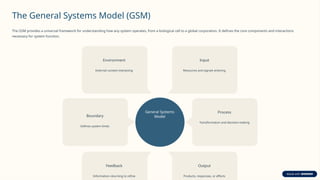
The GSM provides a universal framework for understanding how any system operates, from a biological cell to a global corporation. It defines the core components and interactions
necessary for system function.
General Systems
Model
Input
Resources and signals entering
Environment
External context interacting
Feedback
Information returning to refine
Output
Products, responses, or effects
Process
Transformation and decision-making
Boundary
Defines system limits
3.
GSM Components: TheCore
Flow
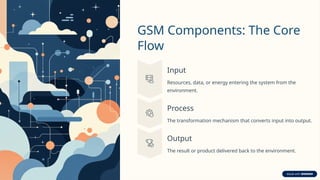
Input
Resources, data, or energy entering the system from the
environment.
Process
The transformation mechanism that converts input into output.
Output
The result or product delivered back to the environment.
4.
GSM in Action:A University
System
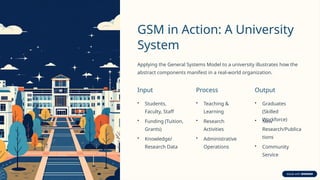
Applying the General Systems Model to a university illustrates how the
abstract components manifest in a real-world organization.
Input
• Students,
Faculty, Staff
• Funding (Tuition,
Grants)
• Knowledge/
Research Data
Process
• Teaching &
Learning
• Research
Activities
• Administrative
Operations
Output
• Graduates
(Skilled
Workforce)
• New
Research/Publica
tions
• Community
Service
5.
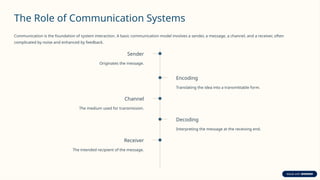
The Role ofCommunication Systems
Communication is the foundation of system interaction. A basic communication model involves a sender, a message, a channel, and a receiver, often
complicated by noise and enhanced by feedback.
Sender
Originates the message.
Encoding
Translating the idea into a transmittable form.
Channel
The medium used for transmission.
Decoding
Interpreting the message at the receiving end.
Receiver
The intended recipient of the message.
6.
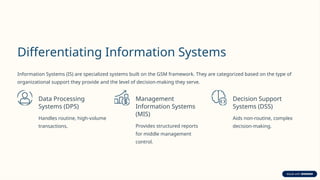
Differentiating Information Systems
InformationSystems (IS) are specialized systems built on the GSM framework. They are categorized based on the type of
organizational support they provide and the level of decision-making they serve.
Data Processing
Systems (DPS)
Handles routine, high-volume
transactions.
Management
Information Systems
(MIS)
Provides structured reports
for middle management
control.
Decision Support
Systems (DSS)
Aids non-routine, complex
decision-making.
7.
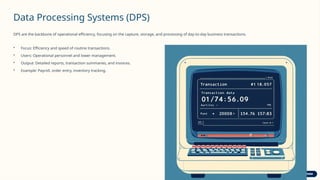
Data Processing Systems(DPS)
DPS are the backbone of operational efficiency, focusing on the capture, storage, and processing of day-to-day business transactions.
• Focus: Efficiency and speed of routine transactions.
• Users: Operational personnel and lower management.
• Output: Detailed reports, transaction summaries, and invoices.
• Example: Payroll, order entry, inventory tracking.
8.
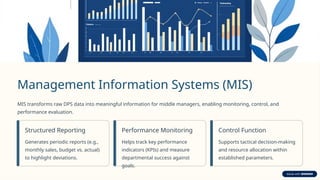
Management Information Systems(MIS)
MIS transforms raw DPS data into meaningful information for middle managers, enabling monitoring, control, and
performance evaluation.
Structured Reporting
Generates periodic reports (e.g.,
monthly sales, budget vs. actual)
to highlight deviations.
Performance Monitoring
Helps track key performance
indicators (KPIs) and measure
departmental success against
goals.
Control Function
Supports tactical decision-making
and resource allocation within
established parameters.
9.
Decision Support Systems(DSS)
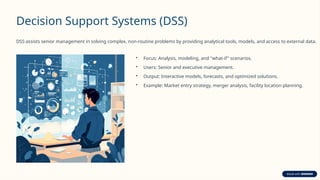
DSS assists senior management in solving complex, non-routine problems by providing analytical tools, models, and access to external data.
• Focus: Analysis, modeling, and "what-if" scenarios.
• Users: Senior and executive management.
• Output: Interactive models, forecasts, and optimized solutions.
• Example: Market entry strategy, merger analysis, facility location planning.
10.
Next Steps: Continuous
Assessment
Understandingthese systems is an ongoing process. We must
continuously assess how new technologies integrate into the GSM
framework and redefine our IS strategies.
Review & Reflect
Consider how the three IS
types (DPS, MIS, DSS) interact
in your organization.
Identify Gaps
Where are the feedback loops
weak? How can data flow be
improved?
Future Integration
How will AI and machine learning impact the Process stage of the GSM?