Location strategies are becoming a key factor in how businesses can
compete in the digital age. Business leaders and city planners can
encourage development of smart, open city ecosystems that will
become epicenters of game-changing innovation and creativity, spurring
start-ups and established businesses alike to succeed in the digital era.
By Michael M. Cook
THE
FUTURE-PROOF
CITY
The cornerstone of our
modern existence – the city –
is changing. And with this
change comes new waves of
opportunity for organizations.
May 2018
Executive Summary
The cornerstone of our modern existence – the city – is changing. And with this change comes new
waves of opportunity for organizations.
The first industrial revolution in the late 18th century gave rise to mass migrations of workers from
rural settings to urban locales. Fast-forward 250 years, and 54% of the world’s population lives in
urban areas, and this is expected to increase to 60% by 2030.
1
The city – in part as a consequence
of its own success – is now on the cusp of a huge period of change as local governments, city plan-
ners and residents look to continue building on urban strengths while mitigating the inarguable
downsides.
Central to this next wave of city development are technologies such as artificial intelligence (AI),
automation, mobile enablement, the Internet of Things (IoT) and cloud computing. Digitally inspired
change will be at the heart of the story of cities all around the world over the next 50 years.
To better understand how cities can be both catalysts for and beneficiaries of innovation, we con-
ducted in-depth interviews with five leading experts in the fields of urban design, development and
architecture (for more information, see the acknowledgments section, page 17). Through these
interviews, we examined the interplay among organizations, municipalities and individuals in creat-
ing and working in smart, open city ecosystems. It is these ecosystems that are emerging as epicen-
ters for the talent, creativity and innovation that will drive the pace of change in the Fourth Industrial
Revolution.
2
Our key findings from these interviews include:
•	 A centrally located headquarters isn’t always the best place for innovation: As organiza-
tions seek to spur innovation and attract needed talent, they’re colocating teams with start-ups
and creativity hubs whose culture aligns with their goals. By sidling up to these outposts of inno-
vation, they’re enabling the cross-pollination of ideas and work practices in a way that wouldn’t
be possible inside “the mothership.”
•	 Don’t just collocate; integrate: Simply moving closer to clients, partners, employees and start-
ups isn’t sufficient; workers need to actually interact with these stakeholders to gain the benefits
of colocation. By establishing congregation areas outside of the office, city planners can encour-
age chance encounters and foster interpersonal communications among a wide swathe of work-
ers in the environs.
Digitally inspired change will be at the
heart of the story of cities all around the
world over the next 50 years.
3The Future-Proof City |
| The Future-Proof City4
•	 Culture wins: To turn these interactions into something meaningful to the business, organiza-
tions need to choose a location whose culture encourages a collaborative mindset and an agile
way of working and partnering. We are seeing organizations base their location strategy more
on desired culture than on industry assimilation. Companies that might have traditionally chosen
Silicon Valley as their home, for example, are now settling in Las Vegas, Portland, Ore., Austin,
Tx., and even Phoenix, Ariz.
3
While some of this movement is being driven by the lower cost of
living in these locales, the escape from a high-cost area can also radiate a new vibe that attracts
a different type of worker and encourages experimentation with new business, employment,
culture and work models.
•	 Smart cities are those that share data: Smart cities in and of themselves won’t drive innova-
tion and collaboration; their data, however, can spur improvements in efficiency and productiv-
ity within the cityscape. To encourage this, cities need to open up their data to the private sector,
which can then produce and sell smart city applications, enabling capabilities that elude most
municipalities.
Organizations need to choose a location whose
culture encourages a collaborative mindset and
an agile way of working and partnering.
COLOCATE TO
INNOVATEThe places in which we work are changing dramatically. Just 20 years ago, the offices of large orga-
nizations were mainly clustered in capital cities or economic hubs, often in industry-specific regions.
From London’s banking district or New York City’s Wall Street, like-minded organizations flocked to
these districts to get close to the action, and clear lines were drawn between industries. Work took
place almost exclusively within the four walls of these offices, which were characterized by a sea of
nondescript cubicles, with leadership cocooned in isolated suites.
5The Future-Proof City |
| The Future-Proof City6
Back then, offices were simply a place for employees to congregate and create output, much of
which revolved around the fulfillment of rote tasks – think of manual invoice processing within an
accounts payable department.
Now, however, we see a rapid change. Work is beginning to disperse away from these predefined
urban areas, as businesses seek colocation with sub-sectors of needed talent. Start-ups and inno-
vation centers are now springing up where the requisite talent and culture are, such as the emerg-
ing digital hubs in cities such as Bristol in England,
4
Madrid in Spain
5
and Lisbon in Portugal.
6
The shift to digital, the rise of data and the growth of platforms, AI and automation, coupled with
economic growth, has fueled an intense talent war, with organizations struggling to fill vital digital
roles in areas such as big data, analytics, AI, robotics, creative, social media and digital strategy. As
such, companies are increasingly attracted to regional talent hubs within tier-1 and tier-2 cities
around the world in which they can nurture start-up-like teams within their business.
7
In the UK, organizations such as Barclays and even the HM Revenue & Customs have moved internal
innovation units away from central London and into smaller cities, such as Newcastle and Bristol.
8
The reasoning: Intrapreneurial teams often benefit from working outside the influence (and con-
straints) of the “mothership.” Additionally, the cultural difference within these new locations can
facilitate fresh thinking.
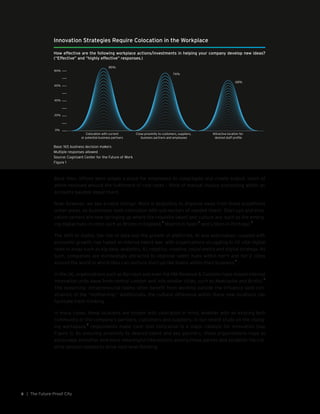
In many cases, these locations are chosen with colocation in mind, whether with an existing tech
community or the company’s partners, customers and suppliers. In our recent study on the chang-
ing workspace,
9
respondents made clear that colocation is a major catalyst for innovation (see
Figure 1). By ensuring proximity to desired talent and key partners, these organizations hope to
encourage smoother and more meaningful interactions among these parties and establish the cre-
ative tension needed to drive next-level thinking.
Innovation Strategies Require Colocation in the Workplace
How effective are the following workplace actions/investments in helping your company develop new ideas?
(“Effective” and “highly effective” responses.)
85%
76%
68%
Attractive location for
desired staff profile
Close proximity to customers, suppliers,
business partners and employees
Colocation with current
or potential business partners
0%
20%
40%
60%
80%
Base: 165 business decision makers
Multiple responses allowed
Source: Cognizant Center for the Future of Work
Figure 1
7The Future-Proof City |
COWORKING
ON A
CITY-WIDE
SCALE
| The Future-Proof City8
The interest in colocation is inspiring the emergence of business clusters – a geographic concentra-
tion of interconnected businesses, suppliers and associated institutions in a particular field. Such
clusters are popping up across the globe, in areas such as Detroit, Mich., the Bay Area in San Fran-
cisco and Dubai’s Science Park, which serves the country’s entire science sector. By bringing
together market leaders and start-ups in specific industries, these clusters increase the competi-
tiveness of participating organizations on a global and local scale.
Given the economic benefits involved, city planners need to prioritize the factors that attract cus-
tomers, partners and organizations into common areas. While establishing a business cluster solves
a piece of the colocation puzzle, however, urban developers also need to consider the human ele-
ment of innovation – the ineffable quality that electrifies an area with productive energy. For that,
cities can look to the burgeoning area of the coworking model, characterized most famously by
coworking space leader WeWork.
Entrepreneurs, start-ups and skunkworks teams from established organizations are flocking to the
social, flexible office space model. By bringing together numerous workers from multiple areas of
expertise, industrial and cultural fields, coworking spaces create “positive friction,” a concept used
by Google in its office design and a proven precursor to innovation.
10 11
Investment in this area bears
this out, evidenced by Softbank’s $4.4 billion investment into WeWork at the end of 2017.
12
The impact of coworking spaces can now be felt on the city stage, where the area immediately sur-
rounding these flexible work spaces often serves as an ecosystem for innovation, inspired by the
resulting diversity of workers and industries.
Forward-thinking city planners are adopting some of the principles of coworking spaces by creating
multiple-use areas that create positive friction by combining leisure, shopping and business activi-
ties. These open spaces are designed for public congregation, ease of mobility and fluidity of move-
ment among citizens engaged in leisure and work activities.
Barcelona, for example, is in the process of implementing anti-zoning laws in an effort to reduce
pollution, decrease noise levels and create “citizen spaces.” The government plans to reduce traffic
in the city center by 21%, and free up road space currently occupied by automobiles.
13
Such initia-
tives create more opportunity for free pedestrian movement among work, living and social spaces,
and allow for a cultural emergence among workers and city inhabitants.
EXPERTS SPEAK
“Some of the leading cities in the world are already
planning and building using an anti-zoning model.”
JARMO ESKELINEN, CHIEF INNOVATION AND TECHNOLOGY OFFICER,
FUTURE CITIES CATAPULT
The Future-Proof City | 9
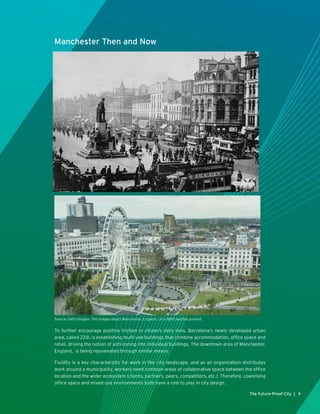
Manchester Then and Now
To further encourage positive friction in citizen’s daily lives, Barcelona’s newly developed urban
area, called 22@, is establishing multi-use buildings that combine accommodation, office space and
retail, driving the notion of anti-zoning into individual buildings. The downtown area of Manchester,
England, is being rejuvenated through similar means.
Fluidity is a key characteristic for work in the city landscape, and as an organization distributes
work around a municipality, workers need common areas of collaborative space between the office
location and the wider ecosystem (clients, partners, peers, competitors, etc.). Therefore, coworking
office space and mixed-use environments both have a role to play in city design.
Source: Getty Images. The images depict Manchester, England, circa 1890 and the present.
Quick Take
The Democratic City
More than ever, citizens want a say in how their city evolves and how the
culture emerges. And their voices are been heard; consider the referendum
undertaken for the Olympic games in Hamburg in 2015.14
The proposal was
rejected by 51.6% of voters, thereby nullifying the advance planning that
had already gone into hosting the games. This is indicative of residents’
rejection of the long-held notion of top-down urban design.
EXPERTS SPEAK
“From the 1970’s, cities like Amsterdam have incorporated
the participation of residents in urban design. This has
to be organized in a proper way because otherwise, it
frustrates the production of city projects.”
– KEES CHRISTIAANSEE, FOUNDER, KCAP
The democratization of city planning can also have numerous advantages,
as well, as seen in the digital platform TransformCity, started by ex-architect
Saskia Beer.15
This platform gives citizens an inclusive say in the design and
development of city space. To prevent malicious or needless restriction of
development, the platform establishes a trusted community of “makers,”
creating a viable compromise between a bottom-up and top-down approach
to city planning. Additionally, it just makes sense to empower the very people
whose culture is impacted by city design, given that the aim of business
ecosystems is to drive economic development through culture.
Ultimately the concepts of a culturally centered, democratically designed
urban business ecosystem extrapolate into what is termed an “Open City.”
10 | The Future-Proof City
SMART CITIES
FOLLOW
THE DATA
11The Future-Proof City |
| The Future-Proof City12
In our workspace study, we explored two different types of work that exist in offices: blue work
(creative, innovative work) and red work (rote, repetitive tasks). Likewise, the way people move
throughout a city can also be thought of in terms of red and blue movement. Blue movement would
encompass social interactions, networking, collaboration and innovation activities that workers
engage in. Red movement, on the other hand, is the commuting, administration and general tasks
citizens perform on a daily basis.
While blue movement can be enhanced by initiatives related to business clusters, colocation, democ-
ratized planning and multiple-use areas, the forces that revitalize red movement are intelligent
digital technologies.
Think of a fully connected smart city infrastructure that alerts visitors to the quickest pedestrian
routes based on footfall, traffic light timing and sidewalk conditions, or a prescriptive analytics
capability that provides alerts to the imminent failure of connected utilities. In addition to increas-
ing efficiency and productivity, such tools can also be a key factor in supporting fast growth. With
cities such as London expected to grow by 1.5 million residents by 2041,
16
planners need to stream-
line traffic, foot flow and utility management to maintain a harmonious and fully functional city.
To gain the true benefits of a smart city, municipalities need to begin sharing their data, be it on living
conditions, infrastructure, public services or transport. Helsinki in Finland
17
was among the first cities
to openly share its data, including procurement data, aerial photos and postal code areas. Finland’s
Tampere is another great example, as numerous applications have been launched from its open smart
city data hub, addressing smart mobility, smart buildings and even applications for resident input on
city design/functionality. For example, the backbone of smart public transportation in Tampere will be
the tramway running through the city by 2021. The busiest points along the tramway will be turned
into mobility hubs that will have robotic bus feeder traffic for the tram, informative tram stops, and
both physical and digital services that enable a smooth-running experience.
18
By taking an open approach to data sharing, municipalities can encourage the private sector to
develop apps, resulting in enhanced experiences made possible through market competition.
Ultimately, the creation of a smart city is not an endpoint in itself but is, instead, a facilitator of
efficient, productive and safe movement within municipal borders that contain a smart ecosystem.
It is these ecosystems that will ultimately power innovation and collaboration in the Fourth Indus-
trial Revolution.
By taking an open approach to data sharing,
municipalities can encourage the private
sector to develop apps, resulting in enhanced
experiences made possible through market
competition.
LEVERAGING
THE CITY
FOR FUTURE
SUCCESS
13The Future-Proof City |
1414 | The Future-Proof City
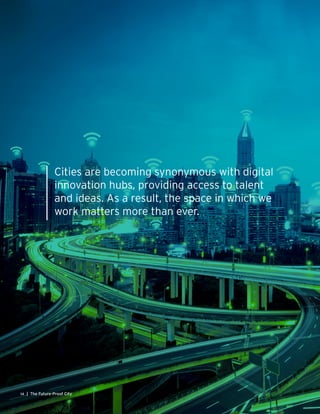
Cities are becoming synonymous with digital
innovation hubs, providing access to talent
and ideas. As a result, the space in which we
work matters more than ever.
15The Future-Proof City |
When formulating a location strategy that fosters innovation and collaboration, organizations
should focus on the following:
•	 Flock to talent and culture. Organizations need to situate innovation-minded teams in a loca-
tion whose culture and talent base is conducive to their business goals, whether that’s in a
smaller city away from headquarters or in an area of the capital city where their headquarters
resides. Either way, the movement away from the mothership can be a vital catalyst in spurring
new ideas and thought processes that are sometimes squelched by senior management teams.
•	 Consider the human in the worker. To truly benefit from the cross-pollination of ideas among
industries, partners and clients, workers need the ability to directly experience the cultural vibe
inside and outside the office. Locations that allow for a mix of leisure and work activities inspire
opportunities for chance encounters and positive friction. Also, areas that combine these ele-
ments are more attractive for workers to mingle, even after office hours.
•	 Make movement a priority. Organizations need to focus on areas that allow for fluid movement,
especially when colocating multiple offices in a single city. In addition to easy access to transpor-
tation, this also means paying attention to where workers, clients and partners in the local area
could collaborate outside the office. “Linking areas” should be scoped out, with multiple loca-
tions available for effortless meetups, including café’s, restaurants and coworking spaces.
•	 Follow the open data. In our workspace study, 43% of business leaders are looking to move to
cities with a compelling smart city vision. By opening their data and allowing for the creativity
borne of the private sector, smart cities can operate as catalysts for productivity, efficiency and
quality of life for workers.
A Final Word
The benefits of fine-tuning an organization’s location strategy go beyond increased productivity
and efficiency or anecdotal reports on inter-company/inter-industry collaboration. When properly
constructed, these ecosystems can become epicenters of game-changing innovation and creativity
that will spur start-ups and established businesses alike to succeed in the digital era. Digital titans
such as Google realize this and in many ways are assisting in the development of these ecosystems
by setting up a presence in these areas, which then has the effect of attracting start-ups and estab-
lished organizations alike.
Cities are becoming synonymous with digital innovation hubs, providing access to talent and ideas.
As a result, the space in which we work matters more than ever.
For more on this topic and other points of view, visit us at Cognizant’s Center for the Future of Work.
| The Future-Proof City16
Footnotes
1	 “The World’s Cities in 2016,” United Nations, 2016, http://www.un.org/en/development/desa/population/publications/pdf/
urbanization/the_worlds_cities_in_2016_data_booklet.pdf.
2	 Klaus Schwab, The Fourth Industrial Revoluion, Crown Publishing, 2017, https://www.weforum.org/about/the-fourth-indus-
trial-revolution-by-klaus-schwab.
3	 John Boitnott, “Why Businesses Are Moving to this Valley Instead (Hint: It’s Not Silicon),” Inc., June 8, 2017, https://www.
inc.com/john-boitnott/bwhy-businesses-are-moving-to-this-valley-instead-hint-its-not-silicon/b.html.
4	 “Bristol and Bath,” Technation, https://technation.techcityuk.com/cluster/bristol-and-bath/.
5	 Tech Hub website, https://madrid.techhub.com/.
6	 Amir Bozorgzadeh, “Portugal Is Building a Startup Mega Campus in Lisbon,” Venture Beat, Sept. 9, 2017, https://venture-
beat.com/2017/09/09/portugal-is-building-a-startup-mega-campus-in-lisbon/.
7	 “People, Not Just Machines, Will Power Digital Innovation,” Cognizant Technology Solutions, 2016, https://www.cognizant.
com/whitepapers/People-Not-Just-Machines-Will-Power-Digital-Innovation-codex1850.pdf.
8	 Caroline Baldwin, “HMRC’s Digital Delivery Centre in Newcastle Opens for Business,” ComputerWeekly, Aug. 1, 2014, https://
www.computerweekly.com/news/2240226038/HMRCs-Digital-Delivery-Centre-in-Newcastle-opens-for-business.
9	 “Space Matters: Shaping the Workplace to Get the Right Work Done,” Cognizant Technology Solutions, 2017, https://www.
cognizant.com/whitepapers/space-matters-shaping-the-workplace-to-get-the-right-work-done-codex3264.pdf.
10	 Kristian Wasen, Innovation Management in Robot Society, Routledge, March 12, 2015, https://books.google.co.uk/
books?id=ic8qBwAAQBAJ&pg=PT203&lpg=PT203&dq=positive+friction,+innovation&source=bl&ots=pkA2ysBB-
mT&sig=ApToFN6ooB5OIFVyD_jdZQ2lnsY&hl=en&sa=X&ved=0ahUKEwi3ifOM27TaAhXlC8AKHa3dB6MQ6AEIOjAC#v=one-
page&q=positive%20friction%2C%20innovation&f=false.
11	 Oliver Wainwright, “Google’s New UK Headquarters Aims to Make Going to Work Exciting,” The Guardian, Nov. 1, 2013,
https://www.theguardian.com/technology/2013/nov/01/google-new-london-headquarters.
12	 Alex Konrad, “WeWork Confirms Massive $4.4 Billion Investment from Softbank and Its Vision Fund,” Forbes, Aug. 24, 2017,
https://www.forbes.com/sites/alexkonrad/2017/08/24/wework-confirms-massive-4-4-billion-investment-from-softbank-
and-its-vision-fund/#2ccc34e15b3c.
13	 Marta Bausells, “Superblocks to the Rescue: Barcelona’s Plan to Give Streets Back to Residents,” The Guardian, May 17,
2016, https://www.theguardian.com/cities/2016/may/17/superblocks-rescue-barcelona-spain-plan-give-streets-back-resi-
dents.
14	 Wikipedia entry for Hamburg Olympics referendum, 2015, https://en.wikipedia.org/wiki/Hamburg_Olympics_referen-
dum,_2015.
15	 TransformCity website: https://www.transformcity.com/.
16	 “Can the Mayor’s New Plan Deliver Good Growth?” London Assembly, March 9, 2018, https://www.london.gov.uk/press-re-
leases/assembly/can-the-mayors-new-plan-deliver-good-growth.
17	 “Valuable City Data for Anyone,” Helsinki Smart Region, https://www.helsinkismart.fi/portfolio-items/open-data/.
18	 “Tampere, Finland, Aims for Top Smart Mobility Testing Platform in Europe,” City of Tampere, Nov. 8, 2017, https://www.
tampere.fi/en/city-of-tampere/info/current-issues/2017/11/08112017_2.html.
17The Future-Proof City |
About the Author
Acknowledgments
The Cognizant Center for the Future of Work would like to thank the following experts for their
time in interviewing for this study:
•	 Jarmo Eskelinen, Chief Innovation and Technology Officer, Future Cities Catapult
•	 Eliot Postma, Architect, Heatherwick Studio
•	 David Gann, ex-Chairman, Smart London Board
•	 Kees Christiaansee, Founder, KCAP
•	 Mike McNicholas, Managing Director, Atkins
Michael Cook
Senior Manager, Cognizant’s
Center for the Future of
Work, EMEA
Michael M. Cook is a Senior Manager in Cognizant’s Center for
the Future of Work in EMEA. In this role, Mike identifies the
changing dynamics that will shape the business ecosystem of
the future, and delivers original research and analysis of work
trends in Europe. Mike also collaborates with a wide range of
technology thinkers and academics about what the future
of work will look like as digital changes many aspects of our
working lives. Mike is an established speaker with broad expe-
rience across the services market, including customer expe-
rience management, buy-side advisory, talent and workforce
solutions, and cybersecurity.
Prior to joining Cognizant, Mike served as Global Research
Director with HfS Research, where he worked across multi-
ple research topics and led HfS’s buy-side focused research
program.
Michael can be reached at Michael.Cook@cognizant.com
Twitter: https://twitter.com/MikeMarkC
LinkedIn: https://www.linkedin.com/in/mike-cook-85550755/
| The Future-Proof City18
19The Future-Proof City |
ABOUT THE CENTER FOR THE FUTURE OF WORK
Cognizant’s Center for the Future of WorkTM
is chartered to examine how work is changing, and will change, in response to
the emergence of new technologies, new business practices and new workers. The Center provides original research and
analysis of work trends and dynamics, and collaborates with a wide range of business, technology and academic thinkers
about what the future of work will look like as technology changes so many aspects of our working lives. For more information,
visit Cognizant.com/futureofwork, or contact Ben Pring, Cognizant VP and Managing Director of the Center for the Future
of Work, at Benjamin.Pring@cognizant.com.
© Copyright 2018, Cognizant. All rights reserved. No part of this document may be reproduced, stored in a retrieval system,
transmitted in any form or by any means, electronic, mechanical, photocopying, recording, or otherwise, without the express written
permission from Cognizant. The information contained herein is subject to change without notice. All other trademarks mentioned
herein are the property of their respective owners.
Codex 3638
Cognizant (Nasdaq-100: CTSH) is one of the world’s leading professional services companies, transforming clients’ business,
operating and technology models for the digital era. Our unique industry-based, consultative approach helps clients envision,
build and run more innovative and efficient businesses. Headquartered in the U.S., Cognizant is ranked 205 on the Fortune 500
and is consistently listed among the most admired companies in the world. Learn how Cognizant helps clients lead with digital
at www.cognizant.com or follow us @Cognizant.
500 Frank W. Burr Blvd.
Teaneck, NJ 07666 USA
Phone: +1 201 801 0233
Fax: +1 201 801 0243
Toll Free: +1 888 937 3277
Email: inquiry@cognizant.com
1 Kingdom Street
Paddington Central
London W2 6BD
Phone: +44 (0) 20 7297 7600
Fax: +44 (0) 20 7121 0102
Email: infouk@cognizant.com
#5/535, Old Mahabalipuram Road
Okkiyam Pettai, Thoraipakkam
Chennai, 600 096 India
Phone: +91 (0) 44 4209 6000
Fax: +91 (0) 44 4209 6060
Email: inquiryindia@cognizant.com
World
HEADQUARTERS
European
HEADQUARTERS
India Operations
HEADQUARTERS

The Future-Proof City

  • 1.
    Location strategies arebecoming a key factor in how businesses can compete in the digital age. Business leaders and city planners can encourage development of smart, open city ecosystems that will become epicenters of game-changing innovation and creativity, spurring start-ups and established businesses alike to succeed in the digital era. By Michael M. Cook THE FUTURE-PROOF CITY
  • 2.
    The cornerstone ofour modern existence – the city – is changing. And with this change comes new waves of opportunity for organizations. May 2018
  • 3.
    Executive Summary The cornerstoneof our modern existence – the city – is changing. And with this change comes new waves of opportunity for organizations. The first industrial revolution in the late 18th century gave rise to mass migrations of workers from rural settings to urban locales. Fast-forward 250 years, and 54% of the world’s population lives in urban areas, and this is expected to increase to 60% by 2030. 1 The city – in part as a consequence of its own success – is now on the cusp of a huge period of change as local governments, city plan- ners and residents look to continue building on urban strengths while mitigating the inarguable downsides. Central to this next wave of city development are technologies such as artificial intelligence (AI), automation, mobile enablement, the Internet of Things (IoT) and cloud computing. Digitally inspired change will be at the heart of the story of cities all around the world over the next 50 years. To better understand how cities can be both catalysts for and beneficiaries of innovation, we con- ducted in-depth interviews with five leading experts in the fields of urban design, development and architecture (for more information, see the acknowledgments section, page 17). Through these interviews, we examined the interplay among organizations, municipalities and individuals in creat- ing and working in smart, open city ecosystems. It is these ecosystems that are emerging as epicen- ters for the talent, creativity and innovation that will drive the pace of change in the Fourth Industrial Revolution. 2 Our key findings from these interviews include: • A centrally located headquarters isn’t always the best place for innovation: As organiza- tions seek to spur innovation and attract needed talent, they’re colocating teams with start-ups and creativity hubs whose culture aligns with their goals. By sidling up to these outposts of inno- vation, they’re enabling the cross-pollination of ideas and work practices in a way that wouldn’t be possible inside “the mothership.” • Don’t just collocate; integrate: Simply moving closer to clients, partners, employees and start- ups isn’t sufficient; workers need to actually interact with these stakeholders to gain the benefits of colocation. By establishing congregation areas outside of the office, city planners can encour- age chance encounters and foster interpersonal communications among a wide swathe of work- ers in the environs. Digitally inspired change will be at the heart of the story of cities all around the world over the next 50 years. 3The Future-Proof City |
  • 4.
    | The Future-ProofCity4 • Culture wins: To turn these interactions into something meaningful to the business, organiza- tions need to choose a location whose culture encourages a collaborative mindset and an agile way of working and partnering. We are seeing organizations base their location strategy more on desired culture than on industry assimilation. Companies that might have traditionally chosen Silicon Valley as their home, for example, are now settling in Las Vegas, Portland, Ore., Austin, Tx., and even Phoenix, Ariz. 3 While some of this movement is being driven by the lower cost of living in these locales, the escape from a high-cost area can also radiate a new vibe that attracts a different type of worker and encourages experimentation with new business, employment, culture and work models. • Smart cities are those that share data: Smart cities in and of themselves won’t drive innova- tion and collaboration; their data, however, can spur improvements in efficiency and productiv- ity within the cityscape. To encourage this, cities need to open up their data to the private sector, which can then produce and sell smart city applications, enabling capabilities that elude most municipalities. Organizations need to choose a location whose culture encourages a collaborative mindset and an agile way of working and partnering.
  • 5.
    COLOCATE TO INNOVATEThe placesin which we work are changing dramatically. Just 20 years ago, the offices of large orga- nizations were mainly clustered in capital cities or economic hubs, often in industry-specific regions. From London’s banking district or New York City’s Wall Street, like-minded organizations flocked to these districts to get close to the action, and clear lines were drawn between industries. Work took place almost exclusively within the four walls of these offices, which were characterized by a sea of nondescript cubicles, with leadership cocooned in isolated suites. 5The Future-Proof City |
  • 6.
    | The Future-ProofCity6 Back then, offices were simply a place for employees to congregate and create output, much of which revolved around the fulfillment of rote tasks – think of manual invoice processing within an accounts payable department. Now, however, we see a rapid change. Work is beginning to disperse away from these predefined urban areas, as businesses seek colocation with sub-sectors of needed talent. Start-ups and inno- vation centers are now springing up where the requisite talent and culture are, such as the emerg- ing digital hubs in cities such as Bristol in England, 4 Madrid in Spain 5 and Lisbon in Portugal. 6 The shift to digital, the rise of data and the growth of platforms, AI and automation, coupled with economic growth, has fueled an intense talent war, with organizations struggling to fill vital digital roles in areas such as big data, analytics, AI, robotics, creative, social media and digital strategy. As such, companies are increasingly attracted to regional talent hubs within tier-1 and tier-2 cities around the world in which they can nurture start-up-like teams within their business. 7 In the UK, organizations such as Barclays and even the HM Revenue & Customs have moved internal innovation units away from central London and into smaller cities, such as Newcastle and Bristol. 8 The reasoning: Intrapreneurial teams often benefit from working outside the influence (and con- straints) of the “mothership.” Additionally, the cultural difference within these new locations can facilitate fresh thinking. In many cases, these locations are chosen with colocation in mind, whether with an existing tech community or the company’s partners, customers and suppliers. In our recent study on the chang- ing workspace, 9 respondents made clear that colocation is a major catalyst for innovation (see Figure 1). By ensuring proximity to desired talent and key partners, these organizations hope to encourage smoother and more meaningful interactions among these parties and establish the cre- ative tension needed to drive next-level thinking. Innovation Strategies Require Colocation in the Workplace How effective are the following workplace actions/investments in helping your company develop new ideas? (“Effective” and “highly effective” responses.) 85% 76% 68% Attractive location for desired staff profile Close proximity to customers, suppliers, business partners and employees Colocation with current or potential business partners 0% 20% 40% 60% 80% Base: 165 business decision makers Multiple responses allowed Source: Cognizant Center for the Future of Work Figure 1
  • 7.
    7The Future-Proof City| COWORKING ON A CITY-WIDE SCALE
  • 8.
    | The Future-ProofCity8 The interest in colocation is inspiring the emergence of business clusters – a geographic concentra- tion of interconnected businesses, suppliers and associated institutions in a particular field. Such clusters are popping up across the globe, in areas such as Detroit, Mich., the Bay Area in San Fran- cisco and Dubai’s Science Park, which serves the country’s entire science sector. By bringing together market leaders and start-ups in specific industries, these clusters increase the competi- tiveness of participating organizations on a global and local scale. Given the economic benefits involved, city planners need to prioritize the factors that attract cus- tomers, partners and organizations into common areas. While establishing a business cluster solves a piece of the colocation puzzle, however, urban developers also need to consider the human ele- ment of innovation – the ineffable quality that electrifies an area with productive energy. For that, cities can look to the burgeoning area of the coworking model, characterized most famously by coworking space leader WeWork. Entrepreneurs, start-ups and skunkworks teams from established organizations are flocking to the social, flexible office space model. By bringing together numerous workers from multiple areas of expertise, industrial and cultural fields, coworking spaces create “positive friction,” a concept used by Google in its office design and a proven precursor to innovation. 10 11 Investment in this area bears this out, evidenced by Softbank’s $4.4 billion investment into WeWork at the end of 2017. 12 The impact of coworking spaces can now be felt on the city stage, where the area immediately sur- rounding these flexible work spaces often serves as an ecosystem for innovation, inspired by the resulting diversity of workers and industries. Forward-thinking city planners are adopting some of the principles of coworking spaces by creating multiple-use areas that create positive friction by combining leisure, shopping and business activi- ties. These open spaces are designed for public congregation, ease of mobility and fluidity of move- ment among citizens engaged in leisure and work activities. Barcelona, for example, is in the process of implementing anti-zoning laws in an effort to reduce pollution, decrease noise levels and create “citizen spaces.” The government plans to reduce traffic in the city center by 21%, and free up road space currently occupied by automobiles. 13 Such initia- tives create more opportunity for free pedestrian movement among work, living and social spaces, and allow for a cultural emergence among workers and city inhabitants. EXPERTS SPEAK “Some of the leading cities in the world are already planning and building using an anti-zoning model.” JARMO ESKELINEN, CHIEF INNOVATION AND TECHNOLOGY OFFICER, FUTURE CITIES CATAPULT
  • 9.
    The Future-Proof City| 9 Manchester Then and Now To further encourage positive friction in citizen’s daily lives, Barcelona’s newly developed urban area, called 22@, is establishing multi-use buildings that combine accommodation, office space and retail, driving the notion of anti-zoning into individual buildings. The downtown area of Manchester, England, is being rejuvenated through similar means. Fluidity is a key characteristic for work in the city landscape, and as an organization distributes work around a municipality, workers need common areas of collaborative space between the office location and the wider ecosystem (clients, partners, peers, competitors, etc.). Therefore, coworking office space and mixed-use environments both have a role to play in city design. Source: Getty Images. The images depict Manchester, England, circa 1890 and the present.
  • 10.
    Quick Take The DemocraticCity More than ever, citizens want a say in how their city evolves and how the culture emerges. And their voices are been heard; consider the referendum undertaken for the Olympic games in Hamburg in 2015.14 The proposal was rejected by 51.6% of voters, thereby nullifying the advance planning that had already gone into hosting the games. This is indicative of residents’ rejection of the long-held notion of top-down urban design. EXPERTS SPEAK “From the 1970’s, cities like Amsterdam have incorporated the participation of residents in urban design. This has to be organized in a proper way because otherwise, it frustrates the production of city projects.” – KEES CHRISTIAANSEE, FOUNDER, KCAP The democratization of city planning can also have numerous advantages, as well, as seen in the digital platform TransformCity, started by ex-architect Saskia Beer.15 This platform gives citizens an inclusive say in the design and development of city space. To prevent malicious or needless restriction of development, the platform establishes a trusted community of “makers,” creating a viable compromise between a bottom-up and top-down approach to city planning. Additionally, it just makes sense to empower the very people whose culture is impacted by city design, given that the aim of business ecosystems is to drive economic development through culture. Ultimately the concepts of a culturally centered, democratically designed urban business ecosystem extrapolate into what is termed an “Open City.” 10 | The Future-Proof City
  • 11.
  • 12.
    | The Future-ProofCity12 In our workspace study, we explored two different types of work that exist in offices: blue work (creative, innovative work) and red work (rote, repetitive tasks). Likewise, the way people move throughout a city can also be thought of in terms of red and blue movement. Blue movement would encompass social interactions, networking, collaboration and innovation activities that workers engage in. Red movement, on the other hand, is the commuting, administration and general tasks citizens perform on a daily basis. While blue movement can be enhanced by initiatives related to business clusters, colocation, democ- ratized planning and multiple-use areas, the forces that revitalize red movement are intelligent digital technologies. Think of a fully connected smart city infrastructure that alerts visitors to the quickest pedestrian routes based on footfall, traffic light timing and sidewalk conditions, or a prescriptive analytics capability that provides alerts to the imminent failure of connected utilities. In addition to increas- ing efficiency and productivity, such tools can also be a key factor in supporting fast growth. With cities such as London expected to grow by 1.5 million residents by 2041, 16 planners need to stream- line traffic, foot flow and utility management to maintain a harmonious and fully functional city. To gain the true benefits of a smart city, municipalities need to begin sharing their data, be it on living conditions, infrastructure, public services or transport. Helsinki in Finland 17 was among the first cities to openly share its data, including procurement data, aerial photos and postal code areas. Finland’s Tampere is another great example, as numerous applications have been launched from its open smart city data hub, addressing smart mobility, smart buildings and even applications for resident input on city design/functionality. For example, the backbone of smart public transportation in Tampere will be the tramway running through the city by 2021. The busiest points along the tramway will be turned into mobility hubs that will have robotic bus feeder traffic for the tram, informative tram stops, and both physical and digital services that enable a smooth-running experience. 18 By taking an open approach to data sharing, municipalities can encourage the private sector to develop apps, resulting in enhanced experiences made possible through market competition. Ultimately, the creation of a smart city is not an endpoint in itself but is, instead, a facilitator of efficient, productive and safe movement within municipal borders that contain a smart ecosystem. It is these ecosystems that will ultimately power innovation and collaboration in the Fourth Indus- trial Revolution. By taking an open approach to data sharing, municipalities can encourage the private sector to develop apps, resulting in enhanced experiences made possible through market competition.
  • 13.
  • 14.
    1414 | TheFuture-Proof City Cities are becoming synonymous with digital innovation hubs, providing access to talent and ideas. As a result, the space in which we work matters more than ever.
  • 15.
    15The Future-Proof City| When formulating a location strategy that fosters innovation and collaboration, organizations should focus on the following: • Flock to talent and culture. Organizations need to situate innovation-minded teams in a loca- tion whose culture and talent base is conducive to their business goals, whether that’s in a smaller city away from headquarters or in an area of the capital city where their headquarters resides. Either way, the movement away from the mothership can be a vital catalyst in spurring new ideas and thought processes that are sometimes squelched by senior management teams. • Consider the human in the worker. To truly benefit from the cross-pollination of ideas among industries, partners and clients, workers need the ability to directly experience the cultural vibe inside and outside the office. Locations that allow for a mix of leisure and work activities inspire opportunities for chance encounters and positive friction. Also, areas that combine these ele- ments are more attractive for workers to mingle, even after office hours. • Make movement a priority. Organizations need to focus on areas that allow for fluid movement, especially when colocating multiple offices in a single city. In addition to easy access to transpor- tation, this also means paying attention to where workers, clients and partners in the local area could collaborate outside the office. “Linking areas” should be scoped out, with multiple loca- tions available for effortless meetups, including café’s, restaurants and coworking spaces. • Follow the open data. In our workspace study, 43% of business leaders are looking to move to cities with a compelling smart city vision. By opening their data and allowing for the creativity borne of the private sector, smart cities can operate as catalysts for productivity, efficiency and quality of life for workers. A Final Word The benefits of fine-tuning an organization’s location strategy go beyond increased productivity and efficiency or anecdotal reports on inter-company/inter-industry collaboration. When properly constructed, these ecosystems can become epicenters of game-changing innovation and creativity that will spur start-ups and established businesses alike to succeed in the digital era. Digital titans such as Google realize this and in many ways are assisting in the development of these ecosystems by setting up a presence in these areas, which then has the effect of attracting start-ups and estab- lished organizations alike. Cities are becoming synonymous with digital innovation hubs, providing access to talent and ideas. As a result, the space in which we work matters more than ever. For more on this topic and other points of view, visit us at Cognizant’s Center for the Future of Work.
  • 16.
    | The Future-ProofCity16 Footnotes 1 “The World’s Cities in 2016,” United Nations, 2016, http://www.un.org/en/development/desa/population/publications/pdf/ urbanization/the_worlds_cities_in_2016_data_booklet.pdf. 2 Klaus Schwab, The Fourth Industrial Revoluion, Crown Publishing, 2017, https://www.weforum.org/about/the-fourth-indus- trial-revolution-by-klaus-schwab. 3 John Boitnott, “Why Businesses Are Moving to this Valley Instead (Hint: It’s Not Silicon),” Inc., June 8, 2017, https://www. inc.com/john-boitnott/bwhy-businesses-are-moving-to-this-valley-instead-hint-its-not-silicon/b.html. 4 “Bristol and Bath,” Technation, https://technation.techcityuk.com/cluster/bristol-and-bath/. 5 Tech Hub website, https://madrid.techhub.com/. 6 Amir Bozorgzadeh, “Portugal Is Building a Startup Mega Campus in Lisbon,” Venture Beat, Sept. 9, 2017, https://venture- beat.com/2017/09/09/portugal-is-building-a-startup-mega-campus-in-lisbon/. 7 “People, Not Just Machines, Will Power Digital Innovation,” Cognizant Technology Solutions, 2016, https://www.cognizant. com/whitepapers/People-Not-Just-Machines-Will-Power-Digital-Innovation-codex1850.pdf. 8 Caroline Baldwin, “HMRC’s Digital Delivery Centre in Newcastle Opens for Business,” ComputerWeekly, Aug. 1, 2014, https:// www.computerweekly.com/news/2240226038/HMRCs-Digital-Delivery-Centre-in-Newcastle-opens-for-business. 9 “Space Matters: Shaping the Workplace to Get the Right Work Done,” Cognizant Technology Solutions, 2017, https://www. cognizant.com/whitepapers/space-matters-shaping-the-workplace-to-get-the-right-work-done-codex3264.pdf. 10 Kristian Wasen, Innovation Management in Robot Society, Routledge, March 12, 2015, https://books.google.co.uk/ books?id=ic8qBwAAQBAJ&pg=PT203&lpg=PT203&dq=positive+friction,+innovation&source=bl&ots=pkA2ysBB- mT&sig=ApToFN6ooB5OIFVyD_jdZQ2lnsY&hl=en&sa=X&ved=0ahUKEwi3ifOM27TaAhXlC8AKHa3dB6MQ6AEIOjAC#v=one- page&q=positive%20friction%2C%20innovation&f=false. 11 Oliver Wainwright, “Google’s New UK Headquarters Aims to Make Going to Work Exciting,” The Guardian, Nov. 1, 2013, https://www.theguardian.com/technology/2013/nov/01/google-new-london-headquarters. 12 Alex Konrad, “WeWork Confirms Massive $4.4 Billion Investment from Softbank and Its Vision Fund,” Forbes, Aug. 24, 2017, https://www.forbes.com/sites/alexkonrad/2017/08/24/wework-confirms-massive-4-4-billion-investment-from-softbank- and-its-vision-fund/#2ccc34e15b3c. 13 Marta Bausells, “Superblocks to the Rescue: Barcelona’s Plan to Give Streets Back to Residents,” The Guardian, May 17, 2016, https://www.theguardian.com/cities/2016/may/17/superblocks-rescue-barcelona-spain-plan-give-streets-back-resi- dents. 14 Wikipedia entry for Hamburg Olympics referendum, 2015, https://en.wikipedia.org/wiki/Hamburg_Olympics_referen- dum,_2015. 15 TransformCity website: https://www.transformcity.com/. 16 “Can the Mayor’s New Plan Deliver Good Growth?” London Assembly, March 9, 2018, https://www.london.gov.uk/press-re- leases/assembly/can-the-mayors-new-plan-deliver-good-growth. 17 “Valuable City Data for Anyone,” Helsinki Smart Region, https://www.helsinkismart.fi/portfolio-items/open-data/. 18 “Tampere, Finland, Aims for Top Smart Mobility Testing Platform in Europe,” City of Tampere, Nov. 8, 2017, https://www. tampere.fi/en/city-of-tampere/info/current-issues/2017/11/08112017_2.html.
  • 17.
    17The Future-Proof City| About the Author Acknowledgments The Cognizant Center for the Future of Work would like to thank the following experts for their time in interviewing for this study: • Jarmo Eskelinen, Chief Innovation and Technology Officer, Future Cities Catapult • Eliot Postma, Architect, Heatherwick Studio • David Gann, ex-Chairman, Smart London Board • Kees Christiaansee, Founder, KCAP • Mike McNicholas, Managing Director, Atkins Michael Cook Senior Manager, Cognizant’s Center for the Future of Work, EMEA Michael M. Cook is a Senior Manager in Cognizant’s Center for the Future of Work in EMEA. In this role, Mike identifies the changing dynamics that will shape the business ecosystem of the future, and delivers original research and analysis of work trends in Europe. Mike also collaborates with a wide range of technology thinkers and academics about what the future of work will look like as digital changes many aspects of our working lives. Mike is an established speaker with broad expe- rience across the services market, including customer expe- rience management, buy-side advisory, talent and workforce solutions, and cybersecurity. Prior to joining Cognizant, Mike served as Global Research Director with HfS Research, where he worked across multi- ple research topics and led HfS’s buy-side focused research program. Michael can be reached at Michael.Cook@cognizant.com Twitter: https://twitter.com/MikeMarkC LinkedIn: https://www.linkedin.com/in/mike-cook-85550755/
  • 18.
  • 19.
  • 20.
    ABOUT THE CENTERFOR THE FUTURE OF WORK Cognizant’s Center for the Future of WorkTM is chartered to examine how work is changing, and will change, in response to the emergence of new technologies, new business practices and new workers. The Center provides original research and analysis of work trends and dynamics, and collaborates with a wide range of business, technology and academic thinkers about what the future of work will look like as technology changes so many aspects of our working lives. For more information, visit Cognizant.com/futureofwork, or contact Ben Pring, Cognizant VP and Managing Director of the Center for the Future of Work, at Benjamin.Pring@cognizant.com. © Copyright 2018, Cognizant. All rights reserved. No part of this document may be reproduced, stored in a retrieval system, transmitted in any form or by any means, electronic, mechanical, photocopying, recording, or otherwise, without the express written permission from Cognizant. The information contained herein is subject to change without notice. All other trademarks mentioned herein are the property of their respective owners. Codex 3638 Cognizant (Nasdaq-100: CTSH) is one of the world’s leading professional services companies, transforming clients’ business, operating and technology models for the digital era. Our unique industry-based, consultative approach helps clients envision, build and run more innovative and efficient businesses. Headquartered in the U.S., Cognizant is ranked 205 on the Fortune 500 and is consistently listed among the most admired companies in the world. Learn how Cognizant helps clients lead with digital at www.cognizant.com or follow us @Cognizant. 500 Frank W. Burr Blvd. Teaneck, NJ 07666 USA Phone: +1 201 801 0233 Fax: +1 201 801 0243 Toll Free: +1 888 937 3277 Email: inquiry@cognizant.com 1 Kingdom Street Paddington Central London W2 6BD Phone: +44 (0) 20 7297 7600 Fax: +44 (0) 20 7121 0102 Email: infouk@cognizant.com #5/535, Old Mahabalipuram Road Okkiyam Pettai, Thoraipakkam Chennai, 600 096 India Phone: +91 (0) 44 4209 6000 Fax: +91 (0) 44 4209 6060 Email: inquiryindia@cognizant.com World HEADQUARTERS European HEADQUARTERS India Operations HEADQUARTERS