Background to Digital Marketing for
         Small Businesses 2012
       “Its Marketing Scotty, but not as
                 we know it”
                 Richard Masters


1                                          18/10/2012
What is Digital Marketing?
Digital Marketing is not some new orthodoxy, it is simply
a whole range of new marketing tactics that are now
available which have, largely, been enabled by the
development of the Internet
Digital Marketing?
 The FT definition is
     “The marketing of products or services using digital
    channels to reach consumers”
   There are all sorts of more prescriptive definitions, but
    I like this one because it is simple and inclusive.
   DM provides for Small Businesses a whole range of
    potential new and powerful Marketing Tactics which
    are affordable!
   The key driver is technology, and in particular the
    spectacular rise in The Internet. However, other
    technologies such as Mobile and Digital TV are also
    important.
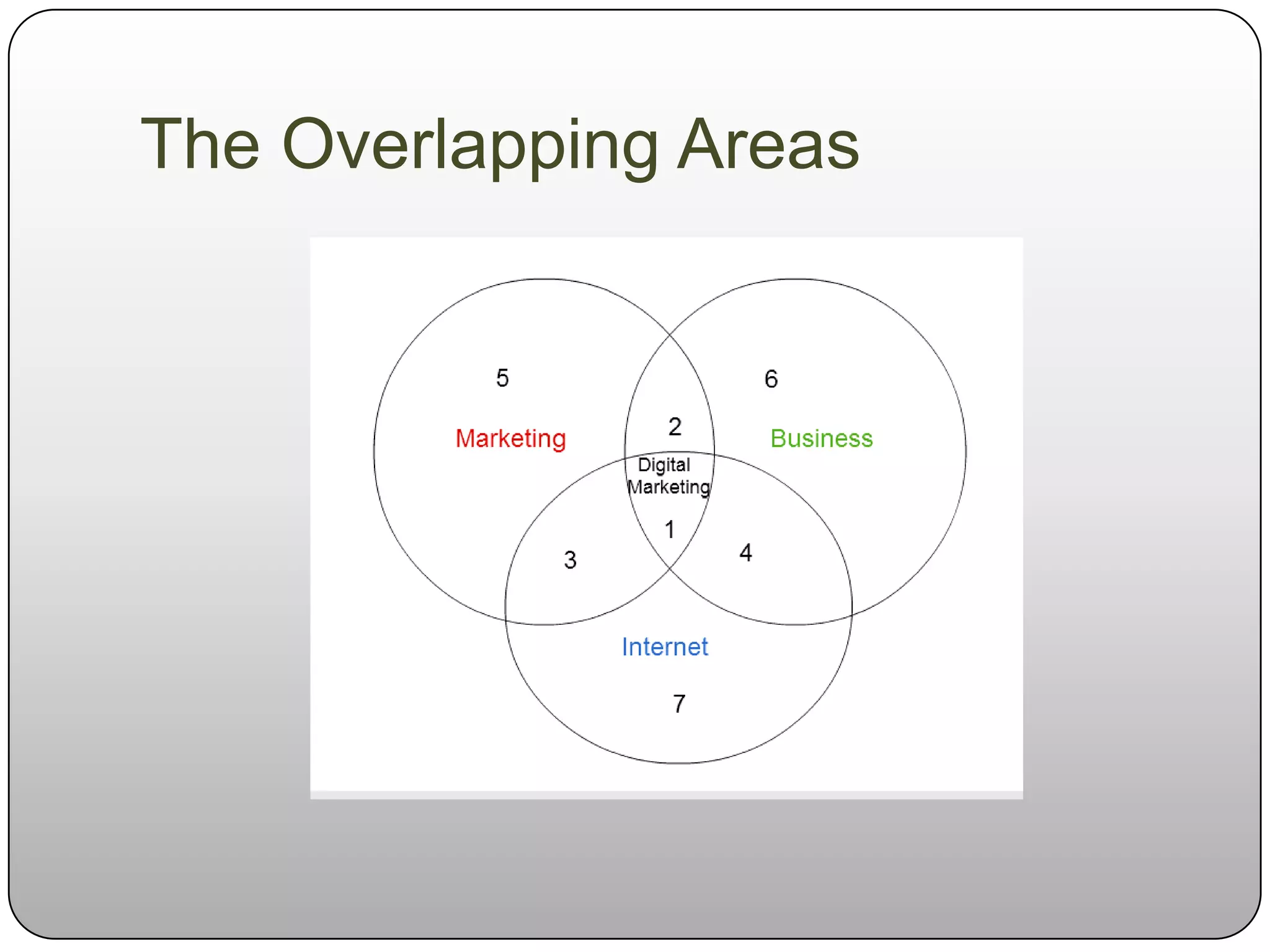
   DM is where Business. Marketing and The Internet
    intersect. The next diagram tries to illustrate this
    positioning.
Digital Marketing
 So broadly Digital Marketing occupies the space
  where Business, Marketing and the Internet
  overlap.
 The next slide, and the subsequent table, develop
  the idea a little further by looking at some of the
  other overlapping areas in the Venn diagram to
  better position DM.
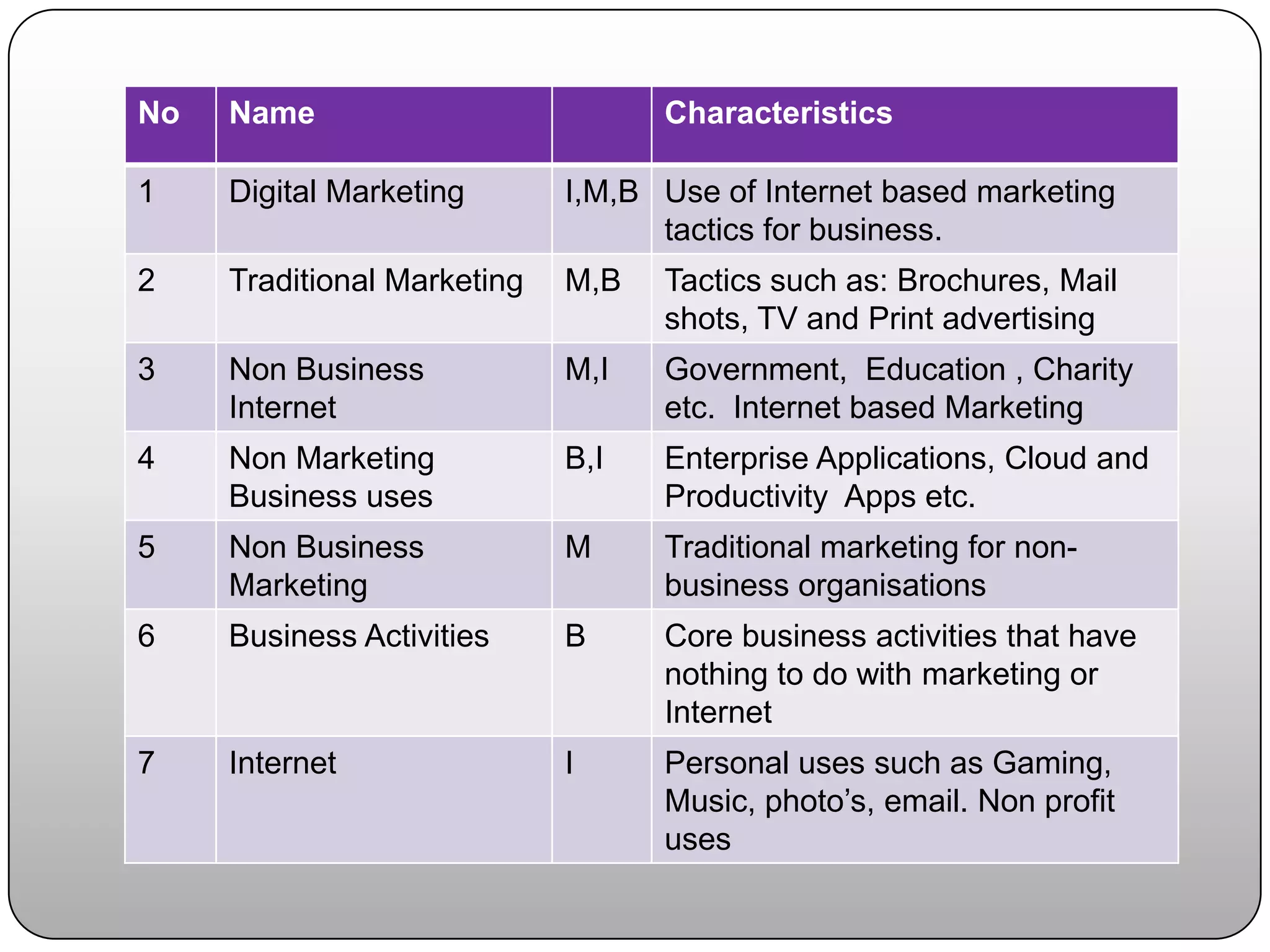
 The characteristics of the other numbered areas
  in the diagram, are described in the subsequent
  table
The Overlapping Areas
No   Name                          Characteristics

1    Digital Marketing       I,M,B Use of Internet based marketing
                                   tactics for business.
2    Traditional Marketing   M,B   Tactics such as: Brochures, Mail
                                   shots, TV and Print advertising
3    Non Business            M,I   Government, Education , Charity
     Internet                      etc. Internet based Marketing
4    Non Marketing           B,I   Enterprise Applications, Cloud and
     Business uses                 Productivity Apps etc.
5    Non Business            M     Traditional marketing for non-
     Marketing                     business organisations
6    Business Activities     B     Core business activities that have
                                   nothing to do with marketing or
                                   Internet
7    Internet                I     Personal uses such as Gaming,
                                   Music, photo’s, email. Non profit
                                   uses
The Internet: The key driver
This rapid expansion in the tactics available to small
businesses for marketing, has been facilitated by the
growth and development of the internet. Such has been
the impact it is fair to describe it as a paradigm shift.
The Impact of the internet

 The impact of the Internet on Marketing has not
  been a one off event. It has evolved over the past
  30 years
 It is useful to distinguish between two distinct
  phases:
   Web 1.0: The Web pre 2000
   Web 2.0: The current Web


  These are each described in turn below:
Web 1.0
The web before 2000
Web 1.0
 Back in 1992 view of Web largely derived from
  academia
 It was seen as a “Vast interconnected set of
  reference libraries” where all the worlds
  knowledge could be stored for access by anyone.
 First search engine emerged in 1993:
   AltaVista

 Rudimentary browsers emerged in1994:
   Netscape launched
 Interaction was characterised as one way. The
  user was largely passive.
Marketers Built Websites!
 1995-2005 was the era of website building
 Boy, did we build websites. Rivalled the growth of
  railways in the 18th Century!
 Web design companies grew like topsy!
 Some accompanying developments in
  “Outbound” or “Push” Marketing such as
  electronic newsletters & email marketing.
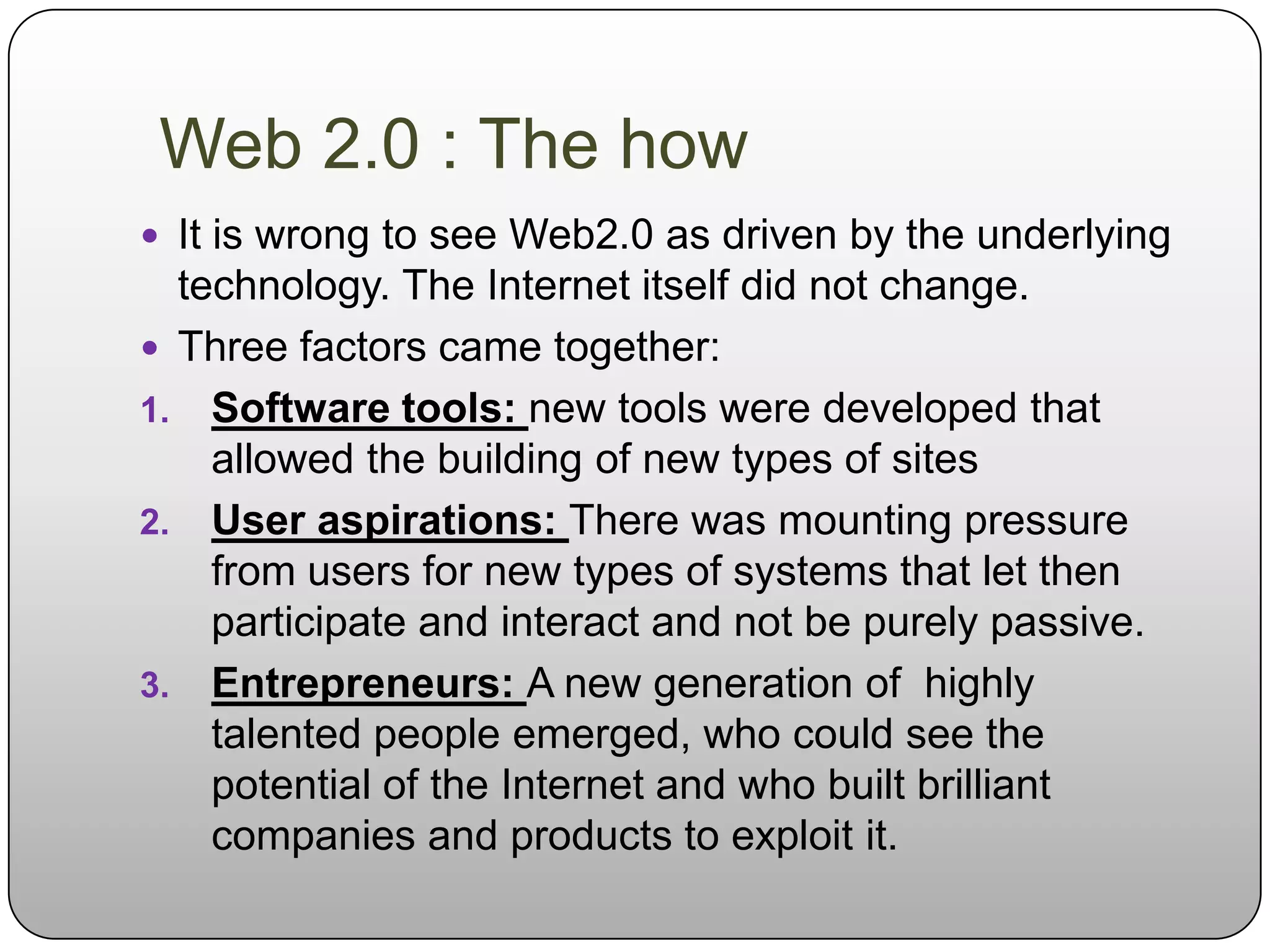
 Often called the “field of dreams” era!
“Field of Dreams” Marketing
 “Build it and they will come” approach to websites
  predominated
 Often compared to erecting
   a billboard in a basement
 Marketers built millions
   and millions of websites
 Problem was nobody came
   and even fewer stayed!
Why the Underachievement?
 Traditional “4P’s” product marketers saw
    Websites just as new “Electronic Brochures” full
    of product “puff”.
   Expensive investment in design elements
   Often supplemented with email direct marketing.
   Nothing to encourage customers to visit, stay or
    return.
   Few visitors + little engagement = limited
    Business
   Websites were consistently not achieving
    business expectations
   Enter, stage left: Web 2.0!!
WEB 2.0
The web post 2005
The genesis of Web 2.0
 Towards the end of the millennium a new
 view of the web emerged from users
   We now call this Web 2.0
 Web 2.0 is based on interaction:
   two way interaction, multiple
   conversations
 Users wanted to participate
   emergence of sites such as:

 Google developed a commercial
 business model, based on search, that
 worked.
   Business could now better exploit the
   web!
Web 2.0: Some Definitions
 “Well, simply put, Web 2.0 is an Internet jargon
  term used to describe the newer generation
  of websites that are about "User-generated"
  content. By this I mean Web 2.0 websites allow
  users to collaborate and share information,
  opinions, comments, ideas, links, ratings,
  bookmarks, reviews, pictures, videos, and more.”
  Allan Todd
 “Web 2.0 is the term given to describe a second
  generation of the World Wide Web that is focused
  on the ability for people to collaborate and share
  information online” Webopedia
Web 2.0 : The how
 It is wrong to see Web2.0 as driven by the underlying
  technology. The Internet itself did not change.
 Three factors came together:
1. Software tools: new tools were developed that
    allowed the building of new types of sites
2. User aspirations: There was mounting pressure
    from users for new types of systems that let then
    participate and interact and not be purely passive.
3. Entrepreneurs: A new generation of highly
    talented people emerged, who could see the
    potential of the Internet and who built brilliant
    companies and products to exploit it.
Created a major paradigm shift
 “Web 1.0 was where corporations thought the internet was
  another dandy platform for telling us what they wanted us to
  know. Web 2.0 was where we showed them that the internet is
  about us, not them, and that if they want to stay around, they'd
  better sit back, shut up, and listen. Web 2.0, like Rock and Roll,
  is here to stay”. Ray Beckerman


 “This Is Not Your Father’s Marketing” .. “And that’s the
  difference between traditional marketing and social media
  marketing. In traditional marketing, you throw out a message
  where it will be seen by millions of people who couldn’t care
  less.”... “In social media marketing, you find the people who are
  already talking about your message and join the conversation.
  It’s really that simple and that complicated.” liana li Evans
Impact on Marketing
 The basic principles of marketing did not change.
    What changed, fundamentally, was the way we went
    about doing it!...
   A whole new discipline emerged: In bound
    marketing.
   The role of websites changed from Billboards to
    portals and nodes of two way interaction.
   The whole process became customer centric and no
    longer product centric.
   The creation of great content to attract and engage
    customers came to the forefront
   The rise of online publishing, social media & multi
    media
Next steps
 This presentation has presented a brief
  background to the revolution that is digital
  marketing.
 The subsequent sections look at the
  manifestations of this revolution of relevance to
  small businesses
 This starts with a re-iteration of the basic
  principles of marketing and then an exploration
  Digital Marketing and Social Networking and their
  applications
 Finally, further technology impacts on small
  businesses ,such as cloud computing and mobile,
  are covered in outline.
Further Information/Contact
      Email: richard@rjmasters.co.uk
      Website: www.rjmasters.co.uk
      LinkedIn: http://lnkd.in/vTp8Kw
      G+
      :http://www.google.com/profiles/richardmasters.richar
       d
      Facebook: https://www.facebook.com/richardmastersj
      Twitter: www.twitter.com/mastersassoc


22                                                   18/10/2012

A background to digital marketing for small businesses 2012

  • 1.
    Background to DigitalMarketing for Small Businesses 2012 “Its Marketing Scotty, but not as we know it” Richard Masters 1 18/10/2012
  • 2.
    What is DigitalMarketing? Digital Marketing is not some new orthodoxy, it is simply a whole range of new marketing tactics that are now available which have, largely, been enabled by the development of the Internet
  • 3.
    Digital Marketing?  TheFT definition is “The marketing of products or services using digital channels to reach consumers”  There are all sorts of more prescriptive definitions, but I like this one because it is simple and inclusive.  DM provides for Small Businesses a whole range of potential new and powerful Marketing Tactics which are affordable!  The key driver is technology, and in particular the spectacular rise in The Internet. However, other technologies such as Mobile and Digital TV are also important.  DM is where Business. Marketing and The Internet intersect. The next diagram tries to illustrate this positioning.
  • 4.
  • 5.
     So broadlyDigital Marketing occupies the space where Business, Marketing and the Internet overlap.  The next slide, and the subsequent table, develop the idea a little further by looking at some of the other overlapping areas in the Venn diagram to better position DM.  The characteristics of the other numbered areas in the diagram, are described in the subsequent table
  • 6.
  • 7.
    No Name Characteristics 1 Digital Marketing I,M,B Use of Internet based marketing tactics for business. 2 Traditional Marketing M,B Tactics such as: Brochures, Mail shots, TV and Print advertising 3 Non Business M,I Government, Education , Charity Internet etc. Internet based Marketing 4 Non Marketing B,I Enterprise Applications, Cloud and Business uses Productivity Apps etc. 5 Non Business M Traditional marketing for non- Marketing business organisations 6 Business Activities B Core business activities that have nothing to do with marketing or Internet 7 Internet I Personal uses such as Gaming, Music, photo’s, email. Non profit uses
  • 8.
    The Internet: Thekey driver This rapid expansion in the tactics available to small businesses for marketing, has been facilitated by the growth and development of the internet. Such has been the impact it is fair to describe it as a paradigm shift.
  • 9.
    The Impact ofthe internet  The impact of the Internet on Marketing has not been a one off event. It has evolved over the past 30 years  It is useful to distinguish between two distinct phases:  Web 1.0: The Web pre 2000  Web 2.0: The current Web These are each described in turn below:
  • 10.
    Web 1.0 The webbefore 2000
  • 11.
    Web 1.0  Backin 1992 view of Web largely derived from academia  It was seen as a “Vast interconnected set of reference libraries” where all the worlds knowledge could be stored for access by anyone.  First search engine emerged in 1993: AltaVista  Rudimentary browsers emerged in1994: Netscape launched  Interaction was characterised as one way. The user was largely passive.
  • 12.
    Marketers Built Websites! 1995-2005 was the era of website building  Boy, did we build websites. Rivalled the growth of railways in the 18th Century!  Web design companies grew like topsy!  Some accompanying developments in “Outbound” or “Push” Marketing such as electronic newsletters & email marketing.  Often called the “field of dreams” era!
  • 13.
    “Field of Dreams”Marketing  “Build it and they will come” approach to websites predominated  Often compared to erecting a billboard in a basement  Marketers built millions and millions of websites  Problem was nobody came and even fewer stayed!
  • 14.
    Why the Underachievement? Traditional “4P’s” product marketers saw Websites just as new “Electronic Brochures” full of product “puff”.  Expensive investment in design elements  Often supplemented with email direct marketing.  Nothing to encourage customers to visit, stay or return.  Few visitors + little engagement = limited Business  Websites were consistently not achieving business expectations  Enter, stage left: Web 2.0!!
  • 15.
    WEB 2.0 The webpost 2005
  • 16.
    The genesis ofWeb 2.0  Towards the end of the millennium a new view of the web emerged from users  We now call this Web 2.0  Web 2.0 is based on interaction:  two way interaction, multiple conversations  Users wanted to participate  emergence of sites such as:  Google developed a commercial business model, based on search, that worked.  Business could now better exploit the web!
  • 17.
    Web 2.0: SomeDefinitions  “Well, simply put, Web 2.0 is an Internet jargon term used to describe the newer generation of websites that are about "User-generated" content. By this I mean Web 2.0 websites allow users to collaborate and share information, opinions, comments, ideas, links, ratings, bookmarks, reviews, pictures, videos, and more.” Allan Todd  “Web 2.0 is the term given to describe a second generation of the World Wide Web that is focused on the ability for people to collaborate and share information online” Webopedia
  • 18.
    Web 2.0 :The how  It is wrong to see Web2.0 as driven by the underlying technology. The Internet itself did not change.  Three factors came together: 1. Software tools: new tools were developed that allowed the building of new types of sites 2. User aspirations: There was mounting pressure from users for new types of systems that let then participate and interact and not be purely passive. 3. Entrepreneurs: A new generation of highly talented people emerged, who could see the potential of the Internet and who built brilliant companies and products to exploit it.
  • 19.
    Created a majorparadigm shift  “Web 1.0 was where corporations thought the internet was another dandy platform for telling us what they wanted us to know. Web 2.0 was where we showed them that the internet is about us, not them, and that if they want to stay around, they'd better sit back, shut up, and listen. Web 2.0, like Rock and Roll, is here to stay”. Ray Beckerman  “This Is Not Your Father’s Marketing” .. “And that’s the difference between traditional marketing and social media marketing. In traditional marketing, you throw out a message where it will be seen by millions of people who couldn’t care less.”... “In social media marketing, you find the people who are already talking about your message and join the conversation. It’s really that simple and that complicated.” liana li Evans
  • 20.
    Impact on Marketing The basic principles of marketing did not change. What changed, fundamentally, was the way we went about doing it!...  A whole new discipline emerged: In bound marketing.  The role of websites changed from Billboards to portals and nodes of two way interaction.  The whole process became customer centric and no longer product centric.  The creation of great content to attract and engage customers came to the forefront  The rise of online publishing, social media & multi media
  • 21.
    Next steps  Thispresentation has presented a brief background to the revolution that is digital marketing.  The subsequent sections look at the manifestations of this revolution of relevance to small businesses  This starts with a re-iteration of the basic principles of marketing and then an exploration Digital Marketing and Social Networking and their applications  Finally, further technology impacts on small businesses ,such as cloud computing and mobile, are covered in outline.
  • 22.
    Further Information/Contact  Email: richard@rjmasters.co.uk  Website: www.rjmasters.co.uk  LinkedIn: http://lnkd.in/vTp8Kw  G+ :http://www.google.com/profiles/richardmasters.richar d  Facebook: https://www.facebook.com/richardmastersj  Twitter: www.twitter.com/mastersassoc 22 18/10/2012

Editor's Notes

  • #2 I have been giving this presentation for 3 years now. I laugh when i look at the original version “effective websites for small businesses”Such is the rapid changeCome complete circle on some issuesOnly an Introduction – not a how to!Small Businesses perspective onlyRe engineered it in the light of past comments and made it an overview only. Taken out a lot of detail to get within 1.5 hoursAbout apprcistion “know what you dont know” rather than “how to” education.
  • #10 Change between web 1.0 and web 2.0 which has been the key defining change in marketing terms
  • #12 Joint Academic NetworkKey technology was the Internet Protocol (IP) as it allowed address less computingThe web that was
  • #13 The marketers response to the emergence of web 1.0 by building websites!Sort of an extension to traditional marketing but with electronic brochures!Bit of push marketing (emails) and some ecommerce