


The Future is Operations
Why Mobile Games Need Backends
James Gwertzman, CEO
“The single greatest predictor of
success and of sustainable
competitive advantage in this business
is live game operations.”
-- Owen Mahoney, CEO Nexon
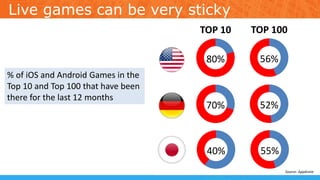
Live games can be very sticky
TOP 10
80%
TOP 100
56%
70% 52%
40% 55%
% of iOS and Android Games in the
Top 10 and Top 100 that have been
there for the last 12 months
Source: AppAnnie
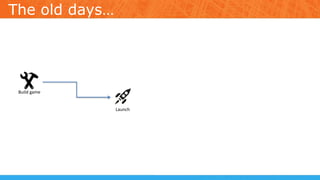
Build game
Launch
The old days…
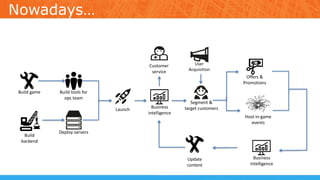
Build game
Build
backend
Launch
Build tools for
ops team
Segment &
target customers
Deploy servers
Business
intelligence
Offers &
Promotions
Update
content
Host in-game
events
Customer
service
Nowadays…
Business
intelligence
User
Acquisition
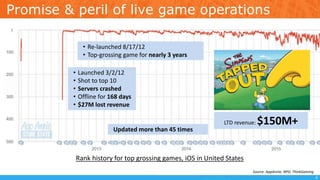
Promise & peril of live game operations
• Launched 3/2/12
• Shot to top 10
• Servers crashed
• Offline for 168 days
• $27M lost revenue
• Re-launched 8/17/12
• Top-grossing game for nearly 3 years
LTD revenue: $150M+
Source: AppAnnie, NPD, ThinkGaming
6
Updated more than 45 times
Rank history for top grossing games, iOS in United States
“We’re a technology company. We’re
not really a game company.”
-- Gabe Leydon, Machine Zone
Bloomberg Business, March 2015
0
100
200
300
400
500
600
700
800
900
1000
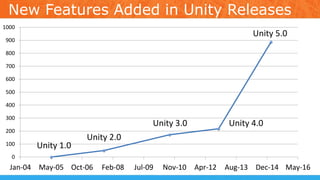
Jan-04 May-05 Oct-06 Feb-08 Jul-09 Nov-10 Apr-12 Aug-13 Dec-14 May-16
New Features Added in Unity Releases
Unity 1.0
Unity 2.0
Unity 3.0 Unity 4.0
Unity 5.0
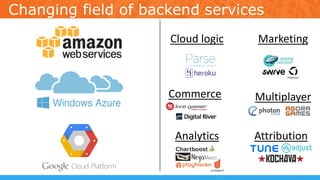
Changing field of backend services
Multiplayer
Analytics
Marketing
Commerce
Cloud logic
Attribution
+
Live ops tools and dashboards
(mission control for the whole team)
Back-end services
(cross-platform, one-stop shop)
+
Integration with other partners
(building out the full ecosystem)
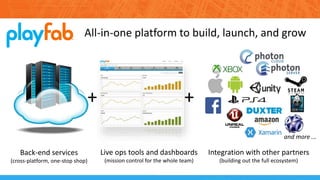
All-in-one platform to build, launch, and grow
and more ...
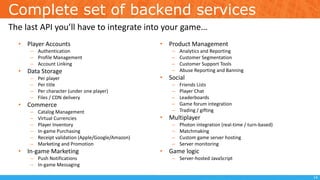
Complete set of backend services
• Player Accounts
– Authentication
– Profile Management
– Account Linking
• Data Storage
– Per player
– Per title
– Per character (under one player)
– Files / CDN delivery
• Commerce
– Catalog Management
– Virtual Currencies
– Player Inventory
– In-game Purchasing
– Receipt validation (Apple/Google/Amazon)
– Marketing and Promotion
• In-game Marketing
– Push Notifications
– In-game Messaging
• Product Management
– Analytics and Reporting
– Customer Segmentation
– Customer Support Tools
– Abuse Reporting and Banning
• Social
– Friends Lists
– Player Chat
– Leaderboards
– Game forum integration
– Trading / gifting
• Multiplayer
– Photon integration (real-time / turn-based)
– Matchmaking
– Custom game server hosting
– Server monitoring
• Game logic
– Server-hosted JavaScript
The last API you’ll have to integrate into your game…
14
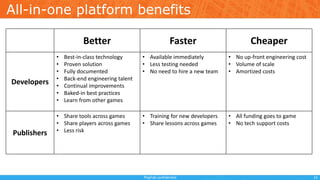
All-in-one platform benefits
15Better Faster Cheaper
Developers
• Best-in-class technology
• Proven solution
• Fully documented
• Back-end engineering talent
• Continual improvements
• Baked-in best practices
• Learn from other games
• Available immediately
• Less testing needed
• No need to hire a new team
• No up-front engineering cost
• Volume of scale
• Amortized costs
Publishers
• Share tools across games
• Share players across games
• Less risk
• Training for new developers
• Share lessons across games
• All funding goes to game
• No tech support costs
15PlayFab confidential
Trusted by hundreds of developers
• More than 500 game studios using the PlayFab SDK
• 16 titles now live (w/ more than 10 million total registered players)
• Integrate at any point of your game’s life cycle
16
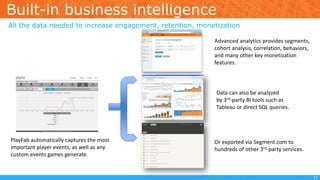
Built-in business intelligence
PlayFab automatically captures the most
important player events, as well as any
custom events games generate.
Data can also be analyzed
by 3rd-party BI tools such as
Tableau or direct SQL queries.
All the data needed to increase engagement, retention, monetization
Or exported via Segment.com to
hundreds of other 3rd-party services.
Advanced analytics provides segments,
cohort analysis, correlation, behaviors,
and many other key monetization
features.
17
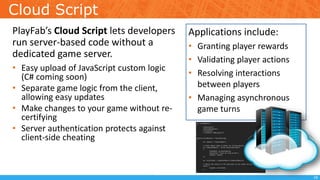
Cloud Script
PlayFab’s Cloud Script lets developers
run server-based code without a
dedicated game server.
• Easy upload of JavaScript custom logic
(C# coming soon)
• Separate game logic from the client,
allowing easy updates
• Make changes to your game without re-
certifying
• Server authentication protects against
client-side cheating
18
Applications include:
• Granting player rewards
• Validating player actions
• Resolving interactions
between players
• Managing asynchronous
game turns
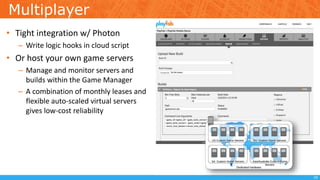
Multiplayer
• Tight integration w/ Photon
– Write logic hooks in cloud script
• Or host your own game servers
– Manage and monitor servers and
builds within the Game Manager
– A combination of monthly leases and
flexible auto-scaled virtual servers
gives low-cost reliability
19
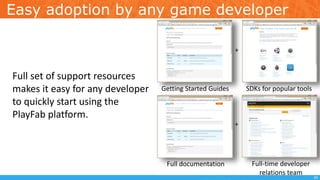
Easy adoption by any game developer
20
Full set of support resources
makes it easy for any developer
to quickly start using the
PlayFab platform.
Getting Started Guides SDKs for popular tools
Full documentation
+ +
+
Full-time developer
relations team
Questions?
Stop by our booth
or visit www.playfab.com
@playfabnetwork
james@playfab.com

The Future is Operations: Why Mobile Games Need Backends

  • 1.
    The Future isOperations Why Mobile Games Need Backends James Gwertzman, CEO
  • 2.
    “The single greatestpredictor of success and of sustainable competitive advantage in this business is live game operations.” -- Owen Mahoney, CEO Nexon
  • 3.
    Live games canbe very sticky TOP 10 80% TOP 100 56% 70% 52% 40% 55% % of iOS and Android Games in the Top 10 and Top 100 that have been there for the last 12 months Source: AppAnnie
  • 4.
  • 5.
    Build game Build backend Launch Build toolsfor ops team Segment & target customers Deploy servers Business intelligence Offers & Promotions Update content Host in-game events Customer service Nowadays… Business intelligence User Acquisition
  • 6.
    Promise & perilof live game operations • Launched 3/2/12 • Shot to top 10 • Servers crashed • Offline for 168 days • $27M lost revenue • Re-launched 8/17/12 • Top-grossing game for nearly 3 years LTD revenue: $150M+ Source: AppAnnie, NPD, ThinkGaming 6 Updated more than 45 times Rank history for top grossing games, iOS in United States
  • 8.
    “We’re a technologycompany. We’re not really a game company.” -- Gabe Leydon, Machine Zone Bloomberg Business, March 2015
  • 11.
    0 100 200 300 400 500 600 700 800 900 1000 Jan-04 May-05 Oct-06Feb-08 Jul-09 Nov-10 Apr-12 Aug-13 Dec-14 May-16 New Features Added in Unity Releases Unity 1.0 Unity 2.0 Unity 3.0 Unity 4.0 Unity 5.0
  • 12.
    Changing field ofbackend services Multiplayer Analytics Marketing Commerce Cloud logic Attribution
  • 13.
    + Live ops toolsand dashboards (mission control for the whole team) Back-end services (cross-platform, one-stop shop) + Integration with other partners (building out the full ecosystem) All-in-one platform to build, launch, and grow and more ...
  • 14.
    Complete set ofbackend services • Player Accounts – Authentication – Profile Management – Account Linking • Data Storage – Per player – Per title – Per character (under one player) – Files / CDN delivery • Commerce – Catalog Management – Virtual Currencies – Player Inventory – In-game Purchasing – Receipt validation (Apple/Google/Amazon) – Marketing and Promotion • In-game Marketing – Push Notifications – In-game Messaging • Product Management – Analytics and Reporting – Customer Segmentation – Customer Support Tools – Abuse Reporting and Banning • Social – Friends Lists – Player Chat – Leaderboards – Game forum integration – Trading / gifting • Multiplayer – Photon integration (real-time / turn-based) – Matchmaking – Custom game server hosting – Server monitoring • Game logic – Server-hosted JavaScript The last API you’ll have to integrate into your game… 14
  • 15.
    All-in-one platform benefits 15BetterFaster Cheaper Developers • Best-in-class technology • Proven solution • Fully documented • Back-end engineering talent • Continual improvements • Baked-in best practices • Learn from other games • Available immediately • Less testing needed • No need to hire a new team • No up-front engineering cost • Volume of scale • Amortized costs Publishers • Share tools across games • Share players across games • Less risk • Training for new developers • Share lessons across games • All funding goes to game • No tech support costs 15PlayFab confidential
  • 16.
    Trusted by hundredsof developers • More than 500 game studios using the PlayFab SDK • 16 titles now live (w/ more than 10 million total registered players) • Integrate at any point of your game’s life cycle 16
  • 17.
    Built-in business intelligence PlayFabautomatically captures the most important player events, as well as any custom events games generate. Data can also be analyzed by 3rd-party BI tools such as Tableau or direct SQL queries. All the data needed to increase engagement, retention, monetization Or exported via Segment.com to hundreds of other 3rd-party services. Advanced analytics provides segments, cohort analysis, correlation, behaviors, and many other key monetization features. 17
  • 18.
    Cloud Script PlayFab’s CloudScript lets developers run server-based code without a dedicated game server. • Easy upload of JavaScript custom logic (C# coming soon) • Separate game logic from the client, allowing easy updates • Make changes to your game without re- certifying • Server authentication protects against client-side cheating 18 Applications include: • Granting player rewards • Validating player actions • Resolving interactions between players • Managing asynchronous game turns
  • 19.
    Multiplayer • Tight integrationw/ Photon – Write logic hooks in cloud script • Or host your own game servers – Manage and monitor servers and builds within the Game Manager – A combination of monthly leases and flexible auto-scaled virtual servers gives low-cost reliability 19
  • 20.
    Easy adoption byany game developer 20 Full set of support resources makes it easy for any developer to quickly start using the PlayFab platform. Getting Started Guides SDKs for popular tools Full documentation + + + Full-time developer relations team
  • 21.
    Questions? Stop by ourbooth or visit www.playfab.com @playfabnetwork james@playfab.com

Editor's Notes

  • #2 Good afternoon.   I’ve worked in the game industry for more than 15 years, and like all of you, have witnessed some massive changes in that time. The biggest change of all is happening now: The evolution of games from stand-alone goods — a game in a box — to games-as-a-service. Today, however, I want to talk about an aspect of “games-as-a-service” that doesn’t get enough attention – operations
  • #3 In this new order, having a great game is important, but it’s table stakes. The real question is how well you operate that game game. Companies coming out of Asia have been operating live games longer than we have, and they get this. Here’s a great quote from old friend Owen Mahoney, CEO of Nexon.
  • #4 Done right, a live game can be super sticky. With proper operations, you can keep a game going for a very long time. Consider how this has affected mobile game markets… games are staying around in the top 10 for much longer than ever before. That’s the upside of operating a game as a service. But doing this well has a cost, too.
  • #5 Consider how building a game has evolved. It used to be you’d build a game, ship it, and move on.
  • #6 Now, however, games have becomes services, and suddenly launching the game is only the beginning. There’s all this other stuff that has to happen AFTER the game goes live – the service has to be managed. (talk about the flow) Costs include: Technology cost People cost (burn out) Continuously reacting to competitors
  • #7 Consider the Simpsons Tapped out.. It was a top 10 game for more than a year, and even now is still in top 100 nearly 3 years after launch. That’s enviable. But it also had a rocky start. Launched, hit top 10, then had to be taken down for 4 months as the back-end was rebuilt. This is tricky stuff to get right.
  • #8 The amount of tech required to build and operate a live game is massive, very easy to underestimate. Most game companies don’t have much experience with this. The ones who do, who operate successful games, get it.
  • #9 Consider this quote from Gabe Leydon.. Emphasizing how much tech is required to be successful w/ operating a live game.
  • #10 but it’s an interesting quote, and it sheds light on how far we’ve come as an industry. Because it used to be ALL game companies were technology companies. 20 years ago, game studios with any ambition coded everything for their games themselves. They had to. They had no other options. So 20 years ago that would not have been an interesting thing to say.   But then this began to change:   Shared tools and technology started to emerge. Companies began seeing the benefits of leveraging off-the-shelf tech.
  • #11  This trend has culminated in the juggernaut that is Unity and a slew of other newer alternative engines. Virtually no one is coding their engine from scratch anymore — unless it’s as a hobby. And this has been hugely important for our entire industry – because it means we can finally go and be game companies again, and not tech companies.
  • #12 Look at the evolution of Unity: Working with thousands of games and thousands of developers, shared technology will always evolve more quickly than proprietary tech.   Can any single game studio keep up with this level of engine investment? Would you want to?   Even if you’re a big company with a huge investment in your own technology, consider this: If you took all those engineers building and supporting that technology, and you could convert them all into game programmers, how many more games could you build? How many more creative risks could you afford to take? How much more quickly could you roll out updates to your existing games?
  • #13 And the good news is that this level of shared tech is finally coming to the backend space. We’re starting to see bits and pieces get carved out by specialists. Just like Havok solved physics for games, and Bink solved Audio for games, we are seeing core tech get picked up and solved. First to go was server hosting -- more and more developers are using cloud services, because it’s far more efficient. Much better to invest your capital in developing new games than buying servers.   Next we saw solutions for specific problems like monetization, analytics, and ads. Those areas, at least, developers didn’t have to recreate.
  • #14 And finally, companies like mine, PlayFab, and others, are racing to deliver entire game operations platforms as a single integrated solution.   This is all great news for most developers, because it means that once again, the field is leveling. You don’t need to spend a year building backend technology to launch a great game, anymore than you need to spend a year building animation tools. It’s possible now to build the next Candy Crush saga, or Age of War, without hiring a single server engineer.
  • #15 Our goal is to cover all the core services you might need… and to integrate third party services to fill in the areas we don’t cover
  • #17 We’ve already got substantial traction with small and medium developers, and we’re starting to work with some of the bigger companies too, which is exciting. You can integrate at any point, not just when you’re starting out. We are working w/ hyper hippo & adventure capitalist, launching an update this week
  • #22 So if you’re building a game, I hope you’re thinking about your operations strategy… And if you’re thinking about your operations strategy, I hope you’ll consider a platform like PlayFab We have a booth here, come chat with us. We’d love to schedule a demo and discuss your needs in more depth.