- A Danish Report 2010 incl. a
model of library ser


KNUD SCHULZ
CITIZENS’ AND LIBRARY SERVICE AARHUS
STOCKHOLM 19. SEPTEMBER 2011
Knud Schulz
 Manager of the Main Library
 Member of a workgroup preparing the
  passage about partnerships in the report
 Daily work focus – transforming the Main
  Library into “Urban Mediaspace”
 ksc@aarhus.dk
 www.slideshare.net


           The Public Libraries in the Knowledge Society Knud Schulz   2
Agenda

 The report
 Recommendations
 Open Libraries
   The library of the knowledge society


             The Public Libraries in the Knowledge Society Knud Schulz   3
5 recommendations and a model
of the modern library
1. Open libraries
2. Inspiration and learning
3. The Danish Digital Library (DDL)
4. Partnerships
5. Professional development


            The Public Libraries in the Knowledge Society Knud Schulz   4
Open libraries
 The committee recommends that new concepts for the
    physical library space be developed. The library should
    moreover locally work systematically on establishing
    alternatives to the traditional library space, such as libraries
    that are integrated with other types of institutions, as well as
    new flexible library services
The committee recommends:
• library space be seen as an independent medium to be developed
• more targeted and offensive promotion of materials be developed
• partnerships be established about activities in the library space
• general concepts for arrangements be established
• flexible forms of service be further developed


                 The Public Libraries in the Knowledge Society Knud Schulz   5
Four room model


       The Public Libraries in the Knowledge Society Knud Schulz   6
Four room model
– Inspiration space (Excite)


       The Public Libraries in the Knowledge Society Knud Schulz   7
Inspiration space
 The space for meaningful experiences that is to say
    experiences that move us
   The space should open up to the irrational, emotional and
    chaotic by communicating a diversion of aesthetic
    experiences.
   This can happen through storytelling or other artistic
    expressions within all kinds of media, cultural forms and
    genres.
   The inspiration space should make the user want to move
    beyond the usual choices and to come back.
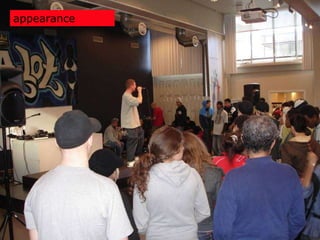
   The library space in itself may also be an experience and
    work as a stage for events and cultural arrangements.
   The inspiration space especially supports realisation
    (cognition)/experience and innovation.

                The Public Libraries in the Knowledge Society Knud Schulz   8
individual concentration
Music
digital media
Inspiration
events
appearance
book clubs
picture book
reading aloud
staging
Four room model
– Learning space (Explore)


       The Public Libraries in the Knowledge Society Knud Schulz   19
Learning space
 Space where children, young people and adults can experience
    and explore the world and thus strengthen their competences
    and possibilities through free and easy access to information and
    knowledge
   Learning is seen as a dialogue oriented process that is based on
    the users’ own experiences and their wishes to define their own
    learning needs
   Often takes place in informal settings which do not have learning
    as the goal – learning happens through play, music and many
    other activities
   Should meet the needs of especially young people for a more
    experience oriented learning through the development of
    playful, interactive and social learning methods.
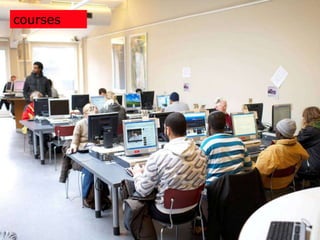
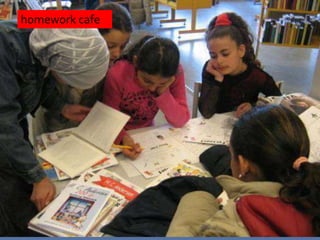
   Learning is strengthened through the use of homework cafes,
    study places, open courses and experiment areas.
   The learning space especially supports realisation
    (cognition)/experience and empowerment.
                  The Public Libraries in the Knowledge Society Knud Schulz   20
teaching
courses
informal learning
consultations
one to one
homework cafe
guidance
access to knowledge
selfservice
Four room model
- Meeting space (Participate)


       The Public Libraries in the Knowledge Society Knud Schulz   30
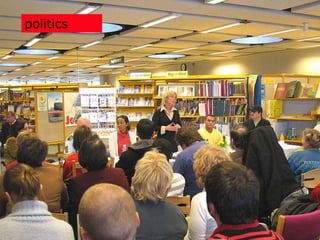
Meeting space
 An open, public space where citizens as a third space
    between home and work can meet others who are both as
    themselves and different from themselves
   Arenaes, where you can meet other people with different
    interests and values and encounter opinions that challenge
    you through discussions and debate, are necessary
   In the meeting space both non-commital, random
    encounters can take place through lounge décor with
    newspapers and café atmosphere as well as more
    organised meetings
   This can take place both live and on the Internet in
    chatgroups, blogs or other social media.
   The meeting space especially supports empowerment and
    engagement

                The Public Libraries in the Knowledge Society Knud Schulz   31
meetings
lectures
discussions
debates
politics
being together
Four room model
- Performative space (Create)


       The Public Libraries in the Knowledge Society Knud Schulz   38
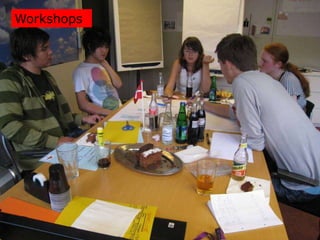
Performative space
 Users can interact with others for inspiration to create new
    creative expressions in the encounter with art and culture
   Users can get access to tools that support their creative
    expressions through interactive games and writing-, sound-
    and video-workshops
   The users can also get support in their creative expressions
    through workshops with professional artists, designers,
    multimedia developers etc.
   Can act as a platform for communication by publishing and
    distributing the work and products of the users and by
    giving access to stages where users can perform and
    express themselves.
   The performative space especially supports engagement
    and innovation.

                 The Public Libraries in the Knowledge Society Knud Schulz   39
writing workshops
experiment
edutainment
Workshops
playing
gaming
gaming
Use the model on your services

  Place your services in the model
  Discuss new possibilities
  Decide the future activities
  Lookup - involving partners


             The Public Libraries in the Knowledge Society Knud Schulz   47
Four room model


       The Public Libraries in the Knowledge Society Knud Schulz   48

New Model for Public Libraries

  • 1.
    - A DanishReport 2010 incl. a model of library ser KNUD SCHULZ CITIZENS’ AND LIBRARY SERVICE AARHUS STOCKHOLM 19. SEPTEMBER 2011
  • 2.
    Knud Schulz  Managerof the Main Library  Member of a workgroup preparing the passage about partnerships in the report  Daily work focus – transforming the Main Library into “Urban Mediaspace”  ksc@aarhus.dk  www.slideshare.net The Public Libraries in the Knowledge Society Knud Schulz 2
  • 3.
    Agenda  The report Recommendations  Open Libraries  The library of the knowledge society The Public Libraries in the Knowledge Society Knud Schulz 3
  • 4.
    5 recommendations anda model of the modern library 1. Open libraries 2. Inspiration and learning 3. The Danish Digital Library (DDL) 4. Partnerships 5. Professional development The Public Libraries in the Knowledge Society Knud Schulz 4
  • 5.
    Open libraries  Thecommittee recommends that new concepts for the physical library space be developed. The library should moreover locally work systematically on establishing alternatives to the traditional library space, such as libraries that are integrated with other types of institutions, as well as new flexible library services The committee recommends: • library space be seen as an independent medium to be developed • more targeted and offensive promotion of materials be developed • partnerships be established about activities in the library space • general concepts for arrangements be established • flexible forms of service be further developed The Public Libraries in the Knowledge Society Knud Schulz 5
  • 6.
    Four room model The Public Libraries in the Knowledge Society Knud Schulz 6
  • 7.
    Four room model –Inspiration space (Excite) The Public Libraries in the Knowledge Society Knud Schulz 7
  • 8.
    Inspiration space  Thespace for meaningful experiences that is to say experiences that move us  The space should open up to the irrational, emotional and chaotic by communicating a diversion of aesthetic experiences.  This can happen through storytelling or other artistic expressions within all kinds of media, cultural forms and genres.  The inspiration space should make the user want to move beyond the usual choices and to come back.  The library space in itself may also be an experience and work as a stage for events and cultural arrangements.  The inspiration space especially supports realisation (cognition)/experience and innovation. The Public Libraries in the Knowledge Society Knud Schulz 8
  • 9.
  • 10.
  • 11.
  • 12.
  • 13.
  • 14.
  • 15.
  • 16.
  • 17.
  • 18.
  • 19.
    Four room model –Learning space (Explore) The Public Libraries in the Knowledge Society Knud Schulz 19
  • 20.
    Learning space  Spacewhere children, young people and adults can experience and explore the world and thus strengthen their competences and possibilities through free and easy access to information and knowledge  Learning is seen as a dialogue oriented process that is based on the users’ own experiences and their wishes to define their own learning needs  Often takes place in informal settings which do not have learning as the goal – learning happens through play, music and many other activities  Should meet the needs of especially young people for a more experience oriented learning through the development of playful, interactive and social learning methods.  Learning is strengthened through the use of homework cafes, study places, open courses and experiment areas.  The learning space especially supports realisation (cognition)/experience and empowerment. The Public Libraries in the Knowledge Society Knud Schulz 20
  • 21.
  • 22.
  • 23.
  • 24.
  • 25.
  • 26.
  • 27.
  • 28.
  • 29.
  • 30.
    Four room model -Meeting space (Participate) The Public Libraries in the Knowledge Society Knud Schulz 30
  • 31.
    Meeting space  Anopen, public space where citizens as a third space between home and work can meet others who are both as themselves and different from themselves  Arenaes, where you can meet other people with different interests and values and encounter opinions that challenge you through discussions and debate, are necessary  In the meeting space both non-commital, random encounters can take place through lounge décor with newspapers and café atmosphere as well as more organised meetings  This can take place both live and on the Internet in chatgroups, blogs or other social media.  The meeting space especially supports empowerment and engagement The Public Libraries in the Knowledge Society Knud Schulz 31
  • 32.
  • 33.
  • 34.
  • 35.
  • 36.
  • 37.
  • 38.
    Four room model -Performative space (Create) The Public Libraries in the Knowledge Society Knud Schulz 38
  • 39.
    Performative space  Userscan interact with others for inspiration to create new creative expressions in the encounter with art and culture  Users can get access to tools that support their creative expressions through interactive games and writing-, sound- and video-workshops  The users can also get support in their creative expressions through workshops with professional artists, designers, multimedia developers etc.  Can act as a platform for communication by publishing and distributing the work and products of the users and by giving access to stages where users can perform and express themselves.  The performative space especially supports engagement and innovation. The Public Libraries in the Knowledge Society Knud Schulz 39
  • 40.
  • 41.
  • 42.
  • 43.
  • 44.
  • 45.
  • 46.
  • 47.
    Use the modelon your services  Place your services in the model  Discuss new possibilities  Decide the future activities  Lookup - involving partners The Public Libraries in the Knowledge Society Knud Schulz 47
  • 48.
    Four room model The Public Libraries in the Knowledge Society Knud Schulz 48