The future is “at the hyphen” El futuro est á “en el guión” Sponsor: Central Pastoral Office for  Hispanic Ministries Rev. Samuel Robles Jr. Pastor & co-planter of Arise Christian Church
Itinerary 3:45pm - 5:45pm Presentation Discussion
Objectives To create a time, place, and space to wrestle and engage with what it means to be “at the hyphen.” To be open and receptive to  hear  each other out, engaging in dialogue. To welcome the opportunity to break down some stereotypes and/or misconceptions about our culture. To develop an expanded appreciation to who  we  are, as God’s people.
Questions What does it mean to be the  “National Hispanic & Bilingual fellowship?” What does it mean to be a “Hispanic/Latino(a)?” What does it mean to be “bilingual?” What does it mean for  us  to be part of “a movement for wholeness in a fragmented world?”
“ at the hyphen” ¡Alabadle!: Hispanic Christian Worship Edited by Justo Gonz á lez “ If there is an experience that unites Hispanics in the United States, it is the experience of belonging, yet not belonging.” (14) Pilgrims and Exiles;  mestizaje The hyphen is between “Cuban” and “American,” or “Mexican” and “American,” etc.
“ at the hyphen” For many Hispanics born in the US, we are made to feel as though we don’t belong. We are told to “go home,” but we do not know any other home than this.  Where would we go? This all stirs up themes of: Unity Belonging Identity
The future… To say that “the future is at the hyphen,” the title of this Resource Group, is actually incorrect. This has existed for years! For the most part, embracing bilingualism has been ignored and silent. To say “the future is at the hyphen” is a charge as to whether or not we will do something about it  now  as the Church and embrace it as we  move forward .
“ The Latino/a population is a polyculture combining a heterogeneous and multicolored group of people who have diverse ethnicities, languages, religions, and socioeconomic and educational status yet maintain distinctive features and principles that make them ‘one’ particular people.” (6) -  Pastoral Care and Counseling with Latino/as  by R. Esteban Montilla and Ferney Medina
Mainstream Culture The reality of “being at the hyphen” is in our mainstream culture. ¡Yo soy Boricua pa’que tu lo sepas! Documentary by Rosie Perez My Family/Mi Familia Film on struggles to live the American dream. MTV’s “Nuyorican Life” Pardon my Spanglish Book by comedian Bill Santiago
Mainstream Culture, cont’d University of Central Florida School of Social Work led  Latinos in the New America . Rollins College hosted a dialogue on the Cuban-American experience. The culture and community is speaking, are we, the Church,  speaking ? Are we  listening ?
Pardon my Spanglish by  Bill Santiago “ A few words instantly let other Spanglishistas know that you share a kind of schizophrenic experience with them, in which Spanish and English can’t exist without each other. So that as pervasive and mainstream as Spanglish is  hoy en dia , for us it still serves as a sort of a sentimental inside joke. Only,  no estamos jokeando . It communicates  nuestra verdadera  reality.” (28)
Pardon my Spanglish by  Bill Santiago “ Si yo tuviera que escoger  between English and Spanish,  seria un  tough choice. They each represent a distinct identity. But Spanghlish speakers are not one or the other.  Somos  both. Spanglish lets me speak both, inhabit both, be both,  a la misma vez .” (28)
Pardon my Spanglish by  Bill Santiago “ The  habla  also preserves identity. Upwardly mobile Latinos often rely on Spanghlish to counter the negative effects of assimilation, such as  volviendose demasiado gringo . Every word of  espa ñ ol  they can throw out into an English speaking environment is a little victory for who they are on the inside.” (28) Example: “bendito”
Moses as an inspiration Being Latino in Christ: Finding Wholeness in Your Ethnic Identity  by Orlando Crespo
Exodus 3:10-12  ( NIV) 10  “So now, go. I am sending you to Pharaoh to bring my people the Israelites out of Egypt.”  11  But Moses said to God, “Who am I, that I should go to Pharaoh and bring the Israelites out of Egypt?”  12  And God said, "I will be with you. And this will be the sign to you that it is I who have sent you: When you have brought the people out of Egypt, you will worship God on this mountain."
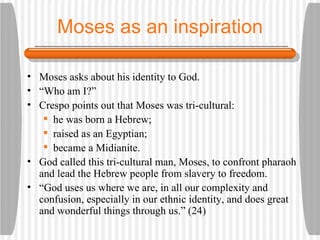
Moses as an inspiration Moses asks about his identity to God. “ Who am I?” Crespo points out that Moses was tri-cultural:  he was born a Hebrew;  raised as an Egyptian;  became a Midianite. God called this tri-cultural man, Moses, to confront pharaoh and lead the Hebrew people from slavery to freedom. “ God uses us where we are, in all our complexity and confusion, especially in our ethnic identity, and does great and wonderful things through us.” (24)
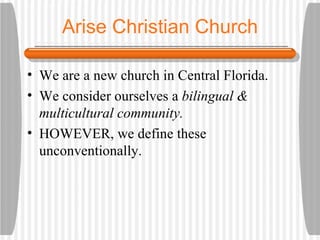
Arise Christian Church We are a new church in Central Florida. We consider ourselves a  bilingual & multicultural community. HOWEVER, we define these unconventionally.
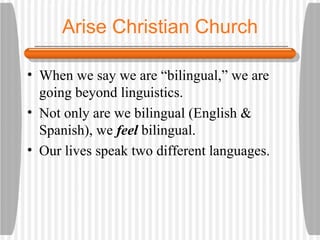
Arise Christian Church When we say we are “bilingual,” we are going beyond linguistics. Not only are we bilingual (English & Spanish), we  feel  bilingual. Our lives speak two different languages.
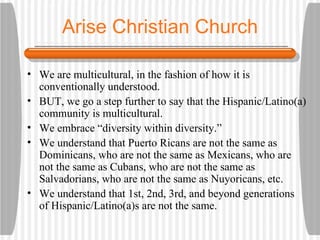
Arise Christian Church We are multicultural, in the fashion of how it is conventionally understood. BUT, we go a step further to say that the Hispanic/Latino(a) community is multicultural. We embrace “diversity within diversity.” We understand that Puerto Ricans are not the same as Dominicans, who are not the same as Mexicans, who are not the same as Cubans, who are not the same as Salvadorians, who are not the same as Nuyoricans, etc. We understand that 1st, 2nd, 3rd, and beyond generations of Hispanic/Latino(a)s are not the same.
Arise Christian Church We do not just consider ourselves a church for the “unchurched,” but more so, for the “unreachable.” The “unreachable” is the Hispanic/Latino(a) that does not have a church they can call  casa .
Arise Christian Church Our motto is:  “ Arise today towards a new ma ñ ana.”
Let’s have some  tiempo de dialogo .
Thank you! ¡Gracias! Dios les bendiga .

The future is "at the hyphen"

  • 1.
    The future is“at the hyphen” El futuro est á “en el guión” Sponsor: Central Pastoral Office for Hispanic Ministries Rev. Samuel Robles Jr. Pastor & co-planter of Arise Christian Church
  • 2.
    Itinerary 3:45pm -5:45pm Presentation Discussion
  • 3.
    Objectives To createa time, place, and space to wrestle and engage with what it means to be “at the hyphen.” To be open and receptive to hear each other out, engaging in dialogue. To welcome the opportunity to break down some stereotypes and/or misconceptions about our culture. To develop an expanded appreciation to who we are, as God’s people.
  • 4.
    Questions What doesit mean to be the “National Hispanic & Bilingual fellowship?” What does it mean to be a “Hispanic/Latino(a)?” What does it mean to be “bilingual?” What does it mean for us to be part of “a movement for wholeness in a fragmented world?”
  • 5.
    “ at thehyphen” ¡Alabadle!: Hispanic Christian Worship Edited by Justo Gonz á lez “ If there is an experience that unites Hispanics in the United States, it is the experience of belonging, yet not belonging.” (14) Pilgrims and Exiles; mestizaje The hyphen is between “Cuban” and “American,” or “Mexican” and “American,” etc.
  • 6.
    “ at thehyphen” For many Hispanics born in the US, we are made to feel as though we don’t belong. We are told to “go home,” but we do not know any other home than this. Where would we go? This all stirs up themes of: Unity Belonging Identity
  • 7.
    The future… Tosay that “the future is at the hyphen,” the title of this Resource Group, is actually incorrect. This has existed for years! For the most part, embracing bilingualism has been ignored and silent. To say “the future is at the hyphen” is a charge as to whether or not we will do something about it now as the Church and embrace it as we move forward .
  • 8.
    “ The Latino/apopulation is a polyculture combining a heterogeneous and multicolored group of people who have diverse ethnicities, languages, religions, and socioeconomic and educational status yet maintain distinctive features and principles that make them ‘one’ particular people.” (6) - Pastoral Care and Counseling with Latino/as by R. Esteban Montilla and Ferney Medina
  • 9.
    Mainstream Culture Thereality of “being at the hyphen” is in our mainstream culture. ¡Yo soy Boricua pa’que tu lo sepas! Documentary by Rosie Perez My Family/Mi Familia Film on struggles to live the American dream. MTV’s “Nuyorican Life” Pardon my Spanglish Book by comedian Bill Santiago
  • 10.
    Mainstream Culture, cont’dUniversity of Central Florida School of Social Work led Latinos in the New America . Rollins College hosted a dialogue on the Cuban-American experience. The culture and community is speaking, are we, the Church, speaking ? Are we listening ?
  • 11.
    Pardon my Spanglishby Bill Santiago “ A few words instantly let other Spanglishistas know that you share a kind of schizophrenic experience with them, in which Spanish and English can’t exist without each other. So that as pervasive and mainstream as Spanglish is hoy en dia , for us it still serves as a sort of a sentimental inside joke. Only, no estamos jokeando . It communicates nuestra verdadera reality.” (28)
  • 12.
    Pardon my Spanglishby Bill Santiago “ Si yo tuviera que escoger between English and Spanish, seria un tough choice. They each represent a distinct identity. But Spanghlish speakers are not one or the other. Somos both. Spanglish lets me speak both, inhabit both, be both, a la misma vez .” (28)
  • 13.
    Pardon my Spanglishby Bill Santiago “ The habla also preserves identity. Upwardly mobile Latinos often rely on Spanghlish to counter the negative effects of assimilation, such as volviendose demasiado gringo . Every word of espa ñ ol they can throw out into an English speaking environment is a little victory for who they are on the inside.” (28) Example: “bendito”
  • 14.
    Moses as aninspiration Being Latino in Christ: Finding Wholeness in Your Ethnic Identity by Orlando Crespo
  • 15.
    Exodus 3:10-12 ( NIV) 10 “So now, go. I am sending you to Pharaoh to bring my people the Israelites out of Egypt.” 11 But Moses said to God, “Who am I, that I should go to Pharaoh and bring the Israelites out of Egypt?” 12 And God said, "I will be with you. And this will be the sign to you that it is I who have sent you: When you have brought the people out of Egypt, you will worship God on this mountain."
  • 16.
    Moses as aninspiration Moses asks about his identity to God. “ Who am I?” Crespo points out that Moses was tri-cultural: he was born a Hebrew; raised as an Egyptian; became a Midianite. God called this tri-cultural man, Moses, to confront pharaoh and lead the Hebrew people from slavery to freedom. “ God uses us where we are, in all our complexity and confusion, especially in our ethnic identity, and does great and wonderful things through us.” (24)
  • 17.
    Arise Christian ChurchWe are a new church in Central Florida. We consider ourselves a bilingual & multicultural community. HOWEVER, we define these unconventionally.
  • 18.
    Arise Christian ChurchWhen we say we are “bilingual,” we are going beyond linguistics. Not only are we bilingual (English & Spanish), we feel bilingual. Our lives speak two different languages.
  • 19.
    Arise Christian ChurchWe are multicultural, in the fashion of how it is conventionally understood. BUT, we go a step further to say that the Hispanic/Latino(a) community is multicultural. We embrace “diversity within diversity.” We understand that Puerto Ricans are not the same as Dominicans, who are not the same as Mexicans, who are not the same as Cubans, who are not the same as Salvadorians, who are not the same as Nuyoricans, etc. We understand that 1st, 2nd, 3rd, and beyond generations of Hispanic/Latino(a)s are not the same.
  • 20.
    Arise Christian ChurchWe do not just consider ourselves a church for the “unchurched,” but more so, for the “unreachable.” The “unreachable” is the Hispanic/Latino(a) that does not have a church they can call casa .
  • 21.
    Arise Christian ChurchOur motto is: “ Arise today towards a new ma ñ ana.”
  • 22.
    Let’s have some tiempo de dialogo .
  • 23.
    Thank you! ¡Gracias!Dios les bendiga .