THE FOUR FUNDAMENTAL
OPERATIONS
Nicey M.
ADDITION
Definition:
The act of adding to or more things/numbers.
Parts:
1. Addends refer to two or more numbers being added.
2. Sum is the result of addition or the total.
ADDITION
Example:
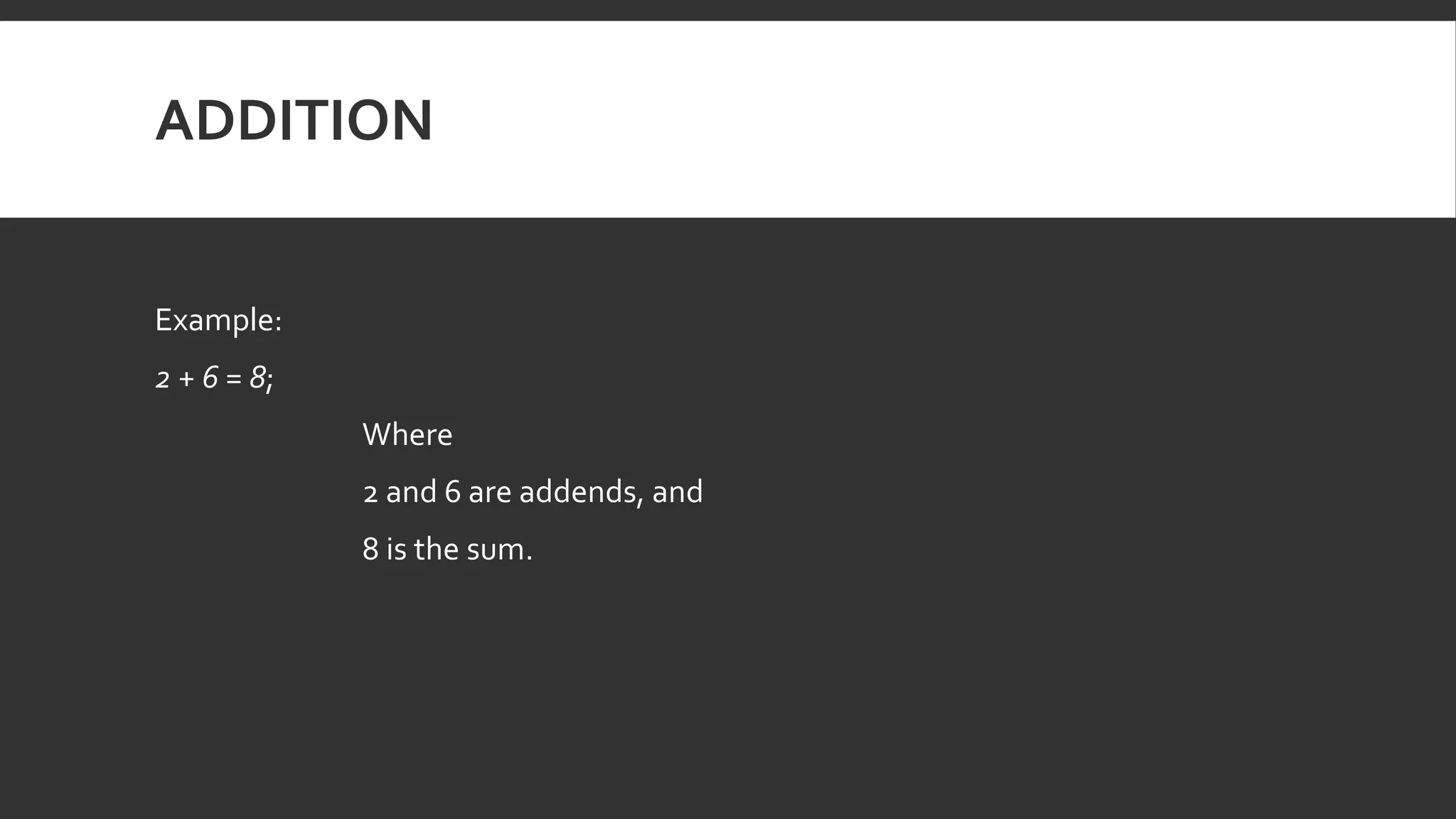
2 + 6 = 8;
Where
2 and 6 are addends, and
8 is the sum.
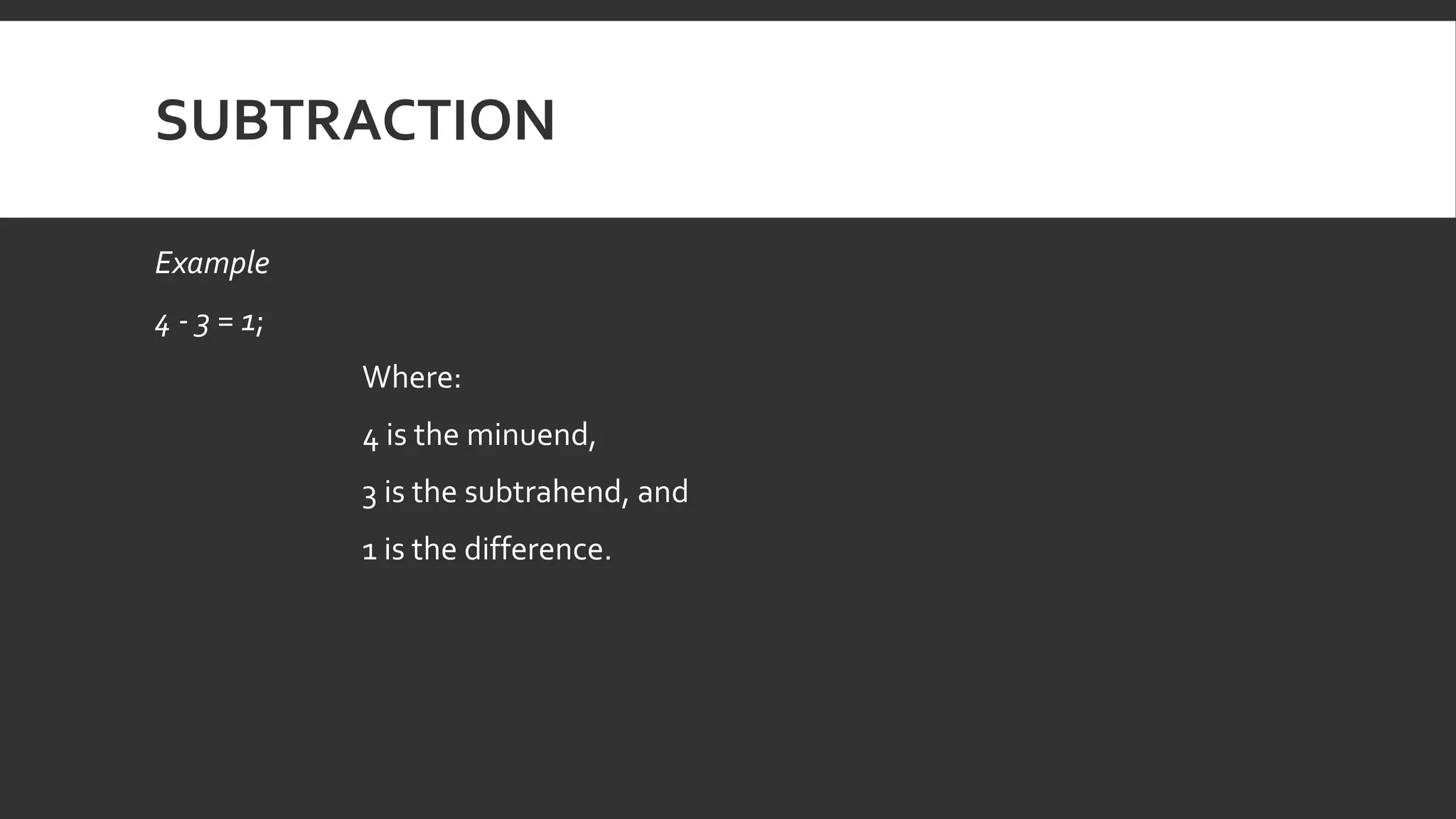
SUBTRACTION
Definition:
It is the inverse of addition. It is taking away something from another.
Parts:
1. Minuend is first number where the second number is subtracted from.
2. Subtrahend is the number being subtracted.
3. Difference is the result of subtraction or also known as the remainder.
SUBTRACTION
Example
4 - 3 = 1;
Where:
4 is the minuend,
3 is the subtrahend, and
1 is the difference.
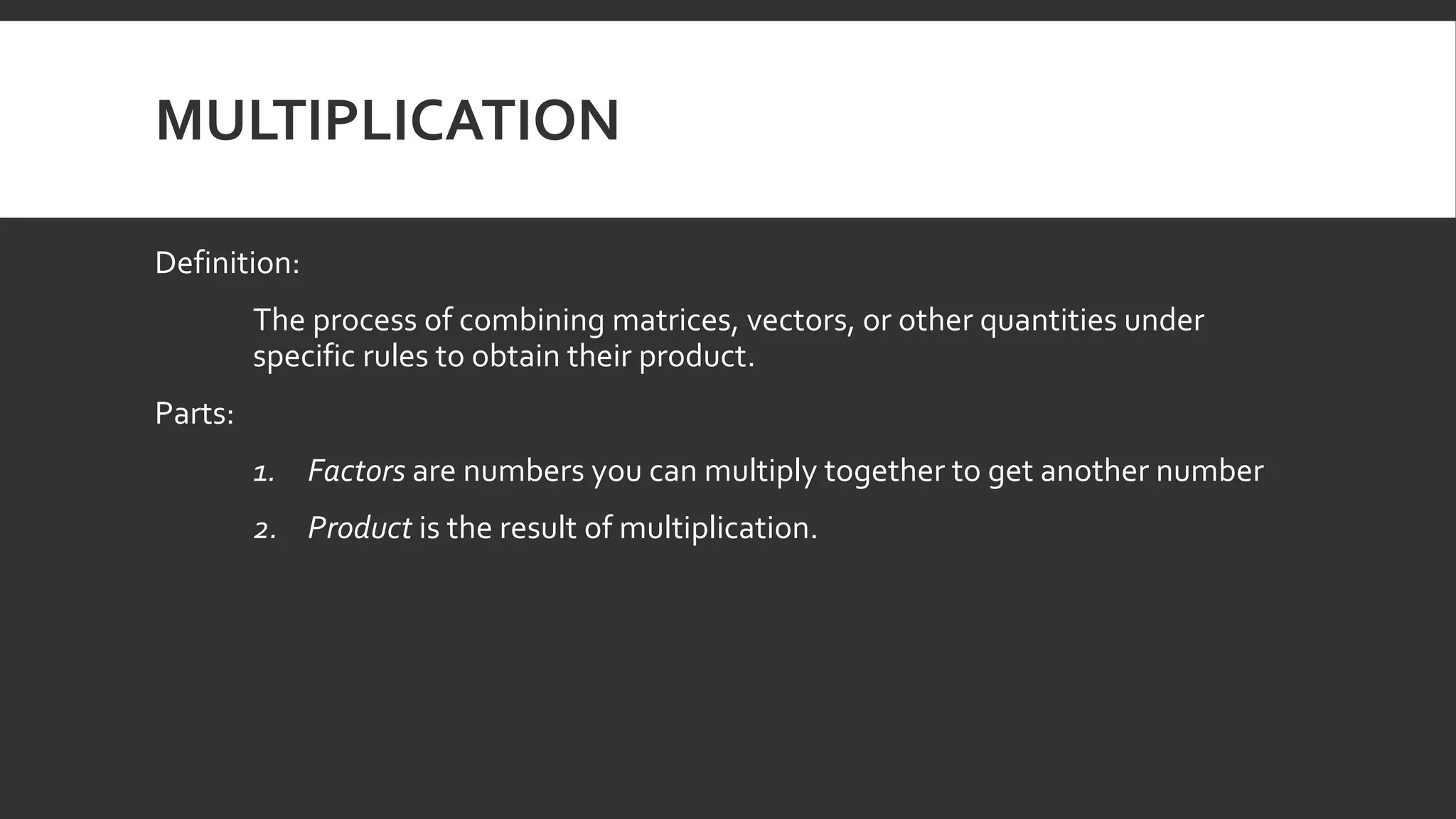
MULTIPLICATION
Definition:
The process of combining matrices, vectors, or other quantities under
specific rules to obtain their product.
Parts:
1. Factors are numbers you can multiply together to get another number
2. Product is the result of multiplication.
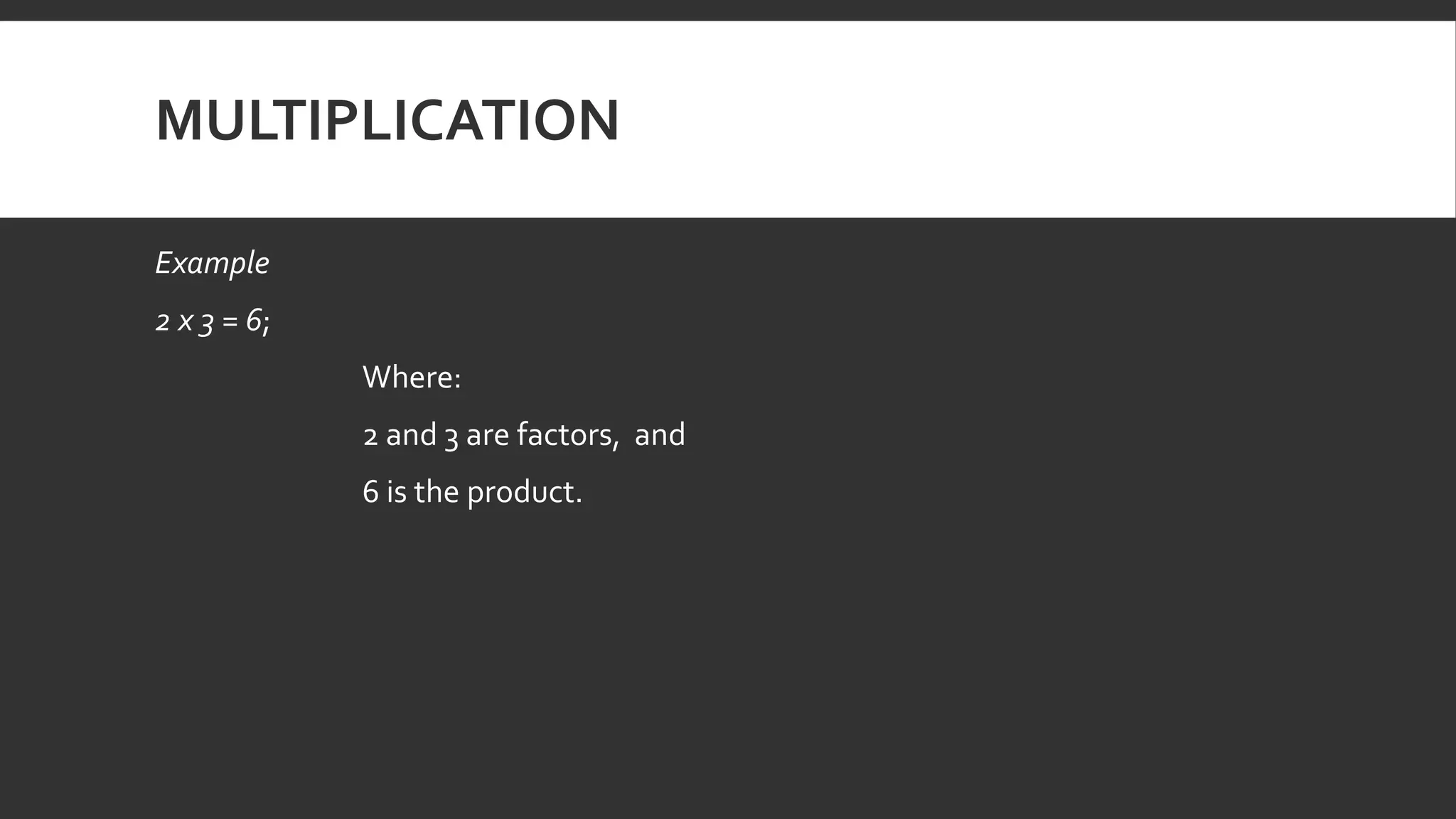
MULTIPLICATION
Example
2 x 3 = 6;
Where:
2 and 3 are factors, and
6 is the product.
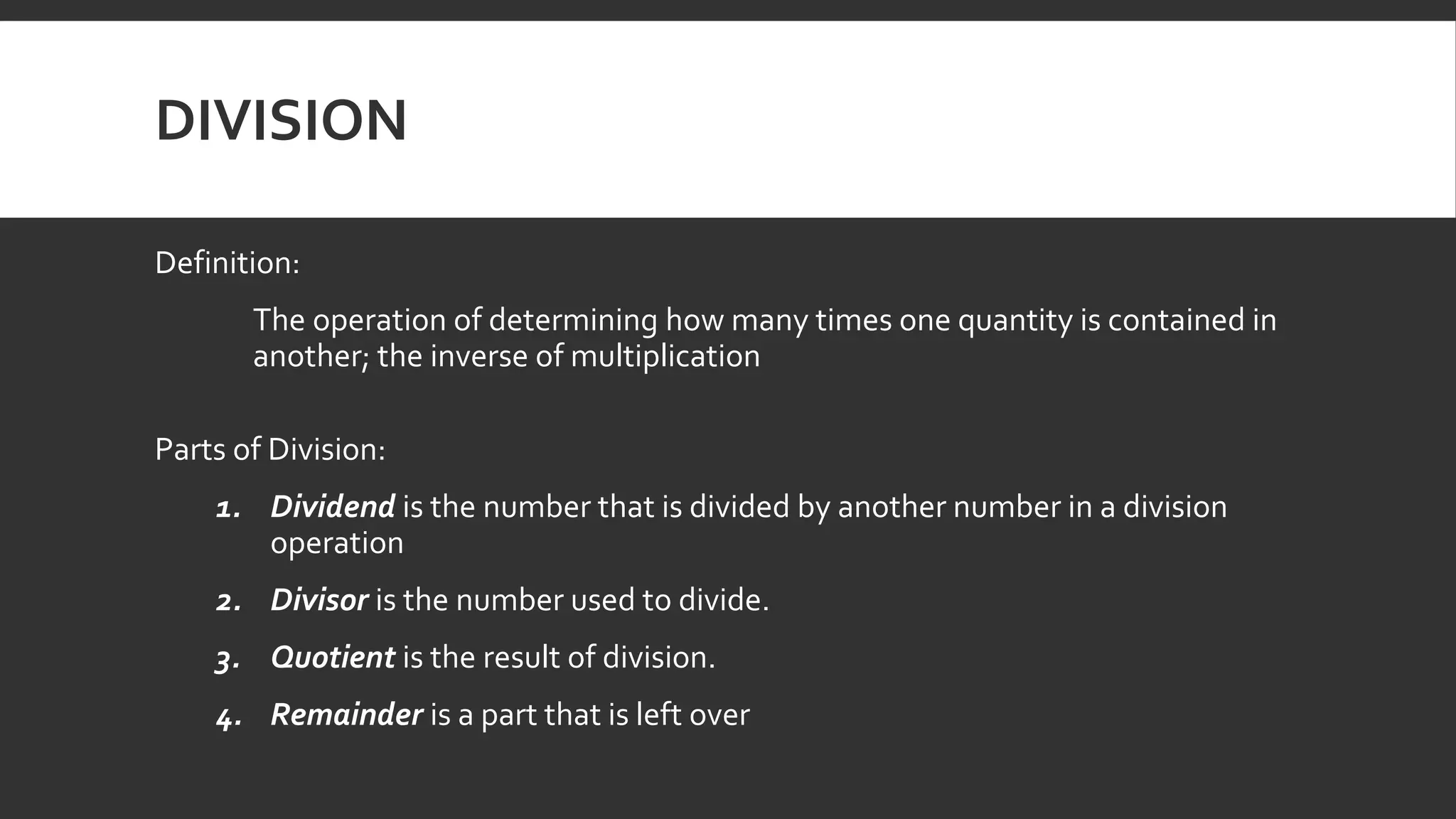
DIVISION
Definition:
The operation of determining how many times one quantity is contained in
another; the inverse of multiplication
Parts of Division:
1. Dividend is the number that is divided by another number in a division
operation
2. Divisor is the number used to divide.
3. Quotient is the result of division.
4. Remainder is a part that is left over
DIVISION
Example
7 ÷ 2 = 3 r1;
Where
7 is dividend,
2 is the divisor,
3 is the quotient, and
1 the remainder.
ENJOY LEARNING!

The four fundamental operations

  • 1.
  • 2.
    ADDITION Definition: The act ofadding to or more things/numbers. Parts: 1. Addends refer to two or more numbers being added. 2. Sum is the result of addition or the total.
  • 3.
    ADDITION Example: 2 + 6= 8; Where 2 and 6 are addends, and 8 is the sum.
  • 4.
    SUBTRACTION Definition: It is theinverse of addition. It is taking away something from another. Parts: 1. Minuend is first number where the second number is subtracted from. 2. Subtrahend is the number being subtracted. 3. Difference is the result of subtraction or also known as the remainder.
  • 5.
    SUBTRACTION Example 4 - 3= 1; Where: 4 is the minuend, 3 is the subtrahend, and 1 is the difference.
  • 6.
    MULTIPLICATION Definition: The process ofcombining matrices, vectors, or other quantities under specific rules to obtain their product. Parts: 1. Factors are numbers you can multiply together to get another number 2. Product is the result of multiplication.
  • 7.
    MULTIPLICATION Example 2 x 3= 6; Where: 2 and 3 are factors, and 6 is the product.
  • 8.
    DIVISION Definition: The operation ofdetermining how many times one quantity is contained in another; the inverse of multiplication Parts of Division: 1. Dividend is the number that is divided by another number in a division operation 2. Divisor is the number used to divide. 3. Quotient is the result of division. 4. Remainder is a part that is left over
  • 9.
    DIVISION Example 7 ÷ 2= 3 r1; Where 7 is dividend, 2 is the divisor, 3 is the quotient, and 1 the remainder.
  • 10.