Presented by PRABHAT TYAGI
B.Ed 2nd year
Roll No. - 2106370034
a presentation by PRABHAT TYAGI 1
INTEGERS
a presentation by PRABHAT 2
What is an
Integer?
a presentation by PRABHAT 3
• An integer is a positive or
negative whole number,
including 0.
…-3, -2, -1, 0, 1, 2, 3…
a presentation by PRABHAT 4
There are
“4”
Integer
Operations
a presentation by PRABHAT 5
a presentation by PRABHAT 6
a presentation by PRABHAT 7
a presentation by PRABHAT 8
a presentation by PRABHAT 9
4 Integer Operations
+
• Addition
• Subtraction -
• Multiplication x
• Division ÷
a presentation by PRABHAT 10
Rule #1 for
Adding Integers (+)
• The sum of two positive integers is
always positive.
5 + 1 = 6
a presentation by PRABHAT 11
Rule #2 for
Adding Integers (+)
• The sum of two negative integers is
always negative.
-5 + (-1) = -6
a presentation by PRABHAT 12
Rule #3 for
Adding Integers (+)
• The sum of a positive and a negative
integer could be positive, negative, or
zero.
a presentation by PRABHAT 13
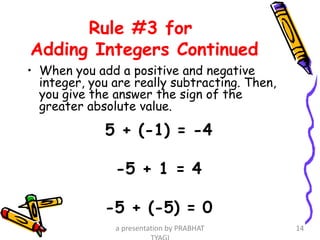
Rule #3 for
Adding Integers Continued
• When you add a positive and negative
integer, you are really subtracting. Then,
you give the answer the sign of the
greater absolute value.
5 + (-1) = -4
-5 + 1 = 4
-5 + (-5) = 0
a presentation by PRABHAT 14
Let’s Practice “Addition”
1) 5 + 6 =
• -3 + (-2) =
• -6 + 5 =
• 8 + (-7) =
• -9 + 9 =
a presentation by PRABHAT 15
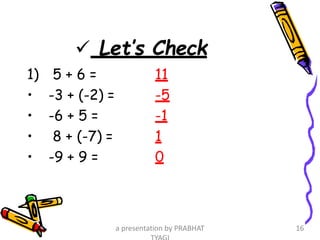
 Let’s Check
1) 5 + 6 =
• -3 + (-2) =
• -6 + 5 =
• 8 + (-7) =
• -9 + 9 =
11
-5
-1
1
0
a presentation by PRABHAT 16
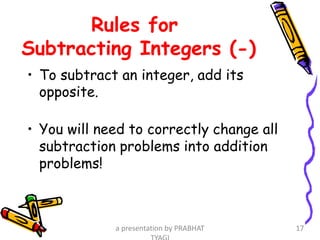
Rules for
Subtracting Integers (-)
• To subtract an integer, add its
opposite.
• You will need to correctly change all
subtraction problems into addition
problems!
a presentation by PRABHAT 17
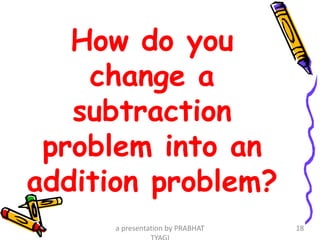
How do you
change a
subtraction
problem into an
addition problem?
a presentation by PRABHAT 18
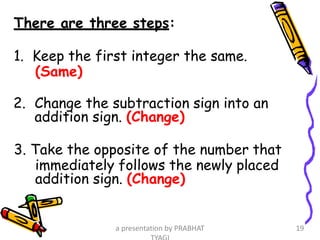
There are three steps:
1. Keep the first integer the same.
(Same)
2. Change the subtraction sign into an
addition sign. (Change)
3. Take the opposite of the number that
immediately follows the newly placed
addition sign. (Change)
a presentation by PRABHAT 19
a presentation by PRABHAT 20
a presentation by PRABHAT 21
a presentation by PRABHAT 22
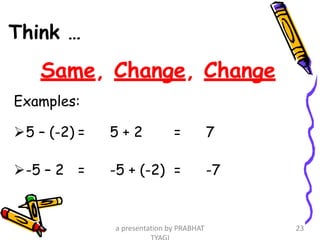
Think …
Same, Change, Change
Examples:
5 – (-2) = 5 + 2 = 7
-5 – 2 = -5 + (-2) = -7
a presentation by PRABHAT 23
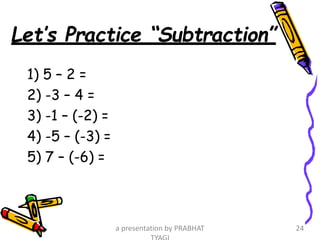
Let’s Practice “Subtraction”
1) 5 – 2 =
2) -3 – 4 =
3) -1 – (-2) =
4) -5 – (-3) =
5) 7 – (-6) =
a presentation by PRABHAT 24
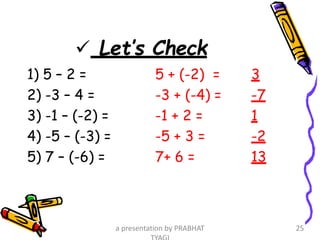
 Let’s Check
1) 5 – 2 = 5 + (-2) = 3
2) -3 – 4 = -3 + (-4) = -7
3) -1 – (-2) = -1 + 2 = 1
4) -5 – (-3) = -5 + 3 = -2
5) 7 – (-6) = 7+ 6 = 13
a presentation by PRABHAT 25
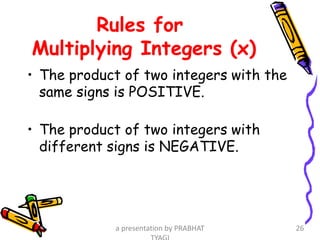
Rules for
Multiplying Integers (x)
• The product of two integers with the
same signs is POSITIVE.
• The product of two integers with
different signs is NEGATIVE.
a presentation by PRABHAT 26
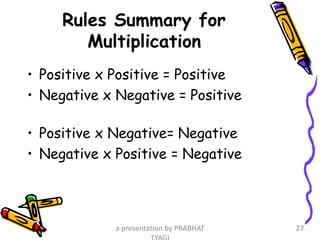
Rules Summary for
Multiplication
• Positive x Positive = Positive
• Negative x Negative = Positive
• Positive x Negative= Negative
• Negative x Positive = Negative
a presentation by PRABHAT 27
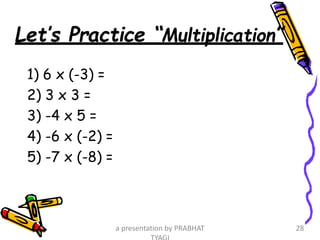
Let’s Practice “Multiplication”
1) 6 x (-3) =
2) 3 x 3 =
3) -4 x 5 =
4) -6 x (-2) =
5) -7 x (-8) =
a presentation by PRABHAT 28
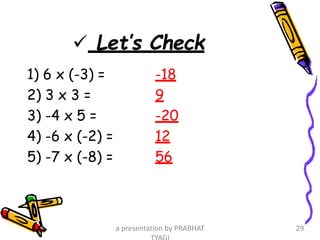
 Let’s Check
1) 6 x (-3) = -18
2) 3 x 3 = 9
3) -4 x 5 = -20
4) -6 x (-2) = 12
5) -7 x (-8) = 56
a presentation by PRABHAT 29
Did you know that
the rules for
multiplication and
division are the
same?
a presentation by PRABHAT 30
Guess what….
They are!
a presentation by PRABHAT 31
• The rules for division are exactly
the same as those for multiplication.
• If we were to take the rules for
multiplication and change the
multiplication signs todivision signs,
we would have an accurate set of
rules for division.
a presentation by PRABHAT 32
Rules for
Dividing Integers (÷)
• The quotient of two integers with
the same signs is POSITIVE.
• The quotient of two integers with
different signs is NEGATIVE.
a presentation by PRABHAT 33
Rules Summary for
Division
• Positive ÷ Positive = Positive
• Negative ÷ Negative =Positive
• Positive ÷ Negative=Negative
• Negative ÷ Positive = Negative
a presentation by PRABHAT 34
Let’s Practice “Division”
1) 18 ÷ (-2) =
2) -48 ÷ (-6)=
3) -27 ÷ 9 =
4) 64 ÷ 8 =
5) 30 ÷ (-5) =
a presentation by PRABHAT 35
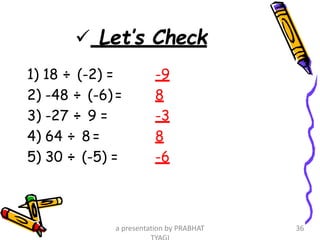
 Let’s Check
1) 18 ÷ (-2) = -9
2) -48 ÷ (-6) = 8
3) -27 ÷ 9 = -3
4) 64 ÷ 8 = 8
5) 30 ÷ (-5) = -6
a presentation by PRABHAT 36
Let’s Review…
a presentation by PRABHAT 37
What is an integer?
a presentation by PRABHAT 38
ANSWER
• An integer is a positive or
negative whole number,
including 0.
a presentation by PRABHAT 39
Can you give an example
of an integer?
a presentation by PRABHAT 40
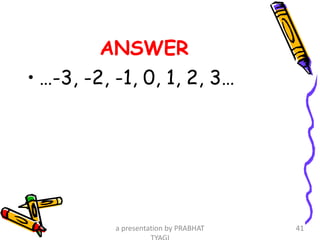
ANSWER
• …-3, -2, -1, 0, 1, 2, 3…
a presentation by PRABHAT 41
What are the four
operations?
a presentation by PRABHAT 42
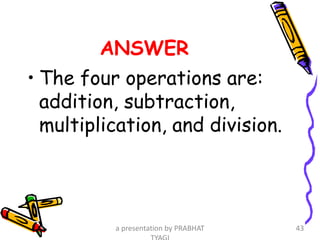
ANSWER
• The four operations are:
addition, subtraction,
multiplication, and division.
a presentation by PRABHAT 43
How do you add
integers?
a presentation by PRABHAT 44
ANSWER
• The sum of two positive integers is always
positive.
• The sum of two negative integers is always
negative.
• When you add a positive and negative
integer, you are really subtracting. Then, you
give the answer the sign of the greater
absolute value.
a presentation by PRABHAT 45
How do you
subtract integers?
a presentation by PRABHAT 46
ANSWER
• To subtract an integer, add its
opposite.
• Same, Change, Change
a presentation by PRABHAT 47
How do you multiply
integers?
a presentation by PRABHAT 48
ANSWER
• If the signs are the same, your answer
is always positive.
• If the signs are different, your answer
is always negative.
a presentation by PRABHAT 49
How do you divide
integers?
a presentation by PRABHAT 50
ANSWER
• If the signs are the same, your answer is
always positive.
• If the signs are different, your answer is
always negative.
*Multiplication and Division Rules are the
same!
a presentation by PRABHAT 51
a presentation by PRABHAT 52

Integers ppt by prabhat tyagi.pptx

  • 1.
    Presented by PRABHATTYAGI B.Ed 2nd year Roll No. - 2106370034 a presentation by PRABHAT TYAGI 1
  • 2.
  • 3.
    What is an Integer? apresentation by PRABHAT 3
  • 4.
    • An integeris a positive or negative whole number, including 0. …-3, -2, -1, 0, 1, 2, 3… a presentation by PRABHAT 4
  • 5.
  • 6.
  • 7.
  • 8.
  • 9.
  • 10.
    4 Integer Operations + •Addition • Subtraction - • Multiplication x • Division ÷ a presentation by PRABHAT 10
  • 11.
    Rule #1 for AddingIntegers (+) • The sum of two positive integers is always positive. 5 + 1 = 6 a presentation by PRABHAT 11
  • 12.
    Rule #2 for AddingIntegers (+) • The sum of two negative integers is always negative. -5 + (-1) = -6 a presentation by PRABHAT 12
  • 13.
    Rule #3 for AddingIntegers (+) • The sum of a positive and a negative integer could be positive, negative, or zero. a presentation by PRABHAT 13
  • 14.
    Rule #3 for AddingIntegers Continued • When you add a positive and negative integer, you are really subtracting. Then, you give the answer the sign of the greater absolute value. 5 + (-1) = -4 -5 + 1 = 4 -5 + (-5) = 0 a presentation by PRABHAT 14
  • 15.
    Let’s Practice “Addition” 1)5 + 6 = • -3 + (-2) = • -6 + 5 = • 8 + (-7) = • -9 + 9 = a presentation by PRABHAT 15
  • 16.
     Let’s Check 1)5 + 6 = • -3 + (-2) = • -6 + 5 = • 8 + (-7) = • -9 + 9 = 11 -5 -1 1 0 a presentation by PRABHAT 16
  • 17.
    Rules for Subtracting Integers(-) • To subtract an integer, add its opposite. • You will need to correctly change all subtraction problems into addition problems! a presentation by PRABHAT 17
  • 18.
    How do you changea subtraction problem into an addition problem? a presentation by PRABHAT 18
  • 19.
    There are threesteps: 1. Keep the first integer the same. (Same) 2. Change the subtraction sign into an addition sign. (Change) 3. Take the opposite of the number that immediately follows the newly placed addition sign. (Change) a presentation by PRABHAT 19
  • 20.
  • 21.
  • 22.
  • 23.
    Think … Same, Change,Change Examples: 5 – (-2) = 5 + 2 = 7 -5 – 2 = -5 + (-2) = -7 a presentation by PRABHAT 23
  • 24.
    Let’s Practice “Subtraction” 1)5 – 2 = 2) -3 – 4 = 3) -1 – (-2) = 4) -5 – (-3) = 5) 7 – (-6) = a presentation by PRABHAT 24
  • 25.
     Let’s Check 1)5 – 2 = 5 + (-2) = 3 2) -3 – 4 = -3 + (-4) = -7 3) -1 – (-2) = -1 + 2 = 1 4) -5 – (-3) = -5 + 3 = -2 5) 7 – (-6) = 7+ 6 = 13 a presentation by PRABHAT 25
  • 26.
    Rules for Multiplying Integers(x) • The product of two integers with the same signs is POSITIVE. • The product of two integers with different signs is NEGATIVE. a presentation by PRABHAT 26
  • 27.
    Rules Summary for Multiplication •Positive x Positive = Positive • Negative x Negative = Positive • Positive x Negative= Negative • Negative x Positive = Negative a presentation by PRABHAT 27
  • 28.
    Let’s Practice “Multiplication” 1)6 x (-3) = 2) 3 x 3 = 3) -4 x 5 = 4) -6 x (-2) = 5) -7 x (-8) = a presentation by PRABHAT 28
  • 29.
     Let’s Check 1)6 x (-3) = -18 2) 3 x 3 = 9 3) -4 x 5 = -20 4) -6 x (-2) = 12 5) -7 x (-8) = 56 a presentation by PRABHAT 29
  • 30.
    Did you knowthat the rules for multiplication and division are the same? a presentation by PRABHAT 30
  • 31.
    Guess what…. They are! apresentation by PRABHAT 31
  • 32.
    • The rulesfor division are exactly the same as those for multiplication. • If we were to take the rules for multiplication and change the multiplication signs todivision signs, we would have an accurate set of rules for division. a presentation by PRABHAT 32
  • 33.
    Rules for Dividing Integers(÷) • The quotient of two integers with the same signs is POSITIVE. • The quotient of two integers with different signs is NEGATIVE. a presentation by PRABHAT 33
  • 34.
    Rules Summary for Division •Positive ÷ Positive = Positive • Negative ÷ Negative =Positive • Positive ÷ Negative=Negative • Negative ÷ Positive = Negative a presentation by PRABHAT 34
  • 35.
    Let’s Practice “Division” 1)18 ÷ (-2) = 2) -48 ÷ (-6)= 3) -27 ÷ 9 = 4) 64 ÷ 8 = 5) 30 ÷ (-5) = a presentation by PRABHAT 35
  • 36.
     Let’s Check 1)18 ÷ (-2) = -9 2) -48 ÷ (-6) = 8 3) -27 ÷ 9 = -3 4) 64 ÷ 8 = 8 5) 30 ÷ (-5) = -6 a presentation by PRABHAT 36
  • 37.
  • 38.
    What is aninteger? a presentation by PRABHAT 38
  • 39.
    ANSWER • An integeris a positive or negative whole number, including 0. a presentation by PRABHAT 39
  • 40.
    Can you givean example of an integer? a presentation by PRABHAT 40
  • 41.
    ANSWER • …-3, -2,-1, 0, 1, 2, 3… a presentation by PRABHAT 41
  • 42.
    What are thefour operations? a presentation by PRABHAT 42
  • 43.
    ANSWER • The fouroperations are: addition, subtraction, multiplication, and division. a presentation by PRABHAT 43
  • 44.
    How do youadd integers? a presentation by PRABHAT 44
  • 45.
    ANSWER • The sumof two positive integers is always positive. • The sum of two negative integers is always negative. • When you add a positive and negative integer, you are really subtracting. Then, you give the answer the sign of the greater absolute value. a presentation by PRABHAT 45
  • 46.
    How do you subtractintegers? a presentation by PRABHAT 46
  • 47.
    ANSWER • To subtractan integer, add its opposite. • Same, Change, Change a presentation by PRABHAT 47
  • 48.
    How do youmultiply integers? a presentation by PRABHAT 48
  • 49.
    ANSWER • If thesigns are the same, your answer is always positive. • If the signs are different, your answer is always negative. a presentation by PRABHAT 49
  • 50.
    How do youdivide integers? a presentation by PRABHAT 50
  • 51.
    ANSWER • If thesigns are the same, your answer is always positive. • If the signs are different, your answer is always negative. *Multiplication and Division Rules are the same! a presentation by PRABHAT 51
  • 52.