
The Foundational
Principles
of Morality and You
Prepared by:
Sumayan, Lea Jean S.
Lesson Objectives
 Define morality;
 Explain the natural law;
 Understand the meaning of
foundational moral principle;
 Practice the moral values that a
teacher should do.
 Value the importance of the lesson
in real-life.
What is morality?
Morality refers to “the quality of
human acts by which we call them
right or wrong, good or evil.” (Panizo,
1964)
Your human action is right when it
conforms with the norm, rule, or law of
morality.
Meaning of foundational moral principle
princeps - beginning, a source
A principle is that on which something is
based founded, originated, initiated.
A foundational moral principle is,
therefore the universal norm upon which all
other principles on the rightness or wrongness
of an action are based. It is the source of
morality.
 St. Thomas defines it as “the light of natural
reason, whereby we discern what is good and
what is evil... an imprint on us of the divine
light.”
 For theists, it is “man`s share in the Eternal
Law of God...”
 It is the law that says: “Do good and avoid
evil.”
THIS IS THE FUNDAMENTAL OR
FOUNDATIONAL MORAL PRINCIPLE
Panizo says: “Writings, customs, and
monuments of past and present
generations point out to this conclusion:
that all peoples on earth, no matter how
savage and illiterate, have recognized a
supreme law of divine origin commanding
good and forbidding evil.”
Mencius said:
“All men have a mind which cannot bear to
see the suffering of others... If now men suddenly
see a child about to fall into a well, they will without
exception experience a feeling of alarm and
distress... From this case we may perceive that he
who lacks the feeling of commiseration is not a
man; that he who lacks a feeling of shame and
dislike is not a man; he who lacks a feeling of
modesty and yielding is not a man; and that he
who lacks a sense of right and wrong is not a
man... Man has these four beginnings.
Natural Law in Different Versions
Kung-fu-tsu said:
“Do not do to others what you do not
like others do to you.”
For Christians:
“Love God with all your heart, with all
your mind, with all your strength” and “love
your neighbor as you love yourself.”
Natural Law in Different Versions
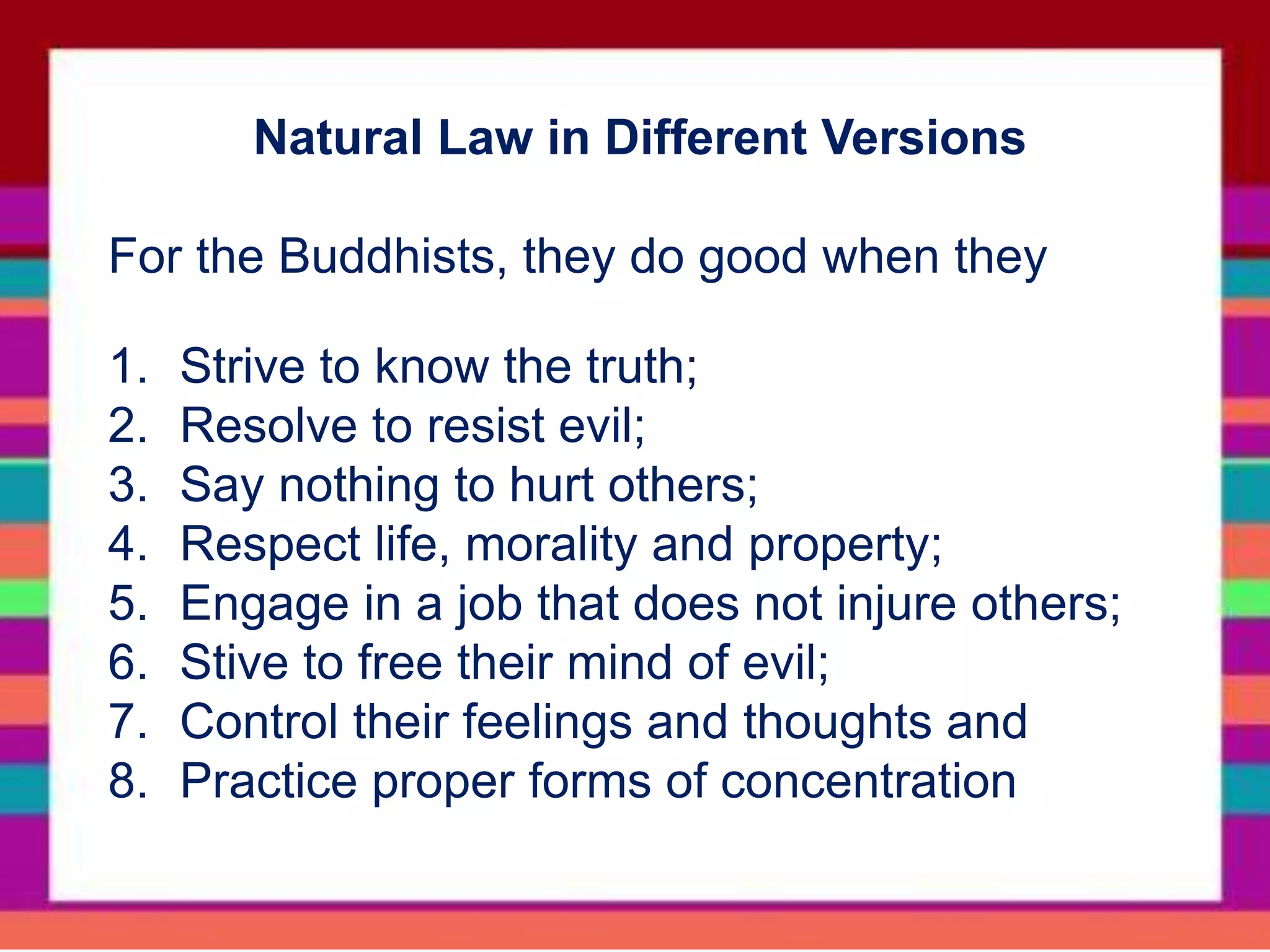
For the Buddhists, they do good when they
1. Strive to know the truth;
2. Resolve to resist evil;
3. Say nothing to hurt others;
4. Respect life, morality and property;
5. Engage in a job that does not injure others;
6. Stive to free their mind of evil;
7. Control their feelings and thoughts and
8. Practice proper forms of concentration
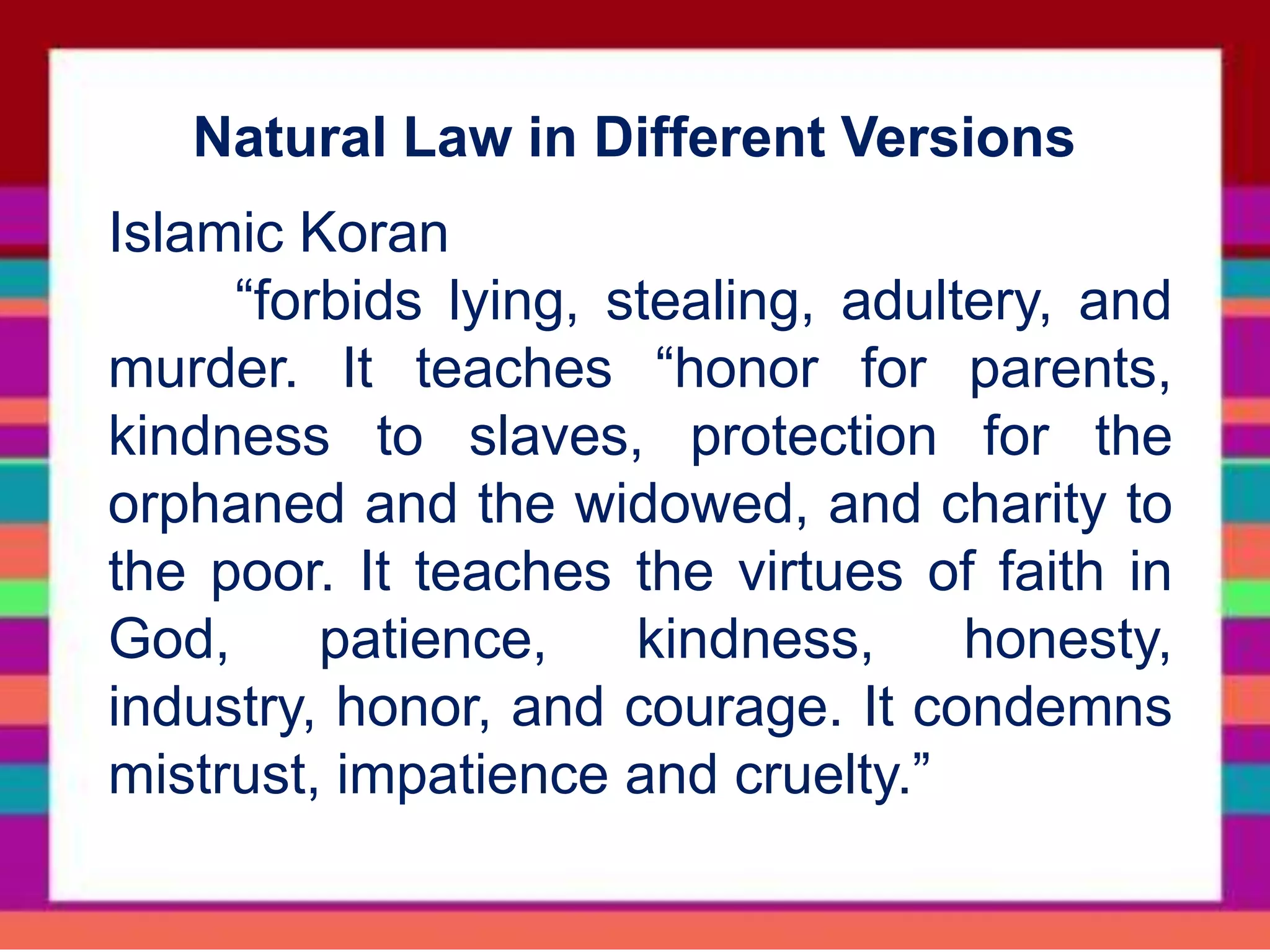
Islamic Koran
“forbids lying, stealing, adultery, and
murder. It teaches “honor for parents,
kindness to slaves, protection for the
orphaned and the widowed, and charity to
the poor. It teaches the virtues of faith in
God, patience, kindness, honesty,
industry, honor, and courage. It condemns
mistrust, impatience and cruelty.”
Natural Law in Different Versions
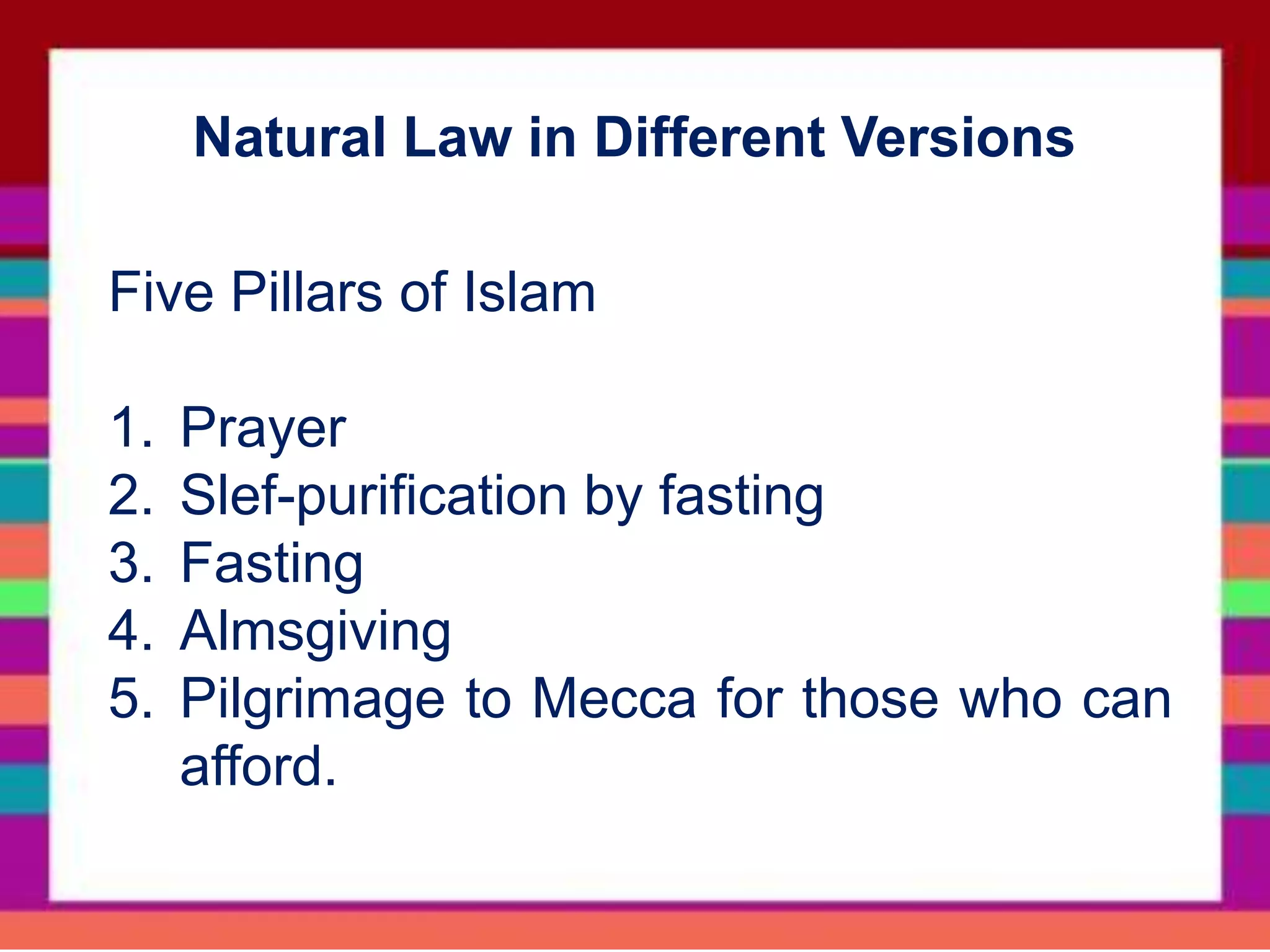
Five Pillars of Islam
1. Prayer
2. Slef-purification by fasting
3. Fasting
4. Almsgiving
5. Pilgrimage to Mecca for those who can
afford.
Natural Law in Different Versions
Teacher as a a person of
good moral character
“Teachers are duly licensed
professionals who posseses dignity and
reputation with high moral values as well
as technical and professional competence.
In the practice of their profession, they
strictly adhere to, observe and practice
this set of ethical and moral principles,
standard and values.”
When are you of good moral
character?
1. Being fully human
2. Being a loving person
3. Being a virtuous person
4. Being morally mature person
Morality
1. Human
2. Loving
3. Virtuous
4. Mature
Thank you for listening!   
The Foundational
Principles
of Morality and You

The Foundational Principles of Morality and You

  • 1.
    The Foundational Principles of Moralityand You Prepared by: Sumayan, Lea Jean S.
  • 2.
    Lesson Objectives  Definemorality;  Explain the natural law;  Understand the meaning of foundational moral principle;  Practice the moral values that a teacher should do.  Value the importance of the lesson in real-life.
  • 3.
    What is morality? Moralityrefers to “the quality of human acts by which we call them right or wrong, good or evil.” (Panizo, 1964) Your human action is right when it conforms with the norm, rule, or law of morality.
  • 5.
    Meaning of foundationalmoral principle princeps - beginning, a source A principle is that on which something is based founded, originated, initiated. A foundational moral principle is, therefore the universal norm upon which all other principles on the rightness or wrongness of an action are based. It is the source of morality.
  • 6.
     St. Thomasdefines it as “the light of natural reason, whereby we discern what is good and what is evil... an imprint on us of the divine light.”  For theists, it is “man`s share in the Eternal Law of God...”  It is the law that says: “Do good and avoid evil.” THIS IS THE FUNDAMENTAL OR FOUNDATIONAL MORAL PRINCIPLE
  • 7.
    Panizo says: “Writings,customs, and monuments of past and present generations point out to this conclusion: that all peoples on earth, no matter how savage and illiterate, have recognized a supreme law of divine origin commanding good and forbidding evil.”
  • 8.
    Mencius said: “All menhave a mind which cannot bear to see the suffering of others... If now men suddenly see a child about to fall into a well, they will without exception experience a feeling of alarm and distress... From this case we may perceive that he who lacks the feeling of commiseration is not a man; that he who lacks a feeling of shame and dislike is not a man; he who lacks a feeling of modesty and yielding is not a man; and that he who lacks a sense of right and wrong is not a man... Man has these four beginnings.
  • 9.
    Natural Law inDifferent Versions Kung-fu-tsu said: “Do not do to others what you do not like others do to you.” For Christians: “Love God with all your heart, with all your mind, with all your strength” and “love your neighbor as you love yourself.”
  • 10.
    Natural Law inDifferent Versions For the Buddhists, they do good when they 1. Strive to know the truth; 2. Resolve to resist evil; 3. Say nothing to hurt others; 4. Respect life, morality and property; 5. Engage in a job that does not injure others; 6. Stive to free their mind of evil; 7. Control their feelings and thoughts and 8. Practice proper forms of concentration
  • 11.
    Islamic Koran “forbids lying,stealing, adultery, and murder. It teaches “honor for parents, kindness to slaves, protection for the orphaned and the widowed, and charity to the poor. It teaches the virtues of faith in God, patience, kindness, honesty, industry, honor, and courage. It condemns mistrust, impatience and cruelty.” Natural Law in Different Versions
  • 12.
    Five Pillars ofIslam 1. Prayer 2. Slef-purification by fasting 3. Fasting 4. Almsgiving 5. Pilgrimage to Mecca for those who can afford. Natural Law in Different Versions
  • 13.
    Teacher as aa person of good moral character
  • 14.
    “Teachers are dulylicensed professionals who posseses dignity and reputation with high moral values as well as technical and professional competence. In the practice of their profession, they strictly adhere to, observe and practice this set of ethical and moral principles, standard and values.”
  • 15.
    When are youof good moral character? 1. Being fully human 2. Being a loving person 3. Being a virtuous person 4. Being morally mature person
  • 16.
  • 17.
    Thank you forlistening!    The Foundational Principles of Morality and You