The
Family Support
Model
Family is the single most important
influence in a child’s life. Children
depend on parents and family to
protect them and provide their needs.
Every parent knows that it is difficult to
do work without help, support or
additional resources.
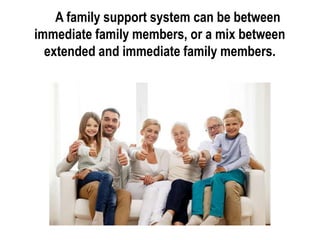
A family support system can be between
immediate family members, or a mix between
extended and immediate family members.
5 Ways to Build a
SupportSystem
Among Family
Members
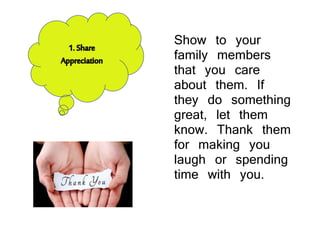
Show to your
family members
that you care
about them. If
they do something
great, let them
know. Thank them
for making you
laugh or spending
time with you.
• Family is the best thing that God gave
you. They are always there for you and
are always on your side. Making
memories with your family is the best
thing to look back on when there are
some bumps in the road.
• Don’t be ashamed of your family, even
if you think they are weird at times,
they will always be your family no
matter what. Appreciate your family every
time you can, you never know what life
is going to bring you.
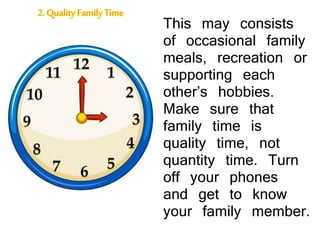
This may consists
of occasional family
meals, recreation or
supporting each
other’s hobbies.
Make sure that
family time is
quality time, not
quantity time. Turn
off your phones
and get to know
your family member.
Some Examples Of Quality
Time With Your Family
 Play their games
 Fix things together
 Take pajamas walk
 Have an ice cream night
 Take a nature walk
 Go to the beach
 `
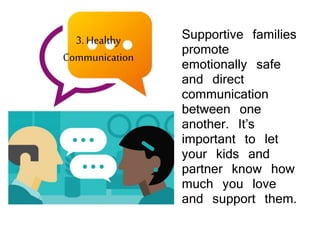
Supportive families
promote
emotionally safe
and direct
communication
between one
another. It’s
important to let
your kids and
partner know how
much you love
and support them.
3. Healthy
Communication
4 Tips for a Healthy
Communication
1. Establish and maintain eye
contact.
2. Try to send a clear message.
3. Be receptive to what others say.
4. Wait for the other person to
finish.
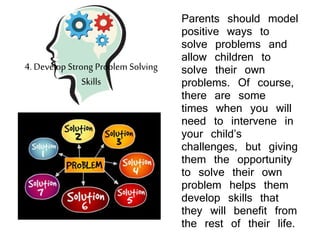
Parents should model
positive ways to
solve problems and
allow children to
solve their own
problems. Of course,
there are some
times when you will
need to intervene in
your child’s
challenges, but giving
them the opportunity
to solve their own
problem helps them
develop skills that
they will benefit from
the rest of their life.
4. Develop Strong Problem Solving
Skills
Healthy families
hold individual
members
accountable for
their behavior and
are supportive in
times of need.
Helping them
through the tough
times will bring
your family that
much closer
together.
5. Individual Accountability
FamilySupport fromGovernmentAgencies
• A set of beliefs and an approach
• A type of grassroots, community-
based program
• A shift in human services delivery
• A movement for social change
Four Concepts of FamilySupport
Goals ofthe Governmentas a Family
SupportSystem
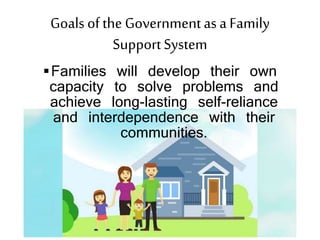
Families will develop their own
capacity to solve problems and
achieve long-lasting self-reliance
and interdependence with their
communities.
Frontline workers will develop skills
needed to work effectively with
families.
Agencies and communities will
transform the way they work with
families, focusing on strengths,
families setting their own goals, and
fostering collaboration.
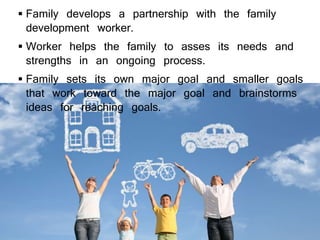
 Family develops a partnership with the family
development worker.
 Worker helps the family to asses its needs and
strengths in an ongoing process.
 Family sets its own major goal and smaller goals
that work toward the major goal and brainstorms
ideas for reaching goals.
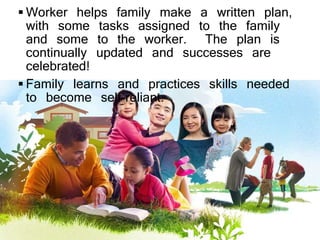
 Worker helps family make a written plan,
with some tasks assigned to the family
and some to the worker. The plan is
continually updated and successes are
celebrated!
 Family learns and practices skills needed
to become self-reliant.
Outcome of Government Programs as a Family
Support System
Family members recognized their
strengths, set their own goals and
developed plans to reach those goals;
Families increased their involvement in
agencies, school and community
organizations and participated in ways
that reflect self-empowerment.

The family support model

  • 1.
  • 3.
    Family is thesingle most important influence in a child’s life. Children depend on parents and family to protect them and provide their needs. Every parent knows that it is difficult to do work without help, support or additional resources.
  • 4.
    A family supportsystem can be between immediate family members, or a mix between extended and immediate family members.
  • 5.
    5 Ways toBuild a SupportSystem Among Family Members
  • 6.
    Show to your familymembers that you care about them. If they do something great, let them know. Thank them for making you laugh or spending time with you.
  • 7.
    • Family isthe best thing that God gave you. They are always there for you and are always on your side. Making memories with your family is the best thing to look back on when there are some bumps in the road. • Don’t be ashamed of your family, even if you think they are weird at times, they will always be your family no matter what. Appreciate your family every time you can, you never know what life is going to bring you.
  • 8.
    This may consists ofoccasional family meals, recreation or supporting each other’s hobbies. Make sure that family time is quality time, not quantity time. Turn off your phones and get to know your family member.
  • 10.
    Some Examples OfQuality Time With Your Family  Play their games  Fix things together  Take pajamas walk  Have an ice cream night  Take a nature walk  Go to the beach  `
  • 11.
    Supportive families promote emotionally safe anddirect communication between one another. It’s important to let your kids and partner know how much you love and support them. 3. Healthy Communication
  • 12.
    4 Tips fora Healthy Communication 1. Establish and maintain eye contact. 2. Try to send a clear message. 3. Be receptive to what others say. 4. Wait for the other person to finish.
  • 13.
    Parents should model positiveways to solve problems and allow children to solve their own problems. Of course, there are some times when you will need to intervene in your child’s challenges, but giving them the opportunity to solve their own problem helps them develop skills that they will benefit from the rest of their life. 4. Develop Strong Problem Solving Skills
  • 14.
    Healthy families hold individual members accountablefor their behavior and are supportive in times of need. Helping them through the tough times will bring your family that much closer together. 5. Individual Accountability
  • 15.
  • 16.
    • A setof beliefs and an approach • A type of grassroots, community- based program • A shift in human services delivery • A movement for social change Four Concepts of FamilySupport
  • 17.
    Goals ofthe Governmentasa Family SupportSystem Families will develop their own capacity to solve problems and achieve long-lasting self-reliance and interdependence with their communities.
  • 18.
    Frontline workers willdevelop skills needed to work effectively with families. Agencies and communities will transform the way they work with families, focusing on strengths, families setting their own goals, and fostering collaboration.
  • 19.
     Family developsa partnership with the family development worker.  Worker helps the family to asses its needs and strengths in an ongoing process.  Family sets its own major goal and smaller goals that work toward the major goal and brainstorms ideas for reaching goals.
  • 20.
     Worker helpsfamily make a written plan, with some tasks assigned to the family and some to the worker. The plan is continually updated and successes are celebrated!  Family learns and practices skills needed to become self-reliant.
  • 21.
    Outcome of GovernmentPrograms as a Family Support System Family members recognized their strengths, set their own goals and developed plans to reach those goals; Families increased their involvement in agencies, school and community organizations and participated in ways that reflect self-empowerment.

Editor's Notes

  • #4 Family is the single most important influence in a child's life. From their first moments of life, children depend on parents and family to protect them and provide for their needs. Parents and family form a child's first relationships. They are a child's first teachers and act as role models in how to act and how to experience the world around them. By nurturing and teaching children during their early years, families play an important role in making sure children are ready to learn when they enter school. Children thrive when parents are able to actively promote their positive growth and development. Every parent knows that it's sometimes difficult to do this important work without help, support, and additional resources.