The Evolution of NUS
Prof TAN Eng Chye
Provost, NUS
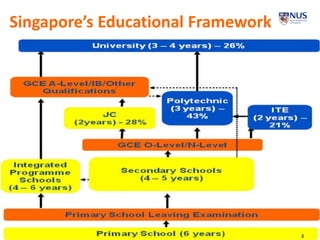
Singapore’s Educational Framework
2
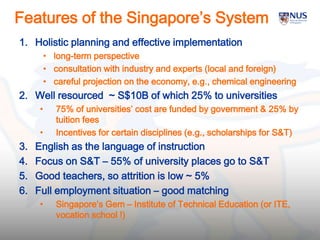
Features of the Singapore’s System
1. Holistic planning and effective implementation
• long-term perspective
• consultation with industry and experts (local and foreign)
• careful projection on the economy, e.g., chemical engineering
2. Well resourced ~ S$10B of which 25% to universities
• 75% of universities’ cost are funded by government & 25% by
tuition fees
• Incentives for certain disciplines (e.g., scholarships for S&T)
3. English as the language of instruction
4. Focus on S&T – 55% of university places go to S&T
5. Good teachers, so attrition is low ~ 5%
6. Full employment situation – good matching
• Singapore’s Gem – Institute of Technical Education (or ITE,
vocation school !)
3
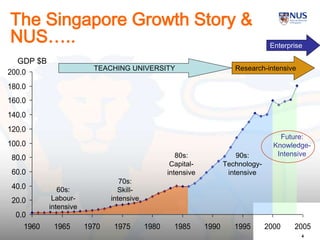
0.0
20.0
40.0
60.0
80.0
100.0
120.0
140.0
160.0
180.0
200.0
1960 1965 1970 1975 1980 1985 1990 1995 2000 2005
60s:
Labour-
intensive
70s:
Skill-
intensive
80s:
Capital-
intensive
90s:
Technology-
intensive
Future:
Knowledge-
Intensive
The Singapore Growth Story &
NUS…..
GDP $B
TEACHING UNIVERSITY Research-intensive
Enterprise
4
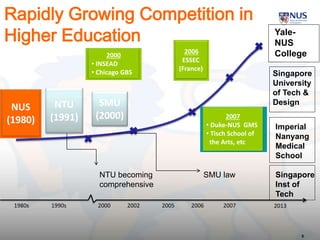
1980s
NUS
(1980)
NTU
(1991)
1990s 2002 2005 20062000
2000
• INSEAD
• Chicago GBS
2013
2006
ESSEC
(France)
2007
• Duke-NUS GMS
• Tisch School of
the Arts, etc
2007
Yale-
NUS
College
SMU
(2000)
Singapore
University
of Tech &
Design
NTU becoming
comprehensive
SMU law
Imperial
Nanyang
Medical
School
Singapore
Inst of
Tech
Rapidly Growing Competition in
Higher Education
5
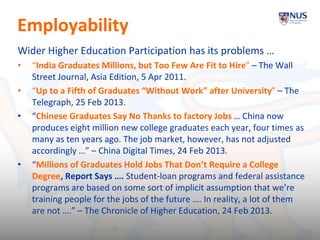
Employability
Wider Higher Education Participation has its problems …
• “India Graduates Millions, but Too Few Are Fit to Hire” – The Wall
Street Journal, Asia Edition, 5 Apr 2011.
• “Up to a Fifth of Graduates “Without Work” after University” – The
Telegraph, 25 Feb 2013.
• “Chinese Graduates Say No Thanks to factory Jobs … China now
produces eight million new college graduates each year, four times as
many as ten years ago. The job market, however, has not adjusted
accordingly …” – China Digital Times, 24 Feb 2013.
• “Millions of Graduates Hold Jobs That Don’t Require a College
Degree, Report Says …. Student-loan programs and federal assistance
programs are based on some sort of implicit assumption that we’re
training people for the jobs of the future …. In reality, a lot of them
are not ….” – The Chronicle of Higher Education, 24 Feb 2013.
6
Engendering creativity
…..
7
8
Design-centric Engineering
• Engineering graduates must have
– greater depth of knowledge in specific disciplines OR
– multi-disciplinary knowledge
accompanied by good systems thinking and technology
management skills
• Establishment of Design-centric Curriculum to foster
creativity, innovation, systems thinking and culture of
“thinking outside-the-box”
• Initiatives/Projects with multi-disciplinary themes, e.g.:
- Future Transportation Systems,
- Engineering in Medicine,
- Smart Cities, etc.
• Close linkage between research and education
9
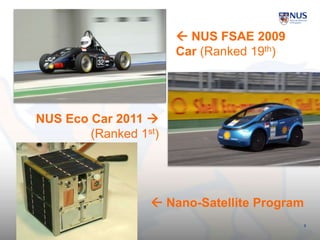
 NUS FSAE 2009
Car (Ranked 19th)
NUS Eco Car 2011 
(Ranked 1st)
 Nano-Satellite Program
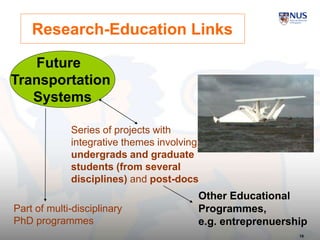
Research-Education Links
Series of projects with
integrative themes involving
undergrads and graduate
students (from several
disciplines) and post-docs
Other Educational
Programmes,
e.g. entreprenuership
Part of multi-disciplinary
PhD programmes
Future
Transportation
Systems
10
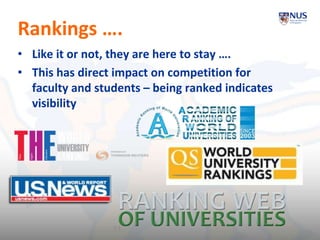
Rankings ….
• Like it or not, they are here to stay ….
• This has direct impact on competition for
faculty and students – being ranked indicates
visibility
11
World-class Research Faculty?
• University is a talent organization – you need
talented students and staff
• Are our universities resourced as well as the top US
and European universities?
• Endowed donations or direct government support are
sustainable means
• Do we have sufficient research support? – Do we
have to play by “rules” of western countries, in terms
of compensation and research support?
12
What is Our Differentiator?
• Top universities do similar things – they
recruit top faculty and students, they do
cutting-edge research, etc.
• Do we have niches or distinctive
programmes which are not easily
replicated by others? E.g., Stevens
Institute of Technology – The Innovation
University
13
Translating ideas ….
….. 2 Examples
14
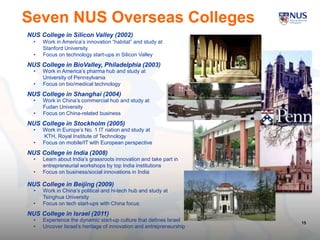
Seven NUS Overseas Colleges
NUS College in Silicon Valley (2002)
• Work in America’s innovation “habitat” and study at
Stanford University
• Focus on technology start-ups in Silicon Valley
NUS College in BioValley, Philadelphia (2003)
• Work in America’s pharma hub and study at
University of Pennsylvania
• Focus on bio/medical technology
NUS College in Shanghai (2004)
• Work in China’s commercial hub and study at
Fudan University
• Focus on China-related business
NUS College in Stockholm (2005)
• Work in Europe’s No. 1 IT nation and study at
KTH, Royal Institute of Technology
• Focus on mobile/IT with European perspective
NUS College in India (2008)
• Learn about India’s grassroots innovation and take part in
entrepreneurial workshops by top India institutions
• Focus on business/social innovations in India
NUS College in Beijing (2009)
• Work in China’s political and hi-tech hub and study at
Tsinghua University
• Focus on tech start-ups with China focus
NUS College in Israel (2011)
• Experience the dynamic start-up culture that defines Israel
• Uncover Israel’s heritage of innovation and entrepreneurship
15
16
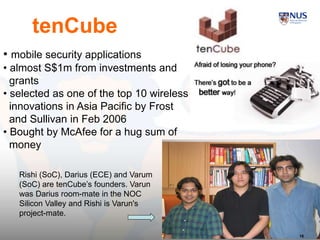
• mobile security applications
• almost S$1m from investments and
grants
• selected as one of the top 10 wireless
innovations in Asia Pacific by Frost
and Sullivan in Feb 2006
• Bought by McAfee for a hug sum of
money
Rishi (SoC), Darius (ECE) and Varum
(SoC) are tenCube’s founders. Varun
was Darius room-mate in the NOC
Silicon Valley and Rishi is Varun's
project-mate.
tenCube
16
Promoting
Inter-disciplinarity &
multi-disciplinarity …
17
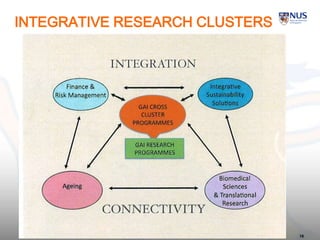
INTEGRATIVE RESEARCH CLUSTERS
18
More Educational
Innovations ….
19
University Scholars’ Program (1999)
• Started as the Core Curriculum in 1999
• broadbased curriculum in the first year
• writing module – linking critical thinking and writing
• focus on approach to knowledge, rather than content
• multi-disciplinary modules
Power, Space and Pleasure - Examines how our surroundings
influence the way we think, from the points of view of urban planning,
literature, and philosophy.
Interpreting Consumerism – Investigates the relationship between
human nature and consumption, from the points of view of sociology,
business, and popular culture.
• About 180 students each year with students from 7
Faculties – they choose their major after 3 semesters
• Almost 100% of its students go for a one-semester
exchange overseas
• Introduced the residential component in 2011 20
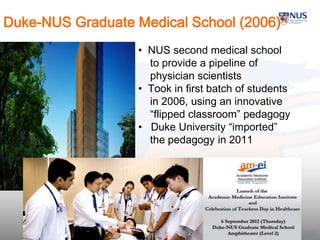
Duke-NUS Graduate Medical School (2006)
21
• NUS second medical school
to provide a pipeline of
physician scientists
• Took in first batch of students
in 2006, using an innovative
“flipped classroom” pedagogy
• Duke University “imported”
the pedagogy in 2011
22
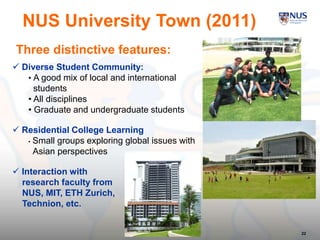
 Diverse Student Community:
• A good mix of local and international
students
• All disciplines
• Graduate and undergraduate students
 Residential College Learning
• Small groups exploring global issues with
Asian perspectives
 Interaction with
research faculty from
NUS, MIT, ETH Zurich,
Technion, etc.
NUS University Town (2011)
Three distinctive features:
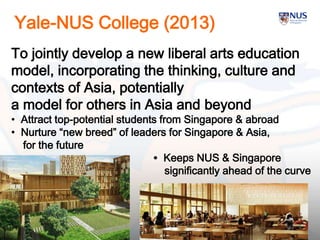
Yale-NUS College (2013)
To jointly develop a new liberal arts education
model, incorporating the thinking, culture and
contexts of Asia, potentially
a model for others in Asia and beyond
• Attract top-potential students from Singapore & abroad
• Nurture “new breed” of leaders for Singapore & Asia,
for the future
• ∙ Keeps NUS & Singapore
significantly ahead of the curve
23
And
impact of
technology on education
….
24
Living at app Speed, or How
Our World has Changed
“He [Dr Alvin Rajkomar at UC-SF Medical
Center] reached into a deep pocket of his
white coat and produced not a well-thumbed
handbook but his iPhone. With a tap on an
app called MedCalc, he had enough answers
within a minute to start the saline at precisely
the right rate”
[IHT, 10 October 2012, “Mobile devices are new black bags for
physicians”, p.10]
25
Environmental Changes - What
should we do about these?
• The world has changed: driven by mobile
technology and social media platforms
• Rise in forms of online education: Khan Academy,
Udacity, Coursera and EdX
• Foundations’ role in shaping educational shifts
• Our students’ learning style and preferred mode of
interaction are gadget-driven
26
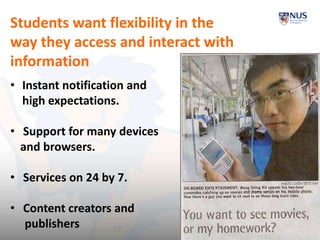
Students want flexibility in the
way they access and interact with
information
• Instant notification and
high expectations.
• Support for many devices
and browsers.
• Services on 24 by 7.
• Content creators and
publishers 27
Cogito, Ergo Sum
“I think, therefore I am”
(Rene Descartes, 1637)
“If you’re not on Facebook, you don’t exist.”
(22-year-old male student, 2012).
“If you don’t have Facebook, you don’t exist as a
person.” (19-year-old female student, 2012)
28
Usual Challenges
29
• The size of our student population:
effective engagement
• Scaling up our programmes:
efficiency and reach
• Physical Infrastructure:
capital and recurrent costs
• Doing more with less:
resource constraints and learning outcomes
• How could we meet these challenges?
• Is Tech-enhanced Education the answer?

The evolution of nus 2014 mar18

  • 1.
    The Evolution ofNUS Prof TAN Eng Chye Provost, NUS
  • 2.
  • 3.
    Features of theSingapore’s System 1. Holistic planning and effective implementation • long-term perspective • consultation with industry and experts (local and foreign) • careful projection on the economy, e.g., chemical engineering 2. Well resourced ~ S$10B of which 25% to universities • 75% of universities’ cost are funded by government & 25% by tuition fees • Incentives for certain disciplines (e.g., scholarships for S&T) 3. English as the language of instruction 4. Focus on S&T – 55% of university places go to S&T 5. Good teachers, so attrition is low ~ 5% 6. Full employment situation – good matching • Singapore’s Gem – Institute of Technical Education (or ITE, vocation school !) 3
  • 4.
    0.0 20.0 40.0 60.0 80.0 100.0 120.0 140.0 160.0 180.0 200.0 1960 1965 19701975 1980 1985 1990 1995 2000 2005 60s: Labour- intensive 70s: Skill- intensive 80s: Capital- intensive 90s: Technology- intensive Future: Knowledge- Intensive The Singapore Growth Story & NUS….. GDP $B TEACHING UNIVERSITY Research-intensive Enterprise 4
  • 5.
    1980s NUS (1980) NTU (1991) 1990s 2002 200520062000 2000 • INSEAD • Chicago GBS 2013 2006 ESSEC (France) 2007 • Duke-NUS GMS • Tisch School of the Arts, etc 2007 Yale- NUS College SMU (2000) Singapore University of Tech & Design NTU becoming comprehensive SMU law Imperial Nanyang Medical School Singapore Inst of Tech Rapidly Growing Competition in Higher Education 5
  • 6.
    Employability Wider Higher EducationParticipation has its problems … • “India Graduates Millions, but Too Few Are Fit to Hire” – The Wall Street Journal, Asia Edition, 5 Apr 2011. • “Up to a Fifth of Graduates “Without Work” after University” – The Telegraph, 25 Feb 2013. • “Chinese Graduates Say No Thanks to factory Jobs … China now produces eight million new college graduates each year, four times as many as ten years ago. The job market, however, has not adjusted accordingly …” – China Digital Times, 24 Feb 2013. • “Millions of Graduates Hold Jobs That Don’t Require a College Degree, Report Says …. Student-loan programs and federal assistance programs are based on some sort of implicit assumption that we’re training people for the jobs of the future …. In reality, a lot of them are not ….” – The Chronicle of Higher Education, 24 Feb 2013. 6
  • 7.
  • 8.
    8 Design-centric Engineering • Engineeringgraduates must have – greater depth of knowledge in specific disciplines OR – multi-disciplinary knowledge accompanied by good systems thinking and technology management skills • Establishment of Design-centric Curriculum to foster creativity, innovation, systems thinking and culture of “thinking outside-the-box” • Initiatives/Projects with multi-disciplinary themes, e.g.: - Future Transportation Systems, - Engineering in Medicine, - Smart Cities, etc. • Close linkage between research and education
  • 9.
    9  NUS FSAE2009 Car (Ranked 19th) NUS Eco Car 2011  (Ranked 1st)  Nano-Satellite Program
  • 10.
    Research-Education Links Series ofprojects with integrative themes involving undergrads and graduate students (from several disciplines) and post-docs Other Educational Programmes, e.g. entreprenuership Part of multi-disciplinary PhD programmes Future Transportation Systems 10
  • 11.
    Rankings …. • Likeit or not, they are here to stay …. • This has direct impact on competition for faculty and students – being ranked indicates visibility 11
  • 12.
    World-class Research Faculty? •University is a talent organization – you need talented students and staff • Are our universities resourced as well as the top US and European universities? • Endowed donations or direct government support are sustainable means • Do we have sufficient research support? – Do we have to play by “rules” of western countries, in terms of compensation and research support? 12
  • 13.
    What is OurDifferentiator? • Top universities do similar things – they recruit top faculty and students, they do cutting-edge research, etc. • Do we have niches or distinctive programmes which are not easily replicated by others? E.g., Stevens Institute of Technology – The Innovation University 13
  • 14.
  • 15.
    Seven NUS OverseasColleges NUS College in Silicon Valley (2002) • Work in America’s innovation “habitat” and study at Stanford University • Focus on technology start-ups in Silicon Valley NUS College in BioValley, Philadelphia (2003) • Work in America’s pharma hub and study at University of Pennsylvania • Focus on bio/medical technology NUS College in Shanghai (2004) • Work in China’s commercial hub and study at Fudan University • Focus on China-related business NUS College in Stockholm (2005) • Work in Europe’s No. 1 IT nation and study at KTH, Royal Institute of Technology • Focus on mobile/IT with European perspective NUS College in India (2008) • Learn about India’s grassroots innovation and take part in entrepreneurial workshops by top India institutions • Focus on business/social innovations in India NUS College in Beijing (2009) • Work in China’s political and hi-tech hub and study at Tsinghua University • Focus on tech start-ups with China focus NUS College in Israel (2011) • Experience the dynamic start-up culture that defines Israel • Uncover Israel’s heritage of innovation and entrepreneurship 15
  • 16.
    16 • mobile securityapplications • almost S$1m from investments and grants • selected as one of the top 10 wireless innovations in Asia Pacific by Frost and Sullivan in Feb 2006 • Bought by McAfee for a hug sum of money Rishi (SoC), Darius (ECE) and Varum (SoC) are tenCube’s founders. Varun was Darius room-mate in the NOC Silicon Valley and Rishi is Varun's project-mate. tenCube 16
  • 17.
  • 18.
  • 19.
  • 20.
    University Scholars’ Program(1999) • Started as the Core Curriculum in 1999 • broadbased curriculum in the first year • writing module – linking critical thinking and writing • focus on approach to knowledge, rather than content • multi-disciplinary modules Power, Space and Pleasure - Examines how our surroundings influence the way we think, from the points of view of urban planning, literature, and philosophy. Interpreting Consumerism – Investigates the relationship between human nature and consumption, from the points of view of sociology, business, and popular culture. • About 180 students each year with students from 7 Faculties – they choose their major after 3 semesters • Almost 100% of its students go for a one-semester exchange overseas • Introduced the residential component in 2011 20
  • 21.
    Duke-NUS Graduate MedicalSchool (2006) 21 • NUS second medical school to provide a pipeline of physician scientists • Took in first batch of students in 2006, using an innovative “flipped classroom” pedagogy • Duke University “imported” the pedagogy in 2011
  • 22.
    22  Diverse StudentCommunity: • A good mix of local and international students • All disciplines • Graduate and undergraduate students  Residential College Learning • Small groups exploring global issues with Asian perspectives  Interaction with research faculty from NUS, MIT, ETH Zurich, Technion, etc. NUS University Town (2011) Three distinctive features:
  • 23.
    Yale-NUS College (2013) Tojointly develop a new liberal arts education model, incorporating the thinking, culture and contexts of Asia, potentially a model for others in Asia and beyond • Attract top-potential students from Singapore & abroad • Nurture “new breed” of leaders for Singapore & Asia, for the future • ∙ Keeps NUS & Singapore significantly ahead of the curve 23
  • 24.
    And impact of technology oneducation …. 24
  • 25.
    Living at appSpeed, or How Our World has Changed “He [Dr Alvin Rajkomar at UC-SF Medical Center] reached into a deep pocket of his white coat and produced not a well-thumbed handbook but his iPhone. With a tap on an app called MedCalc, he had enough answers within a minute to start the saline at precisely the right rate” [IHT, 10 October 2012, “Mobile devices are new black bags for physicians”, p.10] 25
  • 26.
    Environmental Changes -What should we do about these? • The world has changed: driven by mobile technology and social media platforms • Rise in forms of online education: Khan Academy, Udacity, Coursera and EdX • Foundations’ role in shaping educational shifts • Our students’ learning style and preferred mode of interaction are gadget-driven 26
  • 27.
    Students want flexibilityin the way they access and interact with information • Instant notification and high expectations. • Support for many devices and browsers. • Services on 24 by 7. • Content creators and publishers 27
  • 28.
    Cogito, Ergo Sum “Ithink, therefore I am” (Rene Descartes, 1637) “If you’re not on Facebook, you don’t exist.” (22-year-old male student, 2012). “If you don’t have Facebook, you don’t exist as a person.” (19-year-old female student, 2012) 28
  • 29.
    Usual Challenges 29 • Thesize of our student population: effective engagement • Scaling up our programmes: efficiency and reach • Physical Infrastructure: capital and recurrent costs • Doing more with less: resource constraints and learning outcomes • How could we meet these challenges? • Is Tech-enhanced Education the answer?