6s-1 Linear Programming
 Simplex: a linear-programming algorithm that can solve
problems having more than two decision variables.
 The simplex technique involves generating a series of
solutions in tabular form, called tableaus. By inspecting
the bottom row of each tableau, one can immediately tell
if it represents the optimal solution. Each tableau
corresponds to a corner point of the feasible solution
space. The first tableau corresponds to the origin.
Subsequent tableaus are developed by shifting to an
adjacent corner point in the direction that yields the
highest (smallest) rate of profit (cost). This process
continues as long as a positive (negative) rate of profit
(cost) exists.
Simplex Method
Simplex Method
6s-2 Linear Programming
Simplex Algorithm
Simplex Algorithm
The key solution concepts
 Solution Concept 1: the simplex method focuses
on Corner point feasible (CPF) solutions.
 Solution concept 2: the simplex method is an
iterative algorithm (a systematic solution
procedure that keeps repeating a fixed series of
steps, called, an iteration, until a desired result has
been obtained) with the following structure:
6s-3 Linear Programming
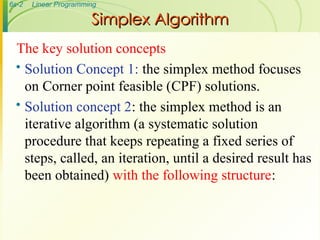
Simplex algorithm
Simplex algorithm
Initialization: setup to start iterations, including
finding an initial CPF solution
Optimality test: is the current CPF solution
optimal?
if no if yes stop
Iteration: Perform an iteration to find a
better CFP solution
6s-4 Linear Programming
Simplex algorithm
Simplex algorithm
 Solution concept 3: whenever possible, the initialization
of the simplex method chooses the origin point (all
decision variables equal zero) to be the initial CPF
solution.
 Solution concept 4: given a CPF solution, it is much
quicker computationally to gather information about its
adjacent CPF solutions than about other CPF solutions.
Therefore, each time the simplex method performs an
iteration to move from the current CPF solution to a
better one, it always chooses a CPF solution that is
adjacent to the current one.
6s-5 Linear Programming
Simplex algorithm
Simplex algorithm
 Solution concept 5: After the current CPF solution
is identified, the simplex method examines each of
the edges of the feasible region that emanate from
this CPF solution. Each of these edges leads to an
adjacent CPF solution at the other end, but the
simplex method doesn’t even take the time to solve
for the adjacent CPF solution. Instead it simply
identifies the rate of improvement in Z that would
be obtained by moving along the edge. And then
chooses to move along the one with largest
positive rate of improvement.
6s-6 Linear Programming
Simplex algorithm
Simplex algorithm
 Solution concept 6: A positive rate of
improvement in Z implies that the adjacent
CPF solution is better than the current one,
whereas a negative rate of improvement in Z
implies that the adjacent CPF solution is
worse. Therefore, the optimality test consists
simply of checking whether any of the edges
give a positive rate of improvement in Z. if
none do, then the current CPF solution is
optimal.
6s-7 Linear Programming
The simplex method in tabular form
 Steps:
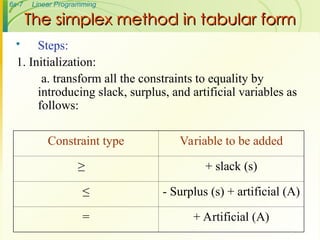
1. Initialization:
a. transform all the constraints to equality by
introducing slack, surplus, and artificial variables as
follows:
Constraint type Variable to be added
≥ + slack (s)
≤ - Surplus (s) + artificial (A)
= + Artificial (A)
6s-8 Linear Programming
Simplex method in tabular form
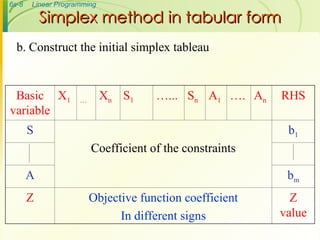
b. Construct the initial simplex tableau
Basic
variable
X1 … Xn S1 …... Sn A1 …. An RHS
S
Coefficient of the constraints
b1
A bm
Z Objective function coefficient
In different signs
Z
value
6s-9 Linear Programming
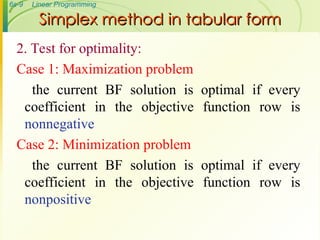
2. Test for optimality:
Case 1: Maximization problem
the current BF solution is optimal if every
coefficient in the objective function row is
nonnegative
Case 2: Minimization problem
the current BF solution is optimal if every
coefficient in the objective function row is
nonpositive
Simplex method in tabular form
6s-10 Linear Programming
Simplex method in tabular form
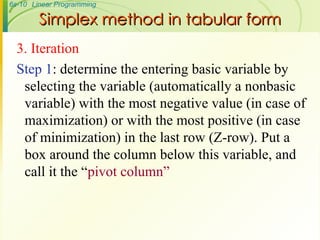
3. Iteration
Step 1: determine the entering basic variable by
selecting the variable (automatically a nonbasic
variable) with the most negative value (in case of
maximization) or with the most positive (in case
of minimization) in the last row (Z-row). Put a
box around the column below this variable, and
call it the “pivot column”
6s-11 Linear Programming
Simplex method in tabular form
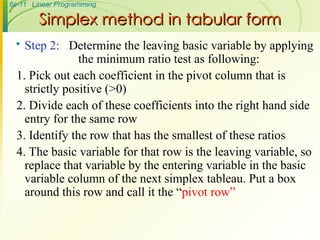
 Step 2: Determine the leaving basic variable by applying
the minimum ratio test as following:
1. Pick out each coefficient in the pivot column that is
strictly positive (>0)
2. Divide each of these coefficients into the right hand side
entry for the same row
3. Identify the row that has the smallest of these ratios
4. The basic variable for that row is the leaving variable, so
replace that variable by the entering variable in the basic
variable column of the next simplex tableau. Put a box
around this row and call it the “pivot row”
6s-12 Linear Programming
Simplex method in tabular form
 Step 3: Solve for the new BF solution by using elementary
row operations (multiply or divide a row by a nonzero
constant; add or subtract a multiple of one row to another
row) to construct a new simplex tableau, and then return to
the optimality test. The specific elementary row operations
are:
1. Divide the pivot row by the “pivot number” (the number in
the intersection of the pivot row and pivot column)
2. For each other row that has a negative coefficient in the
pivot column, add to this row the product of the absolute
value of this coefficient and the new pivot row.
3. For each other row that has a positive coefficient in the
pivot column, subtract from this row the product of the
absolute value of this coefficient and the new pivot row.
6s-13 Linear Programming
Simplex method
Simplex method
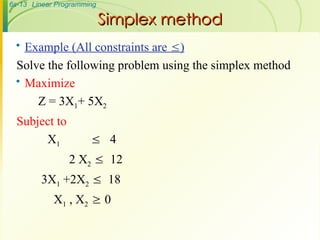
 Example (All constraints are )
Solve the following problem using the simplex method
 Maximize
Z = 3X1+ 5X2
Subject to
X1  4
2 X2  12
3X1 +2X2  18
X1 , X2  0
6s-14 Linear Programming
Simplex method
Simplex method
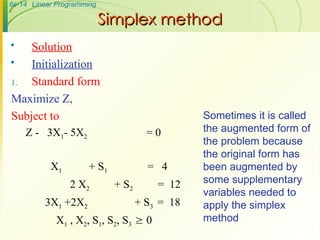
 Solution
 Initialization
1. Standard form
Maximize Z,
Subject to
Z - 3X1- 5X2 = 0
X1 + S1 = 4
2 X2 + S2 = 12
3X1 +2X2 + S3 = 18
X1 , X2, S1, S2, S3  0
Sometimes it is called
the augmented form of
the problem because
the original form has
been augmented by
some supplementary
variables needed to
apply the simplex
method
6s-15 Linear Programming
Definitions
Definitions
 A basic solution is an augmented corner point solution.
 A basic solution has the following properties:
1. Each variable is designated as either a nonbasic variable or a
basic variable.
2. The number of basic variables equals the number of functional
constraints. Therefore, the number of nonbasic variables equals
the total number of variables minus the number of functional
constraints.
3. The nonbasic variables are set equal to zero.
4. The values of the basic variables are obtained as simultaneous
solution of the system of equations (functional constraints in
augmented form). The set of basic variables are called “basis”
5. If the basic variables satisfy the nonnegativity constraints, the
basic solution is a Basic Feasible (BF) solution.
6s-16 Linear Programming
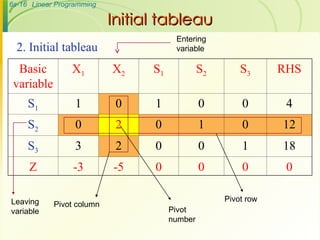
Initial tableau
Initial tableau
2. Initial tableau
Basic
variable
X1 X2 S1 S2 S3 RHS
S1 1 0 1 0 0 4
S2 0 2 0 1 0 12
S3 3 2 0 0 1 18
Z -3 -5 0 0 0 0
Pivot column
Pivot row
Pivot
number
Entering
variable
Leaving
variable
6s-17 Linear Programming
Simplex tableau
Simplex tableau
Notes:
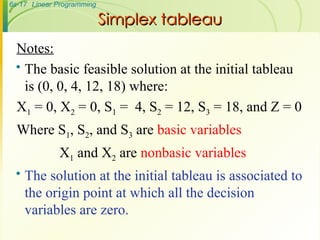
 The basic feasible solution at the initial tableau
is (0, 0, 4, 12, 18) where:
X1 = 0, X2 = 0, S1 = 4, S2 = 12, S3 = 18, and Z = 0
Where S1, S2, and S3 are basic variables
X1 and X2 are nonbasic variables
 The solution at the initial tableau is associated to
the origin point at which all the decision
variables are zero.
6s-18 Linear Programming
Optimality test
Optimality test
 By investigating the last row of the initial tableau,
we find that there are some negative numbers.
Therefore, the current solution is not optimal
6s-19 Linear Programming
Iteration
Iteration
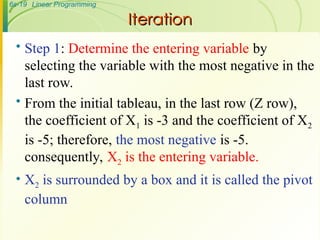
 Step 1: Determine the entering variable by
selecting the variable with the most negative in the
last row.
 From the initial tableau, in the last row (Z row),
the coefficient of X1 is -3 and the coefficient of X2
is -5; therefore, the most negative is -5.
consequently, X2 is the entering variable.
 X2 is surrounded by a box and it is called the pivot
column
6s-20 Linear Programming
Iteration
Iteration
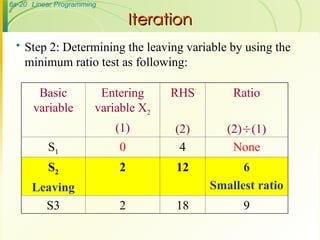
 Step 2: Determining the leaving variable by using the
minimum ratio test as following:
Basic
variable
Entering
variable X2
(1)
RHS
(2)
Ratio
(2)(1)
S1 0 4 None
S2
Leaving
2 12 6
Smallest ratio
S3 2 18 9
6s-21 Linear Programming
Iteration
Iteration
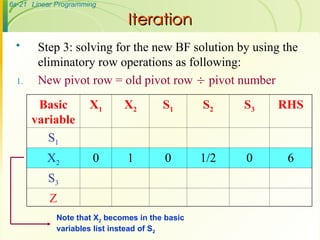
 Step 3: solving for the new BF solution by using the
eliminatory row operations as following:
1. New pivot row = old pivot row  pivot number
Basic
variable
X1 X2 S1 S2 S3 RHS
S1
X2 0 1 0 1/2 0 6
S3
Z
Note that X2 becomes in the basic
variables list instead of S2
6s-22 Linear Programming
iteration
iteration
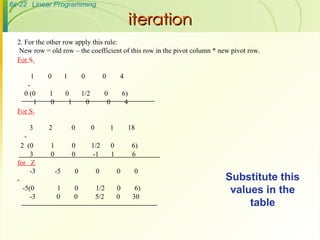
2. For the other row apply this rule:
New row = old row – the coefficient of this row in the pivot column * new pivot row.
For S1
1 0 1 0 0 4
-
0 (0 1 0 1/2 0 6)
1 0 1 0 0 4
For S3
3 2 0 0 1 18
-
2 (0 1 0 1/2 0 6)
3 0 0 -1 1 6
for Z
-3 -5 0 0 0 0
-
-5(0 1 0 1/2 0 6)
-3 0 0 5/2 0 30
Substitute this
values in the
table
6s-23 Linear Programming
Iteration
Iteration
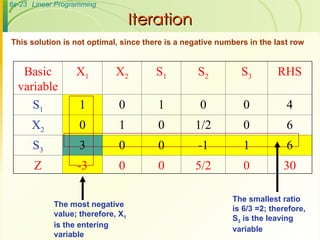
Basic
variable
X1 X2 S1 S2 S3 RHS
S1 1 0 1 0 0 4
X2 0 1 0 1/2 0 6
S3 3 0 0 -1 1 6
Z -3 0 0 5/2 0 30
The most negative
value; therefore, X1
is the entering
variable
The smallest ratio
is 6/3 =2; therefore,
S3 is the leaving
variable
This solution is not optimal, since there is a negative numbers in the last row
6s-24 Linear Programming
Iteration
Iteration
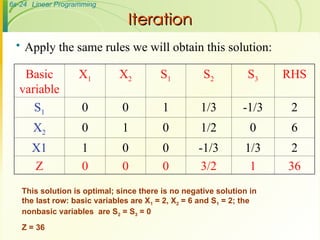
 Apply the same rules we will obtain this solution:
Basic
variable
X1 X2 S1 S2 S3 RHS
S1 0 0 1 1/3 -1/3 2
X2 0 1 0 1/2 0 6
X1 1 0 0 -1/3 1/3 2
Z 0 0 0 3/2 1 36
This solution is optimal; since there is no negative solution in
the last row: basic variables are X1 = 2, X2 = 6 and S1 = 2; the
nonbasic variables are S2 = S3 = 0
Z = 36
6s-25 Linear Programming
Special cases of linear programming
 Infeasible solution
 Multiple solution (infinitely many solution)
 Unbounded solution
 Degenerated solution
Simplex method explanation for linear programming.ppt

  • 1.
    6s-1 Linear Programming Simplex: a linear-programming algorithm that can solve problems having more than two decision variables.  The simplex technique involves generating a series of solutions in tabular form, called tableaus. By inspecting the bottom row of each tableau, one can immediately tell if it represents the optimal solution. Each tableau corresponds to a corner point of the feasible solution space. The first tableau corresponds to the origin. Subsequent tableaus are developed by shifting to an adjacent corner point in the direction that yields the highest (smallest) rate of profit (cost). This process continues as long as a positive (negative) rate of profit (cost) exists. Simplex Method Simplex Method
  • 2.
    6s-2 Linear Programming SimplexAlgorithm Simplex Algorithm The key solution concepts  Solution Concept 1: the simplex method focuses on Corner point feasible (CPF) solutions.  Solution concept 2: the simplex method is an iterative algorithm (a systematic solution procedure that keeps repeating a fixed series of steps, called, an iteration, until a desired result has been obtained) with the following structure:
  • 3.
    6s-3 Linear Programming Simplexalgorithm Simplex algorithm Initialization: setup to start iterations, including finding an initial CPF solution Optimality test: is the current CPF solution optimal? if no if yes stop Iteration: Perform an iteration to find a better CFP solution
  • 4.
    6s-4 Linear Programming Simplexalgorithm Simplex algorithm  Solution concept 3: whenever possible, the initialization of the simplex method chooses the origin point (all decision variables equal zero) to be the initial CPF solution.  Solution concept 4: given a CPF solution, it is much quicker computationally to gather information about its adjacent CPF solutions than about other CPF solutions. Therefore, each time the simplex method performs an iteration to move from the current CPF solution to a better one, it always chooses a CPF solution that is adjacent to the current one.
  • 5.
    6s-5 Linear Programming Simplexalgorithm Simplex algorithm  Solution concept 5: After the current CPF solution is identified, the simplex method examines each of the edges of the feasible region that emanate from this CPF solution. Each of these edges leads to an adjacent CPF solution at the other end, but the simplex method doesn’t even take the time to solve for the adjacent CPF solution. Instead it simply identifies the rate of improvement in Z that would be obtained by moving along the edge. And then chooses to move along the one with largest positive rate of improvement.
  • 6.
    6s-6 Linear Programming Simplexalgorithm Simplex algorithm  Solution concept 6: A positive rate of improvement in Z implies that the adjacent CPF solution is better than the current one, whereas a negative rate of improvement in Z implies that the adjacent CPF solution is worse. Therefore, the optimality test consists simply of checking whether any of the edges give a positive rate of improvement in Z. if none do, then the current CPF solution is optimal.
  • 7.
    6s-7 Linear Programming Thesimplex method in tabular form The simplex method in tabular form  Steps: 1. Initialization: a. transform all the constraints to equality by introducing slack, surplus, and artificial variables as follows: Constraint type Variable to be added ≥ + slack (s) ≤ - Surplus (s) + artificial (A) = + Artificial (A)
  • 8.
    6s-8 Linear Programming Simplexmethod in tabular form Simplex method in tabular form b. Construct the initial simplex tableau Basic variable X1 … Xn S1 …... Sn A1 …. An RHS S Coefficient of the constraints b1 A bm Z Objective function coefficient In different signs Z value
  • 9.
    6s-9 Linear Programming 2.Test for optimality: Case 1: Maximization problem the current BF solution is optimal if every coefficient in the objective function row is nonnegative Case 2: Minimization problem the current BF solution is optimal if every coefficient in the objective function row is nonpositive Simplex method in tabular form Simplex method in tabular form
  • 10.
    6s-10 Linear Programming Simplexmethod in tabular form Simplex method in tabular form 3. Iteration Step 1: determine the entering basic variable by selecting the variable (automatically a nonbasic variable) with the most negative value (in case of maximization) or with the most positive (in case of minimization) in the last row (Z-row). Put a box around the column below this variable, and call it the “pivot column”
  • 11.
    6s-11 Linear Programming Simplexmethod in tabular form Simplex method in tabular form  Step 2: Determine the leaving basic variable by applying the minimum ratio test as following: 1. Pick out each coefficient in the pivot column that is strictly positive (>0) 2. Divide each of these coefficients into the right hand side entry for the same row 3. Identify the row that has the smallest of these ratios 4. The basic variable for that row is the leaving variable, so replace that variable by the entering variable in the basic variable column of the next simplex tableau. Put a box around this row and call it the “pivot row”
  • 12.
    6s-12 Linear Programming Simplexmethod in tabular form Simplex method in tabular form  Step 3: Solve for the new BF solution by using elementary row operations (multiply or divide a row by a nonzero constant; add or subtract a multiple of one row to another row) to construct a new simplex tableau, and then return to the optimality test. The specific elementary row operations are: 1. Divide the pivot row by the “pivot number” (the number in the intersection of the pivot row and pivot column) 2. For each other row that has a negative coefficient in the pivot column, add to this row the product of the absolute value of this coefficient and the new pivot row. 3. For each other row that has a positive coefficient in the pivot column, subtract from this row the product of the absolute value of this coefficient and the new pivot row.
  • 13.
    6s-13 Linear Programming Simplexmethod Simplex method  Example (All constraints are ) Solve the following problem using the simplex method  Maximize Z = 3X1+ 5X2 Subject to X1  4 2 X2  12 3X1 +2X2  18 X1 , X2  0
  • 14.
    6s-14 Linear Programming Simplexmethod Simplex method  Solution  Initialization 1. Standard form Maximize Z, Subject to Z - 3X1- 5X2 = 0 X1 + S1 = 4 2 X2 + S2 = 12 3X1 +2X2 + S3 = 18 X1 , X2, S1, S2, S3  0 Sometimes it is called the augmented form of the problem because the original form has been augmented by some supplementary variables needed to apply the simplex method
  • 15.
    6s-15 Linear Programming Definitions Definitions A basic solution is an augmented corner point solution.  A basic solution has the following properties: 1. Each variable is designated as either a nonbasic variable or a basic variable. 2. The number of basic variables equals the number of functional constraints. Therefore, the number of nonbasic variables equals the total number of variables minus the number of functional constraints. 3. The nonbasic variables are set equal to zero. 4. The values of the basic variables are obtained as simultaneous solution of the system of equations (functional constraints in augmented form). The set of basic variables are called “basis” 5. If the basic variables satisfy the nonnegativity constraints, the basic solution is a Basic Feasible (BF) solution.
  • 16.
    6s-16 Linear Programming Initialtableau Initial tableau 2. Initial tableau Basic variable X1 X2 S1 S2 S3 RHS S1 1 0 1 0 0 4 S2 0 2 0 1 0 12 S3 3 2 0 0 1 18 Z -3 -5 0 0 0 0 Pivot column Pivot row Pivot number Entering variable Leaving variable
  • 17.
    6s-17 Linear Programming Simplextableau Simplex tableau Notes:  The basic feasible solution at the initial tableau is (0, 0, 4, 12, 18) where: X1 = 0, X2 = 0, S1 = 4, S2 = 12, S3 = 18, and Z = 0 Where S1, S2, and S3 are basic variables X1 and X2 are nonbasic variables  The solution at the initial tableau is associated to the origin point at which all the decision variables are zero.
  • 18.
    6s-18 Linear Programming Optimalitytest Optimality test  By investigating the last row of the initial tableau, we find that there are some negative numbers. Therefore, the current solution is not optimal
  • 19.
    6s-19 Linear Programming Iteration Iteration Step 1: Determine the entering variable by selecting the variable with the most negative in the last row.  From the initial tableau, in the last row (Z row), the coefficient of X1 is -3 and the coefficient of X2 is -5; therefore, the most negative is -5. consequently, X2 is the entering variable.  X2 is surrounded by a box and it is called the pivot column
  • 20.
    6s-20 Linear Programming Iteration Iteration Step 2: Determining the leaving variable by using the minimum ratio test as following: Basic variable Entering variable X2 (1) RHS (2) Ratio (2)(1) S1 0 4 None S2 Leaving 2 12 6 Smallest ratio S3 2 18 9
  • 21.
    6s-21 Linear Programming Iteration Iteration Step 3: solving for the new BF solution by using the eliminatory row operations as following: 1. New pivot row = old pivot row  pivot number Basic variable X1 X2 S1 S2 S3 RHS S1 X2 0 1 0 1/2 0 6 S3 Z Note that X2 becomes in the basic variables list instead of S2
  • 22.
    6s-22 Linear Programming iteration iteration 2.For the other row apply this rule: New row = old row – the coefficient of this row in the pivot column * new pivot row. For S1 1 0 1 0 0 4 - 0 (0 1 0 1/2 0 6) 1 0 1 0 0 4 For S3 3 2 0 0 1 18 - 2 (0 1 0 1/2 0 6) 3 0 0 -1 1 6 for Z -3 -5 0 0 0 0 - -5(0 1 0 1/2 0 6) -3 0 0 5/2 0 30 Substitute this values in the table
  • 23.
    6s-23 Linear Programming Iteration Iteration Basic variable X1X2 S1 S2 S3 RHS S1 1 0 1 0 0 4 X2 0 1 0 1/2 0 6 S3 3 0 0 -1 1 6 Z -3 0 0 5/2 0 30 The most negative value; therefore, X1 is the entering variable The smallest ratio is 6/3 =2; therefore, S3 is the leaving variable This solution is not optimal, since there is a negative numbers in the last row
  • 24.
    6s-24 Linear Programming Iteration Iteration Apply the same rules we will obtain this solution: Basic variable X1 X2 S1 S2 S3 RHS S1 0 0 1 1/3 -1/3 2 X2 0 1 0 1/2 0 6 X1 1 0 0 -1/3 1/3 2 Z 0 0 0 3/2 1 36 This solution is optimal; since there is no negative solution in the last row: basic variables are X1 = 2, X2 = 6 and S1 = 2; the nonbasic variables are S2 = S3 = 0 Z = 36
  • 25.
    6s-25 Linear Programming Specialcases of linear programming Special cases of linear programming  Infeasible solution  Multiple solution (infinitely many solution)  Unbounded solution  Degenerated solution