The Evaluation Argument
Chapter 14, Practical Argument
Mignette Dorsey
The Evaluation Argument
• Evaluate – To make a personal, value judgment about
something
or someone. Ex. A product, service, program, work of literature,
etc.
• Do we evaluate options before we make decisions? Examples?
• Evaluation Argument (options)
1. Make a positive or negative judgment
2. Assert that someone else’s positive or negative judgment is
inaccurate
3. Comparative analysis where you prove one thing is superior
to
another
The Evaluation Argument
• What makes another perceive that your evaluation is fair?
• Addressing the Opposing Point of View
• Evidence of bias (p. 477) – Bias can be detected by tone as
evidenced
by word choice
• Criteria for Evaluation:
1. Answer the “why” question related to your assertion: Why
are
afternoon classes better than morning classes - or vice versa?
2. Establish a list of criteria you will examine: Alertness,
Instructor
accessibility, traffic
The Evaluation Argument
3. Comparing criteria - discuss drawbacks of morning classes
versus
advantages of afternoon classes
• See pg. 479 re. Evaluation Argument structure
• Evaluation Grammar: Comparatives and Superlatives – page
484
Pop Quiz: Evaluation Essay
(Answers are on the last slide)
Write true or false for each item below:
1. Offering a solution to the problem of student plagiarism
would be a
good topic for an evaluation essay.
2. Word choice is an important consideration in writing an
evaluation
essay.
3. Word choice establishes the tone of an essay.
4. Of the five “Ws,” the “why” question is never the focus of an
evaluation essay.
5. When we “evaluate,” we make a value judgment about
something
or someone.
Pop Quiz Answers: Evaluation Essay
• 1. False
• 2. True
• 3. True
• 4. False
• 5. True
The Evaluation Argument�Chapter 14, Practical ArgumentThe
Evaluation Argument�The Evaluation ArgumentThe Evaluation
ArgumentPop Quiz: Evaluation Essay�(Answers are on the last
slide)Pop Quiz Answers: Evaluation Essay
Rhetoric, Persuasion,
Argumentation:
The Argumentative Essay
Mignette Dorsey
Engl 1302
What is Rhetoric?
• Rhetoric is the ancient art of
argumentation and discourse. When we
write or speak to convince others of what
we believe, we are "rhetors." When we
analyze the way rhetoric works, we are
"rhetoricians." The earliest known studies
of rhetoric come from the Golden Age,
when philosophers of ancient Greece
discussed logos, ethos, and pathos.
Carson-Newman University
https://web.cn.edu/.../resource rhet.html
https://web.cn.edu/kwheeler/logic.html
https://web.cn.edu/kwheeler/ethos.html
https://web.cn.edu/kwheeler/pathos.html
What is Rhetoric?
• Rhetoric / Persuasion is not only written
discourse. Marketing experts use rhetoric for the
purpose of persuading audiences to pay
attention to what they are selling. See
Google>advertisements>images
• Architects use rhetoric in building design.
Consider the message conveyed if a student
services building in a college had no student
advisors to help students register, only
computers.
ARGUMENTATIVE ESSAYS
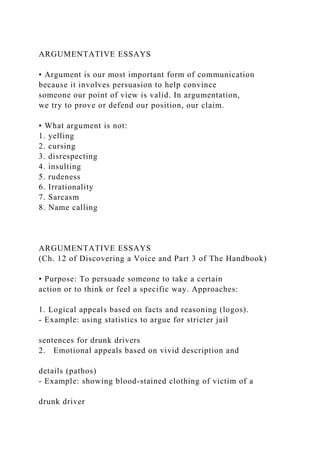
• Argument is our most important form of communication
because it involves persuasion to help convince
someone our point of view is valid. In argumentation,
we try to prove or defend our position, our claim.
• What argument is not:
1. yelling
2. cursing
3. disrespecting
4. insulting
5. rudeness
6. Irrationality
7. Sarcasm
8. Name calling
ARGUMENTATIVE ESSAYS
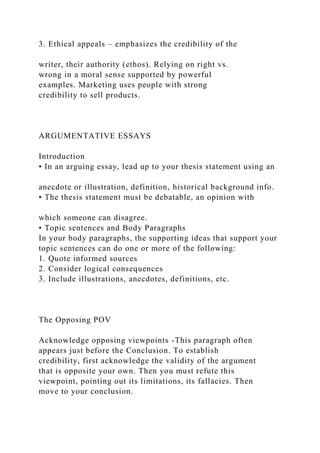
(Ch. 12 of Discovering a Voice and Part 3 of The Handbook)
• Purpose: To persuade someone to take a certain
action or to think or feel a specific way. Approaches:
1. Logical appeals based on facts and reasoning (logos).
- Example: using statistics to argue for stricter jail
sentences for drunk drivers
2. Emotional appeals based on vivid description and
details (pathos)
- Example: showing blood-stained clothing of victim of a
drunk driver
3. Ethical appeals – emphasizes the credibility of the
writer, their authority (ethos). Relying on right vs.
wrong in a moral sense supported by powerful
examples. Marketing uses people with strong
credibility to sell products.
ARGUMENTATIVE ESSAYS
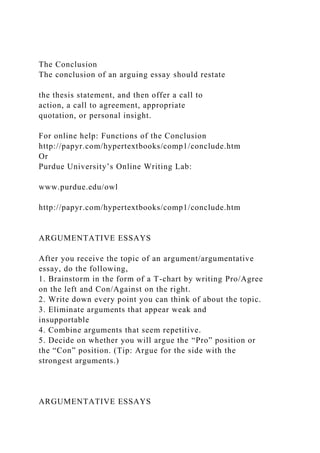
Introduction
• In an arguing essay, lead up to your thesis statement using an
anecdote or illustration, definition, historical background info.
• The thesis statement must be debatable, an opinion with
which someone can disagree.
• Topic sentences and Body Paragraphs
In your body paragraphs, the supporting ideas that support your
topic sentences can do one or more of the following:
1. Quote informed sources
2. Consider logical consequences
3. Include illustrations, anecdotes, definitions, etc.
The Opposing POV
Acknowledge opposing viewpoints -This paragraph often
appears just before the Conclusion. To establish
credibility, first acknowledge the validity of the argument
that is opposite your own. Then you must refute this
viewpoint, pointing out its limitations, its fallacies. Then
move to your conclusion.
The Conclusion
The conclusion of an arguing essay should restate
the thesis statement, and then offer a call to
action, a call to agreement, appropriate
quotation, or personal insight.
For online help: Functions of the Conclusion
http://papyr.com/hypertextbooks/comp1/conclude.htm
Or
Purdue University’s Online Writing Lab:
www.purdue.edu/owl
http://papyr.com/hypertextbooks/comp1/conclude.htm
ARGUMENTATIVE ESSAYS
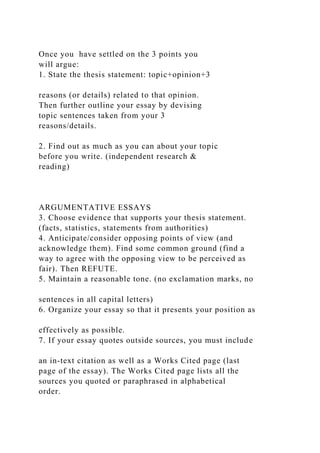
After you receive the topic of an argument/argumentative
essay, do the following,
1. Brainstorm in the form of a T-chart by writing Pro/Agree
on the left and Con/Against on the right.
2. Write down every point you can think of about the topic.
3. Eliminate arguments that appear weak and
insupportable
4. Combine arguments that seem repetitive.
5. Decide on whether you will argue the “Pro” position or
the “Con” position. (Tip: Argue for the side with the
strongest arguments.)
ARGUMENTATIVE ESSAYS
Once you have settled on the 3 points you
will argue:
1. State the thesis statement: topic+opinion+3
reasons (or details) related to that opinion.
Then further outline your essay by devising
topic sentences taken from your 3
reasons/details.
2. Find out as much as you can about your topic
before you write. (independent research &
reading)
ARGUMENTATIVE ESSAYS
3. Choose evidence that supports your thesis statement.
(facts, statistics, statements from authorities)
4. Anticipate/consider opposing points of view (and
acknowledge them). Find some common ground (find a
way to agree with the opposing view to be perceived as
fair). Then REFUTE.
5. Maintain a reasonable tone. (no exclamation marks, no
sentences in all capital letters)
6. Organize your essay so that it presents your position as
effectively as possible.
7. If your essay quotes outside sources, you must include
an in-text citation as well as a Works Cited page (last
page of the essay). The Works Cited page lists all the
sources you quoted or paraphrased in alphabetical
order.
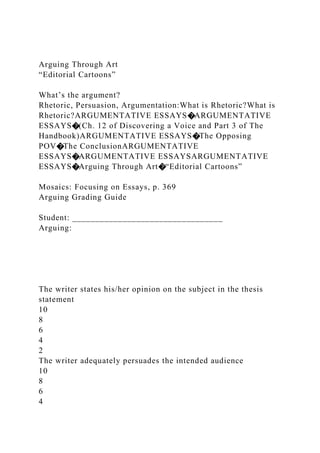
Arguing Through Art
“Editorial Cartoons”
What’s the argument?
Rhetoric, Persuasion, Argumentation:What is Rhetoric?What is
Rhetoric?ARGUMENTATIVE ESSAYS�ARGUMENTATIVE
ESSAYS�(Ch. 12 of Discovering a Voice and Part 3 of The
Handbook)ARGUMENTATIVE ESSAYS�The Opposing
POV�The ConclusionARGUMENTATIVE
ESSAYS�ARGUMENTATIVE ESSAYSARGUMENTATIVE
ESSAYS�Arguing Through Art�“Editorial Cartoons”
Mosaics: Focusing on Essays, p. 369
Arguing Grading Guide
Student: _________________________________
Arguing:
The writer states his/her opinion on the subject in the thesis
statement
10
8
6
4
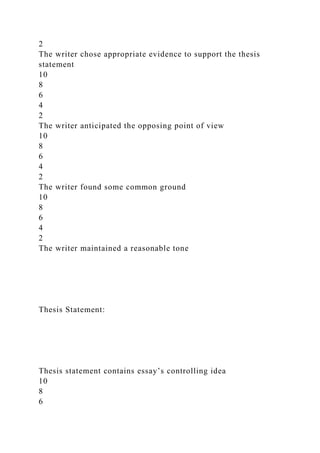
2
The writer adequately persuades the intended audience
10
8
6
4
2
The writer chose appropriate evidence to support the thesis
statement
10
8
6
4
2
The writer anticipated the opposing point of view
10
8
6
4
2
The writer found some common ground
10
8
6
4
2
The writer maintained a reasonable tone
Thesis Statement:
Thesis statement contains essay’s controlling idea
10
8
6
4
2
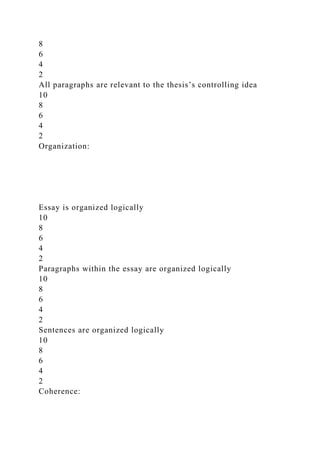
Thesis statement contains both subject and opinion
10
8
6
4
2
Basic Elements:
Title draws in the reader
10
8
6
4
2
Introduction and conclusion are effective
10
8
6
4
2
Body paragraphs each deal with a single topic
10
8
6
4
2
Development:
Essay’s topics adequately develop thesis statement
10
8
6
4
2
Body paragraphs contain enough specific details that support
topic sentences
10
8
6
4
2
Essay is developed logically at both sentence and paragraph
levels
10
8
6
4
2
Unity:
Essay’s topic sentences relate directly to thesis statement
10
8
6
4
2
Sentences in each body paragraph support topic sentence
10
8
6
4
2
All paragraphs are relevant to the thesis’s controlling idea
10
8
6
4
2
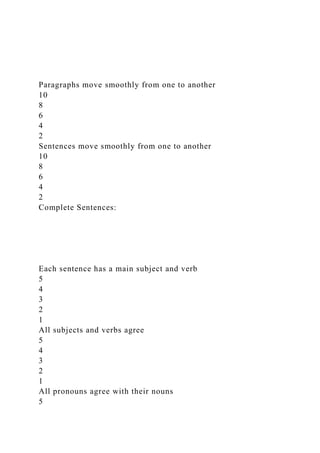
Organization:
Essay is organized logically
10
8
6
4
2
Paragraphs within the essay are organized logically
10
8
6
4
2
Sentences are organized logically
10
8
6
4
2
Coherence:
Paragraphs move smoothly from one to another
10
8
6
4
2
Sentences move smoothly from one to another
10
8
6
4
2
Complete Sentences:
Each sentence has a main subject and verb
5
4
3
2
1
All subjects and verbs agree
5
4
3
2
1
All pronouns agree with their nouns
5
4
3
2
1
All modifiers are as close as possible to the words they modify
5
4
3
2
1
Punctuation and Mechanics:
Sentences are punctuated correctly
5
4
3
2
1
Words are capitalized properly
5
4
3
2
1
Words:
Words are used correctly
5
4
3
2
1
Words are spelled correctly
5
4
3
2
1
Comments:
Grade: _______________

The Evaluation ArgumentChapter 14, Practical ArgumentMig.docx

  • 1.
    The Evaluation Argument Chapter14, Practical Argument Mignette Dorsey The Evaluation Argument • Evaluate – To make a personal, value judgment about something or someone. Ex. A product, service, program, work of literature, etc. • Do we evaluate options before we make decisions? Examples? • Evaluation Argument (options) 1. Make a positive or negative judgment 2. Assert that someone else’s positive or negative judgment is inaccurate 3. Comparative analysis where you prove one thing is superior to another The Evaluation Argument • What makes another perceive that your evaluation is fair? • Addressing the Opposing Point of View • Evidence of bias (p. 477) – Bias can be detected by tone as
  • 2.
    evidenced by word choice •Criteria for Evaluation: 1. Answer the “why” question related to your assertion: Why are afternoon classes better than morning classes - or vice versa? 2. Establish a list of criteria you will examine: Alertness, Instructor accessibility, traffic The Evaluation Argument 3. Comparing criteria - discuss drawbacks of morning classes versus advantages of afternoon classes • See pg. 479 re. Evaluation Argument structure • Evaluation Grammar: Comparatives and Superlatives – page 484 Pop Quiz: Evaluation Essay (Answers are on the last slide) Write true or false for each item below: 1. Offering a solution to the problem of student plagiarism would be a good topic for an evaluation essay. 2. Word choice is an important consideration in writing an evaluation
  • 3.
    essay. 3. Word choiceestablishes the tone of an essay. 4. Of the five “Ws,” the “why” question is never the focus of an evaluation essay. 5. When we “evaluate,” we make a value judgment about something or someone. Pop Quiz Answers: Evaluation Essay • 1. False • 2. True • 3. True • 4. False • 5. True The Evaluation Argument�Chapter 14, Practical ArgumentThe Evaluation Argument�The Evaluation ArgumentThe Evaluation ArgumentPop Quiz: Evaluation Essay�(Answers are on the last slide)Pop Quiz Answers: Evaluation Essay Rhetoric, Persuasion, Argumentation: The Argumentative Essay Mignette Dorsey Engl 1302
  • 4.
    What is Rhetoric? •Rhetoric is the ancient art of argumentation and discourse. When we write or speak to convince others of what we believe, we are "rhetors." When we analyze the way rhetoric works, we are "rhetoricians." The earliest known studies of rhetoric come from the Golden Age, when philosophers of ancient Greece discussed logos, ethos, and pathos. Carson-Newman University https://web.cn.edu/.../resource rhet.html https://web.cn.edu/kwheeler/logic.html https://web.cn.edu/kwheeler/ethos.html https://web.cn.edu/kwheeler/pathos.html What is Rhetoric? • Rhetoric / Persuasion is not only written discourse. Marketing experts use rhetoric for the purpose of persuading audiences to pay attention to what they are selling. See Google>advertisements>images • Architects use rhetoric in building design. Consider the message conveyed if a student services building in a college had no student advisors to help students register, only computers.
  • 5.
    ARGUMENTATIVE ESSAYS • Argumentis our most important form of communication because it involves persuasion to help convince someone our point of view is valid. In argumentation, we try to prove or defend our position, our claim. • What argument is not: 1. yelling 2. cursing 3. disrespecting 4. insulting 5. rudeness 6. Irrationality 7. Sarcasm 8. Name calling ARGUMENTATIVE ESSAYS (Ch. 12 of Discovering a Voice and Part 3 of The Handbook) • Purpose: To persuade someone to take a certain action or to think or feel a specific way. Approaches: 1. Logical appeals based on facts and reasoning (logos). - Example: using statistics to argue for stricter jail sentences for drunk drivers 2. Emotional appeals based on vivid description and details (pathos) - Example: showing blood-stained clothing of victim of a drunk driver
  • 6.
    3. Ethical appeals– emphasizes the credibility of the writer, their authority (ethos). Relying on right vs. wrong in a moral sense supported by powerful examples. Marketing uses people with strong credibility to sell products. ARGUMENTATIVE ESSAYS Introduction • In an arguing essay, lead up to your thesis statement using an anecdote or illustration, definition, historical background info. • The thesis statement must be debatable, an opinion with which someone can disagree. • Topic sentences and Body Paragraphs In your body paragraphs, the supporting ideas that support your topic sentences can do one or more of the following: 1. Quote informed sources 2. Consider logical consequences 3. Include illustrations, anecdotes, definitions, etc. The Opposing POV Acknowledge opposing viewpoints -This paragraph often appears just before the Conclusion. To establish credibility, first acknowledge the validity of the argument that is opposite your own. Then you must refute this viewpoint, pointing out its limitations, its fallacies. Then move to your conclusion.
  • 7.
    The Conclusion The conclusionof an arguing essay should restate the thesis statement, and then offer a call to action, a call to agreement, appropriate quotation, or personal insight. For online help: Functions of the Conclusion http://papyr.com/hypertextbooks/comp1/conclude.htm Or Purdue University’s Online Writing Lab: www.purdue.edu/owl http://papyr.com/hypertextbooks/comp1/conclude.htm ARGUMENTATIVE ESSAYS After you receive the topic of an argument/argumentative essay, do the following, 1. Brainstorm in the form of a T-chart by writing Pro/Agree on the left and Con/Against on the right. 2. Write down every point you can think of about the topic. 3. Eliminate arguments that appear weak and insupportable 4. Combine arguments that seem repetitive. 5. Decide on whether you will argue the “Pro” position or the “Con” position. (Tip: Argue for the side with the strongest arguments.) ARGUMENTATIVE ESSAYS
  • 8.
    Once you havesettled on the 3 points you will argue: 1. State the thesis statement: topic+opinion+3 reasons (or details) related to that opinion. Then further outline your essay by devising topic sentences taken from your 3 reasons/details. 2. Find out as much as you can about your topic before you write. (independent research & reading) ARGUMENTATIVE ESSAYS 3. Choose evidence that supports your thesis statement. (facts, statistics, statements from authorities) 4. Anticipate/consider opposing points of view (and acknowledge them). Find some common ground (find a way to agree with the opposing view to be perceived as fair). Then REFUTE. 5. Maintain a reasonable tone. (no exclamation marks, no sentences in all capital letters) 6. Organize your essay so that it presents your position as effectively as possible. 7. If your essay quotes outside sources, you must include an in-text citation as well as a Works Cited page (last page of the essay). The Works Cited page lists all the sources you quoted or paraphrased in alphabetical order.
  • 9.
    Arguing Through Art “EditorialCartoons” What’s the argument? Rhetoric, Persuasion, Argumentation:What is Rhetoric?What is Rhetoric?ARGUMENTATIVE ESSAYS�ARGUMENTATIVE ESSAYS�(Ch. 12 of Discovering a Voice and Part 3 of The Handbook)ARGUMENTATIVE ESSAYS�The Opposing POV�The ConclusionARGUMENTATIVE ESSAYS�ARGUMENTATIVE ESSAYSARGUMENTATIVE ESSAYS�Arguing Through Art�“Editorial Cartoons” Mosaics: Focusing on Essays, p. 369 Arguing Grading Guide Student: _________________________________ Arguing: The writer states his/her opinion on the subject in the thesis statement 10 8 6 4 2 The writer adequately persuades the intended audience 10 8 6 4
  • 10.
    2 The writer choseappropriate evidence to support the thesis statement 10 8 6 4 2 The writer anticipated the opposing point of view 10 8 6 4 2 The writer found some common ground 10 8 6 4 2 The writer maintained a reasonable tone Thesis Statement: Thesis statement contains essay’s controlling idea 10 8 6
  • 11.
    4 2 Thesis statement containsboth subject and opinion 10 8 6 4 2 Basic Elements: Title draws in the reader 10 8 6 4 2 Introduction and conclusion are effective 10 8 6 4 2 Body paragraphs each deal with a single topic 10 8 6 4 2 Development:
  • 12.
    Essay’s topics adequatelydevelop thesis statement 10 8 6 4 2 Body paragraphs contain enough specific details that support topic sentences 10 8 6 4 2 Essay is developed logically at both sentence and paragraph levels 10 8 6 4 2 Unity: Essay’s topic sentences relate directly to thesis statement 10 8 6 4 2 Sentences in each body paragraph support topic sentence 10
  • 13.
    8 6 4 2 All paragraphs arerelevant to the thesis’s controlling idea 10 8 6 4 2 Organization: Essay is organized logically 10 8 6 4 2 Paragraphs within the essay are organized logically 10 8 6 4 2 Sentences are organized logically 10 8 6 4 2 Coherence:
  • 14.
    Paragraphs move smoothlyfrom one to another 10 8 6 4 2 Sentences move smoothly from one to another 10 8 6 4 2 Complete Sentences: Each sentence has a main subject and verb 5 4 3 2 1 All subjects and verbs agree 5 4 3 2 1 All pronouns agree with their nouns 5
  • 15.
    4 3 2 1 All modifiers areas close as possible to the words they modify 5 4 3 2 1 Punctuation and Mechanics: Sentences are punctuated correctly 5 4 3 2 1 Words are capitalized properly 5 4 3 2 1 Words: Words are used correctly 5
  • 16.
    4 3 2 1 Words are spelledcorrectly 5 4 3 2 1 Comments: Grade: _______________