ARGUMENTATI
VE
ESSAY
WRITING
Sec 3E English
FEATURES & FORMAT
LESSON OBJECTIVES
By the end of the lesson, you will
be able to:
a) Understand the purpose of
writing an argumentative essay
b) Revise on the features and
format of a type of exposition
text
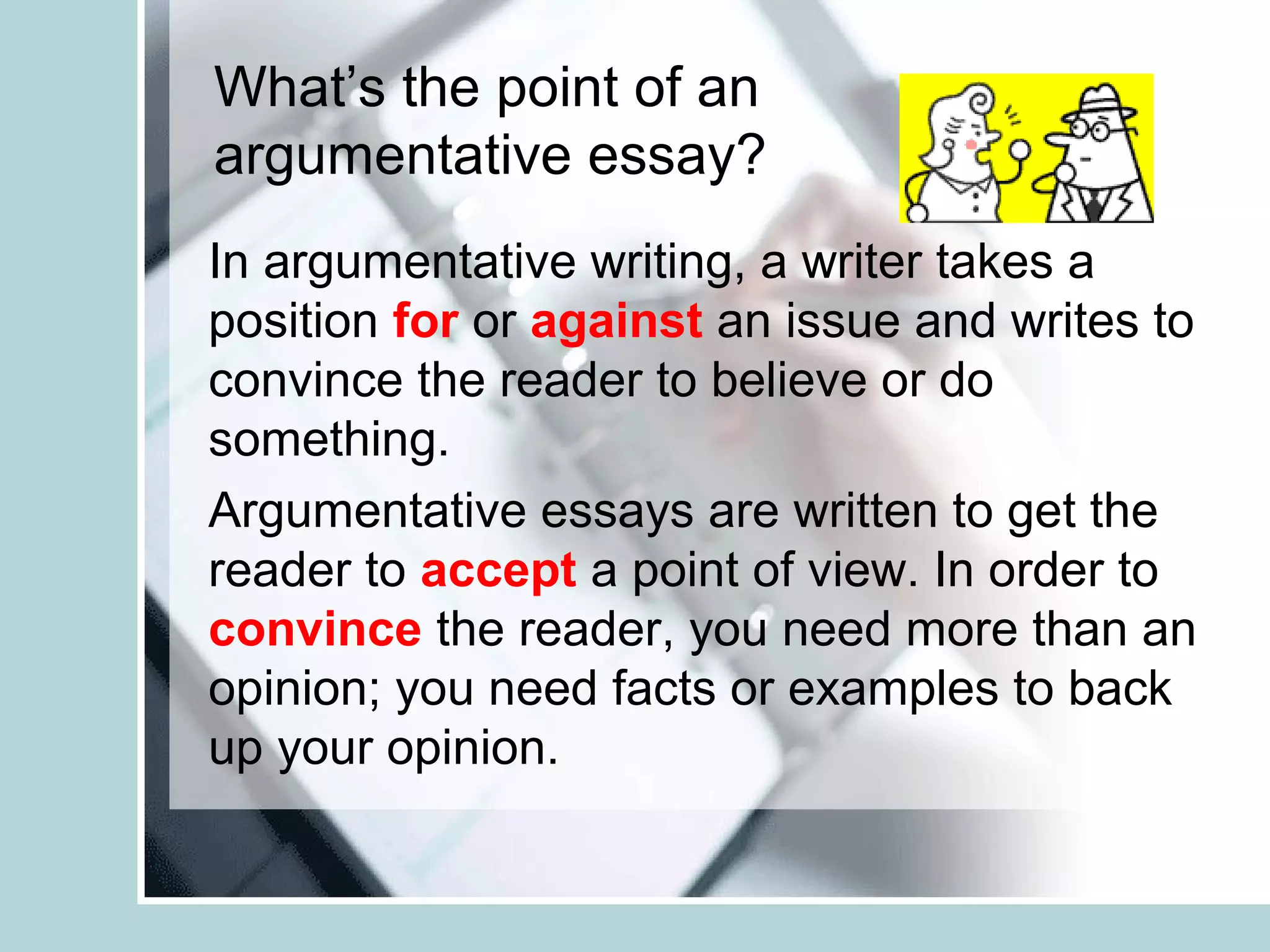
What is the point of arguing?
• You want to get your point across!
• You want others to believe in what you
have to say.
• An argumentative essay does the same
thing – it tries to convince readers of
your point of view.
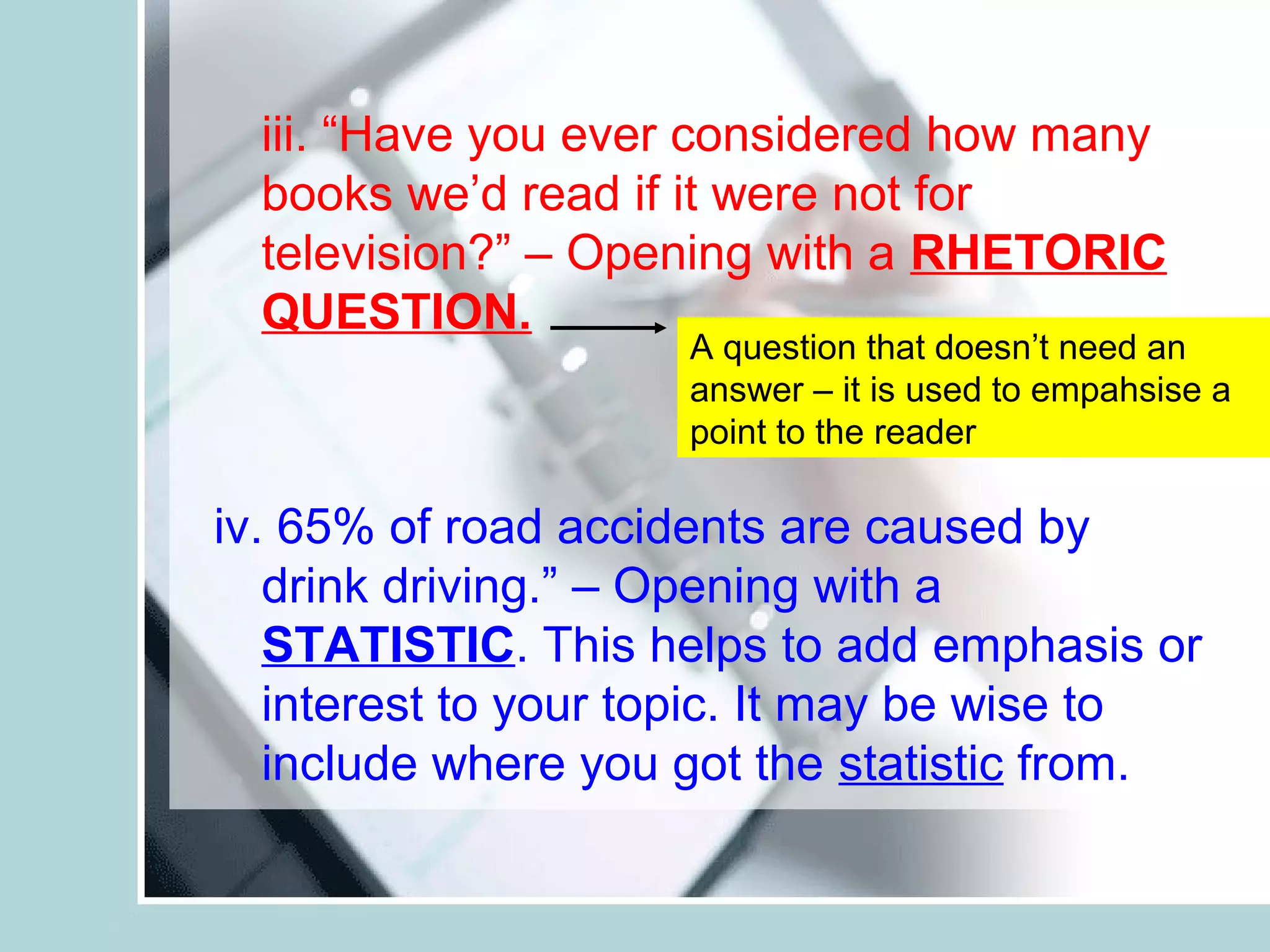
What’s the point of an
argumentative essay?
In argumentative writing, a writer takes a
position for or against an issue and writes to
convince the reader to believe or do
something.
Argumentative essays are written to get the
reader to accept a point of view. In order to
convince the reader, you need more than an
opinion; you need facts or examples to back
up your opinion.
FORMAT - INTRODUCTION
• What can you say is special about these
introductions?
i. “Cigarettes are the number one cause
of lung cancer in Canada!” – Opening
with a SHOCKING statement.
ii. “Elbert Hubbard once said, “Truth is
stronger than fiction.”- Opening with a
QUOTATION.
iii. “Have you ever considered how many
books we’d read if it were not for
television?” – Opening with a RHETORIC
QUESTION.
iv. 65% of road accidents are caused by
drink driving.” – Opening with a
STATISTIC. This helps to add emphasis or
interest to your topic. It may be wise to
include where you got the statistic from.
A question that doesn’t need an
answer – it is used to empahsise a
point to the reader
These intros have a “hook or “grabber
to attract the reader’s attention.
Besides
(i) an attention-grabbing opening, the
INTRODUCTION should also include
(ii) your opinion – this tells the reader the
main point of your essay.
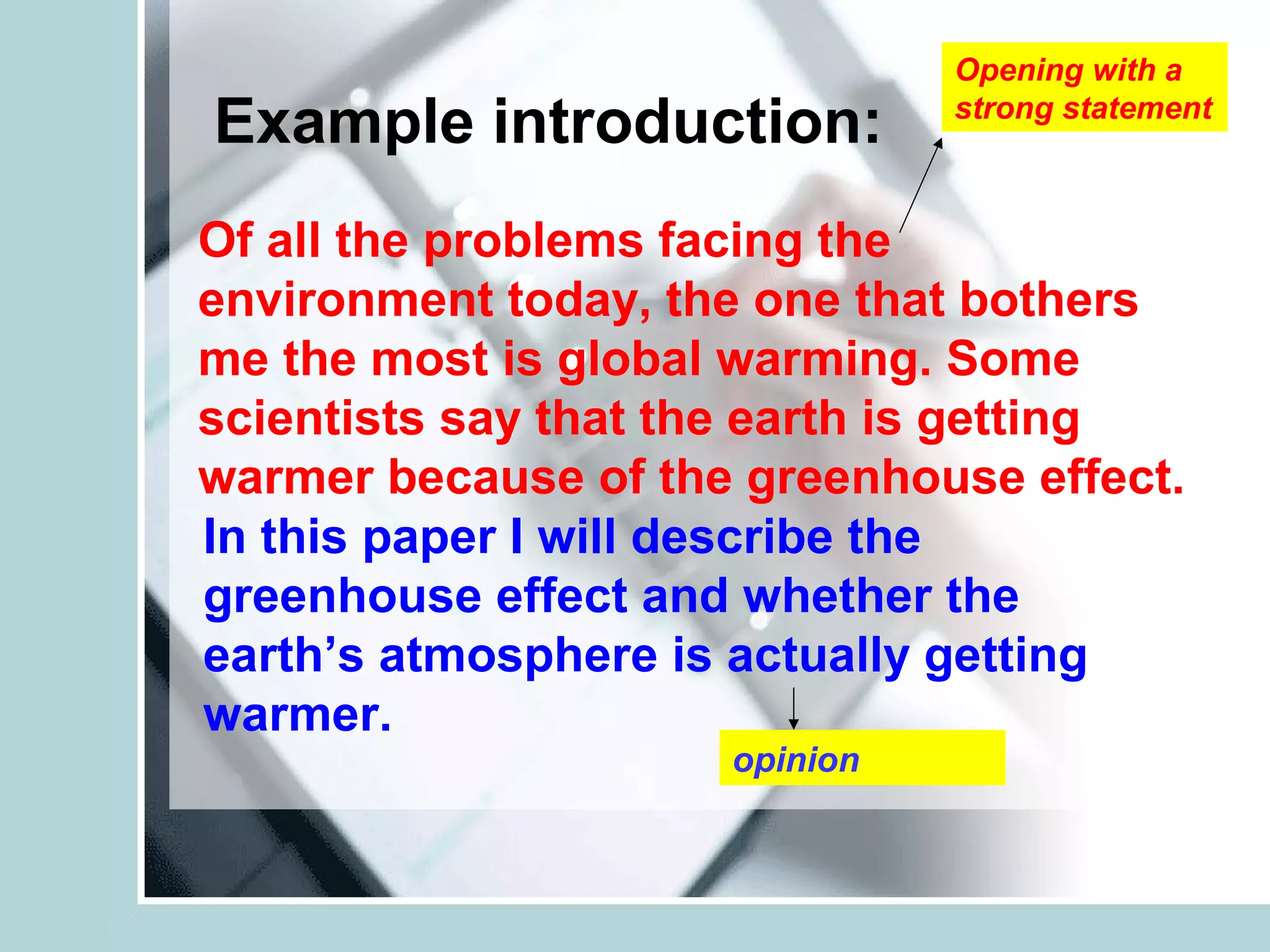
Example introduction:
Of all the problems facing the
environment today, the one that bothers
me the most is global warming. Some
scientists say that the earth is getting
warmer because of the greenhouse effect.
Opening with a
strong statement
opinion
In this paper I will describe the
greenhouse effect and whether the
earth’s atmosphere is actually getting
warmer.
BODY
• You must then provide ARGUMENTS to
support your opinion. Each paragraph is
based on a solid reason to back your
opinion.
• Since almost all issues have sound
arguments on both sides of the question, a
good argumentative writer tries to
ANTICIPATE opposing viewpoints. One of
the paragraphs in the body should be used
to discuss OPPOSING viewpoints and
your counter-argument.
To help elaborate each argument, use
• Use examples, real-life experiences,
statistics or research.
• Give a scenario, especially when you want
the reader to see a different point of view.
Use cues for the reader eg. suppose if,
what if, imagine.
CONCLUSION
• A piece of argumentative writing usually
ends by SUMMARISING the most
important details of the argument and
stating once again what the reader is to
FOR or AGAINST.
In your conclusion,
• Restate your opinion
• Summarize the main points of your
argument.
• Write a personal comment of call for
action. You can do this:
– With a Question: Closing with a question lets
your readers make their own predictions,
draw their own conclusions.
– With Recommendations: Stress or
recommend the action you want the readers
to take.
1. Computers are changing the way humans
think.
2. How are online technologies changing the
way we live?
3. Does adding school days really improve
learning?
4. Should mothers stay home with their
children?
5. Is homework harmful or helpful?

Argumentativeessaywritingteacherslides

  • 1.
  • 2.
    LESSON OBJECTIVES By theend of the lesson, you will be able to: a) Understand the purpose of writing an argumentative essay b) Revise on the features and format of a type of exposition text
  • 3.
    What is thepoint of arguing? • You want to get your point across! • You want others to believe in what you have to say. • An argumentative essay does the same thing – it tries to convince readers of your point of view.
  • 4.
    What’s the pointof an argumentative essay? In argumentative writing, a writer takes a position for or against an issue and writes to convince the reader to believe or do something. Argumentative essays are written to get the reader to accept a point of view. In order to convince the reader, you need more than an opinion; you need facts or examples to back up your opinion.
  • 5.
    FORMAT - INTRODUCTION •What can you say is special about these introductions? i. “Cigarettes are the number one cause of lung cancer in Canada!” – Opening with a SHOCKING statement. ii. “Elbert Hubbard once said, “Truth is stronger than fiction.”- Opening with a QUOTATION.
  • 6.
    iii. “Have youever considered how many books we’d read if it were not for television?” – Opening with a RHETORIC QUESTION. iv. 65% of road accidents are caused by drink driving.” – Opening with a STATISTIC. This helps to add emphasis or interest to your topic. It may be wise to include where you got the statistic from. A question that doesn’t need an answer – it is used to empahsise a point to the reader
  • 7.
    These intros havea “hook or “grabber to attract the reader’s attention. Besides (i) an attention-grabbing opening, the INTRODUCTION should also include (ii) your opinion – this tells the reader the main point of your essay.
  • 8.
    Example introduction: Of allthe problems facing the environment today, the one that bothers me the most is global warming. Some scientists say that the earth is getting warmer because of the greenhouse effect. Opening with a strong statement opinion In this paper I will describe the greenhouse effect and whether the earth’s atmosphere is actually getting warmer.
  • 9.
    BODY • You mustthen provide ARGUMENTS to support your opinion. Each paragraph is based on a solid reason to back your opinion. • Since almost all issues have sound arguments on both sides of the question, a good argumentative writer tries to ANTICIPATE opposing viewpoints. One of the paragraphs in the body should be used to discuss OPPOSING viewpoints and your counter-argument.
  • 10.
    To help elaborateeach argument, use • Use examples, real-life experiences, statistics or research. • Give a scenario, especially when you want the reader to see a different point of view. Use cues for the reader eg. suppose if, what if, imagine.
  • 11.
    CONCLUSION • A pieceof argumentative writing usually ends by SUMMARISING the most important details of the argument and stating once again what the reader is to FOR or AGAINST.
  • 12.
    In your conclusion, •Restate your opinion • Summarize the main points of your argument. • Write a personal comment of call for action. You can do this: – With a Question: Closing with a question lets your readers make their own predictions, draw their own conclusions. – With Recommendations: Stress or recommend the action you want the readers to take.
  • 13.
    1. Computers arechanging the way humans think. 2. How are online technologies changing the way we live? 3. Does adding school days really improve learning? 4. Should mothers stay home with their children? 5. Is homework harmful or helpful?