The Essential
BYOD Handbook
Effectively Supporting and Managing
All ofYour Mobile Devices
(BYOD = BringYour Own Device)
Jody Costa joined Barcoding, Inc. as
Director of Marketing in 2010. With
over 10 years of experience in writing,
marketing, and publishing, Costa is
responsible for all strategic and tactical
aspects of the marketing program.
Editor
Jody Costa
Barcoding, Inc. is a national systems
integrator, specializing in the
development, deployment, and
management of supply chain and
mobility systems based on automated
data capture and wireless technology.
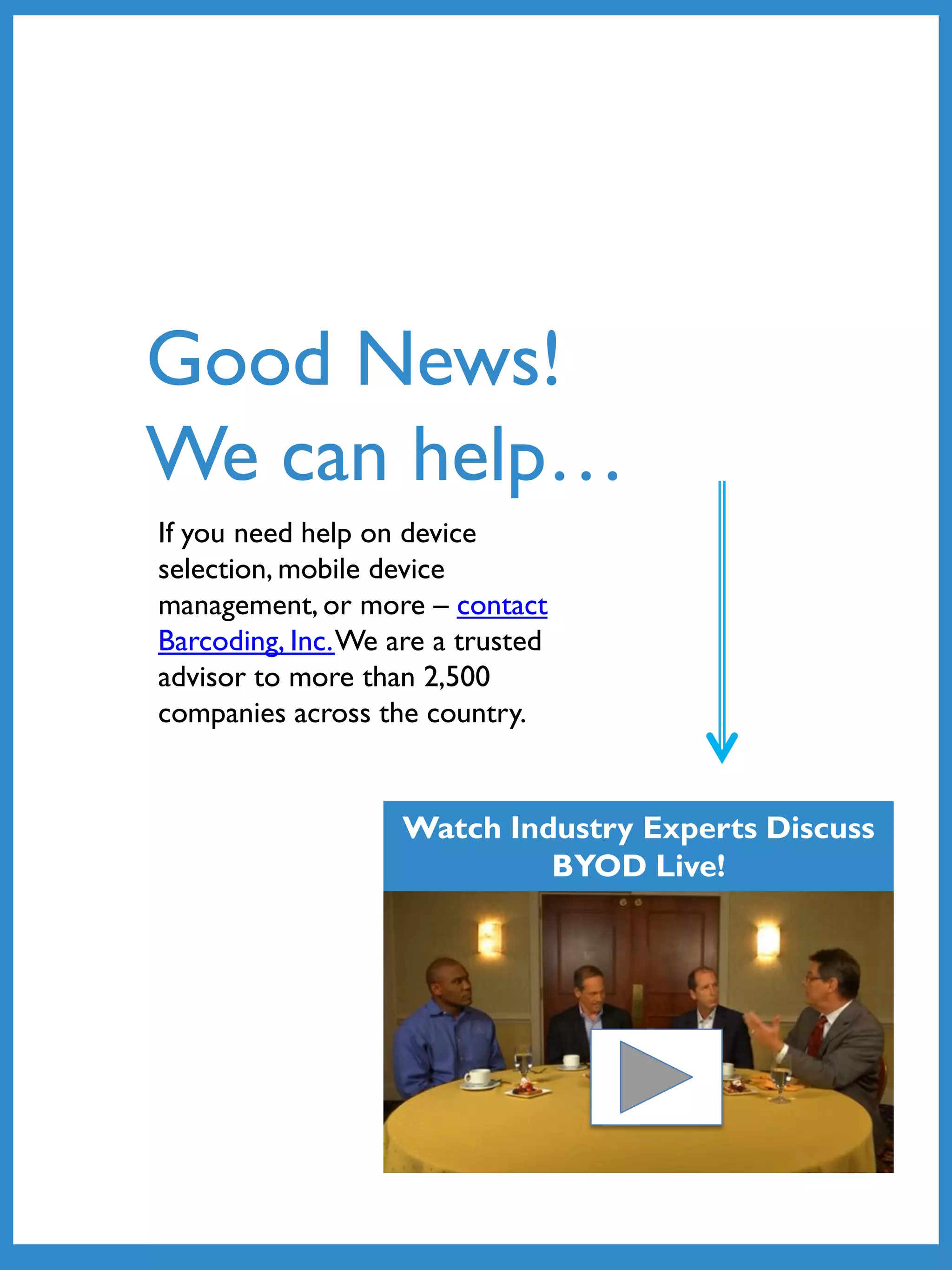
www.barcoding.com.
Chapter 1: Challenges in the Mobile Landscape
Chapter 2: Consumer vs. Enterprise
Chapter 3:The Era of BYOD and ILD
Chapter 4: Supporting BYOD Effectively
“We Can Help” andVideo Link.
Sources and Additional Reading
TABLE OF CONTENTS
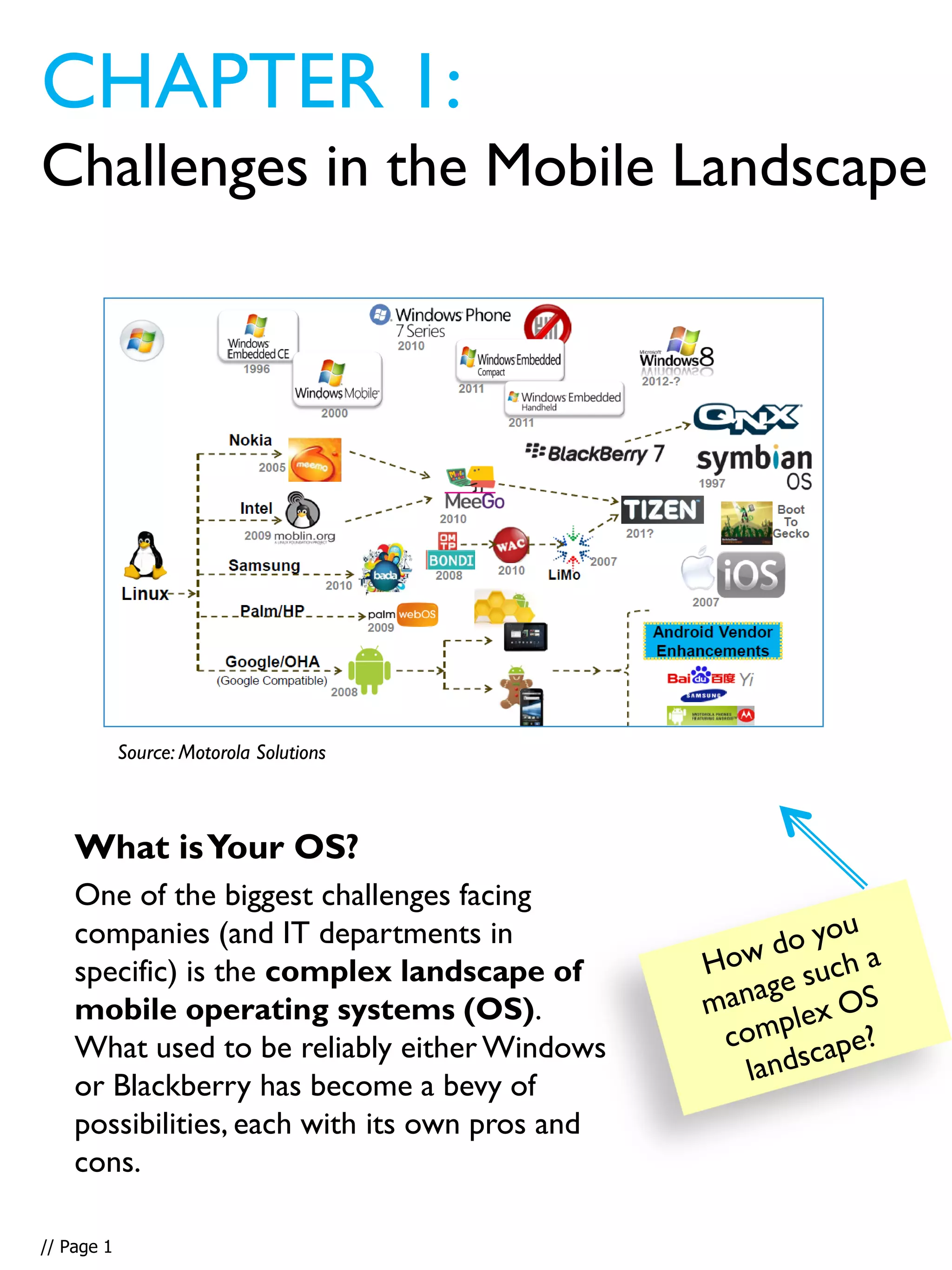
What isYour OS?
One of the biggest challenges facing
companies (and IT departments in
specific) is the complex landscape of
mobile operating systems (OS).
What used to be reliably either Windows
or Blackberry has become a bevy of
possibilities, each with its own pros and
cons.
CHAPTER 1:
Challenges in the Mobile Landscape
// Page 1
Source: Motorola Solutions
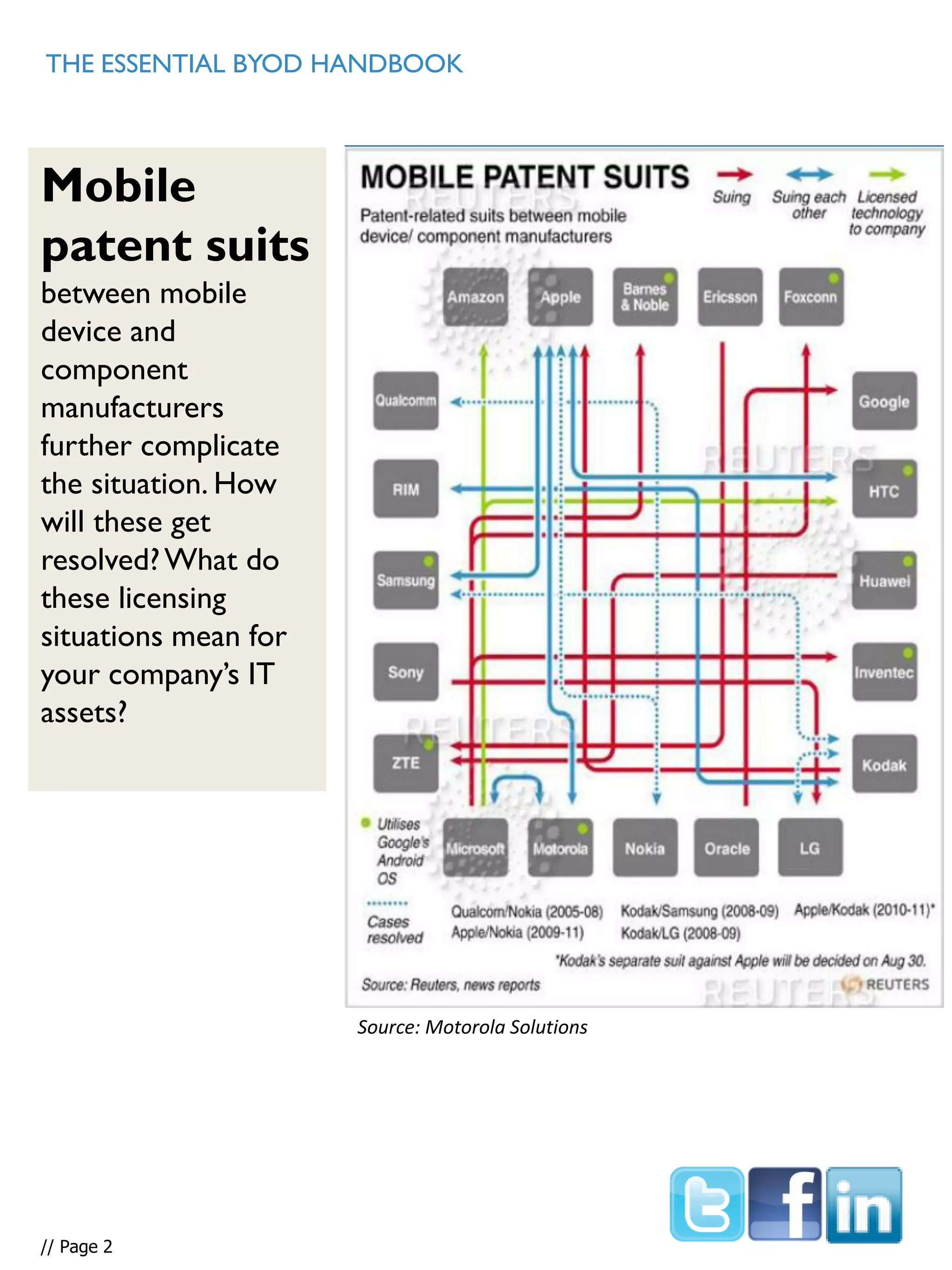
Mobile
patent suits
between mobile
device and
component
manufacturers
further complicate
the situation. How
will these get
resolved?What do
these licensing
situations mean for
your company’s IT
assets?
THE ESSENTIAL BYOD HANDBOOK
// Page 2
Source: Motorola Solutions
Expectations of the IT department have radically
changed with the exploding popularity of Apple products like the
iPhone and iPad.These personal devices are now so ubiquitous
that many employees expect to use them for company business,
at all hours of the day.
It is assumed (whether right or wrong) that IT will support
these devices – whether by accessing the company
network/email or by downloading documents and applications.
THE ESSENTIAL BYOD HANDBOOK
I expect my
iPhone/iPad to work
within the company
environment. I expect
IT to support my
personal devices.”
// Page 3
“Gartner …
observes that, even
by 2014, 60% of
Fortune 1000
companies will
have failed to put a
comprehensive
mobile strategy in
place – leading to
considerable
overspending.”2
Fragmentation – so many
devices and operating systems
in the current business
ecosystem – is a persistent
and pernicious problem for IT
departments.
The importance of an end-to-
end mobile management
solution cannot be overstated.
One of the biggest challenges
in the new mobile landscape is
finding a way to
holistically manage
current levels of devices,
software, and data while
also ensuring the ability
to scale and grow as
technology develops.
THE ESSENTIAL BYOD HANDBOOK
Source: “Put an Integrated Mobile Strategy
in Place, or Face Increased Costs Later,”
Gartner, July 6, 2010, ID: G00201262.
// Page 4
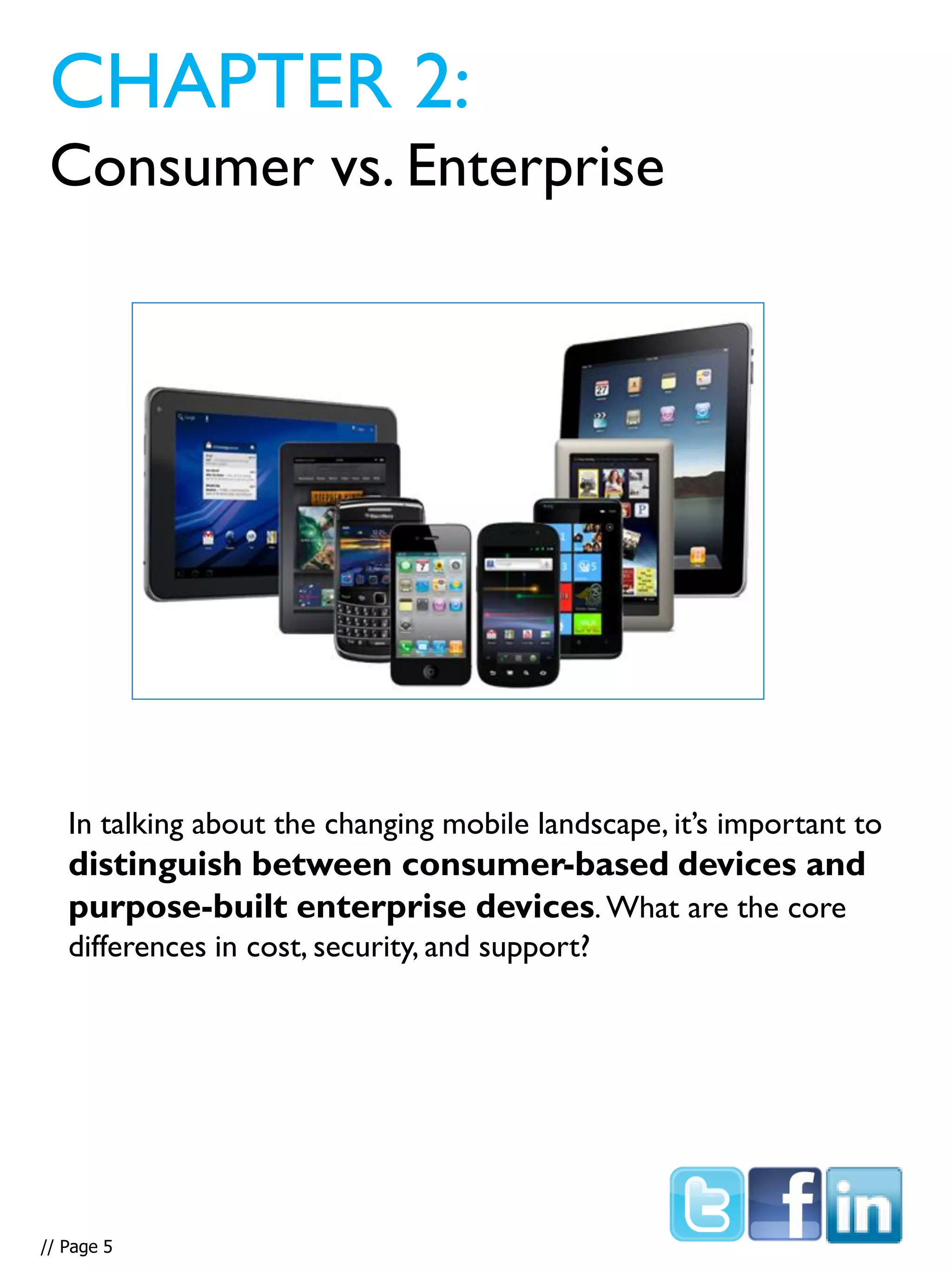
In talking about the changing mobile landscape, it’s important to
distinguish between consumer-based devices and
purpose-built enterprise devices. What are the core
differences in cost, security, and support?
CHAPTER 2:
Consumer vs. Enterprise
// Page 5
THE ESSENTIAL BYOD HANDBOOK
// Page 9
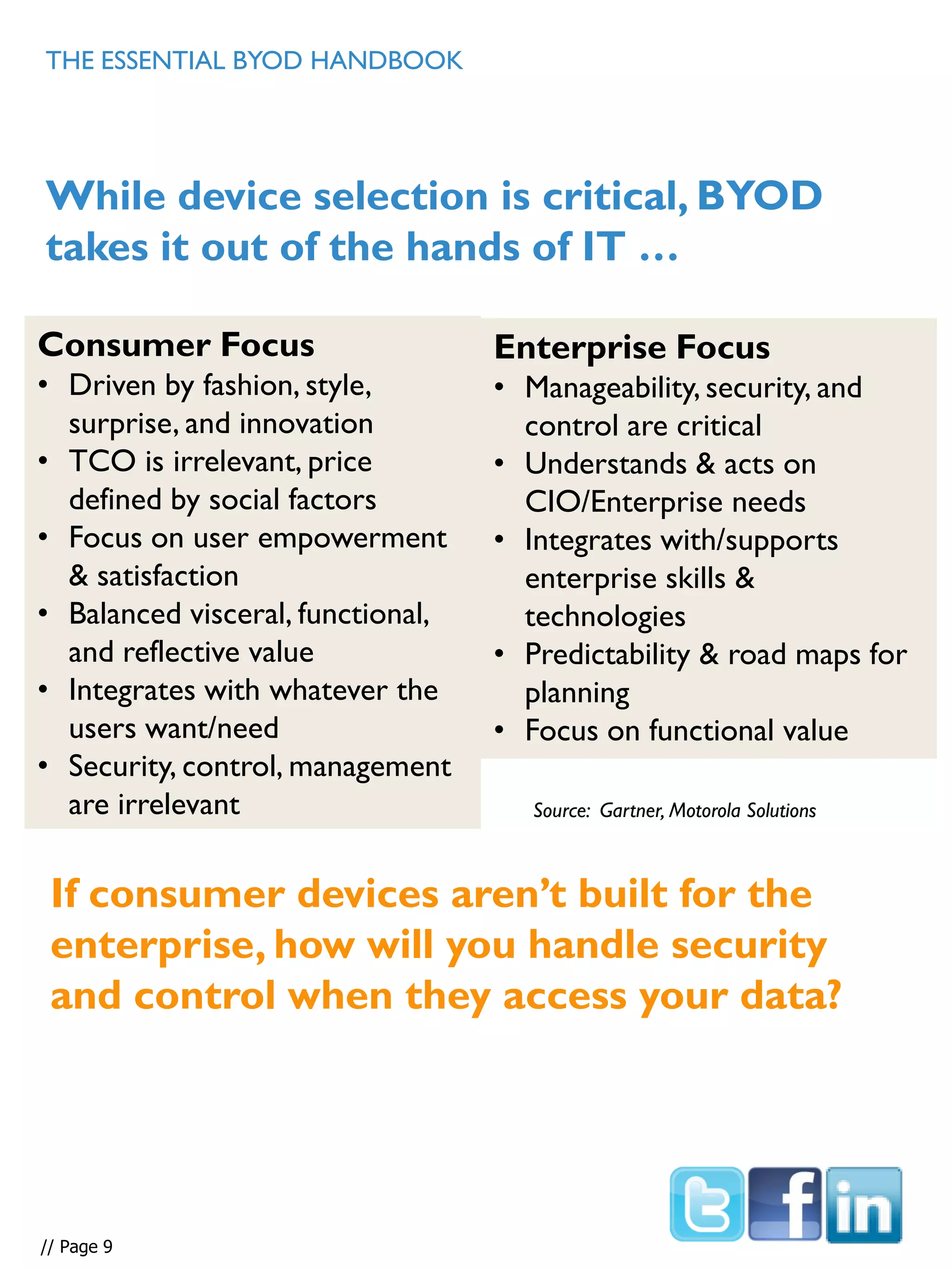
Consumer Focus
• Driven by fashion, style,
surprise, and innovation
• TCO is irrelevant, price
defined by social factors
• Focus on user empowerment
& satisfaction
• Balanced visceral, functional,
and reflective value
• Integrates with whatever the
users want/need
• Security, control, management
are irrelevant
Enterprise Focus
• Manageability, security, and
control are critical
• Understands & acts on
CIO/Enterprise needs
• Integrates with/supports
enterprise skills &
technologies
• Predictability & road maps for
planning
• Focus on functional value
Source: Gartner, Motorola Solutions
While device selection is critical, BYOD
takes it out of the hands of IT …
If consumer devices aren’t built for the
enterprise, how will you handle security
and control when they access your data?
CHAPTER 3:
The Era of BYOD and ILD
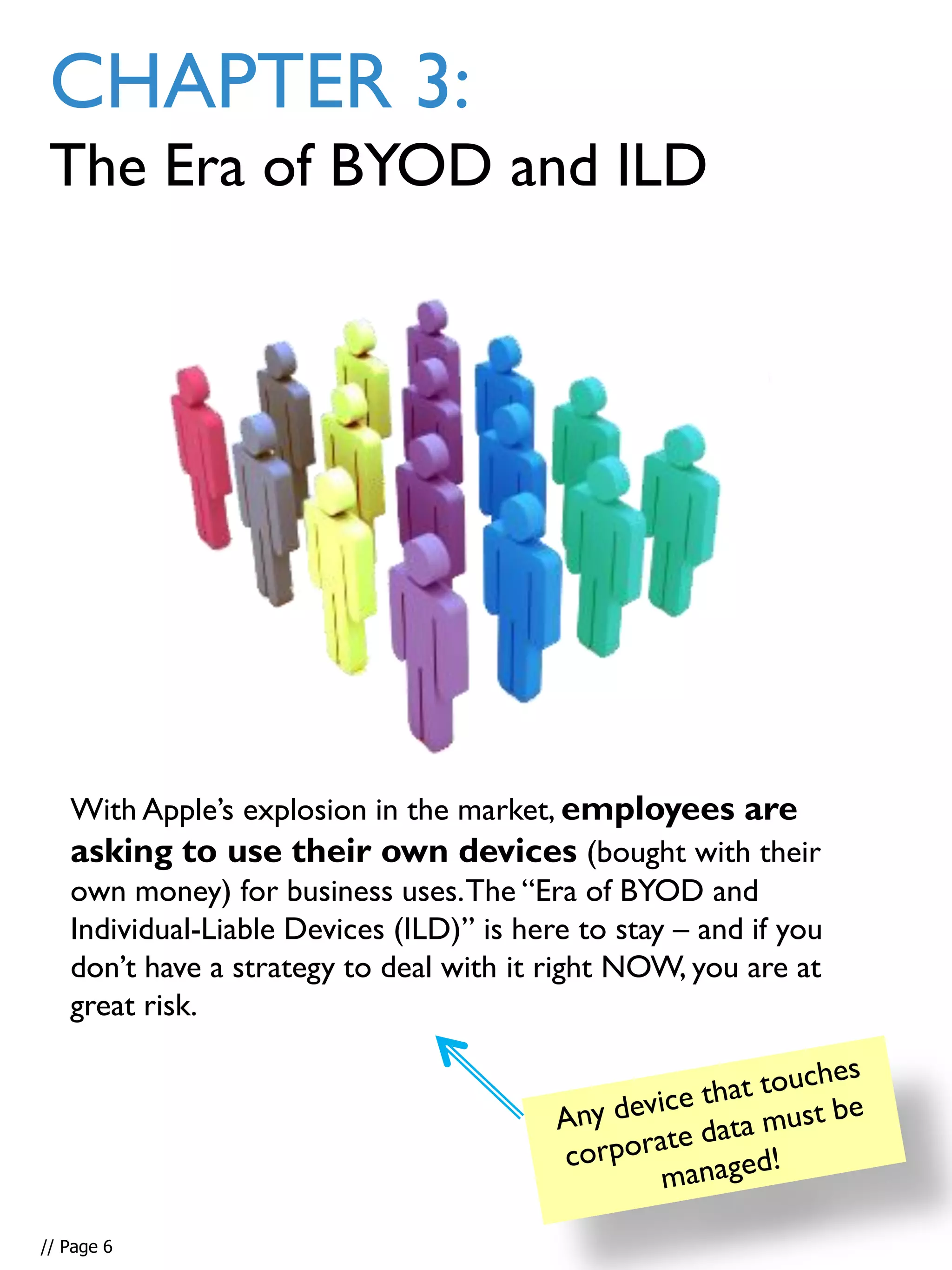
With Apple’s explosion in the market, employees are
asking to use their own devices (bought with their
own money) for business uses.The “Era of BYOD and
Individual-Liable Devices (ILD)” is here to stay – and if you
don’t have a strategy to deal with it right NOW, you are at
great risk.
// Page 6
THE ESSENTIAL BYOD HANDBOOK
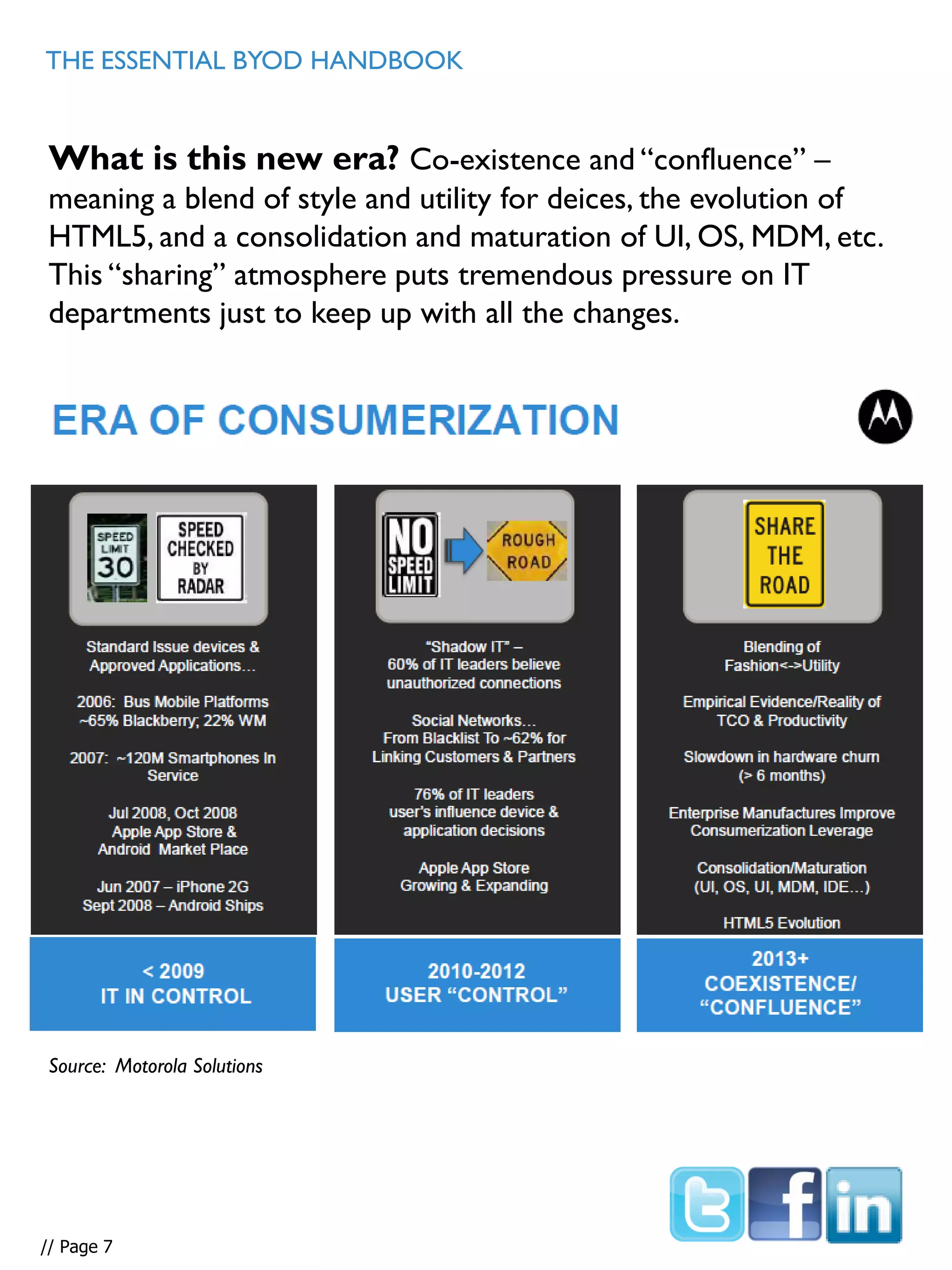
What is this new era? Co-existence and “confluence” –
meaning a blend of style and utility for deices, the evolution of
HTML5, and a consolidation and maturation of UI, OS, MDM, etc.
This “sharing” atmosphere puts tremendous pressure on IT
departments just to keep up with all the changes.
// Page 7
Source: Motorola Solutions
THE ESSENTIAL BYOD HANDBOOK
// Page 8
Source: Motorola Solutions
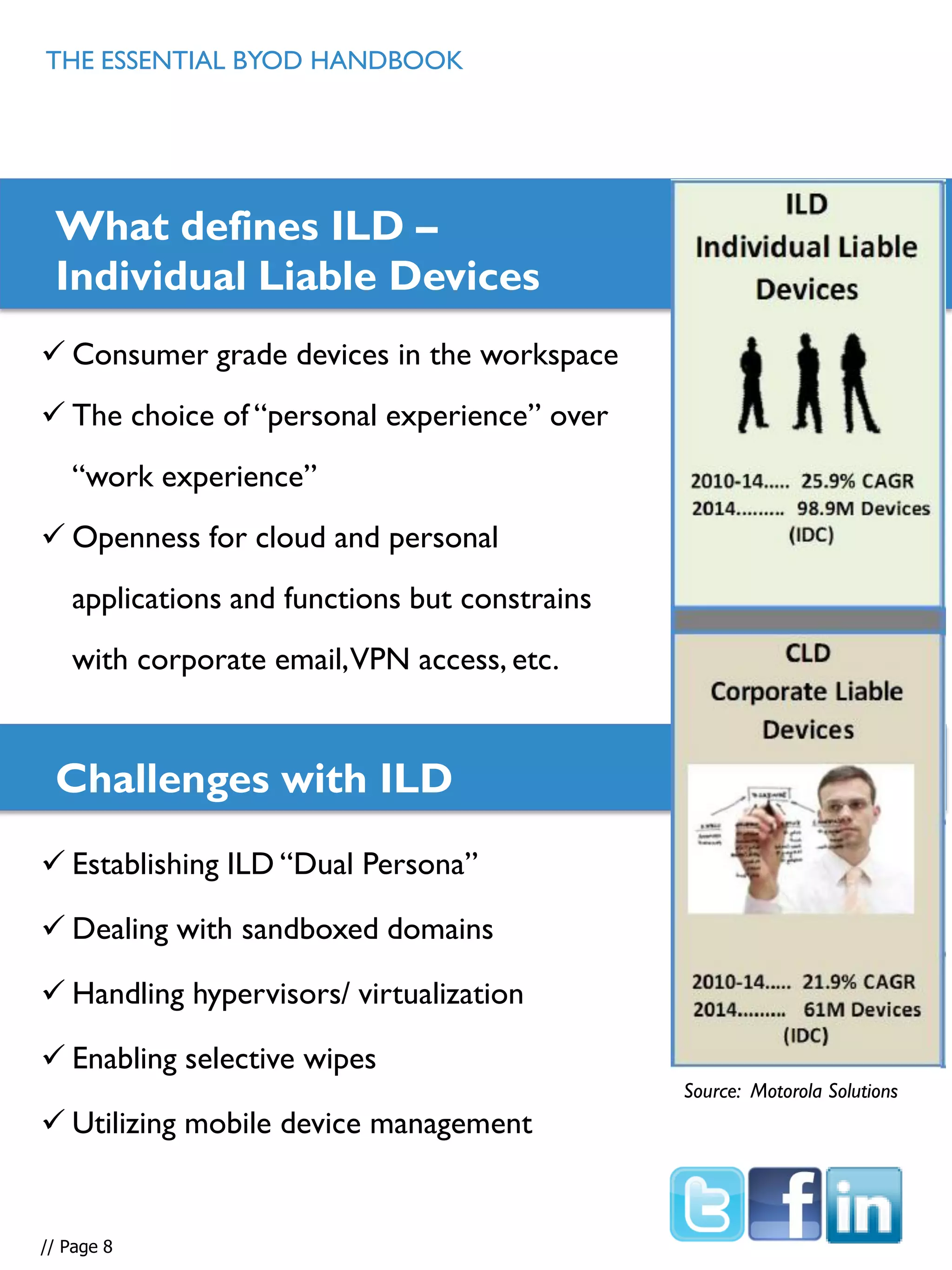
What defines ILD –
Individual Liable Devices
 Consumer grade devices in the workspace
 The choice of “personal experience” over
“work experience”
 Openness for cloud and personal
applications and functions but constrains
with corporate email,VPN access, etc.
Challenges with ILD
 Establishing ILD “Dual Persona”
 Dealing with sandboxed domains
 Handling hypervisors/ virtualization
 Enabling selective wipes
 Utilizing mobile device management
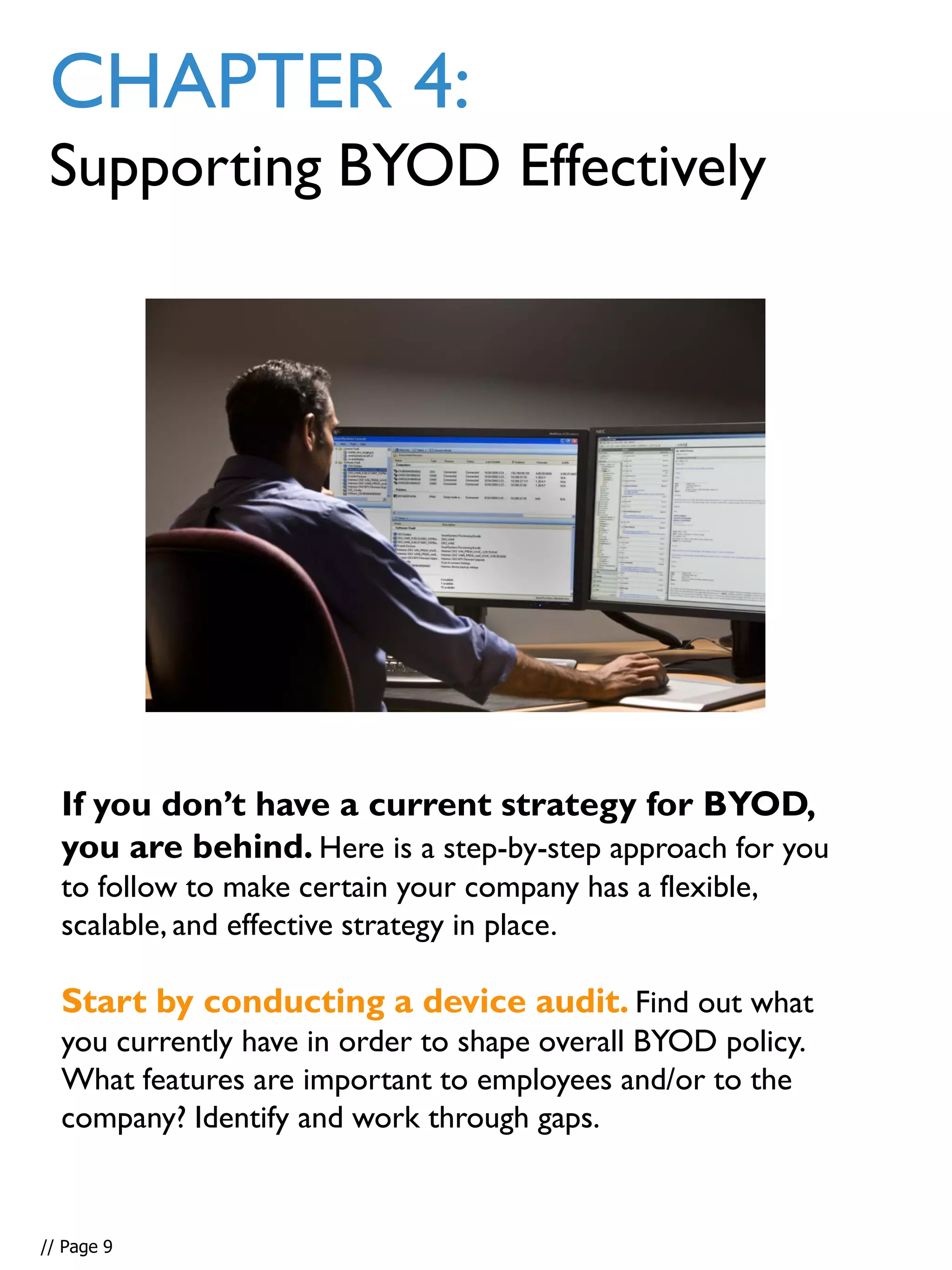
If you don’t have a current strategy for BYOD,
you are behind. Here is a step-by-step approach for you
to follow to make certain your company has a flexible,
scalable, and effective strategy in place.
Start by conducting a device audit. Find out what
you currently have in order to shape overall BYOD policy.
What features are important to employees and/or to the
company? Identify and work through gaps.
CHAPTER 4:
Supporting BYOD Effectively
// Page 9
Your guidelines/baselines should establish rules like:
• What is your privacy policy? Who owns the data
now or if it’s destroyed?
• What requirements are enforceable for BYODs to
enter the enterprise? (i.e., can they check email, download
docs, etc.)
• What types of BYOD devices are allowed? (i.e.,
Android,Apple?)
• Are all departments involved? BYOD affects the
entire organization. Establish goals of executives, HR, IT, etc.
to create a truly effective policy.
THE ESSENTIAL BYOD HANDBOOK
Establishment of
baselines is the
number one step to
take to effectively
manage BYOD.”
// Page 10
EmployeeTermination should be a formal
and written procedure and/or checklist process.
Create awareness with vendors of the employee’s departure;
record log-in information; have appropriate resources to check
for malware or unauthorized access to company data; have the
ability to wipe devices or to lock them down; etc.3
By formalizing your approach, you will ensure that critical
details aren’t overlooked.
THE ESSENTIAL BYOD HANDBOOK
// Page 5
Get HR Involved.
Don’t have a policy written
yet? Check out this sample
courtesy of
ITManagerDaily.com
// Page 11
THE ESSENTIAL BYOD HANDBOOK
// Page 12
Effective Software Support
Key Challenge
Built to last 4-5 years but are now faced with devices that
update every 6 months
Recommendations
 Avoid thick clients that target one specific OS
 Put money into maintenance and support (M&S) as well as
research and development (R&D)
 Utilize “Mobile Device Management” (MDM) to push
updates
 Explore web-based solutions such as HTML 5: that way,
company information can be accessed from any device,
anywhere
Mobile Device Management
(MDM) is Critical
Without a MDM solution, you won’t be
able to handle device lifecycles, security,
applications and content, or diagnostics
as your organization grows and as your
network of workstations, rugged
computers and terminals, and BYOD
devices grows.
Look for a solution with:
 Centralized management console
 Real-time support
 Reactive and proactive management
 Complete lifecycle management
 Over-the-air configurability
Key Benefit
Push HW &
SW updates
remotely to
devices in the
field – no
manual
provisioning
// Page 14
THE ESSENTIAL BYOD HANDBOOK
Final Items to Consider
 IsYour Disaster Recovery Plan Relevant to
BYOD?
 AreYou Providing the Right Productivity and
SharingTools so Employees Don’t Seek
Rogue Applications?
 AreYou Encouraging Regular Back-ups of
Mobile Devices?
 Is EffectiveTraining in Place to Support the
Efforts of the ITTeam?
 IsYour Data Secure Under the Policies
You’ve Created?
// Page 13
“BYOD, Social Media
AmongTop Security
Threats of 2013”
If you need help on device
selection, mobile device
management, or more – contact
Barcoding, Inc.We are a trusted
advisor to more than 2,500
companies across the country.
Good News!
We can help…
Watch Industry Experts Discuss
BYOD Live!
1. http://www.eweek.com/c/a/Mobile-and-
Wireless/Management-Orthodoxy-Challenged-by-
iPad-iPhone-257619/
2. http://www.sap.com/campaigns/2011_04_mobility/asse
ts/Mobility-
Its_Impact_Opportunities_and_Challenges.pdf
3. http://www.eweek.com/c/a/Security/BYOD-10-Tips-
Enterprises-Can-Use-to-Protect-Their-Data-700259/
4. http://www.channelpartnersonline.com/blogs/peertope
er/2012/09/why-most-byod-managers-will-welcome-
iphone-5.aspx
5. http://www.computerworld.com/s/article/9230476/Bes
t_BYOD_management_Containment_is_your_friend
6. http://www.thevarguy.com/2012/09/10/byopc-byod-it-
consumerization-dont-matter-in-the-cloud/
7. http://www.eweek.com/it-management/byod-social-
media-among-top-security-threats-of-2013/
8. Motorola Solutions presentation by Bruce Willins
(2012)
9. Barcoding, Inc. presentation by Martin Jack (2012)
Sources and Additional Reading

The Essential BYOD Handbook

  • 1.
    The Essential BYOD Handbook EffectivelySupporting and Managing All ofYour Mobile Devices (BYOD = BringYour Own Device)
  • 2.
    Jody Costa joinedBarcoding, Inc. as Director of Marketing in 2010. With over 10 years of experience in writing, marketing, and publishing, Costa is responsible for all strategic and tactical aspects of the marketing program. Editor Jody Costa Barcoding, Inc. is a national systems integrator, specializing in the development, deployment, and management of supply chain and mobility systems based on automated data capture and wireless technology. www.barcoding.com.
  • 3.
    Chapter 1: Challengesin the Mobile Landscape Chapter 2: Consumer vs. Enterprise Chapter 3:The Era of BYOD and ILD Chapter 4: Supporting BYOD Effectively “We Can Help” andVideo Link. Sources and Additional Reading TABLE OF CONTENTS
  • 4.
    What isYour OS? Oneof the biggest challenges facing companies (and IT departments in specific) is the complex landscape of mobile operating systems (OS). What used to be reliably either Windows or Blackberry has become a bevy of possibilities, each with its own pros and cons. CHAPTER 1: Challenges in the Mobile Landscape // Page 1 Source: Motorola Solutions
  • 5.
    Mobile patent suits between mobile deviceand component manufacturers further complicate the situation. How will these get resolved?What do these licensing situations mean for your company’s IT assets? THE ESSENTIAL BYOD HANDBOOK // Page 2 Source: Motorola Solutions
  • 6.
    Expectations of theIT department have radically changed with the exploding popularity of Apple products like the iPhone and iPad.These personal devices are now so ubiquitous that many employees expect to use them for company business, at all hours of the day. It is assumed (whether right or wrong) that IT will support these devices – whether by accessing the company network/email or by downloading documents and applications. THE ESSENTIAL BYOD HANDBOOK I expect my iPhone/iPad to work within the company environment. I expect IT to support my personal devices.” // Page 3
  • 7.
    “Gartner … observes that,even by 2014, 60% of Fortune 1000 companies will have failed to put a comprehensive mobile strategy in place – leading to considerable overspending.”2 Fragmentation – so many devices and operating systems in the current business ecosystem – is a persistent and pernicious problem for IT departments. The importance of an end-to- end mobile management solution cannot be overstated. One of the biggest challenges in the new mobile landscape is finding a way to holistically manage current levels of devices, software, and data while also ensuring the ability to scale and grow as technology develops. THE ESSENTIAL BYOD HANDBOOK Source: “Put an Integrated Mobile Strategy in Place, or Face Increased Costs Later,” Gartner, July 6, 2010, ID: G00201262. // Page 4
  • 8.
    In talking aboutthe changing mobile landscape, it’s important to distinguish between consumer-based devices and purpose-built enterprise devices. What are the core differences in cost, security, and support? CHAPTER 2: Consumer vs. Enterprise // Page 5
  • 9.
    THE ESSENTIAL BYODHANDBOOK // Page 9 Consumer Focus • Driven by fashion, style, surprise, and innovation • TCO is irrelevant, price defined by social factors • Focus on user empowerment & satisfaction • Balanced visceral, functional, and reflective value • Integrates with whatever the users want/need • Security, control, management are irrelevant Enterprise Focus • Manageability, security, and control are critical • Understands & acts on CIO/Enterprise needs • Integrates with/supports enterprise skills & technologies • Predictability & road maps for planning • Focus on functional value Source: Gartner, Motorola Solutions While device selection is critical, BYOD takes it out of the hands of IT … If consumer devices aren’t built for the enterprise, how will you handle security and control when they access your data?
  • 10.
    CHAPTER 3: The Eraof BYOD and ILD With Apple’s explosion in the market, employees are asking to use their own devices (bought with their own money) for business uses.The “Era of BYOD and Individual-Liable Devices (ILD)” is here to stay – and if you don’t have a strategy to deal with it right NOW, you are at great risk. // Page 6
  • 11.
    THE ESSENTIAL BYODHANDBOOK What is this new era? Co-existence and “confluence” – meaning a blend of style and utility for deices, the evolution of HTML5, and a consolidation and maturation of UI, OS, MDM, etc. This “sharing” atmosphere puts tremendous pressure on IT departments just to keep up with all the changes. // Page 7 Source: Motorola Solutions
  • 12.
    THE ESSENTIAL BYODHANDBOOK // Page 8 Source: Motorola Solutions What defines ILD – Individual Liable Devices  Consumer grade devices in the workspace  The choice of “personal experience” over “work experience”  Openness for cloud and personal applications and functions but constrains with corporate email,VPN access, etc. Challenges with ILD  Establishing ILD “Dual Persona”  Dealing with sandboxed domains  Handling hypervisors/ virtualization  Enabling selective wipes  Utilizing mobile device management
  • 13.
    If you don’thave a current strategy for BYOD, you are behind. Here is a step-by-step approach for you to follow to make certain your company has a flexible, scalable, and effective strategy in place. Start by conducting a device audit. Find out what you currently have in order to shape overall BYOD policy. What features are important to employees and/or to the company? Identify and work through gaps. CHAPTER 4: Supporting BYOD Effectively // Page 9
  • 14.
    Your guidelines/baselines shouldestablish rules like: • What is your privacy policy? Who owns the data now or if it’s destroyed? • What requirements are enforceable for BYODs to enter the enterprise? (i.e., can they check email, download docs, etc.) • What types of BYOD devices are allowed? (i.e., Android,Apple?) • Are all departments involved? BYOD affects the entire organization. Establish goals of executives, HR, IT, etc. to create a truly effective policy. THE ESSENTIAL BYOD HANDBOOK Establishment of baselines is the number one step to take to effectively manage BYOD.” // Page 10
  • 15.
    EmployeeTermination should bea formal and written procedure and/or checklist process. Create awareness with vendors of the employee’s departure; record log-in information; have appropriate resources to check for malware or unauthorized access to company data; have the ability to wipe devices or to lock them down; etc.3 By formalizing your approach, you will ensure that critical details aren’t overlooked. THE ESSENTIAL BYOD HANDBOOK // Page 5 Get HR Involved. Don’t have a policy written yet? Check out this sample courtesy of ITManagerDaily.com // Page 11
  • 16.
    THE ESSENTIAL BYODHANDBOOK // Page 12 Effective Software Support Key Challenge Built to last 4-5 years but are now faced with devices that update every 6 months Recommendations  Avoid thick clients that target one specific OS  Put money into maintenance and support (M&S) as well as research and development (R&D)  Utilize “Mobile Device Management” (MDM) to push updates  Explore web-based solutions such as HTML 5: that way, company information can be accessed from any device, anywhere
  • 17.
    Mobile Device Management (MDM)is Critical Without a MDM solution, you won’t be able to handle device lifecycles, security, applications and content, or diagnostics as your organization grows and as your network of workstations, rugged computers and terminals, and BYOD devices grows. Look for a solution with:  Centralized management console  Real-time support  Reactive and proactive management  Complete lifecycle management  Over-the-air configurability Key Benefit Push HW & SW updates remotely to devices in the field – no manual provisioning // Page 14 THE ESSENTIAL BYOD HANDBOOK
  • 18.
    THE ESSENTIAL BYODHANDBOOK Final Items to Consider  IsYour Disaster Recovery Plan Relevant to BYOD?  AreYou Providing the Right Productivity and SharingTools so Employees Don’t Seek Rogue Applications?  AreYou Encouraging Regular Back-ups of Mobile Devices?  Is EffectiveTraining in Place to Support the Efforts of the ITTeam?  IsYour Data Secure Under the Policies You’ve Created? // Page 13 “BYOD, Social Media AmongTop Security Threats of 2013”
  • 19.
    If you needhelp on device selection, mobile device management, or more – contact Barcoding, Inc.We are a trusted advisor to more than 2,500 companies across the country. Good News! We can help… Watch Industry Experts Discuss BYOD Live!
  • 20.
    1. http://www.eweek.com/c/a/Mobile-and- Wireless/Management-Orthodoxy-Challenged-by- iPad-iPhone-257619/ 2. http://www.sap.com/campaigns/2011_04_mobility/asse ts/Mobility- Its_Impact_Opportunities_and_Challenges.pdf 3.http://www.eweek.com/c/a/Security/BYOD-10-Tips- Enterprises-Can-Use-to-Protect-Their-Data-700259/ 4. http://www.channelpartnersonline.com/blogs/peertope er/2012/09/why-most-byod-managers-will-welcome- iphone-5.aspx 5. http://www.computerworld.com/s/article/9230476/Bes t_BYOD_management_Containment_is_your_friend 6. http://www.thevarguy.com/2012/09/10/byopc-byod-it- consumerization-dont-matter-in-the-cloud/ 7. http://www.eweek.com/it-management/byod-social- media-among-top-security-threats-of-2013/ 8. Motorola Solutions presentation by Bruce Willins (2012) 9. Barcoding, Inc. presentation by Martin Jack (2012) Sources and Additional Reading