© 2006-2015 ALL RIGHTS RESERVED THE SANDUSKY GROUP, LLC. www.sanduskygroup.com | 1
THE
CROOKED
YARDSTICK
The Crooked Yardstick 3.................................................
3 Common Crooked Yardsticks 3..................................
Change 4.....................................................................
Problems & Opportunities 5....................................
Winning 6....................................................................
The Game Plan 7.............................................................
Lighthouse vs Courthouse 8..........................................
About The Sandusky Group 9........................................
© 2006-2015 ALL RIGHTS RESERVED THE SANDUSKY GROUP, LLC. www.sanduskygroup.com | 2
CONTENTS
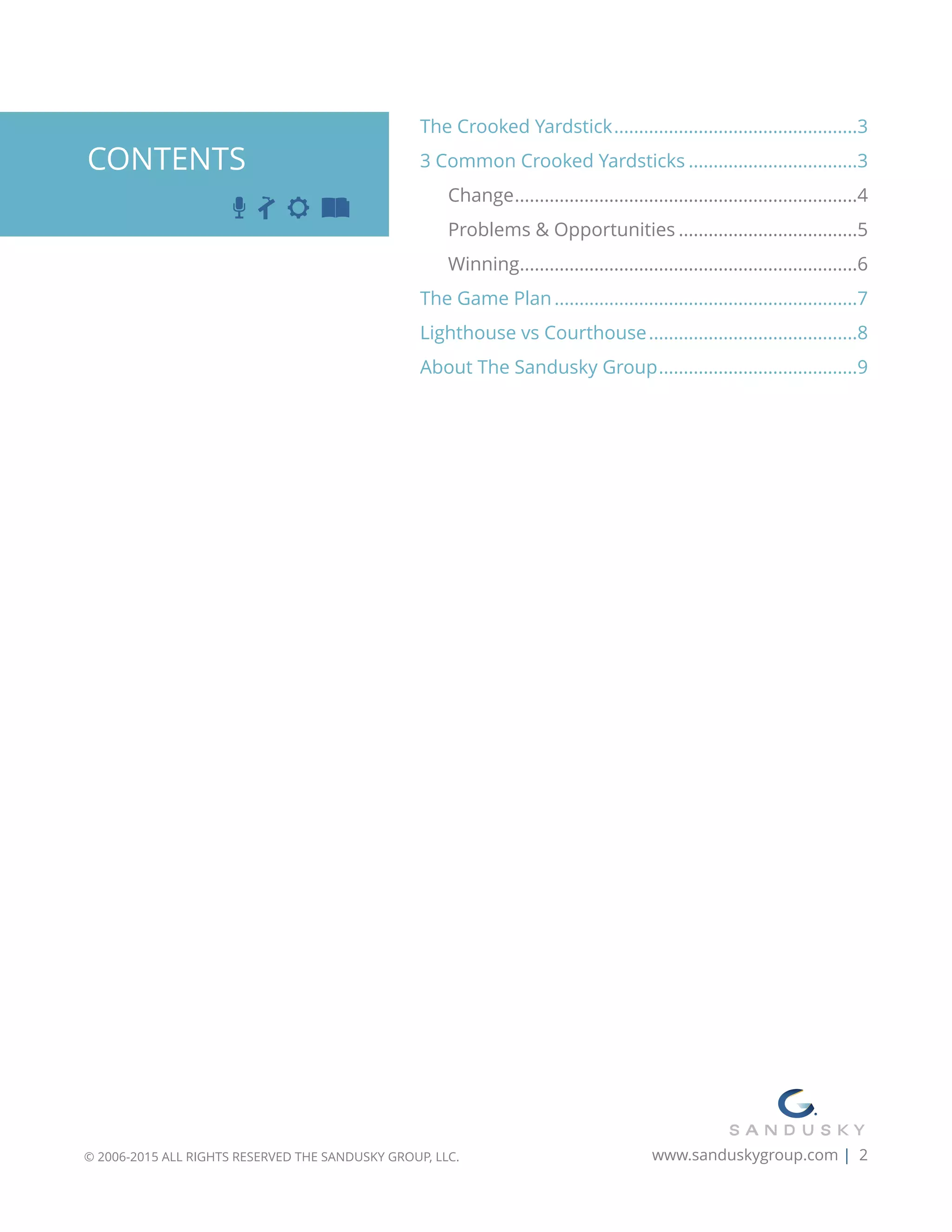
The concept of the crooked yardstick comes from a
phrase my mother used to use: “If you measure
material using a crooked yardstick, the clothes you
make will look right but the person who tries those
clothes on will feel that something isn’t quite right.
They won’t know what it is, but they’ll know it isn’t
quite right.” Examine not only your results but also
how you measure success.


There are three commonly used crooked yardsticks
in most organizations. They deal with how
individuals and organizations measure these three
areas:
Change
Problems & Opportunities
Winning
© 2006-2015 ALL RIGHTS RESERVED THE SANDUSKY GROUP, LLC. www.sanduskygroup.com | 3
THE CROOKED

YARDSTICK
3 COMMON
CROOKED
YARDSTICKS
Change
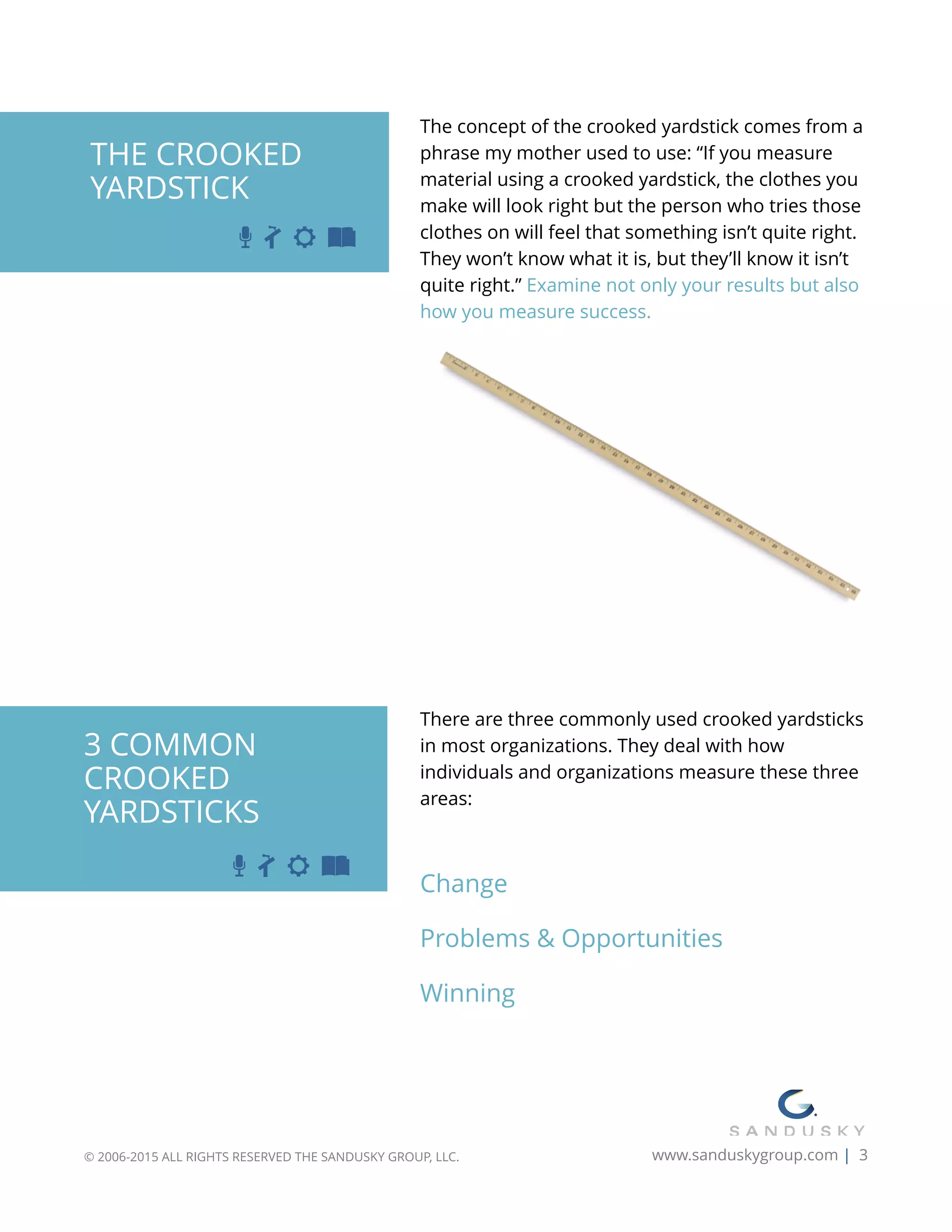
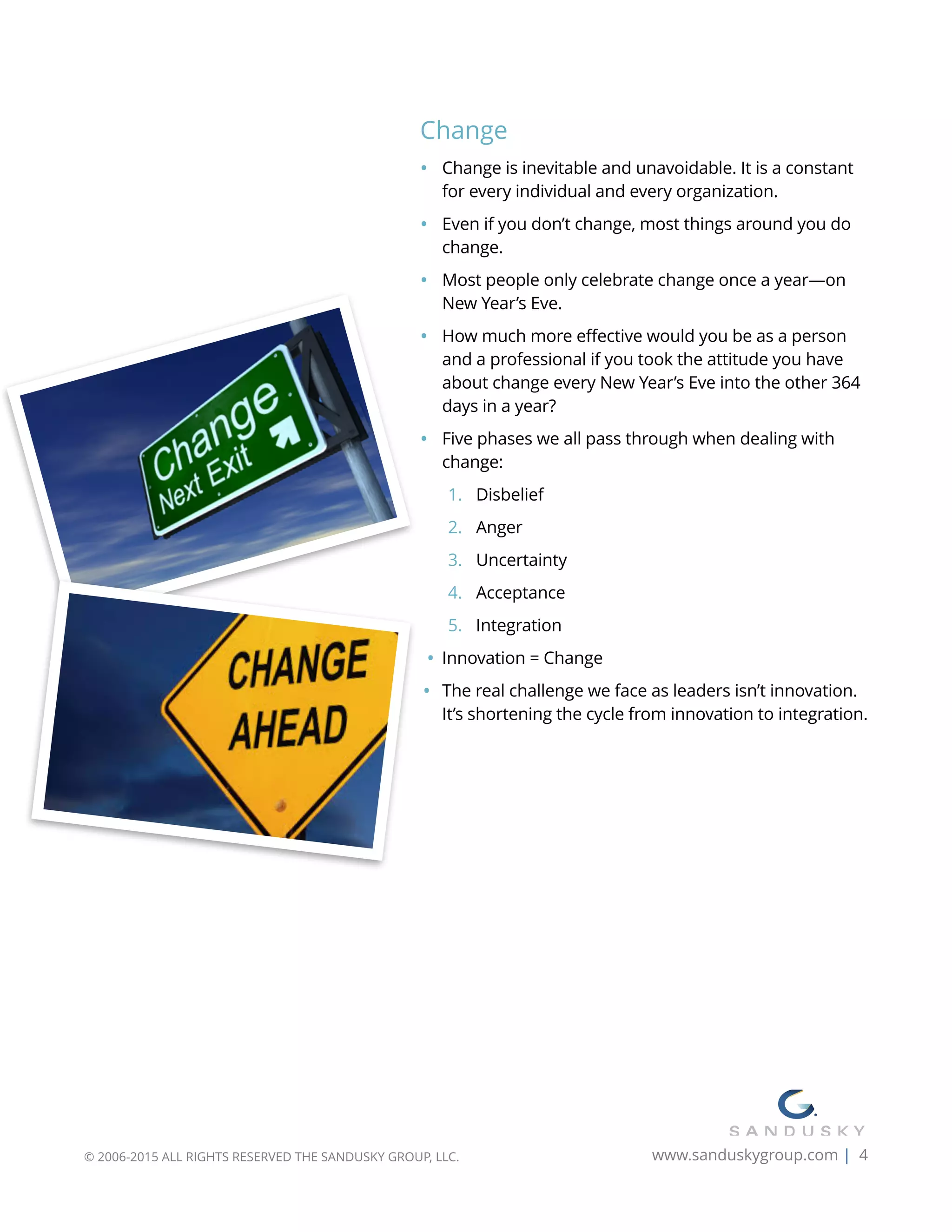
• Change is inevitable and unavoidable. It is a constant
for every individual and every organization.
• Even if you don’t change, most things around you do
change.
• Most people only celebrate change once a year—on
New Year’s Eve.
• How much more effective would you be as a person
and a professional if you took the attitude you have
about change every New Year’s Eve into the other 364
days in a year?
• Five phases we all pass through when dealing with
change:
1. Disbelief
2. Anger
3. Uncertainty
4. Acceptance
5. Integration
• Innovation = Change
• The real challenge we face as leaders isn’t innovation.
It’s shortening the cycle from innovation to integration.
© 2006-2015 ALL RIGHTS RESERVED THE SANDUSKY GROUP, LLC. www.sanduskygroup.com | 4
Problems & Opportunities
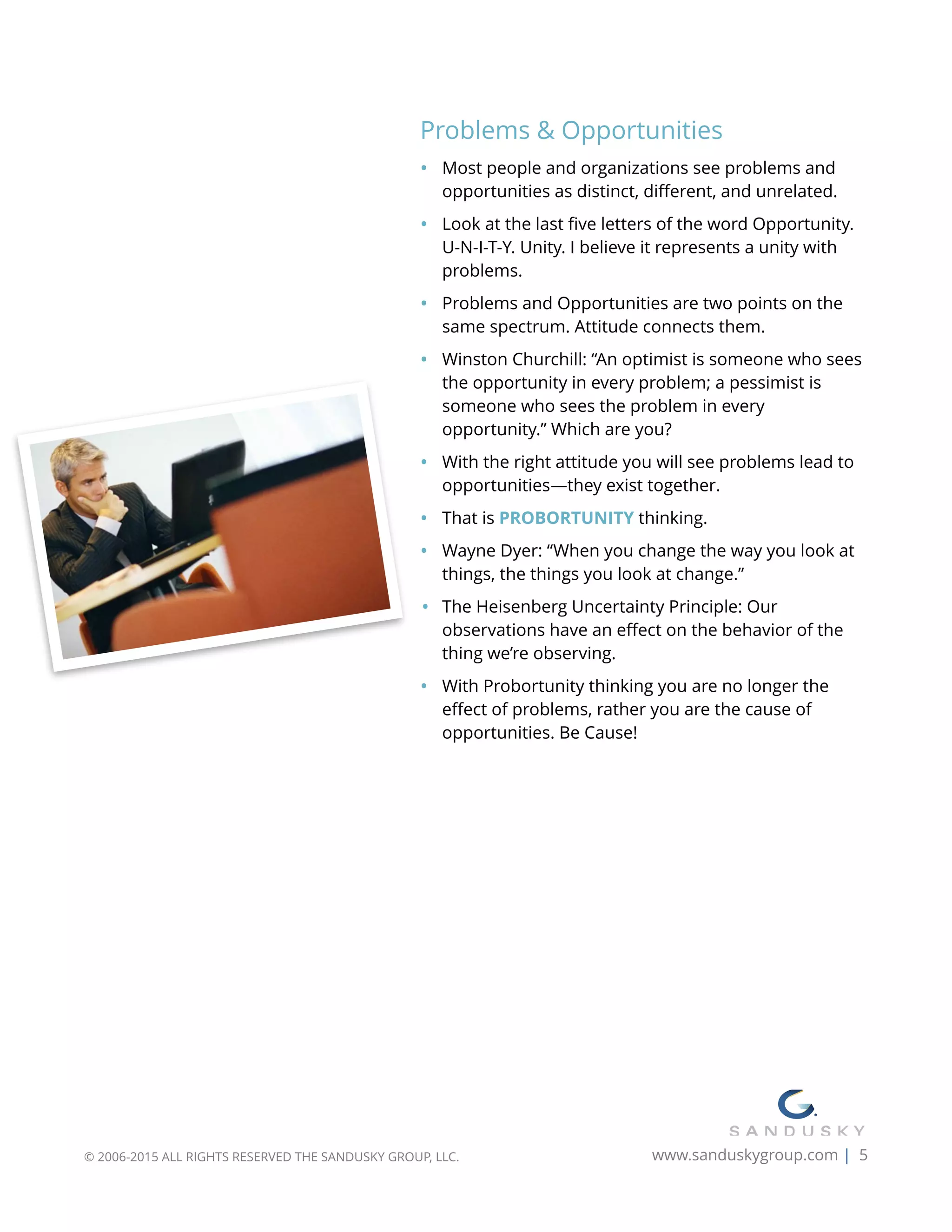
• Most people and organizations see problems and
opportunities as distinct, different, and unrelated.
• Look at the last five letters of the word Opportunity.
U-N-I-T-Y. Unity. I believe it represents a unity with
problems.
• Problems and Opportunities are two points on the
same spectrum. Attitude connects them.
• Winston Churchill: “An optimist is someone who sees
the opportunity in every problem; a pessimist is
someone who sees the problem in every
opportunity.” Which are you?
• With the right attitude you will see problems lead to
opportunities—they exist together.
• That is PROBORTUNITY thinking.
• Wayne Dyer: “When you change the way you look at
things, the things you look at change.”
• The Heisenberg Uncertainty Principle: Our
observations have an effect on the behavior of the
thing we’re observing.
• With Probortunity thinking you are no longer the
effect of problems, rather you are the cause of
opportunities. Be Cause!
© 2006-2015 ALL RIGHTS RESERVED THE SANDUSKY GROUP, LLC. www.sanduskygroup.com | 5
Winning
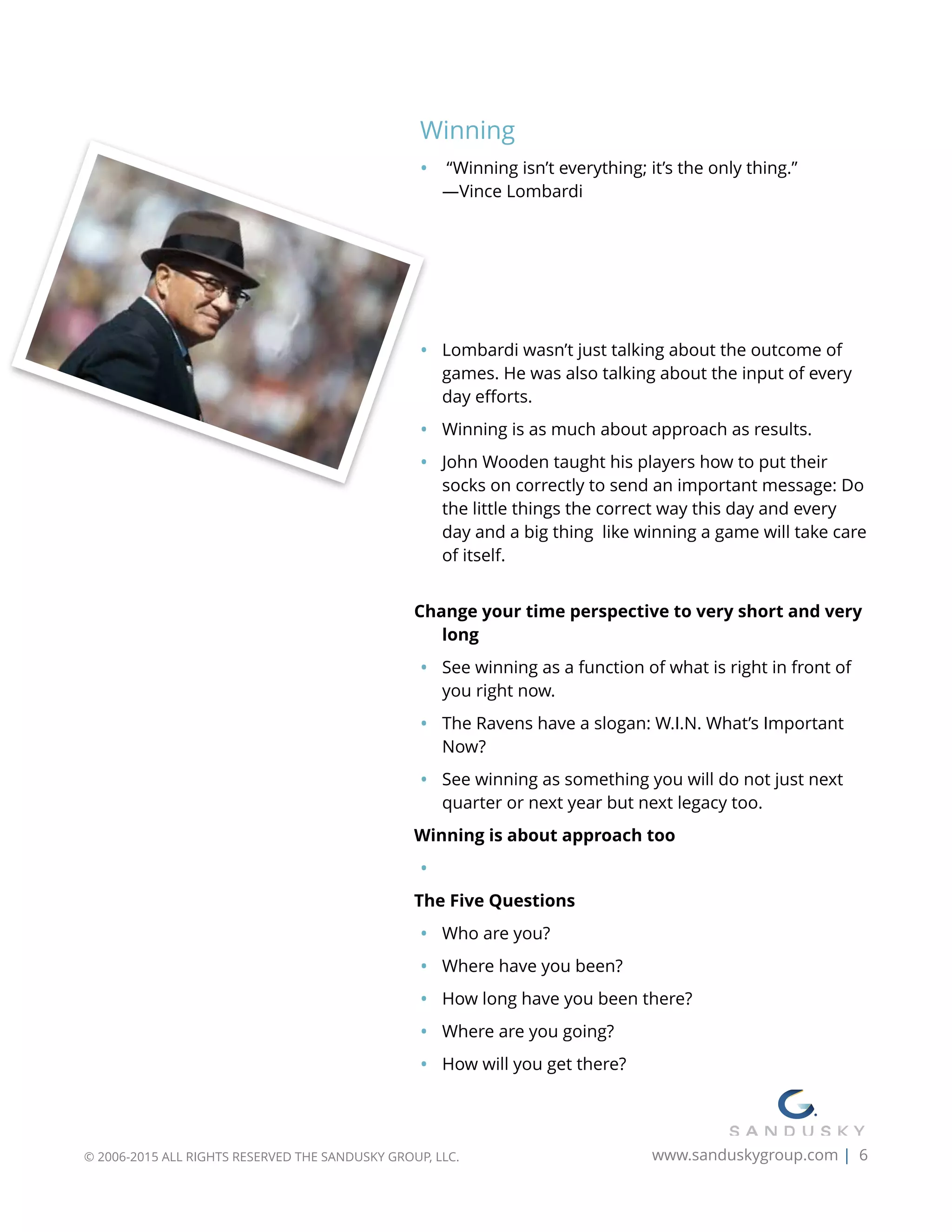
• “Winning isn’t everything; it’s the only thing.” 

—Vince Lombardi


• Lombardi wasn’t just talking about the outcome of
games. He was also talking about the input of every
day efforts.
• Winning is as much about approach as results.
• John Wooden taught his players how to put their
socks on correctly to send an important message: Do
the little things the correct way this day and every
day and a big thing like winning a game will take care
of itself.

Change your time perspective to very short and very
long
• See winning as a function of what is right in front of
you right now.
• The Ravens have a slogan: W.I.N. What’s Important
Now?
• See winning as something you will do not just next
quarter or next year but next legacy too.
Winning is about approach too
•
The Five Questions
• Who are you?
• Where have you been?
• How long have you been there?
• Where are you going?
• How will you get there?
© 2006-2015 ALL RIGHTS RESERVED THE SANDUSKY GROUP, LLC. www.sanduskygroup.com | 6
• Question one is your identity, your essence, the
core of what makes you unique, special, and
authentic.
• Questions three and four deal with your history.
• Question four is about your vision.
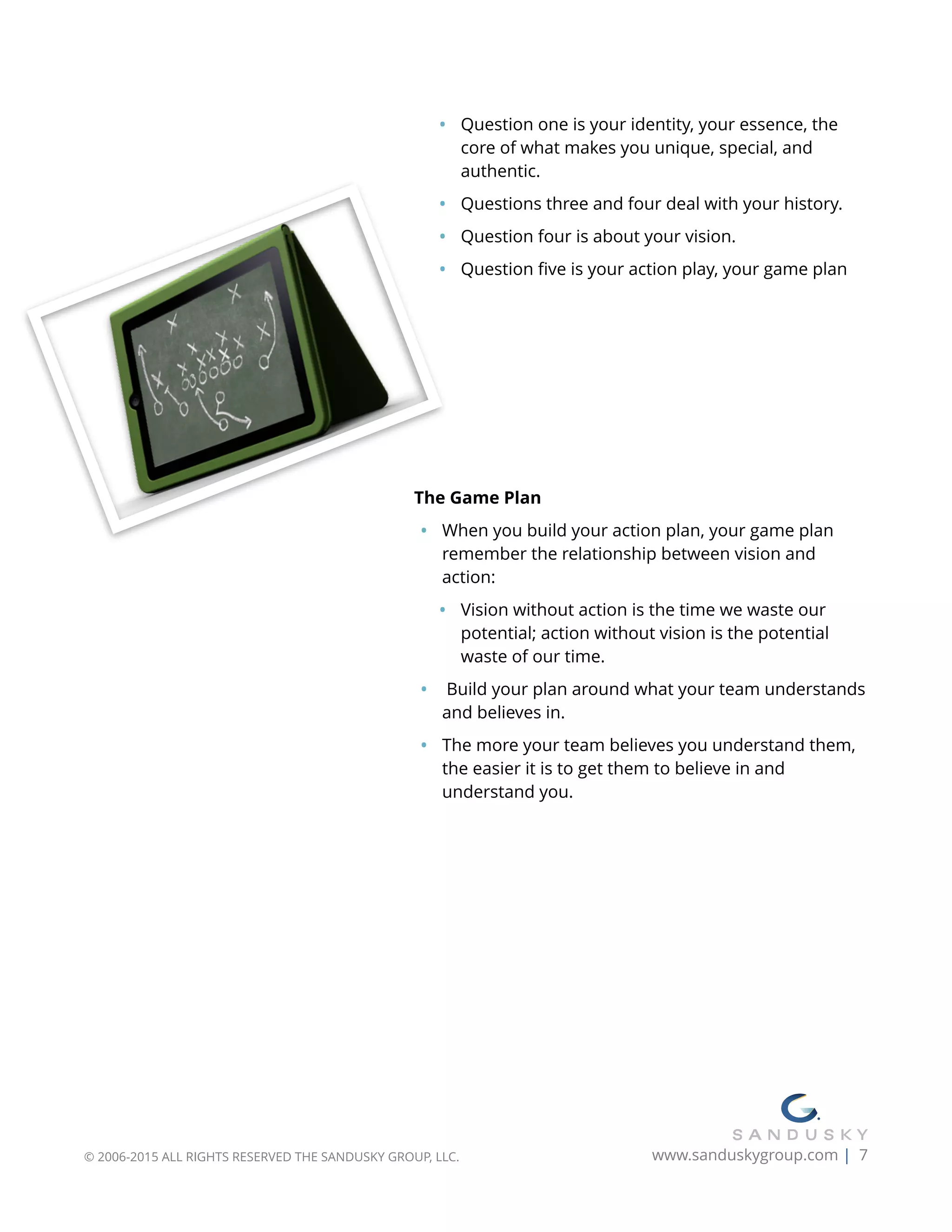
• Question five is your action play, your game plan
The Game Plan
• When you build your action plan, your game plan
remember the relationship between vision and
action:
• Vision without action is the time we waste our
potential; action without vision is the potential
waste of our time.
• Build your plan around what your team understands
and believes in.
• The more your team believes you understand them,
the easier it is to get them to believe in and
understand you.

© 2006-2015 ALL RIGHTS RESERVED THE SANDUSKY GROUP, LLC. www.sanduskygroup.com | 7
Four Types of Leaders
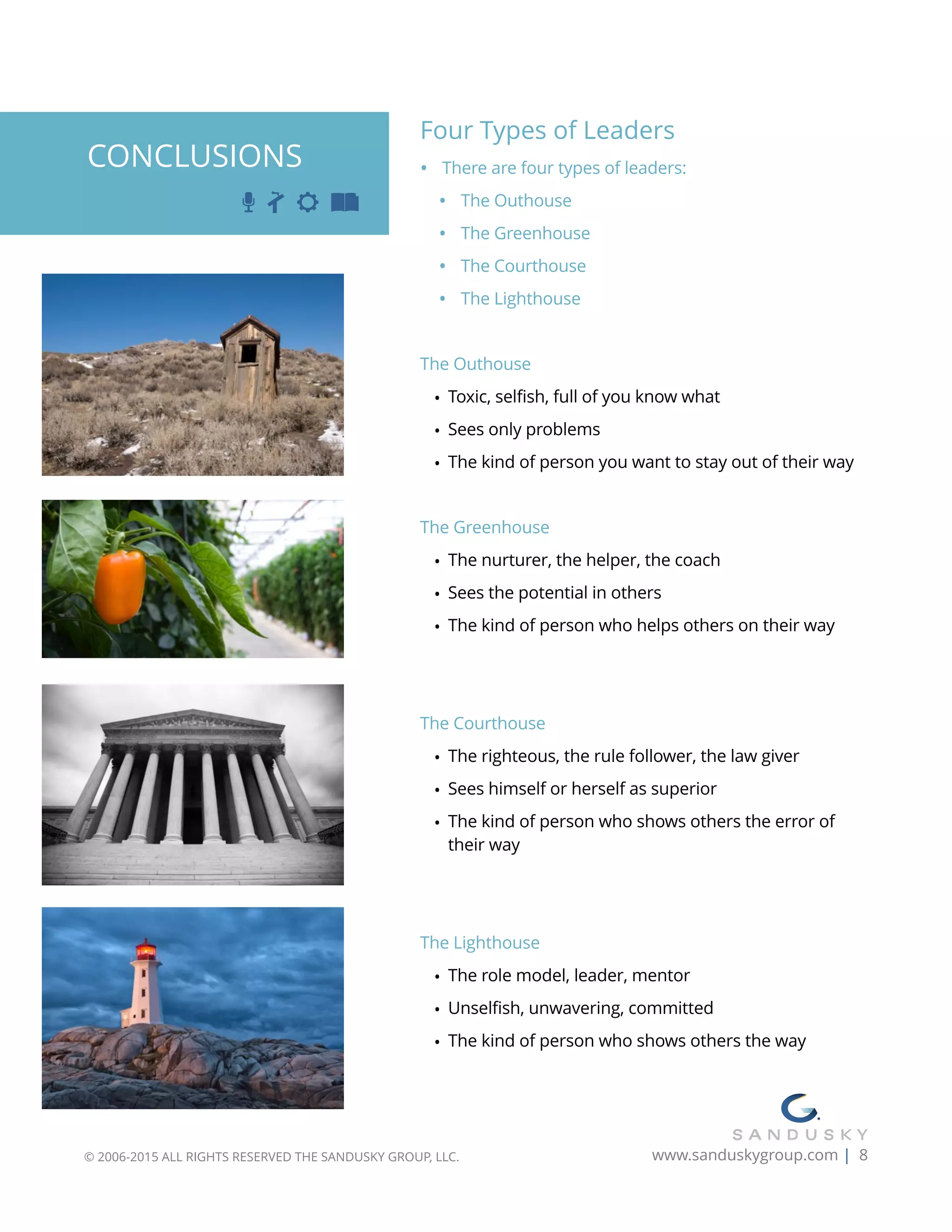
• There are four types of leaders:
• The Outhouse
• The Greenhouse
• The Courthouse
• The Lighthouse
The Outhouse
• Toxic, selfish, full of you know what
• Sees only problems
• The kind of person you want to stay out of their way
The Greenhouse
• The nurturer, the helper, the coach
• Sees the potential in others
• The kind of person who helps others on their way
The Courthouse
• The righteous, the rule follower, the law giver
• Sees himself or herself as superior
• The kind of person who shows others the error of
their way
The Lighthouse
• The role model, leader, mentor
• Unselfish, unwavering, committed
• The kind of person who shows others the way
© 2006-2015 ALL RIGHTS RESERVED THE SANDUSKY GROUP, LLC. www.sanduskygroup.com | 8
CONCLUSIONS
It’s Your Choice
• You always have control over how you look at things.
• Have the courage to see change as a process, not an
event. See change as an ally, not an enemy.
• Problems are merely the start of PROBORTUNITIES.
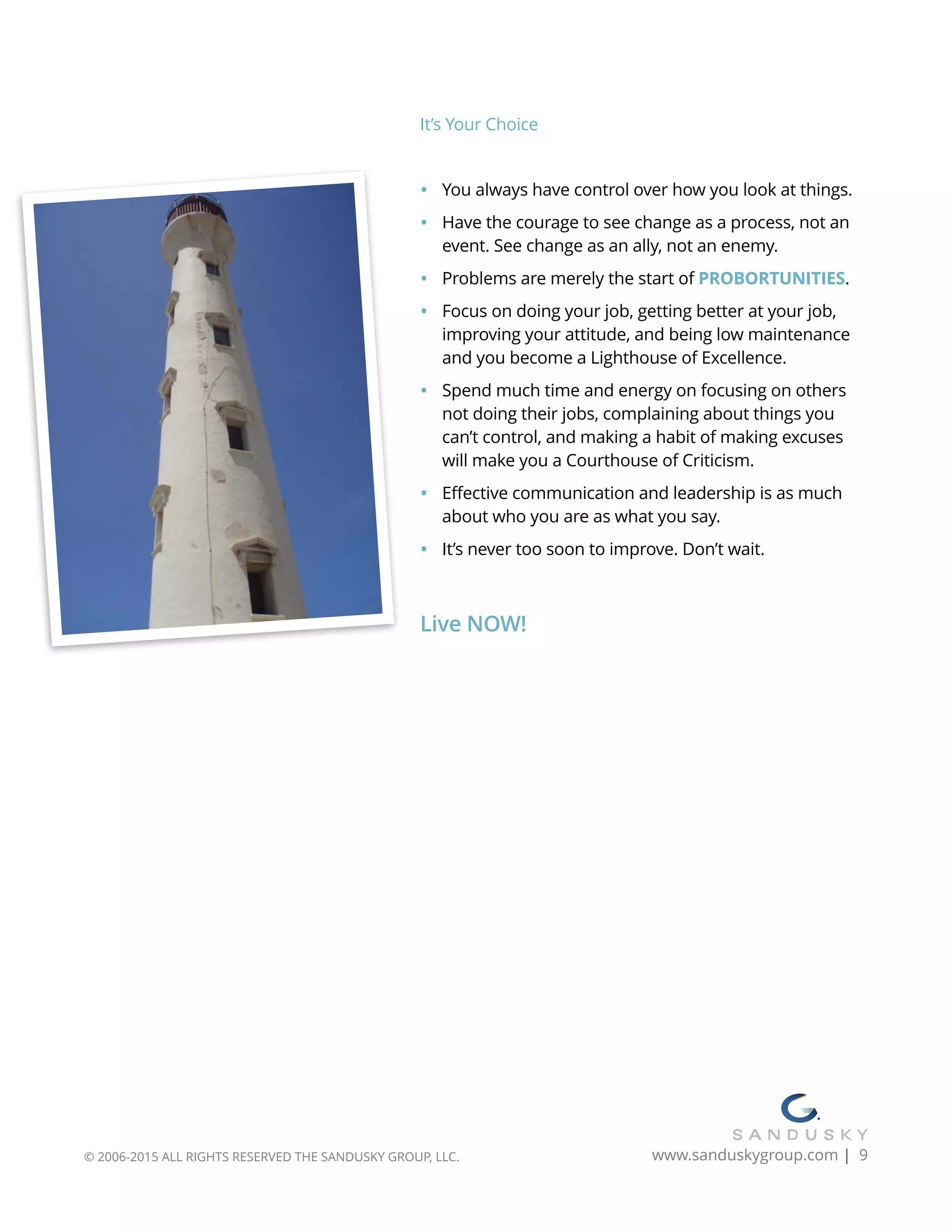
• Focus on doing your job, getting better at your job,
improving your attitude, and being low maintenance
and you become a Lighthouse of Excellence.
• Spend much time and energy on focusing on others
not doing their jobs, complaining about things you
can’t control, and making a habit of making excuses
will make you a Courthouse of Criticism.
• Effective communication and leadership is as much
about who you are as what you say.
• It’s never too soon to improve. Don’t wait.
Live NOW!

© 2006-2015 ALL RIGHTS RESERVED THE SANDUSKY GROUP, LLC. www.sanduskygroup.com | 9
About The 

Sandusky Group
We help our clients shine! We coach, consult, and teach
our clients how to improve their profits, reduce costs,
focus and motivate their organizations, establish and
expand a competitive advantage, increase the power of
the brand, and transform the potential of their career
growth through improved communication skills.
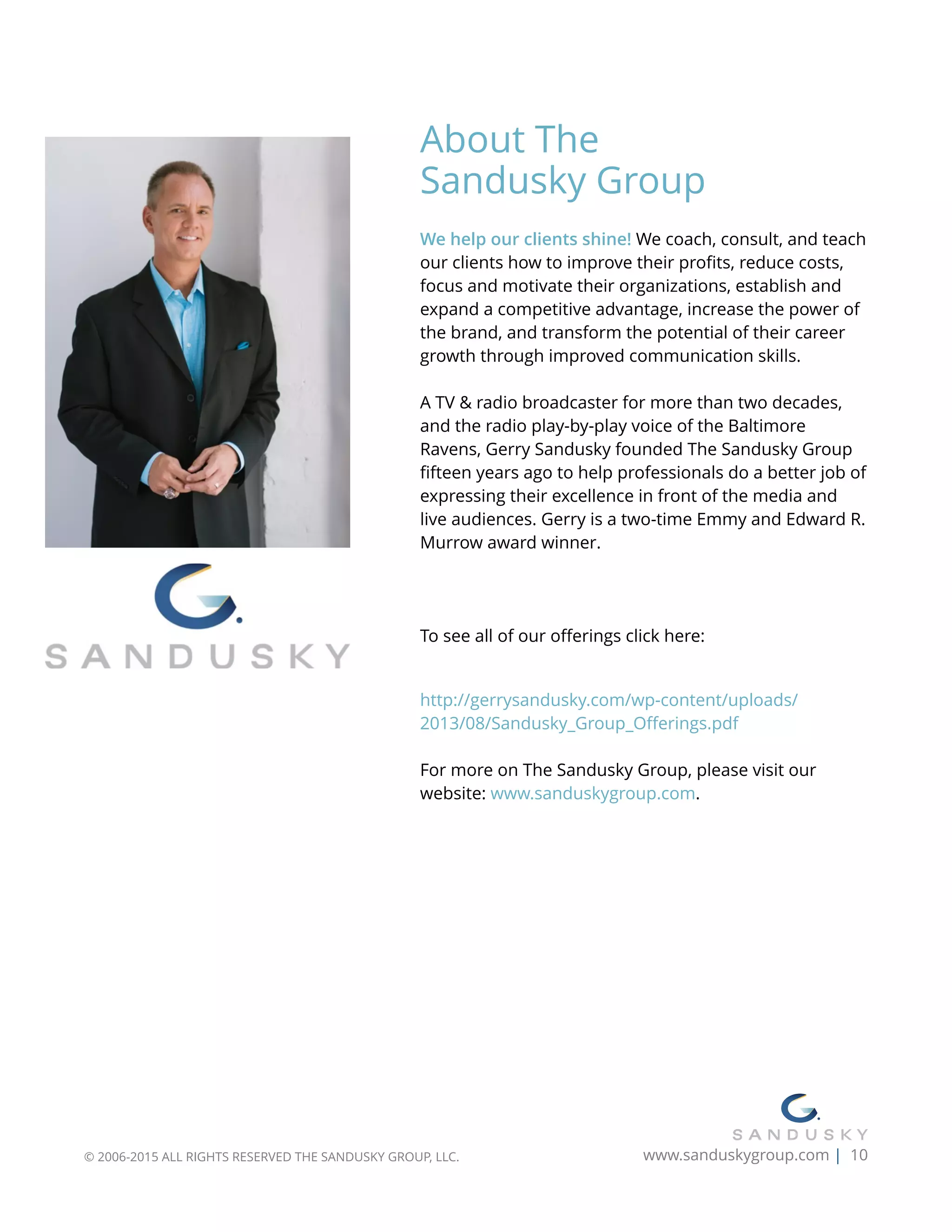
A TV & radio broadcaster for more than two decades,
and the radio play-by-play voice of the Baltimore
Ravens, Gerry Sandusky founded The Sandusky Group
fifteen years ago to help professionals do a better job of
expressing their excellence in front of the media and
live audiences. Gerry is a two-time Emmy and Edward R.
Murrow award winner.
To see all of our offerings click here: 

http://gerrysandusky.com/wp-content/uploads/
2013/08/Sandusky_Group_Offerings.pdf
For more on The Sandusky Group, please visit our
website: www.sanduskygroup.com.
© 2006-2015 ALL RIGHTS RESERVED THE SANDUSKY GROUP, LLC. www.sanduskygroup.com | 10

Keynote Session: A Crooked Yardstick—a Better Way to Measure Winning and Manage Change

  • 1.
    © 2006-2015 ALLRIGHTS RESERVED THE SANDUSKY GROUP, LLC. www.sanduskygroup.com | 1 THE CROOKED YARDSTICK
  • 2.
    The Crooked Yardstick3................................................. 3 Common Crooked Yardsticks 3.................................. Change 4..................................................................... Problems & Opportunities 5.................................... Winning 6.................................................................... The Game Plan 7............................................................. Lighthouse vs Courthouse 8.......................................... About The Sandusky Group 9........................................ © 2006-2015 ALL RIGHTS RESERVED THE SANDUSKY GROUP, LLC. www.sanduskygroup.com | 2 CONTENTS
  • 3.
    The concept ofthe crooked yardstick comes from a phrase my mother used to use: “If you measure material using a crooked yardstick, the clothes you make will look right but the person who tries those clothes on will feel that something isn’t quite right. They won’t know what it is, but they’ll know it isn’t quite right.” Examine not only your results but also how you measure success. 
 
 There are three commonly used crooked yardsticks in most organizations. They deal with how individuals and organizations measure these three areas: Change Problems & Opportunities Winning © 2006-2015 ALL RIGHTS RESERVED THE SANDUSKY GROUP, LLC. www.sanduskygroup.com | 3 THE CROOKED
 YARDSTICK 3 COMMON CROOKED YARDSTICKS
  • 4.
    Change • Change isinevitable and unavoidable. It is a constant for every individual and every organization. • Even if you don’t change, most things around you do change. • Most people only celebrate change once a year—on New Year’s Eve. • How much more effective would you be as a person and a professional if you took the attitude you have about change every New Year’s Eve into the other 364 days in a year? • Five phases we all pass through when dealing with change: 1. Disbelief 2. Anger 3. Uncertainty 4. Acceptance 5. Integration • Innovation = Change • The real challenge we face as leaders isn’t innovation. It’s shortening the cycle from innovation to integration. © 2006-2015 ALL RIGHTS RESERVED THE SANDUSKY GROUP, LLC. www.sanduskygroup.com | 4
  • 5.
    Problems & Opportunities •Most people and organizations see problems and opportunities as distinct, different, and unrelated. • Look at the last five letters of the word Opportunity. U-N-I-T-Y. Unity. I believe it represents a unity with problems. • Problems and Opportunities are two points on the same spectrum. Attitude connects them. • Winston Churchill: “An optimist is someone who sees the opportunity in every problem; a pessimist is someone who sees the problem in every opportunity.” Which are you? • With the right attitude you will see problems lead to opportunities—they exist together. • That is PROBORTUNITY thinking. • Wayne Dyer: “When you change the way you look at things, the things you look at change.” • The Heisenberg Uncertainty Principle: Our observations have an effect on the behavior of the thing we’re observing. • With Probortunity thinking you are no longer the effect of problems, rather you are the cause of opportunities. Be Cause! © 2006-2015 ALL RIGHTS RESERVED THE SANDUSKY GROUP, LLC. www.sanduskygroup.com | 5
  • 6.
    Winning • “Winning isn’teverything; it’s the only thing.” 
 —Vince Lombardi 


 • Lombardi wasn’t just talking about the outcome of games. He was also talking about the input of every day efforts. • Winning is as much about approach as results. • John Wooden taught his players how to put their socks on correctly to send an important message: Do the little things the correct way this day and every day and a big thing like winning a game will take care of itself.
 Change your time perspective to very short and very long • See winning as a function of what is right in front of you right now. • The Ravens have a slogan: W.I.N. What’s Important Now? • See winning as something you will do not just next quarter or next year but next legacy too. Winning is about approach too • The Five Questions • Who are you? • Where have you been? • How long have you been there? • Where are you going? • How will you get there? © 2006-2015 ALL RIGHTS RESERVED THE SANDUSKY GROUP, LLC. www.sanduskygroup.com | 6
  • 7.
    • Question oneis your identity, your essence, the core of what makes you unique, special, and authentic. • Questions three and four deal with your history. • Question four is about your vision. • Question five is your action play, your game plan The Game Plan • When you build your action plan, your game plan remember the relationship between vision and action: • Vision without action is the time we waste our potential; action without vision is the potential waste of our time. • Build your plan around what your team understands and believes in. • The more your team believes you understand them, the easier it is to get them to believe in and understand you.
 © 2006-2015 ALL RIGHTS RESERVED THE SANDUSKY GROUP, LLC. www.sanduskygroup.com | 7
  • 8.
    Four Types ofLeaders • There are four types of leaders: • The Outhouse • The Greenhouse • The Courthouse • The Lighthouse The Outhouse • Toxic, selfish, full of you know what • Sees only problems • The kind of person you want to stay out of their way The Greenhouse • The nurturer, the helper, the coach • Sees the potential in others • The kind of person who helps others on their way The Courthouse • The righteous, the rule follower, the law giver • Sees himself or herself as superior • The kind of person who shows others the error of their way The Lighthouse • The role model, leader, mentor • Unselfish, unwavering, committed • The kind of person who shows others the way © 2006-2015 ALL RIGHTS RESERVED THE SANDUSKY GROUP, LLC. www.sanduskygroup.com | 8 CONCLUSIONS
  • 9.
    It’s Your Choice •You always have control over how you look at things. • Have the courage to see change as a process, not an event. See change as an ally, not an enemy. • Problems are merely the start of PROBORTUNITIES. • Focus on doing your job, getting better at your job, improving your attitude, and being low maintenance and you become a Lighthouse of Excellence. • Spend much time and energy on focusing on others not doing their jobs, complaining about things you can’t control, and making a habit of making excuses will make you a Courthouse of Criticism. • Effective communication and leadership is as much about who you are as what you say. • It’s never too soon to improve. Don’t wait. Live NOW!
 © 2006-2015 ALL RIGHTS RESERVED THE SANDUSKY GROUP, LLC. www.sanduskygroup.com | 9
  • 10.
    About The 
 SanduskyGroup We help our clients shine! We coach, consult, and teach our clients how to improve their profits, reduce costs, focus and motivate their organizations, establish and expand a competitive advantage, increase the power of the brand, and transform the potential of their career growth through improved communication skills. A TV & radio broadcaster for more than two decades, and the radio play-by-play voice of the Baltimore Ravens, Gerry Sandusky founded The Sandusky Group fifteen years ago to help professionals do a better job of expressing their excellence in front of the media and live audiences. Gerry is a two-time Emmy and Edward R. Murrow award winner. To see all of our offerings click here: 
 http://gerrysandusky.com/wp-content/uploads/ 2013/08/Sandusky_Group_Offerings.pdf For more on The Sandusky Group, please visit our website: www.sanduskygroup.com. © 2006-2015 ALL RIGHTS RESERVED THE SANDUSKY GROUP, LLC. www.sanduskygroup.com | 10