The Disk Method
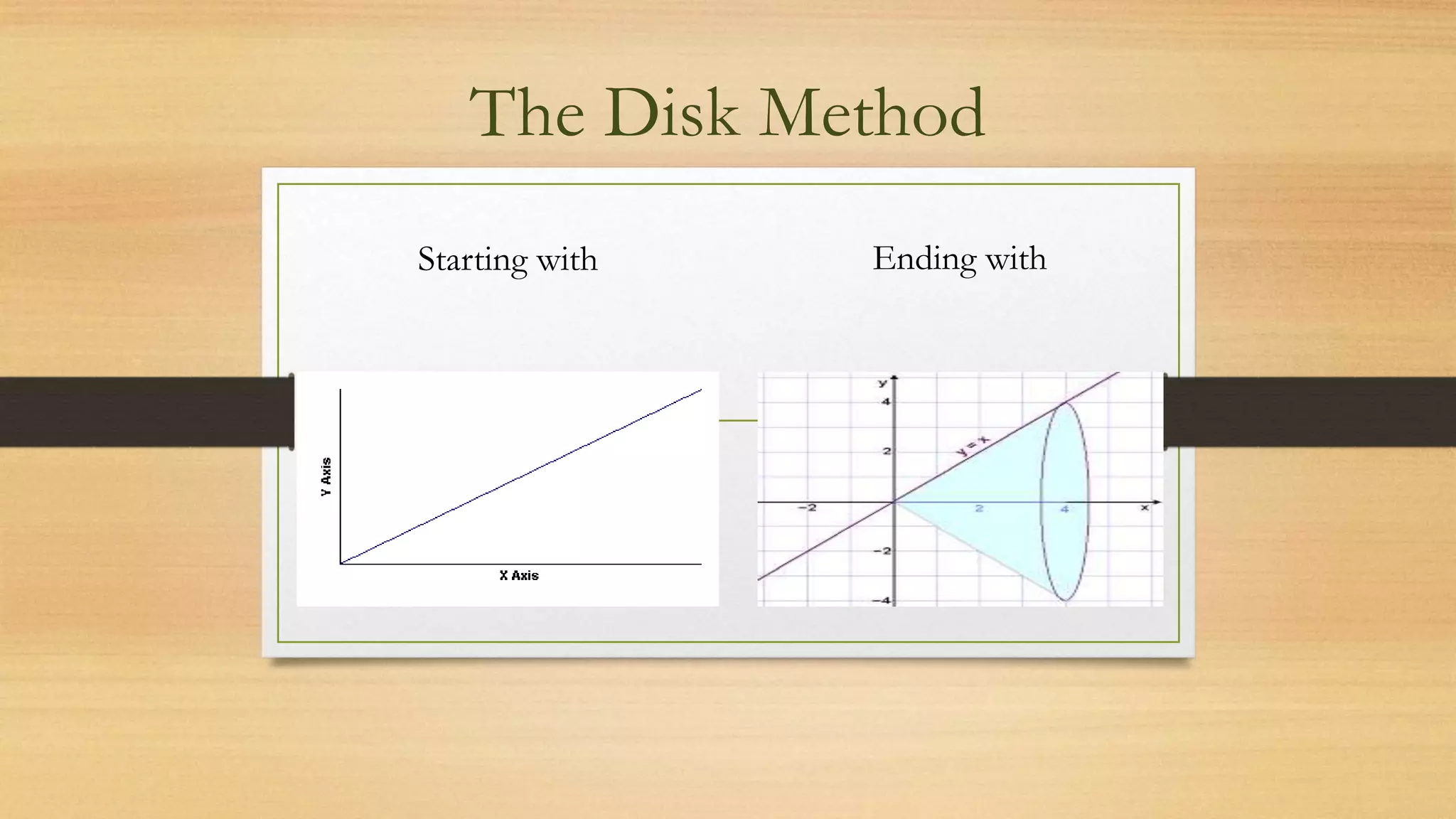
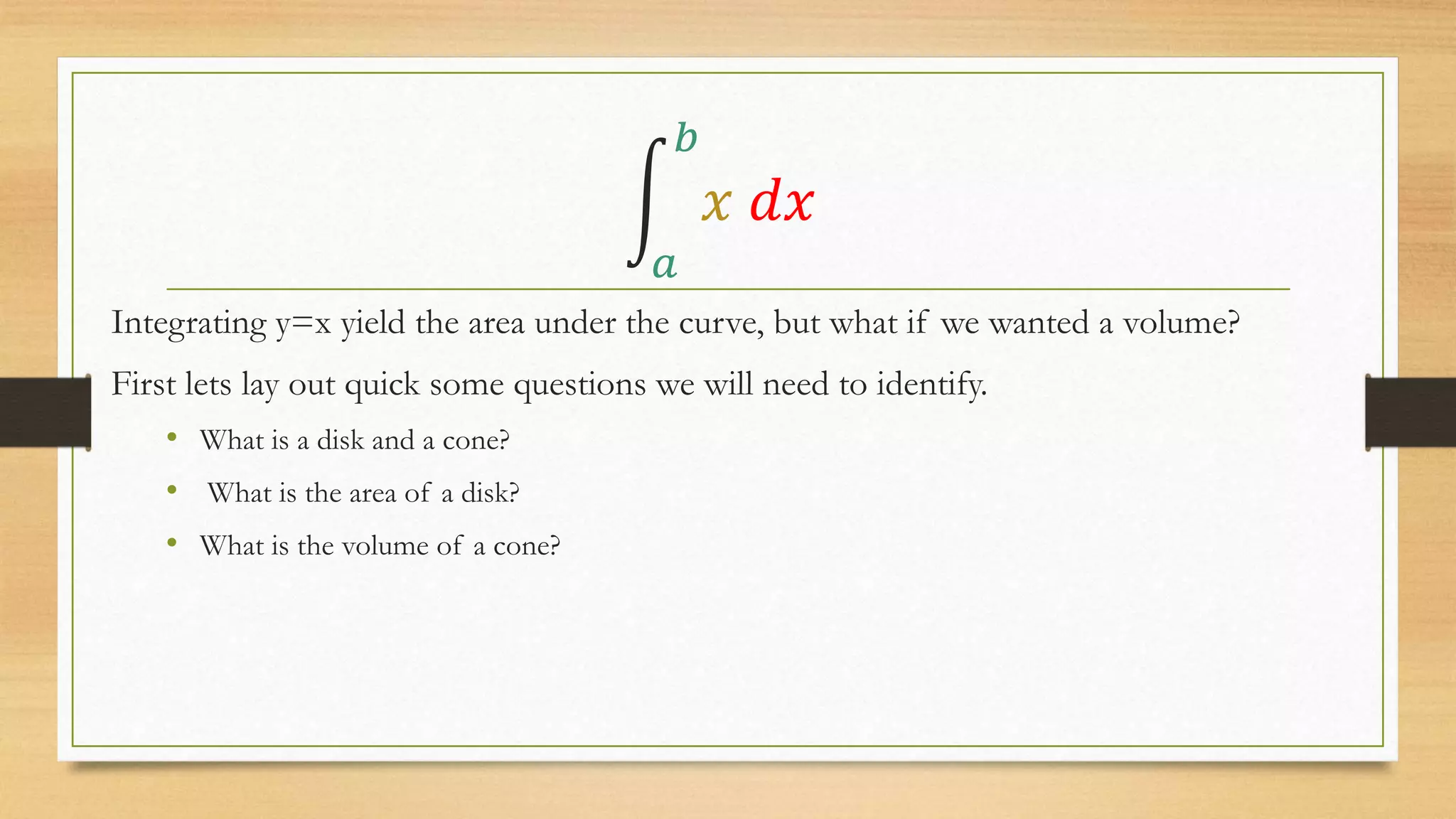
Starting with Ending with
𝑎
𝑏
𝑥 𝑑𝑥
Integrating y=x yield the area under the curve, but what if we wanted a volume?
First lets lay out quick some questions we will need to identify.
• What is a disk and a cone?
• What is the area of a disk?
• What is the volume of a cone?
The Disk!
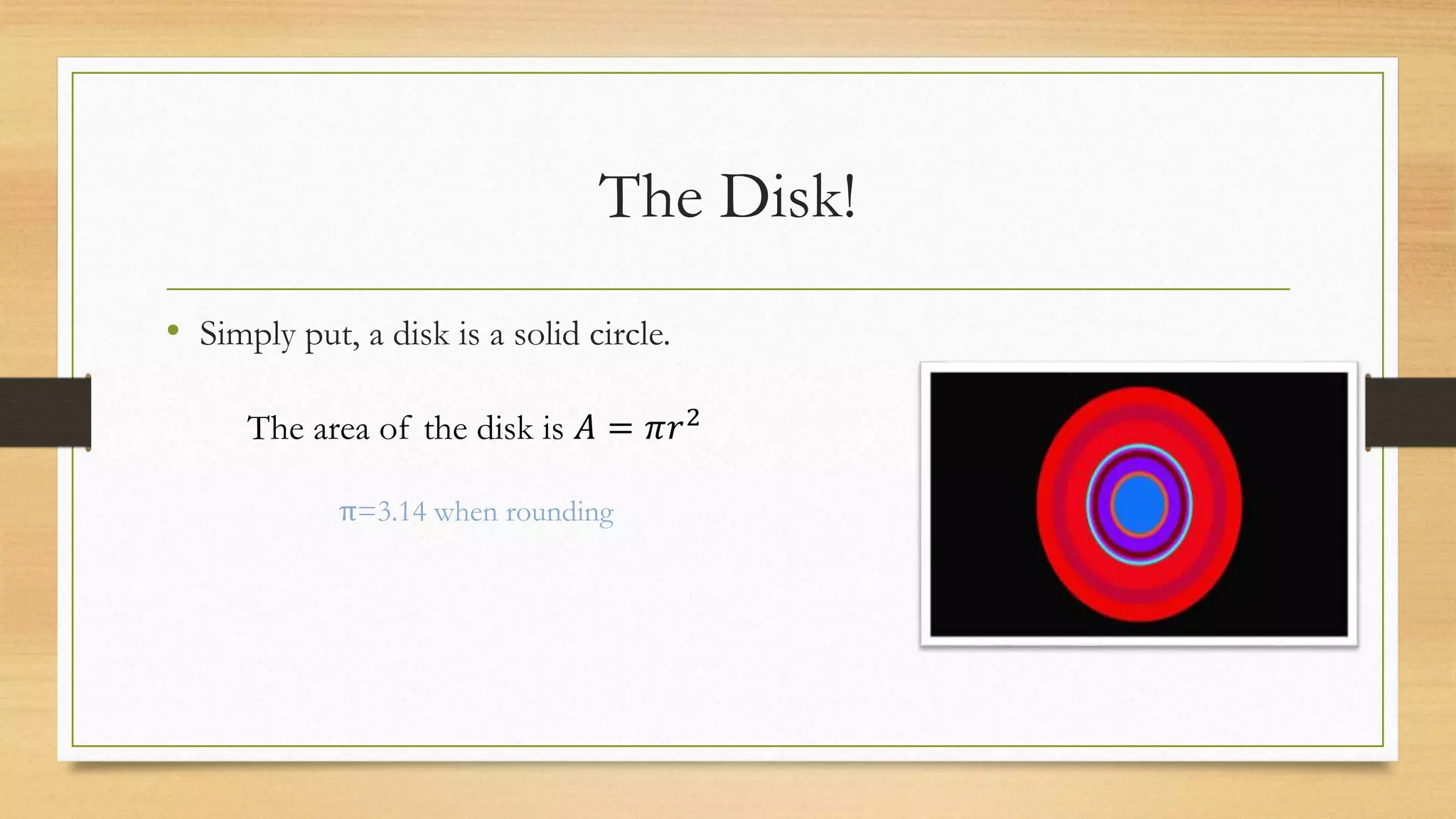
• Simply put, a disk is a solid circle.
The area of the disk is 𝐴 = 𝜋𝑟2
π=3.14 when rounding
The Cone!
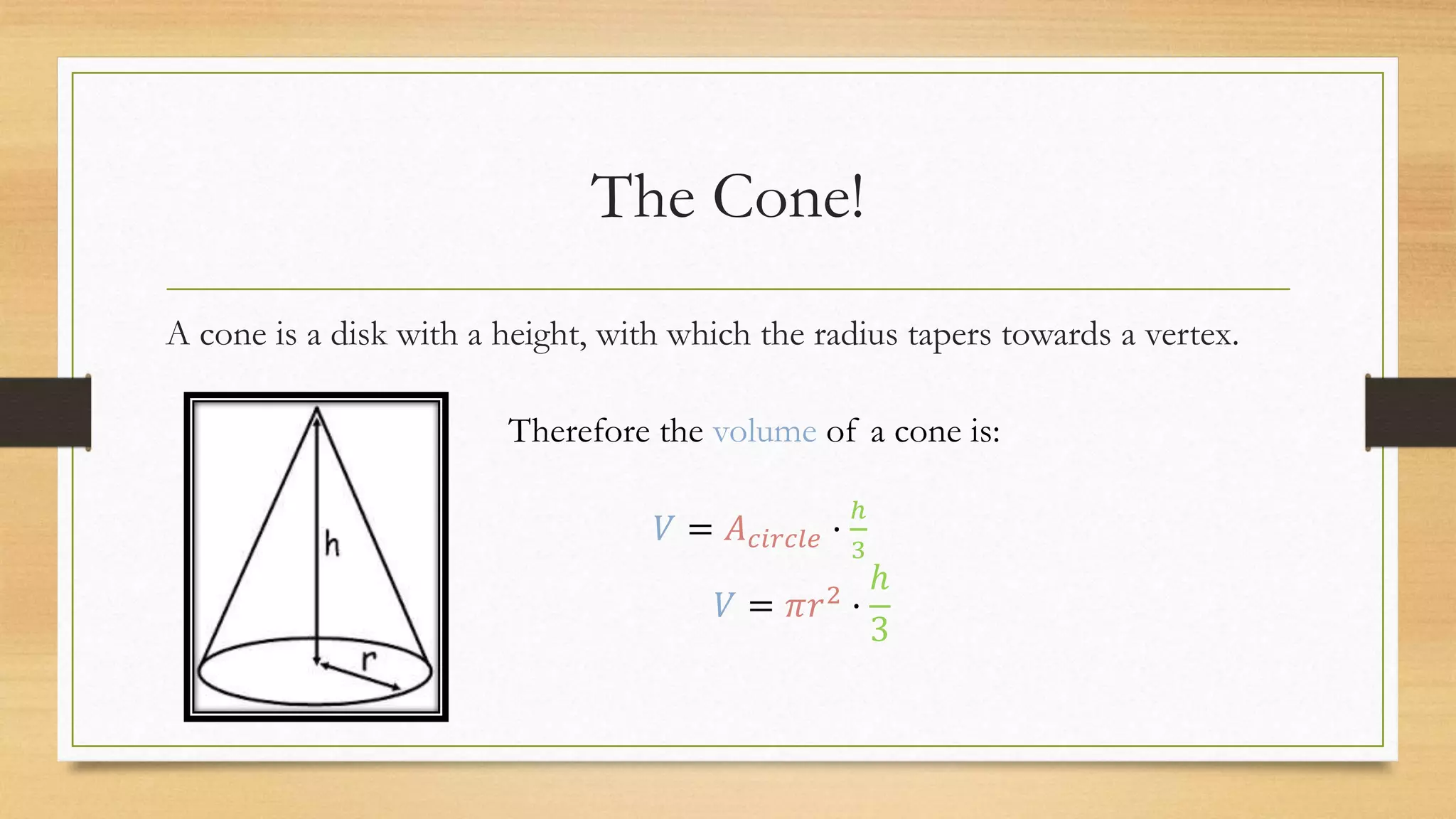
A cone is a disk with a height, with which the radius tapers towards a vertex.
Therefore the volume of a cone is:
𝑉 = 𝐴 𝑐𝑖𝑟𝑐𝑙𝑒 ·
ℎ
3
𝑉 = 𝜋𝑟2 ·
ℎ
3
Better Call Sal
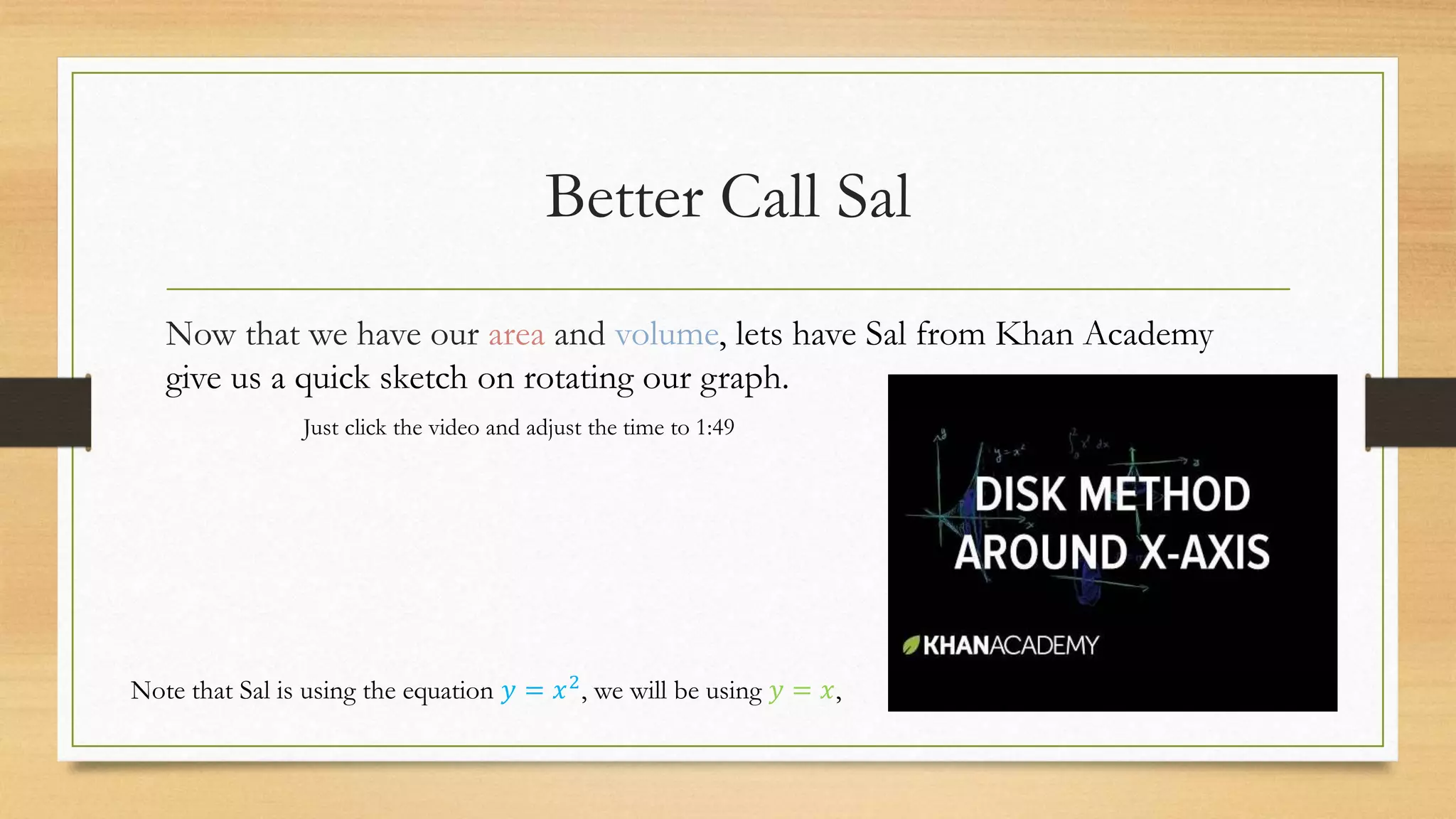
Now that we have our area and volume, lets have Sal from Khan Academy
give us a quick sketch on rotating our graph.
Note that Sal is using the equation 𝑦 = 𝑥2, we will be using 𝑦 = 𝑥,
Just click the video and adjust the time to 1:49
Creating our Disk Equation
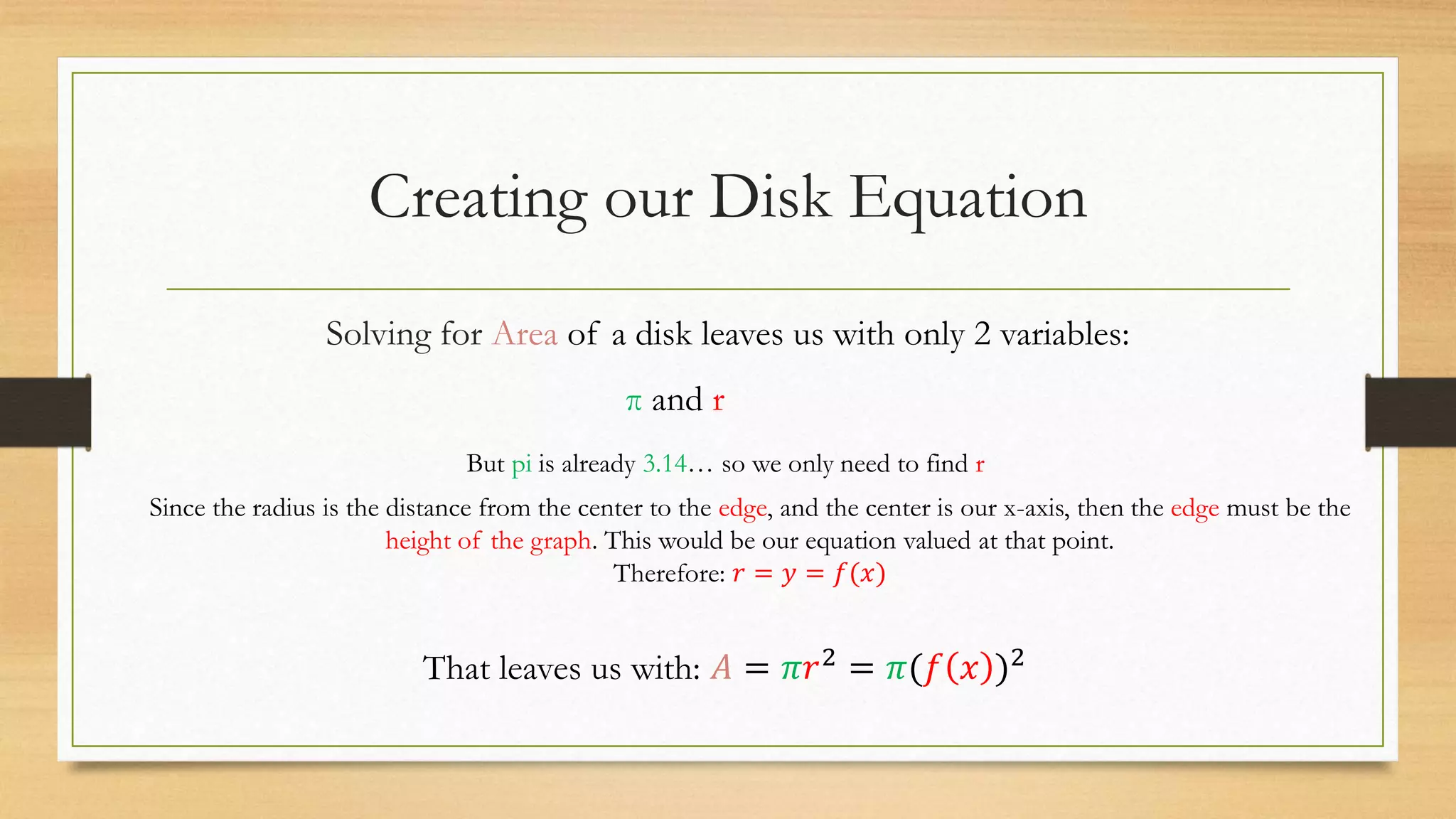
Solving for Area of a disk leaves us with only 2 variables:
π and r
But pi is already 3.14… so we only need to find r
Since the radius is the distance from the center to the edge, and the center is our x-axis, then the edge must be the
height of the graph. This would be our equation valued at that point.
Therefore: 𝑟 = 𝑦 = 𝑓(𝑥)
That leaves us with: 𝐴 = 𝜋𝑟2
= 𝜋(𝑓 𝑥 )2
How Many Disks are in a Cone?
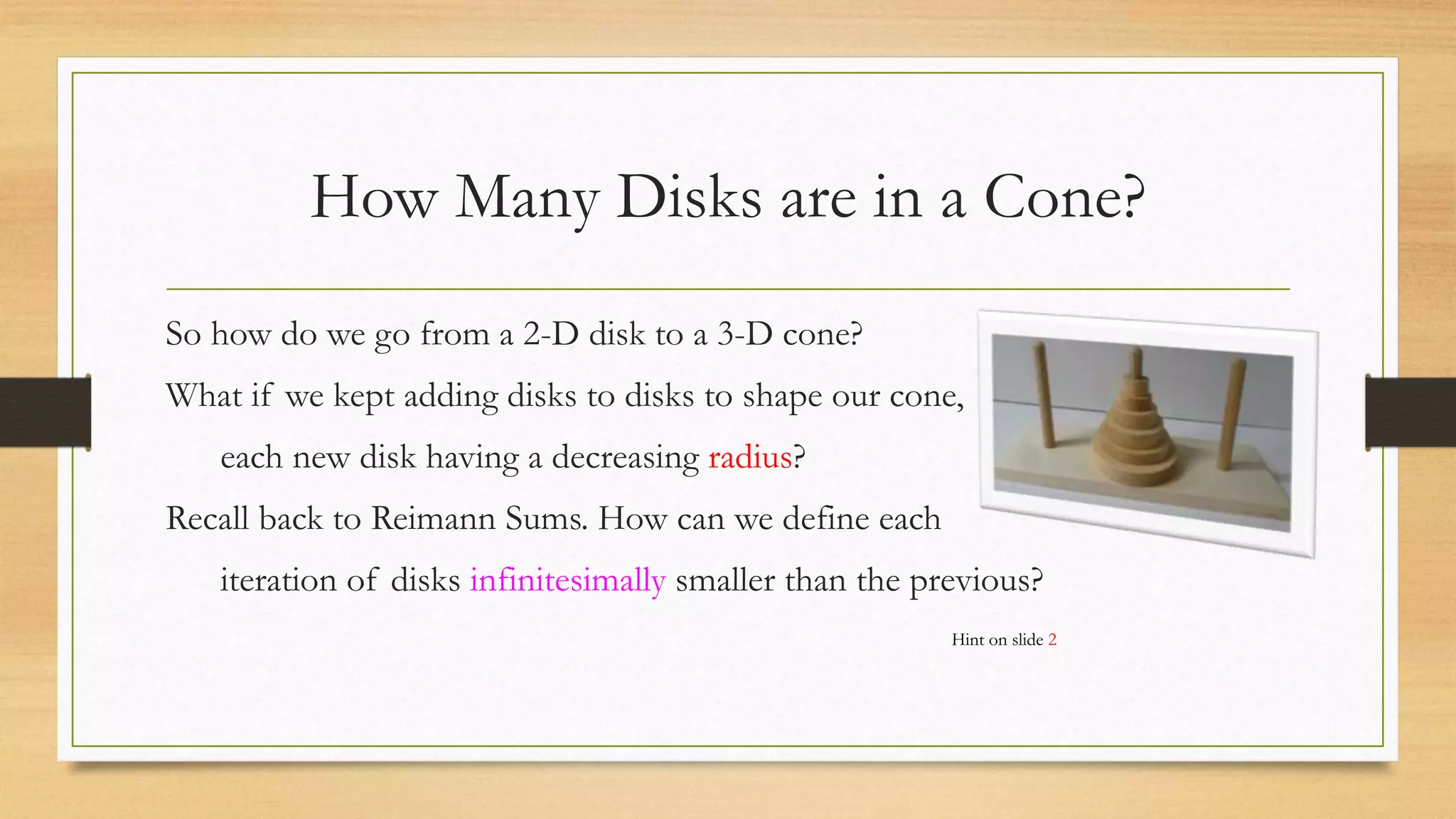
So how do we go from a 2-D disk to a 3-D cone?
What if we kept adding disks to disks to shape our cone,
each new disk having a decreasing radius?
Recall back to Reimann Sums. How can we define each
iteration of disks infinitesimally smaller than the previous?
Hint on slide 2
The Integrand, dx, and You.
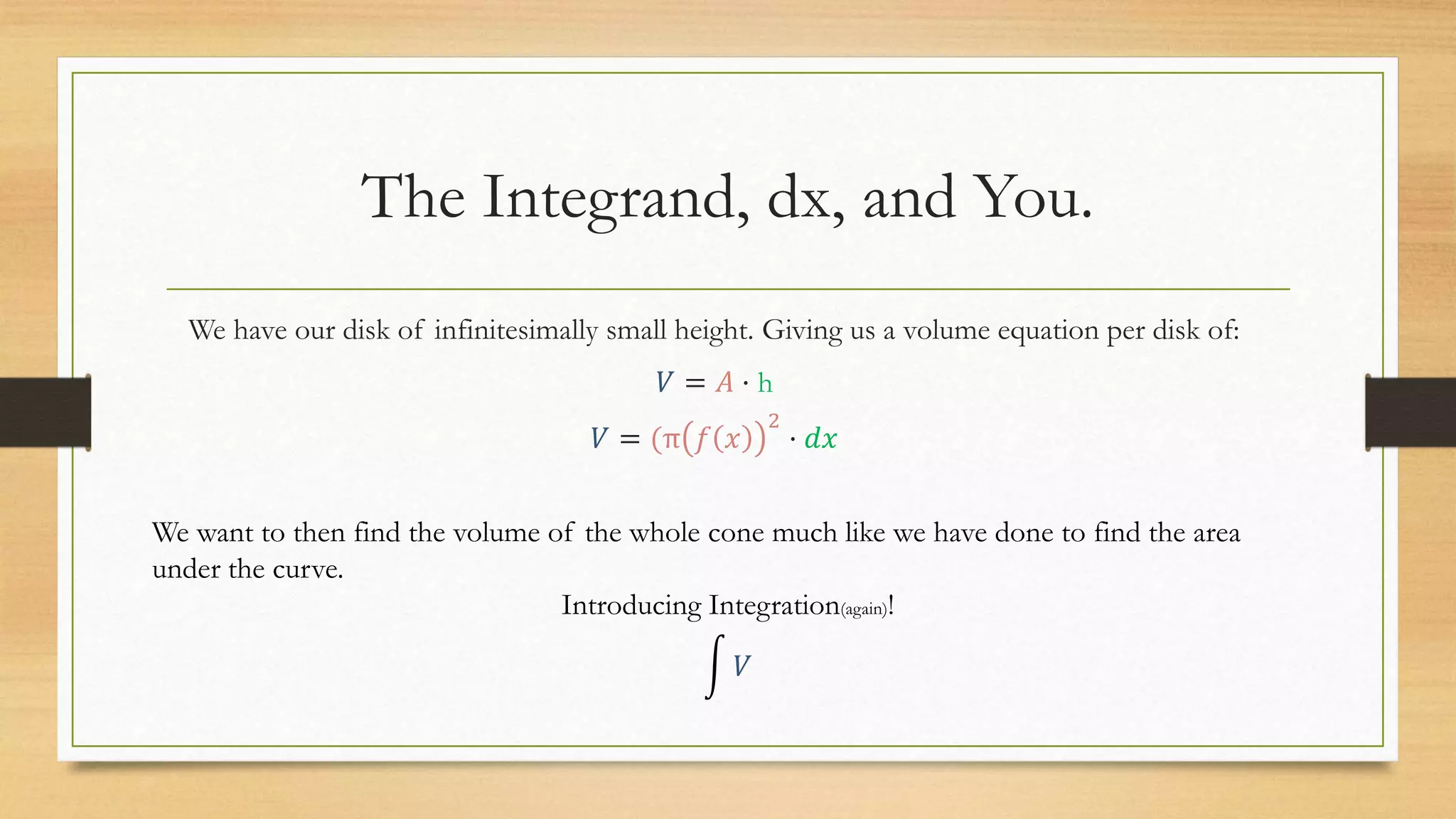
We have our disk of infinitesimally small height. Giving us a volume equation per disk of:
𝑉 = 𝐴 · h
𝑉 = (π 𝑓 𝑥
2
· 𝑑𝑥
We want to then find the volume of the whole cone much like we have done to find the area
under the curve.
Introducing Integration(again)!
𝑉
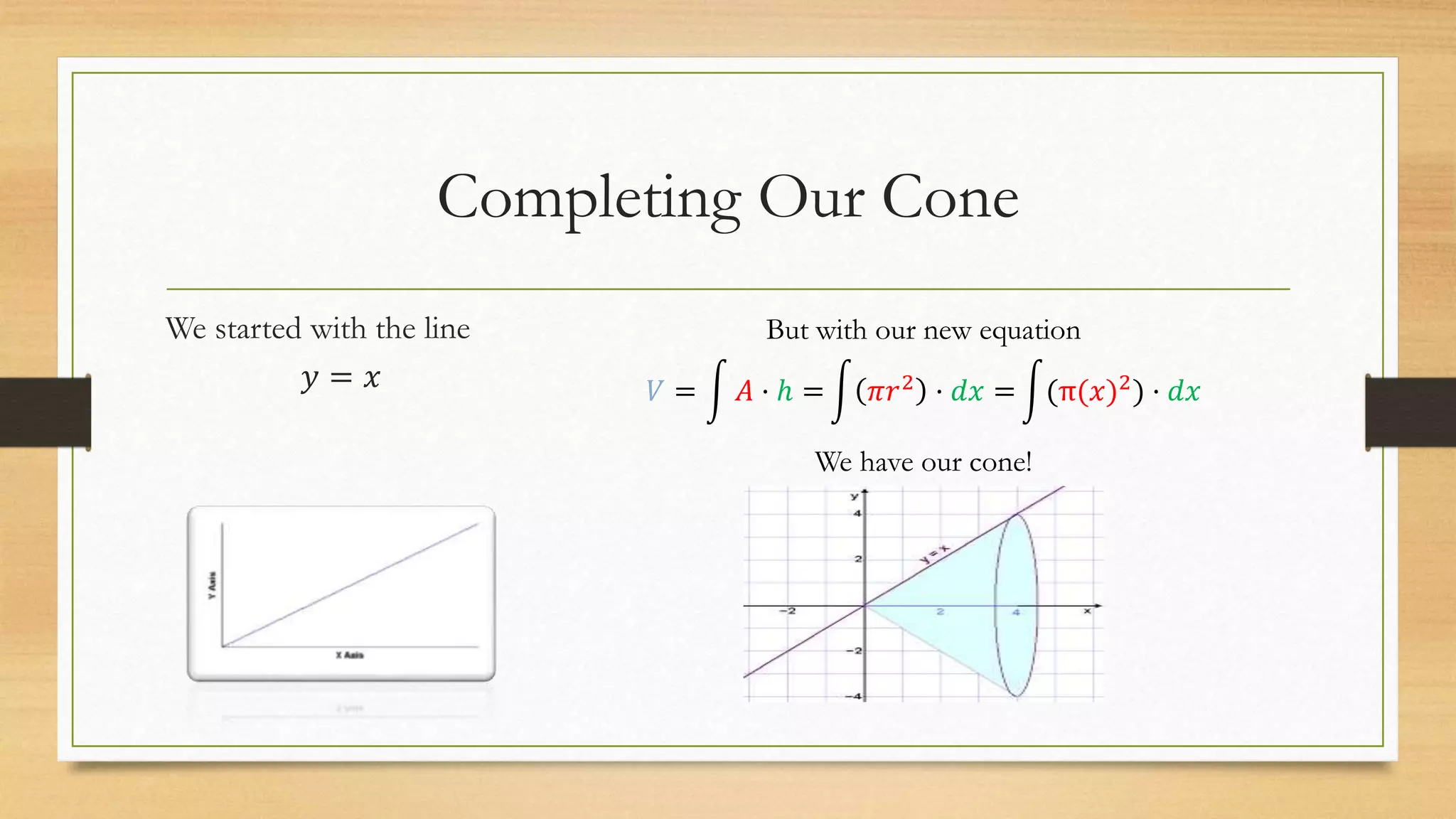
Completing Our Cone
We started with the line
𝑦 = 𝑥
But with our new equation
𝑉 = 𝐴 · ℎ = 𝜋𝑟2
· 𝑑𝑥 = (π(𝑥)2
) · 𝑑𝑥
We have our cone!
Summary and…
V= ʃA*h
A= π*r^2
r= f(x)
h= dx
Formula Cheat Sheet
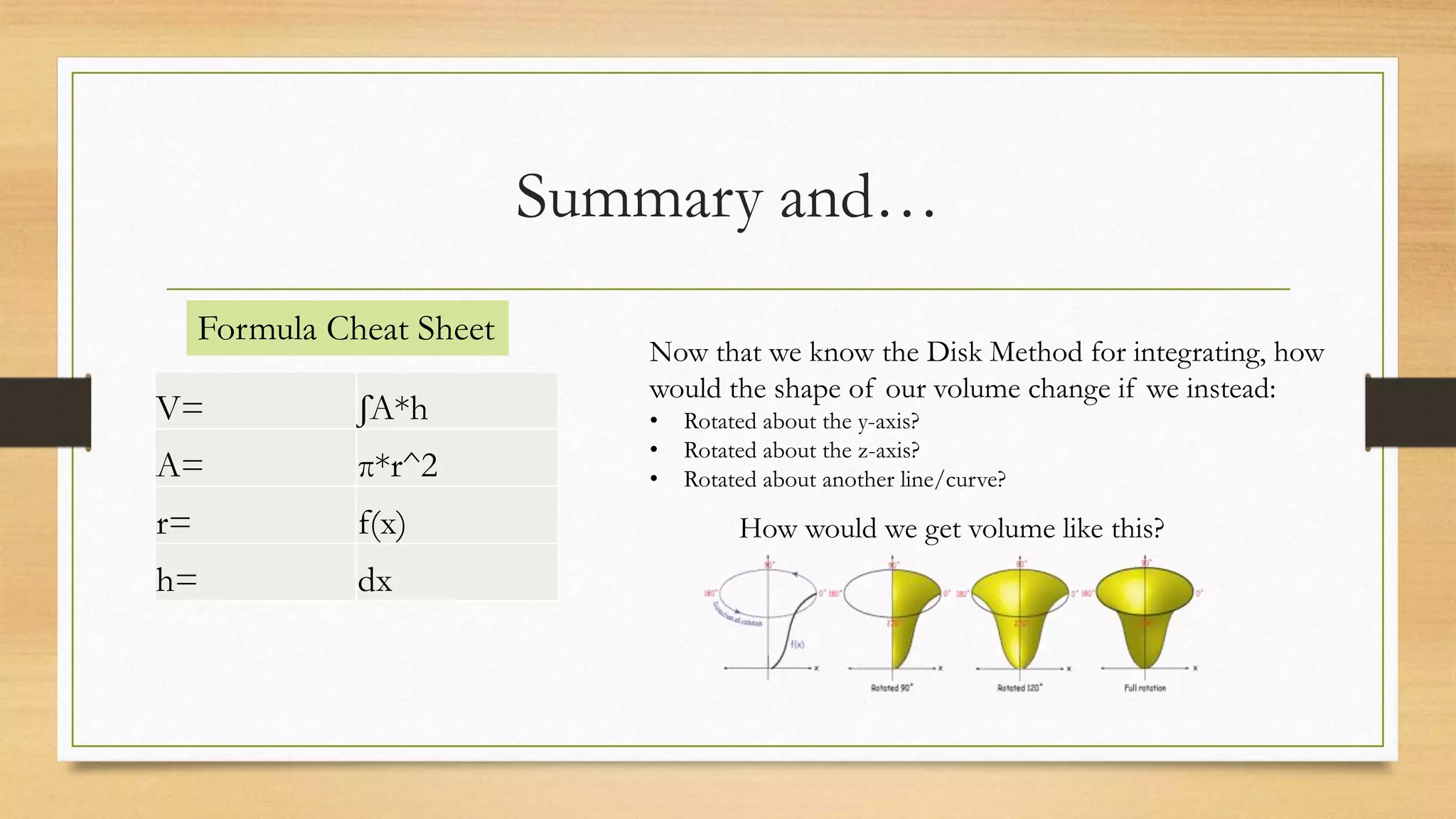
Now that we know the Disk Method for integrating, how
would the shape of our volume change if we instead:
• Rotated about the y-axis?
• Rotated about the z-axis?
• Rotated about another line/curve?
How would we get volume like this?

The Disk Method

  • 1.
    The Disk Method Startingwith Ending with
  • 2.
    𝑎 𝑏 𝑥 𝑑𝑥 Integrating y=xyield the area under the curve, but what if we wanted a volume? First lets lay out quick some questions we will need to identify. • What is a disk and a cone? • What is the area of a disk? • What is the volume of a cone?
  • 3.
    The Disk! • Simplyput, a disk is a solid circle. The area of the disk is 𝐴 = 𝜋𝑟2 π=3.14 when rounding
  • 4.
    The Cone! A coneis a disk with a height, with which the radius tapers towards a vertex. Therefore the volume of a cone is: 𝑉 = 𝐴 𝑐𝑖𝑟𝑐𝑙𝑒 · ℎ 3 𝑉 = 𝜋𝑟2 · ℎ 3
  • 5.
    Better Call Sal Nowthat we have our area and volume, lets have Sal from Khan Academy give us a quick sketch on rotating our graph. Note that Sal is using the equation 𝑦 = 𝑥2, we will be using 𝑦 = 𝑥, Just click the video and adjust the time to 1:49
  • 6.
    Creating our DiskEquation Solving for Area of a disk leaves us with only 2 variables: π and r But pi is already 3.14… so we only need to find r Since the radius is the distance from the center to the edge, and the center is our x-axis, then the edge must be the height of the graph. This would be our equation valued at that point. Therefore: 𝑟 = 𝑦 = 𝑓(𝑥) That leaves us with: 𝐴 = 𝜋𝑟2 = 𝜋(𝑓 𝑥 )2
  • 7.
    How Many Disksare in a Cone? So how do we go from a 2-D disk to a 3-D cone? What if we kept adding disks to disks to shape our cone, each new disk having a decreasing radius? Recall back to Reimann Sums. How can we define each iteration of disks infinitesimally smaller than the previous? Hint on slide 2
  • 8.
    The Integrand, dx,and You. We have our disk of infinitesimally small height. Giving us a volume equation per disk of: 𝑉 = 𝐴 · h 𝑉 = (π 𝑓 𝑥 2 · 𝑑𝑥 We want to then find the volume of the whole cone much like we have done to find the area under the curve. Introducing Integration(again)! 𝑉
  • 9.
    Completing Our Cone Westarted with the line 𝑦 = 𝑥 But with our new equation 𝑉 = 𝐴 · ℎ = 𝜋𝑟2 · 𝑑𝑥 = (π(𝑥)2 ) · 𝑑𝑥 We have our cone!
  • 10.
    Summary and… V= ʃA*h A=π*r^2 r= f(x) h= dx Formula Cheat Sheet Now that we know the Disk Method for integrating, how would the shape of our volume change if we instead: • Rotated about the y-axis? • Rotated about the z-axis? • Rotated about another line/curve? How would we get volume like this?