Eric E. Packel, Andrew Cripe, Daniel L. Farris, Scott M.
Gilbert, Matt Todd
Diamond Datascram Diaries:
Diamond Datascram Development
Datascram Development
• General Privacy Issues
• Internal Issues and Risks
• Product and Customer Privacy Issues and Strategies
• Protecting the program
• Patent?
• Copyright?
• Trademark?
• Trade Secret
• The Human Resources System
• Employment Agreements and Restrictive Covenant Drafting
Press Release
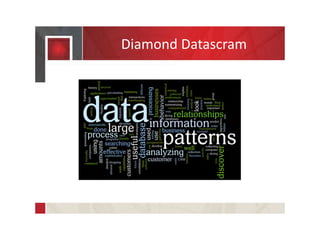
Tech Expert Launches Diamond Datascram
Skokie, IL, March 1, 2017/Newswire/--
Diamond Datascram, founded by nationally honored software developer Damien
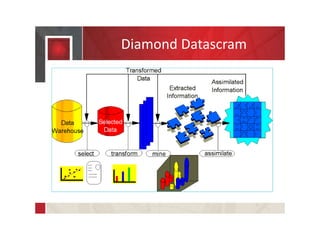
Diamond, announces the launch of Datascram™. Datascram is an amazing new
software solution which identifies and prioritizes data, providing businesses with a
summary of outdated or unnecessary data which then can be easily and permanently
deleted or moved offsite. Analysis and surveys show that 52% of information stored
by organizations is considered dark data whose value is not known. Another 33% of
data is essentially obsolete or redundant. Datascram pulls information from the
business’ systems, applies algorithms and removes or culls that redundant and dark
data.
Make data scram. Forever
The Company is based in Skokie, IL but intends to operate nationwide.
Diamond Datascram
Diamond Datascram
Overview of Privacy Issues
For Technology-Enabled Companies:
 Internal Privacy & Security Compliance
– Personnel
– Customer Data
– Intellectual Property Protection
 Product/Customer Privacy & Security Considerations
– Privacy By Design
– Customer Compliance
Internal Privacy Issues
 Privacy Program Development
– Security Program
– Personnel Data
– Industry Regulations/Standards Compliance (HIPAA, ISO, NIST, PCI)
– Multinational Regimes (EU – GDPR, Privacy Shield, APAC, etc.)
– Vendor Management
 Initial Steps
– Gap Analysis/Privacy Assessment
– Policy Development
– Employee Training
– Exercises and Audits
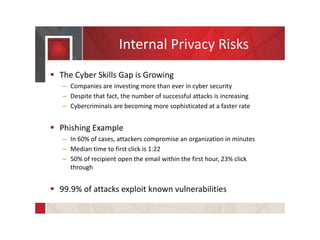
Internal Privacy Risks
 The Cyber Skills Gap is Growing
– Companies are investing more than ever in cyber security
– Despite that fact, the number of successful attacks is increasing
– Cybercriminals are becoming more sophisticated at a faster rate
 Phishing Example
– In 60% of cases, attackers compromise an organization in minutes
– Median time to first click is 1:22
– 50% of recipient open the email within the first hour, 23% click
through
 99.9% of attacks exploit known vulnerabilities
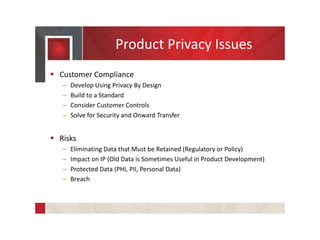
Product Privacy Issues
 Customer Compliance
– Develop Using Privacy By Design
– Build to a Standard
– Consider Customer Controls
– Solve for Security and Onward Transfer
 Risks
– Eliminating Data that Must be Retained (Regulatory or Policy)
– Impact on IP (Old Data is Sometimes Useful in Product Development)
– Protected Data (PHI, PII, Personal Data)
– Breach
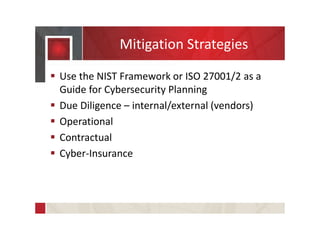
Mitigation Strategies
 Use the NIST Framework or ISO 27001/2 as a
Guide for Cybersecurity Planning
 Due Diligence – internal/external (vendors)
 Operational
 Contractual
 Cyber-Insurance
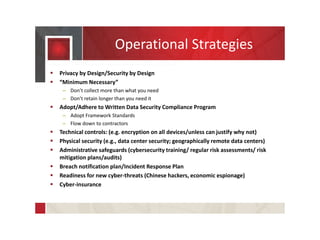
Operational Strategies
 Privacy by Design/Security by Design
 “Minimum Necessary”
– Don’t collect more than what you need
– Don’t retain longer than you need it
 Adopt/Adhere to Written Data Security Compliance Program
– Adopt Framework Standards
– Flow down to contractors
 Technical controls: (e.g. encryption on all devices/unless can justify why not)
 Physical security (e.g., data center security; geographically remote data centers)
 Administrative safeguards (cybersecurity training/ regular risk assessments/ risk
mitigation plans/audits)
 Breach notification plan/Incident Response Plan
 Readiness for new cyber-threats (Chinese hackers, economic espionage)
 Cyber-insurance
The Datascram Program
What protections apply?
• Patent?
• Trademark?
• Copyright?
• Trade Secret
High Level Distinctions
Patents:
• Limited duration property right
• Related to invention
• Granted by U.S. Patent and Trademark Office
• Public disclosure after grant
Protectable Materials for
Patents
• Machines
• Manufactured articles
• Industrial processes
• Chemical compositions
Trademarks
• Word, phrase, symbol, design
• Distinguishes and identifies the source of
goods from one party to another
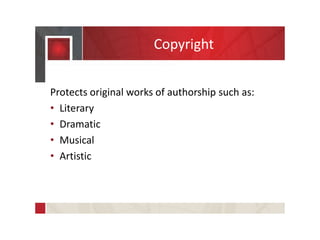
Copyright
Protects original works of authorship such as:
• Literary
• Dramatic
• Musical
• Artistic
Patent Protection
• Authority for patents
• Patent process
• Applicability to a situation
17
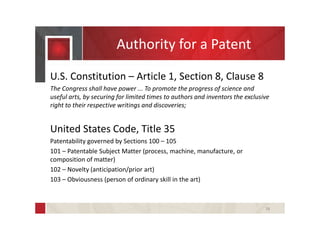
Authority for a Patent
U.S. Constitution – Article 1, Section 8, Clause 8
The Congress shall have power ... To promote the progress of science and
useful arts, by securing for limited times to authors and inventors the exclusive
right to their respective writings and discoveries;
United States Code, Title 35
Patentability governed by Sections 100 – 105
101 – Patentable Subject Matter (process, machine, manufacture, or
composition of matter)
102 – Novelty (anticipation/prior art)
103 – Obviousness (person of ordinary skill in the art)
18
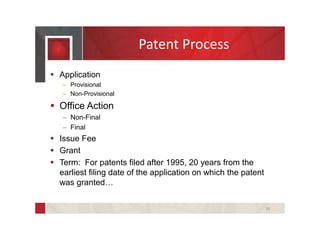
 Application
– Provisional
– Non-Provisional
 Office Action
– Non-Final
– Final
 Issue Fee
 Grant
 Term: For patents filed after 1995, 20 years from the
earliest filing date of the application on which the patent
was granted…
19
Patent Process
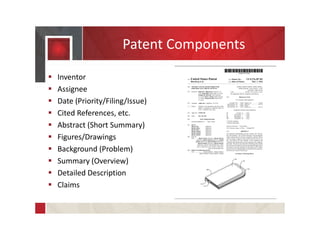
Patent Components
 Inventor
 Assignee
 Date (Priority/Filing/Issue)
 Cited References, etc.
 Abstract (Short Summary)
 Figures/Drawings
 Background (Problem)
 Summary (Overview)
 Detailed Description
 Claims
The Human Resources System
 An Effective “Human Resources System” starts with
comprehensive Workforce Visibility
– Employees and Owners
– Interns (or, “Interns”/free labor)
– Contingent Workers
– Consultants, Independent Contractors & Vendors
 Adopt scalable and practical approach (the system needs to
grow with the Company)
 Consider the “Terms and Conditions” applicable to all
Company “Human Resources”
– Legal duties & classifications (FLSA, tax code, etc.)
– Non-Employee agreement terms critical
Workforce Policies
 Why/When Written Policies?
 What Must You Include?
 What Needs Updating—and Why?
Written Policies? The Basics
 Define Expectations/Culture
 Help Avoid Certain Contract Claims
 Can Help Provide A Good Defense
 Comply with Law
Certain Policies are “Musts”
 Anti-Harassment/EEO/anti-retaliation
 FMLA
 Confidentiality
 Open Door/Hotline
 Drug/Alcohol
 No Right to Privacy/Monitoring
 Wages/TO
 “Musts” expand with Company
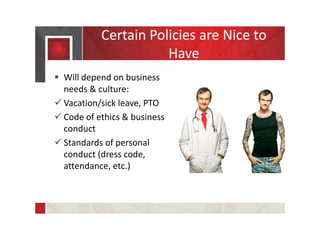
Certain Policies are Nice to
Have
 Will depend on business
needs & culture:
 Vacation/sick leave, PTO
 Code of ethics & business
conduct
 Standards of personal
conduct (dress code,
attendance, etc.)
The times they are a-changing
 Firearms policies
 Social media policies
 Workplace violence prevention (and domestic
violence leave)
 Drug testing and medical or legal marijuana
 Compliance complaint and investigations
processes & hotlines (a challenge at start up!)
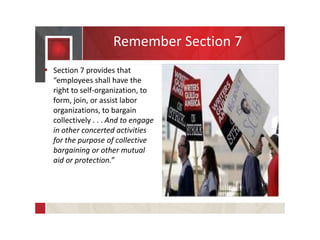
Remember Section 7
 Section 7 provides that
“employees shall have the
right to self-organization, to
form, join, or assist labor
organizations, to bargain
collectively . . . And to engage
in other concerted activities
for the purpose of collective
bargaining or other mutual
aid or protection.”
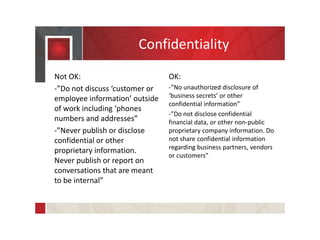
Confidentiality
Not OK:
-”Do not discuss ‘customer or
employee information’ outside
of work including ‘phones
numbers and addresses”
-”Never publish or disclose
confidential or other
proprietary information.
Never publish or report on
conversations that are meant
to be internal”
OK:
-”No unauthorized disclosure of
‘business secrets’ or other
confidential information”
-”Do not disclose confidential
financial data, or other non-public
proprietary company information. Do
not share confidential information
regarding business partners, vendors
or customers”
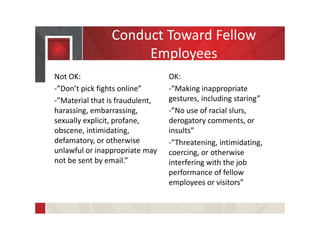
Conduct Toward Fellow
Employees
Not OK:
-”Don’t pick fights online”
-”Material that is fraudulent,
harassing, embarrassing,
sexually explicit, profane,
obscene, intimidating,
defamatory, or otherwise
unlawful or inappropriate may
not be sent by email.”
OK:
-”Making inappropriate
gestures, including staring”
-”No use of racial slurs,
derogatory comments, or
insults”
-”Threatening, intimidating,
coercing, or otherwise
interfering with the job
performance of fellow
employees or visitors”
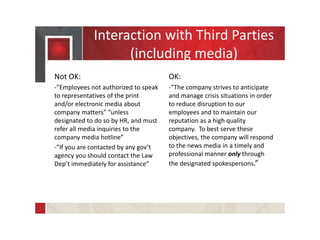
Interaction with Third Parties
(including media)
Not OK:
-”Employees not authorized to speak
to representatives of the print
and/or electronic media about
company matters” “unless
designated to do so by HR, and must
refer all media inquiries to the
company media hotline”
-”If you are contacted by any gov’t
agency you should contact the Law
Dep’t immediately for assistance”
OK:
-”The company strives to anticipate
and manage crisis situations in order
to reduce disruption to our
employees and to maintain our
reputation as a high quality
company. To best serve these
objectives, the company will respond
to the news media in a timely and
professional manner only through
the designated spokespersons.”
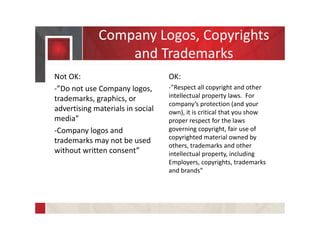
Company Logos, Copyrights
and Trademarks
Not OK:
-”Do not use Company logos,
trademarks, graphics, or
advertising materials in social
media”
-Company logos and
trademarks may not be used
without written consent”
OK:
-”Respect all copyright and other
intellectual property laws. For
company’s protection (and your
own), it is critical that you show
proper respect for the laws
governing copyright, fair use of
copyrighted material owned by
others, trademarks and other
intellectual property, including
Employers, copyrights, trademarks
and brands”
Employment Agreements and
Restrictive Covenants
• Q: Who needs an employment agreement?
• A: Not everybody.
• Consider less restrictive means:
• Offer Letters
• RCA / NDA
• Employee Handbook / Policies
Employment Agreements
The Basics
• Title and Duties
• Other employment
• Term
• At-will or defined time period
• If at-will, what is the consideration?
• Compensation
• Any bonus structure must be clear or linked to a plan.
• Stock / Equity awards must be carefully worded and consistent with
any governing plan documents
• Benefits
• Health Insurance, Vacation, Auto Allowance, Expenses
• Compliance with other policies
Employment Agreements
Additional Considerations
 Severance?
– Define Cause – Under what conditions will severance not be owed?
– Preconditions, i.e. executing a waiver and release
 Restrictive Covenants
 Intellectual Property
 Return of Property
 Governing Law and Venue Selection
 Arbitration
 Incorporation of other Agreements
 Attorneys’ Fees
 Non-Disclosure / Confidentiality
 Intellectual Property and Inventions
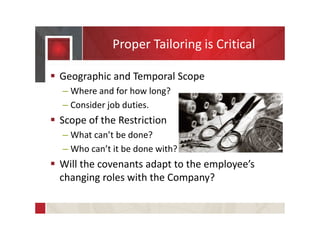
 Non-Compete
 Non-Solicit
– Clients and Customers
– Vendors and Suppliers
– Employees and Contractors
Restrictive Covenants
What Falls Under That Umbrella?
 Geographic and Temporal Scope
– Where and for how long?
– Consider job duties.
 Scope of the Restriction
– What can’t be done?
– Who can’t it be done with?
 Will the covenants adapt to the employee’s
changing roles with the Company?
Proper Tailoring is Critical
Know the State of Affairs
 State law typically governs enforceability.
– California and North Dakota – Nope.
– Some states have unique rules, i.e. Illinois,
Louisiana, Oklahoma, South Dakota.
 Have you considered consideration?
 Choice of Law and Venue
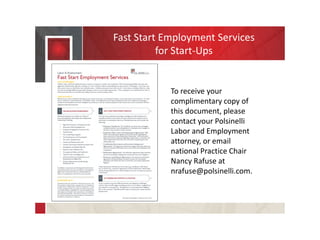
Fast Start Employment Services
for Start-Ups
To receive your
complimentary copy of
this document, please
contact your Polsinelli
Labor and Employment
attorney, or email
national Practice Chair
Nancy Rafuse at
nrafuse@polsinelli.com.
Keep Your Secrets Secret
 Simply having a confidentiality provision is not
adequate – employers must take
demonstrable steps to protect their secrets.
– Password protection.
– Usage restrictions, including personal email
addresses.
– Limited distribution and access.
Datascram Dominance
Next time – Datascram has caught on like fire! Looking to go public and
global. Competition for top talent is fierce! Topics next time:
• HR considerations with Mergers and Acquisitions
• Hiring from Competitors
• Staffing Arrangements
• Global HR/Legal Issues
SAVE THE DATE – MAY 9, 2017
Polsinelli provides this material for informational purposes only. The material
provided herein is general and is not intended to be legal advice. Nothing
herein should be relied upon or used without consulting a lawyer to consider
your specific circumstances, possible changes to applicable laws, rules and
regulations and other legal issues. Receipt of this material does not establish
an attorney-client relationship.
Polsinelli is very proud of the results we obtain for our clients, but you should
know that past results do not guarantee future results; that every case is
different and must be judged on its own merits; and that the choice of a
lawyer is an important decision and should not be based solely upon
advertisements.
© 2016 Polsinelli PC. In California, Polsinelli LLP.
Polsinelli is a registered mark of Polsinelli PC

The Diamond Datascram Diaries: Diamond Datascram Development

  • 1.
    Eric E. Packel,Andrew Cripe, Daniel L. Farris, Scott M. Gilbert, Matt Todd Diamond Datascram Diaries: Diamond Datascram Development
  • 2.
    Datascram Development • GeneralPrivacy Issues • Internal Issues and Risks • Product and Customer Privacy Issues and Strategies • Protecting the program • Patent? • Copyright? • Trademark? • Trade Secret • The Human Resources System • Employment Agreements and Restrictive Covenant Drafting
  • 3.
    Press Release Tech ExpertLaunches Diamond Datascram Skokie, IL, March 1, 2017/Newswire/-- Diamond Datascram, founded by nationally honored software developer Damien Diamond, announces the launch of Datascram™. Datascram is an amazing new software solution which identifies and prioritizes data, providing businesses with a summary of outdated or unnecessary data which then can be easily and permanently deleted or moved offsite. Analysis and surveys show that 52% of information stored by organizations is considered dark data whose value is not known. Another 33% of data is essentially obsolete or redundant. Datascram pulls information from the business’ systems, applies algorithms and removes or culls that redundant and dark data. Make data scram. Forever The Company is based in Skokie, IL but intends to operate nationwide.
  • 4.
  • 5.
  • 6.
    Overview of PrivacyIssues For Technology-Enabled Companies:  Internal Privacy & Security Compliance – Personnel – Customer Data – Intellectual Property Protection  Product/Customer Privacy & Security Considerations – Privacy By Design – Customer Compliance
  • 7.
    Internal Privacy Issues Privacy Program Development – Security Program – Personnel Data – Industry Regulations/Standards Compliance (HIPAA, ISO, NIST, PCI) – Multinational Regimes (EU – GDPR, Privacy Shield, APAC, etc.) – Vendor Management  Initial Steps – Gap Analysis/Privacy Assessment – Policy Development – Employee Training – Exercises and Audits
  • 8.
    Internal Privacy Risks The Cyber Skills Gap is Growing – Companies are investing more than ever in cyber security – Despite that fact, the number of successful attacks is increasing – Cybercriminals are becoming more sophisticated at a faster rate  Phishing Example – In 60% of cases, attackers compromise an organization in minutes – Median time to first click is 1:22 – 50% of recipient open the email within the first hour, 23% click through  99.9% of attacks exploit known vulnerabilities
  • 9.
    Product Privacy Issues Customer Compliance – Develop Using Privacy By Design – Build to a Standard – Consider Customer Controls – Solve for Security and Onward Transfer  Risks – Eliminating Data that Must be Retained (Regulatory or Policy) – Impact on IP (Old Data is Sometimes Useful in Product Development) – Protected Data (PHI, PII, Personal Data) – Breach
  • 10.
    Mitigation Strategies  Usethe NIST Framework or ISO 27001/2 as a Guide for Cybersecurity Planning  Due Diligence – internal/external (vendors)  Operational  Contractual  Cyber-Insurance
  • 11.
    Operational Strategies  Privacyby Design/Security by Design  “Minimum Necessary” – Don’t collect more than what you need – Don’t retain longer than you need it  Adopt/Adhere to Written Data Security Compliance Program – Adopt Framework Standards – Flow down to contractors  Technical controls: (e.g. encryption on all devices/unless can justify why not)  Physical security (e.g., data center security; geographically remote data centers)  Administrative safeguards (cybersecurity training/ regular risk assessments/ risk mitigation plans/audits)  Breach notification plan/Incident Response Plan  Readiness for new cyber-threats (Chinese hackers, economic espionage)  Cyber-insurance
  • 12.
    The Datascram Program Whatprotections apply? • Patent? • Trademark? • Copyright? • Trade Secret
  • 13.
    High Level Distinctions Patents: •Limited duration property right • Related to invention • Granted by U.S. Patent and Trademark Office • Public disclosure after grant
  • 14.
    Protectable Materials for Patents •Machines • Manufactured articles • Industrial processes • Chemical compositions
  • 15.
    Trademarks • Word, phrase,symbol, design • Distinguishes and identifies the source of goods from one party to another
  • 16.
    Copyright Protects original worksof authorship such as: • Literary • Dramatic • Musical • Artistic
  • 17.
    Patent Protection • Authorityfor patents • Patent process • Applicability to a situation 17
  • 18.
    Authority for aPatent U.S. Constitution – Article 1, Section 8, Clause 8 The Congress shall have power ... To promote the progress of science and useful arts, by securing for limited times to authors and inventors the exclusive right to their respective writings and discoveries; United States Code, Title 35 Patentability governed by Sections 100 – 105 101 – Patentable Subject Matter (process, machine, manufacture, or composition of matter) 102 – Novelty (anticipation/prior art) 103 – Obviousness (person of ordinary skill in the art) 18
  • 19.
     Application – Provisional –Non-Provisional  Office Action – Non-Final – Final  Issue Fee  Grant  Term: For patents filed after 1995, 20 years from the earliest filing date of the application on which the patent was granted… 19 Patent Process
  • 20.
    Patent Components  Inventor Assignee  Date (Priority/Filing/Issue)  Cited References, etc.  Abstract (Short Summary)  Figures/Drawings  Background (Problem)  Summary (Overview)  Detailed Description  Claims
  • 21.
    The Human ResourcesSystem  An Effective “Human Resources System” starts with comprehensive Workforce Visibility – Employees and Owners – Interns (or, “Interns”/free labor) – Contingent Workers – Consultants, Independent Contractors & Vendors  Adopt scalable and practical approach (the system needs to grow with the Company)  Consider the “Terms and Conditions” applicable to all Company “Human Resources” – Legal duties & classifications (FLSA, tax code, etc.) – Non-Employee agreement terms critical
  • 22.
    Workforce Policies  Why/WhenWritten Policies?  What Must You Include?  What Needs Updating—and Why?
  • 23.
    Written Policies? TheBasics  Define Expectations/Culture  Help Avoid Certain Contract Claims  Can Help Provide A Good Defense  Comply with Law
  • 24.
    Certain Policies are“Musts”  Anti-Harassment/EEO/anti-retaliation  FMLA  Confidentiality  Open Door/Hotline  Drug/Alcohol  No Right to Privacy/Monitoring  Wages/TO  “Musts” expand with Company
  • 25.
    Certain Policies areNice to Have  Will depend on business needs & culture:  Vacation/sick leave, PTO  Code of ethics & business conduct  Standards of personal conduct (dress code, attendance, etc.)
  • 26.
    The times theyare a-changing  Firearms policies  Social media policies  Workplace violence prevention (and domestic violence leave)  Drug testing and medical or legal marijuana  Compliance complaint and investigations processes & hotlines (a challenge at start up!)
  • 27.
    Remember Section 7 Section 7 provides that “employees shall have the right to self-organization, to form, join, or assist labor organizations, to bargain collectively . . . And to engage in other concerted activities for the purpose of collective bargaining or other mutual aid or protection.”
  • 28.
    Confidentiality Not OK: -”Do notdiscuss ‘customer or employee information’ outside of work including ‘phones numbers and addresses” -”Never publish or disclose confidential or other proprietary information. Never publish or report on conversations that are meant to be internal” OK: -”No unauthorized disclosure of ‘business secrets’ or other confidential information” -”Do not disclose confidential financial data, or other non-public proprietary company information. Do not share confidential information regarding business partners, vendors or customers”
  • 29.
    Conduct Toward Fellow Employees NotOK: -”Don’t pick fights online” -”Material that is fraudulent, harassing, embarrassing, sexually explicit, profane, obscene, intimidating, defamatory, or otherwise unlawful or inappropriate may not be sent by email.” OK: -”Making inappropriate gestures, including staring” -”No use of racial slurs, derogatory comments, or insults” -”Threatening, intimidating, coercing, or otherwise interfering with the job performance of fellow employees or visitors”
  • 30.
    Interaction with ThirdParties (including media) Not OK: -”Employees not authorized to speak to representatives of the print and/or electronic media about company matters” “unless designated to do so by HR, and must refer all media inquiries to the company media hotline” -”If you are contacted by any gov’t agency you should contact the Law Dep’t immediately for assistance” OK: -”The company strives to anticipate and manage crisis situations in order to reduce disruption to our employees and to maintain our reputation as a high quality company. To best serve these objectives, the company will respond to the news media in a timely and professional manner only through the designated spokespersons.”
  • 31.
    Company Logos, Copyrights andTrademarks Not OK: -”Do not use Company logos, trademarks, graphics, or advertising materials in social media” -Company logos and trademarks may not be used without written consent” OK: -”Respect all copyright and other intellectual property laws. For company’s protection (and your own), it is critical that you show proper respect for the laws governing copyright, fair use of copyrighted material owned by others, trademarks and other intellectual property, including Employers, copyrights, trademarks and brands”
  • 32.
    Employment Agreements and RestrictiveCovenants • Q: Who needs an employment agreement? • A: Not everybody. • Consider less restrictive means: • Offer Letters • RCA / NDA • Employee Handbook / Policies
  • 33.
    Employment Agreements The Basics •Title and Duties • Other employment • Term • At-will or defined time period • If at-will, what is the consideration? • Compensation • Any bonus structure must be clear or linked to a plan. • Stock / Equity awards must be carefully worded and consistent with any governing plan documents • Benefits • Health Insurance, Vacation, Auto Allowance, Expenses • Compliance with other policies
  • 34.
    Employment Agreements Additional Considerations Severance? – Define Cause – Under what conditions will severance not be owed? – Preconditions, i.e. executing a waiver and release  Restrictive Covenants  Intellectual Property  Return of Property  Governing Law and Venue Selection  Arbitration  Incorporation of other Agreements  Attorneys’ Fees
  • 35.
     Non-Disclosure /Confidentiality  Intellectual Property and Inventions  Non-Compete  Non-Solicit – Clients and Customers – Vendors and Suppliers – Employees and Contractors Restrictive Covenants What Falls Under That Umbrella?
  • 36.
     Geographic andTemporal Scope – Where and for how long? – Consider job duties.  Scope of the Restriction – What can’t be done? – Who can’t it be done with?  Will the covenants adapt to the employee’s changing roles with the Company? Proper Tailoring is Critical
  • 37.
    Know the Stateof Affairs  State law typically governs enforceability. – California and North Dakota – Nope. – Some states have unique rules, i.e. Illinois, Louisiana, Oklahoma, South Dakota.  Have you considered consideration?  Choice of Law and Venue
  • 38.
    Fast Start EmploymentServices for Start-Ups To receive your complimentary copy of this document, please contact your Polsinelli Labor and Employment attorney, or email national Practice Chair Nancy Rafuse at nrafuse@polsinelli.com.
  • 39.
    Keep Your SecretsSecret  Simply having a confidentiality provision is not adequate – employers must take demonstrable steps to protect their secrets. – Password protection. – Usage restrictions, including personal email addresses. – Limited distribution and access.
  • 40.
    Datascram Dominance Next time– Datascram has caught on like fire! Looking to go public and global. Competition for top talent is fierce! Topics next time: • HR considerations with Mergers and Acquisitions • Hiring from Competitors • Staffing Arrangements • Global HR/Legal Issues SAVE THE DATE – MAY 9, 2017
  • 41.
    Polsinelli provides thismaterial for informational purposes only. The material provided herein is general and is not intended to be legal advice. Nothing herein should be relied upon or used without consulting a lawyer to consider your specific circumstances, possible changes to applicable laws, rules and regulations and other legal issues. Receipt of this material does not establish an attorney-client relationship. Polsinelli is very proud of the results we obtain for our clients, but you should know that past results do not guarantee future results; that every case is different and must be judged on its own merits; and that the choice of a lawyer is an important decision and should not be based solely upon advertisements. © 2016 Polsinelli PC. In California, Polsinelli LLP. Polsinelli is a registered mark of Polsinelli PC