Protecting Client Data for
Professional Responsibility and to
      Prevent Identity Theft

   Paula S. deWitte, J.D., Ph.D., P.E.
Attorney Liability
•   Violate Professional Responsibility Rules
•   Violate state/federal identity theft statutes
•   Commit malpractice
•   Suffer embarrassment and loss of reputation from
    being on the front page of the newspaper or the lead
    story on the 6 p.m. news.

    Good business practices to protect all client data –
         including sensitive personal information.
Three Business Reasons to Know This
              Material
• 1. Protect you and your law firm

• 2. Advise your clients to safeguard
  information

• 3. Prepare for new business opportunities
Why Are Law Firms Good Targets?
• To get to the lawyers

• To get to the clients’ information

• General, undirected attack on enterprises that
  are easily hacked into
Are Lawyers Targets?
•   http://www.wired.com/threatlevel/2010/02/apt-hacks/

•   One mark of APT attacks is that they have especially hit companies with dealings in China,
    including more than 50 law firms.
     –   Advanced Persistent Threats (APT) -- the attacks are distinctive in the kinds of data the attackers
         target, and they are rarely detected by antivirus and intrusion programs. What’s more, the intrusions
         grab a foothold into a company’s network, sometimes for years, even after a company has
         discovered them and taken corrective measures.


•   “If you’re a law firm and you’re doing business in places like China, it’s so probable you’re
    compromised and it’s very probable there’s not much you can do about it,” Mandia says.

•   In 2008, Mandiant investigated a breach at a law firm that was representing a client in a
    lawsuit related to China. The attackers were in the firm’s network for a year before the firm
    learned from law enforcement that it been hacked. By then, the intruders harvested
    thousands of e-mails and attachments from mail servers. They also had access to every other
    server, desktop workstation and laptop on the firm’s network.
•
    Read More http://www.wired.com/threatlevel/2010/02/apt-hacks/#ixzz0hsIFsw2n
Manage Your Risk
• Know the terms:
  –   Sensitive Personal Information
  –   Encryption
  –   Business duty
  –   Reasonable procedures
• Know what is required to comply with the law.
• You may be liable under the laws of another
  state!
  – Massachusetts law is the strictest and requires a
    written information security program (WISP).
Your Biggest Hidden Security Threats
• Social engineering: Unintentional and by
  those you trust

                OR

• Insider threat: Intentional and by those
  internal to your law firm
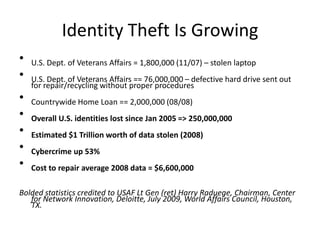
Identity Theft Is Growing
•   U.S. Dept. of Veterans Affairs = 1,800,000 (11/07) – stolen laptop
•   U.S. Dept. of Veterans Affairs == 76,000,000 – defective hard drive sent out
    for repair/recycling without proper procedures
•   Countrywide Home Loan == 2,000,000 (08/08)
•   Overall U.S. identities lost since Jan 2005 => 250,000,000
•   Estimated $1 Trillion worth of data stolen (2008)
•   Cybercrime up 53%
•   Cost to repair average 2008 data = $6,600,000

Bolded statistics credited to USAF Lt Gen (ret) Harry Raduege, Chairman, Center
   for Network Innovation, Deloitte, July 2009, World Affairs Council, Houston,
   TX.
Sony PlayStation Network and Online
       Entertainment Breaches
• 100 Million Accounts …
  – 100,000,000
• Costs of up to $2B …
  – $2,000,000,000
• Sony market capitalization is $20.5B
  – $20,500,000,000
• Liable under different nations’ and states’ laws
• PR nightmare
What Can Trigger Your Duties
• Security or data breaches by someone who
  targets your law firm
• Lost, stolen, or strayed computer or laptop
• Improperly trashed or donated computers or
  computer parts
• Lost mobile devices, USBs, or CDs
• Weak, limited, or no data encryption
• Weak passwords
• No/poorly written policies:
  • E-mailing sensitive data to personal accounts
Security Aspects
• Electronic
  – Firewalls, Security Software, Intrusion Detection
    Systems,
• Physical
• Administrative/Management
  – Your biggest vulnerability are people.
The World is Changing
•   The “reasonableness” standard
•   Growing client awareness
•   Statutory and civil liabilities
•   Technology:
    –   Readily available
    –   Relatively inexpensive
    –   Minimizes risk of being caught
    –   Web resources
• The ease of being a hacker
Security Framework
• Prevention
  – Did you prevent unauthorized access?
• Detection
  – Can you detect if a security breach has occurred?
  – Can you figure out what and how it happened?
• Remediation
  – How can you fix the situation?
  – Do you have remediation plans in place
Statutory/Lawsuit Trend (1/3)
• HIPAA
• Gramm-Leach-Bliley Financial Services
  Modernization Act
• What is the standard to determine liability?
• States continue to pass harsher legislation to deal
  with a growing identity theft problem.
• Federal legislation possible
Statutory/Lawsuit Trend (2/3)
• “Sensitive personal information” means … an individual’s first
  name or first initial and last name in combination with any
  one or more of the following items, if the names and the
  items are not encrypted:

   – social security number;
   – driver’s license number or government-issued identification number;
     or
   – account number or credit or debit card number in combination with
     any required security code, access code, or password that would
     permit access to an individual’s financial account
   – Other: biometric data ignored in this presentation.
Statutory/Lawsuit Trend (3/3)
• How does Tex. Bus. & Com. Code § 521.053(b) (2009)
  apply to lawyers?
   – Three business duties
      • Use reasonable procedures to safeguard SPI…
      • Destroy or arrange for destruction of SPI…
      • Notify when a breach is detected or when you are notified of a
        breach…
          – “Many entities don’t discover a breach until someone from law
            enforcement notifies them. By then, it’s too late.”
• Tied to the DTPA
What is Sensitive Personal Information
                 (SPI)?
• First initial and last name OR First name and
  last name
• Combined with any of:
  – Social security number OR
  – Drivers license number OR
  – Account or credit card number in combination
    with any required security code, access code, or
    password that would permit access to that
    account.
Business Duty 1: Use “reasonable
             procedures”…
• “..including appropriate corrective action to protect
  unlawful use or disclosure of any SPI collected or
  maintained by the business in the regular course of
  business.”

• Cannot be delegated.

• Liable for the actions of your employees, regardless.
What is the Reasonable Standard?
•   The business owner?
•   The SPI owner (i.e., the potential victim)
•   IT personnel?
•   Information assurance (IA) experts?
•   Prevailing public perception?

                Is there a standard?
Reasonable Procedures
•   Must be in writing.
•   Protect against anticipated threats or hazards.
•   Consider administrative, technical, and physical.
•   Consider all aspects of the SPI -- collection,
    storage, access, use, transmission, and
    protection.
•   Consider the security framework of prevention,
    detection, and remediation.
•   Institutionalize procedures.
•   Train.
•   Audit.
Continuous Process
• Have a written information security program
  (WISP).
• Have a third party test your systems.
• Document the problems.
• Fix the problems.
• Conduct periodic reviews.
Business Duty 2: Destroy or Arrange
         for the Destruction…
• “…of customer records by shredding, erasing,
  or “otherwise modifying the sensitive PI in the
  records to make the information unreadable
  or indecipherable through any means”

• What works?
• What doesn’t work?
Business Duty 3: Notify Potential
               Victims
• “… after discovering or receiving notification
  of that breach … as quickly as possible”

• How do you discover a breach?
• What constitutes “receiving notification of
  that breach”?
• What does “quickly as possible” mean?
• How do I notify potential victims
The Good News
The use of reasonable procedures and proper
  destruction work for all types of data a law
             office might maintain.
What Does the Attorney General Tell
   an Identity Theft Victim To Do
• http://www.texasfightsidtheft.gov/
• Create a written criminal report to protect
  themselves from being denied credit.
• File report with the Federal Trade
  Commission.
• Collect as much evidence as possible. This
  evidence can be used against you!
Your Liability
• Statutory fines to Texas

• To the SPI Owner:
   –   Lost income
   –   Expenses of fixing credit
   –   Attorney fees
   –   Possible treble damages under DPTA

• Your consequences:
   – Loss of revenue and reputation
What SPI Do You Routinely Maintain?
• Employee Records
  – Every employee record has the employee’s name and
    social security number
• Client Contact Information
  – Besides SPI, IP and client sensitive information
• Discovery Documents
• Statutory exceptions:
  – Statue excludes publicly available information
    available from federal, state, or local governments
  – Excludes encrypted data
     • No statutory definition for “encryption”
Do Not Rely on the Encryption
              Exception
• Encryption is not a yes/no category.
  – Encryption is a continuum from weak to strong.
• True encryption requires encryption
  throughout system; one piece of your system
  that is not encrypted renders the entire
  system vulnerable.
Contact
• Paula deWitte, P.L.L.C.
• Paula.deWitte@PauladeWitte.com
• Cell: 512.633.3791

Protecting Client Data 11.09.11

  • 1.
    Protecting Client Datafor Professional Responsibility and to Prevent Identity Theft Paula S. deWitte, J.D., Ph.D., P.E.
  • 2.
    Attorney Liability • Violate Professional Responsibility Rules • Violate state/federal identity theft statutes • Commit malpractice • Suffer embarrassment and loss of reputation from being on the front page of the newspaper or the lead story on the 6 p.m. news. Good business practices to protect all client data – including sensitive personal information.
  • 3.
    Three Business Reasonsto Know This Material • 1. Protect you and your law firm • 2. Advise your clients to safeguard information • 3. Prepare for new business opportunities
  • 4.
    Why Are LawFirms Good Targets? • To get to the lawyers • To get to the clients’ information • General, undirected attack on enterprises that are easily hacked into
  • 5.
    Are Lawyers Targets? • http://www.wired.com/threatlevel/2010/02/apt-hacks/ • One mark of APT attacks is that they have especially hit companies with dealings in China, including more than 50 law firms. – Advanced Persistent Threats (APT) -- the attacks are distinctive in the kinds of data the attackers target, and they are rarely detected by antivirus and intrusion programs. What’s more, the intrusions grab a foothold into a company’s network, sometimes for years, even after a company has discovered them and taken corrective measures. • “If you’re a law firm and you’re doing business in places like China, it’s so probable you’re compromised and it’s very probable there’s not much you can do about it,” Mandia says. • In 2008, Mandiant investigated a breach at a law firm that was representing a client in a lawsuit related to China. The attackers were in the firm’s network for a year before the firm learned from law enforcement that it been hacked. By then, the intruders harvested thousands of e-mails and attachments from mail servers. They also had access to every other server, desktop workstation and laptop on the firm’s network. • Read More http://www.wired.com/threatlevel/2010/02/apt-hacks/#ixzz0hsIFsw2n
  • 6.
    Manage Your Risk •Know the terms: – Sensitive Personal Information – Encryption – Business duty – Reasonable procedures • Know what is required to comply with the law. • You may be liable under the laws of another state! – Massachusetts law is the strictest and requires a written information security program (WISP).
  • 7.
    Your Biggest HiddenSecurity Threats • Social engineering: Unintentional and by those you trust OR • Insider threat: Intentional and by those internal to your law firm
  • 8.
    Identity Theft IsGrowing • U.S. Dept. of Veterans Affairs = 1,800,000 (11/07) – stolen laptop • U.S. Dept. of Veterans Affairs == 76,000,000 – defective hard drive sent out for repair/recycling without proper procedures • Countrywide Home Loan == 2,000,000 (08/08) • Overall U.S. identities lost since Jan 2005 => 250,000,000 • Estimated $1 Trillion worth of data stolen (2008) • Cybercrime up 53% • Cost to repair average 2008 data = $6,600,000 Bolded statistics credited to USAF Lt Gen (ret) Harry Raduege, Chairman, Center for Network Innovation, Deloitte, July 2009, World Affairs Council, Houston, TX.
  • 9.
    Sony PlayStation Networkand Online Entertainment Breaches • 100 Million Accounts … – 100,000,000 • Costs of up to $2B … – $2,000,000,000 • Sony market capitalization is $20.5B – $20,500,000,000 • Liable under different nations’ and states’ laws • PR nightmare
  • 10.
    What Can TriggerYour Duties • Security or data breaches by someone who targets your law firm • Lost, stolen, or strayed computer or laptop • Improperly trashed or donated computers or computer parts • Lost mobile devices, USBs, or CDs • Weak, limited, or no data encryption • Weak passwords • No/poorly written policies: • E-mailing sensitive data to personal accounts
  • 11.
    Security Aspects • Electronic – Firewalls, Security Software, Intrusion Detection Systems, • Physical • Administrative/Management – Your biggest vulnerability are people.
  • 12.
    The World isChanging • The “reasonableness” standard • Growing client awareness • Statutory and civil liabilities • Technology: – Readily available – Relatively inexpensive – Minimizes risk of being caught – Web resources • The ease of being a hacker
  • 13.
    Security Framework • Prevention – Did you prevent unauthorized access? • Detection – Can you detect if a security breach has occurred? – Can you figure out what and how it happened? • Remediation – How can you fix the situation? – Do you have remediation plans in place
  • 14.
    Statutory/Lawsuit Trend (1/3) •HIPAA • Gramm-Leach-Bliley Financial Services Modernization Act • What is the standard to determine liability? • States continue to pass harsher legislation to deal with a growing identity theft problem. • Federal legislation possible
  • 15.
    Statutory/Lawsuit Trend (2/3) •“Sensitive personal information” means … an individual’s first name or first initial and last name in combination with any one or more of the following items, if the names and the items are not encrypted: – social security number; – driver’s license number or government-issued identification number; or – account number or credit or debit card number in combination with any required security code, access code, or password that would permit access to an individual’s financial account – Other: biometric data ignored in this presentation.
  • 16.
    Statutory/Lawsuit Trend (3/3) •How does Tex. Bus. & Com. Code § 521.053(b) (2009) apply to lawyers? – Three business duties • Use reasonable procedures to safeguard SPI… • Destroy or arrange for destruction of SPI… • Notify when a breach is detected or when you are notified of a breach… – “Many entities don’t discover a breach until someone from law enforcement notifies them. By then, it’s too late.” • Tied to the DTPA
  • 17.
    What is SensitivePersonal Information (SPI)? • First initial and last name OR First name and last name • Combined with any of: – Social security number OR – Drivers license number OR – Account or credit card number in combination with any required security code, access code, or password that would permit access to that account.
  • 18.
    Business Duty 1:Use “reasonable procedures”… • “..including appropriate corrective action to protect unlawful use or disclosure of any SPI collected or maintained by the business in the regular course of business.” • Cannot be delegated. • Liable for the actions of your employees, regardless.
  • 19.
    What is theReasonable Standard? • The business owner? • The SPI owner (i.e., the potential victim) • IT personnel? • Information assurance (IA) experts? • Prevailing public perception? Is there a standard?
  • 20.
    Reasonable Procedures • Must be in writing. • Protect against anticipated threats or hazards. • Consider administrative, technical, and physical. • Consider all aspects of the SPI -- collection, storage, access, use, transmission, and protection. • Consider the security framework of prevention, detection, and remediation. • Institutionalize procedures. • Train. • Audit.
  • 21.
    Continuous Process • Havea written information security program (WISP). • Have a third party test your systems. • Document the problems. • Fix the problems. • Conduct periodic reviews.
  • 22.
    Business Duty 2:Destroy or Arrange for the Destruction… • “…of customer records by shredding, erasing, or “otherwise modifying the sensitive PI in the records to make the information unreadable or indecipherable through any means” • What works? • What doesn’t work?
  • 23.
    Business Duty 3:Notify Potential Victims • “… after discovering or receiving notification of that breach … as quickly as possible” • How do you discover a breach? • What constitutes “receiving notification of that breach”? • What does “quickly as possible” mean? • How do I notify potential victims
  • 24.
    The Good News Theuse of reasonable procedures and proper destruction work for all types of data a law office might maintain.
  • 25.
    What Does theAttorney General Tell an Identity Theft Victim To Do • http://www.texasfightsidtheft.gov/ • Create a written criminal report to protect themselves from being denied credit. • File report with the Federal Trade Commission. • Collect as much evidence as possible. This evidence can be used against you!
  • 26.
    Your Liability • Statutoryfines to Texas • To the SPI Owner: – Lost income – Expenses of fixing credit – Attorney fees – Possible treble damages under DPTA • Your consequences: – Loss of revenue and reputation
  • 27.
    What SPI DoYou Routinely Maintain? • Employee Records – Every employee record has the employee’s name and social security number • Client Contact Information – Besides SPI, IP and client sensitive information • Discovery Documents • Statutory exceptions: – Statue excludes publicly available information available from federal, state, or local governments – Excludes encrypted data • No statutory definition for “encryption”
  • 28.
    Do Not Relyon the Encryption Exception • Encryption is not a yes/no category. – Encryption is a continuum from weak to strong. • True encryption requires encryption throughout system; one piece of your system that is not encrypted renders the entire system vulnerable.
  • 29.
    Contact • Paula deWitte,P.L.L.C. • Paula.deWitte@PauladeWitte.com • Cell: 512.633.3791

Editor's Notes

  • #3 Car analogy – stealing takes time, can only be stolen once, move on. My car is somewhat under my control. My identity is not.