Pocket Protector Meets Briefcase:
          IT Meet Legal


              Jeff Kubacki
           Chief Information Officer

       Kroll, a Marsh & McLennan Company
                 jkubacki@kroll.com
Company Overview &
Technology Environment
Marsh & McLennan at a Glance

  MMC is a global professional services firm providing
  advice and solutions in the areas of risk, strategy and
  human capital

  Parent company of a number of the world’s leading risk
  experts and specialty consultants, including
   -   Marsh, the insurance broker and risk advisor
   -   Guy Carpenter, the risk and reinsurance specialist
   -   Mercer, the provider of HR and related financial advice and services
   -   Oliver Wyman, the management consultancy
   -   Kroll, the risk consulting firm


  Through our market leading brands, and over 50,000
  colleagues in more than 100 countries, MMC helps clients
  identify, plan for and respond to critical business issues
  and risks
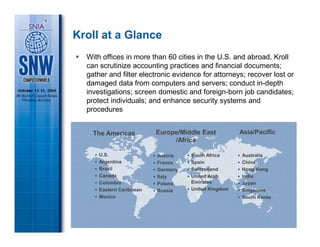
Kroll at a Glance
  With offices in more than 60 cities in the U.S. and abroad, Kroll
  can scrutinize accounting practices and financial documents;
  gather and filter electronic evidence for attorneys; recover lost or
  damaged data from computers and servers; conduct in-depth
  investigations; screen domestic and foreign-born job candidates;
  protect individuals; and enhance security systems and
  procedures


    The Americas          Europe/Middle East         Asia/Pacific
                               /Africa

      U.S.                Austria   South Africa     Australia
      Argentina           France    Spain            China
      Brazil              Germany   Switzerland      Hong Kong
      Canada              Italy     United Arab      India
      Colombia            Poland    Emirates         Japan
      Eastern Caribbean   Russia    United Kingdom   Singapore
      Mexico                                         South Korea
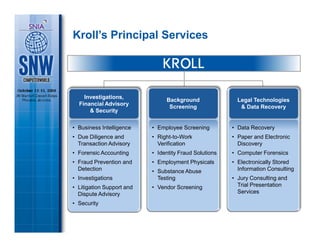
Kroll’s Principal Services


    Investigations,                Kroll
                                Background                Legal Technologies
  Financial Advisory            Background
                                 Screening                 & Data Recovery
      & Security
                                 Screening

• Business Intelligence    • Employee Screening         • Data Recovery
• Due Diligence and        • Right-to-Work              • Paper and Electronic
  Transaction Advisory       Verification                 Discovery
• Forensic Accounting      • Identity Fraud Solutions   • Computer Forensics
• Fraud Prevention and     • Employment Physicals       • Electronically Stored
  Detection                • Substance Abuse              Information Consulting
• Investigations             Testing                    • Jury Consulting and
• Litigation Support and   • Vendor Screening             Trial Presentation
  Dispute Advisory                                        Services

• Security
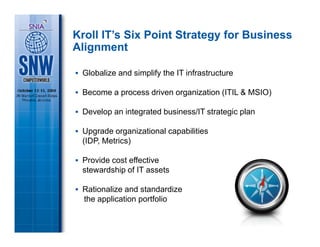
Kroll IT’s Six Point Strategy for Business
Alignment

 Globalize and simplify the IT infrastructure

 Become a process driven organization (ITIL & MSIO)

 Develop an integrated business/IT strategic plan

 Upgrade organizational capabilities
 (IDP, Metrics)

 Provide cost effective
 stewardship of IT assets

 Rationalize and standardize
 the application portfolio
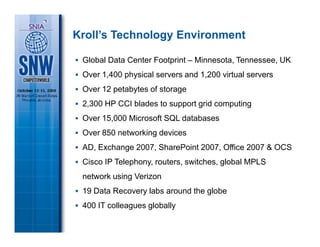
Kroll’s Technology Environment

 Global Data Center Footprint – Minnesota, Tennessee, UK
 Over 1,400 physical servers and 1,200 virtual servers
 Over 12 petabytes of storage
 2,300 HP CCI blades to support grid computing
 Over 15,000 Microsoft SQL databases
 Over 850 networking devices
 AD, Exchange 2007, SharePoint 2007, Office 2007 & OCS
 Cisco IP Telephony, routers, switches, global MPLS
 network using Verizon
 19 Data Recovery labs around the globe
 400 IT colleagues globally
Pocket Protector Meets Briefcase:
          IT Meet Legal
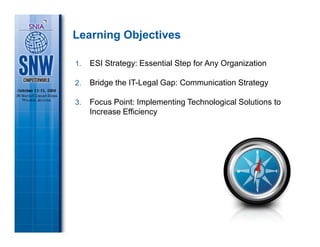
Learning Objectives

1.   ESI Strategy: Essential Step for Any Organization

2.   Bridge the IT-Legal Gap: Communication Strategy

3.   Focus Point: Implementing Technological Solutions to
     Increase Efficiency
ESI Strategy: Why is this Essential?

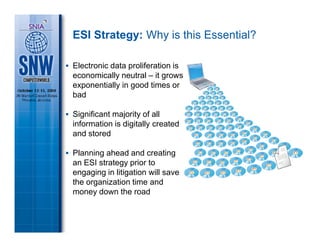
Electronic data proliferation is
economically neutral – it grows
exponentially in good times or
bad

Significant majority of all
information is digitally created
and stored

Planning ahead and creating
an ESI strategy prior to
engaging in litigation will save
the organization time and
money down the road
ESI Strategy Formation: Who is
   Responsible?

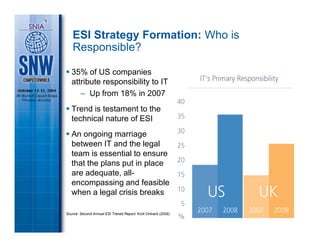
   35% of US companies
   attribute responsibility to IT
      – Up from 18% in 2007
   Trend is testament to the
   technical nature of ESI
   An ongoing marriage
   between IT and the legal
   team is essential to ensure
   that the plans put in place
   are adequate, all-
   encompassing and feasible
   when a legal crisis breaks

Source: Second Annual ESI Trends Report, Kroll Ontrack (2008)
ESI Strategy: Convergence of IT & Legal

 Few in-house attorneys understand the technical
 intricacies of IT, and few IT professionals understand
 the complexity of procedural and discovery rules in
 litigation

 Recognition of IT’s importance marks a shift towards a
 more collaborative and team-oriented approach to e-
 discovery

 Counsel must work with IT to ensure proper e-
 discovery and litigation measures are in place – before
 the process server steps off the elevator
ESI Strategy: Key Actions

 IT resources should be contacted early

 Systems that support e-discovery should be developed
 under a joint set of requirements from IT and Legal

 IT should be involved in all litigation matters (not just
 the large cases) to ensure consistency is maintained

 Litigation response plan should be jointly developed,
 tested and maintained through periodic review
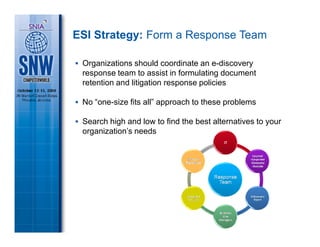
ESI Strategy: Form a Response Team

 Organizations should coordinate an e-discovery
 response team to assist in formulating document
 retention and litigation response policies

 No “one-size fits all” approach to these problems

 Search high and low to find the best alternatives to your
 organization’s needs
ESI Strategy: Response Plan

 Given the current constraints on budget and available
 resources, what value does a response plan provide?

 Having a response plan in place in preparation for
 future litigation can:

   - Expedite data identification to commence collection
     efforts more quickly, allowing more time for limited
     resources to complete their collection
   - Present thoughtful accessibility determinations, reducing
     or eliminating the need to collect inaccessible sources
   - Save expenses on future projects by being prepared
   - Take action to ensure preservation of necessary data to
     help avoid costly sanctions!
Learning Objectives

1.   ESI Strategy: Essential Step for Any Organization

2.   Bridge the IT-Legal Gap: Communication Strategy

3.   Focus Point: Implementing Technological Solutions to
     Increase Efficiency
Bridge the IT-Legal Gap: Communication
Strategy
  IT and Legal don’t speak the same language


            IT                            Legal

IT’s strength lies with          Legal’s strength lies with
charts and technical             “legalese”
language


   Use “simple” talk to convey points, and eliminate
   acronyms and highly technical or legal language
Bridge the IT-Legal Gap: Communication
Strategy
 Early engagement between IT and Legal is incredibly
 important
   - Know who the key people in each department are

 Establish the goals of each project:
  - Why are we doing this?
  - What do we hope to achieve?

 Institute written policies and procedures, making them
 easily accessible to members of both IT and Legal
Bridge the IT-Legal Gap: Communication
Strategy
 Schedule regular meetings between IT and Legal to
 update project and technology development
   - Technology constantly changes – meetings allow
     both departments to stay on top of the trends
   - Discuss projects that are coming down the pipeline
 Develop “information sheets” based on each major
 application within the company that is routinely involved
 in e-discovery
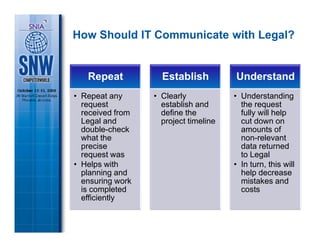
How Should IT Communicate with Legal?


   Repeat           Establish          Understand
• Repeat any      • Clearly            • Understanding
  request           establish and        the request
  received from     define the           fully will help
  Legal and         project timeline     cut down on
  double-check                           amounts of
  what the                               non-relevant
  precise                                data returned
  request was                            to Legal
• Helps with                           • In turn, this will
  planning and                           help decrease
  ensuring work                          mistakes and
  is completed                           costs
  efficiently
IT Can Help Educate Legal

 IT can help educate counsel as follows:

     All operating systems, software applications and
     hardware formerly and currently in use;
     The flow of data into, within and out of the
     company;
     Disk or tape labeling conventions, file name
     customs, location-saving rules;
     Corporate document retention policies and the
     current enforcement status of those policies; and
     Corporate policies regarding employee use of
     company computers and data
Third-Party IT/Legal Liaison

 If budget allows, organizations should have one person
 who straddles the line between IT and Legal
    - Should possess a working knowledge of both fields

 It may be prudent to engage a third-party IT/Legal
 liaison or expert to facilitate communication
    - Liaison can offer best practices on consulting and
      e-discovery management within the organization

 Working with IT and counsel, these liaisons can be
 critical to managing collection, and facilitating review
 and production of responsive data
Learning Objectives

1.   ESI Strategy: Essential Step for Any Organization

2.   Bridge the IT-Legal Gap: Communication Strategy

3.   Focus Point: Implementing Technological
     Solutions to Increase Efficiency
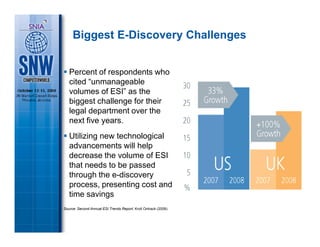
Biggest E-Discovery Challenges


   Percent of respondents who
   cited “unmanageable
   volumes of ESI” as the
   biggest challenge for their
   legal department over the
   next five years.
   Utilizing new technological
   advancements will help
   decrease the volume of ESI
   that needs to be passed
   through the e-discovery
   process, presenting cost and
   time savings
Source: Second Annual ESI Trends Report, Kroll Ontrack (2008)
Implementing Technological Solutions to
Increase Efficiency
 E-discovery technology has pressed ahead with
 advancements making e-discovery faster, easier and
 less expensive

 Important emerging technologies are:
   - Early case assessment and e-mail analytics
   - Near de-duplication and e-mail threading
   - Integrated archiving (e-mail and file)
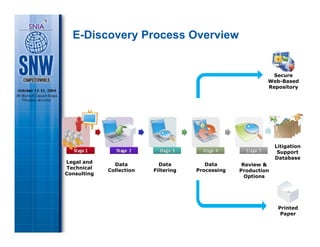
E-Discovery Process Overview


                                                              Secure
                                                            Web-Based
                                                            Repository


                                                                Litigation
                                                                 Support
                                                                Database
Legal and      Data         Data         Data       Review &
Technical    Collection   Filtering   Processing   Production
Consulting
                                                     Options


                                                                 Printed
                                                                  Paper
Early Case Assessment

 Vital first step in investigation or litigation process
   - Scope of potentially relevant data can be narrowed
     prior to e-discovery processing
   - Results in cost and time savings

 Aids counsel in deciding whether to proceed with
 lawsuit

 Can help make decision to settle based on existence of
 damaging evidence (may identify the “smoking gun”
 document)
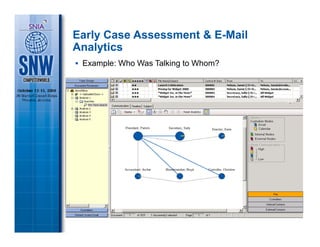
Early Case Assessment & E-Mail
Analytics
 E-mail analytics is a technology-enabled process
 where e-mails in your document set are organized and
 analyzed

 E-mail analysis tools recognize and visually represent
 relationships between people, events, timelines and
 communication patterns through advanced
 visualizations
   - Helps legal teams know what data they have and
     see patterns in an unstructured maze of data

 Allows all players with e-discovery responsibilities to
 analyze e-mails, form legal case strategy, investigate
 internal incidents and intelligently collect data in
 preparation for discovery
Early Case Assessment & E-Mail
Analytics
 Helps answer the “who, what and when” questions
 involved in early case assessment:

  - Who authored the e-mail and to whom was it sent

  - What were they talking about

  - When did they talk
Early Case Assessment & E-Mail
Analytics
 Example: Who Was Talking to Whom?
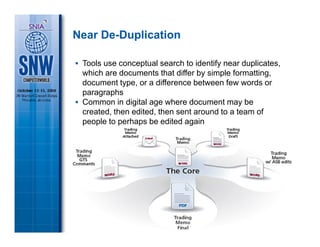
Near De-Duplication

 Tools use conceptual search to identify near duplicates,
 which are documents that differ by simple formatting,
 document type, or a difference between few words or
 paragraphs
 Common in digital age where document may be
 created, then edited, then sent around to a team of
 people to perhaps be edited again
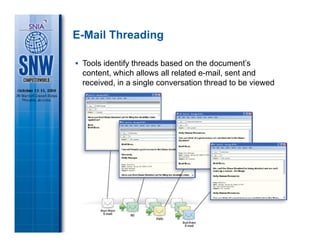
E-Mail Threading

 Tools identify threads based on the document’s
 content, which allows all related e-mail, sent and
 received, in a single conversation thread to be viewed
Integrated Archiving (E-Mail & File)

 Technology driven method of saving a point-in-time
 version of electronic files incorporating high
 performance data content and index management

 Enables organizations to apply policies to these files,
 therefore providing compliance mechanisms to meet
 corporate, legal, industry and government requirements

 Helps companies streamline the use of their data and
 contain costs around data-related tasks and
 infrastructure that historically have been highly
 inefficient and expensive
Integrated Archiving (E-Mail & File)

 Provides organizations with a mechanism to efficiently
 capture, store, search and categorize their data to meet
 e-discovery, investigative, compliance, records
 management and myriad other needs

 Through single instance storage and de-duplication
 technologies, data archives help IT managers reduce
 their storage footprint, resulting in marked cost savings
 and operational efficiency
Learning Objectives | Summary

1.   ESI Strategy: Essential Step for Any Organization

2.   Bridge the IT-Legal Gap: Communication Strategy

3.   Focus Point: Implementing Technological Solutions to
     Increase Efficiency
Thank You!

       Jeff Kubacki
    Chief Information Officer

Kroll, a Marsh & McLennan Company
          jkubacki@kroll.com

SNW Fall 2009

  • 2.
    Pocket Protector MeetsBriefcase: IT Meet Legal Jeff Kubacki Chief Information Officer Kroll, a Marsh & McLennan Company jkubacki@kroll.com
  • 3.
  • 4.
    Marsh & McLennanat a Glance MMC is a global professional services firm providing advice and solutions in the areas of risk, strategy and human capital Parent company of a number of the world’s leading risk experts and specialty consultants, including - Marsh, the insurance broker and risk advisor - Guy Carpenter, the risk and reinsurance specialist - Mercer, the provider of HR and related financial advice and services - Oliver Wyman, the management consultancy - Kroll, the risk consulting firm Through our market leading brands, and over 50,000 colleagues in more than 100 countries, MMC helps clients identify, plan for and respond to critical business issues and risks
  • 5.
    Kroll at aGlance With offices in more than 60 cities in the U.S. and abroad, Kroll can scrutinize accounting practices and financial documents; gather and filter electronic evidence for attorneys; recover lost or damaged data from computers and servers; conduct in-depth investigations; screen domestic and foreign-born job candidates; protect individuals; and enhance security systems and procedures The Americas Europe/Middle East Asia/Pacific /Africa U.S. Austria South Africa Australia Argentina France Spain China Brazil Germany Switzerland Hong Kong Canada Italy United Arab India Colombia Poland Emirates Japan Eastern Caribbean Russia United Kingdom Singapore Mexico South Korea
  • 6.
    Kroll’s Principal Services Investigations, Kroll Background Legal Technologies Financial Advisory Background Screening & Data Recovery & Security Screening • Business Intelligence • Employee Screening • Data Recovery • Due Diligence and • Right-to-Work • Paper and Electronic Transaction Advisory Verification Discovery • Forensic Accounting • Identity Fraud Solutions • Computer Forensics • Fraud Prevention and • Employment Physicals • Electronically Stored Detection • Substance Abuse Information Consulting • Investigations Testing • Jury Consulting and • Litigation Support and • Vendor Screening Trial Presentation Dispute Advisory Services • Security
  • 7.
    Kroll IT’s SixPoint Strategy for Business Alignment Globalize and simplify the IT infrastructure Become a process driven organization (ITIL & MSIO) Develop an integrated business/IT strategic plan Upgrade organizational capabilities (IDP, Metrics) Provide cost effective stewardship of IT assets Rationalize and standardize the application portfolio
  • 8.
    Kroll’s Technology Environment Global Data Center Footprint – Minnesota, Tennessee, UK Over 1,400 physical servers and 1,200 virtual servers Over 12 petabytes of storage 2,300 HP CCI blades to support grid computing Over 15,000 Microsoft SQL databases Over 850 networking devices AD, Exchange 2007, SharePoint 2007, Office 2007 & OCS Cisco IP Telephony, routers, switches, global MPLS network using Verizon 19 Data Recovery labs around the globe 400 IT colleagues globally
  • 9.
    Pocket Protector MeetsBriefcase: IT Meet Legal
  • 10.
    Learning Objectives 1. ESI Strategy: Essential Step for Any Organization 2. Bridge the IT-Legal Gap: Communication Strategy 3. Focus Point: Implementing Technological Solutions to Increase Efficiency
  • 11.
    ESI Strategy: Whyis this Essential? Electronic data proliferation is economically neutral – it grows exponentially in good times or bad Significant majority of all information is digitally created and stored Planning ahead and creating an ESI strategy prior to engaging in litigation will save the organization time and money down the road
  • 12.
    ESI Strategy Formation:Who is Responsible? 35% of US companies attribute responsibility to IT – Up from 18% in 2007 Trend is testament to the technical nature of ESI An ongoing marriage between IT and the legal team is essential to ensure that the plans put in place are adequate, all- encompassing and feasible when a legal crisis breaks Source: Second Annual ESI Trends Report, Kroll Ontrack (2008)
  • 13.
    ESI Strategy: Convergenceof IT & Legal Few in-house attorneys understand the technical intricacies of IT, and few IT professionals understand the complexity of procedural and discovery rules in litigation Recognition of IT’s importance marks a shift towards a more collaborative and team-oriented approach to e- discovery Counsel must work with IT to ensure proper e- discovery and litigation measures are in place – before the process server steps off the elevator
  • 14.
    ESI Strategy: KeyActions IT resources should be contacted early Systems that support e-discovery should be developed under a joint set of requirements from IT and Legal IT should be involved in all litigation matters (not just the large cases) to ensure consistency is maintained Litigation response plan should be jointly developed, tested and maintained through periodic review
  • 15.
    ESI Strategy: Forma Response Team Organizations should coordinate an e-discovery response team to assist in formulating document retention and litigation response policies No “one-size fits all” approach to these problems Search high and low to find the best alternatives to your organization’s needs
  • 16.
    ESI Strategy: ResponsePlan Given the current constraints on budget and available resources, what value does a response plan provide? Having a response plan in place in preparation for future litigation can: - Expedite data identification to commence collection efforts more quickly, allowing more time for limited resources to complete their collection - Present thoughtful accessibility determinations, reducing or eliminating the need to collect inaccessible sources - Save expenses on future projects by being prepared - Take action to ensure preservation of necessary data to help avoid costly sanctions!
  • 17.
    Learning Objectives 1. ESI Strategy: Essential Step for Any Organization 2. Bridge the IT-Legal Gap: Communication Strategy 3. Focus Point: Implementing Technological Solutions to Increase Efficiency
  • 18.
    Bridge the IT-LegalGap: Communication Strategy IT and Legal don’t speak the same language IT Legal IT’s strength lies with Legal’s strength lies with charts and technical “legalese” language Use “simple” talk to convey points, and eliminate acronyms and highly technical or legal language
  • 19.
    Bridge the IT-LegalGap: Communication Strategy Early engagement between IT and Legal is incredibly important - Know who the key people in each department are Establish the goals of each project: - Why are we doing this? - What do we hope to achieve? Institute written policies and procedures, making them easily accessible to members of both IT and Legal
  • 20.
    Bridge the IT-LegalGap: Communication Strategy Schedule regular meetings between IT and Legal to update project and technology development - Technology constantly changes – meetings allow both departments to stay on top of the trends - Discuss projects that are coming down the pipeline Develop “information sheets” based on each major application within the company that is routinely involved in e-discovery
  • 21.
    How Should ITCommunicate with Legal? Repeat Establish Understand • Repeat any • Clearly • Understanding request establish and the request received from define the fully will help Legal and project timeline cut down on double-check amounts of what the non-relevant precise data returned request was to Legal • Helps with • In turn, this will planning and help decrease ensuring work mistakes and is completed costs efficiently
  • 22.
    IT Can HelpEducate Legal IT can help educate counsel as follows: All operating systems, software applications and hardware formerly and currently in use; The flow of data into, within and out of the company; Disk or tape labeling conventions, file name customs, location-saving rules; Corporate document retention policies and the current enforcement status of those policies; and Corporate policies regarding employee use of company computers and data
  • 23.
    Third-Party IT/Legal Liaison If budget allows, organizations should have one person who straddles the line between IT and Legal - Should possess a working knowledge of both fields It may be prudent to engage a third-party IT/Legal liaison or expert to facilitate communication - Liaison can offer best practices on consulting and e-discovery management within the organization Working with IT and counsel, these liaisons can be critical to managing collection, and facilitating review and production of responsive data
  • 24.
    Learning Objectives 1. ESI Strategy: Essential Step for Any Organization 2. Bridge the IT-Legal Gap: Communication Strategy 3. Focus Point: Implementing Technological Solutions to Increase Efficiency
  • 25.
    Biggest E-Discovery Challenges Percent of respondents who cited “unmanageable volumes of ESI” as the biggest challenge for their legal department over the next five years. Utilizing new technological advancements will help decrease the volume of ESI that needs to be passed through the e-discovery process, presenting cost and time savings Source: Second Annual ESI Trends Report, Kroll Ontrack (2008)
  • 26.
    Implementing Technological Solutionsto Increase Efficiency E-discovery technology has pressed ahead with advancements making e-discovery faster, easier and less expensive Important emerging technologies are: - Early case assessment and e-mail analytics - Near de-duplication and e-mail threading - Integrated archiving (e-mail and file)
  • 27.
    E-Discovery Process Overview Secure Web-Based Repository Litigation Support Database Legal and Data Data Data Review & Technical Collection Filtering Processing Production Consulting Options Printed Paper
  • 28.
    Early Case Assessment Vital first step in investigation or litigation process - Scope of potentially relevant data can be narrowed prior to e-discovery processing - Results in cost and time savings Aids counsel in deciding whether to proceed with lawsuit Can help make decision to settle based on existence of damaging evidence (may identify the “smoking gun” document)
  • 29.
    Early Case Assessment& E-Mail Analytics E-mail analytics is a technology-enabled process where e-mails in your document set are organized and analyzed E-mail analysis tools recognize and visually represent relationships between people, events, timelines and communication patterns through advanced visualizations - Helps legal teams know what data they have and see patterns in an unstructured maze of data Allows all players with e-discovery responsibilities to analyze e-mails, form legal case strategy, investigate internal incidents and intelligently collect data in preparation for discovery
  • 30.
    Early Case Assessment& E-Mail Analytics Helps answer the “who, what and when” questions involved in early case assessment: - Who authored the e-mail and to whom was it sent - What were they talking about - When did they talk
  • 31.
    Early Case Assessment& E-Mail Analytics Example: Who Was Talking to Whom?
  • 32.
    Near De-Duplication Toolsuse conceptual search to identify near duplicates, which are documents that differ by simple formatting, document type, or a difference between few words or paragraphs Common in digital age where document may be created, then edited, then sent around to a team of people to perhaps be edited again
  • 33.
    E-Mail Threading Toolsidentify threads based on the document’s content, which allows all related e-mail, sent and received, in a single conversation thread to be viewed
  • 34.
    Integrated Archiving (E-Mail& File) Technology driven method of saving a point-in-time version of electronic files incorporating high performance data content and index management Enables organizations to apply policies to these files, therefore providing compliance mechanisms to meet corporate, legal, industry and government requirements Helps companies streamline the use of their data and contain costs around data-related tasks and infrastructure that historically have been highly inefficient and expensive
  • 35.
    Integrated Archiving (E-Mail& File) Provides organizations with a mechanism to efficiently capture, store, search and categorize their data to meet e-discovery, investigative, compliance, records management and myriad other needs Through single instance storage and de-duplication technologies, data archives help IT managers reduce their storage footprint, resulting in marked cost savings and operational efficiency
  • 36.
    Learning Objectives |Summary 1. ESI Strategy: Essential Step for Any Organization 2. Bridge the IT-Legal Gap: Communication Strategy 3. Focus Point: Implementing Technological Solutions to Increase Efficiency
  • 37.
    Thank You! Jeff Kubacki Chief Information Officer Kroll, a Marsh & McLennan Company jkubacki@kroll.com