Type of Documentary
‘The Devil Made Me Do It’is a mixed
documentary because it includes archive
footage, interviews, observations and
narration.
Themes
•
•
•
•
•
•
•
•

Beliefs
Religion
Death
Criminal Investigation
Power of the Media
Youth Culture
Devil
Marilyn Manson
Narrative Structure
• Open Narrative – The questions we think
while watching the documentary were not
answered therefore it was an open narrative.
• Single Stranded- This means it was based on
one topic or theme and was relevant to that
throughout.
• Non- Linear- The events shown were not in
date order on the documentary.
Camera Work

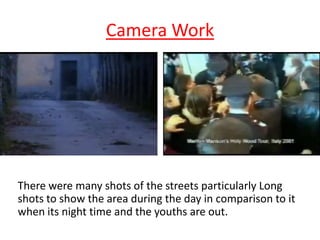
There were many shots of the streets particularly Long
shots to show the area during the day in comparison to it
when its night time and the youths are out.
Camera Work

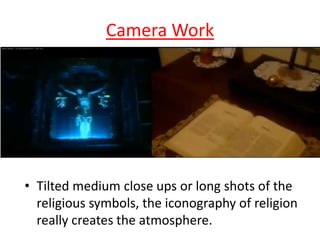
• Tilted medium close ups or long shots of the
religious symbols, the iconography of religion
really creates the atmosphere.
Camera Work

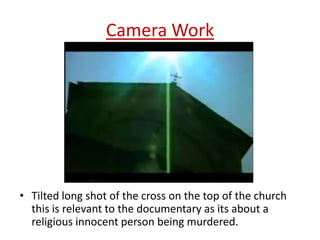
• Tilted long shot of the cross on the top of the church
this is relevant to the documentary as its about a
religious innocent person being murdered.
Camera Work
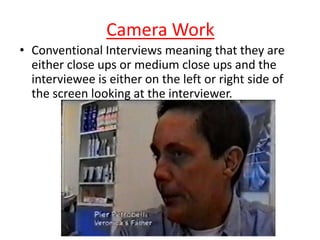
• Conventional Interviews meaning that they are
either close ups or medium close ups and the
interviewee is either on the left or right side of
the screen looking at the interviewer.
Mise en Scene
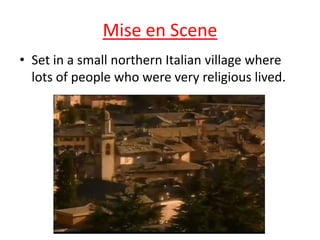
• Set in a small northern Italian village where
lots of people who were very religious lived.
Mise en Scene
• Throughout the Documentary there are binary
oppositions shown through Mise en scene.
Such as :
• Good V Bad
• Dark V Light
• Mason V God
• This is done through clothing, lighting and
iconography.
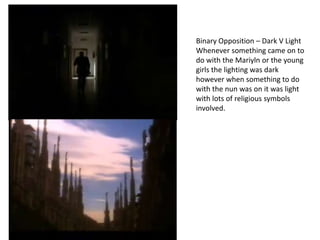
Binary Opposition – Dark V Light
Whenever something came on to
do with the Mariyln or the young
girls the lighting was dark
however when something to do
with the nun was on it was light
with lots of religious symbols
involved.
Mise en Scene
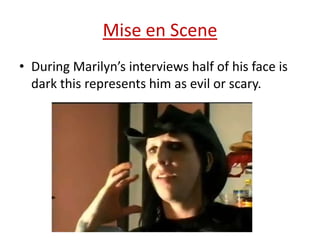
• During Marilyn’s interviews half of his face is
dark this represents him as evil or scary.
Mise en Scene
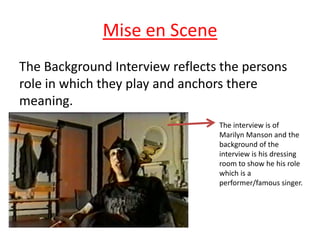
The Background Interview reflects the persons
role in which they play and anchors there
meaning.
The interview is of
Marilyn Manson and the
background of the
interview is his dressing
room to show he his role
which is a
performer/famous singer.
Sound
• Special effect of the heart beat reinforces the
impact and empathises the atmosphere.
• Church music and bells played while people paid
their respects which was peaceful and is the
opposite to Marilyn's music which is played a lot.
• Translator who was Italian reflected persons age
or gender.
• Voice over was a young male who spoke standard
English and this held the whole documentary
together.
Editing
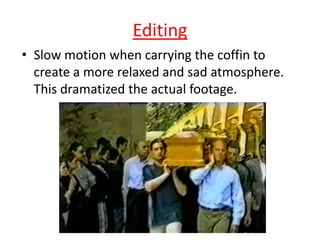
• Slow motion when carrying the coffin to
create a more relaxed and sad atmosphere.
This dramatized the actual footage.
Editing
• Pace of cuts changed according to where we
were e.g when in Marilyn's concert they sped
up.
• Quick cuts in reconstruction to reflect the
action going on and this highlights the
emotion.
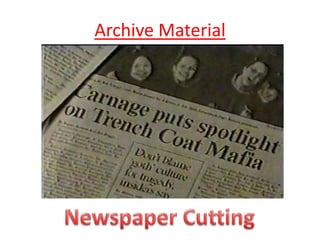
Archive Material
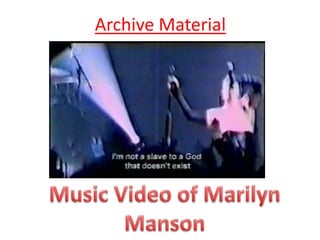
Archive Material
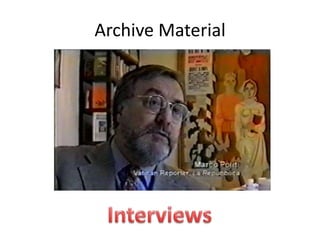
Archive Material
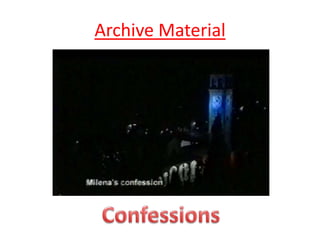
Archive Material
Graphics
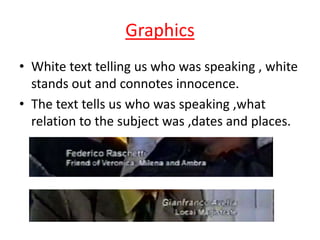
• White text telling us who was speaking , white
stands out and connotes innocence.
• The text tells us who was speaking ,what
relation to the subject was ,dates and places.
Graphics

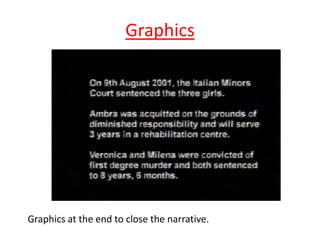
Graphics at the end to close the narrative.

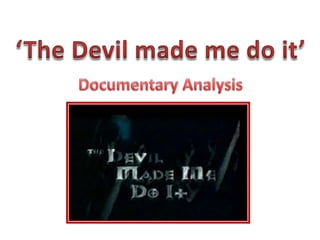
The devil made me do it

  • 2.
    Type of Documentary ‘TheDevil Made Me Do It’is a mixed documentary because it includes archive footage, interviews, observations and narration.
  • 3.
  • 4.
    Narrative Structure • OpenNarrative – The questions we think while watching the documentary were not answered therefore it was an open narrative. • Single Stranded- This means it was based on one topic or theme and was relevant to that throughout. • Non- Linear- The events shown were not in date order on the documentary.
  • 5.
    Camera Work There weremany shots of the streets particularly Long shots to show the area during the day in comparison to it when its night time and the youths are out.
  • 6.
    Camera Work • Tiltedmedium close ups or long shots of the religious symbols, the iconography of religion really creates the atmosphere.
  • 7.
    Camera Work • Tiltedlong shot of the cross on the top of the church this is relevant to the documentary as its about a religious innocent person being murdered.
  • 8.
    Camera Work • ConventionalInterviews meaning that they are either close ups or medium close ups and the interviewee is either on the left or right side of the screen looking at the interviewer.
  • 9.
    Mise en Scene •Set in a small northern Italian village where lots of people who were very religious lived.
  • 10.
    Mise en Scene •Throughout the Documentary there are binary oppositions shown through Mise en scene. Such as : • Good V Bad • Dark V Light • Mason V God • This is done through clothing, lighting and iconography.
  • 11.
    Binary Opposition –Dark V Light Whenever something came on to do with the Mariyln or the young girls the lighting was dark however when something to do with the nun was on it was light with lots of religious symbols involved.
  • 12.
    Mise en Scene •During Marilyn’s interviews half of his face is dark this represents him as evil or scary.
  • 13.
    Mise en Scene TheBackground Interview reflects the persons role in which they play and anchors there meaning. The interview is of Marilyn Manson and the background of the interview is his dressing room to show he his role which is a performer/famous singer.
  • 14.
    Sound • Special effectof the heart beat reinforces the impact and empathises the atmosphere. • Church music and bells played while people paid their respects which was peaceful and is the opposite to Marilyn's music which is played a lot. • Translator who was Italian reflected persons age or gender. • Voice over was a young male who spoke standard English and this held the whole documentary together.
  • 15.
    Editing • Slow motionwhen carrying the coffin to create a more relaxed and sad atmosphere. This dramatized the actual footage.
  • 16.
    Editing • Pace ofcuts changed according to where we were e.g when in Marilyn's concert they sped up. • Quick cuts in reconstruction to reflect the action going on and this highlights the emotion.
  • 17.
  • 18.
  • 19.
  • 20.
  • 21.
    Graphics • White texttelling us who was speaking , white stands out and connotes innocence. • The text tells us who was speaking ,what relation to the subject was ,dates and places.
  • 22.
    Graphics Graphics at theend to close the narrative.