Rock „n‟ Roll Exposed
The photography of Bob Gruen
Documentary Analysis
Narrative Structure
Mixed- it involves interviews with various camera sizes whilst
incorporates conventional cut aways
Non-linear- it‟s not in chronological order as events occur when
its relevant with the speakers words
Closed- no unanswered questions after the documentary is over
Single strand- it focuses on one particular topic (Bob Gruen‟s
photography)
Themes- The change in pop culture
Punk in society
Camera Work
Shots within interviews
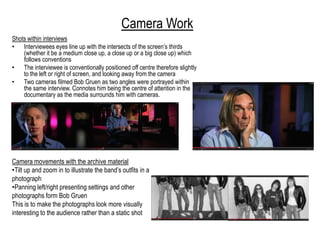
• Interviewees eyes line up with the intersects of the screen‟s thirds
(whether it be a medium close up, a close up or a big close up) which
follows conventions
• The interviewee is conventionally positioned off centre therefore slightly
to the left or right of screen, and looking away from the camera
• Two cameras filmed Bob Gruen as two angles were portrayed within
the same interview. Connotes him being the centre of attention in the
documentary as the media surrounds him with cameras.
Camera movements with the archive material
•Tilt up and zoom in to illustrate the band‟s outfits in a
photograph
•Panning left/right presenting settings and other
photographs form Bob Gruen
This is to make the photographs look more visually
interesting to the audience rather than a static shot
Sound
No voice over spoke throughout. Instead, just the
interviewees answers were heard whilst relevant cut
aways of photographs were presented. A voice over
was unnecessary as the everyone else involved
had adequate answers for the audience‟s queries.
Music of the band‟s who were being spoken about at
the specific time. Each song became slightly louder
once the interviewee had stopped speaking to avoid
silence within the documentary.
Editing
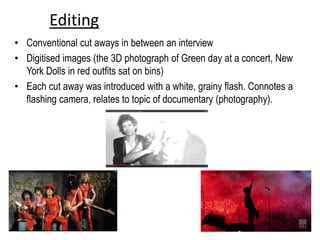
• Conventional cut aways in between an interview
• Digitised images (the 3D photograph of Green day at a concert, New
York Dolls in red outfits sat on bins)
• Each cut away was introduced with a white, grainy flash. Connotes a
flashing camera, relates to topic of documentary (photography).
Mise En Scene
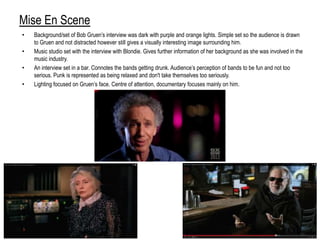
• Background/set of Bob Gruen‟s interview was dark with purple and orange lights. Simple set so the audience is drawn
to Gruen and not distracted however still gives a visually interesting image surrounding him.
• Music studio set with the interview with Blondie. Gives further information of her background as she was involved in the
music industry.
• An interview set in a bar. Connotes the bands getting drunk. Audience‟s perception of bands to be fun and not too
serious. Punk is represented as being relaxed and don't take themselves too seriously.
• Lighting focused on Gruen‟s face. Centre of attention, documentary focuses mainly on him.
Archive material
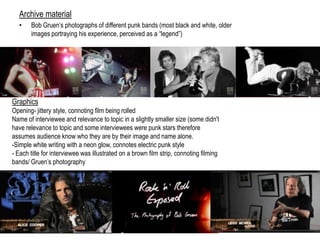
• Bob Gruen‟s photographs of different punk bands (most black and white, older
images portraying his experience, perceived as a “legend”)
Graphics
Opening- jittery style, connoting film being rolled
Name of interviewee and relevance to topic in a slightly smaller size (some didn't
have relevance to topic and some interviewees were punk stars therefore
assumes audience know who they are by their image and name alone.
-Simple white writing with a neon glow, connotes electric punk style
- Each title for interviewee was illustrated on a brown film strip, connoting filming
bands/ Gruen‟s photography

Rock ‘n’ roll exposed

  • 1.
    Rock „n‟ RollExposed The photography of Bob Gruen Documentary Analysis
  • 2.
    Narrative Structure Mixed- itinvolves interviews with various camera sizes whilst incorporates conventional cut aways Non-linear- it‟s not in chronological order as events occur when its relevant with the speakers words Closed- no unanswered questions after the documentary is over Single strand- it focuses on one particular topic (Bob Gruen‟s photography) Themes- The change in pop culture Punk in society
  • 3.
    Camera Work Shots withininterviews • Interviewees eyes line up with the intersects of the screen‟s thirds (whether it be a medium close up, a close up or a big close up) which follows conventions • The interviewee is conventionally positioned off centre therefore slightly to the left or right of screen, and looking away from the camera • Two cameras filmed Bob Gruen as two angles were portrayed within the same interview. Connotes him being the centre of attention in the documentary as the media surrounds him with cameras. Camera movements with the archive material •Tilt up and zoom in to illustrate the band‟s outfits in a photograph •Panning left/right presenting settings and other photographs form Bob Gruen This is to make the photographs look more visually interesting to the audience rather than a static shot
  • 4.
    Sound No voice overspoke throughout. Instead, just the interviewees answers were heard whilst relevant cut aways of photographs were presented. A voice over was unnecessary as the everyone else involved had adequate answers for the audience‟s queries. Music of the band‟s who were being spoken about at the specific time. Each song became slightly louder once the interviewee had stopped speaking to avoid silence within the documentary.
  • 5.
    Editing • Conventional cutaways in between an interview • Digitised images (the 3D photograph of Green day at a concert, New York Dolls in red outfits sat on bins) • Each cut away was introduced with a white, grainy flash. Connotes a flashing camera, relates to topic of documentary (photography).
  • 6.
    Mise En Scene •Background/set of Bob Gruen‟s interview was dark with purple and orange lights. Simple set so the audience is drawn to Gruen and not distracted however still gives a visually interesting image surrounding him. • Music studio set with the interview with Blondie. Gives further information of her background as she was involved in the music industry. • An interview set in a bar. Connotes the bands getting drunk. Audience‟s perception of bands to be fun and not too serious. Punk is represented as being relaxed and don't take themselves too seriously. • Lighting focused on Gruen‟s face. Centre of attention, documentary focuses mainly on him.
  • 7.
    Archive material • BobGruen‟s photographs of different punk bands (most black and white, older images portraying his experience, perceived as a “legend”) Graphics Opening- jittery style, connoting film being rolled Name of interviewee and relevance to topic in a slightly smaller size (some didn't have relevance to topic and some interviewees were punk stars therefore assumes audience know who they are by their image and name alone. -Simple white writing with a neon glow, connotes electric punk style - Each title for interviewee was illustrated on a brown film strip, connoting filming bands/ Gruen‟s photography