Morgan Appel, Director
Education Department
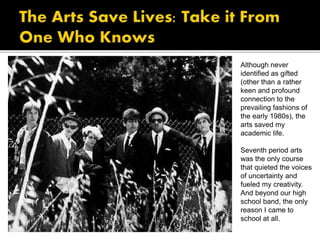
Although never
identified as gifted
(other than a rather
keen and profound
connection to the
prevailing fashions of
the early 1980s), the
arts saved my
academic life.
Seventh period arts
was the only course
that quieted the voices
of uncertainty and
fueled my creativity.
And beyond our high
school band, the only
reason I came to
school at all.
 Being gifted is a gift—unless you are the one experiencing it
first hand (both blessing and burden)
 Gifted have a tendency to look outwardly for approval and
inwardly for blame
 Gifted may experience unique pressures to ‘perform’ as if the
spotlight is always on—even when alone
 The greatest risk is the social risk, and the greatest challenges
for educators and parents alike are socioemotional
 Gifted tend to be great starters, but at times lack discipline
for follow through (beginnings are always fun!)
 Things come naturally—without having to work hard.
 Wearing an impenetrable suit of emotional armor every day
can be exhausting, both mentally and physically.
Artistic Wisdom
from Those Who
Knew Best
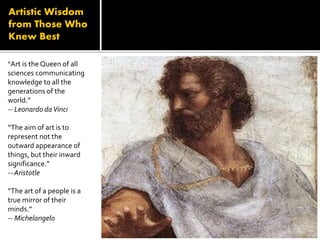
“Art is the Queen of all
sciences communicating
knowledge to all the
generations of the
world.”
-- Leonardo daVinci
“The aim of art is to
represent not the
outward appearance of
things, but their inward
significance.”
-- Aristotle
“The art of a people is a
true mirror of their
minds.”
-- Michelangelo
Into the Light:
Understanding the
Gifted Using Plato’s
Allegory of the Cave
In many ways, the gifted and
talented are akin to the
imprisoned featured in Plato’s
Allegory. Their perceptions are
shaped by shadow, distortion and
exaggerated interpretation
emerging from their unique
neurobiology and socio-affective
characteristics.
Thus, one of the most important
duties parents of the gifted have
is to help bring them into daylight
and offer them a quality of life
with a lesser degree of anxiety
and intensity.
The same neurochemistry that
fuels all we love about the gifted
in the classroom and at home can
wreak havoc internally.That is
why counseling the gifted takes
all the king’s horses and all the
king’s men.
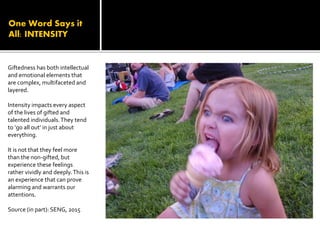
One Word Says it
All: INTENSITY
Giftedness has both intellectual
and emotional elements that
are complex, multifaceted and
layered.
Intensity impacts every aspect
of the lives of gifted and
talented individuals.They tend
to ‘go all out’ in just about
everything.
It is not that they feel more
than the non-gifted, but
experience these feelings
rather vividly and deeply.This is
an experience that can prove
alarming and warrants our
attentions.
Source (in part): SENG, 2015
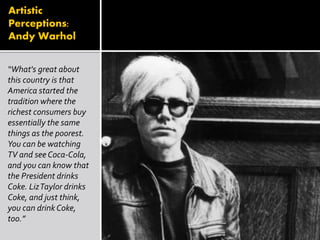
Artistic
Perceptions:
Andy Warhol
“What's great about
this country is that
America started the
tradition where the
richest consumers buy
essentially the same
things as the poorest.
You can be watching
TV and see Coca-Cola,
and you can know that
the President drinks
Coke. LizTaylor drinks
Coke, and just think,
you can drink Coke,
too.”
CHARACTERISTICS
 Fluency of imagination and
expression / self motivated in a
medium
 Highly developed sensibilities
(movement, space and color, for
example)
 Faith in ideas (no need to copy)
 Directness of expression and
eagerness to engage arts activities
related to a given topic
 Identification with subject and
medium of the art
 Design sensibilities and
extraordinary skill with a medium
 Individual and inventive*
TRAITS AND SKILLS
 Perceptual discrimination –
perceive and differentiate senses
 Metaperception – ‘artistic knowing’
and aesthetic sensibilities
 Creative interpretation —
increasingly sophisticated as one
reworks or refines the art (also
building metacognitive skills)
 Also: rapidity of development;
extended concentration; self-
directedness; risk aversion (even
creative); calculating capacity;
memory and detail; and random
improvisation (doodling, for
example)
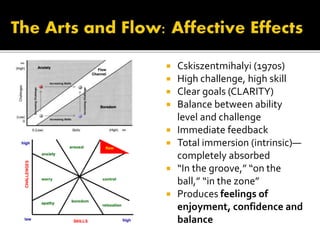
 Cskiszentmihalyi (1970s)
 High challenge, high skill
 Clear goals (CLARITY)
 Balance between ability
level and challenge
 Immediate feedback
 Total immersion (intrinsic)—
completely absorbed
 “In the groove,” “on the
ball,” “in the zone”
 Produces feelings of
enjoyment, confidence and
balance
Routine,
Ambiguity and
Anxiety
Neurochemically speaking,
departure from routine is
difficult for the gifted
individual, especially if the
pathway is ambiguous or where
the chance of success is
undetermined.
Ambiguity tends to activate the
survival mechanism (fight,
flight or freeze) and the
associated adrenaline and
cortisol that signals the brain to
focus can produce an
unpleasant experience we are
trained to avoid.
Thus, the trick is to remove the
danger from the unknown and
to provide a sense of stability
and predictability moving
forward. Clarity is king.
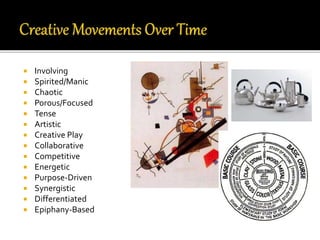
 Involving
 Spirited/Manic
 Chaotic
 Porous/Focused
 Tense
 Artistic
 Creative Play
 Collaborative
 Competitive
 Energetic
 Purpose-Driven
 Synergistic
 Differentiated
 Epiphany-Based
Effective Affective
Filtering Through
the Arts
Engaging in artistic
pursuits empowers a
sense of determined
purpose and focus.They
tend to keep the mind
rather busy in creative
exploration, thus
filtering exogenous
static and opening the
flood gates of
inspiration.
Clarity and focus offers
opportunities for flow to
kick in in meaningful
and productive ways.
 Provides ‘safe’ environments for gifted learners (no ‘right’ or
‘wrong’ answers) and a means to develop sound metacognitive
habits and mitigate the impacts of perfectionism through
revisions and refinements
 Facilitates freedom of expression and seeing ‘shades of gray’
 Socially constructed learning that connects to the ‘real world’
and helps to explain it, realistically
 An outlet for both empathy and intensity – not always verbal
 Inspires risk taking, confidence and competence
 Discovering role models who have much in common with
themselves
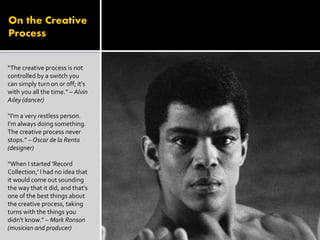
On the Creative
Process
“The creative process is not
controlled by a switch you
can simply turn on or off; it's
with you all the time.” – Alvin
Ailey (dancer)
“I'm a very restless person.
I'm always doing something.
The creative process never
stops.” – Oscar de la Renta
(designer)
“When I started 'Record
Collection,' I had no idea that
it would come out sounding
the way that it did, and that's
one of the best things about
the creative process, taking
turns with the things you
didn't know.” – Mark Ronson
(musician and producer)
 Counteracting the Effects of a ‘Media-Driven Culture’
 Cultivating social competencies (and relationships)
 Impacts on self-regulation and understanding of social
justice and equity
 Opportunities to enhance socioemotional development
(must be undertaken in a purposeful way)
 Empowerment, voice and the creation of healthy social
scripts (decision making related to focus and methods)
 Opportunities for ‘bite-size’ successes, competence and
confidence
 A place for everyone—not just the stars on stage
Source: Brouillette, 2010 and others
 Inhibition of impulse
(lengthening the fuse)
 Previewing consequences
 Holding and manipulating
information in working
memory
 Sustaining attention
 Planning in the short and
longer term
 Saliency determination
 Task initiation
 Depth of processing
 Tempo control (speed of
work)
 Automaticity (skills that do
not require conscious
effort)
 Satisfaction (real, not
temporary)
 Organization and time
management
 Flexibility
 Self monitoring
 Metacognition
 Emotional self regulation
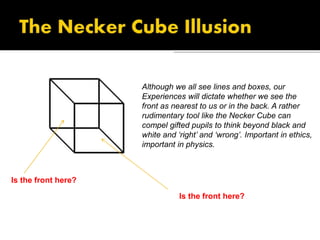
Although we all see lines and boxes, our
Experiences will dictate whether we see the
front as nearest to us or in the back. A rather
rudimentary tool like the Necker Cube can
compel gifted pupils to think beyond black and
white and ‘right’ and ‘wrong’. Important in ethics,
important in physics.
Is the front here?
Is the front here?
 Enhances biological survival (hard wired for music—
attracting mates, imitation, etc.)
 Advances cognitive systems (visual-spatial; analytical;
mathematical; creative)
 Advances stress-response systems
 Improves memory, concentration and recall
 Improves ability to follow directions, work collaboratively
and/or individually
 Positively affects emotional systems, including
enhancement of cultural understanding; social skills;
personal skills
Source: Jensen, 2001
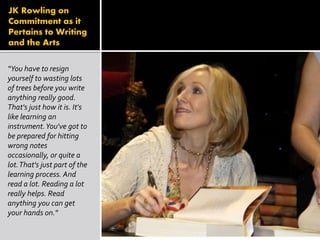
JK Rowling on
Commitment as it
Pertains to Writing
and the Arts
“You have to resign
yourself to wasting lots
of trees before you write
anything really good.
That's just how it is. It's
like learning an
instrument.You've got to
be prepared for hitting
wrong notes
occasionally, or quite a
lot.That's just part of the
learning process. And
read a lot. Reading a lot
really helps. Read
anything you can get
your hands on."
 Again, hard wired as part of survival mechanism—also a
‘sketchpad’ to accompany the spoken word
 Link between visual arts and improvement in creativity, critical
thinking and reading (no easy answers!)
 Can enhance awareness in cognitively and culturally diverse
classrooms
 Improvement in vocabulary and writing skills
 Improvement in recall, identification of patterns and outliers
 Provides students with ‘choice’ and greater levels of motivation
(attendance, participation)
 Improved levels of task commitment and self control; teamwork,
time management (especially relevant for twice-exceptional
pupils)
Source: Jensen, 2001
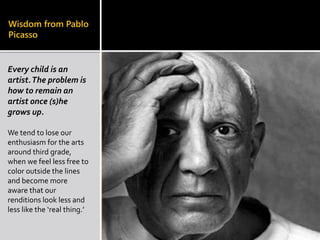
Wisdom from Pablo
Picasso
Every child is an
artist.The problem is
how to remain an
artist once (s)he
grows up.
We tend to lose our
enthusiasm for the arts
around third grade,
when we feel less free to
color outside the lines
and become more
aware that our
renditions look less and
less like the ‘real thing.’
 Enhance cognition, positive attitudes, confidence —may grow
new brain cells
 Enhance ongoing development of various neurobiological
systems, including cognition, immune, circulatory and perpetual-
motor
 Provide unique challenges and environmental constraints that
require the application of multiple tools/systems to manage
(versus seatwork)—metacognition, patience.
 Compels making rapid decisions, keeping attention up, alertness
for potential problems, scaffolding upon past experiences
 Increases Emotional Intelligence (monitoring own emotions,
reading those of others)
Source: Jensen, 2001
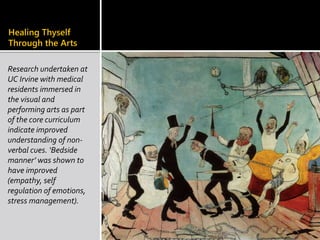
Healing Thyself
Through the Arts
Research undertaken at
UC Irvine with medical
residents immersed in
the visual and
performing arts as part
of the core curriculum
indicate improved
understanding of non-
verbal cues. ‘Bedside
manner’ was shown to
have improved
(empathy, self
regulation of emotions,
stress management).
 Inspire creativity because of a ‘natural recipe’ for brain growth:
challenge, novelty, feedback, coherence and time
 Improve understanding of sequencing, time, and collaborative
interpretation skills
 Improve learning through multimodal reinforcement (running
from state to state)
 Opportunities to relate with the opposite sex in a non-
threatening setting that calls for social discipline
 ‘Language’ of dance (telling stories/expression)
 Improve Emotional Intelligence, empathy (puts oneself in the
shoes of another)
 ‘Feel good’ chemicals run high: noradrenaline, dopamine
Source: Jensen, 2001
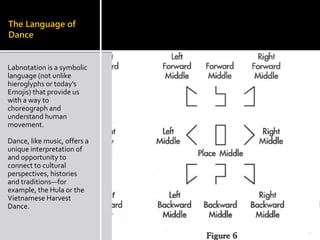
The Language of
Dance
Labnotation is a symbolic
language (not unlike
hieroglyphs or today’s
Emojis) that provide us
with a way to
choreograph and
understand human
movement.
Dance, like music, offers a
unique interpretation of
and opportunity to
connect to cultural
perspectives, histories
and traditions—for
example, the Hula or the
Vietnamese Harvest
Dance.
The Monuments
Men
The story of the Monuments
Men is inspiring for a number
of reasons – a good movie
and an even better read.
Beyond preserving our
shared cultural history as war
raged through Europe, the
epilogue of the Monuments
Men helped bridge science
and the arts.
The field of conservation and
restoration involves a host of
scientific tools and concepts
(infared, x-rays, chemistry,
among others)—with many
techniques pioneered by Lt.
Cdr. George Stout (played by
George Clooney in the
movie).
1940s2000s
Elements of
Depth and
Complexity
• Details
• Big Picture
• Perspectives
• Ethics
• Over Time
• Rules
• Language
• Patterns
• Unanswered ?s
• Across Disciplines
Yo trabajaba, mis hijos iban creciendo
Todos nacieron bajo de esta gran nacion
-- y mis derechos los han ido pisoteando
van formulando leyes de constitucion
Que ha ya viejo si me quitan mi dinero --
yo solo quiero mi seguro de pension
LosTigres del Norte, “Mis dos Patrias,”
1997
Now fill your glasses up, my boys, a
toast come drink with me,
May Erin's Harp and the Starry Flag
united ever be;
May traitors quake, and rebels
shake, and tremble in their fears,
When next they meet theYankee
boys and Irish volunteers!
God bless the name ofWashington!
that name this land reveres;
Success to Meagher and Nugent,
and their Irish volunteers!
Chorus--God bless the name, etc.
“The Bonny Blue Flag,” 1861
What are the
similarities/
differences?
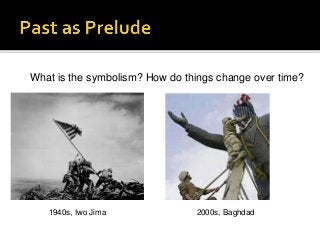
1940s, Iwo Jima 2000s, Baghdad
What is the symbolism? How do things change over time?
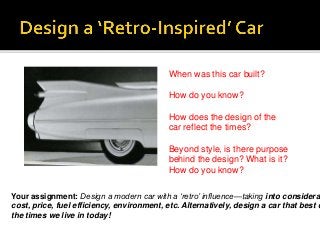
When was this car built?
How do you know?
How does the design of the
car reflect the times?
Beyond style, is there purpose
behind the design? What is it?
How do you know?
Your assignment: Design a modern car with a ‘retro’ influence—taking into considerat
cost, price, fuel efficiency, environment, etc. Alternatively, design a car that best d
the times we live in today!
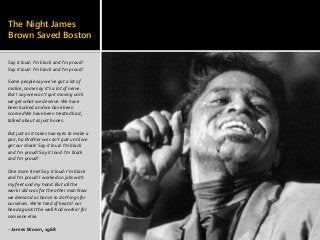
The Night James
Brown Saved Boston
Say it loud: I'm black and I'm proud!
Some people say we've got a lot of
malice, some say it’s a lot of nerve.
But I say we won't quit moving until
we get what we deserve.We have
been bucked and we have been
scornedWe have been treated bad,
talked about as just bones.
But just as it takes two eyes to make a
pair, ha Brother we can’t quit until we
get our share! Say it loud: I'm black
and I'm proud! Say it loud: I'm black
and I'm proud!
One more time! Say it loud: I'm black
and I'm proud! I worked on jobs with
my feet and my hand. But all the
work I did was for the other man Now
we demand a chance to do things for
ourselves.We're tired of beatin' our
head against the wall And workin' for
someone else.
--James Brown, 1968
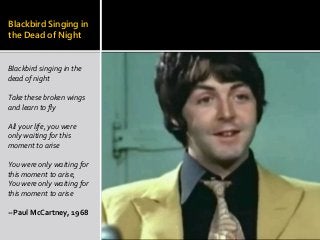
Blackbird Singing in
the Dead of Night
Blackbird singing in the
dead of night
Take these broken wings
and learn to fly
All your life, you were
only waiting for this
moment to arise
You were only waiting for
this moment to arise,
You were only waiting for
this moment to arise
--Paul McCartney, 1968
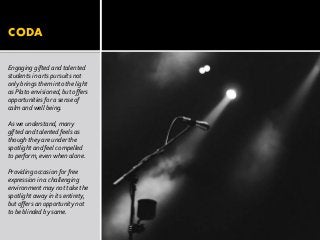
CODA
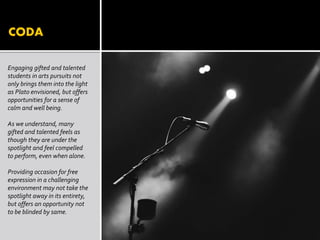
Engaging gifted and talented
students in arts pursuits not
only brings them into the light
as Plato envisioned, but offers
opportunities for a sense of
calm and well being.
As we understand, many
gifted and talented feels as
though they are under the
spotlight and feel compelled
to perform, even when alone.
Providing occasion for free
expression in a challenging
environment may not take the
spotlight away in its entirety,
but offers an opportunity not
to be blinded by same.
Contact Information
Morgan Appel, Director
Education Department
UC San Diego Extension
9500 Gilman Drive #0170-N
La Jolla, California 92093-0170
858-534-9273/ mappel@ucsd.edu

The Da Vinci Coda (AE Wright Middle School)

  • 1.
  • 2.
    Although never identified asgifted (other than a rather keen and profound connection to the prevailing fashions of the early 1980s), the arts saved my academic life. Seventh period arts was the only course that quieted the voices of uncertainty and fueled my creativity. And beyond our high school band, the only reason I came to school at all.
  • 3.
     Being giftedis a gift—unless you are the one experiencing it first hand (both blessing and burden)  Gifted have a tendency to look outwardly for approval and inwardly for blame  Gifted may experience unique pressures to ‘perform’ as if the spotlight is always on—even when alone  The greatest risk is the social risk, and the greatest challenges for educators and parents alike are socioemotional  Gifted tend to be great starters, but at times lack discipline for follow through (beginnings are always fun!)  Things come naturally—without having to work hard.  Wearing an impenetrable suit of emotional armor every day can be exhausting, both mentally and physically.
  • 4.
    Artistic Wisdom from ThoseWho Knew Best “Art is the Queen of all sciences communicating knowledge to all the generations of the world.” -- Leonardo daVinci “The aim of art is to represent not the outward appearance of things, but their inward significance.” -- Aristotle “The art of a people is a true mirror of their minds.” -- Michelangelo
  • 5.
    Into the Light: Understandingthe Gifted Using Plato’s Allegory of the Cave In many ways, the gifted and talented are akin to the imprisoned featured in Plato’s Allegory. Their perceptions are shaped by shadow, distortion and exaggerated interpretation emerging from their unique neurobiology and socio-affective characteristics. Thus, one of the most important duties parents of the gifted have is to help bring them into daylight and offer them a quality of life with a lesser degree of anxiety and intensity. The same neurochemistry that fuels all we love about the gifted in the classroom and at home can wreak havoc internally.That is why counseling the gifted takes all the king’s horses and all the king’s men.
  • 6.
    One Word Saysit All: INTENSITY Giftedness has both intellectual and emotional elements that are complex, multifaceted and layered. Intensity impacts every aspect of the lives of gifted and talented individuals.They tend to ‘go all out’ in just about everything. It is not that they feel more than the non-gifted, but experience these feelings rather vividly and deeply.This is an experience that can prove alarming and warrants our attentions. Source (in part): SENG, 2015
  • 7.
    Artistic Perceptions: Andy Warhol “What's greatabout this country is that America started the tradition where the richest consumers buy essentially the same things as the poorest. You can be watching TV and see Coca-Cola, and you can know that the President drinks Coke. LizTaylor drinks Coke, and just think, you can drink Coke, too.”
  • 8.
    CHARACTERISTICS  Fluency ofimagination and expression / self motivated in a medium  Highly developed sensibilities (movement, space and color, for example)  Faith in ideas (no need to copy)  Directness of expression and eagerness to engage arts activities related to a given topic  Identification with subject and medium of the art  Design sensibilities and extraordinary skill with a medium  Individual and inventive* TRAITS AND SKILLS  Perceptual discrimination – perceive and differentiate senses  Metaperception – ‘artistic knowing’ and aesthetic sensibilities  Creative interpretation — increasingly sophisticated as one reworks or refines the art (also building metacognitive skills)  Also: rapidity of development; extended concentration; self- directedness; risk aversion (even creative); calculating capacity; memory and detail; and random improvisation (doodling, for example)
  • 9.
     Cskiszentmihalyi (1970s) High challenge, high skill  Clear goals (CLARITY)  Balance between ability level and challenge  Immediate feedback  Total immersion (intrinsic)— completely absorbed  “In the groove,” “on the ball,” “in the zone”  Produces feelings of enjoyment, confidence and balance
  • 10.
    Routine, Ambiguity and Anxiety Neurochemically speaking, departurefrom routine is difficult for the gifted individual, especially if the pathway is ambiguous or where the chance of success is undetermined. Ambiguity tends to activate the survival mechanism (fight, flight or freeze) and the associated adrenaline and cortisol that signals the brain to focus can produce an unpleasant experience we are trained to avoid. Thus, the trick is to remove the danger from the unknown and to provide a sense of stability and predictability moving forward. Clarity is king.
  • 11.
     Involving  Spirited/Manic Chaotic  Porous/Focused  Tense  Artistic  Creative Play  Collaborative  Competitive  Energetic  Purpose-Driven  Synergistic  Differentiated  Epiphany-Based
  • 12.
    Effective Affective Filtering Through theArts Engaging in artistic pursuits empowers a sense of determined purpose and focus.They tend to keep the mind rather busy in creative exploration, thus filtering exogenous static and opening the flood gates of inspiration. Clarity and focus offers opportunities for flow to kick in in meaningful and productive ways.
  • 13.
     Provides ‘safe’environments for gifted learners (no ‘right’ or ‘wrong’ answers) and a means to develop sound metacognitive habits and mitigate the impacts of perfectionism through revisions and refinements  Facilitates freedom of expression and seeing ‘shades of gray’  Socially constructed learning that connects to the ‘real world’ and helps to explain it, realistically  An outlet for both empathy and intensity – not always verbal  Inspires risk taking, confidence and competence  Discovering role models who have much in common with themselves
  • 14.
    On the Creative Process “Thecreative process is not controlled by a switch you can simply turn on or off; it's with you all the time.” – Alvin Ailey (dancer) “I'm a very restless person. I'm always doing something. The creative process never stops.” – Oscar de la Renta (designer) “When I started 'Record Collection,' I had no idea that it would come out sounding the way that it did, and that's one of the best things about the creative process, taking turns with the things you didn't know.” – Mark Ronson (musician and producer)
  • 15.
     Counteracting theEffects of a ‘Media-Driven Culture’  Cultivating social competencies (and relationships)  Impacts on self-regulation and understanding of social justice and equity  Opportunities to enhance socioemotional development (must be undertaken in a purposeful way)  Empowerment, voice and the creation of healthy social scripts (decision making related to focus and methods)  Opportunities for ‘bite-size’ successes, competence and confidence  A place for everyone—not just the stars on stage Source: Brouillette, 2010 and others
  • 16.
     Inhibition ofimpulse (lengthening the fuse)  Previewing consequences  Holding and manipulating information in working memory  Sustaining attention  Planning in the short and longer term  Saliency determination  Task initiation  Depth of processing  Tempo control (speed of work)  Automaticity (skills that do not require conscious effort)  Satisfaction (real, not temporary)  Organization and time management  Flexibility  Self monitoring  Metacognition  Emotional self regulation
  • 17.
    Although we allsee lines and boxes, our Experiences will dictate whether we see the front as nearest to us or in the back. A rather rudimentary tool like the Necker Cube can compel gifted pupils to think beyond black and white and ‘right’ and ‘wrong’. Important in ethics, important in physics. Is the front here? Is the front here?
  • 18.
     Enhances biologicalsurvival (hard wired for music— attracting mates, imitation, etc.)  Advances cognitive systems (visual-spatial; analytical; mathematical; creative)  Advances stress-response systems  Improves memory, concentration and recall  Improves ability to follow directions, work collaboratively and/or individually  Positively affects emotional systems, including enhancement of cultural understanding; social skills; personal skills Source: Jensen, 2001
  • 19.
    JK Rowling on Commitmentas it Pertains to Writing and the Arts “You have to resign yourself to wasting lots of trees before you write anything really good. That's just how it is. It's like learning an instrument.You've got to be prepared for hitting wrong notes occasionally, or quite a lot.That's just part of the learning process. And read a lot. Reading a lot really helps. Read anything you can get your hands on."
  • 20.
     Again, hardwired as part of survival mechanism—also a ‘sketchpad’ to accompany the spoken word  Link between visual arts and improvement in creativity, critical thinking and reading (no easy answers!)  Can enhance awareness in cognitively and culturally diverse classrooms  Improvement in vocabulary and writing skills  Improvement in recall, identification of patterns and outliers  Provides students with ‘choice’ and greater levels of motivation (attendance, participation)  Improved levels of task commitment and self control; teamwork, time management (especially relevant for twice-exceptional pupils) Source: Jensen, 2001
  • 21.
    Wisdom from Pablo Picasso Everychild is an artist.The problem is how to remain an artist once (s)he grows up. We tend to lose our enthusiasm for the arts around third grade, when we feel less free to color outside the lines and become more aware that our renditions look less and less like the ‘real thing.’
  • 22.
     Enhance cognition,positive attitudes, confidence —may grow new brain cells  Enhance ongoing development of various neurobiological systems, including cognition, immune, circulatory and perpetual- motor  Provide unique challenges and environmental constraints that require the application of multiple tools/systems to manage (versus seatwork)—metacognition, patience.  Compels making rapid decisions, keeping attention up, alertness for potential problems, scaffolding upon past experiences  Increases Emotional Intelligence (monitoring own emotions, reading those of others) Source: Jensen, 2001
  • 23.
    Healing Thyself Through theArts Research undertaken at UC Irvine with medical residents immersed in the visual and performing arts as part of the core curriculum indicate improved understanding of non- verbal cues. ‘Bedside manner’ was shown to have improved (empathy, self regulation of emotions, stress management).
  • 24.
     Inspire creativitybecause of a ‘natural recipe’ for brain growth: challenge, novelty, feedback, coherence and time  Improve understanding of sequencing, time, and collaborative interpretation skills  Improve learning through multimodal reinforcement (running from state to state)  Opportunities to relate with the opposite sex in a non- threatening setting that calls for social discipline  ‘Language’ of dance (telling stories/expression)  Improve Emotional Intelligence, empathy (puts oneself in the shoes of another)  ‘Feel good’ chemicals run high: noradrenaline, dopamine Source: Jensen, 2001
  • 25.
    The Language of Dance Labnotationis a symbolic language (not unlike hieroglyphs or today’s Emojis) that provide us with a way to choreograph and understand human movement. Dance, like music, offers a unique interpretation of and opportunity to connect to cultural perspectives, histories and traditions—for example, the Hula or the Vietnamese Harvest Dance.
  • 26.
    The Monuments Men The storyof the Monuments Men is inspiring for a number of reasons – a good movie and an even better read. Beyond preserving our shared cultural history as war raged through Europe, the epilogue of the Monuments Men helped bridge science and the arts. The field of conservation and restoration involves a host of scientific tools and concepts (infared, x-rays, chemistry, among others)—with many techniques pioneered by Lt. Cdr. George Stout (played by George Clooney in the movie).
  • 27.
    1940s2000s Elements of Depth and Complexity •Details • Big Picture • Perspectives • Ethics • Over Time • Rules • Language • Patterns • Unanswered ?s • Across Disciplines
  • 28.
    Yo trabajaba, mishijos iban creciendo Todos nacieron bajo de esta gran nacion -- y mis derechos los han ido pisoteando van formulando leyes de constitucion Que ha ya viejo si me quitan mi dinero -- yo solo quiero mi seguro de pension LosTigres del Norte, “Mis dos Patrias,” 1997 Now fill your glasses up, my boys, a toast come drink with me, May Erin's Harp and the Starry Flag united ever be; May traitors quake, and rebels shake, and tremble in their fears, When next they meet theYankee boys and Irish volunteers! God bless the name ofWashington! that name this land reveres; Success to Meagher and Nugent, and their Irish volunteers! Chorus--God bless the name, etc. “The Bonny Blue Flag,” 1861 What are the similarities/ differences?
  • 29.
    1940s, Iwo Jima2000s, Baghdad What is the symbolism? How do things change over time?
  • 30.
    When was thiscar built? How do you know? How does the design of the car reflect the times? Beyond style, is there purpose behind the design? What is it? How do you know? Your assignment: Design a modern car with a ‘retro’ influence—taking into considerat cost, price, fuel efficiency, environment, etc. Alternatively, design a car that best d the times we live in today!
  • 31.
    The Night James BrownSaved Boston Say it loud: I'm black and I'm proud! Say it loud: I'm black and I'm proud! Some people say we've got a lot of malice, some say it’s a lot of nerve. But I say we won't quit moving until we get what we deserve.We have been bucked and we have been scornedWe have been treated bad, talked about as just bones. But just as it takes two eyes to make a pair, ha Brother we can’t quit until we get our share! Say it loud: I'm black and I'm proud! Say it loud: I'm black and I'm proud! One more time! Say it loud: I'm black and I'm proud! I worked on jobs with my feet and my hand. But all the work I did was for the other man Now we demand a chance to do things for ourselves.We're tired of beatin' our head against the wall And workin' for someone else. --James Brown, 1968
  • 32.
    Blackbird Singing in theDead of Night Blackbird singing in the dead of night Take these broken wings and learn to fly All your life, you were only waiting for this moment to arise You were only waiting for this moment to arise, You were only waiting for this moment to arise --Paul McCartney, 1968
  • 33.
    CODA Engaging gifted andtalented students in arts pursuits not only brings them into the light as Plato envisioned, but offers opportunities for a sense of calm and well being. As we understand, many gifted and talented feels as though they are under the spotlight and feel compelled to perform, even when alone. Providing occasion for free expression in a challenging environment may not take the spotlight away in its entirety, but offers an opportunity not to be blinded by same.
  • 35.
    Contact Information Morgan Appel,Director Education Department UC San Diego Extension 9500 Gilman Drive #0170-N La Jolla, California 92093-0170 858-534-9273/ mappel@ucsd.edu