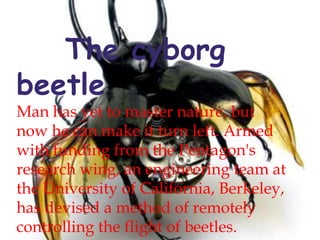
The cyborg
beetle
Man has yet to master nature, but
now he can make it turn left. Armed
with funding from the Pentagon's
research wing, an engineering team at
the University of California, Berkeley,
has devised a method of remotely
controlling the flight of beetles.
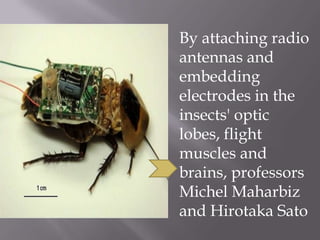
By attaching radio
antennas and
embedding
electrodes in the
insects' optic
lobes, flight
muscles and
brains, professors
Michel Maharbiz
and Hirotaka Sato
can manipulate their subjects into
taking off, hovering in midair and
turning on command. The trick?
Wirelessly delivering jolts to a
micro battery fastened to a circuit
board      atop     the     hapless
insects, whose agility and capacity
to tote valuable payloads could
make the tiny creatures the
ultimate fly on the wall.
The Pentagon has funded a project at UC
Berkley    in   which     scientists  have
successfully grafted electrodes and tiny
radio antennae to flying beetles--allowing
researchers to steer the beetles by remote
control. These cyborg beetles are both
fascinating and terrifying--the project is
helping scientists discover new insights
into how beetles fly.
But experts are also already discussing
the possibilities a remote-controlled
flying beetle can offer the military. So
how does one create a remote
controlled cyborg beetle, anyhow?

Well,   evidently,   electrodes   are
implanted at the beetles' pupal stage
in order to outfit the beetles for
remote control later
Using Cyborg Beetles
for Good or Evil? And
here's where things start to
get a little unnerving--
discussing how the military
would be interested in taking
advantage       of       such
technology.
According to robotics professor Noel
Sharkey of UK's Sheffield University,
there's not too much that the Pentagon
could with the beetles right now . GPS
systems or other tracking devices are
too heavy and cumbersome to fit on
beetles' backs. But he notes that the
cyborg beetles could feasibly carry
chemical weapons and could be
effective assassins, though this would
be highly illegal.
Brain-Recording Backpacks?
It's a view echoed by Reid Harrison
,an electrical engineer at the
University of Utah, Salt Lake
City, who has designed brain-
recording backpacks for insects.
"I'm skeptical about their ability to
do surveillance for the following
reason: no one has solved the
power issue."
Batteries,   solar    cells   and
piezoelectric that harvest energy
from movement cannot provide
enough power to run electrodes
and radio transmitters for very
long, Harrison says. "Maybe
we'll have some advances in
those technologies in the near
future, but based on what you
can get off the shelf now it's not
even close."
Naveen Tanwar
Amrit Singh
Abhishek Kaushik
Abhishek Jatrana

The cyborg beetle

  • 2.
    The cyborg beetle Man hasyet to master nature, but now he can make it turn left. Armed with funding from the Pentagon's research wing, an engineering team at the University of California, Berkeley, has devised a method of remotely controlling the flight of beetles.
  • 3.
    By attaching radio antennasand embedding electrodes in the insects' optic lobes, flight muscles and brains, professors Michel Maharbiz and Hirotaka Sato
  • 4.
    can manipulate theirsubjects into taking off, hovering in midair and turning on command. The trick? Wirelessly delivering jolts to a micro battery fastened to a circuit board atop the hapless insects, whose agility and capacity to tote valuable payloads could make the tiny creatures the ultimate fly on the wall.
  • 5.
    The Pentagon hasfunded a project at UC Berkley in which scientists have successfully grafted electrodes and tiny radio antennae to flying beetles--allowing researchers to steer the beetles by remote control. These cyborg beetles are both fascinating and terrifying--the project is helping scientists discover new insights into how beetles fly.
  • 6.
    But experts arealso already discussing the possibilities a remote-controlled flying beetle can offer the military. So how does one create a remote controlled cyborg beetle, anyhow? Well, evidently, electrodes are implanted at the beetles' pupal stage in order to outfit the beetles for remote control later
  • 8.
    Using Cyborg Beetles forGood or Evil? And here's where things start to get a little unnerving-- discussing how the military would be interested in taking advantage of such technology.
  • 9.
    According to roboticsprofessor Noel Sharkey of UK's Sheffield University, there's not too much that the Pentagon could with the beetles right now . GPS systems or other tracking devices are too heavy and cumbersome to fit on beetles' backs. But he notes that the cyborg beetles could feasibly carry chemical weapons and could be effective assassins, though this would be highly illegal.
  • 11.
    Brain-Recording Backpacks? It's aview echoed by Reid Harrison ,an electrical engineer at the University of Utah, Salt Lake City, who has designed brain- recording backpacks for insects. "I'm skeptical about their ability to do surveillance for the following reason: no one has solved the power issue."
  • 12.
    Batteries, solar cells and piezoelectric that harvest energy from movement cannot provide enough power to run electrodes and radio transmitters for very long, Harrison says. "Maybe we'll have some advances in those technologies in the near future, but based on what you can get off the shelf now it's not even close."
  • 15.
    Naveen Tanwar Amrit Singh AbhishekKaushik Abhishek Jatrana