PRESENTED BY:
DR. PREETI
CONTENTS
1. INTRODUCTION—SELECTION, WHY???
2. INDICATION & CONTRAINDICATION
3. ADVANTAGES & DISADVANTAGES
4. SPECIAL CONSIDERATIONS
5. ARMAMENTARIUM
6. TECHNIQUE
7. EVALUATION
WHY FULL COVERAGE OVER PARTIAL
COVERAGE ???
laboratory studies by Lorey and Meyers , Reisbick and Shillingburg ,
and Potts et al
CONTRAINDICATIONS
1. If less than maximum retention and
resistance is necessary
2. If high esthetics need exists (anterior
teeth)
3. Intact buccal/lingual wall exists
4. If treatment objectives can be met with
more conservative restoration.
5. Mouths with uncontrolled caries
INDICATIONS
1. Extensive coronal destruction from
caries/trauma
2. Endodontically treated teeth
3. Existing restoration
4. Necessity for max retention & strength
5. Enameloplasty
6. Correct minor malinclinations
7. Correction of occlusal plane
Rosensteil 5th edition The Complete Cast Crown Preparation ;Page209
ADVANTAGES
1. Strong
2. High retention & resistance form
3. easy to obtain adequate resistance form
4. Option to modify form & occlusion -
especially for supraerupted teeth
5. Less easily to deform
DISADVANTAGES
1. Removal of large amount of tooth
structure
2. Adverse effects on pulp &
periodontium
3. Vitality test cannot be done
4. Display of metal, may be restricted to
max molars/mand molars/premolars
Rosensteil 5th edition The Complete Cast Crown Preparation ;Page209-210
SPECIAL CONSIDERATIONS
. 1 BEVEL:
 A wide bevel -- placed on the functional cusp ---
round-end tapered diamond
 angled flatter than external surface
 At 45' to long axis
Failure to place this bevel can produce :
 thin casting or poor morphology.
 to prevent overcontoured restoration
2. CHAMFER WIDTH :
 common error – increasing faciolingual width---
---lead to periodontal disease
 min 0.5mm is adequate-- to develop optimum
axial contour
 on premolars, make slightly narrower chamfer--
to conserve tooth struc & retention form
Rosensteil 5th edition The Complete Cast Crown Preparation ;Page211
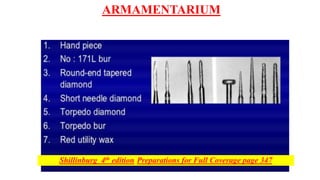
ARMAMENTARIUM
Shillinburg 4th edition Preparations for Full Coverage page 347
T
• GUIDING GROOVES FOR OCCLUSAL REDUCTION
E
• OCCLUSAL REDUCTION & BEVEL
C
• ALIGNMENT GROOVES FOR AXIAL REDUCTION
H
• AXIAL REDUCTION
N
• FINISHING
Q
• EVALUATION
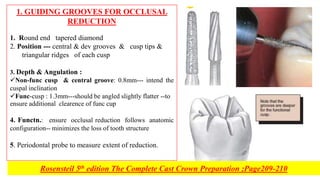
1. GUIDING GROOVES FOR OCCLUSAL
REDUCTION
1. Round end tapered diamond
2. Position --- central & dev grooves & cusp tips &
triangular ridges of each cusp
3. Depth & Angulation :
Non-func cusp & central groove: 0.8mm--- intend the
cuspal inclination
Func-cusp : 1.3mm---should be angled slightly flatter --to
ensure additional clearence of func cup
4. Functn.: ensure occlusal reduction follows anatomic
configuration-- minimizes the loss of tooth structure
5. Periodontal probe to measure extent of reduction.
Rosensteil 5th edition The Complete Cast Crown Preparation ;Page209-210
2) OCCLUSAL REDUCTION
1. Remove the tooth structure that remains between
grooves
Preserving occlusal morphology
2. Round-end tapered diamond
3. Technique:
 first, reduce half of occlusal surface- other half
will act as reference
 then reduce the other half
4 . Func cusps : 1.5mm & Non-func cusps : 1mm
Rosensteil 5th edition The Complete Cast Crown Preparation ;Page209-210
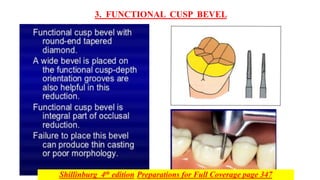
3. FUNCTIONAL CUSP BEVEL
Shillinburg 4th edition Preparations for Full Coverage page 347
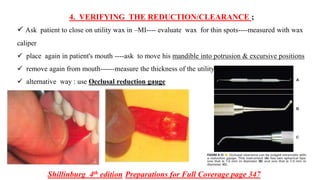
4. VERIFYING THE REDUCTION/CLEARANCE ;
 Ask patient to close on utility wax in –MI---- evaluate wax for thin spots----measured with wax
caliper
 place again in patient's mouth ----ask to move his mandible into potrusion & excursive positions
 remove again from mouth------measure the thickness of the utility wax
 alternative way : use Occlusal reduction gauge
5) ALIGNMENT GROOVES FOR
AXIAL REDUCTION
1. Place 3 alignment grooves in each buccal & lingual
wall--- 1 is placed at center, 1 in mesial & distal
transitional line angle
2. Round end tapered diamond
3. Shank of the diamond must // to p.o.p of restoration
--- will automatically produce a convergence to the
prep. Wall--- identical to the taper of the diamond (6'
taper)
4. Diamond shouldn’t cut tooth beyond its
midpoint---creation of enamel lip(unsupported
enamel)
5. use periodontal probe to asses the parallelism of
alignment grooves with one another
Rosensteil 5th edition The Complete Cast Crown Preparation ;Page209-210
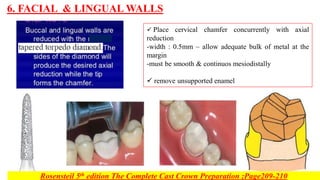
6. FACIAL & LINGUAL WALLS
 Place cervical chamfer concurrently with axial
reduction
-width : 0.5mm – allow adequate bulk of metal at the
margin
-must be smooth & continuos mesiodistally
 remove unsupported enamel
Rosensteil 5th edition The Complete Cast Crown Preparation ;Page209-210
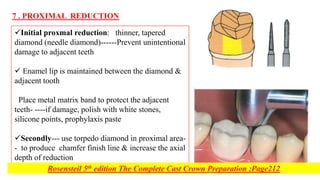
7 . PROXIMAL REDUCTION
Initial proxmal reduction: thinner, tapered
diamond (needle diamond)------Prevent unintentional
damage to adjacent teeth
 Enamel lip is maintained between the diamond &
adjacent tooth
Place metal matrix band to protect the adjacent
teeth- ----if damage, polish with white stones,
silicone points, prophylaxis paste
Secondly--- use torpedo diamond in proximal area-
- to produce chamfer finish line & increase the axial
depth of reduction
Rosensteil 5th edition The Complete Cast Crown Preparation ;Page212
Chamfer finishing: torpedo bur .
8. FINISHING
1. Functions –
 to facilitate impression making, waxing investing, casting
 to enhance retention & resistance form
2. Use fine-grit diamond/carbide bur, with reduced speed handpiece
3 . Margin must be glassy smooth, line angles should be round , finish line should be smooth &
continuous.
Shillinburg 4th edition Preparations for Full Coverage page 350
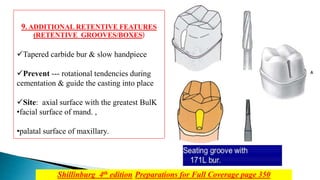
9. ADDITIONAL RETENTIVE FEATURES
(RETENTIVE GROOVES/BOXES)
Tapered carbide bur & slow handpiece
Prevent --- rotational tendencies during
cementation & guide the casting into place
Site: axial surface with the greatest BulK
•facial surface of mand. ,
•palatal surface of maxillary.
Shillinburg 4th edition Preparations for Full Coverage page 350
10) EVALUATION
1. Detect the common errors that can reduce the
retention--overtapered & undercuts
2. Correct errors by-- upright the overtapered axial walls ,
use grooves/boxes/pinholes
3. Tip of diamond should rest on the chamfer while making
the axial reduction
4. Assess any probs and correct before making interim
restoration & impression
Rosensteil 5th edition The Complete Cast Crown Preparation ;Page212-215
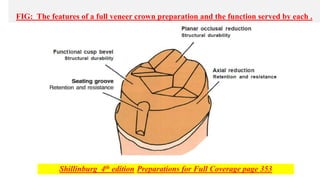
Shillinburg 4th edition Preparations for Full Coverage page 353
FIG: The features of a full veneer crown preparation and the function served by each .

THE COMPLETE CAST PREPARATION

  • 1.
  • 2.
    CONTENTS 1. INTRODUCTION—SELECTION, WHY??? 2.INDICATION & CONTRAINDICATION 3. ADVANTAGES & DISADVANTAGES 4. SPECIAL CONSIDERATIONS 5. ARMAMENTARIUM 6. TECHNIQUE 7. EVALUATION
  • 3.
    WHY FULL COVERAGEOVER PARTIAL COVERAGE ??? laboratory studies by Lorey and Meyers , Reisbick and Shillingburg , and Potts et al
  • 4.
    CONTRAINDICATIONS 1. If lessthan maximum retention and resistance is necessary 2. If high esthetics need exists (anterior teeth) 3. Intact buccal/lingual wall exists 4. If treatment objectives can be met with more conservative restoration. 5. Mouths with uncontrolled caries INDICATIONS 1. Extensive coronal destruction from caries/trauma 2. Endodontically treated teeth 3. Existing restoration 4. Necessity for max retention & strength 5. Enameloplasty 6. Correct minor malinclinations 7. Correction of occlusal plane Rosensteil 5th edition The Complete Cast Crown Preparation ;Page209
  • 5.
    ADVANTAGES 1. Strong 2. Highretention & resistance form 3. easy to obtain adequate resistance form 4. Option to modify form & occlusion - especially for supraerupted teeth 5. Less easily to deform DISADVANTAGES 1. Removal of large amount of tooth structure 2. Adverse effects on pulp & periodontium 3. Vitality test cannot be done 4. Display of metal, may be restricted to max molars/mand molars/premolars Rosensteil 5th edition The Complete Cast Crown Preparation ;Page209-210
  • 6.
    SPECIAL CONSIDERATIONS . 1BEVEL:  A wide bevel -- placed on the functional cusp --- round-end tapered diamond  angled flatter than external surface  At 45' to long axis Failure to place this bevel can produce :  thin casting or poor morphology.  to prevent overcontoured restoration 2. CHAMFER WIDTH :  common error – increasing faciolingual width--- ---lead to periodontal disease  min 0.5mm is adequate-- to develop optimum axial contour  on premolars, make slightly narrower chamfer-- to conserve tooth struc & retention form Rosensteil 5th edition The Complete Cast Crown Preparation ;Page211
  • 7.
    ARMAMENTARIUM Shillinburg 4th editionPreparations for Full Coverage page 347
  • 8.
    T • GUIDING GROOVESFOR OCCLUSAL REDUCTION E • OCCLUSAL REDUCTION & BEVEL C • ALIGNMENT GROOVES FOR AXIAL REDUCTION H • AXIAL REDUCTION N • FINISHING Q • EVALUATION
  • 9.
    1. GUIDING GROOVESFOR OCCLUSAL REDUCTION 1. Round end tapered diamond 2. Position --- central & dev grooves & cusp tips & triangular ridges of each cusp 3. Depth & Angulation : Non-func cusp & central groove: 0.8mm--- intend the cuspal inclination Func-cusp : 1.3mm---should be angled slightly flatter --to ensure additional clearence of func cup 4. Functn.: ensure occlusal reduction follows anatomic configuration-- minimizes the loss of tooth structure 5. Periodontal probe to measure extent of reduction. Rosensteil 5th edition The Complete Cast Crown Preparation ;Page209-210
  • 10.
    2) OCCLUSAL REDUCTION 1.Remove the tooth structure that remains between grooves Preserving occlusal morphology 2. Round-end tapered diamond 3. Technique:  first, reduce half of occlusal surface- other half will act as reference  then reduce the other half 4 . Func cusps : 1.5mm & Non-func cusps : 1mm Rosensteil 5th edition The Complete Cast Crown Preparation ;Page209-210
  • 11.
    3. FUNCTIONAL CUSPBEVEL Shillinburg 4th edition Preparations for Full Coverage page 347
  • 12.
    Shillinburg 4th editionPreparations for Full Coverage page 347 4. VERIFYING THE REDUCTION/CLEARANCE ;  Ask patient to close on utility wax in –MI---- evaluate wax for thin spots----measured with wax caliper  place again in patient's mouth ----ask to move his mandible into potrusion & excursive positions  remove again from mouth------measure the thickness of the utility wax  alternative way : use Occlusal reduction gauge
  • 13.
    5) ALIGNMENT GROOVESFOR AXIAL REDUCTION 1. Place 3 alignment grooves in each buccal & lingual wall--- 1 is placed at center, 1 in mesial & distal transitional line angle 2. Round end tapered diamond 3. Shank of the diamond must // to p.o.p of restoration --- will automatically produce a convergence to the prep. Wall--- identical to the taper of the diamond (6' taper) 4. Diamond shouldn’t cut tooth beyond its midpoint---creation of enamel lip(unsupported enamel) 5. use periodontal probe to asses the parallelism of alignment grooves with one another Rosensteil 5th edition The Complete Cast Crown Preparation ;Page209-210
  • 14.
    6. FACIAL &LINGUAL WALLS  Place cervical chamfer concurrently with axial reduction -width : 0.5mm – allow adequate bulk of metal at the margin -must be smooth & continuos mesiodistally  remove unsupported enamel Rosensteil 5th edition The Complete Cast Crown Preparation ;Page209-210
  • 15.
    7 . PROXIMALREDUCTION Initial proxmal reduction: thinner, tapered diamond (needle diamond)------Prevent unintentional damage to adjacent teeth  Enamel lip is maintained between the diamond & adjacent tooth Place metal matrix band to protect the adjacent teeth- ----if damage, polish with white stones, silicone points, prophylaxis paste Secondly--- use torpedo diamond in proximal area- - to produce chamfer finish line & increase the axial depth of reduction Rosensteil 5th edition The Complete Cast Crown Preparation ;Page212
  • 16.
    Chamfer finishing: torpedobur . 8. FINISHING 1. Functions –  to facilitate impression making, waxing investing, casting  to enhance retention & resistance form 2. Use fine-grit diamond/carbide bur, with reduced speed handpiece 3 . Margin must be glassy smooth, line angles should be round , finish line should be smooth & continuous. Shillinburg 4th edition Preparations for Full Coverage page 350
  • 17.
    9. ADDITIONAL RETENTIVEFEATURES (RETENTIVE GROOVES/BOXES) Tapered carbide bur & slow handpiece Prevent --- rotational tendencies during cementation & guide the casting into place Site: axial surface with the greatest BulK •facial surface of mand. , •palatal surface of maxillary. Shillinburg 4th edition Preparations for Full Coverage page 350
  • 18.
    10) EVALUATION 1. Detectthe common errors that can reduce the retention--overtapered & undercuts 2. Correct errors by-- upright the overtapered axial walls , use grooves/boxes/pinholes 3. Tip of diamond should rest on the chamfer while making the axial reduction 4. Assess any probs and correct before making interim restoration & impression Rosensteil 5th edition The Complete Cast Crown Preparation ;Page212-215
  • 19.
    Shillinburg 4th editionPreparations for Full Coverage page 353 FIG: The features of a full veneer crown preparation and the function served by each .