Massie RitschU.S. Department of EducationESEA REAUTHORIZATION
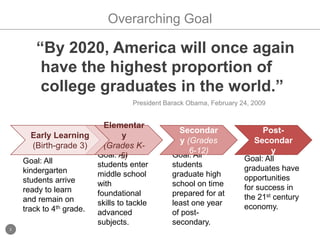
Overarching Goal“By 2020, America will once again have the highest proportion of college graduates in the world.”President Barack Obama, February 24, 2009Elementary(Grades K-5)Secondary (Grades 6-12)Post-SecondaryEarly Learning(Birth-grade 3)Goal: All graduates have opportunities for success in the 21st century economy.Goal: All students graduate high school on time prepared for at least one year of post-secondary.Goal: All students enter middle school with foundational skills to tackle advanced subjects.Goal: All kindergarten students arrive ready to learn and remain on track to 4th grade.
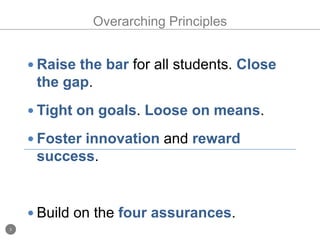
Overarching PrinciplesRaise the bar for all students. Close the gap.Tight on goals. Loose on means.Fosterinnovation and reward success.Build on the four assurances.
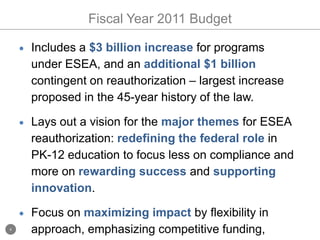
Fiscal Year 2011 BudgetIncludes a $3 billion increase for programs under ESEA, and an additional $1 billion contingent on reauthorization – largest increase proposed in the 45-year history of the law.
Lays out a vision for the major themes for ESEA reauthorization: redefining the federal role in PK-12 education to focus less on compliance and more on rewarding success and supporting innovation.
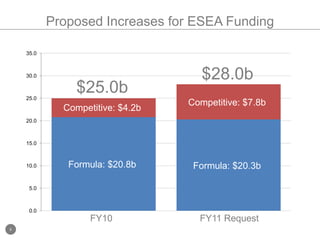
Focus on maximizing impact by flexibility in approach, emphasizing competitive funding, accountability for outcomes, and evidence of results. Proposed Increases for ESEA Funding$28.0b$25.0bCompetitive: $7.8bCompetitive: $4.2bFormula: $20.8bFormula: $20.3bFormula - Formula - FY10FY11 Request
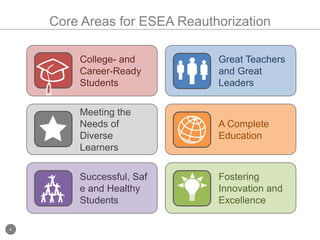
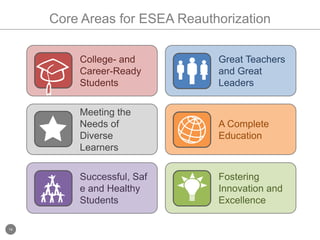
Core Areas for ESEA ReauthorizationCollege- and Career-Ready StudentsGreat Teachers and Great LeadersA Complete EducationMeeting the Needs of Diverse LearnersSuccessful, Safe and Healthy StudentsFostering Innovation and Excellence
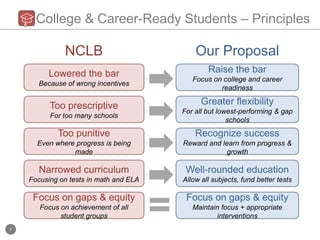
       College & Career-Ready Students– PrinciplesNCLBOur ProposalLowered the barBecause of wrong incentivesRaise the barFocus on college and career readinessToo prescriptiveFor too many schoolsGreater flexibilityFor all but lowest-performing & gap schoolsToo punitiveEven where progress is being madeRecognize successReward and learn from progress & growthNarrowed curriculumFocusing on tests in math and ELAWell-rounded educationAllow all subjects, fund better tests=Focus on gaps & equityFocus on achievement of all student groupsFocus on gaps & equityMaintain focus + appropriate interventions
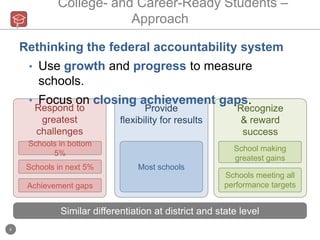
       College- and Career-Ready Students – ApproachRethinking the federal accountability systemUse growth and progress to measure schools.
Focus on closing achievement gaps.Respond to greatest challengesProvideflexibility for resultsRecognize& reward successSchools in bottom 5%Most schoolsSchool makinggreatest gainsSchools in next 5%Schools meeting all performance targetsAchievement gapsSimilar differentiation at district and state level
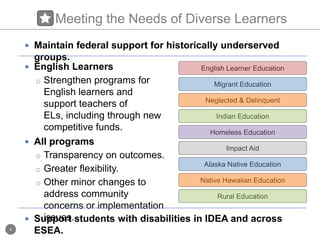
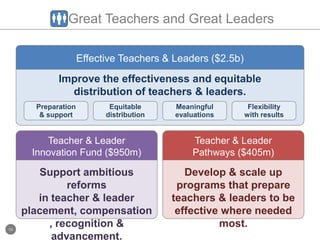
      Meeting the Needs of Diverse LearnersMaintain federal support for historically underserved groups.English LearnersStrengthen programs for English learners and support teachers of ELs, including through new competitive funds.All programsTransparency on outcomes.Greater flexibility.Other minor changes to address community concerns or implementation issues.English Learner EducationMigrant EducationNeglected & DelinquentIndian EducationHomeless EducationImpact AidAlaska Native EducationNative Hawaiian EducationRural EducationSupport students with disabilities in IDEA and across ESEA.      Great Teachers and Great LeadersImprove the effectiveness and equitabledistribution of teachers & leaders.Effective Teachers & Leaders ($2.5b)Meaningful evaluationsEquitable distributionPreparation& supportFlexibilitywith resultsTeacher & Leader Innovation Fund ($950m)Teacher & LeaderPathways ($405m)Support ambitious reformsin teacher & leader placement, compensation, recognition & advancement.Develop & scale up programs that prepare teachers & leaders to be effective where needed most.
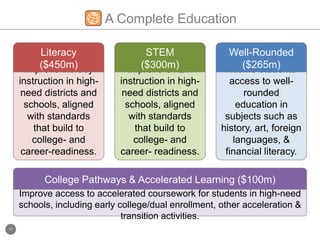
      A Complete EducationWell-Rounded ($265m)Literacy($450m)STEM($300m)Improve low-income students’ access to well-rounded education in subjects such as history, art, foreign languages, & financial literacy.Improve literacy instruction in high-need districts and schools, aligned with standards that build to college- and career-readiness.Improve STEM instruction in high-need districts and schools, aligned with standards that build to college- and career- readiness.College Pathways & Accelerated Learning ($100m)Improve access to accelerated coursework for students in high-need schools, including early college/dual enrollment, other acceleration & transition activities.
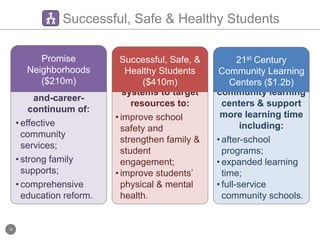
      Successful, Safe & Healthy StudentsPromiseNeighborhoods ($210m)Successful, Safe, & Healthy Students ($410m)21st Century Community Learning Centers ($1.2b)Strengthen community learning centers & support more learning time including:after-school programs;
expanded learning time;

Esea proposal

  • 1.
    Massie RitschU.S. Departmentof EducationESEA REAUTHORIZATION
  • 2.
    Overarching Goal“By 2020,America will once again have the highest proportion of college graduates in the world.”President Barack Obama, February 24, 2009Elementary(Grades K-5)Secondary (Grades 6-12)Post-SecondaryEarly Learning(Birth-grade 3)Goal: All graduates have opportunities for success in the 21st century economy.Goal: All students graduate high school on time prepared for at least one year of post-secondary.Goal: All students enter middle school with foundational skills to tackle advanced subjects.Goal: All kindergarten students arrive ready to learn and remain on track to 4th grade.
  • 3.
    Overarching PrinciplesRaise thebar for all students. Close the gap.Tight on goals. Loose on means.Fosterinnovation and reward success.Build on the four assurances.
  • 4.
    Fiscal Year 2011BudgetIncludes a $3 billion increase for programs under ESEA, and an additional $1 billion contingent on reauthorization – largest increase proposed in the 45-year history of the law.
  • 5.
    Lays out avision for the major themes for ESEA reauthorization: redefining the federal role in PK-12 education to focus less on compliance and more on rewarding success and supporting innovation.
  • 6.
    Focus on maximizingimpact by flexibility in approach, emphasizing competitive funding, accountability for outcomes, and evidence of results. Proposed Increases for ESEA Funding$28.0b$25.0bCompetitive: $7.8bCompetitive: $4.2bFormula: $20.8bFormula: $20.3bFormula - Formula - FY10FY11 Request
  • 7.
    Core Areas forESEA ReauthorizationCollege- and Career-Ready StudentsGreat Teachers and Great LeadersA Complete EducationMeeting the Needs of Diverse LearnersSuccessful, Safe and Healthy StudentsFostering Innovation and Excellence
  • 8.
    College & Career-Ready Students– PrinciplesNCLBOur ProposalLowered the barBecause of wrong incentivesRaise the barFocus on college and career readinessToo prescriptiveFor too many schoolsGreater flexibilityFor all but lowest-performing & gap schoolsToo punitiveEven where progress is being madeRecognize successReward and learn from progress & growthNarrowed curriculumFocusing on tests in math and ELAWell-rounded educationAllow all subjects, fund better tests=Focus on gaps & equityFocus on achievement of all student groupsFocus on gaps & equityMaintain focus + appropriate interventions
  • 9.
    College- and Career-Ready Students – ApproachRethinking the federal accountability systemUse growth and progress to measure schools.
  • 10.
    Focus on closingachievement gaps.Respond to greatest challengesProvideflexibility for resultsRecognize& reward successSchools in bottom 5%Most schoolsSchool makinggreatest gainsSchools in next 5%Schools meeting all performance targetsAchievement gapsSimilar differentiation at district and state level
  • 11.
    Meeting the Needs of Diverse LearnersMaintain federal support for historically underserved groups.English LearnersStrengthen programs for English learners and support teachers of ELs, including through new competitive funds.All programsTransparency on outcomes.Greater flexibility.Other minor changes to address community concerns or implementation issues.English Learner EducationMigrant EducationNeglected & DelinquentIndian EducationHomeless EducationImpact AidAlaska Native EducationNative Hawaiian EducationRural EducationSupport students with disabilities in IDEA and across ESEA. Great Teachers and Great LeadersImprove the effectiveness and equitabledistribution of teachers & leaders.Effective Teachers & Leaders ($2.5b)Meaningful evaluationsEquitable distributionPreparation& supportFlexibilitywith resultsTeacher & Leader Innovation Fund ($950m)Teacher & LeaderPathways ($405m)Support ambitious reformsin teacher & leader placement, compensation, recognition & advancement.Develop & scale up programs that prepare teachers & leaders to be effective where needed most.
  • 12.
    A Complete EducationWell-Rounded ($265m)Literacy($450m)STEM($300m)Improve low-income students’ access to well-rounded education in subjects such as history, art, foreign languages, & financial literacy.Improve literacy instruction in high-need districts and schools, aligned with standards that build to college- and career-readiness.Improve STEM instruction in high-need districts and schools, aligned with standards that build to college- and career- readiness.College Pathways & Accelerated Learning ($100m)Improve access to accelerated coursework for students in high-need schools, including early college/dual enrollment, other acceleration & transition activities.
  • 13.
    Successful, Safe & Healthy StudentsPromiseNeighborhoods ($210m)Successful, Safe, & Healthy Students ($410m)21st Century Community Learning Centers ($1.2b)Strengthen community learning centers & support more learning time including:after-school programs;
  • 14.