The Colorado River

http://www.youtube.com/watch?v=FIPV-H9iCPA&feature=related
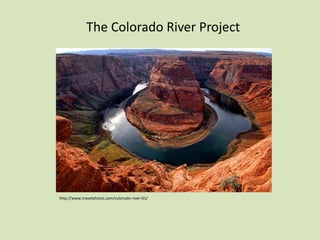
The Colorado River Project

http://www.travelphotoi.com/colorado-river-01/
http://serc.carleton.edu/eslabs/drought/6.html

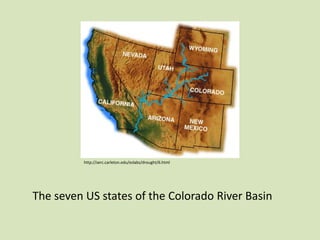
The seven US states of the Colorado River Basin
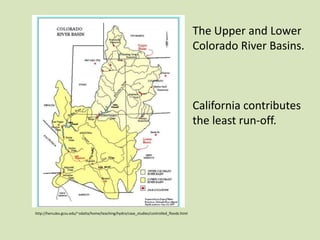
The Upper and Lower
Colorado River Basins.

California contributes
the least run-off.

http://hercules.gcsu.edu/~sdatta/home/teaching/hydro/case_studies/controlled_floods.html
Law of the river
• Law of the River

• The Law of the River is a complex body of laws, court
cases and regulations that control use of Colorado River
water and the operation of its dams.
• In the 1800s, states diverted water from the Colorado
River and its tributaries without restrictions. As the
diversions increased, a long battle over apportionment
evolved. Today, the Colorado River is probably the most
controlled, controversial and litigated river in the world.

http://www.snwa.com/html/wr_colrvr_law.html / Reisner, Marc. Cadillac Desert: the American West and Its Disappearing
Water. New York, N.Y., U.S.A.: Penguin, 1993. Print.
http://lib.colostate.edu/archives/water/compacts/compacts.html

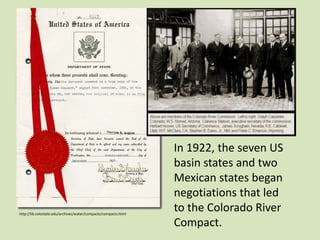
In 1922, the seven US
basin states and two
Mexican states began
negotiations that led
to the Colorado River
Compact.
The Colorado River Compact of
1922
 The cornerstone of the "Law of the River“

 defined the relationship between the upper basin states,
where most of the river's water supply originates, and the
lower basin states, where most of the water demands were
developing
 Secretary of Commerce Herbert Hoover suggested the basin
be divided into an upper and lower half, with each basin
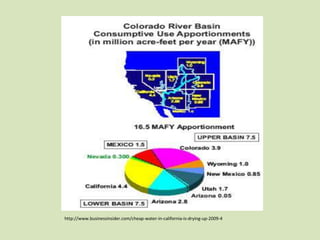
having the right to develop and use 7.5 million acre-feet (maf)
of river water annually. This approach reserved water for
future upper basin development and allowed planning and
development in the lower basin to proceed.
http://www.usbr.gov/lc/region/g1000/lawofrvr.html
http://www.businessinsider.com/cheap-water-in-california-is-drying-up-2009-4

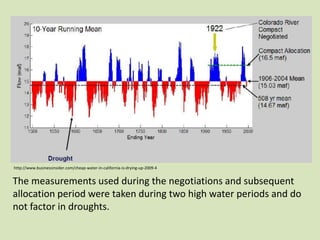
The measurements used during the negotiations and subsequent
allocation period were taken during two high water periods and do
not factor in droughts.
Laws, contracts and documents which are part
of the "Law of the River"









The Mexican Water Treaty of 1944 - Committed 1.5 maf of the river's annual flow
to Mexico.
Colorado River Storage Project of 1956 - Provided a comprehensive Upper Basinwide water resource development plan and authorized the construction of Glen
Canyon, Flaming Gorge, Navajo and Curecanti dams for river regulation and power
production, as well as several projects for irrigation and other uses.
The Criteria for Coordinated Long-Range Operation of Colorado River Reservoirs
of 1970 (amended March 21, 2005) - Provided for the coordinated operation of
reservoirs in the upper and lower basins and set conditions for water releases from
Lake Powell and Lake Mead.
U.S.-Mexico International Boundary and Water Commission of 1973 - Required
the U.S. to take actions to reduce the salinity of water being delivered to Mexico at
Morelos Dam.
The Colorado River Basin Salinity Control Act of 1974 - Authorized desalting and
salinity control projects, including the Yuma Desalting Plant, to improve Colorado
River quality.
http://www.usbr.gov/lc/region/g1000/lawofrvr.html / De, Villiers Marq. Water: the Fate of Our Most
Precious Resource. Boston: Houghton Mifflin, 2000. Print.
http://www.businessinsider.com/cheap-water-in-california-is-drying-up-2009-4
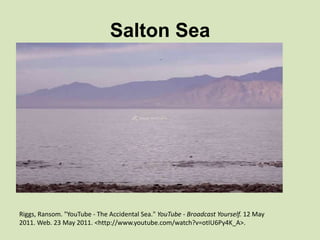
Salton Sea

Riggs, Ransom. "YouTube - The Accidental Sea." YouTube - Broadcast Yourself. 12 May
2011. Web. 23 May 2011. <http://www.youtube.com/watch?v=otIU6Py4K_A>.
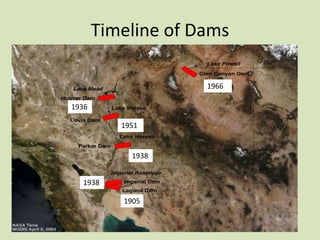
Timeline of Dams
1966
1936

1951

1938
1938
1905
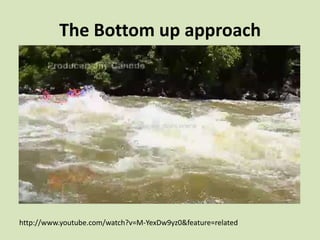
The Bottom up approach

http://www.youtube.com/watch?v=M-YexDw9yz0&feature=related
http://www.youtube.com/watch?v=Z0oErFt5zk0

The Colorado River Project

  • 1.
  • 2.
    The Colorado RiverProject http://www.travelphotoi.com/colorado-river-01/
  • 3.
  • 4.
    The Upper andLower Colorado River Basins. California contributes the least run-off. http://hercules.gcsu.edu/~sdatta/home/teaching/hydro/case_studies/controlled_floods.html
  • 5.
    Law of theriver • Law of the River • The Law of the River is a complex body of laws, court cases and regulations that control use of Colorado River water and the operation of its dams. • In the 1800s, states diverted water from the Colorado River and its tributaries without restrictions. As the diversions increased, a long battle over apportionment evolved. Today, the Colorado River is probably the most controlled, controversial and litigated river in the world. http://www.snwa.com/html/wr_colrvr_law.html / Reisner, Marc. Cadillac Desert: the American West and Its Disappearing Water. New York, N.Y., U.S.A.: Penguin, 1993. Print.
  • 6.
    http://lib.colostate.edu/archives/water/compacts/compacts.html In 1922, theseven US basin states and two Mexican states began negotiations that led to the Colorado River Compact.
  • 7.
    The Colorado RiverCompact of 1922  The cornerstone of the "Law of the River“  defined the relationship between the upper basin states, where most of the river's water supply originates, and the lower basin states, where most of the water demands were developing  Secretary of Commerce Herbert Hoover suggested the basin be divided into an upper and lower half, with each basin having the right to develop and use 7.5 million acre-feet (maf) of river water annually. This approach reserved water for future upper basin development and allowed planning and development in the lower basin to proceed. http://www.usbr.gov/lc/region/g1000/lawofrvr.html
  • 8.
    http://www.businessinsider.com/cheap-water-in-california-is-drying-up-2009-4 The measurements usedduring the negotiations and subsequent allocation period were taken during two high water periods and do not factor in droughts.
  • 9.
    Laws, contracts anddocuments which are part of the "Law of the River"      The Mexican Water Treaty of 1944 - Committed 1.5 maf of the river's annual flow to Mexico. Colorado River Storage Project of 1956 - Provided a comprehensive Upper Basinwide water resource development plan and authorized the construction of Glen Canyon, Flaming Gorge, Navajo and Curecanti dams for river regulation and power production, as well as several projects for irrigation and other uses. The Criteria for Coordinated Long-Range Operation of Colorado River Reservoirs of 1970 (amended March 21, 2005) - Provided for the coordinated operation of reservoirs in the upper and lower basins and set conditions for water releases from Lake Powell and Lake Mead. U.S.-Mexico International Boundary and Water Commission of 1973 - Required the U.S. to take actions to reduce the salinity of water being delivered to Mexico at Morelos Dam. The Colorado River Basin Salinity Control Act of 1974 - Authorized desalting and salinity control projects, including the Yuma Desalting Plant, to improve Colorado River quality. http://www.usbr.gov/lc/region/g1000/lawofrvr.html / De, Villiers Marq. Water: the Fate of Our Most Precious Resource. Boston: Houghton Mifflin, 2000. Print.
  • 10.
  • 11.
    Salton Sea Riggs, Ransom."YouTube - The Accidental Sea." YouTube - Broadcast Yourself. 12 May 2011. Web. 23 May 2011. <http://www.youtube.com/watch?v=otIU6Py4K_A>.
  • 12.
  • 13.
    The Bottom upapproach http://www.youtube.com/watch?v=M-YexDw9yz0&feature=related
  • 14.