Case Study
Final Report on
Political Economy
of Water Markets
October 2016
Truckee-Carson Surface Water
Markets in Northern Nevada
Truckee-Carson Surface Water Markets in Northern Nevada
A Case Study for the Political Economy of Water Markets Project
October 2016
Leslie Sanchezi
Bruce Aylwardii
Don Springmeyeriii
i
Friedman School of Nutrition, Tufts University, Boston, MA, lesliesanchez14@gmail.com
ii
AMP Insights, 4905 Scholls Ferry Rd, Portland, OR 97225, bruce@ampinsights.com
iii
Wolf, Rifkin, Shapiro, Schulman & Rabkin, LLP, 3556 E. Russell Road, Las Vegas, NV 89120,
dspringmeyer@wrslawyers.com
Preface
This paper is one output of a project entitled “The Political Economy of Water Markets.” The project was
carried out by Ecosystem Economics LLC and AMP Insights LLC. The outputs of the project include a
final report and a set of case studies.
The final report comes in three parts:
1. “Healthy” Water Markets: A Conceptual Framework by Bruce Aylward, David Pilz, Megan
Dyson and Carl J. Bauer
2. Political Economy of Water Markets in the Western United States by Bruce Aylward, David
Pilz and Leslie Sanchez
3. Comparative Analysis of Legal Regimes with Respect to Fostering “Healthy” Water Markets
by David Pilz, Megan Dyson, Bruce Aylward, Carl J. Bauer and Amy Hardberger
The eight case studies consist of the following.
1. The Evolving Water Market in Chile’s Maipo River Basin by Carl J. Bauer
2. Addressing Overallocation and Water Trade in New South Wales, Australia: Namoi Basin
Groundwater by Megan Dyson
3. Evolution of Australian Water Law and the National Water Initiative Framework by Megan
Dyson
4. Opportunities for Surface Water Right Marketing in Idaho’s Rapidly Urbanizing Treasure
Valley by Jeff Fereday
5. Texas Groundwater Markets and the Edwards Aquifer by Amy Hardberger
6. Oregon’s Umatilla Basin Aquifer Recharge and Basalt Bank by Martha Pagel
7. Truckee-Carson Surface Water Markets in Northern Nevada by Leslie Sanchez, Bruce
Aylward and Don Springmeyer
8. Smart Markets for Groundwater Trading in Western Nebraska: The Twin Platte by Richael
Young
The studies and reports can be downloaded from the AMP Insights website at
http://www.ampinsights.com/rock-report.
For further information on this work please contact Bruce Aylward at bruce@ampinsights.com.
Acknowledgements
This paper was prepared with financial support from The Rockefeller Foundation. All errors and
omissions remain the responsibility of the authors.
Authors
Leslie Sanchez is a Ph.D. candidate at the Friedman School of Nutrition at Tufts University and an NSF
fellow in the Tufts Water Diplomacy Program. Leslie specializes in the economics and policy of
agriculture and water use in the western US. Prior to attending Tufts, Leslie was the Sustainable Water
Markets Program Manager at the Bren School at UCSB. Leslie has also conducted research on irrigation,
agricultural productivity, and economic development in the Middle East, West Africa, and Central
America.
Bruce Aylward, Ph.D., is a resource and environmental economist and Managing Director of AMP
Insights LLC. Bruce has a 30-year career in extension, policy, research and transactional work that
includes experience in dozens of countries and a dozen western states. In the last 15 years he has carried
out assignments in the major river basins of the western US, as well as the Okavango and Mekong Basins.
Previously, Bruce led water market and water bank development efforts at the Deschutes River
Conservancy in Oregon, served as Senior Advisor for the World Commission on Dams and carried out
economic policy research at the International Institute for Environment and Development. Bruce was a
convening lead author on Freshwater for the policy track of the Millennium Ecosystem Assessment and
wrote the economics chapter for FLOWS, a World Conservation Union (IUCN) guide to environmental
flows. Bruce serves as adjunct faculty for Oregon State University’s Water Resources Graduate Program
where he teaches a course on Environmental Water Transactions.
Don Springmeyer is the partner in charge of the Nevada offices of Wolf, Rifkin, Shapiro, Schulman &
Rabkin, LLP, and is headquartered out of the firm’s Las Vegas office. He is a fourth generation Nevadan
from a ranching family in Carson Valley, Nevada. Don’s grandfather, George Springmeyer, was the
United States Attorney for Nevada beginning in 1922, who filed the federal court interstate river decree
cases covering the Walker River and the Carson River. Don has focused a great deal of his practice on
Nevada water rights and water law, Clean Water Act issues, and natural resources and environmental
issues and disputes. Don has been named to multiple “Top Lawyer” Nevada lists over the years and was
honored as the first Trial Lawyer of the Year by the Nevada Trial Lawyers Association in 1997. In his
extensive appellate practice, Don has appeared in multiple cases before the Nevada Supreme Court, and
the United States Courts of Appeal for the Ninth, Seventh, Sixth, Fourth, and Eleventh Circuits. Don
clerked for Senior United States District Judge Bruce R. (“The Crocodile”) Thompson in Reno, Nevada
before entering private practice.
Nevada’s Truckee-Carson Water Markets i
Contents
1.	 Introduction............................................................................................................................................ 1	
2.	 Water Resource Setting.......................................................................................................................... 1	
2.1	Truckee River Basin......................................................................................................................... 2	
2.2	Carson River Basin .......................................................................................................................... 4	
3.	 Water Management and Major Stakeholders in the Water Market ....................................................... 5	
3.1	Pyramid Lake Paiute Tribe (PLPT).................................................................................................. 5	
3.2	Truckee Carson Irrigation District (TCID) ...................................................................................... 5	
3.3	Truckee Meadows Water Authority (TMWA) ................................................................................ 6	
3.4	Stillwater National Wildlife Refuge................................................................................................. 6	
4.	 The Historical Setting: Water Resource Development, Water Rights, Conflicts and Political
Settlements .................................................................................................................................................... 7	
4.1	Early Water Use and Rights Appropriation ..................................................................................... 7	
4.2	Newlands Project ............................................................................................................................. 8	
4.3	Truckee River General Electric Decree ........................................................................................... 8	
4.4	Truckee River Agreement................................................................................................................ 8	
4.5	Orr Ditch Decree.............................................................................................................................. 9	
4.6	Alpine Decree................................................................................................................................... 9	
4.7	Operating Criteria and Procedures (OCAP)................................................................................... 10	
4.8	Endangered Species Act (ESA) ..................................................................................................... 11	
4.9	Water Rights for the Environment and Wildlife............................................................................ 11	
4.10	 Water Quality Settlement Agreement (WQSA)........................................................................ 12	
4.11	 Preliminary Settlement Agreement (PSA) and the Truckee River Operating Agreement
(TROA) .......................................................................................................................................... 12	
5.	 Water Markets in the Truckee-Carson Basins ..................................................................................... 15	
5.1	Enabling Conditions....................................................................................................................... 15	
5.2	Market Segment #1: Truckee Meadows ........................................................................................ 16	
	 The Early Market.................................................................................................................. 16	5.2.1
	 The Boom and Bust Market: Volatile Pricing in a Free Market .......................................... 17	5.2.2
	 Current Market Status and Future Drivers ........................................................................... 19	5.2.3
	 Outcomes of Long-term Water Right Reallocation ............................................................. 21	5.2.4
5.3	Market Segment #2: Lower Truckee River – Truckee Division (TCID)....................................... 23	
5.4	Market Segment #3: Stillwater Wildlife Refuge – Carson Division (TCID)................................. 24	
5.5	Market Prices for Water in the Three Market Segments................................................................ 26	
6.	 Conclusions.......................................................................................................................................... 29
Nevada’s Truckee-Carson Water Markets ii
List of Figures
Figure 1: Truckee and Carson River Map..................................................................................................................... 2	
Figure 2: Washoe County Population............................................................................................................................ 4	
Figure 3: Comparison of Washoe County Population to TMWA Production ............................................................. 17	
Figure 4: Price and Volume in the Truckee Meadows Water Market, 2002-2009...................................................... 18	
Figure 5. Water Price and Volume in the Truckee Meadows Market, 2006-2014 ...................................................... 20	
Figure 6. Truckee River Water Rights Change of Use................................................................................................. 22	
Figure 7. Truckee-Carson Water Prices and Volumes by Market Segment, 2002-2009............................................. 27	
Figure 8: Truckee-Carson Water Prices by Type of Buyer, 2002- 2009 ..................................................................... 27	
Figure 9. Historical Trend Analysis of Real Water Prices in the Truckee Meadows Market ..................................... 29	
List of Tables
Table 1: Truckee and Carson Basin Reservoir Descriptions......................................................................................... 3	
Table 2. Reduced Floriston Rates .................................................................................................................................. 9	
Table 3. Off-River Reservoir Rights in the Upper Carson........................................................................................... 10	
Table 4: Water Right Values Paid by USFWS for Carson Division Water Rights ...................................................... 25	
Table 5. Long-term Average Prices and changes in Prices for the Truckee Meadows ............................................... 28
1. Introduction
Development of water resources and trends in water demand in the Truckee and Carson River Basins
follow a path common in water management across the West. In the mid-late 1800s the first water rights
in the Truckee and Carson Basins were allocated for mining ventures, and prior appropriation, with its use
it, or lose it directive became the law of the land. In the early 1900s, the Truckee and Carson Rivers were
two of many Western rivers affected by the Reclamation Act of 1902, a federal effort to divert and store
water for agriculture development – “to make the desert bloom” – in the arid Western States. In the
decades that followed, irrigators diverted an increasing amount of surface water from the Truckee River,
state and federal governments constructed additional major reservoirs and irrigation infrastructure, and
downstream water users sued upstream users as water in the lower reaches of the river decreased. By the
1960s, stream flow degradation was so severe that several endemic fish species faced extinction and water
quality was compromised.
Meanwhile limits on groundwater rights and pumping limitations, as well as the allocation and
adjudication of surface water rights provided the economic and political underpinnings of an emerging
water market in the Truckee Meadows. Long term sustained economic grown in the Reno-Sparks area
necessitated the permanent transfer of prior rights from agriculture to municipal and industrial use. The
later passage of the Endangered Species Act (1973) and the Clean Water Act (1972) did not so much
serve as a legal foundation for a cap on water rights, but rather as the basis for federal funding that led to
the emergence of markets for agricultural to environment transfers in the lower Truckee and Carson
Rivers. The story of water management and water use in the Truckee and Carson Rivers has similarities to
other such stories across the western US. However, each such story is shaped by the particulars of the
resource setting and the economic and political history of the basin. This case study details how a water
market emerged out of this context to allow water users in the basin to adapt to shifts and growth in water
demand in the context of limited supply.
The paper begins with an overview of the Truckee and Carson Rivers. Section 3 summarizes the roles and
interests of major stakeholders in each segment of the water market. Section 4 describes how Truckee and
Carson River water policy, law, and resource management evolved and provided conditions necessary for
water market development. Section 5 provides an analysis of three segments of the Truckee-Carson water
market, and Section 6 provides conclusions including prospective reforms for improving water
management and markets in the region.
2. Water Resource Setting
The Truckee and Carson Rivers, while naturally separate, lie in adjacent basins, and are fed by snowmelt
from high in the eastern Sierra Nevada mountains of California. After leaving the Sierra, both rivers flow
eastward, traversing Nevada’s high desert, and ending in desert terminal lakes, vast wetland marshes, and
sinks. These bodies of water are the remnants of the once extensive Lake Lahontan that covered much of
the Great Basin during the Pleistocene. The Great Basin is an endorheic (or “terminus”) basin – where all
precipitation drains internally rather than to an ocean – some 200,000 square mile area in size, that
includes most of the State of Nevada, the western half of Utah, and smaller sections of Idaho, Wyoming,
Oregon, and California (Cosens 2003; Smoak 2016). The Great Basin is unique in its aridity. The
towering Sierra Nevada cast a rain shadow over the Great Basin, making Nevada the driest state in the
U.S. (Wilds 2010).
Nevada’s Truckee-Carson Water Markets 2
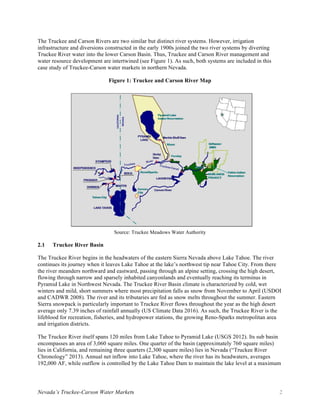
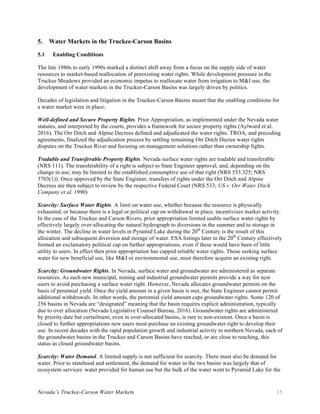
The Truckee and Carson Rivers are two similar but distinct river systems. However, irrigation
infrastructure and diversions constructed in the early 1900s joined the two river systems by diverting
Truckee River water into the lower Carson Basin. Thus, Truckee and Carson River management and
water resource development are intertwined (see Figure 1). As such, both systems are included in this
case study of Truckee-Carson water markets in northern Nevada.
Figure 1: Truckee and Carson River Map
Source: Truckee Meadows Water Authority
2.1 Truckee River Basin
The Truckee River begins in the headwaters of the eastern Sierra Nevada above Lake Tahoe. The river
continues its journey when it leaves Lake Tahoe at the lake’s northwest tip near Tahoe City. From there
the river meanders northward and eastward, passing through an alpine setting, crossing the high desert,
flowing through narrow and sparsely inhabited canyonlands and eventually reaching its terminus in
Pyramid Lake in Northwest Nevada. The Truckee River Basin climate is characterized by cold, wet
winters and mild, short summers where most precipitation falls as snow from November to April (USDOI
and CADWR 2008). The river and its tributaries are fed as snow melts throughout the summer. Eastern
Sierra snowpack is particularly important to Truckee River flows throughout the year as the high desert
average only 7.39 inches of rainfall annually (US Climate Data 2016). As such, the Truckee River is the
lifeblood for recreation, fisheries, and hydropower stations, the growing Reno-Sparks metropolitan area
and irrigation districts.
The Truckee River itself spans 120 miles from Lake Tahoe to Pyramid Lake (USGS 2012). Its sub basin
encompasses an area of 3,060 square miles. One quarter of the basin (approximately 760 square miles)
lies in California, and remaining three quarters (2,300 square miles) lies in Nevada (“Truckee River
Chronology” 2013). Annual net inflow into Lake Tahoe, where the river has its headwaters, averages
192,000 AF, while outflow is controlled by the Lake Tahoe Dam to maintain the lake level at a maximum
Nevada’s Truckee-Carson Water Markets 3
elevation of 6,229 feet (USDOI and CADWR 2008). The Lake Tahoe Dam creates 744,600 AF of usable
water storage, and is the outlet to the Truckee River (USDOI and CADWR 2008).
From Lake Tahoe, the Truckee River flows north where it collects inflow from smaller, snow fed streams.
Its main tributaries include Donner, Martis, and Prosser Creeks, and the Little Truckee River, all of which
are regulated by storage reservoirs (Berris, Hess, and Bohman 2001). Annual discharge from Donner,
Martis and Prosser Creeks are 26,300 AF, 19,700 AF, and 64,000 AF respectively, and discharge from
the Little Truckee River averages 135,000 AF (Berris, Hess, and Bohman 2001). Total annual water
supply for the Truckee is therefore 425,000 AF. Generally, the reservoirs store water from snowmelt in
the spring and release it in the summer and fall to meet demand in Nevada (USDOI and CADWR 2008).
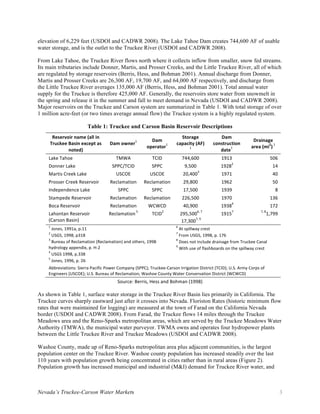
Major reservoirs on the Truckee and Carson system are summarized in Table 1. With total storage of over
1 million acre-feet (or two times average annual flow) the Truckee system is a highly regulated system.
Table 1: Truckee and Carson Basin Reservoir Descriptions
Reservoir	name	(all	in	
Truckee	Basin	except	as	
noted)	
Dam	owner
1
	
Dam	
operator
1
	
Storage	
capacity	(AF)
	
1
	
Dam	
construction	
date
1
	
Drainage	
area	(mi
2
)
	1
	
Lake	Tahoe	 TMWA	 TCID	 744,600	 1913	 506	
Donner	Lake	 SPPC/TCID	 SPPC	 9,500	
	
1928
2
	 14	
Martis	Creek	Lake	 USCOE	 USCOE	 	20,400
3
	 1971	 40	
Prosser	Creek	Reservoir	 Reclamation	 Reclamation	 29,800	 1962	 50	
Independence	Lake	 SPPC	 SPPC	 17,500	 1939	 8	
Stampede	Reservoir	 Reclamation	 Reclamation	 226,500	 1970	 136	
Boca	Reservoir	 Reclamation	 WCWCD	 40,900	 	1938
4
	 172	
Lahontan	Reservoir	
(Carson	Basin)	
Reclamation
	5
	 	TCID
2
	 	295,500
6,	7
	
	17,300
7,	9
	
	1915
7
	
7,	8
1,799	
1
	Jones,	1991a,	p.11	
2
	USGS,	1998,	p318	
3
	Bureau	of	Reclamation	(Reclamation)	and	others,	1998	
hydrology	appendix,	p.	H-2	
4
	USGS	1998,	p.338	
5
	Jones,	1996,	p.	26	
6
	At	spillway	crest	
7
	From	USGS,	1998,	p.	176	
8
	Does	not	include	drainage	from	Truckee	Canal	
9
	With	use	of	flashboards	on	the	spillway	crest	
Abbreviations:	Sierra	Pacific	Power	Company	(SPPC);	Truckee-Carson	Irrigation	District	(TCID);	U.S.	Army	Corps	of	
Engineers	(USCOE);	U.S.	Bureau	of	Reclamation;	Washoe	County	Water	Conservation	District	(WCWCD)	
Source:	Berris,	Hess	and	Bohman	(1998)	
As shown in Table 1, surface water storage in the Truckee River Basin lies primarily in California. The
Truckee curves sharply eastward just after it crosses into Nevada. Floriston Rates (historic minimum flow
rates that were maintained for logging) are measured at the town of Farad on the California Nevada
border (USDOI and CADWR 2008). From Farad, the Truckee flows 14 miles through the Truckee
Meadows area and the Reno-Sparks metropolitan areas, which are served by the Truckee Meadows Water
Authority (TMWA), the municipal water purveyor. TWMA owns and operates four hydropower plants
between the Little Truckee River and Truckee Meadows (USDOI and CADWR 2008).
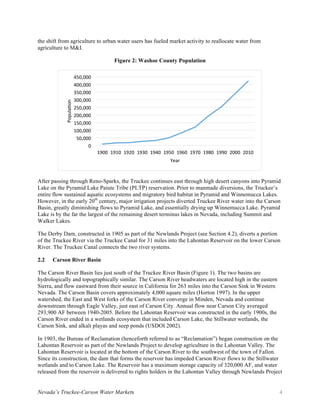
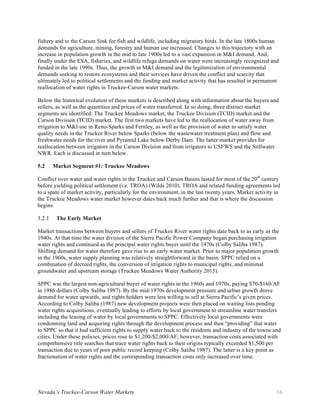
Washoe County, made up of Reno-Sparks metropolitan area plus adjacent communities, is the largest
population center on the Truckee River. Washoe county population has increased steadily over the last
110 years with population growth being concentrated in cities rather than in rural areas (Figure 2).
Population growth has increased municipal and industrial (M&I) demand for Truckee River water, and
Nevada’s Truckee-Carson Water Markets 4
the shift from agriculture to urban water users has fueled market activity to reallocate water from
agriculture to M&I.
Figure 2: Washoe County Population
	
After passing through Reno-Sparks, the Truckee continues east through high desert canyons into Pyramid
Lake on the Pyramid Lake Paiute Tribe (PLTP) reservation. Prior to manmade diversions, the Truckee’s
entire flow sustained aquatic ecosystems and migratory bird habitat in Pyramid and Winnemucca Lakes.
However, in the early 20th
century, major irrigation projects diverted Truckee River water into the Carson
Basin, greatly diminishing flows to Pyramid Lake, and essentially drying up Winnemucca Lake. Pyramid
Lake is by the far the largest of the remaining desert terminus lakes in Nevada, including Summit and
Walker Lakes.
The Derby Dam, constructed in 1905 as part of the Newlands Project (see Section 4.2), diverts a portion
of the Truckee River via the Truckee Canal for 31 miles into the Lahontan Reservoir on the lower Carson
River. The Truckee Canal connects the two river systems.
2.2 Carson River Basin
The Carson River Basin lies just south of the Truckee River Basin (Figure 1). The two basins are
hydrologically and topographically similar. The Carson River headwaters are located high in the eastern
Sierra, and flow eastward from their source in California for 263 miles into the Carson Sink in Western
Nevada. The Carson Basin covers approximately 4,000 square miles (Horton 1997). In the upper
watershed, the East and West forks of the Carson River converge in Minden, Nevada and continue
downstream through Eagle Valley, just east of Carson City. Annual flow near Carson City averaged
293,900 AF between 1940-2005. Before the Lahontan Reservoir was constructed in the early 1900s, the
Carson River ended in a wetlands ecosystem that included Carson Lake, the Stillwater wetlands, the
Carson Sink, and alkali playas and seep ponds (USDOI 2002).
In 1903, the Bureau of Reclamation (henceforth referred to as “Reclamation”) began construction on the
Lahontan Reservoir as part of the Newlands Project to develop agriculture in the Lahontan Valley. The
Lahontan Reservoir is located at the bottom of the Carson River to the southwest of the town of Fallon.
Since its construction, the dam that forms the reservoir has impeded Carson River flows to the Stillwater
wetlands and to Carson Lake. The Reservoir has a maximum storage capacity of 320,000 AF, and water
released from the reservoir is delivered to rights holders in the Lahontan Valley through Newlands Project
0	
50,000	
100,000	
150,000	
200,000	
250,000	
300,000	
350,000	
400,000	
450,000	
1900	 1910	 1920	 1930	 1940	 1950	 1960	 1970	 1980	 1990	 2000	 2010	
Popula^on	
Year
Nevada’s Truckee-Carson Water Markets 5
canals and ditches (Bureau of Reclamation 2016). The Carson River water is supplemented by Truckee
River water delivered to the Lahontan Reservoir via the Truckee Canal.
3. Water Management and Major Stakeholders in the Water Market
The Truckee-Carson water markets described later in the paper include several major players. Buyers of
water include TMWA buying water for municipal and industrial (M&I) use, as well as the Pyramid Lake
Paiute Tribe and U.S. Fish and Wildlife purchasing water for habitat and species use. Sellers include
irrigators, including individual water right holders in the Truckee Meadows area, and those downstream
that are part of TCID. A brief overview of each the major organizational players follows.
3.1 Pyramid Lake Paiute Tribe (PLPT)
Nine miles below Derby Dam, the Truckee River enters the Pyramid Lake Paiute Tribe reservation. The
Reservation is approximately 745 square miles, and includes Pyramid Lake. The PLPT’s history and
culture has been tied to flows in lower Truckee River and in Pyramid Lake, as the Tribe has long
depended on the river for native fish and for irrigation. The Newlands Project in 1902, which diverted
water out of the Truckee River at the Derby Dam resulted in the Tribe losing a large portion of its water
supply in Pyramid Lake (Borgerding 1993). The 1900s saw a series of drawn out lawsuits between the
Paiute Tribe and upstream users as reduced Truckee flows to Pyramid lake degraded fish habitat, and
point and non-point pollution degraded water quality. In the 1990s, in exchange for dropping claims
against the U.S. government, the PLPT received $25 million in federal funds to restore fish flows on the
Lower Truckee River, and an additional $40 million for economic development (Wilds 2010). This $40
million was held in trust by the U.S. government, and was released to PLPT after the Truckee River
Operating Agreement (TROA) was implemented in late 2015. The political impetus for funding the PLPT
as environmental water buyer comes from the Preliminary Settlement Agreement (1989), Water Quality
Settlement Act (1996), and the Truckee River Operating Agreement (2008). Given the litigious history
between the PLPT and other water users on the Truckee and Carson Rivers, settling water rights disputes
while providing funding for water buy backs helped establish the PLPT as an important environmental
buyer in the water market in the lower Truckee segment of the market.
3.2 Truckee Carson Irrigation District (TCID)
The Newlands Project first began delivering irrigation water to farmers in what would become the
Truckee Carson Irrigation District in the early 1900s. However, it quickly became apparent that farmers
would not be able to make a living with 160 acres of land provided by the 1902 Reclamation Act, due to
poor soil drainage and sporadic water deliveries (Wilds 2010). Reclamation declined to invest in
improved drainage, so Newlands Project farmers organized to assess themselves fees to construct and
maintain their own drains. In 1917, the State of Nevada passed legislation authorizing the creation of a
water district, and in 1918, TCID was officially chartered as a political subdivision for the State of
Nevada to represent farmers within the boundaries of the Newlands Project (including the Truckee Canal)
(Wilds 2010). In 1926, Reclamation entered into a contract with TCID under which TCID would be
responsible for operating all aspects of the Newlands Project.
TCID continues to be funded through fees assessed to landowners in the district who own water rights
appurtenant to their land (Bureau of Reclamation 2016). TCID covers approximately 120,000 acres in
Churchill and Lyon counties. Of this, 73,000 are water righted (Bureau of Reclamation 2016). As of
2010, approximately 59,000 acres in TCID were irrigated, with 2,000 in the Truckee Division and 57,000
in the Carson Division (Truckee Carson Irrigation District 2010). TCID has state authority to acquire,
operate, and control irrigation infrastructure and facilities. Major infrastructure and facilities under
Nevada’s Truckee-Carson Water Markets 6
TCID’s jurisdiction include the Derby Dam, the Truckee Canal, and the Lahontan Dam and Reservoir
(Horton 1997). Notably, however, individual farmers within the district, and not TCID, control water
rights. TCID is itself an entity charged solely with water deliveries. TCID is not a signatory to the
Truckee River Operating Agreement choosing not to be involved in the negotiations that led to TROA.
Most farmers in the TCID grow low-value crops. In Churchill County, where TCID is located, of 49,554
acres harvested in 2012, 44,159, or 89%, of those acres produced forage crops such as hay and alfalfa
(U.S. Department of Agriculture 2014). The area is home to an active dairy industry supplying milk
products to northern Nevada.
3.3 Truckee Meadows Water Authority (TMWA)
Truckee Meadows Water Authority, formerly Sierra Pacific Power Company (SPPC), is the only large
public water supply utility on the Truckee River. TMWA is overseen by elected officials and citizen
appointees from Reno, Sparks, and Washoe County, and provides water for 385,000 residents in the
Truckee Meadows area. SPPC was founded in 1928 as a hydroelectric power provider, and quickly
became a dominant utility provider in the region (Wolfe 2016). Its assets included water treatment
facilities, distribution infrastructure, surface and groundwater rights, and storage rights in Independence
and Donner Lakes. Ultimately, SPPC opted to concentrate on energy distribution, and sold its water
utility and water treatment businesses. In 2000 SPPC sold the water business to TMWA (Sierra Pacific
Resources 2001). TMWA is responsible for delivering potable drinking water to residents and businesses
in the Truckee Meadows area in perpetuity (Truckee Meadows Water Authority 2015). TMWA does not
provide for municipal sewer, reclaim, flood control, drainage, or groundwater remediation. TMWA was
created as the municipal water provider for Truckee Meadows and Washoe County through a Cooperative
Agreement amongst Reno, Sparks, and Washoe County. TMWA is a signatory to the Truckee River
Operating Agreement.
3.4 Stillwater National Wildlife Refuge
The Stillwater National Wildlife Refuge (NWR) lies at the end of the Carson River system in the
Lahontan Valley, just north of Fallon. In 1948, the Stillwater wetlands were designated as a Wildlife
Management Area, and in 1991, they were established as the Stillwater NWR. The Refuge is managed by
the US Fish and Wildlife Service (USFWS) and encompasses nearly 80,000 acres of wetlands, and
provides important habitat for aquatic species such as fish and mussels, 280 bird species, and is an
important stop for migratory birds along the Pacific Flyway (USFWS 2000).
Wetlands in the Lower Carson River system were once part of an extensive marsh system in the Lahontan
Valley; however, akin to Pyramid Lake, environmental quality and wildlife habitat in the Stillwater
wetlands were seriously degraded as a result of irrigation projects that diverted water to farms and
ranches. Currently, the Stillwater NWR receives water from TCID water rights purchased and transferred
to the refuge by U.S. Fish & Wildlife (USFWS) and from agricultural return flows (USDOI and CADWR
2008). Water quality in the wetlands remains a problem as return flows from irrigation are contaminated
with chemicals, and mercury left over from the Comstock Era persists in sediment, surface water, soil,
fish, and other wildlife (USEPA Region 9 2016).
USFWS has helped develop a management and restoration plan for the Stillwater NWR. Several
legislative acts have allowed for or directed the acquisition of land and water for wildlife and refuges. In
1990, USFWS initiated the Water Rights Acquisition Program for the Stillwater NWR (USDOI and
CADWR 2008). The program was intended to purchase 75,000 AF of water rights from willing sellers in
TCID’s Carson Division, and 50,000 AF from willing sellers in segment 7 of the Carson River (USDOI
Nevada’s Truckee-Carson Water Markets 7
1995).1
USFWS models estimated that under 1990 conditions, 21,300 AF of water rights were dedicated
to the Stillwater NWR. If USFWS continued to purchase and transfer water rights, an additional 41,600
AF were estimated to be dedicated to the wetlands by 2033 (USDOI and CADWR 2008).
4. The Historical Setting: Water Resource Development, Water Rights, Conflicts and
Political Settlements
Water rights appropriation on the Truckee and Carson Rivers began in the mid 1800s with the advent of
the gold rush and the growth of logging enterprises, hydropower, and agriculture. River diversions
steadily increased throughout the 1900s in response to economic growth and development. As a terminus
basin, a change in water use by any one entity has a quantifiable effect on the resources of other entities
(Bureau of Reclamation 2015). In particular, given the political economy of European settlement and the
siting of an Indian reservation at the terminus of the Truckee basin (just as with the Walker Basin to the
south) the development of upstream water uses meant declining lake levels and increasing salinity of
these desert terminus lakes. Despite the basins’ relatively small sizes, they contains “every form of water
use and every type of water user that exists in the Western United States including: tribal lands and trusts;
irrigated agriculture; municipalities and industry; mining and geothermal energy exploration; Federal
water projects; hydropower generation; lake, stream, and reservoir recreation; and restoration efforts for
diminished wetlands and endangered aquatic species” (Bureau of Reclamation 2015).
4.1 Early Water Use and Rights Appropriation
Early appropriation of water rights on the Truckee and Carson Rivers supported agriculture, mining, and
logging enterprises. The first water right on the Truckee River were appropriated in 1858 at the start of
the Gold Rush (“Truckee River Chronology” 2013). Hydraulic mining operations required large surface
water diversions, and the demand for lumber for the construction of railroads and mining operations led to
the development of logging and milling operations on the river (USDOI and CADWR 2008). Moving
timber from the Sierra Nevada forests downstream to lumber mills required that enough water remained
in stream to float logs down the river. By the early 1900s the logging industry would help define lasting
minimum stream flow requirements, or Floriston Rates, on the main stem of the Truckee River near the
California-Nevada border. Deforestation and erosion from logging operations degraded stream flow and
water quality, and have had lasting environmental impacts in the basin (A. H. Taylor et al. 2014).
In the 1860s, the Nevada State Legislature approved construction for a bulkhead on the Carson River to
divert water into three main irrigation canals (Wilds 2010). In 1861, settlers in Truckee Meadows began
construction on the Pioneer and Cochran irrigation ditches, which provided water for hay ranches, and
alfalfa was introduced in 1864 (Townley 1977; “Truckee River Chronology” 2013). Cattle ranching and
beef production emerged in the 1870s and 1880s and spawned business development in the Valley
(Townley 1977). Farmers’ and ranchers’ increasing reliance on irrigation and increased water for beef
production spurred discussions about constructing water storage facilities (Townley 1977).
These early settlers were acutely aware that farming in Nevada (and the West in general) could not be
sustained without federally supported irrigation projects, and they pushed the federal government towards
reclamation policy (Wilds 2010). On June 17, 1902, Congress passed the Reclamation Act under which
1
Emergency Wetlands Resources Act of 1986 (100 Stat. 3582-91); Fish and Wildlife Act of 1956 (16 U.S.C. 743
(a)-754); Migratory Bird Conservation Act (16 U.S.C. 715-715r); American Wetlands Conservation Act (16 U.S.C.
4401-4413;
Nevada’s Truckee-Carson Water Markets 8
the federal government would fund irrigation projects to “reclaim” arid lands across 16 western states,
and water users would repay construction costs (Pisani 2002).
4.2 Newlands Project
Nevada Senator Francis Newlands was instrumental in helping to pass the 1902 Reclamation Act, and in
1903, Reclamation began construction on the Newlands Project to provide irrigation infrastructure and
water to farmers in the Lahontan Valley (Wilds 2010). The Newlands Project included construction of
Derby Diversion Dam on the Truckee River, the Truckee Canal, through which water would flow into the
Carson sub basin, and the Lahontan Reservoir to store irrigation water for farmers in what would become
the Truckee Carson Irrigation District. The project was divided into two parts: The Truckee Division,
which irrigated land along the Truckee Canal just east and south of Fernley, and the Carson Division,
which irrigated land in Fallon and in the Lahontan Valley (Wilds 2010).
The Newlands Project is perhaps the most significant water resource development project in the Truckee
and Carson Basins as it essentially connected the two river systems. It was the catalyst of almost a century
of litigation between water users below Derby Dam (i.e., PLPT) and TCID, as the former now found the
lower Truckee River dewatered. The project exemplifies the Reclamation’s priorities at that point in
history, which were to promote economic development, specifically in the agricultural sector, by
constructing irrigation infrastructure, water conveyance systems, and water storage facilities. While the
Newlands Project facilitated the development of an agricultural economy early on in TCID, subsequent
water shortages in the lower Truckee and declining lake levels in Pyramid Lake harmed fish habitat, and
infringed on tribal water use. Newlands Projects diversions from the Truckee River were ultimately
unsustainable, and were the subject of countless lawsuits, and eventually, water buy-backs, to reduce
TCID diversions from the Truckee.
4.3 Truckee River General Electric Decree
One of the earliest conflicts over control of Truckee River water occurred in 1909 between Reclamation
and the Truckee River General Electric Company (US v. Truckee River General Electric Company 2015).
Reclamation had claims to water stored in Lake Tahoe, but could not guarantee their delivery without
controlling the dam at the outlet to the lake, which was owned by the electric company. In the decree, the
federal court granted Reclamation an easement to operate the outlet dam. Reclamation was required to
maintain specified flow rates, called Floriston Rates. Floriston Rates had been established in 1908 when
General Electric Company signed an agreement with Floriston Pulp and Paper Company to maintain
Truckee River flows at the Floriston (California) streamflow gage at 500 cubic feet per second (cfs)
between March 1 – Sept 31, and 400 cfs from October – February. The Floriston Rates also meant that the
electric company could generate hydropower year round. If flows were insufficient, water would be
released from Lake Tahoe. Floriston Rates were renegotiated in 1935, and the maintenance of Floriston
Rates were a basic foundation for TROA (“Truckee River Operating Agreement” 2008). The rates are not
designed as a means of generating instream flow benefits but rather as a means to ensure that downstream
rights would be met. Because Floriston Rates were incorporated into the adjudication of the Truckee
River, river flow were relatively inflexible in the decades following the decree. Additionally, because
Reclamation controlled the amount of water leaving Lake Tahoe in high water years, it acquired the
ability to move water down the Truckee to Derby Dam so that it could serve TCID project irrigators
(Wilds 2010)
4.4 Truckee River Agreement
By the early 1930s population growth and economic development (mostly agriculture and ranching) in
Washoe and Churchill Counties ran up against limited water supplies in the Truckee and Carson Rivers.
Nevada’s Truckee-Carson Water Markets 9
Pyramid Lake levels had dramatically declined due to Truckee River diversions upstream, and fish
populations suffered, and farmers and ranchers wanted additional water storage for irrigation (Wilds
2010). In 1935, Reclamation, Sierra Pacific Power Company (at that time Reno-Spark’s municipal water
supplier), TCID, the Washoe County Conservation District, and the federal government negotiated the
Truckee River Agreement. The agreement allocated $1 million for the construction of Boca Reservoir
(“Truckee River Agreement” 1935). The parties agreed to operate Lake Tahoe and Boca Reservoir to
meet Floriston Rates, which were modified to support agricultural, municipal, and hydropower generation
(USDOI and CADWR 2008). The agreement confirmed that Floriston Rates would be used as minimum
flow rates; however, the rates would vary with the level of Lake Tahoe (see Table 2). Under the
Agreement, all signatories agreed to accept Orr Ditch Decree terms, even though the Orr Ditch Decree
had not been settled yet (“Truckee River Agreement” 1935).
Table 2. Reduced Floriston Rates
Truckee River Flow at Farad (cfs)
Lake Tahoe Elevation October November - March March April - September
Less than 6,225.25
feet
400 300 300 500
Between 6,225.25 and
6226.00 feet
400 350 350 500
More than 6,226.00
feet
400 400 500 500
Source: Truckee Basin Study (2015)
4.5 Orr Ditch Decree
By 1913, Reclamation realized that it would have to contend with Truckee River diversions upstream of
Derby Dam, which might impede its ability to deliver TCID water. For example, the Newlands project
used water from the Truckee and Carson Rivers for irrigation in the Lahontan Valley; however, prior to
these efforts to reclaim arid lands for agriculture, private landowners and the PLPT had already
established water rights. Reclamation initiated a federal lawsuit that involved every rights holder on the
Truckee and its tributaries to settle all water rights on the Truckee River. The resulting Orr Ditch Decree
adjudicated water rights on the Truckee River, and established quantities, locations, types of use, and
priorities for water rights (US v. Orr Water Ditch Co. et al. 1944).
Under the Orr Ditch Decree, the federal government received 30,000 AF of water rights to irrigate 5,875
acres on the Pyramid Lake Reservation. These rights were granted year 1859 priority, giving the PLPT
Claims 1 and 2, the most senior rights on the Truckee River. Sierra Pacific Power Company received
29,000 AF/year for municipal, industrial, and domestic use in Reno Sparks (Wilds 2010). Reclamation
received a 1902 priority right to divert Truckee River flow at Derby Dam at 1,500 CFS. Water rights
adjudicated under the Orr Ditch Decree are administered by a Federal Water Master. In 2014, a federal
court modified the Orr Ditch Decree to incorporate the Truckee River Operating Agreement and include a
Nevada state law permit granting any excess (or unappropriated) Truckee River water to go to Pyramid
Lake (US v. Orr Ditch Co. 2014)
4.6 Alpine Decree
Under the Alpine Decree, the Federal Court adjudicated relative water rights on the Carson River. The
Alpine Decree was initiated in 1925 but was not entered until 1980 (US v. Alpine Land and Reservoir
Nevada’s Truckee-Carson Water Markets 10
Company, et al., Civ. No. D-183). The Alpine Decree quantified individual surface water rights to the
Carson River in California and Nevada. The Decree divided the Carson River and its east and west forks
into eight segments. When there was not enough water in the upper reaches to fill the rights of the most
junior users, each segment would be administered autonomously. It also established rights to storage in
reservoirs (Mud Lake, Dangberg Pond, and Ambrosetti Pond), which would be allowed to fill out of order
of priority (see Table 3): The Alpine Decree is also administered by a Federal Water Master.
Table 3. Off-River Reservoir Rights in the Upper Carson
Reservoir Name Alpine Decree Claim Number Alpine Decree rights (AF)
Mud Lake 814, 814a 3,172.00
Dangberg Pond 815-816 1,081.10
Ambrosetti Pond 817 200.00
Source: Hess and Taylor (1999)
Historically, large parts of irrigated acreage in the Carson Basin were irrigated by return flows, as runoff
from the first appropriator’s land was used on the second appropriator’s land, and so forth until the runoff
was exhausted, or it returned to the river or a canal (Hess and Taylor 1999). The Alpine Decree accounted
for this historical practice by not differentiating between water-righted land irrigated by direct diversions
from the Carson or its respective irrigation canals, or water-righted land irrigated by return flows (Hess
and Taylor 1999). For lands in the Upper Carson reaches (above the Lahontan Reservoir), the Alpine
Decree set net consumptive water use at 2.5 AF per acre with water duties of 4.5 AF/acre diverted for
bottom lands, 6.0 AF/acre for the alluvial fan lands and 9.0 AF/acre for the bench lands (Nevada Division
of Water Planning 1999). Below the Lahontan Dam, in the Newlands Irrigation Project, the Alpine
Decree set annual net consumptive use at 2.99 AF per acre, and defined maximum water duties as 4.5 AF
per acre for water righted bench lands, and 3.5 AF per acre for water righted bottom lands (Nevada
Division of Water Planning 1999).
The Alpine Decree also granted landowners on the Newlands Project an appurtenant water right for the
patented lands, effectively transferring water rights to these landowners individually. This means that
individual water users rather than TCID hold water rights. This is significant as TCID delivers water to
rights holders, but lacks the authority to make decisions over how those rights are managed and
transferred.
4.7 Operating Criteria and Procedures (OCAP)
In 1967 the Secretary of Interior issued regulations that required TCID to operate Lahontan Reservoir and
the project more efficiently, so that less water is drawn from the Truckee River, which feeds Pyramid
Lake, and more water is drawn from the Carson River (Operating Criteria and Procedures for the
Newlands Reclamation Project, Nevada 2009). OCAP is the product of PLPT lawsuits over reduced
Truckee River flows to Pyramid Lake, and the subsequent deterioration of Pyramid Lake fisheries. Under
OCAP, each month Reclamation assesses the amount of water stored in the Lahontan Reservoir. It
estimates the amount of water available from the Carson River, and calculates how much additional
water, if any, will be diverted from the Truckee River (Operating Criteria and Procedures for the
Newlands Reclamation Project, Nevada 2009). On average, the Truckee River supplies 20% of the
Lahontan Reservoir’s annual water supply (TCID 2016).
Nevada’s Truckee-Carson Water Markets 11
4.8 Endangered Species Act (ESA)
The Endangered Species Act, passed in 1973, was a turning point for water management on the Truckee
River. The Truckee River has had a litigious history: The Newlands Project and subsequent diversions on
the Truckee River sparked almost a century of lawsuits between the PLPT and upstream users over sharp
declines in Pyramid Lake levels, and degraded fish habitat. While many early water rights disputes were
solved (in part) through OCAP and the Orr Ditch Decree, growing agricultural and municipal demand for
water, and reduced flows to Pyramid Lake led to lawsuits between municipal and agricultural water users
and the PLPT, who prioritized environmental flows for fish habitat. Decades of diversions from the
Truckee decimated aquatic habitat for the Lahontan cutthroat trout and the cui-ui, two endemic species in
the Great Basin. Up to the early 1970s, the PLPT, the most downstream users in the Truckee system,
experienced few successes in securing water for fish.
The ESA, passed in 1973, provided the PLPT, and other environmental advocates with a legal and
political tool for securing water for fish habitat. The cui-ui and the Lahontan cutthroat trout were listed as
endangered in 1967 and 1970, respectively, under the Endangered Species Preservation Act of 1966
(USFWS 2013; USFWS 2014). While the ESA itself did not establish a specific cap on surface water
withdrawals, it provided the PLPT with leverage in legal battles to maintain Pyramid Lake levels, it gave
environmental stakeholders more negotiating power in negotiated agreements over Truckee River water
use, and it was a mechanism through which federal funding could be allocated to protect and restore
habitat in the Lower Truckee and in the Stillwater NWR (Colby Saliba, McGinnis, and Rait 1991; Wilds
2010) .
Reservoir releases from Lake Tahoe and Prosser Creek Reservoir had been based on Floriston Rates, and
adjusted Floriston Rates, as mandated by the Truckee River Agreement, and were meant to fulfill water
rights of downstream users, but did not reflect the natural hydrograph. However, the designation of
endemic fish under the ESA helped start a conversation about prioritizing environmental health by
coordinating reservoir releases to match fish flow regimes (Tarlock 1999). These environmental priorities
were incorporated into TROA. As part of TROA, federal and state funding was provided to meet ESA
obligations, primarily through acquiring water rights for instream flow enhancement.
4.9 Water Rights for the Environment and Wildlife
In 1988, the Supreme Court of Nevada ruled that it was within the legislative authority of the State
Engineer to grant the US Bureau of Land Management (BLM) a water right to maintain a minimum pool
of water (Nevada v. Peter G. Morrros 1988) This ruling established that the BLM and the U.S. Forest
Service could obtain appropriative water rights for stock, recreation, or wildlife watering where in situ
(i.e. non-diversionary, non-consumptive) water use qualifies as beneficial use. As detailed later in this
paper the ability to transfer existing water rights to a wildlife or environmental use is instrumental to the
ability to use water markets to resolve conflicts over water use and water rights in the Carson and Truckee
Basins. These rights have been used to satisfy the Truckee-Carson-Pyramid Lake Water Rights Settlement
Act provisions, as USFWS, DOI, and Nevada Division of State Lands (NDSL) have purchased water
from willing sellers to sustain wetlands in the Stillwater NWR. In Truckee Meadows, the cities of Reno
and Sparks are fulfilling obligations under the Truckee River Water Quality Settlement Agreement by
purchasing water rights for flow augmentation. Additionally, USFWS and The Nature Conservancy
(TNC) have an agreement with the Federal Water Master to modify reservoir releases when surplus water
is available for riparian forest restoration in the lower reaches of the Truckee River (Nevada Division of
Water Planning 1999).
Nevada’s Truckee-Carson Water Markets 12
4.10 Water Quality Settlement Agreement (WQSA)
The 1996 Truckee River Water Quality Settlement Agreement settled two lawsuits, both by the PLPT
against the U.S. Environmental Protection Agency (EPA) and state and local entities, over water quality
and reduced river flows in the lower Truckee River (“Truckee River Water Quality Settlement
Agreement” 1996). The WQSA was signed by the DOI, U.S Department of Justice (DOJ), the EPA, the
Nevada Division of Environmental Protection (NDEP) and the PLPT. The parties agreed that acquiring
water rights to augment lower Truckee River flows to Pyramid Lake would improve habitat conditions by
increasing the nutrient assimilative capacity of the Truckee River, and reduce non-point source pollutant
loadings. Under the agreement, Reno, Sparks, and Washoe agreed to provide $12 million to purchase
water rights in the lower Truckee to augment river flows. DOI provided an additional $12 million for
flow acquisition. The WQSA stipulated that water acquisitions should be expedited. It set a five-year
timeline for using appropriative funds to acquire water rights. If the parties did not spend the full amount
on water rights acquisitions within five years, the remaining funds would be placed in escrow for future
water acquisitions. In reality, spending the entire $24 proved difficult within the five-year timeline. By
2011, nearly all of the funding had been used to acquire water rights on the lower Truckee River.
In addition to acquiring water rights, the WQSA required the parties to manage the water. Water rights
were acquired through the WQSA primarily to augment instream flows, meet federal water quality
standards, and improve water quality for fish and wildlife habitat on the stretch of river between Reno-
Sparks and Pyramid Lake. The WQSA created the Joint Truckee River Water Quality Program where
Reno, Sparks, Washoe, and DOI would meet annually to discuss how to best meet WQSA goals through
coordinated management. Water acquired by Reno, Sparks and Washoe would be stored and released in
accordance with TROA, which had been proposed, but not signed at the time (see Section 4.11). By
allowing for storage and coordinated releases from upstream reservoirs, the Agreement created an
“Instream Flow and Water Quality Credit Water” program where WQSA signatories could meet their
WQSA obligations during dry years, but could conserve and store water during wet years.
The WQSA acknowledged that water rights would be purchased from irrigators in the Truckee Division
of TCID. The Agreement specified that funding was provided to fund water rights acquisition only. In
cases where water was acquired through agricultural properties, the rights were severed from the land,
and land was resold (Benson 2012; USDOI 1995). To acquire water rights, Reno, Sparks and Washoe
contracted with Great Basin Land and Water, a local environmental NGO, that handled negotiations and
acquisitions. Notably, these local governments met their $12 million obligation through user fees (i.e.
revenue collected by charging users of their sewer system) (Benson 2012). This suggests that funding for
acquisition of instream flow rights can be incorporated into a municipal rate base, and does not
necessarily have to depend on funding from litigation.
4.11 Preliminary Settlement Agreement (PSA) and the Truckee River Operating Agreement
(TROA)
Throughout the 1900s, Truckee and Carson River water governance evolved in a somewhat ad hoc
manner, with each new policy and lawsuit responding to steadily increasing demand for surface water.
The Truckee River Operating Agreement represented a more strategic, and coordinated approach to water
management on the Truckee River. TROA is a negotiated settlement agreement between TMWA, PLPT,
the State of California, the State of Nevada, and the Federal Government (“Truckee River Operating
Agreement” 2008). While it was not signed until September 6, 2008, the settlement process began with
the Preliminary Settlement Agreement under Public Law 101-618 in 1989.
The PSA was brought about by changing conditions in the Basin, and a general acknowledgement that a
new agreement was necessary to address the myriad of water conflicts in the area. A new, negotiated
Nevada’s Truckee-Carson Water Markets 13
agreement would serve M&I interests in Reno-Sparks, as well as tribal and environmental interests.
SPPC, the municipal water purveyor at the time, had sufficient water supplies to deliver adequate supplies
to its customers in most years, but its junior storage rights in Stampede Reservoir limited its ability to
respond to prolonged drought. SPPC estimated that it would need to draw on additional drought storage
once or twice every ten years (Wilds 2010). PLPT and SPPC entered the PSA with a shared interest in
coordinating reservoir storage and releases. PLPT and USFWS established annual targets for fish flows at
the mouth of the Truckee, and during wet or normal years when SPPC could fill its obligations, surplus
storage water could be converted to “fish credit water” (Wilds 2010). Hydropower, which was a priority
when Floriston Rates were established in 1915, was less of a priority by the 1980s, supplying only 0.5%
of the power used in Reno-Sparks. Under the PSA, SPPC agreed to waive its right to require reservoir
releases to meet Floriston Rates. By altering the inflexible nature of the prior Floriston Rates,
stakeholders were able to think creatively about how to better manage so serve their various interests
(Wilds 2010).
In 1990, Congress passed the Public Law 101-618, the Truckee-Carson-Pyramid Lake Water Rights
Settlement Act (“Settlement Act”), which ratified the terms of the PSA, preserved and protected Orr
Ditch Decree rights holders, and provided for the negotiation of a new water management agreement
(TROA) (Cosens 2003). Senator Harry Reid was instrumental in negotiating the Settlement Act and in
bringing all interested parties together to discuss common interests (Wilds 2010). The impetus for
negotiations centered on the notion that unquestioned support for irrigated agriculture in the West was
unsustainable, especially given the value of scarce water supplies, and the need to accommodate a wide
range of stakeholders. Section 209 of the Settlement Act expanded the allowed uses of Newlands Project
water to include fish and wildlife, M&I, and recreation (USDOI and CADWR 2008).
When TROA was signed in 2008, it incorporated interests of most stakeholders (excluding TCID) in the
Basin. It responded to the shift away from agriculture towards M&I water demand. From 1944 to 2007,
irrigation of farmland in Truckee Meadows was reduced from 28,500 acres to approximately 3,900 acres
(“Truckee River Operating Agreement” 2008). At the same time, Washoe County’s population increased
from 32,476 in 1940 to 254,667 in 1990, and to 396,428 in 2006 (US Census Bureau 2010). Most of this
population increase occurred in urban areas of Reno-Sparks. This shift in demand towards urban water
use necessitated the conversion of unused irrigation water rights to M&I uses while still meeting
historical claims of downstream rights holders. The agreement took nearly 25 years to complete because it
had to settle all disputed water rights claims on the river, and convert irrigation rights (many of which
were no longer being used due to the shift away from agriculture) to M&I use while still ensuring that the
needs of rights holders downstream, who did want their water, were met. TROA was a landmark
agreement in Truckee River management in that it settled 80 years of litigation over water rights, allowed
water users (i.e., TMWA) to bank additional water in Martis Creek Reservoir, Prosser Creek Reservoir,
and Stampede Reservoir. In addition to preserving existing water rights, the Agreement effectively
created up to 119,000 AF of additional drought storage for TMWA (Christman 2015). By allowing
TMWA to store this water in upstream reservoirs TMWAs future resilience to drought and future water
shortages was ensured.
TROA’s response to changing conditions in the basin (i.e. increased frequency and severity of drought)
prioritized water security for municipal use over water security for agriculture. Notably, TCID
campaigned against the Settlement Act because it believed it would reduce the amount of water delivered
to the Newlands Project (d’Estree and Colby 2006). The bankability of water rights for M&I use
concerned irrigators in TCID, who supplement Carson River water with Truckee River water according to
OCAP rules. According to public comments listed in the Federal Register, water rights holders (primarily
irrigators) in TCID were concerned that TROA would infringe upon Orr Ditch Decree water rights in the
Newlands Project. While TROA met all Orr Ditch Decree obligations, upstream storage reduced potential
water deliveries to the Newlands Project as any water in excess of Orr Ditch Decree obligations would no
Nevada’s Truckee-Carson Water Markets 14
longer be sent downstream. Reclamation’s response to public comments reflected the shift away from
prioritizing water for agriculture towards reducing waste in the system by shoring up water for municipal
use:
Water that may previously have been available for diversion to the Newlands Project
may no longer be available under TROA because senior upstream water right owners
can more efficiently and fully exercise their water rights. TROA also complies with
Section 210(b)(13) of the Settlement Act, which expressly recognizes the authority of
the Orr Ditch court ‘‘to ensure that the owners of vested and perfected Truckee River
water rights receive the amount of water to which they are entitled under the Orr
Ditch decree or the Alpine decree.’’ TROA protects Orr Ditch Decree water rights,
including the water which may be legally diverted at Derby Diversion Dam pursuant
to the Orr Ditch Decree and Newlands Project OCAP.
Federal Register Vol. 73, No. 235; December 5, 2008
TCID potentially misread the political climate by assuming that it would continue to receive 406,000 AF
through the Newlands Project and that it could stop the Settlement Act from passing through Congress
(Wilds 2010). TCID’s decision to opt out of the negotiation has been seen by many as a missed
opportunity when it neglected to leverage its priority water rights in exchange for efficient irrigation
systems and payment for conserved water (d’Estree and Colby 2006).
By incorporating PSA provisions for coordinated reservoir storage and releases, TROA accounted for
environmental and PLPT priorities. Credit water could accumulate in reservoirs, and could be exchanged
amongst reservoirs until needed for beneficial uses such as drought protection in dry years or for
spawning fish in Pyramid Lake and the lower river in normal and wet years (Wilds 2010). By
coordinating reservoir operation and timing releases to meet the needs of multiple stakeholders (i.e. fish,
wildlife, PLPT, recreation), TROA provided additional water, and improved water quality for resources
that otherwise would not have had a right to that water (Wilds 2010).
Under TROA, DOI was authorized to spend not less than $9 million to acquire water rights to benefit the
wetlands of the Stillwater NWR (d’Estree and Colby 2006). DOI would use these funds to reimburse the
State of Nevada for acquiring the water rights. Additionally, TROA authorized the Federal Government to
appropriate $25 million for the “Pyramid Lake Fisheries Fund”, through which PLPT would operate and
maintain the fishery.
Under the Desert Terminal Lakes Program, the Pyramid Lake Paiute Tribe received $2.9 million in
federal funds to implement its TROA obligations. This funding enabled the tribe to purchase water
through Reclamation to increase flows to Pyramid Lake (Bureau of Reclamation 2011). By
operationalizing environmental protections for the cui-ui and Lahontan Cutthroat Trout habitat, and by
recognizing the natural limits to how many people the Truckee River can support, TROA paved the way
for market activity to purchase water from irrigators to maintain and restore the lower Truckee River,
Pyramid Lake and the Stillwater NWR. Thus, TROA provided the motivation, funding, and framework
for market-based reallocation of water rights not just from agriculture to municipal users, but also to the
environment.
Nevada’s Truckee-Carson Water Markets 15
5. Water Markets in the Truckee-Carson Basins
5.1 Enabling Conditions
The late 1980s to early 1990s marked a distinct shift away from a focus on the supply side of water
resources to market-based reallocation of preexisting water rights. While development pressure in the
Truckee Meadows provided an economic impetus to reallocate water from irrigation to M&I use, the
development of water markets in the Truckee-Carson Basins was largely driven by politics.
Decades of legislation and litigation in the Truckee-Carson Basins meant that the enabling conditions for
a water market were in place:
Well-defined and Secure Property Rights. Prior Appropriation, as implemented under the Nevada water
statutes, and interpreted by the courts, provides a framework for secure property rights (Aylward et al.
2016). The Orr Ditch and Alpine Decrees defined and adjudicated the water rights. TROA, and preceding
agreements, finalized the adjudication process by settling remaining Orr Ditch Decree water rights
disputes on the Truckee River and focusing on management solutions rather than ownership fights.
Tradable and Transferable Property Rights. Nevada surface water rights are tradable and transferable
(NRS 111). The transferability of a right is subject to State Engineer approval, and, depending on the
change in use, may be limited to the established consumptive use of that right (NRS 533.325; NRS
3703(1)). Once approved by the State Engineer, transfers of rights under the Orr Ditch and Alpine
Decrees are then subject to review by the respective Federal Court (NRS 533; US v. Orr Water Ditch
Company et al. 1990)
Scarcity: Surface Water Rights. A limit on water use, whether because the resource is physically
exhausted, or because there is a legal or political cap on withdrawal in place, incentivizes market activity.
In the case of the Truckee and Carson Rivers, prior appropriation limited usable surface water rights by
effectively largely over-allocating the natural hydrograph to diversions in the summer and to storage in
the winter. The decline in water levels in Pyramid Lake during the 20th
Century is the result of this
allocation and subsequent diversion and storage of water. ESA listings later in the 20th
Century effectively
formed an exclamatory political cap on further appropriations, even if these would have been of little
utility to users. In effect then prior appropriation has capped reliable water rights. Those seeking surface
water for new beneficial use, like M&I or environmental use, must therefore acquire an existing right.
Scarcity: Groundwater Rights. In Nevada, surface water and groundwater are administered as separate
resources. As such new municipal, mining and industrial groundwater permits provide a way for new
users to avoid purchasing a surface water right. However, Nevada allocates groundwater permits on the
basis of perennial yield. Once the yield amount in a given basin is met, the State Engineer cannot permit
additional withdrawals. In other words, the perennial yield amount caps groundwater rights. Some 120 of
256 basins in Nevada are “designated” meaning that the basin requires explicit administration, typically
due to over allocation (Nevada Legislative Counsel Bureau, 2016). Groundwater rights are administered
by priority date but curtailment, even in over-allocated basins, is rare to non-existent. Once a basin is
closed to further appropriations new users must purchase an existing groundwater right to develop their
use. In recent decades with the rapid population growth and industrial activity in northern Nevada, each of
the groundwater basins in the Truckee and Carson Basins have reached, or are close to reaching, this
status as closed groundwater basins.
Scarcity: Water Demand. A limited supply is not sufficient for scarcity. There must also be demand for
water. Prior to statehood and settlement, the demand for water in the two basins was largely that of
ecosystem services: water provided for human use but the bulk of the water went to Pyramid Lake for the
Nevada’s Truckee-Carson Water Markets 16
fishery and to the Carson Sink for fish and wildlife, including migratory birds. In the late 1800s human
demands for agriculture, mining, forestry and human use increased. Changes to this trajectory with an
increase in population growth in the mid to late 1900s led to a vast expansion in M&I demand. And,
finally under the ESA, fisheries, and wildlife refuge demands on water were increasingly recognized and
funded in the late 1990s. Thus, the growth in M&I demand and the legitimization of environmental
demands seeking to restore ecosystems and their services have driven the conflict and scarcity that
ultimately led to political settlements and the funding and market activity that has resulted in permanent
reallocation of water rights in Truckee-Carson water markets.
Below the historical evolution of these markets is described along with information about the buyers and
sellers, as well as the quantities and prices of water transferred. In so doing, three distinct market
segments are identified: The Truckee Meadows market, the Truckee Division (TCID) market and the
Carson Division (TCID) market. The first two markets have led to the reallocation of water away from
irrigation to M&I use in Reno-Sparks and Fernley, as well as the provision of water to satisfy water
quality needs in the Truckee River below Sparks (below the wastewater treatment plan) and flow and
freshwater needs for the river and Pyramid Lake below Derby Dam. The latter market provides for
reallocation between irrigators in the Carson Division and from irrigators to USFWS and the Stillwater
NWR. Each is discussed in turn below.
5.2 Market Segment #1: Truckee Meadows
Conflict over water and water rights in the Truckee and Carson Basins lasted for most of the 20th
century
before yielding political settlement (i.e. TROA) (Wilds 2010). TROA and related funding agreements led
to a spate of market activity, particularly for the environment, in the last twenty years. Market activity in
the Truckee Meadows water market however dates back much further and that is where the discussion
begins.
The Early Market5.2.1
Market transactions between buyers and sellers of Truckee River water rights date back to as early as the
1940s. At that time the water division of the Sierra Pacific Power Company began purchasing irrigation
water rights and continued as the principal water rights buyer until the 1970s (Colby Saliba 1987).
Shifting demand for water therefore gave rise to an early water market. Prior to major population growth
in the 1960s, water supply planning was relatively straightforward in the basin. SPPC relied on a
combination of decreed rights, the conversion of irrigation rights to municipal rights, and minimal
groundwater and upstream storage (Truckee Meadows Water Authority 2015).
SPPC was the largest non-agricultural buyer of water rights in the 1960s and 1970s, paying $70-$160/AF
in 1986 dollars (Colby Saliba 1987). By the mid-1970s development pressure and urban growth drove
demand for water upwards, and rights holders were less willing to sell at Sierra Pacific’s given prices.
According to Colby Saliba (1987) new development projects were then placed on waiting lists pending
water rights acquisitions, eventually leading to efforts by local government to streamline water transfers
including the leasing of water by local governments to SPPC. Effectively local governments were
condemning land and acquiring rights through the development process and then “providing” that water
to SPPC so that it had sufficient rights to supply water back to the residents and industry of the towns and
cities. Under these policies, prices rose to $1,200-$2,000/AF; however, transaction costs associated with
comprehensive title searches that trace water rights back to their origins typically exceeded $1,500 per
transaction due to years of poor public record keeping (Colby Saliba 1987). The latter is a key point as
fractionation of water rights and the corresponding transaction costs only increased over time.
Nevada’s Truckee-Carson Water Markets 17
The Boom and Bust Market: Volatile Pricing in a Free Market5.2.2
Growth and development in Reno and Sparks continued to drive the Truckee Meadows water market
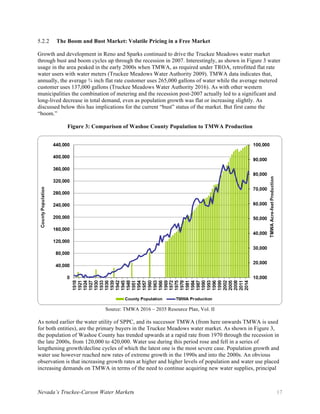
through bust and boom cycles up through the recession in 2007. Interestingly, as shown in Figure 3 water
usage in the area peaked in the early 2000s when TMWA, as required under TROA, retrofitted flat rate
water users with water meters (Truckee Meadows Water Authority 2009). TMWA data indicates that,
annually, the average ¾ inch flat rate customer uses 265,000 gallons of water while the average metered
customer uses 137,000 gallons (Truckee Meadows Water Authority 2016). As with other western
municipalities the combination of metering and the recession post-2007 actually led to a significant and
long-lived decrease in total demand, even as population growth was flat or increasing slightly. As
discussed below this has implications for the current “bust” status of the market. But first came the
“boom.”
Figure 3: Comparison of Washoe County Population to TMWA Production
Source: TMWA 2016 – 2035 Resource Plan, Vol. II
As noted earlier the water utility of SPPC, and its successor TMWA (from here onwards TMWA is used
for both entities), are the primary buyers in the Truckee Meadows water market. As shown in Figure 3,
the population of Washoe County has trended upwards at a rapid rate from 1970 through the recession in
the late 2000s, from 120,000 to 420,000. Water use during this period rose and fell in a series of
lengthening growth/decline cycles of which the latest one is the most severe case. Population growth and
water use however reached new rates of extreme growth in the 1990s and into the 2000s. An obvious
observation is that increasing growth rates at higher and higher levels of population and water use placed
increasing demands on TMWA in terms of the need to continue acquiring new water supplies, principal
Nevada’s Truckee-Carson Water Markets 18
amongst these being surface water rights. This, as groundwater availability in the Truckee Meadows is
very limited and TMWA is limited in how much water they can extract under their existing groundwater
rights. Further, supplies in times of drought come from storage supplies, which were historically devoted
to irrigation use. In other words, by the mid-2000s TMWA was in need of a much larger annual increment
of water right acquisitions than back in the early period mid-century.
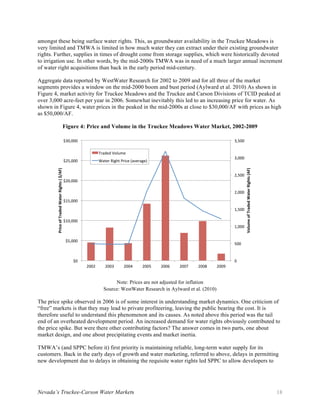
Aggregate data reported by WestWater Research for 2002 to 2009 and for all three of the market
segments provides a window on the mid-2000 boom and bust period (Aylward et al. 2010) As shown in
Figure 4, market activity for Truckee Meadows and the Truckee and Carson Divisions of TCID peaked at
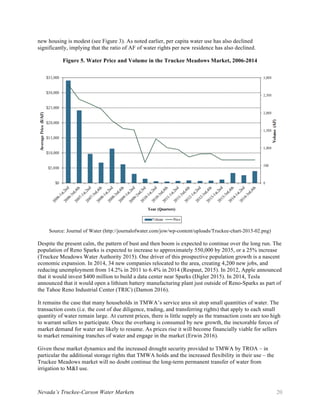
over 3,000 acre-feet per year in 2006. Somewhat inevitably this led to an increasing price for water. As
shown in Figure 4, water prices in the peaked in the mid-2000s at close to $30,000/AF with prices as high
as $50,000/AF.
Figure 4: Price and Volume in the Truckee Meadows Water Market, 2002-2009
Note: Prices are not adjusted for inflation
Source: WestWater Research in Aylward et al. (2010)
The price spike observed in 2006 is of some interest in understanding market dynamics. One criticism of
“free” markets is that they may lead to private profiteering, leaving the public bearing the cost. It is
therefore useful to understand this phenomenon and its causes. As noted above this period was the tail
end of an overheated development period. An increased demand for water rights obviously contributed to
the price spike. But were there other contributing factors? The answer comes in two parts, one about
market design, and one about precipitating events and market inertia.
TMWA’s (and SPPC before it) first priority is maintaining reliable, long-term water supply for its
customers. Back in the early days of growth and water marketing, referred to above, delays in permitting
new development due to delays in obtaining the requisite water rights led SPPC to allow developers to
0	
500	
1,000	
1,500	
2,000	
2,500	
3,000	
3,500	
2002	 2003	 2004	 2005	 2006	 2007	 2008	 2009	
$0	
$5,000	
$10,000	
$15,000	
$20,000	
$25,000	
$30,000	
Volume	of	Traded	Water	Rights	(AF)	
Price	of	Traded	Water	Rights	(	$/AF)	
Traded	Volume	
Water	Right	Price	(average)
Nevada’s Truckee-Carson Water Markets 19
bring water rights in with their developments, as a mechanism to speed approval. When SPPC
transitioned to TMWA this became TMWA’s Rule 7.
To ensure adequate long term water supply, TMWA requires developers to meet Rule 7 Will-Serve
Commitments by securing water rights that cover the total project demand with a multiplier of 1.1 for
Truckee main stem water, or a multiplier of 1.0 for groundwater (TMWA 2013). Developers have the
option to purchase water rights from TMWA, or to purchase water rights from another seller, as TMWA
will consider “acquisition of water rights for dedication through exchanges, leases, future purchases, or
other acquisition agreements” (TMWA 2013). Notably, “except where the Authority [TMWA] has
explicitly agreed to except a temporary dedication … dedication of water rights is irrevocable” (TMWA
2013). As such, the majority of water rights transfers in the Truckee Meadows water market are
permanent sales to either TMWA itself or developers looking to bring water with their development
applications (Scanland 2016a).
Developers thus have the option to either buy water rights and dedicate them to TMWA in exchange for
water service (a “will serve” commitment), or pay cash to TMWA for a service commitment. According
to TMWA, at present, most parties opt to trade through TMWA due to cash-readiness and comparatively
lower transaction cost. TMWA can undertake due diligence and pay cash for water within weeks while
trades that occur outside of TMWA may take longer to complete (Erwin 2016). However, at the peak of
the market Rule 7 effectively meant that TMWA was competing in the water market with a large number
of developers to acquire the water rights necessary to underpin growth and M&I water service. At the
peak of the market, with housing prices climbing daily (if not hourly) any delay meant the loss of
financial gain. Given that the cost of water is small compared to the other inputs that go into a new
development, particularly land and construction, all of which were booming as well, it is not surprising
that developers were actively bidding up available water at that time. In addition, water rights and water
rights valuation being a relatively obscure field of expertise, the general rush to market meant that
developments were being put down rapidly, sometimes on top of formerly irrigated ground, leading to
further confusion and fractionation of water rights. In other words, by the middle of 2000 the water
market (as with the land and construction market) was reaching a chaotic and frenzied state. All it
required was a match to set it alight.
The match came in the form of series of interrelated events that took place in the city of Lemmon Valley,
just north of Reno. Changes to a large development proposal led the County to end up with a significant
portion of unused rights, which were put up to auction. There was little interest in the county’s excess
water rights until one large developer bid $18,000/AF (Erwin 2016). This one transaction set a precedent
for successive transactions and, as seen in Figure 4, average prices rose to $20,000 in 2005 and from there
to almost $30,000 in 2006. From there, the housing bubble crashed and the price decreased in subsequent
years.
Arguably, in a rapidly growing real estate market a policy of allowing (or requiring) developers to acquire
water rights in the open market and, thereby, to compete with the public water provider for available
water is not ideal. After decades of rapid development where irrigated lands were supplanted by sub-
divisions often without proper reservation and severing of the underlying appurtenant water rights, this
policy combined with the housing bubble not surprisingly led to a water rights bubble as well.
Current Market Status and Future Drivers5.2.3
As of 2016, the Truckee Meadows market is becalmed (Figure 5). There is little market activity and
current prices for permanent water right transfers in Truckee Meadows are in the $3,000-$3,500/AF
(Erwin 2016). This reflects the overhang of already permitted sub-divisions and will-serve commitments
from the housing bust in the late 2000s. In addition, population growth remains light and the demand for
Nevada’s Truckee-Carson Water Markets 20
new housing is modest (see Figure 3). As noted earlier, per capita water use has also declined
significantly, implying that the ratio of AF of water rights per new residence has also declined.
Figure 5. Water Price and Volume in the Truckee Meadows Market, 2006-2014
Source: Journal of Water (http://journalofwater.com/jow/wp-content/uploads/Truckee-chart-2015-02.png)
Despite the present calm, the pattern of bust and then boom is expected to continue over the long run. The
population of Reno Sparks is expected to increase to approximately 550,000 by 2035, or a 25% increase
(Truckee Meadows Water Authority 2015). One driver of this prospective population growth is a nascent
economic expansion. In 2014, 34 new companies relocated to the area, creating 4,200 new jobs, and
reducing unemployment from 14.2% in 2011 to 6.4% in 2014 (Respaut, 2015). In 2012, Apple announced
that it would invest $400 million to build a data center near Sparks (Digler 2015). In 2014, Tesla
announced that it would open a lithium battery manufacturing plant just outside of Reno-Sparks as part of
the Tahoe Reno Industrial Center (TRIC) (Damon 2016).
It remains the case that many households in TMWA’s service area sit atop small quantities of water. The
transaction costs (i.e. the cost of due diligence, trading, and transferring rights) that apply to each small
quantity of water remain large. At current prices, there is little supply as the transaction costs are too high
to warrant sellers to participate. Once the overhang is consumed by new growth, the inexorable forces of
market demand for water are likely to resume. As prices rise it will become financially viable for sellers
to market remaining tranches of water and engage in the market (Erwin 2016).
Given these market dynamics and the increased drought security provided to TMWA by TROA – in
particular the additional storage rights that TMWA holds and the increased flexibility in their use – the
Truckee Meadows market will no doubt continue the long-term permanent transfer of water from
irrigation to M&I use.
Nevada’s Truckee-Carson Water Markets 21
Probably the principal challenge faced by the area will be providing sufficient water to industry. Industrial
development and transformation is occurring along the Truckee River below Sparks and above Derby
Dam (the site of the Apple data center). A much larger and, until recently, slow growing industrial and
warehouse development, the TRIC, is sited back in hills to the south of the river and well east of Sparks
(the site of the Tesla plant). In 2012 TRIC received an approval for 2,700 acre-feet of new groundwater
rights. TRIC had applied for 11,000 AF, but in ruling 5747 the State Engineer determined that this
amount exceeded the sub-basin perennial yield and denied all but the 2,700 AF in permits (T. Taylor
2007). In other words, the sub-basin in which TRIC is located is now closed to further groundwater
appropriation. Further ideas for TRIC obtaining effluent are under exploration. Acquisition of surface
water rights from the Truckee Meadow area might be another alternative.
In addition, as part of the TRIC case the question of whether a junior groundwater pumper may infringe
on senior surface water rights was raised in litigation, in particular with respect to the most senior PLPT
rights. In the State Engineer’s Ruling 5747, the state’s policy position was detailed; distilled to its
essence, it is that surface and groundwater are administered separately and the claim that a junior
groundwater appropriation injures a senior surface water right was rejected as a basis to deny the
groundwater appropriation (T. Taylor 2007).
The PLPT appealed this Ruling to the Orr Ditch court, and eventually the Ninth Circuit Court of Appeals
ruled in favor of the Tribe, holding that diminishment of a senior surface decree right by a junior
groundwater right would constitute legal injury (US v. Orr Water Ditch Co. 2014). An outstanding
question then is whether going forward the market might also serve to balance reallocations between
surface and groundwater demand and supply.
These are significant issues for the future of the area that goes beyond the remit of this paper, however the
resolution of these issues is likely to affect the water market and may indeed expand the water market, as
discussed in the conclusions to this paper.
Outcomes of Long-term Water Right Reallocation5.2.4
Long term, sustained activity in the Truckee Meadows water market has shifted substantially over time.
Figure 6 shows the substantial movement of water rights from agriculture to M&I over the last 60 years.
This graph does not fully convey the changes wrought through political settlements and market activity.
Water supply reliability during drought is a central issue for TMWA. Limited groundwater rights and
further restrictions on the use of existing wells means that when natural flow rights are short due to
drought TMWA cannot rely on its wellfields. Instead it must rely on water stored in reservoirs. As
explained earlier, the implementation of TROA is expected to be instrumental in increasing the flexibility
of stored water use for municipal use in drought years and use for fish and wildlife during wet years.
TROA therefore made acquisition of additional storage right attractive to TMWA. In 2015, TMWA
acquired an additional 3,000 acre-feet of storage rights in Donner Lake from TCID for $17 million
(Ritchey 2016). As of October of 2015, TMWA had over 136,000 AF of storage, decreed, and irrigation
rights to generate water supplies to meet customer demands (Truckee Meadows Water Authority 2015).
The water market in the Truckee Meadows has thus served the purpose of long-term water right
reallocation to meet changing human needs.
Nevada’s Truckee-Carson Water Markets 22
Figure 6. Truckee River Water Rights Change of Use
Source: (Truckee Meadows Water Authority 2016)
Sellers in the Truckee Meadows water market originally were irrigators using water from the river and
many of the creeks in the area. Presumably the landowners stood to earn more from selling their water
right than from farming. The expansion of the Reno-Sparks metropolitan area means that today there is
little active irrigation remaining. Much of the remaining irrigation water rights are situated under existing
or proposed developments. As such this water is often held in small portions and is complex, time
consuming and costly to market and transfer.
While the area has a long history of conflict over water rights and water use the gradual reduction in
agricultural area in the Truckee Meadows does not appear to have been a lightning rod for controversy as
in other areas of the western US. In contrast to some of these other areas, no Reclamation irrigation
districts or large irrigation districts existed in the Truckee Meadows area that might have wielded
significant political power and weighed in on this transition. Further, that the urban expansion occurred
on top of the irrigated land is a significant feature that may have alleviated concerns and avoided
controversy amongst agricultural interests. When urban areas displace irrigation the political dynamics
are different than when an urban area grows and looks to transfer water from distant agricultural area.
Urbanization may displace agriculture, but the returns to landowners in terms of the sale of land and water
are powerful incentives to participate in markets rather than to fight City Hall. However, this is not a
dynamic unique to the Truckee Meadows area. It therefore seems more likely that the relative lack of
controversy of the purchase and retirement of irrigation water rights reflects the lack of institutional
capacity and political power of irrigators and ditch companies in the area.
out TMWA:
ckee Meadows Water
thority (TMWA) is a not-for-
fit water utility, overseen
elected officials from Reno,
arks and Washoe County.
WA employs a highly skilled
m who ensure the treatment,
ivery and availability of
h-quality drinking water
und the clock for more
n 385,000 residents of the
ckee Meadows.
out this series:
ter Topics in Our Community
a series of papers designed
provide the citizens of the
ckee Meadows information
out key water topics in this
ion.
access all of the papers, go
www.tmwa.com/topics.
out TMWA’s
ard of Directors:
e TMWA Board welcomes
u to attend and comment at
y board meeting. Meeting
hedules are posted at
ww.tmwa.com/meetings.
send a question to the
ard, visit us online at
ww.tmwa.com/comment.
estions or feedback?
’d like to hear from you.
ase call our Community
mmunications line with any
maining questions you have
this topic or other water
ics. The number is
5) 834-8290.
iling address:
O. Box 30013
no, NV 89520-3013
in line: (775) 834-8080
ww.tmwa.com
cument date: 1/1/15
What is TMWA’s role in growth in our community?
Local governments set the communities’ direction on growth. TMWA is a water provider and a facilitator to
serve local government in managing and developing existing or future water supplies and resources. We cannot
deliver more water than is allowed by water rights and drought reserves -- for any purpose, including growth. The
community sets the course for growth through regional planning and local government directives. If anyone would
like to have input in the issue of growth, contact your elected representative and/or the planning commissions.
Nevada’s Truckee-Carson Water Markets 23
5.3 Market Segment #2: Lower Truckee River – Truckee Division (TCID)
The Endangered Species Act and the Clean Water Act provided the political action and funding for a
water market on the lower Truckee River, between Derby Dam and Pyramid Lake. Buyers in this second
segment of the water market include the PLPT, the city of Fernley, and developers in the city of Fernley,
who are subject to a Fernley rule similar to TMWA’s Rule 7. Sellers are primarily irrigators in the
Truckee Division of TCID and irrigators on the lower main stem of the Truckee River. The end uses for
water include water for Lahontan cutthroat trout and cui-ui habitat, to maintain lake levels, and for
Fernley municipal water service.
The primary drivers of the lower Truckee River water market were TROA, which dedicated water
supplies to protect threatened and endangered fish species near Pyramid Lake, and a water rights
acquisition program made possible by the Truckee River Water Quality Settlement Agreement (WQSA)
and grant funding through the 2002 Farm Bill for the Desert Terminal Lakes Program.
Under TROA, Stampede Reservoir was held in perpetuity for threatened and endangered Lahontan
Cutthroat Trout and cui-ui. TROA created a 6,000 AF Joint Program Fish Credit Water (see Section 4.11)
where 3,000 AF is stored in Lake Tahoe and 3,000 AF is stored in Stampede Reservoir. Annual shortages
and surpluses are shared between TMWA and instream flows: in years of surplus, water is released for
fish habitat, and in years of shortage, TMWA uses stored water to meet M&I delivery obligations.
At the same time, WQSA (see Section 4.10) provided funding for the PLPT and environmental groups,
such as TNC and Great Basin Land and Water, to purchase water rights for instream flows (i.e., the
funding enabled them to be a buyer in the lower Truckee water market). Water rights obtained with
WQSA funds flow instream to lower Truckee River reaches in priority as available. The Agreement
specified a dollar amount ($24 million) rather than a volume of water due to changing prices of water
rights in a market (Mahin 2010). As of 2010, TMWA estimated that once all of the WQSA funds were
spent, and change of applications for water use had been approved, at least 4,535 AF of water, or 25 cfs,
would be permitted for wildlife purposes as WQSA acquisitions for augmenting the lower Truckee River
flow (Mahin 2010).
The Desert Terminal Lakes (DTL) funding, originally established by Public Law 101-171 in the 2002
Farm Bill, also provided funding to the PLPT for acquiring water rights on the lower Truckee. The project
provided roughly $3 million to the PLPT (Bureau of Reclamation 2015). In addition to supporting
TROA-related litigation and securing permits for unappropriated water in the Truckee River, the DTL
funds supported PLPT negotiations for the acquisition of 6,700 AF of surface water rights from Reno,
Sparks and Washoe County, negotiations between PLPT and DOI for water rights acquisitions in the
lower Truckee, the WQSA water rights acquisition program, and negotiations with the City of Fernley to
coordinate water management in a way that benefits PLPT and Fernley.
Several environmental groups have been involved in instream flow rights acquisitions on the lower
Truckee River. GBLW has worked with the Cities of Reno and Sparks, Washoe County, and the PLPT
since 1998 to facilitate the acquisition of water rights for WQSA. The recognition of instream flow rights
was a central component of the lower Truckee River water market as water rights were purchased
primarily to augment instream flows in the lower Truckee River between Reno-Sparks area and Pyramid
Lake to help meet with water quality standards and to maintain habitat for endangered fish and wildlife
(Great Basin Land and Water 2016). As of 2016, PLPT and local governments have acquired
approximately 11,200 AF of Truckee River water rights for to meet water quality an instream flow goals
(Scanland 2016b). GBLW has been an integral player in acquiring water rights for environmental flows:
since 1998, GBLW has acquired more than 8,400 AF of Truckee River water rights on behalf of local
governments and the PLPT from irrigators in the Truckee Division of TCID (Great Basin Land and Water
Nevada’s Truckee-Carson Water Markets 24
2016). A portion of the water was acquired as water rights, while other rights were acquired by
purchasing land, severing the water rights and dedicating them to instream flows, and selling land back to
private individuals (Great Basin Land and Water 2016).
While most water rights go to environmental buyers in the lower Truckee, the City of Fernley also
acquired water rights from irrigators in TCID’s Truckee Division. In 2015, the City of Fernley sparked
controversy when it opted to lease excess water rights, which had been acquired from irrigators in the
Truckee Division, to the PLPT to maintain instream flows. Farmers face competition from municipalities
and federally funded environmental groups who are willing and able to pay more for water rights than
what many farmers can afford while growing such low-value crops. Current prices for permanent water
rights transfers in the lower Truckee segment of the market average $5,000/AF (Scanland 2016a).
The market on the lower Truckee River has led to a large-scale transition in the use of water from
irrigation to improving fish habitat and meeting WQSA requirements, along with transfers to M&I use.
There is considerable concern amongst farmers over water leaving the agricultural sector. One argument
mooted is that the leakage from the Truckee Canal and irrigation is what maintains the wells that sustain
Fernley (Truckee Canal White Paper Working Group 2009). However, the only factor limiting the
continued transition is the rate of growth of the Fernley population and the future of federal funding for
PLPT instream flow acquisition as Senator Harry Reid departs office in early 2017.
5.4 Market Segment #3: Stillwater Wildlife Refuge – Carson Division (TCID)
The same politically-driven funding that helped spur water market activity in the lower Truckee River
also helped catalyze a water market in the lower Carson River, between irrigators (in this case, the
primary sellers of water rights) in the Carson Division of TCID and environmental buyers in the
Stillwater NWR in what was once the Carson Sink. The desiccation of the Lahontan Valley wetlands,
which include the Stillwater NWR, due to reductions in agricultural return flows, and poor water quality
provided motivation for a water rights acquisition program to restore the wetlands. Ironically, early
Pyramid Lake restoration efforts, and OCAP limits on Newlands Project diversions from the Truckee
River reduced non-consumptive water user in the Carson District, which, in reduced the very return flows
that had fed the Lahontan Valley wetlands (Lancaster 1990).
Public Law 101-618, the Settlement Agreement signed in 1990, authorized USFWS to begin acquiring
water rights for the Stillwater NWR. The Settlement Agreement added $16 million to the already
appropriated $2.7 million for Stillwater NWR water rights acquisition (Lancaster 1990; Wilds 2010).
Section 206 was intended to ensure that Stillwater marshes remained as viable migratory bird habitat
(Wilds 2010). As such, DOI was authorized to purchase up to 75,000 AF of water rights from willing
sellers, at market price, with the goal of maintaining 25,000 acres of wetlands even in dry years (Wilds
2010). Acquisition of water rights for Stillwater NWR began in 1990 with a partnership between the State
of Nevada, TNC, the Nevada Waterfowl Association, the Bureau of Indian Affairs (BIA), and
Reclamation. Additionally, under the Settlement, Stillwater NWR was established as a permanent reserve,
and its size was expanded from 25,000 to 77,520 acres (USFWS 2016).
In 1996, P.L. 101-618 implementation was formalized by USFWS under its Water Rights Acquisition
Program for Lahontan Valley Wetlands (USFWS 2010). The program continues to this day to gradually
acquire water rights from willing sellers, either as direct purchase of water rights or through the purchase
of water-righted farm and ranch lands (Grimes 2016). In the latter case the water rights are severed from
the land, transferred to the refuge and the land is resold to willing buyers (USFWS 2016).
The Desert Terminal Lakes (DTL) program, established by P.L. 101-171 in the 2002 Farm Bill, provided
$200 million to Reclamation to restore at-risk desert terminal lakes (Farm Security and Rural Investment
Nevada’s Truckee-Carson Water Markets 25
Act 2002). Public Law 108-7 Section 207 clarified that DTL funds would be used for Pyramid, Summit,
and Walker Lakes in Nevada, and P.L. 101-171, Section 2507 (as amended) established that DTL funding
provided through Reclamation could be used to lease water, or purchase land, water appurtenant to the
land, or for research on fish and wildlife habitat conservation (National Fish and Wildlife Foundation
2015). Additional DTL funds were subsequently allocated to the USFWS program to purchase water
rights for Stillwater NWR.
Federal funding effectively created environmental buyers in the Carson Division water market. While
several environmental NGOs have been involved in water rights acquisitions and wetlands restoration in
the Lahontan Valley and Stillwater NWR, USFWS has long been the primary water rights buyer in the
segment of the market. For example, during a 2013-2015 grant term, FWS received $4,910,000 to acquire
water rights from the Carson Division of the Newlands Reclamation project for permanent transfer for
wetlands restoration (National Fish and Wildlife Foundation 2013). As of April 2016, 47,100 AF of water
from the Carson Division of TCID have been acquired for the Lahontan Valley wetlands: 36,400 AF by
FWS, 1,800 AF by Bureau of Indian Affairs (BIA), and 8,900 AF by the State of Nevada (USFWS 2016).
The USFWS is now the single largest holder of water rights in TCID. USFWS pays TCID approximately
$460,000/year in assessments as it continues to use the irrigation infrastructure to deliver water to
Stillwater NWR (USFWS 2016).
Under the USFWS program water rights are purchased from willing sellers at market price, and water is
transferred to the wetlands through permits issued by the Nevada State Engineer (USFWS 2016). Water
right values paid by FWS for Carson Division water rights increased steadily between 1999-2016 (see
Table 4):
Table 4: Water Right Values Paid by USFWS for Carson Division Water Rights
Time	Period	 Price	($/acre)	
Jun.	1999	–	Feb.	2000	 $1,300	(per	acre	of	entitlement)	
Feb.	2000	–	Dec.	2005	 $1,400	
Dec.	2005	–	Mar.	2009	 $4,000	
Mar.	2009	–	Jul.	2012	 $4,500	
Jul.	2012	–	Apr.	2016	 $5,250	
Source: USFWS (2016)
Prices for water acquisitions for the Stillwater Refuge in the Carson Division did not spike in the mid-
2000s as they did in the Truckee Meadows segment of the market. This segment of the Truckee-Carson
market is not connected to the Truckee Meadows market. Truckee River rights from TCID cannot be
transferred above Derby Dam without approval by the Secretary of the Interior, which is unlikely to be
forthcoming (Grimes 2016). In other words there was no price spike in the mid-2000s because this market
is not driven by the development pressure in the Reno-Sparks area.
Even as water rights in the Carson segment of the water market tend to leave agriculture for instream flow
restoration, water rights transfers, with some limitations, still occur between farmers. Water rights
transfers between irrigators in the Carson Division are limited, as water rights cannot be traded upstream
on the Carson River without losing priority (see section 4.6). This is an important limitation in
agriculture-to-agriculture water transfers as the Lahontan Reservoir, where TCID water is stored, and
where Carson Division irrigators draw their senior rights from, is at the bottom of the Carson River
Nevada’s Truckee-Carson Water Markets 26
system. The downstream user and water right buyer is the Stillwater NWR, and therefore, transferring
water rights away from agriculture typically means selling them to environmental buyers.
Notably, in TCID, water rights are held by landowners (according to the Alpine Decree) and not by the
Irrigation District. TCID is responsible for delivering those water rights, but does not have the authority
to reject water right transfers that it does not like, nor can it extract rents from transfers through the
levying of exit or termination fees. Irrigators in TCID pay an annual assessment fee of $45/acre; however,
the issue is that farmed acreage is declining, so TCID is essentially managing a district that is decreasing
in size of the irrigation footprint.
Truckee Division and Carson Division farmers have similar concerns about water rights leaving the
agriculture sector. Moreover, both market segments face similar uncertainties as the primary water rights
buyers have been able to purchase water rights because of federal funding programs (i.e. WQSA and
DTL) that are currently coming to a close. In the case of the USFWS program continued sales of acquired
lands will underpin continued water right purchases, however, once these lands are sold there are no
further resources available to purchase additional rights (Grimes 2016).
5.5 Market Prices for Water in the Three Market Segments
The rationale for separating the Truckee-Carson water market into three segments rests on physical and
legal distinctions that create separate markets. The WestWater Research price data for 2002 to 2009
substantiates that these markets are separate. Figure 7 shows that prices were substantially different in the
three segments, with the highest prices in Truckee Meadows and the lowest in the Carson Division. As
pointed out in the earlier sections, the degree of competition for water and the demand-supply balance, as
well as market structure explain these differences. Figure 8 shows the average price paid by type of buyer:
urban, environmental and agricultural. As expected the price paid by M&I buyers, at $20,000/AF on
average, is highest given that the preponderance of these purchases were in the Truckee Meadows market
where this amount is the average price (as seen in Figure 7). Environmental buyers paid around
$5,000/AF reflecting their participation in all three markets. Agricultural buyers paid the least at around
$3,000/AF reflecting the lower prices in the Carson and Truckee Division markets where agriculture
trades are more prevalent.
Nevada’s Truckee-Carson Water Markets 27
Figure 7. Truckee-Carson Water Prices and Volumes by Market Segment, 2002-2009
Note: All figures in 2009 constant (inflation adjusted) dollars
Source: WestWater Research in Aylward et al. (2010)
Figure 8: Truckee-Carson Water Prices by Type of Buyer, 2002- 2009
Note: All figures in 2009 constant (inflation adjusted) dollars
Source: WestWater Research in Aylward et al. (2010)
$19,746	
$13,301	
$1,017	
0	
1,000	
2,000	
3,000	
4,000	
5,000	
6,000	
7,000	
8,000	
$0	
$5,000	
$10,000	
$15,000	
$20,000	
$25,000	
Truckee	Meadows	 Truckee	Division	 Carson	Division	
Traded	Volume	of	Water	Rights	(AF)	
Price	of	Traded	Water	Rights	($/AF)	 Traded	Volume	
Average	Prices	
$19,463	
$4,994	
$2,920	
$0	
$5,000	
$10,000	
$15,000	
$20,000	
$25,000	
Urban	 Environmental	 Agriculture	
Average	Unit	Price	for	Water	($/AF)
Nevada’s Truckee-Carson Water Markets 28
The various data points on prices cited earlier in the paper can be compiled to provide a window into the
historical evolution of prices for water rights in these markets. This information is compiled and
summarized in two ways below. Table 5 presents the historical data by rough assigned time period and
provides the annual percent change in price during these periods. In order to compare apples with apples,
all the data is converted into constant 2015 dollars using the Consumer Price Index from the US Bureau
of Labor Standards. Prices cited by Colby Saliba (1987) suggest rapid growth in prices of 23% per year
from the 1960s and 1970s (denoted by 1970) to the mid-1980s. Arguably the 1970 prices were not
particularly reflective of the value of water use in irrigation. From the mid-1980s through to 2005, and
discounting the peak prices discussed earlier, continued strong price growth of 12% is observed. At this
point, $4,000/AF, prices now largely exceed the value of water in agricultural production and may indeed
be reflecting transaction costs of establishing the validity and marketability of small quantities of water
rights. As noted above from 2005 to 2015 prices have declined slightly, though the current market price
merely reflects limited market activity.
Table 5. Long-term Average Prices and changes in Prices for the Truckee Meadows
Note: All figures in 2015 constant (inflation adjusted) dollars
Sources: Colby Saliba (1987), WestWater Research in Aylward et al. (2010) and Irwin (pers. comm. 2016)
Finally if these historical data points (again excepting the mid-2000s price spike) are compiled and
analyzed with a simple linear regression approach the annual increase in the real (constant dollars) price is
over $90 per year (Figure 9). Note that the data is parsed in a very inexact manner so these figures should
be treated as approximate only. The larger point of the table and figure is that water prices in the Truckee
Market have grown much faster than inflation. Complicating this analysis though is the question of how
much of this increase reflects sellers’ transaction costs and not a real return to the water asset being sold.
Year 	Average	Price	($/AF)	
Percent	Change	per	
year	during	period
1970 34$																												
1985 740$																										 23%
2005 4,121$																							 12%
2015 3,250$																							 -1.5%
Nevada’s Truckee-Carson Water Markets 29
Figure 9. Historical Trend Analysis of Real Water Prices in the Truckee Meadows Market
Note: All figures in 2015 constant (inflation adjusted) dollars
6. Conclusions
The paper has demonstrated that over the last quarter to half century each of the three market segments of
the Truckee-Carson Basin water markets in their own way have successfully facilitated the permanent
reallocation of water right from agriculture to M&I and environmental purposes. In the Truckee-
Meadows, over a half century of population and economic growth has led to a physical displacement of
irrigation by urban development, with a concomitant shift from irrigation to M&I water use. On the lower
Truckee River and at the terminus of the Carson River the Truckee and Carson Division markets have
been instrumental in meeting water quality, fish and wildlife needs driven by federal and tribal priorities.
In all three cases, political drivers led to settlements of disputes over water rights and water use. Political
negotiations led to legal settlements and related funding appropriations that empowered buyers to
implement the necessary changes in water rights and water use through water rights transactions. The type
of trade seen in the market reflects changes in basin water management priorities (i.e. drought
management, recreation, and fisheries) and the politics associated with these priorities. In the Truckee and
Carson Basins water markets have served political ends, and served them effectively.
Key contextual drivers that enabled these political settlements to emerge and markets to function include:
• Federally adjudicated water rights (Orr Ditch and Alpine Decrees) under the prior appropriation
doctrine provided well-defined and secure property rights, as well as the means for administration
and enforcement of water rights.
• Absence of a large irrigation entity with a property interest in water rights willing and able to
pursue actions to protect irrigation water rights and impede market transactions (TCID serves
only to deliver rights).
• Federal presence led by the Senate Majority Leader Harry Reid and colleagues (Senator Bradley)
who made resolving conflict in northern Nevada over water a priority.
y	=	92.991x	-	183250	
R²	=	0.81412	
-$5,000	
$0	
$5,000	
$10,000	
$15,000	
$20,000	
$25,000	
$30,000	
1965	 1970	 1975	 1980	 1985	 1990	 1995	 2000	 2005	 2010	 2015	 2020	
Real	Water	Price	in	2015	Dollars	(infla6on	adjusted)	
Data	Set	for	Trend	Analysis	
2000s	Outliers	(Price	Spike)	
Linear	(Data	Set	for	Trend	Analysis)
Nevada’s Truckee-Carson Water Markets 30
• Ability of elected representatives and tribal/environmental representatives to establish significant
funding for the purchase of water rights for fish and wildlife.
• Urban development occurring “on top of” irrigated lands (in Reno, Sparks and Fernley).
• A single water provider for a large and expanding metropolitan area (TMWA).
• A state legal regime that accommodated changes in water rights to environmental and wildlife
uses.
• Litigation fatigue and the expenses and outcomes associated with decades of battles over aspects
of the Truckee river water.
To this point stakeholders generally regard the market as having worked well in matching supply to
demand. With the launch of the Truckee River Operating Agreement in 2016 the question is what is next
for these basins and their water rights. What remaining policy, legal and institutional issues may have an
impact on market activity or efficiency, or may lead to future conflicts over water?
Policy and Legal Reform. Although the market has served as a way to meet changing needs for water, the
Nevada water code remains a creature of the past. On the legal front two key issues that may emerge in
coming years include:
1. The adequacy of the perennial yield concept and the problem of overallocated groundwater
basins.
2. The continued administration of surface water and groundwater as separate resources.
There are a number of potential negative outcomes of these outdated policies in the Truckee and Carson
Basins. First, continued administration by the state to allocate basins up to the perennial yield amount and
efforts by permit holders to prove up beneficial use are likely to impact surface water users. Even
constraining allocations to the perennial yield results in overuse as pre-existing environmental use of
groundwater (e.g. for vegetation) continue to use water (unless rapid pumping dewaters these systems).
These impacts will probably fall on junior users and downstream uses. Federal and local governments
have now spent tens of millions of dollars on habitat restoration in the lower Truckee River and water
right acquisition for Pyramid Lake and the Stillwater National Wildlife Refuges. Allowing these gains to
be eroded by junior groundwater rights seems a pending (or existing) threat to cooperative basin efforts.
Finding a way to address overallocation, build in an accounting (or permitting) for pre-existing
environmental uses and manage the two resources in a conjunctive manner is therefore vital. The
administrative decisions on perennial yield have far-reaching consequences, yet the State Engineer is both
hamstrung by limited budgets and dogged by incessant presentation of “third party science” (advocacy
studies on perennial yield pushed by both applicants and protestants).
Another issue with these policies is that closed groundwater basins put further groundwater use off-limits.
In circumstances where surface water supply is not an option that will constrain further urban and
industrial development, such as with the Tahoe Regional Industrial Center just off the lower Truckee
River. Such unmet demands for water have a way of ending up leading to creative accounting schemes
and expensive infrastructure projects that are largely unnecessary. Continuing the pretense of separate
resources prevents the State Engineer from deploying conjunctive management solutions to these
problems. Nevada’s four neighbors to the north (Oregon, Washington, Idaho and Montana) as well as
Colorado all have (willingly or unwillingly) embraced conjunctive management. This enables creative but
sound groundwater offset and/or mitigation management alternatives. These effectively cap consumptive
use within a watershed or zone, and enable trading in consumptive use credits. Under such schemes, for
example, TRIC might purchase irrigation surface water rights in the Truckee Meadows, dedicate these to
wildlife use in the lower Truckee and Pyramid Lake and claim a groundwater offset to use in pumping
needed groundwater.
Nevada’s Truckee-Carson Water Markets 31
Potential policy reforms include the following.
• The State Engineer’s office could be enabled to rely on USGS science where available and
provided a budget to support robust in-house technical work on both perennial yield estimation
and modeling for projected impacts of granted permits.
• Perennial yield could be redefined to account for surface expression of groundwater such as
springs, seeps and wetlands.
• Surface water and groundwater could be managed together as a single interconnected resource,
accounting for both the hydrology within a basin and between hydrologically connected basins.
• As evidence of overuse and conflict with senior surface water rights emerges overallocated basins
could be administered in priority and/or encourage to arrive at alternative approaches (including
the correlative shares approach recommended by Young (2015)
Institutional Issues. A critical institutional issue that affects market function and may warrant revisiting
is the continued use of will-serve approaches by municipal water providers (TMWA and Fernley). By
allowing, if not encouraging, prospective developers to “bring water” along with their development
applications these municipalities effectively encourage competition in the market. As recounted in this
paper this approach led to rather extreme consequences in the mid-2000s in the Truckee Meadows where
prices spiked to unheard of levels for the western US. An alternative approach is for the water supplier to
take sole responsibility for water rights acquisition. Separating the timing and fate of development plans
from the pace of water right acquisition allows each task to be treated independently and on the merits.
Both water rights acquisition and urban development have their own processes and procedures. And,
while ultimately urban development can’t proceed without water it makes no sense to flip this around to
where a developer who has water gets to develop and is first in line. Presumably urban development
requires more reasoned planning and on many fronts.
The benefits of such a separation would be considerable to the public. Price spikes due to too many small
buyers chasing small sellers, the costs of which end up rolled into the price of housing benefits no-one but
the water rights seller. The rationale for why a seller of a right to a public resource should garner windfall
profits remains unclear. Typically this only happens if the market is not well managed by the public
entities involved. Retrenching water acquisition as a role for the water supplier takes the hot air out of the
market. The supplier can develop a plan and process for managing market purchases over time and match
long-term water supply needs to a sustained acquisition plan. In the case of TMWA, the organization has
always been a buyer of water rights and has the capacity to continue doing so on an efficient basis.
Enabling competition in the market, rather than managing the market seems unnecessary. While there
may be good historical reasons for the evolution of the will serve policies it may be useful to revisit these
to see how they might be altered to ensure that a repeat of the mid-2000s does not occur. In Central
Oregon, where similar growth rates and encroachment of urban lands into irrigated areas were seen in a
similar high desert environment, a collaborative water bank between urban, agricultural and conservation
interests sidestepped the conflict and prevented a water price bubble emerging during the 2000s real
estate bubble (Aylward 2006a; Aylward 2006b).
A second institutional issue surrounds the future of the balance between environmental flows and TCID
agricultural uses at the downstream end of the Truckee and Carson Rivers. While the market is currently
reallocating water rights to meet new priorities, it is yet to be seen how environmental buyers and the
PLPT will fare as the final tranche of federal funding provided through the various political agreements of
the last twenty years ebbs. It seems unlikely that the political climate in Nevada will result in any state
funding for environmental acquisitions for the foreseeable future. Nevertheless, to the extent that
additional water for fish and wildlife needs is desired the question is how would this be funded and
implemented. To date the programs have been straightforward fee purchase of water rights or land with
water rights. Are there in fact other alternatives that might be deployed once copious quantities of federal
Nevada’s Truckee-Carson Water Markets 32
funds are no longer available in lump sum? What other funding sources might be tapped? Are there
opportunities for creative financing solutions that don’t involve “buy and dry” such as the impact
investing approaches put forward by (Culp et al. 2015). And will the programs continue to be operated
quite separately?
And finally, on the agricultural side there remains the question of how this will play out over time.
TMWA and Fernley water supply forecasts predict the gradual wind down of agriculture in the Truckee
Meadows and the Truckee Division of TCID over the coming decades. Will lower value producers
continue to sell and how will TCID adapt to these changes? Will TCID and agricultural water right
holders play a renewed role in future political discussions about the future of water in northern Nevada,
having sat out the last round with TROA?
Nevada’s Truckee-Carson Water Markets 33
References
Aylward, Bruce. 2006a. “Central Oregon Water Bank (COWBank): Origins, Objectives and Activities.”
Bend, OR: Deschutes River Conservancy.
———. 2006b. “Growth, Land Use and Irrigated Agriculture in Central Oregon.” Bend, OR: Deschutes
River Conservancy.
Aylward, Bruce, David Pilz, Megan Dyson, and Carl J. Bauer. 2016. “‘Healthy’ Water Markets: A
Conceptual Framework.” Portland: AMP Insights and Ecosystem Economics.
Aylward, Bruce, Harry Seely, Ray Hartwell, and Jeff Dengel. 2010. “The Economic Value of Water for
Agricultural, Domestic and Industrial Uses: A Global Compilation of Economic Studies and
Market Prices.” Bend: Ecosystem Economics.
Benson, Reed D. 2012. “Public Funding Programs for Environmental Water Acquisitions: Origins,
Purposes, and Revenue Sources.” Envtl. L. 42: 265.
Berris, Steven N., Glen W. Hess, and L.R. Bohman. 2001. “River and Reservoir Operations Model,
Truckee River Basin, California and Nevada, 1998.” USGS.
Borgerding, Joe. 1993. “Addressing Water Issues Through Conflict Resolution.” New Mexico Water
Resources Research Institute, September.
Bureau of Reclamation. 2011. “Notice of Intent to Award, RF-102.”
http://apply07.grants.gov/apply/opportunities/instructions/oppR12AS20017-cfda15.508-
instructions.pdf.
———. 2015. “Truckee Basin Study: Basin Study Report.” Washington DC: US Department of Interior.
———. 2016. “Truckee Canal Extraordinary Operation and Maintenance Environmental Impact
Statement.” Washington DC: US Department of Interior.
Christman, Laine. 2015. “Developing a Dynamic Drought Contingency Decision Support System for
Climate Change and Institutional Constraints.” Truckee Meadows Water Authority.
http://www.usbr.gov/drought/docs/apps/2015/4700014_508.pdf.
Colby Saliba, Bonnie. 1987. “Do Water Markets ‘Work’? Market Transfers and Trade-Offs in the
Southwestern States.” Water Resources Research 23 (7): 1113–22.
Colby Saliba, Bonnie, Mark A. McGinnis, and Ken A. Rait. 1991. “Mitigating Environmental
Externalities through Volunary and Involuntary Water Reallocation: Nevada’s Truckee-Carson
River Basin.” Natural Resources Journal 31: 757.
Cosens, Barbara A. 2003. “Farmers, Fish, Tribal Power, and Poke: Reallocating Water in the Truckee
River Basin, Nevada and California.” Journal of Environmental Law and Policy 10 (1): 89.
Culp, Peter W., Ricardo Bayon, Jason Scott, and Tom Melton. 2015. “Liquid Assets: Investing for Impact
in the Colorado River Basin.” Phoenix and New York: Squire Patton and Boggs, and Encourage
Capital.
Nevada’s Truckee-Carson Water Markets 34
Damon, Anjeanette. 2016. “Tesla, Switch and TRIC Want Reno’s Gray Water.” Reno Gazette Journal.
Accessed June 20. http://www.rgj.com/story/news/2015/09/16/tesla-switch-and-tric-want-renos-
gray-water/32533639/.
d’Estree, Tamra Pearson, and Bonnie B. G. Colby. 2006. Braving the Currents: Evaluating
Environmental Conflict Resolution in the River Basins of the American West. Springer Science &
Business Media.
Digler, Daniel Eran. 2015. “Apple, Inc. Massively Expanding Its iCloud Data Centers in Nevada,
Oregon.” Apple Insider, October 2. http://appleinsider.com/articles/15/10/02/apple-inc-massively-
expanding-its-icloud-data-centers-in-nevada-oregon.
Erwin, John. 2016. Interview by Bruce Aylward, Reno, April 28, 2016.
Farm Security and Rural Investment Act. 2002. https://www.gpo.gov/fdsys/pkg/PLAW-
107publ171/pdf/PLAW-107publ171.pdf.
Great Basin Land and Water. 2016. “Great Basin Land and Water Projects.”
http://www.greatbasinlandandwater.org/index.php?option=com_content&view=article&id=4&Ite
mid=5.
Grimes, Richard. 2016. Interview by Bruce Aylward, Reno, April 27, 2016.
Hess, Glen W., and R. Lynn Taylor. 1999. “River-Operations Model for Upper Carson River Basin,
California and Nevada.” 98-4240. Carson City: US Department of Interior, US Geological
Survey.
Horton, Gary A. 1997. “Carson River Chronology: A Chronological History of the Carson River and
Related Water Issues.” Nevada Division of Water Planning, Department of Conservation and
Natural Resources.
Lancaster, John. 1990. “Buying Peace in Western Water War. Farmers Cut Land Use, Help Restore
Nevada Wetlands.” Washington Post, June 10.
Mahin, Donald. 2010. Written Testimony of Don Mahin on Behalf of Truckee Meadows Water Authority.
http://www.waterboards.ca.gov/waterrights/water_issues/programs/hearings/truckee_river/exhibit
s/tmwa_4_0.pdf.
National Fish and Wildlife Foundation. 2013. “Desert Terminal Lakes Restoration Fund - Awarded
Grants.” http://www.walkerprogram.org/wp-content/uploads/2013/10/DTL-Grants-15_0322.pdf.
———. 2015. “Developing the Next Generation of Conservationists Grant Program: 2015 Request for
Proposals.” http://multibriefs.com/briefs/aee/nfwfproposals.pdf.
Nevada Division of Water Planning. 1999. “Nevada State Water Plan Summary.” Carson City: Nevada
Division of Water Planning, Department of Conservation and Natural Resources.
Nevada Legislative Counsel Bureau. 2016. “Policy and Program Report: Water Resources.” Research
Diversion report of April 2016. Carson City: Nevada Legislative Counsel Bureau.
Nevada’s Truckee-Carson Water Markets 35
Operating Criteria and Procedures for the Newlands Reclamation Project, Nevada. 2009. Code of
Federal Regulations (annual Edition). Vol. 418.
Pisani, Donald J. 2002. Water and American Government: The Reclamation Bureau, National Water
Policy, and the West, 1902-1935. Univ of California Press.
Respaut, Robin. 2015. “Reno’s Economy Is Thriving, but Will It Continue?” Las Vegas Review-Journal.
February 27. http://www.reviewjournal.com/business/reno-s-economy-thriving-will-it-continue.
Ritchey, Julia. 2016. “TMWA Buys Water Rights For Donner Lake.” KUNR, January 6.
http://kunr.org/post/tmwa-buys-water-rights-donner-lake.
Scanland, Rob. 2016a. Telephone Interview by Bruce Aylward, February 5, 2016.
———. 2016b. Email message to author, June 27, 2016.
Sierra Pacific Resources. 2001. “Sierra Pacific Power Company Water Business Sale Approved | The
Solutions Source of the Water & Wastewater Industry.” PR Newswire, April 27.
http://www.prnewswire.com/news-releases/sale-of-sierra-pacific-power-company-water-
business-receives-final-regulatory-approval-82499492.html.
Smoak, Gregory E. 2016. “The Great Basin.” In Oxford Handbook of Indian History, 377.
Tarlock, A. Dan. 1999. “The Creation Of New Risk Sharing Water Entitlement Regimes: The Case Of
The Truckee-Carson Settlement.” Ecology LQ 25: 674–757.
Taylor, Alan H., Anna M. Vandervlugt, R. Stockton Maxwell, Robert M. Beaty, Catherine Airey, and
Carl N. Skinner. 2014. “Changes in Forest Structure, Fuels and Potential Fire Behaviour since
1873 in the Lake Tahoe Basin, USA.” Edited by Kerry Woods. Applied Vegetation Science 17
(1): 17–31. doi:10.1111/avsc.12049.
Taylor, Tracy. 2007. “In The Matter Of Applications 63805, ) 64171, 65060, 65061, 65062, 65063,
65064, ) 65065, 65066, 65067, 65068, 65069, 65070, ) 65071,66729,69594,69595 And 69596
Filed To ) Appropriate The Public Waters Of An ) Underground Source Within The ) Tracy
Segment Hydrographic Basin ) (83), Storey County, Nevada.” Office of the State Engineer of the
State of Nevada. http://images.water.nv.gov/images/rulings/5747r.pdf.
TCID. 2016. “Truckee-Carson Irrigation District, TCID: Our History.” http://www.tcid.org/about/our-
history.
Townley, J.M. 1977. “Turn This Water Into Gold The Story of the Newlands Project.” Nevada Historical
Society, Reno OWRT A-074-NEV (4), 14-34-0001-7060: 160.
Truckee Canal White Paper Working Group. 2009. “The Truckee Canal: Water for a Sustainable Future.”
Lahontan Valley Environmental Alliance.
http://www.friendsofthetruckeecanal.org/TruckeCanal_wpFINALsm.pdf.
Truckee Carson Irrigation District. 2010. “Truckee-Carson Irrigation District Newlands Project Water
Conservation Plan.” https://www.usbr.gov/mp/watershare/wcplans/2011/tcid_wmp_6-3-11.pdf.
Truckee Meadows Water Authority. 2009. “2010-2030 Water Resource Plan.”
Nevada’s Truckee-Carson Water Markets 36
———. 2015. “2016-2035 Water Resource Plan, Volume II.”
———. 2016. “Water Topics in Our Community: Growth.”
https://tmwa.com/docs/your_water/topics/topics_growth_20150101.pdf.
“Truckee River Agreement.” 1935. http://www.troa.net/documents/TRA_1935/.
“Truckee River Chronology.” 2013. State of Nevada Division of Water Resources.
http://water.nv.gov/mapping/chronologies/truckee/part1.cfm.
“Truckee River Operating Agreement.” 2008. Federal Register. December 5.
https://www.federalregister.gov/documents/2008/12/05/E8-28738/truckee-river-operating-
agreement.
“Truckee River Water Quality Settlement Agreement.” 1996.
http://www.reno.gov/home/showdocument?id=31252.
US Census Bureau. 2010. “Western Rural Development Center.” January.
https://wrdc.usu.edu/files/uploads/Regional%20Data/NV/Washoe_NV_CountyData.pdf.
US Climate Data. 2016. “Climate Reno - Nevada and Weather Averages Reno.”
http://www.usclimatedata.com/climate/reno/nevada/united-states/usnv0076.
U.S. Department of Agriculture. 2014. “2012 Census of Agriculture Nevada State and County Data
Volume 1 • Geographic Area Series • Part 28.” U.S. Department of Agriculture, National
Agricultural Statistics Service. Chapter 2 County Level Data; Table 1: County Summary
Highlights 2012.
https://www.agcensus.usda.gov/Publications/2012/Full_Report/Volume_1,_Chapter_2_County_L
evel/Nevada/st32_2_001_001.pdf.
USDOI. 1995. Water Rights Acquisition, Lahontan Valley Wetlands, Churchill County: Environmental
Impact Statement. Washington DC: U.S. Department of the Interior.
———. 2002. “Final Environmental Impact Statement For The Stillwater National Wildlife Refuge
Complex Comprehensive Conservation Plan And Boundary Revision Churchill And Washoe
Counties, Nevada.” Washington DC: U.S. Department of the Interior.
USDOI, and CADWR. 2008. “Final Environmental Impact Statement/Environmental Impact Report,
Truckee River Operating Agreement.” Department of Interior and State of California Department
of Water Resources.
USEPA Region 9. 2016. “Site Overviews, Carson River Mercury Site, US EPA, Pacific Southwest,
Superfund.” Overviews & Factsheets. June.
https://yosemite.epa.gov/r9/sfund/r9sfdocw.nsf/ViewByEPAID/NVD980813646.
USFWS. 2000. “Stillwater National Wildlife Refuge Complex Draft Environmental Impact Statement for
the Comprehensive Conservation Plan and Boundary Revision.”
———. 2010. “Lahontan Valley Land Sales.” Churchill County, NV: U.S. Fish and Wildife Service.
https://www.fws.gov/cno/pdf/land-sales-ea.pdf.
Nevada’s Truckee-Carson Water Markets 37
———. 2013. “Lahontan National Fish Hatchery Complex.”
https://www.fws.gov/lahontannfhc/fish/cuiui/cuiui.html.
———. 2014. “Lahontan Cutthroat Trout.”
https://www.fws.gov/nevada/protected_species/fish/species/lct.html.
———. 2016. “Water Rights Acquisitions for Lahontan Valley Wetlands Stillwater National Wildlife
Refuge.” U.S. Fish and Wildlife Service.
USGS. 2012. “Truckee River.” USGS Nevada Water Science Center.
http://nevada.usgs.gov/water/lakes_rivers/truckee_river.htm.
Wilds, Leah J. 2010. Water Politics in Northern Nevada: A Century of Struggle. Reno: University of
Nevada Press.
Wolfe, Eric. 2016. “Carving a Strong Union out of a Rugged Frontier: The Rise of Local 1245 at Sierra
Pacific Power Co.” International Brotherhood of Electrical Workers 1245.
http://ibew1245.com/education/history-of-our-union/sierra-pacific-power/.
Young, Mike. 2015. “Unbundling Water Rights: A Blueprint for the Development of Robust Water
Allocation Systems in the Western United States.” NI R 15-01. Durham, NC: Nicholas Institute,
Duke University.

Nevada-Truckee-Springmeyer-Sanchez

  • 1.
    Case Study Final Reporton Political Economy of Water Markets October 2016 Truckee-Carson Surface Water Markets in Northern Nevada
  • 2.
    Truckee-Carson Surface WaterMarkets in Northern Nevada A Case Study for the Political Economy of Water Markets Project October 2016 Leslie Sanchezi Bruce Aylwardii Don Springmeyeriii i Friedman School of Nutrition, Tufts University, Boston, MA, lesliesanchez14@gmail.com ii AMP Insights, 4905 Scholls Ferry Rd, Portland, OR 97225, bruce@ampinsights.com iii Wolf, Rifkin, Shapiro, Schulman & Rabkin, LLP, 3556 E. Russell Road, Las Vegas, NV 89120, dspringmeyer@wrslawyers.com
  • 3.
    Preface This paper isone output of a project entitled “The Political Economy of Water Markets.” The project was carried out by Ecosystem Economics LLC and AMP Insights LLC. The outputs of the project include a final report and a set of case studies. The final report comes in three parts: 1. “Healthy” Water Markets: A Conceptual Framework by Bruce Aylward, David Pilz, Megan Dyson and Carl J. Bauer 2. Political Economy of Water Markets in the Western United States by Bruce Aylward, David Pilz and Leslie Sanchez 3. Comparative Analysis of Legal Regimes with Respect to Fostering “Healthy” Water Markets by David Pilz, Megan Dyson, Bruce Aylward, Carl J. Bauer and Amy Hardberger The eight case studies consist of the following. 1. The Evolving Water Market in Chile’s Maipo River Basin by Carl J. Bauer 2. Addressing Overallocation and Water Trade in New South Wales, Australia: Namoi Basin Groundwater by Megan Dyson 3. Evolution of Australian Water Law and the National Water Initiative Framework by Megan Dyson 4. Opportunities for Surface Water Right Marketing in Idaho’s Rapidly Urbanizing Treasure Valley by Jeff Fereday 5. Texas Groundwater Markets and the Edwards Aquifer by Amy Hardberger 6. Oregon’s Umatilla Basin Aquifer Recharge and Basalt Bank by Martha Pagel 7. Truckee-Carson Surface Water Markets in Northern Nevada by Leslie Sanchez, Bruce Aylward and Don Springmeyer 8. Smart Markets for Groundwater Trading in Western Nebraska: The Twin Platte by Richael Young The studies and reports can be downloaded from the AMP Insights website at http://www.ampinsights.com/rock-report. For further information on this work please contact Bruce Aylward at bruce@ampinsights.com.
  • 4.
    Acknowledgements This paper wasprepared with financial support from The Rockefeller Foundation. All errors and omissions remain the responsibility of the authors. Authors Leslie Sanchez is a Ph.D. candidate at the Friedman School of Nutrition at Tufts University and an NSF fellow in the Tufts Water Diplomacy Program. Leslie specializes in the economics and policy of agriculture and water use in the western US. Prior to attending Tufts, Leslie was the Sustainable Water Markets Program Manager at the Bren School at UCSB. Leslie has also conducted research on irrigation, agricultural productivity, and economic development in the Middle East, West Africa, and Central America. Bruce Aylward, Ph.D., is a resource and environmental economist and Managing Director of AMP Insights LLC. Bruce has a 30-year career in extension, policy, research and transactional work that includes experience in dozens of countries and a dozen western states. In the last 15 years he has carried out assignments in the major river basins of the western US, as well as the Okavango and Mekong Basins. Previously, Bruce led water market and water bank development efforts at the Deschutes River Conservancy in Oregon, served as Senior Advisor for the World Commission on Dams and carried out economic policy research at the International Institute for Environment and Development. Bruce was a convening lead author on Freshwater for the policy track of the Millennium Ecosystem Assessment and wrote the economics chapter for FLOWS, a World Conservation Union (IUCN) guide to environmental flows. Bruce serves as adjunct faculty for Oregon State University’s Water Resources Graduate Program where he teaches a course on Environmental Water Transactions. Don Springmeyer is the partner in charge of the Nevada offices of Wolf, Rifkin, Shapiro, Schulman & Rabkin, LLP, and is headquartered out of the firm’s Las Vegas office. He is a fourth generation Nevadan from a ranching family in Carson Valley, Nevada. Don’s grandfather, George Springmeyer, was the United States Attorney for Nevada beginning in 1922, who filed the federal court interstate river decree cases covering the Walker River and the Carson River. Don has focused a great deal of his practice on Nevada water rights and water law, Clean Water Act issues, and natural resources and environmental issues and disputes. Don has been named to multiple “Top Lawyer” Nevada lists over the years and was honored as the first Trial Lawyer of the Year by the Nevada Trial Lawyers Association in 1997. In his extensive appellate practice, Don has appeared in multiple cases before the Nevada Supreme Court, and the United States Courts of Appeal for the Ninth, Seventh, Sixth, Fourth, and Eleventh Circuits. Don clerked for Senior United States District Judge Bruce R. (“The Crocodile”) Thompson in Reno, Nevada before entering private practice.
  • 5.
    Nevada’s Truckee-Carson WaterMarkets i Contents 1. Introduction............................................................................................................................................ 1 2. Water Resource Setting.......................................................................................................................... 1 2.1 Truckee River Basin......................................................................................................................... 2 2.2 Carson River Basin .......................................................................................................................... 4 3. Water Management and Major Stakeholders in the Water Market ....................................................... 5 3.1 Pyramid Lake Paiute Tribe (PLPT).................................................................................................. 5 3.2 Truckee Carson Irrigation District (TCID) ...................................................................................... 5 3.3 Truckee Meadows Water Authority (TMWA) ................................................................................ 6 3.4 Stillwater National Wildlife Refuge................................................................................................. 6 4. The Historical Setting: Water Resource Development, Water Rights, Conflicts and Political Settlements .................................................................................................................................................... 7 4.1 Early Water Use and Rights Appropriation ..................................................................................... 7 4.2 Newlands Project ............................................................................................................................. 8 4.3 Truckee River General Electric Decree ........................................................................................... 8 4.4 Truckee River Agreement................................................................................................................ 8 4.5 Orr Ditch Decree.............................................................................................................................. 9 4.6 Alpine Decree................................................................................................................................... 9 4.7 Operating Criteria and Procedures (OCAP)................................................................................... 10 4.8 Endangered Species Act (ESA) ..................................................................................................... 11 4.9 Water Rights for the Environment and Wildlife............................................................................ 11 4.10 Water Quality Settlement Agreement (WQSA)........................................................................ 12 4.11 Preliminary Settlement Agreement (PSA) and the Truckee River Operating Agreement (TROA) .......................................................................................................................................... 12 5. Water Markets in the Truckee-Carson Basins ..................................................................................... 15 5.1 Enabling Conditions....................................................................................................................... 15 5.2 Market Segment #1: Truckee Meadows ........................................................................................ 16 The Early Market.................................................................................................................. 16 5.2.1 The Boom and Bust Market: Volatile Pricing in a Free Market .......................................... 17 5.2.2 Current Market Status and Future Drivers ........................................................................... 19 5.2.3 Outcomes of Long-term Water Right Reallocation ............................................................. 21 5.2.4 5.3 Market Segment #2: Lower Truckee River – Truckee Division (TCID)....................................... 23 5.4 Market Segment #3: Stillwater Wildlife Refuge – Carson Division (TCID)................................. 24 5.5 Market Prices for Water in the Three Market Segments................................................................ 26 6. Conclusions.......................................................................................................................................... 29
  • 6.
    Nevada’s Truckee-Carson WaterMarkets ii List of Figures Figure 1: Truckee and Carson River Map..................................................................................................................... 2 Figure 2: Washoe County Population............................................................................................................................ 4 Figure 3: Comparison of Washoe County Population to TMWA Production ............................................................. 17 Figure 4: Price and Volume in the Truckee Meadows Water Market, 2002-2009...................................................... 18 Figure 5. Water Price and Volume in the Truckee Meadows Market, 2006-2014 ...................................................... 20 Figure 6. Truckee River Water Rights Change of Use................................................................................................. 22 Figure 7. Truckee-Carson Water Prices and Volumes by Market Segment, 2002-2009............................................. 27 Figure 8: Truckee-Carson Water Prices by Type of Buyer, 2002- 2009 ..................................................................... 27 Figure 9. Historical Trend Analysis of Real Water Prices in the Truckee Meadows Market ..................................... 29 List of Tables Table 1: Truckee and Carson Basin Reservoir Descriptions......................................................................................... 3 Table 2. Reduced Floriston Rates .................................................................................................................................. 9 Table 3. Off-River Reservoir Rights in the Upper Carson........................................................................................... 10 Table 4: Water Right Values Paid by USFWS for Carson Division Water Rights ...................................................... 25 Table 5. Long-term Average Prices and changes in Prices for the Truckee Meadows ............................................... 28
  • 7.
    1. Introduction Development ofwater resources and trends in water demand in the Truckee and Carson River Basins follow a path common in water management across the West. In the mid-late 1800s the first water rights in the Truckee and Carson Basins were allocated for mining ventures, and prior appropriation, with its use it, or lose it directive became the law of the land. In the early 1900s, the Truckee and Carson Rivers were two of many Western rivers affected by the Reclamation Act of 1902, a federal effort to divert and store water for agriculture development – “to make the desert bloom” – in the arid Western States. In the decades that followed, irrigators diverted an increasing amount of surface water from the Truckee River, state and federal governments constructed additional major reservoirs and irrigation infrastructure, and downstream water users sued upstream users as water in the lower reaches of the river decreased. By the 1960s, stream flow degradation was so severe that several endemic fish species faced extinction and water quality was compromised. Meanwhile limits on groundwater rights and pumping limitations, as well as the allocation and adjudication of surface water rights provided the economic and political underpinnings of an emerging water market in the Truckee Meadows. Long term sustained economic grown in the Reno-Sparks area necessitated the permanent transfer of prior rights from agriculture to municipal and industrial use. The later passage of the Endangered Species Act (1973) and the Clean Water Act (1972) did not so much serve as a legal foundation for a cap on water rights, but rather as the basis for federal funding that led to the emergence of markets for agricultural to environment transfers in the lower Truckee and Carson Rivers. The story of water management and water use in the Truckee and Carson Rivers has similarities to other such stories across the western US. However, each such story is shaped by the particulars of the resource setting and the economic and political history of the basin. This case study details how a water market emerged out of this context to allow water users in the basin to adapt to shifts and growth in water demand in the context of limited supply. The paper begins with an overview of the Truckee and Carson Rivers. Section 3 summarizes the roles and interests of major stakeholders in each segment of the water market. Section 4 describes how Truckee and Carson River water policy, law, and resource management evolved and provided conditions necessary for water market development. Section 5 provides an analysis of three segments of the Truckee-Carson water market, and Section 6 provides conclusions including prospective reforms for improving water management and markets in the region. 2. Water Resource Setting The Truckee and Carson Rivers, while naturally separate, lie in adjacent basins, and are fed by snowmelt from high in the eastern Sierra Nevada mountains of California. After leaving the Sierra, both rivers flow eastward, traversing Nevada’s high desert, and ending in desert terminal lakes, vast wetland marshes, and sinks. These bodies of water are the remnants of the once extensive Lake Lahontan that covered much of the Great Basin during the Pleistocene. The Great Basin is an endorheic (or “terminus”) basin – where all precipitation drains internally rather than to an ocean – some 200,000 square mile area in size, that includes most of the State of Nevada, the western half of Utah, and smaller sections of Idaho, Wyoming, Oregon, and California (Cosens 2003; Smoak 2016). The Great Basin is unique in its aridity. The towering Sierra Nevada cast a rain shadow over the Great Basin, making Nevada the driest state in the U.S. (Wilds 2010).
  • 8.
    Nevada’s Truckee-Carson WaterMarkets 2 The Truckee and Carson Rivers are two similar but distinct river systems. However, irrigation infrastructure and diversions constructed in the early 1900s joined the two river systems by diverting Truckee River water into the lower Carson Basin. Thus, Truckee and Carson River management and water resource development are intertwined (see Figure 1). As such, both systems are included in this case study of Truckee-Carson water markets in northern Nevada. Figure 1: Truckee and Carson River Map Source: Truckee Meadows Water Authority 2.1 Truckee River Basin The Truckee River begins in the headwaters of the eastern Sierra Nevada above Lake Tahoe. The river continues its journey when it leaves Lake Tahoe at the lake’s northwest tip near Tahoe City. From there the river meanders northward and eastward, passing through an alpine setting, crossing the high desert, flowing through narrow and sparsely inhabited canyonlands and eventually reaching its terminus in Pyramid Lake in Northwest Nevada. The Truckee River Basin climate is characterized by cold, wet winters and mild, short summers where most precipitation falls as snow from November to April (USDOI and CADWR 2008). The river and its tributaries are fed as snow melts throughout the summer. Eastern Sierra snowpack is particularly important to Truckee River flows throughout the year as the high desert average only 7.39 inches of rainfall annually (US Climate Data 2016). As such, the Truckee River is the lifeblood for recreation, fisheries, and hydropower stations, the growing Reno-Sparks metropolitan area and irrigation districts. The Truckee River itself spans 120 miles from Lake Tahoe to Pyramid Lake (USGS 2012). Its sub basin encompasses an area of 3,060 square miles. One quarter of the basin (approximately 760 square miles) lies in California, and remaining three quarters (2,300 square miles) lies in Nevada (“Truckee River Chronology” 2013). Annual net inflow into Lake Tahoe, where the river has its headwaters, averages 192,000 AF, while outflow is controlled by the Lake Tahoe Dam to maintain the lake level at a maximum
  • 9.
    Nevada’s Truckee-Carson WaterMarkets 3 elevation of 6,229 feet (USDOI and CADWR 2008). The Lake Tahoe Dam creates 744,600 AF of usable water storage, and is the outlet to the Truckee River (USDOI and CADWR 2008). From Lake Tahoe, the Truckee River flows north where it collects inflow from smaller, snow fed streams. Its main tributaries include Donner, Martis, and Prosser Creeks, and the Little Truckee River, all of which are regulated by storage reservoirs (Berris, Hess, and Bohman 2001). Annual discharge from Donner, Martis and Prosser Creeks are 26,300 AF, 19,700 AF, and 64,000 AF respectively, and discharge from the Little Truckee River averages 135,000 AF (Berris, Hess, and Bohman 2001). Total annual water supply for the Truckee is therefore 425,000 AF. Generally, the reservoirs store water from snowmelt in the spring and release it in the summer and fall to meet demand in Nevada (USDOI and CADWR 2008). Major reservoirs on the Truckee and Carson system are summarized in Table 1. With total storage of over 1 million acre-feet (or two times average annual flow) the Truckee system is a highly regulated system. Table 1: Truckee and Carson Basin Reservoir Descriptions Reservoir name (all in Truckee Basin except as noted) Dam owner 1 Dam operator 1 Storage capacity (AF) 1 Dam construction date 1 Drainage area (mi 2 ) 1 Lake Tahoe TMWA TCID 744,600 1913 506 Donner Lake SPPC/TCID SPPC 9,500 1928 2 14 Martis Creek Lake USCOE USCOE 20,400 3 1971 40 Prosser Creek Reservoir Reclamation Reclamation 29,800 1962 50 Independence Lake SPPC SPPC 17,500 1939 8 Stampede Reservoir Reclamation Reclamation 226,500 1970 136 Boca Reservoir Reclamation WCWCD 40,900 1938 4 172 Lahontan Reservoir (Carson Basin) Reclamation 5 TCID 2 295,500 6, 7 17,300 7, 9 1915 7 7, 8 1,799 1 Jones, 1991a, p.11 2 USGS, 1998, p318 3 Bureau of Reclamation (Reclamation) and others, 1998 hydrology appendix, p. H-2 4 USGS 1998, p.338 5 Jones, 1996, p. 26 6 At spillway crest 7 From USGS, 1998, p. 176 8 Does not include drainage from Truckee Canal 9 With use of flashboards on the spillway crest Abbreviations: Sierra Pacific Power Company (SPPC); Truckee-Carson Irrigation District (TCID); U.S. Army Corps of Engineers (USCOE); U.S. Bureau of Reclamation; Washoe County Water Conservation District (WCWCD) Source: Berris, Hess and Bohman (1998) As shown in Table 1, surface water storage in the Truckee River Basin lies primarily in California. The Truckee curves sharply eastward just after it crosses into Nevada. Floriston Rates (historic minimum flow rates that were maintained for logging) are measured at the town of Farad on the California Nevada border (USDOI and CADWR 2008). From Farad, the Truckee flows 14 miles through the Truckee Meadows area and the Reno-Sparks metropolitan areas, which are served by the Truckee Meadows Water Authority (TMWA), the municipal water purveyor. TWMA owns and operates four hydropower plants between the Little Truckee River and Truckee Meadows (USDOI and CADWR 2008). Washoe County, made up of Reno-Sparks metropolitan area plus adjacent communities, is the largest population center on the Truckee River. Washoe county population has increased steadily over the last 110 years with population growth being concentrated in cities rather than in rural areas (Figure 2). Population growth has increased municipal and industrial (M&I) demand for Truckee River water, and
  • 10.
    Nevada’s Truckee-Carson WaterMarkets 4 the shift from agriculture to urban water users has fueled market activity to reallocate water from agriculture to M&I. Figure 2: Washoe County Population After passing through Reno-Sparks, the Truckee continues east through high desert canyons into Pyramid Lake on the Pyramid Lake Paiute Tribe (PLTP) reservation. Prior to manmade diversions, the Truckee’s entire flow sustained aquatic ecosystems and migratory bird habitat in Pyramid and Winnemucca Lakes. However, in the early 20th century, major irrigation projects diverted Truckee River water into the Carson Basin, greatly diminishing flows to Pyramid Lake, and essentially drying up Winnemucca Lake. Pyramid Lake is by the far the largest of the remaining desert terminus lakes in Nevada, including Summit and Walker Lakes. The Derby Dam, constructed in 1905 as part of the Newlands Project (see Section 4.2), diverts a portion of the Truckee River via the Truckee Canal for 31 miles into the Lahontan Reservoir on the lower Carson River. The Truckee Canal connects the two river systems. 2.2 Carson River Basin The Carson River Basin lies just south of the Truckee River Basin (Figure 1). The two basins are hydrologically and topographically similar. The Carson River headwaters are located high in the eastern Sierra, and flow eastward from their source in California for 263 miles into the Carson Sink in Western Nevada. The Carson Basin covers approximately 4,000 square miles (Horton 1997). In the upper watershed, the East and West forks of the Carson River converge in Minden, Nevada and continue downstream through Eagle Valley, just east of Carson City. Annual flow near Carson City averaged 293,900 AF between 1940-2005. Before the Lahontan Reservoir was constructed in the early 1900s, the Carson River ended in a wetlands ecosystem that included Carson Lake, the Stillwater wetlands, the Carson Sink, and alkali playas and seep ponds (USDOI 2002). In 1903, the Bureau of Reclamation (henceforth referred to as “Reclamation”) began construction on the Lahontan Reservoir as part of the Newlands Project to develop agriculture in the Lahontan Valley. The Lahontan Reservoir is located at the bottom of the Carson River to the southwest of the town of Fallon. Since its construction, the dam that forms the reservoir has impeded Carson River flows to the Stillwater wetlands and to Carson Lake. The Reservoir has a maximum storage capacity of 320,000 AF, and water released from the reservoir is delivered to rights holders in the Lahontan Valley through Newlands Project 0 50,000 100,000 150,000 200,000 250,000 300,000 350,000 400,000 450,000 1900 1910 1920 1930 1940 1950 1960 1970 1980 1990 2000 2010 Popula^on Year
  • 11.
    Nevada’s Truckee-Carson WaterMarkets 5 canals and ditches (Bureau of Reclamation 2016). The Carson River water is supplemented by Truckee River water delivered to the Lahontan Reservoir via the Truckee Canal. 3. Water Management and Major Stakeholders in the Water Market The Truckee-Carson water markets described later in the paper include several major players. Buyers of water include TMWA buying water for municipal and industrial (M&I) use, as well as the Pyramid Lake Paiute Tribe and U.S. Fish and Wildlife purchasing water for habitat and species use. Sellers include irrigators, including individual water right holders in the Truckee Meadows area, and those downstream that are part of TCID. A brief overview of each the major organizational players follows. 3.1 Pyramid Lake Paiute Tribe (PLPT) Nine miles below Derby Dam, the Truckee River enters the Pyramid Lake Paiute Tribe reservation. The Reservation is approximately 745 square miles, and includes Pyramid Lake. The PLPT’s history and culture has been tied to flows in lower Truckee River and in Pyramid Lake, as the Tribe has long depended on the river for native fish and for irrigation. The Newlands Project in 1902, which diverted water out of the Truckee River at the Derby Dam resulted in the Tribe losing a large portion of its water supply in Pyramid Lake (Borgerding 1993). The 1900s saw a series of drawn out lawsuits between the Paiute Tribe and upstream users as reduced Truckee flows to Pyramid lake degraded fish habitat, and point and non-point pollution degraded water quality. In the 1990s, in exchange for dropping claims against the U.S. government, the PLPT received $25 million in federal funds to restore fish flows on the Lower Truckee River, and an additional $40 million for economic development (Wilds 2010). This $40 million was held in trust by the U.S. government, and was released to PLPT after the Truckee River Operating Agreement (TROA) was implemented in late 2015. The political impetus for funding the PLPT as environmental water buyer comes from the Preliminary Settlement Agreement (1989), Water Quality Settlement Act (1996), and the Truckee River Operating Agreement (2008). Given the litigious history between the PLPT and other water users on the Truckee and Carson Rivers, settling water rights disputes while providing funding for water buy backs helped establish the PLPT as an important environmental buyer in the water market in the lower Truckee segment of the market. 3.2 Truckee Carson Irrigation District (TCID) The Newlands Project first began delivering irrigation water to farmers in what would become the Truckee Carson Irrigation District in the early 1900s. However, it quickly became apparent that farmers would not be able to make a living with 160 acres of land provided by the 1902 Reclamation Act, due to poor soil drainage and sporadic water deliveries (Wilds 2010). Reclamation declined to invest in improved drainage, so Newlands Project farmers organized to assess themselves fees to construct and maintain their own drains. In 1917, the State of Nevada passed legislation authorizing the creation of a water district, and in 1918, TCID was officially chartered as a political subdivision for the State of Nevada to represent farmers within the boundaries of the Newlands Project (including the Truckee Canal) (Wilds 2010). In 1926, Reclamation entered into a contract with TCID under which TCID would be responsible for operating all aspects of the Newlands Project. TCID continues to be funded through fees assessed to landowners in the district who own water rights appurtenant to their land (Bureau of Reclamation 2016). TCID covers approximately 120,000 acres in Churchill and Lyon counties. Of this, 73,000 are water righted (Bureau of Reclamation 2016). As of 2010, approximately 59,000 acres in TCID were irrigated, with 2,000 in the Truckee Division and 57,000 in the Carson Division (Truckee Carson Irrigation District 2010). TCID has state authority to acquire, operate, and control irrigation infrastructure and facilities. Major infrastructure and facilities under
  • 12.
    Nevada’s Truckee-Carson WaterMarkets 6 TCID’s jurisdiction include the Derby Dam, the Truckee Canal, and the Lahontan Dam and Reservoir (Horton 1997). Notably, however, individual farmers within the district, and not TCID, control water rights. TCID is itself an entity charged solely with water deliveries. TCID is not a signatory to the Truckee River Operating Agreement choosing not to be involved in the negotiations that led to TROA. Most farmers in the TCID grow low-value crops. In Churchill County, where TCID is located, of 49,554 acres harvested in 2012, 44,159, or 89%, of those acres produced forage crops such as hay and alfalfa (U.S. Department of Agriculture 2014). The area is home to an active dairy industry supplying milk products to northern Nevada. 3.3 Truckee Meadows Water Authority (TMWA) Truckee Meadows Water Authority, formerly Sierra Pacific Power Company (SPPC), is the only large public water supply utility on the Truckee River. TMWA is overseen by elected officials and citizen appointees from Reno, Sparks, and Washoe County, and provides water for 385,000 residents in the Truckee Meadows area. SPPC was founded in 1928 as a hydroelectric power provider, and quickly became a dominant utility provider in the region (Wolfe 2016). Its assets included water treatment facilities, distribution infrastructure, surface and groundwater rights, and storage rights in Independence and Donner Lakes. Ultimately, SPPC opted to concentrate on energy distribution, and sold its water utility and water treatment businesses. In 2000 SPPC sold the water business to TMWA (Sierra Pacific Resources 2001). TMWA is responsible for delivering potable drinking water to residents and businesses in the Truckee Meadows area in perpetuity (Truckee Meadows Water Authority 2015). TMWA does not provide for municipal sewer, reclaim, flood control, drainage, or groundwater remediation. TMWA was created as the municipal water provider for Truckee Meadows and Washoe County through a Cooperative Agreement amongst Reno, Sparks, and Washoe County. TMWA is a signatory to the Truckee River Operating Agreement. 3.4 Stillwater National Wildlife Refuge The Stillwater National Wildlife Refuge (NWR) lies at the end of the Carson River system in the Lahontan Valley, just north of Fallon. In 1948, the Stillwater wetlands were designated as a Wildlife Management Area, and in 1991, they were established as the Stillwater NWR. The Refuge is managed by the US Fish and Wildlife Service (USFWS) and encompasses nearly 80,000 acres of wetlands, and provides important habitat for aquatic species such as fish and mussels, 280 bird species, and is an important stop for migratory birds along the Pacific Flyway (USFWS 2000). Wetlands in the Lower Carson River system were once part of an extensive marsh system in the Lahontan Valley; however, akin to Pyramid Lake, environmental quality and wildlife habitat in the Stillwater wetlands were seriously degraded as a result of irrigation projects that diverted water to farms and ranches. Currently, the Stillwater NWR receives water from TCID water rights purchased and transferred to the refuge by U.S. Fish & Wildlife (USFWS) and from agricultural return flows (USDOI and CADWR 2008). Water quality in the wetlands remains a problem as return flows from irrigation are contaminated with chemicals, and mercury left over from the Comstock Era persists in sediment, surface water, soil, fish, and other wildlife (USEPA Region 9 2016). USFWS has helped develop a management and restoration plan for the Stillwater NWR. Several legislative acts have allowed for or directed the acquisition of land and water for wildlife and refuges. In 1990, USFWS initiated the Water Rights Acquisition Program for the Stillwater NWR (USDOI and CADWR 2008). The program was intended to purchase 75,000 AF of water rights from willing sellers in TCID’s Carson Division, and 50,000 AF from willing sellers in segment 7 of the Carson River (USDOI
  • 13.
    Nevada’s Truckee-Carson WaterMarkets 7 1995).1 USFWS models estimated that under 1990 conditions, 21,300 AF of water rights were dedicated to the Stillwater NWR. If USFWS continued to purchase and transfer water rights, an additional 41,600 AF were estimated to be dedicated to the wetlands by 2033 (USDOI and CADWR 2008). 4. The Historical Setting: Water Resource Development, Water Rights, Conflicts and Political Settlements Water rights appropriation on the Truckee and Carson Rivers began in the mid 1800s with the advent of the gold rush and the growth of logging enterprises, hydropower, and agriculture. River diversions steadily increased throughout the 1900s in response to economic growth and development. As a terminus basin, a change in water use by any one entity has a quantifiable effect on the resources of other entities (Bureau of Reclamation 2015). In particular, given the political economy of European settlement and the siting of an Indian reservation at the terminus of the Truckee basin (just as with the Walker Basin to the south) the development of upstream water uses meant declining lake levels and increasing salinity of these desert terminus lakes. Despite the basins’ relatively small sizes, they contains “every form of water use and every type of water user that exists in the Western United States including: tribal lands and trusts; irrigated agriculture; municipalities and industry; mining and geothermal energy exploration; Federal water projects; hydropower generation; lake, stream, and reservoir recreation; and restoration efforts for diminished wetlands and endangered aquatic species” (Bureau of Reclamation 2015). 4.1 Early Water Use and Rights Appropriation Early appropriation of water rights on the Truckee and Carson Rivers supported agriculture, mining, and logging enterprises. The first water right on the Truckee River were appropriated in 1858 at the start of the Gold Rush (“Truckee River Chronology” 2013). Hydraulic mining operations required large surface water diversions, and the demand for lumber for the construction of railroads and mining operations led to the development of logging and milling operations on the river (USDOI and CADWR 2008). Moving timber from the Sierra Nevada forests downstream to lumber mills required that enough water remained in stream to float logs down the river. By the early 1900s the logging industry would help define lasting minimum stream flow requirements, or Floriston Rates, on the main stem of the Truckee River near the California-Nevada border. Deforestation and erosion from logging operations degraded stream flow and water quality, and have had lasting environmental impacts in the basin (A. H. Taylor et al. 2014). In the 1860s, the Nevada State Legislature approved construction for a bulkhead on the Carson River to divert water into three main irrigation canals (Wilds 2010). In 1861, settlers in Truckee Meadows began construction on the Pioneer and Cochran irrigation ditches, which provided water for hay ranches, and alfalfa was introduced in 1864 (Townley 1977; “Truckee River Chronology” 2013). Cattle ranching and beef production emerged in the 1870s and 1880s and spawned business development in the Valley (Townley 1977). Farmers’ and ranchers’ increasing reliance on irrigation and increased water for beef production spurred discussions about constructing water storage facilities (Townley 1977). These early settlers were acutely aware that farming in Nevada (and the West in general) could not be sustained without federally supported irrigation projects, and they pushed the federal government towards reclamation policy (Wilds 2010). On June 17, 1902, Congress passed the Reclamation Act under which 1 Emergency Wetlands Resources Act of 1986 (100 Stat. 3582-91); Fish and Wildlife Act of 1956 (16 U.S.C. 743 (a)-754); Migratory Bird Conservation Act (16 U.S.C. 715-715r); American Wetlands Conservation Act (16 U.S.C. 4401-4413;
  • 14.
    Nevada’s Truckee-Carson WaterMarkets 8 the federal government would fund irrigation projects to “reclaim” arid lands across 16 western states, and water users would repay construction costs (Pisani 2002). 4.2 Newlands Project Nevada Senator Francis Newlands was instrumental in helping to pass the 1902 Reclamation Act, and in 1903, Reclamation began construction on the Newlands Project to provide irrigation infrastructure and water to farmers in the Lahontan Valley (Wilds 2010). The Newlands Project included construction of Derby Diversion Dam on the Truckee River, the Truckee Canal, through which water would flow into the Carson sub basin, and the Lahontan Reservoir to store irrigation water for farmers in what would become the Truckee Carson Irrigation District. The project was divided into two parts: The Truckee Division, which irrigated land along the Truckee Canal just east and south of Fernley, and the Carson Division, which irrigated land in Fallon and in the Lahontan Valley (Wilds 2010). The Newlands Project is perhaps the most significant water resource development project in the Truckee and Carson Basins as it essentially connected the two river systems. It was the catalyst of almost a century of litigation between water users below Derby Dam (i.e., PLPT) and TCID, as the former now found the lower Truckee River dewatered. The project exemplifies the Reclamation’s priorities at that point in history, which were to promote economic development, specifically in the agricultural sector, by constructing irrigation infrastructure, water conveyance systems, and water storage facilities. While the Newlands Project facilitated the development of an agricultural economy early on in TCID, subsequent water shortages in the lower Truckee and declining lake levels in Pyramid Lake harmed fish habitat, and infringed on tribal water use. Newlands Projects diversions from the Truckee River were ultimately unsustainable, and were the subject of countless lawsuits, and eventually, water buy-backs, to reduce TCID diversions from the Truckee. 4.3 Truckee River General Electric Decree One of the earliest conflicts over control of Truckee River water occurred in 1909 between Reclamation and the Truckee River General Electric Company (US v. Truckee River General Electric Company 2015). Reclamation had claims to water stored in Lake Tahoe, but could not guarantee their delivery without controlling the dam at the outlet to the lake, which was owned by the electric company. In the decree, the federal court granted Reclamation an easement to operate the outlet dam. Reclamation was required to maintain specified flow rates, called Floriston Rates. Floriston Rates had been established in 1908 when General Electric Company signed an agreement with Floriston Pulp and Paper Company to maintain Truckee River flows at the Floriston (California) streamflow gage at 500 cubic feet per second (cfs) between March 1 – Sept 31, and 400 cfs from October – February. The Floriston Rates also meant that the electric company could generate hydropower year round. If flows were insufficient, water would be released from Lake Tahoe. Floriston Rates were renegotiated in 1935, and the maintenance of Floriston Rates were a basic foundation for TROA (“Truckee River Operating Agreement” 2008). The rates are not designed as a means of generating instream flow benefits but rather as a means to ensure that downstream rights would be met. Because Floriston Rates were incorporated into the adjudication of the Truckee River, river flow were relatively inflexible in the decades following the decree. Additionally, because Reclamation controlled the amount of water leaving Lake Tahoe in high water years, it acquired the ability to move water down the Truckee to Derby Dam so that it could serve TCID project irrigators (Wilds 2010) 4.4 Truckee River Agreement By the early 1930s population growth and economic development (mostly agriculture and ranching) in Washoe and Churchill Counties ran up against limited water supplies in the Truckee and Carson Rivers.
  • 15.
    Nevada’s Truckee-Carson WaterMarkets 9 Pyramid Lake levels had dramatically declined due to Truckee River diversions upstream, and fish populations suffered, and farmers and ranchers wanted additional water storage for irrigation (Wilds 2010). In 1935, Reclamation, Sierra Pacific Power Company (at that time Reno-Spark’s municipal water supplier), TCID, the Washoe County Conservation District, and the federal government negotiated the Truckee River Agreement. The agreement allocated $1 million for the construction of Boca Reservoir (“Truckee River Agreement” 1935). The parties agreed to operate Lake Tahoe and Boca Reservoir to meet Floriston Rates, which were modified to support agricultural, municipal, and hydropower generation (USDOI and CADWR 2008). The agreement confirmed that Floriston Rates would be used as minimum flow rates; however, the rates would vary with the level of Lake Tahoe (see Table 2). Under the Agreement, all signatories agreed to accept Orr Ditch Decree terms, even though the Orr Ditch Decree had not been settled yet (“Truckee River Agreement” 1935). Table 2. Reduced Floriston Rates Truckee River Flow at Farad (cfs) Lake Tahoe Elevation October November - March March April - September Less than 6,225.25 feet 400 300 300 500 Between 6,225.25 and 6226.00 feet 400 350 350 500 More than 6,226.00 feet 400 400 500 500 Source: Truckee Basin Study (2015) 4.5 Orr Ditch Decree By 1913, Reclamation realized that it would have to contend with Truckee River diversions upstream of Derby Dam, which might impede its ability to deliver TCID water. For example, the Newlands project used water from the Truckee and Carson Rivers for irrigation in the Lahontan Valley; however, prior to these efforts to reclaim arid lands for agriculture, private landowners and the PLPT had already established water rights. Reclamation initiated a federal lawsuit that involved every rights holder on the Truckee and its tributaries to settle all water rights on the Truckee River. The resulting Orr Ditch Decree adjudicated water rights on the Truckee River, and established quantities, locations, types of use, and priorities for water rights (US v. Orr Water Ditch Co. et al. 1944). Under the Orr Ditch Decree, the federal government received 30,000 AF of water rights to irrigate 5,875 acres on the Pyramid Lake Reservation. These rights were granted year 1859 priority, giving the PLPT Claims 1 and 2, the most senior rights on the Truckee River. Sierra Pacific Power Company received 29,000 AF/year for municipal, industrial, and domestic use in Reno Sparks (Wilds 2010). Reclamation received a 1902 priority right to divert Truckee River flow at Derby Dam at 1,500 CFS. Water rights adjudicated under the Orr Ditch Decree are administered by a Federal Water Master. In 2014, a federal court modified the Orr Ditch Decree to incorporate the Truckee River Operating Agreement and include a Nevada state law permit granting any excess (or unappropriated) Truckee River water to go to Pyramid Lake (US v. Orr Ditch Co. 2014) 4.6 Alpine Decree Under the Alpine Decree, the Federal Court adjudicated relative water rights on the Carson River. The Alpine Decree was initiated in 1925 but was not entered until 1980 (US v. Alpine Land and Reservoir
  • 16.
    Nevada’s Truckee-Carson WaterMarkets 10 Company, et al., Civ. No. D-183). The Alpine Decree quantified individual surface water rights to the Carson River in California and Nevada. The Decree divided the Carson River and its east and west forks into eight segments. When there was not enough water in the upper reaches to fill the rights of the most junior users, each segment would be administered autonomously. It also established rights to storage in reservoirs (Mud Lake, Dangberg Pond, and Ambrosetti Pond), which would be allowed to fill out of order of priority (see Table 3): The Alpine Decree is also administered by a Federal Water Master. Table 3. Off-River Reservoir Rights in the Upper Carson Reservoir Name Alpine Decree Claim Number Alpine Decree rights (AF) Mud Lake 814, 814a 3,172.00 Dangberg Pond 815-816 1,081.10 Ambrosetti Pond 817 200.00 Source: Hess and Taylor (1999) Historically, large parts of irrigated acreage in the Carson Basin were irrigated by return flows, as runoff from the first appropriator’s land was used on the second appropriator’s land, and so forth until the runoff was exhausted, or it returned to the river or a canal (Hess and Taylor 1999). The Alpine Decree accounted for this historical practice by not differentiating between water-righted land irrigated by direct diversions from the Carson or its respective irrigation canals, or water-righted land irrigated by return flows (Hess and Taylor 1999). For lands in the Upper Carson reaches (above the Lahontan Reservoir), the Alpine Decree set net consumptive water use at 2.5 AF per acre with water duties of 4.5 AF/acre diverted for bottom lands, 6.0 AF/acre for the alluvial fan lands and 9.0 AF/acre for the bench lands (Nevada Division of Water Planning 1999). Below the Lahontan Dam, in the Newlands Irrigation Project, the Alpine Decree set annual net consumptive use at 2.99 AF per acre, and defined maximum water duties as 4.5 AF per acre for water righted bench lands, and 3.5 AF per acre for water righted bottom lands (Nevada Division of Water Planning 1999). The Alpine Decree also granted landowners on the Newlands Project an appurtenant water right for the patented lands, effectively transferring water rights to these landowners individually. This means that individual water users rather than TCID hold water rights. This is significant as TCID delivers water to rights holders, but lacks the authority to make decisions over how those rights are managed and transferred. 4.7 Operating Criteria and Procedures (OCAP) In 1967 the Secretary of Interior issued regulations that required TCID to operate Lahontan Reservoir and the project more efficiently, so that less water is drawn from the Truckee River, which feeds Pyramid Lake, and more water is drawn from the Carson River (Operating Criteria and Procedures for the Newlands Reclamation Project, Nevada 2009). OCAP is the product of PLPT lawsuits over reduced Truckee River flows to Pyramid Lake, and the subsequent deterioration of Pyramid Lake fisheries. Under OCAP, each month Reclamation assesses the amount of water stored in the Lahontan Reservoir. It estimates the amount of water available from the Carson River, and calculates how much additional water, if any, will be diverted from the Truckee River (Operating Criteria and Procedures for the Newlands Reclamation Project, Nevada 2009). On average, the Truckee River supplies 20% of the Lahontan Reservoir’s annual water supply (TCID 2016).
  • 17.
    Nevada’s Truckee-Carson WaterMarkets 11 4.8 Endangered Species Act (ESA) The Endangered Species Act, passed in 1973, was a turning point for water management on the Truckee River. The Truckee River has had a litigious history: The Newlands Project and subsequent diversions on the Truckee River sparked almost a century of lawsuits between the PLPT and upstream users over sharp declines in Pyramid Lake levels, and degraded fish habitat. While many early water rights disputes were solved (in part) through OCAP and the Orr Ditch Decree, growing agricultural and municipal demand for water, and reduced flows to Pyramid Lake led to lawsuits between municipal and agricultural water users and the PLPT, who prioritized environmental flows for fish habitat. Decades of diversions from the Truckee decimated aquatic habitat for the Lahontan cutthroat trout and the cui-ui, two endemic species in the Great Basin. Up to the early 1970s, the PLPT, the most downstream users in the Truckee system, experienced few successes in securing water for fish. The ESA, passed in 1973, provided the PLPT, and other environmental advocates with a legal and political tool for securing water for fish habitat. The cui-ui and the Lahontan cutthroat trout were listed as endangered in 1967 and 1970, respectively, under the Endangered Species Preservation Act of 1966 (USFWS 2013; USFWS 2014). While the ESA itself did not establish a specific cap on surface water withdrawals, it provided the PLPT with leverage in legal battles to maintain Pyramid Lake levels, it gave environmental stakeholders more negotiating power in negotiated agreements over Truckee River water use, and it was a mechanism through which federal funding could be allocated to protect and restore habitat in the Lower Truckee and in the Stillwater NWR (Colby Saliba, McGinnis, and Rait 1991; Wilds 2010) . Reservoir releases from Lake Tahoe and Prosser Creek Reservoir had been based on Floriston Rates, and adjusted Floriston Rates, as mandated by the Truckee River Agreement, and were meant to fulfill water rights of downstream users, but did not reflect the natural hydrograph. However, the designation of endemic fish under the ESA helped start a conversation about prioritizing environmental health by coordinating reservoir releases to match fish flow regimes (Tarlock 1999). These environmental priorities were incorporated into TROA. As part of TROA, federal and state funding was provided to meet ESA obligations, primarily through acquiring water rights for instream flow enhancement. 4.9 Water Rights for the Environment and Wildlife In 1988, the Supreme Court of Nevada ruled that it was within the legislative authority of the State Engineer to grant the US Bureau of Land Management (BLM) a water right to maintain a minimum pool of water (Nevada v. Peter G. Morrros 1988) This ruling established that the BLM and the U.S. Forest Service could obtain appropriative water rights for stock, recreation, or wildlife watering where in situ (i.e. non-diversionary, non-consumptive) water use qualifies as beneficial use. As detailed later in this paper the ability to transfer existing water rights to a wildlife or environmental use is instrumental to the ability to use water markets to resolve conflicts over water use and water rights in the Carson and Truckee Basins. These rights have been used to satisfy the Truckee-Carson-Pyramid Lake Water Rights Settlement Act provisions, as USFWS, DOI, and Nevada Division of State Lands (NDSL) have purchased water from willing sellers to sustain wetlands in the Stillwater NWR. In Truckee Meadows, the cities of Reno and Sparks are fulfilling obligations under the Truckee River Water Quality Settlement Agreement by purchasing water rights for flow augmentation. Additionally, USFWS and The Nature Conservancy (TNC) have an agreement with the Federal Water Master to modify reservoir releases when surplus water is available for riparian forest restoration in the lower reaches of the Truckee River (Nevada Division of Water Planning 1999).
  • 18.
    Nevada’s Truckee-Carson WaterMarkets 12 4.10 Water Quality Settlement Agreement (WQSA) The 1996 Truckee River Water Quality Settlement Agreement settled two lawsuits, both by the PLPT against the U.S. Environmental Protection Agency (EPA) and state and local entities, over water quality and reduced river flows in the lower Truckee River (“Truckee River Water Quality Settlement Agreement” 1996). The WQSA was signed by the DOI, U.S Department of Justice (DOJ), the EPA, the Nevada Division of Environmental Protection (NDEP) and the PLPT. The parties agreed that acquiring water rights to augment lower Truckee River flows to Pyramid Lake would improve habitat conditions by increasing the nutrient assimilative capacity of the Truckee River, and reduce non-point source pollutant loadings. Under the agreement, Reno, Sparks, and Washoe agreed to provide $12 million to purchase water rights in the lower Truckee to augment river flows. DOI provided an additional $12 million for flow acquisition. The WQSA stipulated that water acquisitions should be expedited. It set a five-year timeline for using appropriative funds to acquire water rights. If the parties did not spend the full amount on water rights acquisitions within five years, the remaining funds would be placed in escrow for future water acquisitions. In reality, spending the entire $24 proved difficult within the five-year timeline. By 2011, nearly all of the funding had been used to acquire water rights on the lower Truckee River. In addition to acquiring water rights, the WQSA required the parties to manage the water. Water rights were acquired through the WQSA primarily to augment instream flows, meet federal water quality standards, and improve water quality for fish and wildlife habitat on the stretch of river between Reno- Sparks and Pyramid Lake. The WQSA created the Joint Truckee River Water Quality Program where Reno, Sparks, Washoe, and DOI would meet annually to discuss how to best meet WQSA goals through coordinated management. Water acquired by Reno, Sparks and Washoe would be stored and released in accordance with TROA, which had been proposed, but not signed at the time (see Section 4.11). By allowing for storage and coordinated releases from upstream reservoirs, the Agreement created an “Instream Flow and Water Quality Credit Water” program where WQSA signatories could meet their WQSA obligations during dry years, but could conserve and store water during wet years. The WQSA acknowledged that water rights would be purchased from irrigators in the Truckee Division of TCID. The Agreement specified that funding was provided to fund water rights acquisition only. In cases where water was acquired through agricultural properties, the rights were severed from the land, and land was resold (Benson 2012; USDOI 1995). To acquire water rights, Reno, Sparks and Washoe contracted with Great Basin Land and Water, a local environmental NGO, that handled negotiations and acquisitions. Notably, these local governments met their $12 million obligation through user fees (i.e. revenue collected by charging users of their sewer system) (Benson 2012). This suggests that funding for acquisition of instream flow rights can be incorporated into a municipal rate base, and does not necessarily have to depend on funding from litigation. 4.11 Preliminary Settlement Agreement (PSA) and the Truckee River Operating Agreement (TROA) Throughout the 1900s, Truckee and Carson River water governance evolved in a somewhat ad hoc manner, with each new policy and lawsuit responding to steadily increasing demand for surface water. The Truckee River Operating Agreement represented a more strategic, and coordinated approach to water management on the Truckee River. TROA is a negotiated settlement agreement between TMWA, PLPT, the State of California, the State of Nevada, and the Federal Government (“Truckee River Operating Agreement” 2008). While it was not signed until September 6, 2008, the settlement process began with the Preliminary Settlement Agreement under Public Law 101-618 in 1989. The PSA was brought about by changing conditions in the Basin, and a general acknowledgement that a new agreement was necessary to address the myriad of water conflicts in the area. A new, negotiated
  • 19.
    Nevada’s Truckee-Carson WaterMarkets 13 agreement would serve M&I interests in Reno-Sparks, as well as tribal and environmental interests. SPPC, the municipal water purveyor at the time, had sufficient water supplies to deliver adequate supplies to its customers in most years, but its junior storage rights in Stampede Reservoir limited its ability to respond to prolonged drought. SPPC estimated that it would need to draw on additional drought storage once or twice every ten years (Wilds 2010). PLPT and SPPC entered the PSA with a shared interest in coordinating reservoir storage and releases. PLPT and USFWS established annual targets for fish flows at the mouth of the Truckee, and during wet or normal years when SPPC could fill its obligations, surplus storage water could be converted to “fish credit water” (Wilds 2010). Hydropower, which was a priority when Floriston Rates were established in 1915, was less of a priority by the 1980s, supplying only 0.5% of the power used in Reno-Sparks. Under the PSA, SPPC agreed to waive its right to require reservoir releases to meet Floriston Rates. By altering the inflexible nature of the prior Floriston Rates, stakeholders were able to think creatively about how to better manage so serve their various interests (Wilds 2010). In 1990, Congress passed the Public Law 101-618, the Truckee-Carson-Pyramid Lake Water Rights Settlement Act (“Settlement Act”), which ratified the terms of the PSA, preserved and protected Orr Ditch Decree rights holders, and provided for the negotiation of a new water management agreement (TROA) (Cosens 2003). Senator Harry Reid was instrumental in negotiating the Settlement Act and in bringing all interested parties together to discuss common interests (Wilds 2010). The impetus for negotiations centered on the notion that unquestioned support for irrigated agriculture in the West was unsustainable, especially given the value of scarce water supplies, and the need to accommodate a wide range of stakeholders. Section 209 of the Settlement Act expanded the allowed uses of Newlands Project water to include fish and wildlife, M&I, and recreation (USDOI and CADWR 2008). When TROA was signed in 2008, it incorporated interests of most stakeholders (excluding TCID) in the Basin. It responded to the shift away from agriculture towards M&I water demand. From 1944 to 2007, irrigation of farmland in Truckee Meadows was reduced from 28,500 acres to approximately 3,900 acres (“Truckee River Operating Agreement” 2008). At the same time, Washoe County’s population increased from 32,476 in 1940 to 254,667 in 1990, and to 396,428 in 2006 (US Census Bureau 2010). Most of this population increase occurred in urban areas of Reno-Sparks. This shift in demand towards urban water use necessitated the conversion of unused irrigation water rights to M&I uses while still meeting historical claims of downstream rights holders. The agreement took nearly 25 years to complete because it had to settle all disputed water rights claims on the river, and convert irrigation rights (many of which were no longer being used due to the shift away from agriculture) to M&I use while still ensuring that the needs of rights holders downstream, who did want their water, were met. TROA was a landmark agreement in Truckee River management in that it settled 80 years of litigation over water rights, allowed water users (i.e., TMWA) to bank additional water in Martis Creek Reservoir, Prosser Creek Reservoir, and Stampede Reservoir. In addition to preserving existing water rights, the Agreement effectively created up to 119,000 AF of additional drought storage for TMWA (Christman 2015). By allowing TMWA to store this water in upstream reservoirs TMWAs future resilience to drought and future water shortages was ensured. TROA’s response to changing conditions in the basin (i.e. increased frequency and severity of drought) prioritized water security for municipal use over water security for agriculture. Notably, TCID campaigned against the Settlement Act because it believed it would reduce the amount of water delivered to the Newlands Project (d’Estree and Colby 2006). The bankability of water rights for M&I use concerned irrigators in TCID, who supplement Carson River water with Truckee River water according to OCAP rules. According to public comments listed in the Federal Register, water rights holders (primarily irrigators) in TCID were concerned that TROA would infringe upon Orr Ditch Decree water rights in the Newlands Project. While TROA met all Orr Ditch Decree obligations, upstream storage reduced potential water deliveries to the Newlands Project as any water in excess of Orr Ditch Decree obligations would no
  • 20.
    Nevada’s Truckee-Carson WaterMarkets 14 longer be sent downstream. Reclamation’s response to public comments reflected the shift away from prioritizing water for agriculture towards reducing waste in the system by shoring up water for municipal use: Water that may previously have been available for diversion to the Newlands Project may no longer be available under TROA because senior upstream water right owners can more efficiently and fully exercise their water rights. TROA also complies with Section 210(b)(13) of the Settlement Act, which expressly recognizes the authority of the Orr Ditch court ‘‘to ensure that the owners of vested and perfected Truckee River water rights receive the amount of water to which they are entitled under the Orr Ditch decree or the Alpine decree.’’ TROA protects Orr Ditch Decree water rights, including the water which may be legally diverted at Derby Diversion Dam pursuant to the Orr Ditch Decree and Newlands Project OCAP. Federal Register Vol. 73, No. 235; December 5, 2008 TCID potentially misread the political climate by assuming that it would continue to receive 406,000 AF through the Newlands Project and that it could stop the Settlement Act from passing through Congress (Wilds 2010). TCID’s decision to opt out of the negotiation has been seen by many as a missed opportunity when it neglected to leverage its priority water rights in exchange for efficient irrigation systems and payment for conserved water (d’Estree and Colby 2006). By incorporating PSA provisions for coordinated reservoir storage and releases, TROA accounted for environmental and PLPT priorities. Credit water could accumulate in reservoirs, and could be exchanged amongst reservoirs until needed for beneficial uses such as drought protection in dry years or for spawning fish in Pyramid Lake and the lower river in normal and wet years (Wilds 2010). By coordinating reservoir operation and timing releases to meet the needs of multiple stakeholders (i.e. fish, wildlife, PLPT, recreation), TROA provided additional water, and improved water quality for resources that otherwise would not have had a right to that water (Wilds 2010). Under TROA, DOI was authorized to spend not less than $9 million to acquire water rights to benefit the wetlands of the Stillwater NWR (d’Estree and Colby 2006). DOI would use these funds to reimburse the State of Nevada for acquiring the water rights. Additionally, TROA authorized the Federal Government to appropriate $25 million for the “Pyramid Lake Fisheries Fund”, through which PLPT would operate and maintain the fishery. Under the Desert Terminal Lakes Program, the Pyramid Lake Paiute Tribe received $2.9 million in federal funds to implement its TROA obligations. This funding enabled the tribe to purchase water through Reclamation to increase flows to Pyramid Lake (Bureau of Reclamation 2011). By operationalizing environmental protections for the cui-ui and Lahontan Cutthroat Trout habitat, and by recognizing the natural limits to how many people the Truckee River can support, TROA paved the way for market activity to purchase water from irrigators to maintain and restore the lower Truckee River, Pyramid Lake and the Stillwater NWR. Thus, TROA provided the motivation, funding, and framework for market-based reallocation of water rights not just from agriculture to municipal users, but also to the environment.
  • 21.
    Nevada’s Truckee-Carson WaterMarkets 15 5. Water Markets in the Truckee-Carson Basins 5.1 Enabling Conditions The late 1980s to early 1990s marked a distinct shift away from a focus on the supply side of water resources to market-based reallocation of preexisting water rights. While development pressure in the Truckee Meadows provided an economic impetus to reallocate water from irrigation to M&I use, the development of water markets in the Truckee-Carson Basins was largely driven by politics. Decades of legislation and litigation in the Truckee-Carson Basins meant that the enabling conditions for a water market were in place: Well-defined and Secure Property Rights. Prior Appropriation, as implemented under the Nevada water statutes, and interpreted by the courts, provides a framework for secure property rights (Aylward et al. 2016). The Orr Ditch and Alpine Decrees defined and adjudicated the water rights. TROA, and preceding agreements, finalized the adjudication process by settling remaining Orr Ditch Decree water rights disputes on the Truckee River and focusing on management solutions rather than ownership fights. Tradable and Transferable Property Rights. Nevada surface water rights are tradable and transferable (NRS 111). The transferability of a right is subject to State Engineer approval, and, depending on the change in use, may be limited to the established consumptive use of that right (NRS 533.325; NRS 3703(1)). Once approved by the State Engineer, transfers of rights under the Orr Ditch and Alpine Decrees are then subject to review by the respective Federal Court (NRS 533; US v. Orr Water Ditch Company et al. 1990) Scarcity: Surface Water Rights. A limit on water use, whether because the resource is physically exhausted, or because there is a legal or political cap on withdrawal in place, incentivizes market activity. In the case of the Truckee and Carson Rivers, prior appropriation limited usable surface water rights by effectively largely over-allocating the natural hydrograph to diversions in the summer and to storage in the winter. The decline in water levels in Pyramid Lake during the 20th Century is the result of this allocation and subsequent diversion and storage of water. ESA listings later in the 20th Century effectively formed an exclamatory political cap on further appropriations, even if these would have been of little utility to users. In effect then prior appropriation has capped reliable water rights. Those seeking surface water for new beneficial use, like M&I or environmental use, must therefore acquire an existing right. Scarcity: Groundwater Rights. In Nevada, surface water and groundwater are administered as separate resources. As such new municipal, mining and industrial groundwater permits provide a way for new users to avoid purchasing a surface water right. However, Nevada allocates groundwater permits on the basis of perennial yield. Once the yield amount in a given basin is met, the State Engineer cannot permit additional withdrawals. In other words, the perennial yield amount caps groundwater rights. Some 120 of 256 basins in Nevada are “designated” meaning that the basin requires explicit administration, typically due to over allocation (Nevada Legislative Counsel Bureau, 2016). Groundwater rights are administered by priority date but curtailment, even in over-allocated basins, is rare to non-existent. Once a basin is closed to further appropriations new users must purchase an existing groundwater right to develop their use. In recent decades with the rapid population growth and industrial activity in northern Nevada, each of the groundwater basins in the Truckee and Carson Basins have reached, or are close to reaching, this status as closed groundwater basins. Scarcity: Water Demand. A limited supply is not sufficient for scarcity. There must also be demand for water. Prior to statehood and settlement, the demand for water in the two basins was largely that of ecosystem services: water provided for human use but the bulk of the water went to Pyramid Lake for the
  • 22.
    Nevada’s Truckee-Carson WaterMarkets 16 fishery and to the Carson Sink for fish and wildlife, including migratory birds. In the late 1800s human demands for agriculture, mining, forestry and human use increased. Changes to this trajectory with an increase in population growth in the mid to late 1900s led to a vast expansion in M&I demand. And, finally under the ESA, fisheries, and wildlife refuge demands on water were increasingly recognized and funded in the late 1990s. Thus, the growth in M&I demand and the legitimization of environmental demands seeking to restore ecosystems and their services have driven the conflict and scarcity that ultimately led to political settlements and the funding and market activity that has resulted in permanent reallocation of water rights in Truckee-Carson water markets. Below the historical evolution of these markets is described along with information about the buyers and sellers, as well as the quantities and prices of water transferred. In so doing, three distinct market segments are identified: The Truckee Meadows market, the Truckee Division (TCID) market and the Carson Division (TCID) market. The first two markets have led to the reallocation of water away from irrigation to M&I use in Reno-Sparks and Fernley, as well as the provision of water to satisfy water quality needs in the Truckee River below Sparks (below the wastewater treatment plan) and flow and freshwater needs for the river and Pyramid Lake below Derby Dam. The latter market provides for reallocation between irrigators in the Carson Division and from irrigators to USFWS and the Stillwater NWR. Each is discussed in turn below. 5.2 Market Segment #1: Truckee Meadows Conflict over water and water rights in the Truckee and Carson Basins lasted for most of the 20th century before yielding political settlement (i.e. TROA) (Wilds 2010). TROA and related funding agreements led to a spate of market activity, particularly for the environment, in the last twenty years. Market activity in the Truckee Meadows water market however dates back much further and that is where the discussion begins. The Early Market5.2.1 Market transactions between buyers and sellers of Truckee River water rights date back to as early as the 1940s. At that time the water division of the Sierra Pacific Power Company began purchasing irrigation water rights and continued as the principal water rights buyer until the 1970s (Colby Saliba 1987). Shifting demand for water therefore gave rise to an early water market. Prior to major population growth in the 1960s, water supply planning was relatively straightforward in the basin. SPPC relied on a combination of decreed rights, the conversion of irrigation rights to municipal rights, and minimal groundwater and upstream storage (Truckee Meadows Water Authority 2015). SPPC was the largest non-agricultural buyer of water rights in the 1960s and 1970s, paying $70-$160/AF in 1986 dollars (Colby Saliba 1987). By the mid-1970s development pressure and urban growth drove demand for water upwards, and rights holders were less willing to sell at Sierra Pacific’s given prices. According to Colby Saliba (1987) new development projects were then placed on waiting lists pending water rights acquisitions, eventually leading to efforts by local government to streamline water transfers including the leasing of water by local governments to SPPC. Effectively local governments were condemning land and acquiring rights through the development process and then “providing” that water to SPPC so that it had sufficient rights to supply water back to the residents and industry of the towns and cities. Under these policies, prices rose to $1,200-$2,000/AF; however, transaction costs associated with comprehensive title searches that trace water rights back to their origins typically exceeded $1,500 per transaction due to years of poor public record keeping (Colby Saliba 1987). The latter is a key point as fractionation of water rights and the corresponding transaction costs only increased over time.
  • 23.
    Nevada’s Truckee-Carson WaterMarkets 17 The Boom and Bust Market: Volatile Pricing in a Free Market5.2.2 Growth and development in Reno and Sparks continued to drive the Truckee Meadows water market through bust and boom cycles up through the recession in 2007. Interestingly, as shown in Figure 3 water usage in the area peaked in the early 2000s when TMWA, as required under TROA, retrofitted flat rate water users with water meters (Truckee Meadows Water Authority 2009). TMWA data indicates that, annually, the average ¾ inch flat rate customer uses 265,000 gallons of water while the average metered customer uses 137,000 gallons (Truckee Meadows Water Authority 2016). As with other western municipalities the combination of metering and the recession post-2007 actually led to a significant and long-lived decrease in total demand, even as population growth was flat or increasing slightly. As discussed below this has implications for the current “bust” status of the market. But first came the “boom.” Figure 3: Comparison of Washoe County Population to TMWA Production Source: TMWA 2016 – 2035 Resource Plan, Vol. II As noted earlier the water utility of SPPC, and its successor TMWA (from here onwards TMWA is used for both entities), are the primary buyers in the Truckee Meadows water market. As shown in Figure 3, the population of Washoe County has trended upwards at a rapid rate from 1970 through the recession in the late 2000s, from 120,000 to 420,000. Water use during this period rose and fell in a series of lengthening growth/decline cycles of which the latest one is the most severe case. Population growth and water use however reached new rates of extreme growth in the 1990s and into the 2000s. An obvious observation is that increasing growth rates at higher and higher levels of population and water use placed increasing demands on TMWA in terms of the need to continue acquiring new water supplies, principal
  • 24.
    Nevada’s Truckee-Carson WaterMarkets 18 amongst these being surface water rights. This, as groundwater availability in the Truckee Meadows is very limited and TMWA is limited in how much water they can extract under their existing groundwater rights. Further, supplies in times of drought come from storage supplies, which were historically devoted to irrigation use. In other words, by the mid-2000s TMWA was in need of a much larger annual increment of water right acquisitions than back in the early period mid-century. Aggregate data reported by WestWater Research for 2002 to 2009 and for all three of the market segments provides a window on the mid-2000 boom and bust period (Aylward et al. 2010) As shown in Figure 4, market activity for Truckee Meadows and the Truckee and Carson Divisions of TCID peaked at over 3,000 acre-feet per year in 2006. Somewhat inevitably this led to an increasing price for water. As shown in Figure 4, water prices in the peaked in the mid-2000s at close to $30,000/AF with prices as high as $50,000/AF. Figure 4: Price and Volume in the Truckee Meadows Water Market, 2002-2009 Note: Prices are not adjusted for inflation Source: WestWater Research in Aylward et al. (2010) The price spike observed in 2006 is of some interest in understanding market dynamics. One criticism of “free” markets is that they may lead to private profiteering, leaving the public bearing the cost. It is therefore useful to understand this phenomenon and its causes. As noted above this period was the tail end of an overheated development period. An increased demand for water rights obviously contributed to the price spike. But were there other contributing factors? The answer comes in two parts, one about market design, and one about precipitating events and market inertia. TMWA’s (and SPPC before it) first priority is maintaining reliable, long-term water supply for its customers. Back in the early days of growth and water marketing, referred to above, delays in permitting new development due to delays in obtaining the requisite water rights led SPPC to allow developers to 0 500 1,000 1,500 2,000 2,500 3,000 3,500 2002 2003 2004 2005 2006 2007 2008 2009 $0 $5,000 $10,000 $15,000 $20,000 $25,000 $30,000 Volume of Traded Water Rights (AF) Price of Traded Water Rights ( $/AF) Traded Volume Water Right Price (average)
  • 25.
    Nevada’s Truckee-Carson WaterMarkets 19 bring water rights in with their developments, as a mechanism to speed approval. When SPPC transitioned to TMWA this became TMWA’s Rule 7. To ensure adequate long term water supply, TMWA requires developers to meet Rule 7 Will-Serve Commitments by securing water rights that cover the total project demand with a multiplier of 1.1 for Truckee main stem water, or a multiplier of 1.0 for groundwater (TMWA 2013). Developers have the option to purchase water rights from TMWA, or to purchase water rights from another seller, as TMWA will consider “acquisition of water rights for dedication through exchanges, leases, future purchases, or other acquisition agreements” (TMWA 2013). Notably, “except where the Authority [TMWA] has explicitly agreed to except a temporary dedication … dedication of water rights is irrevocable” (TMWA 2013). As such, the majority of water rights transfers in the Truckee Meadows water market are permanent sales to either TMWA itself or developers looking to bring water with their development applications (Scanland 2016a). Developers thus have the option to either buy water rights and dedicate them to TMWA in exchange for water service (a “will serve” commitment), or pay cash to TMWA for a service commitment. According to TMWA, at present, most parties opt to trade through TMWA due to cash-readiness and comparatively lower transaction cost. TMWA can undertake due diligence and pay cash for water within weeks while trades that occur outside of TMWA may take longer to complete (Erwin 2016). However, at the peak of the market Rule 7 effectively meant that TMWA was competing in the water market with a large number of developers to acquire the water rights necessary to underpin growth and M&I water service. At the peak of the market, with housing prices climbing daily (if not hourly) any delay meant the loss of financial gain. Given that the cost of water is small compared to the other inputs that go into a new development, particularly land and construction, all of which were booming as well, it is not surprising that developers were actively bidding up available water at that time. In addition, water rights and water rights valuation being a relatively obscure field of expertise, the general rush to market meant that developments were being put down rapidly, sometimes on top of formerly irrigated ground, leading to further confusion and fractionation of water rights. In other words, by the middle of 2000 the water market (as with the land and construction market) was reaching a chaotic and frenzied state. All it required was a match to set it alight. The match came in the form of series of interrelated events that took place in the city of Lemmon Valley, just north of Reno. Changes to a large development proposal led the County to end up with a significant portion of unused rights, which were put up to auction. There was little interest in the county’s excess water rights until one large developer bid $18,000/AF (Erwin 2016). This one transaction set a precedent for successive transactions and, as seen in Figure 4, average prices rose to $20,000 in 2005 and from there to almost $30,000 in 2006. From there, the housing bubble crashed and the price decreased in subsequent years. Arguably, in a rapidly growing real estate market a policy of allowing (or requiring) developers to acquire water rights in the open market and, thereby, to compete with the public water provider for available water is not ideal. After decades of rapid development where irrigated lands were supplanted by sub- divisions often without proper reservation and severing of the underlying appurtenant water rights, this policy combined with the housing bubble not surprisingly led to a water rights bubble as well. Current Market Status and Future Drivers5.2.3 As of 2016, the Truckee Meadows market is becalmed (Figure 5). There is little market activity and current prices for permanent water right transfers in Truckee Meadows are in the $3,000-$3,500/AF (Erwin 2016). This reflects the overhang of already permitted sub-divisions and will-serve commitments from the housing bust in the late 2000s. In addition, population growth remains light and the demand for
  • 26.
    Nevada’s Truckee-Carson WaterMarkets 20 new housing is modest (see Figure 3). As noted earlier, per capita water use has also declined significantly, implying that the ratio of AF of water rights per new residence has also declined. Figure 5. Water Price and Volume in the Truckee Meadows Market, 2006-2014 Source: Journal of Water (http://journalofwater.com/jow/wp-content/uploads/Truckee-chart-2015-02.png) Despite the present calm, the pattern of bust and then boom is expected to continue over the long run. The population of Reno Sparks is expected to increase to approximately 550,000 by 2035, or a 25% increase (Truckee Meadows Water Authority 2015). One driver of this prospective population growth is a nascent economic expansion. In 2014, 34 new companies relocated to the area, creating 4,200 new jobs, and reducing unemployment from 14.2% in 2011 to 6.4% in 2014 (Respaut, 2015). In 2012, Apple announced that it would invest $400 million to build a data center near Sparks (Digler 2015). In 2014, Tesla announced that it would open a lithium battery manufacturing plant just outside of Reno-Sparks as part of the Tahoe Reno Industrial Center (TRIC) (Damon 2016). It remains the case that many households in TMWA’s service area sit atop small quantities of water. The transaction costs (i.e. the cost of due diligence, trading, and transferring rights) that apply to each small quantity of water remain large. At current prices, there is little supply as the transaction costs are too high to warrant sellers to participate. Once the overhang is consumed by new growth, the inexorable forces of market demand for water are likely to resume. As prices rise it will become financially viable for sellers to market remaining tranches of water and engage in the market (Erwin 2016). Given these market dynamics and the increased drought security provided to TMWA by TROA – in particular the additional storage rights that TMWA holds and the increased flexibility in their use – the Truckee Meadows market will no doubt continue the long-term permanent transfer of water from irrigation to M&I use.
  • 27.
    Nevada’s Truckee-Carson WaterMarkets 21 Probably the principal challenge faced by the area will be providing sufficient water to industry. Industrial development and transformation is occurring along the Truckee River below Sparks and above Derby Dam (the site of the Apple data center). A much larger and, until recently, slow growing industrial and warehouse development, the TRIC, is sited back in hills to the south of the river and well east of Sparks (the site of the Tesla plant). In 2012 TRIC received an approval for 2,700 acre-feet of new groundwater rights. TRIC had applied for 11,000 AF, but in ruling 5747 the State Engineer determined that this amount exceeded the sub-basin perennial yield and denied all but the 2,700 AF in permits (T. Taylor 2007). In other words, the sub-basin in which TRIC is located is now closed to further groundwater appropriation. Further ideas for TRIC obtaining effluent are under exploration. Acquisition of surface water rights from the Truckee Meadow area might be another alternative. In addition, as part of the TRIC case the question of whether a junior groundwater pumper may infringe on senior surface water rights was raised in litigation, in particular with respect to the most senior PLPT rights. In the State Engineer’s Ruling 5747, the state’s policy position was detailed; distilled to its essence, it is that surface and groundwater are administered separately and the claim that a junior groundwater appropriation injures a senior surface water right was rejected as a basis to deny the groundwater appropriation (T. Taylor 2007). The PLPT appealed this Ruling to the Orr Ditch court, and eventually the Ninth Circuit Court of Appeals ruled in favor of the Tribe, holding that diminishment of a senior surface decree right by a junior groundwater right would constitute legal injury (US v. Orr Water Ditch Co. 2014). An outstanding question then is whether going forward the market might also serve to balance reallocations between surface and groundwater demand and supply. These are significant issues for the future of the area that goes beyond the remit of this paper, however the resolution of these issues is likely to affect the water market and may indeed expand the water market, as discussed in the conclusions to this paper. Outcomes of Long-term Water Right Reallocation5.2.4 Long term, sustained activity in the Truckee Meadows water market has shifted substantially over time. Figure 6 shows the substantial movement of water rights from agriculture to M&I over the last 60 years. This graph does not fully convey the changes wrought through political settlements and market activity. Water supply reliability during drought is a central issue for TMWA. Limited groundwater rights and further restrictions on the use of existing wells means that when natural flow rights are short due to drought TMWA cannot rely on its wellfields. Instead it must rely on water stored in reservoirs. As explained earlier, the implementation of TROA is expected to be instrumental in increasing the flexibility of stored water use for municipal use in drought years and use for fish and wildlife during wet years. TROA therefore made acquisition of additional storage right attractive to TMWA. In 2015, TMWA acquired an additional 3,000 acre-feet of storage rights in Donner Lake from TCID for $17 million (Ritchey 2016). As of October of 2015, TMWA had over 136,000 AF of storage, decreed, and irrigation rights to generate water supplies to meet customer demands (Truckee Meadows Water Authority 2015). The water market in the Truckee Meadows has thus served the purpose of long-term water right reallocation to meet changing human needs.
  • 28.
    Nevada’s Truckee-Carson WaterMarkets 22 Figure 6. Truckee River Water Rights Change of Use Source: (Truckee Meadows Water Authority 2016) Sellers in the Truckee Meadows water market originally were irrigators using water from the river and many of the creeks in the area. Presumably the landowners stood to earn more from selling their water right than from farming. The expansion of the Reno-Sparks metropolitan area means that today there is little active irrigation remaining. Much of the remaining irrigation water rights are situated under existing or proposed developments. As such this water is often held in small portions and is complex, time consuming and costly to market and transfer. While the area has a long history of conflict over water rights and water use the gradual reduction in agricultural area in the Truckee Meadows does not appear to have been a lightning rod for controversy as in other areas of the western US. In contrast to some of these other areas, no Reclamation irrigation districts or large irrigation districts existed in the Truckee Meadows area that might have wielded significant political power and weighed in on this transition. Further, that the urban expansion occurred on top of the irrigated land is a significant feature that may have alleviated concerns and avoided controversy amongst agricultural interests. When urban areas displace irrigation the political dynamics are different than when an urban area grows and looks to transfer water from distant agricultural area. Urbanization may displace agriculture, but the returns to landowners in terms of the sale of land and water are powerful incentives to participate in markets rather than to fight City Hall. However, this is not a dynamic unique to the Truckee Meadows area. It therefore seems more likely that the relative lack of controversy of the purchase and retirement of irrigation water rights reflects the lack of institutional capacity and political power of irrigators and ditch companies in the area. out TMWA: ckee Meadows Water thority (TMWA) is a not-for- fit water utility, overseen elected officials from Reno, arks and Washoe County. WA employs a highly skilled m who ensure the treatment, ivery and availability of h-quality drinking water und the clock for more n 385,000 residents of the ckee Meadows. out this series: ter Topics in Our Community a series of papers designed provide the citizens of the ckee Meadows information out key water topics in this ion. access all of the papers, go www.tmwa.com/topics. out TMWA’s ard of Directors: e TMWA Board welcomes u to attend and comment at y board meeting. Meeting hedules are posted at ww.tmwa.com/meetings. send a question to the ard, visit us online at ww.tmwa.com/comment. estions or feedback? ’d like to hear from you. ase call our Community mmunications line with any maining questions you have this topic or other water ics. The number is 5) 834-8290. iling address: O. Box 30013 no, NV 89520-3013 in line: (775) 834-8080 ww.tmwa.com cument date: 1/1/15 What is TMWA’s role in growth in our community? Local governments set the communities’ direction on growth. TMWA is a water provider and a facilitator to serve local government in managing and developing existing or future water supplies and resources. We cannot deliver more water than is allowed by water rights and drought reserves -- for any purpose, including growth. The community sets the course for growth through regional planning and local government directives. If anyone would like to have input in the issue of growth, contact your elected representative and/or the planning commissions.
  • 29.
    Nevada’s Truckee-Carson WaterMarkets 23 5.3 Market Segment #2: Lower Truckee River – Truckee Division (TCID) The Endangered Species Act and the Clean Water Act provided the political action and funding for a water market on the lower Truckee River, between Derby Dam and Pyramid Lake. Buyers in this second segment of the water market include the PLPT, the city of Fernley, and developers in the city of Fernley, who are subject to a Fernley rule similar to TMWA’s Rule 7. Sellers are primarily irrigators in the Truckee Division of TCID and irrigators on the lower main stem of the Truckee River. The end uses for water include water for Lahontan cutthroat trout and cui-ui habitat, to maintain lake levels, and for Fernley municipal water service. The primary drivers of the lower Truckee River water market were TROA, which dedicated water supplies to protect threatened and endangered fish species near Pyramid Lake, and a water rights acquisition program made possible by the Truckee River Water Quality Settlement Agreement (WQSA) and grant funding through the 2002 Farm Bill for the Desert Terminal Lakes Program. Under TROA, Stampede Reservoir was held in perpetuity for threatened and endangered Lahontan Cutthroat Trout and cui-ui. TROA created a 6,000 AF Joint Program Fish Credit Water (see Section 4.11) where 3,000 AF is stored in Lake Tahoe and 3,000 AF is stored in Stampede Reservoir. Annual shortages and surpluses are shared between TMWA and instream flows: in years of surplus, water is released for fish habitat, and in years of shortage, TMWA uses stored water to meet M&I delivery obligations. At the same time, WQSA (see Section 4.10) provided funding for the PLPT and environmental groups, such as TNC and Great Basin Land and Water, to purchase water rights for instream flows (i.e., the funding enabled them to be a buyer in the lower Truckee water market). Water rights obtained with WQSA funds flow instream to lower Truckee River reaches in priority as available. The Agreement specified a dollar amount ($24 million) rather than a volume of water due to changing prices of water rights in a market (Mahin 2010). As of 2010, TMWA estimated that once all of the WQSA funds were spent, and change of applications for water use had been approved, at least 4,535 AF of water, or 25 cfs, would be permitted for wildlife purposes as WQSA acquisitions for augmenting the lower Truckee River flow (Mahin 2010). The Desert Terminal Lakes (DTL) funding, originally established by Public Law 101-171 in the 2002 Farm Bill, also provided funding to the PLPT for acquiring water rights on the lower Truckee. The project provided roughly $3 million to the PLPT (Bureau of Reclamation 2015). In addition to supporting TROA-related litigation and securing permits for unappropriated water in the Truckee River, the DTL funds supported PLPT negotiations for the acquisition of 6,700 AF of surface water rights from Reno, Sparks and Washoe County, negotiations between PLPT and DOI for water rights acquisitions in the lower Truckee, the WQSA water rights acquisition program, and negotiations with the City of Fernley to coordinate water management in a way that benefits PLPT and Fernley. Several environmental groups have been involved in instream flow rights acquisitions on the lower Truckee River. GBLW has worked with the Cities of Reno and Sparks, Washoe County, and the PLPT since 1998 to facilitate the acquisition of water rights for WQSA. The recognition of instream flow rights was a central component of the lower Truckee River water market as water rights were purchased primarily to augment instream flows in the lower Truckee River between Reno-Sparks area and Pyramid Lake to help meet with water quality standards and to maintain habitat for endangered fish and wildlife (Great Basin Land and Water 2016). As of 2016, PLPT and local governments have acquired approximately 11,200 AF of Truckee River water rights for to meet water quality an instream flow goals (Scanland 2016b). GBLW has been an integral player in acquiring water rights for environmental flows: since 1998, GBLW has acquired more than 8,400 AF of Truckee River water rights on behalf of local governments and the PLPT from irrigators in the Truckee Division of TCID (Great Basin Land and Water
  • 30.
    Nevada’s Truckee-Carson WaterMarkets 24 2016). A portion of the water was acquired as water rights, while other rights were acquired by purchasing land, severing the water rights and dedicating them to instream flows, and selling land back to private individuals (Great Basin Land and Water 2016). While most water rights go to environmental buyers in the lower Truckee, the City of Fernley also acquired water rights from irrigators in TCID’s Truckee Division. In 2015, the City of Fernley sparked controversy when it opted to lease excess water rights, which had been acquired from irrigators in the Truckee Division, to the PLPT to maintain instream flows. Farmers face competition from municipalities and federally funded environmental groups who are willing and able to pay more for water rights than what many farmers can afford while growing such low-value crops. Current prices for permanent water rights transfers in the lower Truckee segment of the market average $5,000/AF (Scanland 2016a). The market on the lower Truckee River has led to a large-scale transition in the use of water from irrigation to improving fish habitat and meeting WQSA requirements, along with transfers to M&I use. There is considerable concern amongst farmers over water leaving the agricultural sector. One argument mooted is that the leakage from the Truckee Canal and irrigation is what maintains the wells that sustain Fernley (Truckee Canal White Paper Working Group 2009). However, the only factor limiting the continued transition is the rate of growth of the Fernley population and the future of federal funding for PLPT instream flow acquisition as Senator Harry Reid departs office in early 2017. 5.4 Market Segment #3: Stillwater Wildlife Refuge – Carson Division (TCID) The same politically-driven funding that helped spur water market activity in the lower Truckee River also helped catalyze a water market in the lower Carson River, between irrigators (in this case, the primary sellers of water rights) in the Carson Division of TCID and environmental buyers in the Stillwater NWR in what was once the Carson Sink. The desiccation of the Lahontan Valley wetlands, which include the Stillwater NWR, due to reductions in agricultural return flows, and poor water quality provided motivation for a water rights acquisition program to restore the wetlands. Ironically, early Pyramid Lake restoration efforts, and OCAP limits on Newlands Project diversions from the Truckee River reduced non-consumptive water user in the Carson District, which, in reduced the very return flows that had fed the Lahontan Valley wetlands (Lancaster 1990). Public Law 101-618, the Settlement Agreement signed in 1990, authorized USFWS to begin acquiring water rights for the Stillwater NWR. The Settlement Agreement added $16 million to the already appropriated $2.7 million for Stillwater NWR water rights acquisition (Lancaster 1990; Wilds 2010). Section 206 was intended to ensure that Stillwater marshes remained as viable migratory bird habitat (Wilds 2010). As such, DOI was authorized to purchase up to 75,000 AF of water rights from willing sellers, at market price, with the goal of maintaining 25,000 acres of wetlands even in dry years (Wilds 2010). Acquisition of water rights for Stillwater NWR began in 1990 with a partnership between the State of Nevada, TNC, the Nevada Waterfowl Association, the Bureau of Indian Affairs (BIA), and Reclamation. Additionally, under the Settlement, Stillwater NWR was established as a permanent reserve, and its size was expanded from 25,000 to 77,520 acres (USFWS 2016). In 1996, P.L. 101-618 implementation was formalized by USFWS under its Water Rights Acquisition Program for Lahontan Valley Wetlands (USFWS 2010). The program continues to this day to gradually acquire water rights from willing sellers, either as direct purchase of water rights or through the purchase of water-righted farm and ranch lands (Grimes 2016). In the latter case the water rights are severed from the land, transferred to the refuge and the land is resold to willing buyers (USFWS 2016). The Desert Terminal Lakes (DTL) program, established by P.L. 101-171 in the 2002 Farm Bill, provided $200 million to Reclamation to restore at-risk desert terminal lakes (Farm Security and Rural Investment
  • 31.
    Nevada’s Truckee-Carson WaterMarkets 25 Act 2002). Public Law 108-7 Section 207 clarified that DTL funds would be used for Pyramid, Summit, and Walker Lakes in Nevada, and P.L. 101-171, Section 2507 (as amended) established that DTL funding provided through Reclamation could be used to lease water, or purchase land, water appurtenant to the land, or for research on fish and wildlife habitat conservation (National Fish and Wildlife Foundation 2015). Additional DTL funds were subsequently allocated to the USFWS program to purchase water rights for Stillwater NWR. Federal funding effectively created environmental buyers in the Carson Division water market. While several environmental NGOs have been involved in water rights acquisitions and wetlands restoration in the Lahontan Valley and Stillwater NWR, USFWS has long been the primary water rights buyer in the segment of the market. For example, during a 2013-2015 grant term, FWS received $4,910,000 to acquire water rights from the Carson Division of the Newlands Reclamation project for permanent transfer for wetlands restoration (National Fish and Wildlife Foundation 2013). As of April 2016, 47,100 AF of water from the Carson Division of TCID have been acquired for the Lahontan Valley wetlands: 36,400 AF by FWS, 1,800 AF by Bureau of Indian Affairs (BIA), and 8,900 AF by the State of Nevada (USFWS 2016). The USFWS is now the single largest holder of water rights in TCID. USFWS pays TCID approximately $460,000/year in assessments as it continues to use the irrigation infrastructure to deliver water to Stillwater NWR (USFWS 2016). Under the USFWS program water rights are purchased from willing sellers at market price, and water is transferred to the wetlands through permits issued by the Nevada State Engineer (USFWS 2016). Water right values paid by FWS for Carson Division water rights increased steadily between 1999-2016 (see Table 4): Table 4: Water Right Values Paid by USFWS for Carson Division Water Rights Time Period Price ($/acre) Jun. 1999 – Feb. 2000 $1,300 (per acre of entitlement) Feb. 2000 – Dec. 2005 $1,400 Dec. 2005 – Mar. 2009 $4,000 Mar. 2009 – Jul. 2012 $4,500 Jul. 2012 – Apr. 2016 $5,250 Source: USFWS (2016) Prices for water acquisitions for the Stillwater Refuge in the Carson Division did not spike in the mid- 2000s as they did in the Truckee Meadows segment of the market. This segment of the Truckee-Carson market is not connected to the Truckee Meadows market. Truckee River rights from TCID cannot be transferred above Derby Dam without approval by the Secretary of the Interior, which is unlikely to be forthcoming (Grimes 2016). In other words there was no price spike in the mid-2000s because this market is not driven by the development pressure in the Reno-Sparks area. Even as water rights in the Carson segment of the water market tend to leave agriculture for instream flow restoration, water rights transfers, with some limitations, still occur between farmers. Water rights transfers between irrigators in the Carson Division are limited, as water rights cannot be traded upstream on the Carson River without losing priority (see section 4.6). This is an important limitation in agriculture-to-agriculture water transfers as the Lahontan Reservoir, where TCID water is stored, and where Carson Division irrigators draw their senior rights from, is at the bottom of the Carson River
  • 32.
    Nevada’s Truckee-Carson WaterMarkets 26 system. The downstream user and water right buyer is the Stillwater NWR, and therefore, transferring water rights away from agriculture typically means selling them to environmental buyers. Notably, in TCID, water rights are held by landowners (according to the Alpine Decree) and not by the Irrigation District. TCID is responsible for delivering those water rights, but does not have the authority to reject water right transfers that it does not like, nor can it extract rents from transfers through the levying of exit or termination fees. Irrigators in TCID pay an annual assessment fee of $45/acre; however, the issue is that farmed acreage is declining, so TCID is essentially managing a district that is decreasing in size of the irrigation footprint. Truckee Division and Carson Division farmers have similar concerns about water rights leaving the agriculture sector. Moreover, both market segments face similar uncertainties as the primary water rights buyers have been able to purchase water rights because of federal funding programs (i.e. WQSA and DTL) that are currently coming to a close. In the case of the USFWS program continued sales of acquired lands will underpin continued water right purchases, however, once these lands are sold there are no further resources available to purchase additional rights (Grimes 2016). 5.5 Market Prices for Water in the Three Market Segments The rationale for separating the Truckee-Carson water market into three segments rests on physical and legal distinctions that create separate markets. The WestWater Research price data for 2002 to 2009 substantiates that these markets are separate. Figure 7 shows that prices were substantially different in the three segments, with the highest prices in Truckee Meadows and the lowest in the Carson Division. As pointed out in the earlier sections, the degree of competition for water and the demand-supply balance, as well as market structure explain these differences. Figure 8 shows the average price paid by type of buyer: urban, environmental and agricultural. As expected the price paid by M&I buyers, at $20,000/AF on average, is highest given that the preponderance of these purchases were in the Truckee Meadows market where this amount is the average price (as seen in Figure 7). Environmental buyers paid around $5,000/AF reflecting their participation in all three markets. Agricultural buyers paid the least at around $3,000/AF reflecting the lower prices in the Carson and Truckee Division markets where agriculture trades are more prevalent.
  • 33.
    Nevada’s Truckee-Carson WaterMarkets 27 Figure 7. Truckee-Carson Water Prices and Volumes by Market Segment, 2002-2009 Note: All figures in 2009 constant (inflation adjusted) dollars Source: WestWater Research in Aylward et al. (2010) Figure 8: Truckee-Carson Water Prices by Type of Buyer, 2002- 2009 Note: All figures in 2009 constant (inflation adjusted) dollars Source: WestWater Research in Aylward et al. (2010) $19,746 $13,301 $1,017 0 1,000 2,000 3,000 4,000 5,000 6,000 7,000 8,000 $0 $5,000 $10,000 $15,000 $20,000 $25,000 Truckee Meadows Truckee Division Carson Division Traded Volume of Water Rights (AF) Price of Traded Water Rights ($/AF) Traded Volume Average Prices $19,463 $4,994 $2,920 $0 $5,000 $10,000 $15,000 $20,000 $25,000 Urban Environmental Agriculture Average Unit Price for Water ($/AF)
  • 34.
    Nevada’s Truckee-Carson WaterMarkets 28 The various data points on prices cited earlier in the paper can be compiled to provide a window into the historical evolution of prices for water rights in these markets. This information is compiled and summarized in two ways below. Table 5 presents the historical data by rough assigned time period and provides the annual percent change in price during these periods. In order to compare apples with apples, all the data is converted into constant 2015 dollars using the Consumer Price Index from the US Bureau of Labor Standards. Prices cited by Colby Saliba (1987) suggest rapid growth in prices of 23% per year from the 1960s and 1970s (denoted by 1970) to the mid-1980s. Arguably the 1970 prices were not particularly reflective of the value of water use in irrigation. From the mid-1980s through to 2005, and discounting the peak prices discussed earlier, continued strong price growth of 12% is observed. At this point, $4,000/AF, prices now largely exceed the value of water in agricultural production and may indeed be reflecting transaction costs of establishing the validity and marketability of small quantities of water rights. As noted above from 2005 to 2015 prices have declined slightly, though the current market price merely reflects limited market activity. Table 5. Long-term Average Prices and changes in Prices for the Truckee Meadows Note: All figures in 2015 constant (inflation adjusted) dollars Sources: Colby Saliba (1987), WestWater Research in Aylward et al. (2010) and Irwin (pers. comm. 2016) Finally if these historical data points (again excepting the mid-2000s price spike) are compiled and analyzed with a simple linear regression approach the annual increase in the real (constant dollars) price is over $90 per year (Figure 9). Note that the data is parsed in a very inexact manner so these figures should be treated as approximate only. The larger point of the table and figure is that water prices in the Truckee Market have grown much faster than inflation. Complicating this analysis though is the question of how much of this increase reflects sellers’ transaction costs and not a real return to the water asset being sold. Year Average Price ($/AF) Percent Change per year during period 1970 34$ 1985 740$ 23% 2005 4,121$ 12% 2015 3,250$ -1.5%
  • 35.
    Nevada’s Truckee-Carson WaterMarkets 29 Figure 9. Historical Trend Analysis of Real Water Prices in the Truckee Meadows Market Note: All figures in 2015 constant (inflation adjusted) dollars 6. Conclusions The paper has demonstrated that over the last quarter to half century each of the three market segments of the Truckee-Carson Basin water markets in their own way have successfully facilitated the permanent reallocation of water right from agriculture to M&I and environmental purposes. In the Truckee- Meadows, over a half century of population and economic growth has led to a physical displacement of irrigation by urban development, with a concomitant shift from irrigation to M&I water use. On the lower Truckee River and at the terminus of the Carson River the Truckee and Carson Division markets have been instrumental in meeting water quality, fish and wildlife needs driven by federal and tribal priorities. In all three cases, political drivers led to settlements of disputes over water rights and water use. Political negotiations led to legal settlements and related funding appropriations that empowered buyers to implement the necessary changes in water rights and water use through water rights transactions. The type of trade seen in the market reflects changes in basin water management priorities (i.e. drought management, recreation, and fisheries) and the politics associated with these priorities. In the Truckee and Carson Basins water markets have served political ends, and served them effectively. Key contextual drivers that enabled these political settlements to emerge and markets to function include: • Federally adjudicated water rights (Orr Ditch and Alpine Decrees) under the prior appropriation doctrine provided well-defined and secure property rights, as well as the means for administration and enforcement of water rights. • Absence of a large irrigation entity with a property interest in water rights willing and able to pursue actions to protect irrigation water rights and impede market transactions (TCID serves only to deliver rights). • Federal presence led by the Senate Majority Leader Harry Reid and colleagues (Senator Bradley) who made resolving conflict in northern Nevada over water a priority. y = 92.991x - 183250 R² = 0.81412 -$5,000 $0 $5,000 $10,000 $15,000 $20,000 $25,000 $30,000 1965 1970 1975 1980 1985 1990 1995 2000 2005 2010 2015 2020 Real Water Price in 2015 Dollars (infla6on adjusted) Data Set for Trend Analysis 2000s Outliers (Price Spike) Linear (Data Set for Trend Analysis)
  • 36.
    Nevada’s Truckee-Carson WaterMarkets 30 • Ability of elected representatives and tribal/environmental representatives to establish significant funding for the purchase of water rights for fish and wildlife. • Urban development occurring “on top of” irrigated lands (in Reno, Sparks and Fernley). • A single water provider for a large and expanding metropolitan area (TMWA). • A state legal regime that accommodated changes in water rights to environmental and wildlife uses. • Litigation fatigue and the expenses and outcomes associated with decades of battles over aspects of the Truckee river water. To this point stakeholders generally regard the market as having worked well in matching supply to demand. With the launch of the Truckee River Operating Agreement in 2016 the question is what is next for these basins and their water rights. What remaining policy, legal and institutional issues may have an impact on market activity or efficiency, or may lead to future conflicts over water? Policy and Legal Reform. Although the market has served as a way to meet changing needs for water, the Nevada water code remains a creature of the past. On the legal front two key issues that may emerge in coming years include: 1. The adequacy of the perennial yield concept and the problem of overallocated groundwater basins. 2. The continued administration of surface water and groundwater as separate resources. There are a number of potential negative outcomes of these outdated policies in the Truckee and Carson Basins. First, continued administration by the state to allocate basins up to the perennial yield amount and efforts by permit holders to prove up beneficial use are likely to impact surface water users. Even constraining allocations to the perennial yield results in overuse as pre-existing environmental use of groundwater (e.g. for vegetation) continue to use water (unless rapid pumping dewaters these systems). These impacts will probably fall on junior users and downstream uses. Federal and local governments have now spent tens of millions of dollars on habitat restoration in the lower Truckee River and water right acquisition for Pyramid Lake and the Stillwater National Wildlife Refuges. Allowing these gains to be eroded by junior groundwater rights seems a pending (or existing) threat to cooperative basin efforts. Finding a way to address overallocation, build in an accounting (or permitting) for pre-existing environmental uses and manage the two resources in a conjunctive manner is therefore vital. The administrative decisions on perennial yield have far-reaching consequences, yet the State Engineer is both hamstrung by limited budgets and dogged by incessant presentation of “third party science” (advocacy studies on perennial yield pushed by both applicants and protestants). Another issue with these policies is that closed groundwater basins put further groundwater use off-limits. In circumstances where surface water supply is not an option that will constrain further urban and industrial development, such as with the Tahoe Regional Industrial Center just off the lower Truckee River. Such unmet demands for water have a way of ending up leading to creative accounting schemes and expensive infrastructure projects that are largely unnecessary. Continuing the pretense of separate resources prevents the State Engineer from deploying conjunctive management solutions to these problems. Nevada’s four neighbors to the north (Oregon, Washington, Idaho and Montana) as well as Colorado all have (willingly or unwillingly) embraced conjunctive management. This enables creative but sound groundwater offset and/or mitigation management alternatives. These effectively cap consumptive use within a watershed or zone, and enable trading in consumptive use credits. Under such schemes, for example, TRIC might purchase irrigation surface water rights in the Truckee Meadows, dedicate these to wildlife use in the lower Truckee and Pyramid Lake and claim a groundwater offset to use in pumping needed groundwater.
  • 37.
    Nevada’s Truckee-Carson WaterMarkets 31 Potential policy reforms include the following. • The State Engineer’s office could be enabled to rely on USGS science where available and provided a budget to support robust in-house technical work on both perennial yield estimation and modeling for projected impacts of granted permits. • Perennial yield could be redefined to account for surface expression of groundwater such as springs, seeps and wetlands. • Surface water and groundwater could be managed together as a single interconnected resource, accounting for both the hydrology within a basin and between hydrologically connected basins. • As evidence of overuse and conflict with senior surface water rights emerges overallocated basins could be administered in priority and/or encourage to arrive at alternative approaches (including the correlative shares approach recommended by Young (2015) Institutional Issues. A critical institutional issue that affects market function and may warrant revisiting is the continued use of will-serve approaches by municipal water providers (TMWA and Fernley). By allowing, if not encouraging, prospective developers to “bring water” along with their development applications these municipalities effectively encourage competition in the market. As recounted in this paper this approach led to rather extreme consequences in the mid-2000s in the Truckee Meadows where prices spiked to unheard of levels for the western US. An alternative approach is for the water supplier to take sole responsibility for water rights acquisition. Separating the timing and fate of development plans from the pace of water right acquisition allows each task to be treated independently and on the merits. Both water rights acquisition and urban development have their own processes and procedures. And, while ultimately urban development can’t proceed without water it makes no sense to flip this around to where a developer who has water gets to develop and is first in line. Presumably urban development requires more reasoned planning and on many fronts. The benefits of such a separation would be considerable to the public. Price spikes due to too many small buyers chasing small sellers, the costs of which end up rolled into the price of housing benefits no-one but the water rights seller. The rationale for why a seller of a right to a public resource should garner windfall profits remains unclear. Typically this only happens if the market is not well managed by the public entities involved. Retrenching water acquisition as a role for the water supplier takes the hot air out of the market. The supplier can develop a plan and process for managing market purchases over time and match long-term water supply needs to a sustained acquisition plan. In the case of TMWA, the organization has always been a buyer of water rights and has the capacity to continue doing so on an efficient basis. Enabling competition in the market, rather than managing the market seems unnecessary. While there may be good historical reasons for the evolution of the will serve policies it may be useful to revisit these to see how they might be altered to ensure that a repeat of the mid-2000s does not occur. In Central Oregon, where similar growth rates and encroachment of urban lands into irrigated areas were seen in a similar high desert environment, a collaborative water bank between urban, agricultural and conservation interests sidestepped the conflict and prevented a water price bubble emerging during the 2000s real estate bubble (Aylward 2006a; Aylward 2006b). A second institutional issue surrounds the future of the balance between environmental flows and TCID agricultural uses at the downstream end of the Truckee and Carson Rivers. While the market is currently reallocating water rights to meet new priorities, it is yet to be seen how environmental buyers and the PLPT will fare as the final tranche of federal funding provided through the various political agreements of the last twenty years ebbs. It seems unlikely that the political climate in Nevada will result in any state funding for environmental acquisitions for the foreseeable future. Nevertheless, to the extent that additional water for fish and wildlife needs is desired the question is how would this be funded and implemented. To date the programs have been straightforward fee purchase of water rights or land with water rights. Are there in fact other alternatives that might be deployed once copious quantities of federal
  • 38.
    Nevada’s Truckee-Carson WaterMarkets 32 funds are no longer available in lump sum? What other funding sources might be tapped? Are there opportunities for creative financing solutions that don’t involve “buy and dry” such as the impact investing approaches put forward by (Culp et al. 2015). And will the programs continue to be operated quite separately? And finally, on the agricultural side there remains the question of how this will play out over time. TMWA and Fernley water supply forecasts predict the gradual wind down of agriculture in the Truckee Meadows and the Truckee Division of TCID over the coming decades. Will lower value producers continue to sell and how will TCID adapt to these changes? Will TCID and agricultural water right holders play a renewed role in future political discussions about the future of water in northern Nevada, having sat out the last round with TROA?
  • 39.
    Nevada’s Truckee-Carson WaterMarkets 33 References Aylward, Bruce. 2006a. “Central Oregon Water Bank (COWBank): Origins, Objectives and Activities.” Bend, OR: Deschutes River Conservancy. ———. 2006b. “Growth, Land Use and Irrigated Agriculture in Central Oregon.” Bend, OR: Deschutes River Conservancy. Aylward, Bruce, David Pilz, Megan Dyson, and Carl J. Bauer. 2016. “‘Healthy’ Water Markets: A Conceptual Framework.” Portland: AMP Insights and Ecosystem Economics. Aylward, Bruce, Harry Seely, Ray Hartwell, and Jeff Dengel. 2010. “The Economic Value of Water for Agricultural, Domestic and Industrial Uses: A Global Compilation of Economic Studies and Market Prices.” Bend: Ecosystem Economics. Benson, Reed D. 2012. “Public Funding Programs for Environmental Water Acquisitions: Origins, Purposes, and Revenue Sources.” Envtl. L. 42: 265. Berris, Steven N., Glen W. Hess, and L.R. Bohman. 2001. “River and Reservoir Operations Model, Truckee River Basin, California and Nevada, 1998.” USGS. Borgerding, Joe. 1993. “Addressing Water Issues Through Conflict Resolution.” New Mexico Water Resources Research Institute, September. Bureau of Reclamation. 2011. “Notice of Intent to Award, RF-102.” http://apply07.grants.gov/apply/opportunities/instructions/oppR12AS20017-cfda15.508- instructions.pdf. ———. 2015. “Truckee Basin Study: Basin Study Report.” Washington DC: US Department of Interior. ———. 2016. “Truckee Canal Extraordinary Operation and Maintenance Environmental Impact Statement.” Washington DC: US Department of Interior. Christman, Laine. 2015. “Developing a Dynamic Drought Contingency Decision Support System for Climate Change and Institutional Constraints.” Truckee Meadows Water Authority. http://www.usbr.gov/drought/docs/apps/2015/4700014_508.pdf. Colby Saliba, Bonnie. 1987. “Do Water Markets ‘Work’? Market Transfers and Trade-Offs in the Southwestern States.” Water Resources Research 23 (7): 1113–22. Colby Saliba, Bonnie, Mark A. McGinnis, and Ken A. Rait. 1991. “Mitigating Environmental Externalities through Volunary and Involuntary Water Reallocation: Nevada’s Truckee-Carson River Basin.” Natural Resources Journal 31: 757. Cosens, Barbara A. 2003. “Farmers, Fish, Tribal Power, and Poke: Reallocating Water in the Truckee River Basin, Nevada and California.” Journal of Environmental Law and Policy 10 (1): 89. Culp, Peter W., Ricardo Bayon, Jason Scott, and Tom Melton. 2015. “Liquid Assets: Investing for Impact in the Colorado River Basin.” Phoenix and New York: Squire Patton and Boggs, and Encourage Capital.
  • 40.
    Nevada’s Truckee-Carson WaterMarkets 34 Damon, Anjeanette. 2016. “Tesla, Switch and TRIC Want Reno’s Gray Water.” Reno Gazette Journal. Accessed June 20. http://www.rgj.com/story/news/2015/09/16/tesla-switch-and-tric-want-renos- gray-water/32533639/. d’Estree, Tamra Pearson, and Bonnie B. G. Colby. 2006. Braving the Currents: Evaluating Environmental Conflict Resolution in the River Basins of the American West. Springer Science & Business Media. Digler, Daniel Eran. 2015. “Apple, Inc. Massively Expanding Its iCloud Data Centers in Nevada, Oregon.” Apple Insider, October 2. http://appleinsider.com/articles/15/10/02/apple-inc-massively- expanding-its-icloud-data-centers-in-nevada-oregon. Erwin, John. 2016. Interview by Bruce Aylward, Reno, April 28, 2016. Farm Security and Rural Investment Act. 2002. https://www.gpo.gov/fdsys/pkg/PLAW- 107publ171/pdf/PLAW-107publ171.pdf. Great Basin Land and Water. 2016. “Great Basin Land and Water Projects.” http://www.greatbasinlandandwater.org/index.php?option=com_content&view=article&id=4&Ite mid=5. Grimes, Richard. 2016. Interview by Bruce Aylward, Reno, April 27, 2016. Hess, Glen W., and R. Lynn Taylor. 1999. “River-Operations Model for Upper Carson River Basin, California and Nevada.” 98-4240. Carson City: US Department of Interior, US Geological Survey. Horton, Gary A. 1997. “Carson River Chronology: A Chronological History of the Carson River and Related Water Issues.” Nevada Division of Water Planning, Department of Conservation and Natural Resources. Lancaster, John. 1990. “Buying Peace in Western Water War. Farmers Cut Land Use, Help Restore Nevada Wetlands.” Washington Post, June 10. Mahin, Donald. 2010. Written Testimony of Don Mahin on Behalf of Truckee Meadows Water Authority. http://www.waterboards.ca.gov/waterrights/water_issues/programs/hearings/truckee_river/exhibit s/tmwa_4_0.pdf. National Fish and Wildlife Foundation. 2013. “Desert Terminal Lakes Restoration Fund - Awarded Grants.” http://www.walkerprogram.org/wp-content/uploads/2013/10/DTL-Grants-15_0322.pdf. ———. 2015. “Developing the Next Generation of Conservationists Grant Program: 2015 Request for Proposals.” http://multibriefs.com/briefs/aee/nfwfproposals.pdf. Nevada Division of Water Planning. 1999. “Nevada State Water Plan Summary.” Carson City: Nevada Division of Water Planning, Department of Conservation and Natural Resources. Nevada Legislative Counsel Bureau. 2016. “Policy and Program Report: Water Resources.” Research Diversion report of April 2016. Carson City: Nevada Legislative Counsel Bureau.
  • 41.
    Nevada’s Truckee-Carson WaterMarkets 35 Operating Criteria and Procedures for the Newlands Reclamation Project, Nevada. 2009. Code of Federal Regulations (annual Edition). Vol. 418. Pisani, Donald J. 2002. Water and American Government: The Reclamation Bureau, National Water Policy, and the West, 1902-1935. Univ of California Press. Respaut, Robin. 2015. “Reno’s Economy Is Thriving, but Will It Continue?” Las Vegas Review-Journal. February 27. http://www.reviewjournal.com/business/reno-s-economy-thriving-will-it-continue. Ritchey, Julia. 2016. “TMWA Buys Water Rights For Donner Lake.” KUNR, January 6. http://kunr.org/post/tmwa-buys-water-rights-donner-lake. Scanland, Rob. 2016a. Telephone Interview by Bruce Aylward, February 5, 2016. ———. 2016b. Email message to author, June 27, 2016. Sierra Pacific Resources. 2001. “Sierra Pacific Power Company Water Business Sale Approved | The Solutions Source of the Water & Wastewater Industry.” PR Newswire, April 27. http://www.prnewswire.com/news-releases/sale-of-sierra-pacific-power-company-water- business-receives-final-regulatory-approval-82499492.html. Smoak, Gregory E. 2016. “The Great Basin.” In Oxford Handbook of Indian History, 377. Tarlock, A. Dan. 1999. “The Creation Of New Risk Sharing Water Entitlement Regimes: The Case Of The Truckee-Carson Settlement.” Ecology LQ 25: 674–757. Taylor, Alan H., Anna M. Vandervlugt, R. Stockton Maxwell, Robert M. Beaty, Catherine Airey, and Carl N. Skinner. 2014. “Changes in Forest Structure, Fuels and Potential Fire Behaviour since 1873 in the Lake Tahoe Basin, USA.” Edited by Kerry Woods. Applied Vegetation Science 17 (1): 17–31. doi:10.1111/avsc.12049. Taylor, Tracy. 2007. “In The Matter Of Applications 63805, ) 64171, 65060, 65061, 65062, 65063, 65064, ) 65065, 65066, 65067, 65068, 65069, 65070, ) 65071,66729,69594,69595 And 69596 Filed To ) Appropriate The Public Waters Of An ) Underground Source Within The ) Tracy Segment Hydrographic Basin ) (83), Storey County, Nevada.” Office of the State Engineer of the State of Nevada. http://images.water.nv.gov/images/rulings/5747r.pdf. TCID. 2016. “Truckee-Carson Irrigation District, TCID: Our History.” http://www.tcid.org/about/our- history. Townley, J.M. 1977. “Turn This Water Into Gold The Story of the Newlands Project.” Nevada Historical Society, Reno OWRT A-074-NEV (4), 14-34-0001-7060: 160. Truckee Canal White Paper Working Group. 2009. “The Truckee Canal: Water for a Sustainable Future.” Lahontan Valley Environmental Alliance. http://www.friendsofthetruckeecanal.org/TruckeCanal_wpFINALsm.pdf. Truckee Carson Irrigation District. 2010. “Truckee-Carson Irrigation District Newlands Project Water Conservation Plan.” https://www.usbr.gov/mp/watershare/wcplans/2011/tcid_wmp_6-3-11.pdf. Truckee Meadows Water Authority. 2009. “2010-2030 Water Resource Plan.”
  • 42.
    Nevada’s Truckee-Carson WaterMarkets 36 ———. 2015. “2016-2035 Water Resource Plan, Volume II.” ———. 2016. “Water Topics in Our Community: Growth.” https://tmwa.com/docs/your_water/topics/topics_growth_20150101.pdf. “Truckee River Agreement.” 1935. http://www.troa.net/documents/TRA_1935/. “Truckee River Chronology.” 2013. State of Nevada Division of Water Resources. http://water.nv.gov/mapping/chronologies/truckee/part1.cfm. “Truckee River Operating Agreement.” 2008. Federal Register. December 5. https://www.federalregister.gov/documents/2008/12/05/E8-28738/truckee-river-operating- agreement. “Truckee River Water Quality Settlement Agreement.” 1996. http://www.reno.gov/home/showdocument?id=31252. US Census Bureau. 2010. “Western Rural Development Center.” January. https://wrdc.usu.edu/files/uploads/Regional%20Data/NV/Washoe_NV_CountyData.pdf. US Climate Data. 2016. “Climate Reno - Nevada and Weather Averages Reno.” http://www.usclimatedata.com/climate/reno/nevada/united-states/usnv0076. U.S. Department of Agriculture. 2014. “2012 Census of Agriculture Nevada State and County Data Volume 1 • Geographic Area Series • Part 28.” U.S. Department of Agriculture, National Agricultural Statistics Service. Chapter 2 County Level Data; Table 1: County Summary Highlights 2012. https://www.agcensus.usda.gov/Publications/2012/Full_Report/Volume_1,_Chapter_2_County_L evel/Nevada/st32_2_001_001.pdf. USDOI. 1995. Water Rights Acquisition, Lahontan Valley Wetlands, Churchill County: Environmental Impact Statement. Washington DC: U.S. Department of the Interior. ———. 2002. “Final Environmental Impact Statement For The Stillwater National Wildlife Refuge Complex Comprehensive Conservation Plan And Boundary Revision Churchill And Washoe Counties, Nevada.” Washington DC: U.S. Department of the Interior. USDOI, and CADWR. 2008. “Final Environmental Impact Statement/Environmental Impact Report, Truckee River Operating Agreement.” Department of Interior and State of California Department of Water Resources. USEPA Region 9. 2016. “Site Overviews, Carson River Mercury Site, US EPA, Pacific Southwest, Superfund.” Overviews & Factsheets. June. https://yosemite.epa.gov/r9/sfund/r9sfdocw.nsf/ViewByEPAID/NVD980813646. USFWS. 2000. “Stillwater National Wildlife Refuge Complex Draft Environmental Impact Statement for the Comprehensive Conservation Plan and Boundary Revision.” ———. 2010. “Lahontan Valley Land Sales.” Churchill County, NV: U.S. Fish and Wildife Service. https://www.fws.gov/cno/pdf/land-sales-ea.pdf.
  • 43.
    Nevada’s Truckee-Carson WaterMarkets 37 ———. 2013. “Lahontan National Fish Hatchery Complex.” https://www.fws.gov/lahontannfhc/fish/cuiui/cuiui.html. ———. 2014. “Lahontan Cutthroat Trout.” https://www.fws.gov/nevada/protected_species/fish/species/lct.html. ———. 2016. “Water Rights Acquisitions for Lahontan Valley Wetlands Stillwater National Wildlife Refuge.” U.S. Fish and Wildlife Service. USGS. 2012. “Truckee River.” USGS Nevada Water Science Center. http://nevada.usgs.gov/water/lakes_rivers/truckee_river.htm. Wilds, Leah J. 2010. Water Politics in Northern Nevada: A Century of Struggle. Reno: University of Nevada Press. Wolfe, Eric. 2016. “Carving a Strong Union out of a Rugged Frontier: The Rise of Local 1245 at Sierra Pacific Power Co.” International Brotherhood of Electrical Workers 1245. http://ibew1245.com/education/history-of-our-union/sierra-pacific-power/. Young, Mike. 2015. “Unbundling Water Rights: A Blueprint for the Development of Robust Water Allocation Systems in the Western United States.” NI R 15-01. Durham, NC: Nicholas Institute, Duke University.