1
2
Practical and entertaining education for
attorneys, accountants, business owners and
executives, and investors.
Disclaimer
The material in this webinar is for informational purposes only. It should not be considered
legal, financial or other professional advice. You should consult with an attorney or other
appropriate professional to determine what may be best for your individual needs. While
Financial Poise™ takes reasonable steps to ensure that information it publishes is accurate,
Financial Poise™ makes no guaranty in this regard.
3
Meet the Faculty
MODERATOR:
Jonathan Friedland - Sugar, Felsenthal, Grais & Helsinger LLP
PANELISTS:
Ken Yager - Newpoint Advisors Corporation
Richard Claywell - J. Richard Claywell CPA
Michael Pakter - Gould & Pakter Associates, LLC
4
About This Webinar
How to Read a Balance Sheet – And Why You Care!
A balance sheet provides a snapshot of a company’s assets, liabilities, and equity. It
is one of several major financial statements used to manage a business, and is a
critical due diligence item used by lenders and investors in deciding whether to
provide capital to a business. This webinar explains the basics of understanding a
balance sheet and puts it in context by also touching on the other key financial
statements.
5
About This Series
MBA Boot Camp 2020
“If you don’t know your numbers, you don’t know your business.” This is a common refrain
that is equally applicable to attorney and other consultants who work with businesses. This
webinar series is designed for you if you are a startup founder, business owner, executive,
investor, attorney, or consultant who, though not a finance or accounting professional, finds
herself needing to understand finance and accounting. It won’t make you an expert but it will
give you the tools you need to speak with experts in order to get more out of them and it will
provide a solid foundation on which you can build. Packed with illustrative examples, helpful
anecdotes and real-world case studies, this series teaches you some of the key take things you
need to understand about finance and accounting.
Each Financial Poise Webinar is delivered in Plain English, understandable to investors, business owners, and
executives without much background in these areas, yet is of primary value to attorneys, accountants, and other
seasoned professionals. Each episode brings you into engaging, sometimes humorous, conversations designed to
entertain as it teaches. Each episode in the series is designed to be viewed independently of the other episodes so that
participants will enhance their knowledge of this area whether they attend one, some, or all episodes.
6
Episodes in this Series
#1: EBITDA and Other Scary Words
Premiere date: 1/21/21
#2: How to Read a Balance Sheet – And Why You Care!
Premiere date: 2/18/21
#3: The KPI- Cash Flow Modeling and Projections
Premiere date: 3/18/21
#4: Where Did All My Profits Go? Mastering the Concept of Working Capital
Premiere date: 4/22/21
7
Episode #2
How to Read a Balance Sheet – And Why You Care!
8
Introduction to the Balance Sheet
"[W]hy is the forgotten financial statement . . . so important for startups? Because they are not
generating profits and free cash flow in their early days. They’re burning through cash and
accumulating losses (negative shareholder equity) in their early days as they seek Product
Market Fit, increasing sales, and cash-flow breakeven. Even if gross margins are high, it is
the very rare startup which generates enough gross margin dollars to cover the entire
startup’s operating expenses.”
9
Introduction to the Balance Sheet
A Company's balance sheet:
• tells management and investors how much in assets a company has, how much it is
owed, how much it owes (debts), and its resulting net worth (shareholder equity)
• presents a snapshot of the Company’s financial conditions at a specific time
10
What Can a Balance Sheet Tell an Educated Reader?
• Amount of debt relative to equity
• With the income statement, how quickly customers are paying bills and the company
is paying its bills
• Increases or decreases in short term cash
• % of assets that are tangible vs. % intangible based on accounting transactions
• With the income statement, average rates of interest paid on Company's debts
• Liquidity and nature of assets
11
What a Balance Sheet Doesn’t Tell You
“Off-balance” Liabilities:
 Operating Leases
 Leaseback agreements
 Collateralized debt obligations
 A/R
12
How is the Balance Sheet Different From Other
Financial Statements?
[Balance Sheet is a snapshot of Company’s financial condition at specific time]
Balance Sheet vs. Income Statement:
• Income statement measures record of company’s revenues matched with costs to
net loss or profitability
Balance Sheet vs. Cash Flow Statement
• Cash flow statement measures actual changes in cash compared to the income
statement, shows where cash is coming in and going out
13
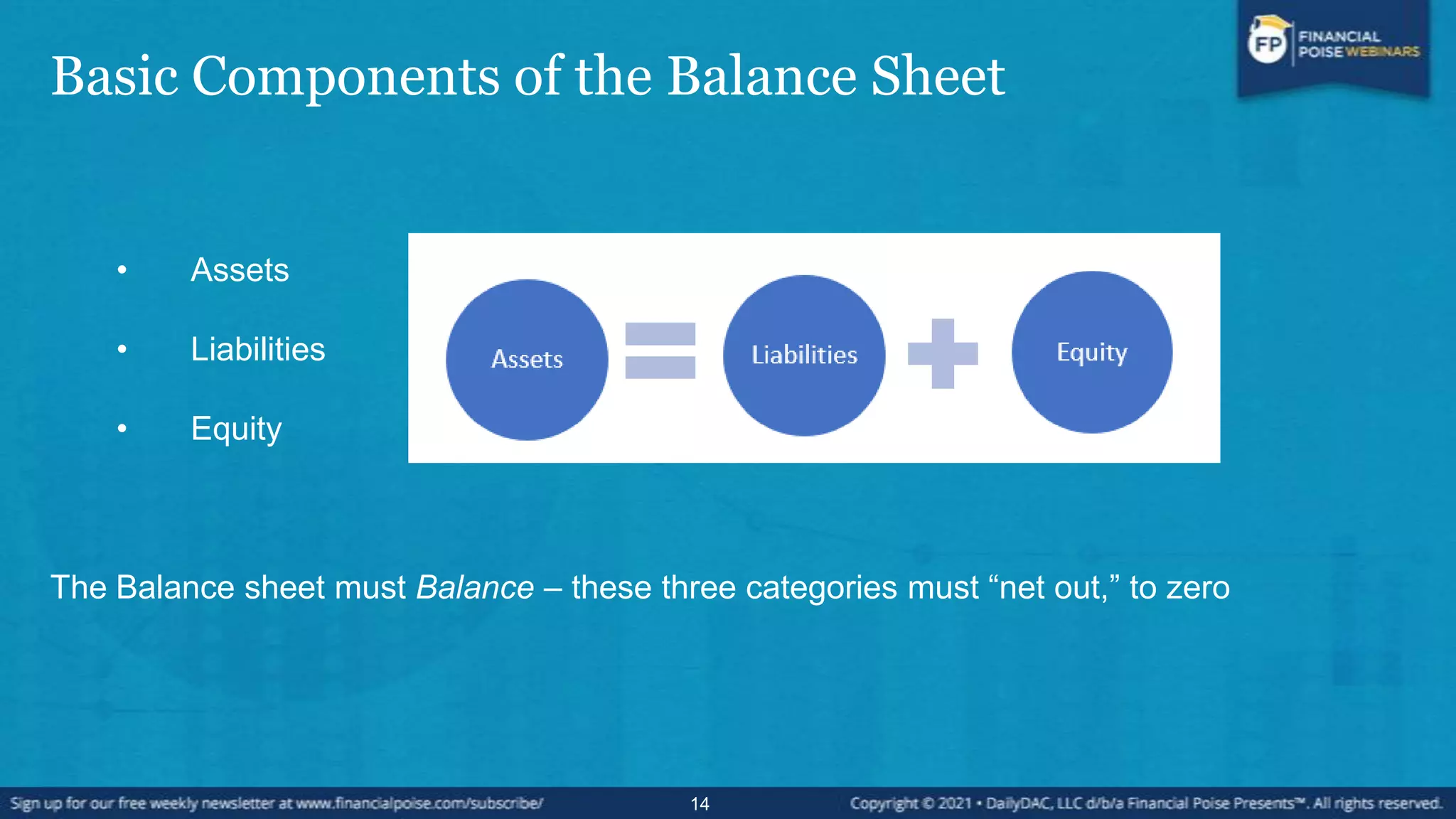
Basic Components of the Balance Sheet
• Assets
• Liabilities
• Equity
The Balance sheet must Balance – these three categories must “net out,” to zero
14
Assets
• Generally recorded at cost (or lower), not Fair Market Value
• Broken out on the Balance Sheet (typically in order of liquidity) between various
classes of assets, including
 Current Assets
 Noncurrent Assets
 Other Assets
15
Assets
• Assets have three essential characteristics:
 Represent a probable future benefit that involves a capacity to contribute directly or
indirectly to an entity’s future net cash inflows.
 Entity can obtain this benefit and control others’ access to the benefit.
 Transaction or other event giving rise to an entity’s right (or control of) this benefit has
already occurred.
16
Assets
• Current Assets
 Assets that are likely to result in cash inflows or benefit with a lifespan of 1 year
or less
 Includes:
o Cash/cash equivalents
o Accounts receivable
o Inventory
17
Assets
• Noncurrent Assets
 Long term investments where value will be realized over more than one year
 Includes:
o Tangible assets (machinery, buildings, real estate, office equipment)
o Intangible assets (goodwill, patents, copyrights)
 Depreciation or Amortization is calculated and deducted from most of these
assets to reflect in the income statement used up value during an operating
period
18
Assets
• Other Assets
 Assets that do not fit within either class of assets above, but must be
accounted for on the Balance Sheet
19
Liabilities
• Debts or other financial obligations owed by the Company to others
• Broken out on the Balance sheet (typically in order of liquidity) between various
classes of liabilities, including:
 Current Liabilities
 Noncurrent (i.e., long term) Liabilities
20
Liabilities
• Liabilities have three essential characteristics:
 Represent a present duty or responsibility to one or more other entities that entails
settlement of an amount by probable future transfer or use of assets (either at a specified
or determinable date, on occurrence of a specified event or on demand).
 This present duty or responsibility obligates a particular entity, leaving the entity little or
no discretion to avoid the future sacrifice.
 The transaction or other event obligating the entity has already happened.
21
Liabilities
• Current Liabilities
 Debts or non-debt financial obligations that must be paid or will come due
within a year of the date of the Balance Sheet
 Includes:
o Accounts payable
o Wages
o Interest
o Warranty liability
o Unearned revenues
22
Liabilities
• Noncurrent/Long Term Liabilities
 Debts or non-debt financial obligations due after a period of at least a year
from the date of the Balance Sheet
 Includes:
o Notes payable
o Bonds payable
23
Equity
• May be referred to as “Owner’s Equity,” “Shareholders’ Equity,” “Net Worth,” etc.
• The resulting balance of shareholders’ investments after accounting for assets and
liabilities
• Also characterized as the initial amount of money invested into a company
• Retained earnings: net earnings reinvested into the Company at the end of its fiscal
year, rather than making shareholder distributions
24
Equity
• Each class of equity should be accounted for on the Balance Sheet (common
shares, preferred shares, retained earnings, etc.)
• Balance Sheet’s calculation of equity is considered “Book Value”
 Book value may be informative in some cases, and meaningless in others
 Will differ based on industry, business models, and other factors
25
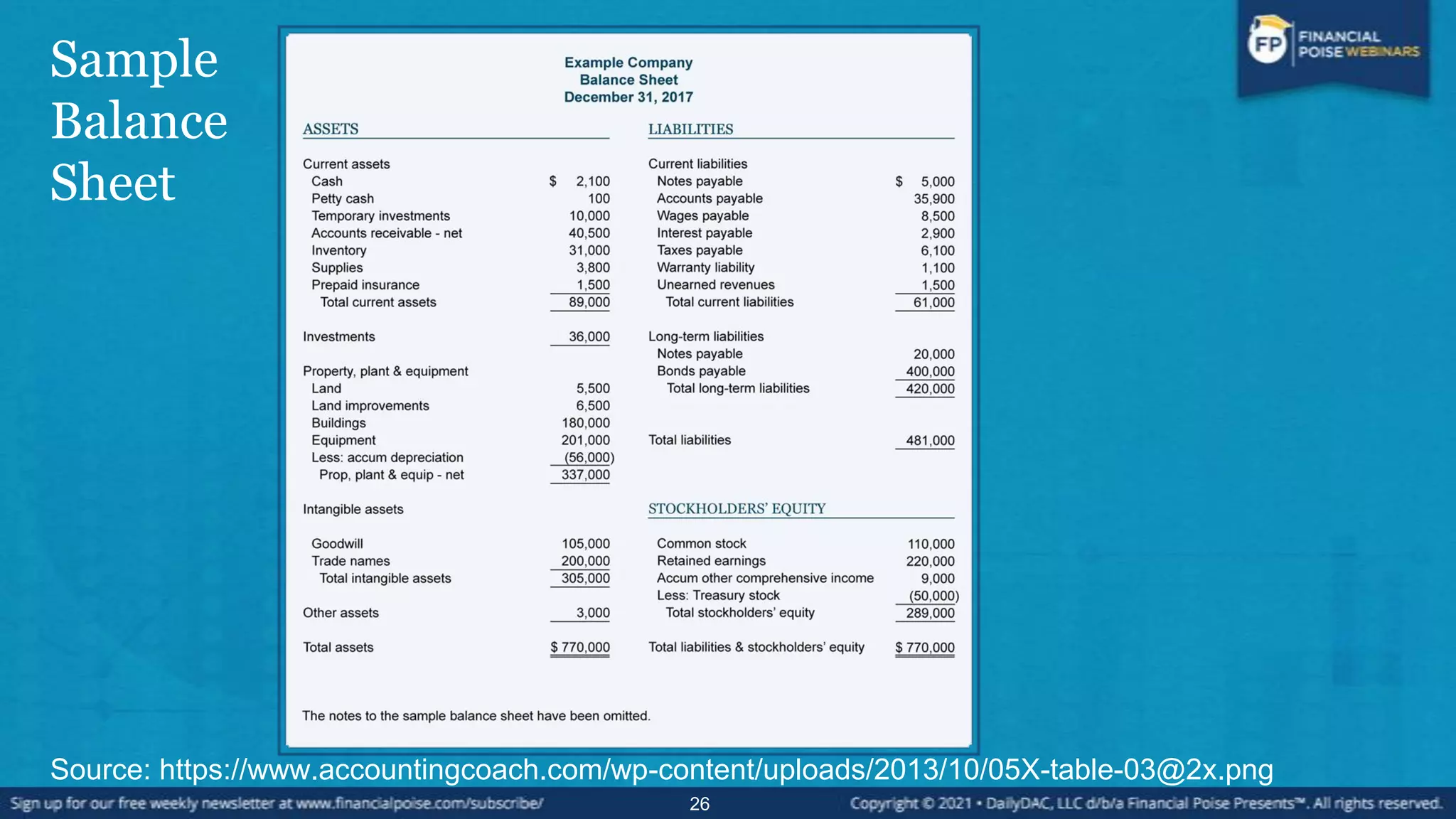
Source: https://www.accountingcoach.com/wp-content/uploads/2013/10/05X-table-03@2x.png
26
Sample
Balance
Sheet
Analyzing Balance Sheets: Vertical Analyses
• Proportional analysis of financial statement
• Each line item listed as a % of another item
• Usually means every line item stated as % of total assets
• Commonly used for specific time period, to see relative proportions, and to note
changes in company’s investment in working capital and fixed assets over time
27
Analyzing Balance Sheets: Horizontal Analyses
• Comparison of historical financial information over series of reporting periods
• Intended to show whether any numbers are unusually high or low in comparison to
information for bracketing periods
• Flagged items may trigger investigation to identify reason for differences
• Commonly done by grouping information sorted by period
• Usually performed in 2-year format, with variance showing difference between the 2
years for each line item
28
Analyzing Balance Sheets: Ratio Analyses
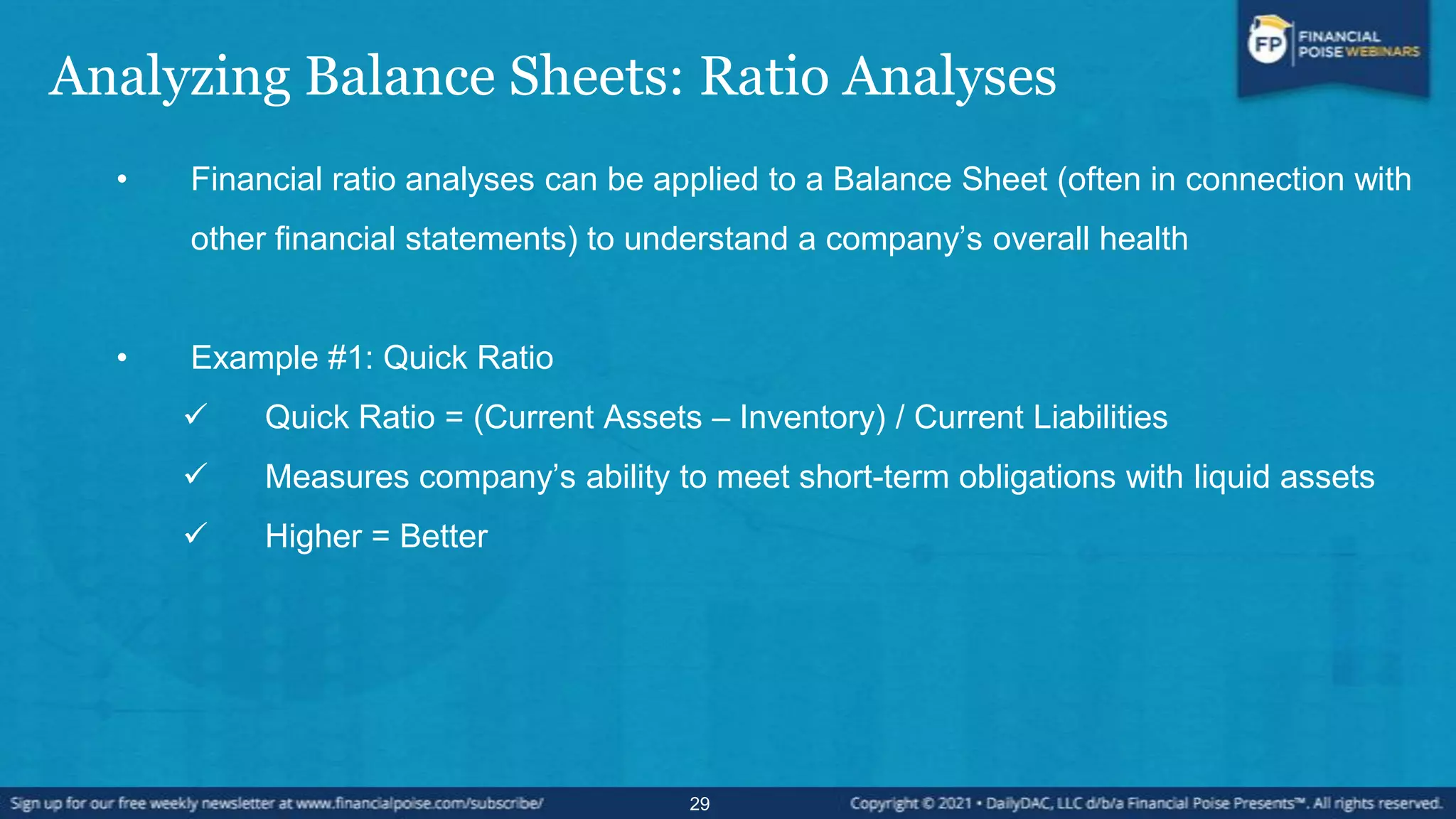
• Financial ratio analyses can be applied to a Balance Sheet (often in connection with
other financial statements) to understand a company’s overall health
• Example #1: Quick Ratio
 Quick Ratio = (Current Assets – Inventory) / Current Liabilities
 Measures company’s ability to meet short-term obligations with liquid assets
 Higher = Better
29
Analyzing Balance Sheets: Ratio Analyses
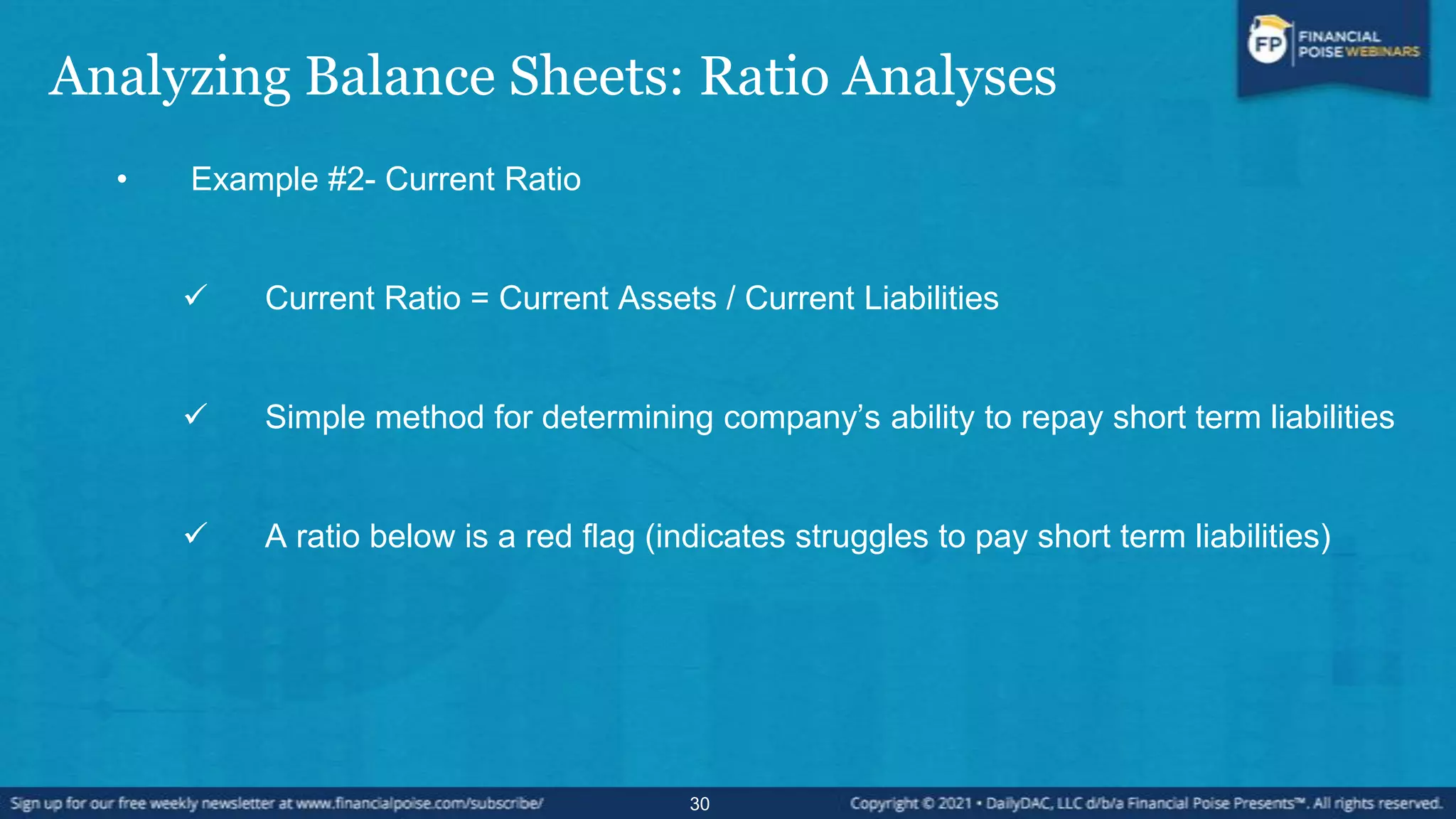
• Example #2- Current Ratio
 Current Ratio = Current Assets / Current Liabilities
 Simple method for determining company’s ability to repay short term liabilities
 A ratio below is a red flag (indicates struggles to pay short term liabilities)
30
Analyzing Balance Sheets: Ratio Analyses
• Debt to Equity Ratios
 Used to determine how company is financing growth
 Higher ratio indicates growth through debt
 Numerous means of calculating
31
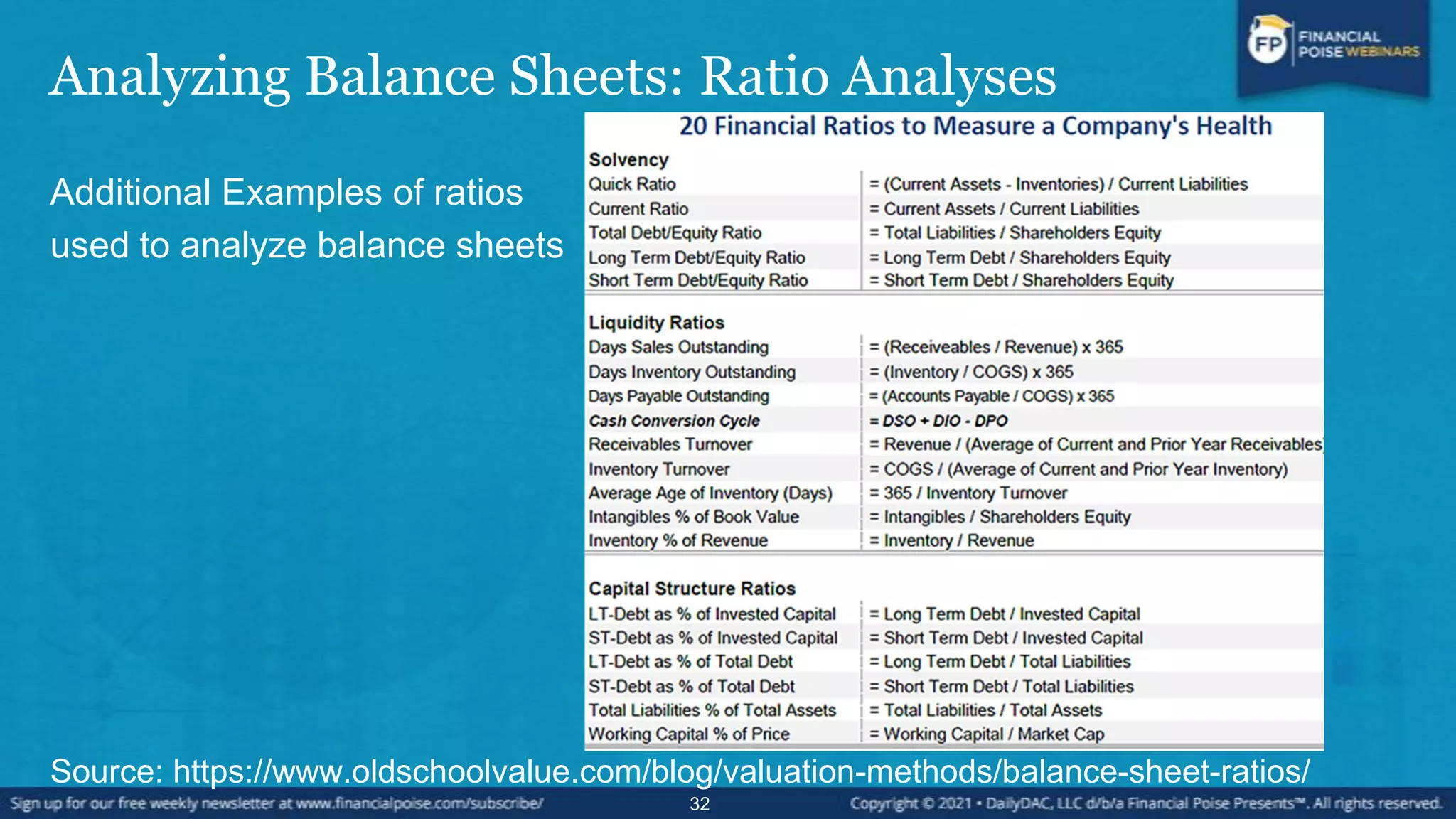
Analyzing Balance Sheets: Ratio Analyses
Additional Examples of ratios
used to analyze balance sheets
Source: https://www.oldschoolvalue.com/blog/valuation-methods/balance-sheet-ratios/
32
About the Faculty
33
About The Faculty
Jonathan Friedland - jfriedland@sfgh.com
Jonathan Friedland, a senior partner with Sugar Felsenthal Grais & Helsinger, LLP, views his job
simply: to make money for clients whenever possible and to protect their interests at every turn.
Licensed in four states, Jonathan’s transactional work focuses on representing private funds and
other owners of private businesses, and the businesses they own. He regularly advises on M&A
activities, structuring new ventures and restructuring old ones, and on other commercial
relationships. Jonathan is rated AV® Preeminent™ by Martindale-Hubbell, 10/10 by AVVO, and
enjoys several other similar distinctions. Jonathan graduated from the State University of New York
at Albany, magna cum laude (in three years) and from the University of Pennsylvania Law School.
He clerked for a federal judge before entering private practice and served for several years as an
Adjunct Professor of Strategic Management at the University of Chicago’s Graduate School of
Business. Jonathan is lead author and editor of several significant treatises, several chapters in
other treatises, and scores of articles on law and business.
34
About The Faculty
Richard Claywell - richard@biz-valuation.com
Richard is a practicing Certified Public Accountant, and holds the additional designations of Accredited in Business
Valuation, Accredited Senior Appraiser, Certified Business Appraiser, International Certified Valuation Specialist,
Certified Valuation Analyst, Certified in Merger & Acquisition Advisor, Master Analyst in Financial Forensics, Certified
in Fraud Deterrence, Accredited in Business Appraisal Review. Richard has been valuing closely held companies
since 1985. Richard’s practice is restricted to business valuation, economic damages, profit enhancement and exit
planning. Richard received his Bachelor of Science in Accounting in 1979 from the University of Houston – Clear
Lake. He then received certification as a Public Accountant in 1983. Over the years, Richard has earned additional
accreditations that relate to business valuations, economic damages and fraud. Richard has been an instructor for
the National Association of Certified Valuation Analysts for many years, has been an instructor for the Internal
Revenue Service and the International Association of Consultants Valuators and Analysts (IACVA). Richard is
currently the Chairman of the Board for the IACVA and is responsible for the business valuations materials being
taught in 55 countries. Richard has taught business valuation or economic damage courses in China, Korea, Taiwan.
Richard has performed over 1,500 business valuations since 1985. Richard has testified in Texas County Court,
Texas State Court, Bankruptcy Court and Texas State Courts. Richard has given testimony in economic damages
(lost profits), shareholder disputes, personal injury, wrongful termination and divorce.
35
About The Faculty
Ken Yager – KYager@newpointadvisors.us
Ken has 25 years of executive leadership experience in stakeholder communication. Mr.
Yager regularly takes on profit and loss and risk-management responsibility for cash-
constrained companies in growth, leveraged-buyout and turnaround situations. He also has
successfully worked on implementing dozens of initiatives involving, operations and project
management, team building, marketing, and sales and joint-venture management. He is a
fierce advocate for capital preservation and saving jobs. Ken has worked with clients in a
variety of industries in over 100 engagements. Prior to Newpoint Advisors, Mr. Yager was a
Principal at MorrisAnderson, a national turnaround management firm focused on assisting
companies deal with severe liquidity issues and insolvency.
To read more, go to https://www.financialpoise.com/webinar-faculty/ken-yager/
36
About The Faculty
Michael Pakter – mpakter@litcpa.com
Mr. Pakter focuses on financial analysis, forensic accounting, economic damages, valuation
issues and investigations. He has experience in financial forensics, determining lost profits,
business interruption claims, earn-outs, analyzing financial transactions and balances,
establishing fair value and reconstructing incomplete, misstated and/or falsified financial
information. Mr. Pakter provides consulting and litigation support services to trial lawyers,
trustees, examiners, receivers, business owners and managers and units of federal, state and
local government. He has experience with disputed financial transactions in commercial
litigation, conducting investigations, examining financial transactions and balances, Court-
ordered accounting and bankruptcy core proceedings.
To read more, go to https://www.financialpoise.com/webinar-faculty/michael-pakter/
37
Questions or Comments?
If you have any questions about this webinar that you did not get to ask during the live
premiere, or if you are watching this webinar On Demand, please do not hesitate to email us
at info@financialpoise.com with any questions or comments you may have. Please include
the name of the webinar in your email and we will do our best to provide a timely response.
IMPORTANT NOTE: The material in this presentation is for general educational purposes
only. It has been prepared primarily for attorneys and accountants for use in the pursuit of
their continuing legal education and continuing professional education.
38
About Financial Poise
39
Financial Poise™ has one mission: to provide
reliable plain English business, financial, and legal
education to individual investors, entrepreneurs,
business owners and executives.
Visit us at www.financialpoise.com
Our free weekly newsletter, Financial Poise
Weekly, updates you on new articles published
on our website and Upcoming Webinars you
may be interested in.
To join our email list, please visit:
https://www.financialpoise.com/subscribe/

How to Read a Balance Sheet - And Why You Care! (Series: MBA Boot Camp)

  • 1.
  • 2.
    2 Practical and entertainingeducation for attorneys, accountants, business owners and executives, and investors.
  • 3.
    Disclaimer The material inthis webinar is for informational purposes only. It should not be considered legal, financial or other professional advice. You should consult with an attorney or other appropriate professional to determine what may be best for your individual needs. While Financial Poise™ takes reasonable steps to ensure that information it publishes is accurate, Financial Poise™ makes no guaranty in this regard. 3
  • 4.
    Meet the Faculty MODERATOR: JonathanFriedland - Sugar, Felsenthal, Grais & Helsinger LLP PANELISTS: Ken Yager - Newpoint Advisors Corporation Richard Claywell - J. Richard Claywell CPA Michael Pakter - Gould & Pakter Associates, LLC 4
  • 5.
    About This Webinar Howto Read a Balance Sheet – And Why You Care! A balance sheet provides a snapshot of a company’s assets, liabilities, and equity. It is one of several major financial statements used to manage a business, and is a critical due diligence item used by lenders and investors in deciding whether to provide capital to a business. This webinar explains the basics of understanding a balance sheet and puts it in context by also touching on the other key financial statements. 5
  • 6.
    About This Series MBABoot Camp 2020 “If you don’t know your numbers, you don’t know your business.” This is a common refrain that is equally applicable to attorney and other consultants who work with businesses. This webinar series is designed for you if you are a startup founder, business owner, executive, investor, attorney, or consultant who, though not a finance or accounting professional, finds herself needing to understand finance and accounting. It won’t make you an expert but it will give you the tools you need to speak with experts in order to get more out of them and it will provide a solid foundation on which you can build. Packed with illustrative examples, helpful anecdotes and real-world case studies, this series teaches you some of the key take things you need to understand about finance and accounting. Each Financial Poise Webinar is delivered in Plain English, understandable to investors, business owners, and executives without much background in these areas, yet is of primary value to attorneys, accountants, and other seasoned professionals. Each episode brings you into engaging, sometimes humorous, conversations designed to entertain as it teaches. Each episode in the series is designed to be viewed independently of the other episodes so that participants will enhance their knowledge of this area whether they attend one, some, or all episodes. 6
  • 7.
    Episodes in thisSeries #1: EBITDA and Other Scary Words Premiere date: 1/21/21 #2: How to Read a Balance Sheet – And Why You Care! Premiere date: 2/18/21 #3: The KPI- Cash Flow Modeling and Projections Premiere date: 3/18/21 #4: Where Did All My Profits Go? Mastering the Concept of Working Capital Premiere date: 4/22/21 7
  • 8.
    Episode #2 How toRead a Balance Sheet – And Why You Care! 8
  • 9.
    Introduction to theBalance Sheet "[W]hy is the forgotten financial statement . . . so important for startups? Because they are not generating profits and free cash flow in their early days. They’re burning through cash and accumulating losses (negative shareholder equity) in their early days as they seek Product Market Fit, increasing sales, and cash-flow breakeven. Even if gross margins are high, it is the very rare startup which generates enough gross margin dollars to cover the entire startup’s operating expenses.” 9
  • 10.
    Introduction to theBalance Sheet A Company's balance sheet: • tells management and investors how much in assets a company has, how much it is owed, how much it owes (debts), and its resulting net worth (shareholder equity) • presents a snapshot of the Company’s financial conditions at a specific time 10
  • 11.
    What Can aBalance Sheet Tell an Educated Reader? • Amount of debt relative to equity • With the income statement, how quickly customers are paying bills and the company is paying its bills • Increases or decreases in short term cash • % of assets that are tangible vs. % intangible based on accounting transactions • With the income statement, average rates of interest paid on Company's debts • Liquidity and nature of assets 11
  • 12.
    What a BalanceSheet Doesn’t Tell You “Off-balance” Liabilities:  Operating Leases  Leaseback agreements  Collateralized debt obligations  A/R 12
  • 13.
    How is theBalance Sheet Different From Other Financial Statements? [Balance Sheet is a snapshot of Company’s financial condition at specific time] Balance Sheet vs. Income Statement: • Income statement measures record of company’s revenues matched with costs to net loss or profitability Balance Sheet vs. Cash Flow Statement • Cash flow statement measures actual changes in cash compared to the income statement, shows where cash is coming in and going out 13
  • 14.
    Basic Components ofthe Balance Sheet • Assets • Liabilities • Equity The Balance sheet must Balance – these three categories must “net out,” to zero 14
  • 15.
    Assets • Generally recordedat cost (or lower), not Fair Market Value • Broken out on the Balance Sheet (typically in order of liquidity) between various classes of assets, including  Current Assets  Noncurrent Assets  Other Assets 15
  • 16.
    Assets • Assets havethree essential characteristics:  Represent a probable future benefit that involves a capacity to contribute directly or indirectly to an entity’s future net cash inflows.  Entity can obtain this benefit and control others’ access to the benefit.  Transaction or other event giving rise to an entity’s right (or control of) this benefit has already occurred. 16
  • 17.
    Assets • Current Assets Assets that are likely to result in cash inflows or benefit with a lifespan of 1 year or less  Includes: o Cash/cash equivalents o Accounts receivable o Inventory 17
  • 18.
    Assets • Noncurrent Assets Long term investments where value will be realized over more than one year  Includes: o Tangible assets (machinery, buildings, real estate, office equipment) o Intangible assets (goodwill, patents, copyrights)  Depreciation or Amortization is calculated and deducted from most of these assets to reflect in the income statement used up value during an operating period 18
  • 19.
    Assets • Other Assets Assets that do not fit within either class of assets above, but must be accounted for on the Balance Sheet 19
  • 20.
    Liabilities • Debts orother financial obligations owed by the Company to others • Broken out on the Balance sheet (typically in order of liquidity) between various classes of liabilities, including:  Current Liabilities  Noncurrent (i.e., long term) Liabilities 20
  • 21.
    Liabilities • Liabilities havethree essential characteristics:  Represent a present duty or responsibility to one or more other entities that entails settlement of an amount by probable future transfer or use of assets (either at a specified or determinable date, on occurrence of a specified event or on demand).  This present duty or responsibility obligates a particular entity, leaving the entity little or no discretion to avoid the future sacrifice.  The transaction or other event obligating the entity has already happened. 21
  • 22.
    Liabilities • Current Liabilities Debts or non-debt financial obligations that must be paid or will come due within a year of the date of the Balance Sheet  Includes: o Accounts payable o Wages o Interest o Warranty liability o Unearned revenues 22
  • 23.
    Liabilities • Noncurrent/Long TermLiabilities  Debts or non-debt financial obligations due after a period of at least a year from the date of the Balance Sheet  Includes: o Notes payable o Bonds payable 23
  • 24.
    Equity • May bereferred to as “Owner’s Equity,” “Shareholders’ Equity,” “Net Worth,” etc. • The resulting balance of shareholders’ investments after accounting for assets and liabilities • Also characterized as the initial amount of money invested into a company • Retained earnings: net earnings reinvested into the Company at the end of its fiscal year, rather than making shareholder distributions 24
  • 25.
    Equity • Each classof equity should be accounted for on the Balance Sheet (common shares, preferred shares, retained earnings, etc.) • Balance Sheet’s calculation of equity is considered “Book Value”  Book value may be informative in some cases, and meaningless in others  Will differ based on industry, business models, and other factors 25
  • 26.
  • 27.
    Analyzing Balance Sheets:Vertical Analyses • Proportional analysis of financial statement • Each line item listed as a % of another item • Usually means every line item stated as % of total assets • Commonly used for specific time period, to see relative proportions, and to note changes in company’s investment in working capital and fixed assets over time 27
  • 28.
    Analyzing Balance Sheets:Horizontal Analyses • Comparison of historical financial information over series of reporting periods • Intended to show whether any numbers are unusually high or low in comparison to information for bracketing periods • Flagged items may trigger investigation to identify reason for differences • Commonly done by grouping information sorted by period • Usually performed in 2-year format, with variance showing difference between the 2 years for each line item 28
  • 29.
    Analyzing Balance Sheets:Ratio Analyses • Financial ratio analyses can be applied to a Balance Sheet (often in connection with other financial statements) to understand a company’s overall health • Example #1: Quick Ratio  Quick Ratio = (Current Assets – Inventory) / Current Liabilities  Measures company’s ability to meet short-term obligations with liquid assets  Higher = Better 29
  • 30.
    Analyzing Balance Sheets:Ratio Analyses • Example #2- Current Ratio  Current Ratio = Current Assets / Current Liabilities  Simple method for determining company’s ability to repay short term liabilities  A ratio below is a red flag (indicates struggles to pay short term liabilities) 30
  • 31.
    Analyzing Balance Sheets:Ratio Analyses • Debt to Equity Ratios  Used to determine how company is financing growth  Higher ratio indicates growth through debt  Numerous means of calculating 31
  • 32.
    Analyzing Balance Sheets:Ratio Analyses Additional Examples of ratios used to analyze balance sheets Source: https://www.oldschoolvalue.com/blog/valuation-methods/balance-sheet-ratios/ 32
  • 33.
  • 34.
    About The Faculty JonathanFriedland - jfriedland@sfgh.com Jonathan Friedland, a senior partner with Sugar Felsenthal Grais & Helsinger, LLP, views his job simply: to make money for clients whenever possible and to protect their interests at every turn. Licensed in four states, Jonathan’s transactional work focuses on representing private funds and other owners of private businesses, and the businesses they own. He regularly advises on M&A activities, structuring new ventures and restructuring old ones, and on other commercial relationships. Jonathan is rated AV® Preeminent™ by Martindale-Hubbell, 10/10 by AVVO, and enjoys several other similar distinctions. Jonathan graduated from the State University of New York at Albany, magna cum laude (in three years) and from the University of Pennsylvania Law School. He clerked for a federal judge before entering private practice and served for several years as an Adjunct Professor of Strategic Management at the University of Chicago’s Graduate School of Business. Jonathan is lead author and editor of several significant treatises, several chapters in other treatises, and scores of articles on law and business. 34
  • 35.
    About The Faculty RichardClaywell - richard@biz-valuation.com Richard is a practicing Certified Public Accountant, and holds the additional designations of Accredited in Business Valuation, Accredited Senior Appraiser, Certified Business Appraiser, International Certified Valuation Specialist, Certified Valuation Analyst, Certified in Merger & Acquisition Advisor, Master Analyst in Financial Forensics, Certified in Fraud Deterrence, Accredited in Business Appraisal Review. Richard has been valuing closely held companies since 1985. Richard’s practice is restricted to business valuation, economic damages, profit enhancement and exit planning. Richard received his Bachelor of Science in Accounting in 1979 from the University of Houston – Clear Lake. He then received certification as a Public Accountant in 1983. Over the years, Richard has earned additional accreditations that relate to business valuations, economic damages and fraud. Richard has been an instructor for the National Association of Certified Valuation Analysts for many years, has been an instructor for the Internal Revenue Service and the International Association of Consultants Valuators and Analysts (IACVA). Richard is currently the Chairman of the Board for the IACVA and is responsible for the business valuations materials being taught in 55 countries. Richard has taught business valuation or economic damage courses in China, Korea, Taiwan. Richard has performed over 1,500 business valuations since 1985. Richard has testified in Texas County Court, Texas State Court, Bankruptcy Court and Texas State Courts. Richard has given testimony in economic damages (lost profits), shareholder disputes, personal injury, wrongful termination and divorce. 35
  • 36.
    About The Faculty KenYager – KYager@newpointadvisors.us Ken has 25 years of executive leadership experience in stakeholder communication. Mr. Yager regularly takes on profit and loss and risk-management responsibility for cash- constrained companies in growth, leveraged-buyout and turnaround situations. He also has successfully worked on implementing dozens of initiatives involving, operations and project management, team building, marketing, and sales and joint-venture management. He is a fierce advocate for capital preservation and saving jobs. Ken has worked with clients in a variety of industries in over 100 engagements. Prior to Newpoint Advisors, Mr. Yager was a Principal at MorrisAnderson, a national turnaround management firm focused on assisting companies deal with severe liquidity issues and insolvency. To read more, go to https://www.financialpoise.com/webinar-faculty/ken-yager/ 36
  • 37.
    About The Faculty MichaelPakter – mpakter@litcpa.com Mr. Pakter focuses on financial analysis, forensic accounting, economic damages, valuation issues and investigations. He has experience in financial forensics, determining lost profits, business interruption claims, earn-outs, analyzing financial transactions and balances, establishing fair value and reconstructing incomplete, misstated and/or falsified financial information. Mr. Pakter provides consulting and litigation support services to trial lawyers, trustees, examiners, receivers, business owners and managers and units of federal, state and local government. He has experience with disputed financial transactions in commercial litigation, conducting investigations, examining financial transactions and balances, Court- ordered accounting and bankruptcy core proceedings. To read more, go to https://www.financialpoise.com/webinar-faculty/michael-pakter/ 37
  • 38.
    Questions or Comments? Ifyou have any questions about this webinar that you did not get to ask during the live premiere, or if you are watching this webinar On Demand, please do not hesitate to email us at info@financialpoise.com with any questions or comments you may have. Please include the name of the webinar in your email and we will do our best to provide a timely response. IMPORTANT NOTE: The material in this presentation is for general educational purposes only. It has been prepared primarily for attorneys and accountants for use in the pursuit of their continuing legal education and continuing professional education. 38
  • 39.
    About Financial Poise 39 FinancialPoise™ has one mission: to provide reliable plain English business, financial, and legal education to individual investors, entrepreneurs, business owners and executives. Visit us at www.financialpoise.com Our free weekly newsletter, Financial Poise Weekly, updates you on new articles published on our website and Upcoming Webinars you may be interested in. To join our email list, please visit: https://www.financialpoise.com/subscribe/