Historia de la Música Esperanza Romero Cuevas
Context
 XVIII century: new
thoughts/ new society
(middle class)
 Industrial Revolution
 Neoclassical Art.
Historia de la Música Esperanza Romero Cuevas
Classical music characteristics
 Clear and simple
melodies and music
structure
 Balance, and
symmetrical
 Use of crescendo and
diminuendo
 Regular phrase structure
 “Question and answer”
Historia de la Música Esperanza Romero Cuevas
 2.1. CLASSICAL MUSIC1. Watch the following videos of some classical music
concerts. Then, in pairs, write the right answer for each question.
 The music…
 … uses acoustic instruments
 … uses electric instruments
 … uses no instruments
 The audience…
 … participates in the concert,
singing or dancing
 … remains silent
 The musicians…
 … have a score
 … don’t have a score
 The orchestra…
 … is conducted by a conductor
 … has no conductor
 The music…
 … was written by a well known
composer
 … was written by someone
anonymous
 The music is made of…
 … only voices
 … voices and instruments
 … only instruments
 The singers…
 … use lyrical techniques
 … sing in a less technical way
 The music…
 … seems serious
 … seems funny
Historia de la Música Esperanza Romero Cuevas
 VOCABULARY
 acoustic instruments
 electric instruments
 audience
 musician
 Score
 Orchestra
 conductor
 Composer
 anonymous
Historia de la Música Esperanza Romero Cuevas
Musical forms of the Classical
period
 In this period, pre-existing musicals forms were used,
but their structures became more clearly defined and
fixed: SONATA, MINUET, RONDO, THEME AND
VARIATIONS.
Historia de la Música Esperanza Romero Cuevas
SONATA
 Four movements/constrast in tempo.
 Form: ABA`
 Exposition (A): has two themes: theme A (more
energetic and rhytmic)+ theme B (more lyrical).
Bridge, Short Coda.
 Development: the composer have more freedom
 Reexposition (A´): similar to the exposition, but with
some modifications. It ends with a final coda.
Historia de la Música Esperanza Romero Cuevas
Minuet
 Its and ABA structure.
 The dance of the same
name also has this
structure.
Historia de la Música Esperanza Romero Cuevas
 VOCABULARY
 Pre-existing
 Exposition
 Development
 Coda
Historia de la Música Esperanza Romero Cuevas

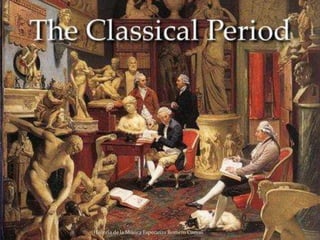
The classical period

  • 1.
    Historia de laMúsica Esperanza Romero Cuevas
  • 2.
    Context  XVIII century:new thoughts/ new society (middle class)  Industrial Revolution  Neoclassical Art. Historia de la Música Esperanza Romero Cuevas
  • 3.
    Classical music characteristics Clear and simple melodies and music structure  Balance, and symmetrical  Use of crescendo and diminuendo  Regular phrase structure  “Question and answer” Historia de la Música Esperanza Romero Cuevas
  • 4.
     2.1. CLASSICALMUSIC1. Watch the following videos of some classical music concerts. Then, in pairs, write the right answer for each question.  The music…  … uses acoustic instruments  … uses electric instruments  … uses no instruments  The audience…  … participates in the concert, singing or dancing  … remains silent  The musicians…  … have a score  … don’t have a score  The orchestra…  … is conducted by a conductor  … has no conductor  The music…  … was written by a well known composer  … was written by someone anonymous  The music is made of…  … only voices  … voices and instruments  … only instruments  The singers…  … use lyrical techniques  … sing in a less technical way  The music…  … seems serious  … seems funny Historia de la Música Esperanza Romero Cuevas
  • 5.
     VOCABULARY  acousticinstruments  electric instruments  audience  musician  Score  Orchestra  conductor  Composer  anonymous Historia de la Música Esperanza Romero Cuevas
  • 6.
    Musical forms ofthe Classical period  In this period, pre-existing musicals forms were used, but their structures became more clearly defined and fixed: SONATA, MINUET, RONDO, THEME AND VARIATIONS. Historia de la Música Esperanza Romero Cuevas
  • 7.
    SONATA  Four movements/constrastin tempo.  Form: ABA`  Exposition (A): has two themes: theme A (more energetic and rhytmic)+ theme B (more lyrical). Bridge, Short Coda.  Development: the composer have more freedom  Reexposition (A´): similar to the exposition, but with some modifications. It ends with a final coda. Historia de la Música Esperanza Romero Cuevas
  • 8.
    Historia de laMúsica Esperanza Romero Cuevas
  • 9.
    Historia de laMúsica Esperanza Romero Cuevas
  • 10.
    Minuet  Its andABA structure.  The dance of the same name also has this structure. Historia de la Música Esperanza Romero Cuevas
  • 11.
     VOCABULARY  Pre-existing Exposition  Development  Coda Historia de la Música Esperanza Romero Cuevas