Welcome To
Music 101
Introduction to Music
Burlington County College
Section 800 – Spring, 2016
Monday/Wednesday 2:00 – 3:20
Jeffrey Lesser, Instructor
What is this course
about?
Development of music in western
civilization from its beginnings in Europe
Time Frame: Middle Ages up through the
21st
century in America and around the
world.
Topics in this course
 Classical Music
 Film Music
 The American Musical Theatre
 Jazz
 World Music
 American Popular Music (ca. 1960-80)
More About this
course
 We will study the periods of Western Musical History
and listen to examples of music from each period.
 Music of both European and American composers
will be surveyed, along with some music of non-
Western traditions.
 We will study the great composers from each period
of music, with some of the important works they
composed.
 By the time the course is complete, you will know the
periods of musical history in Western culture and will
be able to identify musical examples from each
period.
listening
 We will listen for the elements of music,
including rhythm, melody, harmony, dynamics,
timbre, texture, form and genre.
 You will keep a listening log in a notebook of the
musical samples that you listen to.
 You will notate the composer, the complete
name of the work, the time period and the genre.
You can also make any notes about the the
music in your listening log.
listening
We will listen to different kinds of music.
Some of the music may be appealing to
you, or even enjoyable. Some of the
music we listen to may not immediately
be very appealing.
You should try to listen to all of the
musical samples in the course with an
open mind and try to learn and absorb
what you can from the experience.
listening
Most of the music that we experience in
everyday life in commercial and popular
formats has durations of 3 minutes or
less.
In this course, you will develop skills of
attention and focus that will enable you to
experience and appreciate musical works
of considerably longer duration.
Keep in mind
You will learn factual information such as
periods of musical history, and names
and dates of great composers
Some of what you will learn in this class
is subjective, based on (informed)
opinion.
Hopefully, you should find this course to
be an interesting, enjoyable experience,
as well as an educational one.
Or in musical terms
Here is “The History of Music” as
performed by String Fever.
How many tunes do you recognize?
Can you name the composer?
Do you know the work’s title?
Please watch as I log in to MYMUSICLAB,
our class online resource!
Class syllabus
I will utilize Blackboard as an
instruction, activity and
assessment resource for this
course. Please watch as I
login to Blackboard and
navigate to the syllabus!
BREAK!
Stand and stretch!
Introduction: the
elements of music
 Melody: A single line of notes heard in
succession as a coherent unit.
 Rhythm: The ordering of music through time.
 Harmony: The sound created by multiple voices
playing or singing together.
 Texture: The number and relationship of musical
lines or voices.
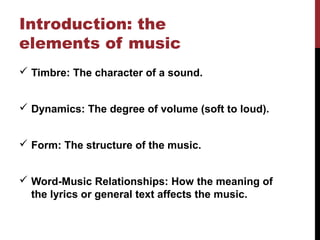
Introduction: the
elements of music
 Timbre: The character of a sound.
 Dynamics: The degree of volume (soft to loud).
 Form: The structure of the music.
 Word-Music Relationships: How the meaning of
the lyrics or general text affects the music.
Before next class
 Set up your Pearson Account and try the
MyMusicLab readiness activities. The quiz does
not count!
 Read pages 1-8
 Review the Elements Tutorials for Melody,
Harmony, and Rhythm
 Find the Study Guide in the Elements Folder on
Blackboard
Have a great week!

101 ppt class 1

  • 1.
    Welcome To Music 101 Introductionto Music Burlington County College Section 800 – Spring, 2016 Monday/Wednesday 2:00 – 3:20 Jeffrey Lesser, Instructor
  • 2.
    What is thiscourse about? Development of music in western civilization from its beginnings in Europe Time Frame: Middle Ages up through the 21st century in America and around the world.
  • 3.
    Topics in thiscourse  Classical Music  Film Music  The American Musical Theatre  Jazz  World Music  American Popular Music (ca. 1960-80)
  • 4.
    More About this course We will study the periods of Western Musical History and listen to examples of music from each period.  Music of both European and American composers will be surveyed, along with some music of non- Western traditions.  We will study the great composers from each period of music, with some of the important works they composed.  By the time the course is complete, you will know the periods of musical history in Western culture and will be able to identify musical examples from each period.
  • 5.
    listening  We willlisten for the elements of music, including rhythm, melody, harmony, dynamics, timbre, texture, form and genre.  You will keep a listening log in a notebook of the musical samples that you listen to.  You will notate the composer, the complete name of the work, the time period and the genre. You can also make any notes about the the music in your listening log.
  • 6.
    listening We will listento different kinds of music. Some of the music may be appealing to you, or even enjoyable. Some of the music we listen to may not immediately be very appealing. You should try to listen to all of the musical samples in the course with an open mind and try to learn and absorb what you can from the experience.
  • 7.
    listening Most of themusic that we experience in everyday life in commercial and popular formats has durations of 3 minutes or less. In this course, you will develop skills of attention and focus that will enable you to experience and appreciate musical works of considerably longer duration.
  • 8.
    Keep in mind Youwill learn factual information such as periods of musical history, and names and dates of great composers Some of what you will learn in this class is subjective, based on (informed) opinion. Hopefully, you should find this course to be an interesting, enjoyable experience, as well as an educational one.
  • 9.
    Or in musicalterms Here is “The History of Music” as performed by String Fever. How many tunes do you recognize? Can you name the composer? Do you know the work’s title? Please watch as I log in to MYMUSICLAB, our class online resource!
  • 10.
    Class syllabus I willutilize Blackboard as an instruction, activity and assessment resource for this course. Please watch as I login to Blackboard and navigate to the syllabus!
  • 11.
  • 12.
    Introduction: the elements ofmusic  Melody: A single line of notes heard in succession as a coherent unit.  Rhythm: The ordering of music through time.  Harmony: The sound created by multiple voices playing or singing together.  Texture: The number and relationship of musical lines or voices.
  • 13.
    Introduction: the elements ofmusic  Timbre: The character of a sound.  Dynamics: The degree of volume (soft to loud).  Form: The structure of the music.  Word-Music Relationships: How the meaning of the lyrics or general text affects the music.
  • 14.
    Before next class Set up your Pearson Account and try the MyMusicLab readiness activities. The quiz does not count!  Read pages 1-8  Review the Elements Tutorials for Melody, Harmony, and Rhythm  Find the Study Guide in the Elements Folder on Blackboard
  • 15.