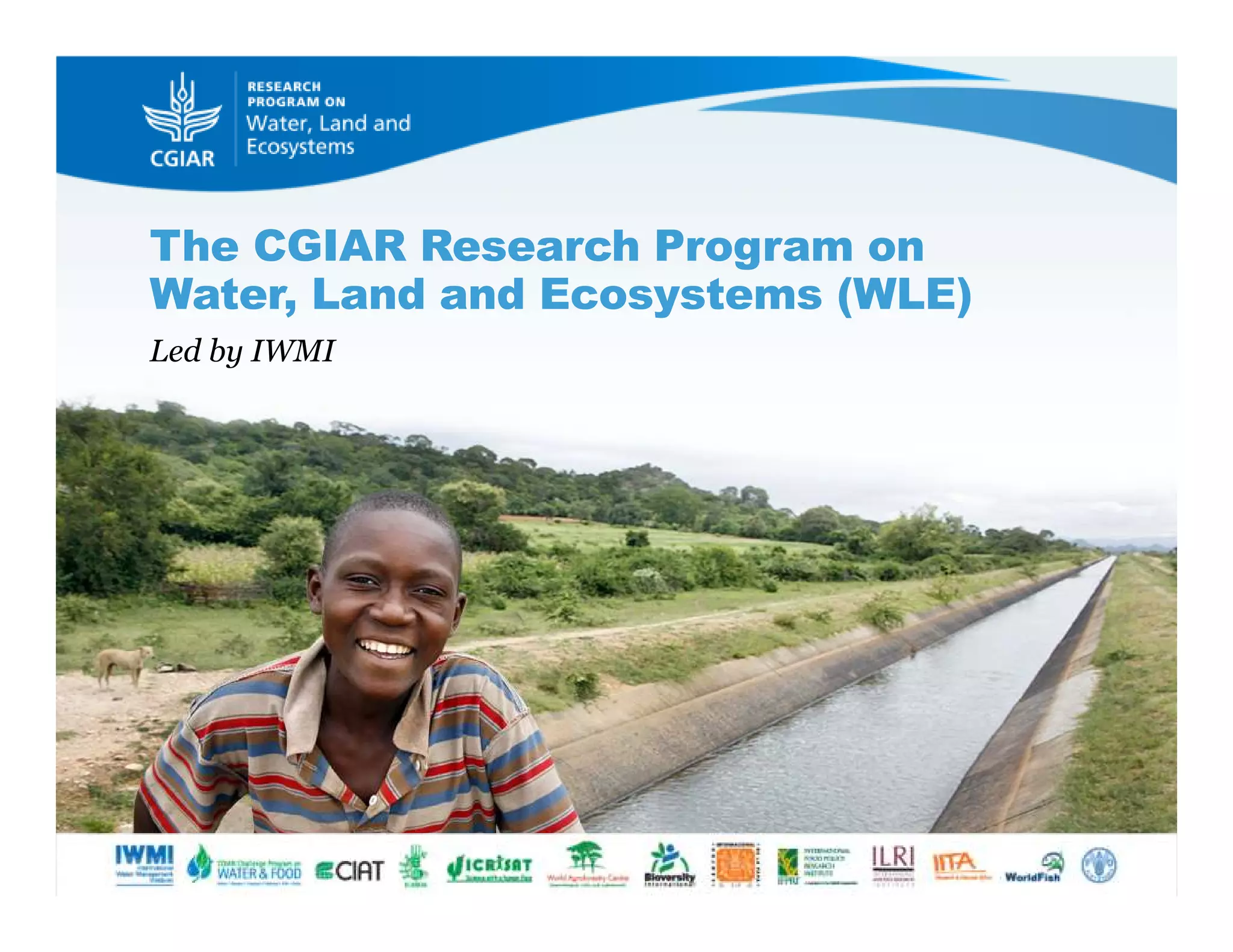
The CGIAR Research Program on
Water, Land and Ecosystems (WLE)
Led by IWMI
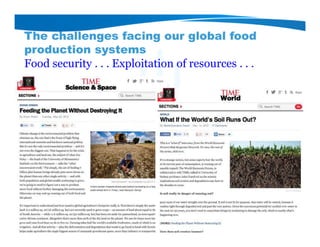
The challenges facing our global food
production systems
Food security . . . Exploitation of resources . . .
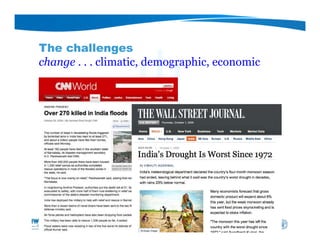
The challenges
change . . . climatic, demographic, economic
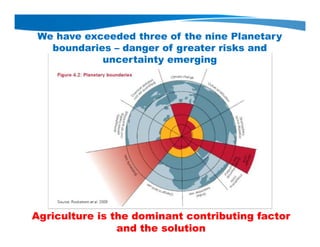
We have exceeded three of the nine Planetary
boundaries – danger of greater risks and
uncertainty emerging
Agriculture is the dominant contributing factor
and the solution
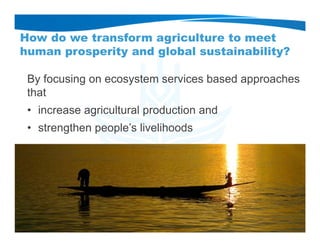
How do we transform agriculture to meet
human prosperity and global sustainability?
By focusing on ecosystem services based approaches
that
• increase agricultural production and
• strengthen people’s livelihoods
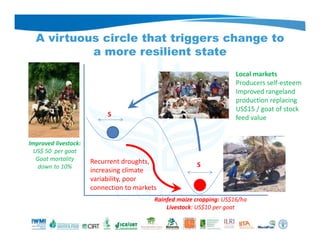
A virtuous circle that triggers change to
a more resilient state
S
SRecurrent droughts,
increasing climate
variability, poor
connection to markets
Local markets
Producers self-esteem
Improved rangeland
production replacing
US$15 / goat of stock
feed value
Improved livestock:
US$ 50 per goat
Goat mortality
down to 10%
Rainfed maize cropping: US$16/ha
Livestock: US$10 per goat
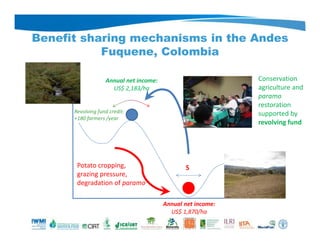
Benefit sharing mechanisms in the Andes
Fuquene, Colombia
S
Annual net income:
US$ 2,183/ha
Annual net income:
US$ 1,870/ha
Conservation
agriculture and
paramo
restoration
supported by
revolving fund
Revolving fund credit:
+180 farmers /year
Potato cropping,
grazing pressure,
degradation of paramo
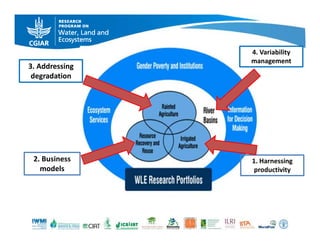
4. Variability
management
3. Addressing
degradation
1. Harnessing
productivity
2. Business
models
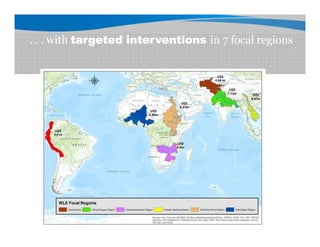
. . . with targeted interventions in 7 focal regions
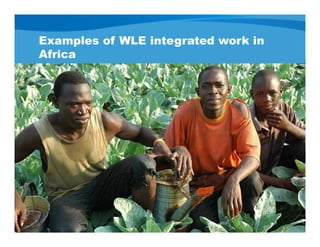
Examples of WLE integrated work in
Africa
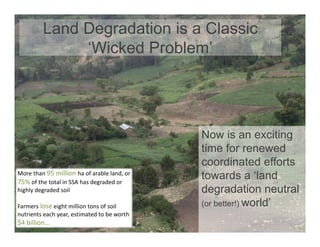
Land Degradation is a Classic
‘Wicked Problem’
Now is an exciting
time for renewed
coordinated efforts
towards a ‘land
degradation neutral
(or better!) world’
More than 95 million ha of arable land, or
75% of the total in SSA has degraded or
highly degraded soil
Farmers lose eight million tons of soil
nutrients each year, estimated to be worth
$4 billion...
More than 95 million ha of arable land, or
75% of the total in SSA has degraded or
highly degraded soil
Farmers lose eight million tons of soil
nutrients each year, estimated to be worth
$4 billion...
Advances in research
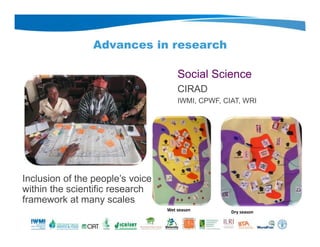
Social Science
CIRAD
IWMI, CPWF, CIAT, WRI
Inclusion of the people’s voice
within the scientific research
framework at many scales
Wet season Dry season
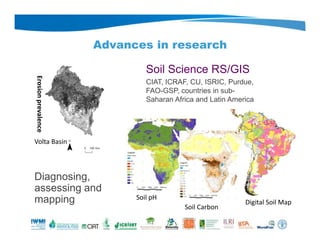
Soil Science RS/GIS
CIAT, ICRAF, CU, ISRIC, Purdue,
FAO-GSP, countries in sub-
Saharan Africa and Latin America
Diagnosing,
assessing and
mapping
Erosionprevalence
Soil pH
Volta Basin
Soil Carbon
Digital Soil Map
Advances in research
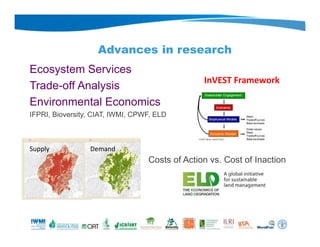
Ecosystem Services
Trade-off Analysis
Environmental Economics
IFPRI, Bioversity, CIAT, IWMI, CPWF, ELD
Costs of Action vs. Cost of Inaction
InVEST Framework
Supply Demand
Advances in research
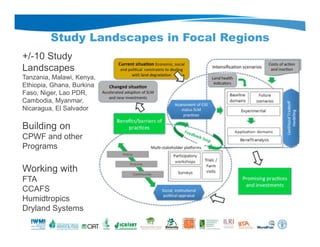
Study Landscapes in Focal Regions
+/-10 Study
Landscapes
Tanzania, Malawi, Kenya,
Ethiopia, Ghana, Burkina
Faso, Niger, Lao PDR,
Cambodia, Myanmar,
Nicaragua, El Salvador
Building on
CPWF and other
Programs
Working with
FTA
CCAFS
Humidtropics
Dryland Systems
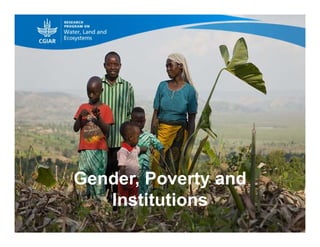
Gender, Poverty and
Institutions
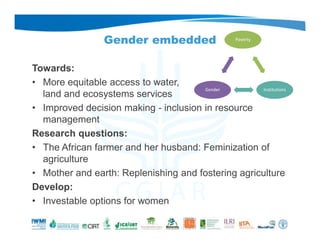
Gender embedded
Towards:
• More equitable access to water,
land and ecosystems services
• Improved decision making - inclusion in resource
management
Research questions:
• The African farmer and her husband: Feminization of
agriculture
• Mother and earth: Replenishing and fostering agriculture
Develop:
• Investable options for women
Poverty
InstitutionsGender
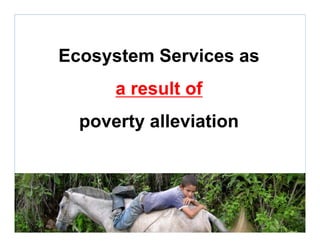
Ecosystem Services as
a result of
poverty alleviation
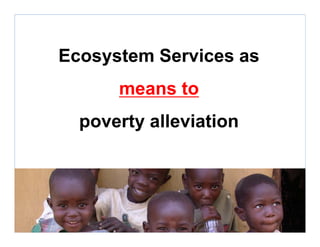
Ecosystem Services as
means to
poverty alleviation
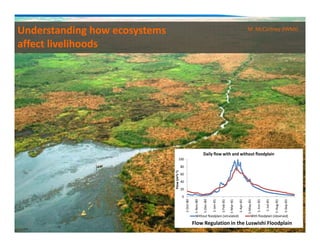
0
20
40
60
80
100
1-Oct-80
1-Nov-80
1-Dec-80
1-Jan-81
1-Feb-81
1-Mar-81
1-Apr-81
1-May-81
1-Jun-81
1-Jul-81
1-Aug-81
1-Sep-81
Flow(m3s-1)
Daily flow with and without floodplain
Without floodplain (simulated) With floodplain (observed)
Flow Regulation in the Luswishi Floodplain
Understanding how ecosystems
affect livelihoods
M. McCartney (IWMI)
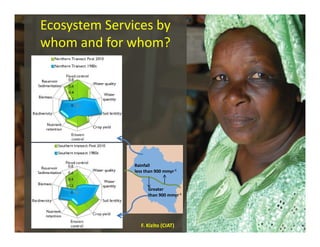
Ecosystem Services by
whom and for whom?
Rainfall
less than 900 mmyr-1
Greater
than 900 mmyr-1
F. Kizito (CIAT)
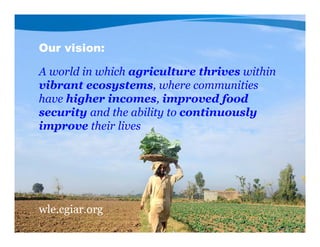
Our vision:
A world in which agriculture thrives within
vibrant ecosystems, where communities
have higher incomes, improved food
security and the ability to continuously
improve their lives
wle.cgiar.org
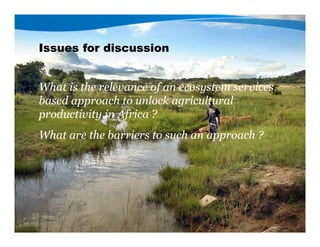
Issues for discussion
What is the relevance of an ecosystem services
based approach to unlock agricultural
productivity in Africa ?
What are the barriers to such an approach ?

The CGIAR Research Program on Water, Land and Ecosystems (WLE)

  • 1.
    The CGIAR ResearchProgram on Water, Land and Ecosystems (WLE) Led by IWMI
  • 2.
    The challenges facingour global food production systems Food security . . . Exploitation of resources . . .
  • 3.
    The challenges change .. . climatic, demographic, economic
  • 4.
    We have exceededthree of the nine Planetary boundaries – danger of greater risks and uncertainty emerging Agriculture is the dominant contributing factor and the solution
  • 5.
    How do wetransform agriculture to meet human prosperity and global sustainability? By focusing on ecosystem services based approaches that • increase agricultural production and • strengthen people’s livelihoods
  • 6.
    A virtuous circlethat triggers change to a more resilient state S SRecurrent droughts, increasing climate variability, poor connection to markets Local markets Producers self-esteem Improved rangeland production replacing US$15 / goat of stock feed value Improved livestock: US$ 50 per goat Goat mortality down to 10% Rainfed maize cropping: US$16/ha Livestock: US$10 per goat
  • 7.
    Benefit sharing mechanismsin the Andes Fuquene, Colombia S Annual net income: US$ 2,183/ha Annual net income: US$ 1,870/ha Conservation agriculture and paramo restoration supported by revolving fund Revolving fund credit: +180 farmers /year Potato cropping, grazing pressure, degradation of paramo
  • 8.
    4. Variability management 3. Addressing degradation 1.Harnessing productivity 2. Business models
  • 9.
    . . .with targeted interventions in 7 focal regions
  • 10.
    Examples of WLEintegrated work in Africa
  • 11.
    Land Degradation isa Classic ‘Wicked Problem’ Now is an exciting time for renewed coordinated efforts towards a ‘land degradation neutral (or better!) world’ More than 95 million ha of arable land, or 75% of the total in SSA has degraded or highly degraded soil Farmers lose eight million tons of soil nutrients each year, estimated to be worth $4 billion... More than 95 million ha of arable land, or 75% of the total in SSA has degraded or highly degraded soil Farmers lose eight million tons of soil nutrients each year, estimated to be worth $4 billion...
  • 12.
    Advances in research SocialScience CIRAD IWMI, CPWF, CIAT, WRI Inclusion of the people’s voice within the scientific research framework at many scales Wet season Dry season
  • 13.
    Soil Science RS/GIS CIAT,ICRAF, CU, ISRIC, Purdue, FAO-GSP, countries in sub- Saharan Africa and Latin America Diagnosing, assessing and mapping Erosionprevalence Soil pH Volta Basin Soil Carbon Digital Soil Map Advances in research
  • 14.
    Ecosystem Services Trade-off Analysis EnvironmentalEconomics IFPRI, Bioversity, CIAT, IWMI, CPWF, ELD Costs of Action vs. Cost of Inaction InVEST Framework Supply Demand Advances in research
  • 15.
    Study Landscapes inFocal Regions +/-10 Study Landscapes Tanzania, Malawi, Kenya, Ethiopia, Ghana, Burkina Faso, Niger, Lao PDR, Cambodia, Myanmar, Nicaragua, El Salvador Building on CPWF and other Programs Working with FTA CCAFS Humidtropics Dryland Systems
  • 16.
  • 17.
    Gender embedded Towards: • Moreequitable access to water, land and ecosystems services • Improved decision making - inclusion in resource management Research questions: • The African farmer and her husband: Feminization of agriculture • Mother and earth: Replenishing and fostering agriculture Develop: • Investable options for women Poverty InstitutionsGender
  • 18.
    Ecosystem Services as aresult of poverty alleviation
  • 19.
    Ecosystem Services as meansto poverty alleviation
  • 20.
    0 20 40 60 80 100 1-Oct-80 1-Nov-80 1-Dec-80 1-Jan-81 1-Feb-81 1-Mar-81 1-Apr-81 1-May-81 1-Jun-81 1-Jul-81 1-Aug-81 1-Sep-81 Flow(m3s-1) Daily flow withand without floodplain Without floodplain (simulated) With floodplain (observed) Flow Regulation in the Luswishi Floodplain Understanding how ecosystems affect livelihoods M. McCartney (IWMI)
  • 21.
    Ecosystem Services by whomand for whom? Rainfall less than 900 mmyr-1 Greater than 900 mmyr-1 F. Kizito (CIAT)
  • 22.
    Our vision: A worldin which agriculture thrives within vibrant ecosystems, where communities have higher incomes, improved food security and the ability to continuously improve their lives wle.cgiar.org
  • 23.
    Issues for discussion Whatis the relevance of an ecosystem services based approach to unlock agricultural productivity in Africa ? What are the barriers to such an approach ?