What is Addiction? What the Science of
Addiction Has Taught Us and Will
Teach Us
George F. Koob, Ph.D.
Professor and Chair
Committee on the Neurobiology of Addictive
Disorders
The Scripps Research Institute
La Jolla, California

Koob, G.F. and Le Moal, M. Addiction and the anti-reward system. Annual Review of
Psychology, 59 (2008)29-53
Koob, G. F. and Volkow. N. D. Neurocircuitry of Addiction,
Neuropsychopharmacology Reviews 35 (2010) 217-238
What is Addiction?

Addiction — defined as a chronically relapsing disorder
that is characterized by a compulsion to seek and take
drug or stimulus, loss of control in limiting intake, and
emergence of a negative emotional state (e.g. dysphoria,
anxiety, irritability) when access to the drug or stimulus
is prevented (here, defined as the “dark side” of
addiction)
What is Compulsive Use?

Compulsive drug seeking-- can be characterized as a maladaptive stimulusresponse habits in which the ultimate goal of the behaviour has been
devalued, perhaps through tolerance to the rewarding effects of the drug
(Everitt BJ, Belin D, Economidou D, Pelloux Y, Dalley JW, Robbins TW. Philos
Trans R Soc Lond B Biol Sci 2008, 363:3125-3135.)
Compulsivity — can be defined as perseveration of responding in the face of
adverse consequences or perseveration in the face of incorrect responses
in choice situations.
Compulsive disorders —are characterized by anxiety and stress before
committing a compulsive repetitive behavior, and relief from the stress by
performing the compulsive behavior (DSM IV American Psychiatric
Association).
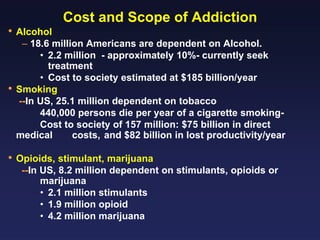
• Alcohol

•

Cost and Scope of Addiction

– 18.6 million Americans are dependent on Alcohol.
• 2.2 million - approximately 10%- currently seek
treatment
• Cost to society estimated at $185 billion/year
Smoking
--In US, 25.1 million dependent on tobacco
440,000 persons die per year of a cigarette smokingCost to society of 157 million: $75 billion in direct
medical
costs, and $82 billion in lost productivity/year

• Opioids, stimulant, marijuana
--In US, 8.2 million dependent on stimulants, opioids or
marijuana
• 2.1 million stimulants
• 1.9 million opioid
• 4.2 million marijuana
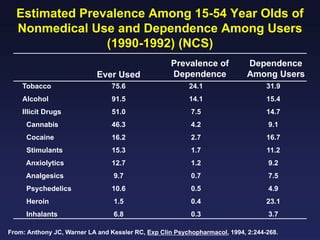
Estimated Prevalence Among 15-54 Year Olds of
Nonmedical Use and Dependence Among Users
(1990-1992) (NCS)
Ever Used

Prevalence of
Dependence

Dependence
Among Users

Tobacco

75.6

24.1

31.9

Alcohol

91.5

14.1

15.4

Illicit Drugs

51.0

7.5

14.7

Cannabis

46.3

4.2

9.1

Cocaine

16.2

2.7

16.7

Stimulants

15.3

1.7

11.2

Anxiolytics

12.7

1.2

9.2

Analgesics

9.7

0.7

7.5

Psychedelics

10.6

0.5

4.9

Heroin

1.5

0.4

23.1

Inhalants

6.8

0.3

3.7

From: Anthony JC, Warner LA and Kessler RC, Exp Clin Psychopharmacol, 1994, 2:244-268.
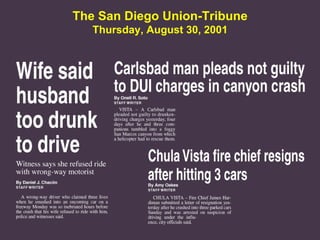
The San Diego Union-Tribune
Thursday, August 30, 2001
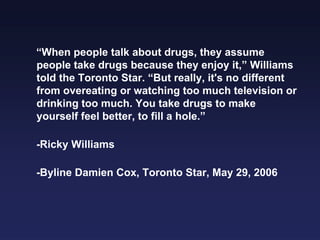
“When people talk about drugs, they assume
people take drugs because they enjoy it,” Williams
told the Toronto Star. “But really, it's no different
from overeating or watching too much television or
drinking too much. You take drugs to make
yourself feel better, to fill a hole.”
-Ricky Williams
-Byline Damien Cox, Toronto Star, May 29, 2006
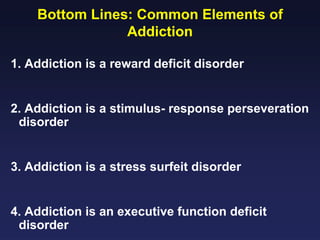
Bottom Lines: Common Elements of
Addiction
1. Addiction is a reward deficit disorder
2. Addiction is a stimulus- response perseveration
disorder
3. Addiction is a stress surfeit disorder
4. Addiction is an executive function deficit
disorder
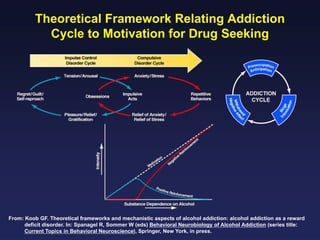
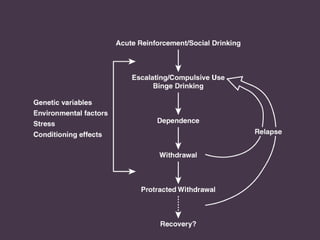
Theoretical Framework Relating Addiction
Cycle to Motivation for Drug Seeking

From: Koob GF. Theoretical frameworks and mechanistic aspects of alcohol addiction: alcohol addiction as a reward
deficit disorder. In: Spanagel R, Sommer W (eds) Behavioral Neurobiology of Alcohol Addiction (series title:
Current Topics in Behavioral Neuroscience), Springer, New York, in press.
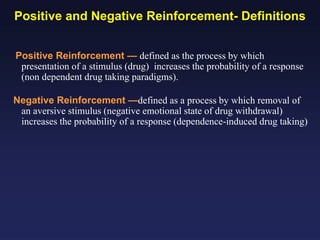
Positive and Negative Reinforcement- Definitions
Positive Reinforcement — defined as the process by which
presentation of a stimulus (drug) increases the probability of a response
(non dependent drug taking paradigms).
Negative Reinforcement —defined as a process by which removal of
an aversive stimulus (negative emotional state of drug withdrawal)
increases the probability of a response (dependence-induced drug taking)
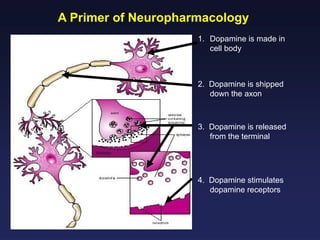
A Primer of Neuropharmacology
1. Dopamine is made in
cell body

2. Dopamine is shipped
down the axon

3. Dopamine is released
from the terminal

4. Dopamine stimulates
dopamine receptors
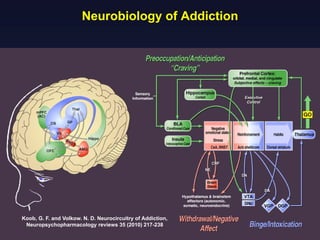
Neurobiology of Addiction

Koob, G. F. and Volkow. N. D. Neurocircuitry of Addiction,
Neuropsychopharmacology reviews 35 (2010) 217-238
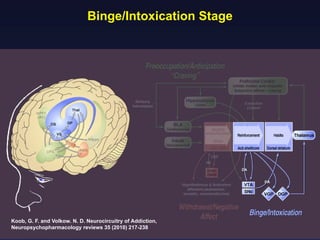
Binge/Intoxication Stage

Koob, G. F. and Volkow. N. D. Neurocircuitry of Addiction,
Neuropsychopharmacology reviews 35 (2010) 217-238
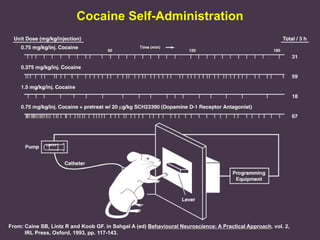
Cocaine Self-Administration

From: Caine SB, Lintz R and Koob GF. in Sahgal A (ed) Behavioural Neuroscience: A Practical Approach, vol. 2,
IRL Press, Oxford, 1993, pp. 117-143.
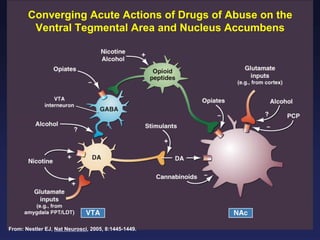
Converging Acute Actions of Drugs of Abuse on the
Ventral Tegmental Area and Nucleus Accumbens

From: Nestler EJ, Nat Neurosci, 2005, 8:1445-1449.
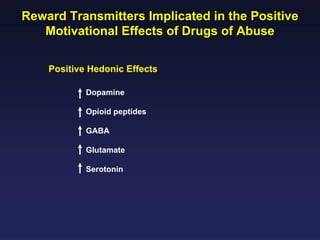
Reward Transmitters Implicated in the Positive
Motivational Effects of Drugs of Abuse
Positive Hedonic Effects
Dopamine
Opioid peptides
GABA
Glutamate
Serotonin
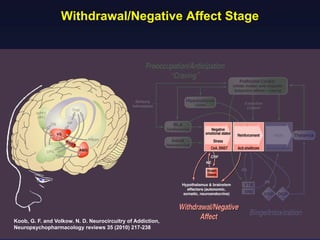
Withdrawal/Negative Affect Stage

Koob, G. F. and Volkow. N. D. Neurocircuitry of Addiction,
Neuropsychopharmacology reviews 35 (2010) 217-238
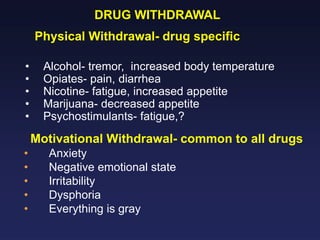
DRUG WITHDRAWAL
Physical Withdrawal- drug specific
•
•
•
•
•

Alcohol- tremor, increased body temperature
Opiates- pain, diarrhea
Nicotine- fatigue, increased appetite
Marijuana- decreased appetite
Psychostimulants- fatigue,?

Motivational Withdrawal- common to all drugs
•
•
•
•
•

Anxiety
Negative emotional state
Irritability
Dysphoria
Everything is gray
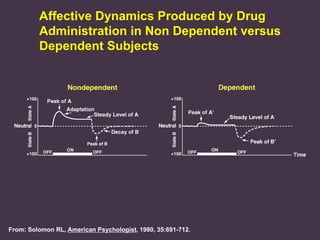
Affective Dynamics Produced by Drug
Administration in Non Dependent versus
Dependent Subjects

From: Solomon RL, American Psychologist, 1980, 35:691-712.
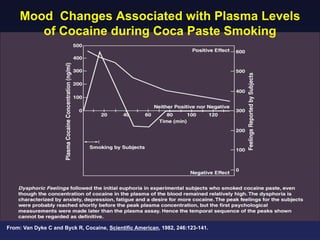
Mood Changes Associated with Plasma Levels
of Cocaine during Coca Paste Smoking

From: Van Dyke C and Byck R, Cocaine, Scientific American, 1982, 246:123-141.
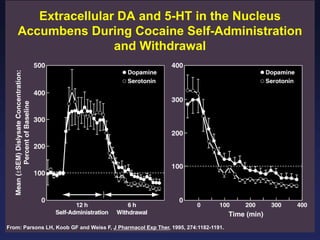
Extracellular DA and 5-HT in the Nucleus
Accumbens During Cocaine Self-Administration
and Withdrawal

From: Parsons LH, Koob GF and Weiss F, J Pharmacol Exp Ther, 1995, 274:1182-1191.
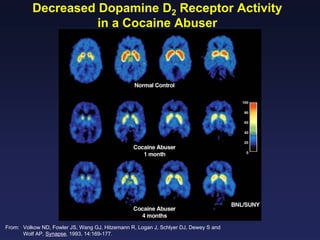
Decreased Dopamine D2 Receptor Activity
in a Cocaine Abuser

From: Volkow ND, Fowler JS, Wang GJ, Hitzemann R, Logan J, Schlyer DJ, Dewey S and
Wolf AP, Synapse, 1993, 14:169-177.
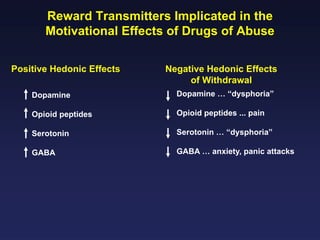
Reward Transmitters Implicated in the
Motivational Effects of Drugs of Abuse
Positive Hedonic Effects

Negative Hedonic Effects
of Withdrawal

Dopamine

Dopamine … “dysphoria”

Opioid peptides

Opioid peptides ... pain

Serotonin

Serotonin … “dysphoria”

GABA

GABA … anxiety, panic attacks
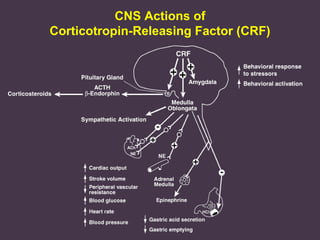
CNS Actions of
Corticotropin-Releasing Factor (CRF)
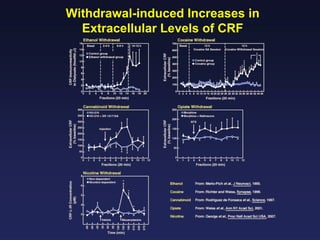
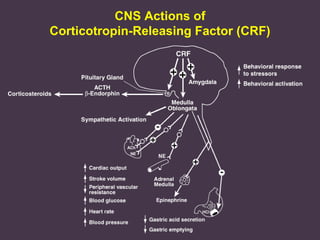
Withdrawal-induced Increases in
Extracellular Levels of CRF
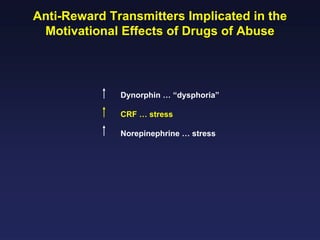
Anti-Reward Transmitters Implicated in the
Motivational Effects of Drugs of Abuse

Dynorphin … “dysphoria”
CRF … stress
Norepinephrine … stress
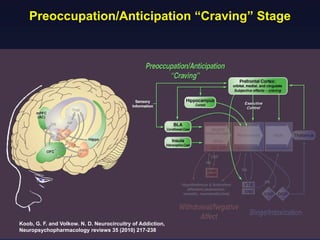
Preoccupation/Anticipation “Craving” Stage

Koob, G. F. and Volkow. N. D. Neurocircuitry of Addiction,
Neuropsychopharmacology reviews 35 (2010) 217-238
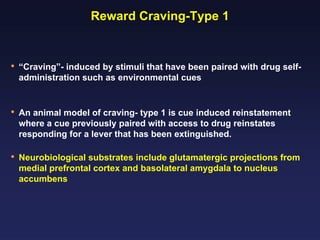
Reward Craving-Type 1

•

“Craving”- induced by stimuli that have been paired with drug selfadministration such as environmental cues

•

An animal model of craving- type 1 is cue induced reinstatement
where a cue previously paired with access to drug reinstates
responding for a lever that has been extinguished.

•

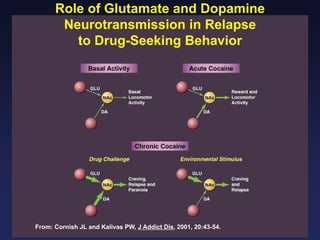
Neurobiological substrates include glutamatergic projections from
medial prefrontal cortex and basolateral amygdala to nucleus
accumbens
Role of Glutamate and Dopamine
Neurotransmission in Relapse
to Drug-Seeking Behavior

From: Cornish JL and Kalivas PW, J Addict Dis, 2001, 20:43-54.
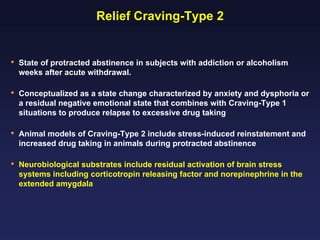
Relief Craving-Type 2

•

State of protracted abstinence in subjects with addiction or alcoholism
weeks after acute withdrawal.

•

Conceptualized as a state change characterized by anxiety and dysphoria or
a residual negative emotional state that combines with Craving-Type 1
situations to produce relapse to excessive drug taking

•

Animal models of Craving-Type 2 include stress-induced reinstatement and
increased drug taking in animals during protracted abstinence

•

Neurobiological substrates include residual activation of brain stress
systems including corticotropin releasing factor and norepinephrine in the
extended amygdala
CNS Actions of
Corticotropin-Releasing Factor (CRF)
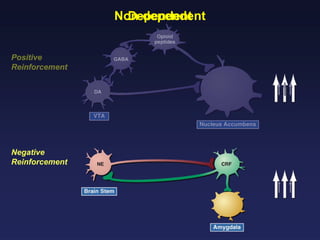
Non-dependent
Dependent
Positive
Reinforcement

Negative
Reinforcement
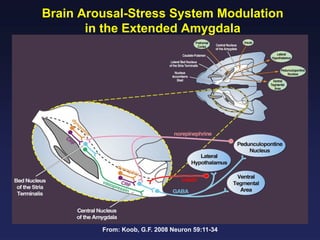
Brain Arousal-Stress System Modulation
in the Extended Amygdala

From: Koob, G.F. 2008 Neuron 59:11-34
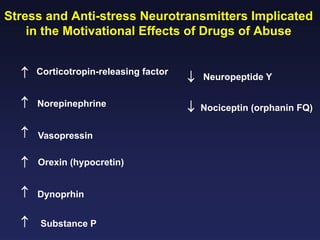
Stress and Anti-stress Neurotransmitters Implicated
in the Motivational Effects of Drugs of Abuse
!

Corticotropin-releasing factor

"

Neuropeptide Y

!

Norepinephrine

"

Nociceptin (orphanin FQ)

!

Vasopressin

!

Orexin (hypocretin)

!

Dynoprhin

!

Substance P
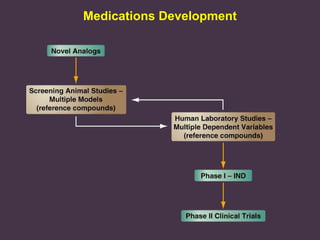
Medications Development
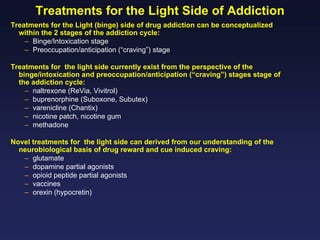
Treatments for the Light Side of Addiction
Treatments for the Light (binge) side of drug addiction can be conceptualized
within the 2 stages of the addiction cycle:
– Binge/Intoxication stage
– Preoccupation/anticipation (“craving”) stage
Treatments for the light side currently exist from the perspective of the
binge/intoxication and preoccupation/anticipation (“craving”) stages stage of
the addiction cycle:
– naltrexone (ReVia, Vivitrol)
– buprenorphine (Suboxone, Subutex)
– varenicline (Chantix)
– nicotine patch, nicotine gum
– methadone
Novel treatments for the light side can derived from our understanding of the
neurobiological basis of drug reward and cue induced craving:
– glutamate
– dopamine partial agonists
– opioid peptide partial agonists
– vaccines
– orexin (hypocretin)
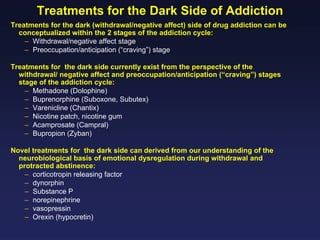
Treatments for the Dark Side of Addiction
Treatments for the dark (withdrawal/negative affect) side of drug addiction can be
conceptualized within the 2 stages of the addiction cycle:
– Withdrawal/negative affect stage
– Preoccupation/anticipation (“craving”) stage
Treatments for the dark side currently exist from the perspective of the
withdrawal/ negative affect and preoccupation/anticipation (“craving”) stages
stage of the addiction cycle:
– Methadone (Dolophine)
– Buprenorphine (Suboxone, Subutex)
– Varenicline (Chantix)
– Nicotine patch, nicotine gum
– Acamprosate (Campral)
– Bupropion (Zyban)
Novel treatments for the dark side can derived from our understanding of the
neurobiological basis of emotional dysregulation during withdrawal and
protracted abstinence:
– corticotropin releasing factor
– dynorphin
– Substance P
– norepinephrine
– vasopressin
– Orexin (hypocretin)
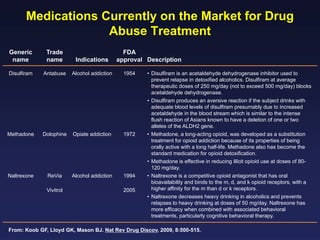
Medications Currently on the Market for Drug
Abuse Treatment
Generic
name

Trade
name

Indications

Disulfiram

Antabuse

Alcohol addiction

1954

Methadone

Dolophine

Opiate addiction

1972

Naltrexone

ReVia

Alcohol addiction

1994

Vivitrol

FDA
approval Description

2005

• Disulfiram is an acetaldehyde dehydrogenase inhibitor used to
prevent relapse in detoxified alcoholics. Disulfiram at average
therapeutic doses of 250 mg/day (not to exceed 500 mg/day) blocks
acetaldehyde dehydrogenase.
• Disulfiram produces an aversive reaction if the subject drinks with
adequate blood levels of disulfiram presumably due to increased
acetaldehyde in the blood stream which is similar to the intense
flush reaction of Asians known to have a deletion of one or two
alleles of the ALDH2 gene.
• Methadone, a long-acting opioid, was developed as a substitution
treatment for opioid addiction because of its properties of being
orally active with a long half-life. Methadone also has become the
standard medication for opioid detoxification.
• Methadone is effective in reducing illicit opioid use at doses of 80120 mg/day.
• Naltrexone is a competitive opioid antagonist that has oral
bioavailability and binds to the m, d, and k opioid receptors, with a
higher affinity for the m than d or k receptors.
• Naltrexone decreases heavy drinking in alcoholics and prevents
relapses to heavy drinking at doses of 50 mg/day. Naltrexone has
more efficacy when combined with associated behavioral
treatments, particularly cognitive behavioral therapy.

From: Koob GF, Lloyd GK, Mason BJ. Nat Rev Drug Discov, 2009, 8:500-515.
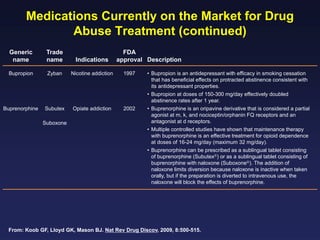
Medications Currently on the Market for Drug
Abuse Treatment (continued)
Generic
name

Trade
name

Indications

Bupropion

Zyban

Nicotine addiction

1997

Buprenorphine

Subutex

Opiate addiction

2002

Suboxone

FDA
approval Description
• Bupropion is an antidepressant with efficacy in smoking cessation
that has beneficial effects on protracted abstinence consistent with
its antidepressant properties.
• Bupropion at doses of 150-300 mg/day effectively doubled
abstinence rates after 1 year.
• Buprenorphine is an oripavine derivative that is considered a partial
agonist at m, k, and nociceptin/orphanin FQ receptors and an
antagonist at d receptors.
• Multiple controlled studies have shown that maintenance therapy
with buprenorphine is an effective treatment for opioid dependence
at doses of 16-24 mg/day (maximum 32 mg/day).
• Buprenorphine can be prescribed as a sublingual tablet consisting
of buprenorphine (Subutex#) or as a sublingual tablet consisting of
buprenorphine with naloxone (Suboxone#). The addition of
naloxone limits diversion because naloxone is inactive when taken
orally, but if the preparation is diverted to intravenous use, the
naloxone will block the effects of buprenorphine.

From: Koob GF, Lloyd GK, Mason BJ. Nat Rev Drug Discov, 2009, 8:500-515.
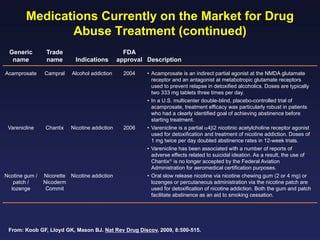
Medications Currently on the Market for Drug
Abuse Treatment (continued)
Generic
name

Trade
name

Indications

Acamprosate

Campral

Alcohol addiction

2004

• Acamprosate is an indirect partial agonist at the NMDA glutamate
receptor and an antagonist at metabotropic glutamate receptors
used to prevent relapse in detoxified alcoholics. Doses are typically
two 333 mg tablets three times per day.
• In a U.S. multicenter double-blind, placebo-controlled trial of
acamprosate, treatment efficacy was particularly robust in patients
who had a clearly identified goal of achieving abstinence before
starting treatment.

Varenicline

Chantix

Nicotine addiction

2006

• Varenicline is a partial $4%2 nicotinic acetylcholine receptor agonist
used for detoxification and treatment of nicotine addiction. Doses of
1 mg twice per day doubled abstinence rates in 12-week trials.
• Varenicline has been associated with a number of reports of
adverse effects related to suicidal ideation. As a result, the use of
Chantix# is no longer accepted by the Federal Aviation
Administration for aeromedical certification purposes.
• Oral slow release nicotine via nicotine chewing gum (2 or 4 mg) or
lozenges or percutaneous administration via the nicotine patch are
used for detoxification of nicotine addiction. Both the gum and patch
facilitate abstinence as an aid to smoking cessation.

Ncotine gum /
patch /
lozenge

Nicorette Nicotine addiction
Nicoderm
Commit

FDA
approval Description

From: Koob GF, Lloyd GK, Mason BJ. Nat Rev Drug Discov, 2009, 8:500-515.
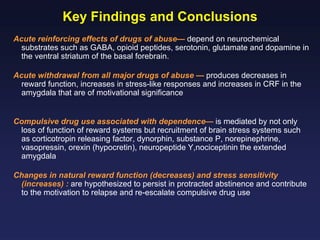
Key Findings and Conclusions
Acute reinforcing effects of drugs of abuse— depend on neurochemical
substrates such as GABA, opioid peptides, serotonin, glutamate and dopamine in
the ventral striatum of the basal forebrain.
Acute withdrawal from all major drugs of abuse — produces decreases in
reward function, increases in stress-like responses and increases in CRF in the
amygdala that are of motivational significance
Compulsive drug use associated with dependence— is mediated by not only
loss of function of reward systems but recruitment of brain stress systems such
as corticotropin releasing factor, dynorphin, substance P, norepinephrine,
vasopressin, orexin (hypocretin), neuropeptide Y,nociceptinin the extended
amygdala
Changes in natural reward function (decreases) and stress sensitivity
(increases) : are hypothesized to persist in protracted abstinence and contribute
to the motivation to relapse and re-escalate compulsive drug use
Neurobiology of Drug Addiction
Visiting Professors Koob Laboratory
Choon-Gon Jang
Charles Heyser

Research

Administrative

Post-Doctoral Fellows

Assistants

Assistants

Cindy Funk

Bob Lintz

Lisa Maturin

Brendan Walker

Richard Schroeder

Mellany Santos

Tom Greenwell

Elena Crawford

Marisa Gallego

Sandy Ghozland

Molly Brennan

Chitra Mandyam

Maury Cole

Dong Ji

Tess Kimber

Candice Contet

Yanabel Grant

Laura Orio
Kaushik Misra
Support from:
Nick Gilpin
Sunmee Wee
Scott Edwards

Staff Scientists
Heather Richardson
Olivier George
Special thanks to:
Mike Arends
(Senior Research Assistant)

National Institute on Alcohol Abuse and Alcoholism
National Institute on Drug Abuse

Leandro Vendruscolo National Institute of Diabetes and Digestive and Kidney
Diseases
Tim Whitfield
Pearson Center for Alcoholism and Addiction Research
Joel Schossberg

Dr. koob connect presentation

  • 1.
    What is Addiction?What the Science of Addiction Has Taught Us and Will Teach Us George F. Koob, Ph.D. Professor and Chair Committee on the Neurobiology of Addictive Disorders The Scripps Research Institute La Jolla, California Koob, G.F. and Le Moal, M. Addiction and the anti-reward system. Annual Review of Psychology, 59 (2008)29-53 Koob, G. F. and Volkow. N. D. Neurocircuitry of Addiction, Neuropsychopharmacology Reviews 35 (2010) 217-238
  • 2.
    What is Addiction? Addiction— defined as a chronically relapsing disorder that is characterized by a compulsion to seek and take drug or stimulus, loss of control in limiting intake, and emergence of a negative emotional state (e.g. dysphoria, anxiety, irritability) when access to the drug or stimulus is prevented (here, defined as the “dark side” of addiction)
  • 3.
    What is CompulsiveUse? Compulsive drug seeking-- can be characterized as a maladaptive stimulusresponse habits in which the ultimate goal of the behaviour has been devalued, perhaps through tolerance to the rewarding effects of the drug (Everitt BJ, Belin D, Economidou D, Pelloux Y, Dalley JW, Robbins TW. Philos Trans R Soc Lond B Biol Sci 2008, 363:3125-3135.) Compulsivity — can be defined as perseveration of responding in the face of adverse consequences or perseveration in the face of incorrect responses in choice situations. Compulsive disorders —are characterized by anxiety and stress before committing a compulsive repetitive behavior, and relief from the stress by performing the compulsive behavior (DSM IV American Psychiatric Association).
  • 4.
    • Alcohol • Cost andScope of Addiction – 18.6 million Americans are dependent on Alcohol. • 2.2 million - approximately 10%- currently seek treatment • Cost to society estimated at $185 billion/year Smoking --In US, 25.1 million dependent on tobacco 440,000 persons die per year of a cigarette smokingCost to society of 157 million: $75 billion in direct medical costs, and $82 billion in lost productivity/year • Opioids, stimulant, marijuana --In US, 8.2 million dependent on stimulants, opioids or marijuana • 2.1 million stimulants • 1.9 million opioid • 4.2 million marijuana
  • 5.
    Estimated Prevalence Among15-54 Year Olds of Nonmedical Use and Dependence Among Users (1990-1992) (NCS) Ever Used Prevalence of Dependence Dependence Among Users Tobacco 75.6 24.1 31.9 Alcohol 91.5 14.1 15.4 Illicit Drugs 51.0 7.5 14.7 Cannabis 46.3 4.2 9.1 Cocaine 16.2 2.7 16.7 Stimulants 15.3 1.7 11.2 Anxiolytics 12.7 1.2 9.2 Analgesics 9.7 0.7 7.5 Psychedelics 10.6 0.5 4.9 Heroin 1.5 0.4 23.1 Inhalants 6.8 0.3 3.7 From: Anthony JC, Warner LA and Kessler RC, Exp Clin Psychopharmacol, 1994, 2:244-268.
  • 6.
    The San DiegoUnion-Tribune Thursday, August 30, 2001
  • 8.
    “When people talkabout drugs, they assume people take drugs because they enjoy it,” Williams told the Toronto Star. “But really, it's no different from overeating or watching too much television or drinking too much. You take drugs to make yourself feel better, to fill a hole.” -Ricky Williams -Byline Damien Cox, Toronto Star, May 29, 2006
  • 9.
    Bottom Lines: CommonElements of Addiction 1. Addiction is a reward deficit disorder 2. Addiction is a stimulus- response perseveration disorder 3. Addiction is a stress surfeit disorder 4. Addiction is an executive function deficit disorder
  • 10.
    Theoretical Framework RelatingAddiction Cycle to Motivation for Drug Seeking From: Koob GF. Theoretical frameworks and mechanistic aspects of alcohol addiction: alcohol addiction as a reward deficit disorder. In: Spanagel R, Sommer W (eds) Behavioral Neurobiology of Alcohol Addiction (series title: Current Topics in Behavioral Neuroscience), Springer, New York, in press.
  • 11.
    Positive and NegativeReinforcement- Definitions Positive Reinforcement — defined as the process by which presentation of a stimulus (drug) increases the probability of a response (non dependent drug taking paradigms). Negative Reinforcement —defined as a process by which removal of an aversive stimulus (negative emotional state of drug withdrawal) increases the probability of a response (dependence-induced drug taking)
  • 12.
    A Primer ofNeuropharmacology 1. Dopamine is made in cell body 2. Dopamine is shipped down the axon 3. Dopamine is released from the terminal 4. Dopamine stimulates dopamine receptors
  • 13.
    Neurobiology of Addiction Koob,G. F. and Volkow. N. D. Neurocircuitry of Addiction, Neuropsychopharmacology reviews 35 (2010) 217-238
  • 14.
    Binge/Intoxication Stage Koob, G.F. and Volkow. N. D. Neurocircuitry of Addiction, Neuropsychopharmacology reviews 35 (2010) 217-238
  • 16.
    Cocaine Self-Administration From: CaineSB, Lintz R and Koob GF. in Sahgal A (ed) Behavioural Neuroscience: A Practical Approach, vol. 2, IRL Press, Oxford, 1993, pp. 117-143.
  • 17.
    Converging Acute Actionsof Drugs of Abuse on the Ventral Tegmental Area and Nucleus Accumbens From: Nestler EJ, Nat Neurosci, 2005, 8:1445-1449.
  • 18.
    Reward Transmitters Implicatedin the Positive Motivational Effects of Drugs of Abuse Positive Hedonic Effects Dopamine Opioid peptides GABA Glutamate Serotonin
  • 20.
    Withdrawal/Negative Affect Stage Koob,G. F. and Volkow. N. D. Neurocircuitry of Addiction, Neuropsychopharmacology reviews 35 (2010) 217-238
  • 21.
    DRUG WITHDRAWAL Physical Withdrawal-drug specific • • • • • Alcohol- tremor, increased body temperature Opiates- pain, diarrhea Nicotine- fatigue, increased appetite Marijuana- decreased appetite Psychostimulants- fatigue,? Motivational Withdrawal- common to all drugs • • • • • Anxiety Negative emotional state Irritability Dysphoria Everything is gray
  • 22.
    Affective Dynamics Producedby Drug Administration in Non Dependent versus Dependent Subjects From: Solomon RL, American Psychologist, 1980, 35:691-712.
  • 23.
    Mood Changes Associatedwith Plasma Levels of Cocaine during Coca Paste Smoking From: Van Dyke C and Byck R, Cocaine, Scientific American, 1982, 246:123-141.
  • 24.
    Extracellular DA and5-HT in the Nucleus Accumbens During Cocaine Self-Administration and Withdrawal From: Parsons LH, Koob GF and Weiss F, J Pharmacol Exp Ther, 1995, 274:1182-1191.
  • 25.
    Decreased Dopamine D2Receptor Activity in a Cocaine Abuser From: Volkow ND, Fowler JS, Wang GJ, Hitzemann R, Logan J, Schlyer DJ, Dewey S and Wolf AP, Synapse, 1993, 14:169-177.
  • 26.
    Reward Transmitters Implicatedin the Motivational Effects of Drugs of Abuse Positive Hedonic Effects Negative Hedonic Effects of Withdrawal Dopamine Dopamine … “dysphoria” Opioid peptides Opioid peptides ... pain Serotonin Serotonin … “dysphoria” GABA GABA … anxiety, panic attacks
  • 27.
  • 28.
  • 29.
    Anti-Reward Transmitters Implicatedin the Motivational Effects of Drugs of Abuse Dynorphin … “dysphoria” CRF … stress Norepinephrine … stress
  • 31.
    Preoccupation/Anticipation “Craving” Stage Koob,G. F. and Volkow. N. D. Neurocircuitry of Addiction, Neuropsychopharmacology reviews 35 (2010) 217-238
  • 32.
    Reward Craving-Type 1 • “Craving”-induced by stimuli that have been paired with drug selfadministration such as environmental cues • An animal model of craving- type 1 is cue induced reinstatement where a cue previously paired with access to drug reinstates responding for a lever that has been extinguished. • Neurobiological substrates include glutamatergic projections from medial prefrontal cortex and basolateral amygdala to nucleus accumbens
  • 33.
    Role of Glutamateand Dopamine Neurotransmission in Relapse to Drug-Seeking Behavior From: Cornish JL and Kalivas PW, J Addict Dis, 2001, 20:43-54.
  • 34.
    Relief Craving-Type 2 • Stateof protracted abstinence in subjects with addiction or alcoholism weeks after acute withdrawal. • Conceptualized as a state change characterized by anxiety and dysphoria or a residual negative emotional state that combines with Craving-Type 1 situations to produce relapse to excessive drug taking • Animal models of Craving-Type 2 include stress-induced reinstatement and increased drug taking in animals during protracted abstinence • Neurobiological substrates include residual activation of brain stress systems including corticotropin releasing factor and norepinephrine in the extended amygdala
  • 35.
  • 36.
  • 37.
    Brain Arousal-Stress SystemModulation in the Extended Amygdala From: Koob, G.F. 2008 Neuron 59:11-34
  • 38.
    Stress and Anti-stressNeurotransmitters Implicated in the Motivational Effects of Drugs of Abuse ! Corticotropin-releasing factor " Neuropeptide Y ! Norepinephrine " Nociceptin (orphanin FQ) ! Vasopressin ! Orexin (hypocretin) ! Dynoprhin ! Substance P
  • 40.
  • 41.
    Treatments for theLight Side of Addiction Treatments for the Light (binge) side of drug addiction can be conceptualized within the 2 stages of the addiction cycle: – Binge/Intoxication stage – Preoccupation/anticipation (“craving”) stage Treatments for the light side currently exist from the perspective of the binge/intoxication and preoccupation/anticipation (“craving”) stages stage of the addiction cycle: – naltrexone (ReVia, Vivitrol) – buprenorphine (Suboxone, Subutex) – varenicline (Chantix) – nicotine patch, nicotine gum – methadone Novel treatments for the light side can derived from our understanding of the neurobiological basis of drug reward and cue induced craving: – glutamate – dopamine partial agonists – opioid peptide partial agonists – vaccines – orexin (hypocretin)
  • 42.
    Treatments for theDark Side of Addiction Treatments for the dark (withdrawal/negative affect) side of drug addiction can be conceptualized within the 2 stages of the addiction cycle: – Withdrawal/negative affect stage – Preoccupation/anticipation (“craving”) stage Treatments for the dark side currently exist from the perspective of the withdrawal/ negative affect and preoccupation/anticipation (“craving”) stages stage of the addiction cycle: – Methadone (Dolophine) – Buprenorphine (Suboxone, Subutex) – Varenicline (Chantix) – Nicotine patch, nicotine gum – Acamprosate (Campral) – Bupropion (Zyban) Novel treatments for the dark side can derived from our understanding of the neurobiological basis of emotional dysregulation during withdrawal and protracted abstinence: – corticotropin releasing factor – dynorphin – Substance P – norepinephrine – vasopressin – Orexin (hypocretin)
  • 43.
    Medications Currently onthe Market for Drug Abuse Treatment Generic name Trade name Indications Disulfiram Antabuse Alcohol addiction 1954 Methadone Dolophine Opiate addiction 1972 Naltrexone ReVia Alcohol addiction 1994 Vivitrol FDA approval Description 2005 • Disulfiram is an acetaldehyde dehydrogenase inhibitor used to prevent relapse in detoxified alcoholics. Disulfiram at average therapeutic doses of 250 mg/day (not to exceed 500 mg/day) blocks acetaldehyde dehydrogenase. • Disulfiram produces an aversive reaction if the subject drinks with adequate blood levels of disulfiram presumably due to increased acetaldehyde in the blood stream which is similar to the intense flush reaction of Asians known to have a deletion of one or two alleles of the ALDH2 gene. • Methadone, a long-acting opioid, was developed as a substitution treatment for opioid addiction because of its properties of being orally active with a long half-life. Methadone also has become the standard medication for opioid detoxification. • Methadone is effective in reducing illicit opioid use at doses of 80120 mg/day. • Naltrexone is a competitive opioid antagonist that has oral bioavailability and binds to the m, d, and k opioid receptors, with a higher affinity for the m than d or k receptors. • Naltrexone decreases heavy drinking in alcoholics and prevents relapses to heavy drinking at doses of 50 mg/day. Naltrexone has more efficacy when combined with associated behavioral treatments, particularly cognitive behavioral therapy. From: Koob GF, Lloyd GK, Mason BJ. Nat Rev Drug Discov, 2009, 8:500-515.
  • 44.
    Medications Currently onthe Market for Drug Abuse Treatment (continued) Generic name Trade name Indications Bupropion Zyban Nicotine addiction 1997 Buprenorphine Subutex Opiate addiction 2002 Suboxone FDA approval Description • Bupropion is an antidepressant with efficacy in smoking cessation that has beneficial effects on protracted abstinence consistent with its antidepressant properties. • Bupropion at doses of 150-300 mg/day effectively doubled abstinence rates after 1 year. • Buprenorphine is an oripavine derivative that is considered a partial agonist at m, k, and nociceptin/orphanin FQ receptors and an antagonist at d receptors. • Multiple controlled studies have shown that maintenance therapy with buprenorphine is an effective treatment for opioid dependence at doses of 16-24 mg/day (maximum 32 mg/day). • Buprenorphine can be prescribed as a sublingual tablet consisting of buprenorphine (Subutex#) or as a sublingual tablet consisting of buprenorphine with naloxone (Suboxone#). The addition of naloxone limits diversion because naloxone is inactive when taken orally, but if the preparation is diverted to intravenous use, the naloxone will block the effects of buprenorphine. From: Koob GF, Lloyd GK, Mason BJ. Nat Rev Drug Discov, 2009, 8:500-515.
  • 45.
    Medications Currently onthe Market for Drug Abuse Treatment (continued) Generic name Trade name Indications Acamprosate Campral Alcohol addiction 2004 • Acamprosate is an indirect partial agonist at the NMDA glutamate receptor and an antagonist at metabotropic glutamate receptors used to prevent relapse in detoxified alcoholics. Doses are typically two 333 mg tablets three times per day. • In a U.S. multicenter double-blind, placebo-controlled trial of acamprosate, treatment efficacy was particularly robust in patients who had a clearly identified goal of achieving abstinence before starting treatment. Varenicline Chantix Nicotine addiction 2006 • Varenicline is a partial $4%2 nicotinic acetylcholine receptor agonist used for detoxification and treatment of nicotine addiction. Doses of 1 mg twice per day doubled abstinence rates in 12-week trials. • Varenicline has been associated with a number of reports of adverse effects related to suicidal ideation. As a result, the use of Chantix# is no longer accepted by the Federal Aviation Administration for aeromedical certification purposes. • Oral slow release nicotine via nicotine chewing gum (2 or 4 mg) or lozenges or percutaneous administration via the nicotine patch are used for detoxification of nicotine addiction. Both the gum and patch facilitate abstinence as an aid to smoking cessation. Ncotine gum / patch / lozenge Nicorette Nicotine addiction Nicoderm Commit FDA approval Description From: Koob GF, Lloyd GK, Mason BJ. Nat Rev Drug Discov, 2009, 8:500-515.
  • 46.
    Key Findings andConclusions Acute reinforcing effects of drugs of abuse— depend on neurochemical substrates such as GABA, opioid peptides, serotonin, glutamate and dopamine in the ventral striatum of the basal forebrain. Acute withdrawal from all major drugs of abuse — produces decreases in reward function, increases in stress-like responses and increases in CRF in the amygdala that are of motivational significance Compulsive drug use associated with dependence— is mediated by not only loss of function of reward systems but recruitment of brain stress systems such as corticotropin releasing factor, dynorphin, substance P, norepinephrine, vasopressin, orexin (hypocretin), neuropeptide Y,nociceptinin the extended amygdala Changes in natural reward function (decreases) and stress sensitivity (increases) : are hypothesized to persist in protracted abstinence and contribute to the motivation to relapse and re-escalate compulsive drug use
  • 47.
    Neurobiology of DrugAddiction Visiting Professors Koob Laboratory Choon-Gon Jang Charles Heyser Research Administrative Post-Doctoral Fellows Assistants Assistants Cindy Funk Bob Lintz Lisa Maturin Brendan Walker Richard Schroeder Mellany Santos Tom Greenwell Elena Crawford Marisa Gallego Sandy Ghozland Molly Brennan Chitra Mandyam Maury Cole Dong Ji Tess Kimber Candice Contet Yanabel Grant Laura Orio Kaushik Misra Support from: Nick Gilpin Sunmee Wee Scott Edwards Staff Scientists Heather Richardson Olivier George Special thanks to: Mike Arends (Senior Research Assistant) National Institute on Alcohol Abuse and Alcoholism National Institute on Drug Abuse Leandro Vendruscolo National Institute of Diabetes and Digestive and Kidney Diseases Tim Whitfield Pearson Center for Alcoholism and Addiction Research Joel Schossberg