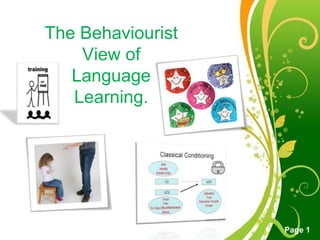
TheBehaviourist View of LanguageLearning.
BehaviouristssaythatthelanguagelearningprocessiscarriedoutthroughConditioning.Conditioning: “to train or influence a person or animal mentally so that they do or expect a particular thing without thinking about it”.According to Cambridge Dictionaryhttp://dictionary.cambridge.org/dictionary/british/condition_3
Firstlythechildhearsthespeechsoundthathisparents  produce hisfirstyear of life…
Over time he learnstoassociatewithsoundstosituations, Forexample:Whenthemotherfeedsherlittlebaby, shemakessounds of endearment and thebabyfindsthispleasureable . Conditioningtolanguagehas begunwhenthissounds are stillpleasurablewhenthissounds are notaccompainedbyfood.
After a whilethechildstartsimitatingspeechsoundsthat he has heardtogetattentionfromhismother.Ifthechild produces vocal stimulus and thesesounds are appropiatetosoundlike a word, themotherresponds.
Afterthisstage, Thekid tries someutterances, thenthroughrepetition he confirmsthatcertain vocal utteranceistherightoneforthething he wants.He can repeatthisutterancewhen he needsit.Milk
Certainbehaviourpatternthatisnotrewardedwillnotberepeatedbythechild. Ifthemotherdoesn’tnoticecertainutterancethekidwillnotrepeatit.Thisisthe natural processthat a languageteachingprogramshould try tostimulate.
Languageteachersmustfollowtheseconditions of thebehaviourmodel of learning: Languageislearntbypracticing. Languagecannotbetaughtdivorcedfromthesituation. Thismustbe a meaningfulsituation. To produce a right response thestudentsrequiresattention.
Thespokenlanguage comes beforethanthewritten.Thereceptiveexperienceisnecessarybeforetheproductiveexperience.Thelearnermustknowifhiseffortisrightorwrong.Learningisfasterifthestudentis placed tothesituation, and if he produces a correct response issaidthat he has reallylearnt.
Thank you for watchingTeam:Estefanía Arreola MerazJessica Ríos PérezMa. Graciela EspinoClaudia Susana Alvarado Flores

The behaviourist view_of_language_learning