

The Art of
Less Doing
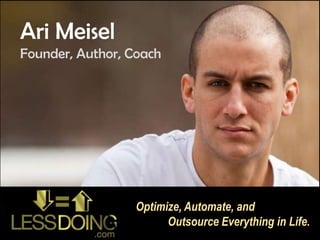
Ari Meisel
Founder, Author, Coach
Optimize, Automate, and
Outsource Everything in Life.
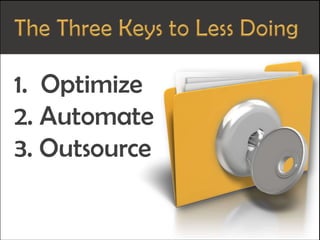
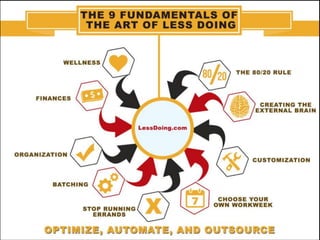
1. Optimize
2. Automate
3. Outsource
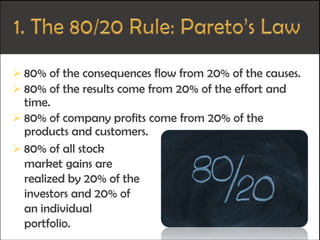
 80% of the consequences flow from 20% of the causes.
 80% of the results come from 20% of the effort and
time.
 80% of company profits come from 20% of the
products and customers.
 80% of all stock
market gains are
realized by 20% of the
investors and 20% of
an individual
portfolio.
One of the most important
things you can do to have a
life of Less Doing is to have a
system that allows you to find
anything at any time.
You need constant, universal,
instant access to everything
you know.
 We’re fortunate to live in a world
where we have great access to
thousands of products at cheap
prices, all readily available.
 However, when a product is
created to work for everybody,
there’s a good chance it won’t be
exactly right for you.
 If a problem presents itself to you,
a solution may or may not exist. If
it doesn’t, creating it may be
easier than you think.
 The concept of choosing your own workweek comes back to
timing. This applies to people with 9-to-5 jobs as well as
people with more flexible schedules.
 The idea is that some times are
better than others for certain
people to do certain things.
 By choosing your own
workweek, you set up your
schedule to match tasks to
your best times for them.
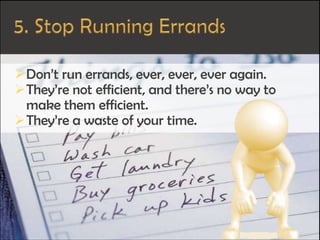
Don’t run errands, ever, ever, ever again.
They’re not efficient, and there’s no way to
make them efficient.
They’re a waste of your time.
 The Less Doing lifestyle is about efficiency, and this
efficiency should translate to financial savings, too.
 It’s not enough to simply manage your finances.
You want to be a financial sushi chef, cutting out all
of the fat and leaving nothing but the tastiest bits.
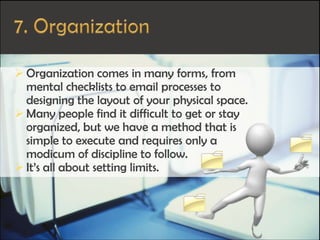
 Organization comes in many forms, from
mental checklists to email processes to
designing the layout of your physical space.
 Many people find it difficult to get or stay
organized, but we have a method that is
simple to execute and requires only a
modicum of discipline to follow.
 It’s all about setting limits.
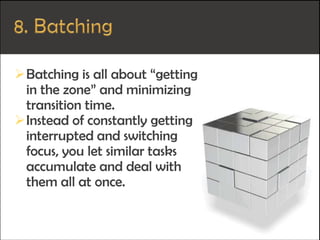
Batching is all about “getting
in the zone” and minimizing
transition time.
Instead of constantly getting
interrupted and switching
focus, you let similar tasks
accumulate and deal with
them all at once.
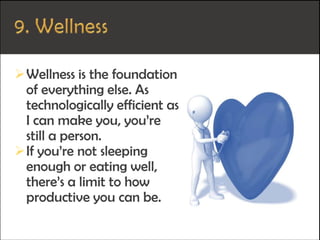
Wellness is the foundation
of everything else. As
technologically efficient as
I can make you, you’re
still a person.
If you’re not sleeping
enough or eating well,
there’s a limit to how
productive you can be.

The Art of Less Doing

  • 1.
  • 2.
    Ari Meisel Founder, Author,Coach Optimize, Automate, and Outsource Everything in Life.
  • 3.
  • 5.
     80% ofthe consequences flow from 20% of the causes.  80% of the results come from 20% of the effort and time.  80% of company profits come from 20% of the products and customers.  80% of all stock market gains are realized by 20% of the investors and 20% of an individual portfolio.
  • 7.
    One of themost important things you can do to have a life of Less Doing is to have a system that allows you to find anything at any time. You need constant, universal, instant access to everything you know.
  • 9.
     We’re fortunateto live in a world where we have great access to thousands of products at cheap prices, all readily available.  However, when a product is created to work for everybody, there’s a good chance it won’t be exactly right for you.  If a problem presents itself to you, a solution may or may not exist. If it doesn’t, creating it may be easier than you think.
  • 11.
     The conceptof choosing your own workweek comes back to timing. This applies to people with 9-to-5 jobs as well as people with more flexible schedules.  The idea is that some times are better than others for certain people to do certain things.  By choosing your own workweek, you set up your schedule to match tasks to your best times for them.
  • 13.
    Don’t run errands,ever, ever, ever again. They’re not efficient, and there’s no way to make them efficient. They’re a waste of your time.
  • 15.
     The LessDoing lifestyle is about efficiency, and this efficiency should translate to financial savings, too.  It’s not enough to simply manage your finances. You want to be a financial sushi chef, cutting out all of the fat and leaving nothing but the tastiest bits.
  • 17.
     Organization comesin many forms, from mental checklists to email processes to designing the layout of your physical space.  Many people find it difficult to get or stay organized, but we have a method that is simple to execute and requires only a modicum of discipline to follow.  It’s all about setting limits.
  • 19.
    Batching is allabout “getting in the zone” and minimizing transition time. Instead of constantly getting interrupted and switching focus, you let similar tasks accumulate and deal with them all at once.
  • 21.
    Wellness is thefoundation of everything else. As technologically efficient as I can make you, you’re still a person. If you’re not sleeping enough or eating well, there’s a limit to how productive you can be.