Andreas Hägglund
I run projects and make organizations more efficient
Introducing Lean & Agile
11K
slideshare.net/andreashagglund
@ahab1972
andreashagglund
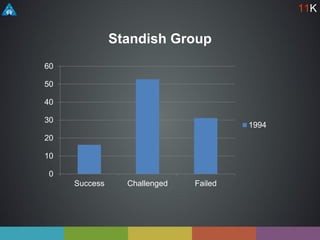
Standish Group
0
10
20
30
40
50
60
Success Challenged Failed
1994
11K
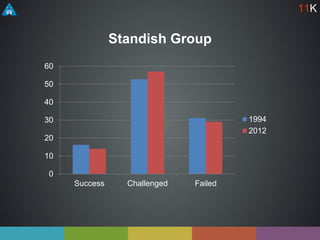
Standish Group
0
10
20
30
40
50
60
Success Challenged Failed
1994
2012
11K
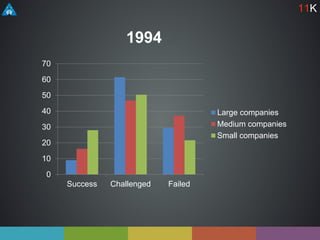
1994
0
10
20
30
40
50
60
70
Success Challenged Failed
Large companies
Medium companies
Small companies
11K
11K
Why?
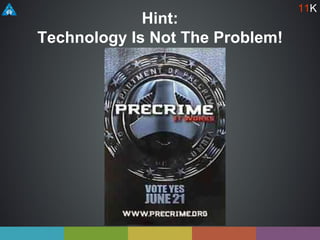
Hint:
Technology Is Not The Problem!
11K
Everything changes...
• Requirements
• Environment
• Business
• Technology
• Competition
• People
• Tools
Experience grows
11K
Why?
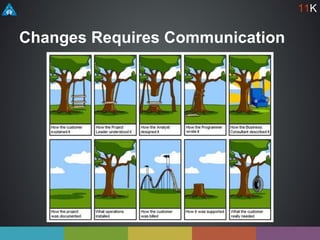
Changes Requires Communication
11K
Changes Requires Communication
And We’re No Good At It!
11K
Changes Requires Communication
11K
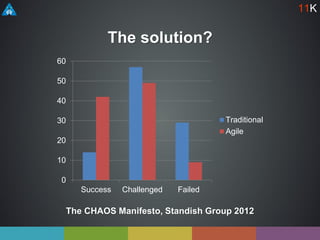
The solution?
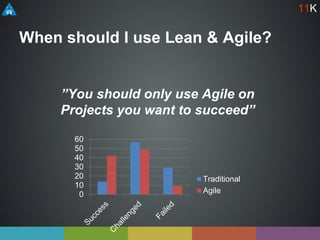
The CHAOS Manifesto, Standish Group 2012
0
10
20
30
40
50
60
Success Challenged Failed
Traditional
Agile
11K
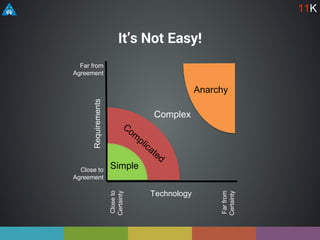
It’s Not Easy!
Complex
Anarchy
Technology
Requirements
Far from
Agreement
Close to
Agreement
Closeto
Certainty
Farfrom
Certainty
Simple
11K
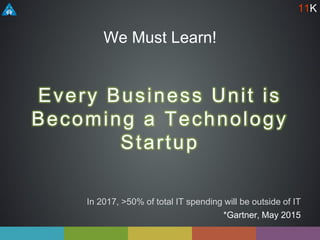
We Must Learn!
Every Business Unit is
Becoming a Technology
Startup
In 2017, >50% of total IT spending will be outside of IT
*Gartner, May 2015
11K
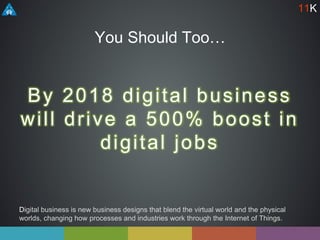
You Should Too…
By 2018 digital business
will drive a 500% boost in
digital jobs
Digital business is new business designs that blend the virtual world and the physical
worlds, changing how processes and industries work through the Internet of Things.
11K
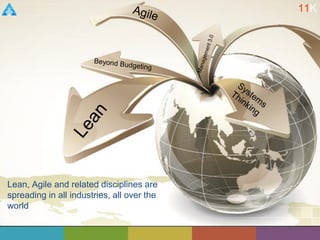
Lean, Agile and related disciplines are
spreading in all industries, all over the
world
11K
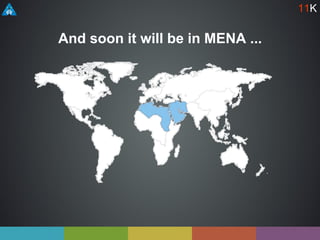
And soon it will be in MENA ...
11K
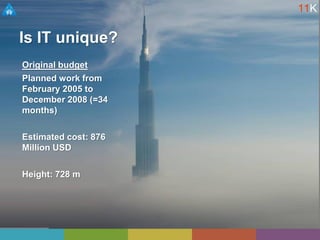
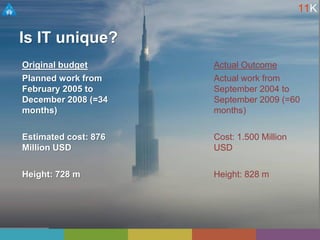
Is IT unique?
Original budget
Planned work from
February 2005 to
December 2008 (=34
months)
Estimated cost: 876
Million USD
Height: 728 m
11K
Is IT unique?
Original budget
Planned work from
February 2005 to
December 2008 (=34
months)
Estimated cost: 876
Million USD
Height: 728 m
Actual Outcome
Actual work from
September 2004 to
September 2009 (=60
months)
Cost: 1.500 Million
USD
Height: 828 m
11K
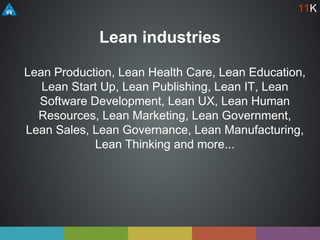
Lean industries
Lean Production, Lean Health Care, Lean Education,
Lean Start Up, Lean Publishing, Lean IT, Lean
Software Development, Lean UX, Lean Human
Resources, Lean Marketing, Lean Government,
Lean Sales, Lean Governance, Lean Manufacturing,
Lean Thinking and more...
11K
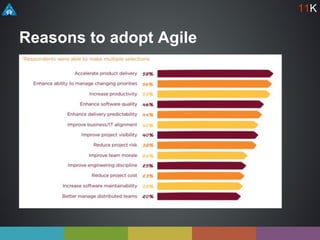
Reasons to adopt Agile
11K
Results from going Agile
11K
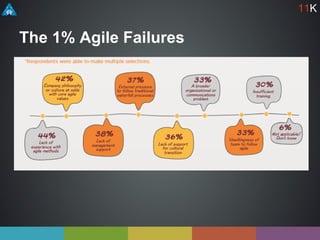
The 1% Agile Failures
11K
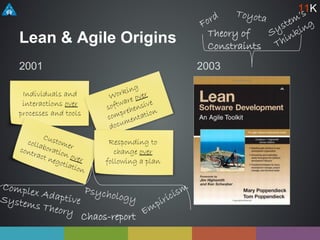
Lean & Agile Origins
2001 2003
Individuals and
interactions over
processes and tools
Responding to
change over
following a plan
Theory of
Constraints
11K
Chaos-report
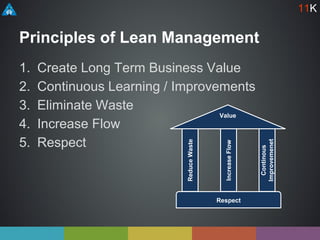
Principles of Lean Management
1. Create Long Term Business Value
2. Continuous Learning / Improvements
3. Eliminate Waste
4. Increase Flow
5. Respect
11K
Respect
ReduceWaste
IncreaseFlow
Continous
Improvemenet
Value
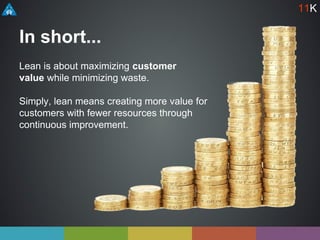
In short...
Lean is about maximizing customer
value while minimizing waste.
Simply, lean means creating more value for
customers with fewer resources through
continuous improvement.
11K
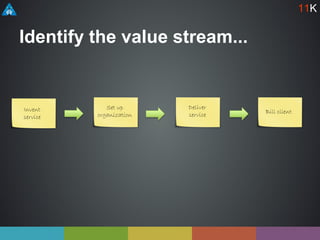
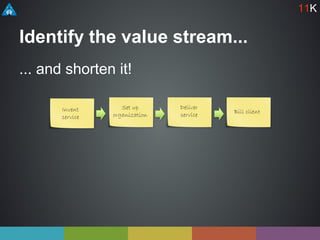
Identify the value stream...
Invent
service
Set up
organization
Deliver
service Bill client
11K
... and shorten it!
Identify the value stream...
Invent
service
Set up
organization
Deliver
service Bill client
11K
From Concept to Cash
11K
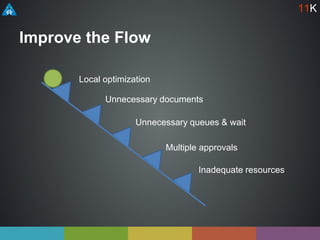
Improve the Flow
Local optimization
Unnecessary documents
Unnecessary queues & wait
Multiple approvals
Inadequate resources
11K
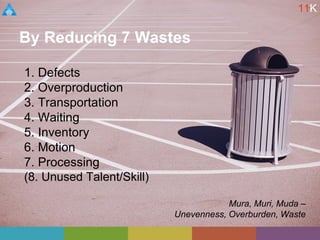
By Reducing 7 Wastes
1. Defects
2. Overproduction
3. Transportation
4. Waiting
5. Inventory
6. Motion
7. Processing
(8. Unused Talent/Skill)
Mura, Muri, Muda –
Unevenness, Overburden, Waste
11K
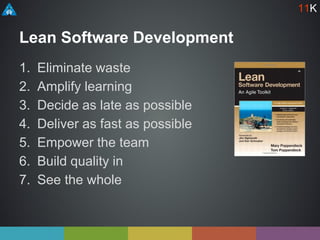
Lean Software Development
1. Eliminate waste
2. Amplify learning
3. Decide as late as possible
4. Deliver as fast as possible
5. Empower the team
6. Build quality in
7. See the whole
11K
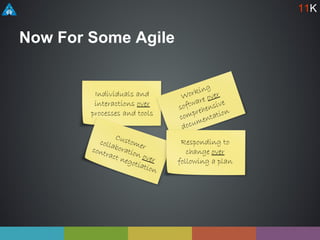
Now For Some Agile
Individuals and
interactions over
processes and tools
Responding to
change over
following a plan
11K
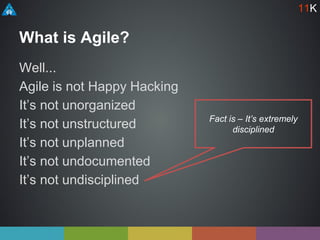
What is Agile?
Well...
Agile is not Happy Hacking
It’s not unorganized
It’s not unstructured
It’s not unplanned
It’s not undocumented
It’s not undisciplined
Fact is – It’s extremely
disciplined
11K
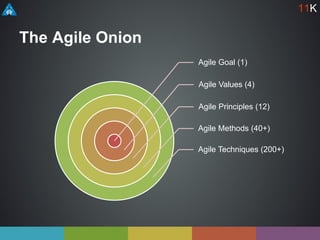
The Agile Onion
Agile Goal (1)
Agile Values (4)
Agile Principles (12)
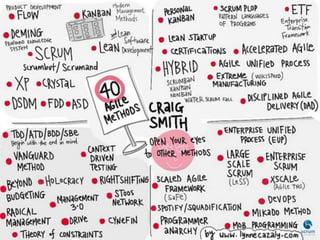
Agile Methods (40+)
Agile Techniques (200+)
11K
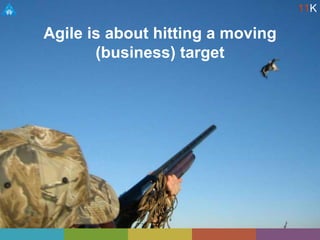
Agile is about hitting a moving
(business) target
11K
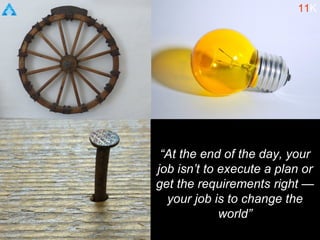
“At the end of the day, your
job isn’t to execute a plan or
get the requirements right —
your job is to change the
world”
11K
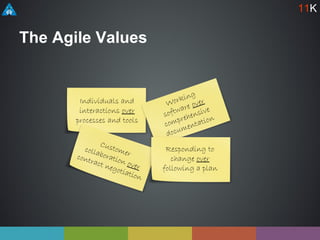
The Agile Values
Individuals and
interactions over
processes and tools
Responding to
change over
following a plan
11K
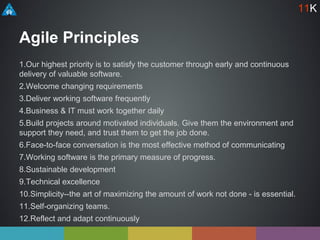
Agile Principles
1.Our highest priority is to satisfy the customer through early and continuous
delivery of valuable software.
2.Welcome changing requirements
3.Deliver working software frequently
4.Business & IT must work together daily
5.Build projects around motivated individuals. Give them the environment and
support they need, and trust them to get the job done.
6.Face-to-face conversation is the most effective method of communicating
7.Working software is the primary measure of progress.
8.Sustainable development
9.Technical excellence
10.Simplicity--the art of maximizing the amount of work not done - is essential.
11.Self-organizing teams.
12.Reflect and adapt continuously
11K
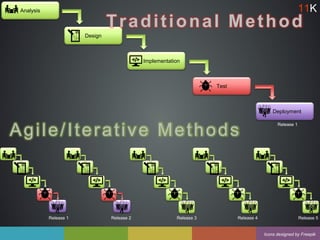
Icons designed by Freepik
Test
Design
Deployment
Analysis
Implementation
Release 1
11K
Traditional Method
Agile/Iterative Methods
Icons designed by Freepik
Release 1 Release 2 Release 3
Test
Design
Deployment
Analysis
Implementation
Release 1
Traditional Method
Release 4 Release 5
11K
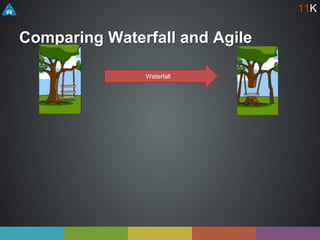
Comparing Waterfall and Agile
Waterfall
11K
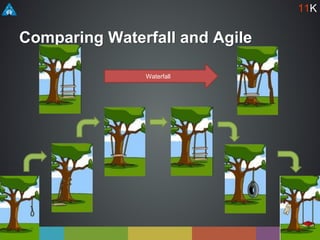
Comparing Waterfall and Agile
Waterfall
11K
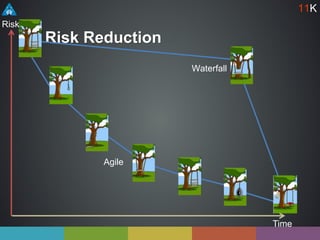
Risk Reduction
Waterfall
Agile
Time
Risk
11K
Lean & Agile Characteristics
1. Continuous Learning / Improvement
2. Frequent and Open Communication & Feedback
3. Collaborative Short Term Planning
4. Light Weight Ceremonies
5. Late Decisions and Early Delivery
6. Generative Rules & Empiricism
7. Integrity, Excellence & Quality
8. Transparency & Visualization (Workflow, Workload,
Problems and more…)
9. System’s Thinking
10.Trust, Respect, Autonomy & Self Organization
11K
Lean & Agile Characteristics
1. Continuous Learning / Improvement
2. Frequent and Open Communication & Feedback
3. Collaborative Short Term Planning
4. Light Weight Ceremonies
5. Late Decisions and Fast Delivery
6. Generative Rules & Empiricism
7. Integrity, Excellence & Quality
8. Transparency & Visualization (Workflow, Workload,
Problems and more…)
9. System’s Thinking
10.Trust, Respect, Autonomy & Self Organization
11K
”Learning is not mandatory,
neither is survival”
- W. Edward Demings
Why Lean and Agile?
We increase return on investment by making continuous flow of value our
focus.
We deliver reliable results by engaging customers in frequent interactions
and shared ownership.
We manage uncertainty by expecting it and adapts to it through iterations and
anticipation.
We unleash creativity and innovation by recognizing that individuals are the
ultimate source of value, and creating an environment where they can make a
difference.
We boost performance through group accountability for results and shared
responsibility for team effectiveness.
We improve effectiveness and reliability through situationally specific
strategies, processes and practices.
*Declaration of interdependance
11K
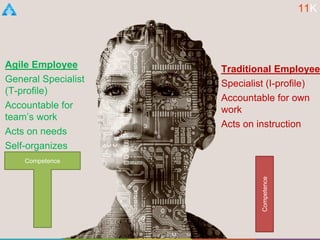
Traditional Employee
Specialist (I-profile)
Accountable for own
work
Acts on instruction
Agile Employee
General Specialist
(T-profile)
Accountable for
team’s work
Acts on needs
Self-organizes
Competence
Competence
11K
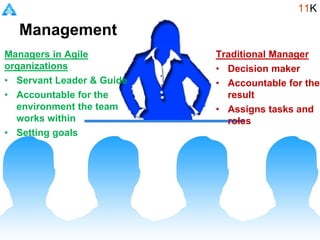
Management
Traditional Manager
• Decision maker
• Accountable for the
result
• Assigns tasks and
roles
Managers in Agile
organizations
• Servant Leader & Guide
• Accountable for the
environment the team
works within
• Setting goals
11K
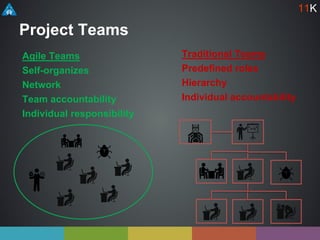
Project Teams
Agile Teams
Self-organizes
Network
Team accountability
Individual responsibility
Traditional Teams
Predefined roles
Hierarchy
Individual accountability
11K
Some example practices
A3 Analysis
Fist of Five
User Stories
Burndown charts
Cumulative Flow Charts
KanBan boards
Limiting WIP
Daily stand up meetings
Frequent retrospects
Real Options
Jidoka
Genchi Genbutsu
Cost of Delay
Dedicated business
representatives
Explicit rules
Visual workflow
Visualized workload
Rolling wave plan
Velocity
Story points
Time boxes
Autonomous teams
And many many more...
11K
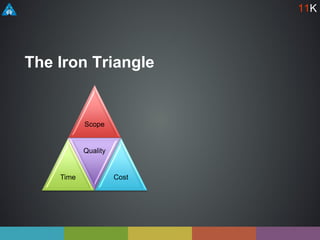
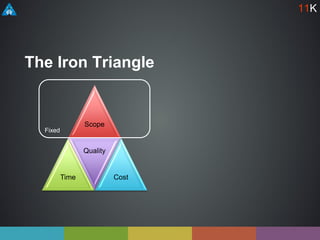
Scope
Time
Quality
Cost
The Iron Triangle
11K
Scope
Time
Quality
Cost
Fixed
The Iron Triangle
11K
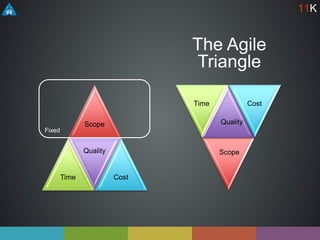
Scope
Time
Quality
Cost
Fixed
Time Cost
Quality
Scope
The Agile
Triangle
11K
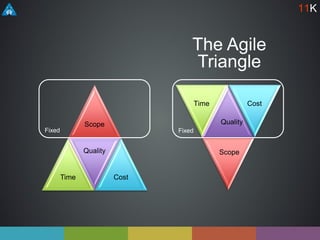
Scope
Time
Quality
Cost
Fixed
Time Cost
Quality
Scope
Fixed
The Agile
Triangle
11K
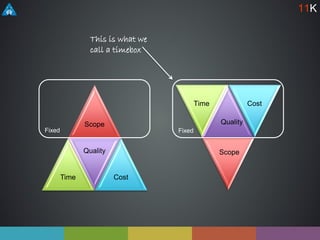
Scope
Time
Quality
Cost
Fixed
Time Cost
Quality
Scope
Fixed
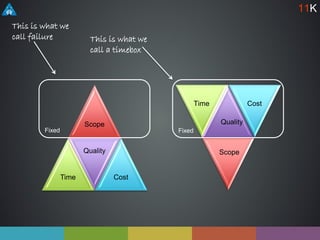
This is what we
call a timebox
11K
Scope
Time
Quality
Cost
Fixed
Time Cost
Quality
Scope
Fixed
This is what we
call failure This is what we
call a timebox
11K
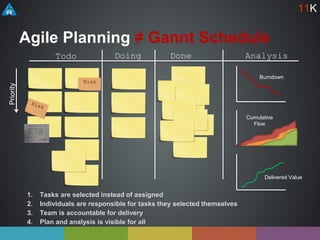
Agile Planning ≠ Gannt Schedule
Todo Doing Done Analysis
Priority
Burndown
Cumulative
Flow
Delivered Value
1. Tasks are selected instead of assigned
2. Individuals are responsible for tasks they selected themselves
3. Team is accountable for delivery
4. Plan and analysis is visible for all
Risk
11K
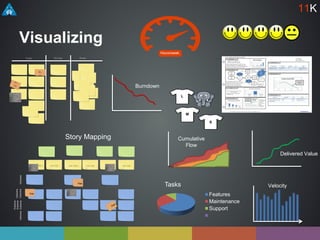
Visualizing
Burndown
Cumulative
Flow
Delivered Value
Todo Doing Done
Ri
sk
VelocityTasks
Features
Maintenance
Support
Hours/week
User step 1 User step
2
User step 3 User step
4
User step
5
User step
6
Risk
Risk
OutcomeOutcomeOutcomeOutcome
OutcomeOutcome
Outcome
Story Mapping
11K
L
M
S
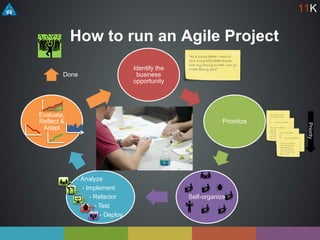
How to run an Agile Project
Identify the
business
opportunity
Prioritize
Self-organize
- Analyze
- Implement
- Refactor
- Test
- Deploy
Evaluate,
Reflect &
Adapt
”As a loving father I want to
have a nice affordable dinner
with my family so that I can go
to bed feeling good”
”As a loving father I
want to have a nice
affordable dinner
with my family so
that I can go to bed
feeling good”
”As a loving father I
want to have a nice
affordable dinner
with my family so
that I can go to bed
feeling good”
”As a loving father I
want to have a nice
affordable dinner
with my family so
that I can go to bed
feeling good”
”As a loving father I
want to have a nice
affordable dinner
with my family so
that I can go to bed
feeling good”
”As a loving father I
want to have a nice
affordable dinner
with my family so
that I can go to bed
feeling good”
”As a loving father I
want to have a nice
affordable dinner
with my family so
that I can go to bed
feeling good”
Priority
Done
11K
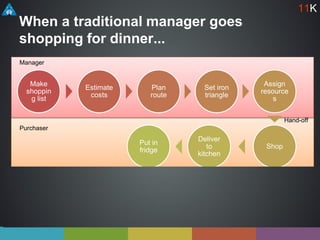
When a traditional manager goes
shopping for dinner...
Make
shoppin
g list
Estimate
costs
Plan
route
Set iron
triangle
Assign
resource
s
Shop
Deliver
to
kitchen
Put in
fridge
Fetch
goods
Start
cooking
Manager
Purchaser
Chef
Hand-off
Hand-off
11K
When a traditional manager goes
shopping for dinner...
Make
shoppin
g list
Estimate
costs
Plan
route
Set iron
triangle
Assign
resource
s
Shop
Deliver
to
kitchen
Put in
fridge
Fetch
goods
Start
cooking
Manager
Purchaser
Chef
Hand-off
Hand-off
11K
When a traditional manager goes
shopping for dinner...
Make
shoppin
g list
Estimate
costs
Plan
route
Set iron
triangle
Assign
resource
s
Shop
Deliver
to
kitchen
Put in
fridge
Fetch
goods
Start
cooking
Manager
Purchaser
Chef
Hand-off
Hand-off
11K
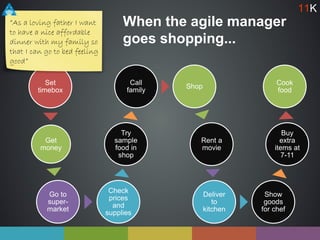
When the agile manager
goes shopping...
Set
timebox
Get
money
Go to
super-
market
Check
prices
and
supplies
Try
sample
food in
shop
Call
family
Shop
Rent a
movie
Deliver
to
kitchen
Show
goods
for chef
Buy
extra
items at
7-11
Cook
food
”As a loving father I want
to have a nice affordable
dinner with my family so
that I can go to bed feeling
good”
11K
How do You shop?
11K
When should I use Lean & Agile?
11K
When should I use Lean & Agile?
”You should only use Agile on
Projects you want to succeed”
11K
When should I use Lean & Agile?
”You should only use Agile on
Projects you want to succeed”
0
10
20
30
40
50
60
Traditional
Agile
11K
When should I use Lean & Agile?
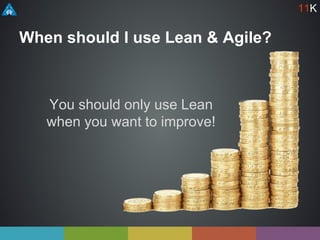
You should only use Lean
when you want to improve!
11K
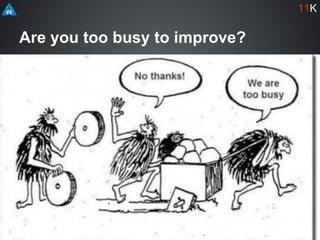
Are you too busy to improve?
11K
Who’s Lean & Agile
11K
Some Suggested Reading
http://buff.ly/1iK9UDm
Agile Middle East
• Community Organization promoting Lean and
Agile Development Practices in the Middle East
• Members from Saudi, UAE, Turkey, Egypt,
Lebanon and more
• Organizes Agile ME Summit on March 19
11K
Agile ME Summit 2016
http://2016.meagile.com/
11K
Agile Middle
East
info@meagile.com
https://agilemiddleeast.org/
Contact
Information
https://www.facebook.com/AgileMiddleEast
https://twitter.com/MEAgile
https://www.linkedin.com/groups?home=&gid=8133203
11K
Andreas
Hägglund
ah@11k.se
I run projects and
make organizations
more efficient
andreashagglund
@ahab1972
slideshare.net/andreashagglund
www.kravanalys.se
www.systemvaruhuset.se
11K
11K

Introducing lean and agile to heriot watt

  • 1.
    Andreas Hägglund I runprojects and make organizations more efficient Introducing Lean & Agile 11K slideshare.net/andreashagglund @ahab1972 andreashagglund
  • 2.
  • 3.
  • 4.
    1994 0 10 20 30 40 50 60 70 Success Challenged Failed Largecompanies Medium companies Small companies 11K
  • 5.
  • 6.
    Hint: Technology Is NotThe Problem! 11K
  • 7.
    Everything changes... • Requirements •Environment • Business • Technology • Competition • People • Tools Experience grows 11K Why?
  • 8.
  • 9.
    Changes Requires Communication AndWe’re No Good At It! 11K
  • 10.
  • 11.
    The solution? The CHAOSManifesto, Standish Group 2012 0 10 20 30 40 50 60 Success Challenged Failed Traditional Agile 11K
  • 12.
    It’s Not Easy! Complex Anarchy Technology Requirements Farfrom Agreement Close to Agreement Closeto Certainty Farfrom Certainty Simple 11K
  • 13.
    We Must Learn! EveryBusiness Unit is Becoming a Technology Startup In 2017, >50% of total IT spending will be outside of IT *Gartner, May 2015 11K
  • 14.
    You Should Too… By2018 digital business will drive a 500% boost in digital jobs Digital business is new business designs that blend the virtual world and the physical worlds, changing how processes and industries work through the Internet of Things. 11K
  • 15.
    Lean, Agile andrelated disciplines are spreading in all industries, all over the world 11K
  • 16.
    And soon itwill be in MENA ... 11K
  • 17.
    Is IT unique? Originalbudget Planned work from February 2005 to December 2008 (=34 months) Estimated cost: 876 Million USD Height: 728 m 11K
  • 18.
    Is IT unique? Originalbudget Planned work from February 2005 to December 2008 (=34 months) Estimated cost: 876 Million USD Height: 728 m Actual Outcome Actual work from September 2004 to September 2009 (=60 months) Cost: 1.500 Million USD Height: 828 m 11K
  • 19.
    Lean industries Lean Production,Lean Health Care, Lean Education, Lean Start Up, Lean Publishing, Lean IT, Lean Software Development, Lean UX, Lean Human Resources, Lean Marketing, Lean Government, Lean Sales, Lean Governance, Lean Manufacturing, Lean Thinking and more... 11K
  • 20.
  • 21.
  • 22.
    The 1% AgileFailures 11K
  • 23.
    Lean & AgileOrigins 2001 2003 Individuals and interactions over processes and tools Responding to change over following a plan Theory of Constraints 11K Chaos-report
  • 24.
    Principles of LeanManagement 1. Create Long Term Business Value 2. Continuous Learning / Improvements 3. Eliminate Waste 4. Increase Flow 5. Respect 11K Respect ReduceWaste IncreaseFlow Continous Improvemenet Value
  • 25.
    In short... Lean isabout maximizing customer value while minimizing waste. Simply, lean means creating more value for customers with fewer resources through continuous improvement. 11K
  • 26.
    Identify the valuestream... Invent service Set up organization Deliver service Bill client 11K
  • 27.
    ... and shortenit! Identify the value stream... Invent service Set up organization Deliver service Bill client 11K
  • 28.
  • 29.
    Improve the Flow Localoptimization Unnecessary documents Unnecessary queues & wait Multiple approvals Inadequate resources 11K
  • 30.
    By Reducing 7Wastes 1. Defects 2. Overproduction 3. Transportation 4. Waiting 5. Inventory 6. Motion 7. Processing (8. Unused Talent/Skill) Mura, Muri, Muda – Unevenness, Overburden, Waste 11K
  • 31.
    Lean Software Development 1.Eliminate waste 2. Amplify learning 3. Decide as late as possible 4. Deliver as fast as possible 5. Empower the team 6. Build quality in 7. See the whole 11K
  • 32.
    Now For SomeAgile Individuals and interactions over processes and tools Responding to change over following a plan 11K
  • 33.
    What is Agile? Well... Agileis not Happy Hacking It’s not unorganized It’s not unstructured It’s not unplanned It’s not undocumented It’s not undisciplined Fact is – It’s extremely disciplined 11K
  • 34.
    The Agile Onion AgileGoal (1) Agile Values (4) Agile Principles (12) Agile Methods (40+) Agile Techniques (200+) 11K
  • 35.
    Agile is abouthitting a moving (business) target 11K
  • 36.
    “At the endof the day, your job isn’t to execute a plan or get the requirements right — your job is to change the world” 11K
  • 37.
    The Agile Values Individualsand interactions over processes and tools Responding to change over following a plan 11K
  • 38.
    Agile Principles 1.Our highestpriority is to satisfy the customer through early and continuous delivery of valuable software. 2.Welcome changing requirements 3.Deliver working software frequently 4.Business & IT must work together daily 5.Build projects around motivated individuals. Give them the environment and support they need, and trust them to get the job done. 6.Face-to-face conversation is the most effective method of communicating 7.Working software is the primary measure of progress. 8.Sustainable development 9.Technical excellence 10.Simplicity--the art of maximizing the amount of work not done - is essential. 11.Self-organizing teams. 12.Reflect and adapt continuously 11K
  • 40.
    Icons designed byFreepik Test Design Deployment Analysis Implementation Release 1 11K Traditional Method
  • 41.
    Agile/Iterative Methods Icons designedby Freepik Release 1 Release 2 Release 3 Test Design Deployment Analysis Implementation Release 1 Traditional Method Release 4 Release 5 11K
  • 42.
    Comparing Waterfall andAgile Waterfall 11K
  • 43.
    Comparing Waterfall andAgile Waterfall 11K
  • 44.
  • 45.
    Lean & AgileCharacteristics 1. Continuous Learning / Improvement 2. Frequent and Open Communication & Feedback 3. Collaborative Short Term Planning 4. Light Weight Ceremonies 5. Late Decisions and Early Delivery 6. Generative Rules & Empiricism 7. Integrity, Excellence & Quality 8. Transparency & Visualization (Workflow, Workload, Problems and more…) 9. System’s Thinking 10.Trust, Respect, Autonomy & Self Organization 11K
  • 46.
    Lean & AgileCharacteristics 1. Continuous Learning / Improvement 2. Frequent and Open Communication & Feedback 3. Collaborative Short Term Planning 4. Light Weight Ceremonies 5. Late Decisions and Fast Delivery 6. Generative Rules & Empiricism 7. Integrity, Excellence & Quality 8. Transparency & Visualization (Workflow, Workload, Problems and more…) 9. System’s Thinking 10.Trust, Respect, Autonomy & Self Organization 11K ”Learning is not mandatory, neither is survival” - W. Edward Demings
  • 47.
    Why Lean andAgile? We increase return on investment by making continuous flow of value our focus. We deliver reliable results by engaging customers in frequent interactions and shared ownership. We manage uncertainty by expecting it and adapts to it through iterations and anticipation. We unleash creativity and innovation by recognizing that individuals are the ultimate source of value, and creating an environment where they can make a difference. We boost performance through group accountability for results and shared responsibility for team effectiveness. We improve effectiveness and reliability through situationally specific strategies, processes and practices. *Declaration of interdependance 11K
  • 48.
    Traditional Employee Specialist (I-profile) Accountablefor own work Acts on instruction Agile Employee General Specialist (T-profile) Accountable for team’s work Acts on needs Self-organizes Competence Competence 11K
  • 49.
    Management Traditional Manager • Decisionmaker • Accountable for the result • Assigns tasks and roles Managers in Agile organizations • Servant Leader & Guide • Accountable for the environment the team works within • Setting goals 11K
  • 50.
    Project Teams Agile Teams Self-organizes Network Teamaccountability Individual responsibility Traditional Teams Predefined roles Hierarchy Individual accountability 11K
  • 51.
    Some example practices A3Analysis Fist of Five User Stories Burndown charts Cumulative Flow Charts KanBan boards Limiting WIP Daily stand up meetings Frequent retrospects Real Options Jidoka Genchi Genbutsu Cost of Delay Dedicated business representatives Explicit rules Visual workflow Visualized workload Rolling wave plan Velocity Story points Time boxes Autonomous teams And many many more... 11K
  • 52.
  • 53.
  • 54.
  • 55.
  • 56.
  • 57.
    Scope Time Quality Cost Fixed Time Cost Quality Scope Fixed This iswhat we call failure This is what we call a timebox 11K
  • 58.
    Agile Planning ≠Gannt Schedule Todo Doing Done Analysis Priority Burndown Cumulative Flow Delivered Value 1. Tasks are selected instead of assigned 2. Individuals are responsible for tasks they selected themselves 3. Team is accountable for delivery 4. Plan and analysis is visible for all Risk 11K
  • 59.
    Visualizing Burndown Cumulative Flow Delivered Value Todo DoingDone Ri sk VelocityTasks Features Maintenance Support Hours/week User step 1 User step 2 User step 3 User step 4 User step 5 User step 6 Risk Risk OutcomeOutcomeOutcomeOutcome OutcomeOutcome Outcome Story Mapping 11K L M S
  • 60.
    How to runan Agile Project Identify the business opportunity Prioritize Self-organize - Analyze - Implement - Refactor - Test - Deploy Evaluate, Reflect & Adapt ”As a loving father I want to have a nice affordable dinner with my family so that I can go to bed feeling good” ”As a loving father I want to have a nice affordable dinner with my family so that I can go to bed feeling good” ”As a loving father I want to have a nice affordable dinner with my family so that I can go to bed feeling good” ”As a loving father I want to have a nice affordable dinner with my family so that I can go to bed feeling good” ”As a loving father I want to have a nice affordable dinner with my family so that I can go to bed feeling good” ”As a loving father I want to have a nice affordable dinner with my family so that I can go to bed feeling good” ”As a loving father I want to have a nice affordable dinner with my family so that I can go to bed feeling good” Priority Done 11K
  • 61.
    When a traditionalmanager goes shopping for dinner... Make shoppin g list Estimate costs Plan route Set iron triangle Assign resource s Shop Deliver to kitchen Put in fridge Fetch goods Start cooking Manager Purchaser Chef Hand-off Hand-off 11K
  • 62.
    When a traditionalmanager goes shopping for dinner... Make shoppin g list Estimate costs Plan route Set iron triangle Assign resource s Shop Deliver to kitchen Put in fridge Fetch goods Start cooking Manager Purchaser Chef Hand-off Hand-off 11K
  • 63.
    When a traditionalmanager goes shopping for dinner... Make shoppin g list Estimate costs Plan route Set iron triangle Assign resource s Shop Deliver to kitchen Put in fridge Fetch goods Start cooking Manager Purchaser Chef Hand-off Hand-off 11K
  • 64.
    When the agilemanager goes shopping... Set timebox Get money Go to super- market Check prices and supplies Try sample food in shop Call family Shop Rent a movie Deliver to kitchen Show goods for chef Buy extra items at 7-11 Cook food ”As a loving father I want to have a nice affordable dinner with my family so that I can go to bed feeling good” 11K
  • 65.
    How do Youshop? 11K
  • 66.
    When should Iuse Lean & Agile? 11K
  • 67.
    When should Iuse Lean & Agile? ”You should only use Agile on Projects you want to succeed” 11K
  • 68.
    When should Iuse Lean & Agile? ”You should only use Agile on Projects you want to succeed” 0 10 20 30 40 50 60 Traditional Agile 11K
  • 69.
    When should Iuse Lean & Agile? You should only use Lean when you want to improve! 11K
  • 70.
    Are you toobusy to improve? 11K
  • 71.
    Who’s Lean &Agile 11K
  • 72.
  • 73.
    Agile Middle East •Community Organization promoting Lean and Agile Development Practices in the Middle East • Members from Saudi, UAE, Turkey, Egypt, Lebanon and more • Organizes Agile ME Summit on March 19 11K
  • 74.
    Agile ME Summit2016 http://2016.meagile.com/ 11K
  • 75.
  • 76.
    Andreas Hägglund ah@11k.se I run projectsand make organizations more efficient andreashagglund @ahab1972 slideshare.net/andreashagglund www.kravanalys.se www.systemvaruhuset.se 11K
  • 77.