By Kendra Cherry
There are many different types of emotions that influence the way we live and interact
with others. At times, it may seem that we are governed by these emotions. The choices we
make, the actions we take and the perceptions we have are influenced by the emotions we
are experiencing at a given time.
Psychologists have also tried to identify the different types of emotions that people
experience. A few different theories have emerged to categorize and explain the emotions
that people feel.
Basic emotions
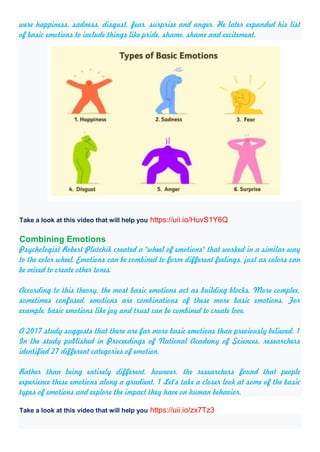
During the 1970s, psychologist Paul Eckman identified six basic emotions that he
suggested were universally experienced in all human cultures. The emotions he identified
were happiness, sadness, disgust, fear, surprise and anger. He later expanded his list
of basic emotions to include things like pride, shame, shame and excitement.
Take a look at this video that will help you https://uii.io/HuvS1Y6Q
Combining Emotions
Psychologist Robert Plutchik created a "wheel of emotions" that worked in a similar way
to the color wheel. Emotions can be combined to form different feelings, just as colors can
be mixed to create other tones.
According to this theory, the most basic emotions act as building blocks. More complex,
sometimes confused, emotions are combinations of these more basic emotions. For
example, basic emotions like joy and trust can be combined to create love.
A 2017 study suggests that there are far more basic emotions than previously believed. 1
In the study published in Proceedings of National Academy of Sciences, researchers
identified 27 different categories of emotion.
Rather than being entirely different, however, the researchers found that people
experience these emotions along a gradient. 1 Let's take a closer look at some of the basic
types of emotions and explore the impact they have on human behavior.
Take a look at this video that will help you https://uii.io/zx7Tz3
Happiness
Of all the different types of emotions, happiness tends to be the one that people strive for
the most. Happiness is usually defined as a pleasant emotional state, characterized by
feelings of contentment, joy, gratification, satisfaction and well-being.
Research on happiness has increased significantly since 1960 in several disciplines,
including the branch of psychology known as positive psychology. This type of emotion is
sometimes expressed through:
Facial expressions: how to smile
Body language: like a relaxed posture
Tone of voice: a cheerful and pleasant way of speaking
Although happiness is considered to be one of the basic human emotions, the things we
think will create happiness tend to be heavily influenced by culture. For example, the
influences of pop culture tend to emphasize that getting certain things, like buying a
house or having a well-paid job, will result in happiness.
The realities of what really contributes to happiness are often much more complex and
highly individualized. 2 People have long believed that happiness and health are
connected, and research supports the idea that happiness can play a role in both
physical and mental health.
Happiness has been associated with a variety of outcomes, including greater longevity
and greater marital satisfaction. 3 On the other hand, unhappiness has been linked to a
variety of poor health outcomes.
Stress, anxiety, depression and loneliness, for example, have been associated with factors
such as reduced immunity, increased inflammation and reduced life expectancy.
Take a look at this video that will help you https://uii.io/bnrIPci
Sadness
Sadness is another type of emotion that is often defined as a transient emotional state
characterized by feelings of disappointment, sadness, hopelessness, disinterest and
dejected mood.
Like other emotions, sadness is something that everyone experiences from time to time. In
some cases, people may experience prolonged and severe periods of sadness that can turn
into depression. Sadness can be expressed in several ways, including:
Crying
Moist mood
Lethargy
Tranquility
Withdrawal from others
The type and severity of sadness can vary depending on the root cause and how people
deal with these feelings can also be different.
Sadness can often lead people to become involved in coping mechanisms, such as avoiding
others, self-medicating and ruminating about negative thoughts. In fact, these behaviors
can exacerbate feelings of sadness and prolong the duration of the emotion.
Take a look at this video that will help you https://uii.io/gGaxGo
To fear
Fear is a powerful emotion that can also play an important role in survival. When you
face some kind of danger and feel fear, you experience what is known as a fight-or-flight
response.
Your muscles tense, your heart rate and breathing increase, and your mind becomes
more alert, preparing your body to escape danger or to stand and fight.
We are a family owned and operated business.
This response helps to ensure that you are prepared to deal effectively with the threats in
your environment. Expressions of this type of emotion can include:
Facial expressions: how to open your eyes and pull your chin back
Body language: try to hide or escape the threat
Physiological reactions: such as rapid breathing and heartbeat
Of course, not everyone experiences fear in the same way. Some people may be more
sensitive to fear and certain situations or objects may be more likely to trigger that
emotion.
Fear is the emotional response to an immediate threat. We can also develop a reaction
similar to anticipated threats or even to our thoughts about potential dangers, and this
is what we generally call anxiety. Social anxiety, for example, involves an anticipated
fear of social situations.
Some people, on the other hand, really look for situations that cause fear. Extreme sports
and other emotions can induce fear, but some people seem to be successful and even enjoy
such feelings.
Repeated exposure to an object or situation of fear can lead to familiarity and
acclimatization, which can reduce feelings of fear and anxiety.
This is the idea behind exposure therapy, in which people are gradually exposed to the
things that scare them in a controlled and safe way. Eventually, the feelings of fear
begin to subside.
Take a look at this video that will help you https://uii.io/TrswhZc
Disgust
Repulsion is another of the six original basic emotions described by Eckman. Disgust can
be demonstrated in several ways, including:
Body language: moving away from the object of disgust
Physical reactions: like vomiting or retching
Facial expressions: how to wrinkle your nose and curl your upper lip
This feeling of disgust can stem from a number of things, including unpleasant taste,
sight, or smell. The researchers believe that this emotion evolved as a reaction to foods
that can be harmful or fatal. When people smell or taste bad food, for example, disgust
is a typical reaction.
Poor hygiene, infection, blood, rot and death can also trigger a reaction of disgust. This
may be the body's way of avoiding things that can transmit communicable diseases.
People may also experience moral disgust when they see other people engaging in
behavior that they consider unpleasant, immoral or evil.
Take a look at this video that will help you https://uii.io/KFKa
Anger
Anger can be a particularly powerful emotion characterized by feelings of hostility,
agitation, frustration and antagonism towards others. Like fear, anger can play a role
in your body's fight-or-flight response.
When a threat generates feelings of anger, you may be inclined to defend yourself from
danger and protect yourself. Anger is usually exhibited through:
Facial expressions: like a frown or angry look
Body language: how to take a firm stance or walk away
Tone of voice: how to speak hoarse or shout
Physiological responses: how to sweat or turn red
Aggressive behaviors: how to hit, kick or throw objects
Although anger is often considered a negative emotion, it can sometimes be a good thing.
It can be constructive to help clarify your needs in a relationship and can also motivate
you to take action and find solutions to things that are bothering you.
Anger can become a problem, however, when it is excessive or expressed in ways that are
not healthy, dangerous or harmful to others. Uncontrolled anger can quickly turn into
aggression, abuse or violence.
This kind of emotion can have mental and physical consequences. Uncontrolled anger
can hamper rational decision-making and may even have an impact on your physical
health.
Anger has been linked to coronary heart disease and diabetes. It has also been
associated with behaviors that pose health risks, such as aggressive driving, alcohol
consumption and smoking.
Take a look at this video that will help you https://uii.io/f0vDgQJy
Surprise
Surprise is another of the six basic types of human emotions originally described by
Eckman. The surprise is usually quite brief and is characterized by a startling
physiological response after something unexpected.
This type of emotion can be positive, negative or neutral. An unpleasant surprise, for
example, can involve someone jumping from behind a tree and scaring you while walking
to your car at night.
An example of a pleasant surprise would be to come home and find that your closest
friends have gathered to celebrate your birthday. Surprise is usually characterized by:
Facial expressions: how to raise your eyebrows, open your eyes and open your mouth
Physical responses: how to jump back
Verbal reactions: how to scream, shout or choke
Surprise is another type of emotion that can trigger the fight or flight response. When
frightened, people can experience an adrenaline rush that helps prepare the body to fight
or flee.
Surprise can have important effects on human behavior. For example, research has
shown that people tend to notice surprising events disproportionately.
That is why surprising and unusual events in the news tend to stand out more in
memory than others. The survey also found that people tend to be more influenced by
surprising arguments and learn more from surprising information.
Take a look at this video that will help you https://uii.io/Cq5R
Other types of emotions
The six basic emotions described by Eckman are just one part of the many different types
of emotions that people are able to experience. Eckman's theory suggests that these
central emotions are universal in all cultures around the world.
However, other theories and new research continue to explore the many different types of
emotions and how they are classified. Eckman later added a number of other emotions to
his list, but suggested that, unlike his original six emotions, not all of them could
necessarily be encoded using facial expressions. Some of the emotions he later identified
included:
Fun
Contempt
Contentment
Embarrassment
Excitement
Fault
Pride in achievements
Relief
Satisfaction
Shame
Other theories of emotion
As with many concepts in psychology, not all theorists agree on how to classify emotions
or what basic emotions are. Although Eckman's theory is one of the best known, other
theorists have proposed their own ideas about which emotions are at the heart of human
experience.
For example, some researchers have suggested that there are only two or three basic
emotions. Others have suggested that emotions exist in a kind of hierarchy. Primary
emotions like love, joy, surprise, anger and sadness can be subdivided into secondary
emotions. Love, for example, consists of secondary emotions, such as affection and
longing.
These secondary emotions can then be further subdivided into what is known as tertiary
emotions. The secondary emotion of affection includes tertiary emotions, such as liking,
caring, compassion and tenderness.
A more recent study suggests that there are at least 27 different emotions, all highly
interconnected.
After analyzing the responses of more than 800 men to more than 2,000 video clips, the
researchers created an interactive map to demonstrate how these emotions are related to
each other.
"We found that 27 different dimensions, not six, were needed to explain the way hundreds
of people reliably reported feelings in response to each video," explained senior researcher
Dacher Keltner, director of the Greater Good Science Center.
In other words, emotions are not states that occur in isolation. Instead, the study
suggests that there are gradients of emotion and that these different feelings are deeply
interrelated.
Alan Cowen, the study's lead author and PhD student in neuroscience at UC Berkeley,
suggests that better clarifying the nature of our emotions can play an important role in
helping scientists, psychologists and doctors to learn more about how emotions underlie
brain activity, behavior and mood. By building a better understanding of these states, he
hopes that researchers can develop better treatments for psychiatric conditions.
A word from Verywell
Emotions play a critical role in how we live our lives, from influencing how we engage
with other people in our daily lives to affecting the decisions we make. By understanding
some of the different types of emotions, you can gain a deeper understanding of how
those emotions are expressed and the impact they have on your behavior.
It is important to remember, however, that no emotion is an island. Instead, the many
emotions you experience are nuanced and complex, working together to create the rich and
varied structure of your emotional life.

The 3 types of basic emotions

  • 1.
    By Kendra Cherry Thereare many different types of emotions that influence the way we live and interact with others. At times, it may seem that we are governed by these emotions. The choices we make, the actions we take and the perceptions we have are influenced by the emotions we are experiencing at a given time. Psychologists have also tried to identify the different types of emotions that people experience. A few different theories have emerged to categorize and explain the emotions that people feel. Basic emotions During the 1970s, psychologist Paul Eckman identified six basic emotions that he suggested were universally experienced in all human cultures. The emotions he identified
  • 2.
    were happiness, sadness,disgust, fear, surprise and anger. He later expanded his list of basic emotions to include things like pride, shame, shame and excitement. Take a look at this video that will help you https://uii.io/HuvS1Y6Q Combining Emotions Psychologist Robert Plutchik created a "wheel of emotions" that worked in a similar way to the color wheel. Emotions can be combined to form different feelings, just as colors can be mixed to create other tones. According to this theory, the most basic emotions act as building blocks. More complex, sometimes confused, emotions are combinations of these more basic emotions. For example, basic emotions like joy and trust can be combined to create love. A 2017 study suggests that there are far more basic emotions than previously believed. 1 In the study published in Proceedings of National Academy of Sciences, researchers identified 27 different categories of emotion. Rather than being entirely different, however, the researchers found that people experience these emotions along a gradient. 1 Let's take a closer look at some of the basic types of emotions and explore the impact they have on human behavior. Take a look at this video that will help you https://uii.io/zx7Tz3
  • 3.
    Happiness Of all thedifferent types of emotions, happiness tends to be the one that people strive for the most. Happiness is usually defined as a pleasant emotional state, characterized by feelings of contentment, joy, gratification, satisfaction and well-being. Research on happiness has increased significantly since 1960 in several disciplines, including the branch of psychology known as positive psychology. This type of emotion is sometimes expressed through: Facial expressions: how to smile Body language: like a relaxed posture Tone of voice: a cheerful and pleasant way of speaking Although happiness is considered to be one of the basic human emotions, the things we think will create happiness tend to be heavily influenced by culture. For example, the influences of pop culture tend to emphasize that getting certain things, like buying a house or having a well-paid job, will result in happiness. The realities of what really contributes to happiness are often much more complex and highly individualized. 2 People have long believed that happiness and health are connected, and research supports the idea that happiness can play a role in both physical and mental health. Happiness has been associated with a variety of outcomes, including greater longevity and greater marital satisfaction. 3 On the other hand, unhappiness has been linked to a variety of poor health outcomes. Stress, anxiety, depression and loneliness, for example, have been associated with factors such as reduced immunity, increased inflammation and reduced life expectancy. Take a look at this video that will help you https://uii.io/bnrIPci Sadness Sadness is another type of emotion that is often defined as a transient emotional state characterized by feelings of disappointment, sadness, hopelessness, disinterest and dejected mood. Like other emotions, sadness is something that everyone experiences from time to time. In some cases, people may experience prolonged and severe periods of sadness that can turn into depression. Sadness can be expressed in several ways, including:
  • 4.
    Crying Moist mood Lethargy Tranquility Withdrawal fromothers The type and severity of sadness can vary depending on the root cause and how people deal with these feelings can also be different. Sadness can often lead people to become involved in coping mechanisms, such as avoiding others, self-medicating and ruminating about negative thoughts. In fact, these behaviors can exacerbate feelings of sadness and prolong the duration of the emotion. Take a look at this video that will help you https://uii.io/gGaxGo To fear Fear is a powerful emotion that can also play an important role in survival. When you face some kind of danger and feel fear, you experience what is known as a fight-or-flight response. Your muscles tense, your heart rate and breathing increase, and your mind becomes more alert, preparing your body to escape danger or to stand and fight. We are a family owned and operated business. This response helps to ensure that you are prepared to deal effectively with the threats in your environment. Expressions of this type of emotion can include: Facial expressions: how to open your eyes and pull your chin back Body language: try to hide or escape the threat Physiological reactions: such as rapid breathing and heartbeat Of course, not everyone experiences fear in the same way. Some people may be more sensitive to fear and certain situations or objects may be more likely to trigger that emotion. Fear is the emotional response to an immediate threat. We can also develop a reaction similar to anticipated threats or even to our thoughts about potential dangers, and this is what we generally call anxiety. Social anxiety, for example, involves an anticipated fear of social situations. Some people, on the other hand, really look for situations that cause fear. Extreme sports and other emotions can induce fear, but some people seem to be successful and even enjoy such feelings.
  • 5.
    Repeated exposure toan object or situation of fear can lead to familiarity and acclimatization, which can reduce feelings of fear and anxiety. This is the idea behind exposure therapy, in which people are gradually exposed to the things that scare them in a controlled and safe way. Eventually, the feelings of fear begin to subside. Take a look at this video that will help you https://uii.io/TrswhZc Disgust Repulsion is another of the six original basic emotions described by Eckman. Disgust can be demonstrated in several ways, including: Body language: moving away from the object of disgust Physical reactions: like vomiting or retching Facial expressions: how to wrinkle your nose and curl your upper lip This feeling of disgust can stem from a number of things, including unpleasant taste, sight, or smell. The researchers believe that this emotion evolved as a reaction to foods that can be harmful or fatal. When people smell or taste bad food, for example, disgust is a typical reaction. Poor hygiene, infection, blood, rot and death can also trigger a reaction of disgust. This may be the body's way of avoiding things that can transmit communicable diseases. People may also experience moral disgust when they see other people engaging in behavior that they consider unpleasant, immoral or evil. Take a look at this video that will help you https://uii.io/KFKa Anger Anger can be a particularly powerful emotion characterized by feelings of hostility, agitation, frustration and antagonism towards others. Like fear, anger can play a role in your body's fight-or-flight response. When a threat generates feelings of anger, you may be inclined to defend yourself from danger and protect yourself. Anger is usually exhibited through: Facial expressions: like a frown or angry look Body language: how to take a firm stance or walk away Tone of voice: how to speak hoarse or shout
  • 6.
    Physiological responses: howto sweat or turn red Aggressive behaviors: how to hit, kick or throw objects Although anger is often considered a negative emotion, it can sometimes be a good thing. It can be constructive to help clarify your needs in a relationship and can also motivate you to take action and find solutions to things that are bothering you. Anger can become a problem, however, when it is excessive or expressed in ways that are not healthy, dangerous or harmful to others. Uncontrolled anger can quickly turn into aggression, abuse or violence. This kind of emotion can have mental and physical consequences. Uncontrolled anger can hamper rational decision-making and may even have an impact on your physical health. Anger has been linked to coronary heart disease and diabetes. It has also been associated with behaviors that pose health risks, such as aggressive driving, alcohol consumption and smoking. Take a look at this video that will help you https://uii.io/f0vDgQJy Surprise Surprise is another of the six basic types of human emotions originally described by Eckman. The surprise is usually quite brief and is characterized by a startling physiological response after something unexpected. This type of emotion can be positive, negative or neutral. An unpleasant surprise, for example, can involve someone jumping from behind a tree and scaring you while walking to your car at night. An example of a pleasant surprise would be to come home and find that your closest friends have gathered to celebrate your birthday. Surprise is usually characterized by: Facial expressions: how to raise your eyebrows, open your eyes and open your mouth Physical responses: how to jump back Verbal reactions: how to scream, shout or choke Surprise is another type of emotion that can trigger the fight or flight response. When frightened, people can experience an adrenaline rush that helps prepare the body to fight or flee. Surprise can have important effects on human behavior. For example, research has shown that people tend to notice surprising events disproportionately.
  • 7.
    That is whysurprising and unusual events in the news tend to stand out more in memory than others. The survey also found that people tend to be more influenced by surprising arguments and learn more from surprising information. Take a look at this video that will help you https://uii.io/Cq5R Other types of emotions The six basic emotions described by Eckman are just one part of the many different types of emotions that people are able to experience. Eckman's theory suggests that these central emotions are universal in all cultures around the world. However, other theories and new research continue to explore the many different types of emotions and how they are classified. Eckman later added a number of other emotions to his list, but suggested that, unlike his original six emotions, not all of them could necessarily be encoded using facial expressions. Some of the emotions he later identified included: Fun Contempt Contentment Embarrassment Excitement Fault Pride in achievements Relief Satisfaction Shame Other theories of emotion As with many concepts in psychology, not all theorists agree on how to classify emotions or what basic emotions are. Although Eckman's theory is one of the best known, other theorists have proposed their own ideas about which emotions are at the heart of human experience. For example, some researchers have suggested that there are only two or three basic emotions. Others have suggested that emotions exist in a kind of hierarchy. Primary emotions like love, joy, surprise, anger and sadness can be subdivided into secondary emotions. Love, for example, consists of secondary emotions, such as affection and longing.
  • 8.
    These secondary emotionscan then be further subdivided into what is known as tertiary emotions. The secondary emotion of affection includes tertiary emotions, such as liking, caring, compassion and tenderness. A more recent study suggests that there are at least 27 different emotions, all highly interconnected. After analyzing the responses of more than 800 men to more than 2,000 video clips, the researchers created an interactive map to demonstrate how these emotions are related to each other. "We found that 27 different dimensions, not six, were needed to explain the way hundreds of people reliably reported feelings in response to each video," explained senior researcher Dacher Keltner, director of the Greater Good Science Center. In other words, emotions are not states that occur in isolation. Instead, the study suggests that there are gradients of emotion and that these different feelings are deeply interrelated. Alan Cowen, the study's lead author and PhD student in neuroscience at UC Berkeley, suggests that better clarifying the nature of our emotions can play an important role in helping scientists, psychologists and doctors to learn more about how emotions underlie brain activity, behavior and mood. By building a better understanding of these states, he hopes that researchers can develop better treatments for psychiatric conditions. A word from Verywell Emotions play a critical role in how we live our lives, from influencing how we engage with other people in our daily lives to affecting the decisions we make. By understanding some of the different types of emotions, you can gain a deeper understanding of how those emotions are expressed and the impact they have on your behavior. It is important to remember, however, that no emotion is an island. Instead, the many emotions you experience are nuanced and complex, working together to create the rich and varied structure of your emotional life.