









The 3 biggest digital developments for 2016
Extreme Connectivity, Customer Centricity & Data Driven Ecosystems
by Bastiaan Neurink & Leo Bekhuis
Our world is becoming
more digital and context aware
Our way of life is
becoming smarter
And the customer experience
we expect from brands
is changing
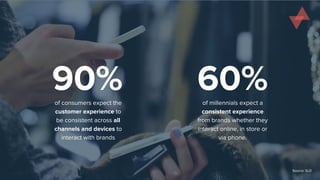
90% 60%of consumers expect the
customer experience to
be consistent across all
channels and devices to
interact with brands
of millennials expect a
consistent experience
from brands whether they
interact online, in store or
via phone.
Source: SLD
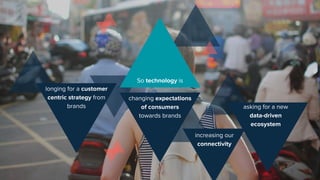
So technology is
changing expectations
of consumers
towards brands
increasing our
connectivity
longing for a customer
centric strategy from
brands asking for a new
data-driven
ecosystem
#1
Social Sharing &
Extreme Connectivity
The (social) sharing
economy is rapidly
increasing due to new
technologies
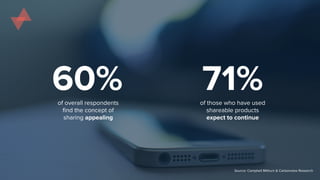
60% 71%
Source: Campbell Mithurn & Carbonview Research
of overall respondents
find the concept of
sharing appealing
of those who have used
shareable products
expect to continue
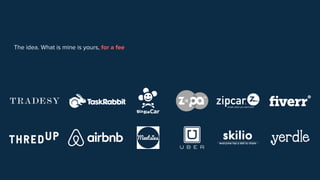
The idea. What is mine is yours, for a fee
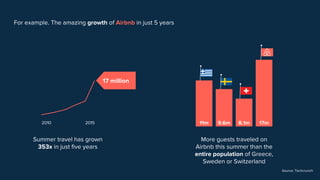
For example. The amazing growth of Airbnb in just 5 years
20152010
Summer travel has grown
353x in just five years
17 million
More guests traveled on
Airbnb this summer than the
entire population of Greece,
Sweden or Switzerland
11m 9.6m 8.1m 17m
Source: Techcrunch
Only it isn’t new, we’ve been sharing stuff for ages.
Like clothes with your best friend or relative
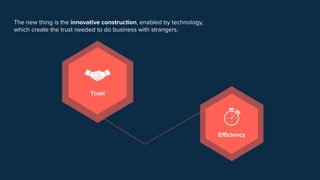
The new thing is the innovative construction, enabled by technology,
which creates the trust needed to do business with strangers.
Trust
Efficiency
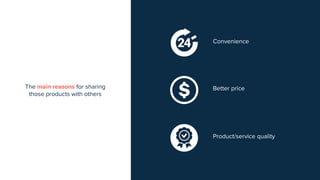
The main reasons for sharing
those products with others
Convenience
Better price
Product/service quality
And it won’t stop here, new fields will open up!
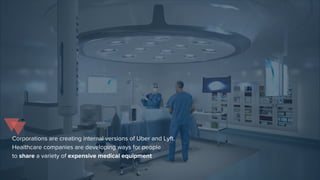
Corporations are creating internal versions of Uber and Lyft.
Healthcare companies are developing ways for people
to share a variety of expensive medical equipment
Plenty of opportunities for services to create an engaging,
all-in-one user experience, even in the crowded markets.
Source: Steven van Belleghem
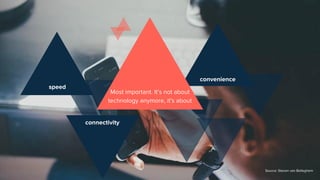
Most important. It’s not about
technology anymore, it’s about
convenience
speed
connectivity
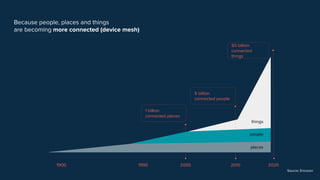
Because people, places and things
are becoming more connected (device mesh)
Source: Ericsson
places
people
things
50 billion
connected
things
1 billion
connected places
5 billion
connected people
2000 2010 202019901900
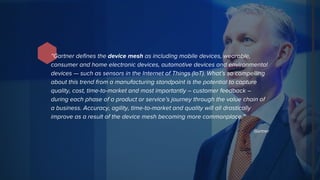
“Gartner defines the device mesh as including mobile devices, wearable,
consumer and home electronic devices, automotive devices and environmental
devices — such as sensors in the Internet of Things (IoT). What’s so compelling
about this trend from a manufacturing standpoint is the potential to capture
quality, cost, time-to-market and most importantly – customer feedback –
during each phase of a product or service’s journey through the value chain of
a business. Accuracy, agility, time-to-market and quality will all drastically
improve as a result of the device mesh becoming more commonplace.”
Gartner
As we get more and more connected
our ways of communication will be
faster. Our time to communicate with
each other will decrease dramatically
while our expectations towards
companies reaction speed grow
rapidly.
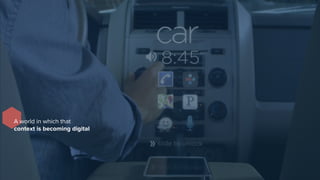
We’re moving towards holistic connectivity in our world
based on the context we’re in.
A world in which that
context is becoming digital
People, knowledge, devices, and information are networked
for the growth of society, life and business
Source: Ericsson
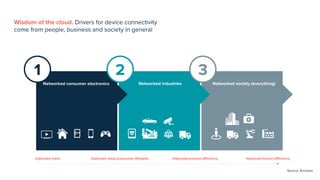
1 2 3
Improved reach Improved value (consumer lifestyle) Improved process efficiency Improved human efficiency
Networked consumer electronics Networked industries Networked society (everything)
Wisdom of the cloud. Drivers for device connectivity
come from people, business and society in general
Source: Ericsson
It’s more than a networked society based on connectivity.
A better customer experience is mandatory and that calls for a customer centric strategy.
#2
Customer Centricity
It’s becoming more and more important to have a customer centric focus
in your company’s vision and daily processes
But too often you see companies working on the short-term sales
instead of the long-term customer experience
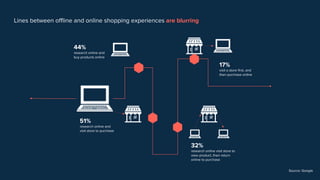
Lines between offline and online shopping experiences are blurring
17%
visit a store first, and
then purchase online
32%
research online, visit store to
view product, then return
online to purchase
51%
research online and
visit store to purchase
44%
research online and
buy products online
Source: Google
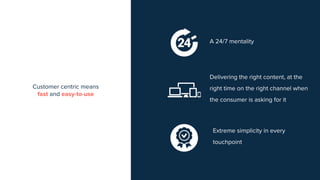
Customer centric means
fast and easy-to-use
A 24/7 mentality
Delivering the right content, at the
right time on the right channel when
the consumer is asking for it
Extreme simplicity in every
touchpoint
Digital transformation in the age of the customer. With customers in control of their interactions with
brands, businesses must create positive and relevant customer experiences across channels and
touchpoints.
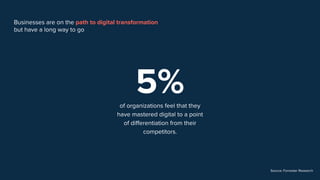
5%of organizations feel that they
have mastered digital to a point
of differentiation from their
competitors.
Businesses are on the path to digital transformation
but have a long way to go
Source: Forrester Research
We know that a full customer-centric marketing strategy doesn’t happen overnight.
It requires organizational changes, new processes, other tools and platforms
But most of all a new mindset whereby the customer, his buying journey,
individual preferences and life cycle take centre stage for everything we do as companies.
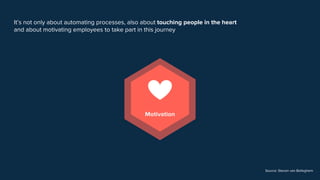
It’s not only about automating processes, also about touching people’s hearts
and about motivating employees to take part in this journey
Source: Steven van Belleghem
Motivation
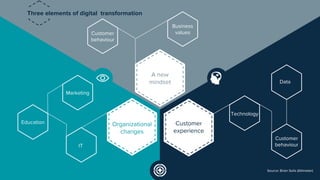
Source: Brian Solis (Altimeter)
Organizational
changes
Customer
experience
A new
mindset Data
Technology
Customer
behaviour
Customer
behaviour
Business
values
IT
Education
Marketing
Three elements of digital transformation
But don’t forget to put the customer at the heart of the digital transformation.
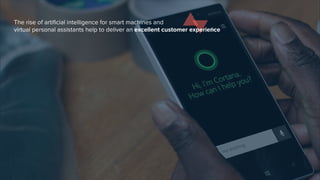
The rise of artificial intelligence for smart machines and
virtual personal assistants help to deliver an excellent customer experience
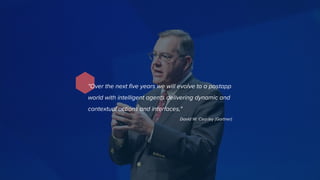
"Over the next five years we will evolve to a postapp
world with intelligent agents delivering dynamic and
contextual actions and interfaces,"
David W. Cearley (Gartner)
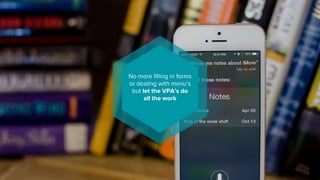
No more filling in forms
or dealing with menu’s
but let the VPA’s do
all the work
#3
Data-driven
ecosystems
Whether we're looking for coffee, clothes or a vacation in Mexico,
the internet has changed how we decide what to buy and when to buy.
And we get to a point where we can push customers into a direction, based on behavorial data,
before that behavior will even occur.
Across the three dimensions of digital transformation — organization, operational process, and
technology — businesses are working hard on making steps in creating a better customer experience.
But companies are
struggling with their
traditional way of
working. Delivering an
average digital
experience.
With limited understanding of their customers, and little knowhow on how to get useful insights,
how to turn those insights into actionable steps, and get measurable results.
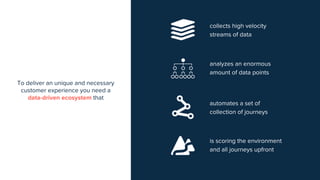
To deliver a unique and necessary
customer experience you need a
data-driven ecosystem that;
collects high velocity
streams of data
analyzes an enormous
amount of data points
automates a set of
collection of journeys
is scoring the environment
and all journeys upfront
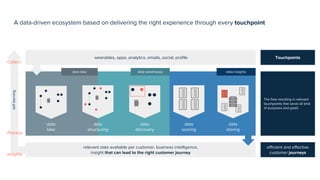
A data-driven ecosystem based on delivering the right experience through every touchpoint
data
structuring
data lake data warehouse data insights
wearables, apps, analytics, emails, social, profile
relevant data avaliable per customer, business intelligence,
insight that can lead to the right customer journey
Collect
Process
Insights
data
lake
data
scoring
data
storing
data
discovery
The flow resulting in relevant
touchpoints that serve all kind
of purposes and goals
Touchpoints
efficient and effective
customer journeys
selflearning
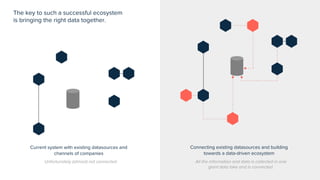
Current system with existing datasources and
channels of companies
Unfortunately (almost) not connected
Connecting existing datasources and building
towards a data-driven ecosystem
All the information and data is collected in one
giant data lake and is connected.
The key to such a successful ecosystem
is bringing the right data together.
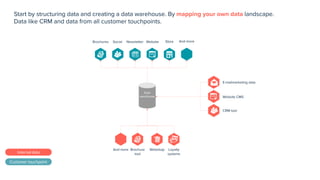
Start by structuring data and creating a data warehouse. By mapping your own data landscape.
Data like CRM and data from all customer touchpoints.
Internal data
Customer touchpoint
Newsletter Website Store And more
Data
warehouse
E-mailmarketing data
Website CMS
CRM tool
Brochures
Loyalty
systems
Social
WebshopBrochure
tool
And more
Internal data
Customer touchpoint
External data
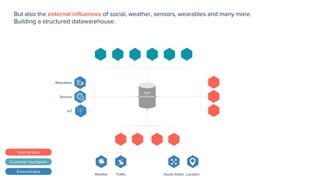
But also the external influences of social, weather, sensors, wearables and many more.
Building a structured datawarehouse.
Data
warehouse
Wearables
Sensors
Weather Traffic
IoT
Social media Location
You’ll need a datawarehouse where you can combine all those datasets.
Microsoft and IBM are already working on a CRM service built to handle IoT
Datawarehouse companies are able to create dynamic journeys
based on more relevant insights and analytics.
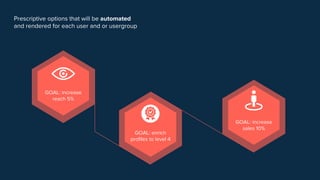
Prescriptive options that will be automated
and rendered for each user and or usergroup
GOAL: enrich
profiles to level 4
GOAL: increase
sales 10%
GOAL: increase
reach 5%
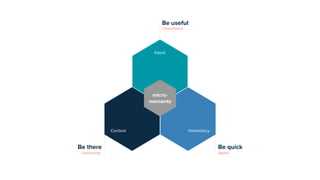
And with the goal to add value to end users through micromoments
and also receive useful feedback
Be there
Be useful
Be quick
SpeedConnectivity
Convenience
Context
micro-
moments
Intent
Immediacy
Mobile and wearables have changed the way we live, and has forever changed what we expect of brands.
It has fractured the consumer journey into hundreds of real-time, intent-driven micro-moments.
Each one is a critical opportunity for brands to shape our decisions and preferences.
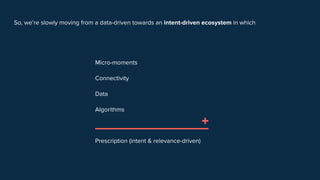
So, we’re slowly moving from a data-driven towards an intent-driven ecosystem in which
Micro-moments
Connectivity
Data
Algorithms
Prescription (intent & relevance-driven)
+
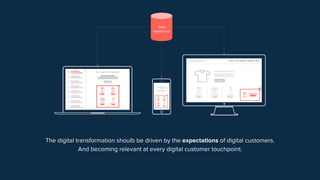
The digital transformation should be driven by the expectations of digital customers.
And becoming relevant at every digital customer touchpoint.
Data
warehouse
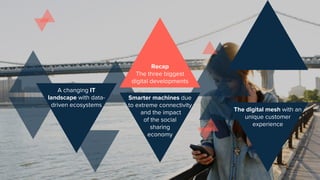
Recap
The three biggest
digital developments
A changing IT
landscape with data-
driven ecosystems
The digital mesh with a
unique customer
experience
Smarter machines due
to extreme connectivity
and the impact
of the social
sharing
economy
Bastiaan Neurink
Leo Bekhuis
Thank you

The 3 Biggest Digital Marketing Developments For 2016 | Extreme Connectivity | Customer Centricity | Data-Driven Ecosystems

  • 1.
    The 3 biggestdigital developments for 2016 Extreme Connectivity, Customer Centricity & Data Driven Ecosystems by Bastiaan Neurink & Leo Bekhuis
  • 2.
    Our world isbecoming more digital and context aware
  • 3.
    Our way oflife is becoming smarter
  • 4.
    And the customerexperience we expect from brands is changing
  • 5.
    90% 60%of consumersexpect the customer experience to be consistent across all channels and devices to interact with brands of millennials expect a consistent experience from brands whether they interact online, in store or via phone. Source: SLD
  • 6.
    So technology is changingexpectations of consumers towards brands increasing our connectivity longing for a customer centric strategy from brands asking for a new data-driven ecosystem
  • 7.
  • 8.
    The (social) sharing economyis rapidly increasing due to new technologies
  • 9.
    60% 71% Source: CampbellMithurn & Carbonview Research of overall respondents find the concept of sharing appealing of those who have used shareable products expect to continue
  • 10.
    The idea. Whatis mine is yours, for a fee
  • 11.
    For example. Theamazing growth of Airbnb in just 5 years 20152010 Summer travel has grown 353x in just five years 17 million More guests traveled on Airbnb this summer than the entire population of Greece, Sweden or Switzerland 11m 9.6m 8.1m 17m Source: Techcrunch
  • 12.
    Only it isn’tnew, we’ve been sharing stuff for ages. Like clothes with your best friend or relative
  • 13.
    The new thingis the innovative construction, enabled by technology, which creates the trust needed to do business with strangers. Trust Efficiency
  • 14.
    The main reasonsfor sharing those products with others Convenience Better price Product/service quality
  • 15.
    And it won’tstop here, new fields will open up!
  • 16.
    Corporations are creatinginternal versions of Uber and Lyft. Healthcare companies are developing ways for people to share a variety of expensive medical equipment
  • 17.
    Plenty of opportunitiesfor services to create an engaging, all-in-one user experience, even in the crowded markets.
  • 18.
    Source: Steven vanBelleghem Most important. It’s not about technology anymore, it’s about convenience speed connectivity
  • 19.
    Because people, placesand things are becoming more connected (device mesh) Source: Ericsson places people things 50 billion connected things 1 billion connected places 5 billion connected people 2000 2010 202019901900
  • 20.
    “Gartner defines thedevice mesh as including mobile devices, wearable, consumer and home electronic devices, automotive devices and environmental devices — such as sensors in the Internet of Things (IoT). What’s so compelling about this trend from a manufacturing standpoint is the potential to capture quality, cost, time-to-market and most importantly – customer feedback – during each phase of a product or service’s journey through the value chain of a business. Accuracy, agility, time-to-market and quality will all drastically improve as a result of the device mesh becoming more commonplace.” Gartner
  • 21.
    As we getmore and more connected our ways of communication will be faster. Our time to communicate with each other will decrease dramatically while our expectations towards companies reaction speed grow rapidly.
  • 22.
    We’re moving towardsholistic connectivity in our world based on the context we’re in.
  • 23.
    A world inwhich that context is becoming digital
  • 24.
    People, knowledge, devices,and information are networked for the growth of society, life and business Source: Ericsson
  • 25.
    1 2 3 Improvedreach Improved value (consumer lifestyle) Improved process efficiency Improved human efficiency Networked consumer electronics Networked industries Networked society (everything) Wisdom of the cloud. Drivers for device connectivity come from people, business and society in general Source: Ericsson
  • 26.
    It’s more thana networked society based on connectivity. A better customer experience is mandatory and that calls for a customer centric strategy.
  • 27.
  • 28.
    It’s becoming moreand more important to have a customer centric focus in your company’s vision and daily processes
  • 29.
    But too oftenyou see companies working on the short-term sales instead of the long-term customer experience
  • 30.
    Lines between offlineand online shopping experiences are blurring 17% visit a store first, and then purchase online 32% research online, visit store to view product, then return online to purchase 51% research online and visit store to purchase 44% research online and buy products online Source: Google
  • 31.
    Customer centric means fastand easy-to-use A 24/7 mentality Delivering the right content, at the right time on the right channel when the consumer is asking for it Extreme simplicity in every touchpoint
  • 32.
    Digital transformation inthe age of the customer. With customers in control of their interactions with brands, businesses must create positive and relevant customer experiences across channels and touchpoints.
  • 33.
    5%of organizations feelthat they have mastered digital to a point of differentiation from their competitors. Businesses are on the path to digital transformation but have a long way to go Source: Forrester Research
  • 34.
    We know thata full customer-centric marketing strategy doesn’t happen overnight. It requires organizational changes, new processes, other tools and platforms
  • 35.
    But most ofall a new mindset whereby the customer, his buying journey, individual preferences and life cycle take centre stage for everything we do as companies.
  • 36.
    It’s not onlyabout automating processes, also about touching people’s hearts and about motivating employees to take part in this journey Source: Steven van Belleghem Motivation
  • 37.
    Source: Brian Solis(Altimeter) Organizational changes Customer experience A new mindset Data Technology Customer behaviour Customer behaviour Business values IT Education Marketing Three elements of digital transformation
  • 38.
    But don’t forgetto put the customer at the heart of the digital transformation.
  • 39.
    The rise ofartificial intelligence for smart machines and virtual personal assistants help to deliver an excellent customer experience
  • 40.
    "Over the nextfive years we will evolve to a postapp world with intelligent agents delivering dynamic and contextual actions and interfaces," David W. Cearley (Gartner)
  • 41.
    No more fillingin forms or dealing with menu’s but let the VPA’s do all the work
  • 42.
  • 43.
    Whether we're lookingfor coffee, clothes or a vacation in Mexico, the internet has changed how we decide what to buy and when to buy.
  • 44.
    And we getto a point where we can push customers into a direction, based on behavorial data, before that behavior will even occur.
  • 45.
    Across the threedimensions of digital transformation — organization, operational process, and technology — businesses are working hard on making steps in creating a better customer experience.
  • 46.
    But companies are strugglingwith their traditional way of working. Delivering an average digital experience.
  • 47.
    With limited understandingof their customers, and little knowhow on how to get useful insights, how to turn those insights into actionable steps, and get measurable results.
  • 48.
    To deliver aunique and necessary customer experience you need a data-driven ecosystem that; collects high velocity streams of data analyzes an enormous amount of data points automates a set of collection of journeys is scoring the environment and all journeys upfront
  • 49.
    A data-driven ecosystembased on delivering the right experience through every touchpoint data structuring data lake data warehouse data insights wearables, apps, analytics, emails, social, profile relevant data avaliable per customer, business intelligence, insight that can lead to the right customer journey Collect Process Insights data lake data scoring data storing data discovery The flow resulting in relevant touchpoints that serve all kind of purposes and goals Touchpoints efficient and effective customer journeys selflearning
  • 50.
    Current system withexisting datasources and channels of companies Unfortunately (almost) not connected Connecting existing datasources and building towards a data-driven ecosystem All the information and data is collected in one giant data lake and is connected. The key to such a successful ecosystem is bringing the right data together.
  • 51.
    Start by structuringdata and creating a data warehouse. By mapping your own data landscape. Data like CRM and data from all customer touchpoints. Internal data Customer touchpoint Newsletter Website Store And more Data warehouse E-mailmarketing data Website CMS CRM tool Brochures Loyalty systems Social WebshopBrochure tool And more
  • 52.
    Internal data Customer touchpoint Externaldata But also the external influences of social, weather, sensors, wearables and many more. Building a structured datawarehouse. Data warehouse Wearables Sensors Weather Traffic IoT Social media Location
  • 53.
    You’ll need adatawarehouse where you can combine all those datasets. Microsoft and IBM are already working on a CRM service built to handle IoT
  • 54.
    Datawarehouse companies areable to create dynamic journeys based on more relevant insights and analytics.
  • 55.
    Prescriptive options thatwill be automated and rendered for each user and or usergroup GOAL: enrich profiles to level 4 GOAL: increase sales 10% GOAL: increase reach 5%
  • 56.
    And with thegoal to add value to end users through micromoments and also receive useful feedback
  • 57.
    Be there Be useful Bequick SpeedConnectivity Convenience Context micro- moments Intent Immediacy
  • 58.
    Mobile and wearableshave changed the way we live, and has forever changed what we expect of brands. It has fractured the consumer journey into hundreds of real-time, intent-driven micro-moments. Each one is a critical opportunity for brands to shape our decisions and preferences.
  • 59.
    So, we’re slowlymoving from a data-driven towards an intent-driven ecosystem in which Micro-moments Connectivity Data Algorithms Prescription (intent & relevance-driven) +
  • 60.
    The digital transformationshould be driven by the expectations of digital customers. And becoming relevant at every digital customer touchpoint. Data warehouse
  • 61.
    Recap The three biggest digitaldevelopments A changing IT landscape with data- driven ecosystems The digital mesh with a unique customer experience Smarter machines due to extreme connectivity and the impact of the social sharing economy
  • 62.