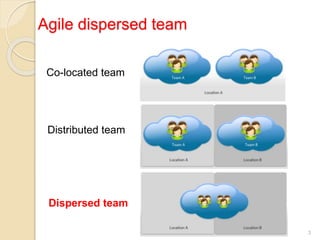
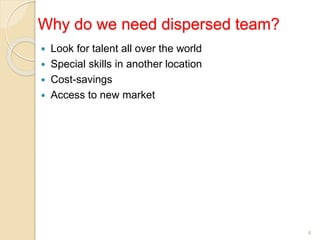
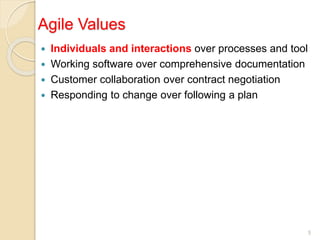
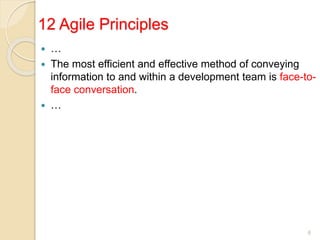
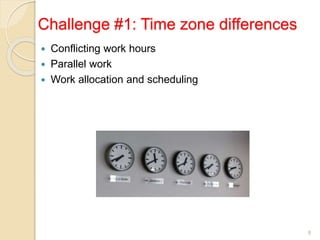
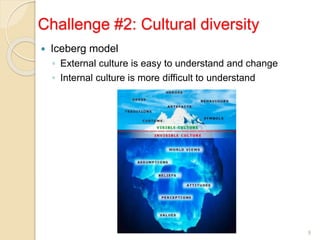
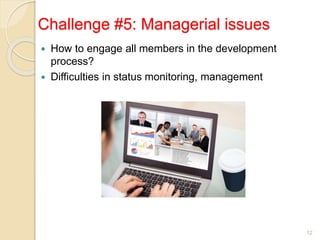
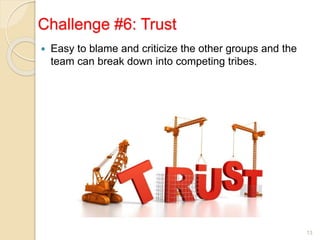
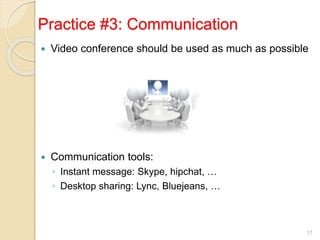
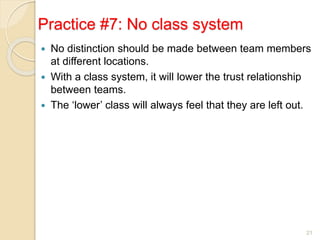
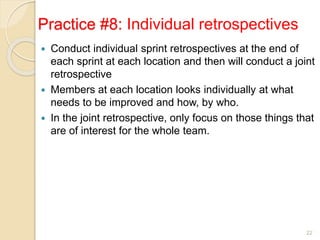
The document discusses challenges and success practices for agile dispersed teams. Some of the key challenges include time zone differences which make collaboration difficult, cultural diversity between locations, challenges with communication as most is non-verbal, technical misalignments, and lack of trust between distant members. Successful practices include establishing overlapping work hours, exchanging team members between locations, using video conferencing and communication tools, sharing information transparently, pairing remote members, agreeing on engineering practices, treating all members equally, and conducting individual and joint retrospectives.




![[Hanoi, june 2015] One normal day of an agile developer](https://cdn.slidesharecdn.com/ss_thumbnails/hanoijune2015onenormaldayofanagiledeveloper-150622083025-lva1-app6892-thumbnail.jpg?width=640&height=640&fit=bounds)
![[Tu Bui] Transitioning from a traditional tester to an Agile tester](https://cdn.slidesharecdn.com/ss_thumbnails/tubui-transitioningfromatraditionaltestertoanagile-150520014342-lva1-app6892-thumbnail.jpg?width=640&height=640&fit=bounds)
![[Quang nguyen] Continuous Integration XP Day 2015 Vietnam Danang](https://cdn.slidesharecdn.com/ss_thumbnails/quangnguyencontinuousintegrationxpday2015danangquangnguyen-150520014341-lva1-app6892-thumbnail.jpg?width=640&height=640&fit=bounds)
![[Pascal & Thien Que] Why XP is important for us and why XP could be very impo...](https://cdn.slidesharecdn.com/ss_thumbnails/pascalthienque-whyxpisimportantforusandwhyxpcouldbeveryimportantforvietnam-150520014338-lva1-app6892-thumbnail.jpg?width=640&height=640&fit=bounds)
![[Christopher Ngo] Intro DevOPS XP Day 2015](https://cdn.slidesharecdn.com/ss_thumbnails/christopherngo-cesintrodevopsxpday2015-150520014316-lva1-app6891-thumbnail.jpg?width=640&height=640&fit=bounds)
![[Chris shayan] Agility at Vietnamworks](https://cdn.slidesharecdn.com/ss_thumbnails/chrisshayan-agilityatvietnamworks-150520014313-lva1-app6892-thumbnail.jpg?width=640&height=640&fit=bounds)
![[Agile tour 2014- HN] Nguyen Vu Hung: Beyond Agile - Practices and Mindset - ...](https://cdn.slidesharecdn.com/ss_thumbnails/agiletour2014nguyenvuhung-beyondagilepracticesandmindset-agiletourvietnamhanoi2014-150519085114-lva1-app6892-thumbnail.jpg?width=640&height=640&fit=bounds)
![[HanoiScrum.net] Scrum foundation](https://cdn.slidesharecdn.com/ss_thumbnails/hanoiscrumscrumfoundation-150508015948-lva1-app6892-thumbnail.jpg?width=640&height=640&fit=bounds)
![[XPday.vn] XP? not Windows XP {presentation} (at) [XP Day Vietnam 2015]](https://cdn.slidesharecdn.com/ss_thumbnails/xpday-150505214506-conversion-gate01-thumbnail.jpg?width=640&height=640&fit=bounds)
![[XPday.vn] what make software flexible (presentation) {at} [XP Day Vietnam 20...](https://cdn.slidesharecdn.com/ss_thumbnails/xpday-150505210721-conversion-gate01-thumbnail.jpg?width=640&height=640&fit=bounds)
![[XPday.vn] is XP still eXtreme? {keynote talk} (at) [XP Day Vietnam 2015]](https://cdn.slidesharecdn.com/ss_thumbnails/xpday-150421042802-conversion-gate02-thumbnail.jpg?width=640&height=640&fit=bounds)
![[XPday.vn] XP practices as scaffolding for breakthrough companies (presentati...](https://cdn.slidesharecdn.com/ss_thumbnails/xpday-150421042033-conversion-gate02-thumbnail.jpg?width=640&height=640&fit=bounds)
![[XPday.vn] Legacy code workshop (at) [XP Day Vietnam 2015]](https://cdn.slidesharecdn.com/ss_thumbnails/xpday-150421041526-conversion-gate01-thumbnail.jpg?width=640&height=640&fit=bounds)


![20260201 [FOSDEM] gomodjail - library sandboxing for Go modules.pdf](https://cdn.slidesharecdn.com/ss_thumbnails/20260201fosdemgomodjail-librarysandboxingforgomodules-260201225659-76609ec4-thumbnail.jpg?width=640&height=640&fit=bounds)


