Distributed Agile: Oxymoron or Holy Grail?
This pack is a record of an interactive session I facilitated for the 2013 Sydney
Agile Tour on 29 November.
The sticky notes that were the output of this interactive session did not come
out in the photos, so I quickly had to type them up.
As such this is not so much a presentation and I apologise for the boring
‘bullet point’ slides.
Sieger de Vries
Sydney

1
Distributed Agile: Oxymoron or Holy Grail?
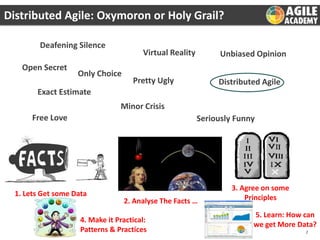
Deafening Silence

Open Secret

Virtual Reality

Only Choice

Unbiased Opinion

Pretty Ugly

Distributed Agile

Exact Estimate
Minor Crisis
Free Love

Seriously Funny

1. Lets Get some Data

2. Analyse The Facts …

4. Make it Practical:
Patterns & Practices

3. Agree on some
Principles
5. Learn: How can
we get More Data?
2
Distributed Agile: Oxymoron or Holy Grail?
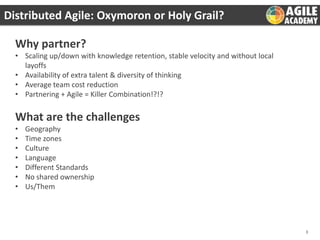
Why partner?
• Scaling up/down with knowledge retention, stable velocity and without local
layoffs
• Availability of extra talent & diversity of thinking
• Average team cost reduction
• Partnering + Agile = Killer Combination!?!?

What are the challenges
•
•
•
•
•
•
•

Geography
Time zones
Culture
Language
Different Standards
No shared ownership
Us/Them

3
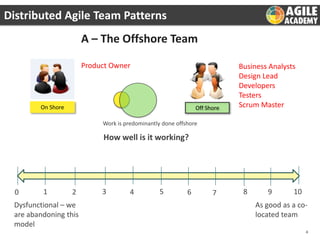
Distributed Agile Team Patterns
A – The Offshore Team
Product Owner

On Shore

Off Shore

Business Analysts
Design Lead
Developers
Testers
Scrum Master

Work is predominantly done offshore

How well is it working?

0

1

2

Dysfunctional – we
are abandoning this
model

3

4

5

6

7

8

9

10

As good as a colocated team
4
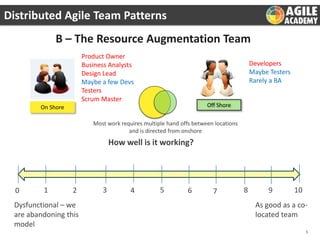
Distributed Agile Team Patterns
B – The Resource Augmentation Team
Product Owner
Business Analysts
Design Lead
Maybe a few Devs
Testers
Scrum Master

Developers
Maybe Testers
Rarely a BA

Off Shore

On Shore

Most work requires multiple hand offs between locations
and is directed from onshore

How well is it working?

0

1

2

Dysfunctional – we
are abandoning this
model

3

4

5

6

7

8

9

10

As good as a colocated team
5
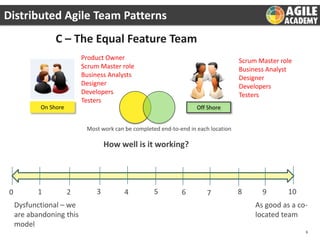
Distributed Agile Team Patterns
C – The Equal Feature Team
Product Owner
Scrum Master role
Business Analysts
Designer
Developers
Testers

Scrum Master role
Business Analyst
Designer
Developers
Testers

On Shore

Off Shore
Most work can be completed end-to-end in each location

How well is it working?

0

1

2

Dysfunctional – we
are abandoning this
model

3

4

5

6

7

8

9

10

As good as a colocated team
6
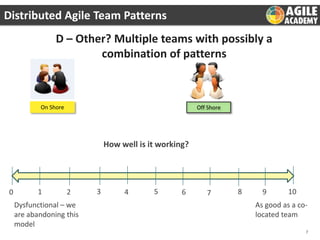
Distributed Agile Team Patterns
D – Other? Multiple teams with possibly a
combination of patterns

On Shore

Off Shore

How well is it working?

0

1

2

Dysfunctional – we
are abandoning this
model

3

4

5

6

7

8

9

10

As good as a colocated team
7
Distributed Agile: Principles & Practices
Principles and Practices for successful Distributed Teams
1.
2.
3.
4.
5.
6.
7.

Team coherence
The Person with the agile mindset
Agile maturity
Knowledge sharing & capability management
Infrastructure & Tools
Measurement & continuous improvement
Partnership governance & operations

8
Team Coherence
• Stable teams with agreed and planned staff turn over. Team is
consulted and has a say in rotations
• Talent, experience and skills balanced equally between
locations
• Work can be completed end-to-end in both locations with no
or very few hand-offs
• Both on/off shore teams pull work from the same backlog
• On/off shore team members share equally in all team
ceremonies
• On/off shore team members have regular contact with the
SMEs and Product Owner and feel the same ownership of the
product and understand the strategy and roadmap
• Design is done in joint sessions to promote ownership of the
product
9
Team Coherence - Continued
• Team members are co-located at the start of major initiatives
• Regular planned rotations for team members to share
knowledge and build personal relationships within team
• Team interactions are frequent and ad-hoc as well as planned
• Team interactions are both personal and goal focused
• Team members build personal relationships despite being in
different locations

10
The “Agile” Team Member

The Team Member with an Agile Mindset
•
•
•
•
•
•
•
•
•
•
•
•
•
•
•
•
•

Has internalised the Agile values & principles
Has an open growth mindset vs constraint of thought mindset
Walks the Talk
Self motivating
Self aware
Self disciplined
Self improving
Self actuating
Doesn’t wait to be told what to do
Has the courage to challenge and be challenged
Never feels “that’s not my job”
Picks up the trash lying on the floor
Listens with the intend to understand and explore
Behaves like an owner
Passionate about their craft
Passionate about their customer
“Three musketeer” attitude
11
Agile Maturity across Locations
• “No compromise” attitude to one way of working – Agile
• All locations are agile and share the same values,
principles and practices
• “Calibrate” the way of working at the start of the
engagement
• All locations have a “safe to fail” culture
• All locations are “self-organising”
• Team & individual development plans address Agile gaps

12
Knowledge Sharing & Capability Management
• Capability Matrix covering technical and business domain
skills
• Agreed staff turnover expectations, process and
measures
• Capability development plans for teams & individuals
• Comprehensive on-boarding process with buddy system
• Standard process for capturing and sharing knowledge
• Team organises regular capability and business context
sharing sessions
• Regular, planned staff rotations to promote knowledge
sharing and business context

13
Infrastructure & Tools
• Collaboration tools such as Jira, instant messaging &
desktop sharing
• “Always On” video during shared hours so teams can
“see” each other and have ad-hoc interaction
• Dedicated networks to enable consistent high quality
video and audio
• Individual web cams & bandwidth to help build personal
relationships
• Smart boards or equivalent to enable joint design
sessions
• Equal access to environments and data

14
Measurement & Continuous Improvement
• Standard Metrics identified, base-lined, tracked
• Team metrics identified, base-lined, tracked
• Team metrics include business outcomes ($ sales, profit,
numbers)
• Capability gap made visible
• Rate of improvement is made visible
• Joint Retrospective action items completion rate tracked
• Team and individual development plans in place
Average Cycle Time to “Done”
Average Cycle Time to “Prod”
Average Cycle Time for Risks/Issues
Throughput
Velocity
$ Burn rate for Team
Average $ Cost per Team Member
(averaged across locations as one number)
Average cost per story/feature by size (s,m,l)
Staff turnover / length of time in team
Team Temperature
Customer NPS

Average cost per team member of travel /
rotations
Average Gap score for Capability matrix
# of Defects escaping the iteration/sprint
# of Defects in production per period
# automated functional tests executed/passed

15
Partnership Governance & Operations
• Clear service levels and outcomes agreed with defined
measurements and flexible targets
• Clear, simple and flexible financial processes
• Active, ongoing and visible risk management
• Relationship management at multiple levels
• Agreed targets for capability gap improvement
• Ongoing planned rotations
• Agreed process for individual performance management
• Joint capacity forecasting and planning to facilitate scaling
• Shared security and compliance processes &
responsibilities
• Strong commercial relationship

16

Distributed Agile - Agile Tour Sydney 2013

  • 1.
    Distributed Agile: Oxymoronor Holy Grail? This pack is a record of an interactive session I facilitated for the 2013 Sydney Agile Tour on 29 November. The sticky notes that were the output of this interactive session did not come out in the photos, so I quickly had to type them up. As such this is not so much a presentation and I apologise for the boring ‘bullet point’ slides. Sieger de Vries Sydney 1
  • 2.
    Distributed Agile: Oxymoronor Holy Grail? Deafening Silence Open Secret Virtual Reality Only Choice Unbiased Opinion Pretty Ugly Distributed Agile Exact Estimate Minor Crisis Free Love Seriously Funny 1. Lets Get some Data 2. Analyse The Facts … 4. Make it Practical: Patterns & Practices 3. Agree on some Principles 5. Learn: How can we get More Data? 2
  • 3.
    Distributed Agile: Oxymoronor Holy Grail? Why partner? • Scaling up/down with knowledge retention, stable velocity and without local layoffs • Availability of extra talent & diversity of thinking • Average team cost reduction • Partnering + Agile = Killer Combination!?!? What are the challenges • • • • • • • Geography Time zones Culture Language Different Standards No shared ownership Us/Them 3
  • 4.
    Distributed Agile TeamPatterns A – The Offshore Team Product Owner On Shore Off Shore Business Analysts Design Lead Developers Testers Scrum Master Work is predominantly done offshore How well is it working? 0 1 2 Dysfunctional – we are abandoning this model 3 4 5 6 7 8 9 10 As good as a colocated team 4
  • 5.
    Distributed Agile TeamPatterns B – The Resource Augmentation Team Product Owner Business Analysts Design Lead Maybe a few Devs Testers Scrum Master Developers Maybe Testers Rarely a BA Off Shore On Shore Most work requires multiple hand offs between locations and is directed from onshore How well is it working? 0 1 2 Dysfunctional – we are abandoning this model 3 4 5 6 7 8 9 10 As good as a colocated team 5
  • 6.
    Distributed Agile TeamPatterns C – The Equal Feature Team Product Owner Scrum Master role Business Analysts Designer Developers Testers Scrum Master role Business Analyst Designer Developers Testers On Shore Off Shore Most work can be completed end-to-end in each location How well is it working? 0 1 2 Dysfunctional – we are abandoning this model 3 4 5 6 7 8 9 10 As good as a colocated team 6
  • 7.
    Distributed Agile TeamPatterns D – Other? Multiple teams with possibly a combination of patterns On Shore Off Shore How well is it working? 0 1 2 Dysfunctional – we are abandoning this model 3 4 5 6 7 8 9 10 As good as a colocated team 7
  • 8.
    Distributed Agile: Principles& Practices Principles and Practices for successful Distributed Teams 1. 2. 3. 4. 5. 6. 7. Team coherence The Person with the agile mindset Agile maturity Knowledge sharing & capability management Infrastructure & Tools Measurement & continuous improvement Partnership governance & operations 8
  • 9.
    Team Coherence • Stableteams with agreed and planned staff turn over. Team is consulted and has a say in rotations • Talent, experience and skills balanced equally between locations • Work can be completed end-to-end in both locations with no or very few hand-offs • Both on/off shore teams pull work from the same backlog • On/off shore team members share equally in all team ceremonies • On/off shore team members have regular contact with the SMEs and Product Owner and feel the same ownership of the product and understand the strategy and roadmap • Design is done in joint sessions to promote ownership of the product 9
  • 10.
    Team Coherence -Continued • Team members are co-located at the start of major initiatives • Regular planned rotations for team members to share knowledge and build personal relationships within team • Team interactions are frequent and ad-hoc as well as planned • Team interactions are both personal and goal focused • Team members build personal relationships despite being in different locations 10
  • 11.
    The “Agile” TeamMember The Team Member with an Agile Mindset • • • • • • • • • • • • • • • • • Has internalised the Agile values & principles Has an open growth mindset vs constraint of thought mindset Walks the Talk Self motivating Self aware Self disciplined Self improving Self actuating Doesn’t wait to be told what to do Has the courage to challenge and be challenged Never feels “that’s not my job” Picks up the trash lying on the floor Listens with the intend to understand and explore Behaves like an owner Passionate about their craft Passionate about their customer “Three musketeer” attitude 11
  • 12.
    Agile Maturity acrossLocations • “No compromise” attitude to one way of working – Agile • All locations are agile and share the same values, principles and practices • “Calibrate” the way of working at the start of the engagement • All locations have a “safe to fail” culture • All locations are “self-organising” • Team & individual development plans address Agile gaps 12
  • 13.
    Knowledge Sharing &Capability Management • Capability Matrix covering technical and business domain skills • Agreed staff turnover expectations, process and measures • Capability development plans for teams & individuals • Comprehensive on-boarding process with buddy system • Standard process for capturing and sharing knowledge • Team organises regular capability and business context sharing sessions • Regular, planned staff rotations to promote knowledge sharing and business context 13
  • 14.
    Infrastructure & Tools •Collaboration tools such as Jira, instant messaging & desktop sharing • “Always On” video during shared hours so teams can “see” each other and have ad-hoc interaction • Dedicated networks to enable consistent high quality video and audio • Individual web cams & bandwidth to help build personal relationships • Smart boards or equivalent to enable joint design sessions • Equal access to environments and data 14
  • 15.
    Measurement & ContinuousImprovement • Standard Metrics identified, base-lined, tracked • Team metrics identified, base-lined, tracked • Team metrics include business outcomes ($ sales, profit, numbers) • Capability gap made visible • Rate of improvement is made visible • Joint Retrospective action items completion rate tracked • Team and individual development plans in place Average Cycle Time to “Done” Average Cycle Time to “Prod” Average Cycle Time for Risks/Issues Throughput Velocity $ Burn rate for Team Average $ Cost per Team Member (averaged across locations as one number) Average cost per story/feature by size (s,m,l) Staff turnover / length of time in team Team Temperature Customer NPS Average cost per team member of travel / rotations Average Gap score for Capability matrix # of Defects escaping the iteration/sprint # of Defects in production per period # automated functional tests executed/passed 15
  • 16.
    Partnership Governance &Operations • Clear service levels and outcomes agreed with defined measurements and flexible targets • Clear, simple and flexible financial processes • Active, ongoing and visible risk management • Relationship management at multiple levels • Agreed targets for capability gap improvement • Ongoing planned rotations • Agreed process for individual performance management • Joint capacity forecasting and planning to facilitate scaling • Shared security and compliance processes & responsibilities • Strong commercial relationship 16