Postmarket monitoring
Overview
• What is postmarket monitoring?
• Why is it important?
• Tools used in postmarket monitoring
• Managing risk
• Adverse events
• Risk management plans
• Signals
• Recall actions
• Pharmacovigilance Inspection
Program
• Other education modules
2
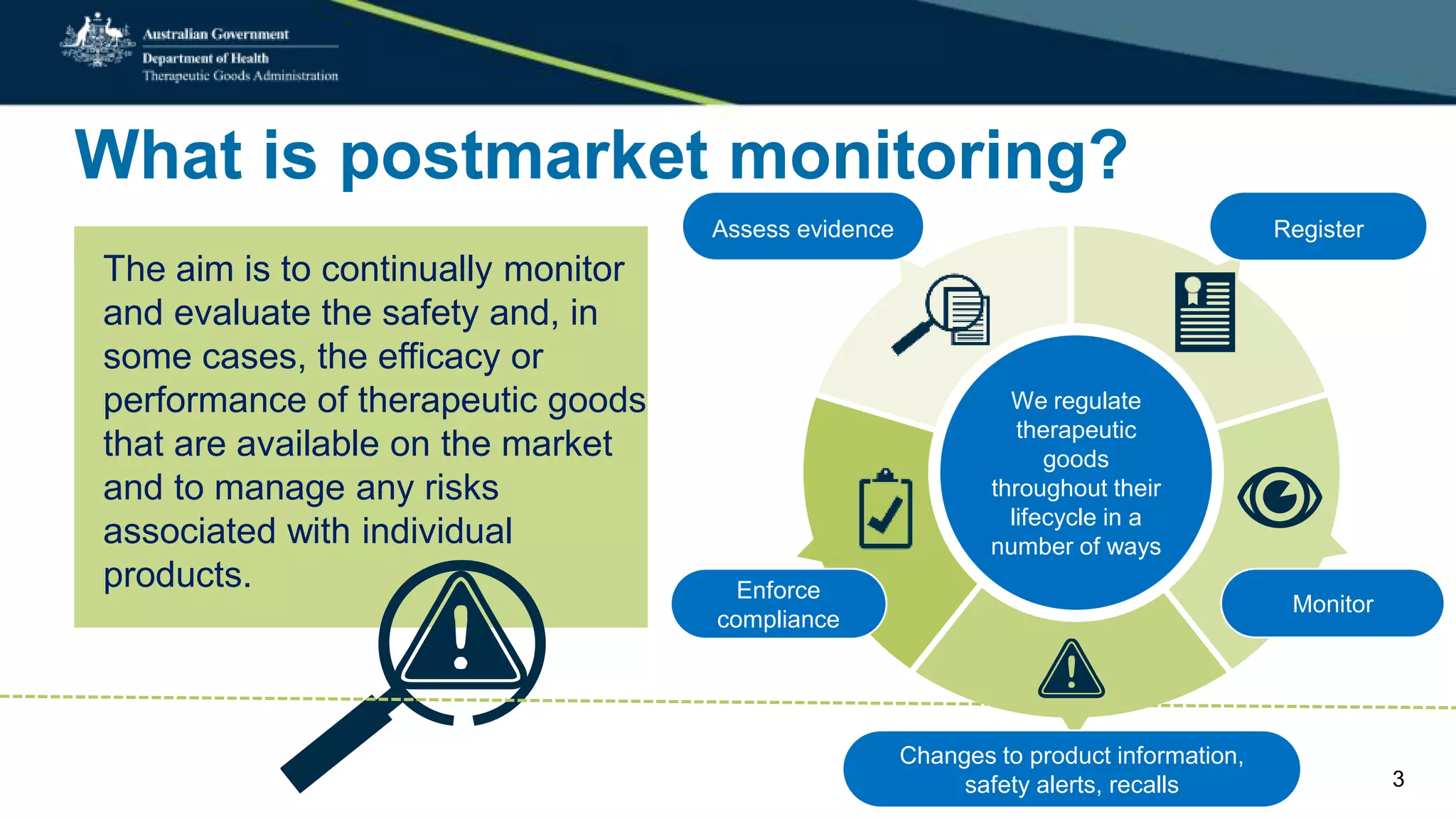
What is postmarket monitoring?
The aim is to continually monitor
and evaluate the safety and, in
some cases, the efficacy or
performance of therapeutic goods
that are available on the market
and to manage any risks
associated with individual
products.
We regulate
therapeutic
goods
throughout their
lifecycle in a
number of ways
Enforce
compliance
Monitor
Changes to product information,
safety alerts, recalls
RegisterAssess evidence
3
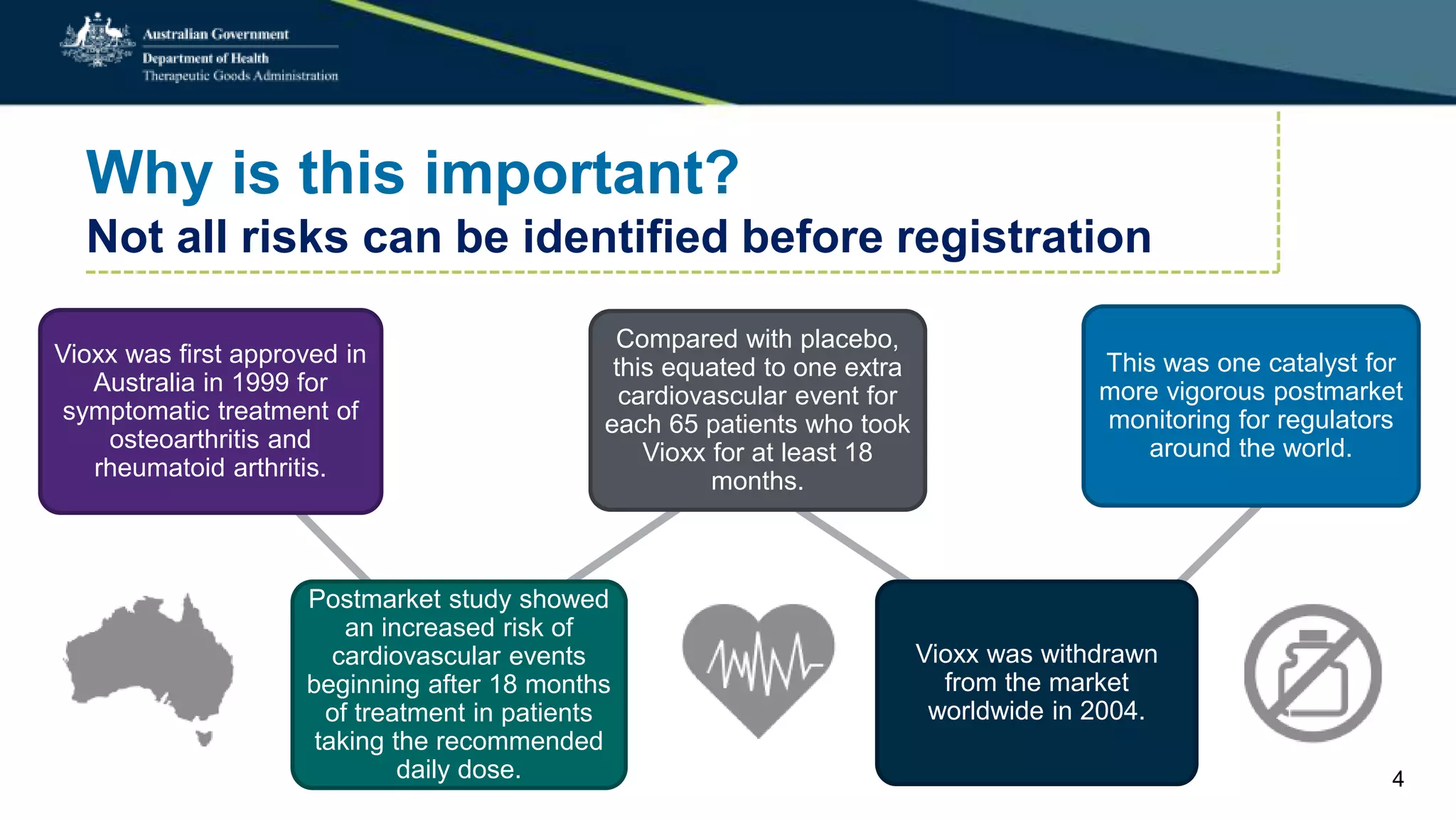
Why is this important?
Not all risks can be identified before registration
Vioxx was first approved in
Australia in 1999 for
symptomatic treatment of
osteoarthritis and
rheumatoid arthritis.
Postmarket study showed
an increased risk of
cardiovascular events
beginning after 18 months
of treatment in patients
taking the recommended
daily dose.
Compared with placebo,
this equated to one extra
cardiovascular event for
each 65 patients who took
Vioxx for at least 18
months.
Vioxx was withdrawn
from the market
worldwide in 2004.
This was one catalyst for
more vigorous postmarket
monitoring for regulators
around the world.
4
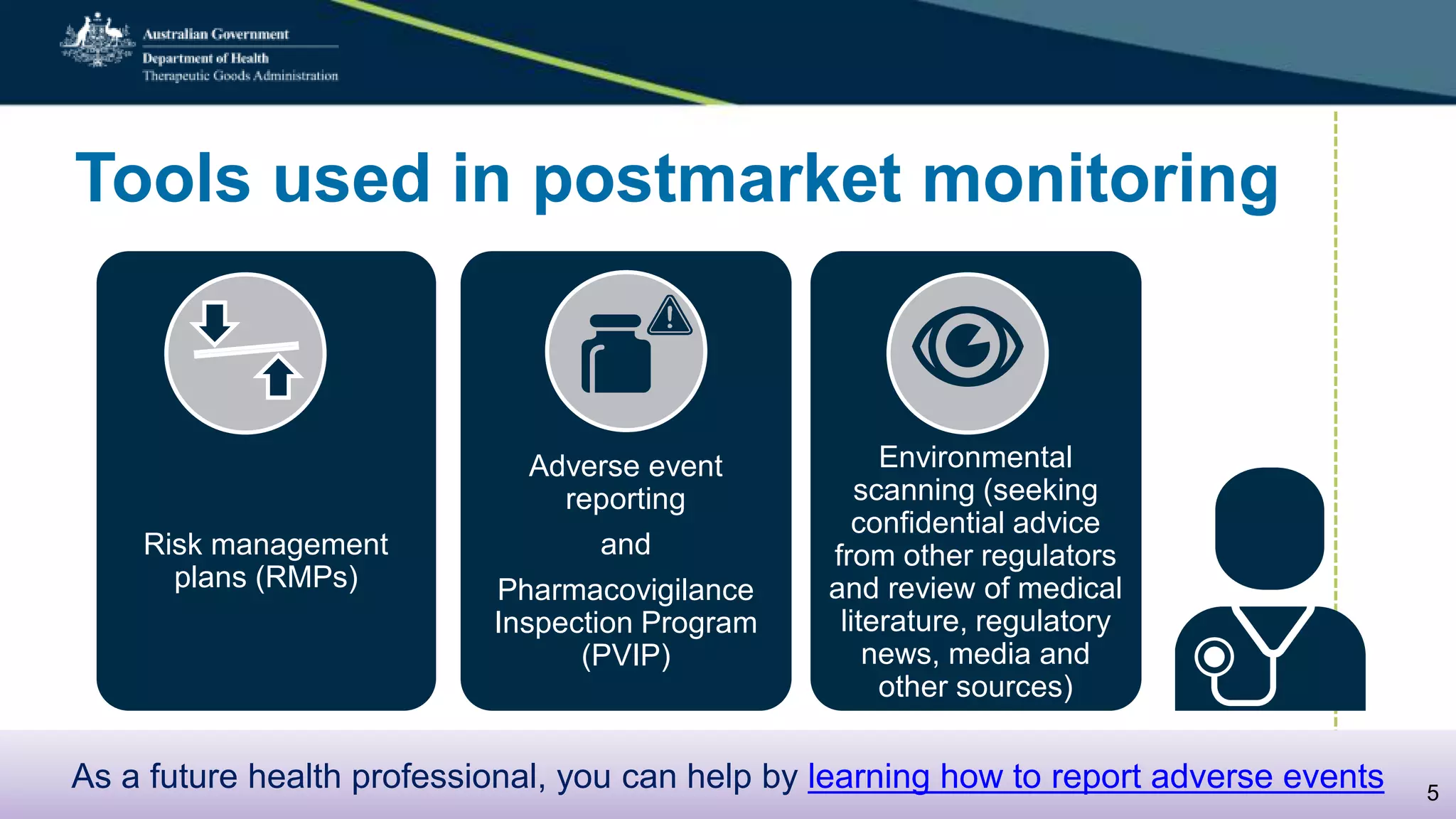
Tools used in postmarket monitoring
Risk management
plans (RMPs)
Adverse event
reporting
and
Pharmacovigilance
Inspection Program
(PVIP)
Environmental
scanning (seeking
confidential advice
from other regulators
and review of medical
literature, regulatory
news, media and
other sources)
As a future health professional, you can help by learning how to report adverse events 5
Managing risk
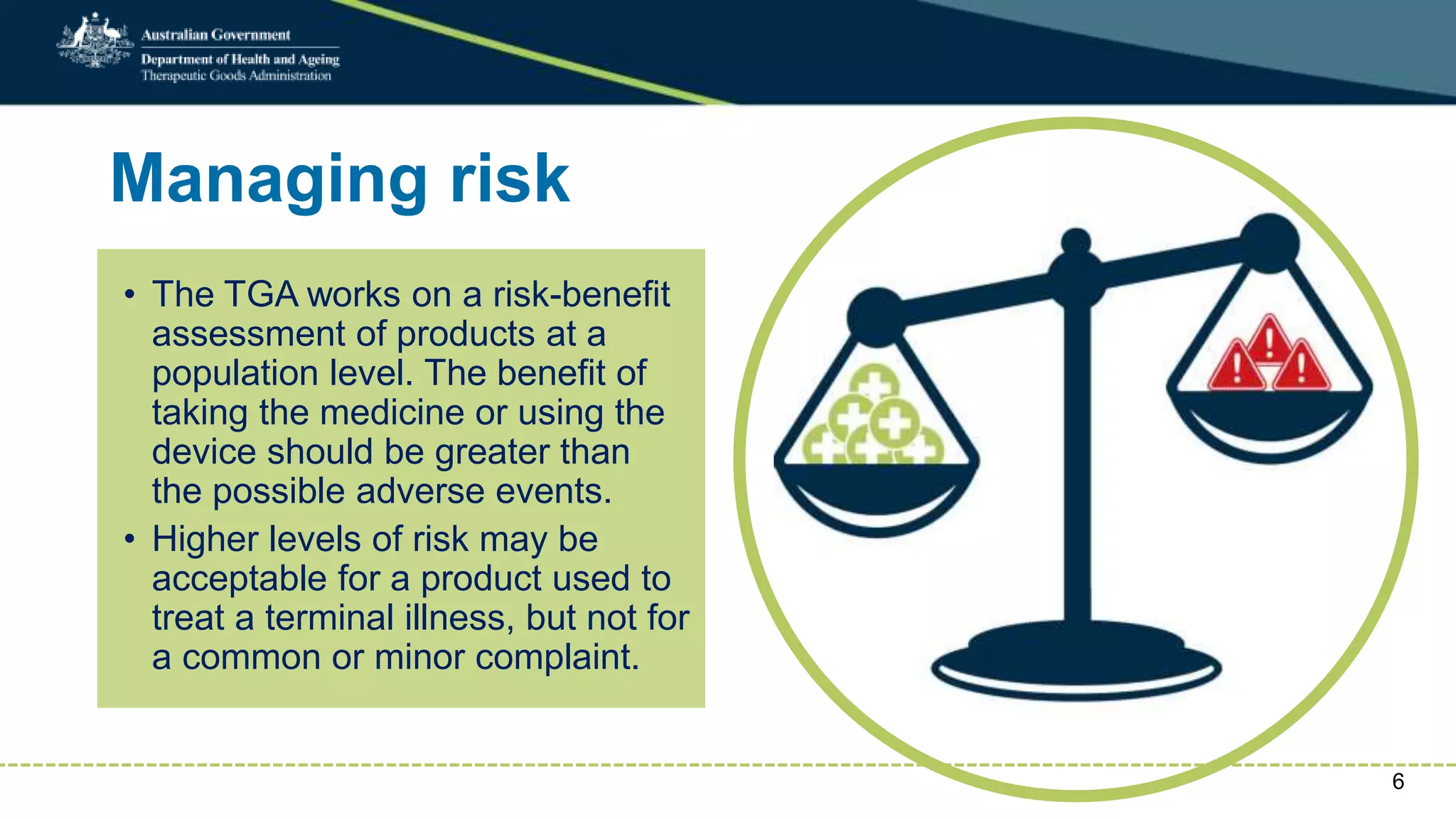
• The TGA works on a risk-benefit
assessment of products at a
population level. The benefit of
taking the medicine or using the
device should be greater than
the possible adverse events.
• Higher levels of risk may be
acceptable for a product used to
treat a terminal illness, but not for
a common or minor complaint.
6
Definition of an
adverse event
For both medicines and medical
devices: an event that resulted in, or
could have resulted in, serious
injury, illness or death.
A medical device adverse event can also be associated with
the use (or misuse) of a medical device. This may include
difficulties or malfunctions, such as problems with getting the
device to operate, the need for repeated repairs, difficulty of
use or difficulty with cleaning after use.
7
Your role as a health professional
• You play an important
role in monitoring the
safety of therapeutic
goods by reporting
any suspected
adverse events to the
TGA.
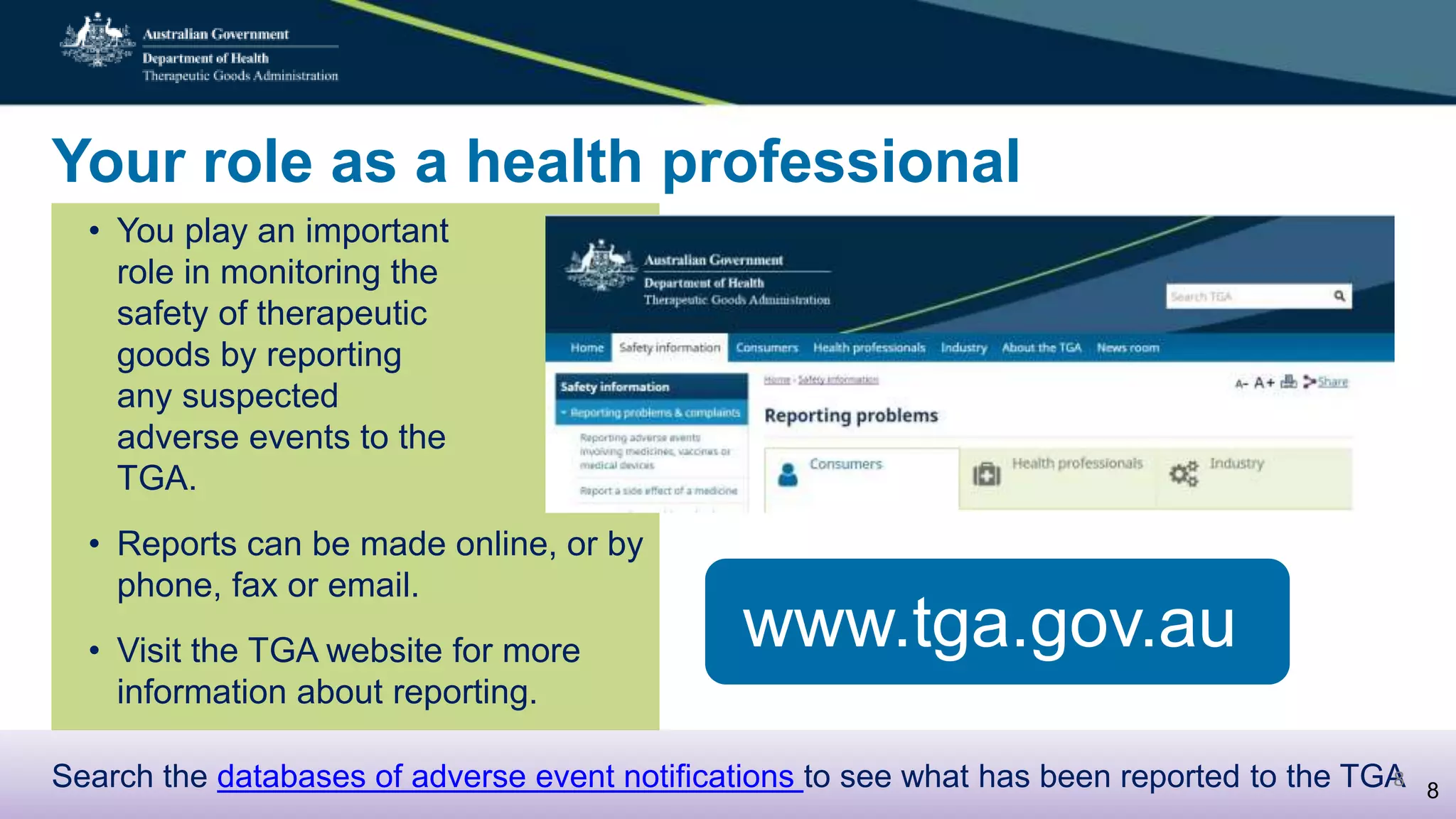
• Reports can be made online, or by
phone, fax or email.
• Visit the TGA website for more
information about reporting.
www.tga.gov.au
Search the databases of adverse event notifications to see what has been reported to the TGA 8
8
What should you report?
The TGA is particularly interested in:
• serious or unexpected reactions to medicines
(this is explained further on the next slide)
• serious medicine interactions
• faults or problems with medical devices that have resulted, or could have
resulted, in adverse events.
9
Reporting serious and unexpected
reactions to medicines
It is most important to report serious and unexpected
reactions to medicines. These are distinct from well
known side effects. For example, we would not expect
reports of:
• tiredness after taking an opiate based painkiller
• nausea or diarrhoea after taking certain antibiotics.
10
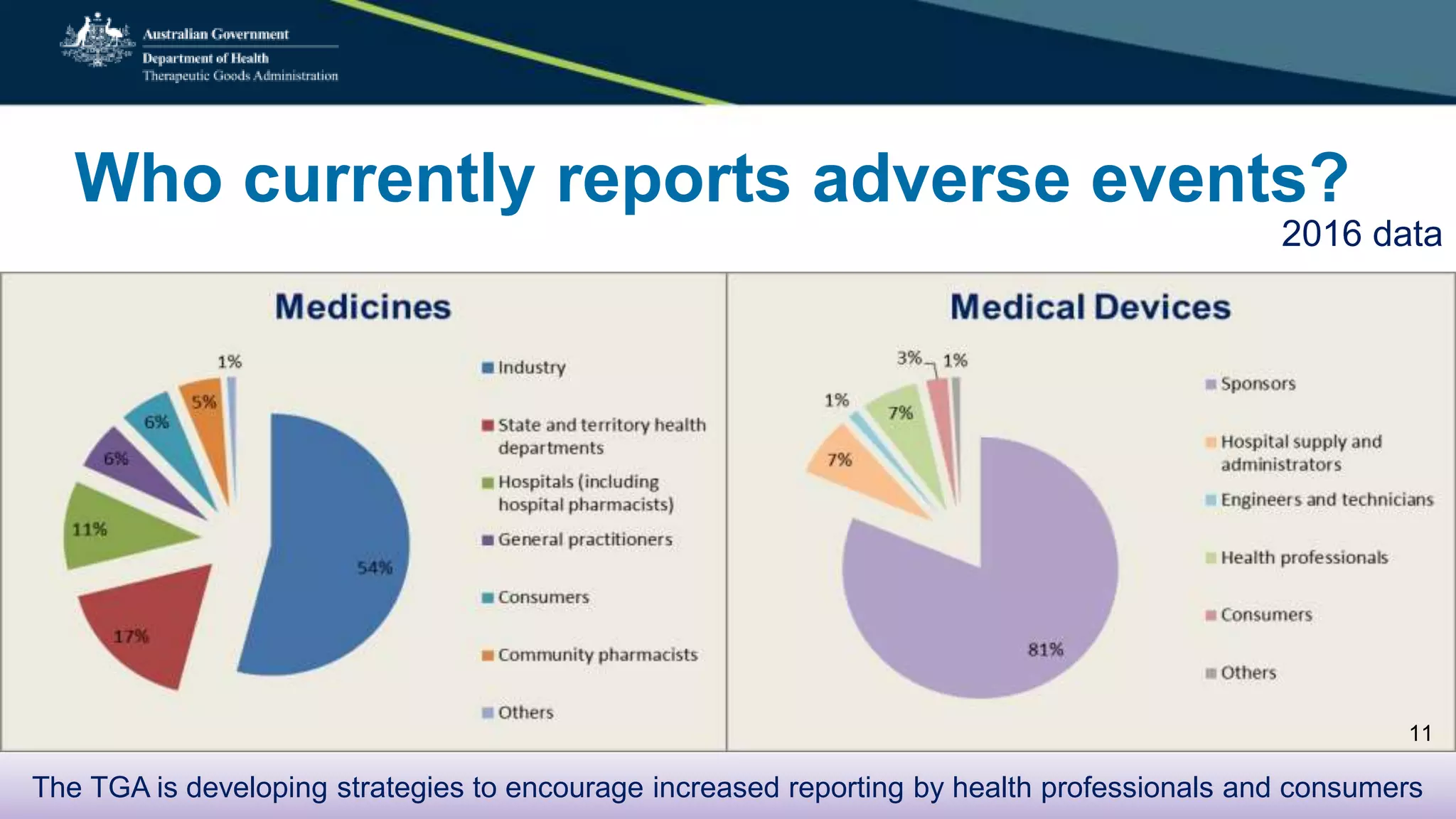
Who currently reports adverse events?
2016 data
* There are mandatory reporting requirements for industry.
The TGA is developing strategies to encourage increased reporting by health professionals and consumers
11
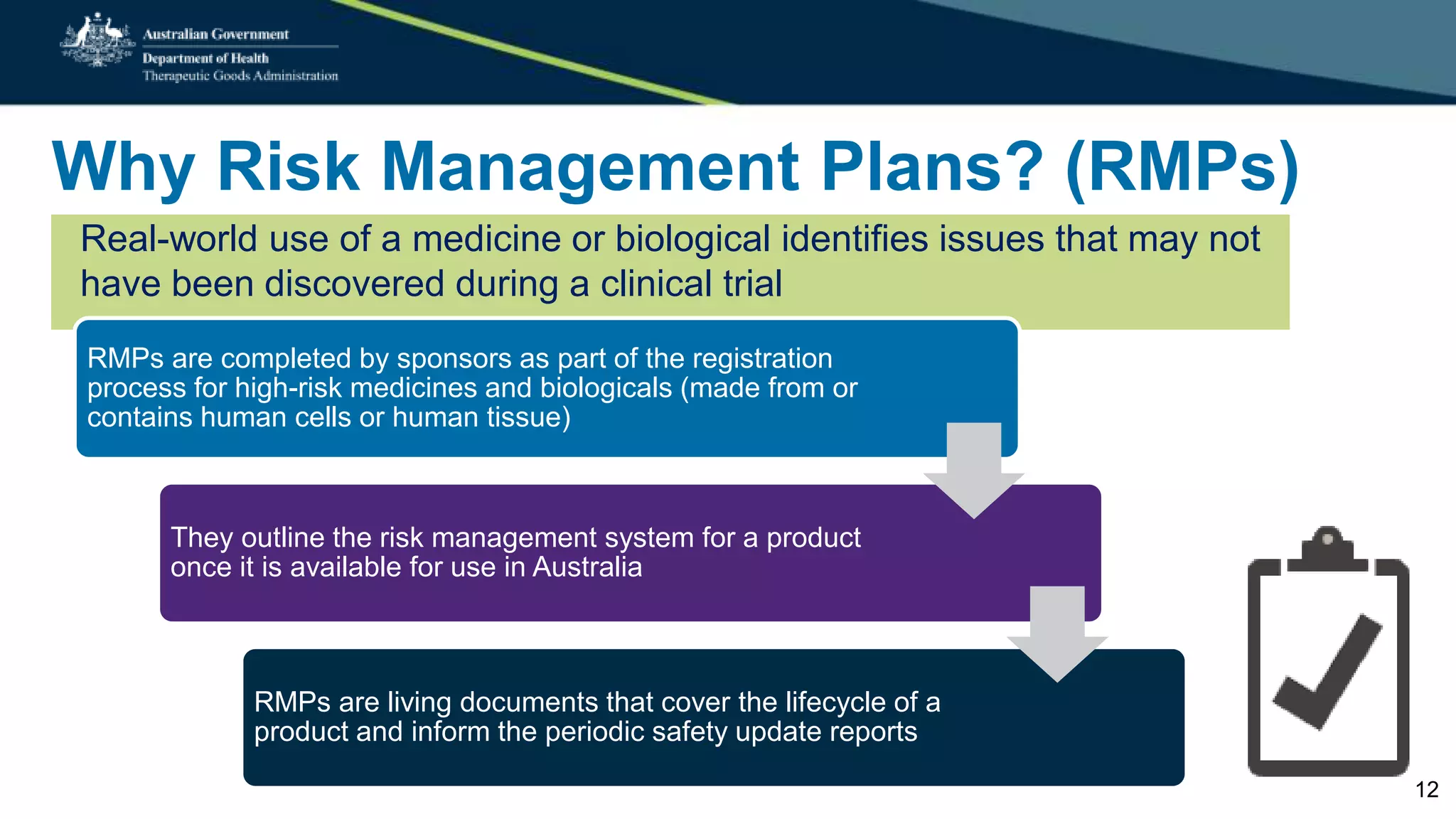
Why Risk Management Plans? (RMPs)
Real-world use of a medicine or biological identifies issues that may not
have been discovered during a clinical trial
RMPs are completed by sponsors as part of the registration
process for high-risk medicines and biologicals (made from or
contains human cells or human tissue)
They outline the risk management system for a product
once it is available for use in Australia
RMPs are living documents that cover the lifecycle of a
product and inform the periodic safety update reports
12
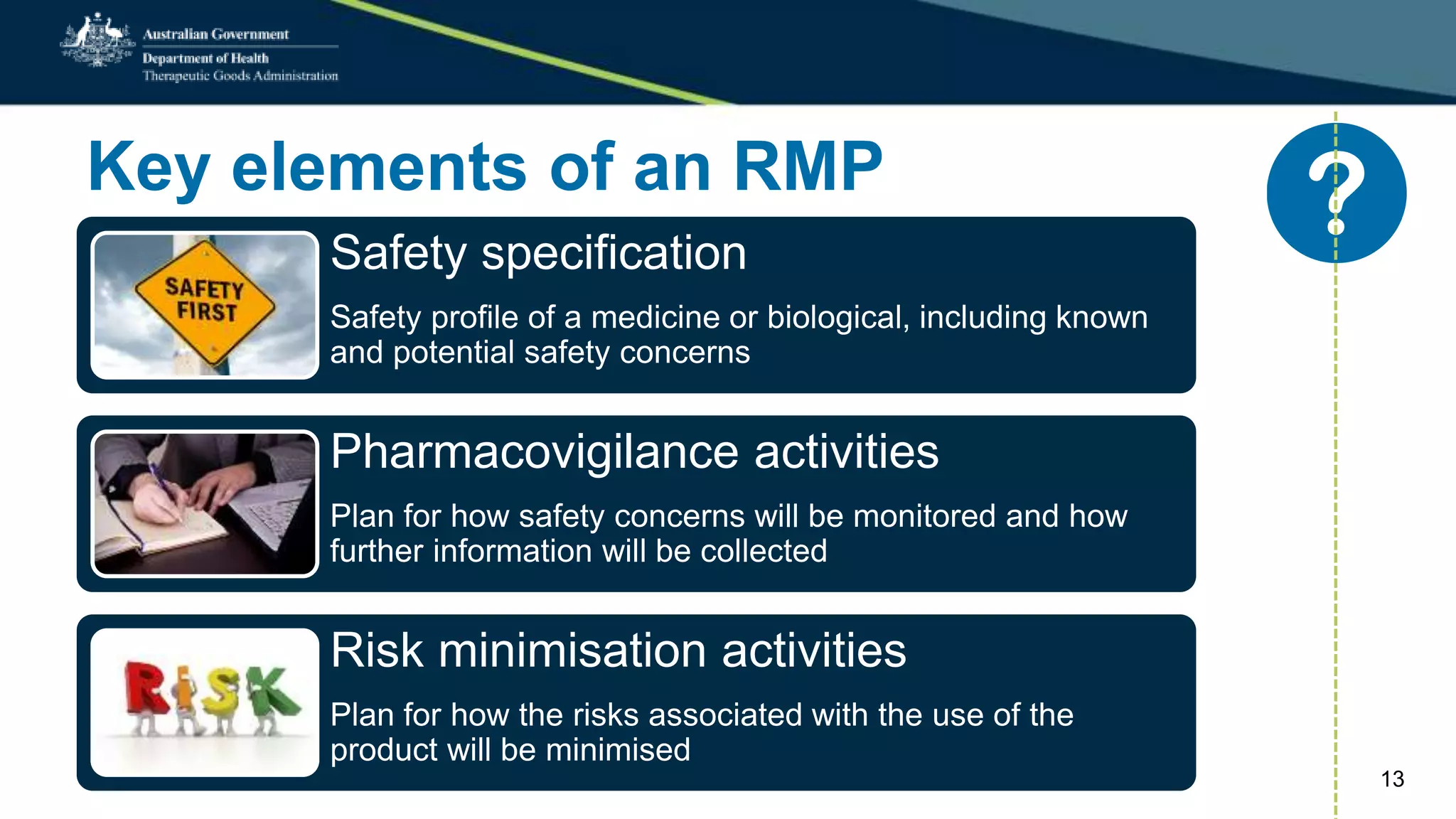
Key elements of an RMP
Safety specification
Safety profile of a medicine or biological, including known
and potential safety concerns
Pharmacovigilance activities
Plan for how safety concerns will be monitored and how
further information will be collected
Risk minimisation activities
Plan for how the risks associated with the use of the
product will be minimised
13
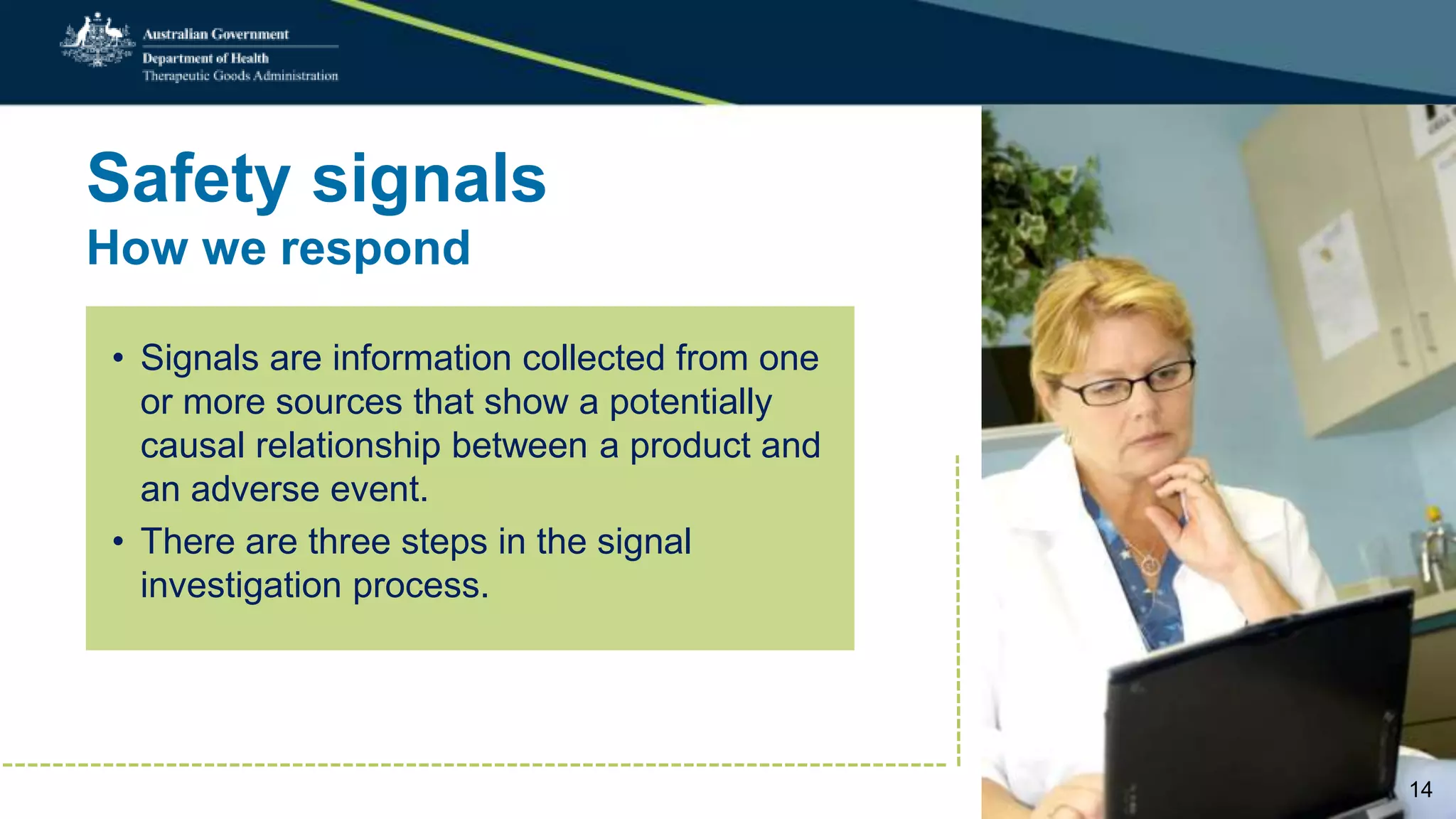
Safety signals
How we respond
• Signals are information collected from one
or more sources that show a potentially
causal relationship between a product and
an adverse event.
• There are three steps in the signal
investigation process.
14
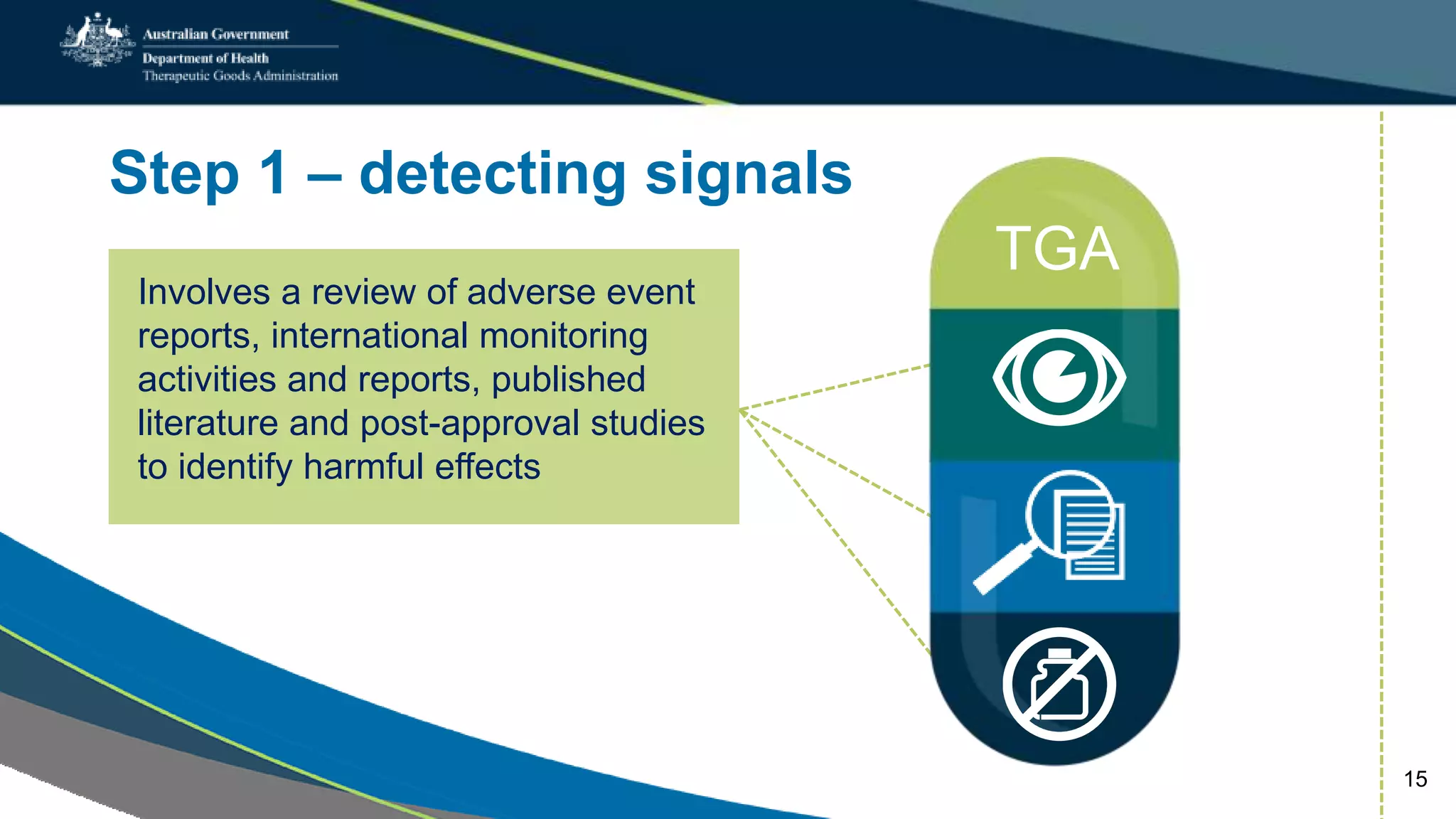
Step 1 – detecting signals
Involves a review of adverse event
reports, international monitoring
activities and reports, published
literature and post-approval studies
to identify harmful effects
TGA
15
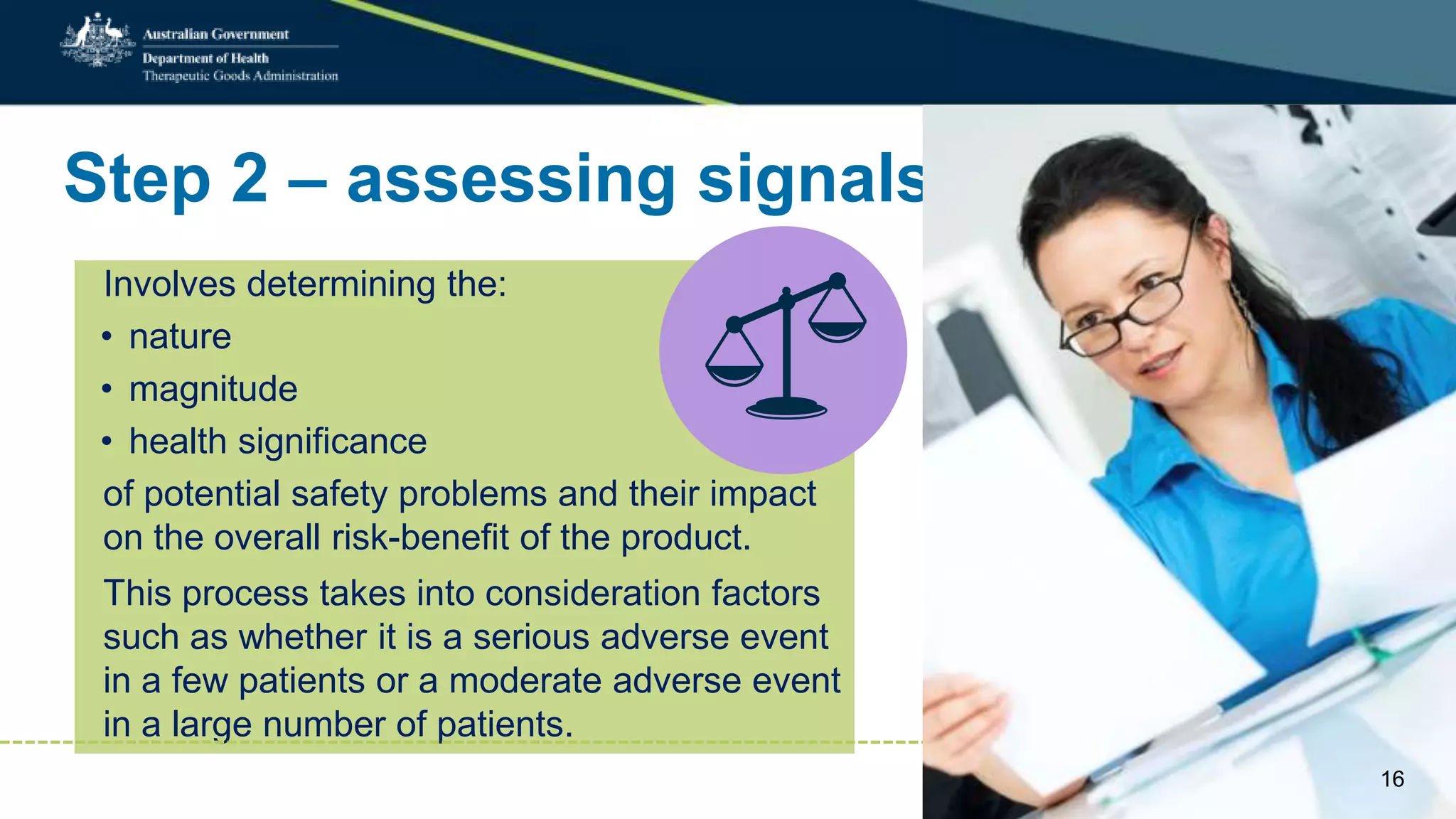
Step 2 – assessing signals
Involves determining the:
• nature
• magnitude
• health significance
of potential safety problems and their impact
on the overall risk-benefit of the product.
This process takes into consideration factors
such as whether it is a serious adverse event
in a few patients or a moderate adverse event
in a large number of patients.
16
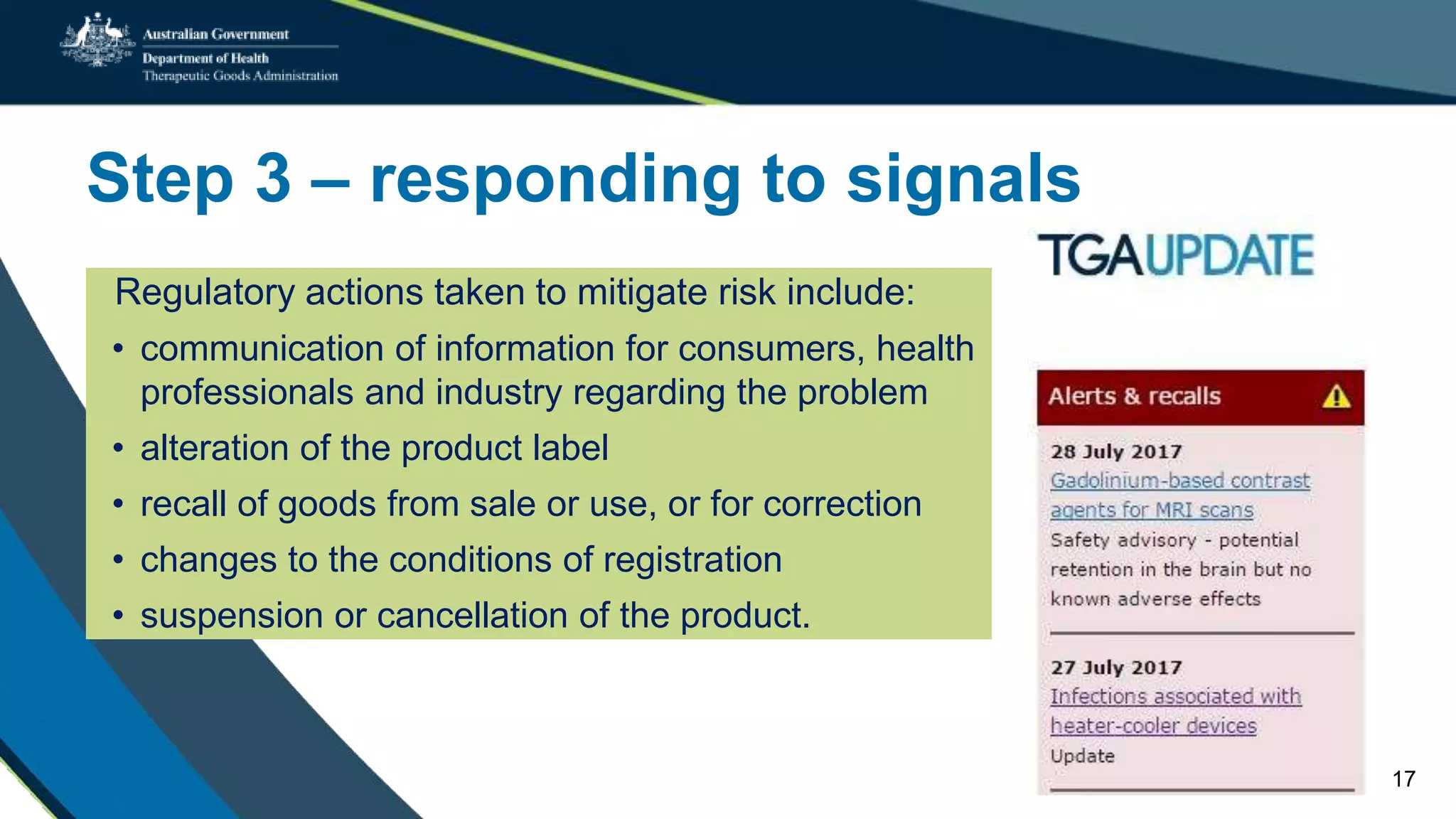
Step 3 – responding to signals
Regulatory actions taken to mitigate risk include:
• communication of information for consumers, health
professionals and industry regarding the problem
• alteration of the product label
• recall of goods from sale or use, or for correction
• changes to the conditions of registration
• suspension or cancellation of the product.
17
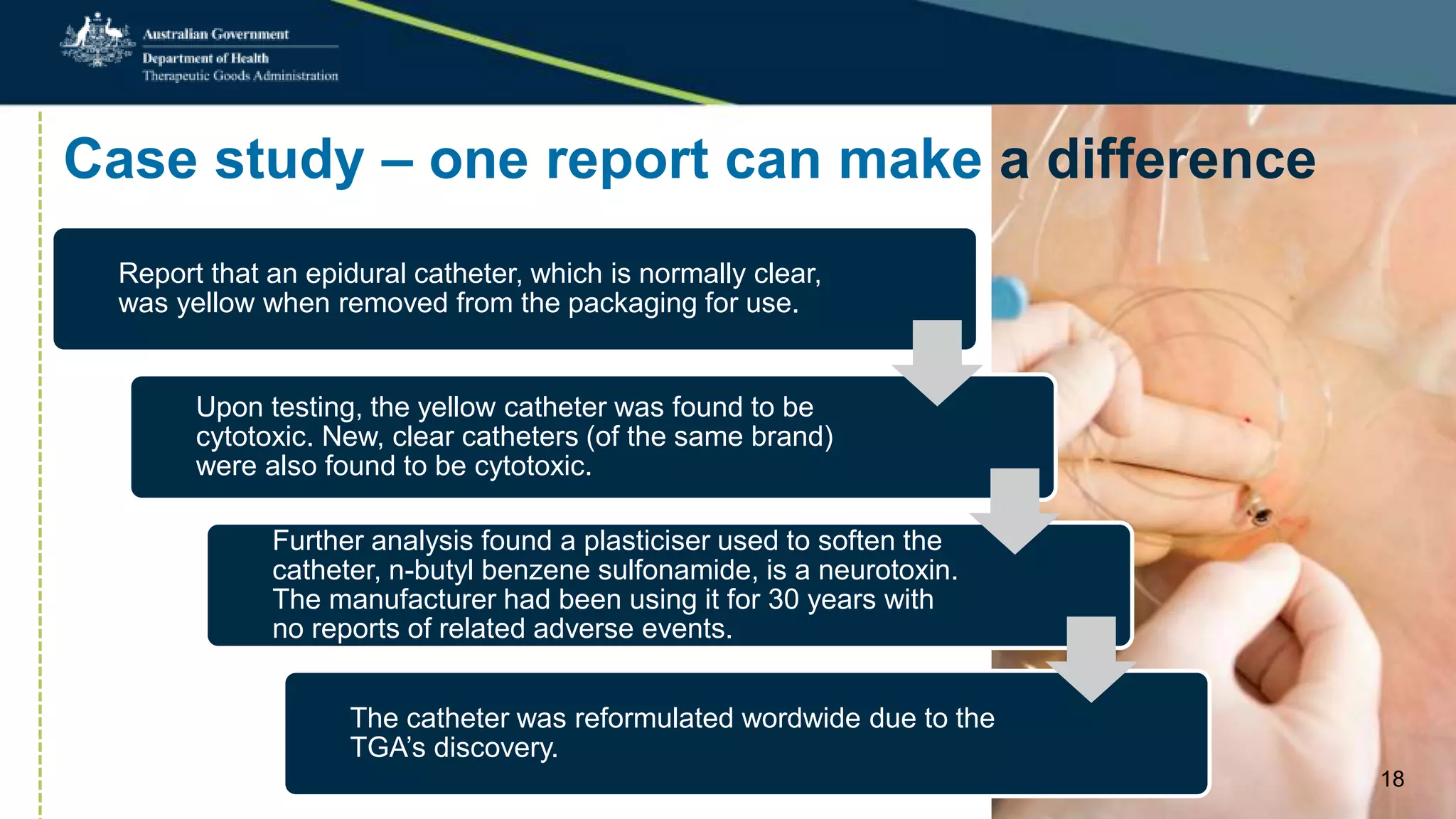
Case study – one report can make a difference
Report that an epidural catheter, which is normally clear,
was yellow when removed from the packaging for use.
Upon testing, the yellow catheter was found to be
cytotoxic. New, clear catheters (of the same brand)
were also found to be cytotoxic.
Further analysis found a plasticiser used to soften the
catheter, n-butyl benzene sulfonamide, is a neurotoxin.
The manufacturer had been using it for 30 years with
no reports of related adverse events.
The catheter was reformulated wordwide due to the
TGA’s discovery.
18
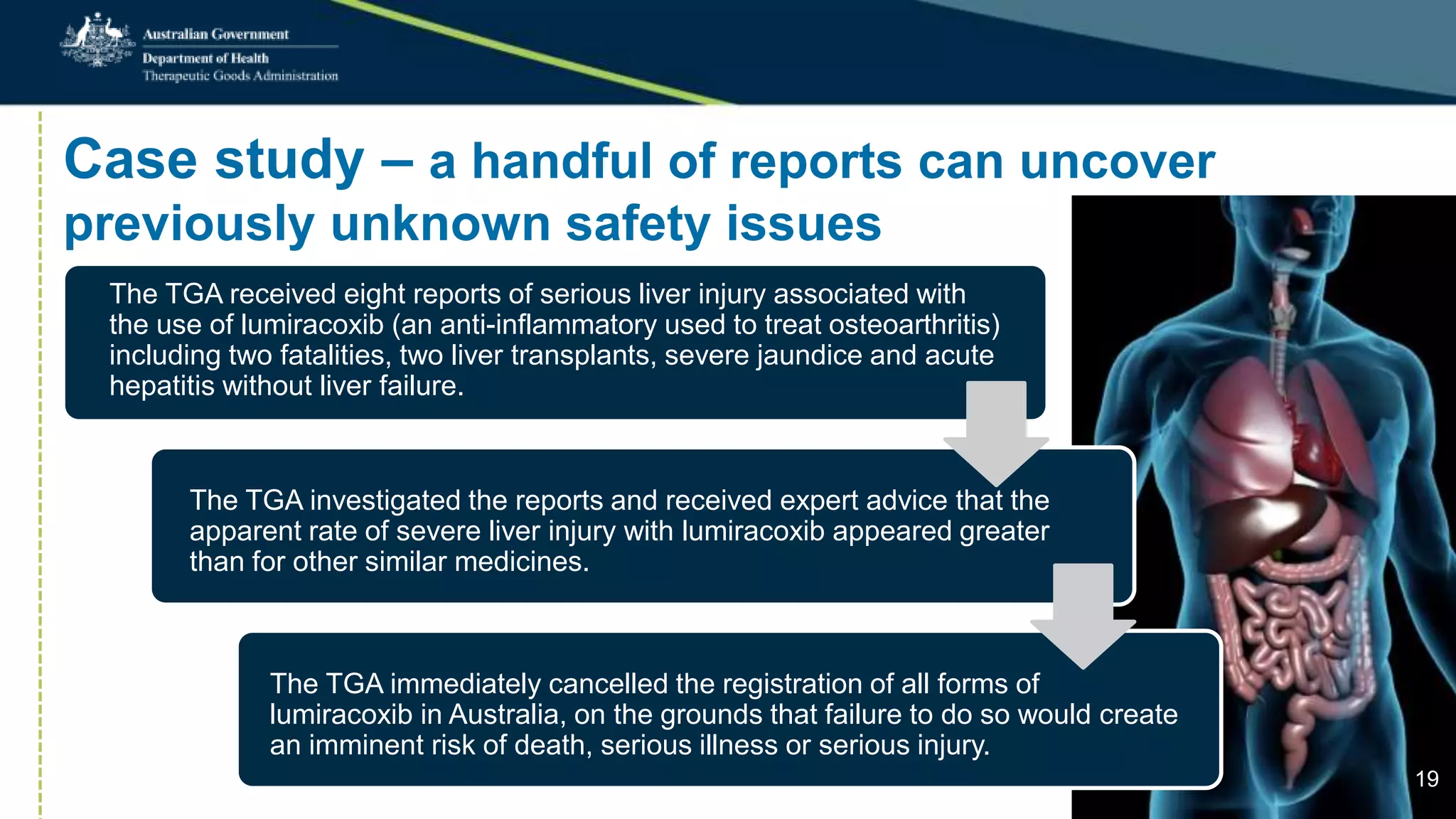
Case study – a handful of reports can uncover
previously unknown safety issues
The TGA received eight reports of serious liver injury associated with
the use of lumiracoxib (an anti-inflammatory used to treat osteoarthritis)
including two fatalities, two liver transplants, severe jaundice and acute
hepatitis without liver failure.
The TGA investigated the reports and received expert advice that the
apparent rate of severe liver injury with lumiracoxib appeared greater
than for other similar medicines.
The TGA immediately cancelled the registration of all forms of
lumiracoxib in Australia, on the grounds that failure to do so would create
an imminent risk of death, serious illness or serious injury.
19
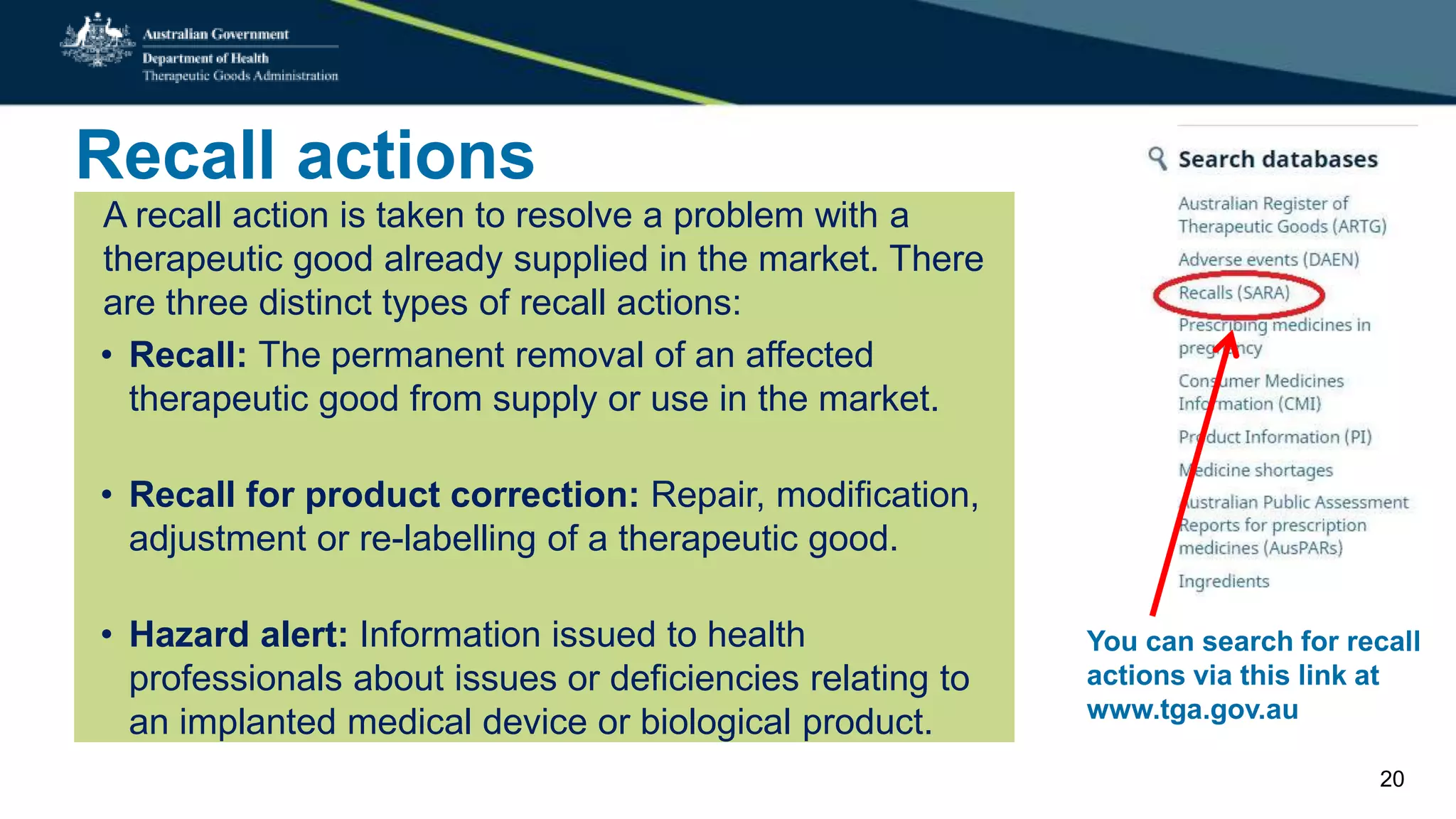
Recall actions
A recall action is taken to resolve a problem with a
therapeutic good already supplied in the market. There
are three distinct types of recall actions:
• Recall: The permanent removal of an affected
therapeutic good from supply or use in the market.
• Recall for product correction: Repair, modification,
adjustment or re-labelling of a therapeutic good.
• Hazard alert: Information issued to health
professionals about issues or deficiencies relating to
an implanted medical device or biological product.
You can search for recall
actions via this link at
www.tga.gov.au
20
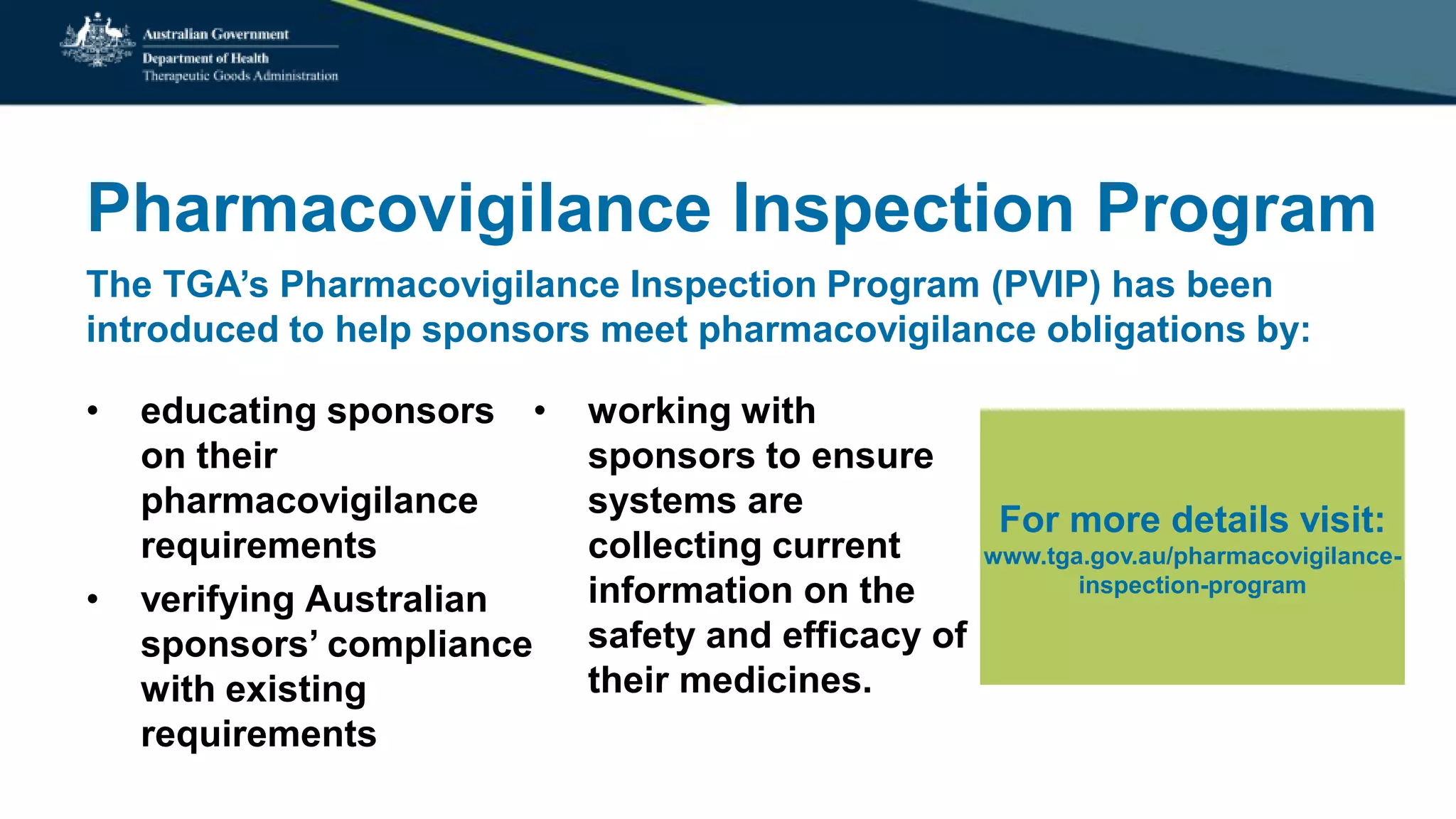
Pharmacovigilance Inspection Program
The TGA’s Pharmacovigilance Inspection Program (PVIP) has been
introduced to help sponsors meet pharmacovigilance obligations by:
• educating sponsors
on their
pharmacovigilance
requirements
• verifying Australian
sponsors’ compliance
with existing
requirements
• working with
sponsors to ensure
systems are
collecting current
information on the
safety and efficacy of
their medicines.
For more details visit:
www.tga.gov.au/pharmacovigilance-
inspection-program
Subscribe to the
TGA information
services to stay
up-to-date:
www.tga.gov.au
Receive information on:
• Safety alerts
• Recall actions
• Medicines Safety Update
• Medical Devices Safety Update
• Consultations
• Publications
• Scheduling
22
Other education modules include:
regulate:Introduction to the TGA
Medicines
Biologicals
Devices
Good manufacturing practice
23

TGA presentation: Postmarket Monitoring

  • 1.
  • 2.
    Overview • What ispostmarket monitoring? • Why is it important? • Tools used in postmarket monitoring • Managing risk • Adverse events • Risk management plans • Signals • Recall actions • Pharmacovigilance Inspection Program • Other education modules 2
  • 3.
    What is postmarketmonitoring? The aim is to continually monitor and evaluate the safety and, in some cases, the efficacy or performance of therapeutic goods that are available on the market and to manage any risks associated with individual products. We regulate therapeutic goods throughout their lifecycle in a number of ways Enforce compliance Monitor Changes to product information, safety alerts, recalls RegisterAssess evidence 3
  • 4.
    Why is thisimportant? Not all risks can be identified before registration Vioxx was first approved in Australia in 1999 for symptomatic treatment of osteoarthritis and rheumatoid arthritis. Postmarket study showed an increased risk of cardiovascular events beginning after 18 months of treatment in patients taking the recommended daily dose. Compared with placebo, this equated to one extra cardiovascular event for each 65 patients who took Vioxx for at least 18 months. Vioxx was withdrawn from the market worldwide in 2004. This was one catalyst for more vigorous postmarket monitoring for regulators around the world. 4
  • 5.
    Tools used inpostmarket monitoring Risk management plans (RMPs) Adverse event reporting and Pharmacovigilance Inspection Program (PVIP) Environmental scanning (seeking confidential advice from other regulators and review of medical literature, regulatory news, media and other sources) As a future health professional, you can help by learning how to report adverse events 5
  • 6.
    Managing risk • TheTGA works on a risk-benefit assessment of products at a population level. The benefit of taking the medicine or using the device should be greater than the possible adverse events. • Higher levels of risk may be acceptable for a product used to treat a terminal illness, but not for a common or minor complaint. 6
  • 7.
    Definition of an adverseevent For both medicines and medical devices: an event that resulted in, or could have resulted in, serious injury, illness or death. A medical device adverse event can also be associated with the use (or misuse) of a medical device. This may include difficulties or malfunctions, such as problems with getting the device to operate, the need for repeated repairs, difficulty of use or difficulty with cleaning after use. 7
  • 8.
    Your role asa health professional • You play an important role in monitoring the safety of therapeutic goods by reporting any suspected adverse events to the TGA. • Reports can be made online, or by phone, fax or email. • Visit the TGA website for more information about reporting. www.tga.gov.au Search the databases of adverse event notifications to see what has been reported to the TGA 8 8
  • 9.
    What should youreport? The TGA is particularly interested in: • serious or unexpected reactions to medicines (this is explained further on the next slide) • serious medicine interactions • faults or problems with medical devices that have resulted, or could have resulted, in adverse events. 9
  • 10.
    Reporting serious andunexpected reactions to medicines It is most important to report serious and unexpected reactions to medicines. These are distinct from well known side effects. For example, we would not expect reports of: • tiredness after taking an opiate based painkiller • nausea or diarrhoea after taking certain antibiotics. 10
  • 11.
    Who currently reportsadverse events? 2016 data * There are mandatory reporting requirements for industry. The TGA is developing strategies to encourage increased reporting by health professionals and consumers 11
  • 12.
    Why Risk ManagementPlans? (RMPs) Real-world use of a medicine or biological identifies issues that may not have been discovered during a clinical trial RMPs are completed by sponsors as part of the registration process for high-risk medicines and biologicals (made from or contains human cells or human tissue) They outline the risk management system for a product once it is available for use in Australia RMPs are living documents that cover the lifecycle of a product and inform the periodic safety update reports 12
  • 13.
    Key elements ofan RMP Safety specification Safety profile of a medicine or biological, including known and potential safety concerns Pharmacovigilance activities Plan for how safety concerns will be monitored and how further information will be collected Risk minimisation activities Plan for how the risks associated with the use of the product will be minimised 13
  • 14.
    Safety signals How werespond • Signals are information collected from one or more sources that show a potentially causal relationship between a product and an adverse event. • There are three steps in the signal investigation process. 14
  • 15.
    Step 1 –detecting signals Involves a review of adverse event reports, international monitoring activities and reports, published literature and post-approval studies to identify harmful effects TGA 15
  • 16.
    Step 2 –assessing signals Involves determining the: • nature • magnitude • health significance of potential safety problems and their impact on the overall risk-benefit of the product. This process takes into consideration factors such as whether it is a serious adverse event in a few patients or a moderate adverse event in a large number of patients. 16
  • 17.
    Step 3 –responding to signals Regulatory actions taken to mitigate risk include: • communication of information for consumers, health professionals and industry regarding the problem • alteration of the product label • recall of goods from sale or use, or for correction • changes to the conditions of registration • suspension or cancellation of the product. 17
  • 18.
    Case study –one report can make a difference Report that an epidural catheter, which is normally clear, was yellow when removed from the packaging for use. Upon testing, the yellow catheter was found to be cytotoxic. New, clear catheters (of the same brand) were also found to be cytotoxic. Further analysis found a plasticiser used to soften the catheter, n-butyl benzene sulfonamide, is a neurotoxin. The manufacturer had been using it for 30 years with no reports of related adverse events. The catheter was reformulated wordwide due to the TGA’s discovery. 18
  • 19.
    Case study –a handful of reports can uncover previously unknown safety issues The TGA received eight reports of serious liver injury associated with the use of lumiracoxib (an anti-inflammatory used to treat osteoarthritis) including two fatalities, two liver transplants, severe jaundice and acute hepatitis without liver failure. The TGA investigated the reports and received expert advice that the apparent rate of severe liver injury with lumiracoxib appeared greater than for other similar medicines. The TGA immediately cancelled the registration of all forms of lumiracoxib in Australia, on the grounds that failure to do so would create an imminent risk of death, serious illness or serious injury. 19
  • 20.
    Recall actions A recallaction is taken to resolve a problem with a therapeutic good already supplied in the market. There are three distinct types of recall actions: • Recall: The permanent removal of an affected therapeutic good from supply or use in the market. • Recall for product correction: Repair, modification, adjustment or re-labelling of a therapeutic good. • Hazard alert: Information issued to health professionals about issues or deficiencies relating to an implanted medical device or biological product. You can search for recall actions via this link at www.tga.gov.au 20
  • 21.
    Pharmacovigilance Inspection Program TheTGA’s Pharmacovigilance Inspection Program (PVIP) has been introduced to help sponsors meet pharmacovigilance obligations by: • educating sponsors on their pharmacovigilance requirements • verifying Australian sponsors’ compliance with existing requirements • working with sponsors to ensure systems are collecting current information on the safety and efficacy of their medicines. For more details visit: www.tga.gov.au/pharmacovigilance- inspection-program
  • 22.
    Subscribe to the TGAinformation services to stay up-to-date: www.tga.gov.au Receive information on: • Safety alerts • Recall actions • Medicines Safety Update • Medical Devices Safety Update • Consultations • Publications • Scheduling 22
  • 23.
    Other education modulesinclude: regulate:Introduction to the TGA Medicines Biologicals Devices Good manufacturing practice 23