Wordle
●   Improvement over Tagclouds
    ●   Effectiveness of Tagclouds


●   wordle = iTagclouds
             i
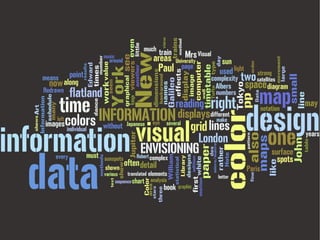
    ●   aesthetic combination of layout, type and colors
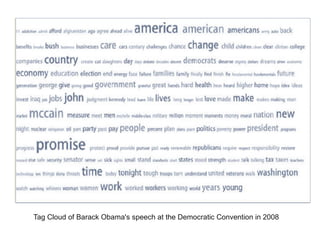
Tag Cloud of Barack Obama's speech at the Democratic Convention in 2008
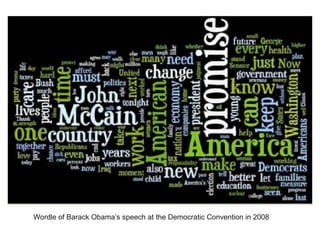
Wordle of Barack Obama’s speech at the Democratic Convention in 2008
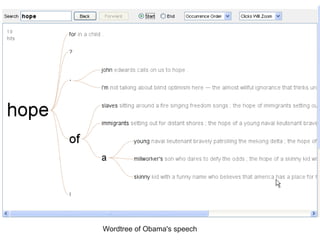
Wordtree of Obama's speech
What is Wordle useful for ?
●   Gives a good Overview
    ●   as reminders, reinforces existing knowledge,
        as 'memento' (~50% users of wordle)
    ●   as learning aids
        –   used by educators

●   Emotional visualization !
    ●   marriage vows
What is Wordle not useful for ?
●   Standalone learning tool
    ●   prior knowledge required
●   Discovering new information
●   Interactive visualization
Design implications of Wordle
●   Creating mass visualizations
    ●   Low cost of entry
    ●   Portability or Sharing
    ●   Aesthetics ~= Usability
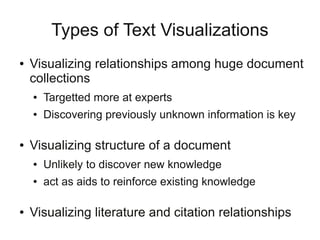
Types of Text Visualizations
●   Visualizing relationships among huge document
    collections
    ●   Targetted more at experts
    ●   Discovering previously unknown information is key

●   Visualizing structure of a document
    ●   Unlikely to discover new knowledge
    ●   act as aids to reinforce existing knowledge

●   Visualizing literature and citation relationships
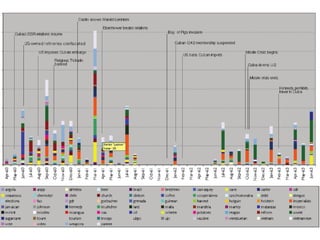
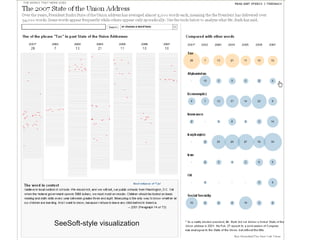
SeeSoft-style visualization
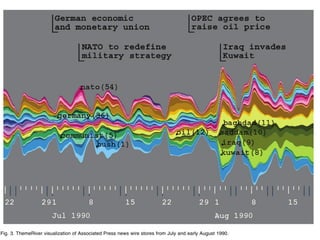
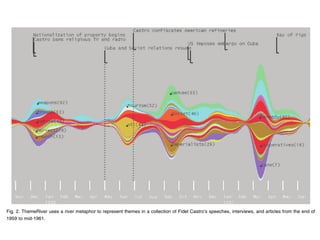
Themeriver
●   can get good overview with help of markers

    Drawbacks:
●   not much useful without prior knowledge on the
    topics/markers
●   scalability of number of topics - reuse of colors
●   less avenues for user interaction
    ●   high cost of processing
●   evaluation with 2 users
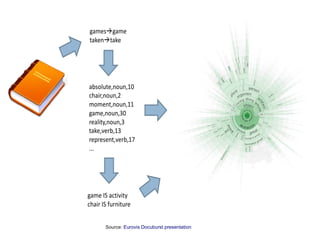
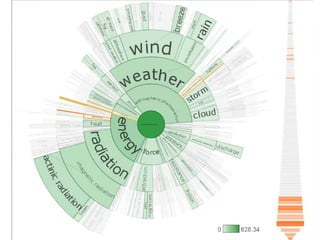
Docuburst


●   What if
    ●   tagclouds + lexical semantic hierarchy = ?
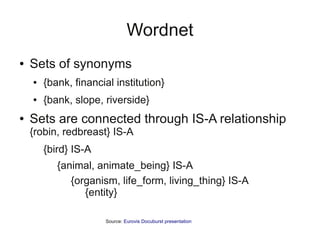
Wordnet
●   Sets of synonyms
    ●   {bank, financial institution}
    ●   {bank, slope, riverside}
●   Sets are connected through IS-A relationship
    {robin, redbreast} IS-A
        {bird} IS-A
           {animal, animate_being} IS-A
              {organism, life_form, living_thing} IS-A
                 {entity}

                      Source: Eurovis Docuburst presentation
Source: Eurovis Docuburst presentation
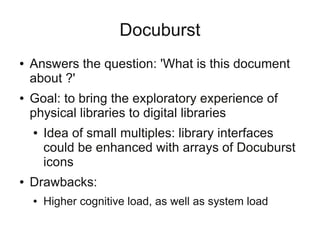
Docuburst
●   Answers the question: 'What is this document
    about ?'
●   Goal: to bring the exploratory experience of
    physical libraries to digital libraries
    ●   Idea of small multiples: library interfaces
        could be enhanced with arrays of Docuburst
        icons
●   Drawbacks:
    ●   Higher cognitive load, as well as system load
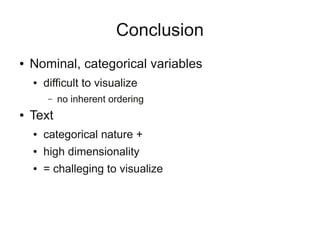
Conclusion
●   Nominal, categorical variables
    ●   difficult to visualize
         –   no inherent ordering
●   Text
    ●   categorical nature +
    ●   high dimensionality
    ●   = challeging to visualize
References
●   DocuBurst: Visualizing Document Content using Language Structure.
    Christopher Collins, Sheelagh Carpendale, Gerald Penn. EuroVis 2009.
●   Participatory Visualization with Wordle. Fernanda B. Viegas, Martin
    Wattenberg, Jonathan Feinberg. InfoVis 2009.
●   ThemeRiver: Visualizing Thematic Changes in Large Document Collections
    Susan Havre, Elizabeth Hetzler, Paul Whitney, Lucy Nowell. IEEE
    Transactions on Visualization and Computer Graphics, 8(1), pp 9-20, 2002.
●   SEARCH USER INTERFACES, PUBLISHED BY CAMBRIDGE
    UNIVERSITY PRESS. COPYRIGHT © 2009 BY MARTI A. HEARST.
    http://searchuserinterfaces.com/book

Text visualization

  • 4.
    Wordle ● Improvement over Tagclouds ● Effectiveness of Tagclouds ● wordle = iTagclouds  i ● aesthetic combination of layout, type and colors
  • 5.
    Tag Cloud ofBarack Obama's speech at the Democratic Convention in 2008
  • 6.
    Wordle of BarackObama’s speech at the Democratic Convention in 2008
  • 7.
  • 8.
    What is Wordleuseful for ?
  • 10.
    What is Wordleuseful for ? ● Gives a good Overview ● as reminders, reinforces existing knowledge, as 'memento' (~50% users of wordle) ● as learning aids – used by educators ● Emotional visualization ! ● marriage vows
  • 11.
    What is Wordlenot useful for ? ● Standalone learning tool ● prior knowledge required ● Discovering new information ● Interactive visualization
  • 12.
    Design implications ofWordle ● Creating mass visualizations ● Low cost of entry ● Portability or Sharing ● Aesthetics ~= Usability
  • 13.
    Types of TextVisualizations ● Visualizing relationships among huge document collections ● Targetted more at experts ● Discovering previously unknown information is key ● Visualizing structure of a document ● Unlikely to discover new knowledge ● act as aids to reinforce existing knowledge ● Visualizing literature and citation relationships
  • 17.
  • 18.
    Themeriver ● can get good overview with help of markers Drawbacks: ● not much useful without prior knowledge on the topics/markers ● scalability of number of topics - reuse of colors ● less avenues for user interaction ● high cost of processing ● evaluation with 2 users
  • 19.
    Docuburst ● What if ● tagclouds + lexical semantic hierarchy = ?
  • 20.
    Wordnet ● Sets of synonyms ● {bank, financial institution} ● {bank, slope, riverside} ● Sets are connected through IS-A relationship {robin, redbreast} IS-A {bird} IS-A {animal, animate_being} IS-A {organism, life_form, living_thing} IS-A {entity} Source: Eurovis Docuburst presentation
  • 21.
  • 23.
    Docuburst ● Answers the question: 'What is this document about ?' ● Goal: to bring the exploratory experience of physical libraries to digital libraries ● Idea of small multiples: library interfaces could be enhanced with arrays of Docuburst icons ● Drawbacks: ● Higher cognitive load, as well as system load
  • 24.
    Conclusion ● Nominal, categorical variables ● difficult to visualize – no inherent ordering ● Text ● categorical nature + ● high dimensionality ● = challeging to visualize
  • 25.
    References ● DocuBurst: Visualizing Document Content using Language Structure. Christopher Collins, Sheelagh Carpendale, Gerald Penn. EuroVis 2009. ● Participatory Visualization with Wordle. Fernanda B. Viegas, Martin Wattenberg, Jonathan Feinberg. InfoVis 2009. ● ThemeRiver: Visualizing Thematic Changes in Large Document Collections Susan Havre, Elizabeth Hetzler, Paul Whitney, Lucy Nowell. IEEE Transactions on Visualization and Computer Graphics, 8(1), pp 9-20, 2002. ● SEARCH USER INTERFACES, PUBLISHED BY CAMBRIDGE UNIVERSITY PRESS. COPYRIGHT © 2009 BY MARTI A. HEARST. http://searchuserinterfaces.com/book