data visualization:
  clouding


     anne helmond & sabine niederer

 doing digital methods, rmes workshop, 28 june 2011
data visualization


    the science of visual representation of “data”,
    defined as information which has been abstracted
    in some schematic form, including attributes or
    variables for the units of information. (2009:1)


                                        michael friendly
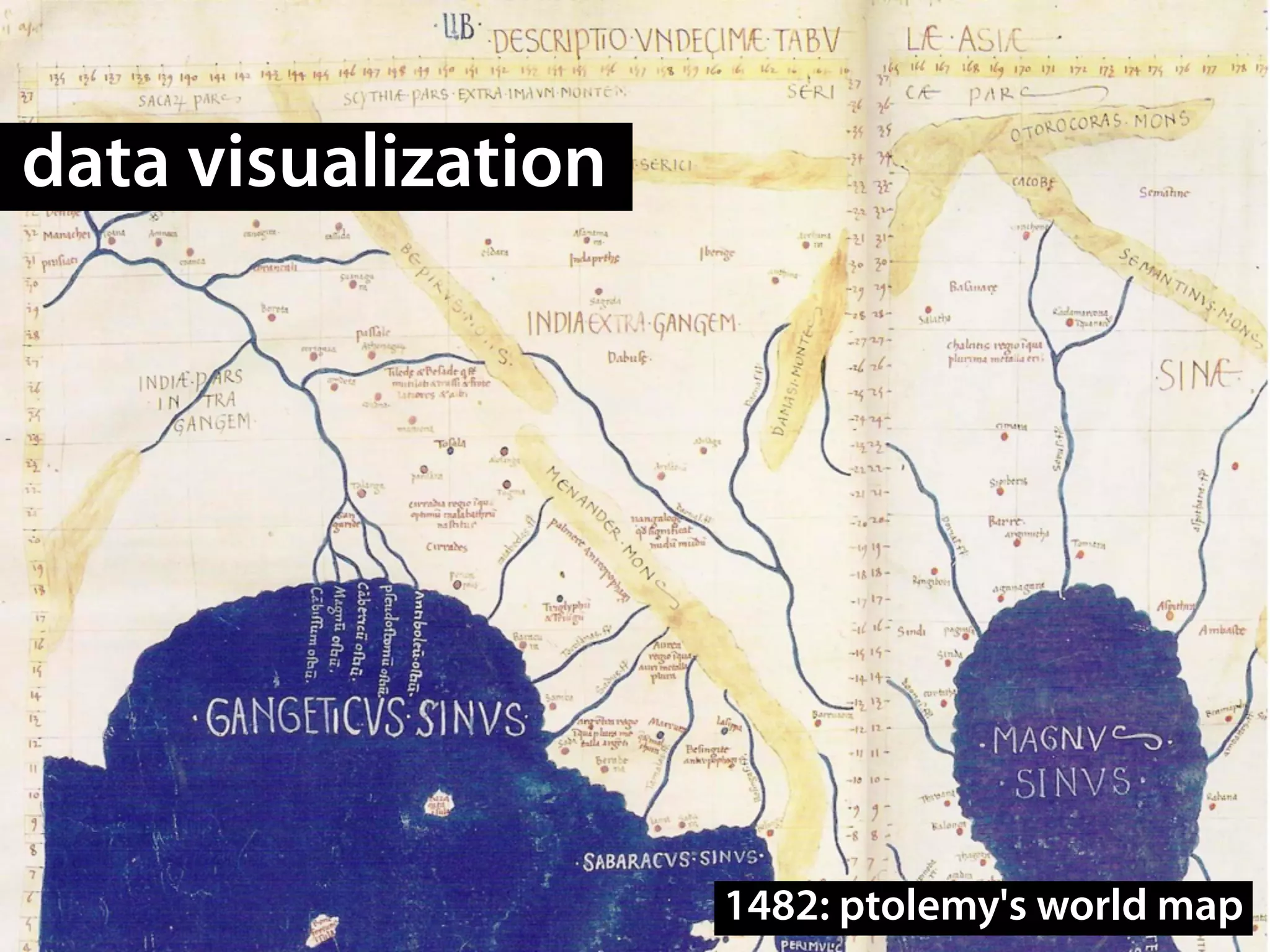
data visualization


                     1482: ptolemy's world map
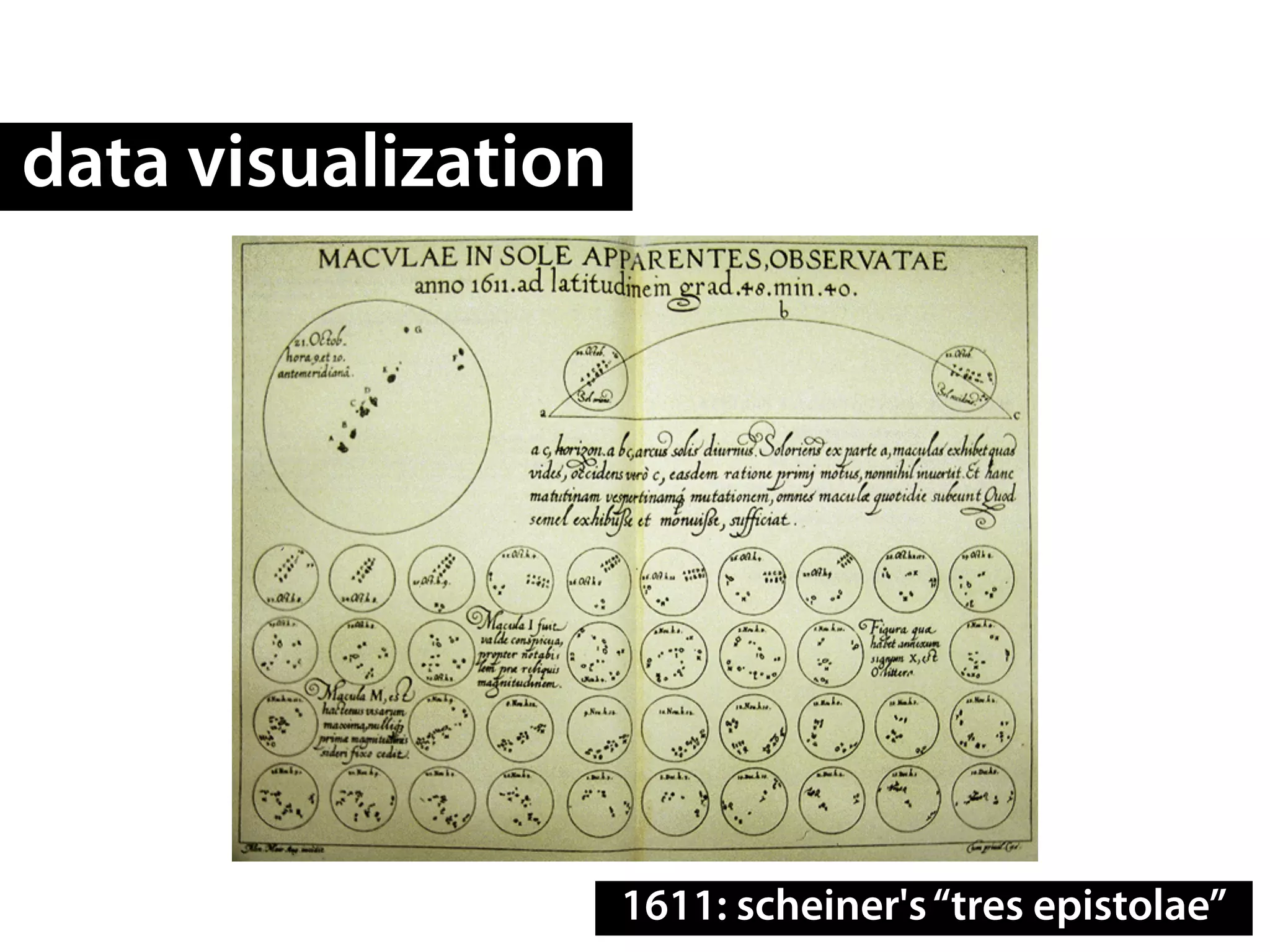
data visualization


                     1611: scheiner's “tres epistolae”
data visualization


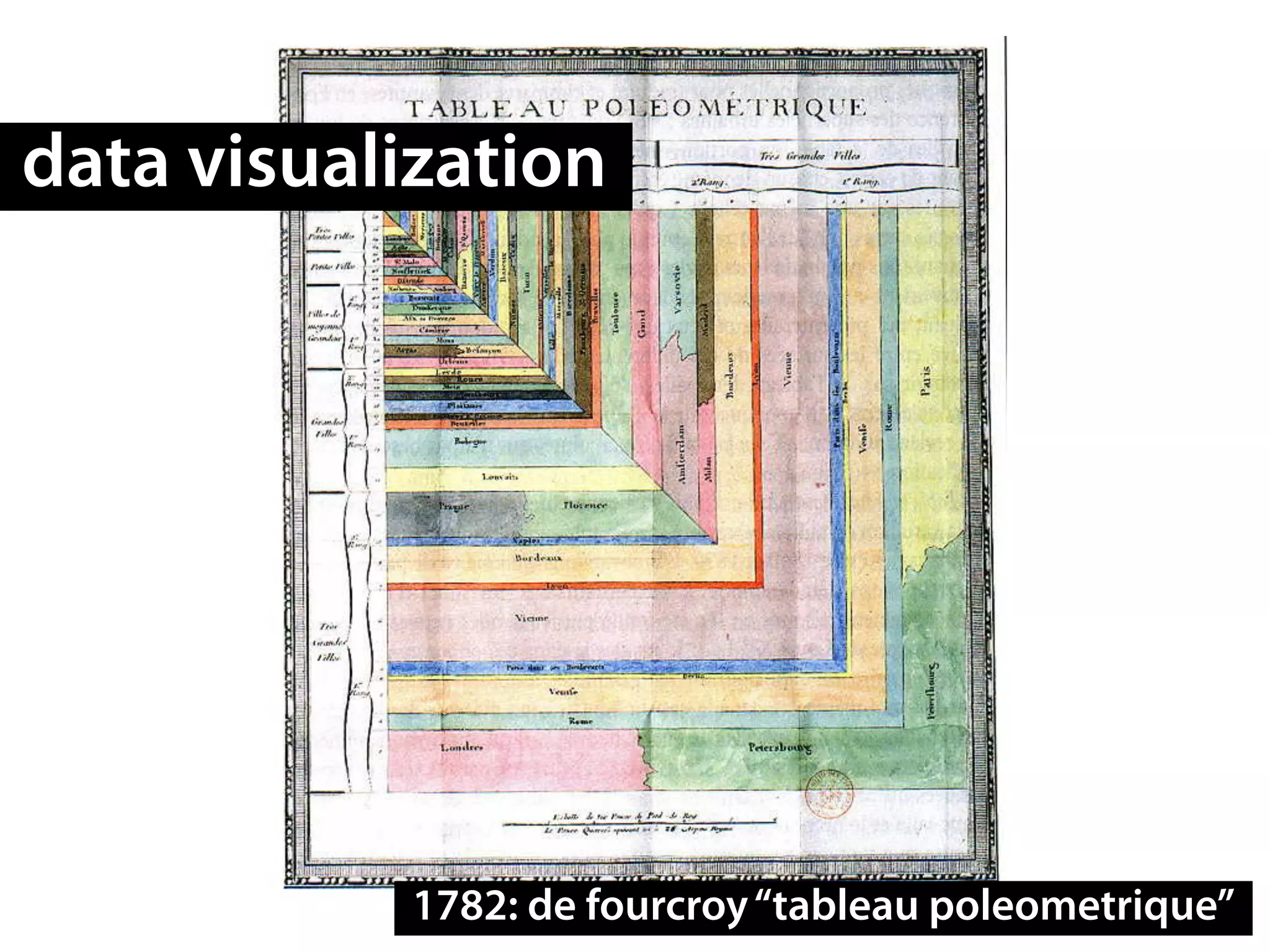
           1782: de fourcroy “tableau poleometrique”
data visualization


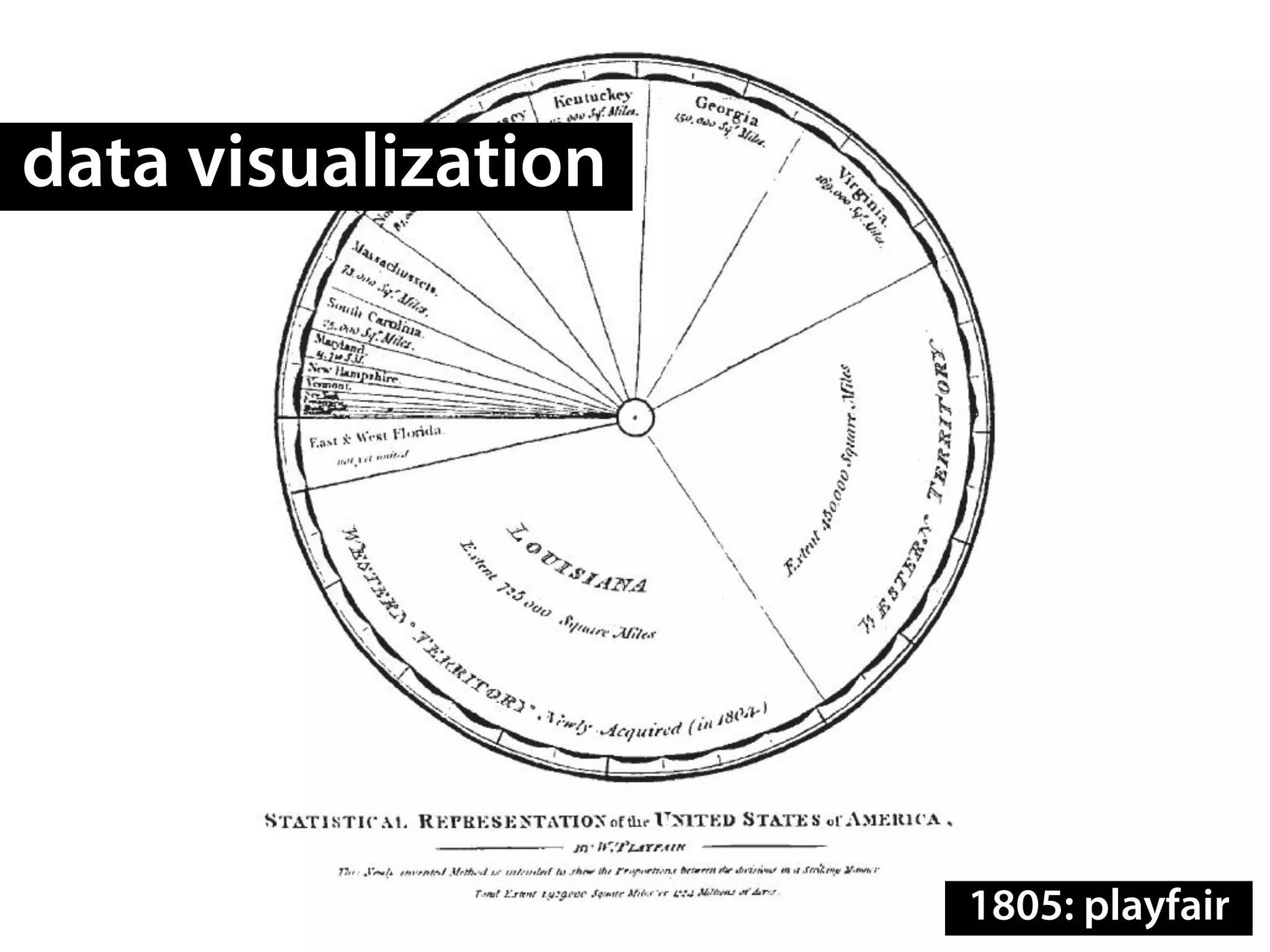
                     1805: playfair
data visualization


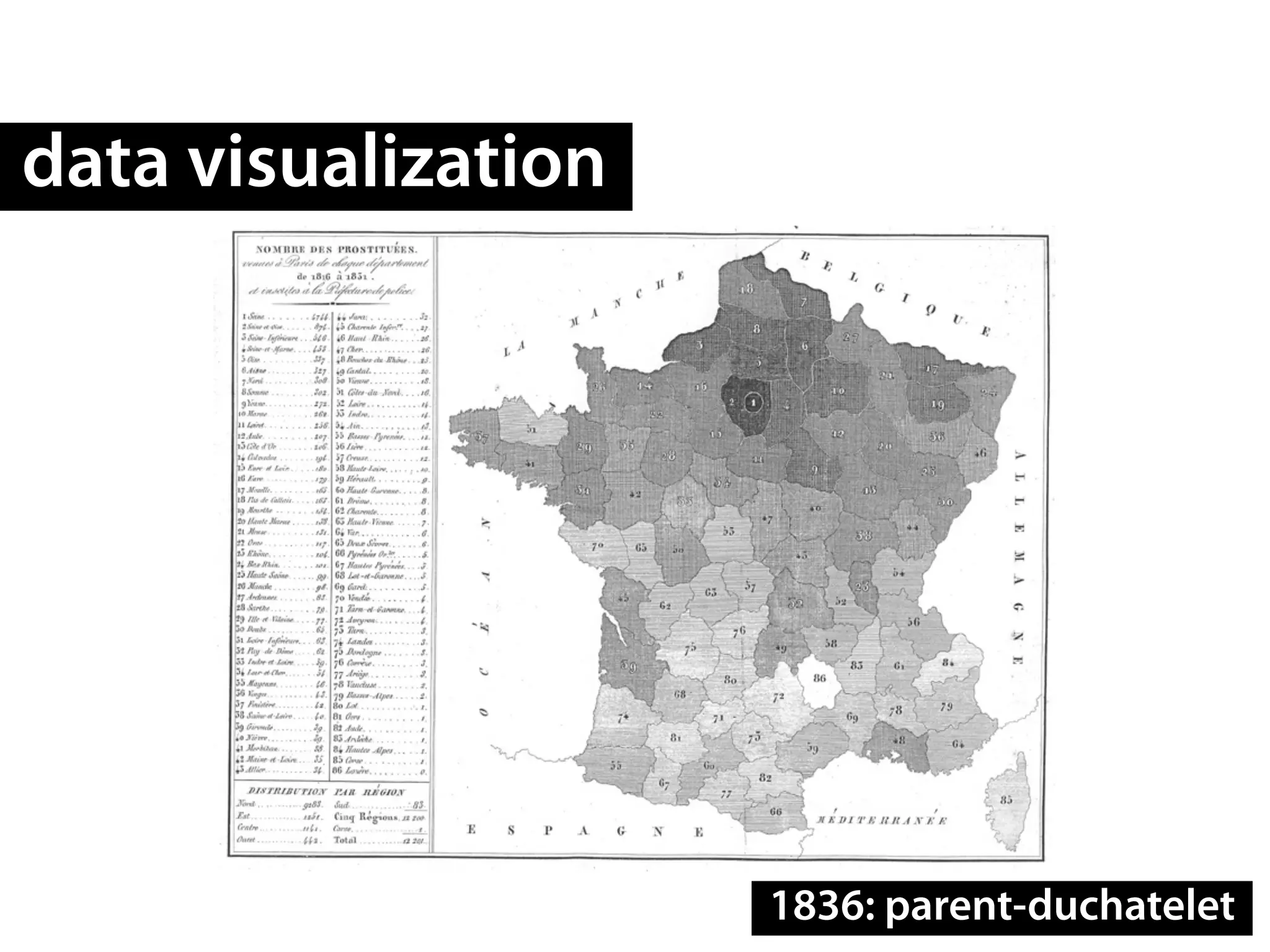
                     1836: parent-duchatelet
data visualization


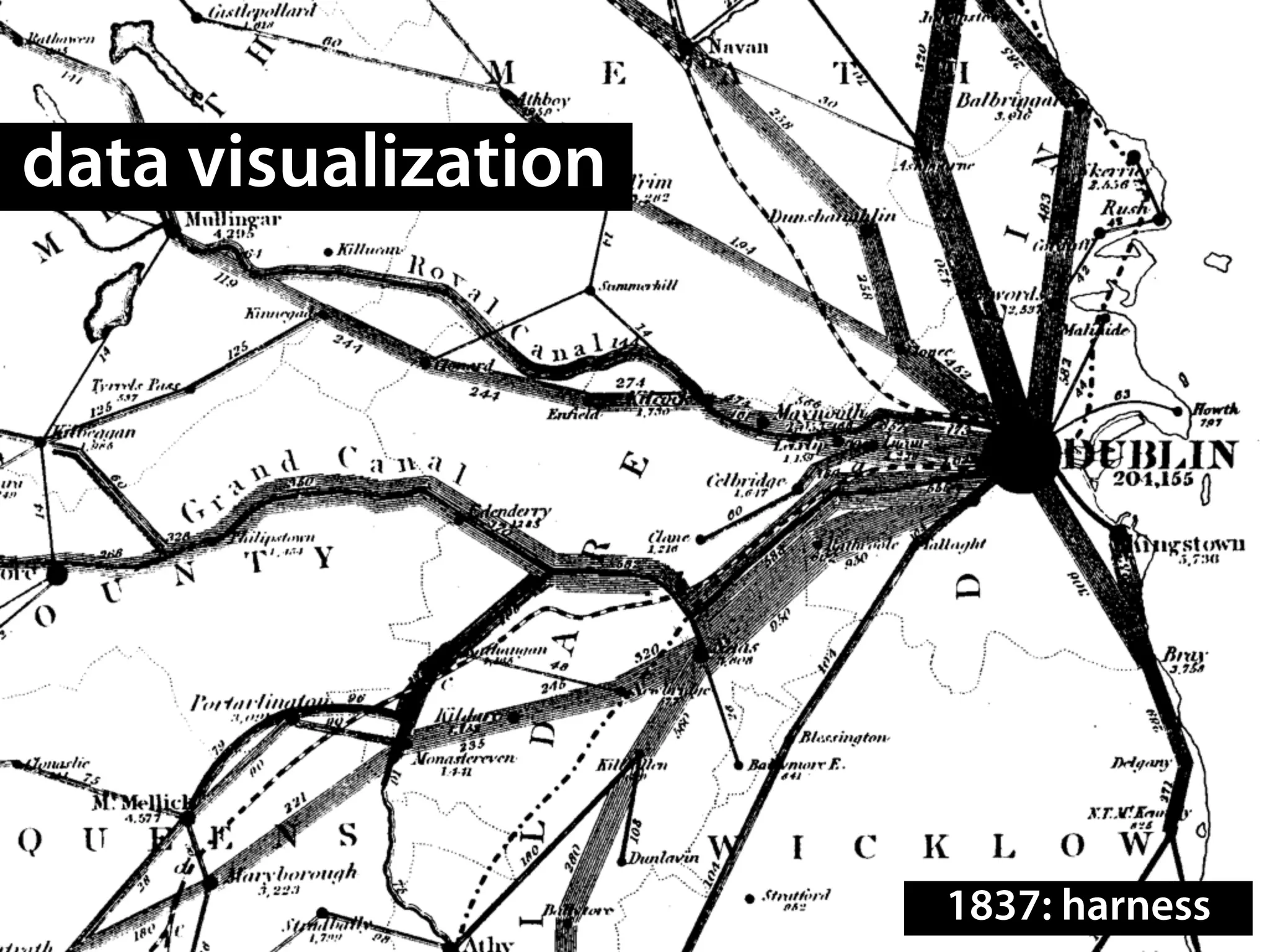
                     1837: harness
data visualization


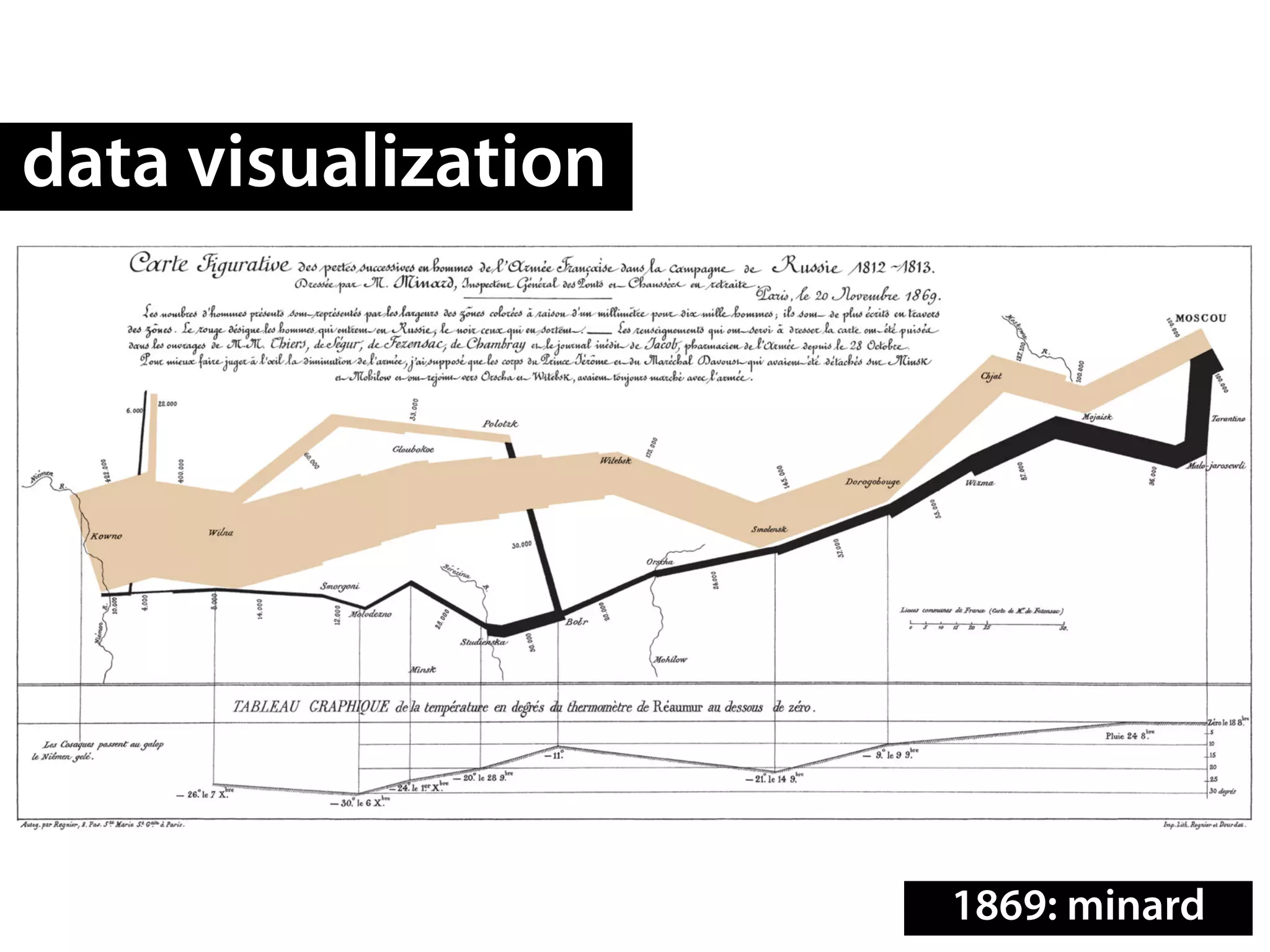
                     1869: minard
data visualization


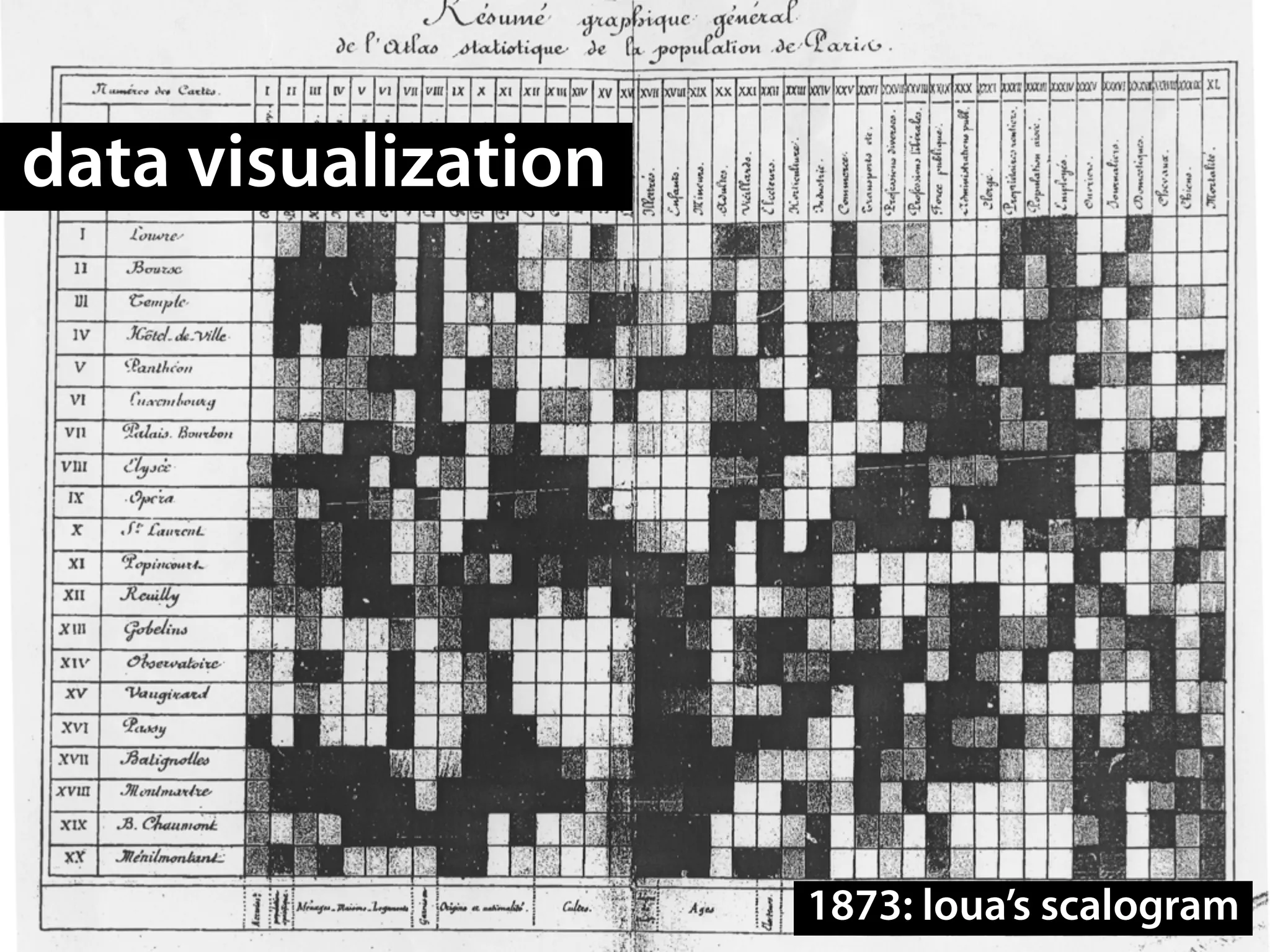
                     1873: loua’s scalogram
data visualization


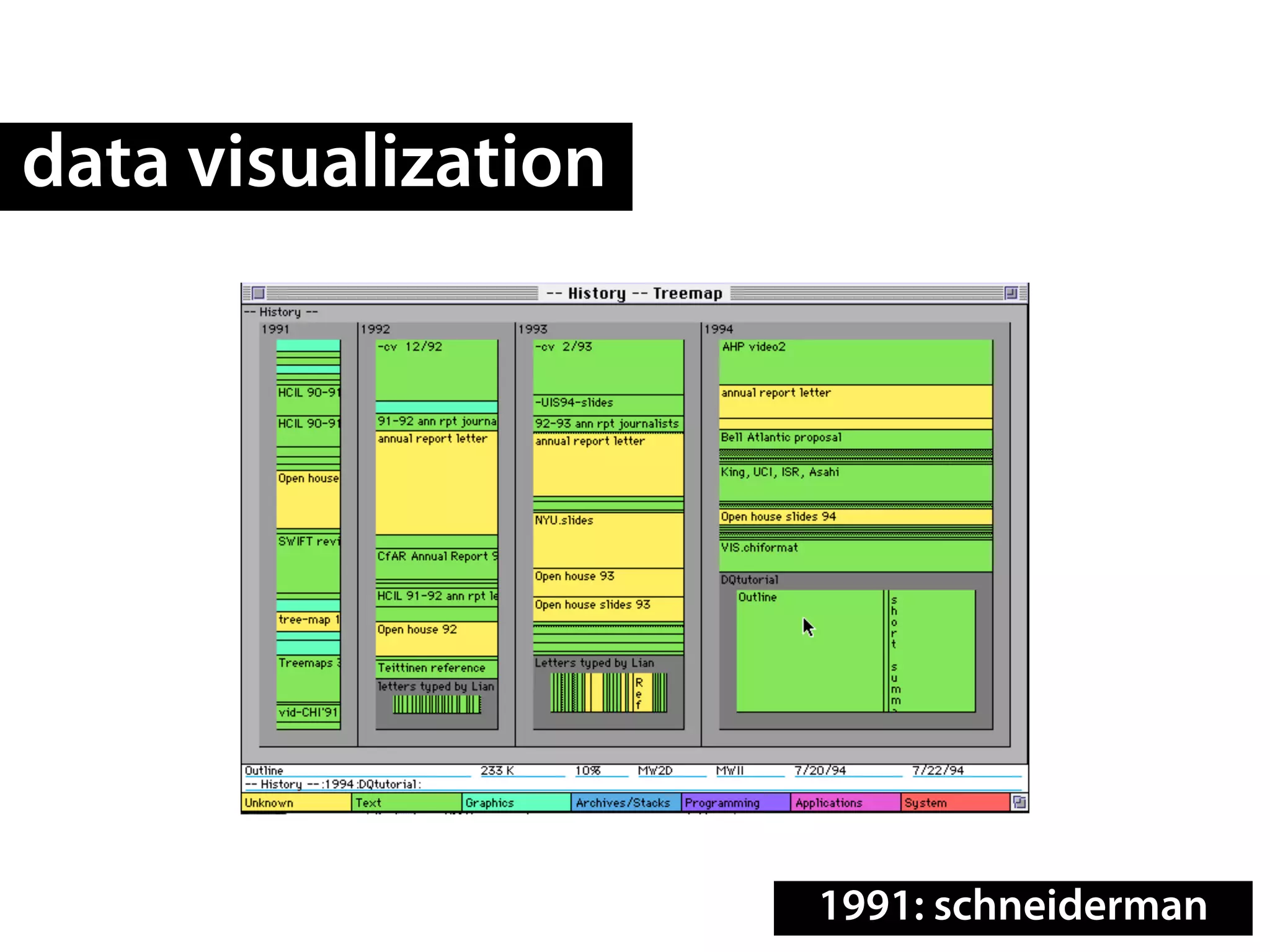
                     1991: schneiderman
direct visualization


   data is reorganized into a new visual
   representation that preserves its original form


                                          manovich 2010
data visualization


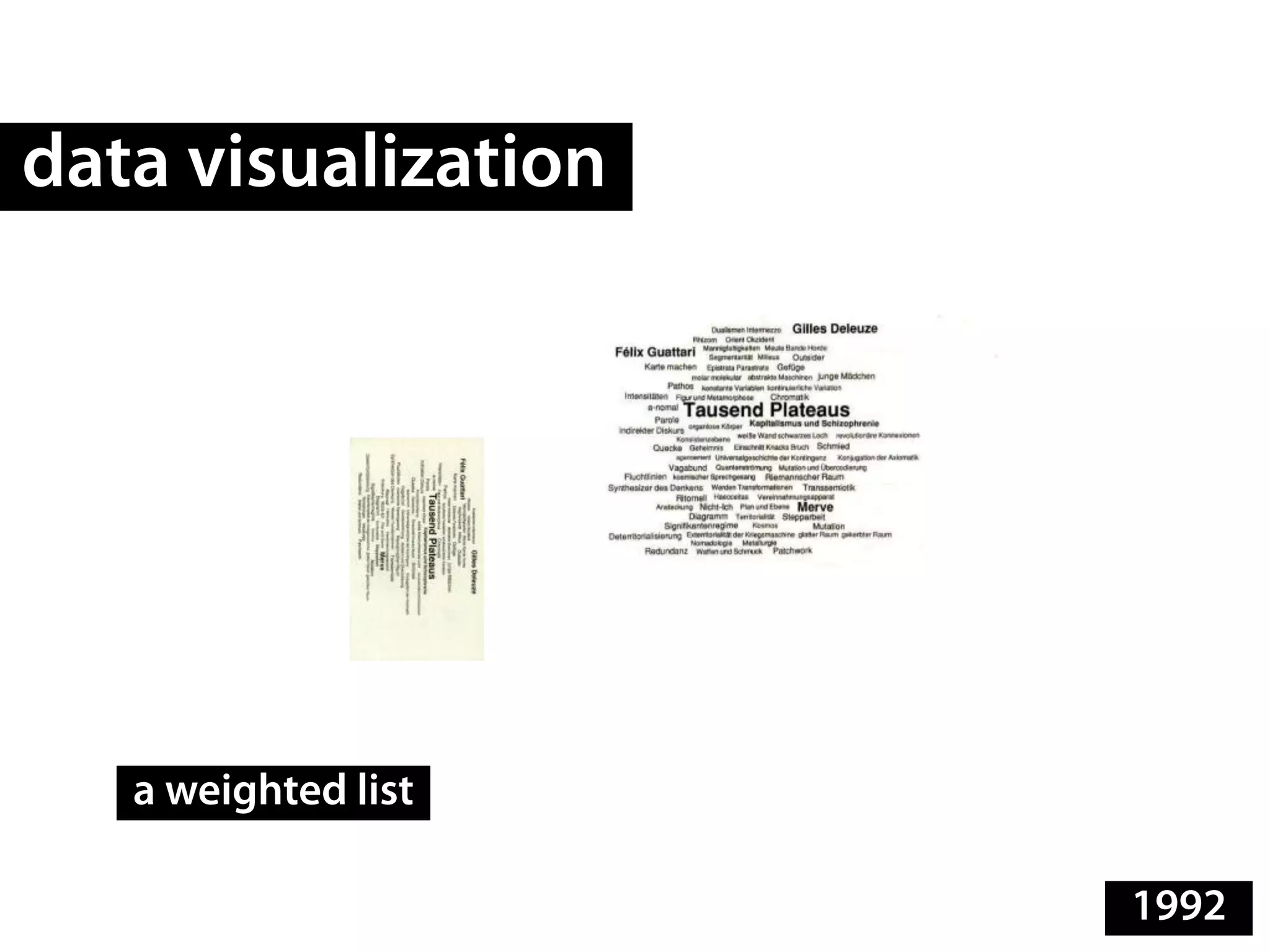
   a weighted list

                     1992
history of the tag cloud


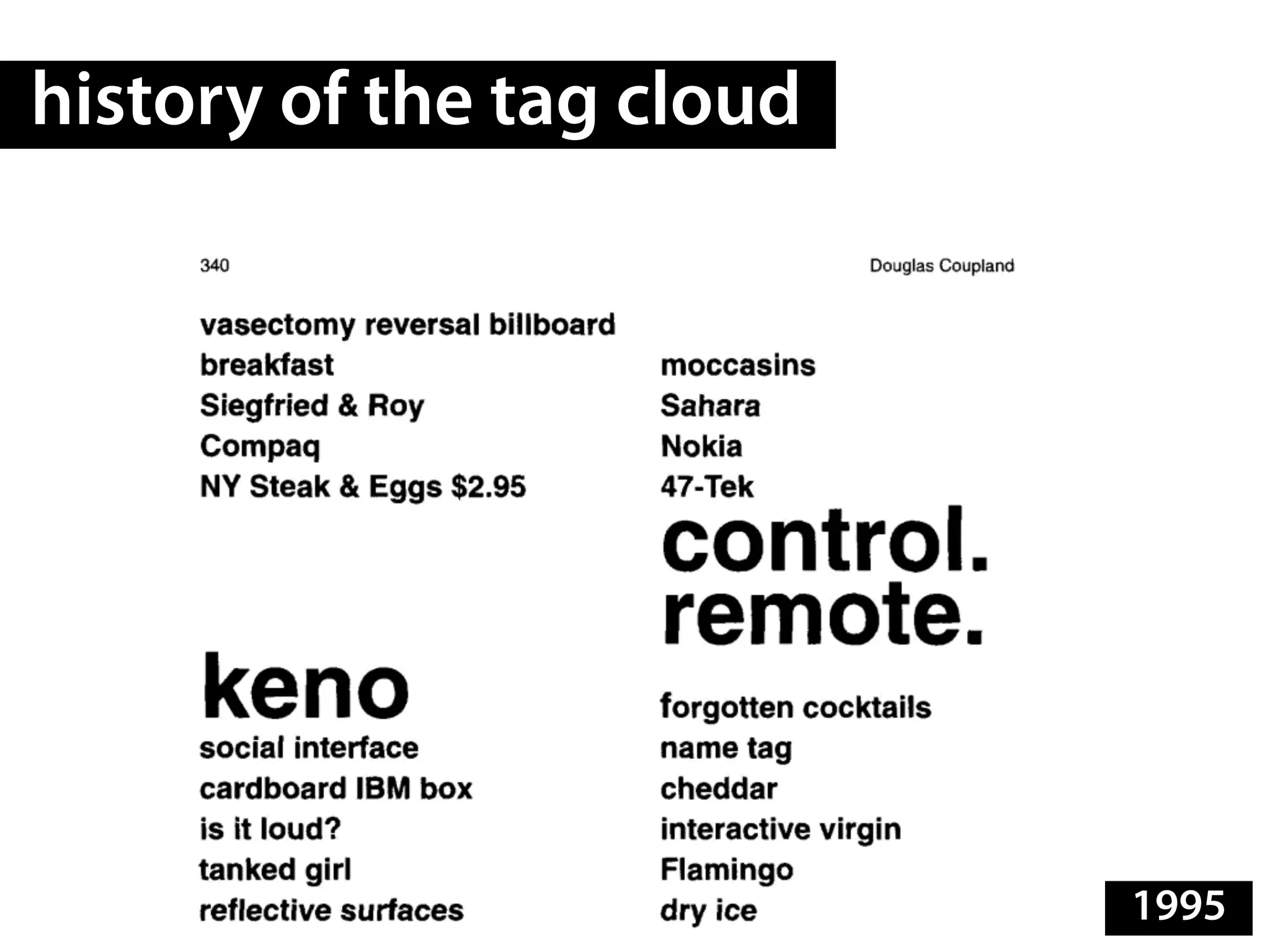
                           1995
history of the tag cloud


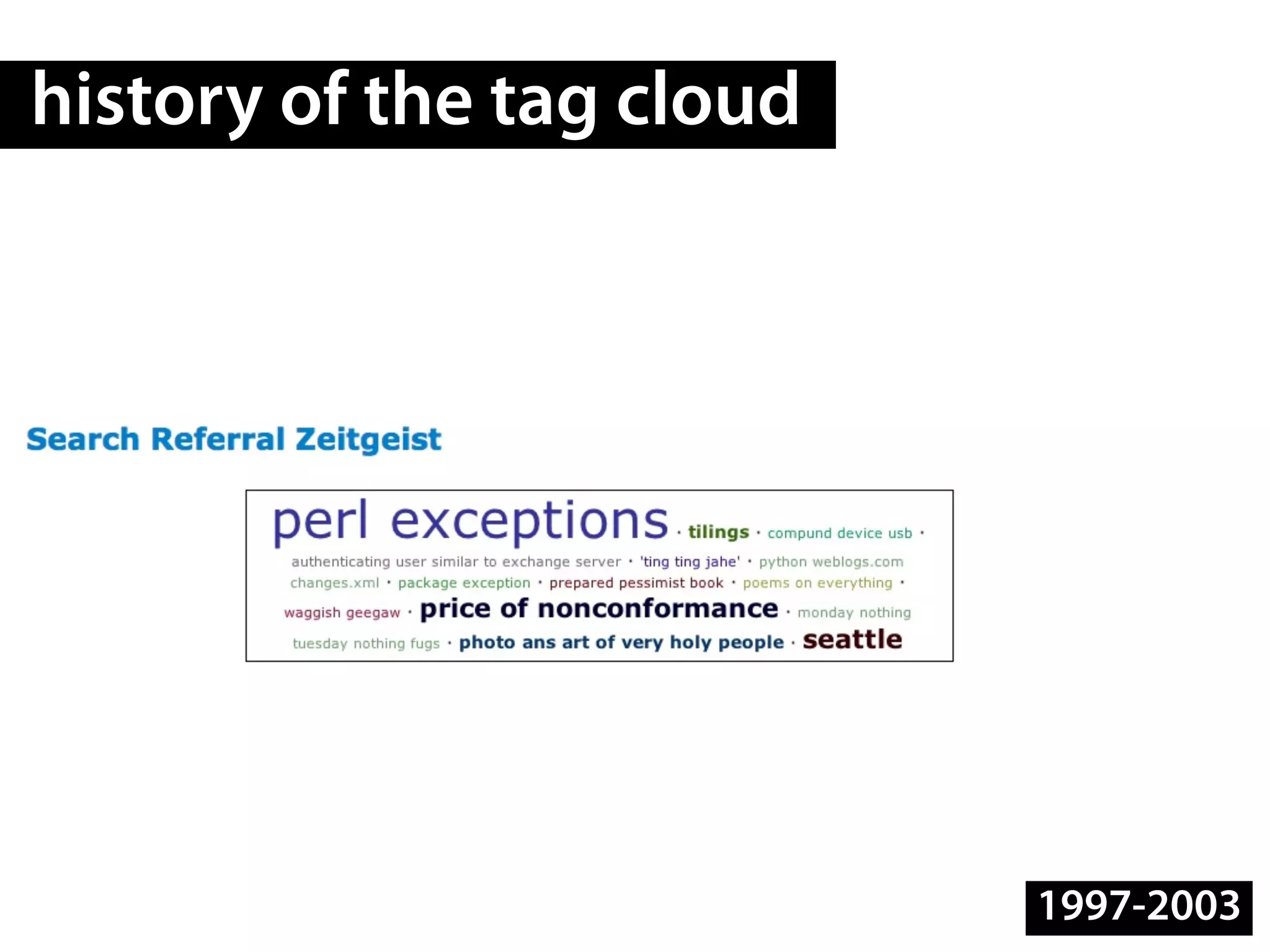
                           1997-2003
history of the tag cloud


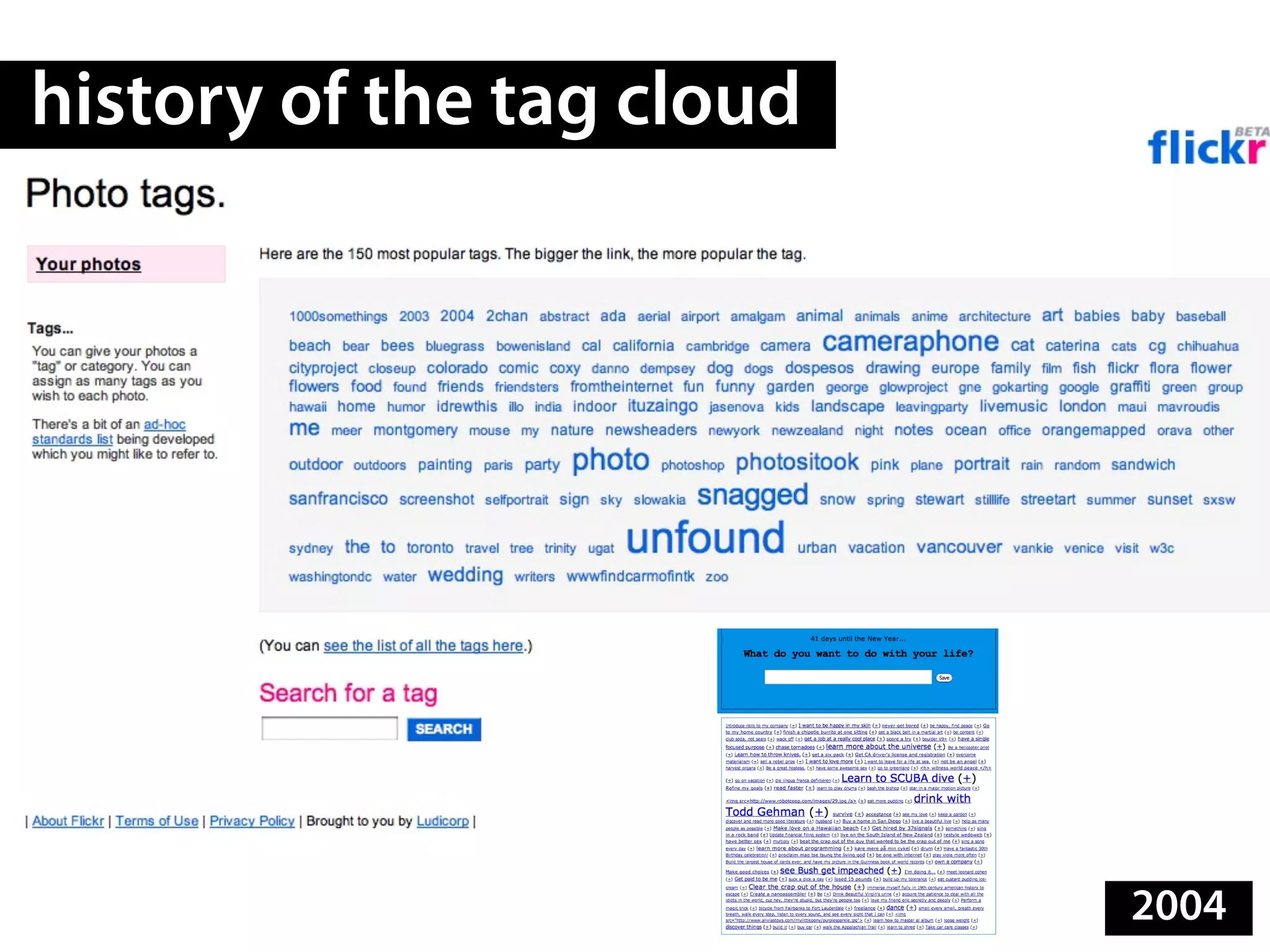
                           2004
tag cloud de nition


  A tag cloud (word cloud, or weighted list in visual
  design) is a visual representation for text data,
  typically used to depict keyword metadata (tags)
  on websites, or to visualize free form text.


                                                wikipedia
tag

 In online computer systems terminology, a tag is a
 non-hierarchical keyword or term assigned to a
 piece of information (such as an internet
 bookmark, digital image, or computer le). This
 kind of metadata helps describe an item and
 allows it to be found again by browsing or
 searching. Tags are chosen informally and
 personally by the item's creator or by its viewer,
 depending on the system.


                                             wikipedia
tagging


   Tagging systems enable users to add keywords
   (i.e., “tags”) to Internet resources (e.g., web pages,
   images, videos) without relying on a controlled
   vocabulary.

   [...] a freely chosen set of keywords (“tags”).


                                           marlow et al 2006
folksonomy
  A folksonomy is a system of classi cation derived from
  the practice and method of collaboratively creating
  and managing tags to annotate and categorize
  content; this practice is also known as collaborative
  tagging, social classi cation, social indexing, and social
  tagging. (Wikipedia)

  Folksonomy is the result of personal free tagging of
  information and objects (anything with a URL) for
  one's own retrieval. The tagging is done in a social
  environment (usually shared and open to others).
  Folksonomy is created from the act of tagging by the
  person consuming the information. (Vander Wal 2007)
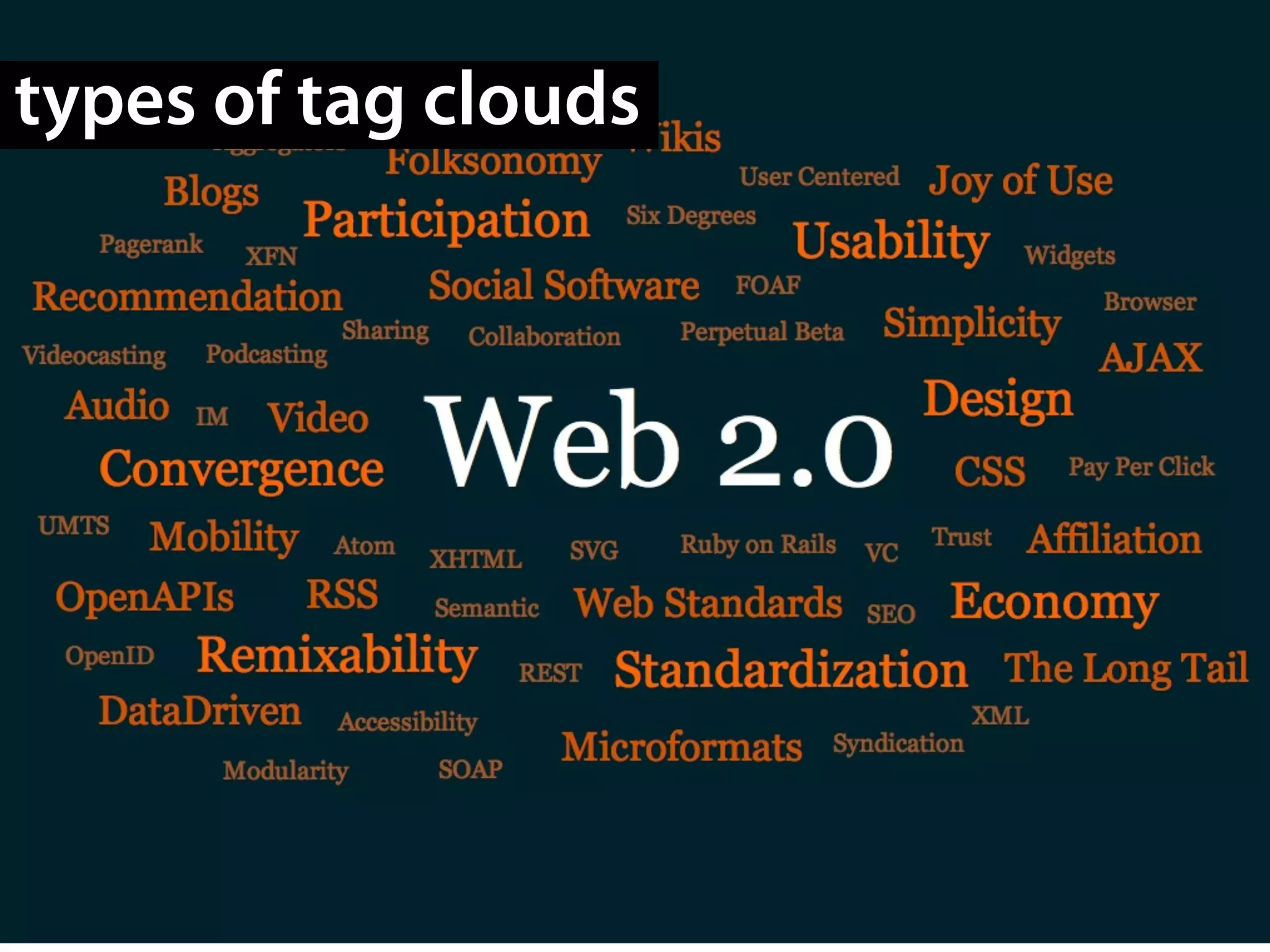
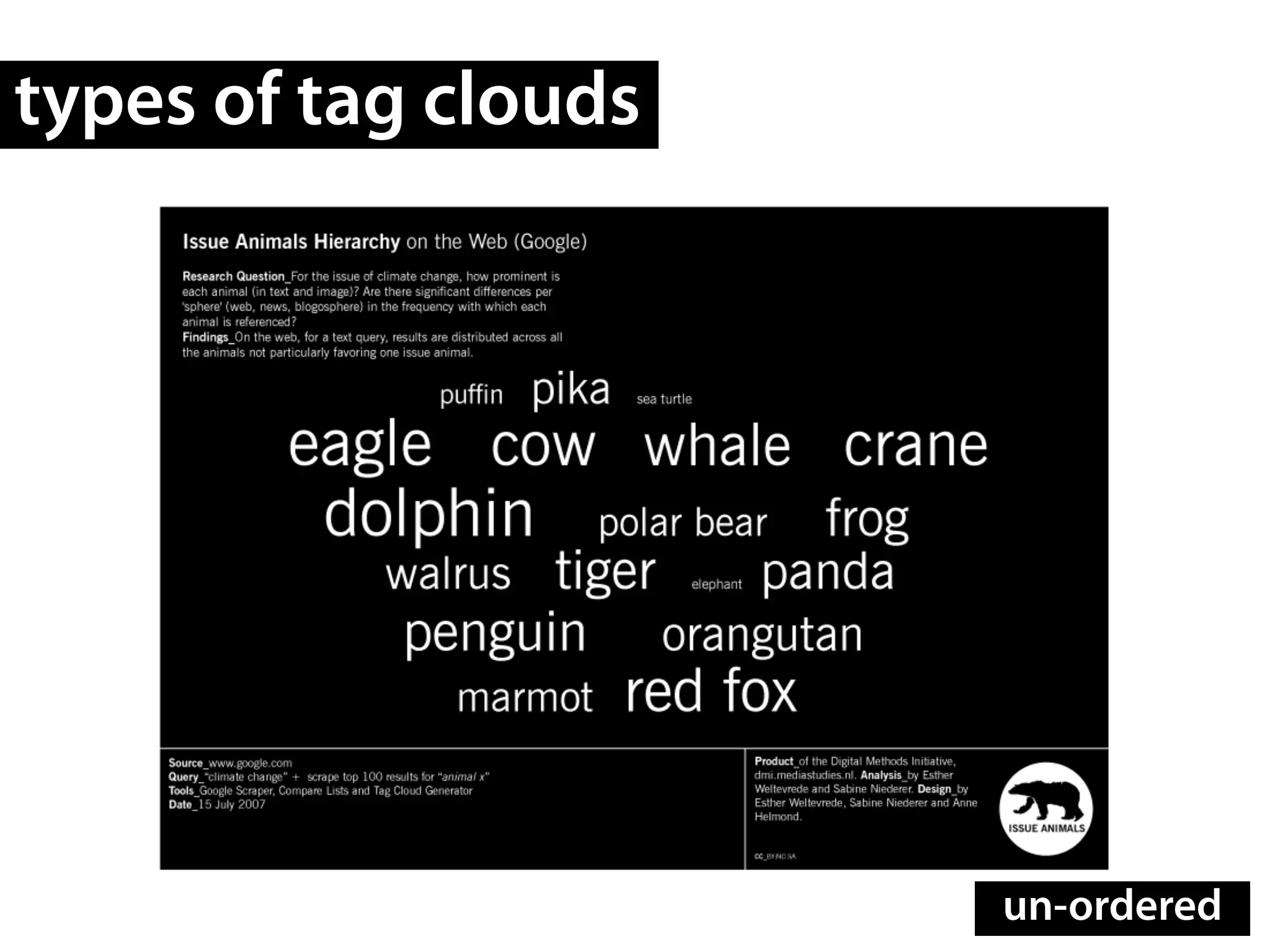
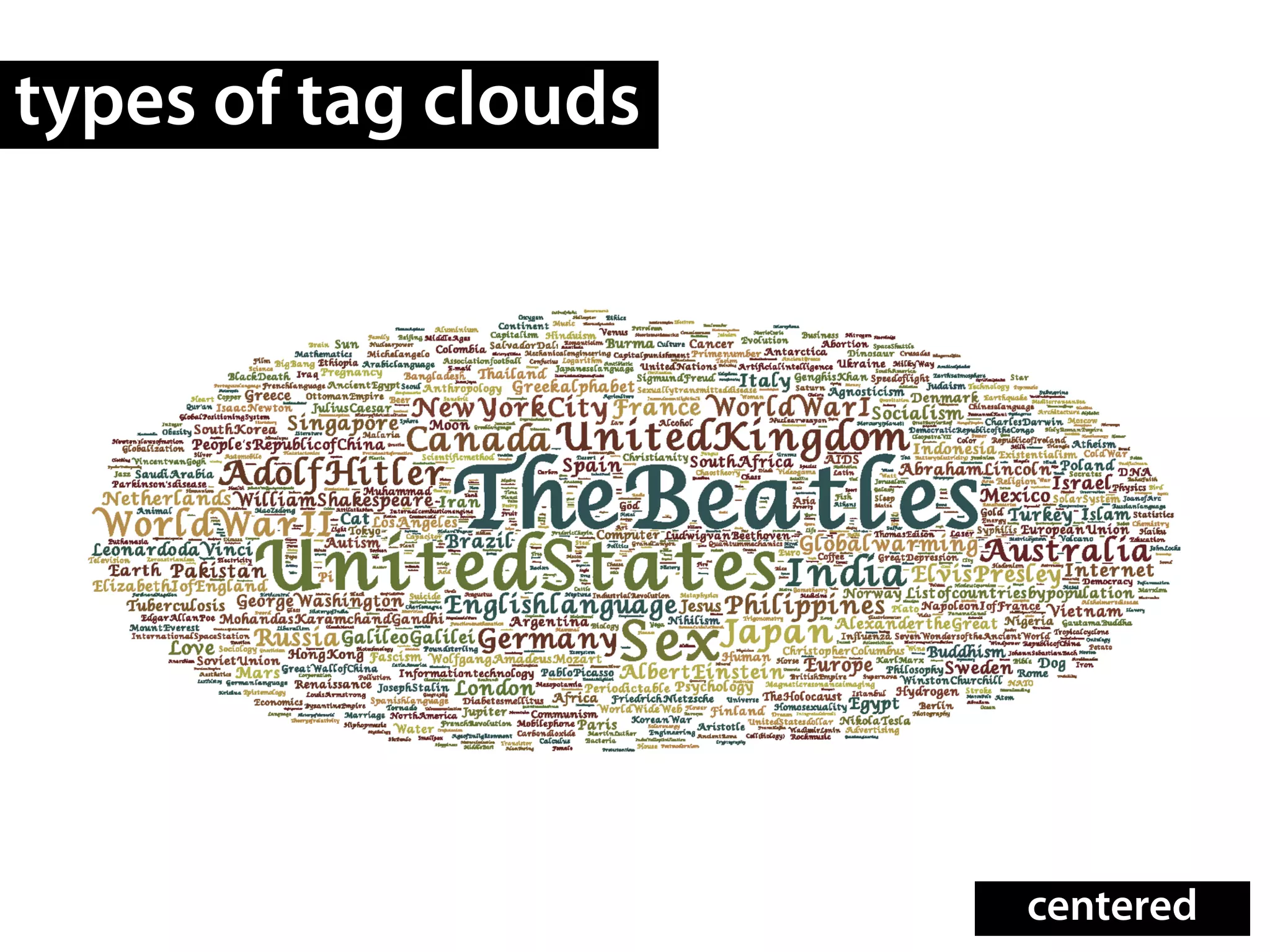
types of tag clouds
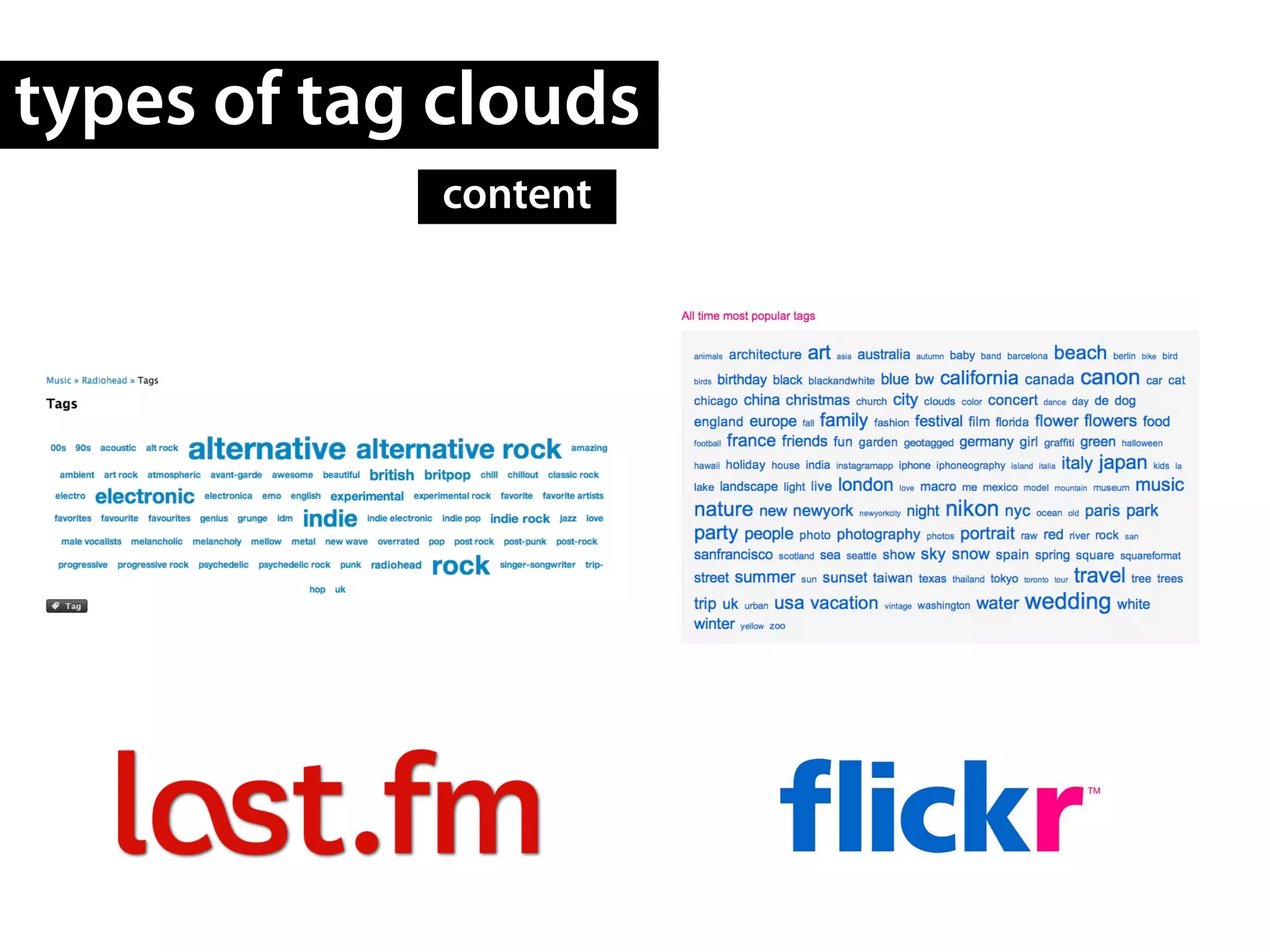
types of tag clouds
            content
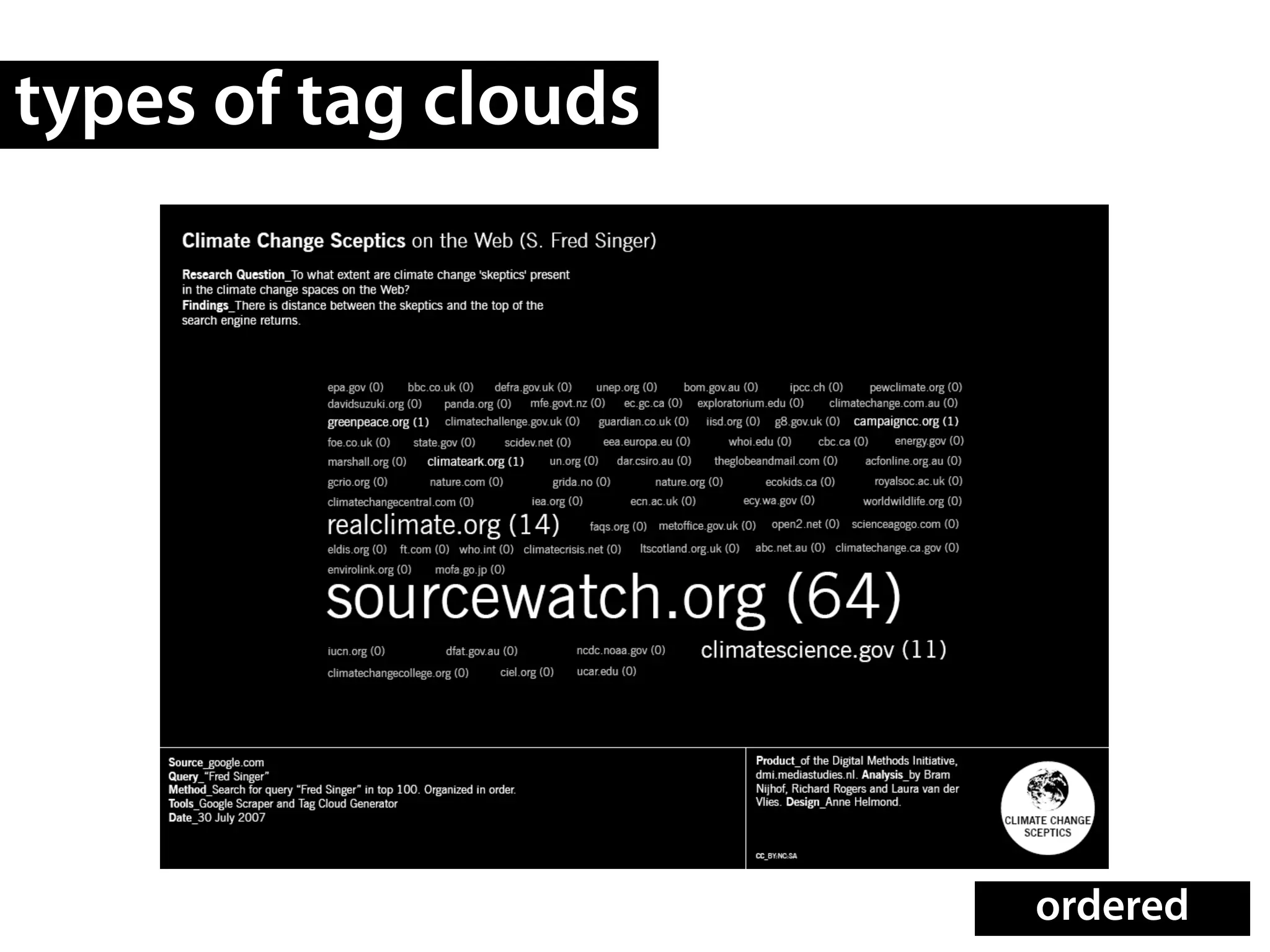
types of tag clouds


                      ordered
types of tag clouds


                      un-ordered
types of tag clouds


                      centered
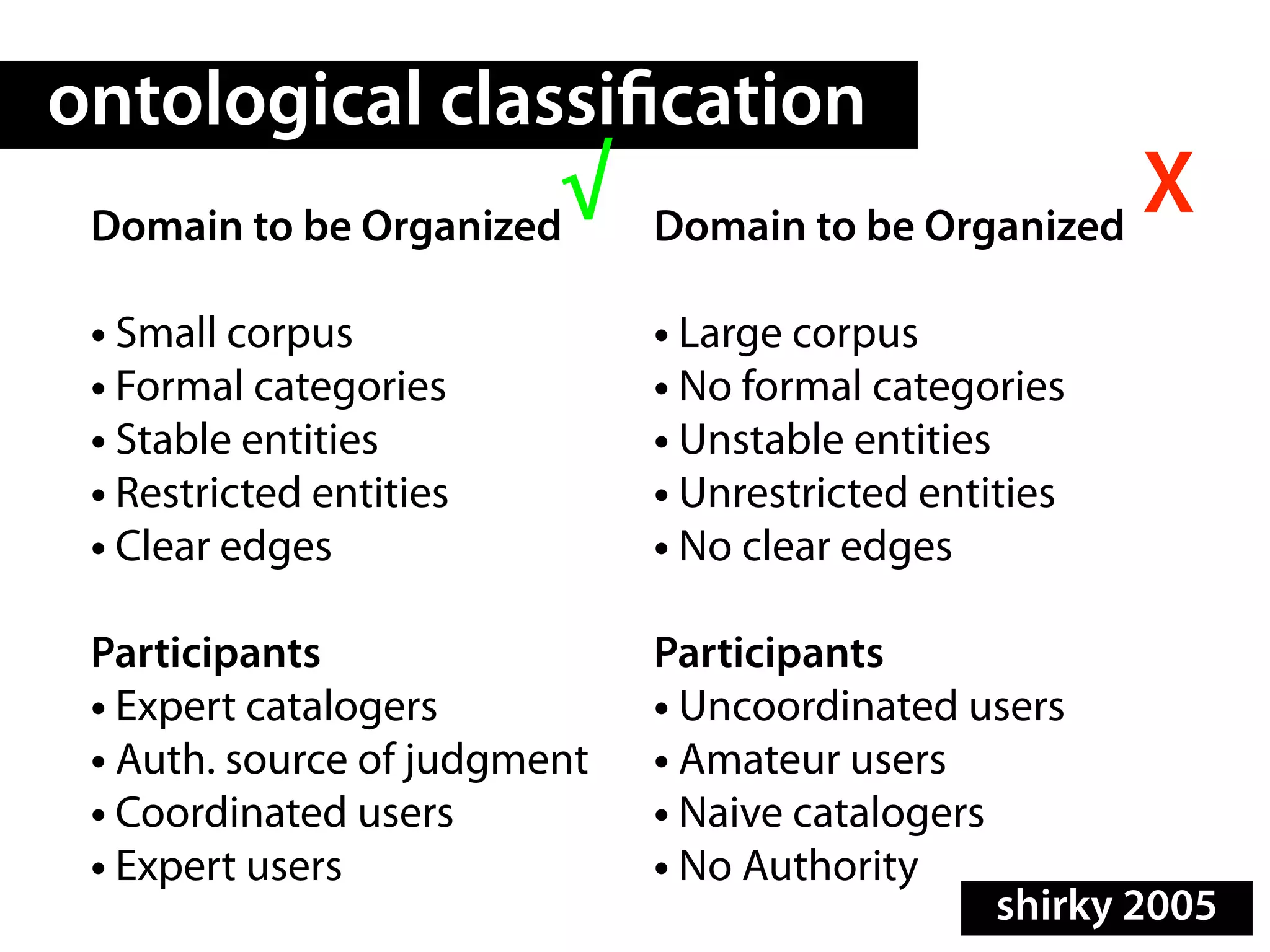
ontological classi cation
 Domain to be Organized
                       √      Domain to be Organized
                                                     X
 • Small corpus               • Large corpus
 • Formal categories          • No formal categories
 • Stable entities            • Unstable entities
 • Restricted entities        • Unrestricted entities
 • Clear edges                • No clear edges
 Participants                 Participants
 • Expert catalogers          • Uncoordinated users
 • Auth. source of judgment   • Amateur users
 • Coordinated users          • Naive catalogers
 • Expert users               • No Authority
                                                 shirky 2005
tagging critiques


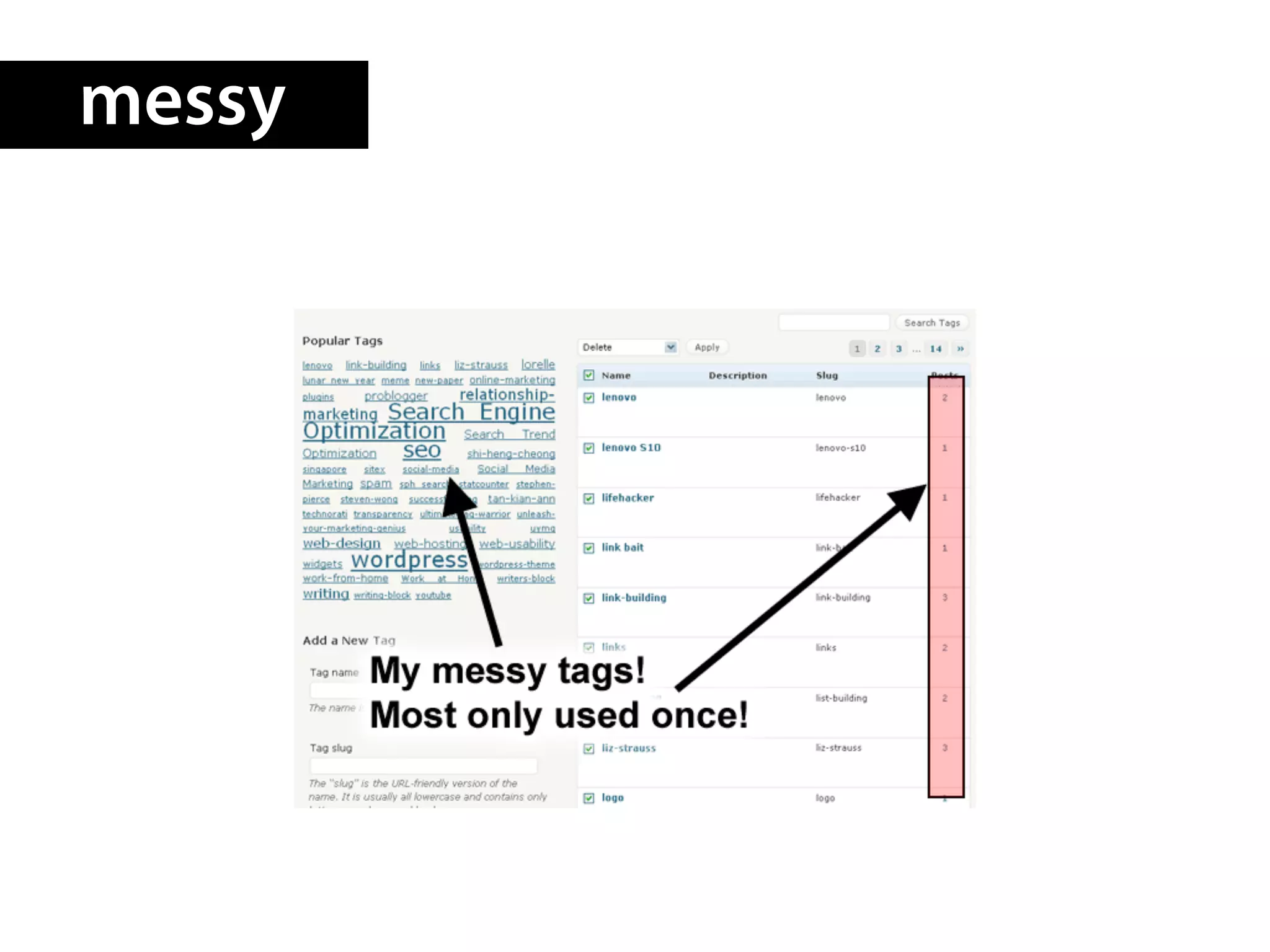
    messy
    amateur
    spammy
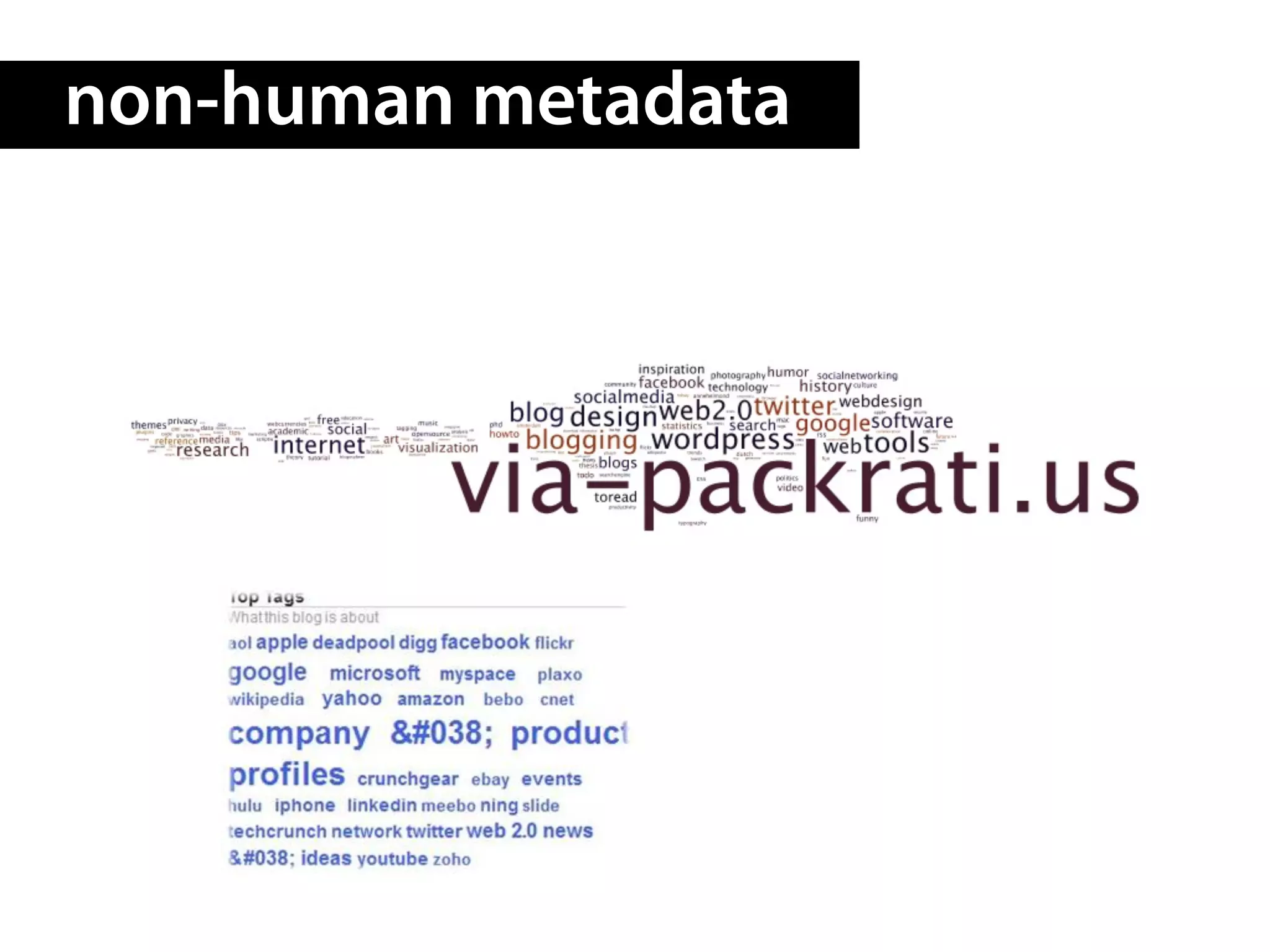
    non-human metadata
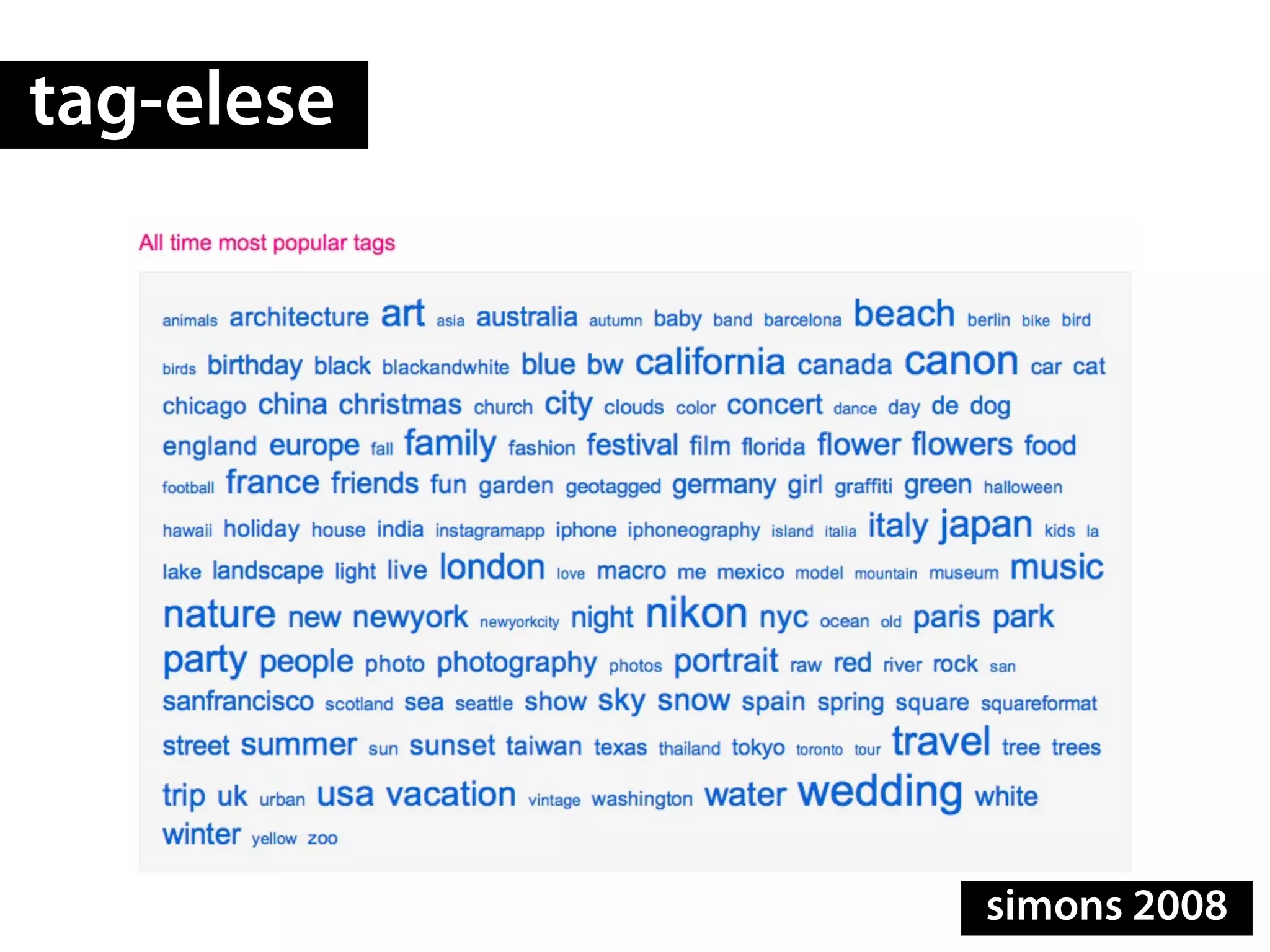
tag-elese


            simons 2008
messy
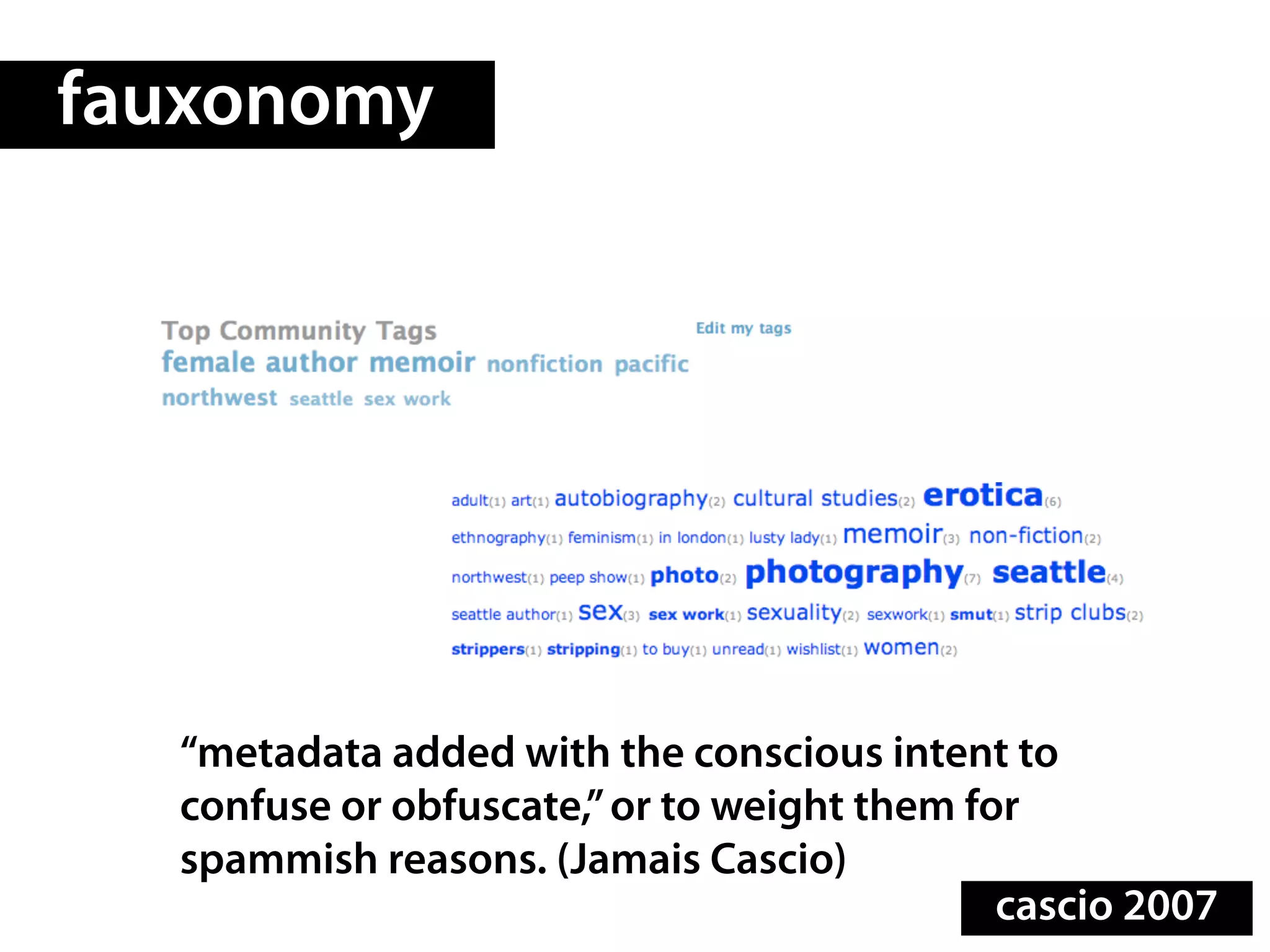
fauxonomy


  “metadata added with the conscious intent to
  confuse or obfuscate,” or to weight them for
  spammish reasons. (Jamais Cascio)
                                             cascio 2007
non-human metadata
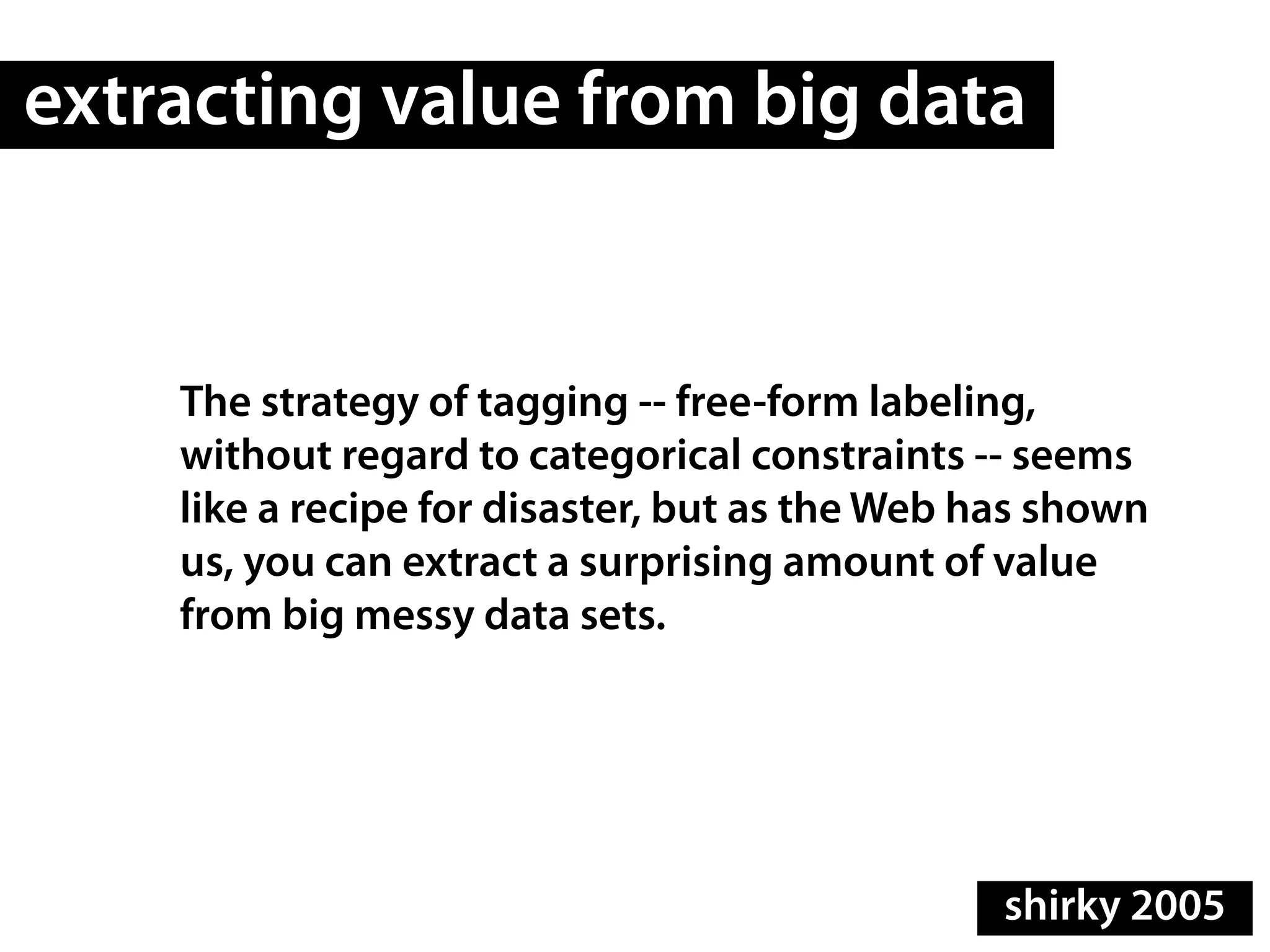
extracting value from big data


    The strategy of tagging -- free-form labeling,
    without regard to categorical constraints -- seems
    like a recipe for disaster, but as the Web has shown
    us, you can extract a surprising amount of value
    from big messy data sets.


                                                shirky 2005
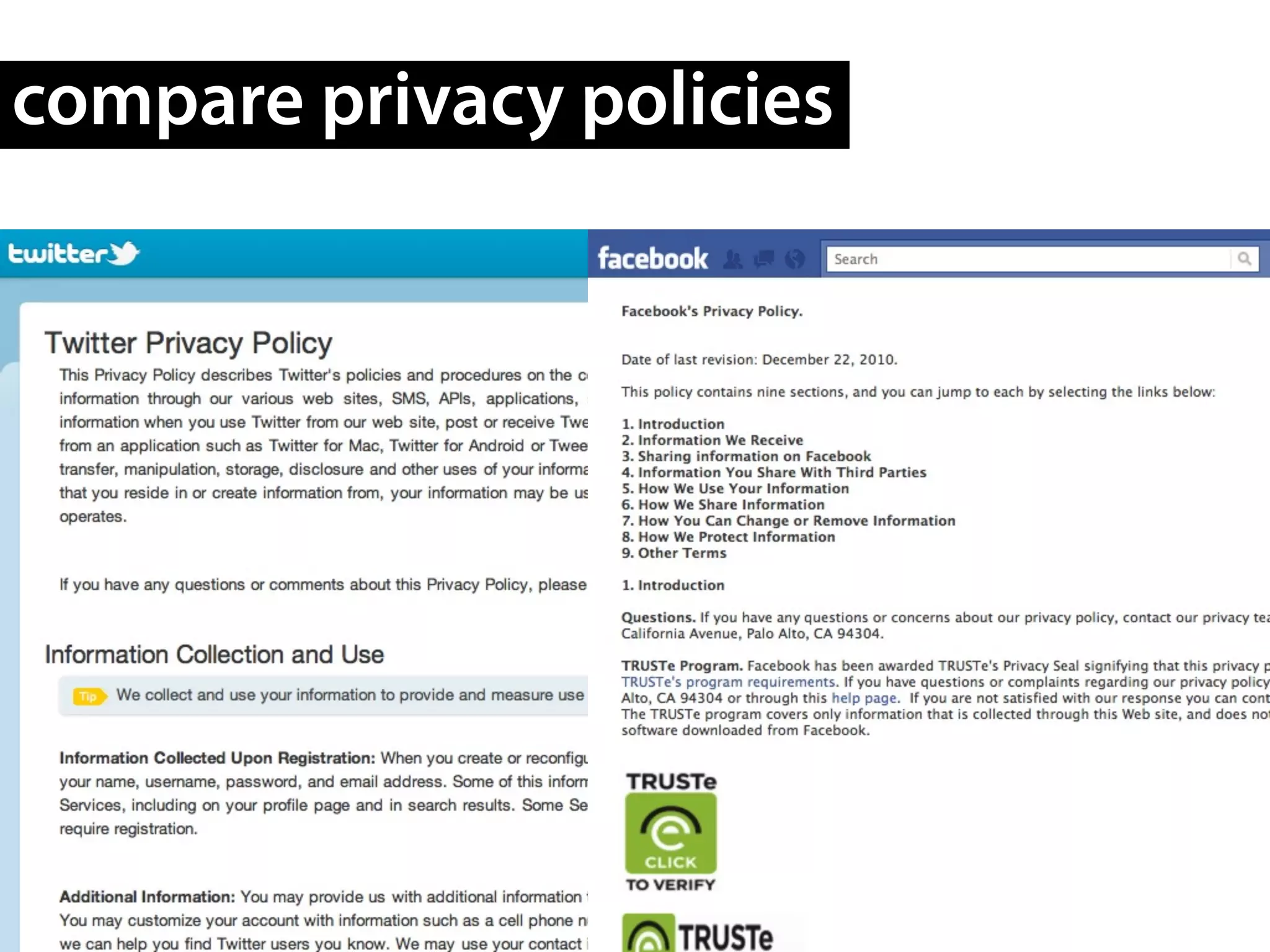
compare privacy policies
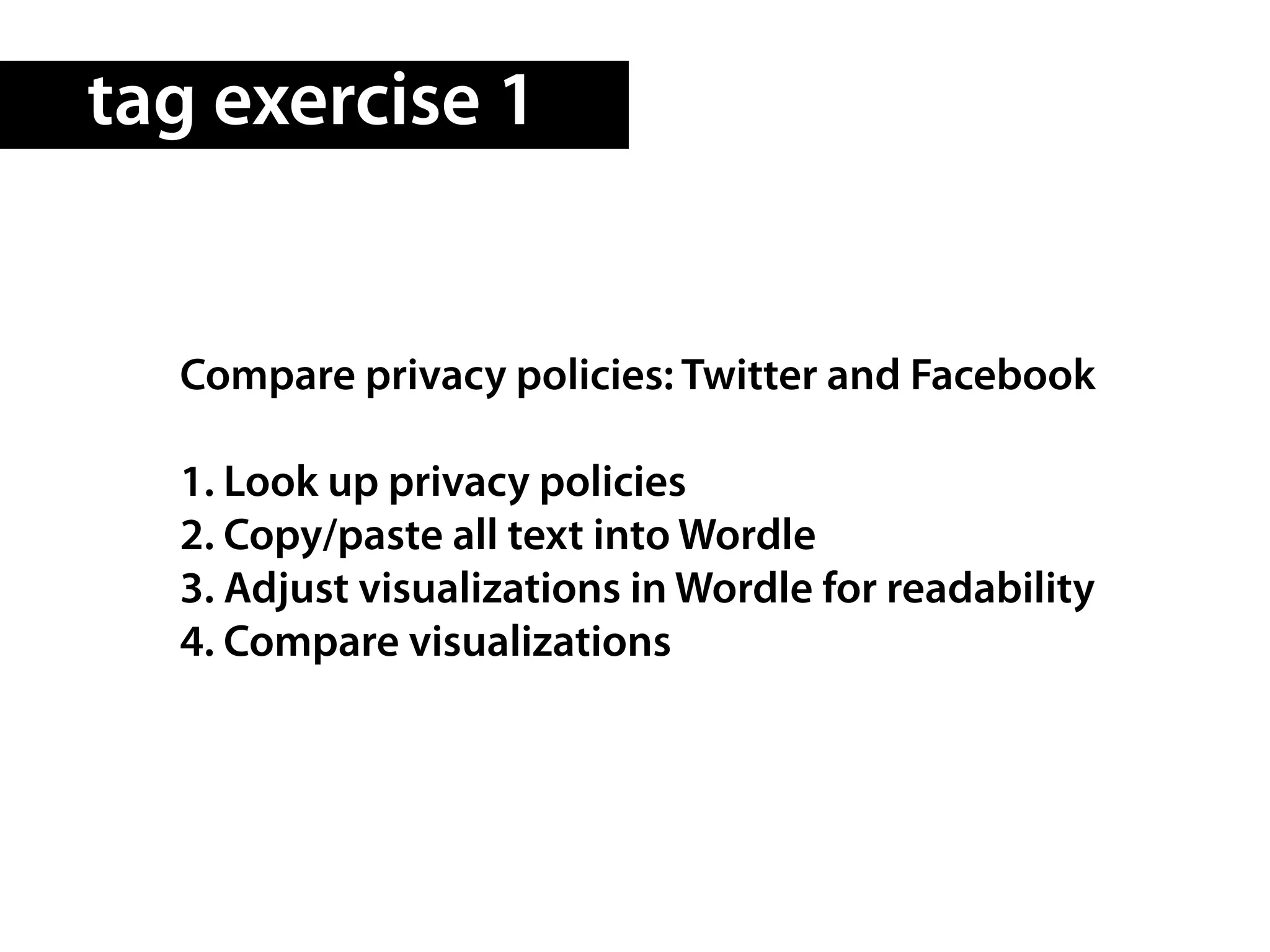
tag exercise 1


  Compare privacy policies: Twitter and Facebook

  1. Look up privacy policies
  2. Copy/paste all text into Wordle
  3. Adjust visualizations in Wordle for readability
  4. Compare visualizations
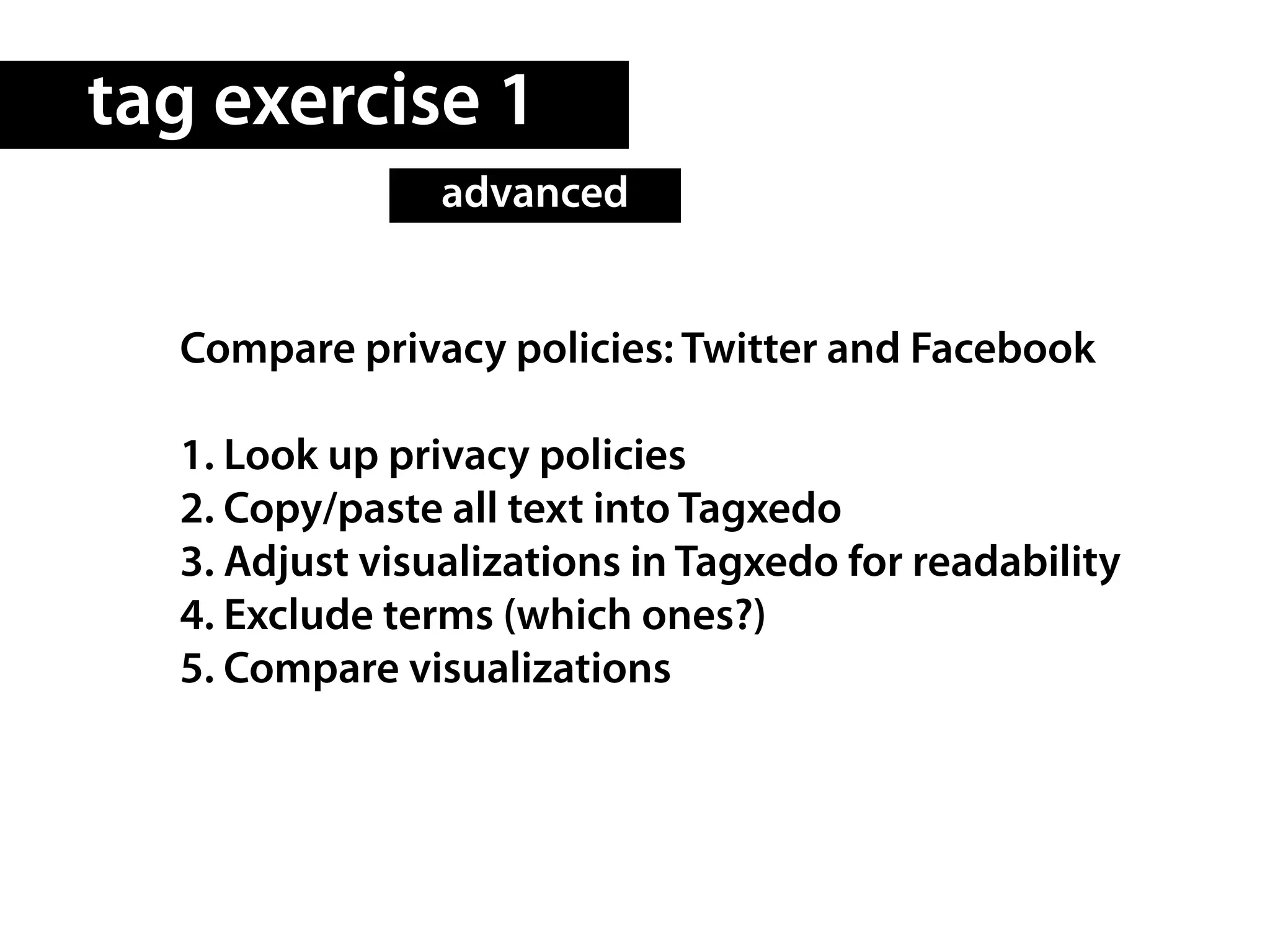
tag exercise 1
                advanced


  Compare privacy policies: Twitter and Facebook

  1. Look up privacy policies
  2. Copy/paste all text into Tagxedo
  3. Adjust visualizations in Tagxedo for readability
  4. Exclude terms (which ones?)
  5. Compare visualizations
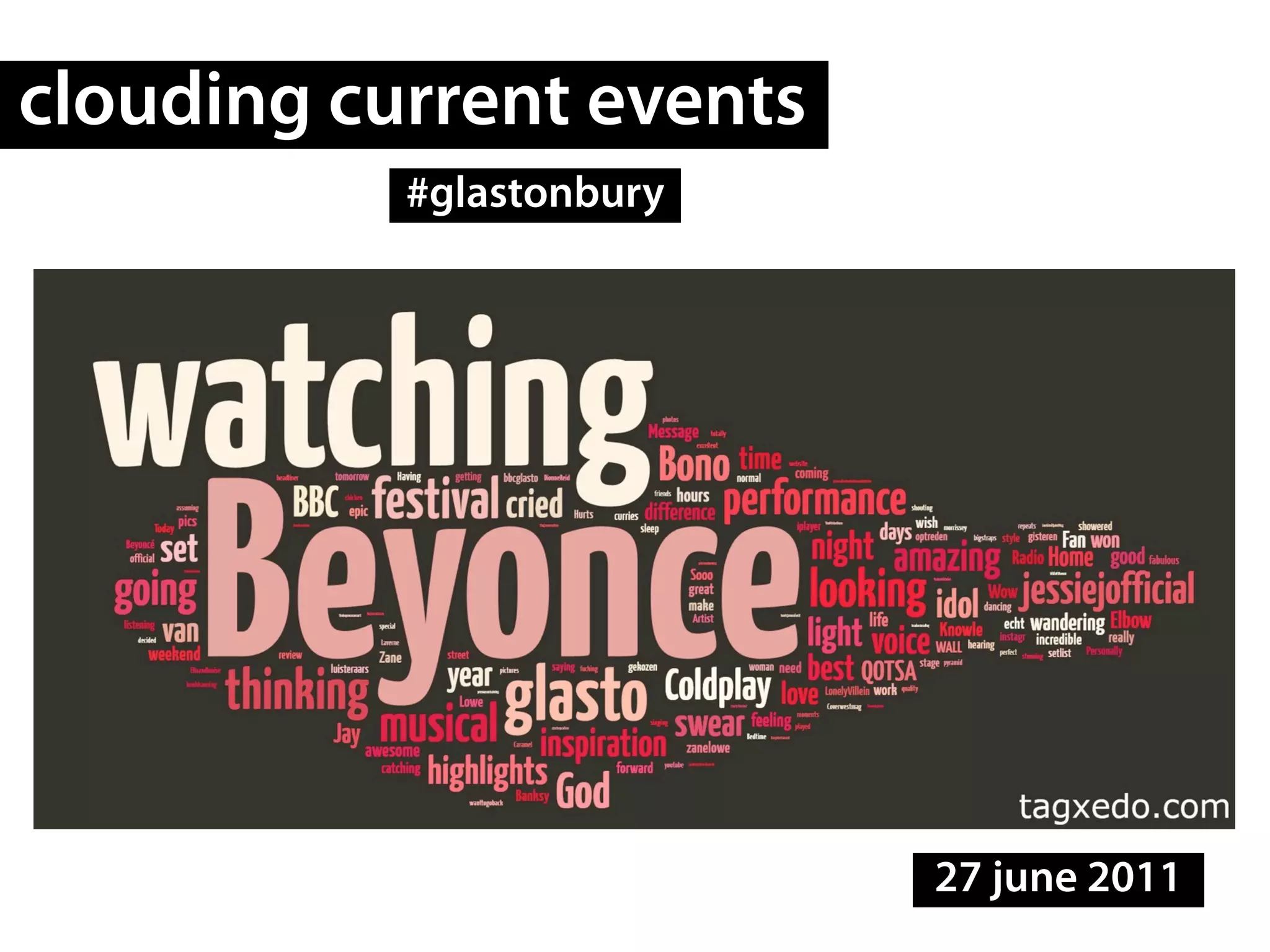
clouding current events
           #glastonbury


                          27 june 2011
tag exercise 2

  Clouding a current event: Glastonbury

  1. Scrape top 1000 tweets for #Glastonbury using
  the Twitterscraper
  2. Open le in Excel/OpenOffice
  3. Copy/paste text column in Tagxedo
  4. Exclude terms (which ones?)
  5. Compare visualizations
tag exercise 2
                advanced

  Clouding a current event: Glastonbury on Twitter
  and in Google News

  1. Use previous instructions for Twitter
  2. Enter keyword Glastonbury in Tagxedo
  3. Adjust visualizations in Tagxedo for readability
  4. Exclude same terms as Twitter
  5. Compare visualizations
sources

Images
http://web.archive.org/web/20040607054247/http://www.flickr.com/photos/tags/
http://web.archive.org/web/20041204231120/http://twiki.tensegrity.net/bin/view/Main/SearchReferralZeitgeist
http://web.archive.org/web/20041122035256/http://twinkler.43things.com/twinkler/
http://www.librarything.com/blogs/thingology/2007/07/fauxonomy/
Artist featured in photos: Tomas Saraceno

Services
http://www.tagxedo.com
http://www.wordle.net

Articles
Friendly, Michael (2009). “Milestones in the history of thematic cartography, statistical graphics, and data visualization.” PDF
Marlow, Cameron, Mor Naaman, danah boyd and Marc Davis (2006). "HT06, Tagging Paper, Taxonomy, Flickr, Academic
Article, ToRead." Proceedings of Hypertext 2006, New York: ACM Press.
Shirky, Clay (2005). “Ontology is Overrated: Categories, Links, and Tags.”
Stevenson, Michael. “Getting things done? Tagging, del.icio.us and procrastination.” http://whateverbutton.com/blog/
index.php/getting-things-done-tagging-delicious-and-procrastination/
anne@digitalmethods.net

                   sabine@digitalmethods.net


  kthxbai!
www.digitalmethods.net
                               artist: tomas saraceno

DMI Workshop. Data visualization: Clouding

  • 1.
    data visualization: clouding anne helmond & sabine niederer doing digital methods, rmes workshop, 28 june 2011
  • 2.
    data visualization the science of visual representation of “data”, defined as information which has been abstracted in some schematic form, including attributes or variables for the units of information. (2009:1) michael friendly
  • 3.
    data visualization 1482: ptolemy's world map
  • 4.
    data visualization 1611: scheiner's “tres epistolae”
  • 5.
    data visualization 1782: de fourcroy “tableau poleometrique”
  • 6.
    data visualization 1805: playfair
  • 7.
    data visualization 1836: parent-duchatelet
  • 8.
    data visualization 1837: harness
  • 9.
    data visualization 1869: minard
  • 10.
    data visualization 1873: loua’s scalogram
  • 11.
    data visualization 1991: schneiderman
  • 12.
    direct visualization data is reorganized into a new visual representation that preserves its original form manovich 2010
  • 13.
    data visualization a weighted list 1992
  • 14.
    history of thetag cloud 1995
  • 15.
    history of thetag cloud 1997-2003
  • 16.
    history of thetag cloud 2004
  • 17.
    tag cloud denition A tag cloud (word cloud, or weighted list in visual design) is a visual representation for text data, typically used to depict keyword metadata (tags) on websites, or to visualize free form text. wikipedia
  • 18.
    tag In onlinecomputer systems terminology, a tag is a non-hierarchical keyword or term assigned to a piece of information (such as an internet bookmark, digital image, or computer le). This kind of metadata helps describe an item and allows it to be found again by browsing or searching. Tags are chosen informally and personally by the item's creator or by its viewer, depending on the system. wikipedia
  • 19.
    tagging Tagging systems enable users to add keywords (i.e., “tags”) to Internet resources (e.g., web pages, images, videos) without relying on a controlled vocabulary. [...] a freely chosen set of keywords (“tags”). marlow et al 2006
  • 20.
    folksonomy Afolksonomy is a system of classi cation derived from the practice and method of collaboratively creating and managing tags to annotate and categorize content; this practice is also known as collaborative tagging, social classi cation, social indexing, and social tagging. (Wikipedia) Folksonomy is the result of personal free tagging of information and objects (anything with a URL) for one's own retrieval. The tagging is done in a social environment (usually shared and open to others). Folksonomy is created from the act of tagging by the person consuming the information. (Vander Wal 2007)
  • 21.
  • 22.
    types of tagclouds content
  • 23.
    types of tagclouds ordered
  • 24.
    types of tagclouds un-ordered
  • 25.
    types of tagclouds centered
  • 26.
    ontological classi cation Domain to be Organized √ Domain to be Organized X • Small corpus • Large corpus • Formal categories • No formal categories • Stable entities • Unstable entities • Restricted entities • Unrestricted entities • Clear edges • No clear edges Participants Participants • Expert catalogers • Uncoordinated users • Auth. source of judgment • Amateur users • Coordinated users • Naive catalogers • Expert users • No Authority shirky 2005
  • 27.
    tagging critiques messy amateur spammy non-human metadata
  • 28.
    tag-elese simons 2008
  • 29.
  • 30.
    fauxonomy “metadataadded with the conscious intent to confuse or obfuscate,” or to weight them for spammish reasons. (Jamais Cascio) cascio 2007
  • 31.
  • 32.
    extracting value frombig data The strategy of tagging -- free-form labeling, without regard to categorical constraints -- seems like a recipe for disaster, but as the Web has shown us, you can extract a surprising amount of value from big messy data sets. shirky 2005
  • 33.
  • 34.
    tag exercise 1 Compare privacy policies: Twitter and Facebook 1. Look up privacy policies 2. Copy/paste all text into Wordle 3. Adjust visualizations in Wordle for readability 4. Compare visualizations
  • 35.
    tag exercise 1 advanced Compare privacy policies: Twitter and Facebook 1. Look up privacy policies 2. Copy/paste all text into Tagxedo 3. Adjust visualizations in Tagxedo for readability 4. Exclude terms (which ones?) 5. Compare visualizations
  • 36.
    clouding current events #glastonbury 27 june 2011
  • 37.
    tag exercise 2 Clouding a current event: Glastonbury 1. Scrape top 1000 tweets for #Glastonbury using the Twitterscraper 2. Open le in Excel/OpenOffice 3. Copy/paste text column in Tagxedo 4. Exclude terms (which ones?) 5. Compare visualizations
  • 38.
    tag exercise 2 advanced Clouding a current event: Glastonbury on Twitter and in Google News 1. Use previous instructions for Twitter 2. Enter keyword Glastonbury in Tagxedo 3. Adjust visualizations in Tagxedo for readability 4. Exclude same terms as Twitter 5. Compare visualizations
  • 39.
    sources Images http://web.archive.org/web/20040607054247/http://www.flickr.com/photos/tags/ http://web.archive.org/web/20041204231120/http://twiki.tensegrity.net/bin/view/Main/SearchReferralZeitgeist http://web.archive.org/web/20041122035256/http://twinkler.43things.com/twinkler/ http://www.librarything.com/blogs/thingology/2007/07/fauxonomy/ Artist featured inphotos: Tomas Saraceno Services http://www.tagxedo.com http://www.wordle.net Articles Friendly, Michael (2009). “Milestones in the history of thematic cartography, statistical graphics, and data visualization.” PDF Marlow, Cameron, Mor Naaman, danah boyd and Marc Davis (2006). "HT06, Tagging Paper, Taxonomy, Flickr, Academic Article, ToRead." Proceedings of Hypertext 2006, New York: ACM Press. Shirky, Clay (2005). “Ontology is Overrated: Categories, Links, and Tags.” Stevenson, Michael. “Getting things done? Tagging, del.icio.us and procrastination.” http://whateverbutton.com/blog/ index.php/getting-things-done-tagging-delicious-and-procrastination/
  • 40.
    anne@digitalmethods.net sabine@digitalmethods.net kthxbai! www.digitalmethods.net artist: tomas saraceno