TETD 819: Analytic Review of
Empirical Literature
Week3
Reading deeply: Value positions
Value positions
• Always signaled by language choices, theoretical
framing and “positioning” of the literature
drawn on
• Often signaled by what is studied or the
examples drawn upon
• Often signaled by what the author criticizes
• Typically linked in different ways to normative
claims
So let’s examine Ladson-Billings’
value positions
Reading deeply: Mapping arguments
Argument analysis
• “An argument involves putting forward reasons
to influence someone’s belief that what you are
proposing is the case” (Hart 1998: 79)
• An argument comprises “giving reasons for
some conclusion: the reasons [claims] are put
forward in order to establish, support, justify,
prove or demonstrate the conclusion” (Fisher
1993:140).
• An argument typically comprises at least two
parts: reason(s)/evidence + conclusion
Hart (1998)
• Types of argument: Inference, assertion &
supposition
Toulmin’s approach (from Hart 1998)
• Claim
an arguable statement
• Evidence data used to support the claim
• Warrant an expectation that provides the
link between the evidence and
claim
• Backing context and assumptions used to
support the validity of the warrant
and evidence
Fisher’s approach (Hart, p. 93)
Let’s begin with mapping L-B’s argument (and
nested arguments) on pp. 466-468.

then

Ladson-Billings, p. 472
What is Ladson-Billing’s main
argument in this paper, and
how do you know?
Remember
• Your argument in your analytic review must
necessarily “grow out of” your data set
• In an analytic review, you cannot use your
data set in the service of a pre-determined
argument
More on writing analytic reviews
Winnowing your initial data pool
• Initial pass: Toss out anything that’s not a fullblown report
of a study
• Prior to second pass: Develop and refine your selection
criteria. These need to be documented, tied super closely
to your research question, and justified. You will report
your criteria in your methodology section.
• Second pass: Apply your selection criteria consistently to
your data pool. This generates your final data corpus with
which you will work.
• Watch for doubling up (multiple reports of the same
study)
• Attention to replicability
Finalizing & organizing your corpus
• Looking at Spencer, Knobel & Lankshear, for
example.
Sample selection criteria
• qualitative study
• article appeared in a peer-reviewed journal
• conducted from a sociocultural theoretical
orientation
• the study focused on "non-school" literacy
• the study focused on children aged between 4
and 8 years
• the study focused on literacy practices outside
school
Organizing your corpus
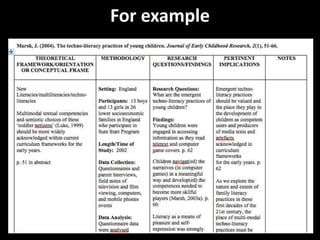
• Decide what dimensions of the studies as a
whole are likely to be useful and draw up a
table to summarize key elements for easy
comparisons
For example
Reminders
• Liaise with your advisor re your research
question and search boundaries.
When is enough enough?
or
When is too much too much?

Tetd819 week3 2014

  • 1.
    TETD 819: AnalyticReview of Empirical Literature Week3
  • 2.
  • 3.
    Value positions • Alwayssignaled by language choices, theoretical framing and “positioning” of the literature drawn on • Often signaled by what is studied or the examples drawn upon • Often signaled by what the author criticizes • Typically linked in different ways to normative claims
  • 4.
    So let’s examineLadson-Billings’ value positions
  • 5.
  • 6.
    Argument analysis • “Anargument involves putting forward reasons to influence someone’s belief that what you are proposing is the case” (Hart 1998: 79) • An argument comprises “giving reasons for some conclusion: the reasons [claims] are put forward in order to establish, support, justify, prove or demonstrate the conclusion” (Fisher 1993:140). • An argument typically comprises at least two parts: reason(s)/evidence + conclusion
  • 7.
    Hart (1998) • Typesof argument: Inference, assertion & supposition
  • 8.
    Toulmin’s approach (fromHart 1998) • Claim an arguable statement • Evidence data used to support the claim • Warrant an expectation that provides the link between the evidence and claim • Backing context and assumptions used to support the validity of the warrant and evidence
  • 9.
    Fisher’s approach (Hart,p. 93) Let’s begin with mapping L-B’s argument (and nested arguments) on pp. 466-468. then Ladson-Billings, p. 472
  • 10.
    What is Ladson-Billing’smain argument in this paper, and how do you know?
  • 11.
    Remember • Your argumentin your analytic review must necessarily “grow out of” your data set • In an analytic review, you cannot use your data set in the service of a pre-determined argument
  • 12.
    More on writinganalytic reviews
  • 13.
    Winnowing your initialdata pool • Initial pass: Toss out anything that’s not a fullblown report of a study • Prior to second pass: Develop and refine your selection criteria. These need to be documented, tied super closely to your research question, and justified. You will report your criteria in your methodology section. • Second pass: Apply your selection criteria consistently to your data pool. This generates your final data corpus with which you will work. • Watch for doubling up (multiple reports of the same study) • Attention to replicability
  • 14.
    Finalizing & organizingyour corpus • Looking at Spencer, Knobel & Lankshear, for example.
  • 15.
    Sample selection criteria •qualitative study • article appeared in a peer-reviewed journal • conducted from a sociocultural theoretical orientation • the study focused on "non-school" literacy • the study focused on children aged between 4 and 8 years • the study focused on literacy practices outside school
  • 16.
    Organizing your corpus •Decide what dimensions of the studies as a whole are likely to be useful and draw up a table to summarize key elements for easy comparisons
  • 17.
  • 18.
    Reminders • Liaise withyour advisor re your research question and search boundaries.
  • 19.
    When is enoughenough? or When is too much too much?