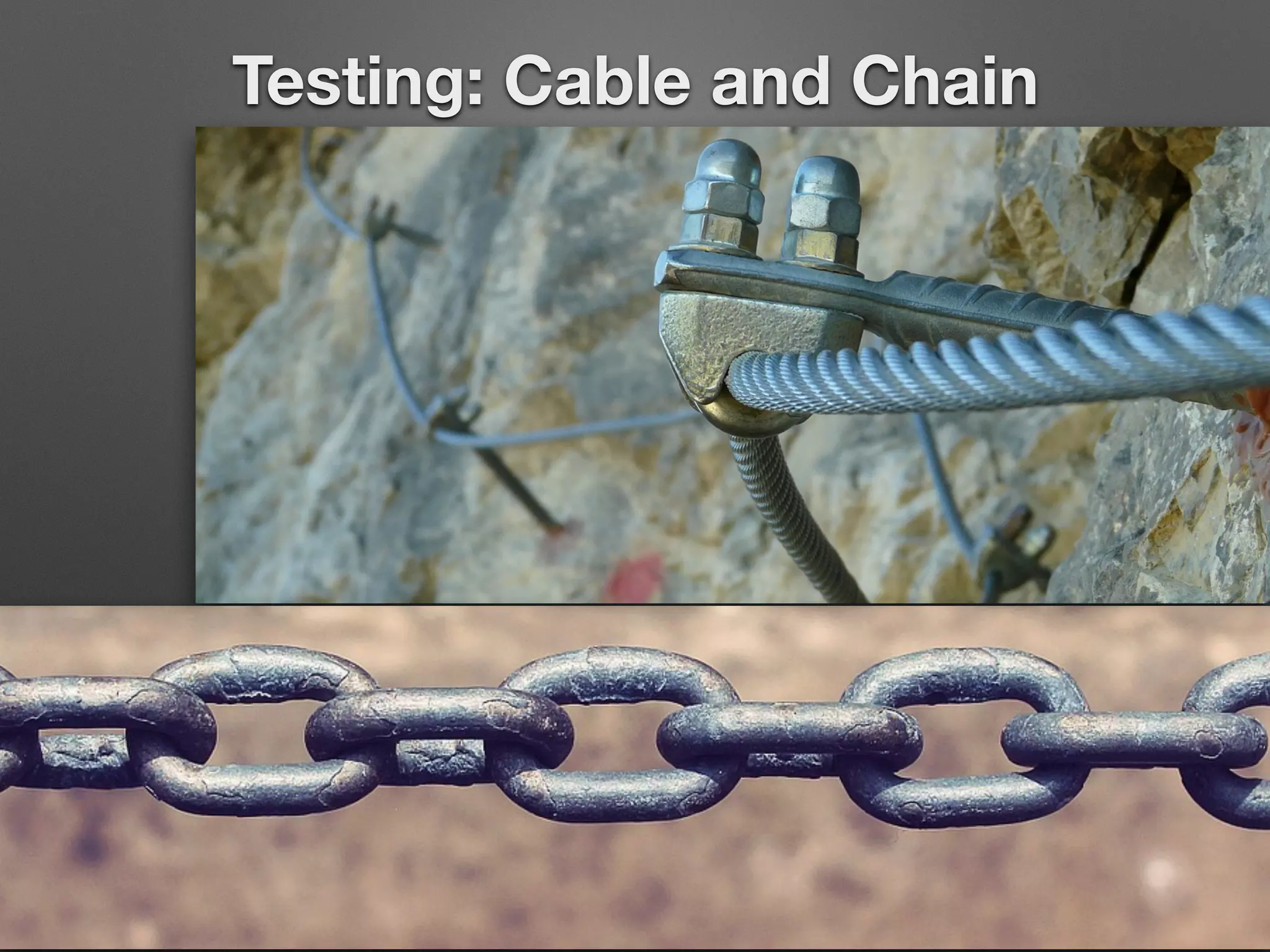
Testing: Cable and Chain
Questions To Answer
• Are tests helping or hurting your ability to code?
• Why progress slows with complexity?
About me
• Built and Maintained 100K membership site for ~8 year
• Built and Maintained a highly rated Scrum Training
Application for ~12 years
• Elixir: CC Processing, Medical Research, Energy Grid
• Unit testing TDD since 1999 — sUnit !
• Learned from Kent Beck and Bob Martin
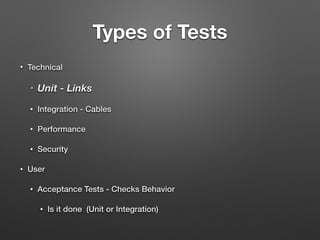
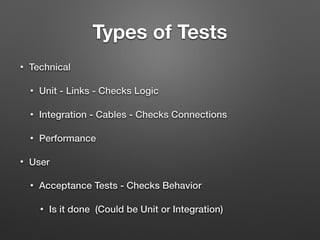
Types of Tests
• Technical
• Unit - Links
• Integration - Cables
• Performance
• Security
• User
• Acceptance Tests - Checks Behavior
• Is it done (Unit or Integration)
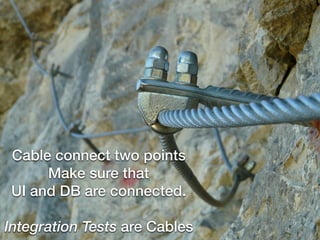
Cable connect two points
Make sure that
UI and DB are connected.
Integration Tests are Cables
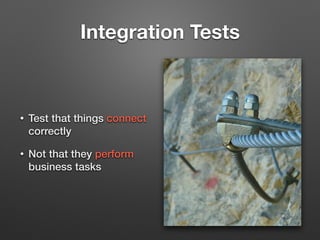
Integration Tests
• Test that things connect
correctly
• Not that they perform
business tasks
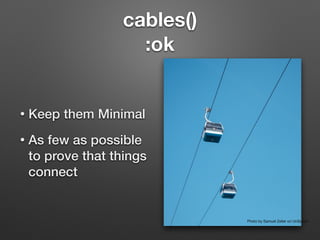
cables()
:ok
• Keep them Minimal
• As few as possible
to prove that things
connect
Photo by Samuel Zeller on UnSplash
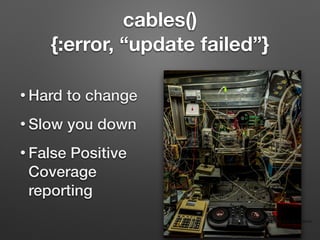
cables()
{:error, “update failed”}
• Hard to change
• Slow you down
• False Positive
Coverage
reporting
Photo by Martijn Baudoin on UnSplash
Incidental Coverage
• Need code example …
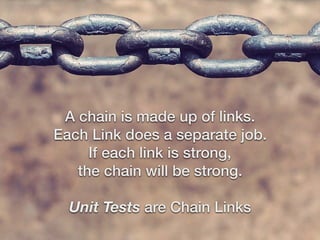
A chain is made up of links.
Each Link does a separate job.
If each link is strong,
the chain will be strong.
Unit Tests are Chain Links
Unit Tests
• Assert every possible
thing that the function
can do
• Every branch and
behavior
• Link must be Strong
and Reliable
Types of Tests
• Technical
• Unit - Links - Checks Logic
• Integration - Cables - Checks Connections
• Performance
• User
• Acceptance Tests - Checks Behavior
• Is it done (Could be Unit or Integration)
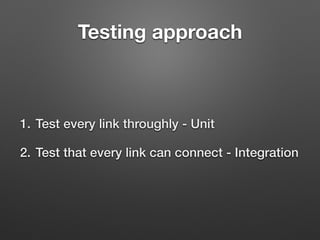
Testing approach
1. Test every link throughly - Unit
2. Test that every link can connect - Integration
What is a Unit ?
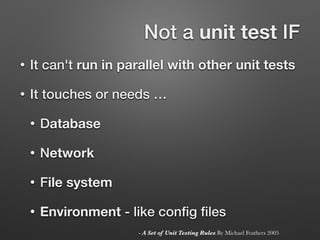
Not a unit test IF
• It can't run in parallel with other unit tests
• It touches or needs …
• Database
• Network
• File system
• Environment - like config files
- A Set of Unit Testing Rules By Michael Feathers 2005
Things in Environment
• System Time
• Global Application.get_env
• Erlang Scheduler, so no multi-
processes tests
- A Set of Unit Testing Rules By Michael Feathers 2005
Code Under Test
Should have no Side Effects
Side-effects
• A function has a side effect if
• it modifies a mutable data structure or
variable
• uses IO
• throws an exception
https://dzone.com/articles/side-effects-1
Functional Programming
• … functions should not have side effects
• A function with side effects
• is called a Procedure
• can be unpredictable depending on the state
of the system
• is hard to test
https://dzone.com/articles/side-effects-1
Functions with no
Side-Effects are called
Pure Functions
They are good !
no observable side effects
Pure Functions are easy to test
Tests for Pure Functions are
Unit Tests
But what if the function
needs to talk to something ?
Higher-Order Functions
• Functions that take functions as params, or return
functions
To the Rescue !
inc_function = fn(n) -> n + 1 end
Enum.map( [ 1, 2, 3 ] , inc_function )
Test with Injection
• Needs Code example …
Refactor:
“Move Side-Effect Up”
• Needs Code Example …
Are your Tests … Large?
Using the DB?
You might be Bound in Cables
hard to write?
The Environment?
How do I Build Small tests ?
Try,
Test Driven Development
• From XP - ExtremeProgramming created in ~1997
• Inside out - Detroit style
• Outside in - London style
• Red - Green - Refactor, 5-10 mins & commit
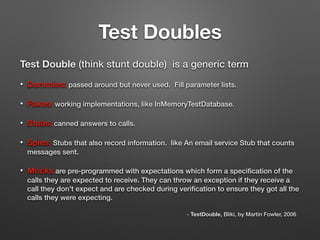
Test Doubles
Test Double (think stunt double) is a generic term
• Dummies: passed around but never used. Fill parameter lists.
• Fakes: working implementations, like InMemoryTestDatabase.
• Stubs: canned answers to calls.
• Spies: Stubs that also record information. like An email service Stub that counts
messages sent.
• Mocks are pre-programmed with expectations which form a specification of the
calls they are expected to receive. They can throw an exception if they receive a
call they don't expect and are checked during verification to ensure they got all the
calls they were expecting.
- TestDouble, Bliki, by Martin Fowler, 2006
Independent Tests
• Easy to change, only touches Collaborators
• Rule #1: Only TestDouble for Collaborators
Local Stubs
Aka, “Mocks As Locals”
Although we have used the application configuration for
solving the external API issue,
sometimes it is easier to just pass the dependency as
argument. Imagine this example in Elixir where some
function may perform heavy work which you want to
isolate in tests
— José Valim
http://blog.plataformatec.com.br/2015/10/mocks-and-explicit-contracts/
Prefer Local Stubs
passing the dependency as argument is
much simpler and should be preferred
over relying on configuration files and
Application.get_env/3
— José Valim
http://blog.plataformatec.com.br/2015/10/mocks-and-explicit-contracts/
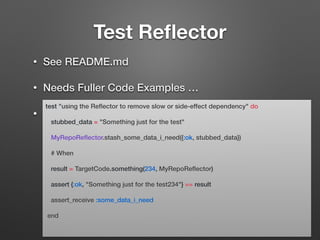
Test Reflector
• See README.md
• Needs Fuller Code Examples …
•
test "using the Reflector to remove slow or side-effect dependency" do
stubbed_data = "Something just for the test"
MyRepoReflector.stash_some_data_i_need({:ok, stubbed_data})
# When
result = TargetCode.something(234, MyRepoReflector)
assert {:ok, "Something just for the test234"} == result
assert_receive :some_data_i_need
end
2020-Feb: Testing: Cables and Chains

2020-Feb: Testing: Cables and Chains

  • 1.
  • 2.
    Questions To Answer •Are tests helping or hurting your ability to code? • Why progress slows with complexity?
  • 3.
    About me • Builtand Maintained 100K membership site for ~8 year • Built and Maintained a highly rated Scrum Training Application for ~12 years • Elixir: CC Processing, Medical Research, Energy Grid • Unit testing TDD since 1999 — sUnit ! • Learned from Kent Beck and Bob Martin
  • 4.
    Types of Tests •Technical • Unit - Links • Integration - Cables • Performance • Security • User • Acceptance Tests - Checks Behavior • Is it done (Unit or Integration)
  • 5.
    Cable connect twopoints Make sure that UI and DB are connected. Integration Tests are Cables
  • 6.
    Integration Tests • Testthat things connect correctly • Not that they perform business tasks
  • 7.
    cables() :ok • Keep themMinimal • As few as possible to prove that things connect Photo by Samuel Zeller on UnSplash
  • 8.
    cables() {:error, “update failed”} •Hard to change • Slow you down • False Positive Coverage reporting Photo by Martijn Baudoin on UnSplash
  • 9.
  • 10.
    A chain ismade up of links. Each Link does a separate job. If each link is strong, the chain will be strong. Unit Tests are Chain Links
  • 11.
    Unit Tests • Assertevery possible thing that the function can do • Every branch and behavior • Link must be Strong and Reliable
  • 12.
    Types of Tests •Technical • Unit - Links - Checks Logic • Integration - Cables - Checks Connections • Performance • User • Acceptance Tests - Checks Behavior • Is it done (Could be Unit or Integration)
  • 13.
    Testing approach 1. Testevery link throughly - Unit 2. Test that every link can connect - Integration
  • 14.
    What is aUnit ?
  • 15.
    Not a unittest IF • It can't run in parallel with other unit tests • It touches or needs … • Database • Network • File system • Environment - like config files - A Set of Unit Testing Rules By Michael Feathers 2005
  • 16.
    Things in Environment •System Time • Global Application.get_env • Erlang Scheduler, so no multi- processes tests - A Set of Unit Testing Rules By Michael Feathers 2005
  • 17.
    Code Under Test Shouldhave no Side Effects
  • 18.
    Side-effects • A functionhas a side effect if • it modifies a mutable data structure or variable • uses IO • throws an exception https://dzone.com/articles/side-effects-1
  • 19.
    Functional Programming • …functions should not have side effects • A function with side effects • is called a Procedure • can be unpredictable depending on the state of the system • is hard to test https://dzone.com/articles/side-effects-1
  • 20.
    Functions with no Side-Effectsare called Pure Functions They are good ! no observable side effects
  • 21.
    Pure Functions areeasy to test Tests for Pure Functions are Unit Tests
  • 22.
    But what ifthe function needs to talk to something ?
  • 23.
    Higher-Order Functions • Functionsthat take functions as params, or return functions To the Rescue ! inc_function = fn(n) -> n + 1 end Enum.map( [ 1, 2, 3 ] , inc_function )
  • 24.
    Test with Injection •Needs Code example …
  • 25.
  • 26.
    Are your Tests… Large? Using the DB? You might be Bound in Cables hard to write? The Environment?
  • 27.
    How do IBuild Small tests ?
  • 28.
    Try, Test Driven Development •From XP - ExtremeProgramming created in ~1997 • Inside out - Detroit style • Outside in - London style • Red - Green - Refactor, 5-10 mins & commit
  • 29.
    Test Doubles Test Double(think stunt double) is a generic term • Dummies: passed around but never used. Fill parameter lists. • Fakes: working implementations, like InMemoryTestDatabase. • Stubs: canned answers to calls. • Spies: Stubs that also record information. like An email service Stub that counts messages sent. • Mocks are pre-programmed with expectations which form a specification of the calls they are expected to receive. They can throw an exception if they receive a call they don't expect and are checked during verification to ensure they got all the calls they were expecting. - TestDouble, Bliki, by Martin Fowler, 2006
  • 30.
    Independent Tests • Easyto change, only touches Collaborators • Rule #1: Only TestDouble for Collaborators
  • 31.
    Local Stubs Aka, “MocksAs Locals” Although we have used the application configuration for solving the external API issue, sometimes it is easier to just pass the dependency as argument. Imagine this example in Elixir where some function may perform heavy work which you want to isolate in tests — José Valim http://blog.plataformatec.com.br/2015/10/mocks-and-explicit-contracts/
  • 32.
    Prefer Local Stubs passingthe dependency as argument is much simpler and should be preferred over relying on configuration files and Application.get_env/3 — José Valim http://blog.plataformatec.com.br/2015/10/mocks-and-explicit-contracts/
  • 33.
    Test Reflector • SeeREADME.md • Needs Fuller Code Examples … • test "using the Reflector to remove slow or side-effect dependency" do stubbed_data = "Something just for the test" MyRepoReflector.stash_some_data_i_need({:ok, stubbed_data}) # When result = TargetCode.something(234, MyRepoReflector) assert {:ok, "Something just for the test234"} == result assert_receive :some_data_i_need end